/


Author: Rhodes R.
Tags: mathematics mathematical physics simon & schuster publisher a touchstone book atomic bomb
Year: 1986


Text
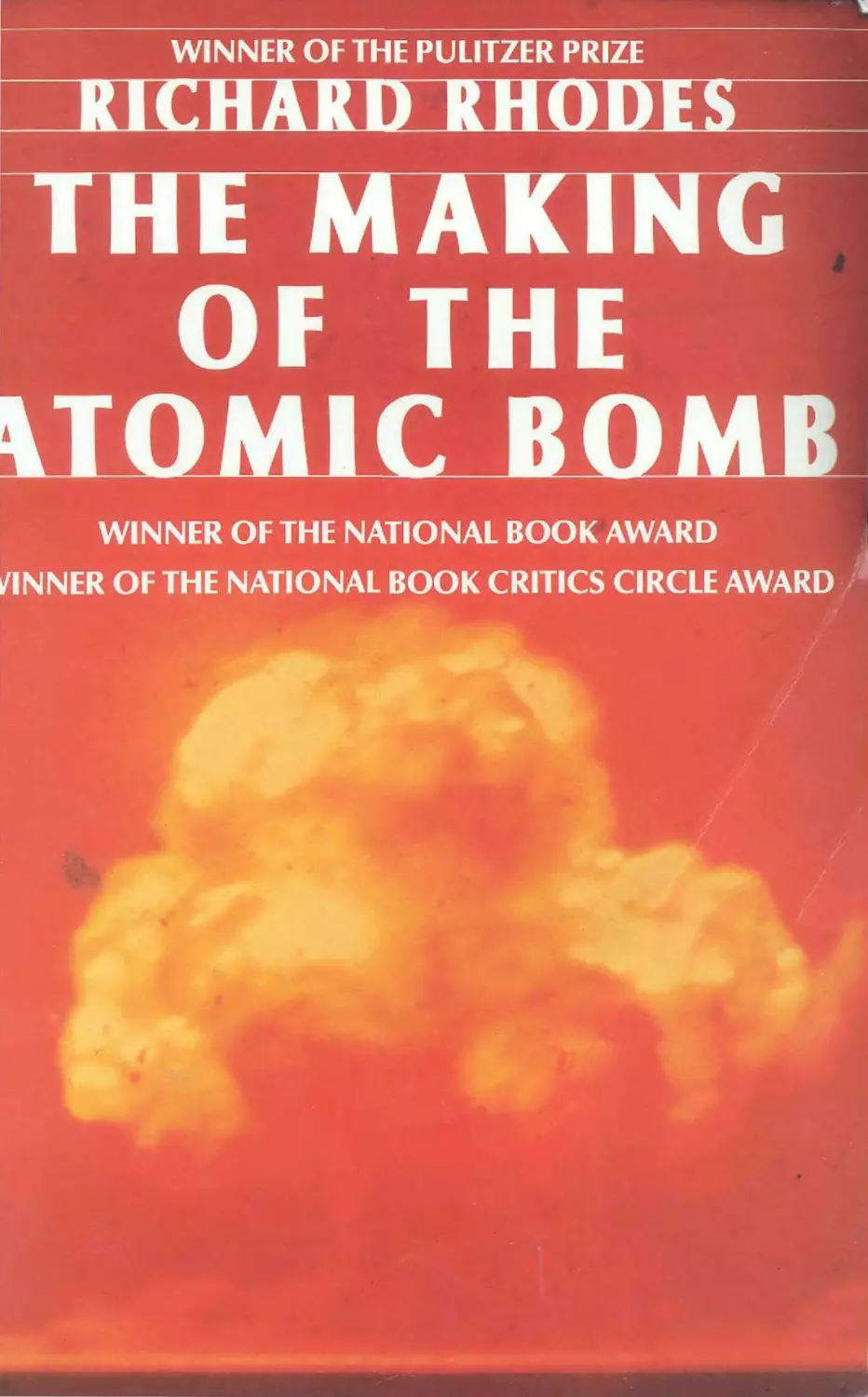
                    THE
MAKING
OF THE
ATOMIC
BOMB
A TOUCHSTONE BOOK
Published by Simon & Schuster
New York London Toronto Sydney Tokyo Singapore

Copyright © 1986 by Richard Rhodes
All rights reserved including the right of reproduction in whole or in part in any form. First
Touchstone Edition, 1988. Published by Simon & Schuster, Inc., Simon & Schuster Building,
Rockefeller Center, 1230 Avenue of the Americas, New York, NY 10020. TOUCHSTONE and
colophon are registered trademarks of Simon & Schuster, Inc. Designed by Eve Kirch. Picture
editor: Vincent Virga.
Manufactured in the United States of America
3579 10 864
20 19 18 17 16 15 14 13 12 11 Pbk.
Library of Congress Cataloging in Publication Data
Rhodes, Richard.
The making of the atomic bomb
Bibliography: p.
Includes index.
1. Atomic bomb—History. I. Title
QC773.R46 1986 623.4'5119'09 86-15445
ISBN 0-671 -44133-7
ISBN 0-671-65719-4 Pbk.
The author is grateful for permission to reprint excerpts from:
Reminiscences of Los Alamos, 1943-1945 by Lawrence Badash, et aL, copyright © 1980 by
D. Reidel Publishing Company, Dordrecht, Holland.
Energy and Conflict by Stanley A. Blumberg and Gwinn Owens, copyright © 1976. Published
by G. P. Putnam's Sons and reprinted by permission of Ann Elmo Agency.
Rutherford by A. S. Eve, copyright 1939. Reprinted by permission of Cambridge University
Press.
Atoms in the Family by Laura Fermi, copyright 1954. Reprinted by permission of University
of Chicago Press.
What Little I Remember by Otto Frisch, copyright © 1979. Reprinted by permission of
Cambridge University Press.
Now It Can Be Told by Leslie R. Groves, copyright © 1962 by Leslie R. Groves. Reprinted by
permission of Harold Ober Associates, Inc.
Hiroshima Diary by Michihiko Hachiya, translated and edited by Warner Wells, M.D.,
copyright 1955. Reprinted by permission of University of North Carolina Press.
The Uranium People by Leona Marshall Libby, copyright © 1979. Reprinted by permission
of Charles Scribner's Sons.
Death in Life by Robert Jay Lifton, copyright © 1982 by Robert Jay Lifton. Reprinted by
permission of Basic Books, Inc. Publishers.
Children of the Atomic Bomb by Arata Osada, copyright © 1967. Midwest Publishers.
Niels Bohr by Stefan Rozental, copyright © 1967. Reprinted by permission of North-Holland
Physics Publishing, Amsterdam.
Enrico Fermi, Physicist by Emilio Segre, copyright © 1970. Reprinted by permission of
University of Chicago Press.
Robert Oppenheimer: Letters and Recollections by Alice Kimball Smith and Charles Weiner,
copyright © 1980 by Alice Kimball Smith and Charles Weiner. Reprinted by permission
of Harvard University Press; also reprinted by permission of Spencer R. Weart at the
American Institute of Physics and for quotes from the Bridgeman Papers, Harvard
University Archives.
Adventures of a Mathematician by Stanislaw Ulam, copyright © 1977 by S. M. Ulam.
Reprinted by permission of Charles Scribner's Sons.
Leo Szilard: His Version of the Facts by Spencer R. Weart and Gertrude Weiss Szilard,
copyright © 1978. Reprinted by permission of the MIT Press.
All in Our Time by Jane Wilson, copyright © 1975 by the Educational Foundation for
Nuclear Science, Chicago, 111., 60637. Reprinted by permission of the Bulletin of the
Atomic Scientists, a magazine of science and world affairs.

In memory
John Cushman
1926-1984
The author acknowledges with gratitude
the support of the Ford Foundation
and the Alfred P. Sloan Foundation in
the research and writing of this book.

Taken as a story of human achievement, and human blind-
ness, the discoveries in the sciences are among the great epics.
Robert Oppenheimer
In an enterprise such as the building of the atomic bomb the
difference between ideas, hopes, suggestions and theoretical
calculations, and solid numbers based on measurement, is
paramount All the committees, the politicking and the plans
would have come to naught if a few unpredictable nuclear
cross sections had been different from what they are by a
factor of two.
Emilio Segrd

Richard
Rhodes

BOOKS BY
RICHARD RHODES
NONFICTION
The Making of the Atomic Bomb
Looking for America
The Inland Ground
FICTION
Sons of Earth
The Last Safari
Holy Secrets
The Ungodly

PRAISE FOR
THE MAKIMG OF THE ATOMIC BOMB
"A great book. Mr. Rhodes has done a beautiful job, and I don't see how
anyone can ever top it."
—Luis W. Alvarez,
Nobel Laureate for Physics, 1968
". . . what I read already impressed me with the author's knowledge of
much of the history of the science which led to the development of
nuclear energy and nuclear bombs and of the personalities which
contributed in the U.S. to the development of these. I was particularly impressed
by his realization of the importance of Leo Szilard's contributions which
are almost always underestimated but which he fully realizes and perhaps
even overestimates. I hope the book will find a wide readership."
—Eugene P. Wigner,
Nobel Laureate for Physics, 1963
"I found The Making of the Atomic Bomb well written, interesting and
one of the best in the great family of books on the subject. It is fascinating
as a novel, and I have learned from it many things I did not know. Mr.
Rhodes has done his homework conscientiously and intelligently."
—Emilio Segr£,
Nobel Laureate for Physics, 1959
"Mr. Rhodes gives careful attention to the role which chemists played in
developing the bomb. The Making of the Atomic Bomb strikes me as the
most complete account of the Manhattan Project to date.
—Glenn T. Seaborg,
Nobel Laureate for Chemistry, 1951
"The Making of the Atomic Bomb is an epic worthy of Milton. Nowhere
else have I seen the whole story put down with such elegance and gusto
and in such revealing detail and simple language which carries the reader
through wonderful and profound scientific discoveries and their
application.
The great figures of the age, scientific, military, and political, come to
life when confronted with the fateful and awesome decisions which faced
them in this agonizing century. This great book dealing with the most
profound problems of the 20th century can help us to apprehend the
opportunities and pitfalls that face the world in the 21st."
—I. I. Rabi,
Nobel Laureate for Physics, 1944

Contents
Part One: Profound and Necessary Truth
1. Moonshine
2. Atoms and Void
3. Tvi
4. The Long Grave Already Dug
5. Men from Mars
6. Machines
7. Exodus
8. Stirring and Digging
9. An Extensive Burst
Part Two: A Peculiar Sovereignty
10. Neutrons
11. Cross Sections
12. A Communication from Britain
13. The New World
14. Physics and Desert Country
15. Different Animals
16. Revelations
17. The Evils of This Time
Part Three: Life and Death
18. Trinity
19. Tongues of Fire
Epilogue
A cknowledgments
Notes
Bibliography
Index
13
29
53
78
104
134
168
198
233
279
318
357
394
443
486
522
561
617
679
749
789
791
848
863
9

PART ONE
PROFOUND
AND
NECESSARY
TRUTH
It is a profound and necessary truth that the deep things in
science are not found because they are useful; they are found
because it was possible to find
Robert Oppenheimer
It is still an unending source of surprise for me to see how a
few scribbles on a blackboard or on a sheet of paper could
change the course of human affairs.
Stanislaw Ulam

1
Moonshine
In London, where Southampton Row passes Russell Square, across from
the British Museum in Bloomsbury, Leo Szilard waited irritably one gray
Depression morning for the stoplight to change. A trace of rain had fallen
during the night; Tuesday, September 12, 1933, dawned cool, humid and
dull. Drizzling rain would begin again in early afternoon. When Szilard
told the story later he never mentioned his destination that morning. He
may have had none; he often walked to think. In any case another
destination intervened. The stoplight changed to green. Szilard stepped off the
curb. As he crossed the street time cracked open before him and he saw a
way to the future, death into the world and all our woe, the shape of things
to come.
Leo Szilard, the Hungarian theoretical physicist, born of Jewish
heritage in Budapest on February 11, 1898, was thirty-five years old in 1933. At
five feet, six inches he was not tall even for the day. Nor was he yet the
"short fat man," round-faced and potbellied, "his eyes shining with
intelligence and wit" and "as generous with his ideas as a Maori chief with his
wives," that the French biologist Jacques Monod met in a later year.
Midway between trim youth and portly middle age, Szilard had thick, curly,
dark hair and an animated face with full lips, flat cheekbones and dark
brown eyes. In photographs he still chose to look soulful. He had reason.
13

14
THE MAKING OF THE ATOMIC BOMB
His deepest ambition, more profound even than his commitment to science,
was somehow to save the world.
The Shape of Things to Come was H. G. Wells' new novel, just
published, reviewed with avuncular warmth in The Times on September 1.
"Mr. Wells' newest 'dream of the future' is its own brilliant justification,"
The Times praised, obscurely. The visionary English novelist was one
among Szilard's network of influential acquaintances, a network he
assembled by plating his articulate intelligence with the purest brass.
In 1928, in Berlin, where he was a Privatdozent at the University of
Berlin and a confidant and partner in practical invention of Albert
Einstein, Szilard had read Wells' tract The Open Conspiracy. The Open
Conspiracy was to be a public collusion of science-minded industrialists and
financiers to establish a world republic. Thus to save the world. Szilard
appropriated Wells' term and used it off and on for the rest of his life. More to
the point, he traveled to London in 1929 to meet Wells and bid for the
Central European rights to his books. Given Szilard's ambition he would
certainly have discussed much more than publishing rights. But the
meeting prompted no immediate further connection. He had not yet
encountered the most appealing orphan among Wells' Dickensian crowd of tales.
Szilard's past prepared him for his revelation on Southampton Row.
He was the son of a civil engineer. His mother was loving and he was well
provided for. "I knew languages because we had governesses at home, first
in order to learn German and second in order to learn French." He was
"sort of a mascot" to classmates at his Gymnasium, the University of
Budapest's famous Minta. "When I was young," he told an audience once, "I
had two great interests in life; one was physics and the other politics." He
remembers informing his awed classmates, at the beginning of the Great
War, when he was sixteen, how the fortunes of nations should go, based on
his precocious weighing of the belligerents' relative political strength:
I said to them at the time that I did of course not know who would win the
war, but I did know how the war ought to end. It ought to end by the defeat of
the central powers, that is the Austro-Hungarian monarchy and Germany,
and also end by the defeat of Russia. I said I couldn't quite see how this could
happen, since they were fighting on opposite sides, but I said that this was
really what ought to happen. In retrospect I find it difficult to understand how
at the age of sixteen and without any direct knowledge of countries other than
Hungary, I was able to make this statement.
He seems to have assembled his essential identity by sixteen. He
believed his clarity of judgment peaked then, never to increase further; it
"perhaps even declined."

Moonshine
15
His sixteenth year was the first year of a war that would shatter the
political and legal agreements of an age. That coincidence—or catalyst—by
itself could turn a young man messianic. To the end of his life he made dull
men uncomfortable and vain men mad.
He graduated from the Minta in 1916, taking the Eotvos Prize, the
Hungarian national prize in mathematics, and considered his further
education. He was interested in physics but "there was no career in physics in
Hungary." If he studied physics he could become at best a high school
teacher. He thought of studying chemistry, which might be useful later
when he picked up physics, but that wasn't likely either to be a living. He
settled on electrical engineering. Economic justifications may not tell all. A
friend of his studying in Berlin noticed as late as 1922 that Szilard,
despite his Eotvos Prize, "felt that his skill in mathematical operations
could not compete with that of his colleagues." On the other hand, he
was not alone among Hungarians of future prominence in physics in
avoiding the backwater science taught in Hungarian universities at the
time.
He began engineering studies in Budapest at the King Joseph Institute
of Technology, then was drafted into the Austro-Hungarian Army.
Because he had a Gymnasium education he was sent directly to officers' school
to train for the cavalry. A leave of absence almost certainly saved his life.
He asked for leave ostensibly to give his parents moral support while his
brother had a serious operation. In fact, he was ill. He thought he had
pneumonia. He wanted to be treated in Budapest, near his parents, rather
than in a frontier Army hospital. He waited standing at attention for his
commanding officer to appear to hear his request while his fever burned at
102 degrees. The captain was reluctant; Szilard characteristically insisted
on his leave and got it, found friends to support him to the train, arrived in
Vienna with a lower temperature but a bad cough and reached Budapest
and a decent hospital. His illness was diagnosed as Spanish influenza, one
of the first cases on the Austro-Hungarian side. The war was winding
down. Using "family connections" he arranged some weeks later to be
mustered out. "Not long afterward, I heard that my own regiment," sent to
the front, "had been under severe attack and that all of my comrades had
disappeared."
In the summer of 1919, when Lenin's Hungarian prot6g6 Bela Kun
and his Communist and Social Democratic followers established a
shortlived Soviet republic in Hungary in the disordered aftermath of Austro-
Hungarian defeat, Szilard decided it was time to study abroad. He was
twenty-one years old. Just as he arranged for a passport, at the beginning of
August, the Kun regime collapsed; he managed another passport from the

16
THE MAKING OF THE ATOMIC BOMB
right-wing regime of Admiral Nicholas Horthy that succeeded it and left
Hungary around Christmastime.
Still reluctantly committed to engineering, Szilard enrolled in the
Technische Hochschule, the technology institute, in Berlin. But what had
seemed necessary in Hungary seemed merely practical in Germany. The
physics faculty of the University of Berlin included Nobel laureates Albert
Einstein, Max Planck and Max von Laue, theoreticians of the first rank.
Fritz Haber, whose method for fixing nitrogen from the air to make nitrates
for gunpowder saved Germany from early defeat in the Great War, was
only one among many chemists and physicists of distinction at the several
government- and industry-sponsored Kaiser Wilhelm Institutes in the
elegant Berlin suburb of Dahlem. The difference in scientific opportunity
between Budapest and Berlin left Szilard physically unable to listen to
engineering lectures. "In the end, as always, the subconscious proved
stronger than the conscious and made it impossible for me to make any
progress in my studies of engineering. Finally the ego gave in, and I left the
Technische Hochschule to complete my studies at the University, some
time around the middle of'21."
Physics students at that time wandered Europe in search of
exceptional masters much as their forebears in scholarship and craft had done
since medieval days. Universities in Germany were institutions of the state;
a professor was a salaried civil servant who also collected fees directly from
his students for the courses he chose to give (a Privatdozent, by contrast,
was a visiting scholar with teaching privileges who received no salary but
might collect fees). If someone whose specialty you wished to learn taught
at Munich, you went to Munich; if at Gottingen, you went to Gottingen.
Science grew out of the craft tradition in any case; in the first third of the
twentieth century it retained—and to some extent still retains—an informal
system of mastery and apprenticeship over which was laid the more recent
system of the European graduate school. This informal collegiality partly
explains the feeling among scientists of Szilard's generation of membership
in an exclusive group, almost a guild, of international scope and values.
Szilard's good friend and fellow Hungarian, the theoretical physicist
Eugene Wigner, who was studying chemical engineering at the Technische
Hochschule at the time of Szilard's conversion, watched him take the
University of Berlin by storm. "As soon as it became clear to Szilard that
physics was his real interest, he introduced himself, with characteristic
directness, to Albert Einstein." Einstein was a man who lived
apart—preferring originality to repetition, he taught few courses—but Wigner
remembers that Szilard convinced him to give them a seminar on statistical
mechanics. Max Planck was a gaunt, bald elder statesman whose study of

Moonshine
17
radiation emitted by a uniformly heated surface (such as the interior of a
kiln) had led him to discover a universal constant of nature. He followed
the canny tradition among leading scientists of accepting only the most
promising students for tutelage; Szilard won his attention. Max von Laue,
the handsome director of the university's Institute for Theoretical Physics,
who founded the science of X-ray crystallography and created a popular
sensation by thus making the atomic lattices of crystals visible for the first
time, accepted Szilard into his brilliant course in relativity theory and
eventually sponsored his Ph.D. dissertation.
The postwar German infection of despair, cynicism and rage at defeat
ran a course close to febrile hallucination in Berlin. The university,
centrally located between Dorotheenstrasse and Unter den Linden due east of
the Brandenburg Gate, was well positioned to observe the bizarre effects.
Szilard missed the November 1918 revolution that began among mutinous
sailors at Kiel, quickly spread to Berlin and led to the retreat of the Kaiser
to Holland, to armistice and eventually to the founding, after bloody riots,
of the insecure Weimar Republic. By the time he arrived in Berlin at the
end of 1919 more than eight months of martial law had been lifted, leaving
a city at first starving and bleak but soon restored to intoxicating life.
"There was snow on the ground," an Englishman recalls of his first
look at postwar Berlin in the middle of the night, "and the blend of snow,
neon and huge hulking buildings was unearthly. You felt you had arrived
somewhere totally strange." To a German involved in the Berlin theater of
the 1920s "the air was always bright, as if it were peppered, like New York
late in autumn: you needed little sleep and never seemed tired. Nowhere
else did you fail in such good form, nowhere else could you be knocked on
the chin time and again without being counted out." The German
aristocracy retreated from view, and intellectuals, film stars and journalists took
its place; the major annual social event in the city where an imperial palace
stood empty was the Press Ball, sponsored by the Berlin Press Club, which
drew as many as six thousand guests.
Ludwig Mies van der Rohe designed his first glass-walled skyscraper
in postwar Berlin. Yehudi Menuhin made his precocious debut, with
Einstein in the audience to applaud him. George Grosz sorted among his years
of savage observation on Berlin's wide boulevards and published Ecce
Homo. Vladimir Nabokov was there, observing "an elderly, rosy-faced
beggar woman with legs cut off at the pelvis ... set down like a bust at the
foot of a wall and . .. selling paradoxical shoelaces." Fyodor Vinberg, one
of the Czar's departed officers, was there, publishing a shoddy newspaper,
promoting The Protocols of the Elders ofZion, which he had personally
introduced into Germany from Russia—a new German edition of that

18
THE MAKING OF THE ATOMIC BOMB
pseudo-Machiavellian, patently fraudulent fantasy of world conquest sold
more than 100,000 copies—and openly advocating the violent destruction
of the Jews. Hitler was not there until the end, because he was barred from
northern Germany after his release from prison in 1924, but he sent rum-
pelstiltskin Joseph Goebbels to stand in for him; Goebbels learned to break
heads and spin propaganda in an open, lusty, jazz-drunk city he slandered
in his diary as "a dark and mysterious enigma."
In the summer of 1922 the rate of exchange in Germany sank to 400
marks to the dollar. It fell to 7,000 to the dollar at the beginning of January
1923, the truly terrible year. One hundred sixty thousand in July. One
million in August. And 4.2 trillion marks to the dollar on November 23, 1923,
when adjustment finally began. Banks advertised for bookkeepers good
with zeros and paid out cash withdrawals by weight. Antique stores filled to
the ceiling with the pawned treasures of the bankrupt middle class. A
theater seat sold for an egg. Only those with hard currency—mostly
foreigners—thrived at a time when it was possible to cross Germany by
first-class railroad carriage for pennies, but they also earned the enmity of
starving Germans. "No, one did not feel guilty," the visiting Englishman
crows, "one felt it was perfectly normal, a gift from the gods."
The German physicist Walter Elsasser, who later emigrated to the
United States, worked in Berlin in 1923 during an interlude in his student
years; his father had agreed to pay his personal expenses. He was no
foreigner, but with foreign help he was able to live like one:
In order to make me independent of [inflation], my father had appealed to his
friend, Kaufmann, the banker from Basle, who had established for me an
account in American dollars at a large bank Once a week I took half a day
off to go downtown by subway and withdrew my allowance in marks; and it
was more each time, of course. Returning to my rented room, I at once bought
enough food staples to last the week, for within three days, all the prices
would have risen appreciably, by fifteen percent, say, so that my allowance
would have run short and would not have permitted such pleasures as an
excursion to Potsdam or to the lake country on Sundays I was too young,
much too callous, and too inexperienced to understand what this galloping
inflation must have meant—actual starvation and misery—to people who had
to live on pensions or other fixed incomes, or even to wage earners, especially
those with children, whose pay lagged behind the rate of inflation.
So must Szilard have lived, except that no one recalls ever seeing him
cook for himself; he preferred the offerings of delicatessens and caf6s. He
would have understood what inflation meant and some of the reasons for
its extremity. But though Szilard was preternaturally observant—"During

Moonshine
19
a long life among scientists," writes Wigner, "I have met no one with more
imagination and originality, with more independence of thought and
opinion"—his recollections and his papers preserve almost nothing of these
Berlin days. Germany's premier city at the height of its postwar social,
political and intellectual upheaval earns exactly one sentence from Szilard:
"Berlin at that time lived in the heyday of physics." That was how much
physics, giving extraordinary birth during the 1920s to its modern
synthesis, meant to him.
Four years of study usually preceded a German student's thesis work.
Then, with a professor's approval, the student solved a problem of his own
conception or one his professor supplied. "In order to be acceptable," says
Szilard, it "had to be a piece of really original work." If the thesis found
favor, the student took an oral examination one afternoon and if he passed
he was duly awarded a doctorate.
Szilard had already given a year of his life to the Army and two years
to engineering. He wasted no time advancing through physics. In the
summer of 1921 he went to Max von Laue and asked for a thesis topic. Von
Laue apparently decided to challenge Szilard—the challenge may have
been friendly or it may have been an attempt to put him in his place—and
gave him an obscure problem in relativity theory. "I couldn't make any
headway with it. As a matter of fact, I was not even convinced that this was
a problem that could be solved." Szilard worked on it for six months, until
the Christmas season, "and I thought Christmastime is not a time to work,
it is a time to loaf, so I thought I would just think whatever comes to my
mind."
What he thought, in three weeks, was how to solve a baffling
inconsistency in thermodynamics, the branch of physics that concerns relationships
between heat and other forms of energy. There are two thermodynamic
theories, both highly successful at predicting heat phenomena. One, the
phenomenological, is more abstract and generalized (and therefore more
useful); the other, the statistical, is based on an atomic model and
corresponds more closely to physical reality. In particular, the statistical theory
depicts thermal equilibrium as a state of random motion of atoms. Einstein,
for example, had demonstrated in important papers in 1905 that Brown-
ian motion—the continuous, random motion of particles such as pollen
suspended in a liquid—was such a state. But the more useful
phenomenological theory treated thermal equilibrium as if it were static, a state of no
change. That was the inconsistency.
Szilard went for long walks—Berlin would have been cold and gray,
the grayness sometimes relieved by days of brilliant sunshine—"and I saw

20
THE MAKING OF THE ATOMIC BOMB
something in the middle of the walk; when I came home I wrote it down;
next morning I woke up with a new idea and I went for another walk; this
crystallized in my mind and in the evening I wrote it down." It was, he
thought, the most creative period of his life. "Within three weeks I had
produced a manuscript of something which was really quite original. But I
didn't dare to take it to von Laue, because it was not what he had asked me
to do."
He took it instead to Einstein after a seminar, buttonholed him and
said he would like to tell him about something he had been doing.
"Well, what have you been doing?" Szilard remembers Einstein
saying.
Szilard reported his "quite original" idea.
"That's impossible," Einstein said. "This is something that cannot be
done."
"Well, yes, but I did it."
"How did you do it?"
Szilard began explaining. "Five or ten minutes" later, he says, Einstein
understood. After only a year of university physics, Szilard had worked out
a rigorous mathematical proof that the random motion of thermal
equilibrium could be fitted within the framework of the phenomenological theory
in its original, classical form, without reference to a limiting atomic
model—"and [Einstein] liked this very much."
Thus emboldened, Szilard took his paper—its title would be "On the
extension of phenomenological thermodynamics to fluctuation
phenomena"—to von Laue, who received it quizzically and took it home. "And
next morning, early in the morning, the telephone rang. It was von Laue.
He said, 'Your manuscript has been accepted as your thesis for the Ph.D.
degree.' "
Six months later Szilard wrote another paper in thermodynamics, "On
the decrease of entropy in a thermodynamic system by the intervention of
intelligent beings," that eventually would be recognized as one of the
important foundation documents of modern information theory. By then he
had his advanced degree; he was Dr. Leo Szilard now. He experimented
with X-ray effects in crystals, von Laue's field, at the Kaiser Wilhelm
Institute for Chemistry in Dahlem until 1925; that year the University of Berlin
accepted his entropy paper as his Habilitationsschrift, his inaugural
dissertation, and he was thereupon appointed a Privatdozent, a position he held
until he left for England in 1933.
One of Szilard's sidelines, then and later, was invention. Between 1924
and 1934 he applied to the German patent office individually or jointly
with his partner Albert Einstein for twenty-nine patents. Most of the joint
applications dealt with home refrigeration. "A sad newspaper story...

Moonshine
21
caught the attention of Einstein and Szilard one morning," writes one of
Szilard's later American prot6g6s: "It was reported in a Berlin newspaper
that an entire family, including a number of young children, had been
found asphyxiated in their apartment as a result of their inhalation of the
noxious fumes of the [chemical] that was used as the refrigerant in their
primitive refrigerator and that had escaped in the night through a leaky
pump valve." Whereupon the two physicists devised a method of pumping
metallicized refrigerant by electromagnetism, a method that required no
moving parts (and therefore no valve seals that might leak) except the
refrigerant itself. A.E.G., the German General Electric, signed Szilard on as
a paid consultant and actually built one of the Einstein-Szilard
refrigerators, but the magnetic pump was so noisy compared to even the noisy
conventional compressors of the day that it never left the engineering lab.
Another, oddly similar invention, also patented, might have won
Szilard world acclaim if he had taken it beyond the patent stage.
Independently of the American experimental physicist Ernest O. Lawrence and at
least three months earlier, Szilard worked out the basic principle and
general design of what came to be called, as Lawrence's invention, the
cyclotron, a device for accelerating nuclear particles in a circular magnetic field,
a sort of nuclear pump. Szilard applied for a patent on his device on
January 5, 1929; Lawrence first thought of the cyclotron on about April 1,
1929, producing a small working model a year later—for which he won the
1939 Nobel Prize in Physics.
Szilard's originality stopped at no waterline. Somewhere along the
way from sixteen-year-old prophet of the fate of nations to thirty-one-
year-old open conspirer negotiating publishing rights with H. G. Wells, he
conceived an Open Conspiracy of his own. He dated his social invention
from "the mid-twenties in Germany." If so, then he went to see Wells in
1929 as much from enthusiasm for the Englishman's perspicacity as for his
vision. C. P. Snow, the British physicist and novelist, writes of Leo Szilard
that he "had a temperament uncommon anywhere, maybe a little less
uncommon among major scientists. He had a powerful ego and invulnerable
egocentricity: but he projected the force of that personality outward, with
beneficent intention toward his fellow creatures. In that sense, he had a
family resemblance to Einstein on a reduced scale." Beneficent intention in
this instance is a document proposing a new organization: Der Bund—the
order, the confederacy, or, more simply, the band.
The Bund, Szilard writes, would be "a closely knit group of people
whose inner bond is pervaded by a religious and scientific spirit":
If we possessed a magical spell with which to recognize the "best" individuals
of the rising generation at an early age ... then we would be able to train

22
THE MAKING OF THE ATOMIC BOMB
them to independent thinking, and through education in close association we
could create a spiritual leadership class with inner cohesion which would
renew itself on its own.
Members of this class would not be awarded wealth or personal glory. To
the contrary, they would be required to take on exceptional responsibilities,
"burdens" that might "demonstrate their devotion." It seemed to Szilard
that such a group stood a good chance of influencing public affairs even if it
had no formal structure or constitutional position. But there was also the
possibility that it might "take over a more direct influence on public affairs
as part of the political system, next to government and parliament, or in the
place of government and parliament."
"The Order," Szilard wrote at a different time, "was not supposed to
be something like a political party ... but rather it was supposed to
represent the state." He saw representative democracy working itself out
somehow within the cells of thirty to forty people that would form the mature
political structure of the Bund. "Because of the method of selection [and
education]... there would be a good chance that decisions at the top level
would be reached by fair majorities."
Szilard pursued one version or another of his Bund throughout his life.
It appears as late as 1961, by then suitably disguised, in his popular story
"The Voice of the Dolphins": a tankful of dolphins at a "Vienna Institute"
begin to impart their compelling wisdom to the world through their keepers
and interpreters, who are U.S. and Russian scientists; the narrator slyly
implies that the keepers may be the real source of wisdom, exploiting
mankind's fascination with superhuman saviors to save it.
A wild burst of optimism—or opportunism—energized Szilard in 1930
to organize a group of acquaintances, most of them young physicists, to
begin the work of banding together. He was convinced in the mid-1920s
that "the parliamentary form of democracy would not have a very long life
in Germany" but he "thought that it might survive one or two
generations." Within five years he understood otherwise. "I reached the
conclusion something would go wrong in Germany ... in 1930." Hjalmar
Schacht, the president of the German Reichsbank, meeting in Paris that
year with a committee of economists called to decide how much Germany
could pay in war reparations, announced that Germany could pay none at
all unless its former colonies, stripped from it after the war, were returned.
"This was such a striking statement to make that it caught my attention,
and I concluded that if Hjalmar Schacht believed he could get away with
this, things must be rather bad. I was so impressed by this that I wrote a
letter to my bank and transferred every single penny I had out of Germany
into Switzerland."

Moonshine
23
A far more organized Bund was advancing to power in Germany with
another and more primitive program to save the world. That program, set
out arrogantly in an autobiographical book—Mein Kampf—would achieve
a lengthy and bloody trial. Yet Szilard in the years ahead would lead a
drive to assemble a Bund of sorts; submerged from view, working to more
urgent and more immediate ends than Utopia, that "closely knit group of
people" would finally influence world events more enormously even than
Nazism.
Sometime during the 1920s, a new field of research caught Szilard's
attention: nuclear physics, the study of the nucleus of the atom, where most of its
mass—and therefore its energy—is concentrated. He was familiar with the
long record of outstanding work in the general field of radioactivity of the
German chemist Otto Hahn and the Austrian physicist Lise Meitner, who
made a productive team at the Kaiser Wilhelm Institute for Chemistry. No
doubt he was also alert as always to the peculiar tension in the air that
signaled the possibility of new developments.
The nuclei of some light atoms could be shattered by bombarding
them with atomic particles; that much the great British experimental
physicist Ernest Rutherford had already demonstrated. Rutherford used one
nucleus to bombard another, but since both nuclei were strongly positively
charged, the bombarded nucleus repelled most attacks. Physicists were
therefore looking for ways to accelerate particles to greater velocities, to
force them past the nucleus' electrical barrier. Szilard's design of a
cyclotron-like particle accelerator that could serve such a purpose indicates that
he was thinking about nuclear physics as early as 1928.
Until 1932 he did no more than think. He had other work and nuclear
physics was not yet sufficiently interesting to him. It became compelling in
1932. A discovery in physics opened the field to new possibilities while
discoveries Szilard made in literature and utopianism opened his mind to new
approaches to world salvation.
On February 27, 1932, in a letter to the British journal Nature,
physicist James Chadwick of the Cavendish Laboratory at Cambridge
University, Ernest Rutherford's laboratory, announced the possible existence of a
neutron. (He confirmed the neutron's existence in a longer paper in the
Proceedings of the Royal Society four months later, but Szilard would no
more have doubted it at the time of Chadwick's first cautious
announcement than did Chadwick himself; like many scientific discoveries, it was
obvious once it was demonstrated, and Szilard could repeat the
demonstration in Berlin if he chose.) The neutron, a particle with nearly the same
mass as the positively charged proton that until 1932 was the sole certain
component of the atomic nucleus, had no electric charge, which meant it

24
THE MAKING OF THE ATOMIC BOMB
could pass through the surrounding electrical barrier and enter into the
nucleus. The neutron would open the atomic nucleus to examination. It
might even be a way to force the nucleus to give up some of its enormous
energy.
Just then, in 1932, Szilard found or took up for the first time that
appealing orphan among H. G. Wells' books that he had failed to discover
before: The World Set Free. Despite its title, it was not a tract like The Open
Conspiracy. It was a prophetic novel, published in 1914, before the
beginning of the Great War. Thirty years later Szilard could still summarize The
World Set Free in accurate detail. Wells describes, he says:
... the liberation of atomic energy on a large scale for industrial purposes, the
development of atomic bombs, and a world war which was apparently fought
by an alliance of England, France, and perhaps including America, against
Germany and Austria, the powers located in the central part of Europe. He
places this war in the year 1956, and in this war the major cities of the world
are all destroyed by atomic bombs.
More personal discoveries emerged from Wells' visionary novel—
ideas that anticipated or echoed Szilard's Utopian plans, responses that may
have guided him in the years ahead. Wells writes that his scientist hero, for
example, was "oppressed, he was indeed scared, by his sense of the
immense consequences of his discovery. He had a vague idea that night that
he ought not to publish his results, that they were premature, that some
secret association of wise men should take care of his work and hand it on
from generation to generation until the world was riper for its practical
application."
Yet The World Set Free influenced Szilard less than its subject matter
might suggest. "This book made a very great impression on me, but I didn't
regard it as anything but fiction. It didn't start me thinking of whether or
not such things could in fact happen. I had not been working in nuclear
physics up to that time."
By his own account, a different and quieter dialogue changed the
direction of Szilard's work. The friend who had introduced him to H. G.
Wells returned in 1932 to the Continent:
I met him again in Berlin and there ensued a memorable conversation. Otto
Mandl said that now he really thought he knew what it would take to save
mankind from a series of ever-recurring wars that could destroy it. He said
that Man has a heroic streak in himself. Man is not satisfied with a happy
idyllic life: he has the need to fight and to encounter danger. And he
concluded that what mankind must do to save itself is to launch an enterprise
aimed at leaving the earth. On this task he thought the energies of mankind

Moonshine
25
could be concentrated and the need for heroism could be satisfied. I
remember very well my own reaction. I told him that this was somewhat new to me,
and that I really didn't know whether I would agree with him. The only thing
I could say was this: that if I came to the conclusion that this was what
mankind needed, if I wanted to contribute something to save mankind, then I
would probably go into nuclear physics, because only through the liberation
of atomic energy could we obtain the means which would enable man not
only to leave the earth but to leave the solar system.
Such must have been Szilard's conclusion; that year he moved to the
Harnack House of the Kaiser Wilhelm Institutes—a residence for visiting
scientists sponsored by German industry, a faculty club of sorts—and
approached Lise Meitner about the possibility of doing experimental work
with her in nuclear physics. Thus to save mankind.
He always lived out of suitcases, in rented rooms. At the Harnack House
he kept the keys to his two suitcases at hand and the suitcases packed. "All
I had to do was turn the key and leave when things got too bad." Things
got bad enough to delay a decision about working with Meitner. An older
Hungarian friend, Szilard remembers—Michael Polanyi, a chemist at the
Kaiser Wilhelm Institutes with a family to consider—viewed the German
political scene optimistically, like many others in Germany at the time.
"They all thought that civilized Germans would not stand for anything
really rough happening." Szilard held no such sanguine view, noting that
the Germans themselves were paralyzed with cynicism, one of the uglier
effects on morals of losing a major war.
Adolf Hitler was appointed Chancellor of Germany on January 30,
1933. On the night of February 27 a Nazi gang directed by the head of the
Berlin SA, Hitler's private army, set fire to the imposing chambers of the
Reichstag. The building was totally destroyed. Hitler blamed the arson on
the Communists and bullied a stunned Reichstag into awarding him
emergency powers. Szilard found Polanyi still unconvinced after the fire. "He
looked at me and said, 'Do you really mean to say that you think that
[Minister] of the Interior [Hermann Goring] had anything to do with this?'
and I said, 'Yes, this is precisely what I mean.' He just looked at me with
incredulous eyes." In late March, Jewish judges and lawyers in Prussia and
Bavaria were dismissed from practice. On the weekend of April 1, Julius
Streicher directed a national boycott of Jewish businesses and Jews were
beaten in the streets. "I took a train from Berlin to Vienna on a certain
date, close to the first of April, 1933," Szilard writes. "The train was empty.
The same train the next day was overcrowded, was stopped at the frontier,
the people had to get out, and everybody was interrogated by the Nazis.

26
THE MAKING OF THE ATOMIC BOMB
This just goes to show that if you want to succeed in this world you don't
have to be much cleverer than other people, you just have to be one day
earlier."
The Law for the Restoration of the Career Civil Service was
promulgated throughout Germany on April 7 and thousands of Jewish scholars
and scientists lost their positions in German universities. From England,
where he landed in early May, Szilard went furiously to work to help them
emigrate and to find jobs for them in England, the United States, Palestine,
India, China and points between. If he couldn't yet save all the world, he
could at least save some part of it.
He came up for air in September. By then he was living at the Imperial
Hotel in Russell Square, having transferred £1,595 from Zurich to his bank
in London. More than half the money, £854, he held in trust for his brother
B61a; the rest would see him through the year. Szilard's funds came from
his patent licenses, refrigeration consulting and Privatdozent fees. He was
busy finding jobs for others and couldn't be bothered to seek one himself.
He had few expenses in any case; a week's lodging and three meals a day at
a good London hotel cost about £5.5; he was a bachelor most of his life and
his needs were simple.
"I was no longer thinking about this conversation [with Otto Mandl
about space travel], or about H. G. Wells' book either, until I found myself
in London about the time of the British Association [meeting]." Szilard's
syntax slips here: the crucial word is until He had been too distracted by
events and by rescue work to think creatively about nuclear physics.
He had even been considering going into biology, a radical change of field
but one that a number of able physicists have managed, in prewar days
and since. Such a change is highly significant psychologically and Szilard
was to make it in 1946. But in September 1933, a meeting of the British
Association for the Advancement of Science, an annual assembly,
intervened.
If on Friday, September 1, lounging in the lobby of the Imperial
Hotel, Szilard read The Times9 review of The Shape of Things to Come, then
he noticed the anonymous critic's opinion that Wells had "attempted
something of the sort on earlier occasions—that rather haphazard work, The
World Set Free,' comes particularly to mind—but never with anything
like the same continuous abundance and solidity of detail, or indeed, the
power to persuade as to the terrifying probability of some of the more
immediate and disastrous developments." And may have thought again of
the atomic bombs of Wells' earlier work, of Wells' Open Conspiracy and
his own, of Nazi Germany and its able physicists, of ruined cities and
general war.

Moonshine
27
Without question Szilard read The Times of September 12, with its
provocative sequence of headlines:
THE BRITISH ASSOCIATION
BREAKING DOWN
THE ATOM
TRANSFORMATION OF
ELEMENTS
Ernest Rutherford, The Times reported, had recited a history of "the
discoveries of the last quarter of a century in atomic transmutation,"
including:
THE NEUTRON
NOVEL TRANSFORMATIONS
All of which made Szilard restive. The leading scientists in Great
Britain were meeting and he wasn't there. He was safe, he had money in the
bank, but he was only another anonymous Jewish refugee down and out in
London, lingering over morning coffee in a hotel lobby, unemployed and
unknown.
Then, midway along the second column of The Times9 summary of
Rutherford's speech, he found:
HOPE OF TRANSFORMING ANY ATOM
What, Lord Rutherford asked in conclusion, were the prospects 20 or 30
years ahead?
High voltages of the order of millions of volts would probably be
unnecessary as a means of accelerating the bombarding particles. Transformations
might be effected with 30,000 or 70,000 volts He believed that we should
be able to transform all the elements ultimately.
We might in these processes obtain very much more energy than the
proton supplied, but on the average we could not expect to obtain energy in
this way. It was a very poor and inefficient way of producing energy, and
anyone who looked for a source of power in the transformation of the atoms was
talking moonshine.
Did Szilard know what "moonshine" meant—"foolish or visionary
talk"? Did he have to ask the doorman as he threw down the newspaper
and stormed out into the street? "Lord Rutherford was reported to have
said that whoever talks about the liberation of atomic energy on an indus-

28
THE MAKING OF THE ATOMIC BOMB
trial scale is talking moonshine. Pronouncements of experts to the effect
that something cannot be done have always irritated me."
"This sort of set me pondering as I was walking in the streets of
London, and I remember that I stopped for a red light at the intersection of
Southampton Row.... I was pondering whether Lord Rutherford might
not prove to be wrong."
"It occurred to me that neutrons, in contrast to alpha particles, do not
ionize [i.e., interact electrically with] the substance through which they
pass.
"Consequently, neutrons need not stop until they hit a nucleus with
which they may react."
Szilard was not the first to realize that the neutron might slip past the
positive electrical barrier of the nucleus; that realization had come to other
physicists as well. But he was the first to imagine a mechanism whereby
more energy might be released in the neutron's bombardment of the
nucleus than the neutron itself supplied.
There was an analogous process in chemistry. Polanyi had studied it.
A comparatively small number of active particles—oxygen atoms, for
example—admitted into a chemically unstable system, worked like leaven to
elicit a chemical reaction at temperatures much lower than the temperature
that the reaction normally required. Chain reaction, the process was called.
One center of chemical reaction produces thousands of product molecules.
One center occasionally has an especially favorable encounter with a reac-
tant and instead of forming only one new center, it forms two or more, each
of which is capable in turn of propagating a reaction chain.
Chemical chain reactions are self-limiting. Were they not, they would
run away in geometric progression: 1, 2, 4, 8, 16, 32, 64, 128, 256, 512, 1024,
2048, 4096, 8192, 16384, 32768, 65536, 131072, 262144, 524288, 1048576,
2097152, 4194304, 8388608, 16777216, 33554432, 67108868, 134217736 . . .
"As the light changed to green and I crossed the street," Szilard recalls,
"it ... suddenly occurred to me that if we could find an element which is
split by neutrons and which would emit two neutrons when it absorbs one
neutron, such an element, if assembled in sufficiently large mass, could
sustain a nuclear chain reaction.
"I didn't see at the moment just how one would go about finding such
an element, or what experiments would be needed, but the idea never left
me. In certain circumstances it might be possible to set up a nuclear chain
reaction, liberate energy on an industrial scale, and construct atomic
bombs."
Leo Szilard stepped up onto the sidewalk. Behind him the light
changed to red.

2
Atoms
and
Void
Atomic energy requires an atom. No such beast was born legitimately into
physics until the beginning of the twentieth century. The atom as an
idea—as an invisible layer of eternal, elemental substance below the world
of appearances where things combine, teem, dissolve and rot—is ancient.
Leucippusva Greek philosopher of the fifth century b.c. whose name
survives on the strength of an allusion in Aristotle, proposed the concept; De-
mocritus, a wealthy Thracian of the same era and wider repute, developed
it. " Tor by convention color exists,' " the Greek physician Galen quotes
from one of Democritus' seventy-two lost books, " 'by convention bitter, by
convention sweet, but in reality atoms and void.'" From the seventeenth
century onward, physicists postulated atomic models of the world
whenever developments in physical theory seemed to require them. But whether
or not atoms really existed was a matter for continuing debate.
Gradually the debate shifted to the question of what kind of atom was
necessary and possible. Isaac Newton imagined something like a miniature
billiard ball to serve the purposes of his mechanical universe of masses in
motion: "It seems probable to me," he wrote in 1704, "that God in the
beginning formed matter in solid, massy, hard, impenetrable, movable
particles, of such sizes and figures, and with such other properties, and in such
proportion to space, as most conduced to the end to which he formed
29

30
THE MAKING OF THE ATOMIC BOMB
them." The Scottish physicist James Clerk Maxwell, who organized the
founding of the Cavendish Laboratory, published a seminal Treatise on
Electricity and Magnetism in 1873 that modified Newton's purely
mechanical universe of particles colliding in a void by introducing into it the idea of
an electromagnetic field. The field permeated the void; electric and
magnetic energy propagated through it at the speed of light; light itself, Clerk
Maxwell demonstrated, is a form of electromagnetic radiation. But despite
his modifications, Clerk Maxwell was as devoted as Newton to a hard,
mechanical atom:
Though in the course of ages catastrophes have occurred and may yet occur in
the heavens, though ancient systems may be dissolved and new systems
evolved out of their ruins, the [atoms] out of which [the sun and the planets]
are built—the foundation stones of the material universe—remain unbroken
and unworn. They continue this day as they were created—perfect in number
and measure and weight.
Max Planck thought otherwise. He doubted that atoms existed at all,
as did many of his colleagues—the particulate theory of matter was an
English invention more than a Continental, and its faintly Britannic odor
made it repulsive to the xenophobic German nose—but if atoms did exist
he was sure they could not be mechanical. "It is of paramount
importance," he confessed in his Scientific Autobiography, "that the outside world
is something independent from man, something absolute, and the quest for
laws which apply to this absolute appeared to me as the most sublime
scientific pursuit in life." Of all the laws of physics, Planck believed that the
thermodynamic laws applied most basically to the independent "outside
world" that his need for an absolute required. He saw early that purely
mechanical atoms violated the second law of thermodynamics. His choice
was clear.
The second law specifies that heat will not pass spontaneously from a
colder to a hotter body without some change in the system. Or, as Planck
himself generalized it in his Ph.D. dissertation at the University of Munich
in 1879, that "the process of heat conduction cannot be completely reversed
by any means." Besides forbidding the construction of perpetual-motion
machines, the second law defines what Planck's predecessor Rudolf Clau-
sius named entropy: because energy dissipates as heat whenever work is
done—heat that cannot be collected back into useful, organized form—the
universe must slowly run down to randomness. This vision of increasing
disorder means that the universe is one-way and not reversible; the second
law is the expression in physical form of what we call time. But the
equations of mechanical physics—of what is now called classical physics—

Atoms and Void
31
theoretically allowed the universe to run equally well forward or backward.
"Thus," an important German chemist complained, "in a purely
mechanical world, the tree could become a shoot and a seed again, the butterfly turn
back into a caterpillar, and the old man into a child. No explanation is
given by the mechanistic doctrine for the fact that this does not happen. ...
The actual irreversibility of natural phenomena thus proves the existence
of phenomena that cannot be described by mechanical equations; and with
this the verdict on scientific materialism is settled." Planck, writing a few
years earlier, was characteristically more succinct: "The consistent
implementation of the second law ... is incompatible with the assumption of
finite atoms."
A major part of the problem was that atoms were not then directly
accessible to experiment. They were a useful concept in chemistry, where
they were invoked to explain why certain substances—elements—combine
to make other substances but cannot themselves be chemically broken
down. Atoms seemed to be the reason gases behaved as they did,
expanding to fill whatever container they were let into and pushing equally on all
the container's walls. They were invoked again to explain the surprising
discovery that every element, heated in a laboratory flame or vaporized in
an electric arc, colors the resulting light and that such light, spread out into
its rainbow spectrum by a prism or a diffraction grating, invariably is
divided into bands by characteristic bright lines. But as late as 1894, when
Robert Cecil, the third Marquis of Salisbury, chancellor of Oxford and
former Prime Minister of England, catalogued the unfinished business of
science in his presidential address to the British Association, whether atoms
were real or only convenient and what structure they hid were still
undecided issues:
What the atom of each element is, whether it is a movement, or a thing, or a
vortex, or a point having inertia, whether there is any limit to its divisibility,
and, if so, how that limit is imposed, whether the long list of elements is final,
or whether any of them have any common origin, all these questions remain
surrounded by a darkness as profound as ever.
Physics worked that way, sorting among alternatives: all science works that
way. The chemist Michael Polanyi, Leo Szilard's friend, looked into the
workings of science in his later years at the University of Manchester and at
Oxford. He discovered a traditional organization far different from what
most nonscientists suppose. A "republic of science," he called it, a
community of independent men and women freely cooperating, "a highly
simplified example of a free society." Not all philosophers of science, which is
what Polanyi became, have agreed. Even Polanyi sometimes called science

32
THE MAKING OF THE ATOMIC BOMB
an "orthodoxy." But his republican model of science is powerful in the
same way successful scientific models are powerful: it explains
relationships that have not been clear.
Polanyi asked straightforward questions. How were scientists chosen?
What oath of allegiance did they swear? Who guided their research—chose
the problems to be studied, approved the experiments, judged the value of
the results? In the last analysis, who decided what was scientifically "true"?
Armed with these questions, Polanyi then stepped back and looked at
science from outside.
Behind the great structure that in only three centuries had begun to
reshape the entire human world lay a basic commitment to a naturalistic
view of life. Other views of life dominated at other times and places—the
magical, the mythological. Children learned the naturalistic outlook when
they learned to speak, when they learned to read, when they went to school.
"Millions are spent annually on the cultivation and dissemination of
science by the public authorities," Polanyi wrote once when he felt impatient
with those who refused to understand his point, "who will not give a penny
for the advancement of astrology or sorcery. In other words, our
civilization is deeply committed to certain beliefs about the nature of things;
beliefs which are different, for example, from those to which the early
Egyptian or the Aztec civilizations were committed."
Most young people learned no more than the orthodoxy of science.
They acquired "the established doctrine, the dead letter." Some, at
university, went on to study the beginnings of method. They practiced
experimental proof in routine research. They discovered science's "uncertainties
and its eternally provisional nature." That began to bring it to life.
Which was not yet to become a scientist. To become a scientist,
Polanyi thought, required "a full initiation." Such an initiation came from
"close personal association with the intimate views and practice of a
distinguished master." The practice of science was not itself a science; it was an
art, to be passed from master to apprentice as the art of painting is passed
or as the skills and traditions of the law or of medicine are passed. You
could not learn the law from books and classes alone. You could not learn
medicine. No more could you learn science, because nothing in science
ever quite fits; no experiment is ever final proof; everything is simplified
and approximate.
The American theoretical physicist Richard Feynman once spoke
about his science with similar candor to a lecture hall crowded with
undergraduates at the California Institute of Technology. "What do we mean by
'understanding5 something?" Feynman asked innocently. His amused sense
of human limitation informs his answer:

Atoms and Void
33
We can imagine that this complicated array of moving things which
constitutes "the world" is something like a great chess game being played by the
gods, and we are observers of the game. We do not know what the rules of the
game are; all we are allowed to do is to watch the playing. Of course, if we
watch long enough, we may eventually catch on to a few of the rules. The rules
of the game are what we mean by fundamentalphysics. Even if we know every
rule, however ... what we really can explain in terms of those rules is very
limited, because almost all situations are so enormously complicated that we
cannot follow the plays of the game using the rules, much less tell what is
going to happen next. We must, therefore, limit ourselves to the more basic
question of the rules of the game. If we know the rules, we consider that we
"understand" the world.
Learning the feel of proof; learning judgment; learning which hunches to
play; learning which stunning calculations to rework, which experimental
results not to trust: these skills admitted you to the spectators' benches at
the chess game of the gods, and acquiring them required sitting first at the
feet of a master.
Polanyi found one other necessary requirement for full initiation into
science: belief. If science has become the orthodoxy of the West,
individuals are nevertheless still free to take it or leave it, in whole or in part;
believers in astrology, Marxism and virgin birth abound. But "no one can
become a scientist unless he presumes that the scientific doctrine and
method are fundamentally sound and that their ultimate premises can be
unquestioningly accepted."
Becoming a scientist is necessarily an act of profound commitment to
the scientific system and the scientific world view. "Any account of science
which does not explicitly describe it as something we believe in is
essentially incomplete and a false pretense. It amounts to a claim that science is
essentially different from and superior to all human beliefs that are not
scientific statements—and this is untrue." Belief is the oath of allegiance that
scientists swear.
That was how scientists were chosen and admitted to the order. They
constituted a republic of educated believers taught through a chain of
masters and apprentices to judge carefully the slippery edges of their work.
Who then guided that work? The question was really two questions:
who decided which problems to study, which experiments to perform? And
who judged the value of the results?
Polanyi proposed an analogy. Imagine, he said, a group of workers
faced with the problem of assembling a very large, very complex jigsaw
puzzle. How could they organize themselves to do the job most efficiently?
Each worker could take some of the pieces from the pile and try to fit

34
THE MAKING OF THE ATOMIC BOMB
them together. That would be an efficient method if assembling a puzzle
was like shelling peas. But it wasn't. The pieces weren't isolated. They
fitted together into a whole. And the chance of any one worker's collection of
pieces fitting together was small. Even if the group made enough copies of
the pieces to give every worker the entire puzzle to attack, no one would
accomplish as much alone as the group might if it could contrive a way to
work together.
The best way to do the job, Polanyi argued, was to allow each worker
to keep track of what every other worker was doing. "Let them work on
putting the puzzle together in the sight of the others, so that every time a
piece of it is fi tted in by one [worker], all the others will immediately watch
out for the next step that becomes possible in consequence." That way,
even though each worker acts on his own initiative, he acts to further the
entire group's achievement. The group works independently together; the
puzzle is assembled in the most efficient way.
Polanyi thought science reached into the unknown along a series of
what he called "growing points," each point the place where the most
productive discoveries were being made. Alerted by their network of scientific
publications and professional friendships—by the complete openness of
their communication, an absolute and vital freedom of speech—scientists
rushed to work at just those points where their particular talents would
bring them the maximum emotional and intellectual return on their
investment of effort and thought.
It was clear, then, who among scientists judged the value of scientific
results: every member of the group, as in a Quaker meeting. "The authority
of scientific opinion remains essentially mutual; it is established between
scientists, not above them." There were leading scientists, scientists who
worked with unusual fertility at the growing points of their fields; but
science had no ultimate leaders. Consensus ruled.
Not that every scientist was competent to judge every contribution.
The network solved that problem too. Suppose Scientist M announces a
new result. He knows his highly specialized subject better than anyone in
the world; who is competent to judge him? But next to Scientist M are
Scientists L and N. Their subjects overlap M's, so they understand his work
well enough to assess its quality and reliability and to understand where it
fits into science. Next to L and N are other scientists, K and O and J and P,
who know L and N well enough to decide whether to trust their judgment
about M. On out to Scientists A and Z, whose subjects are almost
completely removed from M's.
"This network is the seat of scientific opinion/' Polanyi emphasized; "of
an opinion which is not held by any single human brain, but which, split

Atoms and Void
35
into thousands of different fragments, is held by a multitude of individuals,
each of whom endorses the other's opinion at second hand, by relying on
the consensual chains which link him to all the others through a sequence
of overlapping neighborhoods." Science, Polanyi was hinting, worked like
a giant brain of individual intelligences linked together. That was the
source of its cumulative and seemingly inexorable power. But the price of
that power, as both Polanyi and Feynman are careful to emphasize, is
voluntary limitation. Science succeeds in the difficult task of sustaining a
political network among men and women of differing backgrounds and
differing values, and in the even more difficult task of discovering the rules
of the chess game of the gods, by severely limiting its range of competence.
"Physics," as Eugene Wigner once reminded a group of his fellows, "does
not even try to give us complete information about the events around us—it
gives information about the correlations between those events."
Which still left the question of what standards scientists consulted
when they passed judgment on the contributions of their peers. Good
science, original work, always went beyond the body of received opinion,
always represented a dissent from orthodoxy. How, then, could the orthodox
fairly assess it?
Polanyi suspected that science's system of masters and apprentices
protected it from rigidity. The apprentice learned high standards of
judgment from his master. At the same time he learned to trust his own
judgment: he learned the possibility and the necessity of dissent. Books and
lectures might teach rules; masters taught controlled rebellion, if only by
the example of their own original—and in that sense rebellious—work.
Apprentices learned three broad criteria of scientific judgment. The
first criterion was plausibility. That would eliminate crackpots and frauds.
It might also (and sometimes did) eliminate ideas so original that the
orthodox could not recognize them, but to work at all, science had to take that
risk. The second criterion was scientific value, a composite consisting of
equal parts accuracy, importance to the entire system of whatever branch
of science the idea belonged to, and intrinsic interest. The third criterion
was originality. Patent examiners assess an invention for originality
according to the degree of surprise the invention produces in specialists
familiar with the art. Scientists judged new theories and new discoveries
similarly. Plausibility and scientific value measured an idea's quality by the
standards of orthodoxy; originality measured the quality of its dissent.
Polanyi's model of an open republic of science where each scientist
judges the work of his peers against mutually agreed upon and mutually
supported standards explains why the atom found such precarious lodging
in nineteenth-century physics. It was plausible; it had considerable scien-

36
THE MAKING OF THE ATOMIC BOMB
tific value, especially in systematic importance; but no one had yet made
any surprising discoveries about it. None, at least, sufficient to convince the
network of only about one thousand men and women throughout the world
in 1895 who called themselves physicists and the larger, associated network
of chemists.
The atom's time was at hand. The great surprises in basic science in
the nineteenth century came in chemistry. The great surprises in basic
science in the first half of the twentieth century would come in physics.
In 1895, when young Ernest Rutherford roared up out of the Antipodes to
study physics at the Cavendish with a view to making his name, the New
Zealand he left behind was still a rough frontier. British nonconformist
craftsmen and farmers and a few adventurous gentry had settled the rugged
volcanic archipelago in the 1840s, pushing aside the Polynesian Maori who
had found it first five centuries before; the Maori gave up serious resistance
after decades of bloody skirmish only in 1871, the year Rutherford was
born. He attended recently established schools, drove the cows home for
milking, rode horseback into the bush to shoot wild pigeons from the
berry-laden branches of virgin miro trees, helped at his father's flax mill at
Brightwater where wild flax cut from aboriginal swamps was retted,
scutched and hackled for linen thread and tow. He lost two younger
brothers to drowning; the family searched the Pacific shore near the farm for
months.
It was a hard and healthy childhood. Rutherford capped it by winning
scholarships, first to modest Nelson College in nearby Nelson, South
Island, then to the University of New Zealand, where he earned an M.A.
with double firsts in mathematics and physical science at twenty-two. He
was sturdy, enthusiastic and smart, qualities he would need to carry him
from rural New Zealand to the leadership of British science. Another, more
subtle quality, a braiding of country-boy acuity with a profound frontier
innocence, was crucial to his unmatched lifetime record of physical
discovery. As his protdgd James Chadwick said, Rutherford's ultimate distinction
was "his genius to be astonished." He preserved that quality against every
assault of success and despite a well-hidden but sometimes sickening
insecurity, the stiff scar of his colonial birth.
His genius found its first occasion at the University of New Zealand,
where Rutherford in 1893 stayed on to earn a B.Sc. Heinrich Hertz's 1887
discovery of "electric waves"—radio, we call the phenomenon now—had
impressed Rutherford wonderfully, as it did young people everywhere in
the world. To study the waves he set up a Hertzian oscillator—electrically
charged metal knobs spaced to make sparks jump between metal plates—in

Atoms and Void
37
a dank basement cloakroom. He was looking for a problem for his first
independent work of research.
He located it in a general agreement among scientists, pointedly
including Hertz himself, that high-frequency alternating current, the sort of
current a Hertzian oscillator produced when the spark radiation surged
rapidly back and forth between the metal plates, would not magnetize iron.
Rutherford suspected otherwise and ingeniously proved he was right. The
work earned him an 1851 Exhibition scholarship to Cambridge. He was
spading up potatoes in the family garden when the cable came. His mother
called the news down the row; he laughed and jettisoned his spade,
shouting triumph for son and mother both: "That's the last potato I'll dig!"
(Thirty-six years later, when he was created Baron Rutherford of Nelson,
he sent his mother a cable in her turn: "Now Lord Rutherford, more your
honour than mine.")
"Magnetization of iron by high-frequency discharges" was skilled
observation and brave dissent. With deeper originality, Rutherford noticed a
subtle converse reaction while magnetizing iron needles with
high-frequency current: needles already saturated with magnetism became partly
demagnetized when a high-frequency current passed by. His genius to be
astonished was at work. He quickly realized that he could use radio waves,
picked up by a suitable antenna and fed into a coil of wire, to induce a
high-frequency current into a packet of magnetized needles. Then the
needles would be partly demagnetized and if he set a compass beside them it
would swing to show the change.
By the time he arrived on borrowed funds at Cambridge in September
1895 to take up work at the Cavendish under its renowned director, J. J.
Thomson, Rutherford had elaborated his observation into a device for
detecting radio waves at a distance—in effect, the first crude radio receiver.
Guglielmo Marconi was still laboring to perfect his version of a receiver at
his father's estate in Italy; for a few months the young New Zealander held
the world record in detecting radio transmissions at a distance.
Rutherford's experiments delighted the distinguished British scientists
who learned of them from J. J. Thomson. They quickly adopted
Rutherford, even seating him one evening at the Fellows' high table at King's in
the place of honor next to the provost, which made him feel, he said, "like
an ass in a lion's skin" and which shaded certain snobs on the Cavendish
staff green with envy. Thomson generously arranged for a nervous but
exultant Rutherford to read his third scientific paper, "A magnetic detector of
electrical waves and some of its applications," at the June 18, 1896, meeting
of the Royal Society of London, the foremost scientific organization in the
world. Marconi only caught up with him in September.

38
THE MAKING OF THE ATOMIC BOMB
Rutherford was poor. He was engaged to Mary Newton, the daughter
of his University of New Zealand landlady, but the couple had postponed
marriage until his fortunes improved. Working to improve them, he wrote
his fiancde in the midst of his midwinter research: "The reason I am so keen
on the subject [of radio detection] is because of its practical importance....
If my next week's experiments come out as well as I anticipate, I see a
chance of making cash rapidly in the future."
There is mystery here, mystery that carries forward all the way to
"moonshine." Rutherford was known in later years as a hard man with a
research budget, unwilling to accept grants from industry or private
donors, unwilling even to ask, convinced that string and sealing wax would
carry the day. He was actively hostile to the commercialization of scientific
research, telling his Russian protdgd Peter Kapitza, for example, when Ka-
pitza was offered consulting work in industry, "You cannot serve God and
Mammon at the same time." The mystery bears on what C. P. Snow, who
knew him, calls the "one curious exception" to Rutherford's "infallible"
intuition, adding that "no scientist has made fewer mistakes." The
exception was Rutherford's refusal to admit the possibility of usable energy from
the atom, the very refusal that irritated Leo Szilard in 1933. "I believe that
he was fearful that his beloved nuclear domain was about to be invaded by
infidels who wished to blow it to pieces by exploiting it commercially,"
another protdgd, Mark Oliphant, speculates. Yet Rutherford himself was
eager to exploit radio commercially in January 1896. Whence the dramatic
and lifelong change?
The record is ambiguous but suggestive. The English scientific
tradition was historically genteel. It generally disdained research patents and
any other legal and commercial restraints that threatened the open
dissemination of scientific results. In practice that guard of scientific liberty could
molder into clubbish distaste for "vulgar commercialism." Ernest Marsden,
a Rutherford-trained physicist and an insightful biographer, heard that "in
his early days at Cambridge there were some few who said that Rutherford
was not a cultured man." One component of that canard may have been
contempt for his eagerness to make a profit from radio.
It seems that J. J. Thomson intervened. A grand new work had
abruptly offered itself. On November 8, 1895, one month after Rutherford
arrived at Cambridge, the German physicist Wilhelm Rontgen discovered
X rays radiating from the fluorescing glass wall of a cathode-ray tube.
Rontgen reported his discovery in December and stunned the world. The
strange radiation was a new growing point for science and Thomson began
studying it almost immediately. At the same time he also continued his
experiments with cathode rays, experiments that would culminate in 1897
in his identification of what he called the "negative corpuscle"—the

Atoms and Void
39
electron, the first atomic particle to be identified. He must have needed
help. He would also have understood the extraordinary opportunity for
original research that radiation offered a young man of Rutherford's skill at
experiment.
To settle the issue Thomson wrote the grand old man of British science,
Lord Kelvin, then seventy-two, asking his opinion of the commercial
possibilities of radio—"before tempting Rutherford to turn to the new subject,"
Marsden says. Kelvin after all, vulgar commercialism or not, had
developed the transoceanic telegraph cable. "The reply of the great man was
that [radio] might justify a captial expenditure of a £100,000 Company on
its promotion, but no more."
By April 24 Rutherford has seen the light. He writes Mary Newton: "I
hope to make both ends meet somehow, but I must expect to dub out my
first year.... My scientific work at present is progressing slowly. I am
working with the Professor this term on Rontgen Rays. I am a little full up
of my old subject and am glad of a change. I expect it will be a good thing
for me to work with the Professor for a time. I have done one research to
show I can work by myself." The tone is chastened and not nearly
convinced, as if a ghostly, parental J. J. Thomson were speaking through
Rutherford to his fiancde. He has not yet appeared before the Royal
Society, where he was hardly "a little full up" of his subject. But the
turnabout is accomplished. Hereafter Rutherford's healthy ambition will go to
scientific honors, not commercial success.
It seems probable that J. J. Thomson sat eager young Ernest
Rutherford down in the darkly paneled rooms of the Gothic Revival Cavendish
Laboratory that Clerk Maxwell had founded, at the university where
Newton wrote his great Principia, and kindly told him he could not serve God
and Mammon at the same time. It seems probable that the news that the
distinguished director of the Cavendish had written the Olympian Lord
Kelvin about the commercial ambitions of a brash New Zealander
chagrined Rutherford to the bone and that he went away from the encounter
feeling grotesquely like a parvenu. He would never make the same mistake
again, even if it meant strapping his laboratories for funds, even if it meant
driving away the best of his protdgds, as eventually it did. Even if it meant
that energy from his cherished atom could be nothing more than
moonshine. But if Rutherford gave up commercial wealth for holy science, he
won the atom in exchange. He found its constituent parts and named them.
With string and sealing wax he made the atom real.
The sealing wax was blood red and it was the Bank of England's most
visible contribution to science. British experimenters used Bank of England
sealing wax to make glass tubes airtight. Rutherford's earliest work on the

40
THE MAKING OF THE ATOMIC BOMB
atom, like J. J. Thomson's work with cathode rays, grew out of nineteenth-
century examination of the fascinating effects produced by evacuating the
air from a glass tube that had metal plates sealed into its ends and then
connecting the metal plates to a battery or an induction coil. Thus charged
with electricity, the emptiness inside the sealed tube glowed. The glow
emerged from the negative plate—the cathode—and disappeared into the
positive plate—the anode. If you made the anode into a cylinder and sealed
the cylinder into the middle of the tube you could project a beam of
glow—of cathode rays—through the cylinder and on into the end of the
tube opposite the cathode. If the beam was energetic enough to hit the glass
it would make the glass fluoresce. The cathode-ray tube, suitably modified,
its all-glass end flattened and covered with phosphors to increase the
fluorescence, is the television tube of today.
In the spring of 1897 Thomson demonstrated that the beam of glowing
matter in a cathode-ray tube was not made up of light waves, as (he wrote
drily) "the almost unanimous opinion of German physicists" held. Rather,
cathode rays were negatively charged particles boiling off the negative
cathode and attracted to the positive anode. These particles could be
deflected by an electric field and bent into curved paths by a magnetic field.
They were much lighter than hydrogen atoms and were identical
"whatever the gas through which the discharge passes" if gas was introduced into
the tube. Since they were lighter than the lightest known kind of matter and
identical regardless of the kind of matter they were born from, it followed
that they must be some basic constituent part of matter, and if they were a
part, then there must be a whole. The real, physical electron implied a real,
physical atom: the particulate theory of matter was therefore justified for
the first time convincingly by physical experiment. They sang J. J.'s success
at the annual Cavendish dinner:
The corpuscle won the day
And in freedom went away
And became a cathode ray.
Armed with the electron, and knowing from other experiments that
what was left when electrons were stripped away from an atom was a much
more massive remainder that was positively charged, Thomson went on in
the next decade to develop a model of the atom that came to be called the
"plum pudding" model. The Thomson atom, "a number of negatively-
electrified corpuscles enclosed in a sphere of uniform positive
electrification" like raisins in a pudding, was a hybrid: particulate electrons and
diffuse remainder. It served the useful purpose of demonstrating mathema-

Atoms and Void
41
tically that electrons could be arranged in stable configurations within an
atom and that the mathematically stable arrangements could account for
the similarities and regularities among chemical elements that the periodic
table of the elements displays. It was becoming clear that electrons were
responsible for chemical affinities between elements, that chemistry was
ultimately electrical.
Thomson just missed discovering X rays in 1894. He was not so
unlucky in legend as the Oxford physicist Frederick Smith, who found that
photographic plates kept near a cathode-ray tube were liable to be fogged
and merely told his assistant to move them to another place. Thomson
noticed that glass tubing held "at a distance of some feet from the discharge-
tube" fluoresced just as the wall of the tube itself did when bombarded with
cathode rays, but he was too intent on studying the rays themselves to
pursue the cause. Rontgen isolated the effect by covering his cathode-ray tube
with black paper. When a nearby screen of fluorescent material still glowed
he realized that whatever was causing the screen to glow was passing
through the paper and the intervening air. If he held his hand between the
covered tube and the screen, his hand slightly reduced the glow on the
screen but in dark shadow he could see its bones.
Rontgen's discovery intrigued other researchers besides J. J. Thomson
and Ernest Rutherford. The Frenchman Henri Becquerel was a
third-generation physicist who, like his father and grandfather before him, occupied
the chair of physics at the Musde d'Histoire Naturelle in Paris; like them
also he was an expert on phosphorescence and fluorescence—in his case,
particularly of uranium. He heard a report of Rontgen's work at the
weekly meeting of the Acaddmie des Sciences on January 20, 1896. He
learned that the X rays emerged from the fluorescing glass, which
immediately suggested to him that he should test various fluorescing materials to
see if they also emitted X rays. He worked for ten days without success,
read an article on X rays on January 30 that encouraged him to keep
working and decided to try a uranium salt, uranyl potassium sulfate.
His first experiment succeeded—he found that the uranium salt
emitted radiation—but misled him. He had sealed a photographic plate in black
paper, sprinkled a layer of the uranium salt onto the paper and "exposed
the whole thing to the sun for several hours." When he developed the
photographic plate "I saw the silhouette of the phosphorescent substance in
black on the negative." He mistakenly thought sunlight activated the effect,
much as cathode rays released Rontgen's X rays from the glass.
The story of Becquerel's subsequent serendipity is famous. When he
tried to repeat his experiment on February 26 and again on February 27
Paris was gray. He put the covered photographic plate away in a dark

42
THE MAKING OF THE ATOMIC BOMB
drawer, uranium salt in place. On March 1 he decided to go ahead and
develop the plate, "expecting to find the images very feeble. On the contrary,
the silhouettes appeared with great intensity. I thought at once that the
action might be able to go on in the dark." Energetic, penetrating radiation
from inert matter unstimulated by rays or light: now Rutherford had his
subject, as Marie and Pierre Curie, looking for the pure element that
radiated, had their backbreaking work.
Between 1898, when Rutherford first turned his attention to the
phenomenon Henri Becquerel found and which Marie Curie named radioactivity,
and 1911, when he made the most important discovery of his life, the young
New Zealand physicist systematically dissected the atom.
He studied the radiations emitted by uranium and thorium and named
two of them: "There are present at least two distinct types of radiation—
one that is very readily absorbed, which will be termed for
convenience the a [alpha] radiation, and the other of a more penetrative character,
which will be termed the /? [beta] radiation." (A Frenchman, P. V. Villard,
later discovered the third distinct type, a form of high-energy X rays that
was named gamma radiation in keeping with Rutherford's scheme.) The
work was done at the Cavendish, but by the time he published it, in 1899,
when he was twenty-seven, Rutherford had moved to Montreal to become
professor of physics at McGill University. A Canadian tobacco merchant
had given money there to build a physics laboratory and to endow a
number of professorships, including Rutherford's. "The McGill University has
a good name," Rutherford wrote his mother. "£500 is not so bad [a salary]
and as the physical laboratory is the best of its kind in the world, I cannot
complain."
In 1900 Rutherford reported the discovery of a radioactive gas
emanating from the radioactive element thorium. Marie and Pierre Curie soon
discovered that radium (which they had purified from uranium ores in
1898) also gave off a radioactive gas. Rutherford needed a good chemist to
help him establish whether the thorium "emanation" was thorium or
something else; fortunately he was able to shanghai a young Oxford man at
McGill, Frederick Soddy, of talent sufficient eventually to earn a Nobel
Prize. "At the beginning of the winter [of 1900]," Soddy remembers,
"Ernest Rutherford, the Junior Professor of Physics, called on me in the
laboratory and told me about the discoveries he had made. He had just
returned with his bride from New Zealand ... but before leaving Canada
for his trip he had discovered what he called the thorium emanation.... I
was, of course, intensely interested and suggested that the chemical
character of the [substance] ought to be examined."

Atoms and Void
43
The gas proved to have no chemical character whatsoever. That, says
Soddy, "conveyed the tremendous and inevitable conclusion that the
element thorium was slowly and spontaneously transmuting itself into
[chemically inert] argon gas!" Soddy and Rutherford had observed the
spontaneous disintegration of the radioactive elements, one of the major
discoveries of twentieth-century physics. They set about tracing the way
uranium, radium and thorium changed their elemental nature by radiating
away part of their substance as alpha and beta particles. They discovered
that each different radioactive product possessed a characteristic "half-
life," the time required for its radiation to reduce to half its previously
measured intensity. The half-life measured the transmutation of half the
atoms in an element into atoms of another element or of a physically
variant form of the same element—an "isotope," as Soddy later named it.
Half-life became a way to detect the presence of amounts of transmuted
substances—"decay products"—too small to detect chemically. The half-
life of uranium proved to be 4.5 billion years, of radium 1,620 years, of one
decay product of thorium 22 minutes, of another decay product of thorium
27 days. Some decay products appeared and transmuted themselves in
minute fractions of a second—in the twinkle of an eye. It was work of
immense importance to physics, opening up field after new field to excited
view, and "for more than two years," as Soddy remembered afterward,
"life, scientific life, became hectic to a degree rare in the lifetime of an
individual, rare perhaps in the lifetime of an institution."
Along the way Rutherford explored the radiation emanating from the
radioactive elements in the course of their transmutation. He demonstrated
that beta radiation consisted of high-energy electrons "similar in all
respects to cathode rays." He suspected, and later in England conclusively
proved, that alpha particles were positively charged helium atoms ejected
during radioactive decay. Helium is found captured in the crystalline
spaces of uranium and thorium ores; now he knew why.
An important 1903 paper written with Soddy, "Radioactive change,"
offered the first informed calculations of the amount of energy released by
radioactive decay:
It may therefore be stated that the total energy of radiation during the
disintegration of one gram of radium cannot be less than 108 [i.e., 100,000,000]
gram-calories, and may be between 109 and 1010 gram-calories The union
of hydrogen and oxygen liberates approximately 4 X 10³ [i.e., 4,000]
gram-calories per gram of water produced, and this reaction sets free more energy for a
given weight than any other chemical change known. The energy of
radioactive change must therefore be at least twenty-thousand times, and may be a
million times, as great as the energy of any molecular change.

44
THE MAKING OF THE ATOMIC BOMB
That was the formal scientific statement; informally Rutherford inclined to
whimsical eschatology. A Cambridge associate writing an article on
radioactivity that year, 1903, considered quoting Rutherford's "playful
suggestion that, could a proper detonator be found, it was just conceivable that a
wave of atomic disintegration might be started through matter, which
would indeed make this old world vanish in smoke." Rutherford liked to
quip that "some fool in a laboratory might blow up the universe
unawares." If atomic energy would never be useful, it might still be
dangerous.
Soddy, who returned to England that year, examined the theme more
seriously. Lecturing on radium to the Corps of Royal Engineers in 1904, he
speculated presciently on the uses to which atomic energy might be put:
It is probable that all heavy matter possesses—latent and bound up with the
structure of the atom—a similar quantity of energy to that possessed by
radium. If it could be tapped and controlled what an agent it would be in
shaping the world's destiny! The man who put his hand on the lever by which a
parsimonious nature regulates so jealously the output of this store of energy
would possess a weapon by which he could destroy the earth if he chose.
Soddy did not think the possibility likely: "The fact that we exist is a proof
that [massive energetic release] did not occur; that it has not occurred is the
best possible assurance that it never will. We may trust Nature to guard her
secret."
H. G. Wells thought Nature less trustworthy when he read similar
statements in Soddy's 1909 book Interpretation of Radium. "My idea is
taken from Soddy," he wrote of The World Set Free. "One of the good old
scientific romances," he called his novel; it was important enough to him
that he interrupted a series of social novels to write it. Rutherford's and
Soddy's discussions of radioactive change therefore inspired the science-
fiction novel that eventually started Leo Szilard thinking about chain
reactions and atomic bombs.
In the summer of 1903 the Rutherfords visited the Curies in Paris.
Mme. Curie happened to be receiving her doctorate in science on the day
of their arrival; mutual friends arranged a celebration. "After a very lively
evening," Rutherford recalled, "we retired about 11 o'clock in the garden,
where Professor Curie brought out a tube coated in part with zinc sulphide
and containing a large quantity of radium in solution. The luminosity was
brilliant in the darkness and it was a splendid finale to an unforgettable
day." The zinc-sulfide coating fluoresced white, making the radium's
ejection of energetic particles on its progess down the periodic table from
uranium to lead visible in the darkness of the Paris evening. The light was

A toms and Void
45
bright enough to show Rutherford Pierre Curie's hands, "in a very
inflamed and painful state due to exposure to radium rays." Hands swollen
with radiation burns was another object lesson in what the energy of matter
could do.
A twenty-six-year-old German chemist from Frankfurt, Otto Hahn,
came to Montreal in 1905 to work with Rutherford. Hahn had already
discovered a new "element," radiothorium, later understood to be one of
thorium's twelve isotopes. He studied thorium radiation with Rutherford;
together they determined that the alpha particles ejected from thorium had
the same mass as the alpha particles ejected from radium and those from
another radioactive element, actinium. The various particles were probably
therefore identical—one conclusion along the way to Rutherford's proof in
1908 that the alpha particle was inevitably a charged helium atom. Hahn
went back to Germany in 1906 to begin a distinguished career as a
discoverer of isotopes and elements; Leo Szilard encountered him working with
physicist Lise Meitner at the Kaiser Wilhelm Institute for Chemistry in
the 1920s in Berlin.
Rutherford's research at McGill unraveling the complex
transmutations of the radioactive elements earned him, in 1908, a Nobel Prize—not
in physics but in chemistry. He had wanted that prize, writing his wife when
she returned to New Zealand to visit her family in late 1904, "I may have
a chance if I keep going," and again early in 1905, "They are all
following on my trail, and if I am to have a chance for a Nobel Prize in the next
few years I must keep my work moving." The award for chemistry rather
than for physics at least amused him. "It remained to the end a good joke
against him," says his son-in-law, "which he thoroughly appreciated, that
he was thereby branded for all time as a chemist and no true physicist."
An eyewitness to the ceremonies said Rutherford looked ridiculously
young—he was thirty-seven—and made the speech of the evening. He
announced his recent confirmation, only briefly reported the month before,
that the alpha particle was in fact helium. The confirming experiment was
typically elegant. Rutherford had a glassblower make him a tube with
extremely thin walls. He evacuated the tube and filled it with radon gas, a
fertile source of alpha particles. The tube was gastight, but its thin walls
allowed alpha particles to escape. Rutherford surrounded the radon tube
with another glass tube, pumped out the air between the two tubes and
sealed off the space. "After some days," he told his Stockholm audience
triumphantly, "a bright spectrum of helium was observed in the outer
vessel." Rutherford's experiments still stun with their simplicity. "In this
Rutherford was an artist," says a former student. "All his experiments had
style."
In the spring of 1907 Rutherford had left Montreal with his family—

46
THE MAKING OF THE ATOMIC BOMB
by then including a six-year-old daughter, his only child—and moved back
to England. He had accepted appointment as professor of physics at
Manchester, in the city where John Dalton had first revived the atomic theory
almost exactly a century earlier. Rutherford bought a house and went
immediately to work. He inherited an experienced German physicist named
Hans Geiger who had been his predecessor's assistant. Years later Geiger
fondly recalled the Manchester days, Rutherford settled in among his gear:
I see his quiet research room at the top of the physics building, under the roof,
where his radium was kept and in which so much well-known work on the
emanation was carried out. But I also see the gloomy cellar in which he had
fitted up his delicate apparatus for the study of the alpha rays. Rutherford
loved this room. One went down two steps and then heard from the darkness
Rutherford's voice reminding one that a hot-pipe crossed the room at head-
level, and to step over two water-pipes. Then finally, in the feeble light one
saw the great man himself seated at his apparatus.
The Rutherford house was cheerier; another Manchester prot6g6 liked
to recall that "supper in the white-painted dining room on Saturdays and
Sundays preceded pow-wows till all hours in the study on the first floor; tea
on Sundays in the drawing room often followed a spin on the Cheshire
roads in the motor." There was no liquor in the house because Mary
Rutherford did not approve of drinking. Smoking she reluctantly allowed
because her husband smoked heavily, pipe and cigarettes both.
Now in early middle age he was famously loud, a "tribal chief," as a
student said, fond of banter and slang. He would march around the lab
singing "Onward Christian Soldiers" off key. He took up room in the world
now; you knew he was coming. He was ruddy-faced with twinkling blue
eyes and he was beginning to develop a substantial belly. The diffidence
was well hidden: his handshake was brief, limp and boneless; "he gave the
impression," says another former student, "that he was shy of physical
contact." He could still be mortified by condescension, blushing bright red
and turning aside dumbstruck. With his students he was quieter, gentler,
solid gold. "He was a man," pronounces one in high praise, "who never did
dirty tricks."
Chaim Weizmann, the Russian-Jewish biochemist who was later
elected the first president of Israel, was working at Manchester on
fermentation products in those days. He and Rutherford became good friends.
"Youthful, energetic, boisterous," Weizmann recalled, "he suggested
anything but the scientist. He talked readily and vigorously on every subject
under the sun, often without knowing anything about it. Going down to the
refectory for lunch I would hear the loud, friendly voice rolling up the
corridor." Rutherford had no political knowledge at all, Weizmann thought,

Atoms and Void
47
but excused him on the grounds that his important scientific work took all
his time. "He was a kindly person, but he did not suffer fools gladly."
In September 1907, his first term at Manchester, Rutherford made up
a list of possible subjects for research. Number seven on the list was
"Scattering of alpha rays." Working over the years to establish the alpha
particle's identity, he had come to appreciate its great value as an atomic probe;
because it was massive compared to the high-energy but nearly weightless
beta electron, it interacted vigorously with matter. The measure of that
interaction could reveal the atom's structure. "I was brought up to look at the
atom as a nice hard fellow, red or grey in colour, according to taste,"
Rutherford told a dinner audience once. By 1907 it was clear to him that
the atom was not a hard fellow at all but was substantially empty space.
The German physicist Philipp Lenard had demonstrated as much in 1903
by bombarding elements with cathode rays. Lenard dramatized his
findings with a vivid metaphor: the space occupied by a cubic meter of solid
platinum, he said, was as empty as the space of stars beyond the earth.
But if there was empty space in atoms—void within void—there was
something else as well. In 1906, at McGill, Rutherford had studied the
magnetic deflection of alpha particles by projecting them through a narrow
defining slit and passing the resulting thin beam through a magnetic field.
At one point he covered half the defining slit with a sheet of mica only
about three thousandths of a centimeter thick, thin enough to allow alpha
particles to go through. He was recording the results of the experiment on
photographic paper; he found that the edges of the part of the beam
covered with the mica were blurred. The blurring meant that as the alpha
particles passed through, the atoms of mica were deflecting—scattering—
many of them from a straight line by as much as two degrees of angle.
Since an intense magnetic field scattered the uncovered alpha particles only
a little more, something unusual was happening. For a particle as
comparatively massive as the alpha, moving at such high velocity, two degrees was
an enormous deflection. Rutherford calculated that it would require an
electrical field of about 100 million volts per centimeter of mica to scatter
an alpha particle so far. "Such results bring out clearly," he wrote, "the fact
that the atoms of matter must be the seat of very intense electrical forces."
It was just this scattering that he marked down on his list to study.
To do so he needed not only to count but also to see individual alpha
particles. At Manchester he accepted the challenge of perfecting the
necessary instruments. He worked with Hans Geiger to develop an electrical
device that clicked off the arrival of each individual alpha particle into a
counting chamber. Geiger would later elaborate the invention into the
familiar Geiger counter of modern radiation studies.
There was a way to make individual alpha particles visible using zinc

48
THE MAKING OF THE ATOMIC BOMB
sulfide, the compound that coated the tube of radium solution Pierre Curie
had carried into the night garden in Paris in 1903. A small glass plate
coated with zinc sulfide and bombarded with alpha particles briefly
fluoresced at the point where each particle struck, a phenomenon known as
"scintillation" from the Greek word for spark. Under a microscope the
faint scintillations in the zinc sulfide could be individually distinguished
and counted. The method was tedious in the extreme. It required sitting for
at least thirty minutes in a dark room to adapt the eyes, then taking
counting turns of only a minute at a time—the change signaled by a timer that
rang a bell—because focusing the eyes consistently on a small, dim screen
was impossible for much longer than that. Even through the microscope
the scintillations hovered at the edge of visibility; a counter who expected
an experiment to produce a certain number of scintillations sometimes
unintentionally saw imaginary flashes. So the question was whether the count
was generally accurate. Rutherford and Geiger compared the observation
counts with matched counts by the electric method. When the observation
method proved reliable they put the electric counter away. It could count,
but it couldn't see, and Rutherford was interested first of all in locating an
alpha particle's position in space.
Geiger went to work on alpha scattering, aided by Ernest Marsden,
then an eighteen-year-old Manchester undergraduate. They observed
alpha particles coming out of a firing tube and passing through foils of such
metals as aluminum, silver, gold and platinum. The results were generally
consistent with expectation: alpha particles might very well accumulate as
much as two degrees of total deflection bouncing around among atoms of
the plum-pudding sort. But the experiment was troubled with stray
particles. Geiger and Marsden thought molecules in the walls of the firing tube
might be scattering them. They tried eliminating the strays by narrowing
and defining the end of the firing tube with a series of graduated metal
washers. That proved no help.
Rutherford wandered into the room. The three men talked over the
problem. Something about it alerted Rutherford's intuition for promising
side effects. Almost as an afterthought he turned to Marsden and said, "See
if you can get some effect of alpha particles directly reflected from a metal
surface." Marsden knew that a negative result was expected—alpha
particles shot through thin foils, they did not bounce back from them—but that
missing a positive result would be an unforgivable sin. He took great care
to prepare a strong alpha source. He aimed the pencil-narrow beam of
alphas at a forty-five degree angle onto a sheet of gold foil. He positioned
his scintillation screen on the same side of the foil, beside the alpha beam,
so that a particle bouncing back would strike the screen and register as a

Atoms and Void
49
scintillation. Between firing tube and screen he interposed a thick lead
plate so that no direct alpha particles could interfere.
Arrangement of Ernest Marsden's
experiment: A-B, alpha particle source.
R-R, gold foil. P, lead plate. S, zinc
sulfide scintillation screen. M, microscope.
Immediately, and to his surprise, he found what he was looking for. "I
remember well reporting the result to Rutherford," he wrote, ".. .when I
met him on the steps leading to his private room, and the joy with which I
told him."
A few weeks later, at Rutherford's direction, Geiger and Marsden
formulated the experiment for publication. "If the high velocity and mass of
the a-particle be taken into account," they concluded, "it seems surprising
that some of the a-particles, as the experiment shows, can be turned within
a layer of 6 x 10"5 [i.e., .00006] cm. of gold through an angle of 90°, and
even more. To produce a similar effect by magnetic field, the enormous
field of 109 absolute units would be required." Rutherford in the meantime
went off to ponder what the scattering meant.
He pondered, in the midst of other work, for more than a year. He had
a first quick intuition of what the experiment portended and then lost it.
Even after he announced his spectacular conclusion he was reluctant to
promote it. One reason for his reluctance might be that the discovery
contradicted the atomic models J. J. Thomson and Lord Kelvin had postulated
earlier. There were physical objections to his interpretation of Marsden's
discovery that would require working out as well.
Rutherford had been genuinely astonished by Marsden's results. "It
was quite the most incredible event that has ever happened to me in my
life," he said later. "It was almost as incredible as if you fired a 15-inch
shell at a piece of tissue paper and it came back and hit you. On
consideration I realised that this scattering backwards must be the result of a single
collision, and when I made calculations I saw that it was impossible to get
anything of that order of magnitude unless you took a system in which the
A
B
S^
.[
1*1

50
THE MAKING OF THE ATOMIC BOMB
greatest part of the mass of the atom was concentrated in a minute
nucleus."
"Collision" is misleading. What Rutherford had visualized, making
calculations and drawing diagrammatic atoms on large sheets of good
paper, was exactly the sort of curving path toward and away from a
compact, massive central body that a comet follows in its gravitational pas de
deux with the sun. He had a model made, a heavy electromagnet suspended
as a pendulum on thirty feet of wire that grazed the face of another
electromagnet set on a table. With the two grazing faces matched in polarity
and therefore repelling each other, the pendulum was deflected into a
parabolic path according to its velocity and angle of approach, just as the alpha
particles were deflected. He needed as always to visualize his work.
When further experiment confirmed his theory that the atom had a
small, massive nucleus, he was finally ready to go public. He chose as his
forum an old Manchester organization, the Manchester Literary and
Philosophical Society—"largely the general public," says James Chadwick, who
attended the historic occasion as a student on March 7, 1911, "... people
interested in literary and philosophical ideas, largely business people."
The first item on the agenda was a Manchester fruit importer's report
that he had found a rare snake in a consignment of Jamaica bananas. He
exhibited the snake. Then it was Rutherford's turn. Only an abstract of the
announcement survives, but Chadwick remembers how it felt to hear it: it
was "a most shattering performance to us, young boys that we were.... We
realized this was obviously the truth, this was it."
Rutherford had found the nucleus of his atom. He did not yet have an
arrangement for its electrons. At the Manchester meeting he spoke of "a
central electric charge concentrated at a point and surrounded by a
uniform spherical distribution of opposite electricity equal in amount." That
was sufficiently idealized for calculation, but it neglected the significant
physical fact that the "opposite electricity" must be embodied in electrons.
Somehow they would have to be arranged around the nucleus.
Another mystery. A Japanese theoretical physicist, Hantaro Nagaoka,
had postulated in 1903 a "Saturnian" model of the atom with flat rings of
electrons revolving like Saturn's rings around a "positively charged
particle." Nagaoka adapted the mathematics for his model from James Clerk
Maxwell's first triumphant paper, published in 1859, "On the stability of
motion of Saturn's rings." All Rutherford's biographers agree that
Rutherford was unaware of Nagaoka's paper until March 11, 1911—after the
Manchester meeting—when he heard about it by postcard from a physicist
friend: "Campbell tells me that Nagaoka once tried to deduce a big positive
centre in his atom in order to account for optical effects." He thereupon

Atoms and Void
51
looked up the paper in the Philosophical Magazine and added a discussion
of it to the last page of the full-length paper, "The scattering of a and /?
particles by matter and the structure of the atom," that he sent to the same
magazine in April. He described Nagaoka's atom in that paper as being
"supposed to consist of a central attracting mass surrounded by rings of
rotating electrons."
But it seems that Nagaoka had recently visited him, because the
Japanese physicist wrote from Tokyo on February 22, 1911, thanking him "for
the great kindness you showed me in Manchester."* Yet the two physicists
seem not to have discussed atomic models, or Nagaoka would probably
have continued the discussion in his letter and Rutherford, a totally honest
man, would certainly have acknowledged it in his paper.
One reason Rutherford was unaware of Nagaoka's Saturnian model of
the atom is that it had been criticized and abandoned soon after Nagaoka
introduced it because it suffered from a severe defect, the same theoretical
defect that marred the atom Rutherford was now proposing. The rings of
Saturn are stable because the force operating between the particles of
debris that make them up—gravity—is attractive. The force operating
between the electrons of Nagaoka's Saturnian electron rings, however—
negative electric charge—was repulsive. It followed mathematically that
whenever two or more electrons equally spaced on an orbit rotated around
the nucleus, they would drift into modes of oscillation—instabilities—that
would quickly tear the atom apart.
What was true for Nagaoka's Saturnian atom was also true,
theoretically, for the atom Rutherford had found by experiment. It the atom
operated by the mechanical laws of classical physics, the Newtonian laws
that govern relationships within planetary systems, then Rutherford's
model should net work. But his was not a merely theoretical construct.
It was the result of real physical experiment. And work it clearly did. It
was as stable as the ages and it bounced back alpha particles like cannon
shells.
Someone would have to resolve the contradiction between classical
physics and Rutherford's experimentally tested atom. It would need to be
someone with qualities different from Rutherford's: not an experimentalist
but a theoretician, yet a theoretician rooted deeply in the real. He would
need at least as much courage as Rutherford had and equal self-confidence.
He would need to be willing to step through the mechanical looking glass
♦Nagaoka indicates indirectly that the visit took place sometime prior to July 1910—
after Marsden's 1909 discovery and before Rutherford's announcement to Geiger at
Christmastime 1910 that he had worked out an explanation.

52
THE MAKING OF THE ATOMIC BOMB
into a strange, nonmechanical world where what happened on the atomic
scale could not be modeled with planets or pendulums.
As if he had been called to the cause, such a person abruptly appeared
in Manchester. Writing to an American friend on March 18, 1912,
Rutherford announced the arrival: "Bohr, a Dane, has pulled out of Cambridge
and turned up here to get some experience in radioactive work." "Bohr"
was Niels Henrick David Bohr, the Danish theoretical physicist. He was
then twenty-seven years old.

3
Tvi
"There came into the room a slight-looking boy," Ernest Rutherford's
McGill colleague and biographer A. S. Eve recalls of Manchester days,
"whom Rutherford at once took into his study. Mrs. Rutherford explained
to me that the visitor was a young Dane, and that her husband thought very
highly indeed of his work. No wonder, it was Niels Bohr!" The memory is
odd. Bohr was an exceptional athlete. The Danes cheered his university
soccer exploits. He skied, bicycled and sailed; he chopped wood; he was
unbeatable at Ping-Pong; he routinely took stairs two at a time. He was also
physically imposing: tall for his generation, with "an enormous domed
head," says C. P. Snow, a long, heavy jaw and big hands. He was thinner as
a young man than later and his shock of unruly, combed-back hair might
have seemed boyish to a man of Eve's age, twelve years older than
Rutherford. But Niels Bohr was hardly "slight-looking."
Something other than Bohr's physical appearance triggered Eve's
dissonant memory: probably his presence, which could be hesitant. He was
"much more muscular and athletic than his cautious manner suggested,"
Snow confirms. "It didn't help that he spoke with a soft voice, not much
above a whisper."All his life Bohr talked so quietly—and yet indefatiga-
bly—that people strained to hear him. Snow knew him as "a talker as hard
to get to the point as Henry James in his later years," but his speech dif-
53

54
THE MAKING OF THE ATOMIC BOMB
fered dramatically between public and private and between initial
exploration of a subject and eventual mastery. Publicly, according to Oskar Klein,
a student of Bohr's and then a colleague, "he took the greatest care to get
the most accurately shaded formulation of the matter." Albert Einstein
admired Bohr for "uttering his opinions like one perpetually groping and
never like one who [believed himself to be] in the possession of definite
truth." If Bohr groped through the exploratory phases of his deliberations,
with mastery "his assurance grew and his speech became vigorous and full
of vivid images," Lise Meitner's physicist nephew Otto Frisch noted. And
privately, among close friends, says Klein, "he would express himself with
drastic imagery and strong expressions of admiration as well as criticism."
Bohr's manner was as binary as his speech. Einstein first met Bohr in
Berlin in the spring of 1920. "Not often in life," he wrote to Bohr
afterward, "has a human being caused me such joy by his mere presence as you
did," and he reported to their mutual friend Paul Ehrenfest, an Austrian
physicist at Leiden, "I am as much in love with him as you are." Despite his
enthusiasm Einstein did not fail to observe closely his new Danish friend;
his verdict in Bohr's thirty-fifth year is similar to Eve's in his twenty-eighth:
"He is like an extremely sensitive child who moves around the world in a
sort of trance." At first meeting—until Bohr began to speak—the
theoretician Abraham Pais thought the long, heavy face "gloomy" in the extreme
and puzzled at that momentary impression when everyone knew "its
intense animation and its warm and sunny smile."
Bohr's contributions to twentieth-century physics would rank second
only to Einstein's. He would become a scientist-statesman of unmatched
foresight. To a greater extent than is usually the case with scientists, his
sense of personal identity—his hard-won selfhood and the emotional
values he grounded there—was crucial to his work. For a time, when he
was a young man, that identity was painfully divided.
Bohr's father, Christian Bohr, was professor of physiology at the University
of Copenhagen. In Christian Bohr's case the Bohr jaw extended below a
thick mustache and the face was rounded, the forehead not so high. He
may have been athletic; he was certainly a sports enthusiast, who
encouraged and helped finance the Akademisk Boldklub for which his sons
would one day play champion soccer (Niels' younger brother Harald at the
1908 Olympics). He was progressive in politics; he worked for the
emancipation of women; he was skeptical of religion but nominally conforming, a
solid bourgeois intellectual.
Christian Bohr published his first scientific paper at twenty-two, took a
medical degree and then a Ph.D. in physiology, studied under the distin-

Tvi
55
guished physiologist Carl Ludwig at Leipzig. Respiration was his special
subject and he brought to that research the practice, still novel in the early
1880s, of careful physical and chemical experiment. Outside the laboratory,
a friend of his explains, he was a "keen worshipper" of Goethe; larger
issues of philosophy intrigued him.
One of the great arguments of the day was vitalism versus mechanism,
a disguised form of the old and continuing debate between those, including
the religious, who believe that the world has purpose and those who believe
it operates automatically and by chance or in recurring unprogressive
cycles. The German chemist who scoffed in 1895 at the "purely mechanical
world" of "scientific materialism" that would allow a butterfly to turn back
into a caterpillar was disputing the same issue, an issue as old as Aristotle.
In Christian Bohr's field of expertise it emerged in the question
whether organisms and their subsystems—their eyes, their lungs—were
assembled to preexisting purpose or according to the blind and unbreathing
laws of chemistry and of evolution. The extreme proponent of the
mechanistic position in biology then was a German named Ernst Heinrich
Haeckel, who insisted that organic and inorganic matter were one and the
same. Life arose by spontaneous generation, Haeckel argued; psychology
was properly a branch of physiology; the soul was not immortal nor the will
free. Despite his commitment to scientific experiment Christian Bohr chose
to side against Haeckel, possibly because of his worship of Goethe. He had
then the difficult work of reconciling his practice with his views.
Partly for that reason, partly to enjoy the company of friends, he
began stopping at a caf6 for discussions with the philosopher Harald
H0fFding after the regular Friday sessions of the Royal Danish Academy of
Sciences and Letters, of which they were both members. The congenial
physicist C. Christensen, who spent his childhood as a shepherd, soon
added a third point of view. The men moved from caf6 meetings to regular
rotation among their homes. The philologist Vilhelm Thomsen joined them
to make a formidable foursome: a physicist, a biologist, a philologist, a
philosopher. Niels and Harald Bohr sat at their feet all through childhood.
As earnest of his commitment to female emancipation Christian Bohr
taught review classes to prepare women for university study. One of his
students was a Jewish banker's daughter, Ellen Adler. Her family was
cultured, wealthy, prominent in Danish life; her father was elected at various
times to both the lower and upper houses of the Folketing, the Danish
parliament. Christian Bohr courted her; they were married in 1881. She had a
"lovable personality" and great unselfishness, a friend of her sons would
say. Apparently she submerged her Judaism after her marriage. Nor did
she matriculate at the university as she must originally have planned.

56
THE MAKING OF THE ATOMIC BOMB
Christian and Ellen Bohr began married life in the Adler family
townhouse that faced, across a wide street of ancient cobbles, Christian-
borg Palace, the seat of the Folketing. Niels Bohr was born in that
favorable place on October 7, 1885, second child and first son. When his father
accepted an appointment at the university in 1886 the Bohr family moved
to a house beside the Surgical Academy, where the physiology laboratories
were located. There Niels and his brother Harald, nineteen months
younger, grew up.
As far back as Niels Bohr could remember, he liked to dream of great
interrelationships. His father was fond of speaking in paradoxes; Niels may
have discovered his dreaming in that paternal habit of mind. At the same
time the boy was profoundly literal-minded, a trait often undervalued that
became his anchoring virtue as a physicist. Walking with him when he was
about three years old, his father began pointing out the balanced structure
of a tree—the trunk, the limbs, the branches, the twigs—assembling the
tree for his son from its parts. The literal child saw the wholeness of the
organism and dissented: if it wasn't like that, he said, it wouldn't be a tree.
Bohr told that story all his life, the last time only days before he died,
seventy-eight years old, in 1962. "I was from first youth able to say something
about philosophical questions," he summarized proudly then. And because
of that ability, he said, "I was considered something of a different
character."
Harald Bohr was bright, witty, exuberant and assumed at first to be
the smarter of the two brothers. "At a very early stage, however," says
Niels Bohr's later collaborator and biographer Stefan Rozental, "Christian
Bohr took the opposite view; he realized Niels' great abilities and special
gifts and the extent of his imagination." The father phrased his realization
in what would have been a cruel comparison if the brothers had been less
devoted. Niels, he pronounced, was "the special one in the family."
Assigned in the fifth grade to draw a house, Niels produced a
remarkably mature drawing but counted the fence pickets first. He liked carpentry
and metalworking; he was household handyman from an early age. "Even
as a child [he] was considered the thinker of the family," says a younger
colleague, "and his father listened closely to his views on fundamental
problems." He almost certainly had trouble learning to write and always
had trouble writing. His mother served loyally as his amanuensis: he
dictated his schoolwork to her and she copied it down.
He and Harald bonded in childhood close as twins. "There runs like a
leitmotif above all else," Rozental notices, "the inseparability that
characterized the relationship between the two brothers." They spoke and

Tvi
57
thought "a deux," recalls one of their friends. "In my whole youth," Bohr
reminisced, "my brother played a very large part.... I had very much to do
with my brother. He was in all respects more clever than I." Harald in his
turn told whoever asked that he was merely an ordinary person and his
brother pure gold, and seems to have meant it.
Speech is a clumsiness and writing an impoverishment. Not language
but the surface of the body is the child's first map of the world,
undifferentiated between subject and object, coextensive with the world it maps until
awakening consciousness divides it off. Niels Bohr liked to show how a
stick used as a probe—a blind man's cane, for example—became an
extension of the arm. Feeling seemed to move to the end of the stick, he said.
The observation was one he often repeated—it struck his physicist prot6g6s
as wondrous—like the story of the boy and the tree, because it was charged
with emotional meaning for him.
He seems to have been a child of deep connection. That is a preverbal
gift. His father, with his own Goethesque yearnings for purpose and
wholeness—for natural unity, for the oceanic consolations of religion without the
antique formalisms—especially sensed it. His overvalued expectation
burdened the boy.
Religious conflict broke early. Niels "believed literally what he learnt
from the lessons on religion at school," says Oskar Klein. "For a long time
this made the sensitive boy unhappy on account of his parents' lack of
faith." Bohr at twenty-seven, in a Christmastime letter to his fiancde from
Cambridge, remembered the unhappiness as paternal betrayal: "I see a
little boy in the snow-covered street on his way to church. It was the only day
his father went to church. Why? So the little boy would not feel different
from other little boys. He never said a word to the little boy about belief or
doubt, and the little boy believed with all of his heart."
The difficulty with writing was a more ominous sign. The family
patched the problem over by supplying him with his mother's services as a
secretary. He did not compose mentally while alone and then call in his
helper. He composed on the spot, laboriously. That was the whispering that
reminded C. P. Snow of the later Henry James. As an adult Bohr drafted
and redrafted even private letters. His reworking of scientific papers in
draft and then repeatedly in proof became legendary. Once after continued
appeals to Zurich for the incomparable critical aid of the Austrian
theoretical physicist Wolfgang Pauli, who knew Bohr well, Pauli responded warily,
"If the last proof is sent away, then I will come." Bohr collaborated first
with his mother and with Harald, then with his wife, then with a lifelong
series of younger physicists. They cherished the opportunity of working
with Bohr, but the experience could be disturbing. He wanted not only

58
THE MAKING OF THE ATOMIC BOMB
their attention but also their intellectual and emotional commitment: he
wanted to convince his collaborators that he was right. Until he succeeded
he doubted his conclusions himself, or at least doubted the language of
their formulation.
Behind the difficulty with writing lay another, more pervasive
difficulty. It took the form of anxiety that without the extraordinary support of
his mother and his brother would have been crippling. For a time, it was.
It may have emerged first as religious doubt, which appeared,
according to Klein, when Niels was "a young man." Bohr doubted as he had
believed, "with unusual resolution." By the time he matriculated at the
University of Copenhagen in the autumn of 1903, when he was eighteen,
the doubt had become pervasive, intoxicating him with terrifying infinities.
Bohr had a favorite novel. Its author, Poul Martin M0ller, introduced
En Dansk Students Eventyr (The Adventures of a Danish Student) as a
reading before the University of Copenhagen student union in 1824. It was
published posthumously. It was short, witty and deceptively lighthearted.
In an important lecture in 1960, "The Unity of Human Knowledge," Bohr
described M0ller's book as "an unfinished novel still read with delight by
the older as well as the younger generation in [Denmark]." It gives, he said,
"a remarkably vivid and suggestive account of the interplay between the
various aspects of our position [as human beings]." After the Great War the
Danish government helped Bohr establish an institute in Copenhagen. The
most promising young physicists in the world pilgrimaged to study there.
"Every one of those who came into closer contact with Bohr at the
Institute," writes his collaborator L6on Rosenfeld, "as soon as he showed
himself sufficiently proficient in the Danish language, was acquainted with the
little book: it was part of his initiation."
What magic was contained in the little book? It was the first Danish
novel with a contemporary setting: student life, and especially the extended
conversations of two student cousins, one a "licentiate"—a degree
candidate—the other a "philistine." The philistine is a familiar type, says Bohr,
"very soberly efficient in practical affairs"; the licentiate, more exotic, "is
addicted to remote philosophical meditations detrimental to his social
activities." Bohr quotes one of the licentiate's "philosophical meditations":
[I start] to think about my own thoughts of the situation in which I fi nd
myself. I even think that I think of it, and divide myself into an infinite
retrogressive sequence of "Ps" who consider each other. I do not know at which
"I" to stop as the actual, and in the moment I stop at one, there is indeed
again an "I" which stops at it. I become confused and feel a dizziness as if I
were looking down into a bottomless abyss.

Tvi
59
"Bohr kept coming back to the different meanings of the word 'I,' " Robert
Oppenheimer remembered, "the T that acts, the T that thinks, the T that
studies itself."
Other conditions that trouble the licentiate in M0ller's novel might be
taken from a clinical description of the conditions that troubled the young
Niels Bohr. This disability, for example:
Certainly I have seen thoughts put on paper before; but since I have come
distinctly to perceive the contradiction implied in such an action, I feel
completely incapable of forming a single written sentence I torture myself to
solve the unaccountable puzzle, how one can think, talk, or write. You see, my
friend, a movement presupposes a direction. The mind cannot proceed
without moving along a certain line; but before following this line, it must already
have thought it. Therefore one has already thought every thought before one
thinks it. Thus every thought, which seems the work of a minute, presupposes
an eternity. This could almost drive me to madness.
Or this complaint, on the fragmentation of the self and its multiplying
duplicity, which Bohr in later years was wont to quote:
Thus on many occasions man divides himself into two persons, one of whom
tries to fool the other, while a third one, who is in fact the same as the other
two, is filled with wonder at this confusion. In short, thinking becomes
dramatic and quietly acts the most complicated plots with itself and for itself; and
the spectator again and again becomes actor.
"Bohr would point to those scenes," Rosenf eld notes, "in which the
licentiate describes how he loses the count of his many egos, or [discourses]
on the impossibility of formulating a thought, and from these fanciful
antinomies he would lead his interlocutor ... to the heart of the problem of
unambiguous communication of experience, whose earnestness he thus
dramatically emphasized." Rosenfeld worshiped Bohr; he failed to see, or
chose not to report, that for Bohr the struggles of the licentiate were more
than "fanciful antinomies."
Ratiocination—that is the technical term for what the licentiate does,
the term for what the young Bohr did as well—is a defense mechanism
against anxiety. Thought spirals, panicky and compulsive. Doubt doubles
and redoubles, paralyzing action, emptying out the world. The mechanism
is infinitely regressive because once the victim knows the trick, he can
doubt anything, even doubt itself. Philosophically the phenomenon could
be interesting, but as a practical matter ratiocination is a way of stalling. If
work is never finished, its quality cannot be judged. The trouble is that
stalling postpones the confrontation and adds that guilt to the burden.

60
THE MAKING OF THE ATOMIC BOMB
Anxiety increases; the mechanism accelerates its spiraling flights; the self
feels as if it will fragment; the multiplying "I" dramatizes the feeling of
impending breakup. At that point madness reveals its horrors; the image that
recurred in Bohr's conversation and writing throughout his life was the
licentiate's "bottomless abyss." We are "suspended in language," Bohr liked
to say, evoking that abyss; and one of his favorite quotations was two lines
from Schiller:
Nur die Fullefuhrt zur Klarheit,
Und im Abgrund wohnt die Wahrheit.
Only wholeness leads to clarity,
And truth lies in the abyss.
But it was not in M0ller that Bohr found solid footing. He needed more
than a novel, however apposite, for that. He needed what we all need for
sanity: he needed love and work.
"I took a great interest in philosophy in the years after my [high
school] examination," Bohr said in his last interview. "I came especially in
close connection with H0fFding." Harald H0fFding was Bohr's father's old
friend, the other charter member of the Friday-night discussion group.
Bohr had known him from childhood. Born in 1843, he was twelve years
older than Christian Bohr, a profound, sensitive and kindly man. He was a
skillful interpreter of the work of S0ren Kierkegaard and of William James
and a respected philosopher in his own right: an anti-Hegelian, a pragma-
tist interested in questions of perceptive discontinuity. Bohr became a
H0fFding student. It seems certain he also turned personally to H0fFding
for help. He made a good choice. H0fFding had struggled through a crisis of
his own as a young man, a crisis that brought him, he wrote later, near
"despair."
H0fFding was twelve years old when S0ren Kierkegaard died of a lung
infection in chill November 1855, old enough to have heard of the near-riot
at the grave a somber walk outside the city walls, old enough for the
strange, awkward, fiercely eloquent poet of multiple pseudonyms to have
been a living figure. With that familiarity as a point of origin H0fFding later
turned to Kierkegaard's writings for solace from despair. He found it
especially in Stages on Life's Way, a black-humorous dramatization of a
dialectic of spiritual stages, each independent, disconnected, bridgeable only
by an irrational leap of faith. H0fFding championed the prolific and
difficult Dane in gratitude; his second major book, published in 1892, would
help establish Kierkegaard as an important philosopher rather than merely
a literary stylist given to outbursts of raving, as Danish critics had first
chosen to regard him.

Tvi
61
Kierkegaard had much to offer Bohr, especially as H0ffding
interpreted him. Kierkegaard examined the same states of mind as had Poul
Martin M0ller. M0ller taught Kierkegaard moral philosophy at the
university and seems to have been a guide. After M0ller's death Kierkegaard
dedicated The Concept of Dread to him and referred to him in a draft of the
dedication as "my youth's enthusiasm, my beginning's confidant, mighty
trumpet of my awakening, my departed friend." From M0ller to
Kierkegaard to H0ffding to Bohr: the line of descent was direct.
Kierkegaard notoriously suffered from a proliferation of identities and
doubts. The doubling of consciousness is a central theme in Kierkegaard's
work, as it was in M0ller's before him. It would even seem to be a hazard of
long standing among the Danes. The Danish word for despair, Fortvivlelse,
carries lodged at its heart the morpheme tvi, which means "two" and
signifies the doubling of consciousness. Tvivl in Danish means "doubt"; Tvivle-
syg means "skepticism"; Tvetydighed, "ambiguity." The self watching itself
is indeed a commonplace of puritanism, closely akin to the Christian
conscience.
But unlike M0ller, who jollies the licentiate's 7v/v/away, Kierkegaard
struggled to find a track through the maze of mirrors. H0ffding? in his
History of Modern Philosophy, which Bohr would have read as an
undergraduate, summarizes the track he understood Kierkegaard to have found: "His
leading idea was that the different possible conceptions of life are so
sharply opposed to one another that we must make a choice between them,
hence his catchword either-or; moreover, it must be a choice which each
particular person must make for himself, hence his second catchword, the
individual." And, following: "Only in the world of possibilities is there
continuity; in the world of reality decision always comes through a breach of
continuity." Continuity in the sense that it afflicted Bohr was the
proliferating stream of doubts and "I's" that plagued him; a breach of that
continuity—decisiveness, function—was the termination he hoped to find.
He turned first to mathematics. He learned in a university lecture
about Riemannian geometry, a type of non-Euclidean geometry developed
by the German mathematician Georg Riemann to represent the functions
of complex variables. Riemann showed how such multivalued functions (a
number, its square root, its logarithm and so on) could be represented and
related on a stack of coincident geometric planes that came to be called
Riemann surfaces. "At that time," Bohr said in his last interview, "I really
thought to write something about philosophy, and that was about this
analogy with multivalued functions. I felt that the various problems in
psychology—which were called the big philosophical problems, of the free will and
such things—that one could really reduce them when one considered how
one really went about them, and that was done on the analogy to multival-

62
THE MAKING OF THE ATOMIC BOMB
ued functions." By then he thought the problem might be one of language,
of the ambiguity—the multiple values, as it were—between different
meanings of the word "I." Separate each different meaning on a different
plane and you could keep track of what you were talking about. The
confusion of identities would resolve itself graphically before one's eyes.
The scheme was too schematic for Bohr. Mathematics was probably
too much like ratiocination, leaving him isolated within his anxiety. He
thought of writing a book about his mathematical analogies but leapt
instead to work that was far more concrete. But notice that the mathematical
analogy begins to embed the problem of doubt within the framework of
language, identifying doubt as a specialized form of verbal ambiguity, and
notice that it seeks to clarify ambiguities by isolating their several variant
meanings on separate, disconnected planes.
The solid work Bohr took up, in February 1905, when he was nineteen
years old, was a problem in experimental physics. Each year the Royal
Danish Academy of Sciences and Letters announced problems for study
against a two-year deadline, after which the academy awarded gold and
silver medals for successful papers. In 1905 the physics problem was to
determine the surface tension of a number of liquids by measuring the waves
produced in those liquids when they were allowed to run out through a
hole (the braided cascade of a garden hose demonstrates such waves). The
method had been proposed by the British Nobelist John William Strutt,
Lord Rayleigh, but no one had yet tried it out. Bohr and one other
contestant accepted the challenge.
Bohr went to work in the physiology laboratory where he had watched
and then assisted his father for years, learning the craft of experiment. To
produce stable jets he decided to use drawn-out glass tubes. Because the
method required large quantities of liquid he limited his experiment to
water. The tubes had to be flattened on the sides to make an oval cross
section; that gave the jet of water the shape it needed to evolve braidlike
waves. All the work of heating, softening and drawing out the tubes Bohr
did himself; he found it hypnotic. Rosenfeld says Bohr "took such delight
in this operation that, completely forgetting its original purpose, he spent
hours passing tube after tube through the flame."
Each separate experimental determination of the surface-tension value
took hours. It had to be done at night, when the lab was unoccupied,
because the jets were easily disturbed by vibration. Slow work, but Bohr also
dawdled. The academy had allowed two years. Toward the end of that time
Christian Bohr realized his son was procrastinating to the point where he
might not finish his paper before the deadline. "The experiments had no
end," Bohr told Rosenfeld some years later on a bicycle ride in the country;
"I always noticed new details that I thought I had first to understand. At

Tvi
63
last my father sent me out here, away from the laboratory, and I had to
write up the paper."
"Out here" was Naerumgaard, the Adler country estate north of
Copenhagen. There, away from the temptations of the laboratory, Niels wrote
and Harald transcribed an essay of 114 pages. Niels submitted it to the
academy on the day of deadline, but even then it was incomplete; three
days later he turned in an eleven-page addendum that had been
accidentally left off.
The essay, Bohr's first scientific paper, determined the surface tension
only of water but also uniquely extended Rayleigh's theory. It won a gold
medal from the academy. It was an outstanding achievement for someone
so young and it set Bohr's course for physics. Unlike mathematicized
philosophy, physics was anchored solidly in the real world.
In 1909 the Royal Society of London accepted the surface-tension
paper in modified form for its Philosophical Transactions. Bohr, who was
still only a student working toward his master's degree when the essay
appeared, had to explain to the secretary of the society, who had addressed
him by his presumed academic title, that he was "not a professor."
Retreating to the country had helped him once. It might help again.
Naerumgaard ceased to be available when the Adler family donated it for
use as a school. When the time came to study for his master's degree
examinations, between March and May 1909, Bohr traveled to Vissenbjerg, on
the island of Funen, the next island west from Copenhagen's Zealand, to
stay at the parsonage of the parents of Christian Bohr's laboratory
assistant. Niels procrastinated on Funen by reading Stages on Life's Way. The
day he finished it he enthusiastically mailed the book to Harald. "This is
the only thing I have to send," he wrote his younger brother; "nevertheless,
I don't think I could easily find anything better.... It is something of the
finest I have ever read." At the end of June, back in Copenhagen, again on
deadline day, Bohr turned in his master's thesis, copied out in his mother's
hand.
Harald had sprinted ahead of him by then, having won his M.Sc. in
April and gone off to the Georgia-Augusta University in Gottingen,
Germany, the center of European mathematics, to study for his Ph.D. He
received that degree in Gottingen in June 1910. Niels wrote his younger
brother tongue-in-cheek that his "envy would soon be growing over the
rooftops," but in fact he was happy with his progress on his own doctoral
dissertation despite having spent "four months speculating about a silly
question about some silly electrons and [succeeding] only in writing circa
fourteen more or less divergent rough drafts." Christensen had posed Bohr
a problem in the electron theory of metals for his master's thesis; the
subject interested Bohr enough to continue pursuing it as his doctoral work.

64
THE MAKING OF THE ATOMIC BOMB
He was specializing in theoretical studies now; to try to do experimental
work too, he explained, was "unpractical."
He returned to the parsonage at Vissenbjerg in the autumn of 1910.
His work slowed. He may have recalled the licentiate's dissertation
problems, for he again turned to Kierkegaard. "He made a powerful impression
on me when I wrote my dissertation in a parsonage in Funen, and I read his
works night and day," Bohr told his friend and former student J. Rud
Nielsen in 1933. "His honesty and his willingness to think the problems
through to their very limit is what is great. And his language is wonderful,
often sublime. There is of course much in Kierkegaard that I cannot accept.
I ascribe that to the times in which he lived. But I admire his intensity and
perseverance, his analysis to the utmost limit, and the fact that through
these qualities he turned misfortune and suffering into something good."
He finished his Ph.D. thesis, "Studies in the electron theory of metals,"
by the end of January 1911. On February 3, suddenly, at fifty-six, his father
died. He dedicated his thesis "in deepest gratitude to the memory of my
father." He loved his father; if there had been a burden of expectation he was
free of that burden now.
As was customary, he publicly defended his thesis in Copenhagen on
May 13. "Dr. Bohr, a pale and modest young man," the Copenhagen
newspaper Dagbladet reported under a crude drawing of the candidate standing
in white tie and tails at a heavy lectern, "did not take much part in the
proceedings, whose short duration is a record." The small hall was crowded to
overflowing. Christiansen, one of the two examiners, said simply that
hardly anyone in Denmark was well enough informed on the subject to
judge the candidate's work.
Before he died Christian Bohr had helped arrange a fellowship from
the Carlsberg Foundation for his son for study abroad. Niels spent the
summer sailing and hiking with Margrethe Norland, the sister of a friend, a
beautiful young student whom he had met in 1910 and to whom, shortly
before his departure, he became engaged. Then he went off in late
September to Cambridge. He had arranged to study at the Cavendish under J. J.
Thomson.
29 Sept. 1911
Eltisley Avenue 10,
Newnham, Cambridge
Oh Harald!
Things are going so well for me. I have just been talking to J. J.
Thomson and have explained to him, as well as I could, my ideas about
radiation, magnetism, etc. If you only knew what it meant to me to talk
to such a man. He was extremely nice to me, and we talked

Tvi
65
about so much; and I do believe that he thought there was some sense
in what I said. He is now going to read [my dissertation] and he invited
me to have dinner with him Sunday at Trinity College; then he will talk
with me about it. You can imagine that I am happy.... I now have my
own little flat. It is at the edge of town and is very nice in all respects. I
have two rooms and eat all alone in my own room. It is very nice here;
now, as I am sitting and writing to you, it blazes and rumbles in my
own little fireplace.
Niels Bohr was delighted with Cambridge. His father's Anglophilia
had prepared him to like English settings; the university offered the
tradition of Newton and Clerk Maxwell and the great Cavendish Laboratory
with its awesome record of physical discovery. Bohr found that his
schoolboy English needed work and set out reading David Copperfield with an
authoritative new dictionary at hand, looking up every uncertain word. He
discovered that the laboratory was crowded and undersupplied. On the
other hand, it was amusing to have to go about in cap and gown (once he
was admitted to Trinity as a research student) "under threat of high fines,"
to see the Trinity high table "where they eat so much and so first-rate that it
is quite unbelievable and incomprehensible that they can stand it," to walk
"for an hour before dinner across the most beautiful meadows along the
river, with the hedges flecked with red berries and with isolated
windblown willow trees—imagine all this under the most magnificent autumn
sky with scurrying clouds and blustering wind." He joined a soccer club;
called on physiologists who had been students of his father; attended
physics lectures; worked on an experiment Thomson had assigned him; allowed
the English ladies, "absolute geniuses at drawing you out," to do their duty
by him at dinner parties.
But Thomson never got around to reading his dissertation. The first
meeting had not, in fact, gone so well. The new student from Denmark had
done more than explain his ideas; he had shown Thomson the errors he
found in Thomson's electron-theory work. "I wonder," Bohr wrote Mar-
grethe soon after, "what he will say to my disagreement with his ideas."
And a little later: "I'm longing to hear what Thomson will say. He's a great
man. I hope he will not get angry with my silly talk."
Thomson may or may not have been angry. He was not much
interested in electrons anymore. He had turned his attention to positive
rays—the experiment he assigned Bohr concerned such rays and Bohr
found it distinctly unpromising—and in any case had very little patience
with theoretical discussions. "It takes half a year to get to know an
Englishman," Bohr said in his last interview. "... It was the custom in
England that they would be polite and so on, but they wouldn't be in-

66
THE MAKING OF THE ATOMIC BOMB
terested to see anybody.... I went Sundays to the dinner in Trinity
College. ... I was sitting there, and nobody spoke to me ever in many Sundays.
But then they understood that I was not more eager to speak to them than
they were to speak to me. And then we were friends, you see, and then the
whole thing was different." The insight is generalized; Thomson's
indifference was perhaps its first specific instance.
Then Rutherford turned up at Cambridge.
He "came down from Manchester to speak at the annual Cavendish
Dinner," says Bohr. "Although on this occasion I did not come into
personal contact with [him], I received a deep impression of the charm and
power of his personality by which he had been able to achieve almost the
incredible wherever he worked. The dinner"—in December—"took place
in a most humorous atmosphere and gave the opportunity for several of
Rutherford's colleagues to recall some of the many anecdotes which
already then were attached to his name." Rutherford spoke warmly of the
recent work of the physicist C. T. R. Wilson, the inventor of the cloud
chamber (which made the paths of charged particles visible as lines of
water droplets hovering in supersaturated fog) and a friend from
Cambridge student days. Wilson had "just then," says Bohr, photographed
alpha particles in his cloud chamber scattering from interactions with
nuclei, "the phenomenon which only a few months before had led
[Rutherford] to his epoch-making discovery of the atomic nucleus."
Bohr had matters on his mind that he would soon relate to the
problem of the nucleus and its theoretically unstable electrons, but it was
Rutherford's enthusiastic informality that most impressed him at the annual
dinner. Remembering this period of his life long afterward, he would single
out for special praise among Rutherford's qualities "the patience to listen
to every young man when he felt he had any idea, however modest, on his
mind." In contrast, presumably, to J. J. Thomson, whatever Thomson's
other virtues.
Soon after the dinner Bohr went up to Manchester to visit "one of my
recently deceased father's colleagues who was also a close friend of
Rutherford," whom Bohr wanted to meet. The close friend brought them
together. Rutherford looked over the young Dane and liked what he saw
despite his prejudice against theoreticians. Someone asked him later about
the discrepancy. "Bohr's different," Rutherford roared, disguising affection
with bluster. "He's a football player!" Bohr was different in another regard
as well; he was easily the most talented of all Rutherford's many
students—and Rutherford trained no fewer than eleven Nobel Prize winners
during his life, an unsurpassed record.
Bohr held up his decision between Cambridge and Manchester until

Tvi
67
he could go over everything with Harald, who visited him in Cambridge in
January 1912 for the purpose. Then Bohr eagerly wrote Rutherford for
permission to study at Manchester, as they had discussed in December.
Rutherford had advised him then not to give up on Cambridge too
quickly—Manchester is always here, he told him, it won't run away—and
so Bohr proposed to arrive for spring term, which began in late March.
Rutherford gladly agreed. Bohr felt he was being wasted at Cambridge. He
wanted substantial work.
His first six weeks in Manchester he spent following "an introductory
course on the experimental methods of radioactive research," with Geiger
and Marsden among the instructors. He continued pursuing his
independent studies in electron theory. He began a lifelong friendship with a young
Hungarian aristocrat, George de Hevesy, a radiochemist with a long,
sensitive face dominated by a towering nose. De Hevesy's father was a court
councillor, his mother a baroness; as a child he had hunted partridge in the
private game park of the Austro-Hungarian emperor Franz Josef next to
his grandfather's estate. Now he was working to meet a challenge
Rutherford had thrown at him one day to separate radioactive decay products
from their parent substances. Out of that work he developed over the next
several decades the science of using radioactive tracers in medical and
biological research, one more useful offspring of Rutherford's casual but
fecund paternity.
Bohr learned about radiochemistry from de Hevesy. He began to see
connections with his electron-theory work. His sudden burst of intuitions
then was spectacular. He realized in the space of a few weeks that
radioactive properties originated in the atomic nucleus but chemical properties
depended primarily on the number and distribution of electrons. He
realized—the idea was wild but happened to be true—that since the
electrons determined the chemistry and the total positive charge of the nucleus
determined the number of electrons, an element's position on the periodic
table of the elements was exactly the nuclear charge (or "atomic number"):
hydrogen first with a nuclear charge of 1, then helium with a nuclear
charge of 2 and so on up to uranium at 92.
De Hevesy remarked to him that the number of known radioelements
already far outnumbered the available spaces on the periodic table and
Bohr made more intuitive connections. Soddy had pointed out that the
radioelements were generally not new elements, only variant physical forms
of the natural elements (he would soon give them their modern name,
isotopes). Bohr realized that the radioelements must have the same atomic
number as the natural elements with which they were chemically identical.
That enabled him to rough out what came to be called the radioactive dis-

68
THE MAKING OF THE ATOMIC BOMB
1
H
LOOM
3
Li
6.941
11
Na
22.9090
19
K
39.102
37
Rb
05.467
55
Cs
132.901
87
Fr
(223)
4
Be
9.0122
12
Mg
24J05
20
Ca
4100
38
Sr
17.(2
56
Ba
137J4
88
Ra
(220)
21
Sc
44.950
39
Y
00.906
57
La
131906
89
Ac
(227)
22
Ti
47.90
40
Zr
91.22
72
Hf
17149
23
V
50.941
41
Nb
92.900
73
Ta
100.941
24
Cr
51.998
42
Mo
95.94
74
w
M3J5
25
Mn
S4.9300
43
Tc
m
75
Re
1062
26
Fe
55J47
44
Ru
10147
76
Os
1912
27
Co
51.9332
45
Rh
102.906
77
lr
1922
28
Ni
58,71
46
Pd
100.4
78
Pt
195.09
29
Cu
M34
47
Ag
107.070
79
Au
190.917
30
Zn
6SJ7
48
Cd
112.40
80
Hg
200.59
5
B
10J1
13
Al
20.9015
31
Ga
09.72
49
In
114.82
81
TI
20137
6
c
12.011
14
Si
21.000
32
Ge
72.59
50
Sn
110.09
82
Pb
2072
7
N
14.0087
15
P
30.9730
33
As
74.9218
51
Sb
121.75
83
Bi
200.901
8
0
15.9994
16
s
32.00
34
Se
7198
52
Te
127.00
84
Po
am
9
F
119904
17
CI
35.453
35
Br
79.909
53
1
128.9045
85
At
(210)
2
He
4.0020
10
Ne
20.179
18
Ar
39.940
36
Kr
suo
54
Xe
131 JO1
86
Rn
(222)
Lanthanide Series
58
Ce
140.12
59
Pr
140.900
60
Nd
14424
61
Pm
(147)
62
Sm
150.4
63
Eu
151.96
64
Gd
15725
65
Tb
151925
66
Dy
162J0
67
Ho
104.930
68
Er
18728
69
Tm
181934
70
Yb
173.04
71
Lu
174.97
Actimde Series
90
Th
(232)
91
Pa
(231)
92
u
(238)
93
Np
(237)
94 1
Pu
<2C>
Periodic table of the elements. The lanthanide series ("rare earths"), beginning
with lanthanum (57), and the actinide series, which begins with actinium (89) and
includes thorium (90) and uranium (92), are chemically similar. Other families of
elements read vertically down the table—at the far right, for example, the noble
gases: helium, neon, argon, krypton, xenon, radon.
placement law: that when an element transmutes itself through radioactive
decay it shifts its position on the periodic table two places to the left if it
emits an alpha particle (a helium nucleus, atomic number 2), one place to
the right if it emits a beta ray (an energetic electron, which leaves behind in
the nucleus an extra positive charge).
All these first rough insights would be the work of other men's years to
anchor soundly in theory and experiment. Bohr ran them in to Rutherford.
To his surprise, he found the discoverer of the nucleus cautious about his
own discovery. "Rutherford ... thought that the meagre evidence [so far
obtained] about the nuclear atom was not certain enough to draw such

Tvi
69
consequences," Bohr recalled. "And I said to him that I was sure that it
would be the final proof of his atom." If not convinced, Rutherford was at
least impressed; when de Hevesy asked him a question about radiation one
day Rutherford responded cheerfully, "Ask Bohr!"
Rutherford was well prepared for surprises, then, when Bohr came to
see him again in mid-June. Bohr told Harald what he was on to in a letter
on June 19, after the meeting:
It could be that I've perhaps found out a little bit about the structure of atoms.
You must not tell anyone anything about it, otherwise I certainly could not
write you this soon. If I'm right, it would not be an indication of the nature of
a possibility ... but perhaps a little piece of reality You understand that I
may yet be wrong, for it hasn't been worked out fully yet (but I don't think
so); nor do I believe that Rutherford thinks it's completely wild; he is the right
kind of man and would never say that he was convinced of something that
was not entirely worked out. You can imagine how anxious I am to finish
quickly.
Bohr had caught a first glimpse of how to stabilize the electrons that
orbited with such theoretical instability around Rutherford's nucleus.
Rutherford sent him off to his rooms to work it out. Time was running
short; he planned to marry Margrethe N0rland in Copenhagen on August
1. He wrote Harald on July 17 that he was "getting along fairly well; I
believe I have found out a few things; but it is certainly taking more time to
work them out than I was foolish enough to believe at first. I hope to have a
little paper ready to show to Rutherford before I leave, so I'm busy, so
busy; but the unbelieveable heat here in Manchester doesn't exactly help
my diligence. How I look forward to talking to you!" By the following
Wednesday, July 22, he had seen Rutherford, won further encouragement,
and was making plans to meet Harald on the way home.
Bohr married, a serene marriage with a strong, intelligent and
beautiful woman that lasted a lifetime. He taught at the University of
Copenhagen through the autumn term. The new model of the atom he was
struggling to develop continued to tax him. On November 4 he wrote
Rutherford that he expected "to be able to finish the paper in a few weeks."
A few weeks passed; with nothing finished he arranged to be relieved of his
university teaching and retreated to the country with Margrethe. The old
system worked; he produced "a very long paper on all these things." Then
an important new idea came to him and he broke up his original long paper
and began rewriting it into three parts. "On the constitution of atoms and
molecules," so proudly and bravely titled—Part I mailed to Rutherford on
March 6, 1913, Parts II and III finished and published before the end of the

70
THE MAKING OF THE ATOMIC BOMB
year—would change the course of twentieth-century physics. Bohr won the
1922 Nobel Prize in Physics for the work.
As far back as Bohr's doctoral dissertation he had decided that some of the
phenomena he was examining could not be explained by the mechanical
laws of Newtonian physics. "One must assume that there are forces in
nature of a kind completely different from the usual mechanical sort," he
wrote then. He knew where to look for these different forces: he looked to
the work of Max Planck and Albert Einstein.
Planck was the German theoretician whom Leo Szilard would meet at
the University of Berlin in 1921; born in 1858, Planck had taught at Berlin
since 1889. In 1900 he had proposed a revolutionary idea to explain a
persistent problem in mechanical physics, the so-called ultraviolet catastrophe.
According to classical theory there should be an infinite amount of light
(energy, radiation) inside a heated cavity such as a kiln. That was because
classical theory, with its continuity of process, predicted that the particles in
the heated walls of the cavity which vibrated to produce the light would
vibrate to an infinite range of frequencies.
Obviously such was not the case. But what kept the energy in the
cavity from running off infinitely into the far ultraviolet? Planck began his
effort to find out in 1897 and pursued it for three hard years. Success came
with a last-minute insight announced at a meeting of the Berlin Physical
Society on October 19, 1900. Friends checked Planck's new formula that
very night against experimentally derived values. They reported its
accuracy to him the next morning. "Later measurements, too," Planck wrote
proudly in 1947, at the end of his long life, "confirmed my radiation
formula again and again—the finer the methods of measurement used, the
more accurate the formula was found to be."
Planck solved the radiation problem by proposing that the vibrating
particles can only radiate at certain energies. The permitted energies would
be determined by a new number—"a universal constant," he says, "which I
called h. Since it had the dimension of action (energy X time), I gave it the
name, elementary quantum of action." {Quantum is the neuter form of the
Latin word quantus, meaning "how great.") Only those limited and finite
energies could appear which were whole-number multiples of hv: of the
frequency v times Planck's h. Planck calculated A to be a very small number,
close to the modern value of 6.63 X 10"27 erg-seconds. Universal h soon
acquired its modern name: Planck's constant.
Planck, a thoroughgoing conservative, had no taste for pursuing the
radical consequences of his radiation formula. Someone else did: Albert
Einstein. In a paper in 1905 that eventually won for him the Nobel Prize,

Tvi
71
Einstein connected Planck's idea of limited, discontinuous energy levels to
the problem of the photoelectric effect. Light shone on certain metals
knocks electrons free; the effect is applied today in the solar panels that
power spacecraft. But the energy of the electrons knocked free of the metal
does not depend, as common sense would suggest, on the brightness of the
light. It depends instead on the color of the light—on its frequency.
Einstein saw a quantum condition in this odd fact. He proposed the
heretical possibility that light, which years of careful scientific experiment
had demonstrated to travel in waves, actually traveled in small individual
packets—particles—which he called "energy quanta." Such photons (as
they are called today), he wrote, have a distinctive energy hv and they
transfer most of that energy to the electrons they strike on the surface of the
metal. A brighter light thus releases more electrons but not more energetic
electrons; the energy of the electrons released depends on hv and so on the
frequency of the light. Thus Einstein advanced Planck's quantum idea
from the status of a convenient tool for calculation to that of a possible
physical fact.
With these advances in understanding Bohr was able to confront the
problem of the mechanical instability of Rutherford's model of the atom.
In July, at the time of the "little paper ready to show to Rutherford," he
already had his central idea. It was this: that since classical mechanics
predicted that an atom like Rutherford's, with a small, massive central nucleus
surrounded by orbiting electrons, would be unstable, while in fact atoms
are among the most stable of systems, classical mechanics was inadequate
to describe such systems and would have to give way to a quantum
approach. Planck had introduced quantum principles to save the laws of
thermodynamics; Einstein had extended the quantum idea to light; Bohr now
proposed to lodge quantum principles within the atom itself.
Through the autumn and early winter, back in Denmark, Bohr
pursued the consequences of his idea. The difficulty with Rutherford's atom
was that nothing about its design justified its stability. If it happened to be
an atom with several electrons, it would fly apart. Even if it were a
hydrogen atom with only one (mechanically stable) electron, classical theory
predicted that the electron would radiate light as it changed direction in its
orbit around the nucleus and therefore, the system losing energy, would
spiral into the nucleus and crash. The Rutherford atom, from the point of
view of Newtonian mechanics—as a miniature solar system—ought to be
impossibly large or impossibly small.
Bohr therefore proposed that there must be what he called "stationary
states" in the atom: orbits the electrons could occupy without instability,
without radiating light, without spiraling in and crashing. He worked the

72
THE MAKING OF THE ATOMIC BOMB
numbers of this model and found they agreed very well with all sorts of
experimental values. Then at least he had a plausible model, one that
explained in particular some of the phenomena of chemistry. But it was
apparently arbitrary; it was not more obviously a real picture of the atom
than other useful models such as J. J. Thomson's plum pudding.
Help came then from an unlikely quarter. A professor of mathematics
at King's College, London, J. W. Nicholson, whom Bohr had met and
thought a fool, published a series of papers proposing a quantized Satur-
nian model of the atom to explain the unusual spectrum of the corona of
the sun. The papers were published in June in an astronomy journal; Bohr
didn't see them until December. He was quickly able to identify the
inadequacies of Nicholson's model, but not before he felt the challenge of other
researchers breathing down his neck—and not without noticing
Nicholson's excursion into the jungle of spectral lines.
Oriented toward chemistry, communicating back and forth with
George de Hevesy, Bohr had not thought of looking at spectroscopy for
evidence to support his model of the atom. "The spectra was a very difficult
problem," he said in his last interview. "... One thought that this is
marvelous, but it is not possible to make progress there. Just as if you have the
wing of a butterfly, then certainly it is very regular with the colors and so
on, but nobody thought that one could get the basis of biology from the
coloring of the wing of a butterfly."
Taking Nicholson's hint, Bohr now turned to the wings of the spectral
butterfly.
Spectroscopy was a well-developed field in 1912. The
eighteenth-century Scottish physicist Thomas Melvill had first productively explored it.
He mixed chemical salts with alcohol, lit the mixtures and studied the
resulting light through a prism. Each different chemical produced
characteristic patches of color. That suggested the possibility of using spectra for
chemical analysis, to identify unknown substances. The prism
spectroscope, invented in 1859, advanced the science. It used a narrow slit set in
front of a prism to limit the patches of light to similarly narrow lines; these
could be directed onto a ruled scale (and later onto strips of photographic
film) to measure their spacing and calculate their wavelengths. Such
characteristic patterns of lines came to be called line spectra. Every element had
its own unique line spectrum. Helium was discovered in the chromosphere
of the sun in 1868 as a series of unusual spectral lines twenty-three years
before it was discovered mixed into uranium ore on earth. The line spectra
had their uses.
But no one understood what produced the lines. At best,
mathematicians and spectroscopists who liked to play with wavelength numbers were

Tvi
73
able to find beautiful harmonic regularities among sets of spectral lines.
Johann Balmer, a nineteenth-century Swiss mathematical physicist,
identified in 1885 one of the most basic harmonies, a formula for calculating the
wavelengths of the spectral lines of hydrogen. These, collectively called the
Balmer series, look like this:
o o o
8 8 §
co >n r-
-J I I
\ Hy Hft Ha )
Balmer series
It is not necessary to understand mathematics to appreciate the simplicity
of the formula Balmer derived that predicts a line's location on the spectral
band to an accuracy of within one part in a thousand, a formula that has
only one arbitrary number:
X- 3645.«(^)
(the Greek letter A, lambda, stands for the wavelength of the line; n takes
the values 3, 4, 5 and so on for the various lines). Using his formula, Balmer
was able to predict the wavelengths of lines to be expected for parts of the
hydrogen spectrum not yet studied. They were found where he said they
would be.
A Swedish spectroscopist, Johannes Rydberg, went Balmer one better
and published in 1890 a general formula valid for a great many different
line spectra. The Balmer formula then became a special case of the more
general Rydberg equation, which was built around a number called the
Rydberg constant. That number, subsequently derived by experiment and
one of the most accurately known of all universal constants, takes the
precise modern value of 109,677 cm"1.
Bohr would have known these formulae and numbers from
undergraduate physics, especially since Christensen was an admirer of Rydberg
and had thoroughly studied his work. But spectroscopy was far from Bohr's
field and he presumably had forgotten them. He sought out his old friend
and classmate, Hans Hansen, a physicist and student of spectroscopy just
returned from Gottingen. Hansen reviewed the regularity of line spectra

74
THE MAKING OF THE ATOMIC BOMB
with him. Bohr looked up the numbers. "As soon as I saw Balmer's
formula," he said afterward, "the whole thing was immediately clear to me."
What was immediately clear was the relationship between his orbiting
electrons and the lines of spectral light. Bohr proposed that an electron
bound to a nucleus normally occupies a stable, basic orbit called a ground
state. Add energy to the atom—heat it, for example—and the electron
responds by jumping to a higher orbit, one of the more energetic stationary
states farther away from the nucleus. Add more energy and the electron
continues jumping to higher orbits. Cease adding energy—leave the atom
alone—and the electrons jump back to their ground states, like this:
eV
13.60
1
f )
r 1
r i
i
Ha
r i
HP
f 1
1 <
i
Hy
f
f
With each jump, each electron emits a photon of characteristic energy. The
jumps, and so the photon energies, are limited by Planck's constant.
Subtract the value of a lower-energy stationary state W2 from the value of a
higher energy stationary state Wx and you get exactly the energy of the
light as hv. So here was the physical mechanism of Planck's cavity
radiation.
From this elegant simplification, Wx— W2 = hv, Bohr was able to de-

Tvi
75
rive the Balmer series. The lines of the Balmer series turn out to be exactly
the energies of the photons that the hydrogen electron emits when it jumps
down from orbit to orbit to its ground state.
Then, sensationally, with the simple formula
«-—
(where m is the mass of the electron, e the electron charge and h Planck's
constant—all fundamental numbers, not arbitrary numbers Bohr made up)
Bohr produced Rydberg's constant, calculating it within 7 percent of its
experimentally measured value! "There is nothing in the world which
impresses a physicist more," an American physicist comments, "than a
numerical agreement between experiment and theory, and I do not think that
there can ever have been a numerical agreement more impressive than this
one, as I can testify who remember its advent."
"On the constitution of atoms and molecules" was seminally
important to physics. Besides proposing a useful model of the atom, it
demonstrated that events that take place on the atomic scale are quantized: that
just as matter exists as atoms and particles in a state of essential graininess,
so also does process. Process is discontinuous and the "granule" of
process—of electron motions within the atom, for example—is Planck's
constant. The older mechanistic physics was therefore imprecise; though a
good approximation that worked for large-scale events, it failed to account
for atomic subtleties.
Bohr was happy to force this confrontation between the old physics
and the new. He felt that it would be fruitful for physics. Because original
work is inherently rebellious, his paper was not only an examination of the
physical world but also a political document. It proposed, in a sense, to
begin a reform movement in physics: to limit claims and clear up episte-
mological fallacies. Mechanistic physics had become authoritarian. It had
outreached itself to claim universal application, to claim that the universe
and everything in it is rigidly governed by mechanistic cause and effect.
That was Haeckelism carried to a cold extreme. It stifled Niels Bohr as
biological Haeckelism had stifled Christian Bohr and as a similar
authoritarianism in philosophy and in bourgeois Christianity had stifled S0ren
Kierkegaard.
When Rutherford saw Bohr's Part I paper, for example, he
immediately found a problem. "There appears to me one grave difficulty in your
hypothesis," he wrote Bohr on March 20, "which I have no doubt you fully
realise, namely, how does an electron decide what frequency it is going to
vibrate at when it passes from one stationary state to the other? It seems to

76
THE MAKING OF THE ATOMIC BOMB
me that you would have to assume that the electron knows beforehand
where it is going to stop." Einstein showed in 1917 that the physical answer
to Rutherford's question is statistical—any frequency is possible, and the
ones that turn up happen to have the best odds. But Bohr answered the
question in a later lecture in more philosophical and even
anthropomorphic terms: "Every change in the state of an atom should be regarded as an
individual process, incapable of more detailed description, by which the
atom goes over from one so-called stationary state to another.... We are
here so far removed from a causal description that an atom in a stationary
state may in general even be said to possess a free choice between various
possible transitions." The "catchwords" here, as Harald H0ffding might
say, are individual and free choice. Bohr means the changes of state within
individual atoms are not predictable; the catchwords color that physical
limitation with personal emotion.
In fact the 1913 paper was deeply important emotionally to Bohr. It is
a remarkable example of how science works and of the sense of personal
authentication that scientific discovery can bestow. Bohr's emotional
preoccupations sensitized him to see previously unperceived regularities in the
natural world. The parallels between his early psychological concerns and
his interpretation of atomic processes are uncanny, so much so that without
the great predictive ability of the paper its assumptions would seem totally
arbitrary.
Whether or not the will is free, for example, was a question that Bohr
took seriously. To identify a kind of freedom of choice within the atom
itself was a triumph for his carefully assembled structure of beliefs. The
separate, distinct electron orbits that Bohr called stationary states recall
Kierkegaard's stages. They also recall Bohr's attempt to redefine the
problem of free will by invoking separate, distinct Riemann surfaces. And as
Kierkegaard's stages are discontinuous, negotiable only by leaps of faith, so
do Bohr's electrons leap discontinuously from orbit to orbit. Bohr insisted
as one of the two "principal assumptions" of his paper that the electron's
whereabouts between orbits cannot be calculated or even visualized. Before
and after are completely discontinuous. In that sense, each stationary state
of the electron is complete and unique, and in that wholeness is stability.
By contrast, the continuous process predicted by classical mechanics, which
Bohr apparently associated with the licentiate's endless ratiocination, tears
the atom apart or spirals it into radiative collapse.
Bohr may have found his way through his youthful emotional crisis in
part by calling up his childhood gift of literal-mindedness. He famously
insisted on anchoring physics in fact and refused to carry argument beyond
physical evidence. He was never a system-builder. "Bohr characteristically

Tvi
11
avoids such a word as 'principle,' " says Rosenfeld; "he prefers to speak of
'point of view' or, better still, 'argument,' i.e. line of reasoning; likewise, he
rarely mentions the 'laws of nature,' but rather refers to 'regularities of the
phenomena/ " Bohr was not displaying false humility with his choice of
terms; he was reminding himself and his colleagues that physics is not a
grand philosophical system of authoritarian command but simply a way, in
his favorite phrase, of "asking questions of Nature." He apologized
similarly for his tentative, rambling habit of speech: "I try not to speak more
clearly than I think."
"He points out," Rosenfeld adds, "that the idealized concepts we use
in science must ultimately derive from common experiences of daily life
which cannot themselves be further analysed; therefore, whenever any two
such idealizations turn out to be incompatible, this can only mean that
some mutual limitation is imposed upon their validity." Bohr had found a
solution to the spiraling flights of doubt by stepping out of what
Kierkegaard called "the fairyland of the imagination" and back into the real
world. In the real world material objects endure; their atoms cannot, then,
ordinarily be unstable. In the real world cause and effect sometimes seem
to limit our freedom, but at other times we know we choose. In the real
world it is meaningless to doubt existence; the doubt itself demonstrates the
existence of the doubter. Much of the difficulty was language, that slippery
medium in which Bohr saw us inextricably suspended. "It is wrong," he
told his colleagues repeatedly, "to think that the task of physics is to find
out how nature is"—which is the territory classical physics had claimed for
itself. "Physics concerns what we can say about nature."
Later Bohr would develop far more elaborately the idea of mutual
limitations as a guide to greater understanding. It would supply a deep
philosophical basis for his statecraft as well as for his physics. In 1913 he
first demonstrated its resolving power. "It was clear," he remembered at the
end of his life, "and that was the point about the Rutherford atom, that we
had something from which we could not proceed at all in any other way
than by radical change. And that was the reason then that [I] took it up so
seriously."

4
The Long
Grave
Already
Dug
Otto Hahn cherished the day the Kaiser came to visit. The official
dedication of the first two Kaiser Wilhelm Institutes, one for chemistry, one for
physical chemistry, on October 23, 1912—Bohr in Copenhagen was
approaching his quantized atom—was a wet day in the suburb of Dahlem
southwest of Berlin. The Kaiser, Wilhelm II, Victoria's eldest grandson,
wore a raincloak to protect his uniform, the dark collar of his greatcoat
turned out over the lighter shawl of the cloak. The officials who walked the
requisite paces behind him, his scholarly friend Adolf von Harnack and the
distinguished chemist Emil Fischer foremost among them, made do with
dark coats and top hats; those farther back in the procession who carried
umbrellas kept them furled. Schoolboys, caps in hand, lined the curbs of
the shining street like soldiers on parade. They stood at childish attention,
awe dazing their dreamy faces, as this corpulent middle-aged man with
upturned dark mustaches who believed he ruled them by divine right
passed in review. They were thirteen, perhaps fourteen years old. They
would be soldiers soon enough.
Officials in the Ministry of Culture had encouraged His Imperial
Majesty to support German science. He responded by donating land for
a research center on what had been a royal farm. Industry and
government then lavishly endowed a science foundation, the Kaiser Wilhelm
78

The Long Grave Already Dug
79
Society, to operate the proposed institutes, of which there would be
seven by 1914.
The society began its official life early in 1911 with von Harnack, a
theologian who was the son of a chemist, as its first president. The imperial
architect, Ernst von Ihne, went briskly to work. The Kaiser came to Dah-
lem to dedicate the first two finished buildings, and the Institute for
Chemistry especially must have pleased him. It was set back on a broad lawn at
the corner of Thielallee and Faraday weg: three stories of cut stone filigreed
with six-paned windows, a steep, gabled slate roof and at the roofline high
above the entrance a classical pediment supported by four Doric columns.
A wing angled off paralleling the cross street. Fitted between the main
building and the wing like a hinge, a round tower rose up dramatically four
stories high. Von Ihne had surmounted the tower with a dome. Apparently
the dome was meant to flatter the Kaiser's taste. A sense of humor was not
one of Wilhelm IFs strong points and no doubt it did. The dome took the
form of a giant Pickelhaube, the comic-opera spiked helmet that the Kaiser
and his soldiers wore.
Leaving Ernest Rutherford in Montreal in 1906 Hahn had moved to
Berlin to work with Emil Fischer at the university. Fischer was an organic
chemist who knew little about radioactivity, but he understood that the
field was opening to importance and that Hahn was a first-rate man. He
made room for Hahn in a wood shop in the basement of his laboratories
and arranged Hahn's appointment as a Privatdozent, which stirred less
forward-looking chemists on the faculty to wonder aloud at the deplorable
decline in standards. A chemist who claimed to identify new elements with
a gold-foil electroscope must be at least an embarrassment, if not in fact a
fraud.
Hahn found the university's physicists more congenial than its
chemists and regularly attended the physics colloquia. At one colloquium at the
beginning of the autumn term in 1907 he met an Austrian woman, Lise
Meitner, who had just arrived from Vienna. Meitner was twenty-nine, one
year older than Hahn. She had earned her Ph.D. at the University of
Vienna and had already published two papers on alpha and beta radiation.
Max Planck's lectures in theoretical physics had drawn her to Berlin for
postgraduate study.
Hahn was a gymnast, a skier and a mountain climber, boyishly good-
looking, fond of beer and cigars, with a Rhineland drawl and a warm, self-
deprecating sense of humor. He admired attractive women, went out of his
way to cultivate them and stayed friends with a number of them
throughout his happily married life. Meitner was petite, dark and pretty, if also
morbidly shy. Hahn befriended her. When she found she had free time she

80
THE MAKING OF THE ATOMIC BOMB
decided to experiment. She needed a collaborator. So did Hahn. A
physicist and a radiochemist, they would make a productive team.
They required a laboratory. Fischer agreed that Meitner could share
the wood shop on condition that she never show her face in the laboratory
upstairs where the students, all male, worked. For two years she observed
the condition strictly; then, with the liberalization of the university, Fischer
relented, allowed women into his classes and Meitner above the basement.
Vienna had been only a little more enlightened. Meitner's father, an
attorney—the Meitners were assimilated Austrian Jews, baptized all around—
had insisted that she acquire a teacher's diploma in French before
beginning to study physics so that she would always be able to support herself.
Only then could she prepare for university work. With the diploma out of
the way Meitner crammed eight years of Gymnasium preparation into two.
She was the second woman ever to earn a Ph.D at Vienna. Her father
subsidized her research in Berlin until at least 1912, when Max Planck, by now
a warm supporter, appointed her to an assistantship. "The German
Madame Curie," Einstein would call her, characteristically lumping the
Germanic peoples together and forgetting her Austrian birth.
"There was no question," says Hahn, "of any closer relationship
between us outside the laboratory. Lise Meitner had had a strict, lady-like
upbringing and was very reserved, even shy." They never ate lunch
together, never went for a walk, met only in colloquia and in the wood shop.
"And yet we were really close friends." She whistled Brahms and
Schumann to him to pass the long hours taking timed readings of radioactivity
to establish identifying half-lives, and when Rutherford came through
Berlin in 1908 on his way back from the Nobel Prize ceremonies she selflessly
accompanied Mary Rutherford shopping while the two men indulged
themselves in long talks.
The close friends moved together to the new institute in 1912 and
worked to prepare an exhibit for the Kaiser. In his first venture into radio-
chemistry, in London before he went to Montreal, Hahn had spied out
what he took to be a new element, radiothorium, that was one hundred
thousand times as radioactive as its modest namesake. At McGill he found
a third substance intermediate between the other two; he named it
"mesothorium" and it was later identified as an isotope of radium. Me-
sothorium compounds glow in the dark at a different level of faint
illumination from radiothorium compounds. Hahn thought the difference might
amuse his sovereign. On a velvet cushion in a little box he mounted an
unshielded sample of mesothorium equivalent in radiation intensity to 300
milligrams of radium. He presented his potent offering to the Kaiser and
asked him to compare it to "an emanating sample of radiothorium that

The Long Grave Already Dug
81
produced in the dark very nice luminous moving shapes on [a] screen." No
one warned His Majesty of the radiation hazard because no safety
standards for radiation exposure had yet been set. "If I did the same thing
today," Hahn said fifty years later, "I should find myself in prison."
The mesothorium caused no obvious harm. The Kaiser passed on to
the second institute, half a block up Faraday weg northwest beyond the
angled wing. Two senior chemists managed the Chemistry Institute where
Hahn and Meitner worked, but the Institute for Physical Chemistry and
Electrochemistry, to give it its full name, was established specifically for the
man who was its first director, a difficult, inventive German-Jewish chemist
from Breslau named Fritz Haber. It was a reward of sorts. A German
industrial foundation paid for it and endowed it because in 1909 Haber had
succeeded in developing a practical method of extracting nitrogen from the
air to make ammonia. The ammonia would serve for artificial fertilizer,
replacing Germany's and the world's principal natural source, sodium nitrate
dug from the bone-dry northern desert of Chile, an expensive and insecure
supply. More strategically, the Haber process would be invaluable in time
of war to produce nitrates for explosives; Germany had no nitrates of its
own.
Kaiser Wilhelm enlarged at the dedication on the dangers of firedamp,
the explosive mixture of methane and other gases that accumulates in
mines. He urged his chemists to find some early means of detection. That
was a task, he said, "worthy of the sweat of noble brows." Haber, noble
brow—he shaved his bullet head, wore round horn-rimmed glasses and a
toothbrush mustache, dressed well, wined and dined in elegance but
suffered bitter marital discord—set out to invent a firedamp whistle that
would sound a different pitch when dangerous gases were present. With
a fine modern laboratory uncontaminated by old radioactivity Hahn
and Meitner went to work at radiochemistry and the new field of nuclear
physics. The Kaiser returned from Dahlem to his palace in Berlin,
happy to have lent his name to yet another organ of burgeoning German
power.
In the summer of 1913 Niels Bohr sailed with his young wife to England.
He followed the second and third parts of his epochal paper, which he had
sent ahead by mail to Rutherford; he wanted to discuss them before
releasing them for publication. In Manchester he met his friend George de He-
vesy again and some of the other research men. One he met, probably for
the first time, was Henry Gwyn Jeffreys Moseley, called Harry, an Eton
boy and an Oxford man who had worked for Rutherford as a
demonstrator, teaching undergraduates, since 1910. Harry Moseley at twenty-six was

82
THE MAKING OF THE ATOMIC BOMB
poised for great accomplishment. He needed only the catalyst of Bohr's
visit to set him off.
Moseley was a loner, "so reserved," says A. S. Russell, "that I could
neither like him nor not like him," but with the unfortunate habit of
allowing no loose statement of fact to pass unchallenged. When he stopped work
long enough to take tea at the laboratory he even managed to inhibit Ernest
Rutherford. Rutherford's other "boys" called him "Papa." Moseley
respected the boisterous laureate but certainly never honored him with any
such intimacy; he rather thought Rutherford played the stage colonial.
Harry came from a distinguished line of scientists. His
great-grandfather had operated a lunatic asylum with healing enthusiasm but without
benefit of medical license, but his grandfather was chaplain and professor
of natural philosophy and astronomy at King's College and his father had
sailed as a biologist on the three-year voyage of H.M.S. Challenger that
produced a fifty-volume pioneering study of the world ocean. Henry
Moseley—Harry had his father's first name—won the friendly praise of
Charles Darwin for his one-volume popular account, Notes by a Naturalist
on the "Challenger9; Harry in his turn would work with Darwin's physicist
grandson Charles G. Darwin at Manchester.
If he was reserved to the point of stuffiness he was also indefatigable at
experiment. He would go all out for fifteen hours, well into the night, until
he was exhausted, eat a spartan meal of cheese sometime before dawn, find
a few hours for sleep and breakfast at noon on fruit salad. He was trim,
carefully dressed and conservative, fond of his sisters and his widowed
mother, to whom he regularly wrote chatty and warmly devoted letters.
Hay fever threw off his final honors examinations at Oxford; he despised
teaching the Manchester undergraduates—many were foreigners,
"Hindoos, Burmese, Jap, Egyptian and other vile forms of Indian," and he
recoiled from their "scented dirtiness." But finally, in the autumn of 1912,
Harry found his great subject.
"Some Germans have recently got wonderful results by passing X rays
through crystals and then photographing them," he wrote his mother on
October 10. The Germans, at Munich, were directed by Max von Laue.
Von Laue had found that the orderly, repetitive atomic structure of a
crystal produces monochromatic interference patterns from X rays just as the
mirroring, slightly separated inner and outer surfaces of a soap bubble
produce interference patterns of color from white light. X-ray crystallography
was the discovery that would win von Laue the Nobel Prize. Moseley and
C. G. Darwin set out with a will to explore the new field. They acquired the
necessary equipment and worked through the winter. By May 1913 they
had advanced to using crystals as spectroscopes and were finishing up a

The Long Grave Already Dug
83
first solid piece of work. X rays are energetic light of extremely short
wavelength. The atomic lattices of crystals spread out their spectra much as a
prism does visible light. "We find," Moseley wrote his mother on May 18,
"that an X ray bulb with a platinum target gives out a sharp line spectrum
of five wavelengths.... Tomorrow we search for the spectra of other
elements. There is here a whole new branch of spectroscopy, which is sure to
tell one much about the nature of the atom."
Then Bohr arrived and the question they discussed was Bohr's old
insight that the order of the elements in the periodic table ought to follow the
atomic number rather than, as chemists thought, the atomic weight. (The
atomic number of uranium, for example, is 92; the atomic weight of the
commonest isotope of uranium is 238; a rarer isotope of uranium has an
atomic weight of 235 and the same atomic number.) Harry could look for
regular shifts in the wavelengths of X-ray line spectra and prove Bohr's
contention. Atomic number would make a place in the periodic table for all
the variant physical forms that had been discovered and that would soon
be named isotopes; atomic number, emphasizing the charge on the nucleus
as the determiner of the number of electrons and hence of the chemistry,
would strongly confirm Rutherford's nuclear model of the atom; the X-ray
spectral lines would further document Bohr's quantized electron orbits.
The work would be Moseley's alone; Darwin by then had withdrawn to
pursue other interests.
Bohr and the patient Margrethe went on to Cambridge to vacation
and polish Bohr's paper. Rutherford left near the end of July with Mary on
an expedition to the idyllic mountains of the Tyrol. Moseley stayed in
"unbearably hot and stuffy" Manchester, blowing glass. "Even now near
midnight," he wrote his mother two days after Rutherford's departure, "I
discard coat and waistcoat and work with windows and door open to try to
get some air. I will come to you as soon as I can get my apparatus to work
before ever I start measurements." On August 13 he was still at it. He wrote
his married sister Margery to explain what he was after:
I want in this way to find the wave-lengths of the X ray spectra of as many
elements as possible, as I believe they will prove much more important and
fundamental than the ordinary light spectra. The method of finding the
wavelengths is to reflect the X rays which come from a target of the element
investigated [when such a target is bombarded with cathode rays] I have then
merely to find at which angles the rays are reflected, and that gives the
wavelengths. I aim at an accuracy of at least one in a thousand.
The Bohrs returned to Copenhagen, the Rutherfords from the Tyrol,
and now it was September and time for the annual meeting of the British

84
THE MAKING OF THE ATOMIC BOMB
Association, this year in Birmingham. Bohr had not planned to attend,
especially after lingering overlong in Cambridge, but Rutherford thought
he should: his quantized atom with its stunning spectral predictions would
be the talk of the conference. Bohr relented and rushed over. Birmingham's
hotels were booked tight. He slept the first night on a billiard table. Then
the resourceful de Hevesy found him a berth in a girls' college. "And that
was very, very practical and wonderful," Bohr remembered afterward,
adding quickly that "the girls were away."
Sir Oliver Lodge, president of the British Association, mentioned
Bohr's work in his opening address. Rutherford touted it in meetings.
James Jeans, the Cambridge mathematical physicist, allowed wittily that
"the only justification at present put forward for these assumptions is the
very weighty one of success." A Cavendish physicist Francis W. Aston,
announced that he had succeeded in separating two different weights of
neon by tediously diffusing a large sample over and over again several
thousand times through pipe clay—"a definite proof," de Hevesy noted,
"that elements of different atomic weight can have the same chemical
properties." Marie Curie came across from France, "shy," says A. S. Eve,
"retiring, self-possessed and noble." She fended off the bulldog British press
by praising Rutherford: "great developments," she predicted, were "likely
to transpire" from his work. He was "the one man living who promises to
confer some inestimable boon on mankind."
Harald Bohr reported to his brother that autumn that the younger men
at Gottingen "do not dare to believe that [your paper] can be objectively
right; they find the assumptions too 'bold' and 'fantastic'" Against the
continuing skepticism of many European physicists Bohr heard from de
Hevesy that Einstein himself, encountered at a conference in Vienna, had
been deeply impressed. De Hevesy passed along a similar tale to
Rutherford:
Speaking with Einstein on different topics we came to speak on Bohr's theory,
he told me that he had once similar ideas but he did not dare to publish them.
"Should Bohr's theory be right, it is of the greatest importance." When I told
him about the [recent discovery of spectral lines where Bohr's theory had
predicted they should appear] the big eyes of Einstein looked still bigger and he
told me "Then it is one of the greatest discoveries."
I felt very happy hearing Einstein saying so.
So did Bohr.
Moseley labored on. He had trouble at fi rst making sharp photographs
of his X-ray spectra, but once he got the hang of it the results were
outstanding. The important spectral lines shifted with absolute regularity as he

The Long Grave Already Dug
85
went up the periodic table, one step at a time. He devised a little staircase of
strips of film by matching up the lines. He wrote to Bohr on November 16:
"During the last fortnight or so I have been getting results which will
interest you.... So far I have dealt with the K [spectral line] series from
Calcium to Zinc The results are exceedingly simple and largely what you
would expect K = N - 1, very exactly, N being the atomic number."
He had calcium at 20, scandium at 21, titanium at 22, vanadium at 23,
chromium at 24 and so on up to zinc at 30. He concludes that his results
"lend great weight to the general principles which you use, and I am
delighted that this is so, as your theory is having a splendid effect on Physics."
Harry Moseley's crisp work gave experimental confirmation of the Bohr-
Rutherford atom that was far more solidly acceptable than Marsden's and
Geiger's alpha-scattering experiments. "Because you see," Bohr said in his
last interview, "actually the Rutherford work was not taken seriously. We
cannot understand today, but it was not taken seriously at all.... The great
change came from Moseley."
Otto Hahn was called upon once more to demonstrate his radioactive
preparations. In the early spring of 1914 the Bayer Dye Works at Leverkusen,
near Cologne in the Rhineland, gave a reception to celebrate the opening
of a large lecture hall. Germany's chemical industry led the world and
Bayer was the largest chemical company in Germany, with more than ten
thousand employees. It manufactured some two thousand different dye-
stuffs, large tonnages of inorganic chemicals, a range of pharmaceuticals.
The firm's managing director, Carl Duisberg, a chemist who preferred
industrial management along American lines, had invited the Oberprdsident
of the Rhineland to attend the reception; he then invited Hahn to add a
glow to the proceedings.
Hahn lectured to the dignitaries on radioactivity. Near the beginning
of the lecture he wrote Duisberg's name on a sealed photographic plate
with a small glass tube filled with strong mesothorium. Technicians
developed the plate while he spoke; at the end Hahn projected the radiographic
signature onto a screen to appreciative applause.
The high point of the celebration at the vast 900-acre chemical
complex came in the evening. "In the evening there was a banquet," Hahn
remembered with nostalgia; "everything was exquisite. On each of the
little tables there was a beautiful orchid, brought from Holland by air."
Orchids delivered by swift biplane might be adequate symbols of German
prosperity and power in 1914, but the managing director wanted to
demonstrate German technological superiority as well, and found exotic
statement: "At many of the tables," says Hahn, evoking an unrecognizably

86
THE MAKING OF THE ATOMIC BOMB
futuristic past, "the wine was cooled by means of liquid air in thermos
vessels."
When war broke out Niels and Harald Bohr were hiking in the Austrian
Alps, covering as much as twenty-two miles a day. "It is impossible to
describe how amazing and wonderful it is," Niels had written to Margrethe
along the way, "when the fog on the mountains suddenly comes driving
down from all the peaks, initially as quite small clouds, finally to fill the
whole valley." The brothers had planned to return home August 6; the war
suddenly came driving down like the mountain fog and they rushed across
Germany before the frontiers closed. In October Bohr would sail with his
wife from neutral Denmark to teach for two years at Manchester.
Rutherford, his boys off to war work, needed help.
Harry Moseley was in Australia with his mother at the beginning of
August, attending the 1914 British Association meeting, in his spare time
searching out the duck-billed platypus and picturesque silver mines. The
patriotism of the Australians, who immediately began mobilizing, triggered
his own Etonian spirit of loyalty to King and country. He sailed for
England as soon as he could book passage. By late October he had gingered
up a reluctant recruiting officer to arrange his commission as a lieutenant in
the Royal Engineers ahead of the waiting list.
Chaim Weizmann, the tall, sturdy, Russian-born Jewish biochemist who
was Ernest Rutherford's good friend at Manchester, was a passionate
Zionist at a time when many, including many influential British Jews,
believed Zionism to be at least visionary and naive if not wrongheaded,
fanatic, even a menace. But if Weizmann was a Zionist he was also deeply
admiring of British democracy, and one of his first acts after the beginning
of the war was to cut himself off from the international Zionist organization
because it proposed to remain neutral. Its European leaders hated Czarist
Russia, England's ally, and so did Weizmann, but unlike them he did not
believe that Germany in cultural and technological superiority would win
the war. He believed that the Western democracies would emerge
victorious and that Jewish destiny lay with them.
He, his wife and his young son had been en route to a holiday in
Switzerland at the outbreak of the war. They worked their way back to Paris,
where he visited the elderly Baron Edmond de Rothschild, financial
mainstay of the pioneering Jewish agricultural settlements in Palestine. To
Weizmann's astonishment Rothschild shared his optimism about the
eventual outcome of the war and its possibilities for Jewry. Though Weizmann
had no official position in the Zionist movement, Rothschild urged him to
seek out and talk to British leaders.

The Long Grave Already Dug
87
That matched his own inclinations. His hope of British influence had
deep roots. He was the third child among fifteen of a timber merchant who
assembled rafts of logs and floated them down the Vistula to Danzig for
milling and export. The Weizmanns lived in that impoverished western
region of Russia cordoned off for the Jews known as the Pale of Settlement.
When Chaim was only eleven he had written a letter that prefigured his
work in the war. "The eleven-year-old boy," reports his biographer Isaiah
Berlin, "says that the kings and nations of the world are plainly set upon
the ruin of the Jewish nation; the Jews must not let themselves be
destroyed; England alone may help them to return and rise again in their
ancient land of Palestine."
Young Weizmann's conviction drove him inexorably west. At
eighteen he floated on one of his father's rafts to West Prussia, worked his way
to Berlin and studied at the Technische Hochschule. In 1899 he took his
Ph.D. at the University of Fribourg in Switzerland, then sold a patent to
Bayer that considerably improved his finances. He moved to England in
1904, a move he thought "a deliberate and desperate step I was in
danger of degenerating into a Luftmensch [literally, an "air-man"], one of those
well-meaning, undisciplined and frustrated 'eternal students.'" Chemical
research would save him from that fate; he settled in Manchester under the
sponsorship of William Henry Perkin, Jr., the head of the chemistry
department there, whose father had established the British coal-tar dye
industry by isolating aniline blue, the purple dye after which the Mauve Decade
was named.
Returning to Manchester from France in late August 1914, Weizmann
found a circular on his desk from the British War Office "inviting every
scientist in possession of any discovery of military value to report it." He
possessed such a discovery and forthwith offered it to the War Office "without
remuneration." The War Office chose not to reply. Weizmann went on
with his research. At the same time he began the approach to British
leaders that he and Rothschild had discussed that would elaborate into some
two thousand interviews before the end of the war.
Weizmann's discovery was a bacillus and a process. The bacillus was
Clostridium acetobutylicum Weizmann, informally called B-Y ("bacillus-
Weizmann"), an anerobic organism that decomposes starch. He was trying
to develop a process for making synthetic rubber when he found it, on an
ear of corn. He thought he could make synthetic rubber from isoamyl
alcohol, which is a minor byproduct of alcoholic fermentation. He went looking
for a bacillus—millions of species and subspecies live in the soil and on
plants—that converted starch to isoamyl alcohol more efficiently than
known strains. "In the course of this investigation I found a bacterium
which produced considerable amounts of a liquid smelling very much like

88
THE MAKING OF THE ATOMIC BOMB
isoamyl alcohol. But when I distilled it, it turned out to be a mixture of
acetone and butyl alcohol in very pure form. Professor Perkins advised me to
pour the stuff down the sink, but I retorted that no pure chemical is useless
or ought to be thrown away."
That creature of serendipity was B-Y. Mixed with a mash of cooked
corn it fermented the mash into a solution of water and three solvents—one
part ethyl alcohol, three parts acetone, six parts butyl alcohol (butanol).
The three solvents could then be separated by straightforward distillation.
Weizmann tried developing a process for making synthetic rubber from
butanol and succeeded. In the meantime, in the years just prior to the
beginning of the war, the price of natural rubber fell and the clamor for
synthetic rubber stilled.
Pursuing his efforts toward a Jewish homeland, Weizmann acquired in
Manchester a loyal and influential friend, C. P. Scott, the tall, elderly,
liberal editor of the Manchester Guardian. Among his many connections,
Scott was David Lloyd George's most intimate political adviser. Weizmann
found himself having breakfast one Friday morning in January 1915 with
the vigorous little Welshman who was then Chancellor of the Exchequer
and who would become Prime Minister in the middle of the war. Lloyd
George had been raised on the Bible. He respected the idea of a Jewish
return to Palestine, especially when Weizmann eloquently compared rocky,
mountainous, diminutive Palestine with rocky, mountainous, diminutive
Wales. Besides Lloyd George, Weizmann was surprised to find interest in
Zionism among such men as Arthur Balfour, the former Prime Minister
who would serve as Foreign Secretary in Lloyd George's cabinet, and Jan
Christiaan Smuts, the highly respected Boer who joined the British War
Cabinet in 1917 after serving behind the scenes previously. "Really
messianic times are upon us," Weizmann wrote his wife during this period of
early hope.
Weizmann had cultured B-Y primarily for its butanol. He happened
one day to tell the chief research chemist of the Scottish branch of the
Nobel explosives company about his fermentation research. The man was
impressed. "You know," he said to Weizmann, "you may have the key to a
very important situation in your hands." A major industrial explosion
prevented Nobel from developing the process, but the company let the British
government know.
"So it came about," writes Weizmann, "that one day in March [1915],
I returned from a visit to Paris to find waiting for me a summons to the
British Admiralty." The Admiralty, of which Winston Churchill, at forty-
one exactly Weizmann's age, was First Lord, faced a severe shortage of
acetone. That acrid solvent was a crucial ingredient in the manufacture of

The Long Grave Already Dug
89
cordite, a propellant used in heavy artillery, including naval guns, that
takes its name from the cordlike form in which it is usually extruded. The
explosive material that hurled the heavy shells of the British Navy's big
guns from ship to ship and ship to shore across miles of intervening water
was a mixture of 64 parts nitrocellulose and 30.2 parts nitroglycerin
stabilized with 5 parts petroleum jelly and softened—gelatinized—with 0.8
percent acetone. Cordite could not be manufactured without acetone, and
without cordite the guns would need to be extensively rebuilt to
accommodate hotter propellants that would otherwise quickly erode their barrels.
Weizmann agreed to see what he could do. Shortly he was brought
into the presence of the First Lord. As Weizmann remembered the
experience of meeting the "brisk, fascinating, charming and energetic" Winston
Churchill:
Almost his first words were: "Well, Dr. Weizmann, we need thirty thousand
tons of acetone. Can you make it?" I was so terrified by this lordly request that
I almost turned tail. I answered: "So far I have succeeded in making a few
hundred cubic centimeters of acetone at a time by the fermentation process. I
do my work in a laboratory. I am not a technician, I am only a research
chemist. But, if I were somehow able to produce a ton of acetone, I would be able to
multiply that by any factor you chose." ... I was given carte blanche by Mr.
Churchill and the department, and I took upon myself a task which was to tax
all my energies for the next two years.
That was part one of Weizmann's acetone experience. Part two came
in early June. The British War Cabinet had been shuffled in May because
of the enlarging disaster of the Dardanelles campaign at Gallipoli; Herbert
Asquith, the Prime Minister, had required Churchill's resignation as First
Lord of the Admiralty and replaced him with Arthur Balfour; Lloyd
George had moved from Chancellor of the Exchequer to Minister of
Munitions. Lloyd George thus immediately inherited the acetone problem in the
wider context of Army as well as Navy needs. Scott of the Manchester
Guardian alerted him to Weizmann's work and the two men met on June 7.
Weizmann told him what he had told Churchill previously. Lloyd George
was impressed and gave him larger carte blanche to scale up his
fermentation process.
In six months of experiments at the Nicholson gin factory in Bow,
Weizmann achieved half-ton scale. The process proved efficient. It
fermented 37 tons of solvents—about 11 tons of acetone—from 100 tons of
grain. Weizmann began training industrial chemists while the government
took over six English, Scottish and Irish distilleries to accommodate them.
A shortage of American corn—German submarines strangled British ship-

90
THE MAKING OF THE ATOMIC BOMB
ping in the First War as in the Second—threatened to shut down the
operations. "Horse-chestnuts were plentiful," notes Lloyd George in his War
Memoirs, "and a national collection of them was organised for the purpose
of using their starch content as a substitute for maize." Eventually acetone
production was shifted to Canada and the United States and back to corn.
"When our difficulties were solved through Dr. Weizmann's genius,"
continues Lloyd George, "I said to him: 'You have rendered great service
to the State, and I should like to ask the Prime Minister to recommend you
to His Majesty for some honour.' He said, 'There is nothing I want for
myself.' 'But is there nothing we can do as a recognition of your valuable
assistance to the country?' I asked. He replied: 'Yes, I would like you to do
something for my people.'... That was the fount and origin of the famous
declaration about the National Home for Jews in Palestine."
The "famous declaration" came to be called the Balfour Declaration,
a commitment by the British government in the form of a letter from
Arthur Balfour to Baron Edmond de Rothschild to "view with favour the
establishment in Palestine of a national home for the Jewish people" and to
"use their best endeavours to facilitate the achievement of this object."
That document originated far more complexly than in simple payment for
Weizmann's biochemical services. Other spokesmen and statesmen were at
work as well and Weizmann's two thousand interviews need to be counted
in. Smuts identified the relationship long after the war when he said that
Weizmann's "outstanding war work as a scientist had made him known
and famous in high Allied circles, and his voice carried so much the greater
weight in pleading for the Jewish National Home."
But despite these necessary qualifications, Lloyd George's version of
the story deserves better than the condescension historians usually accord
it. A letter of one hundred eighteen words signed by the Foreign Secretary
committing His Majesty's government to a Jewish homeland in Palestine at
some indefinite future time, "it being clearly understood that nothing shall
be done which may prejudice the civil and religious rights of existing non-
Jewish communities in Palestine," can hardly be counted an unseemly
reward for saving the guns of the British Army and Navy from premature
senility. Chaim Weizmann's experience was an early and instructive example
of the power of science in time of war. Government took note. So did
science.
A heavy German artillery bombardment preceded the second battle of
Ypres that began on April 22, 1915. Ypres was (or had been: it hardly
existed anymore) a modest market town in southeastern Belgium about eight
miles north of the French border and less than thirty miles inland from the

The Long Grave Already Dug
91
French port of Dunkirk. Around Ypres spread shell-cratered, soggy down-
land dominated by unpromising low hills—the highest of them, Hill 60 on
the military maps, volcanically contested, only 180 feet elevation. A line of
Allied and, parallel northeastward, of German trenches curved through the
area, emplaced since the previous November.
Before then, the German attacking and the British defending, the two
armies had run a race to the sea. The Germans had hoped to win the race
to turn the flank of the Allies. Not yet fully mobilized for war, they even
threw in Ersatz Corps of ill-trained high school and university students to
bolster their numbers and took 135,000 casualties in what the German
people came to call the Kindermord, the murder of the children. But at the
price of 50,000 lives the British held the narrow flank. The war that was
supposed to be surgically brief—a quick march through Belgium, France's
capitulation, home by Christmas—turned to a stagnant war of opposing
trenches, in the Ypres salient as everywhere along the battle line from the
Channel to the Alps.
The April 22 bombardment, the beginning of a concerted German
attempt at breakthrough, had driven the Canadians and French Africans
holding the line at Ypres deep into their trenches. At sunset it lifted.
German troops moved back from the front line along perpendicular
communication trenches, leaving behind only newly trained Pioniere—combat
engineers. A German rocket signal went up. The Pioniere set to work
opening valves. A greenish-yellow cloud hissed from nozzles and drifted on
the wind across no-man's-land. It blanketed the ground, flowed into
craters, over the rotting bodies of the dead, through wide brambles of barbed
wire, drifted then across the sandbagged Allied parapets and down the
trench walls past the firesteps, filled the trenches, found dugouts and deep
shelters: and men who breathed it screamed in pain and choked. It was
chlorine gas, caustic and asphyxiating. It smelled as chlorine smells and
burned as chlorine burns.
Masses of Africans and Canadians stumbled back in retreat. Other
masses, surprised and utterly uncomprehending, staggered out of their
trenches into no-man's-land. Men clawed at their throats, stuffed their
mouths with shirttails or scarves, tore the dirt with their bare hands and
buried their faces in the earth. They writhed in agony, ten thousand of
them, serious casualties; and five thousand others died. Entire divisions
abandoned the line.
Germany achieved perfect surprise. All the belligerents had agreed
under the Hague Declaration of 1899 Concerning Asphyxiating Gases "to
abstain from the use of projectiles the sole object of which is the diffusion
of asphyxiating or deleterious gases." None seemed to think tear gas cov-

92
THE MAKING OF THE ATOMIC BOMB
ered by this declaration, though tear gases are more toxic than chlorine in
sufficient concentration. The French used tear gas in the form of rifle
grenades as early as August 1914; the Germans used it in artillery shells fired
against the Russians at Bolimow at the end of January 1915 and on the
Western Front first against the British at Nieuport in March. But the
chlorine attack at Ypres was the first major and deliberate poison-gas attack of
the war.
As later with other weapons of unfamiliar effect, the chlorine
terrorized and bewildered. Men threw down their rifles and decamped.
Medical officers at aid stations were suddenly overwhelmed with casualties the
cause of whose injuries was unknown. Chemists among the men who
survived the attack recognized chlorine quickly enough, however, and knew
how easy it was to neutralize; within a week the women of London had
sewn 300,000 pads of muslin-wrapped cotton for soaking in hyposulfite—
the first crude gas masks.
Even though the German High Command allowed the use of gas at
Ypres, it apparently doubted its tactical value. It had massed no reserve
troops behind the lines to follow up. Allied divisions quickly closed the
gap. Nothing came of the attack except agony.
Otto Hahn, a lieutenant in the infantry reserve, helped install the gas
cylinders, 5,730 of them containing 168 tons of chlorine, originally at a
different place in the line. Shovel crews dug them into the forward walls of the
trenches at firestep level and sandbagged them thickly to protect them from
shellfire. To work them you connected lead pipe to their valves, ran the
pipe over the parapet into no-man's-land, waited for a rocket to signal a start
and opened the valves for a predetermined time. Chlorine boils at —28.5° F
unpressurized; it boiled out eagerly when released. But the prevailing
winds had been wrong where Hahn's team of Pioniere first installed the
chlorine cylinders. By the time the High Command decided to remove them to
Ypres along a four-mile front where the wind blew more favorably, Hahn
had been sent off to investigate gas-attack conditions in the Champagne.
In January he was ordered to German-occupied Brussels to see Fritz
Haber. Haber had just been promoted from reserve sergeant major to
captain, an unprecedented leap in rank in the aristocratic Germany Army. He
needed the rank, he told Hahn, to accomplish his new work. "Haber
informed me that his job was to set up a special unit for gas-warfare." It
seems that Hahn was shocked. Haber offered reasons. They were reasons
that would be heard again in time of war:
He explained to me that the Western fronts, which were all bogged down,
could be got moving again only by means of new weapons. One of the weap-

The Long Grave Already Dug
93
ons contemplated was poison gas When I objected that this was a mode of
warfare violating the Hague Convention he said that the French had already
started it—though not to much effect—by using rifle-ammunition filled with
gas. Besides, it was a way of saving countless lives, if it meant that the war
could be brought to an end sooner.
Hahn followed Haber to work on gas warfare. So did the physicist
James Franck, head of the physics department at Haber's institute, who,
like Haber and Hahn, would later win the Nobel Prize. So did a crowd of
industrial chemists employed by I.G. Farben, a cartel of eight chemical
companies assembled in wartime by the energetic Carl Duisberg of Bayer.
The plant at Leverkusen with the new lecture hall turned up hundreds of
known toxic substances, many of them dye precursors and intermediates,
and sent them off to the Kaiser Wilhelm Institute for Physical Chemistry
and Electrochemistry for study. Berlin acquired depots for gas storage and
a school where Hahn instructed in gas defense.
He also directed gas attacks. In Galicia on the Eastern Front in mid-
June 1915, "the wind was favourable and we discharged a very poisonous
gas, a mixture of chlorine and phosgene, against the [Russian] enemy
lines.... Not a single shot was fired The attack was a complete
success."
Because of its massive chemical industry, which supplied the world
before the war, Germany was far ahead of the Allies in the production of
chemicals for gas warfare. Early in the war the British had even been
reduced to buying German dyestuffs (not for gas, for dyeing) through neutral
countries; when the Germans discovered the subterfuge they proposed,
with what compounding of cynicism and labored Teutonic humor the
record does not reveal, to trade dyestuffs for scarce rubber and cotton. But
France and Britain went immediately to work. By the end of the war at
least 200,000 tons of chemical warfare agents had been manufactured and
used, half by Germany, half by the several Allies together.
Abrogating the Hague Convention opened an array of new ecological
niches, so to speak, in weaponry. Types of gas and means of delivery then
proceeded to diversify like Darwin's finches. Germany introduced
phosgene next after chlorine, mixing it with chlorine for cloud-gas attacks like
Hahn's because of its slow rate of evaporation. The French retaliated in
early 1916 with phosgene artillery shells. Phosgene then became a staple of
the war, dispensed from cylinders, artillery shells, trench mortars, canisters
fired from mortarlike "projectors" and bombs. It smelled like new-mown
hay but it was by far the most toxic gas used, ten times as toxic as chlorine,
fatal in ten minutes at a concentration of half a milligram per liter of air. At

94
THE MAKING OF THE ATOMIC BOMB
higher concentrations one or two breaths killed in a matter of hours.
Phosgene—carbonyl chloride—hydrolyzed to hydrochloric acid in contact with
water; that was its action in the water-saturated air deep in the delicate
bubbled tissue of the human lung. It caused more than 80 percent of the
war's gas fatalities.
Chlorpicrin—the British called it vomiting gas, the Germans called it
Klop—a vicious compound of picric acid and bleaching powder, came
along next. German engineers used it against Russian soldiers in August
1916. Its special virtue was its chemical inertness. It did not react with the
several neutralizing chemicals packed in gas-mask canisters; only the
modest layer of activated charcoal in the canisters removed it from the air by
adsorption. So a high concentration could saturate the charcoal and get
through. It worked like tear gas but induced nausea, vomiting and diarrhea
as well. Men raised their masks to vomit; if the Klop had been mixed with
phosgene, as it frequently was, they might then be lethally exposed. Chlor-
picrin's other advantage was that it was simple and cheap to make.
The most horrible gas of the war, the gas that started a previously
complacent United States developing a chemical-warfare capacity of its
own, was dichlorethyl sulfide, known for its horseradish- or mustard-like
smell as mustard gas. The Germans first used it on the night of July 17,
1917, in an artillery bombardment against the British at Ypres. The attack
came as a complete surprise and caused thousands of casualties. Defense in
the form of effective masks and efficient gas discipline had caught up with
offense by the summer of 1917; Germany introduced mustard gas to break
the deadlock, just as it had introduced chlorine before. Shells marked with
yellow crosses rained down on the men at Ypres. At first they experienced
not much more than sneezing and many put away their masks. Then they
began vomiting. Their skin reddened and began to blister. Their eyelids
inflamed and swelled shut. They had to be led away blinded to aid stations,
more than fourteen thousand of them over the next three weeks.
Though the gas smelled like mustard in dense concentrations, in low
concentrations, still extremely toxic, it was hardly noticeable. It persisted
for days and even weeks in the field. A gas mask alone was no longer
sufficient protection. Mustard dissolved rubber and leather; it soaked through
multiple layers of cloth. One man might bring enough back to a dugout on
the sole of his boot to blind temporarily an entire nest of his mates. Its odor
could also be disguised with other gases. The Germans sometimes chose to
disguise mustard with xylyl bromide, a tear gas that smells like lilac, and so
it came to pass in the wartime spring that men ran in terror from a breeze
scented with blossoming lilac shrubs.
These are not nearly all the gases and poisons developed in the
boisterous, vicious laboratory of the Great War. There were sneezing gases and

The Long Grave Already Dug
95
arsenic powders and a dozen tear gases and every combination. The
French loaded artillery shells with cyanide—to no point except hatred, as it
turned out, because the resulting vapors were lighter than air and
immediately lofted away. By 1918 a typical artillery barrage locomoting east or
west over the front lines counted nearly as many gas shells as
high-explosive. Germany, always logical at war to the point of inhumanity, blamed
the French and courted a succession of increasingly desperate
breakthroughs. The chemists, like bargain hunters, imagined they were spending
a pittance of tens of thousands of lives to save a purseful more. Britain
reacted with moral outrage but capitulated in the name of parity.
It was more than Fritz Haber's wife could bear. Clara Immerwahr had
been Haber's childhood sweetheart. She was the first woman to win a
doctorate in chemistry from the University of Breslau. After she married
Haber and bore him a son, a neglected housewife with a child to raise, she
withdrew progressively from science and into depression. Her husband's
work with poison gas triggered even more desperate melancholy. "She
began to regard poison gas not only as a perversion of science but also as a
sign of barbarism," a Haber biographer explains. "It brought back the
tortures men said they had forgotten long ago. It degraded and corrupted the
discipline [i.e., chemistry] which had opened new vistas of life." She asked,
argued, finally adamantly demanded that her husband abandon gas work.
Haber told her what he had told Hahn, adding for good measure, patriot
that he was, that a scientist belongs to the world in times of peace but to his
country in times of war. Then he stormed out to supervise a gas attack on
the Eastern Front. Dr. Clara Immerwahr Haber committed suicide the
same night.
The Allied campaign at Gallipoli began on April 25, 1915. The rough,
southward-descending Gallipoli Peninsula looked westward toward the
Aegean; eastward, across the narrow strait known as the Dardanelles—to
the ancients and to Lord Byron, the Hellespont—it faced Turkish Asia.
Capture the peninsula; control the Dardanelles, then the Sea of Marmara
above, then the narrow Bosporus Strait that divides Europe from Asia,
then Constantinople, and you might control the Black Sea, into which the
Danube drains—a vast flanking movement against the Central Powers.
Such were the ambitions of the War Cabinet, chivvied by Winston
Churchill, for the Dardanelles campaign. The Turks, whose land it was,
backed by the Germans, opposed the operation with machine guns and
howitzers.
One Australian, one New Zealand, one French colonial and two
British divisions landed at Gallipoli to establish narrow beachheads. The water
of one beachhead bay churned as white at first as a rapid, the Turks pour-

96
THE MAKING OF THE ATOMIC BOMB
ing down ten thousand rounds a minute from the steep cliffs above; then it
bloomed thick and red with blood. Geography, error and six Turkish
divisions under a skillful German commander forestalled any effective
advance. By early May, when a British Gurkha and a French division arrived
to replace the Allied depletions, both sides had chiseled trenches in the
stony ground.
The standoff persisted into summer. Sir Ian Hamilton, the Allied
commander, Corfu-born, literary, with a Boer-stiffened right arm and the best
of intentions, appealed for reinforcements. The War Cabinet had
reorganized itself and expelled Churchill; it assented with reluctance to Hamilton's
appeal and shipped out five divisions more.
Harry Moseley shipped out among them. He was a signaling officer
now, 38th Brigade, 13th Infantry Division, one of Lord Kitchener's New
Army batches made up of dedicated but inexperienced civilian volunteers.
At Gibraltar on June 20 he signaled his mother "Our destination no longer
in doubt." At Alexandria on June 27 he made his will, leaving everything,
which was £2,200, to the Royal Society strictly "to be applied to the
furtherance of experimental research in Pathology Physics Physiology
Chemistry or other branches of science but not in pure mathematics astronomy
or any branch of science which aims merely at describing cataloguing or
systematizing."
Alexandria was "full of heat flies native troops and Australians" and
after a week they sailed on to Cape Helles on the southern extremity of the
Gallipoli Peninsula, a relatively secure bay behind the trench lines. There
they could ease into combat in the form of artillery shells lobbed over the
Dardanelles to Europe, as it were, from Turkish batteries in Asia. If men
were bathing in the bay a lookout on the heights blew a trumpet blast to
announce a round coming in. Centipedes and sand, Harry dispensing
chlorodyne to his men to cure them of the grim amebic dysentery everyone
caught from the beaches, Harry in silk pajamas sharing out the glorious
Tiptree blackberry jam his mother sent. "The one real interest in life is the
flies," he wrote her. "No mosquitoes, but flies by day and flies by night,
flies in the water, flies in the food."
Toward the end of July the divisions crossed to Lemnos to stage for
the reinforcing invasion. That was to divide the peninsula, gain the heights
and outflank the Turkish lines toward Helles. Hamilton secreted twenty
thousand men by the dark of the moon into the crowded trenches at a
beach called Anzac halfway up the peninsula and the Turks were none the
wiser. The remainder, some seventeen thousand New Army men, came
ashore on the night of August 6, 1915, at Sulva Bay north of Anzac, to very
little opposition.

The Long Grave Already Dug
97
When the Turks learned of the invasion they moved new divisions
down the peninsula by forced march. The objective of the 38th Brigade,
what was left of it toward the end, after days and nights of continuous
marching and fighting, was an 850-foot hill, Chanuk Bair, inland a mile
and a half from Anzac. To the west of Chanuk Bair and lower down was
another hill with a patch of cultivated ground: the Farm. Moseley's
column, commanded by Brigadier A. H. Baldwin, struggling up an
imprisoning defile a yard wide and six hundred feet deep, found its way blocked
by a descending train of mules loaded with ammunition. That was scabby
passage and the brigadier in a fury of frustration led off north toward the
Farm "over ghastly country in the pitch dark," says the brigade machine
gunner, the men "falling headlong down holes and climbing up steep and
slippery inclines." But they reached the Farm.
Baldwin's force then held the far left flank of the line of five thousand
British, Australians and New Zealanders precariously dug into the slopes
below the heights of Chanuk Bair, which the Turks still commanded from
trenches.
The Turkish reinforcements arrived at night and crowded into the
Chanuk trenches, thirty thousand strong. They launched their assault at
dawn on August 10 with the sun breaking blindingly at their backs. John
Masefield, the British poet, was there and lived to report: "They came on in
a monstrous mass, packed shoulder to shoulder, in some places eight deep,
in others three or four deep." On the left flank "the Turks got fairly in
among our men with a weight which bore all before it, and what followed
was a long succession of British rallies to a tussle body to body, with knives
and stones and teeth, a fight of wild beasts in the ruined cornfields of The
Farm." Harry Moseley, in the front line, lost that fight.
When he heard of Moseley's death, the American physicist Robert A.
Millikan wrote in public eulogy that his loss alone made the war "one of
the most hideous and most irreparable crimes in history."
Six miles below Dover down the chalk southeastern coast of England the
old resort and harbor town of Folkestone fills a small valley which opens
steeply to the strait. Hills shelter the town to the north; the chalk cliff west
sustains a broad municipal promenade of lawns and flower beds. The
harbor, where Allied soldiers embarked in great numbers for France, offers the
refuge of a deep-water pier a third of a mile long with berths for eight
steamers. The town remembers William Harvey, the seventeenth-century
physician who discovered the circulation of the blood, as its most
distinguished native son.
At Folkestone on a sunny, warm Friday afternoon, May 25, 1917,

98
THE MAKING OF THE ATOMIC BOMB
housewives came out in crowds to shop for the Whitsun weekend. A few
miles away at Shorncliffe camp, Canadian troops mustered on the parade
ground. There was bustle and enthusiasm in town and camp alike. It was
payday.
Without warning the shops and streets exploded. A line of waiting
housewives crumpled outside a greengrocer's. A wine merchant returned to
the front of his shop to find his only customer decapitated. Blast felled pas-
sersby in a narrow passage between two old buildings. Horses slumped
dead between the shafts of carriages. Finely shattered glass suddenly iced a
section of street, a conservatory shed its windows, a crater obliterated a
tennis court. Fires bloomed from damaged stores.
Only after the first explosions did the people of Folkestone notice the
sound of engines beating the air. They hardly understood what they heard.
They screamed "Zepps! Zepps!" for until then Zeppelin dirigibles had been
the only mechanism of air attack they knew. "I saw two aeroplanes," a
clergyman remembered who ran outside amid the clamor, "not Zeppelins,
emerging from the disc of the sun almost overhead. Then four more, or
five, in a line and others, all light bright silver insects hovering against the
blue of the sky.... There was about a score in all, and we were charmed
with the beauty of the sight." Charmed because aircraft of any kind were
new to the British sky and these were white and large. The results were less
charming: 95 killed, 195 injured. The parade ground at Shorncliffe camp
was damaged but no one was hurt.
Folkestone was the little Guernica of the Great War. German Gotha
bombers—oversized biplanes—had attacked England for the first time,
bringing with them the burgeoning concept of strategic bombing. The
England Squadron had been headed for London but had met a solid wall
of clouds inland from Gravesend. Twenty-one aircraft turned south then
and searched for alternative targets. Folkestone and its nearby army camp
answered the need.
A Zeppelin bombed Antwerp early in the war as the Germans pushed
through Belgium. Churchill sent Navy fighters to bomb Zeppelin hangars
at Dusseldorf. Gothas bombed Salonika and a British squadron bombed
the fortress town of Maidos in the Dardanelles during the campaign for
Gallipoli. But the Gothas that attacked Folkestone in 1917 began the first
effective and sustained campaign of strategic civilian bombardment. It
fitted Prussian military strategist Karl von Clausewitz's doctrine of total war
in much the same way that submarine attack did, carrying fear and horror
directly to the enemy to weaken his will to resist. "You must not suppose
that we set out to kill women and children," a captured Zeppelin
commander told the British authorities, another rationalization that would

The Long Grave Already Dug
99
echo. "We have higher military aims. You would not find one officer in the
German Army or Navy who would go to war to kill women and children.
Such things happen accidentally in war."
At first the Kaiser, thinking of royal relatives and historic buildings,
kept London off the bombing list. His naval staff pressed him to relent,
which he did by stages, first allowing the docks to be bombed from naval
airships, then reluctantly enlarging permission westward across the city.
But the hydrogen-filled airships of Count Ferdinand von Zeppelin were
vulnerable to incendiary bullets; when British pilots learned to fire them
the stage was set for the bombers.
They came on in irregular numbers, dependent in those later years of
the war not only on the vagaries of weather but also on the vagaries,
enforced by the British blockade, of substandard engine parts and inferior
fuel. A squadron flew against London by daylight on June 13, nineteen
days after Folkestone, dropped almost 10,000 pounds of bombs and caused
the most numerous civilian bombing casualties of the war, 432 injured and
162 killed, including sixteen horribly mangled children in the basement of
a nursery school. London was nearly defenseless and at first the military
saw no reason to change that naked condition; the War Minister, the Earl
of Derby, told the House of Lords that the bombing was without military
significance because not a single soldier had been killed.
So the Gothas continued their attacks. They crossed the Channel from
bases in Belgium three times in July, twice in August, and averaged two
raids a month through the autumn and winter and spring for a total of
twenty-seven in all, first by day and then increasingly, as the British
improved their home defenses, by night. They dropped almost a quarter of a
million pounds of bombs, killing 835 people, injuring 1,972 more.
Lloyd George, by then Prime Minister, appealed to the brilliant,
reliable Smuts to develop an air program, including a system of home defense.
Early-warning mechanisms were devised: oversized binaural gramophone
horns connected by stethoscope to keen blind listeners; sound-focusing
cavities carved into sea cliffs that could pick up the wong-wong of Gotha
engines twenty miles out to sea. Barrage balloons raised aprons of steel
cable that girdled London's airspace; enormous white arrows mounted on
the ground on pivots guided the radioless defenders in their Sopwith
Camels and Pups toward the invading German bombers. The completed
defense system around London was primitive but effective and it needed
only technological improvement to ready it for the next war.
At the same time the Germans explored strategic offense. They
extended the range of their Gothas with extra fuel tanks. When daylight
bombing became too risky they learned to fly and bomb at night, navigat-

100
THE MAKING OF THE ATOMIC BOMB
ing by the stars. They produced a behemoth new four-engine bomber, the
Giant, a biplane with a wingspan of 138 feet, unmatched until the advent
of the American B-29 Superfortress more than two decades later. Its
effective range approached 300 miles. A Giant dropped the largest bomb of the
war on London on February 16, 1918, a 2,000-pounder that was thirteen
feet long; it exploded on the grounds of the Royal Hospital in Chelsea. As
they came to understand strategic bombing, the Germans turned from high
explosives to incendiaries, reasoning presciently that fires might cause more
damage by spreading and coalescing than any amount of explosives alone.
By 1918 they had developed a ten-pound incendiary bomb of almost pure
magnesium, the Elektron, that burned at between 2000° and 3000° and that
water could not dowse. Only hope of a negotiated peace restrained
Germany from attempting major incendiary raids on London in the final
months of the war.
The Germans bombed to establish "a basis for peace" by destroying
"the morale of the English people" and paralyzing their "will to fight."
They succeeded in making the British mad enough to think strategic
bombing through. "The day may not be far off," Smuts wrote in his report
to Lloyd George, "when aerial operations with their devastation of enemy
lands and destruction of industrial and populous centres on a vast scale
may become the principal operations of the war, to which the older forms
of military and naval operations may become secondary and subordinate."
The United States Army was slow to respond to gas warfare because it
assumed that masks would adequately protect U.S. troops. The civilian
Department of the Interior, which had experience dealing with poison gases in
mines, therefore took the lead in chemical warfare studies. The Army
quickly changed its mind when the Germans introduced mustard gas in
July 1917. Research contracts for poison-gas development went out to
Cornell, Johns Hopkins, Harvard, MIT, Princeton, Yale and other
universities. With what a British observer could now call "the great importance
attached in America to this branch of warfare," Army Ordnance began
construction in November 1917 of a vast war-gas arsenal at Edgewood,
Maryland, on waste and marshy land.
The plant, which cost $35.5 million—a complex of 15 miles of roads,
36 miles of railroad track, waterworks and power plants and 550 buildings
for the manufacture of chlorine, phosgene, chlorpicrin, sulfur chloride and
mustard gas—was completed in less than a year. Ten thousand military
and civilian workers staffed it. By the end of the war it was capable of
filling 1.1 million 75-mm gas shells a month as well as several million other
sizes and types of shells, grenades, mortar bombs and projector drums.

The Long Grave Already Dug
101
"Had the war lasted longer," the British observer notes, "there can be no
doubt that this centre of production would have represented one of the
most important contributions by America to the world war."
Gas in any case was far less efficient at maiming and killing men than were
artillery and machine-gun fire. Of a total of some 21 million battle
casualties gas caused perhaps 5 percent, about 1 million. It killed at least 30,000
men, but at least 9 million died overall. Gas may have evoked special
horror because it was unfamiliar and chemical rather than familiar and
mechanical in its effects.
The machine gun forced the opposing armies into trenches; artillery
carried the violence over the parapets once they were there. So the general
staffs learned to calculate that they would lose 500,000 men in a six-month
offensive or 300,000 men in six months of "ordinary" trench warfare. The
British alone fired off more than 170 million artillery rounds, more than 5
million tons, in the course of the war. The shells, if they were not loaded
with shrapnel in the first place, were designed to fragment when they
exploded on impact; they produced by far the most horrible mutilations and
dismemberings of the war, faces torn away, genitals torn away, a flying
debris of arms and legs and heads, human flesh so pulped into the earth that
the filling of sandbags with that earth was a repulsive punishment. Men
cried out against the monstrousness on all sides.
The machine gun was less mutilating but far more efficient, the basic
slaughtering tool of the war. "Concentrated essence of infantry," a military
theorist daintily labeled it. Against the criminally stubborn conviction of
the professional officer corps that courage, elan and naked steel must carry
the day the machine gun was the ultimate argument. "I go forward," a
British soldier writes of his experience in an attacking line of troops, "... up
and down across ground like a huge ruined honeycomb, and my wave
melts away, and the second wave comes up, and also melts away, and then
the third wave merges into the ruins of the first and second, and after a
while the fourth blunders into the remnants of the others." He was
describing the Battle of the Somme, on July 1, 1916, when at least 21,000 men
died in the first hour, possibly in the first few minutes, and 60,000 the
first day.
Americans invented the machine gun: Hiram Stevens Maxim, a
Yankee from Maine; Colonel Isaac Lewis, a West Pointer, director of the U.S.
Army coast artillery school; William J. Browning, a gunmaker and
businessman; and their predecessor Richard Jordan Gatling, who correctly
located the machine gun among automated systems. "It bears the same
relation to other firearms," Gatling noted, "that McCormack's Reaper does

102
THE MAKING OF THE ATOMIC BOMB
to the sickle, or the sewing machine to the common needle." The military
historian John Keegan writes:
For the most important thing about a machine-gun is that it is a machine, and
one of quite an advanced type, similar in some respects to a high-precision
lathe, in others to an automatic press. Like a lathe, it requires to be set up,
so that it will operate within desired and predetermined limits; this was done
on the Maxim gun ... by adjusting the angle of the barrel relative to its
fixed firing platform, and tightening or loosening its traversing screw. Then,
like an automatic press, it would, when actuated by a simple trigger, begin
and continue to perform its functions with a minimum of human attention,
supplying its own power and only requiring a steady supply of raw material
and a little routine maintenance to operate efficiently throughout a working
shift.
The machine gun mechanized war. Artillery and gas mechanized war.
They were the hardware of the war, the tools. But they were only
proximately the mechanism of the slaughter. The ultimate mechanism was a
method of organization—anachronistically speaking, a software package.
"The basic lever," the writer Gil Elliot comments, "was the conscription
law, which made vast numbers of men available for military service. The
civil machinery which ensured the carrying out of this law, and the military
organization which turned numbers of men into battalions and divisions,
were each founded on a bureaucracy. The production of resources, in
particular guns and ammunition, was a matter for civil organization. The
movement of men and resources to the front, and the trench system of
defence, were military concerns," Each interlocking system was logical in
itself and each system could be rationalized by those who worked it and
moved through it. Thus, Elliot demonstrates, "It is reasonable to obey the
law, it is good to organize well, it is ingenious to devise guns of high
technical capacity, it is sensible to shelter human beings against massive
firepower by putting them in protective trenches."
What was the purpose of this complex organization? Officially it was
supposed to save civilization, protect the rights of small democracies,
demonstrate the superiority of Teutonic culture, beat the dirty Hun, beat the
arrogant British, what have you. But the men caught in the middle came to
glimpse a darker truth. "The War had become undisguisedly mechanical
and inhuman," Siegfried Sassoon allows a fictional infantry officer to see.
"What in earlier days had been drafts of volunteers were now droves of
victims." Men on every front independently discovered their victimization.
Awareness intensified as the war dragged on. In Russia it exploded in
revolution. In Germany it motivated desertions and surrenders. Among the

The Long Grave Already Dug
103
French it led to mutinies in the front lines. Among the British it fostered
malingering.
Whatever its ostensible purpose, the end result of the complex
organization that was the efficient software of the Great War was the manufacture
of corpses. This essentially industrial operation was fantasized by the
generals as a "strategy of attrition." The British tried to kill Germans, the
Germans tried to kill British and French and so on, a "strategy" so familiar
by now that it almost sounds normal. It was not normal in Europe before
1914 and no one in authority expected it to evolve, despite the pioneering
lessons of the American Civil War. Once the trenches were in place, the
long grave already dug (John Masefield's bitterly ironic phrase), then the
war stalemated and death-making overwhelmed any rational response.
"The war machine," concludes Elliot, "rooted in law, organization,
production, movement, science, technical ingenuity, with its product of six
thousand deaths a day over a period of 1,500 days, was the permanent and
realistic factor, impervious to fantasy, only slightly altered by human
variation."
No human institution, Elliot stresses, was sufficiently strong to resist
the death machine. A new mechanism, the tank, ended the stalemate. An
old mechanism, the blockade, choked off the German supply of food and
materiel. The increasing rebelliousness of the foot soldiers threatened the
security of the bureaucrats. Or the death machine worked too well, as
against France, and began to run out of raw material. The Yanks came
over with their sleeves rolled up, an untrenched continent behind them
where the trees were not hung with entrails. The war putrified to a close.
But the death machine had only sampled a vast new source of raw
material: the civilians behind the lines. It had not yet evolved equipment
efficient to process them, only big guns and clumsy biplane bombers. It had
not yet evolved the necessary rationale that old people and women and
children are combatants equally with armed and uniformed young men.
That is why, despite its sickening squalor and brutality, the Great War
looks so innocent to modern eyes.

5
Men
from
Mars
The first subway on the European continent was dug not in Paris or Berlin
but in Budapest. Two miles long, completed in 1896, it connected the
thriving Hungarian capital with its northwestern suburbs. During the same
year the rebuilding of the grand palace of Franz Josef I, in one of his
Dual-Monarchial manifestations King of Hungary, enlarged that structure
to 860 rooms. Across the wide Danube rose a grandiose parliament, its
dimensions measured in acres, six stories of Victorian mansard-roofed
masonry bristling with Neo-Gothic pinnacles set around an elongated
Renaissance dome braced by flying buttresses. The palace in hilly, quiet
Buda confronted the parliament eastward in flat, bustling Pest. "Horse-
drawn droshkies," Hungarian physicist Theodor von K£rm£n remembers
of that time, carried "silk-gowned women and their Hussar counts in red
uniforms and furred hats through the ancient war-scarred hills of Buda."
But "such sights hid deeper social currents," von K£rm£n adds.
From the hills of Buda you could look far beyond Pest onto the great
Hungarian plain, the Carpathian Basin enclosed 250 miles to the east by
the bow of the Carpathian Mountains that the Magyars had crossed to
found Hungary a thousand years before. Pest expanded within rings of
boulevards on the Viennese model, its offices busy with banking, brokering,
lucrative trade in grain, fruit, wine, beef, leather, timber and industrial pro-
104

Men from Mars
105
duction only lately established in a country where more than 96 percent of
the population had lived in settlements of fewer than 20,000 persons as
recently as fifty years before. Budapest, combining Buda, Obuda and Pest,
had grown faster than any other city on the Continent in those fifty years,
rising from seventeenth to eighth in rank—almost a million souls. Now
coffeehouses, "the fountain of illicit trading, adultery, puns, gossip and
poetry," a Hungarian journalist thought, "the meeting places for the
intellectuals and those opposed to oppression," enlivened the boulevards; parks
and squares sponsored a cavalry of equestrian bronzes; and peasants
visiting for the first time the Queen City of the Danube gawked suspiciously at
blocks of mansions as fine as any in Europe.
Economic take-off, the late introduction of a nation rich in agricultural
resources to the organizing mechanisms of capitalism and industrialization,
was responsible for Hungary's boom. The operators of those mechanisms,
by virtue of their superior ambition and energy but also by default, were
Jews, who represented about 5 percent of the Hungarian population in
1910. The stubbornly rural and militaristic Magyar nobility had managed
to keep 33 percent of the Hungarian people illiterate as late as 1918 and
wanted nothing of vulgar commerce except its fruits. As a result, by 1904
Jewish families owned 37.5 percent of Hungary's arable land; by 1910,
although Jews comprised only 0.1 percent of agricultural laborers and 7.3
percent of industrial workers, they counted 50.6 percent of Hungary's
lawyers, 53 percent of its commercial businessmen, 59.9 percent of its doctors
and 80 percent of its financiers. The only other significant middle class in
Hungary was a vast bureaucracy of impoverished Hungarian gentry that
came to vie with the Jewish bourgeoisie for political power. Caught
between predominantly Jewish socialists and radicals on one side and the
entrenched bureaucracy on the other, both sides hostile, the Jewish
commercial elite allied itself for survival with the old nobility and the
monarchy; one measure of that conservative alliance was the dramatic
increase in the early twentieth century of ennobled Jews.
George de Hevesy's prosperous maternal grandfather, S. V. Schoss-
berger, became in 1863 the first unconverted Jew ennobled since the
Middle Ages, and in 1895 de Hevesy's entire family was ennobled. Max
Neumann, the banker father of the brilliant mathematician John von
Neumann, was elevated in 1913. Von Kirmin's father's case was exceptional.
M6r Kirmin, the founder of the celebrated Minta school, was an educator
rather than a wealthy businessman. In the last decades of the nineteenth
century he reorganized the haphazard Hungarian school system along
German lines, to its great improvement—and not incidentally wrested
control of education from the religious institutions that dominated it and

106
THE MAKING OF THE ATOMIC BOMB
passed that control to the state. That won him a position at court and the
duty of planning the education of a young archduke, the Emperor's cousin.
As a result, writes von Kkrmkn:
One day in August 1907, Franz Joseph called him to the Palace, and said he
wished to reward him for his fine job. He offered to make my father an
Excellency.
My father bowed slightly and said: "Imperial Majesty, I am very
flattered. But I would prefer something which I could hand down to my
children."
The Emperor nodded his agreement and ordained that my father be
given a place in the hereditary nobility. To receive a predicate of nobility, my
father had to be landed. Fortunately he owned a small vineyard near
Budapest, so the Emperor bestowed upon him the predicate "von Szolloskislak"
(small grape). I have shortened it to von, for even to me, a Hungarian, the full
title is almost unpronounceable.
Jewish family ennoblements in the hundred years prior to 1900 totaled
126; in the short decade and a half between 1900 and the outbreak of the
Great War the insecure conservative alliance bartered 220 more. Some
thousands of men in these 346 families were ultimately involved. They
were thus brought into political connection, their power of independent
action siphoned away.
Out of the prospering but vulnerable Hungarian Jewish middle class
came no fewer than seven of the twentieth century's most exceptional
scientists: in order of birth, Theodor von K£rm£n, George de Hevesy,
Michael Polanyi, Leo Szilard, Eugene Wigner, John von Neumann and
Edward Teller. All seven left Hungary as young men; all seven proved
unusually versatile as well as talented and made major contributions to
science and technology; two among them, de Hevesy and Wigner, eventually
won Nobel Prizes.
The mystery of such a concentration of ability from so remote and
provincial a place has fascinated the community of science. Recalling that
"galaxy of brilliant Hungarian expatriates," Otto Frisch remembers that
his friend Fritz Houtermans, a theoretical physicist, proposed the popular
theory that "these people were really visitors from Mars; for them, he said,
it was difficult to speak without an accent that would give them away and
therefore they chose to pretend to be Hungarians whose inability to speak
any language without accent is well known; except Hungarian, and [these]
brilliant men all lived elsewhere." That was amusing to colleagues and
flattering to the Hungarians, who liked the patina of mystery that
romanticized their pasts. The truth is harsher: the Hungarians came to live else-

Men from Mars
107
where because lack of scientific opportunity and increasing and finally
violent anti-Semitism drove them away. They took the lessons they learned in
Hungary with them into the world.
They all began with talent, variously displayed and remembered. Von
K£rm£n at six stunned his parents' party guests by quickly multiplying six-
figure numbers in his head. Von Neumann at six joked with his father in
classical Greek and had a truly photographic memory: he could recite
entire chapters of books he had read. Edward Teller, like Einstein before him,
was exceptionally late in learning—or choosing—to talk. His grandfather
warned his parents that he might be retarded, but when Teller finally
spoke, at three, he spoke in complete sentences.
Von Neumann too wondered about the mystery of his and his
compatriots' origins. His friend and biographer, the Polish mathematician Stanis-
law Ulam, remembers their discussions of the primitive rural foothills on
both sides of the Carpathians, encompassing parts of Hungary,
Czechoslovakia and Poland, populated thickly with impoverished Orthodox villages.
"Johnny used to say that all the famous Jewish scientists, artists and writers
who emigrated from Hungary around the time of the first World War
came, either directly or indirectly, from those little Carpathian
communities, moving up to Budapest as their material conditions improved."
Progress, to people of such successful transition, could be a metaphysical
faith. "As a boy," writes Teller, "I enjoyed science fiction. I read Jules
Verne. His words carried me into an exciting world. The possibilities of
man's improvement seemed unlimited. The achievements of science were
fantastic, and they were good."
Leo Szilard, long before he encountered the novels of H. G. Wells,
found another visionary student of the human past and future to admire.
Szilard thought in maturity that his "addiction to the truth" and his
"predilection for 'Saving the World' " were traceable first of all to the stories his
mother told him. But apart from those, he said, "the most serious influence
on my life came from a book which I read when I was ten years old. It was
a Hungarian classic, taught in the schools, The Tragedy of Man,"
A long dramatic poem in which Adam, Eve and Lucifer are central
characters, The Tragedy of Man was written by an idealistic but
disillusioned young Hungarian nobleman named Imre Madach in the years after
the failed Hungarian Revolution of 1848. A modern critic calls the work
"the most dangerously pessimistic poem of the 19th century." It runs Adam
through history with Lucifer as his guide, rather as the spirits of Christmas
lead Ebenezer Scrooge, enrolling Adam successively as such real
historical personages as Pharaoh, Miltiades, the knight Tancred, Kepler. Its
pessimism resides in its dramatic strategy. Lucifer demonstrates to Adam the

108
THE MAKING OF THE ATOMIC BOMB
pointlessness of man's faith in progress by staging not imaginary
experiences, as in Faust or Peer Gynt, but real historical events. Pharaoh frees his
slaves and they revile him for leaving them without a dominating god;
Miltiades returns from Marathon and is attacked by a murderous crowd of
citizens his enemies have bribed; Kepler sells horoscopes to bejewel his
faithless wife. Adam sensibly concludes that man will never achieve his
ultimate ideals but ought to struggle toward them anyway, a conclusion that
Szilard continued to endorse as late as 1945. "In [Madach's] book," he said
then, "the devil shows Adam the history of mankind, [ending] with the sun
dying down. Only a few Eskimos are left and they worry chiefly because
there are too many Eskimos and too few seals [the last scene before Adam
returns to the beginning again]. The thought is that there remains a rather
narrow margin of hope after you have made your prophecy and it is
pessimistic."
Szilard's qualifi ed faith in progress and his liberal political values
ultimately set him apart from his Hungarian peers. He believed that group was
shaped by the special environment of Budapest at the turn of the century,
"a society where economic security was taken for granted," as a historian
paraphrases him, and "a high value was placed on intellectual
achievement." The Minta that Szilard and Teller later attended deeply gratified
von Kirmin when he went there in the peaceful 1890s. "My father [who
founded the school]," he writes, "was a great believer in teaching
everything—Latin, math, and history—by showing its connection with everyday
living." To begin Latin the students wandered the city copying down
inscriptions from statues and museums; to begin mathematics they looked up
figures for Hungary's wheat production and made tables and drew graphs.
"At no time did we memorize rules from a book. Instead we sought to
develop them ourselves." What better basic training for a scientist?
Eugene Wigner, small and trim, whose father managed a tannery and
who would become one of the leading theoretical physicists of the
twentieth century, entered the Lutheran Gimndsium in 1913; John von
Neumann followed the next year. "We had two years of physics courses, the
last two years," Wigner remembers. "And it was very interesting. Our
teachers were just enormously good, but the mathematics teacher was
fantastic. He gave private classes to Johnny von Neumann. He gave him
private classes because he realized that this would be a great mathematician."
Von Neumann found a friend in Wigner. They walked and talked
mathematics. Wigner's mathematical talent was exceptional, but he felt less
than first-rate beside the prodigious banker's son. Von Neumann's
brilliance impressed colleagues throughout his life. Teller recalls a truncated
syllogism someone proposed to the effect that (a) Johnny can prove any-

Men from Mars
109
thing and (b) anything Johnny proves is correct. At Princeton, where in
1933 von Neumann at twenty-nine became the youngest member of the
newly established Institute for Advanced Study, the saying gained currency
that the Hungarian mathematician was indeed a demigod but that he had
made a thorough, detailed study of human beings and could imitate them
perfectly. The story hints at a certain manipulative coldness behind the
mask of bonhomie von Neumann learned to wear, and even Wigner
thought his friendships lacked intimacy. To Wigner he was nevertheless the
only authentic genius of the lot.
These earlier memories of Gimndsium days contrast sharply with the
turmoil that Teller experienced. Part of the difference was personal. Teller
was bored in first-year math at the Minta and quickly managed to insult his
mathematics teacher, who was also the principal of the school, by
improving on a proof. The principal took the classroom display unkindly. "So you
are a genius, Teller? Well, I don't like geniuses." But whatever Teller's
personal difficulties, he was also confronted directly, as a schoolboy of only
eleven years, with revolution and counterrevolution, with riots and violent
bloodletting, with personal fear. What had been usually only implicit for
the Martians who preceded him was made explicit before his eyes. "I think
this was the first time I was deeply impressed by my father," he told his
biographers. "He said anti-Semitism was coming. To me, the idea of anti-
Semitism was new, and the fact that my father was so serious about it
impressed me."
Von K&rm&n studied mechanical engineering at the University of
Budapest before moving on to Gottingen in 1906; de Hevesy tried Budapest in
1903 before going to the Technische Hochschule in Berlin in 1904 and on
to work with Fritz Haber and then with Ernest Rutherford; Szilard had
studied at the Technology Institute in Budapest and served in the Army
before the post-Armistice turmoil made him decide to leave. In contrast,
Wigner, von Neumann and particularly Teller experienced the breakdown
of Hungarian society as adolescents—Teller at the impressionable
beginning of puberty—and at first hand.
"The Revolution arrived as a hurricane," an eyewitness to the
Hungarian Revolution of October 1918 recalls. "No one prepared it and no one
arranged it; it broke out by its own irresistible momentum." But there were
antecedents: a general strike of half a million workers in Budapest and
other Hungarian industrial centers in January 1918; another general strike
of similar magnitude in June. In the autumn of that year masses of soldiers,
students and workers gathered in Budapest. This first brief revolution
began with anti-military and nationalistic claims. By the time the
Hungarian National Council had been formed under Count Mih&ly K&roli ("We

110
THE MAKING OF THE ATOMIC BOMB
can't even manage a revolution without a count," they joked in Budapest),
in late October, there was expectation of real democratic reform: the
council issued a manifesto calling for Hungarian independence, an end to the
war, freedom of the press, a secret ballot and even female suffrage.
The Austro-Hungarian Dual Monarchy collapsed in November.
Austrian novelist Robert Musil explained that collapse as well as anybody in a
dry epitaph: Es ist passiert ("It sort of happened"). Hungary won a new
government on October 31 and ecstatic crowds filled the streets of
Budapest waving chrysanthemums, which had become the symbol of the
revolution, and cheering the truckloads of soldiers and workers that pushed
through.
The victory was not easy after all. The revolution hardly extended
beyond Budapest. The new government was unable to negotiate anything
better than a national dismembering. The founding of the Republic of
Hungary, proclaimed on November 16, 1918, was shadowed by another
founding on November 20: of the Hungarian Communist Party, by soldiers
returning from Russian camps where they had been radicalized as
prisoners of war. On March 21, 1919, four months after it began, the Republic of
Hungary bloodlessly metamorphosed into the Hungarian Soviet Republic,
its head a former prisoner of war, disciple of Lenin, journalist, Jew born in
the Carpathians of Transylvania: B61a Kun. Arthur Koestler, a boy of
fourteen then in Budapest, heard for the first time "the rousing tunes of the
Marseillaise and of the Internationale which, during the hundred days of
the Commune, drowned the music-loving town on the Danube in a fiery,
melodious flood."
It was a little more than a hundred days: 133. They were days of
confusion, hope, fear, comic ineptitude and some violence. Toward the end of
the war von K&rm&n had returned to Budapest from aeronautics work with
the Austro-Hungarian Air Force, where he had participated in the
development of an early prototype of the helicopter. De Hevesy had also returned.
Von K&rm&n helped reorganize and modernize the university in the brief
days of the Republic and even served as undersecretary for universities
during the Kun regime. He remembered its naivetd more than its violence:
"So far as I can recall, there was no terrorism in Budapest during the one
hundred days of the Bolsheviks, although I did hear of some sadistic
excesses." Lacking a qualified physicist, the university hired de Hevesy as a
lecturer on experimental physics during the winter of 1918-19.
Undersecretary von K&rm&n appointed him to a newly established professorship of
physical chemistry in March, but de Hevesy found Commune working
conditions unsatisfactory and went off in May to Denmark to visit Bohr.
The two old friends agreed he would join Bohr's new institute in
Copenhagen as soon as it was built.

Men from Mars
111
Arthur Koestler remembers that food was scarce, especially if you
tried to buy it with the regime's ration cards and nearly worthless paper
money, but for some reason the same paper would purchase an abundance
of Commune-sponsored vanilla ice cream, which his family therefore
consumed for breakfast, lunch and dinner. He mentions this curiosity, he
remarks, "because it was typical of the happy-go-lucky, dilettantish, and
even surrealistic ways in which the Commune was run." It was, Koestler
thought, "all rather endearing—at least when compared to the lunacy and
savagery which was to descend upon Europe in years to come."
The Hungarian Soviet Republic affected von Neumann and Teller far
more severely. They were not admirers like young Koestler nor yet
members of the intellectual elite like de Hevesy and von K&rm&n. They were
children of businessmen—Max Teller was a prosperous attorney. Max von
Neumann took his family and fled to Vienna. "We left Hungary," his son
testified many years later, "very soon after the Communists seized
power.... We left essentially as soon as it was feasible, which was about 30
or 40 days later, and we returned about 2 months after the Communists
had been put down." In Vienna the elder von Neumann joined the group
of Hungarian financiers working with the conservative nobility to
overthrow the Commune.
Lacking protective wealth, the Tellers stuck it out grimly in Budapest,
living with their fears. They made forays into the country to barter with the
peasants for food. Teller heard of corpses hung from lampposts, though as
with von K&rm&n's "sadistic excesses" he witnessed none himself. Faced
with an overcrowded city, the Commune had socialized all housing. The
day came for the Koestlers as for the Tellers when soldiers charged with
requisitioning bourgeois excesses of fl oor space and furniture knocked on
their doors. The Koestlers, who occupied two threadbare rooms in a
boarding house, were allowed to keep what they had, Arthur discovering in
the meantime that working people were interesting and different. The
Tellers acquired two soldiers who slept on couches in Max Teller's two office
rooms, connected to the Teller apartment. The soldiers were courteous;
they sometimes shared their food; they urinated on the rubber plant; but
because they searched for hoarded money (which was safely stashed in the
cover linings of Max Teller's law books) or simply because the Tellers felt
generally insecure, their alien presence terrified.
Yet it was not finally Hungarian communism that frightened Edward
Teller's parents most. The leaders of the Commune and many among its
officials were Jewish—necessarily, since the only intelligentsia Hungary
had evolved up to that time was Jewish. Max Teller warned his son that
anti-Semitism was coming. Teller's mother expressed her fears more
vividly. "I shiver at what my people are doing," she told her son's governess in

112
THE MAKING OF THE ATOMIC BOMB
the heyday of the Commune. "When this is over there will be a terrible
revenge."
In the summer of 1919, as the Commune faltered, eleven-year-old
Edward and his older sister Emmi were packed off to safety at their maternal
grandparents' home in Rumania. They returned in the autumn; by then
Admiral Nicholas Horthy had ridden into Budapest on a white horse
behind a new national army to install a violent fascist regime, the first in
Europe. The Red Terror had come and gone, resulting in some five hundred
deaths by execution. The White Terror of the Horthy regime was of
another order of magnitude: at least 5,000 deaths and many of those sadistic;
secret torture chambers; a selective but unrelenting anti-Semitism that
drove tens of thousands of Jews into exile. A contemporary observer, a
socialist equally biased against either extreme, wrote that he had "no desire
whatever to palliate the brutalities and atrocities of the proletarian
dictatorship; its harshness is not to be denied, even if its terrorists operated
more with insults and threats than with actual deeds. But the tremendous
difference between the Red and the White Terror is beyond all
question." A friend of the new regime, Max von Neumann brought his
family home.
In 1920 the Horthy regime introduced a numerus clausus law
restricting university admission which required "that the comparative
numbers of the entrants correspond as nearly as possible to the relative
population of the various races or nationalities." The law, which would
limit Jewish admissions to 5 percent, a drastic reduction, was deliberately
anti-Semitic. Though he was admitted to the University of Budapest and
might have stayed, von Neumann chose instead to leave Hungary at
seventeen, in 1921, for Berlin, where he came under the influence of Fritz Haber
and studied first for a chemical engineering degree, awarded at the
Technical Institute of Zurich in 1925. A year later he picked up a Ph.D. summa
cum laude in mathematics at Budapest; in 1927 he became a Privatdozent at
the University of Berlin; in 1929, at twenty-five, he was invited to lecture at
Princeton. He was professor of mathematics at Princeton by 1931 and
accepted lifetime appointment to the Institute for Advanced Study in 1933.
Von Neumann experienced no personal violence in Hungary, only
upheaval and whatever anxiety his parents communicated. He nevertheless
felt himself scarred. His discussion with Stanislaw Ulam went on more
ominously from identifying Carpathian villages as the ultimate places of
origin of Hungary's talented expatriates. "It will be left to historians of
science," Ulam writes, "to discover and explain the conditions which
catalyzed the emergence of so many brilliant individuals from that area....
Johnny used to say that it was a coincidence of some cultural factors which

Men from Mars
113
he could not make precise: an external pressure on the whole society of this
part of Central Europe, a feeling of extreme insecurity in the individuals,
and the necessity to produce the unusual or else face extinction."
Teller was too young to leave Hungary during the worst of the Horthy
years. This was the adolescent period, as Time magazine paraphrased
Teller later, when Max Teller "dinned into his son two grim lessons: 1) he
would have to emigrate to some more favorable country when he grew up
and 2) as a member of a disliked minority he would have to excel the
average just to stay even." Teller added a lesson of his own. "I loved science,"
he told an interviewer once. "But also it offered a possibility for escaping
this doomed society." Von K&rm&n embeds in his autobiography a
similarly striking statement about the place of science in his emotional life.
When the Hungarian Soviet Republic collapsed he retreated to the home of
a wealthy friend, then found his way back to Germany. "I was glad to get
out of Hungary," he writes of his state of mind then. "I felt I had had
enough of politicians and government upheavals.... Suddenly I was
enveloped in the feeling that only science is lasting."
That science can be a refuge from the world is a conviction common
among men and women who turn to it. Abraham Pais remarks that
Einstein "once commented that he had sold himself body and soul to science,
being in flight from the T and the 'we' to the 'it.' " But science as a means
of escaping from the familiar world of birth and childhood and language
when that world mounts an overwhelming threat—science as a way out, a
portable culture, an international fellowship and the only abiding
certitude—must become a more desperate and therefore a more total
dependency. Chaim Weizmann gives some measure of that totality in the harsher
world of the Russian Pale when he writes that "the acquisition of
knowledge was not for us so much a normal process of education as the storing up
of weapons in an arsenal by means of which we hoped later to be able to
hold our own in a hostile world." He remembers painfully that "every
division of one's life was a watershed."
Teller's experience in Hungary before he left it in 1926, at seventeen,
for the Technical Institute at Karlsruhe was far less rigorous than Weiz-
mann's in the Pale. But external circumstance is no sure measure of
internal wounding, and there are not many horrors as efficient for the
generation of deep anger and terrible lifelong insecurity as the inability of a
father to protect his child.
"In the last few years," Niels Bohr wrote the German theoretical physicist
Arnold Sommerfeld at Munich in April 1922, "I have often felt myself
scientifically very lonesome, under the impression that my effort to develop

114
THE MAKING OF THE ATOMIC BOMB
the principles of the quantum theory systematically to the best of my ability
has been received with very little understanding." Through the war years
Bohr had struggled to follow, wherever it might lead, the "radical change"
he had introduced into physics. It led to frustration. However stunning
Bohr's prewar results had been, too many older European scientists still
thought his inconsistent hypotheses ad hoc and the idea of a quantized
atom repugnant. The war itself stalled advance.
Yet he persisted, groping his way forward in the darkness. "Only a
rare and uncanny intuition," writes the Italian physicist Emilio Segrd,
"saved Bohr from getting lost in the maze." He guided himself delicately
by what he called the correspondence principle. As Robert Oppenheimer
once explained it, "Bohr remembered that physics was physics and that
Newton described a great part of it and Maxwell a great part of it." So
Bohr assumed that his quantum rules must approximate, "in situations
where the actions involved were large compared to the quantum, to the
classical rules of Newton and of Maxwell." That correspondence between
the reliable old and the unfamiliar new gave him an outer limit, a wall to
feel his way along.
Bohr built his Institute for Theoretical Physics with support from the
University of Copenhagen and from Danish private industry, occupying it
on January 18, 1921, after more than a year of delay—he struggled with the
architect's plans as painfully as he struggled with his scientific papers. The
city of Copenhagen ceded land for the institute on the edge of the Faelled-
park, broad with soccer fields, where a carnival annually marks the Danish
celebration of Constitution Day. The building itself was modest gray stucco
with a red tile roof, no larger than many private homes, with four floors
inside that looked like only three outside because the lowest floor was built
partly below grade and the top floor, which served the Bohrs at first as an
apartment, extended into the space under the peaked roof (later, as Bohr's
family increased to five sons, he built a house next door and the apartment
served as living quarters for visiting students and colleagues). The institute
included a lecture hall, a library, laboratories, offices and a popular Ping-
Pong table where Bohr often played. "His reactions were very fast and
accurate," says Otto Frisch, "and he had tremendous will power and stamina.
In a way those qualities characterized his scientific work as well."
In 1922, the year his Nobel Prize made him a Danish national hero,
Bohr accomplished a second great theoretical triumph: an explanation of
the atomic structure that underlies the regularities of the periodic table of
the elements. It linked chemistry irrevocably to physics and is now
standard in every basic chemistry text. Around the nucleus, Bohr proposed,
atoms are built up of successive orbital shells of electrons—imagine a set of

Men from Mars
115
nested spheres—each shell capable of accommodating up to a certain
number of electrons and no more. Elements that are similar chemically are
similar because they have identical numbers of electrons in their outermost
shells, available there for chemical combination. Barium, for example, an
alkaline earth, the fifty-sixth element in the periodic table, atomic weight
137.34, has electron shells filled successively by 2, 8, 18, 18, 8 and 2
electrons. Radium, another alkaline earth, the eighty-eighth element, atomic
weight 226, has electron shells filled successively by 2, 8, 18, 32, 18, 8 and 2
electrons. Because the outer shell of each element has two valence
electrons, barium and radium are chemically similar despite their considerable
difference in atomic weight and number. "That [the] insecure and
contradictory foundation [of Bohr's quantum hypotheses]," Einstein would say,
"was sufficient to enable a man of Bohr's unique instinct and perceptive-
ness to discover the major laws of spectral lines and of the electron shells of
the atom as well as their significance for chemistry appeared to me like a
miracle.... This is the highest form of musicality in the sphere of thought."
Confirming the miracle, Bohr predicted in the autumn of 1922 that
element 72 when discovered would not be a rare earth, as chemists
expected and as elements 57 through 71 are, but would rather be a valence 4
metal like zirconium. George de Hevesy, now settled in at Bohr's institute,
and a newly arrived young Dutchman, Dirk Coster, went to work using
X-ray spectroscopy to look for the element in zircon-bearing minerals.
They had not finished their checking when Bohr went off with Margrethe
in early December to claim his Nobel Prize. They called him in Stockholm
the night before his Nobel lecture, only just in time: they had definitely
identified element 72 and it was chemically almost identical to zirconium.
They named the new element hafnium after Hafnia, the old Roman name
for Copenhagen. Bohr announced its discovery with pride at the conclusion
of his lecture the next day.
Despite his success with it, quantum theory needed a more solid
foundation than Bohr's intuition. Arnold Sommerfeld in Munich was an early
contributor to that work; after the war the brightest young men, searching
out the growing point of physics, signed on to help. Bohr remembered the
period as "a unique cooperation of a whole generation of theoretical
physicists from many countries," an "unforgettable experience." He was
lonesome no more.
Sommerfeld brought with him to Gottingen in the early summer of
1922 his most promising student, a twenty-year-old Bavarian named
Werner Heisenberg, to hear Bohr as visiting lecturer there. "I shall never
forget the first lecture," Heisenberg wrote fifty years later, the memory still
textured with fine detail. "The hall was filled to capacity. The great Danish

116
THE MAKING OF THE ATOMIC BOMB
physicist ... stood on the platform, his head slightly inclined, and a
friendly but somewhat embarrassed smile on his lips. Summer light flooded
in through the wide-open windows. Bohr spoke fairly softly, with a slight
Danish accent.... Each one of his carefully formulated sentences revealed
a long chain of underlying thoughts, of philosophical reflections, hinted at
but never fully expressed. I found this approach highly exciting."
Heisenberg nevertheless raised pointed objection to one of Bohr's
statements. Bohr had learned to be alert for bright students who were not
afraid to argue. "At the end of the discussion he came over to me and asked
me to join him that afternoon on a walk over the Hain Mountain,"
Heisenberg remembers. "My real scientific career only began that afternoon."
It is the memory of a conversion. Bohr proposed that Heisenberg find his
way to Copenhagen eventually so that they could work together.
"Suddenly, the future looked full of hope." At dinner the next evening Bohr was
startled to be challenged by two young men in the uniforms of the Gottin-
gen police. One of them clapped him on the shoulder: "You are arrested on
the charge of kidnapping small children!" They were students, genial
frauds. The small child they guarded was Heisenberg, boyish with freckles
and a stiff brush of red hair.
Heisenberg was athletic, vigorous, eager—"radiant," a close friend
says. "He looked even greener in those days than he really was, for, being a
member of the Youth Movement ... he often wore, even after reaching
man's estate, an open shirt and walking shorts." In the Youth Movement
young Germans on hiking tours built campfires, sang folk songs, talked of
knighthood and the Holy Grail and of service to the Fatherland. Many
were idealists, but authoritarianism and anti-Semitism already bloomed
poisonously among them. When Heisenberg finally got to Copenhagen at
Eastertime in 1924 Bohr took him off on a hike through north Zealand and
asked him about it all. " 'But now and then our papers also tell us about
more ominous, anti-Semitic, trends in Germany, obviously fostered by
demagogues,'" Heisenberg remembers Bohr questioning. " 'Have you
come across any of that yourself?' " That was the work of some of the old
officers embittered by the war, Heisenberg said, "but we don't take these
groups very seriously."
Now, as part of the "unique cooperation" Bohr would speak of, they
went freshly to work on quantum theory. Heisenberg seems to have begun
with a distaste for visualizing unmeasurable events. As an undergraduate,
for example, he had been shocked to read in Plato's Timaeus that atoms
had geometric forms: "It saddened me to find a philosopher of Plato's
critical acumen succumbing to such fancies." The orbits of Bohr's electrons
were similarly fanciful, Heisenberg thought, and Max Born and Wolfgang

Men from Mars
117
Pauli, his colleagues at Gottingen, concurred. No one could see inside an
atom. What was known and measurable was the light that came out of the
atomic interior, the frequencies and amplitudes associated with spectral
lines. Heisenberg decided to reject models entirely and look for regularities
among the numbers alone.
He returned to Gottingen as a Privatdozent working under Born.
Toward the end of May 1925 his hay fever flared; he asked Born for two
weeks' leave of absence and made his way to Heligoland, a stormy sliver of
island twenty-eight miles off the German coast in the North Sea, where
very little pollen blew. He walked; he swam long distances in the cold sea;
"a few days were enough to jettison all the mathematical ballast that
invariably encumbers the beginning of such attempts, and to arrive at a
simple formulation of my problem." A few days more and he glimpsed the
system he needed. It required a strange algebra that he cobbled together as
he went along where numbers multiplied in one direction often produced
different products from the same numbers multiplied in the opposite
direction. He worried that his system might violate the basic physical law of
the conservation of energy and he worked until three o'clock in the
morning checking his figures, nervously making mistakes. By then he saw that he
had "mathematical consistency and coherence." And so often with deep
physical discovery, the experience was elating but also psychologically
disturbing:
At first, I was deeply alarmed. I had the feeling that, through the surface of
atomic phenomena, I was looking at a strangely beautiful interior, and felt
almost giddy at the thought that I now had to probe this wealth of mathematical
structures nature had so generously spread out before me. I was far too
excited to sleep, and so, as a new day dawned, I made for the southern tip of the
island, where I had been longing to climb a rock jutting out into the sea. I now
did so without too much trouble, and waited for the sun to rise.
Back in Gottingen Max Born recognized Heisenberg's strange
mathematics as matrix algebra, a mathematical system for representing and
manipulating arrays of numbers on matrices—grids—that had been
devised in the 1850s and that Bom's teacher David Hilbert had extended in
1904. In three months of intensive work Born, Heisenberg and their
colleague Pascual Jordan then developed what Heisenberg calls "a coherent
mathematical framework, one that promised to embrace all the
multifarious aspects of atomic physics." Quantum mechanics, the new system was
called. It fit the experimental evidence to a high degree of accuracy. Pauli
managed with heroic effort to apply it to the hydrogen atom and derive in a
consistent way the same results—the Balmer formula, Rydberg's con-

118
THE MAKING OF THE ATOMIC BOMB
stant—that Bohr had derived from inconsistent assumptions in 1913. Bohr
was delighted. At Copenhagen, at Gottingen, at Munich, at Cambridge, the
work of development went on.
The bow of the Carpathians as they curve around northwestward begins to
define the northern border of Czechoslovakia. Long before it can complete
that service the bow bends down toward the Austrian Alps, but a border
region of mountainous uplift, the Sudetes, continues across
Czechoslovakia. Some sixty miles beyond Prague it turns southwest to form a low range
between Czechoslovakia and Germany that is called, in German, the Erz-
gebirge: the Ore Mountains. The Erzgebirge began to be mined for iron in
medieval days. In 1516 a rich silver lode was discovered in Joachimsthal
(St. Joachim's dale), in the territory of the Count von Schlick, who
immediately appropriated the mine. In 1519 coins were first struck from its silver at
his command. Joachimsthaler, the name for the new coins, shortened to
thaler, became "dollar" in English before 1600. Thereby the U.S. dollar
descends from the silver of Joachimsthal.
The Joachimsthal mines, ancient and cavernous, shored with smoky
timbers, offered up other unusual ores, including a black, pitchy, heavy,
nodular mineral descriptively named pitchblende. A German apothecary
and self-taught chemist, Martin Heinrich Klaproth, who became the first
professor of chemistry at the University of Berlin when it opened its doors
in 1810, succeeded in 1789 in extracting a grayish metallic material from a
sample of Joachimsthal pitchblende. He sought an appropriate name.
Eight years previously Sir William Herschel, the German-born English
astronomer, had discovered a new planet and named it Uranus after the
earliest supreme god of Greek mythology, son and husband of Gaea, father of
Titans and Cyclopes, whose son Chronus with Gaea's help castrated him
and from whose wounded blood, falling then on Earth, the three vengeful
Furies sprang. To honor HerschePs discovery Klaproth named his new
metal uranium. It was found to serve, in the form of sodium and
ammonium diuranates, as an excellent coloring agent of ceramic glazes, giving a
good yellow at 0.006 percent and with higher percentages successively
orange, brown, green and black. Uranium mining for ceramics, once begun,
continued modestly at Joachimsthal into the modern era. It was from
Joachimsthal pitchblende residues that Marie and Pierre Curie laboriously
separated the first samples of the new elements they named radium and
polonium. The radioactivity of the Erzgebirge ores thus lent glamour to the
region's several spas, including Carlsbad and Marienbad, which could now
announce that their waters were not only naturally heated but dispersed
tonic radioactivity as well.

Men from Mars
119
In the summer of 1921 a wealthy seventeen-year-old American
student, a recent graduate of the Ethical Culture School of New York, made
his way to Joachimsthal on an amateur prospecting trip. Young Robert
Oppenheimer had begun collecting minerals when his grandfather, who
lived in Hanau, Germany, had given him a modest starter collection on a
visit there when Robert was a small boy, before the Great War. He dated
his interest in science from that time. "This was certainly at first a
collector's interest," he told an interviewer late in life, "but it began to be also a
bit of a scientist's interest, not in historical problems of how rocks and
minerals came to be, but really a fascination with crystals, their structure,
birefringence, what you saw in polarized light, and all the canonical
business." The grandfather was "an unsuccessful businessman, born himself in
a hovel, really, in an almost medieval German village, with a taste for
scholarship." Oppenheimer's father had left Hanau for America at
seventeen, in 1898, worked his way to ownership of a textile-importing company
and prospered importing lining fabrics for men's suits at a time when
ready-made suits were replacing hand tailoring in the United States. The
Oppenheimers—Julius; his beautiful and delicate wife Ella, artistically
trained, from Baltimore; Robert, born April 22, 1904; and Frank, Robert's
sidekick brother, eight years younger—could afford to summer in Europe
and frequently did so.
Julius and Ella Oppenheimer were people of dignity and some
caution, nonpracticing Jews. They lived in a spacious apartment on Riverside
Drive near 88th Street overlooking the Hudson River and kept a summer
house at Bay Shore on Long Island. They dressed with tailored care,
practiced cultivation, sheltered themselves and their children from real and
imagined harm. Ella Oppenheimer's congenitally unformed right hand,
hidden always in a prosthetic glove, was not discussed, not even by the
boys out of earshot among their friends. She was loving but formal: in her
presence only her husband presumed to raise his voice. Julius
Oppenheimer, according to one of Robert's friends a great talker and social ar-
guer, according to another was "desperately amiable, anxious to be
agreeable," but also essentially kind. He belonged to Columbia University
educator Felix Adler's Society for Ethical Culture, of which Robert's
school was an extension, which declared that "man must assume
responsibility for the direction of his life and destiny": man, as opposed to God.
Robert Oppenheimer remembered himself as "an unctuous, repulsively
good little boy." His childhood, he said, "did not prepare me for the fact
that the world is full of cruel and bitter things. It gave me no normal,
healthy way to be a bastard." He was a frail child, frequently ill. For that
reason, or because she had lost a middle son shortly after birth, his mother

120
THE MAKING OF THE ATOMIC BOMB
did not encourage him to run in the streets. He stayed home, collected
minerals and at ten years of age wrote poems but still played with blocks.
He was already working up to science. A professional microscope was
a childhood toy. He did laboratory experiments in the third grade, began
keeping scientific notebooks in the fourth, began studying physics in the
fifth, though for many years chemistry would interest him more. The
curator of crystals at the American Museum of Natural History took him as a
pupil. He lectured to the surprised and then delighted members of the New
York Mineralogical Club when he was twelve—from the quality of his
correspondence the membership had assumed he was an adult.
When he was fourteen, to get him out of doors and perhaps to help
him find friends, his parents sent him to camp. He walked the trails of
Camp Koenig looking for rocks and discoursing with the only friend he
found on George Eliot, emboldened by Eliot's conviction that cause and
effect ruled human affairs. He was shy, awkward, unbearably precious and
condescending and he did not fight back. He wrote his parents that he was
glad to be at camp because he was learning the facts of life. The Oppen-
heimers came running. When the camp director cracked down on dirty
jokes, the other boys, the ones who called Robert "Cutie," traced the
censorship to him and hauled him off to the camp icehouse, stripped him bare,
beat him up—"tortured him," his friend says—painted his genitals and
buttocks green and locked him away naked for the night. Responsibly he
held out to the end of camp but never went back. "Still a little boy,"
another childhood friend, a girl he liked more than she knew, remembers him
at fifteen; "... very frail, very pink-cheeked, very shy, and very brilliant of
course. Very quickly everybody admitted that he was different from all the
others and very superior. As far as studies were concerned he was good in
everything.... Aside from that he was physically—you can't say clumsy
exactly—he was rather undeveloped, not in the way he behaved but the
way he went about, the way he walked, the way he sat. There was
something strangely childish about him."
He graduated as Ethical Culture's valedictorian in February 1921. In
April he underwent surgery for appendicitis. Recovered from that, he
traveled with his family to Europe and off on his side trip to Joachimsthal.
Somewhere along the way he "came down with a heavy, almost fatal case
of trench dysentery." He was supposed to enter Harvard in September, but
"I was sick abed—in Europe, actually, at the time." Severe colitis following
the bout of dysentery laid him low for months. He spent the winter in the
family apartment in New York.
To round off Robert's convalescence and toughen him up, his father
arranged for a favorite English teacher at Ethical Culture, a warm, support-

Men from Mars
121
ive Harvard graduate named Herbert Smith, to take him out West for the
summer. Robert was then eighteen, his face still boyish but steadied by
arresting blue-gray eyes. He was six feet tall, on an extremely narrow frame;
he never in his life weighed more than 125 pounds and at times of illness or
stress could waste to 115. Smith guided his charge to a dude ranch, Los
Pinos, in the Sangre de Cristo Mountains northeast of Santa Fe, and
Robert chowed down, chopped wood, learned to ride horses and live in rain
and weather.
A highlight of the summer was a pack trip. It started in Frijoles, a
village within sheer, pueblo-carved Canon de los Frijoles across the Rio
Grande from the Sangre de Cristos, and ascended the canyons and mesas
of the Pajarito Plateau up to the Valle Grande of the vast Jemez Caldera
above 10,000 feet. The Jemez Caldera is a bowl-shaped volcanic crater
twelve miles across with a grassy basin inside 3,500 feet below the rim, the
basin divided by mountainous extrusions of lava into several high valleys.
It is a million years old and one of the largest calderas in the world, visible
even from the moon. Northward four miles from the Canon de los Frijoles
a parallel canyon took its Spanish name from the cottonwoods that shaded
its washes: Los Alamos. Young Robert Oppenheimer first approached it in
the summer of 1922.
Like Eastern semi-invalids in frontier days, Oppenheimer's encounter
with wilderness, freeing him from overcivilized restraints, was decisive, a
healing of faith. From an ill and perhaps hypochondriac boy he weathered
across a vigorous summer to a physically confident young man. He arrived
at Harvard tanned and fit, his body at least in shape.
At Harvard he imagined himself a Goth coming into Rome. "He
intellectually looted the place," a classmate says. He routinely took six
courses for credit—the requirement was five—and audited four more. Nor
were they easy courses. He was majoring in chemistry, but a typical year
might include four semesters of chemistry, two of French literature, two of
mathematics, one of philosophy and three of physics, these only the courses
credited. He read on his own as well, studied languages, found occasional
weekends for sailing the 27-foot sloop his father had given him or for all-
night hikes with friends, wrote short stories and poetry when the spirit
moved him but generally shied from extracurricular activities and groups.
Nor did he date; he was still unformed enough to brave no more than
worshiping older women from afar. He judged later that "although I liked to
work, I spread myself very thin and got by with murder." The murder he
got by with resulted in a transcript solid with A's sprinkled with B's; he
graduated summa cum laude in three years.
There is something frantic in all this grinding, however disguised in

122
THE MAKING OF THE ATOMIC BOMB
traditional Harvard languor. Oppenheimer had not yet found himself—is
that more difficult for Americans than for Europeans like Szilard or Teller,
who seem all of a piece from their earliest days?—and would not manage to
do so at Harvard. Harvard, he would say, was "the most exciting time I've
ever had in my life. I really had a chance to learn. I loved it. I almost came
alive." Behind the intellectual excitement there was pain.
He was always an intensely, even a cleverly, private man, but late in
life he revealed himself to a group of sensitive friends, a revelation that
certainly reaches back all the way to his undergraduate years. "Up to now,"
he told that group in 1963, "and even more in the days of my almost
infinitely prolonged adolescence, I hardly took an action, hardly did anything
or failed to do anything, whether it was a paper in physics, or a lecture, or
how I read a book, how I talked to a friend, how I loved, that did not
arouse in me a very great sense of revulsion and of wrong." His friends at
Harvard saw little of this side—an American university is after all a safe-
house—but he hinted of it in his letters to Herbert Smith:
Generously, you ask what I do. Aside from the activities exposed in last
week's disgusting note, I labor, and write innumerable theses, notes, poems,
stories, and junk; I go to the math lib[rary] and read and to the Phil lib and
divide my time between Meinherr [Bertrand] Russell and the contemplation
of a most beautiful and lovely lady who is writing a thesis on Spinoza—
charmingly ironic, at that, don't you think? I make stenches in three different
labs, listen to Allard gossip about Racine, serve tea and talk learnedly to a few
lost souls, go off for the weekend to distill the low grade energy into laughter
and exhaustion, read Greek, commit faux pas, search my desk for letters, and
wish I were dead. Voila.
Part of that exaggerated death wish is Oppenheimer making himself
interesting to his counselor, but part of it is pure misery—considering its
probable weight, rather splendidly and courageously worn.
Both of Oppenheimer's closest college friends, Francis Fergusson and
Paul Horgan, agree that he was prone to baroque exaggeration, to making
more of things than things could sustain on their own. Since that tendency
would eventually ruin his life, it deserves to be examined. Oppenheimer
was no longer a frightened boy, but he was still an insecure and uncertain
young man. He sorted among information, knowledge, eras, systems,
languages, arcane and apposite skills in the spirit of trying them on for size.
Exaggeration made it clear that he knew you knew how awkwardly they fit
(and self-destructively at the same time supplied the awkwardness). That
was perhaps its social function. Deeper was worse. Deeper was
self-loathing, "a very great sense of revulsion and of wrong." Nothing was yet his,

Men from Mars
123
nothing was original, and what he had appropriated through learning he
thought stolen and himself a thief: a Goth looting Rome. He loved the loot
but despised the looter. He was as clear as Harry Moseley was clear in his
last will about the difference between collectors and creators. At the same
time, intellectual controls were the only controls he seems to have found at
that point in his life, and he could hardly abandon them.
He tried writing, poems and short stories. His college letters are those
of a literary man more than of a scientist. He would keep his literary skills
and they would serve him well, but he acquired them first of all for the
access he thought they might open to self-knowledge. At the same time, he
hoped writing would somehow humanize him. He read The Waste Land,
newly published, identified with its Weltschmerz and began to seek the
stem consolations of Hindu philosophy. He worked through the rigors of
Bertrand Russell's and Alfred North Whitehead's three-volume Principia
Mathematica with Whitehead himself, newly arrived—only one other
student braved the seminar—and prided himself throughout his life on that
achievement. Crucially, he began to find the physics that underlay the
chemistry, as he had found crystals emerging in clarity from the historical
complexity of rocks: "It came over me that what I liked in chemistry was
very close to physics; it's obvious that if you were reading physical
chemistry and you began to run into thermodynamical and statistical mechanical
ideas you'd want to find out about them It's a very odd picture; I never
had an elementary course in physics."
He worked in the laboratory of Percy Bridgman, many years later a
Nobel laureate, "a man," says Oppenheimer, "to whom one wanted to be
an apprentice." He learned much of physics, but haphazardly. He
graduated a chemist and was foolhardy enough to imagine that Ernest
Rutherford would welcome him at Cambridge, where the Manchester physicist
had moved in 1919 to take over direction of the Cavendish from the aging
J. J. Thomson. "But Rutherford wouldn't have me," Oppenheimer told a
historian later. "He didn't think much of Bridgman and my credentials
were peculiar and not impressive, and certainly not impressive to a man
with Rutherford's common sense I don't even know why I left
Harvard, but I somehow felt that [Cambridge] was more near the center." Nor
would Bridgman's letter of recommendation, though well meant, have
helped with Rutherford. Oppenheimer had a "perfectly prodigious power
of assimilation," the Harvard physicist wrote, and "his problems have in
many cases shown a high degree of originality in treatment and much
mathematical power." But "his weakness is on the experimental side. His
type of mind is analytical, rather than physical, and he is not at home in the
manipulations of the laboratory." Bridgman said honestly that he thought

124
THE MAKING OF THE ATOMIC BOMB
Oppenheimer "a bit of a gamble." On the other hand, "if he does make
good at all, I believe that he will be a very unusual success." After another
healing summer in New Mexico with Paul Horgan and old friends from the
summer of 1921, Oppenheimer went off to Cambridge to attack the center
where he could.
J. J. Thomson still worked at the Cavendish. He let Oppenheimer in.
"I am having a pretty bad time," Oppenheimer wrote to Francis Fergusson
at Oxford on November 1. "The lab work is a terrible bore, and I am so
bad at it that it is impossible to feel that I am learning anything. . .. The
lectures are vile." Yet he thought "the academic standard here would de-
people Harvard overnight." He worked in one corner of a large basement
room at the Cavendish (the Garage, it was called); Thomson worked in
another. He labored painfully to make thin films of beryllium for an
experiment he seems never to have finished—James Chadwick, who had moved
down from Manchester and was now Rutherford's assistant director of
research, later put them to use. "The business of the laboratory was really
quite a sham," Oppenheimer recalled, "but it got me into the laboratory
where I heard talk and found out a good deal of what people were
interested in."
Postwar work on quantum theory was just then getting under way. It
excited Oppenheimer enormously. He wanted to be a part of it. He was
afraid he might be too late. All his learning had come easily before. At
Cambridge he hit the wall.
It was as much an emotional wall as an intellectual, probably more.
"The melancholy of the little boy who will not play because he has been
snubbed," he described it three years later, after he broke through. The
British gave him the same silent treatment they had given Niels Bohr, but
he lacked Bohr's hard-earned self-confidence. Herbert Smith sensed the
approaching disaster. "How is Robert doing?" he wrote Fergusson. "Is
frigid England hellish socially and climatically, as you found it? Or does he
enjoy its exoticism? I've a notion, by the way, that your ability to show him
about should be exercised with great tact, rather than in royal profusion.
Your [two] years' start and social adaptivity are likely to make him despair.
And instead of flying at your throat ... I'm afraid he'd merely cease to
think his own life worth living." Oppenheimer wrote Smith in December
that he had not been busy "making a career for myself.... Really I have
been engaged in the far more difficult business of making myself for a
career." It was worse than that. He was in fact, as he later said, "on the
point of bumping myself off. This was chronic." He saw Fergusson at
Christmastime in Paris and reported despair at his lab work and frustration
with sexual ventures. Then, contradicting Smith's prediction, he flew at
Fergusson's throat and tried to strangle him. Fergusson easily set him

Men from Mars
125
aside. Back at Cambridge Oppenheimer tried a letter of explanation. He
wrote that he was sending Fergusson a "noisy" poem. "I have left out, and
that is probably where the fun came in, just as I did in Paris, the awful fact
of excellence; but as you know, it is that fact now, combined with my
inability to solder two copper wires together, which is probably succeeding in
getting me crazy."
The awful fact of excellence did not continue to elude him. As he
approached a point of psychological crisis he also drove hard to extend
himself, understanding deeply that his mind must pull him through. He was
"doing a tremendous amount of work," a friend said, "thinking, reading,
discussing things, but obviously with a sense of great inner anxiety and
alarm." A crucial change that year was his first meeting with Bohr. "When
Rutherford introduced me to Bohr he asked me what I was working on. I
told him and he said, 'How is it going?' I said, 'I'm in difficulties.' He said,
'Are the difficulties mathematical or physical?' I said, 'I don't know.' He
said, 'That's bad.' " But something about Bohr—his avuncular warmth at
least, what C. P. Snow calls his simple and genuine kindness, his uninsipid
"sweetness"—helped release Oppenheimer to commitment: "At that point
I forgot about beryllium and films and decided to try to learn the trade of
being a theoretical physicist."
Whether the decision precipitated the crisis or began to relieve it is not
clear from the record. Oppenheimer visited a Cambridge psychiatrist.
Someone wrote his parents about his problems and they hurried over as
they had hurried to Camp Koenig years before. They pushed their son to
see a new psychiatrist. He found one in London on Harley Street. After a
few sessions the man diagnosed dementia praecox, the older term for what
is now called schizophrenia, a condition characterized by early adult onset,
faulty thought processes, bizarre actions, a tendency to live in an inner
world, incapacity to maintain normal interpersonal relationships and an
extremely poor prognosis. Given the vagueness of the symptomatology and
Oppenheimer's intellectual dazzle and profound distress, the psychiatrist's
mistake is easy enough to understand. Fergusson met Oppenheimer in
Harley Street one day and asked him how it had gone. "He said ... that the
guy was too stupid to follow him and that he knew more about his troubles
than the [doctor] did, which was probably true."
Resolution began before the consultations on Harley Street, in the
spring, on a ten-day visit to Corsica with two American friends. What
happened to bring Oppenheimer through is a mystery, but a mystery important
enough to him that he deliberately emphasized it—tantalizingly and
incompletely—to one of the more sensitive of his profilers, Nuel Pharr Davis.
Corsica, Oppenheimer wrote his brother Frank soon after his visit, was "a
great place, with every virtue from wine to glaciers, and from langouste to

126
THE MAKING OF THE ATOMIC BOMB
brigantines." To Davis, late in life, he emphasized that although the United
States Government had assembled hundreds of pages of information about
him across the years, so that some people said his entire life was recorded
there, the record in fact contained almost nothing of real importance. To
prove his point, he said, he would mention Corsica. "The [Cambridge]
psychiatrist was a prelude to what began for me in Corsica. You ask
whether I will tell you the full story or whether you must dig it out. But
it is known to few and they won't tell. You can't dig it out. What you need
to know is that it was not a mere love affair, not a love affair at all, but
love." It was, he said, "a great thing in my life, a great and lasting part
of it."
Whether a love affair or love, Oppenheimer found his vocation in
Cambridge that year: that was the certain healing. Science saved him from
emotional disaster as science was saving Teller from social disaster. He
moved to Gottingen, the old medieval town in Lower Saxony in central
Germany with the university established by George II of England, in the
autumn of 1926, late Weimar years. Max Born headed the university
physics department, newly installed in institute buildings on Bunsenstrasse
funded by the Rockefeller Foundation. Eugene Wigner traveled to
Gottingen to work with Born, as had Werner Heisenberg and Wolfgang Pauli
and, less happily, the Italian Enrico Fermi, all future Nobel laureates.
James Franck, having moved over from Haber's institute at the KWI, a
Nobelist as of 1925, supervised laboratory classes. The mathematicians
Richard Courant, Herman Weyl and John von Neumann
collaborated. Edward Teller would show up later on an assistantship.
The town was pleasant, for visiting Americans at least. They could
drink frisches Bier at the fifteenth-century Schwartzen Baren, the Black
Bears, and sit to crisp, delicate wiener Schnitzel at the Junkernschanke, the
Junkers' Hall, under a steel engraving of former patron Otto von Bismarck.
The Junkernschanke, four hundred years old, occupied three stories of
stained glass and flowered half-timber at the corner of Barefoot and Jew
streets, which makes it likely that Oppenheimer dined there: he would
have appreciated the juxtaposition. When a student took his doctorate at
Gottingen he was required by his classmates to kiss the Goose Girl, a
pretty, lifesize bronze maiden within a bronze floral arbor that decorates
the fountain on the square in front of the medieval town hall. To reach the
lips of the Gdnseliesel required wading or leaping the fountain pool, the real
point of the exercise, a baptism into professional distinction Oppenheimer
must have welcomed.
The townspeople still suffered from the disaster of the war and the
inflation. Oppenheimer and other American students lodged at the walled

Men from Mars
127
mansion of a Gottingen physician who had lost everything and was forced
to take in boarders. "Although this society [at the university] was extremely
rich and warm and helpful to me," Oppenheimer says, "it was parked there
in a very miserable German mood . . . bitter, sullen, and, I would say,
discontent and angry and with all those ingredients which were later to
produce a major disaster. And this I felt very much." At Gottingen he first
measured the depth of German ruin. Teller generalized it later from his
own experience of lost wars and their aftermaths: "Not only do wars create
incredible suffering, but they engender deep hatreds that can last for
generations."
Two of Oppenheimer's papers, "On the quantum theory of vibration-
rotation bands" and "On the quantum theory of the problem of the two
bodies," had already been accepted for publication in the Proceedings of
the Cambridge Philosophical Society when he arrived at Gottingen, which
helped to pave the way. As he came to his vocation the papers multiplied.
His work was no longer apprenticeship but solid achievement. His special
contribution, appropriate to the sweep of his mind, was to extend quantum
theory beyond its narrow initial ground. His dissertation, "On the quantum
theory of continuous spectra," was published in German in the prestigious
Zeitschrift fur Physik. Born marked it "with distinction"—high praise
indeed. Oppenheimer and Born jointly worked out the quantum theory of
molecules, an important and enduring contribution. Counting the
dissertation, Oppenheimer published sixteen papers between 1926 and 1929. They
established for him an international reputation as a theoretical physicist.
He came home a far more confident man. Harvard offered him a job;
so did the young, vigorous California Institute of Technology at Pasadena.
The University of California at Berkeley especially interested him because
it was, as he said later, "a desert," meaning it taught no theoretical physics
yet at all. He decided to take Berkeley and Caltech both, arranging to
lecture on the Bay Area campus in the autumn and winter and shift to
Pasadena in the spring. But first he went back to Europe on a National
Research Council fellowship to tighten up his mathematics with Paul
Ehrenfest at Leiden and then with Pauli, now at Zurich, a mind more
analytical and critical even than Oppenheimer's, a taste in physics more
refined. After Ehrenfest Oppenheimer had wanted to work in Copenhagen
with Bohr. Ehrenfest thought not: Bohr's "largeness and vagueness," in
Oppenheimer's words, were not the proper astringent. "I did see a copy of
the letter [Ehrenfest] wrote Pauli. It was clear that he was sending me there
to be fixed up."
Before he left the United States for Leiden Oppenheimer visited the
Sangre de Cristos with Frank. The two brothers found a cabin and a piece

128
THE MAKING OF THE ATOMIC BOMB
of land they liked—"house and six acres and stream," in Robert's terse
description—up high on a mountain meadow. The house was rough-hewn
timber chinked with caulk; it lacked even a privy. While Robert was in
Europe his father arranged a long-term lease and set aside three hundred
dollars for what Oppenheimer calls "restoration." A summer in the mountains
was restoration for the celebrated young theoretician as well.
At the end of that summer of 1927 the Fascist government of Benito
Mussolini convened an International Physical Congress at Como on the
southwestern end of fjord-like Lake Como in the lake district of northern Italy.
The congress commemorated the centennial of the death in 1827 of Ales-
sandro Volta, the Como-bom Italian physicist who invented the electric
battery and after whom the standard unit of electrical potential, the volt, is
named. Everyone went to Como except Einstein, who refused to lend his
prestige to Fascism. Everyone went because quantum theory was
beleaguered and Niels Bohr was scheduled to speak in its defense.
At issue was an old problem that had emerged in a new and more
challenging form. Einstein's 1905 work on the photoelectric effect had
demonstrated that light sometimes behaves as if it consists not of waves but
of particles. Turning the tables, early in 1926 an articulate, cultured
Viennese theoretical physicist named Erwin Schrodinger published a wave
theory of matter demonstrating that matter at the atomic level behaves as if it
consists of waves. Schrodinger's theory was elegant, accessible and
completely consistent. Its equations produced the quantized energy levels of the
Bohr atom, but as harmonics of vibrating matter "waves" rather than as
jumping electrons. Schrodinger soon thereafter proved that his "wave
mechanics" was mathematically equivalent to quantum mechanics. "In other
words," says Heisenberg, "... the two were but different mathematical
formulations of the same structure." That pleased the quantum mechanicists
because it strengthened their case and because Schrodinger's more
straightforward mathematics simplified calculation.
But Schrodinger, whose sympathies lay with the older classical
physics, made more far-reaching claims for his wave mechanics. In effect, he
claimed that it represented the reality of the interior of the atom, that not
particles but standing matter waves resided there, that the atom was
thereby recovered for the classical physics of continuous process and
absolute determinism. In Bohr's atom electrons navigated stationary states in
quantum jumps that resulted in the emission of photons of light.
Schrodinger offered, instead, multiple waves of matter that produced light
by the process known as constructive interference, the waves adding their
peaks of amplitude together. "This hypothesis," says Heisenberg dryly,

Men from Mars
129
"seemed to be too good to be true." For one thing, Planck's quantized
radiation formula of 1900, by now exhaustively proven experimentally,
opposed it. But many traditional physicists, who had never liked quantum
theory, greeted Schrodinger's work, in Heisenberg's words, "with a sense of
liberation." Late in the summer, hoping to talk over the problem, Heisen-
berg turned up at a seminar in Munich where Schrodinger was speaking.
He raised his objections. "Wilhelm Wien, [a Nobel laureate] who held the
chair of experimental physics at the University of Munich, answered rather
sharply that one must really put an end to quantum jumps and the whole
atomic mysticism, and the difficulties I had mentioned would certainly
soon be solved by Schrodinger."
Bohr invited Schrodinger to Copenhagen. The debate began at the
railroad station and continued morning and night, says Heisenberg:
For though Bohr was an unusually considerate and obliging person, he was
able in such a discussion, which concerned epistemological problems which
he considered to be of vital importance, to insist fanatically and with almost
terrifying relentlessness on complete clarity in all arguments. He would not
give up, even after hours of struggling, [until] Schrodinger had admitted that
[his] interpretation was insufficient, and could not even explain Planck's law.
Every attempt from Schrodinger's side to get round this bitter result was
slowly refuted point by point in infinitely laborious discussions.
Schrodinger came down with a cold and took to his bed. Unfortunately he
was staying at the Bohrs'. "While Mrs. Bohr nursed him and brought in tea
and cake, Niels Bohr kept sitting on the edge of the bed talking at [him]:
'But you must surely admit that . . .' " Schrodinger approached
desperation. "If one has to go on with these damned quantum jumps," he
exploded, "then I'm sorry that I ever started to work on atomic theory." Bohr,
always glad for conflicts that sharpened understanding, calmed his
exhausted guest with praise: "But the rest of us are so grateful that you did,
for you have thus brought atomic physics a decisive step forward."
Schrodinger returned home discouraged but unconvinced.
Bohr and Heisenberg then went to work on the problem of reconciling
the dualisms of atomic theory. Bohr hoped to formulate an approach that
would allow matter and light to exist both as particle and as wave;
Heisenberg argued consistently for abandoning models entirely and sticking to
mathematics. In late February 1927, says Heisenberg, both of them "utterly
exhausted and rather tense," Bohr went off to Norway to ski. The young
Bavarian tried, using quantum-mechanical equations, to calculate
something so seemingly simple as the trajectory of an electron in a cloud
chamber and realized it was hopeless. Facing that corner, he turned around. "I

130
THE MAKING OF THE ATOMIC BOMB
began to wonder whether we might not have been asking the wrong sort of
question all along/'
Working late one evening in his room under the eaves of Bohr's
institute Heisenberg remembered a paradox Einstein had thrown at him in a
conversation about the value of theory in scientific work. "It is the theory
which decides what we can observe," Einstein had said. The memory made
Heisenberg restless; he went downstairs and let himself out—it was after
midnight—and walked past the great beech trees behind the institute into
the open soccer fields of the Faelledpark. It was early March and it would
have been cold, but Heisenberg was a vigorous walker who did his best
thinking outdoors. "On this walk under the stars, the obvious idea occurred
to me that one should postulate that nature allowed only experimental
situations to occur which could be described within the framework of the
[mathematical] formalism of quantum mechanics." The bald statement
sounds wondrously arbitrary; its test would be its consistent mathematical
formulation and, ultimately, its predictive power for experiment. But it led
Heisenberg immediately to a stunning conclusion: that on the extremely
small scale of the atom, there must be inherent limits to how precisely
events could be known. If you identified the position of a particle—by
allowing it to impact on a zinc-sulfide screen, for example, as Rutherford
did—you changed its velocity and so lost that information. If you measured
its velocity—by scattering gamma rays from it, perhaps—your energetic
gamma-ray photons battered it into a different path and you could not then
locate precisely where it was. One measurement always made the other
measurement uncertain.
Heisenberg climbed back to his room and began formulating his idea
mathematically: the product of the uncertainties in the measured values of
the position and momentum cannot be smaller than Planck's constant. So h
appeared again at the heart of physics to define the basic, unresolvable
granularity of the universe. What Heisenberg conceived that night came to
be called the uncertainty principle, and it meant the end of strict
determinism in physics: because if atomic events are inherently blurred, if it is
impossible to assemble complete information about the location of individual
particles in time and space, then predictions of their future behavior can
only be statistical. The dream or bad joke of the Marquis de Laplace,
the eighteenth-century French mathematician and astronomer, that if he
knew at one moment the precise location in time and space of every
particle in the universe he could predict the future forever, was thus
answered late at night in a Copenhagen park: nature blurs that divine
prerogative away.
Bohr ought to have liked Heisenberg's democratization of the atomic

Men from Mars
131
interior. Instead it bothered him: he had returned from his ski trip with a
grander conception of his own, one that reached back for its force to his
earliest understanding of doubleness and ambiguity, to Poul Martin M0ller
and S0ren Kierkegaard. He was particularly unhappy that his Bavarian
prot6g6 had not founded his uncertainty principle on the dualism between
particles and waves. He trained on him the "terrifying relentlessness" he
had previously directed at Schrodinger. Oskar Klein, Bohr's amanuensis of
the period, fortunately mediated. But Heisenberg was only twenty-six,
however brilliant. He gave ground. The uncertainty principle, he agreed,
was just a special case of the more general conception Bohr had devised.
With that concession Bohr allowed the paper Heisenberg had written to go
to the printer. And set to work composing his Como address.
At Como in pleasant September Bohr began with a polite reference to
Volta, "the great genius whom we are here assembled to commemorate,"
then plunged in. He proposed to try to develop "a certain general point of
view" which might help "to harmonize the apparently conflicting views
taken by different scientists." The problem, Bohr said, was that quantum
conditions ruled on the atomic scale but our instruments for measuring
those conditions—our senses, ultimately—worked in classical ways. That
inadequacy imposed necessary limitations on what we could know. An
experiment that demonstrates that light travels in photons is valid within the
limits of its terms. An experiment that demonstrates that light travels in
waves is equally valid within its limits. The same is true of particles and
waves of matter. The reason both could be accepted as valid is that
"particles" and "waves" are words, are abstractions. What we know is not
particles and waves but the equipment of our experiments and how that
equipment changes in experimental use. The equipment is large, the
interiors of atoms small, and between the two must be interposed a necessary
and limiting translation.
The solution, Bohr went on, is to accept the different and mutually
exclusive results as equally valid and stand them side by side to build up a
composite picture of the atomic domain. Nur die Fullefuhrt zur Klarheit:
only wholeness leads to clarity. Bohr was never interested in an arrogant
reductionism. He called instead—the word appears repeatedly in his Como
lecture—for "renunciation," renunciation of the godlike determinism of
classical physics where the intimate scale of the atomic interior was
concerned. The name he chose for this "general point of view" was
complementarity, a word that derives from the Latin complementum, "that which
fills up or completes." Light as particle and light as wave, matter as particle
and matter as wave, were mutually exclusive abstractions that
complemented each other. They could not be merged or resolved; they had to

132
THE MAKING OF THE ATOMIC BOMB
stand side by side in their seeming paradox and contradiction; but
accepting that uncomfortably non-Aristotelian condition meant physics could
know more than it otherwise knew. And furthermore, as Heisenberg's
recently published uncertainty principle demonstrated within its limited
context, the universe appeared to be arranged that way as far down as human
senses would ever be able to see.
Emilio Segrd, who heard Bohr lecture at Como in 1927 as a young
engineering student, explains complementarity simply and clearly in a history
of modern physics he wrote in retirement: "Two magnitudes are
complementary when the measurement of one of them prevents the accurate
simultaneous measurement of the other. Similarly, two concepts are
complementary when one imposes limitations on the other."
Carefully Bohr then examined the conflicts of classical and quantum
physics one at a time and showed how complementarity clarified them. In
conclusion he briefly pointed to complementarity's connection to
philosophy. The situation in physics, he said, "bears a deep-going analogy to the
general difficulty in the formation of human ideas, inherent in the
distinction between subject and object." That reached back all the way to the
licentiate's dilemma in Adventures of a Danish Student, and resolved it: the I
who thinks and the I who acts are different, mutually exclusive, but
complementary abstractions of the self.
In the years to come Bohr would extend the compass of his "certain
general point of view" far into the world. It would serve him as a guide not
only in questions of physics but in the largest questions of statesmanship as
well. But it never commanded the central place in physics he hoped it
would. At Como a substantial minority of the older physicists were
predictably unpersuaded. Nor was Einstein converted when he heard. In 1926
he had written to Max Born concerning the statistical nature of quantum
theory that "quantum mechanics demands serious attention. But an inner
voice tells me that this is not the true Jacob. The theory accomplishes a lot,
but it does not bring us closer to the secrets of the Old One. In any case, I
am convinced that He does not play dice." Another physics conference, the
annual Solvay Conference sponsored by a wealthy Belgian industrial
chemist named Ernest Solvay, was held in Brussels a month after Como.
Einstein attended, as did Bohr, Max Planck, Marie Curie, Hendrick
Lorentz, Max Born, Paul Ehrenfest, Erwin Schrodinger, Wolfgang Pauli,
Werner Heisenberg and a crowd of others. "We all stayed at the same
hotel," Heisenberg remembers, "and the keenest arguments took place, not
in the conference hall but during the hotel meals. Bohr and Einstein were
in the thick of it all."
Einstein refused to accept the idea that determinism on the atomic

Men from Mars
133
level was forbidden, that thejine structure of the universe was unknowable,
that statistics rule. " 'God does not throw dice' was a phrase we often heard
from his lips in these discussions," writes Heisenberg. "And so he refused
point-blank to accept the uncertainty principle, and tried to think up cases
in which the principle would not hold." Einstein would produce a
challenging thought experiment at breakfast, the debate would go on all day,
"and, as a rule, by suppertime we would have reached a point where Niels
Bohr could prove to Einstein that even his latest experiment failed to shake
the uncertainty principle. Einstein would look a bit worried, but by next
morning he was ready with a new imaginary experiment more complicated
than the last." This went on for days, until Ehrenf est chided Einstein—they
were the oldest of friends—that he was ashamed of him, that Einstein was
arguing against quantum theory just as irrationally as his opponents had
argued against relativity theory. Einstein remained adamant (he remained
adamant to the end of his life where quantum theory was concerned).
Bohr, for his part, supple pragmatist and democrat that he was, never
an absolutist, heard once too often about Einstein's personal insight into
the gambling habits of the Deity. He scolded his distinguished colleague
finally in Einstein's own terms. God does not throw dice? "Nor is it our
business to prescribe to God how He should run the world."

6
Machines
After the war, under Ernest Rutherford's direction, the Cavendish thrived.
Robert Oppenheimer suffered there largely because he was not an
experimentalist; for experimental physicists, Cambridge was exactly the center
that Oppenheimer had thought it to be. C. P. Snow trained there a little
later, in the early 1930s, and in his first novel, The Search, published in
1934, celebrated the experience in the narrative of a fictional young
scientist:
I shall not easily forget those Wednesday meetings in the Cavendish. For me
they were the essence of all the personal excitement in science; they were
romantic, if you like, and not on the plane of the highest experience I was soon
to know [of scientific discovery]; but week after week I went away through the
raw nights, with east winds howling from the fens down the old streets, full of
a glow that I had seen and heard and been close to the leaders of the greatest
movement in the world.
More crowded than ever, the laboratory was showing signs of wear
and tear. Mark Oliphant remembers standing in the hallway outside
Rutherford's office for the first time and noticing "uncarpeted floor boards,
dingy varnished pine doors and stained plastered walls, indifferently lit by
a skylight with dirty glass." Oliphant also records Rutherford's appearance
at that time, the late 1920s, when the Cavendish director was in his mid-
134

Machines
135
fifties: "I was received genially by a large, rather florid man, with thinning
fair hair and a large moustache, who reminded me forcibly of the keeper of
the general store and post office in a little village in the hills behind
Adelaide where I had spent part of my childhood. Rutherford made me feel
welcome and at ease at once. He spluttered a little as he talked, from time
to time holding a match to a pipe which produced smoke and ash like a
volcano."
With simple experimental apparatus Rutherford continued to produce
astonishing discoveries. The most important of them besides the discovery
of the nucleus had come to fruition in 1919, shortly before he left
Manchester for Cambridge—he sent off the paper in April. Afterward, at the
Cavendish, he and James Chadwick followed through. The 1919
Manchester paper actually summarized a series of investigations Rutherford carried
out in his rare moments of spare time during the four years of war, when he
kept the Manchester lab going almost singlehandedly while doing research
for the Admiralty on submarine detection. It appeared in four parts. The
first three parts cleared the way for the fourth, "An anomalous effect in
nitrogen," which was revolutionary.
Ernest Marsden, whose examination of alpha scattering had led
Rutherford to discover the atomic nucleus, had found a similarly fruitful oddity
in the course of routine experimental studies at Manchester in 1915.
Marsden was using alpha particles—helium nuclei, atomic weight 4—emanating
from a small glass tube of radon gas to bombard hydrogen atoms. He did
that by fixing the radon tube inside a sealed brass box fitted at one end with
a zinc-sulfide scintillation screen, evacuating the box of air and then filling
it with hydrogen gas. The alpha particles emanating from the radon
bounced off the hydrogen atoms (atomic weight approximately 1) like
marbles, transferring energy to the H atoms and setting some of them in
motion toward the scintillation screen; Marsden then measured their range
by interposing pieces of absorbing metal foils behind the screen until the
scintillations stopped. Predictably, the less massive H atoms recoiled
farther as a result of their collisions with the heavier alpha particles than did
the alphas—about four times as far, says Rutherford—just as smaller and
larger marbles colliding in a marbles game do.
That was straightforward enough. But then Marsden noticed,
Rutherford relates, while the box was evacuated, that the glass radon tube itself
"gave rise to a number of scintillations like those from hydrogen." He tried
a tube made of quartz, then a nickel disk coated with a radium compound,
and found similarly bright, H-like scintillations. "Marsden concluded that
there was strong evidence that hydrogen arose from the radioactive matter
itself." This conjecture would have been stunning, if true—so far radioac-

136
THE MAKING OF THE ATOMIC BOMB
tive atoms had been found to eject only helium nuclei, beta electrons and
gamma rays in the course of their decay—but it was not the only possible
deduction. Nor was it one that Rutherford, who after all had discovered
two of the three basic radiations and had never found hydrogen among
them, was likely to accept out of hand. Marsden had returned to New
Zealand in 1915 to teach; Rutherford pursued the strange anomaly. He had a
good idea what he was after. "I occasionally find an odd half day to try a
few of my own experiments," he wrote Bohr on December 9, 1917, "and
have got I think results that will ultimately prove of great importance. I
wish you were here to talk matters over with. I am detecting and counting
the lighter atoms set in motion by [alpha] particles.... I am also trying to
break up the atom by this method."
His equipment was similar to Marsden's, a small brass box fitted with
stopcocks to admit and evacuate gases from its interior, with a scintillation
screen mounted on one end. For an alpha source he used a beveled brass
disk coated with a radium compound:
Arrangement of Ernest Rutherford's experiment: D, alpha source. S, zinc sulfide
scintillation screen. M, microscope.
The likeliest explanation for Marsden's anomalous H atoms was
contamination; hydrogen is light and chemically active and a minor
component of the ubiquitous air. So Rutherford's problem was basically one of
rigorous exclusion. He needed to narrow down the possible sources of
hydrogen atoms in his box until he could conclusively prove their point of
origin. He started by showing that they did not come from the radioactive
materials alone. He established that they had the same mass and expected
range as the H atoms that recoiled from alpha bombardment of hydrogen
gas in Marsden's experiment. He admitted dry oxygen into the evacuated

Machines
137
brass box, then carbon dioxide, and found in both cases that the H atoms
coming off the radioactive source were slowed down by colliding with the
atoms of those gases—fewer scintillations showed up on the screen.
Then he tried dry air. The result surprised him. Instead of decreasing
the number of scintillations, as oxygen and carbon dioxide had done, dry
air increased them—doubled them in fact.
These newfound scintillations "appeared to the eye to be about equal
in brightness to H scintillations," Rutherford notes cautiously near the
beginning of the revolutionary Part IV of his paper. He went after them. If
they were H atoms, they still might be contaminants. He eliminated that
possibility first. He showed that they could not be due merely to the
hydrogen in water vapor (H20): drying the air even more thoroughly made little
difference in their number. Dust might harbor H atoms like dangerous
germs: he filtered the air he let into the box through long plugs of absorbent
cotton but found little change.
Since the increase in H atoms occurred in air but not in oxygen or
carbon dioxide, Rutherford deduced then that it "must be due either to
nitrogen or to one of the other gases present in atmospheric air." And since air is
78 percent nitrogen, that gas appeared to be the likeliest candidate. He
tested it simply, by comparing scintillations from air to scintillations from
pure nitrogen. The test confirmed his hunch: "With pure nitrogen, the
number of long-range scintillations under similar conditions was greater
than in air." Finally, Rutherford established that the H atoms came in fact
from the nitrogen and not from the radioactive source alone. And then he
made his stunning announcement, couching it as always in the measured
understatement of British science: "From the results so far obtained it is
difficult to avoid the conclusion that the long-range atoms arising from
collision of [alpha] particles with nitrogen are not nitrogen atoms but probably
atoms of hydrogen.... If this be the case, we must conclude that the
nitrogen atom is disintegrated." Newspapers soon published the discovery in
plainer words: Sir Ernest Rutherford, headlines blared in 1919, had split the
atom.
It was less a split than a transmutation, the first artificial transmutation
ever achieved. When an alpha particle, atomic weight 4, collided with a
nitrogen atom, atomic weight 14, knocking out a hydrogen nucleus (which
Rutherford would shortly propose calling a proton), the net result was a
new atom of oxygen in the form of the oxygen isotope 017:4 plus 14 minus
1. There would hardly be enough 017 to breathe; only about one alpha
particle in 300,000 crashed through the electrical barrier around the
nitrogen nucleus to do its alchemical work.
But the discovery offered a new way to study the nucleus. Physicists
had been confined so far to bouncing radiation off its exterior or measuring

138
THE MAKING OF THE ATOMIC BOMB
the radiation that naturally came out of the nucleus during radioactive
decay. Now they had a technique for probing its insides as well. Rutherford
and Chad wick soon went after other light atoms to see if they also could be
disintegrated, and as it turned out, many of them—boron, fluorine, sodium,
aluminum, phosphorus—could. But farther along the periodic table a
barricade loomed. The naturally radioactive sources Rutherford used emitted
relatively slow-moving alpha particles that lacked the power to penetrate
past the increasingly formidable electrical barriers of heavier nuclei. Chad-
wick and others at the Cavendish began to talk of finding ways to
accelerate particles to higher velocities. Rutherford, who scorned complex
equipment, resisted. Particle acceleration was in any case difficult to do.
For a time the newborn science of nuclear physics stalled.
Besides Rutherford's crowd of "boys," several individual researchers
worked at the Cavendish, legatees of J. J. Thomson. One who pursued a
different but related interest was a slim, handsome, athletic, wealthy
experimentalist named Francis William Aston, the son of a Birmingham
gunmaker's daughter and a Harbome metal merchant. As a child Aston
made picric-acid bombs from soda-bottle cartridges and designed and
launched huge tissue-paper fire balloons; as an adult, a lifelong bachelor,
heir after 1908 to his father's wealth, he skied, built and raced motorcycles,
played the cello and took elegant trips around the world, stopping off in
Honolulu in 1909, at thirty-two, to learn surfing, which he thereafter
declared to be the finest of all sports. Aston was one of Rutherford's regular
Sunday partners at golf on the Gogs in Cambridge. It was he who had
announced, at the 1913 meeting of the British Association, the separation of
neon into two isotopes by laborious diffusion through pipe clay.
Aston trained originally as a chemist; Rontgen's discovery of X rays
turned him to physics. J. J. Thomson brought him into the Cavendish in
1910, and it was because Thomson seemed to have separated neon into two
components inside a positive-ray discharge tube that Aston took up the
laborious work of attempting to confirm the difference by gaseous diffusion.
Thomson found that he could separate beams of different kinds of atoms
by subjecting his discharge tube to parallel magnetic and
electrostatic fields. The beams he produced inside his tubes were not cathode rays; he
was working now with "rays" repelled from the opposite plate, the
positively charged anode. Such rays were streams of atomic nuclei stripped of
their electrons: ionized. They could be generated from gas introduced into
the tube. Or solid materials could be coated onto the anode plate itself, in
which case ionized atoms of the material would boil off when the tube was
evacuated and the anode was charged.
Mixed nuclei projected in a radiant beam through a magnetic field

Machines
139
would bend into separated component beams according to their velocity,
which gave a measure of their mass. An electrostatic field bent the
component beams differently depending on their electrical charge, which gave a
measure of their atomic number. "In this way," writes George de Hevesy,
"a great variety of different atoms and atomic groupings were proved to be
present in the discharge tube."
Aston thought hard about J. J.'s discharge tube while he worked
during the war at the Royal Aircraft Establishment at Farnborough, southwest
of London, developing tougher dopes and fabrics for aircraft coverings. He
wanted to prove unequivocally that neon was isotopic—J. J. was still
unconvinced—and saw the possibility of sorting the isotopes of other
elements as well. He thought the positive-ray tube was the answer, but though
it was good for general surveying, it was hopelessly imprecise.
By the time Aston returned to Cambridge in 1918 he had worked the
problem out theoretically; he then began building the precision instrument
he had envisioned. It charged a gas or a coating until the material ionized
into its component electrons and nuclei and projected the nuclei through
two slits that produced a knife-edge beam like the slit-narrowed beam of
light in a spectrograph. It then subjected the beam to a strong electrostatic
field; that sorted the different nuclei into separated beams. The separated
beams proceeded onward through a magnetic field; that further sorted
nuclei according to their mass, producing separated beams of isotopes. Finally
the sorted beams struck the plateholder of a camera and marked their
precise locations on a calibrated strip of film. How much the magnetic field
bent the separated beams—where they blackened the strip of
film—determined the mass of their component nuclei to a high degree of accuracy.
Aston called his invention a mass-spectrograph because it sorted
elements and isotopes of elements by mass much as an optical spectrograph
sorts light by its frequency. The mass-spectrograph was immediately and
sensationally a success. "In letters to me in January and February, 1920,"
says Bohr, "Rutherford expressed his joy in Aston's work," which "gave
such a convincing confirmation of Rutherford's atomic model." Of 281
naturally occurring isotopes, over the next two decades Aston identified 212.
He discovered that the weights of the atoms of all the elements he
measured, with the notable exception of hydrogen, were very nearly whole
numbers, which was a powerful argument in favor of the theory that the
elements were assembled in nature simply from protons and electrons—from
hydrogen atoms, that is. Natural elements had not weighed up in whole
numbers for the chemists because they were often mixtures of isotopes
of different whole-number weights. Aston proved, for example, as he
noted in a later lecture, "that neon consisted, beyond doubt, of isotopes
20 and 22, and that its atomic weight 20.2 was the result of these being

140
THE MAKING OF THE ATOMIC BOMB
present in the ratio of about 9 to 1." That satisfied even J. J. Thomson.
But why was hydrogen an exception? If the elements were built up
from hydrogen atoms, why did the hydrogen atom itself, the elemental
building block, weigh 1.008 alone? Why did it then shrink to 4 when it was
packed in quartet as helium? Why not 4.032? And why was helium not
exactly 4 but 4.002, or oxygen not exactly 16 but 15.994? What was the
meaning of these extremely small, and varying, differences from whole
numbers?
Atoms do not fall apart, Aston reasoned. Something very powerful
holds them together. That glue is now called binding energy. To acquire it,
hydrogen atoms packed together in a nucleus sacrifice some of their mass.
This mass defect is what Aston found when he compared the hydrogen
atom to the atoms of other elements following his whole-number rule. In
addition, he said, nuclei may be more or less loosely packed. The density of
their packing requires more or less binding energy, and that in turn
requires more or less mass: hence the small variations. The difference
between the measured mass and the whole number he expressed as a fraction,
the packing fraction: roughly, the divergence of an element from its whole
number divided by its whole number. "High packing fractions," Aston
proposed, "indicate looseness of packing, and therefore low stability: low
packing fractions the reverse." He plotted the packing fractions on a graph
and demonstrated that the elements in the broad middle of the periodic
table—nickel, iron, tin, for example—had the lowest packing fractions and
were therefore the most stable, while elements at the extremes of the
periodic table—hydrogen at the light end, for example, uranium at the
heavy—had high packing fractions and were therefore the most unstable.
Locked within all the elements, he said, but most unstably so in the case of
those with high packing fractions, was mass converted to energy.
Comparing helium to hydrogen, nearly 1 percent of the hydrogen mass was missing
(4 divided by 4.032 = .992 = 99.2%). "If we were able to transmute
[hydrogen] into [helium] nearly 1 percent of the mass would be annihilated. On
the relativity equivalence of mass and energy now experimentally proved
[Aston refers here to Einstein's famous equation E = mc\ the quantity of
energy liberated would be prodigious. Thus to change the hydrogen in a
glass of water into helium would release enough energy to drive the 'Queen
Mary' across the Atlantic and back at full speed."
Aston goes on in this lecture, delivered in 1936, to speculate about the
social consequences of that energy release. Armed with the necessary
knowledge, he says, "the nuclear chemists, I am convinced, will be able to
synthesise elements just as ordinary chemists synthesise compounds, and it
may be taken as certain that in some reactions sub-atomic energy will be
liberated." And, continuing:

Machines
141
There are those about us who say that such research should be stopped by
law, alleging that man's destructive powers are already large enough. So, no
doubt, the more elderly and ape-like of our prehistoric ancestors objected to
the innovation of cooked food and pointed out the grave dangers attending
the use of the newly discovered agency, fire. Personally I think there is no
doubt that sub-atomic energy is available all around us, and that one day man
will release and control its almost infinite power. We cannot prevent him from
doing so and can only hope that he will not use it exclusively in blowing up
his next door neighbor.
The mass-spectrograph Francis Aston invented in 1919 could not
release the binding energy of the atom. But with it he identified that binding
energy and located the groups of elements which in their comparative
instability might be most likely to release it if suitably addressed. He was
awarded the Nobel Prize in Chemistry in 1922 for his work. After accepting
the award alongside Niels Bohr—"Stockholm has been the city of our
dreams ever since," his sister, who regularly traveled with him,
reminisces—he returned to the Cavendish to build larger and more accurate
mass-spectrographs, operating them habitually at night because he
"particularly detested," his sister says, "various human noises," including even
conversations muffled through the walls of his rooms. "He was very fond of
animals, especially cats and kittens, and would go to any amount of trouble
to make their acquaintance, but he didn't like dogs of the barking kind."
Although Aston respected Ernest Rutherford enormously, the Cavendish
director's great boom must ever have been a trial.
The United States led the way in particle acceleration. The American
mechanical tradition that advanced the factory and diversified the armory
now extended into the laboratory as well. A congressman in 1914 had
questioned a witness at an appropriations hearing, "What is a physicist? I
was asked on the floor of the House what in the name of common sense a
physicist is, and I could not answer." But the war made evident what a
physicist was, made evident the value of science to the development of
technology, including especially military technology, and government
support and the support of private foundations were immediately forthcoming.
Twice as many Americans became physicists in the dozen years between
1920 and 1932 as had in the previous sixty. They were better trained than
their older counterparts, at least fifty of them in Europe on National
Research Council or International Education Board or the new Guggenheim
fellowships. By 1932 the United States counted about 2,500 physicists,
three times as many as in 1919. The Physical Review, the journal that has
been to American physicists what the Zeitschrift fur Physik is to German,
was considered a backwater publication, if not a joke, in Europe before the

142
THE MAKING OF THE ATOMIC BOMB
1920s. It thickened to more than twice its previous size in that decade,
increased in 1929 to biweekly publication, and began to find readers in
Cambridge, Copenhagen, Gottingen and Berlin eager to scan it the moment it
arrived.
Psychometricians have closely questioned American scientists of this
first modern generation, curious to know what kind of men they were—
there were few women among them—and from what backgrounds they
emerged. Small liberal arts colleges in the Middle West and on the Pacific
coast, one study found, were most productive of scientists then (by contrast,
New England in the same period excelled at the manufacture of lawyers).
Half the experimental physicists studied and fully 84 percent of the
theoreticians were the sons of professional men, typically engineers, physicians
and teachers, although a minority of experimentalists were farmers' sons.
None of the fathers of the sixty-four scientists, including twenty-two
physicists, in the largest of these studies was an unskilled laborer, and few of the
fathers of physicists were businessmen. The physicists were almost all
either first-born sons or eldest sons. Theoretical physicists averaged the
highest verbal IQ's among all scientists studied, clustering around 170,
almost 20 percent higher than the experimentalists. Theoreticians also
averaged the highest spatial IQ's, experimentalists ranking second.
The sixty-four-man study which included twenty-two physicists
among its "most eminent scientists in the U.S." produced this composite
portrait of the American scientist in his prime:
He is likely to have been a sickly child or to have lost a parent at an early age.
He has a very high I.Q. and in boyhood began to do a great deal of reading.
He tended to feel lonely and "different" and to be shy and aloof from his
classmates. He had only a moderate interest in girls and did not begin dating
them until college. He married late ... has two children and finds security in
family life; his marriage is more stable than the average. Not until his junior
or senior year in college did he decide on his vocation as a scientist. What
decided him (almost invariably) was a college project in which he had occasion
to do some independent research—to find out things for himself. Once he
discovered the pleasures of this kind of work, he never turned back. He is
completely satisfied with his chosen vocation He works hard and devotedly in
his laboratory, often seven days a week. He says his work is his life, and he has
few recreations The movies bore him. He avoids social affairs and
political activity, and religion plays no part in his life or thinking. Better than any
other interest or activity, scientific research seems to meet the inner need of his
nature.
Clearly this is close to Robert Oppenheimer. The group studied, like
the American physics community then, was predominantly Protestant

Machines
143
in origin with a disproportionate minority of Jews and no Catholics.
A psychological examination of scientists at Berkeley, using
Rorschach and Thematic Apperception Tests as well as interviews, included six
physicists and twelve chemists in a total group of forty. It found that
scientists think about problems in much the same way artists do. Scientists and
artists proved less similar in personality than in cognition, but both groups
were similarly different from businessmen. Dramatically and significantly,
almost half the scientists in this study reported themselves to have been
fatherless as children, "their fathers dying early, or working away from
home, or remaining so aloof and nonsupportive that their sons scarcely
knew them." Those scientists who grew up with living fathers described
them as "rigid, stern, aloof, and emotionally reserved." (A group of artists
previously studied was similarly fatherless; a group of businessmen was
not.)
Often fatherless and "shy, lonely," writes the psychometrician Lewis
M. Terman, "slow in social development, indifferent to close personal
relationships, group activities or politics," these highly intelligent young men
found their way into science through a more personal discovery than the
regularly reported pleasure of independent research. Guiding that research
was usually a fatherly science teacher. Of the qualities that
distinguished this mentor in the minds of his students, not teaching ability but
"masterfulness, warmth and professional dignity" ranked first. One study
of two hundred of these mentors concludes: "It would appear that the
success of such teachers rests mainly upon their capacity to assume a father
role to their students." The fatherless young man finds a masterful
surrogate father of warmth and dignity, identifies with him and proceeds to
emulate him. In a later stage of this process the independent scientist works
toward becoming a mentor of historic stature himself.
The man who would found big-machine physics in America arrived at
Berkeley one year before Oppenheimer, in 1928. Ernest Orlando Lawrence
was three years older than the young theoretician and in many ways his
opposite, an extreme of the composite American type. Both he and
Oppenheimer were tall and both had blue eyes and high expectations. But Ernest
Lawrence was an experimentalist, from prairie, small-town South Dakota;
of Norwegian stock, the son of a superintendent of schools and teachers'
college president; domestically educated through the Ph.D. at the
Universities of South Dakota, Minnesota and Chicago and at Yale; with "almost
an aversion to mathematical thought" according to one of his prot6g6s, the
later Nobel laureate Luis W. Alvarez; a boyish extrovert whose strongest
expletives were "Sugar!" and "Oh fudge!" who learned to stand at ease
among the empire builders of patrician California's Bohemian Grove; a
master salesman who paid his way through college peddling aluminum

144
THE MAKING OF THE ATOMIC BOMB
kitchenware farm to farm; with a gift for inventing ingenious machines.
Lawrence arrived at Berkeley from Yale in a Reo Flying Cloud with his
parents and his younger brother in tow and put up at the faculty club. Fired
compulsively with ambition—for physics, for himself—he worked from
early morning until late at night.
As far back as his first year of graduate school, 1922, Lawrence had
begun to think about how to generate high energies. His flamboyant,
fatherly mentor encouraged him. William Francis Gray Swann, an
Englishman who had found his way to Minnesota via the Department of
Terrestrial Magnetism of the District of Columbia's private Carnegie
Institution, took Lawrence along with him first to Chicago and then to Yale as
he moved up the academic ladder himself. After Lawrence earned his
Ph.D. and a promising reputation Swann convinced Yale to jump him over
the traditional four years of instructorship to a starting position as assistant
professor of physics. Swann's leaving Yale in 1926 was one reason
Lawrence had decided to move West, that and Berkeley's offer of an
associate professorship, a good laboratory, as many graduate-student assistants
as he could handle and $3,300 a year, an offer Yale chose not to match.
At Berkeley, Lawrence said later, "it seemed opportune to review my
plans for research, to see whether I might not profitably go into nuclear
research, for the pioneer work of Rutherford and his school had clearly
indicated that the next great frontier for the experimental physicist was surely
the atomic nucleus." But as Luis Alvarez explains, "the tedious nature of
Rutherford's technique ... repelled most prospective nuclear physicists.
Simple calculations showed that one microampere of electrically
accelerated light nuclei would be more valuable than the world's total supply of
radium—if the nuclear particles had energies in the neighborhood of a
million electron volts."
Alpha particles or, better, protons could be accelerated by generating
them in a discharge tube and then repelling or attracting them electrically.
But no one knew how to confine in one place for any useful length of time,
without electrical breakdown from sparking or overheating, the million
volts that seemed to be necessary to penetrate the electrical barrier of the
heavier nuclei. The problem was essentially mechanical and experimental;
not surprisingly, it attracted the young generation of American
experimental physicists who had grown up in small towns and on farms
experimenting with radio. By 1925 Lawrence's boyhood friend and Minnesota
classmate Merle Tuve, another prot6g6 of W. F. G. Swann now installed at
the Carnegie Institution and working with three other physicists, had
managed brief but impressive accelerations with a high-voltage transformer
submerged in oil; others, including Robert J. Van de Graaff at MIT and
Charles C. Lauritsen at Caltech, were also developing machines.

Machines
145
Lawrence pursued more promising studies but kept the high-energy
problem in mind. The essential vision came to him in the spring of 1929,
four months before Oppenheimer arrived. "In his early bachelor days at
Berkeley," writes Alvarez, "Lawrence spent many of his evenings in the
library, reading widely Although he passed his French and German
requirements for the doctor's degree by the slimmest of margins, and
consequently had almost no facility with either language, he faithfully
leafed through the back issues of the foreign periodicals, night after night."
Such was the extent of Lawrence's compulsion. It paid. He was skimming
the German Arkiv fur Elektrotechnik, an electrical-engineering journal
physicists seldom read, and happened upon a report by a Norwegian
engineer named Rolf Wideroe, Uber ein neues Prinzip zur Herstellung hoher
Spannungen: "On a new principle for the production of higher voltages."
The title arrested him. He studied the accompanying photographs and
diagrams. They explained enough to set Lawrence off and he did not bother to
struggle through the text.
Wideroe, elaborating on a principle established by a Swedish physicist
in 1924, had found an ingenious way to avoid the high-voltage problem. He
mounted two metal cylinders in line, attached them to a voltage source and
evacuated them of air. The voltage source supplied 25,000 volts of
high-frequency alternating current, current that changed rapidly from positive to
negative potential. That meant it could be used both to push and to pull
positive ions. Charge the first cylinder negatively to 25,000 volts, inject
positive ions into one end, and the ions would be accelerated to 25,000 volts as
they left the first cylinder for the second. Alternate the charge then—make
the first cylinder positive and the second cylinder negative—and the ions
would be pushed and pulled to further acceleration. Add more cylinders,
each one longer than the last to allow for the increasing speed of the ions,
and theoretically you could accelerate them further still, until such a time
as they scattered too far outward from the center and crashed into the
cylinder walls. Wideroe's important innovation was the use of a relatively
small voltage to produce increasing acceleration. "This new idea," says
Lawrence, "immediately impressed me as the real answer which I had been
looking for to the technical problem of accelerating positive ions, and
without looking at the article further I then and there made estimates of the
general features of a linear accelerator for protons in the energy range
above one million [volts]."
Lawrence's calculations momentarily discouraged him. The
accelerator tube would be "some meters in length," too long, he thought, for the
laboratory. (Linear accelerators today range in length up to two miles.)
"And accordingly, I asked myself the question, instead of using a large
number of cylindrical electrodes in line, might it not be possible to use two

146
THE MAKING OF THE ATOMIC BOMB
electrodes over and over again by sending the positive ions back and forth
through the electrodes by some sort of appropriate magnetic field
arrangement." The arrangement he conceived was a spiral. "It struck him almost
immediately," Alvarez later wrote, "that one might 'wind up' a linear
accelerator into a spiral accelerator by putting it in a magnetic field," because
the magnetic lines of force in such a field guide the ions. Given a well-
timed push, they would swing around in a spiral, the spiral becoming larger
as the particles accelerated and were thus harder to confine. Then, making
a simple calculation for the magnetic-field effects, Lawrence uncovered an
unsuspected advantage to a spiral accelerator: in a magnetic field slow
particles complete their smaller circuits in exactly the same time faster
particles complete their larger circuits, which meant they could all be
accelerated together, efficiently, with each alternating push.
Exuberantly Lawrence ran off to tell the world. An astronomer who
was still awake at the faculty club was drafted to check his mathematics. He
shocked one of his graduate students the next day by bombarding him with
the mathematics of spiral accelerations but mustering no interest whatever
in his thesis experiment. "Oh, that," Lawrence told the questioning student.
"Well, you know as much on that now as I do. Just go ahead on your own."
A faculty wife crossing the campus the next evening heard a startling "I'm
going to be famous!" as the young experimentalist burst past her on the
walk.
Lawrence then traveled East to a meeting of the American Physical
Society and discovered that not many of his colleagues agreed. To less
inspired mechanicians the scattering problem looked insurmountable. Merle
Tuve was skeptical. Jesse Beams, a Yale colleague and a close friend,
thought it was a great idea if it worked. Despite Lawrence's reputation as a
go-getter—perhaps because no one encouraged him, perhaps because the
idea was solid and sure in his head but the machine on the laboratory
bench might not be—he kept putting off building his spiral particle
accelerator. He was not the first man of ambition to find himself stalling on the
summit ridge of a famous future.
Oppenheimer arrived in a battered gray Chrysler in the late summer
of 1929 from another holiday at the Sangre de Cristos ranch with Frank—
the ranch was named Perro Caliente now, "hot dog," Oppenheimer's cheer
when he had learned the property could be leased. He put up at the faculty
club and the two opposite numbers, he and Lawrence, became close
friends. Oppenheimer saw "unbelievable vitality and love of life" in
Lawrence. "Work all day, run off for tennis, and work half the night. His
interest was so primarily active [and] instrumental and mine just the
opposite." They rode horses together, Lawrence in jodhpurs and using an

Machines
147
English saddle in the American West—to distance himself, Oppenheimer
thought, from the farm. When Lawrence could get away they went off on
long recreational drives in the Reo to Yosemite and Death Valley.
A distinguished experimentalist from the University of Hamburg, Otto
Stern, a Breslau Ph.D., forty-one that year and on his way to a Nobel Prize
(though Lawrence would beat him), gave Lawrence the necessary boost.
Sometime after the Christmas holidays the two men dined out in San
Francisco, a pleasant ferry ride across the unbridged bay. Lawrence rehearsed
again his practiced story of particles spinning to boundless energies in a
confining magnetic field, but instead of coughing politely and changing the
subject, as so many other colleagues had done, Stern produced a Germanic
duplicate of Lawrence's original enthusiasm and barked at him to leave the
restaurant immediately and go to work. Lawrence waited in decency until
morning, cornered one of his graduate students and committed him to the
project as soon as he had finished studying for his Ph.D. exam.
The machine that resulted looked, in top and side views, like this:
ACCELERATING
ELECTRODES
<2t
OSCILLATOR
DEFLECTING
ELECTRODE
i|«M*—3_
TARGET
<&//////////////////£//////*
Kr
ION SOURCE
I POU
I MA
U
POLES OF
MAGNET

148
THE MAKING OF THE ATOMIC BOMB
The two cylinders of the Wideroe accelerator have become two brass
electrodes shaped like the cut halves of a cylindrical flask. These are contained
completely within a vacuum tank and the vacuum tank is mounted
between the round, flat poles of a large electromagnet.
In the space between the two electrodes (which came to be called dees
because of their shape), at the center point, a hot filament and an outlet for
hydrogen gas work together to produce protons which stream off into the
magnetic field. The two dees, alternately charged, push and pull the
protons as they come around. When they have been accelerated through about
a hundred spirals the particles exit in a beam which can then be directed
onto a target. With a 4.5-inch chamber and with less than 1,000 volts on the
dees, on January 2, 1931, Lawrence and his student M. Stanley Livingston
produced 80,000-volt protons.
The scattering problem solved itself at low accelerations when
Livingston thought to remove the fine grid of wires installed in the gap between
the dees that kept the accelerating electric field out of the drift space inside.
The electric fields between the dee edges suddenly began functioning as
lenses, focusing the spiraling particles by deflecting them back toward the
middle plane. "The intensity then became a hundred times what it was
before," Livingston says. That effect was too weak to confine the higher-speed
particles. Livingston turned his attention to magnetic confinement. He
suspected the particle beam lost focus at higher speeds because the pole faces
of the magnet were not completely true, a lack of uniformity which in turn
caused irregularities in the magnetic field. Impulsively he cut sheets of iron
foil into small shims "having a shape much like an exclamation point," as
Lawrence and he would write in the Physical Review, and inserted the
shims by trial and error between the pole faces and the vacuum chamber.
Thus tuning the magnetic field "increased the amplification factor .. .from
about 75 to about 300"—Lawrence added these triumphant italics. With
both electric and magnetic focusing, in February 1932 an eleven-inch
machine produced million-volt protons. It had a nickname by then that
Lawrence would make official in 1936: cyclotron. Even in the formal
scientific report to the Physical Review on April 1, 1932, he was unable to
contain his enthusiasm for the new machine's possibilities:
Assuming then a voltage amplification of 500, the production of 25,000,000
volt-protons [!] would require 50,000 volts at a wave-length of 14 meters
applied across the accelerators; thus, 25,000 volts on each accelerator with
respect to ground. It does appear entirely feasible to do this.
The magnet for that one would weigh eighty tons, heavier than any
machine used in physics up to that time. Lawrence, now a full professor, was
already raising funds.

Machines
149
* * *
In his graduate-student days in Europe Robert Oppenheimer told a friend
that he dreamed of founding a great school of theoretical physics in the
United States—at Berkeley, as it happened, the second desert after New
Mexico that he chose to colonize. Ernest Lawrence seems to have dreamed
of founding a great laboratory. Both men coveted success and, each in his
own way, the rewards of success, but they were differently driven.
Oppenheimer's youthful preciosity matured in Europe and the early
Berkeley years into refinement that was usually admirable if still sometimes
exquisite. Oppenheimer crafted that persona for himself at least in part
from a distaste for vulgarity that probably originated in rebellion against
his entrepreneurial father and that was not without elements of
anti-Semitic self-hatred. Along the way he convinced himself that ambition and
worldly success were vulgar, a conviction bolstered nicely by trust fund
earnings to the extent of ten thousand dollars a year. Thereby he
confounded his own strivings. The American experimental physicist I. I. Rabi
would later question why "men of Oppenheimer's gifts do not discover
everything worth discovering." His answer addresses one possible source of
limitation:
It seems to me that in some respects Oppenheimer was overeducated in those
fields which lie outside the scientific tradition, such as his interest in religion,
in the Hindu religion in particular, which resulted in a feeling for the mystery
of the universe that surrounded him almost like a fog. He saw physics clearly,
looking toward what had already been done, but at the border he tended to
feel that there was much more of the mysterious and novel than there actually
was.... Some may call it a lack of faith, but in my opinion it was more a
turning away from the hard, crude methods of theoretical physics into a
mystical realm of broad intuition.
But Oppenheimer's revulsion from what he considered vulgar, from just
those "hard, crude methods" to which Rabi refers, must have been another
and more directly punishing confusion. His elegant physics, so far as an
outsider can tell—his scientific papers are nearly impenetrable to the non-
mathematician and deliberately so—is a physics of bank shots. It works the
sides and the corners and uses the full court but prefers not to drive
relentlessly for the goal. Wolfgang Pauli and the hard, distant Cambridge
theoretician Paul A. M. Dirac, Eugene Wigner's brother-in-law, both
mathematicians of formidable originality, were his models. Oppenheimer first
described the so-called tunnel effect whereby an uncertainly located particle
sails through the electrical barrier around the nucleus on a light breeze of
probability, existing—in particle terms—then ceasing to exist, then
instantly existing again on the other side. But George Gamow, the antic

150
THE MAKING OF THE ATOMIC BOMB
Russian, lecturing in Cambridge, devised the tunnel-effect equations that
the experimenters used. Hans Bethe in the late 1930s first defined the
mechanisms of carbon-cycle thermonuclear burning that fire the stars, work
which won for him the Nobel Prize; Oppenheimer looked into the
subtleties of the invisible cosmic margins, modeled the imploding collapse of
dying suns and described theoretical stellar objects that would not be
discovered for thirty and forty years—neutron stars, black holes—because the
instruments required to detect them, radio telescopes and X-ray satellites,
had not been invented yet. (Alvarez believes if Oppenheimer had
lived long enough to see these developments he would have won a Nobel
Prize for his work.) That was originality not so much ahead of its time as
outside the frame.
Some of this psychological and creative convolution winds through a
capsule essay on the virtues of discipline that Oppenheimer composed
within a letter to his brother Frank in March 1932, when he was not quite
twenty-eight years old It is worth copying out at length; it hints of the long,
self-punishing penance he expected to serve to cleanse any stain of crudity
from his soul:
You put a hard question on the virtue of discipline. What you say is true: I do
value it—and I think that you do too—more than for its earthly fruit,
proficiency. I think that one can give only a metaphysical ground for this
evaluation; but the variety of metaphysics which gave an answer to your question
has been very great, the metaphysics themselves very disparate: the bhagavad
gita, Ecclesiastes, the Stoa, the beginning of the Laws, Hugo of St Victor, St
Thomas, John of the Cross, Spinoza. This very great disparity suggests that
the fact that discipline is good for the soul is more fundamental than any of
the grounds given for its goodness. I believe that through discipline, though
not through discipline alone, we can achieve serenity, and a certain small but
precious measure of freedom from the accidents of incarnation, and charity,
and that detachment which preserves the world which it renounces. I believe
that through discipline we can learn to preserve what is essential to our
happiness in more and more adverse circumstances, and to abandon with
simplicity what would else have seemed to us indispensable; that we come a little to
see the world without the gross distortion of personal desire, and in seeing it
so, accept more easily our earthly privation and its earthly horror— But
because I believe that the reward of discipline is greater than its immediate
objective, I would not have you think that discipline without objective is
possible: in its nature discipline involves the subjection of the soul to some
perhaps minor end; and that end must be real, if the discipline is not to be
factitious. Therefore I think that all things which evoke discipline: study, and
our duties to men and to the commonwealth, war, and personal hardship, and
even the need for subsistence, ought to be greeted by us with profound grati-

Machines
151
tude, for only through them can we attain to the least detachment; and only so
can we know peace.
Lawrence, orders of magnitude less articulate than Oppenheimer, was
also fiercely driven; the question is what drove him. A paragraph from a
letter to his brother John, written at about the same time as Oppenheimer's
essay, is revealing: "Interested to hear you have had a period of depression.
I have them often—sometimes nothing seems to be OK—but I have gotten
used to them now. I expect the blues and I endure them. Of course the best
palliative is work, but sometimes it is hard to work under the
circumstances." That work is only a "palliative," not a cure, hints at how blue the
blues could be. Lawrence was a hidden sufferer, in some measure manic-
depressive; he kept moving not to fall in.
To all these emotional troublings—Oppenheimer's and Lawrence's, as
Bohr's and others' before and since—science offered an anchor: in
discovery is the preservation of the world. The psychologist who studied scientists
at Berkeley with Rorschach and TAT found that "uncommon sensitivity to
experiences—usually sensory experiences" is the beginning of creative
discovery in science. "Heightened sensitivity is accompanied in thinking by
overalertness to relatively unimportant or tangential aspects of problems. It
makes [scientists] look for and postulate significance in things which
customarily would not be singled out. It encourages highly individualized and
even autistic ways of thinking." Consider Rutherford playing his
thoroughly unlikely hunch about alpha backscattering, Heisenberg
remembering an obscure remark of Einstein's and concluding that nature only
performed in consonance with his mathematics, Lawrence flipping
compulsively through obscure foreign journals:
Were this thinking not in the framework of scientific work, it would be
considered paranoid. In scientific work, creative thinking demands seeing things
not seen previously, or in ways not previously imagined; and this necessitates
jumping off from "normal" positions, and taking risks by departing from
reality. The difference between the thinking of the paranoid patient and the
scientist comes from the latter's ability and willingness to test out his fantasies or
grandiose conceptualizations through the systems of checks and balances
science has established—and to give up those schemes that are shown not to be
valid on the basis of these scientific checks. It is specifically because science
provides such a framework of rules and regulations to control and set bounds
to paranoid thinking that a scientist can feel comfortable about taking the
paranoid leaps. Without this structuring, the threat of such unrealistic,
illogical, and even bizarre thinking to overall thought and personality organization
in general would be too great to permit the scientist the freedom of such fan-
tasying.

152
THE MAKING OF THE ATOMIC BOMB
At the leading edges of science, at the threshold of the truly new, the threat
has often nearly overwhelmed. Thus Rutherford's shock at rebounding
alpha particles, "quite the most incredible event that has ever happened to
me in my life." Thus Heisenberg's "deep alarm" when he came upon his
quantum mechanics, his hallucination of looking through "the surface of
atomic phenomena" into "a strangely beautiful interior" that left him
giddy. Thus also, in November 1915, Einstein's extreme reaction when he
realized that the general theory of relativity he was painfully developing in
the isolation of his study explained anomalies in the orbit of Mercury that
had been a mystery to astronomers for more than fifty years. The
theoretical physicist Abraham Pais, his biographer, concludes: "This discovery
was, I believe, by far the strongest emotional experience in Einstein's
scientific life, perhaps in all his life. Nature had spoken to him. He had to be
right. Tor a few days, I was beside myself with joyous excitement.' Later,
he told [a friend] that his discovery had given him palpitations of the heart.
What he told [another friend] is even more profoundly significant: when he
saw that his calculations agreed with the unexplained astronomical
observations, he had the feeling that something actually snapped in him."
The compensation for such emotional risk can be enormous. For the
scientist, at exactly the moment of discovery—that most unstable
existential moment—the external world, nature itself, deeply confirms his
innermost fantastic convictions. Anchored abruptly in the world, Leviathan
gasping on his hook, he is saved from extreme mental disorder by the most
profound affirmation of the real.
Bohr especially understood this mechanism and had the courage to
turn it around and use it as an instrument of assay. Otto Frisch remembers
a discussion someone attempted to deflect by telling Bohr it made him
giddy, to which Bohr responded: "But if anybody says he can think about
quantum problems without getting giddy, that only shows that he has not
understood the first thing about them." Much later, Oppenheimer once told
an audience, Bohr was listening to Pauli talking about a new theory on
which he had recently been attacked. "And Bohr asked, at the end, 'Is this
really crazy enough? The quantum mechanics was really crazy.' And Pauli
said, 'I hope so, but maybe not quite.' " Bohr's understanding of how crazy
discovery must be clarifies why Oppenheimer sometimes found himself
unable to push alone into the raw original. To do so requires a sturdiness at
the core of identity—even a brutality—that men as different as Niels Bohr
and Ernest Lawrence had earned or been granted that he was unlucky
enough to lack. It seems he was cut out for other work: for now, building
that school of theoretical physics he had dreamed of.
* * *

Machines
153
On June 3, 1920, Ernest Rutherford delivered the Bakerian Lecture before
the Royal Society of London. It was the second time he had been invited to
fill the distinguished lectureship. He used the occasion to sum up present
understanding of the "nuclear constitution" and to discuss his successful
transmutation of the nitrogen atom reported the previous year, the usual
backward glance of such formal public events. But unusually and pre-
sciently, he also chose to speculate about the possibility of a third major
constituent of atoms besides electrons and protons. He spoke of "the
possible existence of an atom of mass 1 which has zero nucleus charge." Such an
atomic structure, he thought, seemed by no means impossible. It would not
be a new elementary particle, he supposed, but a combination of existing
particles, an electron and a proton intimately united, forming a single
neutral particle.
"Such an atom," Rutherford went on with his usual perspicacity,
"would have very novel properties. Its external [electrical] field would be
practically zero, except very close to the nucleus, and in consequence it
should be able to move freely through matter. Its presence would probably
be difficult to detect by the spectroscope, and it may be impossible to
contain it in a sealed vessel." Those might be its peculiarities. This would be its
exceptional use: "On the other hand, it should enter readily the structure of
atoms, and may either unite with the nucleus or be disintegrated by its
intense field." A neutral particle, if such existed— a neutron—might be the
most effective of all tools to probe the atomic nucleus.
Rutherford's assistant James Chadwick attended this lecture and
found cause for disagreement. Chadwick was then twenty-nine years old.
He had trained at Manchester and followed Rutherford down to
Cambridge. He had accomplished much already—as a young man, two of his
colleagues write, his output "was hardly inferior to that of Moseley"—but
he had sat out the Great War in a German internment camp, to the
detriment of his health and to his everlasting boredom, and he was eager to
move the new work of nuclear physics along. A neutral particle would be a
wonder, but Chadwick thought Rutherford had deduced it from flimsy
evidence.
That winter he discovered his mistake. Rutherford invited him to
participate in the work of extending the nitrogen transmutation results to
heavier elements. Chadwick had improved scintillation counting by
developing a microscope that gathered more light and by tightening up
procedures. He also knew chemistry and might help eliminate hydrogen as a
possible contaminant, a challenge to the nitrogen results that still bothered
Rutherford. "But also, I think," said Chadwick many years later in a
memorial lecture, "he wanted company to support the tedium of counting in

154
THE MAKING OF THE ATOMIC BOMB
the dark—and to lend an ear to his robust rendering of 'Onward, Christian
Soldiers.' "
"Before the experiments," Chadwick once told an interviewer, "before
we began to observe in these experiments, we had to accustom ourselves to
the dark, to get our eyes adjusted, and we had a big box in the room in
which we took refuge while Crowe, Rutherford's personal assistant and
technician, prepared the apparatus. That is to say, he brought the
radioactive source down from the radium room, put it in the apparatus, evacuated
it, or filled it with whatever, put the various sources in and made the
arrangements that we'd agreed upon. And we sat in this dark room, dark box,
for perhaps half an hour or so, and naturally, talked." Among other things,
they talked about Rutherford's Bakerian Lecture. "And it was then that I
realized that these observations which I suspected were quite wrong, and
which proved to be wrong later on, had nothing whatever to do with his
suggestion of the neutron, not really. He just hung the suggestion on to it.
Because it had been in his mind for some considerable time."
Most physicists had been content with the seemingly complete
symmetry of two particles, the electron and the proton, one negative, one
positive. Outside the atom—among the stripped, ionized matter beaming
through a discharge tube, for example—two elementary atomic
constituents might be enough. But Rutherford was concerned with how each
element was assembled. "He had asked himself," Chadwick continues, "and
kept on asking himself, how the atoms were built up, how on earth were
you going to get—the general idea being at that time that protons and
electrons were the constituents of an atomic nucleus ... how on earth were you
going to build up a big nucleus with a large positive charge? And the
answer was a neutral particle."
From the lightest elements in the periodic table beyond hydrogen to
the heaviest, atomic number—the nucleus' electrical charge and a count of
its protons—differed from atomic weight. Helium's atomic number was 2
but its atomic weight was 4; nitrogen's atomic number was 7 but its atomic
weight was 14; and the disparity increased farther along: silver, 47 but 107;
barium, 56 but 137; radium, 88 but 226; uranium, 92 but 235 or 238. Theory
at the time proposed that the difference was made up by additional protons
in the nucleus closely associated with nuclear electrons that neutralized
them. But the nucleus had a definite maximum size, well established by
experiment, and as elements increased in atomic number and atomic weight
there appeared to be less and less room in their nuclei for all the extra
electrons. The problem worsened with the development in the 1920s of
quantum theory, which made it clear that confining particles as light as electrons
so closely would require enormous energies, energies that ought to show up

Machines
155
when the nucleus was disturbed but never did. The only evidence for the
presence of electrons in the nucleus was its occasional ejection of beta
particles, energetic electrons. That was something to go on, but given the other
difficulties with packing electrons into the nucleus it was not enough.
"And so," Chadwick concludes, "it was these conversations that
convinced me that the neutron must exist. The only question was how the devil
could one get evidence for it.... It was shortly after that I began to make
experiments on the side when I could. [The Cavendish] was very busy, and
left me little time, and occasionally Rutherford's interest would revive, but
only occasionally." Chadwick would search for the neutron with
Rutherford's blessing, but the frustrating work of experiment was usually his
alone.
His temperament matched the challenge of discovering a particle that
might leave little trace of itself in its passage through matter; he was a shy,
quiet, conscientious, reliable man, something of a neutron himself.
Rutherford even felt it necessary to scold him for giving the boys at the Cavendish
too much attention, though Chadwick took their care and nurturing to
be his primary responsibility. "It was Chadwick," remembers Mark Oli-
phant, "who saw that research students got the equipment they needed,
within the very limited resources of the stores and funds at his disposal." If
he seemed "dour and unsmiling" at first, with time "the kindly, helpful and
generous person beneath became apparent." He tended, says Otto Frisch,
"to conceal his kindness behind a gruff faqade."
The faqade was protective. James Chadwick was tall, wiry, dark, with
a high forehead, thin lips and a raven's-beak nose. "He had," say his joint
biographers, colleagues both, "a deep voice and a dry sense of humour with
a characteristic chuckle." He was born in the village of Bollington, south of
Manchester in Cheshire, in 1891. When he was still a small boy his father
left their country home to start a laundry in Manchester; Chadwick's
grandmother seems to have raised him. He sat for two scholarships to the
University of Manchester at sixteen, an early age even in the English
educational system, won them both, kept one and went off to the university.
He meant to read mathematics. The entrance interviews were held
publicly in a large, crowded hall. Chadwick got into the wrong line. He had
already begun to answer the lecturer's questions when he realized he was
being questioned for a physics course. Since he was too timid to explain, he
decided that the physics lecturer impressed him and he would read for
physics. The first year he was sorry, his biographers report: "the physics
classes were large and noisy." The second year he heard Rutherford lecture
on his early New Zealand experiments and was converted. In his third year
Rutherford gave him a research project. His timidity again confounded

156
THE MAKING OF THE ATOMIC BOMB
him, this time almost fatally for his career: he discovered a snag in the
procedure Rutherford had recommended to him but could not bring himself to
point it out. Rutherford thought he missed it. Man and boy found their way
past that misunderstanding and Chadwick graduated from Manchester in
1911 with first-class honors.
He stayed on for his master's degree, working with A. S. Russell and
following the research in those productive years of Geiger, Marsden, de
Hevesy, Moseley, Darwin and Bohr. In 1913, taking his M.Sc, he won an
important research scholarship that required him to change laboratories to
broaden his training. By then Geiger had returned to Berlin; Chadwick
followed. Which was a pleasure while it lasted—Geiger made a point of
introducing Chadwick around, so that he became acquainted with Einstein,
Hahn and Meitner, among others in Berlin—but the war intervened.
A reserve officer, Geiger was called up early. He fortified Chadwick
with a personal check for two hundred marks before he left. Some of the
young Englishman's German friends advised him to leave the country
quickly, but others convinced him to wait to avoid the danger of
encountering troop trains along the way. On August 2 Chadwick tried to buy a
ticket home by way of Holland at the Cook's Tours office in Berlin. Cook's
suggested going through Switzerland instead. That struck Chadwick's
friends as risky. He again accepted their advice and settled in to wait.
Then it was too late. He was arrested along with a German friend for
allegedly making subversive remarks—merely speaking English would
have done the job in those first weeks of hysterical nationalism—and
languished in a Berlin jail for ten days before Geiger's laboratory arranged his
release. Once out he returned to the laboratory until chaos retreated behind
order again and the Kaiser's government found time to direct that all
Englishmen in Germany be interned for the duration of the war.
The place of internment was a race track at Ruhleben—the name
means "quiet life"—near Spandau. Chadwick shared with five other men a
box stall designed for two horses and must have thought of Gulliver. In the
winter he had to stamp his feet till late morning before they thawed. He
and other interns formed a scientific society and even managed to conduct
experiments. Chadwick's cold, hungry, quiet life at Ruhleben continued for
four interminable years. This was the time, he said later, making the best of
it, when he really began to grow up. He returned to Manchester after the
Armistice with his digestion ruined and £11 in his pocket. He was at least
alive, unlike poor Harry Moseley. Rutherford took him in.
Some of the experiments Chadwick conducted at the Cavendish in the
1920s to look for the neutron, he says, "were so desperate, so far-fetched as
to belong to the days of alchemy." He and Rutherford both thought of the

Machines
157
neutron, as Rutherford had imagined it in his Bakerian Lecture, as a close
union of proton and electron. They therefore conjured up various ways to
torture hydrogen—blasting it with electrical discharges, searching out the
effects on it of passing cosmic rays—in the hope that the H atom that had
been stable since the early days of the universe would somehow agree to
collapse into neutrality at their hands.
The neutral particle resisted their blandishments and the nucleus
resisted attack. The laboratory, Chadwick remembers, "passed through a
relatively quiet spell. Much interesting and important work was done, but it
was work of consolidation rather than of discovery; in spite of many
attempts the paths to new fields could not be found." It began to seem, he
adds, that "the problem of the new structure of the nucleus might indeed
have to be left to the next generation, as Rutherford had once said and as
many physicists continued to believe." Rutherford "was a little
disappointed, because it was so very difficult to find out anything really
important." Quantum theory bloomed while nuclear studies stalled. Rutherford
had felt optimistic enough in 1923 to shout at the annual meeting of the
British Association, "We are living in the heroic age of physics!" By 1927,
in a paper on atomic structure, he was a little less confident. "We are not
yet able to do more than guess at the structure even of the lighter and
presumably least complex atoms," he writes. He proposed a structure
nonetheless, with electrons in the nucleus orbiting around nuclear protons, an atom
within an atom.
They had other work. In hindsight, it was necessary preparation. The
scintillation method of detecting radiation had reached its limit of
effectiveness: it was unreliable if the counting rate was greater than 150 per
minute or less than about 3 per minute, and both ranges now came into view in
nuclear studies. A disagreement between the Cavendish and the Vienna
Radium Institute convinced even Rutherford of the necessity of change.
Vienna had reproduced the Cavendish's light-element disintegration
experiments and published completely different results. Worse, the Vienna
physicists attributed the discrepancy to inferior Cavendish equipment.
Chadwick laboriously reran the experiments with a specially made
microscope with zinc sulfide coated directly onto the lens of the microscope's ob-
jective, which greatly brightened the field. The results confirmed the
Cavendish's earlier count. Chadwick then went to Vienna. "He found,"
write his biographers, "that the scintillation counting was done by three
young women—it was thought that not only did women have better eyes
than men but they were less likely to be distracted by thinking while
counting!" Chadwick observed the young women at work and realized that
because they understood what was expected of the experiments they pro-

158
THE MAKING OF THE ATOMIC BOMB
duced the expected results, unconsciously counting nonexistent
scintillations. To test the technicians he gave them, without explanation, an
unfamiliar experiment; this time their counts matched his own. Vienna
apologized.
Hans Geiger, among others, turned back to the electrical counter he
had devised with Rutherford in 1908 and improved it. The result, the
Geiger counter, was essentially an electrically charged wire strung inside a
gas-filled tube with a thinly covered window that allowed charged particles
to enter. Once inside the tube the charged particles ionized gas atoms; the
electrons thus stripped from the gas atoms were drawn to the positively
charged wire; that changed the current level in the wire; the change, in the
form of an electrical pulse, could then be run through an amplifier and
converted to a sound—typically a click—or shown as a jump in the sweep
of a light beam on the television-like screen of an oscilloscope. The
electrical counter could operate continuously and could count above and below
the limits possible to fallible physicists peering at scintillation screens. But
the early counters had a significant disadvantage: they were highly sensitive
to gamma radiation, much more so than zinc sulfide, and the radium
compounds the Cavendish used as alpha sources gave off plentiful gamma rays.
Polonium, the radioactive element that Marie Curie had discovered in 1898
and named after her native Poland, could bean excellent alternative. It was
a good alpha source and with a gamma-ray background 100,000 times less
intense than radium it was much less likely to overload an electrical
counter. Unfortunately, polonium was difficult to acquire. A ton of
uranium ore contained only about 0.1 gram, too little for commercial
separation. It was available practically only as a byproduct of the radioactive
decay of radium, and radium too was scarce.
There was time in those years to recover from the bleakness of the war
and get on with living. In 1925 Chadwick married Aileen Stewart-Brown,
daughter of a family long established in business in Liverpool. He had been
living at Gonville and Caius College; now he made plans for permanent
residence. A year later, in the midst of house-building, when Rutherford
asked him and another Cavendish man to take on part of the work of
revising Rutherford's old textbook on radioactivity, he fitted in the duty at
night, working bundled in an overcoat at a writing table moved close to the
fireplace of a drafty temporary rental. When the fire burned low he even
pulled on gloves.
At the end of the decade the Rutherfords suffered a personal tragedy.
Their daughter Eileen, twenty-nine years old and the mother of three
children—she was married to a theoretician, R. H. Fowler, who kept up that
end of physics at the Cavendish—gave birth to a fourth; one week later, on

Machines
159
December 23, she was felled by a lethal blood clot. "The loss of his only
child," writes A. S. Eve, "whom he loved and admired, aged Rutherford
for a time; he looked older and stooped more. He continued his life and
work with a manful purpose, and one of the delights of his life was his
group of four grandchildren. His face always lit up when he spoke of
them."
Rutherford was elevated to baron in the New Year's Honours List of
1931, the year he would turn sixty. A kiwi crested his armorial bearings;
they were supported on the dexter side by a figure representing Hermes
Trismegistus, the Egyptian god of wisdom who was supposed to have
written alchemical books, and on the sinister side by a Maori holding a club;
and the two crossed curves that quartered his escutcheon traced the
matched growth and decay of activity that gives each radioactive element
and isotope its characteristic half-life.
Around 1928 a German physicist, Walther Bothe, "a real physicist's
physicist" to Emilio Segrd, and Bothe's student Herbert Becker began
studying the gamma radiation excited by alpha bombardment of light
elements. They surveyed the light elements from lithium to oxygen as well as
magnesium, aluminum and silver. Since they were concentrating on
gamma radiation excited from a target they wanted a minimum gamma
background and used a polonium radiation source. "I don't know how
[Bothe] got his sources," Chadwick puzzles, "but he did." Lise Meitner
had generously sent polonium to Chadwick from the Kaiser Wilhelm
Institutes, but it was too little to allow Chadwick to do the work Bothe was
doing.
The Germans found gamma excitation with boron, magnesium and
aluminum, as they had more or less expected, because alpha particles
disintegrate those elements, but they also and unexpectedly found it with
lithium and beryllium, which alphas in this reaction did not disintegrate.
"Indeed," writes Norman Feather, one of Chadwick's colleagues at the
Cavendish, "with beryllium, the intensity of the ... radiation was nearly
ten times as great as with any other element investigated." That was strange
enough; equally strange was the oddity that beryllium emitted this intense
radiation under alpha bombardment without emitting protons. Bothe and
Becker reported their results briefly in August 1930, then more fully in
December. The radiation they had excited from beryllium had more energy
than the bombarding alpha particles. The principle of the conservation of
energy required a source for the excess; they proposed that it came from
nuclear disintegration despite the absence of protons.
Chadwick set one of his research students, an Australian named H. C.
Webster, to work studying these unusual results. A French team began the

160
THE MAKING OF THE ATOMIC BOMB
same study a little later with better resources: Irdne Curie, Mme. Curie's
somber and talented daughter, then thirty-three, and her husband Fr6d6ric
Joliot, two years younger, a handsome, outgoing man trained originally as
an engineer whose charm reminded Segrd of the French singer Maurice
Chevalier.
Marie Curie's Radium Institute at the east end of the Rue Pierre Curie
in the Latin Quarter, built just before the war with funds from the French
government and the Pasteur Foundation, had the advantage in any studies
that required polonium. Radon gas decays over time to three only mildly
radioactive isotopes: lead 210, bismuth 210 and polonium 210, which thus
become available for chemical separation. Medical doctors throughout the
world then used radon sealed into glass ampules—"seeds"—for cancer
treatment. When the radon decayed, which it did in a matter of days, the
seeds no longer served. Many physicians sent them on to Paris as a tribute
to the woman who discovered radium. They accumulated to the world's
largest source of polonium.
The Joliot-Curies had worked independently for the two years since
their marriage in 1927; in 1929 they decided to work in collaboration. They
first developed new chemical techniques for separating polonium, and by
1931 had purified a volume of the element almost ten times more intense
than any other existing source. With their powerful new source they turned
their attention to the mystery of beryllium.
Chadwick's student H. C. Webster had progressed in the meantime, by
the late spring of 1931, beyond recapitulation to discovery: he found, says
Chadwick, "that the radiation from beryllium which was emitted in the
same direction as the ... alpha-particles was more penetrating than the
radiation emitted in a backward direction." Gamma radiation, an energetic
form of light, should be emitted equally in every direction from a point
source such as a nucleus, just as visible light radiates equally from a light-
bulb filament. A particle, on the other hand, would usually be bumped
forward by an incoming alpha. "And that, of course," Chadwick adds,
"was a point which excited me very much indeed, because I thought,
'Here's the neutron.' "
With twin daughters now, Chadwick had become a family man of
regular habits. Among the most sacred of these was his annual June family
vacation. The possibility of finding his long-sought neutron was not
sufficient cause to change his plans. It might have been, but he thought he
needed a cloud chamber for the next step in the search, and the one
immediately available to him at the Cavendish was not in working order. He
found a cloud chamber in other hands; its owner agreed to help Webster
use it when he had finished using it himself. Still assuming that the neutron

1
2. As a young man, Hungarian physicist
Leo Szilard dreamed of saving the world.
"If we could find an element which is split
by neutrons..."
1. English novelist H. G. Wells. His 1914
novel, The World Set Free, predicted
atomic bombs, atomic war and world
government.
3. Pierre and Marie Curie in their Paris laboratory, c. 1900. The elements they first
isolated from pitchblende residues, polonium and radium, radiated far more energy
than any chemical process could account for.

4
5
4. New Zealander Ernest Rutherford
discovered the atomic nucleus. James Jeans
called him "the Newton of atomic physics."
C. 1902.
5. The Cavendish Laboratory in
Cambridge, England, the world center of early-
20th-century experimental physics.
6. Otto Hahn and Use Meitner, chemist
and physicist, made a productive team in
Berlin.
7. Niels Bohr on the threshold of greatness,
summer 1911, with his fiancee, Margrethe.

8. October 1912: The
Kaiser led the way to
dedicate the new
institute built on farmland he
donated in the Berlin
suburb of Dahlem.
9. The Kaiser Wilhelm
Institute for Chemistry,
another measure of
burgeoning German power.
10
10. Chemist Fritz Haber
{left) and theoretician
Albert Einstein, c. 1914.
Haber guided German
development of poison
gases in the Great War;
Einstein spoke out for
pacifism and pursued the
general theory of
relativity. He had already
formulated the fateful
mass-energy
equivalence, E = mc2.

12
11. Cambridge physicist
Harry Moseley, killed at
Gallipoli, 1915. A
eulogist said his death alone
made the war a
"hideous" and "irreparable"
crime.
12. American soldiers preparing for gas drill, c. 1917.
"It was a way of saving countless lives," Otto Hahn
remembers Fritz Haber arguing of poison gas, "... if it
meant that the war could be brought to an end sooner."
13. Niels Bohr's new Institute for Theoretical Physics in
Copenhagen, completed in 1921. The best young
physicists in the world pilgrimaged here to work and to learn.
14. Niels Bohr in the 1920s.

15
15. At Como, Italy, in 1927,
Enrico Fermi, Werner Heisen-
berg and Wolfgang Pauli (/. to
r.) heard Bohr define
complementarity.
16
16. Fermi and his group in
Rome prepared through the
early 1930s for major work and
found it bombarding the
elements with neutrons to induce
artificial radioactivities
previously unknown. Uranium
was a complex puzzle. L. to r.,
Emilio Segre, Enrico Persico
and Enrico Fermi at Ostia,
1927, 17. The Physics
Institute on the Via Panisperna.
18. Cambridge physicist
Francis Aston's mass-spectrograph
sorted out isotopes by mass.
Their whole-number weights
led to an understanding of
binding energy, the glue that
holds atoms together.
"Personally I think there is no doubt
that sub-atomic energy is
available all around us," Aston
lectured, "and that one day
man will release and control its
almost infinite power."
18

19
19. The first anti-Jewish law Adolf Hitler promulgated, in April 1933, stripped "non-
Aryan" academics of their posts. More than 100 physicists fled Germany.
20. With Europe in turmoil, Bohr's annual Copenhagen conferences became job
forums. In the front row (/. to r.)\ Oskar Klein, Bohr, Heisenberg, Pauli, George
Gamow, Lev Landau, Hendrik Kramers.

22
22. Identifying the third basic
constituent of matter fell to
Rutherford prot6g6 James
Chadwick. The discovery of
the neutron in 1932 opened the
atomic nucleus to detailed
examination. Chadwick's
colleagues hailed him as "the
personification of the ideal
experimentalist."
21
21. Fr6d6ric and Irene Joliot-Curie at the Radium
Institute in Paris discovered artificial radioactivity but
missed the neutron. C. 1935.
23. At Berkeley in the 1930s theoretician Robert Oppenheimer (left) and
experimentalist Ernest O. Lawrence built a great American school of physics.
"«Nl

24
25
24. Lawrence's Nobel Prize-winning
cyclotron battered secrets from the nucleus and
proved a potent source of neutrons. Here
Lawrence examines the vacuum chamber of
the 37-inch machine, completed in 1937.
25. Two distinguished Cavendish
directors: J. J. Thomson {left) and
Ernest Rutherford in the 1930s.
27
26. Mathematician John von
Neumann departed Europe early for a
lifetime appointment at the Institute
for Advanced Study. 27. Leo Szi-
lard, photographed by Gertrud Weiss
at Oxford in 1936. The
chain-reaction patent was already a British
military secret.

28
29
28. After England, the physicists who escaped Nazi Germany emigrated in increasing
numbers to the United States. Future Nobel laureate Hans Bethe won appointment at
Cornell. 29. His Stuttgart professor's daughter Rose Ewald followed in 1936. "Rose
was then twenty, and I fell in love with her."
itltff' ,JfctUmmM
30
30. The war against the Jews spread to Italy and threatened Laura Fermi. The 1938
Nobel Prize offered the couple escape with financial security; with their children Giulio
and Nella they went on from Stockholm to New York. "We have founded the
American branch of the Fermi family," Fermi mocked.

32. Otto Frisch, c. 1938. With Meitner, his
aunt, he prized out the revolutionary
meaning of the Hahn-Strassmann uranium
discovery.
31. Use Meitner at 59 in 1937. At
Christmastime 1938 in Stockholm
she heard from Otto Hahn of his
stunning discovery with Fritz Strass-
mann that slow neutrons
bombarding uranium made barium—the first
evidence that the uranium atom split.
34. One of Hahn's radiochemistry worktables at
the Kaiser Wilhelm Institute for Chemistry.
33. Otto Hahn at sixty in 1939. His
"barium fantasy" would change the
world.

35. The medieval fortress at Kun- 36. Herbert Anderson at Columbia
galv, Sweden, that looked down first demonstrated nuclear fission in
upon Frisch and Meitner as they the United States in January 1939.
worked.
37. At Munich in September 1938, British Prime Minister Neville Chamberlain agreed
to Nazi demands to partition Czechoslovakia. "Peace with honour," he told the London
crowds. "Complete surrender," Winston Churchill charged.

38
38. The APO target room at the Carnegie Institution's Department of Terrestrial
Magnetism, Washington, D.C., after the demonstration of fission there on the night of
January 28, 1939. L, to r., Robert Meyer, Merle Tuve, Fermi, Richard Roberts, L6on
Rosenfeld, Erik Bohr, Niels Bohr, Gregory Breit, John Fleming.
39
39. Albert Einstein's 1939 letter to President Franklin Roosevelt reporting the
possibility of German atomic bomb research led FDR to appoint a Uranium Committee
headed by ineffectual Bureau of Standards director Lyman J. Briggs {left).

Machines
161
was an electron-proton doublet with enough residual electrical charge to
ionize a gas at least weakly, Chadwick wanted Webster to aim the
beryllium radiation into the cloud chamber and see if he could photograph its
ionizing tracks. He left his student to the work and went off on holiday.
"Of course," Chadwick said in retrospect of the neutron he was
hunting for, "they should not have seen anything" in the cloud chamber, nor
did they. "They wrote and told me what had happened, that they hadn't
found anything, which disappointed me very much." When Webster
moved on to the University of Bristol, Chadwick decided to take over the
beryllium research himself.
First he had to shift his laboratory to a different part of the Cavendish
building, and that delayed him; then he had to prepare a strong polonium
source. In the matter of polonium he was lucky. Norman Feather had spent
the 1929-30 academic year in Baltimore, in the physics department at
Johns Hopkins, and there befriended an English physician who was in
charge of the radium supply at Baltimore's Kelly Hospital. The physician
had stored away several hundred used radon seeds; "together," Feather
remembers, "they contained almost as much polonium as was available to
Curie and Joliot in Paris." The hospital donated them to the Cavendish
and Feather brought them home. Chadwick accomplished the dangerous
chemical separation that autumn.
Irdne Joliot-Curie reported her first results to the French Academy of
Sciences on December 28, 1931. The beryllium radiation, she found, was
even more penetrating than Bothe and Becker had reported. She
standardized her measurements and put the energy of the radiation at three
times the energy of the bombarding alpha particle.
The Joliot-Curies decided next to see if the beryllium radiation would
knock protons out of matter as alpha particles did. "They fitted their
ionization chamber with a thin window," explains Feather, "and placed
various materials close to the window in the path of the radiation. They found
nothing, except with materials such as paraffin wax and cellophane which
already contained hydrogen in chemical combination. When thin layers of
these substances were close to the window, the current in the ionization
chamber was greater than usual. By a series of experimental tests, both
simple and elegant, they produced convincing evidence that this excess
ionization was due to protons ejected from the hydrogenous material." The
Joliot-Curies understood then that what they were seeing were elastic
collisions—like the collisions of billiard balls or marbles—between the
beryllium radiation and the nuclei of H atoms.
But they were still committed to their previous conviction that the
penetrating radiation from beryllium was gamma radiation. They had not

162
THE MAKING OF THE ATOMIC BOMB
thought about the possibility of a neutral particle. They had not read
Rutherford's Bakerian Lecture because such lectures were invariably, in
their experience, only recapitulations of previously reported work.
Rutherford and Chadwick alone had thought seriously about the neutron.
On January 18, 1932, the Joliot-Curies reported to the Academy of
Sciences their discovery that paraffin wax emitted high-velocity protons
when bombarded by beryllium radiation. But that was not the title and the
argument of the paper they wrote. They titled their paper "The emission of
protons of high velocity from hydrogenous materials irradiated with very
penetrating gamma rays." Which was as unlikely as if a marble should
deflect a wrecking ball. Gamma rays could deflect electrons, a phenomenon
known as the Compton effect after its discoverer, the American
experimental physicist Arthur Holly Compton, but a proton is 1,836 times
heavier than an electron and not easily moved.
At the Cavendish in early February Chadwick found the Comptes
Rendus, the French physics journal, in his morning mail, discovered the
Joliot-Curie paper and read it with widening eyes:
Not many minutes afterward Feather came to my room to tell me about this
report, as astonished as I was. A little later that morning I told Rutherford. It
was a custom of long standing that I should visit him about 11 a.m. to tell him
any news of interest and to discuss the work in progress in the laboratory. As I
told him about the Curie-Joliot observation and their views on it, I saw his
growing amazement; and finally he burst out "I don't believe it." Such an
impatient remark was utterly out of character, and in all my long association
with him I recall no similar occasion. I mention it to emphasize the
electrifying effect of the Curie-Joliot report. Of course, Rutherford agreed that one
must believe the observations; the explanation was quite another matter.
No further duty interposed itself between Chadwick and his destiny.
He went fervently to work, starting on February 7, 1932, a Sunday: "It so
happened that I was just ready to begin experiment [when he read of the
Joliot-Curie discovery].... I started with an open mind, though naturally
my thoughts were on the neutron. I was reasonably sure that the Curie-
Joliot observations could not be ascribed to a kind of Compton effect, for I
had looked for this more than once. I was convinced that there was
something quite new as well as strange."
His simple apparatus consisted of a radiation source and an ionization
chamber, the chamber connected to a vacuum-tube amplifier and thence to
an oscilloscope. The radiation source, an evacuated metal tube strapped to
a rough-sawn block of pine, contained a one-centimeter silver disk coated
with polonium mounted close behind a two-centimeter disk of pure beryl-

Machines
163
Hum, a silver-gray metal that is three times as light as aluminum. Alpha
particles from the polonium striking beryllium nuclei knocked out the
penetrating beryllium radiation, which, Chadwick found immediately, would
pass essentially unimpeded through as much as two centimeters of lead.
The half-inch opening into the small ionization chamber that faced
this radiation source was covered with aluminum foil. Within the shallow
chamber, in an atmosphere of air at normal pressure, a small charged plate
collected electrons ionized by incoming radiation and moved their pulses
along to the amplifier and oscilloscope. "For the purpose at hand,"
explains Norman Feather, "such an arrangement was ideal. If the amplifier
were carefully designed, it was possible to ensure that the magnitude of the
oscillograph deflection was directly proportional to the amount of
ionization produced in the chamber The energy of the recoil atom producing
the ionization could thus be calculated directly from the size of the
deflection on the oscillograph record."
Chadwick mounted a sheet of paraffin two millimeters thick in front of
the aluminum-foil window into the ionization chamber; immediately, he
wrote in his final report on the experiment, "the number of deflections
recorded by the oscillograph increased markedly." That showed that
particles ejected from the paraffin were entering the chamber. Then he began
interposing sheets of aluminum foil between the wax and the chamber
window until no more kicks appeared on the oscilloscope; by scaling the
absorptions of aluminum compared to air he calculated the range of the
particles as just over 40 centimeters in air; that range meant "it was obvious
that the particles were protons."
Thus repeating the Joliot-Curie work prepared the way. Now
Chadwick broke new ground. He removed the paraffin sheet. He wanted to study
what happens to other elements bombarded directly by the beryllium
radiation. Elements in the form of solids he mounted in front of the chamber
window: "In this way lithium, beryllium, boron, carbon and nitrogen, as
paracyanogen, were tested." Elements in the form of gases he simply
pumped into the chamber to replace the ambient air: "Hydrogen, helium,
nitrogen, oxygen, and argon were examined in this way." In every case the
kicks increased on the oscilloscope; the powerful beryllium radiation
knocked protons out of all the elements Chadwick tested. It knocked about
the same number out of each element. And, most important for his
conclusion, the energies of the recoiling protons were significantly greater than
they could possibly be if the beryllium radiation consisted of gamma rays.
"In general," Chadwick wrote, "the experimental results show that if the
recoil atoms are to be explained by collision with a [gamma-ray photon],
we must assume a larger and larger energy for the [photon] as the mass of

164
THE MAKING OF THE ATOMIC BOMB
the struck atom increases." Then, quietly, in what in fact is a devastating
criticism of the Joliot-Curie thesis, invoking the basic physical rule that no
more energy or momentum can come out of an event than went into it: "It
is evident that we must either relinquish the application of the conservation
of energy and momentum in these collisions or adopt another hypothesis
about the nature of the radiation." When they read that sentence the Jo-
liot-Curies were deeply and properly chagrined.
The hypothesis Chadwick proposed adopting should come as no
surprise: "If we suppose that the radiation is not a [gamma] radiation, but
consists of particles of mass very nearly equal to that of the proton, all the
difficulties connected with the collisions disappear, both with regard to
their frequency and to the energy transfer to different masses. In order
to explain the great penetrating power of the radiation we must further
assume that the particle has no net charge.... We may suppose it [to
be] the 'neutron' discussed by Rutherford in his Bakerian Lecture of
1920."
Chadwick then worked the numbers to show that his hypothesis was
the correct one to explain the facts.
"It was a strenuous time," he said afterward. From beginning to end
the work took ten days and he kept up his Cavendish responsibilities
besides. He averaged perhaps three hours of sleep a night, labored over the
weekend of February 13-14 as well, finished probably on the seventeenth,
a Wednesday, the day he sent off a first brief report to Nature to establish
priority of discovery. He titled that report, published as a letter to the
editor, "Possible existence of a neutron." "But there was no doubt whatever in
my mind or I should not have written the letter."
"To [Chadwick's] great credit," writes Segrd in tribute, "when the
neutron was not present [in earlier experiments] he did not detect it, and when
it ultimately was there he perceived it immediately, clearly and
convincingly. These are the marks of a great experimental physicist."
A young Russian, Peter Kapitza, had come up to Cambridge in 1921
to work at the Cavendish. He was solid, dedicated, charming and
technically inventive and he soon made himself the apple of Rutherford's eye, the
only one among all the boys, even including Chadwick, who could
convince the frugal director to allow large sums of money to be spent for
apparatus. In 1936 Rutherford would attack Chadwick angrily for encouraging
the construction of a cyclotron at the Cavendish; but already in 1932
Kapitza had a separate laboratory in an elegant new brick building in the
Cavendish courtyard for his expensive experiments with powerful magnetic
fields. As Kapitza had settled in at Cambridge he had noticed what he
considered to be an excessive and unproductive deference of British physics

Machines
165
students to their seniors. He therefore founded a club, the Kapitza Club,
devoted to open and unhierarchical discussion. Membership was limited
and coveted. Members met in college rooms and Kapitza frequently
opened discussions with deliberate howlers so that even the youngest
would speak up to correct him, loosening the grip of tradition on their
necks.
That Wednesday Kapitza wined and dined the exhausted Chadwick
into what Mark Oliphant calls "a very mellow mood," then brought him
along to a Kapitza Club meeting. "The intense excitement of all in the
Cavendish, including Rutherford," Oliphant remembers, "was already
remarkable, for we had heard rumors of Chadwick's results." Oliphant says
Chadwick spoke lucidly and with conviction, not failing to mention the
contributions of Bothe, Becker, Webster and the Joliot-Curies, "a lesson to
us all." C. P. Snow, who was also present, remembers the performance as
"one of the shortest accounts ever made about a major discovery." When
tall and birdlike Chadwick finished speaking he looked over the assembly
and announced abruptly, "Now I want to be chloroformed and put to bed
for a fortnight."
He deserved his rest. He had discovered a new elementary particle, the
third basic constituent of matter. It was this neutral mass that compounded
the weight of the elements without adding electrical charge. Two protons
and 2 neutrons made a helium nucleus; 7 protons and 7 neutrons a
nitrogen; 47 protons and 60 neutrons a silver; 56 protons and 81 neutrons a
barium; 92 protons and 146 (or 143) neutrons a uranium.
And because the neutron was as massive as a proton but carried no
electrical charge, it was hardly affected by the shell of electrons around a
nucleus; nor did the electrical barrier of the nucleus itself block its way. It
would therefore serve as a new nuclear probe of surpassing power of
penetration. "A beam of thermal neutrons," writes the American theoretical
physicist Philip Morrison, "moving at about the speed of sound, which
corresponds to a kinetic energy of only about a fortieth of an electron volt,
produces nuclear reactions in many materials much more easily than a
beam of protons of millions of volts energy, traveling thousands of times
faster." Ernest Lawrence's cyclotron, spiraling protons to million-volt
energies for the first time the same month that Chadwick made his fateful
discovery, fortunately proved to be adaptable to the production of neutrons.
More than any other development, Chadwick's neutron made practical the
detailed examination of the nucleus. Hans Bethe once remarked that he
considered everything before 1932 "the prehistory of nuclear physics, and
from 1932 on the history of nuclear physics." The difference, he said, was
the discovery of the neutron.

166
THE MAKING OF THE ATOMIC BOMB
Word of the discovery reached Copenhagen in the midst of
preparations for an amateur theatrical, a parody of Goethe's Faust, to celebrate the
tenth anniversary of the opening of Bohr's Institute for Theoretical Physics.
The postdoctoral dramatists gave the new particle the last word. They had
cast Wolfgang Pauli, a corpulent man with a smooth, round face and
protuberant, heavy-lidded eyes who resembled the actor Peter Lorre, as Mephi-
stopheles, Bohr as The Lord. Eclectically they cast Chadwick in absentia as
Wagner and an anonymous illustrator drew him into the script, "the
personification of the ideal experimentalist" according to the stage directions,
balancing a vastly magnified neutron on his finger:
In Copenhagen, as before in Cambridge, Chadwick reports his
discovery briefly and succinctly:
The Neutron has come to be.
Loaded with Mass is he.
Of Charge, forever free.
Pauli, do you agree?
Pauli steps forward to dispense his Mephistophelean blessing:

Machines
167
That which experiment has found—
Though theory has no part in—
Is always reckoned more than sound
To put your mind and heart in. ...
And a chorus of clowning, friendly physicists, Bohr's brilliant young crew,
dances out to sing a finale and bring the curtain down:
Now a reality,
Once but a vision.
What classicality,
Grace and precision!
Hailed with cordiality,
Honored in song,
Eternal Neutrality
Pulls us along!
It was the last peaceful time many of them would know for years to come.

7
Exodus
"Antisemitism is strong here and political reaction is violent," Albert
Einstein wrote Paul Ehrenfest from Berlin in December 1919. The letter
coincides with Einstein's discovery by the popular press, the beginning of his
years of international celebrity. "A new figure in world history," the
Berliner Illustrirte Zeitung described him under a cover photograph on
December 14, ".. .whose investigations signify a complete revision of our concepts
of nature, and are on a par with the insights of a Copernicus, a Kepler, a
Newton." Immediately the anti-Semites and fascists set to work on him.
Einstein was already, at forty-three, respected in the first rank of
theoretical physicists. He had been nominated for the Nobel Prize in all but two
years since 1910, the secondings increasing in number after 1917; Max
Planck, who was not given to exaggeration, wrote the Nobel Committee in
1919 that Einstein "made the first step beyond Newton." The award might
have come sooner than in 1922 (belatedly for 1921: the 1922 prize was
Bohr's) had relativity been less paradoxical a revelation.
Physically Einstein was not yet the amused, grandfatherly notable of
his later American years. His mustache was still dark and his thick black
hair had only begun to gray. C. P. Snow would observe "a massive body,
very heavily muscled." The Swabian-bom physicist's friends thought his
loud laugh boyish; his enemies thought it rude. "A powerful sensuality,"
168

Exodus
169
Snow suspected, suspecting also that Einstein took his sensuality to be "one
of the chains of personality that ought to be slipped off." Nor had he yet
learned, in the psychoanalyst Erik Erikson's words, "to look into cameras
as if he were meeting the eyes of the future beholders of his image." In the
past year Einstein had endured a stomach ulcer, jaundice and a painful
divorce; he had lost and partly regained fifty-six pounds; his mother was
dying of cancer: fatigue stained his expressive face. Leopold Infeld, a
young Polish physicist who knocked at his door in postwar Berlin seeking
a letter of recommendation, found him "dressed in a morning coat and
striped trousers with one important button missing." Infeld knew Einstein's
face from magazines and newsreels. "But no picture could reproduce the
shining glow of his eyes." They were large and dark brown, and the
diffident young visitor was one of many—Leo Szilard was another—who found
comfort in those cold days in their honest warmth.
The immediate occasion for world notice was an eclipse of the sun.
Einstein had presented a paper to the Prussian Academy of Sciences in
Berlin on November 25, 1915, "The field equations of gravitation," in
which, he reported happily, "finally the general theory of relativity is closed
as a logical structure." The paper stands as his first finished statement of
the general theory. It was susceptible of proof. It explained mysterious
anomalies in the orbit of Mercury—that confirmed prediction was the one
which left Einstein feeling something had snapped in him. The general
theory also predicted that starlight would be deflected, when it passed a
massive body like the sun, through an angle equal to twice the value
Newtonian theory predicts. The Great War delayed measurement of the
Einstein value. A total eclipse of the sun (which would block the sun's glare
and make the stars beyond it visible) due on May 29, 1919, offered the first
postwar occasion. The British, not the Germans, followed through.
Cambridge astronomer Arthur Stanley Eddington led an expedition to Principe
Island, off the West African coast; the Greenwich Observatory sent another
expedition to Sobral, inland from the coast of northern Brazil. A joint
meeting of the Royal Society and the Royal Astronomical Society at
Burlington House in London on November 6, under a portrait of Newton,
confirmed the stunning results: the Einstein value, not the Newton value,
held good. "One of the greatest achievements in the history of human
thought," J. J. Thomson told the assembled worthies. "It is not the
discovery of an outlying island but of a whole continent of new scientific ideas."
That was news. The Times headlined it revolution in science and
the word spread. From that day forward Einstein was a marked man.
It rankled German chauvinists, including rightist students and some
physicists, that the eyes of the world should turn to a Jew who had declared

170
THE MAKING OF THE ATOMIC BOMB
himself a pacifist during the bloodiest of nationalistic wars and who spoke
out for internationalism now. When Einstein prepared to offer a series of
popular lectures in the University of Berlin's largest hall—everyone was
lecturing on relativity that winter—students complained of the expense for
coal and electricity. The student body president challenged Einstein to hire
his own hall. He ignored the insult and spoke in the university hall as
scheduled, but at least one of his lectures, in February, was disrupted.
He was challenged more seriously the following August by an
organization assembled under obscure leadership and extravagant but
clandestine financing that called itself the Committee of German Scientists for the
Preservation of Pure Scholarship. The 1905 Nobel laureate Philipp Lenard,
seeing relativity hailed and Einstein come to fame, retreated into a
vindictive anti-Semitism and lent his respectability to the Committee, which
attacked relativity theory as a Jewish corruption and Einstein as a tasteless
self-promoter. The organization held a well-attended public meeting in
Berlin's Philharmonic Hall on August 20. Einstein went to listen—one
speaker, as Leopold Inf eld recalled, "said that uproar about the theory of
relativity was hostile to the German spirit"—and stayed to scorn the
crackpot talk with laughter and satiric applause.
The criticism nevertheless stung. Einstein mistakenly thought the
majority of his German colleagues subscribed to it. Rashly he struck off an
uncharacteristically defensive statement. It appeared in the Berliner Tage-
blatt three days after the Philharmonic Hall meeting. "My Answer to the
Antirelativity Theory Company Ltd." shocked his friends, but it pre-
sciently identified the deeper issues of the Committee attack. "I have good
reason to believe that motives other than a desire to search for truth are at
the bottom of their enterprise," Einstein wrote. And parenthetically,
leaving his implications unstated in elision: "(Were I a German national, with
or without swastika, instead of a Jew of liberal, international disposition,
then ...)." A month later his sense of humor had returned; he asked Max
Born not to be too hard on him: "Everyone has to sacrifice at the altar of
stupidity from time to time ... and this I have done with my article." But
before then he had seriously considered leaving Germany.
It would not be the first time. Einstein had renounced German
citizenship and departed the country once before, at the extraordinary age of
sixteen. That earlier rejection, which he reversed two decades later, prepared
him for the final one, after the Weimar interlude, when Adolf Hitler came
to power.
Germany had been united in empire for only eight years when
Einstein was born in Ulm on March 14, 1879. He grew up in Munich. He was
slow to speak, but he was not, as legend has it, slow in his studies; he con-

Exodus
171
sistently earned the highest or next-highest marks in mathematics and
Latin in school and Gymnasium. At four or five the "miracle" of a compass
his father showed him excited him so much, he remembered, that he
"trembled and grew cold." It seemed to him then that "there had to be
something behind objects that lay deeply hidden." He would look for the
something which objects hid, though his particular genius was to discover
that there was nothing behind them to hide; that objects, as matter and as
energy, were all; that even space and time were not the invisible matrices of
the material world but its attributes. "If you will not take the answer too
seriously," he told a clamorous crowd of reporters in New York in 1921
who asked him for a short explanation of relativity, "and consider it only as
a kind of joke, then I can explain it as follows. It was formerly believed that
if all material things disappeared out of the universe, time and space would
be left. According to the relativity theory, however, time and space
disappear together with the things."
The quiet child became a rebellious adolescent. He was working his
own way through Kant and Darwin and mathematics while the Gymnasium
pounded him with rote. He veered off into religion—Judaism—and came
back bitterly disillusioned: "Through the reading of popular scientific
books I soon reached the conviction that much of the stories in the Bible
could not be true.... The consequence was a positively fanatic
free-thinking coupled with the impression that youth is intentionally being deceived
by the state through lies; it was a crushing impression. Suspicion against
every kind of authority grew out of this experience, a sceptical attitude
towards the convictions which were alive in any specific social environment."
His father stumbled in business, not for the first time. The family
moved across the Alps to Milan to start again, but Albert stayed behind in
a boardinghouse to complete his Gymnasium work. He was probably
expelled from the Gymnasium before he could quit. He acquired a doctor's
certificate claiming nervous disorders. It was not only the autocracy of his
German school that he despised. "Politically," he wrote later, "I hated
Germany from my youth." He had thought of renouncing his citizenship while
his family was still in Munich, as a rebellious adolescent of fifteen. That
began a long family debate. He won it after he moved from Milan to
Zurich to try again to finish his schooling; his father wrote the German
authorities on his behalf. Einstein renounced his German citizenship
officially on January 28, 1896. The Swiss took him aboard in 1901. He liked
their doughty democracy and was prepared to serve in their militia but was
found medically unfit (because of flat feet and varicose veins); but one
reason he quit Germany was to avoid the duty of Prussian conscription, Ka-
davergehorsamkeit, the obedience of the corpse.

172
THE MAKING OF THE ATOMIC BOMB
The boy and the young man rebelled to protect the child within—the
"victorious child," Erik Erikson has it in Einstein's case, the child with its
uninhibited creativity preserved into adulthood. Einstein grazes the point
in a letter to James Franck:
I sometimes ask myself how it came about that I was the one to develop the
theory of relativity. The reason, I think, is that a normal adult never stops to
think about problems of space and time. These are things which he has
thought of as a child. But my intellectual development was retarded, as a
result of which I began to wonder about space and time only when I had
already grown up.
"Relativity" was a misnomer. Einstein worked his way to a new
physics by demanding consistency and greater objectivity of the old. If the
speed of light is a constant, then something else must serve as the elastic
between two systems at motion in relation to one another—even if that
something else is time. If a body gives off an amount E of energy its mass
minutely diminishes. But if energy has mass, then mass must have energy:
the two must be equivalent: E = mc2> E/c2 = m. (I.e., an amount of energy
E in joules is equal to an amount of mass m in kilograms multiplied by the
square of the speed of light, an enormous number, 3 x 10⁸ meters per
second times 3 x 10⁸ m/s = 9x 10¹⁶ or 90,000,000,000,000,000 joules per
kilogram. Dividing E by c2 demonstrates how large an amount of energy is
contained within even a small mass.)
Einstein came to that beautiful, harrowing equivalency in 1907, in a
long paper published in the Jahrbuch der Radioaktivitdt und Elektronik. "It
is possible," he wrote there, "that radioactive processes may become known
in which a considerably larger percentage of the mass of the initial atom is
converted into radiations of various kinds than is the case for radium."
Like Soddy and Rutherford earlier in England, he saw the lesson of radium
that there was vast energy stored in matter, though he was not at all sure
that it could be released, even experimentally. "The line of thought is
amusing and fascinating," he confided to a friend at the time, "but I
wonder if the dear Lord laughs about it and has led me around by the nose."
He had his Ph.D. then from the University of Zurich and Max Planck had
begun to correspond with him, but he had not yet left the patent office
where he worked as a technical expert from 1902 to 1909, the years of his
first great burst of papers including those on Brownian motion, the
photoelectric effect and special relativity.
He habilitated as a Privatdozent at the University of Bern in 1908 but
held on to the patent-office job for another year for security. Finally in
October 1909, after receiving his first honorary doctorate, he moved up to as-

Exodus
173
sociate professor at the University of Zurich. A full professorship enticed
him to isolated Prague—he was married now, with a wife and two sons to
support—but happily the Polytechnic in Zurich drew him back a year later
with a matching offer. The academic hesitations measure how radically
new was his work. It was 1913 before Max Planck, Fritz Haber and a
muster of German notables, recognizing the waste, offered him a triple
appointment in Berlin: a research position under the aegis of the Prussian
Academy of Sciences, a research professorship at the university and the
directorship of the planned Kaiser Wilhelm Institute for Physics. After the
Germans left, Einstein quipped to his assistant, Otto Stem, that they were
"like men looking for a rare postage stamp."
He arrived in Berlin in April 1914. In the war years, separated from his
first wife and living alone, he completed the general theory. To Max Born
that "great work of art" was "the greatest feat of human thinking about
nature, the most amazing combination of philosophical penetration,
physical intuition, and mathematical skill" even though "its connections with
experience were slender." Einstein's crowning achievement ameliorated for
him the universal madness of the war:
I begin to feel comfortable amid the present insane tumult, in conscious
detachment from all things which preoccupy the crazy community. Why should
one not be able to live contentedly as a member of the service personnel in the
lunatic asylum? After all, one respects the lunatics as the people for whom the
building in which one lives exists. Up to a point, you can make your own
choice of institution—though the distinction between them is smaller than
you think in your younger years.
Einstein raised funds for the Zionist cause of a Hebrew university in
Palestine on a first trip to the United States, with Chaim Weizmann, in
April and May 1921. He had seen the crowds of Eastern Jews stumbling
into Berlin in the wake of war and revolution, watched the German
incitement against them and decided to take their part. His guide to Zionist
thinking was the eloquent spokesman and organizer Kurt Blumenfeld, who
also served in that capacity to the young Hannah Arendt. It was
Blumenfeld who convinced him to accompany Weizmann to America—his
relations with the forceful, singleminded Weizmann, Einstein told Abraham
Pais once, "were, as Freud would say, ambivalent." He lectured on
relativity at Columbia, the City College of New York and Princeton, met Fiorello
La Guardia and President Warren G. Harding, conceived "a new theory of
eternity" sitting through formal speeches at the annual dinner of the
National Academy of Sciences and spoke to crowds of enthusiastic American
Jews.

174
THE MAKING OF THE ATOMIC BOMB
Back home he wrote that he "first discovered the Jewish people" in
America. "I have seen any number of Jews, but the Jewish people I have
never met either in Berlin or elsewhere in Germany. This Jewish people
which I found in America came from Russia, Poland, and Eastern Europe
generally. These men and women still retain a healthy national feeling; it
has not yet been destroyed by the process of atomization and dispersion."
The statement implicitly criticizes the Jews of Germany, whose
"undignified assimilationist cravings and strivings," Einstein wrote elsewhere, had
"always ... annoyed" him. Blumenfeld propounded a radical, post-assimi-
latory Zionism and had taught him well. A decade later Hannah Arendt
would write that "in a society on the whole hostile to Jews ... it is possible
to assimilate only by assimilating to anti-Semitism also." Einstein
specialized in driving assumptions to their logical conclusions: clearly he had
arrived at a similar understanding of the "Jewish question."
He was now not only the most famous scientist in the world but also a
known spokesman for Jewish causes. In Berlin on June 24, 1922, right-wing
extremists gunned down Walther Rathenau, the Weimar Republic's first
Foreign Minister, a physical chemist and industrialist friend of Einstein
and a highly visible Jew. It appeared that Einstein might be next. "I am
supposed to belong to that group of persons whom the people are planning
to assassinate," he wrote Max Planck. "I have been informed
independently by serious persons that it would be dangerous for me in the near
future to stay in Berlin or, for that matter, to appear anywhere in public in
Germany." He lived privately until October, then left with his second wife,
Elsa, on a long trip to the Far East and Japan, receiving notice of his Nobel
Prize en route. He spent twelve days in Palestine on the way back and
stopped over in Spain. By the time he returned to Berlin, German
preoccupation with politics had temporarily retreated behind preoccupation with
the Dadaistic mark, then soaring toward 54,000 to the dollar. Einstein went
on with his work, including the Einstein-Szilard refrigerator pump and his
first efforts toward a unified field theory, but began frequently to travel
abroad.
The anti-Semitism Einstein found strong in Berlin in December 1919 was
rampant in Munich. Pale, thin, thirty-year-old Adolf Hitler sat down that
month at the single battered table in the cramped office of the German
Workers Party, formerly a taproom, to draft his party's platform. A
grotesque wood carving served as inspiration. It would follow its master into
history; a touring Australian academic encountered it again in 1936:
I was being shown round a famous collection of [Nazi] Party relics in Munich.
The curator was a mild old man, a student of the old German academic class.

Exodus
175
After showing me everything, he led, almost with bated breath, to his piece de
resistance. He produced a small sculptured wooden gibbet from which was
suspended a brutally realistic figure of a dangling Jew. This piece of
humourless sadism, he said, decorated the table at which Hitler founded the Party,
seventeen years ago.
His pale blue eyes shining, Hitler read out the twenty-five points of his
party's program the following February in the Festsaal of Munich's Hof-
brauhaus before nearly two thousand people, the largest crowd the little
German Workers Party had yet attracted. "These points of ours," he had
shouted in triumph the day he finished drafting them, "are going to rival
Luther's placard on the doors of Wittenberg!" All or part of six of them
applied specifically to Jews: that Jews were not countrymen "of German
blood" and therefore could not be citizens; that only citizens could hold
public office or publish German-language newspapers; that no more non-
Germans might immigrate into the country and that all non-Germans
admitted since the beginning of the Great War should be expelled. The
twenty-five points were never officially declared the program of the Na-
tionalsozialistiche Deutsche Arbeiterpartei, the Nazi Party, which the
German Workers Party evolved to, but their power was felt nevertheless.
The Beer Hall Putsch on November 8, 1923, delivered Hitler to a
comfortable, sunlit cell in Landsberg prison, where he dictated his personal
and political testament to his bashful acolyte Rudolf Hess. Mein Kampj"has
much to say about the Jews. Across the nearly seven hundred pages of its
two volumes it refers to Jewry more frequently than to any other subject
except Marxism—and Hitler considered Marxism a Jewish invention and a
Jewish "weapon."
Jews, the future Chancellor of Germany declares in Mein Kampf, are
"no lovers of water." He "often grew sick to my stomach from [their]
smell." Their dress is "unclean," their appearance "generally unheroic."
"A foreign people," they have "definite racial characteristics"; they are
"inferior being[s]," "vampires" with "poison fangs," "yellow fist[s]" and
"repulsive traits." "The personification of the devil as the symbol of all evil
assumes the living shape of the Jew."
The attributes of the Jew are legion, Hitler goes on. The Jew is "a
garbage separator, splashing his filth in the face of humanity." Or he is a
"scribbler ... who poison[s] men's souls like germ-carriers of the worst
sort." Or "the cold-hearted, shameless, and calculating director of this
revolting vice traffic in the scum of the big city." "Was there any form of filth
or profligacy," Hitler asks rhetorically, "... without at least one Jew
involved in it? If you cut even cautiously into such an abscess, you found, like
a maggot in a rotting body, often dazzled by the sudden light—a kike!"
The Jew is "no German." Jews are a "race of dialectical liars"; a

176
THE MAKING OF THE ATOMIC BOMB
"people which lives only for this earth"; "the great masters of the lie";
"traitors, profiteers, usurers, and swindlers"; a "world hydra"; "a horde of
rats." "Alone in this world they would stifle in filth and offal."
"Without any true culture," the Jew is "a parasite in the body of other
peoples," "a sponger who like a noxious bacillus keeps spreading as soon as
a favorable medium invites him." "He lacks idealism in any form." He is
an "eternal blood-sucker" of "diabolical purposes," "restrained by no
moral scruples," who "poisons the blood of others, but preserves his own."
He "systematically ruins women and girls": "With satanic joy on his face,
the black-haired Jewish youth lurks in wait for the unsuspecting girl whom
he defiles with his blood, thus stealing her from her people." He is "master
over bastards and bastards alone" and "it was and is Jews who bring the
Negroes into the Rhineland, always with the same secret thought and clear
aim of ruining the hated white race by the necessarily resulting
bastardization." Syphilis is a "Jewish disease," a "Jewification of our spiritual life and
mammonization of our mating instinct [that] will sooner or later destroy
our entire offspring." The Jew "makes a mockery of natural feelings,
overthrows all concepts of beauty and sublimity, of the noble and the good, and
instead drags men down into the sphere of his own base nature." "An
apparition in a black caftan and black hair locks," responsible for "spiritual
pestilence worse than the Black Death of olden times," the Jew is a
"coward," a "plunderer," a "menace," a "foreign element," a "viper," a
"tyrant," a "ferment of decomposition."
The sun shines in the wide windows of Hitler's cell at Landsberg.
Boyish in lederhosen, he remembers that he was blinded by mustard gas below
Ypres. He wrote a poem during the war, a poem out of a dream, before he
took shrapnel in the thigh on the Somme, before Ypres:
/ often go on bitter nights
To Wotan's oak in the quiet glade
With dark powers to weave a union—
The runic letters the moon makes with its magic spell
And all who are full of impudence during the day
Are made small by the magic formula!
Hitler's testament is almost finished. He dictates, his blanched face
tumefying:
If at the beginning of the War and during the War twelve or fifteen thousand
of these Hebrew corrupters of the people had been held under poison gas, as
happened to hundreds of thousands of our very best German workers in the
field, the sacrifice of millions at the front would not have been in vain.

Exodus
111
The dispersion of the Jewish people from Palestine—the Diaspora—began
in the sixth century B.C. when Babylon conquered the southern Palestinian
kingdom of Judah, destroyed Solomon's temple and carried a large body of
Jews into captivity. By the beginning of the Christian era, under Roman
hegemony, Jews had established communities in Egypt, in Greece, around
the Mediterranean and on the shores of the Black Sea and there were
Jewish slaves with the Roman legions on the Rhine. Conditions worsened
again for the Jews when the Empire was Christianized in the fourth century
a.d. with the conversion of the Emperor Constantine; Christianity and
Judaism competed, in a Darwinian sense, for the same Holy Land and the
same holy books. Under systematic persecution only a small remnant of
the Jewish people remained in Judea. The fantasy of Jews as a brotherhood
of evil was invented during this era when Christianity fought its missionary
way to dominance.
In the disorder of the Dark Ages the Jews lost even their vestigial
Roman citizenship. Those who sought protection won it from rulers like
Charlemagne's son Louis the Pious who knew their worth as merchants
and craftsmen, but the price of protection was that they became the ruler's
property. Their rights were thus no longer inherent but chartered. Against
that threatening insecurity Jews could count their gain of judicial
autonomy: within their communities they were allowed to administer their own
laws. In parts of Spain they had the power even of life and death.
The medieval Church, challenged by the spread of learning and the
militancy of Islam to shore up its defenses against heresy, exercised its
increasing power over the Jews balefully. The Lateran Councils of 1179 and
1215 made the baleful conflict visible by denying Jews authority over
Christians, denying them Christian servants, relegating moneylending to
Jews by forbidding it to Christians, forbidding Christians lodging in Jewish
quarters and thus officially sanctioning the establishment of ghettos and,
most onerously, requiring every Jew to wear a distinguishing
badge—frequently, on local authority, the yellow Magen David that the Nazis later
restored. Every Jew who ventured from the ghetto distinctively marked was a
painted bird, exposed to attack.
The fantasy of Jews as a brotherhood of evil swelled in medieval times
to a full-blown demonology. The Jewish Messiah became the Antichrist.
The Jews became sorcerers of Satan who poisoned wells, tortured the
consecrated Host and murdered Christian children to collect their blood for
diabolic rites. When the Black Death struck in the fourteenth century, a
supposedly demonic people who poisoned wells were obvious suspects:
they needed only to have infiltrated some more vicious poison into the
water supply. A quarter of Europe died of plague, and in that time of hor-

178
THE MAKING OF THE ATOMIC BOMB
ror tens of thousands of Jews were burned, drowned, hanged or buried
alive in retaliation. Massacre became endemic; 350 Jewish communities
were decimated in German lands alone.
The English were the first to expel the Jews entirely. The Jews of
England belonged to the Crown, which had systematically extracted their
wealth through a special Exchequer to the Jews. By 1290 it had bled them
dry. Edward I thereupon confiscated what little they had left and threw
them out. They crossed to France, but expulsion from that country
followed in 1392; from Spain, at the demand of the Inquisition, in 1492; from
Portugal in 1497. Since Germany was a region of multiple sovereignties,
German Jews could not be generally expelled. They had been fleeing
eastward from bitter German persecution in any case since the twelfth century.
The Jews expelled from Western Europe fled to Poland, a large and
thinly populated kingdom where elected monarchs welcomed them with
generous charters. The medieval German of these emigrant Ashkenazim
evolved to Yiddish; they founded villages and towns; they dispersed up and
down the long eastern Polish frontier and lived in relative peace for two
hundred years.
Twenty-five thousand at the end of the fifteenth century had increased
at least tenfold by the middle of the seventeenth. Then, in violent wars with
Russia and Sweden, Poland began to break up. Cossacks and their peasant
allies murdered great numbers of Jews and sacked hundreds of their
communities. The Ukraine was split in two; Poland lost the northern half to
Russia. War and disorder continued into the eighteenth century with
Prussia, Austria and Turkey variously joining battle. When Russia invaded
Poland in 1768, Prussia proposed a three-way partition with Austria to
forestall a complete takeover. That led to Poland's partial dismemberment
in 1772. In 1795, after another Russian invasion, the country was
completely partitioned and ceased to exist. (Much truncated, it was revived by
the Congress of Vienna in 1814 as Congress Poland, joined to Russia by the
linkage of Polish kingship for the Czar.) Its Jewish population had
increased by then to more than one million souls. Prussia acquired about
150,000 but promptly expelled them eastward. Austria acquired about
250,000. Russia, which soon controlled more than three-fourths of what
had been the Polish commonwealth, then also controlled the fates of most
of the Eastern Jews. But while Poland had welcomed them, Russia
despised them. Its economy was too primitive to need their commercial skills
and it abhorred their religion. To Catherine the Great her one million new
subjects were first and foremost "the enemies of Christ."
The enemies of Christ became Russia's "Jewish problem." In Russia's
benighted intolerance it framed only two solutions: assimilation (by con-

Exodus
179
version to Christianity) or expulsion. For the interim it practiced
quarantine. A decree of 1791 limited Jewish residence to the formerly Polish
territories and the unpopulated steppes above the Black Sea, a region that
extended north across 286,000 square miles of central Europe to the Baltic:
the Pale of Settlement ("pale" in its old sense of "enclosed by a
boundary"). The Ashkenazim numbered one-ninth of the Pale's total population,
and might have prospered there, but they were burdened with further
restrictions. They were heavily taxed, they could not live in the villages as
they had done for generations, they could not keep the village inns or sell
liquor to the peasants. Their traditional local governments, the kehillot,
were stripped of legal authority but required to collect Jewish taxes. More
horribly, under Nicholas I after 1825 the kehillot were charged to conscript
twelve-year-old Jewish children for a lifetime of forced service in the
Russian Army—six years of brutal "education" followed by twenty-five years
in the ranks—a fate that befell between 40,000 and 50,000 Jewish sons
before the requirement was relaxed in 1856. The memory of that cruelty
would endure: Edward Teller's grandmother responded to his childhood
misbehavior, he reminisced once with a friend, by warning him to be a
good boy or the Russians would get him.
While Eastern Jews toiled to survive in Mother Russia, emancipation
was proceeding in the West. Small Jewish communities had reestablished
themselves, made up partly of nominal converts to Christianity who had
escaped Spain and Portugal for Holland and England and America, partly
of Eastern returnees. The Austrian emperor Joseph II issued an Edict of
Tolerance in 1782.
The edicts of emperors were less important to the political future of
the Jewish people than the temper of the Enlightenment with its religious
skepticism and its faith in the self-evident rights of man. The time had
come in the evolution of European forms of government when no single
group or class any longer had the power to dominate all others as the
nobility had previously done. The nation-state evolved in part to remove this
impasse by investing power in the state itself. Such a mechanism made no
distinction between Jew and Christian. American Jews thus became
American citizens automatically with the Revolution and the Bill of Rights.
The French, remembering ghettos and expulsions, found the
emancipation of the Jews of France more difficult. "The Jews should be denied
everything as a nation," the Count of Clermont-Tonnerre argued in the
French National Assembly, "but granted everything as individuals.... It is
intolerable that [they] should become a separate political formation or class
in the country. Every one of them must individually become a citizen."
When a Jewish community contracted its loyalty to a monarch in exchange

180
THE MAKING OF THE ATOMIC BOMB
for his protection it only did what other medieval classes and orders had
done. But the nation-state was secular and it considered the autonomous
Jewish theocracies lodged within its borders in secular terms. In secular
terms a separate political body, theocratic or not, to which citizens gave
their first loyalty was potentially a rival and inherently subversive. Much
monstrosity would devolve from that reification. In the meantime Liberty,
Equality and Fraternity prevailed and the Jews of France became citoyens
on a September Tuesday in 1791.
Emancipations as they progressed within less revolutionary states
included Holland-Belgium, 1795; Sweden, 1848; Denmark and Greece, 1849;
England by a gradual unmuddling completely in 1866; Austria, 1867; Spain
by the withdrawal of its 1492 order of expulsion in 1868; the new German
Empire, 1871. Though they were influential out of all proportion to their
numbers, the emancipated Jews of Western Europe, many of whom moved
directly to assimilate, were only a minute fraction of the Diaspora. The
preponderance of the Jewish people, increased by 1850 to 2.5 million, by 1900
to 5 million, struggled in increasing misery in the Pale.
At his coronation in 1856, amid remissions and amnesties, Czar
Alexander II abolished the special conscription of Jewish children. Other
alleviations followed, all designed to encourage Jewish assimilation.
"Useful" Jews—wealthy merchants, university graduates, craftsmen and
medical assistants—were allowed residence in the interior of Russia, beyond the
Pale. The universities were restored to autonomy and Jews allowed to
attend. Within the Pale Jews received limited civil rights and became eligible
for local councils. But the Czar who freed 30 million peasants from
serfdom was dismayed to discover that reform after so many centuries of
repression might lead not to expressions of gratitude but to revolutionary
agitation and revolt, as it did in Congress Poland in 1863, and the
liberalization of Russian life stalled.
Revolutionaries—a splinter group that called itself "The People's
Will"—murdered Alexander on March 13, 1881, by lobbing a hail of small
bombs into his open carriage in broad daylight on a main street of St.
Petersburg as he drove home from reviewing the Imperial Guards. One
member of The People's Will, not a bomber, was Jewish; that was pretext
enough, in the confused aftermath of regicide, to blame the assassination
on the Jews. A wave of pogroms—the curious Russian word refers to a
violent riot by one group against another—began that continued until
1884. "Jewish disorders," the dogmatic new Czar, Alexander III, called
these murderous raids of drunken mobs on Jewish quarters everywhere in
the Pale. They erupted with the active participation or tacit consent of the
authorities. More than two hundred Jewish communities were attacked.
The first wave of pogroms—there would be more in later decades—left

Exodus
181
20,000 Jews homeless and 100,000 ruined. Women were raped, families
murdered. The government blamed the violence on anarchists and moved
to expel even the "useful" Jews back into the ghettos of the Pale.
With the pogroms came the 1882 May Laws, revising or repealing
previous reforms and imposing catastrophic new restrictions. Between 1881
and 1900 more than 1 million Jews emigrated from Russia and central
Europe to the United States and another 1.5 million between 1900 and 1920.
A much smaller number of emigrants, like Chaim Weizmann, chose
Western Europe and England. Most found less opportunity there than their
American counterparts and more virulent anti-Semitism.
One of the important sources of German anti-Semitism in the years
after the Great War was the strange forgery known as The Protocols of the
Elders ofZion. Adolf Hitler took the Protocols as a text, to the extent that
National Socialism had a text, for world domination. "I have read The
Protocols of the Elders ofZion" Hitler told one of his loyalists; "it simply
appalled me. The stealthiness of the enemy, and his ubiquity! I saw at once
that we must copy it—in our own way, of course." Heinrich Himmler
confirmed that connection: "We owe the art of government to the Jews." To
the Protocols, he meant, which "the Fuhrer learned by heart."
The Protocols were Russian work. They link the Jewish experience in
Russia with the Jewish experience in Germany, where so few Jews actually
lived—only about 500,000 in 1933, less than 1 percent of the German
population. If Russia's hostility to the Jews was rooted in part in religious
conflict, German anti-Semitism, by contrast, needed a secular myth. A
half-educated apostate autodidact like Hitler especially needed some
structure on which to hang his anti-Semitic pathology. German anti-Semitism
had plentiful German antecedents—Richard Wagner's foamings were high
on Hitler's list—but the Protocols happened to arrive at the right time and
place to earn a prominent position well forward. In the 1920s and 1930s
millions of copies of various translations and editions were sold throughout
the world.
The book is cast in the form of lectures and begins in midsentence, its
scene unset, as if torn from the evil hands of its perpetrators. To supply the
missing background, editors usually bound in explanatory material. A
popular preliminary was a chapter from the novel Biarritz, the work of a minor
German postal official, entitled "In the Jewish Cemetery in Prague."
Editors offered this lurid fiction, like the fiction of the Protocols themselves, as
fact. The historian Norman Cohn summarizes its setting:
At eleven o'clock the gates of the cemetery creak softly and the rustling of
long coats is heard, as they touch against the stones and shrubbery. A vague
white figure passes like a shadow through the cemetery until it reaches a cer-

182
THE MAKING OF THE ATOMIC BOMB
tain tombstone; here it kneels down, touches the tombstone three times with
its forehead and whispers a prayer. Another figure approaches; it is that of an
old man, bent and limping; he coughs and sighs as he moves. The figure takes
its place next to its predecessor and it too kneels down and whispers a
prayer.... Thirteen times this procedure is repeated. When the thirteenth and
last figure has taken its place a clock strikes midnight. From the grave there
comes a sharp, metallic sound. A blue flame appears and lights up the thirteen
kneeling figures. A hollow voice [the thirteenth figure] says, "I greet you,
heads of the twelve tribes of Israel." It is the Devil speaking; and the figures
dutifully reply, "We greet you, son of the accursed."
The Protocols follow. They are twenty-four in all—some eighty pages in
book form. "What I am about to set forth, then," explains the speaker at
the beginning of the first Protocol, "is our system from the two points of
view, that of ourselves and that of the goyim." Much about the system
set forth is incoherent, but the Protocols elaborate three main themes: a
bitter attack on liberalism, the political methods of the Jewish world
conspiracy and an outline of the world government the Elders expect soon
to install.
The attack on liberalism would be comical if the Protocols had not
found such vicious use. Liberalism "produced Constitutional States ... and
a constitution, as you well know, is nothing else but a school of discords,
misunderstandings, quarrels, disagreements, fruitless party agitations,
party whims... .We replaced the ruler by a caricature of a government—by
a president, taken from the mob, from the midst of our puppet creatures,
our slaves." A touching loyalty to the Russian ancien regime surfaces from
time to time and must have given European readers pause:
The principal guarantee of stability of rule is to confirm the aureole of power,
and this aureole is attained only by such a majestic inflexibility of might as
shall carry on its face the emblems of inviolability from mystical causes—
from the choice of God. Such was, until recent times, the Russian autocracy,
the one and only serious foe we had in the world, without counting the
Papacy.
In brief, the Elders have stage-managed the invention and
dissemination of modern ideas—of the modern world. Everything more recent than
the Russian imperial system of czar, landed nobility and serfs is part and
parcel of their diabolical work. Which helps explain how so obscure a
study as physics came in Germany in the 1920s to be counted part of the
Jewish conspiracy.
The Elders work to establish a world autocracy ruled by a leader who
is a "patriarchial paternal" guardian. Liberalism will be rooted out, the

Exodus
183
masses led away from politics, censorship strict, freedom of the press
abolished. A third of the population will be recruited for amateur spying ("It
will then be no disgrace to be a spy and informer, but a merit") and a vast
secret police will keep order. All these were Nazi strategies, and certainly
Hitler's debt to the Protocols is evident in Mein Kampf and explicitly
acknowledged.
Russia's contribution to German anti-Semitism was plagiarized from a
work of political satire, Dialogues from Hell Between Montesquieu and Ma-
chiavelli, written by a French lawyer, Maurice Joly, and first published in
Brussels in 1864. Montesquieu speaks for liberalism, Machiavelli for
despotism. The concoction of the Protocols was probably the work of the head of
the czarist secret police outside Russia, a Paris-based agent named Pyotr
Ivanovich Rachkovsky. Borrowing and paraphrasing Machiavelli's
speeches without even bothering to change their order and attributing them
to a secret Jewish council, Rachkovsky was attempting to discredit Russian
liberalism by showing it to be a Jewish plot. A St. Petersburg newspaper
serialized the earliest version of the Protocols in 1903. It was one of three
books belonging to the Czarina Alexandra Feodorovna—the other two
were the Bible and War and Peace—found among her possessions at
Ekaterinburg after the murder of the imperial family by Communist
revolutionaries on July 17, 1918.
That coincidence returned the Protocols west. Fyodor Vinberg, who
arranged the German translation and publication of the Protocols in Berlin
in 1920, was a colonel in the Imperial Guard. The Czarina had been an
honorary colonel of his regiment and he had worshiped her. He escaped to
Germany at the end of the Great War convinced that her murderers had
been Jews. Thereafter revenge on the Jews was the central fixation of his
life. He was a friend to Hitler's advisers, particularly the Nazi Party
"philosopher," Russian-born Alfred Rosenberg, who published a study of the
Protocols in 1923.
The fiction of a Jewish world conspiracy had practical value for the
Nazi Party. As it had done for earlier anti-Semitic parties, writes Hannah
Arendt, who was on the scene as a student in Berlin in the 1920s, it "gave
them the advantage of a domestic program, and conditions were such that
one had to enter the arena of social struggle in order to win political power.
They could pretend to fight the Jews exactly as the workers were fighting
the bourgeoisie. Their advantage was that by attacking the Jews, who were
believed to be the secret power behind governments, they could openly
attack the state itself."
The fiction also served for propaganda, to reassure the German
people: if the Jews could dominate the world, then so could the Aryans. Arendt

184
THE MAKING OF THE ATOMIC BOMB
continues: "Thus the Protocols presented world conquest as a practical
possibility, implied that the whole affair was only a question of inspired or
shrewd know-how, and that nobody stood in the way of a German victory
over the entire world but a patently small people, the Jews, who ruled it
without possessing instruments of violence—an easy opponent, therefore,
once their secret was discovered and their method emulated on a larger
scale."
But the scurrilities of Mein Kampf, which on the evidence of their
incoherence are not calculated manipulations but violent emotional outbursts,
demonstrate that Hitler pathologically feared and hated the Jews. In black
megalomania he masked an intelligent, industrious and much-persecuted
people with the distorted features of his own terror. And that would make
all the difference.
A German journalist had the temerity in 1931 to ask Adolf Hitler where he
would find the brains to run the country if he took it over. Hitler snapped
that he would be the brains but went on contemptuously to enlist the help
of the German class that still resisted voting the Nazis into power:
Do you think perhaps that, in the event of a successful revolution along the
lines of my party, we would not inherit the brains in droves? Do you believe
that the German middle class, this flower of the intelligentsia, would refuse to
serve us and place their minds at our disposal? The German middle class
would take its stand on the famed ground of the accomplished fact; we will do
what we like with the middle class.
But what about the Jews, the journalist persisted—those talented people,
war heroes among them, Einstein among them? "Everything they have
created has been stolen from us," Hitler charged. "Everything that they
know will be used against us. They should just go and foment their unrest
among other peoples. We do not need them."
At noon on January 30, 1933, Adolf Hitler, forty-three years old,
gleefully accepted appointment as Chancellor of Germany. With the Reichstag
fire and the subsequent suspension of constitutional liberties, with the
Enabling Act of March 23 by which the Reichstag voluntarily gave over its
powers to the Hitler cabinet, the Nazis began to consolidate their control.
They moved immediately to legalize anti-Semitism and abolish the civil
rights of German Jews. Meeting at his country retreat in Berchtesgaden
with Joseph Goebbels, now his propaganda minister, Hitler decided on a
boycott of Jewish businesses as an opening sally. The national boycott
began on Saturday, April 1. Already during the previous week Jewish

Exodus
185
judges and lawyers had been dismissed from practice in Prussia and
Bavaria. Now newspapers conveniently published business addresses and
teams of Nazi storm troopers stationed themselves at storefronts to direct
the mobs. Jews caught in the streets were beaten while the police looked on.
The boycott was a nationwide German pogrom and it lasted through a
violent weekend.
A month earlier, the evening after the Reichstag fire, Wolfgang Pauli
had dropped in on a Gottingen group that included Edward Teller. The
group had discussed Germany's political situation and Pauli had declared
emphatically that the idea of a German dictatorship was Quatsch, Pauli's
favorite dismissal: rubbish, mush, nonsense. "I have seen dictatorship in
Russia," he told them. "In Germany it just couldn't happen." In Hamburg
Otto Frisch had mustered similar optimism, as indeed had many Germans.
"I didn't take Hitler at all seriously at first," Frisch told an interviewer
later. "I had the feeling, 'Well, chancellors come and chancellors go, and he
will be no worse than the rest of them.' Then things began to change." The
Third Reich promulgated its first anti-Jewish ordinance on April 7. The
Law for the Restoration of the Professional Civil Service, the harbinger of
some four hundred anti-Semitic laws and decrees the Nazis would issue,
changed Teller's life, Pauli's, Frisch's, the lives of their colleagues
decisively, forever. It announced bluntly that "civil servants of non-Aryan
descent must retire." A decree defining "non-Aryan" followed on April 11:
anyone "descended from non-Aryan, especially Jewish, parents or
grandparents." Universities were state institutions. Members of their faculties
were therefore civil servants. The new law abruptly stripped a quarter of
the physicists of Germany, including eleven who had earned or would earn
Nobel Prizes, of their positions and their livelihood. It immediately
affected some 1,600 scholars in all. Nor were academics dismissed by the
Reich likely to find other work. To survive they would have to emigrate.
Some had already left, among them Einstein and the older
Hungarians. Einstein read the signs correctly because he was Einstein and because
he had borne the brunt of the attack since immediately after the war; the
Hungarians had become connoisseurs by now of advancing fascism.
Theodor von Kdrmdn departed first, from Aachen. He had pioneered
aeronautical physics; the California Institute of Technology, then
vigorously assembling its future reputation, wanted to include that specialty in
its curriculum. Aviation philanthropist Daniel Guggenheim was prevailed
upon to contribute. The Guggenheim Aeronautical Laboratory, with a ten-
foot wind tunnel, began operation under von Kdrmdn's direction in 1930.
Caltech also courted Einstein. So did Oxford and Columbia, but he
was attracted to the cosmological work of the dean of Caltech graduate

186
THE MAKING OF THE ATOMIC BOMB
studies, a Massachusetts-born physicist of Quaker background named
Richard Chace Tolman. Ongoing observations at Mount Wilson
Observatory, above Pasadena, might confirm the last of the three original
predictions of the general theory of relativity, the gravitational red-shifting of the
light of high-density stars. Tolman sent a delegation to Berlin; Einstein
agreed to visit Pasadena in 1931 as a research associate.
He did, twice, returning to Berlin between, dining in Southern
California with Charlie Chaplin, viewing a rough cut of Sergei Eisenstein's death-
obsessed film Que Viva Mexico! with its sponsor Upton Sinclair. As his
second visit approached, in December, Einstein was ready to reassess his
future: "I decided today," he wrote in his diary, "that I shall essentially give
up my Berlin position and shall be a bird of passage for the rest of my life."
The bird of passage was not to nest in Pasadena. Abraham Flexner,
the American educator, sought out Einstein at Caltech. Flexner was in the
process of founding a new institution, not yet located or named, chartered
in 1930 with a $5 million endowment. The two men strolled for most of an
hour up and down the halls of the club where Einstein was staying. They
met again at Oxford in May and once more at the Einsteins' summer house
at Caputh, outside Berlin, in June. "We sat then on the veranda and talked
until evening," Flexner recalled, "when Einstein invited me to stay to
supper. After supper we talked until almost eleven. By that time it was
perfectly clear that Einstein and his wife were prepared to come to America."
They walked together to the bus stop. "Ich bin Feuer und Flamme dafur"
Einstein told his guest as he put him on the bus: "I am fire and flame for it."
The Institute for Advanced Study would be established in Princeton, New
Jersey. Einstein was its first great acquisition. He had suggested a salary of
$3,000 a year. His wife and Flexner negotiated a more respectable $ 15,000.
It was what Caltech had been prepared to pay. But at Caltech, as in Zurich
before, Einstein would have been expected to teach. At the Institute for
Advanced Study his only responsibility was thought.
The Einsteins left Caputh in December 1932, scheduled to divide the
coming year between Princeton and Berlin. Einstein knew better. "Turn
around," he told his wife as they stepped off the porch of their house. "You
will never see it again." She thought his pessimism foolish.
In mid-March the Nazi SA searched the empty house for hidden
weapons. By then Einstein had spoken out publicly against Hitler and was
returning to Europe to prepare to move. He settled temporarily at a resort
town on the Belgian coast, Le Coq sur Mer, with his wife, his two
stepdaughters, his secretary, his assistant and two Belgian guards: assassination
threatened again. In Berlin his son-in-law arranged to have his furniture
packed. The French obligingly transported his personal papers to Paris by

Exodus
187
diplomatic pouch. At the end of March 1933 the most original physicist of
the twentieth century once again renounced his German citizenship.
Princeton University acquired John von Neumann and Eugene
Wigner in 1930, in Wigner's puckish recollection, as a package deal. The
university sought advice on improving its science from Paul Ehrenfest, who
"recommended to them not to invite a single person but at least two ...
who already knew each other, who wouldn't feel suddenly put on an island
where they have no intimate contact with anybody. Johnny's name was of
course well known by that time the world over, so they decided to invite
Johnny von Neumann. They looked: who wrote articles with John von
Neumann? They found: Mr. Wigner. So they sent a telegram to me also."
In fact, Wigner had already earned a high reputation in a recondite area of
physics known as group theory, about which he published a book in 1931.
He accepted the invitation to Princeton to look it over and perhaps to look
America over as well. "There was no question in the mind of any person
that the days of foreigners [in Germany], particularly with Jewish ancestry,
were numbered.... It was so obvious that you didn't have to be
perceptive. ... It was like, 'Well, it will be colder in December.' Yes, it will be. We
know it well."
Leo Szilard in Berlin debated his future in a musing letter to Eugene
Wigner written on October 8, 1932. He was apparently still trying to
organize his Bund: the knowledge had got into his blood that he had work to
accomplish at the moment more noble than science, he wrote—bad luck, it
couldn't be distilled out again. He understood he wasn't allowed to
complain if such work commanded no office space in the world. He was
considering a professorship in experimental physics in India since it would be
essentially only a teaching post and he could therefore turn his creative
energies elsewhere. Only the gods knew what might be available in Europe or
on the American coast between Washington and Boston, places he might
prefer, so he perforce might go to India. In any case, until he found a
position he would at least be free to do science without feeling guilty.
Szilard promised to write Wigner again when he had an "actual
program." He did not yet know that his actual program would be organizing
the desperate rescue. He parked his bags at the Harnack House in Dahlem
and sat down with Lise Meitner to talk about doing nuclear physics at the
Kaiser Wilhelm Institute. She had Hahn, and Hahn was superb, but he was
a chemist. She could use a jack-of-all-trades like Szilard. But the
collaboration was not to be. Events moved too quickly. Szilard took his train from
Berlin, the train that proved him, if not more clever than most people, at
least a day earlier. That was "close to the first of April, 1933."
If Pauli, safe behind the lines in Zurich, had misread events before, he

188
THE MAKING OF THE ATOMIC BOMB
was clear enough once the new law was announced. Walter Elsasser,
among the first to leave, chose neutral Switzerland, entrained for Zurich
and homed on the physics building at the Polytechnic. "On entering the
main door of this building one faces a broad and straight staircase leading
directly to the second floor. Before I could take my first step on it, there
appeared at the top of the stairs the moon-face of Wolfgang Pauli, who
shouted down: 'Elsasser,' he said, 'you are the first to come up these stairs; I
can see how in the months to come there will be many, many more to climb
up here.' " The idea of a German dictatorship was no longer Quatsch.
Longstanding anti-Semitic discrimination in academic appointments
weighted the civil service law dismissals in favor of the natural sciences,
fields of study that had evolved more recently than the older disciplines of
the liberal arts, that German scholarship had looked down upon as
"materialistic" and that had therefore proved less impenetrable to Jews.
Medicine incurred 423 dismissals, physics 106, mathematics 60—in the physical
and biological sciences other than medicine, an immediate total of 406
scientists. The University of Berlin and the University of Frankfurt each lost a
third of its faculty.
The promising young theoretical physicist Hans Bethe, then at
Tubingen, first heard of his dismissal from one of his students, who wrote him to
say he read of it in the papers and wondered what he should do. Bethe
thought the question impertinent—it was he who had been dismissed, not
the student—and asked for a copy of the news story. Hans Geiger was
professor of experimental physics at Tubingen at the time, having moved there
from Berlin. When Bethe joined the faculty as a theoretician in November
1932, "Geiger explained his experiments to me, and in other ways made a
lot of me, so all seemed to be well on the personal level." Sensibly, then,
Bethe wrote the vacationing Geiger for advice. "He wrote back a
completely cold letter saying that with the changed situation it would be
necessary to dispense with my further services—period. There was no kind word,
no regret—nothing." A few days later the official notice arrived.
Bethe at twenty-seven was sturdy, indefatigable, a skier and mountain
climber, exceptionally self-confident in physics if still socially diffident. His
eyes were blue, his features Germanic; his thick, dark-brown hair, cut
short, stood up on his head like a brush. His custom of plowing through
difficulties eventually won Bethe comparison with a battleship, except that
this particularly equable vessel usually boomed with laughter. He had
already published important work.
Born in Strasbourg on July 2, 1906, Bethe moved during childhood to
Kiel and then to Frankfurt as his father, a university physiologist, achieved
increasing academic success. He did not think of himself as a Jew: "I was

Exodus
189
not Jewish. My mother was Jewish, and until Hitler came that made no
difference whatever." His father's background was Protestant and Prussian;
his mother was the daughter of a Strasbourg professor of medicine. He
counted two Jewish grandparents, more than enough to trigger the
Tubingen dismissal.
Bethe began university studies at Frankfurt in 1924. Two years later,
recognizing his gift for theoretical work, his adviser sent him to Arnold
Sommerfeld in Munich. Sommerfeld had trained nearly a third of the full
professors of theoretical physics in the German-speaking world; his
prot6g6s included Max von Laue, Wolfgang Pauli and Werner Heisenberg.
The American chemist Linus Pauling came to work with Sommerfeld while
Bethe was there, as did the German Rudolf Peierls and Americans Edward
U. Condon and I. I. Rabi. Edward Teller arrived from Karlsruhe in 1928,
but before the relationship between the two young men could develop into
friendship Teller was incapacitated in a streetcar accident, his right foot
severed just above the ankle. By the time the amputation healed,
Sommerfeld had gone off on a sixtieth-birthday trip around the world, leaving
Bethe, who had just passed his doctoral examinations, to look for a job on
his own; missing Sommerfeld, Teller chose to move on to Leipzig to study
with Heisenberg. Bethe went to the Cavendish on a Rockefeller
Fellowship, then to Rome, before accepting appointment at Tubingen.
Since Geiger refused to help challenge his Tubingen dismissal, Bethe
appealed to Munich. "Sommerfeld immediately replied, 'You are most
welcome here. I will have your fellowship again for you. Just come back.' "
After a time in Munich Bethe was invited to Manchester, then to
Copenhagen to work with Bohr. In the summer of 1934 Cornell University
offered him an assistant professorship. One of his former students, now on
the Ithaca physics faculty, had recommended him for the post. He accepted
and shipped for America, arriving in early February 1935.
Teller took his Ph.D. under Heisenberg at Leipzig in 1930, stayed on
there for another year as a research associate, then shifted to Gottingen to
work in its Institute for Physical Chemistry. "His early papers," Eugene
Wigner writes, "were entirely in the spirit of the times: the expanding world
of the applications of quantum mechanics." Teller probed the more
developed part of physics—chemical and molecular physics—with vigorous
originality, producing some thirty papers between 1930 and 1936, most of
them written with collaborators because he was sloppy at calculation and
impatient with the detailed effort of following through.
"It was a foregone conclusion that I had to leave," Teller remembers.
"After all, not only was I a Jew, I was not even a German citizen. I wanted
to be a scientist. The possibility to remain a scientist in Germany and to

190
THE MAKING OF THE ATOMIC BOMB
have any chance of continuing to work had vanished with the coming of
Hitler. I had to leave, as many others did, as soon as I could." The director
of his institute, Arnold Eucken, "an old German nationalist," confirmed
Teller's conclusion as they left on the same southbound train for spring
vacation in March 1933. "I really want you here," Teller remembers Eucken
equivocating, "but with this new situation, there is no point in your staying.
I would like to help you, but you have no future in Germany." The
problem then was where to go. Back in Gottingen after a tense confrontation
with his parents in Budapest—they wanted him to stay in Hungary—Teller
sat down to apply for a Rockefeller Fellowship to Copenhagen to work
with Bohr.
In Hamburg Otto Frisch decided he would have to take Hitler
seriously after all. Frisch, a personable young experimentalist with a gift
for ingenious invention, worked for Otto Stem, the tubby Galician who
apprenticed under Einstein and who had barked at Ernest Lawrence four
years previously to get busy on his notion of a cyclotron. Stem was "quite
shocked," Frisch writes, "to find that I was of Jewish origin, just as was he
himself and another two of his four collaborators. He would have to leave
and the three of us as well," although "the University of Hamburg—with
the traditions of a Free Hansa city—was very reluctant to put the racial
laws into effect, and I wasn't sacked until several months after the other
universities had toed the line."
Before the Nazis promulgated the civil service law Frisch had applied
for, and won, a Rockefeller Fellowship to work with Enrico Fermi in
Rome. The program was designed to free promising young scientists from
their immediate duties for a year of research abroad, after which they were
expected to return to duty again. At a time of crisis the foundation
unfortunately chose to enforce its rules narrowly. Frisch was soon "very
disappointed and at first rather disgusted when [the foundation] told me that, the
situation having changed because of the Hitler laws, they had to withdraw
[their] offer of a grant because I no longer had a job to come back to."
In the meantime Bohr turned up in Hamburg. He was traveling
throughout Germany to determine who needed help. "To me it was a great
experience," Frisch writes, "to be suddenly confronted with Niels Bohr—
an almost legendary name for me—and to see him smile at me like a kindly
father; he took me by my waistcoat button and said: 'I hope you will come
and work with us sometime; we like people who can carry out "thought
experiments"!' " (Frisch had recently verified the prediction of quantum
theory that an atom recoils when it emits a photon, a movement previously
considered too slight to measure.) "That night I wrote home to my mother
... and told her not to worry: the Good Lord himself had taken me by my
waistcoat button and smiled at me. That was exactly how I felt."

Exodus
191
Stern, secure personally in independent wealth and international
reputation, set out to find places for his people. "Stern said he would go
traveling," continues Frisch, "and see if he could sell his Jewish
collaborators—I mean find places for them. And he said he would try to
sell me to Madame Curie. So I said, 'Well, do what you can. I'll be very
grateful for anything you can do. Just sell me to whoever wants to have
me.' And when he came back [from visiting laboratories abroad] he said
that Madame Curie had not bought me, but Blackett had." Patrick May-
nard Stuart Blackett, London-born, tall, a Navy man, with a lean, vigorous
face, was one of Rutherford's protdgds and a future laureate. He had just
departed the Cavendish for a workingmen's college in London, Birkbeck,
after a furious argument over the extent of the Cavendish teaching load. "If
physics laboratories have to be run dictatorially," Blackett had sworn,
emerging white-faced from Rutherford's office, "I would rather be my own
dictator." Birkbeck was a night school; experimenters could work at peace
all day, except when Blackett's automatic cloud chamber, triggered by a
passing cosmic ray, went off like a cannon in their midst. It was temporary
duty. Frisch took it. When the appointment ran out the following year he
crossed the North Sea to Copenhagen to work with the Good Lord.
He had the comfort of knowing that for the immediate future his aunt
was safe. Lise Meitner was forbidden as of the following September to
lecture at the University of Berlin, but because her citizenship was Austrian
rather than German she was allowed to continue her work at the KWI. She
had a subterfuge to confess, however. When Hahn, who had been lecturing
on radiochemistry that spring at Cornell, returned hurriedly to salvage
what he could from the wreckage of the Institutes' staff, Meitner sought
him out. Her nephew explains:
Lise Meitner had always kept quiet about her Jewish connection. She had
never felt that she was in any way related to Jewish tradition. Although she
was, racially speaking, a complete Jew, she had been baptized in her infancy
and had never considered herself as anything but a Protestant who happened
to have Jewish ancestors. And when all this [anti-Semitic] trouble began she
felt, perhaps partly to let sleeping dogs lie and partly not to embarrass her
friends, that she would keep quiet about it. It was rather an embarrassment
when Hitler forced it all out into the open, so to say, and she had to go and tell
Hahn, "You know, I am really Jewish and I am apt to be an embarrassment to
you."
At Gottingen the Nobel laureate James Franck, a physical chemist,
had a talk with Niels Bohr. Though Franck was Jewish, he was exempt
from the civil service law because he had fought at the front in the Great
War. He was no less outraged. The problem was deciding what to do. He

192
THE MAKING OF THE ATOMIC BOMB
listened to many people, but he told a friend long afterward that it was
Bohr who persuaded him: Bohr insisted that individuals really were
responsible for the political actions of their societies. Franck was director of
Gottingen's Second Physical Institute. He resigned in protest on April 17
and made sure the newspapers knew.
Max Born shared Franck's convictions and admired his courage but
disliked public confrontation. Placed on indefinite "leave of absence" as of
April 25, but hearing from the university curator that arrangements might
eventually be made to reinstate him, Born responded brusquely that he
wanted no special treatment. "We decided to leave Germany at once," he
writes. The Boms had already rented an apartment in an Alpine valley
town for the summer; they slipped the possession date forward and went
early. "Thus we left for the South Tyrol at the beginning of May." He
passed the news to Einstein via Leiden. "Ehrenfest sent me your letter,"
Einstein responded on May 30 from Oxford, which was courting him. "I
am glad that you have resigned your positions (you and Franck). Thank
God there is no risk involved for either of you. But my heart aches at the
thought of the young ones."
The young ones—the scientists and scholars just beginning to establish
themselves, as yet unpublished, without international reputation—needed
more than informal arrangements. They needed organized support.
Leo Szilard's early train delivered him to Vienna, where he put up at the
Regina Hotel. The news of the Law for the Restoration of the Professional
Civil Service reached him there, probably in the lobby, and he read the first
list of dismissals. That outrage sent him into the street to walk. He
encountered an old friend from Berlin, Jacob Marshack, an econometrician. Szi-
lard insisted they had to do something to help. Together they went to see
Gottfried Kuhnwald—"the old, hunchbacked Jewish adviser of the
Christian Social party," a Szilard admirer explains. "Kuhnwald was a
mysterious and shrewd man, very Austrian, with sideburns like Franz Josef. He
agreed at once that there would be a great expulsion. He said that when it
happened, the French would pray for the victims, the British would
organize their rescue, and the Americans would pay for it."
Kuhnwald sent the conspirators to a German economist then visiting
Vienna. He advised them in turn that Sir William Beveridge, the director of
the London School of Economics, was also visiting Vienna at that time,
working on the history of prices, and was registered at the Regina. Szilard
bearded the Englishman in his room and found he had not yet thought
further than the modest charity of appointing one dismissed economist to the
school. That response was at least three orders of magnitude too timid for
Szilard's taste and he prepared to assault Sir William with the truth.

Exodus
193
Kuhnwald, Beveridge and Szilard met for tea and Szilard read out the
list of academic dismissals. Beveridge then agreed, Szilard's admirer writes,
"that as soon as he got back to England and got through the most
important things on his agenda, he would try to form a committee to find places
for the academic victims of Nazism; and he suggested that Szilard should
come to London and occasionally prod him. If he prodded him long
enough and frequently enough, he would probably be able to do
something."
The busy economist required very little prodding. Szilard followed
him to London and on a weekend at Cambridge in May Beveridge
convinced Ernest Rutherford to head an Academic Assistance Council. The
council announced itself on May 22, proposing "to provide a clearing
house and centre of information" and to "seek to raise a fund." Among the
distinguished academics who signed the announcement besides Beveridge
and Rutherford were J. S. Haldane, Gilbert Murray, A. E. Housman, J. J.
Thomson, G. M. Trevelyan and John Maynard Keynes.
At about the same time a similar response was building in the United
States. John Dewey helped assemble a Faculty Fellowship Fund at
Columbia University. There were other immediate private initiatives such as
the hiring of Hans Bethe at Cornell. The major U.S. effort, the Emergency
Committee in Aid of Displaced German Scholars, was organized under the
auspices of the Institute for International Education.
Szilard beat the bushes that summer. He did not feel he could properly
represent the Academic Assistance Council (though he ran its office for the
month of August as an upaid volunteer), so he traveled and worked to
coordinate existing groups and start new ones. A "long and satisfactory
interview" early in May with Chaim Weizmann elicited support from English
Jewry. Einstein had thought of creating a "university for exiles"; Szilard,
working through L6on Rosenfeld, convinced him to devote his prestige to
the common effort instead. In Switzerland he nudged the International
Students' Service and the Intellectual Cooperation Section of the League of
Nations; in Holland he nudged a nervous and disorganized Ehrenfest, who
had a small fund available to support visiting theoretical physicists. The
university rectors in Belgium were "sympathetic," Szilard reported back to
Beveridge, but "war reminiscences make it difficult to establish in Belgium
any organization for the helping of German scientists."
The Bohrs coordinated their own exhausting efforts with Szilard's.
Bohr convened his usual summer conference in Copenhagen, but this time,
writes Otto Frisch, "he proposed to use [it] as a sort of labour exchange."
Frisch found it "a confusing affair, with so many people and so little time
to sort them out."
It was Bohr with whom Edward Teller had hoped to work when he

194
THE MAKING OF THE ATOMIC BOMB
applied in Gottingen for a Rockefeller Fellowship. The foundation denied
him an award on the same grounds it had removed Otto Frisch's: because
he had no place of employment to return to. James Franck and Max Born
interceded on Teller's behalf with the English, and shortly there arrived not
one but two offers of temporary appointments. Teller accepted an assis-
tantship in physics at University College, London. From there, at the
beginning of 1934, with the Rockefeller to secure him, he shifted to
Copenhagen.
Szilard had help from an American, a Columbia University man, a
physicist named Benjamin Liebowitz who had invented a new kind of shirt
collar and established himself in the business of shirt manufacturing. At
forty-two, Liebowitz was seven years older than Szilard. The two men had
met when Szilard had visited the United States briefly in early 1932 and
had renewed their acquaintance afterward in Berlin. Like Szilard,
Liebowitz had taken up unpaid relief work. The two threw in together, the
New Yorker supplying Szilard with a useful American connection.
Liebowitz characterized the German situation vividly in a letter back to New
York in early May:
It is impossible to describe the utter despair of all classes of Jews in Germany.
The thoroughness with which they are being hounded out and stopped short
in their careers is appalling. Unless help comes from the outside, there is no
outlook for thousands, perhaps hundreds of thousands, except starvation or
[suicide]. It is a gigantic "cold pogrom" and it is not only against Jews;
Communists of course are included, but are not singled out racially; Social
Democrats and Liberals generally are now or are coming under the ban, especially if
they protest in the least against the Nazi movement
Dr. Leo Szilard ... proved to be the best prognosticator—he was able to
foresee events better than anybody else I know. Weeks before the storm broke
he began to formulate plans to provide some means of helping the scientists
and scholars of Germany.
Szilard was becoming nervous about his own lack of anchorage. He
had not, he wrote another friend in August, "dismissed the idea of going to
India, neither has this idea grown stronger." He was not opposed to
America, but he would very much prefer to live in England. Although he
was "rather tired," he felt "very happy in England." His happiness
darkened to gloom as soon as he looked ahead: "It is quite probable that
Germany will rearm and I do not believe that this will be stopped by
intervention of other powers within the next years. Therefore it is likely to
have in a few years two heavily armed antagonistic groups in Europe, and

Exodus
195
the consequence will be that we shall get war automatically, probably
against the wish of either of the parties."
That prepared him for that cool, humid, dull day in September when
he would step off the Southampton Row curb and begin to shape the things
to come.
Einstein crossed the Channel to England for the last time on September 9
and came under the flamboyant protection of a Naval Air Service
commander, barrister and M.P. named Oliver Stillingfleet Locker-Lampson,
who had the peculiar distinction of having been invited, while serving
under the Grand Duke Nicholas of Russia, to murder Rasputin, an
invitation which uncharacteristic discretion led him to decline. Locker-Lampson
sent the distinguished physicist off the next morning to a vacation house
isolated on moorlands on the east coast of England. Einstein had left
Belgium at his wife's insistence: she feared for his life. While she organized
their emigration he settled in at Roughton Heath, walking the moors
"talking to the goats," he said. There he learned of the suicide of Paul Ehrenfest,
one of his oldest and closest friends, on September 25; Ehrenfest had tried
to kill his youngest son and blinded him and then killed himself.
The largest public event of the rescue was a mass meeting in Royal
Albert Hall, the great circular auditorium in London below Kensington
Gardens. Einstein was the featured speaker and therefore all the hall's ten
thousand seats were filled and the aisles crowded. Ernest Rutherford came
down from Cambridge to chair the event. Afterward Einstein packed his
bags and left for America, joining his wife on the Westernland when it
stopped at Southampton on its way from Antwerp to New York, on
October 7.
The mass meeting had been meant to raise money. It raised very little.
Cambridge physicist P. B. Moon remembers Rutherford's frustration:
He did a very great deal for the refugees from Hitler's Germany, finding
places for some of them in his laboratory and scraping together what money
he could to keep them and their families going until they could find
established posts. He told me that one of them had come to him and said he had
discovered something or other. "I stopped him short and said 'plenty of
people know that/ but you know, Moon, these chaps are living on the smell of an
oil rag. They've got to push themselves forward."
With the possible exception of French prayer, in fact, Gottfried
Kuhnwald's shrewd prediction held true for the first two years of the rescue
effort: the British alone nearly equaled the rest of the world in temporary
appointments, and American contributions, largely from foundations like

196
THE MAKING OF THE ATOMIC BOMB
the Rockefeller, matched the rest dollar for dollar. Then, as the Depression
began to ease and the English academic system pinched, emigration
increased to the United States. Under official Emergency Committee
auspices thirty scientists and scholars arrived in 1933, thirty-two in 1934, only
fifteen in 1935; but forty-three came in 1938, ninety-seven in 1939, fifty-
nine in 1940, fifty in 1941. Nor were many of these physicists: with their
international network of friendships and acquaintances the physicists were
better able than most to provide for each other. About one hundred refugee
physicists emigrated to the United States between 1933 and 1941.
Princeton, Einstein reported to his friend Elizabeth, the Queen of Belgium,
"is a wonderful little spot, a quaint and ceremonious village of puny
demigods on stilts. Yet, by ignoring certain social conventions, I have been able
to create for myself an atmosphere conducive to study and free from
distraction." Wigner noticed that von Neumann "fell in love with America on
the first day. He thought: these are sane people who don't talk in these
traditional terms which are meaningless. To a certain extent the materialism
of the United States, which was greater than that of Europe, appealed to
him." When Stanislaw Ulam arrived in Princeton in 1935 he found von
Neumann comfortably ensconced in a "large and impressive house. A
black servant let me in." The von Neumanns gave two or three parties a
week. "These were not completely carefree," Ulam notes; "the shadow of
coming world events pervaded the social atmosphere." Ulam's own
enthusiasm for America, formulated a few years later when he was a Junior
Fellow at Harvard, was tempered with a criticism of the extreme weather: "I
used to tell my friends that the United States was like the little child in a
fairy tale, at whose birth all the good fairies came bearing gifts, and only
one failed to come. It was the one bringing the climate."
Leopold Infeld, riding the train through New Jersey from New York
to Princeton, "was astonished at so many wooden houses; in Europe they
are looked down upon as cheap substitutes which do not, like brick, resist
the attack of passing time." Inevitably on that passage he noticed "old
junked cars, piles of scrap iron." At Princeton the campus was deserted. He
found a hotel and asked where all the students had gone. Perhaps to see
Notre Dame, the clerk said. "Was I crazy?" Inf eld asked himself. "Notre
Dame is in Paris. Here is Princeton with empty streets. What does it all
mean?" He soon found out. "Suddenly the whole atmosphere changed. It
happened in a discontinuous way, in a split second. Cars began to run,
crowds of people streamed through the streets, noisy students shouted and
sang." Inf eld arrived on a Saturday; in those days Princeton played Notre
Dame at football.

Exodus
197
His first night in the New World, Hans Bethe walked all over New
York.
A chemist, Kurt Mendelssohn, vividly recalled the morning after his
escape: "When I woke up the sun was shining in my face. I had slept
deeply, soundly and long—for the first time in many weeks. [The previous
night] I had arrived in London and gone to bed without fear that at 3 a.m. a
car with a couple of S.A. men would draw up and take me away."
Before it is science and career, before it is livelihood, before even it is
family or love, freedom is sound sleep and safety to notice the play of
morning sun.

8
Stirring
and
Digging
The seventh Solvay Conference, held in Brussels in late October 1933, was
George Gamow's ticket of escape from a Soviet Union rapidly becoming
inhospitable to theoretical physicists who persisted in modern views. The
previous summer the tall, blond, powerfully built Odessan and his wife
Rho, also a physicist, had tried to escape by paddling a faltboat—a
collapsible rubber kayak—170 miles south from the Crimea to Turkey across the
Black Sea without benefit of a weather report. They took a pocket compass,
carefully hoarded hard-boiled eggs, cooking chocolate, two bottles of
brandy and a bag of fresh strawberries, set out in the morning ostensibly on
a recreational excursion and paddled hard all day and into the night. The
only document they carried was Gamow's Danish motorcycle-driver's
license, souvenir of the 1930 winter he spent in Copenhagen after working
with Rutherford at the Cavendish. Gamow planned to show the Turks the
document, announce himself in Danish to be a Dane, head for the nearest
Danish consulate and put himself long-distance in Bohr's capable hands.
But the Black Sea is named for its storms. The wind thwarted the Gamows'
escape, drenching them in heavy seas, exhausting them through a long,
cold night and finally blowing them back to shore.
Back in Leningrad the following year Gamow received notice from his
government that he was officially delegated to the Solvay Conference. "I
198

Stirring and Digging
199
could not believe my eyes," he writes in his autobiography. It was an easy
way out of the country—except that Rho had not been included. Gamow
determined to acquire a second passport or defiantly stay home. Through
the Bolshevik economist Nikolai Bukharin, whom he knew, he arranged an
interview with Party Chairman Vyacheslav Molotov at the Kremlin. Mo-
lotov wondered that the theoretician could not live for two weeks without
his wife. Gamow feigned camaraderie:
"You see," I said, "to make my request persuasive I should tell you that my
wife, being a physicist, acts as my scientific secretary, taking care of papers,
notes, and so on. So I cannot attend a large congress like that without her
help. But this is not true. The point is that she has never been abroad, and
after Brussels I want to take her to Paris to see the Louvre, the Folies Bergere,
and so forth, and to do some shopping."
That Molotov understood. "I don't think this will be difficult to arrange,"
he told Gamow.
When the time arrived to collect the passports Gamow found that
Molotov had changed his mind, preferring not to set an awkward
precedent. Gamow stubbornly refused to cooperate. The passport office called
him three times to pick up his passport and three times he insisted he would
wait until there were two. The fourth time "the voice on the telephone
informed me that both passports were ready. And indeed they were!" (After
the conference the young defectors sailed to America. Gamow taught at the
University of Michigan's summer school in pleasant Ann Arbor and from
there moved to accept a professorship at George Washington University in
Washington, D.C.)
The Solvay Conference, devoted for the first time to nuclear physics,
drew men and women from the highest ranks of two generations: Marie
Curie, Rutherford, Bohr, Lise Meitner among the older physicists; Heisen-
berg, Pauli, Enrico Fermi, Chadwick (eight men in all from Cambridge and
no one from devastated Gottingen), Gamow, Irdne and Fr6d6ric Joliot-
Curie, Patrick Blackett, Rudolf Peierls among the younger. Ernest
Lawrence, his cyclotron humming, was the token American that year.
They debated the structure of the proton. Other topics they discussed
may have seemed more far-reaching at the time. None would prove to be.
On August 2, 1932, working with a carefully prepared cloud chamber, an
American experimentalist at Caltech named Carl Anderson had discovered
a new particle in a shower of cosmic rays. The particle was an electron with
a positive instead of a negative charge, a "positron," the first indication that
the universe consists not only of matter but of antimatter as well. (Its
discovery earned Anderson the 1936 Nobel Prize.) Physicists everywhere im-

200
THE MAKING OF THE ATOMIC BOMB
mediately looked through their files of cloud-chamber photographs and
identified positron tracks they had misidentified before (the Joliot-Curies,
who had missed the neutron, saw that they had also missed the positron).
The new particle raised the possibility that the positively charged proton
might in fact be compound, might be not a unitary particle but a neutron in
association with a positron. (It was not; there proved not to be room in the
nucleus for electrons positive or negative.)
After they had identified the positrons they had missed before, the
Joliot-Curies had started up their cloud chamber again and looked for the
new particle in other experimental arrangements. They found that if they
bombarded medium-weight elements with alpha particles from polonium,
the targets ejected protons. Then they noticed that lighter elements,
including in particular aluminum and boron, sometimes ejected a neutron and
then a positron instead of a proton. That seemed evidence for a compound
proton. They presented their evidence with enthusiasm as a report to the
Solvay Conference.
Lise Meitner attacked the Joliot-Curies' report. She had performed
similar experiments at the KWI and she was highly respected for the
cautious precision of her work. In her experiments, she emphasized, she had
been "unable to uncover a single neutron." Sentiment favored Meitner. "In
the end, the great majority of the physicists present did not believe in the
accuracy of our experiments," Joliot says. "After the meeting we were
feeling rather depressed." Fortunately the theoreticians intervened. "But at
that moment Professor Niels Bohr took us aside ... and told us he thought
our results were very important. A little later Pauli gave us similar
encouragement." The Joliot-Curies returned to Paris determined to settle the issue
once and for all.
Husband and wife were then thirty-three and thirty-six years old, with
a small daughter at home. They sailed and swam together in summer, skied
together in winter, worked together efficiently in the laboratory in the Latin
Quarter on the Rue Pierre Curie. Irdne had succeeded her mother as
director of the Radium Institute in 1932: the long-widowed pioneer was
mortally ill with leukemia induced by too many years of exposure to radiation.
It seemed likely that the appearance of neutrons and positrons rather
than protons might depend on the energy of the alpha particles attacking
the target. The Joliot-Curies could test that possibility by moving their
polonium source away from the target, slowing the alphas by forcing
them to batter their way through longer ranges of air. Joliot went to work.
Without question he was seeing neutrons. When he shifted the
polonium away from the aluminum-foil target "the emission of neutrons
[ceased] altogether when a minimum velocity [was] reached." But some-

Stirring and Digging
201
thing else happened then to surprise him. After neutron emission ceased,
positron emission continued—not stopping abruptly but decreasing "only
over a period of time, like the radiation ... from a naturally radioactive
element." What was going on? Joliot had been observing the particles with
a cloud chamber, catching their ionizing tracks in its supersaturated fog.
Now he switched to a Geiger counter and called in Irene. As he explained
to a colleague the next day: "I irradiate this target with alpha rays from my
source; you can hear the Geiger counter crackling. I remove the source: the
crackling ought to stop, but in fact it continues." The strange activity
declined to half its initial intensity in about three minutes. They would hardly
yet have dared to think of that period as a half-life. It might merely mark
the erratic performance of the Geiger counter.
A young German physicist who specialized in Geiger counters,
Wolfgang Gentner, was working at the institute that year. Joliot asked him to
check the lab instruments. The couple went off to a social evening they
could find no excuse to avoid. "The following morning," writes the
colleague to whom Joliot spoke that day, "the Joliots found on their desk a
little hand-written note from Gentner, telling them that the Geiger
counters were in perfect working order."
They were nearly certain then that they had discovered how to make
matter radioactive by artificial means.
They calculated the probable reaction. An aluminum nucleus of 13
protons and 14 neutrons, capturing an alpha particle of 2 protons and 2
neutrons and immediately re-emitting 1 neutron must be converting itself
into an unstable isotope of phosphorus with 15 protons and 15 neutrons (13
+ 2 protons = 15; 14 + 2 -1 neutrons = 15). The phosphorus then probably
decayed to silicon (14 protons, 16 neutrons). The 3-minute period was the
half-life of that decay.
They could not chemically trace the infinitesimal accumulation of
silicon. Joliot explained why in 1935, when he and his wife accepted the Nobel
Prize in Chemistry for their discovery: "The yield of these transmutations is
very small, and the weights of elements formed ... are less than 10"15
[grams], representing at most a few million atoms"—too few to find by
chemical reaction alone. But they could trace the radioactivity of the
phosphorus with a Geiger counter. If it did indeed signal the artificial
transmutation of some of the aluminum to phosphorus, they should be able to
separate the two different elements chemically. The radioactivity would go
with the new phosphorus and leave the untransmuted aluminum behind.
But they needed a definitive separation that could be carried out within
three minutes, before the faint induced radioactivity faded below their
Geiger counter's threshold.

202
THE MAKING OF THE ATOMIC BOMB
The request perplexed a chemist in a nearby laboratory—"never
having envisaged chemistry from that point of view," says Joliot—but he
contrived the necessary procedure. The Joliot-Curies irradiated a piece
of aluminum foil, dropped it into a container of hydrochloric acid and
covered the container. The acid dissolved the foil, producing, by
reaction, gaseous hydrogen, which should carry the phosphorus with it out
of solution. They drew off the gas into an inverted test tube. The
dissolved aluminum fell silent then but the gas made the Geiger counter
chatter: whatever was radioactive had been carried along. A different
chemical test proved that the radioactive substance was phosphorus. Joliot
bounded like a boy.
The discovery might serve as an offering to Irene's ailing mother, who
had prepared the daughter and sponsored the son-in-law:
Marie Curie saw our research work and I will never forget the expression of
intense joy which came over her when Irdne and I showed her the first
artificially radioactive element in a little glass tube. I can still see her taking in her
fingers (which were already burnt with radium) this little tube containing the
radioactive compound—as yet one in which the activity was very weak. To
verify what we had told her she held it near a Geiger-Miiller counter and she
could hear the rate meter giving off a great many "clicks." This was doubtless
the last great satisfaction of her life.
The Joliot-Curies reported their work—"one of the most important
discoveries of the century," Emilio Segrd says in his history of modern
physics—in the Comptes Rendus on January 15, 1934, and in a letter to
Nature dated four days later. "These experiments give the first chemical
proof of artificial transmutation," they concluded proudly. Rutherford
wrote them within a fortnight: "I congratulate you both on a fine piece of
work which I am sure will ultimately prove of much importance." He had
tried a number of such experiments himself, he said, "but without any
success"—high praise from the master of experiment.
They had demonstrated that it was possible not only to chip pieces off
the nucleus, as Rutherford had done, but also to force it artificially to
release some of its energy in radioactive decay. Joliot foresaw the potential
consequences of that attack in his half of the joint Nobel Prize address.
Given the progress of science, he said, "we are entitled to think that
scientists, building up or shattering elements at will, will be able to bring about
transmutations of an explosive type If such transmutations do succeed
in spreading in matter, the enormous liberation of useful energy can be
imagined." But he saw the possibility of cataclysm "if the contagion spreads
to all the elements of our planet":

Stirring and Digging
203
Astronomers sometimes observe that a star of medium magnitude increases
suddenly in size; a star invisible to the naked eye may become very brilliant
and visible without any telescope—the appearance of a Nova. This sudden
flaring up of the star is perhaps due to transmutations of an explosive
character like those which our wandering imagination is perceiving now—a process
that the investigators will no doubt attempt to realize while taking, we hope,
the necessary precautions.
Leo Szilard received no invitation to the Solvay Conference. By October
1933 he had not accomplished any nuclear physics of note except within
the well-equipped laboratory of his brain. In August he had written a
friend that he was "spending much money at present for travelling about
and earn of course nothing and cannot possibly go on with this for very
long." The idea of a nuclear chain reaction "became a sort of obsession"
with him. When he heard of the Joliot-Curies' discovery, in January, his
obsession bloomed: "I suddenly saw that the tools were on hand to explore
the possibility of such a chain reaction."
He moved to a less expensive hotel, the Strand Palace, near Trafalgar
Square, and settled in to think. He had "a little money saved up" after all,
"enough perhaps to live for a year in the style in which I was accustomed to
live, and therefore I was in no particular hurry to look for a job"—the
excitement of new ideas thus relieving his August urgency. The bath was
down the hall. "I remember that I went into my bath ... around nine
o'clock in the morning. There is no place as good to think as a bathtub. I
would just soak there and think, and around twelve o'clock the maid would
knock and say, 'Are you all right, sir?' Then I usually got out and made a
few notes, dictated a few memoranda."
One of the "memoranda" took the form of a patent application, filed
March 12, 1934, relating to atomic energy. It was the first of several, that
year and the next, all finally merged into one complete specification,
"Improvements in or Relating to the Transmutation of Chemical Elements."
(The same day Szilard applied for a patent, never issued, proposing the
storage of books on microfilm.) Szilard had already realized—in
September, in the context of inducing a chain reaction—that neutrons would be
more efficient than alpha particles at bombarding nuclei. He applied that
insight now to propose an alternative method for creating artificial
radioactivity:
In accordance with the present invention radio-active bodies are generated by
bombarding suitable elements with neutrons Such uncharged nuclei
penetrate even substances containing the heavier elements without ionization
losses and cause the formation of radio-active substances.

204
THE MAKING OF THE ATOMIC BOMB
That was a first step. It was also a cheeky piece of bravado. Szilard had
only theoretical grounds for believing that neutrons might induce
radioactivity artificially. He had not done the necessary experiments. Only the Jo-
liot-Curies had carried out such experiments so far, and they used alpha
particles. Szilard was pursuing more than artificial radioactivity. He was
pursuing chain reactions, power generation, atomic bombs. He had not yet
found patentable form for these excursions. He wondered which element or
elements might emit two or more neutrons for each neutron captured. He
decided at some point, he said later, "that the reasonable thing to do would
be to investigate systematically all the elements. There were ninety-two of
them. But of course this is a rather boring task, so I thought that I would get
some money, have some apparatus built, and then hire somebody who
would just sit down and go through one element after the other."
The task would hardly be boring. The truth is that Szilard lacked the
resources for such work—access to a laboratory, a dedicated crew,
sufficient financial support. "None of the physicists had any enthusiasm for this
idea of a chain reaction," he would remember. Rutherford threw him out.
Blackett told him, "Look, you will have no luck with such fantastic ideas in
England. Yes, perhaps in Russia. If a Russian physicist went to the
government and [said], 'We must make a chain reaction,' they would give him all
the money and facilities which he would need. But you won't get it in
England." Soaking in his bath against the London chill, Szilard turned
back to mapping the future. The opportunity to explore the elements
systematically for surprises by bombarding them with neutrons passed him
by.
It fell instead to Enrico Fermi and his team of young colleagues in Rome.
Fermi was prepared. He had all on hand that Szilard did not. He saw as
soon as Szilard that the neutron would serve better than the alpha particle
for nuclear bombardment. The point was not obvious. One used alphas to
generate neutrons (as the Joliot-Curies had done along the way to chasing
down their positrons). Since not all the alphas found targets, the neutral
particles were correspondingly that much more scarce. As Otto Frisch
would write: "I remember that my reaction and probably that of many
others was that Fermi's was really a silly experiment because neutrons were
much fewer than alpha particles. What that simple argument overlooked of
course was that they are very much more effective."
Fermi was prepared because he had been organizing his laboratory for
a major expedition into nuclear physics for more than four years. If Italy
had been one of the hot centers of physical research he might have been too
preoccupied to plan ahead so carefully. But Italian physics was a ruin as

Stirring and Digging
205
sere as Pompeii when he came to it. He had no choice but to push aside the
debris and start fresh.
Both Fermi's biographers—his wife Laura and his protdgd and fellow
Nobel laureate Emilio Segrd—assign the beginning of his commitment to
physics to the period of psychological trauma following the death of his
older brother Giulio when Fermi was fourteen years old, in the winter of
1915. Only a year apart in age, the two boys had been inseparable; Giulio's
death during minor surgery for a throat abscess left Enrico suddenly bereft.
That same winter young Enrico browsed on market day among the
stalls of Rome's Campo dei Fiori, where a statue commemorates the
philosopher Giordano Bruno, Copernicus' defender, who was burned at the
stake there in 1600 by the Inquisition. Fermi found two used volumes in
Latin, Elementorum physicae mathematicae, the work of a Jesuit physicist,
published in 1840. The desolate boy used his allowance to buy the physics
textbooks and carried them home. They excited him enough that he read
them straight through. When he was finished he told his older sister Maria
he had not even noticed they were written in Latin. "Fermi must have
studied the treatise very thoroughly," Segrd would decide, looking through the
old volumes many years later, "because it contains marginal notes,
corrections of errors, and several scraps of paper with notes in Fermi's
handwriting."
From that point forward Fermi's development as a physicist
proceeded, with a single significant exception, rapidly and smoothly. A friend
of his father, an engineer named Adolfo Amidei, guided his adolescent
mathematical and physical studies, lending him texts in algebra,
trigonometry, analytical geometry, calculus and theoretical mechanics between 1914
and 1917. When Enrico graduated from the liceo early, skipping his third
year, Amidei asked him if he preferred mathematics or physics as a career
and made a point of writing down, with emphasis, the young man's exact
reply: "I studied mathematics with passion because I considered it
necessary for the study of physics, to which I want to dedicate myself
exclusively, ... I've read all the best-known books of physics."
Amidei then advised Fermi to enroll not at the University of Rome
but at the University of Pisa, because he could compete in Pisa to be
admitted as a fellow to an affiliated Scuola Normale Superiore of
international reputation that would pay his room and board. Among other reasons
for the advice, Amidei told Segrd, he wanted to remove Fermi from his
family home, where "a very depressing atmosphere prevailed ... after
Giulio's death."
When the Scuola Normale examiner saw Fermi's competition essay on
the assigned theme "Characteristics of sound" he was stunned. It set forth,

206
THE MAKING OF THE ATOMIC BOMB
reports Segrd, "the partial differential equation of a vibrating rod, which
Fermi solved by Fourier analysis, finding the eigenvalues and the eigenf re-
quencies ... which would have been creditable for a doctoral
examination." Calling in the seventeen-year-old liceo graduate, the examiner told
him he was extraordinary and predicted he would become an important
scientist. By 1920 Fermi could write a friend that he had reached the point
of teaching his Pisa teachers: "In the physics department I am slowly
becoming the most influential authority. In fact, one of these days I shall hold
(in the presence of several magnates) a lecture on quantum theory, of
which I'm always a great propagandist." He worked out his first theory of
permanent value to physics while he was still a student in Pisa, a predictive
deduction in general relativity.
The exception to his rapid progress came in the winter of 1923, when
Fermi won a postdoctoral fellowship to travel to Gottingen to study under
Max Born. Wolfgang Pauli was there then, and Werner Heisenberg and the
brilliant young theoretician Pascual Jordan, but somehow Fermi's
exceptional ability went unnoticed and he found himself ignored. Since he was,
in Segrd's phrase, "shy, proud, and accustomed to solitude," he may have
brought the ostracism on himself. Or the Germans may have been
prejudiced against him by Italy's poor reputation in physics. Or, more
dynamically, Fermi's visceral aversion to philosophy may have left him
tongue-tied: he "could not penetrate Heisenberg's early papers on quantum
mechanics, not because of any mathematical difficulties, but because the
physical concepts were alien to him and seemed somewhat nebulous" and
he wrote papers in Gottingen "he could just as well have written in Rome."
Segrd has concluded that "Fermi remembered Gottingen as a sort of
failure. He was there for a few months. He sat aside at his table and did his
work. He didn't profit. They didn't recognize him." The following year
Paul Ehrenf est sent along praise through the intermediary of a former
student who looked up Fermi in Rome. A three-month fellowship then took
the young Italian to Leiden for the traditional Ehrenf est tightening. After
that Fermi could be sure of his worth.
He was always averse to philosophical physics; a rigorous simplicity,
an insistence on concreteness, became the hallmark of his style. Segrd
thought him inclined "toward concrete questions verifiable by direct
experiment." Wigner noticed that Fermi "disliked complicated theories and
avoided them as much as possible." Bethe remarked Fermi's "enlightening
simplicity." Less generously, the sharp-tongued Pauli called him a
"quantum engineer"; Victor Weisskopf, though an admirer, saw some truth in
Pauli's canard, a difference in style from more philosophical originals like
Bohr. "Not a philosopher," Robert Oppenheimer once sketched him.

Stirring and Digging
207
"Passion for clarity. He was simply unable to let things be foggy. Since they
always are, this kept him pretty active." An American physicist who
worked with the middle-aged Fermi thought him "cold and clear
Maybe a little ruthless in the way he would go directly to the facts in
deciding any question, tending to disdain or ignore the vague laws of human
nature."
Fermi's passion for clarity was also a passion to quantify. He seems to
have attempted to quantify everything within reach, as if he was only
comfortable when phenomena and relationships could be classified or
numbered. "Fermi's thumb was his always ready yardstick," Laura Fermi
writes. "By placing it near his left eye and closing his right, he would
measure the distance of a range of mountains, the height of a tree, even the
speed at which a bird was flying." His love of classification "was inborn,"
Laura Fermi concludes, "and I have heard him 'arrange people' according
to their height, looks, wealth, or even sex appeal."
Fermi was born in Rome on September 29, 1901, into a family that
had successfully made the transition during the nineteenth century from
peasant agriculture in the Po Valley to career civil service with the Italian
national railroad. His father was a capo divisione in the railroad's
administration, a civil rank that corresponded to the military rank of brigadier
general. In accord with a common Italian practice of the day, the infant Enrico
was sent to live in the country with a wet nurse. So was his brother Giulio,
but because Enrico's health was delicate he did not return to his mother
and father until he was two and a half years old. Confronted then with a
roomful of strangers purporting to be his family, and "perhaps," writes
Laura Fermi, "missing the rough effusiveness of his nurse," he began to
cry:
His mother talked to him in a firm voice and asked him to stop at once; in this
home naughty boys were not tolerated. Immediately the child complied, dried
his tears, and fussed no longer. Then, as in later childhood, he assumed the
attitude that there is no point in fighting authority. If they wanted him to
behave that way, all right, he would; it was easier to go along with them than
against.
In 1926, when he was twenty-five years old, Fermi was chosen under
the Italian system of concorsos, national competitions, to become professor
of theoretical physics at the University of Rome. An influential patron had
seen to the creation of the new post, a Sicilian named Orso Mario Corbino,
a short, dark, volatile man, forty-six when Fermi sought him out in 1921,
the director of the university physics institute, an exceptional physicist and
a Senator of the Kingdom. Since the old guard of Italian physicists re-

208
THE MAKING OF THE ATOMIC BOMB
sented Fermi's rapid promotion, he especially welcomed the protection of
Corbino's patronage. Corbino found support for his efforts to improve
Italian physics from the Fascist government of the bulletheaded former
journalist Benito Mussolini, although the senator was not himself a party
member.
In the later 1920s Corbino and his young professor agreed that the
time was ripe for the small group they were assembling in Rome to colonize
new territory on the frontier of physics. They chose as their territory the
atomic nucleus, then finding description in quantum mechanics but not yet
experimentally disassembled. Fermi's tall, erudite Pisa classmate Franco
Rasetti signed on as Corbino's first assistant early in 1927. Rasetti and
Fermi together recruited Segrd, who had been studying engineering, by
taking him along to the Como conference and explaining the achievements
of the assembled luminaries to him—by then, Segrd saw, Pauli and Hei-
senberg recognized Fermi's talents and included him among their friends.
The son of the prosperous owner of a paper mill, Segrd contributed
elegance to the group as well as brains.
Corbino added Edoardo Amaldi, the son of a mathematics professor
at the University of Padua, by frankly raiding the engineering school. The
group quickly nicknamed Fermi "the Pope" for his quantum infallibility;
Corbino, like Rutherford at the Cavendish, called them all his "boys."
Rasetti departed to Caltech, Segrd to Amsterdam, for seasoning. Fermi sent
them out again in the early 1930s, after the decision to go into nuclear
physics: Segrd to work with Otto Stern in Hamburg, Amaldi to Leipzig to
the laboratory of the physical chemist Peter Debye, Rasetti to Lise Meitner
at the KWL By 1933, with a departmental budget above $2,000 a year, ten
times the budget of most Italian physics departments, with a well-made
cloud chamber and a nearby radium source and KWI training in the
vagaries of Geiger counters, the group was ready to begin.
In the meantime, two months after the Solvay Conference, Fermi
completed the major theoretical work of his life, a fundamental paper on
beta decay. Beta decay, the creation and expulsion by the nucleus of high-
energy electrons in the course of radioactive change, had needed a detailed,
quantitative theory, and Fermi supplied it entire. He introduced a new type
of force, the "weak interaction," completing the four basic forces known in
nature: gravity and electromagnetism, which operate at long range, and the
strong force and Fermi's weak force, which operate within nuclear
dimensions. He introduced a new fundamental constant, now called the Fermi
constant, determining it from existing experimental data. "A fantastic
paper," Victor Weisskopf later praised it, "... a monument to Fermi's
intuition." In London the editor of Nature rejected it on the grounds that it

Stirring and Digging
209
was too remote from physical reality, which Fermi found irritating but
amusing; he published it instead in the little-known weekly journal of the
Italian Research Council, Ricerca Scientifica, where Amaldi's wife Ginestra
worked, and later in the Zeitschrift fur Physik. With only minor
adjustments Fermi's theory of beta decay continues to be definitive.
The Comptes Rendus reporting the Joliot-Curies' discovery of artificial
radioactivity reached Rome shortly after Fermi returned from skiing in the
Alps, in January 1934. "We had not yet found any [nuclear physics]
problems to work on," Amaldi reminisces. "... Then came out the paper of Jo-
liot, and Fermi immediately started to look for the radioactivity." Like
Szilard, Fermi saw the advantages of using neutrons. I. I. Rabi catalogues
those advantages in a lecture:
Since the neutron carries no charge, there is no strong electrical repulsion to
prevent its entry into nuclei. In fact, the forces of attraction which hold nuclei
together may pull the neutron into the nucleus. When a neutron enters a
nucleus, the effects are about as catastrophic as if the moon struck the earth. The
nucleus is violently shaken up by the blow, especially if the collision results in
the capture of the neutron. A large increase in energy occurs and must be
dissipated, and this may happen in a variety of ways, all of them interesting.
When Fermi began his neutron-bombardment experiments he was
thirty-three years old, short, muscular, dark, with thick black hair, a narrow
nose and surprising gray-blue eyes. His voice was deep and he grinned
easily. Marriage to the petitely beautiful Laura Capon, the daughter of a
Jewish officer in the Italian Navy, had encouraged him in methodical habits: he
worked for several hours privately at home, arrived at the physics institute
at nine, worked until twelve-thirty, lunched at home, returned to the
institute at four and continued work until eight in the evening, returning home
then for dinner. With marriage he had also gained weight.
He and his team of young colleagues occupied the south section of the
second floor of the institute, sharing the space with Corbino and with the
chief physicist of Rome's Sanita Pubblica—its health department—a
generous soul named G. C. Trabacchi who lent Corbino's boys some of the
instruments and supplies they needed for their experiments (in return they
cherished him, nicknaming him "Divine Providence"). Antonino Lo
Sordo, a frustrated old-guard physicist, fended off the encroaching horde
from an office at the north end of the floor. Corbino and his family lived
above, the residence overlooking a private garden in back with a goldfish
pond at its focus. The first floor served students; the basement held
electrical generators and a lead-lined safe for the Sanita's gram of radium, worth
670,000 lire—about $34,000—in that year of its most historic use. Glass

210
THE MAKING OF THE ATOMIC BOMB
pipes passed through a wall of the special safe to carry radon, formed in the
decay of radium, to a compact extraction plant, a modest refinery of glass-
pipe towers that purified and dried the radioactive gas. The residential
upper story of the institute, contracted above the longer lower floors to
make room at one end for the dome of a small rotunda, was roofed with
tile. "The location of the building in a small park on a hill near the central
part of Rome was convenient and beautiful at the same time," Segrd
recalls. "The garden, landscaped with palm trees and bamboo thickets, with
its prevailing silence (except at dusk, when gatherings of sparrows
populated the greenery), made the institute a most peaceful and attractive center
of study." A gravel path that shone white in the golden Roman sun led
down to the Via Panisperna.
As usual, Fermi hewed the neutron experiments by hand. In February
and early March he personally assembled crude Geiger counters from
aluminum cylinders acquired by cutting the bottoms off tubes of medicinal
tablets. Wired, filled with gas, their ends sealed and leads attached, the
counters were slightly smaller than rolls of breath mints and a hundred
times less efficient than modern commercial units, but with Fermi to
operate them they served. While he built Geiger counters he asked Rasetti to
prepare a neutron source in the form of polonium evaporated onto
beryllium. Since polonium emits relatively low-energy alpha particles, the
resulting source emitted relatively few neutrons per second, and Fermi and
Rasetti irradiated several samples without success.
At that point Rasetti, showing a surprising lack of eagerness for
historic experiment, went off to Morocco for Easter vacation. Fermi cast about
for some way to acquire a stronger neutron source. The rationale for using
polonium in the first place, in Paris and Cambridge and Berlin as well as in
Rome, had been that a stronger alpha emitter like radon also emitted
strong beta and gamma radiation, which disturbed the instruments and
interfered with measurements. Fermi realized suddenly that since he was
trying to observe a delayed effect, he was measuring only after he removed
the neutron source in any case—and therefore any beta and gamma
radiation wouldn't matter and he could use radon. Trabacchi had the radon to
spare and willingly dispensed it; with a half-life of only 3.82 days it was
perishable in any case and his glowing gram of radium continually exhaled
a fresh draft.
To the basement of the physics institute on the Via Panisperna, in his
gray lab coat, in mid-March, Fermi thus carried a snippet of glass tubing
no larger than the first joint of his little finger. It was flame-sealed at one
end and partly filled with powdered beryllium. He set the sealed end of this
capsule into a container of liquid air. The radon, directed from the outlet of
the extraction plant into the capsule, condensed on its walls in the — 200 °C

Stirring and Digging
211
cold. Fermi then had to attempt quickly to heat and draw closed the other
end of the capsule, without cracking the glass, before the radon evaporated
and escaped. When he succeeded, he finished preparing the neutron source
by dropping it into a two-foot length of glass tubing of larger diameter and
sealing it into the far end so that it could be handled at a distance safe from
dangerous exposure to its gamma rays. For all the tedious preparation its
useful life was brief.
In the beginning Fermi worked alone. He intended eventually to
irradiate most of the elements in the periodic table and he started methodically
with the lightest. His source, he calculated, supplied him with more than
100,000 neutrons per second. "Small cylindrical containers filled with the
substances tested," he would explain in his first report, "were subjected to
the action of the radiation from this source during intervals of time varying
from several minutes to several hours." Fermi first irradiated
water—testing hydrogen and oxygen at the same time—then lithium, beryllium, boron
and carbon without inducing them to radioactivity. Laura Fermi says he
wavered then, discouraged by the lack of results, but Fermi seldom talked
shop at home and doubt seems unlikely: he knew from the Joliot-Curie
work that aluminum, a little farther along, reacted with alphas, and
neutrons should prove even more effective.
In any case he succeeded on his next attempt, with fluorine: "Calcium
fluoride, irradiated for a few minutes and rapidly brought into the vicinity
of the counter, causes in the first few moments an increase of pulses; the
effect decreases rapidly, reaching the half-value in about 10 seconds."
Soon he found a radioactivity in aluminum with a half-life of twelve
minutes, different from the Joliot-Curies' discovery. Putting aluminum first
to link his work with theirs, he reported his findings in a letter to the Ri-
cerca Scientifica on March 25, 1934.
A Roman numeral / distinguishes that first report on "Radioactivity
induced by neutron bombardment." The search was on. To move it along
Fermi recruited Amaldi and Segrd and cabled Rasetti in Morocco to rush
home. Segrd writes:
We organized our activities this way: Fermi would do a good part of the ex*
periments and calculations. Amaldi would take care of what we would now
call the electronics, and I would secure the substances to be irradiated, the
sources, etc. Now, of course, this division of labor was by no means rigid, and
we all participated in all phases of the work, but we had a certain division of
responsibility along these lines, and we proceeded at great speed. We needed
all the help we could get, and we even enlisted the help of a younger brother
of one of the students (probably 12 years old), persuading him that it was
most interesting and important that he should prepare some neat paper
cylinders in which we could irradiate our stuff.

212
THE MAKING OF THE ATOMIC BOMB
The next letter that went to the Ricerca Scientifica (and in summary
form to Nature) reported artificially induced radioactivity in iron, silicon,
phosphorus, chlorine, vanadium, copper, arsenic, silver, tellurium, iodine,
chromium, barium, sodium, magnesium, titanium, zinc, selenium,
antimony, bromine and lanthanum. By then they had established a routine:
they irradiated substances at one end of the second floor and tested them
under the Geiger counters at the other end, down a long hall. That shielded
the counters from stray radiation from the neutron source. But it also
meant, whenever the half-life of an induced radioactivity was short, that
someone had to run down the hall. "Amaldi and Fermi prided themselves
on being the fastest runners," Laura Fermi notes, "and theirs was the task
of speeding short-lived substances from one end of the corridor to the
other. They always raced, and Enrico claims that he could run faster than
Edoardo. But he is not a good loser." A dignified Spaniard showed up one
day to confer with "His Excellency Fermi." Rome's young professor of
theoretical physics, a dirty lab coat flying out behind him, nearly knocked the
visitor down.
They came, finally, to uranium. They had roughly classified the effects
they were seeing. Light elements generally transmuted to lighter elements
by ejecting either a proton or an alpha particle. But the electrical barrier
around the nucleus works against exits as well as entrances, and that
barrier increases in strength with increasing atomic number. So heavy
elements got heavier, not lighter: they captured the bombarding neutron,
threw off its binding energy by emitting gamma radiation, and thus, with
the addition of the neutron's mass, but with no added or subtracted charge,
became a heavier isotope of themselves. Which then decayed by the
delayed emission of a negative beta ray to an element with one more unit of
atomic number. Uranium did the same; after a delay it emitted a beta
electron. That should mean, Fermi realized, that bombarding uranium with
neutrons was producing first a heavier isotope, uranium 239, and then a
new, man-made transuranic element, atomic number 93, something never
seen on earth before.
It was necessary to purify their uranium sample (uranium nitrate in
solution, a light yellow liquid) of the obscuring beta activity its natural
decay products gave off. (Uranium decays naturally through a series of
fourteen complex steps down the periodic table to thorium, protactinium,
radium, radon, polonium and bismuth to lead.) Trabacchi in his generosity
had by then even lent the group a young chemist, Oscar D'Agostino, fresh
from training in radiochemistry on the Rue Pierre Curie; D'Agostino
accomplished the laborious purification in early May. They were using
stronger sources now, up to 800 millicuries of radon, about a million neu-

Stirring and Digging
213
trons per second. Irradiating the uranium nitrate gave "a very intense effect
with several periods [of half-lives]: one period of about 1 minute, another
of 13 minutes besides longer periods not yet exactly determined"—thus
their May 10 report.
These several induced radioactivities were all beta emitters. They
made whatever atom was emitting them heavier by one atomic number. It
seemed to follow, then, that they were transmutations up the periodic table
into the uncharted new region of man-made elements. To confirm that
stunning possibility Fermi needed to demonstrate with chemical
separations that the neutron bombardment was not unaccountably creating
elements lighter than uranium. The one-minute half-life was too short to work
with, so he concentrated on the thirteen-minute substance. D'Agostino
diluted the irradiated uranium nitrate with 50 percent nitric acid, dissolved
into the acid a small amount of manganese salt and set the solution to boil.
By adding sodium chlorate to the boiling solution he precipitated crystals
of manganese dioxide. When he filtered the crystals from the solution the
radioactivity went with the manganese, much as the radioactivity the Jo-
liot-Curies had induced in aluminum went off with the hydrogen gas. If the
radioactivity could be precipitated out of the uranium solution along with a
manganese carrier, then it must not be uranium anymore.
By adding other carriers and precipitating other compounds
D'Agostino proved that the thirteen-minute substance was neither protactinium
(91), thorium (90), actinium (89), radium (88), bismuth (83) nor lead (82).
Its behavior excluded elements 87 (then known as ekacesium), and 86
(radon). Element 85 was unknown. Perhaps because the half-lives were
different, Fermi made no attempt to check polonium (84). But he felt he had
been sufficiently thorough. "This negative evidence about the identity of
the 13 min-activity from a large number of heavy elements," he reported
cautiously in Nature in June, "suggests the possibility that the atomic
number of the element may be greater than 92."
Corbino injudiciously announced "a new element" at the annual
convocation, the King of Italy in attendance, that closed the academic year,
which set the press baying and gave Fermi a few sleepless nights. Having so
splendidly accomplished Szilard's "rather boring task," the weary physicist
was happy to depart after that with his wife and their small daughter Nella
for a summer lecture tour sponsored by the Italian government through
Argentina, Uruguay and Brazil.
Leo Szilard had emerged from his bath that spring of 1934 to pursue his
favorite causes, not yet joined, of releasing the energy of the nucleus and of
saving the world. In a late-April memorandum condemning the recent Jap-

214
THE MAKING OF THE ATOMIC BOMB
anese occupation of Manchuria he seemed to look ahead to a far future:
"The discoveries of scientists," he wrote, "have given weapons to mankind
which may destroy our present civilization if we do not succeed in avoiding
further wars." He probably meant military aircraft; the horrors of strategic
bombing and even its potential for deterrence through a balance of terror
were much bruited at mid-decade. But almost certainly he was also
thinking of atomic bombs.
Several weeks earlier, looking for a patron, he had sent Sir Hugo Hirst,
the founder of the British General Electric Company, a copy of the first
chapter of The World Set Free. "Of course," he wrote Sir Hugo with a
touch of bitterness, still brooding on Rutherford's prediction, "all this is
moonshine, but I have reason to believe that in so far as the industrial
applications of the present discoveries in physics are concerned, the forecast
of the writers may prove to be more accurate than the forecast of the
scientists. The physicists have conclusive arguments as to why we cannot create
at present new sources of energy for industrial purposes; I am not so sure
whether they do not miss the point."
That Szilard saw beyond "energy for industrial purposes" to the
possibility of weapons of war is evident in his next patent amendments, dated
June 28 and July 4, 1934. Previously he had described "the transmutation
of chemical elements"; now he added "the liberation of nuclear energy for
power production and other purposes through nuclear transmutation." He
proposed for the first time "a chain reaction in which particles which carry
no positive charge and the mass of which is approximately equal to the
proton mass or a multiple thereof [i.e., neutrons] form the links of the
chain." He described the essential features of what came to be known as a
"critical mass"—the volume of a chain-reacting substance necessary to
make the chain reaction self-sustaining. He saw that the critical mass could
be reduced by surrounding a sphere of chain-reacting substance with
"some cheap heavy material, for instance lead," that would reflect neutrons
back into the sphere, the basic concept for what came to be known (by
analogy with the mud tamped into drill holes to confine conventional
explosives) as "tamper." And he understood what would happen if he
assembled a critical mass, spelling out the results simply on the fourth page of his
application:
If the thickness is larger than the critical value ... I can produce an explosion.
As if to mark in some distant inhuman ledger the end of one age and
the beginning of another, Marie Sklodowska Curie, born in Warsaw,
Poland, on November 7, 1867, died that day of Szilard's filing, July 4, 1934, in

Stirring and Digging
215
Savoy. Einstein's was the best eulogy: "Marie Curie is," he said, "of all
celebrated beings, the only one whom fame has not corrupted."
There is nothing in the documentary record to indicate that Szilard
was yet thinking of uranium. His June amendment describes a possible
chain reaction using light, silvery beryllium, element number 4 on the
periodic table.
To study that metal Szilard needed access to a laboratory and a source
of radiation. The beryllium nucleus was so lightly bound he suspected he
could knock neutrons out of it not only with alpha particles or neutrons but
even with gamma rays or high-energy X rays. Radium emitted gamma rays
and radium was available conveniently at the nearest large hospital. So
Szilard, an unusually practical visionary, dropped in to see the director of
the physics department at the medical college of St. Bartholomew's
Hospital. Couldn't he use St. Bart's radium, "which was not much in use in
summertime," for experiments? Something of value to medicine might emerge.
The director thought he could if he teamed up with someone on the staff.
"There was a very nice young Englishman, Mr. [T. A.] Chalmers, who was
game, and so we teamed up and for the next two months we did
experiments."
Their first experiment demonstrated a brilliantly simple method for
separating isotopes of iodine by bombarding an iodine compound with
neutrons. They then used this Szilard-Chalmers effect (as it came to be
called), which was extremely sensitive, as a tool for measuring the
production of neutrons in their second experiment: knocking neutrons out of
beryllium using the gamma radiation from radium. "These experiments,"
Szilard reminisces wryly, "established me as a nuclear physicist, not in the
eyes of Cambridge, but in the eyes of Oxford. [Szilard had in fact applied
to Rutherford that spring to work at the Cavendish and Rutherford had
turned him down.] I had never done work in nuclear physics before, but
Oxford considered me an expert.... Cambridge ... would never had made
that mistake. For them I was just an upstart who might make all sorts of
observations, but these observations could not be regarded as discoveries
until they had been repeated at Cambridge and confirmed."
If Szilard's summer work helped establish his Oxford reputation, it
was also a personal disappointment: beryllium proved an unsatisfactory
candidate for chain reaction. The problem, not settled until 1935, lay with
the established mass of helium. The one stable isotope of beryllium consists
of two helium nuclei lightly bound by a neutron. Its apparently high mass,
which was calculated from Francis Aston's measurements of the mass of
helium, seemed to indicate that it should be unstable. But the mass
spectrograph was a skittish instrument even in the hands of its inventor, and as

216
THE MAKING OF THE ATOMIC BOMB
Bethe, Rutherford and others were about to demonstrate, Aston's
measurements were inaccurate: he had set the mass of helium too high. One
casualty of that error was beryllium's candidacy for chain reaction, for nuclear
power and atomic bombs.
Emilio Segrd and Edoardo Amaldi pilgrimaged to Cambridge early in July,
short on English but carrying with them a comprehensive report on the
Rome neutron-bombardment investigations. They met Chadwick, Kapitza
and the other regulars at the Cavendish; observed the retired J. J. Thomson
making his rounds; noted Aston, says Amaldi innocently, "going on
improving the accuracy of his measurements of atomic masses"; and had a
memorable meeting with Rutherford, whose "strong personality
dominated the whole laboratory."
The two young physicists had come to compare experiments with two
of Rutherford's boys. An unanswered question hung over the neutron
work, a question that called existing nuclear theory into doubt. The Nature
paper they brought with them discussed the difficulty frankly. It concerned
what is called "radiative capture," the typical reaction of the heavy
elements to neutron bombardment: a nucleus captures a neutron, emits a
photon of gamma radiation to stabilize itself energetically and thus
becomes an isotope one mass unit heavier.
Theory at the time treated the nucleus as if it was one large particle. As
such, it had a definite diameter, which was modest enough that a speeding
neutron could go in one side and exit out the other in about 1CT21 seconds, a
billion times less than a trillionth of a second. Any capture process would
have to work within that brief interval of time. Otherwise the neutron
would be gone. Capturing a neutron means stopping it within a nucleus. To
do that the nucleus has to absorb the neutron's energy of motion. The
nucleus in turn has to get rid of the excess energy. Which it does: by emitting a
gamma photon.
But the gamma-emission times Fermi's group had measured were
different from what theory said they ought to be. The nuclei the Rome group
had studied took at least 10~16 seconds to get around to gamma emission—
one hundred thousand times too long. And that was unaccountable.
Definite proof of radiative capture would sharpen the challenge to
theory. That required proving beyond doubt, by experiment, that a heavier
isotope really forms when a heavy nucleus captures a neutron. The
Cavendish team Segrd and Amaldi came to visit in the summer of 1934
accomplished the first part of the proof, using sodium, while the Italians were on
hand. They then returned to Rome and enlisted D'Agostino's help to
perform the confirming chemistry. In the heat of Roman August they looked

Stirring and Digging
217
for additional clear-cut examples and won a double prize: "We also found
a second case of 'proven' radiative capture," Amaldi writes, "which was
based on the discovery of a new radioisotope of [aluminum] with a lifetime
of almost 3 minutes."
Fermi planned to stop off in London for an international physics
conference on his way home from South America. His young colleagues sent
him word of their aluminum discovery. He reported to the conference on
the neutron work. (Szilard also attended, happy to hear praise for his
summer experiments and well launched toward a paying fellowship at Oxford.)
Fermi said his group had studied sixty elements so far and had induced
radioactivity in forty of them. Discussing the radiative-capture problem he
cited the Cavendish results "and those of Amaldi and Segrd on
aluminium," which were both, he said, "to be considered particularly important."
Segrd describes the tempestuous aftermath:
Shortly afterwards I caught a cold and could not go to the laboratory for
several days. Amaldi tried to repeat our experiments and found a different [half-
life] for irradiated aluminum which showed that our so-called (n,y) reaction
[i.e., neutron in, gamma photon out] did not occur. This was hurriedly relayed
to Fermi who resented having communicated a result which now looked to be
in error. He strongly criticized us and did not conceal his displeasure. The
whole business was becoming very troublesome because we could not find any
fault with the various experiments which gave inconsistent results.
The chastened junior members had their work cut out for them. A new
recruit joined them, a tall, broad-shouldered, handsome tennis champion
from Pisa named Bruno Pontecorvo, as they set about polishing their first
rough work. Neutron bombardment activated some elements more
intensely than others. They had previously categorized that activation only
generally as strong, medium or weak. Now they proposed to establish a
quantitative scale of activibility. They needed some standard intensity
against which to measure the intensity of other activations. They chose the
convenient 2.3-minute half-life period that neutron bombardment induced
in silver.
Amaldi and Pontecorvo got the assignment. They immediately found,
to their surprise, that their silver cylinders activated differently in different
parts of the laboratory. "In particular," writes Amaldi, "there were certain
wooden tables near a spectroscope in a dark room which had miraculous
properties, since silver irradiated on those tables gained much more activity
than when it was irradiated on a marble table in the same room."
That was a mystery worth exploring. On October 18 they started a sys-

218
THE MAKING OF THE ATOMIC BOMB
tematic investigation, a series of measurements made inside and outside a
lead housing. By October 22 they were prepared to measure what might
happen when only a lead wedge separated the neutron source from its
target. But the experimenters had to give student examinations that morning
and Fermi decided to go ahead on his own. He described the historic
moment late in life to a colleague curious about the process of discovery in
physics:
I will tell you how I came to make the discovery which I suppose is the most
important one I have made. We were working very hard on the
neutron-induced radioactivity and the results we were obtaining made no sense. One
day, as I came into the laboratory, it occurred to me that I should examine the
effect of placing a piece of lead before the incident neutrons. Instead of my
usual custom, I took great pains to have the piece of lead precisely machined.
I was clearly dissatisfied with something: I tried every excuse to postpone
putting the piece of lead in its place. When finally, with some reluctance, I was
going to put it in its place, I said to myself: "No, I do not want this piece of
lead here; what I want is a piece of paraffin." It was just like that with no
advance warning, no conscious prior reasoning. I immediately took some odd
piece of paraffin and placed it where the piece of lead was to have been.
The extraordinary result of substituting paraffin wax for a heavy
element like lead was a dramatic increase in the intensity of the activation.
"About noon," Segrd remembers, "everybody was summoned to watch the
miraculous effects of the filtration by paraffin. At first I thought a counter
had gone wrong, because such strong activities had not appeared before,
but it was immediately demonstrated that the strong activation resulted
from the filtering by the paraffin of the radiation that produced the
radioactivity." Laura Fermi says "the halls of the physics building resounded with
loud exclamations: 'Fantastic! Incredible! Black magic!' "
Not even his most important discovery kept Fermi from going home
for lunch. He was alone; his wife and daughter would not return from a
visit to the country until the following morning. He pondered in solitude
and may have considered the difference between wood and marble tables
as well as between paraffin and lead. When he returned in midafternoon he
proposed an answer: the neutrons were colliding with the hydrogen nuclei
in the paraffin and the wood. That slowed them down. Everyone had
assumed that faster neutrons were better for nuclear bombardment because
faster protons and alpha particles always had been better. But the analogy
ignored the neutron's distinctive neutrality. A charged particle needed
energy to push through the nucleus' electrical barrier. A neutron did not.
Slowing down a neutron gave it more time in the vicinity of the nucleus,
and that gave it more time to be captured.

Stirring and Digging
219
The simple way to test Fermi's theory was to try some other material
besides paraffin that contained hydrogen (other light nuclei would also
work to slow neutrons down, but hydrogen would work best: its nuclei are
protons, about the same size and mass as neutrons, and they therefore
bounce hardest and soak up the most energy per collision). Down to the
first floor and out the back door they marched with their silver cylinder and
their neutron source extended in its long glass tube, to the pond in Cor-
bino's garden where Rasetti had experimented with raising salamanders,
where they had all caught the fad one summer of sailing candle-powered
toy boats, where the dark, curving leaves and leathery gray drupes of an
almond tree shaded the lively goldfish.
The hydrogen in water (and in goldfish) worked as well as paraffin.
Back in the lab they quickly tested whatever they could lay hands on to
irradiate: silicon, zinc, phosphorus, which did not seem to be affected by the
slow neutrons; copper, iodine, aluminum, which did. They tried radon
without beryllium to make sure the paraffin was affecting neutrons and not
gamma rays. They replaced the paraffin with an oxygen compound and
found much less increase in induced radioactivity.
They went home to dinner but met afterward at Amaldi's, whose wife
had a typewriter, to prepare a first report. "Fermi dictated while I wrote,"
Segrd remembers. "He stood by me; Rasetti, Amaldi, and Pontecorvo
paced the room excitedly, all making comments at the same time." Laura
Fermi recreates the scene: "They shouted their suggestions so loudly, they
argued so heatedly about what to say and how to say it, they paced the
floor in such audible agitation, they left the Amaldis' house in such a state,
that the Amaldis' maid timidly inquired whether the guests had all been
drunk."
Ginestra Amaldi delivered the typed paper, "Influence of
hydrogenous substances on the radioactivity produced by neutrons—I," to the
director of the Ricerca Scientifica the next morning. Tucked away in its
historic paragraphs was a quiet justification for the confusion over aluminum:
"The case of aluminum is noteworthy. In water it acquires an activity
showing a period slightly shorter than 3 minutes.... This activity under
normal conditions is so weak that it almost disappears compared to other
activities generated in the same element."
Amaldi and Segre had not been wrong about aluminum. They had
simply irradiated different samples of the element on different tables. The
hydrogen in the wooden table had slowed down some of the neutrons and
enhanced the almost-three-minute activity. As Hans Bethe once noted
wittily, the efficiency of slow neutrons "might never have been discovered if
Italy were not rich in marble.... A marble table gave different results from

220
THE MAKING OF THE ATOMIC BOMB
a wooden table. If it had been done [in America], it all would have been
done on a wooden table and people would never have found out."
The discovery of slow-neutron radioactivity meant that Fermi's group
had to work its way through the elements again looking for different and
enhanced half-lives—which is to say, different isotopes and decay products.
While that work proceeded a paper appeared in the Physical Review
criticizing the group's earlier study of uranium. The paper's primary author
was Aristide von Grosse, who had been one of Otto Hahn's assistants at the
KWI and who had purified the first substantial sample of protactinium, the
element Hahn and Meitner had discovered in 1917. Von Grosse argued
that when Fermi irradiated uranium he had created protactinium, atomic
number 91, not a new transuranic element. The Rome group took the
paper as a challenge to further experiment. At the same time Hahn and
Meitner decided proprietarily to repeat Fermi's previous uranium work. "It
was a logical decision," Hahn explains in his scientific autobiography;
"having been the discoverers of protactinium, we knew its chemical
characteristics." The increasing number of different half-lives that investigators in
Berlin and Paris found when they irradiated uranium were puzzling; Hahn
correctly felt that he was better qualified than anyone else in the world to
accomplish the subtle radiochemistry necessary to sort everything out.
In January and February 1935, in the midst of other projects, Amaldi
set to work looking for alpha-emitting reactions in uranium in addition to
the beta reactions the group had originally found. If uranium emitted alpha
particles when it captured neutrons it would be transmuting down the
periodic table rather than up, which might indeed produce protactinium along
the way. Amaldi chose to use an ionization chamber connected to a linear
amplifier to capture and measure the radiation. "I began to irradiate some
foil[s] of uranium," he writes, "... and put them immediately after
irradiation in front of the thin-window ionization chamber." Nothing happened.
Conceivably the half-lives were too brief for the run down the hall from the
irradiation area to the ionization chamber. Amaldi decided to try
irradiating his samples directly in front of the chamber. That required screening
out unwanted radiation. The gamma rays from his neutron source, which
would have disturbed the ionization chamber, he blocked by setting a piece
of lead between the source and the chamber: the desirable neutrons would
find the lead no obstacle.
He also wanted to filter out uranium's natural alpha background. To
do that he took advantage of the basic law of radioactivity that shorter
half-lives mean more energetic radiation. The half-life of natural uranium
is about 4.5 billion years; its alphas are proportionately mild, mild enough
to be blocked by a layer of aluminum foil. On the other hand, if there really

Stirring and Digging
221
were half-lives in his experiment so short that he had to irradiate directly in
front of the ionization chamber to catch them, their alphas should be
energetic enough to breeze easily through the aluminum and the chamber
window and enter the chamber for counting. So Amaldi wrapped his uranium
samples with aluminum foil. It did not occur to him that his shielding
might also screen out other reaction products. In 1935, alpha, beta and
gamma radiation were the only reaction products anyone knew. "The
experiments," Amaldi concludes, "gave negative results." He found no
artificially induced alphas from uranium.
The Italians thought it even more probable then that by irradiating
uranium they were creating new, man-made elements. Hahn and Meitner
reported they thought so too. Fermi's group rounded up its work in the
Proceedings of the Royal Society in a paper Rutherford approvingly passed
along to that journal on February 15:
Through these experiments our hypothesis that the 13-minute and 100-minute
induced activities of uranium are due to transuranic elements seems to receive
further support. The simplest interpretation consistent with the known facts is
to assume that the 15-second, 13-minute and 100-minute activities are chain
products [i.e., one decays into the next], probably with atomic number 92, 93
and 94 respectively and atomic weight 239.
But the truth was, uranium was a confusion, and no one yet knew.
What else besides beryllium? Leo Szilard asked himself in London.
Beryllium looked suspicious. What other elements might chain-react? He
answered with an amended patent specification on April 9, 1935: "Other
examples for elements from which neutrons can liberate multiple neutrons
are uranium and bromine." He was guessing, and without research funds
he saw no way to experiment. The physicists he talked to remained
profoundly skeptical of his ideas. "So I thought, there is after all something
called 'chain reaction' in chemistry. It doesn't resemble a nuclear chain
reaction, but still it's a chain reaction. So I thought I would talk to a
chemist." The chemist he thought he would talk to was someone even more
skillful than Leo Szilard at raising funds: Chaim Weizmann, who now lived
and worked in London. Weizmann received Szilard and "understood what
I told him." He asked Szilard how much money he needed. Szilard said
£2,000—about $10,000. Though he was certainly hard-pressed for funding
himself, Weizmann said he would see what he could do. Szilard recalls:
I didn't hear from him for several weeks, but then I ran into Michael Polanyi,
who by that time had arrived in Manchester and was head of the chemistry

222
THE MAKING OF THE ATOMIC BOMB
department there. Polanyi told me that Weizmann had come to talk to him
about my ideas for the possibility of a chain reaction, and he wanted Polanyi's
advice on whether he should get me this money. Polanyi thought that this
experiment should be done.
A decade passed before Szilard and Weizmann met again, a gulf of
history. Weizmann had not neglected Szilard's request, he explained then
in apology in late 1945; he had only not succeeded in raising the funds.
Since the beginning of his rescue work in England Szilard had been in
occasional contact with the physicist Frederick Alexander Lindemann,
who was professor of experimental philosophy at Oxford and director of
the Clarendon Laboratory there. It was Lindemann, wealthy and
well-connected, who was arranging a fellowship for Szilard, part of his continuing
campaign to arm the decrepit Oxford science laboratory against its
splendid Cambridge rival. Lindemann had made effective use in that campaign
of the Nazi expulsion of the Jewish academics but had given as good as he
got: immediately upon hearing of the civil service law he had gone to
Imperial Chemical Industries and convinced its directors to establish a grant
program, arguing that such an investment would be not charity but money
well spent. ICI had already begun paying out its first grant on May 1, 1933,
while Beveridge and Szilard were still laying plans. It was an ICI grant that
Szilard missed winning the following August, perhaps because he had not
yet accomplished his summer of impressive experiment at St. Bart's, but
Lindemann was paying attention now.
The tall, handsome Englishman, forty-nine years old in 1935, had
been born in Germany, at Baden-Baden, because his mother chose not to
allow advanced pregnancy to interfere with a visit to that fashionable spa.
To provide their son with an outstanding education his English parents had
sent him to the Gymnasium in Darmstadt. As a student before the Great
War at the Darmstadt Technische Hochschule, where he was a prot6g6 of
the physical chemist Walther Nernst (the 1920 chemistry Nobelist), he had
enjoyed such exceptional family connections that he found himself at times
playing tennis with the Kaiser or the Czar. Inevitably the war made suspect
such golden afternoons. Lindemann was chagrined and angered in 1915 to
find that the British Army, noting his German birth certificate and
German-sounding name, was unwilling to extend him a commission.
The Army's decision injured him deeply and may have changed his
life. He had served as a co-secretary to the 1911 Solvay Conference,
standing up proudly with Nernst, Rutherford, Planck, Einstein, Mme. Curie, but
even before that youthful apotheosis Nernst had predicted difficulty: "If
your father were not such a rich man," the blunt German had said, "you
would become a great physicist." When the Army questioned Lindemann's

Stirring and Digging
223
patriotism, writes a refugee colleague, "he became withdrawn to avoid
exposing himself to slights and insults. Secretiveness about his personal life
developed into a mania and he discouraged personal approaches by a
stand-offishness which was easily mistaken for arrogance." Lindemann
retreated from original work and became a talented administrator, "the
Prof," an "unbending Victorian gentleman," always impeccable in bowler
hat, summer gray suit, winter dark suit, rolled-up umbrella and long, dark
coat. If he could not win a uniform he would adopt one of his own.
He worked for his country during the war at the Royal Aircraft
Factory at Farnborough, designing what are now called avionics and doing
aeronautical research. Tailspins were recognized maneuvers in air fighting
by 1916, a good way to shake off an attacker. Lindemann was the first to
study them scientifically. To do so he took flying lessons—only changing
from civilian clothes to flying clothes on the runway beside the plane—then
coolly flew spin after spin, memorizing his instrument readings as he
plummeted and writing them down after he had recovered level flight.
After the war Lindemann accepted appointment to an Oxford still
donnishly disdainful of science. He escaped from that further
condescension, says his colleague, into "gracious living," enjoying weekends with the
nobility that were seldom vouchsafed to less well-born Oxford dons. By
then a Rolls-Royce was part of his regalia. In June 1921, on a weekend at
the country estate of the Duke and Duchess of Westminster, Lindemann
met Winston Churchill, twelve years his senior. "The two men, so different
in background and character, took to each other immediately and their
acquaintance soon turned into a close friendship." Churchill recalled that he
"saw a great deal of Frederick Lindemann" during the 1930s. "Lindemann
was already an old friend of mine We came much closer from 1932
onwards, and he frequently motored over from Oxford to stay with me at
Chartwell. Here we had many talks into the small hours of the morning
about the dangers which seemed to be gathering upon us. Lindemann ...
became my chief adviser on the scientific aspects of modern war."
To this illustrious personage, a vegetarian who daily consumed
copious quantities of olive oil and Port Salut, Szilard turned in the early
summer of 1935 to discuss "the question whether or not the liberation of
nuclear energy ... can be achieved in the immediate future." If "double
neutrons" could be produced, Szilard wrote Lindemann on June 3, "then it
is certainly less bold to expect this achievement in the immediate future
than to believe the opposite." That meant trouble, Szilard thought, if
Germany achieved a chain reaction first, and he argued for "an attempt,
whatever small chance of success it may have ... to control this development as
long as possible." Secrecy was the way to achieve such control: first, by

224
THE MAKING OF THE ATOMIC BOMB
winning agreement from the scientists involved to restrict publication, and
second, by taking out patents.
Michael Polanyi had cautioned Szilard late in 1934 that "there is an
opposition to you on account of taking patents." The British scientific
tradition that opposed patents assumed that those who filed them did so for
mercenary purposes; Szilard explained his patents to Lindemann to clear
his name:
Early in March last year it seemed advisable to envisage the possibility that
... the release of large amounts of energy ... might be imminent. Realising to
what extent this hinges on the "double neutron," I have applied for a patent
along these lines.... Obviously it would be misplaced to consider patents in
this field private property and pursue them with a view to commercial
exploitation for private purposes. When the time is ripe some suitable body will
have to be created to ensure their proper use.
For the time being, Szilard proposed to work at Oxford on finding his
"double neutrons," possibly raising £1,000 on the side "from private
persons" so that he could hire a helper or two. To bait Lindemann's
Clarendon ambitions, he argued in conclusion that "this type of work could
greatly accelerate the building up of nuclear physics at Oxford." As indeed,
had it gone forward, it might have done.
When he learned, possibly from Lindemann, that he could keep his
patents secret only by assigning them to some appropriate agency of the
British government, Szilard offered them first to the War Office. Director of
Artillery J. Coombes turned them down on October 8, noting that "there
appears to be no reason to keep the specification secret so far as the War
Department is concerned." If Lindemann heard of the rejection he must
have remembered his own rejection by the Army in 1915. The following
February 1936, he intervened on Szilard's behalf with the Admiralty,
Churchill's old bailiwick, writing the head of the Department of Scientific
Research and Development cannily:
I daresay you remember my ringing you up about a man working here who
had a patent which he thought ought to be kept secret. I enclose a letter from
him on the subject as you suggested. I am naturally somewhat less optimistic
about the prospects than the inventor, but he is a very good physicist and even
if the chances were a hundred to one against it seems to me it might be worth
keeping the thing secret as it is not going to cost the Government anything.
The patent, Szilard explained in the letter Lindemann enclosed,
"contains information which could be used in the construction of explosive

Stirring and Digging
225
bodies ... very many thousand times more powerful than ordinary
bombs." He was concerned about "the disasters which could be caused by
their use on the part of certain Powers which might attack this country."
Wisely and withal inexpensively the Admiralty accepted the patent into its
safekeeping.
Eight months in Copenhagen had suited Edward Teller. He met George
Gamow on the Odessan's last visit there, after the Solvay Conference of the
previous autumn; the two of them roared across Denmark and back during
Easter vacation on Gamow's motorcycle, working over a problem in
quantum mechanics. The Rockefeller Foundation did not approve of marriage
during a fellowship period, but James Franck had interceded on his behalf
and Teller had married his childhood sweetheart, Mici Harkanyi, in
Budapest on February 26. He had also written an important paper. He returned
to London with Mici in the summer of 1934 with his reputation enhanced
and again took up his lectureship at University College. Assuming they
would settle in England, the Tellers signed a nine-year lease just before
Christmas on a pleasant three-room flat.
Two offers arrived in January, one of which changed Teller's mind.
The first was from Princeton: a lectureship. The second was from Gamow:
a full professorship at George Washington University. GWU wanted to
strengthen its physics department; Gamow wanted company and liked
Teller's verve.
Teller was twenty-six years old and a newlywed. He was less than sure
about living in the United States, but a full professorship was not
something he could sensibly refuse. His wife found someone to sublet the flat.
The U.S. State Department refused nonquota immigration visas because
Teller had only taught for one year—the Copenhagen time counted merely
as a fellowship—and was required to have taught for two. He had not,
however, tried for visas on the Hungarian immigration quota because he
assumed the quota was full. In fact there was room. The Tellers followed
the Gamows across the Atlantic in August 1935.
Niels Bohr celebrated his fiftieth birthday on October 7. "Bohr in those
days seemed at the height of his powers, bodily and mentally," Otto Frisch
observes. "When he thundered up the steep staircase [of the institute], two
steps at a time, there were few of us younger ones that could keep pace with
him. The peace of the library was often broken by a brisk game of ping-
pong, and I don't remember ever beating Bohr at that game." To honor
Denmark's leading physicist, George de Hevesy organized a fund-raising
campaign; the Danish people contributed 100,000 kroner to buy Bohr 0.6

226
THE MAKING OF THE ATOMIC BOMB
gram of radium for his birthday. De Hevesy divided the radium, in liquid
solution, into six equal parts, mixed each with beryllium powder and
allowed them to dry, making six potent neutron sources. He had them
mounted on the ends of long rods and stored them in a dry well in the
basement of the institute that had been dug originally to supply vibration-free
housing for a spectrograph.
The institute's annual Christmas party continued to be held in the well
room, Stefan Rozental recalls: "The lid of the well served as a table, a
Christmas tree stood in the middle, and all the personnel were gathered,
from the chief down to the youngest apprentice in the workshop, and
served a modest meal of sausages and beer. During the party Niels Bohr
used to make a speech in which he gave a sort of survey of the past year."
Safely below the sausages, stuck in a gallon flask of carbon disulphide, the
neutron sources silently transmuted sulfur to radioactive phosphorus for de
Hevesy's biological radioisotope studies.
Bohr had won national distinction for his work and the enduring
gratitude of refugees for his aid; he had also faced personal pain. In 1932 the
Danish Academy offered him lifetime free occupancy of the Danish House
of Honor, a palatial estate in Pompeiian style built originally for the
founder of Carlsberg Breweries and subsequently reserved for Denmark's most
distinguished citizen (Knud Rasmussen, the polar explorer, was its
previous occupant). By then the institute buildings included a modest director's
house, but the Bohrs shared it with five handsome sons. They moved to the
mansion beside the brewery, the best address in Denmark after the King's.
Two years later an accident took the Bohrs' eldest son, Christian,
nineteen years old. Father, son and two friends were sailing on the Oresund, the
sea passage between Denmark and Sweden, when a squall blew up.
Christian "was drowned by falling over[board] in a very rough sea from a
sloop," Robert Oppenheimer reports, "and Bohr circled as long as there
was light, looking for him." But the Oresund is cold. For a time Bohr
retreated into grief. Exhausting as it was, the refugee turmoil helped him.
Everyone at the institute followed Fermi's neutron work with
fascination. Frisch, the only physicist on hand who knew Italian, was drafted to
translate the successive papers aloud as soon as each issue of the Ricerca
Scientifica arrived. The Copenhagen group was puzzled that slow neutrons
affected some elements more intensely than others; on the one-particle
model of the nucleus even a slow neutron should almost always shoot
completely through a nucleus without capture.
From Cornell Hans Bethe published a paper calculating the slim odds
of neutron capture. They conflicted squarely with observation. Frisch
remembers the colloquium in Copenhagen in 1935 when someone reported
on Bethe's paper:

Stirring and Digging
227
On that occasion Bohr kept interrupting, and I was beginning to wonder, with
some irritation, why he didn't let the speaker finish. Then, in the middle of a
sentence, Bohr suddenly stopped and sat down, his face completely dead. We
looked at him for several seconds, getting anxious. Had he been taken unwell?
But then he suddenly got up and said with an apologetic smile, "Now I
understand it."
What Bohr understood about the nucleus he embodied in a landmark
lecture to the Danish Academy on January 27, 1936, subsequently
published in Nature. "Neutron capture and nuclear constitution" exploited the
phenomenon of neutron capture to propose a new model of the nucleus;
once again, as he had with Rutherford's planetary model of the atom, Bohr
stood on the solid ground of experiment to argue for radical theoretical
change.
He visualized a nucleus made up of neutrons and protons closely
packed together—a model now familiar—rather than a single particle.
(Nuclear particles collectively are known as nucleons.) A neutron entering
such a crowded nucleus would not pass through; it would collide with the
nearest nucleons, surrender its kinetic energy (as a cue ball does at break in
billiards) and be captured by the strong force that holds the nucleus
together. The energy added by the neutron would agitate the nearby
nucleons; they would collide in turn with other nucleons beyond; the net effect
would be a more generally agitated, "hotter" nucleus but one where no
single component could quickly acquire enough energy to push through the
electrical barrier and escape. If the nucleus then radiated its excess energy
by ejecting a gamma photon, "cooling off," none of its nucleons could
accrue enough energy to escape. The result, already confirmed by Fermi's
experiments, would be the creation of a heavier isotope of the original
element being bombarded.
More violent assaults on the nucleus, Bohr thought, would still
disperse their energies throughout the compound nucleus created by their
capture. Subsequent reconcentration of the energy might allow the nucleus
to eject several charged or uncharged particles. Bohr did not think his
compound model of the nucleus boded well for harnessing nuclear energy:
For still more violent impacts, with particles of energies of about a thousand
million volts, we must even be prepared for the collision to lead to an
explosion of the whole nucleus. Not only are such energies, of course, at present far
beyond the reach of experiments, but it does not need to be stressed that such
effects would scarcely bring us any nearer to the solution of the much
discussed problem of releasing the nuclear energy for practical purposes. Indeed,
the more our knowledge of nuclear reactions advances the remoter this goal
seems to become.

228
THE MAKING OF THE ATOMIC BOMB
Thus by the mid-1930s the three most original living physicists had
each spoken to the question of harnessing nuclear energy. Rutherford had
dismissed it as moonshine; Einstein had compared it to shooting in the dark
at scarce birds; Bohr thought it remote in direct proportion to
understanding. If they seem less perceptive in their skepticism than Szilard, they also
had a better grasp of the odds. The essential future is always unforeseen.
They were experienced enough not to long for it.
In his lecture Bohr preferred to state only general principles, but to
trace "the consequences of the general argument here developed" he had a
specific mathematical model in mind. He published a discussion of that
model the following year, in 1937. It reached all the way back to his
doctoral dissertation on the surface tension of fluids to demonstrate the
usefulness of treating the atomic nucleus as if it were a liquid drop.*
The tendency of molecules to stick together gives liquids a "skin" of
surface tension. A falling raindrop thus rounds itself into a small perfect
sphere. But any force acting on a liquid drop deforms it (think of the
wobbles of a water-filled balloon thrown into the air and caught). Surface
tension and deforming forces work against each other in complex ways; the
molecules of the liquid bump and collide; the drop wobbles and distorts.
Eventually the added energy dissipates as heat, and the drop steadies again.
The nucleus, Bohr proposed, was similar. The force that stuck the nu-
cleons together was the nuclear strong force. Counteracting that strong
force was the common electrical repulsion of the positively charged nuclear
protons. The delicate balance between the two fundamental forces made
the nucleus liquidlike. Energy added from the outside by particle
bombardment deformed it; it wobbled like a liquid drop, oscillating complexly
just as the braided streams of water Bohr had studied for his dissertation
had oscillated. Which meant he could use Rayleigh's classical formulae for
the surface tension of liquids to understand the complex nuclear energy
levels and exchanges that Fermi's work had revealed. "This 1937 paper had
to close with many issues not cleared up," writes the American theoretical
physicist John Archibald Wheeler, who helped Bohr clear up more of them
later. The liquid-drop model proved useful, however, and Frisch in
Copenhagen and Meitner in Berlin, among others, took it to heart.
One fine October Thursday in 1937 Ernest Rutherford, a vigorous sixty-six,
went out into the garden of his house on the green Cambridge Backs to
*George Gamow had proposed such a model in Copenhagen in 1928. Bohr credited it to
Gamow at the October 1933 Solvay conference, as did Heisenberg. Bohr and his student
Fritz Kalkar subsequently developed the model and physicists customarily attribute it to him.

Stirring and Digging
229
trim a tree. He took a bad fall. He was "seedy" later in the day, Mary
Rutherford said—nausea and indigestion—and she arranged for a
masseur. Rutherford vomited that night. In the morning he called his family
doctor. He suffered from a slight umbilical hernia, which he confined with
a truss; his doctor found a possible strangulation, consulted with a specialist
and directed the Rutherfords to the Evelyn Nursing Home for emergency
surgery. Rutherford told his wife along the way that his business and
financial affairs were all in order. She said his illness wasn't serious and asked
him not to worry.
Surgery that evening confirmed a partial strangulation, released the
imprisoned portion of the small intestine and restored its circulation.
Saturday Rutherford seemed to be recovering but he began vomiting again on
Sunday and there were signs of infection, deadly in those days before
antibiotics. Monday he was worse; his doctors consulted the surgeon, a
Melbourne man, who advised against a second operation given the patient's
age and symptoms. Rutherford was made comfortable with intravenous
saline, six pints by Tuesday, and a stomach tube. Tuesday morning,
October 19, he was slightly improved, but though his wife judged him "a
wonderful patient [who] bears his discomforts splendidly" and believed she
discovered "just a thread of hope," he began that afternoon to weaken. A
bequest he decided late in the day suggests he found gratitude in those last
hours reviewing his life. "I want to leave a hundred pounds to Nelson
College," he told Mary Rutherford. "You can see to it." And again loudly a
little later: "Remember, a hundred to Nelson College." He died that
evening. "Heart and circulation failed" because of massive infection, his
doctor wrote, "and the end came peacefully."
An international gathering of physicists in Bologna that week
celebrated the 200th anniversary of the birth of Luigi Galvani; Cambridge
cabled the news of Rutherford's death on the morning of October 20. Bohr
was on hand and accepted the grim duty of announcement. "When the
meeting scheduled for that morning assembled," writes Mark Oliphant,
"Bohr went to the front, and with faltering voice and tears in his eyes
informed the gathering of what had happened." They were shocked at the
abruptness of the loss. Bohr had visited Rutherford at Cambridge a few
weeks earlier; the Cavendish men had seen their leader in fine fettle only
days ago.
Bohr "spoke from the heart," says Oliphant, recalling "the debt which
science owed so great a man whom he was privileged to call both his master
and his friend." For Oliphant it was "one of the most moving experiences
of my life." Remembering Rutherford in a letter to Oppenheimer on
December 20 Bohr balanced loss with hope, complementarity: "Life is poorer

230
THE MAKING OF THE ATOMIC BOMB
without him; but still every thought about him will be a lasting
encouragement." And in 1958, in a memorial lecture, Bohr said simply that "to me he
had almost been as a second father."
The sub-dean of Westminster immediately approved interment of
Rutherford's ashes in the nave of Westminster Abbey, just west of
Newton's tomb and in line with Kelvin's. Eulogizing Rutherford at a conference
in Calcutta the following January, James Jeans identified his place in the
history of science:
Voltaire said once that Newton was more fortunate than any other scientist
could ever be, since it could fall to only one man to discover the laws which
governed the universe. Had he lived in a later age, he might have said
something similar of Rutherford and the realm of the infinitely small; for
Rutherford was the Newton of atomic physics.
Ernest Rutherford unknowingly wrote his own more characteristic
epitaph in a letter to A. S. Eve from his country cottage on the first day of
that last October. He reported of his garden what he had also done for
physics, vigorous and generous work: "I have made a still further clearance
of the blackberry patch and the view is now quite attractive."
In September 1934, in the wake of Fermi's June Nature article "Possible
production of elements of atomic number higher than 92," a curious paper
appeared in a publication seldom read by physicists, the Zeitschrift fiir An-
gewandte Chemie—the Journal of Applied Chemistry. Its author was a
respected German chemist, Ida Noddack, co-discoverer with her husband (in
1925) of the hard, platinum-white metallic element rhenium, atomic
number 75. The paper was titled simply "On element 93" and it severely
criticized Fermi's work. His "method of proof was "not valid," Noddack
wrote bluntly. He had demonstrated that "his new beta emitter" was not
protactinium and then distinguished it from several other elements
descending down the periodic table to lead, but it was "not clear why he chose
to stop at lead." The old view that the radioactive elements form a
continuous series beginning at uranium and ending at lead, wrote Noddack, was
exactly what the Joliot-Curies' discovery of artificial radioactivity had
disproved. "Fermi therefore ought to have compared his new radioelement
with all known elements."
The fact was, Noddack went on, any number of elements could be
precipitated out of uranium nitrate with manganese. Instead of assuming the
production of a new transuranic element, "one could assume equally well
that when neutrons are used to produce nuclear disintegrations, some
distinctly new nuclear reactions take place which have not been observed pre-

Stirring and Digging
231
viously." In the past, elements have transmuted only into their near
neighbors. But "when heavy nuclei are bombarded by neutrons, it is conceivable
that the nucleus breaks up into several large fragments, which would of
course be isotopes of known elements but would not be neighbors." They
would be, rather, much lighter elements farther down the periodic table
than lead.
Segre remembers reading the Noddack paper. He knows, because he
asked them, that Hahn in Berlin and Joliot in Paris read it. It made very
little sense to anyone. "I think whatever chemists read it," Frisch
reminisces, "probably thought that this was quite pointless, carping criticism,
and the physicists possibly even more so if they read it, because they would
say, 'What's the use of criticizing unless you give some reason why that
criticism would be valid?' Nobody had ever found a nuclear disintegration
creating far-removed elements." Which was a point Noddack had carefully
addressed, but was clearly one reason for the paper's neglect. The summary
report for Nature on artificial radioactivity that Amaldi and Segre had
delivered to Rutherford in midsummer 1934 makes the assumption explicit:
"It is reasonable to assume that the atomic number of the active element
should be close to the atomic number ... of the bombarded element."
But Fermi seldom left anything to assumption, however reasonable.
He would certainly not have left to assumption this issue, about which he
was already acutely sensitive because of Corbino's ill-timed speech
(Noddack rubbed salt into that wound by referring to "the reports found in the
newspapers"). He sat down and performed the necessary calculations. He
later told at least Teller, Segre and his American prot6g6 Leona Woods that
he had done so. Teller is quite sure he knows what those calculations were:
Fermi refused to believe [Noddack] He knew how to calculate whether or
not uranium could break in two.... He performed the calculation Mrs.
Noddack suggested, and found that the probability was extraordinarily low. He
concluded that Mrs, Noddack's suggestion could not possibly be correct. So
he forgot about it. His theory was right ... but ... it was based on the ...
wrong experimental information.
Here Teller indicts Aston's measurement of the mass of helium (the same
that had misled Szilard to beryllium), which "introduced a systematic error
into calculating the mass and energy of nuclei."
Segre finds Teller's version of the story possible but not persuasive.
The helium mass number problem would not necessarily have ruled out
breaking up the uranium nucleus. "You know, occasionally Fermi would
tell you things, then you asked him, 'But really, how? Show me.' And then

232
THE MAKING OF THE ATOMIC BOMB
he would say, 'Oh, well, I know this on ci.f.9 He spoke Italian. 'Ci.f.9 meant
'con intuito formidable,' 'with formidable intuition.' So how he did it, I
don't know. On the other hand, Fermi made a lot of calculations which he
kept to himself."
Leona Woods' version sheds light on Teller's:
Why was Dr. Noddack's suggestion ignored? The reason is that she was ahead
of her time. Bohr's liquid-drop model of the nucleus had not yet been
formulated, and so there was at hand no accepted way to calculate whether breaking
up into several large fragments was energetically allowed.
If Noddack's physics was avant garde, her chemistry was sound. By
1938 her article was gathering dust on back shelves, but Bohr had
promulgated the liquid-drop model of the nucleus and the confused chemistry of
uranium increasingly preoccupied Lise Meitner and Otto Hahn.

9
An
Extensive
Burst
"I believe all young people think about how they would like their lives to
develop," Lise Meitner wrote in old age, looking back; "when I did so I
always arrived at the conclusion that life need not be easy provided only that
it was not empty. And this wish I have been granted." Sixty years old in
1938, the Austrian physicist had earned wide respect by hard and careful
work. When Wolfgang Pauli had wished to propose an elusive, almost
massless neutral particle to explain the energy that seemed to disappear in
beta decay—it came to be called the neutrino—he had made his proposal
in a letter to Lise Meitner and Hans Geiger. James Chadwick was "quite
convinced that she would have discovered the neutron if it had been firmly
in her mind, if she had had the advantage of, say, living in the Cavendish
for years, as I had done." "Slight in figure and shy by nature," as her
nephew Otto Frisch describes her, she was nevertheless formidable.
During the Great War she had volunteered as an X-ray technician
with the Austrian Army; "there," says Frisch, "she had to cope with
streams of injured Polish soldiers, not understanding their language, and
with her medical bosses who interfered with her work, not understanding
X-rays." She arranged her leaves from duty to coincide with Otto Hahn's
and hurried to the Kaiser Wilhelm Institute for Chemistry in Dahlem to
work with him; that was when they identified the element next down from
233

234
THE MAKING OF THE ATOMIC BOMB
uranium that they named protactinium. After the war she did physics
separately until 1934, when, challenged by Fermi's work, she "persuaded Otto
Hahn to renew our direct collaboration" to explore the consequences of
bombarding uranium with neutrons. Meitner headed the physics
department at the institute then, of which Hahn had become the director. She had
attained by middle age, Hahn remarks fondly, "not only the dignity of a
German professor, but also one of his proverbial attributes, absent-
mindedness." At a scientific gathering "a male colleague greeted her by
saying, 'We met on an earlier occasion.' Not remembering that earlier
occasion, she replied in all seriousness, 'You probably mistake me for
Professor Hahn.' " Hahn supposed she was thinking of the many papers they had
published together.
If she hid her shyness behind formidable reserve, among friends,
Frisch says, "she could be lively and cheerful, and an excellent
storyteller." Her nephew thought her "totally lacking in vanity." She wore her
thick dark hair, now graying, pulled back and coiled in a bun and her
youthful beauty had muted to bright but darkly circled eyes, a thin mouth,
a prominent nose. She ate lightly but drank quantities of strong coffee.
Music moved her; she followed it as other people follow trends and
fashions in art (a family cultivation—her sister, Frisch's mother, was a concert
pianist). She made a duet at the piano on visits with her musical nephew,
"though hardly anybody else knew that she could play." She lived in an
apartment at the KWI and when there was time she took long walks, ten
miles or more a day: "It keeps me young and alert." Her most holy
commitment, Frisch thought, "the vision she never lost" that filled her life, was
"of physics as a battle for final truth."
The truth she battled for through the later 1930s was hidden
somewhere in the complexities of uranium. She and Hahn, and beginning in
1935 a young German chemist named Fritz Strassmann, worked to sort out
all the substances into which the heaviest of natural elements transmuted
under neutron bombardment. By early 1938 they had identified no fewer
than ten different half-life activities, many more than Fermi had
demonstrated in his first pioneering survey. They assumed the substances must be
either isotopes of uranium or transuranics. "For Hahn," says Frisch, "it
was like the old days when new elements fell like apples when you shook
the tree; [but] Lise Meitner found [the energetic reactions necessary to
produce such new elements] unexpected and increasingly hard to explain."
Meanwhile Irene Curie had begun looking into uranium with a
visiting Yugoslav, Pavel Savitch. They described a 3.5-hour activity the
Germans had not reported and suggested it might be thorium, element 90, with
which Curie had years of experience. If true, the Curie-Savitch suggestion

An Extensive Burst
235
would mean that a slow neutron somehow acquired the energy to knock an
energetic alpha particle out of the uranium nucleus. The KWI trio scoffed,
looked for the 3.5-hour activity, failed to find it and wrote the Radium
Institute suggesting a public retraction. The French team identified the
activity again and discovered they could separate it from their uranium by
carrier chemistry using lanthanum (element 57, a rare earth). They
proposed therefore that it must be either actinium, element 89, chemically
similar to lanthanum but even harder than thorium to explain, or else a new
and mysterious element.
Either way, their findings called the KWI work into doubt. Hahn met
Joliot in May at a chemistry congress in Rome and told the Frenchman
cordially but frankly that he was skeptical of Curie's discovery and
intended to repeat her experiment and expose her error. By then, as Joliot
undoubtedly knew, his wife had already raised the stakes, had tried to
separate the "actinium" from its lanthanum carrier and had found it would
not separate. No one imagined the substance could actually be lanthanum:
how could a slow neutron transmute uranium into a much lighter rare
earth thirty-four places down the periodic table? "It seems," Curie and Sa-
vitch reported that May in the Comptes Rendus, "that this substance cannot
be anything except a transuranic element, possessing very different
properties from those of other known transuranics, a hypothesis which raises great
difficulties for its interpretation."
In the course of this exotic debate Meitner's status changed. Adolf
Hitler bullied the young chancellor of Austria to a meeting at the German
dictator's Berchtesgaden retreat in Bavaria in mid-February. "Who
knows," Hitler threatened him, "perhaps I shall be suddenly overnight in
Vienna: like a spring storm." On March 14 he was, triumphantly parading;
the day before, with the raw new German Wehrmacht occupying its
capital, Austria had proclaimed itself a province of the Third Reich and its
most notorious native son had wept for joy. The Anschluss—the
annexation—made Meitner a German citizen to whom all the ugly anti-Semitic
laws applied that the Nazi state had been accumulating since 1933. "The
years of the Hitler regime ... were naturally very depressing," she wrote
near the end of her life. "But work was a good friend, and I have often
thought and said how wonderful it is that by work one may be granted a
long respite of forgetfulness from oppressive political conditions." After the
spring storm of the Anschluss her grant was abruptly withdrawn.
Max von Laue sought her out then. He had heard that Heinrich
Himmler, head of the Nazi SS and chief of German police, had issued an
order forbidding the emigration of any more academics. Meitner feared she
might be expelled from the KWI and left unemployed and exposed. She

236
THE MAKING OF THE ATOMIC BOMB
made contact with Dutch colleagues including Dirk Coster, the physicist
who had worked in Copenhagen with George de Hevesy in 1922 to
discover hafnium. The Dutchmen persuaded their government to admit
Meitner to Holland without a visa on a passport that was nothing more
now than a sad souvenir.
Coster traveled to Berlin on Friday, July 16, arriving in the evening,
and went straight to Dahlem to the KWI. The editor of Naturwissenschaf-
ten, Paul Rosbaud, an old friend, showed up as well, and together with
Hahn the men spent the night helping Meitner pack. "I gave her a beautiful
diamond ring," Hahn remembers, "that I had inherited from my mother
and which I had never worn myself but always treasured; I wanted her to
be provided for in an emergency."
Meitner left with Coster by train on Saturday morning. Nine years
later she remembered the grim passage as if she had traveled alone:
I took a train for Holland on the pretext that I wanted to spend a week's
vacation. At the Dutch border, I got the scare of my life when a Nazi military
patrol of five men going through the coaches picked up my Austrian passport,
which had expired long ago. I got so frightened, my heart almost stopped
beating. I knew that the Nazis had just declared open season on Jews, that the
hunt was on. For ten minutes I sat there and waited, ten minutes that seemed
like so many hours. Then one of the Nazi officials returned and handed me
back the passport without a word. Two minutes later I descended on Dutch
territory, where I was met by some of my Holland colleagues.
She was safe then. She moved on to Copenhagen for the emotional
renewal of rest at the Carlsberg House of Honor with the Bohrs. Bohr had
found a place for her in Sweden at the Physical Institute of the Academy of
Sciences on the outskirts of Stockholm, a thriving laboratory directed by
Karl Manne Georg Siegbahn, the 1924 Physics Nobel laureate for work in
X-ray spectroscopy. The Nobel Foundation provided a grant. She traveled
to that far northern exile, to a country where she had neither the language
nor many friends, as if to prison.
Leo Szilard was looking for a patron. Frederick Lindemann had arranged
an ICI fellowship for him at Oxford beginning in 1935, and for a while
Szilard worked there, but the possibility of war in Europe made him
restless. From Oxford in late March 1936 he had written Gertrud Weiss in
Vienna that she should consider emigrating to America; he appears to have
applied his reasoning to his own case as well. Szilard had met Weiss in his
Berlin years and subsequently advised and quietly courted her. Now she
had graduated from medical school. At his invitation she came to Oxford to
see him. They walked in the country; she photographed him standing at

A n Extensive Burst
237
roadside before a weathered log barrier, rounding at thirty-eight but not
yet rotund, with a budding young tree filigreed behind him. "He told me he
would be surprised if one could work in Vienna in two years. He said Hitler
would be there. And he was"—the Anschluss—"almost to the day."
Szilard had written in his letter that England was "a very likeable
country, but it would certainly be a lot smarter if you went to America,...
In America you would be a free human being and very soon would not
even be a 'stranger.' " (Weiss went, and stayed to become a distinguished
expert in public health and, late in their wandering years, Szilard's wife.)
During the same period Szilard wrote Michael Polanyi he would "stay in
England until one year before the war, at which time I would shift my
residence to New York City." The letter provoked comment, Szilard enjoyed
recalling; it was "very funny, because how can anyone say what he will do
one year before the war?" As it turned out, his prognostication was off by
only four months: he arrived in the United States on January 2, 1938.
Before then Szilard had located a possible patron there, a Jewish
financier of Virginia background named Lewis Lichtenstein Strauss, his first
and middle names honoring his East Prussian maternal grandfather, his
last name softened in Southern fashion to straws. Forty-two years old in
1938, Lewis Strauss was a full partner at the New York
investment-banking house of Kuhn, Loeb, a self-made millionaire, an adaptable, clever but
thin-skinned and pompous man.
Strauss had dreamed as a boy of becoming a physicist. The recession
of 1913-14 had staggered his family's Richmond business—wholesale
shoes—and his father had called on him at seventeen to drum a four-state
territory. He did well; by 1917 he had saved twenty thousand dollars and
was once again preparing to pursue a physics career. This time the Great
War intervened. A childhood accident had left Strauss with marginal
vision in one eye. His mother doted on him. She allowed his younger brother
to volunteer for military service but looked for some less dangerous
contribution for her favorite son. It turned up when Woodrow Wilson appointed
the celebrated mining engineer and Belgian relief administrator Herbert
Hoover as Food Administrator to manage U.S. supplies during the war.
The wealthy Hoover was serving in Washington without pay and
assembling a prosperous, unpaid young staff, Rhodes scholars preferred. Rosa
Lichtenstein Strauss sent her boy.
He was twenty-one, knew how to ingratiate himself, knew also how to
work. Improbable as it appears against a field of Rhodes scholars, within a
month Hoover appointed the high-school-graduate wholesale shoe
drummer as his private secretary. After the Armistice young Strauss shifted with
Hoover to Paris, hastily picked up French at tutoring sessions over lunch
and helped organize the allocation of 27 million tons of food and supplies

238
THE MAKING OF THE ATOMIC BOMB
to twenty-three countries. On the side he assisted the Jewish Joint
Distribution Committee in its work of relieving the suffering of the hundreds of
thousands of Jewish refugees streaming from Eastern Europe in the wake
of war.
Strauss believed God had planned his life, which contributed greatly
to his self-confidence. God let him take up employment when he was
twenty-three, in 1919, at Kuhn, Loeb, a distinguished house with a number
of major railroads among its clients. Four years later he married Alice
Hanauer, daughter of one of the partners. His salary and participation
reached $75,000 a year in 1926; the following year it escalated to $120,000.
In 1929 he became a partner himself and settled into prosperous gentility.
The 1930s brought him pain and grief. After resisting Chaim Weiz-
mann's attempts to convert him to Zionism at a Jewish conference in
London in 1933—"My boy, you are difficult," Weizmann told him; "we will
have to grind you down"—he returned to the United States to discover his
mother terminally ill with cancer. She died early in 1935; the disease took
his father as well in the hot summer of 1937. Strauss looked for a suitable
memorial. "I became aware," he reports in his memoirs, "of the inadequate
supply of radium for the treatment of cancer in American hospitals." He
established the Lewis and Rosa Strauss Memorial Fund and turned up a
young refugee physicist from Berlin, Arno Brasch, Brasch had designed a
capacitor-driven discharge tube for producing bursts of high-energy X
rays, a "surge generator." When Leo Szilard was working at St. Bart's with
Chalmers in the summer of 1934 he had arranged for Brasch and his
colleagues in Berlin to break up beryllium with hard X rays; the experiment
had been a success and Brasch and four other contributors had signed the
report to Nature along with Chalmers and Szilard. If X rays could break up
beryllium they might at least induce radioactivity in other elements. "An
isotope of cobalt thus produced," writes Strauss, "would be radioactive and
would emit gamma rays similar to the radiation produced by radium
Radioactive cobalt could be made ... at a cost of a few dollars a gram.
Radium was then priced at about fifty thousand dollars a gram.... I foresaw
the possibility of producing the isotope in quantity and of giving it to
hospitals as a memorial to my parents."
Enter Leo Szilard, still in England:
August 30, 1937
Dear Mr. Strauss:
I understand that you are interested in the development of a surge
generator with the view of using it for producing artificially radioactive
elements. ...

An Extensive Burst
239
At present... I am not in the position of [offering manufacturing rights
under this patent]. It is possible, however, that at a later date ... I shall obtain
full liberty of action concerning this patent. If this happens I shall let you have
a non-exclusive license, royalty free, but limited to the production of
radioactive elements by means of high voltage generated by a surge generator.
Yours very truly,
Leo Szilard
Brasch and Szilard owned the patent in question jointly. Szilard's
letter offers to give his interest away free of charge nonexclusively to Strauss,
a politic salutation to a rich man. But not even Leo Szilard could live on
air, and as Strauss makes clear in his memoirs, the two young physicists
eventually "asked me to finance them in the construction of a 'surge
generator.' " On the other hand, Szilard as usual seems to have sought no
personal financial gain from the project beyond, perhaps, basic support. In the
time he could spare from observing the developing disaster in Europe he
was apparently trying to promote the building of equipment with which he
might explore further the possibility of a chain reaction.
He crossed the Atlantic in late September to reconnoiter. A friend
remembers discussing the feasibility of an atomic bomb with Szilard during
this period. "In the same conversation he spoke of his ideas for preserving
peaches in tins in such a way that they would retain the texture and taste of
the fresh fruit." When the surge-generator negotiations bogged down in
debates among the lawyers, the resourceful Szilard distracted Strauss with
the idea of using radiation to preserve and protect the natural products of
farm and field. The tobacco worm might be exterminated, for example. But
would irradiation harm the tobacco? Among Szilard's surviving papers is
lodged a fading letter from Dr. M. Lenz of the Montefiore Hospital for
Chronic Diseases that reports the decisive experiment:
On April 14, 1938, at 2:30 p.m., your six cigars were irradiated with 100 kv., a
filter focus distance of 20 cm. with ten minutes in front and ten minutes over
the back of each cigar. This gave them 1000 r. in front and 1500 r. in back of
each cigar.
I hope that your friend finds the taste unchanged.
Szilard also bought pork from a meat market on Amsterdam Avenue,
saving the receipt, and arranged its irradiation to see if X rays might kill the
parasitic worm of trichinosis. He even dispatched his brother B61a to
Chicago to discuss the matter with Swift & Company, which reported it had in
fact made similar experiments of its own.

240
THE MAKING OF THE ATOMIC BOMB
The surge-generator project developed through the year, incidentally
giving Strauss the opportunity to meet Ernest Lawrence, who dropped by
to pitch the new sixty-inch cyclotron he was building—the pole pieces were
sixty inches across, but the magnet would weigh nearly two hundred tons.
Lawrence and his brother John, a physician, had arrested their mother's
cancer with accelerator radiation and intended to use the big cyclotron to
further that research. Strauss remained loyal to the surge generator.
Segre encountered Strauss's Hungarian wizard in New York that
summer. The elegant Italian was professor of physics at Palermo by then,
married to a German woman who had fled Breslau to escape the Nazis,
with a young son:
I left Palermo with a return ticket, and I arrived in New York. I met Szilard.
"Oh, what are you doing here?" He was a good friend of mine. I knew him
quite well. "What are you doing here? What's going on?"
I said, "I'm going to Berkeley to look at the short-lived isotopes of
element 43," which was my plan. "I'll work there the summer, and then I'll go
back to Palermo."
He said, "You are not going back to Palermo. By this fall, God knows
what will happen! You can't go back."
I said, "Well, I have a return ticket. Let's hope for the best."
But I had gotten a passport for my wife and my son before leaving,
because I smelled that the situation was dangerous. So I took the train in New
York, Grand Central, and I bought the newspaper in Chicago. I still
remember it. I will remember it as long as I live. I opened the newspaper, and I found
out that Mussolini had started the antisemitic campaign and had fired
everybody. So there I was. So I had the ticket and went to Berkeley. I started
to work on my short-lived isotopes of technetium, but at the same time I tried
to get some job. Then I got my wife here.
The pall of racism had dropped over Italy.
The physicists at the institute on Via Panisperna had been alert to the
darkening Italian prospect since at least the mid-1930s. Segre remembers asking
Fermi in the spring of 1935 why the group's mood seemed less happy.
Fermi suggested he look for an answer on the big table in the center of the
institute reading room. Segre did and found a world atlas there. He picked
it up; it fell open automatically to a map of Ethiopia, which Italy in a show
of Fascist bravado was about to invade. By the time the invasion began all
but Amaldi were examining their options.
Fermi went off to the University of Michigan's summer school in Ann
Arbor, renewing an affiliation he had begun with Laura in the summer of

An Extensive Burst
241
1930. He liked America. "He was attracted," Segre notes with an ear for
Fermi's priorities, "by the well-equipped laboratories, the eagerness he
sensed in the new generation of American physicists, and the cordial
reception he enjoyed in academic circles. Mechanical proficiency and
practical gadgets in America counterbalanced to an extent the beauty of Italy.
American political life and political ideals were immeasurably superior to
fascism." Fermi swam in Michigan's cool lakes and learned to enjoy
American cooking. But the pressure of events in Italy was not yet
sufficiently extreme, and Laura, Roman to her fine bones, was more than
reluctant to leave the city of plane trees and classical ruins where she was
born. Nor was anti-Semitism yet an issue in Italy—Mussolini had even
declared he did not propose to make it one.
There was less to hold the other men. Rasetti summered at Columbia
University that year, 1935, and decided to stay on. Segre had shifted to
Palermo but began looking toward Berkeley. Pontecorvo moved to Paris.
D'Agostino went to work for the Italian National Research Council.
Amaldi and Fermi pushed on alone, Amaldi remembers, Fermi even
jettisoning his daily routine for the distraction of experiment:
We worked with incredible stubbornness. We would begin at eight in the
morning and take measurements [they were examining the unaccountably
differing absorption of neutrons by different elements], almost without a
break, until six or seven in the evening, and often later. The measurements...
were repeated every three or four minutes, according to need, and for hours
and hours for as many successive days as were necessary to reach a conclusion
on a particular point. Having solved one problem, we immediately attacked
another. ... "Physics as soma" was our description of the work we performed
while the general situation in Italy grew more and more bleak, first as a result
of the Ethiopian campaign and then as Italy took part in the Spanish Civil
War.
Fermi taught a summer course in thermodynamics at Columbia
University in 1936 as the civil war began in Spain that would last three years,
claim a million lives and set Mussolini decisively at Hitler's side. The
following January Corbino died unexpectedly of pneumonia at sixty-one and
the hostile occupant at the north end of the institute's second floor, Anto-
nino Lo Sordo, a good Fascist, was appointed to succeed him. "That was a
sign that Fermi's fortunes were declining in Italy," Segre notes. "America,"
he concludes of those depressing years, "looked like the land of the future,
separated by an ocean from the misfortunes, follies, and crimes of Europe."
If the Anschluss was a test of Hitler's strength, it was also a test of

242
THE MAKING OF THE ATOMIC BOMB
Mussolini's willingness to acquiesce to complicity in crime. He had posed
as Austria's protector; on the night of the March 1938 invasion Hitler
waited near hysteria at the Chancellery in Berlin for a response from Rome
to a letter he had sent justifying his action. The call came at 10:25 p.m. and
the Fuhrer snatched up the phone. "I have just come back from the Palazzo
Venezia," his representative reported. "The Duce accepted the whole thing
in a very friendly manner. He sends you his regards.... Mussolini said that
Austria would be immaterial to him." Hitler replied: "Then please tell
Mussolini I will never forget him for this! Never, never, never, no matter
what happens!... As soon as the Austrian affair has been settled I shall be
ready to go with him through thick and thin—through anything!" The
Fuhrer visited Rome in triumph in May, parading into districts the Duce
had ordered hastily face-lifted to conceal their decay. Fermi's circle
repeated the verse passed around the city by word of mouth by which an
indignant Roman poet greeted the Nazi dictator:
Rome of travertine splendor
Patched with cardboard and plaster
Welcomes the little housepainter
As her next lord and master.
Italy would only be saved, Fermi told Segre bitterly, if Mussolini went
crazy and crawled on all fours.
The summer of 1938, July 14, brought the anti-Semitic Manifesto della
Razza of which Segre read in the Chicago newspaper on his way from New
York to Berkeley. Italians are Aryans, the manifesto claimed. But "Jews do
not belong to the Italian race." In Germany the vicious distinction had
been commonplace; in Italy it was shocking. Italian Jews, only one in a
thousand, were largely assimilated. The Fermis' two children—Giulio, a
son, had been born in 1936—might be exempted since they were Catholic,
born of a nominally Catholic father. But Laura was a Jew. She was
spending the summer with the children in the Dolomites, the South Tyrol district
named for the magnesian limestone that rings broad basin meadows with
the flat, sharp formations Italians call "shovels." Enrico came up
preoccupied in August to the meadow of San Martino di Castrozza to break the
news. When Mussolini pushed through the first anti-Semitic laws early in
September the Fermis decided to emigrate as soon as they could arrange
their affairs. Fermi wrote four American universities and to avoid suspicion
mailed each letter from a different Tyrolese town. Five schools shot back
invitations. In confidence he accepted a professorship at Columbia and
went off to Copenhagen to Bohr's annual gathering of the brethren.

An Extensive Burst
243
The previous month the International Congress of Anthropological
and Ethnological Sciences had invited Bohr to address it at a special
session in Helsing0r, Shakespeare's Elsinore, on the coast of Zealand north of
Copenhagen. In the Renaissance castle there Denmark's most prominent
citizen used the occasion to challenge Nazi racism publicly before the
world. It was a brave statement by a brave man. Bohr understood that the
major Western democracies were not likely to rally to the defense of his
small, unprotected nation when Hitler eventually turned to look its way.
George Placzek, a Bohemian theoretician working in Copenhagen whose
tongue was almost as sharp as Pauli's, had already encapsulated that cruel
truth. "Why should Hitler occupy Denmark?" Placzek quipped to Frisch
one day. "He can just telephone, can't he?"
Against the brutal romanticism of German Blood and Earth, Bohr set
the subtle corrective of complementarity. He spoke of "the dangers, well
known to humanists, of judging from our own standpoint cultures
developed within other societies." Complementarity, he proposed, offered a way
to cope with the confusion. Subject and object interact to obscure each
other in cultural comparisons as in physics and psychology; "we may truly
say that different human cultures are complementary to each other. Indeed,
each such culture represents a harmonious balance of traditional
conventions by means of which latent possibilities of human life can unfold
themselves in a way which reveals to us new aspects of its unlimited richness and
variety."
The German delegates walked out. Bohr went on to say that the
common aim of all science was "the gradual removal of prejudices," a
complementary restorative to the usual pious characterization of science as a quest
for incontrovertible truth. To a greater extent than any other scientist of the
twentieth century Bohr perceived the institution of science to which he
dedicated his life to be a profoundly political force in the world. The purpose
of science, he believed, was to set men free. Totalitarianism, in Hannah
Arendt's powerful image, drove toward "destroying all space between men
and pressing men against each other." It was entirely in character that
Bohr, at a time of increasing danger, publicly opposed that drive with the
individualistic and enriching discretions of complementarity.
It was also entirely in character, when Fermi came to Copenhagen,
that Bohr should lead him aside, take hold of his waistcoat button and
whisper the message that his name had been mentioned for the Nobel
Prize, a secret traditionally never foretold. Did Fermi wish his name
withdrawn temporarily, given the political situation in Italy and the monetary
restrictions, or would he like the selection process to go forward? Which
was the same as telling Fermi he could have the Prize that year, 1938, if he

244
THE MAKING OF THE ATOMIC BOMB
wanted it and was welcome to use it to escape a homeland that threatened
now despite the distinction he brought it to tear his wife from citizenship.
Leo Szilard's Cambridge collaborator Maurice Goldhaber emigrated to the
United States in the late summer of 1938 and took up residence as an
assistant professor of physics at the University of Illinois. Szilard appeared at
Goldhaber's new apartment in Champaign in September to finish work
they had begun together in England and stayed to follow the Munich crisis,
for which purpose his host went out and bought a radio. Szilard
understood, as Winston Churchill also understood and told his consituents at the
end of August, that "the whole state of Europe and of the world is moving
steadily towards a climax which cannot long be delayed." Before deciding
between residency in England or the United States, Szilard said later, "I
just thought I would wait and see."
The Sudetes, the border region of mountainous uplift that continues
across Czechoslovakia from the Carpathians to the Erzgebirge, sustained at
that time a German-speaking urban and industrialized population of some
2.3 million, about one-third of the population of western Czechoslovakia,
formerly Bohemia. Nazi agitation began early in the Sudetenland; by 1935
a surrogate Nazi organization had become the largest political party in the
Czechoslovakian republic. Hitler wanted Czechoslovakia next after Austria
to facilitate his dream of German expansion, Lebensraum, and to deny
airfields and support to the Soviet Union in the war he was well along in
planning. The Sudetenland was his key. Czechoslovakia had built
fortifications against German invasion across the Sudetes; after 1933 it imposed
restrictions on the Sudeten Germans in an effort to protect that flank from
subversion. Hitler opened his Czechoslovakian campaign even before the
Anschluss, asserting the Reich's duty to protect the Sudeten Germans.
Through the summer of 1938 German pressure on Czechoslovakia
increased while the Western democracies maneuvered to avoid
confrontation.
By the time Szilard began listening to Maurice Goldhaber's new radio
the Czech government had established full martial law in the Sudetenland
but also offered autonomy to the region in excess of what the Sudeten
German Party had demanded. These developments prompted the British
Prime Minister, Neville Chamberlain, to propose a meeting with Hitler.
Hitler was delighted. He invited the Prime Minister to Berchtesgaden. The
last outcome he wanted was a Czechoslovakian settlement. He signaled the
Sudeten Nazis to increase their demands. Chamberlain heard the extremist
proclamation on the radio on September 16 as he rode out by train from
Munich: a call for immediate annexation to the German Reich. Back in

An Extensive Burst
245
London on September 17 he recommended the annexation. Hitler, he said,
"was in a fighting mood."
"The British and French cabinets at this time," writes Churchill,
"presented a front of two overripe melons crushed together; whereas what was
needed was a gleam of steel. On one thing they were all agreed: there
should be no consultation with the Czechs. These should be confronted
with the decision of their guardians. The Babes in the Wood had no worse
treatment." The two governments, citing "conditions essential to security,"
decided that Czechoslovakia should cede to Germany all areas of the
country where the population was more than 50 percent German. France had
treaty obligations to Czechoslovakia but chose not to honor them. Facing
such isolation, the small republic capitulated on September 21.
The Anglo-French proposals invoked self-determination for the
German-speaking areas they defined. Hitler had agreed to such
self-determination when he saw Chamberlain on September 16. Now the Prime Minister
met with the Chancellor again, this time at Bad Godesberg on the Rhine
outside Bonn, near Remagen. Hitler escalated his demands. "He told me,"
Chamberlain reported immediately afterward to the House of Commons,
"that he never for one moment supposed that I should be able to come
back and say that the principle [of self-determination] was accepted."
Hitler wanted Czech acquiescence without self-determination by
September 28 or he would invade. Chamberlain did not believe, however, he
informed the Commons, that Hitler was deliberately deceiving him. The
Nazi leader also told the Prime Minister "that this was the last of his
territorial ambitions in Europe and that he had no wish to include in the Reich
people of other races than Germans."
The Czechs mobilized a million and a half men. The French partly
mobilized their army. The British fleet went active. At the same time a
secret struggle may have been taking place between Hitler and the German
general staff, which resisted any further plunge toward war. The result
should have been stalemate, but Chamberlain moved again to concession.
"Appeasement" was at that time a popular and not a pejorative word.
"How horrible, fantastic, incredible it is," the Prime Minister
admonished the British people by radio on September 27, the night before Hitler's
deadline, "that we should be digging trenches and trying on gas-masks here
because of a quarrel in a faraway country between people of whom we
know nothing!" He volunteered "to pay even a third visit to Germany." He
was, he said, "a man of peace to the depths of my soul." He made the offer
of a visit to Hitler at the same time directly by letter, and the Fuhrer took
him up on it the following afternoon. Chamberlain, French Premier
Edouard Daladier, Mussolini and Hitler met at Munich on the evening of

246
THE MAKING OF THE ATOMIC BOMB
September 29. By 2 a.m. the following morning the four leaders had agreed
to Czech evacuation of the Sudetenland without self-determination within
ten days beginning October 1. At Chamberlain's suggestion he and Hitler
then met privately and agreed further to "regard the Agreement signed last
night ... as symbolic of the desire of our two peoples never to go to war
with one another again." Before he left Munich, closeted with Mussolini,
the Fuhrer discussed Italian participation in the eventual invasion of the
British Isles.
Chamberlain flew home. He read the joint declaration to the crowd
gathered at the airport in welcome. Back in London he waved the
declaration from an upper window of the Prime Minister's residence. "This is the
second time there has come back from Germany to Downing Street peace
with honour," he told the multitude below. "I believe it is peace in our
time."
A group of refugee scientists was gathered outside the Clarendon
Laboratory at Oxford the next morning discussing the Munich agreement when
Frederick Lindemann drove up. Churchill had described the Czechoslova-
kian partition as amounting to "the complete surrender of the Western
Democracies to the Nazi threat of force." Lindemann, Churchill's intimate
adviser, was equally disgusted. One of the refugees asked him if he thought
Chamberlain had something up his sleeve. "No," the Prof snapped,
"something down his pants."
A cable came along to Lindemann then:
HAVE ON ACCOUNT OF INTERNATIONAL SITUATION WITH GREAT REGRET
POSTPONED MY SAILING FOR AN INDEFINITE PERIOD STOP WOULD BE VERY GRATEFUL
IF YOU COULD CONSIDER ABSENCE AS LEAVE WITHOUT PAY STOP WRITING STOP
PLEASE COMMUNICATE MY SINCERELY FELT GOOD WISHES TO ALL IN THESE
DAYS OF GRAVE DECISIONS
SZILARD
Szilard and Goldhaber found time during the crisis to write up a series of
experiments with indium that they had started in England in 1937 and that
Goldhaber and an Australian student, R. D. Hill, had completed before
leaving for the United States. Szilard had thought indium might be a
candidate for chain reaction but the results indicated that the radioactivity in
indium of which Szilard had been suspicious was caused by a new type of
reaction process, inelastic neutron scattering without neutron capture or
loss. Szilard was discouraged. "As my knowledge of nuclear physics
increased," he said later, "my faith in the possibility of a chain reaction
gradually decreased." If other kinds of radiation also induced radioactivity in

An Extensive Burst 247
indium without producing neutrons, then he would have no more
candidates for neutron multiplication and he would have to give up his belief in
the process he still nicknamed "moonshine." That final experiment would
be worked by friends at the University of Rochester in upstate New York,
where he would travel in early December.
Otto Hahn opened the September 1938 issue of the Comptes Rendus to a
shock. Part two of the Curie-Savitch study of the elusive 3.5-hour activity
of uranium appeared there; amid much conjecture its most challenging
conclusion was: "Taken altogether, the properties of R35h are those of
lanthanum, from which it is not possible to separate it except by
fractionation."*
Curie and Savitch believed that their R35h activity could be at least
partly separated from lanthanum. It apparently did not occur to them that
what was crystallizing out of solution might be another activity with a
similar half-life, leaving a 3.5-hour lanthanum activity behind. They still could
not believe—nor could anyone else—that uranium bombardment might
produce an element thirty-five steps away down the periodic table. A
Canadian radiochemist then visiting Dahlem records their German critic's
response: "You can readily imagine Hahn's astonishment.... His reaction
was that it just could not be, and that Curie and Savitch were very muddled
up."
Despite his threat to Joliot in May, Hahn had not yet repeated the
Curie-Savitch work. Now he passed the Comptes Rendus along to Fritz
Strassmann. Strassmann studied the French paper and speculated that the
muddle might have a physical cause—two similar radioactivities mixed
together in the same solution. He told Hahn. Hahn laughed; the conclusion
seemed improbable. On second thought, it was worth examining. As the
Czechoslovakian crisis broke across Europe the two men bombarded
uranium in peaceful Dahlem. They used a lanthanum carrier to precipitate
rare-earth elements such as actinium (if any), a barium carrier to
precipitate alkaline-earth elements such as radium (if any). (Carrier chemicals
made it possible to separate from the parent solution the few thousand
atoms of daughter substances produced by neutron bombardment. A
chemically similar daughter substance, traceable by its unique half-life, would
* Fractionation—fractional crystallization—was a technique of chemical analysis pioneered
by Marie Curie in the course of purifying polonium and radium. Most substances are more
soluble at a high temperature than a low. Make a strong boiling solution of a substance—for
rock candy, for example, sugar in water—cool the solution, and at some point the substance
will emerge out of solution to form pure crystals. Fractional crystallization further involves
separating out of the same solution several different, chemically similar substances by taking
advantage of their tendency to crystallize at different temperatures according to differences in
their atomic weights, lighter elements crystallizing first.

248
THE MAKING OF THE ATOMIC BOMB
lodge in the spaces of the carrier's crystals as those regular solids formed
from solution by chemical precipitation and would thus be carried away.
Which carrier accomplished the carrying gave a clue to the part of the
periodic table to which the unknown daughter substance belonged. Then it
became a matter of further separating the daughter substance from the carrier
by fractional crystallization, following it as before by tracing its
characteristic radioactivity.)
After a hard week's work Hahn and Strassmann succeeded in
identifying no fewer than sixteen different activities. Their barium separations
gave them their most startling results: three previously unknown isotopes
which they believed to be radium. They reported their findings in
November in Naturwissenschaften. The creation of radium, element 88, from
uranium, they pointed out, "must be due to the emission of two successive
alpha particles."
If the physicists had found it hard to swallow that slow-neutron
bombardment might produce thorium (90) or actinium (89), they found it even
harder to swallow that it might produce radium. Lise Meitner wrote in
warning from Stockholm suggesting pointedly that the two chemists check
and recheck their results. Bohr invited Hahn to Copenhagen to lecture on
the strange findings and tried to concoct a sufficiently crazy explanation:
Bohr was skeptical and asked me if it was not highly improbable I had to
reply that there was no other explanation, for our artificial radium could be
separated only with weighable quantities of barium as carrier-substance. So
apart from the radium only barium was present, and it was out of the question
that it was anything but radium. Bohr suggested that these new radium
isotopes of ours might perhaps in the end turn out to be strange transuranic
elements.
Of the sixteen activities they had identified in neutron-bombarded uranium
Hahn and Strassmann therefore now turned their full attention to the three
controversial activities carried out of solution by barium.
Laura Fermi woke to the telephone early on the morning of November 10.
A call would be placed from Stockholm, the operator advised her.
Professor Fermi could expect it that evening at six.
Instantly awake to his wife's message, Fermi estimated the probability
at 90 percent that the call would announce his Nobel Prize. As always he
had planned conservatively, not counting on the award. The Fermis had
prepared to leave for the United States from Italy shortly after the first of
the year. Ostensibly Fermi was to lecture at Columbia for seven months
and then return. For stays of longer than six months the United States re-

An Extensive Burst
249
quired immigrant rather than tourist visas, and because Fermi was an
academic he and his family could be granted such visas outside the Italian
quota list. The ruse of a lecture series was devised to evade a drastic
penalty: citizens leaving Italy permanently could take only the equivalent of
fifty dollars with them out of the country. But the plan required
circumspection. The Fermis could not sell their household goods or entirely empty
their savings account without risking discovery. So the money from the
Nobel Prize would be a godsend.
In the meantime they invested surreptitiously in what Fermi called
"the refugee's trousseau." Laura's new coat was beaver and they distracted
themselves on the day of the Stockholm call shopping for expensive
watches. Diamonds, which had to be registered, they chose not to risk.
Near six o'clock the phone rang. It was Ginestra Amaldi wondering if
they had heard. Everyone had gathered at the Amaldis to wait for the call,
she reported. The Fermis turned on the six o'clock news. Laura long
remembered the news:
Hard, emphatic, pitiless, the commentator's voice read the second set of racial
laws. The laws issued that day limited the activities and the civil status of the
Jews. Their children were excluded from public schools. Jewish teachers were
dismissed. Jewish lawyers, physicians, and other professionals could practice
for Jewish clients only. Many Jewish firms were dissolved. "Aryan" servants
were not allowed to work for Jews or to live in their homes. Jews were to be
deprived of full citizenship rights, and their passports would be withdrawn.
The passports of Jews had already been marked. Fermi had contrived to
keep his wife's passport clear.
They probably heard the news from Germany as well: of a vast
pogrom the previous night—Kristallnacht, the night of glass. A seventeen-
year-old Polish Jewish student had attempted to assassinate Ernst vom
Rath, third secretary in the Germany Embassy in Paris, on November 7, in
reprisal for Polish mistreatment of the student's parents. Vom Rath died on
November 9 and the assassination served as an excuse for general anti-
Semitic riot. Mobs torched synagogues, destroyed businesses and stores,
dragged Jewish families from their homes and beat them in the streets. At
least one hundred people died. A volume of plate glass was shattered that
night across the Third Reich equal to half the annual production of its
original Belgian sources. The SS arrested some thirty thousand Jewish men—
"especially rich ones," its order had specified—and packed them into the
concentration camps at Buchenwald, Dachau and Sachsenhausen, from
which they could be ransomed only at the price of immediate pauperized
emigration.

250
THE MAKING OF THE ATOMIC BOMB
Fermi took the Stockholm call. The Nobel Prize, undivided, would be
awarded for "your discovery of new radioactive substances belonging to
the entire race of elements and for the discovery you made in the course of
this work of the selective power of slow neutrons." In security the Fermis
could leave the madness behind.
Lise Meitner had written Otto Hahn of her worries a few days before the
Fermis arrived. "Most of the time I feel like a wind-up doll running on
automatic," she told her old friend, "smiling along happily and empty of
real life. From that you can judge for yourself how productive my
efforts are at work. And still in the end I'm thankful for it because it forces
me to keep my thoughts together, which isn't always easy." She was
sorry Hahn's rheumatism had returned and was afraid he wasn't taking
care of himself; she asked after Planck and von Laue by their private
Hahn-Meitner nicknames, Max Sr. and Max Jr.; she greeted Hahn's wife,
Edith, and wondered what Christmas plans he had for his son. His
uranium work was "really very interesting." She hoped he would write
again soon.
She was living in a small hotel room—there was hardly space to
unpack—and having trouble sleeping. People told her she was too thin.
Worse, conditions at the Physical Institute were not what she had expected
them to be. A Swedish friend, Eva von Bahr-Bergius, a physicist she knew
from Berlin who had been a lecturer at the University of Uppsala, had
helped with arrangements and was gradually breaking the bad news.
Manne Siegbahn had not wanted to take Meitner on. He had no money for
her, he had complained; he could give her a place to work but no more.
Von Bahr-Bergius had pursued the Nobel Foundation grant. But it
provided nothing for equipment or assistance. Meitner blamed herself: "Of
course it's my fault; I should have prepared much better and much earlier
for my leaving, should at least have had drawings made of the most
important apparatus [she would need]."
She was a strong woman, but she was miserable and alone. Hahn
responded with sympathy. At midmonth she thanked him for that "dear
letter," then changed moods and charged him with indifference: "Concerning
myself I sometimes suspect you don't understand my way of thinking....
Right now I really don't know if anyone cares about my affairs at all or if
they will ever be taken care of."
Hahn was pursuing Meitner's affairs as well as his own. With her
moody letter at hand he stormed down to the revenue office, which was
responsible for inventorying her furniture and other property before allowing
its release, and laid on what he called "a little seizure of my 'ecstasy,' " after
which "the matter went somewhat better." That news he wrote to Meitner

A n Extensive Burst
251
on Monday evening, December 19, from the KWI. Only then did he report
why he had not yet left the laboratory:
As much as I can through all of this I am working, and Strassmann is working
untiringly, on the uranium activities It's almost 11 at night; Strassmann
will return at 11:30 so that I can see about going home. The fact is, there's
something so strange about the "radium isotopes" that for the time being we
are mentioning it only to you. The half-lives of the three isotopes are quite
precisely determined; they can be separated from all elements except barium;
all the processes are in tune. Just one is not—unless there are extremely
unusual coincidences: the fractionation doesn't work. Our radium isotopes act
like barium.
Hahn and Strassmann worked in three rooms on the ground floor of
the Kaiser Wilhelm Institute for Chemistry, the building with the Picket-
haube dome: Hahn's large personal chemistry laboratory north off the main
lobby, a measurement room across the hall at the near end of the wing that
extended northwest along Faradayweg and an irradiation room at the far
end of the wing. They separated the three functions of irradiation,
measurement and chemistry to avoid contaminating one with radiation from
another. All the rooms were fitted with worktables of unfinished raw pine
roughed out by a careful carpenter who took the trouble to add a graceful
taper to the legs. On the table in the irradiation room rested cylinders of
beeswax-colored paraffin like angelfood cakes drilled for the neutron
sources, which were gram-strength radium salts mixed with beryllium
powder. Handmade Geiger counters, fixed in hinged, hollowed-out bricks of
lead shielding on the table in the measurement room, connected through
thin coiling wires back to breadboard amplifiers worked by silvered
vacuum tubes like inverted bud vases. The amplifiers actuated gleaming brass
clockwork counters with numbers showing black through angled miniature
windows on their spines. Kraftboard-covered 90-volt Pertrix dry batteries
that powered the system packed a shelf below the table. Hahn's laboratory
table held the brackets, beakers, flasks, funnels and filters of radio-
chemistry. The two men moved in their work from room to room on a
regular schedule determined by the duration of the half-lives they were
studying. There would have been a pungency of nitrates in the air, mingled with
the aroma of Hahn's inevitable cigar.
In his fifty-ninth year Hahn stooped slightly but looked younger than
his age. His hairline had receded and his eyebrows had grown bushy; he
had trimmed back to the edge of his upper lip the waxed Prussian mustache
of his youth; his brown eyes still sparkled with warmth. By now he was
unquestionably the ablest radiochemist in the world. He needed all his forty
years' experience to decode uranium.

252
THE MAKING OF THE ATOMIC BOMB
He and Strassmann had begun their renewed examination of the three
"radium" isotopes early in December by attempting a purer separation
from uranium. Strassmann suggested using barium chloride as a carrier
rather than the customary barium sulfate because the chloride, Hahn
explains, "forms beautiful little crystals" of exceptional purity. They wanted
to be sure their separations would be free of contamination from other
bombardment products with similar half-lives, the difficulty that had
muddled Curie and Savitch. The procedure for the 86-minute activity they were
studying, which they called "Ra-III," required them to irradiate about
fifteen grams of purified uranium for twelve hours, wait several hours for
their more intense 14-minute "Ra-II" to retreat from the foreground by
decaying, then add barium chloride as a carrier and accomplish the
separation. The Ra-III came out of the uranium solution with the barium, but it
refused then to remain behind during fractionation when the barium
crystallized away. Instead it crystallized with the barium.
"The attempts to separate our artificial 'radium isotopes' from barium
in this way were unsuccessful," Hahn would explain in his Nobel Prize
lecture; "no enrichment of the 'radium' was obtained. It was natural to ascribe
this lack of success to the exceptionally low intensity of our preparations. It
was always a question of merely a few thousands of atoms, which could
only be detected as individual particles by the Geiger-Muller counter. Such
a small number of atoms could be carried away by the great excess of
inactive barium without any increase or decrease being perceptible." To check
that possibility they retrieved from storage a known radium isotope they
often worked with, the isotope they called "mesothorium." They diluted it
to match the pale radioactivity of their few thousand atoms of Ra-III, then
ran it through barium precipitation and fractionation. It separated away
cleanly from the barium. Their technique was not at fault.
On Saturday, December 17, the day after Hahn stormed the revenue
office on behalf of Meitner's furniture, he and Strassmann carried out a
further heroic check. They mixed Ra-III with dilute mesothorium and
precipitated and fractionated the two substances together. Then the chemical
evidence was certain, whatever it might mean in physical terms: the
mesothorium remained in solution when the barium carrier crystallized out
but Ra-III went off with the barium, distributing itself uniformly and indi-
visibly throughout the small pure crystals. Hahn wrote an enthusiastic note
in his pocket appointment book to mark the day: "Exciting fractionation of
radium/barium/mesothorium."
It seemed their "radium" isotopes must be barium, element 56, slightly
more than half as heavy as uranium and with just over half its charge.
Hahn and Strassmann could hardly believe it. They conceived an even

An Extensive Burst
253
more convincing experiment. If their "radium" was really radium, then by
beta decay it ought to transform itself one step up the periodic table to
actinium (89). If, on the other hand, it was barium (56), then by beta decay it
ought to transform itself one step up to lanthanum (57). And lanthanum
could be separated from actinium by fractionation. They were carrying out
this definitive project late Monday night, December 19, when Hahn sent
Meitner the news.
"Perhaps you can suggest some fantastic explanation," he wrote. "We
understand that it really can't break up into barium.... So try to think of
some other possibility. Barium isotopes with much higher atomic weights
than 137? If you can think of anything that might be publishable, then the
three of us would be together in this work after all. We don't believe this is
foolishness or that contaminations are playing tricks on us."
He closed by wishing his friend a "somewhat bearable" Christmas.
Fritz Strassmann added "very warm greetings and best wishes." Hahn
posted the letter to Stockholm late at night on his way home.
The two men took time from their readings to attend the annual KWI
Christmas party the next day, though Hahn had little joy of it with Meitner
gone. They continued the actinium-lanthanum experiment even as they
worked up the radium-barium findings. After the party the institute would
close for Christmas; they kept a typist busy until the end but were unable to
finish their report. Hahn had called Paul Rosbaud at Naturmssenschaften,
told him the news and asked him to make space in the next issue. Rosbaud
was willing to pull a less urgent paper from the journal but cautioned that
the manuscript must be delivered no later than Friday, December 23. Hahn
arranged for a laboratory assistant to serve as typist on Thursday. In the
meantime he and Strassmann would carry on alone.
Meitner received Hahn's Monday-night letter in Stockholm on
Wednesday, December 21. It was startling; if the results held she saw it
meant the uranium nucleus must fracture and she immediately wrote him
back:
Your radium results are very amazing. A process that works with slow
neutrons and leads to barium!... To me for the time being the hypothesis of such
an extensive burst seems very difficult to accept, but we have experienced so
many surprises in nuclear physics that one cannot say without hesitation
about anything: "It's impossible."
She was traveling on Friday to the village of Kungalv in the west of
Sweden for a week's vacation, she told Hahn; "if you write me in the meantime
please address your letter there." She sent him and his family "warmest
greetings ... and much love and the very best for the New Year."

254
THE MAKING OF THE ATOMIC BOMB
That day Hahnand Strassmann had finished the actinium-lanthanum
experiment—and confirmed lanthanum from barium decay. In the late
evening, after they turned off their counters, Hahn wrote his exiled
colleague again. The paper was not yet finished; a phrase from the letter
would be reworked to more cautious language for the final draft: "Our
radium proofs convince us that as chemists we must come to the
conclusion that the three carefully-studied isotopes are not radium, but,
from the standpoint of the chemist, barium."
Hahn had hoped Meitner might quickly find some physical
explanation for his unprecedented chemistry. That would strengthen his conclusion
and also put Meitner's name on the paper, the best possible Christmas gift.
With the lanthanum confirmation at hand he could no longer delay. As it
was he had withheld the news from physicists on his own staff and at the
new physics institute nearby. Someone else—Curie and Savitch, for
example—might very well have made the same discovery. And whatever the
explanation, the discovery was clearly of major importance, a reaction unlike
any other yet found. "We cannot hush up the results," Hahn wrote
Meitner, "even though they may be absurd in physical terms. You can see
that you will be performing a good deed if you find an alternative
[explanation]. When we finish tomorrow or the day after I will send you a copy of
the manuscript.... The whole thing is not very well suited for Naturwis-
senschaften. But they will publish it quickly."
Hahn mailed the letter to Stockholm. He did not yet know about
Meitner's Kungalv vacation.
Leo Szilard's work at the University of Rochester confirmed that no
neutrons came out when indium was irradiated. On December 21, as Hahn and
Meitner exchanged their excited letters, Szilard advised the British
Admiralty by letter:
Further experiments ... have definitely cleared up the anomalies which I
have observed in 1936 In view of this new work it does not now seem
necessary to maintain [my] patent... nor would the waiving of the secrecy of this
patent serve any useful purpose. I beg therefore to suggest that the patent be
withdrawn altogether.
Szilard's faith in the possibility of a chain reaction, as he said later, had
"just about reached the vanishing point."
Hahn and Strassmann had originally titled their paper "On the radium
isotopes produced by the neutron bombardment of uranium and their be-

An Extensive Burst
255
havior." With their new data they realized "radium" would no longer do.
They considered changing "radium" to "barium" throughout the paper.
But most of it had been written before the lanthanum experiment firmed
their convictions. They would have had to rewrite from beginning to end,
"especially," says Hahn in retrospect, "since in view of this result its major
portion was not especially interesting any more." Christmas and the
journal deadline were upon them and they had no time. They decided to jury-
rig what was on hand. The results would be no less effective for being
inelegant. They substituted the noncommittal phrase "alkaline-earth metals"
for "radium isotopes" in the title—both barium and radium are alkaline-
earth metals, as are beryllium, magnesium, calcium and strontium. They
went through the draft putting equivocal quotation marks around their
many references to radium and actinium. Then they attached seven
cautious paragraphs at the end.
"Now we still have to discuss some newer experiments," this final
section began, "which we publish rather hesitantly due to their peculiar
results." They then summarized their series of experiments:
We wanted to identify beyond any doubt the chemical properties of the
parent members of the radioactive series which were separated with the barium
and which have been designated as "radium isotopes." We have carried out
fractional crystallizations and fractional precipitations, a method which is
well-known for concentrating (or diluting) radium in barium salt
solutions. ...
When we made appropriate tests with radioactive barium samples which
were free of any later decay products, the results were always negative. The
activity was distributed evenly among all the barium fractions. . .. We come to the
conclusion that our "radium isotopes" have the properties of barium. As
chemists we should actually state that the new products are not radium, but
rather barium itself. Other elements besides radium or barium are out of the
question.
They discussed actinium then, distinguished their work from that of Curie
and Savitch and pointed out that all so-called transuranics would have to
be reexamined. Not quite prepared to usurp the prerogative of the
physicists, they closed on a tentative note:
As chemists we really ought to revise the decay scheme given above and insert
the symbols Ba, La, Ce [cerium], in place of Ra, Ac, Th [thorium]. However as
"nuclear chemists," working very close to the field of physics, we cannot bring
ourselves yet to take such a drastic step which goes against all previous laws of
nuclear physics. There could perhaps be a series of unusual coincidences
which has given us false indications.

256
THE MAKING OF THE ATOMIC BOMB
Promising further experiments, they prepared to release their news to the
world. Hahn mailed the paper and then felt the whole thing to be so
improbable "that I wished I could get the document back out of the mail
box"; or Paul Rosbaud came around to the KWI the same evening to pick
it up. Both stories survive Hahn's later recollection. Since Rosbaud knew
the paper's importance and dated its receipt December 22, 1938, he
probably picked it up. But Hahn also visited the mailbox that night, to send a
carbon copy of the seminal paper to Lise Meitner in Stockholm. His
misgivings at publishing without her—or some dawning glimmer of the fateful
consequences that might follow his discovery—may have accounted for his
remembered apprehension.
The Swedish village of Kungalv—the name means King's River—is
located some ten miles above the dominant western harbor city of Goteborg
and six miles inland from the Kattegat coast. The river, now called North
River, descends from Lake Vanern, the largest freshwater lake in Western
Europe; at Kungalv it has cut a sheer granite southward-facing bluff, the
precipice of Fontin, 335 feet high. The modern village is built along a single
cobblestone lane on the narrow talus between the bluff and the river, its
back to the wall.
As Norwegian Kongahalla the village was founded at a less
constricted place downstream around a.d. 800. But an island hill rises from the
river at Kungalv and is thus guarded by a natural moat, a defensive
geography which the precipice of Fontin reinforces. In 1308, to mark the border
there between Norway and Sweden, the Norwegians began to build on that
island hill a monumental granite fortress, Bohus' Faste (i.e., King Bohus'
Fort), sod-ridged block walls mazing inward and upward to a cylindrical
tower of thick stone with a conical roof that dominates the entire coastal
valley. An accident of placement of three of the deep windows that
penetrate the tower—two open above, one centered below—transforms it into a
face staring with hollow eyes toward the Fontin bluff. To soften the grim-
ness of that face the people of the valley named the tower Fars Hatt,
Father's Hat, as if it evoked a workman in a cap. Through four hundred years
of occupation Bohus' Faste was besieged fourteen times while the
settlements in the valley were put to the torch and the graveyard filled on the
island below its hard walls.
The village was ordered moved upriver onto the island in 1612. The
Danes ruled Norway from the fifteenth century to the early nineteenth
century; they ceded the Kungalv region, Bohuslan, to Sweden by the
Treaty of Roskilde in 1658. Fire in 1676 burned the island village and its
burghers shifted for safety to the narrow shore. They laid out their lane and

An Extensive Burst
257
strip of houses extending west and east from a cobblestone marketplace
where the talus widened to make room. Despite its fortress Kungalv is
peaceful, especially in winter with the river frozen and a depth of clean
snow on the ground. Its snug wooden houses, painted pastel, enclose rooms
cozy with ships' chests and china cabinets and lace curtains, warmed by
corner fireplaces faced with decorative tile, aromatic with coffee and
baking. Eva von Bahr-Bergius and her husband Niklas built a house there in
1927, larger than most Kungalv houses but constructed in the same style. In
1938 Lise Meitner was alone in Stockholm. Otto Frisch was alone in
Copenhagen, his mother, Meitner's sister, beyond reach in Vienna, his father
incarcerated at Dachau, a victim of Kristallnacht. The Bergiuses therefore
considerately invited aunt and nephew to Kungalv for Christmas dinner.
Meitner left Stockholm Friday morning, two days before Christmas.
Frisch took the train ferry across from Denmark. His aunt arrived before
him and registered at a quiet inn on Vastra gatan, West Street, where they
both would stay, a pale green building much like its modest neighbors but
with a cafd on the ground floor. It faced a shadowed strip of garden north
across the lane; above the stunted garden trees the dark bluff loomed. The
other way, behind the inn, the flat, snow-covered flood plain of the river
extended into open woods. The Bergiuses' house was a short walk eastward
past the marketplace and the white church. Tired from travel, Frisch and
Meitner met only briefly in the evening when Frisch came in.
In Copenhagen that winter he had been studying the magnetic
behavior of neutrons. To further his work he needed a strong, uniform magnetic
field, and on his way to Kungalv he had sketched out a large magnet he
meant to design and build. He came downstairs on the morning before
Christmas prepared to interest his aunt in his plans. She was already at
breakfast and had no intention of discussing magnets: she had brought
Hahn's December 19 letter downstairs with her and insisted Frisch read it.
He did. "Barium," he told her, "I don't believe it. There's some mistake."
He tried to change the subject to his magnet; she changed it back to
barium. "Finally," says Meitner, "... we both became absorbed in my
problem." They decided to go for a walk to see what they could puzzle out.
Frisch had brought cross-country skis and wanted to use them. He was
concerned that his aunt would be unable to keep up. She could walk as fast
as he could ski on level ground, she told him. She could and did. He
fetched his skis and they went out, probably eastward to the Kungalv
marketplace, which gave onto the flood plain of the river, then across the frozen
river and into the open woods beyond.
"But it's impossible," Frisch remembers them saying in their collective
effort to understand. "You couldn't chip a hundred particles off a nucleus

258
THE MAKING OF THE ATOMIC BOMB
in one blow. You couldn't even cut it across. If you tried to estimate the
nuclear forces, all the bonds you'd have to cut all at once—it's fantastic. It's
quite impossible that a nucleus could do that." Thirty years afterward
Frisch summarized their thinking in more formal terms:
But how could barium be formed from uranium? No larger fragments than
protons or helium nuclei (alpha particles) had ever been chipped away from
nuclei, and the thought that a large number of them should be chipped off at
once could be dismissed; not enough energy was available to do that. Nor was
it possible that the uranium nucleus could have been cleaved right across.
Indeed a nucleus was not like a brittle solid that could be cleaved or broken;
Bohr had stressed that a nucleus was much more like a liquid drop.
The liquid-drop model made a division of the nucleus seem possible.
They sat down on a log. Meitner found a scrap of paper and a pencil in her
purse. She drew circles. "Couldn't it be this sort of thing?"
Frisch: "Now, she always rather suffered from an inability to visualize
things in three dimensions, whereas I had that ability quite well. I had, in
fact, apparently come around to the same idea, and I drew a shape like a
circle squashed in at two opposite points."
"Well, yes," Meitner said, "that is what I mean." She had meant to
draw what Frisch had drawn, a liquid drop elongated like a dumbbell, but
had drawn it end-on, indicating with a smaller dashed circle inside a larger
solid circle the dumbbell's waist.
Frisch: "I remember that I immediately at that instant thought of the
fact that electric charge diminishes surface tension." The liquid drop is
held together by surface tension, the nucleus by the analogous strong force.
But the electrical repulsion of the protons in the nucleus works against the
strong force, and the heavier the element, the more intense the repulsion.
Frisch continues:
And so I promptly started to work out by how much the surface tension of a
nucleus would be reduced. I don't know where we got all our numbers from,
but I think I must have had a certain feeling for the binding energies and
could make an estimate of the surface tension. Of course we knew the charge
and the size reasonably well. And so, as an order of magnitude, the result was
that at a charge [i.e., an atomic number] of approximately 100 the surface
tension of the nucleus disappears; and therefore uranium at 92 must be pretty
close to that instability.
They had discovered the reason no elements beyond uranium exist
naturally in the world: the two forces working against each other in the nucleus
eventually cancel each other out.

An Extensive Burst
259
They pictured the uranium nucleus as a liquid drop gone wobbly with
the looseness of its confinement and imagined it hit by even a barely
energetic slow neutron. The neutron would add its energy to the whole. The
nucleus would oscillate. In one of its many random modes of oscillation it
might elongate. Since the strong force operates only over extremely short
distances, the electric force repelling the two bulbs of an elongated drop
would gain advantage. The two bulbs would push farther apart. A waist
would form between them. The strong force would begin to regain the
advantage within each of the two bulbs. It would work like surface tension to
pull them into spheres. The electric repulsion would work at the same time
to push the two separating spheres even farther apart.
Eventually the waist would give way. Two smaller nuclei would
appear where one large nucleus had been before—barium and krypton, for
example:
O O oo o o
A B CD
"Then," Frisch recalls, "Lise Meitner was saying that if you really do form
two such fragments they would be pushed apart with great energy." They
would be pushed apart by the mutual repulsion of their gathered protons at
one-thirtieth the speed of light. Meitner or Frisch calculated that energy to
be about 200 MeV: 200 million electron volts. An electron volt is the energy
necessary to accelerate an electron through a potential difference of one
volt. Two hundred million electron volts is not a large amount of energy,
but it is an extremely large amount of energy from one atom. The most
energetic chemical reactions release about 5 eV per atom. Ernest Lawrence
was that year building a cyclotron with a nearly 200-ton magnet with which
he hoped to accelerate particles by as much as 25 MeV. Frisch would
calculate later that the energy from each bursting uranium nucleus would be
sufficient to make a visible grain of sand visibly jump. In each mere gram
of uranium there are about 2.5 x 10²¹ atoms, an absurdly large number, 25
followed by twenty zeros: 2,500,000,000,000,000,000,000.
They asked themselves what the source of all that energy could be.
That was the crux of the problem and the reason no one had credited the
possibility before. Neutron captures that had been observed before had
involved much smaller energy releases.
When she was thirty-one, in 1909, Meitner had met Albert Einstein for
the first time at a scientific conference in Salzburg. He "gave a lecture on

260
THE MAKING OF THE ATOMIC BOMB
the development of our views regarding the nature of radiation. At that
time I certainly did not yet realize the full implications of his theory of
relativity." She listened eagerly. In the course of the lecture Einstein used the
theory of relativity to derive his equation E = mc2, with which Meitner was
then unfamiliar. Einstein showed thereby how to calculate the conversion
of mass into energy. "These two facts," she reminisced in 1964, "were so
overwhelmingly new and surprising that, to this day, I remember the
lecture very well."
She remembered it in 1938, on the day before Christmas. She also
"had the packing fractions in her head," says Frisch—she had memorized
Francis Aston's numbers for the mass defects of nuclei. If the large
uranium nucleus split into two smaller nuclei, the smaller nuclei would weigh
less in total than their common parent. How much less? That was a
calculation she could easily work: about one-fifth the mass of a proton less.
Process one-fifth of the mass of a proton through E = mc2. "One fifth of a
proton mass," Frisch exclaims, "was just equivalent to 200 MeV. So here
was the source for that energy; it all fitted!"
They converted not quite so suddenly as that. They may have been
excited, but Meitner at least was profoundly wary. This new work called
her previous four years' work with Hahn and Strassmann into doubt; if she
was right about the one she was wrong about the other, just when she had
escaped from Germany into the indifferent world of exile and needed most
to confirm her reputation. "Lise Meitner sort of kept saying, 'We couldn't
have seen it. This was so totally unexpected. Hahn is a good chemist and I
trusted his chemistry to correspond to the elements he said they
corresponded to. Who could have thought that it would be something so much
lighter?'"
Christmas dinner at the Bergiuses' came and went. Frisch skied and
Meitner walked. Nineteen thirty-eight was ticking to its end. With a week
to pass in a small village they would certainly have visited the fortress and
looked down from its ramparts onto the snow-covered valley, onto
centuries of violent graves. Though they understood its energetics now, the
discovery was still only physics to them; they did not yet imagine a chain
reaction.
Hahn's letter of December 21, confirming lanthanum, was still not
forwarded from Stockholm, nor was the carbon copy of the Naturwissens-
chaften paper. Hahn was eager to win Meitner's support and wrote
Kungalv directly on the Wednesday after Christmas to woo her. Careful
not to seem to usurp her place, he called the discovery his "barium fantasy"
and questioned everything except the presence of barium and the absence
of actinium, taking the humble chemist's part. "Naturally, I would be very

An Extensive Burst
261
interested to hear your frank opinion. Perhaps you could compute and
publish something." He had continued to hold off telling other physicists,
though he itched for physical confirmation of his chemistry. It was as
though a maker of hand axes had discovered fire by striking flints while the
sorcerers pondered how to harness lightning. He might hardly believe his
luck and urgently seek their authentication even though he knew what
burned his hand was real.
The letter reached Kungalv on Thursday; by return mail that day
Meitner responded that the radium-barium finding was "very exciting.
Otto R[obert] and I have already puzzled over it." But she let slip no
answer to the puzzle and she asked about the lanthanum result.
Friday she sent Hahn a postcard: "Today the manuscript arrived." An
important page was missing but it was all "very amazing." Nothing more;
Hahn must have bitten his lip.
In Dahlem Rosbaud passed along the galley proofs. Hahn was more
certain now of his findings. The manuscript had set the barium results
"against all previous laws of nuclear physics." He moderated the phrase in
proof to "against all previous experience."
But even with the carbon copy, the missing page and the December 21
letter finally at hand in Kungalv, Meitner hesitated to leap. On January 1,
after conveying New Year's greetings to Hahn, she wrote: "We have read
your work very thoroughly and consider it perhaps possible energetically
after all that such a heavy nucleus bursts." She veered off to worry about
their misbegotten transuranics, "not a good reference for my new start."
Frisch added a New Year's wish of his own and a more genial reservation:
"If your new findings are really true, it would certainly be of the greatest
interest and I am very curious about further results."
Meitner returned to Stockholm later that day and Frisch to
Copenhagen. He was "keen to submit our speculations—it wasn't really more at that
time—to Bohr." The note of hesitancy in their letter to Hahn suggests they
sought the authority of Bohr's blessing. Frisch saw him on January 3: "I
had hardly begun to tell him, when he struck his forehead with his hand
and exclaimed, 'Oh what idiots we have all been! Oh but this is wonderful!
This is just as it must be!' " Their conversation lasted only a few minutes,
Frisch wrote his aunt that day, "since Bohr immediately and in every
respect was in agreement with us.... [He] still wants to consider this
quantitatively this evening and to talk with me again about it tomorrow."
In Stockholm that day Meitner had received Hahn's revised proofs.
Independently they quieted her doubt. She wrote Hahn emphatically: "I
am fairly certain now that you really have a splitting towards barium and I
consider it a wonderful result for which I congratulate you and Strassmann

262
THE MAKING OF THE ATOMIC BOMB
very warmly.... You now have a wide, beautiful field of work ahead of
you. And believe me, even though I stand here very empty-handed at the
moment, I am still happy about the marvelousness of these findings."
Now those findings needed interpretation. Aunt and nephew outlined
a theoretical paper by long-distance telephone. Frisch drafted it Friday,
January 6, and that evening took the trolley to the House of Honor to
discuss it with Bohr, who was leaving for the United States the next morning
for a term of work at the Institute for Advanced Study. There was time the
next morning to type only part of the draft; Frisch delivered two pages to
Bohr at the train station from which he and his nineteen-year-old son Erik
were departing for Goteborg harbor. On the assumption that Frisch would
immediately send the paper along to Nature Bohr promised not to mention
it to their American colleagues until he heard from Frisch that it had been
received and was in press. Among the notes he brought to that final
discussion Frisch mentioned an experiment to confirm by physical means the
Dahlem chemistry.
Hahn's and Strassmann's article had been published in Berlin on
January 6. When it arrived in Copenhagen the next day Frisch thought to go
over the whole business with George Placzek. Placzek was
characteristically skeptical and characteristically witty about it. Uranium already
suffered from alpha decay, Frisch remembers him scoffing; to think that it
could be made to burst as well "was like dissecting a man killed by a falling
brick and finding that he would have died of cancer." Placzek suggested
that Frisch use a cloud chamber to look for energetic fragments that would
prove the nucleus had split. The institute's radium-based neutron sources
would fog a cloud-chamber photograph with gamma radiation, Frisch
realized. But a simple ionization chamber would do. "One would expect fast-
moving nuclei, of atomic number about 40-50 and atomic weight 100-150,
and up to 100 MeV energy to emerge from a layer of uranium bombarded
with neutrons," he explained his experiment in a subsequent report. "In
spite of their high energy, these nuclei should have a range, in air, of a few
millimetres only, on account of their high effective charge . . . which
implies very dense ionization." In the course of their short passage his highly
charged nuclear fragments would strip about 3 million electrons from the
nuclei of air gases. They should be easy to find.
His chamber consisted of "two metal plates separated by a glass ring
about 1 cm. high." The charged plates, which would collect the air ions,
connected to a simple amplifier, which connected to an oscilloscope. To the
bottom plate he attached a piece of uranium-coated foil. He set up the
experiment in the basement of the institute and retrieved three of the neutron
sources from the covered well. He placed the sources close to the foil and

An Extensive Burst
263
looked for the expected nuclei to emerge. Since they were highly energetic
and strongly ionizing they would create quick, sharp, vertical pulses of the
sweeping green beam of the oscilloscope.
Frisch started measurements on the afternoon of Friday, January 13,
and "pulses at about the predicted amplitude and frequency (one or two
per minute) were seen within a few hours." He ran checks with either the
neutron sources or the uranium lining removed. He wrapped the sources
with paraffin to slow the neutrons and "enhanced the effect by a factor of
two." He continued measurements "until six in the morning to verify that
the apparatus was working consistently." As had Werner Heisenberg
before him, he lived upstairs at the institute; exhausted, he climbed the stairs
to bed. He remembers thinking that 13 had proved once again to be his
lucky number.
Even luckier than that: "At seven in the morning I was knocked out of
bed by the postman who brought a telegram to say that my father had been
released from concentration camp." His parents would move to Stockholm
and share an apartment with his aunt, whose possessions, thanks to Hahn,
were eventually shipped.
In "a state of slight confusion" Frisch spent the next day repeating the
experiment for anyone who cared to see. One who came down in the
morning to the basement laboratory was a black-haired, blue-eyed
American biologist of Irish heritage named William A. Arnold who was studying
on a Rockefeller Fellowship with George de Hevesy. Arnold was thirty-
four, Frisch's age, on leave from the Hopkins Marine Station at Pacific
Grove, California. He had made his way to Europe from San Francisco the
previous September by freighter with his wife and young daughter. He
could have gone to Berkeley to pick up radioisotope technique, but would
have missed living in Copenhagen, learning from de Hevesy—would have
missed contributing a coinage to the gamble that is history. Frisch showed
the American the experiment and pointed out the pulses on the
oscilloscope. "From the size of the spikes," Arnold recalls, "it was clear that they
must represent 100-200 MeV, very much larger than the spikes from
[uranium's natural background of] alpha particles."
Later that day Frisch looked me up and said, "You work in a microbiology
lab. What do you call the process in which one bacterium divides into two?"
And I answered, "binary fission." He wanted to know if you could call it
"fission" alone, and I said you could.
Frisch the sketch artist, good at visualizing as his aunt was not, had
metamorphosed his liquid drop into a dividing living cell. Thereby the name for
a multiplication of life became the name for a violent process of destruc-

264
THE MAKING OF THE ATOMIC BOMB
tion. "I wrote home to my mother," says Frisch, "that I felt like someone
who has caught an elephant by the tail."
Aunt and nephew conferred by telephone further over the weekend to
prepare not one but two papers for Nature: a joint explanation of the
reaction and Frisch's report of the confirming evidence of his experiment. Both
reports—"Disintegration of uranium by neutrons: a new type of nuclear
reaction" and "Physical evidence for the division of heavy nuclei under
neutron bombardment"—used the new term "fission." Frisch finished the two
papers on Monday evening, January 16, and posted them airmail to
London the next morning. Since he and Bohr had already discussed the
theoretical paper and since the experiment only confirmed the Hahn-
Strassmann discovery, he did not hurry to let Bohr know.
Bohr sailed on the Swedish-American liner Drottningholm with his son
Erik and the Belgian theoretician L6on Rosenfeld. "As we were boarding
the ship," Rosenfeld recalls, "Bohr told me he had just been handed a note
by Frisch, containing his and Lise Meitner's conclusions; we should 'try to
understand it.' " That meant a working voyage; a blackboard was duly
installed in Bohr's stateroom. The North Atlantic was stormy in that season;
it made him "rather miserable, all the time on the verge of seasickness" but
hardly stopped the work. The first question he wanted to answer was why,
if the nucleus oscillated more or less randomly when it was bombarded, it
seemed to prefer splitting into two parts rather than some other number.
He was satisfied when he saw that the heaviest nuclei, because of their
instability, require no more energy to split than they do to emit a single
particle. It was a question of probabilities and two fragments were greatly
more probable than a crowd.
The Fermis had arrived in New York on January 2, Laura feeling
distinctly alien, Enrico announcing with his usual mock solemnity, "We have
founded the American branch of the Fermi family." They put up
temporarily at the King's Crown Hotel, opposite Columbia University, where
Szilard was also living. George Pegram, the tall, soft-spoken Virginian who
was chairman of the physics department and dean of graduate studies at
Columbia, had met the Fermis as they debarked the Franconia; now in turn
they waited at dockside to meet Bohr. The American theoretician John
Archibald Wheeler, then twenty-nine years old, who had worked with Bohr in
Copenhagen in the mid-1930s and would be working with him again at
Princeton, joined them on the crowded West 57th Street pier. He had
taught his regular Monday morning class, then caught a midday train.
As the Drottningholm berthed, at 1 p.m. on January 16, Laura Fermi
saw Bohr on an upper deck leaning on the railing searching the crowd. She

An Extensive Burst
265
thought him worn when they met: "During the short time that had elapsed
since our visit to his home, Professor Bohr seemed to have aged. For the
last few months he had been extremely preoccupied about the political
situation in Europe, and his worries showed on him. He stooped like a man
carrying a heavy burden. His gaze, troubled and insecure, shifted from the
one to the other of us, but stopped on none." No doubt Bohr was worried
about Europe. He had also been seasick.
He had business in New York; he and Erik went off with the Fermis.
Wheeler took L6on Rosenfeld along to Princeton. Keeping his promise to
Frisch, Bohr had not mentioned the Hahn-Strassmann discovery and the
Frisch-Meitner interpretation to either Fermi or Wheeler, but he had
neglected to tell Rosenfeld of his pledge. Rosenfeld thought Frisch and
Meitner had already sent off the paper that would give their work of
interpretation priority. He passed on to Wheeler what Bohr had passed on to
him. "In those days," Wheeler remembers, "I was in charge of the Monday
evening journal club"—a weekly gathering of Princeton physicists to
discuss the latest studies they found in physics journals, a way of keeping up.
"It was the custom to get three things reported then, and here was
something hot, as I had learned from Rosenfeld on the train." America first
heard the news of the splitting of uranium—the term "fission" had not yet
crossed the Atlantic—at the Princeton physics department journal club on
the chill Monday evening of January 16, 1939. "The effect of my talk on
the American physicists," says Rosenfeld ruefully, "was more spectacular
than the fission phenomenon itself. They rushed about spreading the news
in all directions."
Bohr arrived in Princeton the next day to take up residence and
Rosenfeld casually mentioned the journal club talk. "I was immediately
frightened," Bohr wrote his wife that night, "as I had promised Frisch I
would wait until Hahn's note appeared and his own was sent off." It was
more than a point of honor, though that would have been sufficient in itself
to trigger the Bohr conscience. It was also that Meitner and Frisch were
refugees who could use so spectacular a coup to establish themselves securely
in exile. Bohr had at hand the work he and Rosenfeld had accomplished
aboard the Drottningholm; for the next three days he labored to convert it
into a letter to Nature that would give credit pointedly at the outset to
Meitner and Frisch. Three days to produce a seven-hundred-word paper
was for Niels Bohr great haste.
"Can you guess where I found out about [Bohr's news]?" asks Eugene
Wigner. "In ... the [Princeton] infirmary. Because I contracted jaundice
and was in the infirmary for six weeks." Wigner and Princeton had not
immediately got along; in 1936 "they said I should look for another job."

266
THE MAKING OF THE ATOMIC BOMB
Princeton then, he thought, was "an ivory tower; people did not have any
normal thinking about the facts of life and so forth and they looked down
upon me." He sought another job and found one at the University of
Wisconsin at Madison. "From the second day on I felt at home there.
Somebody suggested we go to the track and we ran around the track and we were
friends. We talked not only about the most difficult problems but about the
daily events. We got down to earth almost." He met a young American
woman in Wisconsin; they were quickly married. She became ill:
I tried to conceal it from her that she had cancer and that there was no hope
for her surviving. She was in a hospital in Madison and then she went to see
her parents and I went with her but I didn't want to stay with her parents, of
course, because I was, after all, a stranger to her parents. I went for a little
while away to Michigan, Ann Arbor, and then I came back and saw her in her
bed at her parents'. And then she told me essentially that she knows that she is
close to death. She said, "Should I tell you where our suitcases are?" So she
knew when she talked to me. I tried to conceal it from her because I felt that it
would be better if a reasonably young person does not realize that she is
doomed. Of course, we are all doomed.
He returned to Princeton in 1938, the university by then having more
sensibly assessed his worth (a sophisticated and highly respected theoretician,
Wigner shared the Nobel Prize in Physics in 1963 for his work on the
structure of the nucleus).
After Bohr's arrival Szilard traveled down from New York to visit his
sick friend and won a long-overdue surprise:
Wigner told me of Hahn's discovery. Hahn found that uranium breaks into
two parts when it absorbs a neutron.... When I heard this I immediately saw
that these fragments, being heavier than corresponds to their charge, must
emit neutrons, and if enough neutrons are emitted ... then it should be, of
course, possible to sustain a chain reaction. All the things which H. G. Wells
predicted appeared suddenly real to me.
At Wigner's bedside in the Princeton infirmary the two Hungarians
debated what to do.
In the meantime Bohr had sent his letter for Nature to Frisch in
Copenhagen, asking him to forward it on "if, as I hope, Hahn's article has
already been published and your and your aunt's note has already been
submitted." He asked for the "latest news" on that front and wondered
"how the experiments are proceeding." In a postscript he added that he had
just seen the Hahn-Strassmann paper in Naturwissenschaften.

An Extensive Burst
267
Ideas infect like viruses. The point of origin of the fission infection was
Dahlem. From there it spread to Stockholm, to Kungalv, to Copenhagen. It
crossed the Atlantic with Bohr and Rosenfeld. I. I. Rabi and the young
California-born theoretician Willis Eugene Lamb, Jr., two Columbia men
working at Princeton that week, both heard the news, Lamb perhaps from
Wheeler, Rabi from Bohr himself. They returned to New York—
"probably Friday night," Lamb thinks. Rabi says he told Fermi. In 1954
Fermi credited Lamb: "I remember one afternoon Willis Lamb came back
very excited and said that Bohr had leaked out great news." Lamb recalls
"spreading it around" but does not recall specifically telling Fermi.
Possibly both men talked to the Italian laureate within a space of hours; it was
information he of all physicists would most need to hear, since the Nobel
lecture he had delivered only a month earlier, not yet printed, was now
partly obsolete and an embarrassment. (Fermi confined revision to a
footnote: "The discovery by Hahn and Strassmann ... makes it necessary to
reexamine all the problems of the transuranic elements, as many of them
might be found to be products of a splitting of uranium." The many other
radioactivities he and his group identified and his slow-neutron discovery
still secured his Nobel Prize.)
Szilard also hoped to talk to Fermi: "I thought that if neutrons are in
fact emitted in fission, this fact should be kept secret from the Germans. So
I was very eager to contact Joliot and to contact Fermi, the two men who
were most likely to think of this possibility." He had borrowed Wigner's
apartment and had not yet left Princeton. "I got up one morning and
wanted to go out. It was raining cats and dogs. I said, 'My God, I am going
to catch cold!' Because at that time, the first years I was in America, each
time I got wet I invariably caught a bad cold." He had to go out anyway. "I
got wet and came home with a high fever, so I was not able to contact
Fermi."
Fever or not, by January 25—Wednesday—Szilard had returned to
New York, had seen the Hahn-Strassmann paper and was writing Lewis
Strauss, whose patronage might now be more important than ever:
I feel I ought to let you know of a very sensational new development in
nuclear physics. In a paper... Hahn reports that he finds when bombarding
uranium with neutrons the uranium breaking up.... This is entirely unexpected
and exciting news for the average physicist. The Department of Physics at
Princeton, where I spent the last few days, was like a stirred-up ant heap.
Apart from the purely scientific interest there may be another aspect of
this discovery, which so far does not seem to have caught the attention of
those to whom I spoke. First of all it is obvious that the energy released in this
new reaction must be very much higher than all previously known cases....

268
THE MAKING OF THE ATOMIC BOMB
This in itself might make it possible to produce power by means of nuclear
energy, but I do not think that this possibility is very exciting, for ... the cost
of investment would probably be too high to make the process worthwhile....
I see ... possibilities in another direction. These might lead to large-scale
production of energy and radioactive elements, unfortunately also perhaps to
atomic bombs. This new discovery revives all the hopes and fears in this
respect which I had in 1934 and 1935, and which I have as good as abandoned
in the course of the last two years. At present I am running a high temperature
and am therefore confined to my four walls, but perhaps I can tell you more
about these new developments some other time.
The same day Fermi stepped into the office of John R. Dunning, a
Columbia experimentalist whose specialty was neutrons, to propose an
experiment. Dunning, his graduate student Herbert Anderson and others at
Columbia had built a small cyclotron in the basement of Pupin Hall, the
modern thirteen-story physics tower that faces downtown Manhattan from
behind the library on the upper campus. A cyclotron was a potent source of
neutrons; the two men talked about using it to perform an experiment
similar to Frisch's experiment of January 13-14, of which they were as yet
unaware. They discussed arrangements over lunch at the Columbia faculty
club and afterward back at Pupin.
While Fermi was away from his desk Bohr arrived to tell him what he
already knew. Finding an empty office, Bohr took the elevator to the
basement, to the cyclotron area, where he turned up Herbert Anderson:
He came right over and grabbed me by the shoulder. Bohr doesn't lecture you,
he whispers in your ear. "Young man," he said, "let me explain to you about
something new and exciting in physics." Then he told me about the splitting
of the uranium nucleus and how naturally this fits in with the idea of the
liquid drop. I was quite enchanted. Here was the great man himself, impressive
in his bulk, sharing his excitement with me as if it were of the utmost
importance for me to know what he had to say.
Bohr was en route to a conference in Washington on theoretical physics
that would begin the next afternoon; he left to catch his train without
seeing Fermi. As soon as Bohr was gone Anderson hunted up the Italian, who
had returned to his office by now. "Before I had a chance to say anything,"
Anderson remembers, "he smiled in a friendly fashion and said, 'I think I
know what you want to tell me. Let me explain it to you....' I have to say
that Fermi's explanation was even more dramatic than Bohr's."
Fermi helped Anderson and Dunning begin organizing the
experiment he had discussed with Dunning earlier in the day. Anderson
happened not long before to have built an ionization chamber and linear

An Extensive Burst
269
amplifier. "All we had to do was prepare a layer of uranium on one
electrode and insert it into the chamber. That same afternoon we set up
everything at the cyclotron. But the cyclotron was not working very well that
day. Then I remembered some radon and beryllium which had been used
as a source of neutrons in earlier experiments. It was a lucky thought." It
came too late in the day; Fermi was also attending the Washington
conference and had to leave. Anderson and Dunning closed up shop.
The Washington Conferences on Theoretical Physics, of which the
1939 meeting would be the fifth, were a George Gamow invention. He had
stipulated their creation as a condition of his employment at George
Washington University in 1934. He took Bohr's annual gathering in Copenhagen
for a model; since there was no comparable assembly in the United States
at the time, the Washington Conferences met with immediate success. At
the instigation of Merle Tuve, Ernest Lawrence's boyhood friend and the
driving force at the Department of Terrestrial Magnetism of the Carnegie
Institution of Washington, the Carnegie Institution co-sponsored the
conferences with GWU, though expenses were modest, for travel only, no
more in total than five or six hundred dollars a year. People attended
because they were interested. Edward Teller recalls the meetings as "in
general small and exciting, thoroughly absorbing, and also a little tiring.
Somehow, most of the running of the conferences Gamow left to me." The
two men simply chose a topic and made up a list of invitees. Graduate
students crowded in to listen. This year's topic was low-temperature physics.
Bohr sought out Gamow as soon as he arrived in Washington that
evening. Gamow in turn called Teller: "Bohr has just come in. He has gone
crazy. He says a neutron can split uranium." Teller thought of Fermi's
experiments in Rome and the mess of radioactivities they produced and
"suddenly understood the obvious." In Washington Fermi learned to his
further disappointment from Bohr that Frisch was supposed to have done
an experiment similar to the one left unfinished at Columbia. "Fermi...
had no idea before that Frisch had made the experiment," Bohr wrote
Margrethe a few days later. "I had no right to prevent others from
experimentation, but I emphasized that Frisch had also spoken of an experiment
in his notes. I said that it was all my fault that they all heard about Frisch
and Meitner's explanation, and I earnestly asked them to wait [to make a
public announcement] until I received a copy of Frisch's note to Nature,
which I hoped would be waiting for me at Princeton [i.e., after the
conference]." Fermi, understandably, seems to have argued against further delay.
Herbert Anderson returned to the basement of Pupin Hall that
evening. He retrieved his neutron source. He calculated how many alpha
particles the uranium oxide coated on a metal plate inside his ionization
chamber would eject spontaneously in its normal process of radioactive

270
THE MAKING OF THE ATOMIC BOMB
decay: three thousand per minute. He calculated the probability of ten of
those alphas appearing simultaneously to produce a spurious high-energy
kick of the scanning beam of his oscilloscope: "practically never," he
concluded in his laboratory notebook.
He set the neutron source beside the ionization chamber a little after 9
p.m. and began observing the effect on the oscilloscope. "Most kicks are
due to .4 cm range a part[icles] [of approximately] .65 M[e]V," he noted.
Then he saw what he was looking for: "Now large kicks which occur
infrequently about 1 every 2 minutes." He counted them against the clock. In 60
minutes he had counted 33 large kicks. He removed the neutron source. "In
20 min" without a neutron source, he wrote, "0 counts." It was the first
intentional observation of fission west of Copenhagen.
Dunning showed up later that evening, Anderson remembers, and
"was very excited by the result I'd gotten." Anderson thought Dunning
would telegraph Fermi immediately, but he seems not to have done so.
Frisch, as he told Bohr later, had cabled no news of his confirming
Copenhagen experiment because it seemed to him "just additional evidence of a
discovery already made" and "cabling to you would have appeared unmo-
dest to me." Dunning, despite his excitement at seeing the new
phenomenon for himself, may have felt the same way.
Bohr woke to his dilemma. The conference would begin at two. As
recently as three days previously he had written Frisch again, chiding him for
not sending a copy of his and Meitner's Nature note. But he was less
concerned now with that delay than he was with protecting the priority of
Frisch's experiment, if any. Reluctantly he acceded to public
announcement, stressing, he wrote Frisch afterward, "that no public account...
could legitimately appear without mentioning your and your aunt's
original interpretation of the Hahn results."
Fifty-one participants sat for a photograph in the course of the Fifth
Washington Conference, and even a partial list of their names confirms the
event's prestige. Otto Stern attended; Fermi; Bohr; Harold Urey of
Columbia, who won the 1934 Nobel Prize in Chemistry for isolating a heavy form
of hydrogen, deuterium, that carried a neutron in its nucleus; Gregory
Breit, a waspish but inspired theoretician; Rabi; George Uhlenbeck, then at
Columbia, who had been Paul Ehrenfest's assistant; Gamow; Teller; Hans
Bethe down from Cornell; L6on Rosenfeld; Merle Tuve. Conspicuously
absent was the Western crowd, probably because the two sponsoring
institutions chose not to budget such long-distance travel.
Gamow opened the meeting by introducing Bohr. His news
galvanized the room. A young physicist watching from the back saw an
immediate application. Richard B. Roberts, Princeton-trained, worked with Tuve
at the Department of Terrestrial Magnetism, the experimental section of

An Extensive Burst
211
the Carnegie Institution, located in a parklike setting in the Chevy Chase
area of the capital. Roberts—thin, vigorous, with a strong jaw and wavy
dark hair—still remembered the occasion vividly in 1979 in a draft
autobiography:
The Theo. Phys. Conference for 1939 was on the topic of low temperatures
and I was not eager to attend. However, I went down to sit in the back row of
the meeting.... Bohr and Fermi arrived and Bohr proceeded to reveal his
news concerning the Hahn and Strassmann experiments.... He also told of
Meitner's interpretation that the uranium had split. As usual he mumbled and
rambled so there was little in his talk beyond the bare facts. Fermi then took
over and gave his usual elegant presentation including all the implications.
Roberts noted in a letter to his father the Monday after the conference
ended that "Fermi also ... described an obvious experiment to test the
theory"—Frisch's experiment, Fermi's, Dunning's and Anderson's
experiment. "The remarkable thing is that this reaction results in 200 million
volts of energy liberated and brings back the possibility of atomic power."
Bohr was calling the fission fragments "splitters." For the time being
everyone borrowed that comical usage. Lawrence R. Hafstad, a longtime
associate of Tuve, was sitting beside Roberts. When Fermi finished, the two
men looked at each other, got up, left the meeting and lit out for the DTM.
If "splitters" issued forth from uranium they intended to be among the first
to see them.
In New York that day Szilard dragged himself to the nearest Western
Union office and cabled the British Admiralty:
KINDLY DISREGARD MY RECENT LETTER STOP WRITING
The secret patent had revived.
Naturwissenschaften reached Paris about January 16. One of Fr6d6ric Jo-
liot's associates recalls that "in a rather moving meeting [Joliot] made a
report on this result to Madame Joliot and myself after having locked himself
in for a few days and not talked to anybody." The Joliot-Curies were once
again appalled to find they had barely missed a major discovery. In the
next few days Joliot independently deduced the large energy release and
considered the possibility of a chain reaction, as Szilard had thought he
might. He tried to track down the neutrons from fission first, found that
approach difficult, then set up an experiment somewhat like Frisch's. He
detected fission fragments on January 26.
* * *

272
THE MAKING OF THE ATOMIC BOMB
The newest building on the DTM grounds was the Atomic Physics
Observatory, the working contents of which had just been brought on line two
weeks before: a new 5 MV pressure Van de Graaff generator that Tuve,
Roberts and their colleagues had built for $51,000 to extend their studies in
the structure of the nucleus. The Van de Graaff was named for the
Alabama-born physicist who invented it, but Tuve was the first—in 1932—to
put it to practical use in experiment. It was essentially a monumental
static-electricity generator, an insulated motor-driven pulley belt that
picked up ions from discharge needles in its metal base, carried them up
through an insulated support cylinder into a smooth metal storage sphere
and deposited them on the sphere. As ions accumulated the sphere's
voltage increased. The voltage could then be discharged as a spark—Van de
Graaffs discharging lightning-bolt sparks have been staples of mad-
scientist movies—or drawn off to power an accelerator tube. The new
machine was built inside a pear-shaped pressure tank, as large as the tank of a
water tower, that helped reduce accidental sparking.
When Tuve had first proposed the Van de Graaff to the zoning board
of the prosperous Chevy Chase neighborhood the board had turned him
down. Smashing atoms smacked of industrial process and the
neighborhood had its property values to consider. Tuve noted the popularity of the
Naval Observatory, across Connecticut Avenue a few miles west, and
rechristened his project the Atomic Physics Observatory, which it was. As
the APO it won approval.
Roberts and Hafstad chose to work with the APO. They had intended
to use the old 1 MV Van de Graaff in the building next door to make
neutrons for their splitter experiment, but that machine's ion-source filament
was burned out. Although the APO's vacuum accelerator tube leaked,
finding the leak looked to be less tedious than replacing the filament. In
fact it needed two days. Hafstad went off Friday night on a ski weekend
and another young Tuve prot6g6, R. C. Meyer, took his place.
Roberts' laboratory notebook entries summarize Saturday's work:
Sat 4:30 PM
Set up ionization chamber to try to detect
Ul328 + n^U29329-+Ba?56 + Kr]6
Neutrons from Li + D [accelerated deuterium nuclei bombarding lithium]
With uranium lined I. C. observed
a's [approximately] 1-2 mm and occasional 35 mm kicks (Ba + Kr?)
The APO's target room was a small circular basement accessible down a
steel ladder, a chilly kiva that smelled pleasantly of oil. As soon as Roberts

An Extensive Burst
273
saw the "tremendous pulses corresponding to very large energy release" he
and Meyer ran every test they could think of. "We promptly tried the effect
of paraffin (for slow neutrons) and then cadmium to remove the slow
neutrons. We also tried all the other heavy elements available [to determine
if they would split] and saw the same [i.e., fission] with thorium." Having
made that original discovery (Frisch had made it independently in
Copenhagen before them) they stopped to eat. "I told Tuve after supper and he
immediately called Bohr and Fermi and they came out Saturday night."
Not only Bohr and Fermi came, in heavy, dark, pin-striped three-piece
suits, Fermi swarthy with a day's growth of beard, but also Tuve; Rosen-
feld; Teller; Erik Bohr, handsome in a heavy overcoat over a decorative
Danish sweater; Gregory Breit, owlish in spectacles; and John A. Fleming,
the conservative director of the DTM, who had the presence of mind to
bring along a photographer. All except Teller posed in the target room with
Meyer and Roberts for a historic photograph. The box of the ionization
chamber in the foreground is stacked with disks of paraffin; Bohr holds the
stub of an after-dinner cigar; Fermi's grin reveals the gap between his front
teeth left by a baby tooth he shed late; Roberts looks into the camera weary
but satisfied. Fermi had been amazed at the ionization pulses on the
oscilloscope and had insisted they check for equipment malfunctions: he had
never seen such pulses in Rome (they were captured by the aluminum foil
Amaldi had wrapped around his uranium to block its alpha background).
Bohr was still fretting. "I had to stand and look at the first [sic]
experiment," he wrote Margrethe, "without knowing certainly if Frisch had done
the same experiment and sent a note to Nature." Back at Princeton on
Sunday he learned from other family letters that Frisch had. "There
followed," Roberts concludes, "several days of excitement, press releases and
phone calls."
Science reporter Thomas Henry had attended the conference; his story
appeared in the Washington Evening Star on Saturday afternoon. The
Associated Press picked it up. Shortened, it earned a place on an inside page
of the Sunday New York Times. Dunning may have seen it there; he finally
wired Fermi news that morning of the Columbia experiment. As Herbert
Anderson remembers it, "Fermi... rushed back to Columbia and
straightaway called me into his office. My notebook lists the experiments he felt we
should do right away. The date was January 29, 1939." They had already
agreed, says Anderson, that "I would teach him Americana, and he would
teach me physics." Both lessons began in earnest.
The San Francisco Chronicle picked up the wire-service story. Luis W.
Alvarez, Ernest Lawrence's tall, ice-blond prot6g6, a future Nobelist whose
father was a prominent Mayo Clinic physician, read it at Berkeley sitting in
a barber chair in Stevens Union having his hair cut. "So [I told] the barber

274
THE MAKING OF THE ATOMIC BOMB
to stop cutting my hair and I got right out of that barber chair and ran as
fast as I could to the Radiation Lab ... where my student Phil Abelson ...
had been [trying to identify] what transuranium elements were produced
when neutrons hit uranium; he was so close to discovering fission that it
was almost pitiful." Abelson still remembers the painful moment: "About
9:30 a.m. I heard the sound of running footsteps outside, and immediately
afterward Alvarez burst into the laboratory.... When [he] told me the
news, I almost went numb as I realized that I had come close but had
missed a great discovery... . For nearly 24 hours I remained numb, not
functioning very well. The next morning I was back to normal with a plan
to proceed." By the end of the day Abelson found iodine as a decay
product of tellurium from uranium irradiation, another way the nucleus could
split (i.e., tellurium 52 + zirconium 40 = U 92).
Alvarez wired Gamow for details, learned of the Frisch experiment,
then tracked down Oppenheimer:
I remember telling Robert Oppenheimer that we were going to look for
[ionization pulses from fission] and he said, "That's impossible" and gave a lot of
theoretical reasons why fission couldn't really happen. When I invited him
over to look at the oscilloscope later, when we saw the big pulses, I would say
that in less than fifteen minutes Robert had decided that this was indeed a real
effect and ... he had decided that some neutrons would probably boil off in
the reaction, and that you could make bombs and generate power, all inside of
a few minutes It was amazing to see how rapidly his mind worked, and he
came to the right conclusions.
The following Saturday Oppenheimer discussed the discovery in a letter to
a friend at Caltech, outlining all the experiments Alvarez and others had
accomplished during the week and speculating on applications:
The U business is unbelievable. We first saw it in the papers, wired for more
dope, and have had a lot of reports since.. . In how many ways does the U
come apart? At random, as one might guess, or only in certain ways? And
most of all, are there many neutrons that come off during the splitting, or from
the excited pieces? If there are, then a 10 cm cube of U deuteride (one would
need the D [deuterium, heavy hydrogen] to slow them without capture)
should be quite something. What do you think? It is I think exciting, not in
the rare way of positrons and mesotrons, but in a good honest practical way.
The next day, in a letter to George Uhlenbeck at Columbia, "quite
something" became "might very well blow itself to hell." One of Oppenheimer's
students, the American theoretical physicist Philip Morrison, recalls that
"when fission was discovered, within perhaps a week there was on the

A n Extensive Burst
275
blackboard in Robert Oppenheimer's office a drawing—a very bad, an
execrable drawing—of a bomb."
Enrico Fermi made similar estimates. George Uhlenbeck, who shared an
office with him in Pupin Hall, was there one day to overhear him. Fermi
was standing at his panoramic office window high in the physics tower
looking down the gray winter length of Manhattan Island, its streets alive
as always with vendors and taxis and crowds. He cupped his hands as if he
were holding a ball. "A little bomb like that," he said simply, for once not
lightly mocking, "and it would all disappear."

PART TWO
A PECULIAR
SOVEREIGNTY
The Manhattan District bore no relation to the industrial or
social life of our country; it was a separate state, with its own
airplanes and its own factories and its thousands of secrets. It
had a peculiar sovereignty, one that could bring about the
end, peacefully or violently, of all other sovereignties.
Herbert S. Marks
We must be curious to learn how such a set of
objects—hundreds of power plants, thousands of bombs, tens of thousands
of people massed in national establishments—can be traced
back to a few people sitting at laboratory benches discussing
the peculiar behavior of one type of atom.
Spencer R. Weart

10
Neutrons
At the end of January 1939, still ill with a feverish cold that had laid him
low for more than a week but determined to prevent information on the
possibility of a chain reaction in uranium from reaching physicists in Nazi
Germany, Leo Szilard raised himself from his bed in the King's Crown
Hotel on West 116th Street in Manhattan and went out into the New York
winter to take counsel of his friend Isador Isaac Rabi. Rabi, no taller than
Szilard but always a trimmer and cooler man, who would be the 1944
Nobel laureate in physics, was born in Galicia in 1898 and emigrated to the
United States with his family as a small child. Yiddish had been his first
language; he grew up on New York's Lower East Side, where his father
worked in a sweatshop making women's blouses until he accumulated
enough savings to open a grocery store. Because his family was Orthodox
and fundamentalist in its Judaism, Rabi had not known that the earth
revolved around the sun until he read it in a library book. A frightening
vision of the vast yellow face of the rising moon seen as a child down a New
York street had begun his turn toward science, as had his childhood
reading of the cosmological first verses of the Book of Genesis. He was a man of
abrupt and honest bluntness who did not easily tolerate fools. One reason
for his impatience was certainly that it guarded from harm his deeply
emotional commitment to science: he thought physics "infinite," he told a
biographer in late middle age, and he was disappointed that young physicists of
279

280
THE MAKING OF THE ATOMIC BOMB
that later day, intent on technique, seemed to miss what he had found, "the
mystery of it: how very different it is from what you can see, and how
profound nature is."
Szilard learned from Rabi that Enrico Fermi had discussed the
possibility of a chain reaction in his public presentation at the Fifth Washington
Conference on Theoretical Physics that had met the week before. Szilard
adjourned to Fermi's office but did not find him there. He went back to
Rabi and asked him to talk to Fermi "and say that these things ought to be
kept secret" Rabi agreed and Szilard returned to his sickbed.
He was recovering; a day or two later he again sought Rabi out:
I said to him: "Did you talk to Fermi?" Rabi said, "Yes, I did." I said, "What
did Fermi say?" Rabi said, "Fermi said 'Nuts!' " So I said, "Why did he say
'Nuts!'?" and Rabi said, "Well, I don't know, but he is in and we can ask
him." So we went over to Fermi's office, and Rabi said to Fermi, "Look,
Fermi, I told you what Szilard thought and you said 'Nuts!' and Szilard wants
to know why you said 'Nuts!'" So Fermi said, "Well... there is the remote
possibility that neutrons may be emitted in the fission of uranium and then of
course perhaps a chain reaction can be made." Rabi said, "What do you mean
by 'remote possibility'?" and Fermi said, "Well, ten per cent." Rabi said, "Ten
per cent is not a remote possibility if it means that we may die of it. If I have
pneumonia and the doctor tells me that there is a remote possibility that I
might die, and it's ten percent, I get excited about it,"
But despite Fermi's facility with American slang and Rabi's with
probabilities Fermi and Szilard were unable to agree. For the time being they left
the discussion there.
Fermi was not misleading Szilard. It was easy to estimate the explosive
force of a quantity of uranium, as Fermi would do standing at his office
window overlooking Manhattan, if fission proceeded automatically from
mere assembly of the material; even journalists had managed that simple
calculation. But such obviously was not the case for uranium in its natural
form, or the substance would long ago have ceased to exist on earth.
However energetically interesting a reaction, fission by itself was merely a
laboratory curiosity. Only if it released secondary neutrons, and those in
sufficient quantity to initiate and sustain a chain reaction, would it serve for
anything more. "Nothing known then," writes Herbert Anderson, Fermi's
young partner in experiment, "guaranteed the emission of neutrons.
Neutron emission had to be observed experimentally and measured
quantitatively." No such work had yet been done. It was, in fact, the new work
Fermi had proposed to Anderson immediately upon returning from Wash-

Neutrons
281
ington. Which meant to Fermi that talk of developing fission into a weapon
of war was absurdly premature.
Many years later Szilard succinctly summed up the difference between
his position and Fermi's. "From the very beginning the line was drawn," he
said. ".. . Fermi thought that the conservative thing was to play down the
possibility that [a chain reaction] may happen, and I thought the
conservative thing was to assume that it would happen and take all the necessary
precautions."
Once he was well again Szilard had catching up to do. He cabled
Oxford to ship him the cylinder of beryllium he had left behind at the
Clarendon when he came to the United States, preliminary to mounting a
neutron-emission experiment of his own. At Lewis Strauss's request he
spent a day with the financier discussing the possible consequences of
fission, which included, Strauss notes wistfully in his memoirs, making "the
performance of our surge generator in Pasadena insignificant. The device
had just been completed." The surge generator in which he had invested
some tens of thousands of dollars had been cut down to size. The Strausses
were scheduled to leave that evening by overnight train for a Palm Beach
vacation; Szilard rode along as far as Washington to continue the
discussion. He was massaging his patron: he needed to rent radium to combine
with his beryllium to make a neutron source and hoped Strauss might be
persuaded to support the expense.
Arriving late at Union Station in Washington, Szilard called the
Edward Tellers. They were still recovering from the work of hosting the
Washington Conference. Mici Teller protested the surprise visit, her
husband remembers: "No! We are both much too tired. He must go to a hotel."
They met Szilard anyway, whereupon to Teller's surprise Mici invited their
countryman to stay with them:
We drove to our home, and I showed Szilard to his room. He felt the bed
suspiciously, then turned to me suddenly and said: "Is there a hotel nearby?"
There was, and he continued: "Good! I have just remembered sleeping in this
bed before. It is much too hard."
But before he left, he sat on the edge of the hard bed and talked excitedly:
"You heard Bohr on fission?"
"Yes," I replied.
Szilard continued: "You know what that means!"
What it meant to Szilard, Teller remembers, was that "Hitler's success
could depend on it."
The next day Szilard discussed his plan for voluntary secrecy with
Teller, then entrained for Princeton to pursue the same subject with Eu-

282
THE MAKING OF THE ATOMIC BOMB
gene Wigner, who was still drydocked in the infirmary with jaundice. Szi-
lard was thus present in Princeton when yet another momentous insight
struck Niels Bohr.
Bohr and L6on Rosenfeld were staying at the Nassau Club, the Princeton
faculty center. On Sunday, February 5, George Placzek joined them at
breakfast in the club dining room. The Bohemian theoretician had arrived
in Princeton from Copenhagen the night before, another refugee from Nazi
persecution. Talk turned to fission. "It is a relief that we are now rid of
those transuranians," Rosenfeld remembers Bohr saying, referring to the
confusing radioactivities Hahn, Meitner and Strassmann had found in the
late 1930s that Bohr assumed could now be attributed to existing lighter
elements—barium, lanthanum and the many other fission products
researchers were beginning to identify.
Placzek was skeptical. "The situation is more confused than ever," he
told Bohr. He began then to specify the sources of confusion. He was
directly challenging the relevance of Bohr's liquid-drop model of the
nucleus. The Danish laureate paid attention.
Physicists use a convenient measurement they call a "cross section" to
indicate the probability that a particular nuclear reaction will or will not
happen. The theoretical physicist Rudolf Peierls once explained the
measurement with this analogy:
For example, if I throw a ball at a glass window one square foot in area, there
may be one chance in ten that the window will break, and nine chances in ten
that the ball will just bounce. In the physicists' language, this particular
window, for a ball thrown in this particular way, has a "disintegration
cross-section" of !/io square foot and an "elastic cross-section" of 9/io square foot.
Cross sections can be measured for many different nuclear reactions, and
they are expressed not in square feet but in minute fractions of square
centimeters, customarily 10"24, because the diminutive nucleus is the target
window of Peierls' analogy. The cross section that concerned Placzek in his
discussion with Bohr was the capture cross section: the probability that a
nucleus will capture an approaching neutron. In terms of Peierls' analogy,
the capture cross section measures the chance that the window might be
open when the ball arrives and might therefore admit the ball into the
living room.
Nuclei capture neutrons of certain energies more frequently than they
capture neutrons of other energies. They are naturally tuned, so to speak, to
certain specific energy levels—as if Peierls' window opened more easily
to balls thrown at only certain speeds. This phenomenon is known as
resonance. The confusion Placzek delighted in reporting concerned

Neutrons
283
a resonance in the capture cross sections of uranium and thorium.
Placzek pointed out that uranium and thorium both exhibit a capture
resonance for neutrons with medium-range energies of about 25 electron
volts. That meant, first of all, that although fission was one behavior
uranium could exhibit under neutron bombardment, capture and subsequent
transmutation continued to be another. Bohr was not ever to be rid of those
inconvenient "transuranians." Some of them were real.
If a neutron penetrated a uranium nucleus, for example, the result
might be fission. But if the neutron happened to be traveling at the
appropriate energy when it penetrated—somewhere around 25 eV—the nucleus
would probably capture it without fissioning. Beta decay would follow,
increasing the nuclear charge by one unit; the result should be a new, as-yet-
unnamed transuranic element of atomic number 93. That was one of Plac-
zek's points. It would prove in time to be crucial.
The other source of confusion was more straightforward. It was also
more immediately relevant to the question of how to harness nuclear
energy. It concerned differences between uranium and thorium.
Thorium, element 90, a soft, heavy, lustrous, silver-white metal, was
first isolated by the celebrated Swedish chemist Jons Jakob Berzelius in
1828. Berzelius named the new element after Thor, the Norse god of
thunder. Its oxide found commercial use beginning in the late nineteenth
century as the primary component of the fragile woven mantles of gas lanterns:
heat incandesces it a brilliant white. Because it is mildly radioactive, and
radioactivity was once considered tonic, thorium was also for some years
incorporated into a popular German toothpaste, Doramad. Auer, the
company that made German gas mantles, also made the toothpaste. Hahn,
Meitner and Strassmann, the Joliot-Curies and others had regularly
studied thorium alongside uranium. Its behavior was often similar. Otto Frisch
had first demonstrated that it fissioned. He bombarded it next after
uranium in the course of his January experiment in Copenhagen, the
experiment he had discussed with Bohr after he returned from Kungalv and Bohr
had worked so hard in the United States to protect
Frisch was then also the first to notice that the fission characteristics of
thorium differed from those of uranium. Thorium did not respond to the
magic of paraffin; it was unaffected by slow neutrons. Richard B. Roberts
and his colleagues at the Department of Terrestrial Magnetism of the
Carnegie Institution of Washington had just independently confirmed and
extended Frisch's findings. With their 5 million volt Van de Graaff they could
generate neutrons of several different, known energies. Continuing their
experiments after their Saturday-night show for the Washington
Conference group, they had compared uranium and thorium fission responses at
varying energies as Frisch with his single neutron source could not. They

284
THE MAKING OF THE ATOMIC BOMB
found to their surprise (Frisch's paper had not yet appeared in Nature) that
while both uranium and thorium fissioned under bombardment by fast
neutrons, only uranium fissioned under bombardment by slow neutrons.
Some energy between 0.5 MeV and 2.5 MeV marked a lower threshold for
fast-neutron fission for both elements. (Bohr and John Wheeler, beginning
work at Princeton on fission theory, had estimated the threshold energy to
be about 1 MeV.) The slow neutrons that also fissioned uranium were
effective at far lower energies. "From these comparisons," the DTM group
concluded in a February paper, "it appears that the uranium fissions are
produced by different processes for fast and slow neutrons."
Why, Placzek now prodded Bohr, should both uranium and thorium
have similar capture resonances and similar fast-neutron thresholds but
different responses to slow neutrons? If the liquid-drop model had any
validity at all, the difference made no sense.
Bohr abruptly saw why and was struck dumb. Not to lose what he had
only barely grasped, oblivious to courtesy, he pushed back his chair and
strode from the room and from the club. Rosenfeld hurried to follow.
"Taking a hasty leave of Placzek, I joined Bohr, who was walking silently,
lost in deep meditation, which I was careful not to disturb." The two men
tramped speechless through the snow across the Princeton campus to Fine
Hall, the Neo-Gothic brick building where the Institute for Advanced
Study was then lodged. They went in to Bohr's office, borrowed from
Albert Einstein. It was spacious, with leaded windows, a fireplace, a large
blackboard, an Oriental rug to warm the floor. No peripatetic like Bohr,
Einstein had judged it too large and moved into a small secretarial annex
nearby.
"As soon as we entered the office," Rosenfeld remembers, "[Bohr]
rushed to the blackboard, telling me: 'Now listen: I have it all.' And he
started—again without uttering a word—drawing graphs on the
blackboard."
The first graph Bohr drew looked like this:
Thorium

Neutrons
285
The horizontal axis plotted neutron energy left to right—low to high, slow
to fast. The vertical axis charted cross sections—the probability of a
particular nuclear reaction—and served a double purpose. The lazy S that filled
most of the frame represented thorium's cross section for capture at
different neutron energies, the steep central peak demonstrating the 25 eV
resonance in the middle range. The tail that waved from the horizontal axis on
the right side represented a different thorium cross section: its cross section
for fission beginning at that high 1 MeV threshold. What Bohr had drawn
was thus a visualization of thorium's changing response to bombardment
by neutrons of increasing energy.
Bohr moved to the next section of blackboard and drew a second
graph. He labeled it with the mass number of the isotope most plentiful in
natural uranium. "He wrote the mass number 238 with very large figures,"
Rosenfeld says; "he broke several pieces of chalk in the process." Bohr's
urgency marked the point of his insight. The second graph looked exactly like
the first
U238
But a third graph was coming.
Francis Aston had found only U238 when he first passed uranium
through his mass spectrograph at the Cavendish. In 1935, using a more
powerful instrument, physicist Arthur Jeffrey Dempster of the University
of Chicago detected a second, lighter isotope. "It was found," Dempster
announced in a lecture, "that a few seconds' exposure was sufficient for the
main component at 238 reported by Dr. Aston, but on long exposures a
faint companion of mass number 235 was also present." Three years later a
gifted Harvard postdoctoral fellow named Alfred Otto Carl Nier, the son of
working-class German emigrants to Minnesota, measured the ratio of
U235 to U238 in natural uranium as 1:139, which meant that U235 was
present to the extent of about 0.7 percent. By contrast, thorium in its
natural form is essentially all one isotope, Th232. And that natural difference in

286
THE MAKING OF THE ATOMIC BOMB
the composition of the two elements was the clue that set Bohr off. He drew
his third graph. It depicted one cross section, not two:
U235
Having made a hard copy of his abrupt vision, Bohr was finally ready to
explain himself.
Both thorium and U238 could be expected on theoretical grounds to
behave similarly, he pointed out to Rosenfeld: to fission only with fast
neutrons above 1 MeV. And it seemed that they did. That left U235.
It followed as a matter of logic, Bohr said triumphantly, that U235
must be responsible for slow-neutron fission. Such was his essential
insight.
He went on to explore the subtle energetics of the several reactions.
Thorium was lighter than U235, U238 heavier, but the middle isotope
differed more significantly in another important regard. When Th232
absorbed a neutron it became a nucleus of odd mass number, Th233. When
U238 absorbed a neutron it also became a nucleus of odd mass number,
U239. But when U235 absorbed a neutron it became a nucleus of even
mass number, U236. And the vicissitudes of nuclear rearrangement are
such, as Fermi would explain one day in a lecture, that "changing from an
odd number of neutrons to an even number of neutrons released one or two
MeV." Which meant that U235 had an inherent energetic advantage over
its two competitors: it accrued energy toward fission simply by virtue of its
change of mass; they did not.
Lise Meitner and Otto Frisch had realized in Kungalv that a certain
amount of energy was necessary to agitate the nucleus to fission, but they
had not considered in detail the energetics of that input. They were
distracted by the enormous 200 MeV output. In fact, the uranium nucleus
required an input of about 6 MeV to fission. That much energy was necessary
to roil the nucleus to the point where it elongated and broke apart. The
absorption of any neutron, regardless of its velocity, made available a binding
energy of about 5.3 MeV. But that left U238 about 1 MeV short, which is
i

Neutrons
287
why it needed fast neutrons of at least that threshold energy before it could
fission.
U235 also earned 5.3 MeV when it absorbed a neutron. But it won
Fermi's "one or two MeV" in addition simply by adjusting from an odd to
an even mass. That put its total above 6 MeV. So any neutron at all would
fission U235—slow, fast or in between. Which was what Bohr's third graph
demonstrated: the probably continuous fission cross section of U235. From
slow neutrons on the left only a fraction of an electron volt above zero
energy, to fast neutrons on the right above 1 MeV that would also fission
U238, any neutron an atom of U235 encountered would agitate it to fission.
Natural uranium masked U235's continuous fissibility; the more abundant
U238 captured most of the neutrons. Only by slowing the neutrons with
paraffin below the U238 capture resonance at 25 eV had experimenters like
Hahn, Strassmann and Frisch been able to coax the highly fissionable
U235 out of hiding. In a burst of insight Bohr had answered Placzek's
objections and replenished his liquid drop.
In January Bohr had produced a 700-word paper in three days to
protect his European colleagues' priorities. Now, in his eagerness to spread the
news of U235's special role in fission, he produced an 1,800-word paper in
two days, mailing it to the Physical Review on February 7. "Resonance in
uranium and thorium disintegrations and the phenomenon of nuclear
fission" was nevertheless written with care, more care than it received in the
reading. Everyone understood its basic hypothesis—that U235, not U238,
is responsible for slow-neutron fission in uranium—though not everyone
concurred without the confirmation of experiment. But probably because,
as Fermi recalled, isotopes at that time "were considered almost magically
inseparable," everyone overlooked its further implications. Szilard
explained to Lewis Strauss that month that "slow neutrons seem to split a
uranium isotope which is present in an abundance of about 1% in
uranium." Richard Roberts at the DTM, in a 1940 draft report of considerable
significance, asserted that "Bohr... ascribed the [slow] neutron reaction to
U235 and the fast neutron reaction to U238." Roberts' misstatement was
probably no more than a rough first approximation that he would have
corrected in a polished report. Szilard's and Roberts' comments illustrate,
however, that the slow-neutron fission of U235 preoccupied the physicists
at first to the exclusion of a more ominous potentiality.
Bohr acknowledged it indirectly in his paper for the Physical Review.
The slow-neutron fission of U235 occupied the foreground of his discussion
because it explained the puzzling difference between uranium and thorium.
But Bohr also considered U235's behavior under fast-neutron
bombardment. "For fast neutrons," he wrote near the end of the paper, ".. .because

288
THE MAKING OF THE ATOMIC BOMB
of the scarcity of the isotope concerned, the fission yields will be much
smaller than those obtained from neutron impacts on the abundant
isotope." The statement implies but does not ask a pregnant question: what
would the yields be for fast neutrons if U235 could be separated from
U238?
The latest incarnation of Orso Corbino's garden fish pond in Rome was a
tank of water three feet wide and three feet deep that Fermi and Anderson
set up that winter in the basement of Pupin Hall. They planned to insert a
radon-beryllium neutron source into the center of a five-inch spherical
bulb and suspend the bulb in the middle of the tank. Neutrons from the
beryllium would then diffuse through the surrounding water, which would
slow them down. The neutrons would induce a characteristic 44-second
half-life in strips of rhodium foil, Fermi's favorite neutron detector, set at
various distances away from the bulb. Once he established a baseline of
neutron activity using the Rn + Be source alone, Fermi intended to pack
uranium oxide into the bulb around the source and make a second series of
measurements. If more neutrons turned up in the water tank with uranium
than without, he could deduce that uranium produced secondary neutrons
when it fissioned and could roughly estimate their number. One
neutron out for each neutron in was not enough to sustain a chain reaction,
since inevitably some would be captured and others drift away: it needed
something more than one secondary for each primary, preferably at
least two.
Upstairs on the seventh floor Szilard discovered a different experiment
in progress. Walter Zinn, a tall, blond Canadian postdoctoral research
associate who taught at City College, was bombarding uranium with 2.5 MeV
neutrons from a small accelerator. He had reasoned in terms of neutron
energy rather than quantity; he was trying to demonstrate secondary
neutron production by looking for neutrons faster than the 2.5 MeV's he
supplied. So far he had managed only inconclusive results.
"Szilard watched my experiment with great interest," Zinn recalls,
"and then suggested that perhaps it would be more successful if lower
energy neutrons were available. I said, That's fine, but where do you get
them?' Leo said, 'Just leave it to me, I'll get them.' "
Szilard meant to help Zinn, but he also coveted Zinn's ionization
chamber. "All we needed to do," he said later, "was to get a gram of
radium, get a block of beryllium, expose a piece of uranium to the neutrons
which come from the beryllium, and then see by means of the ionization
chamber which Zinn had built whether fast neutrons were emitted in the
process. Such an experiment need not take more than an hour or two to

Neutrons
289
perform, once the equipment has been built and if you have the neutron
source. But of course we had no radium."
The problem was still money. The Radium Chemical Company of
New York and Chicago, a subsidiary of the Union Miniere du Haut-Ka-
tanga of Belgium, the dominant source of world radium supplies, was
willing to rent a gram of radium for a minimum of three months for $125 a
month. Szilard wrote Lewis Strauss at his Virginia farm on February 13 "to
see whether you could sanction the expenditures" and presciently briefed
the financier on the meaning of the latest developments. The letter's crucial
paragraph addresses Bohr's new hypothesis that U235 is responsible for
slow-neutron fission in natural uranium:
If this isotope could be used for maintaining chain reactions, it would have to
be separated from the bulk of uranium. This, no doubt, would be done if
necessary, but it might take five to ten years before it can be done on a technical
scale. Should small scale experiments show that the thorium and the bulk of
uranium would not work, but the rare isotope of uranium would, we would
have the task immediately to attack the question of concentrating the rare
isotope of uranium.*
Strauss's surge-generator losses had inoculated him against further
investment in the nuclear enterprise. He wanted to know, Szilard says, "just
how sure I was that this would work." Since Szilard could offer no
guarantees, Strauss offered no support. Szilard turned then to Benjamin Lie-
bowitz. "He was not poor but he was not exactly wealthy.... I told him
what this was all about, and he said, 'How much money do you need?' I
said, 'Well, I'd like to borrow $2,000.' He took out his checkbook, he wrote
out a check, I cashed the check, I rented the ... radium, and in the
meantime the beryllium block arrived from England."
The cylinder of beryllium, which Walter Zinn thought "a strange and
unique object" and took for proof of Szilard's magic ways, arrived on
February 18. The same day Szilard heard from Teller about significant work in
♦The distinction between U235 and U238 had already fired a debate. "Fermi and a number
of others," says John Dunning, "had considerable doubts about U-235 or even disagreed—
they thought it was U-238 [that was responsible for slow-neutron fission]." The disagreement
incensed Bohr, who told Leon Rosenf eld he was "outraged" that Fermi should question the
logic of his argument that thorium and U238 stood on one side and U235 on the other. "It
was both the strength and the weakness of Fermi," writes Rosenf eld, "to be so intent on
following his own lines of thought that he was impervious to any outside influence He
fancied there could be a different interpretation of the evidence discussed by Bohr, and that only
experiment could decide." Dunning, on the other hand, "immediately accepted Bohr's
argument." The important outcome was that Dunning began to think of isotope separation, while
Fermi continued to pursue the possibility of a chain reaction in natural uranium. With
unusual and uncharacteristically Fermian conservatism, so did Szilard.

290
THE MAKING OF THE ATOMIC BOMB
Washington at the DTM. Richard Roberts and R. C. Meyer were
preparing a letter to the Physical Review reporting the discovery of delayed
neutrons from fission. These were not the instantaneous secondary neutrons
the Columbia researchers were seeking, but they did confirm that the
fission fragments had neutrons to spare and would give them up
spontaneously.
The general excitement Teller found at the busy DTM laboratories
impressed him more:
As soon as I began taking interest in uranium, sharp discussion started on the
practical significance. Tuve, Hafstad, and Roberts are entirely aware of what
is involved. They also know of Fermi's experiments. Of course, I didn't say
anything. The above-mentioned letter [to the Physical Review] cannot cause
any harm
I do not know their detailed plans, but I believe that urgent action [to
maintain secrecy] is required. Very many people have discovered already
what is involved. Those in Washington would like to persuade the Carnegie
Institution that it should provide more money for U-research in view of
the practical significance of the matter.... But right now this has no reality
unless the [Carnegie] leadership becomes more interested than it has been
so far
I repeat that there is a chain-reaction mood in Washington. I only had to
say "uranium" and then could listen for two hours to their thoughts.
The president of the Carnegie Institution was a New England Yankee, the
grandson of two sea captains, an electrical engineer, inventor and former
dean of the school of engineering at the Massachusetts Institute of
Technology named Vannevar Bush. If Bush was initially less willing to invest in
chain-reaction experiments than Teller would have liked him to be, he kept
good company; neither Ernest Lawrence at Berkeley nor Otto Hahn in
Dahlem nor Lise Meitner, visiting Copenhagen that February to work with
Otto Frisch, chose to pursue moonshine. Only Columbia and Paris
mounted early experiments, though the DTM would soon follow the
Columbia lead.
Frdddric Joliot and two colleagues, a cultivated Austrian named Hans
von Halban and a huge, keen Russian named Lew Kowarski, began an
experiment similar to Fermi's the last week in February to identify secondary
neutrons from fission. They also used a tank of water with a central neutron
source but dissolved their uranium in the water rather than packing it
around the source. More important to their priority of research, they had
immediate access to the Radium Institute's ample radium supply.
Because Fermi's neutron source relied on radon rather than radium it

Neutrons
291
induced an ambiguity into his experiment that Szilard caught and called to
his attention: radon ejected much faster neutrons from beryllium than did
radium; at least part of any increase in neutrons Fermi found in his tank
might therefore result not from fission but from another, competing
reaction in beryllium. Fermi thought the ambiguity trivial, but agreed, as Zinn
had before, to repeat the experiment using a radium-beryllium source.
Szilard generously offered his. But the radium to energize it was not yet in
hand; Szilard was still negotiating its rental because his lack of official
affiliation made the Radium Chemical Company nervous.
He got his radium, two grams sealed in a small brass capsule, early in
March, after he arranged admission to the Columbia laboratories for three
months as a guest researcher. He and Zinn immediately set up their
experiment. They made an ingenious nest, like Chinese boxes, of its various
components: a large cake of paraffin wax, the beryllium cylinder set at the
bottom of a blind hole in the paraffin, the radium capsule fitted into the
beryllium cylinder; resting on the beryllium, inside the paraffin, a box lined
with neutron-absorbing cadmium filled with uranium oxide; pushed into
that box, but shielded from the radium's gamma radiation by a lead plug,
the ionization tube itself, which connected to an oscilloscope. With this
arrangement, says Szilard, they could measure the fl ux of neutrons from the
uranium with and without the cadmium shield:
Everything was ready and all we had to do was to turn a switch, lean back,
and watch the screen of a television tube. If flashes of light appeared on the
screen, that would mean that neutrons were emitted in the fission process of
uranium and this in turn would mean that the large-scale liberation of atomic
energy was just around the corner. We turned the switch and saw the flashes.
We watched them for a little while and then we switched everything off and
went home.
They had made a rough estimate of neutron production: "We find the
number of neutrons emitted per fission to be about two." With radium
available merely by picking up the phone, the French team a week earlier
had found "more than one neutron ... produced for each neutron
absorbed." Fermi and Anderson estimated "a yield of about two neutrons per
each neutron captured." Szilard immediately alerted Wigner and Teller.
Teller remembers the moment well:
I was at my piano, attempting with the collaboration of a friend and his violin
to make Mozart sound like Mozart, when the telephone rang. It was Szilard,
calling from New York. He spoke to me in Hungarian, and he said only one
thing: "I have found the neutrons."

292
THE MAKING OF THE ATOMIC BOMB
Szilard also wired Lewis Strauss:
PERFORMED TODAY PROPOSED EXPERIMENT WITH BERYLLIUM BLOCK WITH
STRIKING RESULT. VERY LARGE NEUTRON EMISSION FOUND. ESTIMATE
CHANCES FOR REACTION NOW ABOVE 50%.
Szilard had known what the neutrons would mean since the day he crossed
the street in Bloomsbury: the shape of things to come. "That night," he
recalled later, "there was very little doubt in my mind that the world was
headed for grief."
Though he was still recovering from jaundice, Eugene Wigner responded
vigorously to Szilard's disturbing news while a storm of betrayal broke over
Central Europe. Hitler ordered the President and the Foreign Minister of
Czechoslovakia to Berlin on March 14 and threatened to bomb Prague to
rubble unless they surrendered their country. With the Nazi leader's
encouragement the Slovaks formally seceded from the republic that day.
Ruthenia, Czechoslovakia's narrow eastern extension along the
Carpathians, also claimed independence as Carpatho-Ukraine, an exercise in
grave-robbing abruptly terminated the following morning when the fascist
Hungary of Admiral Horthy invaded the new nation with German
endorsement. Hitler flew in triumph to Prague. On March 16 he decreed what
was left of Czechoslovakia—Bohemia and Moravia—to be a German
protectorate. The country that France and Great Britain had abandoned at
Munich was partitioned without resistance.
Wigner caught the train to New York. On the morning of March 16 he
met with Szilard, Fermi and George Pegram in Pegram's office. Since at
least the end of January Szilard had been promoting a new version of his
Bund—he called it the Association for Scientific Collaboration—to
monitor research, collect and disburse funds and maintain secrecy, a civilian
organization that might guide the development of atomic energy. He had
discussed it with Lewis Strauss on the train to Washington, with Teller
after the night of the hard bed, with Wigner in Princeton the weekend Bohr
drew his graphs. As far as Wigner was concerned, the time for such
amateurism was over. He "strongly appealed to us," says Szilard, "immediately
to inform the United States government of these discoveries." It was "such
a serious business that we could not assume responsibility for handling it."
At sixty-three George Braxton Pegram was a generation older than the
two Hungarians and the Italian who debated in his office that morning. A
South Carolinian who had earned his Ph.D. from Columbia in 1903
working with thorium, he had studied under Max Planck at the University of
Berlin and corresponded with Ernest Rutherford when Rutherford was still

Neutrons
293
progressing in fruitful exile at McGill. Pegram was tall and athletic, a
champion at tennis well into his sixties, a canoeist when young who
enjoyed paddling and sailing an eighteen-foot sponson around Manhattan
Island. His interest in radioactivity may have been aroused by his father, a
chemistry professor; "probably the most important problem before the
physicist today," the senior Pegram told the North Carolina Academy of
Sciences in 1911, "is that of making the enormous energy [within the atom]
available for the world's work." The next year, as an associate professor of
physics at Columbia, Pegram had written Albert Einstein encouraging him
to come to New York to lecture on relativity theory. Pegram had brought
Rabi and Fermi to Columbia, building the university's international
reputation for nuclear research. He was gray now, with thinning hair, wire-
rimmed glasses, protuberant ears, a strong, square, wide-chinned jaw.
Radioactivity intrigued him still, but a university dean's well-worn
conservatism counseled him to caution.
He knew someone in Washington, he told Wigner: Charles Edison,
Undersecretary of the Navy. Wigner insisted Pegram immediately call the
man. Pegram was willing to do so, but first the group should discuss
logistics. Who would carry the news? Fermi was traveling to Washington that
afternoon to lecture in the evening to a group of physicists; he could meet
with the Navy the next day. His Nobel Prize should give him exceptional
credibility. Pegram called Washington. Edison was unavailable; his office
directed Pegram to Admiral Stanford C. Hooper, technical assistant to the
Chief of Naval Operations. Hooper agreed to hear Fermi out. Pegram's call
was the first direct contact between the physicists of nuclear fission and the
United States government.
The next topic on the morning's agenda was secrecy. Fermi and Szi-
lard had both written reports on their secondary-neutron experiments and
were ready to send them to the Physical Review. With Pegram's
concurrence they decided to go ahead and mail the reports to the Review, to
establish priority, but to ask the editor to delay publishing them until the
secrecy issue could be resolved. Both papers went off that day.
Pegram prepared a letter of introduction for Fermi to carry along to
his appointment. It stated a hesitant case dense with hypotheticals:
Experiments in the physics laboratory at Columbia University reveal that
conditions may be found under which the chemical element uranium may be
able to liberate its large excess of atomic energy, and that this might mean the
possibility that uranium might be used as an explosive that would liberate a
million times as much energy per pound as any known explosive. My own
feeling is that the probabilities are against this, but my colleagues and I think
that the bare possibility should not be disregarded.

294
THE MAKING OF THE ATOMIC BOMB
Thus lightly armed, Fermi departed to engage the Navy.
The debate was hardly ended, nor Wigner's long day done. He
returned to Princeton with Szilard in tow for an important meeting with
Niels Bohr. It had been planned in advance; John Wheeler and L6on Ro-
senfeld would attend and Teller was making a special trip up from
Washington. If Bohr could be convinced to swing his prestige behind secrecy, the
campaign to isolate German nuclear physics research might work.
They met in the evening in Wigner's office. "Szilard outlined the
Columbia data," Wheeler reports, "and the preliminary indications from it
that at least two secondary neutrons emerge from each neutron-induced
fission. Did this not mean that a nuclear explosive was certainly possible?"
Not necessarily, Bohr countered. "We tried to convince him," Teller writes,
"that we should go ahead with fission research but we should not publish
the results. We should keep the results secret, lest the Nazis learn of them
and produce nuclear explosions first. Bohr insisted that we would never
succeed in producing nuclear energy and he also insisted that secrecy must
never be introduced into physics."
Bohr's skepticism, says Wheeler, concerned "the enormous difficulty
of separating the necessary quantities of U235." Fermi noted in a later
lecture that "it was not very clear [in 1939] that the job of separating large
amounts of uranium 235 was one that could be taken seriously." At the
Princeton meeting, Teller remembers, Bohr insisted that "it can never be
done unless you turn the United States into one huge factory."
More crucial for Bohr was the issue of secrecy. He had worked for
decades to shape physics into an international community, a model within its
limited franchise of what a peaceful, politically united world might be.
Openness was its fragile, essential charter, an operational necessity, as
freedom of speech is an operational necessity to a democracy. Complete
openness enforced absolute honesty: the scientist reported all his results,
favorable and unfavorable, where all could read them, making possible the
ongoing correction of error. Secrecy would revoke that charter and
subordinate science as a political system—Polanyi's "republic"—to the anarchic
competition of the nation-states. No one was more anguished than Bohr by
the menace of Nazi Germany; Laura Fermi remembers of this period, "two
months after his landing in the United States," that "he spoke about the
doom of Europe in increasingly apocalyptic terms, and his face was that of
a man haunted by one idea." If U235 could be separated easily from U238,
that misfortune might be cause for temporary compromise with principle in
the interest of survival. Bohr thought the technology looked not even
remotely accessible. The meeting dragged on inconclusively past midnight.
The next afternoon Fermi turned up at the Navy Department on

Neutrons
295
Constitution Avenue for his appointment with Admiral Hooper. He had
probably planned a conservative presentation. The contempt of the desk
officer who went in to announce him to the admiral encouraged that
approach. "There's a wop outside," Fermi overheard the man say. So much
for the authority of the Nobel Prize.
In what Lewis Strauss, by now a Navy volunteer, calls "a ramshackle
old board room" Hooper assembled an audience of naval officers, officers
from the Army's Bureau of Ordnance and two civilian scientists attached to
the Naval Research Laboratory. One of the civilians, a bluff physicist
named Ross Gunn, had watched Richard Roberts demonstrate fission in
the target room of the 5 MV Van de Graaff at the DTM not long after
Fermi passed through at the time of the Fifth Washington Conference.
Gunn worked on submarine propulsion; he was eager to learn more about
an energy source that burned no oxygen.
Fermi led his auditors through an hour of neutron physics. If the notes
of one of the participants, a naval officer, are comprehensive, Fermi
emphasized his water-tank measurements rather than Szilard's more direct
ionization-chamber work. New experiments in preparation might confirm
a chain reaction, Fermi explained. The problem then would be to assemble
a sufficiently large mass of uranium to capture and use the secondary
neutrons before they escaped through the surface of the material.
The officer taking notes interrupted. What might be the size of this
mass? Would it fit into the breech of a gun?
Rather than look at physics down a gun barrel Fermi withdrew to the
ultramundane. It might turn out to be the size of a small star, he said,
smiling and knowing better.
Neutrons diffusing through a tank of water: it was all too vague.
Except to alert Ross Gunn, the meeting came to nothing. "Enrico himself. . .
doubted the relevance of his predictions," says Laura Fermi. The Navy
reported itself interested in maintaining contact; representatives would
undoubtedly visit the Columbia premises. Fermi smelled the condescension
and cooled.
March 17 was a Friday; Szilard traveled down to Washington from
Princeton with Teller; Fermi stayed the weekend. They got together,
reports Szilard, "to discuss whether or not these things"—the Physical Review
papers—"should be published. Both Teller and I thought that they should
not. Fermi thought that they should. But after a long discussion, Fermi
took the position that after all this was a democracy; if the majority was
against publication, he would abide by the wish of the majority." Within a
day or two the issue became moot. The group learned of the Joliot/von
Halban/Kowarski paper, published in Nature on March 18. "From that

296
THE MAKING OF THE ATOMIC BOMB
moment on," Szilard notes, "Fermi was adamant that withholding
publication made no sense."
The following month, on April 22, Joliot, von Halban and Kowarski
published a second paper in Nature concerning secondary neutrons. This
one, "Number of neutrons liberated in the nuclear fission of uranium,"
rang bells. Calculating on the basis of the experiment previously reported,
the French team found 3.5 secondary neutrons per fission. "The interest of
the phenomenon discussed here as a means of producing a chain of nuclear
reactions," the three men wrote, "was already mentioned in our previous
letter." Now they concluded that if a sufficient amount of uranium were
immersed in a suitable moderator, "the fission chain will perpetuate itself
and break up only after reaching the walls limiting the medium. Our
experimental results show that this condition will most probably be satisfied."
That is, uranium would most probably chain-react.
Joliot's was an authoritative voice. G. P. Thomson, J. J.'s son, who was
professor of physics at Imperial College, London, heard it. "I began to
consider carrying out certain experiments with uranium," he told a
correspondent later. "What I had in mind was something rather more than a piece of
pure research, for at the back of my thoughts there lay the possibility of a
weapon." He applied forthwith to the British Air Ministry for a ton of
uranium oxide, "ashamed of putting forward a proposal apparently so
absurd."
More ominously, two initiatives originated simultaneously in
Germany as a result of the French report. A physicist at Gottingen alerted the
Reich Ministry of Education. That led to a secret conference in Berlin on
April 29, which led in turn to a research program, a ban on uranium
exports and provision for supplies of radium from the Czechoslovakian mines
at Joachimsthal. (Otto Hahn was invited to the conference but arranged to
be elsewhere.) The same week a young physicist working at Hamburg, Paul
Harteck, wrote a letter jointly with his assistant to the German War Office:
We take the liberty of calling to your attention the newest development in
nuclear physics, which, in our opinion, will probably make it possible to produce
an explosive many orders of magnitude more powerful than the conventional
ones.... That country which first makes use of it has an unsurpassable
advantage over the others.
The Harteck letter reached Kurt Diebner, a competent nuclear physicist
stuck unhappily in the Wehrmacht's ordnance department studying high
explosives. Diebner carried it to Hans Geiger. Geiger recommended
pursuing the research. The War Office agreed.

Neutrons
297
A public debate in Washington on April 29 paralleled the secret
conference in Berlin. The New York Times account accurately summarizes the
divisions in the U.S. physics community at the time:
Tempers and temperatures increased visibly today among members of the
American Physical Society as they closed their Spring meeting with
arguments over the probability of some scientist blowing up a sizable portion of
the earth with a tiny bit of uranium, the element which produces radium.
Dr. Niels Bohr of Copenhagen, a colleague of Dr. Albert Einstein at the
Institute for Advanced Study, Princeton, N.J., declared that bombardment of
a small amount of the pure Isotope U235 of uranium with slow neutron
particles of atoms would start a "chain reaction" or atomic explosion sufficiently
great to blow up a laboratory and the surrounding country for many miles.
Many physicists declared, however, that it would be difficult, if not
impossible, to separate Isotope 235 from the more abundant Isotope 238. The
Isotope 235 is only 1 per cent of the uranium element.
Dr. L. Onsager of Yale University described, however, a new apparatus
in which, according to his calculations, the isotopes of elements can be
separated in gaseous form in tubes which are cooled on one side and heated to
high temperatures on the other.
Other physicists argued that such a process would be almost prohibitively
expensive and that the yield of Isotope 235 would be infinitesimally small.
Nevertheless, they pointed out that, if Dr. Onsager's process of separation
should work, the creation of a nuclear explosion which would wreck as large
an area as New York City would be comparatively easy. A single neutron
particle, striking the nucleus of a uranium atom, they declared, would be suf-
fi cient to set off a chain reaction of millions of other atoms.
The Times story assumes the truth of Bohr's argument in favor of
U235, although even Bohr was apparently still emphasizing only a slow-
neutron reaction. Fermi and others were not yet convinced of U235's role.
The two uranium isotopes might not easily be separated in quantity, but it
had occurred to John Dunning earlier in the month that they could be
separated in microscopic amounts in Alfred Nier's mass spectrograph.
Dunning had immediately written Nier a long, impassioned letter asking him,
in effect, to resolve the dispute between Fermi and Bohr and push
chain-reaction research dramatically forward. Nier, Dunning and Fermi all
attended the American Physical Society meeting. In person Dunning urged
Nier to try for a separation much as he had urged him in the key paragraph
of his letter:
There is one line of attack that deserves strong effort, and that is where we
need your cooperation.... It is of the utmost importance to get some uranium

298
THE MAKING OF THE ATOMIC BOMB
isotopes separated in enough quantities for a real test. If you could separate
effectively even tiny amounts of the two main isotopes [a third isotope, U234,
is present in natural uranium to the trace extent of one part in 17,000], there is
a good chance that [Eugene T.] Booth and I could demonstrate, by
bombarding them with the cyclotron, which isotope is responsible. There is no other
way to settle this business. If we could all cooperate and you aid us by
separating some samples, then we could, by combining forces, settle the whole
matter.
The important point for Dunning, the reason for his passion, was that
if U235 was responsible for slow-neutron fission, then its fission cross
section must be 139 times as large as the slow-neutron fission cross section of
natural uranium, since it was present in the natural substance to the extent
of only one part in 140. "By separating the 235 isotope," Herbert Anderson
emphasizes in a memoir, "it would be much easier to obtain the chain
reaction. More than this, with the separated isotope the prospect for a bomb
with unprecedented explosive power would be very great."
Fermi urged Nier in similar terms; Nier recalls that he "went back and
figured out how we might soup up our apparatus some in order to increase
the output. ... I did work on the problem, but at first it seemed like such a
farfetched thing that I didn't work on it as hard as I might have. It was just
one of a number of things I was trying to do."
Fermi in any case was more interested in pursuing a chain reaction in
natural uranium than in attempting to separate isotopes. "He was not
discouraged by the small cross-section for fission in the natural [element],"
comments Anderson. " 'Stay with me,' he advised, 'we'll work with natural
uranium. You'll see. We'll be the first to make the chain reaction.' I stuck
with Fermi."
By mid-April Szilard had managed to borrow about five hundred
pounds of black, grimy uranium oxide free of charge from the Eldorado
Radium Corporation, an organization owned by the Russian-born Pregel
brothers, Boris and Alexander. Boris had studied at the Radium Institute in
Paris; Eldorado speculated in rare minerals and owned important uranium
deposits at Great Bear Lake in the Northwest Territories of Canada.
Like Fermi's and Anderson's previous experiment, the new project
involved measuring neutron production in a tank of liquid. For a more
accurate reading the experimenters needed a longer exposure time than their
customary rhodium foils activated to 44-second half-life would allow. They
planned instead simply to fill the tank with a 10 percent solution of
manganese, an ironlike metal that gives amethyst its purple color and that
activates upon neutron bombardment to an isotope with a nearly 3-hour

Neutrons
299
half-life. "The [radioactivity induced in manganese," they explained
afterward in their report, "is proportional to the number of [slow] neutrons
present." So the hydrogen in the water would serve to slow both the
primary neutrons from the central neutron source and any secondary neutrons
from fission, and the manganese in the water would serve to measure
them—a nice economy of design.
Atoms on the surface of a mass of uranium are exposed to neutrons
more efficiently than atoms deeper inside. Fermi and Szilard therefore
decided not to bulk their five hundred pounds of uranium oxide into one
large container but to distribute it throughout the tank by packing it into
fifty-two cans as tall and narrow as lengths of pipe—two inches in diameter
and two feet long.
Packing cans and mixing manganese solutions, which had to be
changed and the manganese concentrated after each experimental run, was
work. So was staying up half the night taking readings of manganese
radioactivity. Fermi accepted the challenge with gusto. "He liked to work harder
than anyone else," Anderson notes, "but everyone worked very hard."
Except Szilard. "Szilard thought he ought to spend his time thinking." Fermi
was insulted. "Szilard made a mortal sin," Segre remembers, echoing
Fermi. "He said, 'Oh, I don't want to work and dirty my hands like a
painter's assistant.' " When Szilard announced that he had hired a stand-
in, a young man whom Anderson remembers as "very competent," Fermi
acceded to the arrangement without comment. But he never again pursued
an experiment jointly with Szilard.
The arrangement as finally consummated looked like this:
oooo
oooooo
oooooooo
OOOODOOCu
oooooooo
oooooooo
oooooo
oooo

300
THE MAKING OF THE ATOMIC BOMB
Szilard's Ra + Be source stands in the center of the tank, which holds 143
gallons of manganese solution; the fifty-two cans of U02 gather around.
It worked. The three physicists found neutron activity "about ten
percent higher with uranium oxide than without it. This result shows that in
our arrangement more neutrons are emitted by uranium than are absorbed
by uranium." But the experiment raised puzzling questions. Resonance
absorption, for example, was clearly a problem, capturing neutrons that
might otherwise serve the chain reaction. The report estimates "an average
emission [of secondary neutrons] of about 1.2 neutrons per thermal
neutron" but notes that "this number should be increased, to perhaps 1.5,"
because some of the neutrons had obviously been captured without
fissioning—demonstrating the big capture resonance around 25 eV that
Bohr had attributed on his graphs to U238.
Another problem was the use of water as a moderator. As Fermi's
team had discovered in Rome in 1934, hydrogen was more efficient than
any other element at slowing down neutrons, and slow neutrons avoided
the parasitic capture resonance of U238. But hydrogen itself also absorbed
some slow neutrons, reducing further the number available for fission. And
it was already clear that every possible secondary neutron would have to be
husbanded carefully if a chain reaction was to be initiated in natural
uranium. George Placzek came down from Cornell, where he had found a new
home, for a visit, looked over the arrangement and insightfully foreclosed
its future. As Szilard tells it:
We were inclined to conclude that... the water-uranium system would
sustain a chain reaction.... Placzek said that our conclusion was wrong because
in order to make a chain reaction go, we would have to eliminate the
absorption of [neutrons by the] water; that is, we would have to reduce the amount of
water in the system, and if we reduced the water in the system, we would
increase the parasitic absorption of [neutrons by] uranium [because with less
water fewer neutrons would be slowed]. He recommended that we abandon
the water-uranium system and use helium for slowing down the neutrons. To
Fermi this sounded funny, and Fermi referred to helium thereafter invariably
as Placzek's helium.
In June the Columbia team wrote up its experiment and sent the resulting
paper, "Neutron production and absorption in uranium," to the Physical
Review, which received it on July 3. Fermi left for the Summer School of
Theoretical Physics at Ann Arbor, his attention diverted, says Anderson,
"by an interesting problem in cosmic rays." Either Fermi did not share
Szilard's sense of the urgency of chain-reaction research or he was with-

Neutrons
301
drawing for a time from the Navy's indifference and Placzek's persuasive
criticism of his uranium-water system; probably both. Anderson settled
down to study resonance absorption in uranium, a project that would
evolve into his doctoral dissertation.
Szilard remained in the steamy city: "I was left alone in New York. I
still had no position at Columbia; my three months [of laboratory
privileges] were up, but there were no experiments going on anyway and all I
had to do was to think."
Szilard thought first about an alternative to water. The next common
material up the periodic table that might work—that had a capture cross section
considerably smaller than hydrogen's, that was cheap, that would be
thermally and chemically stable—was carbon. The mineral form of carbon,
chemically identical to diamond but the product of a different structure of
crystallization, is graphite, a black, greasy, opaque, lustrous material that is
the essential component of pencil lead. Although carbon slows neutrons
much less rapidly than hydrogen, even that difference might be put to
advantage by careful design.
Lewis Strauss was leaving for Europe the week of July 2. Hoping that
the financier might coax support for uranium research from Belgium's
Union Minidre, Szilard sent Strauss a last-minute letter arguing that a
chain reaction in uranium "is an immediate possibility" but chose not to
mention his new uranium-graphite conception. Apparently he wanted to
discuss it first with Fermi; the same day, July 3, he wrote the Italian
laureate at length. "It seems to me now," he reported, "that there is a good
chance that carbon might be an excellent element to use in place of
hydrogen, and there is a strong temptation to gamble on this chance." He wanted
to try "a large-scale experiment with a carbon-uranium-oxide mixture" as
soon as they could acquire enough material. In the meantime he thought he
would set up a small experiment to measure more accurately carbon's
capture cross section, only the upper limit of which was then known. If carbon
should prove unsuitable their "next best guess might be heavy water," rich
in deuterium, though they would need "a few tons" of that scarce and
expensive liquid. (Deuterium, H2, has a much smaller cross section for
neutron capture than ordinary hydrogen.)
Across the one hundred sixty-third anniversary of the Declaration of
Independence Szilard's ideas evolved rapidly. On July 5 he visited the
National Carbon Company of New York to look into purchasing graphite
blocks of high purity (because impurities such as boron with large capture
cross sections would soak up too many neutrons). He wrote Fermi his
finding the same day: "It seems that it will be possible to get sufficiently pure

302
THE MAKING OF THE ATOMIC BOMB
carbon at a reasonable price." He also mentioned arranging the uranium
and carbon in layers.
Fermi sat down in Ann Arbor at the end of the week to respond to
Szilard's first report. Independently he had arrived at a similar plan:
Thank you for your letter. I was also considering the possibility of using
carbon for slowing down the neutrons According to my estimates a possible
recipe might be about 39,000 kg of carbon mixed with 600 kg of uranium. If it
were really so the amounts of materials would certainly not be too large.
Since however the amount of uranium that can be used, especially in a
homogeneous mixture, is exceedingly small... perhaps the use of thick layers
of carbon separated by layers of uranium might allow use of a somewhat larger
percentage of uranium.
The idea of layering or in some other way separating the uranium from the
graphite originated in calculations Fermi made in June for the manganese
water-tank experiment. Fermi's calculations led both men to consider
partitioning the oxide from the graphite in the new design they were
independently evolving. Partitioning would give the fast secondary neutrons room
to slow down, bouncing around in the moderator, before they encountered
any U238 nuclei. Szilard's next letter, on July 8, mentions that "the carbon
and the uranium oxide would not be mixed but built up in layers, or in any
case used in some canned form." Both the July 5 and July 8 letters
apparently crossed with Fermi's letter in the mail.
By the time he heard from Fermi, Szilard had seen still farther and
realized that small spheres of uranium arranged within blocks of graphite
would be "even more favorable from the point of view of a chain reaction
than the system of plane uranium layers which was initially considered."
The arrangement Szilard had in mind he called a "lattice." (A geodesic
dome would represent such a lattice arrangement schematically if it were a
complete sphere and if all its interior volume were filled like its surface
with evenly spaced points.) His calculations indicated somewhat larger
volumes of material than had Fermi's: "perhaps 50 tons of carbon and 5 tons
of uranium." The entire experiment, he thought, would cost about $35,000.
If a chain reaction would work in graphite and uranium, Szilard
assumed, then a bomb was probable. And if he had managed these
conclusions, he further assumed, then so had his counterparts in Nazi Germany.
He sought out Pegram in those early July days and tried to convince him of
the urgent need for a large-scale experiment to settle the question. The
dean resisted the assault: "He took the position that even though the matter
appeared to be rather urgent, this being summer and Fermi being away
there was really nothing that usefully could be done until the fall."

Neutrons
303
For several weeks Szilard had been trying on his own to raise funds
from the U.S. military. In late May he had asked Wigner to contact the
Army's Aberdeen Proving Ground, its weapons-development facility in
Maryland. While he was thinking through the possibilities of a uranium-
graphite system he had talked to Ross Gunn about Navy support. Now
Fermi's letter of July 9 and a July 10 letter from Gunn arrived to
discourage him. Fermi wrote of layering the carbon and uranium but calculated in
terms of a homogeneous system—of graphite and uranium oxide crushed
and mixed together. Szilard concluded he was being mocked: "I knew very
well that Fermi ... computed the homogeneous mixture only because it
was the easiest to compute. This showed me that Fermi did not take this
really seriously." Gunn in turn reported that "it seems almost impossible
... to carry through any sort of an agreement [with the Navy] that would
be really helpful to you. I regret this situation but see no escape."
Despite his Olympian ego not even Leo Szilard felt capable of saving
the world entirely alone. He called on his Hungarian compatriots now for
moral support. Edward Teller had moved to Manhattan for the summer to
teach physics at Columbia; Eugene Wigner came up from Princeton to
conspire with them. In later years Szilard would recount several different
versions of how their conversation went, but a letter he wrote on August 15,
1939, offers reliable contemporary testimony: "Dr. Wigner is taking the
stand that it is our duty to enlist the cooperation of the [Roosevelt]
Administration. A few weeks ago he came to New York in order to discuss this
point with Dr. Teller and me." Szilard had shown Wigner his uranium-
graphite calculations. "He was impressed and he was concerned." Both
Teller and Wigner, Szilard wrote in a background memorandum in 1941,
"shared the opinion that no time must be lost in following up this line of
development and in the discussion that followed, the opinion crystallized
that an attempt ought to be made to enlist the support of the Government
rather than that of private industry. Dr. Wigner, in particular, urged very
strongly that the Government of the United States be advised."
But the discussion slipped away from that project into "worry about
what would happen if the Germans got hold of large quantities of the
uranium which the Belgians were mining in the Congo." Perhaps Szilard
emphasized the futility of the government contacts that he and Fermi had
already made. "So we began to think, through what channels could we
approach the Belgian government and warn them against selling any uranium
to Germany?"
It occurred to Szilard then that his old friend Albert Einstein knew the
Queen of Belgium. Einstein had met Queen Elizabeth in 1929 on a trip to
Antwerp to visit his uncle; thereafter the physicist and the sovereign main-

304
THE MAKING OF THE ATOMIC BOMB
tained a regular correspondence, Einstein addressing her in plainspoken
letters simply as "Queen."
The Hungarians were aware that Einstein was summering on Long
Island. Szilard proposed visiting Einstein and asking him to alert Elizabeth
of Belgium. Since Szilard owned no car and had never learned to drive he
enlisted Wigner to deliver him. They called Einstein's office at the Institute
for Advanced Study and learned he was staying at a summer house on Old
Grove Pond on Nassau Point, the spit of land that divides Little from Great
Peconic Bay on the northeastern arm of the island.
They called Einstein to arrange a day. At this time Szilard also
furthered Wigner's proposal to contact the United States government by
seeking advice from a knowledgeable emigrd economist, Gustav Stolper, a
Berliner resettled in New York who had once been a member of the Reichstag.
Stolper offered to try to identify an influential messenger.
Wigner picked up Szilard on the morning of Sunday, July 16, and
drove out Long Island to Peconic. They reached the area in early afternoon
but had no luck soliciting directions to the house until Szilard thought to
ask for it in Einstein's name. "We were on the point of giving up and going
back to New York"—two world-class Hungarians lost among country
lanes in summer heat—"when I saw a boy aged maybe seven or eight
standing on the curb. I leaned out of the window and I said, 'Say, do you by
any chance know where Professor Einstein lives?' The boy knew that and
he offered to take us there."
C. P. Snow had visited Einstein at the same summer retreat two years
before, also losing his way, and makes the scene familiar:
He came into the sitting room a minute or two after we arrived. There was no
furniture apart from some garden chairs and a small table. The window
looked out on to the water, but the shutters were half closed to keep out the
heat. The humidity was very high.
At close quarters, Einstein's head was as I had imagined it: magnificent,
with a humanizing touch of the comic. Great furrowed forehead; aureole of
white hair; enormous bulging chocolate eyes. I can't guess what I should have
expected from such a face if I hadn't known. A shrewd Swiss once said it had
the brightness of a good artisan's countenance, that he looked like a reliable
old-fashioned watchmaker in a small town who perhaps collected butterflies
on a Sunday.
What did surprise me was his physique. He had come in from sailing and
was wearing nothing but a pair of shorts. It was a massive body, very heavily
muscled: he was running to fat round the midriff and in the upper arms, rather
like a footballer in middle-age, but he was still an unusually strong man. He
was cordial, simple, utterly unshy. The large eyes looked at me, as though he
was thinking: what had I come for, what did I want to talk about?

Neutrons
305
... The hours went on. I have a hazy memory that several people drifted
in and out of the room, but I do not remember who they were. Stifling heat.
There appeared to be no set time for meals. He was already, I think, eating
very little, but he was still smoking his pipe. Trays of open
sandwiches—various kinds of wurst, cheese, cucumber—came in every now and then. It was all
casual and Central European. We drank nothing but soda water.
Similarly settled, Szilard told Einstein about the Columbia secondary-
neutron experiments and his calculations toward a chain reaction in
uranium and graphite. Long afterward he would recall his surprise that
Einstein had not yet heard of the possibility of a chain reaction. When he
mentioned it Einstein interjected, "Daran habe ich gar nicht gedacht!"—"I
never thought of that!" He was nevertheless, says Szilard, "very quick to
see the implications and perfectly willing to do anything that needed to be
done. He was willing to assume responsibility for sounding the alarm even
though it was quite possible that the alarm might prove to be a false alarm.
The one thing most scientists are really afraid of is to make fools of
themselves. Einstein was free from such a fear and this above all is what made
his position unique on this occasion."
Einstein hesitated to write Queen Elizabeth but was willing to contact
an acquaintance who was a member of the Belgian cabinet. Wigner spoke
up to insist again that the United States government should be alerted,
pointing out, Szilard goes on, "that we should not approach a foreign
government without giving the State Department an opportunity to object."
Wigner suggested that they send the Belgian letter with a cover letter
through State. All three men thought that made sense.
Einstein dictated a letter to the Belgian ambassador, a more formal
contact appropriate to their State Department plan, and Wigner took it
down in longhand in German. At the same time Szilard drafted a cover
letter. Einstein's was the first of several such compositions—they served in
succession as drafts—and the origin of most of the statements that
ultimately found their way into the letter he actually sent.
Wigner carried the first Einstein draft back to Princeton, translated it
into English and on Monday gave it to his secretary to type. When it was
ready he mailed it to Szilard. Then he left Princeton to drive to California
on vacation.
A message from Gustav Stolper awaited Szilard at the King's Crown.
"He reported to me," Szilard wrote Einstein on July 19, "that he had
discussed our problems with Dr. Alexander Sachs, a vice-president of the
Lehman Corporation, biologist and national economist, and that Dr. Sachs
wanted to talk to me about this matter." Eagerly Szilard arranged an
appointment.

306
THE MAKING OF THE ATOMIC BOMB
Alexander Sachs, born in Russia, was then forty-six years old. He had
come to the United States when he was eleven, graduated from Columbia
in biology at nineteen, worked as a clerk on Wall Street, returned to
Columbia to study philosophy and then went on to Harvard with several
prestigious fellowships to pursue philosophy, jurisprudence and sociology.
He contributed economics text to Franklin Roosevelt's campaign speeches
in 1932; beginning in 1933 he worked for three years for the National
Recovery Administration, joining the Lehman Corporation in 1936. He had
thick curls and a receding chin and looked and sounded like the comedian
Ed Wynn. His associates at the NRA used to point him out to visiting
firemen under that nom de guerre as ultimate proof, if the NRA itself was not
sufficient, of Roosevelt's gift for radical innovation. Sachs communicated
in dense, florid prose (he had been thinking that spring of writing a book
entitled The Inter-War Retreat from Reason as Exemplified in the
Mis-history of the Recent Past and in the Contemporaneous Conduct of International
Political and Economic Affairs by the United States and Great Britain) but
could coruscate in committee.
Sachs heard Szilard out. Then, as Szilard wrote Einstein, he "took the
position, and completely convinced me, that these were matters which first
and foremost concerned the White House and that the best thing to do, also
from the practical point of view, was to inform Roosevelt. He said that if
we gave him a statement he would make sure it reached Roosevelt in
person." Among those who valued Sachs' opinions and called him from time
to time for talks, it seems, was the President of the United States.
Szilard was stunned. The very boldness of the proposal won his heart
after all the months when he had confronted caution and skepticism:
"Although I have seen Dr. Sachs once," he told Einstein, "and really was not
able to form any judgment about him, I nevertheless think that it could not
do any harm to try this way and I also think that in this regard he is in a
position to fulfill his promise."
Szilard met Sachs shortly after returning from Peconic—between
Sunday and Wednesday. Unable at midweek to reach Wigner en route to
California, he tracked down Teller, who thought Sachs' proposal
preferable to the plan they had previously worked out. Drawing on the first
Einstein draft, Szilard now prepared a draft letter to Roosevelt. He wrote it in
German because Einstein's English was insecure, added a cover letter and
mailed it to Long Island. "Perhaps you will be able to tell me over the
telephone whether you would like to return the draft with your marginal
comments by mail," he proposed in the cover letter, "or whether I should come
out to discuss the whole thing once more with you." If he visited Peconic
again, Szilard wrote, he would ask Teller to drive him, "not only because I

Neutrons
307
believe his advice is valuable but also because I think you might enjoy
getting to know him. He is particularly nice."
Einstein preferred to review a letter to the President in person. Teller
therefore delivered Szilard to Peconic, probably on Sunday, July 30, in his
sturdy 1935 Plymouth. "I entered history as Szilard's chauffeur," Teller
aphorizes the experience. They found the Princeton laureate in old clothes
and slippers. Elsa Einstein served tea. Szilard and Einstein composed a
third text together, which Teller wrote down. "Yes, yes," Teller remembers
Einstein commenting, "this would be the first time that man releases
nuclear energy in a direct form rather than indirectly." Directly from fission,
he meant, rather than indirectly from the sun, where a different nuclear
reaction produces the copious radiation that reaches the earth as sunlight.
Einstein apparently questioned if Sachs was the best man to carry the
news to Roosevelt. On August 2 Szilard wrote Einstein hoping "at long
last" for a decision "upon whom we should try to get as middle man." He
had seen Sachs in the interim; the economist, who certainly coveted the
assignment of representing Albert Einstein to the President, had generously
listed the financier Bernard Baruch or Karl T. Compton, the president of
MIT, as possible alternates. On the other hand, he had strongly endorsed
Charles Lindbergh, though he must have known that Roosevelt despised
the famous aviator for his outspoken pro-German isolationism. Szilard
wrote that he and Sachs had discussed "a somewhat longer and more
extensive version" of the letter Einstein had written with Szilard at their
second Peconic meeting; he now enclosed both the longer and shorter versions
and asked Einstein to return his favorite along with a letter of introduction
to Lindbergh.
Einstein opted for the longer version, which incorporated the shorter
statement that had originated with him but carried additional paragraphs
contributed by Szilard in consultation with Sachs. He signed both letters
and returned them to Szilard in less than a week with a note hoping "that
you will finally overcome your inner resistance; it's always questionable to
try to do something too cleverly." That is, be bold and get moving. "We
will try to follow your advice," Szilard rejoined on August 9, "and as far as
possible overcome our inner resistances which, admittedly, exist.
Incidentally, we are surely not trying to be too clever and will be quite satisfied if
only we don't look too stupid."
Szilard transmitted the letter in its final form to Sachs on August 15
along with a memorandum of his own that elaborated on the letter's
discussion of the possibilities and dangers of fission. He had not given up
contacting Lindbergh—he drafted a letter to the aviator the following
day—but he seems to have decided to try Sachs in the meantime, probably

308
THE MAKING OF THE ATOMIC BOMB
in the interest of moving the project on; he pointedly asked Sachs either to
deliver the letter to Roosevelt or to return it.
One of the discussions Szilard had added to the longer draft that
Einstein chose concerned who should serve as liaison between "the
Administration and the group of physicists working on chain reactions in America."
In his letter of transmittal to Sachs, Szilard now tacitly offered himself for
that service. "If a man, having courage and imagination, could be found,"
he wrote, "and if such a man were put—in accordance with Dr. Einstein's
suggestion—in the position to act with some measure of authority in this
matter, this would certainly be an important step forward. In order that
you may be able to see of what assistance such a man could be in our work,
allow me please to give you a short account of the past history of the case."
The short account that followed, an abbreviated and implicit curriculum
vitae, essentially outlined Szilard's own role since Bohr's announcement of
the discovery of fission seven crowded months earlier.
Szilard's offer was as innocent of American bureaucratic politics as it
was bold. It was surely also the apotheosis of his drive to save the world. By
this time the Hungarians at least believed they saw major humanitarian
benefit inherent in what Eugene Wigner would describe in retrospect as "a
horrible military weapon," explaining:
Although none of us spoke much about it to the authorities [during this early
period]—they considered us dreamers enough as it was—we did hope for
another effect of the development of atomic weapons in addition to the warding
off of imminent disaster. We realized that, should atomic weapons be
developed, no two nations would be able to live in peace with each other unless
their military forces were controlled by a common higher authority. We
expected that these controls, if they were effective enough to abolish atomic
warfare, would be effective enough to abolish also all other forms of war. This
hope was almost as strong a spur to our endeavors as was our fear of
becoming the victims of the enemy's atomic bombings.
From the horrible weapon which they were about to urge the United
States to develop, Szilard, Teller and Wigner—"the Hungarian
conspiracy," Merle Tuve was amused to call them—hoped for more than
deterrence against German aggression. They also hoped for world government
and world peace, conditions they imagined bombs made of uranium might
enforce.
Alexander Sachs intended to read aloud to the President when he met with
him. He believed busy people saw so much paper they tended to dismiss
the printed word. "Our social system is such," he told a Senate committee

Neutrons
309
in 1945, "that any public figure [is] punch-drunk with printer's ink This
was a matter that the Commander in Chief and the head of the Nation
must know. I could only do it if I could see him for a long stretch and read
the material so it came in by way of the ear and not as a soft mascara on the
eye.5' He needed a full hour of Franklin Delano Roosevelt's time.
History intervened to crowd the President's calendar. Having won the
Rhineland, Austria and Czechoslovakia simply by taking them, having
signed the Pact of Steel with Italy on May 22 and a ten-year treaty of non-
aggression and neutrality with the USSR on August 23, Adolf Hitler
ordered the invasion of Poland beginning at 4:45 a.m. on September 1, 1939,
and precipitated the Second World War. The German invasion fielded
fifty-six divisions against thirty Polish divisions strung thinly across the
long Polish frontier; Hitler had ten times the aircraft, including plentiful
squadrons of Stuka dive-bombers, and nine divisions of Panzer tanks
against Polish horse cavalry armed with swords and spears. The assault was
"a perfect specimen of the modern Blitzkrieg," writes Winston Churchill:
"the close interaction on the battlefield of army and air force; the violent
bombardment of all communications and of any town that seems an
attractive target; the arming of an active Fifth Column; the free use of spies
and parachutists; and above all, the irresistible forward thrusts of great
masses of armour."
The mathematician Stanislaw Ulam had just returned from visiting
Poland, bringing with him on a student visa his sixteen-year-old brother,
Adam:
Adam and I were staying in a hotel on Columbus Circle. It was a very hot,
humid, New York night. I could not sleep very well. It must have been around
one or two in the morning when the telephone rang. Dazed and perspiring,
very uncomfortable, I picked up the receiver and the somber, throaty voice of
my friend the topologist Witold Hurewicz began to recite the horrible tale of
the start of war: "Warsaw has been bombed, the war has begun," he said. This
is how I learned about the beginning of World War II. He kept describing
what he had heard on the radio. I turned on my own. Adam was asleep; I did
not wake him. There would be time to tell him the news in the morning. Our
father and sister were in Poland, so were many other relatives. At that
moment, I suddenly felt as if a curtain had fallen on my past life, cutting it off
from my future. There has been a different color and meaning to everything
ever since.
One of Roosevelt's first acts was to appeal to the belligerents to refrain
from bombing civilian populations. Revulsion against the bombing of
cities had grown in the United States since at least the Japanese bombing of

310
THE MAKING OF THE ATOMIC BOMB
Shanghai in 1937. When Spanish Fascists bombed Barcelona in March
1938, Secretary of State Cordell Hull had condemned the atrocity publicly:
"No theory of war can justify such conduct," he told reporters. "... I feel
that I am speaking for the whole American people." In June the Senate
passed a resolution condemning the "inhuman bombing of civilian
populations." As war approached, revulsion began to give way to impulses of
revenge; in the summer of 1939 Herbert Hoover could urge an international
ban on the bombing of cities and still argue that "one of the impelling
reasons for the unceasing building of bombing planes is to prepare reprisals."
Bombing was bad because it was enemy bombing. Scientific American saw
through to a darker truth: "Although ... aerial bombing remains an
unknown, indeterminate quantity, the world may be sure that the
unwholesome atrocities which are happening today are but curtain raisers on insane
dramas to come."
So although Roosevelt had asked Congress for increased funds for
long-range bombers nine months before, in appealing to the belligerents on
September 1, 1939, he could still articulate the moral indignation of
millions of Americans:
The ruthless bombing from the air of civilians in unfortified centers of
population during the course of the hostilities which have raged in various quarters
of the earth during the past few years, which has resulted in the maiming and
in the death of thousands of defenseless men, women and children, has
sickened the hearts of every civilized man and woman, and has profoundly
shocked the conscience of humanity.
If resort is had to this form of inhuman barbarism during the period of
the tragic conflagration with which the world is now confronted, hundreds of
thousands of innocent human beings who have no responsibility for, and who
are not even remotely participating in, the hostilities which have now broken
out, will lose their lives. I am therefore addressing this urgent appeal to every
Government which may be engaged in hostilities publicly to affirm its
determination that its armed forces shall in no event, and under no circumstances,
undertake the bombardment from the air of civilian populations or of
unfortified cities, upon the understanding that these same rules of warfare will be
scrupulously observed by all of their opponents. I request an immediate reply.
Great Britain agreed to the President's terms the same day. Germany, busy
bombing Warsaw, concurred on September 18.
The invasion of Poland brought Britain and France into the war on
September 3. Abruptly Roosevelt's schedule filled to overflowing. In early
September in particular he was working overtime with a reluctant Congress
to revise the Neutrality Act to terms more favorable to Britain; Sachs was

Neutrons
311
unable even to discuss arranging an interview until after the first week in
September.
By September Kurt Diebner's new War Office department had
consolidated German fission research under its authority. Diebner enlisted a
young Leipzig theoretician named Erich Bagge and together the two
physicists planned a secret conference to consider the feasibility of a weapons
project. They had the authority to enlist the services of any German citizen
they wished and they used it, sending out papers that left Hans Geiger,
Walther Bothe, Otto Hahn and a number of other exceptional older men
nervously uncertain if they were being invited to Berlin for consultation or
ordered to active military service.
At the conference in Berlin on September 16 the physicists learned
that German intelligence had discovered the beginnings of uranium
research abroad—meaning, presumably, in the United States and Britain.
They discussed the long, thorough theoretical paper by Niels Bohr and
John Wheeler, "The mechanism of nuclear fission," that had been
published in the September Physical Review and especially its conclusion,
which Bohr and Wheeler had elaborated from Bohr's Sunday-morning
graph work, that U235 was probably the isotope of uranium responsible for
slow-neutron fission. Hahn like Bohr argued that isotope separation was
difficult to the point of impossibility. Bagge proposed calling in Werner
Heisenberg, his superior at Leipzig, to adjudicate.
Heisenberg therefore attended a second Berlin conference on
September 26 and discussed two possible ways to harness the energy from fission:
by slowing secondary neutrons with a moderator to make a "uranium
burner" and by separating U235 to make an explosive. Paul Harteck, the
Hamburg physicist who had written the War Office the previous April,
traveled to the second conference armed with a paper he had just finished
on the importance of layering uranium and moderator to avoid the U238
capture resonance—the same insight that had come independently to
Fermi and Szilard in early July. Harteck's study, however, considered
using heavy water as moderator, even though Harteck had worked with
Rutherford at the Cavendish and knew from personal experience how
expensive heavy-water production could be—water in which deuterium
replaced hydrogen had to be tediously distilled from tons of ordinary H20.
Diebner and Bagge had outlined for the second conference a
"Preparatory Working Plan for Initiating Experiments on the Exploitation of
Nuclear Fission." Heisenberg would head up theoretical investigation. Bagge
would measure deuterium's cross section for collision to establish how
effectively heavy water might slow secondary neutrons. Harteck would look

312
THE MAKING OF THE ATOMIC BOMB
into isotope separation. Others would experiment to determine other
significant nuclear constants. The War Office would take over the Kaiser Wil-
helm Institute of Physics, finished in 1937 and beautifully equipped.
Adequate funds would be forthcoming.
The German atomic bomb project was well begun.
It may have been no less complicated by humanitarian ambiguities
than the project the Hungarians in the United States proposed. One young
but highly respected German physicist involved in the work from near the
beginning was Carl Friedrich von Weizsacker, the son of the German
Undersecretary of State. In a 1978 memoir von Weizsacker remembers
discussing the possibility of a bomb with Otto Hahn in the spring of 1939.
Hahn opposed secrecy then partly on the grounds of scientific ethics but
also partly because he "felt that if it were to be made, it would be worst for
the entire world, even for Germany, if Hitler were to be the only one to
have it." Like Szilard, Teller and Wigner, von Weizsacker remembers
realizing in discussions with a friend "that this discovery could not fail to
radically change the political structure of the world":
To a person finding himself at the beginning of an era, its simple fundamental
structures may become visible like a distant landscape in the flash of a single
stroke of lightning. But the path toward them in the dark is long and
confusing. At that time [i.e., 1939] we were faced with a very simple logic. Wars
waged with atom bombs as regularly recurring events, that is to say, nuclear
wars as institutions, do not seem reconcilable with the survival of the
participating nations. But the atom bomb exists. It exists in the minds of some men.
According to the historically known logic of armaments and power systems, it
will soon make its physical appearance. If that is so, then the participating
nations and ultimately mankind itself can only survive if war as an institution
is abolished.
Both sides might work from fear of the other. But some on both^ sides
would be working also paradoxically believing they were preparing a new
force that would ultimately bring peace to the world.
As September extended its violence Szilard grew impatient. He had heard
nothing from Alexander Sachs. Pursuing Sachs' previous suggestions and
his own leads, he arranged for Eugene Wigner to give him a letter of
introduction to MIT president Karl T. Compton; recontacted a businessman of
possible influence whom he had once interested in the Einstein-Szilard
refrigerator pump; read a newspaper account of a Lindbergh speech and
reported to Einstein that the aviator "is in fact not our man." Finally, the last
week in September, he and Wigner visited Sachs and found to their dismay

Neutrons
313
that the economist still held Einstein's letter. "He says he has spoken
repeatedly with Roosevelt's secretary," Szilard reported to Einstein on
October 3, "and has the impression that Roosevelt is so overburdened that it
would be wiser to see him at a later date. He intends to go to Washington
this week." The two Hungarians were ready to start over: "There is a
distinct possibility that Sachs will be of no use to us. If this is the case, we must
put the matter in someone else's hands. Wigner and I have decided to
accord Sachs ten days' grace. Then I will write you again to let you know how
matters stand."
But Alexander Sachs did indeed travel to Washington, not that week
but the next, and on Wednesday, October 11, presented himself, probably
in the late afternoon, at the White House. Roosevelt's aide, General Edwin
M. Watson, "Pa" to Roosevelt and his intimates, sitting with his own
executive secretary and military aide, reviewed Sachs' agenda. When he was
convinced that the information was worth the President's time, Watson let
Sachs into the Oval Office.
"Alex," Roosevelt hailed him, "what are you up to?"
Sachs liked to warm up the President with jokes. His sense of humor
tended to learned parables. Now he told Roosevelt the story of the young
American inventor who wrote a letter to Napoleon. The inventor proposed
to build the emperor a fleet of ships that carried no sail but could attack
England in any weather. He had it in his power to deliver Napoleon's
armies to England in a few hours without fear of wind or storm, he wrote,
and he was prepared to submit his plans. Napoleon scoffed: ships without
sails? "Bah! Away with your visionists!"
The young inventor, Sachs concluded, was Robert Fulton. Roosevelt
laughed easily; probably he laughed at that.
Sachs cautioned the President to listen carefully: what he had now to
impart was at least the equivalent of the steamboat inventor's proposal to
Napoleon. Not yet ready to listen, Roosevelt scribbled a message and
summoned an aide. Shortly the aide returned with a treasure, a carefully
wrapped bottle of Napoleon brandy that the Roosevelts had preserved in
the family for years. The President poured two glasses, passed one to his
visitor, toasted him and settled back.
Sachs had made a file for Roosevelt's reading of Einstein's letter and
Szilard's memorandum. But neither document had suited his sense of how
to present the information to a busy President. "I am an economist, not a
scientist," he would tell friends, "but I had a prior relationship with the
President, and Szilard and Einstein agreed I was the right person to make
the relevant elaborate scientific material intelligible to Mr. Roosevelt. No
scientist could sell it to him." Sachs had therefore prepared his own version

314
THE MAKING OF THE ATOMIC BOMB
of the fission story, a composite and paraphrase of the contents of the
Einstein and Szilard presentations. Though he left those statements with
Roosevelt, he read neither one of them aloud. He read not Einstein's
subsequently famous letter but his own eight-hundred-word summation,
the first authoritative report to a head of state of the possibility of using
nuclear energy to make a weapon of war. It emphasized power production
first, radioactive materials for medical use second and "bombs of hitherto
unenvisaged potency and scope" third. It recommended making
arrangements with Belgium for uranium supplies and expanding and accelerating
experiment but imagined that American industry or private foundations
would be willing to foot the bill. To that end it proposed that Roosevelt
"designate an individual and a committee to serve as a liaison" between the
scientists and the Administration.
Sachs had intentionally listed the peaceful potentials of fission first
and second among its prospects. To emphasize the "ambivalence" of the
discovery, he said later, the "two poles of good and evil" it embodied, he
turned near the end of the discussion to Francis Aston's 1936 lecture,
"Forty Years of Atomic Theory"—it had been published in 1938 as part of
a collection, Background to Modern Science, which Sachs had brought
along to the White House—where the English spectroscopist had ridiculed
"the more elderly and apelike of our prehistoric ancestors" who "objected
to the innovation of cooked food and pointed out the grave dangers
attending the use of the newly discovered agency, fire." Sachs read the entire
last paragraph of the lecture to Roosevelt, emphasizing the final sentences:
Personally I think there is no doubt that sub-atomic energy is available all
around us, and that one day man will release and control its almost infinite
power. We cannot prevent him from doing so and can only hope that he will
not use it exclusively in blowing up his next door neighbor.
"Alex," said Roosevelt, quickly understanding, "what you are after is
to see that the Nazis don't blow us up."
"Precisely," Sachs said.
Roosevelt called in Watson. "This requires action," he told his aide.
Meeting afterward with Sachs, Watson went by the book. He proposed
a committee consisting initially of the director of the Bureau of Standards,
an Army representative and a Navy representative. The Bureau of
Standards, established by Act of Congress in 1901, is the nation's physics
laboratory, charged with applying science and technology in the national
interest and for public benefit. Its director in 1939 was Dr. Lyman J. Briggs,
a Johns Hopkins Ph.D. and a government scientist for forty-three years
who had been nominated by Herbert Hoover and appointed by FDR. The

Neutrons
315
military representatives were Lieutenant Colonel Keith F. Adamson and
Commander Gilbert C. Hoover, both ordnance experts.
"Don't let Alex go without seeing me again," Roosevelt had directed
Watson. Sachs met the same evening with Briggs, briefed him and
proposed he and his committee of two get together with the physicists working
on fission. Briggs agreed. Sachs saw the President again and declared
himself satisfied. That was good enough for Roosevelt.
Briggs set a first meeting of the Advisory Committee on Uranium for
October 21 in Washington, a Saturday. Sachs proposed to invite the
emigres; to counterbalance them Briggs invited Tuve, who found a schedule
conflict and deputized Richard Roberts as his stand-in. Fermi, still nursing
his Navy grievance, refused to attend but was willing to allow Teller to
speak in his behalf. On the appointed day the Hungarian conspiracy
breakfasted with Sachs at the Carleton Hotel, the out-of-towners having
arrived the night before. From the hotel they proceeded to the Department
of Commerce. The meeting then counted nine participants: Briggs, a Briggs
assistant, Sachs, Szilard, Wigner, Teller, Roberts, Adamson for the Army
and Hoover for the Navy.
Szilard began by emphasizing the possibility of a chain reaction in a
uranium-graphite system. Whether such a system would work, he said,
depended on the capture cross section of carbon and that was not yet
sufficiently known. If the value was large, they would know that a large-scale
experiment would fail. If the value was extremely small, a large-scale
experiment would look highly promising. An intermediate value would
necessitate a large-scale experiment to decide. He estimated the destructive
potential of a uranium bomb to be as much as twenty thousand tons of
high-explosive equivalent. Such a bomb, he had written in the
memorandum Sachs carried to Roosevelt, would depend on fast neutrons and might
be "too heavy to be transported by airplane," which meant he was still
thinking of exploding natural uranium, not of separating U235.
Adamson, openly contemptuous, butted in. "In Aberdeen," Teller
remembers him sneering, "we have a goat tethered to a stick with a ten-foot
rope, and we have promised a big prize to anyone who can kill the goat
with a death ray. Nobody has claimed the prize yet." As for twenty
thousand tons of high explosive, the Army officer said, he'd been standing
outside an ordance depot once when it blew up and it hadn't even knocked
him down.
Restraining himself, Wigner spoke after Szilard, supporting his
compatriot's argument.
Roberts raised serious objection. He was convinced that Szilard's
optimism for a chain reaction was premature and his notion of a fast-neutron

316
THE MAKING OF THE ATOMIC BOMB
weapon made of natural uranium misguided. Roberts had co-authored a
review of the subject just one month before. It agreed with Szilard that
"there are not yet sufficient data to say definitely whether or not a uranium
powerhouse is a possibility." But it also assessed—because the DTM had
begun assessing—the question of the fast-neutron fission of natural
uranium and found, because of resonance capture and extensive scattering of
fast neutrons, that it was "very unlikely that the fast neutrons can produce
a sufficient number of fissions to maintain a [chain] reaction."
The DTM physicist also pointed out that other lines of research might
be more promising than a slow-neutron chain reaction in natural uranium.
He meant isotope separation. At the University of Virginia Jesse Beams,
formerly Ernest Lawrence's colleague at Yale, was applying to the task the
high-speed centrifuges he was developing there. Roberts thought answers
to these questions might require several years of work and that research
should be left in the meantime to the universities.
Briggs spoke up to defend his committee. He argued vigorously that
any assessment of the possibilities of fission at a time when Europe was at
war had to include more than physics; it had to include the potential impact
of the development on national defense.
Szilard was "astonished," as he told Pegram the next day, at Sachs'
"active and enthusiastic" participation in the meeting. Sachs seconded
Briggs and the Hungarians. "The issue was too important to wait," he
recalled his argument, "and the important thing was to be helpful because if
there was something to it there was danger of our being blown up. We had
to take time by the forelock, and we had to be ahead."
Then it was Teller's turn. For himself, he announced in his deep,
heavily accented voice, he strongly supported Szilard. But he had also been
given the task of serving as messenger for Fermi and Tuve, who had
discussed these issues in New York and had come to some agreement about
them. "I said that this needed a little support. In particular we needed to
acquire a good substance to slow down the neutrons, therefore we needed
pure graphite, and this is expensive." Jesse Beams' centrifuge work also
required support, Teller added.
"How much money do you need?" Commander Hoover wanted to
know.
Szilard had not planned to ask for money. "The diversion of
Government funds for such purposes as ours appears to be hardly possible," he
explained to Pegram the next day, "and I have therefore myself avoided to
make any such recommendation." But Teller answered Hoover promptly,
probably speaking for Fermi: "For the first year of this research we need
six thousand dollars, mostly in order to buy the graphite." ("My friends
blamed me because the great enterprise of nuclear energy was to start with

Neutrons
317
such a pittance," Teller reminisces; "they haven't forgiven me yet." Szilard,
who would write Briggs on October 26 that the graphite alone for a large-
scale experiment would cost at least $33,000, must have been appalled.)
Adamson had anticipated just such a raid on the public treasury. "At
this point," says Szilard, "the representative of the Army started a rather
longish tirade":
He told us that it was naive to believe that we could make a significant
contribution to defense by creating a new weapon. He said that if a new weapon is
created, it usually takes two wars before one can know whether the weapon is
any good or not. Then he explained rather laboriously that it is in the end not
weapons which win the wars, but the morale of the troops. He went on in this
vein for a long time until suddenly Wigner, the most polite of us, interrupted
him. [Wigner] said in his high-pitched voice that it was very interesting for
him to hear this. He always thought that weapons were very important and
that this is what costs money, and this is why the Army needs such a large
appropriation. But he was very interested to hear that he was wrong: it's not
weapons but the morale which wins the wars. And if this is correct, perhaps
one should take a second look at the budget of the Army, and maybe the
budget could be cut.
"All right, all right," Adamson snapped, "you'll get your money."
The Uranium Committee produced a report for the President on
November 1. It narrowly emphasized exploring a controlled chain reaction "as
a continuous source of power in submarines." In addition, it noted, "If the
reaction turns out to be explosive in character, it would provide a possible
source of bombs with a destructiveness vastly greater than anything now
known." The committee recommended "adequate support for a thorough
investigation." Initially the government might undertake to supply four
tons of pure graphite (this would allow Fermi and Szilard to measure the
capture cross section of carbon) and, if justified later, fifty tons of uranium
oxide.
Briggs heard from Pa Watson on November 17. The President had
read the report, Watson wrote, and wanted to keep it on file. On file is
where it remained, mute and inactive, well into 1940.
Even with Szilard and Fermi stalled, fission studies continued at many
other American laboratories. Prodded by a late-October letter from Fermi,
for example, Alfred Nier at the University of Minnesota finally began
preparing to separate enough U235 from U238, using his mass spectroscope, to
determine experimentally which isotope is responsible for slow-neutron
fission. But to American physicists and administrators in and out of
government a bomb of uranium seemed a remote possibility at best. However
intense their sympathies, the war was still a European war.

11
Cross
Sections
In the days before the war, Otto Frisch remembers, in Hamburg with Otto
Stern, he used to run experiments by day and think intensely about physics
well into the night. "I regularly came home," Frisch told an interviewer
once, "had dinner at seven, had a quarter of an hour's nap after dinner, and
then I sat down happily with a sheet of paper and a reading lamp and
worked until about one o'clock at night—until I began to have
hallucinations I began to see queer animals against the background of my room,
and then I thought, 'Oh, well, better go to bed.' " The young Austrian's
hypnagogic visions were "unpleasant feelings" but otherwise "it was an
ideal life. I'd never had such a pleasant life, ever—this concentrated five
hours work every night."
Through the spring of 1939, in contrast, after his early experiments
with fission, Frisch found himself "in a state of complete doldrums. I had a
feeling war was coming. What was the use of doing any research? I simply
couldn't brace myself. I was in a pretty bad state, feeling, 'Nothing I start
now is going to be any good.' " As his aunt, Lise Meitner, worried about
her isolation in Stockholm, Frisch worried about his vulnerability in
Copenhagen; when British colleagues visited he uncharacteristically
campaigned among them:
I first spoke to Blackett and then Oliphant when they passed through
Copenhagen and said that I had a fear that Denmark would soon be overrun by
318

Cross Sections
319
Hitler, and if so, would there be a chance for me to go to England in time,
because I'd rather work for England than do nothing or be compelled in some
way or other to work for Hitler or be sent to a concentration camp.
Mark Oliphant directed the physics department at the University of
Birmingham. Rather than initiate some complicated sponsorship he simply
invited Frisch to visit him that summer to talk over the problem. "So I
packed two small suitcases and traveled by ship and train, just like any
tourist." The war overtook him safe in the English Midlands but with
nothing more of his possessions on hand than the contents of his two small
suitcases. His friends in Copenhagen had to store his belongings and
arrange the repossession of the piano he was buying.
Oliphant found him work as an auxiliary lecturer. In that relative
security he began to think about physics again. Fission still intrigued him. He
lacked the neutron source he would need for direct attack. But he had
followed Bohr's theoretical work: the distinction between the fissile
characteristics of U235 and U238 in February; the major Bohr-Wheeler paper in
September just as the German invasion of Poland brought war, "a great
feeling of tense sobriety." He wondered if Bohr was right that U235 was the
isotope responsible for slow-neutron fission. He conceived a way to find
out: by preparing "a sample of uranium in which the proportions of the two
isotopes were changed." That meant at least partly separating the isotopes,
as Fermi and Dunning had encouraged Nier to do for the same reason.
Frisch read up on methods. The simplest, he decided, was gaseous thermal
diffusion, a technique developed by the German physical chemist Klaus
Clusius. For equipment it required little more than a long tube standing on
end with a heated rod inside running down its center. Fill the tube with
some gaseous form of the material to be separated, cool the tube wall by
flushing it with water, and "material enriched in the lighter isotope would
accumulate near the top ... while the heavier isotope would tend to go to
the bottom."
Frisch set out to assemble his Clusius tube. Progress was slow. He
planned to make the tube of glass, but the laboratory glassblower's first
priority was Oliphant's secret war work, work about which Frisch, technically
an enemy alien, was not supposed to know. Two physicists on Oliphant's
staff, James Randall and H. A. H. Boot, were in fact developing the cavity
magnetron, an electron tube capable of generating intense microwave
radiation for ground and airborne radar—in C. P. Snow's assessment "the
most valuable English scientific innovation in the Hitler war."
Meanwhile the British Chemical Society asked Frisch to write a
review of advances in experimental nuclear physics for its annual report. "I

320
THE MAKING OF THE ATOMIC BOMB
managed to write that article in my bed-sitter where in daytime, with the
gas fire going all day, the temperature rose to 42° Fahrenheit ... while at
night the water froze in the tumbler at my bedside." He wore his winter
coat, set his typewriter on his lap and pulled his chair close to the fire. "The
radiation from the gas fire stimulated the blood supply to my brain, and the
article was completed on time."
Frisch's review article mentioned the possibility of a chain reaction
only to discount it. He based that conclusion on Bohr's argument that the
U238 in natural uranium would scatter fast neutrons, slowing them to
capture-resonance energies; the few that escaped capture would not suffice, he
thought, to initiate a slow-neutron chain reaction in the scarce U235. Slow
neutrons in any case could never produce more than a modest explosion,
Frisch pointed out; they took too long slowing down and finding a nucleus.
As he explained later:
That process would take times of the order of a sizeable part of a millisecond
[i.e., a thousandth of a second], and for the whole chain reaction to develop
would take several milliseconds; once the material got hot enough to vaporize,
it would begin to expand and the reaction would be stopped before it got
much further. So the thing might blow up like a pile of gunpowder, but no
worse, and that wasn't worth the trouble.
Not long from Nazi Germany, Frisch found his argument against a
violently explosive chain reaction reassuring. It was backed by the work of no
less a theoretician than Niels Bohr. With satisfaction he published it.
It had seen the light of day before, most notably in an August 5, 1939,
letter from Member of Parliament Winston Churchill to the British
Secretary of State for Air. Concerned that Hitler might bluff Neville
Chamberlain with threats of a new secret weapon, Churchill had collected a briefing
from Frederick Lindemann and written to caution the cabinet not to fear
"new explosives of devastating power" for at least "several years." The best
authorities, the distinguished M.P. emphasized with a nod to Niels Bohr,
held that "only a minor constituent of uranium is effective in these
processes." That constituent would need to be laboriously extracted for any
large-scale effects. "The chain process can take place only if the uranium is
concentrated in a large mass," Churchill continued, slightly muddling the
point. "As soon as the energy develops, it will explode with a mild
detonation before any really violent effects can be produced. It might be as good
as our present-day explosives, but it is unlikely to produce anything very
much more dangerous." He concluded optimistically: "Dark hints will be
dropped and terrifying whispers will be assiduously circulated, but it is to
be hoped that nobody will be taken in by them."

40
40. The leaders of wartime American science, 1940. L. to r, Ernest Lawrence, Arthur
Compton, Vannevar Bush, James Bryant Conant, Karl Compton, Alfred Loomis.
41. War came to Europe
with the German
invasion of Poland on
September 1, 1939. Here
Polish citizens in
Warsaw study Nazi
proclamations. Roosevelt
appealed to the belligerents
to refrain from bombing
civilians.
41
42. Genia and Rudolf
Peierls. While American
efforts stalled, Peierls
and Otto Frisch in
England in 1940 worked
out the essential theory
of a fast-fission uranium
bomb fueled with U235
and convinced his
British colleagues that it was
feasible.

43. Eugene T. Booth (left) and John
Dunning (right) decided in 1940 to experiment
with gaseous barrier diffusion to separate
U235 from U238. The British took the same
route.
44. Economist Alexander Sachs had car
ried the Einstein letter of warning to Roo
sevelt; he pushed the conservative Briggi
committee without success for anothe:
year.
46. Alfred O. C. Nier separated a sample ol
U235 with his mass-spectrograph;
Columbia used it to confirm the rare isotope's
responsibility for slow-neutron fission.
46
45. Nobel laureate theoretician
Eugene P. Wigner, the third
member of the "Hungarian
conspiracy" with Szilard and Edward
Teller. Szilard called him "the
conscience of the project" from
beginning to end.

47. Australian Mark Oliphant visited
the United States in 1941 and helped
goad the American atomic-bomb
program to commitment.
48. Glenn Seaborg, the codiscoverer of pluto-
nium, with his bride-to-be, Helen Griggs, Los
Angeles, 1942.
49. Strategic bombing soon bridged the barrier of the English Channel. Here:
Coventry Cathedral, destroyed by German bombs.

50. The Japanese surprise attack on Pearl Harbor, December 7, 1941, finally
precipitated the entry of the United States into the war against not only Japan but Germany
and Italy as well. Immediately U.S. atomic bomb development accelerated.
51. Franklin Roosevelt saw the long-
term potential and instinctively
reserved nuclear-weapons policy to
himself.
52. Louis B. Werner and Burris
Cunningham in Chicago the day they isolated
the first pure sample of plutonium, August
20, 1942.

53. Chicago Pile Number One, the first man-made nuclear reactor,
under construction at the University of Chicago, November 1942.
Lower layer holds uranium oxide pseudospheres, unfinished dead
layer overlying. Note hammer in foreground for scale.
54. Oak Ridge Alpha I calutron racetrack for electromagnetic
separation of U235. Silver-wound magnets protrude like ribs
spaced by semicircular mass-spectrometer tanks. Spare tanks in
left foreground.

55. K-25 gaseous-diffusion plant, Oak Ridge, Tennessee. Built to
monumental scale, the structure is half a mile long with 42.6 acres under roof.
56. William S. "Deke" Parsons and Philip
Abelson. Parsons directed ordnance
development at Los Alamos; Abelson pioneered
liquid thermal diffusion for uranium
enrichment.
57
^iiP'ril-- I'll
*4t£
*saa.i.r;
57. Abelson's liquid thermal diffusion rack.
Steam circulated through an inner pipe, cooling
water through an outer, causing U235 to diffuse
inward and circulate upward. The resulting
enriched material fed Ernest Lawrence's hungry
calutrons.

58. U.S. plutonium-production
complex on the Columbia River at Han-
ford, Washington. Twelve-hundred-
ton graphite reactors drilled with
2,004 channels held uranium slugs;
neutrons from fission transmuted 250
parts per million of U238 to pluto-
nium. D pile in foreground between
water tanks. 59. Pile face showing
slug channels.
59
60
61
60. "Queen Mary" plutonium
separation plant, Hanford. Dissolved
irradiated slugs progressed by remote
control through separation stages
down the length of this 800-foot
concrete building. 61. Interior showing
processing cells.

62. The Norsk Hydro hydrogen electrolysis plant at Vemork, Norway,
produced heavy water for German uranium research until disabled by
Allied bombing. 63. The ferry Hydro on Lake Tinnsjo, Norway, sunk by
commandos while carrying the last Norsk Hydro heavy water to Germany.
64. A secret laboratory was
established in 1943 north of
Santa Fe, New Mexico, on the
forested Los Alamos mesa at
7,200 feet. Here scientists and
engineers assembled to design
and build the first atomic
bombs. The Army Corps of
Engineers constructed fourplex
family apartments for housing.

65. Experiments at Los Alamos
determined the critical masses
of U235 and Pu239. Adding
U235 cubes to a subcritical
assembly within blocks of
beryllium tamper measurably
increased neutron flux. 66. The
Los Alamos Tech Area.
67. The guillotine mechanism for
studying supercritical assemblies (the
Dragon experiment). 68. The first
RaLa test. Note Army tanks for
observers, lower left.

69. Niels Bohr learned of the U.S.
program in 1943. The bomb, he foresaw,
would end major war and challenge the
nation-states to move toward an open
world.
70. Polish mathematician Stanislaw
Ulam calculated hydrodynamics at Los
Alamos; in 1951 he conceived the
essential breakthrough arrangement for a
workable H-bomb.
71. Hungarian theorist Edward Teller {left) helped make the pluto-
nium bomb work; Navy physicist Norris Bradbury directed its test
assembly at Trinity. Teller guided H-bomb theoretical studies at Los
Alamos.

72
73
72. Seth Neddermeyer. His idea of using
explosives to squeeze a nuclear core to criti-
cality saved the plutonium bomb when
impurities threatened its design. 73. Kitty
Oppenheimer at Los Alamos with Peter,
74. The Los Alamos staff worked a six-day week; Sundays there was time for
recreation. Shown here on a Sunday hike, /. to r.y standing, Emilio Segre, Enrico Fermi,
Hans Bethe, H. H. Staub, Victor Weisskopf; seated, Erika Staub, Elfriede Segre.
74

75
75. The Normandy invasion in May 1944 led ultimately to Allied victory in Europe 12
months later. Supreme Commander Dwight D. Eisenhower visited the front lines.
76
76. Ferocious Japanese resistance claimed increasing U.S. casualties in the Pacific—
30,000 of the 60,000 Americans committed on Iwo Jima, where 20,000 Japanese died.

77
79
77. At Los Alamos, Ukrainian chemist
George Kistiakowsky (here riding Crisis)
manufactured and tested the explosive lenses
for the Fat Man bomb.
78. Early model Fat Man implosion bomb, upper
segments removed to show interior. Overall diameter
is about 5 feet.
79. X-ray motion picture frames of implosion experiment.
Note compression of core in final frames.

TF 80. Shot tower at Trinity Site in the desert
north of Alamogordo, N.M., where Los
Alamos prepared in the spring of 1945 to
test the plutonium bomb. 81. Base Camp.
82
82. After inserting
the initiator into the
core and mounting
the assembly in a
cylindrical plug of
tamper, the crew
delivered it to the tower
for insertion into the
bomb. 83. Firing and
instrumentation
bunkers.

88-93. The first man-made
nuclear explosion: Trinity,
0529:45 hours et seq., July
16, 1945. The sequence runs
down this page and up the
next. Note change of scale
as the fireball expands.
"This power of nature
which we had first
understood it to be," said I. I.
Rabi, "—well, there it was."

92

94. Twenty-four hours later Trinity, seen
from the air, revealed a radioactive crater
of green, glassy, fused desert sand. (Smaller
crater to the south marks the 100-ton
explosive test.)
95. Los Alamos director Robert Oppen-
heimer {left) subsequently visited the site
with Manhattan Project commanding
general Leslie R. Groves and found only the
reinforcing rods of the tower footings left
unvaporized.
96. In a final postwar celebration the
British mission at Los Alamos pantomimed the
war years. A stepladder stood in for the
Trinity shot tower. Note Otto Frisch (third
from left) in skirt playing housemaid.

Cross Sections
321
Frisch found a friend that year in a fellow emigrd at Birmingham, the
theoretician Rudolf Peierls. A well-off Berliner, a slender man with a
boyish face, a notable overbite and a mind of mathematical austerity, Peierls
was born in 1907 and had arrived in England in 1933 on a Rockefeller
Fellowship to Cambridge. With the Nazi purge of the German universities he
chose to remain in England. He would be naturalized as a British citizen in
February 1940, but until then he was technically an enemy alien. When
Oliphant consulted with him from time to time on the mathematics of
resonant cavities—important for microwave radar—both men were careful to
pretend that the question was purely academic.
Peierls had already contributed significantly to the debate on the
possible explosive effects of fission. The previous May one of Fr6d6ric Joliot's
associates in Paris, Francis Perrin, had published a first approximate
formula for calculating the critical mass of uranium—the amount of uranium
necessary to sustain a chain reaction. A lump smaller than a critical mass
would be inert; a lump of critical size would explode spontaneously upon
assembly.
The possibility of a critical mass is anchored in the fact that the surface
area of a sphere increases more slowly with increasing radius than does the
volume (as nearly r2 to r3). At some particular volume, depending on the
density of the material and on its cross sections for scattering, capture and
fission, more neutrons should find nuclei to fission than find surface to
escape from; that volume is then the critical mass. Estimating the several
cross sections of natural uranium, Francis Perrin put its critical mass at
forty-four tons. A tamper around the uranium of iron or lead to bounce
back neutrons might reduce the requirement, Perrin calculated, to only
thirteen tons.
Peierls saw immediately that he could sharpen Perrin's formula. He
did so in a theoretical paper he worked out in May and early June 1939 that
the Cambridge Philosophical Society published in its Proceedings in
October. Because a critical-mass formula based on slow-neutron fission would
be mathematically complicated, requiring that the characteristics of the
moderator be taken into account, Peierls proposed to consider "a simplified
case": fission by unmoderated fast neutrons. Plugging in the fission cross
section of natural uranium, which was essentially the fission cross section of
U238, gave a critical mass, notes Peierls, "of the order of tons." As a
weapon, an object of that size was too unwieldy to take seriously. "There
was of course no chance of getting such a thing into any aeroplane, and the
paper appeared to have no practical significance." Peierls was aware of the
British and American concern for secrecy, but in this case he saw no reason
not to publish.

322
THE MAKING OF THE ATOMIC BOMB
The USSR opportunistically invaded Finland at the end of
November. In the rest of Europe the strange standoff prevailed that isolationist
Idaho senator William Borah would label the "phony war." The Peierlses
moved to a larger house; early in the new year they generously invited
Frisch to live with them. Genia Peierls, who was Russian, took the bachelor
Austrian in hand. She "ran her house," writes Frisch, "with cheerful
intelligence, a ringing Manchester voice and a Russian's sovereign disregard of
the definite article. She taught me to shave every day and to dry dishes as
fast as she washed them, a skill that has come in useful many times since."
Life at the Peierlses was entertaining, but Frisch walked home through
ominous blackouts so dark that he sometimes stumbled over roadside
benches and could distinguish fellow pedestrians only by the glow of the
luminous cards they had taken to wearing in their hatbands. Thus
reminded of the continuing threat of German bombing, he found himself
questioning his confident Chemical Society review: "Is that really true what
I have written?"
Sometime in February 1940 he looked again. There had always been
four possible mechanisms for an explosive chain reaction in uranium:
(1) slow-neutron fission of U238;
(2) fast-neutron fission of U238;
(3) slow-neutron fission of U235; and
(4) fast-neutron fission of U235.
Bohr's logical distinction between U238 and thorium on the one hand and
U235 on the other ruled out (1): U238 was not fissioned by slow neutrons.
(2) was inefficient because of scattering and the parasitic effects of the
capture resonance of U238. (3) was possibly applicable to power production
but too slow for a practical weapon. But what about (4)? Apparently no one
in Britain, France or the United States had asked the question quite that
way before.
If Frisch now glimpsed an opening into those depths he did so because
he had looked carefully at isotope separation and had decided it could be
accomplished even with so fugitive an isotope as U235. He was therefore
prepared to consider the behavior of the pure substance unalloyed with
U238, as Bohr, Fermi and even Szilard had not yet been. "I wondered—
assuming that my Clusius separation tube worked well—if one could use a
number of such tubes to produce enough uranium-235 to make a truly
explosive chain reaction possible, not dependent on slow neutrons. How
much of the isotope would be needed?"
He shared the problem with Peierls. Peierls had his critical-mass
formula. In this case it required the cross section for fast-neutron fission of
U235, a number no one knew because no one had yet separated a sufficient

Cross Sections
323
amount of the rare isotope to determine its cross section by experiment, the
only way the number could be reliably known. Nevertheless, says Peierls,
"we had read the paper of Bohr and Wheeler and had understood it, and it
seemed to convince us that in those circumstances for neutrons in U235 the
cross-section would be dominated by fission." Peierls could state simply
what followed: "If a neutron hit the [U235] nucleus something was bound
to happen."
What followed thus made the cross section intuitively obvious: it
would be more or less the same as the familiar cross section that expressed
the odds of hitting the uranium nucleus with a neutron at all—the
geometric cross section, 10"23 square centimeters, an entire order of magnitude
larger than the fission cross sections previously estimated for natural
uranium that were small multiples of 1(T24.
"Just sort of playfully," Frisch writes, he plugged 10"23 cm2 into
Peierls' formula. "To my amazement" the answer "was very much smaller
than I had expected; it was not a matter of tons, but something like a pound
or two." A volume less than a golf ball for a substance so heavy as uranium.
But would that pound or two explode or fizzle? Peierls easily produced
an estimate. The chain reaction would have to proceed faster than the
vaporizing and swelling of the heating metal ball. Peierls calculated the time
between neutron generations, between Ix2x4x8xl6x32x64.,.,to
be about four millionths of a second, much faster than the several
thousandths of a second Frisch had estimated for slow-neutron fission.
Then how destructive was the consequent explosion? Some eighty
generations of neutrons—as many as could be expected to multiply before
the swelling explosion separated the atoms of U235 enough to stop the
chain reaction—still millionths of a second in total, gave temperatures as
hot as the interior of the sun, pressures greater than the center of the earth
where iron flows as a liquid. "I worked out the results of what such a
nuclear explosion would be," says Peierls. "Both Frisch and I were staggered
by them."
And finally, practically: could even a few pounds of U235 be
separated from U238? Frisch writes:
I had worked out the possible efficiency of my separation system with the help
of Clusius's formula, and we came to the conclusion that with something like
a hundred thousand similar separation tubes one might produce a pound of
reasonably pure uranium-235 in a modest time, measured in weeks. At that
point we stared at each other and realized that an atomic bomb might after all
be possible.
"The cost of such a plant," Frisch adds for perspective, "would be
insignificant compared with the cost of the war."

324
THE MAKING OF THE ATOMIC BOMB
"Look, shouldn't somebody know about that?" Frisch then asked
Peierls. They hastened their calculations to Mark Oliphant. "They
convinced me," Oliphant testifies. He told them to write it all down.
They did, succinctly, in two parts, one part three typewritten pages, the
other even briefer. Talking about it made them nervous, Peierls recalls (by
then it was March and the exceptional cold had given way to warmer
weather):
I remember we were writing our memorandum... together in my room in the
Physics Lab on the ground floor; it was a fine day and the window was open
... and while we were discussing the wording a face suddenly appeared in the
open window. And we were a little worried! It turned out that just underneath
the window (which was facing south) people were growing some tomato
plants, and somebody had been there bending down inspecting what these
plants were doing.
The first of the two parts they titled "On the construction of a
'superbomb'; based on a nuclear chain reaction in uranium." It was intended,
they wrote, "to point out and discuss a possibility which seems to have been
overlooked in ... earlier discussions." They proceeded to cover the same
ground they had previously covered together in private, noting that "the
energy liberated by a 5 kg bomb would be equivalent to that of several
thousand tons of dynamite." They described a simple mechanism for
arming the weapon: making the uranium sphere in two parts "which are
brought together first when the explosion is wanted. Once assembled, the
bomb would explode within a second or less." Springs, they thought, might
pull the two small hemispheres together. Assembly would have to be rapid
or the chain reaction would begin prematurely, destroying the bomb but
not much else. A byproduct of the explosion—about 20 percent of its
energy, they thought—would be radiation, the equivalent of "a hundred tons
of radium" that would be "fatal to living beings even a long time after the
explosion." Effective protection from the weapon would be "hardly
possible."
The second report, "Memorandum on the properties of a radioactive
'super-bomb,'" a less technical document, was apparently intended as an
alternative presentation for nonscientists. This study explored beyond the
technical questions of design and production to the strategic issues of
possession and use; it managed at the same time both seemly innocence and
extraordinary prescience:
1. As a weapon, the super-bomb would be practically irresistible. There
is no material or structure that could be expected to resist the force of the
explosion. ...

Cross Sections
325
2. Owing to the spreading of radioactive substances with the wind, the
bomb could probably not be used without killing large numbers of civilians,
and this may make it unsuitable as a weapon for use by this country
3. ... It is quite conceivable that Germany is, in fact, developing this
weapon....
4. If one works on the assumption that Germany is, or will be, in the
possession of this weapon, it must be realised that no shelters are available that
would be effective and could be used on a large scale. The most effective reply
would be a counter-threat with a similar weapon.
Thus in the first months of 1940 it was already clear to two intelligent
observers that nuclear weapons would be weapons of mass destruction against
which the only apparent defense would be the deterrent effect of mutual
possession.
Frisch and Peierls finished their two reports and took them to Oli-
phant. He quizzed the men thoroughly, added a cover letter to their
memoranda ("I have considered these suggestions in some detail and have had
considerable discussion with the authors, with the result that I am
convinced that the whole thing must be taken rather seriously, if only to make
sure that the other side are not occupied in the production of such a bomb
at the present time") and sent letter and documents off to Henry Thomas
Tizard, an Oxford man, a chemist by training, the driving force behind
British radar development, the civilian chairman of the Committee on the
Scientific Survey of Air Defense—better known as the Tizard
Committee—which was the most important British committee at the time
concerned with the application of science to war.
"I have often been asked," Otto Frisch wrote many years afterward of
the moment when he understood that a bomb might be possible after all,
before he and Peierls carried the news to Mark Oliphant, "why I didn't
abandon the project there and then, saying nothing to anybody. Why start
on a project which, if it was successful, would end with the production of a
weapon of unparalleled violence, a weapon of mass destruction such as the
world had never seen? The answer was very simple. We were at war, and
the idea was reasonably obvious; very probably some German scientists
had had the same idea and were working on it."
Whatever scientists of one warring nation could conceive, the
scientists of another warring nation might also conceive—and keep secret. That
early in 1939 and early 1940, the nuclear arms race began. Responsible
men who properly and understandably feared a dangerous enemy saw their
own ideas reflected back to them malevolently distorted. Ideas that
appeared defensive in friendly hands seen the other way around appeared
aggressive. But they were the same ideas.

326
THE MAKING OF THE ATOMIC BOMB
Werner Heisenberg sent his considered conclusions to the German War
Office on December 6, 1939, while Fermi and Szilard waited for the $6,000
the Briggs Uranium Committee had allocated to them for graphite studies
and Frisch prepared his pessimistic Chemical Society review. Heisenberg
thought fission could lead to energy production even with ordinary
uranium if a suitable moderator could be found. Water would not do, but
"heavy water [or] very pure graphite would, on the other hand, suffice on
present evidence." The surest method for building a reactor, Heisenberg
wrote, "will be to enrich the uranium-235 isotope. The greater the degree of
enrichment, the smaller the reactor can be made." Enrichment—increasing
the proportion of U235 to U238—was also "the only method of
producing explosives several orders of magnitude more powerful than the
strongest explosives yet known." (The phrase indicates Heisenberg
understood the possibility of fast-neutron fission even before Frisch and Peierls
did.)
During the same period Paul Harteck in Hamburg was building a
Clusius separation tube; in December he tested it by successfully separating
isotopes of the heavy gas xenon. He traveled to Munich at Christmastime
to discuss design improvements with Clusius, who was professor of
physical chemistry at the university there. Auer, the thorium specialists,
purveyors of gas mantles and radioactive toothpaste, delivered the first ton of pure
uranium oxide processed from Joachimsthal ores to the War Office in
January 1940. German uranium research was thriving.
Acquiring a suitable moderator looked more difficult. The German
scientists favored heavy water, but Germany had no extraction plant of its
own. Harteck calculated at the beginning of the year that a coal-fired
installation would require 100,000 tons of coal for each ton of heavy water
produced, an impossibility in wartime. The only source of heavy water in
quantity in the world was an electrochemical plant built into a sheer 1,500-
foot granite bluff beside a powerful waterfall at Vemork, near Rjukan,
ninety miles west of Oslo in southern Norway. Norsk Hydro-Elektrisk
Kvaelstofaktieselskab produced the rare liquid as a byproduct of hydrogen
electrolysis for synthetic ammonia production.
I.G. Farben, the German chemical cartel assembled by Bayer's Carl
Duisberg in the 1920s, owned stock in Norsk Hydro; learning of the War
Office's need it approached the Norwegians with an offer to buy all the
heavy water on hand, about fifty gallons worth some $120,000, and to order
more at the rate of at least thirty gallons a month. Norsk Hydro was then
producing less than three gallons a month, enough in the prewar years to
glut the small physics-laboratory market. It wanted to know why Germany
needed so vast a quantity. I.G. Farben chose not to say. In February the

Cross Sections
327
Norwegian firm refused either to sell its existing stock or to increase
production.
Heavy water also impressed the French team, a fact Joliot pased on to
the French Minister of Armament, Raoul Dautry. When Dautry heard
about the German bid for Norsk Hydro's supply he decided to win the
water for France. A French bank, the Banque de Paris et des Pays Bas,
controlled a majority interest in the Norwegian company and a former
bank officer, Jacques Allier, was now a lieutenant in Dautry's ministry.
Dautry briefed the balding, bespectacled Allier with Joliot on hand on
February 20: the minister wanted the lieutenant to lead a team of French
secret-service agents to Norway to acquire the heavy water.
Allier slipped into Oslo under an assumed name and met with the
general manager of Norsk Hydro at the beginning of March. The French
officer was prepared to pay up to 1.5 million kroner for the water and even to
leave half for the Germans, but once the Norwegian heard what military
purpose the substance might serve he volunteered his entire stock and
refused payment. The water, divided among twenty-six cans, left Vemork by
car soon afterward on a dark midnight. From Oslo Allier's team flew it to
Edinburgh in two loads—German fighters forced down for inspection a
decoy plane Allier had pretended to board at the time of the first
loading—and then transported it by rail and Channel ferry to Paris, where
Joliot prepared through the winter and spring of the phony war to use it in
both homogeneous and heterogeneous uranium-oxide experiments.
Nuclear research in the Soviet Union during this period was limited to
skillful laboratory work. Two associates of Soviet physicist Igor Kurchatov
reported to the Physical Review in June 1940 that they had observed rare
spontaneous fissioning in uranium. "The complete lack of any American
response to the publication of the discovery," writes the American physicist
Herbert F. York, "was one of the factors which convinced the Russians
that there must be a big secret project under way in the United States." It
was not yet big, but by then it had begun to be secret.
Japanese studies toward an atomic bomb began first within the
military. The director of the Aviation Technology Research Institute of the
Imperial Japanese Army, Takeo Yasuda, a lieutenant general and an alert
electrical engineer, conscientiously followed the international scientific
literature that related to his field; in the course of his reading in 1938 and
1939 he noticed and tracked the discovery of nuclear fission. In April 1940,
foreseeing fission's possible consequences, he ordered an aide who was
scientifically trained, Lieutenant Colonel Tatsusaburo Suzuki, to prepare a
full report. Suzuki went to work with a will.
* * *

328
THE MAKING OF THE ATOMIC BOMB
Niels Bohr had returned from Princeton to Copenhagen at the beginning of
May 1939, preoccupied with the gathering European apocalypse. His
friends had urged him to send for his family and remain in the United
States. He had not been tempted. Refugees still escaping from Germany
and now fleeing Central Europe as well needed him; his institute needed
him; Denmark needed him. Hitler proposed on May 31 to compromise the
neutrality of the Scandinavian countries with nonagression pacts. The
pragmatic Danes alone accepted, fully aware the pact was worthless and
even demeaning but unwilling to invite invasion for a paper victory. By
autumn, when the John Wheelers offered to shelter one of Bohr's sons in
Princeton for the duration of the conflict, Bohr reserved the offer against
future need. "We are aware that a catastrophe might come any day," he
wrote in the midst of Poland's agony.
Catastrophe for Denmark waited until April 1940 and came then with
brutal efficiency. Bohr was lecturing in Norway. The British had
announced their intention to mine Norwegian coastal waters against
shipment of Norwegian iron ore to Nazi Germany. On the final evening of his
lecture tour, April 8, Bohr dined with the King of Norway, Haakon VII,
and found King and government lost in gloom at the prospect of a
German attack. After dinner he boarded the night train for Copenhagen.
A train ferry carried the cars across the Oresund at night to Helsing0r
while the passengers slept. Danish police pounding on compartment
doors woke them to the news: the Germans had invaded not only Norway
but Denmark as well. Two thousand German troops hidden in coal
freighters moored near Langelinie, the Copenhagen pier of Hans
Christian Andersen's Little Mermaid, had stormed ashore in the early morning,
so unexpected a sight that night-shift workers bicycling home thought
a motion picture was being filmed. A major German force had marched
north through Schleswig-Holstein onto the Danish peninsula as well,
crossing the border before dawn. German aircraft marked with black
crosses dominated the air. German warships commanded the Kattegat
and Skagerrak passages that open Denmark and southern Norway to the
North Sea.
The Norwegians fought back, determined that their King, court and
parliament must escape to exile. The Danes, in their flat country where
Panzers might roll, did not. Rifle fire crackled in the streets of Copenhagen
in the early morning, but King Christian X ordered an immediate
ceasefire, which took effect at 6:25 a.m. By the time Bohr's train arrived in the
capital city what Churchill would call "this ruthless coup" was complete,
the streets littered with green surrender leaflets, the King preparing to
receive the German chief of staff. Danish resistance would be dedicated and

Cross Sections
329
effective, but it would take less suicidal forms than open battle with the
Wehrmacht.
The American Embassy quickly passed word that it could guarantee
the Bohrs safe passage to the United States. Bohr again chose duty. His
immediate concern was to burn the files of the refugee committee that had
helped hundreds of emigres to escape to exile. "It was characteristic of
Niels Bohr," his collaborator, Stefan Rozental, writes, "that one of the first
things he did was to contact the Chancellor of the University and other
Danish authorities in order to protect those of the staff at the Institute
whom the Germans might be expected to persecute." Those were Poles first
of all, but Bohr also sought out government leaders to argue for concerted
Danish resistance to any German attempt to install anti-Semitic laws in
Denmark.
He even found time on the day of the occupation to worry about the
large gold Nobel Prize medals that Max von Laue and James Franck had
given him for safekeeping. Exporting gold from Germany was a serious
criminal offense and their names were engraved on the medals. George de
Hevesy devised an effective solution—literally: he dissolved the medals
separately in acid. As solutions of black liquid in unmarked jars they sat
out the war innocently on a laboratory shelf. Afterward the Nobel
Foundation recast them and returned them to their owners.
Norsk Hydro was a prime German objective and there was heavy
fighting around Rjukan, which held out until May 3, the last town in
southern Norway to surrender. Then a management under duress reported
to Paul Harteck that its heavy-water facility, the Vemork High
Concentration Plant, could be expanded to increase production of the ideal neutron
moderator to as much as 1.5 tons per year.
"What I should like," Henry Tizard wrote Mark Oliphant after he had
studied the Frisch-Peierls memoranda, "would be to have quite a small
committee to sit soon to advise what ought to be done, who should do it,
and where it should be done, and I suggest that you, Thomson, and say
Blackett, would form a sufficient nucleus for such a committee." Thomson
was G. P. Thomson, J.J.'s son, the Imperial College physicist who had
ordered up a ton of uranium oxide the previous year to study and felt
ashamed at the absurdity. He had concluded after neutron-bombardment
experiments that a chain reaction in natural uranium was unlikely and a
war project therefore impractical. Tizard, who had been skeptical to begin
with and had taken Thomson's conclusions as support for his skepticism,
appointed Thomson chairman of the small committee; James Chadwick,
now at Liverpool, his assistant P. B. Moon and Rutherford prot6g6 John

330
THE MAKING OF THE ATOMIC BOMB
Douglas Cockcroft were added to the list. Blackett was busy with other war
work, although he would join the committee later. The group met
informally for the first time on April 10 in the Royal Society's quarters at
Burlington House.
It probably met as much to hear a visitor, the ubiquitous Jacques Al-
lier of the Banque de Paris and the French Ministry of Armament, as to
discuss the Frisch-Peierls work. Allier warned the British physicists about
the German interest in heavy-water production and bid for collaboration
on nuclear research between Britain and France. Only then, Thomson
notes in the minutes he kept, did they consider "the possibility of
separating isotopes ... and it was agreed that the prospects were sufficiently good
to justify small-scale experiments on uranium hexafluoride [a gaseous
uranium compound]." They proposed rather ungenerously to remind Frisch to
avoid "any possible leakage of news in view of the interest shown by the
Germans." They were willing to inform him that his memorandum was
being considered but not to supply details. (Peierls' name seems not yet to
have made an impression on Thomson, and Tizard apparently retained the
second Frisch-Peierls memorandum in his files.) "We entered the project
with more scepticism than belief," the committee would report later,
"though we felt it was a matter which had to be investigated." Thomson's
minutes make that skepticism evident. Tizard for his part wrote Linde-
mann's brother Charles, a science adviser to the British Embassy in Paris,
that he considered the French "unnecessarily excited" about the perils of
German nuclear research. "I still . . . think that [the] probability of
anything of real military significance is very low," he estimated in a note
written the same week to the British War Cabinet staff.
It might have been as unpromising a start as the first meeting of the
Briggs Uranium Committee had been, but the men on the Thomson
committee were active, competent physicists, not military ordnance specialists,
and whatever their initial skepticism they understood where the numbers
Frisch and Peierls had used came from and what they might mean. At a
second meeting on April 24 Thomson recorded laconically that "Dr. Frisch
produced some notes to show that the uranium bomb was feasible." Many
years later Oliphant recalled a more expansive response: "The Committee
generally was electrified by the possibility." Chadwick's good opinion
helped. He had just begun exploring fast-neutron fission himself with his
new Liverpool cyclotron, the first in England, when he saw the Frisch-
Peierls memorandum. At the April 24 meeting he awarded the emigres'
work chagrined confirmation: he "was embarrassed," says Oliphant,
"confessing that he had reached similar conclusions, but did not feel justified in
reporting them until more was known about the neutron cross sections

Cross Sections
331
from experiments. Peierls and Frisch had used calculated values. However,
this confirmatory evidence led the Committee to pay great attention to the
development of techniques for .., separation."
Chadwick agreed to undertake the necessary studies. For several more
weeks, until their protests through Oliphant registered with Thomson,
Frisch and Peierls would be walled off from their own secrets. But work
toward a bomb of chain-reacting uranium was now fairly begun, and this
time it had found the right—fast—track.
Szilard chafed. The months after the first Uranium Committee meeting
became "the most curious period of my life." No one called. "We heard
nothing from Washington at all.... I had assumed that once we had
demonstrated that in the fission of uranium neutrons are emitted, there would
be no difficulty in getting people interested; but I was wrong." The
Uranium Committee's November 1 report had in fact been languishing in
Roosevelt's files; Watson finally decided on his own in early February
1940 to bring it up again. He asked Lyman Briggs if he had anything to
add. Briggs reported the transfer, finally, of the $6,000 for Fermi's work on
neutron absorption in graphite. That was "a crucial undertaking," Briggs
said; he imagined it would determine "whether or not the undertaking has
a practical application." He proposed to wait for results.
Something other than Briggs' penurious methodology triggered a new
burst of activity from Szilard. He had spent the winter preparing a
thorough theoretical study, "Divergent chain reactions in systems composed of
uranium and carbon"—divergent in this case meaning chain reactions that
continue to multiply once begun (the document's first footnote, numbered
zero, cited "H. G. Wells, The World Set Free [1913]"). Early in the new
year Joliot's group reported a uranium-water experiment that "seemed to
come so close to being chain-reacting," says Szilard, "that if we improved
the system somewhat by replacing water with graphite, in my opinion we
should have gotten over the hump." He arranged lunch with Fermi to
discuss the French paper. "I asked him, 'Did you read Joliot's paper?' He said
he did. I asked him, 'What did you think of it?' and Fermi said, 'Not
much.' " Szilard was furious. "At which point I saw no reason to continue
the conversation and went home."
He traveled again to Princeton to see Einstein. They worked up
another letter and sent it under Einstein's signature to Sachs. It emphasized
the secret German uranium research at the Kaiser Wilhelm Institutes,
about which they had learned from the physical chemist Peter Debye, the
1936 Nobel laureate in chemistry and director of the physics institute at
Dahlem, who had been expelled recently to the United States, ostensibly

332
THE MAKING OF THE ATOMIC BOMB
on leave of absence, when he refused to give up Dutch citizenship and join
the Nazi Reich. Sachs sent the Einstein letter on to Pa Watson for FDR.
But Watson thought it sensible to check first with the Uranium Committee.
Adamson responded, echoing Briggs: everything depended on the graphite
measurements at Columbia. Watson proposed to wait for the official
report. Sachs may have rebutted; Roosevelt wrote the gadfly economist on
April 5 emphasizing that the Briggs committee was "the most practical
method of continuing this research" but also calling for another committee
meeting that Sachs might attend. Briggs dutifully scheduled it for Saturday
afternoon, April 27.
In the meantime another development intervened. Alfred Nier at the
University of Minnesota had gone to work, after Fermi wrote urging him
again to do so, to prepare to separate measurable samples of U235 and
U238. John Dunning sent him uranium hexafluoride, a highly corrosive
compound that is a white solid at room temperature but volatilizes to
a gas when heated to 140°F. "I worked with this for a couple of months
in late 1939," Nier remembers. Unfortunately the gas was too volatile; it
dispersed through Nier's three-foot glass spectrometer tube despite the
best efforts of his vacuum pump to clear it and contaminated the collector
plates:
Finally I said, "This won't do." A new instrument was built in about 10 days
in February, 1940. Our glass blower bent the horseshoe-shaped mass
spectrometer tube for me; I made the metal parts myself. As a source of uranium, I
used the less volatile uranium tetrachloride and tetrabromide left over from
[his earlier] Harvard experiments. The first separation of U-235 and U-238
was actually accomplished on February 28 and 29, 1940. It was a leap year,
and on Friday afternoon, February 29,1 pasted the little samples [collected on
nickel foil] on the margin of a handwritten letter and delivered them to the
Minneapolis Post Office at about six o'clock. The letter was sent by airmail
special delivery and arrived at Columbia University on Saturday. I was
aroused early Sunday morning by a long-distance telephone call from John
Dunning [who had worked through the night bombarding the samples with
neutrons from the Columbia cyclotron]. The Columbia test of the samples
clearly showed that U-235 was responsible for the slow neutron fission of
uranium.
The demonstration vindicated Bohr's hypothesis, but it also led Briggs
to even greater suspicion of the value of natural uranium; it was "very
doubtful," he reported to Watson on April 9 "whether a chain reaction can
be established without separating 235 from the rest of the uranium." Nier,
Dunning and their collaborators Eugene T. Booth and Aristide von Grosse
had written much the same thing in the Physical Review on March 15:

Cross Sections
333
"These experiments emphasize the importance of uranium isotope
separation on a larger scale for the investigation of chain reaction possibilities in
uranium." But isotope separation was Dunning's approach to the problem
in the first place and his enthusiasm as well; the slow-neutron finding
hardly ruled out the Fermi-Szilard system. More misleading may have
been the measurements Nier and the Columbia team published on April 15
using larger (but still microscopic) samples: "Furthermore, the number of
fissions/microgram of U238 observed under these neutron intensity
conditions, is sufficient to account for practically all the fast neutron fission
observed in unseparated U." The statement was correct within the limits of
measurement for such small samples, but its wording seems to deprecate
U235 fast-neutron fission. In fact, Nier had not collected enough U235 to
allow Columbia to measure that possibility. All anyone knew by then was
that the U235 cross section for fast-neutron fission was less than the
isotope's cross section for slow-neutron fission. But that cross section, as the
first Nier/Columbia paper reported, was a whopping 400 to 500 X 10"24
2
cm.
Predictably, then, when the Uranium Committee met on April 27,
with Sachs, Pegram, Fermi, Szilard and Wigner in attendance, it listened to
the renewed debate, squared its shoulders at Sachs' exhortation to plunge
ahead—and never wavered in its adamant conviction that a large-scale
uranium-graphite experiment should await the outcome of Fermi's
graphite measurements.
Now that the $6,000 had been paid, Columbia was able to buy the graphite
Szilard had tracked down for Fermi's use. "Cartons of carefully-wrapped
graphite bricks began to arrive at the Pupin Laboratory," Herbert
Anderson remembers, four tons in all. "Fermi returned to the chain reaction
problem with enthusiasm. This was the kind of physics he liked best.
Together we stacked the graphite bricks in a neat pile. We cut narrow slots in
some of the bricks for the rhodium foil detectors we wanted to insert, and
soon we were ready to make measurements."
"So the physicists on the seventh floor of Pupin Laboratories started
looking like coal miners," adds Fermi, "and the wives to whom these
physicists came back tired at night were wondering what was happening."
The arrangement was designed to determine how far neutrons from a
radon-beryllium source set in paraffin on the floor under the graphite
column would diffuse up the column through the graphite after first slowing
down in scattering collisions: the farther the neutrons traveled, the smaller
was carbon's absorption cross section and therefore the better moderator it
would be. The Pupin seventh floor became a racetrack like the second floor
of the institute in Rome. Anderson describes the scene:

334
THE MAKING OF THE ATOMIC BOMB
A precise schedule was followed for each measurement. With the rhodium in
place in the graphite, the source was inserted in its position inside the pile and
removed after a one-minute exposure. To get the rhodium foil under the Gei-
ger counter in the allotted 20 seconds [because its induced half-life is only 44
seconds] took coordination and some fast legwork. The division of labor was
typical. I removed the source on signal; Fermi, stopwatch in hand, grabbed
the rhodium and raced down the hall at top speed. He had just enough time to
place the foil carefully into position, close the lead shield and, at the
prescribed moment, start the count. Then with obvious satisfaction at seeing
everything go right, he would watch the flashing lights on the scaler, tapping
his fingers on the bench in time with the clicking of the register. Such a
display of the phenomenon of radioactivity never failed to delight him.
The absorption cross section, as Fermi and Anderson subsequently
calculated it, proved usefully small: 3 X 10"27 cm2. And could be made smaller
still, they thought, with purer graphite. The measurement strongly
supported Fermi's and Szilard's plan to attempt to induce a slow-neutron
chain reaction in natural uranium.
But while such a plan might demonstrate a potential future source of
power, the American scientists and administrators who were advising
Briggs could not yet identify any military use. In April the British Thomson
committee asked A. V. Hill, a scientific adviser to the British Embassy in
Washington, to find out what the Americans were doing about fission.
According to the official history of the British atomic energy program, Hill
talked to unidentified "scientists of the Carnegie Institution," whose
opinions he reported pungently:
It is not inconceivable that practical engineering applications and war use
may emerge in the end. But I am assured by American colleagues that there is
no sign of them at present and that it would be a sheer waste of time for
people busy with urgent matters in England to turn to uranium as a war
investigation. If anything likely to be of war value emerges they will certainly give us
a hint of it in good time. A large number of American physicists are working
on or interested in the subject; they have excellent facilities and equipment:
they are extremely well disposed towards us: and they feel that it is much
better that they should be pressing on with this than that our people should be
wasting their time on what is scientifically very interesting, but for present
practical needs probably a wild goose chase.
The opinion from the Carnegie may have been hardheaded, but it was
based on more than prejudice. Roberts, Haf stad and fellow DTM physicist
Norman P. Heydenburg had improved their measurements of cross
sections for fast-neutron fission, scattering and capture in natural uranium.

Cross Sections
335
Using their numbers, Edward Teller in one of the many calculations he
made during this period arrived at a critical mass in excess of thirty tons,
the same order of magnitude as Perrin and Peierls had calculated before
him. With only slightly more pessimistic assumptions Roberts concluded
that "the cross-section for capture [in natural uranium] is sufficiently large
that it now seems impossible for a fast-neutron chain reaction to occur,
even in an infinitely large block of pure uranium." By the spring of 1940
experiments at Columbia and the DTM had thus ruled out both slow- and
significant fast-neutron fission in U238 and ruled in slow-neutron fission in
U235. The asymmetry might have been a clue. No one picked it up.
Since at least the time of Einstein's first letter to FDR, Edward Teller had
debated within himself the morality of weapons work. His life had twice
been cruelly uprooted by totalitarianism. He understood Germany's
frightening technological advantages at the outset of the war. "I came to
the United States in 1935," he notes. "... The handwriting was on the wall.
At that time, I believed that Hitler would conquer the world unless a
miracle happened." But pure science still pacified him. "To deflect my attention
from physics, my full-time job which I liked, to work on weapons, was not
an easy matter. And for quite a time I did not make up my mind."
The accidental juxtaposition of two events led him to decision. "In the
spring of 1940 it was announced that President Roosevelt would speak to a
Pan American Scientific Congress in Washington, and as one of the
professors of George Washington University I was invited. I did not intend to
go." The other event of that crucial day, May 10, 1940, reversed his
intention: the phony war abruptly ended. With seventy-seven divisions and
3,500 aircraft Germany without declaration or warning invaded Belgium,
the Netherlands and Luxembourg to make way for the invasion of France.
Teller thought Roosevelt might speak to that outrage. In his voluntary
prewar isolation he had never bothered, Teller says, to visit the Capitol or
listen to one of FDR's radio talks or otherwise involve himself in the political
life of his adopted country, but he wanted now to see the President of the
United States in person.
Alone among the scientists at the congress Teller knew about the
Einstein letter. It was a direct link, he was an emotional man and the encounter
with Roosevelt was eerily personal: "We had never met, but I had an
irrational feeling he was talking to me." The President mentioned the German
invasion, its challenge to "the continuance of the type of civilization" the
people of the Americas valued, the distances of the modern world
shortened by modern technology to timetables that removed the "mystic
immunity" Americans once felt from European war. "Then he started to talk

336
THE MAKING OF THE ATOMIC BOMB
about the role of the scientist," Teller recalls, "who has been accused of
inventing deadly weapons. He concluded: If the scientists in the free
countries will not make weapons to defend the freedom of their countries, then
freedom will be lost.' " Teller believed Roosevelt was not proposing what
scientists may do "but something that was our duty and that we must do—
to work out the military problems, because without the work of the
scientists the war and the world would be lost."
Teller's memory of Roosevelt's speech differs from its text. The
President said that most people abhor "conquest and war and bloodshed." He
said that the search for truth was a great adventure but that "in other parts
of the world, teachers and scholars are not permitted" that search—an
observation of which Teller had personal knowledge. And then, cannily,
Roosevelt offered absolution in advance for war work:
You who are scientists may have been told that you are in part responsible for
the debacle of today ... but I assure you that it is not the scientists of the
world who are responsible.... What has come about has been caused solely
by those who would use, and are using, the progress that you have made along
lines of peace in an entirely different cause.
"My mind was made up," Teller reports, "and it has not changed since."
Vannevar Bush made a similar choice that spring. The sharp-eyed Yankee
engineer, who looked like a beardless Uncle Sam, had left his MIT vice
presidency for the Carnegie Institution in the first place to position himself
closer to the sources of government authority as war approached. Karl
Compton had offered to move up to chairman of the MIT corporation and
give him the presidency to keep him, but Bush had larger plans.
As a young man, with a doctorate in engineering behind him jointly
from MIT and Harvard earned in one intense year, Bush in 1917 had gone
patriotically to work for a research corporation developing a magnetic
submarine detector. The device was effective, and one hundred sets got built;
but because of bureaucratic confusion they were never put to use against
German submarines. "That experience," Bush writes in a memoir, "forced
into my mind pretty solidly the complete lack of proper liaison between the
military and the civilian in the development of weapons in time of war, and
what that lack meant."
In Washington after the invasion of Poland the Carnegie president
gathered with a group of fellow science administrators—Frank Jewett,
president of Bell Telephone Laboratories and the National Academy of
Sciences; James Bryant Conant, the young president of Harvard, a distin-

Cross Sections
337
guished chemist; Richard Tolman of Caltech, the theoretician who had
wooed Einstein; Karl Compton—to worry about the approaching conflict:
It was during the period of the "phony" war. We were agreed that the war was
bound to break out into an intense struggle, that America was sure to get into
it in one way or another sooner or later, that it would be a highly technical
struggle, that we were by no means prepared in this regard, and finally and
most importantly, that the military system as it existed ... would never fully
produce the new instrumentalities which we would certainly need.
They devised a national organization to do the job. Bush had learned
his way around Washington and took the lead. The organization Bush
wanted needed independent authority. He thought it should report directly
to the President rather than through military channels and should have its
own source of funds. He drafted a proposal. Then he arranged an
introduction to Harry Hopkins.
A small-town Iowa boy, idealistic and energetic, Harry Lloyd Hopkins
had fallen into New York social work after four years at Grinnell and won
appointment at the beginning of the Depression administering emergency
state relief. When the governor of New York was elected President,
Hopkins moved with Roosevelt to Washington to help out with the New Deal.
He ran the vast Works Progress Administration, then took over as
Secretary of Commerce. His performance moved him closer and closer to the
President, who picked up talent wherever he could find it; as war
approached, Roosevelt invited Hopkins to dinner at the White House one
evening and moved the man in for the duration as his closest adviser and
aide. Hopkins was tall, a chain smoker and emaciated to the point of
cachexia, his ghastly health the result of cancer surgery that took most of his
stomach and left him unable to absorb much protein and therefore slowly
starving to death. He kept an office in the White House basement but
usually worked out of a cluttered bedroom suite—the Lincoln Bedroom—
down the hall from FDR's.
When Bush met Hopkins, though the presidential aide was a liberal
Democrat and the Carnegie president an admirer of Herbert Hoover and a
self-styled Tory, "something meshed," writes Bush, "and we found we
spoke the same language." Hopkins had a scheme for an Inventors
Council. Bush countered with his more comprehensive National Defense
Research Council. "Each of us was trying to sell something to the other."
Bush won. Hopkins liked his plan.
In early June Bush made the rounds of Washington touching bases:
the Army, the Navy, Congress, the National Academy of Sciences. On June

338
THE MAKING OF THE ATOMIC BOMB
12 "Harry and I then went in to see the President. It was the first time I had
met Franklin D. Roosevelt.... I had the plan for N.D.R.C. in four short
paragraphs in the middle of a sheet of paper. The whole audience lasted
less than ten minutes (Harry had no doubt been there before me). I came
out with my 'OK-FDR' and all the wheels began to turn."
The National Defense Research Council immediately absorbed the
Uranium Committee. That had been part of its purpose. Briggs was a
cautious and frugal man, but his committee had also lacked the authority of a
source of funds independent of the military. The white-haired director of
the National Bureau of Standards would continue to be responsible for
fission work. He would report now to James Bryant Conant, Harvard's wiry
president, boyish in appearance but in practice cool and reserved, whom
Bush had enlisted as soon as FDR authorized the new council.
The NDRC gave research in nuclear fission an articulate lobby within
the executive branch. But though Bush and Conant felt challenged by
German science—"the threat of a possible atomic bomb," writes Bush,
"was in all our minds"—both men, concerned about scarce scientific
resources, were initially more interested in proving the impossibility of such a
weapon than in rushing to build one: the Germans could not do what could
not be done. When Briggs wrapped up his pre-NDRC committee work in a
report to Bush on July 1 he asked for $ 140,000, $40,000 of it for research on
cross sections and other fundamental physical constants, $100,000 for the
Fermi-Szilard large-scale uranium-graphite experiment (the military had
decided to grant $100,000 on its own through the Naval Research
Laboratory to isotope-separation studies). Bush allotted Briggs only the $40,000.
Once again Fermi and Szilard were left to bide their time.
Winston Churchill had accepted George VTs invitation to form a
government upon Neville Chamberlain's resignation the day Germany invaded
the Lowlands; he shouldered the prime ministership calmly but felt the
somber weight of office. C. P. Snow recalls a more paradoxical mood:
I remember—I shall not forget it while I live—the beautiful, cloudless,
desperate summer of 1940.... Oddly enough, most of us were very happy in those
days. There was a kind of collective euphoria over the whole country. I don't
know what we were thinking about. We were very busy. We had a purpose.
We were living in constant excitement, usually, if we examined the true
position, of an unpromising kind. In one's realistic moments, it was difficult to see
what chance we had. But I doubt if most of us had many realistic moments, or
thought much at all. We were all working like mad. We were sustained by a
surge of national emotion, of which Churchill was both symbol and essence,
evocator and voice.

Cross Sections
339
Not only native-born Englishmen felt that surge. So did the emigrd
scientists whom Britain had sheltered. Franz Simon, an outstanding
chemist whom Frederick Lindemann had extracted from Germany in 1933 for
the Clarendon, wrote his old friend Max Born on the eve of the Battle of
France that he longed to "use my whole force in the struggle for this
country." Though he may not yet have realized it, Simon's opportunity had
already arrived. Early in the year, when Frisch and Peierls were first
beginning to discuss the ideas that would lead to their important
memoranda, Peierls had consulted Simon about methods of isotope separation.
Frisch had chosen to work with gaseous thermal diffusion—his Clusius
tube—because it seemed to him the simplest method, but Simon had begun
then to think about other systems. Half a dozen approaches had been tried
in the past. You couldn't spit on the floor without separating isotopes,
Simon joked; the problem was to collect them. He wanted to find a method
adaptable to mass production, because with a 1:139 isotope ratio, uranium
separation would have to proceed on a vast scale, as Frisch's calculation of
100,000 Clusius tubes demonstrated. Frisch dramatized the difficulty with a
simile: "It was like getting a doctor who had after great labour made a
minute quantity of a new drug and then saying to him: 'Now we want enough
to pave the streets.' "
The surge of national emotion sustained Mark Oliphant as well, and in
that mood he found even less patience than usual for obstructive rules. When
P. B. Moon questioned the assumption that gaseous thermal diffusion was
the method of choice for isotope separation, he won no encouragement
from the Thomson committee, but back in Birmingham Oliphant simply
told him to go ahead and talk it over with Peierls. "Within a week or two,"
writes Moon, "Peierls identified ordinary diffusion as a logically superior
process and wrote directly to Thomson on the matter." Peierls proposed
that the Thomson committee consult with Simon, the best man around.
The committee hesitated, even though Simon was a naturalized citizen.
Oliphant then authorized Peierls out of hand to visit Simon at Oxford.
Simon in the meantime had been working to convert a skeptical
Lindemann. At Simon's suggestion Peierls had written to Lindemann on June
2. Together at Oxford later in June they approached Lindemann in person.
"I do not know him sufficiently well to translate his grunts correctly,"
Peierls reported of the meeting. But he felt sure he had "convinced him that
the whole thing ought to be taken seriously."
Like Peierls, Simon had settled on "ordinary" gaseous diffusion (as
opposed to gaseous thermal diffusion) as the best method of isotope
separation after winnowing through the alternatives. Gases diffuse through
porous materials at rates that are determined by their molecular weight,

340
THE MAKING OF THE ATOMIC BOMB
lighter gases diffusing faster than heavier gases. Francis Aston had applied
this principle in 1913 when he separated two isotopes of neon by diffusing a
mixed sample several thousand times over and over through pipe clay—
that is, unglazed bisque of the sort used to make clay pipes. Thick materials
like pipe clay worked too slowly to be effective at factory scale; Simon
sought a more efficient mechanism and concluded that a metal foil
punctured with millions of microscopic holes would work faster. Divide a
cylinder down its length with such a foil barrier, pump a gas of mixed isotopes
into one side of the divided cylinder, and gas would diffuse through the
barrier as it flowed from one end of the cylinder to the other. Compared to
the gas left behind, the gas that diffused through the barrier would be
selectively enriched in lighter isotopes. In the case of uranium hexafluoride
the enrichment factor would be slight, 1.0043 under ideal conditions. But
with enough repetitions of the process any degree of enrichment was
possible, up to nearly 100 percent.
The immediate problem, Simon saw, was barrier material. The smaller
the holes, the higher the pressures a separation system could sustain, and
the higher the pressure, the smaller the equipment could be. Whatever the
material, it would have to resist corrosion by uranium hexafluoride—
"hex," they were beginning to call it, not necessarily in tribute to its evil
contrarities—or the gas would clog its microscopic pores.
One morning that June, inspired, Simon took a hammer to a wire
strainer he found in his kitchen. He carried the results to the Clarendon
and called together two of his assistants—a Hungarian, Nicholas Kurti,
and a big Rhodes scholar from Idaho, H. S. Arms. "Arms, Kurti," Simon
announced, holding up the strainer, "I think we can now separate the
isotopes." He had hammered the wires flat in demonstration, reducing the
spaces between to pinholes.
"The first thing we used," Kurti recalls, "was 'Dutch cloth,' as I think
it is called—a very fine copper gauze which has many hundreds of holes to
the inch." The assistants hammered the holes even finer by hand. They
tested the copper barrier not with hex but with a mixture of water vapor
and carbon dioxide, "in other words something much like ordinary soda-
water"—the first in an urgent series of experiments carried out through the
summer and fall to study materials, pore size, pressures and other basic
parameters preliminary to any equipment design.
In late June G. P. Thomson gave his committee a new name to
disguise its activities: MAUD. The initials appear to form an acronym but do
not. They arrived as a mysterious word in a cable from Lise Meitner to an
English friend: met niels and margrethe recently both well but
unhappy ABOUT EVENTS PLEASE INFORM COCKCROFT AND MAUD RAY KENT.

Cross Sections
341
Meitner's friend passed the message to Cockcroft, who decided, he wrote
Chadwick, that maud ray kent was "an anagram for 'radium taken.' This
agrees with other information that the Germans are getting hold of all the
radium they can." Thomson borrowed the first word of Cockcroft's
mysterious anagram for a suitably misleading name. The committee members
did not learn until 1943 that Maud Ray was the governess who had taught
Bohr's sons English; she lived in Kent.
The war crossed the Channel first in the air. As a result of the German
bombing of Warsaw in the autumn of 1939, an act Germany represented as
tactical because the Polish city was heavily fortified, the British Air
Ministry had repudiated its pledge to refrain from strategic bombing. But
neither belligerent was eager to exchange bombing raids, and although nightly
blackouts added inconvenience and apprehension to the wartime burden of
the people of both nations, the implicit truce held until mid-May 1940.
Then within a week two events triggered British action. German raiders
targeted for French airfields at Dijon lost their way and bombed the
southern German city of Freiburg instead, killing fifty-seven people; the German
Ministry of Propaganda brazenly denounced the bombing as British or
French and threatened fivefold retaliation. Blacker and more violent non
sequitur destroyed the city center of Rotterdam. Dutch forces were holding
out stubbornly as late as May 14 in the northern section of that old
Netherlands port. The German commanding general ordered a "short but
devastating air raid" that he hoped might decide the battle. Negotiations with the
Dutch advanced, the air raid was canceled, but the abort message arrived
too late to stop half the hundred Heinkel Ill's ordered into action from
dropping 94 tons of bombs. The bombs started massive fires in stores of fats
and margarine. The fi rst official Dutch statement, issued from the embassy
in Washington, placed casualties in the devastated city at 30,000, and the
Western democracies responded with outrage. Actual deaths totaled about
1,000; some 78,000 people went homeless.
The British retaliated on May 15 by dispatching ninety-nine bombers
to attack railway centers and supply depots in the Ruhr. Busy with the
Battle of France, Hitler did not immediately strike back, but he issued a
directive that prepared the way. He ordered the Luftwaffe "to undertake a
full-scale offensive against the British homeland as soon as sufficient forces
are available."
The initial German air attack, the Battle of Britain, began in
mid-August: a month of ferocious daylight contests between the Luftwaffe and
British Fighter Command for air supremacy in advance of Operation Sea
Lion, Germany's planned cross-Channel invasion. It was not yet an attack
on cities. British airfields and aircraft factories were primary targets. Hitler

342
THE MAKING OF THE ATOMIC BOMB
had reserved for himself the decision to bomb London, just as the Kaiser
had done before him. Cities would soon go on the targeting list, however;
the Luftwaffe was scheduled to raid Liverpool at night on August 28.
Accident again intervened: German bombers aiming for oil storage tanks along
the Thames overflew their targets on August 24 and bombed central
London instead.
Churchill immediately retaliated, hurling four bombing raids in one
week at Berlin. They accomplished little physical damage but incited Hitler
to hysterical revenge:
And if the British air force drops two or three or four thousand kilograms of
bombs, then we will drop in a single night 150,000, 180,000, 230,000, 300,000,
400,000, a million kilograms. If they announce that they will attack our cities
on a large scale, then we shall wipe their cities out!
The Luftwaffe was losing the Battle of Britain in any case, taking
unacceptable losses—some 1,700 German aircraft compared to about 900
British. Night bombing would alleviate the losses, curtaining the bombers in
dark asylum. But night bombing was notably less accurate than daylight
bombing in those days before effective radar and required correspondingly
larger targets. Cities and their civilian populations thus fell victim partly by
default, because the technology necessary for more accurate targeting was
not yet at hand. In any case terror was a weapon that Hitler especially
prized, the destruction of what he called the enemy's "will-to-resist," and
early in September he told his Sea Lion planners that "a systematic and
long-drawn-out bombardment of London might produce an attitude in the
enemy which will make Sea Lion unnecessary." He ordered the
bombardment. Since it rained from the skies for months, it was hardly Blitzkrieg,
lightning war, but the citizens exposed beneath it were not in the mood for
fine distinctions, and they soon named it the Blitz.
Gresham's Law operated with air raid shelters as it operates with good
and bad money: the basements of better department stores like Dickens
and Jones, where clerks carried around refreshments—chocolates and ice
cream—filled up first. Because the bombing followed regularly, night after
night, Londoners had time to get used to it, but adjustment could go either
way, the confident beginner slowly unraveling, the frightened beginner
moving beyond fear.
More Londoners by far lived out the dangerous raids in their homes
than in shelters: 27 percent fled to corrugated-iron Anderson shelters in
back gardens, 9 percent to street shelters, only 4 percent into the Tube. By
mid-November 13,700 tons of high explosives had fallen and 12,600 tons of

Cross Sections
343
incendiary canisters, an average of 201 tons per night; for the entire Blitz,
September to May, the total tonnage reached 18,800—18.8 kilotons by
modern measure, spread across nine months. London civilian deaths in
1940 and 1941 totaled 20,083, civilian deaths elsewhere in Britain 23,602,
for a total death by Blitz in the second and third year of the war (about
which the United States was still officially neutral) of 43,685. After that the
bombing went the other way. Only twenty-seven Londoners lost their lives
to bombs in 1942.
At Oxford in December 1940, Franz Simon, now officially working for
the MAUD Committee, produced a report nearly as crucial to the future of
uranium-bomb development as the original Frisch-Peierls memoranda had
been. It was titled "Estimate of the size of an actual separation plant." Its
aim, Simon wrote, was "to provide data for the size and costs of a plant
which separates 1 kg per day of 235U from the natural product." He
estimated such a plant would cost about £5,000,000 and outlined its necessities
in careful detail.
Simon had never trusted the mails. He trusted them even less at the
height of the Blitz. He duplicated some forty copies of his report,
accumulated enough rationed gasoline for a round trip and shortly before
Christmas drove from Oxford into bomb-threatened London to deliver the
fruit of half a year's hard work, his whole force in the struggle for his
country, to G. P. Thomson.
The Germans may have been collecting radium, as Cockcroft thought
maud ray kent signaled. They were certainly laying in industrial stocks of
uranium. In June 1940, about the time Simon was hammering out his
kitchen strainer, Auer ordered sixty tons of refined uranium oxide from the
Union Minidre in occupied Belgium. Paul Harteck in Hamburg tried that
month to measure neutron multiplication in an ingenious arrangement of
uranium oxide and dry ice—frozen carbon dioxide, a source of carbon free
from any impurity other than oxygen—but was unable to convince Hei-
senberg to lend him enough uranium to guarantee unambiguous results.
Heisenberg had larger plans. He had allied himself with von Weizsacker at
the K WI. In July they began designing a wooden laboratory building to be
constructed on the grounds of the Kaiser Wilhelm Institute for Biology and
Virus Research, next to the physics institute. To discourage the curious
they named the building the Virus House. They intended to build a sub-
critical uranium burner there.
Germany had access to the world's only heavy-water factory and to
thousands of tons of uranium ore in Belgium and the Belgian Congo. It had
chemical plants second to none and competent physicists, chemists and en-

344
THE MAKING OF THE ATOMIC BOMB
gineers. It lacked only a cyclotron for measuring nuclear constants. The
Fall of France—Paris was occupied June 14, an armistice signed June 22—
filled that need. Kurt Diebner, the War Office's resident nuclear physics
expert, rushed to Paris. Perrin, von Halban and Kowarski, he found, had
escaped to England and taken Allier's twenty-six cans of heavy water with
them, but Joliot had chosen to remain in France. (The French laureate
would become president of the Directing Committee of the National Front,
the largest Resistance organization of the war.)
German officers interrogated Joliot at length when he returned to his
laboratory after the occupation began. Their interpreter, sent along from
Heidelberg, turned out to be Wolfgang Gentner, the former Radium
Institute student who had confirmed that Joliot's Geiger counter was working
properly when Joliot discovered artificial radioactivity in 1933. Gentner
arranged a secret meeting one evening at a student caf6 and warned Joliot
that the cyclotron he was building might be seized and shipped to
Germany. Rather than allow that outrage Joliot negotiated a compromise: the
cyclotron would stay but German physicists could use it for purely
scientific experiments; Joliot would be allowed in turn to continue as laboratory
director.
The Virus House was finished in October. Besides a laboratory the
structure contained a special brick-lined pit, six feet deep, a variant of
Fermi's water tank for neutron-multiplication studies. By December Hei-
senberg and von Weizsacker had prepared the first of several such
experiments. With water in the pit to serve as both reflector and radiation shield
they lowered down a large aluminum canister packed with alternating
layers of uranium oxide and paraffin. A radium-beryllium source in the
center of the canister supplied neutrons, but the German physicists were
able to measure no neutron multiplication at all. The experiment
confirmed what Fermi and Szilard had already demonstrated: that ordinary
hydrogen, whether in the form of water or paraffin, would not work with
natural uranium to sustain a chain reaction.
That understanding left the German project with two possible
moderator materials: graphite and heavy water. In January a misleading
measurement reduced that number to one. At Heidelberg Walther Bothe, an
exceptional experimentalist who would eventually share a Nobel Prize with
Max Born, measured the absorption cross section of carbon using a 3.6-foot
sphere of high-quality graphite submerged in a tank of water. He found a
cross section of 6.4 X 10"27 cm2, more than twice Fermi's value, and
concluded that graphite, like ordinary water, would absorb too many neutrons
to sustain a chain reaction in natural uranium. Von Halban and Kowarski,
now at Cambridge and in contact with the MAUD Committee, similarly

Cross Sections
345
overestimated the carbon cross section—the graphite in both experiments
was probably contaminated with neutron-absorbing impurities such as
boron—but their work was eventually checked against Fermi's. Bothe
could make no such check. The previous fall Szilard had assaulted Fermi
with another secrecy appeal:
When [Fermi] finished his [carbon absorption] measurement the question of
secrecy again came up. I went to his office and said that now that we had this
value perhaps the value ought not to be made public. And this time Fermi
really lost his temper; he really thought this was absurd. There was nothing
much more I could say, but next time when I dropped in his office he told me
that Pegram had come to see him, and Pegram thought that this value should
not be published. From that point the secrecy was on.
It was on just in time to prevent German researchers from pursuing a
cheap, effective moderator. Bothe's measurement ended German
experiments on graphite. Nothing in the record indicates the overestimate was
deliberate, but it is worth noting that Walther Bothe, a prot6g6 of Max
Planck, had been hounded from the directorship of the physics institute of
the University of Heidelberg in 1933 because he was anti-Nazi. "These
galling fights so affected my health," he wrote later in a brief unpublished
memoir, "that I had to spend a long period in a Badenweiler sanitorium."
When Bothe was well again Planck appointed him to the Kaiser Wilhelm
Society's Heidelberg physics institute, but "the Nazis continued to harass
me, even to the accusation of scientific fraud."
At nearly the same time—early 1941—Harteck learned at Hamburg
what Otto Frisch had recently learned at Liverpool. Frisch had moved to
the industrial port city in the northwest of England to work with Chadwick
and Chadwick's cyclotron. He built a Clusius tube there with a student
assistant Chadwick assigned him—they moved in such energetic
coordination through the laboratory that they won the nickname "Frisch and
Chips"—and discovered, says Frisch, that "uranium hexafluoride is one of
the gases for which the Clusius method does not work." The discovery set
the British program back not at all, since Simon was already hard at work
on gaseous barrier diffusion. But the German researchers had placed such
faith in thermal diffusion that they had not bothered to develop
alternatives. They quickly began doing so and identified several promising
methods; oddly enough, barrier diffusion was not among them. Restudying
the separation problem made it even clearer that U235 and U238 could
only be separated by brute-force methods and at great expense.
When Harteck reported to the War Office in March 1941, following a

346
THE MAKING OF THE ATOMIC BOMB
conference with his colleagues, he stressed their consensus that isotope
separation would be feasible "only for special applications in which cheapness
is but a secondary consideration." Only for a bomb, he meant—so he told
the historian David Irving after the war. The German physicists gave
"special applications" second place on their list; they recommended urgent
work first of all on the production of heavy water. Like Fermi and Szilard,
they opted initially for a slow-neutron chain reaction in natural uranium.
Make that reaction work and "special applications" might follow.
Knowing no more than they knew, they hardly had a choice.
Lieutenant Colonel Suzuki reported back to Lieutenant General Yasuda in
October 1940. He confined his report to a basic issue: the availability to
Japan of uranium deposits. He looked beyond Japan to Korea and Burma
and concluded that his country had access to sufficient uranium. A bomb
was therefore possible.
Yasuda turned then to the director of Japan's Physical and Chemical
Research Institute, who passed the problem on to his country's leading
physicist, Yoshio Nishina. Nishina, born late in the Meiji era and fifty
years old in 1940, known for theoretical work on the Compton Effect, had
studied with Niels Bohr in Copenhagen, where he was remembered as a
cosmopolitan and exceptional man. He had built a small cyclotron at his
Tokyo laboratory, the Riken, and with help from an assistant who had
trained at Berkeley was building in 1940 a 60-inch successor with a 250-ton
magnet, the plans for which had been donated by Ernest Lawrence. More
than one hundred young Japanese scientists, the cream of the crop, worked
under Nishina at the Riken; to them he was Oyabun, "the old man," and he
ran his laboratory Western-style with warmth and informality.
The Riken began measuring cross sections in December. In April 1941
the official order came through: the Imperial Army Air Force authorized
research toward the development of an atomic bomb.
Leo Szilard was known by now throughout the American physics
community as the leading apostle of secrecy in fission matters. To his mailbox, late
in May 1940, came a puzzled note from a Princeton physicist, Louis A.
Turner. Turner had written a Letter to the Editor of the Physical Review, a
copy of which he enclosed. It was entitled "Atomic energy from U238" and
he wondered if it should be withheld from publication. "It seems as if it was
wild enough speculation so that it could do no possible harm," Turner told
Szilard, "but that is for someone else to say."
Turner had published a masterly twenty-nine-page review article on
nuclear fission in the January Reviews of Modern Physics citing nearly one

Cross Sections
347
hundred papers that had appeared since Hahn and Strassmann reported
their discovery twelve months earlier; the number of papers indicates the
impact of the discovery on physics and the rush of physicists to explore it.
Turner had also noted the recent Nier/Columbia report confirming the
attribution of slow-neutron fission to U235. (He could hardly have missed it;
the New York Times and other newspapers publicized the story widely. He
wrote Szilard irritably or ingenuously that he found it "a little difficult
to figure out the guiding principle [of keeping fission research secret] in
view of the recent ample publicity given to the separation of isotopes.")
His reading for the review article and the new Columbia measurements
had stimulated him to further thought; the result was his Physical Review
letter.
Since U235 is responsible for slow-neutron fission, the letter pointed
out, and ordinary uranium contains only one part in 140 of that isotope, "it
is natural to conclude that only 1/140 of any quantity of U can be
considered as a possible source of atomic energy if slow neutrons are to be used."
But the truth may be otherwise, Turner went on. The fission energy of most
of the U238, if it could not be used directly, might yet find indirect release.
Turner was referring to the possibility that bombarding uranium with
neutrons converted some of the uranium to transuranic elements, the
transuranics that Bohr had hoped might have been banished by the
discovery of fission. When an atom of U238 captured a neutron it became the
isotope U239. That substance itself might fission, Turner suggested. But
whether or not U239 did so, it was energetically unstable and would
probably decay by beta emission to new elements heavier than uranium. And
one or more of those new elements might be fissionable by slow
neutrons—which would thereby indirectly put U238 to work.
The next element up the periodic table from uranium would be
element 93. Turner selected as the likeliest candidate for fission not 93 X 239,
however, but the element next along, the element that 93 would probably
decay to, 94 X239, which he called "eka-osmium."* And 94 EkaOs239,
Turner proposed, changing from an odd to an even number of neutrons
when it absorbed a neutron preparatory to fissioning (239 nucleons — 94
protons = 145 neutrons + 1 = 146) just as U235 changed to U236, ought to
be even more fissionable than the lighter uranium isotope: "In 94EkaOs240
... the excess energy would be even larger than in 92U236 and a large cross
section for fission would be expected."
* Although Bohr had speculated many years earlier that the transuranic elements, if any,
would probably be chemically similar to uranium, researchers still commonly assumed that
the transuranics would be chemically similar to the series of metals in the periodic table that
begins with rhenium and osmium and includes platinum and gold. "Eka" is an old prefix
meaning "beyond."

348
THE MAKING OF THE ATOMIC BOMB
While Turner was thinking these theories through, two Berkeley men,
Edwin M. McMillan and Philip M. Abelson, were moving independently
toward demonstrating them. McMillan, a slim, freckled, California-born
experimentalist, had been one of the men most responsible in the 1930s for
improving Ernest Lawrence's cyclotrons to the point where they worked
steadily and produced reliable results. Soon after the news of the discovery
of fission reached Berkeley in late January 1939 he had devised an
elegantly simple experiment to explore the phenomenon. "When a nucleus of
uranium absorbs a neutron and fission takes place," McMillan told an
audience later, "the two resulting fragments fly apart with great violence,
sufficient to propel them through the air, or other matter, for some distance.
This distance, called the 'range,' is a quantity of some interest, and I
undertook to measure it." He did so first with thin sheets of aluminum foil
"like the pages of a book" stacked on a layer of uranium oxide backed with
filter paper. He bombarded the uranium with slow neutrons. Some of the
fission fragments recoiled up into the stack of foils; each fragment
embedded itself in a single sheet of foil at the end of its range, which depended on
its mass; McMillan could then simply check successive sheets of foil in an
ionization chamber, look for the characteristic half-lives of various fission
products and read out the range (the uranium nucleus splits in many
different ways, producing many different lighter-element nuclei).
But aluminum itself is activated by neutron bombardment, which
made half-life measurements difficult. So McMillan replaced the foils with
a stack of cigarette papers previously treated with acid to remove any trace
of minerals that might develop radioactivity under bombardment.
"Nothing very interesting about the fission fragments came out of this," he
comments. The uranium coating on the filter paper under the stack of cigarette
papers, on the other hand, "showed something very interesting." It showed
two half-life activities different from those of the fission products that had
recoiled away. And since whatever had remained in the uranium layer had
not recoiled, the two different activities were probably not fission products.
They were probably radioactivities induced in the uranium by captured
neutrons. McMillan suspected that one of the two activities, the one with a
half-life of 23 minutes, was one that Hahn, Meitner and Strassmann had
identified in the 1930s as U239, "a uranium isotope produced by resonance
neutron capture." The other activity left behind in the uranium layer had a
longer half-life, about 2 days. In his report on his foil and cigarette-paper
experiments McMillan chose not to speculate on what that second activity
might be, but privately, he remembers, he thought "the two-day period
could ... be the product of the beta-decay of U-239, and therefore an
isotope of [transuranic] element 93; in fact, this was the most reasonable
explanation."

Cross Sections
349
To check that explanation McMillan needed some hint of the
substance's chemical identity. He expected that element 93 would behave
chemically like the metal rhenium, element 75, next to osmium on the
periodic table—would be "eka-rhenium" in the old terminology. He
bombarded a larger uranium sample and enlisted the aid of Emilio Segrd, who
was now working as a research associate at Berkeley. "Segrd was very
familiar with the chemistry of [rhenium], since he and his co-workers
[studying rhenium] had discovered [a similar element], now called technetium, in
1937." Segrd began a chemical analysis of the irradiated uranium; in the
meantime McMillan sharpened his half-life measurement to 2.3 days.
Segrd, says McMillan, "showed that the 2.3-day material had none of the
properties of rhenium, and indeed acted like a rare earth instead." The rare
earths, elements 57 (lanthanum) to 71 (lutetium), form a chemically closely
related and odd series between barium and hafnium. Because of their
middle-table atomic weights near barium, they often turn up as fission
products. When Segrd found the 2.3-day activity acting not like rhenium, as
expected, but like a rare earth, McMillan assumed that was what it was:
"Since rare earths are prominent among the fission products, this discovery
seemed at the time to end the story." Segrd even published a paper on his
work titled "An unsuccessful search for transuranic elements."
McMillan might have left it there, but the fact that the 2.3-day
substance did not recoil away from the uranium layer nagged at him. "As time
went on and the fission process became better understood, I found it
increasingly difficult to believe that one fission product should behave in a
way so different from the rest, and early in 19401 returned to the problem."
The 60-inch cyclotron, with a massive rectangular-framed magnet spacious
enough to shelter Lawrence's entire crew between its poles for a
photograph—twenty-seven men, two rows seated on the lower jaw of the beast,
Lawrence prominent at center, and a third row standing inside its maw—
was up and running by then; McMillan used it to study the 2.3-day activity
in more detail. He studied the activity chemically as well and managed the
significant observation that it did not always fractionally crystallize out of
solution as a rare earth would.
"By now it was the spring of 1940," McMillan continues, "and Dr.
Philip Abelson came to Berkeley for a short vacation." Abelson was the
young experimentalist for whose benefit Luis Alvarez had vacated his
Berkeley barber chair half-shorn to pass along the news of the discovery of
fission. He had finished his Berkeley Ph.D. and signed on with Merle Tuve
at the DTM. Like McMillan, he had become suspicious of the conclusion
that the 2.3-day activity was merely another rare-earth fission product. He
found time in April 1940 to begin sorting out its chemistry—although he
was a physicist by graduate training, he had earned his B.S. in chemistry at

350
THE MAKING OF THE ATOMIC BOMB
Washington State. But he needed a bigger sample of bombarded uranium
than he could produce with DTM equipment. "When he arrived for his
vacation," says McMillan, "and our mutual interest became known to one
another, we decided to work together." McMillan made up a new batch of
irradiated uranium. Abelson pursued its chemistry.
"Within a day," Abelson recalls, "I established that the 2.3-day
activity had chemical properties different from those of any known element. ...
[It] behaved much like uranium." Apparently the transuranics were not
metals like rhenium and osmium but were part of a new series of rare-
earth-like elements similar to uranium. For a rigorous proof that they had
found a transuranic the two men isolated a pure uranium sample with
strong 23-minute U239 activity and demonstrated with half-life
measurements that the 2.3-day activity increased in intensity as the 23-minute
activity declined. If the 2.3-day activity was different chemically from any other
element and was created in the decay of U239, then it must be element 93.
McMillan and Abelson wrote up their results. McMillan had already
thought of a name for the new element—neptunium, for the next planet out
beyond Uranus—but they chose not to offer the name in their report. They
mailed the report, "Radioactive element 93," to the Physical Review on
May 27, 1940, the same day Louis Turner sent Szilard his transuranic
theories: anticipation and discovery can cut that close in science.
Presumably Szilard did not yet know of the Berkeley work (published
June 15) when he answered Turner's letter on May 30, since he makes no
mention of it, but he recognized the logic of Turner's argument, told him
"it might eventually turn out to be a very important contribution"—and
proposed he keep it secret. Szilard saw beyond what Turner had seen. He
saw that a fissile element bred in uranium could be chemically separated
away: that the relatively easy and relatively inexpensive process of
chemical separation could replace the horrendously difficult and expensive
process of physical separation of isotopes as a way to a bomb. But unstable
element 93, neptunium, was not yet that fissile element and Szilard did not
yet realize how small a quantity of pure fissile material was needed to make
a critical mass. (Turner was first with his observation, but he was not alone.
The idea occurred independently to von Weizsacker one day in July,
before the June Physical Review reached him in Germany with the McMil-
lan-Abelson news, while he was riding the Berlin subway, though he
assumed element 93 would do the job; he offered the idea to the War Office
in a five-page report. A British team at the Cavendish worked it out and
presented it to the MAUD Committee early in 1941. But the Germans
thought only heavy water could make a uranium burner go in which the
new elements might breed, and the British had become optimistic about

Cross Sections
351
isotope separation. Neither group therefore pursued the Turner approach.)
After Abelson returned to Washington, McMillan pressed on.
Unstable neptunium decayed by beta emission with a 2.3-day half-life; he
suspected it decayed to element 94. By analogy with uranium, which emits
alpha particles naturally, element 94 should also be a natural alpha emitter.
McMillan therefore looked for alphas with ranges different from the
uranium alphas coming off his mixed uranium-neptunium samples. By
autumn he had identified them. He tried some chemical separations, "finding
that the alpha-activity did not belong to an isotope of protactinium,
uranium or neptunium." He was that close.
But American science, spurred on by British appeals, was finally
gearing up for war. Churchill had sent over Henry Tizard in the late summer of
1940 with a delegation of experts and a black-enameled metal steamer
trunk, the original black box, full of military secrets. The prize specimen
among them was the cavity magnetron developed in Mark Oliphant's
laboratory at Birmingham. John Cockcroft, a future Nobel laureate with a vital
mission, traveled along to explain the high-powered microwave generator.
The Americans had never seen anything like it before. Cockcroft
got together one weekend in October with Ernest Lawrence and
multimillionaire physicist-financier Alfred Loomis, the last of the gentlemen
scientists, at Loomis' private laboratory in the elegant suburban New York
colony of Tuxedo Park. That meeting laid the groundwork for a major new
NDRC laboratory at MIT. To keep its work secret it was named the
Radiation Laboratory, as if serious scientists might actually be pursuing
applications so dubious as those bruited by visionaries from nuclear physics.
Loomis wanted Lawrence to direct the new laboratory. Lawrence preferred
to stay at Berkeley laying plans and raising funds for a new 184-inch
cyclotron but was willing to encourage his best people to move to Cambridge.
He convinced McMillan: "I left Berkeley in November 1940 to take part in
the development of radar for national defense." Lawrence's and
McMillan's priorities are a measure of the priorities of American science in late
1940. Peacetime cyclotrons and radar for air defense came first before
superbombs. With a different perspective on the matter, James Chadwick at
Liverpool was so uncharacteristically incensed by the publication of the
McMillan-Abelson paper reporting element 93 that he asked for, and got,
an official protest through the British Embassy. An attache was duly
dispatched to Berkeley to scold Ernest Lawrence, the 1939 Nobel laureate in
physics, for giving away secrets to the Germans in perilous times.
Laura and Enrico Fermi and their two children had moved from a
Manhattan apartment in the summer of 1939 across the George
Washington Bridge and beyond the Palisades to the pleasant suburb of Leonia, New

352
THE MAKING OF THE ATOMIC BOMB
Jersey. Harold Urey, a short, intense, enthusiastic man, was a resident
along with other Columbia families and had convinced the Fermis to buy a
house there, praising Leonia's "excellent public schools," Laura writes, and
extolling "the advantages of living in a middle-class town where one's
children may have all that other children have." Among much good advice
Urey cautioned the Italian couple to wage eternal war on crabgrass. Fermi
was a product of Roman apartments; he quickly identified Digitaria san-
guinalis neutrally as "an unlicensed annual" and chose to ignore it. Laura
prepared to do battle but was unable to distinguish crabgrass from sod.
Urey dropped by one day to give her counsel and identified the problem.
"D'you know what's wrong with your lawn, Laura?" the chemistry laureate
asked her compassionately. "It's all crab grass." Life was pleasant in
Leonia; Fermi practiced fitting in. Segrd remembers that his friend
"purposely studied contemporary Americana and read the comic strips
Among adult immigrants, I have never seen a comparably earnest effort
toward Americanization."
Segrd traveled to Indiana toward the end of 1940 to interview at
Purdue, perfunctory interviewing because he meant to stay at Berkeley—"the
machine was so good, I could do these things that nowhere else could I do."
He continued eastward to visit the Fermis in Leonia. Independently of
Turner, Segrd recalls, both he and Fermi had been thinking about element
94. On December 15, he writes, "we had a long walk along the Hudson, in
freezing weather, during which we spoke of the possibility that the isotope
of mass 239 of element 94 ... might be a slow neutron fissioner. If this
proved to be true, [it] could substitute for 235U as a nuclear explosive.
Furthermore, a nuclear reactor fueled with ordinary uranium would produce
[the new element]. This gave an entirely new perspective on the making of
nuclear explosives, eliminating the need to separate uranium isotopes, at
that time a truly scary problem."
Lawrence happened to be visiting New York. "Fermi, Lawrence, Pe-
gram and I met in Dean Pegram's office at Columbia University and
developed plans for a cyclotron irradiation that could produce a sufficient
amount of [element 94]." After Christmas Segrd returned to Berkeley.
A young chemist there, Glenn T. Seaborg, had already begun working
toward identifying and isolating element 94. Born in Michigan of Swedish-
American parents, Seaborg had grown up in Los Angeles and taken his
Ph.D. at Berkeley in chemistry in 1937, when he was twenty-five. He was
exceptionally tall, thin, guarded in the Swedish way but gifted and
comfortable at work. The published record of Otto Hahn's 1933 Cornell
lectures, Applied Radiochemistry, had been his guidebook in graduate school:
radiochemistry was his passion. He had been practicing it at Berkeley in

Cross Sections
353
January 1939 when the news of fission arrived; like Philip Abelson, he was
excited by the discovery and chagrined to have missed it and had walked
the streets for hours the night he heard.
As early as the end of August he had bombarded a sample of uranium
to produce neptunium and had assigned one of his second-year graduate
students, Arthur C. Wahl, to study its chemistry. His other collaborator in
the search for 94 was Joseph W. Kennedy, like Seaborg a Berkeley
chemistry instructor. By late November the group had progressed through four
more bombardments, unraveling enough of neptunium's chemistry to
devise techniques for isolating highly purified samples. Seaborg then wrote
McMillan at MIT, a letter he summarizes in a careful history he wrote later
that he cast as a contemporary diary: "I suggested that since he has now left
Berkeley ... and is therefore not in a position to continue this work [of
studying neptunium and looking for element 94], that we would be very
glad to carry on in his absence as his collaborators." McMillan acceded in
mid-December; by the time Segrd returned to Berkeley Seaborg had
separated out significant fractions of material from his bombarded samples,
including uranium, fission products, purified neptunium and a rare-earth
fraction that might contain 94.
Two searches were thus to proceed simultaneously. Seaborg's team
would follow one especially intense alpha emitter it had identified in the
hope of demonstrating that it was an isotope of 94, chemically different
from all other known elements. At the same time, Segrd and Seaborg would
produce neptunium 239 in quantity, look for its decay product (which
ought to be 94239) and attempt to measure that substance's fissibility.
Segrd and Seaborg bombarded ten grams of a solid uranium
compound, uranyl nitrate hexahydrate (UNH), for six hours in the 60-inch
cyclotron on January 9. They bombarded five more grams for an hour the
next morning. By afternoon they knew from ionization-chamber
measurements that they could make 94 by cyclotron bombardment; one kilogram
of UNH, they calculated, suitably irradiated, should produce about 0.6
microgram (one millionth of a gram) from neptunium after allowing time for
beta decay.
Seaborg's team identified an alpha-emitting daughter of Np238 on
January 20. Definitive proof that it was 94 required chemical separation,
and that delicate, tedious work proceeded during February. The crucial
breakthrough came at the beginning of a week when everyone routinely
labored past midnight to pursue the difficult fractionations to their end. On
Sunday afternoon, February 23, Wahl discovered he could precipitate the
alpha emitter from acid solution using thorium as a carrier. But he was not
then able to separate the alpha emitter from the thorium. He talked to a

354
THE MAKING OF THE ATOMIC BOMB
Berkeley chemistry professor who suggested using a more powerful
oxidizing agent.
That evening Seaborg and Segrd began bombarding 1.2 kilograms of
UNH in the 60-inch cyclotron to transmute some of its uranium into
neptunium. They packed the UNH into glass tubes, set the tubes in holes
drilled into a 10-inch block of paraffin and set the paraffin in a wooden
box. Then they arranged the wooden box behind the beryllium target of
the big cyclotron, which battered copious quantities of neutrons from the
beryllium with powerful 16 MeV deuterons—favorite cyclotron projectiles,
deuterium nuclei from heavy water. With the UNH in place in the
cyclotron Seaborg climbed the stairs to the third floor of Gilman Hall where
Wahl brewed fractionations under the roof in a cramped room relieved by
a small balcony. Wahl tried the new oxidation chemistry that evening with
Seaborg at his side. It worked; the thorium precipitated from solution and
the alpha emitter stayed behind, enough of it to read out about 300 kicks
per minute on the linear amplifier. That, writes Seaborg, was the "key step
in its discovery," but they still needed a precipitate of the alpha emitter and
they pushed on through the night. Seaborg remembers noticing the new
day—lightning over San Francisco to the west across the Bay—when he
stepped out onto the balcony to clear his lungs of fumes. Working again
past midnight on Tuesday, Wahl filtered out a precipitate cleared of
thorium. "With this final separation from Th," Seaborg records with
emphasis, "it has been demonstrated that our alpha activity can be separated
from all known elements and thus it is now clear that our alpha activity is
due to the new element with the atomic number 94"
The bombardment of Segrd's and Seaborg's kilogram sample,
interrupted from time to time by other experiments that commanded the
cyclotron, continued for a week. The UNH was rendered more intensely
radioactive; the radioactivity would increase dangerously as they
concentrated the Np239 they had made. They began working with goggles and
lead shielding, dissolving the uranium first in two liters of ether and then
proceeding through a series of laborious precipitations.
Their fifth and sixth reprecipitations they finished on Thursday,
March 6. From 1.2 kilograms of UNH they had now separated less than a
millionth of a gram of pure Np239 mixed with sufficient carrier to stain a
miniature platinum dish that measured two-thirds of an inch across and
half an inch deep. When they had dried this speck of matter God had not
welcomed at the Creation they simply snipped off the sides of the platinum
dish, covered the sample with a protective layer of Duco Cement, glued the
dish to a piece of cardboard labeled Sample A and set it aside until it
decayed completely to 94239.

Cross Sections
355
On Friday, March 28 (of the week when Field Marshal Erwin
Rommel, commander of the Afrika Korps, opened a major offensive in North
Africa; when the British meat ration was reduced to six ounces per person
per week; when British torpedo bombers successfully attacked the Italian
fleet as it returned from the Aegean, a performance that greatly interested
the Japanese), Seaborg recorded:
This morning Kennedy, Segrd and I made our first test for the fissionability of
94239 using Sample A....
Kennedy has constructed during the past few weeks a portable ionization
chamber and linear amplifier suitable for detecting fission pulses Sample
A (estimated to contain 0.25 micrograms of 94239) was placed near the
screened window of the ionization chamber embedded in paraffin near the
beryllium target of the 37-inch cyclotron. The neutrons produced by the
irradiation of the beryllium target with 8 MeV deuterons give a fission rate
of 1 count per minute per microampere. When the ionization chamber
is surrounded by a cadmium shield, the fission rate drops to essentially
zero
This gives strong indications that 94239 undergoes fission with slow neutrons.
Not until 1942 would they officially propose a name for the new
element that fissioned like U235 but could be chemically separated from
uranium. But Seaborg already knew what he would call it. Consistent with
Martin Klaproth's inspiration in 1789 to link his discovery of a new
element with the recent discovery of the planet Uranus and with McMillan's
suggestion to extend the scheme to Neptune, Seaborg would name element
94 for Pluto, the ninth planet outward from the sun, discovered in 1930 and
named for the Greek god of the underworld, a god of the earth's fertility
but also the god of the dead: plutonium.
Frisch and Peierls had calculated a small U235 critical mass on the basis of
sensible theory. Through the winter Merle Tuve's group at the DTM had
continued to refine its cross-section measurements; in March Tuve was able
to send to England a measured U235 fast-fission cross section that the
British used to confirm a critical mass somewhat larger than the Frisch-Peierls
estimate: about eighteen pounds untamped, nine or ten pounds surrounded
by a suitably massive and reflective tamper. "This first test of theory,"
Peierls wrote triumphantly that month, "has given a completely positive
answer and there is no doubt that the whole scheme is feasible (provided
the technical problems of isotope separation are satisfactorily solved) and
that the critical size for a U sphere is manageable."
Chadwick had also made further cross-section measurements. He was

356
THE MAKING OF THE ATOMIC BOMB
already a sober man; when he saw the new numbers a more intense
sobriety seized him. He described the change in 1969 in an interview:
I remember the spring of 1941 to this day. I realized then that a nuclear bomb
was not only possible—it was inevitable. Sooner or later these ideas could not
be peculiar to us. Everybody would think about them before long, and some
country would put them into action. And I had nobody to talk to. You see, the
chief people in the laboratory were Frisch and [Polish experimental physicist
Joseph] Rotblat. However high my opinion of them was, they were not
citizens of this country, and the others were quite young boys. And there was
nobody to talk to about it. I had many sleepless nights. But I did realize how
very very serious it could be. And I had then to start taking sleeping pills. It
was the only remedy. I've never stopped since then. It's 28 years, and I don't
think I've missed a single night in all those 28 years.

12
A
Communication
from
Britain
James Bryant Conant traveled to London in the winter of 1941 to open a
liaison office between the British government and the National Defense
Research Council. Conant was the first American scientist of
administrative rank to visit the beleaguered nation following the ad hoc exchanges of
the Tizard Mission and he came to count the trip "the most extraordinary
experience of my life." "I was hailed as a messenger of hope," he writes in
his autobiography. "I saw a stouthearted population under bombardment.
I saw an unflinching government with its back against the wall. Almost
every hour I saw or heard something that made me proud to be a member
of the human race."
The Harvard president, who would be forty-seven late in March, was
welcomed not only because of his university affiliation or his distinction as
a member of the NDRC. He had been an outspoken opponent of American
isolationism during the long months of the phony war and was therefore
welcomed especially as a sign—with only the Prime Minister dissenting.
Churchill was less than delighted at the prospect of lunching with the
president of Harvard. "What shall I talk to him about?" he was heard to ask.
"He thought you would be an old man with a white beard, exuding
learning and academic formality," Brendon Bracken, Churchill's aide, told
Conant afterward. But braced by the American's belligerently pro-British
357

358
THE MAKING OF THE ATOMIC BOMB
views and put at ease by the tweed suit he chose to wear, the Prime
Minister eventually warmed over lunch in the bomb-shelter basement at 10
Downing Street, proffering a Churchillian monologue during which he
repeated one of his choicer recent coinages: "Give us the tools, and we will
finish the job."
In 1920, at twenty-seven, when Conant was courting the woman he
would marry—she was the only child of the Nobel laureate Harvard
chemist T. W. Richards, a pioneer in measuring atomic weights—he had shared
hopes for a grand future with her that coming from a less able man might
have sounded absurd. "I said that I had three ambitions. The first was to
become the leading organic chemist in the United States; after that I would
like to be president of Harvard; and after that, a Cabinet member, perhaps
Secretary of the Interior." Those may not seem conjoint ambitions, but
Conant managed a version of each in turn. He was born of a
Massachusetts family that had resided in the state since 1623. After Roxbury Latin
and Harvard College he had taken a double Ph.D. under his future
father-in-law in organic and physical chemistry. He emerged from the
Great War with the rank of major for his work in poison-gas research at
Edgewood. In his autobiography, written late in life, he justified his
participation:
I did not see in 1917, and do not see in 1968, why tearing a man's guts out by a
high-explosive shell is to be preferred to maiming him by attacking his lungs
or skin. All war is immoral. Logically, the 100 percent pacifist has the only
impregnable position. Once that is abandoned, as it is when a nation becomes a
belligerent, one can talk sensibly only in terms of the violation of agreements
about the way war is conducted, or the consequences of a certain tactic or
weapon.
Like Vannevar Bush, Conant was a patriot who believed in the application
of advanced technology to war.
"Conant achieved an international reputation in both natural products
chemistry and in physical-organic chemistry," writes the Ukrainian-born
Harvard chemist George B. Kistiakowsky. Natural products include
chlorophyll and hemoglobin and Conant contributed to the unraveling of both
those vital molecules. His studies also helped generalize the concept of
acids and bases, a concept now considered fundamental. If not the leading
American organic chemist of his day, he ranked among the leaders. When
Caltech tried to lure him away with a large research budget Harvard
topped the offer and refused to let him go.
Number two on Conant's youthful list, the presidency of his alma
mater, he won in 1933. He told the members of the Harvard Corporation

A Communication from Britain
359
who approached him that he didn't want the job, which was apparently a
prerequisite, but would serve if elected. He was forty at the time of his
election. He created the modern Harvard of eminent scholarship and pub-
lish-or-perish, up-or-out.
Conant's third ambition achieved approximate fulfillment after the
war in high, though less than cabinet-rank, appointment; his long span of
voluntary government service began with the NDRC.
In England in the late winter of 1941 he met with the leaders of the
British government, had an audience with the King, picked up an honorary
degree at Cambridge and walked the Backs afterward to see the crocuses in
bloom, made room for the NDRC mission among hostile U.S. military and
naval attaches, lunched with Churchill again. His mission in Britain was
diplomatic rather than technical. He discussed gas warfare and explosives
manufacture but was unable to share in the intense exchange of
information on radar because he knew very little about electronics. But although he
was familiar with the work on uranium and it fell within his official NDRC
responsibilities, secrecy and his "strong belief in the 'need to know'
principle" kept Conant from learning what the British had learned about the
possibility of a bomb.
He met a "French scientist" at Oxford, probably Hans von Halban,
who complained of inaction on uranium-heavy water research. "Since his
complaints were clearly 'out of channels,' I quickly terminated the
conversation and forgot the incident." That reaction was understandable: Conant
could hardly know what security arrangements the British might have
made with the Free French. But he also shied from Lindemann. They were
lunching alone at a London club. "He introduced the subject of the study
of the fission of uranium atoms. I reacted by repeating the doubts I had
expressed and heard expressed at NDRC meetings." Lindemann brushed
them aside and pounced:
"You have left out of consideration," said [Lindemann], "the possibility of the
construction of a bomb of enormous power." "How would that be possible?" I
asked. "By first separating uranium 235," he said, "and then arranging for the
two portions of the element to be brought together suddenly so that the
resulting mass would spontaneously undergo a self-sustaining reaction."
Remarkably, the chairman of the chemistry and explosives division of the
NDRC adds that, as late as March 1941, "this was the first I had heard
about even the remote possibility of a bomb." Nor did he pursue the
matter. "I assumed, quite correctly, that if and when Bush wished to be in
touch with the atomic energy work in England, he would do so through

360
THE MAKING OF THE ATOMIC BOMB
channels involving Briggs." No wonder the Hungarian conspirers
continued to tear their hair.
Then for the first time a ranking American physicist joined the debate
whose voice could not be ignored. Even before Seaborg and Segrd
confirmed the fissibility of plutonium, Ernest Lawrence had measured the
prevailing American skepticism and conservatism against the increasing
enthusiasm of his British friends and responded with characteristic fervor.
Ralph H. Fowler, Ernest Rutherford's widower son-in-law, had visited
Berkeley during the 1930s and attended picnics and weekend parties with
the inventor of the cyclotron. Fowler was British scientific liaison officer in
Washington now and from that close vantage he urged Lawrence to get
involved. So did Mark Oliphant, whom Lawrence had met and liked on a
visit to the Cavendish after the 1933 Solvay Conference.
Lawrence had encouraged the search for plutonium partly because he
saw little hope for isotope separation by any of the methods so far
discussed—by centrifuge, thermal diffusion or barrier diffusion. But around
the beginning of the year he began thinking about separating isotopes elec-
tromagnetically, by the process that had already worked on a microscopic
scale for Alfred Nier. It occurred to Lawrence that he could modify his
superseded 37-inch cyclotron into a big mass spectrometer. The fact that Nier
thought electromagnetic separation on an industrial scale impossible only
spurred the Berkeley laureate on. Lawrence lived from machine to
machine, as it were; conceiving a machine to do the job of liberating U235
from its confinement within U238 (while Fermi's uranium-graphite reactor
manufactured Berkeley-born plutonium) gave him something solid to fight
for, a tangible program to push.
It assembled itself by stages. He was not yet ready emotionally to set
aside his peacetime plans. Warren Weaver, the director of the division of
natural sciences at the Rockefeller Foundation, visited Berkeley in
February to see how construction was progressing on the 4,900-ton, 184-inch
cyclotron for which the foundation had awarded a $1,150,000 grant less than
twelve months earlier. Lawrence took time to complain about the Uranium
Committee's sloth—Weaver worked with another division of the NDRC—
but then drove up behind the university to the cyclotron site on the hillside
and first irritated and then enthralled the Rockefeller administrator with
visions of a superior and much larger machine.
Lawrence rehearsed his complaint again in March when Conant, back
from London, traveled out to deliver an address. "Light a fire under the
Briggs committee," the energetic Californian badgered the president of
Harvard. "What if German scientists succeed in making a nuclear bomb

A Communication from Britain
361
before we even investigate possibilities?" That prepared Lawrence for a full
assault. He launched it on March 17 when he met with Karl Compton and
Alfred Loomis at MIT.
Loomis had turned to physics after a lucrative career in the law and
investment banking. Compton was a physicist of distinction who had
taught for fifteen years at Princeton, where he took his Ph.D., before
becoming president of MIT in 1930. Both men understood the politics of
organizations. Yet they were sufficiently seized with Lawrence's fervor that
Compton telephoned Vannevar Bush almost as soon as Lawrence left the
room and dictated a follow-up letter the same day. Briggs was "by nature
slow, conservative, methodical and accustomed to operate at peacetime
government bureau tempo," Compton wrote, conveying Lawrence's blunt
complaints, and had been "following a policy consistent with these
qualities and still further inhibited by the requirement of secrecy." The British
were ahead even though America had "the most in number and the best in
quality of the nuclear physicists of the world." The Germans were "very
active." Briggs had invited only a very few U.S. nuclear physicists into the
work. There were other possibilities in fission research besides the pursuit
of a slow-neutron chain reaction for power, possibilities "capable, if
successful, of far more important military usage."
Though they felt free thus to lecture Bush, both Loomis and Compton
stood in awe of Lawrence—Loomis had recently contributed $30,000 to a
private fund simply to make it easier for Lawrence to travel around the
country—and thought Bush could do no better than to turn him loose: "I
hasten to say that the idea of Ernest himself taking an active part in any
reorganization was in no sense suggested by him or even in his mind, but I
do believe that it would be an ideal solution."
Bush's ego was commensurate with his responsibilities, as Loomis and
Compton ought to have known. It might have been politic to welcome
Lawrence's campaign, especially since Loomis was a first cousin and close
friend of Henry L. Stimson, the respected and influential Secretary of War;
but Bush decided instead to take it as a challenge to his authority, the first
the physics community had mounted since he invented the NDRC,
welcoming a fight he knew he could win. He met Lawrence in New York two
days after the MIT meeting and let fly:
I told him flatly that I was running the show, that we had established a
procedure for handling it, that he could either conform to that as a member of the
NDRC and put in his kicks through the internal mechanism, or he could be
utterly on the outside and act as an individual in any way that he saw fit. He
got into line and I arranged for him to have with Briggs a series of excellent
conferences. However, I made it very clear to Lawrence that I proposed to

362
THE MAKING OF THE ATOMIC BOMB
make available to Briggs the best advice and consultation possible, but that in
the last analysis I proposed to back up Briggs and his committee in their
decision unless there was some decidedly strong case for entering into it
personally. I think this matter was thoroughly straightened out, therefore, but it left
its trail behind.
By threatening to push Ernest Lawrence out into the cold with the emigres
Bush managed temporarily to confine the uranium problem. Confinement
lasted less than a month.
In 1940 Lawrence had recruited a Harvard experimentalist named
Kenneth Bainbridge, by trade a nuclear physicist—Bainbridge built the
Harvard cyclotron—to work on radar at MIT. When Conant went to
London to open the new NDRC office there, Bainbridge and others had
followed, to work with the British each in his own field of competence. But
since Bainbridge knew nuclear physics as well as radar and had even
looked into isotope separation, the British allowed him also to attend a
full-dress meeting of the MAUD Committee. To Bainbridge's surprise, the
committee had "a very good idea of the critical mass and [bomb] assembly
[mechanism], and urged the exchange of personnel.... Their estimate was
that a minimum of three years would be required to solve all the problems
involved in producing an atomic weapon." Bainbridge immediately
contacted Briggs and suggested he send someone over to represent the United
States in uranium matters.
Beneath Bush's organizational bristle lay genuine perplexity. "I am no
atomic scientist," he writes candidly; "most of this was over my head." As
he saw the situation that April, "it would be possible to spend a very large
amount of money indeed, and yet there is certainly no clear-cut path to
defense results of great importance lying open before us at the present time."
But he felt the increasing pressure—Lawrence's prodding, Bainbridge's
confirmation of British progress—and reached out now for help.
"It was Bush's strategy," writes the American experimental physicist
Arthur Compton, Karl's younger brother, "as co-ordinator of the nation's
war research, to use the National Academy [of Sciences] as the court of
final appeal for important scientific problems." On a Tuesday in mid-April,
after meeting with Briggs, Bush wrote Frank B. Jewett, the senior Bell
Telephone engineer who was president of the National Academy. Briggs had
heard from Bainbridge and alerted Bush; Bush and Briggs, "disturbed,"
had conferred. "The British are apparently doing fully as much as we are, if
not more, and yet it seems as though, if the problem were of really great
importance, we ought to be carrying most of the burden in this country."
Bush wanted "an energetic but dispassionate review of the entire situation

A Communication from Britain
363
by a highly competent group of physicists." The men chosen ought to have
"sufficient knowledge to understand and sufficient detachment to cold
bloodedly evaluate."
At a regular Washington meeting of the National Academy the
following Friday Jewett, Bush and Briggs recruited their review group. They
put Lawrence on the committee and the recently retired director of the
research laboratory at General Electric, a physical chemist named William
D. Coolidge. Then they sought out Arthur Compton, a Nobel laureate and
professor of physics at the University of Chicago, and proposed he head the
review. Compton humbly questioned his "fitness for the task" and jumped
at the chance.
Arthur Holly Compton was the son of a Presbyterian minister and
professor of philosophy at the College of Wooster in Wooster, Ohio.
Compton's Mennonite mother was dedicated to missionary causes and had
been the 1939 American Mother of the Year. He followed his older brother
Karl into science and surpassed him in achievement but preserved the
family piety as well. "Arthur Compton and God were daily companions,"
notes Leona Woods, Enrico Fermi's young prot6g6 at the University of
Chicago. She judged Compton nevertheless "a fine scientist and a fine
man.... He was remarkably handsome all his life and athletically spare
and strong." Fermi had concluded, writes Woods, that "tallness and
handsomeness usually were inversely proportional to intelligence," but "he
excepted Arthur Compton ... whose intelligence he respected enormously."
Compton's physics was first-rate, as Fermi's respect implies. He
graduated from the College of Wooster and took his Ph.D. at Princeton. In
1919, the first year of the program, he was appointed a National Research
Council fellow and used the appointment to study under Rutherford at the
Cavendish. The difficult work he began there—examining the scattering
and absorption of gamma rays—led directly to the discovery of what came
to be called the Compton effect, for which he won the Nobel Prize.
In 1920, Compton writes, he accepted a professorship at Washington
University in St. Louis, "a small kind of place," to get out of the
mainstream of physics so that he could concentrate on his scattering studies,
which he was then extending from gamma rays to X rays. He scattered X
rays with a graphite block and caught them and measured their
wavelengths Moseley-style with a calcite-crystal X-ray spectrograph. He found
that the X rays scattered by the graphite came out with wavelengths longer
than their wavelengths going in: as if a shout bounced off a distant wall
came back bizarrely deepened to a lower pitch. If X rays—light—were only
a motion of waves, then their wavelengths would not have changed;
Compton had in fact demonstrated in 1923 what Einstein had postulated in

364
THE MAKING OF THE ATOMIC BOMB
1905 in his theory of the photoelectric effect: that light was wave but also
simultaneously particle, photon. An X-ray photon had collided elastically
with an electron, as billiard balls collide, had bounced off and thereby
given up some of its energy. The calcite crystal revealed the energy loss as a
longer wavelength of X-ray light. Arnold Sommerfeld hailed the Compton
effect—elastic scattering of a photon by an electron—as "probably the
most important discovery which could have been made in the current state
of physics" because it proved that photons exist, which hardly anyone in
1923 yet believed, and demonstrated clearly the dual nature of light as both
particle and wave.
The subtle experimenter lost his subtlety when he shifted from doing
science to proselytizing for God. Rigor slipped to Chautauqua logic and he
perpetrated such howlers as the notion that Heisenberg's uncertainty
principle somehow extends beyond the dimensions of the atom into the human
world and confirms free will. Bohr heard Compton's Free Will lecture
when he visited the United States in the early 1930s and scoffed. "Bohr
spoke highly of Compton as a physicist and a man," a friend of the Danish
laureate remembers, "but he felt that Compton's philosopohy was too
primitive: 'Compton would like to say that for God there is no uncertainty
principle. That is nonsense. In physics we do not talk about God but about
what we can know. If we are to speak of God we must do so in an entirely
different manner.'"
In 1941 war work had already been kind to Arthur Compton's brother,
moving Karl to national prominence within the science community and
winning an important secret laboratory for MIT. Arthur wanted as much
or more. There was the problem of pacifism, his mother's Mennonite creed
and a course much discussed at that time in American vestries, a churchly
counterpart to isolationism:
In 1940, my forty-eighth year, I began to feel strongly my responsibility as a
citizen for taking my proper part in the war that was then about to engulf my
country, as it had already engulfed so much of the world. I talked, among
others, with my minister in Chicago. He wondered why I was not supporting
his appeal to the young people of our church to take a stand as pacifists. I
replied in this manner: "As long as I am convinced, as I am, that there are
values worth more to me than my own life, I cannot in sincerity argue that it is
wrong to run the risk of death or to inflict death if necessary in the defense of
those values."
Arthur Compton was ready, then, "a short time later," when Bush and the
National Academy asked him to serve.
The review committee met immediately with some of Briggs' associ-

A Communication from Britain
365
ates in Washington. A week later, May 5, 1941, it met again in Cambridge
to hear from other Uranium Committee members and from Bainbridge.
"There followed," writes Compton, "two weeks spent in discussing the
military possibilities of uranium with others who were actively interested."
Compton worked quickly to complete a seven-page report and delivered it
to Jewett on May 17.
The report began with the statement that the committee was
concerned with "the matter of possible military aspects of atomic fission" and
listed three of those possibilities: "production of violently radioactive
materials .. . carried by airplanes to be scattered as bombs over enemy
territory," "a power source on submarines and other ships" and "violently
explosive bombs." Radioactive dust would need a year's preparation after
"the first successful production of a chain reaction," which meant "not
earlier than 1943." A power source would need at least three years after a
chain reaction. Bombs required concentrating U235 or possibly making
plutonium in a chain reaction, so "atomic bombs can hardly be anticipated
before 1945."
And that was that: no mention of fast-neutron fission, or critical mass,
or bomb assembly mechanisms. The bulk of the report discussed "progress
toward securing a chain reaction" and considered uranium-graphite,
uranium-beryllium and uranium-heavy water systems. The committee
proposed giving Fermi all the money he needed for his intermediate
experiment and beyond. It also, more originally, discovered and
emphasized the decisive long-range challenge of the new field:
It would seem to us unlikely that the use of nuclear fission can become of
military importance within less than two years.... If, however, the chain reaction
can be produced and controlled, it may rapidly become a determining factor
in warfare. Looking, therefore, to a struggle which may continue for a decade
or more, it is important that we gain the lead in this development. That nation
which first produces and controls the process will have an advantage which
will grow as its applications multiply.
Bush was in the process of reorganizing government science when he
received the NAS report. The NDRC, empowered equally with the
military laboratories and the National Advisory Committee for Aeronautics,
had served for research but lacked the authority to pursue engineering
development. Bush proposed a new umbrella agency with wide authority
over all government science in the service of war, the Office of Scientific
Research and Development. Its director—Bush—would report personally
to Roosevelt. Bush prepared to move up to the OSRD by calling in Conant
to take over the NDRC. "And only after it was clear that I should shortly

366
THE MAKING OF THE ATOMIC BOMB
have a new position," writes Conant, "did Bush begin to take me into his
confidence as he pondered on what to do with the Briggs
Committee." Against the background of his British experience Conant told Bush his
reaction to Compton's report was "almost completely negative."
Jewett had delivered the report to Bush with a cover letter calling it
"authoritative and impressive," but privately he cautioned Bush that he
had "a lurking fear" that the report "might be over-enthusiastic in parts
and not so well balanced." Jewett also passed it to several senior colleagues
for comment, including the 1923 Nobel laureate in physics, Robert A. Mil-
likan of Caltech, and sent their comments along to Bush in early June.
Bush responded with exasperation compounded with astonishing
confusion about the developments in Britain:
This uranium business is a headache! I have looked over Millikan's
comments, and it is quite clear that he wrote them without realizing the present
situation. The British have apparently definitely established the possibility of
a chain reaction with 238 [sic], which entirely changes the complexion of the
whole affair. Millikan bases his comments on the conviction that only 235
holds promise. This is natural, since he has not been brought in touch with
recent developments which the British have told us about in great confidence.
He agreed that the work "ought to be handled in a somewhat more
vigorous form," but he was still profoundly skeptical of its promise:
Even if the physicists get all that they expect, I believe that there is a very long
period of engineering work of the most difficult nature before anything
practical can come out of the matter, unless there is an explosive involved, which I
very much doubt.
The OSRD director was not yet convinced despite new word of pluto-
nium's remarkable fissibility. Segrd and Seaborg had continued working
through the spring of 1941 to determine the man-made element's various
cross sections. On Sunday, May 18, having finally prepared a sample thin
enough for accurate measurement, they calculated plutonium's cross
section for slow-neutron fission at 1.7 times that of U235. When Lawrence
heard the news on Monday, says Seaborg, he swung into action:
We told Lawrence about our definitive demonstration yesterday of the slow
neutron fissionability of 94239 and he was quite excited. He immediately
phoned the University of Chicago to give the news to Arthur H. Compton....
Compton made an immediate attempt to phone (unsuccessfully) and then
sent a telegram to Vannevar Bush In his telegram Compton indicated that
the demonstration ... greatly increases the importance of the fission problem
since the available material [i.e., U238 transmuted to plutonium] is thus in-

A Communication from Britain
367
creased by over 100 times.... He said that Alfred Loomis and Ernest
Lawrence accordingly have requested him to urge anew the vital importance
of pushing the [uranium-graphite] work at Columbia.
* * *
Whenever the U.S. program bogged down in bureaucratic doubt Hitler and
his war machine rescued it. That summer's massive escalation, code-named
Operation Barbarossa, was the opening of the Eastern Front at dawn on
the morning of Sunday, June 22, a surge eastward with 164 divisions,
including Finnish and Rumanian components, toward Blitzkrieg invasion of
the USSR. The Fiihrer's ambitious intention, declared with emphasis in a
secret directive six months earlier, was "to crush Soviet Russia in a quick
campaign even before the conclusion of the war against England." Hitler
meant to push all the way to the Urals before winter and commandeer the
Soviet Union's industrial and agricultural base; by July Panzers had
crossed the Dnieper and were threatening Kiev.
The effect on Conant of his London experiences and the widening war
was paradoxically to increase his skepticism of the program he had just
accepted assignment to administer:
What worried me about Compton's first report, I told Bush, was the
assumption that achieving a chain reaction was so important that a large expenditure
of both money and manpower was justified. To me, the defense of the free
world was in such a dangerous state that only efforts which were likely to yield
results within a matter of months or, at most, a year or two were worthy of
serious consideration. In that summer of 1941, with recollections of what I
had seen and heard in England fresh in my mind, I was impatient with the
arguments of some of the physicists associated with the Uranium Committee
whom I met from time to time. They talked in excited tones about the
discovery of a new world in which power from a uranium reactor would
revolutionize our industrialized society. These fancies left me cold. I suggested that
until Nazi Germany was defeated all our energies should be concentrated on
one immediate objective.
Having experienced the London Blitz, Conant had developed a siege
mentality; Bush, as Conant points out, "was faced with a momentous decision
as to priorities." Both men wanted a hard, practical assessment. They
decided Compton's report needed an injection of common sense in the form
of engineering expertise. Compton discreetly retired from the line; W. D.
Coolidge, the General Electric scientist, temporarily took his place. Conant
added an engineer from Bell Laboratories and another from Westinghouse
and early in July the enlarged committee reviewed the first review.
Briggs was a convincing witness. By then he had received the April 9

368
THE MAKING OF THE ATOMIC BOMB
minutes of a MAUD technical subcommittee meeting where Peierls
reported that cross-section measurements confirmed the feasibility of a fast-
neutron bomb. Briggs had also just learned from Lawrence that plutonium
had a cross section for fast fission some ten times that of U238. Lawrence
even submitted a separate report on element 94 that emphasized for the
first time in U.S. official deliberations the importance of fast fission over
slow. But Briggs was still preoccupied with a slow-neutron chain reaction
for power production and so was the second NAS report. "In the summer
of 1941," John Dunning's associate Eugene Booth remembers, "Briggs
visited us in the basement of Pupin at Columbia to see our experiment for the
separation of U235 by [gaseous] diffusion of uranium hexafluoride. He was
interested, blessed us, but sent us no money."
The American program was in danger for its life that summer, Comp-
ton thought: "The government's responsible representatives were ... very
close to dropping fission studies from the war program." He believed the
program was saved because of Lawrence's proposal to use plutonium to
make a bomb. The fissibility of 94 may have convinced Compton. It was
not decisive for the government's responsible representatives. They were
hard men and needed hard facts. Those began to arrive. "More significant
than the arguments of Compton and Lawrence," writes Conant, "was the
news that a group of physicists in England had concluded that the
construction of a bomb made out of uranium 235 was entirely feasible."
The British had been trying all winter and spring to pass the word. In
July they tried again. G. P. Thomson had assembled a draft final report for
the MAUD Committee to consider on June 23, the day after Barbarossa
exploded across the Balkans and eastern Poland. Charles C. Lauritsen of
Caltech, a respected senior physicist, was beginning work for the NDRC
developing rockets and happened to be in London conferring with the
British at the time of the MAUD draft. The committee invited him to attend its
July 2 meeting at Burlington House. Lauritsen listened carefully, took
notes and afterward talked individually with eight of the twenty-four
physicists now attached to the work. When he returned to the United States the
following week he immediately reported the MAUD findings to Bush. "In
essence," says Conant, "he summarized the 'draft report.' " The physicists
Lauritsen had interviewed had all pushed for a U.S.-built
gaseous-diffusion plant.
The British government would not officially transmit the final MAUD
Report to the United States government until early October, but the
committee approved it on July 15 (and thereupon promptly disbanded) and by
then Bush had been passed a copy of the Thomson draft, which embodied
the essential findings. The MAUD Report differed from the two National

A Communication from Britain
369
Academy studies as a blueprint differs from an architect's sketch. It
announced at the outset:
We have now reached the conclusion that it will be possible to make an
effective uranium bomb which, containing some 25 lb of active material, would be
equivalent as regards destructive effect to 1,800 tons ofT.N.T. and would also
release large quantities of radioactive substances. ... A plant to produce 2V4 lb
(1 kg) per day [of U235] (or 3 bombs per month) is estimated to cost
approximately £5,000,000 In spite of this very large expenditure we consider that
the destructive effect, both material and moral, is so great that every effort
should be made to produce bombs of this kind.... The material for the first
bomb could be ready by the end of 1943 Even if the war should end
before the bombs are ready the effort would not be wasted, except in the
unlikely event of complete disarmament, since no nation would care to risk
being caught without a weapon of such destructive capabilities.
Of conclusions and recommendations the report offered, crisply, three:
( i) The committee considers that the scheme for a uranium bomb is
practicable and likely to lead to decisive results in the war.
(ii) It recommends that this work continue on the highest priority and on the
increasing scale necessary to obtain the weapon in the shortest possible
time.
(iii) That the present collaboration with America should be continued and
extended especially in the region of experimental work.
"With the news from Great Britain unofficially in hand," Conant
concludes in a secret history of the project he drafted in 1943, "... it became
clear to the Director of OSRD and the Chairman of NDRC that a major
push along the lines outlined was in order."
They still did not immediately organize that push. Nor was Conant, to
his postwar recollection, yet convinced that a uranium bomb would work
as described. British research and considered judgment had at least
proposed a clear-cut program of military development. Bush took it to Vice
President Henry Wallace, his White House sounding board, who was the
only scientist in the cabinet, a plant geneticist who had developed several
varieties of hybrid corn. "During July," writes Conant, "Bush had a
discussion with Vice President Wallace about the question of spending a large
amount of government money on the uranium program." After which
Bush apparently decided to wait for official transmittal of the final MAUD
Report.
"If each necessary step requires ten months of deliberation," Leo Szi-
lard had complained to Alexander Sachs in 1940, "then obviously it will

370
THE MAKING OF THE ATOMIC BOMB
not be possible to carry out this development efficiently." The American
program was moving faster now than that, but not by much.
While Lawrence and Compton championed plutonium that summer, a big,
rawboned, war-battered Austrian hiding out within the German physics
establishment tried to keep the fissile new element out of sight. He was an
old friend of Otto Frisch:
Fritz Houtermans and I had met in Berlin, but in London [before the war] I
saw a lot more of that impressive eagle of a man, half Jewish as well as a
Communist who had narrowly escaped the Gestapo. His father had been a
Dutchman, but he was very proud of his mother's Jewish origin and liable to
counter anti-semitic remarks by retorting "When your ancestors were still
living in the trees mine were already forging cheques!" He was full of brilliant
ideas.
Houtermans had taken a Ph.D. in experimental physics at Gottingen
but was strong in theory. One of his brilliant ideas, developed in the late
1920s at the University of Berlin with a visiting British astronomer, Robert
Atkinson, concerned the production of energy in stars. Atkinson was
familiar with recent estimates by his older colleague Arthur Eddington that the
sun and other stars burn at temperatures of 10 million and more degrees
and have life spans of billions of years—a prodigious and unexplained
expenditure of energy. On a walking tour near Gottingen in the summer of
1927 the two men had wondered if nuclear transformations of the sort
Rutherford was producing at the Cavendish might account for the
enduring stellar fires. They quickly worked out a basic theory, as Hans Bethe
later described it, "that at the high temperatures in the interior of a star, the
nuclei in the star could penetrate into other nuclei and cause nuclear
reactions, releasing energy." The energy would be released when hot (and
therefore fast-moving) hydrogen nuclei collided with enough force to
overcome their respective electrical barriers and fused together, making helium
nuclei and giving up binding energy in the process. With George Gamow,
Houtermans and Atkinson later named these events thermonuclear
reactions because they proceeded at such high temperatures.
In 1933 Houtermans emigrated to the Soviet Union, "but fell victim,"
writes Frisch, "to one of Stalin's purges and spent a couple of years in
prison; his wife with two small children managed to escape and get to the
U.S.A. When Hitler made his temporary pact with Stalin in 1939 it
included an exchange of prisoners, and Houtermans was handed back to the
Gestapo." Max von Laue, whom Frisch celebrates as "one of the few
German scientists with the prestige and courage to stand up against the Nazis,"

A Communication from Britain
371
managed to free Houtermans and arranged for him to work with a wealthy
German inventor, Baron Manfred von Ardenne, who had studied physics
and who maintained a private laboratory in Lichterfelde, outside Berlin.
Von Ardenne was pursuing uranium research independently of Heisenberg
and the War Office; to raise funds for the work he had approached the
German Post Office, which commanded a large and largely unused budget
for research. The Minister of Posts, imagining himself handing Hitler the
decisive secret weapon of the war, had funded the building of a million-volt
Van de Graaff and two cyclotrons, all under construction in 1941. Until
they came on line Houtermans turned his attention to theory.
By August he had independently worked out all the basic ideas
necessary to a bomb. He discussed them in a thirty-nine-page report, "On the
question of unleashing chain reactions," that considered fast-neutron chain
reactions, critical mass, U235, isotope separation and element 94.
Houtermans emphasized making 94. "Every neutron which, instead of fissioning
uranium-235, is captured by uranium-238," he wrote, "creates in this way a
new nucleus, fissionable by thermal neutrons." He discussed his ideas
privately with von Weizsacker and Heisenberg, but he saw to it that the Post
Office kept his report in its safe secure from War Office eyes. He had
learned to cooperate for survival in the Soviet Union, where the NKVD—
the KGB of its day—had knocked out all his teeth and kept him in solitary
confinement for months. But in Germany as in the USSR he withheld as
much information as he dared. His private endorsement of 94, to be
transmuted by chain reaction from natural uranium, probably contributed to
the neglect of isotope separation in Germany. After the summer of 1941 the
German bomb program depended entirely on uranium and Vemork heavy
water.
The British, at least, knew where they were going. Tizard was skeptical of
the MAUD Report and doubted that a bomb could be produced before the
end of the war. Lindemann—he was Lord Cherwell now, a baron, courtesy
of his friend the P.M.—did not. Cherwell had followed the MAUD work
carefully. He respected Thomson; Simon was an old friend; Peierls had
read his grunts correctly after all. He trusted their judgment and set to work
to reduce the lengthy report to a memorandum for Churchill. Churchill
liked his documents held to half a page. So important was this one that
Cherwell allowed it to run on for two and a half pages. He thought research
should continue for six months and then face further review. He thought an
isotope-separation plant should be erected not in the United States but in
England—despite manpower shortages and the risk of German
bombing—or "at worst" in Canada. In that conclusion he differed from the

372
THE MAKING OF THE ATOMIC BOMB
MAUD Committee. "The reasons in favor [of an English location]," he
wrote, "are the better chance of maintaining secrecy ... but above all the
fact that whoever possesses such a plant should be able to dictate terms to
the rest of the world. However much I may trust my neighbor and depend
on him, I am very much averse to putting myself completely at his mercy. I
would, therefore, not press the Americans to undertake this work." His
summation narrowed the odds but decisively raised the stakes:
People who are working on these problems consider the odds are ten to one on
success within two years. I would not bet more than two to one against or even
money. But I am quite clear that we must go forward. It would be
unforgivable if we let the Germans defeat us in war or reverse the verdict after they
had been defeated.
Churchill received Cherwell's recommendation on August 27. Three
days later he minuted his military advisers, alluding ironically to the effects
of the Blitz: "Although personally I am quite content with the existing
explosives, I feel we must not stand in the path of improvement, and I
therefore think that action should be taken in the sense proposed by Lord
Cherwell."
The British chiefs of staff concurred on September 3.
Mark Oliphant helped goad the American program over the top. "If
Congress knew the true history of the atomic energy project," Leo Szilard said
modestly after the war, "I have no doubt but that it would create a special
medal to be given to meddling foreigners for distinguished services, and
Dr. Oliphant would be the first to receive one." Conant in his 1943 secret
history thought the "most important" reason the program changed
direction in the autumn of 1941 was that "the all-out advocates of a head-on
attack on the uranium problem had become more vocal and determined"
and mentioned Oliphant's influence first of all.
Oliphant flew to the United States in late August—he considered the
Pan-American Clipper through Lisbon too slow and usually traveled by
unheated bomber—to work with his NDRC counterparts on radar. But he
was also charged with inquiring why the United States was ignoring the
MAUD Committee's findings. "The minutes and reports ... had been sent
to Lyman Briggs ... and we were puzzled to receive virtually no com- •
ment.... I called on Briggs in Washington, only to find that this
inarticulate and unimpressive man had put the reports in his safe and had not
shown them to members of his Committee." Oliphant was "amazed and
distressed."

A Communication from Britain
373
He met then with the Uranium Committee. Samuel K. Allison was a
new committee member, a talented experimentalist, a prot6g6 of Arthur
Compton at the University of Chicago. Oliphant "came to a meeting,"
Allison recalls, "... and said 'bomb9 in no uncertain terms. He told us we
must concentrate every effort on the bomb and said we had no right to
work on power plants or anything but the bomb. The bomb would cost
twenty-five million dollars, he said, and Britain didn't have the money or
the manpower, so it was up to us." Allison was surprised. Briggs had kept
the committee in the dark. "I thought we were making a power source for
submarines."
In desperation Oliphant reached out to the most effective champion he
knew in the United States. He wired Ernest Lawrence: "I'll even fly from
Washington to meet at a convenient time in Berkeley." At the beginning of
September he did.
Lawrence drove Oliphant up the hill behind the Berkeley campus to
the site of the 184-inch cyclotron where they could talk without being
overheard. Oliphant rehearsed the MAUD Report, which Lawrence had
not yet seen. Lawrence in turn proclaimed the possibility of
electromagnetic separation of U235 in converted cyclotrons and the virtues of pluto-
nium. "How much I still admire the way in which things are done in your
laboratory," Oliphant would write him after their meeting. "I feel quite
sure that in your hands the uranium question will receive proper and
complete consideration." Back in his office Lawrence called Bush and Conant
and arranged for Oliphant to see them. From Oliphant he collected a
written summary of the secret British report.
In Washington Conant took Oliphant to dinner and listened with
interest. Bush met him in New York and gave him a barely courteous twenty
minutes. Neither administrator admitted to knowledge of the MAUD
Report. "Gossip among nuclear physicists on forbidden subjects," Conant
characterizes Oliphant's peregrinations in his secret history.
Oliphant also stopped by to talk to Fermi. He found the Italian
laureate more cautious than ever, "non-committal about the fast-neutron bomb
and not altogether happy about the Bohr-Wheeler theory of fission."
Before or after his meetings in Washington and New York Oliphant
visited William D. Coolidge, the temporary chairman who produced the
second NAS report, at General Electric in Schenectady. That visit at least
stirred something like indignation. Coolidge immediately wrote Jewett of
Oliphant's news, emphasizing for pure U235 "that the chain reaction in
this case would take place thru the direct action of fast neutrons.. .. This
information, so far as I know, was not available in this country until after
the National Academy Committee had sent in its second report. I think

374
THE MAKING OF THE ATOMIC BOMB
that Oliphant's story should be given serious consideration." Information
had indeed been available in the United States—at least the MAUD
minutes, including Peierls' April 9 statement—but Briggs had locked it away
for safekeeping. Oliphant returned to Birmingham wondering if he had
made any impression at all.
Lawrence was already moving. He called Arthur Compton in Chicago
after Oliphant left Berkeley. "Certain developments made him believe it
would be possible to make an atomic bomb," Compton paraphrases the
conversation. "Such a bomb, if developed in time, might determine the
outcome of the war. The activity of the Germans in this field made it seem
to him a matter of great urgency for us to press its development." It was no
more than Szilard had argued two years earlier. Lawrence was scheduled to
speak in Chicago on September 25. Conant would be in town to receive an
honorary degree. Compton proposed to invite both men together to his
home. Lawrence could then press the NDRC chairman directly.
Following his decision for political commitment at the Pan American
Scientific Conference, Edward Teller had continued teaching at George
Washington University but sought work in fission research. In March 1941,
with Merle Tuve as one of their sponsors, the Tellers swore allegiance to
the United States and became American citizens. Hans Bethe, who was
teaching at Columbia for the spring term on temporary leave from Cornell,
took the oath the same month. At the end of the term Bethe recommended
that Columbia invite Teller to replace him. To work more closely with
Fermi and Szilard—and to adjudicate their disputes, which he did with
sensitivity—Teller accepted and moved to Manhattan, to an apartment on
Morningside Drive.
In the midst of experiment Fermi found time to theorize. He and
Teller had lunch at the University Club one pleasant day in September.
Afterward, walking back to Pupin—"out of the blue," Teller says—Fermi
wondered aloud if an atomic bomb might serve to heat a mass of deuterium
sufficiently to begin thermonuclear fusion. Such a mechanism, a bomb
fusing hydrogen to helium, should be three orders of magnitude as energetic
as a fission bomb and far cheaper in terms of equivalent explosive force.
For Fermi the idea was a throwaway. Teller found it a surpassing challenge
and took it to heart.
Teller liked to break new ground. When he understood something
theoretically he usually moved on without waiting for experimental
confirmation. He understood the atomic bomb. He moved on to consider the
possibility of a hydrogen bomb. He made extensive calculations. They
were disappointing. "I decided that deuterium could not be ignited by
atomic bombs," he recalls. "Next Sunday, we went on a walk. The Fermis

A Communication from Britain
375
and the Tellers. And I explained to Enrico why a hydrogen bomb could
never be made. And he believed me." For a while, Teller even believed
himself.
Enrico Fermi and Edward Teller were not, however, the first to
conceive of using a nuclear chain reaction to initiate a thermonuclear reaction
in hydrogen. That distinction apparently belongs to Japanese physicist To-
kutaro Hagiwara of the faculty of science of the University of Kyoto. Ha-
giwara had followed world fission research and had conducted studies of
his own. In May 1941 he lectured on "Super-explosive U235," reviewing
existing knowledge. He was aware that an explosive chain reaction
depended on U235 and understood the necessity of isotope separation:
"Because of the potential application of this explosive chain reaction a
practical method of achieving this must be found. Immediately, it is very
important that a means of manufacturing U-235 on a large scale from
natural uranium be found." He then discussed the linkage he saw between
nuclear fission and thermonuclear fusion: "If by any chance U-235 could be
manufactured in a large quantity and of proper concentration, U-235 has a
great possibility of becoming useful as the initiating matter for a quantity
of hydrogen. We have great expectations for this."
But before the Japanese or the Americans could build a hydrogen
bomb they would have to build an atomic bomb. And in neither country
was major support yet secure.
"It was a cool September evening," Arthur Compton remembers. "My wife
greeted Conant and Lawrence as they came into our home and gave each
of us a cup of coffee as we gathered around the fireplace. Then she busied
herself upstairs so the three of us might talk freely."
Lawrence spoke with passion. He was "very vigorous in his expression
of dissatisfaction with the U.S. program," writes Conant. "Dr. Oliphant
had seen him during the summer and by recounting the British hopes had
further fired Lawrence's zeal for more action in this whole field." Conant
knew all about the British hopes, knew talk was cheap and chose to play
the devil's advocate, easily gulling Compton, who thought his arguments
turned the tide:
Conant was reluctant. As a result of the reports so far received he had
concluded that the time had come to drop the support of nuclear research as a
subject for wartime study.... We could not afford to spend either our
scientific or our industrial effort on an atomic program of highly questionable
military value when every ounce of our strength was needed for the nation's
defense.
I rallied to Lawrence's support....
Conant began to be convinced.

376
THE MAKING OF THE ATOMIC BOMB
"I could not resist the temptation," says the Harvard president, "to cut
behind [Lawrence's] rhetoric by asking if he was prepared to shelve his own
research programs." Compton cranks Conant's challenge to high
melodrama:
"If this task is as important as you men say," [Conant] remarked, "we must
get going. I have argued with Vannevar Bush that the uranium project be put
in wraps for the war period. Now you put before me plans for making a
definite, highly effective weapon. If such a weapon is going to be made, we must
do it first. We can't afford not to. But I'm here to tell you, nothing significant
will happen on such a job as this unless we get into it with everything we've
got."
He turned to Lawrence. "Ernest, you say you are convinced of the
importance of these fission bombs. Are you ready to devote the next several years of
your life to getting them made?"
... The question brought Lawrence up with a start. I can still recall the
expression in his eyes as he sat there with his mouth half open. Here was a
serious personal decision.... He hesitated only a moment: "If you tell me this
is my job, I'll do it."
Back in Washington Conant briefed Bush on what he calls "the results
of the involuntary conference in Chicago to which [I] had been exposed."
The two administrators decided to order up a third National Academy
report, enlarging Compton's committee this time to include W. K. Lewis, a
chemical engineer with an outstanding reputation for estimating the
potential success at industrial scale of laboratory processes, and Conant's
Harvard colleague George B. Kistiakowsky, the resident NDRC explosives
expert.
Tall, big-boned, boisterous, with a flat Slavic face and abiding self-
confidence, Kistiakowsky had volunteered at eighteen for the White
Russian Army and fought in the Russian Revolution. "I grew up in a family in
which the question of civil rights, human freedom, was an important one,"
he told an interviewer late in life. "My father was a professor of sociology
and wrote articles and books on the subject and got into trouble with the
Czar's regime, very substantial trouble. Mother was also politically
oriented. I think both of them went through a short period of being
Marxists and then rejected it. That's why I really joined the anti-Bolshevik
armies in ' 18. It was certainly not because I loved Czarism. Of course, I got
completely disgusted with the White Army long before it was all over."
Kistiakowsky escaped to Germany and took his doctorate at the University
of Berlin in 1925. He might have stayed, but his professor advised him to
look elsewhere. "He told me that if I wanted to go into an academic career I

A Communication from Britain
377
should emigrate; I would never get a job in Germany—'Here you will
always be a Russian.' " Princeton accepted the Ukrainian chemist on a
fellowship and soon hired him for its faculty. Then Harvard discovered and
courted him. In 1930 he moved, becoming professor of chemistry in 1938.
Conant had been among those who lured Kistiakowsky from
Princeton to Harvard. He valued highly his friend and fellow chemist's opinion.
"When I retailed to him the idea that a bomb could be made by the rapid
assembly of two masses of fissionable material, his first remark was that of
a doubting Thomas. 'It would seem to be a difficult undertaking on a
battlefield,' he remarked." But it was Kistiakowsky's judgment that finally
convinced Conant, as British hopes and physicists' entreaties had not:
A few weeks later when we met, his doubts were gone. "It can be made to
work," he said. "I am one hundred percent sold."
My doubts about Briggs' project evaporated as soon as I heard George
Kistiakowsky's considered verdict. I had known George for many years I
had asked him to be head of the NDRC division on explosives I had
complete faith in his judgment. If he was sold on Arthur Compton's program,
who was I to have reservations?
Oliphant convinced Lawrence, Lawrence convinced Compton,
Kistiakowsky convinced Conant. Conant says Compton's and Lawrence's
attitudes "counted heavily with Bush." But "more significant" was the MAUD
Report, which G. P. Thomson, now British scientific liaison officer in
Ottawa, officially transmitted to Conant on October 3. On October 9, without
waiting for the third National Academy of Sciences review, Bush carried
the report directly to the President.
Franklin Roosevelt, Henry Wallace and the director of the OSRD met
that Thursday at the White House. In a memorandum Bush wrote to
Conant the same day he makes it clear that the MAUD Report was the basis for
the discussion: "I told the conference of the British conclusions." He told
the President and the Vice President that the explosive core of an atomic
bomb might weigh twenty-five pounds, that it might explode with a force
equivalent to some eighteen hundred tons of TNT, that a vast industrial
plant costing many times as much as a major oil refinery would be
necessary to separate the U235, that the raw material might come from Canada
and the Belgian Congo, that the British estimated the first bombs might be
ready by the end of 1943. Bush tried to explain that an atomic bomb plant
would produce no more than two or three bombs a month but doubted if
the President took in that "relatively low yield." He emphasized that he
was basing his statements "primarily on calculation with some laboratory

378
THE MAKING OF THE ATOMIC BOMB
investigation, but not on a proved case" and therefore could not guarantee
success.
Bush was presenting, essentially, British calculations and British
conclusions. Such a presentation made it appear that Britain was further
advanced in the field than America. The discussion therefore shifted to the
question of how the United States was attached or might attach itself to the
British program. "I told of complete interchange with Britain on technical
matters, and this was endorsed." Bush explained that the "technical
people" in Britain had also formulated policy—had proposed that the
government develop the atomic bomb as a weapon of war—and had passed their
formulations along directly to the War Cabinet. In the United States, Bush
said, an NDRC section and an advisory committee considered technical
matters and only he and Conant considered policy.
Policy was the President's prerogative. As soon as Bush exposed it to
view Roosevelt seized it. Bush took that decision to be the most important
outcome of the meeting and put it emphatically first in his memorandum to
Conant. Roosevelt wanted policy consideration restricted to a small group
(it came to be called the Top Policy Group). He named its members: Vice
President Wallace, Secretary of War Henry L. Stimson, Army Chief of
Staff George C. Marshall, Bush and Conant. Every man owed his authority
to the President. Roosevelt had instinctively reserved nuclear weapons
policy to himself.
Thus at the outset of the U.S. atomic energy program scientists were
summarily denied a voice in deciding the political and military uses of the
weapons they were proposing to build. Bush accepted the usurpation
happily. To him it was simply a matter of who would run the show. It left him
on top and inside and he put it to use immediately to shoulder the physics
community into line. Within hours, as he wrote Frank Jewett in November,
he had "emphasized to Arthur Compton and his people the fact that they
are asked to report upon the techniques, and that consideration of general
policy has not been turned over to them as a subject."
Significantly, Bush associated the reservation of policy with relief from
criticism: "Much of the difficulty in the past has been due to the fact that
Ernest Lawrence in particular had strong ideas in regard to policy, and
talked about them generally.... I cannot ... bring him into the
discussions, as I am not authorized by the President to do so." He applied just this
test—silence on policy—to measure Lawrence's and Compton's loyalty: "I
think [Lawrence] now understands this, and I am sure that Arthur
Compton does, and I think our difficulties in this regard are over."
A scientist could choose to help or not to help build nuclear weapons.
That was his only choice. The surrender of any further authority in the

A Communication from Britain
379
matter was the price of admission to what would grow to be a separate,
secret state with separate sovereignty linked to the public state through the
person and by the sole authority of the President.
Patriotism contributed to many decisions, but a deeper motive among
the physicists, by the measure of their statements, was fear—fear of
German triumph, fear of a thousand-year Reich made invulnerable with
atomic bombs. And deeper even than fear was fatalism. The bomb was
latent in nature as a genome is latent in flesh. Any nation might learn to
command its expression. The race was therefore not merely against
Germany. As Roosevelt apparently sensed, the race was against time.
There are indications in Bush's memorandum that Roosevelt was
concerned less with a German challenge than with the long-term consequences
of acquiring so decisive a new class of destructive instruments. "We
discussed at some length after-war control," Bush wrote Conant, "together
with sources of raw material" (sources of raw material were then believed
to be few and far between; whoever commanded them might well, it
seemed, monopolize the bomb). Roosevelt was thinking beyond
developing bombs for the war that the United States had not yet entered. He was
thinking about a military development that would change the political
organization of the world.
Bush, who was a successful administrator partly because he knew the
limits of his charter, then suggested that a "broader program"—industrial
production—ought to be handled when the time came by some larger
organization than the OSRD. Roosevelt agreed. Summarizing his assignment,
Bush told the President he understood he was to expedite in every possible
way the necessary research but was "not [to] proceed with any definite steps
on this expanded plan until further instructions from him He indicated
that this was correct." The money, the President told him, "would have to
come from a special source available for such an unusual purpose and ...
he could arrange this."
The United States was not yet committed to building an atomic bomb.
But it was committed to exploring thoroughly whether or not an atomic
bomb could be built. One man, Franklin Roosevelt, decided that
commitment—secretly, without consulting Congress or courts. It seemed to be a
military decision and he was Commander in Chief.
Bush and Conant proceeded to order up from Arthur Compton a third
NAS review. Compton asked Samuel Allison for the name of someone who
could help him calculate the critical mass of U235. Allison had been
corresponding with Enrico Fermi on the subject of carbon absorption cross
sections and recommended him highly. Compton "called on Fermi in his

380 THE MAKING OF THE ATOMIC BOMB
office at Columbia University. Stepping to the blackboard he worked out
for me, simply and directly, the equation from which could be calculated
the critical size of a chain-reacting sphere. He had at his fingertips the most
recent experimental values of the constants. He discussed for me the
reliability of the data.... Even the most conservative estimate showed that the
amount of fissionable metal needed to effect a nuclear explosion could
hardly be greater than a hundred pounds."*
Compton moved on to Harold Urey's office to look into isotope
separation. Urey was the recognized world leader in the field as a result of his
Nobel Prize-winning work with hydrogen isotopes; he had directed isotope
separation studies for the Uranium Committee and the Naval Research
Laboratory since the beginning. He personally investigated chemical
separation of U235 (which turned out to be impossible given the chemical
compounds of the day) and separation by centrifuge. Estimating that a
centrifuge plant that would produce one kilogram of U235 per day would
require 40,000 to 50,000 yard-long centrifuges and would cost about $100
million, he had recently contracted with Westinghouse in the name of the
Uranium Committtee for a prototype unit.
Urey was initially skeptical of gaseous barrier diffusion. He and John
Dunning were not compatible, perhaps because they were both enthusiasts,
and only when centrifuge development was well under way, in late 1940,
did Urey turn his attention to the process that Dunning and Eugene Booth
were working hard at their own expense to develop. They had chosen
gaseous diffusion at dinner one evening in 1940 on their way home from a trip
to Schenectady by systematically ruling out other methods as unsuitable
for large-scale production, much as Peierls and Simon had done. They
were interested in nuclear power, Booth remembers, not bomb-making.
"Our reasons for pursuing the isotope separation path toward power
production were simple and general. If a chain reaction became possible with
normal uranium, a smaller and probably cheaper power plant could be
made with enriched uranium."
Dunning and Urey produced a joint appraisal of the gaseous-diffusion
process in November 1940. Dunning's barrier material at the time was
fritted glass—partially fused and therefore porous silica, the material from
which porcelain is made—which uranium hexafluoride was likely to cor-
*Compton's memory errs toward more optimism than Fermi's calculations warranted
After Compton's visit Gregory Breit, Briggs' theoretician on the Uranium Committee, asked
Fermi to work his formulae on paper. Fermi was busy with his uranium-graphite experiment
and produced, on October 6, a sketchy set of notes. He guessed at the cross sections and came
up with 130,000 grams—287 pounds. "One cannot," he added, "in my opinion, exclude the
possibility that [the critical mass] may be as low as 20,000 grams [44 pounds] or as high as one
or more tons."

A Communication from Britain
381
rode. They estimated that a gaseous-diffusion plant would involve some
five thousand separate barrier tanks—"stages"—but made no attempt to
determine cost and power requirements.
By the autumn of 1941, without official support, Dunning and Booth
had nevertheless made significant progress. They had switched to brass
barriers from which the zinc had been etched (brass is an alloy of copper
and zinc; etching away the zinc made the material porous). In November,
the month after Compton's visit, they would successfully enrich a
measurable quantity of uranium with their equipment.
Compton traveled next to Princeton to see Eugene Wigner, who had
been working closely with Fermi. Wigner clarified for Compton the
difference between fast- and slow-neutron fission. He endorsed the uranium-
graphite system Fermi was developing as a method for producing 94. "He
urged me," writes Compton, "almost in tears, to help get the atomic
program rolling. His lively fear that the Nazis would make the bomb first was
the more impressive because from his life in Europe he knew them so
well."
Back in Chicago Compton talked to Glenn Seaborg, who had come
east from Berkeley at Compton's request. Seaborg was confident he could
devise a large-scale, remote-controlled technology for separating 94
chemically from uranium.
Armed with this new round of information Compton called a meeting
of his committee for October 21 in Schenectady. He prepared for the
meeting by writing a draft report. A letter came from Lawrence saying he
wanted to bring along Robert Oppenheimer: "I have a great deal of
confidence in Oppie, and I'm anxious to have the benefit of his judgment in our
deliberation." Conant had scolded Lawrence at Compton's fireside when
he learned that Lawrence had asked Oppenheimer, still an outsider, for
help with theory, but now Lawrence's request was granted.
A dispute between Lawrence and Oppenheimer about what Lawrence
called the theoretician's "leftwandering activities" almost excluded him
from the atomic bomb project. Oppenheimer, married now to the former
Katherine Puening, known as Kitty, with a six-month-old son, had begun
to wish for assignment. "Many of the men I had known went off to work on
radar and other aspects of military research," he testified later. "I was not
without envy of them." He learned the price of admission when he invited
Lawrence to an organizational meeting at his elegant new home on Eagle
Hill for a professional union, the American Association of Scientific
Workers, of which Arthur Compton, among others, was a senior member.
Lawrence wanted no part in any "causes and concerns," as he called
political activities, and barred his staff as well: "I don't think it's a good idea," he

382
THE MAKING OF THE ATOMIC BOMB
told them. "I don't want you to join it. I know nothing wrong with it, but
we're planning big things in connection with the war effort, and it wouldn't
be right. I want no occasion for somebody in Washington to find fault with
us." Oppenheimer was not so easily put off; he debated Lawrence's point,
arguing that humanity was everyone's responsibility and that the more
fortunate should help "underdogs." The Nazis came first, Lawrence
countered. He told Oppenheimer about Conant's scolding. Oppenheimer
reserved judgment. The October 21 meeting, where he could measure the
scientific leaders of the uranium program against his own formidable gifts,
changed his mind. "It was not until my first connection with the
rudimentary atomic-energy enterprise," he testifies, "that I began to see any way in
which I could be of direct use." When he saw his way to war work he
quickly sacrificed his underdogs, writing Lawrence on November 12:
I... assure you that there will be no further difficulties at any time with the
A.A.S.W I doubt very much whether anyone will want to start at this time
an organization which could in any way embarrass, divide or interfere with
the work we have in hand. I have not yet spoken to everyone involved, but all
those to whom I have spoken agree with us: so you can forget it.
Lawrence opened the Schenectady meeting by reading Oliphant's
summary of the MAUD Report. Compton followed with a review based on
his October travels. Oppenheimer weighed in during the discussion of
U235's critical mass with an estimate of 100 kilograms, 220 pounds, close to
Fermi's estimate of 130,000 grams. "Kistiakowsky," writes Compton,
"explained the great economic advantage of being able to deliver a heavy blow
with a bomb carried by a single plane."
But Compton was distressed to discover he could not move the
engineers on the review committee—the practical souls Bush had insisted be
added to bring the NAS reviews down to earth—to estimate either how
much time it would take to build a bomb or how much the enterprise
would cost:
With one accord they refused.... There weren't enough data. The fact was
that they had before them all the relevant information that existed, and some
kind of answer was needed, however rough it might be, for otherwise our
recommendation could not be acted upon. After some discussion, I suggested a
total time of between three and five years, and a total cost ... of some
hundreds of millions of dollars. None of the committee members objected.
So the American numbers came out of a scientist's hat, as the British
numbers had. Atomic energy was still too new for engineering.

A Communication from Britain
383
If Compton was distressed by the refusal of commitment, Lawrence
was appalled. Within twenty-four hours he mailed the committee chairman
a bracing challenge edged with threat:
In our meeting yesterday, there was a tendency to emphasize the
uncertainties, and accordingly the possibility that uranium will not be a factor in the
war. This to my mind, was very dangerous....
It will not be a calamity if, when we get the answers to the uranium
problem, they turn out negative from the military point of view, but if the
answers are fantastically positive and we fail to get them first, the results
for our country may well be tragic disaster. I feel strongly, therefore, that
anyone who hesitates on a vigorous, all-out effort on uranium assumes a grave
responsibility.
But Compton had already been threatened by an expert, Vannevar
Bush, and knew his duty well, though he did not yet know that Bush was
already committed to expedition and expansion. He had difficulty
estimating "the destructiveness of the bomb." The calculation "involved problems
of gas pressure, specific heats at hitherto unknown temperatures, the
transmission of radiations and particles through the material, and forces of
inertia." He asked Gregory Breit for help. Breit was even more obsessed with
secrecy than Briggs. "No help was forthcoming," says Compton, gritting
his teeth. He turned then to Oppenheimer. "I had known 'Oppie' for some
fourteen years and had found him most competent in seeing the essentials
of an intricate problem and in interpreting what he saw. So I was glad to
get a letter from him with helpful suggestions." Through the end of
October Compton worked on.
At Leipzig in September Werner Heisenberg received the first forty gallons
of heavy water from Norsk Hydro and immediately prepared another
chain-reaction experiment like the unsuccessful effort at the Virus House in
Dahlem the year before: a thirty-inch aluminum sphere filled with
alternating layers of heavy water and uranium oxide, more than three hundred
pounds of it, arranged around a central neutron source, the sphere itself
then immersed in water in a laboratory tank. This time Heisenberg found
some increase in neutrons, enough to extrapolate eventual success. The
German laureate knew now from the work of von Weizsacker and Houter-
mans that a sustained chain reaction in natural uranium would breed
element 94. "It was from September 1941," he remarks in consequence, "that
we saw an open road ahead of us, leading to the atomic bomb."
He decided to talk to Bohr. To what end he thought Bohr might help
him he never unambiguously explained. His wife Elisabeth believes "he

384
THE MAKING OF THE ATOMIC BOMB
was lonely in Germany. Niels Bohr had become a father figure to him....
He thought that he could talk about anything with Bohr.... The advice
of an older friend, more experienced in human and political affairs, had
always been important to him." He "saw himself confronted with the
spectre of the atomic bomb," Elisabeth Heisenberg explains, "and he
wanted to signal to Bohr that Germany neither would nor could build
a bomb.... Secretly he even hoped that his message could prevent the use
of an atomic bomb on Germany one day. He was constantly tortured by
this idea.... This vague hope was probably the strongest motivation for
his trip."
Heisenberg and von Weizsacker attended a scientific meeting in
Copenhagen at the end of October, a meeting Bohr routinely boycotted as he
boycotted all joint Danish and German activities, to emphasize his refusal
to collaborate. He was willing to see Heisenberg, however, and received
him, according to the German physicist's wife, "with great warmth and
hospitality."
Heisenberg saved his crucial conversation for a long evening walk
with Bohr through the brewery district around the Carlsberg House of
Honor. "Being aware that Bohr was under the surveillance of the German
political authorities," he recalled after the war, "and that his assertions
about me would probably be reported to Germany, I tried to conduct this
talk in such a way as to preclude putting my life into immediate danger."
Heisenberg remembers asking Bohr if it was right for physicists to work on
"the uranium problem" in wartime when there was a possibility that such
work could lead to "grave consequences in the technique of war." Bohr,
who had returned from the United States convinced that a bomb was
practically impossible, "understood the meaning of the question immediately,
as I realized from his slightly frightened reaction." Heisenberg apparently
thought Bohr was privy to American secrets and was reacting guiltily to
implicit exposure. But Bohr's next response suggests that he had been, rather,
stunned at Heisenberg's revelation: he asked Heisenberg if a bomb really
was possible. Heisenberg says he answered that a "terrific technical effort"
would be necessary, which he hoped could not be realized in the present
war. "Bohr was shocked by my reply, obviously assuming that I had
intended to convey to him that Germany had made great progress in the
direction of manufacturing atomic weapons. Although I tried subsequently to
correct this false impression I probably did not succeed I was very
unhappy about the result of this conversation."
Thus Heisenberg's version of the evening walk. Bohr's is less detailed.
His son Aage, a Nobel laureate in his turn and his father's successor as
director of the Copenhagen institute, summarizes it in a memoir:

A Communication from Britain
385
The impression that in Germany great military importance was given to
[atomic energy research] was strengthened by the visit to Copenhagen in the
autumn of 1941 of Werner Heisenberg and C. F. von Weizsacker In
a private conversation with my father Heisenberg brought up the question
of the military applications of atomic energy. My father was very reticent
and expressed his scepticism because of the great technical difficulties that
had to be overcome, but he had the impression that Heisenberg thought
that the new possibilities could decide the outcome of the war if the war
dragged on.... [Heisenberg's] account [of the meeting] has no basis in
actual events.
Robert Oppenheimer, who also had the story direct from Bohr, condenses
the meeting to the comment: "Heisenberg and von Weizsacker came over
from Germany, and so did others. Bohr had the impression that they came
less to tell what they knew than to see if Bohr knew anything that they did
not; I believe that it was a standoff."
The two accounts are not incompatible, but both leave out a crucial
fact: that Heisenberg passed to Bohr a drawing of the experimental heavy-
water reactor he was working to build. If he did so clandestinely he
certainly risked his life. If he did so cynically and with Nazi approval to
misdirect Allied intelligence he was certainly no longer attached to Bohr as a
father figure, as Elisabeth Heisenberg writes. Whatever his intent, it had
the wrong effect on Bohr. Elisabeth Heisenberg thinks "Bohr essentially
heard only one single sentence: The Germans knew that atomic bombs
could be built. He was deeply shaken by this, and his consternation was so
great that he lost track of all else." But Aage Bohr's and Oppenheimer's
accounts imply a further response from Bohr: indignation, even
incredulity, that Heisenberg would think Bohr might be willing in any way, for any
reason, to cooperate with Nazi Germany. Heisenberg, in turn, was aghast
that Bohr would fail to see and credit his reservations, would not
understand, as his wife writes, that his "bond to his country and its people was
not tantamount to a bond to the regime." To the contrary, she adds, "Bohr
told Heisenberg that he understood completely that one had to use all of
one's abilities and energies for one's country in time of war." Not
surprisingly, since it implied Bohr thought the worst of him—that he was
willing to work for the Nazis—"Heisenberg was deeply shocked by Bohr's
reply."
The meeting, and especially the drawing Heisenberg passed, gave
Bohr more to worry about, but he continued to doubt that any nation could
afford sufficient industrial capacity, especially in wartime, to pursue isotope
separation. He must have been pained at what he took to be the treachery
of a brilliant and formerly devoted prot6g6. Heisenberg for his part found

386
THE MAKING OF THE ATOMIC BOMB
himself, says his wife, in "a state of confusion and despair." Even at risk he
had not convinced Bohr of his sincerity nor in any way begun a dialogue
to avert possible catastrophe. In the absence of such dialogue he had
only managed potentially to alarm Germany's most powerful enemy
further with news of progress in approaching the chain reaction. That news
must necessarily accelerate Allied efforts to build a bomb. As Rudolf
Peierls writes of this period in Heisenberg's life, "he had agreed to sup with
the devil, and perhaps he found that there was not a long enough
spoon."
Arthur Compton sent draft copies of the third National Academy of
Sciences report to Vannevar Bush and Frank Jewett before the weekend of
November 1. The new report was brief—six double-spaced typewritten
pages (with forty-nine pages of technical appendices and figures)—and
finally and emphatically to the point: "The special objective of the present
report is to consider the possibilities of an explosive fission reaction with
U235." Progress toward separating uranium isotopes, Compton wrote,
made renewed consideration urgent (a rationale somewhat less than
candid: British progress had spurred the change).
This time the report knew what it was about: "A fission bomb of
superlative destructive power will result from bringing quickly together a sufficient
mass of element U235. This seems to be as sure as any untried prediction
based upon theory and experiment can be." On the second page an
estimate of critical mass elicited for the first time among the three NAS reports
a mention of fast fission: "The mass of U235 required to produce explosive
fission under appropriate conditions can hardly be less than 2 kg nor greater
than 100 kg. These wide limits reflect chiefly the experimental uncertainty
in the capture cross-section of U235 for fast neutrons."
The NAS estimate of destructiveness was low compared to the MAUD
Report estimate, some 30 tons of TNT equivalent per kilogram of U235
(for 25 pounds, 300 tons compared to MAUD's 1,800 tons), but the
American report attempted to compensate for its doubts about the efficacy of an
intense energy release from a small amount of matter by emphasizing that
the destructive effects on life of a bomb's radioactivity "may be as
important as those of the explosion itself."
The centrifuge and gaseous diffusion programs were noted to be
"approaching the stage of practical test." Fission bombs might be available "in
significant quantity within three or four years." Like its predecessors the
report stressed not the German challenge but the long-term prospect: "The
possibility must be seriously considered that within a few years the use of
bombs such as described here, or something similar using uranium fission,

A Communication from Britain
387
may determine military superiority. Adequate care for our national defense
seems to demand urgent development of this program."
In detailed appendices Compton calculated the critical mass of a
bomb heavily constrained in tamper at no more than 3.4 kilograms; Kistia-
kowsky debated whether a fission explosion would be as destructive in
terms of energy produced as the explosion of an equivalently energetic
mass of TNT and confirmed the feasibility of firing together two pieces of
uranium at a speed of several thousand feet per second; and a senior
physicist on Compton's committee reported favorably on the isotope-separation
systems then under consideration and recommended "the principle of
parallel development/9 meaning pursuing them all at once, an expensive
way to save time in case one or more failed.
Notably missing from the third report was any mention of the
uranium-graphite work going on at Columbia or of plutonium. Compton
remembers that a U235 bomb looked "more straightforward and more
certain of accomplishment" than a plutonium bomb, but the omission also
measures the extent to which Briggs' judgment of priorities, and Briggs
himself, had been set aside. Bush writing Jewett before he met with
Compton had already mentioned "leaving Briggs in charge of a section devoted
as it is at the present time to physical measurements"—small potatoes
indeed—and constituting "a new group under a full-time head to handle
development." He was considering Ernest Lawrence but still thought
Lawrence talked too much: "The matter ... would have to be handled
under the strictest sort of secrecy. This is the reason that I hesitate at the
name of Ernest Lawrence."
If the third and last NAS report only rationalized a previous
presidential decision, it at least served to check the British findings independently
and to commit the American physics community to the cause. The United
States had finally set its wheels to the bomb track. Its inertia was
proportional to the juggernaut of its scientific, engineering and industrial might.
Acceleration overcoming inertia, it now began to roll.
No document Franklin Delano Roosevelt signed authenticates the fateful
decision to expedite research toward an atomic bomb that Vannevar Bush
reported in his October 9 memorandum to James Bryant Conant: the
archives divulge no smoking gun. The closest the records come to a piece of
paper that changed the world is a banality. Bush personally delivered the
third National Academy of Sciences report to the President on November
27, 1941. Roosevelt returned it to him two months later with a note on
White House stationery written in black ink with a broad-nibbed pen, a
note that would communicate only a commonplace of the housekeeping of

388 THE MAKING OF THE ATOMIC BOMB
state secrets except for the authority of its first vernacular expression and
the initials it bears:
THE WHITE HOUSE
WASHINGTON
r
+Jrf
Text reads: "Jan 19— V.B. OK —returned— I think you
had best keep this in your own safe FDR"
Still orphaned was plutonium, which Lawrence and Compton believed so
promising. Compton found his chance to speak for it in early December
when Bush and Conant called the members of the Uranium Committee to
Washington to announce the reorganization of their work. Harold Urey
would develop gaseous diffusion at Columbia, Bush and Conant had
decided. Lawrence would pursue electromagnetic separation at Berkeley. A
young chemical engineer, Eger V. Murphree, the director of research for
Standard Oil of New Jersey, would supervise centrifuge development and
look into broader questions of engineering. Compton in Chicago would be
responsible for theoretical studies and the actual design of the bomb. "The
meeting adjourned," writes Compton, "with the understanding that we
would meet again in two weeks to compare progress and shape our plans
more firmly."
Bush, Conant and Compton went to lunch at the Cosmos Club on
Lafayette Square. There the Chicago physicist spoke up for plutonium. He

A Communication from Britain
389
argued that the advantage of chemical extraction rather than isotope
separation made element 94 "a worthy competitor." Bush was wary. Conant
pointed out that the new element's chemistry was still largely unknown.
Compton recalls their exchange:
"Seaborg tells me that within six months from the time [plutonium] is formed
[by chain reaction] he can have it available for use in the bomb," was my
comment.
"Glenn Seaborg is a very competent young chemist, but he isn't that
good," said Conant.
How good a chemist Glenn Seaborg might be remained to be seen.
Compton, Conant remembers, went on to argue that "the construction of a self-
sustaining chain reaction [in natural uranium—Fermi's and Szilard's
project] would be a magnificent achievement" even if plutonium flunked as
bomb material; "it would prove that the measurements and theoretical
calculations were correct":
I never knew whether it was this near-certainty of demonstrating a
slow-neutron reaction which settled the matter in Van's mind, or whether he was
impressed with Compton's faith in the production of a plutonium bomb, against
my lack of faith as a chemist. At all events, within a matter of weeks he agreed
to Arthur Compton's setting up at Chicago a highly secret project.
Bush had called the Washington meeting on a weekend to
accommodate busy men. They had assembled on Saturday, December 6, 1941.
Almost immediately they found themselves busier yet.
At 7 a.m. Hawaiian time on Sunday, December 7, 1941, near Kahuku Point
at the northernmost reach of the island of Oahu, two U.S. Army privates in
the process of shutting down the Opana mobile radar station, an aircraft
reconnaissance unit which they had manned since 4 a.m., noticed an
unusual disturbance on their oscilloscope screen. They checked and
confirmed no malfunction and decided the large merged blur of light "must be
a flight of some sort." Their plotting board indicated a bearing out of the
northeast at a distance of 132 miles. More than fifty planes appeared to be
involved. One of the men called the information center at Fort Shafter, at
the other end of the island, where radar and visual reconnaissance reports
were combined on a tabletop map. The lieutenant who took the phone
heard the radar operator call the sightings "the biggest ... he had ever
seen." The operator did not, however, report his estimate of their number.
Both the Army and the Navy had been warned of imminent danger of

390
THE MAKING OF THE ATOMIC BOMB
Japanese attack. The Japanese had convinced themselves that dominance
over East Asia was vital to their survival. The American reaction to
militant Japanese expansion into Manchuria and China—as many as 200,000
men, women and children were brutally slaughtered by the Japanese Army
in Shanghai in 1937—had been to embargo war materials and freeze
Japanese assets in the United States. Aviation fuel, steel and scrap iron went on
the embargo list in September 1940 when the Japanese moved into French
Indochina with the timid approval of Vichy France. After that the
Japanese estimated they could survive no more than eighteen months without
access to Asian oil and iron ore. For some time they had prepared for war
while continuing to negotiate. Now negotiations had collapsed.
Lieutenant General Walter C. Short, commander of the Army's
Hawaiian Department, received a coded message on November 27 signed in
the name of the Chief of Staff—George Marshall—that read in part-
Negotiations with Japan appear to be terminated to all practical purposes
with only the barest possibility that the Japanese Government might come
back and offer to continue. Japanese future action unpredictable but hostile
action possible at any moment. If hostilities cannot, repeat cannot be avoided
the United States desires that Japan commit the first overt act.... Measures
should be carried out so as not, repeat not, to alarm civil population or
disclose intent.
Short had at option three levels of alert, escalating from "a defense against
sabotage, espionage and subversive activities without any threat from the
outside" to full defense against "an all-out attack." He thought it obvious
that the War Department message "was written basically for General Mac-
Arthur in the Philippines" and chose the limited sabotage defense, Alert
No. 1.
Admiral Husband E. Kimmel, Commander in Chief of the U.S.
Pacific Fleet, which was based at Pearl Harbor west of Honolulu on the
southern coast of Oahu, received a similar but even more pointed message
from the Navy Department a few hours later:
This dispatch is to be considered a war warning. Negotiations with Japan
looking toward stabilization of conditions in the Pacific have ceased and an
aggressive move by Japan is expected within the next few days. The number
and equipment of Japanese troops and the organization of naval task forces
indicates an amphibious expedition against either the Philippines, Thai or
Kra Peninsula or possibly Borneo. Execute an appropriate defensive
deployment preparatory to carrying out the tasks assigned.
Kimmel noted the references to other theaters of potential conflict. When
he and Short exchanged messages he noted the "more cautious phrasing"

A Communication from Britain
391
of the Army warning. "Appropriate defensive deployment" meant, he
thought, full security measures for ships at sea. A surprise submarine attack
seemed possible and he ordered the depth-bombing of any submarines
discovered in the waters around Oahu.
The Army lieutenant who took the Opana radar call therefore had no
expectation of danger. He looked for a routine explanation of the unusual
report and found it. The Army paid radio station KGMB in Honolulu to
play Hawaiian music throughout the night whenever it ferried aircraft to
the Islands, giving its navigators a signal to seek. The lieutenant had heard
such music on the radio that morning on his way to the information center.
He decided that the radar must be picking up a flight of B-17's. The
heading plotted at Opanu was the usual direction of approach from California.
"Well, don't worry about it," the lieutenant told the radar men.
Pearl Harbor is a shallow, compound basin sheltered inland through a
narrow outer channel from the sea. A bulge of land, Pearl City, and a mid-
basin island, Ford Island, canalize the main anchorage of the harbor into a
loop of narrow inlets. In 1941 dry docks, oil storage tanks and a submarine
base occupied the harbor's irregular eastern shore. Seven battleships rode
at anchor immediately southeast of Ford Island that Sunday morning:
Nevada anchored alone; Arizona inboard of the repair ship Vestal; Tennessee
inboard of West Virginia; Maryland inboard of Oklahoma; California
alone. An eighth battleship, Pennsylvania, wedged naked in drydock
nearby.
Lieutenant Commander Mitsuo Fuchida of the Japanese Imperial
Navy, thirty-nine years old, who wore a red shirt to disguise from his men
any blood he might shed and a white hachimaki tied around his flight
helmet brushed with the calligraphic characters for "Certain Victory," called
out "Tor a! Tor a! Tora!" at 0753 hours as his pilot banked around Barber's
Point southwest of Pearl: "Tiger!" three times invoked to announce to the
listening Japanese Navy that his first wave of 183 planes had achieved
complete surprise. The 43 fighters, 49 high-level bombers, 51 dive-bombers
and 40 torpedo planes he commanded had flown from six carriers holding
station 200 miles to the north, carriers formidably escorted by battleships,
heavy cruisers, destroyers and submarines that had left Hitokappu Bay on
the northern Japanese island of Etorofu on November 25 and sailed
blacked out in radio silence across the stormy but empty northern Pacific
for almost two weeks to achieve this stunning rendezvous.
The torpedo bombers divided into groups of twos and threes and
dived. The aircrews had prepared themselves to ram the battleships if
necessary, but nothing restrained their attack. At 0758 the Ford Island
command center radioed its frantic message to the world: air raid pearl
harbor, this is not drill. Admiral Kimmel saw the attack begin from a

392
THE MAKING OF THE ATOMIC BOMB
neighbor's lawn—"in utter disbelief and completely stunned," the neighbor
remembers, "as white as the uniform he wore." Torpedoes struck a light
cruiser and a target ship, a minelayer, another light cruiser, then the
battleships: Arizona lifted out of the water; West Virginia washed by a huge
waterspout; Oklahoma hit by three torpedoes one after another and
immediately listing steeply to port; the bottom blown out of Arizona; three
torpedoes into California; two more into West Virginia; a fourth into
Oklahoma that bounced the big ship and rolled it over bottom up; Arizona
taking a bomb that detonated its forward explosive stores, ripped the ship
apart, killed at least a thousand men and blew high into the air a grisly rain
of bodies, hands, legs and heads; a torpedo tearing out Nevada's port bow.
Thick black smoke rolled up to foul the blue Hawaiian morning and in the
water, burning, screaming men attempted to swim through a dense scum of
burning oil. Japanese fighters and bombers destroyed aircraft on the
ground and strafed soldiers and marines pouring out of barracks at Hickam
Field and Ewa Field and Wheeler. An hour later a second wave of 167
more attack aircraft deployed to further destruction. The two raids
accounted for eight battleships, three light cruisers, three destroyers and four
other ships sunk, capsized or damaged and 292 aircraft damaged or
wrecked, including 117 bombers. And 2,403 Americans, military and
civilian, killed, 1,178 wounded, in unprovoked assaults that lasted only
minutes. The following afternoon, Franklin Roosevelt, addressing Congress in
joint session, requested and won a declaration of war against not only
Japan but Germany and Italy as well.
The man who conceived and planned the surprise attack on Pearl
Harbor, Admiral Isoroku Yamamoto, Commander in Chief of the
Japanese Combined Fleet, had few illusions about the ultimate success of a war
against the United States. He had studied at Harvard and served as a naval
attach^ in Washington and knew America's strength. But if war had to
come he meant "to give a fatal blow to the enemy fleet" when it was least
expected, at the outset. By that act he hoped he could win his country six
months to a year during which it might establish its Greater East Asia Co-
Prosperity Sphere and dig in.
The torpedoes had been a challenge. Pearl Harbor was only forty feet
deep. Torpedoes dropped from planes routinely sank seventy feet or more
before bobbing up to attack depth. The Japanese had to reduce that plunge
signficantly or bury their weapons in the Pearl mud.
They found in repeated experiments that they could sometimes
manage a shallower drop by flying only forty feet above the water and holding
down their air speed—the maneuver demanded skilled flying—but further
improvement required torpedo redesign, largely by trial and error. As late

A Communication from Britain
393
as mid-October Fuchida's flyers were still managing no better than sixty-
foot plunges, still far too deep.
A new stabilizer fin, originally designed for aerial stability, saved the
mission. Tested during September, it consistently held the torpedo to less
than forty feet and steadied it as well. But the pilots still needed aiming
practice. Only thirty of the modified weapons could be promised by
October 15, another fifty by the end of the month and the last hundred on
November 30, after the task force was scheduled to sail.
The manufacturer did better. Realizing the weapons were vital to a
secret program of unprecedented importance, manager Yukiro Fukuda
bent company rules, drove his lathe and assembly crews overtime and
delivered the last of the 180 specially modified torpedoes by November 17.
Mitsubishi Munitions contributed decisively to the success of the first
massive surprise blow of the Pacific War by the patriotic effort of its torpedo
factory on Kyushu, the southernmost Japanese island, three miles up the
Urakami River from the bay in the old port city of Nagasaki.

13
The
New
World
Enrico Fermi's team at Columbia University had been hard at work
through 1941 while the government deliberated. Fermi, Leo Szilard,
Herbert Anderson and the young physicists who had joined them may never
have known how close they came to orphanhood. The isolation of pluto-
nium at Berkeley added a potential military application to their reasons for
pursuing a slow-neutron chain reaction in uranium and graphite, but given
the necessary resources Fermi at least would certainly have pursued the
chain reaction anyway as a physical experiment of fundamental and
historic worth. He had missed discovering fission by the thickness of a sheet of
aluminum foil; he would not willingly leave to someone else the
demonstration of atomic energy's first sustained release. Thanks largely to Arthur
Compton his work found continued support, which may help explain why
he admired the pious Woosterite's intelligence so extravagantly.
Szilard had finally gone on the Columbia payroll on November 1,
1940, when the $40,000 National Defense Research Committee contract
came through for physical-constant measurements. To help Fermi without
the friction the two men generated when they worked side by side, Szilard
undertook to apply his special talent for enlightened cajolery to the
problem of procuring supplies of purified uranium and graphite. The record is
thick with his correspondence with American graphite manufacturers dis-
394

The New World
395
mayed to discover that what they thought were the purest of materials were
in fact hopelessly contaminated, usually with traces of boron. The cross
section for neutron absorption of that light, ubiquitous, silicon-like
element, number 5 on the periodic table, was tremendous and poisonous.
"Szilard at that time took extremely decisive and strong steps to try to
organize the early phases of production of pure materials," says Fermi. "... He
did a marvelous job which later on was taken over by a more powerful
organization than was Szilard himself. Although to match Szilard it takes a
few able-bodied customers."
In August and September the Columbia team prepared to assemble
the largest uranium-graphite lattice yet devised. A slow-neutron chain
reaction in natural uranium, like its fast-neutron counterpart U235, requires
a critical mass: a volume of uranium and moderator sufficient to sustain
neutron multiplication despite the inevitable loss of neutrons from its outer
surface. No one yet knew the specifications of that critical volume, but it
was obviously vast—on the order of some hundreds of tons. One way to
create a self-sustaining chain reaction might be simply to continue stacking
uranium and graphite together. But so crude an experiment, if it worked at
all, would teach the experimenter very little about controlling the resulting
reaction and might culminate in a disastrous and lethal runaway. Fermi
proposed to approach the problem by the more circumspect route of a
series of subcritical experiments designed to determine the necessary
quantities and arrangements and to establish methods of control.
As always, he built directly on previous experience. He and Anderson
had calculated the absorption cross section of carbon by measuring the
diffusion of neutrons from a neutron source up a column of graphite. The new
experiments would enlarge that column to take advantage of the increased
stocks of graphite available and to make room for regularly spaced
inclusions of uranium oxide: simplicity itself, but in physical form a thick, black,
grimy, slippery mass of some thirty tons of extruded bars of graphite
confining eight tons of oxide. Fermi named the structure a "pile." "Much of
the standard nomenclature in nuclear science was developed at this time,"
Segrd writes. "... I thought for a while that this term was used to refer to a
source of nuclear energy in analogy with Volta's use of the Italian term pila
to denote his own great invention of a source of electrical energy [i.e., the
Voltaic battery]. I was disillusioned by Fermi himself, who told me that he
simply used the common English word pile as synonymous with heap" The
Italian laureate was continuing to master the plainsong of American
speech.
The exponential pile Fermi proposed to build (so called because an
exponent entered into the calculation of its relationship to a full-scale reac-

396
THE MAKING OF THE ATOMIC BOMB
tor) would be too big for any of the laboratories in Pupin. He sought larger
quarters:
We went to Dean Pegram, who was then the man who could carry out magic
around the university, and we explained to him that we needed a big room.
And when we say big we meant a really big room. Perhaps he made a crack
about a church not being the most suited place for a physics laboratory... but
I think a church would have been just precisely what we wanted. Well, he
scouted around the campus and we went with him to dark corridors and
under various heating pipes and so on to visit possible sites for this experiment
and eventually a big room, not a church, but something that might have been
compared in size with a church was discovered in Schermerhorn [Hall].
There, Fermi goes on, they began to build "this structure that at that time
looked again in order of magnitude larger than anything that we had seen
before.... It was a structure of graphite bricks and spread through these
graphite bricks in some sort of pattern were big cans, cubic cans, containing
uranium oxide." The cans, 8 by 8 by 8 inches, 288 of them in all, were made
of tinned iron sheet; each could hold about 60 pounds of uranium oxide.
Each cubic "cell" of the uranium-graphite lattice—a can and its
surrounding graphite—was 16 inches on a side. Spheres of uranium in an
arrangement of spherical cells would have been more efficient. In these
beginning experiments, with materials of doubtful purity, Fermi was pursuing
order-of-magnitude estimates, a first rough mapping of new territory.
"This structure was chosen because of its constructional simplicity," the
experimenters wrote afterward, "since it could be assembled without
cutting our graphite bricks of 4" by 4" by 12". Although we did not
expect that the structure would approach too closely the optimum
proportions, we thought it desirable to obtain some preliminary information
as soon as possible." Promising results might also win further NDRC
support.
"We were faced with a lot of hard and dirty work," Herbert Anderson
recalls. "The black uranium oxide powder had to be ... heated to drive off
undesired moisture and then packed hot in the containers and soldered
shut. To get the required density, the filling was done on a shaking table.
Our little group, which by that time included Bernard Feld, George Weil,
and Walter Zinn, looked at the heavy task before us with little enthusiasm.
It would be exhausting work." Then Pegram to the rescue in Fermi's
telling:
We were reasonably strong, but I mean we were, after all, thinkers. So Dean
Pegram again looked around and said that seems to be a job a little bit beyond
your feeble strength, but there is a football squad at Columbia that contains a

The New World
397
dozen or so of very husky boys who take jobs by the hour just to carry them
through college. Why don't you hire them?
And it was a marvelous idea; it was really a pleasure for once to direct the
work of these husky boys, canning uranium—just shoving it in—handling
packs of 50 or 100 pounds with the same ease as another person would have
handled three or four pounds.
"Fermi tried to do his share of the work," Anderson adds; "he donned a lab
coat and pitched in to do his stint with the football men, but it was clear
that he was out of his class. The rest of us found a lot to keep us busy with
measurements and calibrations that suddenly seemed to require
exceptional care and precision."
For this first exponential experiment and the many similar
experiments to come, Fermi defined a single fundamental magnitude for
assessing the chain reaction, "the reproduction factor A:." k was the average
number of secondary neutrons produced by one original neutron in a
lattice of infinite size—in other words, if the original neutron had all the room
in the world in which to drift on its way to encountering a uranium nucleus.
One neutron in the zero generation would produce k neutrons in the first
generation, /c2 neutrons in the second generation, k3 in the third generation
and so on. If k was greater than 1.0, the series would diverge, the chain
reaction would go, "in which case the production of neutrons is infinite." If A:
was less than 1.0, the series would eventually converge to zero: the chain
reaction would die out. k would depend on the quantity and quality of
materials used in the pile and the efficiency of their arrangement.
The cubical lattice that the Columbia football squad stacked in Scher-
merhorn Hall in September 1941 extrapolated to a disappointing first k of
0.87. "Now that is by 0.13 less than one," Fermi comments—13 percent less
than the minimum necessary to make a chain reaction go—"and it was
bad. However, at the moment we had a firm point to start from, and we had
essentially to see whether we could squeeze the extra 0.13 or preferably a
little bit more." The cans were made of iron, and iron absorbs neutrons.
"So, out go the cans." Cubes of uranium were less efficient than spheres;
next time the Columbia group would press the oxide into small rounded
lumps. The materials were impure. "So, now, what do these impurities
do?—clearly they can do only harm. Maybe they make harm to the tune of
13 percent." Szilard would continue his quest for materials of higher
purity. "There was some considerable gain to be made ... there."
"Well," concludes Fermi, "this brings us to Pearl Harbor."
Arthur Compton had less than two weeks to throw together a program
between his discussion with Vannevar Bush and James Bryant Conant at the

398
THE MAKING OF THE ATOMIC BOMB
Cosmos Club luncheon on December 6 and the first meeting on December
18 of the new leaders of what was now to be called the S-l program. (S-l
for Section One of the Office of Scientific Research and Development:
Conant would administer S-l, but the National Defense Research
Committee was no longer directly involved; the bomb program had advanced
from research into development.) On December 18, Conant notes in the
secret history of the project he wrote in 1943, "the atmosphere was charged
with excitement—the country had been at war nine days, an expansion of
the S-l program was now an accomplished matter. Enthusiasm and
optimism reigned." Compton offered his program to Bush, Conant and Briggs
the next day and followed up on December 20 with a memorandum. The
projects that had come under his authority were scattered across the
country at Columbia, Princeton, Chicago and Berkeley. For the time being he
proposed leaving them there.
With the arrival of war, not to breathe a word of the mysteries they
were exploring, the project leaders had adopted an informal code: pluto-
nium was "copper," U235 "magnesium," uranium generically in the
nonsensical British coinage "tube alloy." "On the basis of the present data,"
Compton wrote, optimism reigning, "it appears that explosive units of
copper need be only half the size of those using magnesium, and that
premature explosions can be ruled out." Because of the difficulty of engineering a
remotely controlled chemical plant to extract plutonium, however, he
thought that "the production of useful quantities of copper will take longer
than the production of magnesium." For a timetable he offered:
Knowledge of conditions for chain reaction by June 1, 1942.
Production of chain reaction by October 1, 1942.
Pilot plant for using reaction for copper production, October 1, 1943.
Copper in usable quantities by December 31, 1944.
His schedule was designed to show that plutonium might be produced in
time to influence the outcome of the war, the standard which Conant was
insisting upon after Pearl Harbor even more vehemently than before. But
the uranium-graphite work had not yet won even Compton's full
confidence. If graphite proved impractical and "copper production" had to wait
for heavy water (of which Harold Urey was urging the extraction at an
existing plant in Canada), Compton's schedule would slip by "from 6 months
to 18 months." And that might be too late to make a difference.
For the next six months, Compton estimated, the pile studies at
Columbia, Princeton and Chicago would cost $590,000 for materials and
$618,000 for salaries and support. "This figure seemed big to me," he re-

The New World
399
members modestly, "accustomed as I was to work on research that needed
not more than a few thousand dollars per year."
He had met with Pegram and Fermi to prepare this part of his
proposal and concluded that when metallic uranium became available the
project should be concentrated at Columbia. Over Christmas and through
the first weeks of January it fell to Herbert Anderson, the native son, to find
a building in the New York City area large enough to house a full-scale
chain-reacting pile. Not to be outdone in the matter of informal codes, the
Columbia team had named that culmination "the egg-boiling experiment."
Anderson stumped the wintry boroughs and turned up seven likely
locations for boiling uranium eggs. He proposed them to Szilard on January 21;
they included a Polo Grounds structure, an aircraft hangar on Long Island
that belonged to Curtiss-Wright and the hangar Goodyear used to house its
blimps.
But as Compton reviewed the work of the several groups that had
come under his authority, bringing their leaders together in Chicago three
times during January, their disagreements and duplications made it
obvious that all the developmental work on the chain reaction and on pluto-
nium chemistry should be combined at one location. Pegram offered
Columbia. They considered Princeton and Berkeley and industrial
laboratories in Cleveland and Pittsburgh. Compton offered Chicago. No one
wanted to move.
The third meeting of the new year, on Saturday, January 24, Compton
conducted from his sickbed in one of the sparsely furnished spare
bedrooms on the third floor of his large University Avenue house: he had the
flu. Risking infection, Szilard attended, Ernest Lawrence, Luis Alvarez—
Lawrence and Alvarez sitting together on the next bed—and several other
men. "Each was arguing the merits of his own location," Compton writes,
"and every case was good. I presented the case for Chicago." He had
already won the support of his university's administration. "We will turn the
university inside out if necessary to help win this war," its vice president
had sworn. That was Compton's first argument: he knew the management
and had its support. Second, more scientists were available to staff the
operation in the Midwest than on the coasts, where faculties and graduate
schools had been "completely drained" for other war work. Third, Chicago
was conveniently and centrally located for travel to other sites.
Which convinced no one. Szilard had forty tons of graphite on hand at
Columbia and a going concern. The arguments continued. Compton, who
was notoriously indecisive, suffered their brunt as long as he could bear it.
"Finally, wearied to the point of exhaustion but needing to make a firm
decision, I told them that Chicago would be [the project's] location."

400
THE MAKING OF THE ATOMIC BOMB
Lawrence scoffed. "You'll never get a chain reaction going here," he
baited his fellow laureate. "The whole tempo of the University of Chicago
is too slow."
"We'll have the chain reaction going here by the end of the year,"
Compton predicted.
"I'll bet you a thousand dollars you won't."
"I'll take you on that," Compton says he answered, "and these men
here are the witnesses."
"I'll cut the stakes to a five-cent cigar," Lawrence hedged.
"Agreed," said Compton, who never smoked a cigar in his life.
After the crowd left, Compton shuffled wearily to his study and called
Fermi. "He agreed at once to make the move to Chicago," Compton writes.
Fermi may have agreed, but he found the decision burdensome. He was
preparing further experiment. His group was exactly the right size. He
owned a pleasant house in a pleasant suburb. He and Laura had buried a
cache of Nobel Prize money in a lead pipe under the concrete floor of their
basement coal bin against the possibility that as enemy aliens their assets
would be frozen. Laura Fermi "had come to consider Leonia as our
permanent home," she writes, "and loathed the idea of moving again." She says
her husband "was unhappy to move. They (I did not know who they were)
had decided to concentrate all that work (I did not know what it was) in
Chicago and to enlarge it greatly, Enrico grumbled. It was the work he had
started at Columbia with a small group of physicists. There is much to be
said for a small group. It can work quite efficiently." But the country was at
war. Fermi traveled back and forth by train until the end of April, then
camped in Chicago. Laura dug up their buried treasure and followed at the
end of June.
To Szilard, the day after the sickbed meeting—he had returned
promptly to New York—Compton sent a respectful telegram: thank you
FOR COMING TO PRESENT ABLY COLUMBIA'S SITUATION. NOW WE NEED YOUR
HELP IN ORGANIZING THE METALLURGICAL LABORATORY OF O.S.R.D. IN
CHICAGO. CAN YOU ARRIVE HERE WEDNESDAY MORNING WITH FERMI AND
WIGNER ... TO DISCUSS DETAILS OF MOVING AND ORGANIZATION. Unlike
the Radiation Laboratory at MIT, the new Metallurgical Laboratory
hardly disguised its purpose in its name. Who would imagine its goal was
the transmutation of the elements to make baseball-sized explosive spheres
of unearthly metal?
Before Fermi and his team moved to Illinois they built one more
exponential pile, this one loaded with cylindrical lumps of pressed uranium
oxide three inches long and three inches in diameter that weighed four
pounds each, some two thousand in all, set in blind holes drilled directly

The New World
401
into graphite. A new recruit, a handsome, dark-haired young
experimentalist named John Marshall, located a suitable press for the work in a
junkyard in Jersey City and set it up on the seventh floor of Pupin; Walter Zinn
designed stainless steel dies; the powdered oxide bound together under
pressure as medicinal tablets pressed from powder—aspirin, for example—
do.
Fermi was concerned to free the pile as completely as possible of
moisture to reduce neutron absorption. He had canned the oxide before;
now he decided to can the entire nine-foot graphite cube. "There are no
ready-made cans of the needed size," Laura Fermi says dryly, "so Enrico
ordered one." That, writes Albert Wattenberg, who joined the group in
January, "required soldering together many strips of sheet metal. We were
very fortunate in getting a sheet metal worker who made excellent solder
joints. It was, however, quite a challenge to deal with him, since he could
neither read nor speak English. We communicated with pictures, and
somehow he did the job." Laura Fermi picks up the story: "To insure
proper assembly, they marked each section with a little figure of a man: if
the can were put together as it should be, all men would stand on their feet,
otherwise on their heads." The Columbia men preheated the oxide lumps
to 480°F before loading. They heated the contents of the room-sized can to
the boiling point of water and pumped down a partial vacuum. Their
heroic efforts reduced the pile's moisture to 0.03 percent. With the same
relatively impure uranium and graphite they had used before but with these
improved conditions and arrangements they measured k at the end of April
at an encouraging 0.918.
In Chicago in the meantime Samuel Allison had built a smaller seven-
foot exponential pile and measured k for his arrangement at 0.94. The
University of Chicago had long ago sacrificed football to scholarship; Compton
took over the warren of disused rooms under the west stands of Stagg Field,
which was conveniently located immediately north of the main campus,
and made space available there to Allison. Below solid masonry facades set
with Gothic windows and crenellated towers the stands concealed ball
courts as well as locker areas. The unheated room Allison had used for his
experiment, sixty feet long, thirty feet wide, twenty-six feet high and sunk
half below street level, was a doubles squash court.
December 6, 1941, the day of the bomb program expansion, marked
another tidal event: Soviet forces under General Georgi Zhukov
counterattacked across a two-hundred-mile front against the German Army
congealed in snow and -35 °F cold only thirty miles outside Moscow.
"Like the supreme military genius who had trod this road a century before

402
THE MAKING OF THE ATOMIC BOMB
him," Churchill writes, evoking Napoleon Bonaparte, "Hitler now
discovered what Russian winter meant." Zhukov's hundred divisions came as a
bitter surprise—"well-fed, warmly clad and fresh Siberians," a German
general describes them, "fully equipped for winter fighting" as the Wehr-
macht troops were not—and armies that had advanced half a thousand
miles to push within sight of the Kremlin stumbled back toward Germany
nearly in rout. For the first time since Hitler began his conquests Blitzkrieg
had failed. "The winter had fallen," Churchill writes. "The long war was
certain." Hitler relieved his Army commander in chief of duty and
appropriated that office to himself. By the end of March his casualties in the East,
counting not the sick but only the wounded, numbered nearly 1.2 million
men.
It was clear in Berlin that the German economy had reached the limits
of its expansion. Tradeoffs must follow. The Minister of Munitions
installed a rule similar to the rule upon which Conant was insisting in the
United States, and the director of Reich military research promulgated it to
the physicists studying uranium: "The work ... is making demands which
can be justified in the current recruiting and raw materials crisis only if
there is a certainty of getting some benefit from it in the near future." After
considering the question the War Office decided to reduce the priority of
uranium research by assigning most of it to the Ministry of Education
under Bernhard Rust, the scientifically illiterate SS Obergruppenfuhrer and
former provincial schoolteacher who had refused to sanction Lise Meitner's
emigration following the Anschluss. The academic physicists were happy to
be out from under the Army but chagrined to be consigned to a backwater
ministry run by a party hack. Rust delegated authority to the Reich
Research Council. That organization was part of the Reich Bureau of
Standards. The KWI physicists considered its physics section head, Abraham
Esau, incompetent. In effect, the German uranium program had slipped in
status to the level of the old U.S. Uranium Committee and now had its
Briggs.
The Research Council decided to appeal directly to the highest levels
of the Reich for support. It organized an elaborate presentation and invited
such dignitaries as Hermann Goring, Martin Bormann, Heinrich Himmler,
Navy commander in chief Admiral Erich Raeder, Field Marshal Wilhelm
Keitel and Albert Speer, Hitler's admired patrician architect who was
Minister of Armaments and War Production. Heisenberg, Hahn, Bothe,
Geiger, Clusius and Harteck were scheduled to speak at the February 26
meeting, Rust presiding, and an "Experimental Luncheon" would be
served offering entries prepared from frozen foods basted with synthetic
shortening and bread made with soy flour.
Unfortunately for the council's ambitious plans, the secretary assigned

The New World
403
to send out invitations enclosed the wrong lecture program. A secret
scientific conference under the auspices of Army Ordnance had been scheduled
at the Kaiser Wilhelm Society's Harnack House for the same day. Its
program listed twenty-five highly technical scientific papers. That was the
program the leaders of the Reich mistakenly received. Himmler regretted: he
would be away from Berlin that day. Keitel was "too busy at the moment."
Raeder would send a representative. None of the leaders chose to attend.
What Heisenberg had to say might have surprised them. He
emphasized atomic energy for power but also discussed military uses. "Pure ura-
nium-235 is thus seen to be an explosive of quite unimaginable force," he
told his staff-level auditors. "The Americans seem to be pursuing this line
of research with particular urgency." Inside a uranium reactor "a new
element is created [i.e., plutonium]... which is in all probability as explosive
as pure uranium-235, with the same colossal force." At the same time at
Harnack House, where Leo Szilard once lodged, bags packed, Army
Ordnance was learning that "it would suffice to bring together two lumps of
this explosive, weighing a total often to a hundred kilograms, for it to
detonate."
Basic knowledge of one direct route to an atomic bomb—via
plutonium—was at hand. What was lacking was money and materials. The
February 26 meeting won over at least the Minister of Education. "The first
time large funds were available in Germany," Heisenberg recalled at the
end of the war, "was in the spring of 1942, after that meeting with Rust,
when we convinced him that we had absolutely definite proof that it could
be done." Heisenberg's "large" is relative to the modest funds that had
been available before, however. Not Bernhard Rust but Albert Speer
needed to be convinced of the military promise of atomic energy to swell
the scale of funding anywhere near the billions of reichsmarks that
production of even ten kilograms of U235 or plutonium would require.
Speer did not recall the February 26 invitation after the war. Atomic
energy first came to his attention, he writes in his memoirs, at one of his
regular private luncheons with General Friedrich Fromm, the commander
of the Home Army. "In the course of one of these meetings, at the end of
April 1942, [Fromm] remarked that our only chance of winning the war lay
in developing a weapon with totally new effects. He said he had contacts
with a group of scientists who were on the track of a weapon which could
annihilate whole cities.... Fromm proposed that we pay a joint visit to
these men." Speer also heard that spring from the president of the Kaiser
Wilhelm Society, who complained of lack of support for uranium research.
"On May 6, 1942, I discussed this situation with Hitler and proposed that
Goring be placed at the head of the Reich Research Council—thus
emphasizing its importance."

404
THE MAKING OF THE ATOMIC BOMB
That shift to the obese Reichsmarshal who commanded the Luftwaffe
and whom Hitler had designated to be his successor carried only symbolic
promotion. More crucial was a June 4 conference at Harnack House that
Speer, Fromm, automobile and tank designer Ferdinand Porsche and other
military and industrial leaders attended. In February Heisenberg had
devoted most of his lecture to nuclear power. This time he emphasized
military prospects. The secretary of the Kaiser Wilhelm Society was surprised:
"The word 'bomb' which was used at this conference was news not only to
me but for many others present, as I could see from their reaction." It was
not news to Speer. When Heisenberg took questions from the floor, one of
Speer's deputies asked how large a bomb capable of destroying a city
would have to be. Heisenberg cupped his hands as Fermi had done sighting
down Manhattan Island from Pupin Hall. "As large as a pineapple," he
said.
After the briefings Speer questioned Heisenberg directly. How could
nuclear physics be applied to the manufacture of atomic bombs? The
German laureate seems to have shied from committing himself. "His answer
was by no means encouraging," Speer remembers. "He declared, to be
sure, that the scientific solution had already been found.... But the
technical prerequisites for production would take years to develop, two years at
the earliest, even provided that the program was given maximum support."
They were crippled by an absence of cyclotrons, Heisenberg said. Speer
offered to build cyclotrons "as large as or larger than those in the United
States." Heisenberg demurred that German physicists lacked experience
building large cyclotrons and would have to start small. Speer "urged the
scientists to inform me of the measures, the sums of money and the
materials they would need to further nuclear research." A few weeks later they
did, but their requests looked picayune to a Reichsminister accustomed to
dealing in billions of marks. They requested "an appropriation of several
hundred thousand marks and some small amounts of steel, nickel, and
other priority metals. ... Rather put out by these modest requests in a
matter of such crucial importance, I suggested that they take one or two
million marks and correspondingly larger quantities of materials. But
apparently more could not be utilized for the present, and in any case I had
been given the impression that the atom bomb could no longer have any
bearing on the course of the war."
Speer saw Hitler regularly and duly reported the findings of the June
conferences:
Hitler had sometimes spoken to me about the possibility of an atom bomb,
but the idea quite obviously strained his intellectual capacity. He was also

The New World
405
unable to grasp the revolutionary nature of nuclear physics. In the twenty-two
hundred recorded points of my conferences with Hitler, nuclear fission comes
up only once, and then is mentioned with extreme brevity. Hitler did
sometimes comment on its prospects, but what I told him of my conferences with
the physicists confirmed his view that there was not much profit in the matter.
Actually, Professor Heisenberg had not given any final answer to my question
whether a successful nuclear fission could be kept under control with absolute
certainty or might continue as a chain reaction. Hitler was plainly not
delighted with the possibility that the earth under his rule might be transformed
into a glowing star. Occasionally, however, he joked that the scientists in their
unworldly urge to lay bare all the secrets under heaven might some day set the
globe on fire. But undoubtedly a good deal of time would pass before that
came about, Hitler said; he would certainly not live to see it.
Following that, according to Speer, "on the suggestion of the nuclear
physicists we scuttled the project to develop an atom bomb ... after I had
again queried them about deadlines and been told that we could not count
on anything for three or four years." Work on what Speer calls "an
energy-producing uranium motor for propelling machinery"—the heavy-
water pile—would continue. "In the upshot," Heisenberg wrote in Nature
in 1947, summarizing the war years, German physicists "were spared the
decision as to whether or not they should aim at producing atomic bombs.
The circumstances shaping policy in the critical year of 1942 guided their
work automatically toward the problem of the utilization of nuclear energy
in prime movers." But the Allies had not yet been informed.
"We may be engaged in a race toward realization," Vannevar Bush wrote
Franklin Roosevelt on March 9, 1942; "but, if so, I have no indication of
the status of the enemy program, and have taken no definite steps toward
finding out." Why Bush was not more curious remains a mystery. Conant,
Lawrence and Compton, not to mention the emigres, fretted continually
about the possibility of a German bomb. It was their primary reason for
urging an American bomb. It was not Bush's or Roosevelt's—to them the
bomb offered offensive advantage first of all—but the two leaders were
alert to the German danger and surprisingly indifferent to assessing it.
The report that accompanied Bush's letter stated that five to ten
pounds of "active material" would be "fairly certain" to explode with a
force equivalent to 2,000 tons of TNT, up from 600 tons in the third
National Academy of Sciences report of the previous November 6. It
recommended building a centrifuge plant at a cost of $20 million that could
produce enough U235 for one bomb a month and estimated that such a
plant could be completed by December 1943. A gaseous diffusion plant, its

406
THE MAKING OF THE ATOMIC BOMB
cost unspecified, might deliver by the end of 1944. An electromagnetic
separation plant—Ernest Lawrence's project—won the most attention in the
report: it might "offer a short-cut," wrote Bush, and deliver "fully
practicable quantities of material by the summer of 1943, with a time saving
of perhaps six months or even more." In summary, "present opinion
indicates that successful use is possible, and that this would be very important
and might be determining in the war effort. It is also true that if the
enemy arrived at results first it would be an exceedingly serious matter.
The best estimate indicates completion in 1944, if every effort is made
to expedite."
Roosevelt responded two days later: "I think the whole thing should
be pushed not only in regard to development, but also with due regard to
time. This is very much of the essence." Time, not money, was becoming
the limiting factor in atomic bomb development.
A meeting on May 23 brought all the program leaders together with
Conant to decide which of several methods of making a bomb should be
moved on to the pilot-plant and industrial engineering stages. The
centrifuge, gaseous barrier diffusion, electromagnetic and graphite or heavy-
water plutonium-pile approaches all looked equally promising. Given
wartime scarcities and budget priorities, which should be advanced? Conant
used an arms-race argument to identify the point of decision:
While all five methods now appear to be about equally promising, clearly the
time of production of a dozen bombs by the five routes will certainly not be
the same but might vary by six months or a year because of unforeseen delays.
Therefore, if one discards one or two or three of the methods now, one may be
betting on the slower horse unconsciously. To my mind the decision as to how
"all out" the effort should be might well turn on the military appraisal of what
would occur if either side had a dozen or two bombs before the other.
To that point Conant reviewed the evidence for a German bomb program,
including new indications of espionage activity: information from the
British that the Germans had a ton of heavy water; Peter Debye's report when
he arrived in the United States eighteen months earlier that his colleagues
at the KWI were hard at work; and "the recently intercepted instruction to
their agents in this country [that] shows they are interested in what we are
doing." Conant thought this last evidence the best. "If they are hard at
work, they cannot be far behind since they started in 1939 with the same
initial facts as the British and ourselves. There are still plenty of competent
scientists left in Germany. They may be ahead of us by as much as a year,
but hardly more."

The New World
407
If time, not money, was the crucial issue—in Conant's words, "if the
possession of the new weapon in sufficient quantities would be a
determining factor in the war"—then "three months' delay might be fatal." It
followed that all five methods should be pushed at once, even though "to
embark on this Napoleonic approach to the problem would require the
commitment of perhaps $500,000,000 and quite a mess of machinery."
Glenn Seaborg arrived in Chicago aboard the streamliner City of San
Francisco at 9:30 a.m. Sunday, April 19, 1942, his thirtieth birthday. As he
left the station he noticed first that Chicago was cold compared to
Berkeley—forty degrees that spring morning. Then headlines at a newsstand
caught him up on the developing Pacific war: the Japanese reported
American aircraft had bombed Tokyo and three other Honshu cities, a
surprise attack that neither Southwest Pacific commander General Douglas
MacArthur nor Washington acknowledged (it was Jimmy Doolittle's
morale raid of sixteen B-25 bombers launched one-way across Japan to
landing fields in China from the U.S. aircraft carrier Hornet). "This day ...
marks a transition point in my life," Seaborg writes in his carefully
documented diary-style memoir, "for tomorrow I will take on the added
responsibility of the 94 chemistry group at the Metallurgical Laboratory on the
University of Chicago campus, the central component of the Metallurgical
Project."
Transmuting U238 to plutonium in a chain-reacting pile was one
thing, extracting the plutonium from the uranium quite another. The
massive production piles that Compton's people were already beginning to
plan would create the new element at a maximum concentration in the
uranium of about 250 parts per million—a volume, uniformly dispersed
through each two tons of mingled uranium and highly radioactive fission
products, equal to the volume of one U.S. dime. Seaborg's work was
somehow to pull that dime's worth out.
He had made a good beginning at Berkeley, exploring plutonium's
unusual chemistry. Oxidizing agents are chemicals that strip electrons from
the outer shells of atoms. Reducing agents conversely add electrons to the
outer shells of atoms. Plutonium, it seemed, precipitated differently when it
was treated with oxidizing agents than when it was treated with reducing
agents. In a +4 oxidation state, the Berkeley team had found, the man-
made element could be precipitated out of solution using a rare-earth
compound such as lanthanum fluoride as a carrier. Oxidize the same plutonium
to a +6 oxidation state and the precipitation no longer worked; the carrier
crystallized but the plutonium remained behind in solution. That gave
Seaborg a basic approach to extraction:

408
THE MAKING OF THE ATOMIC BOMB
We conceived the principle of the oxidation-reduction cycle.... This
principle applied to any process involving the use of a substance which carried plu-
tonium in one of its oxidation states but not in another.... For example, a
carrier could be used to carry plutonium in one oxidation state and thus to
separate it from uranium and the fission products. Then the carrier and the
plutonium [now solid crystals] could be dissolved, the oxidation state of the
plutonium changed, and the carrier reprecipitated, leaving the plutonium in
solution. The oxidation state of the plutonium could again be changed and
the cycles repeated. With this type of procedure, only a contaminating
element having a chemistry nearly identical with the plutonium itself would fail
to separate if a large number of oxidation-reduction cycles were employed.
A two-day chemistry conference began on Wednesday, April 23, with
Eugene Wigner, Harold Urey, Princeton theoretician John A. Wheeler and
a number of chemists already assigned to the Met Lab on hand. The
scientists discussed seven possible ways to extract plutonium from irradiated
uranium. They favored four that seemed particularly adaptable to remote
control, not including precipitation. Seaborg, the new man, disagreed: "I,
however, expressed confidence in the use of precipitation." They would
nevertheless investigate all seven methods proposed. That would require
the full-time work of forty men. One of Seaborg's jobs for months to come
was recruiting. It worried him: "Sometimes I feel a little apprehensive
about inviting ... people to give up their secure university positions and
come to work at the Met Lab. They must gamble on the future of their
careers, and how long they will be diverted from them nobody knows." But
if no one knew how long the work would last, most of them came to believe
it transcendently important: "There is a statement of rather common
currency around here and Berkeley that goes something like this: 'No matter
what you do with the rest of your life, nothing will be as important to the
future of the World as your work on this Project right now.' "
So far Seaborg had studied plutonium by following the characteristic
radioactivity of minute amounts vastly diluted in carrier, the same tracer
chemistry that Hahn, Fermi and the Joliot-Curies had used. Chemical
reactions often proceed differently at different dilutions, however. To prove
that an extraction process would work at industrial scale, Seaborg knew he
would have to demonstrate it at industrial-scale concentrations. In
peacetime he might have waited until a pile large enough to transmute at least
gram quantities of plutonium was built and operating. That normal
procedure was a luxury the bomb program could not afford.
Seaborg looked instead for a way to make more plutonium without a
pile and a way to work with concentrated solutions of the little he might
make. The resources of the OSRD came to his aid in the first instance, his

The New World
409
own imagination and ingenuity in the second. He commandeered the 45-
inch cyclotron at Washington University in St. Louis, where Compton had
once hidden out, and arranged to have 300-pound batches of uranium
nitrate hexahydrate bombarded heroically with neutrons for weeks and
months at a time. So long and intense a bombardment would give him
microgram quantities of plutonium—several hundred millionths of a gram,
amounts hardly visible to the naked eye. He then somehow had to devise
techniques for mixing, measuring and analyzing them.
Visiting New York earlier that month to deliver a lecture, Seaborg had
sought out a quaint soul named Anton Alexander Benedetti-Pichler, a
professor at Queens College in Flushing who had pioneered ultramicrochem-
istry, a technology for manipulating extremely small quantities of
chemicals. Benedetti-Pichler had briefed Seaborg thoroughly and promised to
send a list of essential equipment. Seaborg hired one of Benedetti-Pichler's
former students and together the two men planned an ultramicrochemistry
laboratory. "We looked for a good spot that would be vibration-free for the
microbalances and settled on Room 405 (a former darkroom) in Jones
Laboratory which has a concrete bench." The former darkroom, hardly six
feet by nine, was scaled to the work.
Another specialist in ultramicrochemistry, Paul Kirk, taught at
Berkeley. Seaborg hired a recent Ph.D. whom Kirk had trained, Burris
Cunningham, and a graduate student, Louis B. Werner. "I always thought I
was tall," the chemistry laureate comments, but Werner at six feet seven
topped him by four inches, "a tight fit" in the small laboratory.
With the special tools of ultramicrochemistry the young chemists
could work on undiluted quantities of chemicals as slight as tenths of a
microgram (a dime weighs about 2.5 grams— 2,500,000 micrograms). They
would manage their manipulations on the mechanical stage of a binocular
stereoscopic microscope adjusted to 30-power magnification. Fine glass
capillary straws substituted for test tubes and beakers; pipettes filled
automatically by capillary attraction; small hypodermic syringes mounted on
micromanipulators injected and removed reagents from centrifuge micro-
cones; miniature centrifuges separated precipitated solids from liquids. The
first balance the chemists used consisted of a single quartz fiber fixed at one
end like a fishing pole stuck into a riverbank inside a glass housing that
protected it from the least breath of air. To weigh their Lilliputian
quantities of material they hung a weighing pan, made of a snippet of platinum
foil that was itself almost too small to see, to the free end of the quartz fiber
and measured how much the fiber bent, a deflection which was calibrated
against standard weights. A more rugged balance developed at Berkeley
had double pans suspended from opposite ends of a quartz-fiber beam

410
THE MAKING OF THE ATOMIC BOMB
strung with microscopic struts. "It was said," notes Seaborg, "that 'invisible
material was being weighed with an invisible balance.' "
In addition to his new Met Lab responsibilities Seaborg still
coordinated basic scientific studies of uranium and plutonium at Berkeley. At the
beginning of June he traveled to California to meet with "the fellows on the
third floor of Gilman Hall" and to marry Ernest Lawrence's secretary. On
June 6, returning to Chicago through Los Angeles, where Seaborg's parents
lived, bride and groom prepared for a quick Nevada wedding. They got off
the train in Caliente, Nevada, stored their bags with the telegraph operator
at the station and asked directions to the city hall. "But to our vexation we
learned there is no city hall here and in order to get our marriage license we
would have to go to the county seat, a town called Pioche, some 25 miles to
the north." Providentially the deputy sheriff who served as Caliente's travel
adviser and all-around troubleshooter turned out to be a June graduate of
the Berkeley chemistry department. He arranged for the professor and his
bride, Helen Griggs, to ride to Pioche in a mail truck. "Our witnesses were
a janitor whom we recruited and [a] friendly clerk. We returned to Caliente
on the mail truck's 4:30 run and checked into the local hotel here for our
overnight stay."
Arriving in Chicago on June 9 Seaborg delivered his wife to the
apartment he had rented before he left for California and proceeded
immediately to his office. His mail informed him that Edward Teller
was joining the Chicago project to work in the theoretical group under
Eugene Wigner.
Two days later Robert Oppenheimer turned up in Chicago and
dropped by to see Seaborg; they were old friends but "it was more than just
a social call." Gregory Breit, the Wisconsin-based theoretician on the
Uranium Committee who had been responsible for fast-neutron studies, had
resigned from the bomb project in protest over what he felt were serious
violations of security. "I do not believe that secrecy conditions are
satisfactory in Dr. Compton's project," he had written Briggs on May 18. His
litany of examples approached paranoia. "Within the Chicago project there
are several individuals strongly opposed to secrecy. One of the men, for
example, coaxed my secretary there to give him some official reports out of
my safe while I was away on a trip.... The same individual talks quite
freely within the group.... I have heard him advocate the principle that all
parts of the work are so closely interrelated that it is desirable to discuss
them as a whole." The dangerous individual Breit chose not to name was
Enrico Fermi, pushing to make the chain reaction go. Compton had
appointed Oppenheimer to replace Breit and Oppenheimer was visiting
Seaborg for a briefing on the fast-neutron studies Seaborg was coordinating at

The New World
411
Berkeley. Studying fast-neutron reactions, Seaborg notes, was "a
prerequisite to the design of an atomic bomb." Oppenheimer had found a place for
himself on the ground floor.
The Washington University cyclotron crew moved the first 300 pounds
of uranium nitrate hexahydrate into position around the machine's
beryllium target on June 17. The UNH was scheduled for a month's
bombardment, 50,000 microampere-hours. Though the chain reaction had not yet
been proved and no one had yet seen plutonium, the various Met Lab
councils of which Seaborg was a member had already begun debating the
design and location of the big 250,000-kilowatt production piles that would
create pounds of the strange metal if all went well. Fermi thought
plutonium production needed an area a mile wide and two miles long for safety.
Compton proposed building piles of increasing power to work up to full-
scale production and was considering alternative sites in the Lake
Michigan Dunes area and in the Tennessee Valley.
A question that would eventually encompass many other issues, some
of them profound, was how to cool the big piles. Early in the organization
of the Met Lab Compton had appointed an engineering council to consider
such questions; besides an engineer and an industrial chemist the council
included Samuel Allison, Fermi, Seaborg, Szilard and John A. Wheeler
among its membership. By late June its discussions had progressed to the
point of tentative commitment. Helium was one prospective coolant, to be
circulated at high pressure inside a sealed steel shell; its zero cross section
for neutron absorption was only one of its several advantages. Water was
another coolant possibility, the heat-exchange medium most familiar to
engineers but corrosive to uranium. An exotic third was bismuth, a metal with
a low 520T melting point that serves as a watchful solid in fuses and
automatic fire alarms. Melted to a liquid it would transfer heat far more
efficiently than helium or water. Szilard championed a liquid-bismuth cooling
system in part because the metal could be circulated through the pile with a
scaled-up version of the magnetic pump he and Albert Einstein had
invented for refrigerators, a mechanism that had no moving parts to leak or
fail.
The engineering council ruled out liquid cooling, Seaborg writes,
"because of potential chemical action, danger of leaks and difficulty in
transferring heat from oxide.... There was general agreement to use helium."
Eugene Wigner had not been invited onto the council despite his interest in
its problems and his thorough knowledge of chemical engineering. Wigner
strongly favored water cooling, says Szilard, because "a water cooled
system could be built in a much shorter time." Seaborg corroborates Wigner's
continuing desperate concern about a German bomb:

412
THE MAKING OF THE ATOMIC BOMB
Compton repeated a conversation that ensued between him and Wigner on a
possible schedule of the Germans. Like us, they have had three years since the
discovery of fission to prepare a bomb. Assuming they know about [pluto-
nium], they could run a heavy water pile for two months at 100,000 kw and
produce six kilograms of it; thus it would be possible for them to have six
bombs by the end of this year [1942]. On the other hand, we don't plan to
have bombs in production until the first part of 1944.
Compton encouraged Wigner's group to design a water-cooled pile but
ordered up detailed engineering studies only of a system using helium.
The basic issue behind the technical dispute was control, which Szi-
lard at least understood they were systematically signing away to the U.S.
government. A meeting on June 27 intensified the conflict. Bush's latest
status report to Roosevelt on June 17 had proposed dividing the work of
development and ultimate production between the OSRD and the U.S. Army
Corps of Engineers, bringing in the Army to build and run the factories as
Bush had planned to do all along. Roosevelt initialed Bush's cover letter
"OK. FDR." and returned it immediately. The same day the Chief of
Engineers ordered Colonel James C. Marshall of the Syracuse Engineer
District, a 1918 West Point graduate with experience building air bases, to
report to Washington for duty. Marshall selected the Boston construction
engineering corporation of Stone & Webster as principal contractor for the
bomb project. To report the reorganization Compton called the June 27
meeting of his group leaders and planning board. Allison, Fermi, Seaborg,
Szilard, Teller, Wigner and Zinn attended, among others.
"Compton opened the meeting with a pep talk," Seaborg remembers,
"asking us to go ahead with all vigor possible. He said our aim the past
half-year has been to investigate the possibilities of producing an atomic
bomb—now we have the responsibility to proceed from the military point
of view on the assumption it can be done and we can assume we have a
project for the entire duration of the war." Compton was stealthily working
his way to the new arrangements. He emphasized the program's secrecy.
"Only about six men in the U.S. Army are permitted to know what is going
on," Seaborg paraphrases him; those privileged few included Secretary of
War Henry L. Stimson—heady company for men who had only recently
been graduate students or obscure academics—and "two construction
experts," generals whom Compton then named. He described the
responsibilities of the "construction experts" and finally broke the news: "It is hoped
to have a contractor assume responsibility for the production plant." A
contractor already had.
Compton's announcement had the effect he seems to have feared,
Seaborg goes on: "A number of the people present expressed great concern

The New World
413
about working for an industrial contractor because of their fear that this
would not be a compatible environment in which to work." They would
not have to work for such a contractor, though they would obviously have
to work with one, but to make the reorganization palatable Compton
hinted at worse that might be yet to come: "There was considerable talk
about our being absorbed into the Army [i.e., commissioned as officers] and
what the advantages and disadvantages might be. There were vigorous ob-
jections from most of the people present."
The problem would fester all summer and burst through again in the
fall. Szilard would define it precisely in a memorandum: "Stated in abstract
form, the trouble at Chicago arises out of the fact that the work is organized
along somewhat authoritative [sic: authoritarian] rather than democratic
lines." The visionary Hungarian physicist did not believe science could
function by fiat. "In 1939," he had already written Vannevar Bush
passionately in late May, before the cooling-system and contractor debates, "the
Government of the United States was given a unique opportunity by
Providence; this opportunity was lost. Nobody can tell now whether we shall be
ready before German bombs wipe out American cities. Such scanty
information as we have about work in Germany is not reassuring and all one
can say with certainty is that we could move at least twice as fast if our
difficulties were eliminated."
Three hundred pounds of irradiated UNH—yellowish crystals like
rock salt—arrived from St. Louis by truck on July 27, a Monday:
The UNH was surrounded by a layer of lead bricks. [Truman] Kohman and
[Elwin H] Covey were detailed to unload the shipment and carry it up to our
lab on the fourth floor for extraction of the 94239. The UNH crystals came
packaged in small boxes of various sizes, made to fit into the various niches
around the cyclotron target. Some of the boxes were made of masonite, but
most of them were of quarter inch plywood. Unfortunately, some of the seams
and edges had cracked open, allowing crystals of hot [i.e., radioactive] UNH
to creep out. We could not get hold of any instrument to measure the
radioactivity. I told Kohman and Covey their best protection would be to wear
rubber gloves and a lab coat.... Although they struggled for half the day to get
all the boxes and lead bricks upstairs into the storage area, I think they were
conscientious and kept their radiation exposure to a minimum.
While Seaborg's high-spirited crew of young chemists began
attempting to extract plutonium 239 from the bulky St. Louis UNH, wrestling with
carboys of ether and heavy three-liter separatory funnels held at arm's
length from behind lead shields, Cunningham and Werner in narrow
Room 405 started toward isolating plutonium as a pure compound. They

414
THE MAKING OF THE ATOMIC BOMB
first measured out a 15-milliliter solution of UNH irradiated earlier that
summer in the 60-inch Berkeley cyclotron. They assumed their solution
then contained about one microgram of plutonium 239. (Pw239, that is:
Seaborg had chosen the abbreviation Pu rather than PI partly to avoid
confusion with platinum, Pt, but also "facetiously," he says, "to create
attention"—P.U. the old slang for putrid, something that raises a stink.)
Working with their ultramicrochemical equipment—slow, tedious
operations via micromanipulator gearing down large motions to microscopically
small—on August 15, a Saturday, they mixed the rare earths cerium and
lanthanum into their solution as carriers, partially evaporated it and
precipitated the carriers and the Pu as fluorides. They dissolved the
precipitated crystals in a few drops of sulfuric acid and evaporated the resulting
solution to a volume of about one milliliter, a thousandth of a liter, some
twenty drops. They checked the larger volume of solution left behind and
found essentially no alpha activity, evidence that the alpha-active Pu had
crystallized out with the rare earths. That was a day's work and they stored
the precipitate solution carefully for Monday and went home.
On Monday, August 17, Cunningham and Werner began by oxidizing
their small volume of precipitate to change the oxidation state of its Pu.
They repeated the oxidation and reduction cycles on the solution several
times. At the end of the day their quartz centrifuge microcone contained a
minute drop of liquid that radiated some 57,000 alpha particles per minute.
They set it in a steam bath to concentrate it.
On Tuesday the two men transferred the concentrated solution to a
shallow platinum dish to prepare to concentrate it further. It began
creeping over the sides. Rather than lose it they moved it quickly to the only
larger dish at hand, which was contaminated with lanthanum. Their mis-
judgment of volume condemned them to another day of repurifying.
Upstairs in the attic and on the roof Seaborg's bulk UNH crew stirred
large-volume extractions of ether and water. It was hot and heavy work.
Room 405 had a purified concentrate again to process Wednesday
morning. It was still contaminated with a potassium compound and with
silver. Cunningham and Werner diluted it and precipitated out the silver as
a chloride. They added five micrograms of lanthanum and precipitated out
the Pu along with the lanthanum carrier. They dissolved the precipitate,
oxidized it once more to change over the Pu and precipitated out the
lanthanum. That left pure plutonium in solution, one more morning's work to
bring down.
Of Thursday, August 20, 1942, Seaborg writes:
Perhaps today was the most exciting and thrilling day I have experienced
since coming to the Met Lab. Our microchemists isolated pure element 94 for

The New World
415
the first time! This morning Cunningham and Werner set about fuming ...
yesterday's 94 solution containing about one microgram of 94239, added
hydrofluoric acid whereupon the reduced 94 precipitated as the fluoride ... free
of carrier material....
This precipitate of 94, which was viewed under the microscope and
which was also visible to the naked eye, did not differ visibly from the rare-
earth fluorides
It is the first time that element 94 ... has been beheld by the eye of man.
By afternoon "a holiday spirit prevailed in our group." After several
hours' exposure to air "the precipitated [plutonium] had taken on a pinkish
hue." Someone photographed Cunningham and Werner at their crowded
bench in the narrow, tile-walled room—trim, strong-jawed young men
looking weary. The crew upstairs that muscled carboys and lead bricks
shuffled in like clumsy shepherds to peer through the microscope at the
miracle of the tiny pinkish speck.
In the summer of 1942 Robert Oppenheimer gathered together at Berkeley
a small group of theoretical physicists he was amused to call the
"luminaries." Their job was to throw light on the actual design of an atomic
bomb.
Hans Bethe, now thirty-six and a highly respected professor of physics
at Cornell, had resisted joining the bomb project because he doubted the
weapon's feasibility. "I considered ... an atomic bomb so remote," Bethe
told a biographer after the war, "that I completely refused to have anything
to do with it.... Separating isotopes of such a heavy element [as uranium]
was clearly a very difficult thing to do, and I thought we would never
succeed in any practical way." But Bethe may well have headed the list of
luminaries Oppenheimer wanted to attract. By 1942 the Cornell physicist had
established himself as a theoretician of the first rank. His most outstanding
contribution, for which he would receive the 1967 Nobel Prize in Physics,
was to elucidate the production of energy in stars, identifying a cycle of
thermonuclear reactions involving hydrogen, nitrogen and oxygen that is
catalyzed by carbon and culminates in the creation of helium. Among
other important work during the 1930s Bethe had been principal author of
three lengthy review articles on nuclear physics, the first comprehensive
survey of the field. Bound together, the three authoritative studies came to
be called "Bethe's Bible."
He had wanted to help oppose Nazism. "After the fall of France," he
says, "I was desperate to do something—to make some contribution to the
war effort." First he developed a basic theory of armor penetration. On the
recommendation of Theodor von K&rm&n, whom he consulted at Caltech,
he and Edward Teller in 1940 extended and clarified shock-wave theory. In

416
THE MAKING OF THE ATOMIC BOMB
1942 he joined the Radiation Laboratory at MIT to work on radar. That
was where Oppenheimer found him.
Oppenheimer cleared his plan with Lee A. DuB ridge, the director of
the Rad Lab, then set a senior American theoretician, John H. Van Vleck,
professor of physics at Harvard, to snare Bethe for the Berkeley summer
study. "The essential point," he counseled Van Vleck, "is to enlist Bethe's
interest, to impress on him the magnitude of the job we have to do ... and
to try to convince him, too, that our present plans ... are the appropriate
machinery." Oppenheimer felt the weight of the work. "Every time I think
about our problem a new headache appears," he told the Harvard
professor. "We shall certainly have our hands full." Van Vleck arranged to meet
Bethe conspiratorially in Harvard Yard and succeeded in convincing him
he was needed. The prearranged signal to Oppenheimer was a Western
Union Kiddygram, an inexpensive standardized telegram with a message
like "Brush your teeth."
Oppenheimer also invited Edward Teller. In 1939 Bethe had married
Rose Ewald, the attractive and intelligent daughter of his Stuttgart physics
professor Paul Ewald; Edward and Mici Teller, "our best friends in this
country," had attended the New Rochelle wedding. Setting out for
Berkeley in early July 1942, the Bethes stopped over in Chicago to pick up the
Tellers. Teller showed Bethe Fermi's latest exponential pile. "He had a
setup under one of the stands in Stagg Field," Bethe remembers—"in a
squash court—with tremendous stacks of graphite." A chain reaction that
made plutonium would bypass the problem of isotope separation. "I then,"
says Bethe, "became convinced that the atomic-bomb project was real, and
that it would probably work."
The other luminaries enlisted for the summer study were Van Vleck,
the Swiss-born Stanford theoretician Felix Bloch, Oppenheimer's former
student and close collaborator Robert Serber, a young Indiana theoretician
named Emil Konopinski and two postdoctoral assistants. Konopinski and
Teller had arrived at the Met Lab at about the same time earlier that year.
"We were newcomers in the bustling laboratory," Teller writes in a
memoir, "and for a few days we were given no specific jobs." Teller proposed
that he and Konopinski review his calculations that seemed to prove the
impossibility of using an atomic bomb to ignite a thermonuclear reaction in
deuterium:
Konopinski agreed, and we tackled the job of writing a report to show, once
and for all, that it could not be done But the more we worked on our
report, the more obvious it became that the roadblocks which I had erected for
Fermi's idea were not so high after all. We hurdled them one by one, and
concluded that heavy hydrogen actually could be ignited by an atomic bomb

The New World
417
to produce an explosion of tremendous magnitude. By the time we were on
our way to California ... we even thought we knew precisely how to do it.
That was not news Edward Teller was likely to hide under a bushel,
whatever Oppenheimer's official agenda. Bethe was ushered into the glare
as the streamliner clicked west: "We had a compartment on the train to
California, so we could talk freely. . . . Teller told me that the fission bomb
was all well and good and, essentially, was now a sure thing. In reality, the
work had hardly begun. Teller likes to jump to conclusions. He said that
what we really should think about was the possibility of igniting deuterium
by a fission weapon—the hydrogen bomb."
At Berkeley the luminaries began meeting in Oppenheimer's office,
"in the northwest corner of the fourth floor of old LeConte [Hall]," an
older colleague remembers. "Like all those rooms, it had French doors
opening out onto a balcony, to which there was easy access from the roof.
Accordingly a very strong wire netting was fastened securely over his
balcony." Only Oppenheimer had a key. "If a fire had ever started ... in
Oppenheimer's absence, it would have been tragic." But the fires that summer
were still only theoretical.
The theoreticians let Teller's bomb distract them. It was new,
important and spectacular and they were men with a compulsion to know. "The
theory of the fission bomb was well taken care of by Serber and two of his
young people," Bethe explains. They "seemed to have it well under control
so we felt we didn't need to do much." The essentials of fast-neutron fission
were firm—it needed experiment more than theory. The senior men turned
their collective brilliance to fusion. They had not yet bothered to name
generic bombs of uranium and plutonium. But from the pre-anthropic
darkness where ideas abide in nonexistence until minds imagine them into the
light, the new bomb emerged already chased with the technocratic
euphemism of art deco slang: the Super, they named it.
Rose Bethe, who was then twenty-four, understood instantly. "My
wife knew vaguely what we were talking about," says Bethe, "and on a
walk in the mountains in Yosemite National Park she asked me to consider
carefully whether I really wanted to continue to work on this. Finally, I
decided to do it." The Super "was a terrible thing." But the fission bomb had
to come first in any case and "the Germans were presumably doing it."
Teller had examined two thermonuclear reactions that fuse deuterium
nuclei to heavier forms and simultaneously release binding energy. Both
required that the deuterium nuclei be hot enough when they
collided—energetic enough, violently enough in motion—to overcome the nuclear
electrical barrier that usually repels them. The minimum necessary energy

418
THE MAKING OF THE ATOMIC BOMB
was thought at the time to come to about 35,000 electron volts, which
corresponds to a temperature of about 400 million degrees. Given that
temperature—and on earth only an atomic bomb might give it—both
thermonuclear reactions should occur with equal probability. In the first, two
deuterium nuclei collide and fuse to helium 3 with the ejection of a neutron
and the release of 3.2 million electron volts of energy. In the second the
same sort of collision produces tritium—hydrogen 3, an isotope of
hydrogen with a nucleus of one proton and two neutrons that does not occur
naturally on earth—with the ejection of a proton and the release of 4.0 MeV of
energy.
The D + D reactions' release of 3.6 MeV was slightly less by mass than
fission's net of 170 MeV. But fusion was essentially a thermal reaction, not
inherently different in its kindling from an ordinary fire; it required no
critical mass and was therefore potentially unlimited. Once ignited, its extent
depended primarily on the volume of fuel—deuterium—its designers
supplied. And deuterium, Harold Urey's discovery, the essential component of
heavy water, was much easier and less expensive to separate from hydrogen
than U235 was from U238 and much simpler to acquire than plutonium.
Each kilogram of heavy hydrogen equaled about 85,000 tons TNT
equivalent. Theoretically, 12 kilograms of liquid heavy hydrogen—26 pounds—
ignited by one atomic bomb would explode with a force equivalent to 1
million tons of TNT. So far as Oppenheimer and his group knew at the
beginning of the summer, an equivalent fission explosion would require some
500 atomic bombs.
That reckoning alone would have been enough to justify devoting the
summer to imagining the Super a little way out of the darkness. Teller
found something else as well, or thought he did, and with his usual pellmell
facility he scattered it before them. There are many other thermonuclear
reactions besides the D + D reactions. Bethe had examined a number of
them methodically when looking for those that energized massive stars.
Now Teller offered several which a fission bomb or a Super might
inadvertently trigger. He proposed to the assembled luminaries the possibility that
their bombs might ignite the earth's oceans or its atmosphere and burn up
the world, the very result Hitler occasionally joked about with Albert
Speer.
"I didn't believe it from the first minute," Bethe scoffs. "Oppie took it
sufficiently seriously that he went to see Compton. I don't think I would
have done it if I had been Oppie, but then Oppie was a more enthusiastic
character than I was. I would have waited until we knew more."
Oppenheimer had other urgent business with Compton in any case: the Super
itself. Not to risk their loss, the bomb-project leaders were no longer allowed
to fly. Oppenheimer tracked Compton by telephone at the beginning of a

The New World
419
July weekend to a country store in northern Michigan where he had
stopped to pick up the keys to his lakeside summer cottage, got directions
and caught the next train east. In the meantime Bethe applied himself to
Teller's calculations.
The Cornell physicist's instant skepticism gives perspective to Comp-
ton's melodramatic recollection of his meeting with Oppenheimer:
I'll never forget that morning. I drove Oppenheimer from the railroad station
down to the beach looking out over the peaceful lake. There I listened to his
story....
Was there really any chance that an atomic bomb would trigger the
explosion of the nitrogen in the atmosphere or the hydrogen in the ocean? This
would be the ultimate catastrophe. Better to accept the slavery of the Nazis
than to run a chance of drawing the final curtain on mankind!
We agreed there could be only one answer. Oppenheimer's team must go
ahead with their calculations.
Bethe already had. "I very soon found some unjustified assumptions in
Teller's calculations which made such a result extremely unlikely, to say
the least. Teller was very soon persuaded by my arguments." The
arguments—Bethe's and others'—against a runaway explosion appear most
authoritatively in a technical history of the bomb design program prepared
under Oppenheimer's supervision immediately after the war:
It was assumed that only the most energetic of several possible
[thermonuclear] reactions would occur, and that the reaction cross sections were at the
maximum values theoretically possible. Calculation led to the result that no
matter how high the temperature, energy loss would exceed energy
production by a reasonable factor. At an assumed temperature of three million
electron volts [compare the 35,000 eV known for D + D] the reaction failed to be
self-propagating by a factor of 60. This temperature exceeded the calculated
initial temperature of the deuterium reaction by a factor of 100, and that of
the fission bomb by a larger factor The impossibility of igniting the
atmosphere was thus assured by science and common sense.
Oppenheimer returned to that good news and they proceeded with the
Super. Teller recaptures the mood: "My theories were strongly criticized by
others in the group, but together with new difficulties, new solutions
emerged. The discussions became fascinating and intense. Facts were
questioned and the questions were answered by still more facts.... A spirit
of spontaneity, adventure, and surprise prevailed during those weeks in
Berkeley, and each member of the group helped move the discussion
toward a positive conclusion."
There was serious trouble with Teller's D + D Super. The reactions

420
THE MAKING OF THE ATOMIC BOMB
would proceed too slowly to reach ignition before the fission trigger blew
the assembly apart. Konopinski came to the rescue: "Konopinski suggested
that, in addition to deuterium, we should investigate the reactions of the
heaviest form of hydrogen, tritium." This, Teller explains, was at that time
"only ... a conversational guess." One tritium reaction of obvious interest
was the fusion of a deuterium nucleus with a tritium nucleus, D + T, which
results in the formation of a helium nucleus with the ejection of a neutron
and the release of 17.6 MeV of energy. The D + T reaction kindled at a
mere 5,000 eV, which corresponds to a temperature of 40 million degrees.
But since tritium does not exist on earth it would have to be created.
Neutrons bombarding an isotope of lithium, Li6, would transmute some of that
light metal to tritium much as neutrons made plutonium from U235, but
the only obvious source of such necessarily copious quantities of neutrons
was Fermi's unproven pile. The luminaries did, however, consider the
possibility of making tritium within the Super itself by packing the bomb with
a dry form of lithium, lithium deuteride. But lithium in its natural form,
like uranium in its natural form, contained too little of the desired isotope;
to be effective, the Li6 would have to be separated. But lithium—element
number 3 on the periodic table—would be much easier to separate than
uranium ... So the arguments progressed across the pleasant Berkeley
summer. "We were forever inventing new tricks," Bethe says, "finding
ways to calculate, and rejecting most of the tricks on the basis of the
calculations. Now I could see at first-hand the tremendous intellectual power of
Oppenheimer who was the unquestioned leader of our group.... The
intellectual experience was unforgettable."
At the end of the summer, merging the Serber subgroup's work with
their own, the luminaries concluded that the development of an atomic
bomb would require a major scientific and technical effort. Glenn Seaborg
heard Oppenheimer's deduction from that outcome at a meeting of the Met
Lab technical council in Chicago on September 29. "Fast neutron work has
no home," Seaborg paraphrases the Berkeley theoretician "[and] may need
one." "Oppenheimer has plans in mind for fast neutron work," Compton
told the council. Oppenheimer was scouting a site where the bomb might
be designed and assembled. He thought such an operation might find a
home in Cincinnati or with the plutonium production piles in Tennessee.
James Bryant Conant heard the results of the Berkeley summer study at a
meeting of the S-l Executive Committee in late August 1942 and jotted
down a page of notes under the heading "Status of the Bomb." The fission
bomb, he wrote, would explode according to the luminaries with "150
times energy of previous calculation" but, bad news, would require a criti-

The New World
421
calmass "6 times the previous [estimated] size[:] 30 kg U235." Twelve
kilograms of U235 were enough to explode, Conant noted, but inefficiently
with "only 2% of energy." News of the Super then startled the NDRC
chairman to a slip of the pencil:
To denotate [sic: detonate] 5-10 kg of heavy hydrogen liquid would require 30
kg U235
If you use 2 or 3 Tons of liquid deuterium and 30 kg U235 this would be
equivalent 108 [i.e., 100,000,000] tons of TNT.
Estimate devastation area of 1000 sq. km [or] 360 sq miles. Radioactivity
lethal over same area for a few days.
Conant then drew a bold line with a steady hand and initialed the file note
"JBC." As an afterthought or at a later time he added: "S-l Executive
Committee thinks the above probable. Heavy water is being pushed as
hard as it can. [First] 100 kg of D will be available by fall of 1943 before 60
kg of U235 will be ready!"
A formal status report went off immediately from the Executive
Committee to Bush. It predicted enough fissionable material for a test in
eighteen months—by March 1944. It estimated that a 30-kilogram bomb of
U235 "should have a destructive effect equivalent to the explosion of over
100,000 tons of TNT," much more than the mere 2,000 tons estimated
earlier. And it dramatically announced the Super:
If this [U235] unit is used to detonate a surrounding mass of 400 kg of liquid
deuterium, the destructiveness should be equivalent to that of more than 10,-
000,000 tons of TNT. This should devastate an area of more than 100 square
miles.
The committee—Briggs, Compton, Lawrence, Urey, Eger Murphree and
Conant—concluded by judging the bomb project important beyond all
previous estimates: "We have become convinced that success in this
program before the enemy can succeed is necessary for victory. We also
believe that success of this program will win the war if it has not previously
been terminated."
On August 29 Bush bumped the status report up to the Secretary of
War, noting that "the physicists of the Executive Committee are
unanimous in believing that this large added factor [i.e., the Super] can be
obtained The ultimate potential possibilities are now considered to be
very much greater than at the time of the [last] report."

422
THE MAKING OF THE ATOMIC BOMB
The hydrogen bomb was thus under development in the United States
onward from July 1942.
The problem that Leo Szilard would call "the trouble at Chicago"—the
problem of authority and responsibility for pile-cooling design and much
more—erupted in a brief rebellion at the Met Lab in September. Stone &
Webster, the construction engineers the Army had hired, had spent the
summer studying plutonium production. "Classical engineers," Leona
Woods calls them, "who knew bridges and structures, canals, highways,
and the like, but who had a very weak grasp or none at all of what was
needed in the new nuclear industry." The firm sent one of its best engineers
to brief Met Lab leaders on production plans. "The scientists sat deadly
still with curled lips. The briefer was ignorant; he enraged and frightened
everyone."
An exasperated Compton prot6g6, Volney Wilson, an idealistic young
physicist responsible for pile instrumentation, called a confrontation
meeting soon afterward on a hot autumn evening. (As a student Wilson had
analyzed the motions of swimming fish and invented the competition
swimming style known as the Dolphin; with it he had won in Olympics try-
outs in 1938 but then suffered disqualification because the style was new
and thus unauthorized, a purblindness on the part of the Olympics judges
which may have conditioned Wilson's attitude toward authority.) In his
memoirs Compton mixes up the autumn meeting with the similar
disagreement in June; Woods, who worked for Wilson, remembers it better:
We (some 60 or 70 scientists) assembled quietly in the commons room at
Eckhart Hall, open windows bringing hot, humid air in with an infinitesimal
breeze. No one spoke—it was a Quaker meeting. Finally Compton entered
carrying a Bible....
Compton thought that the issue of Wilson's meeting was whether the
plutonium production should be undertaken by large-scale industry or should
be carried out by the scientists of the Metallurgical Project, keeping control in
their hands. Instead, it seemed to me that the primary issue was to get rid of
Stone & Webster.
Compton vouchsafed a parable. Without introduction he opened his
Bible to Judges 7: 5-7 and read to Leo Szilard and Enrico Fermi, to Eugene
Wigner, to John Wheeler and threescore serious scientists the story of how
the Lord helped Gideon sort among His people to find a few good men to
fight the Midianites when there were too many volunteers at hand to
demonstrate clearly that the victory would be entirely the work of the Lord.
"When Compton finished reading," Woods remembers, "he sat down."
Not surprisingly, "there was more Quaker-meeting silence." Or astonish-

The New World
423
ment. Then Volney Wilson stood to direct "well-considered fire and
brimstone ... at the incompetence of Stone & Webster." Many others in the
group spoke as well, all opposing the Boston engineers. "After a while,
silence fell and finally everyone got up and disbanded." Compton had
reduced the discussion to a demand that the Met Lab capitulate to his
authority. Fortunately the assembly of scientists ignored him. The Army
would soon move the responsibility for plutonium production into more
experienced hands than Stone & Webster's. When the change was
proposed Compton eagerly endorsed it.
Szilard responded to the struggles at the Met Lab with anger that by
now, after four years of frustration, had begun to harden into stoicism. Late
in September he drafted a long memorandum to his colleagues that
addressed specific Met Lab problems but also considered the deeper issue of
the responsibility of scientists for their work. In draft and more moderately
in finished form his examination by turns compliments and savages Comp-
ton's leadership: "In talking to Compton I frequently have the feeling that I
am overplaying a delicate instrument." Beyond personality Szilard pointed
to a destructive abdication by those whom Compton led: "I have often
thought... that things would have been different if Compton's authority
had actually originated with our group, rather than with the OSRD." He
elaborates in the finished memorandum:
The situation might be different if Compton considered himself as our
representative in Washington and asked in our name for whatever was necessary to
make our project successful. He could then refuse to make a decision on any
of the issues which affect our work until he had an opportunity fully to discuss
the matter with us.
Viewed in this light, it ought to be clear to us that we, and we alone, are
to be blamed for the frustration of our work.
An authoritarian organization had moved in—had been allowed to move
in—to take over work that had been democratically begun. "There is a
sprinkling of democratic spots here and there, but they do not form a
coherent network which could be functional." Szilard was convinced that
authoritarian organization was no way to do science. So were Wigner and the
more detached Fermi. "If we brought the bomb to them all ready-made
on a silver platter," Szilard remembers hearing Fermi say, "there would
still be a fifty-fifty chance that they would mess it up." But beyond
debating the virtues of contractors and cooling systems only Szilard continued
to rebel:
We may take the stand that the responsibility for the success of this work has
been delegated by the President to Dr. Bush. It has been delegated by Dr.

424
THE MAKING OF THE ATOMIC BOMB
Bush to Dr. Conant. Dr. Conant delegates this responsibility (accompanied by
only part of the necessary authority) to Compton. Compton delegates to each
of us some particular task and we can lead a very pleasant life while we do our
duty. We live in a pleasant part of a pleasant city, in the pleasant company of
each other, and have in Dr. Compton the most pleasant "boss" we could wish
to have. There is every reason why we should be happy and since there is a
war on, we are even willing to work overtime.
Alternatively, we may take the stand that those who have originated the
work on this terrible weapon and those who have materially contributed to its
development have, before God and the World, the duty to see to it that it
should be ready to be used at the proper time and in the proper way.
I believe that each of us has now to decide where he feels that his
responsibility lies.
The Army had been involved in the bomb project since June, but the Corps
of Engineers' Colonel Marshall had been unable to drive the project ahead
of other national military priorities. Divided between the OSRD and the
Army it began to look as if it might lose its way. Bush thought he saw a
solution in an authoritative new Military Policy Committee that would retain
the project under partly civilian control but delegate direction to a dynamic
Army officer and back him up. "From my own point of view," he wrote at
the end of August 1942, "faced as I am with the unanimous opinion of a
group of men that I consider to be among the greatest scientists in the
world, joined by highly competent engineers, I am prepared to recommend
that nothing should stand in the way of putting this whole affair through to
conclusion ... even if it does cause moderate interference with other war
efforts."
Bush had discussed his problems with the general in charge of the
Army Services of Supply, Brehon Somervell. Independently Somervell
worked out a solution of his own: assigning entire responsibility to the
Corps of Engineers, which was under his command. The program would
need a stronger leader. He had a man in mind. In mid-September he sought
him out.
"On the day I learned that I was to direct the project which ultimately
produced the atomic bomb," Albany-born Leslie Richard Groves wrote
later, "I was probably the angriest officer in the United States Army." The
West Point graduate, forty-six years old in 1942, goes on to explain why:
It was on September 17, 1942, at 10:30 a.m., that I got the news. I had agreed,
by noon that day, to telephone my acceptance of a proposed assignment to
duty overseas. I was then a colonel in the Army Engineers, with most of the
headaches of directing ten billion dollars' worth of military construction in

The New World
425
the country behind me—for good, I hoped. I wanted to get out of
Washington, and quickly.
Brehon B. Somervell... my top superior, met me in a corridor of the new
House of Representatives Office Building when I had finished testifying about
a construction project before the Military Affairs Committee.
"About that duty overseas," General Somervell said, "you can tell them
no."
"Why?" I inquired.
"The Secretary of War has selected you for a very important
assignment."
"Where?"
"Washington."
"I don't want to stay in Washington."
"If you do the job right," General Somervell said carefully, "it will win
the war."
Men like to recall, in later years, what they said at some important or
possibly historic moment in their lives.... I remember only too well what I
said to General Somervell that day.
I said, "Oh."
As deputy chief of construction for the entire U.S. Army, Groves knew
enough about the bomb project to recognize its dubious claim to decisive
effect and be thoroughly disappointed. He had just finished building the
Pentagon, the most visible work of his career. He had seen the S-l budget;
it amounted in total to less than he had been spending in a week. He
wanted assignment commanding troops. But he was career Army and
understood he hardly had a choice. He crossed the Potomac to the Pentagon
office of Somervell's chief of staff, Brigadier General Wilhelm D. Styer, for
a briefing. Styer implied the job was well along and ought to be easy. The
two officers worked up an order for Somervell to sign authorizing Groves
"to take complete charge of the entire ... project." Groves discovered he
would be promoted to brigadier—for authority and in compensation—in a
matter of days. He proposed to delay official appointment until the
promotion came through. "I thought that there might be some problems in
dealing with the many academic scientists involved in the project," he
remembers of his initial innocence, "and I felt that my position would be
stronger if they thought of me from the first as a general instead of as a
promoted colonel." Styer agreed.
Groves was one inch short of six feet tall, jowly, with curly chestnut
hair, blue eyes, a sparse mustache and sufficient girth to balloon over his
webbing belt above and below its brass military buckle. Leona Woods
thought he might weigh as much as 300 pounds; he was probably nearer

426
THE MAKING OF THE ATOMIC BOMB
250 then, though he continued to expand. He had graduated from the
University of Washington in 1914, studied engineering intensely for two years
at MIT and gone on to West Point, where he graduated fourth in his class
in 1918. Years at the Army Engineer School, the Command and General
Staff College and the Army War College in the 1920s and 1930s completed
his extensive education. He had seen duty in Hawaii, Europe and Central
America. His father was a lawyer who left the law for the ministry and
served in a country parish and an urban, working-class church before
Grover Cleveland's Secretary of War convinced him to enlist as an Army
chaplain on the Western frontier. "Entering West Point fulfilled my
greatest ambition," Groves testifies. "I had been brought up in the Army, and in
the main had lived on Army posts all my life. I was deeply impressed with
the character and outstanding devotion to duty of the officers I knew." The
dynamic engineer was married, with a thirteen-year-old daughter and a
plebe son at West Point.
"A tremendous lone wolf," one of his subordinates describes Groves.
Another, whose immediate superior Groves was about to become, distills
their years together into grudgingly admiring vitriol. Lieutenant Colonel
Kenneth D. Nichols—balding, bespectacled, thirty-four in 1942, West
Point, Ph.D. in hydraulic engineering at Iowa State—remembers Groves as
the biggest sonovabitch I've ever met in my life, but also one of the most
capable individuals. He had an ego second to none, he had tireless energy—he was
a big man, a heavy man but he never seemed to tire. He had absolute
confidence in his decisions and he was absolutely ruthless in how he approached a
problem to get it done. But that was the beauty of working for him—that you
never had to worry about the decisions being made or what it meant. In fact
I've often thought that if I were to have to do my part all over again, I would
select Groves as boss. I hated his guts and so did everybody else but we had
our form of understanding.
Nichols' previous boss, Colonel Marshall, had worked out of an office
in Manhattan (where in August he had disguised the project to build an
atomic bomb behind the name Manhattan Engineer District). But
decisions of priority and supply were made in wartime in hurly-burly
Washington offices, not in Manhattan, and to fight those battles the colonel had
chosen the capable Nichols. Groves therefore sought out Nichols next after
Styer. And found the project in even worse condition than he had feared:
"I was not happy with the information I received; in fact, I was horrified."
He took Nichols with him to the Carnegie Institution on P Street to
confront Vannevar Bush. Somervell had overlooked clearing Groves'
appointment with Bush and the OSRD director was infuriated. He evaded

The New World
All
Groves' questions brusquely, which puzzled Groves. Controlling his anger
until Groves and Nichols left, Bush then paid Styer a visit, which he
describes in a contemporary memorandum:
I told him (1) that I still felt, as I had told him and General Somervell
previously, that the best move was to get the military commission first, and then
the man to carry out their policies second; (2) that having seen General
Groves briefly, I doubted whether he had sufficient tact for such a job.
Styer disagreed on (1) and I simply said I wanted to be sure he
understood my recommendation. On (2) he agreed the man is blunt, etc., but
thought his other qualities would overbalance.... I fear we are in the soup.
Bush changed his mind within days. Groves immediately tackled his worst
problems and solved them.
One of the first issues the heavyweight colonel had raised with Nichols
was ore supply: was there sufficient uranium on hand? Nichols told him
about a recent and fortuitous discovery: some 1,250 tons of extraordinarily
rich pitchblende—it was 65 percent uranium oxide—that the Union
Minidre had shipped to the United States in 1940 from its Shinkolobwe
mine in the Belgian Congo to remove it beyond German reach. Fr6d6ric
Joliot and Henry Tizard had independently warned the* Belgians of the
German danger in 1939. The ore was stored in the open in two thousand
steel drums at Port Richmond on Staten Island. The Belgians had been
trying for six months to alert the U.S. government to its presence. On
Friday, September 18, Groves sent Nichols to New York to buy it.
On Saturday Groves drafted a letter in the name of Donald Nelson,
the civilian head of the War Production Board, assigning a first-priority
AAA rating to the Manhattan Engineer District. Groves personally carried
the letter to Nelson. "His reaction was completely negative; however, he
quickly reversed himself when I said that I would have to recommend to
the President that the project should be abandoned because the War
Production Board was unwilling to co-operate with his wishes." Groves was
bluffing but it was not the bluster that swayed Nelson; he had probably
heard by then from Bush and Henry Stimson. He signed the letter. "We
had no major priority difficulties," notes Groves, "for nearly a year."
The same day Groves approved a directive that had been languishing
on his predecessor's desk throughout the summer for the acquisition of 52,-
000 acres of land along the Clinch River in eastern Tennessee. Site X, the
Met Lab called it. District Engineer Marshall had thought to wait to buy
the land at least until the chain reaction was proved.
On September 23, the following Wednesday, Groves' promotion to
brigadier came through. He hardly had time to pin on his stars before at-

428
THE MAKING OF THE ATOMIC BOMB
tending a command performance in the office of the Secretary of War
called to assemble Bush's outmaneuvered Military Policy Committee with
Stimson, Army Chief of Staff George Marshall, Bush, Conant, Somervell,
Styer and an admiral on hand. Groves described how he intended to
operate. Stimson proposed a nine-man committee to supervise. Groves held out
for a more workable three and won his point. Discussion continued.
Abruptly Groves asked to be excused: he needed to catch a train to
Tennessee, he explained, to inspect Site X. The startled Secretary of War
agreed and Leslie Richard Groves, the new broom that would sweep the
Manhattan Engineer District clean, departed for Union Station. "You
made me look like a million dollars," Somervell praised Groves when he
got back to Washington. "I'd told them that if you were put in charge,
things would really start moving." They did.
Enrico Fermi began planning a full-scale chain-reacting pile in May 1942
when one of the exponential piles his team built in the west stands of Stagg
Field indicated its k at infinity would muster 0.995. The Met Lab was
searching out higher-quality graphite and sponsoring production of pure
uranium metal, denser than oxide; those and other improvements should
push k above 1.0. "I remember I talked about the experiment on the
Indiana dunes," Fermi told his wife after the war, "and it was the first time I
saw the dunes I liked the dunes: it was a clear day, with no fog to dim
colors.... We came out of the water, and we walked along the beach."
As they began preparations that summer Leona Woods remembers
swimming "in frigid Lake Michigan every afternoon at five o'clock, off the
huge breakwater rocks at the 55th street promontory"—she, Herbert
Anderson, Fermi. She was still a graduate student, twenty-two and shy. "One
evening, Enrico gave a party, inviting Edward and [Mici] Teller, Helen and
Robert Mulliken (my research professor), and Herb Anderson, John
Marshall, and me." They played Murder, the parlor game then in fashion. "The
second the lights went out on this particular evening, I shrank into a corner
and listened with astonishment to these brilliant, accomplished, famous
sophisticated people shrieking and poking and kissing each other in the dark
like little kids." All nice people are shy, Fermi consoled her when he knew
her better; he had always been dominated by shyness. She records his sly
self-mockery: "As he frequently said, he was amazed when he thought how
modest he was."
Woods was finishing her thesis work during the summer but
sometimes helped Anderson scour Chicago for lumber. CP-1—Chicago Pile
Number One—Fermi planned to build in the form of a sphere, the most
efficient shape to maximize k. Since the pile's layers of graphite bricks
would enlarge concentrically up to its equator, they would need external

The New World
429
support, and wood framing was light and easy to shape and assemble. "I
was the buyer for a lot of lumber," Anderson says. "I remember the
Sterling Lumber Company, how amazed they were by the orders I gave them,
all with double X priority. But they delivered the lumber with no questions
asked. There was almost no constraint on money and priority to get what
we wanted."
Horseback riding one Saturday afternoon in the Cook County Forest
Preserve twenty miles southwest of Chicago, Arthur and Betty Compton
found an isolated, scenic site for the pile building, a terminal moraine
forested with hawthorne and scrub oak known as the Argonne Forest. The
Army's Nichols negotiated with the county to use the land; Stone &
Webster began planning construction.
The Fermis rented a house from a businessman moving to
Washington for war work; since they were enemy aliens and not allowed to own a
shortwave radio the man had to have his big all-band Capehart
temporarily disabled of its long-distance frequencies, though it continued to supply
dance music to the party room on the third floor. Fermi was angry to find
his mail being opened and complained indignantly until the practice was
stopped (or managed more surreptitiously). The Comptons gave a series of
parties to welcome newcomers to the Met Lab. "At each of these parties,"
Laura Fermi writes, "the English film Next of Kin was shown. It depicted in
dark tones the consequences of negligence and carelessness. A briefcase
laid down on the floor in a public place is stolen by a spy. English military
plans become known to the enemy. Bombardments, destruction of civilian
homes, and an unnecessarily high toll of lives on the fighting front are the
result.... Willingly we accepted the hint and confined our social activities
to the group of 'metallurgists.' " Compton, who describes himself as "one
of those who must talk over important problems with his wife," arranged
uniquely to have Betty Compton cleared. None of the other wives was
supposed to know about her husband's work. Laura Fermi found out, like
many others, only at the end of the war.
In mid-August Fermi's group could report a probable k for a
graphite-uranium oxide pile of "close to 1.04." They were working on control-
rod design and testing the vacuum properties of both metal sheet and
balloon cloth. The cloth was Anderson's idea, a possible alternative to canning
the pile to exclude neutron-absorbing air. It proved serviceable and
Anderson followed up: "For the balloon cloth enclosure I went to the
Goodyear Rubber Company in Akron, Ohio. The company had a good deal of
experience in building blimps and rubber rafts but a square balloon 25' on
a side seemed a bit odd to them." They made it anyway, "with no questions
asked." It should be good for a 1 percent improvement in k.
Between September 15 and November 15 Anderson, Walter Zinn and

430
THE MAKING OF THE ATOMIC BOMB
their crews also built sixteen successive exponential piles in the Stagg Field
west stands to measure the purity of the various shipments of graphite,
uranium oxide and metal they had begun to receive in quantity. Not all the
uranium was acceptable. But Mallinckrodt Chemical Works in St. Louis,
specialists at handling the ether necessary for oxide extraction, began
producing highly purifi ed brown oxide at the rate of thirty tons a month, and
the National Carbon Company and a smaller supplier, by using purified
petroleum coke for raw material and doubling furnace time, significantly
improved graphite supplies (graphite is molded as coke, then baked in a
high-temperature electric-arc oven for long hours until it crystallizes and its
impurities vaporize away). By September regular deliveries began to arrive
in covered trucks. Physicists doubled as laborers to unload the bricks and
cans and pass them into the west stands for finishing.
Walter Zinn took charge of preparing the materials for the pile. The
graphite came in from various manufacturers as rough 4lA by 41/4-inch bars
in 17- to 50-inch lengths. So that the bars would fit closely together they
had to be smoothed and cut to standard 1616-inch lengths. About a fourth
of them also had to be drilled for the lumps of uranium they would hold. A
few required slots machined through to make channels for control rods.
The uranium oxide needed to be compressed into what the physicists called
"pseudo spheres" —stubby cylinders with round-shouldered ends—for
which purpose the press from the Jersey City junkyard had been shipped to
Chicago the previous winter.
For crew Zinn had half a dozen young physicists, a thoroughly able
carpenter and some thirty high school dropouts earning pocket money until
their draft notices came through. They were Back of the Yards boys from
the tough neighborhood beyond the Chicago stockyards and Zinn
improved the fluency of his swearing keeping them in line.
Machining the graphite was like sharpening thousands of giant
pencils. Zinn used power woodworking tools. A jointer first made two sides of
each graphite brick perpendicular and smooth; a planer finished the other
two surfaces; a swing saw cut the bricks to length. That processing
produced 14 tons of bricks a day; each brick weighed 19 pounds.
To drill the blind, round-bottomed 3V4-inch holes for the uranium
pseudospheres, two to a brick, Zinn adapted a heavy lathe. He mounted a
3V4-inch spade bit in the headstock of the lathe, where the material to be
turned would normally be mounted, and forced the graphite up against the
tool with the lathe carriage. Dull bits caused problems. Zinn tried tough
carballoy bits first, but they were tedious to resharpen. He began making
bits from old steel files, sharpening them by hand whenever they dulled.
One sharpening was good for 60 holes, about an hour's work. Before they

The New World
431
were through they would shape and finish 45,000 graphite bricks and drill
19,000 holes.
General Groves made his first appearance at the Met Lab on October
5 and delivered his first pronouncement. The technical council was
debating cooling systems again. "The War Department considers the project
important," Seaborg paraphrases Groves' formula, which they would all learn
by heart. "There is no objection to a wrong decision with quick results. If
there is a choice between two methods, one of which is good and the other
looks promising, then build both." Get the cooling-system decision into
Compton's hands by Saturday night, Groves demanded. It was Monday.
They had been debating for months.
Groves moved on to Berkeley more impressed with their work than his
Met Lab auditors realized. "I left Chicago feeling that the plutonium
process seemed to offer us the greatest chances for success in producing bomb
material," he recalls. "Every other process ... depended upon the physical
separation of materials having almost infinitesimal differences in their
physical properties." Transmutation by chain reaction was entirely new,
but the rest of the plutonium process, chemical separation, "while
extremely difficult and completely unprecedented, did not seem to be
impossible."
At the beginning of the month, to Compton's great relief, the brigadier
had convinced E. I. du Pont de Nemours, the Delaware chemical and
explosives manufacturers, to take over building and running the plutonium
production piles under subcontract to Stone & Webster. He meant to
involve the industrial chemists more extensively than that—meant for them
to take over the plutonium project in its entirety. Du Pont resisted the
increasing encroachment. "Its reasons were sound," writes Groves: "the
evident physical operating hazards, the company's inexperience in the field of
nuclear physics, the many doubts about the feasibility of the process, the
paucity of proven theory, and the complete lack of essential technical
design data." Du Pont also suspected, once it had sent an eight-man review
team to Chicago at the beginning of November, that the plutonium project
was the least promising of the several then under development and might
even fail, tarnishing the company's reputation. Nor was it happy at the
prospect of identifying itself with a secret weapon of mass destruction; it
still remembered the general condemnation it had received for selling
munitions to Britain and France before the United States entered the First
World War. Groves told the Du Pont executive committee that the
Germans were probably hard at work and the only defense against a Nazi
atomic bomb would be an American bomb. And added what he took to be
a clinching argument: "If we were successful in time, we would shorten the

432
THE MAKING OF THE ATOMIC BOMB
war and thus save tens of thousands of American casualties." The second
week in November Du Pont admitted the possibility of regular production
by 1945 and accepted the assignment (limiting itself to a profit of one dollar
to avoid arms-merchant stigma), but made its skepticism and reluctance
clear.
By then Stone & Webster's construction workers had gone on strike.
The pile building scheduled for completion by October 20 would be
indefinitely delayed. Fermi lived with the problem only long enough to
recalculate the risks of pile control. In early November he cornered Compton in
his office and proposed an alternative site: the doubles squash court where
his team had built its series of exponential piles. A k greater than 1.0
presented an entirely different order of risk from a k of less than 1.0, however;
Compton had, in Seaborg's words, a "dreadful decision" to make. "We did
not see how a true nuclear explosion, such as that of an atomic bomb, could
possibly occur," Compton writes with more calm than he probably felt at
the time. "But the amount of potentially radioactive material present in the
pile would be enormous and anything that would cause excessive ionizing
radiation in such a location would be intolerable." He asked for Fermi's
analysis of the probability of control.
No doubt Fermi discussed the various hand and automatic control
rods he planned for the pile. But even slow-neutron fission generations had
been calculated to multiply in thousandths of a second, which might flash
the pile to dangerous levels of heat and radiation before any merely
mechanical control system could move into position. The "most significant
fact assuring us that the chain reaction could be controlled," says
Compton, was one of the Richard Roberts team's earliest discoveries at the
Carnegie Institution's Department of Terrestrial Magnetism following
Bohr's announcement of the discovery of fission in 1939—in Compton's
words, that "a certain small fraction of the neutrons associated with the
fission process are not emitted at once but come off a few seconds after
fission occurs." With a pile operating at k only marginally above 1.0, such
delayed neutrons would slow the response sufficiently to allow time for
adjustment.
For once Compton made a quick decision: with control seemingly
assured, he allowed Fermi to build CP-1 in the west stands. He chose not to
inform the president of the University of Chicago, Robert Maynard Hut-
chins, reasoning that he should not ask a lawyer to judge a matter of
nuclear physics. "The only answer he could have given would have been—no.
And this answer would have been wrong. So I assumed the responsibility
myself." The word meltdown had not yet entered the reactor engineer's
vocabulary—Fermi was only then inventing that specialty—but that is what

The New World
433
Compton was risking, a small Chernobyl in the midst of a crowded city.
Except that Fermi, as he knew, was a formidably competent engineer.
In mid-November Fermi reorganized his team into two twelve-hour shifts,
a day crew under Walter Zinn (who continued to supervise materials
production as well), a night crew under Herbert Anderson. Construction began
on Monday morning, November 16, 1942. From the balcony of the doubles
squash court in the west stands of Stagg Field Fermi directed the hanging
of the cubical dark-gray Goodyear balloon as his men hauled it into place
with block and tackle. It dominated the room: bottom panel smoothed on
the floor, top and three sides secured to the ceiling and the walls, the fourth
side facing the balcony furled up out of the way like an awning. Someone
drew a circle on the floor panel to locate the first layer of graphite and
without ceremony the crew began positioning the dark, slippery bricks. The
first layer was "dead" graphite that carried no load of uranium: solid
crystalline carbon to diffuse and slow the neutrons that fission would generate.
Up the pile as it stacked, the crews would alternate one layer of dead
graphite with two layers of bricks each drilled and loaded with two five-
pound uranium pseudospheres. That created a cubic cell of
neutron-diffusing graphite around every lump of uranium.
To build the wooden framing, Herbert Anderson recalls, "Gus Knuth,
the millwright, would be called in. We would show him... what we
wanted, he would take a few measurements, and soon the timbers would be
in place. There were no detailed plans or blueprints for the frame or the
pile." Since they had batches of graphite, oxide and metal of varying
purity, they improvised the placement of materials as they went along. Fermi,
says Anderson, "spent a good deal of time calculating the most effective
location for the various grades of [material] on hand."
They were soon averaging not quite two layers a shift, handing the
bricks along from their delivery skids, sliding them to the workers on the
pile, singing together to pass the time. The bricks in the dead graphite
layers alternated direction, three running east and west and the next three
north and south. That gave support to the oxide layers, which all ran
together from front to back except at the outer edges, where dead graphite
formed an outer shell. The physicist bricklayers had to be careful to line up
the slots for the ten control-rod channels that passed at widely distributed
points completely through the pile. "A simple design for a control rod was
developed," says Anderson, "which could be made on the spot: cadmium
sheet nailed to a flat wood strip The [thirteen-foot] strips had to be
inserted and removed by hand. Except when the reactivity of the pile was
being measured, they were kept inside the pile and locked using a simple

434
THE MAKING OF THE ATOMIC BOMB
hasp and padlock, the only keys to which were kept by Zinn and myself."
Cadmium, which has a gargantuan absorption cross section for slow
neutrons, held the pile quiescent.
As it grew they assembled wooden scaffolding to stand on and ran
loads of bricks up to the working face on a portable materials elevator.
Before the arrival of the elevator, during the period when they were building
large exponential piles, they had simply leaned over from the precarious 2
by 12-inch scaffolding and reached the bricks up from the men on the floor
below. Groves walked in on them one day and dressed them down for
risking their necks. The elevator appeared unbidden soon after.
When they achieved the fifteenth layer Zinn and Anderson began
measuring neutron intensity at the end of each shift at a fixed point near
the center of the pile with the control rods removed. They used a boron tri-
fluoride counter Leona Woods had devised that worked much like a Geiger
counter, clicking off the neutron count. Standard indium foils bombarded
to radioactivity by pile neutrons gave daily checks on the boron counter's
calibration. Fermi had complained to Segrd in October that he was doing
physics by telephone; now he moved a little closer to the work. "Each day
we would report on the progress of the construction to Fermi," Anderson
notes, "usually in his office in Eckhart Hall. Then we would present our
sketch of the layers that we had assembled and reach some agreement on
what would be added during the following shifts." Fermi took the raw
boron-counter and indium measurements and calculated a countdown. As
the pile approached its slow-neutron critical mass the neutrons generated
within it by spontaneous fission multiplied through more and more
generations before they were absorbed. At k = 0.99, for example, each neutron
would multiply through an average one hundred generations before its
chain of generations died out. Fermi divided the square of the radius of the
pile by a measure of the intensity of radioactivity the pile induced in
indium and got a number that would decrease to zero as the pile approached
criticality. At layer 15 the countdown stood at 390; at layer 19 it dropped to
320. It was 270 at layer 25 and down to 149 at layer 36.
As winter locked down, the unheated west stands turned bitterly cold.
Graphite dust blackened walls, floors, hallways, lab coats, faces, hands. A
black haze dispersed light in the floodlit air. White teeth shone. Every
surface was slippery, hands and feet routine casualties of dropped blocks. The
men building the pile, lifting tons of materials every shift, stayed warm
enough, but the unlucky security guards stationed at doors and entrances
froze. Zinn scavenged rakish makeshift to thaw them out:
We tried charcoal fires in empty oil drums—too much smoke. Then we
secured a number of ornamental, imitation log, gas-fired fireplaces. These were

The New World
435
hooked up to the gas mains, but they gobbled up the oxygen and replaced it
with fumes which burned the eyes.... The University of Chicago came to the
rescue. Years before, big league football had been banned from the campus;
we found in an old locker a supply of raccoon fur coats. Thus, for a time we
had the best dressed collegiate-style guards in the business.
Fermi had originally designed his first full-scale pile as a 76-layer
sphere. Some 250 tons of better graphite from National Carbon now
promised to reduce neutron absorption below previous estimates; more than 6
tons of high-purity uranium metal in the form of 21/i-inch cylinders began
arriving from Iowa State College at Ames, where one of the Met Lab's
chemistry group leaders, Frank Spedding, had converted a laboratory to
backyard mass production. "Spedding's eggs," dropped in place of oxide
pseudospheres into drilled graphite blocks that were then stacked in
spherical configuration close to the center of the CP-1 lattice, significantly
increased the value of k. Adjusting for the improvements, Fermi saw that
they would not need to seal the Goodyear balloon and evacuate the air
from the pile and could eliminate some 20 layers: his countdown should
converge to zero, k = 1.0, between layers 56 and 57. Instead of a sphere the
pile would take the form of a doorknob as big as a two-car garage, a
flattened rotational ellipsoid 25 feet wide at the equator and 20 feet high from
pole to pole:
l l l I l
12 11 10 9 8
^^L
^
3
1—i i i I i I I I'T l I l l—I I I I I I
7654321 0123456789 10 11 12

436
THE MAKING OF THE ATOMIC BOMB
Anderson's crew assembled this final configuration on the night of
December 1:
That night the construction proceeded as usual, with all cadmium covered
wood in place. When the 57th layer was completed, I called a halt to the work,
in accordance with the agreement we had reached in the meeting with Fermi
that afternoon. All the cadmium rods but one were removed and the neutron
count taken following the standard procedure which had been followed on the
previous days. It was clear from the count that once the only remaining
cadmium rod was removed, the pile would go critical. I resisted great temptation
to pull the final cadmium strip and be the first to make a pile chain react.
However, Fermi had foreseen this temptation and extracted a promise from
me to make the measurement, record the result, insert all cadmium rods, and
lock them all in place.
Which Anderson dutifully did, and closed up the squash court and went
home to bed.
The pile as it waited in the dark cold of Chicago winter to be released
to the breeding of neutrons and plutonium contained 771,000 pounds of
graphite, 80,590 pounds of uranium oxide and 12,400 pounds of uranium
metal. It cost about $1 million to produce and build. Its only visible moving
parts were its various control rods. If Fermi had planned it for power
production he would have shielded it behind concrete or steel and pumped
away the heat of fission with helium or water or bismuth to drive turbines
to generate electricity. But CP-1 was simply and entirely a physics
experiment designed to prove the chain reaction, unshielded and uncooled, and
Fermi intended, assuming he could control it, to run it no hotter than half a
watt, hardly enough energy to light a flashlight bulb. He had controlled it
day by day for the seventeen days of its building as its k approached 1.0,
matching its responses with his estimates, and he was confident he could
control it when its chain reaction finally diverged. What would he do if he
was wrong? one of his young colleagues asked him. He thought of the
damping effect of delayed neutrons. "I will walk away—leisurely," he
answered.
"The next morning," Leona Woods remembers—the beginning of the
fateful day, December 2, 1942—"it was terribly cold—below zero. Fermi
and I crunched over to the stands in creaking, blue-shadowed snow and
repeated Herb's flux measurement with the standard boron trifluoride
counter." Fermi had plotted a graph of his countdown numbers; the new
data point fell exactly on the line he had extrapolated from previous
measurements, a little shy of layer 57:

The New World
437
s
\
^
\
N
\
\
%
03
tica
*k
5
i
10 20 30 40 50 60 70 76
Fermi discussed a schedule for the day with Zinn and Volney Wilson,
Woods continues; "then a sleepy Herb Anderson showed up. ... Herb,
Fermi and I went over to the apartment I shared with my sister (it was close
to the stands) for something to eat. I made pancakes, mixing the batter so
fast that there were bubbles of dry flour in it. When fried, these were
somewhat crunchy between the teeth, and Herb thought I had put nuts in the
batter."
Outside was raw wind. On the second day of gasoline rationing Chi-
cagoans jammed streetcars and elevated trains, leaving almost half their
usual traffic of automobiles at home. The State Department had
announced that morning that two million Jews had perished in Europe and
five million more were in danger. The Germans were preparing
counterattack in North Africa; American marines and Japanese soldiers struggled in
the hell of Guadalcanal.
Back we mushed through the cold, creaking snow Fifty-seventh Street
was strangely empty. Inside the hall of the west stands, it was as cold as
outside. We put on the usual gray (now black with graphite) laboratory coats and
entered the doubles squash court containing the looming pile enclosed in the
dirty, grayish-black balloon cloth and then went up on the spectators'
balcony. The balcony was originally meant for people to watch squash players,
but now it was filled with control equipment and read-out circuits glowing
and winking and radiating some gratefully received heat.
The instrumentation included redundant boron trifluoride counters
for lower neutron intensities and ionization chambers for higher. A wooden

438
THE MAKING OF THE ATOMIC BOMB
pier extending out from the face of the pile supported automatic control
rods operated by small electric motors that would stand idle that day. ZIP,
a weighted safety rod Zinn had designed, rode the same scaffolding. A
solenoid-actuated catch controlled by an ionization chamber held ZIP in
position withdrawn from the pile; if neutron intensity exceeded the chamber
setting the solenoid would trip and gravity would pull the rod into position
to stop the chain reaction. Another ZIP-like rod had been tied to the
balcony railing with a length of rope; one of the physicists, feeling foolish,
would stand by to chop the rope with an ax if all else failed. Allison had
even insisted on a suicide squad, three young physicists installed with jugs
of cadmium-sulfate solution near the ceiling on the elevator they had used
to lift graphite bricks; "several of us," Wattenberg complains, "were very
upset with this since an accidental breakage of the jugs near the pile could
have destroyed the usefulness of the material." George Weil, a young
veteran of the Columbia days, took up position on the floor of the squash
court to operate one of the cadmium control rods by hand at Fermi's order.
Fermi had scalers that counted off boron trifluoride readings with loud
clicks and a cylindrical pen recorder that performed a similar function
silently, graphing pile intensities in ink on a roll of slowly rotating graph
paper. For calculations he relied on his own trusted six-inch slide rule, the
pocket calculator of its day.
Around midmorning Fermi began the crucial experiment. First he
ordered all but the last cadmium rod removed and checked to see if the
neutron intensity matched the measurement Anderson had made the night
before. With that first comparison Volney Wilson's team working on the
balcony took time to adjust its monitors. Fermi had calculated in
advance the intensity he expected the pile to reach at each step of the way as
George Weil withdrew the last thirteen-foot cadmium rod by measured
increments.
When Wilson's team was ready, writes Wattenberg, "Fermi instructed
Weil to move the cadmium rod to a position which was about half-way out.
[The adjustment brought the pile to] well below critical condition. The
intensity rose, the scalers increased their rates of clicking for a short while,
and then the rate became steady, as it was supposed to." Fermi busied
himself at his slide rule, calculating the rate of increase, and noted the
numbers on the back. He called to Weil to move the rod out another six
inches. "Again the neutron intensity increased and leveled off. The pile was
still subcritical. Fermi had again been busy with his little slide rule and
seemed very pleased with the results of his calculations. Every time the
intensity leveled off, it was at the values he had anticipated for the position of
the control rod."
The slow, careful checking continued through the morning. A crowd

The New World
439
began to gather on the balcony. Szilard arrived, Wigner, Allison, Spedding
whose metal eggs had flattened the pile. Twenty-five or thirty people
accumulated on the balcony watching, most of them the young physicists who
had done the work. No one photographed the scene but most of the
spectators probably wore suits and ties in the genteel tradition of prewar
physics and since it was cold in the squash court, near zero, they would have
kept warm in coats and hats, scarves and gloves. The room was dingy with
graphite dust. Fermi was calm. The pile rising before them, faced with raw
4 by 6-inch pine timbers up to its equator, domed bare graphite above,
looked like an ominous black beehive in a bright box. Neutrons were its
bees, dancing and hot.
Fermi called for another six-inch withdrawal. Weil reached up to
comply. The neutron intensity leveled off at a rate outside the range of some of
the instruments. Time passed, says Wattenberg, the watchers abiding in the
cold, while Wilson's team again adjusted the electronics:
After the instrumentation was reset, Fermi told Weil to remove the rod
another six inches. The pile was still subcritical. The intensity was increasing
slowly—when suddenly there was a very loud crash! The safety rod, ZIP, had
been automatically released. Its relay had been activated by an ionization
chamber because the intensity had exceeded the arbitrary level at which it had
been set. It was 11:30 a.m., and Fermi said, "I'm hungry. Let's go to lunch."
The other rods were put into the pile and locked.
At two in the afternoon they prepared to continue the experiment.
Compton joined them. He brought along Crawford Greenewalt, the tall,
handsome engineer who was the leader of the Du Pont contingent in
Chicago. Forty-two people now occupied the squash court, most of them
crowded onto the balcony.
Fermi ordered all but one of the cadmium rods again unlocked and
removed. He asked Weil to set the last rod at one of the earlier morning
settings and compared pile intensity to the earlier reading. When the
measurements checked he directed Weil to remove the rod to the last setting
before lunch, about seven feet out.
The closer k approached 1.0, the slower the rate of change of pile
intensity. Fermi made another calculation. The pile was nearly critical. He
asked that ZIP be slid in. That adjustment brought the neutron count
down. "This time," he told Weil, "take the control rod out twelve inches."
Weil withdrew the cadmium rod. Fermi nodded and ZIP was winched out
as well. "This is going to do it," Fermi told Compton. The director of the
plutonium project had found a place for himself at Fermi's side. "Now it
will become self-sustaining. The trace [on the recorder] will climb and
continue to climb; it will not level off."

440
THE MAKING OF THE ATOMIC BOMB
Herbert Anderson was an eyewitness:
At first you could hear the sound of the neutron counter, clickety-clack, click-
ety-clack. Then the clicks came more and more rapidly, and after a while they
began to merge into a roar; the counter couldn't follow anymore. That was the
moment to switch to the chart recorder. But when the switch was made,
everyone watched in the sudden silence the mounting deflection of the recorder's
pen. It was an awesome silence. Everyone realized the significance of that
switch; we were in the high intensity regime and the counters were unable to
cope with the situation anymore. Again and again, the scale of the recorder
had to be changed to accommodate the neutron intensity which was
increasing more and more rapidly. Suddenly Fermi raised his hand. "The pile has
gone critical," he announced. No one present had any doubt about it.
Fermi allowed himself a grin. He would tell the technical council the next
day that the pile achieved a A: of 1.0006. Its neutron intensity was then
doubling every two minutes. Left uncontrolled for an hour and a half, that
rate of increase would have carried it to a million kilowatts. Long before so
extreme a runaway it would have killed anyone left in the room and melted
down.
"Then everyone began to wonder why he didn't shut the pile off,"
Anderson continues. "But Fermi was completely calm. He waited another
minute, then another, and then when it seemed that the anxiety was too
much to bear, he ordered 'ZIP in!' " It was 3:53 p.m. Fermi had run the pile
for 4.5 minutes at one-half watt and brought to fruition all the years of
discovery and experiment. Men had controlled the release of energy from the
atomic nucleus.
The chain reaction was moonshine no more.
Eugene Wigner reports how they felt:
Nothing very spectacular had happened. Nothing had moved and the pile
itself had given no sound. Nevertheless, when the rods were pushed back in and
the clicking died down, we suddenly experienced a let-down feeling, for all of
us understood the language of the counter. Even though we had anticipated
the success of the experiment, its accomplishment had a deep impact on us.
For some time we had known that we were about to unlock a giant; still, we
could not escape an eerie feeling when we knew we had actually done it. We
felt as, I presume, everyone feels who has done something that he knows will
have very far-reaching consequences which he cannot foresee.
Months earlier, realizing that the importation of Italian wine had been cut
off by the war, Wigner had searched the liquor stores of Chicago for a ce-
lebr&tory fiasca of Chianti. He produced it now in a brown paper bag and

neutron
intensity I
time
\
control rods
removed
leveling of
intensity indicates
pile not yet
critical
\
sharp drop due
to change in
scale of
recording instrument
/
self-sustaining
reaction
control rod
inserted
Neutron intensity in the pile as recorded by the chart recorder

442
THE MAKING OF THE ATOMIC BOMB
presented it to Fermi. "We each had a small amount in a paper cup," Wat-
tenberg says, "and drank silently, looking at Fermi. Someone told Fermi to
sign the [straw] wrapping on the bottle. After he did so, he passed it around,
and we all signed it, except Wigner."
Compton and Greenewalt took their leave as Wilson began shutting
down the electronics. Seaborg bumped into the Du Pont engineer in the
corridor of Eckhart Hall and found him "bursting with good news." Back
in his office Compton called Conant, who was working in Washington "in
my quarters in the dormitory attached to the Dumbarton Oaks Library and
Collection of Harvard University." Compton records their improvised
dialogue:
"Jim," I said, "you'll be interested to know that the Italian navigator has just
landed in the new world." Then, half apologetically, because I had led the S-l
Committee to believe that it would be another week or more before the pile
could be completed, I added, "the earth was not as large as he had estimated,
and he arrived at the new world sooner than he had expected."
"Is that so," was Conant's excited response. "Were the natives friendly?"
"Everyone landed safe and happy."
Except Leo Szilard. Szilard, who was responsible with Fermi for the
accomplishment that chill December afternoon of what he had first
imagined alone on a gray September morning in another country an age ago—
the old world undone by the new—loitered on the balcony, a small round
man in an overcoat. He had dreamed that atomic energy might substitute
exploration for war, carrying men away from the narrow earth into the
cosmos. He knew now that long before it propelled any such exodus it would
increase war's devastation and mire man deeper in fear. He blinked behind
his glasses. It was the end of the beginning. It might well be the beginning
of the end. "There was a crowd there and then Fermi and I stayed there
alone. I shook hands with Fermi and I said I thought this day would go
down as a black day in the history of mankind."

14
Physics
and
Desert
Country
Robert Oppenheimer was thirty-eight years old in 1942. He had done by
then what Hans Bethe calls "massive scientific work." He was known and
respected as a theoretician throughout the world of physics. Up to the time
of the Berkeley summer study, however, few of his peers seem to have
thought him capable of decisive leadership. Though he had matured
deeply across the decade of the 1930s, his persistent mannerisms, especially
his caustic tongue, may have screened his maturity from his colleagues'
eyes. Yet the 1930s shaped Oppenheimer for the work that was now to
challenge him.
His distinctive appearance sharpens the memory of an admiring new
friend of that decade, a Berkeley professor and translator of French
literature named Haakon Chevalier:
[Oppenheimer] was tall, nervous and intent, and he moved with an odd gait,
a kind of jog, with a great deal of swinging of his limbs, his head always a
little to one side, one shoulder higher than the other. But it was the head
that was the most striking: the halo of wispy black curly hair, the fine, sharp
nose, and especially the eyes, surprisingly blue, having a strange depth and
intensity, and yet expressive of a candor that was altogether disarming.
He looked like a young Einstein, and at the same time like an overgrown
choir boy.
443

444
THE MAKING OF THE ATOMIC BOMB
Chevalier's portrait identifies Oppenheimer's youthfulness and
sensitivity but misses the self-destructiveness: the chain-smoking, the persistent
cough persistently ignored, the ravaged teeth, the usually empty stomach
assaulted by highly praised martinis and highly spiced food.
Oppenheimer's emaciation suggests he had an aversion to incorporating the
world. His body embarrassed him and he seldom allowed himself to
appear, as at the beach, undressed. At school he wore gray suits, blue shirts
and well-polished black shoes. At home (a small spare apartment at first;
later, after his marriage, the elegant house in the Berkeley hills he bought
with a check the day he first toured it) he preferred jeans and blue
chambray work shirts, the jeans hung on his narrow hips with a wide
Western silver-buckled belt. It was not a common look in the 1930s—he
had picked it up in New Mexico—and it was another detail that made him
seem different.
Women thought him handsome and dashing. Before a party he might
send gardenias not only to his own date but to his friends' dates as well.
"He was great at a party," a female acquaintance of his later adulthood
comments, "and womei* simply loved him." His unfailing attentiveness
probably elicited that admiration: "He was always," writes Chevalier,
"without seeming effort, aware of, and responsive to, everyone in the room,
and was constantly anticipating unspoken wishes."
Men he could antagonize or amuse. Edward Teller first met Oppen-
heimer in 1937. The meeting, Teller says, was "painful but characteristic.
On the evening I was to talk at a Berkeley colloquium, he took me out to a
Mexican restaurant for dinner. I didn't have the practice in speaking that
I've had since, and I was already a little nervous. The plates were so hot,
and the spices were so hot—as you might suspect if you knew Oppen-
heimer—and his personality was so overpowering, that I lost my voice."
Emilio Segrd notes that Oppenheimer "sometimes appeared amateurish
and snobbish." Out of curiosity in 1940, while visiting Berkeley to deliver a
lecture, Enrico Fermi attended a seminar one of Oppenheimer's prot6g6s
led in the master's style. "Emilio," Fermi joked afterward with Segrd, "I
am getting rusty and old. I cannot follow the highbrow theory developed
by Oppenheimer's pupils anymore. I went to their seminar and was
depressed by my inability to understand them. Only the last sentence cheered
me up; it was: 'and this is Fermi's theory of beta decay.' " Although Segrd
found Oppenheimer "the fastest thinker I've ever met," with "an iron
memory ... brilliance and solid merits," he also saw "grave defects" including
"occasional arrogance ... [that] stung scientific colleagues where they were
most sensitive." "Robert could make people feel they were fools," Bethe
says simply. "He made me, but I didn't mind. Lawrence did. The two disa-

Physics and Desert Country
445
greed while they were both still at Berkeley. I think Robert would give
Lawrence a feeling that he didn't know physics, and since that is what
cyclotrons are for, Lawrence didn't like it." Oppenheimer recognized the
habit without diagnosing it in a letter to his younger brother Frank: "But it
is not easy—at least it is not easy for me—to be quite free of the desire to
browbeat somebody or something." He called the behavior "beastliness." It
did not win him friends.
Oppenheimer's mother died after a long battle with leukemia in late
1931; that was when he announced himself to Herbert Smith, his former
Ethical Culture teacher, to be "the loneliest man in the world." His father
died suddenly of a heart attack in 1937. The two deaths frame the
beginning years of the unworldly physicist's discovery of the suffering in the
world. Later he testified to the surprise of that discovery:
My friends, both in Pasadena and in Berkeley, were mostly faculty people,
scientists, classicists, and artists. I studied and read Sanskrit with Arthur
Ryder. I read very widely, mostly classics, novels, plays, and poetry; and I
read something of other parts of science. I was not interested in and did not
read about economics or politics. I was almost wholly divorced from the
contemporary scene in this country. I never read a newspaper or a current
magazine like Time or Harper's; I had no radio, no telephone; I learned of the stock
market crash in the fall of 1929 only long after the event; the first time I ever
voted was in the Presidential election of 1936. To many of my friends, my
indifference to contemporary affairs seemed bizarre, and they often chided me
with being too much of a highbrow. I was interested in man and his
experience; I was deeply interested in my science; but I had no understanding of the
relations of man to his society....
Beginning in late 1936, my interests began to change.
Oppenheimer reports three reasons for the change. "I had had a
continuing, smouldering fury about the treatment of the Jews in Germany," he
mentions first. "I had relatives there, and was later to help in extricating
them and bringing them to this country." They arrived only a few days
after his father's death and he and Frank volunteered responsibility for
them.
Second, says Oppenheimer, "I saw what the Depression was doing to
my students." Philip Morrison, one of the wittiest of the young
theoreticians, polio-crippled and poor, remembers in compensation the "very
grave, very profound involvement in physics, the love of the whole thing,
which we all had in those days." Oppenheimer could take his admiring
students to dinner, he was unable to find them jobs. "And through them,"
he testifies, "I began to understand how deeply political and economic

446
THE MAKING OF THE ATOMIC BOMB
events could affect men's lives. I began to feel the need to participate more
fully in the life of the community."
He had no framework yet. A woman would help him with that, her
involvement the third reason he gives for his entry into the world: Jean Tat-
lock, the lithe, chiaroscuro daughter of an anti-Semite Berkeley
medievalist. "In the autumn [of 1936], I began to court her, and we grew
close to each other. We were at least twice close enough to marriage to
think of ourselves as engaged." Tatlock was bright, passionate and
compassionate, frequently depressed; their relationship was an ocean of storms.
But so were Tatlock's other commitments. "She told me about her
Communist Party memberships; they were on again, off again affairs, and never
seemed to provide for her what she was seeking." The couple began to
move together among what he calls "leftwing friends.... I liked the new
sense of companionship, and at the time felt that I was coming to be part of
the life of my time and country." He was taken with the causes of the
Loyalists in the Spanish Civil War and the migrant workers in California, to
both of which he contributed time and money. He read Engels and Feuer-
bach and all of Marx, finding their dialectics less rigorous than his taste: "I
never accepted Communist dogma or theory; in fact, it never made sense to
me.
He met his wife, Kitty, in the summer of 1939 in Pasadena. She was
petite and dark, with a broad, high forehead, brown eyes, prominent
cheekbones and a wide, expressive mouth. On the rebound she had
married a young British physician, "Dr. [Stewart] Harrison, who was a friend
and associate of the [Richard] Tolmans, [Charles C] Lauritsens, and others
of the California Institute of Technology faculty [Harrison was doing
cancer research]. I learned of her earlier marriage to Joe Dallet, and of his
death fighting in Spain. He had been a Communist Party official, and for a
year or two during their brief marriage my wife was a Communist Party
member. When I met her I found in her a deep loyalty to her former
husband, a complete disengagement from any political activity, and a certain
disappointment and contempt that the Communist Party was not in fact
what she had once thought it was." The involvement was apparently
immediate and intense.
Probably with his wife's encouragement, but certainly with his own
growing good sense, Oppenheimer began to jettison political commitments
that had come to seem parochial. "I went to a big Spanish relief party the
night before Pearl Harbor," he testifies in example, "and the next day, as
we heard the news of the outbreak of war, I decided that I had had about
enough of the Spanish cause, and that there were other and more pressing
crises in the world." He was willing similarly to abandon the American As-

Physics and Desert Country
447
sociation of Scientific Workers at Lawrence's insistence in order to help, as
he supposed, to beat the Nazis to the atomic bomb.
By then, says Bethe, though Oppenheimer had been a poor teacher
when he began, pitching quantum theory well above his students'
untrained range, he had "created the greatest school of theoretical physics
that the United States has ever known." Bethe's explanation for that
evolution reveals the seedbed of Oppenheimer's later administrative
leadership:
Probably the most important ingredient he brought to his teaching was his
exquisite taste. He always knew what were the important problems, as shown
by his choice of subjects. He truly lived with those problems, struggling for a
solution, and he communicated his concern to his group.... He was
interested in everything, and in one afternoon [he and his students] might
discuss quantum electrodynamics, cosmic rays, electron pair production and
nuclear physics.
During the same period Oppenheimer's clumsiness with experiment
evolved to appreciation and he consciously mastered experimental work—
hands off. "He began to observe, not manipulate," a former student notes.
"He learned to see the apparatus and to get a feeling of its experimental
limitations. He grasped the underlying physics and had the best memory I
know of. He could always see how far any particular experiment would go.
When you couldn't carry it any farther, you could count on him to
understand and to be thinking about the next thing you might want to try."
It remained for Oppenheimer to learn to control his "beastliness" and
submerge his mannerisms. But he was always a quick study. Significantly,
he was least convoluted, most direct, least mannered, most natural living
simply at his unadorned ranch in the Pecos Valley high in the Sangre de
Cristo Mountains of northern New Mexico.
Oppenheimer first met General Leslie R. Groves when Groves came
to Berkeley from Chicago on his initial inspection tour early in October
1942. They attended a luncheon given by the president of the university;
afterward they talked. Oppenheimer had already discussed the need for a
fast-neutron laboratory at the Met Lab technical council meeting on
September 29. He envisioned more responsibilities for that laboratory than
basic fission studies, as he testified after the war:
I became convinced, as did others, that a major change was called for in the
work on the bomb itself. We needed a central laboratory devoted wholly to
this purpose, where people could talk freely with each other, where theoretical
ideas and experimental findings could affect each other, where the waste and

448
THE MAKING OF THE ATOMIC BOMB
frustration and error of the many compartmentalized experimental studies
could be eliminated, where we could begin to come to grips with chemical,
metallurgical, engineering, and ordnance problems that had so far received no
consideration.
Memory compresses the laboratory's evolution here, however; Oppen-
heimer is not likely to have discussed eliminating Groves' cherished com-
partmentalization at their first meeting. To the contrary, he goes on to say,
the two men first considered making the laboratory "a military
establishment in which key personnel would be commissioned as officers," and he
carried the idea far enough before he left Berkeley to visit a nearby military
post to begin the process of commissioning.
Groves remembers that his "original impression gained from our first
conversation in Berkeley" was that a central laboratory was a good idea; he
felt strongly that "the work [of bomb design] should be started at once in
order that one part of our operation, at any rate, could progress at what I
hoped would be a comfortable pace." His immediate concern was
leadership; he believed that the right man at the helm could sail even the most
ungovernable boat. Ernest Lawrence would have been Groves' first choice,
but the general doubted if anyone else could make electromagnetic isotope
separation work. Compton had his hands full in Chicago. Harold Urey was
a chemist. "Outside the project there may have been other suitable people,
but they were all fully occupied on essential work, and none of those
suggested appeared to be the equal of Oppenheimer." Groves had already
sized up his man.
"It was not obvious that Oppenheimer would be [the new laboratory's]
director," Bethe notes. "He had, after all, no experience in directing a large
group of people. The laboratory would be devoted primarily to experiment
and to engineering, and Oppenheimer was a theorist." Worse—in the eyes
of the project leaders, Nobel laureates all—he had no Nobel Prize to
distinguish him. There was also what Groves calls the "snag" of Oppen-
heimer's left-wing background, which "included much that was not to our
liking by any means." Groves had not yet wrested control of Manhattan
Project security from Army counterintelligence, and that organization
adamantly refused to clear someone whose former fiancde, wife, brother and
sister-in-law had all been members of the Communist Party once and
perhaps, gone underground, still were.
The general wanted Oppenheimer anyway. "He's a genius," Groves
told an interviewer off the record immediately after the war. "A real genius.
While Lawrence is very bright he's not a genius, just a good hard worker.
Why, Oppenheimer knows about everything. He can talk to you about any-

Physics and Desert Country
449
thing you bring up. Well, not exactly. I guess there are a few things he
doesn't know about. He doesn't know anything about sports."
Groves proposed Oppenheimer's name to the Military Policy
Committee. It balked. "After much discussion I asked each member to give me
the name of a man who would be a better choice. In a few weeks it became
apparent that we were not going to find a better man; so Oppenheimer was
asked to undertake the task." The physicist demurred later that he was
chosen "by default. The truth is that the obvious people were already taken
and that the Project had a bad name." Rabi would come to think that "it
was a real stroke of genius on the part of General Groves, who was not
generally considered to be a genius, to have appointed him," but at the time
it seemed "a most improbable appointment. I was astonished." Groves on
his way from Chicago to New York asked Oppenheimer on October 15,
1942, to ride on the train with him as far as Detroit to discuss the
appointment. The two men met with Vannevar Bush in Washington on October
19. That long meeting was apparently decisive. Security questions would
have to wait.
The next problem was where to locate the new laboratory. Already at
his first meeting with Oppenheimer in Berkeley, Groves had stressed the
need for isolation; however much or little the scientists who gathered at the
new center would be allowed to talk to each other, the general intended to
divide them away from the populace. "For this reason," Oppenheimer
wrote his Illinois colleague John H. Manley in mid-October, "some rather
far reaching geographical change in plans seems to be in the cards." (In the
same letter Oppenheimer proposed "starting] now on a policy of
absolutely unscrupulous recruiting of anyone we can lay hands on." He wanted
the best he could get, and soon asked Groves for the likes of Bethe, Segrd,
Serber and Teller.)
Site Y, as the hypothetical laboratory was initially called, needed good
transportation, an adequate supply of water, a local labor force and a
moderate climate for year-round construction and for experiment conducted
outdoors. In his memoirs Groves lists safety as the primary reason he
insisted on isolation— "so that nearby communities would not be adversely
affected by any unforeseen results from our activities" —but the high steel
fence topped with triple strands of barbed wire that eventually surrounded
the laboratory was clearly not designed to confine explosions. Groves was
in the midst of selecting sites for Manhattan Project production centers; the
difference between his criteria for those locations and his criteria for Site Y
was that at the bomb-design laboratory "we were faced with the necessity
of importing a group of highly talented specialists, some of whom would be
prima donnas, and of keeping them satisfied with their working and living

450
THE MAKING OF THE ATOMIC BOMB
conditions." If that in fact was Groves' intention, it was one of the few
wartime goals he failed to achieve.
The general assigned the task of identifying a suitable location for the
laboratory to Major John H. Dudley of the Manhattan Engineer District.
Groves gave Dudley criteria more specific than satisfying prima donnas:
room for 265 people, location at least two hundred miles from any
international boundary but west of the Mississippi, some existing facilities, a
natural bowl with the hills nearby that shaped the bowl so that fences might be
strung on top and guarded. Traveling by air, rail, auto, jeep and horse
through most of the American Southwest, Dudley found the perfect place:
Oak City, Utah, "a delightful little oasis in south central Utah." But to
claim it the Army would have had to evict several dozen families and
remove a large area of farmland from production. Dudley thereupon
recommended his second choice: Jemez Springs, New Mexico, a deep canyon
about forty miles northwest of Santa Fe on the western slope of the Jemez
Mountains— "a lovely spot," Oppenheimer thought in early November
before he toured it, "and in every way satisfactory."
When the newly appointed director arrived on November 16 to inspect
the Jemez Springs location with Dudley and Edwin McMillan, who was
helping start the laboratory, he changed his mind. The canyon felt
confining; Oppenheimer knew the region's grand scenic vistas and decided he
wanted a laboratory with a view. McMillan also remembers expressing
"considerable reservations about this site":
We were arguing [with Dudley] when General Groves showed up. This had
been planned. He would come in sometime in the afternoon and receive our
report. As soon as Groves saw the site he didn't like it; he said, "This will
never do." ... At that point Oppenheimer spoke up and said "if you go on up
the canyon you come out on top of the mesa and there's a boys' school there
which might be a usable site."
Oppenheimer proposed the boys' school site, grouses Dudley, "as though it
was a brand new idea." Dudley had already scouted the mesa twice,
rejecting it because it failed to meet Groves' criteria. But a mesa is an inverted
bowl, its perimeter similarly fencible. And the first requirement was to
make the longhairs happy. "As I.. . knew the roads (or trails)," Dudley
says sardonically, "... we drove directly there."
"The school was called Los Alamos," the daughter of its founder
writes, "after the deep canyon which bordered the mesa to the south and
which was groved with Cottonwood trees along the sandy trickle of its
stream." Ashley Pond, the founder, had been a sickly boarding-school boy

Physics and Desert Country
451
sent West for his health, like Oppenheimer, who returned to New Mexico
in later adulthood when his father died and left him with independent
means. He opened the Los Alamos Ranch School on the 7,200-foot mesa in
1917. It was organized to invigorate pale scions, as Pond had been
invigorated: boys slept on unheated porches of a chinked-log dormitory and
wore shorts in winter snow; each was assigned a horse to ride and groom. It
was, Emilio Segrd writes, "beautiful and savage country" : the dark Jemez
Mountains to the west that formed the higher rim of the Jemez Caldera, the
slumped cone of the old volcano of which Los Alamos was eroded tuff a-
ceous spill; precipitously down from the mesa eastward the valley of the
Rio Grande, "hot and barren" except for the green meander of the river,
writes Laura Fermi, with "sand, cacti, a few piiion trees hardly rising above
the ground, and space, immense, transparent, with no fog or moisture";
farther east the wall of the Rocky Mountains as that range extends south into
New Mexico to form the Sangre de Cristo, reversing hue from green to red
progressively at sunset. "I remember arriving [at Los Alamos]," McMillan
continues of that first inspection, "and it was late in the afternoon. There
was a slight snow falling.... It was cold and there were the boys and their
masters out on the playing fields in shorts. I remarked that they really
believed in hardening up the youth. As soon as Groves saw it, he said, in
effect, This is the place.' "
"My two great loves are physics and desert country," Robert
Oppenheimer had written a friend once; "it's a pity they can't be combined." Now
they would be.
Leo Szilard, urban man, habitud of hotel lobbies, took a different view
of the location when he heard about it. "Nobody could think straight in a
place like that," he told his Met Lab colleagues. "Everybody who goes
there will go crazy." The Corps of Engineers' appraisal prepared on
November 21 describes a large forested site thirty-five miles by road northwest
of Santa Fe with no gas or oil lines, one one-wire Forest Service telephone,
average annual precipitation of 18.53 inches and an annual range of
temperatures from —12° to 92T. The land and improvements, including the
boys' school with its sixty horses, two tractors, two trucks, fifty saddles,
eight hundred cords of firewood, twenty-five tons of coal and sixteen
hundred books, were worth $440,000. The school was willing to sell. The
Manhattan Project acquired its scenic laboratory site.
Groves convinced the University of California to serve as contractor to
operate the secret installation. Construction—of cheap, barracks-like
buildings not intended to outlast the war, with coal-burning stoves and no
sidewalks on which to escape the mire of spring and autumn mud—began
almost immediately. "What we were trying to do," writes John Manley, the

452
THE MAKING OF THE ATOMIC BOMB
University of Illinois physicist working with Oppenheimer then, "was build
a new laboratory in the wilds of New Mexico with no initial equipment
except the library of Horatio Alger books or whatever it was that those boys
in the Ranch School read, and the pack equipment that they used going
horseback riding, none of which helped us very much in getting neutron-
producing accelerators." Robert R. Wilson, a young Berkeley Ph.D.
teaching at Princeton, went up to Harvard for Oppenheimer and negotiated with
Percy Bridgman for the Harvard cyclotron; Wisconsin would contribute
two Van de Graaffs; from other laboratories, including Berkeley and the
University of Illinois, Manley scavenged other gear. In the meantime
Oppenheimer crisscrossed the country recruiting:
The prospect of coming to Los Alamos aroused great misgivings. It was to be
a military post; men were asked to sign up more or less for the duration;
restrictions on travel and on the freedom of families to move about would be
severe The notion of disappearing into the New Mexico desert for
an indeterminate period and under quasi-military auspices disturbed a good
many scientists, and the families of many more. But there was another side to
it. Almost everyone realized that this was a great undertaking. Almost
everyone knew that if it were completed successfully and rapidly enough, it might
determine the outcome of the war. Almost everyone knew that it was an
unparalleled opportunity to bring to bear the basic knowledge and art of science
for the benefit of his country. Almost everyone knew that this job, if it were
achieved, would be a part of history. This sense of excitement, of devotion and
of patriotism in the end prevailed. Most of those with whom I talked came to
Los Alamos.
One of the most tough-minded, I. I. Rabi, did not. His reasons are
revealing. He continued developing radar at the Radiation Laboratory at
MIT. "Oppenheimer wanted me to be the associate director," he told an
interviewer many years later. "I thought it over and turned him down. I said,
'I'm very serious about this war. We could lose it with insufficient radar.' "
The Columbia physicist thought radar more immediately important to the
defense of his country than the distant prospect of an atomic bomb. Nor
did he choose to work full time, he told Oppenheimer, to make "the
culmination of three centuries of physics" a weapon of mass destruction.
Oppenheimer responded that he would take "a different stand" if he thought the
atomic bomb would serve as such a culmination. "To me it is primarily the
development in time of war of a military weapon of some consequence."
Either Oppenheimer had not yet thought his way through to a more mil-
lenarian view of the new weapon's implications or he chose to avoid
discussing those implications with Rabi. He asked Rabi only to participate in

Physics and Desert Country
453
an inaugural physics conference at Los Alamos in April 1943 and to help
convince others, particularly Hans Bethe, to sign on. Eventually Rabi
would come and go as a visiting consultant, one of the very few exceptions
to Groves' compartmentalization and isolation rules.
Oppenheimer talked to the Bethes in Cambridge in snowy New
England December; they questioned him at length about the life they
would be asked to lead. Extracts from his letter of response sketch the
invention of an instant community: "Laboratory ... town ... utilities,
schools, hospitals .., a sort of city manager ... city engineer ...
teachers ... M. P. camp... a laundry... two eating places ... a recreation
officer... libraries, pack trips, movies ... bachelor apartments ... a so-called
Post Exchange ... a vet... barbers and such like ... a cantina where we
can have beer and cokes and light lunches." The Bethes' best guarantee of
satisfaction, Oppenheimer concluded, "is in the great effort and generosity
that... Groves [has] brought to setting up this odd community and in
[Groves'] evident desire to make a real success of it. In general [he is] not
interested in saving money, but... in saving critical materials, in cutting
down personnel, and in doing nothing which would attract Congressional
attention to our hi-jinks." He chose not to mention the security
arrangements, in the development of which he was participating: the perimeter
fence, the pass controls, the virtual elimination of telephones ( "Oppen-
heimer's idea was one telephone for himself," says Dudley, "one for the
post commander, and any volume business would go out over a
teletype." ). By March Teller found Bethe taking "a very optimistic view, and
there was no need whatever to persuade him to come."
Teller felt underemployed in Chicago and was eager to move to the
new laboratory, John Manley asked him to write a prospectus to help with
recruiting, which Teller sent to Oppenheimer in early January. During the
Berkeley summer study the two men had begun what another participant
judged a "mental love affair." Teller "liked and respected Oppie
enormously. He kept wanting to talk about him with others who knew him, kept
bringing up his name in conversation." Bethe noticed then and later that
despite their many outward differences Teller and Oppenheimer were
"fundamentally... very similar. Teller had an extremely quick
understanding of things, so did Oppenheimer.... They were also somewhat alike
in that their actual production, their scientific publications, did not
measure up in any way to their capacity. I think Teller's mental capacity is very
high, and so was Oppenheimer's but, on the other hand, their papers, while
they included some very good ones, never reached really the top standards.
Neither of them ever came up to the Nobel Prize level. I think you just
cannot get to that level unless you are somewhat introverted." (Luis Al-

454
THE MAKING OF THE ATOMIC BOMB
varez, the 1968 physics Nobel laureate, disagrees, at least where Oppen-
heimer is concerned. He believes Oppenheimer would have won a Nobel
Prize for his astrophysical work if he had lived long enough to see his
predictions concerning exotic stellar objects—neutron stars, black
holes—confirmed, as they have been, by discovery.) Both Oppenheimer and Teller
wrote poetry; Oppenheimer pursued literature as Teller pursued music; and
for a time in 1942 and 1943 the Hungarian apparently admired the older
and socially more sophisticated New Yorker and hoped to count him for an
ally.
As Oppenheimer traveled the country recruiting he discovered to his
surprise that few of his colleagues were attracted to the notion of joining
the Army. It fell to Rabi and his Rad Lab colleague Robert F. Bacher,
during the weeks before Rabi decided to stay in Cambridge, to lead the
revolt. The necessity of "scientific autonomy" was one crucial reason they
cited for resisting militarization, Oppenheimer wrote Conant at the
beginning of February 1943, and they insisted as a corollary that although "the
execution of the security and secrecy measures should be in the hands of
the military ... the decision as to what measures should be applied must be
in the hands of the Laboratory." On that point Oppenheimer concurred,
"because I believe it is the only way to assure the cooperation and the
unimpaired morale of the scientists." The stakes were higher than simply
losing Rabi and Bacher, Oppenheimer told Conant: "I believe that the
solidarity of physicists is such that if these conditions are not met, we shall
not only fail to have the men from M.I.T with us, but that many men who
have already planned to join the new Laboratory will reconsider their
commitments or come with such misgivings as to reduce their usefulness."
A rebellion, he concluded, would mean "a real delay in our work."
Groves had wanted the scientists commissioned as a security measure
and because their work might be hazardous. He was hardly interested in
the politics of the question, but delay was unthinkable. He compromised.
Conant wrote a letter, co-signed by Groves, that Oppenheimer could use in
recruiting; it allowed the new laboratory civilian administration and
civilian staff until the time of hazardous large-scale trials. Then anyone who
wanted to stay would have to accept a commission (a provision Groves
chose later not to pursue). The Army would administer the community it
was building around the laboratory. Laboratory security would be Oppen-
heimer's responsibility, and he would report to Groves.
Robert Oppenheimer thus acquired for Los Alamos what Leo Szilard
had not been able to organize in Chicago: scientific freedom of speech. The
price the new community paid, a social but more profoundly a political
price, was a guarded barbed-wire fence around the town and a second

Physics and Desert Country
455
guarded barbed-wire fence around the laboratory itself, emphasizing that
the scientists and their families were walled off where knowledge of their
work was concerned not only from the world but even from each other.
"Several of the European-born were unhappy," Laura Fermi notes,
"because living inside a fenced area reminded them of concentration camps."
The heavy-water installation at Vemork in southern Norway became a
target of British sabotage operations in the winter of 1942-43. The British had
been planning to send in two glider-loads of demolition experts, thirty-four
trained volunteers; when Groves requested Allied action soon after his
appointment to administer the Manhattan Project they moved ahead to
comply. An advance party of four Norwegian commandos parachuted into the
Rjukan area on October 18 to prepare the way, but bad planning and bad
weather brought disaster to the gliders on the night of November 19 when
they crossed the North Sea from Scotland; both crashed in Norway, one
into a mountainside, and the fourteen men who survived the separate
disasters were captured by German occupation forces and executed the same
day.
R. V. Jones, an Oxford prot6g6 of Cherwell who was now director of
intelligence for the British Air Staff, then had "one of the most painful
decisions that I had to make" —whether to send another demolition party
after the first. "I reasoned that we had already decided, before the tragedy
of the first raid and therefore free from sentiment, that the heavy water
plant must be destroyed; casualties must be expected in war, and so if we
were right in asking for the first raid we were probably right in asking that
it be repeated."
This time six men, Norwegians native to the region and trained as
Special Forces, parachuted onto a frozen lake thirty miles northwest of
Vemork on February 16, 1943, the night of a full moon. "Here lay the Har-
danger Vidda," one of them, Knut Haukelid, writes of the high plateau that
surrounded the lake, "the largest, loneliest and wildest mountain area in
northern Europe." The men wore white jumpsuits over British Army
uniforms and parachuted with skis, supplies, a shortwave radio and eighteen
sets of plastic explosives, one for each of the eighteen stainless-steel
electrolysis cells of the High Concentration Plant—which happened to have
been designed by a refugee physical chemist, Lief Tronstad, who was now
responsible to the Norwegian High Command in London for intelligence
and sabotage. Haukelid, a powerfully built mountaineer, says they
weathered "one of the worst storms I have ever experienced in the mountains" to
rendezvous some days later with the four Norwegians of the original
advance party, who had been forced to hide out on the barren Hardanger

456
THE MAKING OF THE ATOMIC BOMB
Vidda and were malnourished and weak. The new arrivals fattened up
their compatriots while one of them skied on to Rjukan to gather the latest
information about the plant. He returned to report minefields laid around
the obvious approaches, guards on the suspension bridge that crossed the
sheer gorge above the shelf on which the hydrochemical facility was built
but only fifteen German soldiers on duty despite the forewarning of the
failed glider attack. The factory itself was fitted with searchlights and
guarded with machine guns.
The commandos set out mid-evening on Saturday, February 27,
leaving one man behind to guard the radios. They carried cyanide capsules and
agreed that if anyone was wounded he would take his own life rather than
allow himself to be captured and risk betraying his comrades. They had
camped high on the mountain across the gorge from the plant, which was
located to take advantage of the fall of water from the lake that fed it,
Tinnsjo. "Halfway down we sighted our objective for the first time, below
us on the other side. The great seven-storey factory building bulked large
on the landscape.... [The wind] was blowing fairly hard, but nevertheless
the hum of the machinery came up to us through the ravine. We
understood how the Germans could allow themselves to keep so small a guard
there. The colossus lay like a mediaeval castle, built in the most
inaccessible place, protected by precipices and rivers."
They crashed down through soft snow all the way to the bottom of the
gorge, crossed the frozen river, climbed up toward the plant on the other
side. Above at the elevation of the shelf was a seldom-used railroad siding
leading into the compound that they hoped the Germans had chosen not to
mine. "It was a dark night and there was no moon," Haukelid remembers.
The searchlights were kept turned off and the high wind "drowned all the
noise we made. Half an hour before midnight we came to a snow-covered
building five hundred yards from Vemork, where we ate a little chocolate
and waited for the change of sentries." They divided into two groups, a
demolition party and a covering party, "We were well armed: five tommy-
guns among nine men, and everyone had a pistol, a knife and hand
grenades."
In an hour, time for the sentries to settle, they attacked. Haukelid in
the covering party led the way. With bolt cutters they snipped "the thin
little iron chain which barred the way to one of the most important military
objectives in Europe." The covering party dispersed to its prearranged
positions—Haukelid and one other man took up posts twenty yards from the
Wehrmacht barracks, a flimsy wooden building they saw they could easily
shoot through—and the demolition party moved ahead. The doors on the
ground floor of the plant were locked, but Tronstad in London had
identified for the commandos a cable intake that they could crawl along that led

Physics and Desert Country
457
directly to the heavy-water facility. Two men looked for some other
entrance while two disappeared into the cable intake.
After what seemed to Haukelid an interminable delay he heard an
explosion, "but an astonishingly small, insignificant one. Was this what we
had come over a thousand miles to do?" The guards were slow to check;
only one German soldier appeared and seemed not to realize what had
happened; he tried the doors to the plant, found them locked, looked to see
if snow falling from the mountain above had detonated a land mine and
returned to his quarters. The Norwegians moved out fast. They had
descended to the river before the sirens began to sound.
The operation was successful. No one was injured on either side. All
eighteen cells had been blown open, spilling nearly half a ton of heavy
water into the drains. Not only would the plant require weeks to repair;
because it was a cascade, pumping water of increasing deuterium
concentration from one cell to the next, it would need almost a year of operation
after repair simply to reach equilibrium again on its own and begin
producing. General Nikolaus von Falkenhorst, the commander in chief of the
occupying German Army in Norway, called the Vemork attack "the best
coup I have ever seen." Whatever German physicists might be doing with
heavy water, they would do it more slowly now.
In Japan both the Army Air Force and the Imperial Navy had moved
separately since 1941 to promote atomic bomb research. The Riken, Yoshio
Nishina's prestigious Tokyo laboratory, primarily served the Army,
exploring the theoretical possibilities of U235 separation by way of the
gaseous barrier diffusion, gaseous thermal diffusion, electromagnetic and
centrifuge processes. In the spring of 1942 the Navy committed itself to
developing nuclear power for propulsion:
The study of nuclear physics is a national project. Research in this field is
continuing on a broad scale in the United States, which has recently obtained
the services of a number of Jewish scientists, and considerable progress has
been made. The objective is the creation of tremendous amounts of energy
through nuclear fission. Should this research prove successful, it would
provide a stupendous and dependable source of power which could be used to
activate ships and other large pieces of machinery. Although it is not expected
that nuclear energy will be realized in the near future, the possibility of it must
not be ignored. The Imperial Navy, accordingly, hereby affirms its
determination to foster and assist studies in this field.
Soon after that nonviolent affirmation, however, the Naval
Technological Research Institute appointed a secret committee of leading
Japanese scientists—corresponding to the U.S. National Academy of Sciences

458
THE MAKING OF THE ATOMIC BOMB
committee—to meet monthly to follow research progress until it could
report decisively for or against a Japanese atomic bomb. The committee
included Nishina, who was forthwith elected chairman. An elderly appointee
was Hantaro Nagaoka, whose Saturnian atomic model had nearly
anticipated Ernest Rutherford's planetary model in the early years of the
century.
The Navy committee met first on July 8 with the Navy's chief
technical officers at an officers' club at Shiba Park in Tokyo. It noted that the
United States was probably working on a bomb and agreed that whether
and how soon Japan could produce such a weapon was as yet uncertain. To
the task of answering those questions the Navy appropriated 2,000 yen,
about $4,700, somewhat less than the Uranium Committee had summoned
from the U.S. Treasury at Edward Teller's request at the beginning of the
American program in 1939.
Nishina hardly participated in the Navy committee meetings. The fact
that he was already working for the Army probably constrained him; the
two services, both of which were responsible directly to the Emperor
without detour through the civilian government, operated far more
independently than their American counterparts and were increasingly bitter rivals.
Nishina was coming to conclusions of his own, however, and at the end of
1942, when the Navy committee began to report discouragement, he met
privately with a young cosmic-ray physicist in his laboratory, Tadashi Ta-
keuchi, told his young colleague he meant to carry forward isotope
separation studies and asked him to help. Takeuchi agreed.
Between December 1942 and March 1943 the Navy committee
organized a ten-session physics colloquium to work through to a decision. By
then it was understood that a bomb would necessitate locating, mining and
processing hundreds of tons of uranium ore and that U235 separation
would require a tenth of the annual Japanese electrical capacity and half
the nation's copper output. The colloquium concluded that while an atomic
bomb was certainly possible, Japan might need ten years to build one. The
scientists believed that neither Germany nor the United States had
sufficient spare industrial capacity to produce atomic bombs in time to be of use
in the war.
After the final March 6 meeting the Navy representative at the
colloquium reported discouragement: "The best minds of Japan, studying the
subject from the point of view of their respective fields of endeavor as well
as from that of national defense, came to a conclusion that can only be
regarded as correct. The more they considered and discussed the problem,
the more pessimistic became the atmosphere of the meeting." As a result
the Navy dissolved the committee and asked its members to devote
themselves to more immediately valuable research, particularly radar.

Physics and Desert Country
459
Nishina continued isotope studies for the Army, deciding on March 19
to focus on thermal diffusion as the only practical separation technology at
a time of increasing national shortages. He spoke to his staff of processing
several hundred tons of uranium after first building laboratory-scale
diffusion apparatus. He envisioned a major program run in parallel, as the
Manhattan Project was beginning to be, with weapon design and
development proceeding simultaneously with U235 production.
Meanwhile a different branch of the Navy, the Fleet Administration
Center, sponsored a new project in atomic bomb development at the
University of Kyoto, where Tokutaro Hagiwara had made his startling early
prediction of the possibility of a thermonuclear explosive. The university
won support in 1943 to the extent of 600,000 yen—nearly $1.5 million—
much of which it budgeted to build a cyclotron.
Robert Oppenheimer moved to Santa Fe with a small team of aides on
March 15, 1943, brisk early spring. Scientists and their families arrived by
automobile and train during the next four weeks. Not much was ready on
the mesa, which they began to call the Hill. Groves wanted no breaches of
security in the lobbies of Santa Fe hotels; the Army commandeered guest
ranches in the area for quarters suitably remote and bought up Santa Fe's
feeble stock of used cars and jitneys to serve as transportation through ruts
and mud up and down the terrifying unbarricaded dirt switchback of the
mesa access road. After flat tires and mirings, hours could be short on the
Hill. Box lunches assembled in Santa Fe gave cold comfort when the
delivery truck made it through.
The hardships only mattered because they slowed the work.
Oppenheimer had sold it as work that would end the war to end all wars and his
people believed him. The unit of measurement for wasted hours was
therefore human lives. Construction crews unwilling to vary the specifications of
a laboratory door or hang an unauthorized shelf initially bore the brunt of
the scientists' impatience. John Manley remembers inspecting the
chemistry and physics building. It needed a basement at one end for an
accelerator and a solid foundation at the other end for the two Van de
Graaffs—which end for which was unimportant. Rather than adjust the
construction plans for terrain the contractor had drilled the basement from
solid rock and used the rock debris as fill for the foundation. "This was my
introduction to the Army Engineers."
Fuller Lodge, a Ranch School hall elegantly assembled of
monumental hand-hewn logs, was kept to serve as a dining room and guest house.
The pond south of the lodge—predictably named Ashley Pond after the
Ranch School's founder—offered winter ice-skating and summer canoeing
and the easeful harmonic wakes of swimming ducks. The engineers pre-

460
THE MAKING OF THE ATOMIC BOMB
served the stone icehouse beside the pond that the school had used to store
winter cuttings of ice and the row of tree-shaded faculty residences
northeast of the lodge. Across the dirt main road that divided the mesa south of
the pond the Tech Area went up in a style the Army called modified
mobilization: plain one-story buildings like elongated barracks with clapboard
sides and shingled roofs. T Building would house Oppenheimer and his
staff and the Theoretical Physics Division; behind T, connected by a
covered walkway, would be the much longer chemistry and physics building
with its Van de Graaffs; behind that the laboratory shops. Farther south
near the rim of the mesa above Los Alamos canyon contractors would
hammer up a cryogenics laboratory and the building that would shelter
Harvard's cyclotron. West and north of the Tech Area the first two-story,
four-unit family apartments, painted drab green, urbanized last year's
pastures and fields; more apartments, and dormitories for the unmarried,
would follow.
At the beginning of April Oppenheimer assembled the scientific
staff—"about thirty persons" at that point of the hundred scientists initially
hired, says Emilio Segrd, who was one among them—for a series of
introductory lectures. Robert Serber, thin and shy, delivered the lectures with
authority despite the distraction of a lisp; they summed up the conclusions
of the Berkeley summer study and incorporated the experimental
fast-fission work of the past year. Edward U. Condon, the crew-cut, Alamogordo-
born theoretician from Westinghouse whom Oppenheimer had chosen for
associate director, revised his notes of Serber's lectures into the new
laboratory's first report, a document called the Los Alamos Primer that was
subsequently handed to all new Tech Area arrivals cleared for Secret Limited
access. In twenty-four mimeographed pages the Primer defined the
laboratory's program to build the first atomic bombs.
Serber's lectures startled the chemists and experimental physicists
whom compartmentalization had kept in the dark; the scientists' euphoria
at finally learning in detail what they had only previously guessed or heard
hinted measures the extent to which secrecy had contorted their emotional
commitment to the work. Now, following the lead of their mentors—their
average age was twenty-five; Oppenheimer, Bethe, Teller, McMillan,
Bacher, Segrd and Condon were older men—they could apply themselves
at last with devotion. In that heady new freedom they seldom noticed the
barbed wire. Similarly confined but kept uninformed because
Oppenheimer and Groves decided it so, the wives served harder time.
"The object of the project," Condon summarizes what Serber told the
scientists, "is to produce a practical military weapon in the form of a bomb
in which the energy is released by a fast neutron chain reaction in one or

Physics and Desert Country
461
more of the materials known to show nuclear fission." Serber said one
kilogram of U235 was approximately equal to 20,000 tons of TNT and noted
that nature had almost located that conversion beyond human meddling:
"Since only the last few generations [of the chain reaction] will release
enough energy to produce much expansion [of the critical mass], it is just
possible for the reaction to occur to an interesting extent before it is
stopped by the spreading of the active material." If fission had proceeded
more energetically the bombs would have slept forever in the dark beds of
their ores.
Serber discussed fission cross sections, the energy spectrum of
secondary neutrons, the average number of secondary neutrons per fission
(measured by then to be about 2.2), the neutron capture process in U238 that led
to plutonium and why ordinary uranium is safe (it would have to be
enriched to at least 7 percent U235, the young theoretician pointed out, "to
make an explosive reaction possible"). He was already calling the bomb
"the gadget," its nickname thereafter on the Hill, a bravado metonymy that
Oppenheimer probably coined. The calculations Serber reported indicated
a critical mass for metallic U235 tamped with a thick shell of ordinary
uranium of 15 kilograms: 33 pounds. For plutonium similarly tamped the
critical mass might be 5 kilograms: 11 pounds. The heart of their atomic bomb
would then be a cantaloupe of U235 or an orange of Pu239 surrounded by
a watermelon of ordinary uranium tamper, the combined diameter of the
two nested spheres about 18 inches. Shaped of such heavy metal the tamper
would weigh about a ton. The critical masses would eventually have to be
determined by actual test, Serber said.
He went on to speak of damage. Out to a radius of a thousand yards
around the point of explosion the area would be drenched with neutrons,
enough to produce "severe pathological effects." That would render the
area uninhabitable for a time. It was clear by now—it had not been clear
before—that a nuclear explosion would be no less damaging than an
equivalent chemical explosion. "Since the one factor that determines the damage
is the energy release, our aim is simply to get as much energy from the
explosion as we can. And since the materials we use are very precious, we are
constrained to do this with as high an efficiency as is possible."
Efficiency appeared to be a serious problem. "The reaction will not go
to completion in an actual gadget." Untamped, a bomb core even as large
as twice the critical mass would completely fission less than 1 percent of its
nuclear material before it expanded enough to stop the chain reaction from
proceeding. An equally disadvantageous secondary effect also tended to
stop the reaction: "as the pressure builds up it begins to blow off material at
the outer edge of the [core]." Tamper always increased efficiency; it re-

462
THE MAKING OF THE ATOMIC BOMB
fleeted neutrons back into the core and its inertia—not its tensile strength,
which was inconsequential at the pressures a chain reaction would
generate—slowed the core's expansion and helped keep the core surface from
blowing away. But even with a good tamper they would need more than
one critical mass per bomb for reasonable efficiency.
Detonation was equally a problem. To detonate their bombs they
would have to rearrange the core material so that its effective neutron
number, which corresponded to Fermi's k, changed from less than 1 to more
than 1. But however they rearranged the material—firing one subcritical
piece into another subcritical piece inside the barrel of a cannon seemed to
be the simplest option—they would have no slow, smooth transition as
Fermi had with CP-1. If they fired one piece into another at the high
velocity of 3,000 feet per second it would take the pieces about a thousandth of a
second to assemble themselves. But since more than one critical mass was
necessary for an efficient explosion the pieces would be supercritical before
they had completely mated. If a stray neutron then started a chain reaction,
the resulting inefficient explosion would proceed from beginning to end in
a few millionths of a second. "An explosion started by a premature neutron
will be all finished before there is time for the pieces to move an
appreciable distance." Which meant that the neutron
background—spontaneous-fission neutrons from the tamper, neutrons knocked from light-
element impurities, neutrons from cosmic rays—would have to be kept as
low as possible and the rearrangement of the core material managed as fast
as possible. On the other hand, they did not have to worry that a fizzle
would drop an intact bomb into enemy hands; even a fizzle would release
energy equivalent to at least sixty tons of TNT.
Predetonation would reduce the bomb's efficiency, Serber repeated; so
also might postdetonation. "When the pieces reach their best position we
want to be very sure that a neutron starts the reaction before the pieces
have a chance to separate and break." So there might be a third basic
component to their atomic bomb besides nuclear core and confining tamper: an
initiator—a Ra + Be source or, better, a Po + Be source, with the radium or
polonium attached perhaps to one piece of the core and the beryllium to
the other, to smash together and spray neutrons when the parts mated to
start the chain reaction.
Firing the pieces of core together, the Berkeley theoretician continued,
"is the part of the job about which we know least at present." The
summer-study group had examined several ingenious designs. The most
favorable fired a cylindrical male plug of core and tamper into a mated female
sphere of tamper and core, illustrated here in cross section from the Los
Alamos Primer:

Physics and Desert Country
463
O^l^
The target sphere could be simply welded to the muzzle of a cannon; then
the cylinder, which might weigh about a hundred pounds, could be fired up
the barrel like a shell:
The highest muzzle velocity available in U.S. Army guns is one whose bore is
4.7 inches and whose barrel is 21 feet long. This gives a 50 lb. projectile a
muzzle velocity of 3150 ft/sec. The gun weighs 5 tons. It appears that the ratio
of projectile mass to gun mass is about constant for different guns so a 100 lb.
projectile would require a gun weighing about 10 tons.
For a mechanism eight times lighter or with double the effective muzzle
velocity they could weld two guns together at their muzzles and fire
two projectiles into each other. Synchronization would be a problem with
such a design and efficiency might require four critical masses instead
of two, a demand which would significantly delay delivering a usable
bomb.
Serber also described more speculative arrangements: sliced
ellipsoidal core-tamper assemblies like halves of hard-boiled eggs that slid
together; wedge-shaped quarters of core/tamper like sections of a quartered
apple mounted on a ring. That was an odd and striking design, sketched in
the mimeographed Primer as probably on a blackboard before, and it did
not go unnoticed. "If explosive material were distributed around the ring
and fired the pieces would be blown inward to form a sphere":

464
THE MAKING OF THE ATOMIC BOMB
Autocatalytic bombs—bombs in which the chain reaction itself, as it
proceeded, increased the neutron number for a time—looked less
promising. The cleverest notion incorporated "bubbles" of boron-coated paraffin
into the U235 core; as the core expanded it would compress the neutron-
absorbing boron and render it less efficient, freeing more neutrons for
fission chains. But: "All autocatalytic schemes that have been thought of so
far require large amounts of active material, are low in efficiency unless
very large amounts are used, and are dangerous to handle. Some bright
ideas are needed."
Their immediate work of experiment, Serber concluded, would be
measuring the neutron properties of various materials and mastering the
ordnance problem—the problem, that is, of assembling a critical mass and
firing the bomb. They would also have to devise a way to measure a critical
mass for fast fission with subcritical amounts of U235 and Pu239. They had
a deadline: workable bombs ready when enough uranium and plutonium
was ready. That probably gave them two years.
The Japanese physics colloquium in Tokyo had decided in March
1943 that an atomic bomb was possible but not practically attainable by
any of the belligerents in time to be of use in the present war. Robert
Serber's lectures at Los Alamos in early April asserted to the contrary that
for the United States an atomic bomb was both possible and probably
attainable within two years. The Japanese assessment was essentially
technological. Like Bohr's assessment in 1939, it overestimated the difficulty of
isotope separation and underestimated U.S. industrial capacity. It also, as
the Japanese government had before Pearl Harbor, underestimated
American dedication. Collective dedication was a pattern of Japanese
culture more than of American. But Americans could summon it when
challenged, and couple it with resources of talent and capital unmatched
anywhere else in the world.
The Europeans at Los Alamos complained of the barbed wire. With
the exception, apparently, only of Edward Condon, who found security so
oppressive he quit the project within weeks of his arrival and went back to
Westinghouse, the Americans accepted the fences around their work and
their lives as a necessity of war. The war was a manifestation of
nationalism, not of science, and such did their duty on the Hill appear at first to be.
There was "relatively little nuclear physics" at Los Alamos, Bethe says,
mostly cross-section calculations. They thought they were assembled to
engineer a "practical military weapon." That was first of all a national goal.
Science—a fragile, nascent political system of limited but increasing
franchise—would have to wait until the war was won. Or so it seemed. But a
few among the men and women gathered at Los Alamos—certainly Robert

Physics and Desert Country
465
Oppenheimer—sniffed a paradox. They proposed in fact to win the war
with an application of their science. They dreamed further that by that
same application they might forestall the next war, might even end war as a
means of settling differences between nations. Which must in the long run
have decisive consequences, one way or the other, for nationalism.
By the time Robert Serber finished his orientation lectures at Los Alamos
in mid-April most of the scientific and technical staff was on hand, many
lodged temporarily in the surviving buildings of the Ranch School. Now
began a second phase of the conference, to plan the laboratory's work. "If
there were any ground-breaking ceremonies at Los Alamos like
champagne or cutting ribbons," John Manley comments, "I was unaware of
them. Most of us who were there felt that the conference in April, 1943, was
really the ground-breaking ceremony." Rabi, Fermi and Samuel Allison
arrived from Cambridge and Chicago to serve as senior consultants.
Groves appointed a review committee—W. K. Lewis again, an engineer
named E. L. Rose who was thoroughly experienced in ordnance design,
Van Vleck, Tolman and one other expert—to follow planning and advise.
Groves despite his formidable competence as an organizer and
administrator was intellectually insecure around so many distinguished scientists, as
who would not be?
They laid their plans, often during hikes into the uninhabited wild
surroundings of the mesa. They had to rely heavily on theoretical
anticipations of the effects they wanted to study; that was their basic constraint.
Any experimental device that demonstrated a fast-neutron chain reaction
to completion would use up at least one critical mass: there could be no
controlled, laboratory-scale bomb tests, no squash-court demonstrations.
They decided they had to analyze the explosion theoretically and work out
ways to calculate the stages of its development. They needed to understand
how neutrons would diffuse through the core and the tamper. They needed
a theory of the explosion's hydrodynamics—the complex dynamic motions
of its fluids, which the core and tamper would almost instantly become as
their metals heated from solid to liquid to gas.
They needed detailed experiments to observe bomb-related nuclear
phenomena and they needed integral experiments to duplicate as much as
possible the full-scale operation of the bomb. They had to develop an
initiator to start the chain reaction. They had to devise technology for
reducing uranium and plutonium to metal, for casting and shaping that metal,
possibly for alloying it to improve its properties. Particularly with
plutonium, they had to discover and measure those properties in the first place
and do so quickly when more than microgram quantities began to arrive.

466
THE MAKING OF THE ATOMIC BOMB
As a sideline, because they agreed that work on the Super should continue
at second priority, they wanted to construct and operate a plant for
liquefying deuterium at — 429 T—the cryogenics plant to be built near the south
rim of the mesa.
Ordnance work was crucial. From the April discussions came
immediate breakthroughs. An Oppenheimer recruit from the National Bureau of
Standards who had been a protdgd at Caltech, a tall, thin, thirty-six-year-
old experimental physicist named Seth Neddermeyer, imagined an entirely
different strategy of assembly. Neddermeyer could not quite remember
after the war the complex integrations by which he came to it. An ordnance
expert had been lecturing. The expert had quibbled at the physicists' use of
the word "explosion" to describe firing the bomb parts together. The
proper word, the expert said, was "implosion." During Serber's lectures
Neddermeyer had already been thinking about what must happen when a
heavy cylinder of metal is fired into a blind hole in an even heavier metal
sphere. Spheres and shock waves made him think about spherically
symmetrical shock waves, whatever those might be. "I remember thinking of
trying to push in a shell of material against a plastic flow," Neddermeyer
told an interviewer later, "and I calculated the minimum pressures that
would have to be applied. Then I happened to recall a crazy thing
somebody had published about firing bullets against each other. It may have
had a photograph of two bullets liquefied on impact. That is what I was
thinking when the ballistics man mentioned implosion."
Two bullets fired against each other recall the double-gun model of
the Los Alamos Primer. There were other clues to Neddermeyer's new
strategy placed evocatively in the Primer as well. That document notes that
when the surface of the bomb core blows off, it "expands into the tamper
material, starting a shock wave which compresses the tamper material six-
teenfold." The Primer emphasizes more than once that the expansion of the
core would be the greatest obstacle to an efficient explosion. It may have
occurred to Neddermeyer that if a tamper merely by its inertia—by its
tendency to stay where it is when the swelling core begins to push out against
it—could resist the core's expansion and thereby increase the efficiency of
the explosion, a tamper that somehow pushed back against the core might
do even better. The compressing of the boron bubbles in the autocatalytic
bomb may also have been suggestive. Finally, the Primer offered the
interesting model of four apple-quarter wedges of core/tamper fired together by
an encompassing explosive ring. "At this point," says Neddermeyer, "I
raised my hand."
He proposed packing a spherical layer of high explosives around a
spherical assembly of tamper and a hollow but thick-walled spherical core.

Physics and Desert Country
467
Detonated at many points simultaneously, the HE would blow inward. The
shock wave from that explosion would squeeze the tamper from all sides,
which in turn would squeeze the core. Squeezing the core would change its
geometry from hollow shell to solid ball. What had been subcritical
because of its geometry would be squeezed critical far faster and more
efficiently than any mere gun could fire. "The gun will compress in one
dimension," Manley remembers Neddermeyer telling them. "Two
dimensions would be better. Three dimensions would be better still."
A three-dimensional squeeze inward was implosion. Neddermeyer had
just defined a possible new way to fire an atomic bomb. The idea had been
suggested previously, but no one had carried it beyond conversation. "At a
meeting on ordnance problems late in April," records the Los Alamos
technical history, "Neddermeyer presented the first serious theoretical
analysis of the implosion. His arguments showed that the compression of a
... sphere by detonation of a surrounding high-explosive layer was
feasible, and that it would be superior to the gun method both in its high
velocity and shorter path of assembly."
The response at the time was not encouraging. "Neddermeyer faced
stiff opposition from Oppenheimer and, I think, Fermi and Bethe," Manley
says. How do you make a shock wave spherically symmetrical? How do
you keep tamper and core from squirting out in every direction as water
does when squeezed between cupped hands? "Nobody ... really took
[implosion] very seriously," Manley adds. But Oppenheimer had been wrong
before—even about the possibility of fission when Luis Alvarez dropped by
to report it in 1939, wrong for the fifteen minutes it took him to think past
the stubbornness with which he rejected any possibility he had not himself
foreseen. Apparently he was learning to steer by that grudging incredulity
as Bohr steered by the madness of a truly original idea. "This will have to
be looked into," he told Neddermeyer in private conference after the
dismissive public debate. He took his revenge for the trouble Neddermeyer
was causing him by appointing that thoroughgoing loner to the newly
invented post of group leader in the Ordnance Division for implosion
experimentation.
The other fresh insight remembered from the April conference
corrected an error that everyone wondered afterward how anyone could have
overlooked. The error is perhaps a measure of how unfamiliar the
physicists were with ordnance. E. L. Rose, the research engineer on Groves'
review committee, woke up one day to realize that the Army cannon the
physicists were basing their estimates on weighed five tons only because it
had to be sturdy enough for repeated firing. A gun that wore an atomic
bomb welded to its muzzle could be flimsier: it would be fired only once,

468
THE MAKING OF THE ATOMIC BOMB
after which it would vaporize and drift away. That specification cut its
weight drastically and promised a practical, flyable bomb.
Fermi, superb experimentalist that he was, contributed valuably to the
program of experimental studies, defining with clarity problems that
needed to be examined. For him the war work was duty, however, and the
eager conviction he found on the Hill puzzled him. "After he had sat in on
one of his first conferences here," Oppenheimer recalls, "he turned to me
and said, 'I believe your people actually want to make a bomb.' I remember
his voice sounded surprised."
The leaders attended a party one night that April at Oppenheimer's
house, the log-and-stucco former residence of the Ranch School
headmaster. Edward Condon, whose father had been a builder of railroads in the
West, who had worked as a newspaper reporter in tough Oakland, found
occasion at Oppenheimer's party to satirize Los Alamos' Panglossian
mood. He was an exceptional theoretician; he and Oppenheimer had
boarded together at Gottingen; Condon thought they were fast friends. He
would soon clash bitterly with Groves over compartmentalization and find
that his friend the director had higher priorities than backing him up. Now,
sitting in a corner at the director's house, Condon pulled from a bookshelf
a copy of Shakespeare's The Tempest and skimmed it for speeches meant
for Prospero's enchanted island that might play contrapuntally against
Oppenheimer's high and dry and secret mesa where no one had a street
address, where mail was censored, where drivers' licenses went nameless,
where children would be born and families live and a few people die
behind a post-office box in devotion to the cause of harnessing an obscure
force of nature to build a bomb that might end a brutal war. There are
many speeches in The Tempest that would have fit the occasion but
one certainly that Condon would not have missed reading aloud to the
assembled, Miranda's speech that Aldous Huxley borrowed for an
ironic title:
O, wonder!
How many goodly creatures are there here!
How beauteous mankind is! O brave new world
That has such people in't!
The British had chosen not to bomb Vemork because Lief Tronstad, the
physical chemist attached to Norwegian intelligence in London, had
warned that hitting the hydrochemical facility's liquid-ammonia storage
tanks would almost certainly kill large numbers of Norwegian workers. But
the British had in any case long since abandoned precision bombing.

Physics and Desert Country
469
Winston Churchill had declared himself strongly in favor of strategic
air attack early in the war, speaking even of extermination. In July 1940, in
the desperate time after the debacle of Dunkirk and at the beginning of the
Battle of Britain, Churchill had written his Minister of Aircraft Production
to that effect: "But when I look round to see how we can win the war I see
that there is only one sure path... and that is absolutely devastating,
exterminating attack by very heavy bombers from this country upon the Nazi
homeland. We must be able to overwhelm them by this means, without
which I do not see a way through."
The slide from precision bombing attacks on industry to general
attacks on cities followed less from political decisions than from inadequate
technology. Bomber Command had attempted long-distance daylight
precision bombing early in the war but had been unable to defend its aircraft
against German fighters and flak so far from home. It therefore switched to
night bombing, which reduced losses but severely impaired accuracy. If it
was logical to bomb factories and other strategic targets to reduce the
enemy's ability to wage war, it began to seem equally logical to bomb the
blocks of workers' housing that surrounded those targets; the workers, after
all, made the factories run. Sir Arthur Harris, who became chief of Bomber
Command in early 1942, notes in his war memoirs of this transitional
period in the summer of 1941 that "the targets chosen were in congested
industrial areas and were carefully picked so that bombs which overshot or
undershot the actual railway centers under attack [in this instance] should
fall on these areas, thereby affecting morale. This programme amounted to
a halfway stage between area and precision bombing." "Morale" is here
and elsewhere in the literature of air power a euphemism for the bombing
of civilians. Another sign of halfway status at this stage was permission to
dump bombs before exiting Germany if crews had missed their targets.
Churchill says he authorized a study of bombing accuracy at
Frederick Lindemann's suggestion which discovered in the summer of 1941 "that
although Bomber Command believed they had found the target, two-thirds
of crews actually failed to strike within five miles of it Unless we could
improve on this there did not seem much use in continued night bombing."
In November the government ordered its bomber arm to reduce operations
over Germany.
To reduce strategic bombing operations was to admit failure in both
theory and practice, and it was to do so at a time when the USSR was fully
engaged with the German armies on the Eastern Front and Joseph Stalin
was demanding the Allies open a second front in the West. Neither Britain
nor the United States was nearly prepared yet to invade Europe on the
ground, but both nations might offer such aid as air attack could bring.

470
THE MAKING OF THE ATOMIC BOMB
Aiding the Soviet Union was a political justification for continuing some
kind of strategic bombing campaign, though it hardly placated Stalin.
Headlines proclaiming almost daily bombing raids also helped keep the
home front happy when the ground war stalled.
Yet Allied politics and domestic propaganda could not have been the
primary reasons for the drift from precision to area bombing, because U.S.
air forces beginning to arrive in Britain in 1942 planned and carried out
precision daylight bombing, though not often effectively, until much later
in the war. Rather, Bomber Command switched programs in order to
justify its continued existence as a service with a mission separate from Army
and Navy tactical support, cutting theory to fit the facts. It found an ally in
the newly ennobled Lindemann, Lord Cherwell, who calculated in March
1942 that bombing might destroy the housing of a third of the German
population within a year if sufficiently pursued against industrial urban
areas. Patrick Blackett and Henry Tizard thought Cherwell's estimate far
too optimistic and dissented vigorously, but Cherwell had the Prime
Minister's ear.
Sir Arthur Harris—"Butch," his staff came to call him, short for "the
Butcher"—took over Bomber Command in February and promulgated a
new approach to the air war: "It has been decided that the primary
objective of your operations should now be focussed on the morale of the enemy
civil population and in particular, of the industrial workers." Harris had
witnessed the London Blitz; it convinced him, he writes, that "a bomber
offensive of adequate weight and the right kind of bombs would, if
continued for long enough, be something that no country in the world could
endure." His argument was valid, of course, though what "the right kind of
bombs" might be would require the work of the Manhattan Project to
reveal. Hitler's terror bombing taught Britain not terror but forceful
imitation. Harris certainly despised the Germans for starting and perpetuating
two world wars. But he seems to have thought less about killing civilians
than about solving the problem of making Bomber Command a
measurably effective force. If night bombing and area bombing were the only
tactics that paid a reasonable return in destruction at a reasonable price in lost
aircraft and aircrew lives, then he would dedicate Bomber Command to
perfecting those tactics and measure success not in factories rendered
inoperative but in acres of cities flattened. Which is to say, area bombing was
invented to give bombers targets they could hit.
An incendiary attack on the old Baltic port of Liibeck in March
burned much of the town and produced four-figure casualties for the first
time in the bombing campaign. On May 20, to demonstrate Bomber
Command's effectiveness at a time of public debate, Harris mustered every
aircraft he could find—hundreds of two-engine bombers of light pay load and

Physics and Desert Country
471
even training planes—to launch a thousand-bomber raid on Cologne. For
that successful assault he organized what came to be called a bomber
"stream," the aircraft flying in massed continuous formations to
overwhelm defenses rather than in small and vulnerable packets as before, and
destroyed some eight square miles of the ancient city on the Rhine with 1,-
400 tons of bombs, two-thirds of them incendiary. Finally, in August,
encouraged by Cherwell, Bomber Command deployed a Pathfinder force:
skilled advance crews that marked targets with colored flares so that less
experienced pilots following in the lethal stream could more easily find
their aiming points.
No fleet of bombers could yet accurately deliver enough high
explosives to raze a city. The Liibeck bombing had been planned to test the
theory that area bombing worked best by starting fires. If the bombloads were
incendiary, then the massed aircraft might combine their destructiveness,
wind and weather cooperating, rather than disperse it on isolated targets.
The theory worked at Liibeck and again at Cologne and because it worked
it won adoption. At the end of 1942 the British Chiefs of Staff called for
"the progressive destruction and dislocation of the enemy's war industrial
and economic system, and the undermining of his morale to a point where
his capacity for armed resistance is fatally weakened." Churchill and
Roosevelt affirmed the British plan for an aerial war of attrition in a directive
issued at the conclusion of the Casablanca Conference in late January
1943.
On May 27, 1943, as work began at Los Alamos following the April
conferences, Bomber Command ordered Hamburg attacked Its Most
Secret Operation Order No. 173 stated its new policy of mass destruction
explicitly:
INFORMATION
The importance of Hamburg, the second largest city in Germany with a
population of one and a half millions, is well known The total destruction of
this city would achieve immeasurable results in reducing the industrial
capacity of the enemy's war machine. This, together with the effect on German
morale, which would be felt throughout the country, would play a very important
part in shortening and in winning the war.
2. The "Battle of Hamburg" cannot be won in a single night. It is
estimated that at least 10,000 tons of bombs will have to be dropped to complete
the process of elimination This city should be subjected to sustained
attack —
3 It is hoped that the night attacks will be preceded and/or followed
by heavy daylight attacks by the United States VHIth Bomber Command.
INTENTION
4. To destroy Hamburg,

472
THE MAKING OF THE ATOMIC BOMB
The operation was code-named Gomorrah. Notice the significant claim
that it would help shorten and win the war.
Operation Gomorrah began on the night of July 24, 1943, a hot
summer Saturday in Hamburg under clear skies. Pathfinder bombers used
radar to aid marking, and the initial Hamburg aiming point was chosen not
for its strategic significance but for its distinctive radar reflection: a triangle
of land at the junction of the Alster and North Elbe rivers, near the oldest
part of the city and far from any war industry. Bomber Command had
learned to adjust targeting for creep-back, the tendency of bombardiers to
release their bombs as quickly as possible upon approaching the
flak-infested aiming point that led to a gradual backup of impacts. From the
ground the bombs seemed to unroll in the direction of the bomber stream's
approach; survivors named the phenomenon "carpet bombing." Targeters
incorporated creep-back into their calculations by setting the aiming point
several miles forward of the intended target area. The creep-back districts
behind the Hamburg aiming point to a distance of four miles were entirely
residential.
To give the bombers further advantage Churchill had authorized the
first use of the secret radar-jamming device known as Window: bales of
10.5-inch strips of aluminum foil to be pushed out of the bombers en route
to the target to disperse on the wind and cloud German defensive radar.
Window worked so well that of the 791 planes of the initial raid only twelve
were lost.
Hamburg sustained heavy damage that first night but not damage
even on the scale of Cologne; 1,300 tons of high explosives and almost 1,-
000 tons of incendiaries killed about 1,500 people and left many thousands
homeless. More important for what would follow, the first raid seriously
disrupted communications and overwhelmed firefighting forces.
Daylight precision bombing by American B-17's followed on July 25
and 26, attacks meant for a submarine yard and an aircraft engine factory.
Smoke from the British bombing and from German defensive generators
obscured the targets and they were only lightly damaged.
Harris ordered a maximum bombing effort against Hamburg again for
the night of July 27. Targeters fixed the same aiming point but aligned the
bomber stream to approach from the northeast rather than the north to set
its creep-back over districts dense with workers' apartment buildings. Since
the mix of 787 bombers for this second raid would include more Halifaxes
and Stirlings, and they could carry less weight of weapons and fuel than the
longer-distance Lancasters, the mix of bombs was also changed, high
explosives reduced and incendiaries increased to more than 1,200 tons. More
experienced pilots also came aboard, higher-ranking officers signing on to

Physics and Desert Country
473
observe the effects of Window. These accidents of arrangement contributed
their share to the night's catastrophe.
At 6 p.m. in Hamburg on July 27 the temperature was 86 degrees and
the humidity 30 percent. Fires still burned in stores of coal and coke in the
western sector of the city. Since the fires would render a blackout
ineffective most of Hamburg's firefighting equipment had been moved to the area
to douse them. "It was completely quiet," recalls a German woman who
lived in a district targeted for creep-back, miles to the northeast. "... It was
an enchantingly beautiful summer night."
Pathfinders started dropping yellow markers and bombs at fifty-five
minutes past midnight on July 28. Five minutes later the main bomber
stream arrived. Marking was good and creep-back was slow. Later arrivals
began to notice a difference between this raid and others they had flown:
"Most of the raids we did looked like gigantic firework displays over the
target area," a flight sergeant remarks, "but this was 'the daddy of them
all.' " A flight lieutenant distinguishes the difference:
The burning of Hamburg that night was remarkable in that I saw not many
fires but one. Set in the darkness was a turbulent dome of bright red fire,
lighted and ignited like the glowing heart of a vast brazier. I saw no flames, no
outlines of buildings, only brighter fires which flared like yellow torches
against a background of bright red ash. Above the city was a misty red haze. I
looked down, fascinated but aghast, satisfied yet horrified. I had never seen a
fire like that before and was never to see its like again.
The summer heat and low humidity, the mix of high-explosive and
incendiary bombs that made kindling and then ignited it and the absence of
firefighting equipment in the bombed districts conspired to assemble a new
horror. An hour after the bombing began the horror had a name, recorded
first in the main log of the Hamburg Fire Department: Feuersturm:
firestorm. A Hamburg factory worker remembers its beginning, some twenty
minutes into the one-hour bombing raid:
Then a storm started, a shrill howling in the street. It grew into a hurricane so
that we had to abandon all hope of fighting the [factory] fire. It was as though
we were doing no more than throwing a drop of water on to a hot stone.The
whole yard, the canal, in fact as far as we could see, was just a whole, great,
massive sea of fire.
Small fires had coalesced into larger fires and, greedy for oxygen, had
sucked air from around the coalescing inferno and fanned further fires
there. That created the wind, a thermal column above the city like an invis-

474
THE MAKING OF THE ATOMIC BOMB
ible chimney above a hearth; the wind heated the fury at the center of the
firestorm to more than 1,400 degrees, heat sufficient to melt the windows of
a streetcar, wind sufficient to uproot trees. A fifteen-year-old Hamburg girl
recalls:
Mother wrapped me in wet sheets, kissed me, and said, "Run!" I hesitated at
the door. In front of me I could see only fire—everything red, like the door to
a furnace. An intense heat struck me. A burning beam fell in front of my feet.
I shied back but, then, when I was ready to jump over it, it was whirled away
by a ghostly hand. I ran out to the street. The sheets around me acted as sails
and I had the feeling that I was being carried away by the storm. I reached...
a five-storey building in front of which we had arranged to meet again...,
Someone came out, grabbed me by the arm, and pulled me into the doorway.
The fire filled the air with burning embers and melted the streets, a
nineteen-year-old milliner reports:
We came to the door which was burning just like a ring in a circus through
which a lion has to jump.... The rain of large sparks, blowing down the
street, were each as large as a five-mark piece. I struggled to run against the
wind in the middle of the street but could only reach a house on the
corner
We got to the Loschplatz [park] all right but I couldn't go on across the
Eiffestrasse because the asphalt had melted. There were people on the
roadway, some already dead, some still lying alive but stuck in the asphalt. They
must have rushed on to the roadway without thinking. Their feet had got
stuck and then they had put out their hands to try to get out again. They were
on their hands and knees screaming.
The firestorm completely burned out some eight square miles of the
city, an area about half as large as Manhattan. The bodies of the dead
cooked in pools of their own melted fat in sealed shelters like kilns or
shriveled to small blackened bundles that littered the streets. Or worse, as the
woman who was once the fifteen-year-old girl horribly recreates:
Four-storey-high blocks of fiats [the next day] were like glowing mounds of
stone right down to the basement. Everything seemed to have melted and
pressed the bodies away in front of it. Women and children were so charred as
to be unrecognizable; those that had died through lack of oxygen were half-
charred and recognizable. Their brains had tumbled from their burst temples
and their insides from the soft parts under the ribs. How terribly these people
must have died. The smallest children lay like fried eels on the pavement.
Bomber Command killed at least 45,000 Germans that night, the majority
of them old people, women and children.

Physics and Desert Country
475
The bombing of Hamburg was hardly unique. It was one atrocity in a
war of increasing atrocities. Between 1941 and 1943 the German Army on
the Eastern Front captured and enclosed in prisoner-of-war camps without
food or shelter some two million Soviet soldiers; at least one million of
them died of exposure and starvation. During the same period the Final
Solution to the Jewish Question—the vast Nazi program to exterminate the
European Jews—began in deadly earnest after the Wannsee Conference of
coordinating agencies met in suburban Berlin on January 20, 1942.
Whatever moral issues such atrocities raise, they resulted from the progressive
escalation of the war by all its belligerents in pursuit of victory. (Even the
Final Solution: because the Nazis believed the Jews constituted a separate
nation lodged subversively in their midst—nationality being defined in the
Nazi canon primarily in terms of race—and as such the nation with which
the Third Reich was preeminently at war. It was Hitler's particular
perversity to define victory over the Jews as extermination; the Allies in their
defensive war against Germany and Japan wanted only total surrender, in
return for which the mass killing of combatants and civilians would stop.)
One way the belligerents could escalate was to improve their death
technologies. Better bombers and better bomber defenses such as Window
were hardware improvements; so were the showers at the death camps
efficiently pumped with the deadly fumigant Zyklon B. The bomber-stream
system and allowance for creep-back were software improvements; so were
the schedules Adolf Eichmann devised that kept the trains running
efficiently to the camps.
The other way the belligerents could escalate was to enlarge the range
of permissible victims their death technologies might destroy. Civilians had
the misfortune to be the only victims left available. Better hardware and
software began to make them also accessible in increasing numbers. No
great philosophical effort was required to discover acceptable rationales.
War begot psychic numbing in combatants and civilians alike; psychic
numbing prepared the way for increasing escalation.
Extend war by attrition to include civilians behind the lines and war
becomes total. With improving technology so could death-making be. The
bombing of Hamburg marked a significant step in the evolution of death
technology itself, massed bombers deliberately churning conflagration. It
was still too much a matter of luck, an elusive combination of weather and
organization and hardware. It was still also expensive in crews and
materiel. It was not yet perfect, as no technology can ever be, and therefore
seemed to want perfecting.
The British and the Americans would be enraged to learn of Japanese
brutality and Nazi torture, of the Bataan Death March and the fathomless
horror of the death camps. By a reflex so mindlessly unimaginative it may

476
THE MAKING OF THE ATOMIC BOMB
be merely mammalian, the bombing of distant cities, out of sight and sound
and smell, was generally approved, although neither the United States nor
Great Britain admitted publicly that it deliberately bombed civilians. In
Churchill's phrase, the enemy was to be "de-housed." The Jap and the
Nazi in any case had started the war. "We must face the fact that modern
warfare as conducted in the Nazi manner is a dirty business," Franklin
Roosevelt told his countrymen. "We don't like it—we didn't want to get in
it—but we are in it and we're going to fight it with everything we've got."
The Los Alamos review committee headed by W.K. Lewis of MIT reported
its findings on May 10, 1943. It approved the laboratory's nuclear physics
research program. It recommended that theoretical investigation of the
thermonuclear bomb continue at second priority, subordinate to fission
bomb work. It proposed a major change in the chemistry program: final
purification of plutonium on the Hill, because Los Alamos would be
ultimately responsible for the performance of the plutonium bomb and
because the scarce new element would be used and reused for experiments
during the months before a sufficient quantity accumulated to load a bomb
and would have to be frequently repurified. The Lewis committee also
concurred in a recommendation Robert Oppenheimer had made in March
that ordnance development and engineering should begin immediately at
Los Alamos rather than wait until nuclear physics studies were complete.
General Groves accepted the committee's findings; they dictated an
immediate doubling of Hill personnel. Thereafter until the end of the war the
Los Alamos working population would double every nine months. The
dust of construction never settled; housing would always be short, water
scarce, electricity intermittent. Groves spent not a penny more than
necessary on comforts for civilians.
The bottom pole piece of the Harvard cyclotron had been laid on
April 14; by the first week in June Robert Wilson's cyclotron group saw
signs of a beam. The Wisconsin long-tank Van de Graaff came on line at 4
million volts on May 15 and the 2 MV short-tank Van de Graaff on June
10. In July the first physics experiment completed at Los Alamos counted
the number of secondary neutrons Pu239 emitted when it fissioned. "In this
experiment," says the Los Alamos technical history, "the neutron number
was measured from an almost invisible speck of plutonium and found to be
somewhat greater even than for U235." The experiment thus established
what had not yet been confirmed despite the expensive rush of building:
that plutonium emitted sufficient secondary neutrons to chain-react.
The speck of plutonium was Glenn Seaborg's 200-milligram sample of
Met Lab oxide, which he had sent to Los Alamos at the beginning of the

Physics and Desert Country
411
month. Seaborg had worked himself sick at the Met Lab that spring—an
upper respiratory infection compounded with exhaustion and a persistent
fever—and came to New Mexico with his wife during July to vacation. ("I
guess I deliberately chose to be near the plutonium," he muses. "I wonder
why?") Too much peace and quiet at a guest ranch threatened to exhaust
him further and on July 21 he and his wife moved to the adobe-style
La Fonda Hotel in Santa Fe. Compartmentalization put Los Alamos
off limits. The Seaborgs were ready to return to Chicago on Friday, July 30,
and Seaborg proposed to carry the Pu sample, most of the world's supply,
back with him on the train. Robert Wilson and another physicist made the
transfer before dawn in the restaurant where the Seaborgs were having
breakfast in Santa Fe, Wilson arriving in a pickup armed Western-style
with his personal Winchester .32 deer-hunting rifle to guard a highly
valuable but barely visible treasure. "Then I just put it in my pocket and then
into my suitcase," Seaborg remembers. He proceeded to Chicago unarmed.
To direct the expanded Ordnance Division Groves asked the Military
Policy Committee in Washington to recommend a good man, preferably a
military officer. Vannevar Bush knew a naval officer—would Groves mind?
"Of course not," the general humphed. Bush proposed Captain William S.
"Deke" Parsons, a 1922 Annapolis graduate then responsible under Bush
for field-testing the proximity fuse.*
Parsons had also worked on early radar development and served as
gunnery officer on a destroyer and experimental officer at the Naval
Proving Ground in Dahlgren, Virginia. He was forty-three, cool, vigorous, trim,
nearly bald, spit-and-polish but innovative; "all his life," one of the men
who worked for him at Los Alamos testifies in praise, "he fought the silly
regulations and the conservatism of the Navy." Groves liked him; "within
a few minutes [of meeting him]," the general says, "I was sure he was the
man for the job." Oppenheimer interviewed the man for the job in
Washington and agreed. Parsons was married to Martha Cluverius, a Vassar
graduate and the daughter of an admiral; with two blond daughters and a
cocker spaniel the couple arrived at Los Alamos in an open red convertible
in June.
Parsons' first order of business was the plutonium gun. Because it
needed a muzzle velocity of at least 3,000 feet per second it would have to
*The proximity fuse was a miniature radar unit shaped to replace the ballistic nose of
anti-aircraft shells. It sensed its proximity to a target—an enemy plane—and exploded the
shell it rode at a preset ranee, often turning a miss into a kill. Its development was another of
Bush's responsibilities and it was one of science's most important contributions to the war.
Merle Tuve, Richard Roberts and most of the physics team at the Department of Terrestrial
Magnetism of the Carnegie Institution had turned from fission research in August 1940 to
develop it.

478
THE MAKING OF THE ATOMIC BOMB
be 17 feet long. It should weigh no more than a ton, a fifth of the usual
weight of a gun that size, which meant it would have to be machined from
strong high-alloy steel It would not require rifling but needed three
independently operated primers to make sure it fired. Parsons arranged for the
Navy's gun-design section to engineer it.
Norman F. Ramsey, a tall young Columbia physicist, the son of a
general, served under Parsons as group leader for delivery: for devising a way
to deliver the bombs to their targets and drop them. In June he contacted
the U.S. Air Force to identify a combat aircraft that could carry a 17-foot
bomb. "As a result of this survey," Ramsey writes, "it was apparent that the
B-29 was the only United States aircraft in which such a bomb could be
conveniently carried internally, and even this plane would require
considerable modification so that the bomb could extend into both front and rear
bomb bays Except for the British Lancaster, all other aircraft would
require such a bomb to be carried externally." The Air Force was not about
to allow a historic new weapon of war to be introduced to the world in a
British aircraft, but the B-29 Superfortress was a new design still plagued
with serious problems. The first service-test model had not yet flown when
Ramsey began his aircraft survey in June; a flight-test model had crashed
into a Seattle packing house in February and killed the plane's entire test
crew and nineteen packing-house workers.
Ramsey did not have to wait for access to a B-29 to begin collecting
data on the long bomb's ballistics, however. He mocked up a scale model
and arranged to see it dropped:
On August 13, 1943, the first drop tests of a prototype atomic bomb were
made at the Dahlgren Naval Proving Ground (by a Navy TBF aircraft] to
determine stability in flight. These tests were on a 14/23 scale model of a bomb
shape which was then thought probably suitable for a gun assembly.
Essentially, the model consisted of a long length of 14-inch pipe welded into the
middle of a split standard 500-pound bomb. It was officially known at
Dahlgren as the "Sewer Pipe Bomb." ... The first test ... was an ominous and
spectacular failure. The bomb fell in a flat spin such as had rarely been seen
before. However, an increase in fin area and a forward movement of the
center of gravity provided stability in subsequent tests.
In the meantime Seth Neddermeyer, whose implosion
experimentation group Parsons inherited, had visited a U.S. Bureau of Mines
laboratory at Bruceton, Pennsylvania, to experiment with high explosives. Edwin
McMillan, who was interested in implosion, went with the Caltech
physicist:

Physics and Desert Country
479
At that point it was just Seth and myself with a few helpers. The first
cylindrical implosions were done at Bruceton. You take a piece of iron pipe, wrap
the explosives around it, and ignite it at several points so that you get a
converging wave and squash the cylinder in. That was the birth of the
experimental work on implosion, long before experimental work on the gun
method.
Back at Los Alamos Neddermeyer set up a small research station on
South Mesa, the next mesa south of the Hill across Los Alamos canyon. He
fired his first tests in an arroyo on Independence Day, 1943, using iron pipe
set in cans packed with TNT. Experimenting with cylinders rather than
spheres simplified calculation. Because he wanted to recover the results he
packed only limited amounts of explosive. "Those tests of course could not
be very sophisticated," says McMillan. "... They did show that you could
take metal pipes and close them right in so that they became like solid bars,
indicating that this was a practical method." They also showed that the
squeeze was far from uniform: the pipes emerged from the arroyo dust
twisted and deformed.
When Parsons, a thoroughly pragmatic engineer, had time to look
over Neddermeyer's work he was openly contemptuous. He doubted if
implosion could ever be made reliable enough for field use. Neddermeyer
presented his initial results at one of the weekly colloquia Oppenheimer
had instituted at Hans Bethe's suggestion to keep everyone with a white
badge—everyone cleared for secrets—informed of Tech Area progress.
Richard P. Feynman, a brilliant, outspoken New York-born
graduate-student theoretician from Princeton, summarized the opinion of the assembly
in a phrase: "It stinks." In the name of lightheartedness Parsons was
cruder. "With everyone grinding away in such dead earnest here," he told
the group, "we need a touch of relief. I question Dr. Neddermeyer's
seriousness. To my mind he is gradually working up to what I shall refer to as
the Beer-Can Experiment. As soon as he gets his explosives properly
organized, we will see this done. The point to watch for is whether he can blow
in a beer can without splattering the beer." Implosion was even harder to
do than that.
John von Neumann, the Hungarian mathematician who had come to
the United States in 1930 and joined the Institute for Advanced Study, had
been examining for the NDRC the complex hydrodynamics of shock
waves formed by shaped charges, technology which was being applied to
the American tank-killing infantry weapon known as the bazooka. Like
Rabi, von Neumann had agreed to serve as an occasional Oppenheimer
consultant. He visited Los Alamos at the end of the summer and looked
into implosion theory, another warren of hydrodynamic complexity. Ned-

480
THE MAKING OF THE ATOMIC BOMB
dermeyer had devised "a simple theory that worked up to a certain level of
violence in the Shockwave." Von Neumann, he says, "is generally credited
with originating the science of large compressions. But I knew it before and
had done it in a naive way. Von Neumann's was more sophisticated."
"Johnny was quite interested in high explosives," Edward Teller
remembers. Teller and von Neumann renewed their youthful acquaintance
during the mathematician's visit to the Hill. "In my discussions with him
some crude calculations were made,** Teller continues. "The calculation is
indeed simple as long as you assume that the material to be accelerated is
incompressible, which is the usual assumption about solid matter In
materials driven by high explosives, pressures of more than 100,000
atmospheres occur." Von Neumann knew that, Teller says, as he did not. On the
other hand:
If a shell moves in one-third of the way toward the center you obtain under
the assumption of an incompressible material a pressure in excess of eight
million atmospheres. This is more than the pressure in the center of the earth
and it was known to me (but not to Johnny), that at these pressures, iron is not
incompressible. In fact I had rough figures for the relevant compressibilities.
The result of all this was that in the implosion significant compressions will
occur, a point which had not been previously discussed.
It had been clear from the beginning that implosion, by squeezing a
hollow shell of plutonium to a solid ball, could effectively "assemble" it as
a critical mass much faster than the fastest gun could fire. What von
Neumann and Teller now realized, and communicated to Oppenheimer in
October 1943, was that implosion at more violent compressions than
Neddermeyer had yet attempted should squeeze plutonium to such
unearthly densities that a solid subcritical mass could serve as a bomb core,
avoiding the complex problem of compressing hollow shells. Nor would
predetonation threaten from light-element impurities. Develop implosion,
in other words, and they could deliver a more reliable bomb more quickly.
It was possible at that point to estimate roughly the size and shape of a
bomb that worked by fast implosion. The big gun bomb would be just
under 2 feet in diameter and 17 feet long. An implosion bomb—a thick
shell of high explosives surrounding a thick shell of tamper surrounding a
plutonium core surrounding an initiator—would be just under 5 feet in
diameter and a little over 9 feet long: a man-sized egg with tail fins.
Norman Ramsey started planning full-scale drop tests that autumn as
the aspens brightened to yellow at Los Alamos. He offered to practice with
a Lancaster. The Air Force insisted he practice with a B-29 even though the

97. Beginning in 1944, U.S. Air Force B-29's systematically firebombed Japanese cities.
L. to r., Generals Lauris Norstad, Curtis LeMay and Thomas Power.
on? •
m
98. At the Potsdam Conference in July 1945 President Harry Truman welcomed the
bomb as a substitute for Soviet entry into the Pacific war. L. to r., Soviet Premier Joseph
Stalin, Truman, British Prime Minister Winston Churchill.

99. Henry L. Stimson,
Secretary of War, directed
bomb development. 100.
Jimmy Byrnes, Secretary
of State, advised Truman
to use the bomb to force
the unconditional
surrender of the Japanese.
99
100
101
101. The Hiroshima bomb, Little Boy, was a cannon with a U235 bullet
and three U235 target rings fitted to its muzzle. Tinian, August 1945.
102. Hiroshima pre-
strike briefing on
Tinian. L. to r., first row,
Joseph Buscher,
unknown; second row,
Norman Ramsey, Paul
Tibbets; third row,
Thomas Ferrell, Adm.
Parnell, Deke Parsons,
Luis Alvarez; fourth
row, left of Parsons,
Charles Sweeney, right
of Parsons, Thomas
Ferebee, right of
Alvarez, Theodore Van
Kirk; Harold Agnew.
102

103
103. Crew of the Enola Gay before Hiroshima mission: /. to r., standing, John
Porter (ground maintenance officer), Theodore Van Kirk (navigator), Thomas
Ferebee (bombardier), Paul Tibbets (pilot), Robert Lewis (copilot), Jacob
Beser (radar countermeasures officer); kneeling, Joseph Stiborik (radar
operator), Robert Caron (tail gunner), Richard Nelson (radio operator), Robert
Shumard (assistant engineer), Wyatt Duzenbury (flight engineer). Not shown:
Deke Parsons (weaponeer), Morris Jeppson (electronics test officer).
104. The mushroom
cloud over
Hiroshima, August 6, 1945,
photographed from
the strike mission
B-29. 105. The Enola
Gay landing at Ti-
nian after the
Hiroshima strike.

106. A panorama of Hiroshima damage.
Some roads have been cleared. Buildings
left standing were earthquake-reinforced.
Little Boy exploded with a yield equivalent
to 12,500 tons of TNT (12.5 KT). Modern
atomic artillery shells deliver equal yield;
one Minuteman III missile is armed with
the equivalent of 84 Hiroshimas.
107. Miyuki Bridge, Hiroshima, 1.4 miles from the hypocenter, 11 a.m.,
August 6, 1945.

*J^l^jJ^-
C5^°K- »;!
108
108. The Hiroshima
fireball instantly raised
surface temperatures
within a mile of the
hypocenter well above
1,000° F.

109. A man pulling a cart
shadowed in unburned
asphalt, Hiroshima.
110
110. Thermal burns on a soldier exposed
within half a mile of the Hiroshima hypo-
center. His sash protected his waist.
111. Unidentified corpse, Hiroshima. Deaths
to the end of 1945 totaled 140,000.
112. Staircase on a gas storage tank
shadowed in uncharred paint,
Hiroshima.

113. Fat Man was ready on
Tinian on August 8, 1945, and
flew the following day. Note
graffiti on tail assembly.
115. Fat Man snapped trees at
Nagasaki; the less powerful
Hiroshima bomb only knocked
them down. 116. Collecting
the dead for cremation.
114. The plutonium bomb exploded
over Nagasaki near the largest
Christian church in Japan at 1102 hours,
August 9, 1945, with a yield
estimated at 22 kilotons.
U
■wm\
m
m
ft ^
116

R7 *+ J?- ■"-<*:■■ >
yrp. in
117. A student exposed half a mile from the Nagasaki hypocenter.
118
118. Flash burns, Nagasaki.
119. Near the Nagasaki hypocenter, noon, August 10, 1945.
119

120
120. Dr. Michihiko Hachiya,
director of the Hiroshima
Communications Hospital. His
diary chronicled the disaster.
121. Emperor Hirohito decided after Nagasaki, over
his ministers' objections, to end the war and cited "a
new and most cruel bomb" in his August 15
surrender proclamation.
122. Los Alamos received the Army-Navy E for excellence for its work.

123. Mike I, the first true
thermonuclear bomb, tested at Eniwetok
in the Marshall Islands on
November 1, 1952. Yield: 10.4
megatons (i.e., millions of tons of TNT
equivalent). Pipes carried off
radiation to diagnostic equipment;
their arrangement confirms the
linear Teller-Ulam configuration.
Note man seated in foreground
for scale. 124. Mike vaporized
the island of Elugelab and left a
crater half a mile deep and two
miles wide. 125. The Mark 17
H-bomb, the first deliverable
thermonuclear weapon. Yield:
megaton-range. Weight: 21 tons.
125

126. The Mike shot. Its fireball expanded to a diameter of 3 miles.

127. Early fireball of a
postwar atomic bomb
test. "I could see a great
bare eyeball," Michihiko
Hachiya dreamed after
Hiroshima, "bigger than
life, hovering over my
head, staring point-
blank at me."
128. Margrethe and
Niels Bohr at their
summer cottage in Tisvilde.
"We are in a completely
new situation that
cannot be resolved by war."

Physics and Desert Country
481
new polished-aluminum intercontinental bombers were just beginning
production and still scarce. "In order that the aircraft modifications could
begin," Ramsey writes in his third-person report on this work, "Parsons
and Ramsey selected two external shapes and weights as representative of
the current plans at Site Y.... For security reasons, these were called by
the Air Force representatives the Thin Man' and the 'Fat Man,'
respectively; the Air Force officers tried to make their phone conversations sound
as though they were modifying a plane to carry Roosevelt (the Thin Man)
and Churchill (the Fat Man) Modification of the first B-29 officially
began November 29, 1943."
A captain of the Danish Army who was also a member of the Danish
underground visited Niels Bohr at the House of Honor in Copenhagen early
in 1943. After tea the two men retired to Bohr's greenhouse where hidden
microphones might not overhear their conversation. The British had
instructed the underground that they would soon be sending Bohr a set of
keys. Blind holes had been drilled in the bows of two of the keys, identical
microdots implanted and the holes sealed. A captioned diagram located the
holes. "Professor Bohr should gently file the keys at the point indicated
until the hole appears," the document explained. "The message can then be
syringed or floated out onto a micro-slide." The captain offered to extract
the microdot and have it enlarged. Bohr was no secret agent; he accepted
the offer gratefully.
When the message arrived it proved to be a letter from James Chad-
wick. "The letter contained an invitation to my father to go to England,
where he would find a very warm welcome," Aage Bohr remembers.
"... Chadwick told my father that he would be able to work freely on
scientific matters. But it was also mentioned that there were special problems
in which his co-operation would be of considerable help." Bohr understood
that Chadwick might be hinting about work on nuclear fission. The Danish
physicist was still skeptical of its application. He would not stay in
Denmark, he wrote Chadwick in return, "if I felt that I could be of real help ...
but I do not think that this is probable. Above all I have to the best of my
judgment convinced myself that, in spite of all future prospects, any
immediate use of the latest marvelous discoveries of atomic physics is
impracticable." If an atomic bomb were a serious possibility Bohr would leave.
Otherwise he had compelling reasons to stay "to help resist the threat
against the freedom of our institutions and to assist in the protection of the
exiled scientists who have sought refuge here."
The threat against Danish institutions that Bohr was helping to resist
was peculiar to the German occupation of Denmark. Germany relied heav-

482
THE MAKING OF THE ATOMIC BOMB
ily on Danish agriculture, which supplied meat and butter rations to 3.6
million Germans in 1942 alone. It was a labor-intensive agriculture of
small farms and it could only continue with the cooperation of the farmers
and, more broadly, of the entire Danish population. Not to arouse
resistance the Nazis had allowed Denmark to keep its constitutional monarchy
and continue to govern itself. The Danes in turn had extracted an
extraordinary price for agreeing to cooperate under foreign occupation: the
security of Danish Jews. To the Danes the eight thousand Jews in Denmark, 95
percent of them in Copenhagen, were Danish citizens first of all; their
security was therefore a test of German good faith. "Danish statesmen and
heads of government," reports a historian, "one after the other, had made
the security of the Jews a conditio sine qua non for the maintenance of a
constitutional Danish government."
But resistance, especially strikes and sabotage, gradually increased as
the Danish people felt the occupation's burden and as the tides of war
began to turn against the Axis powers. The German surrender at
Stalingrad on February 2, 1943, may have appeared to many Danes to be a
turning point. Mussolini's resignation and arrest the following summer on July
25 and the impending surrender of Italy certainly did. On August 28 the
Nazi plenipotentiary for Denmark, Dr. Karl Rudolf Werner Best,
presented the Danish government with an ultimatum at Hitler's orders
demanding that it declare a state of national emergency, forbid strikes and
meetings and introduce a curfew, a ban on arms, press censorship at
German hands and the death penalty for harboring arms and for sabotage.
With the King's permission the government refused. On August 29 the
Nazis reoccupied Copenhagen, disarmed the Danish Army, blockaded the
royal palace and confined the King.
One reason for the takeover was Nazi determination to eliminate the
Danish Jews, whose exemption from the Final Solution infuriated Hitler.
The Nazis had arrested several Jewish notables on August 29 (they had
planned to arrest Bohr but had decided the deed would be less obvious
during a general roundup). In early September Bohr learned from the
Swedish ambassador in Copenhagen that his emigrd colleagues, including
his collaborator Stefan Rozental, were slated for arrest. He contacted the
underground, which helped the emigres escape across the Oresund to
Sweden. Rozental endured nine stormy hours crowded with other refugees in a
rowboat borrowed from a city park before his exhausted party made
Swedish landfall.
Bohr's turn came soon after. The Swedish ambassador took tea at the
House of Honor on September 28 and hinted that Bohr would be arrested
within a few days. Even professors were leaving Denmark, Margrethe Bohr

Physics and Desert Country
483
remembers the diplomat emphasizing. The next morning word came
through her brother-in-law that an anti-Nazi German woman working at
Gestapo offices in Copenhagen had seen orders authorized in Berlin for the
arrest and deportation of Niels and Harald Bohr.
"We had to get away the same day," Margrethe Bohr said afterward.
"And the boys would have to follow later. But many were helping. Friends
arranged for a boat, and we were told we could take one small bag." In the
late afternoon of September 29 the Bohrs walked through Copenhagen to a
seaside suburban garden and hid in a gardener's shed. They waited for
night. At a prearranged time they left the shed and crossed to the beach. A
motorboat ran them out to a fishing boat. Threading minefields and
German patrols they crossed the Oresund by moonlight and landed at Lin-
hamm, near Malmo.
Bohr had learned at the last minute that the Nazis planned to round
up all the Danish Jews the next evening and deport them to Germany.
Leaving his wife in southern Sweden to await the crossing of their sons he
rushed to Stockholm to appeal to the Swedish government for aid. He
discovered that the Swedes had offered to intern the Danish Jews but the
Germans had denied that any roundup was planned.
In fact it proceeded on schedule while Bohr worked his way through
the Swedish bureaucracy, but fell far short of success. The Danes, warned
in advance, had spontaneously hidden their Jewish fellow citizens away.
Only some 284 elderly rest-home residents had been seized. The more than
seven thousand Jews remaining in Denmark were temporarily safe. But
few of them planned at first to leave the country; it was far from certain
that Sweden would accept them and there seemed nowhere else to go.
Meeting with the Swedish Undersecretary for Foreign Affairs on
September 30 Bohr had urged that Sweden make public its protest note to the
German Foreign Office. He saw that publicity would alert the potential
victims, signal Swedish sympathy and bring pressure to bear on the Nazis
to desist. The Undersecretary told him Sweden planned no further
intervention beyond the confidential note. Bohr appealed to the Foreign
Minister on October 2, failed to win publication of the note and determined to
dispense with intermediaries. Rozental says the Danish laureate "went to
see Princess Ingeborg (the sister of the Danish king Christian X) and while
there expressed the desire to be received by the King of Sweden." Bohr also
contacted the Danish ambassador and influential Swedish academic
colleagues. Rozental describes the crucial meeting with the King:
The audience ... took place that afternoon King Gustaf said that the
Swedish Government had tried a similar approach to the Germans once be-

484
THE MAKING OF THE ATOMIC BOMB
fore, when the occupying power had started deporting Jews from Norway.
The ... approach, however, had been rejected.... Bohr objected that in the
meantime the situation had changed decisively by reason of the Allied
victories, and he suggested that the offer by the Swedish government to assume
responsibility for the Danish Jews should be made public. The King promised
to talk to the Foreign Minister at once, but he emphasized the great
difficulties of putting the plan into operation.
The difficulties were overcome. Swedish radio broadcast the Swedish
protest that evening, October 2, and reported the country ready to offer
asylum. The broadcast signaled a route of escape; in the next two months
7,220 Jews crossed to safety in Sweden with the active help of the Swedish
coast guard. One refugee's report of what first alerted him in hiding to the
idea of escape is typical: "At the pastor's house I heard on the Swedish
radio that the Bohr brothers had fled to Sweden by boat and that the
Danish Jews were being cordially received." With personal intervention on
behalf of the principle of openness, which exposes crime as well as error to
public view, Niels Bohr played a decisive part in the rescue of the Danish
Jews.
Stockholm was alive with German agents and there was fear that Bohr
would be assassinated. "The stay in Stockholm lasted only a short time,"
remembers Aage Bohr. "... A telegram was received from Lord Cherwell
... with an invitation to come to England. My father immediately accepted
and requested that I should be permitted to accompany him." Aage was
twenty-one at the time and a promising young physicist. "It was not
possible for the rest of the family to follow; my mother and brothers stayed in
Sweden."
Bohr went first. The British flew their diplomatic pouch back and forth
from Stockholm in an unarmed two-engine Mosquito bomber, a light, fast
aircraft that could fly high enough to avoid the German anti-aircraft
batteries on the west coast of Norway—flak usually topped out at 20,000 feet.
The Mosquito's bomb bay was fitted for a single passenger. On October 6
Bohr donned a flight suit and strapped on a parachute. The pilot supplied
him with a flight helmet with built-in earphones for communication with
the cockpit and showed him the location of his oxygen hookup. Bohr also
took delivery of a stick of flares. In case of attack the pilot would dump the
bomb bay and Bohr would parachute into the cold North Sea; the flares
would aid his rescue if he survived.
"The Royal Air Force was not used to such great heads as Bohr's,"
says Robert Oppenheimer wryly. Aage Bohr describes the near-disaster:
The Mosquito flew at a great height and it was necessary to use oxygen masks;
the pilot gave word on the inter-com when the supply of oxygen should be

Physics and Desert Country
485
turned on, but as the helmet with the earphones did not fit my father's head,
he did not hear the order and soon fainted because of lack of oxygen. The
pilot realized that something was wrong when he received no answer to his
inquiries, and as soon as they had passed over Norway he came down and
flew low over the North Sea. When the plane landed in Scotland, my father
was conscious again.
The vigorous fifty-eight-year-old was none the worse for wear. "Once
in England and recovered," Oppenheimer continues the story, "he learned
from Chadwick what had been going on." Aage arrived a week later and
father and son toured Britain observing the developing activities there of
the Tube Alloys project, which included a section of a pilot-scale gaseous-
diffusion plant. But the center of gravity had long since shifted to the
United States. The British were preparing to recover a share of the
initiative by sending a mission to Los Alamos to help design the bombs; they
wanted Bohr on their team to increase its influence and prestige. By then
the Danish theoretician had taken what Oppenheimer calls a "good first
look." At how nuclear weapons would change the world, Oppenheimer
means. He emphasizes Bohr's developing understanding then with a potent
simile: "It came to him as a revelation, very much as when he learned of
Rutherford's discovery of the nucleus [thirty] years before."
So Niels Bohr prepared in the early winter of 1943 to travel to
America once again with an important and original revelation in hand, this
one in the realm not of physics but of the political organization of the
world.
He was willing to be impressed by a mighty progress of industry. "The
work on atomic energy in the USA and in England proved to have
advanced much further than my father had expected," Aage Bohr
understates. Robert Oppenheimer pitches his summary closer to the shock of
surprise a refugee released from the suspended animation that had been
occupied Denmark would have felt: "To Bohr the enterprises in the United
States seemed completely fantastic."
They were.

15
Different
Animals
The 59,000 acres of Appalachian semiwilderness along the Clinch River in
eastern Tennessee that Brigadier General Leslie R. Groves acquired for the
Manhattan Engineer District as one of his first official acts, in September
1942, extended from the Cumberland foothills in a series of parallel,
southwestern-running ridge valleys. Groves liked the geology, which offered
isolation for his several enterprises, but the new reservation was nearly as
primitive as Los Alamos would be. The Clinch, a meandering tributary of
the Tennessee, defined the reservation's southeastern and southwestern
boundaries. Eastward twenty miles was Knoxville, a city of nearly 112,000,
farther east the wall of Great Smoky Mountains National Park. Five un-
paved county roads traversed the ninety-two square miles of depleted
valleys and scrub-oak ridges, an area seventeen miles long and seven miles
wide that supported only about a thousand families in rural poverty. In the
ridge-barricaded valleys of this impoverished hill country, far from prying
eyes, the United States Army intended to construct the futuristic factories
that would separate U235 from U238 in quantity sufficient to make an
atomic bomb.
To do so it had first to improve communications and build a town.
Into the gummy red eastern-Tennessee clay in the winter of 1942 and the
spring of 1943 its contractors cut fifty-five miles of rail roadbed and three
486

Different Animals
487
hundred miles of paved roads and streets. They improved the important
county roads to four-lane highways. Stone & Webster, the hard-pressed
Boston engineering corporation, laid out a town plan so unimaginative that
the MED rejected it and passed the assignment to the ambitious young
architectural firm of Skidmore, Owings and Merrill, which produced a well-
sited arrangement of housing using innovative new materials that saved
enough money to allow for such amenities in the best residences as
fireplaces and porches. The new town, planned initially for thirteen thousand
workers, took its name from its location lining a long section of the north-
westernmost valley: Oak Ridge. The entire reservation, fenced with barbed
wire and controlled through seven guarded gates, was named, after a
nearby Tennessee community, the Clinton Engineer Works. Its workers
would come to call it Dogpatch in homage to the hillbilly comic strip "Li'l
Abner." The new gates closed off public access on April 1.
Groves planned to build electromagnetic isotope separation plants and
a gaseous-diffusion plant at Clinton; plutonium production, he realized
during his first months on the project, would proceed at such a scale and
generate so vast a quantity of potentially dangerous radioactivity that it
would require a separate reservation of its own. Of the three processes,
Ernest Lawrence's electromagnetic method was farthest along.
Electromagnetic isotope separation enlarged and elaborated Francis
Aston's 1918 Cavendish invention, the mass spectrograph. As a 1945 report
prepared by Lawrence's staff explains, the method "depends on the fact
that an electrically charged atom traveling through a magnetic field moves
in a circle whose radius is determined by its mass"—which was also a basic
principle of Lawrence's cyclotron. The lighter the atom, the tighter the
circle it made. Form ions of a vaporous uranium compound and start them
moving at one side of a vacuum tank permeated by a strong magnetic field
and the moving ions as they curved around would separate into two beams.
Lighter U235 atoms would follow a narrower arc than heavier U238 atoms;
across a four-foot semicircle the separation might be about three-tenths of
an inch. Set a collecting pocket at the point where the U235 ion beam
separately arrived and you could catch the ions. "When the ions strike the
bottom of the collecting pocket... they give up their charge and are deposited
as flakes of metal." Schematically, with slotted electrodes to accelerate the
ions, the arrangement would look like the illustration on page 488.
Late in 1941 Lawrence had installed such a 180-degree mass
spectrometer in place of the dees in the Berkeley 37-inch cyclotron. By running it
continuously for a month his crews produced a partially separated 100-mi-
crogram sample of U235. That was several hundred million times less than
the 100 kilograms Robert Oppenheimer had originally estimated would be

488
THE MAKING OF THE ATOMIC BOMB
ion source
heavy
Magnetic field perpendicular to plane of drawing
necessary to make a bomb. The demonstration proved the basic principle
of electromagnetic separation even as it dramatized the method's
monumental prodigality: Lawrence was proposing to separate uranium atom by
individual atom.
Enlarging the equipment, increasing the accelerating voltage,
multiplying the number of sources and collectors set side by side between the
poles of the same magnet were obvious ways to improve output and
efficiency. Lawrence had committed his time to winning the war; now he
committed his beautiful new 184-inch cyclotron. Instead of cyclotron dees
he had D-shaped mass-spectrometer tanks installed between the pole faces
of its 4,500-ton magnet. Making the new instrument work, through the
spring and summer of 1942, solved the most difficult design problems. It
acquired a name along the way: calutron, another tron from the C/niversity of
CVrfifornia.
To separate 100 grams—about 4 ounces—of U235 per day, Lawrence
estimated in the autumn of 1942, would require some 2,000 4-foot calutron
tanks set among thousands of tons of magnets. If a bomb needed 30
kilograms—66 pounds—of U235 for reasonable efficiency, as the Berkeley
summer study group had just worked out, 2,000 such calutrons could
enrich material enough for one bomb core every 300 days. That assumed the
system worked reliably, which so far its laboratory predecessors had hardly
done. Yet in 1942 electromagnetic separation still looked so much more
promising to James Bryant Conant than either the plutonium approach or

Different Animals
489
gaseous barrier diffusion that he had offered up for debate the possibility of
pursuing it exclusively. Lawrence was self-confident but not foolhardy; he
insisted that the two dark horses should continue to run the race alongside
the favorite.
Groves was less impressed. So was the first Lewis committee that had
visited Chicago and Berkeley when Fermi was building CP-1 in the winter
of 1942. The Lewis committee judged gaseous diffusion the best approach
because it was most like existing technology—diffusion was a phenomenon
familiar to petroleum engineers and a gaseous-diffusion plant would be
essentially an enormous interconnected assemblage of pipes and pumps.
Electromagnetic separation by contrast was a batch process untested at
such monumental scale; Berkeley planned a system of 4-foot tanks set
vertically between the pole faces of large square electromagnets, two tanks to a
gap and a total of 96 tanks per unit. To reduce the amount of iron needed
for the magnet cores the arrangement would be not rectangular but oval,
like a racetrack:
nmm
section omitted to show
typical tank and core
vacuum
tank
vacuum pump
magnet core
con
housing
And racetrack it was called, though its official designation was Alpha.
Berkeley could promise only 5 grams of enriched uranium per day per
racetrack, but Groves thought 2,000 tanks well beyond Stone & Webster's
capability and cut the number back to 500, reasoning, as Lawrence recalled
later, "that the art and science of the process would go forward and that by
the time the plant was built substantially higher production rates would be
assured." Five grams per day per racetrack with only five racetracks would

490
THE MAKING OF THE ATOMIC BOMB
mean 1,200 days per 30-kilogram bomb even if the Alpha calutrons
produced nearly pure U235, which they did not—their best production
was around 15 percent. Groves counted on improvements and forged
ahead.
He had to begin building before he knew precisely what to build. He
worked from the general to the particular, from outline to detail. Fully six
months before he decided how many calutrons to authorize, his
predecessors, Colonel James Marshall and Lieutenant Colonel Kenneth Nichols,
had moved to solve one serious problem of supply. The United States was
critically short of copper, the best common metal for winding the coils of
electromagnets. For recoverable use the Treasury offered to make silver
bullion available in copper's stead. The Manhattan District put the offer to
the test, Nichols negotiating the loan with Treasury Undersecretary Daniel
Bell. "At one point in the negotiations," writes Groves, "Nichols ... said
that they would need between five and ten thousand tons of silver. This led
to the icy reply: 'Colonel, in the Treasury we do not speak of tons of silver;
our unit is the Troy ounce.'" Eventually 395 million troy ounces of
silver—13,540 short tons—went off from the West Point Depository to be cast
into cylindrical billets, rolled into 40-foot strips and wound onto iron cores
at Allis-Chalmers in Milwaukee. Solid-silver bus bars a square foot in cross
section crowned each racetrack's long oval. The silver was worth more than
$300 million. Groves accounted for it ounce by ounce, almost as carefully
as he accounted for the fissionable isotope it helped separate.
Stone & Webster had only foundation drawings in hand when its
contractors broke ground for the first Alpha racetrack building on February
18, 1943. Groves had initially approved three buildings to house five
racetracks. In March he authorized a second, Beta stage of half-size calutrons,
seventy-two tanks on two rectangular tracks, that would further enrich the
eventual Alpha output to 90 percent U235. Alpha and Beta buildings alone
eventually covered more area in the valley between Pine and Chestnut
ridges than would twenty football fields. Racetracks were mounted on
second floors; first floors held monumental pumps to exhaust the calutrons to
high vacuum, more cubic feet of vacuum than the combined total volume
pumped down everywhere else on earth at that time. Eventually the Y-12
complex counted 268 permanent buildings large and small—the calutron
structures of steel and brick and tile, chemistry laboratories, a distilled
water plant, sewage treatment plants, pump houses, a shop, a service
station, warehouses, cafeterias, gatehouses, change houses and locker rooms, a
paymaster's office, a foundry, a generator building, eight electric
substations, nineteen water-cooling towers—for an output measured in the best of
times in grams per day. An inspection trip in May 1943 awed even Ernest
Lawrence.

Different Animals
491
By August, twenty thousand construction workers swarmed over the
area. An experimental Alpha unit saw successful operation. Lawrence was
urging Groves then to double the Alpha plant. With ten Alpha racetracks
instead of five he estimated he could separate half a kilogram of U235 per
day at 85 percent enrichment. An Army engineer's less exuberant
summary, written six days after Lawrence's, predicted 900 grams per month
with existing Alpha and Beta stages beginning in November 1943, for a
total of 22 kilograms of bomb-grade U235 in the first year of operation.
Faced with new estimates from Los Alamos that summer that an efficient
uranium gun would probably require 40 kilograms—88 pounds—of the
rarer uranium isotope, Groves bought Lawrence's proposal. The doubling
would add four new 96-tank tracks of advanced design designated Alpha II
and a proportionate number of Beta tracks, at a cost of $150 million more
than the $100 million already authorized. If everything worked at Y-12,
Groves justified his proposal to the Military Policy Committee, he would
then have a 40-kilogram bomb core around the beginning of 1945.
The Army had contracted with Tennessee Eastman, a manufacturing
subsidiary of Eastman Kodak, to operate the electromagnetic separation
plant. By late October 1943, when Stone & Webster finished installing the
first Alpha racetrack, the company had assembled a work force of 4,800
men and women. They were trained to run and maintain the calutrons—
without knowing why—twenty-four hours a day, seven days a week.
The big square racetrack magnets wrapped with silver windings were
encased in boxes of welded steel. Oil that circulated through the boxes was
supposed to insulate the windings and carry heat away. The first magnets
tested at the end of October leaked electricity. If moisture in the circulating
oil was shorting out the coils, the normal heat of operation would correct
the problem by evaporating the water. Tennessee Eastman pushed on.
Vacuum leaks in the calutron tanks were numerous and hard to find—one
supervisor remembers spending most of a month looking for one leak.
Inexperienced operators had trouble striking and maintaining a steady ion
beam. Groves recalls that the powerful magnets unexpectedly "moved the
intervening tanks, which weighed some fourteen tons each, out of position
by as much as three inches.... The problem was solved by securely
welding the tanks into place, using heavy steel tie straps. Once that was done,
the tanks stayed where they belonged."
The magnets dried out but continued to short. Something was
seriously wrong. Early in December Tennessee Eastman shut the entire 96-
tank racetrack down. The company's engineers would have to break open
one of the windings and examine it. That was major trauma; the unit must
then be returned to Allis-Chalmers and rebuilt.
The inspectors found disaster: two major troubles. "The first lay in the

492
THE MAKING OF THE ATOMIC BOMB
design," writes Groves, "which placed the heavy current-carrying silver
bands too close together. The other lay in the excessive amount of rust and
other dirt particles in the circulating oil. These bridged the too narrow gap
between the silver bands and resulted in shorting." Groves arrived seething
from Washington on December 15 to view the remains. The design's
inadequacy forced the general to order all forty-eight magnets hauled back to
Milwaukee to be cleaned and rebuilt. The second Alpha track would not
come on line until mid-January 1944. They would lose at least a month of
production.
Tennessee Eastman's 4,800 employees reported for work in the
shambles of gloomy halls. Rather than lose them from boredom the company
scheduled classes, conferences, lectures, motion pictures, games. Serious
men in double-breasted suits scouted the state for chess and checker sets.
At the end of 1943 Y-12 was dead in the water with hardly a gram of U235
to show for all its enormous expense.
j"
Gaseous-diffusion research had progressed at Columbia University since
John Dunning and Eugene Booth had first demonstrated measurable U235
separation in November 1941. By the spring of 1942 Harold Urey could
note in a progress report that "three methods for the separation of the
uranium isotopes have now reached the engineering stage. They are the
English and the American diffusion methods, and the centrifuge method."
With the authorization of the full-scale plant Dunning's staff, which had
grown to include about ninety people, increased in early 1943 to 225. Franz
Simon's diffusion method would have operated at low gas pressures and in
incremental ten-unit stages but required extremely large pumps; Columbia
designed a high-pressure system with more conventional pumps, a
continuous, interconnected cascade of some four thousand stages. In a postwar
memoir Groves reviews the design, which was both reliably simple and
expensively tedious:
The method was completely novel. It was based on the theory that if uranium
gas was pumped against a porous barrier, the lighter molecules of the gas,
containing U-235, would pass through more rapidly than the heavier U-238
molecules. The heart of the process was, therefore, the barrier, a porous thin
metal sheet or membrane with millions of submicroscopic openings per
square inch. These sheets were formed into tubes which were enclosed in an
airtight vessel, the diffuser. As the gas, uranium hexafluoride, was pumped
through a long series, or cascade, of these tubes it tended to separate, the
enriched gas moving up the cascade while the depleted moved down.
However, there is so little difference in mass between the hexafluoride of U-238
and U-235 that it was impossible to gain much separation in a single diffusion
step. That was why there had to be several thousand successive stages.

Different Animals
In schematic cross section the stages looked like this:
493
enriching
section
feed *f=^
stripping
section
depleted
material
"Further development of barriers is needed," Urey had concluded in
his progress report, "but we now feel confident that the problem can be
solved." It had not been solved when Groves committed the Manhattan
Project to a $100 million gaseous-diffusion plant, however; no practical
barrier was yet in hand. The American process required finer-pored
material than the British; the material also had to be rugged enough to
withstand the higher pressure of the heavy, corrosive gas.
Columbia had been experimenting with copper barriers but
abandoned them late in 1942 in favor of nickel, the only common metal that re-

494
THE MAKING OF THE ATOMIC BOMB
sisted hexafluoride corrosion. Compressed nickel powder made a suitably
rugged but insufficiently fine-pored barrier material; electro-deposited
nickel mesh made a suitably fine-pored but insufficiently rugged
alternative. A self-educated Anglo-American interior decorator, Edward Norris,
had devised the electro-deposited mesh originally for a new kind of paint
sprayer he invented; he joined the Columbia project in 1941 and worked
with chemist Edward Adler, a young Urey prot6g6, to adapt his invention
to gaseous diffusion. The resulting Norris-Adler barrier in its nickel
incarnation seemed in January 1943 to be improvable eventually to production
quality, whereupon Columbia began installing a pilot plant in the
basement of Schermerhorn Laboratory and Groves authorized full-scale barrier
production. The Houdaille-Hershey Corporation took on that assignment
on April 1, the day the gates began operating at Oak Ridge, planning a new
factory for the purpose in Decatur, Illinois.
Suitable barrier material was the worst but not the only problem
Columbia studied and Groves engineered. Hex attacked organic materials
ferociously: not a speck of grease could be allowed to ooze into the gas
stream anywhere along the miles and miles of pipes and pumps and
barriers. Pump seals therefore had to be devised that were both gastight and
greaseless, a puzzle no one had ever solved before that required the
development of new kinds of plastics. (The seal material that eventually served
at Oak Ridge came into its own after the war under the brand name
Teflon.) A single pinhole leak anywhere in the miles of pipes would confound
the entire system; Alfred O. Nier developed portable mass spectrometers to
serve as subtle leak detectors. Since pipes of solid nickel would exhaust the
entire U.S. production of that valuable resource, Groves found a company
willing to nickel-plate all the pipe interiors, a difficult new process
accomplished by filling the pipes themselves with plating solution and rotating
them as the plating current did its work.
The plant that would hold thousands of diffusion tanks, the largest of
them of 1,000 gallon capacity, would be necessarily monumental: four
stories high, almost half a mile long in the shape of a U, a fifth of a mile
wide, 42.6 acres under roof, some 2 million square feet, more than twice the
total ground area of Y-12's Alpha and Beta buildings. K-25, as the
gaseous-diffusion complex was designated, needed more than a narrow ridge
valley. The building and operating contractors, Kellex and Union Carbide,
found a relatively flat site along the Clinch River at the southwestern end
of the reservation; the first surveying, for the coal-fired power plant needed
to run the factory, began on May 31, 1943.
Rather than designing and setting thousands of different columns for
footings the construction contractors leveled and compacted the entire K-

Different Animals
495
25 foundation area, plowing, drying and moving in the process nearly 100,-
000 cubic yards of red clay. That took months; the first concrete—200,000
cubic yards—was not poured until October 21. By then the continuing
failure to develop an adequate barrier material had led Groves to decide to lop
off the unfinished plant's upper stages and limit its enrichment potential to
less than 50 percent U235—it would have been capable of taking natural
uranium all the way to pure U235 with its full complement of diffusers—
and to use this enriched material to feed the Beta calutrons at Y-12.
Kellex succeeded in devising a promising new barrier material in the
autumn of 1943 that combined the best features of the Norris-Adler barrier
and the compressed nickel-powder barrier. The problem then was what to
do about the Houdaille-Hershey plant under construction in Decatur,
which was designed to produce Norris-Adler. Should it be stripped and
reequipped to manufacture the new barrier at the price of some delay in
starting up K-25? Or should the several barrier-development teams make a
final concerted effort to improve Norris-Adler to production quality? Over
these significant questions Groves and Harold Urey violently clashed.
Kellex wanted to strip the Houdaille-Hershey plant and convert it,
preferring delay to the risk of failure. Urey thought abandoning the
Norris-Adler barrier would mean forgoing the production of U235 by
gaseous diffusion in time to shorten the war. In which case he saw no reason to
continue building K-25; its high priority, he argued, would even hinder the
war effort by displacing more immediately useful production.
Groves decided to submit the dispute to an unusual review committee:
the experts who had worked on gaseous diffusion in England. With the
renewal of interchange between the British and American atomic bomb
programs that autumn the British had arranged to send a delegation to work in
America. Led by Wallace Akers of ICI, the group included Franz Simon
and Rudolf Peierls. It met with both sides—Kellex and Columbia—on
December 22 and then settled in to review American progress.
The participants reconvened early in January 1944. The new barrier,
the British concluded, would probably be superior eventually to the
Norris-Adler, but they thought the months of research on the Norris-Adler
must count decisively in its favor if time was of the essence. The new
barrier had been manufactured so far only by hand in small batches. Yet K-25
would require acres of it to fill the planned 2,892 stages of the diffusion
plant's cascade.
Then Kellex set a trap: it proposed to produce the new barrier by hand
by piecework—thousands of workers each duplicating the simple
laboratory process Kellex had initially devised—and claimed that by doing so it
could match or beat the Norris-Adler production schedule. When the Brit-

496 THE MAKING OF THE ATOMIC BOMB
ish had recovered from their surprise at the novelty of the proposal they
signaled their preference for the new barrier by agreeing that if production
was possible it ought to be pursued. That agreement sprang the trap; with
the British implicitly committed, the American engineers revealed that they
could only manufacture the new barrier by stripping the Houdaille-Her-
shey plant and forgoing Norris-Adler production entirely.
Groves in any case had already decided, the day before the January
meeting, to switch over to the new barrier; the British review then simply
ratified his decision. By changing barriers rather than abandoning gaseous
diffusion he confirmed what many Manhattan Project scientists had not yet
realized: that the commitment of the United States to nuclear weapons
development had enlarged from the seemingly urgent but narrow goal of
beating the Germans to the bomb. Building a gaseous-diffusion plant that
would interfere with conventional war production, would eventually cost
half a billion dollars but would almost certainly not contribute significantly
to shortening the war meant that nuclear weapons were thenceforth to be
counted a permanent addition to the U.S. arsenal. Urey saw the point and
withdrew; "from that time forward," write his colleague biographers, "his
energies were directed to the control of atomic energy, not its applications."
Twelve days after Enrico Fermi proved the chain reaction in Chicago on
December 2, 1942, Groves had assembled a list of criteria for a plutonium
production area and definitely and finally ruled out Tennessee. "The
Clinton site... was not far from Knoxville," he comments, "and while I felt
that the possibility of serious danger was small, we could not be absolutely
sure; no one knew what might happen, if anything, when a chain reaction
was attempted in a large reactor. If because of some unknown and
unanticipated factor a reactor were to explode and throw great quantities of highly
radioactive materials into the atmosphere when the wind was blowing
toward Knoxville, the loss of life and the damage to health in the area might
be catastrophic." Such an accident might "wipe out all semblance of
security in the project," Groves could imagine, and it might render the
electromagnetic and gaseous-diffusion plants "inoperable." Better to site
plutonium production somewhere far away.
The production piles needed plentiful electricity and water for
blowing and cooling the helium that was planned to cool them. For safety they
needed space. Those criteria suggested the great river systems of the Far
West, particularly the Columbia River basin. Groves sent out an officer
who would administer the plutonium reservation along with the civilian
engineer who would supervise construction for Du Pont. Besides picking
the site he wanted the two men to get used to working together. They did,

Different Animals
497
agreeing on a promising location in south-central Washington State, and
arrived back in Groves' office on New Year's Eve to report. The general
received a real estate appraisal on January 21, 1943. By then he had already
personally walked the ground.
Eastward of the Cascade Range, twenty air miles east of the city of
Yakima, the blue, cold, fast-running Columbia River bends east, then
northeast, abruptly ninety degrees southeast and finally due south through
a flat, arid scrubland on its last excursion toward the continental interior
before it makes its great bend below Pasco to course directly westward two
hundred fifty miles to the sea. Even that far inland the river is wide and
deep and veined in season with salmon, but the sandy plain surrounding
wins little of the river's water and the barrier of the Cascades denies it more
than six inches a year of rain.
The site Groves' representatives discovered, and Groves acquired at
the end of January at a cost of about $5.1 million, was contained within the
eastward excursion of the Columbia: some 500,000 acres, about 780 square
miles, devoted primarily to sheep grazing but varied with a few irrigated
orchards and vineyards and a farm or two thriving in wartime on irrigated
crops of peppermint. Temperatures ranged from a maximum of 114° in the
long, dry summers to rare -27° winter lows. Roads were sparse on the
roughly circular thirty-mile tract. A Union Pacific railroad line crossed one
corner; a double electric power line of 230 kilovolts traversed the northwest
sector on its way from Grand Coulee Dam to Bonneville Dam. Gable
Mountain, an isolated basalt outcropping that rose five hundred feet above
the sedimentary plain a few miles southwest of the ninety-degree river
bend, divided the riverside land at the bend from the interior. Midway
down the tract where a ferry crossed the Columbia, a half-abandoned
riverside village, population about 100, supplied a base of buildings and gave
the Hanford Engineer Works its name.
Groves could hardly build Hanford until he knew more about the
plant that would go there. It was clear that he would need enormous
quantities of concrete to shield the production piles and chemical processing
buildings; his Hanford engineer searched out accessible beds of gravel and
aggregate to quarry. An accident might release radioactivity into the air;
that called for thorough meteorological work. The river water needed
study; so did the river's valuable salmon, to see how they would take to
mild doses of transient radioactivity from pile discharge flow. Roads had to
be paved, power sources tapped, hutments and barracks built for tens of
thousands of construction workers.
What had come up once again for discussion early in 1943 was how
the plutonium production piles—the Du Pont engineers were beginning to

498
THE MAKING OF THE ATOMIC BOMB
call them reactors—should be cooled. Crawford Greenewalt, in charge of
plutonium production for Du Pont, continued to plan for helium cooling
because the noble gas had no absorption cross section at all for neutrons.
But it would need to be pumped through the piles under high pressure; that
would require large, powerful compressors Greenewalt was not at all sure
he had time to build. Enormous steel tanks would be needed to contain the
gas; they would have to allow access to the pile but still remain airtight, a
formidable challenge to engineer or even simply to weld.
Eugene Wigner came to the project's rescue. Fermi had found k for
CP-1 higher than he expected. The Stagg Field pile had been assembled
largely from uranium oxide. Its graphite had varied in quality, improving
along the way. A production pile of pure uranium metal and high-quality
graphite would find k higher yet—high enough, Wigner calculated, to
make water cooling practical.
Wigner's team designed a 28- by 36-foot graphite cylinder lying on its
side and penetrated through its entire length horizontally by more than a
thousand aluminum tubes. Two hundred tons of uranium slugs the size of
rolls of quarters would fill these tubes. Chain-reacting within 1,200 tons of
graphite, the uranium would generate 250,000 kilowatts of heat; cooling
water pumped through the aluminum tubes around the uranium slugs at
the rate of 75,000 gallons per minute would dissipate that heat. The slugs
would not go naked into the torrent; Wigner intended that they also should
be separately sheathed in aluminum—canned. When they had burned long
enough—100 days—to transmute about 1 atom in every 4,000 into
plutonium the irradiated slugs could be pushed out the back of the pile simply
by loading fresh slugs in at the front. The hot slugs would fall into a deep
pool of pure water that would safely confine their intense but short-lived
fission-product radioactivity. After 60 days they could be fished out and
carted off for chemical separation.
The Wigner design was elegantly simple. Greenewalt saw engineering
problems—in particular the question whether corrosion of the aluminum
tubes would block the flow of cooling water—and studied helium and
water side by side until the middle of February. Corrosion studies were
promising. "With water of high purity," writes Arthur Compton, "the
evidence indicated that no serious difficulties from this source should arise."
Greenewalt opted then for water cooling. Wigner, whom Leo Szilard calls
"the conscience of the Project from its early beginnings to its very end,"
who worried constantly about German progress, wondered angrily why it
had taken Du Pont three months to see the value of a system he and his
group had judged superior in the summer of 1942.
With that basic decision construction could begin at Hanford. Three

Different Animals
499
production piles would go up at six-mile intervals along the Columbia
River, two upstream and one downstream of its ninety-degree bend. Ten
miles south, screened behind Gable Mountain, Du Pont would build four
chemical-separation plants paired at two sites. The former town of Han-
ford would become a central construction camp serving all five
construction areas.
The work proceeded slowly, dogged by recruiting problems. The
nation at war had moved beyond full employment to severe labor shortages
and men and women willing to camp out on godforsaken scrubland far
from any major city were hard to find. Frequent sandstorms plagued the
area, writes Leona Woods, now Leona Marshall after marrying fellow
physicist John Marshall of Fermi's staff. "Local storms were caused by
tearing up the desert floor for roads, and construction sites were
suffocating. Wind-blown sand covered faces, hair, and hands and got into eyes and
teeth After each storm, the number of people quitting might be as
much as twice the average. When the storms were at their worst, buses and
other traffic came to a stop until the roads were visible through the grey-
black clouds of dust." Stoics who stayed on called the dust "termination
powder."
"The most essential thing to bring with you is a padlock," a project
recruiting pamphlet ominously announced. "The next important things are
towels, coat hangers and a thermos bottle. Don't bring cameras or guns,"
Hanford, says Marshall, "was a tough town. There was nothing to do after
work except fight, with the result that occasionally bodies were found in
garbage cans the next morning." Du Pont built saloons with windows
hinged for easy tear-gas lobbing. Eventually some 5,000 construction
workers struggled in the desert dust and Du Pont built more than two hundred
barracks to house them. Meat rationing stopped at the edge of the
reservation; there were no meatless Tuesdays in the vast Hanford mess halls, a
significant enticement for recruiting. The gray coyotes of the region fed sleek
in turn on rabbits killed by cars and trucks driving the new reservation
roads.
By August 1943 work had begun on the water-treatment plants for the
three piles, capacity sufficient to supply a city of one million people. Du
Pont released pile-design drawings in Wilmington, Delaware, on October 4
and the company's engineers staked out the first pile, 100-B, beside the
Columbia on October 10. After excavating, reports an official history, "work
gangs began to lay the first of 390 tons of structural steel, 17,400 cubic yards
of concrete, 50,000 concrete blocks, and 71,000 concrete bricks that went
into the pile buildings. Starting with the foundations for the pile and the
deep water basins behind it where the irradiated slugs would be collected

500
THE MAKING OF THE ATOMIC BOMB
after discharge, the work crews were well above ground by the end of the
year." The forty-foot windowless concrete monolith they were building was
hollow, however: installation of B pile would not begin until February
1944.
"There was a large change of scale from the Chicago to the Hanford piles,"
Laura Fermi remarks. "As Fermi would have put it, they were different
animals." So also were Ernest Lawrence's behemoth mass spectrometers and
John Dunning's gaseous-diffusion factory with its 5 million barrier tubes.
The mighty scale of the works at Clinton and Hanford is a measure of the
desperation of the United States to protect itself from the most serious
potential threat to its sovereignty it had yet confronted—even though that
threat, of a German atomic bomb, proved to be an image in a darkened
mirror. It is also a measure of the sheer recalcitrance of heavy-metal
isotopes. Niels Bohr had insisted in 1939 that U235 could be separated from
U238 only by turning the country into a gigantic factory. "Years later,"
writes Edward Teller, "when Bohr came to Los Alamos, I was prepared to
say, 'You see ...' But before I could open my mouth, he said, 'You see, I
told you it couldn't be done without turning the whole country into a
factory. You have done just that.' "
The monumental scale reveals another desperation as well: how
ambitiously the nation was moving to claim the prize. And to deny it to others,
even to the British until Winston Churchill turned Franklin Roosevelt's
head at the conference in Quebec in August 1943, where Operation
Overlord, the 1944 invasion of Europe across the beaches of Normandy, was
planned. Before then, in June, Groves had demonstrated this last
desperation at its most overweening: he proposed to the Military Policy Committee
that the United States attempt to acquire total control of all the world's
known supplies of uranium ore. When the Union Minidre refused to
reopen its flooded Shinkolobwe Mine in the Belgian Congo, Groves had to
turn to the British, who owned a significant minority interest in the Belgian
firm, for help; after Quebec the partnership evolved into an agreement
between the two nations known as the Combined Development Trust to
search out world supplies. That uranium is common in the crust of the
earth to the extent of millions of tons Groves may not have known. In 1943,
when the element in useful concentrations was thought to be rare, the
general, acting on behalf of the nation to which he gave unquestioning
devotion, exercised himself to hoard for his country's exclusive use every last
pound. He might as well have tried to hoard the sea.
Work toward an atomic bomb had begun in the USSR in 1939. A thirty-
six-year-old nuclear physicist, Igor Kurchatov, the head of a major labora-

Different Animals
501
tory since his late twenties, alerted his government then to the possible
military significance of nuclear fission. Kurchatov suspected that fission
research might be under way already in Nazi Germany. Soviet physicists
realized in 1940 that the United States must also be pursuing a program
when the names of prominent physicists, chemists, metallurgists and
mathematicians disappeared from international journals: secrecy itself gave the
secret away.
The German invasion of the USSR in June 1941 temporarily ended
what had hardly been begun. "The advance of the enemy turned
everyone's thoughts and energies to one single job," writes Academician Igor
Golovin, a colleague of Kurchatov and his biographer: "to halt the
invasion. Laboratories were deserted. Equipment, instruments and books were
packed up, and valuable records shipped east for safety." The invasion
rearranged research priorities. Radar now took first place, naval mine
detection second, atomic bombs a poor third. Kurchatov moved to Kazan,
four hundred miles east of Moscow beyond Gorky, to study defenses
against naval mines.
In Kazan at the end of 1941 he heard from George Flerov, one of the
two young physicists in his Moscow laboratory who had discovered the
spontaneous fission of uranium in 1940 and reported their discovery in a
cable to the Physical Review. * Flerov had attended an international
meeting of scientists in Moscow in October and heard Peter Kapitza, Ernest
Rutherford's protdgd, when asked what scientists could do to help the war
effort, respond in part:
In recent years a new possibility—nuclear energy—has been discovered.
Theoretical calculations show that, if a contemporary bomb can for example
destroy a whole city block, an atomic bomb, even of small dimensions, if it can
be realized, can easily annihilate a great capital city having a few million
inhabitants.
Thus recalled to their earlier work, Flerov challenged Kurchatov as he had
already in a similar letter challenged the State Defense Committee that "no
time must be lost in making a uranium bomb." The first requirement was
fast-neutron research, he wrote. The MAUD Report had only just made
that necessity clear to the United States.
Kurchatov disagreed. Research toward a uranium weapon seemed too
far removed from the immediate necessities of war. But the Soviet
government in the meantime had assembled an advisory committee that included
Kapitza and the senior Academician Abram Joffe, Kurchatov's mentor. The
* Spontaneous fission, a relatively rare nuclear event, differs from fission caused by
neutron bombardment; it occurs without outside stimulus as a natural consequence of the
instability of heavy nuclei.

502
THE MAKING OF THE ATOMIC BOMB
committee endorsed atomic bomb research and recommended Kurchatov
to head it. Somewhat reluctantly he accepted.
"So it was that from early 1943 on," writes his colleague A. P. Alexan-
drov, "work on this difficult problem was resumed in Moscow under the
leadership of Igor Kurchatov. Nuclear scientists were recalled from the
front, from industry, from the research institutes which had been evacuated
to the rear. Auxiliary work began in many places." Auxiliary work
included building a cyclotron. Kurchatov moved his institute out of the
Soviet capital to an abandoned farm near the Moscow River in the summer of
1943. An artillery range nearby offered an area for explosives testing;
"Laboratory No. 2" would be the Soviet Union's Los Alamos. By January 1944
Kurchatov had assembled a staff of only about twenty scientists and thirty
support personnel. "Even so," writes Herbert York, "they did experiments
and made theoretical calculations concerning the reactions involved in
both nuclear weapons and nuclear reactors, they began work designed to
lead to the production of suitably pure uranium and graphite, and they
studied various possible means for the separation of uranium isotopes."
But the Soviet Bear was not yet fully aroused.
"The kind of man that any employer would have fired as a troublemaker."
Thus Leslie Groves described Leo Szilard in an off-the-record postwar
interview, as if the general had arrived first at fission development and
Szilard had only been a hireling. Groves seems to have attributed
Szilard's brashness to the fact that he was a Jew. Upon Groves'
appointment to the Manhattan Project he almost immediately judged Szilard a
menace. They proceeded to fight out their profound disagreements hand
to hand.
The heart of the matter was compartmentalization. Alice Kimball
Smith, the historian of the atomic scientists whose husband Cyril was
associate division leader in charge of metallurgy at Los Alamos, defines the
background of the conflict:
If the Project could have been run on ideas alone, says Wigner, no one but
Szilard would have been needed. Szilard's more staid scientific colleagues
sometimes had trouble adjusting to his mercurial passage from one solution to
another; his army associates were horrified, and to make matters worse,
Szilard freely indulged in what he once identified as his favorite hobby—baiting
brass hats. General Groves, in particular, had been outraged by Szilard's
unabashed view that army compartmentalization rules, which forbade
discussion of lines of research that did not immediately impinge on each other,
should be ignored in the interests of completing the bomb.

Different Animals
503
The issue for Szilard was openness within the project to facilitate its work.
"There is no way of telling beforehand," he wrote in a 1944 discussion of
the problem, "what man is likely to discover and invent a new method
which will make the old methods obsolete." The issue for Groves, to the
contrary, was security.
At first Szilard bent the rules and Groves threatened him. In late
October 1942, while Fermi moved toward building CP-1, Szilard apparently
badgered the Du Pont engineers who arrived in Chicago to take over pile
design. Arthur Compton saw this activity as obstructive but not necessarily
subversive; on October 26 he wired Groves that he had given Szilard two
days to remove base of operations to new york. action based on
efficient OPERATION OF ORGANIZATION NOT ON RELIABILITY. ANTICIPATE
probable resignation. Compton did not know his man. Szilard would
not resign, for the simple reason that he believed he was needed to help
beat Germany to the bomb. Compton proposed surveillance: suggest
ARMY FOLLOW HIS MOTIONS BUT NO DRASTIC ACTION NOW. TWO days later
Compton hurriedly wired Groves to desist: szilard situation stabilized
WITH HIM REMAINING CHICAGO OUT OF CONTACT WITH ENGINEERS. SUGGEST
YOU NOT ACT WITHOUT FURTHER CONSULTATION CONANT AND MYSELF.
Groves had prepared drastic action indeed. On the stationery of the
Office of the Chief of Engineers, over a signature block reserved for the
Secretary of War, he had drafted a letter to the U.S. Attorney General
calling Leo Szilard an "enemy alien" and proposing that he "be interned
for the duration of the war." Compton's telegram forestalled an ugly arrest
and the letter was never signed or sent.
But the incident raised the issue of Szilard's loyalty and prejudiced
Groves implacably against him. Szilard responded forthrightly; he
assembled a large collection of documents from the 1939-40 period
demonstrating his part in carrying the news of fission to Franklin Roosevelt and,
pointedly, his efforts to enforce voluntary secrecy among physicists in the
United States, Britain and France. Compton, waffling, sent the documents
to Groves in mid-November with an implicit endorsement of Szilard's
stand. The first Groves-Szilard confrontation thus ended in stalemate.
Szilard saw how much raw power Groves commanded. Groves learned how
deep were Szilard's roots in the evolution of atomic energy research and
perhaps also that men he considered vital to the project—Fermi, Teller,
Wigner—were Szilard colleagues of long standing and would have to be
taken into account.
As political dissidents have done in the Soviet Union, Szilard
embarked next on a careful campaign to negotiate changes by insisting
meticulously on the enforcement of his legal rights. His opening sally came De-

504
THE MAKING OF THE ATOMIC BOMB
cember 4, two days after Fermi proved the chain reaction. In a quiet
memorandum to Arthur Compton he noted that the official responsible for
handling NDRC patents had requested patent applications "for inventions
relating to the chain reaction." That raised the question, Szilard wrote, of
how to deal with inventions "made and disclosed before we had the benefit
of the financial support of the government." He and Fermi would be glad
to file a joint application, but only if they could be sure they retained their
rights to their earlier separate inventions. The memorandum continues in
this straightforward style until its final paragraph, which throws down the
gauntlet:
My present request clearly represents a change of [my] attitude with respect to
patents on the uranium work, and I would appreciate an opportunity to
explain to you and also to the government agency which may be involved, my
reasons for it.
Previously Szilard had believed he would have equal voice in fission
development. Since he had now been compartmentalized, his freedom of speech
restrained, his loyalty challenged, he was prepared to actuate the only
leverage at hand, his legal right to his inventions.
Compton sent Szilard's request to Lyman Briggs, whose
responsibilities within the OSRD included patent matters; Briggs thought the Army
ought to handle it. Szilard waited until the end of December, heard nothing
and advanced further into the field. In a second memorandum he told
Compton he wanted to apply for a patent on "the basic inventions which
underlie our work on the chain reaction on unseparated uranium ... which
were made before government support for this research was forthcoming,"
The patent could be registered in his name alone or jointly with Fermi; he
would be willing "to assign this patent at this time to the government for
such financial compensation as may be deemed fair and equitable." The
memorandum mentions no amount; according to Army security files
Szilard asked for $750,000. But the issue was not compensation; the issue was
representation:
I wish to take this opportunity to mention that the question of patents was
discussed by those who were concerned in 1939 and 1940. At that time it was
proposed by the scientists that a government corporation should be formed
which would look after the development of this field and ... be the recipient
of the patents. It was assumed that the scientists would have adequate
representation within this government owned corporation....
In the absence of such a government owned corporation in which the
scientists can exert their influence on the use of funds, I do not now propose to

Different Animals
505
assign to the government, without equitable compensation, patents covering
the basic inventions.
Burdened by Manhattan Project security, with Du Pont taking over pluto-
nium production and the Army moving hundreds of thousands of cubic
yards of earth in unprecedented construction, Leo Szilard was advancing
singlehandedly to attempt to extricate the process of decision from
governmental restraints and to return it to the hands of the atomic scientists.
Compton understood the extent of the challenge. He sent Szilard's two
memoranda directly to Conant, whose office received them on January 11,
1943. "Szilard's case is perhaps unique," Compton wrote the NDRC
chairman, "in that for a number of years the development of this project has
continuously occupied his primary attention.... There is no doubt that he
is among the few to whom the United States Government can look for
establishing basic claims for invention. The matter is thus one of real
importance to our Government."
Before Washington could respond Szilard had to fight off a harassing
attack from the flank. It strengthened his resolve. He discovered that a
French patent filed originally by Fr6d6ric Joliot's group had been
published in Australia and he and Fermi had missed the deadline for filing
challenges. Some of their claims overlapped the French work. "This is, I
am afraid, an irreparable loss," he told Compton. He had now started
writing down his own inventions, he said, and hoped to file a number of patents
in the near future. Until he had done so he wanted to be removed from the
payroll of the University of Chicago to avoid legal complications. In the
meantime he would toil on once again as a free volunteer: "It would not be
my intention to interrupt or slow down the work which I am doing in the
laboratory at present."
Conant bumped Compton's letter up to Bush, who answered it
personally and to the point with Yankee canniness. Inventions scientists made
after joining the project belonged to the project, Bush told Compton; unless
Szilard had disclosed his previous inventions to the University of Chicago
at the time of his employment he had only a very short leg to stand on, if
any at all. Genially the OSRD director outlined the proper legal procedure
for secret patent filings and then kicked at the leg Szilard had left: "It is my
understanding that none of this procedure has been gone through with in
the case of Dr. Szilard." Bush either did not understand or chose to
misunderstand Szilard's idea of an autonomous organization of scientists to guide
nuclear energy development: "I gather that Dr. Szilard is particularly
anxious that the proceeds arising from his early activity in invention in this
field, if such eventuate, should in some way become available for the fur-

506
THE MAKING OF THE ATOMIC BOMB
therance of scientific research." He thought that was admirable, but he also
thought it had nothing to do with the government. Nor did he intend that it
should.
By the time Bush's letter reached Compton the Met Lab director had
gone another round with Szilard. Szilard asked for a raise based upon the
value to the project of his inventions. Compton took the position that
Szilard had signed over all his rights to his inventions to the government for as
long as he was in the government's employ. Szilard would not sign a
renewal contract under those terms. Trying to keep him aboard, Compton
proposed raising his salary from $550 to $1,000 a month on the basis that
the higher level was "comparable with the other original sponsors of this
project, Messrs. Fermi and Wigner." That might have been acceptable to
Szilard, since it tacitly acknowledged the special worth of the three
physicists' participation, including presumably their early inventions, but
Compton had to clear it with Conant. Until the arrangement was cleared
and a new contract signed Szilard would remain off the payroll.
Compton reported Bush's response to Szilard in late March. There
matters stood until early May, when Szilard with restrained exasperation
proposed to proceed with filing patent applications. He asked that Groves
designate someone to act as his legal adviser. The Army general supplied a
Navy captain, Robert A. Lavender, who was attached to the OSRD in
Washington, and Szilard met frequently with Lavender in the spring and
early summer to discuss his claims.
Somewhere along the way Groves put Szilard under surveillance. The
brigadier still harbored the incredible notion that Leo Szilard might be a
German agent. The surveillance was already months old in mid-June when
the MED's security office suggested discontinuing it. Groves rejected the
suggestion out of hand: "The investigation of Szilard should be continued
despite the barrenness of the results. One letter or phone call once in three
months would be sufficient for the passing of vital information and until we
know for certain that he is 100% reliable we cannot entirely disregard this
person." He apparently equated disagreement with disloyalty and scaled
the ratio of the two conditions directly: anyone who caused him as much
pain as Leo Szilard must be a spy. It followed that he ought to be watched.
The surveillance of an innocent but eccentric man makes gumshoe
comedy. Szilard traveled to Washington on June 20, 1943, and in
preparation for the visit an Army counterintelligence agent reviewed his file:
The surveillance reports indicate that Subject is of Jewish extraction, has a
fondness for delicacies and frequently makes purchases in delicatessen stores,
usually eats his breakfast in drug stores and other meals in restaurants, walks

Different Animals
507
a great deal when he cannot secure a taxi, usually is shaved in a barber shop,
speaks occasionally in a foreign tongue, and associates mostly with people of
Jewish extraction. He is inclined to be rather absent minded and eccentric,
and will start out a door, turn around and come back, go out on the street
without his coat or hat and frequently looks up and down the street as if he
were watching for someone or did not know for sure where he wanted to go.
Armed with these profundities a Washington agent observed the
Subject arriving at the Wardman Park Hotel at 2030 hours—8:30 p.m.—on
June 20 and composed a contemporary portrait:
Age, 35 or 40 yrs; height, 5 '6"; weight, 165 lbs; medium build; florid
complexion; bushy brown hair combed straight back and inclined to be curly, slight
limp in right leg causing droop in right shoulder and receding forehead. He
was wearing brown suit, brown shoes, white shirt, red tie and no hat.
Szilard worked the next morning at the Carnegie Institution with
Captain Lavender. Wigner arrived at the Wardman Park for an overnight
stay ( "Mr. Wigner is approximately 40 years of age, medium build, bald
head, Jewish features and was conservatively dressed" ) and the two
Hungarians, both of them presumably with justice on their minds, went off for a
tour of the Supreme Court (the cabbie "said that they did not talk in a
foreign tongue and there was nothing in their conversation to attract his
attention. ... He said they more or less gave him the impression that they
were 'on a lark' " ). In the evening they sat "on a bench by the [hotel] tennis
courts where both pulled oflf their coats, rolled up their sleeves and talked
in a foreign language for some time."
Wigner checked out early in the morning; Szilard took a cab to the
Navy Building at 17th and Constitution Avenue, "entered the reception
room... and told one of the ladies that he wished to see Commander
Lewis Strauss about personal business. He stated that he had an
appointment. ... He also told the lady that he was a friend of Commander Strauss'
and was interested in getting into a branch of the Navy." The Naval
Research Laboratory had continued work on nuclear power for submarine
propulsion independently of the Manhattan Project and that institution
may have been the one Szilard had in mind. Or he may have been
practicing misdirection. Strauss took him to lunch at the Metropolitan Club and
apparently discouraged him from transferring; back at his hotel he wired
Gertrud Weiss that he expected to arrive at the King's Crown at 8:30 p.m.
and left that afternoon for New York.
Since he worked for Vannevar Bush, Lavender was hardly a
disinterested consultant; when he met again with Szilard on July 14 he informed

508
THE MAKING OF THE ATOMIC BOMB
the physicist that his documents "failed to disclose an operable pile,"
meaning that in his opinion Szilard could not claim a patentable invention.
(Ten years after the end of the war Szilard and Fermi won a joint patent for
their invention of the nuclear reactor.) Szilard realized then, if not before,
that he needed private counsel and asked that an attorney who could act in
his behalf be cleared.
The battle was almost decided. Szilard retreated to New York. He
negotiated now not only with Lavender but with Army Lieutenant Colonel
John Landsdale, Jr., Groves' chief of security. In an October 9 letter to
Szilard, Groves summed up the blunt exchange over which the three men
bargained: "You were assured [by Lavender and Landsdale] that as soon as
you were able to convey full rights [to any inventions made prior to
government employment], negotiations would be entered into with a view to
acquisition by the Government of any rights you may have and your
reemployment on Government contracts.... I repeat this assurance." That
is, Szilard could trade his patent rights, if any, for the privilege of working
to beat the Germans to the bomb.
Groves and Szilard arranged a temporary truce—the general may
have imagined it was a surrender—at a meeting in Chicago on December 3.
The Army agreed to pay Szilard $15,416.60 to reimburse him for the
twenty months when he worked unpaid and out-of-pocket at Columbia
and for lawyers' fees.
The general had attempted several times to force Szilard to sign a
document promising "not to give any information of any kind relating to the
project to any unauthorized person." Szilard had consistently agreed
verbally to that restriction and just as consistently refused as a matter of honor
to sign. He meant to continue protesting and on January 14, 1944, he began
again with a three-page letter to Vannevar Bush. He knew fifteen people,
he told Bush, "who at one time or another felt so strongly about [compart-
mentalization] that they intended to reach the President." The central issue
as always was freedom of scientific speech: "Decisions are often clearly
recognized as mistakes at the time when they are made by those who are
competent to judge, but... there is no mechanism by which their collective
views would find expression or become a matter of record."
In this letter for the first time Szilard emphasized a purpose to his
urgency beyond beating the Germans to the bomb: that the bomb might be
used and become grimly known.
If peace is organized before it has penetrated the public's mind that the
potentialities of atomic bombs are a reality, it will be impossible to have a peace
that is based on reality Making some allowances for the further
development of the atomic bomb in the next few years ... this weapon will be so pow-

Different Animals
509
erful that there can be no peace if it is simultaneously in the possession
of any two powers unless these two powers are bound by an indissoluble
political union It will hardly be possible to get political action along that
line unless high efficiency atomic bombs have actually been used in this
war and the fact of their destructive power has deeply penetrated the mind
of the public.
Which was the explanation Szilard now gave for challenging the Army and
Du Pont: "This for me personally is perhaps the main reason for being
distressed by what I see happening around me."
Bush insisted in return that all was well. "I feel that the record when
this effort is over," he wrote Szilard, "will show clearly that there has never
at any time been any bar to the proper expression of opinion by scientists
and professional men within their appropriate sphere of activity in this
whole project." But he was willing to meet with Szilard if that was what the
physicist wanted. In February, preparing for that meeting, Szilard drafted
forty-two pages of notes. Much in those notes is specific and local; here and
there basic issues are joined.
Since invention is unpredictable, Szilard writes, "the only thing we can
do in order to play safe is to encourage sufficiently large groups of scientists
to think along those lines and to give them all the basic facts which they
need to be encouraged to such activity. This was not done in the past [in the
Manhattan Project] and it is not being done at present." He tracked the
consequences of the government's policies of restriction:
The attitude taken toward foreign born scientists in the early stages of this
work had far reaching consequences affecting the attitude of the American
born scientists. Once the general principle that authority and responsibility
should be given to those who had the best knowledge and judgment is
abandoned by discriminating against the foreign born scientists, it is not possible to
uphold this principle with respect to American born scientists either. If
authority is not given to the best men in the field there does not seem to be any
compelling reason to give it to the second-best men and one may give it to the
third- or fourth- or fifth-best men, whichever of them appears to be the most
agreeable on purely subjective grounds.
Wigner's early discouragement was an "incalculable loss," Szilard thought;
the fact that Fermi was excluded from centrifuge development work at
Columbia "visibly affected" him "and he has from that time on shown a very
marked attitude of being always ready to be of service rather than
considering it his duty to take the initiative."
Finally, Szilard judged the Met Lab moribund, its services rejected
and its spirit broken, and pronounced its epitaph:

510
THE MAKING OF THE ATOMIC BOMB
The scientists are annoyed, feel unhappy and incapable of living up to their
responsibility which this unexpected turn in the development of physics has
thrown into their lap. As a consequence of this, the morale has suffered to the
point where it almost amounts to a loss of faith. The scientists shrug their
shoulders and go through the motions of performing their duty. They no
longer consider the overall success of this work as their responsibility. In the
Chicago project the morale of the scientists could almost be plotted in a graph
by counting the number of lights burning after dinner in the offices in Eckhart
Hall. At present the lights are out.
But Leo Szilard at least was not yet done with protest.
Enrico Fermi took the initiative at least once during the war. Perhaps
influenced by the enthusiasm he found at Los Alamos for weapons-making,
he proposed at the time of the April 1943 conference—privately to Robert
Oppenheimer, it appears—that radioactive fission products bred in a
chain-reacting pile might be used to poison the German food supply.
The possibility of using radioactive material bred in a nuclear reactor
as a weapon of war had been mentioned by Arthur Compton's National
Academy of Sciences committee in 1941. German development of such a
weapon began worrying the scientists at the Met Lab late in 1942, on the
assumption that Germany might be a year or more ahead of the United
States in pile development. If CP-1 went critical in December 1942, they
argued, the Germans might have had time by then to run a pile long
enough to create fiercely radioactive isotopes that could be mixed with dust
or liquid to make radioactive (but not fissionable) bombs. Germany might
then logically attempt preemptively to attack the Met Lab, if not American
cities. German development of radioactive warfare, another vision in a
dark mirror, seemed to the leaders of the Manhattan Project to require
countering by examination into parallel U.S. development; the S-l
Committee gave such assignment to a subcommittee consisting of James Bryant
Conant as chairman and Arthur Compton and Harold Urey as members.
That subcommittee went to work sometime before May 1943, probably
before February.
Fermi would have known of the Met Lab discussions. His proposal to
Oppenheimer at the April conference was different from those essentially
defensive concerns, however, and clearly offensive in intent. He may well
have been motivated in part by his scientific conservatism: may have asked
himself what recourse was open to the United States if a fast-fission bomb
proved impossible—it could not be demonstrated by experiment for at least
two years—and have found the answer in the formidable neutron flux of
CP-1 and its intended successors. Oppenheimer swore Fermi to intimate se-

Different Animals
511
crecy within the larger secrecy of the Manhattan Project; when the Italian
laureate returned to Chicago he went quietly to work.
In May Oppenheimer traveled to Washington. Among other duties he
reported Fermi's ideas to Groves and learned of the Conant subcommittee.
Back at Los Alamos on May 25 he wrote Fermi a warm letter reporting
what he had found. He attributed the subcommittee assignment to a
request from the Army Chief of Staff, George Marshall, although it seems far
likelier that the study originated within the Manhattan Project. "I
therefore, with Groves' knowledge and approval, discussed with [Conant] the
application [i.e., poisoning German food supplies] which seemed to us so
promising."
Oppenheimer had also discussed Fermi's idea with Edward Teller.
The isotope the men identified that "appears to offer the highest promise"
was strontium, probably strontium 90, which the human body takes up in
place of calcium and deposits dangerously and irretrievably in bone. Teller
thought that separating the strontium from other pile products "is not a
very major problem." Oppenheimer wanted to delay the work until "the
latest safe date," he told Fermi further, so that they would have "a much
better chance of keeping your plan quiet." He did not even want to include
Compton in any immediate discussion. Summarizing, he wrote in part:
I should recommend delay if that is possible. (In this connection I think that
we should not attempt a plan unless we can poison food sufficient to kill a half
a million men, since there is no doubt that the actual number affected will,
because of non-uniform distribution, be much smaller than this.)
There is no better evidence anywhere in the record of the increasing
bloody-mindedness of the Second World War than that Robert
Oppenheimer, a man who professed at various times in his life to be dedicated to
Ahimsa ("the Sanscrit word that means doing no harm or hurt," he
explains) could write with enthusiasm of preparations for the mass poisoning
of as many as five hundred thousand human beings.
Mid-1943 was in any case a season of great apprehension among the
atomic scientists, who saw Nazi Germany beginning to lose the war and
sensed that country's desperation. The Manhattan Project expected to
produce atomic bombs by early 1945; if Germany had begun fission research
in 1939 at similar scale it should have bombs nearly in hand. Hans Be the
and Edward Teller wrote Oppenheimer in a memorandum on August 21:
Recent reports both through the newspapers and through secret service, have
given indications that the Germans may be in possession of a powerful new
weapon which is expected to be ready between November and January. There

512
THE MAKING OF THE ATOMIC BOMB
seems to be a considerable probability that this new weapon is tubealloy [i.e.,
uranium]. It is not necessary to describe the probable consequences which
would result if this proves to be the case.
It is possible that the Germans will have, by the end of this year, enough
material accumulated to make a large number of gadgets which they will
release at the same time on England, Russia and this country. In this case there
would be little hope for any counter-action. However, it is also possible that
they will have a production, let us say, of two gadgets a month. This would
place particularly Britain in an extremely serious position but there would be
hope for counter-action from our side before the war is lost, provided our own
tubealloy program is drastically accelerated in the next few weeks.
The memorandum goes on to criticize the handling of production "entirely
by large companies" —the Hungarian threnody Szilard and Wigner also
sounded—and to propose a crash program directed by Urey and Fermi to
build heavy-water piles. Nothing seems to have come of the Bethe-Teller
proposal—Hitler's secret weapons proved to be the V-l and V-2 rockets
then in development at Peenemunde, the first of which crossed the English
coast on June 13, 1944—but it captures the mid-war mood.
Less worrisome was radioactive dusting. Conant's subcommittee
considered the possibilities and concluded that they were "rather remote."
Conant emphasized that he thought it "extremely unlikely that a
radioactive weapon will be used against the U.S. and unlikely the weapon will be
used at all." Groves eventually proposed to George Marshall that a
handful of officers be trained in the use of Geiger counters and sent to England
to observe. Preparing for the Normandy invasion, Marshall approved.
It was easier for Americans guarded by the wide moat of the Atlantic than
for the British to dismiss the possibility of radioactive attack. Sir John
Anderson, Chancellor of the Exchequer, a scientist and the member of
Churchill's cabinet responsible for the Tube Alloys program, discussed the
question with Conant at lunch at the Cosmos Club in Washington in
August 1943. He was concerned particularly about German heavy-water
production because British scientists believed they had found a way to
separate light from heavy water at five times the efficiency of existing
processes and feared their German counterparts might have made the same
discovery. Heavy water would certainly work to moderate a chain-reacting
pile. And such a machine might be used to breed radioactive isotopes for
dusting London.
The British therefore kept closer watch on the High Concentration
Plant at Vemork in Norway. It had not been damaged beyond repair. To
the contrary, intelligence sources reported that summer, it had begun pro-

Different Animals
513
duction again in April; German scientists had shipped heavy water from
laboratory stocks in Germany to refill the various cells and speed
restoration of the cascade.
When Niels Bohr escaped from Stockholm to Scotland on October 6,
1943, he carried with him Werner Heisenberg's drawing of an experimental
heavy-water reactor. Bohr met more than once in London that autumn
with Sir John Anderson; Anderson matched up Bohr's information with
the Conant subcommittee's radioactive-warfare study and the Norwegian
underground's news of Vemork's renewed production and concluded that
the plant once again urgently required attack. The Nazis had significantly
increased security at Vemork, which ruled out another commando raid.
After British and American representatives discussed the problem in
Washington George Marshall authorized precision bombing.
American Eighth Air Force B-17's climbed northeast from British
bases before dawn on the morning of November 16. To minimize
Norwegian casualties the aircraft were scheduled to drop their bombs during the
Norsk Hydro lunch period, between 11:30 a.m. and noon. No German
fighters came up from the defensive airfields of western Norway to delay
them and they elected to circle over the North Sea to kill time before
penetrating the Scandinavian peninsula. That alerted German flak, which took
a limited toll as the bombers crossed the coast. One hundred forty got
through to Vemork and released more than seven hundred 500-pound
bombs. None hit the aiming point but four destroyed the power station and
two damaged the electrolysis unit that supplied hydrogen to the High
Concentration Plant, effectively shutting it down.
Abraham Esau of the Reich Research Council decided then to rebuild
in Germany. To expedite construction the council planned to dismantle the
Vemork plant and remove it to the Reich. The Norwegian underground
reported that decision to London. Anderson was less concerned with the
plant itself—Germany had only limited hydroelectricity to divert to its
operation—than with the heavy water preserved in its cascade. British
intelligence asked the Norwegians to keep watch.
Word came by way of clandestine shortwave radio from the Rjukan
area on February 9, 1944, that the heavy water would be transported under
guard to Germany within a week or two—not enough warning to prepare
and drop in a squad of saboteurs. Knut Haukelid, who had spent the past
year living on the land and organizing future military operations, was the
only trained commando in the area except for the radio operator. He would
have to destroy the heavy water alone with whatever amateur help he could
assemble.
Haukelid slipped into Rjukan at night and met secretly with the new

514
THE MAKING OF THE ATOMIC BOMB
chief engineer at Vemork, Alf Larsen. Larsen agreed to help and they
discussed possible operations. The heavy water, of enrichments varying from
97.6 down to 1.1 percent, would be transferred to some thirty-nine drums
labeled potash-lye. "A one-man attack on Vemork/' writes Haukelid, "I
considered out of the question The only practical possibility, therefore,
was to try to carry out an attack on the transport in one way or another."
He and Larsen, joined later by the Vemork transport engineer, considered
the various stages of the journey. The drums of water would go by train
from Rjukan to the head of Lake Tinnsjo. From there the cars would be
run onto a rail ferry to travel the length of the lake, proceeding beyond
Tinnsjo again by train to the port where they would be loaded aboard a
ship bound for Germany. Blowing up the trains would be difficult and
bloody, since they would be crowded with Norwegian passengers;
Haukelid finally decided to attempt to sink the ferry, which also carried
passengers, into the 1,300-foot lake. The transport engineer agreed to arrange to
dispatch the heavy water on a Sunday morning, when the ferry was usually
least crowded.
Sabotaging the boat would almost certainly mean the deaths of some
of the shipment's German guards, which would call down heavy reprisals
in the Tinnsjo area against the Norwegian population. Haukelid radioed
London for permission, emphasizing that his engineer compatriots had
questioned if the results were worth the reprisals:
The fact that the Germans were using heavy water for atomic experiments,
and that an atomic explosion might possibly be brought about, was a thing we
now talked of openly. At Rjukan they doubted very much whether the
Germans had come in sight of a solution. They also doubted whether an
explosion of the kind could be brought about at all.
The British begged to differ:
The answer came from London the same day:
"Matter has been considered. It is thought very important that the heavy
water shall be destroyed. Hope it can be done without too disastrous results.
Send our best wishes for success in the work. Greetings."
So Knut Haukelid laid his plans. He put on workman's clothes,
packed his Sten gun into a violin case, identified which ferry would make
the run on Sunday, February 20, 1944, the appointed day, and rode it with
one eye on his watch. The Hydro was flat and bargelike with twin
smokestacks jutting up side by side through its boxy superstructure. It reached the
deepest part of the lake about thirty minutes after sailing and took twenty
minutes then to cross to shallower waters. "We had therefore a margin of

Different Animals
515
twenty minutes in which the explosion must take place." For even such
generous leeway Haukelid needed something better than a time fuse: he
needed electric detonators and a clock. He visited a Rjukan hardware-store
owner at night for the detonators but was suspiciously turned away. One of
his local compatriots had better luck. A handyman retired from Norsk
Hydro donated one alarm clock to the cause; Alf Larsen supplied a backup.
Haukelid modified them so that their hammers struck not bells but contact
plates, closing a battery-powered electrical circuit that could fire the
detonators.
Months earlier the British had dropped supplies to the Norwegian
commando that included sticks of plastic explosive. Haukelid strung the
stubby sticks together to make a circumferential loop to cut a hole in the
bottom of the ferry. "As the Tinnsjo is narrow, the ferry must sink in less
than five minutes, or else it would be possible to beach her. I... spent
many hours sitting and calculating how large the hole must be for the ferry
to sink quickly enough." To test his timing mechanism he hooked up a few
spare detonators at his cabin on the mountain above Rjukan after a long
night's work, set the alarm for evening and lay down to sleep. The
detonators went off on schedule; he bolted bewildered from bed, grabbed the
nearest gun and reflexively covered the door. "The timing apparatus
seemed to be working properly."
On Saturday Haukelid and a local compatriot, Rolf Sorlie, slipped
into Rjukan. It was crowded with German soldiers and SS police. An hour
before midnight "Rolf and I went over to the bridge which crossed the river
Maan and had a look at our target." The freight cars "had been run up
under some lamps, and were guarded The train was to go at eight next
morning, and the ferry was due to leave ... at ten."
From the bridge the two men slipped to a back street where they met
their driver in a car Haukelid had arranged with its owner to steal in the
name of the King and return on Sunday morning. The owner had modified
the car to run on methane and they were a long hour starting it. They
picked up Larsen, who was prepared to escape Norway to avoid arrest after
the work was done. He brought a suitcase of valuables and had come
directly from a dinner party where he had heard a visiting concert violinist
mention plans to leave on the morning ferry and had tried unsuccessfully
to convince the musician to stay in the area one more day to sample its
excellent skiing. Another Rjukan man also joined them. They drove to the
lake well past the middle of the night:
Armed with Sten guns, pistols and hand-grenades, we crept... down toward
the ferry. The bitterly cold night set everything creaking and crackling; the ice
on the road snapped sharply as we went over it. When we came out on the

516
THE MAKING OF THE ATOMIC BOMB
bridge by the ferry station, there was as much noise as if a whole company
was on the march.
Rolf and the other Rjukan man were told to cover me while I went on
board to reconnoitre. All was quiet there. Was it possible that the Germans
had omitted to place a guard at the weakest point in the whole route to the
transport?
Hearing voices in the crew's quarters, forward, I stole to the compan-
ion[way] and listened. There must be a party going on down there, and a
game of poker. The other two followed me on to the deck of the ferry. We
went down to the third-class accommodation and found a hatchway leading
to the bilges. But before we had got the hatch open we heard steps, and took
cover behind the nearest table or chair. The ferry watchman was standing in
the doorway.
Haukelid thought fast. "The situation was awkward, but not dangerous."
He told the watchman they were escaping the Gestapo and needed a place
to hide:
The watchman immediately showed us the hatchway in the deck, and told us
that they had several times had illicit things with them on their trips.
The Rjukan man now proved invaluable. He talked and talked with the
watchman, while Rolf and I flung our sacks down under the deck and began
to work.
It was an anxious job, and it took time.
Haukelid and Sorlie found themselves standing on the bottom plates
of the boat in a foot of cold water. They had to tape the two alarm-clock
timers to one of the steel stringers that braced the ferry's hull, attach four
electric detonators to the timers, attach high-speed fuses to the loop of
plastic explosive, lay the charge of explosive on the bottom plates and then,
most dangerously, hook up batteries to detonators and detonators to fuses.
"The charge was placed in the water and concealed. It consisted of
nineteen pounds of high explosive laid in the form of a sausage. We laid it
forward, so that the rudder and propeller would rise above the surface
when water began to come in [to prevent navigating the boat to shallower
water] When the charge exploded, it would blow about eleven square
feet out of the ship's side." The sausage was some twelve feet around.
Sorlie went up on deck. Haukelid set his alarms to go off at 10:45 a.m.
"Making the last connection was a dangerous job; for an alarm clock is an
uncertain instrument, and contact between the hammer and the alarm was
avoided by not more than a third of an inch. Thus there was one third of an
inch between us and disaster." Everything worked and he finished at 4 a.m.
The Rjukan man had convinced the watchman by then that the escap-

Different Animals
517
ees he had sheltered needed to return to Rjukan to collect their possessions.
Haukelid considered warning their benefactor but decided that might
endanger the mission and only thanked him and shook his hand.
Ten minutes from the ferry station Haukelid and Larsen left the car to
ski to Kongsberg, forty miles away around the lake, where they would
catch a train for the first leg of their escape to Sweden. Sorlie carried a
report for London to the clandestine radio. The driver returned the stolen car
and he and the Rjukan man strolled home. At Haukelid's suggestion the
Norsk Hydro transport engineer had arranged a foolproof alibi: over the
weekend doctors at the local hospital operated on him for appendicitis, no
questions asked.
With fifty-three people aboard including the concert violinist the
Hydro sailed on time. Forty-five minutes into the crossing Haukelid's
charge of plastic explosive blew the hull. The captain felt the explosion
rather than heard it, and though Tinnsjo is landlocked he thought they
might have been torpedoed. The bow swamped first as Haukelid had
intended; while the passengers and crew struggled to release the lifeboats, the
freight cars with their thirty-nine drums of heavy water—162 gallons
mixed with 800 gallons of dross—broke loose, rolled overboard and sank
like stones. Of passengers and crew twenty-six drowned. The concert
violinist slipped high and dry into a lifeboat; when his violin case floated by,
someone was kind enough to fish it out for him.
Kurt Diebner of German Army Ordnance counted the full effect on
German fission research of the Vemork bombing and the sinking of the
Hydro in a postwar interview:
When one considers that right up to the end of the war, in 1945, there was
virtually no increase in our heavy-water stocks in Germany ... it will be seen
that it was the elimination of German heavy-water production in Norway that
was the main factor in our failure to achieve a self-sustaining atomic reactor
before the war ended.
The race to the bomb, such as it was, ended for Germany on a mountain
lake in Norway on a cold Sunday morning in February 1944.
Despite Pearl Harbor and the subsequent Japanese sweep across a million
square miles of Southeast Asia and the western Pacific, the Pacific theater
commanded less attention in the United States in the earlier years of the
war than did the European. Partly that neglect was a result of the deliberate
national policy that gave priority to Europe. "Europe was Washington's
darling," Pacific Fleet Admiral William F. Halsey would write in a mem-

518
THE MAKING OF THE ATOMIC BOMB
oir, "the South Pacific was only a stepchild." But Americans also found it
difficult at first to take seriously an Asian island people who were small in
stature and radically different in culture. Reporting from the Solomon
Islands east of New Guinea late in 1942, Time-Life correspondent John Her-
sey found the typical U.S. marine "very uneasy about what he feels is
Washington's ignorance of the Pacific. Sure, he argues, Hitler has to be
beaten, but that doesn't mean we have to go on thinking of the Japs as
funny little ring-tailed monkeys." The U.S. Ambassador to Japan at the
time of the Pearl Harbor attack, Boston-born Joseph C. Grew, confronted a
similar skepticism when he returned from Japanese internment and battled
it by traveling the nation lecturing:
The other day a friend, an intelligent American, said to me: "Of course there
must be ups and downs in this war; we can't expect victories every day, but it's
merely a question of time before Hitler will go down to defeat before the
steadily growing power of the combined air and naval and military forces of
the [Allies]—and then, we'll mop up the Japs." Mark well those words, please.
"And then we'll mop up the Japs."
Grew thought such bravado ill-advised. "The Japanese have known
what we thought of them," he told his audiences— "that they were little
fellows physically, that they were imitative, that they were not really very
important in the world of men and nations." To the contrary, said Grew,
they were "united," "frugal," "fanatical" and "totalitarian" :
At this very moment, the Japanese feel themselves, man for man, superior to
you and to me and to any of our peoples. They admire our technology, they
may have a lurking dread of our ultimate superiority of resources, but all too
many of them have contempt for us as human beings.... The Japanese
leaders do think that they can and will win. They are counting on our
underestimates, on our apparent disunity before—and even during—war, on our
unwillingness to sacrifice, to endure, and to fight.
So far Grew's lecture might have been merely exhortation. But he
went on to emphasize a phenomenon that Americans fighting in the Pacific
were just then beginning to encounter. " 'Victory or death' is no mere
slogan for these soldiers," Grew noted. "It is plain, matter-of-fact description
of the military policy that controls their forces, from the highest generals to
the newest recruits. The man who allows himself to be captured has
disgraced himself and his country."
Which was exactly what Marine Major General Alexander A. Vande-
grift was finding at the time, late 1942, in the Solomons at Guadalcanal.

Different Animals
519
"General," he wrote the Marine Commandant in Washington, "I have
never heard or read of this kind of fighting. These people refuse to
surrender. The wounded will wait until men come up to examine them.,. and
blow themselves and the other fellow to death with a hand grenade."
It was frightening. It required a corresponding escalation of violence
to combat. John Hersey felt the need to explain:
A legend has grown up that this young man [i.e., the U.S. marine] is a killer;
he takes no prisoners, and gives no quarter. This is partly true, but the reason
is not brutality, not just vindictive remembrance of Pearl Harbor. He kills
because in the jungle he must, or be killed. This enemy stalks him, and he stalks
the enemy as if each were a hunter tracking a bear cat. Quite frequently you
hear marines say: "I wish we were fighting against Germans. They are human
beings, like us. Fighting against them must be like an athletic performance—
matching your skill against someone you know is good. Germans are misled,
but at least they react like men. But the Japs are like animals. Against them
you have to learn a whole new set of physical reactions. You have to get used
to their animal stubbornness and tenacity. They take to the jungle as if they
had been bred there, and like some beasts you never see them until they are
dead."
As an explanation for unfamiliar behavior, bestiality had the
advantage that it made killing a formidable enemy easier emotionally. But it also,
by dehumanizing him, made him seem yet more alien and dangerous. So
did the other common attribution that evolved during the war to explain
Japanese behavior: that the Japanese were fanatics, believers, as Grew had
preached, "in the incorruptible certainty of their national cause." The
historian William Manchester, a marine at Guadalcanal, argues more
objectively from a longer perspective postwar:
At the time it was impolitic to pay the slightest tribute to the enemy, and Nip
determination, their refusal to say die, was commonly attributed to
"fanaticism." In retrospect it is indistinguishable from heroism. To call it anything
less cheapens the victory, for American valor was necessary to defeat it.
Whether bestiality, fanaticism, or heroism, the refusal of Japanese
soldiers to surrender required new tactics and strong stomachs to defeat. In his
best-selling 1943 book Guadalcanal Diary war correspondent Richard Tre-
gaskis reported those tactics from the first land battles of the Pacific war at
Guadalcanal:
The general summarized the fighting ... The toughest job, he said, had been
to clean out scores of dugout caves filled with Japs. Each cave, he said, had

520
THE MAKING OF THE ATOMIC BOMB
been a fortress in itself, filled with Japs who were determined to resist until
they were all killed. The only effective way to finish off these caves, he said,
had been to take a charge of dynamite and thrust it down the narrow cave
entrance. After that had been done, and the cave blasted, you could go in with
a submachine gun and finish off the remaining Japs
"You've never seen such caves and dungeons," said the general. "There
would be thirty or forty Japs in them. And they absolutely refused to come
out, except in one or two isolated cases."
The statistics of the Solomons campaign told the same story: of 250
Japanese manning the garrison on Guadalcanal when the marines first landed
only three allowed themselves to be taken prisoner; more than 30,000
Japanese shipped in to fight died before the island was secure, compared to
4,123 Americans. Similar patterns obtained elsewhere. The proportion of
captured to dead Japanese in the North Burma campaign was 142 to
17,166, about 1:120 when a truism among Western nations is that the loss
of one-fourth to one-third of an army—4:1—usually bodes surrender.
Paralleling Japanese resistance, Allied losses grew.
As the slow, bloody push up the Pacific toward the Japanese home
islands gained momentum through 1943, the question the behavior of
Japanese soldiers raised was whether such standards applied not only to the
military but to the civilians of Japan as well. Grew had sought to answer
that question in his lectures the year before:
I know Japan; I lived there for ten years. I know the Japanese intimately. The
Japanese will not crack. They will not crack morally or psychologically or
economically, even when eventual defeat stares them in the face. They will
pull in their belts another notch, reduce their rations from a bowl to a half
bowl of rice, and fight to the bitter end. Only by utter physical destruction or
utter exhaustion of their men and materials can they be defeated. That is the
difference between the Germans and the Japanese. That is what we are up
against in fighting Japan.
In the meantime the United States manufactured flamethrowers to
burn Japanese soldiers from their caves. A seasoned journalist who had
traveled in Japan before the war, Henry C. Wolfe, called in Harper's for the
firebombing of Japan's "inflammable," "matchbox" cities. "It seems brutal
to be talking about burning homes," Wolfe explained. "But we are engaged
in a life-and-death struggle for national survival, and we are therefore
justified in taking any action that will save the lives of American soldiers and
sailors. We must strike hard with everything we have at the spot where it
will do the most damage to the enemy."
The month Wolfe's call to aerial battle appeared in Harper's —Jan-

Different Animals
521
uary 1943—Franklin Roosevelt met with Winston Churchill at
Casablanca. In the course of the meeting the two leaders discussed what terms
of surrender they would eventually insist upon; the word "unconditional"
was discussed but not included in the official joint statement to be read at
the final press conference. Then, on January 24, to Churchill's surprise,
Roosevelt inserted the word ad lib: "Peace can come to the world," the
President read out to the assembled journalists and newsreel cameras,
"only by the total elimination of German and Japanese war power.... The
elimination of German, Japanese and Italian war power means the
unconditional surrender of Germany, Italy, and Japan." Roosevelt later told
Harry Hopkins that the surprising and fateful insertion was a consequence
of the confusion attending his effort to convince French General Henri
Girard to sit down with Free French leader Charles de Gaulle:
We had so much trouble getting those two French generals together that I
thought to myself that this was as difficult as arranging the meeting of Grant
and Lee—and then suddenly the Press Conference was on, and Winston and I
had had no time to prepare for it, and the thought popped into my mind that
they had called Grant "Old Unconditional Surrender," and the next thing I
knew I had said it.
Churchill immediately concurred— "Any divergence between us, even by
omission, would on such an occasion and at such a time have been
damaging or even dangerous to our war effort" —and unconditional surrender
became official Allied policy.

16
Revelations
"How would you like to work in America?" James Chadwick asked Otto
Frisch in Liverpool one day in November 1943.
"I would like that very much," Frisch remembers responding.
"But then you would have to become a British citizen."
"I would like that even more."
Within a week the British had cleared the Austrian emigrd for
citizenship. Following instructions "to pack all my necessary belongings into one
suitcase and to come to London by the night train" Frisch made the rounds
of government offices with other emigrd scientists in one crowded day—
swearing allegiance to the King, picking up a passport, collecting a visa
stamp at the American Embassy—and hurried back to Liverpool, where
the delegation would board the converted luxury liner Andes the next
morning. Headed by Wallace Akers of ICI, the British group included the
men General Groves would ask to review barrier development as well as
men going to Los Alamos: Frisch, Rudolf Peierls, William G. Penney,
George Placzek, P. B. Moon, James L. Tuck, Egon Bretscher and Klaus
Fuchs among others. Chadwick would join them, as would the hydrodyna-
micist Geoffrey Taylor.
Akers maneuvered around the transport shortage by loading them for
the Liverpool pier in black mortuary limousines; a hearse for the luggage
522

Revelations
523
completed the cortege. On the Andes Frisch had an entire eight-berth cabin
to himself. Unconvoyed they zigzagged west. America was luxury;
traveling up from Newport News Frisch's train stopped in Richmond, Virginia:
I wandered out into the streets. There I was greeted by a completely incredible
spectacle: fruit stalls with pyramids of oranges, illuminated by bright
acetylene flares! After England's blackout, and not having seen an orange for a
couple of years, that sight was enough to send me into hysterical laughter.
Groves in Washington lectured them on security. A succession of
trains delivered them into a fantastic landscape—Frisch and another man
in December, the larger group early in 1944—and there in the bright
sunlight of a pine-shouldered mesa was Robert Oppenheimer smoking a pipe
and shading his close-cropped military haircut with a pork-pie hat:
"Welcome to Los Alamos, and who the devil are you?"
They were Churchill's flying wedge. The bomb had been theirs to
begin with as much as anybody's, but more immediate urgencies had
demanded their attention and now they were couriers sent along to help build
it and then to bring it home. America was giving the bomb away to another
sovereign state, proliferating. Churchill had negotiated the renewed
collaboration at Quebec in August:
It is agreed between us
First, that we will never use this agency against each other.
Secondly, that we will not use it against third parties without each other's
consent.
Thirdly, that we will not either of us communicate any information about
Tube Alloys to third parties except by mutual consent.
Niels Bohr and his son Aage followed next as consultant to the Tube
Alloys directorate and junior scientific officer, respectively; the British were
paying their salaries. Groves' security men met father and son at dockside,
assigned them cover names—Nicholas and James Baker—and spirited
them off to a hotel, there to discover niels bohr stenciled bold and black
on the Danish laureate's luggage. At Los Alamos, warmly welcomed,
Nicholas and James Baker became Uncle Nick and Jim.
The first order of business was Heisenberg's drawing of a heavy-water
reactor, which Bohr had previously revealed to Groves. Oppenheimer
convened a conference of experts on the last day of 1943 to see if they could
find any new reason to believe a pile might serve as a weapon. "It was
clearly a drawing of a reactor," Bethe recalled after the war, "but when we
saw it our conclusion was that these Germans were totally crazy—did they

524
THE MAKING OF THE ATOMIC BOMB
want to throw a reactor down on London?" That was not Heisenberg's
purpose, but Bohr wanted to be sure. Bethe and Teller prepared the
consequent report, "Explosion of an inhomogeneous uranium-heavy water
pile." It found that such an explosion "will liberate energies which are
probably smaller, and certainly not much larger, than those obtainable by
the explosion of an equal mass of TNT."
If Heisenberg's drawing told the physicists anything it ought to have
told them that the Germans were far behind; it depicted sheets of uranium
rather than lumps, an inefficient arrangement Heisenberg had clung to for
a time even when his colleagues had argued the advantages of a three-
dimensional lattice. Samuel Goudsmit, a Dutch physicist in America who
would soon lead a front-line Manhattan Project intelligence mission into
Germany, remembers a more convoluted conclusion: "At that time we
thought this meant simply that they had succeeded in keeping their real
aims secret, even from a scientist as wise as Bohr."
Oppenheimer appreciated the salutary effect of Bohr's presence.
"Bohr at Los Alamos was marvelous," he told an audience of scientists
after the war. "He took a very lively technical interest But his real
function, I think for almost all of us, was not the technical one." Here two
texts of the postwar lecture diverge; both versions illuminate Oppen-
heimer's state of mind in 1944 as he remembered it. In unedited transcript
he said Bohr "made the enterprise which looked so macabre seem
hopeful" ; edited, that sentence became: "He made the enterprise seem hopeful,
when many were not free of misgiving."
How Bohr did so Oppenheimer and even Bohr had work to explain.
Oppenheimer outlines an explanation in his lecture:
Bohr spoke with contempt of Hitler, who with a few hundred tanks and
planes had tried to enslave Europe for a millennium. He said nothing like that
would ever happen again; and his own high hope that the outcome would be
good, and that in this the role of objectivity, the cooperation which he had
experienced among scientists would play a helpful part; all this, all of us wanted
very much to believe.
"He said nothing like that would ever happen again" is a key; Austrian em-
igr6 theoretician Victor Weisskopf supplies another:
In Los Alamos we were working on something which is perhaps the most
questionable, the most problematic thing a scientist can be faced with. At that
time physics, our beloved science, was pushed into the most cruel part of
reality and we had to live it through. We were, most of us at least, young and
somewhat inexperienced in human affairs, I would say. But suddenly in the
midst of it, Bohr appeared in Los Alamos.

Revelations
525
It was the first time we became aware of the sense in all these terrible
things, because Bohr right away participated not only in the work, but in our
discussions. Every great and deep difficulty bears in itself its own solution
This we learned from him.
"They didn't need my help in making the atom bomb," Bohr later told
a friend. He was there to another purpose. He had left his wife and children
and work and traveled in loneliness to America for the same reason he had
hurried to Stockholm in a dark time to see the King: to bear witness, to
clarify, to win change, finally to rescue. His revelation—which was
equivalent, as Oppenheimer said, to his revelation when he learned of
Rutherford's discovery of the nucleus—was a vision of the complementarity of the
bomb. In London and at Los Alamos Bohr was working out its
revolutionary consequences. He meant now to communicate his revelation to the
heads of state who might act on it: to Franklin Roosevelt and Winston
Churchill first of all.
In December, before he first went out to Los Alamos, at a small
reception at the Danish Embassy in Washington where he and Aage lived when
they visited that city, Bohr had renewed his acquaintance with Supreme
Court Associate Justice Felix Frankfurter. The justice was short, crackling,
bright, Vienna-born, an agnostic Zionist Jew, an ardent patriot, a close
friend of Franklin Roosevelt and one of the President's longtime advisers.
Bohr had met him in England in 1933 in connection with the rescue of the
emigre academics; when Bohr visited Washington in 1939, the year
Frankfurter was elevated to the Court, the two men developed what Frankfurter
calls a "warm friendly relation." The December tea offered no opportunity
to talk privately, but on his way out Frankfurter proposed to invite Bohr to
lunch in chambers at the Supreme Court. He already understood that
something was up.
The justice was three years older than the physicist, born in 1882, the
same year as Roosevelt. He had emigrated to the United States with his
family in 1894, grown up on New York's Lower East Side, graduated at
nineteen from the City College of New York and made a brilliant showing
at Harvard Law. He worked for Henry Stimson when Stimson was U.S.
Attorney for the Southern District of New York, before the Great War, and
in Washington when Stimson served as Secretary of War the first time,
under William Howard Taft. Harvard invited Frankfurter to a
professorship at its law school in 1914. He held that post until Roosevelt appointed
him to the Supreme Court, but he was intensely active politically across
those academic years, a one-man recruiting agency for the New Deal, a
loyal friend who supported Roosevelt's ill-advised 1937 scheme to pack the
Court to overwhelm its conservative resistance to his innovative legislation.

526
THE MAKING OF THE ATOMIC BOMB
After Bohr returned to Washington from Los Alamos, in
mid-February, the two men kept their appointment for lunch. Both left wartime
memoranda describing the meeting. "We talked about the recent events in
Denmark," Frankfurter writes, "the probable course of the war, the state of
England ... our certainty of German defeat and what lay ahead. Professor
Bohr never remotely hinted the purpose of his visit to this country."
Fortunately Frankfurter had heard about the project he called X. He
says he heard from "some distinguished American scientists," but he
certainly heard from a distraught young Met Lab scientist who had penetrated
all the way to Frankfurter and Eleanor Roosevelt in 1943 with complaints
about Du Pont. "I had thus become aware of X—aware, that is, that there
was such a thing as X and of its significance." Since Frankfurter knew
Bohr's field he assumed X was the reason for Bohr's visit:
And so ... I made a very oblique reference to X so that if I was right in my
assumption that Professor Bohr was sharing in it, he would know that I knew
something about it He likewise replied in an innocent remote way, but it
soon became clear to both of us that two such persons, who had been so long
and so deeply preoccupied with the menace of Hitlerism and who were so
deeply engaged in the common cause, could talk about the implications of X
without either of us making any disclosure to the other.
Eminent jurist and eminent physicist thus easily dispatched that modest
obstacle.
"Professor Bohr then expressed to me," Frankfurter goes on, "his
conviction that X might be one of the greatest boons to mankind or might
become the greatest disaster ... and he made it clear to me that there was not
a soul in this country with whom he could or did talk about these things
except Lord Halifax [the British ambassador] and Sir Ronald Campbell [a
British representative on the Anglo-American Combined Policy
Committee]." Bohr picks up the narrative in third-person voice: "On hearing this F
said that, knowing President Roosevelt, he was confident that the President
would be very responsive to such ideas as B outlined."
Bohr had found his go-between. "B met F again one of the last days of
March," Bohr records in his wartime memorandum, "and learned that in
the meantime F had had occasion to speak with the President and that the
President shared the hope that the project might bring about a turning
point in history." Frankfurter describes his meeting with Roosevelt:
On this particular occasion I was with the President for about an hour and a
half and practically all of it was consumed by this subject. He told me the
whole thing "worried him to death" (I remember the phrase vividly), and he

Revelations
527
was very eager for all of the help he could have in dealing with the problem.
He said he would like to see Professor Bohr and asked me whether I would
arrange it. When I suggested to him that the solution of this problem might be
more important than all the schemes for a world organization, he agreed and
authorized me to tell Professor Bohr that he, Bohr, might tell our friends in
London that the President was most eager to explore the proper safeguards in
relation to X.
Much controversy surrounds this meeting, because Roosevelt later
implicitly repudiated it. Why, if the President was worried to death about the
postwar implications of the bomb, did he entrust a mission to the British to
so informal an arrangement? He had not even met Niels Bohr. An answer
to this question would answer a more substantive question: whether
Roosevelt was in fact interested in exploring ideas of international control or
whether he was already committed to perpetuating an Anglo-American
monopoly (the Quebec Agreement implied commitment, and he had
recently discussed cornering the world uranium and thorium markets with
Groves and Bush).
Why did Roosevelt entrust so important a mission to Bohr? In fact, the
commission worked the other way around: Bohr had come to the United
States representing the British, representing at least Sir John Anderson,
who had encouraged his visit as much to promote discussing the issues
Bohr had raised as to bolster the British Los Alamos mission. If the
commission was informal it was no more so than any number of other back-
channel arrangements between the British and the Americans. Roosevelt
simply responded to what he took to be a British approach. He seems to
have assumed—correctly—that British statesmen around Churchill were
using Bohr to communicate to the President ideas about wartime and
postwar arrangements to which Churchill was not yet committed. He
responded candidly with loyalty to his British counterpart, Bohr adds: "F
also informed B that as soon as the question had been brought up, the
President had said it was a matter for Prime Minister Churchill and himself to
find the best ways of handling the project to the benefit of all mankind, and
that he should heartily welcome any suggestion to this purpose from the
Prime Minister." The President would be happy to discuss new ideas for
postwar relations, but the British would first have to convince the P.M.;
Roosevelt would not deal behind Churchill's back. Frankfurter implies this
understanding: "I wrote out such a formula for Bohr to take to London—a
communication to Sir John Anderson, who was apparently Bohr's
connecting link with the British government."
Complicating Bohr's discussions, in March and later, was the question
of what to do about the USSR. Bohr considered the question in the follow-

528
THE MAKING OF THE ATOMIC BOMB
ing perspective. Tell the Soviet Union soon, before the first bombs were
nearly built, that a bomb project was under way, and the confidence might
lead to negotiations on postwar arms control. Let the Soviet Union discover
the information on its own, build the bombs and drop them, oppose the
Soviets at the end of the war with an Anglo-American nuclear monopoly,
and the likeliest outcome was a nuclear arms race.
Bohr's revelation of the complementarity of the bomb was far more
fundamental than this contemporary political question. But the
contemporary political question was an aspect of the larger issue and partly obscured
it from view. The bomb was opportunity and threat and would always be
opportunity and threat—that was the peculiar, paradoxical hopefulness.
But political conditions would necessarily differ before and after it was
deployed.
At the end of March 1944, Bohr seemingly had a mandate from the
President of the United States to talk to the Prime Minister of Great
Britain. The British in whom Bohr had been confiding were properly
impressed. "Halifax considered this development to be so important," writes
Aage Bohr, "that he thought my father should go to London immediately."
Father and son crossed the Atlantic again, this time by military aircraft, in
early April.
Anderson had been working to soften Churchill up. The tall, dark
Chancellor of the Exchequer, whom Oppenheimer describes as a
"conservative, dour, remarkably sweet man," sent the Prime Minister a long
memorandum on March 21. He suggested opening Tube Alloys to wider
discussion within the British government. Echoing Bohr, he saw the
possibility of international proliferation of nuclear weapons after the war. He
thought the only alternative to a vicious arms race was international
agreement. He proposed "communicating to the Russians in the near future the
bare fact that we expected, by a given date, to have this devastating
weapon; and ... inviting them to collaborate with us in preparing a scheme
for international control."
Churchill circled "collaborate" and wrote in the margin: "on no
account."
When Bohr arrived Anderson wrote the Prime Minister again, going
over the same arguments but adding that he now believed Roosevelt was
attending the subject and would welcome discussion. He even supplied a
draft message Churchill might send to initiate an exchange. The response
was equally waspish: "I do not think any such telegram is necessary nor do
I wish to widen the circle who are informed."
Churchill was in no mood to see Bohr; the Danish laureate cooled his
heels for weeks. While he waited he heard from the Soviets, Peter Kapitza

Revelations
529
had written Bohr shortly after the Bohrs escaped from Denmark—the letter
found its way from Stockholm to the Soviet Embassy in London— "to let
you know that you will be welcome to the Soviet Union where everything
will be done to give you and your family a shelter and where we now have
all the necessary conditions for carrying on scientific work." After alerting
the Tube Alloys security officer Bohr went to the embassy in Kensington
Gardens to collect the letter; on his return he reported his conversation
with the embassy's counsellor. Amid much talk about the greatness of
Russian science and how few friends Russia had counted before the war
was the heart of the matter:
The Counsellor then said that he knew that B had recently been to America,
and B said that he had received from the journey many encouraging
expressions of the wish for international cultural co-operation and that he hoped
soon to come to Russia also. The Counsellor next asked what information B
had received about the work of American scientists during the war, and B
answered that the American scientists, just like the Russian and the British, had
surely made very large contributions to the war effort which would no doubt
be of great importance for an appreciation of science everywhere after the
war. B thereafter told a little about the situation in Denmark during the
occupation.
Quickly changing the subject. But for Bohr the blunt question and Ka-
pitza's invitation to come to Moscow were enough to indicate that the
Soviets had at least an inkling of the bomb project and might be working on
their own. Which meant there was very little time left to convince them that
a secret arms race had not already begun. He carried that urgency with him
when he was called with Cherwell, finally, on May 16, to 10 Downing
Street.
"We came to London full of hopes and expectations," Aage Bohr
remembers. "It was, of course, a rather novel situation that a scientist should
thus try to intervene in world politics, but it was hoped that Churchill, who
possessed such imagination and who had often shown such great vision,
would be inspired by the new prospects." Niels Bohr cherished that hope.
His British friends had not prepared him.
"One of the blackest comedies of the war," C. P. Snow characterizes
the disastrous confrontation. The definitive account is from R. V. Jones,
CherwelPs prot6g6, who had helped make arrangements and who was
surprised to find Bohr wandering a few hours later in Old Queen Street
outside the Tube Alloys office:
When I asked him how the meeting had gone he said: "It was terrible. He
scolded us like two schoolboys!" From what he told me at that time and af-

530
THE MAKING OF THE ATOMIC BOMB
terwards, it appeared that the meeting misfired from the start. Churchill was
in a bad mood, and he berated Cherwell for not having arranged the interview
in a more regular manner. He then said he knew why Cherwell had done it-
it was to reproach him about the Quebec Agreement. This, of course, was
quite untrue, but it meant that Bohr's "set piece" talk was thrown right out of
gear. Bohr, who used to say that accuracy and clarity were complementary
(and so a short statement could never be precise), was not easy to hear, and all
that Churchill seemed to gather was that he was worried about the likely state
of the post-war world and that he wanted to tell the Russians about the
progress towards the bomb. As regards the post-war world Churchill told him:
"I cannot see what you are talking about. After all this new bomb is just going
to be bigger than our present bombs. It involves no difference in the principles
of war. And as for any post-war problems there are none that cannot be
amicably settled between me and my friend, President Roosevelt."
Bohr got only the bare thirty minutes of his scheduled appointment, most
of which Churchill had monopolized. "As he was leaving," Aage Bohr
concludes, "my father asked for permission to write Churchill, whereupon
the latter answered, 'It will be an honour for me to receive a letter from
you,' adding, 'but not about politics!' "
"We did not speak the same language," Bohr said afterward. His son
found him "somewhat downcast." He was angrier than that; in his
seventy-second year, still stinging, he told an old friend: "It was terrible that
no one over there" —England and America both— "had worked on the
solution of the problems that would arise when it became possible to
release nuclear energy; they were completely unprepared." And further, "It
was perfectly absurd to believe that the Russians cannot do what others
can.... There never was any secret about nuclear energy."
Churchill's obduracy was compound but straightforward. He was up
to his neck in preparations for the Normandy invasion; he sniffed
conspirators encroaching back-channel and instinctively swatted them down;
he resented the awe his colleagues accorded this certified great man ("I did
not like the man when you showed him to me, with his hair all over his
head, at Downing Street," he gnawed at Cherwell afterward); he could not
listen carefully enough, or was too certain of his own opinions, to be
convinced that the bomb would change the rules. A year later the seventy-
year-old Prime Minister had budged no further. "In all the circumstances,"
he wrote Anthony Eden in 1945, "our policy should be to keep the matter
so far as we can control it in American and British hands and leave the
French and Russians to do what they can. You can be quite sure that any
power that gets hold of the secret will try to make the article and this
touches the existence of human society. This matter is out of all relation to

Revelations
531
anything else that exists in the world, and I could not think of participating
in any disclosure to third or fourth parties at the present time."
"He had always had a naive faith in 'secrets,'" concludes C. P. Snow.
"He had been told by the best authorities that this 'secret' wasn't keepable
and that the Soviets would soon have the bomb themselves. Perhaps, with
one of his surges of romantic optimism, he deluded himself into not
believing it. He was only too conscious that British power, and his own, was now
just a vestige. So long as the Americans and British had the bomb in sole
possession, he could feel that that power hadn't altogether slipped away. It
is a sad story."
Bohr wrote Churchill on May 22; the letter was circumspect but
political after all and conveyed what he had not been allowed to convey at the
meeting: "that the President is deeply concerned in his own mind with the
stupendous consequences of the project, in which he sees grave dangers,
but also unique opportunities." Bohr did not spell out these opportunities.
He even seemed to step back from offering advice: "The responsibility for
handling the situation rests, of course, with the statesmen alone. The
scientists who are brought into confidence can only offer the statesmen all such
information about technical matters as may be of importance for their
decisions." Those technical matters, however, Bohr made sure to note,
included the probability of proliferation and of bigger bombs—he had
learned of the Super at Los Alamos.
Apparently Churchill did not trouble himself to respond.
Bohr stayed on in London for several more weeks. He was thus on
hand for D-Day, Tuesday, June 6, 1944. "The greatest amphibious assault
ever attempted," Dwight D. Eisenhower, the Supreme Allied Commander,
called that invasion of Europe across the English Channel with an initial
force of 156,000 British, Canadian and American soldiers supported by
1,200 warships, 1,500 tanks and 12,000 aircraft. By the time Bohr and his
son left England at the end of the week to return to the United States the
Allies had secured the invasion beaches and begun advancing inland with a
force bolstered now to 326,000 men. "The way home," Eisenhower
instructed his armies, "is via Berlin."
For Bohr the way home was via Washington. He reported his dismal
experience with Churchill to Felix Frankfurter on June 18. Frankfurter
immediately carried the news to Roosevelt, who was amused to hear another
tale of Churchillian pugnacity:
About a week later F told B that this information had been heartily welcomed
by the President who had said that he regarded the steps taken as a favourable
development. During the talk the President had expressed the wish to see B,

532
THE MAKING OF THE ATOMIC BOMB
and as a preliminary step F advised B to give an account of his views in a brief
memorandum.
The Bohrs turned to the task as Washington steamed, the last days of
June and the first days of July dawning in the high eighties and sweltering
above 100° by afternoon. Aage Bohr recalls the document's preparation:
It was worked out in the tropical heat of Washington and, like all my father's
work, underwent many stages before it was ready for delivery. In the
morning, my father would usually bring up new ideas for alterations that he had
thought out during the night. There was no secretary to whom we could
entrust such documents, and therefore I typed them; meanwhile my father
darned socks and sewed buttons on for us, a job which he carried out with his
usual thoroughness and manual skill.
Sewing on buttons, darning socks, suffering in the heat that seemed
equatorial to a Dane of the cold North Sea, Bohr worked and reworked his
memorandum to maximum generality of expression, a political analysis as
reserved as any scientific paper. It says all that he had seen up to that time,
which was almost everything essential.
Late in life Bohr explained the starting point of his revelation in a
single phrase. "We are in a completely new situation that cannot be resolved by
war/9 he confided to a friend. He had already grasped that fundamental
point when he arrived at Los Alamos in 1943 and told Oppenheimer that
nothing like Hitler's attempt to enslave Europe would ever happen again.
"First of all," Oppenheimer confirms, "[Bohr] was clear that if it worked,
this development was going to bring an enormous change in the situation
of the world, in the whole situation of war and the tolerability of war."
The weapon devised as an instrument of major war would end major
war. It was hardly a weapon at all, the memorandum Bohr was writing in
sweltering Washington emphasized; it was "a far deeper interference with
the natural course of events than anything ever before attempted" and it
would "completely change all future conditions of warfare." When nuclear
weapons spread to other countries, as they certainly would, no one would
be able any longer to win. A spasm of mutual destruction would be
possible. But not war.
That was new ground, ground the nations had never walked before. It
was new as Rutherford's nucleus had been new and unexplored. Bohr had
searched the forbidding territory of the atom when he was young and
discovered multiple structures of paradox; now he searched it again by the
dark light of the energy it released and discovered profound political
change.

Revelations
533
Nations existed in a condition of international anarchy. No
hierarchical authority defined their relations with one another. They negotiated
voluntarily as self-interest moved them and took what they could get. War had
been their final negotiation, brutally resolving their worst disputes.
Now an ultimate power had appeared. If Churchill failed to recognize
it he did so because it was not a battle cry or a treaty or a committee of
men. It was more like a god descending to the stage in a gilded car. It was a
mechanism that nations could build and multiply that harnessed unlimited
energy, a mechanism that many nations would build in self-defense as soon
as they learned of its existence and acquired the technical means. It would
seem to confer security upon its builders, but because there would be no
sure protection against so powerful and portable a mechanism, in the
course of time each additional unit added to the stockpiles would decrease
security by adding to the general threat until insecurity finally revealed
itself to be total at every hand.
By the necessity, commonly understood, to avoid triggering a nuclear
holocaust, the deus ex machina would have accomplished then what men
and nations had been unable to accomplish by negotiation or by conquest:
the abolition of major war. Total security would be indistinguishable from
total insecurity. A menacing standoff would be maintained suspiciously,
precariously, at the brink of annihilation. Before the bomb, international
relations had swung between war and peace. After the bomb, major war
among nuclear powers would be self-defeating. No one could win. World
war thus revealed itself to be historical, not universal, a manifestation of
destructive technologies of limited scale. Its time would soon be past. The
pendulum now would swing wider: between peace and national suicide;
between peace and total death.
Bohr saw that far ahead—all the way to the present, when menacing
standoff has been achieved and maintained for decades without formal
agreement but at the price of smaller client wars and holocaustal nightmare
and a good share of the wealth of nations—and stepped back. He
wondered if such apocalyptic precariousness was necessary. He wondered if the
war-weary statesmen of the day, taught the consequences of his revelation,
could be induced to forestall those consequences, to adjourn the game
when the stalemate revealed itself rather than illogically to play out the
menacing later moves. It was clear at least that the new weapons would be
appallingly dangerous. If the statesmen could be brought to understand
that the danger of such weapons would be common and mutual, might they
not negotiate commonly and mutually to ban them? If the end would be a
warless world either way, but one way with the holocaustal machinery in
place and the other way with its threat only considered and understood,

534
THE MAKING OF THE ATOMIC BOMB
what did they have to lose? Negotiating peace rather than allowing the deus
ex machina inhumanly to impose standoff might show the common threat
to contain within itself, complementarity, common promise. Much good
might follow. "It appeared to me," Bohr wrote in 1950 of his lonely wartime
initiative, "that the very necessity of a concerted effort to forestall such
ominous threats to civilization would offer quite unique opportunities to bridge
international divergencies." That, in a single sentence, was the revelation of
the complementarity of the bomb.
"Much thought has naturally been given to the question of [arms]
control," Bohr flattered Franklin Roosevelt in his 1944 document, knowing
that hardly any thought had yet been given, "but the further the
exploration of the scientific problems concerned is proceeding" —to
thermonuclear weapons, Bohr means—"the clearer it becomes that no kind of
customary measures will suffice for this purpose and that especially the
terrifying prospect of a future competition between nations about a weapon of
such formidable character can only be avoided through a universal
agreement in true confidence."
Bohr was no fool. Obviously no nation could be expected to trust
another nation's bare word about something so vital to survival. Each would
want to see for itself that the other was not secretly building bombs. That
meant the world would have to open up. He knew very well how suspicious
the Soviet Union would be of such an idea; he hoped, however, that the
dangers of a nuclear arms race might appear serious enough to make
evident the compensating advantages:
The prevention of a competition prepared in secrecy will therefore demand
such concessions regarding exchange of information and openness about
industrial efforts including military preparations as would hardly be
conceivable unless at the same time all partners were assured of a compensating
guarantee of common security against dangers of unprecedented acuteness.
Nor was the urge to suspicious secrecy unique to the Soviets; the Americans
and the British were even then risking an arms race by keeping their work
on the atomic bomb secret from their Soviet allies. Oppenheimer
elaborates:
[Bohr] was clear that one could not have an effective control of... atomic
energy ... without a very open world; and he made this quite absolute. He
thought that one would have to have privacy, for he needed privacy, as we all
do; we have to make mistakes and be charged with them only from time to
time. One would have to have respect for individual quiet, and for the quiet
process of government and management; but in principle everything that

Revelations
535
might be a threat to the security of the world would have to be open to the
world.
Openness would accomplish more than forestalling an arms race. As it
did in science, it would reveal error and expose abuse. Men performed in
secrecy, behind closed doors and guarded borders and silenced printing
presses, what they were ashamed or afraid to reveal to the world. Bohr
talked to George Marshall after the war, when the Chief of Staff had
advanced to Secretary of State. "What it would mean," he told him, "if the
whole picture of social conditions in every country were open for judgment
and comparison, need hardly be enlarged upon." The great and deep
difficulty that contained within itself its own solution was not, finally, the
bomb. It was the inequality of men and nations. The bomb in its ultimate
manifestation, nuclear holocaust, would eliminate that inequality by
destroying rich and poor, democratic and totalitarian alike in one final
apocalypse. It followed complementarily that the opening up of the world
necessary to prevent (or reverse) an arms race would also progressively
expose and alleviate inequality, but in the direction of life, not death:
Within any community it is only possible for the citizens to strive together for
common welfare on the basis of public knowledge of the general conditions of
the country. Likewise, real co-operation between nations on problems of
common concern presupposes free access to all information of importance for
their relations. Any argument for upholding barriers of information and
intercourse, based on concern for national ideals or interests, must be weighed
against the beneficial effects of common enlightenment and the relieved
tension resulting from such openness.
That statement, from an open letter Bohr wrote to the United Nations in
1950, is preceded by another, a vision of a world evolved to the relative
harmony of the nations of Scandinavia that once confronted each other and
the rest of Europe as aggressively and menacingly as the Soviet Union and
the United States had come by 1950 to do. Notice that Bohr does not
propose a world government of centralized authority but a consortium: "An
open world where each nation can assert itself solely by the extent to which
it can contribute to the common culture and is able to help others with
experience and resources must be the goal to put above everything else." And
most generally and profoundly: "The very fact that knowledge is itself the
basis for civilization points directly to openness as the way to overcome the
present crisis."
Such an effort would begin with the United States, Bohr suggested to
Roosevelt in the summer of 1944, because the United States had achieved

536
THE MAKING OF THE ATOMIC BOMB
clear advantage: "The present situation would seem to offer a most
favourable opportunity for an early initiative from the side which by good fortune
has achieved a lead in the efforts of mastering mighty forces of nature
hitherto beyond human reach." Concessions would demonstrate goodwill;
"indeed, it would appear that only when the question is taken up ... of what
concessions the various powers are prepared to make as their contribution
to an adequate control arrangement, [will it] be possible for any one of the
partners to assure themselves of the sincerity of the intentions of the
others."
The untitled memorandum Bohr prepared for Franklin Roosevelt in
Washington in 1944 went to Felix Frankfurter for review on July 5 along
with a cover letter apologizing for its inadequacies. Bohr worried through
the hot night and composed another apology the next day: "I have had
serious anxieties," he confided, "that [the memorandum] may not correspond
to your expectations and perhaps not at all be suited for the purpose."
Frankfurter had the good sense to recognize the document's merit—it is
still the only comprehensive and realistic charter for a postnuclear world—
and about a week later told Bohr he had handed it to the President. Bohr
and his son left Washington soon after, on a Friday in mid-July, to work at
Los Alamos, understanding that Roosevelt would arrange a meeting in
good time.
That time came in August as the President prepared to meet the Prime
Minister in Quebec. Bohr returned to the U.S. capital; "on August 26th at 5
p.m.," he writes, "B was received by the President in the White House in a
completely private manner." Roosevelt "was very cordial and in excellent
spirits," says Aage Bohr, as well he might have been after the rapid
advances of the Allied armies across Europe. He had read Bohr's
memorandum; he "most kindly gave B an opportunity to explain his views and spoke
in a very frank and encouraging manner about the hopes he himself
entertained." FDR liked to charm; he charmed Bohr with stories, Aage Bohr
recounts:
Roosevelt agreed that an approach to the Soviet Union of the kind suggested
must be tried, and said that he had the best hopes that such a step would
achieve a favourable result. In his opinion Stalin was enough of a realist to
understand the revolutionary importance of this scientific and technical
advance and the consequences it implied. Roosevelt described in this connection
the impression he had received of Stalin at the meeting in Teheran, and also
related humorous anecdotes of his discussion and debates with Churchill and
Stalin. He mentioned that he had heard how the negotiations with Churchill
in London had gone, but added that the latter had often reacted in this way at
the first instance. However, Roosevelt said, he and Churchill always managed

Revelations
537
to reach agreement, and he thought that Churchill would eventually come
around to sharing his point of view in this matter. He would discuss the
problems with Churchill at their forthcoming meeting and hoped to see my father
soon afterwards.
The interview lasted an hour and a half. To Robert Oppenheimer in
1948 Bohr reported a more specific commitment from the President: he
"left with Professor Bohr the impression," Oppenheimer writes, "that, after
discussion with the Prime Minister, he might well ask [Bohr] to undertake
an exploratory mission to the Soviet Union."
"It is hardly necessary to mention the encouragement and gratitude
my father felt after his talk with Roosevelt," Aage Bohr goes on; "these
were days filled with the greatest optimism and expectation." Bohr saw
Frankfurter in Boston and told him about the meeting. Frankfurter
suggested Bohr restate his case in a thank-you note, which Bohr managed to
compress into one long page by September 7. Frankfurter passed it to
Roosevelt's aide. Bohr settled in eagerly to wait.
The two heads of state saved their Tube Alloy discussions for the end
of the conference, late September, when they retreated to Roosevelt's estate
in the Hudson Valley at Hyde Park. "This was another piece of black
comedy," writes C. P. Snow. " .. .Roosevelt surrendered without struggle to
Churchill's view of Bohr." The result was a secret aide-m6moire, obviously
of Churchill's composition, that misrepresented Bohr's proposals,
repudiated them and recorded for the first time the Anglo-American position on
the new weapon's first use:
The suggestion that the world should be informed regarding tube alloys, with
a view to an international agreement regarding its control and use, is not
accepted. The matter should continue to be regarded as of the utmost secrecy;
but when a "bomb" is finally available, it might perhaps, after mature
consideration, be used against the Japanese, who should be warned that this
bombardment will be repeated until they surrender.
2. Full collaboration between the United States and the British
Government in developing tube alloys for military and commercial purposes should
continue after the defeat of Japan unless and until terminated by joint
agreement.
3. Enquiries should be made regarding the activities of Professor Bohr
and steps taken to ensure that he is responsible for no leakage of information
particularly to the Russians.
The next day, September 20, Churchill wrote Cherwell in high
dudgeon:
The President and I are much worried about Professor Bohr. How did he
come into this business? He is a great advocate of publicity. He made an un-

538
THE MAKING OF THE ATOMIC BOMB
authorized disclosure to Chief Justice [sic] Frankfurter who startled the
President by telling him he knew all the details. He says he is in close
correspondence with a Russian professor, an old friend of his in Russia to whom he has
written about the matter and may be writing still. The Russian professor has
urged him to go to Russia in order to discuss matters. What is all this about? It
seems to me Bohr ought to be confined or at any rate made to see that he is
very near the edge of mortal crimes. I had not visualized any of this before
I do not like it at all.
Anderson, Halifax and Cherwell all defended Bohr to Churchill after
the Hyde Park outburst, as did Bush and Conant to FDR. The Danish
laureate was not confined. But neither was he invited to meet again with the
President of the United States. There would be no exploratory mission to
the USSR.
How much the world lost that September is immeasurable. The
complementarity of the bomb, its mingled promise and threat, would not be
canceled by the decisions of heads of state; their frail authority extends not
nearly so far. Nuclear fission and thermonuclear fusion are not acts of
Parliament; they are levers embedded deeply in the physical world, discovered
because it was possible to discover them, beyond the power of men to
patent or to hoard.
Edward Teller had arrived at Los Alamos in the April of its founding in
1943 prepared to participate fully in its work. He was then thirty-five years
old, dark, with bushy, mobile black eyebrows and a heavy, uneven step;
"youthful," Stanislaw Ulam remembers, "always intense, visibly
ambitious, and harboring a smouldering passion for achievement in physics. He
was a warm person and clearly desired friendship with other physicists."
Teller's son Paul, his first child, had been born in February. The Tellers
had shipped to the primitive New Mexico mesa two machines they
considered vital to their peace of mind, a Steinway concert grand piano Mici
Teller had bought for her husband for two hundred dollars at a Chicago
hotel sale and a new Bendix automatic washer. They were assigned an
apartment; the Steinway nearly filled the living room.
Teller had striven on behalf of nuclear energy since Bohr's first public
announcement of the discovery of fission in Washington in 1939. He had
helped Robert Oppenheimer organize Los Alamos and recruit its staff.
He expected to contribute to the planning of the new laboratory's program
and he did. "It was essential that the whole laboratory agree on one or
a very few major lines of development," writes Hans Bethe, "and that all
else be considered of low priority. Teller took an active part in the
decision on what were to be the major lines,... A distribution of

Revelations
539
work among the members of the Theoretical Division was agreed upon
in a meeting of all scientists of the division and Teller again had a major
voice."
But Teller had received no concomitant administrative appointment
that April, and the omission aggrieved him. He was qualified to lead the
Theoretical Division; Oppenheimer appointed Hans Bethe instead. He was
qualified to lead a division devoted to work toward a thermonuclear fusion
weapon, a Super, but no such division was established. The laboratory had
decided at its opening conference, and the Lewis committee had affirmed in
May, that thermonuclear research should be restricted largely to theoretical
studies and held to distant second priority behind fission: an atomic bomb,
since it would trigger any thermonuclear arrangement, necessarily came
first; there was a war on and manpower was limited.
"That I was named to head the [Theoretical] division," Bethe
comments, "was a severe blow to Teller, who had worked on the bomb project
almost from the day of its inception and considered himself, quite rightly,
as having seniority over everyone then at Los Alamos, including
Oppenheimer." Bethe believed he was chosen because his "more plodding but
steadier approach to life and science would serve the project better at that
stage of its development, where decisions had to be adhered to and detailed
calculations had to be carried through, and where, therefore, a good deal of
administrative work was inevitable." Teller saw his old friend's steadier
approach differently: "Bethe was given the job to organize the effort and, in
my opinion, in which I may well have been wrong, he overorganized it. It
was much too much of a military organization, a line organization." On the
other hand, Teller has repeatedly praised Oppenheimer's direction of Los
Alamos, direction which included Bethe's appointment and ratified Bethe's
decisions:
Throughout the war years, Oppie knew in detail what was going on in every
part of the Laboratory. He was incredibly quick and perceptive in analyzing
human as well as technical problems. Of the more than ten thousand people
who eventually came to work at Los Alamos, Oppie knew several hundred
intimately, by which I mean that he knew what their relationships with one
another were and what made them tick. He knew how to organize, cajole,
humor, soothe feelings—how to lead powerfully without seeming to do so. He
was an exemplar of dedication, a hero who never lost his humanness.
Disappointing him somehow carried with it a sense of wrongdoing. Los Alamos'
amazing success grew out of the brilliance, enthusiasm and charisma with
which Oppenheimer led it.
"I believe maybe [Teller] resented my being placed on top of him," Bethe
concludes. "He resented even more that there would be an end to free and

540
THE MAKING OF THE ATOMIC BOMB
general discussion.... He resented even more that he was removed [by
lack of administrative contact] from Oppenheimer."
The theoretical complexity of the Super challenged Teller as the
fission bomb had not; it also offered a line of work along which he might lead.
"When Los Alamos was established in the spring of 1943," he writes and
the technical history of the laboratory confirms, "the exploration of the
Super was among its objectives." He accepted the postponement of that
exploration through the summer of 1943, helping Bethe with the more
immediate problem of developing means to calculate the critical mass and
nuclear efficiency of various bomb designs. During the summer, experimental
studies at Purdue found that the fusion reaction cross section for deuterium
was much larger than expected; Teller cited that result to the Purdue Los
Alamos Governing Board in September to propose renewing the Super
investigation. Then John von Neumann arrived on the Hill to endorse and
extend Seth Neddermeyer's implosion work and for a few months Teller
was caught up in reconnoitering that new territory.
Emilio Segre won a new workshop that 1943 autumn. At Berkeley he
had measured the rate of spontaneous fission—naturally occurring fission
without neutron bombardment—in uranium and plutonium. The
measurements were difficult because the rates were low for the small samples
Segre had to use, but they were crucial. They determined how cleansed of
light-element impurities the bomb cores would have to be—there was no
point in purifying past the spontaneous background—and they determined
how fast the gun assemblies would have to fire to avoid predetonation.
Segre moved off the Los Alamos mesa to protect his new and more
capacious measuring instruments from the radiation other experiments
generated there:
At this time I acquired a special small laboratory for measuring spontaneous
fission, the like of which I have never seen before or since. It was a log cabin
that had been occupied by a ranger and it was located in a secluded valley a
few miles from Los Alamos. It could be reached only by a jeep trail that
passed through fields of purple and yellow asters and a canyon whose walls
were marked with Indian carvings. On this trail we once found a large
rattlesnake. The cabin-laboratory, in a grove shaded by huge broadleaf trees,
occupied one of the most picturesque settings one could dream of.
In December at this Pajarito Canyon field station Segre made a
significant discovery. The spontaneous fission rate for natural uranium was
much the same at the field station as at Berkeley, but at the field station the
rate was seemingly higher for U235. Segre deduced that cosmic-ray
neutrons, which were usually too slow to fission U238 but effective to fission

Revelations
541
U235, caused the difference. Cosmic rays batter neutrons from the upper
reaches of the atmosphere and the field station was 7,300 feet nearer that
region than was sea-level Berkeley. Shield out such stray neutrons and the
U235 bomb core could be purified less rigorously than they had assumed.
Predetonation would be less likely: the gun that assembled the U235 to
critical mass would need less muzzle velocity and could be significantly shorter
and lighter. Thus was Little Boy engendered, Thin Man's modest brother, a
gun assembly six feet long instead of seventeen that would weigh less than
10,000 pounds, an easy load for a B-29: in a log cabin in a grove beyond
fields of bright asters, up a trail visited by rattlesnakes.
Gun research was already advanced. "The first task of the gun group,"
Edwin McMillan remembers, "was to set up a test stand where experiments
could be done. You have to have a gun emplacement, and a gun, and a
sand butt, which is nothing but a huge box full of sand that you fire
projectiles into so that you can find the pieces afterwards, and because there might
be somebody else out there." The site they chose was Anchor Ranch, a
former working ranch three miles southwest of the mesa that the Army had
bought as part of the reservation; they fired the first shot on September 17,
1943.
Until the following March the group used a three-inch Navy
anti-aircraft gun fitted with unrifled barrels. With it they tested propellants—
eventually choosing cordite—and studied scale-model projectiles and
targets. Knowing that the uranium bullet would complete a critical assembly
they decided that it should not impact upon the target core but pass freely
through; within microseconds of its arrival at spherical configuration it
would in any case have vaporized.
From the beginning the plutonium gun with its nearly unattainable
muzzle velocity of 3,000 feet per second had been a gamble. When von
Neumann that autumn celebrated the advantages of implosion the
Governing Board gave the novel approach its strong endorsement. Through the
fall and early winter of 1943 Neddermeyer's experiments made only slow
progress, however. He added few men to his group. He continued to work
methodically with metal cylinders wrapped with solid slabs of high
explosive. By spacing several detonators symmetrically around the wrap he
could start implosion simultaneously at different points on the HE surface.
From each point of detonation a detonation wave shaped like an
expanding bubble would travel inward toward the metal cylinder; by varying the
spacing of the detonators and the thickness of the HE Neddermeyer hoped
to find a configuration that smoothed the convex, multiple shock waves to
one uniform cylindrical squeeze. He was working to the same end with
small metal balls, scale models of an eventual bomb core. But "the first sue-

542
THE MAKING OF THE ATOMIC BOMB
cessful HE flash photographs of imploding cylinders," notes the Los
Alamos technical history, "showed that there were ... very serious
asymmetries in the form of jets which traveled ahead of the main mass. A
number of interpretations of these jets were proposed, including the possibility
that they were optical illusions." They were all too real. "Absolutely awful
results," says Bethe. Oppenheimer decided Neddermeyer needed help.
Groves agreed. Conant knew just the man,
"Everything in books [about the Manhattan Project] looks so simple,
so easy, and everybody was friends with everybody," George Kistiakowsky
told an audience wryly long after the war. He remembered a different Los
Alamos. The tall, outspoken Ukrainian-born Harvard chemist had begun
studying explosives for the National Defense Research Committee in 1940;
"by 1943 I thought I knew something about them." What he knew about
them was original and unorthodox: "that they could be made into precision
instruments, a view which was very different from that of military
ordnance." He had already won von Neumann to his view, which had
prepared the Hungarian mathematician in turn to endorse the precision
instrument of implosion. Conant similarly trusted Kistiakowsky's
judgment. In 1941 Conant had abandoned his skepticism toward the atomic
bomb because of Kistiakowsky; now the explosives expert found the
Harvard president seeking his help to advance Neddermeyer's work:
I began going to Los Alamos as a consultant in the Fall of 1943, and then
pressure was put on me by Oppenheimer and General Groves and
particularly Conant, which really mattered, to go there on full time. I didn't want to,
partly because I didn't think the bomb would be ready in time and I was
interested in helping win the war. I also had what looked like an awfully
interesting overseas assignment all fixed up for myself. Well, instead, unwillingly, I
went to Los Alamos. That gave me a wonderful opportunity to act as a
reluctant bride throughout the life of the project, which helped at times.
Kistiakowsky arrived in late January 1944 and took up residence in a
small stone cabin that had been the Ranch School's pump house, an
accommodation he negotiated in preference to the men's dormitory—he was
forty-four years old and divorced. He quickly discovered, as he suspected,
that everything was not easy and everybody was not friends:
After a few weeks ... I found that my position was untenable because I was
essentially in the middle trying to make sense of the efforts of two men who
were at each other's throats. One was Captain [Deke] Parsons who tried to run
his division the way it is done in military establishments—very conservative.
The other was, of course, Seth Neddermeyer, who was the exact opposite of

Revelations
543
Parsons, working away in a little corner. The two never agreed about anything
and they certainly didn't want me interfering.
While Kistiakowsky struggled with that dilemma the theoreticians began to
glimpse how a successful implosion mechanism might be designed.
The previous spring the Polish mathematician Stanislaw Ulam, then
thirty-four years old and a member of the faculty at the University of
Wisconsin, had found himself unhappy merely teaching in the midst of war: "It
seemed a waste of my time; I felt I could do more for the war effort." He
had noticed that letters from his old friend John von Neumann often bore
Washington rather than Princeton postmarks and deduced that von
Neumann was involved in war work; now he wrote asking for advice. Von
Neumann proposed they meet between trains in Chicago to talk and turned
up impressively chaperoned by two bodyguards. Eventually Hans Bethe
sent along an official invitation. In the winter of 1943 Ulam and his wife
Franqoise, who was then two months pregnant, rode the Sante Fe Chief to
New Mexico as so many others had done before them. "The sun shone
brilliantly, the air was crisp and heady, and it was warm even though there
was a lot of snow on the ground—a lovely contrast to the rigors of winter in
Madison."
The day of his arrival Ulam met Edward Teller for the first time—he
was assigned to Teller's group—who "talked to me on that first day about a
problem in mathematical physics that was part of the necessary theoretical
work in preparation for developing the idea of a 'super' bomb." Teller's
preemption of Ulam's first days at Los Alamos for Super calculations was
symptomatic of the discord that had been widening between him and Hans
Bethe, who needed every available theoretical physicist and mathematician
to concentrate on the difficult problem of implosion. Teller had contributed
enthusiastically and crucially to the most interesting part of the work.
"However," Bethe complains, "he declined to take charge of the group
which would perform the detailed calculations on the implosion. Since the
theoretical division was very shorthanded, it was necessary to bring in new
scientists to do the work that Teller declined to do." That was one reason
the British team had been invited to Los Alamos.
Teller recalls no specific refusal. "[Bethe] wanted me to work on cal-
culational details at which I am not particularly good," he counters, "while
I wanted to continue not only on the hydrogen bomb, but on other novel
subjects."
The Los Alamos Governing Board reevaluated the Super once again
in February 1944, learning that despite deuterium's more favorable cross
section it would still be difficult to ignite, A Super would almost certainly

544
THE MAKING OF THE ATOMIC BOMB
require tritium. The small tritium samples studied so far had been
transmuted in a cyclotron by bombarding lithium with neutrons. Large-scale
tritium production, like large-scale plutonium production, would require
production reactors, but the piles at Hanford were unfinished and
previously committed. "Both because of the theoretical problems still to be
solved and because of the posssibility that the Super would have to be
made with tritium," reports the Los Alamos technical history, "it appeared
that the development would require much longer than originally
anticipated." Work could continue—the Super was too portentous a weapon to
ignore—but only to the extent that it "did not interfere with the main
program."
Von Neumann soon drafted Ulam to help work out the
hydrodynamics of implosion. The problem was to calculate the interactions of the
several shock waves as they evolved through time, which meant trying to
reduce the continuous motion of a number of moving, interacting surfaces to
some workable mathematical model. "The hydrodynamical problem was
simply stated," Ulam comments, "but very difficult to calculate—not only
in detail, but even in order of magnitude."
He remembers in particular a long discussion early in 1944 when he
questioned "all the ingenious shortcuts and theoretical simplifications
which von Neumann and other ... physicists suggested." He had argued
instead for "simpleminded brute force—that is, more realistic, massive
numerical work." Such work could not be done reliably by hand with desktop
calculating machines. Fortunately the laboratory had already ordered IBM
punchcard sorters to facilitate calculating the critical mass of odd-shaped
bomb cores. The IBM equipment arrived early in April 1944 and the
Theoretical Division immediately put it to good use running brute-force
implosion numbers. Hydrodynamic problems, detailed and repetitious, were
particularly adaptable to machine computation; the challenge apparently
set von Neumann thinking about how such machines might be improved.
Then a member of the newly arrived British mission made a proposal
that paid his mission's way. James L. Tuck was a tall, rumpled Cherwell
prot6g6 from Oxford who had worked in England developing shaped
charges for armor-piercing shells. A shaped charge is a charge of high
explosive arranged in such a way—usually hollowed out like an empty ice
cream cone with the open end pointed forward—that its normally
divergent, bubble-shaped shock wave converges into a high-speed jet. Such a
ferocious jet can punch its way through the thick armor of a tank to spray
death inside.
It had just become clear from theoretical work that the several
diverging shock waves produced by multiple detonators in Neddermeyer's ex-

Revelations
545
periments reinforced each other where they collided and produced points
of high pressure; such pressure nodes in turn caused the jets and
irregularities that spoiled the implosion. Rather than continue trying to smooth out
a colliding collection of divergent shock waves, Tuck sensibly proposed
that the laboratory consider designing an arrangement of explosives that
would produce a converging wave to begin with, fitting the shock wave to
the shape it needed to squeeze. Such explosive arrangements were called
lenses by analogy with optical lenses that similarly focus light.
No one wanted to tackle anything so complex so late in the war.
Geoffrey Taylor, the British hydrodynamicist, arrived in May to offer
further insight into the problem. He had developed an understanding of what
came to be called Raleigh-Taylor instabilities, instabilities formed at the
boundaries between materials. Accelerate heavy material against light
material, he demonstrated mathematically, and the boundary between the two
will be stable. But accelerate light material against heavy material and the
boundary between the two will be unstable and turbulent, causing the two
materials to mix in ways extremely difficult to predict. High explosive was
light compared to tamper. All of the tamper materials under consideration
except uranium were significantly lighter than plutonium. Raleigh-Taylor
instabilities would constrain subsequent design. They would also make it
difficult to predict bomb yield.
As the IBM results clarified shock-wave behavior the physicists began
seriously to doubt if a uniform wrap of HE could ever be made to produce
a symmetrical explosion. Complex though explosive lenses might be, they
were apparently the only way to make implosion work. Von Neumann
turned to their formulation. "You have to assume that you can control the
velocity of the detonation wave in a chemical explosive very accurately,"
Kistiakowsky explains, "so if you start the wave at certain points by means
of detonators you can predict exactly where it will be at a given time. Then
you can design the charge." It was soon clear that the velocity of the
converging shock waves from the several explosive lenses that would surround
the bomb core could vary by no more than 5 percent. That was the
demanding limit within which von Neumann designed and Kistiakowsky,
Neddermeyer and their staffs began to work.
In the spring of 1944 the two difficult personal conflicts—between
Teller and Bethe and between Kistiakowsky and Neddermeyer—forced
Oppenheimer to intervene. First, Bethe writes, Teller withdrew from fission
development:
With the pressure of work and lack of staff, the Theoretical Division could ill
afford to dispense with the services of any of its members, let alone one of

546
THE MAKING OF THE ATOMIC BOMB
such brilliance and high standing as Teller. Only after two failures to
accomplish the expected and necessary work, and only on Teller's own request, was
he, together with his group, relieved of further responsibility for work on the
wartime development of the atomic bomb.
A letter from Oppenheimer to Groves on May 1, 1944, seeking to replace
Teller with Rudolf Peierls, corroborates Bethe's account: "These
calculations," it says in part, "were originally under the supervision of Teller who
is, in my opinion and Bethe's, quite unsuited for this responsibility. Bethe
feels that he needs a man under him to handle the implosion program." It
was, Oppenheimer notes, a question of the "greatest urgency."
Ulam remembers that Teller threatened to leave. Oppenheimer
stepped in then to save him for the project. He encouraged Teller to give
himself over to the Super—encouragement, Teller wrote in 1955, perhaps
disingenuously, that he needed to move him on from the immediate task at
hand:
Oppenheimer ... continued to urge me with detailed and helpful advice to
keep exploring what lay beyond the immediate aims of the laboratory. This
was not easy advice to give, nor was it easy to take. It is easier to participate in
the work of the scientific community, particularly when a goal of the highest
interest and urgency has been clearly defi ned. Every one of us considered the
present war and the completion of the A-bomb as the problems to which we
wanted to contribute most. Nevertheless, Oppenheimer ... and many of the
most prominent men in the laboratory continued to say that the job at Los
Alamos would not be complete if we should remain in doubt whether or not a
thermonuclear bomb was feasible.
To that end Oppenheimer in May discussed tritium production with
Groves and Du Pont's Crawford Greenewalt. The chemical company had
built a pilot-scale air-cooled pile at Oak Ridge that produced neutrons to
spare; Greenewalt agreed to put some of them to use bombarding lithium.
Teller departed the Theoretical Division. Rudolf Peierls took his
place. Oppenheimer arranged then to meet with Teller weekly for an hour
of freewheeling talk. That was a remarkable concession when the
laboratory was working overtime six days a week to build a bomb before the end
of the war. Oppenheimer may well have thought Teller's imaginative
originality worth it. He also understood his extreme sensitivity to slight. Later
that summer, when Cherwell visited Los Alamos, Oppenheimer gave a
party and inadvertently failed to invite Peierls, who was deputy head of the
British mission under James Chadwick. Oppenheimer sought out Peierls
the next day and apologized, adding: "But there is an element of relief in
this situation: it might have happened with Edward Teller."

Revelations
547
George Kistiakowsky adjusted himself to Seth Neddermeyer until he
felt that not only he but also the project was suffering; then he reviewed his
alternatives and, on June 3, wrote Oppenheimer a memorandum. He and
Neddermeyer had established a certain modus vivendi, he wrote, but it was
not what he had been asked to do, which was to administer implosion work
while Neddermeyer did the science, and it was "not based on mutual
confidence and a friendly give-and-take."
He proposed three possible solutions. He could resign, the solution he
thought best and fairest to Neddermeyer. Or Neddermeyer could resign,
but that would disturb his staff and slow the work; it would also be unfair
to a good physicist. Or Neddermeyer could "take over more vigorous
scientific and technical direction of the project but dissociate himself completely
from all administrative and personnel matters."
Oppenheimer had come to value Kistiakowsky too highly to choose
any of these alternatives. He proposed a fourth. Kistiakowsky worked out
the details and the men met painfully to present it to Neddermeyer on a
Thursday evening in mid-June: Kistiakowsky would assume full
responsibility for implosion work as an associate division leader under Parsons.
Neddermeyer and Luis Alvarez, recently arrived from Chicago, would
become senior technical advisers. Neddermeyer left the meeting early, as well
he might. "I am asking you to accept the assignment," Oppenheimer wrote
him the same evening. "... In behalf of the success of the whole project, as
well as the peace of mind and effectiveness of the workers in the H. E.
program, I am making this request of you. I hope you will be able to accept it."
With enduring bitterness Neddermeyer did.
The air-cooled, pilot-scale reactor at Oak Ridge had gone critical at five
o'clock in the morning on November 4, 1943; the loading crews, realizing
during the night that they were nearing criticality sooner than expected,
had enjoyed rousting Arthur Compton and Enrico Fermi out of bed at the
Oak Ridge guest house to witness the event. The pile, which was designated
X-10, was a graphite cube twenty-four feet on a side drilled with 1,248
channels that could be loaded with canned uranium-metal slugs and
through which large fans blew cooling air. The channels extended for
loading through the seven feet of high-density concrete that composed the
pile face; at the back they opened onto a subterranean pool like the pools
planned for Hanford into which irradiated slugs could be pushed to shield
them until they lost their more intense short-term radioactivity. Chemists
then processed the slugs in a remote-controlled pilot-scale separations plant
using the chemical separation processes Glenn Seaborg and his colleagues
had developed at ultramicrochemical scale in Chicago.

548
THE MAKING OF THE ATOMIC BOMB
A few days before Compton moved to Oak Ridge to supervise the X-
10 operation, at the end of November, workers discharged the first five tons
of irradiated uranium from the pile. Chemical separations began the
following month. By the summer of 1944 batches of plutonium nitrate
containing gram quantities of plutonium had begun arriving at Los Alamos.
The man-made element was quickly used and reused in extensive
experiments to study its unfamiliar chemistry and metallurgy—more than two
thousand separate experiments by the end of the summer.
Not chemistry or metallurgy but physics nearly condemned the
plutonium bomb to failure that summer. More than a year previously Glenn
Seaborg had warned that the isotope Pu240 might form along with
desirable Pu239 when uranium was irradiated to make plutonium. Pu240, an
even-numbered isotope, was likely to exhibit a much higher rate of
spontaneous fission than Pu239. The plutonium samples Emilio Segre had studied
at his isolated log-cabin laboratory fissioned spontaneously at acceptable
rates. They had been transmuted from uranium in one of the Berkeley
cyclotrons. U238 needed one neutron to transmute to Pu239; for Pu240 it
required two, and far more neutrons bombarded the uranium slugs cooking
in the X-10 pile than a cyclotron could generate. When Segre measured the
spontaneous fission rate of the X-10 plutonium he found it much higher
than the Berkeley rate. The rate for Hanford plutonium, which would be
exposed to an even heavier neutron flux, was likely to be higher still. That
meant they would not need to cleanse the plutonium so thoroughly of
light-element impurities. But it also signaled catastrophe. They could not
use a gun to assemble a critical mass of such stuff: approaching each other
even at 3,000 feet per second, the plutonium bullet and target would melt
down and fizzle before the two parts had time to join.
Oppenheimer alerted Conant on July 11. The two men met with
Compton, Groves, Nichols and Fermi in Chicago six days later and the
next day Oppenheimer wrote Groves to confirm their conclusions. Pu240
was apparently long-lived, and since the two isotopes were elementally
identical it could not be removed chemically. They had not considered
separating Pu239 from Pu240 electromagnetically. Such an effort with
isotopes that differed by only one mass unit and were highly toxic would
dwarf the vast calutron operation at Oak Ridge and could not possibly be
accomplished in time to influence the outcome of the war. "It appears
reasonable," Oppenheimer ended, "to discontinue the intensive effort to
achieve higher purity for plutonium and to concentrate attention on
methods of assembly which do not require a low neutron background for
their success. At the present time the method to which an over-riding
priority must be assigned is the method of implosion."

Revelations
549
That necessity was painful, as the Los Alamos technical history makes
clear: "The implosion was the only real hope, and from current evidence
not a very good one." Oppenheimer agonized over the problem to the point
that he considered resigning his directorship. Robert Bacher, the sturdy
leader of the Experimental Physics Division, took long walks with him in
those days to share his pain and eventually dissuaded him. There was no
one else who could do the job, Bacher argued; without Oppenheimer there
would be no bomb in time to shorten the war and save lives.
Action changed Oppenheimer's mood. "The Laboratory had at this
time strong reserves of techniques, of trained manpower, and of morale,"
says the technical history. "It was decided to attack the problems of the
implosion with every means available, 'to throw the book at it.' " Going
over the prospects with Bacher and Kistiakowsky, Oppenheimer decided to
carve two new divisions out of Parsons' Ordnance Division: G (for Gadget)
under Bacher to master the physics of implosion and X (for explosives)
under Kistiakowsky to perfect explosive lenses. The Navy captain howled,
Kistiakowsky remembers:
[Oppenheimer] called a big meeting of all the group heads, and there he
sprang on Parsons the fact that I had plans for completely re-designing the
explosives establishment. Parsons was furious—he felt that I had by-passed
him and that was outrageous. I can understand perfectly how he felt but I was
a civilian, so was Oppie, and I didn't have to go through him From then
on Parsons and I were not on good terms. He was extremely suspicious of me.
Parsons had his hands full in any case designing the uranium gun, Little
Boy, and arranging its eventual use. Oppenheimer prevailed: they would
throw the book at implosion. In the months ahead the laboratory, which
had swollen to 1,207 full-time employees by the previous May 1, would
once again double and redouble in size.
Philip Abelson, the young Berkeley physicist to whom Luis Alvarez had
run from his barber chair in January 1939 to announce the news of fission,
had moved to the Naval Research Laboratory in 1941 to work on uranium
enrichment for the Navy and had made valuable progress independently of
the Manhattan Project in the intervening years. The Navy was interested in
nuclear power as a motive force for submarines, to extend their range and
to allow them to travel farther submerged. But a pile of the sort Fermi
would build would be unwieldy; "it had become pretty obvious," Abelson
recalls, "that a reactor fueled with natural uranium would be big as a
barn." Increase the ratio of U235 to U238 in the reactor fuel—enrich the
uranium—and the reactor could be correspondingly smaller; with enough

550
THE MAKING OF THE ATOMIC BOMB
enrichment, small enough to fit inside the hull of a submarine in the space
previously reserved for diesel engines, batteries and fuel.
Enrichment and separation are different goals, but the same
technologies achieve them. Abelson began work by looking up the record of those
technologies. Gaseous barrier diffusion was under study then at Columbia,
electromagnetic separation at Berkeley, centrifuge separation at the
University of Virginia. Abelson decided to try a process that had been
pioneered in Germany before the war: liquid thermal diffusion (using glass
tubes, Otto Frisch had experimented unsuccessfully with a similar process,
gaseous thermal diffusion, at Birmingham). Thermal diffusion relied on the
tendency of lighter isotopes to diffuse toward a hotter region while heavier
isotopes diffused toward a colder region. The mechanism for driving such
diffusion could be simple: a hot pipe inside a cold pipe with liquid uranium
hexafluoride flowing between the two pipe walls. Depending on the
difference in temperature and the spacing between the two pipes more or less
diffusion would occur. At the same time the heating and cooling of the hex
would start a convection current flowing up the hot pipe wall and down the
cold. That would bring the U235-enriched fluid to the top of the column
where it could be tapped off. To increase the enrichment a number of
columns could be connected in series to make a cascade like the cascade of
barrier tanks planned for K-25.
Abelson's first technical contribution, in 1941, was inventing a
relatively cheap way to make uranium hexafluoride. He processed the first
hundred kilograms of hex produced in the United States. For the nominal
sum of one dollar the Army contracted to borrow his patented process for
Oak Ridge. He never saw the dollar.
The experimental thermal-diffusion columns Abelson built at the
Naval Research Laboratory in 1941 and 1942 were 36 feet tall, each
consisting of three pipes arranged one inside the other. The hot inner pipe, 1 lA
inches in diameter, carried high-pressure steam at about 400° F.
Surrounding that nickel pipe a copper pipe contained the liquid hex. The critical
spacing between the two pipes where the hex flowed measured only about
one-tenth of an inch. Surrounding both pipes a 4-inch pipe of galvanized
iron carried water at about 130°, just above hex's melting point, to cool the
hex.
Pumps that circulated the water were the only moving parts. "The
apparatus was run continuously with no shut down or break down what so
ever," Abelson reported to the Navy early in 1943. "Indeed, so constant
were the various temperatures and operating characteristics that practically
no attention was required to insure successful operation. Many days passed
in which operating personnel did not touch any control device." To stop
the flow of the hex out of a column Abelson simply dipped the bend of a U-

Revelations
551
shaped metal drain tube into a bucket of dry ice and alcohol, which froze
the hex and plugged the tube. A flame to warm the tube started the flow
again.
Abelson's January 4, 1943, report, submitted jointly with his NRL
colleague Ross Gunn, indicated that uranium could be enriched within a
single thermal-diffusion column from its natural U235 content of 0.7 percent
up to 1 percent or better. With several thousand columns connected in
series Abelson thought he could produce 90 percent pure U235 at the rate of
1 kilogram per day at a total construction cost of no more than $26 million.
Ninety percent purity was entirely sufficient to make a bomb. (That
estimate proved optimistic, however, and equilibrium time for such a cascade
appeared to be as long as 600 days.)
Another choice, more in keeping with the Navy's interest in submarine
propulsion, emphasized quantity enrichment rather than quality. Abelson
proposed building a plant of 300 48-foot columns operating in parallel to
make large amounts of slightly enriched uranium immediately. Chicago
could use such slightly enriched uranium to advance its pile work, Abelson
thought. He did not yet know that CP-1 had gone critical just one month
before his report. "Information concerning the many experiments
performed by [the Chicago] workers in the last six months has been denied to
us," he complained. "It is vitally necessary that there be an exchange of
technical information if proper plans are to be made for future plants." The
NRL had been the first research center Groves visited when he took charge
of the Manhattan Project in September 1942. Months before then, Franklin
Roosevelt had specifically instructed Vannevar Bush to exclude the Navy
from atomic bomb development. Groves followed the NRL's research and
Bush encouraged its funding through the Military Policy Committee. But
by 1943 the official flow of information on nuclear energy research ran
from the Navy to the Army one-way only.
Unofficially, however, several of Groves' compartments leaked. In
November 1943 the Navy authorized Abelson to build his 300-column
plant. He had searched for a sufficient source of steam—thermal diffusion
used volcanic magnitudes of steam, one reason the Manhattan Project had
chosen not to pursue it—and located the Naval Boiler and Turbine
Laboratory at the Philadelphia Navy Yard. "They were testing good-sized
boilers that would go into ships," Abelson says. "They had the capability of
making quantities of steam at a thousand pounds per square inch and they
had Navy people standing twenty-four-hour watches to deliver the steam."
The boiler laboratory's waste steam would supply his 300-column plant,
but before scaling up that far he planned to test his design by building and
operating only the first 100 columns. Construction began in January 1944,
with completion scheduled for July. By now Abelson knew more about the

552
THE MAKING OF THE ATOMIC BOMB
Manhattan Project. He knew that the barriers which Houdaille-Hershey
had been stripped and reequipped to manufacture were not yet passing
inspection and that K-25, the gaseous-diffusion plant, was therefore
woefully behind schedule. He knew Los Alamos had been founded with
Robert Oppenheimer as its director. He knew Berkeley was struggling to make
its calutrons work. He saw that his thermal-diffusion process might
come to the bomb project's rescue and he was generous enough and
worried enough about the war to offer it despite the Army's several previous
rebuffs.
He chose not to work through the limited official channels that the
Army and the OSRD had devised to constrict the flow of information. "I
wanted to let Oppenheimer know what we were doing. Someone in the
Bureau of Ships knew one of the people in the [Navy] Bureau of Ordnance
who was going out to Los Alamos. I remember that I met the man at the
old Warner Theater here in Washington, up in the balcony—real cloak and
dagger stuff." Abelson briefed the BuOrd officer about the plant he was
building. He said that he expected to be producing 5 grams a day of
material enriched to 5 percent U235 by July. This vital information the BuOrd
man carried to Los Alamos and passed along to Edward Teller. Teller in
turn briefed Oppenheimer. Oppenheimer apparently conspired then with
Deke Parsons, the Hill's ranking Navy man, to concoct a cover story: that
Parsons had learned of the Abelson work on a visit to the Philadelphia
Navy Yard. With the Navy thus protected, Oppenheimer on April 28
alerted Groves.
Oppenheimer had seen Abelson's January 1943 report only a few
months previously, a year after it was written. He was not impressed. Like
his colleagues Oppenheimer had considered only those processes that
enriched natural uranium all the way up to bomb grade, a requirement
thermal diffusion could not efficiently meet. Now he realized that Abelson's
process offered a valuable alternative, the alternative Abelson had
proposed in his report to help Chicago advance its pile work: slight enrichment
of larger quantities. Feeding even slightly enriched material into the Oak
Ridge calutrons would greatly increase their efficiency. A thermal-diffusion
plant could therefore substitute at least temporarily for the stalled lower
stages of the K-25 plant and supplement the output of the Alpha calutrons.
Abelson's 100-column plant with the columns operating in parallel,
Oppenheimer calculated, should produce about 12 kilograms a day of
uranium of 1 percent enrichment.
"Dr. Oppenheimer ... suddenly told me that we had [made] a terrible
scientific blunder," Groves testified after the war. "I think he was right. It is
one of the things that I regret the most in the whole course of the operation.

Revelations
553
We had failed to consider [thermal diffusion] as a portion of the process as
a whole." From the beginning the leaders of the Manhattan Project had
thought of the several enrichment and separation processes as competing
horses in a race. That had blinded them to the possibility of harnessing the
processes together. Groves had partly opened his eyes when barrier
troubles delayed K-25; then he had decided to cancel the upper stages of the
K-25 cascade and feed the lower-stage product to the Beta calutrons for
final enrichment. So he was prepared to understand immediately Oppen-
heimer's similar point about the value of a thermal-diffusion plant: "I at
once decided that the idea was well worth investigating."
Groves appointed a committee of men thoroughly experienced by now
in Manhattan Project troubleshooting: W. K. Lewis, Eger Murphree and
Richard Tolman. They visited the Philadelphia Navy Yard on June 1 and
turned in their conclusions on June 3. They thought Oppenheimer's
estimate of 12 kilograms a day of 1 percent U235 optimistic but emphasized
the possibility—with 300 columns instead of 100—of producing 30
kilograms per day of 0.95 percent U235.
Groves thought bigger than that. He had a power plant with 238,000
kilowatts rated capacity coming on line within weeks in the K-25 area at
Oak Ridge that K-25 would not be ready to draw on until the end of the
year. It was designed to generate electricity to run the barrier diffusers but
it made electricity by making steam. The steam could serve a
thermal-diffusion plant that would enrich uranium for the Alpha and Beta calutrons
until such a time as K-25 needed electricity. Then the permanent K-25
installation could be phased in gradually and the temporary
thermal-diffusion plant phased out.
The proposal cleared the Military Policy Committee on June 12, 1944.
On June 18 Groves contracted with the engineering firm of H. K. Ferguson
to build a 2,100-column thermal-diffusion plant beside the power plant on
the Clinch River in ninety days or less. That extraordinary deadline
allowed no time for design. Ferguson would assemble the operation from
twenty-one identical copies—"Chinese copies," Groves called them—of
Philip Abelson's 100-column unit in the Philadelphia Navy Yard.
The general must have appreciated the fortuity of his decision when he
learned the following month of the plutonium crisis at Los Alamos. But the
thermal-diffusion plant was not immediately Oak Ridge's savior. Ferguson
managed to build a capacious 500-foot barn of black metal siding and
began operating the first rack of columns in sixty-nine days, by September
16, but steam leaked out almost as fast as it could be blown in and
couplings needed extensive repair and even partial redesign. The gaseous-
diffusion plant, K-25, was more than half completed but no barrier tubes

554
THE MAKING OF THE ATOMIC BOMB
shipped from Houdaille-Hershey yet met even minimum standards. The
Alpha calutrons smeared uranium all over the insides of their vacuum
tanks, catching no more than 4 percent of the U235; that valuable fraction,
reprocessed and fed into the Beta calutrons, reached the Beta collectors in
turn at only 5 percent efficiency. Five percent of 4 percent is two
thousandths. A speck of U235 stuck to an operator's coveralls was well worth
searching out with a Geiger counter and retrieving delicately with tweezers.
No essence was ever expressed more expensively from the substance of the
world with the possible exception of the human soul.
In the Pacific the island war advanced. As the Army under General
Douglas MacArthur pushed up from Australia across New Guinea toward
the Philippines, the Marines under Admiral Chester Nimitz island-hopped
from Guadalcanal to Bougainville in the Solomons, north across the
equator to Tarawa in the Gilberts, farther north to Kwajalein and Eniwetok in
the Marshalls. That brought them, by the summer of 1944, within striking
distance of the Japanese inner defense perimeter to the west. Its nearest
bastions were the Marianas, a chain of volcanic islands at the right corner
of a roughly equilateral triangle of which the Philippine main island of
Luzon was the left corner and the Japanese main island of Honshu the
apex. The United States wanted the Marianas as primary bases for further
advance: Guam for the Navy; Saipan and Tinian for the new B-29
Superfortresses that the Army Air Force had begun deploying temporarily at
great risk and expense in China's Szechwan province, ferrying aviation fuel
and bombs over the Himalayas to support their mission, which was the
high-altitude precision bombing of Japan. By contrast, only fifteen
hundred miles of open water separated Saipan and Tinian from Tokyo and the
islands could be supplied securely by sea.
Nimitz named the Marianas campaign Operation Forager; it began in
mid-June with heavy bombing of the island airfields. Then 535 ships
carrying 127,571 troops sailed from Eniwetok, the largest force of men and
ships yet assembled for a Pacific naval operation. "We are through with flat
atolls now," Holland Smith, the Marine commanding general, briefed his
officers. "We learned to pulverize atolls, but now we are up against
mountains and caves where Japs can dig in. A week from now there will be a lot
of dead Marines."
Intelligence estimates put 15,000 to 17,000 Japanese troops on Saipan,
10,000 on smaller Tinian three miles to the south. The marines invaded
Saipan first, on the morning of June 15, and won a long but shallow
beachhead onto which, by afternoon, amphtracs had delivered 20,000 men.
Time correspondent Robert Sherrod was among them dodging shells from

Revelations
555
Japanese artillery inland; he had seen action before on the Aleutian island
of Attu and on Tarawa and knew the Japanese as America had come to
know them:
Nowhere have I seen the nature of the Jap better illustrated than it was near
the airstrip at dusk. I had been digging a foxhole for the night when one man
shouted: "There is a Jap under those logs!" The command post security officer
was dubious, but he handed concussion grenades to a man and told him to
blast the Jap out. Then a sharp ping of the Jap bullet whistled out of the hole
and from under the logs a skinny little fellow—not much over 5 ft. tall—
jumped out waving a bayonet.
An American tossed a grenade and it knocked the Jap down. He
struggled up, pointed his bayonet into his stomach and tried to cut himself open in
approved hara-kiri fashion. The disemboweling never came off. Someone shot
the Jap with a carbine. But, like all Japs, he took a lot of killing. Even after
four bullets had thudded into his body he rose to one knee. Then the
American shot him through the head and the Jap was dead.
While the marines advanced into Saipan, fighting off the harrowing
Japanese frontal assaults they learned to call banzai charges, 155-millimeter
Long Toms brought ashore and set up in the southern sector of the island
began softening up Tinian. That smaller island of thirty-eight square miles,
ten miles long and shaped much like Manhattan, was far less rugged than
Saipan. Its highest elevation, Mount Lasso, rose only 564 feet above sea
level; its lowlands were planted in sugar cane; it had roads and a railway to
recommend it to tank operations. To the disadvantage of amphibious
assault the island was a raised platform protected on all sides by steep cliffs
500 to 600 feet high—The Rock, the marines would come to call it. It had
two major beaches, one near Tinian Town on the southwest coast and the
other, which the marines named Yellow, on the east coast at the island's
waist. Navy frogmen explored both by night and found them heavily
mined and defended.
Two other smaller beaches on the northwest coast hardly deserved the
name; one was 60 yards long and the other 150 yards. The United States
had made no division-strength landing across any beach less than twice the
length of those two toeholds combined in the entire course of the war. The
Japanese on Tinian accordingly defended them with nothing more than a
few mines and two 25-man blockhouses. The marines coded them White 1
and White 2 and chose them for their assault.
The invasion of Tinian began on July 24, two weeks after Saipan had
been secured. Because of the larger island's proximity the marines could
deploy shore-to-shore rather than ship-to-shore, embarking in LST's and

556
THE MAKING OF THE ATOMIC BOMB
smaller craft directly from Saipan. A feint at Tinian Town beach decoyed
the Japanese defenses and the invaders achieved complete tactical surprise,
rushing ashore and pushing inland as fast as possible to escape the
dangerously narrow landings. By the end of the day, when the advance halted
to organize a solid defense against the Japanese troops rushing up the
island from Tinian Town, most of the tanks had been brought ashore, four
howitzer batteries were in place and a spare battalion was even at hand.
The defenders had killed fifteen marines and wounded fewer than two
hundred; the American perimeter extended inland more than two miles.
With the coming of darkness the Japanese began a mortar barrage.
Near midnight their artillery arrived and they added it in. The marines
answered with their howitzers. To watch for the expected Japanese
counterattack they illuminated the area with flares. The attack started at 0300
hours, Japanese soldiers rushing the American lines head-on in the naked
light of the flares. Against strong Marine defenses challenge quickly
became slaughter.
The marines needed only four days to advance down the island. They
encountered tanks and infantry and in the mild terrain easily destroyed
them. They took Tinian Town on July 31, that night shattered a last banzai
charge from the south and the next day, August 1, 1944, declared the island
secure. More than 6,000 Japanese combatants died compared to 300
Americans. Another 1,500 marines were wounded. Soon the Seabees would
arrive to begin bulldozing airfields.
Saipan before had been bloodier: 13,000 U.S. casualties, 3,000 marines
killed, 30,000 Japanese defenders dead. But a more grotesque slaughter
had engulfed the island's population of civilians. Believing as propaganda
had prepared them that the Americans would visit upon them rape, torture,
castration and murder, 22,000 Japanese civilians had made their way to
two sea cliffs 80 and 1,000 feet high above jagged rocks and, despite appeals
from Japanese-speaking American interpreters and even fellow islanders,
had flung themselves, whole families at a time, to their deaths. The surf ran
red with their blood; so many broken bodies floated in the water that Navy
craft overrode them to rescue. Not all the dead had volunteered their
sacrifice; many had been rallied, pushed or shot by Japanese soldiers.
The mass suicide on Saipan—a Jonestown of its day—instructed
Americans further in the nature of the Jap. Not only soldiers but also
civilians, ordinary men and women and children, chose death before surrender.
On their home islands the Japanese were 100 million strong, and they
would take a lot of killing.
"The view was stupendous, and the wind was bitter cold," Leona Marshall
recalls of a day at Hanford, Washington, in September 1944 when she,

Revelations
557
Enrico Fermi and Crawford Greenewalt climbed giddily to the top of a
twelve-story tower to survey the secret reservation. They could see the
Columbia River running deep and blue in both directions out of sight over the
horizon; they could see the gray desert and the distant hazy mountains. By
then construction was more than two-thirds completed and nearer at hand
they overlooked a city of industrial buildings and barracks and three
massive blockhouses, the three plutonium production reactors sited on the
river's western shore. The number of construction workers had peaked at
42,400 the previous June. Marshall was working now at Hanford; Fermi
and Greenewalt had traveled out to monitor the start-up of the B pile, the
first one finished. The day the construction teams left it, September 13,
Fermi had inserted the first aluminum-canned uranium slug to begin the
loading, the Pope conferring his blessing as he had on the piles at Chicago
and Oak Ridge.
Slug canning had almost come to a crisis. Two years of trial-and-error
effort had not produced canning technology adequate to seal the uranium
slugs, which quickly oxidized upon exposure to air or water, away from
corrosion. Only in August had the crucial step been devised, by a young
research chemist who had followed the problem from Du Pont in
Wilmington to Chicago and then to Hanford: putting aside elaborate dips and
baths he tried soaking the bare slugs in molten solder, lowering the
aluminum cans into the solder with tongs and canning the slugs submerged. The
melting point of the aluminum was not much higher than the melting point
of the solder, but with careful temperature control the canning technique
worked.
Greenewalt then pushed production around the clock. Slugs
accumulated in the reactor building faster than the loading crews could use them
and Marshall and Fermi observed them there on one of their inspections:
Enrico and I went to the reactor building ... to watch the loading.The slugs
were brought to the floor in solid wooden blocks in which holes were drilled,
each of a size to contain a slug, and the wooden blocks were stacked much as
had been the slug-containing graphite bricks in CP-1. Idly I teased Fermi
saying it looked like a chain-reacting pile. Fermi turned white, gasped, and
reached for his slide rule. But after a couple of seconds he relaxed, realizing
that under no circumstances could natural uranium and natural wood in any
configuration cause a chain reaction.
Tuesday evening, September 26, 1944, the largest atomic pile yet
assembled on earth was ready. It had reached dry criticality—the smaller
loading at which it would have gone critical without cooling water if its
operators had not restrained it with control rods—the previous Friday. Now
the Columbia circulated through its 1,500 loaded aluminum tubes. "We

558
THE MAKING OF THE ATOMIC BOMB
arrived in the control room as the du Pont brass began to assemble,"
Marshall remembers. "The operators were all in place, well-rehearsed, with
their start-up manuals on their desks." Some of the observers had
celebrated with good whiskey; their exhalations braced the air. Marshall and
Fermi strolled the room checking readings. The operators withdrew the
control rods in stages just as Fermi had once directed for CP-1; once again
he calculated the neutron flux on his six-inch slide rule. Gradually gauges
showed the cooling water warmed, flowing in at 50°F and out at 14K "And
there it was, the first plutonium-production reactor operating smoothly and
steadily and quietly.... Even in the control room one could hear the steady
roaring sound of the high-pressure water rushing through the cooling
tubes."
The pile went critical a few minutes past midnight; by 2 a.m. it was
operating at a higher level of power than any previous chain reaction. For
the space of an hour all was well. Then Marshall remembers the operating
engineers whispering to each other, adjusting control rods, whispering
more urgently. "Something was wrong. The pile reactivity was steadily
decreasing with time; the control rods had to be withdrawn continuously from
the pile to hold it at 100 megawatts. The time came when the rods were
completely withdrawn. The reactor power began to drop, down and
down."
Early Wednesday evening B pile died. Marshall and Fermi had slept
by then and returned. They talked over the mystery with the engineers,
who first suspected a leaking tube or boron in the river water somehow
plating out on the cladding. Fermi chose to remain open-minded. The
charts, which seemed to show a straight-line failure, might be hiding the
shallow curve of an exponential decline in reactivity, which would mean a
fission product undetected in previous piles was poisoning the reaction.
Early Thursday morning the pile came back to life. By 7 a.m. it was
running well above critical again. But twelve hours later it began another
decline.
Princeton theoretician John A. Wheeler had counseled Crawford
Greene wait on pile physics since Du Pont first joined the project. He was
stationed at Hanford now and he followed the second failure of the pile
closely. He had been "concerned for months," he writes, "about fission
product poisons." B pile's heavy breathing convinced him such a poisoning
had occurred. The mechanism would be compound: "A non-[neutron-]ab-
sorbing mother fission product of some hours' half-life decays to a
daughter dangerous to neutrons. This poison itself decays with a half-life of some
hours into a third nuclear species, non-absorbing and possibly even stable."
So the pile would chain-react, making the mother product; the mother

Revelations
559
product would decay to the daughter; as the volume of daughter product
increased, absorbing neutrons, the pile would decline; when sufficient
daughter product was present, enough neutrons would be absorbed to
starve the chain reaction and the pile would shut down. Then the daughter
product would decay to a non-absorbing third element; as it decayed the
pile would stir; eventually too little daughter product would remain to
inhibit the chain reaction and the pile would go critical again.
Fermi had left for the night; Wheeler on watch calculated the likely
half-lives based on the blooming and fading of the pile. By morning he
thought he needed two radioactivities with half-lives totaling about fifteen
hours:
If this explanation made sense, then an inspection of the chart of nuclei
showed that the mother had to be 6.68 hr [iodine]135 and the daughter 9.13 hr
[xenon]135. Within an hour Fermi arrived with detailed reactivity data which
checked this assignment. Within three hours two additional conclusions were
clear, (a) The cross section for absorption of thermal neutrons by Xe135 was
roughly 150 times that of the most absorptive nucleus previously known,
[cadmium]113, (b) Almost every Xe135 nucleus formed in a high flux reactor
would take a neutron out of circulation. Xenon had thrust itself in as an
unexpected and unwanted extra control rod. To override this poison more
reactivity was needed.
Greenewalt called Samuel Allison in Chicago on Friday afternoon.
Allison passed the bad news to Walter Zinn at Argonne, the laboratory in
the forest south of Chicago where CP-1 was meant to be housed and where
several piles now operated. Zinn had just shut down CP-3, a shielded six-
foot tank filled with 6.5 tons of heavy water in which 121 aluminum-clad
uranium rods were suspended. Disbelieving, Zinn started the 300-kilowatt
reactor up again and ran it at full power for twelve hours. It was primarily a
research instrument and it had never been run so long at full power before.
He found the xenon effect. Laborious calculations at Hanford over the next
three days confirmed it.
Groves received the news acidly. He had ordered Compton to run
CP-3 at full power full time to look for just such trouble. Ever the optimist,
Compton apologized in the name of pure science: the mistake was
regrettable but it had led to "a fundamentally new discovery regarding neutron
properties of matter." He meant xenon's consuming appetite for neutrons.
Groves would have preferred to blaze trails less flamboyantly.
If Du Pont had built the Hanford production reactors to Eugene
Wigner's original specifications, which were elegantly economical, all three

560
THE MAKING OF THE ATOMIC BOMB
piles would have required complete rebuilding now. Fortunately Wheeler
had fretted about fission-product poisoning. After the massive wooden
shield blocks that formed the front and rear faces of the piles had been
pressed, a year previously, he had advised the chemical company to
increase the count of uranium channels for a margin of safety. Wigner's 1,500
channels were arranged cylindrically; the corners of the cubical graphite
stacks could accommodate another 504. That necessitated drilling out the
shield blocks, which delayed construction and added millions to the cost.
Du Pont had accepted the delay and drilled the extra channels. They were
in place now when they were needed, although not yet connected to the
water supply.
D pile went critical with a full 2,004-tube loading on December 17,
1944; B pile followed on December 28. Plutonium production in quantity
had finally begun. Groves was enthusiastic enough at year's end to report
to George Marshall that he expected to have eighteen 5-kilogram pluto-
nium bombs on hand in the second half of 1945. "Looks like a race," Co-
nant noted for his history file on January 6, 1945, "to see whether a fat man
or a thin man will be dropped first and whether the month will be July,
August or September."

17
The
Evils
of
This Time
The bombs James Bryant Conant speculated about early in 1945 were
crude designs of uncertain yield. The previous October he had traveled out
to Los Alamos to ascertain their prospects. To Vannevar Bush he reported
that the gun method of detonation seemed "as nearly certain as any untried
new procedure can be." The availability of a uranium gun bomb, which
Los Alamos expected would explode with a force equivalent to about
10,000 tons of TNT, now depended only on the separation of sufficient
U235. Implosion looked far more questionable; intensive work was just
then getting under way following Oppenheimer's August reorganization of
the laboratory. Conant estimated the yield of the first implosion design,
whether lensed or not, "as an order of magnitude only" at about 1,000 tons
TNT equivalent. That was so relatively modest a result that he invited
Bush to consider the gun bomb strategic and the implosion bomb tactical.
For the past three years Bush and Conant had concentrated their
efforts entirely on these first crude bombs. Now they were interested in
improvements. During the summer of 1944, Conant says, on an earlier
inspection trip to Los Alamos, he and Bush had found leisure and privacy
to discuss "what the policy of the United States should be after the war was
over." As a result they had sent Secretary of War Henry L. Stimson a joint
memorandum on September 19 that independently raised some of the
561

562
THE MAKING OF THE ATOMIC BOMB
issues Niels Bohr had raised with Franklin Roosevelt in August, in
particular that "the progress of this art and science is bound to be so rapid in the
next five years in some countries that it would be extremely dangerous for
this government to assume that by holding secret its present knowledge we
should be secure." They did not see the bomb's complementarity, but did
see that whatever control arrangement the United States and Great Britain
devised—they favored a treaty—would somehow have to include the
Soviet Union; if the Soviets were not informed, as Bush told Conant, the
exclusion would lead "to a very undesirable relationship indeed on the
subject with Russia."
Roosevelt had returned from Hyde Park troubled that Felix
Frankfurter and Bohr had somehow breached Manhattan Project security, Bush
and perhaps Conant had talked to Bohr and the two administrators had
submitted to Stimson at his request a more detailed proposal incorporating
Bohr's ideas. In doing so they had explicitly recommended that the United
States sacrifice some portion of its national sovereignty in exchange for
effective international control, understanding as they did so that they would
have to answer vigorous opposition:
In order to meet the unique situation created by the development of this new
art we would propose that free interchange of all scientific information on this
subject be established under the auspices of an international office deriving its
power from whatever association of nations is developed at the close of the
present war. We would propose further that as soon as practical the technical
staff of this office be given free access in all countries not only to the scientific
laboratories where such work is contained, but to the military establishments
as well. We recognize that there will be great resistance to this measure, but
believe the hazards to the future of the world are sufficiently great to warrant
this attempt.
But how great in fact were the hazards? That was something else
Conant traveled to Los Alamos in October to find out. If the argument for
allowing the nation's military establishments to be inspected depended on
the dangers of a thermonuclear explosive, it was speculative and therefore
weak: the thermonuclear was still only an idea on paper that might not
work. How much could fission weapons be improved? How much destruc-
tiveness of either kind might a bomber—or, as Bush and Conant briefed
Stimson, "a robot plane or guided missile"—eventually visit upon the cities
of the world?
What Conant learned first of all was that others had already begun to
ask the same questions. The technological imperative, the urge to
improvement even if the objects to be improved are weapons of mass destruction,
was already operating at Los Alamos. Under intense pressure to produce a

The Evils of This Time
563
first crude weapon in time to affect the outcome of the war, people had
found occasion nevertheless to think about building a better bomb. Conant
reported to Bush:
By various methods that seem quite possible of development within six
months after the first bomb is perfected, it should be possible to increase the
efficiency ... in which case the same amount of material would yield
something like 24,000 Tons TNT equivalent. Further developments along this
same line hold a possibility of producing a single bomb with such amounts of
materials and such efficiencies as to run this figure up to several hundred
thousand Tons TNT equivalent, or even perhaps a million Tons TNT
equivalent All these possibilities reside only in perfecting the efficiency of the use
of elements "25"[U235] and "49"[Pu239]. You will thus see that a
considerable "super" bomb is in the offing quite apart from the use of other nuclear
reactions.
A million tons TNT equivalent was devastation indeed—the world
war then raging would consume a total of about three million tons of
explosives by its end—but Edward Teller, Conant found, had already
dismissed such improvements as picayune:
It seems that the possibility of inciting a thermonuclear reaction involving
heavy hydrogen is somewhat less now than appeared at first sight two years
ago. I heard an hour's talk on this subject by the leading theoretical man at
L.A. The most hopeful procedure is to use tritium (the radioactive isotope of
hydrogen made in a pile) as a sort of booster in the reaction, the fission bomb
being used as the detonator and the reaction involving the atoms of liquid
deuterium being the prime explosive. Such a gadget should produce an
explosive equivalent to 100,000,000 Tons of TNT, which in turn should produce
Class B damage over an area of 3,000 square miles!
This last real super bomb is probably at least as distant now as was the
fission bomb when you and I first heard of the enterprise.
The thermonuclear was something of a Rorschach test. If it could be made
to work at all it was, like a fire, potentially unlimited; to build it larger
you only piled on more heavy hydrogen. As Los Alamos paid less
attention to Teller's Super his projection of its destructive potential grew more-
grandiose.
Robert Oppenheimer also commited himself at that time to exploring
the thermonuclear—after the war was won—in a letter to Richard Tolman
on September 20, 1944. "I should like," he emphasized, "... to put in
writing at an early date the recommendation that the subject of initiating
violent thermonuclear reactions be pursued with vigor and diligence, and
promptly." A way station on the road to a full-scale thermonuclear might

564 THE MAKING OF THE ATOMIC BOMB
be a boosted fission bomb with a small charge of heavy hydrogen confined
possibly within the core of an implosion device:
In this connection I should like to point out that [fission] gadgets of
reasonable efficiency and suitable design can almost certainly induct significant
thermonuclear reactions in deuterium even under conditions where these
reactions are not self-sustaining.... It is not at all clear whether we shall
actually make this development during the present project, but it is of great
importance that such ... gadgets form an experimentally possible transition
from a simple gadget to the super and thus open the possibility of a not purely
theoretical approach to the latter.
(In fact not deuterium but tritium proved to be the necessary ingredient of
a boosted fission bomb, and such weapons were not developed until long
after the end of the war.)
Alluding then to the larger consequences that Bohr had revealed, Op-
penheimer emphasized once more the urgency he attached to the pursuit of
an H-bomb: "In general, not only for the scientific but also for the political
evaluation of the possibilities of our project, the critical, prompt, and
effective exploration of the extent to which energy can be released by
thermonuclear reactions is clearly of profound importance."
Working against the clock to build weapons that might end a long and
bloody war strained life at Los Alamos but also heightened it. "I always
pitied our Army doctors for their thankless job," comments Laura Fermi:
They had prepared for the emergencies of the battlefields, and they were
faced instead with a high-strung bunch of men, women, and children. High-
strung because altitude affected us, because our men worked long hours under
unrelenting pressure; high-strung because we were too many of a kind, too
close to one another, too unavoidable even during relaxation hours, and we
were all [as Groves had warned his officers not entirely tongue-in-cheek]
crackpots; high-strung because we felt powerless under strange circumstances,
irked by minor annoyances that we blamed on the Army and that drove us to
unreasonable and pointless rebellion.
They made the best of it. Mici Teller waged pointed rebellion saving
the backyard trees to preserve a playground for her son. "I told the soldier
in his big plow to leave me please the trees here," one of her friends
remembers her recounting, "so Paul could have shade but he said, 'I got
orders to level off everything so we can plant it,' which made no sense as it
was planted by wild nature and suits me better than dust. The soldier left,
but was back next day and insisted he had more orders 'to finish this neck
of the woods.' So I called all the ladies to the danger and we put chairs

The Evils of This Time
565
under the trees and sat on them. So what could he do? He shook his head
and went away and has not come again." Contrariwise, to clear a ski area
on the hill to the west of the mesa, George Kistiakowsky wrapped the trees
with half-necklaces of plastic explosive and thus noisily but efficiently cut
them down. "Then we scrounged equipment to build a rope tow and it
became a nice little ski slope," he recalls.
The Fermis moved to Los Alamos in September 1944 and requested
one of the less coveted fourplex apartments rather than the Ranch School
faculty cottage that had been prepared for them, to make a point about
social snobbery. The Peierls, Rudolf and energetic Genia—Otto Frisch's
dish-drying coach in Birmingham—lived below. The mix of birthplaces
and citizenships was typical of the Hill: Peierls a German Jew, his wife a
Russian, both with British citizenship; Laura Fermi still nostalgic for Rome
but she and her husband new American citizens as of July. "Oppie has
whistled," Fermi would announce with a yawn when the morning siren
sounded, "It is time to get up." The Italian laureate directed a new
operation, F (for Fermi) Division, a catchall designed to take advantage of his
versatility as both theoretician and experimentalist. One of the groups he
caught was Teller's. "That young man has imagination," the forty-three-
year-old Italian emigrd told his wife drolly of the thirty-six-year-old
Hungarian. "Should he take full advantage of his inventiveness, he will go a
long way." Teller stayed up late at night working out ideas and playing the
piano and hardly ever appeared in the Tech Area before late morning.
"Parties," remembers Fuze Development group leader Robert Brode's
articulate wife Bernice, "both big and brassy and small and cheerful, were
an integral part of mesa life. It was a poor Saturday night that some large
affair was not scheduled, and there were usually several of them.... On
[Saturday nights] we raised whoopie, on Sundays we took trips, the rest of
the week we worked." Single men and women sponsored dorm parties
fueled with tanks of punch made potent with mixed liquors and pure Tech
Area grain alcohol and invited wall-to-wall crowds. The singles removed
all the furniture from their dormitory common rooms to make areas for
dancing and by unwritten rule kept their upstairs doors open through the
night.
Square dancing evolved as a natural Saturday evening activity in that
Southwestern setting. ("Everybody was wearing Western clothes—jeans,
boots, parkas," Stanislaw Ulam's French wife Franqoise remembers
noticing with surprise when she and her husband arrived on the Hill. "There
was a feeling of mountain resort, in addition to army camp.") The dances
were first held in Deke Parsons' living room, then the theater, then Fuller
Lodge, finally expanding to crowd the large mess hall. Eventually even the
Fermis attended with their daughter Nella to learn the vigorous reels. Long

566
THE MAKING OF THE ATOMIC BOMB
after mother and daughter had been persuaded from the sidelines Fermi sat
unbudging, mentally working out the steps. When he was ready he asked
Bernice Brode, one of the leaders, to be his partner. "He offered to be head
couple, which I thought most unwise for his first venture, but I couldn't do
anything about it and the music began. He led me out on the exact beat,
knew exactly each move to make and when. He never made a mistake, then
or thereafter, but I wouldn't say he enjoyed himself.... He [danced] with
his brains instead of his feet."
Theater sometimes supplied a Saturday alternative. At a performance
of Arsenic and Old Lace Robert Oppenheimer surprised and delighted the
audience by appearing powdered sepulchrally white with flour as the first
of the crowd of corpses emerging from the cellar in the last act. Donald
Flanders, tall and bearded, known as Moll, Computation group leader in
the Theoretical Division, wrote a comic ballet, Sacre du Mesa, set to
George Gershwin music. Despite his beard and his lack of ballet training
Flanders danced the part of General Groves. Samuel Allison's son Keith
appeared as Oppenheimer, dancing on a large table wearing suitably casual
clothes and a pork-pie hat. "The main stage prop," Bernice Brode notes,
"was a mechanical brain with flashing lights and noisy bangs and sputters,
which did consistently wrong calculations, for example, 2 + 2 = 5. In the
grand but hectic finale, the wrong calculations were revealed as the real
sacred mystery of the mesa."
Kistiakowsky preferred less formally intellectual entertainment:
I played a lot of poker with important people like Johnny Von Neumann,
Stan Ulam, etc.... When I came to Los Alamos I discovered that these people
didn't know how to play poker and offered to teach them. At the end of the
evening they got annoyed occasionally when we added up the chips. I used to
point out that if they had tried to learn violin playing, it would cost them even
more per hour. Unfortunately, before the end of the war, these great
theoretical minds caught on to poker and the evening's accounts became less
attractive from my point of view.
And Robert Wilson, Cyclotron Program group leader, who served on
the advisory Town Council, discovered even more elemental activities on
the Hill despite security screening before employment and roving military
police:
Of the many problems that were presented to us during my term of office, the
most memorable was when the M.P.'s who guarded the site chose to place one
of our women's dorms off-limits. They recommended that we close the dorm
and dismiss the occupants. A tearful group of young ladies appeared before us
to argue to the contrary. Supporting them, a determined group of bachelors
argued even more persuasively against closing the dorm. It seems that the girls

The Evils of This Time
567
had been doing a flourishing business of requiting the basic needs of our
young men, and at a price. All understandable to the army until disease
reared its ugly head, hence their interference. By the time we got that matter
straightened out—and we did decide to continue it—I was a considerably
more learned physicist than I had intended to be a few years earlier when
going into physics was not all that different from taking the cloth.
Married or single, the occupants of Post Office Box 1663 were young
and healthy; they produced so many babies that Groves ordered either the
reservation commander or the laboratory director—both versions of the
story survive—to staunch the flood. Oppenheimer, if Oppenheimer it was,
refused the duty. With justification: his wife Kitty bore him a second child,
a daughter, Katherine, called Toni, on December 7, 1944. So many people
wanted to see the boss's baby that the hospital identified the crib with a
sign and lines formed to file past the nursery window.
Crowded together behind a fence, Hill families worried about
epidemic disease. A pet dog that had bitten several children turned up rabid
and pet owners debated angrily with parents about which category of
dependent should be kept on a leash. More frightening was the sudden death
of a young chemist, a group leader's wife, from an unidentified form of
paralysis. Fearing an outbreak of poliomyelitis, doctors closed the schools,
put Santa Fe off limits and ordered all children indoors.
No new cases appeared, the danger abated with the continuation of
cold weather and work and play resumed. "I don't think I shall ever again
live in a community where so many brains were," comments Edwin
McMillan's wife Elsie, Ernest Lawrence's sister-in-law, "nor shall I ever
live in a community so confined that visitors expected us to fight with each
other. We didn't have telephones, we didn't have the bright lights, but I
don't think I shall ever live in a community that had such deep roots of
cooperation and friendship."
Some reserved Sundays for church and hobbies; others devoted the
day to outings. The Oppenheimers maintained magnificent riding horses
and rode regularly on Sunday morning but only once in three years found
time for an overnight excursion. Kistiakowsky bought one of Oppen-
heimer's quarter horses and refreshed himself trailing in the mountains
after his late Saturday poker nights; the Army stabled the private animals
along with the remuda it kept for the mounted MP's who patrolled the
mesa fences. Emilio Segrd found excellent fly-fishing. "The streams are full
of big trouts," he announced happily to newcomers. "All you have to do is
throw in a line and they bite you, even if you are shouting." Fermi took up
angling, says Segrd, "but he went about it in a peculiar way. He had tackle
different from what anyone else used for trout fishing, and he developed

568
THE MAKING OF THE ATOMIC BOMB
theories about the way fish should behave. When these were not
substantiated by experiment, he showed an obstinacy that would have been
ruinous in science." Fermi insisted on fishing for trout with worms, arguing
that the condemned creatures should be offered an authentic final meal, not
the dry flies of tradition. Segre made a point of reviewing the subtleties of
trout fishing with his old friend. "Oh, I see, Emilio," Fermi eventually
countered, "it is a battle of wits."
Mountain climbing had long been a Hans Bethe hobby. He and
Fermi, among others, sometimes scaled Lake Peak across the Rio Grande
in the Sangre de Cristos, one of Bethe's admiring group leaders remembers,
to "sit there in the sunshine" at 12,500 feet "discussing physics problems.
This is how many discoveries were made." Leona Marshall, who moved
with Fermi to Los Alamos, recalls less Olympian hours with "nothing to do
but admire the view and gasp for breath."
Equally strenuous excursions went out to area landmarks. Genia
Peierls and Bernice Brode determined to find the Stone Lions, prehistoric
lifesized twin effigies of crouching mountain lions carved in tuff, reported
beside a ruined pueblo on a distant mesa. They gathered up a carload of
Navy ensigns and another of young bachelors from the British mission and
drove within ten miles of their goal, then set out walking, Genia Peierls
leading the way in tennis shoes without socks: "Best for stones, best for
bunions." Lunch at two in the afternoon by a cool canyon stream
encouraged the weary ensigns to drop anchor, but Mrs. Peierls had cowed the
young British mission men from similar protest. "OK, we proceed to Stone
Lions without U. S. Navy. All aboard." More hiking, crossing desert
country from mesa to mesa, the Rio Grande below. The American woman was
impressed with the Stone Lions; not so the Russian. "House cats only, my
dear, not well made and maybe not even old." "On the way back," Bernice
Brode recalls, "the young men ... looked out over the wide expanse of the
desert region and the ribbon of water shining in the setting sun. One of
them, dark and slim, wearing tortoise shell rimmed glasses, spoke in his soft
voice with a slight German accent. 'I have not seen New York, nor
Chicago, but I have seen the Stone Lions.' He smiled pleasantly as we walked
on. His name was Klaus Fuchs." Penny-in-the-slot Fuchs, Genia Peierls
nicknamed him, because the quiet, hardworking emigrd theoretician only
spoke when spoken to.
On a hike through Frijoles Canyon with the Fermis, Niels Bohr
stopped to admire a skunk, an animal unknown to Europeans, but it chose
not to instruct the vigorous Dane in the pungency of its defenses. Bears
sometimes appeared on the trails, prompting warnings in the daily bulletin:
"Remember that these are not tame bears like those in Yellowstone Park."

The Evils of This Time
569
A family cat turned up with a suppurating jaw; the Hill's Army
veterinarian recognized the bone necrosis as a sign of radiation poisoning from Tech
Area contamination and kept the animal alive to observe its unusual
symptomatology, about which not much was yet known. Its tongue swelled and
its hair fell out in patches; its heartsick owner eventually asked that the
animal be destroyed.
A low-power radio station began broadcasting to Hill residents on
Christmas Eve, 1943, drawing on several fine collections of classical
records, including Oppenheimer's; the few New Mexicans beyond the Hill
who could receive the station's signals were puzzled that announcers never
introduced live performers by their last names. The "Otto" who
occasionally played classical piano selections was Otto Frisch. A golf course opened
in June 1944. Men and women fielded baseball, Softball and basketball
teams. The Army divided up the old Ranch School truck garden east of
Fuller Lodge into victory-gardening plots but had no water to spare for
irrigation.
Life was rougher for construction workers, machinists, soldiers and
WACs: minimal barracks, jerrybuilt dormitories, muddy trailer courts.
Hillbilly construction families invited once in the interest of authenticity to
the square dancing at the mess hall arrived drunk and nearly caused a riot;
thereafter a man in uniform guarded the door. Hans Bethe recalls that one
wild machinist late in the war, when the laboratory took what help it could
find, slit a fellow worker's throat "from cover to cover." The Indians from
San Ildef onso and other pueblos and ranches in the area lived better for
their work on the Hill as cleaning women and maintenance men. The
hand-coiled black pottery of Maria Martinez soon graced many Los
Alamos apartments.
In winter a pall of coal smoke hung over the mesa. The men the Army
assigned to service the apartment furnaces stoked them so hot that
apartment walls sometimes sizzled. Los Alamos sat high and dry surrounded by
pine forests, and fire worried everyone. The main machine shop in the
Tech Area caught fire one night early in 1945; Eleanor Jette remembers
watching her husband Eric, Metal Reduction group leader in the
Chemistry and Metallurgy Division, standing with Oppenheimer and the Hill
commanding officer on the fire escape of the administration building
grimly overseeing the firefighters. "Jesus," she heard someone say, "let's be
thankful it isn't D building. That place is as hot as seven million dollars.
Every time it gets too hot for them to work, they slap on another coat of
paint." Her husband worked in D building; she did not know he worked
with plutonium but understood that "hot" meant radioactive. "Damn," he
told her when she asked. "You mustn't be upset. We're so careful it's fan-

570
THE MAKING OF THE ATOMIC BOMB
tastic." A fire in the plutonium-handling areas would be a major disaster;
after the machine-shop fire Groves ordered a fireproof plutonium works
built with steel walls and a steel roof and filtering systems for both
incoming and outgoing air.
Robert Oppenheimer oversaw all this activity with self-evident
competence and an outward composure that almost everyone came to depend
upon. "Oppenheimer was probably the best lab director I have ever seen,"
Teller repeats, "because of the great mobility of his mind, because of his
successful effort to know about practically everything important invented
in the laboratory, and also because of his unusual psychological insight into
other people which, in the company of physicists, was very much the
exception." "He knew and understood everything that went on in the
laboratory," Bethe concurs, "whether it was chemistry or theoretical physics or
machine shop. He could keep it all in his head and coordinate it. It was
clear also at Los Alamos that he was intellectually superior to us." The
Theoretical Division leader elaborates:
He understood immediately when he heard anything, and fitted it into the
general scheme of things and drew the right conclusions. There was just
nobody else in that laboratory who came even close to him. In his knowledge.
There was human warmth as well. Everybody certainly had the impression
that Oppenheimer cared what each particular person was doing. In talking to
someone he made it clear that that person's work was important for the
success of the whole project. I don't remember any occasion at Los Alamos in
which he was nasty to any person, whereas before and after the war he was
often that way. At Los Alamos he didn't make anybody feel inferior, not
anybody.
Yet Oppenheimer felt inferior himself, had always felt for the actions
of his life, as he confessed many years afterward, "a very great sense of
revulsion and of wrong." At Los Alamos for the first time he seems to have
found alleviation of that loathing. He may have discovered there a process
of self-analysis anchored in complementarity that served him more
comprehensively later in his life: "In an attempt to break out and be a
reasonable man, I had to realize that my own worries about what I did were valid
and were important, but that they were not the whole story, that there must
be a complementary way of looking at them, because other people did not
see them as I did. And I needed what they saw, and needed them."
Certainly he found the more traditional alleviation of losing himself in work.
Whatever his burden of morale and work in those years, Oppenheimer
also carried his full share of private pain. He was kept under constant
surveillance, his movements monitored and his rooms and telephones bugged;
strangers observed his most intimate hours. His home life cannot have been

The Evils of This Time
571
happy. Kitty Oppenheimer responded to the stress of living at isolated Los
Alamos by drinking heavily; eventually Martha Parsons, the admiral's
daughter, took over the duties of social leadership on the Hill. Army
security officers hounded the director of the central laboratory of the nation's
most important secret war project mercilessly; at least one of them, Peer de
Silva, was convinced Oppenheimer was a Soviet spy. They interrogated
him frequently, fishing for the names of people he knew or believed to be
members of the Communist Party, hoping to trip him up. He invented
circumstances and volunteered the names of friends to protect his own,
indiscretions that would return in time to haunt him.
During the first Los Alamos summer he heard from Jean Tatlock, the
unhappy woman he had loved before he met his wife. Loyally, even though
she had been and still might be a Communist and he knew himself to be
spied upon, he went to her; an FBI document coldly summarizes a security
man's peepshow version of that meeting:
On June 14, 1943, Oppenheimer traveled via Key Railway from Berkeley to
San Francisco on the evening of June 14, 1943, where he was met by Jean
Tatlock who kissed him. They dined at the Xochimilcho Cafe, 787 Broadway,
San Francisco, then proceeded at 10:50 P.M. to 1405 Montgomery Street and
entered a top floor apartment. Subsequently, the lights were extinguished and
Oppenheimer was not observed until 8:30 A.M. next day when he and Jean
Tatlock left the building together.
In January 1944 Jean Tatlock committed suicide. "I wanted to live and to
give and I got paralyzed somehow," her suicide note said. It was a paralysis
of the spirit Oppenheimer seemingly had to resist in himself.
Planning began in March 1944 for a full-scale test of an implosion
weapon. Sometime between March and October Oppenheimer proposed a
code name for that test. The first man-made nuclear explosion would be a
historic event and its designation therefore a name that history might
remember. Oppenheimer coded the test and the test site Trinity. Groves
wrote him in 1962 to find out why, speculating that he chose the name
because it is common to rivers and peaks in the American West and would be
inconspicuous.
"I did suggest it," Oppenheimer responded, "but not on [that]
ground.... Why I chose the name is not clear, but I know what thoughts
were in my mind. There is a poem of John Donne, written just before his
death, which I know and love. From it a quotation:
As West and East
In allflatt Maps—and I am one—are one,
So death doth touch the Resurrection."

572
THE MAKING OF THE ATOMIC BOMB
The poem was Donne's "Hymne to God My God, in My Sicknesse," and
among its subtleties it construes a complementarity that parallels the
complementarity of the bomb that Bohr had recently revealed to Oppenheimer.
("Bohr was deeply in this," Bethe testifies, "and this was his real interest,
and Bohr had long conversations with Oppenheimer which brought
Oppenheimer into this at a very early stage. Oppenheimer was very much
indoctrinated by Bohr's ideas of international control.") That dying leads to
death but might also lead to resurrection—as the bomb for Bohr and
Oppenheimer was a weapon of death that might also end war and redeem
mankind—is one way the poem expresses the paradox.
"That still does not make a Trinity," Oppenheimer's letter to Groves
goes on, "but in another, better known devotional poem Donne opens,
'Batter my heart, three person'd God;—.' Beyond this, I have no clues
whatever." Nor must Groves have had; but the fourteenth of Donne's Holy
Sonnets equally explores the theme of a destruction that might also redeem:
Batter my heart, three person'd God; for you
As yet but knocke, breathe, shine, and seeke to mend;
That I may rise, and stand, o'erthrow mee, and bend
Your force to breake, blowe, burn and make me new.
I, like an usurpt towne, to another due,
Labour to admit you, but Oh, to no end;
Reason, your viceroy in mee, mee should defend,
But is captiv'd, and proves weake or untrue.
Yet dearly I love you, and would be loved faine,
But am betroth yd unto your enemie:
Divorce me, untie, or breake that knot againe,
Take mee to you, imprison me, for I
Except you enthrall me, never shall be free,
Nor ever chaste, except you ravish me.
That is poetry perhaps martial enough, ardent enough and sufficiently
fraught with paradox to supply a code name for the first secret test of a
millennial force newly visited upon the world.
Oppenheimer did not doubt that he would be remembered to some
degree, and reviled, as the man who led the work of bringing to mankind
for the first time in its history the means of its own destruction. He
cherished the complementary compensation of knowing that the hard
riddle the bomb would pose had two answers, two outcomes, one of them
transcendent. Such understanding justified the work at Los Alamos if
anything did, and the work in turn healed the split between self and
overweening conscience that hurt him. He had long recognized the possibility of
such a convalescence and evoked it explicitly in the epistle on discipline he

The Evils of This Time
573
wrote his brother Frank in 1932 that concluded in Pauline measure:
"Therefore I think that all things which evoke discipline: study, and our
duties to men and to the commonwealth, war, and personal hardship, and
even the need for subsistence, ought to be greeted by us with profound
gratitude; for only through them can we attain to the least detachment; and
only so can we know peace." At Los Alamos, if only for a time, he located
that detachment in duties to men and to the commonwealth that Bohr was
teaching him to believe might be worthy, not macabre. He was not the first
man to find himself in war.
To develop implosion Los Alamos had to develop diagnostics, ways to see
and to measure events that began and ended in considerably less time than
the blink of an eye. The iron pipes Seth Neddermeyer imploded could be
studied by aiming a high-speed flash camera down their bores, but how
could the physicists of G Division observe the shaping of a detonation
wave as it passed through solid blocks of high explosives, or the
compression of the metal sphere which those explosives completely
surrounded? They were competent research scientists who had been working
within narrow technological constraints for a year and a half; diagnostics
demanded imagination and they brought all their frustrated creativity to
the task.
X-raying was a reliable approach; the Ordnance Division had already
used X rays to study the behavior of small spherical arrangements of
explosives. X rays reveal differences in density—dense bone casts a darker
shadow than lighter flesh—and since the detonation wave of a developing
implosion changed the density of the explosive material as it burned its way
through, X rays could make that wave visible. But adapting X-ray
diagnostics to implosion studies on an increasing scale meant protecting fragile
X-ray equipment from the repeated blasts of as much as two hundred
pounds of high explosives at a time. That challenge the physicists met by
the unorthodox expedient of mounting their implosion tests between two
closely spaced blockhouses with the X-ray unit in one building and the
radiography equipment in the other, accessible to the test event through
protected ports. Ultimately flash X-ray equipment—high-current X-ray tubes
that pulsed as rapidly as every ten-millionth of a second—proved most
useful for detonation-wave studies.
The behavior of a test unit's HE shell was easier to study with X rays
and high-speed photography than was the compression of its denser metal
core. For following the metal core as it squeezed to less than half its
previous volume Los Alamos developed several different diagnostic methods
and used them in complement.
One method set the test unit within a magnetic field and measured

574
THE MAKING OF THE ATOMIC BOMB
changes in field configuration as the metal sphere compressed. Since HE is
essentially transparent to magnetism, this method allowed the physicists
eventually to study full-scale assemblies. It gave reliable measure of shock
waves reflected from the core and of the troublesome detonation-wave
intersections that caused jets and spalling.
Carefully spaced prearranged wires contacted by the metal sphere as it
imploded supplied information not only about the timing of the implosion
but also about material velocities at various depths within the core. That
provided direct, quantitative data which the Theoretical Division could use
to check how well its hydrodynamic theory fit the facts. The Electric
Method group began by measuring the high-explosive acceleration of flat
metal plates. Early in 1945 it adapted its techniques to partial spheres and
eventually to spheres surrounded by HE lens systems with only one lens
removed to access the necessary wires.
Duplicated at another test site, the blockhouse arrangement that
served to protect ordinary X-ray equipment also served to shield the most
unusual diagnostic method the scientists devised: firing pulsed X rays from
a betatron through scale-model implosion units into a cloud chamber and
photographing the resulting ionization tracks with a stereoscopic camera.*
The betatron method needed an ingenious timing circuit to trigger in quick
but precise sequence the explosive charge, the betratron X-ray pulse, the
expansion of the diaphragm of the cloud chamber that made the ionization
tracks visible as droplets in the fog and the camera shutters that
photographed them.
The fifth successful method G Division developed varied the betatron
method by incorporating an intense source of gamma radiation within the
core itself. The source, radioactive lanthanum extracted from among
fission products of the Oak Ridge air-cooled pile, gave the method its name:
RaLa. Not a cloud chamber but alignments of rugged ionization chambers
served to register the changing patterns of radiation from the RaLa cores as
they compressed. Since no one knew at first how extensively the radio-
lanthanum would contaminate the test site, Luis Alvarez, who coordinated
the first experiment, borrowed two tanks from the Army's Dugway Proving
Ground in Utah to use as temporary blockhouses. He recalls spectacular
results:
I was sitting in the tank when the first explosion went off. George Kistia-
kowsky was in one tank and I was in the other. We were looking through the
periscopes and all that happened was that it blew a lot of dust in our eyes.
* A betatron accelerates electrons to high speeds in a magnetic field; such beta ray-like
electrons can then be directed onto a target to produce intense beams of high-energy X rays.

The Evils of This Time
575
And then—we hadn't thought about this possibility at all—the whole forest
around us caught on fire. These pieces of white-hot metal went flying off into
the wild blue yonder setting trees on fire. We were almost surrounded.
Implosion lens development had begun the previous winter, says
Bethe, when John von Neumann "very quickly designed an arrangement
which was obviously correct from the theoretical point of view—I had tried
and failed." Now in the fall and winter of 1944-45 Kistiakowsky had to
make the theoretical arrangement work.
An optical lens takes advantage of the fact that light travels at
different velocities in different media. Light traveling through air slows when it
encounters glass. If the glass curves convexly, as a magnifying glass is
curved, the light that encounters the thicker center must follow a longer
path than the light that encounters the thinner edges. The effect of these
differing path lengths is to direct the light toward a focal point.
The implosion lens system von Neumann designed was made up of
truncated pyramidal blocks about the size of car batteries. The assembled
lenses formed a sphere with their smaller ends pointing inward. Each lens
consisted of two different explosive materials fitted together—a thick, fast-
burning outer layer and a shaped slow-burning solid inclusion that
extended to the surface of the face of the block that pointed toward the bomb
core:

576
THE MAKING OF THE ATOMIC BOMB
The fast-burning outer layer functioned for the detonation wave as air
around an optical lens functions for light. The slower-burning shaped
inclusion functioned as a magnifying glass, directing and reshaping the wave.
A detonator would ignite the fast-burning explosive. That material would
develop a spherical detonation wave. When the apex of the wave advanced
into the apex of the inclusion, however, it would begin burning more
slowly. The delay would give the rest of the wave time to catch up. As the
detonation wave encountered and burned through the inclusion it thus
reshaped itself from convex to concave, from a spherical wave expanding
from a point to a spherical wave converging on a point, emerging fitted to
the convex curve of the spherical tamper. Before the reshaped wave
reached the tamper it passed through a second layer of solid blocks of fast-
burning explosive to add to its force. The heavy natural-uranium tamper
then served to smooth out any minor irregularities as the spherical shock
wave compressed it passing through to the plutonium core.
Kistiakowsky would apologize after the war for a research program
"too frequently reduced to guesswork and empirical shortcuts" because the
field had been grossly neglected. "Prior to this war the subject of explosives
attracted very little scientific interest," he wrote in an introduction to a
technical history of X Division's work, "these materials being looked upon
as blind destructive agents rather than precision instruments; the level of
fundamental knowledge concerning detonation waves—and strong shock
waves induced by them in the adjacent non-explosive media—was
distressingly low." To support its experiments X Division expanded an
explosives-casting site a few miles south of Anchor Ranch, constructing
roughhewn earth-sheltered timber buildings because hauling in concrete
would have delayed the work.
Not until mid-December 1944 did a lens test look promising; the
eighteen 5-kilogram bombs Groves told George Marshall he hoped to
have on hand by the second half of 1945 he also thought might explode
so inefficiently that each would be equivalent to no more than 500
tons of TNT, down from the 1,000 tons Conant had heard estimated in
October.
Kistiakowsky had to fight once more with Parsons before he won the
field. "So much pessimism was developing about our ability to build
satisfactory lenses," he recalls, "that Captain Parsons began urging (and he was
not alone in this) that we give up lenses completely and try somehow to
patch up the non-lens type of implosion." Kistiakowsky thought that
alternative hopeless. Early in 1945 Groves came out to monitor the debate. In
the end Oppenheimer took Kistiakowsky's side and decided for lenses.
Parsons' Ordnance Division then restricted its work to the uranium gun,

The Evils of This Time
577
Little Boy, and to engineering the weapons for the battlefield. X and G
Divisions worried about implosion.
Finishing the high-explosive castings by machining them was the most
dramatic innovation Kistiakowsky introduced. He wanted to shape the HE
components entirely by machining from solid pre-cast blocks but lacked
sufficient time to develop and build the elaborate remote-controlled
machinery the innovative technology would have required. He settled instead
for precision casting with machine finishing and used his limited supply of
machinists primarily to turn out the necessary molds. Molds gave him "the
greatest agony," he remembers; the HE components of the bomb totaled
"something in the nature of a hundred or so pieces, which had to fit
together to within a precision of a few thousandths of an inch on a total size
of five feet and make a sphere. So we had to have very precise molds."
Eventually mold procurement paced Fat Man's testing and delivery.
But even with the necessary molds on hand, casting HE was far from
simple, another technology that had to be learned by trial and error. In
February 1945 Kistiakowsky chose an explosive called Composition B to
serve as the fast-burning component of Fat Man's lenses and a mixture he
had commissioned from a Navy research laboratory, Baratol, for the slow-
burning component. Composition B was poured as a hot slurry of wax,
molten TNT and a non-melting crystalline powder, RDX, that was 40
percent more powerful than TNT alone. Baratol slurried barium nitrate and
aluminum powder with TNT, stearoxyacetic acid and nitrocellulose:
We learned gradually that these large castings, fifty pounds and more each,
had to be cooled in just certain ways, otherwise you get air bubbles in the
middle or separations of solids and liquids, all of which screwed up the
implosion completely. So it was a slow process. The explosive was poured in and
then people sat over that damned thing watching it as if it was an egg being
hatched, changing the temperature of the water running through the various
cooling tubes built into the mold.
The wilderness reverberated that winter to the sounds of explosions,
gradually increasing in intensity as the chemists and physicists applied
small lessons at larger scale. "We were consuming daily," says
Kistiakowsky, "something like a ton of high performance explosives, made into
dozens of experimental charges." The total number of castings, counting
only those of quality sufficient to use, would come to more than 20,000. X
Division managed more than 50,000 major machining operations on those
castings in 1944 and 1945 without one explosive accident, vindication of
Kistiakowsky's precision approach. A RaLa test on February 7, 1945,
showed definite improvement in implosion symmetry. On March 5, after a

578
THE MAKING OF THE ATOMIC BOMB
strained round of conferences, Oppenheimer froze lens design. However
scarce plutonium might be, no one doubted that Fat Man would have to be
tested at full scale before a military weapon could be trusted to work.
A problem small in scale but difficult of solution was the initiator, the
minuscule innermost component of the bombs. The chain reaction required a
neutron or two to start it off. No one wanted to trust a billion dollars' worth
of uranium or several hundred million dollars' worth of plutonium to
spontaneous fission or a passing cosmic ray. Neutron sources had been familiar
laboratory devices for more than a decade, ever since James Chadwick
bombarded beryllium with alpha particles from polonium and broke the
elusive neutral particle free in the first place. In his early lectures at Los
Alamos Robert Serber had discussed using a radium-beryllium source in a
gun bomb with the radium attached to one piece of core material and the
beryllium to the other, arranged to smash together when the gun was fired
and the two core components mated to complete a critical assembly.
Radium released dangerous quantities of gamma radiation, however, and
Edward Condon noted in the Los Alamos Primerthat "some other source such
as polonium ... will probably prove more satisfactory." Polonium emitted
copious quantities of alpha particles energetic enough to knock neutrons
from beryllium but very little gamma radiation.
The challenge of initiator development was to design a source of
sufficient neutron intensity that released those neutrons only at the precise
moment they were needed to initiate the chain reaction. In the case of the
uranium gun that requirement would be relatively easy to meet, since the
alpha source and the beryllium could be separated with the bullet and the
target core. But the implosion bomb offered no such convenient
arrangement for separation and for mixing. Polonium and beryllium had to be
intimately conjoined in Fat Man at the center of the plutonium core but inert
as far as neutrons were concerned until the fraction of a microsecond when
the imploding shock wave squeezed the plutonium to maximum density.
Then the two materials needed instantaneously to mix.
Polonium, element 84 on the periodic table, was a strange metal.
Marie and Pierre Curie had isolated it by hand from pitchblende residues
(at backbreaking concentrations of a tenth of a milligram per ton of ore) in
1898 and named it in honor of Marie Curie's native Poland. Physically and
chemically it resembled bismuth, the next element down the periodic table,
except that it was a softer metal and emitted five thousand times as much
alpha radiation as an equivalent mass of radium, which caused the ionized,
excited air around a pure sample to glow with an unearthly blue light.
Po210, the isotope of polonium that interested Los Alamos, decayed to

The Evils of This Time
579
lead 206 with the emission of an alpha particle and a half-life of 138.4 days.
The range of Po210's alphas was some 38 millimeters in air but only a few
hundredths of a millimeter in solid metals; the alphas gave up their
energies ionizing atoms along the way and finally came to a stop. That meant
the polonium for an initiator could be safely confined within a sandwich of
metal foils. Sandwiching the foils in turn might be concentric shells of light,
silvery beryllium. The entire unit need be no larger than a hazelnut.
"I think I probably had the first idea [for an initiator design]," Bethe
remembers, "and Fermi had a different idea, and I thought mine was better
for once, and then I was the chairman of a committee of three to watch the
development of the initiator." Segregating the Po210 from the beryllium
was straightforward. Making sure the two elements mixed thoroughly at
the right instant was not, and the primary difference between initiator
designs—many were invented and tested during the winter of 1944-45—was
their differing mixing mechanisms. A quantity of Po210 equivalent in
alpha activity to 32 grams of radium, thoroughly mixed with beryllium,
would produce some 95 million neutrons per second, but that would be no
more than nine or ten neutrons in the brief ten-millionth of a second when
they would be useful in an imploding Fat Man to start the chain reaction;
therefore the mixing had to be certain and thorough. Initiator design has
never been declassified, but irregularities machined into the beryllium
outer surface that induced turbulence in the imploding shock wave
probably did the job: the Fat Man initiator may have been dimpled like a golf
ball.
To supply ten neutrons to initiate a chain reaction men labored for
years. Bertrand Goldschmidt, a French chemist who had once been Marie
Curie's personal assistant and who came to the United States after the
invasion of France to work with Glenn Seaborg at the Met Lab, extracted the
first half-curie of initiator polonium from old radon capsules at a New
York cancer hospital (polonium is a daughter product of radium decay).
Quantity production required using scarce neutrons from the Oak Ridge
air-cooled pile to transmute bismuth one step up the periodic table to Po.
Charles A. Thomas, research director for the Monsanto Chemical
Company, a consultant on chemistry and metallurgy, took responsibility for
purifying the Po, for which purpose he borrowed the indoor tennis court on
his mother-in-law's large and securely isolated estate in Dayton, Ohio, and
converted it to a laboratory.
Thomas shipped the Po on platinum foil in sealed containers, but
another nasty characteristic of polonium caused shipping troubles: for reasons
never satisfactorily explained by experiment, the metal migrates from place
to place and can quickly contaminate large areas. "This isotope has been

580
THE MAKING OF THE ATOMIC BOMB
observed to migrate upstream against a current of air," notes a postwar
British report on polonium, "and to translocate under conditions where it
would appear to be doing so of its own accord." Chemists at Los Alamos
learned to look for it embedded in the walls of shipping containers when
Thomas' foils came up short.
Initiator studies proceeded in G Division at a test site established in
Sandia Canyon, one mesa south of the Hill. The Initiator group drilled
blind holes in large turbine ball bearings—screwballs, the experimenters
called them—inserted test initiators and plugged the holes with bolts. After
imploding the screwballs they recovered the remains and examined them to
see how well the Po and Be had mixed. Mixing, unfortunately, could not be
a conclusive measure of effectiveness. Bethe's committee selected the most
promising design on May 1, 1945, but only a full-scale test culminating in a
chain reaction could prove definitively that the design worked.
Progress toward a Japanese atomic bomb, never rapid, slowed to
frustration and futility across the middle years of the Pacific war. After the
Imperial Navy had bowed out of atomic energy research Yoshio Nishina had
continued patriotically to pursue it even though he privately believed that
Japan in challenging the United States had invited certain disaster. On July
2, 1943, Nishina had met with his Army liaison, a Major General Nobuuji,
to report that he had "great expectations" for success. He noted that the Air
Force had asked him to study uranium as a possible aircraft fuel, as an
explosive and as a source of power, and he had recently received a request for
assistance from another Army laboratory, which had contributed 2,000 yen
to his expenses. Nobuuji promptly discouraged such consultations. "The
main point," Nishina agreed, "is to complete the project as rapidly as
possible." His calculations, he told Nobuuji, indicated that 10 kilograms of
U235 of at least 50 percent purity should make a bomb, although cyclotron
experiments would be necessary to determine "whether 10 kg. will be
sufficient, or whether it will require 20 kg. or even 50 kg." He wanted help
finishing his 60-inch cyclotron:
The 250-ton, 1.5 meter accelerator is ready for operation except for certain
components which are unavailable as they are being used in the construction
of munitions. If this accelerator is completed we believe we can accomplish a
great deal. At this moment the U.S. plans to construct an accelerator ten times
as great but we are unsure as to whether they can accomplish this.
The previous March Nishina had discarded as impractical under
wartime conditions in Japan all methods of isotope separation except gaseous
thermal diffusion. Otto Frisch had tried gaseous thermal diffusion (dif-

The Evils of This Time
581
fering from Philip Abelson's liquid thermal diffusion) at Birmingham early
in 1941 and proved it inadequate for separating uranium isotopes, but Ni-
shina had no knowledge of that secret work. The Riken team had designed
a thermal column much like the laboratory-scale column Abelson had built
at the Naval Research Laboratory in Washington: of concentric 17-foot
pipes, the inner pipe heated to 750°F—electrically heated in the Riken
configuration—and the outer pipe cooled with water.
Nishina did not meet again with Nobuuji until seven months later, in
February 1944, when he reported difficulty producing uranium hexa-
fluoride. His team had managed to develop a method for generating
elemental fluorine but had not yet been able to combine the gas with uranium
using an old and inefficient process that Abelson in the United States had
discarded before he began his thermal-diffusion studies. Nishima also had
a problem with his diffusion column that Abelson would have appreciated:
it leaked. "To achieve an airtight system," Nishina told Nobuuji, "we used
[sealing] wax and finally achieved our goal. Solder could not be used
because of the corrosive properties of the fluorine." He was "in the middle of
developing this [hexafluoride-generating] process but can see the end in
sight." His 1.5-meter cyclotron was now in operation but only at low
energy; his explanation for that compromise comments pointedly on the
condition of the Japanese industrial economy by 1944:
We have been unable to obtain any superior, high-frequency-generating
vacuum tubes ... for the cyclotron As a result of this constraint, the low
operating voltages limit the population of neutrons we can produce In
order to liberate many high-energy neutrons, a high-voltage vacuum tube is
required. But, unfortunately, they are difficult to acquire.
By summer Nishina's group had manufactured some 170 grams of
uranium hexafluoride—in the United States hex was now being produced
by the ton—and in July attempted a first thermal separation. Gauges at the
top and bottom of the column, intended to measure a difference in
pressure—showing that separation was taking place—indicated no
difference at all. "Well, don't worry," Nishina told his team. "Just keep on with
it, just keep giving it more gas."
He reconvened with Nobuuji on November 17, 1944, to report that
"since February of this year there has not been a great deal of progress."
He was losing as much as half his hexafluoride to corrosion effects:
We thought the materials we had used to make this apparatus for working
with the [hexafluoride] were made of impure metals. Therefore we next used
the most highly-refined metals available for the system. However, they were

582
THE MAKING OF THE ATOMIC BOMB
still eaten away. It was therefore necessary to reduce the pressure of the
system ... to compensate for this erosion.
The cyclotron was operating at higher but not yet full power; Nishina was
using it, he told Nobuuji, "to assay the concentrated, separated material."
Significantly missing from the November 17 conference report is any
mention of measurable separation of U235 from U238. Nishina's staff had
understood for more than a year that he did not believe his country could
build an atomic bomb in time to affect the outcome of the war. Whether he
continued research out of loyalty, or because he thought such knowledge
would be valuable after the war, or to win support for his laboratory and
deferment from military service for his young men, the bare record does
not reveal. On the occasion of the November 17 conference he once again
complained of the lack of sufficiently powerful vacuum tubes for his
cyclotron and told Nobuuji, contrary to the evidence of experiment, that the
Riken's efforts at isotope separation were "now at a midpoint in their
practical solution." Nobuuji might have been more helpful if he had
understood even the most basic facts of the work. An exchange between the two
men late in the meeting indicates the military liaison was as innocent of
nuclear physics as a stone:
Nobuuji: If uranium is to be used as an explosive, 10 kg is required. Why not
use 10 kg of a conventional explosive?
Nishina: That's nonsense.
A B-29, specially modified, first dropped an atomic bomb—a dummy Thin
Man—at Muroc Army Air Force Base in California on March 3, 1944.
Restrained by sway-bracing, a bomb hung singly in the B-29's bomb bay from
a single release, and the first series of tests ended ignominiously that season
when a release cable loosened and dumped one onto closed bomb-bay
doors at 24,000 feet. "The doors were then opened," a technical report
notes, "and the bomb tore free, considerably damaging the doors." A
second series of tests in June went better. Word that Fat Man would be
heavier than previously estimated encouraged Norman Ramsey's Delivery
group to replace the original bomb-release mechanism, which had been
modified from a standard glider tow release, with a sturdier British
Lancaster bomber design.
Lessons learned, the Air Force began modifying seventeen more B-
29's at the Glenn L. Martin plant in Omaha, Nebraska, in August; that
month the service prepared to train a special group to deliver the first
atomic bombs. The 393rd Bombardment Squadron, then based at Fair-

The Evils of This Time
583
mont, Nebraska, in training for Europe, would form the nucleus of the new
organization. Late in August Henry H. ("Hap") Arnold, the commanding
general of the U.S. Army Air Forces, approved the assignment of an
Illinois-born lieutenant colonel, Paul W. Tibbets, twenty-nine years old, to be
group commander.
Tibbets may well have been the best bomber pilot in the Air Force. He
had led the first B-17 bombing mission from England into Europe, had
carried Dwight Eisenhower to his Gibraltar command post before the
invasion of North Africa and had led the first bomber strike of that invasion.
More recently he had been test-piloting the B-29, which in 1944 was just
beginning to come on line, working with the physics department of the
University of New Mexico in Albuquerque to determine how well the new
bomber could defend itself against fighter attack at high altitude. He was a
man of medium height and stocky build with dark, wavy hair and a
widow's peak, full-faced and square-jawed, a pipe smoker. His father was a
candy wholesaler in Florida and a disciplinarian from whom Tibbets
probably acquired his reserved perfectionism; he was closer to his mother, the
former Enola Gay Haggard of Glidden, Iowa. He had chosen an Air Force
career, he told a postwar interviewer, after his mother had supported him
in that choice against his father's opposition:
When I was in college, studying to be a doctor, I realized that I had always
wanted to fly. In 1936, my desire to do something about it reached the point
where a family showdown on the subject developed. During the discussion, a
few tempers flared, but my mother never said a word. In the end, still
undecided, I got her off to the side and asked her what she thought. Despite the
things that had been said on the subject, and the fact that most of the people
in the discussion had included the statement, "You'll kill yourself in an
airplane," Mother said, quite calmly and with positive assurance, "You go ahead
and fly. You will be all right."
So far he had been, and now he had won a new assignment. He flew to
Second Air Force headquarters in Colorado Springs at the beginning of
September 1944 to report to commanding Major General Uzal Ent. An
aide installed him in the general's anteroom. An officer came out,
introduced himself, took Tibbets aside and asked him if he had ever been
arrested. Tibbets considered the situation and decided to answer honestly to
this stranger that he had been, as a teenager in North Miami Beach, caught
in flagrante delicto in the backseat of a car with a girl. Lieutenant Colonel
John Lansdale, Jr., who was responsible to Groves for atomic bomb
intelligence and security, knew about the arrest and had questioned Tibbets to
test his honesty. Now he led him into Ent's office. Norman Ramsey and

584
THE MAKING OF THE ATOMIC BOMB
Deke Parsons were waiting there. "I'm satisfied," Lansdale said. The
physicist and the Navy officer briefed Tibbets on the Manhattan Project and the
Muroc bombing tests. Lansdale cautioned him at length on security. After
the three men left, Ent specified Tibbets' assignment. "You have to put
together an outfit and deliver this weapon," the pilot remembers the Second
Air Force commander saying. "We don't know anything about it yet. We
don't know what it can do You've got to mate it to the airplane and
determine the tactics, the training, and the ballistics—everything. These are
all parts of your problem. This thing is going to be very big. I believe it has
the potential and possibility of ending the war." The delivery program
within the Air Force had been codenamed Silverplate, Ent told him. If
Tibbets needed anything, he had only to use that magic word; Arnold had
accorded it the highest priority in the service.
The Air Force chose Wendover Field, Utah, as home base for the new
organization. Tibbets flew to Utah early in September, looked the base
over and liked what he saw. It was sited between low mountain ranges on
the desert salt flats in gritty and secure isolation 125 miles west of Salt Lake
City near the Utah-Nevada border; the flat basin, the sink of an ancient
and enormous freshwater lake of which the Great Salt Lake is a brackish
remnant, offered miles of desolation for bombing practice. Pioneers bound
for California had suffered the crossing once—their wagon ruts could still
be viewed nearby. The 393rd moved to Wendover in September and with
the addition of troop-carrier and other support components became the
509th Composite Group. In October it began receiving its new B-29's.
A Boeing product, the B-29 was a revolutionary aircraft, the first
intercontinental bomber. It was conceived in the late 1930s by ambitious
officers within what was then still the Army Air Corps as the vehicle of their
vision of wars fought at great distance by strategic air power. As early as
September 1939 they proposed its use from bases in the Philippines, Siberia
or the Aleutians in the event of war against Japan. It was the world's first
pressurized bomber and at 70,000 pounds the heaviest production bomber
ever built, 135,000 pounds loaded, a weight that required an 8,000-foot
runway to lumber airborne. In appearance it was a sleek,
polished-aluminum tube 99 feet long intersected by huge 141-foot wings—two B-29's
would fill a football field—with a classic sinusoidal tail nearly three stories
tall. Four Wright 18-cylinder radial engines that each developed 2,200
horsepower propelled it at altitude at 350 miles per hour maximum
speed—it cruised at 220—and it was designed to fly a 4,000-mile mission
with up to 20,000 pounds of bombs, though 12,000 pounds was nearer its
operational load. It could cruise above 30,000 feet, out of range of flak and
of most enemy fighters. Turbosuperchargers boosted engine power; out-

The Evils of This Time
585
sized 16.5-foot propellers turned more slowly than those of any other
aircraft; wing flaps, the world's largest, adjusted a fifth of wing area to adapt
the high-speed, long-range, low-drag wing for takeoff and landing.
On the ground the B-29 rested level on three point landing gear:
retractable wheels at the nose and under each wing. The plane's eleven-man
crew occupied two pressurized sections within the five joined sections of
the fuselage; tandem bomb bays fore and aft of the wings separated the
nose section from the waist and tail, and to pass back from the nose to the
waist required crawling through a pressurized one-man tunnel. The
standard B-29 crew counted pilot, copilot, bombardier, flight engineer,
navigator and radio operator in the nose section, three gunners and a radar
operator in the waist and another gunner in the tail. Because electrical
wiring was less vulnerable to battle damage than pneumatic or hydraulic
tubing, the aircraft systems with the exception of the hydraulic wheel brakes
operated entirely on electric motors, more than 150 in all, with a gasoline-
powered donkey engine in the rear fuselage supplying current on the
ground. Analog computers ran a central gun-control system, but all the
guns were stripped from 509th bombers except the 20-millimeter cannon in
the tail.
If the B-29's engines were powerful they were also notoriously
susceptible to fires. To improve their horsepower-to-weight ratio Wright had used
magnesium for their crankcases and accessory housings. Engine cooling
was inadequate and exhaust valves tended to overheat and stick; an engine
would then sometimes swallow a valve and catch fire. If the fire reached the
magnesium, a metal commonly used in incendiary bombs, the engine
would usually burn through the main wing spar and peel off the wing. To
prevent such disasters Boeing improved engine cooling but the basic design
fault persisted; there was no time to develop a new power plant if the
aircraft was to serve the war for which it was invented. (One Delivery group
physicist remembers skimming along at Wendover for miles after takeoff,
mowing sagebrush, to cool the engines before climbing to altitude.)
Once at altitude the flight crews of the 509th practiced bombing runs,
bombardiers aiming from above 30,000 feet through their Norden bomb-
sights at progressively smaller target circles limed on the ground. Crews
that had flown in cloudy Europe wondered why they were training in visual
bombing; an odd evasive maneuver instructed them at least in the explosive
potential of the unknown weapon they would carry. Tibbets briefed no one
on the atomic bomb but directed his crews to nose their aircraft over into a
sharp 155-degree diving turn immediately after bomb release. Diving the
huge bombers rapidly increased their airspeed; by perfecting the maneuver
the crews could escape ten miles from the delayed explosion, "safe from de-

586
THE MAKING OF THE ATOMIC BOMB
struction" by a bomb of 20,000 tons TNT equivalent, writes Groves, "by
a factor of two." Before they practiced their diving turns they dropped
bombs of concrete and bombs filled with HE. These crudely riveted Fat
Man imitations, painted bright orange for visibility, they called Pumpkins.
The 509th worked hard; the winter wind howled over the Wendover
reservation, trapping tumbleweeds on the barbed-wire fences; crews careened
into Salt Lake City on weekends to blow out. Tibbets opened their
mail, bugged their telephones, had them followed and shipped off those
who broke security to the secure but miserable Aleutians for the duration
of the war. He held authority over 225 officers and 1,542 enlisted men.
With his silverplated requisitions he commandeered from around the
world the best pilots, bombardiers, navigators and flight engineers he
could find.
One of them, Captain Robert Lewis of Brooklyn, New York, stocky
and blond, twenty-six years old, an abrasive but gifted pilot whom Tibbets
had personally trained, had spent part of the summer of 1944 at Grand
Island, Nebraska, teaching a senior officer with hundreds of combat hours
behind him to fly B-29's. Thus checked out, Major General Curtis LeMay
rode a C-54 to India late in August to take over the 20th Bomber
Command, based in India with forward airfields in China from which it was
attempting with fewer than two hundred B-29's to bomb Japan. The bombers
had to ferry their own fuel and ordnance from India to China over the
Himalayas before each mission—seven supply flights for each bombing strike,
up to twelve gallons burned for each one gallon delivered. "It didn't work,"
LeMay writes in his autobiography. "No one could have made it work. It
was founded on an utterly absurd logistic basis. Nevertheless, our entire
Nation howled like a pack of wolves for an attack on the Japanese
homeland."
Curtis LeMay was a wild man, hard-driving and tough, a bomber
pilot, a big-game hunter, a chewer of cigars, dark, fleshy, smart. "I'll tell
you what war is about," he once said bluntly—but he said it after the
war—"you've got to kill people, and when you've killed enough they stop
fighting." Through most of the war he seems to have held to the preference
for precision bombing over area bombing that had distinguished the U.S.
Air Force from the British since Churchill's and Cherwell's intervention of
1942. Sometimes in Europe precision bombing had served, though never
decisively. Over Japan, so far, it had failed. And failure was LeMay's bete
noire.
His father had been a failure, an odd-job drifter, forever moving his
family around. The LeMays lived all over Ohio, in Pennsylvania, out in the
wilds in Montana, in California. Curtis Emerson LeMay, born in Co-

The Evils of This Time
587
lumbus, Ohio, in 1906, was the first of seven children. The two memories of
early childhood he chooses to offer in his autobiography are linked. Of first
seeing an airplane and chasing it madly: "I wanted not only the substance
of the mysterious object, not only that part I could have touched with my
hands. I wished also in vague yet unforgettable fashion for the drive and
speed and energy of the creature." And of compulsively running away
from home: "truancy" that "bordered on mania," his mother told him. "I
had to grow older," LeMay writes, "and be burdened with a lot of
responsibilities, and begin to nourish ambition—I had to do these things before I
could manage to control my temper and discipline my activities."
He delivered telegrams and packages and boxes of candy. He
delivered newspapers, sold newspapers, wholesaled newspapers to delivery
boys, supporting himself and sometimes his family: "When the grocer
hesitates about putting that latest basket of groceries on the bill, then you'd
better be ready to come up with cash in hand. Very early in life I was
convinced bitterly of this necessity.... The larder was a vague mystery which
Pop didn't bother to penetrate." LeMay resented the missing childhood but
moved on. He paid his own way through Ohio State by working nights at a
steel foundry. ROTC in college led to the Ohio National Guard because
the Guard had higher priority on Army flying-school enrollments than the
Army Reserve. He won his wings in 1929 and never looked back: mess
officer, navigation officer, General Headquarters navigator, B-10's, B-17's. In
England in 1943 and 1944 he worked night and day to improve precision
bombing. He won quick promotion.
Arnold sent him to the Pacific because he needed someone who could
get the job done:
General Arnold, fully committed to the B-29 program all along, had crawled
out on a dozen limbs about a thousand times, in order to achieve physical
resources and sufficient funds to build those airplanes and get them into
combat. ... So he finds they're not doing too well. He has to keep juggling
missions and plans and people until the B-29s do do well. General Arnold was
absolutely determined to get results out of this weapons system.
The B-29 had to be used, that is, successfully used, or men who had staked
their careers and their convictions would be shamed, resources squandered
that might have aided elsewhere in the war, lives lost futilely and millions
of dollars wasted. The justification recurs.
The first B-29 to arrive in the Marianas landed on Saipan on October
12, 1944. Brigadier General Haywood S. Hansell, Jr., assigned to lead the
21st Bomber Command, flew it. As Arnold's chief of staff Hansell had

588
THE MAKING OF THE ATOMIC BOMB
helped formulate the doctrine of precision bombing and believed strongly
in its central premise—that wars could be won by selectively destroying the
enemy's key industries of war. A stream of new bombers followed the new
commander out to the Marianas; the first U.S. aircraft to fly over Tokyo
since the Doolittle raid of 1942 was a B-29 on November 1 soaring high
and light on a photoreconnaissance mission. A French journalist living in
Tokyo at the time, Robert Guillain, remembers his sense of anticlimax:
The city waited. Millions of lives were suspended in the silence of the radiant
autumn afternoon. For a moment, antiaircraft fire shook the horizon with a
noise of doors slamming in the sky. Then—nothing: the all-clear was sounded
without sight of a plane. The radio announced that a single B-29 had flown
over the capital without dropping any bombs.
That seemed a reprieve and for a time only reconnaissance missions
disturbed the ill-defended city. "One day the visitor finally appeared, flying at
35,000 feet," Guillain continues; "he even left his signature chalked on the
blue sky: a line of pure white like some living thing that seemed to nose an
almost imperceptible silver fly ahead of it." Back in the Marianas Hansell
was teaching his men to navigate together, to fly in formation; they had
trained in the United States only as individual crews.
Hansell received his first target directive on November 11. The Joint
Chiefs of Staff had approved it and it reflected their conviction that
bombing and naval blockade alone could not bring the Pacific war to a timely
end. In September the Combined Chiefs—British and American
together—had established a planning date for the end of the war: eighteen
months after the defeat of Germany. The U.S. Joint Chiefs judged an
invasion of the Japanese home islands essential to achieve that goal. The
target directive Hansell received therefore gave first priority to the precision
bombing of the Japanese aircraft industry (to cripple Japanese air defenses
before an American invasion), second priority to supporting Pacific
operations (MacArthur was even then reoccupying the Philippines, returning as
he had promised he would) and third priority to testing the efficacy of area
incendiary attacks. These priorities, putting precision bombing first, suited
Hansell's own.
His crews flew their first raid on Japan from Saipan on November 24.
Their target was the Musashi aircraft engine factory north of Tokyo ten
miles from the Imperial Palace. A hundred planes began the mission.
Seventeen aborted; six were unable to release their bombs. Flak was heavy and
the target buried in undercast. But totally unexpected at the high altitude at
which the bombers flew was a 140-mile-per-hour wind. They were blown

The Evils of This Time
589
with it over the target and their ground speed was therefore nearly 450
mph, impossible for the bombardiers. As a result only twenty-four planes
managed to bomb the factory area—the rest scattered their loads over the
docks and warehouses around Tokyo Bay—and only sixteen bombs hit the
target. "I did not anticipate the extremely high wind velocities above thirty
thousand feet," Hansell said later, "and they came as a very disagreeable
surprise." The Air Force had discovered the jet stream.
LeMay was then still working with his 20th Bomber Command out of
India and China. Supporting the indifferent military campaigns of Chiang
Kai-shek was an activity he abhorred but was sometimes forced to perform.
For six months Claire Chennault, the leathery Texan who headed the U.S.
air staff assigned to the Nationalist Chinese Army, had been promoting the
bombing of Hankow, the riverside city on the Yangtze five hundred miles
inland from Shanghai from which Japan supplied its Asian mainland
armies. With a renewed Japanese drive in interior China in November
Chennault pressed for a Hankow attack. LeMay resisted diverting his
command from Japanese home-island targets; the Joint Chiefs had to
compel his participation. B-24's and B-25's were also massing for the strike;
Chennault particularly wanted LeMay to load his aircraft with
incendiaries and bomb from 20,000 feet rather than from above 30,000 feet in
order to sow a denser pattern. LeMay reserved one aircraft in five for high
explosives. Seventy-seven B-29's took part in the raid on December 18 and
burned the Hankow river district down; fires raged out of control for three
days. The lesson was not lost on Washington, nor on LeMay.
At Los Alamos the same week Groves, Parsons, Conant, Oppen-
heimer, Kistiakowsky, Ramsey and several other leaders met in Oppen-
heimer's office to discuss preparing Pumpkins—they called them
blockbusters—for Tibbets' 509th Composite Group. The first Fat Man
design, the 1222, had already been changed because it had proved so difficult
to assemble—assembly required inserting, threading nuts onto and
tightening more than 1,500 bolts—and redesign meant the loss of about 80
percent of the tooling work done at the Pacific Aviation Company in Los
Angeles through the autumn. The first unit of a new, simpler design, the
1291, would be ready in three days, on December 22. "Captain Parsons
said that the blockbuster production for the 1291 gadget between 15
February and 15 March would require a minimum of 30 blockbusters," the
minutes of the meeting report, "so that each B-29 could drop at least two....
An additional 20 blockbusters should be produced for H.E. testing.. ..
Following that, 75 units should be produced for overseas shipment."
Groves wanted none of it. He wanted no dummy 1291's drop-tested
outside the continental United States and he saw no reason to build 75

590
THE MAKING OF THE ATOMIC BOMB
Pumpkins for overseas target practice for Tibbets' crews. It was the end of
1944 and he was feeling the pressure of accumulating Manhattan Project
delays: "General Groves indicated that too much valuable time was being
taken from other problems to devote time to the blockbuster program."
Conant asked how long the blockbuster program would have to continue;
Parsons answered combatively that it would have to continue as long as
Tibbets' group operated so that 509th crews could maintain their bombing
skills. He relented to reveal that "Colonel Tibbets' Group expected to reach
peak combat training by 1 July."
Since Parsons had not succeeded in person in convincing Groves of
the importance of bomb-assembly and bombing practice he wrote the
general a forceful memorandum on the day after Christmas. There were major
differences, he pointed out, between the "gun gadget" and the "implosion
gadget/' particularly in terms of final assembly:
It is believed fair to compare the assembly of the gun gadget to the normal
field assembly of a torpedo, as far as mechanical tests are involved The
case of the implosion gadget is very different, and is believed comparable in
complexity to rebuilding an airplane in the field. Even this does not fully
express the difficulty, since much of the assembly involves bare blocks of high
explosives and, in all probability, will end with the securing in position of at
least thirty-two boosters and detonators, and then connecting these to firing
circuits, including special coaxial cables and high voltage condenser
circuit I believe that anyone familiar with advance base operations ...
would agree that this is the most complex and involved operation which has
ever been attempted outside of a combined laboratory and ammunition
depot.
Parsons' simple and compelling point: the assembly team as well as the
bombardiers needed practice. Groves relented; Tibbets got his Pumpkins.
More conventional bombs were falling regularly now on Japan, if not
yet to devastating effect. Robert Guillain, the French journalist, remembers
the first night raid over Tokyo at the end of November:
Suddenly there was an odd, rhythmic buzzing that filled the night with a deep,
powerful pulsation and made my whole house vibrate: the marvelous sound
of the B-29s passing invisibly through a nearby corner of sky, pursued by the
barking of antiaircraft fire.... I went up on my terrace roof.... The B-29s
caught in the sweeping searchlight beams went tranquilly on their way
followed by the red flashes of ack-ack bursts which could not reach them at that
altitude. A pink light spread across the horizon behind a near hill, growing
bigger, bloodying the whole sky. Other red splotches lit up like nebulas else-

The Evils of This Time
591
where on the horizon. It was soon to be a familiar sight. Feudal Tokyo was
called Edo, and the people there had always been terrified by the frequent
accidental fires they euphemistically called "flowers of Edo." That night, all
Tokyo began to blossom.
While Parsons and Groves were debating Pumpkins, Lauris Norstad,
who had succeeded Hansell in Washington as Hap Arnold's chief of staff
when Hansell moved to the Marianas, passed along word to his predecessor
that a trial fire raid on Nagoya, Japan's third-largest city, was an "urgent
requirement." Hansell resisted. "With great difficulty," he wrote Norstad,
he had "implanted the principle that our mission is the destruction of
primary targets by sustained and determined attacks using precision bombing
methods both visual and radar" and he was "beginning to get results."
Ironically, he feared that area bombing would slacken his crews' hard-won
skills. Norstad sympathized but insisted that Nagoya was only a test, "a
special requirement resulting from the necessity of future planning."
Nearly one hundred of Hansell's B-29's flew incendiaries to Nagoya, at the
southern end of the Nobi Plain two hundred miles southwest of Tokyo, on
January 3, 1945, and started numerous small fires that resisted coalescing.
In three months of hard flying, taking regular losses, Hansell had
managed to destroy none of his nine high-priority targets. His
determination not to rise to the bait Washington was offering—Billy Mitchell, the Air
Force's earliest strategic champion, had pointed out the vulnerability of
Japanese cities to fire as long ago as 1924—doomed his command. Norstad
flew out to Guam to relieve Hansell of duty on January 6. Curtis LeMay
arrived from China the next day. "LeMay is an operator," Norstad told
Hansell, "the rest of us are planners. That's all there is to it." As if to
encourage the new commander to independence, Hap Arnold suffered a
major heart attack on January 15 and withdrew for a time to Miami
sunshine to heal.
LeMay officially took command on January 20. He had 345 B-29's in
the Marianas and more arriving. He had 5,800 officers and 46,000 enlisted
men. And he had all Hansell's problems to solve: the jet stream; the terrible
Japanese weather, seven days of visual bombing a month with luck and not
much weather prediction because the Soviets refused to cooperate from
Siberia, whence the weather came; B-29 engines that overheated and burned
out while straining up the long climb to altitude; indifferent bombing:
General Arnold needed results. Larry Norstad had made that very plain.
In effect he had said: "You go ahead and get results with the B-29. If you don't
get results, you'll be fired. If you don't get results, also, there'll never be any
Strategic Air Forces of the Pacific If you don't get results it will mean

592
THE MAKING OF THE ATOMIC BOMB
eventually a mass amphibious invasion of Japan, to cost probably half a
million more American lives."
LeMay set his crews to intensive training. They were beginning to get
radar units and he saw to it that they were able at least to identify the
transition from water to land. He ordered high-altitude precision strikes but
experimented with firebombing as well; 159 tons on Kobe on February 3
burned out a thousand buildings. Not good enough: "another month of
indifferent operations," LeMay calls February:
When I summed it all up, I realized that we had not accomplished very much
during those six or seven weeks. We were still going in too high, still running
into those big jet stream winds upstairs. Weather was almost always bad.
I sat up nights, fine-tooth-combing all the pictures we had of every target
which we had attacked or scouted. I examined Intelligence reports as well.
Did actually very much in the way of low-altitude flak exist up there in
Japan? I just couldn't find it.
There was food for thought in this.
There was food for thought as well in two compelling February
horrors. One occurred halfway around the world, in Europe, where LeMay
had flown so often before. The other began nearby. The hardbitten general
from Ohio who despised failure and was failing in Japan could not have
avoided learning in detail of both.
The European event was the bombing of Dresden, the capital of the
German state of Saxony, on the Elbe River 110 miles south of Berlin,
famous for its art and its graceful and delicate architecture. In February 1945
the Russian front advanced to less than eighty miles to the east; refugees
streamed west from that deadly harrowing and into the Saxon city. Lacking
significant war industry, Dresden had not been a bombing target before
and was essentially undefended. It counted in its suburbs 26,000 Allied
prisoners of war.
Winston Churchill instigated the Dresden raid. The Secretary of State
for Air responded to a phone call from the Prime Minister sometime in
January with tactical proposals; the P.M. countered as testily as he had
countered in the matter of Niels Bohr:
I did not ask you last night about plans for harrying the German retreat
from Breslau. On the contrary, I asked whether Berlin, and no doubt other
large cities in East Germany should not now be considered especially
attractive targets. I am glad that this is "under consideration." Pray report to me
tomorrow what is going to be done.

The Evils of This Time
593
Dresden's number thus came up. On the cold night of February 13, 1,400
Bomber Command aircraft dropped high explosives and nearly 650,000
incendiaries on the city; six planes were lost. The firestorm that ensued was
visible two hundred miles away. The next day, just after noon, 1,350
American heavy bombers flew over to attack the railroad marshaling yards
with high explosives but found nine-tenths cover of cloud and smoke and
bombed a far larger area, encountering no flak at all.
The American novelist Kurt Vonnegut, Jr., was a young prisoner of
war in Dresden at the time of the attack. He described his experience to an
interviewer long after the war:
The first fancy city I'd ever seen. A city full of statues and zoos, like Paris. We
were living in a slaughterhouse, in a nice new cement-block hog barn. They
put bunks and straw mattresses in the barn, and we went to work every
morning as contract labor in a malt syrup factory. The syrup was for pregnant
women. The damned sirens would go off and we'd hear some other city
getting it—whump a whump a whumpa whump. We never expected to get it. There
were very few air-raid shelters in town and no war industries, just cigarette
factories, hospitals, clarinet factories. Then a siren went off—it was February
13, 1945—and we went down two stories under the pavement into a big meat
locker. It was cool there, with cadavers hanging all around. When we came up
the city was gone.... The attack didn't sound like a hell of a lot either.
Whump. They went over with high explosives first to loosen things up, and
then scattered incendiaries They burnt the whole damn town down....
Every day [afterward] we walked into the city and dug into basements
and shelters to get the corpses out, as a sanitary measure. When we went into
them, a typical shelter, an ordinary basement usually, looked like a streetcar
full of people who'd simultaneously had heart failure. Just people sitting there
in their chairs, all dead. A fire storm is an amazing thing. It doesn't occur in
nature. It's fed by the tornadoes that occur in the midst of it and there isn't a
damned thing to breathe. We brought the dead out. They were loaded onto
wagons and taken to parks, large, open areas in the city which weren't filled
with rubble. The Germans got funeral pyres going, burning the bodies to keep
them from stinking and from spreading disease. One hundred thirty thousand
corpses were hidden underground.
Nearer at hand Curtis LeMay could see the intensity and ferocity of
Japanese resistance increasing as American forces fought their way toward
the home islands. The latest hellhole was Iwo Jima—Sulfur Island—a mass
of volcanic ash and rock only seven square miles in area with a dormant
volcano at one end, Mount Suribachi, that had risen from the sea within
historic times. Miasmic with sulfur fumes, a steam of rotten eggs, Iwo
lacked fresh water but supported two airfields from which Japanese

594
THE MAKING OF THE ATOMIC BOMB
fighter-bombers departed to attack LeMay's B-29's shining on their hard-
stands on Guam, Saipan and Tinian. It was nine hundred miles closer to
Tokyo than the Marianas and its radar outposts gave Honshu antiaircraft
batteries and defensive fighter units ample warning when B-29's dispatched
for strategic assault passed overhead.
The Japanese understood the island's strategic position and had
prepared for months, often under bombardment from U.S. Navy and Air
Force planes, to defend it. Fifteen thousand men turned Iwo Jima into a
fortress of bunkers, ditches, trenches, 13,000 yards of tunnels, 5,000
pillboxes and fortified cave entrances, vast galleys and wards built into Suri-
bachi, blockhouses with thick concrete walls. The emplacements were
armed with the largest concentration of artillery the Japanese had
assembled anywhere up to that day: coastal defense guns in concrete bunkers,
fieldpieces of all calibers shielded in caves, rocket launchers, tanks buried
in the sand up to their turrets, 675-pound spigot mortars, long-barreled
anti-aircraft guns cranked down parallel to the ground. The Japanese
commander, Lieutenant General Tadamichi Kuribayashi, taught his men a
new strategy: "We would all like to die quickly and easily, but that would
not inflict heavy casualties. We must fi ght from cover as long as we possibly
can." His soldiers and marines, increased in strength now to more than 21,-
000, would no longer throw away their lives in banzai charges. They would
resist to the death. "I am sorry to end my life here, fighting the United
States of America," Kuribayashi wrote his wife. "But I want to defend this
island as long as I can." He expected no rescue. "They meant to make the
conquest of Iwo so costly," says William Manchester, who fought not this
battle but the next one, Okinawa, "that the Americans would recoil from
the thought of invading their homeland."
Washington secretly considered sanitizing the island with artillery
shells loaded with poison gas lobbed in by ships standing well offshore; the
proposal reached the White House but Roosevelt curtly vetoed it. It might
have saved thousands of lives and hastened the surrender—arguments used
to justify most of the mass slaughters of the Second World War, and
neither the United States nor Japan had signed the Geneva Convention
prohibiting such use—but Roosevelt presumably remembered the world
outcry that had followed German introduction of poison gas in the First
World War and decided to leave the sanitizing of Iwo Jima to the U.S.
Marines.
They began landing on Saturday, February 19, at 9 a.m., after weeks
of naval barrage and bombing. A less well-defended foe would have been
pulverized by that battering; the Japanese dug in on Iwo Jima were only
groggy from the long disturbance of their sleep. The Navy ferried the ma-

The Evils of This Time
595
rines to shore in amphtracs, gave them over to the deep and treacherous
black pumice of the beaches and ran out to reload. The Japanese
commanded Suribachi, the high ground; they had zeroed in on every point of
consequence on the flat island and now stood back to fire. On the beaches,
says Manchester, men were more often killed by artillery than by bullets:
The invaders were taking heavy mortar and artillery fire. Steel sleeted down
on them like the lash of a desert storm. By dusk 2,420 of the 30,000 men on the
beachhead were dead or wounded. The perimeter was only four thousand
yards long, seven hundred yards deep in the north and a thousand yards in the
south. It resembled Dord's illustrations of the Inferno. Essential cargo—
ammo, rations, water—was piled up in sprawling chaos. And gore, flesh, and
bones were lying all about. The deaths on Iwo were extraordinarily violent.
There seemed to be no clean wounds; just fragments of corpses. It reminded
one battalion medical officer of a Bellevue dissecting room. Often the only
way to distinguish between Japanese and marine dead was by the legs;
Marines wore canvas leggings and Nips khaki puttees. Otherwise identification
was completely impossible. You tripped over strings of viscera fifteen feet
long, over bodies which had been cut in half at the waist. Legs and arms, and
heads bearing only necks, lay fifty feet from the closest torsos. As night fell the
beach reeked with the stench of burning flesh.
After that first awful night, when the Japanese might have squandered
themselves in counterattacks but chose instead to hold fast to their
defensive redoubts, the leaders of the invasion understood that they would pay
with American lives for every foot of the island they captured. Kuribaya-
shi's final order to his men demanded of them the same sacrifice: "We shall
infiltrate into the midst of the enemy and annihilate them," he exhorted.
"We shall grasp bombs, charge the enemy tanks and destroy them. With
every salvo we will, without fail, kill the enemy. Each man will make it his
duty to kill ten of the enemy before dying!" Slow, cruel fighting continued
for most of a month. In the end, late in March, when shell and fire had
changed the very landscape, victory had cost 6,821 marines killed and 21,-
865 wounded of some 60,000 committed, a casualty ratio of 2 to 1, the
highest in Marine Corps history. Of Japanese defenders, 20,000 died on
Iwo Jima; only 1,083 allowed themselves to be captured.
That so many were dying to protect his B-29 crews when their results
were inconsequential to the war catalyzed LeMay to radical departure. The
deaths had to be justified, the debt of death repaid.
One more incendiary test, 172 planes over Tokyo on February 23,
produced the best results of any bombing so far, a full square mile of the
city burned out. But LeMay had long known that fire would burn down

596
THE MAKING OF THE ATOMIC BOMB
Japan's wooden cities if properly set. Proper setting, not firebombing itself,
was the problem he struggled to solve.
He studied strike photographs. He reviewed intelligence reports. "The
Japanese just didn't seem to have those 20- and 40-millimeter [antiaircraft]
guns," he remembers realizing. "That's the type of defense which must be
used against bombers coming in to attack at a low or medium altitude. Up
at twenty-five or thirty thousand feet they have to shoot at you with 80- or
90-millimeter stuff, or they're never going to knock you down... . But 88-
millimeter guns, if you come in low, are impotent. You're moving too fast."
Low-altitude firebombing had other important advantages. Flying low
saved fuel coming and going from the Marianas: the B-29's could carry
more bombs. Flying low put less strain on the big Wright engines: fewer
aircraft would have to abort or ditch. LeMay added in another variable and
proposed to bomb at night; his intelligence sources indicated that Japanese
fighters lacked airborne radar units. With little or no light flak or fighter
cover Tokyo would be nearly defenseless. Why not, then, LeMay reasoned,
take out B-29 guns and gunners and further increase the bomb load? He
decided to leave the tail gunner as an observer and pull the rest.
He discussed his plan with only a few members of his staff. They
worked out a target zone, a flat, densely crowded twelve square miles of
workers' houses adjacent to the northeast corner of the Imperial Palace in
central Tokyo. Even two decades after the war LeMay felt the need to
justify the site as in some sense industrial: "All the people living around that
Hattori factory where they make shell fuses. That's the way they disperse
their industry: little kids helping out [at home], working all day, little bits of
kids." The U.S. Strategic Bombing Survey notes frankly that 87.4 percent
of the target zone was residential, and LeMay goes on to more candid
admission later in his autobiography:
No matter how you slice it, you're going to kill an awful lot of civilians.
Thousands and thousands. But, if you don't destroy the Japanese industry, we're
going to have to invade Japan. And how many Americans will be killed in an
invasion of Japan? Five hundred thousand seems to be the lowest estimate.
Some say a million.
... We're at war with Japan. We were attacked by Japan. Do you want to
kill Japanese, or would you rather have Americans killed?
A little later in the war a spokesman for the Fifth Air Force would point
out that since the Japanese government was mobilizing civilians to resist
invasion, "the entire population of Japan is a proper military target."
Onto the proper military target of working-class Tokyo LeMay de-

The Evils of This Time
597
cided to drop two kinds of incendiaries. His lead crews would carry M47's,
100-pound oil-gel bombs, 182 per aircraft, each of which was capable of
starting a major fire. Behind those crews his major force would sow M69's,
6-pound gelled-gasoline bombs, 1,520 per aircraft. He eschewed
magnesium bombs because those more rigid weapons smashed all the way
through the tile roofs and light wooden floors of Japanese houses and
buried themselves ineffectually in the earth. LeMay also remembers
including a few high explosives in the mix to demoralize the firemen.
He delayed seeking approval of his plan until the day before the raid
was scheduled to go, taking responsibility for it himself and determined to
risk the gamble. Norstad approved on March 8 and alerted the Air Force
public relations staff to the possibility of "an outstanding strike." Arnold
was informed the same afternoon. LeMay's crews were stunned to hear
they would fly their sorties unarmed at staggered levels between five and
seven thousand feet. "You're going to deliver the biggest firecracker the
Japanese have ever seen," LeMay told them. Some of them thought he was
crazy and considered mutiny. Others cheered.
From Guam first, from Saipan next and then from Tinian 334 B-29's
took off for Tokyo in the late afternoon of March 9. They were loaded with
more than 2,000 tons of incendiaries.
They flew toward a city that an Associated Press correspondent who
knew it well had described in 1943 in a best-selling book as "grim, drab and
grubby." Freed from Japanese detention in Manila and then in Shanghai,
Russell Brines had brought home a message about the people he had lived
among before the war and whose language he spoke:
"We will fight," the Japanese say, "until we eat stones!" The phrase is old;
now revived and ground deeply into Japanese consciousness by propagandists
skilled in marshaling their sheeplike people [It] means they will continue
the war until every man—perhaps every woman and child—lies face
downward on the battlefield. Thousands of Japanese, maybe hundreds of
thousands, accept it literally. To ignore this suicide complex would be as
dangerous as our pre-war oversight of Japanese determination and cunning
which made Pearl Harbor possible
American fighting men back from the front have been trying to tell
America this is a war of extermination. They have seen it from foxholes and
barren strips of bullet-strafed sand. I have seen it from behind enemy lines.
Our picture coincides. This is a war of extermination. The Japanese militarists
have made it that way.
The fighting men of the Navy and the Air Force had seen particular
evidence of Japanese doggedness that autumn and winter in the appear-

598
THE MAKING OF THE ATOMIC BOMB
ance of kamikazes, planes loaded with high explosives and deliberately
flown to ram ships. Between October and March young Japanese pilots,
most of them barely qualified university students, sacrificed themselves in
some nine hundred sorties. Navy fighters and antiaircraft guns shot most of
the kamikazes down. About four hundred U.S. ships were hit and only
about one hundred sunk or severely damaged in a fleet of thousands, but
the attacks were alien and terrifying; they served to confirm for Americans
the extent of Japanese desperation even as they further depleted Japan's
waning air defenses.
LeMay's pathfinders arrived first over Tokyo a little after midnight on
March 10. On the district of Shitamachi on the flatlands east of the Sumida
River where 750,000 people lived crowded into wood-and-paper houses
they marked a diagonal of fire and then crossed it to ignite a gigantic,
glowing X. At 0100 the main force of B-29's came on and began
methodically bombing the flatlands. The wind was blowing at 15 miles per hour. The
bombers carried their 1,520 M69's in 500-pound clusters that broke apart a
few hundred feet above the ground. Main-force intervalometers—the
bomb-bay mechanisms that spaced the release of the clusters—had been set
for 50-foot intervals. Each planeload then covered about a third of a square
mile of houses. If only a fifth of the incendiaries started fires, that was one
fire for every 30,000 square feet—one fire for every fifteen or twenty closely
spaced houses. Robert Guillain remembers a deadlier density:
The inhabitants stayed heroically put as the bombs dropped, faithfully
obeying the order that each family defend its own house. But how could they fight
the fires with that wind blowing and when a single house might be hit by ten
or even more of the bombs ... that were raining down by the thousands? As
they fell, cylinders scattered a kind of flaming dew that skittered along the
roofs, setting fire to everything it splashed and spreading a wash of dancing
flames everywhere.
By 0200 the wind had increased to more than 20 miles per hour. Guillain
climbed to his roof to observe:
The fire, whipped by the wind, began to scythe its way through the density of
that wooden city.... A huge borealis grew.... The bright light dispelled the
night and B-29's were visible here and there in the sky. For the first time, they
fl ew low or middling high in staggered levels. Their long, glinting wings, sharp
as blades, could be seen through the oblique columns of smoke rising from the
city, suddenly reflecting the fire from the furnace below, black silhouettes
gliding through the fiery sky to reappear farther on, shining golden against the
dark roof of heaven or glittering blue, like meteors, in the searchlight beams
spraying the vault from horizon to horizon.... All the Japanese in the gar-

The Evils of This Time
599
dens near mine were out of doors or peering up out of their holes, uttering
cries of admiration—this was typically Japanese—at this grandiose, almost
theatrical spectacle.
Something worse than a firestorm was kindled in Tokyo that night.
The U.S. Strategic Bombing Survey calls it a conflagration, begun when
the high wind heeled over the pillar of hot and burning gases that the fires
had volatilized and convection had carried up into the air:
The chief characteristic of the conflagration ... was the presence of a fire
front, an extended wall of fire moving to leeward, preceded by a mass of
preheated, turbid, burning vapors. The pillar was in a much more turbulent state
than that of [a] fire storm, and being usually closer to the ground, it produced
more flame and heat, and less smoke. The progress and destructive features of
the conflagration were consequently much greater than those of [a] fire storm,
for the fire continued to spread until it could reach no more material The
28-mile-per-hour wind, measured a mile from the fire, increased to an
estimated 55 miles at the perimeter, and probably more within. An extended fire
swept over 15 square miles in 6 hours. Pilots reported that the air was so
violent that B-29s at 6,000 feet were turned completely over, and that the heat
was so intense, even at that altitude, that the entire crew had to don oxygen
masks. The area of the fire was nearly 100 percent burned; no structure or its
contents escaped damage. The fire had spread largely in the direction of the
natural wind.
A bombardier who flew through the black turbulence above the
conflagration remembers it as "the most terrifying thing I've ever known."
In the shallower canals of Shitamachi, where people submerged
themselves to escape the fire, the water boiled.
The Sumida River stopped the conflagration from sweeping more than
15.8 square miles of the city. The Strategic Bombing Survey estimates that
"probably more persons lost their lives by fire at Tokyo in a 6-hour period
than at any [equivalent period of] time in the history of man." The fire
storm at Dresden may have killed more people but not in so short a space
of time. More than 100,000 men, women and children died in Tokyo on the
night of March 9-10, 1945; a million were injured, at least 41,000 seriously;
a million in all lost their homes. Two thousand tons of incendiaries
delivered that punishment—in the modern notation, two kilotons. But the wind,
not the weight of bombs alone, created the conflagration, and therefore the
efficiency of the slaughter was in some sense still in part an act of God.
Hap Arnold sent LeMay a triumphant telex: congratulations, this
MISSION SHOWS YOUR CREWS HAVE GOT THE GUTS FOR ANYTHING. Certainly

600
THE MAKING OF THE ATOMIC BOMB
LeMay did; having gambled and succeeded, he quickly pushed on. His B-
29's firebombed Nagoya on March 11; firebombed Osaka by radar on
March 13; firebombed Kobe on March 16—stocks of M69's were running
low and M17A1 clusters of 4-pound magnesium thermite bombs, less
effective, had to be substituted; firebombed Nagoya again on March 18.
"Then," says LeMay, "we ran out of bombs. Literally." In ten days and 1,-
600 sorties the Twentieth Air Force burned out 32 square miles of the
centers of Japan's four largest cities and killed at least 150,000 people and
almost certainly tens of thousands more. "I consider that for the first time,"
LeMay wrote Norstad privately in April, "strategic air bombardment faces
a situation in which its strength is proportionate to the magnitude of its
task. I feel that the destruction of Japan's ability to wage war lies within the
capability of this command." He had found a method, LeMay had begun
to believe, whereby the Air Force might end the Pacific war without
invasion.
At Oak Ridge guests removed their shoes before entering a house. Hiring
was still increasing on the muddy Tennessee reservation and construction
continuing, challenges to the meager ground cover that a Tennessee
Eastman employee was moved to immortalize anonymously in verse:
In order not to check in late,
I've had to lose a lot of weight,
From swimming through a fair-sized flood
And wading through the goddam mud.
I've lost my rubbers and my shoes
Perpetually I have the blues
My spirits tumble with a thud
Because of all this goddam mud.
It's in my system so that when
I cut my finger now and then
Instead of bleeding just plain blood
Out pours a stream of goddam mud.
Mud measured progress: Ernest Lawrence's calutrons, built at such
great expense, had begun enriching uranium. A minimum of 100 grams per
day—3.5 ounces—of 10 percent U235 came through the Alpha racetracks
beginning in late September 1944. But poor planning for chemical recovery
of that feed from the Beta tanks wasted some 40 percent of it, as Mark Oli-
phant reported to James Chadwick from Oak Ridge early in November:
"This loss or hold-up ... has resulted in a very serious delay in the produc-

The Evils of This Time
601
tion of material for the first weapon.... The chemistry, viewed as a whole,
I believe to present an appalling example of lack of coordination, of
inefficiency, and bad management."
A copy of Oliphant's complaint went to Groves, who must have acted
quickly; the troubleshooting Australian physicist could report to the
general two weeks later that "the output from the beta tracks has shown an
abrupt and very satisfying upward trend." In his letter to Chadwick, Oli-
phant had noted a Beta output of only 40 grams per day; now "an output of
about 90 grams per day [has] been reached and there [is] reason for
believing that this level would be maintained, or even increased, during the
coming months." He concluded optimistically that "there is now a definite hope
that continued effort on the part of the operating company and others will
lead early in the New Year to a plant output of the order of that expected."
As of January 1945 on any given day about 85 percent of some 864
Alpha calutron tanks operated to produce 258 grams—9 ounces—of 10
percent enriched product; at the same time 36 Beta tanks converted the
accumulated Alpha product to 204 grams—7.2 ounces—per day of 80 percent
enriched U235, sufficient enrichment to make a bomb. James Bryant Con-
ant calculated in his handwritten history notes on January 6 that a
kilogram of U235 per day would mean one gun bomb every six weeks. It
follows that the gun bomb required about 42 kilograms—92.6 pounds,
about 2.8 critical masses—of U235. Without further improvement the cal-
utrons alone could produce that much material in 6.8 months, and Conant
noted after conferring with Groves that "it looks as if 40-45 kg ... will be
obtained by July 1." Ernest Lawrence's monumental effort had succeeded;
every gram of U235 in the one Little Boy that should be ready by mid-1945
would pass at least once through his calutrons.
Conant also contrasted his assumptions of June 1944 with his
assumptions at the beginning of the new year to draw up a problematic balance
sheet: while he had previously "believed a few bombs might do the trick"
of ending the war, at the beginning of 1945 he was "convinced many
bombs will now be required (German experience)." The German
experience was probably the determined German resistance that was prolonging
the war in Europe, particularly the counteroffensive through the Ardennes
known as the Battle of the Bulge that had begun in mid-December and still
threatened Allied lines at the time of Conant's notes. It was partly Allied
frustration with such continuing resistance that would lead in another
month to the atrocity of the Dresden bombing.
Houdaille-Hershey was finally delivering satisfactory barrier tubes for
the K-25 gaseous-diffusion plant. Union Carbide had scheduled barrier
delivery to take advantage of K-25's organization as a cascade; as individual

602
THE MAKING OF THE ATOMIC BOMB
tanks, called converters, arrived, workers hooked them into the system and
tested them for leaks in atmospheres of nitrogen and helium with the
portable mass spectrometers that Alfred Nier had designed. When a stage
was leakproof and otherwise ready it could be operated without further
delay, and the first stage of the enormous K-25 cascade was charged with
uranium hexafluoride on January 20, 1945. Enrichment by gaseous barrier
diffusion in the most advanced automated industrial plant in the world had
begun. It would proceed efficiently with only normal maintenance for
decades.
The pipes in Philip Abelson's scaled-up thermal-diffusion plant, S-50,
leaked so badly they had to be welded, which delayed production, but all
twenty-one racks had begun enriching uranium by March. Juggling the
different enrichment processes to produce maximum output in minimum time
then became a complex mathematical and organizational challenge.
Lieutenant Colonel Kenneth D. Nichols, Groves' talented and long-suffering
assistant, worked out the scheduling. Based on Nichols' schedule Groves
decided in mid-March not to build more Alpha calutrons, as Lawrence had
proposed, but to construct instead a second gaseous-diffusion plant and a
fourth Beta plant. Though he certainly expected his atomic bombs to end
the war, Groves seems to have justified the new construction by the Joint
Chiefs' conservative estimate that the Pacific war would end eighteen
months after the European; his new plants could not be completed before
February 15, 1946, he explained in his proposal, but "on the assumption
that the war with Japan will not be over before July, 1946, it is planned to
proceed with the additions to the two plants unless instructions to the
contrary are received." Perhaps he was simply being prudent.
Early in 1945 Oak Ridge began shipping bomb-grade U235 to Los
Alamos. Between shipments Groves took no chances with a substance far
more valuable gram for gram than diamonds. Although the Army had
condemned all the land and ejected the original inhabitants from the
Clinton reservation area, at the dead end of a dusty reservation back road cattle
grazed in a pasture beside a white farmhouse. A concrete silo towered over
the road, which was sheltered by a steep bluff. From the air the scene
resembled any number of small Tennessee holdings, but the silo was a
machine-gun emplacement, the farm was manned by security guards, and
built into the side of the bluff a concrete bunker shielded a bank-sized vault
completely encircled with guarded walkways. In this pastoral fortress
Groves stored his accumulating grams of U235. Armed couriers
transported it as uranium tetrafluoride in special luggage by car to Knoxville,
where they boarded the overnight express to Chicago. They passed on the
luggage the next morning to their Chicago counterparts, who held reserved

The Evils of This Time
603
space on the Santa Fe Chief. Twenty-six hours later, in midafternoon, the
Chicago couriers debarked at Lamy, the stranded desert way station that
served Santa Fe. Los Alamos security men met the train and completed the
transfer to the Hill, where chemists waited eagerly to reduce the rare cargo
to metal.
Plutonium production at Hanf ord depended as much on chemical
separation as it did on chain-reacting piles. The chemistry was Glenn Sea-
borg's, spectacularly scaled up a billionfold directly from his team's earlier
ultramicrochemical work. The plutonium in the slugs irradiated in the
Hanf ord piles emerged mixed to the extent of only about 250 parts per
million with uranium and highly radioactive fission products. Carrier
chemistry—the fractional crystallization of Marie Curie and Otto Hahn—
was therefore required to help the scant plutonium along. The man-made
metal is extremely poisonous if ingested but only mildly radioactive. To
make it safe to handle it also needed to be purified to less than 1 part in 10
million of fission products. And because the pile slugs developed such a
burden of radioactivity, all but the final chemical processing had to be
carried out by remote control behind thick shielding.
Seaborg's team developed two separation processes to take advantage
of the different chemistries of plutonium's several different valence states.
One process used bismuth phosphate as a carrier; the other used lanthanum
fluoride. Bismuth phosphate, scaled up directly from Met Lab experiments,
served the primary purpose of uranium and fission-product
decontamination. Lanthanum fluoride, applied at pilot scale at Oak Ridge, then
concentrated the plutonium from the large volume of solution in which it was
suspended.
Hanford was the largest plant Du Pont had ever constructed and
operated; not least among its facilities were the chemical separation
buildings. "Originally eight separation plants were considered necessary," writes
Groves, "then six, then four. Finally, with the benefit of the operating
experience and information obtained from the Clinton semi-works, we decided
to build only three, of which two would operate and one would serve as a
reserve." For safety the plants went up behind Gable Mountain ten miles
southwest of the riverside piles. Each building was 800 feet long, 65 feet
wide and 80 feet tall, poured-concrete structures so massive the workers
called them Queen Marys; the British ocean liner of that name was only a
fifth again as long. The Queen Marys were essentially large concrete boxes,
says Groves, containment buildings "in which there were individual cells
containing the various parts involved in the process equipment. To provide
protection from the intense radioactivity, the cells were surrounded by
concrete walls seven feet thick and were covered by six feet of concrete."

604
THE MAKING OF THE ATOMIC BOMB
Each Queen Mary contained forty cells, and each cell's lid, which
could be removed by an overhead crane that rolled the length of the
building's long canyon, weighed 35 tons. Irradiated slugs ejected from a
production pile would be stored in pools of water 16.5 feet deep to remain until the
most intense and therefore short-lived of their fission-product
radioactivities decayed away, the water glowing blue around them with Cerenkov
radiation, a sort of charged-particle sonic boom. The slugs would then move
in shielded casks on special railroad cars to one of the Queen Marys, where
they would first be dissolved in hot nitric acid. A standard equipment
group occupied two cells: a centrifuge, a catch tank, a precipitator and a
solution tank, all made of specially fabricated corrosion-resistant stainless
steel. The liquid solution that the slugs had become would move through
these units by steam-jet syphoning, a low-maintenance substitute for
pumps. There were three necessary steps to the separation process:
solution, precipitation and centrifugal removal of the precipitate. These would
repeat from equipment group to equipment group down the canyon of the
separation building. The end products would be radioactive wastes, stored
on site in underground tanks, and small quantities of highly purified pluto-
nium nitrate.
Once the Queen Marys were contaminated with radioactivity no
repair crews could enter them. Equipment operators had to be able to
maintain them entirely by remote control. The operators trained at Du Pont in
Delaware, at Oak Ridge and on mockups at Hanford, but the engineer in
charge, Raymond Genereaux, sought more authoritative qualification.
And found it: he required his operators, one hundred of whom arrived at
Hanford in October 1944, to install the process equipment into the first
completed separation building by remote control, pretending the canyon
was already radioactive. They did, awkwardly at first but with increasing
confidence as practice improved their remote-manipulation skills.
"When the Queen Marys began to function," Leona Marshall
remembers, "dissolving the irradiated slugs in concentrated nitric acid, great
plumes of brown fumes blossomed above the concrete canyons, climbed
thousands of feet into the air, and drifted sideways as they cooled, blown
by winds aloft." B-pile slugs traveled by rail into the 221-T separation plant
beginning on December 26, 1944, "The yields in the first plant runs ...
ranged between 60 and 70 per cent," Seaborg notes proudly, and "reached
90 per cent early in February 1945," Lieutenant Colonel Franklin T.
Matthias, Groves' representative at Hanford, personally carried the first
small batch of plutonium nitrate by train from Portland to Los Angeles,
where he turned it over to a Los Alamos security courier. Thereafter
shipments—small subcritical batches in metal containers in wooden boxes—

The Evils of This Time
605
traveled in convoy by Army ambulance via Boise, Salt Lake City, Grand
Junction and Pueblo to Los Alamos.
Bertrand Goldschmidt, the French chemist who worked with Glenn
Seaborg, puts the Manhattan Engineer District at the height of its wartime
development in perspective with a startling comparison. It was, he writes in
a memoir, "the astonishing American creation in three years, at a cost of
two billion dollars, of a formidable array of factories and laboratories—as
large as the entire automobile industry of the United States at that date."
One of the mysteries of the Second World War was the lack of an early and
dedicated American intelligence effort to discover the extent of German
progress toward atomic bomb development. If, as the record repeatedly
emphasizes, the United States was seriously worried that Germany might
reverse the course of the war with such a surprise secret weapon, why did
its intelligence organizations, or the Manhattan Project, not mount a major
effort of espionage?
Vannevar Bush had raised the question of espionage with Franklin
Roosevelt at their crucial meeting on October 9, 1941, when Bush apprised
the President of the MAUD Report, but the OSRD director got no
satisfactory answer, probably because the United States was not yet a belligerent.
Groves in his memoirs passes the buck to the existing intelligence
agencies—Army G-2, the Office of Naval Intelligence and the Office of Strategic
Services, the forerunner of the CIA—and attributes the inadequacy of their
information to "the unfortunate relationships that had grown up among
[them]." Why he failed to confront the issue himself until late 1943, when
George Marshall asked him directly to do so, he chooses not to say. One
reason was certainly security, a Groves obsession; in order to know what to
look for, intelligence agents would have to be briefed on at least isotope-
separation technologies and nuclear-fission research, which would mean
that any agent captured or turned might well give American secrets away.
When Groves finally did take responsibility for intelligence gathering he
picked scientific personnel who had not worked within the Manhattan
Project and authorized paramilitary operations to advance only into areas
already occupied. That at least is how he intended his intelligence unit to
operate; in practice it frequently claimed its prizes in the no-man's-land
between fighting fronts, by hook or by crook.
The unit Groves authorized in late 1943 somehow acquired the name
Alsos, Greek for "grove" and thus obscurely revealing; the brigadier
thought to have it renamed, "but I decided that to change it... would only
draw attention to it." To head the Alsos mission he chose Lieutenant
Colonel Boris T. Pash, a former high school teacher turned Army G-2 security

606
THE MAKING OF THE ATOMIC BOMB
officer, FBI trained, who had made himself notorious in domestic
intelligence circles for his flamboyant investigation of Communist activities
among members of the staff of Ernest Lawrence's Berkeley laboratory.
Pash, trim and Slavic, with rimless glasses and light, thin hair, spoke
Russian fluently and was a great hunter of Communists. His background helps
explain why: his Russian emigrd father was the Metropolitan—senior
bishop—of the Eastern Orthodox Church in North America. It was Pash
who had interrogated Robert Oppenheimer about his Communist
affiliations while a clandestine recording device in the next room preserved the
physicist's damaging evasions on blank sound motion picture film; he
concluded without hard evidence that Oppenheimer was a Communist Party
member gone underground and possibly a spy. Whatever Groves thought
of Pash's Red-baiting, he chose him to head Alsos because he delivered the
goods: "his thorough competence and great drive had made a lasting
impression on me."
Pash set up a base in London in 1944 as the Allied armies pushed
through France after the Normandy invasion. He then crossed the Channel
with a squad of Alsos enlisted men and wheeled toward Paris by jeep. "The
ALSOS advance party joined the 102nd U.S. Cavalry Group on Highway
188 at Orsay," a contemporary military intelligence report notes. The
American force stopped outside Paris—Charles de Gaulle had persuaded
Franklin Roosevelt to allow the Free French to enter the city first—but
Pash decided to improvise: "Colonel Pash and party then proceeded to cut
across-country to Highway 20 and joined second elements of a French
armored division. The ALSOS Mission then entered the City of Paris 0855
hrs., 25 August 1944. The party proceeded to within the city in the rear of
the first five French vehicles to enter, being the first American unit to enter
Paris." The five French vehicles were tanks. In his unarmored jeep Pash
drew repeated sniper fire. He dodged among the back streets of Paris and
by the end of the day had achieved his goal, the Radium Institute on the
Rue Pierre Curie. There he settled in for the evening to drink celebratory
champagne with Frdddric Joliot.
Joliot knew less about German uranium research than anyone had
expected. Pash moved his base to liberated Paris and began following up
promising leads. One of the most significant pointed to Strasbourg, the old
city on the Rhine in Alsace-Lorraine, which Allied forces began occupying
in mid-November. Pash found a German physics laboratory installed there
in a building on the grounds of Strasbourg Hospital. His scientific
counterpart on the Alsos team was Samuel A. Goudsmit, a Dutch theoretical
physicist and Paul Ehrenfest protdgd who had studied criminology and had
previously worked at the MIT Radiation Laboratory. Goudsmit followed

The Evils of This Time
607
Pash to Strasbourg, began laboriously examining documents and hit the
jackpot. He recalls the experience in a postwar memoir:
It is true that no precise information was given in these documents, but there
was far more than enough to get a view of the whole German uranium
project. We studied the papers by candlelight for two days and nights until
our eyes began to hurt.... The conclusions were unmistakable. The evidence
at hand proved definitely that Germany had no atom bomb and was not likely
to have one in any reasonable form.
But paper evidence was not good enough for Groves; as far as he was
concerned, he could close the books on the German program only when he
had accounted for all the Union Minidre uranium ore the Germans had
confiscated when they invaded Belgium in 1940, some 1,200 tons in all, the
only source of untraced bomb material available to them during the war
with the mines at Joachimsthal under surveillance and the Belgian Congo
cut off.
Pash had already liberated part of that supply, some 31 tons, from a
French arsenal in Toulouse where it had been diverted and secretly stored.
Moving into Germany with the Allied armies after they crossed the Rhine
late in March he acquired a larger force of men, two armored cars mounted
with .50-caliber machine guns and four machine-gun-mounted jeeps and
began tracking the German atomic scientists themselves. "Washington
wanted absolute proof," Pash remembers, "that no atomic activity of which
it did not know was being carried on by the Nazis. It also wanted to be sure
that no prominent German scientist would evade capture or fall into the
hands of the Soviet Union." Alsos moved through Heidelberg and picked
up Walther Bothe, whose laboratory contained Germany's only
functioning cyclotron. Documents there pointed to Stadtilm, near Weimar, as the
location of Kurt Diebner's laboratory. The small town proved to have
become the central office of the German atomic research program as well,
and although Werner Heisenberg and his group from the Kaiser Wilhelm
Institutes had moved to southern Germany to escape Allied bombing and
the advancing Russian and Allied armies, there was a small amount of
uranium oxide at Stadtilm to reward Pash's search.
Pash missed the ore rescue. Groves' liaison man with the British had
been watching a factory at Stassfurt, near Magdeburg in northern
Germany, since late 1944, when documents captured in Brussels indicated it
might house the balance of the Belgium ore. By early April 1945 the Red
Army had advanced too close to that prize to leave it uninspected any
longer; Groves arranged to assemble a mixed British and American strike
force led by Lieutenant Colonel John Lansdale, Jr., the security officer who

608
THE MAKING OF THE ATOMIC BOMB
had cleared Paul Tibbets, to move in. The team met with the Twelfth Army
Group's G-2 in Gottingen to seek approval for the Stassfurt mission; Lans-
dale describes the confrontation in a report:
We outlined to him our proposal and advised him that if we found the
material we were after we proposed to remove it and that it would be necessary that
we act with the utmost secrecy and greatest dispatch inasmuch as a meeting
between the Russian armies and Allied armies apparently would soon take
place and the area in which the material appeared to be was a part of the
proposed Russian zone of occupation. [The G-2] was very perturbed at our
proposal and foresaw all kinds of difficulties with the Russians and political
repercussions at home. Said he must see the Commanding General.
That was calm, no-nonsense Omar Bradley:
He went alone in to see General Bradley, who at that time was in conference
with [the] Ninth Army Commander within whose area Stassfurt then was.
Both of them gave unqualified approval to our project, General Bradley being
reported to have remarked "to hell with the Russians."
On April 17, led by an infantry-division intelligence officer familiar
with the area, Lansdale and his team struck for Stassfurt:
The plant was a mess both from our bombings and from looting by the
French workmen. After going through mountains of paper we located the
lager or inventory of papers which disclosed the presence of the material we
sought at the plant.... This ore was fortunately stored above ground. It was
in barrels in open sided sheds and had obviously been there a long time, many
of the barrels being broken open. Approximately 1100 tons of ore were stored
there. This was in various forms, mostly the concentrates from Belgium and
about eight tons of uranium oxide.
Lansdale instructed his group to take inventory and went off to Ninth
Army headquarters. That organization assigned him two truck companies.
He moved on to the nearest railhead within the permanent American zone
of occupation but found the commanding officer there too busy evacuating
some ten thousand Allied prisoners of war to be able to offer more help
than half a dozen men for guard duty. Lansdale improvised, located empty
airport hangars nearby where the ore could be stored awaiting shipment
out of Germany and arranged to have them cleared of booby traps. Then
he returned to Stassfurt:
Many of the barrels in which the material was packed were broken open and
the majority of those not broken open were in such a weakened condition that

The Evils of This Time
609
they could not stand transportation. [A British and an American officer] and I
took a jeep and scouting around the country found in one small town a paper
bag factory which had a large supply of very heavy bags. We later sent a truck
and obtained 10,000 of these. We also discovered in a mill a quantity of wire
and the necessary implements for closing the bags. By the evening of 19th
April we had a large crew busily engaged in repacking the material and that
night the movement of the material to [the railhead] started.
Boris Pash in the meantime continued to chase down the German
atomic scientists. Alsos documents placed Werner Heisenberg, Otto Hahn,
Carl von Weizsacker, Max von Laue and the others in their organization in
the Black Forest region of southwestern Germany in the resort town of
Haigerloch. By late April the German front had broken and the French
were moving ahead. Pash and his forces, which now included a battalion of
combat engineers, got word in the middle of the night and raced around
Stuttgart in their jeeps and trucks and armored cars to beat the French to
Haigerloch. They drew German fire along the way and returned it. In the
meantime Lansdale in London reassembled his British-American team and
flew over to follow Pash in. The story is properly Pash's:
Haigerloch is a small, picturesque town straddling the Eyach River. As we
approached it, pillowcases, sheets, towels and other white articles attached to
flagpoles, broomsticks and window shutters flew the message of surrender.
... While our engineer friends were busy consolidating the first Alsos-
directed seizure of an enemy town, [Pash's men] led teams in a rapid
operation to locate Nazi research facilities. They soon found an ingenious set-up
that gave almost complete protection from aerial observation and
bombardment—a church atop a cliff.
Hurrying to the scene, I saw a box-like concrete entrance to a cave in the
side of an 80-foot cliff towering above the lower level of the town. The heavy
steel door was padlocked. A paper stuck on the door indicated the manager's
identity.
... When the manager was brought to me, he tried to convince me that
he was only an accountant. When he hesitated at my command to unlock the
door, I said: "Beatson, shoot the lock off. If he gets in the way, shoot him."
The manager opened the door.
... In the main chamber was a concrete pit about ten feet in diameter.
Within the pit hung a heavy metal shield covering the top of a thick metal
cylinder. The latter contained a pot-shaped vessel, also of heavy metal, about
four feet below the floor level. Atop the vessel was a metal frame [A]
German prisoner ... confirmed the fact that we had captured the Nazi
uranium "machine" as the Germans called it—actually an atomic pile.
Pash left Goudsmit and his several colleagues behind at Haigerloch on
April 23 and rushed to nearby Hechingen. There he found the German sci-

610
THE MAKING OF THE ATOMIC BOMB
entists, all except Otto Hahn, whom he picked up in Tailfingen two days
later, and Werner Heisenberg, whom he located with his family at a lake
cottage in Bavaria.
The pile at Haigerloch had served for the KWFs final round of
neutron-multiplication studies. One and a half tons of carefully husbanded
Norsk-Hydro heavy water moderated it; its fuel consisted of 664 cubes of
metallic uranium attached to 78 chains that hung down into the water from
the metal "shield" Pash describes. With this elegant arrangement and a
central neutron source the KWI team in March had achieved nearly
sevenfold neutron multiplication; Heisenberg had calculated at the time that a 50
percent increase in the size of the reactor would produce a sustained chain
reaction.
"The fact that the German atom bomb was not an immediate threat,"
Boris Pash writes with justifiable pride, "was probably the most significant
single piece of military intelligence developed throughout the war. Alone,
that information was enough to justify Alsos." But Alsos managed more: it
prevented the Soviet Union from capturing the leading German atomic
scientists and acquiring a significant volume of high-quality uranium ore. The
Belgian ore confiscated at Toulouse was already being processed through
the Oak Ridge calutrons for Little Boy.
At Los Alamos in late 1944 Otto Frisch, always resourceful at invention,
proposed a daring program of experiments. Enriched uranium had begun
arriving on the Hill from Oak Ridge. By compounding the metal with
hydrogen-rich material to make uranium hydride it had become possible to
approach an assembly of critical mass responsive to fast as well as slow
neutrons. Frisch was leader of the Critical Assemblies group in G Division.
Making a critical assembly involved stacking several dozen 116-inch bars of
hydride one at a time and measuring the increased neutron activity as the
cubical stack approached critical mass. Usually the small bars were stacked
within a boxlike framework of larger machined bricks of beryllium tamper
to reflect back neutrons and reduce the amount of uranium required.
Dozens of these critical-assembly experiments had gone forward during
1944. "By successively lowering the hydrogen content of the material as
more U235 became available," the Los Alamos technical history points out,
"experience was gained with faster and faster reactions."
But it was impossible to assemble a complete critical mass by stacking
bars; such an assembly would run away, kill its sponsors with radiation and
melt down. Frisch nearly caused a runaway reaction one day by leaning
too close to a naked assembly—he called it a Lady Godiva—that was just
subcritical, allowing the hydrogen in his body to reflect back neutrons. "At

The Evils of This Time
611
that moment," he remembers, "out of the corner of my eye I saw that the
little red [monitoring] lamps had stopped flickering. They appeared to be
glowing continuously. The flicker had speeded up so much that it could no
longer be perceived." Instantly Frisch swept his hand across the top of the
assembly and knocked away some of the hydride bars. "The lamps slowed
down again to a visible flicker." In two seconds he had received by the
generous standards of the wartime era a full day's permissible dose of
radiation.
Despite that frightening experience, Frisch wanted to work with full
critical masses to determine by experiment what Los Alamos had so far
been able to determine only theoretically: how much uranium Little Boy
would need. Hence his daring proposal:
The idea was that the compound of uranium-235, which by then had arrived
on the site, enough to make an explosive device, should indeed be assembled
to make one, but leaving a big hole so that the central portion was missing;
that would allow enough neutrons to escape so that no chain reaction could
develop. But the missing portion was to be made, ready to be dropped
through the hole so that for a split second there was the condition for an
atomic explosion, although only barely so.
Brilliant young Richard Feynman laughed when he heard Frisch's plan
and named it: he said it would be like tickling the tail of a sleeping dragon.
The Dragon experiment it became.
At a remote laboratory site in Omega Canyon that Fermi also used,
Frisch's group built a ten-foot iron frame, the "guillotine," that supported
upright aluminum guides. The experimenters surrounded the guides at
table level with blocks of uranium hydride. To the top of the guillotine they
raised a hydride core slug about two by six inches in size. It would fall
under the influence of gravity, accelerating at 32 feet per second/per
second. When it passed between the blocks it would momentarily form a
critical mass. Mixed with hydride, the U235 would react much more slowly
than pure metal would react later in Little Boy. But the Dragon would stir,
and its dangerous stirring would give Frisch a measure of the fit between
theory and experiment:
It was as near as we could possibly go towards starting an atomic explosion
without actually being blown up, and the results were most satisfactory.
Everything happened exactly as it should. When the core was dropped
through the hole we got a large burst of neutrons and a temperature rise of
several degrees in that very short split second during which the chain reaction
proceeded as a sort of stifled explosion. We worked under great pressure be-

612
THE MAKING OF THE ATOMIC BOMB
cause the material had to be returned by a certain date to be made into
metal During those hectic weeks I worked about seventeen hours a day
and slept from dawn till mid-morning.
The official Los Alamos history measures the significance of Frisch's
Dragon-tickling:
These experiments gave direct evidence of an explosive chain reaction. They
gave an energy production of up to twenty million watts, with a temperature
rise in the hydride up to 2°C per millisecond. The strongest burst obtained
produced 1015 neutrons. The dragon is of historical importance. It was the first
controlled nuclear reaction which was supercritical with prompt neutrons
alone.
By April 1945 Oak Ridge had produced enough U235 to allow a near-
critical assembly of pure metal without hydride dilution. The little bars
arrived at the Omega site packed in small, heavy boxes everyone took pains
to set well apart; unpacked and unwrapped, the metal shone silver in
Frisch's workbench light. Gradually it oxidized, to blue and then to rich
plum. Frisch had walked in the snow at Kungalv puzzling out the meaning
of Otto Hahn's letters to his aunt; in the basement at Bohr's institute in
Copenhagen he had borrowed a name from biology for the process that
made these small exotic bars deadly beyond measure; at Birmingham with
Rudolf Peierls he had toyed with a formula and had first seen clearly that
no more plum-colored metal than now lay scattered on his workbench
would make a bomb that would change the world. At Los Alamos in
Southwestern spring, ddnouement: he would assemble as near a critical
mass of U235 as anyone might ever assemble by hand and not be
destroyed.
April 12, Thursday, was the day Frisch completed his critical assembly
experiments with metallic U235. The previous day Robert Oppenheimer
had written Groves the cheering news that Kistiakowsky had managed to
produce implosive compressions so smoothly symmetrical that their
numbers agreed with theoretical prediction. April 12 in America was Friday,
April 13, in Japan, and on the night of that unlucky day B-29's bombing
Tokyo bombed the Riken. The wooden building housing Yoshio Nishina's
unsuccessful gaseous thermal diffusion experiment did not immediately
burn; firemen and staff managed to extinguish the fires that threatened it.
But after the other fires were out the building suddenly burst into flame. It
burned to the ground and took the Japanese atomic bomb project with it.
In Europe John Lansdale was preparing to rush to Stassfurt to confiscate
what remained of the Belgian uranium ore; when Groves heard of the sue-

The Evils of This Time
613
cess of that adventure later in April he wrote a memorandum to George
Marshall that closed the German book:
In 1940 the German Army in Belgium confiscated and removed to Germany
about 1200 tons of uranium ore. So long as this material remained hidden
under the control of the enemy we could not be sure but that he might be
preparing to use atomic weapons.
Yesterday I was notified by cable that personnel of my office had located
this material near Stassfurt, Germany and that it was now being removed to a
safe place outside of Germany where it will be under the complete control of
American and British authorities.
The capture of this material, which was the bulk of uranium supplies
available in Europe, would seem to remove definitely any possibility of the
Germans making use of an atomic bomb in this war.
The day these events cluster around, April 12, saw another book
closed: at midday, in Warm Springs, Georgia, while sitting for a portrait,
Franklin Delano Roosevelt in the sixty-third year of his life was shattered
by a massive cerebral hemorrhage. He lingered comatose through the
afternoon and died at 3:35 p.m. He had served his nation as President for
thirteen years.
When the news of Roosevelt's death reached Los Alamos, Oppen-
heimer came out from his office onto the steps of the administration
building and spoke to the men and women who had spontaneously gathered
there. They grieved as Americans everywhere grieved for the loss of a
national leader. Some also worried about whether the Manhattan Project
would continue. Oppenheimer scheduled a Sunday morning memorial
service that everyone in and out of the Tech Area might attend.
"Sunday morning found the mesa deep in snow," Philip Morrison
recalls of that day, April 15. "A night's fall had covered the rude textures of
the town, silenced its business, and unified the view in a soft whiteness,
over which the bright sun shone, casting deep blue shadows behind every
wall. It was no costume for mourning, but it seemed recognition of
something we needed, a gesture of consolation. Everybody came to the theater,
where Oppie spoke very quietly for two or three minutes out of his heart
and ours." It was Robert Oppenheimer at his best:
When, three days ago, the world had word of the death of President
Roosevelt, many wept who are unaccustomed to tears, many men and women, little
enough accustomed to prayer, prayed to God. Many of us looked with deep
trouble to the future; many of us felt less certain that our works would be to a
good end; all of us were reminded of how precious a thing human greatness is.

614 THE MAKING OF THE ATOMIC BOMB
We have been living through years of great evil, and of great terror.
Roosevelt has been our President, our Commander-in-Chief and, in an old and un-
perverted sense, our leader. All over the world men have looked to him for
guidance, and have seen symbolized in him their hope that the evils of this
time would not be repeated; that the terrible sacrifices which have been made,
and those that are still to be made, would lead to a world more fit for human
habitation....
In the Hindu scripture, in the Bhagavad-Gita, it says, "Man is a creature
whose substance is faith. What his faith is, he is." The faith of Roosevelt is one
that is shared by millions of men and women in every country of the world.
For this reason it is possible to maintain the hope, for this reason it is right
that we should dedicate ourselves to the hope, that his good works will not
have ended with his death.
Vice President Harry S. Truman of Independence, Missouri, who
knew only the bare fact of the Manhattan Project's existence, said later that
when he heard from Eleanor Roosevelt that he must assume the Presidency
in Franklin Roosevelt's place, "I kept thinking, The lightning has struck.
The lightning has struck!' " Between the Thursday of Roosevelt's death
and the Sunday of the memorial service on the Hill, Otto Frisch delivered
to Robert Oppenheimer his report on the first experimental determination
of the critical mass of pure U235. Little Boy needed more than one critical
mass, but the fulfillment of that requirement was now only a matter of
time. The lightning had struck at Los Alamos as well.

PART THREE
LIFE
AND
DEATH
What will people of the future think of us? Will they say, as
Roger Williams said of some of the Massachusetts Indians,
that we were wolves with the minds of men? Will they think
that we resigned our humanity? They will have the right.
C. P. Snow
/ see that as human beings we have two great ecstatic
impulses in us. One is to participate in life, which ends in the
giving of life. The other is to avoid death, which ends
tragically in the giving of death. Life and death are in our gift, we
can activate life and activate death.
Gil Elliot

18
Trinity
Within twenty-four hours of Franklin Roosevelt's death two men told
Harry Truman about the atomic bomb. The first was Henry Lewis Stimson,
the upright, white-haired, distinguished Secretary of War. He spoke to the
newly sworn President following the brief cabinet meeting Truman called
after taking the oath of office on the evening of the day Roosevelt died
"Stimson told me," Truman reports in his memoirs, "that he wanted me to
know about an immense project that was under way—a project looking to
the development of a new explosive of almost unbelievable destructive
power. That was all he felt free to say at the time, and his statement left me
puzzled. It was the first bit of information that had come to me about the
atomic bomb, but he gave me no details."
Truman had known of the Manhattan Project's existence since his
wartime Senate work as chairman of the Committee to Investigate the
National Defense Program, when he had attempted to explore the expensive
secret project's purpose and had been rebuffed by the Secretary of War
himself. That a senator of watchdog responsibility and bulldog tenacity
would call off an investigation into unaccounted millions of dollars in
defense-plant construction on Stimson's word alone gives some measure of
the quality of the Secretary's reputation.
Stimson was seventy-seven years old when Truman assumed the Presi-
617

618
THE MAKING OF THE ATOMIC BOMB
dency. He could remember stories his great-grandmother told him of her
childhood talks with George Washington. He had attended Phillips An-
dover when the tuition at that distinguished New England preparatory
school was sixty dollars a year and students cut their own firewood. He had
graduated from Yale College and Harvard Law School, had served as
Secretary of War under William Howard Taft, as Governor General of the
Philippines under Calvin Coolidge, as Secretary of State under Herbert
Hoover. Roosevelt had called him back to active service in 1940 and with
able assistance especially from George Marshall and despite insomnia and
migraines that frequently laid him low he had built and administered the
most powerful military organization in the history of the world. He was a
man of duty and of rectitude. "The chief lesson I have learned in a long
life," he wrote at the end of his career, "is that the only way you can make a
man trustworthy is to trust him; and the surest way to make him
untrustworthy is to distrust him and show your distrust." Stimson sought to apply
the lesson impartially to men and to nations. In the spring of 1945 he was
greatly worried about the use and consequences of the atomic bomb.
The other man who spoke to Truman, on the following day, April 13,
was James Francis Byrnes, known as Jimmy, sixty-six years old, a private
citizen of South Carolina since the beginning of April but before then for
three years what Franklin Roosevelt had styled "assistant President":
Director of Economic Stabilization and then Director of War Mobilization,
with offices in the White House. While FDR ran the war and foreign
affairs, that is, Byrnes had run the country. "Jimmy Byrnes ... came to see
me," writes Truman of his second briefing on the atomic bomb, "and even
he told me few details, though with great solemnity he said that we were
perfecting an explosive great enough to destroy the whole world." Then or
soon afterward, before Truman met with Stimson again, Byrnes added a
significant twist to his tale: "that in his belief the bomb might well put us in
a position to dictate our own terms at the end of the war."
At that first Friday meeting Truman asked Byrnes to transcribe his
shorthand notes on the Yalta Conference, three months past, which Byrnes
had attended as one of Roosevelt's advisers and about which Truman,
merely the Vice President then, knew little. Yalta represented nearly all
Byrnes' direct experience of foreign affairs. It was more than Truman had.
Under the circumstances the new President found it sufficient and
informed his colleague that he meant to make him Secretary of State. Byrnes
did not object. He insisted that he be given a free hand, however, as
Roosevelt had given him in domestic affairs, and Truman agreed.
"A small, wiry, neatly made man," a team of contemporary observers
describes Jimmy Byrnes, "with an odd, sharply angular face from which his

Trinity
619
sharp eyes peer out with an expression of quizzical geniality." Dean Ache-
son, then an Assistant Secretary of State, thought Byrnes overconfident and
insensitive, "a vigorous extrovert, accustomed to the lusty exchange of
South Carolina politics." Truman assayed the South Carolinian most
shrewdly a few months after their April discussion in a private diary he
intermittently kept:
Had a long talk with my able and conniving Secretary of State. My but he has
a keen mind! And he is an honest man. But all country politicians are alike.
They are sure all other politicians are circuitous in their dealings. When they
are told the straight truth, unvarnished, it is never believed—an asset
sometimes.
A politician's politician, Byrnes had managed in his thirty-two years of
public life to serve with distinction in all three branches of the federal
government. He was self-made from the ground up. His father died before he
was born. His mother learned dressmaking to survive. Young Jimmy found
work at fourteen, his last year of formal education, in a law office, but in
lieu of classroom study one of the law partners kindly guided him through
a comprehensive reading list. His mother in the meantime taught him
shorthand and in 1900, at twenty-one, he earned appointment as a court
reporter. He read for the law under the judge whose circuit he reported and
passed the bar in 1904 He ran first, in 1908, for solicitor, the South
Carolina equivalent of district attorney, and made himself known prosecuting
murderers. More than forty-six stump debates won him election to
Congress in 1910; in 1930, after fourteen years in the House and five years out
of office, he was elected to the Senate. By then he was already actively
promoting Franklin Roosevelt's approaching presidential bid. Byrnes served
as one of the candidate's speechwriters during the 1932 campaign and
afterward worked hard as Roosevelt's man in the Senate to push through the
New Deal. His reward, in 1941, was a seat on the United States Supreme
Court, which he resigned in 1942 to move to the White House to take over
operating the complicated wartime emergency program of wage and price
controls, the assistant Presidency of which Roosevelt spoke.
In 1944 everyone understood that Roosevelt's fourth term would be
his last. The man he selected for Vice President would therefore almost
certainly take the Democratic Party presidential nomination in 1948.
Byrnes expected to be that man and Roosevelt encouraged him. But the
assistant President was a conservative Democrat from the Deep South, and
at the last minute Roosevelt compromised instead on the man from
Missouri, Harry S. Truman. "I freely admit that I was disappointed," Byrnes

620
THE MAKING OF THE ATOMIC BOMB
writes with understatement approaching lockjaw, "and felt hurt by
President Roosevelt's action." He made a point of visiting the European front
with George Marshall in September 1944, in the midst of the presidential
campaign; when he returned FDR had to appeal to him formally by
letter—a document Byrnes could show around—to endorse the ticket with a
speech.
Byrnes undoubtedly regarded Truman as a usurper: if not Truman but
he had been Roosevelt's choice he would be President of the United States
now. Truman knew Byrnes' attitude but needed the old pro badly to help
him run the country and face the world. Hence the prize of State. The
Secretary of State was the highest-ranking member of the cabinet and under
the rules of succession then obtaining was the officer next in line for the
Presidency as well when the Vice Presidency was vacant. Short of the
Presidency itself, State was the most powerful office Truman had to give.
Vannevar Bush and James Bryant Conant had needed months to
convince Henry Stimson to take up consideration of the bomb's challenge in
the postwar era. He had not been ready in late October 1944 when Bush
pressed him for action and he had not been ready in early December when
Bush pressed him again. By then Bush knew what he thought the problem
needed, however:
We proposed that the Secretary of War suggest to the President the
establishment of a committee or commission with the duty of preparing plans. These
would include the drafting of legislation and the drafting of appropriate
releases to be made public at the proper time We were all in agreement that
the State Department should now be brought in.
Stimson allowed one of his trusted aides, Harvey H. Bundy, a Boston
lawyer, father of William P. and McGeorge, at least to begin formulating a
membership roster and list of duties for such a committee. But he did not
yet know even in broad outline what basic policy to recommend.
Bohr's ideas, variously diluted, floated by that time in the Washington
air. Bohr had sought to convince the American government that only early
discussion with the Soviet Union of the mutual dangers of a nuclear arms
race could forestall such an arms race once the bomb became known. (He
would try again in April to see Roosevelt; Felix Frankfurter and Lord
Halifax, the British ambassador, would be strolling in a Washington park
discussing Bohr's best avenue of approach when the bells of the city's
churches began tolling the news of the President's death.) Apparently no
one within the executive branch was sufficiently convinced of the
inevitability of Bohr's vision. Stimson was as wise as any man in government, but
late in December he cautioned Roosevelt that the Russians should earn the
right to hear the baleful news:

Trinity
621
I told him of my views as to the future of S-1 [Stimson's code for the bomb] in
connection with Russia: that I knew they were spying on our work but had
not yet gotten any real knowledge of it and that, while I was troubled about
the possible effect of keeping from them even now that work, I believed that it
was essential not to take them into our confidence until we were sure to get a
real quid pro quo from our frankness. I said I had no illusions as to the
possibility of keeping permanently such a secret but that I did not think it was yet
time to share it with Russia. He said he thought he agreed with me.
In mid-February, after talking again to Bush, Stimson confided to his diary
what he wanted in exchange for news of the bomb. Bohr's conviction that
only an open world modeled in some sense on the republic of science could
answer the challenge of the bomb had drifted, in Bush's mind, to a
proposal for an international pool of scientific research. Of such an
arrangement Stimson wrote that "it would be inadvisable to put it into full force
yet, until we had gotten all we could in Russia in the way of liberalization
in exchange for S-l." That is, the quid pro quo Stimson thought the United
States should demand from the Soviet Union was the democratization of its
government. What for Bohr was the inevitable outcome of a solution to the
problem of the bomb—an open world where differences in social and
political conditions would be visible to everyone and therefore under pressure
to improve—Stimson imagined should be a precondition to any initial
exchange.
Finally in mid-March Stimson talked to Roosevelt, their last meeting.
That talk came to no useful end. In April, with a new President in the
White House, he prepared to repeat the performance.
In the meantime the men who had advised Franklin Roosevelt were
working to convince Harry Truman of the increasing perfidy of the Soviet
Union. Averell Harriman, the shrewd multimillionaire Ambassador to
Moscow, had rushed to Washington to brief the new President. Truman
says Harriman told him the visit was based on "the fear that you did not
understand, as I had seen Roosevelt understand, that Stalin is breaking his
agreements." To soften that condescension Harriman added that he feared
Truman "could not have had time to catch up with all the recent cables."
The self-educated Missourian prided himself on how many pages of
documents he could chew through per day—he was a champion reader—and
undercut Harriman's condescension breezily by instructing the ambassador
to "keep on sending me long messages."
Harriman told Truman they were faced with a "barbarian invasion of
Europe." The Soviet Union, he said, meant to take over its neighbors and
install the Soviet system of secret police and state control. "He added that
he was not pessimistic," the President writes, "for he felt that it was possi-

622
THE MAKING OF THE ATOMIC BOMB
ble for us to arrive at a workable basis with the Russians. He believed that
this would require a reconsideration of our policy and the abandonment of
any illusion that the Soviet government was likely soon to act in
accordance with the principles to which the rest of the world held in international
affairs."
Truman was concerned to convince Roosevelt's advisers that he meant
to be decisive. "I ended the meeting by saying, 'I intend to be firm in my
dealings with the Soviet government.'" Delegates were arriving in San
Francisco that April, for example, to formulate a charter for a new United
Nations to replace the old and defunct League. Harriman asked Truman if
he would "go ahead with the world organization plans even if Russia
dropped out." Truman remembers responding realistically that "without
Russia there would not be a world organization." Three days later, having
heard from Stalin in the meantime and met the arriving Soviet Foreign
Minister, Vyacheslav Molotov, he retreated from realism to bluster. "He
felt that our agreements with the Soviet Union had so far been a one-way
street," an eyewitness recalls, "and that he could not continue; it was now
or never. He intended to go on with the plans for San Francisco and if the
Russians did not wish to join us they could go to Hell."
Stimson argued for patience. "In the big military matters," Truman
reports him saying, "the Soviet government had kept its word and the
military authorities of the United States had come to count on it. In fact ...
they had often done better than they had promised." Although George
Marshall seconded Stimson's argument and Truman could not have had
two more reliable witnesses, it was not counsel the new and untried
President wanted to hear. Marshall added a crucial justification that Truman
took to heart:
He said from the military point of view the situation in Europe was secure but
that we hoped for Soviet participation in the war against Japan at a time when
it would be useful to us. The Russians had it within their power to delay their
entry into the Far Eastern war until we had done all the dirty work. He was
inclined to agree with Mr. Stimson that the possibility of a break with Russia
was very serious.
Truman could hardly tell the Russians to go to hell if he needed them to
finish the Pacific war. Marshall's justification for patience meant Stalin had
the President over a barrel. It was not an arrangement Harry Truman
intended to perpetuate.
He let Molotov know. They had sparred diplomatically at their first
meeting; now the President attacked. The issue was the composition of the

Trinity
623
postwar government of Poland. Molotov discussed various formulas, all
favoring Soviet dominance. Truman demanded the free elections that he
understood had been agreed upon at Yalta: "I replied sharply that an
agreement had been reached on Poland and that there was only one thing
to do, and that was for Marshal Stalin to carry out that agreement in
accordance with his word." Molotov tried again. Truman replied sharply
again, repeating his previous demand. Molotov hedged once more. Truman
proceeded to lay him low. "I expressed once more the desire of the United
States for friendship with Russia, but I wanted it clearly understood that
this could be only on a basis of the mutual observation of agreements and
not on the basis of a one-way street." Those are hardly fighting words; Mo-
lotov's reaction suggests that the President spoke more pungently at the
time:
"I have never been talked to like that in my life," Molotov said.
I told him, "Carry out your agreements and you won't get talked to like
that."
If Truman felt better for the exchange, it disturbed Stimson. The new
President had acted without knowledge of the bomb and its potentially
fateful consequences. It was time and past time for a full briefing.
Truman agreed to meet with Stimson at noon on Wednesday, April
25. The President was scheduled to address the opening session of the
United Nations conference in San Francisco by radio that evening. One
more conditioning incident intervened; on Tuesday he received a
communication from Joseph Stalin, "one of the most revealing and disquieting
messages to reach me during my first days in the White House." Molotov
had reported Truman's tough talk to the Soviet Premier. Stalin replied in
kind. Poland bordered on the Soviet Union, he wrote, not on Great Britain
or the United States. "The question [of] Poland had the same meaning for
the security of the Soviet Union as the question [of] Belgium and Greece
for the security of Great Britain"—but "the Soviet Union was not
consulted when those governments were being established there" following the
Allied liberation. The "blood of the Soviet people abundantly shed on the
fields of Poland in the name of the liberation of Poland" demanded a
Polish government friendly to Russia. And finally:
I am ready to fulfill your request and do everything possible to reach a
harmonious solution. But you demand too much of me. In other words, you demand
that I renounce the interests of security of the Soviet Union, but I cannot turn
against my country.

624
THE MAKING OF THE ATOMIC BOMB
With this blunt challenge on his mind Truman received his Secretary of
War.
Stimson had brought Groves along for technical backup but left him
waiting in an outer office while he discussed issues of general policy. He
began dramatically, reading from a memorandum:
Within four months we shall in all probability have completed the most
terrible weapon ever known in human history, one bomb of which could destroy a
whole city.
We had shared the development with the British, Stimson continued, but
we controlled the factories that made the explosive material "and no other
nation could reach this position for some years." It was certain that we
would not enjoy a monopoly forever, and "probably the only nation which
could enter into production within the next few years is Russia." The world
"in its present state of moral advancement compared with its technical
development," the Secretary of War continued quaintly, "would be
eventually at the mercy of such a weapon. In other words, modern civilization
might be completely destroyed."
Stimson emphasized what John Anderson had emphasized to
Churchill the year before: that founding a "world peace organization" while the
bomb was still a secret "would seem to be unrealistic":
No system of control heretofore considered would be adequate to control this
menace. Both inside any particular country and between the nations of the
world, the control of this weapon will undoubtedly be a matter of the greatest
difficulty and would involve such thorough-going rights of inspection and
internal controls as we have never heretofore contemplated.
That brought Stimson to the crucial point-
Furthermore, in the light of our present position with reference to this
weapon, the question of sharing it with other nations and, if so shared, upon
what terms, becomes a primary question of our foreign relations.
Bohr had proposed to inform other nations of the common dangers of
a nuclear arms race. At the hands of Stimson and his advisers that sensible
proposal had drifted to the notion that the issue was sharing the weapon
itself. As Commander in Chief, as a veteran of the First World War, as a
man of common sense, Truman must have wondered what on earth his
Secretary of War was talking about, especially when Stimson added that "a
certain moral responsibility" followed from American leadership in
nuclear technology which the nation could not shirk "without very serious re-

Trinity
625
sponsibility for any disaster to civilization which it would further." Was the
United States morally obligated to give away a devastating new weapon of
war?
Now Stimson called in Groves. The general brought with him a report
on the status of the Manhattan Project that he had presented to the
Secretary of War two days earlier. Both Stimson and Groves insisted Truman
read the document while they waited. The President was restive. He had a
threatening note from Stalin to deal with. He had to prepare to open the
United Nations conference even though Stimson had just informed him
that allowing the conference to proceed in ignorance of the bomb was a
sham. A scene of darkening comedy followed as the proud man who had
challenged Averell Harriman to keep sending him long messages tried to
avoid public instruction in the minutiae of a secret project he had fought
doggedly as a senator to investigate. Groves misunderstood completely:
Mr. Truman did not like to read long reports. This report was not long,
considering the size of the project. It was about twenty-four pages and he would
constantly interrupt his reading to say, "Why, I don't like to read papers."
And Mr. Stimson and I would reply: "Well we can't tell you this in any more
concise language. This is a big project." For example, we discussed our
relations with the British in about four or five lines. It was that much condensed.
We had to explain all the processes and we might just say what they were and
that was about all.
After the reading of the lesson, Groves notes, "a great deal of emphasis was
placed on foreign relations and particularly on the Russian situation"—
Truman reverting to his immediate problems. He "made it very definite,"
Groves adds for the record, "that he was in entire agreement with the
necessity for the project."
The final point in Stimson's memorandum was the proposal Bush and
Conant had initiated to establish what Stimson called "a select committee
... for recommending action to the Executive and legislative branches of
our government." Truman approved.
In his memoirs the President describes his meeting with Stimson and
Groves with tact and perhaps even a measure of private humor: "I listened
with absorbed interest, for Stimson was a man of great wisdom and
foresight. He went into considerable detail in describing the nature and the
power of the projected weapon.... Byrnes had already told me that the
weapon might be so powerful as to be capable of wiping out entire cities
and killing people on an unprecedented scale." That was when Byrnes had
crowed that the new bombs might allow the United States to dictate its own

626
THE MAKING OF THE ATOMIC BOMB
terms at the end of the war. "Stimson, on the other hand, seemed at least as
much concerned with the role of the atomic bomb in the shaping of history
as in its capacity to shorten this war.... I thanked him for his enlightening
presentation of this awesome subject, and as I saw him to the door I felt
how fortunate the country was to have so able and so wise a man in its
service." High praise, but the President was not sufficiently impressed at the
outset with Stimson and Harriman to invite either man to accompany him
to the next conference of the Big Three. Both found it necessary, when the
time came, to invite themselves. Jimmy Byrnes went at the President's
invitation and sat at the President's right hand.
Discussion between Truman and his various advisers was one level of
discourse in the spring of 1945 on the uses of the atomic bomb. Another
was joined two days after Stimson and Groves briefed the President when a
Target Committee under Groves' authority met for the first time in Lauris
Norstad's conference room at the Pentagon. Brigadier General Thomas F.
Farrell, who would represent the Manhattan Project as Groves' deputy to
the Pacific Command, chaired the committee; besides Farrell it counted
two other Air Force officers—a colonel and a major—and five scientists,
including John von Neumann and British physicist William G. Penney.
Groves opened the meeting with a variant of his usual speech to
Manhattan Project working groups: how important their duty was, how secret it
must be kept. He had already discussed targets with the Military Policy
Committee and now informed his Target Committee that it should propose
no more than four.
Farrell laid down the basics: B-29 range for such important missions
no more than 1,500 miles; visual bombing essential so that these untried
and valuable bombs could be aimed with certainty and their effects
photographed; probable targets "urban or industrial Japanese areas" in July,
August or September; each mission to be given one primary and two
alternate targets with spotter planes sent ahead to confirm visibility.
Most of the first meeting was devoted to worrying about the Japanese
weather. After lunch the committee brought in the Twentieth Air Force's
top meteorologist, who told them that June was the worst weather month in
Japan; "a little improvement is present in July; a little bit better weather is
present in August; September weather is bad." January was the best month,
but no one intended to wait that long. The meteorologist said he could
forecast a good day for bombing operations only twenty-four hours ahead,
but he could give two days' notice of bad weather. He suggested they
station submarines near the target areas to radio back weather readings.
Later in the afternoon they began considering targets. Groves had
extended FarrelPs guidelines:

Trinity
627
I had set as the governing factor that the targets chosen should be places the
bombing of which would most adversely affect the will of the Japanese people
to continue the war. Beyond that, they should be military in nature, consisting
either of important headquarters or troop concentrations, or centers of
production of military equipment and supplies. To enable us to assess accurately
the effects of the bomb, the targets should not have been previously damaged
by air raids. It was also desirable that the first target be of such size that the
damage would be confined within it, so that we could more definitely
determine the power of the bomb.
But such pristine targets had already become scarce in Japan. If the
first choice the Target Committee identified at its first meeting was hardly
big enough to confine the potential damage, it was the best the enemy had
left to offer:
Hiroshima is the largest untouched target not on the 21st Bomber Command
priority list. Consideration should be given to this city.
"Tokyo," the committee notes continue, "is a possibility but it is now
practically all bombed and burned out and is practically rubble with only the
palace grounds left standing. Consideration is only possible here."
The Target Committee did not yet fully understand the level of
authority it commanded. With a few words to Groves it could exempt a
Japanese city from Curtis LeMay's relentless firebombing, preserving it through
spring mornings of cherry blossoms and summer nights of wild monsoons
for a more historic fate. The committee thought it took second priority
behind LeMay rather than first priority ahead, and in emphasizing these
mistaken priorities the colonel who reviewed the Twentieth Air Force's
bombing directive for the committee revealed what the United States'
policy in Japan in all its deadly ambiguity had become:
It should be remembered that in our selection of any target, the 20th Air
Force is operating primarily to laying waste all the main Japanese cities, and
that they do not propose to save some important primary target for us if it
interferes with the operation of the war from their point of view. Their existing
procedure has been to bomb the hell out of Tokyo, bomb the aircraft,
manufacturing and assembly plants, engine plants and in general paralyze the
aircraft industry so as to eliminate opposition to the 20th Air Force operations.
The 20th Air Force is systematically bombing out the following cities with the
prime purpose in mind of not leaving one stone lying on another:
Tokyo, Yokohama, Nagoya, Osaka, Kyoto,
Kobe, Yawata & Nagasaki.

628
THE MAKING OF THE ATOMIC BOMB
If the Japanese were prepared to eat stones, the Americans were prepared
to supply them.
The colonel also advised that the Twentieth Air Force planned to
increase its delivery of conventional bombs steadily until it was dropping
100,000 tons a month by the end of 1945.
The group decided to study seventeen targets including Tokyo Bay,
Yokohama, Nagoya, Osaka, Kobe, Hiroshima, Kokura, Fukuoka,
Nagasaki and Sasebo. Targets already destroyed would be culled from the list.
The weather people would review weather reports. Penney would consider
"the size of the bomb burst, the amount of damage expected, and the
ultimate distance at which people would be killed." Von Neumann would be
responsible for computations. Adjourning its initial meeting the Target
Committee planned to meet again in mid-May in Robert Oppenheimer's
office at Los Alamos.
A third level of discourse on the uses of the bomb revealed itself as
Henry Stimson assembled the committee that Bush and Conant had
proposed to him and he had proposed in turn to the President. On May 1, the
day German radio announced the suicide of Adolf Hitler in the ruins of
Berlin, George L. Harrison, a special Stimson consultant and the president
of the New York Life Insurance Company, prepared for the Secretary of
War an entirely civilian committee roster consisting of Stimson as
chairman, Bush, Conant, MIT president Karl Compton, Assistant Secretary of
State William L. Clayton, Undersecretary of the Navy Ralph A. Bard and
a special representative of the President whom the President might choose.
Stimson modified the list to include Harrison as his alternate and carried it
to Truman for approval on May 2. Truman agreed and Stimson apparently
assumed his interest in the project, but the President significantly did not
even bother to name his own man to the list. Stimson wrote in his diary that
night:
The President accepted the present members of the committee and said that
they would be sufficient even without a personal representative of himself. I
said I should prefer to have such a representative and suggested that he should
be a man (a) with whom the President had close personal relations and (b)
who was able to keep his mouth shut.
Truman had not yet announced his intention to appoint Byrnes
Secretary of State because the holdover Secretary, Edward R. Stettinius, Jr., was
heading the United States delegation to the United Nations in San
Francisco and the President did not want to undercut his authority there. But
word of the forthcoming appointment had diffused through Washington.

Trinity
629
Acting on it, Harrison suggested that Stimson propose Byrnes. On May 3
Stimson did, "and late in the day the President called me up himself and
said that he had heard of my suggestion and it was fine. He had already
called up Byrnes down in South Carolina and Byrnes had accepted."
Bundy and Harrison, Stimson told his diary, "were tickled to death." They
thought their committee had acquired a second powerful sponsor. In fact
they had just welcomed a cowbird into their nest.
Stimson sent out invitations the next day. He proposed calling his new
group the Interim Committee to avoid appearing to usurp congressional
prerogatives: "when secrecy is no longer required," he explained to the
prospective members, "Congress might wish to appoint a permanent Post War
Commission." He set the first informal meeting of the Interim Committee
for May 9.
The membership would assemble in the wake of momentous change.
The war in Europe had finally ground to an end. Supreme Allied
Commander Dwight D. Eisenhower celebrated the victory on national radio the
evening of Tuesday, May 8, 1945, V-E Day:
I have the rare privilege of speaking for a victorious army of almost five
million fighting men. They, and the women who have so ably assisted them,
constitute the Allied Expeditionary Force that has liberated western Europe.
They have destroyed or captured enemy armies totalling more than their own
strength, and swept triumphantly forward over the hundreds of miles
separating Cherbourg from Lubeck, Leipzig and Munich
These startling successes have not been bought without sorrow and
suffering. In this Theater alone 80,000 Americans and comparable numbers
among their Allies, have had their lives cut short that the rest of us might live
in the sunlight of freedom
But, at last, this part of the job is done. No more will there flow from this
Theater to the United States those doleful lists of death and loss that have
brought so much sorrow to American homes. The sounds of battle have faded
from the European scene.
Eisenhower had watched Colonel General Alfried Jodl sign the act of
military surrender in a schoolroom in Rheims—the temporary war room of
the Supreme Headquarters Allied Expeditionary Force—in the early
morning hours of May 7. Eisenhower's aides had attempted then to draft a
suitably eloquent message to the Combined Chiefs reporting the official
surrender. "I tried one myself," Eisenhower's chief of staff Walter Bedell
Smith remembers, "and like all my associates, groped for resounding
phrases as fitting accolades to the Great Crusade and indicative of our
dedication to the great task just accomplished." The Supreme Commander lis-

630
THE MAKING OF THE ATOMIC BOMB
tened quietly for a time, thanked everyone for trying and dictated his own
unadorned report:
The mission of this Allied force was fulfilled at 0241, local time, May 7th,
1945.
Better to be brief, better than resounding phrases. Twenty million
Soviet soldiers and civilians died of privation or in battle in the Second World
War. Eight million British and Europeans died or were killed and another
five million Germans. The Nazis murdered six million Jews in ghettos and
concentration camps. Manmade death had ended thirty-nine million
human lives prematurely; for the second time in half a century Europe had
become a charnel house.
There remained the brutal conflict Japan had begun in the Pacific and
refused despite her increasing destruction to end by unconditional
surrender.
Officially Byrnes was retired to South Carolina. In fact he was visiting
Washington surreptitiously, absorbing detailed evening briefings by State
Department division chiefs at his apartment at the Shoreham Hotel. On the
afternoon of V-E Day he spent two hours closeted alone with Stimson.
Then Harrison, Bundy and Groves joined them. "We all discussed the
function of the proposed Interim Committee," Stimson records. "During
the meeting it became very evident what a tremendous help Byrnes would
be as a member of the committee."
The next morning the Interim Committee met for the first time in
Stimson's office. The gathering was preliminary, to fill in Byrnes, State's
Clayton and the Navy's Bard on the basic facts, but Stimson made a point
of introducing the former assistant President as Truman's personal
representative. The membership was thus put on notice that Byrnes enjoyed
special status and that his words carried extra weight.
The committee recognized that the scientists working on the atomic
bomb might have useful advice to offer and created a Scientific Panel
adjunct. Bush and Conant put their heads together and recommended Arthur
Compton, Ernest Lawrence, Robert Oppenheimer and Enrico Fermi for
appointment.
Between the first and second meetings of the Interim Committee its
Doppelgdnger, the Target Committee, met again for two days, May 10 and
11, at Los Alamos. Added to the full committee as advisers were
Oppenheimer, Parsons, Tolman and Norman Ramsey and for part of the
deliberations Hans Bethe and Robert Brode. Oppenheimer took control by
devising and presenting a thorough agenda:

Trinity
631
A. Height of Detonation
B. Report on Weather and Operations
C. Gadget Jettisoning and Landing
D. Status of Targets
E. Psychological Factors in Target Selection
F. Use Against Military Objectives
G. Radiological Effects
H. Coordinated Air Operations
I. Rehearsals
J. Operating Requirements for Safety of Airplanes
K. Coordination with 21st [Bomber Command] Program
Detonation height determined how large an area would be damaged
by blast and depended crucially on yield. A bomb detonated too high
would expend its energy blasting thin air; a bomb detonated too low would
expend its energy excavating a crater. It was better to be low than high, the
committee minutes explain: "The bomb can be detonated as much as 40%
below the optimum with a reduction of 24% in area of damage whereas a
detonation [only] 14% above the optimum will cause the same loss in area."
The discussion demonstrates how uncertain Los Alamos still was of bomb
yield. Bethe estimated a yield range for Little Boy of 5,000 to 15,000 tons
TNT equivalent. Fat Man, the implosion bomb, was anybody's guess: 700,
2,000, 5,000 tons? "With the present information the fuse would be set at
2,000 tons equivalent but fusing for the other values should be available at
the time of final delivery. ... Trinity data will be used for this gadget."
The scientists reported and the committee agreed that in an emergency
a B-29 in good condition could return to base with a bomb. "It should
make a normal landing with the greatest possible care.... The chances of
[a] crash initiating a high order [i.e., nuclear] explosion are . .. sufficiently
small [as to be] a justifiable risk." Fat Man could even survive jettisoning
into shallow water. Little Boy was less forgiving. Since the gun bomb
contained more than two critical masses of U235, sea water leaking into its
casing could moderate stray neutrons sufficiently to initiate a destructive
slow-neutron chain reaction. The alternative, jettisoning Little Boy onto
land, might loose the U235 bullet down the barrel into the target core and
set off a nuclear explosion. For temperamental Little Boy, the minutes note,
unluckily for the aircrew, "the best emergency procedure that has so far
been proposed is ... the removal of the gun powder from the gun and the
execution of a crash landing."
Target selection had advanced. The committee had refined its
qualifications to three: "important targets in a large urban area of more than three
miles diameter" that were "capable of being damaged effectively by blast"

632
THE MAKING OF THE ATOMIC BOMB
and were "likely to be unattacked by next August." The Air Force had
agreed to reserve five such targets for atomic bombing. These included:
(1) Kyoto—This target is an urban industrial area with a population of 1,-
000,000. It is the former capital of Japan and many people and industries
are now being moved there as other areas are being destroyed. From the
psychological point of view there is the advantage that Kyoto is an
intellectual center for Japan and the people there are more apt to appreciate
the significance of such a weapon as the gadget
(2) Hiroshima—This is an important army depot and port of embarkation in
the middle of an urban industrial area. It is a good radar target and it is
such a size that a large part of the city could be extensively damaged.
There are adjacent hills which are likely to produce a focusing effect
which would considerably increase the blast damage. Due to rivers it is
not a good incendiary target.
The other three targets proposed were Yokohama, Kokura Arsenal and
Niigata. An unsung enthusiast on the committee suggested a spectacular
sixth target for consideration, but wiser heads prevailed: "The possibility of
bombing the Emperor's palace was discussed. It was agreed that we should
not recommend it but that any action for this bombing should come from
authorities on military policy."
So the Target Committee sitting in Oppenheimer's office at Los
Alamos under the modified Lincoln quotation that Oppenheimer had
posted on the wall—this world cannot endure half slave and half
free—remanded four targets to further study: Kyoto, Hiroshima,
Yokohama and Kokura Arsenal.
The committee and its Los Alamos consultants were not unmindful of
the radiation effects of the atomic bomb—its most significant difference in
effect from conventional high explosives—but worried more about
radiation danger to American aircrews than to the Japanese. "Dr. Oppenheimer
presented a memo he had prepared on the radiological effect of the
gadget. ... The basic recommendations of this memo are (1) for radiological
reasons no aircraft should be closer than 2xh miles to the point of
detonation (for blast reasons the distance should be greater) and (2) aircraft must
avoid the cloud of radio-active materials."
Since the expected yields of the bombs under discussion made them
something less than city-busters, the Target Committee considered
following Little Boy and Fat Man with conventional incendiary raids.
Radioactive clouds that might endanger LeMay's follow-up crews worried the
targeters, though they thought an incendiary raid delayed one day after an
atomic bombing might be safe and "quite effective."

Trinity
633
With a better sense for having visited Los Alamos of the weapons it
was targeting, the Target Committee scheduled its next meeting for May 28
at the Pentagon.
Vannevar Bush thought the second Interim Committee meeting on
May 14 produced "very frank discussions." The group, he decided, was "an
excellent one." These judgments he passed along to Conant, who had been
unable to attend. Stimson won approval of the Scientific Panel as
constituted and discussed the possibility of assembling a similar group of
industrialists. As his agenda noted, such a group would "advise of [the]
likelihood of other nations repeating what our industry has done"—that is,
whether other nations could build the vast, innovative industrial plant
necessary to produce atomic bombs.
That May Monday morning the committee received copies of Bush's
and Conant's September 30, 1944, memorandum to Stimson, the discussion
framed on Bohr's ideas of the free exchange of scientific information and
inspection not only of laboratories throughout the world but also of
military installations. Bush promptly hedged his commitment to so open a
world:
I... said that while we made the memorandum very explicit, that it certainly
did not indicate that we were irrevocably committed to any definite line of
action but rather felt that we ought to express our ideas early in order that there
might be discussion as [a] result of which we might indeed change our
thoughts as we studied into the subject further, and I said also that we would
undoubtedly write the memorandum a little differently today due to the lapse
of time since last September.
At the end of the meeting Byrnes took his copy along and studied it with
interest.
The Secretary of State-designate was learning fast. When the Interim
Committee met again on Friday, May 18, with Groves sitting in, Byrnes
brought up the Bush-Conant memorandum as soon as draft press releases
announcing the dropping of the first atomic bomb on Japan had been
reviewed. It was Bush's turn to be absent; Conant passed along the news:
Mr. Byrnes spent considerable time discussing our memorandum of last fall,
which he had read carefully and with which he was much impressed. It
apparently stimulated his thinking (which was all that we had originally desired
I imagine). He was particularly impressed with our statement that the
Russians might catch up in three to four years. This premise was violently
opposed by the General [i.e., Groves], who felt that twenty years was a much
better figure The General is basing his long estimate on a very poor view
of Russian ability, which I think is a highly unsafe assumption....

634
THE MAKING OF THE ATOMIC BOMB
There was some discussion about the implications of a time interval as
short as four years and various international problems were discussed,
particularly the question of whether or not the President should tell the Russians of
the existence of the weapon after the July test.
Bohr's proposal to enlist the Soviet Union in discussions before the
atomic bomb became a reality here slips to the question of whether or not
to tell the Soviets the bare facts after the first bomb had been tested but
before the second was dropped on Japan. Byrnes thought the answer to that
question might depend on how quickly the USSR could duplicate the
American accomplishment. The Interim Committee's recording secretary,
2nd Lieutenant R. Gordon Arneson, remembered after the war of this
confrontation that "Mr. Byrnes felt that this point was a very important one."
The veteran of House and Senate cloakrooms was at least as concerned as
Henry Stimson to extract a quid pro quo for any exchange of information,
as Conant's next comment to Bush demonstrates:
This question [i.e., whether or not to tell the Russians about the atomic bomb
before using it on Japan] led to the review of the Quebec Agreement which
was shown once more to Mr. Byrnes. He asked the General what we had got
in exchange, and the General replied only the arrangements controlling the
Belgium-Congo [sic],... Mr. Byrnes made short work of this line of
argument.
The Quebec Agreement of 1943 renewed the partnership of the United
States and Great Britain in the nuclear enterprise; Groves was justifying it
as an exchange for British help in securing the Union Minidre's agreement
to sell the two nations all its uranium ore. The British-American relation
was built on deeper foundations than that, and Conant moved quickly to
limit the damage of Groves' blunder:
Some of us then pointed out the historic background and [that] our
connection with England flowed from the original agreement as to the complete
exchange of scientific information.... I can foresee a great deal of trouble on
this front. It was interesting that Mr. Byrnes felt that Congress would be most
curious about this phase of the matter.
If Byrnes had begun his service on the Interim Committee respecting
the men who had carried the Manhattan Project forward, he must have
conceived less respect for them now. Both Stimson and Bush, Conant told
Byrnes, had talked to Churchill in Quebec. If, as it seemed, they could be
conned by the British into giving away the secrets of the bomb—whatever

Trinity
635
Byrnes imagined those might be—for the price of a few tons of uranium
ore, how much was their judgment worth? Why give away something so
stupendous as the bomb unless you got something equally stupendous in
return? Byrnes believed international relations worked like domestic
politics. The bomb was power, newly minted, and power was to politics as
money was to banking, a medium of enriching exchange. Only naifs and
fools gave it away.
Enter Leo Szilard.
As the man who had thought longer and harder than anyone else
about the consequences of the chain reaction, Szilard had chafed at his
continuing exile from the high councils of government. Another politically
active Met Lab scientist, Eugene Rabinowitch, a younger man, confirms
"the feeling which was certainly shared ... by others that we were
surrounded by a kind of soundproof wall so that you could write to
Washington or go to Washington and talk to somebody but you never got any
reaction back." With the successful operation of the production reactors
and separation plants at Hanford the work of the Met Lab had slowed;
Compton's people, Szilard particularly, found time to think about the
future. Szilard says he began to examine "the wisdom of testing bombs and
using bombs." Rabinowitch remembers "many hours spent walking up and
down the Midway [the wide World's Fair sward south of the University of
Chicago main campus] with Leo Szilard and arguing about these questions
and about what can be done. I remember sleepless nights."
There was no point in talking to Groves, Szilard reasoned in March
1945, nor to Bush or Conant for that matter. Secrecy barred discussion with
middle-level authorities. "The only man with whom we were sure we
would be entitled to communicate," Szilard recalls, "was the President."
He prepared a memorandum for Franklin Roosevelt and traveled to
Princeton to enlist once again the durable services of Albert Einstein.
Except for some minor theoretical calculations for the Navy, Einstein
had been excluded from wartime nuclear development. Bush explained
why to the director of the Institute for Advanced Study early in the war:
I am not at all sure that if I place Einstein in entire contact with his subject he
would not discuss it in a way that it should not be discussed I wish very
much that I could place the whole thing before him ... but this is utterly
impossible in view of the attitude of people here in Washington who have
studied into his whole history.
The great theoretician whose letter to Roosevelt helped alert the United
States government to the possibility of an atomic bomb was thus spared by

636
THE MAKING OF THE ATOMIC BOMB
concern for security and by hostility to his earlier outspoken politics—his
pacifism and probably also his Zionism—from contributing to that
weapon's development. Szilard could not show Einstein his memorandum.
He told his old friend simply that there was trouble ahead and asked for a
letter of introduction to the President. Einstein complied.
From Chicago Szilard approached Roosevelt through his wife.
Eleanor Roosevelt agreed to see him on May 8 to pursue the matter. Thus
fortified, he wandered to Arthur Compton's office to confess his out-of-
channel sins. Compton surprised him by cheering him on. "Elated by
finding no resistance where I expected resistance," Szilard reports, "I went
back to my office. I hadn't been in my office for five minutes when there
was a knock on the door and Compton's assistant came in, telling me that
he had just heard over the radio that President Roosevelt had died....
"So for a number of days I was at a complete loss for what to do,"
Szilard goes on. He needed a new avenue of approach. Eventually it
occurred to him that a project as large as the Met Lab probably employed
someone from Kansas City, Missouri, Harry Truman's original political
base. He found a young mathematician named Albert Cahn who had
worked for Kansas City boss Tom Pendergast's political machine to earn
money for graduate school. Cahn and Szilard traveled to Kansas City later
that month, dazzled Pendergast's hoodlum elite with who knows what Szi-
lardian tale "and three days later we had an appointment at the White
House."
Truman's appointments secretary, Matthew Connelly, barred the
door. After he read the Einstein letter and the memorandum he relaxed. "I
see now," Szilard remembers him saying, "this is a serious matter. At first I
was a little suspicious, because the appointment came through Kansas
City." Truman had guessed the subject of Szilard's concern. At the
President's direction Connelly sent the wandering Hungarian to Spartansburg,
South Carolina, to talk to a private citizen named Jimmy Byrnes.
A University of Chicago dean, a scientist named Walter Bartky, had
accompanied Szilard to Washington. For added authority Szilard enlisted
Nobel laureate Harold Urey and the three men boarded the overnight train
south. Compartmentalization was working: "We did not quite understand
why we were sent by the President to see James Byrnes Was he to ...
be the man in charge of the uranium work after the war, or what? We did
not know." Truman had alerted Byrnes that the delegation was on its way.
The South Carolinian received it warily at his home. He read the letter
from Einstein first—"I have much confidence in [Szilard's] judgment," the
theoretician of relativity testified—then turned to the memorandum.
It was a prescient document. It argued that in preparing to test and

Trinity
637
then use atomic bombs the United States was "moving along a road
leading to the destruction of the strong position [the nation] hitherto occupied
in the world." Szilard was referring not to a moral advantage but to an
industrial: as he wrote elsewhere that spring, U.S. military strength was
"essentially due to the fact that the United States could outproduce every
other country in heavy armaments." When other countries acquired
nuclear weapons, as they would in "just a few years," that advantage would
be lost: "Perhaps the greatest immediate danger which faces us is the
probability that our 'demonstration' of atomic bombs will precipitate a
race in the production of these devices between the United States and
Russia."
Much of the rest of the memorandum asked the sort of questions the
Interim Committee was also asking about international controls versus
attempting to maintain an American monopoly. But Szilard echoed Bohr in
pleading for what no one among the national leaders concerned with the
problem seemed able to grasp, that "these decisions ought to be based not
on the present evidence relating to atomic bombs, but rather on the
situation which can be expected to confront us in this respect a few years from
now." By present evidence the bombs were modest and the United States
held them in monopoly; the difficulty was deciding what the future would
bring. Szilard first offended Byrnes in his memorandum by concluding that
"this situation can be evaluated only by men who have first-hand
knowledge of the facts involved, that is, by the small group of scientists who are
actively engaged in this work." Having thus informed Byrnes that he
thought him unqualifi ed, Szilard then proceeded to tell him how his
inadequacies might be corrected:
If there were in existence a small subcommittee of the Cabinet (having as its
members the Secretary of War, either the Secretary of Commerce or the
Secretary of the Interior, a representative of the State Department, and a
representative of the President, acting as the secretary of the Committee), the
scientists could then submit to such a committee their recommendations.
It was H. G. Wells' Open Conspiracy emerging again into the light; it
amused Byrnes, a man who had climbed to the top across forty-five years of
hard political service, not at all:
Szilard complained that he and some of his associates did not know enough
about the policy of the government with regard to the use of the bomb. He felt
that scientists, including himself, should discuss the matter with the Cabinet,
which I did not feel desirable. His general demeanor and his desire to
participate in policy making made an unfavorable impression on me.

638
THE MAKING OF THE ATOMIC BOMB
Byrnes proceeded to demonstrate the dangers of a lack of firsthand
knowledge, Szilard remembers:
When I spoke of my concern that Russia might become an atomic power, and
might become an atomic power soon, if we demonstrated the power of the
bomb and if we used it against Japan, his reply was, "General Groves tells me
there is no uranium in Russia."
So Szilard explained to Byrnes what Groves, busy buying up the world
supply of high-grade ore, apparently did not understand: that high-grade
deposits are necessary for the extraction of so rare an element as radium
but that low-grade ores, which undoubtedly existed in the Soviet Union,
were entirely satisfactory where so abundant an element as uranium was
concerned.
To Szilard's argument that using the atomic bomb, even testing the
atomic bomb, would be unwise because it would disclose that the weapon
existed, Byrnes took a turn at teaching the physicist a lesson in domestic
politics:
He said we had spent two billion dollars on developing the bomb, and
Congress would want to know what we had got for the money spent. He said,
"How would you get Congress to appropriate money for atomic energy
research if you do not show results for the money which has been spent
already?"
But Byrnes' most dangerous misunderstanding from Szilard's point of
view was his reading of the Soviet Union:
Byrnes thought that the war would be over in about six months He was
concerned about Russia's postwar behavior. Russian troops had moved into
Hungary and Rumania, and Byrnes thought it would be very difficult to
persuade Russia to withdraw her troops from these countries, that Russia might
be more manageable if impressed by American military might, and that a
demonstration of the bomb might impress Russia. I shared Byrnes' concern
about Russia's throwing around her weight in the postwar period, but I was
completely flabbergasted by the assumption that rattling the bomb might
make Russia more manageable.
Shadowed by one of Groves' ubiquitous security agents, the three
discouraged men caught the next train back to Washington.
There on the same day the Target Committee was meeting, this time
with Paul Tibbets as well as Tolman and Parsons on hand. Much of the
discussion concerned Tibbets' training program for the 509th Composite
Group. He had sent his best crews to Cuba for six weeks to give them radar

Trinity
639
experience and flying time over water. "On load and distance tests," the
committee minutes report, "Col. Tibbets stated crews had taken off at 135,-
000 lbs. gross load, flown 4300 miles with 10,000 lb. bomb load, bombed
from 32,000 ft. and returned to base with 900 gallons of fuel. This is in
excess of the expected target run and further tests will reduce the loading to
reach the S.O.P. [standard operating procedure] of 500 gallons of fuel on
return." The 509th was in the process of staging out to Tinian. Pumpkin
production was increasing; nineteen had been shipped to Wendover and
some of them dropped.
LeMay was also keeping busy. "The 3 reserved targets for the first unit
of this project were announced. With current and prospective rate of
[Twentieth Air Force] H.E. bombing, it is expected to complete strategic
bombing of Japan by 1 Jan 46 so availability of future targets will be a
problem." If the Manhattan Project did not hurry, that is, there would be
no cities left in Japan to bomb.
Kyoto, Hiroshima and Niigata were the three targets reserved. The
committee completed its review by abandoning any pretension that its
objectives there were military:
The following conclusions were reached:
(1) not to specify aiming points, this is to be left to later determination at base
when weather conditions are known.
(2) to neglect location of industrial areas as pin point target, since on these
three targets such areas are small, spread on fringes of cities and quite
dispersed.
(3) to endeavor to place first gadget in center of selected city; that is, not to
allow for later 1 or 2 gadgets for complete destruction.
And that was that; the Target Committee would schedule no more
meetings but would remain on call.
Stimson abhorred bombing cities. As he wrote in his third-person
memoir after the war, "for thirty years Stimson had been a champion of
international law and morality. As soldier and Cabinet officer he had
repeatedly argued that war itself must be restrained within the bounds of
humanity. ... Perhaps, as he later said, he was misled by the constant talk of
'precision bombing,' but he had believed that even air power could be
limited in its use by the old concept of legitimate military targets.'" Fire-
bombing was "a kind of total war he had always hated." He seems to have
conceived the idea that even the atomic bomb could be somehow
humanely applied, as he discussed with Truman on May 16:

640
THE MAKING OF THE ATOMIC BOMB
I am anxious to hold our Air Force, so far as possible, to the "precision"
bombing which it has done so well in Europe. I am told that it is possible and
adequate. The reputation of the United States for fair play and humanitari-
anism is the world's biggest asset for peace in the coming decades. I believe
the same rule of sparing the civilian population should be applied, as far as
possible, to the use of any new weapons.
But the Secretary of War had less control over the military forces he
was delegated to administer than he would have liked, and nine days later,
on May 25, 464 of LeMay's B-29's—nearly twice as many as flew the first
low-level March 9 incendiary raid—once again successfully burned out
nearly sixteen square miles of Tokyo, although the Strategic Bombing
Survey asserts that only a few thousand Japanese were killed compared to the
86,000 it totals for the earlier conflagration. The newspapers made much of
the late-May fire raid; Stimson was appalled.
On May 30 Groves crossed the river from his Virginia Avenue offices
and hove into view. Stimson's frustration at the bombing of Japanese cities
ignited a fateful exchange, as the general later told an interviewer:
I was over in Mr. Stimson's office talking to him about some matter in
connection with the bomb when he asked me if I had selected the targets yet. I
replied that I had that report all ready and I expected to take it over to
General Marshall the following morning for his approval. Mr. Stimson then said:
"Well, your report is all finished, isn't it?" I said: "I haven't gone over it yet,
Mr. Stimson. I want to be sure that I've got it just right." He said: "Well, I
would like to see it" and I said: "Well, it's across the river and it would take a
long time to get it." He said: "I have all day and I know how fast your office
operates. Here's a phone on this desk. You pick it up and you call your office
and have them bring that report over." Well, it took about fifteen or twenty
minutes to get that report there and all the time I was stewing and fretting
internally over the fact that I was shortcutting General Marshall.... But there
was nothing I could do and when I protested slightly that I thought it was
something that General Marshall should pass on first, Mr. Stimson said: "This
is one time I'm going to be the final deciding authority. Nobody's going to tell
me what to do on this. On this matter I am the kingpin and you might just as
well get that report over here." Well in the meantime he asked me what cities I
was planning to bomb, or what targets. I informed him and told him that
Kyoto was the preferred target. It was the first one because it was of such size
that we would have no question about the effects of the bomb He
immediately said: "I don't want Kyoto bombed." And he went on to tell me about its
long history as a cultural center of Japan, the former ancient capital, and a
great many reasons why he did not want to see it bombed. When the report
came over and I handed it to him, his mind was made up. There's no question

Trinity
641
about that. He read it over and he walked to the door separating his office
from General Marshall's, opened it and said: "General Marshall, if you're not
busy I wish you'd come in." And then the Secretary really double-crossed me
because without any explanation he said to General Marshall: "Marshall,
Groves has just brought me his report on the proposed targets." He said: "I
don't like it. I don't like the use of Kyoto."
So Kyoto at least, the Rome of Japan, founded in 793, famous for silk
and cloisonnd, a center of the Buddhist and Shinto religions with hundreds
of historic temples and shrines, would be spared, though Groves would
continue to test his superior's resolve in the weeks to come. The Imperial
Palace in Tokyo had been similarly spared even as Tokyo was laid waste
around it. There were still limits to the destructiveness of war: the weapons
were still modest enough to allow such fine discriminations.
The Interim Committee was to meet in full dress with its Scientific
Panel on Thursday, May 31, and on Friday, June 1, with its industrial
advisers. The Joint Chiefs of Staff prepared the ground for those meetings on
May 25 when they issued a formal directive to the Pacific commanders and
to Hap Arnold defining U.S. military policy toward Japan in the months to
come:
The Joint Chiefs of Staff direct the invasion of Kyushu (operation
Olympic) target date 1 November 1945, in order to:
(1) Intensify the blockade and aerial bombardment of Japan.
(2) Contain and destroy major enemy forces.
(3) Support further advances for the purpose of establishing the conditions
favorable to the decisive invasion of the industrial heart of Japan.
Truman had not yet signed on for the Japanese invasion. One of his
advisers favored a naval blockade to starve the Japanese to surrender. The
President would soon tell the Joint Chiefs that he would judge among
his options "with the purpose of economizing to the maximum extent
possible the loss of American lives." Marshall, with MacArthur concurring
from the field, estimated that casualties—killed, wounded and missing—
in the first thirty days following an invasion of the southernmost
Japanese home island would not exceed 31,000. An invasion of the main
island of Honshu across the plain of Tokyo would be proportionately
more violent.
When Szilard returned to Washington from South Carolina he looked
up Oppenheimer, just arrived in town for the Interim Committee meeting,
to lobby him. So hard was the Los Alamos director working to complete

642
THE MAKING OF THE ATOMIC BOMB
the first atomic bombs that Groves had doubted two weeks earlier if he
could break free for the May 31 meeting. Oppenheimer would not for the
world have missed the chance to advise at so high a level. But his candid
vision of the future of the weapon he was building was as unromantic as his
understanding of its immediate necessity was, in Szilard's view,
misinformed:
I told Oppenheimer that I thought it would be a very serious mistake to use
the bomb against the cities of Japan. Oppenheimer didn't share my view. He
surprised me by starting the conversation by saying, "The atomic bomb is
shit." "What do you mean by that?" I asked him. He said, "Well, this is a
weapon which has no military significance. It will make a big bang—a very
big bang—but it is not a weapon which is useful in war." He thought that it
would be important, however, to inform the Russians that we had an atomic
bomb and that we intended to use it against the cities of Japan, rather than
taking them by surprise. This seemed reasonable to me.... However, while
this was necessary it was certainly not sufficient. "Well," Oppenheimer said,
"don't you think that if we tell the Russians what we intend to do and then use
the bomb in Japan, the Russians will understand it?" And I remember that I
said, "They'll understand it only too well."
Stimson's insomnia troubled him on the night of May 30 and he
arrived at the Pentagon the next morning feeling miserable. His committee
assembled at 10 a.m. Marshall, Groves, Harvey Bundy and another aide
attended by invitation, but Stimson's attention was focused on the four
scientists, three of them Nobel laureates. The elderly Secretary of War
welcomed them warmly, congratulated them on their accomplishments and
was concerned to convince them that he and Marshall understood that the
product of their labor would be more than simply an enlarged specimen of
ordnance. The handwritten notes he prepared emphasize the awe in which
he held the bomb; he was not normally a histrionic man:
S.l
Its size and character
We don't think it mere new weapon
Revolutionary Discovery of Relation of man to universe
Great History Landmark like
Gravitation
Copernican Theory
But,
Bids fair [to be] infinitely greater, in respect to its Effect
—on the ordinary affairs of man's life.
May destroy or perfect International Civilization
May [be] Frankenstein or means for World Peace

Trinity
643
Oppenheimer was surprised and impressed. When Roosevelt died, he
told an audience late in life, he had felt "a terrible bereavement ... partly
because we were not sure that anyone in Washington would be thinking of
what needed to be done in the future." Now he saw that "Colonel Stimson
was thinking hard and seriously about the implications for mankind of the
thing we had created and the wall into the future that we had breached."
And though Oppenheimer knew Stimson had never sat down to talk with
Niels Bohr, the Secretary seemed to be speaking in terms derived at some
near remove from Bohr's understanding of the complementarity of the
bomb.
After Stimson's introduction Arthur Compton offered a technical
review of the nuclear business, concluding that a competitor would need
perhaps six years to catch up with the United States. Conant mentioned the
thermonuclear and asked Oppenheimer what gestation period that much
more violent mechanism would require; Oppenheimer estimated a
minimum of three years. The Los Alamos director took the floor then to review
the explosive forces involved. First-stage bombs, he said, meaning crude
bombs like Fat Man and Little Boy, might explode with blasts equivalent
to 2,000 to 20,000 tons of TNT. That was an upward revision of the
estimate Bethe had supplied the Target Committee at Los Alamos in mid-
May. Second-stage weapons, Oppenheimer went on—meaning presumably
advanced fission weapons with improved implosion systems—might be
equal to 50,000 to 100,000 tons of TNT. Thermonuclear weapons might
range from 10 million to 100 million tons TNT equivalent.
These were numbers most of the men in the room had seen before and
were inured to. Apparently Byrnes had not; they worried him gravely: "As
I heard these scientists . . . predict the destructive power of the weapon, I
was thoroughly frightened. I had sufficient imagination to visualize the
danger to our country when some other country possessed such a weapon."
For now the President's personal representative bided his time.
Entirely in energetic character, Ernest Lawrence spoke up for staying
ahead of the rest of the world by knowing more and doing more than any
other country. He made explicit a future course for the nation about which
the previous record of all the meetings and deliberations is oddly silent, a
course based on assumptions diametrically opposite to Oppenheimer's
profound insight that the atomic bomb was shit:
Dr. Lawrence recommended that a program of plant expansion be vigorously
pursued and at the same time a sizable stock pile of bombs and material
should be built up.... Only by vigorously pursuing the necessary plant
expansion and fundamental research ... could this nation stay out in front.

644
THE MAKING OF THE ATOMIC BOMB
That was a prescription for an arms race as soon as the Soviet Union
took up the challenge. Arthur Compton immediately signed on. So did his
brother Karl. Oppenheimer contented himself with a footnote about
materials allocation. Stimson eventually summarized the discussion:
1. Keep our industrial plant intact.
2. Build up sizeable stockpiles of material for military use and for industrial and
technical use.
3. Open the door to industrial development.
Oppenheimer demurred that the scientists should be released to return to
their universities and get back to basic science; during the war, he said, they
had been plucking the fruits of earlier research. Bush emphatically agreed.
The committee turned to the question of international control and
Oppenheimer took the lead. His exact words do not survive, only their
summary in the meeting notes kept by the young recording secretary,
Gordon Arneson, but if that summary is accurate, then Oppenheimer's
emphasis was different from Bohr's and misleading:
Dr. Oppenheimer pointed out that the immediate concern had been to shorten
the war. The research that had led to this development had only opened the
door to future discoveries. Fundamental knowledge of this subject was so
widespread throughout the world that early steps should be taken to make our
developments known to the world. He thought it might be wise for the United
States to offer to the world free interchange of information with particular
emphasis on the development of peace-time uses. The basic goal of all
endeavors in the field should be the enlargement of human welfare. If we were
to offer to exchange information before the bomb was actually used, our
moral position would be greatly strengthened.
Where was Bohr's understanding that the bomb was a source of terror
but for that very reason also a source of hope, a means of welding together
nations by their common dread of a menacing nuclear standoff? The
problem was not exchanging information to improve America's moral standing;
the problem was leaders sitting down and negotiating a way beyond the
mutual danger the new weapons would otherwise install. The opening up
would emerge out of those negotiations, necessarily, to guarantee safety; it
could not in the real world of secrecy and suspicion realistically precede
them. In 1963, lecturing on Bohr, Oppenheimer understood well enough
the fundamental weakness of his proposal:
Bush and Compton and Conant were clear that the only future they could
envisage with hope was one in which the whole development would be interna-

Trinity
645
tionally controlled. Stimson understood this; he understood that it meant a
very great change in human life; and he understood that the central problem
at that moment lay in our relations with Russia But there were
differences: Bohr was for action, for timely and responsible action. He realized that
it had to be taken by those who had the power to commit and to act. He
wanted to change the whole framework in which this problem would appear,
early enough so that the problem would be altered by it. He believed in
statesmen; he used the word over and over again; he was not very much for
committees. The Interim Committee was a committee, and proved itself by
appointing another committee, the scientific panel.
No one should presume to judge these men as they struggled with a
future that even a mind as fundamental as Niels Bohr's could only barely
imagine. But if Robert Oppenheimer ever had a chance to present Bohr's
case to those who had the power to commit and to act he had it that
morning. He did not speak the Dane's hard plain truths. He spoke instead as
Aaron to Bohr's Moses. And Bohr, though he waited nearby in
Washington, had not been invited to appear in the star chamber of that darkly
paneled room.
Even Stimson thought Oppenheimer's proposals misguided. He asked
immediately "what would be the position of democratic governments as
against totalitarian regimes under such a program of international control
coupled with scientific freedom"—as if opening up the world would leave
either democratic or totalitarian nations unchanged, a confusion that
Oppenheimer's confusion inspired Which led to further confusion: "The
Secretary said ... it was his own feeling that the democratic countries
had fared pretty well in this war. Dr. Bush endorsed this view vigorously."
Bush then unwittingly outlined a domestic model of what Bohr's larger
open world might be: "He said that our tremendous advantage stemmed in
large measure from our system of team work and free interchange of
information." And promptly lapsed back into Stimson's extended status
quo: "He expressed some doubt, however, of our ability to remain
ahead permanently if we were to turn over completely to the Russians
the results of our research under free competition with no reciprocal
exchange."
Odder and odder, and Byrnes sitting among them trying to imagine a
weapon equivalent to 100 million tons of TNT, trying to imagine what it
would mean to possess such a weapon and listening to these highly
educated men, men almost entirely of the Eastern establishment, of Harvard
and MIT and Princeton and Yale, blithely proposing, it seemed, to give
away the knowledge of how to make such a weapon.
Stimson left to attend a White House ceremony and they went on to

646
THE MAKING OF THE ATOMIC BOMB
speak of Russia, which Byrnes knew as an advancing brutality currently
devouring Poland, and Oppenheimer again took the lead:
Dr. Oppenheimer pointed out that Russia had always been very friendly to
science and suggested that we might open up this subject with them in a tentative
fashion and in the most general terms without giving them any details of our
productive effort. He thought we might say that a great national effort had
been put into this project and express hope for cooperation with them in this
field. He felt strongly that we should not prejudge the Russian attitude in this
matter.
Oppenheimer found an ally then in George Marshall, who "discussed
at some length the story of charges and counter-charges that have been
typical of our relations with the Russians, pointing out that most of these
allegations have proven unfounded." Marshall thought Russia's reputation for
being uncooperative "stemmed from the necessity of maintaining
security." He believed a way to begin was to forge "a combination among like-
minded powers, thereby forcing Russia to fall in line by the very force of
this coalition." Such bulldozing had worked in the gunpowder days now
almost past but it would not work in the days of the bomb; that power
would be big enough, as Oppenheimer's estimates clarified, to make one
nation alone a match for the world.
The surprise of the morning was perhaps Marshall's idea for an
opening to Moscow: "He raised the question whether it might be desirable to
invite two prominent Russian scientists to witness the [Trinity] test."
Groves must have winced; after the years of secrecy, after the thousands of
numb man-hours of security work, that would be a renunciation worthy of
Bohr himself.
Byrnes had heard enough. He had sat behind Franklin Roosevelt at
Yalta making notes. In all but the formalities he outranked even Henry
Stimson. He put his foot down and the seasoned committeemen moved
smoothly into line:
Mr. Byrnes expressed a fear that if information were given to the
Russians, even in general terms, Stalin would ask to be brought into the
partnership. He felt this to be particularly likely in view of our commitments and
pledges of cooperation with the British. In this connection Dr. Bush pointed
out that even the British did not have any of our blue prints on plants. Mr.
Byrnes expressed the view, which was generally agreed to by all present, that the
most desirable program would be to push ahead as fast as possible in
production and research to make certain that we stay ahead and at the same time
make every effort to better our political relations with Russia.

Trinity
647
When Stimson returned, Compton summed up the sense of the crucial
discussion the Secretary of War had missed—"the need for maintaining
ourselves in a position of superiority while at the same time working
toward adequate political agreements." Marshall left them for duty and the
rest of the committee trooped off to lunch.
They sat at adjoining tables in a Pentagon dining room. They were a
civilian committee; separate conversations converged on the same question,
only briefly mentioned during the morning and not taken up: was there no
way to let this cup pass from them? Must Little Boy be dropped on the
Japanese in surprise? Could their stubborn enemy not be warned in advance or
a demonstration arranged?
Stimson, at the focus of one conversation (Byrnes the center of the
other), may have spoken then of his outrage at the mass murder of civilians
and his complicity; Oppenheimer remembered such a statement at some
time during the day and lunch was the only unstructured occasion:
[Stimson emphasized] the appalling lack of conscience and compassion that
the war had brought about... the complacency, the indifference, and the
silence with which we greeted the mass bombings in Europe and, above all,
Japan. He was not exultant about the bombings of Hamburg, of Dresden, of
Tokyo Colonel Stimson felt that, as far as degradation went, we had had
it; that it would take a new life and a new breath to heal the harm.
The only recorded response to Stimson's mea culpa is Oppenheimer's
admiration for it, but there were a number of responses to the question of
warning the Japanese or demonstrating the atomic bomb. Oppenheimer
could not think of a suitably convincing demonstration:
You ask yourself would the Japanese government as then constituted and
with divisions between the peace party and the war party, would it have been
influenced by an enormous nuclear firecracker detonated at a great height
doing little damage and your answer is as good as mine. I don't know.
Since the Secretary of State-designate had power to commit and to
act, the significant responses to the question are Byrnes'. In a 1947 memoir
he recalled several:
We feared that, if the Japanese were told that the bomb would be used on a
given locality, they might bring our boys who were prisoners of war to that
area. Also, the experts had warned us that the static test which was to take
place in New Mexico, even if successful, would not be conclusive proof that a
bomb would explode when dropped from an airplane. If we were to warn the

648
THE MAKING OF THE ATOMIC BOMB
Japanese of the new highly destructive weapon in the hope of impressing
them and if the bomb then failed to explode, certainly we would have given
aid and comfort to the Japanese militarists. Thereafter, the Japanese people
probably would not be impressed by any statement we might make in the
hope of inducing them to surrender.
In a later television interview he emphasized a more political concern:
"The President would have had to take the responsibility of telling the
world that we had this atomic bomb and how terrific it was ... and if it
didn't prove out what would have happened to the way the war went God
only knows."
Someone among the assembled, Ernest Lawrence remembers,
concluded that the "number of people that would be killed by the bomb would
not be greater in general magnitude than the number already killed in fire
raids," making those slaughters a baseline, as indeed before the awful
potential of the new weapon they were.
These troubled men returned to Stimson's office and spent most of the
afternoon considering the effect of the bombing on the Japanese and their
will to fight. Someone unnamed chose to discredit the atomic bomb's de-
structiveness, asserting it "would not be much different from the effect
caused by any Air Corps strike of present dimensions." Oppenheimer
defended his creation's pyrotechnics, citing the electromagnetic and nuclear
radiation it would expel:
Dr. Oppenheimer stated that the visual effect of an atomic bombing would be
tremendous. It would be accompanied by a brilliant luminescence which
would rise to a height of 10,000 to 20,000 feet. The neutron effect of the
explosion would be dangerous to life for a radius of at least two-thirds of a mile.
It was probably during this afternoon discussion that Oppenheimer
reported an estimate prepared at Los Alamos of how many deaths an
atomic bomb exploded over a city might cause. Arthur Compton
remembers the number as 20,000, an estimate based on the assumption, he says,
that the city's occupants would seek shelter when the air raid began and
before the bomb went off. He recalls Stimson bringing up Kyoto then, "a
city that must not be bombed." The Secretary still insisted passionately that
"the objective was military damage ... not civilian lives."
The contradiction in Stimson's caveat persisted into his summary of
the afternoon's findings, which he offered before he left the meeting at
three thirty:
After much discussion concerning various types of targets and the effects to be
produced, the Secretary expressed the conclusion, on which there was general

Trinity
649
agreement, that we could not give the Japanese any warning; that we could not
concentrate on a civilian area; but that we should seek to make a profound
psychological impression on as many of the inhabitants as possible. At the
suggestion of Dr. Conant the Secretary agreed that the most desirable target would be a
vital war plant employing a large number of workers and closely surrounded by
workers* houses.
Which had been the general formula in Europe, but according to Curtis
LeMay the Japanese worked at home, as families:
We were going after military targets. No point in slaughtering civilians for the
mere sake of slaughter. Of course there is a pretty thin veneer in Japan, but
the veneer was there. It was their system of dispersal of industry. All you had
to do was visit one of those targets after we'd roasted it, and see the ruins of a
multitude of tiny houses, with a drill press sticking up through the wreckage
of every home. The entire population got into the act and worked to make
those airplanes or munitions of war ... men, women, children. We knew we
were going to kill a lot of women and kids when we burned [a] town. Had to
be done.
Stimson had now left the meeting. Arthur Compton wanted to talk
about problems at the Met Lab. Before that final discussion the spirit of
Leo Szilard bustled through the room. Groves had just learned of another
round of Szilardian conspiracy. The general was wrathful: "General Groves
stated that the program has been plagued since its inception by the
presence of certain scientists of doubtful discretion and uncertain loyalty."
Szilard had traveled on to New York after talking to Oppenheimer and that
very morning had looked up Boris Pregel, the Russian-born French metals
speculator and bon vivant who had helped out in the early Columbia days
and whose mine on Great Bear Lake supplied the Manhattan Project with
uranium ore. On May 16 Szilard had sent Pregel a version of his Truman
memorandum. (Groves knew all this from what he calls "secret intelligence
sources.") Meeting with Pregel fresh from the May 28 meeting with Byrnes,
Szilard had "expressed the opinion," says Groves, "that someone high in
the Government [i.e., Byrnes] had been completely misinformed as to
[Russian] sources of ore by the [U.S.] Army. He claimed that the
misinformation was given intentionally." Two could play at sniffing conspiracy,
and even in the midst of debate on the necessity of total death in total war,
they did.
The next morning, June 1, the Interim Committee met with four
industrialists. Walter S. Carpenter, the president of Du Pont, estimated that
the Soviet Union would need "at least four or five years" to construct a plu-
tonium production facility like Hanford. James White, president of Ten-

650
THE MAKING OF THE ATOMIC BOMB
nessee Eastman, "doubted whether Russia would be able to secure
sufficient precision in its equipment to make [an electromagnetic separation
plant] possible" at all. George Bucher, the president of Westinghouse,
thought that if the Soviets acquired the services of German technicians and
scientists they might build an electromagnetic operation in three years. A
vice president of Union Carbide, James Rafferty, offered the longest odds:
ten years to build a gaseous-diffusion plant from the ground up—but only
three years if the Soviets ferreted out barrier technology by espionage.
Mentally Byrnes added processing time to plant construction: "I
concluded that any other government would need from seven to ten years, at
least, to produce a bomb." From a political point of view seven years was a
millennium.
Stimson still quailed at destroying entire cities with atomic bombs. In
the afternoon, absenting himself from the Interim Committee discussions,
he distanced that horror by pursuing the precision-bombing question
further with Hap Arnold, whom he says he "sternly questioned." "I told him
of my promise from [War Department Undersecretary for Air Robert] Lo-
vett that there would be only precision bombing in Japan.... I wanted to
know what the facts were." Arnold told Stimson the one about dispersed
Japanese industry. Area bombing was the only way to get at all those drill
presses. "He told me, however, that they were trying to keep it down as far
as possible." Stimson was willing a few days later to pass that tale along to
Truman, with a brace of ambivalent motives thrown in for good measure:
I told him how I was trying to hold the Air Force down to precision bombing
but that with the Japanese method of scattering its manufacture it was rather
difficult to prevent area bombing. I told him I was anxious about this feature
of the war for two reasons: First, because I did not want to have the United
States get the reputation for outdoing Hitler in atrocities; and second, I was a
little fearful that before we could get ready, the Air Force might have Japan
so thoroughly bombed out that the new weapon would not have a fair
background to show its strength. He said he understood.
While Stimson was away Byrnes swiftly and decisively co-opted the
committee. "Mr. Byrnes felt that it was important there be a final decision
on the question of the use of the weapon," recording secretary Arneson
recalled after the war. He described the decision-making process in the
minutes he took on June 1 :
Mr. Byrnes recommended, and the Committee agreed, that the Secretary of
War should be advised that, while recognizing that the final selection of the
target was essentially a military decision, the present view of the Committee

Trinity
651
was that the bomb should be used against Japan as soon as possible; that it be
used on a war plant surrounded by workers' homes; and that it be used
without prior warning.
It remained to carry the decision to the President for endorsement.
Byrnes headed straight for the White House as soon as the Interim
Committee adjourned:
I told the President of the final decision of his Interim Committee. Mr.
Truman told me he had been giving serious thought to the subject for many days,
having been informed as to the investigation of the committee and the
consideration of alternative plans, and that with reluctance he had to agree that he
could think of no alternative and found himself in accord with what I told
him the Committee was going to recommend.
Truman saw his Secretary of War five days later. The President, Stim-
son noted in his diary, "said that Byrnes had reported to him already about
[the Interim Committee's decision] and that Byrnes seemed to be highly
pleased with what had been done."
Harry Truman did not give the order to drop the atomic bomb on June
1. But he appears to have made the decision then, with a little help from
Jimmy Byrnes.
After the Interim Committee meeting on May 31 Robert Oppen-
heimer had sought out Niels Bohr. "I was very deeply impressed with
General Marshall's wisdom," he remembered in 1963, "and also that of
Secretary Stimson; and I went over to the British mission and met Bohr and
tried to comfort him; but he was too wise and too worldly to be comforted,
and he left for England very soon after that, quite uncertain about what, if
anything, would happen."
Before Bohr left, late in June, he attempted one last tLne to see a high
official of the United States government—Stimson—Harvey Bundy
sending in a message on June 18 to the Secretary: "Do you want to try and work
in a meeting with Professor Bohr, the Dane, before you get away this
week?"
At the side of the memorandum, in bold script, whether from
exhaustion or impatience or because he understood that the matter had been
taken out of his hands, Henry Stimson struck finally: "No."
No one doubted that Little Boy would work if any design would. Otto
Frisch's Dragon experiments had proven the efficacy of the fast-neutron
chain reaction in uranium. The gun mechanism was wasteful and
inefficient but U235 was forgiving. It remained to test implosion. While doing so

652
THE MAKING OF THE ATOMIC BOMB
the physicists could also compare their theory of the progress of such an
exotic release of energy with the huge blinding fact. Trinity would be the
largest physics experiment ever attempted up to that time.
The hard work of finding a proving ground sufficiently barren and
remote and organizing it fell to a compact, close-cropped Harvard
experimental physicist named Kenneth T. Bainbridge. His task, the Los Alamos
technical history notes, "was one of establishing under conditions of
extreme secrecy and great pressure a complex scientific laboratory in a barren
desert." Bainbridge was well qualified. From Cooperstown, New York, the
son of a wholesale stationer, he had worked under Ernest Rutherford at
the Cavendish and had designed and built the Harvard cyclotron that now
served the Manhattan Project's purposes on the Hill. He had brought back
word of the MAUD Committee report to Vannevar Bush in the summer of
1941 and had worked at MIT and in Great Britain on radar. Robert Bacher
had recruited him for Los Alamos in the summer of 1943. Beginning in
March 1944 he took charge of Trinity.
He needed a flat, desolate site with good weather, near enough to Los
Alamos to make travel convenient but far enough away to obscure obvious
connection. From map data he chose eight sites, including a desert training
area in southern California, the Texas Gulf sandbar region now known as
Padre Island and several barren dry valleys in southern New Mexico.
Riding three-quarter-ton weapons carriers with Robert Oppenheimer and a
team of Army officers in May 1944, Bainbridge led an exploration of the
New Mexico sites through late snow; carrying along food and water and
sleeping bags, he remembers, they "followed unmapped ranch trails past
deserted areas of dry farming lands beaten by too many years of drought
and high winds." For Oppenheimer it was a rare escape from the daily
burdens of directing Los Alamos, one he was not able to repeat. Several
explorations later Bainbridge chose a flat scrub region some sixty miles
northwest of Alamogordo between the Rio Grande and the Sierra Oscura,
known ominously from Spanish times as the Jornada del Muerto—the dry
and therefore dangerous Dead Man's Trail, the Journey of Death. Two
hundred ten miles south of Los Alamos, the Jornada formed the northwest
sector of the Alamogordo Bombing Range; with the permission of Second
Air Force Commander Uzal Ent, Bainbridge staked out an eighteen-by-
twenty-four-mile claim.
The demands of the implosion crisis in the autumn of 1944 reduced
Trinity's priority, says Bainbridge, "almost to zero . . . until the end of
February 1945." With bomb physics well in hand by then Oppenheimer set the
test shot's target date at July 4 and Bainbridge got busy. His staff of
twenty-five increased across the next five months to more than 250. Herbert
Anderson, P. B. Moon, Emilio Segr6 and Robert Wilson carried major re-

Trinity
653
sponsibilities; William G. Penney, Enrico Fermi and especially Victor
Weisskopf served as consultants.
The Army leased the David McDonald ranch in the middle of the
Jornada site and renovated it for a field laboratory and Military Police
station. About 3,400 yards northwest of McDonald Ranch Bainbridge marked
out Ground Zero. From that center, at compass points roughly north, west
and south at 10,000-yard distances, Corps of Engineers contractors built
earth-sheltered bunkers with concrete slab roofs supported by oak beams
thicker than railroad ties. N-10000, 5.7 miles from Zero, would house
recording instruments and searchlights; W-10000 would house searchlights
and banks of high-speed cameras; S-10000 would serve as the control
bunker for the test. Another five miles south beyond S-10000 a Base Camp of
tents and barracks took shape.
North 10,000 ShelterQ
♦
Compania Hill V'fe.
20 miles
West 10,000 Shelter o'
Oscura Mountains-►
oGround Zero
-O McDonald Ranch
House
South 10,000 Shelter O
(command center)
Base Camp l
er) /
A hill named Compania twenty miles northwest of Zero on the edge of the
Jornada would serve as a VIP scenic overlook. The Oscuras to the east rose
more than 4,000 feet above the high alkaline plain.
The Jornada was host to gray hard mesquite, to yucca sharp as the
swords of samurai, to scorpions and centipedes men shook in the morning

654
THE MAKING OF THE ATOMIC BOMB
from their boots, to rattlesnakes and fire ants and tarantulas. The MP's
hunted antelope with machine guns for fresh meat and for sport. Groves
authorized only cold showers for his troops; their isolated duty would win
them eventual award for the lowest VD rate in the entire U.S. Army. The
well water, fouled with gypsum, made a sovereign purgative. It also
stiffened the hair.
Contractors built two towers. One, 800 yards south of Zero, they
bolted together 20 feet high in trestles of heavy beams like those that
framed the bunkers. It supported a wide platform like an outdoor dance
floor and one day in early May the builders returned from a mandated
layoff to find it had vanished. Bainbridge had seen it stacked with 100 tons of
high explosives in wooden boxes, had packed canisters of dissolved hot
Hanford slugs at the center and before dawn on May 7 had blown the
entire stack, the largest chemical explosion ever deliberately set off, merely to
practice routines and try out instruments. The dirt roads had caused delays;
he demanded twenty-five miles of paved roads from Groves as a result and
got them, and tightened up procedures for the one and only nuclear test to
come.
The tower went up at Zero. It had been prefabricated of steel and
shipped to the site in sections. Concrete footings poured through the hard
desert caliche 20 feet into the earth supported its four legs, which were
spaced 35 feet apart; braced with crossed struts it rose 100 feet into the air,
culminating in an oak platform roofed and sheltered on three sides with
sheets of corrugated iron. The iron shack's open side faced toward the
camera bunker to the west. A removable section at the center of the platform
gave access to the ground below. The high-iron workers who finished the
tower installed bracing at the top for a $20,000 electrically driven heavy-
duty winch.
Frank Oppenheimer, a Berkeley physics Ph.D. working for his brother
now troubleshooting the test, remembers that when he arrived at Trinity in
late May "people were feverishly setting up wires all over the desert,
building the tower, building little huts in which to put cameras and house people
at the time of the explosion." The reinforced concrete camera bunkers had
portholes of thick bulletproof glass. Hundreds of 6-foot wooden T-poles
strung thick as a loom frame with 500 miles of wire walked away from Zero
to the instrument bunkers safe miles beyond; other wires buried
underground ran protected inside miles of premium garden hose.
Besides photographic studies three kinds of experiments concerned
Bainbridge and his team. One set, by far the most extensive, would
measure blast, optical and nuclear effects with seismographs, geophones,
ionization chambers, spectrographs, films and a variety of gauges. A second

Trinity
655
would study the implosion in detail and check the operation of the new
exploding-wire detonators Luis Alvarez had invented. Experiments
planned by Herbert Anderson to reveal the explosive yield radiochemically
made up the third category. Harvard physicist David Anderson (no
relation) arranged to acquire two Army tanks for that work and to pressurize
them and line them with lead; Herbert Anderson and Fermi meant to ride
them close to the crater at Zero immediately after the shot, scoop up some
of the radioactive debris with a tethered cup hitched to a rocket fired into
the crater and retrieve the material for laboratory measurement. Its ratio of
fission products to unfissioned plutonium would reveal the yield.
By May 31 enough plutonium had arrived at Los Alamos from Han-
ford to begin critical-mass experiments. Seth Neddermeyer's
shell-configured core had been abandoned even though thin-walled shells give the
highest compressions in implosion. Designing out their hydrodynamic
instabilities required calculations too dificult to accomplish by hand.
Berkeley theoretician Robert Christy designed a more conservative solid core,
two mated hemispheres totaling less than one critical mass that implosion
would squeeze to at least double their previous density, shortening the
distance that fission neutrons would have to travel between nuclei and
rendering the mass supercritical. Frisch's group confirmed the core
configuration experimentally on June 24. For the high-density form of Pu
the critical mass within a heavy tamper is eleven pounds; even with a nut-
sized central hollow to encapsulate an initiator the Trinity core cannot have
been larger than a small orange.
Delivery of full-sized molds for the implosion lens segments paced the
test; they began arriving in quantity only in June, and on June 30 the
committee responsible for deciding the test date moved it back to July 16 at the
earliest. Kistiakowsky's group worked night and day at S-Site to make
enough lenses. "Most troublesome were the air cavities in the interior of the
large castings," he recalled after the war, "which we detected by x-ray
inspection techniques but could not repair. More rejects than acceptable
castings were usually our unfortunate lot."
Groves met with Oppenheimer and Parsons on June 27 to lay plans for
shipping the first atomic bombs to the Pacific. They agreed to send the
Little Boy U235 projectile by water and the several U235 target pieces later by
air; the shipping program acquired the code name Bronx because of that
New York borough's adjacency to Manhattan. The metallurgists at Los
Alamos cast one target piece before the end of June and the U235 bullet on
July 3. The next day, Independence Day, the Combined Policy Committee
met in Washington and the British officially gave their approval, as the
Quebec Agreement provided, for the use of atomic bombs on Japan.

656
THE MAKING OF THE ATOMIC BOMB
Truman had agreed to meet with Stalin and Churchill in the Berlin
suburb of Potsdam sometime during the summer; he told Stimson on June
6 that he had succeeded in postponing the conference until July 15 "on
purpose," Stimson wrote in his diary, "to give us more time." Though
Truman and Byrnes had not yet decided to tell Stalin about the atomic bomb, a
successful test would change the Pacific equation; they might not need a
Soviet invasion of Manchuria to challenge the Japanese and might
therefore have to trade away less in Europe. To make sure the President had
news of the test at Potsdam, Groves decided during the first week in July to
fix the test date at July 16, subject to the vagaries of the weather. He had
learned late in June of the possibility of dangerous radioactive fallout over
populated areas of New Mexico—"What are you," he berated the Los
Alamos physician who gave him the news, "some kind of Hearst
propagandist?"—or he would not have waited even on the weather.
So the shot was set for sometime in mid-July, in the heat of the desert
summer when the temperature on the Jornada often burned above 100° late
in the day. Oppenheimer wired Arthur Compton and Ernest Lawrence:
ANY TIME AFTER THE 15TH WOULD BE A GOOD TIME FOR OUR FISHING TRIP.
BECAUSE WE ARE NOT CERTAIN OF THE WEATHER WE MAY BE DELAYED
SEVERAL DAYS.
The senior men arranged a betting pool with a one-dollar entry fee,
wagering on the explosive yield. Edward Teller optimistically picked
45,000 tons TNT equivalent. Hans Bethe picked 8,000 tons, Kistiakowsky
1,400. Oppenheimer chose a modest 300 tons. Norman Ramsey took a
cynical zero. When 1.1. Rabi arrived a few days before the test the only bet
left was for 18,000 tons; whether or not he believed that might be the
Trinity yield, he bought it.
As of July 9 Kistiakowsky did not yet have enough quality lens
castings on hand to assemble a complete charge. Oppenheimer further
compounded his troubles by insisting on firing a Chinese copy of the gadget a
few days before the Trinity shot to test its high-explosive design at full scale
with a nonfissionable core. Each unit would require ninety-six blocks of
explosive. Kistiakowsky resorted to heroic measures:
In some desperation, I got hold of a dental drill and, not wishing to ask others
to do an untried job, spent most of one night, the week before the Trinity test,
drilling holes in some faulty castings so as to reach the air cavities indicated
on our x-ray inspection films. That done, I filled the cavities by pouring
molten explosive slurry into them, and thus made the castings acceptable.
Overnight, enough castings were added to our stores by my labors to make more
than two spheres.

Trinity
657
"You don't worry about it," he adds fatalistically. "I mean, if fifty pounds
of explosives goes in your lap, you won't know it."
Navy Lieutenant Commander Norris E. Bradbury, a brisk, energetic
Berkeley physics Ph.D., took charge of assembling the high explosives.
On Wednesday, July 11, he met with Kistiakowsky to sort the charges
according to their quality. "The castings were personally inspected by
Kistiakowsky and Bradbury for chipped corners, cracks, and other
imperfections," writes Bainbridge. ".. . Only first-quality castings which were not
chipped or which could be easily repaired were used for the Trinity
assembly. The remainder of the castings were diverted for the Creutz charge"—
so named for Edward Creutz, the physicist who was running the Chinese
copy test. The castings were waxy, mottled, brown with varnish. They
weighed in total, for each device, about 5,000 pounds.
Everyone felt the pressure of the approaching test. It took its
toll. "That last week in many ways dragged," Elsie McMillan
remembers; "in many ways it flew on wings. It was hard to behave normally.
It was hard not to think. It was hard not to let off steam. We also found
it hard not to overindulge in all the natural activities of life." In a letter
to Eleanor Roosevelt in 1950 Oppenheimer recalled an odd group
delusion:
Very shortly before the test of the first atomic bomb, people at Los Alamos
were naturally in a state of some tension. I remember one morning when
almost the whole project was out of doors staring at a bright object in the sky
through glasses, binoculars and whatever else they could find; and nearby
Kirtland Field reported to us that they had no interceptors which had enabled
them to come within range of the object. Our director of personnel was an
astronomer and a man of some human wisdom; and he finally came to my office
and asked whether we would stop trying to shoot down Venus. I tell this story
only to indicate that even a group of scientists is not proof against the errors of
suggestion and hysteria.
By then the two small plutonium hemispheres had been cast, and
plated against corrosion and to absorb alpha particles with nickel, which
made the assembly, as metallurgist Cyril Smith would write, "beautiful to
gaze upon." But "an unscheduled change began to be evident three or four
days before the scheduled date." Plating solution trapped beneath the
plating on the flat faces of the hemispheres began to blister the nickel, spoiling
the fit. "For a time," says Smith, "postponement of the whole event was
threatened." Completely filing off the blisters would expose the plutonium.
The metallurgists salvaged the castings by grinding only partway through
the blisters and smoothing the bumpy fit with sheets of gold foil. The

658
THE MAKING OF THE ATOMIC BOMB
core of the first atomic bomb would go to its glory dressed in improvised
offerings of nickel and gold.
A tropical air mass moved north over Trinity on July 10, just as the
test meteorologist, Caltech-trained Jack M. Hubbard, thirty-nine years old,
had predicted. Hubbard had resisted the July 16 date, a Monday, since he
first heard of it; he expected bad weather that weekend. The Gulf air
suspended salt crystals that diffused a slight haze. On July 12, worrying about
Potsdam, Groves confirmed the test for the morning of July 16. Bainbridge
passed the word to Hubbard. "Right in the middle of a period of
thunderstorms," the meteorologist stormed to his journal, "what son-of-a-bitch
could have done this?" Groves had been awarded such scurrilous
genealogy before.
The general's decision started Norris Bradbury and his crews of
Special Engineering Detachment GFs—SED's, the science-trained recruits
were called—assembling the Trinity and Creutz high-explosive charges at
two separate canyon sites near Los Alamos mesa that Thursday. They
debated filling the small air spaces between the castings with grease. Kistia-
kowsky decided against such filler, writes Bainbridge, "on the basis that the
castings assembled were much better than any previously made and that
the air spaces left by the spacer materials were insignificant." The charges,
each of which had been X-rayed one last time and numbered, were
papered into snugness instead with facial tissue and Scotch tape. The simpli-
fi ed and improved casing of the unit to be tested, which was designated
model 1561, differed from the earlier 1222 casing of bolted pentagons; it
featured an equatorial band of five segments machined from dural
castings to which were bolted large upper and lower domed polar caps.
When the explosives that lined the lower hemisphere had been papered
into place Bradbury's SED's winched down the heavy tamper sphere of
natural uranium, which filled the cavity like the pit in an avocado. The
tamper was missing a cylindrical plug; the resulting hole would receive
the core assembly. The explosive blocks that formed the upper shell
followed next.
For transport to Trinity one set of castings was temporarily left out,
replaced by a trapdoor plug through which the core assembly could be
positioned in the tamper. The reserved castings—an inner of solid
Composition B, an outer lensed—were boxed separately with one spare of each type.
The men completed preparing the HE assembly for the slow drive down to
Trinity by bagging it in waterproof Butvar plastic, boxing it in a braced
shipping crate of knotty pine and lashing the resulting package securely to
the bed of a five-ton Army truck. A tarpaulin then muffled its secrets in
inconclusive drape.

Trinity
659
The plutonium core left the Hill first, at three that Thursday
afternoon, shock-mounted in a field carrying case studded with rubber bumpers
with a strong wire bail. It rode with Philip Morrison in the backseat of an
Army sedan like a distinguished visitor, a carload of armed guards clearing
the way ahead and another of pit-assembly specialists bringing up the rear.
Morrison also delivered a real and a simulated initiator. At about six
o'clock a sunburned young sergeant in a white T-shirt and summer
uniform pants carried the plutonium core in its field case into the room at
McDonald Ranch where it would spend the night. Guards surrounded the
ranchhouse to keep vigil.
For security and to encounter less road traffic the HE assembly would
make the trip by night; Kistiakowsky deliberately scheduled that more
conspicuous convoy to leave at one minute after midnight on Friday, July 13,
to put reverse English on the day's unlucky reputation. He rode in the lead
car with the security guards. He soon dozed off and was then startled awake
by the scream of the car's siren as the convoy ran through Santa Fe; the
Army wanted no late-night drunken drivers rolling out of sidestreets to
collide with its truckload of handmade high explosives. Beyond Santa Fe
the convoy slowed again to below thirty miles an hour; the haul to Trinity
took eight hours and Kistiakowsky got some sleep.
On Friday morning at nine the pit-assembly team gathered in white
lab coats at McDonald Ranch to begin the final phase of its work. Brigadier
General Thomas Farrell was on hand as Groves' deputy, Robert Bacher as
the team's senior adviser. Bainbridge looked in; so did Oppenheimer. The
ranchhouse room where the core had spent the night had been thoroughly
vacuumed in preparation and its windows sealed against dust with black
electrical tape to convert it to a makeshift clean room. On a table there the
assemblers spread crisp brown wrapping paper and laid out the pieces of
their puzzle: two gold-faced, nickel-plated hemispheres of plutonium, a
shiny beryllium initiator hot with polonium alphas and, to confine these
crucial elements, the several pieces of plum-colored natural uranium that
formed the cylindrical 80-pound plug of tamper. Before assembly began
Bacher asked for a receipt from the Army for the material it would soon
explode. Los Alamos was officially an extension of the University of
California working for the Army under contract and Bacher wanted to
document the university's release from responsibility for some millions of
dollars' worth of plutonium that would soon be vaporized. Bainbridge
thought the ceremony a waste of time but Farrell saw its point and agreed.
To relieve the tension Farrell insisted on hefting the hemispheres first
to confirm that he was getting good weight. Like polonium but much
less intensely, plutonium is an alpha emitter; "when you hold a lump of

660
THE MAKING OF THE ATOMIC BOMB
it in your hand," says Leona Marshall, "it feels warm, like a live rabbit"
That gave Farrell pause; he set the hemispheres down and signed the
receipt.
The parts were few but the men worked carefully. They nested the
initiator between the two plutonium hemispheres; they nested the nickel ball
in turn in its hollowed plug of tamper. That required the morning and half
the afternoon. Two men lugged the heavy boxed assembly on a barrow out
to the car. It arrived in its lethal dignity at Zero at 3:18 p.m.
There Norris Bradbury's crew had been busy with the five-foot sphere
of high explosives Kistiakowsky had delivered that morning. At 1 p.m. the
truck driver had backed his load under the tower. The men had used a jib
winch to lift off the wooden packing crate, had swung it aside and lowered
around the sphere a massive set of steel tongs suspended from the main
winch anchored one hundred feet up at the top of the tower. With the tongs
securing the sphere its two tons were winched up off the truck bed; the
driver pulled the truck away and the winch lowered the preassembled unit
to a skid set on the asphalt-paved ground. "We were scared to death that
we would drop it," Bradbury recalls, "because we didn't trust the hoist and
it was the only bomb immediately available. It wasn't that we were afraid
of setting it off, but we might damage it in some way." Before they opened
the upper polar cap to expose the trapdoor plug they erected a white tent
over the assembly area; thereafter a diffused glow of sunlight illuminated
their work.
Inserting the plug courted disaster, team member Boyce McDaniel
remembers:
The [high-explosive] shell was incomplete, one of the lenses was missing. It
was through this opening that the cylindrical plug containing the plutonium
and initiator was to be inserted In order to maximize the density of the
uranium in the total assembly, the clearance between the plug and the
spherical shell had been reduced to a few thousandths of an inch. Back at Los
Alamos, three sets of these plugs and [tamper spheres] had been made.
However, in the haste of last minute production, the various units had not been
made interchangeable, so not all of the plugs would fit into all [holes]. Great
care had been exercised to make sure, however, that mating pieces had been
shipped to [Trinity].
Imagine our consternation when, as we started to assemble the plug in
the hole, deep down in the center of the high explosive shell, it would not
enter! Dismayed, we halted our efforts in order not to damage the pieces, and
stopped to think about it. Could we have made a mistake... ?
Bacher saw the cause and calmed them: the plug had warmed and
expanded in the hot ranchhouse but the tamper, set deep within the
insulation of its shell of high explosives, was still cool from Los Alamos. The men

Trinity
661
left the two pieces of heavy metal in contact and took a break. When they
checked the assembly again the temperatures had equalized. The plug slid
smoothly into place.
Then it was the turn of the explosives crew. Oppenheimer watched
over them, conspicuous in his pork-pie hat, wasted to 116 pounds by a
recent bout of chicken pox and the stress of months of late nights and seven-
day weeks. In the motion picture that documents this historic assembly he
darts in and out of the frame like a foraging water bird, pecking at the open
well of the bomb. Someone hands Bradbury a strip of Scotch tape and his
arms disappear into the well to secure a block of explosive. He finished the
work in late evening under lights. The detonators were not yet installed.
That would be the next day's challenge after the unit had been hauled to
the top of the tower.
The following morning, Saturday, around eight, Bradbury supervised
raising the test device to its high platform. The openings into the casing
where the detonators would be inserted had been covered and taped to
keep out dust; as the bulky sphere rose into the air it revealed itself
generously bandaged as if against multiple wounds. It stopped at fifteen feet
long enough to allow a crew of GFs to stack depths of striped ticking-
covered Army mattresses up nearly to its skid, a prayer in cotton batting
against a damaging fall. Then it started up again, twisting slowly, seeming
on its thin, braided steel cable to levitate, rising the full height of the tower
and diminishing slightly with distance as it rose. Two sergeants received it
into the tower shack through the open floor, replaced the floor panel and
lowered the unit onto its skid, positioning it with its north and south polar
caps at left and right rather than above and below as they had been
positioned during assembly, the same posture in which its militant armored
twin, Fat Man, would ride to war in the bomb bay of a B-29. The delicate
work of inserting the detonators then began.
Disaster loomed again that day. The Creutz group at Los Alamos had
fired the Chinese copy, measured the simultaneity of its implosion by the
magnetic method and called Oppenheimer to report the dismaying news
that the Trinity bomb was likely to fail. "So of course," says Kistiakowsky,
"I immediately became the chief villain and everybody lectured me."
Groves flew in to Albuquerque in his official plane with Bush and Conant
at noon; they were appalled at the news and added their complaints to Kis-
tiakowsky's full burden:
Everybody at headquarters became terribly upset and focused on my
presumed guilt. Oppenheimer, General Groves, Vannevar Bush—all had much
to say about that incompetent wretch who forever after would be known to
the world as the cause of the tragic failure of the Manhattan Project. Jim

662
THE MAKING OF THE ATOMIC BOMB
Conant, a close personal friend, had me on the carpet it seemed for hours,
coldly quizzing me about the causes of the impending failure.
Sometime later that day Bacher and I were walking in the desert and as I
timidly questioned the results of the magnetic test Bob accused me of
challenging no less than Maxwell's equations themselves! At another point Op-
penheimer became so emotional that I offered him a month's salary against
ten dollars that our implosion charge would work.
In the midst of this contretemps all of Little Boy but its U235 target
pieces slipped away. With two Army officers in escort, a closed black truck
and seven carloads of security guards left Los Alamos Saturday morning
for Kirtland Air Force Base in Albuquerque. A manifest describes the
truck's expensive cargo:
a. 1 box, wt. about 300 lbs, containing projectile assembly of active material
for the gun type bomb.
b. 1 box, wt. about 300 lbs, containing special tools and scientific instruments.
c. 1 box, wt. about 10,000 lbs, containing the inert parts for a complete gun
type bomb.
Two DC-3's waiting at Kirtland flew the crates and their officer escorts to
Hamilton Field, near San Francisco, from which another security convoy
escorted them to Hunter's Point Naval Shipyard to await the sailing of the
U.S.S. Indianapolis, the heavy cruiser that would deliver them to Tinian.
At Trinity gloom was everywhere. A physical chemist from Los
Alamos, Joseph O. Hirschfelder, remembers Oppenheimer's discomfiture
that Saturday evening at the hotel where the guests invited to view the test
had begun to assemble: "We drove to the Hilton Hotel in Albuquerque,
where Robert Oppenheimer was meeting with a large group of generals,
Nobel laureates, and other VIP's. Robert was very nervous. He told [us]
about some experimental results which Ed Creutz had obtained earlier in
the day which indicated that the [Trinity] atom bomb would be a dud."
Oppenheimer searched for calm in the midst of this latest evidence of
the physical world's relentlessness and found a breath of it in the
Bhagavad-Gita, the seven-hundred-stanza devotional poem interpolated
into the great Aryan epic Mahabharata at about the same time that Greece
was declining from its golden age. He had discovered the Gita at Harvard;
at Berkeley he had learned Sanskrit from the scholar Arthur Ryder to set
himself closer to the original text and thereafter a worn pink copy occupied
an honored place on the bookshelf closest to his desk. There are meanings
enough for a lifetime in the Gita, dramatized as a dialogue between a
warrior prince named Arjuna and Krishna, the principal avatar of Vishnu (and

Trinity
663
Vishnu the third member of the Hindu godhead with Brahma and Shiva—
a Trinity again). Vannevar Bush records the particular meaning Oppen-
heimer clutched that desperate Saturday in July:
His was a profoundly complex character.... So my comment will be brief. I
simply record a poem, which he translated from the Sanscrit, and which he
recited to me two nights before [Trinity]:
In battle, in forest, at the precipice in the mountains,
On the dark great sea, in the midst of javelins and arrows.
In sleep, in confusion, in the depths of shame,
The good deeds a man has done before defend him.
Back at Base Camp Oppenheimer slept no more than four hours that
night; Farrell heard him stirring restlessly on his bunk in the next room of
the quarters they shared, racked with coughing. Chain-smoking as much as
meditative poetry drove him through his days.
Sturdy Hans Bethe found a way back from the precipice, Kistia-
kowsky remembers:
Sunday morning another phone call came with wonderful news. Hans Bethe
spent the whole night of Saturday analyzing the electromagnetic theory of this
experiment and discovered that the instrumental design was such that even a
perfect implosion could not have produced oscilloscope records different from
what was observed. So I became again acceptable to local high society.
When Groves called, Oppenheimer chatted happily about the Bethe
results. The general interrupted: "What about the weather?" "The weather is
whimsical," the whimsical physicist said. The Gulf air mass had stagnated
over the test site. But change was coming. Jack Hubbard, the meteorologist,
predicted light and variable winds the next day.
Stagnation exacerbated the July heat. Camera crews replacing battery
packs damaged by a blown circuit burned their hands on metal camera
housings. Frank Oppenheimer, thin enough not to suffer the heat unduly,
hurried to construct a last-minute experiment less aloof than readings of
light and radiation: he set out boxes filled with excelsior and posts nailed
with corrugated iron strips to simulate the fragile Japanese houses where
LeMay's ubiquitous drill presses lurked. Groves had forbidden the
construction of full-scale housing for the test, more scientific tomfoolery, a
waste of money and time. Norris Bradbury's instructions for bomb
assembly as of Saturday listed "Gadget complete"; for "Sunday, 15 July, all day,"
he advised his crews to "look for rabbits' feet and four-leaved clovers.

664
THE MAKING OF THE ATOMIC BOMB
Should we have the Chaplain down there?" Rabbits' feet would turn up,
but even chaplains would have had trouble finding a stem of clover on the
Jornada.
Oppenheimer, Groves, Bainbridge, Farrell, Tolman and an Army
meteorologist met with Hubbard at McDonald Ranch at four that afternoon
to consider the weather. Hubbard reminded them that he had never liked
the July 16 date. He thought the shot could go as scheduled, he noted in his
journal, "in less than optimum conditions, which would require sacrifices."
Groves and Oppenheimer repaired to another room to confer. They
decided to wait and see. They had scheduled a last weather conference for the
next morning at 0200 hours; they would make up their minds then. The
shot was set for 0400 and they let that time stand.
Sometime early that evening Oppenheimer climbed the tower to
perform a final ritual inspection. There before him crouched his handiwork.
Its bandages had been removed and it was hung now with insulated wires
that looped from junction boxes to the detonator plugs that studded its
dark bulk, an exterior ugly as Caliban's. His duty was almost done.
At dusk the tired laboratory director was calm. He stood with Cyril
Smith beside the reservoir at McDonald Ranch where cattle had watered
and spoke of families and home, even of philosophy, and Smith found
himself soothed. A storm was blowing up. Oppenheimer looked beneath it
to anchorage, to the darkening Oscuras. "Funny how the mountains always
inspire our work," the metallurgist heard him say.
With the weather changing from stagnant to violent and with everyone
short of sleep, moods swung at Base Camp. The occasion of Fermi's satire
that evening made Bainbridge furious. It merely irritated Groves:
I had become a bit annoyed with Fermi... when he suddenly offered to take
wagers from his fellow scientists on whether or not the bomb would ignite the
atmosphere, and if so, whether it would merely destroy New Mexico or
destroy the world. He had also said that after all it wouldn't make any difference
whether the bomb went off or not because it would still have been a well
worth-while scientific experiment. For if it did fail to go off, we would have
proved that an atomic explosion was not possible.
On the realistic grounds, the Italian laureate explained with his usual
candor, that the best physicists in the world would have tried and failed.
Bainbridge was furious because Fermi's "thoughtless bravado" might
scare the soldiers, who did not have the benefit of a knowledge of
thermonuclear ignition temperatures and fireball cooling effects. But a new force
was about to be loosed on the world; no one could be absolutely certain—

Trinity
665
Fermi's point—of the outcome of its debut. Oppenheimer had assigned
Edward Teller the deliciously Tellerian task of trying to think of any
imaginable trick or turn by which the explosion might escape its apparent
bounds. Teller at Los Alamos that evening raised the same question Fermi
had, but questioned Robert Serber, no mere uninformed GI:
Trying to find my way home in the darkness, I bumped into an acquaintance,
Bob Serber. That day we had received a memo from our director ... saying
that we would have to be [at Trinity] well before dawn, and that we should be
careful not to step on a rattlesnake. I asked Serber, "What will you do
tomorrow about the rattlesnakes?" He said, "I'll take a bottle of whiskey." I then
went into my usual speech, telling him how one could imagine that things
might get out of control in this, that, or a third manner. But we had discussed
these things repeatedly, and we could not see how, in actual fact, we could get
into trouble. Then I asked him, "And what do you think about it?" There in
the dark Bob thought for a moment, then said, "I'll take a second bottle of
whiskey."
Rabi, the real mystic among them, spent the evening playing poker.
Bainbridge managed a little sleep. He headed the Arming Party
charged with arming the bomb. He was due at Zero by 11 p.m. to prepare
the shot. An MP sergeant woke him at ten; he picked up Kistiakowsky and
Joseph McKibben, the tall, lanky Missouri-born physicist responsible for
running the countdown, and assembled with Hubbard and his crew and
two security men. "On the way in," Bainbridge remembers, "I stopped at S
10,000 and locked the main sequence timing switches. Pocketing the key I
returned to the car and continued to Point Zero." A young Harvard
physicist, Donald Hornig, was busy in the tower. He had designed the 500-
pound X-unit of high-voltage capacitors that fired Fat Man's multiple
detonators with microsecond simultaneity, a crucial Luis Alvarez invention,
and now was disconnecting the unit Bainbridge's crews had used for
practice runs and connecting the new unit reserved for the shot. In static test
this Fat Man would be fired through cables from the S-10000 control
bunker; the one to be shipped to Tinian, self-contained, would carry onboard
batteries. Cables or batteries would charge the X-unit and on command it
would discharge its capacitors to the detonators, vaporizing wires
imbedded in the explosive blocks to start shock waves to set off the HE. "Soon
after our arrival," says Bainbridge, "Hornig completed his work and
returned to S 10,000. Hornig was the last man to leave the top of the tower."
Hubbard operated a portable weather station at the tower; to measure
wind speed and direction the two sergeants who worked with him inflated
and released helium balloons. At eleven o'clock he found the wind blowing

666
THE MAKING OF THE ATOMIC BOMB
across Zero toward N-10000. At midnight the Gulf air mass had thickened
to 17,000 feet and arranged two inversions—cooler air above warmer—
within its layered depths that might loop the radioactive Trinity column
back down to the ground directly below.
To an observer traveling toward the desert from Los Alamos "the
night was dark with black clouds, and not a star could be seen."
Thunderstorms began lashing the Jornada at about 0200 hours on July
16, drenching Base Camp and S-10000. "It was raining cats and dogs,
lightning and thunder," Rabi remembers. "[We were] really scared [that] this
object there in the tower might be set off accidentally. So you can imagine
the strain on Oppenheimer." Winds gusted to thirty miles an hour.
Hubbard hung on at Zero for last-minute readings—only misting drizzle had
yet reached the tower area—and arrived eight minutes late for the 0200
weather conference at Base Camp, to find Oppenheimer waiting for him
outside the weather center there. Hubbard told him they would have to
scrub 0400 but should be able to shoot between 0500 and 0600.
Oppenheimer looked relieved.
Inside they found an agitated Groves waiting with his advisers. "What
the hell is wrong with the weather?" the general greeted his forecaster.
Hubbard took the opportunity to repeat that he had never liked July 16.
Groves demanded to know when the storm would pass. Hubbard explained
its dynamics: a tropical air mass, night rain. Afternoon thunderstorms took
their energy from the heating of the earth and collapsed at sunset; this one,
contrariwise, would collapse at dawn. Groves growled that he wanted a
specific time, not an explanation. I'm giving you both, Hubbard rejoined.
He thought Groves was ready to cancel the shot, which seems unlikely
given the pressure from Potsdam. He told Groves he could postpone if he
wanted but the weather would relent at dawn.
Oppenheimer applied himself to soothe his bulky comrade. Hubbard
was the best man around, he insisted, and they ought to trust his forecast.
The others at the meeting—Tolman and two Army meteorologists, one
more than before—agreed. Groves relented. "You'd better be right on
this," he threatened Hubbard, "or I will hang you." He ordered the
meteorologist to sign his forecast and set the shot for 0530. Then he went off to
roust the governor of New Mexico out of bed to the telephone to warn him
he might have to declare martial law.
Bainbridge at Zero was less concerned with local effects than with
distant, even though he had personally locked open the circuits that
communicated with the shelters. "Sporadic rain was a disturbing factor," he recalls.
"... We had none of the lightning reported by those at the Base Camp
about 16,000 yards away or at S 10,000, but it made interesting con versa-

Trinity
667
tion as many of the wires from N, S, W 10,000 ended at the tower." About
0330 a gust of wind at Base Camp collapsed Vannevar Bush's tent; he
found his way to the mess hall, where from 0345 the cooks began serving a
breakfast of powdered eggs, coffee and French toast.
The gods sent Emilio Segr6 happier amusement. He had distracted
himself through the evening with Andr6 Gide's The Counterfeiters and
slept through the worst of the Base Camp storm. "But my attention was
attracted by an unbelievable noise whose nature escaped me completely. As
the noise persisted, Sam Allison and I went out with a flashlight and, much
to our surprise, found hundreds of frogs in the act of making love in a big
hole that had filled with water."
Hubbard departed Base Camp at 0315 for S-10000. The rain had
moved on. He telephoned Zero; one of his men there said the clouds were
opening and a few stars shone. By 0400 the wind was shifting toward the
southwest, away from the shelters. The meteorologist prepared his final
forecast at S-10000. He called Bainbridge at 0440. "Hubbard gave me a
complete weather report," the Trinity director recalls, "and a prediction
that at 5:30 a.m. the weather at Point Zero would be possible but not ideal.
We would have preferred no inversion layer at 17,000 feet but not at the
expense of waiting over half a day. I called Oppenheimer and General
Farrell to get their agreement that 5:30 a.m. would be T = 0." Hubbard,
Bainbridge, Oppenheimer and Farrell each had veto over the shot. They all
agreed. Trinity would fire at 0530 hours July 16, 1945—just before dawn.
Bainbridge had arranged to report each step of the final arming
process to S-10000 in case anything went wrong. "I drove McKibben to W 900
so that he could throw the timing and sequence switches there while I
checked off his list." Back at Zero Bainbridge called in the next step "and
threw the special arming switch which was not on McKibben's lines. Until
this switch was closed the bomb could not be detonated from S 10,000. The
final task was to switch on a string of lights on the ground which were to
serve as an 'aiming point' for a B-29 practice bombing run. The Air Force
wanted to know what the blast effects would be like on a plane 30,000 feet
up and some miles away After turning on the lights, I returned to my
car and drove to S 10,000." Kistiakowsky, McKibben and the security
guards rode with him. They were the last to leave the site. Behind them
searchlight beams converged on the tower.
The Arming Party arrived at S-10000, the earth-sheltered concrete
control bunker, at about 0508. Hubbard gave Bainbridge his signed
forecast. "I unlocked the master switches," Bainbridge concludes, "and
McKibben started the timing sequence at -20 minutes, 5:09:45 a.m."
Oppenheimer would watch the shot from S-10000, as would Farrell, Donald

668
THE MAKING OF THE ATOMIC BOMB
Hornig and Samuel Allison. With the beginning of the final countdown
Groves left by jeep for Base Camp. For protection against common disaster
he wanted to be physically separated from Farrell and Oppenheimer.
Busloads of visitors from Los Alamos and beyond had begun arriving
at Compania Hill, the viewing site twenty miles northwest of Zero, at 0200.
Ernest Lawrence was there, Hans Bethe, Teller, Serber, Edwin McMillan,
James Chadwick come to see what his neutron was capable of and a crowd
of other men, including Trinity staff no longer needed down on the plain.
"With the darkness and the waiting in the chill of the desert the tension
became almost unendurable," one of them remembers. The shortwave
radio requisitioned to advise them of the schedule refused to work until
after Allison began broadcasting the countdown. Richard Feynman, a
future Nobel laureate who had entered physics as an adolescent via radio
tinkering, tinkered the radio to life. Men began moving into position. "We
were told to lie down on the sand," Teller protests, "turn our faces away
from the blast, and bury our heads in our arms. No one complied. We were
determined to look the beast in the eye." The radio went dead again and
they were left to watch for the warning rockets to be fired from S-10000. "I
wouldn't turn away ... but having made all those calculations, I thought
the blast might be rather bigger than expected. So I put on some suntan
lotion." Teller passed the lotion around and the strange prophylaxis
disturbed one observer: "It was an eerie sight to see a number of our
highest-ranking scientists seriously rubbing sunburn lotion on their faces
and hands in the pitch-blackness of the night, twenty miles from the
expected flash."
The countdown continued at S-10000. At 0525 a green Very rocket
went up. That signaled a short wail of the siren at Base Camp. Shallow
trenches had been bulldozed below the south rim of the Base Camp
reservoir for protection and since these men watched ten miles closer to Zero
than the crowd on Compania Hill they planned to use them. Rabi lay down
next to Kenneth Greisen, a Cornell physicist, facing south away from Zero.
Greisen remembers that he was "personally nervous, for my group had
prepared and installed the detonators, and if the shot turned out to be a
dud, it might possibly be our fault." Groves found refuge between Bush
and Conant, thinking "only of what I would do if, when the countdown got
to zero, nothing happened." Victor Weisskopf remembers that "groups of
observers had arranged small wooden sticks at a distance of 10 yds from
our observation place in order to estimate the size of the explosion." The
sticks were posted on the rim of the reservoir. "They were arranged so that
their [height] corresponded to 1000 ft. at zero point." Philip Morrison
relayed the countdown to the Base Camp observers by loudspeaker.

Trinity
669
The two-minute-warning rocket fizzled. A long wail of the Base Camp
siren signaled the time. The one-minute warning rocket fired at 0529.
Morrison also meant to look the beast in the eye and lay down on the slope of
the reservoir facing Zero. He wore sunglasses and held a stopwatch in one
hand and a piece of welder's glass in the other. The welder's glass was
stockroom issue: Lincoln Super-visibility Lens, Shade #10.
At S-10000 someone heard Oppenheimer say, "Lord, these affairs
are hard on the heart." McKibben had been marking off the minutes
and Allison broadcasting them. At 45 seconds McKibben turned on a
more precise automatic timer. "The control post was rather crowded,"
Kistiakowsky notes, "and, having now nothing to do, I left as soon as
the automatic timer was thrown in . .. and went to stand on the earth
mound covering the concrete dugout. (My own guess was that the yield
would be about 1 kt [i.e., 1,000 tons, 1 kiloton], and so five miles seemed
very safe.)"
Teller prepared himself further at Compania Hill: "I put on a pair of
dark glasses. I pulled on a pair of heavy gloves. With both hands I pressed
the welder's glass to my face, making sure no stray light could penetrate
around it. I then looked straight at the aim point."
Donald Hornig at S-10000 monitored a switch that could cut the
connection between his X-unit in the tower and the bomb, the last point of
interruption if anything went wrong. At thirty seconds before T = 0 four red
lights flashed on the console in front of him and a voltmeter needle flipped
from left to right under its round glass cover to register the full charging of
the X-unit. Farrell noticed that "Dr. Oppenheimer, on whom had rested a
very heavy burden, grew tenser as the last seconds ticked off. He scarcely
breathed. He held on to a post to steady himself. For the last few seconds,
he stared directly ahead."
At ten seconds a gong sounded in the control bunker. The men lying in
their shallow trenches at Base Camp might have been laid out for death.
Conant told Groves he never imagined seconds could be so long. Morrison
studied his stopwatch. "I watched the second-hand until T = -5 seconds,"
he wrote the day of the shot, "when I lowered my head onto the sand bank
in such a way that a slight rise in the ground completely shielded me from
Zero. I placed the welding glass over the right lens of my sun glasses, the
left lens of which was covered by an opaque cardboard shield. I counted
seconds and at zero began to raise my head just over the protecting rise."
Ernest Lawrence on Compania Hill had planned to watch the shot through
the windshield of a car, allowing the glass to filter out damaging ultraviolet,
"but at the last minute decided to get out ... (evidence indeed I was
excited!)." Robert Serber, his bottles of whiskey to succor him, stared twenty

670
THE MAKING OF THE ATOMIC BOMB
miles toward distant Zero with unprotected eyes. The last decisive inaction
was Hornig's:
Now the sequence of events was all controlled by the automatic timer except
that I had the knife switch which could stop the test at any moment up until
the actual firing ... I don't think I have ever been keyed up as I was during
those final seconds... I kept telling myself "the least flicker of that needle and
you have to act." It kept on coming down to zero. I kept saying, "Your
reaction time is about half a second and you can't relax for even a fraction of a
second." ... My eyes were glued on the dial and my hand was on the switch. I
could hear the timer counting ... three ... two ... one. The needle fell to
zero
Time: 0529:45. The firing circuit closed; the X-unit discharged; the
detonators at thirty-two detonation points simultaneously fired; they ignited
the outer lens shells of Composition B; the detonation waves separately
bulged, encountered inclusions of Baratol, slowed, curved, turned inside
out, merged to a common inward-driving sphere; the spherical detonation
wave crossed into the second shell of solid fast Composition B and
accelerated; hit the wall of dense uranium tamper and became a shock wave and
squeezed, liquefying, moving through; hit the nickel plating of the pluto-
nium core and squeezed, the small sphere shrinking, collapsing into itself,
becoming an eyeball; the shock wave reaching the tiny initiator at the
center and swirling through its designed irregularities to mix its beryllium and
polonium; polonium alphas kicking neutrons free from scant atoms of
beryllium: one, two, seven, nine, hardly more neutrons drilling into the
surrounding plutonium to start the chain reaction. Then fission multiplying its
prodigious energy release through eighty generations in millionths of a
second, tens of millions of degrees, millions of pounds of pressure. Before the
radiation leaked away, conditions within the eyeball briefly resembled the
state of the universe moments after its first primordial explosion.
Then expansion, radiation leaking away. The radiant energy loosed by
the chain reaction is hot enough to take the form of soft X rays; these leave
the physical bomb and its physical casing first, at the speed of light, far in
front of any mere explosion. Cool air is opaque to X rays and absorbs
them, heating; "the very hot air," Hans Bethe writes, "is therefore
surrounded by a cooler envelope, and only this envelope"—hot enough at
that—"is visible to observers at a distance." The central sphere of air,
heated by the X rays it absorbs, reemits lower-energy X rays which are
absorbed in turn at its boundaries and reemitted beyond. By this process of
downhill leapfrogging, which is known as radiation transport, the hot
sphere begins to cool itself. When it has cooled to half a million degrees—

Trinity
671
in about one ten-thousandth of a second—a shock wave forms that moves
out faster than radiation transport can keep up. "The shock therefore
separates from the very hot, nearly isothermal [i.e., uniformly heated] sphere at
the center," Bethe explains. Simple hydrodynamics describes the shock
front: like a wave in water, like a sonic boom in air. It moves on, leaving
behind the isothermal sphere confined within its shell of opacity, isolated
from the outside world, growing only slowly by radiation transport on this
millisecond scale of events.
What the world sees is the shock front and it cools into visibility, the
first flash, milliseconds long, of a nuclear weapon's double flash of light, the
flashes too closely spaced to distinguish with the eye. Further cooling
renders the front transparent; the world if it still has eyes to see looks through
the shock wave into the hotter interior of the fireball and "because higher
temperatures are now revealed," Bethe continues, "the total radiation
increases toward a second maximum": the second, longer flash. The
isothermal sphere at the center of the expanding fireball continues opaque and
invisible, but it also continues to give up its energy to the air beyond its
boundaries by radiation transport. That is, as the shock wave cools, the air
behind it heats. A cooling wave moves in reverse of the shock wave, eating
into the isothermal sphere. Instead of one simple thing the fireball is thus
several things at once: an isothermal sphere invisible to the world; a cooling
wave moving inward toward that sphere, eating away its radiation; a shock
front propagating into undisturbed air, air that has not yet heard the news.
Between each of these parts lay further intervening regions of buffering air.
Eventually the cooling wave eats the isothermal sphere completely
away and the entire fireball becomes transparent to its own radiation. Now
it cools more slowly. Below about 9000°F it can cool no more. Then,
concludes Bethe, "any further cooling can only be achieved by the rise of the
fireball due to its buoyancy, and the turbulent mixing associated with this
rise. This is a slow process, taking tens of seconds."
The high-speed cameras at W-10000 recorded the later stages of the
fireball's development, Bainbridge reports, tracking its huge swelling from
the eyeball it had been:
The expansion of the ball of fire before striking the ground was almost
symmetric ... except for the extra brightness and retardation of a part of the
sphere near the bottom, a number of blisters, and several spikes that shot
radially ahead of the ball below the equator. Contact with the ground was made
at 0.65 ms [i.e., thousandths of a second]. Thereafter the ball became rapidly
smoother.... Shortly after the spikes struck the ground (about 2 ms) there
appeared on the ground ahead of the shock wave a wide skirt of lumpy mat-

672
THE MAKING OF THE ATOMIC BOMB
ter.... At about 32 ms [when the fireball had expanded to 945 feet in
diameter] there appeared immediately behind the shock wave a dark front of
absorbing matter, which traveled slowly out until it became invisible at 0.85 s
[the expanding front about 2,500 feet across]. The shock wave itself became
invisible [earlier] at about 0.10 s. .. .
The ball of fire grew even more slowly to a [diameter] of about [2,000
feet], until the dust cloud growing out of the skirt almost enveloped it. The top
of the ball started to rise again at 2 s. At 3.5 s a minimum horizontal diameter,
or neck, appeared one-third of the way up the skirt, and the portion of the
skirt above the neck formed a vortex ring. The neck narrowed, and the ring
and fast-growing pile of matter above it rose as a new cloud of smoke,
carrying a convection stem of dust behind it.... The stem appeared twisted like a
left-handed screw.
But men saw what theoretical physics cannot notice and what cameras
cannot record, saw pity and terror. Rabi at Base Camp felt menaced:
We were lying there, very tense, in the early dawn, and there were just a few
streaks of gold in the east; you could see your neighbor very dimly. Those ten
seconds were the longest ten seconds that I ever experienced. Suddenly, there
was an enormous flash of light, the brightest light I have ever seen or that I
think anyone has ever seen. It blasted; it pounced; it bored its way right
through you. It was a vision which was seen with more than the eye. It was
seen to last forever. You would wish it would stop; altogether it lasted about
two seconds. Finally it was over, diminishing, and we looked toward the place
where the bomb had been; there was an enormous ball of fire which grew and
grew and it rolled as it grew; it went up into the air, in yellow flashes and into
scarlet and green. It looked menacing. It seemed to come toward one.
A new thing had just been born; a new control; a new understanding of
man, which man had acquired over nature.
To Teller at Compaiiia Hill the burst "was like opening the heavy
curtains of a darkened room to a flood of sunlight." Had astronomers been
watching they could have seen it reflected from the moon, literal
moonshine.
Joseph McKibben made a comparison at S-10000: "We had a lot of
flood lights on for taking movies of the control panel. When the bomb went
off, the lights were drowned out by the big light coming in through the
open door in the back."
It caught Ernest Lawrence at Compaiiia Hill in the act of stepping
from his car: "Just as I put my foot on the ground I was enveloped with a
warm brilliant yellow white light—from darkness to brilliant sunshine in
an instant and as I remember I momentarily was stunned by the surprise."

Trinity
673
To Hans Bethe at Compafiia Hill "it looked like a giant magnesium
flare which kept on for what seemed a whole minute but was actually one
or two seconds."
Serber at Compafiia Hill risked blindness but glimpsed an earlier stage
of the fireball:
At the instant of the explosion I was looking directly at it, with no eye
protection of any kind. I saw first a yellow glow, which grew almost instantly to an
overwhelming white flash, so intense that I was completely blinded.... By
twenty or thirty seconds after the explosion I was regaining normal vision....
The grandeur and magnitude of the phenomenon were completely
breathtaking.
Segr6 at Base Camp imagined apocalypse:
The most striking impression was that of an overwhelmingly bright light I
was flabbergasted by the new spectacle. We saw the whole sky flash with
unbelievable brightness in spite of the very dark glasses we wore I believe
that for a moment I thought the explosion might set fire to the atmosphere
and thus finish the earth, even though I knew that this was not possible.
Not light but heat disturbed Morrison at Base Camp:
From ten miles away, we saw the unbelievably brilliant flash. That was not
the most impressive thing. We knew it was going to be blinding. We wore
welder's glasses. The thing that got me was not the flash but the blinding heat
of a bright day on your face in the cold desert morning. It was like opening a
hot oven with the sun coming out like a sunrise.
It unfolded in silence, a ballistics expert watching from Compafiia Hill
realized with awe:
The flash of light was so bright at first as to seem to have no definite shape,
but after perhaps half a second it looked bright yellow and hemispherical with
the flat side down, like a half-risen sun but about twice as large. Almost
immediately a turgid rising of this luminous mass began, great swirls of flame
seeming to ascend within a rather rectangular outline which expanded rapidly
in height Suddenly out of the center of it there seemed to rise a narrower
column to a considerably greater height. Then as a climax, which was
exceedingly impressive in spite of the fact that the blinding brightness had
subsided, the top of the slenderer column seemed to mushroom out into a thick
parasol of a rather bright but spectral blue.... All this seemed very fast ...

674
THE MAKING OF THE ATOMIC BOMB
and was followed by a feeling of letdown that it was all over so soon. Then
came the awe-inspiring realization that it was twenty miles away, that what
had flared up and died so brilliantly and quickly was really a couple of miles
high. The feeling of the remoteness of this thing which had seemed so near
was emphasized by the long silence while we watched the grey smoke grow
into a taller and taller twisting column, a silence broken after a minute or so
that seemed much longer by a quite impressive bang, about like the crack of a
five-inch anti-aircraft gun at a hundred yards.
"Most experiences in life can be comprehended by prior experiences,"
Norris Bradbury comments, "but the atom bomb did not fit into any
preconceptions possessed by anybody."
As the fireball rose into the air, Joseph W. Kennedy reports, "the
overcast of strato-cumulus clouds directly overhead [became] pink on the
underside and well illuminated, as at a sunrise." Weisskopf noticed that
"the path of the shock wave through the clouds was plainly visible as an
expanding circle all over the sky where it was covered by clouds." "When
the red glow faded out," writes Edwin McMillan, "a most remarkable
effect made its appearance. The whole surface of the ball was covered with a
purple luminescence, like that produced by the electrical excitation of the
air, and caused undoubtedly by the radioactivity of the material in the
ball."
Fermi had prepared an order-of-magnitude experiment to determine
roughly the bomb's yield:
About 40 seconds after the explosion the air blast reached me. I tried to
estimate its strength by dropping from about six feet small pieces of paper before,
during and after the passage of the blast wave. Since, at the time, there was no
wind, I could observe very distinctly and actually measure the displacement of
the pieces of paper that were in the process of falling while the blast was
passing. The shift was about 2Vi meters, which, at the time, I estimated to
correspond to the blast that would be produced by ten thousand tons of T.N.T.
"From the distance of the source and from the displacement of the air due
to the shock wave," Segr6 explains, "he could calculate the energy of the
explosion. This Fermi had done in advance having prepared himself a
table of numbers, so that he could tell immediately the energy liberated
from this crude but simple measurement." "He was so profoundly and
totally absorbed in his bits of paper," adds Laura Fermi, "that he was not
aware of the tremendous noise."
Frank Oppenheimer found his brother watching beside him outside
the control bunker at S-10000:

Trinity
675
And so there was this sense of this ominous cloud hanging over us. It was so
brilliant purple, with all the radioactive glowing. And it just seemed to hang
there forever. Of course it didn't. It must have been just a very short time until
it went up. It was very terrifying.
And the thunder from the blast. It bounced on the rocks, and then it
went—I don't know where else it bounced. But it never seemed to stop. Not
like an ordinary echo with thunder. It just kept echoing back and forth in that
Jornada del Muerto. It was a very scary time when it went off.
And I wish I would remember what my brother said, but I can't—but I
think we just said, "It worked." I think that's what we said, both of us. "It
worked."
Trinity director Bainbridge appropriately pronounced its benediction:
"No one who saw it could forget it, a foul and awesome display."
At Base Camp Groves "personally thought of Blondin crossing
Niagara Falls on his tightrope, only to me the tightrope had lasted for almost
three years, and of my repeated, confident-appearing assurances that such
a thing was possible and that we would do it." Sitting up in their trenches
before the blast wave arrived, he and Conant and Bush ceremoniously
shook hands.
The blast had knocked Kistiakowsky down at S-10000. He scrambled
up to watch the fireball rise and darken and mushroom purple auras, then
moved to claim his bet. "I slapped Oppenheimer on the back and said,
'Oppie, you owe me ten dollars.'" The distracted Los Alamos director
searched his wallet. "It's empty," he told Kistiakowsky, "you'll have to
wait." Bainbridge went around congratulating the S-10000 leaders on the
success of the implosion method. "I finished by saying to Robert, 'Now we
are all sons of bitches.' ... [He] told my younger daughter later that it was
the best thing anyone said after the test."
"Our first feeling was one of elation," Weisskopf remembers, "then we
realized we were tired, and then we were worried." Rabi elaborates:
Naturally, we were very jubilant over the outcome of the experiment. While
this tremendous ball of flame was there before us, and we watched it, and it
rolled along, it became in time diffused with the clouds Then it was
washed out with the wind. We turned to one another and offered
congratulations, for the first few minutes. Then, there was a chill, which was not the
morning cold; it was a chill that came to one when one thought, as for
instance when I thought of my wooden house in Cambridge, and my laboratory
in New York, and of the millions of people living around there, and this
power of nature which we had first understood it to be—well, there it was.

676
THE MAKING OF THE ATOMIC BOMB
Oppenheimer looked again into the Gita for a model sufficiently
scaled:
We waited until the blast had passed, walked out of the shelter and then it was
extremely solemn. We knew the world would not be the same. A few people
laughed, a few people cried. Most people were silent. I remembered the line
from the Hindu scripture, the Bhagavad-Gita: Vishnu is trying to persuade the
Prince that he should do his duty and to impress him he takes on his multi-
armed form and says, "Now I am become Death, the destroyer of worlds." I
suppose we all thought that, one way or another.
Other models also came to mind, Oppenheimer told an audience shortly
after the war:
When it went off, in the New Mexico dawn, that first atomic bomb, we
thought of Alfred Nobel, and his hope, his vain hope, that dynamite would
put an end to wars. We thought of the legend of Prometheus, of that deep
sense of guilt in man's new powers, that reflects his recognition of evil, and his
long knowledge of it. We knew that it was a new world, but even more we
knew that novelty itself was a very old thing in human life, that all our ways
are rooted in it.
The successful director of the Los Alamos bomb laboratory left with
Farrell in a jeep. Rabi watched him arrive at Base Camp and saw a change:
He was in the forward bunker. When he came back, there he was, you know,
with his hat. You've seen pictures of Robert's hat. And he came to where we
were in the headquarters, so to speak. And his walk was like "High Noon"—I
think it's the best I could describe it—this kind of strut. He'd done it.
"When Farrell came up to me," Groves continues the story, "his first words
were, The war is over.' My reply was, 'Yes, after we drop two bombs on
Japan.' I congratulated Oppenheimer quietly with 'I am proud of you,' and
he replied with a simple Thank you.' " The theoretical physicist who was
also a poet, who found physics, as Bethe says, "the best way to do
philosophy," had staked his claim on history. It was a larger claim, but more
ambivalent, than any Nobel Prize.
The horses in the MP stable still whinnied in fright; the paddles of the
dusty Aermotor windmill at Base Camp still spun away the energy of the
blast; the frogs had ceased to make love in the puddles. Rabi broke out a
bottle of whiskey and passed it around. Everyone took a swig.
Oppenheimer went to work with Groves on a report for Stimson at Potsdam. "My
faith in the human mind has been somewhat restored," Hubbard overheard

Trinity
611
him say. He estimated the blast at 21,000 tons—21 kilotons. Fermi knew
from his paper experiment that it was at least 10 KT. Rabi had wagered 18.
Later that morning Fermi and Herbert Anderson would don white surgical
scrub suits and board the two lead-lined tanks to drive near Zero. Fermi's
tank broke down after only a mile of approach and he had to walk back.
Anderson clanked on. Through the periscope the young physicist studied
the crater the bomb had made. The tower—the $20,000 winch, the shack,
the wooden platform, the hundred feet of steel girders—was gone,
vaporized down to the stubby twisted wreckage of its footings. What had
been asphalt paving was now fused sand, green and translucent as jade.
The cup strung to Anderson's rocket scooped up debris. His later
radiochemical measurements confirmed 18.6 KT. That was nearly four times
what Los Alamos had expected. Rabi won the pot.
Fermi experienced a delayed reaction, he told his wife: "For the first
time in his life on coming back from Trinity he had felt it was not safe for
him to drive. It had seemed to him as if the car were jumping from curve to
curve, skipping the straight stretches in between. He had asked a friend to
drive, despite his strong aversion to being driven." Stanislaw Ulam, who
chose not to attend the shot, watched the buses returning: "You could tell
at once they had had a strange experience. You could see it on their faces. I
saw that something very grave and strong had happened to their whole
outlook on the future."
A bomb exploded in a desert damages not much besides sand and
cactus and the purity of the air. Stafford Warren, the physician responsible
for radiological safety at Trinity, had to search to discover more lethal
effects:
Partially eviscerated dead wild jack rabbits were found more than 800 yards
from zero, presumably killed by the blast. A farm house three miles away had
doors torn loose and suffered other extensive damage
The light intensity was sufficient at nine miles to have caused temporary
blindness and this would be longer lasting at shorter distances The light
together with the heat and ultraviolet radiation would probably cause severe
damage to the unprotected eye at 5-6 miles; damage sufficient to put
personnel out of action several days if not permanently.
The boxes of excelsior Frank Oppenheimer had set out, and the pine
boards, also recorded the coming of the light: they were charred beyond
1,000 yards, slightly scorched up to 2,000 yards. At 1,520 yards—nine-
tenths of a mile—exposed surfaces had heated almost instantly to 750°F.
William Penney, the British physicist who had studied blast effects for

678
THE MAKING OF THE ATOMIC BOMB
the Target Committee, held a seminar at Los Alamos five days after
Trinity. "He applied his calculations," Philip Morrison remembers. "He
predicted that this [weapon] would reduce a city of three or four hundred
thousand people to nothing but a sink for disaster relief, bandages, and
hospitals. He made it absolutely clear in numbers. It was reality."
Around the time of the Trinity shot, in the predawn dark at Hunter's
Point in San Francisco Bay, a floodlit crane had loaded onto the deck of
the Indianapolis the fifteen-foot crate that carried the Little Boy gun
assembly. Two sailors carried aboard the Little Boy bullet in a lead bucket
shouldered between them on a crowbar. They followed the two Los
Alamos Army officers to the cabin of the ship's flag lieutenant, who had
vacated it for the voyage. Eyebolts had been welded to its deck. The sailors
strapped the lead bucket to the eyebolts. One of the officers padlocked it
into place. They would take turns guarding it around the clock for the ten-
day voyage to Tinian.
At 0836 Pacific War Time, four hours after the light flung from the
Jornada del Muerto blanched the face of the moon, the Indianapolis sailed
with its cargo under the Golden Gate and out to sea.

19
Tongues
of
Fire
At the end of March 1945, as Curtis LeMay's bombers shuttled back and
forth burning cities, Colonel Elmer E. Kirkpatrick, a plainspoken Army
engineer, arrived in the Marianas to locate a small corner where he could
lodge Paul Tibbets' 509th Composite Group. Kirkpatrick met with LeMay
and then with Pacific Fleet commander Chester Nimitz on Guam on the
day he arrived, March 30, and found the commanding officers cooperative.
LeMay personally flew Kirkpatrick to Tinian on April 3. The next day, he
reported to Groves, he "covered most of the island [and] decided on our
sites and the planning forces went to work on layouts." Though there was
no shortage of B-29's, he found that cement and buildings were scarce;
"housing and life here is a little rugged for everyone except [general]
officers & the Navy. Tents or open barracks." Kirkpatrick flew back to Guam
on April 5 "to dig up some materials some place" and "to get authority for
the work I required," threaded his way through the Air Force and Navy
chains of command with his letters of authority from Washington and by
the end of the day had seen a telex sent to Saipan "directing them to give
me enough material to get the essential things done." A Navy construction
battalion—the SeaBees—would build the buildings and hardstands and dig
the pits from which the bombs, too large for ground-level clearance, would
be lifted up into the bomb bays of Tibbets' B-29's.
679

680
THE MAKING OF THE ATOMIC BOMB
By early June, when Tibbets arrived to inspect the accommodations
and confer with LeMay, Kirkpatrick could report that "progress has been
very satisfactory and I have the feeling now that we can't miss." He sat in
on an evening meeting between Tibbets and LeMay and heard evidence
that the Twentieth Air Force commander did not yet appreciate the power
of an atomic bomb:
LeMay does not favor high altitude bombing. Work is not as accurate but,
more important, visibility at such altitudes is extremely poor especially during
the period June to November. Tibbets advised him that the weapon would
destroy a plane using it at an altitude of less than 25,000 feet.
Kirkpatrick demonstrated his progress to Groves with an impressive
list: five warehouses, an administration building, roads and parking areas
and nine magazines completed; pits completed except for lifts; hardstands
for parking the 509th aircraft completed except for asphalt paving;
generator buildings and compressor shed completed; one air-conditioned building
where the bombs would be assembled to be completed by July 1; two more
assembly buildings to be completed by August 1 and August 15. Of the
509th's men more than 1,100 had already staged out by ship "and more
[are] coming in every week."
The first of Tibbets' combat crews arrived June 10, flying themselves
to Tinian in advanced, specially modified new B-29's. The early-model
aircraft delivered to the group the previous autumn had become obsolete,
Tibbets explained to readers of the Saturday Evening Post after the war:
Tests showed us that the B-29's we had weren't good enough for atom
bombing. They were heavy, older types. Top cylinders were overheating and
causing valve failures in the long climb to 30,000 feet at 80 per cent of full
power
I asked for new, light-weight B-29's and fuel-injection systems to replace
carburetors.
He got those improvements and more: quick-closing pneumatic bomb
doors, fuel flow meters, reversible electric propellers.
The new aircraft had been modified to accommodate the special
bombs they would carry and the added crew. The cylindrical tunnel that
connected the pressurized forward and waist sections of the plane had to be
partly cut away and reworked so that the larger bomb, Fat Man, would fit
in the forward bomb bay. Guide rails were installed to prevent the tail
assemblies from hanging up during fallout. An extra table, chair, oxygen
outlet and interphone station for the weaponeers responsible for monitor-

Tongues of Fire
681
ing a bomb during flight went in forward of the radio operator's station in
the forward section. "The performance of these special B-29's was
exceptional," writes the engineer in charge of their procurement. "They were
without doubt the finest B-29's in the theater." By the end of June, eleven
of the new bombers shone on their hardstands in the Pacific sun.
To men used to the blizzards and dust of Wendover, Utah, the 509th's
historian claims, Tinian "looked like the Garden of Paradise." The
surrounding blue ocean and the palm groves may have occasioned that vision.
Philip Morrison, who came out after Trinity to help assemble Fat Man, saw
more reverberantly what the island had become, as he told a committee of
U.S. Senators later in 1945:
Tinian is a miracle. Here, 6,000 miles from San Francisco, the United States
armed forces have built the largest airport in the world. A great coral ridge
was half-leveled to fill a rough plain, and to build six runways, each an
excellent 10-lane highway, each almost two miles long. Beside these runways stood
in long rows the great silvery airplanes. They were there not by the dozen but
by the hundred. From the air this island, smaller than Manhattan, looked like
a giant aircraft carrier, its deck loaded with bombers
And all these gigantic preparations had a grand and terrible outcome. At
sunset some day the field would be loud with the roar of motors. Down the
great runways would roll the huge planes, seeming to move slowly because of
their size, but far outspeeding the occasional racing jeep. One after another
each runway would launch its planes. Once every 15 seconds another B-29
would become air-borne. For an hour and a half this would continue with
precision and order. The sun would go below the sea, and the last planes
could still be seen in the distance, with running lights still on. Often a plane
would fail to make the take-off, and go skimming horribly into the sea, or into
the beach to burn like a huge torch. We came often to sit on the top of the
coral ridge and watch the combat strike of the 313th wing in real awe. Most of
the planes would return the next morning, standing in a long single line, like
beads on a chain, from just overhead to the horizon. You could see 10 or 12
planes at a time, spaced a couple of miles apart. As fast as the near plane
would land, another would appear on the edge of the sky. There were always
the same number of planes in sight. The empty field would fill up, and in an
hour or two all the planes would have landed.
A resemblance in shape between Tinian and Manhattan had inspired
the SeaBees to name the island's roads for New York City streets. The
509th happened to be lodged immediately west of North Field at 125th
Street and Eighth Avenue, near Riverside Drive, in Manhattan, the
environs of Columbia University where Enrico Fermi and Leo Szilard had
identified secondary neutrons from fission: the wheel had come full circle.

682
THE MAKING OF THE ATOMIC BOMB
"The first half of July," Norman Ramsey writes of 509th activity, "was
occupied with establishing and installing all of the technical facilities
needed for assembly and test work at Tinian." In the meantime the group's
flight crews practiced navigating to Iwo Jima and back and bombing with
standard general-purpose bombs and then with Pumpkins such bypassed
islands still nominally in Japanese hands as Rota and Truk.
Harry Truman and Jimmy Byrnes left suburban Potsdam in an open car to
tour ravaged Berlin at about the same time on July 16, 1945, that Groves
and Oppenheimer at Trinity were preparing their first report of the tower
shot's success. The Potsdam Conference, appropriately coded terminal,
was supposed to have begun that afternoon, but Joseph Stalin was late
arriving by armored train from Moscow. (He apparently suffered a mild
heart attack the previous day.) The Berlin tour gave Truman an
opportunity to view at close hand the damage Allied bombing and Red Army
shelling had done.
Byrnes was officially Secretary of State now, invested in a sweltering
ceremony in the White House Rose Garden on July 3 attended by a crowd
of his former House, Senate and Supreme Court colleagues. After Byrnes
swore the oath of office Truman had kidded him: "Jimmy, kiss the Bible."
Byrnes complied, then gave as good as he got: passed the Bible to the
President and bade him kiss it as well. Truman did so; understanding the byplay
between the former Vice President and the man who had missed his turn,
the crowd laughed. Four days later the two leaders boarded the cruiser
Augusta for the Atlantic crossing to Antwerp and now they rode side by side
into Berlin, conquerors in snap-brim hats and natty worsteds.
Though he had arrived before them in Potsdam, Henry Stimson did
not accompany the President and his favorite adviser on their tour. The
Secretary of War had consulted with Truman the day before Byrnes'
swearing-in—proposing to give the Japanese "a warning of what is to come
and definite opportunity to capitulate"—and as he was leaving had asked
the President plaintively if he had not invited his Secretary of War to
attend the forthcoming conference out of solicitude for his health. That was
it, Truman had said quickly, and Stimson had replied that he could
manage the trip and would like to go, that Truman ought to have advice "from
the top civilians in our Department." The next day, the day of Byrnes'
investiture, Truman accorded the elderly statesman permission. But Stimson
had traveled separately on the military transport Brazil via Marseilles, was
lodged separately in Potdam from the President and his Secretary of State
and would not be included in their daily private discussions. One of Stim-
son's aides felt that "Secretary Byrnes was a little resentful of Mr. Stimson's

Tongues of Fire
683
presence there.... The Secretary of the Navy wasn't there so why should
Mr. Stimson be there?" Byrnes in his 1947 account of his career, Speaking
Frankly, narrates an entire chapter about Potsdam without once
mentioning Stimson's name, relegating his rival to a brief separate discussion of the
decision to use the atomic bomb on Japan and awarding him there the
dubious honor of having chosen the targets. In fact, Stimson at Potsdam
would be reduced to serving Truman and Byrnes as not much more than a
messenger boy. But the messages he brought were fateful.
"We reviewed the Second Armored Division," Truman reports his
Berlin tour in his impromptu diary, ". . . Gen. [J. H.] Collier, who seemed
to know his stuff, put us in a reconnaissance car built with side seats and
no top, just like a hoodlum wagon minus the top, or a fire truck with seats
and no hose, and we drove slowly down a mile and a half of good soldiers
and some millions of dollars worth of equipment—which had amply
paid its way to Berlin." The destroyed city fired an uneasy burst of
associations:
Then we went on to Berlin and saw absolute ruin. Hitler's folly. He
overreached himself by trying to take in too much territory. He had no morals and
his people backed him up. Never did I see a more sorrowful sight, nor witness
retribution to the nth degree
I thought of Carthage, Baalbec, Jerusalem, Rome, Atlantis; Peking,
Babylon, Nineveh; Scipio, Rameses II, Titus, Hermann, Sherman, Jenghis
Khan, Alexander, Darius the Great. But Hitler only destroyed Stalingrad—
and Berlin. I hope for some sort of peace—but I fear that machines are ahead
of morals by some centuries and when morals catch up perhaps there'll be no
reason for any of it.
I hope not. But we are only termites on a planet and maybe when we bore
too deeply into the planet there'll be a reckoning—who knows?
The "Proposed Program for Japan" that Stimson had offered to
Truman on July 2 had reckoned up that country's situation—which included
the possible entry of the Soviet Union, at present neutral, into the Pacific
war—and judged it desperate:
Japan has no allies.
Her navy is nearly destroyed and she is vulnerable to a surface and
underwater blockade which can deprive her of sufficient food and supplies for
her population.
She is terribly vulnerable to our concentrated air attack upon her
crowded cities, industrial and food resources.
She has against her not only the Anglo-American forces but the rising
forces of China and the ominous threat of Russia.

684
THE MAKING OF THE ATOMIC BOMB
We have inexhaustible and untouched industrial resources to bring to
bear against her diminishing potential.
We have great moral superiority through being the victim of her first
sneak attack.
On the other hand, Stimson had argued, because of the mountainous
Japanese terrain and because "the Japanese are highly patriotic and
certainly susceptible to calls for fanatical resistance to repel an invasion,"
America would probably "have to go through with an even more bitter
finish fight than in Germany" if it attempted to invade. Was there, then,
any alternative? Stimson thought there might be:
I believe Japan is susceptible to reason in such a crisis to a much greater extent
than is indicated by our current press and other current comment. Japan is
not a nation composed wholly of mad fanatics of an entirely different
mentality from ours. On the contrary, she has within the past century shown herself
to possess extremely intelligent people, capable in an unprecedentedly short
time of adopting not only the complicated technique of Occidental civilization
but to a substantial extent their culture and their political and social ideas.
Her advance in these respects... has been one of the most astounding feats of
national progress in history
It is therefore my conclusion that a carefully timed warning be given to
Japan
I personally think that if in [giving such a warning] we should add that
we do not exclude a constitutional monarchy under her present dynasty, it
would substantially add to the chances of acceptance.
Within the text of his proposal the Secretary of War several times
characterized it as "the equivalent of an unconditional surrender," but
others did not see it so. Before Byrnes left for Potsdam he had carried the
document to ailing Cordell Hull, a fellow Southerner and Franklin
Roosevelt's Secretary of State from 1933 to 1944, and Hull had immediately
plucked out the concession to the "present dynasty"—the Emperor Hiro-
hito, in whose mild myopic figure many Americans had personified
Japanese militarism—and told Byrnes that "the statement seemed too much like
appeasement of Japan."
It may have been, but by the time they arrived in Potsdam, Stimson,
Truman and Byrnes had learned that it was also the minimum condition of
surrender the Japanese were prepared to countenance, whatever their
desperate situation. U.S. intelligence had intercepted and decoded messages
passing between Tokyo and Moscow instructing Japanese ambassador
Naotake Sato to attempt to interest the Soviets in mediating a Japanese
surrender. "The foreign and domestic situation for the Empire is very seri-

Tongues of Fire
685
ous," Foreign Minister Shigenori Togo had cabled Sato on July 11, "and
even the termination of the war is now being considered privately.... We
are also sounding out the extent to which we might employ the USSR in
connection with the termination of the war.... [This is] a matter with
which the Imperial Court is ... greatly concerned." And pointedly on July
12:
It is His Majesty's heart's desire to see the swift termination of the war
However, as long as America and England insist on unconditional surrender
our country has no alternative but to see it through in an all-out effort for the
sake of survival and the honor of the homeland.
Unconditional surrender seemed to the Japanese leadership a demand
to give up its essential and historic polity, a demand that under similar
circumstances Americans also might hesitate to meet even at the price of their
lives: hence Stimson's careful qualification of his proposed terms of
surrender. But to the extent that the imperial institution was tainted with
militarism, an offer to preserve it might also seem an offer to preserve the
militaristic government that ran the country and that had started and
pursued the war. Certainly many Americans might think so and might
conclude in consequence that their wartime sacrifices were being callously
betrayed.
Hull considered these difficulties while Byrnes sailed the Atlantic and
sent along a cable of further advice on July 16. The Japanese might reject a
challenge to surrender, the former Secretary of State argued, even if it
allowed the Emperor to remain on the throne. In that case not only would the
militarists among them be encouraged by what they would take to be a sign
of weakening Allied will, but also "terrible political repercussions would
follow in the U.S Would it be welly?™/ to await the climax of Allied
bombing and Russia's entry into the war?"
The point of warning the Japanese was to encourage an early
surrender in the hope of avoiding a bloody invasion; the trouble with waiting
until the Soviet Union entered the war was that it left Truman where he
had dangled uncomfortably for months: over Stalin's barrel, dependent on
the USSR for military intervention in Manchuria to tie up the Japanese
armies there. Hull's delaying tactic might improve the first prospect; but it
might also secure the second.
Another message arrived in Potsdam that evening, however, that
changed the terms of the equation, a message for Stimson from George
Harrison in Washington announcing the success of the Trinity shot-
Operated on this morning. Diagnosis not yet complete but results seem
satisfactory and already exceed expectations. Local press release necessary as in-

686 THE MAKING OF THE ATOMIC BOMB
terest extends great distance. Dr. Groves pleased. He returns tomorrow. I will
keep you posted.
"Well," Stimson remarked to Harvey Bundy with relief, "I have been
responsible for spending two billions of dollars on this atomic venture. Now
that it is successful I shall not be sent to prison in Fort Leavenworth."
Happily the Secretary of War carried the cable to Truman and Byrnes, just
returned to Potsdam from Berlin.
In Stimson's welcome news Byrnes saw a more general reprieve. It
informed his overnight response to Hull. "The following day" Hull says, "I
received a message from Secretary Byrnes agreeing that the statement
[warning the Japanese] should be delayed and that, when it was issued, it
should not contain this commitment with regard to the Emperor." Byrnes
had good reason to delay a warning now: to await the readying of the first
combat atomic bombs. Those weapons would answer Hull's first objection;
if the Japanese ignored a warning, then the United States could deliver a
brutally retributive response. With such weapons in the U.S. arsenal
unconditional surrender need not be compromised. And America no longer
required the Soviet Union's aid in the Pacific; the problem now would be
not dealing the Soviets in but stalling to keep them out. "Neither the
President nor I," Byrnes affirms, "were anxious to have them enter the war after
we had learned of this successful test."
Byrnes and others within the American delegation came to realize that
preserving the Emperor might be sensible policy if Hirohito alone could
persuade the far-flung Japanese armies, undefeated and with a year's
supply of ammunition on hand, to lay down their arms. The new Secretary of
State, who was drafting a suitable declaration, sought a formula that would
not arouse the American people but might reassure the Japanese. The Joint
Chiefs produced its first version: "Subject to suitable guarantees against
further acts of aggression, the Japanese people will be free to choose their
own form of government." The Japanese polity resided in the Imperial
House, not in the people, but provision for popular government was as
conditional an unconditional surrender as the enemy would be allowed.
George Harrison cabled Stimson on July 21 that "all your local
military advisors engaged in preparation definitely favor your pet city": Groves
still coveted Kyoto. Stimson quickly returned that he was "aware of no
factors to change my decision. On the contrary new factors here tend to
confirm it."
Harrison also asked Stimson to alert him by July 25 "if [there is] any
change in plans" because "[the] patient [is] progressing rapidly." At the

Tongues of Fire
687
same time Groves requested permission from George Marshall to brief
Douglas MacArthur, who had not yet been told about the new weapon, in
view of "the imminence of the use of the atomic fission bomb in operations
against Japan, 5 to 10 August." The 509th had begun flying Pumpkin
missions over Japan the previous day for combat experience and to accustom
the enemy to small, unescorted flights of B-29's at high altitude.
Groves' eyewitness narrative of the Trinity test had arrived that
Saturday just before noon. Stimson sought out Truman and Byrnes and had the
satisfaction of riveting them to their chairs by reading it aloud. Groves
estimated "the energy generated to be in excess of the equivalent of 15,000 to
20,000 tons of TNT" and allowed his deputy, Thomas F. Farrell, to call the
visual effects "unprecedented, magnificent, beautiful, stupendous and
terrifying." Kenneth Bainbridge's "foul and awesome display" became at
Farrell's hand "that beauty the great poets dream about but describe most
poorly and inadequately," which Farrell presumably meant for a
superlative. "As to the present war," Farrell opined, "there was a feeling that no
matter what else might happen, we now had the means to insure its speedy
conclusion and save thousands of American lives." Stimson saw that
Truman was "tremendously pepped up" by the report. "[He] said it gave him
an entirely new feeling of confidence."
The President met the next day to discuss Groves' results with Byrnes,
Stimson and the Joint Chiefs, including Marshall and Hap Arnold, Arnold
had long maintained that conventional strategic bombing by itself could
compel the Japanese to surrender. In late June, when invasion was being
decided, he had rushed LeMay to Washington to work the numbers.
LeMay figured he could complete the destruction of the Japanese war
machine by October 1. "In order to do this," writes Arnold, "he had to take
care of some 30 to 60 large and small cities." Between May and August
LeMay took care of fifty-eight. But Marshall disagreed with the Air Force
assessment. The situation in the Pacific, he had told Truman in June, was
"practically identical" to the situation in Europe after Normandy. "Air-
power alone was not sufficient to put the Japanese out of the war. It was
unable alone to put the Germans out." He explained his reasoning at
Potsdam to an interviewer after the war:
We regarded the matter of dropping the [atomic] bomb as exceedingly
important. We had just gone through a bitter experience at Okinawa [the last
major island campaign, when the Americans lost more than 12,500 men killed
and missing and the Japanese more than 100,000 killed in eighty-two days of
fighting]. This had been preceded by a number of similar experiences in other
Pacific islands, north of Australia. The Japanese had demonstrated in each
case they would not surrender and they would fight to the death It was

688
THE MAKING OF THE ATOMIC BOMB
expected that resistance in Japan, with their home ties, would be even more
severe. We had had the one hundred thousand people killed in Tokyo in one
night of [conventional] bombs, and it had had seemingly no effect whatsoever.
It destroyed the Japanese cities, yes, but their morale was not affected as far as
we could tell, not at all. So it seemed quite necessary, if we could, to shock
them into action We had to end the war; we had to save American lives.
Before Groves' report arrived, Dwight Eisenhower, a hard and
pragmatic commander, had angered Stimson with a significantly different
assessment. "We'd had a nice evening together at headquarters in Germany,"
the Supreme Allied Commander remembers, "nice dinner, everything was
fine. Then Stimson got this cable saying the bomb had been perfected and
was ready to be dropped." The cable was the second Harrison had sent, the
day after the Trinity test when Groves arrived back in Washington:
Doctor has just returned most enthusiastic and confident that the little boy is
as husky as his big brother. The light in his eyes discernible from here to
Highhold and I could have heard his screams from here to my farm.
Highhold was Stimson's Long Island estate, 250 miles from Washington—
the Trinity flash had been visible even farther from Zero than that.
Harrison's farm was 50 miles outside the capital. Eisenhower found the
allegorical code less than amusing and the subject baleful:
The cable was in code, you know the way they do it. "The lamb is born" or
some damn thing like that. So then he told me they were going to drop it on
the Japanese. Well, I listened, and I didn't volunteer anything because, after
all, my war was over in Europe and it wasn't up to me. But I was getting more
and more depressed just thinking about it. Then he asked for my opinion, so I
told him I was against it on two counts. First, the Japanese were ready to
surrender and it wasn't necessary to hit them with that awful thing. Second, I
hated to see our country be the first to use such a weapon. Well... the old
gentleman got furious. And I can see how he would. After all, it had been his
responsibility to push for all the huge expenditure to develop the bomb, which
of course he had a right to do, and was right to do. Still, it was an awful
problem.
Eisenhower also spoke to Truman, but the President concurred in
Marshall's judgment, having already formed his own. "Believe Japs will
fold up before Russia comes in," he confided to his diary almost as soon as
he heard of the Trinity success. "I am sure they will when Manhattan
appears over their homeland."
When to issue the Potsdam Declaration now became essentially a

Tongues of Fire
689
question of when the first atomic bombs would be ready to be dropped.
Stimson queried Harrison, who responded on July 23:
Operation may be possible any time from August 1 depending on state of
preparation of patient and condition of atmosphere. From point of view of
patient only, some chance August 1 to 3, good chance August 4 to 5 and
barring unexpected relapse almost certain before August 10.
Stimson had also asked for a target list, "always excluding the particular
place against which I have decided. My decision has been confirmed by
highest authority." Harrison complied: "Hiroshima, Kokura, Niigata in
order of choice here."
Which meant that Nagasaki had not yet, as of the last full week in
July, been added to the list. Within days it would be. Official Air Force
historians speculate that LeMay's staff proposed it. The requirement for visual
bombing was probably the reason. Hiroshima was 440 miles southwest of
Niigata. Nagasaki, over the mountains from Kokura on Kyushu, was a
further 220 miles southwest of Hiroshima. If one city was socked in, another
might be clear. Nagasaki was certainly also added because it was one of the
few major cities left in Japan that had not yet been burned out.
A revealing third cable completed the day's communications from
Harrison (the metallurgists at Los Alamos had finished the Pu core for Fat
Man that day). It concerned possible future deliveries of atomic bombs and
hinted at a forthcoming change in design, probably to the so-called
"mixed" implosion bomb with a core of U235 and plutonium alloyed
together. Such a core could draw on the resources of both Oak Ridge and
Hanford:
First one of tested type [i.e., Fat Man] should be ready at Pacific base about 6
August. Second one ready about 24 August. Additional ones ready at
accelerating rate from possibly three in September to we hope seven or more in
December. The increased rate above three per month entails changes in design
which Groves believes thoroughly sound.
Stimson reported Harrison's several estimates to Truman on Tuesday
morning, July 24. The President was pleased and said he would use them to
time the release of the Potsdam Declaration. The Secretary took advantage
of the moment to appeal to Truman to consider assuring the Japanese
privately that they could keep their Emperor if they persisted in making that
concession a condition of surrender. Deliberately noncommittal, the
President said he had the point in mind and would take care of it.
Stimson left and Byrnes joined Truman for lunch. They discussed how
to tell Stalin as little as possible about the atomic bomb. Truman wanted

690
THE MAKING OF THE ATOMIC BOMB
protective cover when Stalin learned that his wartime allies had developed
an epochal new weapon behind his back but wanted to give as little as
possible away. Byrnes also devised a more immediate reason for
circumspection, he told the historian Herbert Feis in 1958:
As a result of his experience with the Russians during the first week of the
Conference he had come to the conclusion that it would be regrettable if the
Soviet Union entered the [Pacific] war, and ... he was afraid that if Stalin
were made fully aware of the power of the new weapon, he might order the
Soviet Army to plunge forward at once.
But in fact Stalin already knew about the Trinity test. His agents in the
United States had reported it to him. It appears he was not immediately
impressed. There is gallows humor in Truman's elaborately oflhand
approach to the Soviet Premier at the end of that day's plenary session at the
Cecilienhof Palace, stripped and shabby, where pale German mosquitoes
homing through unscreened windows dined on the sanguinary conquerors.
Truman left behind his translator, rounded the baize-covered conference
table and sidled up to his Soviet counterpart, both men dissimulating. "I
casually mentioned to Stalin that we had a new weapon of unusual
destructive force. The Russian Premier showed no special interest. All he said was
that he was glad to hear it and hoped we would make 'good use of it against
the Japanese.'" "That," concludes Robert Oppenheimer dryly, knowing
how much at that moment the world lost, "was carrying casualness rather
far."
If Stalin was not yet impressed with the potential of the bomb,
Truman in his private diary was waxing apocalyptic, biblical visions mingling
in his autodidact's mind with doubt that the atom could be decomposed
and denial that the new weapon would be used to slaughter civilians:
We have discovered the most terrible bomb in the history of the world. It may
be the fire destruction prophesied in the Euphrates Valley Era, after Noah
and his fabulous Ark.
Anyway we "think" we have found a way to cause a disintegration of the
atom. An experiment in the New Mexican desert was startling—to put it
mildly
This weapon is to be used against Japan between now and August 10th. I
have told the Sec. of War, Mr. Stimson, to use it so that military objectives
and soldiers and sailors are the target and not women and children. Even if
the Japs are savages, ruthless, merciless and fanatic, we as the leader of the
world for the common welfare cannot drop this terrible bomb on the old
Capital or the new.

Tongues of Fire
691
He & I are in accord. The target will be a purely military one and we will
issue a warning statement asking the Japs to surrender and save lives. I'm sure
they will not do that, but we will have given them the chance. It is certainly a
good thing for the world that Hitler's crowd or Stalin's did not discover this
atomic bomb. It seems to be the most terrible thing ever discovered, but it can
be made the most useful.
The Tuesday Truman mentioned the new weapon to Stalin the
Combined Chiefs met with their Soviet counterparts; Red Army chief of staff
General Alexei E. Antonov announced that Soviet troops were assembling
on the Manchurian border and would be ready to attack in the second half
of August. Stalin had said August 15 before. Byrnes was anxious that the
Soviets might prove uncharacteristically punctual.
That afternoon in Washington Groves drafted the historic directive
releasing the atomic bomb to use. It passed up through Harrison for
transmission by radio eyes only to Marshall "in order that your approval and
the Secretary of War's approval might be obtained as soon as possible." (A
small map of Japan cut from a large National Geographic Society map and
a one-page description of the chosen targets, which now included
Nagasaki, followed by courier.) Marshall and Stimson approved the directive at
Potsdam and presumably showed it to Truman, though it does not record
his formal authorization; it went out the next morning to the new
commander of the Strategic Air Force in the Pacific:
To General Carl Spaatz, CG, USASTAF:
1. The 509 Composite Group, 20th Air Force will deliver its first special
bomb as soon as weather will permit visual bombing after about 3 August
1945 on one of the targets: Hiroshima, Kokura, Niigata and Nagasaki....
2. Additional bombs will be delivered on the above targets as soon as made
ready by the project staff....
3. Dissemination of any and all information concerning the use of the
weapon against Japan is reserved to the Secretary of War and the President of
the United States....
4. The foregoing directive is issued to you by direction and with the approval
of the Secretary of War and of the Chief of Staff, USA.
As Groves drafted the directive the metallurgists at Los Alamos
finished casting the rings of U235 that fitted together to form the gun bomb's
target assembly, the last components needed to complete Little Boy.

692
THE MAKING OF THE ATOMIC BOMB
Strategy and delivery intersected on July 26 and synchronized. The
Indianapolis arrived at Tinian. Three Air Transport Command C-54 cargo
planes departed Kirtland Air Force Base with the three separate pieces of
the Little Boy target assembly; two more ATC C-54's departed with Fat
Man's initiator and plutonium core. Meanwhile Truman's staff released the
Potsdam Declaration to the press at 7 p.m. for dispatch from Occupied
Germany at 9:20. It offered on behalf of the President of the United States, the
President of Nationalist China and the Prime Minister of Great Britain to
give Japan "an opportunity to end this war":
Following are our terms. We will not deviate from them. There are no
alternatives. We shall brook no delay.
There must be eliminated for all time the authority and influence of those
who have deceived and misled the people of Japan into embarking on world
conquest
Until such a new order is established ... points in Japanese territory ...
shall be occupied.
... Japanese sovereignty shall be limited to the islands of Honshu,
Hokkaido, Kyushu, Shikoku and such minor islands as we determine.
The Japanese military forces, after being completely disarmed, shall be
permitted to return to their homes with the opportunity to lead peaceful and
productive lives.
We do not intend that the Japanese shall be enslaved as a race or
destroyed as a nation, but stern justice shall be meted out to all war
criminals. ... Freedom of speech, of religion, and of thought, as well as respect for
the fundamental human rights shall be established.
Japan shall be permitted to maintain such industries as will sustain her
economy....
The occupying forces of the Allies shall be withdrawn from Japan as
soon as these objectives have been accomplished and there has been
established in accordance with the freely expressed will of the Japanese people a
peacefully inclined and responsible government.
We call upon the government of Japan to proclaim now the
unconditional surrender of all Japanese armed forces.... The alternative for Japan is
prompt and utter destruction.
"We faced a terrible decision," Byrnes wrote in 1947. "We could not
rely on Japan's inquiries to the Soviet Union about a negotiated peace as
proof that Japan would surrender unconditionally without the use of the
bomb. In fact, Stalin stated the last message to him had said that Japan
would 'fight to the death rather than accept unconditional surrender.'
Under the circumstances, agreement to negotiate could only arouse false
hopes. Instead, we relied upon the Potsdam Declaration."

Tongues of Fire
693
The text of that somber document went out by radio to the Japanese
from San Francisco; Japanese monitors picked it up at 0700 hours Tokyo
time July 27. The Japanese leaders debated its mysteries all day. A quick
Foreign Office analysis noted for the ministers that the Soviet Union had
preserved its neutrality by not sponsoring the declaration, that it specified
what the Allies meant by unconditional surrender and that the term itself
had been applied specifically only to the nation's armed forces. Foreign
Minister Togo disliked the demand for occupation and the stripping away
of Japan's foreign possessions; he recommended waiting for a Soviet
response to Ambassador Sato's representations before responding.
The Prime Minister, Baron Kantaro Suzuki, came during the day to
the same position. The military leaders disagreed. They recommended
immediate rejection. Anything less, they argued, might impair morale.
The next day Japanese newspapers published a censored version of
the Potsdam text, leaving out in particular the provision allowing disarmed
military forces to return peacefully to their homes and the assurance that
the Japanese would not be enslaved or destroyed. In the afternoon Suzuki
held a press conference. "I believe the Joint Proclamation by the three
countries," he told reporters, "is nothing but a rehash of the Cairo
Declaration. As for the Government, it does not find any important value in it, and
there is no other recourse but to ignore it entirely and resolutely fight for
the successful conclusion of the war." In Japanese Suzuki said there was no
other recourse but to mokusatsu the declaration, which could also mean
"treat it with silent contempt." Historians have debated for years which
meaning Suzuki had in mind, but there can hardly be any doubt about the
rest of his statement: Japan intended to fight on.
"In the face of this rejection," Stimson explained in Harper's in 1947,
"we could only proceed to demonstrate that the ultimatum had meant
exactly what it said when it stated that if the Japanese continued the war, 'the
full application of our military power, backed by our resolve, will mean the
inevitable and complete destruction of the Japanese armed forces and just
as inevitably the utter devastation of the Japanese homeland.' For such a
purpose the atomic bomb was an eminently suitable weapon."
The night of Suzuki's press conference the five C-54's from
Albuquerque arrived at Tinian, six thousand miles nearer Japan, while three B-29's
departed Kirtland each carrying a Fat Man high-explosive preassembly.
The U.S. Senate in the meantime ratified the United Nations Charter.
The Indianapolis had sailed on to Guam after unloading the Little Boy
gun and bullet at Tinian on July 26; from Guam it continued unescorted
toward Leyte in the Philippines, where two weeks of training would ready
the crew, 1,196 men, to join Task Force 95 at Okinawa preparing for the

694
THE MAKING OF THE ATOMIC BOMB
November 1 Kyushu invasion. With the destruction of the Japanese
surface fleet and air force, unescorted sailing had become commonplace on
courses through rear areas, but the Indianapolis, an older vessel, lacked
sonar gear for submarine detection and was top-heavy. Japanese
submarine 1-58 discovered the heavy cruiser in the Philippine Sea a little before
midnight on Sunday, July 29, and mistook it for a battleship. Easily
avoiding detection while submerging to periscope depth, 1-58 fired a fanwise
salvo of six torpedoes from 1,500 yards. Lieutenant Commander Mochit-
sura Hashimoto, 1-5 8's commanding officer, remembers the result:
I took a quick look through the periscope, but there was nothing else in sight.
Bringing the boat on to a course parallel with the enemy, we waited anxiously.
Every minute seemed an age. Then on the starboard side of the enemy by the
forward turret, and then by the after turret there rose columns of water, to be
followed immediately by flashes of bright red flame. Then another column of
water rose from alongside Number 1 turret and seemed to envelop the whole
ship—"A hit, a hit!" I shouted as each torpedo struck home, and the crew
danced round with joy Soon came the sound of a heavy explosion, far
greater than that of the actual hits. Three more heavy explosions followed in
quick succession, then six more.
The torpedoes and following explosions of ammunition and aviation
fuel ripped away the cruiser's bow and destroyed its power center. Without
power the radio officer was unable to send a distress signal—he went
through the motions anyway—or the bridge to communicate with the
engine room. The engines pushed the ship forward unchecked, scooping up
water through the holes in the hull and leaving behind the sailors thrown
overboard who had been sleeping on deck in the tropical heat. The order to
abandon ship, when it came, had to be passed by word of mouth.
With the ship listing to 45 degrees frightened and injured men
struggled to follow disaster drill. Fires lit the darkness and smoke sickened. The
ship's medical officer found some thirty seriously burned men in the port
hangar where the aviation fuel had exploded; at best they got morphine for
their screams and rough kapok lifejackets strapped on over their burns.
They went overboard with the others into salt water scummed with
nauseating fuel oil. It was possible to walk down the hull to the keel and jump
into the water but the spinning number three screw with its lethal blades
chopped to death the unwary.
Some 850 men escaped. The stern rose up a hundred feet straight into
the air and the ship plunged. The survivors heard screams from within the
disappearing hull. Then they were left to the night and the darkness in
twelve-foot swells.

Tongues of Fire
695
Most had kapok lifejackets. Few had found their way to life rafts.
They floated instead in clusters, linked together, stronger men swimming
the circumferences to catch sleepers before they drifted away; one group
numbered between three and four hundred souls. They pushed the
wounded to the center where the water was calmer and prayed the distress
call had gone out.
The captain had found two empty life rafts and later that night
encountered one more occupied. He ordered the rafts lashed together. They
sheltered ten men and he thought them the only survivors. Through the
night a current carried the swimmers southwest while wind blew the rafts
northeast; by the light of morning rafts and swimmers had separated
beyond discovery.
More than fifty injured swimmers died during the night. Their
comrades freed them from their jackets in the morning and let them go. The
wind abated and the sun glared from the oil slick, blinding them with
painful photophobia. And then the sharks came. A seaman swimming for a
floating crate of potatoes thrashed in the water and was gone. Elemental
terror: the men pressed together in their groups, some clusters deciding to
beat the water, some to hang immotile as flotsam. A shark snapped away
both a sailor's legs and his unbalanced torso, suspended in its lifejacket,
flipped upside down. One survivor remembered counting twenty-five
deadly attacks; the ship's doctor in his larger group counted eighty-eight.
They won no rescue. They passed through Monday and Monday night
and Tuesday and Tuesday night without water, sinking lower and lower in
the sea as the kapok in their lifejackets waterlogged. Eventually the thirst-
crazed drank seawater. "Those who drank became maniacal and thrashed
violently," the doctor testifies, "until the victims became comatose and
drowned." The living were blinded by the sun; their lifejackets abraded
their ulcerating skin; they burned with fever; they hallucinated.
Wednesday and Wednesday night. The sharks circled and darted in to
foray after flesh. Men in the grip of group delusions followed one swimmer
to an island he thought he saw, another to the ghost of the ship, another
down into the ocean depths where fountains of fresh water seemed to
promise to slake their thirst; all were lost. Fights broke out and men slashed
each other with knives. Saturated lifejackets with waterlogged knots
dragged other victims to their deaths. "We became a mass of delirious,
screaming men," says the doctor grimly.
Thursday morning, August 2, a Navy plane spotted the survivors.
Because of negligence at Leyte the Indianapolis had not yet even been missed.
A major rescue effort began, ships steaming to the area, PBY's and PBM's
dropping food and water and survival gear. The rescuers found 318 naked

696
THE MAKING OF THE ATOMIC BOMB
and emaciated men. The fresh water they drank, one of them remembers,
tasted "so sweet [it was] the sweetest thing in your life." Through the 84-
hour ordeal more than 500 men had died, their bodies feeding sharks or
lost to the depths of the sea.
After making good his escape, submarine commander Hashimoto
reminisces, "at length, on the 30th, we celebrated our haul of the previous
day with our favorite rice with beans, boiled eels, and corned beef (all of it
tinned)."
The day of the I-58's feast of canned goods Carl Spaatz telexed
Washington with news:
HIROSHIMA ACCORDING TO PRISONER OF WAR REPORTS IS THE ONLY ONE OF
FOUR TARGET CITIES . . . THAT DOES NOT HAVE ALLIED PRISONER OF WAR
CAMPS.
It was too late to reconsider targets, prisoners of war or not. Washington
telexed back the next day:
TARGETS ASSIGNED . . . REMAIN UNCHANGED. HOWEVER IF YOU CONSIDER
YOUR INFORMATION RELIABLE HIROSHIMA SHOULD BE GIVEN FIRST PRIORITY
AMONG THEM.
The die was cast.
Once Trinity proved that the atomic bomb worked, men discovered
reasons to use it. The most compelling reason Stimson stated in his Harper's
apologia in 1947:
My chief purpose was to end the war in victory with the least possible cost in
the lives of the men in the armies which I had helped to raise. In the light of
the alternatives which, on a fair estimate, were open to us I believe that no
man, in our position and subject to our responsibilities, holding in his hands a
weapon of such possibilities for accomplishing this purpose and saving those
lives, could have failed to use it and afterwards looked his countrymen in the
face.
The Scientific Panel of the Interim Committee—Lawrence, Compton,
Fermi, Oppenheimer—had been asked to conjure a demonstration of
sufficient credibility to end the war. Meeting at Los Alamos on the weekend of
June 16-17, debating long into the night, it found in the negative. Even
Fermi's ingenuity was not sufficient to the task of devising a demonstration
persuasive enough to decide the outcome of a long and bitter conflict. Re-

Tongues of Fire
697
cognizing "our obligation to our nation to use the weapons to help save
American lives in the Japanese war," the panel first surveyed the opinions
of scientific colleagues and then stated its own:
Those who advocate a purely technical demonstration would wish to outlaw
the use of atomic weapons, and have feared that if we use the weapons now
our position in future negotiations will be prejudiced. Others emphasize the
opportunity of saving American lives by immediate military use, and believe
that such use will improve the international prospects, in that they are more
concerned with the prevention of war than with the elimination of this
specific weapon. We find ourselves closer to these latter views; we can propose no
technical demonstration likely to bring an end to the war; we see no
acceptable alternative to direct military use.
The bomb was to prove to the Japanese that the Potsdam Declaration
meant business. It was to shock them to surrender. It was to put the
Russians on notice and serve, in Stimson's words, as a "badly needed
equalizer." It was to let the world know what was coming: Leo Szilard had
dallied with that rationale in 1944 before concluding in 1945 on moral
grounds that the bomb should not be used and on political grounds that it
should be kept secret. Teller revived a variant rationale in early July 1945,
in replying to Szilard about a petition Szilard was then circulating among
Manhattan Project scientists protesting the bomb's impending use:
First of all let me say that I have no hope of clearing my conscience. The
things we are working on are so terrible that no amount of protesting or
fiddling with politics will save our souls....
But I am not really convinced of your objections. I do not feel that there
is any chance to outlaw any one weapon. If we have a slim chance of survival,
it lies in the possibility to get rid of wars. The more decisive the weapon is the
more surely it will be used in any real conflicts and no agreements will help.
Our only hope is in getting the facts of our results before the people. This
might help to convince everybody that the next war would be fatal. For this
purpose actual combat-use might even be the best thing.
The bomb was also to be used to pay for itself, to justify to Congress
the investment of $2 billion, to keep Groves and Stimson out of
Leavenworth prison.
"To avert a vast, indefinite butchery," Winston Churchill summarizes
in his history of the Second World War, "to bring the war to an end, to give
peace to the world, to lay healing hands upon its tortured peoples by a
manifestation of overwhelming power at the cost of a few explosions,
seemed, after all our toils and perils, a miracle of deliverance."

698
THE MAKING OF THE ATOMIC BOMB
The few explosions did not seem a miracle of deliverance to the
civilians of the enemy cities upon whom the bombs would be dropped. In their
behalf—surely they have claim—something more might be said about
reasons. The bombs were authorized not because the Japanese refused to
surrender but because they refused to surrender unconditionally. The debacle
of conditional peace following the First World War led to the demand for
unconditional surrender in the Second, the earlier conflict casting its dark
shadow down the years. "It was the insistence on unconditional surrender
that was the root of all evil," writes the Oxford moralist G. E. M. An-
scombe in a 1957 pamphlet opposing the awarding of an honorary degree
to Harry Truman. "The connection between such a demand and the need
to use the most ferocious methods of warfare will be obvious. And in itself
the proposal of an unlimited objective in war is stupid and barbarous."
As before in the Great War for every belligerent, that was what the
Second World War had become: stupid and barbarous. "For men to choose
to kill the innocent as a means to their ends," Anscombe adds bluntly, "is
always murder, and murder is one of the worst of human actions.... In the
bombing of [Japanese] cities it was certainly decided to kill the innocent as
a means to an end." In the decision of the Japanese militarists to arm the
Japanese people with bamboo spears and set them against a major invasion
force to fight to the death to preserve the homeland it was certainly decided
to kill the innocent as a means to an end as well.
The barbarism was not confined to the combatants or the general
staffs. It came to permeate civilian life in every country: in Germany and
Japan, in Britain, in Russia, certainly in the United States. It was perhaps
the ultimate reason Jimmy Byrnes, the politician's politician, and Harry
Truman, the man of the people, felt free to use and compelled to use a new
weapon of mass destruction on civilians in undefended cities. "It was the
psychology of the American people," I. I. Rabi eventually decided. "I'm
not justifying it on military grounds but on the existence of this mood of
the military with the backing of the American people." The mood, suggests
the historian Herbert Feis, encompassed "impatience to end the strain of
war blended with a zest for victory. They longed to be done with smashing,
burning, killing, dying—and were angry at the defiant, crazed, useless
prolongation of the ordeal."
In 1945 Life magazine was the preeminent general-circulation
magazine in the United States. It served millions of American families for news
and entertainment much as television a decade later began to do. Children
read it avidly and reported on its contents in school. In the last issue of Life
before the United States used the atomic bomb a one-page picture story
appeared, titled, in 48-point capitals, a jap burns. Its brief text, for those

Tongues of Fire
699
who could tear their eyes away from the six postcard-sized black-and-white
photographs showing a man being burned alive long enough to read the
words, savored horror while complaining of ugly necessity:
When the 7th Australian Division landed near Balikpapan on the island of
Borneo last month they found a town strongly defended by Japanese. As
usual, the enemy fought from caves, from pillboxes, from every available
hiding place. And, as usual, there was only one way to advance against them:
burn them out. Men of the 7th, who had fought the Japs before, quickly
applied their flamethrowers, soon convinced some Japs that it was time to quit.
Others, like the one shown here, refused. So they had to be burned out.
Although men have fought one another with fire from time immemorial,
the flamethrower is easily the most cruel, the most terrifying weapon ever
developed. If it does not suffocate the enemy in his hiding place, its quickly
licking tongues of flame sear his body to a black crisp. But so long as the Jap
refuses to come out of his holes and keeps killing, this is the only way.
In a single tabloid page Life had assembled a brutal allegory of the later
course of the Pacific war.
Little Boy was ready on July 31. It lacked only its four sections of cordite
charge, a precaution prepared when the weapon was designed at Los
Alamos but decided upon at Tinian, for safety on takeoff and in the event
visual bombing proved impossible, in which case Tibbets had orders to
bring the bomb back. Three of Tibbets' full complement of fifteen B-29's
flew a last test that last day of July with a dummy Little Boy. They took off
from Tinian, rendezvoused over Iwo Jima, returned to Tinian, dropped
unit L6 into the sea and practiced their daredevil diving turn. "With the
completion of this test," writes Norman Ramsey, "all tests preliminary to
combat delivery of a Little Boy with active material were completed." That
unit would be number Lll, and the sturdy tungsten-steel target holder
screwed to its muzzle, the best in stock, was the first one Los Alamos had
received; it had served four times for firing tests at Anchor Ranch late in
1944 before being packed in cosmoline for the voyage out to Tinian.
Since everything was ready, Farrell telexed Groves to report that the
mission could be flown on August 1; he would assume that the Spaatz
directive of July 25 authorized such initiative unless Groves replied to the
contrary. The commanding general of the Manhattan Project let his
deputy's interpretation stand. Little Boy would have flown on August 1 if a
typhoon had not approached Japan that day to intervene.
So the mission waited on the weather. On August 2, Thursday, the
three B-29's that carried Fat Man preassemblies arrived from New Mexico.

700
THE MAKING OF THE ATOMIC BOMB
The assembly team of Los Alamos scientists and military ordnance
technicians went to work immediately to prepare one Fat Man for a drop test and
a second with higher-quality HE castings for combat. The third preassem-
bly would be held in reserve for the plutonium core scheduled to be
shipped from Los Alamos in mid-August. "By August 3," recalls Paul Tib-
bets, "we were watching the weather and comparing it to the [long-range]
forecast. The actual and forecast weather were almost identical, so we got
busy."
Among other necessities, getting busy involved briefing the crews of
the seven 509th B-29's that would fly the first mission for weather
reporting, observation and bombing. Tibbets scheduled the briefing for 1500
hours on August 4. The crews arrived between 1400 and 1500 to find the
briefing hut completely surrounded by MP's armed with carbines. Tibbets
walked in promptly at 1500; he had just returned from checking out the
aircraft he intended to use to deliver Little Boy, usually piloted by Robert
Lewis: B-29 number 82, as yet unnamed. Deke Parsons joined him on the
briefing platform. A radio operator, Sergeant Abe Spitzer, kept an illegal
diary of his experiences at Tinian that describes the briefing.
The moment had arrived, Tibbets told the assembled crews. The
weapon they were about to deliver had recently been tested successfully in
the United States; now they were going to drop it on the enemy.
Two intelligence officers undraped the blackboards behind the 509th
commander to reveal aerial photographs of the targets: Hiroshima, Ko-
kura, Nagasaki. (Niigata was excluded, apparently because of weather.)
Tibbets named them and assigned three crews—"finger crews"—to fly
ahead the day of the drop to assess their cloud cover. Two more aircraft
would accompany him to photograph and observe; the seventh would wait
beside a loading pit on Iwo Jima as a spare in case Tibbets' plane
malfunctioned.
The 509th commander introduced Parsons, who wasted no words. He
told the crews the bomb they were going to drop was something new in the
history of warfare, the most destructive weapon ever made: it would
probably almost totally destroy an area three miles across.
They were stunned. "It is like some weird dream," Spitzer mused,
"conceived by one with too vivid an imagination."
Parsons prepared to show a motion picture of the Trinity test. The
projector refused to start. Then it started abruptly and began chewing up
leader. Parsons told the projectionist to shut the machine off and
improvised. He described the shot in the Jornada del Muerto: how far away the
light had been seen, how far away the explosion had been heard, the effects
of the blast wave, the formation of the mushroom cloud. He did not iden-

Tongues of Fire
701
tify the source of the weapon's energy, but with details—a man knocked
down at 10,000 yards, men 10 and 20 miles away temporarily blinded—he
won their rapt attention.
Tibbets took over again. They were now the hottest crews in the Air
Force, he warned them. He forbade them to write letters home or to discuss
the mission even among themselves. He briefed them on the flight. It would
probably go, he said, early on the morning of August 6. An air-sea rescue
officer described rescue operations. Tibbets closed with a challenge, a final
word Spitzer paraphrases in his diary:
The colonel began by saying that whatever any of us, including himself, had
done before was small potatoes compared to what we were going to do now.
Then he said the usual things, but he said them well, as if he meant them,
about how proud he was to have been associated with us, about how high our
morale had been, and how difficult it was not knowing what we were doing,
thinking maybe we were wasting our time and that the "gimmick" was just
somebody's wild dream. He was personally honored and he was sure all of us
were, to have been chosen to take part in this raid, which, he said—and all the
other big-wigs nodded when he said it—would shorten the war by at least six
months. And you got the feeling that he really thought this bomb would end
the war, period.
The following morning, Sunday, Guam reported that weather over the
target cities should improve the next day. "At 1400 on August 5," Norman
Ramsey records, "General LeMay officially confirmed that the mission
would take place on August 6."
That afternoon the loading crew winched Little Boy onto its sturdy
transport dolly, draped it with a tarpaulin to protect it from prying eyes—
there were still Japanese soldiers hiding out on the island, hunted at night
by security forces like raccoons—and wheeled it to one of the 13 by 16-foot
loading pits Kirkpatrick had prepared. A battery of photographers
followed along to record the proceedings. The dolly was wheeled over the
nine-foot pit on tracks; the hydraulic lift came up to relieve it of its bomb
and detachable cradle; the crew wheeled the dolly away, removed the
tracks, rotated the bomb 90 degrees and lowered it into the pit.
The world's first combat atomic bomb looked like "an elongated trash
can with fins," one of Tibbets' crew members thought. With its tapered tail
assembly that culminated in a boxed frame of stabilizing baffle plates it was
10V^ feet long and 29 inches in diameter. It weighed 9,700 pounds, an
armored cylinder jacketed in blackened dull steel with a flat, rounded nose. A
triple fusing system armed it. The main fusing component was a radar unit
adapted from a tail-warning mechanism developed to alert combat pilots

U235
bullet
H 1
steel H
tamper |
m JH
!^^^B
H
i
k.
— cordite
U235
target
rings
when enemy aircraft approached from behind. "This radar device," notes
the Los Alamos technical history, "would close a relay [i.e., a switch] at a
predetermined altitude above the target." For reliability Little Boy and Fat
Man each carried four such radar units, called Archies. Rather than an
approaching enemy aircraft, the bomb Archies would bounce their signals off
the approaching enemy ground. An agreed reading by any two of the units
would send a firing signal into the next stage of the fusing system, the
technical history explains:
This stage consisted of a bank of clock-operated switches, started by arming
wires which were pulled out of the clocks when the bomb dropped from the
plane's bomb bay. These clock switches were not closed until 15 seconds after
the bomb was released. Their purpose was to prevent detonation in case the
A[rchie] units were fired by signals reflected from the plane. A second arming

Tongues of Fire
703
device was a [barometric] pressure switch, which did not close until subject to
a pressure corresponding to 7000 feet altitude.
Once it passed through the clock and barometric arming devices the Little
Boy firing signal went directly to the primers that lit the cordite charges to
fire the gun. Externally the fusing system revealed itself in trailing whips of
radar antennae, clock wires threaded into holes in the weapon's upper
waist and holes in its tapered tail assembly that admitted external air to
guarantee accurate barometry.
Loading the bomb was delicate: the fit was tight. A ground crew towed
the B-29 to a position beside the loading pit, running onto a turntable the
main landing gear on the wing nearer the pit. Towing the aircraft around
on the turntable through 180 degrees positioned it over the pit. The
hydraulic lift raised Little Boy to a point directly below the open bomb doors.
A plumb bob hung from the single bomb shackle for a point of reference
and jacks built into the bomb cradle allowed the crew to line up the bomb
eye.
"The operation can be accomplished in 20 to 25 minutes," a Boeing
engineer commented in an August report, "but is a rather ticklish
procedure, as there is very little clearance with the catwalks and, once installed,
nothing holds the bomb but the single shackle and adjustable sway braces
bearing on it."
Though he flew it as his own, Robert Lewis had never named B-29
number 82. The day of the loading Tibbets consulted the officers in Lewis'
crew—but not Lewis—and did so. The 509th commander chose not pinups
or puns but his mother's given names, Enola Gay, because she had assured
him he would not be killed flying when he fought out with his father his
decision to become a pilot. "Through the years," Tibbets told an
interviewer once, "whenever I got in a tight spot in a plane I always
remembered her calm assurance. It helped. In getting ready for the big one I rarely
thought of what might happen, but when I did, those words of Mom's put
an end to it." He "wrote a note on a slip of paper," located a sign painter
among the service personnel—the man had to be dragged away from a
Softball game—and told him to "paint that on the strike ship, nice and
big." Foot-high, squared brushstrokes went on at a 30-degree angle
beneath the pilot's window of the bullet-nosed plane, the middle name flush-
right below the first.
Lewis, a sturdy, combative two-hundred-pounder, had known for a
day or two that Tibbets would pilot the mission, a disappointment, but still
considered the special B-29 his own. When he dropped by late in the
afternoon to inspect it and found enola gay painted on its fuselage he was furi-

704
THE MAKING OF THE ATOMIC BOMB
ous. "What the hell is that doing on my plane?" one of his crew mates
remembers him yelling. He found out that Tibbets had authorized the
christening and marched off to confront him. The 509th commander told him
coolly, rank having its privileges, that he didn't think the junior officer
would mind. Lewis minded, but he could do no more than stow away his
resentment for the war stories he would tell.
"By dinnertime on the fifth," Tibbets narrates, "all [preparations were]
completed. The atom bomb was ready, the planes were gassed and
checked. Takeoff was set for [2:45] a.m. I tried to nap, but visitors kept me
up. [Captain Theodore J.] Dutch [Van Kirk, the Enola Gay's navigator,]
swallowed two sleeping tablets, then sat up wide awake all night playing
poker." The weapon waiting in the bomb bay took its toll on nerves.
"Final briefing was at 0000 of August 6," Ramsey notes—midnight.
Tibbets emphasized the power of the bomb, reminded the men to wear the
polarized goggles they had been issued, cautioned them to obey orders and
follow their protocols. A weather officer predicted moderate winds with
clouds over the targets clearing at dawn. Tibbets called forward a
Protestant chaplain who delivered a prayer composed for the occasion on the
back of an envelope; it asked the Almighty Father "to be with those who
brave the heights of Thy heaven and who carry the battle to our enemies."
After the midnight briefing the crews ate an early breakfast of ham
and eggs and Tibbets' favorite pineapple fritters. Trucks delivered them to
their hardstands. At the Enola Gay's hardstand, writes Ramsey, "amid
brilliant floodlights, pictures were taken and retaken by still and motion
picture photographers (as though for a Hollywood premiere)." A
photograph shows ten of the twelve members of the strike plane's crew posed in
flight coveralls under the forward fuselage by the nose wheel: boyish Van
Kirk in overseas cap with his coveralls unzipped down his chest to expose a
white T-shirt; Major Thomas Ferebee, the bombardier, a handsome Errol
Flynn copy with an Errol Flynn mustache, resting a friendly hand on Van
Kirk's shoulder; Tibbets standing at the center of it all easily smiling,
belted and trim, his hands in his pockets; at Tibbets' left Robert Lewis, the
only crew member wearing a weapon; small, wiry Lieutenant Jacob Beser
beside Lewis awkwardly smiling, a Jewish technician from Baltimore
added for the flight, responsible for electronic countermeasures to screen
the Archie units from Japanese radar. In front of the officers kneel the
slimmer, mostly younger enlisted men (though the entire flight crew was
young, Tibbets now all of thirty years old): radar operator Sergeant Joseph
Stiborik; tail gunner Staff Sergeant Robert Caron, Brooklyn-born, wearing
a Dodgers baseball cap; radio operator Private Richard R. Nelson;
assistant engineer Sergeant Robert H. Shumard; flight engineer Staff Sergeant

Tongues of Fire
705
Wyatt Duzenbury, thirty-two, a former Michigan tree surgeon who thought
the bomb looked like a tree trunk. An eleventh member of the crew, 2nd
Lieutenant Morris Jeppson, an ordnance expert, would assist Deke Parsons
in arming and monitoring Little Boy. Parsons, the twelfth man, resisted
photographing but was flying the mission as weaponeer.
The three weather planes and the Iwo Jima standby had already left.
Tibbets ordered Wyatt Duzenbury to start engines at 0227 hours. Pilot and
copilot sat side by side just back of the point where the cylindrical fuselage
began to curve inward to form the bullet-shaped nose; Ferebee, the
bombardier, sat a step down ahead of them within the nose itself, an exposed
position but a good view. Almost everything inside the aircraft was painted
a dull lime green. "It was just another mission," Tibbets says, "if you didn't
let imagination run away with your wits." As Dimples Eight Two, the
Enola Gay's unlikely designation that day, he reconstructs his dialogue with
the Tinian control tower:
I forgot the atom bomb and concentrated on the cockpit check.
I called the tower. "Dimples Eight Two to North Tinian Tower. Taxi-out
and take-off instructions."
"Dimples Eight Two from North Tinian Tower. Take off to the east on
Runway A for Able."
At the end of the runway, another call to the tower and a quick response:
"Dimples Eight Two cleared for take-off."
Bob Lewis called off the time. Fifteen seconds to go. Ten seconds. Five
seconds. Get ready.
At that moment the Enola Gay weighed 65 tons. It carried 7,000 gallons of
fuel and a four-ton bomb. It was 15,000 pounds overweight. Confident the
aircraft was maintained too well to falter, Tibbets decided to use as much
of the two-mile runway as he needed to build RPM's and manifold
pressure before roll-up.
He eased the brakes at 0245, the four fuel-injected Wright Cyclone
engines pounding. "The B-29 has lots of torque in take-off," he notes. "It
wants to swerve off the runway to the left. The average mass-production
pilot offsets torque by braking his right wheels. It's a rough ride, you lose
ten miles an hour and you delay the take-off." Nothing so crude for
Tibbets. "Pilots of the 509th Group were taught to cancel torque by leading in
with the left engines, advancing throttles ahead of the right engines. At
eighty miles an hour, you get full rudder control, advance the right-hand
engines to full power and, in a moment, you're airborne." Takeoff needed
longer than a moment for the Enola Gay's overloaded flight. As the runway
disappeared beneath the big bomber Lewis fought the urge to pull back the

706
THE MAKING OF THE ATOMIC BOMB
yoke. At the last possible takeoff point he thought he did. Not he but Tib-
bets did and abruptly they were flying, an old dream of men, climbing
above a black sea.
Ten minutes later they crossed the northern tip of Saipan on a course
northwest by north at 4,700 feet. The air temperature was a balmy 72°.
They were flying low not to burn fuel lifting fuel and for the comfort of the
two weaponeers, Parsons and Jeppson, who had to enter the unpressurized,
unheated bomb bay to finish assembling the bomb.
That work began at 0300. It was demanding in the cramped confines
of the loaded bomb bay but not dangerous; there was only minimal risk of
explosion. The green plugs that blocked the firing signal and prevented
accidental detonation were plugged into the weapon; Parsons confirmed that
fact first of all. Next he removed a rear plate; removed an armor plate
beneath, exposing the cannon breech; inserted a wrench into the breech plug
and rotated the wrench about sixteen times to unscrew the plug; removed it
and placed it carefully on a rubber pad. He inserted the four sections of
cordite one at a time, red ends to breech. He replaced the breech plug and
tightened it home, connected the firing line, reinstalled the two metal plates
and with Jeppson's help removed and secured the tools and the catwalk.
Little Boy was complete but not yet armed. The charge loading took fifteen
minutes. They spent another fifteen minutes checking monitoring circuitry
at the panel installed at the weaponeer's position in the forward section.
Then, except for monitoring, their work was done until time to arm the
bomb.
Robert Lewis kept a journal of the flight. William L. Lawrence, the
New York Times science editor attached to the Manhattan Project, had
traveled out to Tinian expecting to go along. When he learned to his bitter
disappointment that his participation had been deleted he asked Lewis to
take notes. The copilot imagined himself writing a letter to his mother and
father but appears to have sensed that the world would be looking over his
shoulder and styled his entries with regulation Air Force bonhomie. "At
forty-five minutes out of our base," he began self-consciously, "everyone is
at work. Colonel Tibbets has been hard at work with the usual tasks that
belong to the pilot of a B-29. Captain Van Kirk, navigator, and Sergeant
Stiborik, radio operator, are in continuous conversation, as they are
shooting bearings on the northern Marianas and making radar wind runs." No
mention of Parsons or Jeppson, oddly enough, though Lewis could have
seen the bomb hanging in its bay through the round port below the tunnel
opening straight back from his copilot's seat.
The automatic pilot, personified as George, was flying the plane,
which Tibbets stationed below 5,000 feet. The commander realized he was

Tongues of Fire
707
tired, Lewis records: "The colonel, better known as 'the Old Bull,' shows
signs of a tough day. With all he's had to do to get this mission off, he is
deserving of a few winks, so I'll have a bite to eat and look after 'George/ "
Rather than sleep Tibbets crawled through the thirty-foot tunnel to
chat with the waist crew, wondering if they knew what they were carrying.
"A chemist's nightmare," the tail gunner, Robert Caron, guessed, then "a
physicist's nightmare." "Not exactly," Tibbets hedged. Tibbets was leaving
by the time Caron put two and two together:
[Tibbets] stayed ... a little longer, and then started to crawl forward up the
tunnel. I remembered something else, and just as the last of the Old Man was
disappearing, I sort of tugged at his foot, which was still showing. He came
sliding back in a hurry, thinking maybe something was wrong. "What's the
matter?"
I looked at him and said, "Colonel, are we splitting atoms today?"
This time he gave me a really funny look, and said, "That's about it."
Caron's third try, which he styles "a lucky guess," apparently decided
Tibbets to complete the crew's briefing; back in his seat he switched on the
interphone, called "Attention!" and remembers saying something like
"Well, boys, here's the last piece of the puzzle." They carried an atomic
bomb, he told them, the first to be dropped from an airplane. They were
not physicists; they understood at least that the weapon was different from
any other ever used in war.
Lewis took control from George to weave his way through a mass of
towering cumuli, clouds black in the darkness that swept aside to reveal a
sky shot with stars. "At 4:30," he jotted, "we saw signs of a late moon in the
east. I think everyone will feel relieved when we have left our bomb with
the Japs and get halfway home. Or, better still, all the way home." Ferebee
in the nose was quiet; Lewis suspected he was thinking of home, "in the
midwest part of old U.S.A." The bombardier was in fact from Mocksville,
North Carolina, close enough to the Midwest for a native of New York.
Dawn lightening a little past 0500 cheered them; "it looks at this time,"
Lewis wrote coming out of the clouds, "that we will have clear sailing for a
long spell."
At 0552 they approached Iwo Jima and Tibbets began climbing to 9,-
300 feet to rendezvous with the observation and photography planes. The
Enola Gay circled left over Iwo, found its two escorts and moved on, its
course continuing northwest by north toward the archipelago of green
islands the men called the Empire.

708
THE MAKING OF THE ATOMIC BOMB
"After leaving Iwo we began to pick up some low stratus," Lewis
resumes his narrative, "and before long we were flying on top of an under-
cast. At 07:10 the undercast began to break up a little bit. Outside of a high
thin cirrus and the low stuff it's a very beautiful day. We are now about two
hours from Bombs Away." They flew into history through a middle world,
suspended between sky and sea, drinking coffee and eating ham
sandwiches, engines droning, the smell of hot electronics in the air.
At 0730 Parsons visited the bomb bay for the last time to arm Little
Boy, exchanging its green plugs for red and activating its internal batteries.
Tibbets was about to begin the 45-minute climb to altitude. Jeppson
worked his console. Parsons told Tibbets that Little Boy was "final." Lewis
overheard:
The bomb was now independent of the plane. It was a peculiar sensation. I
had a feeling the bomb had a life of its own now that had nothing to do with
us. I wished it were over and we were at this same position on the way back to
Tinian.
"Well, folks, it won't be long now," the copilot added as Tibbets increased
power to climb.
The weather plane at Hiroshima reported in at 0815 (0715 Hiroshima
time). It found two-tenths cloud cover lower and middle and two-tenths at
15,000 feet. The other two target weather reports followed. "Our primary is
the best target," Lewis wrote enthusiastically, "so, with everything going
well so far, we will make a bomb run on Hiroshima." "It's Hiroshima,"
Tibbets announced to the crew.
They leveled at 31,000 feet at 0840. They had pressurized the aircraft
and heated it against an outside temperature of -10° F. Ten minutes later
they achieved landfall over Shikoku, the smaller home island east of
Hiroshima, a city which looks southeastward from the coast of Honshu into the
Inland Sea. "As we are approaching our target, Ferebee, Van Kirk and
Stiborik are coming into their own, while the colonel and I are standing by
and giving the boys what they need." Correcting course, Lewis means,
aligning the plane. He got excited then or busy: "There will be a short
intermission while we bomb our target." But bombing the target was the
main event.
The crew pulled on heavy flak suits, cumbersome protection the pilots
disdained. No Japanese fighters came up to meet them, nor were they
bothered by flak.
The two escort planes dropped back to give the Enola Gay room.
Tibbets reminded his men to wear their protective goggles.
They carried no maps. They had studied aerial photographs and knew

Tongues of Fire
709
the target city well. It was distinctive in any case, sited on a delta divided by
the channels of seven distributaries. "Twelve miles from the target," Tib-
bets remembers, "Ferebee called, 'I see it!' He clutched in his bombsight
and took control of the plane from me for a visual run. Dutch [Van Kirk]
kept giving me radar course corrections. He was working with the radar
operator. ... I couldn't raise them on the interphone to tell them Ferebee had
the plane." The bombardier flew the plane through his bombsight, the
knurled knobs he adjusted instructing the automatic pilot to make minor
corrections in course. They crossed the Inland Sea on a heading only five
degrees south of due west. Van Kirk noticed eight large ships south of them
in Hiroshima harbor. The Enola Gay's ground speed then was 285 knots,
about 328 miles per hour.
Above a fork in the Ota River in central Hiroshima a T-shaped bridge
spanned the river and connected to the island formed by the two
distributaries. The Aioi Bridge, not a war plant surrounded by workers' houses,
was Ferebee's chosen aiming point. Second Army headquarters was based
nearby. Tibbets had called the bridge the most perfect AP he'd seen in the
whole damn war:
Ferebee had the drift well killed but the rate was off a little. He made two
slight corrections. A loud "blip" on the radio notified the escort B-29's that the
bomb would drop in two minutes. After that, Tom looked up from his bomb-
sight and nodded to me; it was going to be okay.
He motioned to the radio operator to give the final warning. A
continuous tone signal went out, telling [the escorts]: "In fifteen seconds she goes."
The distant weather planes also heard the radio signal. So did the
spare B-29 parked on Iwo Jima. It alerted Luis Alvarez in the observation
plane to prepare to film the oscilloscopes he had installed there; the radio-
linked parachute gauges he had designed to measure Little Boy's explosive
yield hung in the bomb bay waiting to drop with the bomb and float down
toward the city.
Hiroshima unrolled east to west in the cross hairs of Thomas Ferebee's
Norden bombsight. The bomb-bay doors were open. Ferebee had flown
sixty-three combat missions in Europe before returning to the United
States to instruct and then to join the 509th. Before the war he had wanted
to be a baseball player and had got as far as spring tryouts with a major-
league team. He was twenty-four years old.
"The radio tone ended," Tibbets says tersely, "the bomb dropped,
Ferebee unclutched his sight." The arming wires pulled out to start Little
Boy's clocks. The first combat atomic bomb fell away from the plane, then

710
THE MAKING OF THE ATOMIC BOMB
nosed down. It was inscribed with autographs and messages, some of them
obscene. "Greetings to the Emperor from the men of the Indianapolis," one
challenged.
Four tons lighter, the B-29 jumped. Tibbets dove away:
I threw off the automatic pilot and hauled Enola Gay into the turn.
I pulled antiglare goggles over my eyes. I couldn't see through them; I
was blind. I threw them to the floor.
A bright light filled the plane. The first shock wave hit us.
We were eleven and a half miles slant range from the atomic explosion,
but the whole airplane cracked and crinkled from the blast. I yelled "Flak!"
thinking a heavy gun battery had found us.
The tail gunner had seen the first wave coming, a visible shimmer in the
atmosphere, but he didn't know what it was until it hit. When the second
wave came, he called out a warning.
We turned back to look at Hiroshima. The city was hidden by that awful
cloud ... boiling up, mushrooming, terrible and incredibly tall.
No one spoke for a moment; then everyone was talking. I remember
Lewis pounding my shoulder, saying, "Look at that! Look at that! Look
at that!" Tom Ferebee wondered about whether radioactivity would make
us all sterile. Lewis said he could taste atomic fission. He said it tasted
like lead.
"Fellows," Tibbets announced on the interphone, "you have just dropped
the first atomic bomb in history."
Van Kirk remembers the two shock waves—one direct, one reflected
from the ground—vividly:
[It was] very much as if you've ever sat on an ash can and had somebody hit it
with a baseball bat. ... The plane bounced, it jumped and there was a noise
like a piece of sheet metal snapping. Those of us who had flown quite a bit
over Europe thought that it was anti-aircraft fire that had exploded very close
to the plane.
The apparent proximity of the explosion would be one of its trademarks,
much as its heat had seemed intimate to Philip Morrison and his colleagues
at Trinity.
Turning, diving, circling back to watch, the crew of the Enola Gay
missed the early fireball; when they looked again Hiroshima smothered
under a pall. Lewis in a postwar interview:
I don't believe anyone ever expected to look at a sight quite like that. Where
we had seen a clear city two minutes before, we could now no longer see the
city. We could see smoke and fires creeping up the sides of the mountains.

Tongues of Fire
711
Van Kirk:
If you want to describe it as something you are familiar with, a pot of boiling
black oil.... I thought: Thank God the war is over and I don't have to get
shot at any more. I can go home.
It was a sentiment hundreds of thousands of American soldiers and sailors
would soon express, and it was hard-earned.
Leaving the scene the tail gunner, Robert Caron, had a long view:
I kept shooting pictures and trying to get the mess down over the city. All the
while I was describing this on the intercom.... The mushroom itself was a
spectacular sight, a bubbling mass of purple-gray smoke and you could see it
had a red core in it and everything was burning inside. As we got farther
away, we could see the base of the mushroom and below we could see what
looked like a few-hundred-foot layer of debris and smoke and what have you.
I was trying to describe the mushroom, this turbulent mass. I saw fires
springing up in different places, like flames shooting up on a bed of coals. I
was asked to count them. I said, "Count them?" Hell, I gave up when there
were about fifteen, they were coming too fast to count. I can still see it—that
mushroom and that turbulent mass—it looked like lava or molasses covering
the whole city, and it seemed to flow outward up into the foothills where the
little valleys would come into the plain, with fires starting up all over, so pretty
soon it was hard to see anything because of the smoke.
Jacob Beser, the electronic countermeasures officer, an engineering
student at Johns Hopkins before he enlisted, found an image from the
seashore for the turmoil he saw:
That city was burning for all she was worth. It looked like ... well, did you
ever go to the beach and stir up the sand in shallow water and see it all billow
up? That's what it looked like to me.
Little Boy exploded at 8:16:02 Hiroshima time, 43 seconds after it left
the Enola Gay, 1,900 feet above the courtyard of Shima Hospital, 550 feet
southeast of Thomas Ferebee's aiming point, Aioi Bridge, with a yield
equivalent to 12,500 tons of TNT.
"It was all impersonal," Paul Tibbets would come to say. It was not
impersonal for Robert Lewis. "If I live a hundred years," he wrote in his
journal, "I'll never quite get these few minutes out of my mind." Nor would
the people of Hiroshima.
* * *

712
THE MAKING OF THE ATOMIC BOMB
In my mind's eye, like a waking dream, I could still see the
tongues of fire at work on the bodies of men.
Masuji Ibuse, Black Rain
The settlement on the delta islands of the Ota River in southwestern
Honshu was named Ashihara, "reed field," or Gokaura, "five villages," before
the feudal lord Terumoto Mori built a fortress there between 1589 and
1591 to secure an outlet for his family holdings on the Inland Sea. Mori
called his fortress Hiro-shima-jo, "broad-island castle," and gradually the
town of merchants and artisans that grew up around it acquired its name. It
was an 800-foot rectangle of massive stone walls protected within a wide
rectangular moat, one corner graced by a high white pagoda-like tower
with five progressively inset roofs. The Mori family soon lost its holdings to
the stronger Fukushima family, which lost them in turn to the Asano
family in 1619. The Asanos had the good sense to have allied themselves
closely with the Tokugawa Shogunate and ruled Hiroshima fief within that
alliance for the next two and a half centuries. Across those centuries the
town prospered. The Asanos saw to its progressive enlargement by filling in
the estuarial shallows to connect its islands. Divided then into long, narrow
districts by the Ota's seven distributaries, Hiroshima assumed the form of
an open, extended hand.
The restoration of the Meiji emperor in 1868 and the abolition of the
feudal clan system transformed Hiroshima fief into Hiroshima Prefecture
and the town, like the country, began vigorously to modernize. A physician
was appointed its first mayor in 1889 when it officially became a city; the
population that celebrated the change numbered 83,387. Five years of
expensive landfill and construction culminated that year in the opening of
Ujina harbor, a reclamation project that established Hiroshima as a major
commercial port. Railroads came through at the turn of the century.
By then Hiroshima and its castle had found further service as an army
base and the Imperial Army Fifth Division was quartered in barracks
within and around the castle grounds. The Fifth Division was the first to be
shipped to battle when Japan and China initiated hostilities in 1894; Ujina
harbor served as a major point of embarkation and would continue in that
role for the next fifty years. The Meiji emperor moved his headquarters to
the castle in Hiroshima in September, the better to direct the war, and the
Diet met in extraordinary session in a provisional Diet building there. Until
the following April, when the limited mainland war ended with a Japanese
victory that included the acquisition of Formosa and the southern part of
Manchuria, Hiroshima was de facto the capital of Japan. Then the emperor
returned to Tokyo and the city consolidated its gains.
It acquired further military and industrial investments in the first three

Tongues of Fire
713
decades of the twentieth century as Japan turned to increasing
international adventure. By the Second World War, an American study noted in
the autumn of 1945, "Hiroshima was a city of considerable military
importance. It contained the 2nd Army headquarters, which commanded the
defense of all of southern Japan. The city was a communication center, a
storage point, and an assembly area for troops. To quote a Japanese report,
'Probably more than a thousand times since the beginning of the war did
the Hiroshima citizens see off with cries of "Banzai" the troops leaving
from the harbor.'" From Hiroshima in 1945 the Japanese Army general
staff prepared to direct the defense of Kyushu against the impending
American invasion.
Earlier in the war the city's population had approached 400,000, but
the threat of strategic bombing, so ominously delayed, had led the
authorities to order a series of evacuations; on August 6 the resident population
numbered some 280,000 to 290,000 civilians plus about 43,000 soldiers.
Given that proportion of civilian to military—more than six to
one—Hiroshima was not, as Truman had promised in his Potsdam diary, a "purely
military" target. It was not without responsibility, however, in serving the
ends of war.
"The hour was early, the morning still, warm, and beautiful," a
Hiroshima physician, Michihiko Hachiya, the director of the Hiroshima
Communications Hospital, begins a diary of the events Little Boy entrained on
August 6. "Shimmering leaves, reflecting sunlight from a cloudless sky,
made a pleasant contrast with shadows in my garden." The temperature at
eight o'clock was 80 degrees, the humidity 80 percent, the wind calm. The
seven branches of the Ota flowed past crowds of citizens walking and
bicycling to work. The streetcars that clanged outside Fukuya department store
two blocks north of Aioi Bridge were packed. Thousands of soldiers, bare
to the waist, exercised at morning calesthenics on the east and west parade
grounds that flanked Hiroshima Castle a long block west of the T-shaped
bridge. More than eight thousand schoolgirls, ordered to duty the day
before, worked outdoors in the central city helping to raze houses to clear
firebreaks against the possibility of an incendiary attack. An air raid alert
at 7:09—the 509th weather plane—had been called off at 7:31 when the B-
29 left the area. Three more B-sans approaching just before 8:15 sent
hardly anyone to cover, though many raised their eyes to the high silver
instruments to watch.
"Just as I looked up at the sky," remembers a girl who was five years
old at the time and safely at home in the suburbs, "there was a flash of
white light and the green in the plants looked in that light like the color of
dry leaves."
Closer was more brutal illumination. A young woman helping to clear

714
THE MAKING OF THE ATOMIC BOMB
firebreaks, a junior-college student at the time, recalls: "Shortly after the
voice of our teacher, saying 'Oh, there's a B!' made us look up at the sky, we
felt a tremendous flash of lightning. In an instant we were blinded and
everything was just a frenzy of delirium."
Closer still, in the heart of the city, no one survived to report the
coming of the light; the constrained witness of investigative groups must serve
instead for testimony. A Yale Medical School pathologist working with a
joint American-Japanese study commission a few months after the war,
Averill A. Liebow, observes:
Accompanying the flash of light was an instantaneous flash of heat... Its
duration was probably less than one tenth of a second and its intensity was
sufficient to cause nearby flammable objects ... to burst into flame and to char
poles as far as 4,000 yards away from the hypocenter [i.e., the point on the
ground directly below the fireball].... At 600-700 yards it was sufficient to
chip and roughen granite.... The heat also produced bubbling of tile to
about 1,300 yards. It has been found by experiment that to produce this effect
a temperature of [3,000° F] acting for four seconds is necessary, but under
these conditions the effect is deeper, which indicates that the temperature was
higher and the duration less during the Hiroshima explosion.
"Because the heat in [the] flash comes in such a short time," adds a
Manhattan Project study, "there is no time for any cooling to take place, and the
temperature of a person's skin can be raised [120° F] ... in the first
millisecond at a distance of [2.3 miles]."
The most authoritative study of the Hiroshima bombing, begun in
1976 in consultation with thirty-four Japanese scientists and physicians,
reviews the consequences of this infernal insolation, which at half a mile
from the hypocenter was more than three thousand times as energetic as
the sunlight that had shimmered on Dr. Hachiya's leaves:
The temperature at the site of the explosion ... reached [5,400° F]... and
primary atomic bomb thermal injury ... was found in those exposed within [2
miles] of the hypocenter.... Primary burns are injuries of a special nature
and not ordinarily experienced in everyday life.
This Japanese study distinguishes five grades of primary thermal burns
ranging from grade one, red burn, through grade three, white burn, to
grade five, carbonized skin with charring. It finds that "severe thermal
burns of over grade 5 occurred within [0.6 to 1 mile] of the hypocenter ...
and those of grades 1 to 4 [occurred as far as 2 to 2.5 miles] from the
hypocenter. ... Extremely intense thermal energy leads not only to
carbonization but also to evaporation of the viscerae." People exposed within half a

Tongues of Fire
715
mile of the Little Boy fireball, that is, were seared to bundles of smoking
black char in a fraction of a second as their internal organs boiled away.
"Doctor," a patient commented to Michihiko Hachiya a few days later, "a
human being who has been roasted becomes quite small, doesn't he?" The
small black bundles now stuck to the streets and bridges and sidewalks of
Hiroshima numbered in the thousands.
At the same instant birds ignited in midair. Mosquitoes and flies,
squirrels, family pets crackled and were gone. The fireball flashed an
enormous photograph of the city at the instant of its immolation fixed on the
mineral, vegetable and animal surfaces of the city itself. A spiral ladder left
its shadow in unburned paint on the surface of a steel storage tank. Leaves
shielded reverse silhouettes on charred telephone poles. The black-brushed
calligraphy burned out of a rice-paper name card posted on a school
building door; the dark flowers burned out of a schoolgirl's light blouse. A
human being left the memorial of his outline in unspalled granite on the
steps of a bank. Another, pulling a handcart, protected a handcart- and
human-shaped surface of asphalt from boiling. Farther away, in the
suburbs, the flash induced dark, sunburn-like pigmentation sharply shadowed
deep in human skin, streaking the shape of an exposed nose or ear or hand
raised in gesture onto the faces and bodies of startled citizens: the mask of
Hiroshima, Liebow and his colleagues came to call that pigmentation.
They found it persisting unfaded five months after the event.
The world of the dead is a different place from the world of the living
and it is hardly possible to visit there. That day in Hiroshima the two
worlds nearly converged. "The inundation with death of the area closest to
the hypocenter," writes the American psychiatrist Robert Jay Lifton, who
interviewed survivors at length, "was such that if a man survived within a
thousand meters (.6 miles) and was out of doors ... more than nine tenths
of the people around him were fatalities." Only the living, however
inundated, can describe the dead; but where death claimed nine out of ten or,
closer to the hypocenter, ten out often, a living voice describing necessarily
distorts. Survivors are like us; but the dead are radically changed, without
voice or civil rights or recourse. Along with their lives they have been
deprived of participation in the human world. "There was a fearful silence
which made one feel that all people and all trees and vegetation were
dead," remembers Yoko Ota, a Hiroshima writer who survived. The silence
was the only sound the dead could make. In what follows among the living,
remember them. They were nearer the center of the event; they died
because they were members of a different polity and their killing did not
therefore count officially as murder; their experience most accurately
models the worst case of our common future. They numbered in the
majority in Hiroshima that day.

716
THE MAKING OF THE ATOMIC BOMB
Still only light, not yet blast: Hachiya:
I asked Dr. Koyama what his findings had been in patients with eye injuries.
"Those who watched the plane had their eye grounds burned," he
replied. "The flash of light apparently went through the pupils and left them
with a blind area in the central portion of their visual fields.
"Most of the eye-ground burns are third degree, so cure is impossible."
And a German Jesuit priest reporting on one of his brothers in Christ:
Father Kopp ... was standing in front of the nunnery ready to go home. All
of a sudden he became aware of the light, felt that wave of heat, and a large
blister formed on his hand.
A white burn with the formation of a bleb is a grade-four burn.
Now light and blast together; they seemed simultaneous to those close
in. A junior-college girl:
Ah, that instant! I felt as though I had been struck on the back with something
like a big hammer, and thrown into boiling oil.... I seem to have been blown
a good way to the north, and I felt as though the directions were all changed
around.
The first junior-college girl, the one whose teacher called everyone to look
up:
The vicinity was in pitch darkness; from the depths of the gloom, bright red
flames rise crackling, and spread moment by moment. The faces of my friends
who just before were working energetically are now burned and blistered,
their clothes torn to rags; to what shall I liken their trembling appearance as
they stagger about? Our teacher is holding her students close to her like a
mother hen protecting her chicks, and like baby chicks paralyzed with terror,
the students were thrusting their heads under her arms.
The light did not burn those who were protected inside buildings, but
the blast found them out:
That boy had been in a room at the edge of the river, looking out at the river
when the explosion came, and in that instant as the house fell apart he was
blown from the end room across the road on the river embankment and
landed on the street below it. In that distance he passed through a couple of
windows inside the house and his body was stuck full of all the glass it could
hold. That is why he was completely covered with blood like that.

Tongues of Fire
111
The blast wave, rocketing several hundred yards from the hypocenter
at 2 miles per second and then slowing to the speed of sound, 1,100 feet per
second, threw up a vast cloud of smoke and dust. "My body seemed all
black," a Hiroshima physicist told Lifton, "everything seemed dark, dark
all over.... Then I thought, The world is ending.' " Yoko Ota, the writer,
felt the same chill:
I just could not understand why our surroundings had changed so greatly in
one instant I thought it might have been something which had nothing to
do with the war, the collapse of the earth which it was said would take place at
the end of the world.
"Within the city," notes Hachiya, who was severely injured, "the sky
looked as though it had been painted with light sumi [i.e., calligraphy ink],
and the people had seen only a sharp, blinding flash of light; while outside
the city, the sky was a beautiful, golden yellow and there had been a
deafening roar of sound." Those who experienced the explosion within the city
named it pika, flash, and those who experienced it farther away named it
pika-don, flash-boom.
The houses fell as if they had been scythed- A fourth-grade boy:
When I opened my eyes after being blown at least eight yards, it was as dark
as though I had come up against a black-painted fence. After that, as if thin
paper was being peeled off one piece at a time, it gradually began to grow
brighter. The first thing that my eyes lighted upon then was the flat stretch of
land with only dust clouds rising from it. Everything had crumbled away in
that one moment, and changed into streets of rubble, street after street of
ruins.
Hachiya and his wife ran from their house just before it collapsed and
terror opened out into horror:
The shortest path to the street lay through the house next door so through the
house we went—running, stumbling, falling, and then running again until in
headlong flight we tripped over something and fell sprawling into the street.
Getting to my feet, I discovered that I had tripped over a man's head.
"Excuse me! Excuse me, please!" I cried hysterically.
A grocer escaped into the street:
The appearance of people was ... well, they all had skin blackened by
burns.... They had no hair because their hair was burned, and at a glance
you couldn't tell whether you were looking at them from in front or in

718
THE MAKING OF THE ATOMIC BOMB
back.... They held their arms [in front of them]... and their skin—not only
on their hands, but on their faces and bodies too—hung down.... If there had
been only one or two such people ... perhaps I would not have had such a
strong impression. But wherever I walked I met these people.... Many of
them died along the road—I can still picture them in my mind—like walking
ghosts They didn't look like people of this world.... They had a very
special way of walking—very slowly I myself was one of them.
The peeled skin that hung from the faces and bodies of these severely
injured survivors was skin that the thermal flash had instantly blistered and
the blast wave had torn loose. A young woman:
I heard a girl's voice clearly from behind a tree. "Help me, please." Her back
was completely burned and the skin peeled off and was hanging down from
her hips
The rescue party... brought [my mother] home. Her face was larger than
usual, her lips were badly swollen, and her eyes remained closed. The skin of
both her hands was hanging loose as if it were rubber gloves. The upper part
of her body was badly burned.
A junior-college girl:
On both sides of the road, bedding and pieces of cloth had been carried out
and on these were lying people who had been burned to a reddish-black color
and whose entire bodies were frightfully swollen. Making their way among
them are three high school girls who looked as though they were from our
school; their faces and everything were completely burned and they held their
arms out in front of their chests like kangaroos with only their hands pointed
downward; from their whole bodies something like thin paper is dangling—it
is their peeled-off skin which hangs there, and trailing behind them the un-
burned remnants of their puttees, they stagger exactly like sleepwalkers.
A young sociologist:
Everything I saw made a deep impression—a park nearby covered with dead
bodies waiting to be cremated ... very badly injured people evacuated in my
direction The most impressive thing I saw was some girls, very young
girls, not only with their clothes torn off but with their skin peeled off as
well.... My immediate thought was that this was like the hell I had always
read about.
A five-year-old boy:
That day after we escaped and came to Hijiyama Bridge, there were lots of
naked people who were so badly burned that the skin of their whole body was
hanging from them like rags.

Tongues of Fire
719
A fourth-grade girl:
The people passing along the street are covered with blood and trailing the
rags of their torn clothes after them. The skin of their arms is peeled off and
dangling from their finger tips, and they go walking silently, hanging their
arms before them.
A five-year-old girl:
People came fleeing from the nearby streets. One after another they were
almost unrecognizable. The skin was burned off some of them and was hanging
from their hands and from their chins; their faces were red and so swollen that
you could hardly tell where their eyes and mouths were. From the houses
smoke black enough to scorch the heavens was covering the sky. It was a
horrible sight.
A fifth-grade boy compiling a list:
The flames which blaze up here and there from the collapsed houses as
though to illuminate the darkness. The child making a suffering, groaning
sound, his burned face swollen up balloon-like and jerking as he wanders
among the fires. The old man, the skin of his face and body peeling off like a
potato skin, mumbling prayers while he flees with faltering steps. Another
man pressing with both hands the wound from which blood is steadily
dripping, rushing around as though he has gone mad and calling the names of his
wife and child—ah—my hair seems to stand on end just to remember. This is
the way war really looks.
But skin peeled by a flash of light and a gust of air was only a novelty
among the miseries of that day, something unusual the survivors could
remember to remember. The common lot was random, indiscriminate and
universal violence inflicting terrible pain, the physics of hydraulics and
leverage and heat run riot. A junior-college girl:
Screaming children who have lost sight of their mothers; voices of mothers
searching for their little ones; people who can no longer bear the heat, cooling
their bodies in cisterns; every one among the fleeing people is dyed red with
blood.
The thermal flash and the blast started fires and very quickly the fires
became a firestorm from which those who could ambulate ran away and
those who sustained fractures or were pinned under houses could not; two
months later Liebow's group found the incidence of fractures among
Hiroshima survivors to be less than 4.5 percent. "It was not that injuries were

720
THE MAKING OF THE ATOMIC BOMB
few," the American physicians note; "rather, almost none who had lost the
capacity to move escaped the flames." A five-year-old girl:
The whole city ... was burning. Black smoke was billowing up and we could
hear the sound of big things exploding.... Those dreadful streets. The fires
were burning. There was a strange smell all over. Blue-green balls of fire were
drifting around. I had a terrible lonely feeling that everybody else in the world
was dead and only we were still alive.
Another girl the same age:
I really have to shudder when I think of that atom bomb which licked away
the city of Hiroshima in one or two minutes on the 6th of August, 1945....
We were running for our lives. On the way we saw a soldier floating in
the river with his stomach all swollen. In desperation he must have jumped
into the river to escape from the sea of fire. A little farther on dead people
were lined up in a long row. Al little farther on there was a woman lying with
a big log fallen across her legs so that she couldn't get away.
When Father saw that he shouted, "Please come and help!"
But not a single person came to help. They were all too intent on saving
themselves.
Finally Father lost his patience, and shouting, "Are you people Japanese
or not?" he took a rusty saw and cut off her leg and rescued her.
A little farther on we saw a man who had been burned black as he was
walking.
A first-grade girl whose mother was pinned under the wreckage of their
house:
I was determined not to escape without my mother. But the flames were
steadily spreading and my clothes were already on fire and I couldn't stand it any
longer. So screaming, "Mommy, Mommy!" I ran wildly into the middle of the
flames. No matter how far I went it was a sea of fire all around and there was
no way to escape. So beside myself I jumped into our [civil defense] water
tank. The sparks were falling everywhere so I put a piece of tin over my head
to keep out the fire. The water in the tank was hot like a bath. Beside me there
were four or five other people who were all calling someone's name. While I
was in the water tank everything became like a dream and sometime or other
I became unconscious Five days after that [I learned that] Mother had
finally died just as I had left her.
Similarly a woman who was thirteen at the time who was still haunted by
guilt when Lifton interviewed her two decades later:
I left my mother there and went off.... I was later told by a neighbor that my
mother had been found dead, face down in a water tank ... very close to the

Tongues of Fire
721
spot where I left her.... If I had been a little older or stronger I could have
rescued her.... Even now I still hear my mother's voice calling me to help
her.
"Beneath the wreckage of the houses along the way," recounts the Jesuit
priest, "many have been trapped and they scream to be rescued from the
oncoming flames."
"I was completely amazed," a third-grade boy remembers of the
destruction:
While I had been thinking it was only my house that had fallen down, I found
that every house in the neighborhood was either completely or half-collapsed.
The sky was like twilight. Pieces of paper and cloth were caught on the
electric wires.... On that street crowds were fleeing toward the west. Among
them were many people whose hair was burned, whose clothes were torn and
who had burns and injuries Along the way the road was full to
overflowing with victims, some with great wounds, some burned, and some who had
lost the strength to move farther.... While we were going along the
embankment, a muddy rain that was dark and chilly began to fall. Around the houses
I noticed automobiles and footballs, and all sorts of household stuff that had
been tossed out, but there was no one who stopped to pick up a thing.
But against the background of horror the eye of the survivor persisted
in isolating the exceptional. A thirty-five-year-old man:
A woman with her jaw missing and her tongue hanging out of her mouth was
wandering around the area of Shinsho-machi in the heavy, black rain. She
was heading toward the north crying for help.
A four-year-old boy:
There were a lot of people who were burned to death and among them were
some who were burned to a cinder while they were standing up.
A sixth-grade boy:
Nearby, as if he were guarding these people, a policeman was standing, all
covered with burns and stark naked except for some scraps of his trousers.
A seventeen-year-old girl:
I walked past Hiroshima Station ... and saw people with their bowels and
brains coming out I saw an old lady carrying a suckling infant in her
arms I saw many children ... with dead mothers I just cannot put into
words the horror I felt.

722
THE MAKING OF THE ATOMIC BOMB
At Aioi Bridge:
I was walking among dead people.... It was like hell. The sight of a living
horse burning was very striking.
A schoolgirl saw "a man without feet, walking on his ankles." A
woman remembers:
A man with his eyes sticking out about two inches called me by name and I
felt sick People's bodies were tremendously swollen—you can't imagine
how big a human body can swell up.
A businessman whose son was killed:
In front of the First Middle School there were ... many young boys the same
age as my son ... and what moved me most to pity was that there was one
dead child lying there and another who seemed to be crawling over him in
order to run away, both of them burned to blackness.
A thirty-year-old woman:
The corpse lying on its back on the road had been killed immediately Its
hand was lifted to the sky and the fingers were burning with blue flames. The
fingers were shortened to one-third and distorted. A dark liquid was running
to the ground along the hand.
A third-grade girl:
There was also a person who had a big splinter of wood stuck in his eye—I
suppose maybe he couldn't see—and he was running around blindly.
A nineteen-year-old Ujina girl:
I saw for the first time a pile of burned bodies in a water tank by the entrance
to the broadcasting station. Then I was suddenly frightened by a terrible sight
on the street 40 to 50 meters from Shukkeien Garden. There was a charred
body of a woman standing frozen in a running posture with one leg lifted and
her baby tightly clutched in her arms. Who on earth could she be?
A first-grade girl:
A streetcar was all burned and just the skeleton of it was left, and inside it all
the passengers were burned to a cinder. When I saw that I shuddered all over
and started to tremble.

Tongues of Fire
723
"The more you hear the sadder the stories get," writes a girl who was
five years old at Hiroshima. "Since just in my family there is so much
sadness from it," deduces a boy who was also five, "I wonder how much
sadness other people must also be having."
Eyes watched as well from the other side. A history professor Lifton
interviewed:
I went to look for my family. Somehow I became a pitiless person, because if I
had pity, I would not have been able to walk through the city, to walk over
those dead bodies. The most impressive thing was the expression in people's
eyes—bodies badly injured which had turned black—their eyes looking for
someone to come and help them. They looked at me and knew that I was
stronger than they.... I saw disappointment in their eyes. They looked at me
with great expectation, staring right through me. It was very hard to be stared
at by those eyes.
Massive pain and suffering and horror everywhere the survivors
turned was their common lot. A fifth-grade boy:
I and Mother crawled out from under the house. There we found a world such
as I had never seen before, a world Fd never even heard of before. I saw
human bodies in such a state that you couldn't tell whether they were humans
or what. ... There is already a pile of bodies in the road and people are
writhing in death agonies.
A junior-college girl:
At the base of the bridge, inside a big cistern that had been dug out there, was
a mother weeping and holding above her head a naked baby that was burned
bright red all over its body, and another mother was crying and sobbing as she
gave her burned breast to her baby. In the cistern the students stood with only
their heads above the water and their two hands, which they clasped as they
imploringly cried and screamed, calling their parents. But every single person
who passed was wounded, all of them, and there was no one to turn to for
help.
A six-year-old boy:
Near the bridge there were a whole lot of dead people. There were some who
were burned black and died, and there were others with huge burns who died
with their skins bursting, and some others who died all stuck full of broken
glass. There were all kinds. Sometimes there were ones who came to us asking

724
THE MAKING OF THE ATOMIC BOMB
for a drink of water. They were bleeding from their faces and from
their mouths and they had glass sticking in their bodies. And the bridge
itself was burning furiously.... The details and the scenes were just like
Hell.
Two first-grade girls:
We came out to the Miyuki Bridge. Both sides of the street were piled with
burned and injured people. And when we looked back it was a sea of bright
red flame.
The fire was spreading furiously from one place to the next and the sky was
dark with smoke....
The [emergency aid station] was jammed with people who had terrible
wounds, some whose whole body was one big burn. ... The flames were
spreading in all directions and finally the whole city was one sea of fire and
sparks came flying over our heads.
A fifth-grade boy:
I had the feeling that all the human beings on the face of the earth had been
killed off, and only the five of us [i.e., his family] were left behind in an
uncanny world of the dead.... I saw several people plunging their heads into a
half-broken water tank and drinking the water.... When I was close enough
to see inside the tank I said "Oh!" out loud and instinctively drew back. What
I had seen in the tank were the faces of monsters reflected from the water dyed
red with blood. They had clung to the side of the tank and plunged their
heads in to drink and there in that position they had died. From their burned
and tattered middy blouses I could tell that they were high school girls, but
there was not a hair left on their heads; the broken skin of their burned faces
was stained bright red with blood. I could hardly believe that these were
human faces.
A physician sharing his horror with Hachiya:
Between the [heavily damaged] Red Cross Hospital and the center of the city I
saw nothing that wasn't burned to a crisp. Streetcars were standing at
Kawaya-cho and Kamiya-cho and inside were dozens of bodies, blackened
beyond recognition. I saw fire reservoirs filled to the brim with dead people
who looked as though they had been boiled alive. In one reservoir I saw a
man, horribly burned, crouching beside another man who was dead. He was
drinking blood-stained water out of the reservoir In one reservoir there
were so many dead people there wasn't enough room for them to fall over.
They must have died sitting in the water.

Tongues of Fire
725
A husband helping his wife escape the city:
While taking my severely-wounded wife out to the riverbank by the side of
the hill of Nakahiro-machi, I was horrified, indeed, at the sight of a stark
naked man standing in the rain with his eyeball in his palm. He looked to be
in great pain but there was nothing that I could do for him.
The naked man may have been the same victim one of Hachiya's later
visitors remembered noticing, or he may have been another:
There were so many burned [at a first-aid station] that the odor was like
drying squid. They looked like boiled octopuses I saw a man whose eye had
been torn out by an injury, and there he stood with his eye resting in the palm
of his hand. What made my blood run cold was that it looked like the eye was
staring at me.
The people ran to the rivers to escape the firestorm; in the testimony of
the survivors there is an entire subliterature of the rivers. A third-grade
boy:
Men whose whole bodies were covered with blood, and women whose skin
hung from them like a kimono, plunged shrieking into the river. All these
become corpses and their bodies are carried by the current toward the sea.
A first-grade girl:
We were still in the river by evening and it got cold. No matter where you
looked there was nothing but burned people all around.
A sixth-grade girl:
Bloated corpses were drifting in those seven formerly beautiful rivers;
smashing cruelly into bits the childish pleasure of the little girl, the peculiar odor of
burning human flesh rose everywhere in the Delta City, which had changed to
a waste of scorched earth.
A young ship designer whose response to the bombing was to rush home
immediately to Nagasaki:
I had to cross the river to reach the station. As I came to the river and went
down the bank to the water, I found that the stream was filled with dead
bodies. I started to cross by crawling over the corpses, on my hands and knees.
As I got about a third of the way across, a dead body began to sink under my
weight and I went into the water, wetting my burned skin. It pained severely. I

726
THE MAKING OF THE ATOMIC BOMB
could go no further, as there was a break in the bridge of corpses, so I turned
back to the shore.
A third-grade boy:
I got terribly thirsty so I went to the river to drink. From upstream a great
many black and burned corpses came floating down the river. I pushed them
away and drank the water. At the margin of the river there were corpses lying
all over the place.
A fifth-grade boy:
The river became not a stream of flowing water but rather a stream of drifting
dead bodies. No matter how much I might exaggerate the stories of the
burned people who died shrieking and of how the city of Hiroshima was
burned to the ground, the facts would still be clearly more terrible.
Terrible was what a Hachiya patient found beyond the river:
There was a man, stone dead, sitting on his bicycle as it leaned against a
bridge railing.... You could tell that many had gone down to the river to get
a drink of water and had died where they lay. I saw a few live people still in
the water, knocking against the dead as they floated down the river. There
must have been hundreds and thousands who fled to the river to escape the
fire and then drowned.
The sight of the soldiers, though, was more dreadful than the dead people
floating down the river. I came onto I don't know how many, burned from the
hips up; and where the skin had peeled, their flesh was wet and mushy....
And they had no faces! Their eyes, noses and mouths had been burned
away, and it looked like their ears had melted off. It was hard to tell front
from back.
The suffering in the crowded private park of the Asano family was
doubled when survivors faced death a second time, another Hachiya
confidant saw:
Hundreds of people sought refuge in the Asano Sentei Park. They had refuge
from the approaching flames for a little while, but gradually, the fire forced
them nearer and nearer the river, until at length everyone was crowded onto
the steep bank overlooking the river....
Even though the river is more than one hundred meters wide along the
border of the park, balls of fire were being carried through the air from the
opposite shore and soon the pine trees in the park were afire. The poor people
faced a fiery death if they stayed in the park and a watery grave if they

Tongues of Fire
727
jumped in the river. I could hear shouting and crying, and in a few minutes
they began to fall like toppling dominoes into the river. Hundreds upon
hundreds jumped or were pushed in the river at this deep, treacherous point and
most were drowned.
"Along the streetcar line circling the western border of the park," adds Ha-
chiya, "they found so many dead and wounded they could hardly walk."
The setting of the sun brought no relief. A fourteen-year-old boy:
Night came and I could hear many voices crying and groaning with pain and
begging for water. Someone cried, "Damn it! War tortures so many people
who are innocent!" Another said, "I hurt! Give me water!" This person was so
burned that we couldn't tell if it was a man or a woman.
The sky was red with flames. It was burning as if scorching heaven.
A fifth-grade girl:
Everybody in the shelter was crying out loud. Those voices.... They aren't
cries, they are moans that penetrate to the marrow of your bones and make
your hair stand on end....
I do not know how many times I called begging that they would cut off
my burned arms and legs.
A six-year-old boy:
If you think of Brother's body divided into left and right halves, he was
burned on the right side, and on the inside of the left side
That night Brother's body swelled up terribly badly. He looked just like a
bronze Buddha....
[At Danbara High School field hospital] every classroom ... was full of
dreadfully burned people who were lying about or getting up restlessly. They
were all painted with mercurochrome and white salve and they looked like
red devils and they were waving their arms around like ghosts and groaning
and shrieking. Soldiers were dressing their burns.
The next morning, remembers a boy who was five years old at the
time, "Hiroshima was all a wasted land." The Jesuit, coming in from a
suburb to aid his brothers, testifies to the extent of the destruction:
The bright day now reveals the frightful picture which last night's darkness
had partly concealed. Where the city stood, everything as far as the eye could
reach is a waste of ashes and ruin. Only several skeletons of buildings
completely burned out in the interior remain. The banks of the rivers are covered
with dead and wounded, and the rising waters have here and there covered

728
THE MAKING OF THE ATOMIC BOMB
some of the corpses. On the broad street in the Hakushima district, naked,
burned cadavers are particularly numerous. Among them are the wounded
who are still alive. A few have crawled under the burned-out autos and trams.
Frightfully injured forms beckon to us and then collapse.
Hachiya corroborates the priest's report:
The streets were deserted except for the dead. Some looked as if they had been
frozen by death while still in the full action of flight; others lay sprawled as
though some giant had fl ung them to their death from a great height
Nothing remained except a few buildings of reinforced concrete For
acres and acres the city was like a desert except for scattered piles of brick and
roof tile. I had to revise my meaning of the word destruction or choose some
other word to describe what I saw. Devastation may be a better word, but
really, I know of no word or words to describe the view.
The history professor Lifton interviewed is similarly at a loss:
I climbed Hikiyama Hill and looked down. I saw that Hiroshima had
disappeared. ... I was shocked by the sight.... What I felt then and still feel now I
just can't explain with words. Of course I saw many dreadful scenes after
that—but that experience, looking down and finding nothing left of
Hiroshima—was so shocking that I simply can't express what I felt Hiroshima
didn't exist—that was mainly what I saw—Hiroshima just didn't exist.
Without familiar landmarks, the streets filled with rubble, many had
difficulty finding their way. For Yoko Ota the city's history itself had been
demolished:
I reached a bridge and saw that the Hiroshima Castle had been completely
leveled to the ground, and my heart shook like a great wave.... The city of
Hiroshima, entirely on flat land, was made three-dimensional by the existence
of the white castle, and because of this it could retain a classical flavor.
Hiroshima had a history of its own. And when I thought about these things, the
grief of stepping over the corpses of history pressed upon my heart.
Of 76,000 buildings in Hiroshima 70,000 were damaged or destroyed,
48,000 totally. "It is no exaggeration to say," reports the Japanese study,
"that the whole city was ruined instantaneously." Material losses alone
equaled the annual incomes of more than 1.1 million people. "In
Hiroshima many major facilities—prefectural office, city hall, fire departments,
police stations, national railroad stations, post offices, telegram and
telephone offices, broadcasting station, and schools—were totally demolished

Tongues of Fire
729

730
THE MAKING OF THE ATOMIC BOMB
or burned. Streetcars, roads, and electricity, gas, water, and sewage
facilities were ruined beyond use. Eighteen emergency hospitals and thirty-two
first-aid clinics were destroyed." Ninety percent of all medical personnel in
the city were killed or disabled.
Not many of the survivors worried about buildings; they had all they
could do to deal with their injuries and find and cremate their dead, an
obligation of particular importance to the Japanese. A man remembers seeing
a woman bloody in torn wartime mompei pantaloons, naked above the
waist, her child strapped to her back, carrying a soldier's helmet:
[She was] in search of a place to cremate her dead child. The burned face of
the child on her back was infested with maggots. I guess she was thinking of
putting her child's bones in a battle helmet she had picked up. I feared she
would have to go far to find burnable material to cremate her child.
A young woman who had been in charge of a firebreak group and who
was badly burned on one shoulder recalls the mass cremations:
We gathered the dead bodies and made big mountains of the dead and put oil
on them and burned them. And people who were unconscious woke up in the
piles of the dead when they found themselves burning and came running out.
Another Hachiya visitor:
After a couple of days, there were so many bodies stacked up no one knew
who was who, and decomposition was so extensive the smell was unbearable.
During those days, wherever you went, there were so many dead lying around
it was impossible to walk without encountering them—swollen, discolored
bodies with froth oozing from their noses and mouths.
A first-grade girl:
On the morning of the 9th, what the soldiers on the clearance team lifted out
of the ruins was the very much changed shape of Father. The Civil Defense
post [where he worked] was at Yasuda near Kyobashi, in front of the tall
chimney that was demolished last year. He must have died there at the foot of
it; his head was already just a white skull Mother and my little sister and I,
without thinking, clutched that dead body and wailed. After that Mother went
with it to the crematory at Matsukawa where she found corpses piled up like a
mountain.
Having moved his hospital sickbed to a second-floor room with
blown-out windows that fire had sterilized, Hachiya himself could view
and smell the ruins:

Tongues of Fire
731
Towards evening, a light southerly wind blowing across the city wafted to us
an odor suggestive of burning sardines.... Towards Nigitsu was an especially
large fire where the dead were being burned by the hundreds.... These
glowing ruins and the blazing funeral pyres set me to wondering if Pompeii had
not looked like this during its last days. But I think there were not so many
dead in Pompeii as there were in Hiroshima.
Those who did not die seemed for a time to improve. But then,
explains Lifton, they sickened:
Survivors began to notice in themselves and others a strange form of illness. It
consisted of nausea, vomiting, and loss of appetite; diarrhea with large
amounts of blood in the stools; fever and weakness; purple spots on various
parts of the body from bleeding into the skin ... inflammation and ulceration
of the mouth, throat and gums ... bleeding from the mouth, gums, throat,
rectum, and urinary tract... loss of hair from the scalp and other parts of the
body... extremely low white blood cell counts when those were taken ... and
in many cases a progressive course until death.
Only gradually did the few surviving and overworked Japanese doctors
realize that they were seeing radiation sickness; "atomic bomb illness,"
explains the authoritative Japanese study, "is the first and only example of
heavy lethal and momentary doses of whole body irradiation" in the
history of medicine. A few human beings had been accidentally overexposed
to X rays and laboratory animals had been exposed and sacrificed for study
but no large population had ever experienced so extensive and deadly an
assault of ionizing radiation before.
The radiation brought further suffering, Hachiya reports in his diary:
Following the pika, we thought that by giving treatment to those who were
burned or injured recovery would follow. But now it was obvious that this was
not true. People who appeared to be recovering developed other symptoms
that caused them to die. So many patients died without our understanding the
cause of death that we were all in despair....
Hundreds of patients died during the first few days; then the death rate
declined. Now, it was increasing again.... As time passed, anorexia [i.e., loss
of appetite] and diarrhea proved to be the most persistent symptoms in
patients who failed to recover.
Direct gamma radiation from the bomb had damaged tissue
throughout the bodies of the exposed. The destruction required cell division to
manifest itself, but radiation temporarily suppresses cell division; hence the
delayed onset of symptoms. The blood-forming tissues were damaged
worst, particularly those that produce the white blood cells that fight
infection. Large doses of radiation also stimulate the production of an anti-

732
THE MAKING OF THE ATOMIC BOMB
clotting factor. The outcome of these assaults was massive tissue death,
massive hemorrhage and massive infection. "Hemorrhage was the cause of
death in all our cases," writes Hachiya, but he also notes that the
pathologist at his hospital "found changes in every organ of the body in the cases
he ... autopsied." Liebow reports "evidence of generalization of infection
with masses of bacteria in ... organs as remote from the surface [of the
body] as the brain, bone marrow and eye." The operator of a crematorium
in the Hiroshima suburbs, a connoisseur of mortality, told Lifton "the
bodies were black in color ... most of them had a peculiar smell, and
everyone thought this was from the bomb The smell when they burned
was caused by the fact that these bodies were decayed, many of them even
before being cremated—some of them having their internal organs decay
even while the person was living." Yoko Ota raged:
We were being killed against our will by something completely unknown to
us.... It is the misery of being thrown into a world of new terror and fear, a
world more unknown than that of people sick with cancer.
In the depths of his loss a boy who was a fourth-grader at Hiroshima
found words for the unspeakable:
Mother was completely bedridden. The hair of her head had almost all fallen
out, her chest was festering, and from the two-inch hole in her back a lot of
maggots were crawling in and out. The place was full of flies and mosquitoes
and fleas, and an awfully bad smell hung over everything. Everywhere I
looked there were many people like this who couldn't move. From the
evening when we arrived Mother's condition got worse and we seemed to see her
weakening before our eyes. Because all night long she was having trouble
breathing, we did everything we could to relieve her. The next morning
Grandmother and I fixed some gruel. As we took it to Mother, she breathed
her last breath. When we thought she had stopped breathing altogether, she
took one deep breath and did not breathe any more after that. This was nine
o'clock in the morning of the 19th of August. At the site of the Japan Red
Cross Hospital, the smell of the bodies being cremated is overpowering. Too
much sorrow makes me like a stranger to myself, and yet despite my grief I
cannot cry.
Not human beings alone died at Hiroshima. Something else was
destroyed as well, the Japanese study explains—that shared life Hannah
Arendt calls the common world:
In the case of an atomic bombing... a community does not merely receive an
impact; the community itself is destroyed. Within 2 kilometers of the atomic

Tongues of Fire
733
bomb's hypocenter all life and property were shattered, burned, and buried
under ashes. The visible forms of the city where people once carried on their
daily lives vanished without a trace. The destruction was sudden and
thorough; there was virtually no chance to escape Citizens who had lost no
family members in the holocaust were as rare as stars at sunrise
The atomic bomb had blasted and burned hospitals, schools, city offices,
police stations, and every other kind of human organization.... Family,
relatives, neighbors, and friends relied on a broad range of interdependent
organizations for everything from birth, marriage, and funerals to firefighting,
productive work, and daily living. These traditional communities were
completely demolished in an instant.
Destroyed, that is, were not only men, women and thousands of
children but also restaurants and inns, laundries, theater groups, sports clubs,
sewing clubs, boys' clubs, girls' clubs, love affairs, trees and gardens, grass,
gates, gravestones, temples and shrines, family heirlooms, radios,
classmates, books, courts of law, clothes, pets, groceries and markets,
telephones, personal letters, automobiles, bicycles, horses—120 war-horses—
musical instruments, medicines and medical equipment, life savings,
eyeglasses, city records, sidewalks, family scrapbooks, monuments,
engagements, marriages, employees, clocks and watches, public transportation,
street signs, parents, works of art. "The whole of society," concludes the
Japanese study, "was laid waste to its very foundations." Lifton's history
professor saw not even foundations left. "Such a weapon," he told the
American psychiatrist, "has the power to make everything into nothing."
There remains the question of how many died. The U.S. Army
Medical Corps officer who proposed the joint American-Japanese study to
Douglas MacArthur thought as late as August 28 that "the total number of
casualties reported at Hiroshima is approximately 160,000 of which 8,000
are dead." The Jesuit priest's contemporary reckoning approaches the
appalling reality and illuminates further the destruction of the common
world:
How many people were a sacrifice to this bomb? Those who had lived through
the catastrophe placed the number of dead at at least 100,000. Hiroshima had
a population of 400,000. Official statistics place the number who had died at
70,000 up to September 1st, not counting the missing—and 130,000 wounded,
among them 43,500 severely wounded. Estimates made by ourselves on the
basis of groups known to us show that the number of 100,000 dead is not too
high. Near us there are two barracks, in each of which forty Korean workers
lived. On the day of the explosion they were laboring on the streets of
Hiroshima. Four returned alive to one barracks and sixteen to the other. Six hun-

734 THE MAKING OF THE ATOMIC BOMB
dred students of the Protestant girls' school worked in a factory, from which
only thirty or forty returned. Most of the peasant families in the
neighborhood lost one or more of their members who had worked at factories in the
city. Our next door neighbor, Tamura, lost two children and himself suffered
a large wound since, as it happened, he had been in the city on that day.
The family of our reader suffered two dead, father and son; thus a family
of five members suffered at least two losses, counting only the dead and
severely wounded. There died the mayor, the president of the central Japan
district, the commander of the city, a Korean prince who had been stationed
in Hiroshima in the capacity of an officer, and many other high-ranking
officers. Of the professors of the University thirty-two were killed or
severely wounded. Especially hard-hit were the soldiers. The Pioneer
Regiment was almost entirely wiped out. The barracks were near the center of
the explosion.
More recent estimates place the number of deaths up to the end of
1945 at 140,000. The dying continued; five-year deaths related to the
bombing reached 200,000. The death rate for deaths up to the end of 1945
was 54 percent, an extraordinary density of killing; by contrast, the death
rate for the March 9 firebombing of Tokyo, 100,000 deaths among 1
million casualties, was only 10 percent. Back at the U.S. Army Institute of
Pathology in Washington in early 1946 Liebow used a British invention, the
Standardized Casualty Rate, to compute that Little Boy produced
casualties, including dead, 6,500 times more efficiently than an ordinary HE
bomb. "Those scientists who invented the ... atomic bomb," writes a
young woman who was a fourth-grade student at Hiroshima—"what did
they think would happen if they dropped it?"
Harry Truman learned of the atomic bombing of Hiroshima at lunch
on board the Augusta en route home from Potsdam. "This is the greatest
thing in history," he told a group of sailors dining at his table. "It's time for
us to get home."
Groves called Oppenheimer from Washington on August 6 at two in
the afternoon to pass along the news:
Gen. G: I'm very proud of you and all of your people.
Dr. O: It went all right?
Gen, G; Apparently it went with a tremendous bang.
Dr. O: When was this, was it after sundown?
Gen. G: No, unfortunately, it had to be in the daytime on account of
security of the plane and that was left in the hands of the
Commanding General over there....
Dr. O: Right. Everybody is feeling reasonably good about it and I
extend my heartiest congratulations. It's been a long road.

Tongues of Fire
735
Gen. G: Yes, it has been a long road and I think one of the wisest things I
ever did was when I selected the director of Los Alamos.
Dr. O: Well, I have my doubts, General Groves.
Gen. G: Well, you know I've never concurred with those doubts at any
time.
If Oppenheimer, who knew nothing yet of the extent of the
destruction, was only feeling "reasonably good" about his handiwork, Leo Szilard
felt terrible when the story broke. The press release issued from the White
House that day called the atomic bomb "the greatest achievement of
organized science in history" and threatened the Japanese with "a rain of ruin
from the air, the like of which has never been seen on this earth." In
Chicago on Quadrangle Club stationery Szilard scribbled a hasty letter to
Gertrud Weiss:
I suppose you have seen today's newspapers. Using atomic bombs against
Japan is one of the greatest blunders of history. Both from a practical point of
view on a 10-year scale and from the point of view of our moral position. I
went out of my way and very much so in order to prevent it but as today's
papers show without success. It is very difficult to see what wise course of
action is possible from here on.
Otto Hahn, interned with the German atomic scientists on a rural
estate in England, was shattered:
At first I refused to believe that this could be true, but in the end I had to face
the fact that it was officially confirmed by the President of the United States. I
was shocked and depressed beyond measure. The thought of the unspeakable
misery of countless innocent women and children was something that I could
scarcely bear.
After I had been given some gin to quiet my nerves, my fellow-prisoners
were also told the news.... By the end of a long evening of discussion,
attempts at explanation, and self-reproaches I was so agitated that Max von
Laue and the others became seriously concerned on my behalf. They ceased
worrying only at two o'clock in the morning, when they saw that I was asleep.
But if some were disturbed by the news, others were elated, Otto
Frisch found at Los Alamos:
Then one day, some three weeks after [Trinity], there was a sudden noise in
the laboratory, of running footsteps and yelling voices. Somebody opened my
door and shouted, "Hiroshima has been destroyed!"; about a hundred
thousand people were thought to have been killed. I still remember the feeling of

736
THE MAKING OF THE ATOMIC BOMB
unease, indeed nausea, when I saw how many of my friends were rushing to
the telephone to book tables at the La Fonda Hotel in Santa Fe, in order to
celebrate. Of course they were exalted by the success of their work, but it
seemed rather ghoulish to celebrate the sudden death of a hundred thousand
people, even if they were "enemies."
The American writer Paul Fussell, an Army veteran, emphasizes "the
importance of experience, sheer vulgar experience, in influencing one's
views about the first use of the bomb." The experience Fussell means is
"that of having come to grips, face to face, with an enemy who designs your
death":
I was a 21-year-old second lieutenant leading a rifle platoon. Although still
officially in one piece, in the German war I had been wounded in the leg and
back severely enough to be adjudged, after the war, 40 percent disabled. But
even if my leg buckled whenever I jumped out of the back of the truck, my
condition was held to be satisfactory for whatever lay ahead. When the bombs
dropped and news began to circulate that [the invasion of Japan] would not,
after all, take place, that we would not be obliged to run up the beaches near
Tokyo assault-firing while being mortared and shelled, for all the fake
manliness of our facades we cried with relief and joy. We were going to live. We
were going to grow up to adulthood after all.
In Japan the impasse persisted between civilian and military leaders.
To the civilians the atomic bomb looked like a golden opportunity to
surrender without shame, but the admirals and the generals still despised
unconditional surrender and refused to concur. Foreign Minister Togo
continued to pursue Soviet mediation as late as August 8. Ambassador Sato
asked for a meeting with Molotov that day; Molotov set the meeting for
eight in the evening, then moved it up to five o'clock. Despite earlier notice
of the power of the new weapon, news of the devastation of a Japanese city
by an American atomic bomb had surprised and shocked Stalin and
prompted him to accelerate his war plans; Molotov announced that
afternoon to the Japanese ambassador that the Soviet Union would consider
itself at war with Japan as of the next day, August 9. Well-armed Soviet
troops, 1.6 million strong, waited in readiness on the Manchurian border
and attacked the ragged Japanese an hour after midnight.
In the meantime a progaganda effort that originated in the U.S. War
Department was developing in the Marianas. Hap Arnold cabled Spaatz
and Farrell on August 7 ordering a crash program to impress the facts of
atomic warfare on the Japanese people. The impetus probably came from
George Marshall, who was surprised and shocked that the Japanese had
not immediately sued for peace. "What we did not take into account," he

Tongues of Fire
131
said long afterward, "... was that the destruction would be so complete
that it would be an appreciable time before the actual facts of the case
would get to Tokyo. The destruction of Hiroshima was so complete that
there was no communication at least for a day, I think, and maybe longer."
The Navy and the Air Force both lent staff and facilities, including
Radio Saipan and a printing press previously used to publish a Japanese-
language newspaper distributed weekly over the Empire by B-29s. The
working group that assembled on August 7 in the Marianas decided to
attempt to distribute 6 million leaflets to forty-seven Japanese cities with
populations exceeding 100,000. Writing the leaflet occupied the group
through the night. A historical memorandum prepared for Groves in 1946
notes that the working group discovered in a midnight conference with Air
Force commanders "a certain reluctance to fly single B-29's over the
Empire, reluctance arising from the fact that enemy opposition to single flights
was expected to be increased as the result of the total damage to Hiroshima
by one airplane."
The proposed text of the leaflet was ready by morning and was flown
from Saipan to Tinian at dawn for FarrelPs approval. Groves' deputy
edited it and ordered the revised text called to Radio Saipan by inter-island
telephone for broadcast to the Japanese every fifteen minutes; radio
transmission probably began the same day. The text described the atomic bomb
as "the equivalent in explosive power to what 2,000 of our giant B-29's can
carry on a single mission," suggested skeptics "make inquiry as to what
happened to Hiroshima" and asked the Japanese people to "petition the
Emperor to end the war." Otherwise, it threatened, "we shall resolutely
employ this bomb and all our other superior weapons." Printing millions of
copies of a leafl et took time, and distribution was delayed some hours
further by a local shortage of T-3 leaflet bombs. Such was the general
confusion that Nagasaki did not receive its quota of warning leaflets until
August 10.
Assembly of Fat Man unit F31 was progressing at Tinian in the air-
conditioned assembly building designed for that purpose. F31 was the
second Fat Man with real high explosives that the Tinian team had assembled;
the first, with lower-quality HE castings and a non-nuclear core, unit F33,
had been ready since August 5 for a test drop but would not be dropped
until August 8 because the key 509th crews were busy delivering Little Boy
and being debriefed. The F31 Fat Man, Norman Ramsey writes,
was originally scheduled for dropping on August 11 local time.... However,
by August 7 it became apparent that the schedule could be advanced to
August 10. When Parsons and Ramsey proposed this change to Tibbets, he
expressed regret that the schedule could not be advanced two days instead of

738
THE MAKING OF THE ATOMIC BOMB
only one since good weather was forecast for August 9 and the five succeeding
days were expected to be bad. It was finally agreed that [we] would try to be
ready for August 9 provided all concerned understood that the advancement
of the date by two full days introduced a large measure of uncertainty into the
probability of meeting such a drastically revised schedule.
One member of the Fat Man assembly team, a young Navy ensign
named Bernard J. O'Keefe, remembers the mood of urgency in the
Marianas, where the war was still a daily threat:
With the success of the Hiroshima weapon, the pressure to be ready with the
much more complex implosion device became excruciating. We sliced off
another day, scheduling it for August 10. Everyone felt that the sooner we could
get off another mission, the more likely it was that the Japanese would feel
that we had large quantities of the devices and would surrender sooner. We
were certain that one day saved would mean that the war would be over one
day sooner. Living on that island, with planes going out every night and
people dying not only in B-29s shot down, but in naval engagements all over the
Pacific, we knew the importance of one day; the Indianapolis sinking also had
a strong effect on us.
Despite that urgency, O'Keefe adds, August 9 sat less well; "the scientific
staff, dog-tired, met and warned Parsons that cutting two full days would
prevent us from completing a number of important checkout procedures,
but orders were orders."
The young Providence, Rhode Island, native had been a student at
George Washington University in 1939 and had attended the conference
there on January 25 at which Niels Bohr announced the discovery of
fission. Now on Tinian more than six years later, on the night of August 7, it
became O'Keefe's task to check out Fat Man for the last time before its
working parts were encased beyond easy access in armor. In particular, he
was required to connect the firing unit mounted on the front of the
implosion sphere with the four radar units mounted in the tail by plugging in a
cable inaccessibly threaded around the sphere inside its dural casing:
When I returned at midnight, the others in my group left to get some sleep; I
was alone in the assembly room with a single Army technician to make the
final connection....
I did my final checkout and reached for the cable to plug it into the firing
unit. It wouldn't fit!
"I must be doing something wrong," I thought. "Go slowly; you're tired
and not thinking straight."
I looked again. To my horror, there was a female plug on the firing set

Tongues of Fire
739
and a female plug on the cable. I walked around the weapon and looked at the
radars and the other end of the cable. Two male plugs.... I checked and
double-checked. I had the technician check; he verified my findings. I felt a
chill and started to sweat in the air-conditioned room.
What had happened was obvious. In the rush to take advantage of good
weather, someone had gotten careless and put the cable in backward.
Removing the cable and reversing it would mean partly disassembling
the implosion sphere. It had taken most of a day to assemble it. They would
miss the window of good weather and slip into the five days of bad weather
that had worried Paul Tibbets. The second atomic bomb might be delayed
as long as a week. The war would go on, O'Keefe thought. He decided to
improvise. Although "nothing that could generate heat was ever allowed in
an explosive assembly room," he determined to "unsolder the connectors
from the two ends of the cable, reverse them, and resolder them":
My mind was made up. I was going to change the plugs without talking to
anyone, rules or no rules. I called in the technician. There were no electrical
outlets in the assembly room. We went out to the electronics lab and found
two long extension cords and a soldering iron. We ... propped the door open
so it wouldn't pinch the extension cords (another safety violation). I carefully
removed the backs of the connectors and unsoldered the wires. I resoldered
the plugs onto the other ends of the cable, keeping as much distance between
the soldering iron and the detonators as I could as I walked around the
weapon.... We must have checked the cable continuity five times before
plugging the connectors into the radars and the firing set and tightening up
the joints. I was finished.
So, the next day, was Fat Man, the two armored steel ellipsoids of its
ballistic casing bolted together through bathtub fittings to lugs cast into the
equatorial segments of the implosion sphere, its boxed tail sprouting radar
antennae just as Little Boy's had done. By 2200 on August 8 it had been
loaded into the forward bomb bay of a B-29 named Bock's Car after its
usual commander, Frederick Bock, but piloted on this occasion by Major
Charles W. Sweeney. Sweeney's primary target was Kokura Arsenal on the
north coast of Kyushu; his secondary was the old Portuguese- and Dutch-
influenced port city of Nagasaki, the San Francisco of Japan, home of that
country's largest colony of Christians, where the Mitsubishi torpedoes used
at Pearl Harbor had been made.
Bock's Car flew off Tinian at 0347 on August 9. The Fat Man
weaponeer, Navy Commander Frederick L. Ashworth, remembers the flight to
rendezvous:

740
THE MAKING OF THE ATOMIC BOMB
The night of our takeoff was one of tropical rain squalls, and flashes of
lightning stabbed into the darkness with disconcerting regularity. The weather
forecast told us of storms all the way from the Marianas to the Empire. Our
rendezvous was to be off the southeast coast of Kyushu, some fifteen hundred
miles away. There we were to join with our two companion observation B-29s
that took off a few minutes behind us.
Fat Man was fully armed at takeoff except for its green plugs, which
Ashworth changed to red only ten minutes into the mission so that
Sweeney could cruise above the squalls at 17,000 feet, St. Elmo's fire
glowing on the propellers of his plane. The pilot soon discovered he would
enjoy no reserve of fuel; the fuel selector that would allow him to feed his
engines from a 600-gallon tank of gasoline in his aft bomb bay refused to
work. He circled over Yakoshima between 0800 and 0850 Japanese time
waiting for his escorts, one of which never did catch up. The finger plane at
Kokura reported three-tenths low clouds, no intermediate or high clouds
and improving conditions, but when Bock's Car arrived there at 1044
heavy ground haze and smoke obscured the target. "Two additional runs
were made," Ashworth notes in his flight log, "hoping that the target might
be picked up after closer observation. However, at no time was the aiming
point seen."
Jacob Beser controlled electronic countermeasures on the Fat Man
mission as he had done on the Little Boy mission before. He remembers of
Kokura that "the Japs started to get curious and began sending fighters up
after us. We had some flak bursts and things were getting a little hairy, so
Ashworth and Sweeney decided to make a run down to Nagasaki, as there
was no sense dragging the bomb home or dropping it in the ocean."
Sweeney had enough fuel left for only one pass over the target before
nursing his aircraft to an emergency landing on Okinawa. When he
approached Nagasaki he found the city covered with cloud; with his fuel low
he could either bomb by radar or jettison a bomb worth several hundred
million dollars into the sea. It was Ashworth's call and rather than waste
the bomb he authorized a radar approach. At the last minute a hole opened
in the cloud cover long enough to give the bombardier a twenty-second
visual run on a stadium several miles upriver from the original aiming point
nearer the bay. Fat Man dropped from the B-29, fell through the hole and
exploded 1,650 feet above the steep slopes of the city at 11:02 a.m., August
9, 1945, with a force later estimated at 22 kilotons. The steep hills confined
the larger explosion; it caused less damage and less loss of life than Little
Boy.
But 70,000 died in Nagasaki by the end of 1945 and 140,000 altogether

Tongues of Fire 741
NAGASAKI, JAPAN
LEGEND
■ STRUCTURAL
I (rmi a tuan
STRUCTURAL
(■LAST ONLY)
SCALE
MILE
•
U4.STIUTOC B0H94G SUPVEY
PHYSICAL DAMAGE DM
FlQURg IftA

742
THE MAKING OF THE ATOMIC BOMB
across the next five years, a death rate like Hiroshima's of 54 percent. The
survivors spoke with equal eloquence of unspeakable suffering. A U.S.
Navy officer visited the city in mid-September and described its condition
then, more than a month after the bombing, in a letter home to his wife:
A smell of death and corruption pervades the place, ranging from the
ordinary carrion smell to somewhat subtler stenches with strong overtones of
ammonia (decomposing nitrogenous matter, I suppose). The general impression,
which transcends those derived from the evidence of our physical senses, is
one of deadness, the absolute essence of death in the sense of finality without
hope of resurrection. And all this is not localized. It's everywhere, and nothing
has escaped its touch. In most ruined cities you can bury the dead, clean up
the rubble, rebuild the houses and have a living city again. One feels that is
not so here. Like the ancient Sodom and Gomorrah, its site has been sown
with salt and ichabod* is written over its gates.
The military leaders of Japan had still not agreed to surrender. The
Emperor Hirohito therefore took the extraordinary step of forcing the
issue. The resulting surrender offer, delivered through Switzerland, reached
Washington on Friday morning, August 10. It acknowledged acceptance of
the Potsdam Declaration except in one crucial regard: that it "does not
comprise any demand which prejudices the prerogatives of His Majesty as
a Sovereign Ruler."
Truman met immediately with his advisers, including Stimson and
Byrnes. Stimson thought the President would accept the Japanese offer;
doing so, he wrote in his diary, would be "taking a good plain horse sense
position that the question of the Emperor was a minor matter compared
with delaying a victory in the war which was now in our hands." Jimmy
Byrnes persuasively disagreed. "I cannot understand," he argued, "why we
should go further than we were willing to go at Potsdam when we had no
atomic bomb, and Russia was not in the war." He was thinking as usual of
domestic politics; accepting Japan's condition, he warned, might mean the
"crucifixion of the President." Secretary of the Navy James Forrestal
proposed a compromise: the President should communicate to the Japanese
his "willingness to accept [their offer], yet define the terms of surrender in
such a manner that the intents and purposes of the Potsdam Declaration
would be clearly accomplished."
Truman bought the compromise but Byrnes drafted the reply. It was
deliberately ambiguous in its key provisions:
From the moment of surrender the authority of the Emperor and the
Japanese Government to rule the state shall be subject to the Supreme
Commander of the Allied Powers....
* "The glory is departed."

Tongues of Fire
743
The Emperor and the Japanese High Command will be required to sign
the surrender terms
The ultimate form of government shall, in accordance with the Potsdam
Declaration, be established by the freely expressed will of the Japanese
people.
Nor did Byrnes hurry the message along; he kept it in hand overnight and
only released it for broadcast by radio and delivery through Switzerland
the following morning.
Stimson, still trying to bring his Air Force under control, had argued
at the Friday morning meeting that the United States should suspend
bombing, including atomic bombing. Truman thought otherwise, but
when he met with the cabinet that afternoon he had partly reconsidered.
"We would keep up the war at its present intensity," Forrestal
paraphrases the President, "until the Japanese agreed to these terms, with
the limitation however that there will be no further dropping of the atomic
bomb." Henry Wallace, the former Vice President who was now Secretary
of Commerce, recorded in his diary the reason for the President's change
of mind:
Truman said he had given orders to stop the atomic bombing. He said the
thought of wiping out another 100,000 people was too horrible. He didn't like
the idea of killing, as he said, "all those kids."
The restriction came none too soon. Groves had reported to Marshall
that morning that he had gained four days in manufacture and expected to
ship a second Fat Man plutonium core and initiator from New Mexico to
Tinian on August 12 or 13. "Provided there are no unforeseen difficulties in
manufacture, in transportation to the theatre or after arrival in the theatre,"
he concluded cautiously, "the bomb should be ready for delivery on the
first suitable weather after 17 or 18 August." Marshall told Groves the
President wanted no further atomic bombing except by his express order
and Groves decided to hold up shipment, a decision in which Marshall
concurred.
The Japanese government learned of Byrnes' reply to its offer of
conditional surrender not long after midnight on Sunday, August 12, but
civilian and military leaders continued to struggle in deadlocked debate.
Hirohito resisted efforts to persuade him to reverse his earlier commitment
to surrender and called a council of the imperial family to collect pledges
of support from the princes of the blood. The Japanese people were not
yet told of the Byrnes reply but knew of the peace negotiations and
waited in suspense. The young writer Yukio Mishima found the suspense
surreal:

744
THE MAKING OF THE ATOMIC BOMB
It was our last chance. People were saying that Tokyo would be [atomic-
bombed] next. Wearing white shirts and shorts, I walked about the streets.
The people had reached the limits of desperation and were now going about
their affairs with cheerful faces. From one moment to the next, nothing
happened. Everywhere there was an air of cheerful excitement. It was just as
though one was continuing to blow up an already bulging toy balloon,
wondering: "Will it burst now? Will it burst now?"
Strategic Air Forces commander Carl Spaatz cabled Lauris Norstad on
August 10 proposing "placing [the] third atomic bomb ... on Tokyo,"
where he thought it would have a salutary "psychological effect on
government officials." On the other hand, continuing area incendiary bombing
disturbed him; "I have never favored the destruction of cities as such with
all inhabitants being killed," he confided to his diary on August 11. He had
sent off 114 B-29's on August 10; because of bad weather and misgivings he
canceled a mission scheduled for August 11 and restricted operations
thereafter to "attacks on military targets visually or under very favorable blind
bombing conditions." American weather planes over Tokyo were no longer
drawing anti-aircraft fire; Spaatz thought that fact "unusual."
The vice chief of the Japanese Navy's general staff, the man who had
conceived and promoted the kamikaze attacks of the past year that had
added to American bewilderment and embitterment at Japanese ways,
crashed a meeting of government leaders on the evening of August 13 with
tears in his eyes to offer "a plan for certain victory": "sacrifice 20,000,000
Japanese lives in a special [kamikaze] attack." Whether he meant the 20
million to attack the assembled might of the Allies with rocks or bamboo
spears the record does not reveal.
A B-29 leaflet barrage forced the issue the next morning. Leaflet
bombs showered what remained of Tokyo's streets with a translation of
Byrnes' reply. The Lord Keeper of the Privy Seal knew such public
revelation would harden the military against surrender. He carried the leaflet
immediately to the Emperor and just before eleven that morning, August 14,
Hirohito assembled his ministers and counselors in the imperial air raid
shelter. He told them he found the Allied reply "evidence of the peaceful
and friendly intentions of the enemy" and considered it "acceptable." He
did not specifically mention the atomic bomb; even that terrific leviathan
submerged in the general misery:
I cannot endure the thought of letting my people suffer any longer. A
continuation of the war would bring death to tens, perhaps even hundreds, of
thousands of persons. The whole nation would be reduced to ashes. How then
could I carry on the wishes of my imperial ancestors?

Tongues of Fire
745
He asked his ministers to prepare an imperial rescript—a formal edict—
that he might broadcast personally to the nation. The officials were not
legally bound to do so—the Emperor's authority lay outside the legal
structure of the government—but by older and deeper bonds than law they were
bound, and they set to work.
In the meantime Washington had grown impatient. Groves was asked
on August 13 about "the availability of your patients together with the time
estimate that they could be moved and placed." Stimson recommended
proceeding to ship the nuclear materials for the third bomb to Tinian.
Marshall and Groves decided to wait another day or two. Truman ordered
Arnold to resume area incendiary attacks. Arnold still hoped to prove that
his Air Force could win the war; he called for an all-out attack with every
available B-29 and any other bombers in the Pacific theater and mustered
more than a thousand aircraft. Twelve million pounds of high-explosive
and incendiary bombs destroyed half of Kumagaya and a sixth of Isezaki,
killing several thousand more Japanese, even as word of the Japanese
surrender passed through Switzerland to Washington.
The first hint of surrender reached American bases in the Pacific by
radio in the form of a news bulletin from the Japanese news agency Domei
at 2:49 p.m. on August 14—1:49 a.m. in Washington:
Flash! Flash! Tokyo, Aug. 14—It is learned an imperial message accepting the
Potsdam Proclamation is forthcoming soon.
The bombers droned on even after that, but eventually that day the bombs
stopped falling. Truman announced the Japanese acceptance in the
afternoon. There were last-minute acts of military rebellion in Tokyo—a high
officer assassinated, an unsuccessful attempt to steal the phonograph
recording of the imperial rescript, a brief takeover of a division of Imperial
Guards, wild plans for a coup. But loyalty prevailed. The Emperor
broadcast to a weeping nation on August 15; his 100 million subjects had never
heard the high, antique Voice of the Crane before:
Despite the best that has been done by everyone ... the war situation has
developed not necessarily to Japan's advantage, while the general trends of the
world have all turned against her interest. Moreover, the enemy has begun to
employ a new and most cruel bomb, the power of which to do damage is
indeed incalculable, taking the toll of many innocent lives.... This is the reason
why We have ordered the acceptance of the provisions of the Joint declaration
of the Powers
The hardships and sufferings to which Our nation is to be subjected
hereafter will be certainly great. We are keenly aware of the inmost feelings of all

746
THE MAKING OF THE ATOMIC BOMB
ye, Our subjects. However, it is according to the dictate of time and fate that
We have resolved to pave the way for a grand peace for all generations to
come by enduring the unendurable and suffering what is insufferable....
Let the entire nation continue as one family from generation to
generation.
"If it had gone on any longer," writes Yukio Mishima, "there would have
been nothing to do but go mad."
"An atomic bomb," the Japanese study of Hiroshima and Nagasaki
emphasizes, "... is a weapon of mass slaughter." A nuclear weapon is in fact a
total-death machine, compact and efficient, as a simple graph prepared
from Hiroshima statistics demonstrates:
"D
J2
ki
Q>
n)
(0
C)
i_
Q>
a.
100
80
60
40
20
•\
1.0 2.0 3.0 4.0
Distance from hypocenter (kilometers)
5.0
The percentage of people killed depends simply on distance from the
hypocenter; the relation between death percentage and distance is inversely
proportional and the killing, as Gil Elliot emphasizes, is no longer selective:
By the time we reach the atom bomb, Hiroshima and Nagasaki, the ease of
access to target and the instant nature of macro-impact mean that both the
choice of city and the identity of the victim has become completely
randomized, and human technology has reached the final platform of self-destructive-
ness. The great cities of the dead, in numbers, remain Verdun, Leningrad and
Auschwitz. But at Hiroshima and Nagasaki the "city of the dead" is finally
transformed from a metaphor into a literal reality. The city of the dead of the
future is our city and its victims are—not French and German soldiers, nor
Russian citizens, nor Jews—but all of us without reference to specific identity.
"The experience of these two cities," the Japanese study emphasizes, "was
the opening chapter to the possible annihilation of mankind."

Tongues of Fire
747
On August 24, having recently heard about the man holding an
eyeball, Dr. Michihiko Hachiya suffered a nightmare. Like the myth of the
Sphinx—destruction to those who cannot answer its riddle, whom
ignorance or inattention or arrogance misleads—the dream of this Japanese
doctor who was wounded in the world's first atomic bombing and who
ministered to hundreds of victims must be counted one of the millennial
visions of mankind:
The night had been close with many mosquitoes. Consequently, I slept poorly
and had a frightful dream.
It seems I was in Tokyo after the great earthquake and around me were
decomposing bodies heaped in piles, all of whom were looking right at me. I
saw an eye sitting on the palm of a girl's hand. Suddenly it turned and leaped
into the sky and then came flying back towards me, so that, looking up, I
could see a great bare eyeball, bigger than life, hovering over my head, staring
point blank at me. I was powerless to move.
"I awakened short of breath and with my heart pounding," Michihiko
Hachiya remembers.
So do we all.

Epilogue
The atomic bombing of Hiroshima and Nagasaki horrified Leo Szilard. He
felt a full measure of guilt for the development of such terrible weapons of
war; the shape of things to come that he had first glimpsed as he crossed
Southampton Row in Bloomsbury in 1933 had found ominous residence in
the world partly at his invitation. In the petition to the President that he
had circulated among the atomic scientists in July 1945—the petition
Edward Teller in consultation with Robert Oppenheimer had decided not to
sign, writing Szilard he felt "that I should do the wrong thing if I tried to
say how to tie the little toe of the ghost to the bottle from which we just
helped it to escape"—Szilard had argued that large moral responsibilities
devolved upon the United States in consequence of its possession of the
bomb:
The development of atomic power will provide the nations with new means of
destruction. The atomic bombs at our disposal represent only the first step in
this direction, and there is almost no limit to the destructive power which will
become available in the course of their future development. Thus a nation
which sets the precedent of using these newly liberated forces of nature for
purposes of destruction may have to bear the responsibility of opening the
door to an era of devastation on an unimaginable scale.
749

750
Epilogue
The United States set that precedent in Japan; Szilard wrote Gertrud
Weiss his despairing August 6 letter saying it was difficult to see what wise
course of action was possible after that; but within days he was moving to
protest and debate. Upon hearing of the Nagasaki bombing he
immediately asked the chaplain of the University of Chicago to include a special
prayer for the dead and a collection for the survivors of the two Japanese
cities in any service commemorating the end of the war. He drafted a
second petition to the President calling the atomic bombings "a flagrant
violation of our own moral standards" and asking that they be stopped. The
Japanese surrender mooted the issue and the petition was never sent.
Besides White House and War Department press releases the United
States government immediately published a detailed report on the
scientific aspects of atomic bomb development, in preparation during the
preceding year by Princeton physicist Henry DeWolf Smyth. Atomic Energy
for Military Purposes was another faded echo of Niels Bohr's appeal for
openness. It appalled the British, enlightened the Soviets on which
approaches to isotope separation not to pursue and—Groves' intention in
releasing it— defined what might be public and what secret about the atomic
bomb program, thereby forestalling information leaks.
With the atomic secret, such as it was, made public Szilard went to see
the Chicago chancellor, Robert Maynard Hutchins, "and told him that
something needed to be done to get thoughtful and influential people to
think about what the bomb might mean to the world, and how the world
and America could adjust to its existence. I proposed that the University of
Chicago call a three-day meeting and assemble about twenty-five of the
best men to discuss the subject." Hutchins liked the idea and began
contacting twice that many participants, including Henry Wallace, Tennessee
Valley Authority chairman David E. Lilienthal, the ubiquitous Charles
Lindbergh and a number of academics and scientists. The meeting took
shape for late September.
The day after the Nagasaki bombing Ernest Lawrence had flown to
New Mexico, partly to escape newspaper reporters clamoring for
interviews, partly to work with Oppenheimer on a report on postwar planning
that the Interim Committee had solicited from its Scientific Panel. The
inventor of the cyclotron, who approved of the use of the bombs to avoid
invasion and force a Japanese surrender, found his Los Alamos colleague
weary, guilty and depressed. Oppenheimer wondered if the dead at
Hiroshima and Nagasaki were not luckier than the survivors, whose exposure to
the bombs would have lifetime effects. His mood that weekend found
expression during the next weeks in letters. "You will believe that this
undertaking has not been without its misgivings," he wrote his former Ethical

Epilogue
751
Culture School teacher Herbert Smith, the confessor of his youth; "they are
heavy on us today, when the future, which has so many elements of high
promise, is yet only a stone's throw from despair." To Haakon Chevalier,
his friend at Berkeley in Depression days, Oppenheimer repeated that "the
circumstances are heavy with misgiving, and far, far more difficult than
they should be, had we power to remake the world to be as we think it."
Lawrence could muster only limited patience for Oppenheimer's
remorse. He thought the atomic bomb a "terrible swift sword" that would
end the war and might succeed in "ending all wars." He also seems to have
claimed it as his own. "In one newspaper interview out of many published
the day after Hiroshima," notes Stanislaw Ulam mischievously, "E. O.
Lawrence 'modestly admitted,' according to the interviewer, 'that he more
than anyone else was responsible for the atomic bomb.' "
From secret participants in a top-secret project the two men and their
colleagues had emerged as public heroes, the artificers of a military
revolution. "With the discovery of fission," C. P. Snow comments, ". . . physicists
became, almost overnight, the most important military resource a nation-
state could call upon." The letter on postwar planning that the Berkeley
and Los Alamos directors polished that last weekend of the war tried out
their new authority; in it the members of the Interim Committee Scientific
Panel—Lawrence, Oppenheimer, Compton, Fermi—set aside merely
technical advice to propose a radical rethinking of national policy. In doing so
they began to outline the nuclear dilemma as they understood it.
They were convinced, they wrote, "that weapons quantitatively and
qualitatively far more effective than now available will result from further
work on these problems." (Among such weapons they thought the
"technical prospects of the realization of the super bomb" to be "quite favorable.")
They could not, however, "devise or propose effective military counter-
measures for atomic weapons" and it was their "firm opinion that no
military countermeasures will be found." They were not only "unable to
outline a program that would assure this nation for the next decades
hegemony in the field of atomic weapons," but were "equally unable to insure
that such hegemony, if achieved, could protect us from the most terrible
destruction." What followed, they thought, was the necessity of political
change:
The development, in the years to come, of more effective atomic weapons,
would appear to be a most natural element in any national policy of
maintaining our military forces at great strength; nevertheless we have grave
doubts that this further development can contribute essentially or
permanently to the prevention of war. We believe that the safety of this nation—as
opposed to its ability to inflict damage on an enemy power—cannot lie

752
Epilogue
wholly or even primarily in its scientific or technical prowess. It can be based
only on making future wars impossible. It is our unanimous and urgent
recommendation to you that, despite the present incomplete exploitation of
technical possibilities in this field, all steps be taken, all necessary
international arrangements be made, to this one end.
Oppenheimer had discovered such convictions in his discussions with
Bohr, but Lawrence had advised the Interim Committee only two months
earlier to build up stockpiles. For a time at the end of the war the reality of
the bomb seems to have moved the Berkeley laureate to at least limited
internationalism. "There is no doubt in my mind," he wrote during this
period, "that the best channel of information about what is going on in Russia
would be developed by encouraging free interchange of science and
scientists. In fact it is the only avenue I can think of that has a reasonable chance
of working."
Oppenheimer carried the Scientific Panel's letter to Washington a few
days after the surrender and found Henry Stimson out of town. He talked
instead to Stimson's aide George L. Harrison and to Vannevar Bush. "I
emphasized of course that all of us would earnestly do whatever was really
in the national interest, no matter how desperate and disagreeable," he
wrote Lawrence after he returned to New Mexico; "but that we felt
reluctant to promise that much real good could come of continuing the atomic
bomb work—just like poison gases after the last war." But no more than
Leo Szilard before him was Oppenheimer successful at influencing policy
from outside the political process, whatever his newfound authority as a
consultant:
I had the fairly clear impression from the talks [with Harrison and Bush] that
things had gone badly at Potsdam, and that little or no progress had been
made in interesting the Russians in collaboration or control. I don't know how
seriously an effort was made: apparently neither Churchill nor Attlee nor
Stalin was any help at all, but this is only my conjecture. While I was in
Washington two things happened, both rather gloomy: the President issued an
absolute Ukase, forbidding any disclosures on the atomic bomb—and the
terms were broad—without his personal approval. The other was that
Harrison took our letter to [Jimmy] Byrnes, who sent back word just as I was
leaving that "in the present critical international situation there was no alternative
to pushing the [Manhattan Project] program full steam ahead." .. .1 do not
come away from [i.e., I still feel] a profound grief, and a profound perplexity
about the course we should be following.
The Conference on Atomic Energy Control at the University of
Chicago convened on a Thursday and Friday in late September. David Lil-

Epilogue
753
ienthal kept shorthand notes; their highlights reveal remarkable prescience
among the participants, as does Szilard's memory of the event. Jacob
Viner, an influential University of Chicago economist, told the conference
that the atomic bomb was the cheapest way yet devised of killing human
beings. With two giants, he argued—the Soviet Union and the United
States—world government would be impossible. "Degree of peace we have
had in the past two or three centuries," Lilienthal noted of Viner's
comments, "has been due to uncertainty as to who was your natural enemy.,..
Now no ambiguity as to target, where there are only two giants. Already
having psychological effects in this country." Viner thought "atomic bomb
warfare more largely a war of nerves. ... Psychological warfare begins
when two countries have atomic bombs... Believes atomic bomb will be
peacemaking in effect; deterrent effect—the cost when it is used against
you." Only five weeks after the first use of nuclear weapons in war Viner
had ferreted out the essential principle of deterrence, of the balance of
terror in a nuclear-armed world.
Szilard presented his ideas to the group on Friday. He emphasized
that the bombs would get bigger, bypassing secrecy by quoting a public
statement of Mark Oliphant's to the effect that weapons "corresponding to
one million and to ten million tons of TNT ... are entirely possible." Of
Szilard's talk Lilienthal noted:
We are in an armament race.
If Russia starts making atomic bombs in two or three years—perhaps five
or six years—then we have an armed peace, and it will be a durable peace.
But we will not have permanent peace at lesser cost than world
government. But this cannot come without changed loyalty of people. If we can't
have that, all we can have is a durable peace [i.e., deterrence]. Only purpose of
a durable peace would be to create conditions 20-30 years from now [that] can
bring about world peace. That requires shift of loyalties.
If we are sure to get a Third World War, the later it comes the worse
for us.
Victor of next war will make a world government, even if that victor
should be the United States, having lost 25 million people dead.
Szilard himself came to believe his predictions unimpressive. He
thought Viner did better:
The wisest remarks that were made at this meeting were made by Jake Viner,
and what he said was this: "None of these things will happen. There will be no
preventive war, and there will be no international agreement involving
inspection. America will be in [sole] possession for a number of years, and the

754
Epilogue
bomb will exert a certain subtle influence; it will be present at every
diplomatic conference in the consciousness of the participants and will exert its
effect. Then, sooner or later, Russia will also have the bomb, and then a new
equilibrium will establish itself."
No longer shackled to Army secrecy, Leo Szilard would continue and
increase his participation in the political life of his adopted country. But
whether from guilt, or because nuclear physics no longer seemed to him a
frontier, or because he had come to understand that the liberation of
atomic energy was far more likely to enable man to destroy the earth than
to leave it behind for the stars—the cause for which he had taken up
studying the nucleus in the first place—he closed the loop he opened in 1932,
went off in 1947 to Cold Spring Harbor Laboratory on Long Island to audit
the phage course offered there and turned away from physics to biology.
H. G. Wells lived to know of Hiroshima and Nagasaki. Deeply
pessimistic in his final years, he died at eighty on August 13, 1946.
Immediately after Trinity Edward Teller and Enrico Fermi had renewed
theoretical work on the problem of thermonuclear ignition. "The end
sought," explains the Los Alamos technical history, "was a bomb burning
about a cubic meter of liquid deuterium. For such a bomb the energy
release will be about ten million tons of TNT." But with the Japanese
surrender hydrogen bomb studies at Los Alamos temporarily slowed and
stopped. General Groves, Oppenheimer would testify later, "was unclear
whether his mandate and therefore mine extended to fiddling with this next
project. I so reported to the people in the laboratory, who were thinking
about it." Teller, frustrated, suspected his colleagues had "[lost] their
appetites for weapons work." Some had. Most simply wanted to go home. "We
all felt," Hans Bethe remembers, "that, like the soldiers, we had done our
duty and that we deserved to return to the type of work that we had chosen
as our life's career, the pursuit of pure science and teaching.... Moreover,
it was not obvious in [1945 and] 1946 that there was any need for a large
effort on atomic weapons in peacetime."
Teller passionately disagreed. "He expressed himself as terribly
pessimistic about relations with Russia," Bethe remembers of a conversation the
two theoreticians had that winter. "He was terribly anti-communist,
terribly anti-Russian. Now I knew that he had been anti-communist during the
communist takeover in Hungary when he was about eleven, but now it
came out in a much more forceful way. Teller said we had to continue
research on nuclear weapons ... it was really wrong of all of us to want to
leave. The war was not over and Russia was just as dangerous an enemy as

Epilogue
755
Germany had been. I just couldn't go along with that. I thought it was
more important to go home and get the universities restarted, to train
young physicists again."
Bethe was returning to Cornell. Oppenheimer had offers from every
direction; he turned down Harvard in late September, believing, he wrote
James Bryant Conant, "that I would like to go back to California for the
rest of my days." Fermi had accepted appointment to the faculty of the
University of Chicago. Teller had been invited to work at Fermi's side.
Leaving Los Alamos would mean leaving the Super to others, but staying
at Los Alamos would mean becoming part of what Oppenheimer, free once
more to indulge in casual cruelty, was calling the second team.
Norris Bradbury, the vigorous Berkeley-trained Navy physicist who
had organized the assembly of the Trinity bomb, was replacing
Oppenheimer as director. "In the months immediately following the war,"
Bradbury recalled in 1948, "the Laboratory struggled for existence and there is
no better way to put it":
Here was Los Alamos in September, 1945. The senior civilian scientists, weary
of living under wartime conditions, under wartime security, on a wartime
Army post, and under conditions of wartime urgency, thought longingly of
their academic laboratories and classrooms. The more junior civilians thought
of the academic degrees they did not have and the further education they
ought to have....
There was even no agreement as to what sort of future should be planned
for Los Alamos. There was one school of thought which held that Los Alamos
should become a monument, a ghost laboratory, and that all work on the
military use of atomic energy should cease. Another group looked with increasing
pessimism on the deterioration of our international relations and contended
that Los Alamos should become a factory for atomic weapons. The majority
agreed that, for the present at least, the United States required a research
laboratory devoted to the study of fundamental nuclear physics and chemistry
and their possible application to military use.
Bradbury asked Teller to continue at Los Alamos as head of the
Theoretical Division, the position Teller had believed he deserved when the
laboratory was founded and that Oppenheimer had given to Bethe. Teller
would sign on only if Bradbury promised major commitment in return. "I
said we either should make a great effort to build a hydrogen bomb in the
shortest possible time or develop new models of fission explosives and
speed progress by at least a dozen [weapons] tests a year. Bradbury said he
would like to see either program, but that neither was realistic. There no
longer was governmental support for weapons work. No one was in-

756
Epilogue
terested." Either the new director was misinformed or Teller misrepresents
his position; Jimmy Byrnes had charged Oppenheimer only a few weeks
earlier to maintain "full steam ahead." The immediate postwar problem at
Los Alamos was not lack of support but lack of authority. The Army had
run the Manhattan Project in wartime. Now the work needed congressional
authorization and funding, and that was slow in coming because it
depended on legislation dealing with atomic energy, a revolutionary new
field. "To demand, as Teller did as a condition of his staying," writes Bethe,
"that Los Alamos tackle the super-bomb on a large scale, or plan for twelve
tests a year on fission bombs, was plainly unrealistic to say the least."
Teller went looking for Oppenheimer, "seeking his advice and
support":
I told him about my conversation with Bradbury, and then said: "This has
been your laboratory, and its future depends on you. I will stay if you will tell
me that you will use your influence to help me accomplish either of my goals,
if you will help enlist support for work toward a hydrogen bomb or further
development of the atomic bomb."
Oppenheimer's reply was quick: "I neither can nor will do so."
It was obvious and clear to me that Oppenheimer did not want to support
further weapons work in any way. It was equally obvious that only a man of
Oppenheimer's stature could arouse governmental interest in either program.
I was not willing to work without backing, and told Oppenheimer that I
would go to Chicago. He smiled: "You are doing the right thing."
Deke Parsons gave a party that night. Teller says Oppenheimer sought
him out and asked him, "Now that you have decided to go to Chicago,
don't you feel better?" Teller complained that he did not feel better; he felt
that their work had been only a beginning. "We have done a wonderful job
here," Oppenheimer countered, "and it will be many years before anyone
can improve on our work in any way." The insensitivity of the remark
rankled Teller as its ambiguity confused him. He would quote it frequently in
the years after 1945, always to demonstrate its self-deception. It might have
meant: the Soviets will not soon build a bomb. Or it might have meant: the
Oppenheimer team had accomplished in fission development what a Teller
team could not soon improve in thermonuclear development. Teller would
read it both ways and like neither reading.
His immediate response was to take his problem to Fermi. Fermi
apparently argued with him, consistent with the Interim Committee Scientific
Panel letter of August 17, that the solution to the problem of nuclear
weapons must be a political solution. Fermi thought Teller was overly optimistic
as well about the early prospects for a successful thermonuclear. Not only

Epilogue
757
was thermonuclear burning itself a hard problem; the atomic bomb would
also have to be better understood and considerably improved before it
could be made efficient enough to serve as a thermonuclear trigger. But the
two men were good friends, and Fermi encouraged Teller to write him a
letter expressing his dissent; he would be happy to pass it along to the
Secretary of War for the Interim Committee file.
A year earlier, in the midst of war, James Bryant Conant had visited
Los Alamos and talked to Teller about the Super. Teller had predicted
then, as Conant reported to Vannevar Bush, that the Super was "probably
at least as distant now as was the fission bomb when ... I first heard of the
enterprise." That estimate—between four and five years—was already
optimistic compared to Fermi's. Now, in October 1945, Teller set it as an
upper limit. He also first stated for the record many of the arguments for
pursuing technological security that he would elaborate in the decades to
come.
"When," he asked in the question-and-answer format he adopted,
"could the first super bomb be tried out?" He answered with two numbers,
the second an early example of what has come to be called threat inflation:
It is my belief that five years is a conservative estimate of this time. This
assumes that the development will be pursued with some vigor. The job,
however, may be much easier than expected and may take no more than two
years. In considering future dangers it is important not to disregard this
eventuality.
How soon could another country produce such a superbomb? Faster
than the United States, Teller apparently thought, despite his adopted
nation's commanding technological and industrial lead: "The time needed ...
may not be much longer than the time needed by them to produce an
atomic bomb."
What about moral objections? They were meaningless before the
onrush of technology:
There is among my scientific colleagues some hesitancy as to the advisability
of this development on the grounds that it might make the international
problems even more difficult than they are now. My opinion is that this is a
fallacy. If the development is possible, it is out of our powers to prevent it.
Teller thought that civil defense measures such as the dispersal of
cities might prove effective against atomic bombs but "very much less so
against super bombs." He could not yet offer detailed plans for the peaceful
use of thermonuclear explosives. "But I consider it a certainty that the

758
Epilogue
super bomb will allow us to extend our power over natural phenomena far
beyond anything we can at present imagine."
He filed his dissent as he prepared to depart Los Alamos. Teller was
not one to fight for lost causes. He might have stayed, but the first team was
leaving. His wife was expecting their second child. He packed his grand
piano and moved to a professorship at the University of Chicago to do
physics with Enrico Fermi. For a few years he would find security in family
and teaching and research.
General Leslie R. Groves traveled to Los Alamos in mid-October to
present a certificate of appreciation to the laboratory from the Secretary of
War. "Under a brilliant New Mexico sky," Alice Kimball Smith
remembers, "virtually the entire population of the mesa assembled for the outdoor
ceremony" on October 16, Oppenheimer's last day as director. He still
thought he would return to California and to teaching, but accepting the
certificate he struck the theme that would occupy the next full decade of his
life:
It is our hope that in years to come we may look at this scroll, and all that it
signifies, with pride.
Today that pride must be tempered with a profound concern. If atomic
bombs are to be added as new weapons to the arsenals of a warring world, or
to the arsenals of nations preparing for war, then the time will come when
mankind will curse the names of Los Alamos and Hiroshima.
The peoples of the world must unite, or they will perish. This war, that
has ravaged so much of the earth, has written these words. The atomic bomb
has spelled them out for all men to understand. Other men have spoken them,
in other times, of other wars, of other weapons. They have not prevailed.
There are some, misled by a false sense of human history, who hold that they
will not prevail today. It is not for us to believe that. By our works we are
committed, committed to a world united, before the common peril, in law,
and in humanity.
Besides the certificate the men and women of Los Alamos each
received a memento that day: a sterling-silver pin the size of a dime stamped
with a large letter A framing the small word bomb. Before Oppenheimer
rushed off to Washington to testify on atomic energy to House and Senate
committees a newspaper reporter asked him if the atomic bomb had any
significant limitations. "The limitations lie in the fact that you don't want
to be on the receiving end of one," he quipped. Then he ventured
prophecy: "If you ask: 'Can we make them more terrible?' the answer is yes. If
you ask: 'Can we make a lot of them?' the answer is yes. If you ask: 'Can we
make them terribly more terrible?' the answer is probably." Time featured

Epilogue
759
the remarks in its International section at the end of the month with a
photograph of Oppenheimer holding a pipe and looking persuasive. He was
"the smartest of the lot," the newsmagazine quoted an unnamed colleague
on his behalf. The public romance had begun.
I. I. Rabi returned to Columbia University* Eugene Wigner to
Princeton, Luis Alvarez, Glenn Seaborg and Emilio Segr6 to Berkeley, George
Kistiakowsky to Harvard. Victor Weisskopf went to MIT. Stanislaw Ulam
briefly and unhappily tried UCLA, then came back to Los Alamos. James
Chadwick and most of the British Mission returned to Great Britain with
pockets full of secrets. In September the British had given a formal farewell
party for their friends on the Hill, the Brobdingnagian log cabin of Fuller
Lodge jammed with men in black tie and even white tie and tails and
women in long gowns not completely aired of mothballs. Genia Peierls had
cooked buckets of thick soup; steak and kidney pie was served on paper
plates; Winifred Moon supplied several hundred paper cartons of trifle, a
dessert which she swore she would never look upon again without nausea.
The Oppenheimers and the Peierlses sat at high table above the fray (the
Chadwicks had not come out from Washington) and the convivial and
sometimes bibulous James Tuck served as toastmaster. After dinner, Ber-
nice Brode notes, the British staged an original pantomime based on Babes
in the Woods:
Good Uncle Winnie had sent his Babes to join forces with Good Uncle
Franklin, to out-wit Bad Uncles Adolf and Benito. All that befell the children
on their hazardous journey to the Unknown Desert was acted out by the
entire Mission The end, the grand finale was a re-enacting of the [Trinity]
test, with [a stepladder for] a high tower from which a pail of stuff was
overturned making flashes and bangs and clatters for several minutes. This was
not entirely comprehensible to many of the women, but made a tremendous
hit with the men, particularly some of the details of the bangs. It was indeed a
real smash hit.
Later they cleared the floor and danced, as they had danced so many
Saturday nights in that strange wilderness retreat through the long years of war.
Niels Bohr, resettled in the Carlsberg House of Honor in Copenhagen,
wrote Oppenheimer on November 9:
I was very sorry that I should not see you again before my return to Denmark,
but, due to difficulties in arranging passage for Margrethe and me, we could
not, as we had intended to, return to U.S.A. before the secret of the project
was lifted, and then it was thought advisable that I no longer postponed my
return to Denmark.

760
Epilogue
I need not say how often Aage and I think of all the kindness you and
Kitty showed us in these last eventful years, where your understanding and
sympathy have meant so much to me, and how closely I feel connected with
you in the hope that the great accomplishment may contribute decisively to
bringing about harmonious relationships between nations....
I trust that the whole matter is developing in a favorable way.
It was not, as Bohr knew; there was loud talk in the United States of an
atomic "secret" that America would keep and protect. How little might be
secret was revealed that autumn and early winter in a series of reports of
Soviet stirrings in the field. The War Department learned in the middle of
September, writes the historian Herbert Feis, "that the Soviet authorities
were compelling the commanders of the Czechoslovak Army to give orders
that all German plans, parts, models and formulas regarding the use of
atomic energy, rocket weapons, and radar be turned over to them. Russian
infantry and technical troops occupied Jachimov ... and St. Joachimstal,
the town and the factory—the only place in central Europe where at this
time uranium was being produced." The old mine from the residues of
which Martin Klaproth had first isolated the heavy gray metal he named
uranium, the mine young Robert Oppenheimer had explored on a walking
tour in 1921, had fallen into Soviet hands.
An attach^ at the U.S. Embassy in Moscow warned on December 24
that "the U.S.S.R. is out to get the atomic bomb. This has been officially
stated. The meager evidence available indicates that great efforts are being
made and that super-priority will be given to the enterprise." At home was
incomprehension, Herbert York remembers: "To most ... of us, Russia
was as mysterious and remote as the other side of the moon and not much
more productive when it came to really new ideas or inventions. A
common joke of the time said that the Russians could not surreptitiously
introduce nuclear bombs in suitcases into the United States because they had
not yet been able to perfect a suitcase." But if American leaders did not
believe the Soviet Union could soon achieve an atomic bomb, what it
would do otherwise and what were its motives had become a matter of
intense debate within the U.S. government.
Tragically, that debate obscured the deeper issue then confronting the
world for the fi rst time in history. Robert Oppenheimer had testified before
Congress; he had begun to work his way into the corridors of power; now,
on a stormy Friday night at the beginning of November 1945, he stepped
forward to examine the nuclear dilemma publicly. Freed from the
constraints of the Los Alamos directorship he spoke to five hundred members
of the Association of Los Alamos Scientists, a new political organization,

Epilogue
761
crowded into the larger movie theater on the Hill. An unrevised transcript
preserves his words much as his listeners heard them; thunder above the
mesa orchestrated his bare reconnaissance. It framed anew the prospects
Bohr had revealed and defined limitations and opportunities that have
persisted into the present.
"I should like to talk tonight—if some of you have long memories
perhaps you will regard it as justified—as a fellow scientist," Oppenheimer
began with humor, "and at least as a fellow worrier about the fix we are
in." Involved, he thought, were "issues which are quite simple and quite
deep." One of those issues for him was why scientists had built the atomic
bomb. He listed a number of motives: fear that Nazi Germany would build
it first, hope that it would shorten the war, curiosity, "a sense of
adventure," or so that the world might know "what can be done ... and deal with
it." But he thought the basic motivation was moral and political:
When you come right down to it the reason that we did this job is because it
was an organic necessity. If you are a scientist you cannot stop such a thing. If
you are a scientist you believe that it is good to find out how the world works;
that it is good to find out what the realities are; that it is good to turn over to
mankind at large the greatest possible power to control the world and to deal
with it according to its lights and its values
It is not possible to be a scientist unless you believe that the knowledge of
the world, and the power which this gives, is a thing which is of intrinsic value
to humanity, and that you are using it to help in the spread of knowledge, and
are willing to take the consequences.
The defining trust in the value of knowledge that Oppenheimer
ascribes here to science echoes Bohr's succinct formulation of the value of
openness: "The very fact that knowledge is itself the basis of civilization
points directly to openness as the way to overcome the present crisis." Long
before them Thomas Jefferson, secure in his understanding of the core
principles of democracy, professed a similar conviction. "I know no safe
depository of the ultimate powers of the society but the people themselves,"
he wrote late in life; "and if we think them not enlightened enough to
exercise that control with a wholesome discretion, the remedy is not to take it
from them, but to inform their discretion."
Oppenheimer went on to examine the political changes he believed the
new weapons challenged mankind to explore:
But I think the advent of the atomic bomb and the facts which will get around
that they are not too hard to make, that they will be universal if people wish to
make them universal, that they will not constitute a real drain on the economy

762
Epilogue
of any strong nation, and that their power of destruction will grow and is
already incomparably greater than that of any other weapon—I think these
things create a new situation, so new that there is some danger, even some
danger in believing, that what we have is a new argument for arrangements,
for hopes, that existed before this development took place. By that I mean that
much as I like to hear advocates of a world federation, or advocates of a
United Nations organization, who have been talking of these things for
years—much as I like to hear them say that here is a new argument, I think
that they are in part missing the point, because the point is not that atomic
weapons constitute a new argument. There have always been good arguments.
The point is that atomic weapons constitute also a field, a new field, and a new
opportunity for realizing preconditions. I think when people talk of the fact
that this is not only a great peril, but a great hope, this is what they should
mean ...[:] the simple fact that in this field, because it is a threat, because it is
a peril... there exists a possibility of realizing, of beginning to realize, those
changes which are needed if there is to be any peace.
Those are very far-reaching changes. They are changes in the relations
between nations, not only in spirit, not only in law, but also in conception and
feeling. I don't know which of these is prior; they must all work together, and
only the gradual interaction of one or the other can make a reality. I don't
agree with those who say the first step is to have a structure of international
law. I don't agree with those who say the only thing is to have friendly
feelings. All of these things will be involved. I think it is true to say that atomic
weapons are a peril which affects everyone in the world, and in that sense a
completely common problem, as common a problem as it was for the Allies to
defeat the Nazis.
Solving that common problem, he continued, could serve as "a pilot plant
for a new type of international collaboration":
I speak of it as a pilot plant because it is quite clear that the control of atomic
weapons cannot be in itself the unique end of such operation. The only
unique end can be a world that is united, and a world in which war will not
occur.
Half a century of circumscribed and often cynical negotiations for
arms control has not altered Oppenheimer's essential point, which was
Bohr's hopeful vision first of the complementarity of the bomb.
Next he discussed what Bohr would have called the necessity of
renunciation. Oppenheimer offered an American analogy:
The one point I want to hammer home is what an enormous change in spirit is
involved. There are things which we hold very dear, and I think rightly hold

Epilogue
763
very dear; I would say that the word democracy perhaps stood for some of
them as well as any other word. There are many parts of the world in which
there is no democracy. There are other things which we hold dear, and which
we rightly should. And when I speak of a new spirit in international affairs I
mean that even to these deepest of things which we cherish, and for which
Americans have been willing to die—and certainly most of us would be
willing to die—even in those deepest things, we realize that there is something
more profound than that; namely, the common bond with other men
everywhere. It is only if you do that that this makes sense; because if you approach
the problem and say, "We know what is right and we would like to use the
atomic bomb to persuade you to agree with us," then you are in a very weak
position
I want to express the utmost sympathy with the people who have to
grapple with this problem and in the strongest terms to urge you not to
underestimate its difficulty. I can think of an analogy...: in the days in the first
half of the nineteenth century there were many people, mostly in the North,
but some in the South, who thought that there was no evil on earth more
degrading than human slavery, and nothing that they would more willingly
devote their lives to than its eradication. Always when I was young I wondered
why it was that when Lincoln was President he did not declare that the war
against the South, when it broke out, was a war that slavery should be
abolished, that this was the central point, the rallying point, of that war. Lincoln
was severely criticized by many of the Abolitionists as you know, by many
then called radicals, because he seemed to be waging a war which did not hit
the thing that was most important. But Lincoln realized, and I have only in
the last months come to appreciate the depth and wisdom of it, that beyond
the issue of slavery was the issue of the community of the people of this
country, and the issue of the Union In order to preserve the Union Lincoln had
to subordinate the immediate problem of the eradication of slavery—and
trust—and I think if he had had his way it would have gone so—to the conflict
of these ideas in a united people to eradicate it.
For such understanding Oppenheimer celebrated Bohr, "who was
here so much during the difficult days, who had many discussions with us,
and who helped us reach the conclusion [that a universal renunciation of
the use of force] was not only a desirable solution, but that it was the
unique solution, that there were no other alternatives."
Little more in Oppenheimer's talk that stormy night carries weight
down the years: practical matters of legislation, counsel to his fellow
scientists to accept responsibility for the consequences of their work. In closing
he delivered a final burst of realism about a timetable for change:
I'm not sure that the greatest opportunities for progress do not lie somewhat
further in the future than I had for a long time thought....

764
Epilogue
The plain fact is that in the actual world, and with the actual people in it,
it has taken time, and it may take longer, to understand what this is all about.
And I'm not sure, as I have said before, that in other lands it won't take longer
than it does in this country.
These basic questions engaged men in 1945; they engage us still, as if the
clock had stopped while only the machinery of armament with terrible and
terribly more terrible weapons has kept on running.
Edward Teller returned to Los Alamos in April 1946 to chair a secret
conference. Its purpose, according to a subsequent report, was "to review work
that has been done on the Super for completeness and accuracy and to
make suggestions concerning further work that would be needed in this
field if actual construction and test of the Super were planned." John von
Neumann, Stanislaw Ulam and Norris Bradbury attended the conference,
as did Emil Konopinski, John Manley, Philip Morrison, Canadian
theoretician J. Carson Mark and a crowd of other participants. One whose
presence would vitally affect U.S. nuclear weapons policy later was Klaus
Fuchs.
The Super conference examined only one design for a thermonuclear
weapon, the design Teller and his group had developed during the war, the
so-called classical Super, with an estimated explosive force of 10 million
tons TNT equivalent—10 megatons. The ingredients for the classical Super
would be an atomic bomb, a cubic meter of liquid deuterium and an
indefinite amount of the rare second isotope of hydrogen, tritium, which because
of its short 12.26-year half-life does not normally exist in nature but can be
created in a nuclear reactor by bombarding lithium with neutrons. How
these components would have been arranged in the classical Super is still
secret: probably spherically, the fission trigger and hydrogen isotopes
physically contiguous and contained within a heavy tamper.
"It is likely," the conference decided on the basis of the Teller group's
calculations, "that a super-bomb can be constructed and will work.
Definite proof of this can hardly ever be expected and a final decision can be
made only by a test of the completely assembled super-bomb." The
conference called for "a detailed calculation" to study mathematically the
probable progress of the explosion (the hand calculations that Teller and his
group had made to arrive at the classical Super were necessarily, given the
complexity of the problem, rough and incomplete). The conference also
found that Teller's design was "on the whole workable." Some participants
had doubts; "should the doubts prove well-founded, simple modifications
of the design will render the model feasible." In conclusion:

Epilogue
765
The undertaking of the new and important Super Bomb project would
necessarily involve a considerable fraction of the resources which are likely to be
devoted to work on atomic developments in the next years.... We feel it
appropriate to point out that further decision in a matter so fi lied with the most
serious implications as is this one can properly be taken only as part of the
highest national policy.
In June 1946, three months after the Super conference, the U.S.
nuclear weapons stockpile consisted of only nine Fat Man bombs, of which
no more than seven could be made operational for lack of initiators. The
stockpile held only thirteen bombs a year later, two years after the end of
the war. Plutonium production was the crucial bottleneck. The high
neutron flux of the Hanford production piles had proven damaging. One had
been unloaded in May to prevent further damage and the other damped
back to 80 percent of its full capacity. Anything Los Alamos could do,
therefore, to improve fission bomb design would significantly bolster the
U.S. nuclear arsenal at a time of increasing conflict with the Soviet Union.
Nevertheless, about half the Theoretical Division's time between 1946 and
1950 went to the Super. Atomic bombs by then were a matter more of
engineering than of theoretical physics, to be sure, but the complexities of the
thermonuclear problem also tantalized.
There ensued a curious period of optimism in Teller's life. His wife
Mici bore him a second child, a daughter, in the summer of 1946 and he
found more time for his family. He was caught up again in the grandeur
and the deeply satisfying creativity of basic science. "The years after Los
Alamos," writes Eugene Wigner, "and until the renewal of his
preoccupation with national security, were perhaps Teller's most fruitful years
scientifically." Teller taught, co-authored thirteen scientific papers, regularly
visited Los Alamos to consult, wrote articles for the new Bulletin of the
Atomic Scientists. In the Bulletin he called for an end to secrecy where
"purely scientific data" are concerned. He praised as "ingenious, daring
and basically sound" the Acheson-Lilienthal Report that became the basis
of the Baruch Plan for international control of nuclear weapons that the
United States offered to the United Nations in 1946. He recognized the
absolutes of the absolute weapon in April 1946, the same month as the Super
conference, in a surprising profession of faith: "Nothing that we can plan
as a defense for the next generation is likely to be satisfactory; that is,
nothing but world-union."
A year later he still saw no defense against atomic weapons. He
described with compassionate horror the terrible devastation of Hiroshima:
"One is struck by the picture of fires raging unopposed, wounds remaining
unattended, sick men killing themselves with the exertions of helping their

766
Epilogue
fellows." It was even possible to imagine, he wrote, "that the effects of an
atomic war will endanger the survival of man." He thought in December
1947, in the wake of Soviet rejection of the Baruch Plan, that "agreement
with the Russians still seems possible"; the Danes, he noted waggishly,
were once similarly imperialistic and ambitious. "We must now work for
world law and world government Even if Russia should not join
immediately, a successful, powerful, and patient world government may secure
their cooperation in the long run.... We [scientists] have two clear-cut
duties: to work on atomic energy and to work for world government which
alone can give us freedom and peace."
The extreme swings in Edward Teller's outlook remain somewhat
mysterious. The British theoretician Freeman Dyson, then one of Teller's
students, wrote his family from postwar Chicago that his teacher, whom he
liked and admired, was nevertheless "a good example of the saying that no
man is so dangerous as an idealist." The emotional timbre of Teller's
Chicago-period writing differs notably from his later work. It is less choleric
and more optimistic, of course, but a deeper difference is that it is informed
by a much greater degree of trust in his fellow man and in the possibility
that human institutions might serve to restrain the conflicts of nations.
Even Russia became, for a time, "this fabulous monster," not the
threatening presence Teller described to Bethe in 1945 and would invoke with
increasing urgency in the years after 1949: "World government," he wrote in
the Bulletin as late as July 1948, "is our only hope for survival.... I believe
that we should cease to be infatuated with the menace of this fabulous
monster, Russia. Our present necessary task of opposing Russia should not
cause us to forget that in the long run we cannot win by working against
something. We must work for something. We must work for World
Government." The reasons for this difference of attitude must be partly
personal and inaccessible, perhaps even to the man himself. But it would
appear from subsequent events that a crucial reason for Teller's sense of
security in the immediate postwar years was America's sole possession of the
atomic bomb.
But hardly anyone was listening. The Cold War had begun in
earnest. Oppenheimer had found his way into the high councils of
government; now director of the Institute for Advanced Study at Princeton and
chairman of the scientific General Advisory Committee of the newly
established U.S. Atomic Energy Commission, he was internationally
famous, a household name. A plaintive footnote in a 1948 Teller Bulletin
review of the first year's work of the Atomic Energy Commission
reveals the Hungarian physicist's isolation from power in those days:
"Due to the limited experience of the author the account is necessarily
incomplete."

Epilogue
767
In the early summer of 1949 Teller returned to Los Alamos on leave of
absence from Chicago. He did not easily wrench himself away. Oppen-
heimer had sought him out and encouraged him; Bradbury had then sent a
delegation that included Stanislaw Ulam to invite him back. He said later
he went because he had decided that his writing, public speaking and
political action were less than productive and that "the best contribution I could
make would be to go back to Los Alamos to help develop
weapons—something I knew about and that could yield concrete results." He was
undoubtedly influenced by the Soviet coup in Czechoslovakia in the winter of 1948,
by the blockade of Berlin that began the following summer and by the
impending Communist victory over Nationalist forces in China. A more
personal challenge was the fate of Hungary, which had briefly experienced
democratic government once more as a republic under the protection of the
Allied Control Commission. But the Red Army remained in occupation
and by 1948 the Communist Party had maneuvered itself into power. A
one-slate election on May 15, 1949, finished the job. Teller's father, mother,
sister and nephew had survived the destruction of Hungarian Jewry and
still lived in Budapest. Now they were cut off from him.
Teller was thus back at weapons work when Harry Truman
announced, on September 23, 1949, the explosion of Joe I, the first Soviet
atomic bomb. Like most Americans, Teller had not expected the Soviet
success so soon. He called Oppenheimer on the day the Soviet test was
announced in a state of arousal sufficient to cause Oppenheimer to advise him
sharply, "Keep your shirt on." He testified later that his mind "did not
immediately turn in the direction of working on the thermonuclear bomb,"
but in fact he discussed that prospect intensely at Los Alamos early in
October with Ernest Lawrence and Luis Alvarez, who encouraged him. The
American nuclear monopoly had ended. The fabulous monster had real
claws. If the Soviet Union had tested an atomic bomb, could a Soviet
hydrogen bomb be far behind? Teller decided that the only possible hope for
continued national security was an all-out American effort to build the
Super.
The first concrete act of the United States government in response to
the Soviet Union's demonstrated mastery of explosive fission was to
approve, in October 1949, a program to expand the production of uranium
and plutonium. In the meantime a secret debate raged within the
government: what should the United States do? Herbert York, at the time a Teller
protdgd, describes the debate's constituents:
Especially considering the enormity of the issue—and most of those involved
were fully aware of its enormity—the participants in the secret debate were

768
Epilogue
very few: the members of the GAC [the AEC's General Advisory
Committee], the members of the AEC and a few of their staff, the members of the
[Senate and House Joint Committee on Atomic Energy] and a few of their
staff, a very few top officials in the Defense Department, and a very small
group of concerned scientists.... Altogether, there were less than one
hundred people, most of whom thought of themselves—probably correctly—as
being involved in making one of the most fateful decisions of all time.
Another crucial figure in the debate was Dean Acheson, now Secretary of
State. Truman listened to Acheson, Secretary of Defense Louis Johnson
and the Joint Chiefs of Staff more than he listened to the scientists. The
Joint Chiefs told Truman, without much staff evaluation, that a Soviet
H-bomb would be "intolerable." So, in as many words, did Acheson.
None of the groups that participated in the debate studied the possibility
that the result of the American initiative might be an arms race. The
H-bomb appeared to its supporters to offer a return to nuclear
superiority. On January 31, 1950, Truman announced in favor of proceeding to
develop it.
Teller took the President's decision as a personal victory. Since at least
the September afternoon of Oppenheimer's blunt advice to keep his shirt
on he seems to have felt that his fellow physicist was personally attempting
to impede him. Oppenheimer was chairman of the GAC, which had been
asked in October to advise the AEC commissioners in the matter. Teller
went to Washington to lobby past that committee. Among others he talked
to Kenneth D. Nichols, now a general and with Groves' retirement the
Army's resident nuclear weapons expert. One autumn Sunday morning on
Nichols' front porch Teller argued so emotionally that Nichols finally
challenged him: "Edward, why are you worrying about the situation so
much?" "I'm not really worrying about the situation," Nichols remembers
Teller responding; "I'm worrying about the people who should be worrying
about it."
The GAC met on October 29 and 30 (Oppenheimer, Conant, Fermi,
Rabi, Caltech president Lee DuBridge, metallurgist Cyril Smith, Bell
Laboratories president Oliver E. Buckley, engineer Hartley Rowe, Glenn Sea-
borg absent). It recommended in response to the Soviet achievement that
the AEC look further into increasing the production of fissionable
materials. It called for "an intensification of efforts to make atomic weapons
available for tactical purposes." It proposed building facilities to produce
more neutrons for weapons research and development. And it strongly
recommended pursuing an existing Los Alamos program to use small
quantities of tritium in atomic bombs to "boost" those bombs to more efficient

Epilogue
769
and more powerful explosions (an invention that was successfully tested in
May 1951).
But the committee also recommended against pursuing "with high
priority the development of the super bomb." It based its recommendation on
essentially two arguments: that at ten megatons a Super would be a weapon
of mass destruction only, with no other apparent military use; and that it
would not obviously improve the security of the United States. It would not
do so, in particular, because the design then under consideration—the
design reviewed at the Super conference in 1946, Teller's design, the classical
Super—looked as if it would require large amounts of tritium, and pluto-
nium and tritium, both created in nuclear reactors, would compete for
existing plant capacity. Tritium was as well eighty times as expensive to
make, gram for gram, as plutonium. The U.S. nuclear stockpile in late 1949
consisted of about two hundred atomic bombs. Slowing production of
bombs that worked for a new weapon that might not work made no sense
to the scientists and engineers of the GAC. As Oppenheimer summarized
in later testimony, "The [H-bomb] program we had in 1949 was a tortured
thing that you could well argue did not make a great deal of technical
sense. It was therefore possible to argue also that you did not want it even if
you could have it."
The GAC members divided themselves into a majority and a minority
to write explanatory annexes to their October 30 report. Conant drafted the
majority annex, which Oppenheimer, DuBridge, Rowe, Smith and Buckley
signed. It said that a Super "might become a weapon of genocide." It said
such a bomb "should never be produced.... To the argument that the
Russians may succeed in developing this weapon, we would reply that our
undertaking it will not prove a deterrent to them. Should they use the
weapon against us, reprisals by our large stock of atomic bombs would be
comparably effective to the use of a super." Rabi drafted the minority
annex, which he and Fermi signed. It argued that the H-bomb question
might serve as a springboard for new arms-control efforts. It described the
Super as "a weapon which in practical effect is almost one of genocide,"
then for good measure went even further in condemnation: "It is an evil
thing considered in any light."
Teller had been the leading proponent of this enormously powerful
weapon since before Pearl Harbor. His Manhattan Project colleagues on
the GAC—Oppenheimer, Conant, Fermi, Rabi, Smith—had encouraged
him and even worked alongside him. Nothing was said then of evil, of
genocide. They who had won high position building weapons used in the mass
destruction of two Japanese cities now condemned another, more ingenious
weapon. They who were scientists and understood that kindling a sustained

770
Epilogue
thermonuclear reaction on the earth was a historic experiment in
fundamental physics proposed the indefinite postponement of that experiment,
thus probably handing the triumph gratuitously to the Russians. A courier
delivered a copy of the committee's report to Los Alamos in advance of a
delegation of interested congressmen who had already seen it. With AEC
chairman David Lilienthal's approval, John Manley, associate director of
the laboratory and executive secretary of the GAC, showed it to division
heads, including Teller. "Edward was of course just completely aghast,"
Manley recalls, "and his reaction was to offer me a bet that if we did not
proceed immediately with a crash program on the Super, he would be a
prisoner of war of the Russians in the United States."
Teller explained his reaction to a Time-Life interviewer in 1954, using
an ironic variation of the argument he accepted from Oppenheimer in 1945
when he rejected Szilard's petition:
The reasons they gave just made me mad The important thing in any
science is to do the things that can be done. Scientists naturally have a right and
a duty to have opinions. But their science gives them no special insight into
public affairs. There is a time for scientists and movie stars and people who
have flown the Atlantic to restrain their opinions lest they be taken more
seriously than they should be.
It is sometimes difficult even for other scientists to remember that the
atomic and hydrogen bombs were developed not only as weapons of
terrible destruction. They were also, as Fermi once said, "superb physics."
At the time of the Truman announcement, J. Carson Mark headed the
Theoretical Division at Los Alamos. "Truman's words," Mark comments,
"didn't necessarily mean we did anything much different from what we had
been doing because we really didn't know how to make a gadget that would
work as a hydrogen bomb." In February 1950, when Washington learned
that for seven crucial years, from 1942 to 1949, Klaus Fuchs had passed
along secret information to the Soviet Union, Truman turned to a special
committee of the National Security Council for advice. The committee
recommended that the President clarify his somewhat vague January 31
directive to put energetic development of a hydrogen bomb clearly on record.
It emphasized at the same time that there was no obvious way to speed up
the weapons test schedule and no guarantee of success. Truman
promulgated the committee's report as official policy.
The necessary next step toward a workable thermonuclear weapon
was elaborate mathematical simulation. Without a mathematical model of
the evolution of thermonuclear burning from a fission trigger event, Mark

Epilogue
111
explains, "no conclusive evidence was possible short of a successful stab in
the dark, since a [test] failure would not necessarily establish unfeasibility,
but possibly only that the system chosen [Teller's classical Super, for
example] was unsuitable." The Super problem, as the simulation came to be
called, was the largest mathematical effort ever undertaken up to that time,
"vastly larger," writes Stanislaw Ulam, "than any astronomical calculation
done to that date on hand computers." It involved calculating the blooming
of a thermonuclear explosion—its heating, its extremely complex
hydrodynamics, its evolving physical reactions—in progressive increments of less
than one ten-millionths of a second. The 1946 Super conference had called
for such calculations, but until the further development of the electronic
computer they simply could not be accomplished in any reasonable period
of time. Teller said as much in a September 1947 report, discussing
choosing between his classical Super and an alternative design: "I think that the
decision whether considerable effort is to be put on the development of the
TX-14 or the Super should be postponed for approximately two years;
namely, until such time as these experiments, tests, and calculations have
been carried out."
In late 1949, before the H-bomb decision, Los Alamos began detailed
work preparing a machine calculation for the first primitive electronic
computer, the ENIAC at the Aberdeen Proving Grounds in Maryland.
After the H-bomb decision Ulam and the Theoretical Division's Cornelius
J. Everett decided to go ahead by hand with a simplified version of the
calculation. "We started to work each day for four to six hours with slide rule,
pencil, and paper," Ulam remembers, "making frequent quantitative
guesses.... Much of our work was done by guessing values of geometrical
factors, imagining intersections of solids, estimating volumes, and
estimating chances of points escaping. We did this repeatedly for hours, liberally
sprinkling the guesses with constant slide-rule calculations. It was long and
arduous work." They were calculating part 1 of a two-part problem, trying
to see if a fission trigger heating a specified amount of deuterium and
tritium would start a thermonuclear reaction. Teller's group had calculated a
cruder version of part 1 between 1944 and 1946. By February 1950 Ulam
saw that the amount of tritium Teller had estimated earlier was not nearly
sufficient. "The result of the calculations," Ulam reported, "seems to be
that the model considered is a fizzle." He increased the estimated tritium
volume and began again. Even with more tritium Teller's classical Super
looked distinctly unpromising. Late in April Ulam went off to Princeton to
discuss his pessimistic results with von Neumann and Fermi. The three
men talked with Oppenheimer as well; Ulam noticed that he "seemed
rather glad to learn of the difficulties."

772
Epilogue
Ulam returned to Los Alamos and broke the news to Teller. "He was
pale with fury yesterday literally," Ulam reported to von Neumann—"but
I think is calmed down today." Teller at first refused to believe the
calculations. He also questioned Ulam's motives for performing them; according
to the official AEC history it was necessary for von Neumann to offer Teller
"reassurances that the motives behind the changes [in tritium estimates]
were constructive." Ironically, Ulam had favored building the Super from
the beginning.
The Super problem went on the ENIAC on schedule in June. The
evolving results confirmed Ulam's and Everett's findings. "In the course of
the calculation," Ulam recalls, "in spite of an initial, hopeful-looking 'flare
up,' the whole assembly started slowly to cool down. Every few days
Johnny [von Neumann] would call in some results. 'Icicles are forming,' he
would say dejectedly." At the same time Ulam and Fermi, who was visiting
Los Alamos for the summer, began hand-calculating the next phase of the
Super problem, which concerned the propagation of the initial
thermonuclear reaction. That work, says Ulam, "turned out to be basic to the
technology of thermonuclear explosions." It also predicted that Teller's Super
would fizzle. The Super was simply a bad design, Hans Bethe explains, a
dead end:
That Ulam's calculations had to be done at all was proof that the H-bomb
project was not ready for a "crash" program when Teller first advocated such
a program in the Fall of 1949. Nobody will blame Teller because the
calculations of 1946 were wrong, especially because adequate computing machines
were not then available. But he was blamed at Los Alamos for leading the
Laboratory, and indeed the whole country, into an adventurous program on
the basis of calculations which he himself must have known to have been very
incomplete. The technical skepticism of the GAC on the other hand had
turned out to be far more justified than the GAC itself had dreamed in
October 1949.
Between October 1950 and January 1951, Bethe goes on, Teller "was
desperate.... He proposed a number of complicated schemes to save [the
classical Super], none of which seemed to show much promise. It was
evident that he did not know of any solution." He was nevertheless unwilling
to retrench. He wanted most of the laboratory's time for at least another
year and a half. He did not know how to make a thermonuclear, he told the
GAC at an October meeting, but he was convinced it could be done. He
insisted that the bottleneck was a lack of theoreticians at Los Alamos and a
lack of imagination. If the Greenhouse tests of thermonuclear feasibility
scheduled for the spring of 1951 at Eniwetok atoll in the Marshall Islands

Epilogue
773
proved a hydrogen bomb impossible, he concluded, Los Alamos might be
strong enough to continue; if the tests proved a bomb possible, the
laboratory might not be strong enough to follow through. Teller's
assessment won him few friends at Los Alamos.
Severe stress can be creative. So can long familiarity with a problem.
By February 1951 Ulam was angry with Teller and Teller was angry with
everyone. The result was a novel, entirely unexpected invention. Not even
Teller had anticipated it. Bethe supplies a context for lay assessment: "The
new concept was to me, who had been rather closely associated with the
program, about as surprising as the discovery of fission had been to
physicists in 1939." The concept has come to be called the Teller-Ulam
configuration.
Afterward Teller would variously deny, acknowledge and claim credit
for Ulam's contribution. Ulam would consistently acknowledge Teller's
part but quietly insist upon his own. Others—Lothar Nordheim of the
Theoretical Division, Herbert York—confirm, as Nordheim wrote in 1954 to
the New York Times, that "a general principle was formulated by Dr.
Stanislaw Ulam in collaboration with Teller, who shortly afterward gave it
its technically practical form." Teller's most nearly generous
acknowledgment appears in his 1955 essay "The Work of Many People": "Two signs of
hope came within a few weeks: one sign was an imaginative suggestion by
Ulam; the other sign was a fine calculation by [physicist Frederick] de
Hoffmann." His unwillingness consistently to acknowledge Ulam's
contribution, in contradiction of scientific ethics, suggests the importance he
attached to historic rank in the matter. He came to dislike being called "the
father of the H-bomb," but asserted his paternity in 1954 with a curiously
explicit allegory of his on-again, off-again relationship with Los Alamos:
It is true that I am the father in [the] biological sense that I performed a
necessary function and let nature take its course. After that a child had to be born.
It might be robust or it might be stillborn, but something had to be born. The
process of conception was by no means a pleasure; it was filled with difficulty
and anxiety for both parties. My act... aroused the emotions associated with
such behavior.
Bethe sifts the evidence the other way, drolly tongue-in-cheek: "I used to
say that Ulam was the father of the hydrogen bomb and Edward was the
mother, because he carried the baby for quite a while."
The mechanism of the Teller-Ulam H-bomb was revealed in general
terms in an official Los Alamos publication in 1983, on the occasion of the
fortieth anniversary of the laboratory's founding:

774
Epilogue
The first megaton-yield explosives (hydrogen bombs) were based on the
application of x-rays produced by a primary nuclear device to compress and
ignite a physically distinct secondary nuclear assembly. The process by which
the time-varying radiation source is coupled to the secondary is referred to as
radiation transport.
Stanislaw Ulam's basic contribution appears to have emerged from a
closer look at the early development of the fission fireball, which initially
radiates most of its energy as X rays. These, traveling at the speed of light,
advance outward ahead of any shock wave. The classical Super and other
previous designs presumably tried to pack the entire mass of thermonuclear
material into the evolving fission explosion to heat it hydrodynamically—
more spheres within spheres, a fatter and unworkable Fat Man. Those
designs always promised to blow apart before thermonuclear burning could
make much headway. Ulam suddenly realized, it seems, that if the
thermonuclear materials were physically separated from the fission primary, the
enormous flux of X rays coming off the primary might be applied somehow
to start thermonuclear burning in the brief fraction of a second before the
slower shock wave caught up and blew everything apart.
Ulam and Teller proceeded to develop Ulam's idea. The X rays from
the primary might heat the thermonuclear secondary directly (as
microwaves heat food in a microwave oven) but they could not squeeze it
efficiently to the greater density that would promote fusion. Some other
material would need to intervene. It turned out that ordinary plastic would
serve. Dump so large a flux of X rays into a layer of dense plastic foam
wrapped around a cylindrical stick of thermonuclear materials and the
plastic would heat instantaneously to a plasma—a hot, ionized
gas—expanding explosively at pressures thousands of times more intense than the
pressures high explosives can generate. So a fission primary—a little Fat
Man, no larger in today's efficient weapons than a soccer ball—might
occupy one end of an evacuated cylindrical casing. Farther along the casing a
layer of plastic might wrap a cylindrical arrangement of thermonuclear
material. Fire the primary and the X-ray flux would radiate into the plastic
at the speed of light, much faster than the expanding fission shock wave
coming up behind. Configuring the plastic would be much simpler than
configuring high-explosive lenses; the light-swift X rays would irradiate it
simultaneously along its entire length and the resulting implosion would be
beautifully symmetrical.
That, to the extent that continuing secrecy allows its reconstruction, is
probably what Ulam first conceived and Teller made practical. Though it
was the necessary breakthrough, it was not the end of invention. Even with

Epilogue
775
cylindrical
plutonium
core
dense
plastic
foam
lithium-6
deuteride
blanket
U238
blanket
boosted
fission
primary
the greater heat and pressure of irradiated plastic implosion the design
apparently would not evolve sufficient heat long enough to kindle a full-scale
thermonuclear reaction. Such reactions depend on heating light atoms such
as deuterium and tritium—increasing their velocity of motion—sufficiently
to force them through the electrical barrier of the nucleus so that they can
fuse to helium. The process requires heat and pressure but no critical mass.
Once fusion has begun, the binding energy released in the reaction (for
deuterium and tritium, 17.6 MeV) promotes further burning. A fusion
weapon can therefore be made arbitrarily large, as a fire can be made arbi-

776
Epilogue
trarily large, by piling on more fuel. But first it must be well started, and the
arrangement Ulam and Teller initially proposed apparently was not yet
sufficient to do the job. "On March 9, 1951," Bethe notes, "... Teller and
Ulam published a [classified] paper which contained one-half the new
concept."
But "within a month," Bethe goes on, "the very important second half
of the new concept occurred to Teller, and was given preliminary checks by
[Frederick] de Hoffmann. This immediately became the main focus of
attention of the thermonuclear design program." The second half of the new
concept was probably a further nesting of cylinders within cylinders: an
outside casing of U238 to scatter X rays from the primary into the plastic; a
layer next of plastic; a layer next of U238 tamper; a layer next of
thermonuclear materials; and at the axis of the cylinder a stick of plutonium. Now
the imploding plastic would work not only on the thermonuclear materials.
It would also start a second fission chain reaction in the stick of Pu by
squeezing it to critical mass. That would add a further huge flux of heat and
pressure to the thermonuclear materials and push the fusion reactions over
the top. The U238 layer, in turn, would benefit from the dense flux of
neutrons released in thermonuclear burning and would fission above the 1
MeV U238 fission threshold. Neutrons from that fission would then
contribute to preparing the thermonuclear materials for further burning.*
Such a design is usually described as fission-fusion-fission. Not without
reason did Robert Oppenheimer call the two-part Teller-Ulam invention
"technically ... sweet."
The Institute for Advanced Study director, among others, hailed the
invention as a breakthrough. "Dr. Oppenheimer warmly supported this
new approach," Teller testifies, "and I understand that he made a
statement to the effect that if anything of this kind had been suggested right
away [i.e., at the time of the 1949 H-bomb debate] he would never have
opposed it."
Work on a thermonuclear advanced rapidly at Los Alamos through
1951, but by then Teller's relationships had deteriorated to the point of no
return. (Three years later, in a time of trial, Oppenheimer would note on a
yellow pad a damning remark of Teller's that summarized the Hungarian
physicist's turnabout from proponent of world government to aggressive
weaponeer, a remark that echoes all the way back to his traumatic
experience of revolution and counterrevolution in the Hungary of his youth:
" 'Since I cannot work w[ith] the appeasers, I will work with the Fascists.'
... Someone heard E. T. say this. Who?") In 1952, with Ernest Lawrence's
* In modern "dry" bombs, by making tritium from lithium6 deuteride.

Epilogue
111
support and Defense Department backing, Teller won a second weapons
laboratory in the Livermore Valley, fifty miles inland from Berkeley. Los
Alamos was left to build the first experimental thermonuclear device, ba-
nally coded Mike.
Teller chose not to attend the Mike shot at Eniwetok on November 1,
1952. He was busy starting up his new weapons laboratory and could
hardly spare the time; he certainly also felt unwelcome. The Mike device
was fueled with liquid tritium and deuterium; the liquids required a
cryogenic refrigeration plant to maintain their low temperature. The complex
assembly weighed some 65 tons and occupied an entire laboratory building
on the small island of Elugelab. Shrouded in black tar paper, shimmering
in the heat, the cubic building looked in the distance like a diabolic twin to
the Kaaba of Mecca.
Teller contrived nevertheless to follow the progress of the test. He
stationed himself at a seismograph in a basement room of the Berkeley
geology building. Herbert York, acting director at Livermore, tuned a
shortwave radio to the frequency of the Mike shot telemetry. When the shot was
fired he called Teller in Berkeley. The two physicists had calculated the
time a seismic wave from a successful shot would require to travel under
the Pacific basin to northern California—about fifteen minutes, Teller
remembers:
I watched with little patience, the seismograph making at each minute a
clearly visible vibration which served as a time signal. At last the time signal
came that had to be followed by the shock from the explosion and there it
seemed to be: the luminous point appeared to dance wildly and irregularly.
Was it only that the pencil which I held as a marker trembled in my hand?
Mike was expected to explode with an energy of a few megatons. But its
designers had engineered every component to maximize its yield. It yielded
10.4 million tons TNT equivalent, a thousand times more violent than
Little Boy. "This thing is the plague of Thebes," Oppenheimer once
complained of the H-bomb. Now the plague found incarnation.
The test was secret. No report would reach Los Alamos until security
officers on Eniwetok had time to examine and encode it. Teller knew Mike
had worked before its builders did. He dictated a telegram to York to send
on to Los Alamos. The message was brief but barbed: "It's a boy."
"The fireball," writes Leona Marshall Libby, "expanded to 3 miles in
diameter. Observers, all evacuated to 40 miles or more away, saw millions
of gallons of [atoll] lagoon water, turned to steam, appear as a giant bubble.

778
Epilogue
When the steam had evaporated, they saw that the island of Elugelab,
where the bomb [building] had been, had vanished, vaporized also. In its
place, a crater V2 mile deep and 2 miles wide had been torn in the reef."
The Soviet Union exploded a device with a small hydrogen
component in August 1953. Its yield was probably several hundred kilotons, about
half the yield of the largest fission weapon the United States had tested up
to that time. "This was not a true H-bomb," Hans Bethe comments, "as I
know very well because I was chairman of the committee analyzing the
Russian [fallout]."
At 65 tons Mike was too large and complex a mechanism to serve as a
deliverable bomb. Its designers had fueled it with liquid deuterium and
tritium for simplicity in measuring the thermonuclear reactions it would test.
For a deliverable bomb the thermonuclear material of choice would be
lithium deuteride, a stable powder, the lithium in the form of the isotope
Li6, which constitutes 7.4 percent of natural lithium but can be separated
from it relatively easily. Neutrons from the fission components of a
lithium-fueled bomb would produce tritium almost instantly from Li6, which
would then fuse with the deuteride to develop thermonuclear burning just
as the wet and bulky liquid hydrogen isotopes had done in Mike. The dry
design was tested during Operation Castle in the spring of 1954; "the very
first test of the series," writes Herbert York, "the Bravo test, was of a device
using LiD as its fuel and yielding 15 megatons. It was in a form readily
adaptable for delivery by aircraft, and thus was the first large American
hydrogen bomb." A true Soviet thermonuclear, dropped from an aircraft in
test, followed on November 23, 1955.
When Niels Bohr arrived at Los Alamos in 1943, writes Robert Oppen-
heimer, "his first serious question was, 'Is it really big enough?'" The
bomb, Bohr meant: big enough to end world war, big enough to challenge
mankind to find its way beyond man-made death to a world more open
and more humane. "I do not know whether it was," Oppenheimer adds; "it
did finally get to be." By 1955, if not before, the bomb had worked an
essential change upon the world. Oppenheimer had already found succinct
metaphoric expression of that change in a commencement address he
delivered early in 1946. "It did not take atomic weapons to make war
terrible," he said then. "... It did not take atomic weapons to make man want
peace, a peace that would last. But the atomic bomb was the turn of the
screw. It has made the prospect of future war unendurable. It has led us up
those last few steps to the mountain pass; and beyond there is a different
country."
Gil Elliot's Twentieth Century Book of the Dead is a useful guide to

Epilogue
779
that progress. Elliot is a Scottish writer of original mind who lives in
London. It occurred to him to look into the question of how many human
beings have died by man-made violence in this most bloody of centuries.
He discovered that few historians or statisticians have bothered to count
past the men in uniform. He worked out order-of-magnitude estimates and
arrived at a total (including combatants) of about 100 million dead. He
calls this uncelebrated multitude a nation of the dead:
We know as much about the nation of the dead as we might have known
about any living nation fifty years ago when the techniques of social
measurement were still at an early stage. The population is around one hundred
million. A proper census has not yet been possible but the latest estimate
based on samples of the population suggests a figure of a hundred and ten
million. That's about the size of it. A large modern nation. It's very much a
twentieth-century nation, as cosmopolitan in its origins as the United States.
The people have always been mixed, but the real growth began in 1914.
Between then and the early 1920s the population reached twenty million, and
steady growth over the next twenty years brought it to almost forty million by
the outbreak of the Second World War. In the early 1940s the population
more than doubled, with annual increases reaching peaks of 10/12 million.
Since 1945 the growth-rate has declined below any previous levels since the
late 1920s. This has been accompanied by a gigantic increase in the capacity
for expansion.
Elliot went on from counting to examine how this silent nation
assembled itself, the manner of its murder. He found the weapons to have been
hardware and privation: big guns, small arms in combat, small arms in
massacre, aerial bombs; ghettos, camps, sieges, occupations, dislocations,
famines, blockades. Behind the weapons Elliot encountered a phenomenon
more basic and more malign: the war machine evolving across the decades
into a total-war machine and the total-war machine managing variously
and intermittently to create areas of total death: Verdun, Leningrad,
Auschwitz, Hiroshima.
The most compact, efficient, inexpensive, inexorable mechanisms of
total death are nuclear weapons. Since 1945 they have therefore come to
dominate the field. "The lesson we should learn from all this," I. I. Rabi
remarks, "and the frightening thing which we did learn in the course of the
war, was ... how easy it is to kill people when you turn your mind to it.
When you turn the resources of modern science to the problem of killing
people, you realize how vulnerable they really are."
The change from a total-war machine capable of gouging out pockets
of total death in a living landscape to a total-death machine capable of

780
Epilogue
burning and blasting and poisoning and chilling the human world is Op-
penheimer's turn of the screw. Elliot elaborates:
The hundred million or so man-made deaths of the twentieth century ... are
more directly comparable with the scale of death from disease and plague
which was the accepted norm before this century. Indeed, man-made death
has largely replaced these as a source of untimely death. This is the kind of
change that Hegel meant when he said that a quantitative change, if large
enough, could bring about a qualitative change. The quality of this particular
change becomes clear if we connect the present total of deaths with the scale
of death inherent in the weapons now possessed by the large powers. Nuclear
strategists talk in terms of hundreds of millions of deaths, of the destruction of
whole nations and even of the entire human race.
Less efficient machines required two-thirds of a century to assemble a
nation of the dead; the nuclear death machine could manage it in half an
hour. The nuclear death machine has become capable of creating not
merely cities of the dead or nations of the dead but a world of the dead.
(Even before detailed studies appeared of the potentially widespread
disaster known as nuclear winter, the World Health Organization had
estimated—in 1982—that a major nuclear war would kill half the population
of the earth: two billion people.) Therefore, Elliot deduces:
The moral significance is inescapable. If morality refers to relations between
individuals, or between the individual and society, then there can be no more
fundamental moral issue than the continuing survival of individuals and
societies. The scale of man-made death is the central moral as well as material
fact of our time.
This identifies what we are talking about—the modern phenomenon
of total death, that is, not capitalism versus communism or democracy
versus the police state—but does not explain how we arrived at the brink of so
absolute an abyss. Elliot supplies a clue to the answer in his discussion of
the First World War. "The one thing that stands out overall," he observes,
"is that at no time, before, during or after the war, was there a living
organic structure in society [e.g., church, political party, custom, body of law]
with sufficient strength to resist the new man-made and machine-made
creation: [organized] death."
War is ancient. That it traditionally exposes to maximum danger a
biologically surplus and relatively powerless subset of the population—
young males—suggests that in some circumstances of traditional intersocial
conflict it confers reproductive advantage. Nor were mass slaughters ever

Epilogue
781
rare. The Old Testament regularly celebrates their carnage. The histories of
empires bulk thick with them.
World war differed not only in scale but also in essential organization
from such more limited earlier conflicts. Total death differs from the
surround of mass slaughter in its time-dependent, assembly-line linearity.
Both kinds of violence emerge from a distinctly modern process: the
nation-state parasitizing applied science and industrial technology to protect
itself and to further its ambitions.
Though it dominates the world, the nation-state owns no long history
of legitimacy. It developed in the eighteenth and nineteenth centuries, its
nationalism "a doctrine invented in Europe," writes the political scientist
Elie Kedourie, that "pretends to supply a criterion for the determination of
the unit of population proper to enjoy a government exclusively its
own Briefly, the doctrine holds that humanity is naturally divided into
nations, that nations are known by certain characteristics which can be
ascertained, and that the only legitimate type of government is national
self-government."
Not the least triumph of this doctrine is that such propositions have become
accepted and are thought to be self-evident, that the very word nation has
been endowed by nationalism with a meaning and a resonance which until
the end of the eighteenth century it was far from having. These ideas have
become firmly naturalized in the political rhetoric of the West which has been
taken over for the use of the whole world. But what now seems natural once
was unfamiliar, needing argument, persuasion, evidences of many kinds; what
seems simple and transparent is really obscure and contrived, the outcome of
circumstances now forgotten and preoccupations now academic, the residue
of metaphysical systems sometimes incompatible and even contradictory.
Nationalism differed radically from the hierarchical feudal
organization that preceded it in the West. It offered every member of society who
was included within its definition the security, invested with powerful
emotion, of merger into a welcoming crowd. Not the king or the nobility
but the people would be its essential polity: Vet at c'est moi et moi et moi
That was the increase in political freedom its invention installed. But
complementarity, notes the economist Barbara Ward, "its essential nature is [as
well] to leave other people out.... It can even divorce from all community
of brotherhood and goodwill fellowmen who simply happen to live on the
other side of a river."
The power of the state, when nationalism succeeded in acquiring it—
enlarging such power in the process—amplified that essential tension.
Whole populations discovered political and emotional investment in their

782
Epilogue
national causes. But outlanders became certainly more alien; the Other was
confirmed in his Otherness; and between nation-states so radically
divided—divided, as they believed, by nature itself—opened gulfs of
threatening anarchy. Bridging them was difficult in the best of circumstances and
no hierarchical authority survived to mediate as the Church had once done.
In international affairs the worst case came to be counted the most reliable.
Then industrial technology and applied science enormously amplified
the nation-state's power and when the smoke cleared the cities of the dead
and gradually the nation of the dead revealed themselves to view. "Once
men lose all grip on reality," observes Barbara Ward, "there seems to be no
limit to the horrors of hatred and passion and rage they can dredge up from
their psychological depths, horrors which normally we use all our social
institutions to check. Unleashed nationalism on the contrary removes the
checks."
Which suggests, reverting to Elliot's clue, that no living organic
structure could be found sufficiently strong to resist the new death organization
because the entire nation was implicated: the death organization was the
nation-state itself. It followed that once mechanisms could be devised with
which to attack civilian populations, civilian populations would be
attacked. The enemy was the enemy nation, which was no more than the
corporate body of all the enemy citizens, each of whom, in uniform or not,
regardless of age or sex, was individually the enemy.
But the nation-state was not the only new political system invented in
early modern times. Through the two centuries of the nation-state's
evolution the republic of science had been evolving in parallel. Founded on
openness, international in scope, science survived in the nation-state's
midst by limiting its sovereignty to a part of the world which interested the
larger system hardly at all: observable natural phenomena. Within that
limited compass it proved spectacularly successful, lighting up the
darkness, healing the sick, feeding the multitudes. And finally with the release
of nuclear energy its success brought it into direct confrontation with the
political system within which it operated. In 1945 science became the first
living organic structure strong enough to challenge the nation-state itself.
The conflict between science and the nation-state that has continued
and enlarged since 1945 is different from traditional forms of political
conflict. Bohr visited the statesmen of his day to explain it but chose to be
diplomatic rather than blunt. He explained that with the coming of nuclear
weapons the world would arrive at an entirely new situation that could not
be resolved by war. The situation might be resolved by statesmen sitting
down together and negotiating for mutual security. If they did so, the
inevitable outcome of such negotiations, given the understandable suspicion on

Epilogue
783
every side, must be an open world. To Winston Churchill and apparently
also to Franklin Roosevelt Bohr's scenario appeared dangerously naive. In
his role as spokesman for the republic of science Bohr certainly carried
news of danger, but he was never naive. He was warning the statesmen that
science was about to hand them control over a force of nature that would
destroy their political system. Considering the slaughter that political
system had perpetrated upon the twentieth century, he was polite enough not
to add, the mechanism of its dismantling had turned up none too soon.
The bomb that science found hidden in the world and made manifest
would destroy the nation-state paradoxically by rendering it defenseless.
Against such small and cheap and holocaustal weapons no defense could
ever be certain. The thickest shields, from fighter aircraft to Star Wars,
could be penetrated merely by multiplying weapons, decoys and delivery
systems. The only security from the bomb would be political: negotiation
toward an open world, which would increase security by decreasing
national sovereignty and damping out the violence that attended it.
The consequence of refusing to negotiate would be a temporary
monopoly followed by an arms race. That road to nowhere looked so much
more familiar than Bohr's open world, which even Oppenheimer
sometimes confused with World Government, that the nations preferred it and
took it. The bomb might be a wall, but until the wall was tested escalation
by escalation, new weapons system by new weapons system, who could
prove that clever men—or threatening enemies—might not find a way
under its fastness or around? Nuclear weapons might also be enterprise and
profit and steady work. They might secure the citadel. They might permit
the nation not to send its favored sons to war. More significantly, they
would deter major war and freeze into permanence the political status quo.
The nation-state could roll on into perpetuity with its sovereignty intact.
So it seemed along the way. So it still seems to many. But rather than a
guarantor of sovereignty the arms race has proven a reductio ad absurdum
of sovereignty. Though they bristle with holocaustal weapons, the
superpowers confront each other today totally vulnerable, totally dependent for
their continued survival on mutual and reasonable restraint, their
sovereignties so thoroughly compromised that they can exercise their military
ambitions only through third-world skirmishes that seldom find conclusive
end. The bomb, the final word on the accumulation of power—that matter
properly arranged is all power—has saturated national sovereignty and
shorted it out.
Bohr would surely emphasize that the result of either
course—negotiation or arms race—must be the foreclosure of the nation-state.
Negotiation to an open world would replace the nation-state with some more

784
Epilogue
tolerant and peaceful and international arrangement that recognized the
reality of the bomb. Alternatively the death machine that we have installed
in our midst will destroy the nation-state, ours and our rival's, along with
most of the rest of the human world. The weapons with which the
superpowers have armed themselves—collectively the equivalent of more than
one million Hiroshimas—are linked together through their warning
systems into a hair-trigger, feedback-looped contrivance, and no human
contrivance has ever worked perfectly nor ever will. Each side is hostage to the
other side's errors. The clock ticks. Accidents happen. Nuclear war would
abolish the nation-state as certainly as negotiation but instead of a living,
open world would replace it with a world of the dead, a world completely
closed.
Science is sometimes blamed for the nuclear dilemma. Such blame
confuses the messenger with the message. Otto Hahn and Fritz Strassmann
did not invent nuclear fission; they discovered it. It was there all along
waiting for us, the turn of the screw. If the bomb seems brutal and scientists
criminal for assisting at its birth, consider: would anything less absolute
have convinced institutions capable of perpetrating the First and Second
World Wars, of destroying with hardware and callous privation 100 million
human beings, to cease and desist? Nor was escalation inevitable. To the
contrary, it resulted from a series of deliberate choices the superpowers
made in pursuit of national interests.
But if the arms race is not a creation of science (however much men
trained as scientists and applying the discoveries of science may have
helped it along), what constitutes that republic's armament in its
continuing conflict with the nation-state?
Oddly from the perspective of previous conflicts, science's highly
effective armament is the basic scientific principle of openness. Science fights
the exclusivity of the nation-state, an exclusivity that has revealed itself
capable of preparing to convert the living world into a dead world of corpses,
by sharing its discoveries freely—in Oppenheimer's words, by "turn[ing]
over to mankind at large the greatest possible power to control the world
and to deal with it according to its lights and its values." That deep trust in
the promise of openness to remake the world must inspire even at the brink
of the abyss. Science in conflict with the nation-state demonstrates how an
open world could function without chartered violence. The effectiveness of
such profound civility is obscured at present because it necessarily operates
from within the nation-state itself. Turning around and looking back across
the half-century since 1945 demonstrates its power: it forced an end to
world war, in itself an enormous deliverance.
If the arms race now makes that deliverance seem a leap out of the

Epilogue
785
frying pan into the fire, science's response has been to continue to confront
the nation-state with the facts and probabilities it discovers in the course of
its daily work. Nuclear winter, whatever its level of severity, is one of those
probabilities. Damage to the ozone layer is another. The likelihood of
widespread epidemics after a nuclear war and of mass starvation because of
disruptions in food transport are two more. The nation-states may have
understood that nuclear weapons spoil war. The continuing arms race
unfortunately demonstrates they have not yet understood that the nationalist
system of exclusion and international confrontation has now become
suicidal. Each new contribution to understanding—more knowledge turned
over to mankind—must further erode that stubborn and potentially geno-
cidal ignorance. Additional knowledge will certainly continue to emerge. It
is not likely to prove massive armaments a blessing.
Change is possible. Americans who want the Soviet Union to change
first, as Henry Stimson did, should realize that they can only pursue that
cause peacefully; the Soviet Union controls a deterrent fully as dangerous
as the United States' deterrent. And patriots may need reminding that the
national security state is not where holy democracy began. The American
Revolution foresaw a future much like Bohr's open world, in part because
the framers of that revolution and the founders of the republic of science
drew from a common body of Enlightenment ideas. The national security
state that the United States has evolved toward since 1945 is significantly a
denial of the American democratic vision: suspicious of diversity, secret,
martial, exclusive, monolithic, paranoid. "Nationalism conquered both the
American thesis and the Russian antithesis of the universalist faith," writes
Barbara Ward. "The two great federated experiments, based upon a
revolutionary concept of the destiny of all mankind, have ended, in
counterpoint, as the two most powerful nation-states in history." But other nations
have moderated their belligerence and tempered their ambitions without
losing their souls. Sweden was once the scourge of Europe. It gave way; the
empty fortress at Kungalv testifies to that. Now it abides honorably and
peacefully among the nations.
Change is possible because the choice is bare: change is the only
alternative to total death. The conditions have already been established,
irrevocably, for the destruction of the human world or its modification into
some more collegial commonality. The necessity now is to begin to
dismantle the death machine. The energies rich and intelligent peoples have
squandered on the elaboration of death need to be turned to the
elaboration of life.
Bohr's great vision of the complementarity of the bomb can bring
hope to the prospect of change. The death machine's suicidal destructive-

786
Epilogue
ness is ample reason to work for its dismantling. But although that road is
now necessarily longer, the promise still holds, as it has held from the
beginning, that negotiating away from chartered violence will be identical to
negotiating toward an open world. Democracy has nothing to fear from
such a world.
Negotiation is in fact already ongoing, partly by necessity, partly by
inadvertence. It began when the United States and Great Britain decided
to build nuclear weapons secretly and spring them on the world in surprise,
thereby precipitating an arms race with the Soviet Union that eventually
came to stalemate. It continued when the United States resisted preemptive
war in the brief years of its nuclear monopoly; when new delivery systems
made defense impossible and thereby further undermined national
sovereignty; when nations tolerated overflights and then satellite reconnaissance
of their previously sacrosanct territories. It elaborates in custom and
tradition every time confrontation leads to prudent stand-down or front- or
back-channel resolution. It progresses as commoners in every country
slowly come to understand that in a nuclear world their national leaders
cannot, no matter how much tribute and control they exact, protect even
their citizens' bare lives, the minimum demand the commons have made in
exchange for the political authority that is ultimately theirs alone to award.
It can be useful to categorize nuclear weapons as a more virulent strain
of plague, to consider man-made death as a phenomenon that parallels the
older phenomenon of biological death that the people of all the nations,
working in peaceful concert, have brought under a measure of control.
Elliot draws this comparison productively:
Our societies are dedicated to the preservation and care of life.... Public
death was first recognized as a matter of civilized concern in the nineteenth
century, when some health workers decided that untimely death was a
question between men and society, not between men and God. Infant mortality
and endemic disease became matters of social responsibility. Since then, and
for that reason, millions of lives have been saved. They are not saved by
accident or goodwill. Human life is daily deliberately protected from nature by
accepted practices of hygiene and medical care, by the control of living
conditions and the guidance of human relationships. Mortality statistics are
constantly examined to see if the causes of death reveal any areas needing special
attention. Because of the success of these practices, the area of public death
has, in advanced societies, been taken over by man-made death—once an
insignificant or "merged" part of the spectrum, now almost the whole.
When politicians, in tones of grave wonder, characterize our age as one
of vast effort in saving human life, and enormous vigor in destroying it, they
seem to feel they are indicating some mysterious paradox of the human spirit.

Epilogue
787
There is no paradox and no mystery. The difference is that one area of public
death has been tackled and secured by the forces of reason; the other has not.
The pioneers of public health did not change nature, or men, but adjusted the
active relationship of men to certain aspects of nature so that the relationship
became one of watchful and healthy respect. In doing so they had to contend
with and struggle against the suspicious opposition of those who believed that
to interfere with nature was sinful, and even that disease and plague were the
result of something sinful in the nature of man himself.
The pioneers of public health who proposed to secure the biological
death machine for the forces of reason must have felt, at the beginning, a
despair at the magnitude of the task like the despair many thoughtful
citizens today feel at the magnitude of the task of similarly securing the man-
made death machine. They persisted and triumphed.
Bohr's open world has already been negotiated and installed against
the biological death machine. No one any longer considers disease a
political issue and only modern primitives consider it a judgment of God. When
the World Health Organization worked through the 1960s and 1970s to
eradicate smallpox from the earth—a program the Soviet Union
initiated—both the Soviet Union and the United States shared the cost of the
campaign with the third-world countries involved. The Soviets were not
charged with expansionism nor the Americans with imperialism. WHO
health workers of diverse national origin usually found welcome; once they
demonstrated progress and overcame skepticism that containment and
then eradication of so pervasive a disease was possible they won
enthusiastic local support. "The eradication of smallpox will represent a major
milestone in the history of medicine," the director of the campaign, the
American physician Donald A. Henderson, wrote in its final phase. "It will
have demonstrated what can be achieved when governments throughout
the world join an international organization in a common purpose." It did:
the most devastating and feared natural pestilence in human history is
gone, a great victory for mankind.
Man-made death is evidently more intractable than biological death.
Whether the unarmed republic of science, dedicated to human felicity
rather than to the accumulation of power, can force nation-states armed to
the teeth to change before they destroy themselves remains to be seen. That
no world wars have engulfed us since 1945 is our interim guarantee that the
opening up of the world is well begun, though at any time accident or
miscalculation could close it forever. That nuclear weapons proliferate and the
superpowers exhaust their economies attempting to outmaneuver each
other to unattainable dominance demonstrates how irrationally tenacious
is our hold on traditional forms of control.

788
Epilogue
In the spring of 1957 former AEC chairman Gordon Dean asked
Robert Oppenheimer to comment on Henry Kissinger's forthcoming book
Nuclear Weapons and Foreign Policy. Oppenheimer responded:
Of course Kissinger is right in conceiving the problems of policy planning and
strategy in terms of national power, in rough analogy to the national struggles
of the 19th century; yet I have the impression that there are deep things
abroad in the world, which in time are going to turn the flank of all struggles
so conceived. This will not happen today, nor easily as long as Soviet power
continues great and unaltered; but nevertheless I think in time the
transnational communities in our culture will begin to play a prominent part in the
political structure of the world, and even affect the exercise of power by the
states.
The preeminent transnational community in our culture is science.
With the release of nuclear energy in the first half of the twentieth century
that model commonwealth decisively challenged the power of the nation-
state. The confrontation is ongoing and inextricably embedded in mortal
risk, but it offers at least a distant prospect of felicity.
The different country that still opens before us is Bohr's open world.
Kansas City, Missouri
1981-1986

Acknowledgments
These men and women who participated in the events of this book
generously made time for interviews and correspondence: Philip Abelson, Luis
W. Alvarez, David L. Anderson, William A. Arnold, Hans Bethe, Rose
Bethe, Eugene T. Booth, Sakae Itoh, Shigetoshi Iwamatsu, George Kistia-
kowsky, Willis E. Lamb, Jr., Leon Love, Alfred O. C. Nier, I. I. Rabi,
Stefan Rozental, Glenn Seaborg, Emilio Segr6, Edward Teller, Stanislaw
Ulam, Eugene Wigner and Herbert York.
Michael Korda took the chance of sponsorship. David Halberstam,
Geoffrey Ward and Edward O. Wilson vouched for me to the Ford
Foundation. Arthur L. Singer, Jr., saved the day. The Cockefair Chair in
Continuing Education at the University of Missouri-Kansas City and its
director, Michael Mardikes, lent support. Louis Brown offered physics
coaching and wise counsel far beyond the call of any duty and is not
responsible for lapses in either regard. Egon Weiss went out of his way to
arrange access to the Szilard Papers. The Linda Hall Library of Science and
its former director, Larry X. Besant, and the UMKC Library and its former
director, Kenneth LaBudde, never failed.
I visited or corresponded with a number of institutions; their staffs
guided me with competence and courtesy: American Institute of Physics
Niels Bohr Library; Argonne National Laboratory; Bibliothek und Archiv
789

790
A cknowledgments
fur Geschichte der Max-Planck-Gesellschaft, Dahlem; Columbia
University; Department of Terrestrial Magnetism, Carnegie Institution of
Washington; Hiroshima Peace Culture Foundation; J. Robert Oppenheimer
Memorial Committee; Lawrence Berkeley Laboratory; Library of
Congress; Los Alamos National Laboratory; National Archives; Niels Bohr
Institute, Copenhagen; The Readers Digest of Japan; United States Air Force
Museum, Wright-Patterson AFB; United States Military Academy
Library; University of California—San Diego; University of Chicago
Library.
Friends and colleagues helped with research, advice, encouragement,
aid: Millicent Abell, Hans and Elisabeth Archenhold, John Aubrey, Dan
Baca, Roy and Sandra Beatty, David Butler, Margaret Conyngham, Gil
Elliot, Jon Else, Susie Evans, Peter Francis, Kimball Higgs, Jack Holl, Ulla
Holm, Joan and Frank Hood, Jim and Reiko Ishikawa, Sigurd Johansson,
Tadao Kaizuka, Edda and Rainer Konig, Barbro Lucas, Thomas Lyons,
Karen McCarthy, Donald and Britta McNemar, Yasuo Miyazaki,
Hiroyuki Nakagawa, Kimiko Nakai, Rolf Neuhaus, Issei Nishimori, Fred-
rik Nordenham, Patricia O'Connell, Gena Peyton, Edward Quattlebaum,
P. Wayne Reagan, Edward Reese, Katherine Rhodes, Timothy Rhodes,
Bill Jack Rodgers, Siegfried Ruschin, Robert G. Sachs, Silva Sandow,
Sabine Schaffner, Ko Shioya, R. Jeffrey Smith, Robert Stewart, Lewis H.
Strauss, Linda Talbot, Sharon Gibbs Thibodeau, Josiah Thompson, Kosta
Tsipsis, Erma Valenti, Joan Warnow, Spencer Weart, Paul Williams,
Edward Wolowiec, Mike Yoshida.
Luis Alvarez and Emilio Segr6 were kind enough to read the galleys
and offered invaluable suggestions.
Mary saw it through.

Motes
ABBREVIATIONS AND SOURCES:
OHI: Oral history interview.
AIP: Center for the History of Physics, American Institute of Physics, New York, N.Y.
AHQP: Archives for the History of Quantum Physics, available at the AIP and several
other repositories.
Bush-Conant File: Vannevar Bush-James B. Conant files, Office of Scientific Research
and Development, S-l (Record Group 227), National Archives.
MED: Manhattan Engineer District Records (Record Group 77), National Archives.
JRO Papers: J. Robert Oppenheimer Papers, Library of Congress.
Strauss Papers: Lewis L. Strauss Papers, Herbert Hoover Library, West Branch, Iowa.
Szilard Papers: Leo Szilard Papers, University of California at San Diego.
Chapter 1: Moonshine
PAGE
13. September 12, 1933: I derive this date
from Leo Szilard's statement at
Szilard (1972), p. 529, that he read about
Ernest Rutherford's speech to the
British Association "one morning ...
in the newspapers" and "that day ...
was walking down Southampton
Row." The British Association story
appeared prominently on p. 7 of The
Times on Sept. 12.
13. "short fat man ... wives": Szilard
(1972), p. xv.
14. "Mr. Wells ... justification": The
Times, p. 6.
14. He knew Wells personally: Shils
(1964), p. 38.
14. Szilard read Wells' tract: Weart and
Szilard (1978), p. 22n.
14. he traveled to London in 1929: ibid.
14. Szilard bid: Shils (1964), p. 38.
14. "I knew languages... .mascot": Weart
and Szilard (1978), p. 4.
14. "When I was young ... politics":
Szilard (1972), p. xix.
14. "I said to them ... this
statement": Weart and Szilard (1978),
pp. 4-5.
PAGE
14. his clarity of judgment: ibid., p. 5.
15. the Ebtvos Prize: von Karman and
Edson(1967), p. 22.
15. "no career in physics": Weart and
Szilard (1978), p. 5.
15. "felt that his skill... colleagues":
Wigner(1964), p. 338.
15. saved his life: Weart and Szilard
(1978), p. 8.
15. "family connections": ibid., p. 7.
15. "Not long afterward ... disappeared":
ibid., p. 8.
16. around Christmastime: ibid.
16. "In the end ... '21": ibid., p. 9.
16. "As soon ... Einstein": Wigner
(1964), p. 338.
16. Wigner remembers: ibid.
17. Szilard won his attention: Segre
(1970), p. 106.
17. von Laue ... accepted Szilard:
Weart and Szilard (1978), Fig. 1,
p. 10.
17. "There was snow ... strange": de
Jonge (1978), p. 125.
17. "the air ... counted out": ibid.,
p. 130.
17. Press Ball: ibid., p. 132.
791

792 Notes—Pages 17 to 30
PAGE PAGE
17. Mies van der Rohe: Friedrich (1972),
p. 163.
17. Yehudi Menuhin: ibid., p. 219.
17. George Grosz: Grosz (1923); Fried-
rich (1972), p. 152.
17. "an elderly ... shoelaces": quoted in
ibid., p. 90.
17. Fyodor Vinberg: ibid., pp. 95-96.
18. "a dark ... enigma": quoted in ibid.,
p. 190.
18. "No, one ... gods": de Jonge (1978),
p. 99.
18. "In order ... of inflation": Elsasser
(1978), pp. 31-32.
18-19. "During a ... and opinion": Wigner
(1964), p. 337.
19. "Berlin ... of physics": Weart and
Szilard(1978), p. 8.
19. "In order ... original work": ibid.,
p. 9.
19. "I couldn't... to my mind": ibid.
19. Einstein, for example: Cf. Einstein's
own evaluation: "Because of the
understanding of the essence of Brow-
nian motion, suddenly all doubts
vanished about the correctness of
Boltzmann's [statistical] interpretation
of the thermodynamic laws." Cited in
Pais (1982), p. 100. Cf. also Szilard
(1972), p. 31ff.
19-20. "and I saw ... to do": Weart and
Szilard (1978), p. 9.
20. "Well... very much": ibid., p. 9ff.
20. "and next... degree": ibid., p. 11.
20. Six months later: ibid.
20. accepted as Habilitationsschrift:
Szilard (1972), p. 6.
20. Szilard patents: ibid., pp. 697-706.
20-21. "A sad ... valve": Feld (1984),
p. 676.
21. pumping refrigerant: Weart and
Szilard (1978), p. 12.
21. January 5, 1929: Szilard (1972), p.
528.
21. April 1, 1929: Childs (1968), p. 138ff.
21. "the mid-twenties in Germany":
Weart and Szilard (1978), p. 22.
21. "had a ... scale": Snow (1981),
p. 44.
21. Der Bund: Weart and Szilard (1978),
p. 23ff.
21. "a closely ... spirit": ibid., p. 23.
21-22. "If we ... own": ibid., p. 24.
22. "take over ... parliament": ibid., p.
25.
22. "The Order ... state": ibid., p. 28n.
22. "The Voice of the Dolphins": Szilard
(1961).
22. banding together: Weart and Szilard
(1978), p. 22.
22. "the parliamentary ... generations":
ibid.
22. "I reached ... Switzerland": ibid., p.
13.
23. Chad wick Nature letter: Chad wick
(1932a).
23. Chadwick Proc. Roy. Soc. paper:
Chadwick (1932b).
24. Szilard found orphan: Weart and
Szilard (1978), p. 16.
24. "the liberation ... bombs": ibid.
24. "oppressed ... application": Wells
(1914), p. 46.
24. "This book ... time": Weart and
Szilard (1978), p. 16.
24-25. "I met... system": ibid.
25. Such must... nuclear physics: ibid.,
pp. 12-13.
25. "All I ... too bad": ibid., p. 13.
25. Things got ... Meitner: ibid.
25. "They all... happening": ibid.
25. "He looked ... eyes": ibid., p. 14.
25-26. "I took ... day earlier": ibid.
26. £1595: Bank receipt dated 6
September 1933 in Szilard Papers.
26. £854: Letter to "Bela" dated 31
August 1933 in Szilard Papers.
26. "I was ... Association": Weart and
Szilard (1978), p. 17.
26. "attempted ... developments": The
Times, p. 6.
27-28. "Lord Rutherford ... irritated me":
Szilard (1972), p. 529.
28. "This sort of... Row": Weart and
Szilard (1978), p. 17.
28. "I was ... be wrong": Szilard (1972),
p. 530.
28. "It occurred ... may react": ibid., p.
183.
28. Polanyi: Semenoff(1935), p. 5.
28. "As the light... the street": Szilard
(1972), p. 530.
28. "it suddenly ... atomic bombs":
Weart and Szilard (1978), p. 17.
Chapter 2: Atoms and Void
29. "For by convention ... void": quoted
in Scientific American (1949), p. 49.
29-30. "It seems ... formed them": in Optics,
quoted in Guillemin (1968), p. 15.
30. "Though in ... and weight": quoted
in Pais (1982), p. 82.
30. "It is ... pursuit in life": Planck
(1949), p. 13.
30. "the process ... by any means": ibid.,
p. 17.

Notes—Pages 31 to 43 793
PAGE PAGE
31, "Thus ... is settled": W. Ostwald, at
a meeting of the Deutsche Gesells-
chaft fur Naturforscher und Arzte in
1895, quoted in Pais (1982), p. 83.
31. "The consistent... finite atoms": in
1883, quoted in ibid., p. 82.
31. "What the atom ... as ever": quoted
inChadwick(1954), p. 436.
31. "republic of science": Polanyi (1962).
31. "a highly ... free society": ibid., p. 5.
32. "Millions are . . . committed":
Polanyi (1974), p. 63.
32. "the established ... letter": Polanyi
(1946), p. 43.
32. "uncertainties ... nature": ibid.
32. "a full initiation": ibid.
32. "close personal... master": ibid.
32-33. "what do we ... the world": Feyn-
man(1963), p. 2-1.
33. "no one ... accepted": Polanyi
(1946), p. 45.
33. "Any account ... is untrue": Polanyi
(1974), p. 51.
33. an analogy: Polanyi (1962), p. 6fi".
34. "Let them ... consequence": ibid., p.
7.
34. "growing points": ibid., p. 15.
34. "The authority ... above them": ibid.,
p. 14. His emphasis.
34-35. "This network ... neighborhoods":
ibid.
35. "Physics ... those events": Wigner
(1981), p. 8.
35. three broad criteria: cf. discussion in
Polanyi (1962), p. lOff.
36. one thousand ... physicists: cf. Segre
(1980), p. 9.
36. "his genius ... astonished": Chadwick
(1954), p. 440. Details of Rutherford's
childhood selected from Eve (1939),
Feather (1940) and Crowther (1974).
36. sickening insecurity: the phrase is C.
P. Snow's in Snow (1967), p. 11.
37. "That's the last potato": Eve (1939),
p. 11.
37. "Now Lord ... mine": ibid., p. 342.
37. "Magnetization of ... discharges":
1894, in Rutherford (1962), pp. 25-57.
37. the world record: Marsden (1962), p.
3.
37. "like an ... lion's skin": Eve (1939),
p. 24.
37. "A magnetic detector . . .
applications": Rutherford (1962), pp. 80-104.
37. Marconi ... in September: cf. Eve
(1939), p. 35.
38. "The reason ... the future": ibid., p.
23.
38. "You cannot serve ... time": quoted
inKapitza(1980), p. 267.
38. "one curious ... mistakes": Snow
(1967), p. 7.
38. "I believe . . . commercially": Oli-
phant (1972), p. 140ff.
38. "in his ... cultured man": Marsden
(1962), p. 16.
39. "before tempting ... more": ibid., p.
3.
39. "I hope ... by myself: Eve (1939), p.
34.
39. Bank of England sealing wax:
Blacken (1933), p. 72: "It is curious that the
most universally successful vacuum
cement available for many years
should have been a material of
common use for quite other purposes. At
one time it might have been hard to
find in an English laboratory an
apparatus which did not use red Bank
of England sealing-wax as a vacuum
cement."
40. "the almost ... passes": J. J.
Thompson in Conn and Turner (1965), p. 53.
40. "the corpuscle . . . cathode ray":
Crowther (1974), p. 123.
40. "a number ... electrification": J. J.
Thompson in Conn and Turner
(1965), p. 97.
41. Thompson ... discovering X rays: cf.
ibid., p. 33.
41. Frederick Smith: cf. Andrade (1957),
p. 444.
41. "at a ... discharge-tube": J. J.
Thompson in Conn and Turner
(1965), p. 33.
41. Rontgen, Becquerel: these details
from Segre (1980), p. 19ff.
41. "exposed ... on the negative":
quoted in ibid., p. 28.
42. "expecting ... in the dark": quoted in
ibid., p. 29.
42. "There are ... [beta] radiation":
Rutherford (1962), p. 175.
42. P. V. Villard: Segre (1980), p. 50.
42. "The McGill... cannot complain":
Eve (1939), p. 57.
42. In 1900 ... radioactive gas: "A
radioactive substance emitted from
thorium compounds." Rutherford
(1962), pp. 220-231.
42. "At the beginning ... be examined":
Soddy (1953), p. 124ff.
43. "conveyed the ... gas!": ibid., p. 126.
43. an "isotope": Soddy (1913), p. 400.
43. "for more than ... an institution":
Soddy (1953), p. 127.

794
Notes—Pages 43 to 54
43.
43.
44.
44.
44.
44.
44-45.
45.
45.
45.
45.
45.
45.
45.
46.
46.
46.
46.
46.
46.
46-47.
47.
47.
47.
47.
47.
48.
48.
48.
49.
49.
"similar . . . cathode rays":
Rutherford (1962), p. 549.
"It may . . . molecular charge": ibid.,
p. 606ff.
"playful suggestion ... in smoke":
Eve (1939), p. 102.
"some fool ... unawares": ibid.
"It is ... secret": Soddy (1953), p. 95.
"My idea ... romances": quoted in
Dickson (1969), p. 228.
"After a very ... radium rays": Eve
(1939), p. 93.
"I may ... keep going": ibid., p. 123.
"they are ... moving": ibid., p. 127.
"it remained ... true physicist": R. H.
Fowler, quoted in ibid., p. 429.
An eyewitness: ibid., p. 183.
reported the month before: "The
Nature of the a Particle," Nov. 3, 1908;
Rutherford (1963), pp. 134-135.
"After some days ... vessel": ibid., p.
145.
"In this ... style": Russell (1950), p.
91.
"I see ... his apparatus": quoted in
Eve (1939), p. 239.
"supper in ... the motor": Russell
(1950), p. 88.
his handshake: Oliphant (1972), p. 22.
"he gave ... physical contact": ibid.
He could still be mortified: cf. his
response to the bishop in gaiters who
presumed to compare the South
Island to Stoke-on-Trent in Russell
(1950), p. 96.
"He was ... tricks": ibid., p. 89.
"Youthful... fools gladly": Weiz-
mann (1949), p. 118.
"Scattering of... rays": Feather
(1940), p. 117.
"I was ... to taste": Eve (1939), p.
384.
Philipp Lenard: cf. Andrade (1957), p.
441.
100 million volts: Rutherford's
calculation in 1906 cited in Feather (1940),
p. 131.
"Such results ... electrical forces":
ibid.
rang a bell: Blackett (1933), p. 77.
But the experiment was troubled:
details from Marsden (1962), p. 8ff.
"See if... surface": ibid., p. 8.
"I remember ... told him": ibid.
"If the ... be required": H. Geiger
and E. Marsden, "On a diffuse re-
flection of a-particles" in Conn and
Turner (1965), p. 135ff
49. a first quick intuition: cf. Norman
Feather in Rutherford (1963),
p. 22.
49-50. "It was ... minute nucleus": quoted
in Conn and Turner (1965), p. 136ff
50. sheets of good paper: cf. photographs
of these historic notes in Rutherford
(1963), following p. 240.
50. a model ... pendulum: cf. Eve (1939),
p. 197.
50. "largely ... people": Chadwick OHI,
AIP, p. 11.
50. a rare snake: ibid. Cf. also Chadwick
(1954), p. 442n.
50. "a most ... it": Chadwick OHI, AIP,
p. 12.
50. "a central... in amount": Rutherford
(1963), p. 212.
50. Nagaoka had postulated: cf. Conn
and Turner (1965), p. 112ff, for
partial text.
50. "Campbell tells ... optical effects":
quoted in Feather (1940), p. 136.
51. "supposed to ... rotating electrons":
Rutherford (1963), p. 254.
51. "for the ... in Manchester": Nagaoka
refers in his letter to "your paper on
the calculation of alpha particles
which was in progress when I visited
Manchester." That paper, "The
number of a particles emitted by uranium
and thorium and by uranium
minerals," was written with Hans Geiger,
appeared in the Philosophical
Magazine in Oct. 1910 and was sent July
1910. For the text of Nagaoka's letter
cf. Eve (1939), p. 200.
51. the same theoretical defect: cf.
discussion in Heilbron and Kuhn (1969), p.
241 ff
52. "Bohr ... radioactive work": Eve
(1939), p. 218.
Chapter 3: Tvi
53. Tvi: conversations with Josiah
Thompson greatly enlightened this
discussion.
53. "There came ..
(1939), p. 218.
53. "an enormous.
(1981), p. 19.
53. "much more ..
54. "he took ... the matter"
Rozental(1967), p. 78.
54. "uttering his . . . truth": quoted in
Pais (1982), p. 417.
54. "his assurance . . . vivid images":
Frisch(1979), p. 94.
. Niels Bohr!": Eve
.. head": Snow
. later years": ibid.
: quoted in

Notes—Pages 54 to 64
795
54.
54
55.
55.
54. "he would ... as criticism": quoted in 58.
Rozental(1967), p. 79.
Not often ... of trance": quoted in 58.
Pais (1982), pp. 416-417,
"gloomy . . . smile": quoted in Rozen- 58.
tal (1967), p. 215.
"keen worshipper": Harald H0ffding, 58.
quoted in ibid., p. 13.
"lovable personality": the surgeon Ole 58.
Chievitz, quoted in ibid., p. 15. 59.
56. great interrelationships: Petersen
(1963), p. 9: "Bohr has said that as 59.
far back as he could remember he
liked to dream of great interrelation- 59.
ships."
56. speaking in paradoxes: according to 59.
Hpffding in his Memoirs, quoted in
Rozental (1967), p. 13. 60.
56. "I was ... different character": Bohr
OHI, AIP, p. 1.
56. "At a ... his imagination": Rozental 60.
(1967), p. 15.
56. "the special... the family": quoted in 60.
ibid.
56. "Even as ... fundamental problems": 60.
Petersen (1963), p. 9.
56. trouble learning to write: cf. Segre 60.
(1980), p. 119.
56. "There runs . . . two brothers": Ro- 60.
zental(1967), p. 23.
57. "d deux": Vilhelm Slomann, quoted 61.
in ibid., p. 25.
57. "In my ... than I": Bohr OHI, AIP, 61.
p. 1.
57. Harald ... told whoever asked: cf. for 61.
example Richard Courant in Rozental
(1967), p. 301. 61.
57, a stick used as a probe: e.g., Rozental
(1967), p. 306. 61.
57. "believed literally ... of faith":
quoted in ibid., p. 74. 61.
57. "I see ... his heart": quoted without
citation in Moore (1966), p. 35. 62.
Moore was allowed access to some of 62.
Bohr's unpublished private
correspondence. 62-63.
57. Bohr drafted ... private letters: cf.
Rozental (1967), p. 30. 63.
57. "If the . . . will come": quoted in
Cline(1965), p. 214. 63.
58. Bohr's anxiety: this discussion is 63.
based on Lewis S. Feuer's excellent
analysis in Feuer (1982) but differs in 63.
emphasis and to some extent in con- 64.
elusions. Holton (1973) is also an es- 64.
sential source.
58, "a young ... unusual resolution": 64.
quoted in Rozental (1967), p. 74.
"an unfinished ... in [Denmark]":
Bohr (1963), p. 13.
"a remarkably . . . position [as human
beings]": ibid.
"Every one ... his initiation": quoted
in Rozental (1967), p. 121.
"very soberly ... social activities*':
Bohr (1963), p. 13.
"[I start]... bottomless abyss": ibid.
"Bohr kept... studies itself": Oppen-
heimer (1963), II, pp. 25-26.
"Certainly I ... to madness": quoted
in Rosenfeld (1963), p. 48.
"Thus on ... becomes actor": quoted
in ibid., p. 49.
"Bohr would ... emphasized":
Rozental (1967), p. 121.
the image that recurred: cf. ibid., pp.
77, 327-328. Examples abound in the
written record.
"suspended in language": quoted in
Petersen (1963), p. 10.
"Nur die . . . die WahrheW: quoted in
Holton (1973), p. 148.
"I took ... with H0ffding": Bohr
OHI, AIP, p. 1.
Harald H0ff ding: cf. biographical
note at Bohr (1972), p. xx.
"despair": Holton (1973) notes this
confession on p. 144.
M0ller taught Kierkegaard: cf.
Thompson (1973), p. 88,
"my youth's ... departed friend":
quoted in ibid.
The Danish word . . . "ambiguity":
paraphrased from ibid., p. 155.
"His leading ... the individual":
quoted in Holton (1973), p. 146.
"Only in ... of continuity": quoted in
ibid., p. 147.
"At that... multivalued functions":
Bohr OHI, AIP, p. 1.
the solid work: cf. Bohr (1972), p. 4.
"took such ... the flame": Rosenfeld
(1979), p. 325.
"the experiments ... the paper":
quoted in Rosenfeld (1963), p. 39.
"not a professor": Bohr (1972),
p. 10.
"This is ... ever read": ibid., p. 501.
"envy would ... the rooftops": ibid.,
p. 95, adjusting the idiom,
"four months ... rough drafts": ibid,
"unpractical": Bohr OHI, AIP, p. 2.
"He made ... something good":
quoted in Nielsen (1963), pp. 27-28.
"in deepest... my father": Bohr
(1972), p. 295.

796
Notes—Pages 64 to 79
64. "Dr. Bohr ... a record": quoted in
ibid., pp. 98-99.
64-65. "Oh Harald!... little fireplace": ibid.,
p. 519.
65. "under threat... stand it": ibid., p.
523.
65. "for an ... blustering wind": quoted
in Rozental (1967), p. 44, adjusting
the idiom.
65. "absolute geniuses ... you out":
quoted in ibid., p. 40.
65. "I wonder ... his ideas": quoted in
Moore (1966), p. 32,
65. "I'm longing ... silly talk": quoted in
ibid., p. 33.
65-66. "It takes ... was different": Bohr
OHI, AIP, pp. 13-14.
66. "came down ... his name": Bohr
(1963), p. 31. My chronology of
Bohr's visits to Manchester and his
arrangements to work there generally
follows the plausible conjectures of
Heilbron and Kuhn (1969), p. 233, n.
57.
66. "just then ... atomic nucleus": Bohr
(1963), p. 31.
66. Bohr had matters on his mind: cf. his
letter to C. W. Oseen on Dec. 1, 1911:
" I am at the moment very
enthusiastic about the quantum theory (I mean
its experimental side), but I am still
not sure this is not due to my
ignorance." Quoted in Heilbron and
Kuhn (1969), p. 230, with a following
discussion.
66. "the patience ... his mind": Bohr
(1963), p. 32.
66. "one of... of Rutherford": ibid., p.
31.
66. "Bohr's different . . . football player!":
quoted in Rozental (1967), p. 46.
66. eleven Nobel Prize winners: cf. Zuck-
erman (1977), p. 103.
67. Manchester is always here: cited
by A. S. Russell in Birks (1962),
p. 93ff".
67. "an introductory . . . research": Bohr
(1963), p. 32.
67. Bohr learned about radiochemistry:
cf. ibid., pp. 32-33.
68-69. "Rutherford . . . thought ... his
atom": Bohr OHI, AIP, p. 13.
69. "Ask Bohr!": quoted in Rozental
(1967), p. 46.
69. "It could ... quickly": Heilbron and
Kuhn (1969), p. 238; Bohr (1972), p.
559; selecting the most idiomatic
phrases from each translation.
69. "getting along ... to you!": Bohr
(1972), p. 561, adjusting the idiom.
69. July 22: Bohr to Harald Bohr, ibid.
69. "to be ... few weeks": quoted in
Heilbron and Kuhn (1969), p. 256.
69. "a very ... these things": quoted in
ibid.
70. "One must ... mechanical sort":
quoted in ibid., p. 214. My discussion
here generally follows this excellent
monograph.
70. "Later measurements ... to be":
Planck (1949), p. 41.
70. "a universal... of action": ibid., p.
43.
72. "The spectra ... a butterfly": quoted
in Heilbron and Kuhn (1969), p. 257,
n. 117.
74. "As soon ... to me": quoted in ibid.,
p. 265.
75. "There is ... its advent": Darrow
(1952), p. 53.
75-76. "There appears ... to stop": quoted
in Bohr (1963), p. 41.
76. "Every change . . . possible
transitions": quoted in Feuer (1982), p. 137.
76. "principal assumptions": cf. Shamos
(1959), p. 338.
76-77. "Bohr characteristically . . .
phenomena": Rosenfeld (1979), p. 318.
77. "asking questions of Nature":
Rosenfeld (1963), p. 51.
77. "I try ... I think": Oppenheimer
(1963), I, p. 7.
77. "He points ... their validity":
Rosenfeld (1979), p. 318.
77. "the fairyland of the imagination":
quoted in Thompson (1973), p. 176.
77. "It is ... about nature": Petersen
(1963), p. 12.
77. "It was ... so seriously": Bohr OHI,
AIP, p. 13.
Chapter 4: The Long Grave Already Dug
78. October 23, 1912: Hahn (1966), p. 70.
Hahn (1970), p. 102, says Oct. 12.
The official program confirms the
later date.
78. a wet day, etc.: cf, photo "The
dedication of the Kaiser Wilhelm Institute
for Chemistry" in Hahn (1966),
following p. 72.
78-79. the Kaiser Wilhelm Society: details
from Haber (1971), pp. 49-50.
79. an embarrassment: cf. Hahn (1966), p.
50.
79. Hahn admired women: cf. Hahn
(1970), passim.

Notes—Pages 80 to 95 797
PAGE PAGE
80. For details of Meitner's early life: cf.
Frisch (1979), p. 3.
80. "There was ... close friends": Hahn
(1970), p. 88.
80-81. "an emanating ... screen": Hahn
(1966), p. 71.
81. "If I ... in prison": Hahn (1970), p.
110.
81. "worthy of . . . noble brows": quoted
in ibid., p. 102.
81. Moseley: this discussion relies on
Heilbron (1974).
82. "so reserved ... like him": quoted in
ibid., p. 57.
82. "Hindoos, Burmese ... 'scented
dirtiness' ": Moseley to his mother, ibid.,
p. 176.
82. "Some Germans ... photographing
them": ibid., p. 193.
83. "We find ... the atom": ibid.,
p. 205.
83. "unbearably hot ... start
measurements": ibid., p. 206.
83. "I want ... a thousand": ibid., pp.
207-208.
84. a billiard table: Bohr OHI, AIP, p. 7.
84. "And that ... were away": ibid.
84. "the only ... of success": quoted in
Rozental(1967), p. 58.
84. "a definite ... chemical properties":
quoted in Eve (1939), p. 224.
84. "shy ... and noble": ibid., p. 223.
84. "great developments ... on
mankind": quoted in ibid., p. 224.
84. "do not ... and 'fantastic' ": Bohr
(1972), p. 567.
84. "Speaking with ... saying so": quoted
in Eve (1939), p. 226.
85. "During the . . . on Physics":
Heilbron (1974), pp. 211-213.
85. "Because you . . . from Moseley":
Bohr OHI, AIP, p. 4.
85. Bayer Dye Works: cf. Haber (1971),
p. 128.
85-86. "In the ... thermos vessels": Hahn
(1970), p. 107.
86. "It is ... whole valley": quoted in
Rozental (1967), p. 64.
87. "The eleven- ... of Palestine": quoted
in Weisgal and Carmichael (1963), p.
20.
87. "a deliberate . . . 'eternal students' ":
Weizmann(1949), p. 93.
87. "inviting every . . . remuneration":
ibid., p. 171.
87-88. "In the ... thrown away": ibid., p.
134.
88. January 1915: Stein (1961), p. 140.
88. "Really messianic ... upon us":
quoted in ibid, p. 137n.
88. "You know . . . your hands": quoted
in Weizmann (1949), p. 171.
88. "So it... British Admiralty": ibid., p.
172. Weizmann writes 1916, but this
is clearly a slip of memory. Cf. Stein
(1961), p. 118. Churchill was no
longer First Lord in 1916.
89. "brisk, fascinating .. . two years":
Weizmann (1949), p. 173.
90. "Horse-chestnuts ... for maize":
Lloyd George (1933), pp. 49-50.
90. "When our ... in Palestine": ibid., p.
50. Vera Weizmann affirmed the
authenticity of this conversation; cf.
Stein (1961), p. 120n.
90. "view with ... this object": cf.
frontispiece facsimile, Stein (1961).
90. "outstanding war . . . National
Home": quoted in ibid., p. 120n.
90. "it being ... in Palestine": ibid.,
frontispiece facsimile.
91. a German rocket signal, etc.: these
details at Lefebure (1923), pp. 36-37;
Goran (1967), p. 68; and Hahn
(1970), pp. 119-120.
91. "to abstain .. . deleterious gases":
Carnegie Endowment for
International Peace (1915), p. 1.
92. 300,000 pads: Pound (1964), p. 131.
92. Otto Hahn helped: cf. Hahn (1970), p.
118ff.
92. 5,730 of them: Prentiss (1937),
p. 148.
92. "Haber informed ... gas-warfare":
Hahn (1970), p. 118.
93. James Franck: according to ibid., p.
119ff.
93. I. G. Farben: cf. Lefebure (1923), p.
86; Haber (1971), pp. 279-280.
93. mid-June 1915: as Hahn remembers it
in Hahn (1970), p. 120. Prentiss
(1937) says phosgene was first used
by the Germans in a cloud-gas attack
against the British at Nieltje on Dec.
19, 1915. Hahn may have meant
1916.
93. "the wind ... success": Hahn (1970),
p. 120.
93. buying German dyestuffs: cf. Haber
(1971), p. 189.
93. phosgene: cf. Prentiss (1937), p. 154ff.
94. chlorpicrin: cf. ibid, p. 161 ff.
94. mustard gas: cf. ibid., p. 177.
95. a typical artillery barrage: estimated
from the figures given at Lefebure
(1923), pp. 77-80.

798
Notes—Pages 95 to 109
95.
95.
96.
96.
96.
96.
97.
97.
97.
97.
98.
98-99.
100.
100.
100.
100.
100.
101.
101.
101.
101.
101.
101.
101-102.
102.
102.
102.
102.
103.
103.
103.
"She began ... of life": Goran (1967),
p. 71.
a scientist belongs: according t o ibid.
"Our destination ... in doubt": Heil-
bron (1974), p. 271.
"to be ... o r systematizing": ibid., p.
271ff.
"full of... and Australians": ibid., p.
272.
"The one ... food": ibid., p. 274.
"over ghastly ... slippery inclines":
G. E. Chadwick, quoted in ibid.,
p. 122.
"They came ... The Farm": Mase-
fi eld (1916), p. 206.
"one of ... in history": quoted in
Kevles (1979), p. 113.
Folkestone: this section relies
primarily on Fredette (1976).
"I saw ... the sight": quoted in ibid.,
pp. 20-21.
"You must ... in war": quoted in
ibid., p. 30.
to fight": ibid., p. 39.
"The day ... and subordinate":
quoted in ibid., p. 111.
research contracts: Prentiss (1937), p.
84.
"the great... of warfare": Lefebure
(1923), p. 173.
a vast war-gas arsenal: cf. Prentiss
(1937), p. 85, for these details and
statistics.
"Had the ... war": Lefebure (1923),
p. 176.
500,000 ... 300,000: cf. Ellis (1976), p.
62.
170 million rounds: ibid.
"Concentrated essence of infantry": J.
F. C. Fuller, quoted in Keegan
(1976), p. 228.
"I go ... others": Edmund Blunden,
quoted in Ellis (1975), pp. 137-138.
21,000 men: cf. Keegan (1976), p. 255.
"It bears ... common needle": quoted
in Ellis (1975), p. 16.
"For the ... working shift": Keegan
(1976), pp. 229-230.
a software package: this discussion
benefits from Elliot (1972), p. 20ff.
"The basic ... trenches": ibid., p. 20.
"The War ... of victims": Sassoon
(1937), II, p. 143.
the long grave already dug: Masefield
(1916), p. 104.
"The war . . . human variation":
Elliot (1972), p. 23.
Elliot stresses: ibid., p. 25.
Chapter 5: Men from Mars
104. "Horse-drawn . . . social currents":
von Karman (1967), p. 14.
105. "the fountain ... to oppression": Paul
Ignotus, quoted in Fermi (1971), pp.
38-39.
105. 33 percent ... illiterate: Jaszi (1924),
p. 7.
105. 37.5 percent of. .. arable land:
McCagg (1970), p. 186.
105. 1910 statistics: cf. Nagy-Talavera
(1970), p. 4 In.
105. S. V. Schossberger: cf. McCagg
(1970), p. 132. My discussion of this
phenomenon generally follows
McCagg.
106. "one day ... almost
unpronounceable": von Karman (1967), p. 17.
106. Jewish family ennoblements: cf.
McCagg (1970), p. 63.
106. "galaxy of... lived elsewhere":
Frisch (1979), pp. 173-174.
107. Von Karman at six: von Karman
(1967), pp. 15-16.
107. Von Neumann at six: cf. Goldstine
(1972), pp. 166-167.
107. Edward Teller ... late ... to talk: cf.
Blumberg and Owens (1976), p. 6.
107. "Johnny used ... improved": Ulam
(1976), p. 111.
107. "As a ... were good": Teller (1962),
p. 81.
107. "addiction to ... of Man": Weart and
Szilard(1978), p. 4.
107. "the most ... 19th century": E. F.
Kunz, quoted in Madach (1956),
p. 7.
108. "In [Madach's] ... is pessimistic":
New York Post, Nov. 24, 1945, quoted
in Weart and Szilard (1978), p. 3n.
108. "a society ... achievement": Smith
(1960), p. 78.
108. "My father . . . them ourselves": von
Karman (1967), p. 21.
108. "We had ... mathematician":
interview with Eugene Wigner, Princeton,
N.J., Jan. 21, 1983.
108. Teller recalls ... syllogism: cf.
Blumberg and Owens (1976), p. 137.
109. At Princeton: cf. Goldstine (1972), p.
176.
109. even Wigner thought: cf. Heims
(1980), p. 43.
109. the only authentic genius: cf. Fermi
(1971), pp. 53-54.
109. "So you ... like geniuses": Blumberg
and Owens (1976), pp. 15-16.

Notes—Pages 109 to 122 799
PAGE PAGE
109. "I think ... impressed me": ibid., p.
23.
109. "The Revolution ... irresistible
momentum": Ferenc Gondor, quoted in
V6lgyes(1971), p. 31.
110. uEs istpassiert": quoted in ibid., p.
12.
110. "the rousing ... melodious flood":
Koestler (1952), p. 63.
110. "So far ... sadistic excesses": von
Karman (1967), p. 93.
111. "because it ... to come": Koestler
(1952), p. 67.
111. "We left ... put down": USAEC
(1954), p. 654.
111. the group of Hungarian financiers:
McCagg (1970), p. 16.
111. Teller heard of corpses: Blumberg
and Owens (1976), p. 18.
111. The Tellers acquired two soldiers: cf.
ibid.
111-112. "I shiver ... terrible revenge": quoted
in ibid., p. 19.
112. five hundred deaths: I use Koestler's
figure ("under five hundred"), the
larger of the two I have found.
Koestler (1952), p. 67.
112. at least five thousand deaths: Heims
(1980), p. 47, citing Rudolf L. Tdkes,
Bela Kun and the Hungarian Soviet
Republic (Praeger, 1967), p. 214.
112. "no desire ... all question": Jaszi
(1923), p. 160, the atrocities in detail
ff.
112. "that the ... nationalities": quoted in
ibid., p. 186.
112-113. "It will... face extinction": Ulam
(1976), p. 111.
113. "dinned into ... stay even": Time,
Nov. 19, 1957, p. 22.
113. "I loved ... doomed society": Cough-
Ian (1963), p. 89.
113. "I was ... is lasting": von Karman
(1967), p. 95.
113. "once commented ... the 'it' ": Pais
(1982), p. 39.
113. "the acquisition ... hostile world":
Weizmann (1949), p. 18.
113. "every division ... a watershed":
ibid., p. 29.
113-114. "In the ... little understanding": Born
(1981), p. 39.
114. "Only a ... the maze": Segre (1980),
p. 124.
114. "Bohr remembered ... of Maxwell":
Oppenheimer(1963), I, p. 21.
114. "His reactions ... as well": Rozental
(1967), p. 138.
115. "That... of thought": quoted in
Segre (1980), p. 124.
115. "a unique . . . unforgettable
experience": Bohr (1963), p. 54.
115-116. "I shall . . . highly exciting": Heisen-
berg(1971), pp. 37-38.
116. "At the ... that afternoon": ibid., p.
38.
116. "Suddenly, the ... of hope": ibid., p.
42.
116. "You are ... small children!":
Gamow (1966), p. 51.
116. "radiant ... walking shorts": quoted
in Jungk(1958), p. 26.
116. "But now ... very seriously": Heisen-
berg(1971), p. 55.
116. "It saddened ... such fancies": ibid.,
p. 8.
117. "a few ... to rise": ibid., p. 61.
117. "a coherent... atomic physics": ibid,
p. 62.
119. "This was ... scholarship": the
interviewer was Thomas Kuhn, in 1963,
quoted in Smith and Weiner (1980),
p. 3.
119. one of Robert's friends: Francis Fer-
gusson, cited in ibid., p. 2.
119. "desperately amiable ... be
agreeable": Paul Horgan, quoted in ibid.
119. "an unctuous ... a bastard": quoted
in Royal (1969), pp. 15-16.
120. "tortured him": quoted in ibid.,
p. 23.
120. "Still a ... about him": Jane Didi-
sheim Kayser, quoted in Smith and
Weiner (1980), p. 6.
120. "came down ... the time": ibid., p. 7.
121. a Goth coming into Rome: Royal
(1969), p. 27.
121. "He intellectually ... the place":
quoted in ibid. Michelmore (1969), p.
11, however, has Oppenheimer
himself saying: "I... just raided the
place intellectually."
121. a typical year: cf. Smith and Weiner
(1980), p. 45.
121. "although I... with murder": ibid., p.
46.
122. "the most. . . came alive": Michel-
more (1969), p. 11.
122. "Up to ... of wrong": Seven Springs
Farm transcript, p. 5, in JRO Papers,
Box 66.
122. "Generously, you ... dead. Voila":
Smith and Weiner (1980), p. 54.
122. Both of Oppenheimer's ... friends:
they are quoted in this regard in ibid.,
p. 32.

800 Notes—Pages 123 to 141
PAGE PAGE
123. "It came ... in physics": ibid., pp.
45-46.
123. "a man ... an apprentice": ibid. , p.
69.
123. "But Rutherford ... the center": ibid.,
p. 75.
123-124. "perfectly prodigious ... success":
quoted in ibid., p. 77.
124. "I am ... Harvard overnight": ibid.,
p. 87.
124."The business ... interested in": ibid,
p. 88ff.
124. "The melancholy ... been snubbed":
ibid., p. 128.
124. "How is ... worth living": ibid., p. 86.
124. "making a ... a career": ibid., p. 90.
124. "on the ... was chronic": quoted in
Royal (1969), p. 35.
125. "noisy ... me crazy": Smith and
Weiner (1980), p. 92.
125. "doing a ... and alarm": John Edsall,
quoted in ibid.
125. "When Rutherford ... That's bad":
ibid., p. 96.
125. "sweetness": Snow (1981), p. 60.
125. "At that... theoretical physicist":
Smith and Weiner (1980), p. 96.
125. "He said ... probably true": quoted
in ibid., p. 94.
125-126. "a great... to brigantines": ibid., p.
95.
126. "The [Cambridge] ... but love":
quoted in Davis (1968), p. 22.
126. "a great ... it": quoted in ibid., p. 21.
127. "Although this ... very much": Smith
and Weiner (1980), p. 103.
127. "Not only ... for generations": Teller
(1980), p. 137.
127. "a desert": second AHQP interview,
p. 18.
127. "largeness and ... fixed up": Smith
and Weiner (1980), p. 121.
128. "house and ... and stream": ibid., p.
126.
128. Everyone went... except Einstein:
Segrd (1980) gives Einstein's reason at
p. 168.
128. "In other ... same structure": Heisen-
berg(1971), p. 71.
128-129. "This hypothesis ... be true": ibid., p.
72.
129. "with ... liberation": ibid., p. 71.
129. "Wilhelm Wien ... by Schrodinger":
Heisenberg in Rozental (1967), p. 103.
129. "For though . . . laborious
discussions": ibid.
129. "While Mrs admit that":
Heisenberg (1971), pp. 75-76.
129. "If one ... step forward": quoted in
Rozental (1967), pp. 103-104.
129-130. "utterly .. .all along": Heisenberg
(1971), p. 77.
130. "It is ... can observe": quoted in ibid.
130. "On this ... quantum mechanics":
Heisenberg in Rozental (1967), p. 105.
130. Bohr ought to have liked: cf. Heisen-
berg's discussion in ibid., p. 106.
131. "the great ... scientists": Bohr (1961),
p. 52.
131. "renunciation": e.g., ibid., pp. 77, 80.
132. "Two magnitudes ... the other":
Segre (1980), p. 167.
132. "bears a ... and object": Bohr (1961),
p. 91.
132. "quantum mechanics ... play dice":
quoted in Holton (1973), p. 120.
132. "We all... it all": Heisenberg (1971),
p. 79.
133. " 'God does ... the last": ibid.,
p. 80.
133. "Nor is ... the world": quoted in
ibid., p. 81.
Chapter 6: Machines
134. '1 shall ... world": Snow (1958), p.
88.
134. "uncarpeted floor ... volcano": Oli-
phant (1972), p. 19.
135. "An anomalous effect in nitrogen":
Rutherford (1963), p. 585ff.
135. "gave rise ... itself": ibid., p. 547.
136. "I occasionally ... this method":
quoted in Bohr (1963), p. 50.
137. "appeared to ... H scintillations":
Rutherford (1963), p. 585.
137. "must be ... in air": ibid., p. 587.
137. "From the ... is disintegrated": ibid.,
p. 589.
137. one ... in 300,000: Rutherford (1965),
p. 24.
138. Francis William Aston: biographical
details from de Hevesy (1947).
139. "In this ... discharge tube": ibid., p.
637.
139. building the precision instrument: cf.
Aston (1927, 1933).
139. "In letters ... atomic model": Bohr
(1963), p. 52.
139-140. "that neon ... to 1": Aston (1938), p.
105.
140. "High packing ... the reverse": Aston
(1927), p. 958.
140. "If we ... full speed": Aston (1938),
p. 106.
140-141. "the nuclear ... door neighbor": ibid.,
pp. 113-114.

Notes—Pages 141 to 157 801
PAGE PAGE
141. "Stockholm ... ever since": quoted in
de Hevesy (1947), p. 645.
141. "particularly detested . . . barking
kind": quoted in ibid., p. 644.
141. "What is ... not answer": quoted in
Kevles (1977), p. 96. Numbers of
American physicists given here and ff.
142. Psychometricians: e.g., Eiduson
(1962), Goodrich et al. (1951), Roe
(1952) and Terman (1955).
142. IQ scores: cf. Roe (1952), p. 24.
142. "He is ... his nature": ibid., p. 22.
143. A psychological examination:
Eiduson (1962).
143. "their fathers ... knew them": ibid.,
p. 65.
143. "rigid ... reserved": ibid., p. 22.
143. "shy, lonely ... or politics": Terman
(1955), p. 29.
143. a fatherly science teacher: cf.
Goodrich et al. (1951), p. 17.
143. "masterfulness ... dignity": ibid.
143. "It would ... their students": ibid.
143. Ernest Orlando Lawrence:
biographical details from Alvarez (1970),
Childs (1968) and Davis (1968).
143. "almost. . . mathematical thought":
Alvarez (1970), p. 253.
144. "it seemed ... atomic nucleus":
Lawrence (1951), p. 430.
144. "the tedious ... electron volts":
Alvarez (1970), p. 260.
145. "In his ... after night": ibid., p. 261.
145-146. "This new ... arrangement":
Lawrence (1951), p. 431.
146. "It struck . . . magnetic field": Alvarez
(1970), p. 261.
146. "Oh, that ... your own": quoted in
Davis (1968), p. 19.
146. "I'm going ... famousf": quoted in
Childs (1968), p. 140.
146. a battered gray Chrysler: cf. Smith
and Weiner (1980), p. 135.
146. "unbelievable vitality ... the
opposite": quoted in Childs (1968), p. 143.
148. "The intensity ... was before":
quoted in Davis (1968), p. 38.
148. "having a ... about 300": Lawrence
and Livingston (1932), p. 32.
148. "Assuming then ... do this": ibid., p.
34.
149. Oppenheimer told a friend: cf. Davis
(1968), p. 23.
149. "men of... broad intuition": Rabi
(1969), p. 7.
149. the tunnel effect: cf. Bethe (1968), p.
393: "This work led him on to a
treatment of the ionization of the
hydrogen atom by electric fields, probably
the first paper describing the
penetration of a potential barrier."
150. dying suns: e.g. Oppenheimer and
Snyder (1939).
150-151. "You put . . . know peace": Smith
and Weiner (1980), pp. 155-156.
151. "Interested to . . . the circumstances":
quoted in Childs (1968), p. 174.
151. "uncommon sensitivity ... of
thinking": Eiduson (1962), p. 105-106.
151. "Were this ... such fantasying": ibid.,
p. 106.
152. 'This discovery ... in him": Pais
(1982), p. 253.
152. "But if. .. about them": quoted in
Rozental(1967), p. 139.
152. "And Bohr ... not quite' ":
Oppenheimer (1963), I, p. 3.
153. The Bakerian Lecture: "Nuclear
constitution of atoms" in Rutherford
(1965), p. 14ff.
153. "the possible ... intense field": ibid.,
p. 34.
153. James Chad wick: biographical details
in Massey and Feather (1976). Cf.
also Chadwick's various recollections.
153. "was hardly ... of Moseley": Massey
and Feather (1976), p. 50.
153-154. "But also ... Soldiers' ": Chadwick
(1954), p. 443.
154. "Before the ... neutral particle":
Chadwick OHI, AIP, pp. 35-36.
155. "And so ... only occasionally": ibid.,
p. 36.
155. "It was ... disposal": Oliphant (1972),
p. 67.
155. "dour and ... became apparent":
ibid., p. 68.
155. "to conceal. . . gruff faqade": quoted
in Wilson (1975), p. 57.
155. "He had . . . chuckle": Massey and
Feather (1976), p. 66.
155. "the physics ... noisy": ibid., p. 12.
156. he said later: paraphrased in ibid., p.
15.
156. "were so ... of alchemy": Chadwick
(1964), p. 159.
157. "passed through ... be found":
Chadwick (1954), p. 445.
157. "the problem ... to believe": ibid., p.
444.
157. "was a . . . really important": James
Chadwick OHI, AIP, p. 49.
157. "We are ... physics!": Snow (1967),
p. 3.
157. "We are ... complex atoms":
Rutherford (1965), p. 181.

802
Notes—Pages 157 to 171
157.
157.
159.
159.
159.
159.
159.
160.
160.
161.
161.
161.
162.
162.
163.
163.
163.
163.
163-164.
164.
164.
164.
165.
the scintillation method: this
discussion follows Feather (1964), esp. p.
136ff.
"He found . . . while counting!": Mas-
sey and Feather (1976), p. 19.
"The loss ... of them": Eve (1939), p.
341.
his armorial bearings: cf. illustration
and description in ibid., p. 342.
'a real
180.
"I don't..
OHI, AIP,
"Indeed ..
physicist": Segre (1980), p.
: James Chadwick
. he did"
p. 70.
. element investigated":
Feather (1964), p. 138.
"that the ... backward direction":
James Chadwick OHI, AIP, p. 161.
"And that... the neutron": James
Chadwick OHI, AIP, p. 71.
"Of course ... very much": ibid,
"together ... in Paris": Feather
(1964), p. 142.
"They fitted ... hydrogenous
material": ibid., p. 140.
"Not many ... strange": Chadwick
(1964), p. 161.
The radiation source: cf. photograph
at Crowther (1974), p. 196.
"For the ... oscillograph record":
Feather (1964), p. 141.
"the number ... protons": Chadwick
(1932b), p. 695.
"In this ... were tested": ibid.
"Hydrogen ... this way": ibid., p.
696.
"In general... of 1920": ibid., p. 697.
"It was ... time": James Chadwick
OHI, AIP, p. 71.
"But there ... the letter": ibid.,
p. 72.
"To [Chadwick's] ... physicist":
Segre (1980), p. 184.
That Wednesday: the Kapitza Club
traditionally met on Tuesday, but I
take it that Chadwick finished the
first intense phase of his work with
the writing of his letter to Nature
dated this day, Feb. 17, 1932. His
remark about wanting to be
chloroformed (see below) indicates he had
not yet rested from his ten-day
marathon.
165.
166.
166.
167.
167.
Chapter
168.
168.
168.
168.
168.
168-169.
169.
169.
169.
169.
170.
170.
170.
170.
165. "a very ... us all": Oliphant (1972),
p. 76.
165. "one of... a fortnight": Snow (1981),
p. 35.
165. "A beam ... times faster": Morrison
(1951), p. 48.
170.
170.
171.
"the prehistory ... nuclear physics":
Bethe OHI, AIP, p. 3.
"the personification . . .
experimentalist": Gamow (1966), p. 213. The
complete Faust text is translated here
by Barbara Gamow.
"The Neutron ... you agree?: ibid., p.
213.
"That which ... heart in": ibid., p.
214.
"Now a ... along!": ibid.
7: Exodus
"Antisemitism ... is violent": Nathan
and Norden (1960), p. 37
"A new ... Newton": Pais (1982),
Plate II.
Nobel Prize nominations: cf. ibid., p.
502ff.
"made ... beyond Newton": quoted
in ibid., p. 508.
"a massive ... muscled": Snow
(1967a), p. 52.
"A powerful... slipped off": ibid., p.
49.
"to look ... his image": Erikson,
"Psychoanalytic Reflections on
Einstein's Centenary," p. 157, in Holton
and Elkana (1982).
"dressed in ... his eyes": Infeld
(1941), p. 92.
"finally the ... structure": quoted in
Pais (1982), p. 239. The paper is A.
Einstein,PAW(1915), p. 844.
"One of... scientific ideas": quoted
in Clark (1971), p. 290.
popular lectures: cf. Feuer (1982), p.
82.
disrupted lecture: cf. Pais (1982), p.
315ff.
"said that ... German spirit": quoted
in Clark (1971), p. 318.
Einstein mistakenly thought: cf.
Einstein to Arnold Sommerfeld, Sept. 6,
1920: "I attached too much
importance to that attack on me, in that I
believed that a great part of our
physicists took part in it. So I really
thought for two days that I would
'desert' as you call it. But soon there
came reflection." Quoted in ibid., p.
323ff.
" 'My Answer . . . disposition, then":
quoted in ibid., p. 319.
"Everyone ... my article": quoted in
Pais (1982), p. 316.
"miracle . . . deeply hidden": quoted
in ibid., p. 37.

Notes—Pages 171 to 184
803
171. "If you ... the things": quoted in
Clark (1971), p. 469.
171. "Through the . . . social
environment": quoted in ibid., p. 36.
171. His father stumbled: for a careful
reconstruction of this period in
Einstein's life cf. ibid., p. 39ff.
171. "Politically ... my youth": quoted in
ibid, p. 315.
171. medically unfit: Pais (1982), p. 45n. 177
172. "victorious child": Holton and Elkana
(1982), p. 151. 178
172. "I sometimes . . . grown up": quoted
in Clark (1971), p. 27.
172. E — mc2: the paper is A. Einstein,
Jahrb. Rad. Elektr. 4, 411 (1907).
172. "It is ... for radium": quoted in Pais
(1982), p. 149.
172. "The line ... the nose": revised from
ibid, p. 148ff.
173. "like men ... postage stamp": quoted 179.
in Holton and Elkana (1982), p. 326.
173. "great work ... were slender": quoted
in Clark (1971), p. 252. 179.
173. "I begin ... younger years": c. 1915,
revised from Pais (1982), p. 243. 180.
173. "were ... ambivalent": quoted in
ibid, p. 315. 181.
173. "a new . . . eternity": quoted in Clark
(1971), p. 473.
174. "first discovered . . . and dispersion": 181.
quoted in ibid, p. 475.
174. "undignified ... annoyed": quoted in
Pais (1982), p. 314. 181.
174. "in a ... anti-Semitism also": quoted
in Young-Bruehl (1982), p. 92. 181 -182.
174. "I am ... in Germany": quoted in
Feuer(1982), p. xxvi. 182.
174. 54,000 marks: deJonge (1978), p. 240.
174-175. "I was . . . years ago": Roberts (1938), 182.
p. 265.
175. "These points ... Wittenberg!": 182.
quoted in Toland (1976), p. 96.
175. refers to Jewry more frequently: cf. 183.
Hitler (1971), index. 183.
175-176. "no lovers . . . of decomposition":
ibid, passim.
176. The sun shines in: cf. photograph of
Hitler's cell in Toland (1976), be- 183.
tween pp. 172-173.
176. lederhosen: cf. photograph of Hitler 184.
at Landsberg, ibid.
176. "I often ... magic formula!": quoted 184.
in ibid, p. 64.
176. "If at ... in vain": Hitler (1971), p.
679. 184.
177. The Jewish people: sources for this
discussion include Arendt (1973),
Bauer (1982), Cohn (1967), Dawi-
dowicz (1967, 1975), Laqueur (1965),
Litvinoflf(1976), Mendelsohn (1970),
Mendes-Flohr and Reinharz (1980),
Parkes (1964), Patai (1977), The
Protocols of the Meetings of the Learned
Elders ofZion (1934), Rosenberg
(1970), Veblen (1919), Weizmann
(1949).
The fantasy of Jews: cf. Cohn (1967),
p. 254.
"the enemies of Christ": Parkes
(1964) attributes this canard to
Catherine II in 1762. The Encyclopedia
Judaica, however, ascribes it to the
Czarina Elizabeth Petrovna in 1742.
Whether mother- or daughter-in-law
made the statement, it clearly reflects
imperial opinion of the Jews at the
time of the Polish partition.
Edward Teller's grandmother:
interview with Herbert York, La Jolla,
Calif, June 27, 1983.
"The Jews ... a citizen": Mendes-
Flohr and Reinharz (1980), p. 104.
"Jewish disorders": quoted in Levin
(1977), p. 18.
Jews to the U.S.: for annual numbers
cf. Mendes-Flohr and Reinharz
(1980), p. 374.
"I have ... of course": reported by
Herman Rauschning, quoted in Cohn
(1967), p. 60.
"We owe ... by heart": quoted in
Arendt (1973), p. 360.
"At eleven ... the accursed": Cohn
(1967), p. 34.
"What I ... the goyim": Protocols
(1934), p. 142.
"produced ... our slaves": ibid, p.
175ff.
'The principal... the Papacy": ibid,
p. 193.
"It will ... a merit": ibid, p. 205.
Protocols plagiarized: the best
discussions of the bizarre history of the
Protocols are Cohn (1967) and Laqueur
(1965).
"gave them ... state itself": Arendt
(1973), p. 39.
"Thus the ... larger scale": ibid, p.
360.
"Do you ... need them": Richard
Breitling was the journalist. Quoted
in Beyerchen (1977), p. 10.
meeting with Goebbels: cf. Goebbels'
diary entry quoted in Dawidowicz
(1975), p. 68.

804
Notes—Pages 185 to 194
185. "I have ... couldn't happen": quoted
in Blumberg and Owens (1976),
p. 51.
185. "I didn't ... to change": Otto Frisch
OHI, AIP, p. 12.
185. "Civil . . . must retire": quoted in
Dawidowicz (1975), p. 77.
185. "descended from . . . grandparents":
quoted in ibid., p. 78.
185. a quarter of the physicists: Beyerchen
(1977), p. 44.
185. Some 1,600 scholars: ibid.
186. "I decided ... my life": quoted in
Clark (1971), p. 539.
186. "We sat ... to America": quoted in
ibid., p. 543.
186. "Ich bin ... dafur": quoted in ibid., p.
544.
186. fifteen thousand: according to Pais
(1982), p. 450. Clark (1971), p. 544,
has $16,000.
186. "Turn around ... again": quoted in
Pais (1982), p. 318.
187. "recommended . . . me also": Eugene
Wigner OHI, AIP, p. 2.
187. "There was ... it well": ibid., p. 6.
187. Leo Szilard to Eugene Wigner: Oct. 8,
1932, Egon Weiss personal papers,
USMA Library, West Point, N.Y.
Trans. Edda K6nig.
187. "close ... 1933": Weart and Szilard
(1978), p. 14.
188. "On entering ... up here": Elsasser
(1978), p. 161.
188. numbers of dismissals: Beyerchen
(1977), p. 44.
188. Bethe's dismissal: cf. Bernstein (1980),
p. 34.
188. "Geiger ... personal level": ibid., p.
33.
188. "He wrote ... nothing": ibid., p. 35.
188. Bethe at 27: telephone interview with
Rose Bethe, Jan. 18, 1984.
188-189. "I was ... whatever": interview with
Hans Bethe, Ithaca, N.Y., Sept. 12,
1982.
189. "Sommerfeld . . . come back":
Bernstein (1980), p. 35.
189. "His early ... mechanics": Wigner
(1969), p. 2.
189-190. "It was ... I could": interview with
Edward Teller, Stanford, Calif., June
19, 1982.
190. "an old German nationalist": quoted
in Blumberg and Owens (1976), p. 49.
190. "I really ... in Germany": ibid.
190. "quite shocked ... the line": Frisch
(1979), p. 52.
190. "very disappointed . . . back to": Otto
Frisch OHI, AIP, p. 14.
190. "To me ... I felt": Rozental (1967), p.
137.
191. "Stem ... Blackett had": Frisch OHI,
AIP, p. 14.
191. "If physics ... dictator": quoted in
"Patrick Maynard Stuart Blackett,"
Biog. Mem. F.R.S. 21, p. 22.
191. "Lise Meitner ... to you": Frisch
OHI, AIP, p. 12ff.
192. Bohr persuaded him: so Franck told
Alice Kimball Smith: Smith, "The
Politics of Control—The Role of the
Chicago Scientists." Symposium on
the 40th Anniversary of the First
Chain Reaction, University of
Chicago, Dec. 2, 1982. Franck's
daughters have emphasized to the contrary
that his decision to resign in protest
was made "for himself and by himself
and nobody else had any part in
making it": Beyerchen (1977), p. 16;
p. 215, n. 8.
192. Max Bom's reinstatement: according
to Beyerchen (1977), p. 21.
192. "We decided ... of May": Bom
(1971), p. 113.
192. "Ehrenfest... young ones": ibid., p.
113ff.
192. "the old ... for it": Shils (1964). Shils
tells the Vienna story here at length
and notes that he heard it not from
Szilard but from "other persons." It
was, he writes, "absolutely
characteristic of Szilard to launch a campaign
of aid and claim no credit later for
himself."
193. "that as ... do something": ibid., p.
38.
193. the major U.S. effort: cf Duggan and
Drury (1948) and Weiner (1969).
193. "a long ... interview": Weart and
Szilard (1978), p. 32.
193. "university of exiles": Born (1971), p.
114.
193. In Switzerland: Szilard reports these
activities in a letter to Beveridge
dated May 23, 1933. Leo Szilard
Papers.
193. "sympathetic . . . German scientists":
Szilard to Beveridge, ibid.
193. "he proposed ... them out": Frisch
(1979), p. 53.
194. Benjamin Liebowitz: for biographical
data cf. "A memorial service for
benjamin liebowitz," Egon Weiss
personal papers, West Point.

Notes—Pages 194 to 204
805
Liebowitz to Er-
1933. Szilard
: Weart and
: ibid.,
194. "It is ... Germany"
nest P. Boas, May 5,
Papers.
194. "dismissed ... stronger"
Szilard (1978), p. 36.
194-195. "rather tired ... the parties"
p. 35.
195. Locker-Lampson: cf. Clark (1971),
p. 566ff.
195. "talking ... goats": quoted in ibid.,
p. 603.
195. "He did ... forward": Moon (1974),
p. 23.
195. British appointments: Bentwich
(1953), p. 13, puts this number
at 155.
195. American contributions: ibid., p. 19:
"The total American financial
contribution by 1935 equalled that of the
rest of the world."
196. Emergency Committee arrivals: cf.
Duggan and Drury (1948), p. 25.
196. one hundred physicists: Weiner
(1969), p. 217.
196. "is a ... distraction'*: Nathan and
Norden (1960), p. 245.
196. "fell in ... to him": Wigner OHI,
AIP, p. 5.
196. "large and ... atmosphere": Ulam
(1976), p. 69ff.
196. "I used ... the climate": ibid., p. 158.
196. "was astonished ... and sang": Infeld
(1941), p. 245.
197. Hans Bethe walked: Hans Bethe OHI,
AIP.
197. "When I... me away": Mendelssohn
(1973), p. 164.
Chapter 8: Stirring and Digging
198. Stirring and Digging: cf Francis
Bacon, The Advancement of Learning:
"Surely to alchemy this right is due,
that it may be compared to the
husbandman whereof Aesop makes the
fable: that, when he died, told his
sons that he had left unto them gold
buried underground in his vineyard;
and they digged all over the ground,
and gold they found none; but by
reason of their stirring and digging
the mould about the roots of their
vines, they had a great vintage the
year following: so assuredly the
search and stir to make gold hath
brought to light a great number of
good and fruitful inventions and
experiments." Quoted in Seaborg
(1958), p. xxi.
198. the Gamows' escape: cf. Gamow
(1970), p. 108ff.
198-199. "I... my eyes": ibid., p. 120.
199. "You see ... to arrange": ibid., p.
122.
199. "the voice ... they were!": ibid., p.
123.
200. "unable ... neutron": quoted in
Weart (1979), p. 44.
200. "In the ... encouragement": revised
from ibid., p. 44, and Biquard (1962),
p. 36.
200-201. "the emission ... element": Joliot,
quoted in Biquard (1962), p. 36.
201. "I irradiate ... it continues": quoted
in ibid., p. 32.
201. "The following ... working order":
ibid., p. 37.
201. "The yield . . . million atoms": Joliot
(1935), p. 370.
202. "never ... of view": quoted in Weart
(1979), p. 46.
202. "Marie Curie ... her life": quoted in
Biquard (1962), p. 33.
202. "one of... the century": Segre
(1980), p. 197ff.
202. "These . . . transmutation": ibid., p.
198, where the letter to Nature is
reproduced as Fig. 9.15.
202. "I congratulate ... any success":
quoted in Biquard (1962), p. 39.
202-203. "we are ... necessary precautions":
Joliot (1935), p. 373.
203. "spending much . . . very long":
Weart and Szilard (1978), p. 36.
203. "became ... chain reaction": ibid.,
p. 17.
203. "a little ... a job": ibid.
203. "I remember . . . memoranda": ibid.,
p. 19ff.
203. a patent application: cf. Szilard
(1972), p. 622ff.
203. March 12, 1934: LS completed the
application on Saturday, March
10. He had to wait until Monday
to file.
203. books on microfilm: cf. Szilard (1972),
p. 722.
203. "In accordance ... substances": ibid.,
p. 622. The balance of the application
seems to concern a rough early
conception of a thermonuclear fusion
reactor of the Shiva type with a
blanket for breeding heavy-element
transmutations!
204. "that the ... the other": Weart and
Szilard (1978), p. 18.
204. "None of... England": ibid.

806
Notes—Pages 204 to 217
204. Fermi was prepared: cf. Holton 210.
(1974), for evidence and a discussion.
204. "I remember ... effective": Frisch 210.
(1976b), p. 46.
205. Both Fermi's biographers: L. Fermi
(1954) and Segre (1970). 211.
205. "Fermi must ... handwriting": Segre
(1970), p. 8.
205. "I studied ... physics": quoted in 211.
ibid, p. 10. 211-212.
205. "a very ... death": quoted in ibid,
p. 11. 212.
206. "the partial ... examination": ibid,
p. 12. 212.
206. "In the ... propagandist": Fermi to
Enrico Persico, Jan. 30, 1920, in ibid, 213.
p. 194. Segre translates the extant
Fermi-Persico correspondence in an 213.
appendix, p. 189ff
206. "shy ... solitude": ibid, p. 33. 213.
206. "could not... nebulous": ibid,
p. 23. 213.
206. "he ... in Rome": ibid, p. 33.
206. "Fermi remembered . . . recognize
him": interview with Emilio Segre, 214.
Lafayette, Calif, June 29, 1983.
206. "toward ... experiment": Segre 214.
(1970), p. 23. 214.
206. "disliked ... possible": quoted in
ibid, p. 55. 214.
206. "enlightening simplicity": ibid. 214.
206. "quantum engineer": quoted by 215.
Weisskopf in Weiner (1972), p. 188.
206-207. "Not a ... pretty active": quoted in 215.
Davis (1968), p. 266.
207. "cold ... nature": quoted in ibid., p. 215.
265.
207. "Fermi's thumb ... flying": L. Fermi
(1954), p. 7ff. 215.
207. "was ... sex appeal": ibid, p. 10.
207. "perhaps ... than against": ibid, p. 215.
15. LF's emphasis.
208. the time was ripe: sources for this dis- 216.
cussion include Holton (1974) and 216.
Amaldi (1977) as well as L. Fermi 216.
(1954) and Segre (1970).
208. "A fantastic ... intuition": quoted in
Holton (1974), p. 172.
209. too remote: according to Segre (1970), 217.
p. 72.
209. Fermi found amusing: Segre inter- 217.
view, June 29, 1983.
209. Fermi skiing: L. Fermi in Badash 217.
(1980), p. 89.
209. "We had .. . radioactivity": quoted in 217.
Holton (1974), p. 173, n. 81.
209. "Since the ... interesting": Rabi 217.
(1970), p. 16.
"The location ... of study": Segre
(1970), p. 53.
crude Geiger counters: cf. Amaldi
(1977), p. 301, Fig. 3, and Libby
(1979), p. 41.
100,000 neutrons: cf. Fermi paper
(hereafter FP) 846, Fermi (1962), p.
674.
"Small cylindrical... seconds": ibid.
"We organized ... our stuff": Segre
(1955), p. 258ff.
The next letter: FP 856, Fermi (1962),
p. 676.
"Amaldi... good loser": L. Fermi
(1954), p. 89.
800 millicuries: cf. FP 99, Fermi
(1962), p. 748.
"a very ... determined": FP 866,
ibid, p. 678.
"This negative ... than 92": FP 99,
ibid, p. 750.
"a new element": cf. partial text of
Corbino's address in Segre (1970), p.
76.
"The discoveries ... wars": Weart
and Szilard (1978), p. 37.
"Of course ... the point": ibid, p. 39.
"the liberation ... the chain": Szilard
(1972), p. 639.
critical mass: cf. ibid., p. 642.
"some cheap ... an explosion": ibid.
"Marie Curie ... not corrupted":
quoted in Eve (1939), p. 388.
"which was ... experiments": Weart
and Szilard (1978), p. 20.
Szilard applied to Rutherford: cf. LS
to Ernest Rutherford, June 7, 1934,
Szilard Papers.
"These experiments ... confirmed":
Weart and Szilard (1978), p. 20.
the problem with helium: cf. Brown
(n.d.), p. 53ff.
early in July: Amaldi (1977), p. 305.
"going on ... laboratory": ibid.
an unanswered question: cf. Amaldi
(1977), p. 310, and FP 98 (p. 744), FP
103 (p. 755) and p. 641 of Fermi
(1962).
"We also ... 3 minutes": Amaldi
(1977), p. 310.
radiative-capture problem: cf. FP 103,
Fermi (1962), p. 754ff
"and those ... important": ibid, p.
756.
"Shortly afterwards . . . results": ibid,
p. 641.
"In particular . . . same room":
Amaldi (1977), p. 31 Iff

Notes—Pages 218 to 233 807
PAGE PAGE
218. "I will. . . have been": quoted in
Segre (1970), p. 80. The colleague was
Subrahmanyan Chandrasekhar.
218. "About noon ... radioactivity": ibid.
218. "the halls ... magic!": L. Fermi
(1954), p. 98.
219. water worked: cf. FP 1056, Fermi
(1962), p. 761ff.
219. "Fermi dictated ,.. time": Segre
(1970), p. 81.
219. "They shouted ... drunk": L. Fermi
(1954), p. 100.
219. "Influence of... neutrons—I": FP
1056, Fermi (1962).
219. "The case ... same element": ibid., p.
761.
219-220. "might never ... found out": Hans
Bethe OHI, AIP, p. 30.
220. Physical Review paper: A. von Grosse,
Phys. Rev. 46:241 (1934).
220. "It was ... characteristics": Hahn
(1966), p. 141.
220. "I began ... chamber": Amaldi
(1977), p. 317.
221. "The experiments ... results": ibid.
221. "Through these ... weight 239": FP
107, Fermi (1962), p. 791.
221. "Other examples . . . bromine": Szi-
lard (1972), p. 646.
221. "So I... a chemist": Weart and Szi-
lard (1978), p. 18.
221-222. "understood .,. done": ibid., p. 19.
222. Frederick Alexander Lindemann: cf.
especially Mendelssohn (1973), p.
168ff.
222. "If your ... physicist": quoted in
ibid., p. 168.
223. "he became ... for arrogance": ibid.,
p. 169.
223. "unbending ... gentlemen": ibid., p.
168.
223. "gracious living . . . friendship": ibid.,
p. 171.
223. "saw a ... modern war": Churchill
(1948), p. 79fT
223. "the question ... as possible": Weart
and Szilard (1978), p. 41.
224. "there is ... taking patents": ibid., p.
40.
224. "Early in ... proper use": ibid., p. 42.
224. "from private ... at Oxford": ibid.
224. "there appears... concerned": quoted
in ibid., p. 18, n. 28.
224. "I daresay . . . Government
anything": quoted in Szilard (1972), p.
733.
224-225. "contains ... this country": ibid., p.
734.
225. "Bohr in ... that game": Rozental
(1967), p. 138.
226. "The lid ... past year": ibid., p. 153.
226. "was drowned ... for him": Oppen-
heimer(1963), II, p. 30.
227. "On that... understand it": Frisch
(1979), p. 102.
227. "Neutron capture and nuclear
constitution": Bohr (1936).
227. "For still... to become": ibid., p.
348.
228. "the consequences ... developed":
ibid.
228. "This 1937 ... cleared up": Wheeler
(1963b), p. 40.
228-229. Rutherford's death: cf. Eve (1939), p.
424ff, and Oliphant (1972), p. 153ff.
229. "seedy": quoted in Oliphant (1972), p.
154.
229. "a wonderful... of hope": quoted in
ibid., p. 155.
229. "I want ... Nelson College": quoted
in Eve (1939), p. 425.
229. "When the ... life": Oliphant (1972),
p. 155.
229-230. "Life is ... encouragement": Smith
and Weiner (1980), p. 204.
230. "to me ... father": Bohr (1958), p. 73.
230. "Voltaire . . . atomic physics": quoted
in Eve (1939), p. 430ff.
230. '1 have ... attractive": ibid., p. 424.
230. "On element 93": Zeitschrifi fur An-
gewandte Chemie 47: 653. Cf.
translation in Graetzer and Anderson (1971),
p. 16ff.
231. Segre remembers: cf. Emilio Segre
OHI, AIP, p. 24, and my Segre
interview.
231. "I think . . . elements": Otto Frisch
OHI, AIP, p. 38.
231. "It is ... element": FP 98, Fermi
(1962), p. 734.
231. He later told Teller, Segre, Woods:
e.g., the three citations ff.
231. "Fermi refused ... of nuclei": Teller
(1979), p. 140.
231-232. "You know ... to himself": Segre
interview, June 29, 1983.
232. "Why was ... allowed": Libby (1979),
p. 43.
Chapter 9: An Extensive Burst
233. "I believe . . . been granted": Meitner
(1964), p. 2.
233. "quite convinced . . . had done":
James Chadwick OHI, AIP, p. 76.
233. "Slight ... by nature": Frisch (1968),
p. 414.

808
Notes—Pages 233 to 244
. X-rays": Frisch (1978), p.
234.
234.
234.
234.
234.
234.
234.
234.
235.
235.
235.
235.
235.
236.
233. "there .
427.
"persuaded. . . collaboration":
Meitner(1962), p. 6.
"not only . . . Professor Hahn": Hahn
(1966), p. 66.
"she could ... story-teller": Frisch
(1968), p. 414.
"totally ... vanity": Frisch (1978), p.
426.
"though ... could play": Frisch
(1968), p. 414.
"It... alert": Axelsson (1946), p. 31.
"the vision ... final truth": Frisch
(1978), p. 426.
"For Hahn ... to explain": ibid.,
p. 428.
Hahn met Joliot: Weart (1979),
p. 57.
"It seems ... its interpretation":
quoted in Graetzer and Anderson
(1971), p. 37.
"Who knows ... storm": quoted in
Churchill (1948), p. 262.
"The years ... conditions": Meitner
(1959), p. 12.
Meitner feared: cf. Frisch (1968), p.
410ff.
"I gave ... an emergency": an
important detail; after the war Meitner
bitterly accused Hahn of railroading her
out of Germany so that he would not
have to share the discovery of fission
with her—as if he foresaw it in July.
Cf. Hahn (1970), p. 199.
236. "I took ... Holland colleagues":
Axelsson (1946), p. 31.
236. Physical Institute: such is LM's
address in Meitner and Frisch (1939). In
his postwar recollections Frisch
consistently places her at the "newly-
built" Nobel Institute.
236. she photographed him: cf, Szilard
(1972), p. 18.
237. "He told ... the day": quoted in
Leigh Fenly, "The Agony of the
Bomb, and Ecstasy of Life with Leo
Szilard." San Diego Union, Nov. 19,
1978, p. D-8.
237. "a very ... a 'stranger* ": LS to Ger-
trud Weiss, March 26, 1936. Trans.
Edda Konig. Szilard Papers.
237. "stay in ... the war?": Weart and
Szilard (1978), p. 20ff.
237. Lewis L. Strauss: details of his life
from Pfau (1984), which Dr. Pfau was
kind enough to allow me to read in
MS.
238.
238.
238.
238.
238-239.
239.
239.
239.
239.
239.
240.
240.
241.
241.
241.
241.
242.
242.
242.
242.
243.
243.
243.
243.
243.
243.
243.
244.
244.
"My boy ... you down": quoted in
ibid.
"I became ... hospitals": Strauss
(1962), p. 163.
the report to Nature: cf. Szilard
(1972), pp. 140, 147fl".
"An isotope . . . my parents": Strauss
(1962), p. 164.
"August 30 . . . Leo Szilard": Szilard
Papers.
owned patent jointly: "Patents which
have been taken out by Dr. Brasch
and Dr. Szilard were to be brought
into this foundation." File
memorandum, Szilard Papers,
"asked me ... 'surge generator' ":
Strauss (1962), p. 164.
"In the ... fresh fruit": Shils (1964),
p. 39.
debates among lawyers: cf. file
memorandum, Szilard Papers.
"On April... taste unchanged": M.
Lenz to LS, April 15, 1938. Szilard
Papers.
"I left ... wife here": Emilio Segre
OHI, AIP, p. 31.
a map of Ethiopia: Segre (1970), p.
87.
"He was ... to fascism": ibid., p. 63.
"We worked . . . Civil War": quoted
in ibid., p. 90.
"That was ... Italy": ibid., p. 91.
"America ... of Europe": ibid., p. 92.
"I have ... through anything":
quoted in Shirer (1960), p. 343.
"Rome of. . . and master": revised
from Segre (1970), p. 95.
Fermi told Segre: ibid., p. 96.
"Jews ... Italian race": quoted in L.
Fermi (1954), p. 119.
"Why should ... can't he?": quoted
in Frisch (1979), p. 108.
"the dangers . . . other societies":
Bohr (1958), p. 23.
"we may ... and variety": ibid.,
p. 30.
the German delegates: according to
Moore (1966), p. 218.
"the ... prejudices": Bohr (1958),
p. 31.
"destroying ... each other": Arendt
(1951), p. 478.
Bohr and Fermi's Nobel: cf. L. Fermi
(1954), p. 120flT.
Goldhaber: cf. Szilard (1972), p.
141ff.
"the whole ... be delayed": Churchill
(1948), p. 292.

Notes—Pages 244 to 253 809
PAGE PAGE
244. "I just. . . and see": Weart and Szi-
lard (1978), p. 21.
245. "was . . . mood": quoted in Churchill
(1948), p. 301.
245. "The British ... worse treatment":
ibid., p. 301ff.
245. "conditions ... security": quoted in
ibid., p. 302;
245. "He told ... was accepted": quoted in
ibid., p. 306.
245. "that this . . . than Germans": quoted
in ibid., p. 309.
245. "How horrible ... my soul": quoted
in ibid., p. 315.
246. "regard the ... another again":
quoted in ibid., p. 318.
246. invasion of British Isles: cf. ibid.
246. "This is ... our time": quoted in ibid.
246. Lindemann drove up: this story and
Lindemann's remark appear in
Mendelssohn (1973), p. 172.
246. "the complete ... of force": Churchill
(1948), p. 303.
246. have on ... decisions: Weart and
Szilard (1978), p. 48.
246. "As my ... decreased": Szilard
(1972), p. 185.
247. University of Rochester: Goldhaber,
Hill and Szilard, Phys. Rev. 55:47,
refers to these experiments "to be
reported in the following paper." They
are therefore not reported in Phys.
Rev. 55:47 as Weart and Szilard
(1978) assert (p. 53, n.l). Szilard in
Weart and Szilard (1978), p. 53, says
to the point: "I went up to Rochester
and stayed there for two weeks and
made some experiments on indium
which finally cleared up the mystery."
Since he wrote the Admiralty on Dec.
21, 1938 (cf. Weart and Szilard, p.
60), the Rochester work probably
occurred in late November-early
December.
247. "Taken ... by fractionation": quoted
in Graetzer and Anderson (1971), p.
38.
247. "You can ... muddled up": quoted in
ibid., p. 39ff.
247. Strassmann speculated: cf. Irving
(1967), p. 21. Irving interviewed both
Strassmann and Hahn.
248. "must be ... alpha particles": quoted
in Graetzer and Anderson (1971), p.
42.
248. Meitner wrote in warning: according
to Frisch (1979), p. 115. Frisch says
elsewhere that this letter has been
lost. It is not included among the
Hahn-Meitner correspondence in
Hahn (1975). All translations from
the Hahn-Meitner correspondence by
Edda Konig.
248. "Bohr was ... elements": Hahn
(1970), p. 150.
249. "Hard ... be withdrawn": L. Fermi
(1954), p. 123.
249. "especially rich ones": quoted in
Dawidowicz (1975), p. 135.
250. "your discovery ... slow neutrons":
quoted in Segre (1970), p. 98.
250. "Most of. . . very interesting": Hahn
(1975), p. 75ff.
250. Meitner's living conditions: cf. ibid.,
pp. 91, 93, 103.
250. Eva von Bahr-Bergius: Johansson
(n.d.), p. 1, and Hahn (1975), p. 103.
250. "Of course ... important apparatus":
Hahn (1975), p. 99.
250. "Concerning ... care of": ibid., p. 76.
250. "a little ... somewhat better": ibid., p.
77.
251. "As much ... like barium": ibid., p.
77ff.
251. KWI layout: cf. floor plan, Max
Planck Society Library and Archive,
Berlin-Dahlem, and illustration
accompanying "Die Kernspaltung,"
Bildder Wissenschaft, Dec. 1978, pp.
68-69.
251. KWI tables: the composite worktable
preserved at the Deutsches Museum
in Munich would appear to be the
measurement-room table with a
paraffin block, flasks and filters added to
represent the other work areas.
252. "forms ... crystals": Hahn (1966), p.
154ff.
252. "The attempts ... being perceptible":
Hahn (1946), p. 58.
252. "Exciting ... mesothorium": quoted
in Irving (1967), p. 23.
253. "Perhaps you . . . somewhat
bearable": Hahn (1975), p. 78ff.
253. "very warm ... wishes": ibid., p. 79.
253. Hahn had little joy: cf. ibid., p. 78:
"How much I am looking forward to
it—after such a long time without
you—you can imagine."
253. Naturwissenschaften: cf. ibid.: "But
before the institute closes we still want
to write something ... for Natur-
wiss." (Dec. 19, 1938); p. 81: "Since
yesterday we have been putting
together our Ra-Ba proofs On
Friday the work is supposed to be turned

810
Notes—Pages 253 to 262
in to Naturwiss.... The whole thing
is not very well suited for [them] but
they will publish it quickly" (Dec. 21,
1938). Cf. also Irving (1967), p. 27.
Irving has it nearly right.
253. "Your radium . . . impossible": Hahn
(1975), p. 79.
253. "if you ... New Year": ibid., p. 79ff.
254. "Our radium ... it quickly": ibid., p.
81.
254. "Further experiments ... altogether":
Weart and Szilard (1978), p. 80.
254. "just about... point": Szilard (1972),
p. 185.
254. Hahn's and Strassmann's paper: all
quotations from Hahn and Strass-
mann (1939a), trans. Hans G.
Graetzer.
255. "especially ... any more": Hahn
(1966), p. 157.
256. "that I ... box": Jungk (1958), p. 68.
The Rosebaud pickup version is in
Irving (1967), p. 27.
256. Kungalv: for much of this history cf.
Claesson (1959).
257. Frisch and Meitner in Kungalv:
sources for this episode, one of the
most confused in the entire story, are
Frisch (1967b, 1968, 1978, 1979);
Frisch OHI, AIP; Rozental (1967);
Clark (1980); Meitner (1962, 1964). A
close reading of Hahn (1975) is
extremely important for straightening
out the accumulated errors of
memory.
257. a quiet inn: the building, at No. 9,
had become in 1982 a veterans'
hall.
257. met in the evening: Frisch OHI, AIP,
p,33.
257. a large magnet: ibid.
257. insisted Frisch read it: Rozental
(1967), p. 144: "But she wouldn't
listen; I had to read that letter."
257. "Barium ... mistake": Frisch OHI,
AIP, p. 33.
257. "Finally ... my problem": Meitner
(1962), p. 7.
257-258. "But it's ... that": Frisch OHI, AIP,
p. 34.
258. "But how ... drop": Rozental (1967),
p. 144.
258. "Couldn't... of thing": Frisch OHI,
AIP, p. 34.
258. "Now ... opposite points": ibid.
258. "Well ... I mean": ibid.
258. "I remember ... instability": ibid.
259. "Then ... energy": ibid.
259-260. "gave a ... well": Meitner (1964), p.
4.
260. "had ... her head": Frisch OHI, AIP,
p. 34.
260. "One fifth ... fitted": Frisch (1979),
p. 116.
260. "Lise ... much lighter": Frisch OHI,
AIP, p. 37.
260. Hahn's letter of Dec. 21: cf. LM to
OH, Dec. 29, 1938: "Furthermore,
how about the so-called actinium?
Can they be separated from
lanthanum or not?" Hahn (1975), p. 83.
Hahn reported that result in his Dec.
21 letter; if Meitner had received it
she would have known.
260. "barium fantasy . . . something":
Hahn (1975), p. 82.
261. "very exciting ... it": ibid., p. 83.
261. "Today ... amazing": ibid.
261. "against... experience": quoted in
Weart (1979), p. 59.
261. "We have ... start": Hahn (1975), p.
84.
261. "If your ... results": ibid.
261. "keen ... Bohr": Rozental (1967), p.
145.
261. OF-NB meeting on Jan. 3: cf. OF to
LM, Jan. 13, 1939: "Only today was I
able to speak with Bohr about the
bursting uranium." Stuewer (1985), p.
50.
261. "I had ... be!": Rozental (1967), p.
145. Frisch misplaces this
conversation to a later time.
261. "since Bohr ... tomorrow": quoted in
Stuewer (1985), p. 51.
261-262. "I am ... findings": Hahn (1975), p.
85ff.
262. chronology of paper development and
meeting with Bohr: Stuewer (1985), p.
51, quoting a contemporary letter
from OF to LM.
262. Frisch mentioned experiment to Bohr:
cf. Bohr's letter to his wife quoted at
Moore (1966), p. 233: "I emphasized
that Frisch had also spoken of an
experiment in his notes." Note that
according to OF this discussion
occurred before he talked to Placzek.
Placzek probably did not, therefore,
as OF later remembered, suggest the
experiment.
262. chronology of Placzek discussion: OF
to LM, Jan. 8, 1939, quoted in
Stuewer (1985), p. 53.
262. "was like ... cancer": Stuewer (1979),
p. 72.

Notes—Pages 262 to 270
811
PAGE
262.
263.
263.
263.
263.
263.
263.
"One would ... high": Frisch (1939),
p. 276.
Jan. 13 until 6 a.m.: Frisch confirms
date and time from his original
laboratory notes in Stuewer (1979),
p. 72.
two": Frisch (1939), p.
. camp": Frisch OHI,
pulses at .
276.
"At seven .
AIP, p. 35.
"a state .. . confusion": ibid.
William A. Arnold: personal
communication.
a dividing living cell: "Bohr had
always urged that a nucleus behaved
like a small droplet; a uranium
nucleus ... might divide itself into two
smaller nuclei ... much as a living
cell becomes two smaller cells by
fission." Frisch (1978), p. 428.
264. "I wrote ... tail": Frisch OHI, AIP, p.
36.
264. two papers for Nature: Meitner and
Frisch (1939); Frisch (1939).
264. papers posted: Stuewer (1985), p. 53.
264. "As we ... seasickness": Rosenfeld
(1979), p. 342.
264. "We ... Fermi family": L. Fermi
(1954), p. 139.
265. "During the ... none": ibid., p. 154.
265. Rosenfeld thought paper sent: cf.
Rosenfeld (1979), p. 343.
265. "In those ... train": Stuewer (1979),
p. 77.
265. "The effect ... directions": Rosenfeld
(1979), p. 343.
265. "I was ... ofl
(1966), p. 231
265. Bohr letter to Nature: Bohr (1939a).
265. "Can you ... weeks": Eugene Wigner
OHI, AIP, p. 28.
265-266. "they said . . . doomed": interview
with Eugene Wigner, Princeton N.J.,
Jan. 21, 1983.
266. "Wigner told ... me": Weart and Szi-
lard (1978), p. 53.
266. "if, as ... proceeding": quoted in
Stuewer (1985), p. 52.
267. Rabi from Bohr himself: as he
remembers it. Telephone interview Feb.
27, 1984.
267. "probably ... night": telephone
interview with Willis E. Lamb, Jr., Feb.
24, 1984.
267. Rabi told Fermi: but remembers
doing so as early as Jan. 17, 1939,
which is difficult to reconcile with
Fermi's proposal to Dunning of
: quoted in Moore
267.
267.
267.
267.
267-268.
268.
268.
268.
269.
269.
269.
269.
269.
270.
270.
270.
270.
270.
a confirming experiment on Jan.
25.
"I remember . . . news": Fermi
(1962), p. 996.
"spreading .,. around": Lamb
interview, Feb. 24, 1984.
"The discovery . . . uranium": quoted
in Segre (1970), p. 217.
"I thought... Fermi": Weart and
Szilard (1978), p. 53.
"I feel ... time": ibid., p. 62.
Fermi/Dunning/Anderson
experiment: cf. Wilson (1975), p. 69ff, and
Sachs (1984), p. 18ff.
"He came ... say": Wilson (1975), p.
69ft\
"Before I... Bohr's": ibid., p. 71.
"All we ... thought": ibid., p. 72.
"in general... me": quoted in Blum-
berg and Owens (1976), p. 70.
"Bohr has ... obvious": Teller (1962),
p. 8ff.
"Fermi ... at Princeton": quoted in
Moore (1966), p. 233.
Anderson returned to Pupin: cf.
Anderson's account in Sachs (1984),
p. 24ff, which includes photostats
of Anderson's entries that night in
his laboratory notebook, quoted
here.
thought Dunning would telegraph:
Evidence that Dunning had not wired
Fermi as of Saturday night is Fermi's
unusual response to the Roberts
experiment at the DTM. Cf. Bolton
(n.d.), p. 18. Frisch's explanation to
Bohr is quoted in Stuewer (1985),
p. 53.
Bohr chiding Frisch: quoted in
Stuewer (1985), p. 53.
"that no ... results": quoted in ibid.,
p. 55.
51 participants: cf. group portrait,
Carnegie Institution archives,
Washington, D.C.
Gamow introduced Bohr: Roberts, et
al. (1939). Roberts says Tuve wrote
the introductory paragraph to this
contemporary paper; the conference,
it says, "began ... with a discussion
by Professor Bohr and Professor
Fermi." Cf. also R. B. Roberts to
E. T. Roberts, Jan. 30, 1939: "The
annual theoretical physics
conference started Thursday with an
announcement by Bohr that Hahn
in Germany had discovered a
radioactive isotope of barium as a product

812
Notes—Pages 271 to 289
PAGE
of bombarding uranium with
neutrons." DTM archives, Carnegie
Institution.
271. "The Theo ... implications": Roberts
(1979), p. 29.
271. "Fermi . .. atomic power": RBR to
ETR, Jan. 30, 1939.
271. kindly ... writing: Weart and Szi-
lard (1978), p. 60.
271. "in a ... anybody": quoted in Weart
(1979), p. 63.
271. Joliot's response: cf. ibid., p. 63fl\
272. APO: Dr. Louis Brown, DTM,
personal communication.
272. "Sat 4:30 ... Kr?)": R. B. Roberts
laboratory notes (n.p.), DTM
archives.
273. "tremendous ... energy release":
RBR to ETR, Jan. 30, 1939.
273. "We promptly . . . thorium": Roberts
(1979), p. 29.
273. "I told .. . night": RBR to ETR, Jan.
30, 1939.
273. all except Teller: RBR's laboratory
notes.
273. Fermi amazed: Bolton (n.d.), p. 18.
Bolton talked to both Roberts and
Meyer; both agreed on Fermi's
response.
273. "I had ... Nature": quoted in Moore
(1966), p. 236.
273. "There ... phone calls": Roberts
(1979), p. 30.
273. "Fermi ... 1939": Wilson (1975),
p. 73.
273. "I would ... physics": ibid., p. 72.
273-274. "So .. . almost pitiful": Luis Alvarez
OHI, AIP.
274. "About 9:30 ... proceed": Wilson
(1975), p. 28ff.
274. "I remember . . . conclusions":
Alvarez OHI, AIP.
274. "The U . . . way": Smith and Weiner
(1980), p. 270ff, conjecture this letter
to have been written on Jan. 28, 1939.
The "papers" JRO refers to must be
Henry's AP story, which reached
Berkeley via the Chronicle on Sunday,
Jan. 29 (on the evidence of Abelson's
"About 9:30 a.m."). JRO dated the
letter "Saturday"; probably therefore
Feb. 4, 1939.
274. "might ... to hell": Smith and
Weiner (1980), p. 209.
274-275. "when fission ... bomb": quoted in
Weiner (1972), p. 90.
275. "A little ... disappear": quoted in
Kevles (1977), p. 324.
Chapter 10: Neutrons
PAGE
279. I. I. Rabi: cf. Bernstein (1975).
279. "infinite": ibid., p. 64.
280. "the mystery ... nature is": ibid.,
p. 50.
280. Szilard learned: cf. Weart and Szilard
(1978), p. 54.
280. "and say ... about it": ibid.
280. "Nothing known ... quantitatively":
Wilson (1975), p. 76.
281. "From the ... precautions": Weart
and Szilard (1978), p. 54.
281. at Strauss' request: Strauss (1962),
p. 172.
281. "the performance . . . been
completed": ibid., p. 171.
281. "No!... on it": Teller (1962), p. 9fl'.
282. "It is ... than ever": Rosenfeld
(1979), p. 343.
282. "For example ... square foot":
quoted in Clark (1980), p. 86.
284. "From these ... slow neutrons":
Roberts et al. (1939a), p. 417.
284. "Taking a ... blackboard": Rosenfeld
(1979), p. 343.
285. "He wrote ... the process": ibid.,
p. 344.
285. "It was ... also present": Dempster
(1935), p. 765.
285. Nier measured the ratio: Nier
(1939).
286. "changing from . . . two MeV":
Fermi (1949), p. 166.
287. "Resonance in . . . nuclear fission":
Bohr (1939b).
287. "were ... inseparable": Fermi
(1962), p. 999.
287. "slow neutrons ... in uranium":
Weart and Szilard (1978),
p. 64.
287. "Bohr ... to U238": Roberts et al.
(1940), second page of introduction
(unnumbered).
287-288. "For fast ... abundant isotope": Bohr
(1939b), p. 419.
288. a tank of water: cf. Fermi (1962),
p. 5fl".
288. "Szilard watched ... get them' ":
Booth (1969), p. 11.
288-289. "All we ... no radium": Weart and
Szilard (1978), p. 55.
289. "to see ... uranium": ibid., p. 64.
289. "just ... from England": Weart and
Szilard (1978), p. 55.
289. "a strange ... object": Booth (1969),
p. 11.
289/i. "Fermi and ... was U-238": Booth
(1969), p. 20.

Notes—Pages 289 to 303 813
PAGE PAGE
289/i. "outraged": quoted in Moore (1966),
p. 248.
289/i. "It was . . . Bohr's argument": Rosen-
feld (1979), p. 345.
290. Roberts' and Meyer's Phys. Rev.
letter: Roberts et al. (1939b).
290. "As soon ... their thoughts": Weart
and Szilard (1978), p. 66.
291. Szilard-Zinn experiment: cf. Szilard
(1972), p. 158ff.
291. "Everything was . . . went home":
Weart and Szilard (1978), p. 55.
291. "We find ... about two": Szilard
(1972), p. 158.
291. "more than . . . absorbed": Joliot et
al. (1939a), p. 471.
291. "a yield ... captured": Fermi (1962),
p. 6.
291. "I was ... the neutrons": Teller
(1962), p. 10.
292. performed . . . 50%: Strauss (1962),
p. 174.
292. "That night... for grief": Weart and
Szilard (1978), p. 55.
292. "strongly appealed ... discoveries":
LS to A. H. Compton, Nov. 12, 1942,
p. 3. MED 201.
292. "such a ... handling it": Weart and
Szilard (1978), p. 56.
292. G. B. Pegram: cf. Embrey (1970).
293. "probably the ... world's work":
quoted in ibid., p. 378.
293. "Experiments in ... be disregarded":
quoted in L. Fermi (1954), p. 162.
294. "Szilard ... certainly possible?":
Stuewer (1979), p. 282.
294. "We tried ... into physics": Teller
(1979), p. 143.
294. "the enormous ... of U235": Stuewer
(1979), p. 282.
294. "it was ... taken seriously": Fermi
(1962), p. 999.
294. "it can . . . huge factory": Blumberg
and Owens (1976), p. 89.
294. "two months . . . one idea": L. Fermi
(1954), p. 155.
295. "There's a wop": Hans Bethe
interview, Sept. 12, 1982.
295. "a ... board room": Strauss (1962), p.
236.
295. officer taking notes: these details in
ibid., p. 238.
295. "Enrico ... predictions": L. Fermi
(1954), p. 165.
295. "to discuss ... the majority": Weart
and Szilard (1978), p. 56.
295. Joliot et al. paper: Joliot et al.
(1939a).
295-296. "From that... no sense": Weart and
Szilard (1978), p. 57.
296. a second Joliot paper: Joliot et al.
(1939b).
296. "The interest... satisfied": ibid.
296. "I began . . . absurd": quoted in
Clark (1981), p. 58ff.
296. German initiatives: cf. especially
Irving (1967), the basic reference to this
subject.
296. "We take ... others": quoted in ibid.,
p. 34.
297. "Tempers and , . . atoms": New York
Times, April 30, 1939, p. 35.
297-298. "There is . . . whole matter": quoted
inGroueff(1967), p. 191.
298. "By separating . . . very great":
Wilson (1975), p. 75.
298. "went back ... to do": Booth (1969),
p. 27.
298. "He was ... Fermi": Wilson (1975),
p. 76.
299. "The [radio] ... neutrons present":
Fermi (1962), p. 12.
299. "He liked . . . time thinking": Wilson
(1975), p. 78.
299. "Szilard made ... assistant": Emilio
Segre interview, June 29, 1983.
299. "very competent": Wilson (1975), p.
78.
300. "about ten ... by uranium": Fermi
(1962), p. 12.
300. "an average ... perhaps 1.5": ibid., p.
13.
300. "We were ... Placzek's helium":
Weart and Szilard (1978), p. 81.
300. the resulting paper: Fermi (1962), p.
llff.
300. "by an ... rays": ibid., p. 15.
301. "I was ... to think": Weart and
Szilard (1978), p. 81.
301. "is an ... possibility": ibid., p. 88.
301-302. "It seems . . . reasonable price":
Szilard (1972), p. 195.
302. "Thank you ... of uranium"', ibid., p.
197. Fermi's emphasis.
302. "the carbon ... canned form": ibid.,
p. 196.
302. "even more ... considered": ibid., p.
213.
302. "perhaps 50 ... uranium": ibid., p.
196.
302. about $35,000: LS to "Bill Richards,"
July 9, 1939. Szilard Papers.
302. "He took ... fall": Weart and Szilard
(1978), p. 82.
303. "I knew ... really seriously": ibid.
303. "it seems ... no escape": ibid., p. 90.

814
Notes—Pages 303 to 310
PAGE
303. "Dr. Wigner ... and me": ibid., p. 98. 307.
303. "He was ... concerned": ibid., p. 82.
303. "shared the ... be advised": Szilard
(1972), p. 214.
303. "worry about ... to Germany?":
Weart and Szilard (1978), p. 82.
304. Gustav Stolper: LS implies in ibid., p.
84, that he first contacted Stolper
after his first visit to Long Island. His
letter to Einstein of July 19, 1939 (p.
90), however, makes it clear that he 307.
talked to Stolper before his first visit
but that Stolper did not connect him 307.
to Alexander Sachs until after that
visit. In 1945 (Hellman [1945], p. 70)
Sachs implied that he had been in
touch with Einstein, Wigner and
Szilard before this introduction. The 307.
contemporary record cited here
indicates otherwise. 307.
304. Sunday, July 16: the letter that
resulted from the firrt meeting was tran- 307.
scribed by Wigner's secretary on
Monday morning; July 16, 1939, is
the only Sunday between LS's July 9 307.
letter to Fermi and his post-meeting
July 19 letter to AE.
304. "We were ... us there": Weart and 307.
Szilard (1978), p. 83. 308.
304-305. "He came ... soda water": Snow
(1967), p. 52rT.
305. "Daran ... gedachtf": Nathan and
Norden (1960), p. 291; Clark (1971),
p. 669rT.
305. "very quick ... to object": Weart and 308.
Szilard (1978), p. 83.
305. Einstein dictated a letter: cf. ibid, for 308.
an English paraphrase of this first
Einstein draft. The letter to Roosevelt 308.
that eventually resulted is often
erroneously attributed to LS. As will
become apparent, that letter grew 308-309.
directly from this first draft.
305. "He reported ... this matter": ibid., p. 309.
90.
306. Alexander Sachs: cf. Hellman (1945). 309.
Sachs' book title appears on the cover
page of Notes on imminence world 309.
war in perspective accrued errors and
cultural crisis of the inter-war de- 310.
cades, March 10, 1939, MED 319.7.
306. "took the ... in person": Weart and 310.
Szilard (1978), p. 91.
306. "Although I ... his promise": ibid. 310.
306. Teller midweek: cf. LS to AE, July
19, 1939, ibid., p. 90. 310.
306-307. "Perhaps you ... particularly nice": 310.
Weart and Szilard (1978), p. 91.
July 30:1 find no reference to this
date except the garbled account in
Blumberg and Owens (1976), p. 94,
which gives it for the earlier LS-
Wigner visit. It fell somewhere
between July 20, 1939, when LS
called AE to confirm his proposal by
letter of July 19, and August 2, 1939,
when LS again wrote AE. July 30
looks possible.
"I entered ... chauffeur": NOVA
(1980), p. 2.
a third text: cf. LS to AE, July 2,
1939: "I am enclosing the German
text which we drafted together in Pe-
conic." Weart and Szilard (1978), p.
92.
"Yes, yes ... than indirectly": quoted
in Teller (1979), p. 144.
"at long ... middle man": Weart and
Szilard (1978), p. 92.
"that you ... too cleverly": AE to LS
(n.d.). Szilard Papers. Trans. Edda
Konig.
"We will... too stupid": Weart and
Szilard (1978), p. 96. Translation
revised.
Lindbergh letter: cf. ibid., p. 99.
"the Administration ... in America":
ibid., p. 95. This is the letter Sachs
ultimately delivered to Roosevelt
for AE. Szilard's accompanying
memorandum is in Szilard (1972),
p. 201rT.
"If a ... the case": Weart and Szilard
(1978), p. 97rT.
"a horrible ... atomic bombings":
Wigner (1945), p. 28.
"the Hungarian conspiracy": E. P.
Wigner, memorandum to LS, April
16, 1941. Szilard Papers.
"Our social... the eye": U.S. Senate
(1945), p. 7.
"a perfect ... of armour": Churchill
(1948), p. 447.
"Adam and ... ever since": Ulam
(1976), p. 116.
revulsion against bombings: this
discussion follows Hopkins (1966).
"No theory ... people": quoted in
ibid., p. 454.
"inhuman ... populations": quoted in
ibid., p. 455.
"one of... reprisals": quoted in ibid.,
p. 457.
"Although ... to come": ibid.
"The ruthless ... immediate reply":
Roosevelt (1939), p. 454.

Notes—Pages 311 to 316 815
PAGE PAGE
311. a secret conference: cf. Irving (1967),
p. 40ff.
311. Bohr-Wheeler paper: Bohr and
Wheeler (1939c).
311. "Preparatory ... Fission": Irving
(1967), p. 46n.
312. "felt that ... is abolished": von
Weizsacker(1978), p. 199ff.
312. "is ... our man": Weart and Szilard
(1978), p. 100.
313. "He says ... matters stand": ibid., p.
101.
313. late afternoon: on the evidence of the
brandy and of Sachs' evening meeting
with Briggs.
313. Watson meeting: according to AS to
E. Wigner, Oct.17, 1939, MED 319.7.
Hewlett and Anderson (1962) identify
the two participants besides Watson
as Adamson and Hoover, the
ordnance specialists subsequently
appointed to the Uranium Committee,
citing a 1947 statement filed by
Adamson. Sachs' contemporary letter
is more authoritative.
313. "Alex ... up to?": Moore (1966), p.
268. I have found no other source for
this quotation or the Napoleon story
but take it Moore interviewed Sachs.
313. Napoleon story: ibid. Moore places
this story near the end of the meeting,
but it was clearly designed to catch
FDR's attention. Cf. also Hellman
(1945), p. 71: "The October 11th
White House interview was one of a
considerable series, during which
Sachs, according to friends, would
ease the President into the discussion
with a few learned jokes."
313. "Bah!... visionists!": A. C. Sutcliffe,
Robert Fulton (Macmillan, 1915), p.
98.
313. "I am ... to him": quoted in Hell-
man (1945), p. 70.
314. Sachs did not read the Einstein letter:
there is considerable evidence in the
record to this point; cf. especially
Sachs' almost- explicit admission at
U.S. Senate (1945), p. 10: "The
Einstein letter of August 2, from which I
quoted in part in my own letter, was
left with the President, along with my
own letter." Hewlett and Anderson
(1962), p. 17, confirm the omission:
"Sachs read aloud his covering letter,
which emphasized the same ideas as
the Einstein communication but was
more pointed on the need for funds."
The scientific authority behind the
meeting was nevertheless AE's, as
FDR wrote AE on Oct. 19, 1939: "I
found this data of such import that I
have convened a board ... to
thoroughly investigate the possibilities
of your suggestion." Nathan and Nor-
den (1960), p. 297. Some have
questioned the effect of the
Einstein/Szilard/Sachs contact. Its
effect was to convince FDR to appoint
the Advisory Committee on Uranium.
The emigres were hardly to blame for
the inadequacies of that committee.
314. Sachs summation: Sachs (1945).
314. Sachs intentionally: U.S. Senate
(1945), p. 7.
314. "ambivalence ... and evil": ibid., p.
9.
314. "the more ... door neighbor": Aston
(1938), p. 113ff. Also quoted in ibid.
314. "Alex ... requires action": U.S.
Senate (1945), p. 9.
315. "Don't let ... me again": ibid.
315. Tuve deputized Roberts: Roberts
(1979), p. 37.
315. Sachs breakfast: AS to E. Wigner,
Oct. 17, 1939. MED 319.7.
315. Szilard began: cf. his Oct. 26, 1939,
memorandum to L. Briggs (Szilard
[1972], p. 204ff), which embodies "the
statements and recommendations
made by me at the meeting of
October 21st": LS to LB, Oct. 26, 1939.
Weart and Szilard (1978), p.HOff.
315. "too heavy ... airplane": Szilard
(1972), p. 202.
315. "In Aberdeen . . . prize yet": quoted
in Teller (1979), p. 144.
315. ordnance depot: cf. Blumberg and
Owens (1976), p. 98.
315. Roberts raised objection: Sachs notes
"a strong objection" (Sachs [1945] p.
7) from "scientists who were not as
much concerned as these refugee
scientists"—U.S. Senate (1945), p. 11.
The only other American scientist at
the meeting besides Briggs was
Mohler. He may have concurred with
Roberts, but Roberts had the
necessary fast-neutron measurements.
316. "there are ... possibility": Roberts
(1939c), p. 613.
316. the DTM had begun assessing:
Roberts writes: "After Florida [i.e., March
1939] I continued work ... on
neutron scattering but my main efforts
went into measuring cross-section for

816
Notes—Pages 316 to 327
316.
316.
316.
316.
316.
316-317
317,
317,
317.
317,
317.
317
fission for neutrons of various
energies. These were essential in
calculating whether a chain reaction would
run." Roberts (1979), p. 37. Roberts
"made rough measurements of the
fission cross-section for neutrons in
the energy range 500-2000 kv."
Roberts (1940), p. 2.
"very unlikely . . . reaction": Roberts
(1939c), p. 613.
316. Briggs spoke up: Sachs (1945), p. 11.
316. "astonished . . . enthusiastic": Weart
and Szilard (1978), p. 110.
"The issue ... ahead": U.S. Senate
(1945), p. 11.
I said ... is expensive": Blumberg
and Owens (1976), p. 98.
"How much ... need": Eugene
Wigner interview, Jan. 21, 1983.
"The diversion ... such
recommendation": Weart and Szilard (1978), p.
110.
"For the ... me yet": Teller (1979), p.
145.
$33,000: Szilard (1972), p. 205.
"At this ... be cut": Weart and
Szilard (1978), p. 85.
"All right ... your money": Hewlett
and Anderson (1962), p. 20.
Uranium Committee report: excerpts
at Sachs (1945), p. Iff.
Fermi letter: EF to AOCN, Oct. 28,
1939. A.O.C. Nier, personal
communication.
Nier finally began preparing: A.O.C.
Nier, personal communication.
Chapter 11: Cross Sections
318
Otto
318.
318-319.
319.
319.
319.
319.
319.
319-320.
320.
320.
.. concentration camp": ibid.,
. tourist": Frisch (1979), p.
"I regularly . . . every night'
Frisch OHI, AIP, p. 12.
"in a ... any good": ibid., p. 40.
"I first
p. 39ff.
"So I ..
120.
"a great ... sobriety": ibid., p. 121.
"a sample ... changed": ibid., p.
123ff.
"material enriched . . . bottom": ibid.,
p. 124.
"the most. . . Hitler war": Snow
(1981), p. 105.
"I managed ... on time": Frisch
(1979), p. 125.
"That process ... the trouble": Frisch
(1971), p. 22.
"new explosives ... by them":
Churchill (1948), p. 386ff.
321.
321.
321.
322.
323
321. when Oliphant consulted Peierls: cf.
Frisch (1971), p. 123.
Perrin's formula: Perrin (1939).
Peierls' formula: Peierls (1939).
"of the . . . practical significance":
Clark (1981), p. 85.
"ran her... times since": Frisch
(1979), p. 130.
322. "Is that ... written?": Frisch OHI,
AIP, p. 39.
322. "I wondered ... be needed?": Frisch
(1979), p. 126.
"we had ... to happen": Frisch
(1977), p. 23.
323. 1023 cm2: ibid.
323. "Just ... playfully": ibid., p. 22
323. "To my ... or two": Frisch (1979), p.
126.
323. four millionths/second: Gowing
(1964), p. 391.
323. "I worked ... by them": quoted in
Clark (1981), p. 88.
323. "I had ... be possible": Frisch (1979),
p. 126.
323. "The cost... the war": Wilson
(1975), p. 55.
324. "Look ... about that?": Frisch OHI,
AIP, p. 39.
324. "They ... me": Oliphant (1982), p.
17.
324. "I remember . . . were doing": Frisch
(1977), p. 25.
324. "On the ... in uranium": the full text
appears at Gowing (1964), p. 389fl".
324. "to point ... discussions": ibid., p.
389.
324. "the energy ... or less": ibid.,
p. 391.
324. "Memorandum ... 'super-bomb' ":
Ronald M. Clark found this
document among the papers of Henry Ti-
zard and published it in Clark (1965),
p. 214ff.
325. "I have ... present time": quoted in
ibid., p. 218.
325. "I have ... on it": Frisch (1979), p.
126.
326. "heavy water ... yet known": Irving
(1967), p. 49.
326. Norsk Hydro: cf, ibid., pp. 49ff, 56ff.
327. Allier and heavy water: cf. Weart
(1979), p. 130ff.
327. "The complete . . . United States":
York (1976), p. 30. For York on
Soviet research cf. p. 29ff.
327. Japanese studies: cf. Pacific War
Research Society (1972) (hereafter
PWRS) and Shapley (1978).

Notes—Pages 327 to 340 817
PAGE PAGE
327. Takeo Yasuda: PWRS (1972), p. 18ff.
328. "We are ... any day": quoted in
Moore (1966), p. 267.
328. "this ... coup": Churchill (1948), p.
600.
329. "It was ... to persecute": Rozental
(1967), p. 160ff.
329, Nobel Prize medals: cf. de Hevesy
(1962), p. 27.
329. 1.5 tons heavy water: Irving (1967), p.
61.
329. "What I ... a committee": quoted in
Clark (1965), p. 218.
330. "the possibility ... the Germans":
quoted in Clark (1981), p. 92ff.
330. "We entered ... be investigated":
Gowing(1964), p. 394.
330. "unnecessarily excited": quoted in
Clark (1981), p. 94.
330. "I still... very low": quoted in Clark
(1965), p. 219.
330. "Dr. Frisch ... was feasible": quoted
in Clark (1981), p. 95.
330-331. "The Committee ... separation": Oli-
phant (1982), p. 17.
331. "the most ... was wrong": Weart and
Szilard (1978), p. 115.
331. Watson decided: Hewlett and
Anderson (1962), p. 21.
331. "a crucial... application": quoted in
ibid.
331. "Divergent chain ... and carbon":
Szilard (1972), p. 216ff.
331. "seemed to ... went home": Weart
and Szilard (1978), p. 115.
332. "the most... this research": ibid., p.
122.
332. "I worked ... of uranium": Booth et
al. (1969), p. 28.
332. "very doubtful... uranium": quoted
in Hewlett and Anderson (1962), p.
20.
333. "These experiments ... in uranium":
Nieret al. (1940a).
333. "Furthermore ... unseparated U":
Nier et al. (1940b).
333. 400 to 500 x 10-24 cm2: Nier et al.
(1940a).
333. "Cartons of... make measurements":
Wilson (1975), p. 83ff. Anderson
recalls 1.5 tons of graphite here; but
Fermi (1962), FP 136, p. 34, the
report of this experiment, confirms the
larger figure.
333. "So physicists . . . happening": Fermi
(1962), p. 1000.
334. "A precise ... delight him": Wilson
(1975), p. 84.
334. 3 X 10~27 cm2: Fermi (1962), p. 32.
334. "scientists ... Institution": Gowing
(1964), p. 43.
334. "It is ... goose chase": quoted in
Clark (1965), p. 220.
335. Teller calculation: Hewlett and
Anderson (1962), p. 32.
335. "the cross-section ... pure uranium":
Roberts et al. (1940), Introduction,
second page.
335. "I came . . . miracle happened":
Teller (1977), p. 11.
335. "To deflect... my mind": Blumberg
and Owens (1976), p. 100.
335. "In the ... to go": Teller (1979), p.
145.
335. Teller had never bothered: cf. ibid.
335. "We had ... to me": quoted in
Forbes, Feb. 18, 1980, p. 62.
335. "the continuance . . . mystic
immunity": Roosevelt (1941), p. 184.
335-336. "Then he ... be lost": Teller (1979),
p. 145ff.
336. "but something ... be lost":
Blumberg and Owens (1976), p. 101.
336. "conquest and ... different cause":
Roosevelt (1941), pp. 184-187.
336. "My mind ... changed since":
Blumberg and Owens (1976), p. 101.
336. "That experience . . . lack meant":
Bush (1970), p. 74.
337. "It was ... certainly need": ibid., p.
33.
337. "something meshed ... language":
ibid., p. 35.
337-338. "Each of... to turn": ibid., p. 36.
338. "the threat... our minds": ibid., p.
34.
338. Bush and Conant proving
impossibility: this insightful assessment comes
from Dupree (1972), p. 456.
338. "I remember ... and voice": Snow
(1967b), p. 149ff.
339. Franz Simon: cf. Arms (1966).
339. "use my ... this country": ibid., p.
111.
339. Simon joked: ibid., p. 109.
339. "It was . . . the streets": quoted in
Clark (1981), p. 108.
339. "Within a ... the matter": Moon
(1977), p. 544.
339. "I do ... taken seriously": quoted in
Gowing (1964), p. 47.
340. hammered kitchen strainer: Arms
(1966), p. 109, says this occurred in
"late spring." Fitted against other
events June is a reasonable surmise.
340. "Arms ... separate isotopes": ibid.

818
Notes—Pages 340 to 355
340.
340.
341.
341.
341.
341.
341-342.
342.
342.
342.
342.
343.
343.
343.
343.
344.
344.
345.
345.
345.
346.
346.
346.
346.
346.
347.
347.
347.
"The first... soda-water": quoted in
Clark (1981), p. 110.
met ... kent: quoted in ibid., p. 95.
"an anagram ... they can": quoted in
ibid., p. 96.
strategic bombing: cf. Burns (1967);
Kennett (1982); Saundby (1961).
"short... air raid": quoted in
Kennett (1982), p. 112.
"to undertake ... are available":
quoted in ibid., p. 113.
Hitler reserved London: ibid., p. 118.
"And if... cities out!": quoted in
ibid., p. 119.
"will-to-resist": quoted in ibid., p.
118.
"a systematic ... Lion unnecessary":
quoted in ibid., p. 120.
HE tonnage: Harrisson (1976), p. 128.
deaths: ibid., p. 265.
Simon report: reproduced, probably
in rewritten form, under a different
title as part of the MAUD Report
and given in this form in Gowing
(1964), p. 416ff. I quote from the
MAUD version, p. 416.
Simon delivered report: Arms (1966),
p. 111.
Auer ordered sixty tons: Irving (1967),
p. 65.
Joliot: the cyclotron episode appears
at Weart (1979), p. 156ff.
Bothe graphite measurements: Bothe
(1944).
"When ... was on": Weart and Szi-
lard (1978), p. 116.
"These galling ... scientific fraud":
Bothe (1951), p. Iff. Trans. Louis
Brown.
"uranium ... not work": Frisch
(1979), p. 138.
"only for ... consideration": Irving
(1967), p. 80. Irving's report of Har-
teck's meaning is here and on p. 277;
the heavy-water recommendation is
also here.
Suzuki report/Nishina: PWRS (1972),
p. 19ff; Shapley (1978), p. 153.
Turner letter to Phys. Rev.: Turner
(1946).
"It seems ... to say": Weart and Szi-
lard(1978), p. 126fl.
Turner review article: Turner (1940).
"a little ... of isotopes": Weart and
Szilard (1978), p. 126.
"it is ... be used": Turner (1946).
"In 94 EkaOs240 ... be expected":
Turner (1946).
347/2.
348.
348.
348.
348.
349.
349.
350.
350.
350.
350.
350.
351.
351.
352.
352.
352.
352.
352.
352.
352.
352.
353.
353.
353.
354.
354.
354.
355.
355.
Bohr had speculated: cf. Nobel
Committee presentation speech preceding
McMillan (1951), p. 310ff.
"When a ... a book": McMillan
(1951), p. 314.
"Nothing very ... very interesting":
ibid., p. 315.
"a uranium ... neutron capture":
McMillan (1939).
"the two-day ... explanation":
McMillan (1951), p. 316.
"Segre ... the story": ibid.,
p. 317.
"As time ... vacation": ibid., p. 318.
"When he ... work together": ibid.,
p. 319.
"Within a ... like uranium": Wilson
(1975), p. 33.
"Radioactive element 93": McMillan
and Abelson (1940).
"it might ... contribution": Weart
and Szilard (1978), p.127.
idea occurred to von Weizsacker: cf.
Irving (1967), p. 68.
"finding that... neptunium":
McMillan (1951), p. 321.
"I left... national defense": ibid., p.
322.
"excellent public ... children have":
L. Fermi (1954), p. 145.
"an ... annual": ibid., p. 148.
" 'D'you know ... crab grass": quoted
in ibid., p. 147.
"purposely studied ...
Americanization": Segre (1970), p. 104.
Segre at Purdue: Segre discusses this
episode, including Lawrence's
attitude, in Emilio Segre OHI, AIP, p.
33.
"the machine ... I do": ibid.
"we had ... scary problem": Segre
(1981), p. 11.
"Fermi... 94]": ibid.
"I suggested ... his collaborators":
Seaborg (1976), p. 5.
Two searches: both of which may be
followed day by day in ibid.
0.6 microgram: ibid., p. 13.
"key step ... discovery": Seaborg
(1958), p. 4.
Seaborg remembers: cf. Bickel (1980),
p. 188.
"With this ... 94": Seaborg (1976), p.
25.
"This morning ... neutrons": ibid., p.
34.
larger critical mass: Gowing (1964), p.
68.

Notes—Pages 355 to 372 819
PAGE PAGE
355. "This first ... is manageable": quoted
in ibid, p. 67ff.
356. "I remember ... 28 years": James
Chadwick OHI, AIP, p. 105.
Chapter Twelve: A Communication from
Britain
357. Conant: cf. Conant (1970), Kistia-
kowsky and Westheimer (1979).
357. "the most ... race": Conant (1970), p.
252.
357. "What shall... formality": quoted in
ibid., p. 253.
358. "I said ... the Interior": ibid., p. 52.
358. "I did ... or weapon": ibid., p. 49.
358. "Conant achieved ... chemistry":
Kistiakowsky and Westheimer (1979),
p. 212.
359-360. "strong belief... involving Briggs":
Conant (1970), p. 276ff.
360-361. "Light a . . . possibilities?": quoted in
Childs (1968), p. 311.
361. Compton follow-up letter: K. Comp-
ton to V. Bush, March 17, 1941.
OSRD S-l, Bush-Conant File, folder
19.
361. "by nature ... solution": ibid.
361-362. "I told ... trail behind": VB to F.
Jewett, June 7, 1941. Bush-Conant
File, f. 4.
362. "a very ... atomic weapon": Wilson
(1975), p. 205.
362. Bainbridge contacted Briggs: on the
evidence of V. Bush to F. Jewett,
April 15, 1941: "The immediate
reason being a suggestion from
Bainbridge that we send a member of our
group to London on the uranium
problem." Bush-Conant File, f. 19.
362. "I am ... my head": Bush (1970), p.
60.
362. "it would ... present time": VB to FJ,
April 15, 1941.
362. "It was ... scientific problems":
Compton (1956), p. 45.
362-363. "disturbed ... bloodedly evaluate":
VB to FJ, April 15, 1941.
363. "fitness ... task": Compton (1956), p.
46.
363. "Arthur Compton ... and strong":
Libby (1979), p. 91ff.
363. "tallness ... enormously": ibid., p. 16.
363. "a small ... place": Compton (1967),
p. 31.
364. "probably the ... of physics": quoted
in Pais (1982), p. 414.
364. "Bohr spoke ... different manner' ":
Nielson (1963), p. 27.
364. "In 1940 ... time later": Compton
(1967), p. 44.
365. "There followed ... interested":
Compton (1956), p. 46.
365. first NAS report (May 17, 1941):
Bush-Conant File, f. 3.
365. "the matter ... applications
multiply": ibid.
365-366. "And only ... negative": Conant
(1970), p. 278.
366. "authoritative and impressive":
discussed in FJ to VB, June 6, 1941.
Bush-Conant File, f. 4.
366. "a lurking ... well balanced": ibid.
366. "This uranium ... doubt": VB to
FJ, June 7, 1941. Bush-Conant File,
f. 4.
366-367. "We told ... at Columbia": Seaborg
(1976), p. 42.
367. t€to crush ... against England": Hitler
directive #21, "Operation Bar-
barossa," Dec. 18, 1940, quoted in
Churchill (1949), p. 589.
367. "What worried ... to priorities":
Conant (1970), p. 278fT. Conant (1943), p.
5, confirms this recollection.
368. Briggs learned from Lawrence: a
letter dated July 10, 1941, according to
Conant (1943), p. 13.
368. "In the ... no money": Eugene T.
Booth, personal communication.
368. "The government's ... war program":
Compton (1956), p. 49.
368. "More significant... entirely
feasible": Conant (1970), p. 280.
368. eight of twenty-four physicists:
Conant (1943), p. 20.
368. "In essence ... 'draft report'": ibid.
368. MAUD Report: given in full in Gow-
ing (1946), p. 394ff.
369. "With the ... in order": Conant
(1943), p. 21.
369. "During July ... uranium program":
Conant (1970), p. 279.
369-370. "If each ... efficiently": Weart and
Szilard (1978), p. 138.
370. "Fritz Houtermans . . . brilliant
ideas": Frisch (1979), p. 7Iff.
370. "that at ... energy": Bethe (1967), p.
216.
370. "but fell... the Nazis": Frisch (1979),
p. 72ff.
371. Houtermans report: cf. Irving (1967),
p. 84.
371. "Every neutron . . . thermal
neutrons": quoted in ibid., p. 85.
371-372. "at worst ... been defeated": quoted
in Clark (1981), p. 126.

820 Notes—Pages 372 to 382
PAGE PAGE
372. "Although personally ... Lord Cher-
well": Churchill (1950), p. 814.
372. "If Congress ... receive one": Weart
and Szilard (1978), p. 146.
372. "most important . . . and
determined": Conant (1943), p. 19.
372. "The minutes ... and distressed":
01iphant(1982),p. 17.
373. "came to ... for submarines": quoted
in Davis (1968), p. 112.
373. "I'll even ... in Berkeley": quoted in
Childs (1968), p. 315. Childs
attributes this wire to Lawrence. Since he
was in Berkeley and Oliphant in
Washington, I take it to be Oli-
phant's.
373. "How much ... complete
consideration": quoted in ibid., p. 316ff.
373. Oliphant sees Conant and Bush: cf.
Bickel (1980), p. 166. Bickel
interviewed Oliphant at length.
373. "gossip ... subjects": Conant (1943),
p. 19.
373. "non-committal... of fission":
quoted in Gowing (1964), p. 84n.
373-374. "that the ... serious consideration":
quoted in Conant (1943), p. 20.
374. "Certain developments ... its
development": Compton (1956), p. 6.
374. "out of the blue": interview with
Edward Teller, Stanford, Calif., June 19,
1982.
374. "I decided . . . bombs": Blumberg and
Owens (1976), p. 110.
374-375. "Next Sunday ... believed me":
NOVA (1980), p. 3.
375. Hagiwara lecture: quoted in
"Concerning uranium, Tonizo Laboratory,
April 43." Document copy and
translation in the private collection of P.
Wayne Reagan, Kansas City, Mo.
375. Chicago meeting: Conant lists Pegram
as a fourth participant. Compton,
who believed the meeting to be
crucial to his future and who describes it
in detail, does not.
375. "It was ... talk freely": Compton
(1956), p. 7.
375. "very vigorous ... whole field":
Conant (1943), p. 21.
375. "Conant was ... be convinced":
Compton (1956), p. 7ff.
376. "I could ... research programs":
Conant (1970), p. 280.
376. "If this ... do it": Compton (1956),
p. 8.
376. "the results . . . been exposed":
Conant (1943), p. 22.
376-377. "I grew ... a Russian' ": interview
with George Kistiakowsky,
Cambridge, Mass., Jan. 15, 1982.
377. "When I... have reservations?":
Conant (1970), p. 279.
377. "counted ... significant": ibid., p.
280.
377. Bush memorandum: VB to J. B.
Conant, Oct. 9, 1941. Bush-Conant
File, f. 4. Quotations describing
Bush's meeting with FDR come from
this memo.
378. "emphasized to ... are over": VB to
F. Jewett, Nov. 4, 1941. Bush-Conant
File, f. 4.
379. Bush to expedite research: cf. VB to
FDR, March 9, 1942: "In accordance
with your instructions [on October 9]
I have since expedited this work in
every way possible." Bush-Conant
File, f. 13.
379-380. "called . . . hundred pounds":
Compton (1956), p. 53ff.
380. Dunning and Booth choosing gaseous
diffusion: Booth et al. (1975), p. Iff.
380. "Our . . . enriched uranium": Eugene
T. Booth, personal communication.
380. barrier materials: cf. Cohen et al.
(1983), p. 636ff.
380/2. "One cannot... more tons": FP 143,
Fermi (1962), p. 99. Herbert
Anderson's headnote here confirms the
chronology of this incident.
381. "He urged ... so well": Compton
(1956), p. 55.
381. October 21 in Schenectady: Compton
(1956), p. 56, says Cambridge, but
Hewlett and Anderson (1962), p. 46,
referring to the minutes of the
meeting, locate it here.
381. "I have ... deliberation": quoted in
Childs (1968), p. 321.
381. Conant scolded Lawrence: ibid., p.
319.
381. "leftwandering activities": quoted in
ibid.
381. "Many of ... of them": USAEC
(1954), p. 11.
381-382. "causes and ... with us": quoted in
Childs (1968), p. 319.
382. Oppenheimer debated Lawrence: cf,
ibid.
382. "It was ... direct use": USAEC
(1954), p. 11.
382. "I ... forget it": Smith and Weiner
(1980), p. 220.
382. "Kistiakowsky . . . members
objected": Compton (1956), p. 56ff.

Notes—Pages 383 to 400 821
PAGE PAGE
383. "In our ... grave responsibility":
quoted in Childs (1968), p. 321.
383. "the destructiveness ... of inertia":
Compton (1956), p. 57.
383. "No help ... helpful suggestions":
ibid., p. 58.
383. "It was ... atomic bomb": quoted in
Irving (1967), p. 93.
383-384. "he was ... his trip": E. Heisenberg
(1984), p. 77ff.
384. "with ... hospitality": ibid., p. 78.
384. "Being aware . . . this conversation":
quoted in Jungk (1958), p. 103ff.
385. "The impression ... actual events":
Rozental (1967), p. 193.
385. "Heisenberg and ... a standoff": Op-
penheimer (1963), III, p. 7.
385. Heisenberg reactor drawing: reported
by Hans Bethe in Bernstein (1979),
p. 77.
385. "Bohr ... all else": E. Heisenberg
(1984), p. 81.
385. "bond to ... Bohr's reply": ibid.,
p. 80.
386. "a state ... despair": ibid., p. 81.
386. "he had ... enough spoon": Mott and
Peierls (1977), p. 230.
386. third NAS report: Report to the
President of the National Academy of
Sciences by the Academy Committee on
Uranium, Nov. 6, 1941. Bush-Conant
File, f. 18.
386. "The special ... with U235": ibid.,
p.l.
386. "a fission ... can be": ibid.
386. "The mass ... fast neutrons": ibid.,
p. 2.
386. "may be ... itself": ibid., p. 3.
386. "approaching ... test": ibid., p. 4.
386. "in ... four years": ibid.
386-387. "The possibility ... this program":
ibid., p. 6.
387. "more ... of accomplishment":
Compton (1956), p. 61.
387. "leaving Briggs ... Ernest Lawrence":
VB to FJ, Nov. 4, 1941. Bush-Conant
File, f. 4.
388. "Jan 19 ... FDR": Bush-Conant File,
f. 13.
388. "The meeting ... more firmly":
Compton (1956), p. 70.
389. "a worthy ... said Conant": ibid.,
p. 70fl\
389. "the construction ... secret project":
Conant (1970), p. 282.
389. December 7, 1941: I rely primarily on
Prange (1982) for this summary
reconstruction, but cf. also Murukami
(1982), Coffey (1970) and Toland
(1970).
389. "must be ... ever seen": quoted in
Prange (1982), p. 500.
390. "Negotiations with . . . disclose
intent": quoted in ibid., p. 402.
390. "a defense ... Philippines": quoted in
ibid., p. 403.
390. "This dispatch ... tasks assigned":
quoted in ibid., p. 406.
390. "more ... phrasing": quoted in ibid.,
p. 409.
391. "Well... it": quoted in ibid., p. 501.
393. Nagasaki torpedoes: cf. ibid., p. 323.
Chapter 13: The New World
395. "Szilard at ... customers": Fermi
(1962), p. 1003.
395. thirty tons of graphite: ibid., p. 546.
395. "Much of... with heap": Segre
(1970), p. 116.
396. "We ... oxide": Fermi (1962), p.
1002.
396. The cans: cf. FP 150, ibid., p. 128.
396. "This structure ... as possible": ibid.
396. "We were ... exhausting work":
Wilson (1975), p. 86.
396-397. "We ... four pounds": Fermi (1962),
p. 1002.
397. "Fermi tried . . . and precision":
Wilson (1975), p. 87.
397. k: cf. FP 149, Fermi (1962), p. 120.
397. "Now that . . . Pearl Harbor": ibid.,
p. 1002ff.
398. "the atmosphere . . . optimism
reigned": Conant (1943), II, p. 2.
398. the next day: i.e., Dec. 19, 1941.
Compton gives Dec. 20 but cf.
Hewlett and Anderson (1962), p. 53.
398. "On the ... 18 months": AHC to VB
et al., Dec. 20, 1941, p. 2.
Bush-Conant File, folder 5.
398-399. "This figure ... per year": Compton
(1956), p. 72.
399. Anderson scouting locations: cf. his
letter to Szilard, Jan. 21, 1942, Szilard
Papers.
399. "egg-boiling": ibid.
399. "Each was ... for Chicago":
Compton (1956), p. 80.
399. "We will... war": quoted in
Compton, "Operation of the Metallurgical
Project," memorandum, July 28, 1944.
Bush-Conant File, f. 20a.
399-400. "Finally, wearied ... to Chicago":
Compton (1956), p. 81.
400. "had come ... moving again": L.
Fermi (1954), p. 174.

822 Notes—Pages 400 to 415
PAGE PAGE
400. "was unhappy ... quite efficiently":
ibid, p. 169.
400. THANK YOU . . . ORGANIZATION: AHC
to LS, Jan. 25, 1942. Szilard Papers.
401. uranium press: Libby (1979), p. 70.
Libby's chronology here is garbled,
however.
401. "There are ... ordered one": L.
Fermi (1954), p. 186. LF believed the
pile was canned to exclude the air,
but cf. FP 151, Fermi (1962), p. 137:
"Particular care was taken to
eliminate as much as possible the
moisture."
401. "required soldering ... the job": Wat-
tenberg (1982), p. 23.
401. "To insure . . . their heads": L. Fermi
(1954), p. 186.
401-402. "Like the . . . winter meant":
Churchill (1950), p. 536.
402. "well-fed ... fighting": Guderian,
quoted in Shirer (1960), p. 862.
402. "The winter ... certain": Churchill
(1950), p. 537.
402. "The work ... near future": quoted in
Irving (1967), p. 94.
402. "Experimental Luncheon": cf. Goud-
smit (1947), p. 170.
403. "too busy ... moment": quoted in
ibid., p. 171.
403. "Pure uranium-235 . . . colossal
force": quoted in Irving (1967), p. 99.
403. "it would ... to detonate": quoted in
ibid, p. 100.
403. "The first ... be done": quoted in
Groves (1962), p. 335. Note that this
is testimony obtained surreptitiously
by bugging while its subjects, who
have claimed it was mistranslated and
misinterpreted, were prisoners of war.
To the extent that it is reliable it is
far more candid than published
statements, however.
403. "In the ... its importance": Speer
(1970), p. 225.
404. "The word ... reaction": quoted in
Irving (1967), p. 108.
404. "As ... a pineapple": quoted in ibid,
p. 109.
404. "His answer ... the war": Speer
(1970), p. 226.
404-405. "Hitler had ... see it": ibid,
p. 227.
405. "on the ... propelling machinery":
ibid.
405. "In the . . . prime movers": Heisen-
berg(1947), p. 214.
405. "We may ... finding out": VB to
FDR, March 9, 1942. Bush-Conant
File, f. 13.
405. March 9 report: "Report to the
President, status of tubealloy
development" (n.d.). Bush-Conant File, f. 13.
406. "I think ... the essence": FDR to VB,
March 11, 1942. Bush-Conant File, f.
13.
406. "While all... the other": JBC to VB,
May 14, 1942. Bush-Conant File, f. 5.
406. Conant reviewed the evidence: cf.
ibid.
407. "if the ... of machinery": ibid.
407. Seaborg to Chicago: chronology and
details of this section follow Seaborg
(1977).
407. "This day ... Project": ibid, p. 2.
407. 250 ppm: Seaborg (1958), p. 16.
408. "We conceived ... were employed":
ibid, p. 8.
408. "I... precipitation": Seaborg (1977),
p. 9.
408. "Sometimes I... right now": ibid,
p. 42.
409. "We looked ... concrete bench":
ibid, p. 56.
409. "I always ... fit": ibid, p. 112.
410. "It was ... balance": Seaborg (1958),
p. 38.
410. "the fellows ... Hall": Seaborg
(1977), p. 66.
410. "But to ... the north": ibid, p. 68.
410. "Our witnesses ... stay": ibid, p. 70.
410. "it was ... call": ibid., p. 75.
410. "I do ... a whole": G. Breit to L.
Briggs, May 18, 1942. Bush-Conant
File, f. 5.
411. "a prerequisite ... bomb": Seaborg
(1977), p. 75.
411. "because ... use helium": ibid, p. 91.
411. "a water . . . time": Weart and Szilard
(1978), p. 157.
412. "Compton repeated ... of 1944":
Seaborg (1977), p. 86ff.
412-413. "Compton opened . . . people
present": ibid, p. 93ff.
413. "Stated in ... lines": Weart and
Szilard (1978), p. 156.
413. "In 1939 ... were eliminated": ibid,
p. 152.
413. "The UNH ... a minimum": Seaborg
(1977), p. 148.
414. "facetiously ... attention": interview
with Glenn Seaborg, Berkeley, Calif,
June 22, 1982.
414-415. "Perhaps today ... of man": Seaborg
(1977), p. 192ff.
415. "a holiday ... hue": ibid, p. 193.

Notes—Pages 415 to 425
823
PAGE
415. "luminaries": Smith and Weiner
(1980), p. 227.
415. "I considered ... practical way":
quoted in Bernstein (1980), p. 70.
415. "After the ... effort": quoted in ibid.,
p. 61.
416. "The essential... hands full": Smith
and Weiner (1980), p. 226.
416. Kiddygram: cf. ibid.
416. "our best ... country": quoted in
Bernstein (1980), p. 55.
416. early July: on July 9, 1942, Teller told
Seaborg he was leaving for a month
in Berkeley. Seaborg (1977), p. 111.
416. "He had ... probably work": quoted
in Bernstein (1980), p. 71.
416-417. "We were ... do it": Teller (1962), p.
38.
417. "We had ... hydrogen bomb":
quoted in Bernstein (1980), p. 72ff.
417. "in the ... been tragic": "Remarks by
Raymond T. Birge," May 5, 1964, p.
5ff. JRO Papers, Box 248.
417. "The theory ... do much": interview
with Hans Bethe, Ithaca, N.Y., Sept.
12, 1982.
417. "My wife ... doing it": quoted in
Bernstein (1980), p. 73.
418. 35,000 eV/400 million degrees:
Hawkins (1947), p. 14.
418. 85,000 tons: ibid., p. 15.
418. 500 atomic bombs: based on Bush's
March estimate of 2 KT per "unit."
418. "I didn't ... know more": Bethe
interview, Sept. 12, 1982.
419. "I'll never ... their calculations":
Compton (1956), p. 127ff.
419. "I very ... my arguments": Bethe
interview, Sept. 12, 1982.
419. "It was ... common sense": Hawkins
(1947), p.15.
419. "My theories ... conclusion": Teller
(1962), p. 39.
420. "Konopinski ... guess": ibid.
420. lithium deuteride: cf. Teller to Op-
penheimer, Sept. 5, 1942, JRO
Papers, Box 71: "In connection with
these reactions it occurred to me that
our Lithium Deuterite estimate which
we made at Berkeley might be wrong
... But even so I agree that Lithium
Hydride will probably not be possible
without some change in isotopic
composition."
420. "We were ... unforgettable": Bethe
(1968), p. 398.
420. a major effort: cf. Hawkins (1947),
p. 2.
420. "Fast neutron ... work": Seaborg
(1977), pp. 269-271.
420. Cincinnati/Tennessee: ibid.
420. Conant notes: handwritten on yellow
legal pad paper, headed "August 26,
1942. Status of the Bomb." Bush-
Conant File, f. 14a.
421. Executive Committee report: "Status
of Atomic Fission Project," (n.d.),
Bush-Conant File, f. 12.
421. "the physicists ... report": via
Harvey Bundy. Cf. VB, "Memorandum
for Mr. Bundy," July 29, 1942.
OSRD S-l Bush Report March 1942
#58.
422. "Classical engineers ... everyone":
Libby (1979), p. 90ff.
422. Wilson's meeting: Leona (Woods)
Libby's is the more detailed
recollection and squares with the timing of
the Stone & Webster appointment in
June, following which the engineering
firm conducted preliminary studies
during the summer. Compton
apparently confuses the meeting Wilson
called with the June meeting Seaborg
describes when the decision to turn
Pu production over to industry was
first announced—also a rowdy
meeting. Cf. Libby (1979), p. 90ff;
Compton (1956), p. 108ff; Seaborg (1977),
p. 93ff.
422. "We (some ... & Webster": Libby
(1979), p. 91.
422-423. "When Compton ... and disbanded":
ibid., p. 91 ff
423. Szilard memorandum: Weart and Szi-
lard (1978), p. 153ff, and draft
"Memorandum" dated Sept. 19, 1942,
Szilard Papers.
423. "In talking ... instrument": LS, draft
"Memorandum," p. 5.
423. "I have ... OSRD": ibid., p. 4.
423. "The situation ... our work": Weart
and Szilard (1978), p. 155.
423. "There is ... be functional": ibid.,
p. 156.
423. "If we ... it up": quoted in ibid.,
p. 147.
423-424. "We may ... responsibility lies":
ibid., p. 159ff.
424. "From my ... war efforts": VB to
Harvey Bundy, Aug. 29, 1942. OSRD
S-l Bush Report March 1942 #58,
p. 4.
424-425. "On the ... Oh": Groves (1948),
p. 15.
425. "to take ... project": "Memorandum

824
Notes—Pages 425 to 442
PAGE
425.
426.
426.
426.
426.
426.
427.
427.
427.
428.
428.
428.
428.
428.
428.
429.
429.
429.
429.
429.
429.
430.
431.
431.
431.
431-432.
432.
432.
432.
for the Chief of Engineers," Sept. 17,
1942. MD I/I/f..25b.
"I thought ... colonel": Groves
(1962), p. 5.
Groves' father: cf. Groves (n.d.), "The
Army As I Saw It."
"Entering West ... I knew": ibid., p.
103.
"A ... wolf": quoted in Davis (1968),
p. 244.
"the biggest ... of understanding":
quoted in Goodchild (1980), p. 56fl\
"I was ... horrified": Groves (1962),
p. 19.
"I told ... the soup": quoted in ibid.,
p. 20.
"His reaction ... his wishes": ibid.,
p. 22.
"We had ... a year": ibid., p. 23.
"You made ... start moving": quoted
in Groueff(1967), p. 15n. Groueff
interviewed Groves at length.
k - 0.995: Hewlett and Anderson
(1962), p. 70.
"I remember ... beach": L. Fermi
(1954), p. 191.
"in frigid ... promontory": Libby
(1979), p. 2.
"One evening ... little kids": ibid.,
p. 4.
"As he ... he was": ibid., p. 1.
" I was ... we wanted": R. Sachs
(1984), p. 33.
"At each . . . 'metallurgists'": L.
Fermi (1954), p. 176.
"one of ... his wife": Compton
(1956), p. 207.
"close to 1.04": Fermi (1962), p. 207.
"For the . . . questions asked":
Wilson (1975), p. 91.
1 percent improvement in k: Fermi
(1962), p. 212.
Zinn preparations: cf. FP 181 ibid.;
Wattenberg (1982); Wilson (1975), p.
108ff.
"The War ... build both": Seaborg
(177), p. 284fl".
"I left ... be impossible": Groves
(1962), p. 41.
"Its reasons ... design data": ibid.,
p. 48.
"if we ... casualties": ibid., p. 49.
"dreadful decision": Seaborg (1977),
p. 343.
"We did ... be intolerable":
Compton (1956), p. 137.
"most significant ... fission occurs":
ibid., p. 136ff.
432.
432.
433.
433.
433.
433-434.
434.
434.
434-435.
436.
436.
436-437.
437.
438.
438.
438.
439.
439.
440.
440.
440.
440.
442.
442.
442.
delayed neutrons: Roberts et al.
(1939b).
, "The only ... myself": Compton
(1956), p. 138.
, building CP-1: cf. Allardice and
Trapnell (1955); Compton (1956), p.
132ff; FP 181, Fermi (1962); L. Fermi
(1954), p. 176ff; Groueff (1967), p.
54ff; Libby (1979), p. 118ff and
passim; R. Sachs (1984), pp. 32ff and
281 ff; Seaborg (1977), p. 388ff; Segre
(1970), p. 120ff; Wigner (1967), p.
228ff; Wilson (1975), pp. 91 ff and
108ff.
"Gus Knuth ... on hand": Wilson
(1975), p. 92.
number of layers: 57 layers/17 days/2
shifts = 1.7 per shift.
"A simple ... and myself": Wilson
(1975), p. 93.
"Each day . . . following shifts":
Fermi (1962), p. 268.
pile countdown: these numbers
charted in ibid., FP 181, p. 275.
"We tried ... the business": quoted in
Wilson (1975), p. 94.
"That night... in place": Fermi
(1962), p. 269.
"I will... leisurely": ibid.,
p. 270.
"The next... the batter": Libby
(1979), p. 120.
"Back we ... received heat": ibid.
"several of... the material":
Wattenberg (1982), p. 30.
"Fermi instructed ... supposed to":
ibid., p. 31.
"Again the ... control rod": ibid.
"After the ... and locked": ibid.
"This time ... level off": quoted in
ibid., p. 32.
"at first ... about it": Wilson (1975),
p. 95.
Fermi told tech council: cf. Seaborg
(1977), p. 394. Seaborg gives k =
1.006, presumably a typographical
error; cf. FP 181, Fermi (1962), p.
276.
"Then everyone ... ZIP in!": Wilson
(1975), p. 95.
"Nothing very ... cannot foresee":
Wigner (1967), p. 240.
"We each ... except Wigner":
Wattenberg (1982), p. 32.
"bursting ... news": Seaborg (1977),
p. 390.
"in my ... University": Conant
(1970), p. 290.

Notes—Pages 442 to 453 825
PAGE PAGE
442. "Jim ... and happy": Compton
(1956), p. 144.
442. "There was ... of mankind": Weart
and Szilard (1978), p. 146.
Chapter 14: Physics and Desert Country
443. "massive ... work": Bethe (1968), p.
396.
443. "[Oppenheimer] ... choir boy":
Chevalier (1965), p. 11.
444. "He was ... loved him": Dorothy
McKibben, quoted in Else (1980), p.
9.
444. "He was ... unspoken wishes":
Chevalier (1965), p. 21.
444. "painful but ... my voice": quoted in
Davis (1968), p. 129.
444. "sometimes appeared ... most
sensitive": Segre (1970), p. 134.
444-445. "Robert could ... like it": quoted in
Davis (1968), p. 103.
445. "But it ... or something": Smith and
Weiner(1980), p. 135.
445. "the loneliest ... world": quoted in
ibid., p. 145.
445. "My friends ... to change": USAEC
(1954), p. 8.
445. "I had ... my students": ibid.
445. "very grave ... those days": interview
with Philip Morrison, Cambridge,
Mass., Jan. 1982.
445-446. "And through ... the community":
USAEC (1954), p. 8.
446. "In the ... and country": ibid.
446. "I never ... to me": ibid., p. 10.
446. "Dr. [Stewart] ... it was": ibid.
446. "I went ... the world": ibid.,
p. 9.
447. "created the ... nuclear physics":
Bethe (1968), p. 396.
447. "He began ... to try": quoted in
Davis (1968), p. 79.
447. JRO meeting Groves: cf. LRG to
JRO, Sept. 27, 1960. JRO Papers, Box
36.
447-448. "I became ... no consideration":
USAEC (1954), p. 12.
448. "a military ... as officers": ibid.
448. "original... in Berkeley": LLG to
JRO, Sept. 27, 1960.
448. "the work ... pace": Groves (1962),
p. 60.
448. "Outside the ... Oppenheimer": ibid.,
p. 62.
448. "It was ... a theorist": Bethe (1968),
p. 399.
448. "snag . .. any means": Groves (1962),
p. 63.
448-449. "He's a ... about sports": interview,
March 8, 1946. Szilard Papers.
449. "After much ... the task": Groves
(1962), p. 62ff.
449. "by default... bad name": quoted in
Davis (1968), p. 159.
449. "it was ... astonished": Else (1980),
p. 11.
449. October 15 and 19: cf. LLG to JRO,
Sept. 27, 1960.
449. "For this ... hands on": Smith and
Weiner(1980), p. 231.
449. Bethe, Segre et al.: Kunetka (1982),
p. 48.
449-450. "so that... conditions": Groves
(1962), p. 64.
450. Groves' criteria: cf. Badash (1980),
p.3ff.
450. "a delightful... Utah": ibid., p. 4.
450. "a lovely . . . satisfactory": Smith and
Weiner(1980),p. 236.
450. "considerable . . . usable site":
Badash (1980), p. 14ff.
450. "as though ... directly there": ibid.,
p. 5.
450. "The school... its stream": Church
(1960), p. 4.
451. "beautiful... country": Segre (1970),
p. 135.
451. "hot and ... or moisture": L. Fermi
(1954), p. 204.
451. "I remember ... the place' ": Badash
(1980), p. 15.
451. "My two ... be combined": quoted
in Royal (1969), p. 49; cf. also Brode
(I960), first page of Introduction. I
merge these two versions of JRO's
statement; the sense is the same
and the exact remark is variously
attested.
451. "Nobody could ... go crazy": quoted
in Davis (1968), p. 163.
451. Corps of Engineers' appraisal: MED
319.1.
451-452. "What we ... accelerators": Badash
(1980), p. 30.
452. "The prospect... Los Alamos":
USAEC (1954), p. 12ff.
452. "Oppenheimer ... radar": Moyers
(1984).
452. "the culmination ... physics": quoted
by JRO in Smith and Weiner (1980),
p. 250.
452. "To me ... consequence": ibid.
453. "Laboratory . . . our hi-jinks": ibid.,
p. 243ff.
453. "Oppenheimer's ... a teletype":
Badash (1980), p. 10.

826
Notes—Pages 453 to 472
PAGE
453.
453.
453.
453.
453-454.
454.
455.
455.
455.
455.
455.
456.
456.
456.
456.
457.
457.
457.
457.
458.
459.
460.
460.
460-461.
461.
461.
461.
461.
461.
461.
461.
461.
"a very ... to come": ET to JRO,
March 6, 1943. JRO Papers, Box 71.
Teller's prospectus: referred to in ET
to JRO, Jan. 4, 1943 (misdated 1942).
JRO Papers, Box 71.
"mental love ... in conversation":
quoted in Coughlan (1963), p. 90.
"fundamentally ... somewhat
introverted": quoted in Blumberg and
Owens (1976), p. 77.
Alvarez disagrees: personal
communication.
"scientific autonomy ... our work":
Smith and Weiner (1980), p. 247ff.
"Several of... camps": L. Fermi
(1954), p. 201.
Vemork raid: cf. Haukelid (1954);
Irving (1967); Jones (1967).
"one of... be repeated": Jones
(1967), p. 1422.
"Here lay ... Europe": Haukelid
(1954), p. 71.
"one of ... mountains": ibid, p. 73.
"Halfway down ... and rivers": ibid.,
p. 92flf.
"It was ... of sentries": ibid., p. 94.
"We were .,, grenades": ibid., p. 95.
"the thin ... Europe": ibid,
"but an ... to do?": ibid., p. 98.
"the best... seen": quoted in Irving
(1967), p. 149.
Japan: cf. Pacific War Research
Society (1972), p. 27ff, and Shapley
(1978).
"The study ... field": quoted in
PWRS (1972), p. 26.
"The best... the meeting": ibid., p.
35.
"This was ... Engineers": Badash
(1980), p. 31.
"about thirty persons": Segre (1970),
p. 135.
Los Alamos Primer: Condon (1943).
Designated LA-1.
"The object... nuclear fission": ibid.,
P. i.
"Since only ... active material": ibid.,
p. 2.
7 percent U235: Condon says at least
tenfold; l/140th X 10 = 7%. Condon
(1943), p. 5.
"to make ... possible": ibid.
"the gadget": ibid., p. 7.
"severe ... effects": ibid., p. 9.
"Since ... is possible": ibid., p. 10.
"The reaction ... gadget": ibid.,
P. ii.
"as the ... [core]": ibid., p. 13.
464.
465.
462. "An explosion ... distance": ibid.,
p. 16.
462. "When the ... break": ibid., p. 18.
462. "is ... at present": ibid., p. 21.
463. illustration: Condon's drawing, ibid.
463. "The highest... 10 tons": ibid.
463. "If explosive ... sphere": ibid., p. 22.
463. illustration: Condon's drawing, ibid.
464. "All autocatalytic ... needed": ibid.,
p. 24.
"relatively ... physics": Hans Bethe
OHI, AIP, p. 59.
"If there ... ceremony": Badash
(1980), p. 3 Iff.
465. April conference plans: cf. Hawkins
(1947), p. 16fl".
466. Neddermeyer's thoughts: as reported
to Davis (1968), p. 170ff.
466. "I remember ... implosion": quoted
in ibid., p. 171.
466. "expands ... sixteenfold": Condon
(1943), p. 15.
466. "At this ... hand": quoted in Davis
(1968), p. 171.
467. "The gun ... better still": quoted in
ibid, p. 172.
467. "At a ... of assembly": Hawkins
(1947), p. 23.
467. "Neddermeyer ... and Bethe":
quoted in Davis (1968), p. 173.
467. "Nobody ... seriously": Badash
(1980). p. 34.
467. "This will... into": quoted in Davis
(1968), p. 173.
468. "After he ... surprised": quoted in
ibid., p. 182.
468. Condon and The Tempest: cf. Smith
and Weiner (1980), p. 252.
468. the bombing of Hamburg: cf. Kennett
(1982), Middlebrook (1980), Overy
(1980).
469. "But when ... way through": quoted
in Jones (1966), p. 80flT.
469. "the targets ... bombing": quoted in
Kennett (1982), p. 128.
469. "that although ... night bombing":
Churchill (1950), p. 279.
470. Headlines proclaiming raids: for a
discussion of this point cf, Hopkins
(1966), p. 461ff.
470. "It has ... workers": quoted in
Kennett (1982), p. 129.
470. "a bomber ... endure": quoted in
ibid., p. 130.
471. "INFORMATION . . . HAMBURG":
quoted in Middlebrook (1980), p. 95.
472. Operation Gomorrah: I rely here on
Middlebrook (1980).

Notes—Pages 473 to 485 827
PAGE PAGE
473. "It was ... night": quoted in ibid.,
p. 253.
473. "Most of... them all": quoted in
ibid., p. 244.
473. "The burning ... like again": quoted
in ibid.
473. "Then a ... of fire": quoted in ibid.,
p. 259.
474. "Mother wrapped ... the doorway":
quoted in ibid., p. 264.
474. "We came ... knees screaming":
quoted in ibid., p. 266ff.
474. "Four-storey ... the pavement":
quoted in ibid., p. 276.
475. two million Soviet soldiers: Elliot
(1972), p. 48. Elliot puts total Soviet
military POWs at 5 million and POW
deaths at 3 million; I use his number
here of those enclosed in occupied
Russia, of which he writes: "Total
deprivation of entire enclosed
populations ... does not exist elsewhere in
human history." The other 3 million
were treated with more customary
brutality.
475-476. mammalian reflex: cf. Kruuk (1972).
476. "We must... we've got": quoted in
Hopkins (1966), p. 464.
476. Lewis committee findings: cf.
Hawkins (1947), p. 24.
476. "In this ... for U235": ibid., p. 71.
477. "I guess ... why?": interview with
Glenn Seaborg, Berkeley, Calif., June
22, 1982.
477. "Then I ... suitcase": ibid.
477. "Of course not": Groves (1962),
p. 160.
477. "all his ... the Navy": Joseph Hirsch-
felder, quoted in Badash (1980),
p. 82.
477. "within a ... the job": Groves (1962),
p. 160.
477/2. Tuve reassignment: cf. V. Bush to
MT, Aug. 14, 1941. Bush-Conant File,
f. 4.
478. "As a ... externally": Ramsey (1946),
p. 6ff.
478. B-29: cf. Birdsall (1980). The first
service-test model flew June 27, 1943
(ibid., p. 18).
478. "On August ... subsequent tests":
Ramsey (1946), p. 7.
479. "At that ... gun method": Badash
(1980), p. 17.
479. "Those tests ... practical method":
ibid.
479. "It stinks": quoted in Davis (1968), p.
216.
479. "With everyone ... the beer": quoted
in ibid.
480. "a simple ... sophisticated": quoted
in ibid., p. 217.
480. "Johnny was . . . previously
discussed": quoted in Blumberg and
Owens (1976), p. 455.
480. JvN and ET to JRO: the official
record says "autumn." I conjecture
October because the governing board
met Oct. 28, 1943. Hawkins (1947), p.
76.
481. "In order ... 1943": Ramsey (1946),
p. 8fi".
481. "Professor Bohr ... micro-slide": Ro-
zental (1967), p. 192 plate.
481. "The letter ... help": ibid., p. 193fi".
481. "if I ... refuge here": quoted in ibid.,
p. 194.
482. 3.6 million Germans: Yahil (1969), p.
118.
482. "Danish statesmen ... government":
ibid, p. 200rT.
482-483. Margrethe Bohr remembers: cf.
Moore (1966), p. 302.
483. "We had ... small bag": quoted in
ibid., p. 303.
483. Bohr appeals to Swedish government:
Flender (1963), p. 76. Flender
interviewed Bohr at length; his account is
garbled, however.
483. 284 people: Yahil (1969), p. 187.
483. Sept. 30, 1943: Yahil (1969), p. 328,
puts this meeting "the day after
[Bohr's] arrival in Stockholm," i.e.,
Oct. 1, 1943. But cf. Rozental (1967),
p. 168: "on the same evening...."
483. "went to ... of Sweden": Rozental
(1967), p. 169.
483. contacted the Danish ambassador:
Yahil (1969), p. 330.
483-484. "The audience . . . operation":
Rozental (1967), p. 169.
484. "At the . . . received": quoted in
Yahil (1969), p. 219.
484. "The stay ... in Sweden": Rozental
(1967), p. 195.
484. "The Royal ... as Bohr's": Oppen-
heimer (1963), III (Los Alamos
version), p. 7.
484-485. "The Mosquito ... conscious again":
Rozental (1967), p. 196.
485. "Once in . . . going on": Oppen-
heimer(1963), III, p. 7.
485. "good first... years before": ibid, p.
8.
485. "The work ... expected": Rozental
(1967), p. 196.

828
Notes—Pages 485 to 504
PAGE
Oppenheimer
i": Brobeck
499.
499-500.
500.
485. "To Bohr ... fantastic"
(1963), III, p. 7.
Chapter 15: Different Animals
487. "depends on ... its mass'
and Reynolds (1945), p. 4.
487. "When the ... of metal": ibid., p. 5.
487. 100-microgram sample: ibid., p. 7.
489. "that ... be assured": EOL to LRG,
Aug. 3, 1943. Bush-Conant file, f. 19.
490. "At one ... Troy ounce": Groves
(1962), p. 107.
490. electromagnetic separation buildings:
"Pertinent reference data, CEW."
Dec. 1, 1944. MED 319.1, p. 3ff.
491. 20,000 workers: W. E. Kelley to E. H.
Marsden, Aug. 9, 1943. MED misc., f.
4.
491. 40 kg U235: JRO to LRG, Sept. 25,
1943, p. 3 MED 337.
491. Army engineer's summary: W. E.
Kelley to E. H. Marsden, Aug. 9,
1943. MED misc., f.4.
491. one supervisor remembers: interview
with Leon Love, Oak Ridge, Tenn.,
1975.
491. "moved the ... they belonged":
Groves (1962), p. 105ff.
491-492. "The first ... shorting": ibid., p.
104ff.
492. Dunning's staff: Cohen (1983), p. 641.
492. "three methods . . . method": quoted
in ibid., p. 637ff.
492. "The method ... stages": Groves
(1962), p. 111.
493. "Further ... be solved": quoted in
Cohen (1983), p. 637ff
495. 2,892 stages: Cave Brown (1977), p.
311.
496. "from that ... applications": Cohen
(1983), p. 643.
496. "The Clinton . . . inoperable": Groves
(1962), p. 69ff.
497. real estate appraisal: "Gross
Appraisal, Gable Project." Jan. 21, 1943.
MED 319.1.
497. Hanford description: ibid.
498. dimensions: Cave Brown (1977), p.
322.
498. 1:4000: Seaborg (1977), p. 548.
498. "With water ... arise": Compton
(1956), p. 170.
498. "the conscience ... very end": Weart
and Szilard (1978), p. 148.
499. "Local storms ... dust": Libby (1979),
p. 167.
499. "The most ... guns": quoted in
Groueff(1967), p. 141.
500.
500.
500-501.
501.
501.
501.
502.
502.
502.
that": Teller (1962),
502.
503.
503.
503.
503.
503.
504.
504.
"was a ... morning": Libby (1979), p.
167.
"work gangs ... the year": Hewlett
and Anderson (1962), p. 216ff.
Forty-foot pile building: Hewlett and
Anderson (1962), p. 217, give 120
feet; that measurement includes the
detached exhaust stack, however. Cf.
Libby (1979), p. 167, and Hewlett and
Anderson (1962), photo following p.
224.
"There was ... animals": Badash
(1980), p. 91.
"Years later.
p. 211.
Soviet research: cf. York (1976), p.
29ff; Alexandrov (1967); Golovin
(1967); Szulc(1984).
"The advance ... safety": Golovin
(1967), p. 14.
"In recent ... inhabitants": quoted in
York (1976), p. 30.
"no time ... bomb": ibid.
"So it ... places": Alexandrov (1967),
p. 12.
"Even so ... isotopes": York (1976),
p. 31.
Groves' anti-Semitism: cf. transcript
of Groves interview of March 8, 1946,
Szilard Papers: "Only a man with
[Szilard's] brass would have pushed
through to the President. Take
Wigner or Fermi—they're not
Jewish—they're quiet, shy, modest, just
interested in learning ... Of course,
most of [Szilard's] ideas are bad, but
he has so many And I'm not
prejudiced. I don't like certain Jews and
I don't like certain well-known
characteristics of theirs but I'm not
prejudiced."
"If the ... bomb": Smith (1965), p.
27.
"There is ... obsolete": Weart and
Szilard (1978), p. 165.
to remove ... now: AHC to LRG,
Oct. 26, 1942. MED 201, Leo Szilard.
szilard ... myself: AHC to LRG,
Oct. 28, 1942. MED 201, Leo Szilard.
"enemy alien ... war": draft Sec. of
War to Atty. Gen., Oct. 28, 1942.
MED 201, Leo Szilard.
Compton to Groves mid-November:
Nov. 13, 1942. MED 201, Leo Szilard.
"for inventions ... it": LS to AHC,
Dec. 4, 1942. Bush-Conant File, f. 13.
Compton to Briggs: cf. AHC to JBC,
Jan. 7, 1943. Bush-Conant File, f. 13.

Notes—Pages 504 to 519 829
PAGE PAGE
504-505. "the basic . . . inventions": LS to
AHC, Dec. 29, 1942. MED 072, Szi-
lard patents.
504. $750,000: undated memorandum,
"Leo Szilard," p. 3. MED 12,
Intelligence and security.
505. "Szilard's case ... Government":
AHC to JBC, Jan. 7, 1943. Bush-Con-
ant File, f. 13.
505. "This is ... present": LS to AHC,
Jan. 13, 1943. MED 072, Szilard
patents.
505-506. "It is ,.. research": VB to AHC, Jan.
29, 1943. Bush-Conant File, f. 13.
506. "comparable ... Wigner": AHC to
JBC, Feb. 3, 1943. MED 072. Comp-
ton notes at the head of this letter
that it was never sent but was
communicated orally.
506. "The investigation ... person": LRG
to Capt. Calvert, June 12, 1943. MED
201.
506-507. "The surveillance ... to go":
"Memorandum for the officer in charge,"
June 24, 1943. MED 201.
507. "Age, 35 ... no hat": ibid.
507. "(Mr. Wigner ... the Navy": ibid.
508. "failed to ... pile": RAL to LRG
(n.d.), "copy made for Maj. Peterson
8-2-43." MED 072.
508. "You were ... assurance": LRG to
LS, Oct. 9, 1943. MED 201.
508. Dec. 3 Chicago meeting: H. E.
Metcalfe, "A memorandum of a
conference held at the Chicago Area Office,
U.S. Engineers, on 3 December
1943." MED 072.
508. "not to ... person": LRG to LS, Oct.
8, 1943. MED 072.
508-509. "who at ... around me": LS to VB,
Jan. 14, 1944. Bush-Conant File, f.
13. Reprinted in Weart and Szilard
(1978), p. 161ff.
509. "I feel ... project": VB to LS, Jan.
18, 1944. Bush-Conant File, f. 13.
509. "the only ... at present": Weart and
Szilard (1978), p. 165.
509. "The attitude ... initiative": ibid., p.
177.
510. "The scientists ... are out": ibid., p.
178.
510. Fermi and poisoning food: cf. JRO to
EF, May 25, 1943. JRO Papers, Box
33.
510. Met Lab worries: cf. A. H. Compton,
J. B. Conant, H. Urey, "Radioactive
material as a military weapon." MED
319.1, Literature. Appendix IV, p. 7.
510. May 1943/before February: May is
the month of JRO's letter to Fermi,
which mentions the subcommittee;
February is the date of a table of
biological effects given in ibid.,
Appendix I, p. 4ff.
511. "I therefore ... than this": JRO to
EF, May 25, 1943. JRO Papers, Box
33.
511. "the Sanscrit ... or hurt": quoted in
Davis (1968), p. 330.
511-512. "Recent reports ... large companies":
HAB and ET to JRO, July 21, 1943.
JRO Papers, Box 20.
512. Conant subcommittee report: MED
319.1.
512. Cosmos Club: Irving (1967), p. 166.
512-513. Vemork bombing and ferry sinking:
cf. ibid., p. 174ff; Haukelid (1954), p.
149ff,
514. 97.6 to 1.1 percent: Irving (1967), p.
188.
514. "a one-man ... another": Haukelid
(1954), p. 156.
514. "The fact ... at all": ibid., p. 160.
514. "The answer ... Greetings": ibid., p.
161.
514-515. "We had ... place": ibid., p. 163.
515. "As the ... enough": ibid., p. 167ff.
515. "The timing ... properly": ibid., p.
163.
515. "Rolf... at ten": ibid., p. 165.
515-516. "Armed with ... took time": ibid., p.
166ff.
516. "The charge ... side": ibid., p. 167,
516. "Making the ... disaster": ibid., p.
168.
517. "When one ... war ended": quoted in
Irving (1967), p. 191.
517-518. "Europe was ... stepchild": quoted in
Costello(1981), p. 354.
518. "very uneasy ... monkeys": Hersey
(1942), p. 36.
518. "The other ... the Japs": Grew
(1942), p. 81.
518. "The Japanese ... and nations": ibid.,
p. 79.
518. "united ... totalitarian": ibid., p. 80.
518. "At this ... to fight": ibid., p. 80fl\
518. " 'Victory or ... his country": ibid.,
p. 82.
519. "General... hand grenade": quoted
in Manchester (1980), p. 183.
519. "A legend ... or dead": Hersey
(1942), p. 36.
519. "in the ... cause": Grew (1942), p. 80.
519. "At the ... defeat it": Manchester
(1980), p. 240.

830 Notes—Pages 519 to 532
PAGE PAGE
519-520. "The general... isolated cases": Tre-
gaskis (1943), p. 79.
520. "I know ... fighting Japan": Grew
(1942), p. 82.
520. "It seems ... the enemy": Wolfe
(1943), p. 190.
521. unconditional surrender: cf. Churchill
(1950), p. 695ff.
521. "We had ... war effort": quoted in
ibid., p. 687.
Chapter 16: Revelations
522. "How would ... night train": Frisch
(1979), p. 145ff.
522. hearse: Clark (1980), p. 154.
523. "I wandered ... laughter": Frisch
(1979), p. 148.
523. "Welcome ... you?": quoted in ibid.,
p. 150.
523. Quebec Agreement: for complete text
cf. Gowing (1964), p. 439ff.
523. Bohr's luggage: cf. Frisch (1979), p.
169.
523-524. "It was ... London": quoted in
Bernstein (1980), p. 77.
524. "Explosion ... of pile": MED 337.
Cf also JRO to LRG, Jan. 1, 1944,
same file.
524. "At that... Bohr": Goudsmit (1947),
p. 177.
524. "Bohr at. . . one": Oppenheimer
(1963), III (Los Alamos version), p.
lOrT.
524. "made ... hopeful": Oppenheimer
(1963), III, p. 11.
524. "He made ... misgiving":
Oppenheimer (1963), III (Los Alamos
version), p. 11.
524. "Bohr spoke ... believe": ibid.
524-525. "In Los ... from him": quoted in
Moore (1966), p. 330.
525. "They . . . bomb": quoted in Nielson
(1963), p. 29.
525. "warm . . . relation": FF
memorandum headed "Private," April 18,
1945. JRO Papers, Box 34.
526. "We talked ... Campbell": ibid.
526. "On hearing . . . B outlined":
unsigned Bohr memorandum,
May 6, 1945. JRO Papers,
Box 34.
526. "B met ... in history": ibid.
526-527. "On this ... to X": FF memorandum,
April 18, 1945.
527. "F also ... Minister": NB
memorandum, May 6, 1945.
527. "I wrote ... government": FF
memorandum, April 18, 1945.
528. "Halifax . . . immediately": Rozental
(1967), p. 203.
528. "conservative . . . man":
Oppenheimer (1963), III (Los Alamos
version), p. 8.
528. Anderson memorandum, March 21,
1944: cf. Clark (1980), p. 169—where
a portion is quoted confusingly after a
later memorandum—and Gowing
(1964), p. 350ff.
528. "communicating ... account": quoted
in Clark (1980), p. 169.
528. "I do ... informed": quoted in
Gowing (1964), p. 352.
529. "to let... work": PK to NB, Oct. 23,
1943. JRO Papers, Box 34.
529. "The Counsellor . . . the occupation":
"Conversation between B and
Counsellor Zinchenko at the Soviet
Embassy in London on April 20th, 1944,
at 5 p.m." JRO Papers, Box 34.
529. "We came ... new prospects":
Rozental (1967), p. 203.
529. "One of ... the war": Snow (1981),
p. 112.
529. R. V. Jones: cf. Jones (1966), p. 88ff.
529-530. "When I ... Roosevelt": ibid., p. 88.
530. "As he ... politics!": Rozental (1967),
p. 204.
530. "We . . . language": quoted in
Gowing (1964), p. 355.
530. "downcast": Rozental (1967), p. 204.
530. "It was ... nuclear energy": quoted in
Nielson (1963), p. 29.
530. "I did ... Street": quoted in Clark
(1980), p. 177.
530-531. "In all ... present time": quoted in
Sherwin (1975), p. 108.
531. "He had ... sad story": Snow (1981),
p. 116.
531. "that the ... their decisions": NB to
WC, May 22, 1944. JRO Papers, Box
34.
531. "The way ... Berlin": Chandler
(1970), III, p. 1865.
531-532. "About a ... memorandum": NB
memorandum, May 6, 1945.
532. "It was ... manual skill": Rozental
(1967), p. 205ff.
532. Bohr FDR memorandum: July 3,
1944. JRO Papers, Box 21. Relevant
portions of the text of this
unpublished document are quoted in
NB's "Open Letter to the United
Nations" reprinted in Rozental
(1967), p. 341.
532. "We are ... by war": quoted in
Nielson (1963), p. 29ff. My italics.

Notes—Pages 532 to 547
831
532. "First of... of war": Oppenheimer 539-540.
(1963), III (Los Alamos version) p. 8.
532. "a far ... warfare": NB
memorandum, July 3, 1944. 540.
534. "It appeared ... divergencies": Rozen-
tal (1967), p. 341. My italics. 540.
534. "Much thought ... confidence": NB
memorandum, July 3, 1944. 540.
534. "The prevention ... acuteness": ibid.
534-535. "[Bohr] ... the world": Oppenheimer 541.
(1963), III (Los Alamos version)
p. 9. 541.
535. "What it... enlarged upon": quoted
in ibid. 541-542.
535. "Within any . . . openness": Rozental 542.
(1967), p. 350.
535. "An open ... else": ibid. 542.
535. "The very ... crisis": ibid., p. 351.
536. "The present ... the others": NB 542.
memorandum, July 3, 1944. 542.
536. "I have ... purpose": NB to FF, July
6, 1944. JRO Papers, Box 34.
536. "on August ... manner": NB memo- 542.
randum, May 6, 1945.
536. "was very ... spirits": Rozental 542-543.
(1967), p. 205.
536. "most kindly ... entertained": NB 543.
memorandum, May 6, 1945.
536-537. "Roosevelt. . . afterwards": Rozental 543.
(1967), p. 206ff. 543.
537. "left with ... Union": unsigned mem- 543.
orandum "Notes on Bohr" dated May
20, 1948, on the stationery of the of- 543.
rice of the Director of the Institute for
Advanced Study. JRO Papers, Box
21. 544.
537. "It is ... expectation": Rozental
(1967), p. 207. 544.
537. "This was ... of Bohr": Snow (1981),
p. 116. 544.
537. "The suggestion ... Russians": 545.
quoted in Gowing (1964), p. 447.
537-538. "The President... at all": quoted in 545.
Clark (1981), p. 177.
538. "youthful ... physicists": Ulam 545-546.
(1976), p. 151.
538-539. "It was ... major voice": Bethe 546.
(1982). Communicated in manuscript;
Ms. p. 2.
539. thermonuclear research: cf. Hawkins 546.
(1947), p. 24.
539. "That I ... inevitable": quoted in 546.
Bernstein (1980), p. 81.
539. "Bethe was ... organization": quoted 547.
in Blumberg and Owens (1976), p.
129ff.
539. "Throughout the ... led it": Teller 547.
(1983), p. 190ff.
"I believe ... Oppenheimer": quoted
in Blumberg and Owens (1976), p.
129ff.
"When Los ... objectives": Teller
(1955), p. 269.
the laboratory history confirms: cf.
Hawkins (1947), p. 96.
"At this . . . dream of": Segre (1970),
p. 137.
"The first... out there": Badash
(1980), p. 17.
bullet passing through: cf. Hawkins
(1947), p. 131.
"the first ... illusions": ibid., p. 77.
"Absolutely ... results": quoted in
Bernstein (1980), p. 85.
"Everything in ... everybody":
Badash (1980), p. 49.
"by 1943 ... ordnance": ibid.
GK won JvN to his view: interview
with George Kistiakowsky,
Cambridge, Mass., Jan. 15, 1982.
"I began ... at times": Badash (1980),
p. 49ff.
"After a ... interfering": quoted a
Goodchild(1980), p. 112ff.
"It seemed ... effort": Ulam (1976),
p. 141.
Madison": ibid., p. 145.
. bomb": ibid., p. 148ff.
. to do": Bethe (1982),
'The sun .
"talked to .
"However .
Ms. p. 2.
"[Bethe]... novel subjects": quoted
in Blumberg and Owens (1976), p.
131.
"Both ... main program": Hawkins
(1947), p. 97.
"the hydrodynamical... magnitude":
Ulam (1976), p. 154.
"all the ... work": ibid., p. 154ff.
"You have ... the charge":
Kistiakowsky interview, Jan. 15, 1982.
5 percent variation: Hawkins (1947),
p. 91.
"With the ... bomb": Bethe (1982),
Ms. p. 3.
"These calculations ... urgency":
JRO to LRG, May 1, 1944. MED
201, Peierls, R.
"Oppenheimer ... was feasible":
Teller (1955), p. 269.
"But there ... Teller": quoted in
Smith and Weiner (1980), p. 273.
Kistiakowsky memorandum: GBK to
JRO, June 3, 1944. JRO Papers, Box
43.
"I am ... accept it": quoted in Kun-
etka (1979), p. 88.

832
Notes—Pages 548 to 562
PAGE
548. 2000+ experiments: 2,500; cf. Smith
and Weiner (1980), p. 282.
548. "It appears ... implosion": JRO to
LRG, July 18, 1944. Bush-Conant
File, f. 3.
549. "The implosion . .. one": Hawkins
(1947), p. 82.
549. "The Laboratory ... at it' ": ibid.
549. "[Oppenheimer] ... of me": quoted in
Goodchild (1980), p. 118.
549. 1,207 employees: "Personnel
employed at 'Y' technical area, May 1,
1944." MED 201, Personnel.
549. "it had ... a barn": interview with
Philip Abelson, Washington, D.C.,
Sept. 17, 1982.
550. the dollar: ibid.
550. thermal diffusion experiments: cf.
Abelson (1943).
550. "The apparatus ... device": ibid., p.
5.
551. "Information ... future plants": ibid.,
p. 20.
551. "They were ... steam": Abelson
interview, Sept. 17, 1982.
551-552. Abelson knew Manhattan Project:
ibid.
552. "I wanted ... dagger stuff":
telephone interview with Philip Abelson,
Oct. 16, 1984.
552. BuOrd man: Hewlett and Anderson
(1962), p. 168, cite a visit by Deke
Parsons to the Navy Yard as the
origin of this contact. Abelson
remembers no such visit. The official AEC
historians apparently found the
Parsons version in JRO's memorandum
to LRG. Groves was concerned after
the war to discredit a Szilard
recounting of this story similar to Abelson's
version. Abelson remembers quite
clearly that he initiated the contact;
asked if he deliberately breached
compartmentalization, he answers, "I
sure as hell did!" Telephone
interview, Oct. 16, 1984.
552-553. "Dr. Oppenheimer ... a whole":
US AEC (1954), p. 164ff.
553. "I at... investigating": Groves
(1962), p. 120.
553. Lewis/Murphree/Tolman
conclusions: cf. "Possible utilization of Navy
pilot thermal diffusion plant," dated
June 3, 1944. Bush-Conant File, f. 3.
553. "Chinese copies": Groves (1962), p.
120.
554. "We are ... Marines": quoted in Cos-
tello (1981), p. 476.
555. "Nowhere have ... was dead": Sher-
rod (1944), p. 32.
555. Tinian: cf. esp. Hough (1947).
556. "The view ... cold": Libby (1979), p.
177.
557. "Enrico and ... reaction": ibid., p.
178ff.
557-558. "We arrived ... cooling tubes": ibid.,
p. 179ff.
558. "Something was ... and down": ibid.,
p. 180ff.
558. Fermi open-minded: cf ibid., p. 181.
558. "concerned for ... even stable":
Wheeler (1962), p. 34.
559. "If this ... was needed": ibid., p. 34ff.
559. "a fundamentally . . . matter": quoted
in Hewlett and Anderson (1962), p.
307.
560. Groves' report to Marshall: cf. J. B.
Conant handwritten "Notes on
history of S-l" dated Jan. 6, 1945. Bush-
Conant File, f. 19.
560. "Looks like ... September": ibid.
Chapter 17: The Evils of This Time
561. Conant to Bush: "Report on visit to
Los Alamos—October 18, 1944."
Bush-Conant File, f. 3.
561. "what the ... over": Conant (1970), p.
300.
562. Niels Bohr: NB's influence on VB
and JBC can be traced by careful
reading. The two administrators knew
little or nothing of NB's ideas on
Sept. 19, 1944, when they sent their
own to HLS: when VB met with
Cherwell and FDR on Sept. 22, VB
was disturbed that FDR was
discussing postwar arrangements without
benefit of briefing and gathered,
apparently from FDR, that NB wanted
the British and the Americans to
maintain peace via bilateral postwar
monopoly. Between Sept. 22 and 30,
however, at least VB must have
talked to NB: the memorandum he
and JBC sent HLS on that later date
contains and endorses all NB's basic
ideas. Since Bohr was in the
doghouse with FDR at the time, VB and
JBC were probably politic not to
credit him as their source. Cf.
VB/JBC to HLS, Sept. 19, 1944,
MED 76, S-l interim committee
scientific panel; VB to JBC,
"Memorandum of conference," Sept. 22, 1944,
Bush-Conant File, f. 20a; VB to JBC,
Sept. 23, 1944, ibid.; VB/JBC to HLS,

Notes—Pages 562 to 577
833
Sept. 30, 1944, Bush-Conant File, f.
20a.
562. "the progress ... be secure": VB/JBC
to HLS, Sept. 19, 1944.
562. "to a ... Russia": VB to JBC, Sept.
22, 1944.
562. "In order ... attempt": VB/JBC to
HLS, Sept. 30, 1944.
562. "a robot... missile": ibid.
563. "By various ... enterprise": JBC to
VB, Oct. 20, 1944. Bush-Conant File,
f. 3.
563-564. "I should ... importance": USAEC
(1954), p. 954ff.
564. Los Alamos: This discussion draws
especially on Badash (1980), Brode
(1960), L. Fermi (1954), Jette (1977),
Libby (1979), Lyon and Evans (1984)
and Segre (1970).
569-570.
570.
570.
570.
570.
571.
571.
571.
564.
564-565.
565.
565.
565.
565.
565.
566.
566.
566.
566-567.
567.
567.
567-568.
568.
568.
568.
568.
568.
569.
"I always ... rebellion": L. Fermi
(1954), p. 23Iff'.
'1 told ... come again": quoted in
Brode (1960), I, 7.
"Then we ... slope": Badash (1980),
p. 61.
"Oppie ... get up": quoted in L.
Fermi (1954), p. 227.
"That young ... long way": quoted in
ibid., p. 219.
"Parties ... we worked": Brode
(1960), X, 5.
"Everybody ... army camp": Else
(1980), p. 9.
"He offered ... feet": Brode (1960),
VIII, 5.
"The main ... mesa": ibid., X, 7.
"I played ... of view": Badash (1980),
p. 61.
"Of the ... cloth": Wilson (1975), p.
160.
"I don't... friendship": Badash
(1980), p. 43.
"The streams ... shouting": quoted in
Brode (1960), IX, 7.
"but he ... science": Segre (1970), p.
140.
"Oh, I ... wits": quoted in Ulam
(1976), p. 165.
"sit there ... made": Badash (1980),
p. 81.
"nothing ... breath": Libby (1979), p.
204ff.
"Best for ... Fuchs": Brode (1960),
IX, 7.
"Remember ... Park": quoted in
Lyon and Evans (1984), p. 31.
"from ... cover": Hans Bethe OHI,
AIP, p. 159.
571.
571.
572.
572.
572.
572.
573.
574-575.
575.
576.
576.
576.
577.
577.
"Jesus ... fantastic": Jette (1977), p.
84.
"Oppenheimer . . . exception":
interview with Edward Teller, Stanford,
Calif., June 19, 1982.
"He knew ... us": Else (1980), p. 10.
"He understood ... anybody":
interview with Hans Bethe, Ithaca, N.Y.,
Sept. 12, 1982.
"a very ... them": "Seven Springs
meeting, 5/63," p. 5. JRO Papers,
Box 66.
volunteered names to protect his own:
cf. Stern and Green (1969), p. 48ff.
"On June ... together": D. M. Ladd
to Director FBI, Dec. 17, 1953, p. 9.
JRO FBI file, doc. 65.
"I wanted ... somehow": quoted in
Goodchild(1980), p. 128.
between March and October: between
the beginning of planning and the
first mention of Trinity I find in the
record, JBC to VB, Oct. 18, 1944.
"I did ... Resurrection": JRO to
LRG, Oct. 20, 1962. JRO Papers, Box
36.
"Bohr was ... control": Hans Bethe
OHI, AIP, p. 62.
"That still... whatever": JRO to
LRG, Oct. 20, 1962.
Oppenheimer did not doubt: cf. his
famous remark to Truman that he
had blood on his hands,
healed the split: cf. Dyson (1979), p.
Blffy esp. Kitty Oppenheimer's choice
of George Herbert's "The Collar" as
"a poem ... that she found
particularly appropriate to describe how
Robert had appeared to himself."
"The Collar" works
complementarities similar to Donne's.
"Therefore I ... peace": Smith and
Weiner (1980), p. 156.
"I was ... surrounded": interview
with Luis Alvarez, Berkeley, Calif.,
June 22, 1982.
"very quickly ... failed": Bethe
interview, Sept. 12, 1982.
"too frequently . . . shortcuts": Kistia-
kowsky (1949a), I-1.
"Prior to ... low": ibid., 1-2.
"So much ... implosion": Badash
(1980), p. 54.
"the greatest... molds": interview
with George Kistiakowsky,
Cambridge, Mass., Jan. 15, 1982.
Composition B/Baratol: cf.
Kistiakowsky (1949b).

834
Notes—Pages 577 to 596
577. "We learned ... mold": Kistiakowsky 585-586.
interview, Jan. 15, 1982.
577. "We were . . . charges": Kistiakowsky 586.
(1980), p. 19.
578. initiator: Dr. Louis Brown, DTM, 586.
Carnegie Institution of Washington,
contributed valuably to this discus- 586.
sion.
578. "some other . . . satisfactory": Con- 587.
don (1943), p. 19.
579. "I think ... initiator": Bethe inter- 587.
view, Sept. 12, 1982. 587.
579-580. "This isotope ... accord": quoted in 587.
Trenn(1980), p. 98. 587.
580. screwballs: cf. Groueff (1967),
p. 327. 588.
580. Nishina's private belief: cf. Pacific
War Research Society (1972) (hereaf- 588.
ter PWRS), p. 23.
580. first Nishina/Nobuuji meeting: "Ura- 589.
nium project research meeting," July
2, 1943. Copies of original documents 589.
and translations in the private
collection of P. Wayne Reagan, Kansas
City, Mo. 590.
581. second Nishina/Nobuuji meeting:
"Uranium project research meeting,"
Feb. 2, 1944. P. Wayne Reagan col- 590-591.
lection.
581. 170 grams: PWRS (1972), p. 48. 591.
581. "Well, don't... gas": quoted in ibid.,
p. 49.
581. third Nishina/Nobuuji meeting: 591.
"Uranium project research meeting,"
Nov. 17, 1944. P Wayne Reagan col- 591-592.
lection.
582. Nishina's staff had understood: cf. 592.
PWRS (1972), p. 41.
582. "The doors ... doors": Ramsey 592.
(1946), p. 126.
583. "When I ... right": quoted in Marx 592.
(1967), p. 98.
584. "I'm satisfied": quoted in Tibbets 593.
(1973), p. 51.
584. "You have ... war": ibid.
584. Air Force chose Wendover: Tibbets 593.
has remembered making the choice, 594.
but it was determined before his
appointment; no doubt he confirmed it. 594.
Cf. Capt. Derry to LRG, Aug. 29, 594.
1944. MED 5c, Preparation and
movement of personnel and equip- 594.
ment to Tinian. 595.
584. B-29: cf. Birdsall (1980).
584. Sept. 1939 proposal: ibid., p. 2. 595.
585. one Delivery group physicist: David
L. Anderson interview, Oberlin, Ohio, 596.
1981.
"safe ... of two": Groves (1962), p.
286.
Tibbets: besides previous references
cf. also Thomas and Witts (1977).
"It didn't... homeland": LeMay
(1965), p. 322.
"I'll tell ... fighting": quoted in
Powers (1984), p. 60.
"I wanted ... creature": LeMay
(1965), p. 14.
"truancy ... mania": ibid., p. 16.
"I had ... activities": ibid., p. 17.
"When the ... penetrate": ibid., p. 30.
"General Arnold ... system": ibid., p.
338.
"The city ... of it": Guillain (1981),
p. 174.
Hansell target directive: cf. Birdsall
(1980), p. 107.
"I did ... surprise": quoted in ibid.,
p. 144.
blockbluster meeting: on Dec. 19,
1944. Cf. Capt. Derry to LRG, Jan. 9,
1945. MED 4, Trinity test.
Parsons memorandum: WSP to LRG,
Dec. 26, 1944. MED 51, Memos from
Parsons (misc).
"Suddenly there ... blossom":
Guillain (1981), p. 176.
"urgent... future planning": quoted
in Birdsall (1980), p. 131, whose
argument I follow here.
"LeMay is ... it": quoted in ibid., p.
143.
"General Arnold ... lives": LeMay
(1965), p. 347.
"another month ... this": ibid., p.
345.
Churchill instigated: cf. Irving (1963),
p. 90ff.
"I did ... done": quoted in ibid., p.
92.
"The first... underground": I was
the interviewer. Rhodes et al. (1977),
p. 213ff
Iwo Jima: cf. esp. Wheeler (1980).
"We would ... can": quoted in ibid.,
p. 28.
"I am ... can": quoted in ibid., p. 29.
"They meant... homeland":
Manchester (1980), p. 339.
poison gas: cf. Wheeler (1980), p. 13.
"The invaders . . . flesh": Manchester
(1980), p. 340.
"We shall... dying!": quoted in Cos-
tello (1981), p. 546.
"The Japanese ... fast": LeMay
(1965), p. 346; his italics.

Notes—Pages 596 to 613 835
PAGE PAGE
596. Tokyo raid: cf. United States Strategic
Bombing Survey (1976) (hereafter
USSBS), Birdsall (1980); Guillain
(1981); Kennett (1982); Overy
(1980).
596. "All the ... kids": LeMay (1965),
p. 349.
596. 87.4 percent: USSBS #96, p. 105.
596. "No matter ... killed": LeMay
(1965), p. 352; his ellipses.
596. "the entire ... target": quoted in
Kennett (1982), p. 176.
597. "outstanding strike": quoted in Bird-
sail (1980), p. 180.
597. Arnold informed: LeMay remembers
otherwise, but cf. ibid.
597. "You're going ... seen": quoted in
Costello (1981), p. 548.
597. "grim ... grubby": Brines (1944), p.
292.
597. "We will... possible": ibid., p. 9.
597. "American fighting ... way": ibid., p.
11.
598. "The inhabitants ... everywhere":
Guillain (1981), p. 184.
598-599. "The fire ... spectacle": ibid., p. 182.
599. "The chief... wind": USSBS #96, p.
96fl\
599. "the most ... known": quoted in
Birdsall (1980), p. 195.
599. "probably more ... man": USSBS
#96, p. 95.
599. CONGRATULATIONS . . . ANYTHING:
quoted in Birdsall (1980), p. 196.
600. "Then ... Literally": LeMay (1965),
p. 354.
600. 32 sq. mi.: USSBS #96, p. 39.
600. "I consider . . . command": quoted in
Overy (1980), p. 100.
600. "In order ... mud": quoted in
Johnson and Jackson (1981), p. 19.
600. 100 gms., etc.: these numbers and
dates from M. L. Oliphant to J.
Chadwick, Nov. 2, 1944. MED 201,
Chadwick, J.
600-601. "This loss ... management": ibid.
601. "the output... expected": MLO to
LRG, Nov. 13, 1944. MED 201,
Oliphant, M. L.
601. Jan. 1945, data: Brobeck and
Reynolds (1945).
601. Conant notes on Jan. 6: "Notes on
history of S-l." Bush-Conant File, f.
19.
601. U235 critical mass: Conant cites 13 ±
2 kg in JBC to VB, Oct. 18, 1944;
King (1979) cites 15 kg for U235
surrounded by a thick U tamper.
602. "on the . .. received": quoted in
Hewlett and Anderson (1962), p. 301.
602. Groves' U235 farm: toured on a visit
to Oak Ridge in 1975, when the bluff-
side bunker had been converted to an
air-pollution sampling station.
603. 250 ppm: Seaborg (1958), p. 16.
603. "Originally eight... concrete":
Groves (1962), p. 85.
604. "When the ... aloft": Libby (1979), p.
174.
604. "The yields ... 1945": Seaborg
(1958), p. 50ff.
605. "the astonishing ... date": Gold-
schmidt (1964), p. 35.
605. "the unfortunate . . . [them]": Groves
(1962), p. 186.
605. "but I... it": ibid., p. 191.
606. "his thorough ... me": ibid., p. 193.
606. "The ALSOS ... Paris": Lt. Col. G.
R. Eckman to Chief, Military
Intelligence Service, Sept. 1, 1944. MED
371.2, Goudsmit mission.
607. "It is ... form": Goudsmit (1947), p.
70ff.
607. "Washington wanted ... Union":
Pash (1969), p. 191.
608. "We outlined ... oxide": JL,
"Capture of material," draft report, July
10, 1946. MED 7, War Dept. special
operations (tab E-F).
608-609. "Many of... started": ibid. Note that
Groves (1962), p. 237, remembers
these paper bags as fruit barrels and
invents a two-week plant run in the
midst of contending armies to
manufacture them. Such is memory; JL's is
the eyewitness account, confirmed by
his contemporary report JL to LRG,
May 5, 1945. MED 7 (tab A-C).
609. "Haigerloch is ... pile": Pash (1969),
p. 206ff.
609-610. Haigerloch pile: cf. Irving (1967), p.
244ff.
610. "The fact... Alsos*': Pash (1969), p.
157ff.
610. "By successively ... reactions":
Hawkins (1947), p. 229.
610-611. "At that... flicker": Frisch (1979), p.
161.
611. "The idea ... so": ibid., p. 159.
611. Feynman named it: cf. ibid.
611-612. "It was ... mid-morning": ibid., p.
159ff.
612. "These experiments ... alone":
Hawkins (1947), p. 230.
613. "In 1940 ... war": LRG to GCM,
April 23, 1945. MED 7 (tab E-F).

836 Notes—Pages 613 to 634
PAGE PAGE
613. "Sunday morning ... ours": quoted
in Smith and Weiner (1980), p. 287.
613-614. "When, three ... death": ibid., p. 288.
614. "I kept... struck!": quoted in Bishop
(1974), p. 598.
Chapter 18: Trinity
617. "Stimson told ... details": Truman
(1955), p. 10.
618. "The chief... distrust": Stimson and
Bundy (1948), p. 544.
618. "assistant President": quoted in
Byrnes (1958), p. 155.
618. "Jimmy Byrnes . . . world": Truman
(1955), p. 11.
618. "that in ... war": ibid., p. 87.
618-619. "A small.. . geniality": Joseph Alsop
and Robert Kitner, quoted in Mee
(1975), p. 2.
619. "a vigorous ... politics": quoted in
ibid.
619. "Had a ... sometimes": Ferrell (1980),
p. 39.
619-620. "I freely ... action": Byrnes (1958), p.
230.
620. "We proposed ... in":
"Memorandum of conference," Dec. 8, 1944.
Bush-Conant File, f. 20a.
621. "I told ... me": "Extract from notes
made after a conference with the
President, December 31, 1944." MED
24, Memos to file by LRG covering
two meetings with the President.
621. "it would ... S-l": quoted in Sherwin
(1975), p. 136.
621. "the fear ... messages": Truman
(1955), p. 72.
621-622. "barbarian invasion ... affairs": ibid.,
p. 71.
622. "I ended ... government' ": ibid., p.
72.
622. "go ahead ... organization": ibid.
622. "He felt... Hell": Charles Bohlen,
quoted in Giovannitti and Freed
(1965), p. 46. Note Truman's nearly
identical language, sans cuss word
and imperative, at Truman (1955), p.
77.
622. "In the ... promised": Truman
(1955), p. 77.
622. "He said ... serious": ibid., p. 79.
623. "I replied ... like that": ibid., p. 82.
623. "one of ... House": ibid., p. 85.
623. April 24 message from Stalin: quoted
in full in ibid., p. 85ff.
624. Stimson memorandum: "Memo
discussed with the President," April 25,
1945. MED 60, S-l White House.
625. "Mr. Truman ... all": quoted in
Giovannitti and Freed (1965), p. 80.
625. "a great... project": "Report of
meeting with the President," April 25,
1945. MED 24.
625-626. "I listened ... service": Truman
(1955), p. 87.
626. first Target Committee meeting:
Groves (1962), p. 268, dates this
occasion May 2, 1945, but cf. "Notes on
initial meeting of target committee"
dated April 27, 1945, from which all
indicated quotations following are
extracted. MED 5D, Selection of
targets.
627. "I had ... bomb": Groves (1962), p.
267.
628. May 1 Harrison memorandum: Bush-
Conant File, f. 20A.
628. "The President... shut": quoted in
Giovannitti and Freed (1965), p. 54.
629. "and late ... accepted": ibid.
629. "were . . . death": quoted in Sherwin
(1975), p. 170.
629. "when secrecy ... Commission": HLS
to VB, April 4, 1945. Bush-Conant
File, f. 20b.
629. "I have ... scene": Eisenhower
(1970), IV, p. 2673ff.
629. "I tried ... accomplished": quoted in
ibid., p. 2696.
630. "The mission ... 1945": ibid.
630. deaths: from Elliot (1972) except for
Holocaust victims; that number from
Dawidowicz (1975), p. 544.
630. "We all ... committee": quoted in
Giovannitti and Freed (1965), p. 56.
630. Stimson introducing Byrnes: cf. R.
Gordon Arneson, "Memorandum for
the files," May 24, 1946. Bush-Conant
File, f. 6.
631. "A. Height... Program": J. A. Derry
and N. F. Ramsey, "Summary of
Target Committee meetings on 10
and 11 May 1945." MED 5D.
633. "very frank ... one": VB to JBC,
May 14, 1945. Bush-Conant File, f.
20B.
633. Stimson's agenda: copy (misdated
May 12, 1945) with notes in HLS's
hand in Bush-Conant File, f. 100.
633. "I... said ... September": VB to
JBC, May 14, 1945.
633-634. "Mr. Byrnes . .. test": JBC to VB,
May 18, 1945. Bush-Conant File, f.
12.
634. "Mr. Byrnes ... one": quoted in
Giovannitti and Freed (1965), p. 62.

Notes—Pages 634 to 651
837
PAGE
634. "This question ... argument": JBC to
VB, May 18, 1945.
634. "Some of... matter": ibid.
634. Conant told Byrnes: cf. ibid.
635. "the feeling ... back": quoted in Gio-
vannitti and Freed (1965), p. 116ff.
635. "the wisdom ... bombs": Weart and
Szilard (1978), p. 182.
635. "many hours ... nights": quoted in
Giovannitti and Freed (1965), p. 115.
635. "The only ... President": Weart and
Szilard (1978), p. 181.
635. "lam ... history": quoted in Clark
(1970), p. 685.
636. "Elated by ... House": Weart and
Szilard (1978), p. 182.
636. "I see ... City": ibid., p. 183.
636. "We did ... know": ibid.
636. "I have ... judgment": ibid., p. 205.
636. Szilard memorandum: although
Document 101 in ibid., p. 196ff, is usually
cited as the memorandum Byrnes
read, his memory of the contents—
discussed below—makes it clear that
he read the enclosure given as part of
Document 102, p. 205ff, which Weart
and Szilard describe as an "enclosure
to Einstein's letter."
637. "essentially due ... armaments":
ibid., p. 198.
637. "Szilard complained ... me": Byrnes
(1958), p. 284.
638. "When I ... Russia": Weart and
Szilard (1978), p. 183.
638. "He said ... already?": ibid., p. 184.
638. "Byrnes thought ... manageable":
ibid.
638. May 28 Target Committee meeting:
minutes at MED 5D.
639. "for thirty ... hated": Stimson and
Bundy (1948), p. 632.
640. "I am ... weapons": diary, quoted in
Steiner(1974), p. 473.
640. May 30: on the evidence of LRG to
Lauris Norstad, May 30, 1945,
reporting Stimson's decision "this AM."
MED 5B.
640-641. "I was ... Kyoto": quoted in
Giovannitti and Freed (1965), p. 40flf.
641. "The Joint ... Japan": quoted in Feis
(1966), p. 7.
641. "with the ... lives": quoted in ibid.,
p. 8.
641. 31,000 casualties: cf. ibid., p. 8ff.
642. Groves had doubted: cf. VB to JBC,
May 14, 1945.
642. "I told . . . well": Weart and Szilard
(1978), p. 185.
642. May 31 Interim Committee meeting:
cf. notes at Bush-Conant File, f. 100.
642. "S.l ... World Peace": handwritten
notes "To the Four," May 31, 1945.
Bush-Conant File, f. 100.
643. "a terrible ... breached": Oppen-
heimer(1961), p. 11.
643. "As I ... weapon": the deleted phrase
is "and industrialists." Byrnes would
not meet with the industrialists until
the next day and presumably merges
the two meetings in memory. The
context is the May 31 meeting. Byrnes
(1958), p. 283.
644-645. "Bush and . . . panel": Oppenheimer
(1963), III (Los Alamos version),
p. 15.
647. question mentioned during morning:
according to E. O. Lawrence; cf.
Sherwin (1975), p. 207.
647. "[Stimson emphasized] ... harm":
Oppenheimer (1961), p. 12.
647. "You ask ... know": quoted in
Giovannitti and Freed (1965), p. 104.
647-648. "We feared ... surrender": Byrnes
(1958), p. 261.
648. "The President ... knows": quoted in
Feis (1966), p. 47.
648. "number of.. . raids": quoted in
Sherwin (1975), p. 207ff.
648. 20,000 deaths: Compton (1956),
p. 237.
648. "a city ... lives": ibid. AHC locates
this discussion a.m. p.m. is likelier;
much else in his memory of this
meeting is misplaced.
649. "We were ... done": LeMay (1965),
p. 384.
649. "secret intelligence ... intentionally":
unsigned memorandum dated June 1,
1945, on War Dept. stationery; Top
Secret classification authorized by
LRG. MED 12.
649. June 1 Interim Committee meeting:
minutes at MED 100.
650. "I concluded ... bomb"; quoted in
Feis (1966), p. 44.
650. "sternly questioned": Stimson and
Bundy (1948), p. 632.
650. "I told . . . understood": Stimson's
diary, quoted in Giovannitti and
Freed (1965), p. 36.
650. "Mr. Byrnes ... weapon": quoted in
ibid., p. 107.
1-651. Byrnes to White House: ibid., p. 109.
651. "I told ... recommend": quoted in
ibid., p. 110.
651. "said that... done": quoted in ibid.

838 Notes—Pages 651 to 668
PAGE PAGE
651. "I was ... happen": Oppenheimer
(1963) III (Los Alamos version), p.
15.
651. "Do you ... No": MED 19, Bohr, Dr.
Niels.
651-652. Trinity: cf. esp. Badash (1980), Bain-
bridge (1945), Else (1980), Lamont
(1965), Szasz (1984), and Wilson
(1975).
652. "was one ... desert": Hawkins (1947),
p. 271.
652. "followed unmapped ... winds":
Wilson (1975), p. 210.
652. "almost to ... 1945": Bainbridge
(1945), p. 5.
654. "people were ... explosion": Else
(1980), p. 16.
655. Pu critical mass: cf. King (1979), p. 7.
655. "Most troublesome ... lot": Kistia-
kowsky (1980), p. 20.
655. June 27 LRG/JRO/WSP meeting:
JRO/WSP to LRG, June 29, 1945.
MED 50. Preparations and movement
of personnel to Tinian.
656. "on purpose ... time": quoted in
Sherwin (1975), p. 193.
656. "What are ... propagandist?": quoted
in Szasz (1984), p. 65.
656. any ... days: quoted in Groueff
(1967), p. 340.
656. July 9: Bainbridge (1945), p. 39.
656. "In some ... spheres": Kistiakowsky
(1980), p. 20.
657. "You don't ... it": interview with
G. B. Kistiakowsky, Cambridge,
Mass., Jan. 15, 1982.
657. "The castings ... charge": Bainbridge
(1945), p. 39.
657. "That last... life": Badash (1980), p.
46.
657. "Very shortly ... hysteria": JRO to
ER, May 19, 1950. JRO Papers, Box
62.
657. nickel: Bill Jack Rodgers, LANL,
personal communication.
657. "beautiful to ... threatened": Smith
(1954), p. 88.
658. "Right in ... this?": quoted in Szasz
(1984), p. 72.
658. "on the ... insignificant": Bainbridge
(1945), p. 39.
659-660. "when you ... rabbit": Libby (1979),
p. 171.
660. "We were ... way": quoted in
Johnson (1970), p. 11.
660. "The [high- ... mistake": Wilson
(1975), p. 185ff.
661. "So of... me": Badash (1980), p. 59.
661-662. "Everybody at ... work":
Kistiakowsky (1980), p. 21.
662. "a. 1 box ... bomb": J. A. Derry to
Adm. W. S. DeLany, July 17, 1945.
MED 50.3, Shipment of special
materials (bomb).
662. "We drove ... dud": Badash (1980),
p. 75ff.
663. "His was ... him": Bush (1970), p.
148.
663. "Sunday morning ... society":
Badash (1980), p. 59.
663. "What about... whimsical": quoted
in Lamont (1965), p. 184.
663-664. "Gadget complete ... there?":
Bainbridge (1945), p. 43.
664. "in less ... sacrifices": quoted in
Szasz (1984), p. 75.
664. JRO climbed tower: Lamont puts this
visit at 1600, when JRO was in
conference with Hubbard. Lamont
(1965), p. 190.
664. "Funny how ... work": quoted in
ibid., p. 193.
664. "I had ... possible": Groves (1962),
p. 296ff.
664. "thoughtless bravado": Wilson (1975),
p. 225.
665. "Trying to ... whiskey": Teller
(1979), p. 147.
665. "On the ... Zero": Wilson (1975), p.
227.
665. "Soon after ... tower": ibid.
666. "the night ... seen": Lawrence (1946),
p. 5.
666. "It was ... Oppenheimer": Else
(1980).
666. 0200 weather conference: details from
Szasz (1984), p. 76ff., who finds them
in Hubbard's contemporary journal.
666. "What the ... weather": quoted in
ibid., p. 76.
666. "or ... you": quoted in ibid., p. 77.
666-667. "Sporadic rain ... tower": Wilson
(1975), p. 228.
667. "But my ... water": Segre (1970), p.
146.
667. "Hubbard gave ... = 0": Wilson
(1975), p. 228.
667. "I drove ... S 10,000": ibid., p. 228ff.
667. "I unlocked ... 5:09:45 a.m.": ibid.,
p. 229.
668. "With the . . . unendurable":
Lawrence (1946), p. 6.
668. "We were ... eye": Teller (1962),
p. 17.
668. "I wouldn't... lotion": Teller (1979),
p. 148.

Notes—Pages 668 to 681 839
PAGE PAGE
668. "It was ... flash": Lawrence (1946),
p. 7.
668. "personally nervous . . . fault": MED
319.1, Trinity test reports (misc.).
668. "only of ... happened": Groves
(1962), p. 296.
668. "groups of... point": MED 319.1.
669. "Lord, these ... heart": quoted in La-
mont (1965), p. 226.
669. "The control... safe)": GBK to
Richard Hewlett (n.d.), JRO Papers,
Box 43.
669. "I put... point": Teller (1979), p.
148.
669. "Dr. Oppenheimer ... ahead":
quoted in Groves (1962), p. 436.
669. "I watched ... rise": MED 319.1.
669. "but at... excited!)": ibid.
670. "Now the ... zero": quoted in
Giovannitti and Freed (1965),
p. 196.
670. "the very ... distance": Bethe
(1964), p. 13.
671. 'The shock ... center": ibid.
671. "because higher ... maximum": ibid.,
p. 14ff.
671. "any further ... seconds": ibid., p.
92ff.
671-672. "The expansion ... screw": Bain-
bridge (1945), p. 60.
672. "We were ... nature": Rabi (1970), p.
138.
672. "was like ... sunlight": Teller (1962),
p. 17.
672. "We had ... back": quoted in Los
Alamos: beginning of an era
1943-1945 (n.d.) (hereafter LABE), p.
52.
672. "Just as ... surprise": MED 319.1.
673. "it looked ... seconds": quoted in
LABE, p. 53.
673. "At the ... breath-taking": MED
319.1.
673. "The most ... possible": Segre (1970),
p. 147.
673. "From ten ... sunrise": quoted in
Terkel (1984), p. 512ff.
673-674. "The flash ... yards": D. R. Inglis,
MED 319.1.
674. "Most experiences ... anybody":
quoted in LABE, p. 53.
674. "the overcast... sunrise": MED
319.1.
674. "the path ... clouds": ibid.
674. "When the ... ball": ibid.
674. "About 40 ... T.N.T.": ibid.
674. "From the . . . measurement": Segre
(1970), p. 147ff.
674. "He was ... noise": L. Fermi (1954),
p. 239.
675. "And so ... worked": Else (1980).
675. "No one ... display": Wilson (1975),
p. 230.
675. "personally thought... it": Groves
(1962), p. 439.
675. "I slapped ... dollars": Badash
(1980), p. 60.
675. "It's empty ... wait": quoted in La-
mont (1965), p. 237.
675. "I finished ... test": Wilson (1975), p.
230.
675. "Our first... worried": quoted in
Szasz(1984), p. 91.
675. "Naturally, we ... was": Rabi (1970),
p. 138.
676. "We waited ... another": quoted in
Giovannitti and Freed (1965), p. 197.
676. "When it... it": Oppenheimer
(1946), p. 265.
676. "He was ... it": Else (1980).
676. "When Farrell... you": Groves
(1962), p. 298.
676. "the best... philosophy": quoted in
Davis (1968), p. 184.
676. "My faith ... restored": quoted in
Szasz(1984), p. 89.
677. 21 KT, 18 KT: cf. telephone notes of
7:55 a.m. LRG to Jean O'Leary, July
16, 1945. MED 319.1.
677. 18.6 KT: Bainbridge (1945), p. 67.
677. "For the ... driven": L. Fermi (1954),
p. 238.
677. "You could ... future": quoted in
Szasz (1984), p. 91.
677. "Partially eviscerated ...
permanently": SW to LRG, July 21, 1945.
MED 4, Trinity test.
677. Frank Oppenheimer experiment:
Bainbridge (1945), p. 48.
678. "He applied ... reality": quoted in
Terkel (1984), p. 513.
678. 0836 PWT: Ethridge (1982), p. 81.
Chapter 19: Tongues of Fire
679. Kirkpatrick reported to Groves: cf.
handwritten reports dated March 31,
April 11, and May 10, 1945, at MED
5C, Preparation and movement of
personnel and equipment to Tinian.
680. "Tests showed ... carburetors": Tib-
bets (1946), p. 133.
681. "The performance ... theater":
Ramsey (1946), p. 146.
681. eleven B-29's: Peer DeSilva to John
Lansdale, Jr., June 28, 1945. MED
371.2.

840
Notes—Pages 681 to 696
PAGE
681.
681.
682.
682.
682.
682.
682-683.
683.
683.
684.
684-685.
685.
685.
685-686.
686.
686.
686.
686.
686.
686.
686.
686.
687.
687.
687.
687.
687.
687.
687.
"looked ... Paradise": quoted in Cra- 687-688.
ven and Cate (1958), V, p. 707.
"Tinian is ... landed": Morrison 688.
(1946), p. 177.
"The first ... Tinian": Ramsey
(1946), p. 147. 688.
"Jimmy . . . Bible": quoted in Messer 688.
(1982), p. 6.
"a warning ... capitulate": Stimson 688.
andBundy (1948), p. 621.
"from the ... Department": quoted in 689.
Giovannitti and Freed (1965), p. 180. 689.
"Secretary Byrnes ... there?": quoted 689.
in ibid. 689.
"We reviewed ... knows?": Ferrell
(1980), p. 41. 689.
"Proposed Program for Japan": cf. 690.
Stimson and Bundy (1948), p. 620ff. 690.
"the statement ... Japan": quoted
in Giovannitti and Freed (1965),
p. 185.
"The foreign ... concerned": quoted
in Feis (1966), p. 67. 690.
"It is ... homeland": quoted in ibid.,
p. 68. 690.
"terrible political. . . war?": quoted
in Giovannitti and Freed (1965), p. 690-691.
203.
"Operated on ... posted": MED 5E, 691
Terminal cables.
"Well... Leavenworth": quoted in 691.
Bundy (1957), p. 57. 692.
"The following ... Emperor": quoted
in Giovannitti and Freed (1965), p. 692.
203.
"Neither the ... test": quoted in ibid. 692.
a year's supply of ammunition:
production, that is, "which is estimated 693.
to equal 350 division months of
defensive fighting from fixed positions." 693.
Effects of Strategic Bombing (n.d.),
cover memorandum dated July 25, 693.
1945, p. 5. MED 319.2, Misc.
"Subject to ... government": quoted 693.
in Feis (1966), p. 81.
"all your ... city": MED 5E. 693.
"aware of... it": ibid. 694.
"If any ... rapidly": ibid.
"the imminence ... August": ibid. 695.
Groves' narrative: cf. Groves (1962),
p. 433ff. 695.
"tremendously pepped . . . confi- 696.
dence": quoted in Feis (1966), p. 85.
October 1: Arnold (1949), p. 564. 696.
"In order ... cities": ibid.
fifty-eight cities: Overy (1980), p. 100. 696.
"practically identical... out": quoted 696.
in Wolk (1975), p. 60.
"We regarded ... lives": quoted in
Mosley(1982), p. 337ff.
"We'd had ... dropped": quoted in
"Ike on Ike," Newsweek, Nov. 11,
1963, p. 108.
"Doctor has ... farm": MED 5E.
"The cable ... problem": "Ike on
Ike."
"Believe Japs . . . homeland": Ferrell
(1980), p. 42.
"Operation may ... 10": MED 5E.
"always ... authority": ibid.
"Hiroshima ... here": ibid.
Official Air Force historians: i.e.,
Craven and Cate (1958), V; cf. p. 710.
"First one ... sound": MED 5E.
"As a .. . once": Feis (1966), p. 101.
Stalin knew of Trinity: according
to a secret U.S. intelligence agency
history of the Soviet atomic bomb
program reported in Szulc (1984),
p. 3.
"I casually ... Japanese": Truman
(1955), p. 416.
"That... far": Oppenheimer (1963),
III (Los Alamos version), p. 16.
"We have ... useful": Ferrell (1980),
p. 42.
the historic directive: WAR 37683,
MED 5E.
"in order ... possible": ibid.
C-54's: cf. J. A. Derry to Adm. W.S.
DeLany, Aug. 17, 1945. MED 5C.
Potsdam Declaration: cf. Truman
(1955), p. 390ff.
"We faced . . . Declaration": Byrnes
(1947), p. 262.
Japanese response: this discussion
follows Feis (1966), p. 107ff.
"I believe ... war": quoted in ibid., p.
109ff.
"In the . .. weapon": Stimson and
Bundy (1948), p. 625.
three B-29's: J. A. Derry to Adm. W.
S. DeLany, Aug. 17, 1945.
Indianapolis: cf. esp. Ethridge (1982).
"I took . .. more": Hashimoto (1954),
p. 224.
"Those who . . . drowned": quoted in
Ethridge (1982), p. 89.
"We ... men": quoted in ibid,
"so sweet... life": quoted in ibid., p.
92.
"at length ... tinned)": Hashimoto
(1954), p. 226.
Hiroshima ... them: MED 5B.
"My chief... face": Stimson and
Bundy (1948), p. 632.

Notes—Pages 697 to 710 841
PAGE PAGE
697. "our obligation . . . use": cf. report at
MED 76.
697. "badly ... equalizer": quoted in
Giovannitti and Freed (1965), p.
237.
697. "First of... thing": ET to LS, July 2,
1945. MED 201, Leo Szilard.
697. "To avert . . . deliverance": Churchill
(1953), p. 639.
698. "It was ... end": Anscombe (1981), p.
64.
698. "It was ... people": Movers (1984).
698. "impatience to ... ordeal": Feis
(1966), p. 120.
698. a jap burns: Life, Aug. 13, 1945, p.
34. This issue appeared on Aug. 6,
postdated as is customary to extend
newsstand life. Luis Alvarez
suggested to me this exercise in
examining the popular mood.
699. cordite charge: not, as some have
written mistakenly, its bullet. Cf.
"Check list for loading charge in
plane...." MED 5B.
699. precaution prepared at Los Alamos:
cf. Hawkins (1947), p. 225.
699. orders to bring bomb back: Craven
and Cate (1958), V, p. 716.
699. "With the ... completed": Ramsey
(1946), p. 149.
699. Farrell telexed Groves: Feis (1966), p.
114.
699. August 2: J. A. Derry to Adm. W. S.
DeLany, Aug. 7, 1945.
700. one Fat Man for drop test: cf.
Ramsey (1946), p. 150.
700. "By August... busy": Tibbets (1973),
p. 55.
700. Spitzer diary: quoted in Thomas and
Witts (1977).
701. "At 1400 ... 6": Ramsey (1946), p.
151.
701. bomb-loading procedure: cf. Harold
S. Gladwin, Jr., to Boeing Service
Dept., Eng. Div., Aug. 20, 1945.
MED 5B.
701. "an elongated . . . fins": Jacob Beser,
quoted in Thomas and Witts (1977),
p. 216.
702-703. "This radar... altitude": Hawkins
(1947), p. 225ff.
703. "The operation ... it": H. S.
Gladwin, Jr., to Boeing Service Dept.,
Aug. 20, 1945.
703. "Through the ... paper": quoted in
Marx (1967), p. 98ff.
703. "paint that ... big": quoted in
Thomas and Witts (1977), p. 232.
704. "What ... plane?'*; quoted in ibid., p.
233.
704. "By dinnertime . . . poker": Tibbets
(1946), p. 135.
704. "Final ... 6": Ramsey (1946), p. 151.
704. "to be ... enemies": quoted in
Thomas and Witts (1977), p. 237.
704. "amid ... premiere)": Ramsey (1946),
p. 151.
705. "It was ... ready": Tibbets (1946), p.
135.
705. "The B-29 ... airborne": ibid.
706. course, altitude, etc.: cf. navigator's
charts printed as end papers to Marx
(1967).
706. cordite loading: cf. "Check list for
loading charge in plane " MED
5B. For times cf. Parson's log at Cave
Brown and MacDonald (1977), p.
522ff.
706. "At forty- ... runs": quoted in
Lawrence (1946), p. 220.
707. "The colonel... 'George' ": quoted in
variant forms in Marx (1967), p. 78,
and Lawrence (1946), p. 220.
707. "A chemist's ... guess": quoted in
Marx (1967), p. 106, and Lawrence
(1946), p. 220ff.
707. "Attention! ... puzzle": quoted in
Talk of the Town (1946), p. 16.
707. "At 4:30 ... spell": quoted in
Lawrence (1946), p. 220.
708. "After leaving ... Away": quoted in
ibid, and in Marx (1967), p. 135ff.
708. "The bomb ... Tinian": quoted in
Marx (1967), p. 136.
708. "Well. . . now": quoted in Lawrence
(1946), p. 221.
708. "Our primary ... Hiroshima": quoted
in ibid.
708. "It's Hiroshima": quoted in Marx
(1967), p. 143.
708. "As we ... target": quoted ibid., p.
157.
709. "Twelve miles ... plane": Tibbets
(1946), p. 136.
709. perfect aiming point: Thomas and
Witts (1977), p. 220.
709. "Ferebee had ... goes": Tibbets
(1946), p. 136.
709-710. "The radio ... lead": ibid.
710. "Fellows... history": according to
Jacob Beser, quoted in Marx (1967),
p. 173.
710. "(It was] ... plane": quoted in
Giovannitti and Freed (1965), p. 250.
710. "I don't... mountains": quoted in
ibid.

842
Notes—Pages 711 to 722
711. "If you ... home": quoted in ibid.
711. "I kept . . . smoke": quoted in Marx
(1967), p. 171ff.
711. "That city ... me": quoted in ibid., p.
174.
711. 8:16:02: cf. The Committee for the
Compilation of Materials on Damage
Caused by the Atomic Bombs in
Hiroshima and Nagasaki (1981)—
hereafter cited as Committee—p. 21.
All statistics from this source unless
otherwise indicated. The official
time according to Hiroshima City is
8:15.
711. "It ... impersonal": Tibbets (1973),
p. 55.
711. "If I ... mind": quoted in Marx
(1967), p. 221.
711. Hiroshima: cf. in particular Cave
Brown and MacDonald (1977);
Committee (1981); Hachiya (1955); Liebow
et al. (1949); Liebow (1965); Lifton
(1967); NHK (1977); Osada (1982);
USSBS (1976), X,
712. Hiroshima history: cf. Kosaki (1980).
712-713. "Hiroshima was ... harbor": Cave
Brown and MacDonald (1977), p.
554.
713. "The hour ... garden": Hachiya
(1955), p. 1.
713. "Just as ... leaves": Osada (1982), p.
713-714.
714.
714.
714.
714.
715.
715.
715.
716.
716.
716.
"Shortly after ... delirium": ibid., p.
305.
"Accompanying the ... explosion":
Liebow (1965), p. 68.
"Because the ... miles]": Cave Brown
and MacDonald (1977), p. 570.
"The temperature . . . life":
Committee (1977), p. 119.
"severe thermal... viscerae": ibid.
"Doctor ... he?": Hachiya (1955), p.
92.
"The inundation ... fatalities": Lifton
(1967), p. 21.
"There was ... dead": quoted in ibid.,
p. 27.
"I asked ... impossible": Hachiya
(1955), p. 114.
"Father Kopp . . . hand": Cave
Brown and MacDonald (1977), p.
542.
"Ah, that... around": Osada (1982),
p. 352.
~ .. arms": ibid., p. 305.
that": ibid., p. 194.
ending'": quoted in
p. 22.
716. "The vicinity
716. "That boy ..
717. "My body ..
Lifton (1967),
717.
717.
717.
717.
717-718.
718.
718.
718.
718.
719.
719.
719.
719.
719-720.
720.
720.
720.
720-721.
721.
721.
721.
721.
721.
721.
722.
722.
722.
722.
722.
722.
722.
"I just ... world": quoted in ibid.,
p. 23.
"Within the ... sound": Hachiya
(1955), p. 164.
"When I... ruins": Osada (1982), p.
224.
"The shortest... hysterically":
Hachiya (1955), p. 2.
"The appearance ... them": quoted
in Lifton (1967), p. 27.
"I heard ... burned": NHK (1977), p.
12ff.
"On both ... sleepwalkers": Osada
(1982), p. 313.
"Everything I ... about": quoted in
Lifton (1967), p. 29.
"That day ... rags": Osada (1982), p.
10.
"The people ... them": ibid., p. 258.
"People came ... sight": ibid., p. 97.
"The flames ... looks": ibid., p. 234.
"Screaming children ... blood": ibid.,
p. 305.
"It was ... flames": Liebow et al.
(1949), p. 856ff.
"The whole ... alive": Osada (1982),
p. 8ff.
"I really ... walking": ibid., p. 65ff.
"I was ... her": ibid., p. 122ff.
"I left ... her": quoted in Lifton
(1967), p. 40.
"Beneath the . . . flames": Cave
Brown and MacDonald (1977), p.
544.
"I was ... thing": Osada (1982), p.
137ff.
"A woman ... help": NHK (1977), p.
49.
"There were ... up": Osada (1982), p.
43.
"Nearby ... trousers": ibid., p. 364.
"I walked . . . felt": quoted in Lifton
(1967), p. 50.
"I was ... striking": NHK (1977), p.
39.
"a man . . . ankles": quoted in Mary
McGrory, "Hiroshima Horrors
Relived," Kansas City Times, March 24,
1982. p. A13.
"A man ... up": quoted in Lifton
(1967), p. 42.
"In front... blackness": quoted in
ibid., p. 49ff.
"The corpse ... hand": NHK (1977),
p. 96.
"There was ... blindly": Osada
(1982), p. 154.
"I saw ... be?": NHK (1977), p. 52.

Notes—Pages 722 to 736 843
PAGE PAGE
722. "A streetcar ... tremble": Osada
(1982), p. 55.
723. "The more ... get": ibid., p. 77.
723. "Since just ... having": ibid., p. 83.
723. "I went... eyes": quoted in Lifton
(1967), p. 36.
723. "I and ... agonies": Osada (1982), p.
230.
723. "At the ... help": ibid., p. 352ff.
723-724. "Near the ... Hell": ibid., p. 79ff.
724. "We came ... fiame": ibid., p. 62.
724. "The fire ... heads": ibid., p. 72.
724. "I had ... faces": ibid., p. 237.
724. "Between the ... water": Hachiya
(1955), p. 19.
725. "While taking ... him": NHK (1977),
p. 48.
725. "There were ... me": Hachiya (1955),
p. 101.
725. "Men whose ... sea": Osada (1982),
p. 178.
725. "We ... around": ibid., p. 94.
725. "Bloated corpses ... earth": ibid., p.
334.
725-726. "I had ... shore": quoted in
Trumbull (1957), p. 76.
726. "I got... place": Osada (1982), p.
173.
726. "The river ... terrible": ibid., p. 219.
726. "There was ... back": Hachiya
(1955), p. 15.
726-727. "Hundreds of... drowned": ibid., p.
77ff.
727. "Along the ... walk": ibid., p. 184.
727. "Night came ... heaven": NHK
(1977), p. 44.
727. "Everybody in ... legs": Osada
(1982), p. 280.
727. "If you ... burns": ibid., p. 99ff.
727. "Hiroshima ... land": ibid., p. 54.
727-728. "The bright . . . collapse": Cave
Brown and MacDonald (1977), p.
546.
728.
728.
728.
728.
728.
728-730.
730.
730.
"The streets ... height": Hachiya
(1955), p. 8.
"Nothing ... view": ibid., p. 31.
"I climbed ... exist": quoted in
Lifton (1967), p. 29.
"I reached ... heart": quoted in ibid.,
p. 86.
"It is . . . instantaneously":
Committee (1977), p. 61.
"In Hiroshima . . . destroyed": ibid.,
p. 379.
"[She was] ... child": NHK (1977), p.
70.
"We gathered ... out": interview with
Sakae Itoh, Hiroshima, Aug. 5, 1982.
730. "After a ... mouths": Hachiya (1955),
p. 164.
730. "On the ... mountain": Osada (1982),
p. 72ff.
731. "Towards evening . . . Hiroshima":
Hachiya (1955), p. 32.
731. "Survivors began . . . death": Lifton
(1967), p. 57.
731. "atomic bomb ... irradiation":
Committee (1977), p. 115.
731. "Following the . . . recover": Hachiya
(1955), p. 97.
731. gamma radiation: cf. Hempelmann et
al. (1952), p. 286ff.
731-732. anti-clotting factor: cf. Liebow et al.
(1949), p. 927.
732. "Hemorrhage was . . . cases":
Hachiya (1955), p. 147ff.
732. "found ... autopsied": ibid., p. 145.
732. "evidence of... eye": Liebow et al.
(1949), p. 923.
732. "the bodies ... living": quoted in
Lifton (1967), p. 66.
732. "We were ... cancer": quoted in
ibid., p. 61.
732. "Mother was ... cry": Osada (1982),
p. 227.
732-733. "in the ... instant": Committee
(1977), p. 6.
733. "The whole ... foundations": ibid.,
p. 336.
733. "Such a ... nothing": quoted in
Lifton (1967), p. 79.
733. "the total... dead": quoted in
Liebow (1965), p. 82.
733-734. "How many ... explosion": Cave
Brown and MacDonald (1977), p.
549.
734. Standardized Casualty Rate: cf.
Liebow (1965), p. 235.
734. "Those scientists ... it?": Osada
(1982), p. 264.
734. "This is ... home": Truman (1955),
p. 421.
734-735. "Gen G ... time": Aug. 6, 1945,
transcript, MED 201, Groves, L. R.,
telephone conversations.
735. "The greatest... earth": quoted in
Truman (1955), p. 422.
735. "I suppose ... on": LS to GW, Aug.
6, 1945. Egon Weiss, personal
communication.
735. "At first... asleep": Hahn (1970), p.
170.
735-736. "Then one ... enemies": Frisch
(1979), p. 176.
736. "the importance ... all": "From the
Rubble of Okinawa: A Different

844 Notes—Pages 736 to 754
PAGE PAGE
View of Hiroshima." Kansas City
Star, Aug. 30, 1981, p. II.
736. propaganda effort: cf. J. F. Moynahan
to L. R. Groves, May 23, 1946. MED
314.7, History.
736-737. "What we ... longer": quoted in
Mosley (1982), p. 340.
737. "a certain ... airplane": J. F.
Moynahan to L. R. Groves, May 23, 1946.
737. "the equivalent ... weapons": ibid.
737. Nagasaki leaflets: ibid.
737-738. "was originally . . . schedule":
Ramsey (1946), p. 153.
738. "With the ... orders": O'Keefe
(1983), p. 97.
738-739. "When I ... backward": ibid.,
p. 98.
739. "nothing that... resolder them":
ibid., p. 99.
739. "My mind ... finished": ibid., p.
lOOff
739. 0347: Ramsey (1946), p. 154.
740. "The night... us": Cave Brown and
MacDonald (1977), p. 557.
740. Ashworth changed plugs: cf. his log at
Ramsey (1946), p. 154.
740. "Two ... seen": quoted in ibid., p.
155.
740. "the Japs ... ocean": quoted in Marx
(1967), p. 202.
742. "A smell ... gates": William C. Bry-
son, Capt., USN, Sept. 14, 1945. Bui.
Atom. Sci. Dec. 82, p. 35.
742. surrender offer: this discussion relies
in part on Bernstein (1977).
742. "does not... Ruler": quoted in
Butow (1954), p. 244.
742. "taking a ... hands": quoted in
Bernstein (1977), p. 5.
742. "I cannot ... war": quoted in ibid., p.
6.
742. "crucifixion . . . President": quoted in
ibid., p. 5.
742. "willingness to ... accomplished":
quoted in ibid., p. 6ff.
742-743. "From the . . . people": quoted in Feis
(1966), p. 134.
743. "We would ... bomb": quoted in
Bernstein (1977), p. 9.
743. "Truman said ... kids": quoted in
Herken (1980), p. 11.
743. "Provided there ... August": LRG to
Chief of Staff, Aug. 10, 1945. MED
5B.
744. "It was ... now?": quoted in Scott-
Stokes (1974), p. 109.
744. "placing ... officials": quoted in
Bernstein (1977), p. 13.
744. "I have ... unusual": quoted in ibid.,
p. 15ff
744. "a plan ... attack": quoted in Feis
(1966), p. 205.
744. "evidence of... ancestors?": quoted
in ibid., p. 208.
745. "the . . . placed": quoted in Bernstein
(1977), p. 13.
745. "Flash! ... soon": quoted in Feis
(1966), p. 209n.
745-746. "Despite the ... generation": quoted
in ibid., p. 248.
746. "If it ... mad": quoted in Scott-
Stokes (1974), p. 109.
746. "An atomic ... slaughter":
Committee (1977), p. 335.
746. "By the ... identity": Elliot (1972), p.
138fT.
746. "The experience ... mankind":
Committee (1977), p. 340.
747. "The night . . . pounding": Hachiya
(1955), p. 114ff.
Epilogue
749. "that I ... escape": ET to LS, July 2,
1945. Weart and Szilard (1978), p.
209.
749. "The development... scale": ibid., p.
211.
750. special prayer: cf. ibid., p. 230.
750. second petition: cf. ibid., p. 231.
750. "and told ... subject": ibid., p. 223
750. Oppenheimer wondered: according to
EOL's memory of the weekend as
reported in Childs (1968), p. 366.
750-751. "You will... despair": Smith and
Weiner (1980), p. 297.
751. "the circumstances ... it": quoted in
Else (1980).
751. "terrible swift... wars": quoted in
Childs (1968), p. 365.
751. "Inone ... bomb": Ulam (1976), p.
170.
751. "With the ... upon": Snow (1981),
bound galleys, p. 89. I do not find this
comment in the published book.
751. letter on postwar planning: Scientific
Panel to the Secretary of War, Aug.
17, 1945. Smith and Weiner (1980), p.
293ff.
752. "There is ... working": quoted in
Childs (1968), p. 366.
752. "I emphasized ... following": Smith
and Weiner (1980), p. 301.
752-753. Lilienthal notes: cf. Lilienthal (1964),
II, p. 637ff.
753-754. "The wisest... itself": Weart and
Szilard (1978), p. 223.

Notes—Pages 754 to 771 845
PAGE PAGE
754. Szilard to biology: Wigner (1964)
dates this conversion from 1949, the
year of LS's first biology paper, but
LS himself says 1946. Cf. ibid., p. 16.
754. "The end ... TNT": Hawkins (1947),
p. 214.
754. "was unclear ... it": quoted in Clark
(1980), p. 262.
754. "[lost]... work": Teller (1962), p. 22.
754. "We all... peacetime": Bethe (1982),
p. 45.
754-755. "He expressed ... again": quoted in
Blumberg and Owens (1976), p. 185.
755. "that I ... days": Smith and Weiner
(1980), p. 308.
755. "In the ... it": Bradbury (1948), p.
10.
755. "Here was ... use": ibid., p. 7.
755-756. "I said ... interested": Teller (1962),
p. 22ff.
756. "To demand ... least": Bethe (1982),
p. 45.
756. "seeking his ... thing": Teller (1962),
p. 23.
756. "Now that... way": ibid.
757. Teller letter: ET to EF, Oct. 31, 1945.
MED Harrison and Bundy File, f. 76.
758. "Under a ... ceremony": Smith and
Weiner (1980), p. 210.
758. "It is ... humanity": quoted in
Hawkins (1947), p. 294.
758-759. "The limitations ... lot": Time, Oct.
29, 1945, p. 30.
759. "Good Uncle ... hit": Brode (1960),
XI, p. 8.
759-760. "I was ... way": NB to JRO, Nov. 9,
1945. JRO Papers.
760. "that the ... produced": Feis (1966),
p. 173n.
760. "the U.S.S.R. . . . enterprise": quoted
in Clark (1980), p. 208.
760. "To most ... suitcase": York (1970),
p. 107.
760. Oppenheimer ALAS speech: Smith
and Weiner (1980), p. 315ff.
764. "to review ... were planned": Teller
etal. (1950), p. 1.
764-765. "It is ... national policy": Teller et al.
(1980), pp. 44-46.
765. numbers of weapons stockpiled: cf.
Norris et al. (1985), p. 107; Rearden
(1984), p. 439; Rosenberg (1982).
765. half the T Division's time: Mark
(1974), p. 3.
765. "The years ... scientifically": Wigner
in Mark and Fembach (1969), p. 4.
765. "purely scientific data": Teller
(1946a), p. 10.
765. "ingenious ... sound": Teller (1946b),
p. 13.
765. "Nothing ... world-union": Teller
(1946c), p. 13.
765. He saw no defense: Teller (1947a), p.
85.
765-766. "One is ... of man": ibid.
766. "agreement with . . . and peace":
Teller (1947b), p. 356.
766. "a good... idealist": Dyson (1979),
p. 89.
766. "World government. . .
Government": Teller (1948b), p. 204.
766. "Due to ... incomplete": Teller
(1948a), p. 5.
767. Oppenheimer sought him out-
US AEC (1954), p. 714.
767. Bradbury sent delegation: Alfred P.
Sloan Foundation H-bomb history
symposium, videotape transcript
(n.d.), Part I, p. 15.
767. "the best... results": Coughlan
(1963), p. 91.
767. Teller had not expected: according to
S. Ulam, Sloan transcript I, p. 40.
767. "Keep your shirt on": quoted by
Teller, USAEC (1954), p. 714.
767. "did not ... bomb": ibid.
767-768. "Especially ... all time": York (1976),
p. 45ff.
768. "intolerable": quoted in Hewlett and
Duncan (1969), p. 395.
768. So did Acheson; cf. Acheson (1969),
p. 349: "The American people simply
would not tolerate a policy of
delaying nuclear research in so vital a
matter."
768. "Edward ... about it": Sloan
transcript II, pp. 30-31.
768. The GAC recommended: the report
and annexes are reproduced in York
(1976), p. 150ff.
769. two arguments: for an informed and
thorough discussion cf. York (1976).
769. 200 bombs: estimated from Rosenberg
(1982), p. 26.
769. "The [H-bomb] ... it": USAEC
(1954), p. 251.
770. "Edward was ... United States":
Sloan transcript II, p. 26.
770. "The reasons ... should be":
Coughlan (1954), p. 65ff.
770. "Truman's words ... bomb":
interview with J. Carson Mark et al, Los
Alamos Science 4: 7 (Winter/Spring
1983), p. 36.
771. "no conclusive ... unsuitable": Mark
(1974), p. 10.

846
Notes—Pages 771 to 777
771. "vastly larger ... computers": Ulam
(1976), p. 213.
771. "I think ... out": quoted in Mark
(1974), p. 9.
771. "We started ... work": Ulam (1976),
p. 214.
771. By February 1950: Mark (1974), p. 8.
771. "the result ... fizzle": quoted in
Hewlett and Duncan (1969), p. 440.
771. more tritium: Mark (1974), p. 8.
771. "seemed rather . . . difficulties": Ulam
(1976), p. 217.
772. "H>^ was ... today": quoted in
Hewlett and Duncan (1969), p. 440.
772. Teller refused to believe: cf. Teller
(1955), p. 272: "I felt at the time that
these calculations, which seemed to
be in conflict with earlier results
obtained on machines, were hard to
believe."
772. "reassurances ... constructive":
Hewlett and Duncan (1969), p. 440.
772. "In the ... dejectedly": Ulam (1976),
p. 212. Ulam places this work at
Princeton, confusing it in memory
with the later calculation carried out
on the MANIAC there. The
MANIAC was not built in the summer of
1950; when it was, it calculated the
hydrodynamics of the successful
Teller-Ulam design: icicles did not
form.
772. "turned out ... explosions": ibid., p.
219.
772. "ThatUlam's ... 1949": Bethe (1982),
p. 47.
772. "was desperate ... solution": ibid., p.
48.
772. the laboratory's time: ibid.
772. Teller told the GAC: cf. Hewlett and
Duncan (1969), p. 530.
773. few friends: Bethe (1982), p. 48.
773. "The new ... 1939": ibid., p. 49.
773. Lothar Nordheim: undated draft
letter in Teller-Strauss correspondence
file, Strauss Papers.
773. Herbert York: interview with Herbert
York, La Jolla, Calif., June 27, 1983.
773. "Two signs . .. de Hoffmann": Teller
(1955), p. 273.
773. "It is ... behavior": Coughlan (1954).
773. "I used ... while": Bernstein (1980),
p. 95.
774. "The first ... transport": Los Alamos
Science 4:7 (Winter/Spring 1983), p.
112.
774. Ulam studying fission fireball: cf.
Bethe (1982), p. 48: "Ulam ... made
his discovery while studying some
aspects of fission weapons."
774. Those designs blow apart: cf. Ulam
(1966), p. 597: "For the wartime
schemata for the 'Super,' the hydrodyna-
mical disassembly proceeded faster
than the buildup and maintenance of
the reaction."
774. Teller-Ulam invention: Howard Mor-
land, who pieced together odds and
ends of information that had escaped
the security system and reached the
right conclusion, deserves a vote of
thanks in any discussion of the
mechanism of the H-bomb. His book—
Morland (1981)—is invaluable.
Further confirming the role of plastic
foam in the thermonuclear is a
description in Cahn (1984) of an iner-
tially confined fusion reactor fuel
pellet, which is effectively a miniature
spherical H-bomb brought to fusion
temperature (its designers hope) by
laser pulse: "The essential parts
consist of a glass microballoon coated
internally with a layer of
deuterium-tritium fuel and externally
with a dense 'pusher' layer, the whole
separated by plastic foam from an
external dense metal pusher layer which
itself is coated by an ablative plastic
layer which creates the 'rocket'
effect." In a conference room at the
Lawrence Livermore Laboratory in
1984 I saw relegated to a dusty
window ledge three display spheres
labeled "plutonium," "lithium" and
"foam." Cf. also Allred and Rosen
(1976); Bell (1965); Bethe (1982); De-
Volpi et al. (1981); Mark (1974);
Teller (1980); Teller et al. (1950);
Ulam (1966).
776. "On March ... program": Bethe
(1982), p. 48.
776. "technically ... sweet": USAEC
(1954), p. 251.
776. "Dr. Oppenheimer ... it": ibid., p.
720.
776. "Since I ... who?": JRO Papers, Box
205.
777. "I watched . . . hand?": Teller (1955),
p. 274fl\
777. "This thing ... Thebes": Davis (1968)
reports the remark but oddly
attributes it to Lewis Strauss' birthday
party.
777. "It's a boy": York interview. This
response is frequently misplaced to the

Notes—Pages 777 to 788
847
PAGE
777-778.
778.
778.
778.
778.
778.
778.
earlier George shot on May 8, 1951,
which tested thermonuclear
feasibility, one of the Greenhouse tests.
Teller's response on that earlier
occasion—which he attended—was
silently to hand Ernest Lawrence a
five-dollar bill to pay off a bet that
the shot would not succeed.
"The fireball. . . reef": Libby (1979),
p. 303.
August 1953 Soviet shot yield: York
(1976), p. 85.
"This was ... [fallout]": Bethe (1982),
p. 53.
"the very ... bomb": York (1976), p.
85.
Nov. 23, 1955: ibid., p. 93.
"his first... be": Oppenheimer
(1963), III (Los Alamos version),
p. 8.
"It did ... country": Oppenheimer
(1946), p. 265.
PAGE
779.
779.
780.
780.
780.
781.
781.
782.
785.
786-787.
787.
788.
"We know ... expansion": Elliot
(1972), p. 187.
"The lesson ... are": Rabi (1970), p.
70.
"The hundred ... race": Elliot (1972),
p. 5ff.
"The moral ... time": ibid.
"The one ... death": ibid., p. 24.
"a doctrine . . . contradictory": Ke-
dourie (1960), p. 9.
"its essential... river": Ward (1966),
p. 14.
"Once men ... checks": ibid., p. 56.
"Nationalism ... history": ibid.,
p. 99.
"Our societies ... himself: Elliot
(1972), p. 8.
"The eradication ... purpose":
Henderson (1976), p. 33.
"Of course ... states": JRO to
GD, May 16, 1957. JRO Papers,
Box 43.

Bibliography
Abelson, Phillip. 1939. Cleavage of the uranium nucleus. Phys. Rev. 56:418.
, et al. 1943. Progress Report on Liquid Thermal Diffusion. Naval Research
Laboratory report No. 0-1977.
Acheson, Dean. 1969. Present at the Creation. W. W. Norton.
Alexandrov, A. P. 1967. The heroic deed. Bui. Atom. Sci. Dec.
Allardice, Corbin, and Edward R. Trapnell. 1955. The First Pile. U.S. Atomic Energy
Commission.
Allison, Samuel K. 1965. Arthur Holly Compton. Biog. Mem Nat. Ac. Sci. 38:81.
Allred, John, and Louis Rosen. 1976. First fusion neutrons from a thermonuclear
weapon device. In Bogdan Maglich, ed., Adventures in Experimental Physics.
World Science Education.
Alperovitz, Gar. 1985. Atomic Diplomacy. Penguin.
Alvarez, Luis W. 1970. Ernest Orlando Lawrence. Biog. Mem. Nat. Ac. Sci. 41:251.
Amaldi, E. 1977. Personal notes on neutron work in Rome in the 30s and post-war
European collaboration in high-energy physics. In Charles Weiner, ed., History of
Twentieth Century Physics. Academic Press.
Anderson, Herbert L.} et al. 1939a. The fission of uranium. Phys. Rev. 55:511.
. 1939b. Production of neutrons in uranium bombarded by neutrons. Phys. Rev.
55:797.
. 1939c. Neutron production and absorption in uranium. Phys. Rev. 56:284.
Andrade, E. N. da C. 1956. The birth of the nuclear atom. Scientific American. Nov.
. 1957. The birth of the nuclear atom. Proc, Roy. Soc. A. 244:437.
Anscombe, G.E. M. 1981. The Collected Philosophical Papers, v. III. University of
Minnesota Press.
Arendt, Hannah. 1973. The Origins of Totalitarianism. Harcourt Brace Jovanovich.
Arms, Nancy. 1966. A Prophet in Two Countries. Pergamon Press.
848

Bibliography
849
Arnold, H. H. 1949. Global Mission. Harper & Bros.
Aston, Francis. 1920. Isotopes and atomic weights. Nature 105:617.
. 1927. A new mass-spectrograph and the whole number rule. Proc. Roy. Soc. A.
115:487.
. 1938. Forty years of atomic theory. In Joseph Needham and Walter Pagel, eds.,
Background to Modern Science. Macmillan.
Axelsson, George. 1946. Is the atom terror exaggerated? Sat. Even. Post. Jan. 5.
Bacher, R. F., and V. F. Weisskopf. 1966. The career of Hans Bethe. In R. E. Marshak,
ed., Perspectives in Modern Physics. Interscience.
Bacon, Francis. 1627. The New Atlantis. Oxford University Press, 1969.
Badash, Lawrence, et al. 1980. Reminiscences of Los Alamos. D. Reidel.
Bainbridge, Kenneth T. 1945. Trinity. Los Alamos Scientific Laboratory, 1976.
Barber, Frederick A. 1932. The Horror of It. Brewer, Warren & Putnam.
Batchelor, John, and Ian Hogg. 1972. Artillery. Ballantine.
Bauer, Yehuda. 1982. A History of the Holocaust. Franklin Watts.
Bell, George I. 1965. Production of heavy nuclei in the Par and Barbel devices. Phys.
Rev. 139: B1207.
Belote, James and William. 1970. Typhoon of Steel. Harper & Row.
Benedict, Ruth. 1946. The Chrysanthemum and the Sword. New American Library,
1974.
Bentwich, Norman. 1953. The Rescue and Achievement of Refugee Scholars. Martinus
Nijhoff.
Bernstein, Barton J. 1977. The perils and politics of surrender: ending the war with
Japan and avoiding the third atomic bomb. Pacific Historical Review. Feb.
Bernstein, Jeremy. 1975. Physicist. New Yorker. I: Oct. 13. II: Oct. 20.
. 1980. Hans Bethe: Prophet of Energy. Basic Books.
Bethe, Hans. 1935. Masses of light atoms from transmutation data. Phys. Rev. 47:633.
. 1953. What holds the nucleus together? Scientific American. Sept.
. 1964. Theory of the Fireball. Los Alamos Scientific Laboratory.
. 1965. The fireball in air. /. Quant. Spectrosc. Radiative Transfer (GB) 5:9.
. 1967. Energy production in stars. Nobel Lecture.
. 1968. J. Robert Oppenheimer. Biog. Mem. F. R. S. 14:391.
. 1982. Comments on the history of the H-bomb. Los Alamos Science. Fall.
Beyerchen, Alan D. 1977. Scientists Under Hitler. Yale University Press.
Bickel, Lennard. 1980. The Deadly Element. Stein and Day.
Biquard, Pierre. 1962. Frederic Joliot-Curie. Paul S. Eriksson.
Birdsall, Steve. 1980. Saga of the Superfortress. Doubleday.
Bishop, Jim. 1974. FDR's Last Year. William Morrow.
Blackett, P. M. S. 1933. The craft of experimental physics. In Harold Wright, ed.,
University Studies. Ivor Nelson & Watson.
Blumberg, Stanley A., and Gwinn Owens. 1976. Energy and Conflict. G. P. Putnam's
Sons.
Bohr, Niels. 1909. Determination of the surface-tension of water by the method of jet
vibration. Phil. Trans. Roy. Soc. 209:281.
. 1936. Neutron capture and nuclear constitution. Nature 137:344.
.1939a. Disintegration of heavy nuclei. Nature 143:330.
. 1939b. Resonance in uranium and thorium disintegrations and the
phenomenon of nuclear fission. Phys. Rev. 56:418.
. 1958. Atomic Physics and Human Knowledge. John Wiley.
. 1963. Essays 1958-1963 on Atomic Physics and Human Knowledge. Interscience.
. 1972. Collected Works, v. I. North-Holland.
. 1981. Collected Works, v. II. North-Holland.
, and J. A. Wheeler. 1939. The mechanism of nuclear fission. Phys. Rev. 56:426.

850
Bibliography
Bolle, Kees. 1979. The Bhagavadgita. University of California Press.
Bolton, Ellis. n.d. A few days in January 1939. Unpublished MS.
Booth, Eugene, et al. 1969. The Beginnings of the Nuclear Age. Newcomen Society.
Born, Max. 1971. The Born-Einstein Letters. Macmillan.
Bothe, W. 1944. Die Absorption thermischer Neutronen in Kohlenstoff. Zeitschrift fur
Physik 122:749.
. 1951. Lebensbeschreibung. In Ruth Drossel, Walther Bothe, Bemerkungen zu
seinen kernphysikalischen Arbeiten auf Grund der Durchsicht seiner Laborbucher.
Max-Planck-Institut fur Kernphysik, Heidelberg. Unpublished. 1975.
Bradbury, Norris E. 1949. Peace and the atomic bomb. Pomona College Bulletin. Feb.
Bretall, Robert, ed. 1946. A Kierkegaard Anthology. Modern Library.
Brines, Russell. 1944. Until They Eat Stones. J. B. Lippincott.
British Information Services. 1945. Statements relating to the atomic bomb. Rev. Mod.
Phys. 17:472.
Brobeck, W. M., and W. B. Reynolds. 1945. On the Future Development of the
Electromagnetic System of Tubealloy Isotope Separation. MED G-14-74.
Brode, Bernice. 1960. Tales of Los Alamos. LASL Community News. June 2 and Sept.
22.
Brode, Harold L. 1968. Review of nuclear weapons effects. Ann Rev. Nucl. Sci. 18:153.
Brown, Louis, n.d. Beryllium-8. Unpublished MS
Bundy, Harvey H. 1957. Remembered words. Atlantic. Mar.
Bundy, McGeorge. 1969. To cap the volcano. Foreign Affairs. Oct.
Burckhardt, Jacob. 1943. Force and Freedom. Pantheon.
Burns, E. L. M. 1966. Megamurder. Pantheon.
Bush, Vannevar. 1954. Lyman J. Briggs and atomic energy. Scientific Monthly. 78:275.
. 1970. Pieces of the Action. William Morrow.
Butow, Robert J. C. 1954. Japan's Decision to Surrender. Stanford University Press.
Byrnes, James F. 1947. Speaking Frankly. Harper & Bros.
. 1958. All in One Lifetime. Harper & Bros.
Cahn, Robert W. 1984. Making fuel for inertially confined fusion reactors. Nature
311:408.
Canetti, Elias. 1973. Crowds and Power. Continuum.
Carnegie Endowment for International Peace. 1915. The Hague Declaration (IV, 2) of
1899 Concerning Asphyxiating Gases.
Cary, Otis. 1979. Atomic bomb targeting—myths and realities. Japan Quarterly 26/4.
Casimir, Hendrick. 1983. Haphazard Reality. Harper & Row.
Cave Brown, Anthony, and Charles B. MacDonald. 1977. The Secret History of the
Atomic Bomb. Delta.
Chadwick, James. 1932a. Possible existence of a neutron. Nature 129:312.
. 1932b. The existence of a neutron. Proc. Roy. Soc. 136A:692.
. 1935. The neutron and its properties. Nobel Lecture.
. 1954. The Rutherford Memorial Lecture. Proc. Roy. Soc. 224:435.
. 1964. Some personal notes on the search for the neutron. Proceedings of the
Tenth Annual Congress of the History of Science. Hermann.
Chandler, Alfred D., Jr., ed. 1970. The Papers of Dwight David Eisenhower. Johns
Hopkins Press.
Chevalier, Haakon. 1965. The Story of a Friendship. Braziller.
Childs, Herbert. 1968. An American Genius. E. P. Dutton.
Chivian, Eric, et al., ed. 1982. Last Aid. W. H. Freeman.
Church, Peggy Pond. 1960. The House at Otowi Bridge. University of New Mexico
Press.
Churchill, Winston. 1948. The Gathering Storm. Houghton Mifflin.
. 1949. Their Finest Hour. Houghton Mifflin.

Bibliography
851
. 1950. The Grand Alliance. Houghton Mifflin.
. 1950. The Hinge of Fate. Houghton Mifflin.
. 1951. Closing the Ring. Houghton Mifflin.
. 1953. Triumph and Tragedy. Houghton Mifflin.
Claesson, Claes. 1959. Kungdlvsbygden. Bohuslans Grafiska Aktiebolag.
Clark, Ronald W. 1971. Einstein. Avon.
. 1980. The Greatest Power on Earth. Harper & Row.
Cline, Barbara Levett. 1965. The Questioners. Crowell.
Cockburn, Stewart, and David Ellyard. 1981. Oliphant. Axiom Books.
Coffey, Thomas M. 1970. Imperial Tragedy. World.
Cohen, K. P., et al. 1983. Harold Clayton Urey. Biog. Mem. F. R. S. 29:623.
Cohn, Norman. 1967. Warrant for Genocide. Harper & Row.
Colinvaux, Paul. 1980. The Fate of Nations. Simon and Schuster.
Collier, Richard. 1979. 1940. Hamish Hamilton.
The Committee for the Compilation of Materials on Damage Caused by the Atomic
Bombs in Hiroshima and Nagasaki. 1977, 1981. Hiroshima and Nagasaki. Basic
Books.
Compton, Arthur Holly. 1935. The Freedom of Man. Greenwood Press, 1969.
. 1956. Atomic Quest. Oxford University Press.
. 1967. The Cosmos of Arthur Holly Compton. Knopf.
Conant, James Bryant. 1943. A History of the Development of an Atomic Bomb.
Unpublished MS. OSRD S-l, Bush-Conant File, folder 5. National Archives.
. 1970. My Several Lives. Harper & Row.
Condon, Edward U. 1943. The Los Alamos Primer. Los Alamos Scientific Laboratory.
. 1973. Reminiscences of a life in and out of quantum mechanics. Proceedings of
the 7th International Symposium on Atomic, Molecular, Solid State Theory and
Quantum Biology. John Wiley & Sons.
Conn, G. K. T., and H D. Turner. 1965. The Evolution of the Nuclear Atom. American
Elsevier.
Costello, John. 1981. The Pacific War. Rawson, Wade.
Coughlan, Robert. 1954. Dr. Edward Teller's magnificent obsession. Life. Sept. 6.
. 1963. The tangled drama and private hells of two famous scientists. Life. Dec.
13.
Craig, William. 1967. The Fall of Japan. Penguin.
Craven, Wesley Frank, and James Lea Cate, eds. 1948-58. The Army Air Forces in
World War II. University of Chicago Press.
Crowther, J. G. 1974. The Cavendish Laboratory 1874-1974. Science History
Publications.
Curie, Eve. 1937. Madam Curie. Doubleday, Doran.
Dainton, F. S. 1966. Chain Reactions. John Wiley & Sons.
Darrow, Karl K. 1952. The quantum theory. Scientific American. Mar.
Davis, Nuel Pharr. 1968. Lawrence and Oppenheimer. Simon and Schuster.
Dawidowicz, Lucy S. 1967. The Golden Tradition. Holt, Rinehart and Winston.
. 1975. The War Against the Jews 1933-1945. Bantam.
de Hevesy, George. 1947. Francis William Aston. Obituary Notices of F R S. 16:635.
. 1962. Adventures in Radioisotope Research. Pergamon.
de Jonge, Alex. 1978. The Weimar Chronicle. Paddington Press.
Demster, Arthur Jeffrey. 1935. New methods in mass spectroscopy. Proc. Am. Phil Soc.
75:755.
DeVolpi, A., et al. 1981. Born Secret. Pergamon.
Dickson, Lovat. 1969. H. G. Wells. Atheneum.
Draper, Theodore. 1985. Pie in the sky. NYRB. Feb. 4.
Duggan, Stephen, and Betty Drury. 1948. The Rescue of Science and Learning. Macmil-
lan.

852
Bibliography
Dupre, A Hunter. 1972. The great instauration of 1940: the organization of scientific
research for war. In Gerald Holton, ed., The Twentieth Century Sciences, W. W.
Norton.
Dyson, Freeman. 1979. Disturbing the Universe. Harper & Row.
Eiduson, Bernice T. 1962. Scientists: Their Psychological World. Basic Books.
Einstein, Albert, and Leopold Infeld. 1966. The Evolution of Physics. Simon and
Schuster.
Elliot, Gil. 1972. Twentieth Century Book of the Dead. Charles Scribner's Sons.
. 1978. Lucifer. Wildwood House.
Ellis, John. 1975. The Social History of the Machine Gun. Pantheon.
. 1976. Eye-Deep in Hell. Pantheon.
Elsasser, Walter M. 1978. Memoirs of a Physicist in the Atomic Age. Science History
Publications.
Else, Jon. 1980. The Day After Trinity. KTEH-TV, San Jose CA
Embry, Lee Anna. 1970. George Braxton Pegram. Biog. Mem Nat. Ac. Sci. 41:357.
Ethridge, Kenneth E. 1982. The agony of the Indianapolis. American Heritage.
Aug.-Sept.
Eve, A. S. 1939. Rutherford. Macmillan.
Everett, Susanne. 1980. World War I. Rand McNally.
Feather, Norman. 1940 Lord Rutherford. Priory Press.
. 1964. The experimental discovery of the neutron. In Proceedings of the Tenth
Annual Congress of the History of Science. Hermann.
. 1974. Chadwick's neutron. Contemp Phys. 6:565.
Feis, Herbert. 1966. The Atomic Bomb and the End of World War II. Princeton
University Press.
Feld, Bernard. 1984. Leo Szilard, scientist for all seasons. Social Research. Autumn.
Fermi, Enrico. 1949. Nuclear Physics. University of Chicago Press.
. 1962. Collected Papers. University of Chicago Press.
Fermi, Laura. 1954. Atoms in the Family. University of Chicago Press.
. 1971. Illustrious Immigrants. University of Chicago Press.
Ferrell, Robert H., ed. 1980. Truman at Potsdam. American Heritage. June-July.
Feuer, Lewis S. 1963. The Scientific Intellectual. Basic Books.
. 1982. Einstein and the Generations of Science. Transaction Books.
Feyerabend, Paul. 1975. Against Method. Verso.
Feynman, Richard P. 1985. Surely You're Joking, Mr. Feynman. W. W. Norton.
, et al. 1963. The Feynman Lectures on Physics, v. I. Addison-Wesley.
Flender, Harold. 1963. Rescue in Denmark. Simon and Schuster.
Fredette, Raymond H. 1976. The Sky on Fire. Harcourt Brace Jovanovich.
Friedrich, Otto. 1972. Before the Deluge. Harper & Row.
Frisch, Otto. 1939. Physical evidence for the division of heavy nuclei under neutron
bombardment. Nature 143:276.
. 1954. Scientists and the hydrogen bomb. Listener. Apr. 1.
. 1967a. The life of Niels Bohr. Scientific American. June.
. 1967b. The discovery of fission. Physics Today. Nov.
. 1968. Lise Meitner. Biog. Mem. F. R. S. 16:405.
. 1971. Early steps toward the chain reaction. In I. J. R. Aitchison and J. E.
Paton, eds., Rudolf Peierls and Theoretical Physics. Pergamon Press.
. 1975. A walk in the snow. New Scientist 60:833.
. 1978. Lise Meitner, nuclear pioneer. New Scientist. Nov. 9.
. 1979. What Little I Remember. Cambridge University Press.
Gamow, George. 1966. Thirty Years That Shook Physics. Doubleday.
. 1969. Origin of galaxies. In Hans Mark and Sidney Fernbach, eds., Properties of
Matter Under Unusual Conditions. Interscience.
. 1970. My World Line. Viking.

Bibliography
853
Giovannitti, Len, and Fred Freed. 1965. The Decision to Drop the Bomb. Coward-
McCann.
Glasstone, Samuel. 1967. Sourcebook on Atomic Energy. D. Van Nostrand.
, and Philip J. Dolan. 1977. The Effects of Nuclear Weapons. U. S. Department of
Defense.
Goldschmidt, Bertrand. 1964. Atomic Adventure. Pergamon.
. 1982. The Atomic Complex. American Nuclear Society.
Goldstine, Herman H. 1972. The Computer from Pascal to von Neumann. Princeton
University Press.
Golovin, Igor. 1967. Father of the Soviet bomb. Bui. Atom. Sci. Dec.
Goodchild, Peter. 1980. /. Robert Oppenheimer: Shatterer of Worlds. Houghton Mifflin.
Goodrich, H. B., et al. 1951. The origins of U. S. scientists. Scientific American. July.
Goran, Morris. 1967. The Story of Fritz Haber. University of Oklahoma Press.
Goudsmit, Samuel A. 1947. Alsos. Henry Schuman.
Go wing, Margaret. 1964. Britain and Atomic Energy 1939-1945. Macmillan.
Graetzer, Hans G., and David L. Anderson. 1971. The Discovery of Nuclear Fission.
Van Nostrand Reinhold.
Grew, Joseph C. 1942. Report from Tokyo. Life. Dec. 7.
. 1952. Turbulent Era. Houghton Mifflin.
Grodzins, Morton, and Eugene Rabinowitch. 1963. The Atomic Age. Basic Books.
Grosz, George. 1923. Ecce Homo. Brussel & Brussel.
Groueff, Stephane. 1967. Manhattan Project. Little, Brown.
Groves, Leslie R. 1948. The atom general answers his critics. Sat. Even. Post. May 19.
. 1962. Now It Can Be Told. Harper & Row.
. n.d. For My Grandchildren. Unpublished MS, U.S. Military Academy Library.
Guillain, Robert. 1981. / Saw Tokyo Burning. Doubleday.
Guillemin, Victor. 1968. The Story of Quantum Mechanics. Charles Scribner's Sons.
Hachiya, Michihiko. 1955. Hiroshima Diary. University of North Carolina Press.
Hahn, Otto. 1936. Applied Radiochemistry. Cornell University Press.
. 1946. From the natural transmutations of uranium to its artificial fission. Nobel
Lecture.
. 1958. The discovery of fission. Scientific American. Feb.
. 1966. A Scientific Autobiography. Charles Scribner's Sons.
. 1970. My Life. Herder and Herder.
. 1975. Erlebnisse und Erkenntnisse. Econ Verlag.
, and F. Strassmann. 1939. Concerning the existence of alkaline earth metals re-
suiting from the neutron irradiation of uranium. Naturwiss. 27:11 (Trans., Hans G.
Graetzer, Am. Jour. Phys. 32:10. 1964.)
Haldane, J. B. S. 1925. Callinicus. Dutton.
Harris, Benedict R., and Marvin A. Stevens. 1945. Experiences at Nagasaki, Japan.
Conn. St. Medical Journal 12:913.
Harrisson, Tom. 1976. Living Through the Blitz. Collins.
Harrod, R. F. 1959. The Prof Macmillan.
Harwell, Mark A. 1984. Nuclear Winter. Springer-Verlag.
Hashimoto, Mochitsura. 1954. Sunk. Henry Holt.
Haukelid, Knut. 1954. Skis Against the Atom. William Kimber.
Hawkins, David. 1947. Manhattan District History, Project Yt The Los Alamos Project,
v. I. Los Alamos Scientific Laboratory.
Heibut, Anthony. 1983. Exiled in Paradise. Viking.
Heilbron, J. L. 1974. H. G. J. Moseley University of California Press.
, and Thomas S. Kuhn. 1969. The genesis of the Bohr atom. Historical Studies in
the Physical Sciences 1:211.
Heims, Steve J. 1980. John von Neumann and Norbert Weiner. MIT Press.

854
Bibliography
Heisenberg, Elisabeth. 1984. Inner Exile. Birkhauser.
Heisenberg, Werner. 1947. Research in Germany on the technical application of atomic
energy. Nature 160:211.
. 1968. The Third Reich and the atomic bomb. Bui. Atom. Sci. June.
. 1971. Physics and Beyond. Harper.
Hellman, Geoffrey T. 1945. The contemporaneous memoranda of Dr. Sachs. New
Yorker. Dec. 1.
Hempelmann, Louis H., et al. 1952. The acute radiation syndrome: a study of nine cases
and a review of the problem. Annals of Internal Medicine 36/2:279.
Henderson, Donald A. 1976. The eradication of smallpox. Scientific American. Oct.
Herken, Gregg. 1980. The Winning Weapon. Knopf.
Hersey, John. 1942. The marines on Guadalcanal. Life. Nov. 9.
. 1946. Hiroshima. Modern Library.
Hewlett, Richard G., and Oscar E. Anderson, Jr. 1962. The New Worldt 1939/1946.
Pennsylvania State University Press.
, and Francis Duncan. 1969. Atomic Shield, 1947/1952. Pennsylvania State
University Press.
Hitler, Adolf. 1927. Mein Kampfi Houghton Mifflin, 1971.
Hogg, I. V., and L. F. Thurston. 1972. British Atillery Weapons and Ammunition. Ian
Allan.
Holton, Gerald. 1973. Thematic Origins of Scientific Thought. Harvard University Press.
. 1974. Striking gold in science: Fermi's group and the recapture of Italy's place
in physics. Minerva 12:159.
, and Yehuda Elkana, eds. 1982. Albert Einstein: Historical and Cultural
Perspectives. Princeton University Press.
Hopkins, George E. 1966. Bombing and the American conscience during World War II.
The Historian 28:451.
Hough, Frank O. 1947. The Island War. Lippincott.
Howorth, Muriel. 1958. Pioneer Research on the Atom. New World.
Hughes, H. Stuart. 1975. The Sea Change. Harper & Row.
Ibuse, Masuji. 1969. Black Rain. Kodansha International.
Infeld, Leopold. 1941. Quest. Chelsea, 1980.
Irving, David. 1963. The Destruction of Dresden. Holt, Rinehart and Winston.
. 1967. The Virus House. William Kimber. (In U.S.: The German Atomic Bomb,
Simon and Schuster, 1968.)
Iwamatsu, Shigetoshi. 1982. A perspective on the war crimes. Bui. Atom. Sci. Feb.
Jaki, Stanley L. 1966. The Relevance of Physics. University of Chicago Press.
Jammer, Max. 1966. The Conceptual Development of Quantum Mechanics. McGraw-
Hill.
J&szi, Oscar. 1924. Revolution and Counter-Revolution in Hungary. P. S. King and Son.
Jette, Eleanor. 1977. Inside Box 1663. Los Alamos Historical Society.
Johansson, Sigurd, n.d. Atomdlderns vaggastodi. Kungdlv. Unpublished MS.
Johnson, Charles W., and Charles O. Jackson. 1981. City Behind a Fence. University of
Tennessee Press.
Johnson, Ken. 1970. A quarter century of fun. The Atom. Los Alamos Scientific
Laboratory. Sept.
Joliot, Fr6d6ric. 1935. Chemical evidence of the transmutation of elements. Nobel
Lecture.
, H. von Halban, Jr., and L. Kowarski. 1939a. Liberation of neutrons in the
nuclear explosion of uranium. Nature 143:470.
. 1939b. Number of neutrons liberated in the nuclear explosion of uranium.
Nature 143:680.
Joliot-Curie, Ir£ne. 1935. Artificial production of radioactive elements. Nobel Lecture.

Bibliography
855
Jones, R. V. 1966. Winston Leonard Spencer Churchill. Biog. Mem. F. R. S. 12:35.
. 1967. Thicker than heavy water. Chemistry and Industry. Aug. 26.
Jungk, Robert. 1958. Brighter Than a Thousand Suns. Harcourt, Brace.
Kapitza, Peter. 1968. On Life and Science. Macmillan.
. 1980. Experiment, Theory, Practice. D. Reidel.
Kedourie, Elie. 1960. Nationalism. Hutchinson University Library.
Keegan, John. 1976. The Face of Battle. Viking.
Kennedy, J. W., et al. 1941. Properties of 94(239). Phys. Rev. 70:555 (1946).
Kennett, Lee. 1982. A History of Strategic Bombing. Charles Scribner's Sons.
Kevles, Daniel J. 1979. The Physicists. Vintage.
Kierkegaard, Spren. 1959. Either/Or. Doubleday.
King, John Kerry. 1970. International Political Effects of the Spread of Nuclear
Weapons. USGPO.
Kistiakowsky, George B. 1949a. Explosives and Detonation Waves. Part I, Introduction,
(LA-1043).
. 1949b. Explosives and Detonation Waves. Part IV, The Making of Explosive
Charges. (LA-1052)
. 1949c. Explosives and Detonation Waves. Part IV, The Making of Explosive
Charges, cont. (LA-1053)
. 1980. Trinity—a reminiscence. Bui. Atom. Sci June.
, and F. H. Westheimer. 1979. James Bryant Conant. Biog. Mem. F. R. S.
25:209.
Koestler, Arthur. 1952. Arrow in the Blue. Macmillan.
Korda, Michael. 1979. Charmed Lives. Random House.
Kosakai, Yoshiteru. 1980. Hiroshima Peace Reader. Hiroshima Peace Culture
Foundation.
Kruuk, Hans. 1972. The urge to kill. New Scientist. June 28.
Kuhn, Thomas S., et. al. 1962. Interview with Niels Bohr.
Kunetka, James W. 1979. City of Fire. University of New Mexico Press.
. 1982. Oppenheimer. Prentice-Hall.
Lamont, Lansing. 1965. Day of Trinity. Atheneum.
Lang, Daniel. 1959. From Hiroshima to the Moon. Simon and Schuster.
Langer, Walter C. 1972. The Mind of Adolf Hitler. Basic Books.
Laqueur, Walter. 1965. Russia and Germany. Little, Brown.
Lash, Joseph P., ed. 1975. From the Diaries of Felix Frankfurter. W. W. Norton.
Lawrence, Ernest O. 1951. The evolution of the cyclotron. Nobel Lecture.
, and M. Stanley Livingston. 1932. The production of high speed ions without
the use of high voltages. Phys. Rev. 40:19.
Lawrence, William L. 1946. Dawn Over Zero. Knopf.
Lawson, Ted W. 1943. Thirty Seconds Over Tokyo. Random House.
Leachman, R. B. 1965. Nuclear fission. Scientific American. Aug.
Lefebure, Victor. 1923. The Riddle of the Rhine. Dutton.
LeMay, Curtis E., with McKinlay Kantor. 1965. Mission with LeMay. Doubleday.
Levin, Nora. 1977. While Messiah Tarried. Schocken.
Libby, Leona Marshall. 1979. The Uranium People. Crane Russak.
Liebow, Averill A. 1965. Encounter with disaster—a medical diary of Hiroshima, 1945.
Yale Journal of Biology and Medicine 37:60.
, et al. 1949. Pathology of atomic bomb casualties. American Journal of PathoU
ogy 5:853.
Lifton, Robert Jay. 1967. Death in Life. Random House.
Lilienthal, David E. 1964. The Journals of David E. Lilienthal. Harper & Row.
Litvinoff, Barnet. 1976. Weizmann. Hodder and Stoughton.
Lloyd George, David. 1933. War Memoirs. Little, Brown.

856
Bibliography
Los Alamos: beginning of an era 1943-1945. n.d. Los Alamos Scientific Laboratory.
Lyon, Fern, and Jacob Evans, eds. 1984. Los Alamos: The First Forty Years. Los Alamos
Historical Society.
McCagg, William O., Jr. 1972. Jewish Nobles and Geniuses in Modern Hungary. East
European Quarterly.
McMillan, Edwin. 1939. Radioactive recoils from uranium activated by neutrons. Phys.
Rev. 55:510
. 1951. The transuranium elements: early history. Nobel Lecture.
, and Philip H. Abelson. 1940. Radioactive element 93. Phys. Rev. 57:1185.
Madach, Imre. 1956. The Tragedy of Man. Pannonia.
Manchester, William. 1980. Goodbye Darkness. Little, Brown.
Mark, Hans, and Sidney Fernbach, eds. 1969. Properties of Matter Under Unusual
Conditions. Interscience.
Mark, J. Carson. 1974. A Short Account of Los Alamos Theoretical Work on
Thermonuclear Weapons, 1946-1950. (LA-5647-MS)
Marsden, Ernest. 1962. Rutherford at Manchester. In J. B. Birks, ed., Rutherford at
Manchester. Heywood & Co.
Marx, Joseph L. 1967. Seven Hours to Zero. G. P. Putnam's Sons.
Masefield, John. 1916. Gallipoli. Macmillan.
Massie, Harrie, and N. Feather. 1976. James Chadwick. Biog. Mem. F. R. S. 22:11.
Mee, Charles L., Jr., 1975. Meeting at Potsdam. M. Evans.
Meitner, Lise. 1959. Otto Hahn zum 80. Geburtstag. Otto Hahn zum 8. Marz 1959.
Max-Planck-Gesellschaft.
. 1962. Right and wrong roads to the discovery of nuclear energy. IAEA Bulletin.
Dec. 2.
. 1964. Looking back. Bui. Atom. Sci. Nov.
, and O. R. Frisch. 1939. Disintegration of uranium by neutrons: a new type of
nuclear reaction. Nature 143:239.
Mendelsohn, Ezra. 1970. Class Struggle in the Pale. Cambridge University Press.
Mendelssohn, Kurt. 1973. The World of Walter Nernst. University of Pittsburgh Press.
Mendes-Flohr, Paul R., and Jehuda Reinharz, eds. 1980. The Jew in the Modern World.
Messer, Robert L. 1982. The End of the Alliance. University of North Carolina Press.
Middlebrook, Martin. 1980. The Battle of Hamburg. Allen Lane.
Moon, P. B. 1974. Ernest Rutherford and the Atom. Priory Press.
. 1977. George Paget Thompson. Biog. Mem. F. R. S. 23:529.
Moore, Ruth. 1966. Niels Bohr. Knopf.
Moorehead, Alan. 1956. Gallipoli. Harper & Bros.
Morison, Elting E. 1960. Turmoil and Tradition. Houghton Mifflin.
Morland, Howard. 1981. The Secret that Exploded. Random House.
Morrison, Philip. 1946. Beyond imagination. New Republic. Feb. 11.
, and Emily Morrison. 1951. The neutron. Scientific American. Oct.
Morse, Philip M. 1976. Edward Uhler Condon. Biog. Mem. Nat. Ac. Sci. 48:125.
Morton, Louis. 1957. The decision to use the atomic bomb. Foreign Affairs. Jan.
Mosley, Leonard. 1982. Marshall. Hearst.
Moyers, Bill. 1984. Meet I. I. Rabi. A Walk Through the 20th Century. NET.
Murakami, Hyde. 1982. Japan: The Years of Trial. Kodansha International.
Murrow, Edward R. 1967. In Search of Light. Knopf.
Nagy-Talavera, Nicholas M. 1970. The Green Shirts and Others. Hoover Institution.
Nathan, Otto, and Heinz Norden, eds. 1960. Einstein on Peace. Simon and Schuster.
NHK (Japanese Broadcasting Corporation), eds. 1977. Unforgettable Fire. Pantheon.
Nielson, J. Rud. 1963. Memories of Niels Bohr. Physics Today. Oct.
Nier, Alfred O. 1939. The isotopic constitution of uranium and the half-lifes of the
uranium isotopes. Phys. Rev. 55:150.
, et al. 1940a. Nuclear fission of separated uranium isotopes. Phys. Rev. 57:546.

Bibliography
857
. 1940b. Further experiments on fission of separated uranium isotopes. Phys.
Rev. 57:748.
. 1940c. Neutron capture by uranium (238). Phys. Rev. 58:475.
Nincic, Miroslav. 1982. The Arms Race. Praeger.
Norris, Robert S., et al. 1985. History of the nuclear stockpile. Bui. Atom. Sci. Sept.
NOVA. 1980. A is for Atom, B is for Bomb. WGBH Transcripts.
O'Keefe, Bernard J. 1972. Nuclear Hostages. Houghton Mifflin.
Oliphant, Mark. 1972. Rutherford. Elsevier.
. 1982. The beginning: Chadwick and the neutron. Bui Atom. Sci. Dec.
, and Penny. 1968. John Douglas Cockcroft. Biog. Mem. F. R. S. 14:139.
Oppenheimer, J. Robert. 1946. The atom bomb and college education. The General
Magazine and Historical Chronicle. University of Pennsylvania General Alumni
Society.
. 1957. Talk to undergraduates. Engineering and Science Monthly. California
Institute of Technology.
. 1961. Secretary Stimson and the atomic bomb. Andover Bulletin. Spring.
. 1963. Niels Bohr and his times. Three lectures, unpublished MSS.
Oppenheimer Papers, Box 247.
, and H. Snyder. 1939. On continued gravitational contraction. Phys. Rev.
56:455.
, et al. 1946. y4 Report on the International Control of Atomic Energy. Department
of State.
Osada, Arata, comp. 1982. Children of the A-Bomb. Midwest Publishers International.
Overy, R. J. 1980. The Air War 1939-1945. Europe Publications.
Pacific War Research Society. 1972. The Day Man Lost. Kodansha International.
Pais, Abraham. 1982. 'Subtle Is the Lord. . .'Oxford University Press.
Parkes, James. 1964. A History of the Jewish People. Penguin.
Pash, Boris T. 1969. The Alsos Mission. Award Books.
Patai, Raphael. 1977. The Jewish Mind. Charles Scribner's Sons.
Paterson, Thomas G. 1972. Potsdam, the atomic bomb and the Cold War: a discussion
with James F. Byrnes. Pacific Historical Review. May.
Peattie, Lisa. 1984. Normalizing the unthinkable. Bui. Atom. Sci. Mar.
Peierls, Rudolf. 1939. Critical conditions in neutron multiplication. Proc. Camb. Phil.
Soc. 35:610.
. 1959. The atomic nucleus. Scientific American. Jan.
. 1981. Otto Robert Frisch. Biog. Mem F. R. S. 27:283.
. 1985. Bird of Passage. Princeton University Press.
, and Nevill Mott. 1977. Werner Heisenberg. Biog. Mem. F. R. S. 23:213.
Perrin, Francis. 1939. Calcul relatif aux conditions eVentuelles de transmutation en
chaine de l'uranium. Comptes Rendus 208:1394.
Peterson, Aage. 1963. The philosophy of Niels Bohr. Bui. Atom. Sci. Sept.
Pfau, Richard. 1984. No Sacrifice Too Great. University Press of Virginia.
Planck, Max. 1949. Scientific Autobiography. Philosophical Library.
Polanyi, Michael. 1946. Science, Faith and Society. University of Chicago Press.
. 1962. The Republic of Science. Roosevelt University.
Pound, Reginald. 1964. The Lost Generation of 1914. Coward-McCann.
Powers, Thomas. 1984. Nuclear winter and nuclear strategy. Atlantic. Nov.
Prange, Gordon W. 1981. At Dawn We Slept. Penguin.
Prentiss, Augustin M. 1937. Chemicals in War. McGraw-Hill.
The Protocols of the Meetings of the Learned Elders of Zion. 1934. Trans. Victor E.
Marsden, n.p.
Purcell, Edward M. 1964. Nuclear physics without the neutron: clues and
contradictions. Proceedings of the Tenth Annual Congress of the History of Science. Hermann.
Rabi, I. I. 1945. The physicist returns from the war. Atlantic. Oct.

858
Bibliography
. 1970. Science: the Center of Culture. World.
, et al. 1969. Oppenheimer. Scribner's.
Ramsey, Norman, ed. 1946. Nuclear Weapons Engineering and Delivery. Los Alamos
Technical Series, v. XXIII. Los Alamos Scientific Laboratory.
Rearden, Steven L. 1984. History of the Office of the Secretary of Defense, v. I. Office of
the Secretary of Defense.
Rhodes, Richard, et al. 1977. Kurt Vonnegut, Jr. In George Plimpton, ed., Writers at
Work. Viking, 1984.
Roberts, Richard Brooke. 1979. Autobiography. Unpublished MS.
, et al. 1939a. Droplet fission of uranium and thorium nuclei. Phys. Rev. 55:416.
. 1939b. Further observations on the splitting of uranium and thorium. Phys.
Rev. 55:510.
. 1940. Fission cross-sections for fast neutrons. Unpublished MS. Department of
Terrestrial Magnetism Archives, Carnegie Institution of Washington.
, and J. B. H. Kuper. 1939. Uranium and atomic power. /. Appl. Phys.
10:612.
Roberts, Stephen H. 1938. The House that Hitler Built. Harper & Bros.
Robison, George O. 1950. The Oak Ridge Story. Southern Publishers.
Roe, Anne. 1952. A psychologist examines 64 eminent scientists. Scientific American.
Nov.
Roosevelt, Franklin D. 1939. The Public Papers and Addresses, VIII. Russell &
Russell.
. 1941. The Public Papers and Addresses, IX. Russell & Russell.
Rosenberg, Alfred. 1970. Race and Race History. Harper & Row.
Rosenberg, David Alan. 1982. U.S. nuclear stockpile, 1945 to 1950. Bui. Atom. Sci.
May.
Rosenfeld, Leon. 1963. Niels Bohr's contribution to epistemology. Phys. Today. Oct.
. 1979. Selected Papers. D. Reidel.
Royal, Denise. 1969. The Story of J. Robert Oppenheimer. St. Martin's Press.
Rozental, Stefan, ed. 1967. Niels Bohr. North-Holland.
Russell, A. S. 1962. Lord Rutherford: Manchester, 1907-19: a partial portrait. In J. B.
Birks, ed., Rutherford at Manchester. Heywood & Co.
Rutherford, Ernest. 1962. The Collected Papers, v. I. Allen and Unwin.
. 1963. The Collected Papers, v. II. Interscience.
. 1965. The Collected Papers, v. III. Interscience.
Sachs, Alexander. 1945. Early history atomic project in relation to President Roosevelt,
1939-40. Unpublished MS. MED 319.7, National Archives.
Sachs, Robert G., ed. 1984. The Nuclear Chain Reaction—Forty Years Later. University
of Chicago Press.
Sassoon, Siegfried. 1937. The Memoirs of George Sherston. Doubleday, Doran.
. 1961. Collected Poems 1908-1956. Faber and Faber.
Saundby, Robert. 1961. Air Bombardment. Harper & Bros.
Schell, Jonathan. 1982. The Fate of the Earth. Knopf.
. 1984. The Abolition. Knopf.
Schonland, Basil. 1968. The Atomists. Oxford University Press.
Scott-Stokes, Henry. 1974. The Life and Death of Yukio Mishima. Farrar, Straus &
Giroux.
Seaborg. Glenn T. 1951. The transuranium elements: present status. Nobel Lecture.
. 1958. The Transuranium Elements. Yale University Press.
. 1976. Early History of Heavy Isotope Production at Berkeley. Lawrence
Berkeley Laboratory.
. 1977. History of Met Lab Section CI, April 1942 to April 1943. Lawrence
Berkeley Laboratory.

Bibliography
859
. 1978. History of Met Lab Section C-I, May 1943 to April 1944. Lawrence
Berkeley Laboratory.
, et al. 1946a. Radioactive element 94 from deuterons on uranium. Phys, Rev.
69:366.
. 1946b. Radioactive element 94 from deuterons on uranium. Phys. Rev. 69:367.
Segre, Emilio. 1939. An unsuccessful search for transuranic elements. Phys. Rev.
55:1104.
. 1955. Fermi and neutron physics. Rev. Mod. Phys. 28:262.
. 1964. The consequences of the discovery of the neutron. Proceedings of the
Tenth Annual Congress of the History of Science. Hermann.
. 1970. Enrico Fermi, Physicist. University of Chicago Press.
. 1980. From X-Rays to Quarks. W. H. Freeman.
. 1981. Fifty years up and down a strenuous and scenic trail. Ann. Rev. Nucl.
Part. ScL 31:1.
Semenoff, N. 1935. Chemical Kinetics and Chain Reactions. Clarendon Press.
Shamos, Morris H. 1959. Great Experiments in Physics. Holt, Rinehart and Winston.
Shapley, Deborah. 1978. Nuclear weapons history: Japan's wartime bomb projects
revealed. Science 199:152.
Sherrod, Robert. 1944. Beachhead in the Marianas. Time. July 3.
Sherwin, Martin J. 1975. A World Destroyed. Knopf.
Shils, Edward. 1964. Leo Szilard: a memoir. Encounter. Dec.
Shirer, William L. 1960. The Rise and Fall of the Third Reich. Simon and Schuster.
Smith, Alice Kimball. 1960. The elusive Dr. Szilard. Harper's, Aug.
. 1965. A Peril and a Hope. MIT Press.
, and Charles Weiner. 1980. Robert Oppenheimer: Letters and Recollections.
Harvard University Press.
Smith, Cyril Stanley. 1954. Metallurgy at Los Alamos 1943-1945. Met. Prog. 65(5):81.
Smith, Lloyd P., et al. 1947. On the separation of isotopes in quantity by
electromagnetic means. Phys. Rev. 72:989.
Smyth, Henry DeWolf. 1945. Atomic Energy for Military Purposes. USGPO.
Snow, C. P. 1958. The Search. Charles Scribner's Sons.
. 1961. Science and Government. Harvard University Press.
. 1967a. On Albert Einstein. Commentary. Mar.
. 1967b. Variety of Men. Scribner's.
. 1981. The Physicists. Little, Brown.
Soddy, Frederick. 1913. Inter-atomic charge. Nature 92:400.
. 1953. Atomic Transmutation. New World.
Spector, Ronald H. 1985. Eagle Against the Sun. Free Press.
Speer, Albert. 1970. Inside the Third Reich. Macmillan.
Spence, R. 1970. Otto Hahn. Biog. Mem. F. R. S. 16:279.
Stein, Leonard. 1961. The Balfour Declaration. Simon and Schuster.
Stimson, Henry L., and McGeorge Bundy. 1948. On Active Service in Peace and War.
Harper & Bros.
Strauss, Lewis L. 1962. Men and Decisions. Doubleday.
Stuewer, Roger H. 1979. Nuclear Physics in Retrospect. University of Minnesota Press.
. 1985. Bringing the news of fission to America. Phys. Today. Oct.
Szasz, Ferenc Morton. 1984. The Day the Sun Rose Twice. University of New Mexico
Press.
Szilard, Leo. 1945. We turned the switch. Nation. Dec. 22.
. 1961. The Voice of the Dolphins. Simon and Schuster.
. 1972. The Collected Works: Scientific Papers. MIT Press.
, and Walter H. Zinn. 1939. Instantaneous emission of fast neutrons in the
interaction of slow neutrons with uranium. Phys. Rev. 55:799.

860
Bibliography
Szulc, Tad. 1984. The untold story of how Russia "got the bomb." Los Angeles Times,
IV: 1. Aug. 26.
Talk of the Town. 1946. Usher. New Yorker. Jan. 5.
Teller, Edward. 1946a. Scientists in war and peace. Bui. Atom. Sci. Mar.
. 1946b. The State Dep't report— "a ray of hope." Bui. Atom. Sci. Apr.
. 1946c. Dispersal of cities and industries. Bui. Atom. Sci. Apr.
. 1947a. How dangerous are atomic weapons? Bui. Atom. Sci. Feb.
. 1947b. Atomic scientists have two responsibilities. Bui. Atom. Sci. Mar.
. 1948a. The first year of the Atomic Energy Commission. Bui. Atom. Sci. Jan.
. 1948b. Comments on the "draft of a world constitution." Bui. Atom. Sci. July.
. 1955. The work of many people. Science 121:267.
. 1962. The Legacy of Hiroshima. Doubleday.
. 1977. In Search of Solutions for Defense and for Energy. Stanford University
Press.
. 1979. Energy from Heaven and Earth. W. H. Freeman.
. 1980a. Hydrogen bomb. Encyclopedia Americana, v. XIV.
. 1980b. In Pursuit of Simplicity. Pepperdine University Press.
. 1983. Seven hours of reminiscences. Los Alamos Science. Winter/Spring.
, et al. 1950. Report of Conference on the Super (LA-575, Deleted). Los Alamos
Scientific Laboratory.
Terkel, Studs. 1984. "The Good War." Pantheon.
Terman, Lewis M. 1955. Are scientists different? Scientific American. Jan.
Thomas, Gordon, and Max Morgan Witts. 1977. Enola Gay. Stein and Day.
Thompson, Josiah. 1973. Kierkegaard. Knopf.
Tibbets, Paul W. 1946. How to drop an atom bomb. Sat. Even. Post. June 8.
. 1973. Training the 509th for Hiroshima. Air Force Magazine. Aug.
Toland, John. 1970. The Rising Sun. Random House.
. 1976. Adolf Hitler. Doubleday.
Tregaskis, Richard. 1943. Guadalcanal Diary. Random House.
Trenn, Thaddeus J. 1980. The phenomenon of aggregate recoil: the premature
acceptance of an essentially incorrect theory. Ann. Sci. 37:81.
Truman, Harry S. 1955. Year of Decision. Doubleday.
Trumbull, Robert. 1957. Nine Who Survived Hiroshima and Nagasaki. E. P. Dutton.
Truslow, Edith C, and Ralph Carlisle Smith. 1946-47. The Los Alamos Project, v. II.
Los Alamos Scientific Laboratory.
Turner, Louis A. 1940. Nuclear fission. Rev. Mod. Phys. 12:1.
. 1946. Atomic energy from U238. Phys. Rev. 69:366.
Ulam. Stanislaw. 1966. Thermonuclear devices. In R. E. Marshak, ed., Perspectives in
Modern Physics. Interscience.
. 1976. Adventures of a Mathematician. Scribner's.
United States Atomic Energy Commission. 1954. In the Matter of J. Robert Oppen-
heimer. MIT Press, 1971.
United States Special Committee on Atomic Energy. 1945. Hearings pursuant to S. Res.
179. USGPO.
United States Strategic Bombing Survey, v. X. 1976. Garland.
Urey, Harold C, et al. 1932. A hydrogen isotope of mass 2 and its concentration. Phys.
Rev. 40:1.
Veblen, Thorstein. 1919. The intellectual pre-eminence of Jews in modern Europe.
Political Science Quarterly. Mar.
Volgyes, Ivan, ed. 1971. Hungary in Revolution. University of Nebraska Press.
von Karman, Theodore. 1967. The Wind and Beyond. Little, Brown.
von Weizsacker, Carl Friedrich. 1978. The Politics of Peril. Seabury Press.
Waite, Robert G. 1977. The Psychopathic God: Adolf Hitler. Basic Books.

Bibliography
861
Ward, Barbara. 1966. Nationalism and Ideology. Norton.
Wattenberg, Albert. 1982. December 2, 1942: the event and the people. Bui. Atom. Sci.
Dec.
Weart, Spencer R. 1979. Scientists in Power. Harvard University Press.
, and Gertrud Weiss Szilard, eds. 1978. Leo Szilard: His Version of the Facts.
MIT Press.
Weinberg, Alvin M., and Eugene P. Wigner. 1958. The Physical Theory of Neutron
Chain Reactors. University of Chicago Press.
Weiner, Charles. 1967. Interview with Otto Frisch, AIP.
. 1967. Interview with Emilio Segre, AIP.
. 1969. Interview with James Chadwick, AIP.
. 1969. A new site for the seminar: the refugees and American physics in the
Thirties. In Donald Fleming and Bernard Bailyn, eds., The Intellectual Migration.
Harvard University Press.
-, ed. 1972. Exploring the History of Nuclear Physics. AIP Conference Proceedings
No. 7. American Institute of Physics.
—, and Jagdish Mehra. 1966. Interview with Hans Bethe, AIP.
-. 1966. Interview with Eugene Wigner, AIP.
Weisgal, Meyer W., and Joel Carmichael, eds. 1963. Chaim Weizmann. Atheneum.
Weizmann, Chaim. 1949. Trial and Error. Harper & Bros.
Wells, H. G. 1914. The World Set Free. E. P. Dutton.
. 1931. What Are We to Do with Our Lives? Doubleday, Doran.
Wheeler, John A. 1962. Fission then and now. IAEA Bulletin. Dec. 2.
. 1963a. No fugitive and cloistered virtue. Phys. Today. Jan.
. 1963b. Niels Bohr and nuclear physics. Phys. Today. Oct.
Wheeler, Richard. 1980. Iwo. Lippincott & Crowell.
Wiesner, Jerome B. 1979. Vannevar Bush. Biog. Mem. Nat. Ac. Sci. 50:89.
Wigner, Eugene P. 1945. Are we making the transition wisely? Sat Rev. Nov. 17.
. 1964. Leo Szilard. Biog. Mem. Nat. Ac. Sci. 40:337.
. 1967. Symmetries and Reflections. Indiana University Press. Reprint OxBow
Press, 1979.
. 1969. An appreciation on the 60th birthday of Edward Teller. In Hans Mark
and Sidney Fernbach, eds., Properties of Matter Under Unusual Conditions. Inter-
science.
Wilson, David. 1983, Rutherford. MIT Press.
Wilson, Jane, ed. 1975. All in Our Time. Bulletin of the Atomic Scientists.
Wolfe, Henry C. 1943. Japan's nightmare. Harper's. Jan.
Wolk, Herman S. 1975. The B-29, the A-Bomb, and the Japanese surrender. Air Force
Magazine. Feb.
Yahil, Leni. 1969. The Rescue of Danish Jewry. Jewish Publication Society of America.
Yergin, Daniel. 1977. Shattered Peace. Houghton Mifflin.
York, Herbert. 1970. Race to Oblivion. Simon and Schuster.
. 1976. The Advisors. W. H. Freeman.
Young-Bruehl, Elisabeth. 1982. Hannah Arendt. Yale University Press.
Zuckerman, Harriet. 1977. Scientific Elite. Free Press.

PHOTO CREDITS
1. Culver 2. Egon Weiss 3. E. Scott Barr Collection, AIP Niels Bohr Library 4. Courtesy Otto Hahn
and Lawrence Badash, AIP Niels Bohr Library 5. Mary Evans Rhodes 6. Bibliothek und Archiv fur
Geschichte der Max-Planck-Gesellschaft 7. Niels Bohr Institute 8/9. Bibliothek und Archiv fur Ges-
chichte der Max-Planck-Gesellschaft 10. AIP Niels Bohr Library 11. University of California
Press 12. Culver 13/14. Niels Bohr Institute 15-17. Emilio Segre 18. AIP Niels Bohr Library
19. Picture People 20. Niels Bohr Institute 21. Soci6t6 Franchise de Physique, Paris/ AIP Niels Bohr
Library 22. W. F. Meggers Collection, AIP Niels Bohr Library 23/24. Lawrence Berkeley
Laboratory 25. Photo by D. Schoenberg, Bainbridge Collection, AIP Niels Bohr Library 26. Franchise
Ulam 27. Egon Weiss 28/29. RoseBethe 30. Wide World 31. Bibliothek und Archiv fur Geschichte
der Max-Planck-Gesellschaft 32. Segre Collection, AIP Niels Bohr Library 33/34. Bibliothek und
Archiv fur Geschichte der Max-Planck-Gesellschaft 35. Mary Evans Rhodes 36. Argonne National
Laboratory 37. Picture People 38. Department of Terrestrial Magnetism, Carnegie Institution of
Washington 39. Wide World
40. Lawrence Berkeley Laboratory 41. Picture People 42. Rudolf Peierls 43. Smithsonian Institution
Science Service Collection, AIP Niels Bohr Library 44. UPI/Bettmann Newsphotos 45. UPI/Bettmann
Newsphotos 46. Alfred O. C. Nier 47. Photo by P. Ehrenfest, Weisskopf Collection, AIP Niels Bohr
Library 48. Lawrence Berkeley Laboratory 49. Picture People 50. UPI/Bettmann Newsphotos
51. Picture People 52. Lawrence Berkeley Laboratory 53. Argonne National Laboratory 54/55.
Martin Marietta 56. Philip Abelson 57-61. National Archives 62/63. Norsk Hydro 64-67. Los Alamos
National Laboratory 68. Luis W. Alvarez 69. Niels Bohr Institute 70. Franchise Ulam 71/72. Los
Alamos National Laboratory 73. Oppenheimer Memorial Committee 74. Emilio Segre 75. Picture
People 76. Picture People 77. Mrs. George Kistiakowsky 78-83. Los Alamos National
Laboratory 84. AIP Niels Bohr Library 85-96. Los Alamos National Laboratory
97. USAF 98. Picture People 99. Henry L. Stimson Papers, Yale University Library 100. Robert
Muldrow Cooper Library, Clemson University 101. National Archives 102. Harold
Agnew 103-105. USAF 106. Yoshito Matsushige 107. Hiroshima Peace Memorial Museum
108/109. Hiroshima Peace Culture Foundation 110/111. Hiroshima Peace Memorial Museum
112. Hiroshima Peace Culture Foundation 113. National Archives 114/115. Issei Nishimori
116. Hiroshima Peace Memorial Museum 117. Yosuke Yamabata 118. Issei Nishimori 119. Yosuke
Yamabata 120. Peter Wyden 121. UPI/Bettmann Newsphotos 122-126. Los Alamos National
Laboratory 127. Dr. Harold E. Edgerton, MIT, Cambridge, MA 128. Niels Bohr Institute

Index
Abelson, Philip M, 274, 348, 349-50, 549
liquid thermal diffusion exper ments of, 550-53,
580-81,602
Manhattan Project and, 551-52
Oppenheimer and, 552
Academic Assistance Council, 193
Academie des Sciences, 41, 161-62
acetone, Weizmann's fermentation process for,
88-90
Acheson, Dean, 619, 766, 768
Acheson-Lilienthal Plan, 765
actinium, 45, 235
actinium-lanthanum experiments, 253-55, 260
Adamson, Keith F., 314-15, 317, 332
Adler, Edward, 494, 495-96
Adler, Felix, 119
Advisory Committee on Uranium, U.S., 315-17,
331-33, 338, 360, 365, 367, 373, 380
Aioi Br dge, 722-23
Air Force, U.S., 478, 480-81, 582-86, 589, 591,
594, 597-98, 600, 650, 667, 737
Akers, Wallace, 495-96, 522
Alexander II, Czar of Russia, 180
Alexander III, Czar of Russia, 180
Alexandra Feodorovna, Czarina of Russia, 183
Alexandrov, A. P., 502
Allied Control Commission, 767
Allied Expeditionary Force, 629-30
Allier, Jacques, 327, 330
Allis-Chalmers, 490-91
Allison, Keith, 566
Allison, Samuel K., 373, 379
Compton and, 401
Los Alamos and, 465
pile studies and, 401, 411, 438, 559
Trinity and, 667-69
alpha rays, 42-43, 45
scattering of, 47-51, 66, 130, 135-36, 151-52
ALSOS Mission, 605-10, 612-13
Alvarez, Luis W., 143-46, 150, 273-74, 349, 759
detonators invented by, 654-55
Hiroshima bomb run and, 709
implosion experiments and, 547, 574-75
Kistiakowsky and, 574-75
Neddermeyer and, 547
Oppenheimer and, 453-54, 467, 767
pile studies and, 399, 439
Amaldi, Edoardo, 240-41
neutron-bombardment experiments and, 208-9,
211 12, 216-21, 231
Amaldi, Ginestra, 219, 249
American Association of Scientific Workers,
381-82,446-47
American Physical Society, 146, 297
Amidei, Adolfo, 205
Anchor Ranch, 541
Anderson, Carl, 199
Anderson, David, 655
Anderson, Herbert, 268-70, 273
Fermi and, 280-81, 288, 291, 298-301, 333-34,
395, 397, 433, 436-37
Libby and, 428, 437
mass spectrograph c isotope separation and, 298
nuclear chain reaction experiments of, 280-81,
288, 291, 298-301, 333-34, 394-97, 399
nuclear fission and, 269-70, 273
pile studies and, 395-97,399, 428-30, 433-40
Trinity and, 652-53, 655, 677
Anderson, Sir John, 512-13, 527-28, 538, 624
Anschluss (1938), 235, 237, 241-42
Anscombe, G. E. M., 698
anti-Semitism, 177, 235
in France, 179-80
in Germany, 17-18,25-26, 116, 168-70, 174,
182, 183-85, 188, 192, 194, 249, 445, 475, 630
of Hitler, 174-76, 181, 184,475,482
in Hungary, 106-7, 109, 111-12, 185
in Italy, 240-42,249
in literature, 17-18, 181-84
Oppenheimer and, 445
in Russia, 178-79, 180-81, 183
Antonov, Alexei E., 691
Applied Radiochemistry (Hahn), 352
Archies, 702-3
Ardenne, Baron Manfred von, 370-71
area bombing, precision bombing vs., 469-71, 476,
586, 591, 650
Arendt, Hannah, 173-74, 183-84, 243, 732-33
argon gas, 43
Aristotle, 29, 55
Arkivftir Elektrotechnik, 145
armor penetration, theory of, 415, 544
Arms, H. S., 340
arms race, 325, 768
Bohr and, 528-38, 621, 624, 637
Conant's argument for, 406-7
Lawrence and, 643-64
nation-states and, 783-85
secrecy as r sk ng, 534-35
Soviet Union and, 527-31, 534, 536-38, 753-54
as stalemate, 785-86
Szilard on, 635-36, 637, 753-54
United States and, 535-36, 637, 753-54
Army Air Forces, U.S., 554, 583
Army Corps of Engineers, U.S., 412, 424, 451, 486
Army Institute of Pathology, U.S., 734
863

864
INDEX
Army Medical Corps, U.S., 733
Arneson, R. Gordon, 634, 644
Arnold, Henry H. (Hap), 583-84, 587, 591, 641,
650
atomic warfare and, 736
LeMay and, 597, 599, 687
Truman and, 745
Arnold, William A., 263
Arsenic and Old Lace (Kesselring), 566
artillery shells, 101
Asano family, 712, 726
Asano Sentei Park, 726-27
Ashworth, Frederick L., 739-40
Asquith, Herbert, 89
Association for Scientific Collaboration, 292
Association of Los Alamos Scientists, 760-64
Aston, Francis W„ 231, 260, 314
isotopes identified by, 84, 138-39, 340
mass-spectrograph and, 139-41, 215-16, 285,
487
Rutherford and, 138, 141
on sub-atomic energy, 140-41
Thompson and, 138-40
Atkinson, Robert, 370
atomic bomb:
assembly mechanism of, 324, 362
autocatalytic, 464, 466
as barbarous weapon, 698, 746
complementarity of, 525, 528, 534, 538, 562, 572,
643, 762, 785
delivery and ballistics of, 478, 480-81, 582-86
design of, 415-20, 422, 447^19, 460-64,466, 480,
540, 578, 689
destructive potential of, 315, 323, 324-25, 369,
377, 386-87, 405, 420-21, 508-11, 561, 563,
576, 643, 647
detonation and, 462-64, 466-67, 478-80, 540,
541-42, 544^15, 561, 631
efficiency as problem of, 461-62
engineering for, 382-83, 476
firebombings compared to, 648
gun, see Little Boy
humanitarian concerns and, 639-40, 647-49
implosion, see Fat Man
improvements for, 758-59, 765, 768-69
international control of, 562, 572, 624, 637,
644-47, 762, 765-66
limitations of, 758-59
moral implications of, 335-36, 749-51, 761
ordnance work on, 466-68, 476-81
political implications of, 500, 508-9, 523, 525-38,
561-62, 572, 620-21, 624-26, 628-31, 633-38,
641-44, 649-50, 750-54, 756, 760-66, 778,
782-87
psychological effect of, 753
release mechanism for, 582
scientists' opposition to, 312, 452-53, 697, 749-50
secrecy of, 279-82, 290, 293-95, 345, 350, 752,
760
Target Committee for, 626-28, 630-33, 638-39
see also specific individuals and topics
atomic energy, 24
Bohr on, 227-28
on industrial scale, 27-28, 38, 239
radioactive decay and, 43-44
Szilard on, 25, 27-28, 213-14, 223, 268
Atomic Energy Commission (AEC), U.S., 766-70,
787-88
Atomic Energy for Military Purposes (Smyth), 750
"Atomic energy from U (Turner), 346-47
atomic number, 83
atomic structure, Bohr's explanation of, 114-15,
128-33
atomic theory, 30-31
atomic transformation, Rutherford and, 27-28, 38
atomic weight, 139-40, 154
atoms:
artificial transmutation of, 137-38, 153
binding energy of, 140-41
dissection of, 42
electromagnetism and, 30
as mechanical, 29-30
models of, 40^11, 50-51, 62, 66, 69-72, 75-77,
83-85, 113-14, 116-17, 128-29, 139
quantum principles applied to, 71, 75, 78, 83-84,
113-17, 124, 127-29, 131-33
second law of thermodynamics and, 30-31
stationary states in, 71-72, 76
X-ray spectra of, 81-85
see also specific parts of atoms
Attlee, Clement, 752
B-29 Superfortress, 478, 480-81, 554, 631, 679-80
Arnold's commitment to, 587
background and description of, 584-85, 591, 626,
705
bombing raids flown by, 588-91, 593-94,
595-600,612,640,649,745
modifications of, 680-81
practice bombing runs of, 585-86, 589-90, 667,
699
reconnaissance missions of, 588
Babes in the Woods (Besoyan), 759
Bacher, Robert F.:
implosion studies and, 549
Los Alamos and, 454, 460, 549, 652
Oppenheimer and, 549
Trinity and, 659, 660, 662
Baege, Erich, 311
Bahr-Bergius, Eva von, 250, 257
Bahr-Bergius, Niklas von, 257
Bainbridge, Kenneth, 362, 365
background of, 652
Fermi and, 664-65
Trinity and, 652-54, 657, 659, 664-67, 671-72,
675, 687
Baldwin, A. H„ 97
Balfour, Arthur, 88-90
Balfour Declaration, 90
Balmer, Johann, 73-74
Balmer series, 73-75, 117-18
Baratol, 577
Barbarossa, Operation, 367-68
Bard, Ralph A., 628, 630
barium, isotopes of, 252-55, 257-58, 260-62
Bartky, Walter, 636
Baruch, Bernard, 307, 765
Baruch Plan, 765
Bataan Death March, 475
Battle of Britain, 341-43, 470
bazooka, 479
Beams, Jesse, 146, 316
Becker, Herbert, 159, 161
Becquerel, Henri, radioactivity discovered by,
41-42
Beer Hall Putsch (1923), 175
Bell, Daniel, 490
Benedetti-Pichler, Anton A., 409
Berlin, 17-19, 682-83, 767
Berlin, Isaiah, 87
Berlin, University of, 14, 16-17, 20, 112, 118, 170,
173, 188, 191, 376

Index
865
Berliner lllustrirte Zeitung, 168
Berliner Ta^eblatt, 170
Berlin Physical Society, 70
beryllium, 578-80
radiation from, 159-64, 215-16, 238
Berzelius, Jons J., 283
Beser, Jacob, 704, 711,740
Best, Karl R. W., 482
beta decay, theory of, 208-9, 230-32, 444
beta radiation, 42-43, 208-9, 230-32
betatron, 574
Bethe, Hans, 165
atomic bomb design and, 415, 417-20
background of, 188-89, 197, 415-16
Bohr and, 572
Fat Man's initiator and, 579-80
Fermi and, 206, 219-20, 568
Geigerand, 188, 189
on heavy-water piles, 523-24
hydrogen bomb and, 754-56, 772-73, 776, 778
implosion experiments and, 542, 543, 545-46,
575
Los Alamos and, 453, 460, 464, 479, 538-40,
542-43, 545-46, 568-70
mountain climbing enjoyed by, 568
Neumann and, 575
on neutron capture, 226-27
Oppenheimer and, 415-16, 418, 420, 443-44,
447-48, 449, 453, 479, 511-12, 539-40, 546,
570, 572, 676
ordnance and, 467
Target Committee and, 630-31, 643
Teller and, 374, 415-19, 453, 524, 538-40, 543,
545-46, 754-56, 766, 772-73
thermonuclear reactions and, 150, 370, 415,
418-19
Trinity and, 656, 663, 668, 670-71, 673, 676
Ulam and, 543
Bethe, Rose Ewald, 416-17
Beveridge, Sir William, 192-93
Bhagavad-Gita, 614, 662-63, 676
biology, 26, 55, 754
bismuth, as pile coolant, 411
Blacken, Patrick M. S., 191, 318-19, 329-30, 470
Black Rain (Ibuse), 711
Blitzkrieg, 342-43, 402
Bloch, Felix, 416
blockades, 103
blockbuster program, 589-90, 591
Blumenfeld, Kurt, 173-74
Bock, Frederick, 739
Bock's Car, 739-40
Boeing, 584-85
Bohr, Aage, 384-85, 481, 484-85, 523, 760
on father's meetings with Churchill, 528-30
on father's meetings with Roosevelt, 532, 536-37
Bohr, Christian (grandfather), 54-57, 60, 62-64, 75
Bohr, Christian (grandson), 226
Bohr, Ellen Adler, 55-58, 63
Bohr, Erik, 262, 264-65
Bohr, Harald, 54, 55-58, 63-67, 69, 84, 86, 483
Bohr, Margrethe N0rland, 64, 65, 69, 83, 86, 115,
129,269,273,482-83, 759
Bohr, Niels, 52, 166, 191-92, 200, 236, 294
Sir John Anderson and, 527-28, 538
anxieties of, 58, 59-62, 77
appearance of, 53-54, 64, 264-65
arms race and, 528-38, 621, 624, 637
on atomic energy, 227-28
atomic model of, 69-72, 75-77, 78, 83-84,
H3-14
atomic structure explained by, 114-15, 128-33
awards and honors of, 63, 70, 114, 115, 141, 226
Bethe and, 572
Chadwick and, 481,485
Churchill and, 525, 527-31, 537-38, 783
on complementarity, 131-32, 243, 525, 528, 534,
538, 572, 643, 762, 785, 787
Compton and, 364
Conant and, 538, 562
education of, 60-64
Einstein and, 54, 84, 115, 132-33, 170, 173
electron theory studied by, 63-64, 67-69, 73-76,
83-85, 113-14, 116-17, 128-29
escape of, 484-85
favorite novel of, 58-60
Fermi and, 243-44, 265, 289w, 568
Frankfurter and, 525-27, 531-32, 536-38, 562
Frischand, 54, 114, 152, 190, 194, 225, 261-62,
264-66, 270, 612
Gamow and, 198, 269-70
Groves and, 523
Hahn and, 248
Heisenberg and, 115-16, 129-31, 383-86, 513,
523-24
heritage and childhood of, 54-57, 76
Hevesy and, 67, 69, 72, 81, 84-85, 110, 115,
225-26, 329
on Hitler, 524, 532
hobbies enjoyed by, 568
imagination of, 56
international control of atomic bomb and,
644-46
Klein and, 54, 57-58, 131
Lindemann and, 484, 529-30, 538
at Los Alamos, 523-25, 532, 568
George Marshall and, 535
Moseley and, 82-85
Nazis' attempted arrest of, 482-83
on neutron capture, 227, 286-87
nuclear fission and, 264-71, 273, 284-88, 297,
311, 319-20, 323, 347, 384-85, 432
nuclear model of, 227-28, 232, 258, 282, 284, 287
Oppenheimer and, 114, 125, 127, 226, 229-30,
385, 484-85, 524-25, 532, 534, 537, 572-73,
644-45, 651, 752, 759-60, 763, 778
Pauliand, 57, 116-17, 152
Placzek and, 282-84, 287
political implications of atomic bomb and,
525-38, 561-62, 572, 620-21, 624, 633-34, 643,
762, 778, 782-85
on racism, 243
radioactivity studied by, 67-69
refugee rescue missions of, 193, 226, 329, 483-84
religious conflicts of, 57, 58
Roosevelt and, 525-28, 531-32, 534-38, 561-62,
620, 783
Rosenfeld and, 58-59, 61-62, 76-77, 264-65,
267, 282, 284-86, 289«
Rutherford and, 53, 66-69, 71, 75-77, 81, 86,
136, 139, 229-30
Scandinavian invasion and, 328-29
Schrodineer and, 128-29, 131
Segre and, 114, 132
Snow on, 53-54, 57, 125, 529
Sommerfeld and, 113-14, 115
speaking manner of, 53-54, 57
Stimson and, 651
surface-tension value experiments of, 62-63, 228
Teller and, 500
J. J. Thomson and, 64-66
United Nations and, 535

866
INDEX
Bohr, Niels (cont.)
uranium and thorium compared by, 284-87, 322
on U235, 285-89, 294, 297, 311, 319-20, 322, 500
Wheeler and, 264-65, 311,319, 323
Wood and, 526, 528, 538
writing difficulty of, 57-58
Bonus' Paste, 256
bomber stream, 471, 475
Boot, H. A. H., 319
Booth, Eugene T., gaseous diffusion isotope
separation experiments of, 298, 332-33, 368,
380-81,492
Borah, William, 322
Bormann, Martin, 402
Born, Max, 116-17, 194, 206, 339, 344
Einstein and, 132, 170, 173
emigration of, 192
Oppenheimer and, 126, 127
Borneo, 699
Bothe, Walther, 402, 607
beryllium radiation and, 159, 161
carbon's neutron absorption cross section
measured by, 344-45
Segre and, 159-60
Bradbury, Norris E., 764
Los Alamos administered by, 755-56, 767
Teller and, 755-56, 767
Trinity and, 657-58, 660-61, 663-64, 674
Bradley, Omar, 608
Brasch, Arno, 238-39
Breit, Gregory, 270, 380/i, 383, 410
Breslau University, 95
Bretscher, Egon, 522
Bridgman, Percy, 123-24
Briggs, Lyman J., 314-17, 331-32, 334, 338,
359-68, 372-73, 387, 504
Brines, Russell, 597
British Association for the Advancement of
Science, 26, 83-84, 138, 157
British Bomber Command, 469-72, 593
British Chemical Society, 319, 322
British Chiefs of Staff, 471
Brode, Bernice, Los Alamos and, 565-66, 568, 759
Brode, Robert, 565, 630
Brownian motion, 19
Browning, William J., 101
Bruno, Giordano, 205
Bucher, George, 650
Buckley, Oliver E., 768-69
Budapest, 104-5, 108-10
Budapest, University of, 14, 109, 112
Bukharin, Nikolai, 199
Bulge, Battle of the (1944), 601
Bulletin of the Atomic Scientists, 765, 766
Bund, Der (Szilard), 21-23
Bundy, Harvey H., 620, 651
Interim Committee and, 629, 630, 642
Bundy, McGeorge, 620
Bundy, William P., 620
Bureau of Mines laboratory, U.S., 478-79
Bush, Vannevar, 290, 358, 538, 652
atomic bomb project administration and,
378-79, 423-24, 426-28, 449, 477
Conant and, 561-63, 757
Einstein criticized by, 635-36
Groves and, 426-27, 477
Hopkins and, 337-38
Interim Committee and, 628, 630, 633-34,
644-46, 752
international control of atomic bomb and,
644-46
Lawrence's conflict with, 361-62, 373, 378, 387
military aspects of nuclear fission and, 359-60,
361-63, 366-67, 369, 376-79, 383, 386-89, 406
NDRC and, 336-38
NRL research and, 551
Oppenheimer and, 663
OSRD and, 365-66, 369, 377, 605
political implications of atomic bomb and,
561-62,620-21,625,633-34
Roosevelt and, 337-38, 365, 377-79, 387-88,
405-6, 412, 551, 605
status of atomic bomb project and, 421, 561
Szilard and, 413, 505-6, 508-9
Trinity and, 661, 667-68, 675
Byrnes, James F., 756
background of, 618-19
Hull and, 684-86
Interim Committee and, 629-30, 633-35, 643,
645^8,650-51,752
international control of atomic bomb and, 646
Japanese surrender terms and, 686, 689, 692,
742-43
political implications of atomic bomb and,
634-35, 637-38, 643, 645, 650
Potsdam Conference and, 682-83, 689-90
Roosevelt and, 618-20, 646
Stalin and, 646, 690, 692
Stimson and, 682-83, 686-87, 742
surprise atomic attack and, 647-48
Szilard and, 636-38, 649
Trinity and, 686-87
Truman and, 618-20, 625-26, 628-29, 636, 651,
682, 686-87, 689-90, 742
use of atomic bomb supported by, 698
Cahn, Albert, 636
California, University of, at Berkeley, 127, 143-48,
451,489
California Institute of Technology, 32, 127, 185-86
calutrons, see racetracks
Campbell, Sir Ronald, 526
carbon, neutron absorption cross section of,
344-46, 379, 395
Carnegie Institution, 336, 426, 507
Atomic Physics Observatory of, 271-72
Department of Terrestrial Magnetism, 270-73,
289-90, 316, 334-35, 432, 477«
Caron, Robert, 704, 707, 711
Carpenter, Walter S., 649
earner chemistry, 603
Casablanca Conference (1943), 471, 520-21
Castle, Operation, 778
Catherine II, Empress of Russia, 178
cathode rays, 38-40, 47
Cavendish Laboratory, at Cambridge University,
23, 30, 36, 37-39, 64-65, 83, 123-24, 134,
153-57, 159-61, 164, 198, 216, 350
cavity magnetron, 319, 321, 351
Cecil, Robert, 31
centrifuge plants, 405
Cerenkov radiation, 604
Chadwick, Aileen Stewart-Brown, 158
Chadwick, James, 216, 351, 355-56
background and personal life of, 155-56, 158,
160
Bohr and, 481,485
Frisch and, 155, 345, 346, 356, 522
Geigerand, 156
at Los Alamos, 546
MAUD Committee and, 329-31, 340-41
Meitner and, 159, 233

Index
867
neutron research of, 23, 153-58, 160-67, 578, 668
Oliphantand, 155, 165,600-601
Rutherford and, 36, 50, 124, 135, 138, 153-58,
162, 164
Trinity and, 668
Chalmers, T. A., 215, 238
Chamberlain, Neville, 244-46, 320, 338
Chaplin, Charlie, 186
"Characteristics of Sound" (Fermi), 205-6
chemical chain reactions, 28, 44
chemistry, 114-15, 123
Chennault, Claire, 589
Cherwell, Lord, see Lindemann, Frederic A.
Chevalier, Haakon, 443-44, 751
Chiang Kai-shek, 589
Chicago, University of, 399-401, 435, 505, 750,
752-53
Metallurgical Laboratory of, 400, 407-11,
414-15, 422-23, 429, 431, 435, 447-48, 477,
509-10, 579, 635, 649
Chicago Pile Number One (CP-1), 428, 432,
435-36, 439, 442, 462, 503
China, Nationalist, 589
chlorine gas, 91-93
chlorpicnn, 94
Christensen, C, 55, 63, 73
Christian X, King of Denmark, 328, 483
Churchill, Winston, 95-96, 98, 328, 351
Battle of Britain and, 342
Bohr and, 525, 527-31, 537-38, 783
collaboration on atomic bomb negotiated by,
500, 523, 527, 537
Conant and, 357-58, 359, 634
Dresden bombing and, 592-93
Hamburg attack and, 472
Lindemann and, 223, 246, 320, 371-72, 469-70,
529-30, 537-38
military aspects of nuclear fission and, 371-72
Munich crisis and, 244-46
Polish invasion and, 309
political implications of atomic bomb and, 500,
523, 527, 530-31, 533, 536-38, 624, 634, 752
on precision vs. area bombing, 469, 471, 476, 586
Roosevelt and, 471, 500, 520-21, 527-28, 530-31,
536-38
Snow on, 338, 529, 531, 537
Truman and, 656
unconditional surrender and, 521
use of atomic bomb supported by, 697
Weizmann and, 88-89
on Zhukov's counterattack, 401-2
Clausewitz, Karl von, 98
Clausius, Rudolf, 30
Clayton, William L., 628, 630
Cleveland, Grover, 426
Clinton Engineer Works:
electromagnetic isotope separation plants at,
487-9], 495, 500, 600-601
gaseous-diffusion plant at, 487, 489, 493-95, 500,
550, 552-54, 601-2
K-25 complex of, 494-95, 550, 552-54, 601-2
S-50 thermal-diffusion plant at, 553, 602
security at, 602
Y-12 complex of, 490-92, 495
cloud chamber, 160-61
Clusius, Klaus, 319, 323, 326, 402
cobalt, 238
Cockcroft, John D., 329-30, 340-41, 351
Cohn, Norman, 181-82
Cold Spring Harbor Laboratory, 754
Cold War, 766
Collier, J. H., 683
Cologne, 470-71, 472
Columbia University, 264, 268, 273, 293, 332-35,
368, 374, 394-97, 399-401, 492-94
Combined Chiefs of Staff, 588, 629-30, 691
Combined Development Trust, 500
Combined Policy Committee, Anglo-American,
526, 655
Committee of German Scientists for the
Preservation of Pure Scholarship, 170
Communist activities, 446, 448, 570-71, 606
Compania Hill, 653, 668-69, 672-74
Composition B, 577, 659
Comptes Rendus, 162, 202, 235, 247
Compton, Arthur H, 162, 362, 366-67
administration of atomic bomb project and, 378,
412-13,439,448
Allison and, 401
background of, 363-64
Bohr and, 364
Conant and, 442
critical mass calculations of, 387
Fermi and, 363, 379-80, 394, 399-400, 432-33,
439
Groves and, 503
Hanford plutonium piles and, 498, 559-60
Interim Committee and, 643, 647, 649, 696, 751
Kistiakowsky and, 382, 387
Lawrence and, 374-76, 381-83, 388, 399-400
military aspects of nuclear fission and, 362,
365-68, 374-83, 386-88, 398
Oak Ridge pile and, 547-48
Oppenheimer and, 383, 418-20
Pegram and, 399
pile studies and, 398-400, 411-12, 429, 431-33,
439, 442
on plutonium's fissibility, 388-89, 398
political implications of atomic bomb and, 642
radioactive warfare and, 510-11
S-l program and, 397-98
Seaborg and, 381, 389
Szilard and, 399-400, 423-24, 503-6, 635-36
Trinity and, 656
Wiener and, 381
Wilson and, 422-23
Compton, Betty, 429
Compton, Karl T., 307, 312, 336, 361, 363-64
Interim Committee and, 628, 630, 644
international control of atomic bomb and,
644-45
Compton effect, 162, 363-64
Conant, James B., 336-38, 360, 505, 601
administration of atomic bomb project and,
397-98, 420-21, 423-24, 428
ambitions of, 358-59
on arms race, 406-7
blockbuster program and, 589-90
Bohr and, 538, 562
as British liaison, 357-59
Bush and, 561-63, 757
Churchill and, 357-58, 359, 634
Compton and, 442
electromagnetic separation of U235 and, 488-89
Groves and, 601, 669
hydrogen bomb and, 563, 643, 757-58, 768-69
implosion experiments and, 542, 561
Interim Committee and, 628, 630, 633-34,
643-45
international control of atomic bomb and,
644-45
Kistiakowsky and, 358, 376-77, 542, 661-62

868
INDEX
Conant, James B. (cont.)
Los Alamos visited by, 561-62
military aspects of nuclear fission and, 365-69,
372-73, 375-82, 388-89, 406-7
NDRC and, 365-67, 369, 374
Oppenheimer and, 454, 548, 755
political implications of atomic bomb and,
561-62, 620, 625, 633-34
plutonium's fissibility and, 388-89
radioactive warfare and, 510-11, 512-13
S-l program and, 397-98
on status of atomic bomb project, 420-21, 442,
561-62, 576
Teller and, 563, 757-58
Trinity and, 661-62, 668-69, 675
on U235, 368-69
concentration camps, 249, 475, 630
Concept of Dread, The (Kierkegaard), 61
Condon, Edward U„ 189
Groves's conflict with, 468
Los Alamos and, 460,464, 468, 578
Oppenheimer and, 468
Conference on Atomic Energy Control (1945),
752-54
conflagration, 599
Connelly, Matthew, 636
Coolidge, Calvin, 618
Coolidge, William D., 363, 367, 373-74
Copenhagen, University of, 54, 58, 69, 114
Corbino, Orso M., 207-9, 213, 219, 231, 241
cosmic rays, 540-41
Coster, Dirk, 115,235-36
Counterfeiters, The (Gide), 667
Courant, Richard, 126
Covey, Elwin H., 413
Creutz, Edward, 657, 662
Creutz test, 656-58, 661-63
cross-section measurements, 282-83
Cunningham, Burris, 409, 413-15
Curie, Marie Sklodowska, 191, 200, 202, 247n, 603
death of, 214-15
Goldschmidt and, 579
polonium isolated by, 118, 158, 578
radioactivity research of, 42, 44-45, 47-48, 118,
158
Rutherford and, 42, 44-45, 84
Curie, Pierre, 42, 44-45, 47-48, 118, 578
cyclotron, 259, 268-69,344,404
Lawrence and, 148, 165, 240, 349, 360, 487-88
Nishina's building of, 580-81
Szilardon, 21, 23
Wilson and, 476
Czechoslovakia, 244^6, 292, 767
Dagbladet, 64
D'Agostino, Oscar, 212-13, 216, 241
Daladier, Edouard, 245-46
Dallet, Joe, 446
Dalton, John, 46
Danbara High School field hospital, 727
Dansk Students Eventyr, En (M0ller), 58-60, 132
Dante Alighieri, 594
Darwin, Charles (grandfather), 82
Darwin, Charles G. (grandson), 82-83
Dautry, Raoul, 327
David Copperfield (Dickens), 65
Davis, NuelPharr, 125-26
D-Day (June 6, 1944), 531
Dean, Gordon, 787-88
Debye, Peter, 208, 331-32
Defense Department, U.S., 767-68, 776-77
de Gaulle, Charles, 521, 606
de Hoffman, Frederick, 773, 776
Democritus, 29
Dempster, Arthur J., 285
Denmark, 328-29,481-84
Depression, Great, 445
Derby, Edward George Villiers, Earl of, 99
de Silva, Peer, 571
deterrence, principle of, 753
deuterium, 270, 311
in hydrogen bomb, 563-64, 764
thermonuclear reaction in, 416-19, 466, 540,
543-44
deuterons, 354
Dialogues from Hell Between Montesquieu and Ma-
chiavelli (Joly), 183
Dickens, Charles, 65
Diebner, Kurt, 296, 311, 344, 517, 607
Dirac, Paul A. M., 149
"Disintegration of uranium by neutrons: a new
type of nuclear reaction" (Meitner and
Frisch), 264
Domei, 745
Donne, John, 571-72
Doolittle, James, 407, 588
Dore, Gustave, 595
Dragon experiment, 611-12, 651
Dresden, bombing of, 592-93, 599, 601
DuBridge, Lee A., 416, 768-69
Dudley, John H., 450
Duisberg, Carl, 85, 93
Dunning, John R.:
Fermi and, 268-70, 273, 289/f
isotope separation and, 289/1, 297-98, 332-33,
380-81,492,500
Urey and, 380-81
Duzenbury, Wyatt, 704-5
Ecce Homo (Grosz), 17
Eddington, Arthur S., 169, 370
Eden, Anthony, 530-31
Edict of Tolerance (1782), 179
Edison, Charles, 293
Edward I, King of England, 178
Ehrenfest, Paul, 54, 127, 168, 187, 193, 206
Eichmann, Adolf, 475
E. I. du Pont de Nemours, 431-32, 439, 496-99,
503, 546, 557-60, 603, 649
Eighth Air Force, U.S., 513
VHIth Bomber Command, U.S., 471
Einstein, Albert, 17, 107, 130, 192, 293, 297
background of, 168-73
Bohr and, 54, 84, 115, 132-33, 170, 173
Bom and, 132, 170, 173
on Brownian motion, 19
Bush's criticism of, 635-36
on electron theory, 76
emigration of, 185-87, 195-96
German citizenship renounced by, 170, 171,
187
on home refrigeration, 20-21, 174
as international celebrity, 168-70
inventions of, 14, 20-21
Marie Curie eulogized by, 215
Meitner and, 80, 259-60
nuclear chain reactions and, 297, 305-8, 312-13
Pais and, 113, 152, 173
on photoelectric effect, 70-71, 128, 363-64
Planck and, 168, 172-73, 174
on quantum mechanics, 132
relativity theory of, 152, 168-73, 185-86, 260

Index
869
Roosevelt and, 303-4, 305-9, 312-14, 331-32,
635-36
Snow on, 168-69, 304-5
Szilard and, 14, 16, 20-21, 169, 174, 303-4,
305-8, 312-14, 331-32, 635-36
on uncertainty principle, 132-33
Wigner and, 303-4, 305
Zionism of, 173-74, 636
Einstein, Elsa, 174, 186, 195, 307
Eisenhower, Dwight D., 531, 629-30, 688
Eisenstein, Sergei, 186
"eka-osmium," 347
electromagnetic isotope separation plants, 405-6,
487-91, 495, 500, 600-601
electromagnetism, Maxwell on, 30
electron theory:
Bohr's studies on, 63-64, 67-69, 73-76, 83-85,
113-14, 116-17, 128-29
Einstein on, 76
ground state in, 74
radiochemistry and, 67-68
Rutherford's studies on, 40-41, 51
Thomson's studies on, 38-39, 65, 72
Elektron bomb, 100
elementary quantum of action, 70
Eliot, George, 120
Eliot, T. S., 123
Elizabeth, Queen of Belgium, 196, 303-4, 305
Elliot, Gil, 102-3, 746, 778-80, 782, 786-87
Elsasser, Walter, 18, 188
Elugelab, 777-78
"emission of protons of high velocity from
hydrogenous materials irradiated with very
penetrating gamma rays, The" (I. and F. Joliot-Curie),
162
Engles, Friedrich, 446
ENIAC (first digital computer), 771, 772
Eniwetok atoll, 772-73, 777
Enola Gay, 703-5, 707-9
Ent, Uzal, 583-84, 652
entropy, 30
Eotvos Prize, 15
Erikson, Erik, 169, 172
Erzgebirge, 118
Esau, Abraham, 402, 513
"Estimate of the size of an actual separation plant"
(Simon), 343
Ethiopia, 240-41
Eucken, Arnold, 190
European theater, 601
casualties in, 593, 629-30
Pacific theater vs., 517-20, 602
Eve, A. S., 53, 54, 159, 230
Everett, Cornelius J., 771-72
Ewald, Paul, 416
"Explosion of an inhomogeneous uranium-heavy
water pile" (Bethe and Teller), 524
Falkenhorst, Nikolaus von, 457
Farrell, Thomas F., 626, 699, 736
Trinity and, 659-60, 663-64, 667-69, 676, 687
Fat Man (implosion bomb), 577-79, 582, 590, 680
arming of, 665, 667
assembling of, 659-61, 663, 681, 700, 737-39
casing for, 658
castings for, 656-58
combat delivery of, 737-40
core assembly of, 658-59
designs of, 589-90, 655
detonation of, 740
detonators for, 654-55, 661, 665
dummy tests of, 586, 588-89, 639, 656-57
explosive yield of, 643, 656, 669, 677
initiator for, 578-80, 655
jettisoning of, 631
Pacific shipping arrangements for, 692, 693, 699,
743, 745
testing of, see Trinity
Faust (Goethe), 166-67
Feather, Norman, 159, 161-63
Federal Bureau of Investigation (FBI), 571
Feis, Herbert, 690, 698, 760
Feld, Bernard, 396
Ferebee, Thomas, 704, 707, 708-10
Fergusson, Francis, 122, 124-25
Fermi, Enrico, 126, 190, 275, 373, 755
administration of atomic bomb project and, 422,
423
Herbert Anderson and, 280-81, 288, 291,
298-301, 333-34, 395, 397, 433, 436-37
assimilation of, 351-52
awards and honors of, 243-44, 248-50, 293
background of, 204-9
Bainbridge and, 664-65
beta-decay theory of, 208-9, 230-32, 444
Bethe and, 206, 219-20, 568
Bohr and, 243-44, 265, 289w, 568
Compton and, 363, 379-80, 394, 399-*00,
432-33, 439
critical-mass calculations of, 379-80, 382
Dunning and, 268-70, 273, 289«
emigration of, 240^12,248-50, 264,429
Fat Man's initiator and, 579
hobbies enjoyed by, 567-68
hydrogen bomb and, 754, 756-57, 768-71
Interim Committee and, 630, 696, 751
Libby and, 231-32, 363, 428, 436, 499, 568
Los Alamos and, 465, 565-68
John Marshall and, 428, 499, 557-58
neutron-bombardment experiments of, 209-13,
217-20,226-27,231
nuclear chain reactions and, 280-81, 289w,
290-91, 295-96, 298-303, 317, 331, 333-34,
338, 345, 365, 394
nuclear fission and, 267-69, 271, 280-81, 288,
291,293-96
Oak Ridge pile and, 547-48
Oppenheimer and, 206-7, 444, 468, 510-11, 565
ordnance and,467
patents of, 504-5, 508
Pegram and, 293, 344, 396-97
pile studies of, 395-97, 400-401, 416, 428-29,
432-42, 462
radioactive warfare and, 510-11
Segre and, 205-6, 208, 210-12, 240-42, 352, 395,
434, 444, 567-68, 674
Szilard and, 280-81, 290-91, 298-303, 317, 331,
334, 338, 344-45, 374, 394-95, 442, 504-5, 508,
509
Teller and, 231-32, 374-75, 565, 756-57
Trinity and, 652-53, 655, 664-65, 674, 677
Wigner and, 206, 440-42
Wilson and, 437
Fermi, Giulio, 205, 207, 242
Fer i, Laura Capon, 205, 207, 209, 212-13,
218-19,294-95,351-52
emigration of, 240-42, 248-50, 264-65, 429
Hanford piles and, 500, 556-59
Los Alamos and, 451, 455, 468, 564-66
on pile studies by husband, 400-401, 428-29
Trinity and, 674
Fermi, Maria, 205

870
INDEX
Fermi, Nella, 213, 565-66
Fermi constant, 208
Feuerbach, Ludwig, 446
Feynman, Richard, 32-33, 35, 479, 611, 668
"field equations of gravitation, The" (Einstein),
169
Fifth Air Force, U.S., 596
Final Solution to the Jewish Question, 475, 482
fireball, 671-75
firebombing, 591-92, 596-97, 599-600, 627, 648
firestorms:
in Dresden, 593, 599
in Hamburg, 473-74
in Hiroshima, 719-27
Fischer, Emil, 78-80
509th Composite Group, U.S., 584-85, 589-90,
638-39,679-81,687
flamethrowers, 520, 699
Flanders, Donald (Moll), 566
Fleming, John A., 273
Flerov, George, 501
Flexner, Abraham, 186
Folkestone, bombing of, 97-98
Forager, Operation, 544
Forrestal, James, 742-43
Fowler, Eileen Rutherford, 158-59
Fowler, Ralph H., 158-59, 360
fractionation, 247
France, 179-80
Franck, James, 93, 126, 172, 191-92, 225, 329
Frankfurt, University of, 188
Frankfurter, Felix, 525-27, 531-32, 536-38, 562,
620
Franz Josef I, King of Hungary, 104, 106
Free French, 359, 521,606
Fribourg, University of, 87
Frisch,Otto, 106, 185, 194, 204, 228, 243, 323-25,
330
Bohr and, 54, 114, 152, 190, 194, 225, 261-62,
264-66,270,612
Chadwick and, 155, 345, 346, 356, 522
critical-assembly studies of, 610-12, 613, 651
emigration of, 318-19, 522-23
Hiroshima atomic bombing and, 735-36
Houtermans and, 370-71
isotope-separation experiments of, 319, 322, 330,
339, 345, 580-81
at Los Alamos, 569, 610-12
Meitner and, 233-34, 257-65, 286, 318, 612
nuclear chain reactions and, 320, 322-24
on nuclear fission, 258-65, 269-71, 273, 286
Oliphant and, 318-19, 324-25, 329-30
Oppenheimer and, 614
Peierls and, 321-25, 329-30, 339, 355, 612
thorium experiments of, 283
Trinity and, 655
uranium research of, 258-65, 269-71, 273,
319-20,322-23,610-12
Fromm, Friedrich, 403-4
Fuchida, Mitsuo, 391-92
Fuchs, Klaus, 522, 568, 764, 770
Fukuda, Yukiro, 393
Fukushima family, 712
Fulton, Robert, 313
Fussell, Paul, 736
Galen, 29
Galicia, gas attacks in, 93
Gallipoli, Allied campaign at, 89, 95-97
Galvani, Luigi, 229
gamma radiation, 42, 159-62, 574
Gamow, George:
Bohr and, 198, 269-70
emigration of, 198-99
nuclear model of, 228w
Teller and, 225, 269
thermonuclear reactions and, 370
tunnel-effect equations of, 149-50
Gamow, Rho, 198-99
gaseous-diffusion plants, 368-69, 380-81, 405-6,
485, 487, 489, 492-95, 500, 550, 552-54, 601-2
gas warfare, 90-95, 100-101, 358
Catling, Richard Jordan, 101-2
Geiger, Hans, 67, 233, 296,402
alpha scattering studied by, 48-49, 51 n
Bethe and, 188, 189
Chadwick and, 156
Rutherford and, 46-49, 158
Geiger counter, 158, 201, 210
General Advisory Committee (GAC), 766-70, 772
Genereaux, Raymond, 604
Geneva Convention, 594
Gentner, Wolfgang, 201, 344
George VI, King of England, 338
George Washington University, 269
German Workers Party, 174-75
Germany, Imperial, 16, 93
Germany, Nazi, 26
anti-Semitism in, 26, 185, 188, 192, 249, 445,
475, 630
atomic bomb development in, 325, 385, 403-5,
406, 411-13, 417, 431-32, 446-47, 511-14, 517,
524, 605-10, 613
atomic secrecy and, 279-82, 290, 293-95, 345,
350
atrocities committed by, 475
British bombing targets in, 469-75, 592-93
concentration camps of, 249, 475, 630
Denmark occupied by, 481-84
Groves's intelligence gathering in, 605-6, 607-8,
612-13
nuclear chain-reaction research in, 371, 383-86,
609-10
nuclear fission research in, 296, 301, 303, 311-12,
326-27, 329-31, 341, 343-46, 350, 402
Poland invaded by, 309-10
radioactive warfare and, 510-11, 512-13
Scandinavia invaded by, 328-29
Soviet counterattack and, 401-2, 469
Soviet Union invaded by, 367, 501
Stalingrad and, 482
Sudetenland seized by, 244-46
surrender of, 629-30
tactical bombing by, 341
uranium oxide liberated from, 607-9, 612-13
Vemork heavy-water installation and, 455-57
Germany, Weimer Republic of, 17, 22
anti-Semitism in, 17-18, 116, 168-70, 174, 182,
183-85, 188
economy of, 18,22, 174
Gershwin, George, 566
Giant bomber, 100
Gide, Andre, 667
Girard, Henri, 521
Glenn L. Martin plant, 582
Goebbels, Joseph, 18, 184
Goethe, Johann von, 55, 166
Goldhaber, Maurice, 244, 246
Goldschmidt, Bertrand, 579, 605
Golovin, Igor, 501
Gomorrah, Operation, 472
Goring, Hermann, 25, 402-3

Index
871
Gotha bomber, 98-99
Gottingen, 126-27
Goudsmit, Samuel, 524, 606-7, 609
Grant, Ulysses, S., 521
Great Britain:
atrocities committed by, 475, 592-93
German cities targeted by, 469-75, 592-93
nuclear research in, 329-30, 334, 339-41, 350-51,
359-63, 367-69, 371-72, 375, 377-78, 382, 485
strategic bombing campaign of, 469-76
U.S. atomic collaboration with, 357-59, 500,
523-24, 526-27, 537, 543-44, 546, 655, 759
Vemork sabotage operations and, 455-57, 468,
515
Greater East Asia Co-Prosperity Sphere, 392
Greenwalt, Crawford:
at CP-1, 439, 442
Hanford piles and, 498, 546, 556-58
Greenhouse tests, 772-73, 777-78
Greisen, Kenneth, 668
Grew, Joseph C, 518-20
Grosse, Anstide von, 220, 332-33
Grosz, George, 17
group theory, 187
Groves, Leslie R.:
administration of atomic bomb project and,
424-25, 427-28, 431, 447-49, 453, 476-77,
522-23, 743, 745
on B-29s, 585-86
background of, 425-26
blockbuster program and, 589-90, 591
Bohr and, 523
Bush and, 426-27, 477
Clinton and, 487, 490, 602
Compton and, 503
Conant and, 601, 669
Condon's conflict with, 468
directive for atomic bomb release drafted by,
691-92
electromagnetic isotope separation and, 489-92,
495, 602
Farrell and, 699
gaseous diffusion and, 492-96, 602
German intelligence gathering and, 605-6,
607-8,612-13
Hanford piles and, 559-60
Hiroshima atomic bombing and, 734-35
hydrogen bomb and, 754
implosion experiments and, 542, 576
Interim Committee and, 630, 633-34, 641-42,
646
Kirkpatrick and, 679-80
Kistiakowsky and, 542
Lawrence and, 448, 491
liquid thermal diffusion and, 552-53
Los Alamos and, 449, 450-51, 453-54, 459-60,
465, 564, 567, 570, 758
George Marshall and, 560, 576,605, 612-13,
640, 686-87, 743
NRL research and, 551
Oak Ridge and, 427-28, 486, 601
Oppenheimer and, 447-50, 454, 546, 548,
552-53, 571-72, 612, 655, 664, 676, 734-35
Parsons and, 477, 590, 591, 655
pile studies and, 431-32, 434
plutonium production and, 496-97
political implications of atomic bomb and, 633,
638
radioactive warfare and, 511, 512
Stimson and, 640-41
Szilard's disagreements with, 502-3, 506, 508,
649
Target Committee and, 626-28
Trinity and, 571-72, 654, 656, 658, 661, 663-64,
666, 668-69, 675-76, 686-87, 688
Truman and, 624, 625-26
uranium supplies and, 427, 500, 638, 649
Urey and, 495-96
Vemork sabotage operations and, 455
Guadalcanal, 518-20
Guadalcanal Diary (Tregaskis), 519-20
Guam, 554, 591,593-94,597
Guggenheim, Daniel, 185
Guggenheim Aeronautical Laboratory, 185
GuHlain, Robert, 588, 590-91, 598-99
Gunn, Ross, 295, 303, 551
Gustaf V, King of Sweden, 483-84
Haakon VII, King of Norway, 328
Haber, Clara Immerwahr, 95
Haber, Fritz, 16, 81, 109, 112, 173
gas-warfare work of, 92-93, 95
Hachiya, Michihiko, 713, 714, 716-17, 724-32, 747
Haeckel, Ernst Heinrich, 55
hafnium, 236
Hafstad, Lawrence R., 271-72, 334
Hagiwara, Tokutaro, 375, 459
Hague Declaration of 1899 Concerning
Asphyxiating Gases, 91-93
Hahn, Edith, 250
Hahn, Otto, 78, 263, 312, 352, 402, 603
actinium-lanthanum experiment of, 253-55, 260
Bohr and, 248
Fischer's collaboration with, 79
gas-warfare work of, 92-93
Hiroshima atomic bombing and, 735
Meitnerand, 23, 45, 79-81, 187, 191, 220-21,
232, 234, 236, 250-51, 253-54, 256, 257,
260-62, 612
Pash and, 609-10
radioactivity studied by, 45, 80-81, 85
Rosbaud and, 253, 256, 261
Strassmann's collaboration with, 234, 247-48,
251-55, 257-58, 262
Szilard and, 45
uranium research of, 232, 234-35, 247-48,
250-55, 257-58, 260-62, 266
Haigerloch, 609-10
Halban, Hans von, 290, 296, 344-45, 359
Halifax, Edward F. L. Wood, Lord, 526, 528, 538,
620
half-life, 43
Halsey, William F., 517-18
Hamburg, bombing of, 471-75
Hamburg, University of, 147, 190
Hamilton, Sir Ian, 96
Hanford Engineer Works:
chemical separation buildings at, 603-4
construction of, 498-500, 557
plutonium production piles of, 497-500, 548,
557-60, 603-1, 765
Hankow, bombing of, 589
Hansell, Haywood S., Jr., 587-89, 591
Hansen, Hans, 73-74 *
Harnack, Adolf von, 78-79
Harper's, 445, 520-21, 693, 696
Harriman, Averell, 621-22, 625-26
Harris, Sir Arthur, 469-72
Harrison, George L.:
Interim Committee and, 628-30, 752
Little Boy's readiness and, 689, 691

872
INDEX
Harrison, George L. (cont.)
Stimson and, 685-87, 688-89
Trinity and, 685-87, 688
Harrison, Stewart, 446
Harteck, Paul, 296, 343, 402
isotope separation and, 311-12, 326, 329, 345-46
Harvard University, 121-23
Harvey, William, 97
Hashimoto, Mochitsura, 694, 696
Haukelid, Knut, 455-57, 513-17
Hegel, G. W. F., 780
Heisenberg, Elisabeth, 383-86
Heisenberg, Werner, 126, 132, 206, 208, 263, 402-5
appearance of, 115
Bohr and, 115-16, 129-31, 383-86, 513, 523-24
heavy-water reactors and, 513, 523-24, 609-10
neutron multiplication measurement by, 343-44
nuclear chain-reaction experiments of, 371, 383
nuclear fission and, 311, 326
Pash and, 607, 609-10
Peierls and, 386
quantum theory studied by, 116-17
Schrodinger and, 128-29
Speer and, 404
uncertainty principle of, 130-33, 151, 364
helium, 43, 45, 72
as pile coolant, 411, 497-98
Henderson, Donald A., 787
Henry, Thomas, 273
Herschel, Sir William, 118
Hersey, John, 518-19
Hertz, Heinrich, 36-37
Hess, Rudolf, 175
Hevesy, George de, 139, 235-36, 263
awards of, 106
background of, 105, 106, 109-10
Bohr and, 67, 69, 72, 81, 84-85, 110, 115,
225-26, 329
Hilbert, David, 117
Hill, A. V., 334
Hill, R. D., 246
Himmler, Heinrich, 181,235,402-3
Hirohito, Emperor, Japanese surrender terms and,
684, 686, 689, 742-46
Hiroshima:
atomic bomb run over, 708-11
as atomic bomb target, 627, 628, 632, 639, 689,
691,696,699,700,708
casualties in, 714-34, 765-66
devastation of, 710-11, 714-15, 717-21, 727-30,
732-33
history of, 712, 728
Little Boy detonated on, 710-11, 713-17
map of, 729
mass cremations in, 730-32
military importance of, 712-13
politicians' reactions to atomic bombing of, 734,
736-37
propagandizing atomic bombing of, 736-37
radiation sickness in, 731-32
scientists' reactions to atomic bombing of,
734-36, 749, 765-66
survivors of, 713-33
Hiroshima bomb, see Little Boy
Hiroshima Castle, 712, 718
Hirschfelder, Joseph O., 662
History of Modern Philosophy (H0ffding), 61
Hitler, Adolf, 25, 183, 292, 335, 370, 518
Anschluss and, 235, 237, 241-42
anti-Semitism of, 174-76, 181, 184, 475, 482
atomic bomb and, 404-5
Battle of Britain and, 341-42, 470
Bohr on, 524, 532
Chamberlain and, 244-46, 320
Danish occupation and, 482
Goebbels and, 18, 184
Mussolini and, 241-42, 245-46
Polish invasion and, 309-10
Soviet counterattack and, 402
Soviet invasion and, 367
Speer and, 403, 404-5, 418
suicide of, 628
twenty-five points of, 175
H. K. Ferguson, 553
H0ffding, Harald, 55, 60-61, 76
Holy Sonnets (Donne), 572
home refrigeration, Einstein and Szilard on, 20-21,
174
Honshu, 641
Hooper, Stanford C, 293-95
Hoover, Gilbert C, 314-16
Hoover, Herbert, 237, 310, 314, 337, 618
Hopkins, Harry L., 337-38, 521
Horgan, Paul, 122, 124
Hornig, Donald, 665, 667-70
Horthy, Nicholas, 15-16, 112-13, 292
Houdaille-Hershey Corporation, 494, 495-96, 552,
554, 601
Houtermans, Fritz, 106, 370-71
Hubbard, Jack M., 658, 663-67, 676-77
Hull, Cordell, 310, 684-86
Hungarian Revolution (1918), 109-11
Hungarian Soviet Republic, 110-13
Hungary, 104-7, 109, 112-13, 185, 292, 767
Hurewicz, Witold, 309
Hutchins, Robert M., 750
Huxley, Aldous, 468
hydrogen, spectral analysis of, 73
hydrogen bomb, 422
atomic bomb as detonator for, 563-64, 764, 774
atomic bomb compared to, 418-20, 563-64,
769-70, 777
Bethe and, 754-56, 772-73, 776, 778
Conant and, 563, 643, 757-58, 768-69
destructive potential of, 563, 643, 764, 777
deuterium as prime explosive in, 563-64, 764
diagram of, 775
Fermi and, 754, 756-57, 768-71
as genocidal weapon, 769
Groves and, 754
Los Alamos' development of, 466, 476, 539-40,
543-44, 546, 563, 755, 764-65, 768-73
Manley and, 764, 770
Neumann and, 764, 771-72
Oppenheimer and, 546, 563-64, 643, 767-71,
776, 777
political imp ications of, 564, 757, 765
Soviet test of, 778
Teller and, 374-75, 416-18, 539-40, 543, 546,
563, 754-58, 764, 768-77
tests of, 772-773, 777-78
theoretical studies for, 754, 764, 770-76
tritium required for, 543-44, 546, 563, 564, 764,
769,771-72
Truman and, 768, 770
Ulamand, 543, 764, 771-76
uranium and, 371, 375, 776
X-ray flux and, 774, 776
"Hymne to God My God, in My Sicknesse"
(Donne), 572
1-58 submarine, 694, 696
Ibuse, Masuji, 711
Ihne, Ernst von, 79

Index
873
Imperial Army Fifth Division, Japanese, 712
Imperial Guards, Japanese, 745
Imperial Navy, Japanese, 457, 580
implosion, 542-43, 546-47, 561
diagnostics developed for, 573-74
hydrodynamics of, 544
lenses used for, 545, 549, 575-78, 655, 656-57
shock-wave behavior in, 544-45
implosion bomb, see Fat Man
incendiaries, 596-97, 598-99
Indianapolis, torpedoing of, 693-96, 738
indium, 246-47, 254
Infeld, Leopold, 169-70, 196
Inferno (Dante), 595
"Influence of hydrogenous substances on the
radioactivity produced by neutrons—I" (Fermi),
219
information theory, 19
Ingeborg, Princess of Sweden, 483
Institute for Advanced Study, 109, 186, 284, 636,
766
Institute for Theoretical Physics, 114, 165
Interim Committee, 628-29, 637
atomic bomb's use recommended by, 650-51,
697
industrialists present at, 649-50
postwar planning report of, 750-52, 756
Scientific Panel of, 630, 633, 641^9, 696-97,
750-59
Interior Department, U.S., 100
International Congress of Anthropological and
Ethnological Sciences (1938), 243
International Physical Congress (1927), 128,
131-32
Interpretation of Radium (Soddy), 44
Iowa State College, 435
Irving, David, 346
Isezaki, 745
isothermal sphere, 671
isotopes, 43, 83
Italian Research Council, 209
Italy, 240-42, 249
Iwo Jima, 593-95
Jahrbuch der Radioaktivitat und Elektronik, 172
James, Henry, 53-54, 57
James, William, 60
Japan:
atomic-attack warning proposal and, 647-50,
682, 684, 685-86, 691
atomic-warfare propaganda in, 736-37
atrocities committed by, 475
civilian casualties in, 595, 599-600, 640, 649,
714-34, 740^2, 765-66
conventional bombing of, 407, 554, 586, 588-92,
595-600, 612, 627, 639^0, 649, 679, 687-88,
734
military policy of, 390, 518-20, 555, 556, 593-95,
597-98, 687-88, 698-99
nuclear research in, 327, 346, 375, 457-59,
580-82, 612
Pearl Harbor attacked by, 389-93
Stimson's program for, 683-85, 689, 693, 742
surrender terms and proposals for, 684-89, 691,
692-93, 697, 736-37, 742-46
U.S. proposed invasion of, 641, 693-94, 698, 713,
736
Jeans, James, 84, 230
Jefferson, Thomas, 761
Jeppson, Morris, 705-6, 708
Jette, Eleanor, 569-70
Jette, Eric, 569-70
Jewett, Frank, 336-37, 362-66, 373-74, 386-87
in Hungary, 105-7, 109, 111-12, 185
see also anti-Semitism
Joachimsthal mines, 118-19, 120, 760
Jodl, Alfred, 629
Joe I, 767
Joffe, Abram, 501
Johnson, Louis, 768
Joint Chiefs of Staff, U.S., 588, 589, 641, 686-87,
768
Joliot-Curie, Irene and Frederic, 327, 344, 427,
505, 606
beryllium radiation research of, 159-64
nuclear fission and, 271, 290, 296
positron research of, 200-201
radioactivity research of, 201-4, 209, 211, 213,
230
uranium research of, 234-35, 247
Joly, Maurice, 183
Jones, R. V., 455, 529-30
Jordan, Pascual, 117, 206
Jornada del Muerto, 652-53, 664, 666, 675, 678,
700
Joseph II, Emperor of Austria, 179
Kaiser Wilhelm Institutes, 16, 20, 23, 25, 45, 78-79,
81, 93, 173, 233-36, 251, 312, 331-32, 343, 345,
402, 607, 610
Kaiser Wilhelm Society, 78-79, 403-4
Kalkar, Fritz, 228/i
kamikaze attacks, 597-98, 744
Kapitza, Peter, 165, 216, 501, 528-29
Rutherford and, 38, 164
Karman, M6r, 105-6
Karman, Theodore von, 104, 415
background of, 105-7, 109-11, 113
emigration of, 185
Karoli, Mihaly, 109-10
Kedourie, Elie, 781
Keegan, John, 102
Keitel, Wilhelm, 402-3
Kellex, 494-96
Kelvin, Lord, see Thomson, William
Kennedy, Joseph W., 353, 355, 674
Kierkegaard, Spren, 60-61, 63-64, 75, 76-77, 131
Kimmel, Husband E., 390-92
King Joseph Institute of Technology, 15
Kirk, Paul, 409
Kirkpatrick, Elmer, 679-80, 701
Kissinger, Henry A., 787-88
Kistiakowsky, George B., 759
Alvarez and, 574-75
background of, 376-77
Compton and, 382, 387
Conant and, 358, 376-77, 542, 661-62
Groves and, 542
high-explosive castings of, 577, 656-57
implosion studies and, 542, 545, 547, 549,
574-77, 612
lens formulation and, 545, 549, 655, 656-57
Los Alamos and, 542-43, 545, 547, 565-67
military aspects of nuclear fission and, 377, 382,
387
Neddermeyer and, 542-43, 545, 547
Neumann and, 542
Oppenheimer and, 542, 547, 576, 661-62, 675
Parsons and, 542-43, 547, 549, 576
Trinity and, 655, 656-63, 667, 669, 675
Kitchener, Horatio Herbert, Lord, 96
Klaproth, Martin H., 118, 355, 760
Klein, Oskar, 54, 57-58, 131

874
INDEX
Knuth, Gus, 433
Kobe, firebombing of, 592, 600
Koestler, Arthur, 110-11
Kohman, Truman, 413
Kokura Arsenal:
as atomic bomb target, 628, 632, 689, 691, 700,
739
attempted atomic bomb run over, 740
scheduling atomic bombing of, 737-38
Konopinski, Emil, 416-17, 420, 764
Kopp, Father, 716
Kowarski, Lew, 290, 296, 344-45
Koyama, Dr., 716
Kristallnacht, 249
Kuhnwald, Gottfried, 192-93, 195-96
Kumagaya, 745
Kun, Bela, 15-16, 110
Kungalv, 256-57, 785
Kurchatov, Igor, 327, 500-502
Kuribayashi, Tadamichi, 594, 595
Kurti, Nicholas, 340
Kyoto, as atomic bomb target, 632, 639, 640-41,
647, 686
Kyoto, University of, 375, 459
Kyushu, 641, 713
Lady Godiva, 610
Lamb, Willis E., Jr., 267
Landsdale, John, Jr., 508, 583-84
Stassfurt mission of, 607-9, 612-13
lanthanum, 235, 247
Laplace, Pierre Simon de, 130
Larsen, Alf, 513-17
Lateran Councils (1179, 1215), 177
Laue, Max von, 16, 189, 236, 250, 329, 609, 735
Houtermans and, 370-71
Szilard and, 17, 19-20
on X-ray crystallography, 17, 19, 82
Lauritsen, Charles C, 144, 368, 446
Lavender, Robert A., 506, 507-8
Law for the Restoration of the Career Civil Service
(1933), 26, 185, 188, 192
Lawrence, Ernest O., 21, 351-52, 776-77
arms race and, 643-44
background of, 143-45
Bush's conflicts with, 361-62, 373, 378, 387
calutrons of, see racetracks
Compton and, 374-76, 381-83, 388, 399-400
cyclotrons and particle acceleration studied by,
145-48, 165, 240, 259, 349, 360, 487
electromagnetic isotope separation and, 360, 373,
388, 405-6, 448, 487-91, 500, 600, 602
Groves and, 448, 491
Interim Committee and, 630,643,648,696,
750-51
military aspects of nuclear fission and, 360-62,
366-67, 373-75, 377-78, 381-83
Oliphant and, 360, 373, 377
Oppenheimer and, 143, 146-47, 149, 151,
381-82, 444-47, 750-52, 767
plutonium's fissibility and, 366-68, 388
political implications of atomic bomb and, 643,
752
Trinity and, 656, 668-69, 672
use of atomic bomb supported by, 750-51
Lawrence, John, 151, 240
Lawrence, William L., 706
Lee, Robert E., 521
LeMay, Curtis E., 589
Arnold and, 597, 599, 687
background of, 586-87
bombing strategy of, 586, 587, 595-96, 600, 627,
639-40, 649, 679-80, 687
Iwo Jima and, 593-94, 595
Little Boy's combat delivery and, 701
Norstad and, 591-92, 597, 600
Tibbets and, 680
Tokyo bombings and, 595-98, 599-600
Lenard, Philipp, 47, 170
Lenin, V. L, 15
Lenz, M., 239
Leucippus, 29
Lewis, Isaac, 101
Lewis, Robert, 586, 700
Enola Gay and, 703-4
with Little Boy strike crew, 705-8, 710-11
Lewis, W. K., 376, 465, 476, 553
Libby, Leona Woods Marshall, 422-23, 425-26
Herbert Anderson and, 428, 437
Fermi and, 231-32, 363, 428, 436, 499, 568
Hanford piles and, 499, 556-57, 604
Los Alamos and, 568
Mike test described by, 777-78
plutonium described by, 659-60
Liebow, Averill A., 714-15, 719-30, 732, 734
Liebowitz, Benjamin, 194, 289
Life, 698-99
Lifton, Robert J., 715, 717, 720, 723, 728, 730,
732-33
light, characteristics of, 70-71, 128, 363-64
Lilienthal, David E., 750, 752-53, 765, 770
Lincoln, Abraham, 763
Lindbergh, Charles, 307, 312, 330, 750
Lindemann, Frederick A. (Lord Cherwell), 339,
359, 455
Bohr and, 484, 529-30, 538
Churchill and, 223, 246, 320, 371-72, 469-70,
529-30, 537-38
Los Alamos visited by, 546
military aspects of nuclear fission and, 371-72
on strategic vs. area ombing, 469-71, 586
Szilard and, 222-25, 236, 246
lithium deuteride, 776/1, 778
Little Boy (uranium gun), 541, 549, 561, 590
assembling of, 706, 708
blast wave from, 716, 718-19
critical mass for, 601, 610-11, 614, 631, 651
description of, 701-2
explosive yield of, 631, 643,709,711
firestorm caused by, 719-27
fusing components of, 701-3
heat generated by, 714-15, 717-19
jettisoning of, 631
light flash of, 713-14, 716
Pacific shipping arrangements for, 655, 662, 678,
692, 693
Parsons and, 477-78,549, 576-78
readiness of, 689,691,699
Little Boy, combat delivery of:
casualties produced by, 714-34, 765-66
crews briefed for, 700-710
to Hiroshima, 710-11,713-17
Lewis' narration of, 706-8, 710
loading for, 701,703
results of, 713-37
strike crew for, 704-11
weather as factor in, 699-700,701, 704-5, 708
Livermore Valley, 776-77
Livingston, M. Stanley, 148
Lloya George, David:
Smuts and, 99-100
Weizmann and, 88-90

Index
875
Locker-Lampson, Oliver S., 195
Lodge, Sir Oliver, 84
London, strategic bombing of, 99-100, 341-43, 470
Loomis, Alfred, 351, 361, 367
Los Alamos, 121, 449
awards presented at, 758
British mission to, 523-24, 527, 543-44, 546, 759
Chemistry and Metallurgy Division of, 569-70
constr ctionof, 451-52,459-60, 476
Critical Assemblies group of, 610
Cyclotron Program of, 566
Delivery Group of, 582, 585
Experimental Physics Division of, 549
fires at, 569-70
Fuller Lodge of, 459, 565, 569, 759
Fuze Development group of, 565
gambling at, 566
G Division of, 573-74, 577, 580, 610
Governing Board of, 540, 541, 543-44
fun research at, 541-42
istory of, 450-51
hobbies enjoyed at, 567-68
hydrogen bomb development at, 466, 476,
539-40, 543-44, 546, 563, 755, 764-65, 768-73,
776
as instant community, 453
laboratory work planning at, 465-68, 538-40
Ordnance Division of, 477, 549, 573, 576-77
plutonium crisis at, 548, 553
postwar problems of, 755-56
prostitution at, 566-67
radiation poisoning at, 569
review committee of", 476
scientific staff" of, 454, 460, 464-66, 476, 479-80,
538-39, 549, 561-73, 578, 580, 610-12, 652
security arrangements for, 453-55, 460, 464, 468,
566-67,570-71
Serber's orientation lectures at, 460-65
social life at, 565-67, 759
T Building of, 460
Tech Area of, 460, 479, 565, 569, 613
Theoretical Physics Division of, 460, 538-40,
543-46, 566, 570, 755, 765, 770-71, 773
Town Council of, 566-67
X Division of, 576-77
Los Alamos Primer, 460, 462-63, 466, 578
Lo Sordo, Antonino, 209, 241
Louis I, King of France and Germany, 177
Lovett, Robert, 650
Liibeck, 470-71
Ludwig, Carl, 54-55
Luftwaffe, 342
MacArthur, Douglas, 390, 407, 554, 588, 641,
686-87
McDaniel, Boyce, 660
McDonald Ranch, David, 653, 659, 664
McGill University, 42, 45, 47, 80
machine guns, 101-2
McKibben, Joseph, 665, 667, 669, 672
McMillan, Edwin M., 353, 355
gun research of, 541
implosion experimentation and, 478-79
Los Alamos and, 450, 460, 541, 567
Neddermeyer and, 478-79
nuclear fission experiments of, 348-50, 351
Trinity and, 668, 674
McMillan, Elsie, 567, 657
Madach, Imre, 107-8
"magnetic detector of electrical waves and some of
its applications, A" (Rutherford), 37
Mahabharata, 662-63
Manchester, University of, 31, 46-48, 66-69, 82,
86, 155-56
Manchester, William, 519, 594, 595
Manchester Guardian, 88, 89
Manchester Literary and Philosophical Society, 50
Mandl, Otto, 24-25, 26
Manhattan Project, 449, 451, 584
Abelson and, 551-52
compartmentalization of, 502-3, 508
Goldschmidt's description of, 605
radioactive warfare and, 510-11
Szilard's challenge to, 502-10
Truman and, 614, 617-18, 624
Manifesto della Razza (1938), 242
Manley, John H., 449
hydrogen bomb and, 764, 770
Los Alamos and, 451-53, 459, 465
Neddermeyer and, 467
Marconi, Guglielmo, 37
Marianas campaign, 554
Marine Corps, U.S., 554-56, 594-95
Mark, J. Carson, 764, 770-71
Marsden, Ernest, 67
alpha scattering studied by, 48-50, 51«, 135-36
Rutherford and, 38-39, 135-36
Marshack, Jacob, 192
Marshall, George C, 378, 390, 428, 620
atomic bomb s international control and, 646
atomic bomb's use supported by, 687-88, 691
Bohr and, 535
Groves and, 560, 576, 605, 612-13, 640, 686-87,
743
Interim Committee and, 642, 646-47
Japanese surrender sought by, 736-37
proposed Japanese invasion and, 641
radioactive warfare and, 511, 512-13
Stimson and, 618, 640-41, 642
Truman and, 622
Marshall, James C, 412, 424,490
Marshall, John:
Fermi and, 428, 499, 557-58
Hanford piles and, 557-58
pile studies and, 401, 428-29, 434, 436-37
Martinez, Maria, 569
Marx, Karl, 446
Masefield, John, 97, 103
Massachusetts Institute of Technology, Radiation
Laboratory at, 415-16, 452
mass-spectrograph, 139-41, 215-16, 487, 494, 602
U235and, 285, 297-98, 313
matter, theory of, 40
Matthias, Franklin T., 604
MAUD Committee, 329-31, 340-41, 350, 362, 367,
371, 373-74, 501, 652
atomic bomb report of, 368-69, 377, 382, 386,
605
Maxim, Hiram Stevens, 101
Maxwell, James Clerk, 30, 39, 50, 65
"mechanism of nuclear fission, The" (Bohr and
Wheeler), 311, 319, 323
Meiji Emperor of Japan, 712
Mein Kampf (Hitler), 23, 175-76, 183, 184
Meitner, Lise, 54, 200, 208, 228
background of, 233-36
Chadwick and, 159, 233
Einstein and, 80, 259-60
emigration of, 235-36, 250
Fischer and, 80
Frisch and, 233-34, 257-65, 286, 318, 612
Hahn and, 23, 45, 79-81, 187, 191, 220-21, 232,

876
INDEX
Meitner, Lise (cont.)
234, 236, 250-51, 253-54, 256, 257, 260-62,
612
Maud Committee and, 340-41
on nuclear fission, 258-65, 269-71, 273, 286
Planck and, 79, 80, 250
Szilard and, 25, 187
uranium research of, 232, 234-35, 248, 258-64
meltdown, 432-33
Melvill, Thomas, 72
"Memorandum on the properties of a radioactive
'super-bomb'" (Fnsch and Peierls), 324-25
Mendelssohn, Kurt, 197
Menuhin, Yehudi, 17
Meyer, R.C., 272-73, 289-90
Michigan, University of, 266
Mies van der Rohe, Ludwig, 17
Mike shot, 777-78
Military Policy Committee, U.S., 424,449, 477,
491,500,553,626
Millikan, Helen, 428
Millikan, Robert A., 97, 366, 428
Minnesota, University of, 332
Mishima, Yukio, 743-44, 746
Mitchell, Billy, 591
Miyuki Bridge, 724
Moller, Poul Martin, 58-61, 131
Molotov, Vyacheslav, 199, 622-23, 736
Monod, Jacques, 13
Monsanto Chemical Company, 579
Moon, P. B., 195, 329-30, 339, 522
Moon, Winifred, 759
Mori, Terumoto, 712
Morrison, Philip, 165, 274-75, 445, 764
on Tinian, 681
Trinity and, 659, 668-69, 673, 678, 710
Moseley, Henry, Jr. (Harry), 123, 153, 156
Bohr and, 82-85
military service of, 86, 96-97
X-ray spectra studied by, 81-84
Moseley, Henry, Sr. (father), 82
Most Secret Operation Order No. 173, 471-72
Mount Wilson Observatory, 186
Munich, University of, 30, 129
Munich crisis (1938), 244-46
Muroc Army Air Force Base, Calif., 582
Murphree, Eger V., 388, 553
Musashi aircraft engine factory, 588-89
Musee d'Histoire Naturelle, 41
Musil, Robert, 110
Mussolini, Benito, 128, 208, 240-42, 245-46, 482
mustard gas, 94, 100
Mutsuhito, Meiji Emperor of Japan, 712
Nabokov, Vladimir, 17
Nagaoka, Hantaro, 50-51, 458
Nagasaki:
atomic bombing of, 740, 749, 750
atomic bomb leaflets dropped on, 737
as atomic bomb target, 628, 689, 691, 700,
739-40
casualties in, 740-42
devastation of, 742
map of, 741
Tibbet's role in atomic bombing of, 737-39
torpedo factory in, 393, 739
Nagasaki bomb, see Fat Man
Nagoya, fire raids on, 591, 600
Napoleon I, Emperor of France, 313, 401-2
National Academy of Sciences (NAS), 362-64,
368-69, 373
atomic bomb reports of, 365, 376, 382, 386-87,
405
National Advisory Committee for Aeronautics, 365
National Bureau of Standards, U.S., 314, 338, 466
National Defense Research Council (NDRC),
336-38, 351, 357, 359-61, 365-69, 372, 374,
376-78, 394, 396, 505, 542
nationalism, 781, 785
national security state, 785
nation of the dead, 779-80, 782
nation-states:
arms race and, 783-85
as death organizations, 782
nuclear weapons' foreclosure of, 783-84, 786
republic of science vs., 783-85, 787-88
science parasitized by, 781-82
Nature, 23, 164, 202, 208-9, 213, 216, 221, 227,
230-31, 262, 264-66, 269, 273, 296, 405
Naturwissenschaften, 236, 248, 253-54, 260, 266,
270
Naval Boiler and Turbine Laboratory, U.S., 551
Naval Research Laboratory (NRL), U.S., 380, 507,
549-51
Naval Technological Research Institute,
Japanese, 457-58
Navy, U.S., 594-95, 597-98, 737
Navy Bureau of Ordnance, U.S., 552
Navy Department, U.S., 294-95, 300-301, 303,
390
Nazi Party, 175, 482-83
Neddermeyer, Seth:
Alvarez and, 547
implosion experiments of, 478-80, 540, 541-45,
547, 573
Kistiakowsky and, 542-43, 545, 547
lens formulation and, 545
Los Alamos and, 478-80, 540, 542-45, 547
McMillan and, 478-79
Manley and, 467
Neumann and, 479-80, 540
Oppenheimer and, 467, 547
ordnance and, 466-67, 478-80
Parsons and, 478, 479, 542-43
Nelson, Donald, 427
Nelson, Richard R., 704
Nelson College, 36
neptunium, 350, 351, 353-54
Nernst, Walther, 222
Netherlands, 341
Neumann, John von:
background of, 105, 106-9, 111-13, 126
Bethe and, 575
emigration of, 187, 196
hydrogen bomb and, 764, 771-72
implosion theory and, 479-80,540, 541-42,
544-45
Kistiakowsky and, 542
lens formulations by, 545, 575-76
Los Alamos and, 479-80,540, 541, 544-45, 566
Neddermeyer and, 479-80, 540
Target Committee and, 626, 628
Teller and, 480, 772
Ulam and, 107, 112-13, 543-44, 771-72
Wigner and, 108-9, 196
Neumann, Max von, 105, 111-12
neutrinos, 233
"Neutron capture and nuclear constitution"
(Bohr), 227-28
neutron multiplication experiments, 343-44
"Neutron production and absorption in uranium"
(Anderson, Fermi, and Szilard), 300

Index
877
neutrons, 24, 27
Chadwick's research on, 23, 153-58, 160-67, 578,
668
nuclear bombardment with, 208-13, 216-20,
226-27, 231, 349
nuclear capture of, 226-27, 282-83, 286-87
Rutherford's research on, 153-58, 162, 164
Szilard on, 28, 300
uranium's release of, 280-81, 288-93, 298, 300,
343-44
New Deal, 525, 619
Newton, Isaac, 29-30, 39, 65, 168, 230
New York Times, 273, 297, 706, 773
New Zealand, University of, 36
Next of Kin, 429
Nicholas I, Czar of Russia, 179
Nichols, Kenneth D., 429, 490, 548, 610
Groves and, 426-27, 768
Teller and, 768
Nicholson, J. W., 72
Nielsen, J. Rud, 64
Nier, Alfred O. C, 285, 297-98, 347
gaseous-diffusion plants and, 494, 602
isotope-separation experiments of, 317, 332-33,
360
Niigata, as atomic bomb target, 632, 639, 689, 691,
700
Nimitz, Chester, 554, 679
Ninth Army, U.S., 608
Nishina, Yoshio, 346, 457-59
gaseous thermal diffusion experiments of,
580-82,612
Nobel, Alfred, 676
Nobel Prizewinners, 45, 66, 69-71, 82, 93, 106,
114, 123, 126, 129, 141, 147, 150, 168, 170,
174, 185, 191, 201-2, 205, 222, 236, 243-44,
248-50, 252, 266, 270, 273, 279, 293, 295, 329,
331, 344, 351, 358, 363, 366, 380, 415, 636,
642, 668
Nobuuji, Major General, 580-82
Noddack, Ida, 230-32
Norden bombsight, 585, 709
Nordheim, Lothar, 773
Norris, Edward, 494,495-96
Norstad, Lauris, 591-92, 597, 600, 744
Norway, 256, 328-29, 455-57, 513-17
Notes by a Naturalist on the 'Challenger' (Moseley),
82
Np238, 353
Np239, 354
nuclear chain reactions, 28
Herbert Anderson and, 280-81, 288, 291,
298-301, 333-34, 394-97, 399
balloon-cloth enclosures for, 429, 433, 435
boron trifluoride counter for, 434,436-38
control rods used for, 429, 432-33
Einstein and, 297, 305-8, 312-13
experiments for control of, 395-97, 438-40
Fermi and, 280-81, 289«, 290-91, 295-96,
298-303, 317, 331, 333-34, 338, 345, 365, 394
Frisch and, 320, 322-24
Germany's research in, 371, 383-86, 609-10
with graphite moderation, 301-3, 315-17, 331,
333-34, 338, 344, 380*, 394-98, 400-401,
429-31,433
with heavy-water moderation, 311-12, 326-27,
329, 331, 344, 346, 359, 371, 385, 405, 416-21,
512-17,523-24,609-10
military applications for, 394, 442
pile studies for, 395-401, 407, 411-12, 416, 422,
428-42, 462
Placzek and, 300
reproduction factor k for, 393, 401, 428-29, 432,
434-36, 439-40, 462
Roosevelt and, 306-9, 313, 317
secrecy of, 279-82, 290, 293-95, 345, 350
Szilard on, 28, 203-4, 214-16, 221-25, 246-47,
254, 279-82, 289, 291-92, 298-308, 315-17,
331, 334, 338, 344, 394, 397, 442
Teller and, 289-301, 315-17
Wigner and, 303-4, 305, 308, 315
nuclear fission, 274-75, 294-96
Herbert Anderson and, 269-70, 273
Bohr and, 264-71, 273, 284-88, 297, 311, 319-20,
323, 347, 384-85, 432
Fermi and, 267-69, 271, 273, 280-81, 288, 291,
293-96
Frisch-Meitner explanation of, 258-65, 269-71,
273, 286
Germany's research in, 296, 301, 303, 311-12,
326-27, 329-31, 341, 343-46, 350, 402
Hahn-Strassmann experiments and, 234, 247-48,
251-55, 257-58, 262, 266-67, 270
Joliot-Curies and, 271, 290, 296
McMillan's experiments on, 348-50, 351
military aspects of, 303-9, 312-17, 329-33,
336-41, 343, 345^6, 350-51, 357, 359-63,
365-70, 371-89, 398, 402-7, 411-13, 642
Oppenheimer and, 274
Roberts and, 283-84, 287, 289-90, 295, 315-16,
432
spontaneous, 501, 540-41, 548
Szilard and, 267-68, 271,287
Turner and, 346-47, 350
uranium and, 258-67, 269, 274, 282-88
Wigner and, 265-66, 293-94
nuclear physics, 23-26, 81, 395
nuclear weapons:
Elliot on, 779-80, 786-87
nation-states foreclosed by, 783-84, 786
plague compared to, 786-87
Rabi on, 779
U.S. stockpile of, 765
Nuclear Weapons and Foreign Policy (Kissinger),
787-88
nuclear weapons policy, 378-79
Bohr and, 525-38
Opphenheimer on, 534-35
nuclear winter, 780, 785
nucleons, 227
nucleus, 50, 66, 135, 137-40, 153, 204
Bohr's liquid-drop model of, 227-28, 232, 258,
282, 284, 287
Gamow's model of, 22Sn
neutron bombardment of, 208-13, 216-20,
226-27, 231, 349
neutron capture by, 226-27, 282-83, 286-87
Oak Ridge, 546
construction of, 486-87
Groves and, 427-28, 486, 601
mud at, 600
X-lOpileof, 547-48,579
see also Clinton Engineer Works
Office of Scientific Research and Development
(OSRD), 365-66, 369, 377, 379, 408-9, 412,
423-24, 504, 605
S-l program of, 397-98, 420-21, 425, 442, 510
O'Keefe, Bernard J., 738-39
Okinawa, 687
Oliphant, Mark, 321, 351, 753
Chadwick and, 155, 165, 600-601

878
INDEX
Oliphant, Mark (cont.)
Frisch and, 318-19, 324-25, 329-30
isotope separation and, 339
Lawrence and, 360, 373, 377
military aspects of nuclear fission and, 372-74,
377, 382
Rutherford and, 38, 134-35, 229
Olympia, Operation, 641
"On element 93" (Noddack), 230-32
Onsager, L., 297
"On the alkaline-earth metals produced by the
neutron bombardment of uranium and their
behavior" (Hahn and Strassmann), 254-56,
260-62
"On the constitution of atoms and molecules"
(Bohr), 60-70, 75-76, 83
"On the construction of a 'super-bomb,' based on a
nuclear chain reaction in uranium" (Frisch
and Peierls), 324-25
"On the decrease of entropy in a thermodynamic
system by the intervention of intelligent
beings" (Szilard), 19
"On the extension of phenomenological
thermodynamics to fluctuation phenomena" (Szilard),
20
"On the quantum theory of continuous spectra"
(Oppenheimer), 127
"On the quantum theory of the problem of the two
bodies" (Oppenheimer), 127
"On the quantum theory of vibration-rotation
bands" (Oppenheimer), 127
"On the question of unleashing chain reactions"
(Houtermans), 371
"On the stability of Saturn's rings" (Maxwell), 50
Open Conspiracy, The (Wells), 14, 24, 26, 637
Oppenheimer, Ella, 119-20, 125, 445
Oppenheimer, Frank, 119, 125-26, 127-28, 146,
150,445,572-73
Trinity and, 654, 663, 674-75, 677
Oppenheimer, J. Robert, 59, 142-43, 756
Abelson and, 552
administration of atomic bomb project and,
447-50, 523, 539-40, 565, 570-71
Alvarez and, 453-54, 467, 767
anti-Semitism and, 445
appearance of, 121, 443-44, 661, 676
atomic bomb design and, 415-20, 447-49, 480
on atomic bomb vs. conventional bombs, 648
Bacher and, 549
background of, 119-127, 662
Bethe and, 415-16, 418, 420,443-44,447-48,
449, 453, 479, 511-12, 539-40, 546, 570, 572,
676
Bohr and, 114, 125, 127, 226, 229-30, 385,
484-85,524-25, 532, 534, 537, 572-73, 644-45,
651,752,759-60,763,778
Born and, 126, 127
Bush and, 663
Chevalier and, 443-44, 751
Communism and, 446, 448, 570-71, 606
Compton and, 383, 418-20
Conant and, 454, 548, 755
Condon and, 468
Creutz test and, 662-63
critical-mass calculations of, 382, 487-88
fast-neutron studies and, 410-11, 420
Fermi and, 206-7, 444, 468, 510-11, 565
Frisch and, 614
GACand, 766, 768-69
government surveillance of, 570-71, 606
Groves and, 447-50, 454, 546, 548, 552-53,
571-72, 612, 655, 664, 676, 734-35
as humanist, 445-46, 763
Hiroshima atomic bombing and, 734-35
hydrogen bomb and, 546, 563-64, 643, 767-71,
776, 777
implosion experiments and, 542, 546, 548-49,
576-77, 612
Interim Committee and, 630, 641-47, 696,
750-51
international control of atomic bomb and,
644-46
international fame of, 758-59, 766
Kissinger and, 787-88
Kistiakowsky and, 542, 547, 576, 661-62, 675
Lawrence and, 143, 146^17, 149, 151, 381-82,
444-47, 750-52, 767
limitations of, 149-50, 152
on limitations of atomic bomb, 758-59
liquid thermal diffusion and, 552-53
Los Alamos and, 449, 450-54, 459-60, 464-65,
538-39, 549, 561, 565-67, 569-73, 758, 767
military aspects of nuclear fission and, 381-83,
642
moral implications of atomic bomb and, 750-51,
761
Neddermeyer and, 467, 547
nuclear fission and, 274
on nuclear weapons policy, 534-35
ordnance and, 467, 476
Parsons and, 477, 552
Peierls and, 546
personality of, 444-45
political commitments of, 446, 760-61
political implications of atomic bomb and,
641^12,761-64, 778, 784
quantum theory studied by, 124, 127
Rabi and, 149, 449, 452-53, 676
radioactive warfare and, 510-11
Roosevelt's death and, 613-14
Rutherford and, 123, 125
Seaborgand, 410-11, 420
Segre and, 444, 449
self-destructiveness of, 444
Serber and, 449
Site Y and, 450
Stimson and, 643, 645
surprise atomic attack and, 647
Szilard and, 641-42
Target Committee and, 630-32
Tatfock and, 446, 571
as teacher, 447
Teller and, 415, 417, 444, 449, 453-54, 511-12,
538-40, 546, 552, 570, 749, 756, 767
thermonuclear reactions and, 418-19, 564
Tolman and, 563-64
Trinity and, 571-72, 652, 656-57, 659, 661-69,
674-77
Truman and, 690
on virtues and discipline, 150-51, 572-73
Oppenheimer, Julius, 119-20, 125, 445
Oppenheimer, Katherine (Toni), 567
Oppenheimer, Katherine Puening (Kitty), 381, 446,
567, 571, 760
Osaka, 600
Ota, Yoko, 715, 717, 728, 732
Overlord, Operation, 500
Oxford University, 31, 41, 215, 222-24, 236, 339-40
Pacific Aviation Company, 589
Pacific theater-
air attacks approved for, 588-91
casualties in, 392, 520, 556, 595, 599-600,
687-88, 694-96

Index
879
European theater vs., 517-20, 602
island war of, 554-56
Pact of Steel (1939), 309
Pais, Abraham, 54, 113, 152, 173
Pajarito Canyon field station, 540-41
Pale of Settlement, 179, 180-81
Pan American Scientific Congress (1940), 335, 374
Parsons, Martha Cluverius, 477, 571
Parsons, William S. (Deke), 756
B-29 crews briefed by, 700-701
background of, 477
blockbuster program and, 589-90, 591
Groves and, 477, 590, 591, 655
Kistiakowsky and, 542-43, 547, 549, 576
Kokura atomic bombing and, 737
Little Boy development and, 477-78, 549, 576-78
with Little Boy strike crew, 705-6, 708
Los Alamos and, 565
Neddermeyer and, 478, 479, 542-43
Oppenheimer and, 477, 552
Ramsey and, 481
Target Committee and, 630, 638
Trinity and, 700-701
particle acceleration, 138, 141, 145-48
Pash, Boris T., 605-7, 609-10
Pauli, Wolfgang, 126, 127, 149, 165, 185, 189, 200,
206, 208
Bohr and, 57, 116-17, 152
emigration of, 187-88
neutrino and, 233
Pauling, Linus, 189
Pearl Harbor, Japanese attack on, 389-93
Pegram, George B., 264, 302, 316, 352
background of, 292-93
Compton and, 399
Fermi and, 293, 344, 396-97
Peierls, Genia, 322, 565, 568
Los Alamos and, 546, 565, 759
Peierls, Rudolf, 189, 282, 522
atomic bomb and, 321, 323-24, 367-68
critical-mass calculations of, 321-23, 335, 355
Frisch and, 321-25, 329-30, 339, 612
on gaseous-diffusion barriers, 495-96
Heisenberg and, 386
isotope separation and, 339
Oppenheimer and, 546
Pendergast, Tom, 636
Penney, William G., 522
Target Committee and, 626, 628, 677-78
Trinity and, 652-53, 677-78
People's Will, The, 180
periodic table, 67-68, 83, 114-15
Perkin, William H., Jr., 87-88
Perrin, Francis, 321, 335, 344
Philosophical Magazine, 50-51
phosgene gas, 93-94
photoelectric effect, 70-71, 128, 363-64
photons, 363-64
"Physical evidence for the division of heavy nuclei
under neutron bombardment" (Meitner and
Frisch), 264
Physical Review, 141-42, 148, 287, 289-90, 293,
295, 300, 311, 327, 332-33, 346-47, 350, 501
physics:
chemistry linked to, 114-15, 123
definitions of, 33, 35, 77, 141
in U.S., 141-43, 151
Pioneer Regiment, Japanese, 734
Pisa, University of, 205-6
Placzek, George, 243, 262, 522
Bohr and, 282-84, 287
nuclear chain reaction and, 300
Planck, Max, 292-93, 345
atomic theory and, 30-31
Einstein and, 168, 172-73, 174
Meitner and, 79, 80, 250
radiation formula of, 70-71, 74, 129
Szilard and, 16-17, 70
Planck's constant, 70, 74, 75, 130
Plato, 116
plutonium, 360, 365, 403
in atomic bomb, 366-68, 387, 388-89
Compton on, 388-89, 398
critical mass of, 461, 464, 655
cross-section measurements of, 366-68
description of, 659-60
isolation and concentration of, 407-11, 413-15,
420, 431, 448, 476, 547-48, 603-4
Los Alamos' crisis with, 548, 553
production piles for, 431-32, 436, 496-500, 508,
547-48, 557-60, 603
Seaborg's research on, 353-55, 366, 381, 389,
407-10, 413-15, 476-77, 547-48, 603, 604
Segre's research on, 353-55, 366
spontaneous fission of, 540-41, 548
plutonium nitrate, 604
Poland, 309-10, 622-24, 645^16
Polanyi, Michael:
background of, 106
on chemical chain reactions, 28
science assessed by, 31-32, 33-35
Szilard and, 25, 31, 70, 221-22, 224,237
polonium, 118, 158, 160-161, 578-79
Pond, Ashley, 450-51,459
Pontecorvo, Bruno, 217-19, 241
Porsche, Ferdinand, 404
positrons, 200-201
"Possible existence of a neutron" (Chadwick), 164
"Possible production of elements of atomic
number higher than 92" (Fermi), 230
Potsdam Conference (1945), 656, 658, 666, 682-83,
689-90,692-93, 752, 754
Potsdam Declaration (1945), 688-89, 692, 697, 742,
745
Po210, 578-79
precision bombing, 341, 587
area bombing vs., 469-71, 476, 586, 591, 650
central premise of, 587-88
Pregel, Boris and Alexander, 298, 649
Primary thermal burns, 714-15
rinceton, 109, 186, 196, 282
Princeton University, 112, 187, 196,265-66,282,
284
Principia (Newton), 39
Principia Mathematica (Russell and Whitehead),
123
Proceedings of the Cambridge Philosophical Society,
127, 321
"Proposed Program for Japan" (Stimson), 683-84
protactinium, 220, 233-34
Protocols of the Elders ofZion, The (Vinberg),
17-18, 181-84
protons, 199-201
proximity fuse, 477
Prussian Academy of Sciences, 169, 173
Pumpkins (Fat Man dummies), 586, 589-90, 639,
687
Pu239, 461, 464, 476, 548, 563
Pu240, 548
quantum mechanics, 71, 75, 78, 83-85, 113-17,
124, 127-29, 131-33
Quebec Conferences (1943, 1944), 500, 523, 527,
530, 536, 634, 655

880
INDEX
Queen Marys, 603-4
Que Viva Mexico /, 186
Rabi, Isidor I., 189, 209, 267, 293, 759, 768-69
atomic bomb development opposed by, 452-53
on atomic bomb's use, 698
background of, 279-80
Los Alamos and, 452-53, 465, 479
on nuclear weapons, 779
Oppenheimer and, 149, 449, 452-53, 676
Trinity and, 656, 665-66, 668, 672, 675-77
Rabinowitch, Eugene, 635
racetracks, 489
construction of, 490-91
design problems of, 491-92
productivity of, 600-601
Rachkovsky, P. I., 183
radiation:
as atomic bomb by-product, 324-25, 369, 386,
420-21,432,632,648
from beryllium, 159-64, 215-16, 238
Cerenkov, 604
commercial and medical uses of, 239-40
radiation sickness, 569, 731-32
radiation transport, 670-71, 774
radiative capture, 216-18, 226-27
"Radioactive change" (Soddy), 43-44
radioactive displacement law, 67-68
"Radioactive element 93" (McMillan and Abel-
son), 350
radioactive warfare, 510-11, 512-13
radioactivity:
artificial, 201-4, 209, 212, 230
Becquerel's discovery of, 41-42
Bohr's studies in, 67-69
Curies' research on, 42, 44-45, 47-48, 118, 158
energy and, 43-45
Hahn's studies on, 45, 80-81, 85
Joliot-Curies' research on, 201-4, 209, 211, 213,
230
Rutherford's studies on, 42-46, 135-38, 170
slow-neutron, 220, 226
Soddy's studies on, 42-44, 67, 170
Szilard and, 44, 203-4, 238
as weapon, 510-11,512-13
radiochemistry, 67-68, 80-81
Radio Saipan, 737
radio waves, Rutherford's research on, 36-38
radium, 42-45, 80, 118, 172, 578
isotopes of, 252-55
radon, 45, 160,210-11
Raeder, Erich, 402-3
Rafferty, James, 650
RaLa (radiolanthanum implosion experiment),
574, 577
Ramsey, Norman F.:
Kokura atomic bombing and, 737-38
Little Boy's combat delivery and, 701, 704
on Little Boy's readiness, 699
ordnance work of, 478, 480-81, 582-84
Parsons and, 481
Target Committee and, 630
Tinian and, 682
Randall, James, 319
Rasetti, Franco, 208, 210-11, 219, 241
Rasetti, Ginestra, 209
Rasmussen, Knud, 226
Rath, Ernst vom, 249
Rathenau, Walther, 174
RDX, 577
reactors, see plutonium, production piles for
Reich Research Council, 402-3, 513
Reichstag, burning of, 25, 184, 185
relativity theory, 19, 152, 168-73, 185-86, 260
republic of science, 31-32, 33-35, 782, 784-85, 787
"Resonance in uranium and thorium
disintegrations and the phenomena of nuclear fission"
(Bohr), 287-88
Reviews of Modern Physics, 346-47
rhenium, 230, 349
Ricerca Scientifica, 209, 211-12, 219, 226
Richards, T. W., 358
Riemann, Georg, 61, 76
Roberts, Richard B., 270-73, 411 n
nuclear fission and, 283-84, 287, 289-90, 295,
315-16,432
uranium cross section and, 334-35
Rome, University of, 207
Rommel, Erwin, 355
Rontgen, Wilhelm, 38, 41, 138
Roosevelt, Eleanor, 526, 614, 636, 657
Roosevelt, Franklin, 606
aerial bombing and, 309-10, 471, 476
atomic bomb project administration and,
378-79, 412, 423
atomic bomb's political implications and,
526-27, 531, 534-38, 562, 620-21
Bohr and, 525-28, 531-32, 534-38, 561-62, 620,
783
Bush and, 337-38, 365, 377-79, 387-88, 405-6,
412, 551, 605
Byrnes and, 618-20, 646
Churchill and, 471, 500, 520-21, 527-28, 530-31,
536-38
death of, 613-14, 617
Einstein's letters to, 303-4, 305-9, 312-14,
331-32, 635-36
Frankfurter and, 525-27, 531-32, 536-38, 562
Hopkins and, 337-38
Iwo Jima and, 594
military aspects of nuclear fission and, 313-15,
337-38, 377-79, 387-88
nuclear chain reaction and, 306-9, 313, 317
Sachs' meetings with, 313-15
Snow on, 537
Stalin and, 536
Stimsonand, 618, 620-21
Szilard and, 635-36
Teller and, 335-36
unconditional surrender and, 521
Rosbaud, Paul, 236, 253, 256, 261
Rose, E. L., 465, 467-68
Rosenberg, Alfred, 183
Rosenfeld, Leon, 193
Bohr and, 58-59, 61-62, 76-77, 264-65, 267, 282,
284-86, 2S9n
Roskilde, Treaty of (1658), 256
Rotblat, Joseph, 356
Rothschild, Baron Edmond de, 86, 87, 90
Rowe, Hartley, 768-69
Royal Astronomical Society, 169
Royal Danish Academy of Sciences and Letters, 55
Royal Society of London, 37, 39, 96, 153, 169, 330
Rozental, Stefan, 56, 329, 482, 483
Russell, A. S., 82, 156
Russell, Bertrand, 123
Russia, Imperial, 178-79, 180-81, 183
Rust, Bernhard, 402-3
Rutherford, Ernest, 23, 80, 83, 109, 144, 191, 198,
202,216,221,231,292-93,652
alpha scattering studied by, 47-51, 66, 130,
135-36, 151-52

Index
881
ambitions of, 39
appearance of, 46, 134-35, 159
Aston and, 138, 141
atomic models of, 40-41, 50-51, 62, 71, 77,
83-85
atomic transformation and, 27-28, 38
awards and honors of, 37, 45, 159
Bohr and, 53, 66-69, 71, 75-77, 81, 86, 136, 139,
229-30
cathode ray experiments of, 39-40
Chadwick and, 36, 50, 124, 135, 138, 153-58,
162, 164
Curies and, 42, 44-45, 84
death of, 228-30
education of, 36-39
electron theory and, 40-41, 51
Eve and, 159, 230
Geiger and, 46-48, 158
heritage and childhood of, 36
Kapitza and, 38, 164
Marsden and, 38-39, 135-36
Moseley and, 82
neutron research of, 153-58, 162, 164
Oliphant and, 38, 134-35, 229
Oppenheimer and, 123, 125
personal life of, 158-59
radioactivity studied by, 42-46, 135-38, 170
radio wave research o£ 36-38
refugee rescue efforts of, 193, 195
Snow on, 38
Szilardand, 27-28, 204, 215
Thomson and, 37, 38-39, 49, 123
Weizmann's description of, 46-47
X-ray research of, 39, 43
Rutherford, Mary Newton, 38, 39, 46, 53, 80, 83,
229
Rydberg, Johannes, 73
Rydberg constant, 73, 75, 117-18
Ryder, Arthur, 445, 662
Sachs, Alexander, 316, 369-70
Einstein's letters and, 305-9, 312-15, 332
Roosevelt's meetings with, 313-15
Sacre du Mesa (Flanders and Gershwin), 566
Saipan, 554-56, 587-88, 593-94, 597
San Francisco Chronicle, 273
Sassoon, Siegfried, 102
Sato, Naotake, 684-85, 693, 736
Saturday Evening Post, 680
Savitch, Pavel, 234-35, 247
"scattering of a and /? particles by matter and the
structure of the atom, The" (Rutherford),
50-51
Schacht, Hjalmar, 22
Schiller, J. C F. von, 60
Schlossberger, S. V., 105
Schrodinger, Erwin, 128-29, 131
science, 31-36
discovery in, 151-52, 218
growing points in, 34, 38, 115
nation-states' parasitizing of; 781-82
racism and, 243
republican model of, 31-32, 33-35, 782-85,
787-88
in time of war, 90, 95, 751
voluntary limitation in, 35, 77
Scientific American, 310
Scientific Autobiography (Planck), 30
scientific opinion, 34-35
scintillation, 48-49, 157-58
Scott, C. P., 88, 89
Seabor§, Glenn T., 352, 759, 768
atomic bomb project administration and,
412-13,431-32
Compton and, 381, 389
Goldschmidt and, 579
Oppenheimer and, 410-11, 420
personal life of, 410
pile studies and, 442
plutonium research of, 353-55, 366, 381, 389,
407-10, 413-15, 476-77, 547^18, 603, 604
Seaborg, Helen Griggs, 410
Sea Lion, Operation, 341-42
Search, The (Snow), 134
Second Air Force, U.S., 583-84, 652
Second Armored Division, U.S., 683
Segre, Emilio, 164, 202, 231, 299, 759
Bohr and, 114, 132
Bothe and, 159-60
Fermi and, 205-6, 208, 210-12, 240-42, 352, 395,
434, 444, 567-68, 674
fishing enjoyed by, 567-68
Los Alamos and, 451, 460-61, 540, 567-68
neutron bombardment experiments of, 208,
210-12,216-19,349
Oppenheimer and, 444, 449
plutonium research of, 353-55, 366
spontaneous fission and, 540-41, 548
Trinity and, 652-53, 667, 673, 674
Senate Committee to Investigate the National
Defense Program, 617
Serber, Robert:
atomic bomb design and, 416-17, 460-64, 578
critical-mass calculations of, 461
Oppenheimer and, 449
Teller and, 665
Trinity and, 665, 668-70, 673
sewer-pipe bomb, 478
Shakespeare, William, 468
shaped charges, 544
Shape of Things to Come, The (Wells), 14, 26
Sherrod, Robert, 554-55
shock waves, 671-72, 674
shock-wave theory, 415
Short, Walter, C, 390-91
Shumard, Robert H., 704
Siegbahn, Karl M. G., 236, 250
Silverplate, 584
Simon, Franz:
on gaseous-diffusion barriers, 495-96
isotope-separation experiments of, 339-40, 343,
345, 492
Sinclair, Upton, 186
Site X, see Clinton Engineer Works: Oak Ridge
Site Y, see Los Alamos
Skidmore, Owings and Merrill, 487
slug canning, 557
smallpox, eradication of, 787
Smith, Alice Kimball, 502, 758
Smith, Cyril, 502, 657, 664, 768-69
Smith, Frederick, 41
Smith, Herbert, 120-21, 122, 124, 445, 750-51
Smith, Holland, 554
Smith, Walter Bedell, 629
Smuts, Jan Christiaan, 88, 90, 99-100
Smyth, Henry DeWolf, 750
Snow, C. P., 134, 165, 319
on Bohr, 53-54,57, 125,529
on Churchill, 338, 529, 531, 537
on Einstein, 168-69, 304-5
on physicists' military importance, 751
on Roosevelt, 537

882
INDEX
Snow, C. P. (cont.)
on Rutherford, 38
on Szilard, 21
on Tube Alloy discussions, 537
Society for Ethical Culture, 119
Soddy, Frederick, radioactivity studied by, 42-44,
67, 170
Solomons campaign, 518-20
Solvay Conferences (1927, 1933), 132-33, 198-200
Somervell, Brehon, 424-28
Somme, Battle of the (1916), 101
Sommerfeld, Arnold, 189, 364
Bohr and, 113-14, 115
Sorlie, Rolf, 515-17
Soviet Union:
Allied strategic bombing and, 469-70
arms race and, 527-31, 534, 536-38, 753-54
atomic bomb tested by, 767-69
German Army atrocities against, 475
German Army counterattacked by, 401-2, 469
German invasion of, 367, 501
hydrogen bomb tested by, 778
international control of atomic bomb and,
644-46, 766
Japanese surrender and, 684-86, 691, 692-93,
736
nuclear research in, 327, 500-502, 529, 638,
649-50, 760
political implications of atomic bomb and,
527-31, 534, 536-38, 562, 620-21, 624-25,
633-34, 637-38, 642, 644, 752-54, 785
postwar aggression of, 645--46, 767
Truman and, 621-23
uranium ore available to, 638, 649, 760
Spaatz, Carl, 691, 736, 744
Hiroshima target suggested by, 696, 699
Spanish Civil War, 241, 446
Speaking Frankly (Byrnes), 683
Special Engineering Detachment (SED) GI's, 658
spectroscopy, 72-75, 82-83
Spedding, Frank, 435, 439
Speer, Albert, 402-5, 418
Spitzer, Abe, 700-701
Stages on Life's Way (Kierkegaard), 60, 63
Stalin, Joseph, 370, 469-70
atomic bombing of Hiroshima and, 736
Byrnes and, 646, 690, 692
Harriman and, 621
Japanese surrender and, 692
Poland and, 622-24
Potsdam Conference and, 682, 689-91, 752
Roosevelt and, 536
Trinity and, 690
Truman and, 622-24, 625, 656, 685, 689-91
Stalingrad, 482
Standardized Casualty Rate, 734
Stassfurt mission, 607-9,612-13
State Defense Committee, Soviet, 501
State Department, U.S., 437, 620, 630
Stern, Otto, 147, 173, 190-91, 208
Stettinius, Edward R., Jr., 628
Stiborik, Joseph, 704, 706, 708
Stimson, Henry L., 361, 378, 412, 525, 785
background of, 617—18
Bohr and, 651
Byrnes and, 682-83, 686-87, 742
Eisenhower and, 688
Groves and, 640-41
Harrison and, 685-87, 688-89
Interim Committee and, 628-30, 633-34, 642-44,
647-50
international control of atomic bomb and, 645
Japanese program of, 683-85, 689, 693, 742
George Marshall and, 618, 640-41, 642
Oppenheimer and, 643, 645
political implications of atomic bomb and,
561-62, 620-21, 624-26, 633-34, 642-43
Potsdam Conference and, 682-83
Roosevelt and, 618, 620-21
on targeting of atomic bomb, 640-41, 648-50,
686, 689-91
Trinity and, 685-87, 688
Truman and, 617-18, 622, 623-26, 628-29,
639-40, 650-51, 682-84, 686-87, 690-91, 742
use of atomic bomb approved by, 691, 693, 696,
697, 745
warning of atomic attack and, 639-40, 647-50,
682, 684
Stolper, Gustav, 304, 305
Stone & Webster, 412, 422-23, 429, 431-32, 487,
489-91
Strassmann, Fritz, 784
actinium-lanthanum experiment of, 253-55
Hahn's collaboration with, 234, 247-48, 251-55,
257-58, 262
uranium research of, 234, 247-48, 251-55,
257-58,261-62
Strategic Air Force, U.S., 691, 744
Strategic Bombing Survey, U.S., 596, 599
Strauss, Alice Hanauer, 238
Strauss, Lewis Lichtenstein:
background of, 237-40
Szilard and, 237 40, 267-68, 281, 287, 289, 292,
301, 507
Strauss, Rosa Lichtenstein, 237-38
Streicher, Julius, 25
strontium, 511
Strutt, John William, Lord Rayleigh, 62-63, 228
"Studies in the electron theory of metals" (Bohr),
64
Styer, Wilhelm, D., 425, 427-28
sub-atomic energy, 140-41
sub-critical uranium burner, 343
submarines, nuclear power for, 549-51
Sudetenland, 244-46
"Super-explosive U235" (Hagiwara), 375
Supreme Court, U.S., 619
surge generator, 238-40, 281
Suzuki, Kantaro, 693
Suzuki, Tatsusaburo, 327, 346
Swann, William F. G., 144
Sweden, 256, 483-84, 785
Swedish Academy of Sciences, Physical Institute
of, 236, 250
Sweeney, Charles W., 739-40
Szilard, Bela, 239
Szilard, Gertrud Weiss, 236-37, 507, 735, 750
Szilard, Leo, 44, 264, 315
administration of atomic bomb project and, 412,
413, 422-24
appearance of, 13, 236-37, 507
on arms race, 635-36, 637, 753-54
atomic bomb's use protested by, 697, 749-50
on atomic energy, 25, 27-28, 213-14, 223, 268
Berlin described by, 18-19
biology as interest of, 26, 754
Bush and, 413,505-6,508-9
Byrnes and, 636-38, 649
Compton and, 399-400, 423-24, 503-6, 635-36
on cyclotron, 21, 23
Der Bund &nd, 21-23, 292

Index
883
eccentricities of, 506-7
education of, 14-20, 109
ego of, 21,303
Einstein and, 14, 16, 20-21, 169, 174, 303-4,
305-8, 312-14, 331-32, 635-36
Fermi and, 280-81, 290-91, 298-303, 317, 331,
334, 338, 344-45, 374, 394-95, 442, 504-5, 508,
509
government surveillance of, 506-7, 638
Groves's disagreements with, 502-3, 506, 508,
649
Hahn and, 45
heritage of, 13, 14, 27, 106-8
Hiroshima atomic bombing and, 735, 749
on home refrigeration, 20-21, 174
Jewish emigration and, 26, 192-95
Laue and, 17, 19-20
Lavender and, 506, 507-8
Lindemann and, 222-25, 236, 246
Los Alamos described by, 451
Mandl and, 24-25, 26
Manhattan Project challenged by, 502-10
Meitnerand, 25, 187
military aspects of nuclear fission and, 303-9,
312-17, 331, 338, 345, 346, 350, 369-70, 372
Nagasaki atomic bombing and, 749, 750
on neutrons, 28, 300
on nuclear chain reactions, 28, 203-4, 214-16,
221-25, 246-47, 254,279-82, 289, 291-92,
298-308, 315-17, 331, 334, 338, 344, 394, 397,
442
nuclear fission and, 267-68, 271, 287
nuclear physics as interest of, 23, 24-26
Oppenheimer and, 641-42
patents of, 14, 20-21, 223-25, 239, 254, 271,
504-8
pile studies and, 397, 411, 439, 442, 503
Planck and, 16-17,70
Polanyi and, 25, 31, 70, 221-22, 224, 237
political implications of atomic bomb and,
635-38, 641-42, 649, 750, 753-54
politics as interest of, 14, 21-22, 24-25, 108,
508-9
Rabi and, 279-80
radioactivity research of, 44, 203-4, 238
Roosevelt and, 635-36
Rutherford and, 27-28, 204, 215
Snow on, 21
Strauss and, 237-40, 267-68, 281, 287, 289, 292,
301, 507
Teller and, 281, 289-92, 295, 303, 306-7, 697,
749
on thermodynamic theories, 19-20
Truman and, 636, 649, 750
Turner and, 346, 350
Utopian plans of, 21-22, 24-25, 107
Weizmann and, 193, 221-22
Wells and, 14,21,24,26, 107
Wigner and, 16, 18-19, 187, 266, 281-82, 292-93,
303-4,312-13,498,507,509
X-ray crystallography and, 20
Zinn and, 288-89, 291
Szilard-Chalmers effect, 215
Taft, William Howard, 525, 618
Takeuchi, Tadashi, 458
tamper, 214, 461,545
tanks, 103
Target Committee, 626-28, 643
agenda of, 630-31
B-29 crew training reviewed by, 638-39
targets selected by, 631-32
Tatlock, Jean, 446, 571
Taylor, Geoffrey, 522, 545
Taylor instabilities, 545
tear gas, 90-92, 94-95
Technische Hochschule, 16, 87, 109
Teheran Conference (1943), 536
Teller, Edward, 127, 185, 428
appearance of, 538
atomic bomb design and, 416-20, 540
atomic bomb's use supported by, 697, 749
background of, 106-9, 111-13, 126, 179, 189,415
Bethe and, 374, 415-19, 453, 524, 538-40, 543,
545-46,754-56, 766, 772-73
Bohr and, 500
Bradbury and, 755-56, 767
Conant and, 563, 757-58
critical-mass calculations of, 335, 540
emigration of, 189-90, 193-94
Fermi and, 231-32, 374-75, 565, 756-57
Gamow and, 225, 269
on heavy-water piles, 524
on Hiroshima atomic bombing, 765-66
hydrogen bomb and, 374-75, 416-18, 539-40,
543, 546, 563, 754-58, 764, 768-77
implosion studies and, 540, 545-46
Livermore Valley and, 776-77
Los Alamos and, 460, 538^0, 543, 545-46, 565,
570, 767, 772-73
on morality of weapons work, 335-36
Neumann and, 480, 772
Nichols and, 768
nuclear chain reactions and, 289-301, 315-17
Oppenheimer and, 415,417, 444, 449, 453-54,
511-12, 538-40, 546, 552, 570, 749, 756, 767
plutonium extraction and, 410
political implications of atomic bomb and,
765-66
radioactive warfare and, 510
Roosevelt and, 335-36
Serber and, 665
Szilard and, 281, 289-92, 295, 303, 306-7, 697,
749
thermonuclear reactions and, 418-20
Trinity and, 656, 665, 668-69, 672
Ulam and, 538, 543, 546, 767, 772-76
Wigner and, 765
Teller, Max, 111, 113
Teller, Mici Harkanyi, 225, 281, 416, 428, 538, 765
on Los Alamos, 564-65
Teller, Paul, 538, 564
Teller-Ulam configuration, 773-78
Tempest, The (Shakespeare), 468
Tennessee Eastman, 491-92, 600, 649-50
Terman, Lewis M., 143
TERMINAL, see Potsdam Conference
thermal-diffusion plants, 533, 602
thermodynamics, 19-20, 30-31, 70-71
thermonuclear fusion, 374-75, 417-18
thermonuclear reactions:
Bethe on, 150, 370, 415, 418-19
in deuterium, 416-21, 466, 540, 543-44
experimental justification for, 769-70
Gamow and, 370
Oppenheimer on, 418-19, 564
Teller on, 418-20
Thin Man, 541,582
Thomas, Charles A., 579-80
Thomsen, Vilhelm, 55

884
INDEX
Thomson, G. P., 296
military aspects of nuclear fission and, 329-30,
339-41, 343, 368-70, 377
nuclear advisory committee of, 329-30, 339-41,
343
Thomson, J. J., 124, 169, 216, 296, 329
Aston and, 138-40
Bohr and, 64-66
cathode ray experiments of, 38-40
electron theory sustained by, 38-39, 65, 72
Rutherford and, 37, 38-39, 49, 123
Thomson, William (Lord Kelvin), 39,49, 230
thorium, 42-43, 45
resonance in capture cross sections of, 282-87
uranium compared to, 283-87, 322
393rd Bombardment Squadron, U.S., 582-84
Tibbets, Enola Gay Haggard, 583
Tibbets, Paul, 583-84, 679
atomic bombing of Nagasaki and, 737-39
authority of, 586
B-29 crews briefed by, 700-701, 704, 707
blockbuster program and, 589-90
combat crews ol, 580-81
Enola Gay and, 703-4
evasive maneuvers practiced by, 585-86, 699
LeMay and, 680
with Little Boy strike crew, 705-11
Target Committee and, 638-39
Timaeus (Plato), 116
Time, 113, 445, 554-55, 758-59
Time-Life, 518,770
Times (London), 14, 26-27, 169
Tinian, 554-56, 593-94, 597, 679-82
Tizard, Henry T., 325, 329-30, 351, 371, 427, 470
Togo, Shigenori, 684-85, 693, 736
Tokugawa Shogunate, 712
Tokyo:
as atomic bomb target, 744
conventional bombings of, 590-91, 595-600, 612,
627, 640, 688, 734
propaganda leaflets dropped on, 744
Tolman, Richard C, 185-86, 336-37, 446, 553
Los Alamos and, 465
Oppenheimer and, 563-64
Target Committee and, 630, 638
Trinity and, 664
Trabacchi, G. C, 209, 212
Tragedy of Man, The (Madach), 107-8
Treasury Department, U.S., 490
Treatise on Electricity and Magnetism (Maxwell),
30
Tregaskis, Richard, 519-20
Trinity, 571-72, 631,646
Base Camp of, 653, 663-64, 666-69, 672, 673,
675-76
castings transported to, 658-59
control bunker of, 665-69, 671, 672, 674-75
countdown for, 668-70
Creutz test and, 661-63
detonation at, 670-76
experiments for, 654-55, 663, 674, 677
explosive yield of, 656, 669, 674, 677, 687
Ground Zero of, 653-54, 660,665-69, 677
lethal effects of, 677-78
pressure associated with, 657, 668
proving ground for, 652-54
risks considered at, 664-65
scheduling of, 652, 655, 656, 657-58, 663
site construction for, 654
weather as factor for, 656, 658, 663-67
tritium, 420,116n, 778
hydrogen bomb's use of, 543-44, 546, 563, 564,
764, 769, 771-72
Tronstad, Lief, 455-57, 468
Truman, Harry S., 767
Arnold and, 745
atomic bomb briefing of, 617, 618, 623-25
atomic bombing halted by, 743
atomic bombing of Hiroshima and, 734
atomic bomb's secrecy ordered by, 752
atomic bomb's use approved by, 651, 688,
690-91, 698
on atomic bomb targeting, 690-91
Berlin toured by, 682, 683
Byrnes and, 618-20, 625-26, 628-29, 636, 651,
682, 686-87, 689-90, 742
Churchill and, 656
Groves and, 624, 625-26
Harriman and, 621-22, 625, 626
honors of, 698
hydrogen bomb and, 768, 770
Interim Committee and, 628-29, 630, 651
Japanese surrender and, 688-89, 692, 697,
742-43, 745
Manhattan Project and, 614, 617-18, 624
George Marshall and, 622
Molotov and, 622-23
Oppenheimer and, 690
Potsdam Conference and, 682-83, 689-90, 692
Proposed Japanese invasion and, 641
.oosevelt's death and, 614, 617
Soviet policy of, 621-23
Stalin and, 622-24, 625, 656, 685, 689-91
Stimsonand, 617-18, 622, 623-26, 628-29,
639-40, 650-51, 682-84, 686-87, 690-91, 742
Szilard and, 636, 649, 750
Target Committee and, 626
Trinity and, 687, 690
Tube Alloys project, 485, 523, 528, 537-38
Tuck, James L„ 522, 544-45, 759
tunnel effect, 149-50
Turner, Louis A., 346-47, 350
Tuve, Merle, 144, 146, 269, 272, 308, 355, 374,
477«
Twelfth Army Group, U.S., 608
Twentieth Air Force, U.S., 600, 626-28
20th Bomber Command, U.S., 589
Twentieth Century Book of the Dead (Elliot),
778-79
21st Bomber Command, U.S., 587, 627
Uber ein neues Prinzip zur Herstellung hoher Span-
nungen (Wideroe), 145
Uhlenbeck, George, 270, 274, 275
Ulam, Adam, 309
Ulam, Franchise, 543, 565
Ulam, Stanislaw, 196, 309
Bethe and, 543
hydrogen bomb and, 543, 764, 771-76
implosion studies and, 544
Los Alamos and, 543-44, 565-66, 759, 767
Neumann and, 107, 112-13, 543-44, 771-72
Teller and, 538, 543, 546, 767, 772-76
Trinity and, 627
ultramicrochemistry, 409-10
ultraviolet catastrophe, 70
uncertainty principle, 130-33, 151, 364
Union Carbide, 494, 601-2, 650
United Nations, 535, 622-23, 625, 628, 765
United Nations Charter, 693
United States, 196
arms race and, 535-36, 753-54

Index
885
atomic bomb's political implications and, 785
British atomic collaboration with, 357-59, 500,
523-24, 526-27, 537, 543^4, 546, 655, 759
nuclear weapons stockpile of, 765
physics in, 141-43, 151
Soviet atomic bomb test and, 767-68
war-gas arsenal of, 100-101
"Unity of Human Knowledge, The" (Bohr), 58
"unsuccessful search for transuranic elements, An"
(Segre) 349
uranium, 41-43, 118, 500
critical mass of, 321-23, 335, 355, 362, 379-80,
382, 386-87, 395, 420-21, 461, 464, 487-88,
540,582,601,610-12,613
fast-fission cross-section measurements of,
333-35, 338, 355-56, 367-68, 373, 386, 410-11
Frischand, 258-65, 269-71, 273, 319-20, 322-23,
610-12
Groves and, 427, 500, 638, 649
Harm's research on, 232, 234-35, 247-48,
250-55, 257-58, 260-62, 266
isotopes of, 285-89, 294, 297, 300, 311-12, 317,
319-20, 322-23, 326, 330, 332-33, 338-40, 343,
345-52, 368, 375, 380-81, 387-88, 405-6
Joliot-Curies and, 234-35, 247
Meitner's research on, 232, 234-35, 248, 258-64
neutron bombardment of, 212-13, 220-21,
230-32, 234-35, 247-48, 250-55, 257-58,
261-64,267,274
neutrons absorbed by, 300, 348
neutrons released by, 280-81, 288-96, 298, 300,
343-44
nuclear-binding energy of, 258-63, 286-87
nuclear fission and, 258-67, 269, 274, 282-88
plutonium extracted from, 407-10
resonance in capture cross sections of, 282-87,
300, 348, 386
slow-neutron chain reaction in, 394-95
Soviet access to, 638, 649, 760
spontaneous fission of, 501, 540-41
thorium compared to, 283-87, 322
uranium gun (Little Boy), see Little Boy
uranium hexafluoride, 332, 340, 345, 368, 492-94,
550, 581, 602
uranium hydride, 610, 611
uranium oxide, 395-96, 400-401, 427, 429-31,
435-36, 607-9, 612-13
uranium tetrachloride, 487
uranyl nitrate hexahydrate (UNH), 353-54, 409,
411,413
Urey, Harold, 270, 352, 418, 636
Dunning and, 380-81
Groves and, 495-96
isotope separation and, 380-81, 388, 492-93, 495
plutonium extraction and, 408, 448
radioactive warfare and, 510
U235, U238, 335, 352, 355, 366, 458, 486, 563
Herbert Anderson on, 298
in atomic bomb, 387, 388-89
Bohr on, 285-89, 294, 297, 311, 319-20, 322, 500
Conant on, 368-69
cosmic rays and, 540-41
Dunning and, 2S9n, 297-98, 332-33, 492, 500
Einstein on, 297
electromagnetic separation of, 360, 373, 388,
405-6, 448, 487-92, 495, 500, 600-602
gaseous diffusion of, 297-98, 332-33, 339-40,
343, 345, 368, 380-81, 457, 488, 492-96, 500,
550, 552-54, 580-82, 602, 612
Harteck on, 311
Heisenberg on, 326, 403
hydrogen bomb and, 371, 375
liquid thermal diffusion of, 550-53, 580-81, 602
Lindemann and, 359
mass spectroscopy of, 285, 297-98, 317
MAUD on, 368-69, 377
Nier and, 297-98, 317, 332-33, 347
Simon on, 339-40, 343, 345, 492
see also uranium
U236, 347
U239, 347-50, 352
V-l, V-2 rockets, 512
Van de Graaf, Robert J., 144, 272
Van de Graaf generator, 272, 476
Vandegrift, Alexander A., 518-19
Van Kirk, Theodore J, (Dutch), 704, 706, 708-11
Van Vleck, John H., 415, 465
V-E Day (May 8, 1945), 629-30
Vemork heavy-water installation, 512
British sabotage of, 455-57, 468, 515
heavy-water shipments from 513-17
Verne, Jules, 107
Vienna, University of, 79
Vienna Radium Institute, 157-58
Villard, P. V., 42
Vinberg, Fyodor, 17-18, 181-84
Viner, Jacob, 753-54
"Voice of the Dolphins, The" (Szilard), 22
Volta, Alessandro, 128, 131, 395
Voltaire, 230
Vonnegut, Kurt, Jr., 593
Wahl, Arthur C, 353-54
Wallace, Henry, 369, 378, 743, 750
Wannsee Conference (1942), 475
Ward, Barbara, 781-82, 785
War Department, U.S., 736, 760
War Office, British, 87, 224, 378
War Production Board, U.S., 427
Warren, Stafford, 677
wars, mass slaughters in, 780-81
Warsaw, 341
Washington, George, 618
Washington Conferences on Theoretical Physics
(1939), 269-71, 280
Washington Evening Star, 273
Waste Land, The (Eliot), 123
water, as pile coolant, 411-12, 498
Watson, Edwin M., 313-15, 317, 331-32
Wattenberg, Albert, 401, 438-39
Weaver, Warren, 360
Webster, H. C, 159-61
Weil, George, 396, 438-39
Wein, Wilhelm, 129
Weisskopf, Victor, 206, 208, 210, 524-25, 759
Trinity and, 652-53, 668, 674, 675
Weizmann, Chaim, 46^7, 113, 173, 181
background of, 87
Churchill and, 88-89
Lloyd George and, 88-90
Rutherford described by, 46-47
scientific work of, 87-90
Szilard and, 193, 221-22
Zionism of, 86-88, 238
Weizsacker, Carl F. von, 312, 371, 384, 385, 609
isotope separation and, 350
neutron multiplication experiments of, 343-44
Wells, H. G., 266, 637
death of, 754
Soddy and, 44
Szilard and, 14, 21, 24, 107

886
INDEX
Wendover Field, Utah, 584-85
Werner, Louis B., 409, 413-15
Westinghouse, 650
Weyl, Herman, 126
Wheeler, John A., 228, 328
Bohr and, 264-65, 311, 319, 323
on fission-product poisoning, 558-60
lutonium extraction and, 408, 411
ite, James, 649
Whitehead, Alfred North, 123
Wideroe, Rolf, 145, 148
Wigner, Eugene, 308, 317, 759
administration of atomic bomb project and, 422,
423
awards of, 106
background of, 106, 108-9, 126
Compton and, 381
Einstein and, 303-4, 305
Fermi and, 206, 440-42
froup theory of, 187
[anford plutonium piles and, 498, 559-60
military aspects of nuclear fission and, 381
Neumann and, 108-9, 196
nuclear chain reaction and, 303-4, 305, 308, 315
nuclear fission and, 265-66, 293-94
physics defined by, 35
pile experiments and, 439-42
plutonium extraction and, 408, 410-11
Szilard and, 16, 18-19, 187, 266, 281-82, 292-93,
303-4,312-13,498,507,509
Teller and, 765
William II, Emperor of Germany, 17, 78-79,
80-81, 99, 156, 341-42
Wilson, C T. R., 67
Wilson, Robert R., 452, 476-77, 566-67
Wilson, Volney, 422-23, 437-39, 442
Wilson, Woodrow, 237
Window, 472-73,475
Wolfe, Henry C, 520-21
Wood, Edward F. L., Lord Halifax, 526, 528, 538,
620
"Work of Many People, The" (Teller), 773
World Health Organization (WHO), 780, 787
World Set Free, The (Wells), 24, 26, 44
World War I, 14-16, 90-95, 98-103, 358
xenon effect, 559
X-ray crystallography, 17-19, 82-83
X rays, 238, 670
Compton's studies with, 363-64
hydrogen bomb and, 774, 776
implosion diagnosed with, 573-74
Rutherford's research on, 39, 43
Thomson's study of, 38-39, 41
X-ray spectra, 81-85, 115, 363
xylyf bromide, 94
Yalta Conference (1944), 618, 623, 646
Yamamoto, Isoroku, 392
Yasuda, Takeo, 327, 346
York, Herbert F., 327, 502, 760, 767-68, 773, 778
Ypres, Battle of (1915), 90-92, 94
Zeitschrift fur Angewandte Chemie, 230
Zeitschriftfur Physik, 127, 141-42,209
Zeppelin, Count Ferdinand von, 99
Zeppelins, 98-99
Zhukov, Georgi, 401-2
zinc sulfide, 47-48, 130
Zinn, Walter, 288-89, 291
pile studies and, 396, 401, 429-31, 433-35,
437-38, 559
Zionism, 86-88, 90, 173, 238, 636
ZIP control rods, 438-40
Zurich, University of, 172-73
Zyklon B, 475

History/Science
Winner of the Pulitzer Prize
Winner of the National Book Award
Winner of the National Book Critics Circle Award
Here for the first time, in rich, human, political, and scientific detail, is the complete
story of how the bomb was developed, from the turn-of-the-century discovery of
the vast energy locked inside the atom to the dropping of the first bombs on Japan.
Few great discoveries have evolved so swiftly—or have been so misunderstood.
From the theoretical discussions of nuclear energy to the bright glare of Trinity
there was a span of hardly more than twenty-five years. What began as merely an
interesting speculative problem in physics grew into the Manhattan Project, and then
into the Bomb with frightening rapidity, while scientists known only to their peers—
Szilard, Teller, Oppenheimer, Bohr, Meitner, Fermi, Lawrence, and von Neumann—
stepped from their ivory towers into the limelight.
Richard Rhodes takes us on that journey step by step, minute by minute, and
gives us the definitive story of man's most awesome discovery and invention. The
Making of the Atomic Bomb has been compared in its sweep and importance to
William L Shirer's The Rise and Fall of the Third Reich. It is at once a narrative tour de
force and a document as powerful as its subject.
"7/ie comprehensive history of the Bomb—and also a work of literature."
—Tracy Kidder
"Astirring intellectual adventure.. .clear, fast-paced, and indispensable/7
—Carl Sagan
"A monumental and enthralling history Alive and vibrant in the book are all the
scientists.. .and each human being stands vividly revealed as a man of science, of
conscience, of doubts or of hubris/' —San Francisco Chronicle
Richard Rhodes is a widely published author. His articles have appeared in numerous
national magazines. He graduated from Yale University and has received fellowships
from the Ford Foundation, the National Endowment for the Arts, the John Simon
Guggenheim Memorial Foundation, and the Alfred P. Sloan Foundation.
Cover design by Lawrence Ratzkin
Cover photograph by Los Alamos National
Laboratory
^^^^™ A Touchstone Book
^^ ^V PubJished by Simon & Schuster
r 11 % New York
ISBN 0-b71-bS7n-M US.$14.95/Can.$19.50 DEfifilH^S
5 1495