/


Author: Swett P.E.
Tags: marketing fascism advertising germany nazism commerce german culture german fascism
ISBN: 978-0-8047-7355-3
Year: 2014



Text
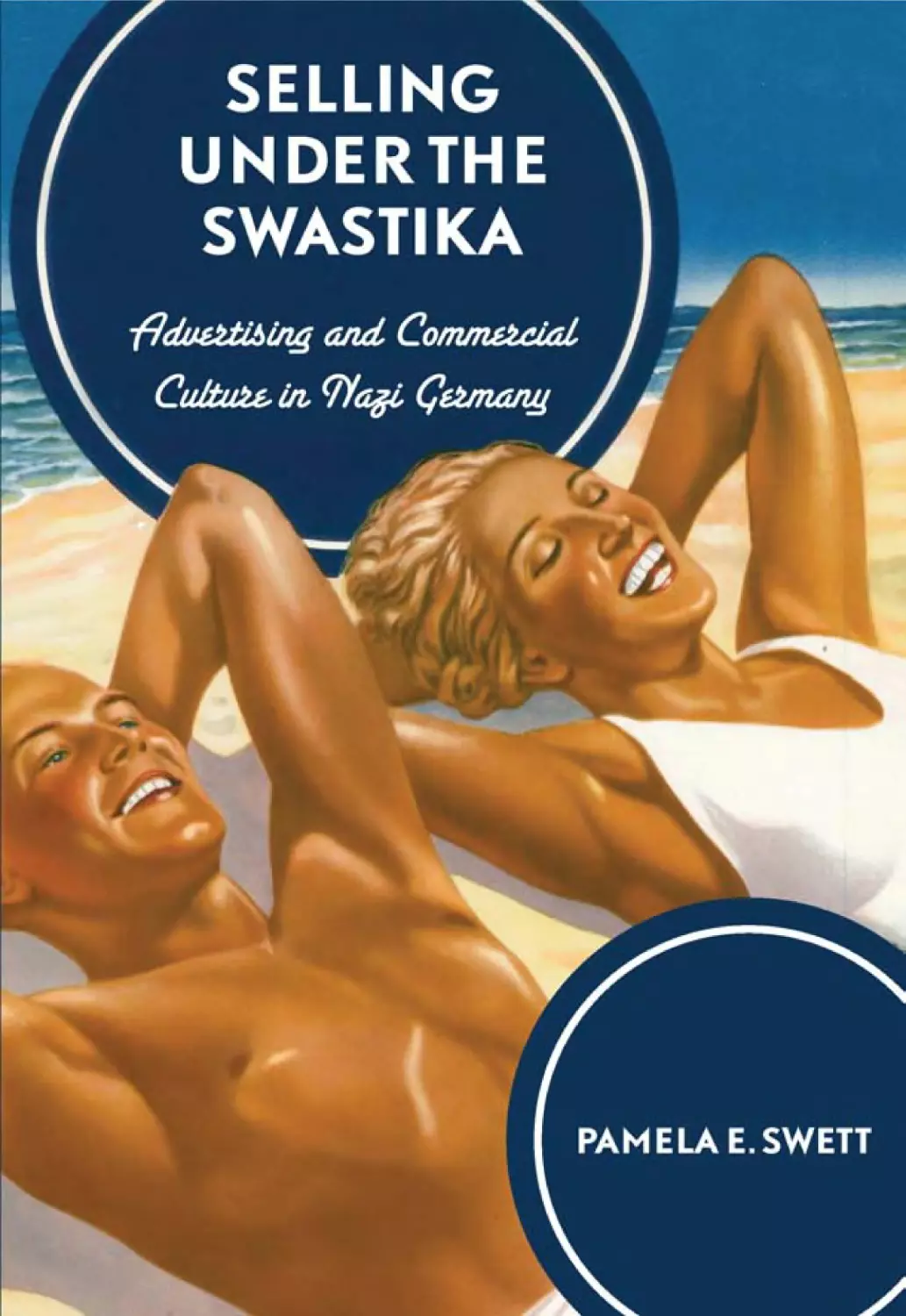
Selling under the Swastika
selling under the
Swasika
advertising and commercial
culture in nazi germany
PamEla E. Swett
stanford university press
Stanford, California
Stanford University Press
Stanford, California
© 2014 by the Board of Trustees of the
Leland Stanford Junior University
All rights reserved
No part of this book may be reproduced or transmitted in any form or
by any means, electronic or mechanical, including photocopying and
recording, or in any information storage or retrieval system without
the prior written permission of Stanford University Press.
Library of Congress Cataloging-in-Publication Data
Swett, Pamela E., author.
Selling under the swastika : advertising and commercial culture in
Nazi Germany / Pamela E. Swett.
pages cm.
Includes bibliographical references and index.
isbn 978-0-8047-7355-3 (cloth : alk. paper)
1. Advertising—Germany—History—20th century.
2. Advertising—Political aspects—Germany—History—
20th century. 3. Germany—History—1933–1945. I. Title.
hf5813.g4s94 2013
659.10943'09043—dc23
isbn 978-0-8047-8883-0 (electronic)
Printed in the United States of America
on acid-free, archival-quality paper
Typeset at Stanford University Press in 10/13 Galliard
2013021445
For Matt
Yb
Acknowledgments
Throughout the research and writing of this book, I have often looked
forward to this moment. It is very satisfying to be able to thank all those
who helped me arrive at this point. Let me begin with the institutions and
individuals that made the research possible. The John W. Kluge Center at
the Library of Congress was the first institution to support this project;
I am particularly grateful for their early interest. The Social Science and
Humanities Research Council of Canada provided me with three years of
research funding, including one term of teaching release. This generous
grant covered numerous forays into the archives and provided some uninterrupted time to write, a precious commodity indeed. The Alexander
von Humboldt Foundation also provided welcome funds for two research
stays in Germany and should be commended for recognizing the desire of
scholars to have their families with them while abroad. Among the many
archivists who helped push this project toward completion, special thanks
are owed to Petra Secunde (Daimler), Sonja Nilson (Henkel), Thorsten
Finke (Beiersdorf), and Birgit Nachtwey (Bahlsen). Dr. Henrich Hunke
was also kind enough to welcome me into his home and share his personal
collection of his father’s writings. I very much appreciated his openness
and hospitality. McMaster University, my institutional home, and its Arts
Research Board also deserve thanks for supporting this project financially
as well as for offering a stimulating environment in which to work. Not
least of the perks of being on faculty at McMaster is the ability to access the
McMaster Children’s Centre. The staff at the Centre has been a part of my
family’s life for more than a decade and has contributed in important ways
to any success I have enjoyed.
viii
Acknowledgments
Thanks also goes to those who invited me to present my research over
the last few years, including Hartmut Berghoff of the German Historical
Institute, Washington, DC; Peter C. Caldwell of Rice University; Till van
Rahden, Université de Montreal; Thomas Schaarschmidt of the Zentrum
für Zeithistorische Forschung, Potsdam; and Annette Timm, University of
Calgary. My editor at Stanford, Norris Pope, was patient while I wrote and
a pleasure to work with through the production process. The two reviewers for the press were equally collegial and suggested improvements that I
readily incorporated. Tim Mueller, Katrina Espanol-Miller, and Gerulf Hirt
provided me with some key technical assistance down the stretch. I thank
them for their help. Wendy Benedetti and Debbie Lobban also deserve
mention for their administrative skills, without which my job as department chair would be much more time consuming.
I also owe much to those friends and colleagues whose wise counsel and
timely pep talks were instrumental in the completion of the project. At McMaster, Stephen Heathorn and Martin Horn have been trusted friends for
many years and came to my rescue in a variety of ways during the writing
of this book. I am grateful to Justin Powell, who continues to provide me
a most welcoming home in Berlin. In addition, I must also thank Richard
Bessel, Belinda Davis, Peter Fritzsche, Jeff Hayton, Claudia Koonz, Lisa
Heineman, and Jonathan Wiesen for their input in discussions of this material. My deepest gratitude goes to those who read whole sections of the
manuscript: Frank Biess, Paul Lerner, Corey Ross, and Jonathan Zatlin.
Their criticism and enthusiasm were invaluable. In the final inning H. V.
Nelles willingly stepped up to the plate and read the entire book. I am very
lucky to know so many generous scholars.
Lastly, I thank my family. My boys, Jack, Nathaniel, and Paul, to my
continued bewilderment show an interest in my work that reminds me on
a daily basis of the connections between historical scholarship, teaching,
and a healthy civil society. Happily, my husband, Matt Leighninger, looks
forward to time in Berlin’s Staatsbibliothek as much as I do. He was probably less excited to edit this manuscript, but he did so willingly nonetheless. I dedicate this book to him.
Contents
Abbreviations
Introduction
xiii
1
part i: From Internationalism to “German Advertising”
1. Advertising in the Weimar Republic
17
2. Coordination from Above and Below
47
part ii: Branding for the Volksgemeinschaft
3. Advertising and the Everyday in Peacetime
4. Buyers and Sellers
91
136
part iii: Preparing for Victory and Surviving Defeat
5. Advertising in the First Half of the War
6. Ads amid Ashes
Notes
269
Works Cited
Index
338
323
227
185
Illustrations
1.1 Advertisement for ad space in the Nazi press
41
2.1 The boycott of Jewish businesses, April 1, 1933
49
2.2 Heinrich Hunke, 1935
55
2.3 Proper and improper femininity in advertisements
76–77
2.4 Advertisement with women smoking
78
2.5 Sex still sells in the illustrated press
79
2.6 New state advertising school on KuDamm in Berlin
81
2.7 Cooperative advertisement for barbers
82
3.1 Boys watching Henkel film outdoors
95
3.2 Dreaming of Henkel products
96
3.3 Publicity for Henkel’s whaling expedition
107
3.4 BMW Blätter image
117
3.5 Weimar-era Mercedes-Benz advertisement
119
3.6–7 Mercedes-Benz advertisements, mid-1930s
121–22
3.8 Osram image of city and country unified
126
3.9–10 Osram mimics Nazi propaganda
127–28
3.11 Osram campaign for “better light”
131
4.1–2 Siemens brochure images
137–38
4.3 Camelia in the illustrated press
146
4.4 Fear of infection, Bayer advertisement
148
4.5–6 Competing toothpaste ads from Chlorodont and Nivea 149–50
4.7 Entrepreneur as advertiser
156
4.8 Controversial Fewa advertisement
158
4.9 Caricature of untrustworthy salesmanship
162
4.10 Traveling salesman for Henkel walking above flooded streets 163
xii
Illustrations
5.1 Adman standing strong in war
5.2–4 Advertisements to help Germans cope with war
5.5 Agfa and the separation of war
5.6 Humor in war
5.7–8 Nivea ads—normal life in abnormal times
5.9–10 Dr. Oetker recipes
5.11 Henkel on Hygiene
5.12 1938 RVA washing primer which encourages the use
of Persil
5.13 “Johanna is going—but she’ll be back”
5.14 Daimler-Benz stands behind the war
5.15 Henkel products on sale in the Sudetengau
5.16 Signal cover
5.17 Zeiss binoculars advertisement in Dutch
5.18 Reich lottery tickets
6.1 BMW merchandise
6.2 BMW wartime advertisements in multiple languages
6.3 BMW Blätter cover image
6.4 BMW French poster
6.5 Nivea canisters
6.6 Hansaplast on the home front
6.7 Bahlsen’s abstract aesthetic
6.8–9 Bahlsen packaging and classified, 1944
6.10–12 The hope for resurrection: Maggi, Bayer, and a soldier’s
obituary
6.13 Nivea postwar advertisement
6.14 Mercedes-Benz and empire
190
192–95
196
198
199
203
206
210
211
216
218
220
221
222
228
231
232
235
238
239
240
242–43
244–45
257
258
Abbreviations
The following abbreviations are used in the text:
AFE Working Association for the Advancement of the ElectricEconomy
BFC
Böhme Fettchemie
BIZ
Berliner Illustrierte Zeitung
DAF German Labor Front
DRV German Advertising Association
DW
Die Deutsche Werbung
GfK
Society for Consumer Research
JWT
J. Walter Thompson Advertising Agency
NSDAP National Socialist Party of Germany
NSRDW National Socialist Reich Association of German Advertisers
RMVP Reich Ministry for the People’s Enlightenment and Propaganda
RVA Reich Board for Economic Enlightenment
Sopade Social Democratic Party of Germany in Exile
Werberat Ad Council for the German Economy
Selling under the Swastika
Introduction
It serves nothing to depend on past economic forms
and social relationships. If we, as a people, do not
want to decline, we must become comfortable
with the new and emerging world. Advertising is a
language of this world.1
This plea, made in 1929, neatly encapsulates the starting point for this book.
It comes from the pen of Hans Luther, the deliberately party-less, former
chancellor of the Weimar Republic and soon-to-be head of the Reichsbank
and ambassador to the United States until 1937. Typical of his entire political career, which included roles in the republic, Nazi dictatorship, and
the early Federal Republic, this statement is one that encourages adaptation. The details of how Germans were to “become comfortable with the
new and emerging world” and what that world might look like were yet
to be determined. What was certain, according to Luther, was that advertising would be a key component of this emerging world, a medium for
participating in this transformative process. Men and women working in
ads-related jobs certainly welcomed the social and economic significance
attributed to their work. Others were more wary of any world in which
advertising was to be a central form of expression, and yet even they agreed
that the modern advertisement—at once arresting in form or content and
banal in its ubiquitous presence—was here to stay.
This book takes Luther’s entreaty seriously by examining what advertising in the two decades following this statement can tell us about the ways
Germans came to terms with the “new and emerging world.” This process
was not a passive one: individuals in a variety of fields championed their
own visions of reform or revolution in Germany after the First World War;
after 1933 Nazi ideologues and supporters began to implement their utopian blueprint; and the victorious Allies entered the stage with new ideals
2
Introduction
and plans in 1945. With its focus on the Third Reich, this book attempts
on one level to tease out the complex relationships between corporations
and the regime. These relationships were not equal, but neither was the
power of the dictatorship absolute. Rather a bounded relative autonomy
characterized the relationship between the National Socialist regime and
the commercial sector, including the aspiring advertising profession in the
1930s. Bounded because the regime set certain non-negotiable parameters:
anti-Semitic, nationalist, and regenerative, which ad professionals accepted
largely without complaint. Relatively autonomous in the sense that both
parties wished to maintain a degree of separation, recognized some mutuality of interest, and preferred self-discipline to command and control.
At the same time, Selling under the Swastika seeks to go beyond decisions made by corporate elites and the regime’s bureaucrats. By examining
the production and circulation of promotional materials, evaluating sales
strategies and consumer feedback, the book offers a new perspective on
life in National Socialist Germany. I demonstrate that companies and their
consumers were fully engaged in the market even into the war years: companies fought to continue advertising, selling, and preparing for expansion,
while consumers continued to purchase many products (particularly lowpriced items) they had come to rely on. The book discusses the strategies
employed by commercial actors that created ties for consumers between
their own material lives and “the new order,” thereby assisting the regime in
gaining and maintaining mass support. However, thinking about National
Socialism as a “political response to the problems created by consumption”
is a more complicated task than simply outlining policies of control and coercion from above, or resistance to those policies from below.2 Instead, the
book maintains that the promotion of commerce and a certain Nazi vision
of business ethics were intrinsic to the ideological goals of the regime and
the dreams of empire after the onset of war. In other words, the regime’s
attempts to reach out to those working in the commercial sector and their
customers were not driven solely by the need to achieve legitimacy for the
dictatorship; consumers and commercial actors had active roles to play in
the Nazi utopia.3
In exploring this territory, this study offers three correctives to the existing literature on social cohesion, consumption, and business in the Third
Reich. While recent scholarship has convincingly demonstrated that in the
mid-1930s most members of the racial community [Volksgemeinschaft] responded positively to the calls for participation in building the new Germany, and experienced this period as a time of pleasure and optimism, this
Introduction
book offers evidence that appeals to community and other Nazi goals came
also from the private sector—appeals that were perhaps more persuasive
coming from respected national corporations or local employers. 4 It also
challenges the dominance of the “virtual consumption” model that emphasizes the importance of state promises of future plenty, by focusing on the
actual buying and selling that continued to shape daily life.5 In this way the
book uses advertisements to examine the ways brand name goods “became
a favorite repository of new Nazi myths and fantasies.”6 Finally, in arguing
that the mechanics of individual consumption and the advertising industry
that lubricated it were more than just a means of stabilizing the Nazi government, the book redresses our understanding of the legacy of Nazi-era reforms for postwar German developments. Twenty years ago Michael Geyer
issued his provocative statement that “the social contract for an acquisitive [German] society was formed in the consuming passions of the 1930s
and 1940s rather than in the postwar years.”7 Selling under the Swastika puts
Geyer’s declaration to the test. By exploring the mechanisms of German
commercial culture between the end of the 1920s and the early 1950s, the
book confirms that the language of buying and selling triumphed, despite
the war, and re-emerged after 1945 in a position to supersede the language
of politics as a unifying force.
consumer culture, commercial culture
Nazi Germany was not a mass-consumer society, but it was closer to being one than we often presume. If we apply John Brewer’s six criteria characteristic of mass-consumer societies, Nazi Germany passes easily on all but
two, and even those two shortcomings are debatable. This book demonstrates that there were “communication systems that attach[ed] meaningful images to certain goods” and that there was “a shared recognition of
commodities as conveyors of meaning.” It is also clear that consumers were
viewed as “economic players” and that some citizens had “an ambivalence
toward the phenomenon of consumption.”8 What is perhaps missing is the
availability of a broad range of products and the emphasis on leisure found
in a mass-consumer society.9 The chief sticking point for most scholars with
regard to the former point is that the majority of German households were
unable to afford consumer durables, such as cars and large household appliances, until the late 1950s. Durables are considered the benchmark in judging the significance of individual consumption in any economy because of
3
4
Introduction
the complexity of these purchases, involving lay-away schemes, credit, or
personal savings, and the significance of the manufacturing process, which
involves heavy investment of labor and material resources.10 Despite the
absence of durables in the majority of German households, individuals did
experience a wide range of consumer goods. The wealthy certainly enjoyed
a broad spectrum of luxury and daily use items, but the middle and even
the working classes also saw their lives changed by a growing range of less
expensive products in these decades.11 The issue of leisure is also a tricky
one. Hitler’s government certainly prioritized war readiness, which led to
a productionist mentality generally, but the labor involved was always coupled with incentives, including greater leisure opportunities for members
of the Volk at least until the war began.
Despite this proximity to Brewer’s definition and the interest scholars
have taken in investigating West German consumer culture, the focus of
the historical literature of the Third Reich has been on the production side
of the economy. Studies of national recovery and rearmament policies,
heavy industry, finance, cartelization, and the use of slave labor during the
war years are plentiful. The fact that purchasing power remained low in the
1930s has served as sufficient reason to continue the focus on the economic
conditions for waging war.12 However, Albrecht Ritschl maintains that the
worst of the Depression was over by 1932, and that the upswing that followed cannot be chiefly attributed to deficit spending in the form of building projects, state employment schemes, or rearmament policies of the new
Nazi-led government.13 “With or without Hitler,” Ritschl insists, recovery
was “on the doorstep,” and long-term unemployment was becoming less
and less of a threat.14 While the debate remains alive and others give much
more credit to the “military Keynesianism” of the regime, oral history evidence seems to corroborate Ritschl’s statistical findings that stress improvement in the private sector.15 From these sources, we learn that compared
with the upheavals of the 1920s and the Depression years of the early 1930s,
many individuals (at least, those not targeted by the regime) developed a
sense of optimism about their financial futures in the middle part of the
decade.16
André Steiner concurs with this evaluation. Despite the fact that the
average real income among workers continued to worsen from 1932 until 1935, only improving thereafter, Steiner emphasizes the psychological
significance of stable employment. In other words, even if living standards were only marginally better in 1938 than they had been in 1932, given
higher prices and intermittent shortages, family incomes were more secure,
Introduction
and that in itself went far in providing emotional relief for weary Germans
and ultimately support for the regime.17 This optimism did not extend to
the purchase of large-ticket items; household appliances and cars remained
beyond the reach of the vast majority of Germans until the post-1945 period. The “virtual consumption” of such items, however, relied on this
optimism—the confidence that ownership was just around the corner. In
the meantime, men and women were able to take pleasure in an array of
relatively inexpensive nonessential consumer products and leisure activities
that were available until the early 1940s.18 This relative contentment among
members of the Volk had its political dimensions as well. It appeared that
the regime was making good on its promise to stabilize the economy. This
real consumption of affordable goods had tangible consequences for the
growth and maintenance of support for the dictatorship. Just as heroic images of productive laboring “Aryans” aided the mission of drawing the racial community together,19 certain visions of consuming Aryans also bound
the nation more tightly and made it easier to cleave off others from economic and social life.
Missing from the debates about the Third Reich has been an examination of the territory that mediates between production and consumption:
commercial culture, or “the historically specific and reciprocal interactions
of economic and cultural capital.”20 Despite the limits on individual consumption effected by economic policies that prioritized the coming war,
commercial culture remained an active and meaningful sphere in which
ideological claims about gender, race, the nation, urbanization, consumption, business, health, morality, and pleasure were tested. Advertising, the
practice of making others aware of goods and services for sale, is one realm
in which these and other historically contingent themes were publicly contested in Nazi Germany.
Hitler, Goebbels, and other leaders recognized the importance of reforming practices around buying and selling; this created key opportunities
for the advocates of commerce, from advertisers and sales staffs to marketing scientists and even some state and party officials. These individuals
worked under very unfavorable conditions in the 1930s and 1940s to make
sales and consumption respectable pursuits. Their motivations were manifold. Some advertisers, corporate managers, and sales staff were undoubtedly principled National Socialists.21 Others were likely more motivated by
their willingness to further their own careers or bolster the status of their
professions or the brands they represented. Corporate leaders also sought
to protect their shares of the market and profitability in potentially difficult
5
6
Introduction
financial times. This study does not operate at the level of individual motivations, but what is clear is that those in the private sector who worked to
normalize commercial relations during the Third Reich did much to bolster the dictatorship and its policies. They embraced buying and selling as a
hallmark of the modern age. Indeed, for some it served as an essential way
to participate in the life of the Volk. Moreover, while the postwar Germany
that emerged after 1945 was unlike anything they imagined, their actions
helped lay the foundations for the consumer desires and demands of the
1950s.
Finally, in addition to relying on state and business archives, contemporary theoretical writings, and the trade press, this study contributes to the
growing body of historical scholarship that employs visual sources as evidentiary matter. While scholars have already used visual representation to
examine the ideology and brutality of the regime, this book argues that advertisements from some of Germany’s most popular brand-name products,
then and today, also offer a lens through which to explore the relationships
between businesses and the Nazi state, and between members of the Volk
and Germany’s political and commercial powers. There was no tremendous
rupture in ad culture between the Weimar and Nazi eras, but the changes
that did take place were generally welcomed. The resulting mixture of continuity and reform led to a visual culture that was both reassuring in its
familiarity and encouraging in its portrayal of Germany’s present path.
advertising and german history
Scholars have begun turning to advertisements as key sources for analyzing needs and desires at a particular historical moment. This statement
is most true for the United States, where a number of important texts on
advertising have become essential reading for making sense of American
culture.22 The same cannot be said for Germany. Historians of early twentieth-century Germany have generally stayed away from advertising as either
an important subject in its own right or as a way to get at other questions
about German society, politics, culture, or economic development.23 Most
scholars have concluded that Germany did not have a consumer culture until the 1950s or later, and so issues related to consumption in earlier periods
have appeared less significant, particularly given the two world wars that
dominated the experiences of Germans in these decades and scholarship
since. Historians who might have turned to commercial advertising out
Introduction
of individual interest in visual culture may have chosen to study the vast
political propaganda that marked Germany’s tumultuous past with revolution, wars, and dictatorships.24
Finally, there is still some hesitation about what to do with advertisements as historical sources.25 At various conferences, for example, I have
been asked how I deal with the “reception problem”—the fact that it is
largely impossible to evaluate how individual consumers interpreted the
ads they saw. Judging how advertising messages were received is particularly difficult in the pre-1945 era, before consumer surveys and other forms
of testing “success” became common in Europe. However, we should not
see this point as a major stumbling block to working closely with ads. Instead, as David Ciarlo entreats, we need to look for “a pattern in a downpour.” In other words, by viewing large numbers of images we can begin
to see certain patterns that reflect common ways of “crafting and of seeing imagery” in a given time period. Surely there are always individuals
(among advertisers and among consumers) who interpreted imagery in
wholly unique ways, but we can also presume by looking at the coherence
among ads for different products that there were patterns of representation
that became so common they constituted a “visual hegemony.”26
By the late nineteenth century, the industrialization and urbanization of
Germany meant that more and more products competed for attention in
the marketplace. While signage and ads were not new, the vast proliferation
of advertising materials around the turn of the century marked a new era in
the relationship between sellers and buyers. The ubiquitous nature of ads in
the twentieth century, far more prevalent than state-sponsored propaganda
even under National Socialism, forces us to examine their relevance in this
society. Advertisements are important cultural artifacts that gave shape to
the anxieties and aspirations prevalent at this time. Advertisements do not
reflect social reality, but they do allow us to consider what ideas circulated
under this regime alongside the messages delivered by state and party propaganda, and to what extent they reinforced or diverged from Nazi ideology.
While I encourage others to consider how advertisements might aid
their own research, let me make a few comments about how I approached
the research for this project. It was surprisingly difficult to get access to
corporate archives.27 The nature of that reluctance was not always clear, but
the two most common answers are somewhat telling of advertising’s lowly
status. Some companies had clearly chosen not to save any materials related
to advertising. Others had prioritized the archiving of packaging and other
7
8
Introduction
ephemera for their aesthetic value, but had not saved any references to the
planning or production of those designs. Clearly the historical worth of
ads, beyond their artistic merit, has often gone unrecognized. Moreover,
records that might have shed light on how in-house ad departments functioned or about the employees within those departments were generally
nonexistent. As a result, beyond a few individuals I am not able to make
more than the broadest generalizations about the social backgrounds of
Germany’s ad writers and designers. There is also the chance that some
companies did not want their brands represented in this book, and other
collections were destroyed in the war.
Without the luxury of picking and choosing, I examined the papers of
any company that welcomed me. A number of these are well known to the
scholarly community because they have been willing in the past to allow
scholars access: Beiersdorf, Bayer, Henkel, and others. My luck changed
somewhat when I realized that the archival holdings of companies nationalized by the East German government had become public materials and
were housed since reunification in Germany’s system of state archives.
Some key collections came to me in this way, chief among them Osram and
Böhme Fettchemie. Regardless of the generosity of some firms and the fortuitousness of GDR policy, the source base for this study may appear haphazard. Another strategy would have been to build the source base from a
chosen set of newspapers or illustrated magazines, but I did not want to
draw my analysis solely or primarily from published advertisements. Instead I have chosen to rely on companies for which advertisements could
be found in the national press and read in conjunction with textual documents left by the ad designers or sales departments.
The biggest disappointment of the research stage of this project was that
it was nearly impossible to find records from any of the independent ad
agencies or placement services that existed in this period. As discussed in the
next chapter, there is one very practical reason for this gap. Ad agencies, as
we think of them in North America, were quite rare in Nazi-era Germany.
The J. Walter Thompson collection at Duke University is an incredible resource, but the American agency was already selling off its Berlin office in
1932 to its German manager. The story at Duke ends with this acrimonious
deal, though the new owner continued to operate the agency through the
1930s. German branches of British agencies were also shuttered during the
Depression. There are some references in subsequent chapters to the Dorland agency, which quite amazingly survived the war, despite serving as a
friendly home to former Bauhaus artists, including most famously Herbert
Introduction
Bayer. Dorland is still open for business in Berlin today and its managers
were kind enough to let me look at their historical collection, but it is quite
limited in scope particularly for the years of this study. Other agencies and
placement services either disappeared altogether during the war years or
were bought up by large international firms in the postwar period, and
their archives did not survive these transitions. Readers, it is hoped, will
agree that the collection of consumer brands presented here, though in no
way exhaustive, offers a useful sample of the major brand-name consumer
product manufacturers of the day.28
The ads for these products are in part interesting to today’s readers because many of the brands they represent are still available.29 Of course, these
big national, and even international, brand-name manufacturers were but a
very small percentage of the total number of corporations that placed ads in
these years. But as David Ciarlo so clearly demonstrates in his work on the
Wilhelmine era, imitation was the name of the game.30 If I were to compile
ads for hand crème from a dozen different brands, many would mimic each
other in terms of the images and textual tropes used. Each company kept
files of competitors’ ads from around Germany and abroad and attempted
to incorporate what were thought to be winning ideas in their own promotional materials. Although the more prominent brands had styles that
would be recognizable to consumers, this cross pollination does lead to
the question: to what extent can any advertisement of this era be considered German or more significantly “Nazi”? As is shown in the first chapter,
German ad designers traveled abroad, reviewed ads from other countries,
attended international conferences and trade shows, and read foreign professional journals and manuals even after the republican era came to an end.
Manufacturers of big brand-name products often had significant export
sales and sought efficiencies by using artwork and sometimes text too (albeit in translation) in more than one national market. Commercial culture
in the Third Reich was, in Jonathan Wiesen’s formulation, “flexible enough
to accommodate publicity norms that were not, as such, ‘German’ and that
could be effective beyond the borders of the Reich.”31
Yet there were national peculiarities that resisted dilution. While many
of the artistic and conceptual trends should be seen in a larger international
context, German advertising also had to remain in sync with its audience at
home—and that was an audience that by and large supported the regime
and its racist worldview. Designers, copy writers, and sales staff could not
make their work relevant if they completely ignored these facts. Nor is it
likely that these corporate actors wanted to undercut the regime’s popular-
9
10
Introduction
ity, or run afoul of its authority in any way. Many managers cheered the
ascension of the Nazi Party; others directly benefited from the new state’s
racist policies that led to the removal of Jews from their positions. For all
these reasons, advertisers sought to align the brands they represented with
the challenges and “achievements” of the day. In so doing, company directors demonstrated that they were “on board” with the regime, thereby legitimizing the direction of policy and aiding in the establishment of a Nazi
lifestyle.32 As one cigarette ad triumphantly announced, “We have learned
to see anew, think and feel anew—we also want now to learn to smoke [in
a new way]!”33
What does this say about the depth of National Socialist support? Renewed scholarly interest in the concept of a Nazi Volksgemeinschaft has led
to a more complete understanding of how the racial community operated
at an everyday level.34 John Connelly’s work on Eisenach was an early contribution to the new wave of debate. He argued that a Volksgemeinschaft
was never achieved “in the way the party leadership intended,” but that the
concept still had significance in Nazi society. Rather than “internalizing”
the ideology, Connelly asserted that at the very least many Germans “externalized” it—using the concept of racial community, and the catchwords
issued by the state and party, to serve their own individual needs. This book
confirms these findings by presenting instances in which commercial and
corporate actors mobilized the language of Volksgemeinschaft to suit their
own interests. Time and again we are confronted with examples in which
advertisers anticipated the regime in its enacting of Volksgemeinschaft. As
Connelly explained, this “dynamic of anticipatory compliance gave National
Socialism its tenacity and radicalism.”35 From 1933 until 1942, companies
used their advertisements in ways that both implicitly and explicitly supported the regime. Consumers sought products to fulfill needs and desires,
but consumption was easily reconciled with the ideology. While there were
obvious limits in this economy, hobbled first by international financial crisis
and then wage freezes and expenditures for war, consumer items could be
easily marketed as beneficial to the material or spiritual well-being of members of the Volk. As long as such items existed, the regime was doing what
it promised and ads served as a daily reminder of that claim. By 1943, it was
impossible to maintain this link between goods and the promises of Volksgemeinschaft, and the production of new ads ceased. Memories of products
gone from the shelves inevitably lost their identification with the dreams
of the Third Reich, making it possible to resurrect seemingly “untainted”
goods in the postwar period as hallmarks of a new consumer society.
Introduction
selling under the swastika
The first chapter of the book sets the stage by describing the advertising
industry in the Weimar Republic, charting its development in the 1920s and
its search for recognition as a valuable and upstanding profession. While
German advertisements were well respected throughout Europe and North
America for their aesthetic value, at home the industry was still plagued by
self-doubt about its economic and social worth. Some Germans remained
distrustful of the messages contained in ads, and debate continued about
the suitability of the Anglo-American model, in which full-service agencies
managed the design and placement of all promotional materials for a brand
as part of a concerted effort based on research and planning.36 The chapter,
therefore, also touches on the growing interest in the science of marketing,
which coincided with the emergence of sophisticated mass media and hotly
contested election campaigns in the unfolding crisis of the republic.37 In
this shifting climate, we see evidence of changing ad content and new innovations, including the adoption of text-laden ads and the more frequent
use of photographs and “scientific proof.” Debate continued, however, and
intensified after 1929 as the Depression and political turmoil led some advertisers and other observers to question whether the path of internationalization was the correct one for the industry.
The appointment of the Hitler-led government in early 1933 changed
the nature of these discussions. The new regime acted quickly. Chapter 2
examines the establishment of the Werberat der Deutschen Wirtschaft, the
Ad Council for the German Economy. The minimal scholarship that exists
on this body dismisses it as insignificant.38 However, I argue that the Ad
Council’s legacy has been largely misunderstood by scholars, who expected
heavy censorship of ads and a wholly new and uniform Nazi ad style. Most
of the men involved in the Werberat came from the business world; they
saw the organization as more akin to a lobbying group positioned to defend advertising from its detractors and improve the industry’s reputation
with the public, businesses, and the state. Of course the council’s idea of
reform included the purging of thousands of ad professionals who were
unable to obtain licenses to practice in the field, according to racial and
political/professional criteria. However, this “cleansing” combined with
changes to the business side of the industry, including new sizing and pricing, the promotion of systematized training, and the support of marketing
science to make a lasting impact on German commercial culture.
11
12
Introduction
Chapter 3 begins a new section that describes the commercial culture of
the prewar years. The chapter begins with a discussion of ads in the new
media of radio and film. These were innovations introduced well before
1933, but the regime did make its mark. Although Goebbels had outlawed
the use of radio as an inappropriate platform for commercial messages, advertisers did hold on to film as a relatively new and exciting platform. Yet
print ads remained by far the most popular method for promoting goods
throughout this period. In their films, print ads, and other promotional
venues, companies sought ways to tap into the Zeitgeist, producing ads
that combined national socialist priorities with trends that can be seen in
other national contexts in this period. After the Four-Year Plan (1936) began to squeeze manufacturers with shortages of raw materials, restrictions
on trade, and war-readiness became a constant refrain, advertisers sought
new and better ways to indicate their products’ worth to the Volk.
Leaving advertisers behind for the moment, Chapter 4 highlights consumers and salesmen as essential actors in this commercial culture. As other
scholars have found, it is very difficult to uncover the experiences of the
largely female consumer population, except as mediated by others, such
as state representatives or party officials.39 In this case, I turn largely to the
writings of advertisers and other corporate staff to argue that manufacturers and retailers had more respect for women’s “power of the pocketbook”
and decision-making skills than is commonly recognized. Of course, not
all consumers can be lumped together. Although I have tried to stay away
from brands seen as luxury goods, the very nature of brand-name products,
which represented uniform quality and an investment in promotional efforts to showcase that reliability, meant that these products were generally
out of reach for poor Germans. Nonetheless, it is worth noting that unlike in the United States, where purveyors of consumer goods downplayed
class differentiation as they sought to create mass markets, advertisers
in Germany did not replace all peasants and workers with ideal middleclass families.40 The National Socialist glorification of physical labor and
the masculine Aryan body meant that heroic male workers and farmers
remained staples in German ad culture, appearing sometimes even in ads
that featured plainly middle-class goods, such as the expensive decaffeinated coffee brand Kaffee Hag. Nazi Germany was not a classless society,
and this book considers the ways class and gender norms were complicated
by racial narratives. Darcy Buerkle has noted, for example, that advertisements in the popular magazine Die Dame in the 1920s regularly depicted
feminine traits that are “Jewish-enough” so as to include the possibility of
Introduction
a Jewish-German female shopper. This potential disappears, she argues, by
the mid-1930s.41
Perhaps it goes without saying that racial “others” did not play a significant role in advertising in Nazi Germany. Yet hate-filled caricatures of Jews,
blacks, and Slavs were common staples of Nazi-era political propaganda,
and images of black servants in particular had a long history in Germany’s
visual landscape.42 The absence of non-Aryan figures, caricatured or otherwise, is in itself meaningful. While minorities had always been marginalized in German society, their ostracism became state policy after 1933. The
“purification” of “German ads” was just one of the myriad ways in which
racism was interwoven into the fabric of daily life in Nazi Germany. Moreover, in terms of business ethics, the rejection of an allegedly “Jewish” sales
style was implied in every reform. “Honest” business practices were by definition racially circumscribed. With this point in mind, Chapter 4 turns to
sales representatives to ask how these commercial actors hoped to fit in to
the new marketplace and whether they had a role in the Aryanization of the
economy before the war.
A discussion of commercial culture during the Second World War is
sorely lacking from the vast historiography of the conflict. This lack of attention to advertising, and the efforts of consumer products industries to
retain promotional links to consumers at home and abroad, means that we
have missed an important part of daily life in Germany and a link between
the empire-building goals of the Third Reich and the emergence of West
Germany, in particular, as an economic power. While the war led to sharp
cuts in manpower and material resources for consumer products industries and prompted some to insist that ads had no place in a war economy,
there were others in industry and with links to the government who were
concerned about morale on the home front, and fought to maintain some
minimum level of consumer satisfaction. Chapter 5 examines this renewed
debate over the value of advertisements and asks how individual consumption was thought to fit in with the visions of empire circulating during the
euphoric years of military victory.
The final chapter of Selling under the Swastika carries the story through
defeat and discusses briefly the re-establishment of a German ads industry
in West and East Germany. Although conditions on the home front did not
completely deteriorate until late 1944, the collapse of the consumer market
after 1942 meant that the visual partnership between brand-name products
and the Third Reich began to falter. Chapter 6 suggests that this uncoupling of individual consumption and the Nazi worldview in the second
13
14
Introduction
half of the war was instrumental to the postwar rehabilitation of Germany’s
consumer goods industries. Messages that linked consumer goods and the
regime were largely absent from the landscape, thanks to paper shortages
and Allied bombings. In homes ersatz goods had replaced brand names.
Long lines, the black market, and going without marked the consumer’s
world in the last half of the war, and these experiences only became more
desperate in the first postwar years. Manufacturers of brand-name goods,
and the commercial sphere more generally, thus escaped the taint of defeat.
Ultimately, Selling under the Swastika argues that German companies and
the Nazi Werberat were able to save advertising from itself. They convinced
Germans that buying and selling were not foreign imports or threats to
unity, but in fact ways to belong to the community. Even during the war,
ads played a reassuring role by reminding Germans of products they associated with peacetime and by offering strategies to deal with hardship.
Though, fortunately, the German empire imagined by these advocates of
advertising never came to pass, commercial culture was ready to step forward in postwar Germany as a unifying project that could take the place of
a disgraced political culture.
part 1
From Internationalism to
“German Advertising”
chapter one
Advertising in the Weimar Republic
Advertise and don’t despair!1
Writing in the first months of the Third Reich, Hanns F. J. Kropff, a leading German researcher in the science of advertising, began his book: “In a
time in which the word ‘rational’ shines as a beacon of light on every wall,
it is astounding that German ads in many cases are still ‘driven by emotions.’ The recognition of the utility of a system—in the highest sense of
the orderly distribution and design of the advertisement—is still far from
commonplace among all those who work [in the industry].”2 Kropff ’s analysis, which began a treatise on the importance of psychology in effective ad
design, went on to praise the work of American and British ad designers
and included their work time and again in his 1934 text as examples of best
practice for understanding human desires and motivations, for incorporating effective use of color and type, and researching market trends.3 Kropff
serves as a useful example of the modernist strain in National Socialism.
The best way to understand culture in Hitler’s society is not as a “beautiful
illusion”—a mirage of light and color that bewitched the spectator, an orderly surface that masked irrationality.4 Rather, someone like Kropff speaks
to the ease with which some thinkers moved from the rationalization of the
Weimar era to the Nazi period, hopeful that Hitler’s regime would fulfill
the promises of reform that had been in the air throughout the 1920s.
Kropff was certainly no friend of Weimar, but he believed the call for
rationalization that marked the 1920s to be a path to economic success and
professional standing for his discipline.5 Like others, he embraced the “experimenting, reordering, reconstructing” mission of National Socialism. It
is this “spirit of renovation” that we see emerge out of debates in the republican era and develop more fully after 1933.6 We begin, therefore, with
an analysis of German advertising and commercial culture in the 1920s and
18
From Internationalism to “German Advertising”
the sometimes collaborative, sometimes competitive, relationship between
German advertisers and their Anglo-American counterparts, who led the
way designing the “rational” ads that attracted Kropff. Most important,
however, the chapter highlights the manner in which commercial actors
debated the way forward during the Depression and the political turbulence that accompanied it. In addition to its uses righting the economy,
some hoped that what they saw as an international language of ads could
promote an understanding between nations that would cement the peace.
Others became more protectionist at the end of 1920s and insisted that
product promotion should not only highlight the importance of buying
home-grown goods but should also represent “national character” in form
and content. The chapter discusses these debates and concludes with the
offensive of German advertisers like Kropff who adopted the nationalist
line as a way to withstand the tumultuous 1920s and prepare a niche for
their industry in the coming National Socialist era.
advertising in the 1920s: supporters
and critics
Germany had a long tradition of commercial advertising. The biannual
Leipzig fair had been held since the Middle Ages, drawing exhibitors and
attendees from all over the world. Of course, the fair predated the emergence of a German state by several hundred years, but the Germans claimed
it as their own, and even boasted of hosting the European marketplace.7 By
the second half of the 1920s, the Leipzig fair could in fact be seen, according to Victoria de Grazia, as the center of a new global economy—with
regularly sponsored stands representing countries from all corners of the
earth.8 But as de Grazia also argues, commercial fairs constituted only one
of a growing number of advertising methods by the end of the nineteenth
century. Posters, print advertisements and classifieds, shop window displays, branded collectibles such as match books and trading cards, and the
verbal advertisements and demonstrations offered by company representatives, retailers, and door-to-door salespeople were taken for granted by
most as part of daily life. As radio and film became popular media outlets,
advertisements found their ways to those venues as well.
In many of these areas, German advertisers and businessmen were not
world leaders. The sales tools that most Germans still upheld as the most
respectable and dependable were those that had maintained the Leipzig
Advertising in the Weimar Republic
fair as a potent force for hundreds of years: face-to-face meetings between
manufacturers, wholesalers, and retailers, the ability to demonstrate the
quality of wares and production methods in person, and contracts that
were negotiated and signed on the spot. These strategies were far removed
from the new mass marketing techniques that focused on investigations of
consumer desires increasingly practiced in the United States, and to a lesser
extent in Britain.
In the years following the First World War, German businesses did not
readily embrace change. There were both practical (the ailing economy)
and principled reasons (a distrust of imported practices) working against
the adoption of new strategies, such as the introduction of customer surveys, the psychological study of consumer behavior, and the growth of
full-service ad agencies to handle all aspects of the branding process. In
fact, beyond the handful of branches of American and British agencies that
opened in the mid- and late 1920s, the concept of the full-service advertising campaign handled by external experts did not really take hold until the 1960s. In the interwar period most German companies continued
to handle their advertisements in-house. In 1930, a large retailer with five
hundred men and women on its payroll was likely to employ twenty-five to
thirty of them in the advertising of its wares.9 Indeed, only a handful of the
most established brands had a well-developed image around which they
could base an entire promotional program. Ideas for advertisements, according to Alexander Schug, simply flowed from the owners and sales staff
to the office in charge of design, or were simply stolen from the advertisements of competitors.10 Satisfied customers were also fond of sending in
letters with personal stories, poems, slogans, photographs, and jingles they
recommended for use in ads. The motivations behind these suggestions
seem to range from real emotional attachment to the brand, and a desire to
see it thrive, to the hope that contributing a well-rhymed jingle might lead
to remuneration. If the business did not have its own in-house ad department and did not work with a full-service agency or an independent ad designer, a draft of an idea would be sent directly to a graphic artist or printer.
In all cases where full-service agencies were not employed, the company
or retailer then relied on one of the many placement services [AnnoncenExpeditionen] to handle the business side of seeking out sites and placing
advertisements.11
Unlike the American ad agencies that would handle the placement of
ads in all media, German placement services tended to specialize in one
format, such as print, radio, film, building exteriors, or billboards. Pay-
19
20
From Internationalism to “German Advertising”
ment systems were also different in the respective countries. The ad agencies handled the whole account, charging one fee for the production of all
materials plus an additional 15 percent for consultation and planning. German businesses seeking to advertise their wares and services were charged
in a piecemeal fashion, but the total costs were far lower than working with
one of the transplanted Anglo-American full-service agencies. The German
businessman paid the graphic artists and printers individually for the advertisements they readied for placement, and then the placement services (of
which a business might use several) received a commission for the number
of ads “sold” to publishers or other media outlets, deals that often included
rebates for the quantity of ad space purchased.12
There were a variety of reasons for the reluctance of some Germans to
adopt new advertising methods. First, the whole concept of Propaganda,
which was still often used interchangeably with the word for advertising
[Reklame], had an unfavorable reputation throughout Europe, owing
largely to the deceptions of state and military propagandists during the
First World War. These negative connotations combined with older concerns that advertising was an unethical, almost shameful sales strategy—
one that would only hurt the company’s reputation in the long run. A company’s goods should win new customers on word-of-mouth reputation
alone; quality didn’t need to shout to gain attention.13 Second, per capita
income in Germany showed no clear signs of growth between 1913 and
1947.14 Under such circumstances, it was hard for many business owners
to invest heavily in new sales methods or even the old ones. The financial
instability of the republic not only made it less likely for new investment
in large-scale promotional efforts; some consumers also believed that advertising did little more than increase the price of the goods. Creating a
brand-name product was therefore risky, not only because of the expense
but also because it had the possibility of actually turning away some potential buyers.
Third, some advertisers and business owners accepted advertising as a
strategy but wanted to conserve the uniquely German style of poster design. Before the war, prominent graphic artists such as Lucien Bernhard
and Ludwig Hohlwein had created stark imagery that helped cement the
logos and names of some of Germany’s first branded goods in the minds
of consumers. Their eye-catching posters, characterized by brilliant colors,
minimal text (often just the brand name), and stark imagery were internationally respected. And while this Plakatstil was on the decline in the 1920s,
increasingly crowded out by cheaply made and placed print ads, many ad-
Advertising in the Weimar Republic
vertisers in Germany (and other parts of Europe) were unwilling to abandon the poster and its brash style completely out of respect for its aesthetic
value and tradition of commercial success. Moreover, the international admiration enjoyed by German artists, including Oskar Kokoschka, Heinrich
Zille, and Kurt Schwitters, who worked intermittently for advertisers to
make ends meet in the unstable economic climate, reinforced the long-held
belief among German business leaders that advertising was best left to the
creative genius of the artist.
It is also worth remembering that advertising as a profession was less
developed than we might expect in Germany in the 1920s, certainly in comparison with the United States. In addition to highly skilled artists that
came and went, there was also an influx of young men and women entering
advertising and related professions after the war. During the period of relative economic stability in the mid-1920s, and the concomitant growth of
mass media and individual consumption, there were new jobs to be had in
this sector. Either classroom training or workplace experience in sales, decorating, journalism, or graphic arts could lead someone toward a career in
advertising. Without formalized professional standards of training, advertising was wide open to young urbanites from a variety of backgrounds.15
In Erich Kästner’s sardonic 1931 novel Fabian: The Story of a Moralist, the
university-trained protagonist describes himself in the opening scene as
“Fabian, Jacob, aged thirty-two, profession variable, at present advertising
copywriter.” Later in the novel, when he is asked by a colleague what will
happen if he loses his job writing advertisements for a cigarette company,
he answers: “Do you think I’ve spent my life since the day I was confirmed
making good publicity for bad cigarettes? When these people kick me out,
I shall look for a new profession. One more won’t make much difference
to me.”16
This lack of a uniform path into advertising meant that disseminating the theories of scientific selling was a slow process, but it also meant
that marginalized groups, chiefly women and Jews, had a chance of making inroads into these new fields. Women first took up positions in store
window decorating, for which their domestic skills were thought to be a
useful foundation. They also had success entering ad departments as entrylevel artists, creating sketches or painting in the final image according to
a male artist’s directions.17 Over time some women moved up within ad
departments or chose to work independently. Likewise, Jews did not find
anti-Semitic barriers to be as difficult to hurdle as in more established professions. Jews from retailing families, in particular, likely found this an easy
21
22
From Internationalism to “German Advertising”
step to take. Youthful advertisers may have also had a slight advantage in
their work. Other white-collar professions were also expanding, leading to
greater purchasing power among this sector of young consumers, including the so-called new women. Employers of advertisers needed to take this
fact seriously, one expert warned: “[The advertiser] will only hit the mark
with these new, young consumers, if his ad speaks to them in a youthful
tone!”18
While the poster tradition continued to find supporters in 1920s Germany, practitioners did incrementally turn their attention to the technical
side of selling, thinking ever more seriously about the impact of color, lighting, size, and other aspects of form and content in their posters rather than
artistic merit alone.19 The professional journal founded in 1921, Das Plakat
[The Poster], changed its name in 1924 to Gebrauchsgraphik [Graphic Art],
signaling the shifting emphasis toward a wider variety of media and more
psychologically savvy design methods, even if the business side of advertising remained fairly constant.20 Alongside these financial, professional, and
aesthetic challenges of the 1920s, anti-advertising sentiment was also fed
by much older anti-Semitic stereotypes of the conniving, swindling Jewish merchant.21 While a prejudicial association between Jews and less-thanhonorable sales practices was well ingrained throughout Europe, it gained
renewed legitimacy at the start of the twentieth century when revived by
leading German intellectuals who feared new forms of capitalism, which included mass production, department and chain stores, and, of course, ads.
In his 1911 treatise The Jews and Modern Capitalism, the sociologist Werner
Sombart claimed that the eighteenth-century practice of Jewish clothiers
who “seized the passer-by by the arm and tried to force him to make purchases” had developed into the contemporary sales aim “to get hold of the
customers.” Sombart targeted the sales practices of large brand-name firms
such as AEG, a company that happened to have been founded by the Jewish Berlin patrician Emil Rathenau in 1883. The older, “disorderly” attempt
to grab hold of potential customers, explained Sombart, was first “systematized when advertising was resorted to.” While Sombart admitted to having no “conclusive evidence,” he was clearly comfortable (and influential)
connecting the dots, concluding that “their [Jews’] claims to be the fathers
of modern advertising are equally well established.”22
Before the First World War, therefore, those German business elites
who did see an economic benefit in advertising still felt it necessary to
write pleading commentaries on the value of product promotion for the
national economy. Christian Adalbert Kupferberg was one of the earliest
Advertising in the Weimar Republic
and most vocal businessmen to make the case for the value of ads, as well
as the need to study the topic systematically in order to develop the most
effective advertising possible. The scion of the eponymous sparkling wine
producers from Mainz, C. A. Kupferberg started an ad department in his
family’s business in 1909, allegedly causing a great rift between himself and
his scandalized uncle, who eventually sold off his share of the family firm.23
The young Kupferberg traveled frequently to the United States, and was
an honorary member of the Advertising Club of Baltimore. He wrote in
1914: “Those who are not close to the sales profession and the advertising
work that is connected to it will seldom realize what extraordinarily high
significance advertising has for our economic life today.” It was astounding,
he continued, given the “millions and millions” that the ad industry generated in terms of employment and profits that there was really no professional training or systematic study of the “scientific discipline.” Further, he
bemoaned the fact that in Germany the “sales profession” did not enjoy the
esteem that it deserved as the most important “factor in purchasing [Erwerbsfaktor] in the nation.”24 His recipe for improving the situation was fairly
simple, calling for uniform training and closer attention to the study of
psychology. He also advocated for the most rudimentary market research,
such as gaining a profile of the readership of a newspaper or magazine before making choices about where to place advertisements. Kupferberg recognized the difficulty of convincing Germans that advertising worked. He
concluded with a reminder (in a rather transparent reference to some of
the biggest brand-name products of his day) that fifty years prior there had
been no serious market for mouthwash, facial creams, and other cosmetics,
but ads had “first taught us to use these things.”25
The number of people who, like Kupferberg’s uncle, rejected advertising altogether became smaller and smaller in the early 1920s, while the
debate about how best to advertise grew more intense, as evidenced by
the burgeoning number of journals devoted to the topic. Kupferberg remained adamant that Germany suffered because of the lack of respect and
attention given to advertising. In comparison to American magazines, he
noted in 1921, German advertisement sections lacked order and taste and
therefore efficacy. They could be compared, he insisted in a metaphor that
demonstrated his fervent nationalism, with “a Polish parliament, the assemblies of which were characterized by everyone clamoring at once rather
than an orderly assembly.” Without proper regulations and planning, he
implied, all voices were lost in the din.26 On one hand there were reasons to
be hopeful for men like Kupferberg. The postwar urban environment was
23
24
From Internationalism to “German Advertising”
awash in new advertising opportunities.27 Only ten to fifteen years prior,
an advertiser had only three major choices for placement: newspaper classifieds, poster columns, or hoardings—there were only a handful of lighted
ad signs in all of Germany in 1914. By the 1920s, Kupferberg could rejoice
that “the railways, street car companies, the postal service, shipping lines,
as well as countless landlords, and owners of gardens and fencing hoped
to rent out surfaces to advertisers.” These public spaces joined the fray
alongside other emerging alternatives: “address book inserts, newspaper
binders, mobile loudspeakers, table lampshades, match stands and more.”
Berlin alone had three thousand lighted advertisements in 1929, and the
use of color in neon displays would continue to expand after 1933.28 On the
other hand, Kupferberg harbored the fear that the results of this “ad-flood”
would be increasing immunity to the messages among consumers, leading
to greater and greater expenditures on ads that held less and less value in
the crowded marketplace. The danger mirrored the snowballing effects of
the inflationary monetary situation that Germany was experiencing as Kupferberg penned his essay.29
The sensory onslaught of advertisements brought with it other dangers,
according to some medical officials. As early as the eighteenth century, doctors had claimed that individual consumption was linked with intoxication
and hysteria among women.30 Throughout the nineteenth century, cultural
critics and medical professionals continued to characterize female shoppers
as particularly susceptible to the chicanery of unscrupulous retailers and
ad men.31 The ever-expanding world of consumption and the new media
forms that promoted it intensified concerns about the masses, particularly
women, becoming overwrought with emotion. As Paul Lerner notes,
criminologists continued to insist into the early twentieth century that the
desire to consume among female shoppers could become uncontrollable
in the presence of elaborate displays of goods, leading to unwise purchases
and even kleptomania.32
For those as convinced as Kupferberg of the potential of advertisements
to power the economy, this flood was no real obstacle. Rather the vast
quantity had the potential to push advertising to achieve higher standards
of quality. Advertisers would seek out the best sites and reject the old chaotic “shrieking” that seemed to echo off the hoardings. Furthermore, Kupferberg claimed that more rational, effective forms of advertising had the
potential to beautify the city by bringing art to the streets. Surely it was a
matter of opinion, he admitted, whether one felt “the undecorated streetcars of the old type looked better than the streetcars of today with their
Advertising in the Weimar Republic
new, colorful, in many cases artistically pleasing pictures.” But it was clear
where he stood on the matter: “A metropolis is no idyllic countryside. The
advertisement belongs in its goings-on [treiben], like the crowd, the blare
of the automobile horn and the dust of the streets.”33 With this kind of declaration, advocates of advertising were confronting head-on another set of
detractors: those who decried advertisements as unsightly. As Thomas Lekan explains, the German Homeland Protection Society, which led the Heimatschutz movement, has been rehabilitated in recent years by environmental historians who now see the organization’s conservation work between
1880 and 1914 as akin to later attempts to create an “environmentally sensitive modernity.” However, Lekan thinks we have overlooked the subject of
advertising in our revisionist understanding of Wilhelmine Heimatschutz.34
To these protoenvironmental activists, perhaps the biggest defiler of Germany’s pristine landscape was not industry or changes to infrastructure,
but advertisements, particularly those posters and billboards geared toward
tourists en route through the countryside. To the cultural elites involved in
the Heimatschutz movement, all the signage for inns, pubs, and tourist sites
also signaled the birth of a mass tourism that challenged class boundaries
and bourgeois understandings of leisure and consumption.35
After a hiatus during the First World War, the Heimatschutz movement
continued to fight for legislation against advertisements in rural communities and along country roadways. Even in the urban context, many supporters of this movement thought that ads were fundamentally bothersome and should face strict regulation. As one commentator insisted, “The
home, not only in the narrow sense but also in the broader sense of the
word, should offer complete peace and relaxation after all the confinement
and disquiet of the workday; therefore all residential streets should also be
kept free of unnecessary noise and also from the pestering disturbances to
the eyes [caused by ads].”36 Many German cities ultimately established successful commissions in the 1920s that brought together citizens, city officials, and representatives of industry to find ways to integrate advertising in
a manner acceptable to all stakeholders.37 There was, however, no national
solution, and the debate would begin anew in the National Socialist era.38
Beyond the important issues of preservation versus commercialization, the
controversy also reminds us of the divisions that still existed between city
and country in the interwar years.39
The differences between life in the metropolis and life in the village,
however, did not always lead to a rejection of ads in the countryside.
While there was an increasing acceptance of ads as central to the modern
25
26
From Internationalism to “German Advertising”
cityscape, some far away from Germany’s bustling metropolises also came
to recognize the significance that advertisements might hold for their own
economic and cultural futures. Provincial retailers on occasion felt compelled to remind the big companies whose products they sold not to forget
them—they too deserved the most up-to-date promotional efforts from
which urban retailers presumably benefited.40 The urban marketplace was
also becoming more complex. The country’s cities were not just larger than
ever before, they were far more diverse. As one observer put it in 1929,
Berlin had completely changed in the last fifty years, owing to an annual
influx of 100,000 newcomers from around Germany and beyond. According to one practitioner, those who wanted to get their messages across to
consumers had to recognize that the “native Berliner” [Urberliner] of old,
who would have understood a classified that reminded the reader simply to
“buy chocolate at Hildebrandt’s” or a “hat at Reiser’s on King Street” was
“nearly extinct.”41
encounters with british
and american ads and advertisers
This criticism was mainly reserved for the classifieds placed by smaller,
local companies and retailers, who had failed to update their sales methods or think seriously about their copy in the 1920s. For larger firms who
marketed popular brand-name items throughout Germany, the stabilization of the economy in the second half of the decade allowed for greater
investment and even experimentation with design and copy. While the
debates about how to advertise effectively continued, the discussion became more international, just as the number of international institutions
(business, political and cultural) and brands was also growing. Like German businessmen who were drawn to the United States for study tours of
cutting-edge production facilities, German advertisers traveled to the U.S.
to visit the big full-service ad agencies, listen to experts, and meet with professional associations and chambers of commerce.42 Even the most widely
read illustrated magazine of the era, Die Berliner Illustrierte Zeitung (BIZ),
joined in the game by commissioning Arthur Rundt, who in 1926 had written a popular travel book on the United States called America Is Different
[Amerika ist anders], to return to America and report back on that nation’s
“highly developed, to us still somewhat foreign methods to advertise wares
and ideas.”43
Advertising in the Weimar Republic
Although the U.S. consumer-driven economy was the success story to
many, scholars agree that attempts to import American promotional methods were integrated only partially, and none were quick to take hold during the 1920s.44 At the start of the decade, Christian Kupferberg pointed
out that German advertisers were too prescriptive in their methods compared with the creativity of the Americans, who thought about how to
foreground the “appeal” (English in the original) of the commodity first,
and then began convincing the reader that brand x was the best version.
And yet he too recognized that this style of advertising could not simply
be dropped into German print ads. American designers downplayed the
artwork in favor of argument and the ability to reach a diverse consumer
market; German readers simply did not view the advertisement sections in
the press “as an educational or valuable extension of the news section” and
so would miss the instructions provided.45 Rundt’s 1928 article made clear
in its very title, “The Controllable USA-mind,” that the popular vision of
American consumption and marketing was not necessarily one Germans
valued, and that their advertisers and public relations experts represented
a very different breed of commercial actor—they even worked with their
office doors open.46 In 1930, an author in Die Reklame still insisted that
using as few words as possible in advertisements was what fit the German
consumer best. American consumers were frequently forced to read “novellas, biographies, cultural history essays” that would simply bore the “adindifferent or ad-resistant” German reader.47
While they debated the efficacy of “teaching ads” from the United
States, German ad men and their business colleagues also remained keenly
interested in what their European neighbors were up to in terms of advancements in branding and artistry.48 Particularly after the 1922 fascist
takeover in Italy, for example, congratulatory articles in leading journals of
the German trade press, such as Die Reklame and Seidels Reklame, about the
modernization of media and design in that country became common. In
other words, we should not forget that practitioners were also open to innovations from other European countries and still reasoned that in the end
each country’s advertisers needed to determine what worked best among
its own population. Nonetheless, German advertisers and their employers were confronted most squarely by the alternative model of the AngloAmerican full-service agency, because a number of the largest agencies in
the United States and Britain decided to try their hand at breaking into the
German market around 1927, shortly before the Depression brought those
ventures to a halt.
27
28
From Internationalism to “German Advertising”
The most prominent firm to expand into Europe was the largest American ad agency, J. Walter Thompson (JWT).49 Sam Meek, who had been
working for a small New York ad agency, was brought over to JWT in order to be shipped to London and from there to plan and direct Continental expansion. By the beginning of 1926, Meek and Stanley Resor, working
together in London, had decided to extend their services “to any client in
any part of the world where there was enough business to warrant them.”
Mainly representing American companies abroad, JWT’s decisions about
where to open branch offices were typically dictated by the firm’s largest
client, General Motors. By 1927 James Webb Young had arrived in London, accompanied by “seven men, three wives, one baby and a cat,” with
the mandate to establish an office in every country where GM had a manufacturing plant.50 JWT could boast thirty-three offices around the world by
1930.51 The Berlin office, which opened in 1927, was among the first and in
1930 was still predicted by the agency “to become the most important office
in Europe.”52 In the short period that the office was open, the staff tried convincing German firms to invest in JWT’s full-service strategy. To do so, they
worked with a largely German staff, though the office manager, Kennett
Hinks, was an American and the art director, George Butler, hailed from
Britain.53 What they were offering, of course, was still quite foreign (and
expensive) to the Germans.54 And there was a certain mutual lack of enthusiasm. Butler, for one, considered German ads rather “brutal and ponderous”
and believed there to be “subtler and more effective ways of instilling positive interest in the public concerning a commodity than by shouting.”55 As a
more diplomatic JWT research report put it in January 1928: “The mechanics of advertising receive much more attention [in Germany] than the message. Art is apparently desired that attracts attention as ‘clever art.’ . . . This
emphasis on catching attention by extraordinary appearance has the natural
result of reducing both the amount, the conception of the importance, and
the quality of the copy.”56 The JWT style, in contrast, depended far less on
imagery, and was often limited to “little line drawings” dwarfed by a great
deal of instructional text. The copywriter (who in the case of JWT was often female) tried to convince consumers to change their habits in ways that
would lead to new or greater numbers of purchases: changing shirts more
regularly and therefore using more detergent, trying a Pyrex cooking pot
and eventually buying a whole set of new cookware.57
The JWT style also differed in the amount of research that was conducted in advance of the campaign’s design.58 For example, media research
done by JWT in the United States found that the only section of the news-
Advertising in the Weimar Republic
paper that all family members read was the comics. And so JWT began
writing comic strip advertisements, often with the same humorous narrative style as a noncommercial strip.59 This method, and humor more generally, was slow to be adopted in Germany, but it did make some inroads into
ad culture throughout the interwar period.60 JWT also immediately undertook its own market research in Europe. In the summer of 1928, Sam Meek
reported proudly that “222 different investigations” had been conducted
in the past eighteen months, encompassing “37,076 consumers and 7,010
dealers—a total of 44,086 interviews in 13 different countries. There were
83 investigations on food products, 31 on drugs, 55 on motor cars and 14 on
media. . . . All these investigations are done by natives of the countries in
which they are conducted.”61 Summing up the differences between American and German advertising, the JWT researcher writing in 1928 concluded
arrogantly that it represented a gap of about “30 years.”62
The tension between German businesses and the American and British
agencies that arrived in the late 1920s, such as JWT, Dorland, W. S. Crawford, and Erwin, Wasey, never truly subsided. We might speculate that in
time and under different economic and political circumstances, these firms
would have had greater success winning German clients to complement
their largely American and British brand portfolios, but when the Depression hit, a number of the major accounts that served as anchors to these
recently founded branch offices pulled out of the German market. It was
not, therefore, the rise of National Socialism that led to the departure of
the Anglo-American full-service agencies, but rather the economic collapse.
One agency with American origins, Dorland, was able to benefit from
the exodus of its competitors.63 By 1929 Dorland’s Berlin bureau was directed by the experienced German ad man Walter Matthess, who moved
quickly to take over the remaining accounts of Erwin, Wasey and then
W. S. Crawford when both agencies liquidated their Berlin offices in the
early 1930s. Dorland had already gobbled up the well-known local agency
Deutscher Reklamedienst, extending its reach and reputation among native German brands. When Matthess then bought out all of the remaining
Dorland shares held in New York by Condé Nast, the agency became solely
German; Mathess’s prescience positioned Dorland to thrive through the
1930s and, with only a relatively short interruption during the war, into the
postwar period.64
By the early 1930s JWT, on the other hand, had lost the all-important
General Motors account—a result of the slumping market for passenger
vehicles and the fact that the German GM subsidiary did not like having
29
30
From Internationalism to “German Advertising”
its artwork come from London. The departure of GM was a major blow to
the Berlin office. In 1931, Ken Hinks returned to the United States, having
never felt at home in Berlin. According to his colleague, Butler, Hinks had
been unable (or unwilling) to learn the language and “didn’t like the German way of doing business either; none of us did. . . . Cheating was universal.”65 Allegations of underhanded practices plagued the industry in the
1920s, causing concern not only among foreigners like Butler and Hinks
but among German ad men as well.66 Although ad agencies and placement
firms were also criticized for their own lack of transparency with regard to
their services and pricing, the most common charge was that publishers
were unwilling to make public accurate and up-to-date circulation figures,
so advertisers (and their customers) never knew for certain how many readers they were reaching. The publishers’ practice of awarding rebates to advertisers for the size of their orders was also targeted as unfair. Rebate levels
were totally arbitrary, negotiated case by case, leaving many suspicious that
competitors got better deals. It also meant that owners of small businesses,
in particular, were vulnerable to untruths from placement service firms
about the actual costs of their inserts.
The handful of full-service agencies like JWT believed that by avoiding these middle men and dealing directly with the publishers, they would
develop more transparent relationships that would pay off down the road.
They sought to convince German customers that as newcomers they might
not get the best rebates at the start, but would be in a better position to
negotiate in the future.67 It was hard for some local clients to understand
this approach. In 1932, JWT reported that a number of accounts held by
European branch offices were pressing to treat the ad giant like a placing
service, and trying to pay “lower commission rates based on the grounds
either that our own campaigns are mere adaptations of those prepared in
London or Paris, or that they would be satisfied with mere translations of
those being used in America.”68 JWT headquarters was unwilling to budge
on its full-service mantra and local attention, reasoning that even during
the Depression the company would rather lose smaller accounts than give
up on its successful American formula. And yet it was clear that if JWT
Berlin was to survive in this form, it would need to acquire more domestic
German clients. With this goal in mind, the decision was made to replace
Hinks with the office’s first German manager, the young Fritz Solm, educated at Columbia University and trained at the London JWT office before
moving back to his native country to work in the Berlin office. Solm kept
the agency going in the capital throughout the 1930s. At first the firm was
Advertising in the Weimar Republic
operated under the J. Walter Thompson name, but Solm soon had a falling
out with his former employers over the conditions of his purchase of the
agency. Despite, or perhaps because of, the acrimonious parting of ways
between JWT and its first German manager, Solm become a significant
figure in the German ad world after 1933.
While the American and British ad agencies retreated from the Continent in the early 1930s, leaving most companies to continue handling their
advertising in-house, the scientific selling promoted by the large agencies,
among others, had put down roots that had taken hold. As the Reichardt
Cocoa Company told its sales staff at the end of 1932, it would be a mistake
to reject market analysis, even though, “like many buzzwords,” it had “become banal and been misused.” “We must, if we want to have further success be attentive to the signs of the times.”69 However, while German advertisers remained interested in the design innovations around Europe and
the market research and instructional copy coming out of the United States
and Britain, what most occupied their thoughts as the economic conditions
worsened was the more fundamental quandary of escaping the mistrust of
their work and salesmanship more broadly defined. This challenge seemed
increasingly difficult, despite the fact that the slump had scared off much of
their foreign competition.
the challenge of the depression
To improve the image of the ad industry many German advertisers at
the end of the 1920s favored the adoption of reforms in education and
professional development. Despite a few programs at various business colleges, there was no uniform training for advertisers. In degree-conscious
Germany, this was a major disadvantage to working in an ads-related job.
The fact that no comprehensive exams had been passed, and no diploma
awarded, only fueled the public stereotype of the ad man as huckster. The
tradition of respecting artistic genius—a quality that transcended the practicalities of classroom teaching—had added to the difficulties of coming to
consensus about a proper curriculum that could bestow professional status.
But by the late 1920s, influenced also by the Anglo-American advertisers,
who Germans (perhaps mistakenly) believed enjoyed greater respect in
their home countries and by the growing Continental interest in psychology, psychoanalysis, and even sociology, most German advertisers had concluded that it was time to set some standards.
31
32
From Internationalism to “German Advertising”
When the members of the German Advertising Association (DRV), an
umbrella group encompassing everyone from window dressers to independent ad consultants and graphic artists, gathered to discuss their collective
future in 1928, they drew also on a certain level of injured national pride to
fuel the enthusiasm for reform. Many German advertisers had had enough
of articles like the one in the chief American professional journal, Advertising and Selling, that had been reprinted in Die Reklame and began:
The German mentality is strange. [Germans] understand better than other
nations the most dense and complicated things. Yet they don’t understand the
simplest things. Perhaps this explains the fact that German industrialists still
have not fully grasped the fact that advertising is a force that deserves respect. If
Germany finally recognizes that advertising is lucrative, it will take greater steps
on the path to leadership [Führerschaft] than ever before. I bought a product in
Munich that appears to render the analogous American commodity worthless.
Was it being advertised? Of course not!70
In the hope of overcoming this criticism, the DRV set three goals for 1929:
the “unity and recognition” of all those working in the field; the “creation
of systematic, practical and, theoretical training” for everyone in advertising; and the creation of an “office for the assessment of ad materials [Werbsachenprüfamt].” Those planning for the industry’s future also believed that
the high percentage of “untrained” professionals hurt the entire ad industry, remarking that virtually no one was prevented from taking a job in advertising or kept out of the professional associations. Not only were there
calls for standards among each professional grouping, but also demands for
the establishment of city and state advertising schools. Once such uniform
training was available, the DRV would be in the position to insist that it be
a requirement for admission to the appropriate professional associations.
“If the German ad industry makes these changes in 1929,” concluded the
author for the DRV, “German businessmen will be convinced more than
ever before of the work of advertising, and those abroad will not be able to
deny it its due.”71
Regardless of the apparent self-doubt among Germany’s ad professionals, the country could boast an extensive academic and professional literature beyond the trade journals. Dating back to the start of the century,
books by Paul Ruben, Viktor Mataja, Rudolf Seyffert, Hans Weidenmueller, and even Christian Kupferberg (from the corporate side) were respected for their serious technical and theoretical contributions.72 There
were also institutes in Cologne, Mannheim, Berlin, and Düsseldorf that
continued this academic research. Some local and regional associations of-
Advertising in the Weimar Republic
fered continuing education courses and lecture series for men and women
already working in the field. What was missing, according to the DRV,
was midlevel specialized professional training to bring together the scientific and the practical.73 Once again the DRV highlighted the progress
the United States had made in this area years earlier. In a long 1930 article
written by the American ad man William Ingersoll, readers of Die Reklame
learned how after years of similar struggle, members of New York’s Advertising Men’s Club had stumbled upon the work of Frank Parsons, the former professor of psychology and founder of the New York School of Fine
and Applied Arts, who helped them establish the foundations of a unified
curriculum.74
It is worth noting, however, that while German advertisers seeking
greater status for their field turned to the United States for examples, the
debate about professionalization was actually far from over in the United
States in the 1920s. Roland Marchand highlights two sides of the American
debate. Some advertisers expected that the new degrees and awards handed
out by universities such as Harvard should and would lead to greater recognition, putting them on par with doctors and lawyers as providing an
important social service through their work. There were others, however,
who rejected such lofty goals, and insisted that advertising be accepted for
what it was—a supremely useful way to increase profits. In this view, worrying about contributing to the social good, or meeting artistic goals, only
fed doubts among businessmen that advertising was not crucial to the corporate bottom line. Emphasizing the role that ads could play in sales was
the only sensible strategy.75
German advertisers do not appear to have split down these lines, believing instead that their service to society was to bolster the economy through
the education of consumers. Despite the declining economic outlook,
the industry did have cause for celebration as 1929 arrived. The decision
to hold the annual International Advertising Association Congress in Berlin was confirmed.76 This announcement seemed likely to aid all the goals
set by the DRV: fostering unity within the association, developing further
training opportunities and standards, and advancing their position as a respected profession among business leaders and the public both at home
and abroad. The congress had been hosted by American cities in all previous years, except 1924 when London enjoyed the honor. Being granted
the same opportunity was a hopeful sign to German advertisers that their
contributions to the field were beginning to be noticed among their colleagues abroad. And when news arrived in late 1928 that the Americans
33
34
From Internationalism to “German Advertising”
planned to send a contingent to Berlin larger than the twenty-five hundred
who had attended the London congress, members of the DRV grew giddy
with anticipation.77
The congress opened on 11 August 1929 and was visited by five thousand
advertisers from more than twenty countries. The delegates were busy over
the four days with much “speech-applauding, back-patting, beer-quaffing,
[and] sightseeing,” according to the reporter for the American news magazine Time. In addition to the four thousand bottles of wine consumed by
the twenty-five hundred banquet attendees, there were a variety of serious
issues considered, including the role advertising could play for churches
and, once again, whether billboards were ruining the German countryside—a criticism raised this time by an American speaker.78 The overriding
message of the congress was to convince those watching that advertising,
“with all its possibilities of development, studied and investigated by the
most able intellects, will introduce a new factor into World Trade, will become the key to universal prosperity.” But this confidence that advertisers
could right the economic decline was not the only conclusion that the congress organizers wanted to resonate beyond the walls of the banquet halls.
Meeting a decade after the conclusion of the First World War, and with
fascism on the rise in Europe, the German hosts also advocated for “peaceful competition” among nations. Advertising, they explained, served as “a
free outlet for those forces that formerly led to discord and trouble, [as] the
active self-assertion of nations towards the outside world by means of no
other weapon than peaceful trade.”79
On the occasion of the meeting, Hanns Brose, one of the most prolific
and successful German ad men of his age, who got his start at the Berlin
branch of the American firm Dorland, took the opportunity to evaluate
what Germany could learn from other countries and vice versa.80 He began
by admitting the influence that other nations—namely, the United States—
had had on German advertising in the previous decade, largely owing to
the political and economic context of postwar reconstruction. The Germans were just getting started, but the “others” had already built “a house
with a strong foundation, well lighted rooms, sensible and comfortable,
hygienic and aesthetically pleasing . . . . [On] the pediment of the house
“The New Advertising” we read the word truth [italicized words are English in the original]. . . . We have learned to love these others as one loves
an older and successful brother.” Brose was completely convinced that the
American-built house was the model to emulate, and “though [it was] still
under debate,” he implored his German colleagues to “recognize that the
Advertising in the Weimar Republic
basis for effective advertising is not the aesthetic, rather the psychological,
that advertising is not designed with artistic methods as much as persuasive
ones.” Brose also pointed out that those outside of Germany must respect
the give-and-take nature of the relationship—that they would not always
hold the lucky hand. Dropping “American text” into German ads would
meet with little success. Just as novels and films from abroad did not always
speak to “the German psyche,” neither would advertisements that were not
created with a German audience in mind. The transatlantic collaboration
via study tours and the work of international associations over the last several years had shown Brose, as the World Congress organizers also claimed,
that advertisements could contribute to understanding between nations
through the economic trade and cultural contact they represented. And as
each side learned about the “psychological conditions” of the other, they
could become “equal rivals—and partners in a common cause.”81
Men like Brose did not just pin their hopes on advertising’s potential to
encourage international peace and prosperity. They also quite sincerely believed that advertising, and their own roles as purveyors of these messages,
had a significant role to play in improving the quality of life of their countrymen. Brose would go so far as to say, at the very end of 1929, “Advertising is the only truly democratic manifestation of public life today.” For if
everyone was still beholden to various higher authorities, “in our economic
decisions we are free.” In fact, Brose hailed, there was “no power on earth”
that could force an individual to make a purchase he did not choose to
make.82 In the early 1930s, against all evidence to the contrary, advertisers
like Brose held on to the image of friendly international collaboration, the
idealistic vision of individual consumption as democratic, and the belief
that their work was essential to both domestic and international peace and
prosperity.
The worsening economic crisis led supporters of advertising, such as
Alfred Knapp, to press more energetically for a comprehensive training site
for ad men and women. In April 1931 he once again insisted that individual
consumption was as essential to economic health as production. “It is a
clear duty of the government and Germany business community,” Knapp
explained, “to provide the necessary means to establish [the German Institute for Advertising Science], the success of which will benefit the entire
economy.” Knapp referred specifically to the research monies enjoyed by
the Association of German Engineers, and drew on the words of experts
who had argued recently in the press and parliament that scientific research
was a critical investment during these economically difficult times. Knapp
35
36
From Internationalism to “German Advertising”
also highlighted the Empire Marketing Board of Britain, which spent a
majority of its budget on research.83 A similar body in Berlin would be well
placed to collaborate with the Handelshochschule, and the research institutes for the press [Deutsches Institut für Zeitungskunde] and for economics and business [Institut für Konjunkturforschung]. The institute would
serve as a clearinghouse for all literature produced on advertising, including
the various professional journals, and house an archive of current and historical advertising materials. It would gather statistical information about
the German market, frame the big theoretical questions about efficacy,
provide practical advice to those in the field, and explore noncommercial
promotional efforts—what Knapp called “Idea-Advertising” for politics,
religion, and public welfare.84
It was an ambitious proposal, and with the economy in a nosedive,
Knapp’s vision was not to be realized. The amount of advertising appearing in newspapers and magazines was shrinking, according to one Hamburg newspaper, at a faster rate than purchasing power was dwindling. As
consumers became more cautious with their remaining funds, companies
anticipated the drop in sales and withdrew their ads from the press to minimize their own losses. Naturally, this retraction weakened the financial
health of the press, as well as the advertisers and consumer goods industries
more generally. In what appeared as a rather bold and unusual move, the
Hamburger Fremdenblatt took out its own ads in its publication—not encouraging people to buy the paper, but explaining to readers that the economy would not improve with such pessimism and fear, reminding business owners that investment in the future was still necessary, and warning
everyone that all sectors of the economy were dependent on one another.85
Articles like this one became more and more prevalent. Politics too became
more evident in the public discussions of the industry. Some authors said
outright that the spirit of the times was one that encouraged “collectivism” in response to financial expediency. Gemeinschaftswerbungen, ads that
promote a whole sector, such as the milk industry, became more common
and helped businesses pool their dwindling funds. While this response to
the economic crisis was acceptable to most advertisers, anxiety grew that
the trend away from competition might lead to a future in which ads were
wholly superfluous.86
As the DRV planned its “Advertising Day” for 1932, they selected the
rather desperate-sounding slogan “Advertise and Don’t Despair!” to promote the event. The meeting’s organizers emphasized that their work was
not self-indulgent, and reiterated that without ads there are no sales. At
Advertising in the Weimar Republic
the same time, however, there was also a greater connection than ever to
the dire political context and the deepening influence of the right. On the
meeting’s agenda were speeches on “Advertising and the State” and “Advertising and Politics,”87 presented by conservative dignitaries who stressed
the importance of advertising for German-made products. Germany’s
weaknesses in foreign policy since 1918, explained one orator, could also be
traced back to the fact that “our enemies have held the upper hand, because
they mastered the art of [political] advertising.”88
The overlap between propaganda of the political sort and propaganda
of the commercial sort was never far from the minds of advertisers during
the republican period. The Weimar era was marked by growing political
discord accompanied by extensive political propaganda in daily life—from
election posters and speeches, to articles in the politicized press, and uniformed marches and mass rallies, which were often followed by violence
in the final years of the republic. By the summer of 1932, the American
and British agencies were gone from German soil, and nationalist messages
were common. One speaker during the DRV’s “Advertising Day” charged
Britain’s Empire Marketing Board of serving as a well-coordinated cover
for that nation’s own policies of further weakening Germany’s economic
health by dampening the desire in Britain for German imports. Others
criticized what they saw as the “disfigurement” of the German landscape
“almost without exception” caused by the ads of “foreign companies . . . ,
which would never be tolerated in their own countries.”89 In such a climate,
it was hard to see any hope for transnational commercial cooperation as a
conduit for international peace, as Brose and others had championed only
three years earlier.90
After the onset of the Depression, the German Housewives Association,
with the assistance of German manufacturers, began promoting “buy German” campaigns that rejected imports in order to save jobs at home. This
nationalist work, supported by propaganda that declared “Germany’s fate
lies in the hands of the German housewife,”91 recognized the political and
economic power of the female consumer, who was responsible (according to oft-cited statistics) for between 66 and 80 percent of all purchases.92
The campaigns also made women’s lives more complicated by encouraging
them to forgo foreign products that might have made their domestic labor
easier or more pleasant.93 In addition to buying German products, some
advertisers sought ways to “help” German women preserve the goods they
already owned. Henkel, the leading manufacturer of brand-name soaps and
detergents for the household, pinpointed the hardness of German water as
37
38
From Internationalism to “German Advertising”
a “problem of our time” in 1930. While rain water collection was a quaint
relic of the past for the now largely urban German population, Paul Mundhenke (Henkel’s advertising director) noted that the mineral deposits in
the tap and pump water of Germany’s cities required the overuse of detergents and soaps, which drained the economy and led to the deterioration of
clothing and household linens. Henkel’s executives were happy to promote
two products, Henko and Sil, to soften hard water, and the company used
lectures and advertisements to convince women that the benefits reached
beyond their families. Buying Henkel products was in “the best sense of the
words service to the national economy.”94
Just as Britain’s Empire Marketing Board had amplified the rationale
to “buy British,” German ad professionals also made the argument that
Germany should not be left behind in the promotion, through advertisements, of public health [Volksgesundheit]. Walter Friedrich, writing in Die
Reklame, criticized medical doctors for seeing any connection to the world
of advertising as dishonorable. Public health, according to Friedrich, was
“one of the greatest concerns a nation can have,” and doctors elsewhere—
namely, in the United States—had found a way to partner with corporations to promote good health through ads. Using the example of print ads
by Mead Johnson (makers of Enfamil infant formulas today) in the United
States, Friedrich called on German doctors to make it possible to do the
same—adding their seal of approval to certain products that could aid in
the “medical education of the nation.”95
While German doctors needed to be persuaded to work with advertisers, corporate leaders needed no arm-twisting to believe that “national
health” was a slogan they could run with. The Lingner-Werke of Dresden,
maker of Odol antiseptic mouthwash, already marketed its product with a
missionary zeal, promoting preventative dental care as a moral responsibility and “service to the nation.” Beginning in 1928 with a journal circulated
to public school teachers called The Health Service: A Newsletter for Teachers
and Educators, the company was reaching out to parents, via their children,
about the importance of dental hygiene. When the company heard in 1930
from teachers that its efforts were lost on children (and families) who did
not own toothbrushes, Lingner set out to right this “regrettable failing of
our culture” by “bringing inexpensive children’s toothbrushes to the market.” Though some shops boycotted Lingner when public health offices
began distributing the toothbrushes, thereby undercutting shop owners’
chances to make their own sales, the company simply noted to retailers
that families with toothbrushes, a new “mass consumer item [Volksgebr-
Advertising in the Weimar Republic
auchsartikel],” would soon be in regular need of toothpaste.96 The company
continued to use scientific arguments to assert that “it was no fantasy to
see the human body as a fortress that on a daily, even hourly, basis was
under attack by invisible enemies attempting to force their way in.” Lingner’s publicity department remained adamant through the last years of the
republic that scientific truths had to remain paramount in Lingner ads if
the company was to overcome the persistent public mistrust of brand-name
products.97 Despite this emphasis on scientific argumentation, the firm also
drew on growing nationalism in the defense of its aggressive ad campaigns,
as the only way to compete with “mostly foreign” competition.98
Persil’s manufacturers, Henkel, also turned to national health as a selling
point for its products during the Depression. Paul Mundhenke argued in
1931 that while everyone agreed that the health of a nation, like the health
of an individual, is of the utmost importance, “when the state protects
this good through health insurance and clinics that is a more expensive
path and certainly not the right one.” He too concluded that “prevention
is better than healing.” Raising hygienic standards through the washing of
clothes and homes (with Henkel products, of course) was the “only easy
and widely applicable means to protect health and prevent the spread of
disease!” By the early 1930s, the company had opened sites in Düsseldorf,
Berlin, Hannover, and Hamburg designed to offer training courses, lectures, and films to promote the Henkel message, which was also carried
around the country via traditional advertising methods and door-to-door
“ad ladies” [Werbedamen].99 In each encounter the company encouraged
its customers not only to wash more frequently but also to cleanse properly—using the “modern hygienic fundamentals” that the “Persil-method”
offered. Their work to promote such a change in consumer habits, Mundhenke insisted, was a “lofty and beautiful goal: the health of our nation and
the true progress of humanity.”100
At the 1932 DRV annual meeting, which was vastly scaled back owing
to the economic crisis, the concluding words were spoken by the association’s director, Otto Ernst Sutter, who held on to the promise of continued
service by ad men and women for Volk, Vaterland und Menschheit [Nation,
Fatherland, and Humanity].101 And yet, in the coming months, some ad
professionals began to profess a more radical view of how advertising could
save Germany. They too hoped for greater recognition of advertising’s potential to generate economic growth and foster national rejuvenation, but
they insisted that the trends of the last years had failed Germany in that
regard. Instead they rejected not only adoption but also adaptation of what
39
40
From Internationalism to “German Advertising”
they considered to be foreign design methods and styles, and looked to a
home-grown political movement and its propaganda for inspiration and
leadership.
national socialists and advertising
The first explicit reference to the National Socialist Party (NSDAP) in
the main organ of the advertising industry was itself an ad—a full-page ad
that quite skillfully promoted both the party and the various NSDAP magazines as smart bets for the placement of other advertisements. It was quite
common for regional newspapers to advertise themselves in Die Reklame
as a way to encourage those who bought ad space to consider their titles.
This advertisement for the value of placing classifieds in the Nazi publications Der Völkischer Beobachter, Der Illustrierter Beobachter, Der SA-Mann,
Die Brennessel, and NS-Landpost is striking in that it used the party’s skyrocketing electoral support, which had shot up from 890,000 votes in 1928
to 13,700,000 in the July 1932 parliamentary elections, as evidence “that the
German people have placed their personal fate in the hands of the national
socialist movement. . . . The depth of the faith of the millions in our movement is the basis for the size and significance of the party press.” The copy
went further in its boastful praise of the reach of the party’s press: “The
Führer speaks to the German people through the national socialist central
press! Never before has there been such an ideal medium for advertisements!”102 In fact, this claim was far from the truth in 1932. The readership
of the party press came nowhere near to reaching the electoral support the
party enjoyed.103 While the text belied the movement’s own call for “truth
in advertising,” the imagery and prose selling both the party and its press
shows many hallmarks of Nazi political propaganda: the stark black and
white artwork, the antiquated “Gothic” typeface, the prominent eagle and
swastika, the use of numerical data as “evidence,” and the rhetoric of German unity behind the Führer and his party. It also shows the commercial
savvy of the movement, its desire to profit from ad placements and depict
itself as a friend to the German business community and the advertising
industry.
Of course, Germans had been following the party’s innovative propaganda efforts for some time. Hitler had devoted a whole chapter in his
semi-autobiographical political manifesto, Mein Kampf, to the topic of propaganda and spent a great deal of time practicing his public speaking tech-
fig. 1.1. The Nazi Party press as advertiser, Die Reklame, September 1932.
Courtesy of bpk, Berlin/Staatsbibliothek Berlin/Art Resource, NY.
42
From Internationalism to “German Advertising”
niques, hand gestures, and facial expressions in order to achieve the greatest effect among his audiences.104 It would not be going too far to say that
the efforts of the party’s propaganda chief, Joseph Goebbels, to package
the image of Hitler equaled or bettered the most sophisticated branding
campaigns of the world’s best-known consumer products of the era.105 The
point here is not to discuss the accolades Nazi propaganda received at the
time or since, for it is a subject well covered in the existing scholarly literature. But it is clear that a movement that respected the power of persuasion
via visual imagery, and emotionally charged political messages, was likely
to draw the attention, even envy, of some men and women whose related
work in the commercial sector seemed to garner little respect.106
It is not surprising, therefore, that in the first months of 1933 the DRV
created a committee to undertake the task of designing a proposal to help
the newly installed chancellor with job creation. As the editors reasoned
just days before Hitler took over his new position: “A task so fundamentally dependent on psychological factors . . . as work creation can simply
not go without well-planned advertising! It needs the spice of fantasy of a
well trained ad man, it needs the tested apparatus of contemporary ad design, and it needs all the possibilities for viewing, messaging, and recognition that are at the service of goods and companies.”107 The DRV’s proposal
for a Reich advertising council to promote the nation and its economy was
ready by March, but before its authors had a chance to present their plan,
the new NSDAP-led government announced on March 15 the creation of
the Reich Ministry for National Enlightenment and Propaganda (RMVP)
to be led by Reichsminister Joseph Goebbels with Walter Funk as second
in command.
While there must have been some disappointment that the announcement rendered their proposal obsolete, the DRV had to admit that the
mandate of the RMVP “went much further than the[ir own] recommendations.”108 They never envisioned a cabinet-level portfolio to deal with these
issues. Regardless of the potential political implications of such a body, the
editors at Die Reklame announced that “one can greet the creation of the
RMVP with wholehearted joy, for with it the necessity of well trained advertising [in the task] of national recovery has been recognized.”109 Goebbels’s
reputation was well known, and many advertisers were willing to adopt
him as one of their own. The journal referred to him as a “qualified ad
man” [berufener Werber] and noted that he had shown “without a doubt
what goal-conscious, psychologically savvy and well executed political propaganda can achieve. Nothing would be more absurd than to argue against
Advertising in the Weimar Republic
the fact that every ad man, no matter where he stands, can learn something
from it.”110 The editors at Die Reklame acknowledged that it would take
some time before they would know what the new ministry would set as its
tasks. Some even thought that the DRV’s recommendation to establish a
Reich Ad Council [Reichswerberat] might be implemented. Whatever the
future held, however, they were pleased (at least publicly) to see that in
Goebbels, the new government had a man at the top who believed “propaganda is a much abused and misunderstood word”—a man who was
willing to let them demonstrate their willingness and ability “to answer
the questions of state-advertising for the rebuilding of the Reich and the
Volksgemeinschaft.”111
Germany’s advertisers did not have to wait long to see what Goebbels
had in mind for the leading professional organization of German advertisers. Two weeks after the announcement of the new Propaganda Ministry,
the board of directors of the Berlin DRV branch stepped down, proving
that not all members of the DRV had been as excited by the announcement of Goebbels’s new authority as Die Reklame had claimed. Three days
later the “National Group” was officially founded, though undoubtedly
this changing of the guard had been in the works for some months. The
group’s call for change was simple: “Foreign, snobbish, and intellectual,
as [advertising] has been, it may no longer be.”112 The upstart National
Group staked its bid for leadership on members’ allegiance to the new
regime. Quickly adopting language that was being used in other professional contexts, the National Group proclaimed that “the labor involved
in the coordination of the industry [Gleichschaltung] would be great. The
significance of the goal, however, meant that all difficulties would be overcome.” In the earliest discussion of a new manifesto for the industry, the
group highlighted the goal of promoting “truth in advertising” as well as
the ideological slogans of the new dictatorship: “The common good before
self-interest. Everything for the nation.”113
The National Group held its first mass rally on April 30 in Berlin under the banner “German Advertising for German Work!” The assembly attracted an audience of two thousand, including representatives of two national housewives associations, who listened to speeches by state and party
officials, including the new leader of the National Group within the DRV,
Wilhelm Stephan. The first speaker was Richard Wagner, the new executive director of the DRV; he stressed that Gleichschaltung was needed more
quickly in the advertising industry than elsewhere, because of its central importance to the economy “and the renewal of the nation”—the number one
43
44
From Internationalism to “German Advertising”
priority of the new regime.114 Wagner went further in discussing the “social
work” that advertising would undertake in the new Germany—“turning
capital over from the economically strong to the economically weak national comrades.”115
While Wagner emphasized the advantages of Gleichschaltung, Hans Hinkel aimed his words directly at those in the audience who remained unconvinced: “There will be more than a few of you, who take offense by
the presence of us National Socialists, and particularly me, as the head of
the Prussian Battle League for German Culture, at your meeting to speak
to you clearly and openly . . . about what we promise German advertising, what we demand of it and what we indicate as the proper direction
[for the future].” If advertising were to serve the causes of securing “the
future of the nation and its people, the future of German land, the German
homeland, and German labor,” then certain changes to the industry and
among its practitioners were necessary. Hinkel elaborated in a rant about
advertising that summed up everything that cultural conservatives found
wrong with Weimar culture. “We want to leave what has heretofore been
understood as advertising [Reklame] to the foreign Asians,” exclaimed Hinkel. “We Germans know only advertising [Werbung] in the German sense,
with German feelings, in German style.” Hinkel outlined three aims for the
immediate future: first, he called for the rejection of what people thought
of as “American ad methods,” which he admitted without a hint of selfreflection “are anyway as little American as they are English, or French or
German.” While disapproving of such cosmopolitanism, Hinkel was sophisticated enough to accept that Germans had played a significant role in
the development of advertising in the 1920s. “American ad methods” was,
instead, a catch-all phrase for trends that originated largely but not solely
in the United States. Such recognition that advancements in the industry
were not wholly “foreign” would unintentionally play to the advantage
of advertisers after 1933. Hinkel also warned against the use of “patriotic
kitsch” to sell goods, which would only demean the significance of national
and Nazi symbols, and he reminded his listeners not to sully the German
rural landscape, or even the country’s cities, with a cacophony of ads that
undermined the contributions that the creative powers of advertisers might
make.116
While not everyone ran to the Nazi colors, everyone could agree with
Stephan and Hinkel when they argued that advertising had a critical role
to play at the nexus between industry and consumer, production and consumption. The difference this time, exclaimed the new cadre of leaders, was
Advertising in the Weimar Republic
that high-ranking officials, the very highest in fact—Goebbels and Hitler—
and the worldview they professed offered a real hope of achieving the longheld goals of professional status and economic prosperity. During the republican era, the DRV had failed to rationalize the industry, set up national
training standards, or make advertisers feel more appreciated by business or
the public. In the first ninety days of its mandate, the new national government had devoted a whole ministry to the powers of persuasion—a set of
skills these men and women already possessed. For many, this was a very
fine start indeed. The National Group was now ready to “fight all vermin
and everything that does not belong to us.” While it would work to gain
industry’s trust, he continued, the National Group “would also be responsible for [combating] the liars and charlatans, who only seek to line their
own pockets.”117
There were those who foresaw the dangers of National Socialist coordination. Even the National Group admitted, at the meeting of the Association of German Window Decorators in May 1933: “This word [Gleichschaltung] still has for many a somewhat bitter, political aftertaste.” The
speaker noted that this suspicion was particularly common among “intellectual professions, who have been estranged from politics and the natural
nationalist feelings of our people.”118 But the window dressers were reassured that in “creative and economic life . . . Gleichschaltung can never mean
uniformity. Ad designers are purposeful artists. They are path breakers for
applied art, which serves the economy.”119 Most individuals suffering this
bitter aftertaste took a wait-and-see attitude toward the new situation. At
the very least, the new government seemed to support investment by private industry in advertising, and promised to offer opportunities to work
directly for the state on projects related to job creation and national imagemaking. Beyond that, it remained unclear how their everyday working conditions might change.
As in other professional sectors, there was a rush to show support for
the new regime by some individuals either out of sincere hope for its success or in order to secure a place in the new order. A June cover story in Seidels Reklame began with a quotation from Goebbels decrying those newly
minted party members who claimed the right to set the pace of change.
“These were not real revolutionaries,” taunted Goebbels, but only “excited
philistines.” Eugen Johannes Maecker warned his colleagues of making the
same mistake, and lampooned those ad men and sales consultants who suddenly called themselves “leader trainers” [Führerausbilder] and left a copy of
Mein Kampf on the table in the office foyer for all to see. “It was perfectly
45
46
From Internationalism to “German Advertising”
understandable,” explained Maecker, “to hold back from showing what
they welcomed in their hearts as the current developments.” He did not
want anyone to pretend to be a “knight for economic activity” [Konjunkturritter], but asked his colleagues to be willing to “let the new spirit work
on and in oneself.”120
Maecker’s article is evidence that not all advertisers were onside with the
“new Germany” from its beginnings. Many practitioners had reservations
but in time were persuaded by the arguments put forward by colleagues
like Maecker. As in German society more generally, there was a process of
self-reflection and eventual conversion, as described by Peter Fritzsche in
his work on the early Nazi years. Many ad men and women came to agree
with Maecker that the “good elements” in the field, who were not necessarily Nazi Party members, must come forward so as not to squander the
opportunities that the regime seemed to be offering—“a new, improved
version of national life,”121 and, even closer to home, a much improved version of professional life. If they did not, they were likely “to be pushed
aside” by the more aggressive philistines, to use Goebbels’s formulation, to
the detriment of the entire field of advertising and Germany as a whole.122
chapter two
Coordination from Above and Below
Advertising is the face of the economy and that
should be a German face: distinguished and varied,
homespun and prudent.1
By mid-June 1933, the German Advertising Association (DRV) had been
officially dissolved and replaced by the Reichsbund deutsche Werbung und
Organisation eV as the main professional association. The “coordination,”
or Gleichschaltung, of advertising was moving so quickly, in fact, that this
new name was almost immediately abandoned for one that more clearly
marked it as a Nazi-led institution, resembling the other “coordinated”
professional associations emerging throughout the country for doctors,
lawyers, teachers, and others.2 The National Socialist Reich Association of
German Advertisers (NSRDW) would remain the chief organization of ad
men and women “to serve the German fatherland, the state, the party, and
the German economy,”3 until 1945. At the head of the NSRDW was Hugo
Fischer, an “old fighter” who had joined the party in 1922. He had worked
in the party’s propaganda apparatus under Goebbels, and by 1930 he led
the National Socialist publishing offices. Since April 1933 he had served
as an advisor to Goebbels in the new Propaganda Ministry, taking on the
NSRDW appointment in July.4 Second in command was Richard Künzler
of Munich. From the very first “call up” to join the NSRDW, it was clear
that something new was expected of advertisements: “German advertising
must in the future be led and carried by higher principles. While economic
necessities should have far reaching consideration, German advertising
must no longer represent anything that could work against the National
Socialist worldview, the German race and culture.” NSRDW membership
would be restricted to NSDAP members and “friends of the party of German blood.” Without membership in the NSRDW, practitioners would no
48
From Internationalism to “German Advertising”
longer be permitted to use the title “ad professional” [Werbefachmann].5
For the time being, most nonmembers were still able to carry on with their
work, assuming they were already well situated with steady employment
and personal contacts. However, for those young people hoping to enter
the field from mid-1933 on, refusing to join this party-sanctioned body
probably made it more difficult to get established.
The August 1933 DRV annual gathering in Berlin served double duty—
as the final wrap up of the old organization, and as the first national conference of the NSRDW. Yet many questions still lingered. The first would be
how to reconcile the National Socialist worldview, which claimed to prioritize a racial community built on sacrifice and public welfare over individual
desires and satisfaction, with the world of advertising—a world that was
largely geared toward creating or encouraging the fulfillment of personal
desires through consumption. The other question that remained was how
the new government would implement its own pledges of change. Künzler
had called on each practitioner to take the responsibility to “transform himself, not only outwardly, but above all things inwardly, so that he is fully
prepared to handle the extensive and great work of the future that will be
demanded of him.”6 In order to bring an end finally to the “hostility toward ads,”7 the Nazi ad man was to accept a strict code of ethics, prioritize
national economic health over the prosperity of his client, and foster consumption deemed healthy to the Volk. But no one, least of all the officials in
Goebbels’s ministry and the Reich Chancellery, expected that ad men and
women would transform the industry on their own.
How would the Propaganda Ministry implement the thorough reforms
of advertising that all agreed were needed? The NSRDW would have some
authority over its own members and those excluded from membership,
particularly as time wore on. But the NSRDW needed to be guided along
the right path, and business owners and even consumers would need to
buy in to change if a new National Socialist commercial culture was to
develop.8 The aim of this chapter, therefore, is to examine the organization
established to direct advertising for the regime, the Werberat der deutschen
Wirtschaft (Ad Council for the German Economy), and thereby demonstrate how the state and its partners in business reformed the industry in order to fit with the “new order.” In particular, they worked to free advertising from its shady reputation once and for all, encouraged advertisements
and consumption deemed suitable for the Volksgemeinschaft, and worked
to keep individual shoppers content as the government began shifting the
economy toward its own expansionist aims.
Coordination from Above and Below
commerce, consumption, and calls
for nazi reform
The way forward for those working in consumer products industries
was not at all clear. During the Depression, ad budgets had fallen and consumers and their governments had become more protectionist. Age-old
concerns about the ability of ads to manipulate the consumer with lies and
cheap tricks were compounded by critiques of foreign influence on design
and strategy. Complaints about aggressive salesmanship also became more
openly anti-Semitic. Even the regime’s leaders struggled to walk the line
between promoting commerce and demonizing Jewish businesspeople and
business practices coded as Jewish, or non-German. While the overall public response to the national boycott of Jewish businesses on 1 April 1933
was disappointing to the party, some citizens readily accepted the link between Jews and a failing economy, and sporadic violence was reported.9 As
fig. 2.1. NSDAP boycott of Jewish businesses, 1933. Courtesy of bpk, Berlin/
Bildarchiv Preussischer Kulturbesitz/Art Resource, NY.
49
50
From Internationalism to “German Advertising”
one author cheered in the Nazi daily newspaper Völkischer Beobachter (VB),
there was great joy in fighting the “Jewish salesmania.” He continued: “We
National Socialists welcome the fact that consumer goods production has
fallen” . . . and are pleased “to combat the suggestion by Jews that every
member of the community must consume as much as possible.”10 The damage done by the boycott to German financial markets, and to public opinion at home and abroad, however, convinced the new government that
such actions would have to be held in check, at least for the time being.
For many National Socialists, like this one, the promotion and fulfillment of “selfish” individual desires were symptoms of racial ill health. The
calls for a higher standard of living—coming even from the Führer himself—were at times overshadowed by rhetoric that championed the attainment of racial unity through sacrifice and classlessness, spirituality over materialism.11 The pre-existing doubts about advertising and the consumption
it presumed to generate, therefore, were voiced in some circles more loudly
after 1933. Werner Sombart, for one, returned to his old bugbear in 1934,
pleading, “Will there now be more understanding of the tastelessness [of
advertisements]? Will one finally see that it is not for cultured peoples [Kulturvölker] to let themselves be tormented—step by step, at home and on the
streets—by brash and chatty profit-hunters . . . ?”12 This distaste for advertising and salesmanship, which for people like Sombart was clearly linked
to their anti-Semitism, could also easily be employed to mobilize support
for belt-tightening and eventually for rationing as the decade wore on.
This debate over consumption would never be put to rest during the
life of the regime, but the proconsumption forces within the regime and
the business world fared better than most scholars have assumed, in part
because of historical trends that predated national socialism and in part
because those who supported buying and selling worked hard throughout
the Third Reich, even under the pressures of war preparations and after
1939, to make both pursuits acceptable within the ideology. Preparing for
and sustaining the war effort were always the top priorities of the regime
and its supporters in the business community, but those priorities cannot
be entirely disassociated from Hitler’s goals of raising the standard of living for members of the Volk, despite the antimaterialism of some of his
supporters.13 For many diehard Nazis it only made sense that if the decadent, racially mixed Americans had achieved a high standard of living, the
racially superior Germans should certainly enjoy the same. Many businessmen with links to the civilian economy before and after 1939 were clearly
motivated by self-interest to safeguard profits and maintain market share
Coordination from Above and Below
wherever possible. Commercial interests were also aided by Nazi leaders
who worried about the impact of totally dismantling the civilian economy;
most remained convinced that deprivation on the home front had been
the chief cause of defeat in 1918.14 The goal, then, was to encourage virtual
consumption and sustain some level of real consumption under controlled
conditions.
This assertion does not mean that opportunities to consume grew unabated throughout the Third Reich, or existed much at all in the last years
of the war, as I explain in greater detail later in the book. It does mean that
convincing arguments were made in favor of individual participation in the
market, persuading many Germans that consumption was good not only
for their families and the economy but also for the Volksgemeinschaft as a
whole. In some ways, the economic crisis of the early 1930s made it easier
to sell consumption to Germans. Just as today, individuals were reminded
that buying goods would fuel the economy and lead to jobs and greater
prosperity for all. Advertisers, among others, had been making this argument since 1929, but after 1933 the same point took on new meaning:
[W]hoever buys something should not be viewed solely as a money-spender,
rather he has a right as a supporter of the whole economy through his purchase
to have his psychological wish fulfilled. . . . In the moment that an object is
taken out of the milieu of the shop or the factory and into the personal sphere
of the consumer, the object becomes a part of the life of the consumer. The
psychological component lies in the recognition that every object has a spiritual
meaning, that each object helps decidedly to influence the cultural picture of
the individual’s life as well as the life of the whole nation.15
While the consumer was needed to pump money into the economy to
help create jobs for her national comrades, her purchases were reimbued in
the new era with a communal and spiritual value that had allegedly been
lost in the previous decades. And whereas the old Reklame had simply
shouted “buy me,” the new German Werbung would, in theory, present
the cultural value of the goods.16 That message would assist the shopper in
making rational decisions about how that item would fit into her life, the
life of her family and nation.
Of course, there were limits. The proper consumer should be able to
identify decadent luxury and learn to live within one’s means. However, as
the light bulb manufacturer Osram explained in a promotional essay that
circulated in the nation’s newspapers, “[No] one should deny oneself joy
through false frugality . . . . One can combine honest daily work with enjoyable recreation.”17 Others argued that the mass consumption of affordable
51
52
From Internationalism to “German Advertising”
products generated by ads for popular brand-name goods also had the desired effect of overcoming class differences, a worthy step toward the realization of the Volksgemeinschaft.18 Goebbels too chimed in on the necessity
of individual consumption. He reminded individuals that “every need ignored left new people without bread . . . every new suit not worn left fabric
mills and tailors without work.” Goebbels reserved his sharpest criticism for
those who abstained from consuming out of the incorrect belief that doing
so was proper National Socialist behavior. “Are we living in a pietistic state
or in the age of life-affirming national socialism? . . . We don’t want to put
joy to the side, rather to let as many as possible take part. That is why we
encourage people into the theaters and give workers the opportunity to
dress up for special occasions.” Pleasure, Goebbels indicated, would also
sustain the nation through hard work and struggle. And those who rejected
the joys of life, he warned, hindered the recovery and “brought shame to
the national socialist state in front of the world.”19 Product promotion as
a means to economic health and, not unimportantly, greater international
respect, was a strategy supported by Goebbels from the start.20
These comments from Goebbels betray a certain urgency to his demands for more consumption; the economic recovery was still in its infancy at the time of his remarks in early 1934—unemployment remained
high, yet falling. Although Goebbels and others recognized the role advertising could play in stimulating buying, reforming commercial advertising
was probably not at the top of Goebbels’s to-do list in his first year as minister. There was still the matter of directing political propaganda. As other
scholars have discussed, the Propaganda Ministry was already busy creating
new mass spectacles, or refashioning existing ones like the annual May Day
celebrations, establishing control over the mass media, including radio and
the sprawling world of the German press—never mind the work that was
undertaken to “coordinate” the arts and cultivate the “Hitler myth.” However, there were three separate developments taking place beyond the walls
of the minister’s offices with regard to advertising that demanded his attention: the removal of outdoor ads by local party and municipal authorities,
the cooptation of party and national symbols for use in advertisements,
and the use of explicitly racial attacks against competitors in promotional
material. These local initiatives indicate the significance people attached to
what we sometimes think of as apolitical, potentially meaningless texts and
images, given their ubiquitous presence in the visual landscape.
Seeing their own wishes reflected in the Reich government’s vocal defense of “German heritage” and landscape, members of the Heimatschutz
Coordination from Above and Below
movement in villages, towns, and even larger municipalities began tearing
down commercial signs and ads in the name of German beauty. Others
called on their local officials to order the removal of outdoor ads, much
to the displeasure of business owners who also turned to the local police
for protection of their private property. The reactions varied considerably
town by town. Some local authorities supported the Heimatschutz activists
or even led the way in removal themselves; most were not sure who was
right. It quickly became apparent that some national legislation was needed
to clarify the issue. In fact, in the first cover story praising the establishment
of the RMVP, written 14 March 1933, the editor of Seidels Reklame, M. C.
Schreiber, pleaded that “above all, we hope that the RMVP will be successful at freeing advertising from unnecessary bureaucratic limitations and
will take a consistent position based on advertising principles in the debate
‘Outdoor Advertising and Heimatschutz.’ ”21 While Schreiber went on to
mention some of the other problems that were plaguing the industry, such
as the need to standardize professional designations, it is significant that he
led his wish list with a hoped-for solution to the contentious topic of who
had the right to sanction commercial signs, posters, and billboards. In this
sentiment we get a glimpse not only of the desire for a strong centralized
government, but also the rather paradoxical belief among some advertisers
(and among other professional groups as well) that such a government signaled new opportunities, freedom even, for their own work.22
A second issue that needed immediate attention was the use in advertisements (or misuse, according to the party) of National Socialist images
such as the swastika, terminology like “storm trooper,” and likenesses of
the party’s leading personalities. With all of the fervor surrounding the rise
to power and Germany’s national “rebirth,” it is no surprise that small and
large business owners were looking for ways to link their products and
services to the success of the NSDAP. However, leaders of a movement that
was so careful to sculpt its own image feared that having the slogans and
faces of their luminaries commoditized via ads or Nazi-themed merchandise would dilute their symbolic power. Certainly, the baker who fashioned
swastika-shaped pretzels and the butcher who artfully crafted Hitler busts
out of pork fat for their shop windows needed to be reined in.23 However, Goebbels’s ministry was more concerned with those businesses that
appeared to make the claim, either through text or imagery, that their products were actually sanctioned or sponsored by the party or new national
government. For example, in 1935 a jewelry shop that advertised “MotherHonor Rings” as the perfect gift for husbands looking to show their wives
53
54
From Internationalism to “German Advertising”
respect “as carriers of the Fatherland’s rebirth” were forced to remove the
product because the ring was falsely promoted as a “publicly recognized
medal of honor.”24 In other words, the regime wanted control over how
the image of the movement was used. The party and its representatives in
the government sought to shape consumer decisions and, as such, officials
were not above handing out “seals of approval” or backing products under
certain conditions. The party’s Office of Public Health, for example, issued
stamps that were incorporated into advertisements for certain food products, such as wholegrain bread, and beverage labels that noted some drinks
as suitable (like fruit juice) or unsuitable (like caffeinated cola) for children.25 The high-quality ceramics manufacturer Meissen was sanctioned to
produce busts of Hitler and Göring, small sculptures of Hitler Youth, and
the like.26 And the stories of the “People’s Products,” including the Volkswagen and Volksempfänger [People’s Radio] are well known.27 Nonetheless, these were programs tightly controlled by the government—private
corporations using Nazi slogans and imagery of their own accord was a
different matter.
Finally, the use of negative advertisements by rival firms based on the alleged “Jewishness” of the competition also demanded some attention from
officials in the new government. Negative ads, which criticized rival products as opposed to championing one’s own, had been illegal for some time
in Germany,28 but there were individuals after January 1933 who assumed
that targeting a rival company or its wares as “Jewish” would be permissible, in fact encouraged by a regime that itself had spearheaded boycotts of
Jewish-owned businesses and criticized “Jewish capital” as the downfall of
the nation. Yet once again the issue of whether such ads should be allowed
and, if so, under what conditions was a complicated matter. The pressure
was coming, therefore, from a variety of directions—municipal administrators, police and the judiciary, business owners, advertisers, consumer organizations, and antiadvertisement activists—for answers on a whole host of
issues. With such demands for action, advertising fairly quickly moved up
the pecking order on Goebbels’s to-do list.
the establishment of the werberat
In response to these pressing issues and Goebbels’s own long-range
goals to control the media and visual arts, the RMVP established a new
agency under its authority to coordinate the reform of Germany’s advertis-
Coordination from Above and Below
ing industry. On 12 September 1933 the Law on Commercial Advertising
was announced. The legislation placed the uniform and effective design
of all public and private advertisements, classifieds, exhibitions, fairs, and
other ads-related issues under the oversight of the Reich, the authority of
which was to be exercised through the Werberat der deutschen Wirtschaft
(Werberat or Ad Council). The members of the Ad Council would be selected by the Reich minister for propaganda, in agreement with his advisors, and would report to Goebbels. It declared further that all those who
practiced within the advertising field required a license from the new Ad
Council.29 Ernst Reichard, a trained lawyer with no experience in advertising, was selected as president of the new body. A career civil servant, he
worked in the administration of Alsace-Lorraine before the war; in 1919
he was a senior civil servant in the Reich Finance Ministry. In 1931 he was
appointed deputy director of the Reichskommissariat für die Osthilfe.
Fifty-seven years old in 1933, Reichard recruited the much younger Heinrich Hunke to serve as his deputy in the Ad Council. Born in 1902, Hunke
joined the NSDAP in 1923 and served in the Reichstag from 1932 until 1945.
Trained first as a primary school teacher, he was working for the military
fig. 2.2.
Heinrich Hunke,
Seidels Reklame,
October 1935.
55
56
From Internationalism to “German Advertising”
when he was recruited in early 1933 by the Ministry of Propaganda to prepare an office for the coordination of German advertising. Hunke held the
post of vice president of the Werberat from its inception and took over
as president in 1939, following Reichard’s retirement. Hunke continued to
serve in that capacity until the final days of the war.
As such, Hunke was the single most powerful official in advertising
throughout the Third Reich. Alongside his duties for the Werberat, he
also served as founding editor of the leading Nazi economics journal Die
Deutsche Volkswirtschaft (DDV) from its beginnings in 1932 until its dissolution in 1944. Indeed, some scholars consider Hunke the most influential economic theorist of his day.30 He delivered hundreds of speeches and
wrote dozens of books and articles, in which he argued that consumption
and advertising to spur consumption were economically and ideologically
sound ventures and essential to his vision of a postwar, Nazi-led “new order” for Europe.31 Though Hunke had not previously worked in the commercial sector, he had served as the party’s Gauwirtschaftsberater for Berlin
since the late 1920s, which undoubtedly helped prepare him for his new
task coordinating advertising. He would stay on as Gauwirtschaftsberater
and become a key figure in the Aryanization of Jewish businesses in the
capital in the years before the war. He believed in Germany’s economic
potential and supported the expansionist, racist war to reach that potential.
Thinking about the domestic situation, he wrote in 1935: “One can, for
example, neither expect that we as National Socialists buy from a Jew, nor
insist that we accept Jews as managers. Throughout time it has always been
the first sign of victory for a people to free their comrades from bondage.”32
When Jews were officially prohibited from participating in the economy
three years later, the journal he edited celebrated the measure with a cover
story that explained: “With the liquidation of Jewish influence in the German economy, the national solution to the Jewish question nears its end.
Its final solution, however, is a matter that is beyond our total control. It
is an international issue.”33 Goebbels would reward his hard-working and
loyal ally with the post of head of the Foreign Department of the Ministry
of Propaganda in 1940, and he was named to the board of directors of
Deutsche Bank in 1944.34
It is significant that even though the Werberat relied on Goebbels’s patronage, it was a nongovernmental body that existed outside of the Reich
Chamber of Culture. While this put the Ad Council in a vulnerable position in relation to other state ministries, its semiofficial status allowed
for business leaders and party officials without portfolio to sit as members
Coordination from Above and Below
of the council. Having industry on side in this venture was essential, and
Reichard was quick to reassure industry leaders that the Ad Council’s goal
was not to undermine the ability of companies to advertise their wares.
As Dirk Reinhardt notes, the new Werberat president’s promise not to
set up a large bureaucratic structure to carry out its work, but rather to
rely heavily on the associations that already existed, went far to mollify the
business community in the fall of 1933.35 There were forty-nine members
of the Werberat’s advisory board at its inception. The vast majority were
elite members of German industry and high-ranking representatives of
trade organizations. Less than one-quarter consisted of national and local
government officials. Among those included on the board were the Nazi
press chief Max Amann,36 Persil’s Hugo Henkel, Jacob Herle of the Reich
Association of German Industry, Mayor Friedrich Krebs of Frankfurt am
Main, the sparkling wine scion Christian Kupferberg, Richard Künzler of
the NSRDW, Staatsrat Wilhelm Meinberg of the Reich agriculture regulatory body (Reichsnährstand), and Ludwig Roselius of the decaffeinated
coffee giant Kaffee Hag.37
Reichard and Hunke kept their promise not to grow the Werberat into
a bureaucratic behemoth. The total number employed by the Ad Council
only rose to as many as 189 staff members in 1941, before falling back to just
a skeletal staff by the end of the war. Though the body reported to Goebbels, the council enjoyed a fair level of independence, owing to the fact that
it controlled its own budget, which was raised by a 2 percent tax on all ads
to be paid by the advertiser, known as the Werbeabgabe.38 The downside to
this system from the point of view of the Ad Council was twofold. First, it
made an instant enemy of the powerful Nazi press chief, Max Amann, who
sat on the council but resented the tax, which made advertising in the newspapers he controlled more expensive. Besides Amann, the Werberat had to
go through a protracted struggle with a number of party organizations that
presumed they should be granted the privilege of not paying. Hunke and
Reichard stood firm in these cases and pushed to have their funds turned
over. Even Hermann Göring, in his role as Reichsjägermeister, wrote to the
Reich Ministry of Economics that the Werbeabgabe charged for the 1.2 million RM spent on advertisements for the International Hunting Exhibition
of 1937 should be waived, because the exhibition “had no economic goals.”
The request was passed on to the RMVP, which recommended to the Werberat that a compromise be struck and Göring’s bill be lowered. Heinrich
Hunke disagreed with his boss, ironically citing “equality before the law”
and reminding Goebbels’s office that the federal states, the Reichsbahn,
57
58
From Internationalism to “German Advertising”
and Reichspost all had to pay. In the end, the Propaganda Ministry was
won over and Göring’s request was denied.39 The second disadvantage to
having its budget originate independently was that while the Ad Council
saw its own income rise throughout the 1930s to a highpoint of 7.34 million RM in 1939, it quickly saw its funds plummet during the war with
decreasing ad sales, to a low point of 1.35 million RM in 1944.40
Before venturing any further, it is worth emphasizing that the mandate
and activities of the Werberat were far more complex than any monolithic
views of the Propaganda Ministry and its units that may exist.41 Uwe Westphal and Matthias Ruecker, in particular, have imagined the Ad Council as
an instrument of state power with wide-ranging censorship authority and
a broad mandate to make a clean sweep of the industry. While this characterization is true in theory, the evidence shows that those who ran the
Ad Council, Reichard and Hunke, and their supporters from the business
world never presumed it would function primarily as a tool for policing the
industry. As with other cultural media, including the fine arts and the press,
the Werberat sought productive ways to exercise its semiofficial authority,
rather than rely on its censorship powers.42 In other words, Reichard and
Hunke imagined a Werberat that focused more on creating trust in ads
that could bolster Germany’s economic and ideological goals.43 There was a
very practical reason to take this position. The members of the Ad Council,
who represented some of Germany’s biggest and most profitable brandname products and had contacts with others like themselves, could see the
difficulties looming in the discussion of autarchy. The first rationing of raw
materials arrived in 1934 with limits placed on imported fats, affecting the
production of everything from soap to butter; shortages of cocoa, leather,
and other essentials for the production of a variety of goods were not far
behind. These macroeconomic concerns, combined with the artificial depression of workers’ wages and price controls, as well as the pre-existing
mistrust of advertising, meant that those linked to consumer products industries were well aware of their defensive position in the Third Reich.
While we must not forget the purging of Jews and others who refused to
follow along quietly, a subject that will be discussed further on, from the
start members of the Ad Council saw their body as more akin to a lobbying group than an organ of censorship. Reforming the industry would
demonstrate its value to state and society and help maintain or increase
profits. This image of the Werberat as a lobby for advertising works only
with regard to the council’s external relationships. Within the industry, the
Werberat emphasized its role as leading the way in “self-regulation.”44 Sup-
Coordination from Above and Below
porters of the regime saw this decentralization of regulatory authority as
empowering,45 but critics highlighted the infighting and corruption that
intensified with such practices.
The Werberat’s mandate was also one that from the beginning set its
horizons far beyond Germany’s borders. As Hunke wrote in 1934 about
National Socialist economic policy more generally, “[A]utarchy was for
us never an antithesis to foreign export.”46 Foreign promotion of German
goods and more generally the brand “Germany” [Außlandswerbung] was
increasingly important as the decade wore on—economically critical, in
fact, to a regime that was in dire need of foreign currency, and politically
necessary to improve the image of the dictatorship abroad.47 For Heinrich
Hunke personally, the Werberat afforded him the chance to work toward a
realization of his vision of a National Socialist empire. As Hunke remembered in later years: “The Ad Council of the German Economy offered a
unique opportunity to get to know leaders within the German and foreign
economies, European statesmen, and brilliant economists and mayors, to
hear their views and experiences, to develop new ideas, to offer trust and
win trust.”48 While the war years will be discussed in detail in later chapters,
it is worth a reminder here that Hunke and his colleagues and supporters in
industry believed that the economic transformation they envisioned would
not stop at Germany’s prewar borders. Consequently, in the early 1940s,
with victory seemingly assured, they began in earnest to prepare for a postwar European economy led by Germany and based on Nazi principles
rather than what they demonized as the “liberal economics” championed
by Great Britain and its American ally.
Consumption was particularly significant to National Socialists’ understanding of the differences between the British market economy and their
own economic principles. Hunke and his associates admired the energy
and productivity generated by liberal capitalism, but felt that it failed to
manage the consumption side of the equation—“the allocation of goods.”
It was natural, in fact, as one of IG Farben’s executives argued in Hunke’s
journal, Die Deutsche Volkswirtschaft, that as economic thinking evolved,
all theoretical and managerial efforts would turn away from the “solved”
matter of production to issues of consumption. Rejecting the “JewishMarxist” solution of a planned economy, he and others set as their goal
the “rational use of the powerful energy of production in the service of the
Volksgemeinschaft.”49 While such talk of a “purposeful” Nazi-led European
economy50 seems vague, particularly when it comes to matters of individual
consumers, the policies implemented through the Werberat can be seen as
59
60
From Internationalism to “German Advertising”
early steps in achieving this long-range goal. As a supporter of commerce,
and advertising in particular, Hunke was careful to be explicit that the individual entrepreneur had a place in the new economic order. He emphasized
the central role to be played by the entrepreneur as the bearer of innovation
and creativity in assuring Europe’s economic future.51 In fact, a number of
the Werberat’s key initiatives helped lay the groundwork for West Germany’s consumer economy by cleansing advertising of its disreputable image
and promoting the sense that advertisements could be used in the service of
the public good. Though theirs was not an easy task in a period of rearmament and war, with the help of large German consumer goods manufacturers, the rest of this chapter will demonstrate that the Ad Council helped
legitimize buying and selling in the Third Reich—supporting a trend that
anticipated and fueled the postwar abundance.52
Foreign observers initially viewed the establishment of the Ad Council
in 1933 with suspicion, largely because they saw the move as an example of
how “economic enterprise” would be “socialized by National Socialism.”53
But by May 1934 the leading British trade journal, Advertiser’s Weekly, reported, “Whatever the controversies aroused in other directions since the
Nazis came into power there can be no contradicting the fact that advertising has improved vastly and has been purged of many imperfections previously existing.”54 The first task at hand was to develop a language about
consumption that fit with the ideology of the racial community. While the
new regime’s leaders were in favor of raising the standard of living and supporting the pursuit of pleasure and leisure, there was still a desire to differentiate “purposeful” consumption from that which had supposedly weakened the Volk in the past. Emil Endres wrote in Die Reklame just months
after the takeover of power: “It is precisely the new Volksgemeinschaft that
sweeps away both snobbish aestheticism on the one hand and crass materialism on the other, and which, by bridging class differences and therefore
also distinctions of taste, works toward a grand and unambiguous appreciation for authenticity, beauty, and propriety that is held in common by all
Germans.”55 This formulation allowed for individual consumption. Endres
spoke of bridging class differences, rather than eliminating them. If buying
and selling were acceptable pursuits, then, the role of the advertiser (and
the Ad Council as reformer) was to represent what he believed were essential German tastes.
As Christian Lebahn wrote in the relatively independent ad journal Seidels Reklame in 1936, “It is a matter of course that the greater the influence
among the public achieved by advertisers, the greater the responsibility be-
Coordination from Above and Below
comes for the designer of advertisements in issues of culture and taste.”
Rather than seeing potential consumers as blank slates or, more negatively,
as uncultured lovers of kitsch, the Ad Council and those in the business
world who supported its mission preferred to think of them as people who
desired “tasteful” culture. According to the Nazi worldview, the racial superiority of the Germans meant that they were born with a natural appreciation of true culture, which they would recognize if advertisers presented
it to them. As Lebahn put it, “The child has taste as long as his opinions
are not influenced by his surroundings.” Even in cases where the desired
“strivings toward simplicity and rationality” had been hampered by circumstances, Lebahn argued, these pure emotions could be reawakened. The
influential advertiser Egon Juda, a non–party member who struggled with
his surname after 1933, seemed to agree. Juda noted, however, that schools
must also play a part in the “taste education” of the young generation.56
Endres put it most simply, and most self-servingly, in 1934 when he argued
that the ad man had gone from a “sidekick of commercial interest groups
to a bearer of culture, who is only responsible to the Volksgemeinschaft—
with every stroke of his pen.”57
The Ad Council could support this goal in a variety of ways, though
establishing a vast operation for censoring promotional material was not
chief among them. In fact, one staff member for the Werberat set out to
calm concerns when he insisted that “those spreading rumors” that “every
classified, every poster, every direct ad letter, and every product brochure
must appear before the Ad Council for evaluation” were wrong. Given the
immeasurable quantity of promotional materials being produced in 1930s
Germany, surely such oversight would have been impossible.58 However,
the Werberat did implement a number of regulations in its first two years
to encourage what they believed to be “good taste” in advertisements—ads
that fostered a sense of national community and the value of individual
participation within it. On 1 November 1933, the council issued its first set
of reforms. They began by formalizing the various occupational categories
within the industry as a first step in the coordination of the industry. They
laid out in general terms the directions that ad designers “should” follow
in their work:
Advertisements are to be German in sensibility and expression. They may not
injure the moral sensitivities of the German people, especially its religious,
nationalist, and political feelings and desires. Advertising should be tasteful and
appealingly designed. The defacement of buildings, localities, and landscapes
must be prohibited. Who undertakes advertising must act as an honorable
61
62
From Internationalism to “German Advertising”
salesman. All details [in ads] must be true and clear, and the possibilities of
misleading [the consumer] should be avoided. Advertising may not reproduce
official symbols and forms (for example, national emblems, bank notes,
traffic signs, or official bulletins). Further they must not lure in a blatant way
or by exaggeration, but rather should put forward the factual evidence for
the advantages of [the product’s] own merits. The competition must not be
belittled.59
This set of guidelines was not revolutionary. Certain points like the call
for “truth in advertising” were common throughout Europe and North
America in the interwar years, and others like the rejection of ads that criticize competitors had a long tradition in Germany.60 And yet the focus on
the economic protection of the Volk (no manipulation of consumers), its
physical health (no false ads that could endanger), and spiritual well-being (no ads that dilute the comforting powers of the German landscape
or challenge moral norms) lends it a decidedly National Socialist tone. 61
These standards received further fine-tuning through essays and examples
provided in a number of venues, particularly through the trade journal
Die Deutsche Werbung (previously Die Reklame), which all members of the
NSRDW received free of charge starting in 1934, but also via the internal administrative bodies assigned the task of overseeing promotional efforts within each of the country’s (increasingly cartelized) economic sectors from retail to heavy industry. Even so, practitioners often had to make
determinations for themselves about what “exaggeration” meant and how
to protect “the moral sensitivities of the German people.” We will see in
the coming chapters how companies and their ad departments tried to negotiate this vision of “German advertising,” while retaining customers and
profits. In contrast to the somewhat vague recommendations above, we see
a greater level of intervention from the Werberat on the more pressing matters concerning nation and race, which had erupted in controversies over
national symbols in advertisements, outdoor advertising, and anti-Semitic
ad copy.
reform and self-discipline:
the werberat, citizens, and businessmen
The decision to prohibit the use of national symbols in advertisements
predated the Werberat by some months. Coming into effect on 19 May
1933, the federal Law for the Protection of National Symbols62 prohibited
Coordination from Above and Below
opportunistically nationalistic promotional efforts. Even small retailers
could run afoul of this law, such as the packing labels of one firm that included a photograph of the company’s delivery truck in front of the Tannenberg memorial commemorating victory against the Russians in 1914,
or the ad copy for a cigar brand that read: “No longer ‘name less,’ my new
first-rate cigar goes by the name ‘Greater Germany.’ ”63 The Werberat was
the watchdog on this matter and was expected to force companies to comply with the law in company names, logos, ad copy, and imagery. Even
color scheme (black, white, red) was to be monitored. National brands,
with extensive ad exposure, followed these prescribed limits fairly easily.
In contrast, even though the ban came in very early and had the weight of
national law behind it, small companies frequently ignored the legislation
out of possible ignorance or the belief that no government body would
waste time prosecuting a small business that was only showing its pride in
and support for the regime. The likelihood of getting caught was not great
for a business that advertised only in the provincial press, and the penalty
was minor—a recall of the offending promotional material. The advertisers
responsible for depicting the delivery truck with the Tannenberg memorial
and presenting “Greater Germany” cigars were caught in late 1938. These
specific themes of empire and military victory may have crept in at that moment because of Austrian annexation, the Sudeten crisis, and the general
sense that Germany had regained its military strength. However, for some
companies promotional material including the words “national” or “German” dated back to the Wilhelmine era. The same goes for color combinations: company letterhead in red and black, perhaps sporting an eagle as
part of the company logo, was as much in style before 1918, as it may have
become after 1933. I suspect that most companies in this position carried on
without drawing any unwanted attention. When advertisers were deemed
in violation of the law, it was not uncommon for owners to balk at the idea
of giving up a “national look” that had in some cases represented the business for generations. Refusal to change the slogan, image, or layout could
lead to Werberat threats to revoke the firm’s license to promote its wares,
but only in rare instances was that authority invoked.64
As was usually the case for Aryans in Nazi Germany, one minor offense
did not lead to severe punishment. However, a pattern of misbehavior in
the eyes of state authorities could have different results.65 For example,
one businessman who refused to change the name of his firm, which the
Werberat found misleading because it sounded like a governmental office
rather than a private business, was eventually investigated by the Gestapo.
63
64
From Internationalism to “German Advertising”
The fact that the secret police was called in on the matter was likely driven
by the fact that this business owner was already known as a troublesome
party member who also allegedly frequented “Jewish-friendly” pubs. His
neighbors added to his woes by reporting to Gestapo officers that his wife
was a “hysterical cow” known for her worrisome “non–National Socialist”
behaviors.66 Though cases like this one were atypical, Hunke and Reichard
took the law seriously. As Hunke explained in 1936, the words “German”
and “national” had taken on symbolic meaning “since the national socialist
ascent . . . , making it impossible to use them in advertising for self-serving
aims. Such use in today’s context is morally offensive to the German people.”67 As Kristin Semmens points out, the mass production of most Nazi
kitsch (such as playing cards with the faces of Nazi leaders) was successfully
eliminated by the May law.68 The same goes for the “Storm Cigarettes” produced by the company Trommler in Dresden as a business venture to fund
the SA in the late Weimar period. Advertised with explicit textual reference
and images of storm troopers and swastikas, the product went out of production some time in 1933.69
More often than not, however, the Werberat defended businesses that
violated the statute, if the company’s name, slogans, or logos predated the
law. In 1937, for example, the Reichsrundfunkkammer (the bureau within
Goebbels’s ministry to deal with radio matters) decided that all privately
held businesses using the word “Rundfunk” in their names should be
forced to change, since radio was now in the hands of the state. Reichard
responded to the RMVP that the dozens of small firms using the word
“radio,” such as the Hamburg brand “Radio Coffee,” would face “extraordinary losses” if forced to change their brand names.70 Though the RMVP
eventually sided with its Rundfunkkammer, the Ad Council was responsible for enacting the decision, which left it some leeway in applying the ruling. A razorblade brand, “Rundfunk,” from Solingen was given five years
from December 1938 to make the transition to a new name. In 1940, with
three years to go, a two-year extension was granted by the Ad Council.
Hunke refused outright to force the makers of “Radio Coffee” to rebrand
their product in 1939, until he was able also to lift the sectorwide limits on
coffee advertising (which never happened during the Third Reich).71
The Law for the Protection of National Symbols also led to unforeseen
consequences related to the issue of color. The decree prohibiting any red,
white, and black posters, for example, was put forth as a way to avoid ads
that had an official appearance. This position was supported by the Interior Ministry, which feared that increased traffic on motorways could lead
Coordination from Above and Below
to accidents if drivers mistook commercial signage for traffic signs. The
Association of Ad Poster and Sign Designers appealed to the Ad Council. Hunke’s office defended these commercial interests by reminding the
RMVP that the entire NSDAP press violated the law with its black, white,
and red advertisements.72 The Ad Council’s argument was enough to force
a compromise: only posters and painted advertisements resembling traffic
signs in color and form would be prohibited.73
This dispute, however, was just one small, relatively easy wrinkle to iron
out. As Reichard and Hunke were to learn, the matter of Aussenwerbung
(outdoor advertising) was a much harder nut to crack, even though Goebbels called on the Werberat to make a judgment on the matter as early
as October 1933.74 Throughout the entire life of the Werberat, the council
continued to battle with various party and government offices over outdoor advertisements. Knowing there was pressing demand from businesses
who were finding their advertisements and signs disappearing from roadsides, Reichard announced on 25 November 1933, in a finely worded statement to all party Gauleiter and state governments within the Reich, that
his Ad Council was the only body that had the right to make determinations about the posting of advertisements outdoors. He explained that he
received “daily requests for protection from the acts of local governments
and party offices . . . which were in blatant contradiction to Reich law . . .
and included the official encouragement of the population [to remove ads]
and praise for those involved in doing so.” He went on to promise confidently that steps would be taken by his office to protect the landscape while
removing roadblocks to outdoor advertising that had emerged under the
guise of local ordinances.75 Though this statement of Werberat authority on
the matter was only addressed to government and party offices, it also turns
up in the archival holdings of major corporations, like Osram light bulbs,
which presumably cheered its arrival.76
The Ad Council’s 9th Decree went into effect on 1 June 1934, laying out
rather strict rules for the use of outdoor posters, banners, and billboards.
The erection of the iconic Litfaßsäule, or ad columns, were limited to one
per every thousand inhabitants, except at tourist destinations where the
number of visitors was taken into account. Beyond town limits, all signs
and billboards were to be removed, except for those individual signs to
denote gas stations and inns. Posters were made uniform in size and the
regulations for painting ads on building facades were tightened.77 The
company newsletter for Henkel, the maker of Persil, iMi, and ATA cleaners, and heavy user of building facades, buses, and other public transporta-
65
66
From Internationalism to “German Advertising”
tion vehicles, as well as the advertising columns that often hosted Persil’s
“Weisse Dame,” reported with satisfaction that the Werberat’s new ruling
“[h]as avoided throwing the baby out with the bathwater.”78 Nonetheless,
Henkel found over the coming months that the problem of police officers
removing newly hung banners and signs persisted.79 Company headquarters reminded its traveling representatives that the loss of signage not only
hurt sales but also necessitated the purchase of costly replacements and encouraged the men to teach each retailer “to fight for his posters, which will
only happen when he respects the advertisements and thinks about how
much they cost.”80
Reichard’s confidence that the Werberat’s 9th Decree would bring an
end to controversies surrounding outdoor ads was shown to be ill placed.81
While individual companies continued to struggle with local authorities
who failed to recognize the RMVP- and Werberat-sanctioned outdoor advertising, Reichard sought additional support at the Reich level. In September 1935 he addressed the Ministry of Economics, noting that despite
the new measures, which had been devised in consultation with both
business leaders and members of the Heimatschutz movement, local activists continued to vandalize and remove outdoor postings. At the heart of
the matter was the fact that there were overlapping spheres of authority
in the dictatorship—the product of a complicated system that prized both
national hierarchy and local initiative. On the one hand, the Ad Council
had the power via the RMVP to regulate outdoor advertising according to
national economic needs and concerns. However, Reichard admitted that
municipal authorities had the power to strike local ordinances for the protection of town- and landscape.82 And since “National Socialism strove to
awaken a sense of Heimat and its value” in members of the Volk, local statutes against signage abounded. Reichard estimated “at least 3000” statutes
were on the books throughout the country, and most left room “for further
discretion on the part of local administrators and police to define the concept of defacement.” While he applauded the ideological desire to protect
Germany’s natural beauty, he appealed to the Ministry of Economics for
assistance against “this monstrous fragmentation of the law,” demanding
that more be done to safeguard the “use of this old and well-tested tool of
advertising.”83
The controversy expanded into a battle over “authentic” advertising
methods. During a period of renewed attacks on outdoor advertisements
in 1935, President Reichard fumed, “[T]he struggle against brand-name
product signs has taken on particularly crass forms. The influence of the
Coordination from Above and Below
Heimatschutz movement is unmistakable here, many of whose members
take the position that such signs—factory-made products—are replacing
the individually handcrafted signs, a view that is hard to beat in its irrationality and which can only be supported by a side that is totally lacking
in economic judgment.”84 In Reichard’s opinion, the Heimatschutz activists were not only upset about the impact of advertising on the German
countryside generally, but targeted mass-produced brand-name product
endorsements as particularly foreign (and hence dangerous) to German
culture.85 The big consumer brands responded more aggressively than they
had previously. The Düsseldorf-based makers of Persil contacted their rival
Böhme Fettchemie in 1937 to inform the firm that they were planning to
bring suit against the police in Zittau, Saxony, for their continued removal
of signage. Henkel even sent its Saxon competitors a copy of the legal
briefs, a statement by Goebbels on the economic importance of outdoor
advertising, and some samples of recent suits by brand-name companies
who had succeeded in challenging police authority. Looking for allies in the
region, the author from Henkel explained that he hoped BFC found the
material useful and offered “further assistance if needed.”86
One such successful suit was filed by Zeiss Ikon, the lens manufacturer
based in Jena, against the municipal authorities in Frankfurt (Oder) in 1937.
The case centered on the opticians Gebrüder Bescheerer, who had been
refused permission by the local Landrat to hang a Zeiss Ikon sign outside
their shop. Speaking for the local opticians, Zeiss had appealed the decision
but to no avail. The subsequent legal suit argued that the advertisements
in question neither defamed the building nor the street, which was known
as a shopping area “without significant historical importance and already
the site of many advertisements.” The lens manufacturers insisted that their
customer (the opticians) be treated like all other business owners on the
street, and noted that the glass-plated sign was in “good taste and fit with
present-day building style.” While the court upheld the 1907 and 1930 laws
that the building inspectors had turned to when making the original decision, the advertisements by Zeiss were not found to be “ugly and repellent”
or to “detract from the character of the town or streetscape,” which opened
the way for the promotional display.87
Large companies, like Zeiss, had the resources to persevere despite the
limits and public suspicion from some quarters. In 1938, BMW also sent
around a list of “10 Tips for Outdoor Advertising” to its representatives.
Headquarters recommended that when choosing to place ads or signs outdoors, “you must consider your company, your customers, and also the
67
68
From Internationalism to “German Advertising”
general interest.” BMW also reminded its sales staff that hanging a sign or
poster amid others was a poor choice and likely to fall afoul of the local
police. And while historical buildings and streets may seem a good bet for
attracting passersby, choosing those sites required “particular care and tact.”
No one should act, the memo concluded, without first understanding the
Ad Council’s 9th decree and knowing whether the town had any by-laws
for the placing of ads.88 Henkel too addressed the issue again at the end
of the 1930s, by including an essay on the topic in its internal company
newsletter from a staff attorney at the Ad Council. The lawyer explained
that while local police will always have the right to act, he insisted that “[t]
he interests of advertisers must not always retreat before the aim of Heimatschutz. Often leaving the advertisement in its original form outweighs
the wish to avoid a change or disturbance to the local- or landscape. Only
when the police come to realize this will they be fulfilling their task of protecting the Heimat . . . and also allocating a fitting place for ads in German
living space [Lebensraum].”89
While the debate about outdoor advertising was fueled in part by worries about the consequences for Germany’s landscape, these conservationist
concerns cannot be separated entirely from suspicions that this expanding
commercial culture was simply un-German. Could individual consumption and its mass-produced signs and billboards be reconciled with the
Nazi new order? A third factor that forced the regime, and the Werberat
in particular, to respond to this larger question was racist activism within
the business community. As we know from the extensive literature on the
Aryanization of Jewish businesses in the Third Reich, it was exceedingly
common for Jewish business owners to be bankrupted by wholesalers and
customers who refused to pay their bills, and by party zealots and officials
who harassed customers of Jewish firms or taxed their owners into insolvency. Those Jewish-owned businesses that managed to stay afloat until
November 1938 were forced after the Kristallnacht pogrom to sell to Aryan
businessmen at criminally low prices on Göring’s order as plenipotentiary
of the Four-Year Plan. His quest to make the German economy Judenfrei
was one goal he would see realized, but in the meantime there was much to
be sorted out about advertisements and “Jewish firms.”
For Jews working in advertising, the coordination of the industry under the auspices of the Werberat had meant that by the end of 1933 only
those who qualified for a license issued by the Ad Council retained official
permission to work in this very broadly defined field. The actual policing
of licensing, however, took time, and it was not until 1936 that the mass
Coordination from Above and Below
purging of the industry began. By 1937, the NSRDW newsletter Ruf der
Werbung was regularly printing the names of those welcomed into the
ranks of the profession and those who had been struck from the mandatory
association, according to Werberat regulations. In March of that year, the
newsletter boasted that three thousand men and women had already been
excluded because of “inadequate professional achievement or because of
their foreignness to the profession [Berufsfremdheit], for example their ancestry.”90 The periodic printing of names and addresses of advertisers kicked
out of the profession should be read as an indication of the willingness of
advertisers to undertake their own “necessary sorting and cleansing” of the
industry.91
Alongside such examples of anti-Semitic policies, anti-Semitism became
a sales strategy all its own.92 The intimidation of Jewish shop owners and
would-be customers had become increasingly common after 1933, and
promotional signs to remind shoppers to buy only “German wares” from
“German shopkeepers” appeared frequently. Although larger firms with
connections to the export market were spared some of this anti-Semitic
aggression, here too competitors tried to tarnish rival brands as non-Aryan.
The best known case of the “denunciation business” is the offensive against
Beiersdorf ’s products—namely, those sold under the brand Nivea, by its
competitors in the cosmetics sector.93 As also described by Frank Bajohr
and Joachim Szodrzynski, in early 1933 the company was accused publicly
of having non-Aryan directors.94 Wanting to provide sales staff with information to counter these charges, company executives sent a letter to sales
representatives in April 1933 with the title: “Is our firm a purely German
company in the National Socialist sense?” The authors admitted that they
did not know the answer to this all-important question, but they promised
staff that as soon as they got an answer from Göring’s office they would act
so as to bring Beiersdorf in line, if necessary. By the end of April, five members of the managing board had been asked to step down, and the house
bank, M. M. Warburg and Co., had relinquished its controlling stake in the
company. This led to a declaration in mid-May from the NSDAP’s Alliance
of Middle-Class Businessmen that Beiersdorf could be considered a “German firm.”95 That month, armed with this assurance from the NSDAP, Beiersdorf sent a letter to all its commercial customers. The company’s leaders
accused Beiersdorf ’s detractors of trying “to line their pockets with cheap
means and see to the loss of employment for 1500 German workers and
managers” (Beiersdorf ’s total estimated workforce). Employing language
often used by party and state propagandists, the letter claimed that denun-
69
70
From Internationalism to “German Advertising”
ciations should be uncovered as the “self-serving” [eigennützig] strategies
that they were. Legal papers were drawn up by Beiersdorf against two competitors, Mouson AG and Queisser and Co., for circulating the claims that
Beiersdorf ’s leading brand should be rejected as “Jewish skin cream,” but
the matter was eventually settled out of court.
Similar denunciations surfaced in August, however, when a story about
Nivea’s “Jewishness” was carried by the sensationalist anti-Semitic newspaper Der Stürmer, a key venue for such accusations. The company turned
to the municipal authorities in Munich, the home of Julius Streicher’s tabloid, for assistance. In a long letter, Beiersdorf recounted its contribution
to the economy, detailing again the size of the company workforce, the low
percentage of raw materials imported for use in the manufacturing process, the high dividends and tax payments. And the company presented
once more the details of the personnel and financial restructuring it had
undergone in the spring.96 Beiersdorf also turned to its ads as proof of the
firm’s Aryan spirit. Der Stürmer had specifically charged the company with
producing “Jewish ads, which had so conquered the German market that
next to [them] there is hardly room for any other German firm.” To the
contrary, Beiersdorf insisted, Nivea brand products were known in the
marketplace as representing a particularly German sensibility and style. The
letter offered a citation from the leading ad trade journal, Die Reklame, in
the previous month’s issue that professed “Nivea has long used deliberately
German motifs for its ads” in contrast to those firms that relied on “the
pervasive use of film stars and well groomed dolls with shaved eyebrows
and pouty lips, who were posed in the most grotesque ways with limbs
askew and clothed as little as possible.”97 Beiersdorf went a step further to
prove that this style was not adopted recently to win favor with the new
regime, recalling an article from late 1932 that also lauded the company’s
use of “rosy, healthy Hamburg girls” who have a “fresh, natural trimness.”98
In a letter that same week sent to the minister of economics, the company
noted that while the denunciations were easy to overcome among hospitals
and pharmacies, with which they enjoyed long-standing relationships, the
consuming public was a much more fickle audience. Beiersdorf feared that
at the level of the individual consumer, the damage done by the Stürmer
article and other anti-Nivea publicity would be more significant.99
In the following years the company requested written statements from
a variety of offices, including the Ministry of Propaganda, looking for support against its critics. Although the intensity of the attacks dwindled after
1933, the company was right that among a certain fanatical sector of the
Coordination from Above and Below
population, the slander would not cease entirely. Beiersdorf recorded the
anecdotal evidence that filtered back to the home office, via its sales representatives. In early 1934 Beiersdorf was charged anew with a lack of patriotism for representing its brand as German in domestic ads, while omitting
this information in ads that circulated abroad. Foreign spots highlighted
the local manufacture of Beiersdorf products, as was common among German firms hoping to avoid anti-German sentiment abroad after 1933.100 In
1935 one report found its way to company headquarters that Hitler Youth
boys were not allowed to bring Nivea products on trips, and another described how SS men confiscated Nivea toothpaste before it could reach
individuals in police custody, even though Hamburg police assured the
company that no ban on the brand existed.101
Frank Bajohr is correct in his assessment that the early voluntary restructuring of the company and the timing of the attacks kept the fallout from
being much worse. Calling for a boycott of a major employer with a track
record of export success in 1933, reasons Bajohr, was not likely to receive a
great deal of support from a government intent on dealing with the economic woes of the country. I would add, however, that the popularity of
Nivea brand products, bolstered by a beloved, well-established visual image
of German beauty, also served it well in this crisis, and kept the renewed
attacks of the mid- and late 1930s from gaining steam. As its corporate officers repeated at every turn, Nivea was a darling of advertisement watchers
in the corporate world and in the Nazi Ad Council alike. Beiersdorf was
careful to cultivate this image throughout the Third Reich, as we will see,
making it difficult for its detractors to convince many that this firm was in
any way “un-German.”
Although the Beiersdorf case is particularly well documented, the strategy of anti-Semitic slander against business competitors was common in
the early days of the Third Reich. At the end of April 1933, Jacobs coffee of
Bremen, the first producers of brand-name roasted coffee in Germany,102
circulated fifteen hundred flyers to wholesalers in defense of its reputation,
which was also being tarnished by rivals who claimed that Jacobs had “Jewish roots.” Hoping to turn this negative publicity into a positive, Jacobs
contrasted this underhanded sales strategy by “the dear competition” to its
own “Hanseatic spirit” and “lower Saxon perseverance” in the face of hardship. As in the Beiersdorf example, by using this language Jacobs implicitly legitimized the critique of Jewish businesses—its managers just refused
to be considered among them. Jacobs also included in the flyer the confirmation by Bremen’s Alliance of Middle-Class Businessmen of the fam-
71
72
From Internationalism to “German Advertising”
ily’s agrarian background and centuries of land ownership in the region,
as proof of racial purity.103 Two weeks later, Jacobs sent another letter to
wholesalers offering lower prices on its products. Without mentioning the
earlier uproar, the company sought to strengthen ties with its distributors
by promising them higher profits.104
Even a company with close links to the military had to be concerned
about such attacks. In 1938, BMW faced charges in the magazine Das
Schwarze Korps that the firm continued to work with non-Aryan business
partners in Brazil, Holland, Hungary, and Latvia. In the first two cases the
company’s directors denied having connections to the Jewish firms, and
in the third instance they announced publicly that all connections to the
targeted firm had been suspended in 1936. In a rather twisted defense that
actually undermined Nazi racism, BMW stressed that the new Aryan representation in Budapest was far less profitable than its former Jewish connections had been, but that BMW was willing to sacrifice its own success,
because of its “positive stance toward the national socialist state and its economic program.” With regard to the fourth company, based in Riga, not
only did BMW publish a sworn statement from the owner that confirmed
his Aryan heritage, the Munich manufacturer also issued a letter of support
from the armaments giant Krupp in Essen that defended the Riga firm as a
suitable business partner.105
Beyond denouncing competitors, some firms sought to tout their own
racial credentials as a selling point. The print ad slogan of Eduard Lingel
Schuhfabrik AG in Erfurt was “Lingel—Germany’s most renowned pure
Aryan men’s shoe manufacturer,” hinting that perhaps some of their competitors were less “pure” in this regard.106 As we will see in a later chapter,
Salamander shoes, Germany’s largest shoe manufacturer, may have been
concerned that Lingel was trying to attach this stigma to its brand. Salamander managers kept the offensive Lingel advertisement on file and quietly reassured sales reps of Salamander’s Aryan heritage. It would be the responsibility of the salesmen to pass this message on to any concerned distributors
or retailers. While the sales staff at Salamander was working to shore up
faith in the company’s racial credentials, those at Auto Union headquarters
in Chemnitz were eagerly digesting the definition of a “German company”
as it appeared in Hunke’s journal Die Deutsche Volkswirtschaft in 1935. After
two years of wrangling over the definition, the pronouncement was made
that “a company can be described as German, when its headquarters are
in Germany, managers and employees are overwhelmingly German [ausschlaggebend], and its capital is held predominantly in German hands.” This
Coordination from Above and Below
news was of great interest to Auto Union, the maker of multiple car brands,
including Horch, Wanderer, and Audi, precisely because it offered evidence
that AU’s rival, Opel, “could not, according to this official party statement,
be considered German,” a fact that Auto Union believed its sales staff could
now “justifiably point to” in promotional efforts.107
Hunke and his colleagues at the journal and Werberat were certainly
in favor of the Aryanization of the marketplace and restructurings like the
one that took place at Beiersdorf. They were less enamored of these wild
denunciations, which they saw as disruptive to business and, ironically, not
befitting honorable sales practices. Until 1935, however, there was little clarity on the subject, largely because racial definitions had still hung in the air,
affecting business matters as well. The Nuremberg Laws, announced first
at the 1935 party rally in August and followed up with greater detail in the
fall, led to a number of statements like the one above, on “German” businesses and advertising in late 1935. Among a series of essays on the topic
by Werberat members was one article that began “[N]ot too long ago economic competition was thought of as a war, the goal of which was the
annihilation of the enemy.” But this was no longer the case. Surely, the
author admitted, “struggle” remained central to the market, but the fitting
comparison was no longer the struggle of the battlefield.108
The proper comparison for market competition in the new era was that
of sport, “in which each competitor gives his all—not with the goal of annihilating his enemy but instead with the aim of besting him in his level of
achievement.” This analogy served as the lead-in to a stern reminder that
“negative” advertisements were prohibited. Personal or business-related
claims about rivals, and critiques of others’ goods and services remained
off limits—as they had been for some time, despite the author’s characterization of commerce as a battlefield in the Weimar era. What needed
further emphasis, however, was that the list of advertising taboos now also
included “the indication of foreign state- or racial-belonging of competitors, former membership in earlier [now prohibited] political parties, or
religious affiliation.” These matters were not to be ignored, of course, but
“it must be left to the state leadership to make decisions based on the facts
about the exclusion of individuals from participation in the market, and
in no way may these questions be decided in the advertisements of trade
rivals.”109 While denunciations in print would remain the exception, notices like the one circulated by Auto Union in 1935 indicate that “verbal
advertising”—sales floor discussions with customers, suppliers, and others—that included damning “personal facts” about the competition became
73
74
From Internationalism to “German Advertising”
the norm until Germany’s “un-German” businesses were completely forced
from the market.110
For retailers, too, it was increasingly important to be able to advertise one’s business as “German.” During 1933, local SA authorities had
made their own determinations of who should receive signs that read
“German shop” to be hung on storefronts. In early 1934, however, this
process was centralized under the Werberat’s authority, and the old signs
could be exchanged free of charge for the new. The Werberat did not
have the manpower to evaluate all of those wishing such a sign, and so
they agreed to pay the NS-Hago, successor to the Nazi Alliance of Middle-Class Businessmen, up to 200,000 RM annually for the service. In
1936, however, the Ad Council complained that other local party officials
were also still issuing their own “German shop” signs.111 Discussions also
continued about the status of Aryanized businesses with new “German”
owners. While Aryanized firms were able to get the “German shop” signs,
authorities (and business owners alike) wondered whether it was acceptable to advertise the company’s “forty years of service,” if thirty-seven of
those years had been under Jewish ownership? Hunke requested a report
to settle the matter in May 1938. Its findings demonstrate a cautious willingness to overlook the Jewish past in order to recognize the long-term
success of a business or its brand. If desired, explained the author, one
could prohibit the practice of counting the years a company was “in Jewish hands” as “not in line with honorable business practices.” It was hard
to say, however, if it made “economic-political” sense “to lay down such
a strict benchmark.”112
While the Werberat was responding to activism among party enthusiasts, business owners, and consumers, it was also busy implementing some
of the practical reforms it had promised from the start.113 The Ad Council’s 3rd Decree of 21 November 1933 rationalized the industry in terms of
the sizing and pricing of ads and demanded far more transparency from
presses about their circulation numbers.114 While these were not glamorous changes, they did serve as an effective response to some of the criticisms of the industry from within Germany and without. The reforms were
even praised by Britain’s Advertiser’s Weekly, which joked that those trying
to push through similar reforms at home “must be sighing for the mantle
of Herr Hitler,” and ended on the more serious note that Germany’s new
rate cards “serve to remind British publishers of the desirability of this useful reform.”115
Coordination from Above and Below
Other mid-decade reforms included the prohibition of foreign, mainly
English and French, words and phrases from ad copy, and the reintroduction of Gothic script in place of the “international” sans-serif typefaces of
the republican era.116 Two of the other more significant changes were the
limits placed on sexually explicit ads and ads for tobacco products.117 In
Figure 2.3, ad designers are shown the proper way to advertise women’s
lingerie. Though such “before and after” comparisons of improper Reklame
vs. acceptable “German” advertising were common in trade journals after
1933, discussions of how to represent acceptable feminine style and comportment appeared particularly frequently, providing evidence for Irene
Guenther’s claims that these remained unresolved issues in Hitler’s Germany.118 To provide two examples, images such as that in Figure 2.4 depicting women smoking cigarettes over coffee continued to appear in illustrated magazines from time to time, as did alluring models (Figure 2.5).119
As is clear from the persistence of images such as these, not all reforms
were popular; enthusiasm for Gothic type faded quickly, and even the Werberat was inconsistent in its use of the antiquated typefaces. The ban on radio ads that emanated from the Propaganda Ministry and went into effect
at the end of 1935 was met with great concern and then resignation by the
business community. Other measures, which purported to protect consumers from deceptive ads, such as restrictions on offering premiums and the
use of celebrity endorsements as well as the insistence that all potentially
dangerous ingredients in food or pharmaceutical products be labeled as
such, were generally welcomed by consumers and their advocates.120 Despite these relatively significant changes to the industry, no radical aesthetic
departure can be identified in the ads of the era. The move toward ad designs that incorporated larger amounts of text to convince the reader of a
product’s usefulness, though preferred by the regime as more educational
and less reliant on the emotional lure of the art posters that had been the
mainstay of the German ads industry in previous decades, will be discussed
in greater detail in the following chapter.121 However, a variety of aesthetic
forms can be found in ads during the dictatorship; there was no sustained
effort by the Ad Council to push for a single Nazi style.
Instead the Werberat concentrated its efforts elsewhere, including the
opening of the Höhere Reichswerbeschule—an integrated training institute jointly administered by the Werberat and the NSRDW that began
admitting students in the summer of 1936. As explained in the previous
chapter, the lack of a unified training program for would-be advertisers
had been a major source of discontent. The ability to drop into a job in
75
fig. 2.3 (above and facing page). Improper (“Women’s Beauty is Women’s
Power!”) and proper femininity in advertisements, Seidels Reklame, April 1936.
Courtesy of bpk, Berlin/Staatsbibliothek Berlin/Art Resource, NY.
fig. 2.4. Women smoking in an advertisement for camera film. Berliner
Illustrierte Zeitung, 1936. Courtesy of bpk, Berlin/Staatsbibliothek Berlin/Art
Resource, NY.
fig. 2.5. Sex still sells. Advertisement for Felina bras, Berliner Illustrierte
Zeitung, 1936. Courtesy of bpk, Berlin/Staatsbibliothek Berlin/Art Resource, NY.
80
From Internationalism to “German Advertising”
advertising without rigorous prerequisites meant that it was not always
taken seriously as a profession by practitioners or their employers. The author of a study published in 1936 noted that a survey of men and women
working in advertising turned up a “not insignificant number of cases”
in which the respondent described his or her work in ads as a “sideline,”
“supplemental work,” or “occasional work.”122 Not only had there been
no recognized standards of education, the private schools that had dominated training in the past were considered by the National Socialists to
be “by and large erected and directed by alien and racially foreign owners.
There is not one known,” continued the head of the professional training
bureau within the NSRDW, “which . . . has taken care to influence and
orient the opinions and attitudes of its students actively and positively in
the National Socialist sense.”123 Paradoxically, the new Reichswerbeschule
curriculum, which was expected to combat this problem, was reminiscent of the one practiced at the most famous “alien” design school, the
Bauhaus, in that its students were offered a holistic selection of courses.
The founders of the Reichswerbeschule boasted that its students would
graduate with the entire set of skills needed by the modern ad executive,
copywriter, or graphic artist, from artistic training to law and psychology
courses.
The Berlin site for the school was planned as a model to be replicated
in other cities, thereby creating a national curriculum that would support
claims made by advertisers that they were well trained, upstanding professionals with degrees to prove it—members of the Bildungsbürgertum, not
swindlers. While the images promoting the school chosen for Die Deutsche
Werbung show the next generation of advertisers, young men and a handful of young women, busily learning a variety of new skills—from sketching and dressing mannequins to working with laboratory equipment for
psychology experiments—the school also offered continuing education
courses in the evenings for practitioners already holding positions in the
field.124 The complicated nature of advertising in the Third Reich, speaking both of community and individuals, of public welfare and profit, was
also captured in the Berlin school. On the one hand, the descriptions and
images of the institute interior reflect its rustic “Bavarian” décor. On the
other, the school was situated in the heart of the West End shopping district, enjoying a view of the famous KaDeWe department store. The location, therefore, implied a certain reconciliation with, even celebration of,
bourgeois consumerism that was also not lost in the press coverage of the
school’s opening.125
fig. 2.6. Opening of the Reichswerbeschule in the heart of Berlin’s shopping
district, 1936. Courtesy of Heinrich Hunke Nachlass, Staatsarchiv NordrheinWestfalen, Abteilung Ostwestfalen-Lippe.
fig. 2.7. Cooperative advertisement for barbers, ca. 1935. Courtesy of bpk,
Berlin/Bildarchiv Preussischer Kulturbesitz/Art Resource, NY.
Coordination from Above and Below
One form of advertising that was particularly encouraged by the Ad Council
was the Gemeinschaftswerbungen, or advertisements that promoted an entire
economic sector or all producers of the same commodity. Though not new
or unique to Germany, some National Socialists argued in the 1930s that
this form of advertising, which downplayed competition, was the only ad
strategy that fit the Nazi ethos.126 But the Ad Council, populated also by
business leaders with their own brands to protect, was unwilling to go that
far. Gemeinschaftswerbungen became more common in this period (as they
did in Britain, the United States, and elsewhere), but mainly for commodities in which the German origins of the product served in a sense as the
brand label. This was particularly true for the agricultural sector, leading to
advertisements for German bread, eggs, milk, and the like, as we still see in
many national contexts today.
Representatives of regional specialty industries that did not have the
funds to advertise on their own, particularly to a national or international audience, were also encouraged to produce Gemeinschaftswerbungen.
Throughout the prewar era, the Ad Council offered large and small grants
for the design and placement of these ads, particularly for traditional handicraft industries. For example, in 1936 the Werberat gave 20,000 RM for ads
with the title “Art in German handicrafts”; 5,000 RM for a wine-tasting of
German vintages at the Olympics; 129,500 RM for a film about German
shipbuilding; 5,000 RM for a toy exhibition in Thuringia; and 20,000 RM
for ads promoting the German porcelain industry. In some cases there were
conditions put on the grants, especially as money grew tighter—for example, demands that the companies hoping to benefit from this assistance
match or surpass the donation from the Ad Council. In 1937, the Ad Council promised 50,000 RM to the clock industry for Gemeinschaftswerbungen—on the condition that the members of the national clock association
spend 100,000 RM of its own funds on individual, that is, competitive,
print ads.127 In providing these funds to stimulate the placement of ads,
Hunke, who seems to have personally signed off on all of these grants, was
also insuring greater returns to the Council via the ad tax, or Werbeabgabe.
Although the Werberat continued to promote the use of Gemeinschaftswerbungen, these sectorwide ads were never expected to replace individual
advertisements. Hanns Brose was one leading advertiser who took the position that the Ad Council’s work to support this type of advertisement
made sense, but that it was not a substitute for the promotion of brandname goods. For one thing, as he explained in 1937, consumers develop
brand loyalty that is intimate and specific to the brand’s image built up
83
84
From Internationalism to “German Advertising”
over years of promotional efforts. So while sectorwide advertisements, in
which the companies of origin go unmentioned, may remind a consumer
to purchase hand cream, they will never have the same power, for example,
as a Nivea ad from the easily recognizable and trusted Beiersdorf AG. Its
round blue and white canister had been a staple in German households for
a generation. Its image of “German beauty” was embraced in both the Weimar and Nazi eras with little alteration. Moreover, Brose insisted, an ad for
a brand name product did not rule out the sort of horizontal gains across a
sector that the Gemeinschaftswerbung hoped to awaken. Using the example
of Odol mouthwash, an account that Brose directed for a number of years,
he reasoned that a consumer who read Odol’s enlightening text, linking
mouth hygiene with overall good health, may decide that mouthwash and
toothpaste were important purchases, but may choose another brand for
its price or availability—meaning the one Odol ad helped other producers.
In addition, that one Odol ad might have vertical consequences for buying habits as well. As our hypothetical consumer, Frau Schmidt, becomes
convinced by the arguments made by the Lingner-Werke manufacturers
of Odol that personal hygiene is linked to good health, she may also begin to spend more money on other hygiene products, such as shampoos,
or higher quality foods for her whole family.128 In these ways, concluded
Brose, the individual ad [Eigenwerbung] had great benefits for the national
economy in ways that were less certain for the Gemeinschaftswerbung.
What Brose chose to impress most upon his readers, however, was the
need for market research to back up all advertising campaigns and break
down any potential “sales resistance” [Absatzwiderstand]. As evidence that
the German ad industry was not cut off either in thinking or personal contact from the Anglo-American ad world after 1933, Brose often drew on the
writings of James Young, of JWT, as an early proponent of Gemeinschaftswerbung and of research and planning more generally. In his measured support for such ads, Brose offered both positive and negative examples of
recent German Gemeinschafts-ad campaigns.129 Energy producers wanted
to sell more electricity, but in order to do so they had to create the desire
for electrical appliances. Vertical teamwork among utilities and the makers
of electric consumer goods, in this instance, was required and succeeded in
driving up demand for electricity in the mid-1930s. Brose also praised the
work of Kupferberg, which had transformed German sparkling wine—previously a luxury item—into the “Celebratory drink of the German Family”
after 1933, via this völkisch slogan and through the introduction of smaller,
less expensive bottles that encouraged a whole new sector of the population
Coordination from Above and Below
to celebrate with a taste of “bubbly.”130 However, Brose added, sector ads
for chocolate had been a complete failure in the late 1920s, because female
consumers remained convinced that chocolate made them gain weight.
In this case, chocolate producers had not done their homework. It was
unlikely that chocolate manufacturers could convince fashion designers to
give up the slim silhouette for women’s attire, he explained, but the chocolate industry should have worked together on a horizontal basis to develop
less fattening chocolate options—and make such recipes an explicit selling point in their promotional efforts.131 In this and other writings, Brose
mimicked the advice of his counterparts at JWT and other Anglo-American
agencies when he sought to convince his colleagues and the Ad Council
that in advertising “the plan, not the idea, leads to success.”132
A number of industries did develop such plans for coordinated advertising, despite—or perhaps owing to—the cartelization of the German
economy that was taking place. The pharmaceutical industry, led by giants
like IG Farben (the makers of Bayer aspirin and other consumer healthcare products), had been reorganized into the cartel Reichsfachschaft der
Pharmazeutischen Industrie (Reipha), with its own committee to deal with
advertising issues. Sectorwide pharmaceutical ads were discussed at length
in the committee during May 1934. Some committee members welcomed
the opportunity to clean up the image of the whole industry, which was
under attack for exaggerated claims in promotional literature and for hiding or downplaying potentially dangerous side effects. But for others, such
“neutral” ads in a competitive marketplace seemed disingenuous. One representative argued, “Aren’t there times within the pharmaceutical industry
that are the exact opposite of community?” He voted against the idea of
investing in such ads on the principle that “these things, which are useful to some, hurt the others.”133 Despite this dissenting voice, enthusiasm
for Gemeinschaftswerbung carried the day and two subcommittees were
struck: one for the development of domestic sectorwide ads, and one for
the foreign promotion of German pharmaceuticals. The latter grew out
of a particular concern about the level of French investment in advertisements aimed at the growing Balkan market. While the general tenor of the
meeting remained supportive of Werberat measures, it was also decided
that it would be wise to work toward having one Reipha representative
appointed to the Ad Council to have future input on decisions that influenced the pharmaceutical industry.134 Other companies, including Böhme
Fettchemie, also decided to cultivate the Ad Council as an ally. BFC’s enthusiasm for this relationship followed the council’s 1937 decision in its fa-
85
86
From Internationalism to “German Advertising”
vor after charges were laid by rivals that a series of its ads were misleading.
In fact, the Chemnitz firm reasoned that it might avoid similar headaches
in the future if its publicity managers discussed promotional plans with Ad
Council staff before going into production, particularly by speaking to one
contact, who was judged to be “well informed about our situation and has
a very good understanding of the needs of advertisers.”135
Of course, not everyone was willing to work with the Ad Council, or
pleased with the reforms the council had implemented. In addition to
those purged from their jobs, some advertisers and business owners found
the regulations erected roadblocks to sales, and others simply disregarded
the continual flood of new rules—which were presented in language that
was considered Byzantine at best.136 The Werberat had its enemies within
the state bureaucracy as well. The Justice Ministry mounted the most vociferous campaigns against the Werberat, charging that this nongovernmental
body was encroaching on its territory—de facto writing law and prosecuting infractions. In February 1937, the Akademie für Deutsches Recht committee on competition and trademark law concluded that the Werberat’s
extrajudicial authority [Neben-Gerichtsbarkeit] had to end. They insisted
that the Werberat had no legal right to censure companies for unfair business practices by withholding their right to advertise. These legal minds
were confident that the courts were perfectly able to monitor businesses,
as they had always done, and concluded that without the power to enforce its regulations the Ad Council should be disbanded. One particularly
combative member of the committee accurately captured Hunke’s enthusiasm, yet underestimated the tenacity of the Werberat’s leadership: “The
overzealousness by which the Werberat has developed has been precisely
the ground on which it has run ashore, and now only the timing of its
burial is yet to be determined.”137 Such turf warfare was common within
the dictatorship, and the debate about whether Werberat regulations were
at all legally binding continued.138 But Hunke was not bent on deflecting
criticism of the Werberat solely in order to defend his piece of the pie. He
and his colleagues in business were also convinced that there were economic and ideological reasons to advocate for advertisers, manufacturers,
and consumers vis-à-vis the government. Happily for them, Joseph Goebbels was on their side, and his support remained essential to the Werberat’s
ability to fend off its adversaries.
Despite the tangible reforms of the mid-1930s, the Werberat would not
be able to maintain its place among the many offices jockeying for power
in the regime, or retain its links to the business world, if it could not prove
Coordination from Above and Below
that its existence contributed positively to the Volkswirtschaft and Volksgemeinschaft (the people’s economy and people’s community). Happily for
the council, most large consumer products companies, as we will see in the
next chapter, embraced the reforms largely of their own accord. Given the
tendency toward hyperbole in the Third Reich and advertising more generally, then, it is perhaps not surprising that the relatively independent trade
journal Seidels Reklame would claim in 1936 that in three years the industry
had been fundamentally transformed in its “general legal concepts, in terms
of salesmanship ethics, in the methods of competition, in its social relations, in its artistic-cultural foundations, in its moral values, in its concept
of beauty, [and] in the psychology of its appeals.”139
These are big claims for three years of work, and the “progress” was
not as uniform as this article made it out to be.140 More important than
the relative accuracy of this statement, however, is the fact that this list
of achievements could easily have applied to reforms taking place in the
United States or British contexts. While Hunke and those who worked
with him proclaimed that advertising was getting a “German” makeover,
one could fairly easily provide evidence that it was becoming more similar
to advertising in the Anglo-American world, rather than less. Regardless of
this comparison—one that Hunke certainly would have been reluctant to
make (though many practitioners may have recognized)—the bravado does
indicate a certain confidence among German advertisers that the industry
was moving in the right direction. It appeared that advertising and the consumption it attempted to foster had found their feet in the new era.
This task, however, would only become more difficult after the introduction of the Four-Year Plan for autarchy in 1936. Yet Heinrich Hunke
boasted in 1938 of what he saw as five years of great success in his book The
New Commercial Advertising [Die neue Wirtschaftswerbung]. He began by
reiterating the need for competition and advertising in the Reich, arguing
for a “synthesis between private and community initiative.” While competition should remain, the language of the marketplace as presented through
advertisements was one of individual or national achievement, rather than
cheap stunts or back-biting rivalry.141 He insisted that by mid-decade more
than 50,000 Germans could be considered advertisers of one sort or another, and that did not count the 220,000 sales representatives and many
thousands of others who were closely linked to advertising. He pointed
out that over 1 billion RM was spent annually on advertising by German
firms, happily interpreting this data as a sign that the advertising industry
was as valuable to Germany as the comparatively sized automotive indus-
87
88
From Internationalism to “German Advertising”
try.142 In his annual reports, which meticulously detailed every program the
Ad Council was involved in—from the Höhere Reichwerbeschule to the
support of recipe booklets to promote fish consumption—Hunke cited
the steady increase in the number of advertisements produced in Germany
throughout the 1930s, and concluded that its influence and reforms were
leading to growing confidence in the economic value of ads among business owners, and to greater trust in the claims made by ads among consumers.143
More work, however, was still needed. In particular, in his 1938 text
Hunke emphasized the importance of using advertisements for German
goods to improve Germany’s reputation abroad: “[T]he problem of the
Jewish boycott in foreign countries, the hate of transnational powers, the
Church question, the rejection of dictatorships and all the other local disruptive factors” made it hard for German companies to get a fair hearing
beyond the nation’s borders. German ad men should rekindle the adventurous “Hanseatic”144 spirit of a bygone era, he suggested, for now they
had a bigger task than ever before them. They were not simply representing
“private business, rather they were advertising for understanding for all of
Germany.”145 Though Hunke had visions of empire that would soon in part
be realized, we must first look more closely at how companies responded
to these calls for representing the new Germany through their advertisements. Did they feel as pleased and self-confident as Hunke by the end of
the decade, and most important, did they foster a commercial culture that
breathed life into the fantasies of Volksgemeinschaft?
part ii
Branding for the Volksgemeinschaft
chapter three
Advertising and the Everyday in Peacetime
Advertising is the bridge by which supply and demand
perpetually encounter each other.1
The Werberat claimed that after its first five years in operation, it had increased public confidence in advertisements and created links between private industry and the state to the benefit of both. These reforms, according to the Ad Council, ensured that buying and selling would continue,
thereby aiding in the dual long-term goals of creating jobs and achieving a
higher standard of living for all members of the Volk. In such a community,
rational consumers made purchases that suited their desires while supporting the overall health of the nation according to National Socialist ideology. This remained a somewhat tricky calculation—one that became more
complicated as the preparations for war ramped up.
The complex arithmetic that consumer goods manufacturers were faced
with, however, had less to do with older images of the Nazi economy as
one firmly coordinated and directed from above. Surely, anxieties about
pricing and the availability of raw materials remained evident throughout
the period. The self-professed aims of advertisers and salesmen, however,
were not fundamentally altered during the dictatorship. Educating consumers to recognize and remain loyal to the tangible and intangible promises of a brand continued to be the goal of ad men and women everywhere.
This chapter demonstrates, therefore, the relative independence by which
companies operated, and argues that even after the Gleichschaltung of the
industry German advertisers had little to fear in terms of censorship or
strict regulation of ad content. To put it bluntly, the consumer goods sector
was not as directed or coordinated by the state as we might expect. This
statement does not discount racial policy that led to the exclusion by the
end of 1938 of tens of thousands of German Jews who worked in consumer
92
Branding for the Volksgemeinschaft
goods–related industries (as company owners, executives, and managers, as
well as those in wholesale and retail). Instead, my point is that such visible
trends were the result of self-disciplining at the corporate level. Company
managers hoping to stay profitable in an economy gearing up for war designed advertisements that supported the regime and its goals out of ideological conviction, out of their sense of good advertising strategy in this
particular cultural moment, or some combination of the two.
This chapter will examine the advertising strategies of a variety of leading German brands as they appeared from 1933 until the onset of war in
1939. Most of the examples will come from the nondurable goods sector.
Durable goods, such as large household appliances, remained beyond the
financial means of most Germans. Some examples from the automobile
sector are present to offer perspective on the branding of luxury items in
these years. The experiences of individual firms varied greatly. As noted in
the last chapter, some companies found their products demonized for their
links to “Jewish capital.” Others, such as the firms behind coffee and chocolate brands, faced difficulties owing to limits on imported foodstuffs, while
still others found themselves perfectly situated to make significant gains in
these years owing to regime goals like mass electrification. This variegated
picture of the consumer economy should not surprise us. Capitalism relies
on competitive forces, and while all the brands here turn out to be “winners” in the long run, their paths to success followed different trajectories.
The chapter is built around three sections. The first section will highlight the opportunities afforded to advertisers by the new media, radio and
film, before turning to print advertisements as the staple of the German ad
industry in this era. Examples of other promotional efforts, such as trade
exhibitions or window displays, will appear sporadically. The aim will be
to characterize the advertising landscape in these years and to evaluate how
companies negotiated their desire to remain fashionable with consumers
with the call for reform by the Ad Council, taking advantage, when possible, of Nazi values in order to curry favor with both constituencies and
remain profitable. The second section picks up on this theme via the consideration of “good corporate citizenship.” In the previous chapter we saw
examples of how some firms targeted other brands as alien to the “new
Germany.” Here we examine how companies positioned their brands as
contributors to the construction of the Volksgemeinschaft. In the last section
the chapter turns to Osram brand light bulbs, as a case study in which a
number of forces aligned to situate this brand for success.
Advertisements represented another venue to showcase Nazi ideology
Advertising and the Everyday in Peacetime
and policy, and the ideals of racial unity. As we will see, creating “German
advertising” [Deutsche Werbung] did not mean the wholesale rejection of
Weimar-era or international styles. The Werberat did not insist on many
major reforms to ad content until the shortages brought on by war, and
company leaders would have shown far more concern if they thought the
Ad Council’s regulation of advertisements were cutting into their bottom
lines. This decision by Goebbels, and those who worked under him, not
to propagandize advertisements overtly helped to sustain continuity in the
visual commercial landscape. Advertising trends of the 1930s, where they
can be differentiated from the pre-1933 period, were largely subtle and reassuring, which had the effect of sanctioning the changes taking place in
Germany. Aryan Germans were left feeling confident about their futures,
and less concerned about the loss of individual rights and freedoms.
the attractions of new media:
radio and film ads
It would be wrong not to emphasize the opportunities for growth that
corporate leaders hoped would follow with the stabilization of the new
regime. The same goes for the advertising sector. The future looked bright
for those not targeted by the regime, given Hitler’s promises to right the
economy in four years. As the economy slowly gained steam and companies began investing again in promotional efforts, advertisers had a plethora of venues to choose among. In addition to print advertisements, which
appeared as product brochures and leaflets, posters, coupons, and large or
small classifieds in the daily press, illustrated magazines, and specialized
journals, there were secondary forms of product promotion, such as giveaways and other ephemera, window displays, and packaging, that were crucial in the development of brand recognition and loyalty.2 Trademarks too
had already become an important part of some companies’ images in the
nineteenth century, as discussed extensively by David Ciarlo, and many of
the firms that are part of this study spent a great deal of time over the decades refining and updating their trademarked logos.3
Advertisers had also become increasingly enthusiastic about the use of
radio for their work, starting in the 1920s, as more and more Germans were
able to purchase wireless sets of their own or find them in public places.
It was not long before radio jingles were recognized for their ability to
lock a brand name in the mind of a consumer. The republican government
93
94
Branding for the Volksgemeinschaft
had also experimented with radio’s political potential in the 1920s, which
led after 1933 to a struggle over the raison d’etre of the new medium.4 The
new National Socialist government made the production of an affordable
wireless set a priority, as a key propaganda tool and as a gesture toward
greater consumer satisfaction. Goebbels’s ministry achieved this goal with
the introduction of the most successful Volksprodukt [people’s product], the
Volksempfänger, in August 1933. Substantial growth of family radio ownership among Germans, and the increased presence of radios in cafes, places
of employment, and schools, followed in the 1930s. Though not the least
expensive on the market in Europe, this basic wireless set was available initially for as little as 76 RM, and later models were offered at even lower
prices.
While much has been made of the fact that the Volksempfänger was
designed to make it difficult to pick up foreign broadcasts, it was always
more than just a means of indoctrination. The People’s Wireless also served
the dictatorship well as a newly affordable mass consumer item—an early
step in realizing the regime’s promises to bring prosperity. Most important,
the radio became a focal point for community life. Germans could now
participate in the “history-making” events of the dictatorship by listening
to live broadcasts at home or in public places. Under Goebbels’s ministerial control, recent scholarship has illustrated the false starts of the RMVP
in finding politically suitable, yet entertaining, fare for listeners. Speeches
by Hitler and coverage of party spectacles grew tiresome to listeners quite
quickly. Over time, however, Goebbels’s ministry made headway in pleasing audiences by offering a combination of feel-good popular music and
radio-theater, combined with more serious classical music, news, and politics.5 Whether light fare or hard propaganda, a new national audience consumed together.6
What did disappear, however, from the radio waves was commercial advertising. Despite the efforts underway to “clean up” advertising, Goebbels
was adamant that this commercial tool not sully the cultural and political value of radio. His insistence on the elimination of ads from German
broadcasts was similar to the motivation behind the Law for the Protection
of National Symbols, discussed in the previous chapter. Once again the
state was demanding the separation of commercial propaganda from political propaganda. Both had a role to play in national rejuvenation, but at
least for the time being, they were separate roles—and mixing them diluted
and cheapened the latter.
The plan to ban all ads for consumer products was first announced at
Advertising and the Everyday in Peacetime
the beginning of 1934,7 but the idea faced resistance from corporations that
believed they were finding success with radio ads in what were still difficult economic times. With the support of other leading manufacturers of
consumer products that used radio ads, Paul Mundhenke, head of advertising at Henkel, made the case against the ban directly to the minister of
economy, Hjalmar Schacht.8 Given the slowness of the economic recovery,
Mundhenke’s arguments did carry some weight. In the end the ban was
postponed more than once, as a way to give companies time to prepare
new promotional strategies.9 Corporate leaders were ultimately unable to
convince the Propaganda Ministry to reverse the ban, which went into effect at the end of 1935.
With radio no longer at their disposal, larger companies that could afford the investment often turned to short advertising films as a substitute.10
Films were not entirely new to German advertising; a few companies had
turned to film around the turn of the century. The use of film for propaganda purposes during the First World War marked a real breakthrough,
and the medium became more popular during the Weimar Republic among
advertisers, particularly to introduce the merits of new products.11 For example, Henkel invested in film in 1930 as a way to show consumers how
fig. 3.1. Boys at an outdoor screening of a Henkel film, Henkel, Blätter vom
Hause, 1930. Courtesy of Corporate Archive, Henkel AG & Co. KGaA.
95
fig. 3.2. Dreaming of Henkel products, Henkel, Blätter vom Hause, 1932, phot.
Steffi Ludwig. Courtesy of Corporate Archive, Henkel AG & Co. KGaA.
Advertising and the Everyday in Peacetime
they could save money by using their water softening agents, Henko and
Sil, which kept laundry whiter longer with the use of less detergent.12 Companies that ventured into this new medium believed that films would have
a greater impact on audience members than the still, silent images in print
venues. Film was popular among manufacturers in heavy industry, because
they could actually demonstrate their machines at work.13 Even consumer
product firms recognized that film allowed them to create more complex
stories with their product in the starring role. In Fig. 3.2, which appeared
in the Henkel company newsletter in 1932, a young woman who had visited
a screening of Henkel’s film “Laundry, Washing, Well-Being” now sleeps
comfortably while images of Henkel products dance in her head, obscuring a recognizable icon of high culture, the Mona Lisa, hanging above her
bed.14 It is unclear whether this shot from the film was intended to illustrate
the effacement of high culture by the triumphal brand aesthetic, or to demonstrate that cultured young German women could also respect the more
down-to-earth domestic beauty provided by Henkel’s products. In either
case the growing cultural significance of consumer products, and the medium of film, too, as an engaging consumable cultural form that had the
power to affect the subconscious of audience members is striking.
By 1935 it was estimated that about half of the five thousand cinemas in
Germany were showing advertising films or single-frame slides. Theaters
that put on variety shows and operettas were also known to display ad films
or slides during intermission. At first, animated shorts or a series of still
shots were most common, but by the end of the decade some of the larger
companies, such as Henkel, were making live action films that required
more serious investment. For 1935 the total investment in this growing medium was thought to be 25.5 million RM, for the production and distribution of about a thousand films.15 Even more popular as an option for
filling the gap left by radio was the use of slides. These were single-frame
advertisements quite like a print advertisement—in fact many companies
offered their local retailers the same exact national brand ad in various print
sizes or prepared for projectors. The wholesaler or retailer could also order
either to be customized with his name and address at the bottom as the
best outlet to purchase the product, thereby linking local businesses to the
national brand. Companies with larger budgets sometimes used slides with
sound: background music, spoken text, or jingles. It was estimated in 1935
that 120,000 dias were shown daily in German theaters.16
Whatever the size of the investment, the potential advantages of the film
ad were thought to be obvious: a captive audience that fit the desired de-
97
98
Branding for the Volksgemeinschaft
mographic of likely consumers of lower-priced daily use items, and the possibility of using sound and motion to create a more engaging experience
for the viewer.17 For example, the 1933 ad film “Mehr Sonne” [More Sun]
for iMi, an inexpensive all-purpose cleaner from Henkel, had only sixteen
shots but presented a compelling look at the pleasures and drudgery of
housewifery. As the film begins the female narrator, who refers to herself
in the first person and addresses the audience directly, speaks of the good
times of marriage, raising children, and caring for them—but it is the endless work involved that dampens these joys. As she explains:
And this is not only true for Frau Schulze, but it is also the same for Frau
Lehmann, Frau Müller, for me and for you, yes, everywhere in the world. And
that is the dark side of life. Order becomes cluttered, clean becomes dirty, the
beauty of things is lost. . . . resulting in tremendous disorder [followed by] the
cleaning, the polishing, scrubbing and brushing, the washing and rinsing. . . .
Every day: once—twice—three times, morning—afternoon—evenings, and not
only at Frau Schulze’s, but also at Frau Lehmann’s, Frau Müller’s, at my house
and yours, yes, as before—in the whole world.18
This dramatic text, spoken in a personal tone to the female members
of the audience, had the potential to convince consumers that iMi could
bring convenience and happiness—“more sun”—to their lives. On the one
hand such language fit easily into National Socialist appeals for greater labor productivity and efficiency. With iMi, housecleaning was presumably
easier and more effective. At the same time, however, this sort of gendered
pitch can be found in 1930s ads for cleansers throughout Europe and North
America as women struggled to balance the many pressures on their time
and energy. What was more innovative, from Henkel’s point of view, was
that the use of film provided the opportunity to show a variety of women,
covering different ages and income brackets, in the hope of appealing to
more female viewers than a print ad or poster. Ideally each woman in the
audience would see “herself ” in the film at some point, thereby finding
her own (albeit illusionary) personal emancipation from drudgery through
Henkel’s iMi.
These new media were not always easy for companies to exploit. It appears that Elly Heuss-Knapp, arguably the most successful independent
female ad writer of the era and wife of the liberal journalist and former
Democratic Party parliamentarian Theodor Heuss, may have been brought
on board at Beiersdorf, the makers of Nivea brand products, to expand
the firm’s offerings on radio, where it felt the competition had gained the
early upper hand.19 No doubt the company was also hoping to use radio
Advertising and the Everyday in Peacetime
to combat the attacks, discussed in the previous chapter, by competitors
who branded its products “Jewish skin cream,” despite the firm’s self-Aryanization. Heuss-Knapp was a good choice for the assignment. Her first
article on the topic of radio ads appeared in the professional journal Der
Kaufmann ueberm Durchschnitt in November 1933—a rare occurrence for
a woman author, particularly given that the subject was not solely about
effective appeals to female consumers.20
In June 1934, Heuss-Knapp wrote to Beiersdorf with much enthusiasm
about her new task, reporting excitedly that Nivea would be well suited for
a radio jingle because of the “soft melodic” sound of the name. She imagined violins and perhaps a Vox Humana (an organ equipped with reeds
to sound like human voices) playing in the background. On the same day,
however, the head of the Nivea ad department, Juan Clausen, sent her a
warning: “Nivea ads must have Niveau [class].” In fact, Clausen mused,
“Nivea-Niveau might offer a useful play on words. Just remember we don’t
care for rhymes. For God’s sake, please no Thea . . . Nivea, or anything
like that.”21 A week later the in-house ad department lamented to HeussKnapp that Nivea’s closest competitor in toothpaste (likely Chlorodont)
had already been advertising for some months on the radio. While her new
colleagues advised her to make use of the same phrases currently employed
in the company’s print advertisements, “mild, easy foaming, and terrific
in taste,” they admitted rather drearily that “beyond that, our toothpaste
does what every other toothpaste does—it keeps teeth white, clean and
healthy. There is not really too much to say about toothpaste.”22 HeussKnapp was of a different mindset. Four days later she sent back six drafts of
copy for Nivea toothpaste radio ads, and prompted her colleagues to read
“more with their ears than their eyes.” Her plan was to use children’s voices,
which, she insisted, were effective among all listeners but “irresistible to
women.”23 While it is unclear from the archival evidence whether any of
these six proposals were adopted, it is evident that Clausen quickly began
to trust her abilities. Just two months later, Clausen needed only two days
to sanction a radio jingle she penned to sell Beiersdorf ’s bandage brand,
Hansaplast—and it even rhymed.24
Heuss-Knapp preferred musical ads for radio, because she thought listeners tired of them less quickly than conversational ads, which she described as “sounding good the first time, but by the third time, you turn
off the radio.”25 Nonetheless, she wrote the texts for a number of radio
dialogues, often between fictional family members. In little sketches a scene
would play out that quickly demonstrated the value of the product, and
99
100
Branding for the Volksgemeinschaft
where possible she tried to create humorous scenarios for the audience.
In one such sketch for Nivea crème that sought to illustrate the product’s
worth against the raw winds and rain of spring, Heuss-Knapp rejected a
straightforward scenario of the need to defend hands and faces from the effects of harsh weather. Instead she wrote the text for a humorous ad called
“April Fool’s,” in which a teenage son claims in jest that he has used all his
mother’s Nivea crème to shine the car and protect its tires.26 Though some
practitioners had advocated since the 1920s for more ads that picked up on
the American model of using laughter to sell, such ad copy was still uncommon in Germany. Companies were wary of coming across as “too American” or childish and unprofessional. And even those in the NSRDW who
encouraged the integration of humorous scenarios into advertisements
were quick to point out that if the brand name “came across as a clown,
then it won’t be taken seriously.”27 It appears that Heuss-Knapp’s idea was
accepted by her superiors at Beiersdorf, but her submission of the text included a defense of her choice: “Everyone in Germany hungers for humor!
Why is advertising in general so terribly serious?”28
Throughout 1935, it was clear the days of radio ads were numbered. Despite the ban on radio ads within Germany, Beiersdorf among other exporters continued to produce ads for broadcast in other countries throughout the latter 1930s, and many of Heuss-Knapp’s texts were heard in Latin
America and in other European countries in translation. From 1936 on,
film ads took over within Germany as the most innovative method of
product promotion. So much so, in fact, that in September 1938 Elly Heuss-Knapp complained that Ufa had warned her that a “flood of ad-film
contracts” over the summer meant that it would be difficult to show Beiersdorf ’s newly completed film before the new year.29 The first Nivea film
was already in the planning stages in 1935, and the two-minute film was
ready for theaters by early 1936. The film, “Weiss in Blau” [White in Blue],
was a double reference to Nivea crème’s famous round metal tin with the
white Nivea brand name centered in the field of indigo blue, as well as the
white crème within the blue container.30 There were four separate short
films released under this title at intervals throughout 1936.31 The method
of filming was to use cut-out white paper-profiled figures set against a dark
background, creating a similar “white in blue” look. Though we have no
substantial evidence about audience reception, Heuss-Knapp was disappointed with the final results, particularly the sound quality. After the film
began hitting the theaters, she believed that some competitors’ ads had a
higher production value, making the flaws in the Nivea film even more
Advertising and the Everyday in Peacetime
evident. Heuss-Knapp and her colleagues spent two years readying their
next foray into film.
In 1938, “Katharine” arrived on screens. This short film used marionettes
to perform the action of the story about the advantages of using Nivea
crème to protect and tan the skin. Beiersdorf and Heuss-Knapp were more
satisfied in the end, even though the dolls had to be remade before production in order to be considered suitable, including the selection of darker
material for the main character who had “browned” with Nivea. Even then,
Heuss-Knapp still found that some copies of the film were in better shape
than others, and that once again the sound was disappointing. Traveling
around to see “Katharine” in theaters and catch viewers’ responses, which
she reported as generally positive, Heuss-Knapp continued to bemoan
the fact that cinemas did not always have well-functioning equipment,
which in her opinion decreased the effectiveness of all ad films.32 Nonetheless, “Katharine” was considered an important piece by other advertisers,
and Heuss-Knapp’s work in this field was recognized by an article in Die
Deutsche Werbung in 1939. After laying out the four important steps in the
production of a film (planning, writing, collaboration, production), she
emphasized that one had to remember the power of fantasy over rationality
in creating film. If other practitioners followed her advice, Heuss-Knapp
concluded, “there is hardly an advertising tool [better than film] to awaken
desire and show the way to its fulfillment.”33
From an ideological point of view her comments are noteworthy.
Though Heuss-Knapp was a respected liberal thinker in her own right, she
constantly pushed Beiersdorf to take seriously the importance of the subconscious in the company’s advertising. Whether it was by promoting the
use of rhyme and jingles that would “get stuck” in the listener’s head, or by
employing humor in a sketch that jokes about using the product in a way
not intended by the manufacturer, she was consistent (as in this article) in
downplaying the efficacy of the “rational” education of the consumer to sell
goods. We often associate such a turn to fantasy as central to the emotional
impulses of National Socialism. Yet as we have seen elsewhere in this book,
the Werberat and the NSRDW presented their reforms and campaigns for
the profession more generally as a move toward the rational in advertising—“enlightenment” ads that would truthfully spell out the advantages of
certain products.
The complexities here force us to reconsider stark distinctions between
Nazi appeals to the irrational and liberal appeals to the rational. Indeed
what we have with the era’s advertising are two visions of the “science of
101
102
Branding for the Volksgemeinschaft
selling”—one that claimed to convince the rational decision-maker by focusing on the merits of the product, and one that sought to tap into subconscious desire—but how different were they? Certainly many ads tried to
work with both strategies in mind: Odol mouthwash promised to kill oral
bacteria, which scientists had proven led to bad breath. The fresh breath of
the enlightened consumer, of course, was also eminently more kissable. To
muddy the waters even further, rational copy-laden text that “taught” and
humorous ads that entertained were both considered “American” innovations.
Ad directors may have believed that fantasy was better suited for the
medium than education. After all, the audience had arrived at the theater
expecting to be swept away to another time or place by the feature film.
While today we do not think of light bulbs as eliciting the strong emotions
that fuel fantasy, Osram was an early proponent of film advertisements.
The company’s first films were productions of its trade interest group. Die
Arbeitsgemeinschaft zur Förderung der Elektrowirtschaft (AFE), or Working Association for the Advancement of the Electric-Economy, was funded
by a number of companies, including Osram, and it produced many types
of Gemeinschaftswerbungen, the cooperative ads discussed in Chapter 2. The
AFE was already releasing its second film promoting electricity in October
1934, following what was believed to have been the great success of the
first, which introduced the cartoon character “Little Electro-Man” (shaped
like the stout German two-pronged/two-legged plug). The gnome-like superhero could save the day through the wonders of electricity. The first
film had been shown for two years in all parts of the Reich, and the AFE
had concluded that “there was no more effective means” than film to reach
both “city and countryside,” and “all levels of the population,” making its
new ambassador Electro-Man “well known and trusted.” A third film was
in the works, in which a bride’s family without electricity tries desperately
to prepare for her wedding day. When they hide their difficulties from the
groom-to-be, misunderstandings ensue and it appears the wedding may
be called off—until Strommänchen arrives on the scene with small electrical
appliances that help the bride get to the altar on time.34
While clearly a work of fantasy—not only the superhero but also the accessibility of electrical appliances—Osram and others in related industries
were well placed to take advantage of the regime’s call for electrification.
Hitler was aware that Germans measured their own standard of living by
the “yardstick” of “conditions of American life.”35 In terms of electrification, Germany was not far behind its rival. In 1933 a larger percentage of
Advertising and the Everyday in Peacetime
Germans lived in areas serviced by electricity than Americans, but a higher
percentage of Germany’s total consumption of electricity went to industry,
as opposed to residential use, than in the American case.36 The consolidation of electricity production in the hands of a few megaproducers and
greater state regulation that had begun in the Weimar era would be furthered after 1933 to promote efficiency and allow for greater intervention
by Schacht’s Ministry of Economic Affairs.37 The goal was mass electrification, which was deemed critical to the preparations for war and in the
domestic sphere as a symbol of the dictatorship’s modern worldview that
promoted rationalized living, greater hygiene, and leisure opportunities for
its people as readily as it built (electrified) prison camps.38 By 1936, 87 percent of German homes were wired for electric lighting, but the number of
homes with wall outlets was much lower.39
Recognizing this propitious moment, Osram also considered producing
ad films of its own.40 One possibility that excited company managers in
1935 was the development of films for Germany’s 11 million school children.
Osram’s ad department had heard rumors that the Propaganda Ministry
had proposed an investment of 50 million RM to equip all schools with
film projectors that would work alongside radios as a further medium for
bringing the Volk together to participate in the victories of the new era.41
Further details of the plan were unknown, but the Berlin firm Siemens &
Halske had already received an order for eight hundred projectors. Osram
was salivating over the estimated ten thousand projector bulbs that would
be needed in the first year alone. Moreover, once projectors were installed
there would be a shortage of appropriate films. The firm insisted that contributing its own educational films on Osram’s manufacturing process, and
the significance of lighting for good health, was an opportunity not to be
missed. Young people, the ad department mused, were both “more friendly
to films than the older generation, and more open to the idea that more
light is needed, since they are not familiar with times in which people got
along fine with far less light.”42
Beyond schools, the firm also considered an investment in ad films for
theaters to spread the message of more and better light. Here Osram had
a couple of choices. If the company produced a “cultural film” on light, as
judged by the censors in the Propaganda Ministry’s RKK for film, then the
state film company Ufa would allow it to run in all cinemas free of charge.
The other option would be to self-finance the production of short ad films,
but then push the cost of screening the films onto the retailers and professional associations for those in electricity-related industries. This financial
103
104
Branding for the Volksgemeinschaft
burden would be made more “palatable” by including the retailer’s name at
the end of the filmstrip.43
After some consideration, Osram decided against producing short
Werbefilme for its own products. After viewing examples from other companies, Osram was left unimpressed by the quality and believed that for
the investment involved, the return was not satisfactory—largely because
such films “had a limited shelf life.” Instead the ad department came forward with a proposal for a Werkfilm in 1935. While the Werbefilm only promoted the product, the Werkfilm would leave the firm’s light bulbs in the
background, while “the company, its development, achievements, its life”
would take center stage. As a piece of industrial history, the ad department
argued, such a film was a contribution to the cultural history of the nation.
It would also be good for morale among the sixteen-thousand-strong Osram workforce. Finally, the film could remain current for a longer period.
Indeed, the Werkfilm, unlike the ordinary ad film, “could live and even
grow” over time. They hoped to have it ready to show employees during
the company’s upcoming anniversary celebration. A selective release in Berlin theaters was planned, followed eventually by viewings throughout the
Reich. The film would even be sent abroad and screened for the press. It
would run permanently for visitors to the company museum and could be
shown at private meetings of electricians, technical associations, Nazi mass
organizations including the German Labor Front, and at schools.
The plan was for thirty to forty-five minutes worth of film, beginning
with a narrator describing the historical development of lighting, from oil,
candles, and gas to Siemens’s dynamo and Edison’s laboratory—then on to
the first Siemens and AEG factories, all before 1920. Moving quickly, the
film would cover Osram’s own contributions, including images of employees and its research center. The educational demonstrations for consumers held at the Osram Museum and Lichthaus [House of Light] would be
highlighted, as would the benefits of working at Osram (the canteen, the
sports fields, and company orchestra). The film’s message was to be: “The
individual, master of raw materials and machines, is the foundation of the
whole enterprise.” The conclusion would center on present-day uses of Osram products and manufacturing sites under the title “Osram throughout
the world,” capped off by an excerpt from the Führer’s recent greetings to
mark the anniversary.44 While the use of national symbols, including likenesses of the regime’s leaders, had been prohibited in advertisements since
May 1933, Osram’s commercial use of the Führer in the film had become
de rigeur in Germany’s corporate culture by the mid-1930s. Beyond films,
Advertising and the Everyday in Peacetime
company newsletters, press reports, and published company histories all
made use of Hitler’s visits to factories, trade exhibition booths, ribbon-cutting ceremonies and the like as a way to show allegiance to the regime and
to claim implicitly the Führer’s approval of corporate facilities and brands.
Particularly worthy of public media fanfare was the designation of a company’s production facilities as a “National Socialist Model Factory.”45
Werkfilme became increasingly common in the last prewar years. They
provided an obvious public relations service to companies, acted as subtle
advertisements for brand-name products, and cast a very positive light on
the government that supported these internationally respected employers.
Ufa was willing to subsidize production of such films, as long as they educated viewers about historical and cultural developments and did not focus
solely on the company’s achievements or products.46 In 1937, the decaffeinated coffee brand Kaffee Hag released its “teaching- and culture film” entitled “Coffee: How It Grows and How It Comes to Us.” Headquarters
reported to sales representatives around the country that “association presidents, school principals” and others were relaying the interest their charges
had in the film. One school principal in Württemberg had allegedly written
to the firm: “I have also noticed that many of my teachers, whose nerves
were well known for not always being in the best shape—have found their
way to Kaffee Hag.” The report to sales staff added that the film was only
twenty minutes in length, and also worked well at meetings of housewives’
and merchants’ associations.
The company’s film (and its ad campaigns more generally) operated on
two levels. On the one hand it appealed to the status-conscious middle
class, since decaffeinated coffee was more expensive than caffeinated, and
Kaffee Hag was the premiere decaffeinated brand, served only at higherend restaurants and inns in branded tableware. Kaffee Hag also claimed
to offer health benefits (relative to drinking caffeinated beverages) that
matched the needs of this same class’s busy professional lifestyle. Showing how to achieve a more restful night sleep and a calmer response to
the hustle and bustle (or more pessimistically, the stresses of a society facing significant change) was presented as a service to party and professional
leaders who needed to be at their best.47
In the spring of 1939 coffee followed butter and fat as rationed goods,
and importers struggled to find the hard currency to pay for this import.48
In April 1939 the Hag-Post included three stories that captured the hurdles
faced by the company and the small victories it still enjoyed. The lead story
detailed the lack of available coffee in Germany. The second described the
105
106
Branding for the Volksgemeinschaft
jail sentence handed down to a cafe owner who had cut corners by serving
inferior caffeinated coffee from a carafe emblazoned with the (decaffeinated) Kaffee Hag logo. This was a clear example of false advertising, and
Kaffee Hag cheered the Ad Council ruling. Finally, the company reveled
in the fact that its product featured prominently in scenes of two dramatic
feature films that year—sure evidence that despite the tough times, the Kaffee Hag brand was still considered an icon of refinement and modern good
taste.49
In 1939, Henkel too produced a Werkfilm that focused exclusively on
what was termed the Henkelgeist, or spirit of the Henkel corporation.50
The company followed its release with a dramatic live-action portrayal of
the history and re-emergence of whale hunting as a way to respond to fat
shortages in the increasingly autarkic economy. The whale hunt film was
not only a romantic look at the return of this “heroic” struggle between
man and beast, a cultural film according to RMVP standards; it also represented a great political victory for Henkel, which had campaigned for years
to reinstate the practice.51 Henkel desperately needed new sources of fat
for its soaps and detergents to continue production under the limitations
placed on imports. Henkel linked the rebirth of German whaling to the
rebirth of the nation in its print ads as well.52 Some company films were
major cinematic achievements, including the Henkel whale hunt film that
was directed by Walter Ruttmann, who also directed a Werkfilm for Bayer
in 1938 but was best known for his Weimar-era expressionist film “Berlin:
Symphony of a Metropolis” (1927).53
The growth of ad films in the 1930s was not unique to Germany, but
Ernst Reichard and Heinrich Hunke at the Ad Council were pleased nonetheless. They could count this development as a victory in their larger campaign to integrate German commerce more firmly into the cultural landscape, and build the public trust in German firms and the value of their
promotional efforts. One of the Werberat’s long-term goals was thus to
expand the visibility of German films abroad, including ad films and Werkfilme, and in 1937 they commissioned an extensive report on the Swiss film
industry in the hopes of winning back some share of that market, which
had slipped dramatically for Germany since 1933.54
The opportunities afforded by film were clear to all, even those companies that could not afford to produce their own. The Reichardt company
of Hamburg, manufacturers of relatively low priced cocoa and chocolate
products, reported with smug pleasure to company representatives that the
firm had succeeded in placing still image ads for Reichardt in all of the
fig. 3.3. “Revival of the German
Whale Hunt,” Henkel publicity,
ca. 1937. Courtesy of Heinrich
Hunke Nachlass, Staatsarchiv
Nordrhein-Westfalen, Abteilung
Ostwestfalen-Lippe.
108
Branding for the Volksgemeinschaft
newsreels that would be showing the highlights of the Schmeling-Neusel
boxing match in early September 1934. Even though the newsreels (including the frames for Reichardt chocolate and cocoa) were shown immediately
after the fight only in the major theaters of the largest cities, the films then
moved to “middle level cinemas and finally to the smallest of provincial
theaters,” ensuring (according to Reichardt strategists) a very good return
on the investment.55
As far as can be surmised from the archives, none of these companies
had any real way of knowing if these films aided sales. Even if they had no
effect whatsoever, Reichardt’s note to its sales staff indicates that the firm
was proud of being associated with the prominent sporting event. Whether
intentionally or not, this spot had the potential to boost morale among the
Reichardt workforce, which might also pay dividends on the factory floor
and on the sales beat. Ultimately all these companies were convinced of the
potential to reach a more receptive audience through film. Unlike print ads
that still tended to target specific segments of consumers, according to the
distribution of the image or the limitations of the medium, radio (before
1935) and film were believed to have more potential for building a sense
of national cohesion.56 Some film ads presented most viewers with a “virtual consumption” experience, such as those for electrical appliances that
carried the audience into a Nazi dreamland of abundance. Others showed
the hard work of housewives at home and laborers in factories faced with
real present-day challenges. Surely, the ad films promised a solution, via
the product or corporate brand more broadly, but by coupling drudgery
and affordable products, hard work and gratification, community and
progress—a popular culture emerged that also reinforced the ideals of the
Volksgemeinschaft with language and imagery, creating a narrative that most
Germans could buy into.
good corporate citizens
Despite the fact that some corporate leaders believed that ad films had
more of an impact on the viewer than a poster or magazine ad, the amount
of printed material that brand-name companies and retailers produced each
year continued to far outpace the number of film ads (of various types) in
circulation. Print ads remained the mainstay of the German ad industry,
and advertisers never lost faith in them, even during the war years. Over
and over, brand-name product manufacturers stressed the importance of
Advertising and the Everyday in Peacetime
the Anzeige [newspaper classified] as offering the best bang for the buck—
cheap and ubiquitous. Part of this confidence came from the continued
strength of the German newspaper industry. Company leaders believed
that strong personal ties existed between readers and their newspapers—a
trust that a brand could tap into.57 Though many daily papers and magazines disappeared after 1933, and others became vehicles for Nazi editorial
teams, German consumer goods makers believed that even the Nazified
press maintained the trust of its readership, and they never stopped relying
on cheap press ads as their main source of exposure.58
Although German companies depended on the tried-and-true medium
of print advertisements throughout this era, they were still keen to stay
abreast of new strategies and methods pioneered abroad, particularly in
the Anglo-American world. In 1936, one study trip to England afforded
advertisers the chance to visit iconic brands, including Cadbury and Sunlight. They also made stops in London, Cambridge, Birmingham, Welsh
mining villages, and Stratford-upon-Avon. In fact, the business acumen of
the British and Americans remained a frequent topic of discussion in the
professional journals of the Nazified ad industry until the beginning of the
war (and even into 1940 for the Americans). When Christian Kupferberg
encouraged the German press to assist in the “clean up” of the ad industry,
he did so by suggesting that British dailies be used as a model.59
Meanwhile the professional journals also continued to run stories about
European ad styles.60 The emphasis was placed on the differences found
between the ads of each nation, differences that fit the general stereotypes
Germans held about other countries and which warned against the “slavish” adoption of foreign styles, no matter how successful they were in the
home country.61 For example, the French affinity for abstract graphic art
affirmed that they were erratic and interested in art for art’s sake. French
hoardings were particularly condemned as cluttered and disorderly, like the
irrational ads that covered them. Even when a French artist might be applauded for his artistic skills, there was nothing here to be imported into
German advertisements. Italian posters were praised for their fascist/futurist aesthetic, and the predominance of Gemeinschaftswerbung was viewed as
a sign of progress within the Italian advertising industry. Yet even as these
two countries were growing closer politically, German commentators still
looked primarily to Britain and the United States for new ideas to bolster
sales.62 In the 1935/36 yearbook of “model classifieds,” Alfons Brugger explained that “the chief difference” between German and American print ads
was that “German ads want to show how nice something is; the American
109
110
Branding for the Volksgemeinschaft
want to show the product, how it is used and its advantages.” Brugger concluded that no foreign ads matched those from Germany in terms of “style
and originality.” And yet Brugger admitted that the American “editorial”
form was equally valuable.63
As explained in the previous chapter, most of the prewar Werberat reform measures had been implemented by 1936. The attempts by the Ad
Council to halt the use of non-German terms in advertisements made some
headway, perhaps because this trend had already begun before 1933. For example, Salamander shoe retailers were already asking for German-sounding
names for all styles by 1931. The company’s practice had been to give female
names to women’s styles [Helga rather than Penelope] and geographical
sites for men’s styles [Bremen instead of Milan].64 Nonetheless, old habits die hard and companies and entire industries did not change commonuse terminology overnight, either internally or in their publicity efforts. In
1937, Kaffee Hag reminded its sales staff about German-speak in the article
called “What Is a Telephone Called in German?”65 And in 1941, Elly HeussKnapp was told by her boss at Beiersdorf to change her draft of a print
ad that included a girl named Marianne, because it sounded too French
and might raise problems with “Über-patriots.”66 Heuss-Knapp had actually
chosen the name because it belonged to her sister, but she bowed to her
employers and settled on Annemarie.67
The debate over Gothic versus Roman typefaces had been around for
decades in Germany, and many typographers worked in both styles before 1933. After the NSDAP came to power, the new regime did institute
a somewhat porous policy of printing all official documents in fraktur, as
more German, which led to the design of a number of new scripts such
as the “Deutschland Typeface” of 1934.68 Unsurprisingly, a number of articles in the advertising trade journals appeared promoting Gothic scripts
as more appropriate to the new era, but there was no wholesale adoption
of the old-fashioned typefaces and their use fell off steadily after an early
rush of enthusiasm. Among privately held firms, the most that can be said
is that fraktur was used regularly but not uniformly in ad slogans and print
ad headlines. In longer ad copy and product brochures, however, the “international” typefaces that Nazi ad men had sought to eliminate as foreign
and hence inauthentic remained common. Neither the Ad Council nor any
other commerce-related watchdog seemed bothered much by this resulting
mix of styles.69 The onset of war brought Gothic script back into vogue for
a short while, but it is often forgotten that it was actually banned in early
1941. Some scholars speculate that Nazi leaders decided that those under
Advertising and the Everyday in Peacetime
occupation needed a typeface that was easier to read, though at the time
Martin Bormann declared (in a complete about-face to earlier claims) that
“in reality the so-called Gothic script consists of Schwabach Jew-letters.”70
Others seem to have believed that it was dropped because it was more
costly to use.71 One could also speculate that businessmen and their ad designers may have worried that the older typefaces clashed with the modern
brand-name goods and lifestyles they represented.
Some Ad Council regulations did make a lasting impact on advertising
content and strategy. In addition to the changes mentioned in the last chapter, one influential set of practical reforms were the restrictions on product
endorsements by famous personalities. These had been extremely popular
in the 1920s and early 1930s but were almost entirely eliminated after 1934
as misleading to the public.72 Even “ordinary” Germans who were real users of the product in question could no longer lend their support in print
ads as “satisfied customers,” unless the person’s name, profession, and exact address were published as part of the promotional materials. In many
cases people did not want such private information in mass circulation, and
many companies chose not to jump through the hoops necessary to use
it, so this practice too dwindled considerably. Expert opinions could be
published, but again the name, address, and qualifications of the endorser
needed to be included as a way to cut down on false claims, particularly in
the health and hygiene sectors. The distribution of free samples (and other
gifts) to retailers and customers was also significantly restricted by a 1935
ruling.73
Some of these measures had their origins in the regime’s own desires to
fashion itself as the chief arbiter of healthful living for the racially pure.74
The Ad Council had been given an important role in this mission: to seek
out hucksters who promised miracle cures or failed to disclose potential
side effects or dangerous ingredients in healthcare products. In response
to this mandate, the Ad Council issued its 17th Bekanntmachung in 1936,
which dealt solely with the advertising of pharmaceutical products. The regime had encouraged the various states to introduce their own regulations
of pharmaceutical products before 1936—legislation that was now replaced
by this decree.75 According to the new measure, only medical professionals
could offer endorsements for medical treatments. It also banned announcements for health products that made misleading claims, and required ads
for pharmaceutical preparations to be more explicit about the ingredients
used and the potential side effects of the formulas.76
None of the changes were foolproof, and because the Ad Council did
111
112
Branding for the Volksgemeinschaft
not prioritize its policing function with regard to ad content, misleading
ads still appeared occasionally.77 Reminders to follow the large and growing number of Werberat orders were frequent—appearing in various venues, from professional journals for advertisers and sales staffs to company
newsletters and memos to employees. The Ad Council staff would contact
advertisers directly, if they believed an ad failed to follow the appropriate regulations. Individual ads and brochures were retracted for revision in
this fashion; fines were levied, and in some cases advertising licenses were
withdrawn.78 But even when it came to lifestyle changes that the regime
heartily supported, such as the campaigns to decrease smoking and alcohol
consumption, Hunke and his colleagues always looked for ways to support
the commercial needs of advertisers while working toward the shaping of
corporate and consumer behavior.
Although Hunke’s decision not to ban advertisements for cigarettes and
alcohol in May 1939 directly contradicted the wishes of the state’s and party’s health offices, his move was in line with the Werberat’s past practice.79
On the one hand, it signaled Hunke’s desire not to have other arms of the
state or party interfere in advertising matters as a way to bolster his own
authority and in order to reassure corporate managers and owners that they
had to deal only with his office. On the other hand, Hunke’s response also
conformed to other Werberat decisions that sought to balance corporate
and consumer discipline with profit making. Hunke’s ruling on this matter
was greatly anticipated by the makers of brand-name products in other sectors as a barometer of future conditions. They were undoubtedly pleased
with the outcome.80 Restrictions were eventually introduced for tobacco
ads at the very end of 1941, vastly reducing outdoor advertising for tobacco
and reforming ad content. Hunke’s new regulations emphasized public
health, but also demanded the removal of all women and imagery with
a sexual undertone, including images of sexually attractive male smokers,
“athletes or pilots for example.” Even with these limitations, Robert Proctor notes that critics of smoking still estimated that tobacco ads filled 25
percent of classified space.81
Playing by the rules—being good corporate citizens—became a selling
point all its own. Not only did it allow firms to pick up on ideological
trends in their own promotional efforts, it also made the denunciation of
other businesses thought to be doing injury to the Nazi consumer or Volkswirtschaft a potential business strategy. For example, the Osram and AFE
newsletter Der Werbeleiter [The Ads-Leader] included a section that highlighted ads they found to be less than truthful or misleading. The examples
Advertising and the Everyday in Peacetime
shown always came from competing industries—often ads promoting gas
or other energy sources for home or industrial use. So while the editors
at Der Werbeleiter could claim to be upholding Ad Council directives, and
protecting consumers’ and national interests by throwing light on shady
promotional practices, their critiques also provided retailers of electrical appliances and lighting fixtures, as well as electricians and installers, with effective arguments against rivals in sales discussions with potential customers. Viewed from another angle, these critiques were an end run around the
long-standing prohibition of “negative ads” that criticized rivals’ goods or
services.
In the first issue of Der Werbeleiter from 1936, in a new column designed
“to take a critical position on the questions of the day in advertising,” the
editors targeted one print ad for personal diesel generators for using “ego
as an ad motif.” The slogan was “Your own light, your own power! Be
your own master on your property with Deutz Diesel [generators].” The
columnist admitted that there was no falsehood here per se, but the egotistical, individualistic tone of the ad rejected the goal of “enlightenment
in the sense of the new economic ethics,” because it did not line up with
“the communal interests of the public electric power supply.” The same issue of the journal also criticized an advertisement for gas stove tops, which
showed water heating in a paper cup balanced on the burner’s center tile,
between the flames, to demonstrate the safety of open gas flames. This ad,
according to Der Werbeleiter, was very problematic: the editors doubted
whether the water was even close enough to the heat source to cook; they
felt that this “swindle” did nothing to prove whether an open flame was
indeed safe; and they added that such ads really only demonstrated the continued need for further “education on ethical ads” and “permissible technical comparisons.”82
While pointing out the missteps of others as a sales pitch for one’s own
brand was easy, creating ads that “enlightened” and lived up to the new
“ethical” commercial standards was a more difficult task. Most companies
sought to integrate a subtle use of the Nazi worldview into their ads, without disrupting the brand image that had been developed, in some cases,
through decades of effort. Overstepping the boundaries and appearing to
jump on the Nazi bandwagon too explicitly could contradict the qualities
associated with the brand, create a feeling of disingenuousness among customers, or attract negative attention with regard to state regulations against
use of party or state symbols and personages.
The German automobile industry provides some excellent examples of
113
114
Branding for the Volksgemeinschaft
these challenges. Popular estimations of German technological prowess
(Daimler-Benz boasted frequently in its ads that Carl Benz had invented
the first automobile, though that claim remains disputed), the popularity of motorsport, and the regime’s desire to increase living standards all
seemed to indicate that Germany should be a country in which the car was
a mass consumer item. Hitler prioritized the motorization of the country,
which entailed promises to make cars and trucks more affordable and to
develop the infrastructure needed to support more vehicles. Though the
building of the Autobahn system of high-speed motorways was hailed as
a central element in the regime’s job creation strategy, most scholars agree
that this project did little to combat German unemployment. What is often overlooked, however, is that the investment in motorization led to real
advancements in terms of better and cheaper technology from tanks and
armored vehicles to airplanes and logistical support. On a more symbolic
(and public) level, the execution of the Autobahn vision also paid dividends by demonstrating “the dictatorship’s greatness and ability to act.”83
As Wolfgang König has shown, the idea of bringing a mass-produced
Volkswagen [people’s cars] to the market in Germany faced tremendous
hurdles during the Third Reich.84 Despite the hype surrounding the
Strength through Joy savings plans for the Volkswagen, and the photo
spreads in German magazines of Hitler inspecting the prototype designed
by Ferdinand Porsche, consumer purchasing power was too low and taxes
on imported gasoline too high to make mass car ownership a reality. In addition, the steel, rubber, and other resources needed to produce and keep
cars running were increasingly directed toward the military rather than the
civilian economy. We should not, however, underestimate the fact that the
VW raised expectations among consumers that their deposited funds were
bringing them ever closer to ownership of a coveted item that had been far
out of reach for all but the wealthy. Growing comfortable with the idea of
making layaway purchases also aided the transformation of a society that
had been averse to credit schemes. While such financing would really take
off in the postwar period, in the meantime the regime enjoyed the substantial windfall created by the regular deposits of German citizens into their
VW-accounts.
German car manufacturers too hoped to expand their share of the consumer market throughout the 1930s. And while they benefited mightily
from the opportunities afforded by new government contracts tied to rearmament, they were all struggling in the global automobile market. In fact
the branding efforts of Daimler-Benz, BMW, and Audi as the successor to
Advertising and the Everyday in Peacetime
Auto Union became so successful in the postwar era that we tend to forget that Germany’s revered auto manufacturers were not market leaders in
the interwar period.85 Mercedes-Benz enjoyed strong brand identification
among wealthy sedan owners, but that was a very small clientele. BMW
did best in its aircraft engine and motorcycle sectors, and the four brands
that became Auto Union joined forces in part out of desperation at the
height of the Depression. In 1928, 40 percent of cars sold in Germany were
imports, mostly from Britain and the United States, including those assembled in Berlin by Ford, Chrysler, and GM. Adam Opel was the clear
frontrunner in Europe with its small, relatively affordable cars. In March
1933, four years after GM bought an 80 percent share in Opel, the company
laid claim to 38 percent of the entire German market and leveled off at 40
percent in the following years. The 114,000 automobiles produced in 1938
by Opel surpassed the next three German producers combined. These were
Daimler-Benz, BMW, and Adlerwerke.86
Despite this modest success, Mercedes-Benz and BMW have become
two of Germany’s most revered and recognizable global brands. Designed
in 1917, BMW’s stylized logo of blue and white propeller blades was already
at the forefront of a sophisticated branding effort by the 1930s.87 In addition
to an extensive collection of logo-branded purchasable kitsch (ashtrays, calendars, cigars, and lapel pins), the BMW publicity department directed a
sizable budget that included the sponsorship of motorcycle and motor car
racing teams, the publication of magazines for racing and technology fans,
the development of highly trained sales teams for the company’s vehicle
showrooms, and print ads that were lauded as some of the most aesthetically arresting on the market. In 1930 the company began publishing the
magazine BMW Blätter, which despite the tough times of the Depression
offered fans of the brand stories about new models and technical advancements, articles about the victories and records of their racing teams, and
pictures and text about the wonders experienced by individual BMW owners on tour at home or abroad.88 One of the tropes that the magazine relied
on throughout the early 1930s was the motorsport rivalry between Germany and Britain. The magazine’s editors admitted that the English were
world leaders, but tried to offer consistent proof that BMW was closing the
gap, as in a 1930 article written in English by a Briton living in Munich who
raved about the high performance of BMW products.89
In the late Weimar Republic, BMW Blätter not only represented the
company as a competitive force in the masculine world of international
motorsport; it also gave significant space to ads and articles for products
115
116
Branding for the Volksgemeinschaft
aimed at female consumers. In June 1930, the third issue’s pastel-colored
cover showed men and women relaxing in the countryside, picnicking,
bathing, dancing, and exercising amid their parked convertibles and motorcycles. The only person in the image at the wheel of a vehicle is a woman.
A lengthy article within answered the question: “For whom is the BMW
created? For the woman.” The text noted that new models were sized to fit
a female driver’s smaller frame, which would allow for the same sense of
independence and symbiosis between driver and machine that was often
touted in ads directed toward men: “The feelings of independence that are
so clear in our modern women’s world require the freedom of movement
that is satisfied only through unconstrained autonomy. . . . A trusting relationship develops in time between the female driver and auto that is a
precondition for deep and lasting joy.”90 The article was accompanied by
a staged photo of a woman working on her car’s engine, while her female
friend looked on.91 Whether such images were really aimed at female consumers or placed for the visual enjoyment of male readers is unclear. Either
way, they were bound to draw attention.
By mid-1933, the feel of the BMW Blätter changed markedly. In June,
the last articles featuring women appeared. The company increasingly identified itself as a supporter and servant of the new regime. The July 1934
issue included articles that featured Hitler looking at new car models and
Mussolini viewing motorcycles. Though more individuals owned motorcycles in both countries, this photograph may have been planned to highlight Germany’s alleged superiority over its “less developed” Italian friends.
While travel essays about Germany’s beauty or exotic foreign lands continued, the fact that BMW was assisting in the rearmament of the German
military was never far from the company’s image. The first fully militarized
cover photo of the Wehrmacht’s armed motorcycle corps in formation on
Unter den Linden appeared in February 1937, followed regularly by similar
covers thereafter (see Figure 6.2). This shift in tone was an easy one for the
company to make. Unlike many companies, BMW produced goods the
rearming nation needed. Moreover, the aspects of the brand’s image that
had always emphasized technological progress, speed, and strength fit well
with the ideological profile of the new government, and the international
motorsport success the company enjoyed also meshed with the increasingly
aggressive, masculine political culture. All in all, it was easy to shift the
brand image in some respects to keep its number one customer happy and
maintain the steady flow of government contracts.
The prioritization of rearmament in the years leading up to the war,
fig. 3.4. Female consumers and cars, BMW Blätter, 1930. Courtesy of
Historischen Medienarchivs, BMW Group Classic, Munich.
118
Branding for the Volksgemeinschaft
however, meant that by 1937 the company was reporting shortages related
to its consumer products, forcing the head office to send regular tips to
dealers on how to handle dissatisfied customers. For example, one mailing
encouraged salesmen on the showroom floors to push fabric upholstery
because of shortages in leather seat coverings.92 By 1938 presenting BMW
cars as a luxury status symbol, as many 1920s and 1930s advertisements had
done, also no longer seemed wise in a commercial culture that officially
supported sacrifice and community. BMW advertisers adjusted by trying
to emphasize the practicality of their vehicles. Through science and technology, BMW had achieved both beauty and utility—“the safest . . . most
comfortable . . . most fuel efficient cars”—while other brands, the company
maintained, continued to rest solely on the opulence of their products.93 At
the same time, headquarters pleaded with sales managers to be patient with
shortages and not to ask “through letters or visits” for special consideration
in filling new orders but rather to remember that the short-term difficulties were in the long-term interest of the Reich.94 In 1938 the company was
also forced to respond to charges that it had non-Aryan business partners
abroad, as discussed in the last chapter. Despite these challenges, BMW
benefited from its close relationship with the military in terms of government contracts and Hitler’s own personal interest in motorizing Germany.
Both facts resulted in free publicity for BMW every time the Führer visited one of BMW’s plants or made an appearance at the annual automobile exhibition—an opportunity not lost on the advertising department,
which asked that all dealership showrooms prominently display a 24 x30
cm photo of Hitler at the BMW stand of the 1938 international auto exhibition.95
Daimler-Benz had a somewhat trickier situation on its hands. Unlike
BMW, the company could not rely on sports enthusiasts to stay interested in its brand. Mercedes did participate in some international racing
events, but the brand’s maker had always prioritized its image as a symbol of elegance, luxury, and tradition. Throughout the 1920s, ads for the
brand had touted the Mercedes hood ornament “star” as representing the
“world famous product of the oldest automobile works in the world” and
as the ultimate symbol of luxury.96 During the Depression a visible shift
can be detected in its advertisement copy. In 1929 Mercedes was still the
“oldest member of the Auto-aristocracy,” but it was also now recognized
for its integration of “tradition and progress.”97 In 1930 the focus of the
campaign was on the cutting-edge technology and rational construction
of the Mercedes—a modern machine with a price that reflected the times.
fig. 3.5. “Luxury”—the hallmark of a Mercedes-Benz automobile, late 1920s.
Courtesy of Mercedes-Benz Classic Archive, Daimler AG, Stuttgart.
120
Branding for the Volksgemeinschaft
Despite such efforts, the brand never ventured too far from its hallmark
image. As one advertisement put it rather presciently in 1930, “MercedesBenz—Quality, Race [Rasse], Class, Elegance.”98
While no one would want to claim that luxury was dead in the Third
Reich, after 1933 the company did seek other ways to promote the brand.
As Fabrice d’Almeida has shown, luxurious commodity goods were central to the privileges of being a member of the party and/or state elite.99
Powerful German families were not going to downgrade to an Opel or
take public transit for the sake of the Volksgemeinschaft. Certainly Hitler
and other top figures in the regime were not shy about being seen in their
top-of-the-line Mercedes.100 Nonetheless, in the mid-1930s the company
did attempt to extend its reach. In part this was done by introducing new
models that were smaller and less expensive—not a “people’s car” by any
stretch of the imagination, even though the “Type 130” was advertised in
1934 with slogans like “Finally—A Mercedes for everyone!”101 In addition
to allowing the company to expand its customer base to some extent, the
move was largely one that anticipated further market segmentation with
the Volkswagen and the small models being introduced by other manufacturers. The new “popular” [volkstümliche] models were not replacements,
however, for the luxurious eight-cylinder models. As noted, the regime and
the NSDAP preferred Daimler as a business partner, and there was still a
market for large sedans.
Beyond the introduction of new models, mid-decade ad campaigns
aimed to evoke different emotions than in the past. Previously Mercedes
had focused almost exclusively on upper-class lifestyles. The new ads spoke
of the Mercedes star as the epitome of “German craftsmanship”102 and represented the company’s attempt to bring the brand in line with the “new
Germany” without diluting its reputation for flawless design and technological achievement. Another example from 1933 did without any product image; instead, it used portraits of Gottlieb Daimler and Carl Benz as
“fighters for progress and quality,” and described the practicalities of Mercedes engineering, including fuel efficiency, tasteful lines—nothing less
than “good value for all their models.”103 The company copied the regime’s
rhetoric of struggle and victory, without overstepping regulations about
national symbols. “The Victory of Quality!” proclaimed one ad in 1935.104
In many ways, the Mercedes star became a national symbol of the goals
and successes of the regime. The marriage of the company’s image and the
state’s propaganda was most powerful in the series of ads that promoted simultaneously the Autobahn and Mercedes automobiles. Beginning in 1936,
fig. 3.6. “Victory of Quality,” mid-1930s. Courtesy of Mercedes-Benz Classic
Archive, Daimler AG, Stuttgart.
fig. 3.7. “We are keeping step with this gigantic development,” 1937. Courtesy
of Mercedes-Benz Classic Archive, Daimler AG, Stuttgart.
Advertising and the Everyday in Peacetime
images of the Mercedes star over the newly opened stretches of highway
became the leading visual motif in print ads placed by the Stuttgart firm.
With slogans like “Constructing Germany,” and “We are keeping step with
this gigantic development,”105 a revered company supported the regime’s
agenda with language and imagery.106 The star also turned up repeatedly
in coverage of Hitler’s public appearances, and is featured in Leni Riefenstahl’s popular film Triumph of the Will. More than any other brand, Mercedes-Benz came to be associated with the person of the Führer.
Members of the auto industry were not the only businesses to use advertisements to try to link their corporate identities with that of the nation.
Indeed, many companies in Germany were well prepared to accept the dictatorship. The captains of German industry going back to the nineteenth
century, including Siemens, Daimler, Lingner, and Henkel, held great importance in German society as leaders of families (their own and those of
their workforces), innovators, and intellects. They were national heroes,
but their entrepreneurial spirit was never conceived of as democratic. Regardless of the motives for accepting the integration of National Socialist
ideals into company advertisements, it can be argued that many promotional campaigns encouraged consumers in the “conversion process,” as Peter Fritzsche describes it, from ordinary Germans to members of the Nazi
Volksgemeinschaft. No firm was better at this than Osram.
let there be light
Long before 1933 Osram recognized the advantages of working with
others, primarily installers and electricity producers, who shared the company’s goal to “awaken the need for more and better light.” The company
was also aware that even during the Depression its brand name “was the
strongest asset” it held—and that cutting back on ads that promoted it
would only “dull the shine on the brand name Osram.” The firm even admitted internally that “it was not the case that Osram sold a bulb that was
much better than others.” Rather it was the “steady advertising year in and
year out that had made Osram so much larger than the other light bulb
manufacturers.”107 Central to this steady promotion was the company’s famous light bulb logo. The image was first created in 1921 and besides some
minor tinkering remains a globally recognized trademark today.108
In 1932 Osram estimated that 25 percent of all German households were
still lacking electricity, which left a completely untapped domestic market
123
124
Branding for the Volksgemeinschaft
of about 4 million households—never mind that most homes, shops, offices, and other work stations that did enjoy electric light had limited light
fixtures.109 Despite this data and the faith of its management in advertising,
in the summer of 1931 the company had been forced to cut expenditures
from 3.5 million to 2.5 million RM for the coming fiscal year. Still Osram
managed to aim its promotional material at sixty-four countries and deliver
it in twenty-eight languages.110 Two-thirds of the entire advertising budget
for the domestic market was still spent on print ads in daily newspapers,
magazines, and professional journals. A further 15 percent was shared between brochures, posters, and window displays. A meager 1 percent of the
budget was divided between radio ads and lighted signs.111 There was talk
of further cuts, but competition and promises already made to their “Phoebus” cartel partners (Philips, Osram, Tungsram, GE-International) led
company executives to search elsewhere for ways to reduce expenditures.112
Osram had always focused on light as an aid to daily life in its Weimarera ad campaigns. In 1929 the new exhibit at Osram’s Lichthaus, an exhibit
space that opened in 1925, was planned with that title in mind: “Light in the
Service of People.” The summer after Hitler came to power as the “Fighting
Fronts” of the opposition’s political parties were being rounded up, Osram
was busy mobilizing the “Elektrofront” to call for the extension of lighting in towns, businesses, and homes as a way to put electricians to work
and pump money into the economy. It was exactly the sort of activism
the regime welcomed. As always, Osram’s leaders worked alongside power
brokers from outside the company, including members of the Industry and
Trade Boards and Brandenburg’s state trustee for work.113 At one Elektrofront assembly for home owners and landlords at Berlin’s enormous Sportpalast in December 1933, organizers were able to distribute twenty thousand flyers.114 The handout read in part: “Home owners! There must be no
home, no apartment in Berlin without electricity in the future! The tireless
[aim of] electrification of all homes is a pressing imperative in this hour!
The purpose is not only to create work, but also to align house ownership
with the requirements of our times.” Electrification met the standards for
modern living (not luxurious living) according to Osram and the Elektrofront. The same month, Osram reported to its staff with pleasure that State
Trustee Engel had praised the “Elektrofront” no fewer than fourteen times
in a recent speech. He had congratulated Osram for leading the way against
unemployment, and spoke of its promotional materials as particularly exemplary.115 That the leadership at Osram and on the Wilhelmstrasse were
on the same page is clear. Both saw the modernization of infrastructure
Advertising and the Everyday in Peacetime
as essential to popularity with consumer citizens; whether that popularity resulted in corporate profits or support for the dictatorship, the means
were the same. Indeed to separate business profit from political profit is
mistaken. The two became dependent on each other.
Osram also sent letters to likely customers. One that was sent to inns
and pubs began by noting how the owner might believe he has done everything to make his patrons more comfortable, but that he may not be aware
that his rival’s “profits rise from month to month, because his visitors have
more light, are cozier and therefore find more pleasure [at his establishment].” While cheering the tenacity and dedication of the independent pub
owner, Osram also promised to “show him the way toward lasting business
stimulation” provided by the instructions in the latest brochure, Lichtheft
C17. Not only did Osram incorporate the same sort of language about the
hard work and honesty of the small business owner found in Nazi propaganda, but the company also explicitly called for support of the regime in
militaristic language at the very time the regime was moving with great
brutality against its “rivals.” Hiring an installer, explained the booklet, to
follow Osram’s tips on lighting pubs and inns “will support the work creation policies of our government . . . . Fight alongside! Declare yourself a
fellow soldier [Mitkämpfer] in the Elektrofront and as an expert who offers
good advice . . . and good service by handing your future fitter [Osram’s
Lichtheft C17].”116
Similarly, Osram’s brochure C15 explained that nine-tenths of all German
craftsmen’s studios could benefit from better light. In the daily press and in
theater slides, they used the slogan “Working by hand demands good light:
for the productive expansion of electricity.” In addition to these efforts,
Osram printed short “anonymous” articles in forty-eight specialized craftsmen’s journals. Among these were eight magazines for clock makers, five
for bakers, two for furriers, as well as journals for book binders, cobblers,
leather workers, and others—the tip of the iceberg of the vast publishing
world in Germany at this period, and proof of the continued importance
of the crafts within the German economy.117 While Osram bulbs were not
center stage in these short essays, “[E]lectricity use was made synonymous
[hier gleichbedeutend] with the promotion of the economic interests of the
nation.”118
The “economic interests of the nation” remained the focus for Osram’s
promotional efforts, but as state policies began slowly to turn away from
job creation, so did the company’s literature. Osram’s 1934 campaign took
the position that its products were of higher quality than those of com-
125
126
Branding for the Volksgemeinschaft
fig. 3.8. “Better light—more beautiful living,” Osram advertisement, 1934.
Courtesy of Landesarchiv, Berlin (A. Rep. 231, no. 1224).
petitors and deserved their higher prices.119 Use of the top-quality brand
bulb meant nothing less than “Better light—more beautiful living.” In its
visual representation of this simple phrase, Osram offered consumers an
electrical grid that tied the country together literally and figuratively, and
explained: “Light also for you [dich], whether you are a city-dweller or
farmer, whether you swing a hammer or a wield a pen; light for the easing
of your work, for the extension of your energy, light for your safety, for
your pleasure and relaxation!”120 As in the Henkel film discussed earlier, the
reader is addressed here with the informal form of “you,” creating intimacy
and signaling membership in an imagined community. The language of
Advertising and the Everyday in Peacetime
uniting the city and country, as well as bringing together blue- and whitecollar laborers in support of the same goals, was commonly used by the
NSDAP in its propaganda, particularly in the first half of the 1930s, as we
see in the following Osram ad and DAF poster (Figs. 3.9 and 3.10). Both
images present the Kopfarbeiter [professional] and the Handarbeiter [laborer] as two partners in the rebuilding of the nation.121
The Volksgemeinschaft being built here was not, however, one of work
and sacrifice alone. Surely the two “halves” of the nation, divided along
regional, economic, or cultural lines, must come together, but the payoff
was to be a pleasurable one. As part of this formula, the redemption of consumption from its alleged Weimar incarnation as unrestrained and divisive
was critical for a company like Osram. The light bulb manufacturers could
easily adapt to this message. Its products fit snugly in this holistic vision
of production and consumption working in concert. The state’s role was
never far from the picture. In 1934 the firm also produced an advertisement
for newspapers and other print venues that was built around a “cheerful
and pretty poem.” There was one caveat however: “[T]he poem is only appropriate for the German market, because it refers to the 1,000 RM in state
fig. 3.9. United white- and blue-collar workers invent new technology, rebuild
Germany, ca. 1935. Osram advertisement courtesy of Landesarchiv, Berlin (A. Rep.
231, no. 1221).
127
fig. 3.10. German Labor Front (DAF) Poster, 1933, Courtesy of www.calvin.
edu/academic/cas/gpa/posters/daf.jpg.
Advertising and the Everyday in Peacetime
aid for new [Aryan] marriages—as well as the tax incentives for families
with children.”122
Osram’s ad department was never shy about its aims of connecting Osram products with the goals of the regime. Company pride in this affinity
is evident in the following quotation from the publicity department in 1935,
under the frequently used Nazi slogan “Common good before self-interest” [Gemeinnutz vor Eigennutz]:
This phrase, which characterizes the moment, sums up like nothing else, what
the economy and its leaders are always saying, that everything that is of use to
the whole nation [Volksganzen], must be. And when one really thinks about it,
the light bulb industry and electric light in general fits in [to this worldview]
especially well. For years Osram has acted in this sense, in which the company
hammered home in word and deed the usefulness of good and sufficient light
to all national comrades [Volksgenossen] and to the nation’s economy.123
By the summer of 1936 big changes were under way at Osram. First of
all a new product was being launched, known simply as the “D” lamp for
its double filament, which was ready to hit the shelves in Germany and
select foreign markets. The D-bulb technology promised 20 percent more
light at the same cost, and for the company represented a large enough
leap forward to warrant a whole new branding campaign. The introduction of the D-bulb was timely, because the company was finding that its
current ad slogans, “More and better light, Light is life, etc.,” were starting to run out of steam.124 A certain indifference was building, they felt,
among consumers about more and better light: “[T]here is enough light
for me.”125 A new message was needed, Osram informed its cartel partners—one that would be worthy of the new D-bulb, and one that would
continue to fit explicitly with National Socialist goals. They landed upon
the slogan “Preserve your eyesight with better lighting through Osram
bulbs.”126 Osram concluded that this “battle call,” written along the border
of the new Augenmarke logo featuring the human eye, matched well with
the regime’s priority of protecting the health of the racially valuable.127 By
appealing to consumer concerns about hygiene and health, Osram’s advertisers believed that they might overcome the “false savings and indifference” that kept people from lighting rooms properly. The end goal would
be to make better lighting to preserve eyesight “as self-evident as other hygienic requirements had become.”128 The company also hoped to integrate
scientific evidence about the links between poor lighting and eye health
into ad copy, but the medical research was inconclusive. Ultimately unable
to say with confidence that Osram products actually improved the health
129
130
Branding for the Volksgemeinschaft
of the nation, the publicity department stuck with the watered down slogan “Preserve your eyesight.”
The campaign for the new bulb was extensive. Not only did Osram flood
the newspapers (spending 750,000 RM on dailies alone) and professional
journals of the electrical industry with advertisements and direct mailings,
the company also mounted other publishing offensives, including new editorializing articles for newspapers about the need for better light and the
technological progress embodied in this new product.129 The firm printed
15,700 newsletters to explain the campaign to the entire workforce, in the
hope that they too would become “advocates for Light-thinking.” There
would also be a new Osram magazine for retailers, which would not discuss dry technical advances alone; it would have “pep,” and provide tips for
increasing sales that shop owners would come to await with eager anticipation. And since in many cases, Osram admitted, wives of retailers did much
of the selling, women were not to be forgotten in writing the magazine.
Kids too would receive some space in the new publication to learn about
the development of the lighting industry—“and don’t forget the crossword
puzzles!”130 Last, but certainly not least, the publicity department saw great
opportunity to gain momentum for the product with state and party organizations, in particular the housewives’ organizations, the German Labor
Front (DAF) and its offshoots, and also government bodies such as the
Propaganda Ministry, police, and schools.
Combining health and productivity, as Osram did, made great sense.
Not only did the appeal elicit sales contracts from the government and
party organizations, it also meant that Osram and other members of the
German lighting sector were able to secure official backing for their advertising efforts from the DAF and its offshoot, Beauty of Labor.131 The ingenious aspect of this appeal was that it could be used for every consumer:
from the craftsman in his studio to the business executive, from the young
boy with his homework to the old woman darning socks. As one set of
instructions to sales representatives put it, “[T]he advertising must be delivered so that it impresses blue- and white-collar workers as well as mother
and child.”132 The large-scale purchasing managers for hospitals, factories,
and state offices would all see the benefits of more light for the same cost.
In other words, the whole Volksgemeinschaft could be included, and Germans would be happier, healthier, and more productive by switching to
the D-bulb.
How Nazi was this commercial culture? Attention to health was common in the 1930s throughout the Western world, with advancements in
fig. 3.11. “Preserve your eyesight through better light,” Osram ca. 1936.
Courtesy of Landesarchiv, Berlin (A. Rep. 231, no. 1229).
132
Branding for the Volksgemeinschaft
medicine and greater interest in sport and hygiene, as well as a tendency
toward rationalization that prioritized efficiency and productivity. Osram’s
leaders, however, recognized that in the Third Reich these transnational
trends had a particular racialized quality that could not be ignored. Some
advertisements could still be used for domestic and foreign markets, but
in the summer of 1935, there was open discussion among the board of directors about what more could be done to show that Osram was in step
with the popular interest in and state policies regarding race. As the new
ad campaign was coming together for the following year, Osram’s directors
summed up the atmosphere in the following way:
In connection with today’s strong public engagement with the race question
[Rassenfrage], Mr. Kleeber and Mr. Schulze generated a general discussion
about the topic, so far as it concerns our [advertising] division. The difficulties,
which still exist at the moment for carrying through the national-socialist program are not to be misjudged. . . . Nevertheless, clarity remains over the fact
that in the long term, only the complete, practical affirmation of the national
socialist view in total, in other words including the race question, allows for the
right to exist [Daseinsberechtigung] in the Third Reich.133
With the help of the DAF’s Beauty of Labor program a massive increase
in sales was achieved, with the largest single jump coming from sales to
the Wehrmacht. In February 1936, Osram reported that Wehrmacht sales
were up 71 percent over the previous year.134 It appears that these figures
do not include the sales of bulbs for vehicle headlights, so instead the bulk
of the purchasing would have been to light the work and training spaces
for the military. However, even if one includes the bulbs purchased for the
national railway and postal service, which also saw significant increases, the
total amounted only to 5.8 percent of all German sales. In other words, the
private sector, including individual consumers and manufacturers, presumably including factories outfitting the nation for war, still accounted for the
vast majority of Osram’s domestic sales.
The DAF’s Beauty of Labor was a committed Osram partner, contributing its own propaganda campaign for “Good light—good work” to the
higher expectations for autarchic-minded production announced in 1936
under Göring’s Four-Year Plan. As a result, the imagery in the press, retail
outlets, and at exhibitions presented by the light bulb manufacturer was
largely about creating more effective workspaces at home (cooking, cleaning, and sewing), in the office, and on the factory floor. More efficiency
at work meant less stress, good health, and greater pleasure. Women were
frequently shown performing housework and rarely shown at wage labor,
Advertising and the Everyday in Peacetime
except for secretarial work. Men can be seen executing tasks at the office or
workbench, and at home relaxing with a book or newspaper. Boys appear
frequently doing their homework. Their sisters are almost completely absent from representation, except as mother’s or grandmother’s helpers or as
preschool-aged siblings watching their brothers.135 Mostly sketches, these
advertisements do not demonstrate much aesthetic or textual innovation.
The most distinguished design novelty of the campaign was the human
eye logo, which when paired with a photograph of a woman’s portrait, or
laid over a bold exclamation point, could lead to striking results for shop
windows, as in Figure 3.11.
By 1937, the directors at Osram could celebrate success in making their
humble light bulbs stand for much more. They were tools for greater productivity and safeguards of public health. Beauty of Labor had so heartily endorsed the D-bulb that the DAF also established and staffed its own
“Head Office for Good Light,” solidifying its relationship with the firm and
others within the electricity sector.136 Artificial light allowed for the greater
enjoyment of free time, though in Osram’s advertisements relaxation was
almost exclusively a male domain. In addition, company director Brocke
applauded the fact that electric light was now a means toward greater cultural and artistic expression, illuminating historic buildings, famous ruins,
the Olympic stadium, and creating Albert Speer’s “cathedral of light” at
the Nuremberg party rally grounds.137 As Brocke concluded happily, good
lighting had become an “affair of state.”138
Despite the seriousness with which Osram cultivated its brand, there
is no evidence that “scientific” research was undertaken in preparation
for these campaigns. The first large-scale marketing study undertaken in
conjunction with the GfK occurred in 1937.139 Osram’s prior indifference
may be indicative of the larger claim that German companies, even those
with strong international ties, did not embrace market research early or often. Osram’s lack of interest in precampaign testing of slogans and images
may have also been due in part to the fact that the Nazi worldview already
provided companies with ready-made branding opportunities. Marketing
studies might help refine the message, but the messages were already available.
This point was demonstrated again in 1937 when a new opportunity
arose to show that electric light was essential to national goals. As Osram’s
directors explained, “All of Germany stands under the symbols of two slogans, which have been provided by state and party offices: Fight Waste and
Fight Danger.” At first, the company thought that it would be most able
133
134
Branding for the Volksgemeinschaft
to latch on to the latter by showing how Osram light bulbs could protect
against dangerous falls, reduce workplace accidents, and prevent kitchen
burns and other domestic injuries. There was one problem—the company
had to find a way to adopt the message without using the exact same slogan as that used by party or state offices, which was prohibited under the
1933 Law for the Protection of National Symbols. The first proposal, “Fight
against danger through better light,” was rejected as sounding too similar
to the official propaganda campaign. The ad director Heinrich suggested
“Protect yourself through better light,” but there were many possibilities
from which to choose: “Better light protects against accidents,” . . . “Better
light—better protection,” and so on. The Osram ad department was particularly excited by the simplicity of the new campaign, given that it was little
more than an extension of the previous “Preserve your eyesight” campaign
(which would continue in the company’s non-German markets), and the
same “human eye” motif could be reused.
Knowing that a team effort was the best way to spread the safety
through light message far and wide, Heinrich hoped to find both official
and “neutral” (private) partners to assist the firm in its support of this “important question for the entire Volksgemeinschaft.” He even dreamed, for
example, of ways to engage the 20.5 million members of health insurance
plans, presuming that insurance providers would be more likely to disseminate brochures and posters if they were approached by “neutral” bodies
rather than by “a directly interested company.” Finding such neutral partners would not be a problem. In addition to the professional associations
for electricians and engineers that were already involved, Osram’s ad director listed twenty-five other associations, many with links to the state and
party, that might want to join the “fight,” including the Reichsausschuss
für Volkswirtschaftliche Aufklärung (RVA), which answered to the Werberat.140 Fortunately for Osram, by 1938 the company had also realized that
light bulbs could be a great tool in the efforts to Kampf dem Verderb [Fight
waste]. Although that exact slogan could not be incorporated in product
promotions, since it was trademarked in a sense by the Office of the FourYear Plan, Osram’s ad images could illustrate how light fixtures in storage rooms, basements, and pantries made it far more likely that individuals would spot food items before they rotted, and find other supplies that
could be reused or recycled.
By the time the war arrived, Osram had shown itself to be a terrific partner to the state. But that is not the only point to be made here. The visual
ads, exhibits, brochures, direct mailings, and posters that appeared after
Advertising and the Everyday in Peacetime
1935 were not simply creating a showcase for Nazi aims, or a fantasy of
happy, productive workers, thanks to the installation of artificial light at
home and work. Much of the imagery put forward by Osram in these years
had a dark side that emphasized emotional and physical stress and labor.
Even the images that show “proper” lighting are fairly realistic portraits of
nonmechanized labor and household chores that had not changed in fifty
years. Osram was not the only advertiser to put forth such images. Sunlicht’s film “Mehr Sonne,” discussed at the beginning of the chapter, did not
glamorize the life of the housewife. A wide variety of other products from
decaffeinated coffee and typewriters to treatments for male impotence also
highlighted the physical and mental strain that was perceived to be threatening Germany’s adult population.
Such realism may have had particular resonance among Germans struggling to remake the Reich. Coming from trusted employers and brandname goods manufacturers, who were themselves in some cases national
icons of German perseverance and success, such as the Siemens and Henkel families, this was a powerful vision of community, struggle, and the
possibilities of measured relief through consumable goods. Advertising’s
messages, which were well integrated into the fabric of daily life, were not
revolutionary. Indeed the ubiquitous presence of ads and their necessarily
subtle visions of Volksgemeinschaft likely had far more persuasive power to
inspire than the state and party propaganda that is often touted as having
been essential to building and maintaining support for the dictatorship.
The existence of these images challenges us to rethink our understanding of prewar Nazi Germany. It was not dominated by fantasies of prosperity and pleasure, nor was it locked in a dreary landscape of sacrifice and
deprivation. Rather, companies continued to vie for the attention of individual shoppers and government contracts. They attempted to persuade
consumers with slogans and images that fit the “new order”—both the
hopes of change and the stresses of that transformation. In the next chapter
we will examine this commercial culture in action from the bottom up, as
we turn from company headquarters to the sales staffs on the streets and
the consumers they depended upon.
135
chapter four
Buyers and Sellers
Every visit must have something personal. That is the first
rule of the art of sales as it applies to the traveling salesman.1
In 1936 the Siemens-Schuckertwerke in Berlin, manufacturer of small electrical appliances, chose to devote one issue of the company magazine,
Der Anschluss, to the topic “women in business life.”2 The significance of
women in the economy was great; the magazine began:
We know that her judgment and her taste in fashion and cosmetics are decisive.
Her critical judgment reigns supreme over the foodstuffs sector and controls
to a high degree the course of business in all industries, handicrafts and retail
related to the manufacturing and sales of jewelry, gifts, and household goods.
Even the handmade and mass produced items used and enjoyed by men are in
most cases not beyond her influence: she is directly or indirectly, wanted or unwanted, taking part in many of the decisions, even acting as the decision-maker,
though the man sees it as the result of his own will.
The article also repeated the frequently cited statistic that two-thirds of the
entire German Volkseinkommen passed through female consumers’ hands.3
One might expect this to be the start of a tirade against greedy or domineering housewives. Instead the Siemens author concludes that in response
to this reality, more women should be employed in the sales process, because a female shopper will prefer to discuss products with another woman
who has tested the appliance in her own home.4
The article reflected an awareness among manufacturers in the mid-1930s
that German women played a central role in the national economy. Consumption meant more to the economy than purchases made; consumers
influenced design and branding, taste-making and trends for all products,
even those “used and enjoyed by men.” Erica Carter made this point in her
ground-breaking work on West Germany, but my research encourages us
fig. 4.1. Cover for Der Anschluß, the Siemens-Schuckertwerke AG newsletter
for electrical appliances retailers, 1936. Courtesy of Siemens Corporate Archives,
Munich.
138
Branding for the Volksgemeinschaft
fig. 4.2. Women’s importance to the economy, Der Anschluß, 1936. Courtesy of
Siemens Corporate Archives, Munich.
to consider whether the tipping point of recognition of female economic
power arrived before the war.5 There is no recommendation in this Siemens newsletter that women be employed more readily as design engineers
for new products, but there is an admission that women shoppers were
rational, making use of their critical judgment as consumers and trend setters. The author implies further that female shoppers were not likely to be
bowled over by a flashy sales pitch but instead wanted proof of a product’s
worth, ideally from someone who could personally testify to its value.
The first three chapters of this book have been largely about advertis-
Buyers and Sellers
ers as a professional group, their employers in Germany’s businesses, and
the bureaucratic liaisons established between the state and private sector.
While advertising remains the focal point in this chapter—as a language
that mediated the commercial transaction—it acknowledges that much of
the day-to-day process of buying and selling happened on a more intimate
scale. This chapter, therefore, examines a new set of actors, chiefly consumers and sales staff. Both of these terms are used liberally—at times a
company might use the word “customers” to mean housewives (the most
important sector of the consuming public), and at other times the same
business might use “customers” to refer to its retail outlets or other firms
that distributed its goods. Sales staff too is a very broad category, including
everyone from regional sales representatives, to local shop owners, to doorto-door ad-ladies [Werbedamen] and others. As is often the case when dealing with nonelites, in this case female consumers and low- and mid-ranking
sales staff, a good deal of the evidence presented will be assertions about
these groups penned by others—speculating, instructing, overseeing, and
imagining how sales are going on at the local level. Nonetheless, combining these top-down views with sources that come directly from individuals
at the retail level allows us to see how this commercial culture operated on
a daily basis. It becomes apparent that despite attempts by large corporations and state bodies to direct and control commerce, buying and selling
was still marked by personal relationships, between sales representatives
and retailers, retailers and individual consumers, and increasingly by companies seeking to speak and listen more directly to their customers. Advertising played a key role in this communication—and it went both ways,
with consumers in particular gaining confidence in their economic power,
and challenging companies to offer products and arguments for products
that fit their needs and desires.
consumer agency
German consumers had begun to mobilize in cooperative associations
before the First World War, and as Claudius Torp explains, those who ran
consumer cooperatives must have felt like “victors” in the defeated nation.
The economic crises that arrived in the postwar period led many citizens to
look for less expensive goods, and the new political climate made legislative
reform that benefited the associations possible. By the time the hyperinflation of 1923 had dissipated, almost one-quarter of all German households
139
140
Branding for the Volksgemeinschaft
had a stake in one of the cooperatives, which could no longer be considered
solely “proletarian” institutions. At the end of the Weimar Republic, there
were still close to 3 million members.6 Although it was taken for granted by
Germans that women did the shopping, Torp insists that consumer cooperatives did little to upset traditional gender roles. Men held the majority
of administrative positions within the institutions, and most correspondence went to male heads of households.7 Nonetheless, because they had
their origins in the trade union system and connections to international
socialism, the new National Socialist leadership after January 1933 sought
to outlaw this form of self-help. It turned out to be harder than expected to
do, particularly given the economic context in which the NSDAP came to
power, but by 1936 the last vestiges of the republican-era system were gone.
The eradication of the consumer cooperatives did not mean shoppers
no longer needed help providing for their families. The consumer market
remained shaky.8 Shortages of some consumer goods appeared in peacetime, and there were frequent rumors about the possibility of more. Already in 1934 reports from Germany’s Social Democratic Party in exile (Sopade) included episodes of hoarding (“hamstering” or “fear-shopping”) in
Germany: instances in which available goods were being bought at dramatic rates out of concern that those goods would soon be scarce. While
there may be some level of exaggeration in these accounts in the hope that
they provided evidence of a coming collapse of National Socialism, such
hoarding did take place. The most commonly hoarded items were textiles
and rubber goods. As one Sopade report that originated in Berlin put it:
“People, who in some cases don’t even own a car or bicycle, are getting car
or bicycle tires,” on the hunch that rubber would soon be hard to find and
hence more valuable.9
In part their fears were prompted by memories of hardship during the
First World War, as well as the hyperinflation that followed. Some observers even interpreted the growth in auto sales in the first years of the regime, and increases in other large purchases made on installment plans,
as a sign of lingering inflation fear rather than a reflection of worry over
possible shortages.10 The hoarding of 1934 slowed in some sectors by 1935.
One overly optimistic Sopade author referred to the change as a “shopping strike.”11 The more likely scenario, however, is that those who had engaged in such purchases the previous year had simply exhausted their surplus cash. Others were being affected by the downward pressure on wages
and increased taxes. Still others may have decided to wait for the further
implementation of state price controls, hoping for lower prices. Despite
Buyers and Sellers
these anxieties in the early days of the dictatorship and the rationing that
predated but was extended at the start of the war, scholars agree that it was
not until the last stage of the conflict and the immediate postwar years that
severe shortages of daily goods began to affect the bulk of the population.12
As Atina Grossmann has noted, in 1945 Germans appeared to arriving Allied soldiers as “privileged survivors” compared with the civilians in the
occupied territories they had encountered.13
A decade earlier, however, companies found themselves in a conundrum with regard to hoarding. Emerging slowly from the Depression, they
were happy to see sales rise, but firms also understood the need to contain
hoarding. In July of 1934, the Reichardt cocoa and chocolate manufacturers complained that all their advice against large orders by retailers was not
having the desired effects. Thinking about the long-term stability of their
own positions, salesmen were having trouble bringing themselves to dissuade store owners who wanted to meet demand while it existed, and who
feared the possibility of bare shelves. Company headquarters, however,
pleaded with their salesmen that it would not do the company any service
to have overstocked inventory melting in the summer months. Eventually
Reichardt simply implemented new rules that regulated the size and types
of orders that could be placed.14
This brief burst of hoarding is important to this chapter for a number
of reasons. It is emblematic first of individual consumer agency. Individuals were listening to rumors, reading advertisements, looking in shop windows, and making their own decisions regardless of attempts by corporations or state and party offices to direct their spending. As Nancy Reagin
points out, members of the Nazi women’s organization (around 11 million
by 1938) needed constant reminders not to shop at Jewish-owned stores—
and even then the results were spotty.15 Second, the policies meant to re-educate and even coerce female consumers to shop and care for their families
in ways that aided the Volksgemeinschaft, as discussed by others including
Reagin, ran up against a growing respect for (female) consumers among
businessmen. German firms may not have always relied on the most sophisticated methods for evaluating consumer desires and preferences, but
there seems to have been a growing acceptance of the fact that consumers
were smarter than ever before, and demanded a level of respect from advertisers.
This story is part of a longer trend within Germany and beyond. By
the 1920s the economy of the United States had shifted to one built far
more clearly on the mass marketing and consumption of goods. As Ro-
141
142
Branding for the Volksgemeinschaft
land Marchand explains, this effort to sell goods to large sections of the
population led not only to research into consumer behavior but also to
new styles of advertisements. Marchand finds that “modern” ads emerged
after the First World War, and consisted of images and text that centered
on the consumer (and life with or without the product in question), rather
than the product alone. He refers to this strategy as a more personal “sideby-side” approach to selling.16 This formula was picked up by only a few
brand-name manufacturers in the 1920s in Germany. Julia Sneeringer has
found that some advertisements from the middle years of the republic
portrayed women consumers as “rational decision-makers motivated by
positive values such as science, thrift, and a better standard of living for
their families.”17 The Depression motivated more company leaders to think
about how consumers made spending decisions, and led them to take more
seriously consumers’ abilities to shop strategically. For example, while one
hallmark of any branded product was clear and stable pricing, in 1931 salesmen for Salamander shoes requested that the shoes not be labeled with the
price. Their reasoning was that in the current economic crisis, competitors
were dropping their prices and shoppers were growing “mistrustful” of any
apparently fixed prices. The sales staff responded by recommending that
Salamander shoes no longer be shown with prices until some stability returned to the economy.18
Customers were not shy about sharing their opinions, either. In February 1931, Frau H. S. wrote to Kaffee Hag to explain that while she had been
a longtime fan, she had recently switched to the cheaper rival decaffeinated coffee “Idee” to save money. After two weeks with the competitor, she
“regretted her disloyalty to Hag and fled back.” Letters like this one were
regularly circulated to sales representatives around the country by Kaffee
Hag and other companies to boost morale and to provide what would be
termed today “talking points” for point-of-sale discussions.19 In May, Kaffee Hag circulated a letter by Florence Kilroy of London—a fan in Britain
was a particularly noteworthy recommendation for the product—as well
as those from professional chefs in Munich and Leipzig.20 Beiersdorf was
also careful to save letters from customers. Not only did these notes demonstrate loyalty to Nivea products, with praise for their power to soften
the skin and slow the aging process, but fans of these creams and oils also
appear to have developed some attachment to the advertising campaigns
of the company. Throughout the interwar period, Beiersdorf regularly received letters from customers with rhyming poems and jingles that they
thought would serve the brand well.21 Some satisfied customers even sent
Buyers and Sellers
in pictures of themselves fully tanned, or looking youthful at sixty, as evidence of the brand’s effectiveness—perhaps hoping they might find themselves in one of Nivea’s well-known photo advertisements. However, many
letter writers were explicit that they expected no compensation for using
their ad slogans, songs, or images. Particularly in these cases it seems that
the individual felt compelled on some personal level to invest time and
effort to congratulate the company and identify themselves as a member
of some invisible community of loyal users. While actually putting pen to
paper represents extreme rather than typical consumer behavior, it does indicate that some consumers had developed strong brand loyalties in the
interwar years, a development more frequently associated with the postwar
era.22
Although Germany was never a leader in market research, German firms
continued in these years to expand their interest and expertise in this area.
They hoped to combat the data put forward by one of the nation’s best
known researchers in the science of sales and advertising, Professor Rudolf Seyffert at the University of Cologne. He claimed that 20 percent of
the money spent on advertising in Germany was a complete waste, and at
least 30 percent more had little effect.23 One response came from Sunlicht,
which reported using demographic information about population density and employment in 1934, as well as the level of purchasing power of
various socioeconomic groups, in its design of promotional efforts.24 The
company also turned to information provided by trade commissions and
other interest groups within its own industry, and analyzed reports from
sales representatives. Sunlicht was even beginning to make use of customer
surveys, finding that female students were well suited to conducting the
surveys: female consumers were less suspicious of young women holding
student identification cards than they were of women holding identification that marked them as employees looking to make a sale.25
Founded in 1935, the Society for Consumer Research (GfK), which has
been studied in some detail by S. Jonathan Wiesen, operated out of Nuremberg even through the darkest days of the war.26 The GfK hoped to make
its study of consumer choices more relevant than that of American market
researchers by spending less time counting and more time interviewing;
they gathered in-depth commentary from consumers on their likes and
dislikes, choices made, and desires left unsatisfied.27 As the director of the
GfK, Wilhelm Vershofen, wrote in 1936, “We are all consumers.” The problem was that producers had no way of knowing which goods would be
successful until they were already on the market. “Products and distribu-
143
144
Branding for the Volksgemeinschaft
tion could be designed more cheaply—whereby the prices of goods could
also be dropped—if one knew exactly what the consumer actually wanted,”
explained Vershofen.28 The immediate task of his research institute was,
therefore, “to give a voice to the consumer”; its long-range aim was “to
make the German economy productive [ergiebig].”29 To achieve both goals,
the GfK enlisted correspondents who understood the importance of the
economy “and were of German blood” [Abstammung]. While racially exclusive, they sought strong participation from women, for reasons similar
to those found in the Siemens anecdote at the start of this chapter. No particular education was necessary, because the institute trained its own correspondents.30 In other words, Vershofen and colleagues hoped to build a
cohort of correspondents who represented the Volksgemeinschaft and could
learn to speak to consumers with a shared vocabulary of national economy.
In each issue of the GfK journal, Vershofen began by describing the
significance of the work—essays that noted frequently how consumers’
“needs” in the modern world had far greater significance than meeting the
necessities of life. He explained, for example, that “[c]onsumption serves
also to satisfy the need to be well respected by others. . . . It is almost the
case that the phrase ‘show me what you can consume, and I will tell you
who you are’ is true.” Vershofen was under no false impression that individual consumption was losing importance in the new Nazi order, going
so far as to write that “in general one can say that consumption satisfies the
needs of social standing today more than in earlier periods.” Nonetheless
he tempered his enthusiasm for material culture by extending credit to the
“national government” for lessening class disparities.31
The excerpts from interviews published in the GfK newsletter are extremely instructive, and make apparent the organization’s attempt to include comments across class and regional divides. It is quite clear that participating consumers felt emboldened in the marketplace. Obviously those
without strong views on the products under review (or the larger project
more generally) remain absent from the summaries. However, the newsletter does succeed in illustrating a variety of opinions on individual products,
as well as questions concerning the value of brand name goods, advertisements, and trademarks. There were still a few voices, particularly in the
countryside, according to the editors, who held that branding did little
more than raise the price of goods to cover the cost of fancy packaging, advertisements, and other forms of display.32 On the whole, however, respondents seemed to find more advantages to brand-name goods than disadvantages, highlighting in particular standardizations of price and quality.33
Buyers and Sellers
A shopper from Cologne noted that recognizable brands made shopping
in other cities easier.34 One Berliner commented that brand-name goods
allowed her to ignore the aggressive sales pitch in some shops, because she
already knew to trust a previously purchased brand item.35 A respondent
from Kaiserslautern offered that retailers were usually more knowledgeable about the merits of their brand-name goods, so could provide better
advice.36 A consumer from Gladbach was determined to point out the poor
quality that was turning up recently under the mantle of “brand-name”
goods and that this designation no longer guaranteed value. She was more
confident choosing only long-standing brands.37 However, a number of
respondents also pointed out in 1936–37—at the height of the prewar economic boom—that many people were still unable to purchase brand-name
goods. For them, seeking the lowest price offered by “anonymous” goods
was the only option.38 And by mid-1937, references to new replacement
products, including rayon textiles and cellulose pantyhose, turned up in
GfK interviews.39
Overall, the people quoted in the GfK newsletter come across as confident shoppers. Whether they liked brand-name goods or ignored them
and followed their own “personal taste,” the respondents (and perhaps this
is the result of self-selection) believed that they knew their way around the
marketplace. They felt they understood the value and/or underlying messages of advertisements, salesmen’s advice, and pricing.40 And while the
tone of the “voice of the consumers” grows more negative, though not
uniformly so, throughout 1938, the GfK remained convinced that consumption was an essential part of the human condition. According to
Vershofen, “[T]he individual wants to stress his personality and set oneself apart through consumption, but he also wants to follow the general
[social] rules and fit in.”41 Given the National Socialist context, this formulation demonstrates that while community, and even conformity, was
important, men working in marketing and advertising still recognized the
individuality of the consumer as something natural and immutable. The
Nazi Ad Council supported the work of the GfK, and professional journals
and other treatises on advertising in these years lauded the importance of
marketing science, and called for more substantial research into consumer
behavior. These were early days, however, and it is difficult to find clear
evidence in German company archives of in-house or freelance advertisers
and designers employing much psychological training or marketing acumen in their work. In this sense, the GfK should be seen as a forerunner of
later developments in postwar Germany. A number of the GfK’s directors
145
fig. 4.3. “A delicate topic?” Camelia sanitary pads, Berliner Illustrierte Zeitung,
1936. Courtesy of bpk, Berlin/Staatsbibliothek Berlin/Art Resource, NY.
Buyers and Sellers
in fact played key roles in the West German economy, including Ludwig
Erhard, who became the minister of economics under Konrad Adenauer
and is considered the architect of the social market economy that helped
West Germans enjoy an abundance of consumer goods by the 1960s.
Looking first at examples of print ads, we can see that some German
advertisers did follow the lead of their American counterparts, who were
writing copy that came across as good advice rather than aggressive salesmanship. The advertiser became a “confidante,” as Roland Marchand has
put it for the American context, in a type of advertising that began appearing in the late 1920s in Germany, growing far more common in the 1930s.
While this formula was not accepted uniformly in Germany, its adoption
was steady, and by mid-decade, there were many advertisements that addressed the reader directly with “suggestions.” Another style that worked
on the same principle portrayed a woman, who implicitly takes the place
of the advertiser as she talks with a younger daughter or friend about the
efficacy of a certain product. Rarely did these advice ads show a salesman
imparting the secrets of a product’s worth. Rather the conversations between two consumers demonstrated that advertisers believed that word of
mouth promotion of a product, even if it was simulated through image and
text, was still the most trusted referral. Such advice ads can be found in all
sectors, but were particularly popular with hygiene and grooming issues,
especially more sensitive topics, such as feminine protection or bad breath.
One variation of this strategy, used in the United States as well, was
particularly popular in Germany in the mid-1930s: “the scare copy.” Negative ads that warned of dire consequences capitalized on recent experiences
with political upheaval and economic Depression, along with a National
Socialist ideology that stressed struggle and the presence of enemies at every turn. Instilling fear in consumers also fit well with psychological theories, which argued that effective ads targeted the fundamental drives of the
human psyche, such as the desire for social acceptance, physical comfort,
and safety from danger.42 Bayer scared potential customers with thoughts
of missing work, or having their children struck down with flu after participating in group activities.43 Some of the most striking examples in this
genre came from the Dresden manufacturer of Chlorodont toothpaste.
Many of its ads offered rather frightening images of the health risks of
ignoring oral hygiene. Comparing two ads for toothpaste from 1935, we
see Chlorodont’s dark reminder that parents were responsible for setting
a good example for their children by protecting their own health through
brushing. Nivea’s toothpaste ad in the same issue of Berliner Illustrierte Zei-
147
148
Branding for the Volksgemeinschaft
fig. 4.4. “Who here is in danger?” Bayer print advertisement, mid-1930s.
Courtesy of Bayer Unternehmensarchiv, Leverkusen.
tung chose the more lighthearted approach associated with the brand: the
role of toothpaste in creating an impression of natural beauty and health.44
Though these two print ads present very different messages, they both provide readers a way of imagining life with or without healthy teeth. While
the strategy may have come from the United States originally, these were
considered model ads in Nazi Germany because they “enlightened” the
reader, as the Werberat liked to say, about the value of the product. In fact,
as explained in Chapter 2, the Ad Council’s mandate of encouraging promotional efforts that “educated” fit nicely with transatlantic trends in this
regard. My point here, however, is that offering advice, even advice that
claimed dangerous results if ignored, presumed that the recipient can recognize, evaluate, and act upon the advice. In this sense, advertisements in
this period were appealing more directly to the consumer’s rational decision-making abilities. Whether the consumer took the advice or not was
another matter.
fig. 4.5. “I mean you!” Chlorodont toothpaste ad, Berliner Illustrierte Zeitung,
1935. Courtesy of bpk, Berlin/Staatsbibliothek Berlin/Art Resource, NY.
150
Branding for the Volksgemeinschaft
fig. 4.6. “It depends on your teeth . . .” Nivea toothpaste ad, Berliner Illustrierte
Zeitung, 1935. Courtesy of bpk, Berlin/Staatsbibliothek Berlin/Art Resource, NY.
Henkel started its 1934 new year’s message to sales staff on an optimistic
note. It had been fifteen years since the conclusion of the war, but Germany
finally had a man at the helm who had led a successful “bloodless revolution” to create “one united German state, free of all provincialism and party
division . . . . The chancellor had asked for four years’ time to bring order
to everything, and awaken joy in work and life. Already within a year this
has been achieved.” This Henkel memorandum went on to detail the regime’s first-year successes in domestic and foreign policy, before eventually
getting around to discussing its products and how to sell them. It was not
just the “good quality and purposeful advertisements” that had made their
consumer washing agents successful; it was also the “warmth with which
the sales representatives dealt with customers [retailers, in this case].” Their
hard work to explain the uses and advantages of Henkel products to shop
owners not only made it impossible for the competition to make inroads in
market share; it was also critical to company success, because female con-
Buyers and Sellers
sumers were seeking accurate information from shop owners, and would
be put off by ignorance or inaccurate advice. Henkel warned that only precise, truthful arguments were to be made, because today housewives “are
able to hear what is not being said more than ever before.”45
Recognizing the need to build trusting relationships with their increasingly astute consumers, a number of companies issued magazines for their
clientele that gave them the opportunity to know the products better. The
emergence of these magazines represents an admission from the companies
that their customer base expected more information, and was ready and
able to digest it. One of Henkel’s closest competitors, Sunlicht Gesellschaft
AG of Mannheim, initially printed only a traditional Hauszeitschrift for employees, the Sunlicht Post, which alongside company news also provided its
staff with a sense of how the brand-name products were being presented to
the public. In April 1933, however, the Sunlicht Post reported that the recent
mail-in coupon program had unintentionally created a much more significant way for the firm to build its relationship with female customers. When
sending in the Gutscheine, housewives had taken the initiative to ask questions about Sunlicht products and how they could be used in different contexts. While the firm was thrilled that it could create this “personal relationship” by providing advice about cleaning, Sunlicht was quite astounded
by the range of questions received—questions that went far beyond the
normal uses of Sunlicht products. As explained in the article, “Many mothers have questions about the care and raising of children, household budgeting, choice and decoration of apartments, purchasing household appliances, nutrition questions, recipes; and every question receives its answer.
. . . The task becomes more difficult when we [at Sunlicht] are asked about
treatments for itchy scalp, rosacea, or weakness in the legs, hair coloring
or even whooping cough and gout.” The office in charge of responding
did not shy away from providing answers even to these medical questions,
though the staff admitted that caution was necessary. While the company’s
team of writers worked behind the scenes, Sunlicht managers reveled in the
fact that the correspondence was “winning housewives for its products and
maintaining their loyalty. Through it we create trust, and trust is a strong
bond and always creates a good atmosphere.”46
To draw more women into the conversation, Sunlicht established Die
Sunlicht Freundin in 1936, a magazine solely for “friends” of Sunlicht products. The first issue stressed that the new publication was responding to and
facilitating the growth of a community initiated by consumers. Sunlicht
users would not only receive news from the firm in a one-way exchange;
151
152
Branding for the Volksgemeinschaft
the Sunlicht Freundin created a venue for women to share their own experiences and tips regarding products, and pose questions to be answered by
other “friends” of the company. Presuming the answers to individual questions would be of interest to others, the existing response office would now
have the means to communicate with a much wider audience.47 This new
promotional effort was motivated primarily by the quest for market share,
but its editors also reasoned that nurturing a community of “friends of the
brand” was appropriate to the times, in which “every individual steps up
where he/she is offered the opportunity to join the work, to become—in
the words of Goethe—‘a link that supports the whole.’”48
A German subsidiary of the Anglo-Dutch conglomerate Unilever, Sunlicht’s managers at headquarters in Mannheim were conscious of the need to
develop a German sensibility.49 At the end of the first year of circulation, a
magazine survey asked readers to rate which articles they found particularly
useful, compared with those that either failed to present new information
or were simply uninteresting. Many of the articles had a subtle political
message, as the firm tried to negotiate the difficulties faced by detergent
and soap producers under the new autarchic measures, such as an article
about Sunlicht’s interest in whale hunting (as we saw with Henkel) or one
that reminded women that “textiles are valuable property of the Volk” and
should be treated with care. Some issues also included technical essays,
such as the “Science of Floor Mops.”50
While many of the essays appeared to also reflect the needs of the state
and the interest in rationalization more generally, there were other essays
that indicated a greater self-consciousness within the firm to promote
Sunlicht products and attract female consumers regardless of public pronouncements by the regime. Two articles serve as good examples of this
difference. The first, “Cosmetics are not a luxury,” began by arguing that
progress in the chemical industries and greater understanding of hygiene
meant that even “low-income” individuals were able to afford a variety of
cosmetic products, including hair oils, bath salts, body lotions, and more.
Makeup was not mentioned in this opening list of cosmetic products, reflecting perhaps the opinion held by some that makeup was unbecoming, a
view that was echoed in official propaganda images and rhetoric surrounding the ideal German woman.51 The December 1937 article, however, did
defend the production and consumption of makeup. The author reminded
readers that the cosmetics industry included “3000 manufacturing plants,
which employed many many thousands of Volksgenossen,” along with
those employed in the production of makeup tubes, boxes, and bottles, not
Buyers and Sellers
to mention the people who worked at the 20,000 drug stores and 13,000
soap stores, 100,000 salons, and 4,500 parfumerie. With its parents located
in London and Rotterdam, the author for Sunlicht praised Germany’s cosmetics industry as a global export leader in everything from cologne to
lipstick.52 What was more, consumers need not worry that certain perfume
essences or colorings were imported; German chemical firms had found
domestic replacements for all raw materials. This message suited the goals
of autarchy, but it also demonstrated Sunlicht’s determination to hold on
to customers who might have heard that cosmetics, particularly hair coloring and makeup, were un-German from the National Socialist women’s
organizations.
The 1939 article “The First Gray Hair” discussed the sadness women
allegedly feel when confronted with this visible sign of aging. The author
explained that this experience can lead to a discouraging change in selfperception: that one is indeed old, regardless of age or fitness. It also could
have damaging consequences for “the career woman,” who may seem to
colleagues to be “less capable” than before. Supporting career women at a
time when they were rarely mentioned, the author exclaimed that the firm’s
hair coloring brand, Kleinol, was the obvious solution.53 The article faced
potential critics head on. Noting that some readers might respond that
dyeing hair was “unnatural,” the author retorted: “Stop. We don’t want to
be so old fashioned.” Permanent waves for hair were no longer considered
unnatural, so why should hair coloring be deemed so? In fact, the author
pointed out, it was far more natural to return hair to its original color.54
Die Sunlicht Freundin, then, had a complex purpose in the last years before the war. On the one hand it was a way to promote the usefulness and
sale of company products and, importantly, to get feedback from customers about how well Sunlicht was meeting their needs. On the other hand,
it gave the firm a venue for walking the line between National Socialist
ideology and the desires of female consumers in the Third Reich. Sunlicht
stayed abreast of regime policies, including campaigns toward more “rational” production methods and the conservation of fats, and its desire to
champion consumer products in the lead-up to war, even those that conservative voices rejected as frivolous or unbefitting German women. Sunlicht
created its own community of “friends,” and through that network aligned
itself with some national goals while continuing to cultivate customer loyalty.
The pharmaceutical giant Bayer reasoned that brochures that did not
come across as advertisements had the best chance for “long lasting effect”
153
154
Branding for the Volksgemeinschaft
with consumers. Female consumers were savvy enough to see an advertisement for what it was, explained the in-house ad department at Bayer,
but offering them practical tips for completing housework more easily and
meeting the demands of family responsibilities more successfully would
build the sort of respect that ensured long-term brand loyalty. Like Sunlicht, the makers of Bayer products made special mention of career women,
who needed good advice and effective products to bear their heavy domestic duties alongside employment. Although the regime had continued the
Depression-era policy of encouraging the layoffs of so-called double earners (female wage-earners married to employed husbands), the pressures
of rearmament on the labor supply meant that women were increasingly
encouraged to work, despite continued emphasis that women maintain
a “true German” domestic realm. A Bayer booklet entitled “Tips for the
Housewife” might include a note about how best to store apples through
the winter, as well as a reminder of the range of its pharmaceutical products
that should be kept on hand in case of illness.55 Similarly, newspaper articles about the importance of sleep for good health, workplace productivity,
and stress-free living could slip in a mention of the Bayer sleep aid Adalin.
The tone of these short essays, and their appearance in newspapers without
images, had the added benefit of possibly catching the eye of male readers
who were thought to skip past the pages of classifieds.56
Another strategy for engaging consumers was taken by Christian A.
Kupferberg, who by the mid-1930s had been maintaining his family’s sparkling wine brand for two decades. In 1936, Kupferberg went on a research
trip to the United States alongside other business leaders, including Erich
Wohlfahrt, the chief of advertising for Germany’s well-known beverage
brand Kathreiner. As the two men were sailing across the Atlantic, according to Kupferberg, it was Wohlfahrt who suggested that he try telling his
brand’s story in a series of connected ads, in which he himself, Christian
Kupferberg, would play the leading role. The Mainz sparkling-wine magnate first rejected the idea, claiming that he did not want to turn himself
into a celebrity, but on second thought and with the encouragement of his
shipmates, he was convinced that such a plan offered the perfect way to
forge the personal connection with consumers often enjoyed by retailers,
craftsmen, and other small businessmen but rarely achieved by larger consumer goods firms.57 Still worried that consumers might be turned off by
the egotistical stunt, he turned to the ideology of the day for reassurance.
Heeding the messages sent along by the party about the responsibilities of
the Betriebsführer to lead by example, Kupferberg declared that “if a master
Buyers and Sellers
baker stands in his shop or a cobbler can be seen at work through his studio
window, why shouldn’t the maker of a brand-name product be willing to
stand in front of his firm with pleasure in the responsibility of representing
and promoting his business?”58 To present a vignette about the company
and its chief executive in two or three short paragraphs was a risky venture.
First, the company had trouble finding someone to take on the job of creating such “a stew” of company narrative and sales pitch. Second, there was
concern that offering so much text might turn off readers instead of hooking them like a serialized novel.
The company claimed to have received many letters from fans who
praised the new style, requested autographs, or noted that they looked forward to ads like the long-running comic “Father and Son” in the Berliner
Illustrierte Zeitung. There were also a few critics, but Kupferberg stuck with
the series confident that a scripted, even fictionalized, personal message to
customers was the way of the future. Heinrich Hunke, Ad Council vice
president, cheered all attempts by companies to build ties with their potential customers, while working with the needs of the regime. As Hunke
explained in his address to the Continental Ads Congress in 1937: “Right
now, personality is everything in advertising. And personality will continue
in the future to influence the market freely, it does not impinge on the
general good.”59 It is easy to see why Kupferberg would appreciate Hunke’s
comments, but this short passage also speaks more broadly to the Nazi
resolution of the impersonal nature of capitalism. Commerce needed personalized heroes like Kupferberg to demonstrate its usefulness, and its Germanness.
A final example of the growing respect for consumers can be found in
a 1935 dispute that involved the Werberat, a number of professional interest groups, and the company whose campaign was under attack, Böhme
Fettchemie (BFC) of Chemnitz. BFC, a laundry detergent manufacturer,
brought a new product to the market in 1935 called Fewa. The company
and its ads touted the new cleaner as revolutionary: as an alkaline-free detergent, it could handle fine washables (silk and wool primarily, but also
increasingly the new synthetic fibers) without the shrinking that forced
many people to use expensive dry cleaning. The campaign to introduce the
product to the market was extensive, involving a drawn female character,
“Johanna,” who was anything but the White Lady of Persil. Johanna was
smaller than life-size, doll-like in simplicity with undefined hair pulled back
in a bun, and dressed in the plainest of clothing.
However, Johanna knew the secrets of Fewa: saving money by launder-
155
fig. 4.7. Entrepreneur
as adman, Kupferberg Sekt,
Berliner Illustrierte Zeitung,
1937. Courtesy of bpk, Berlin/
Staatsbibliothek Berlin/Art
Resource, NY.
Buyers and Sellers
ing fine washables at home, while protecting the fabric and color of delicate
textiles. At first glance Johanna is an idealized, if stylized, Nazi woman—
Germanic in name, happy with her domestic work, frugal, and rational.
On second glance, however, Johanna is not the female consumer. Indeed,
her stout stature, when compared with the tall, slender fashionable dress
silhouettes she is pictured with, makes it clear that these are not her clothes.
For the female consumer who owned a closet full of fine washables but
needed to cut back financially, Johanna helped garments last longer without dry cleaning. For the woman who had stayed away from such styles
because of the cost of maintenance, Johanna made it possible to add to her
wardrobe. The fantasy of emancipation from financial concern or from a
drab cotton wardrobe is borne on the back of women’s work. Johanna may
be smiling, but the female owner of the dresses will have to do the actual
hand washing.
Ads for Fewa came under immediate attack by competitors. The most
vociferous critics were the members of the industrial subgroup for the
producers of fabric dyes and dry cleaning (FiKcR), which fell under the
oversight of the professional group for textile refining, which (in turn) reported to the Economic Group Textile Industries in Nazi Germany’s hierarchically centralized economic system. The FiKcR wrote to the Chemnitz
firm first on 9 August 1935, charging that BFC’s product literature under
the title “Wash old into new, 20 Fewa-Tips” [Wasch alt auf neu, 20 Fewaratschläge] violated the new laws on advertising because the images and accompanying text would “disappoint and mislead the public.” Most wool,
silk, cotton, and even the new man-made textiles simply could not handle any washing in water and certainly would not “walk themselves from
washing tub to closet,” as indicated on the brochure cover page and in
ads found in illustrated magazines.60 The FiKcR critics insisted that BFC
bring its ads in line with Werberat rules on fair competition and truthful
advertising.
The first thing BFC sought to do was find out how the Werberat had
responded to similar cases and was pleased to find a Werberat ruling posted
in the professional journal Deutsche Werbung that defended an ad promising to “Make your old hat like new.” The Ad Council’s reasoning was that
such a saying did not indicate that the old hat (or clothing item) would
be made new in the sense of resale, but that servicing the item (through
cleaning or replacement of worn parts) could make it valuable again to
the owner. It was clearly in the best interests of the regime to support consumers in their desires to remake out-of-fashion or worn articles of cloth-
157
fig. 4.8. “Here Johanna washes—‘from old to new!’” Controversial Fewa ad,
1935. Courtesy of the Sächsisches Staatsarchiv, Chemnitz.
Buyers and Sellers
ing. However, the ruling went further in its defense of consumers’ ability
to digest ad copy accurately. Consumers were not misled by such slogans,
declared the Werberat. They would understand the meaning and not be
duped into thinking old garments could ever become brand new once
again.61 BFC may have thought this was assurance enough to silence its
critics. Perhaps it did for a time, but in July 1937 the FiKcR, still upset that
the ads were appearing, appealed to the Werberat directly. The Ad Council
reported the charges as laid out by the dry cleaners and called for a meeting
between the two opponents and a staff member at the Werberat office in
Berlin.62 BFC responded to the Ad Council, declaring that the dry cleaners were only using the Ad Council in their desperate bid to save market
share. The Chemnitz company continued confidently, relying on language
that suited both Nazi policy-makers and the most ardent of capitalists. It
was clear, BFC argued, that Fewa simply filled a niche in the market, providing a more economical way for women to wash fine textiles at home.
This practice saved raw materials and opened up more fashionable options
for those Germans who could not afford the expense of sending out their
wash. Consumers were not as naive as BFC’s detractors would have the Ad
Council believe, the report continued: “No rational person would think
that clothes leave the wash basin without any deterioration.” Furthermore
everyone knows that washed clothes must be ironed—“the caricatured nature of the whole [ad] image is so obvious that no one could mistake it [for
reality].” In fact, if critics really believed that consumers would conclude
that dresses could rise from the washbasin fully ironed and waltz into the
closet, explained BFC’s legal department, then they must expect also “that
all women who wash with Persil are young, blond, good-humored, and
carry floral bouquets in the depths of winter.”63
At the meeting held to discuss the complaint against BFC’s ads, the
Ad Council threw out the charges laid by the dry cleaners association.64
Böhme Fettchemie’s victory in this case stemmed from a variety of factors.
First the example demonstrates again the Ad Council’s desire to defend
advertisers where possible, and to accept that consumers were able to judge
advertisements for themselves. BFC may also have benefited from the
fact that its detergent did not use fat—and was therefore friendlier to the
autarchic policies of the day. Fewa’s manufacturers had already pointed out
to earlier critics from within the advertising industry that the most pressing
task for advertisers, as stated by the Ad Council at its inception, was “the
support of the sale of German goods and services within and beyond
Germany’s borders.” A product like Fewa was worthy of defense. It was
159
160
Branding for the Volksgemeinschaft
not reliant on imported oil, offered a more economical way for the Volk
to care for delicates (including the notoriously difficult-to-handle ersatz
textiles that were appearing in ever greater quantities), and even employed
more workers in its complicated manufacturing process than traditional
detergents. Ads for Fewa could be construed quite clearly, therefore, as “in
the general interest” of consumers and the regime.65
salesmanship in the “new germany”
Most of the firms discussed in this book depended on large numbers of
sales representatives, referred to as either Reisende (travelers) or Vertreter
(representatives), who were the mediators between company headquarters
and wholesalers and/or retailers. The duties of the Reisende, to coordinate
“advertising and sales” of a brand-name product, were markedly different
and more complex than those who represented “loose” or “anonymous”
goods.66 They often spoke directly to individual consumers in large public
gatherings, at meetings of party organizations, or in front of members of
professional organizations. In some cases they coordinated door-to-door
efforts, targeting individual housewives. They were also responsible for
training retailers in making sales and disseminating the company’s promotional literature, booklets, posters, store displays, indoor and outdoor signage, and more. In many cases they set up, supervised, or evaluated shop
window displays of the products they sold. Traveling sales representatives
were also encouraged to inform headquarters about any changes in local
conditions and attitudes among consumers.67 Given all these tasks, British observers from Unilever headquarters felt that the position in Germany was “young man’s work,” which “demanded enthusiasm” and a level
of physical fitness necessary for travel and “considerable shop decoration
work.”68 With this in mind, the British visitors noted that the German sales
staff would need to be reorganized, because the current team of men was
too old. Looking at this lengthy and diverse job description, it is clear that
despite the need for youthful energy, the sales representatives were the key
link in a company’s promotional efforts: they were the men on the ground
who made it all happen.69
Like their cousins the advertisers, sales representatives also pined for
more professional status and security.70 While standardized training paths
in sales, unlike advertising, had been in existence for some decades in Germany, the image of the sales representative suffered in comparison to those
Buyers and Sellers
who held fixed and visible sales positions behind a store counter. Unlike
shop owners or even retail sales staff who became familiar faces in their
communities, these men represented two forms of potential menace within
anticapitalist or racial critiques. They were outsiders, and therefore likely
dishonest in commercial dealings, and, they resembled Jewish peddlers
from an earlier era, who were considered racial pariahs. By 1933 there was
certainly great overlap between these two prejudices, but either way the
Reisende lost.71 Even brand name manufacturers used such stereotypes to
their advantage. For example, Osram emphasized the alleged links between
low-quality, nonbranded items and duplicitous claims by their sales representatives in an essay warning customers to be wary of anonymous goods.
The point was dramatized by an image of a small, effeminate salesman and
his disheveled case that accompanied the text.72
Judging from the professional journals of Reisende from the first years
of the new regime, it is clear that sales representatives were an unhappy
bunch. Indeed the tone is even more pessimistic than that of the advertising journals from the same years—perhaps a sign that the propagandasavvy NSDAP had made more of an effort to convince advertisers that
there was a home for them in the new Reich. Issues of Der Reisende
Kaufmann from early 1933 are replete with articles about the prohibitively
high costs of appropriate work attire and gasoline. The Reichsbahn was
also too expensive, they complained, and moving costs were a common
burden on members of the profession. Further articles covered headaches,
the dangers of mixing alcohol and motor vehicle driving, demands for a
drop in the taxes on cars, and data on vehicular accident death rates.73 Issues of the magazine also regularly contained photos of centuries-old villas
belonging to the successful merchants of the Renaissance and early modern eras, as if to reassure readers of their own Germanic heritage and to lay
claim to a mythologized past in which merchants had been respected (and
wealthy) pillars of the community.74 As a group the Reisende felt neglected
as they toiled behind the scenes, and scholars too have paid them scant
attention.75 The rest of this chapter will demonstrate, however, just how
important they were in maintaining commercial life while helping to build
the Volksgemeinschaft.
During the first months of the regime, as in other economic sectors,
there was a call for unity among Aryan traveling reps to help each other and
calls on Aryan manufacturers, wholesalers, and retailers to work only with
their racial brethren in the tough economic times.76 Refusing to purge Jews
from employment in sales, argued one apparently committed National
161
fig. 4.9. “Warning!”
Osram editorial, mid1930s. Courtesy of
Landesarchiv, Berlin
(A. Rep. 231, no. 1224).
fig. 4.10. Traveling Salesman, Henkel Blätter vom Hause, 1937.
Courtesy of Corporate Archive, Henkel AG & Co. KGaA, Düsseldorf.
164
Branding for the Volksgemeinschaft
Socialist, would push the “German” salesmen toward further “proletarianization.”77 That he chose to frame his anti-Semitic argument in Marxist
terms—that is, that salesmen were becoming nothing more than impoverished and alienated workers, even though Marx was the epitome of Jewish
subversion and danger to Nazi Germany—is in itself rather telling of the
difficulty many supporters of the regime had in formulating a workable critique of capitalism. Nonetheless, it is difficult to trace the purging of nonAryan sales representatives. Although very few Jews would have still held
their jobs in sales by the end of 1938, when anti-Jewish measures effectively
pushed any remaining Jews out of the German economy, the elimination
of Jewish sales staff took place at different rates according to the individual
company’s policies. We do know, however, that many so-called Aryan men
who remained participated not only in the “cleansing” of their own ranks
but were eager middle-men in the Aryanization of the retail sector—a subject we will come to later.78
The “art of sales” did not shift overnight with the change in government. The “12 suggestions for the traveling salesman” printed for the men
of the brand-new Unilever margarine Sanella in March 1931 were considered “old truths” by the experienced salesman who put the list together,
and they remained practical tips throughout the decade: “Don’t pass by a
store that could be a customer because a competitor is firmly entrenched.
Perseverance will pay off sooner or later. . . . Let the customer speak. Don’t
forget that most people love to hear their own voices. . . . Do not criticize
your employer . . . . Show loyalty.”79 While there was no avoiding the daily
grind of making contacts with retailers, even if that meant telephoning or
writing letters, perhaps one significant change in the Weimar era over previous decades would have been the increasing respect the salesman was expected to afford to the brand—its image and advertisements. As the makers
of Sanella noted in their handbook for representatives in 1931, “Our ads, as
you see, set the pace and prepare the way for your sales work; they open
doors, they allow you to speak of a brand that is well known by the retailers and asked for by the consuming public.”80 These instructions were sent
to a massive sales force. In 1927 Margarine Union, which would become
part of Unilever in two years’ time, counted fifty-six hundred travelers in
Germany. This veritable army saw significant decline in the years that followed, owing to rationalization measures within Unilever and decreasing
margarine consumption. However, Charles Wilson still estimates that half
that many, or twenty-eight hundred men, served as Reisende for Unilever in
the early 1930s.81
Buyers and Sellers
Sales representatives were joined in some cases by “propaganda troops”
organized for door-to-door offensives. It is not surprising that this sort of
militarization of economic life emerged at the end of the Weimar Republic,
given that the paramilitary units of Germany’s political parties were becoming more and more present and aggressive on Germany’s streets.82 As Sunlicht’s headquarters instructed for the promotion of its all-purpose cleaner,
Vim, the troops would consist of one leader, one person in charge of the
wagon carrying materials (a car or handcart), and four distributors. Troop
members worked a nine-hour day, wore uniforms, and were prohibited
from smoking, stopping off at pubs, and talking to passersby in the streets.
They were to march along the street in pairs behind the wagon. Distributors were to hand the promotional material to the housewife only, and have
a brief discussion of the product’s merits. Brevity was a must, for they were
expected to reach twelve hundred households per day, or three hundred
per man. Considering the stair climbing with samples and brochures to
carry aloft, the company recommended that only men in their twenties,
who could undertake this task in a “zippy and perky” manner, be hired.83
By the start of 1939 a few things had changed. Sunlicht was still delivering advertising materials door-to-door for Vim and also for Fex, a new
product designed to compete with Fewa for the fine-washables market.
Since 1937 the company had begun to use women for this work, Werberinnen (ad women). The shift was due in part to the belief among corporate
leaders that women preferred to speak to other women. The change also
reflected the simple truth that the labor surplus of qualified men in 1931
had disappeared six years later. Even then the company noted that it was
difficult to organize enough labor. A second change was that more of the
work was done in stores, which had previously been trusted only to senior,
male sales representatives. While ad women could be trusted to speak to
individual housewives, there was concern about letting them speak with or
in front of male retailers. Henkel still warned against having Werbedamen
(ad ladies) visit stores in 1935. If having a woman visit local shops could
not be avoided, then only “trustworthy women should be engaged, who
understand how to be polite without being too shy with the retailers and
housewives.”84 Ultimately, the ad women spent more and more time in the
stores. Store owners could listen in and learn about the products, while
more potential customers (already primed to buy, given their presence in
the shop) could be captured at once than with door-to-door efforts.
Despite these new opportunities, by the end of the 1930s there was actually more control exerted over these women’s performances via the intro-
165
166
Branding for the Volksgemeinschaft
duction of scripted texts. Even when speaking to a housewife at her home,
female ad troops were no longer allowed to present the product effectively
on their own. Though Fex was an obvious competitor to BFC’s Fewa,
direct comparisons were illegal, as they had been before 1933. In place of
mentioning the rival product, the female advertiser was instructed to start
all her conversations with “Heil Hitler, Frau X.” The text emphasized that
Fex worked well with all types of fabric, including the new cellulose ersatz
textiles. It could also be used in hard water and was ideal for cleaning glass,
porcelain, windows, doors, and more. In conclusion, she was to mention
its low price and reassure the customer of its high quality as a Sunlicht
brand, closing with “Heil Hitler.”85 In assessing the move to a scripted approach, two points are worth mention. Some brand name companies, or at
least their (male) sales managers, continued to challenge the suitability of
women for these tasks, particularly those working outside controlled retail
spaces. Henkel managers complained, for example, in late 1935 that some
Werberinnen “who were not even the worst in their jobs, had forgotten
all moral standards in their private lives and had to be let go.” The report
added that female employees needed to be continually reminded not to discuss competitors’ products, get in “political arguments,” or “discuss familial
matters” with the housewives they encountered.86
The scripted conversations are also indicative of the growing acceptance
of “scientific” sales techniques. The combination of “proven” sales language and the desire for tighter control over women who allegedly ranged
off topic, however, may have actually hindered female sales staff from engaging in the sorts of one-on-one trust-building chats that some believed
led to increased sales. Unfortunately, we have no records to evaluate the
success or failure of this technique. The tightening of the consumer market is discernible: fewer, now female, advertisers, highlighting the multiple
uses of Fex and its low cost.87 Moreover, the call to begin and end with
“Heil Hitler” reflects a desire by the company to show its allegiance to
the regime. Whether Sunlicht was motivated by fear of retaliation if the
greeting was omitted, or the sense that it brought the brand in line with
popular sentiment, is unclear. No Werberat directive requiring the greeting
has been found. Regardless of the motivation, if the Sunlicht employees
were following through in praising the Führer, these private corporations
were helping in the Kleinarbeit [the daily grind] of building a commercial
culture to support the Volksgemeinschaft.
Although it is difficult to gain much more understanding of the role
played by the “ad ladies” from the corporate archives, examining the work
Buyers and Sellers
of the Reisende in Nazi Germany does demonstrate the emergence of a new
mission for sales staff as servants of the Volkswirtschaft, or people’s economy.
In typically confused political rhetoric, Sunlicht wrote to its retailers that in
“the new order,” the misunderstandings of the “liberal era” in which Marxist phrases such as “class conflict” were used should disappear. The traveling
sales representative should no longer be viewed as “an annoying person.”
Instead, he should be seen as a
servant of commerce and receive the courteousness he deserves. It is an
injustice, to treat a salesman, who does not earn his bread easily, particularly
in the presence of the shopping public, in an impolite or curt way. It makes
a bad impression on customers. And so-called “icy” courtesy is also unfit for
our times, it hinders the necessary emotional bond between the traveler and
businessman. . . . The traveling sales representative is in general an advisor.88
Creating trust between the company representative and the retailers not
only benefits the latter, the article concluded. “It serves, in truth, the entire
Volk.” This reminder to retailers of Sunlicht’s products provides clear evidence of a lack of respect for Reisende, possible class tensions, and a wariness of big business. Mistreatment of sales representatives by shop owners
confirmed the latter’s own superior status and respectability. The reliance
on Nazi rhetoric to make these points about commercial interactions can
be read either as opportunism on Sunlicht’s part, pandering to what they
believed would find resonance with retailers, or the belief that National
Socialism was the best way forward for the company. Regardless of Sunlicht’s motivations, what remains critical is that by sending out the reminder
couched in these terms to retailers in all corners of the Reich, Goebbels had
his work done for him without ever spending a pfennig.
Teamwork between the retailer and sales representative was needed, and
behind closed doors at company headquarters, Sunlicht executives placed
the blame for tensions between retailers and Reisende on the older store
owners who failed to understand “modern advertising techniques” and
“modern consumers.”89 This theme of partnership continued to be emphasized in the Sunlicht Post. In October 1938 the company’s traveling representatives were reminded that dealing with retailers in the countryside took
particular tact and care. Though the article was titled “Comrades at Work,”
the author referred to the difficulty of dealing with rural retailers, “simple
people . . . who would treat the salesman on first visit shyly and with mistrust.”90 This contrast between the commercial culture in villages and urban areas is a red thread throughout the period’s literature on sales and
advertising, as we have also seen in the previous chapters. While attempts
167
168
Branding for the Volksgemeinschaft
to unite the Volksgemeinschaft may have been underway for some years, the
purveyors of brand-name products remained convinced that the sales strategies and advertisements that served as their products’ calling cards were
still more suited to Germany’s cities than to the countryside.
There was more to selling in the new era, however, than being sensitive to the fears and prejudices of old-fashioned retailers. Working for these
private firms was an extension of work for the Fatherland. As early as the
summer of 1933, companies began advising their sales staffs (and retailers)
that they had new ethical standards to uphold in their business practices.
While many commercial actors supported the call to root out the dishonorable behaviors that were allegedly endemic to the profession, they also felt
comfortable referring back to the “old sales fundamentals of acting in good
faith.” Most of the time it was not clear when the good old days ended
and the problems began.91 The Ad Council also got into the act by pointing out to sales representatives the necessity of following council standards
for proper advertising. Knowing that these men were conducting “verbal
advertisements” in their conversations with customers, Reisende were reminded that their sales pitch could not criticize competitor products, even
if the manufacturer had provided data to prove the product was superior
to its rivals.92 The traveling salesman was left in a bind between the Ad
Council and his employer, and we can only assume by the existence of the
Ad Council missive that Reisende frequently ignored the ban on “negative”
ads when meeting privately with customers.
While Henkel, for example, “was not surprised” that the political
changes ushered in at the start of 1933 were the subject of discussions with
customers, the sales staff needed to be careful. “They [salesmen] try to give
their own opinions, without remembering that [retailers and customers]
have already formed their own opinions.” In such cases further conversation
could lead to debate and weaken “the harmonious partnership” between
buyers and sellers. The goal was to remain “neutral.” The instructions to
Henkel’s staff were clear: “It must not interest our gentlemen [salesmen],
whether one or two, or another, or even no flags were hung, in fact [Henkel’s men] should take no notice of such activities or such banners—that
has nothing to do with our company, our gentlemen have only business
interests and they are, as always: Persil remains Persil.”93 While this missive
to sales staff to remain apolitical may have been Henkel’s official policy for
dealing with its customers, the internal newsletters from headquarters to
sales staff were consistently replete with congratulatory commentary on the
new regime. Not only did Henkel (and other large firms) cheer on Hitler’s
Buyers and Sellers
domestic agenda, company newsletters also agreed with official positions
on foreign policy matters such as Mussolini’s invasion of Abyssinia and the
League of Nations response in 1935.94
There was money to be made and goodwill to foster with the regime. In
1936 Henkel sales staff, including the “ad ladies” who normally visited individual homes or performed demonstrations in stores, were reminded that
they should not forgo stops at “home economics schools, SA-Homes, Labor Service Camps, Sports- and Leadership schools etc.” As Thomas Kühne
rightly notes, Aryan Germans were slowly being segregated into various
camps that fit their professions, political ambitions, and leisure pursuits.95
In addition to serving as opportunities to build “comradeship,” camps
served as new commercial sites, and grew increasingly important as targets
for promotional efforts. The captive audience (as individual consumers)
could easily be rounded up to attend a film or lecture on the product in
question, and there were big purchases to be made by the party organizations and state offices responsible for the upkeep of these camps and trainings centers.96
While the professional journals of salesmen remained pessimistic
throughout this period, showing none of the spirit of success and reform
voiced in the advertising journals, pointed essays about the “rebuilding
of salesman’s honor” and calls for sales representatives to recognize their
duties in the new economy grew increasingly common.97 The continued
negative tone of the journals for Reisende indicates that they had a steep
hill to climb to respectability, presumably owing to the number of Jewish
wholesalers and retailers with whom they had business ties, as well as the
older stereotypes about “nomadic Jewish” peddlers. For example, in 1937
the Reichswirtschaftsminister decided to ramp up the structures to purge
business life of “dishonorable conduct” (coded as Jewish). As one article
calling for stricter policies explained, the deep memories of profiteering in
the war and postwar periods, “the undermining of a moral economy by the
influences of racial aliens and other incompatible elements in leading positions of the economy,” has led all “right thinking” people to agree with the
need for more extensive measures. Following this introduction, the journal announced the implementation of a new system of “honor courts” in
January 1937. Eighteen such courts would be set up within the corresponding regional economic associations, taking the place of the fifty volunteer
courts that had already been established in the Industry and Trade Associations around the country. “Warnings, reprimands, fines, and bans from
participation in the individual’s professional association” were the possible
169
170
Branding for the Volksgemeinschaft
outcomes of charges ranging from “false advertising, selling poor quality
[goods] under the promise of high quality, [and] using improper competitive strategies.”98 As we saw earlier with Christian A. Kupferberg’s self-promotion and Hunke’s lauding of “personality” in ads, we have here a state
response to the less pleasant aspects of capitalism. In this case, demonizing
such practices by racializing them worked to create a positive, ethically acceptable countermodel of commercial behavior.
All members of the Association of Traveling Sales Representatives were
expected to follow these practices. They were also called on actively to
push “Jewish influence out of public life,” though even supporters of such
blatant anti-Semitism, such as Horant Holm for the journal Der Reisende
Kaufmann, recognized the complexities of this task for working salesmen.
In fact, it was “the most difficult for men in the traveling profession (Reiseberuf), because there still exists here the closest ties and bonds to Jewry.” Alluding to personal relationships that Aryan company representatives might
have developed with Jewish retailers or Jewish sales staff over years of
business contact, Holm seemed concerned that some Reisende would have
trouble cutting ties. The best medicine, according to Holm, was a more active role for non-Jewish sales staff in the national struggle.99 Overlooked in
the past, Holm argued that salesmen’s very position put them in the “front
lines” of the battle. In the past one’s word and trust had been enough to
back a business deal. Certainly, belief in “the common good over self-interest” had taken hold, uncovering the “decayed fundamentals” and “capitalist
exploitation” of the recent past, but now the Reisende had to become active,
vigilant in a commercial culture that had been cleaved in two in Germany:
Aryan business interests and non-Aryan. “The go-between is the traveling
sales representative. [He] stands at important posts in the coming fight
against Jewish domination of the economy.”100 As intermediaries, these
“front line” troops were not only valuable as partners for Aryan business
contacts, they also had a larger role to play in selling Nazi ideology alongside their material wares. A description from 1937 of how this might work
is worth quoting at length:
Since we live in a politically dynamic time, the discussions between salespeople
or between retailers and their customers will not revolve around the weather,
personal well-being, or gastronomy. One speaks also of the political and
economic happenings, exchanges one’s own observations and supplements
what stands in the newspapers and journals with one’s own professional
experiences. . . . This invisible newsletter, whose “editor” is in reality the
traveling salesman or retailer need not be boring. . . . The salesman who
Buyers and Sellers
travels with chemicals, with new compression molded material, textiles,
wood products or with iron and steel—the retailer who offers household
goods, clothing, colonial wares, vegetables, fruit and citrus, and many other
salespeople live daily in this material world and create [knowledge] from direct
observation. Their reports appear therefore as particularly trustworthy, even
though their view may be of a small part of the larger events or be clouded by
subjective conditions. They find, nonetheless, a grateful readership. Decisive is
however the question, whether the salespeople despite this great potential for
influence are aware of—whether they know—the state-political responsibility
that falls to them.101
This author may have had his doubts about the seriousness with which
Germany’s sales representatives took their political tasks, but he was not
alone in charging the Reisende with important work for the Volksgemeinschaft. In 1934, another notice in Der Reisende Kaufmann reminded sales
representatives that Jewish-owned businesses may try to hoodwink consumers and other business partners by changing the company’s name, particularly if a Jewish surname was involved. Though a visual change to the
storefront from “Levy and Sons” to “Lehmann and Sons” may appear to
signal the desired Aryanization, company representatives should be forewarned that “the eternal Jew” was capable of this sort of “false” advertising.102 By the end of 1938 this feared invisibility was a thing of the past.
Traveling sales representatives in some cases played an even more active
role in the Aryanization process than this author hoped for. Founded in
1885, Salamander shoes grew into the largest shoe manufacturer and retailer in Germany. By the late 1920s, the Salamander brand, well known for
its green trademark bearing the tiny amphibian and the company name,
boasted employing five thousand wage-earners and another five hundred
white-collar staff. The sale of the firm’s shoes was handled in a bifurcated
way. The company had Salamander-only stores: ninety-three branches
throughout Germany in the late 1920s, thirty-two of which were in Berlin
alone, and another twenty-five located outside of Germany. In smaller cities and towns throughout the country, Salamander products were sold in
shoe shops alongside other brands.103 Usually only one shop per town was
given a contract to sell Salamander goods. In exchange for the privilege,
the roughly fourteen hundred such shop owners at the end of the Weimar
era agreed not to sell competitor makes in the same price range, to follow
the pricing set by headquarters for Salamander shoes, and to promote the
brand’s wares with advertising and prominent displays.
In 1933 the Aryanization of Salamander shoes was undertaken from
171
172
Branding for the Volksgemeinschaft
inside the company. By 1934 this process was completed, when the last
Jewish member of the board of directors, Arthur Levi, a nephew of one
of the founders, Max Levi, left his position. With their links to the firm
severed, the extended members of the Levi family emigrated, according
to a 1985 company brochure created on the occasion of Salamander’s one
hundredth anniversary. The brochure describes the safe exodus of the Levis
and the Aryanization of the company as a set of normal business transactions rather than the forced surrender of the family’s business empire.104
By 1935 the company had grown further, employing sixty-three hundred
and producing over 4 million pairs of shoes per year.105 In the years following Aryanization, Salamander bought up a number of Jewish-owned
leather companies and tanneries to ensure supplies, given the rationing of
leather that began in 1934.106 By the onset of war in 1939, the company had
added another seven hundred employees and boasted an annual output of
6 million pairs sold at 126 Salamander outlets and 1,882 independent shoe
shops.107 Already in 1934, according to Sopade reports, Salamander was
enjoying contracts to produce shoes for the military and party organizations.108 During the war the company employed twenty-one hundred slave
laborers, about 30 percent of the workforce, in order to continue production, outfitting civilians and the German military with shoes and boots.109
Like other consumer products manufacturers, Salamander had local
sales representatives who reported to regional supervisors. These individual
reports, along with summary reports by region, were collected at headquarters in Kornwestheim north of Stuttgart in Germany’s southwest. The
reports themselves give us some sense of the broad scope of the Reisende’s
activities. In addition to presenting the contractually bound shops with the
new season’s merchandise, checking inventory, and taking new orders, they
also spent their visits discussing and setting up the advertisements and displays. Because Salamander had a certain brand image to uphold—one that
stood for good quality and fashionable, yet practical, well-wearing shoes—
the sales representatives were concerned that the private shops live up to
the brand’s standards. Shops had to remain clean, window displays were to
be up to date, and the posters and signs should be in good shape and properly hung. In particular, the company representatives were charged with
making sure that the shop owner lived up to his end of the contract with
regard to merchandise from competitor firms.110 The Salamander representatives had to know the other brands’ wares, the various price points, and
which styles were acceptable for sale alongside Salamander products.
This was a system that had worked extremely well for two generations.
Buyers and Sellers
The Salamander brand was well known and respected. Its advertisements
had not changed much over the decades; in the 1930s, the company still
relied largely on simple, hand-drawn images of stylish women in day or
evening wear, successful professional men, and happy children in durable
shoes. The company’s one marketing innovation was the introduction
of the cartoon salamander “Lurchi,” which helped popularize the brand
among children and their families through its use in a comic book series
and other promotional efforts. Surprisingly, the company chose not to
move to text-laden ads in the 1920s or 1930s in order to provide information about the benefits of their products, even though the saleswomen
who worked in the Salamander branches had shifted to a more scientific
approach to selling.111 They were trained in foot anatomy, taught to examine the customer’s foot in a variety of ways for improper foot care in
the past, and told to explain to customers how and why shoes should fit
correctly. Problems with feet, resulting from shoes that were too narrow or
too short, explained one training manual, was the “greatest cultural illness
from which civilized peoples suffered.” A properly fitting shoe should allow
the foot to roll over all five toes, and ensuring this at the point of sale was
the Salamander staff ’s “service to the people’s health.”112
As in other aspects of Germany’s commercial culture, there was some
tension between the brand’s flagship stores in the major cities and the shoe
shops in the provinces. One memo to the sales representatives from 1927
complained that the smaller shop owners had not caught on with modern methods of display or ordering. They were too cautious when placing
orders for hot trends, and quickly ran out of the newest styles. In these
cases, headquarters warned that customers initially seeking Salamander
shoes might very well walk out of the store wearing a style belonging to the
competition. These provincial, out-of-step shop owners also needed further training in the separation of Salamander products from other makers
in their displays. Again, consumers desiring the Salamander label in some
stores might mistakenly buy a different brand, simply because the various
makes were all shown together. The implication, of course, was that the
sales staffs within the provincial stores often did not recognize the benefits
of building brand loyalty by pointing out the differences between Salamander and its rivals.113
By 1935 little had changed. Minus a few exceptions, one report noted
that there were still “glaring differences” between the company’s chic Salamander-only outlets and the contract retailers in terms of “the decoration,
the character, the service, the leading products, the presentation of fashion,
173
174
Branding for the Volksgemeinschaft
etc.” The report’s author surmised that in most cases “the stores selling Salamander wares [under contract] in the provinces had exactly the same face
and the same character as any old shoe store.” What mattered in righting
the situation, he argued, was the ability to find “first-class” sales representatives who could turn these outlets into “Salamander stores,” which meant
convincing the provincial store owners to take more risks with fashion and
setting higher standards for acceptable competitor merchandise. Since Salamander “stood for quality,” retailers needed to be convinced by the company’s representatives that while all other brands were acceptable according
to the contract, very cheap merchandise should not be sold alongside their
products. Doing so only served to drag down Salamander’s reputation.114
Other brand-name goods manufacturers were also confronted with the
difficulties of creating a uniform image and sales pitch that worked equally
well in both rural and urban settings. However, Salamander faced a more
serious challenge as well. Harold James notes that anti-Semitism as well as
the mass-production methods that Salamander followed left it vulnerable
to attacks after January 1933. The company’s shops were included in the 1
April 1933 national boycott, and some of its outlets were forcibly closed
by the SA. Individuals denounced the company for hiring Jewish retailers and representatives.115 At the end of the month in defense of its Aryan
credentials, Salamander took out large newspaper advertisements touting
its German management, use of German raw materials, and employment
of thousands of German workers. In April the company also made a large
contribution to the “Adolf Hitler Donation.”116
Behind these public relations maneuvers, the company was quietly at
work calculating the future viability of the Jewish-owned stores that sold
Salamander shoes. Despite undergoing the reorganization of its ownership and directorship in the months immediately following the accession
to power of the NSDAP in order to receive its seal of approval as a “pure
German company,” the company still faced the fact that an estimated 12
percent of the independent shoe shops that held contracts to sell Salamander products were owned by Jews.117 The matter was not a simple one,
because some of these were Salamander’s most profitable shops. From a
business standpoint, it would be unthinkable to end these relationships.
Even if ideological conformity was deemed financially wise (never mind
the possibility of political conviction, which was likely in the mix on some
level), breaking these contracts would need to be done carefully in order
not to lose valuable market share in the increasingly difficult shoe market.
As the anti-Semitic diatribes in the professional journals had predicted, the
Buyers and Sellers
traveling sales representatives for Salamander found themselves front and
center in the process of abandoning Jewish retailers around the country.
It was typical for all the companies discussed in this book to send newsletters to their salesmen on a regular basis. As has been seen, these newsletters attempted to pass on information about upcoming sales campaigns,
newly available advertising materials, and pricing, and to create a sense of
comradeship among the sales force and foster links between their men on
the road and headquarters. In return sales staff made regular reports to regional managers or directly to national headquarters about what they were
experiencing. It is these reports from Salamander’s Reisende that give us an
inside look at what Germany’s Jewish retailers were facing.
One report from late 1937 detailed the complexity of the situation in
the Thuringian region of central Germany, focusing on stores in Altenburg, Apolda, Weimar, and Erfurt that sold Salamander goods. Of the four
towns, only Apolda’s shop was held by an Aryan, who had owned it since
before 1933. The others were still held by Jews. The mere fact that these
families had endured for this long is remarkable. Indeed, in some cases
they were still doing well financially, which indicates that their customer
base had not dropped off significantly in the previous four years. Nonetheless, movement for change was underway, and Salamander’s regional
representative was in the midst of it all. The Jewish owner in Altenburg had
reported that the “political difficulties” had had no effect so far on his sales,
though if that were to change he was prepared to sell to his son, “who is a
Reich-citizen.”
Not all Jewish retailers had been as lucky fending off the vicious antiSemitic campaigns to isolate and drive Jews from the economy. The same
Reisende described a particularly poignant situation in Weimar: “The S.
family siblings have lost all interest and love in the store. The once model
window displays now look terrible.” Further, some Salamander shoes were
mispriced, and the interior of the store, particularly the carpet, was in disrepair. Of note here is that the Salamander representative had held the three
sisters in high esteem, remarking that their window displays had in better
days been a model of artful display. Perhaps anti-Semitic stereotypes had
influenced his earlier view that they were somehow innately good businesswomen, or perhaps the propaganda of the Nazi period was now leading
him to see dirty and worn carpets where he had not before. Nonetheless,
there is some compassion in his writing when he refers to the two elderly
sisters he meets at the store as “completely worn out.” He added that he
made an extra stop in Wiesbaden to visit the third sister in order to “come
175
176
Branding for the Volksgemeinschaft
clean with her. She knows now that we wish a change in Weimar as quickly
as possible and is not at all sad about it.” Clearly, the elderly women were
completely demoralized to the point that they were no longer able to put
up a fight or even register sadness (or anger) about what was transpiring.
This passage also demonstrates the clarity of Salamander policy “to make a
change . . . as quickly as possible.”
However, finding an Aryan to take over the Weimar shop, which still
had a two-year lease to fulfill, would be difficult given its current state.
From a legal standpoint, breaking a lease, even on anti-Semitic grounds,
was not acceptable until 1939. However, there were ways around this technicality.118 That is where Salamander’s non-Jewish retailer from nearby
Apolda came in. Working as intermediary between the parties, the sales
representative found out that the building owner in Weimar was willing to
rent to Herr G. from Apolda after the current lease was up, but Salamander
was “unwilling to wait” two years, if the Jewish siblings lasted that long,
without successful—that is, Aryan—representation in Weimar. The Salamander representative suggested instead that the Apolda retailer find a different property in Weimar; he even had one in mind to recommend. A new
Weimar outlet would “leave the sisters with no choice” but to close their
doors before their lease was up, meaning not only the loss of their business
but further financial penalty for breaking the lease. Having little concern
for the well-being of the elderly women, the only risk the Salamander representative could see was the possibility of a competitor moving into the
space vacated by the sisters. Given that customer loyalty is often connected
to a familiar commercial location, we can see just how anxious Salamander
was to rid itself of its Jewish business partners. The decision was made to
warn Herr G. from Apolda that he should not sign any irrevocable lease on
a separate property before the sisters’ shop became available. He could even
“take over a portion of the [women’s] Salamander-stock and pay a little
something [Kleinigkeit] for the furnishings and equipment.”119
Not all Jewish retailers were suffering economically as were the sisters in
Weimar. And yet, even those who were still managing to stay in the black
knew it would not last much longer. This prognosis created great anxiety
for the shop owner in Erfurt—fear that was made explicit to the Salamander representative who visited in November 1937. The Erfurt outlet’s owner
was, of course, right to be worried. Exactly one year from the report’s date,
Göring would make his notorious proclamation banning any remaining
Jewish participation in the economy. When the company representative visited at the end of 1937, the Jewish retailer was still flourishing and had even
Buyers and Sellers
enjoyed slight gains over the previous year. Nonetheless, a nearby “Jewish
shoe store” that had also been managing well had recently “closed its doors
in dramatic fashion.” While no violence was mentioned, the incident had
clearly upset the local Salamander partner. So much so that he expected to
follow suit in the near future, despite his current prosperity. The Salamander
representative reassured Herr D. by saying that “he need not worry about
the liquidation of his store, because when it comes to that point, we [the
company] are likely to take over.” After all, Herr D. had a lovely store “in
the best of locations” and already sold only Salamander products. It was the
perfect opportunity to open another Salamander boutique.120
As in Erfurt, the news from the Jewish shop owner in Eberswalde,
northeast of Berlin, was also of increasing profits. It is remarkable given the
rationing of leather and the extent of anti-Semitic propaganda that some
of these families were still having business success. Though the reports do
not provide many details, we can only assume that profits were rising owing to nearly full employment, decreases in availability of other consumer
items, and fears that shoes might not be available in the future. Whatever
the mix of reasons, we must not overlook the fact that despite the call to
stay away from Jewish-owned stores, many people remained loyal to their
local retailers and brands—even brands that had past and present links to
Jews. In Eberswalde Herr W. had sold two hundred more pairs of Salamander shoes in 1936 than in 1935, and 1937 was off to a similarly good start. His
profits for 1936 were RM 118,000. Nonetheless, in early 1937 the company
representative told Herr W. that their partnership “stood on weak legs.”
Like his colleague in Erfurt, Herr W. made it plain that he was not ready to
sell. “If he sold the shop,” admitted the Salamander Reisende in his report
to superiors, “he would be left with only RM 20–25,000, with which he
could not begin anything new. Therefore I cannot condemn his plan to
hold on to the business as long as possible.” In addition to the profits being
made, and perhaps some understanding for the owner, a third reason to
continue the holding pattern in Eberswalde rather “than canceling the contract outright” was that there was simply no good alternative to Herr W. in
town. The best “[Aryan] shoe store” sold Mercedes shoes (a leading Salamander competitor)—but the Reisende knew that store well and was quite
aware that it “was far behind” Herr W. in sales volume, making it a less
than attractive alternative location for a Salamander contract, despite its
racial credentials.121 Once again short-term business interests ran up against
the ideological goals of the company to encourage the Aryanization of all
its business partnerships. Despite the immediate risk, it was deemed in the
177
178
Branding for the Volksgemeinschaft
best interest of the company to sever the ties with Herr W., and the sales
representative was willing to push the owner in that direction by reminding him that Salamander’s involvement was “on weak legs.” The only question that goes unanswered is whether Herr W. eventually consented under
such duress, whether Salamander “canceled the contract outright” at a later
date, or whether Kritstallnacht and Göring’s proclamation of 12 November
1938 interceded on Salamander’s behalf.
The Reisende who covered Lüneburg, south of Hamburg, was also dealing with a complicated case. The children of the proprietor, Herr B., had
been able to immigrate to Palestine, and he was away visiting them when
Salamander’s man stopped by. The family evidently understood the importance of emigration, and had the financial means to do it, but did not see
it as imminently necessary for everyone. The wife of Herr B., who spoke
with the visitor in her husband’s absence, understood the financial and political situation well. She too agreed that 1936 had been better than 1935.
According to the report, Herr B. still ran “absolutely the leading store” in
the area. His next closest competitor, who sold the brand Northwest, had
a turnover only about half the size of Herr B. Moreover, the Aryan owner
of the Northwest outlet was getting on in years, and, more important, was
friendly with Herr B. Indeed he appears to have made it known to the
inquiring Salamander representative that he categorically refused to buy
his friend’s store or to take over the Salamander contract. There were other
interested parties: businessmen from Schwerin to the northeast and from
as far away as Kattowitz (Katowice in Poland) were looking to poach the
business in Lüneberg. The Salamander representative, however, found all
interested parties unsuitable, and so the waiting game continued. Herr B.’s
wife said that her husband “would give up the store under no conditions
until he was forced to do so by the authorities.”122 We can only presume
that is indeed what happened.
These records all come from one corporation, but owners and directors
of businesses of all sizes were confronted with the question of how and
when to cut ties with Jewish associates. Perhaps smaller Aryan enterprises
felt the need to hold on to these partnerships as long as possible in order to
stay afloat themselves. Or perhaps only the big brands could afford to “support” their Jewish retailers this long, because the majority of their outlets
were owned by Aryans. In each scenario, however, a good understanding
of local conditions was crucial to making a decision. The following directive, sent by the biscuit manufacturer Bahlsen of Hanover to its representatives in the field, gives us a sense of how policy made at the top about
Buyers and Sellers
whether to maintain business relations with Jewish-owned stores was influenced by sentiment from below. In July 1938 Bahlsen headquarters took
the step of cutting off relations with Jewish retailers—a step predating the
Reich proclamation to the same effect by four months:
Given the current situation we must come to a final decision about visiting and
supplying Jewish stores. The vast majority of leading chocolate manufacturers
have already abandoned their Jewish stores; also the competition within
the biscuit industry has recently followed suit. Until this point we have not
taken a strict policy for all of Germany, but have acted on a case by case basis,
according to the needs of the area. Today we are sending you the following
instructions neither to visit nor to supply Jewish stores. The allotments [of
Bahlsen products] that become available can be distributed according to your
own discretion, to the Aryan retailers who will serve the bulk of customers
from the Jewish stores left out.123
The relationships between these Jewish-owned shops and brand-name
company representatives are instructive on a number of levels. First, we can
see that individual consumption was still steady, even growing for some
retailers through 1936 and into 1937, because of declining unemployment,
which fell below 1 percent by late 1938, and continued concerns about periodic shortages, which were particularly frequent in sectors such as chocolate and leather goods.124 Second, the Salamander reports provide examples
of the daily calculations made by Jewish retailers and the range of emotions
that they endured: from the downtrodden sisters in Weimar, to the defiant owner in Lüneburg, and the successful owner in Erfurt who had to
witness the frightening collapse of his colleague’s business and plan for his
own “liquidation.” We should also not forget that families were sometimes
divided. There are reports, for example, in which grown sons or daughters
actually work with the Salamander representatives to convince fathers that
the time is right to sell (and emigrate).125 Finally, as the company’s archival
records indicate, the actions documented here by the Reisende were being
replicated all over the Reich. While Bahlsen may have finally sent down a
nationwide policy to stop deliveries to all remaining Jewish retailers in the
summer of 1938, until that point decisions were being made on an ad hoc
basis—with local or at least regional representatives having their say. These
traveling salesmen, often looked down on by anti-Semites for their ties to
Jewish businessmen, were therefore themselves frontline instruments of
Aryanization, serving as contacts, advisors, and scouts for new owners or
partners. They effected the transfer of properties, the dissolution of Jewish
business assets, and the protection of the brand.
179
180
Branding for the Volksgemeinschaft
This desire to uphold the brand, and thereby also one’s job, did not end
with the transfer of ownership or contract to an Aryan retailer. In some
cases the new owners were young, inexperienced, and simply not very good
at their jobs. Naturally, these local and regional sales representatives wanted
to do all they could to support these new owners, given that they had often helped them secure their new businesses. A poor selection of successor
would reflect badly on the Reisende with upper management. A couple in
Ettlingen, just miles from the French border in Baden, were struggling, but
they were “young people, who are hardworking and ambitious.” In time
it was expected that they would bring things in order.126 There was less
hope for Herr M., who had taken over his “Jewish store” three years prior.
Though his overseers were satisfied that he was a capable “businessman and
bookkeeper, he failed to equal those skills when it came to the selling of
shoes.” In October “he still had more sandals in the window than anything
else.”127 Further north in Solingen, west of Düsseldorf, where Aryanization of a Jewish shop had meant the opening of a Salamander-only branch,
there was particular concern expressed by the sales representative who felt
personally invested. Because the store’s location was an expensive one, and
“since we [the new owner and the Salamander representative authoring the
report] planned the shop together, counting on a turnover of 10,000 pairs,”
he felt that despite shortages “there is no single customer who needed and
deserved support [receiving timely shipments of goods] as [this new Aryan
shoe dealer] did.”128
This chapter and the one that preceded it have sought to offer a new
perspective on the economy in Nazi Germany before the onset of war in
1939. While most scholars have understandably focused their attention
on the ever-expanding preparations for war and the centralization of the
economy, this section has sought to describe how the consumer economy
managed to survive the challenges of rearmament and autarchic state policies. It did not survive unchanged, most certainly, but these two chapters
have described how people attempted to carry on with their lives during
this upheaval. Buying and selling continued to play a central role in the
lives of Germans. Business owners, advertisers, and sales staff tried to uphold their brand images and keep customers satisfied, even with shortages
of raw materials and labor. Consumers tested new products, looked for
those in short supply, enjoyed others they relied on, and dreamed of some
not yet in reach. Particularly housewives and other female shoppers were
actively recruited to join new communities of brand users, either through
pamphlets and fan newsletters or through ads that counseled the reader,
Buyers and Sellers
setting up a sense of intimacy among those “in the know.” These strategies
indicate not only a new perceptiveness on the part of advertisers and their
employers but also a new confidence on the part of consumers. Whether it
was chiefly commercial initiative or consumer power that gave life to this
new relationship is less important than to recognize its existence and the
contributions made by both sides.
The deepening relationships between consumers and their favored
brands in these years was part of a longer trend, noted by scholars also in
other national contexts, and already recognizable in its infancy in 1920s
Germany.129 This growth occurred despite the difficulties posed by the regime: companies were willing and remarkably able to integrate the National Socialist Zeitgeist into their conversations with consumers. Instead
of adding to our image of state control, the role of the regime in these
chapters has been one of facilitator—with corporations taking the lead in
the integration of racist ideology into their advertisements and sales strategies. The trust and respect companies like Osram or Henkel achieved
through their deepening relationships with consumers aided the regime as
ads and corporate images parroted back state goals: national unity, prosperity, and racial hygiene. The products of many of the brand-name companies
discussed in these chapters had been in Germans’ homes longer than the
NSDAP. As we know, the party itself was not always popular—the arrogance and corruption of many low-level officials meant that many Germans
had little respect for party membership. However, the idea of the Third
Reich, the vision of racial unity and prosperity, had many more supporters
throughout the country.130 Messages and images of the Third Reich, as presented in advertisements, were potentially more persuasive coming from
these venerated firms, which had long traditions as employers and were led
in some cases by icons of German industry, than from the representatives
of the party and state. Even the Ad Council itself often tried to highlight
its distance from the regime when communicating with those in the private
sector, as we will see in the next chapter.
The traveling sales representatives, like advertisers, played a key role in
building and maintaining the links between the national brands and their
customers (both retailers and individual consumers). Now expected to
know the advantages of the product line, competitors’ wares, the needs of
housewives, and the ins and outs of product display and advertising, the
salesman had far more on his plate than ever before. A brand was nothing
if it did not have capable people to present its image properly in stores, in
households, and in the local media. And finally, given the nature of the
181
182
Branding for the Volksgemeinschaft
regime, these men found themselves as actors in a very different sort of
buying and selling—as agents of Aryanization. These middlemen in the
consumer economy were seeking greater status in a new Germany. Like
advertisers they felt unappreciated and targeted by those who mistrusted
capitalism or equated Reisende with the same alleged dangers posed by the
“nomadic” Jews.131 Now was their time to aid Germany and themselves.
Better than anyone they knew the commercial actors and local markets, and
they were instrumental in shifting company loyalties from Jewish retailers
to Aryan ones in the hopes of maintaining success and winning favor with
their employers and perhaps the regime.
The trust that developed between the leaders of the consumer sector
and consumers also had the unintended effect of bolstering consumer
confidence in the (Nazi) future. This book does not focus squarely on the
experiences of consumers. However, the evidence offered about growing
attention to market research, attempts by brands to reach out to their fans,
and ads that purported to engage consumers in rational discussions of a
product’s merits could only have added to a sense of empowerment among
consumers. Although it has been important to point out that the standard
of living was relatively low in Germany, and workers still had little disposable income, the success of many brands also relied on reaching beyond
a circumscribed middle class to a broader mass audience. The extent to
which this vision of a mass consumer society may have bolstered consumer
confidence, however, also created the potential to lead to crisis once shortages and ersatz goods became a daily reality.132 The next two chapters will
examine the tensions that developed during the war years, as brand-name
companies and consumers tried to sustain their budding romance.
part iii
Preparing for Victory and
Surviving Defeat
chapter five
Advertising in the First Half of the War
Those who advertise announce they are alive.1
By late August 1939, companies selling consumer items found themselves
paralyzed by the uncertain political situation. When the “hoped for release
of tension” did not materialize, Henkel assured its traveling staff that headquarters understood that “normal visits to customers and the work of our
ad ladies are no longer possible in any usual way.” Suggestions were made
for ways to keep busy: “[P]erhaps make an inventory of your ad materials, bring your [customer] cards in order; there may be one or two customers to visit in order to reassure.” The Werbedamen were to be released
from their duties until further notice, “since demonstrations of washing
methods will now only be poorly attended.” All film equipment was to be
stored in fire-proofed garages. Soap rationing had arrived, though Henkel
complained that the press releases on the matter had not been clear that
Persil fell among “soap powder” rather than “cleansers.” Another way to
keep busy, therefore, was for sales staff to clarify the situation with their
wholesalers.2 Of course these plans were all somewhat moot—this was not
a situation in which companies enjoyed the freedom to set their own agendas. Twelve days later, Henkel announced the introduction of the “unity
cleaning powder, which meant in other words: For the time being, there is
no more Persil.”3
The question, then, for this chapter is what the war economy meant
for the buying and selling of consumer goods. The quotations above seem
to provide an obvious answer. Brand-name consumer products and the
advertising to promote them were to disappear from the marketplace.
For the Werberat too it appears that its usefulness was at an end and that
earlier calls for its dissolution would no longer be ignored. At best, Ad
Council staff members could hope to be integrated directly into the Pro-
186
Preparing for Victory and Surviving Defeat
paganda Ministry in service of the war. The scholarship on consumption
in Germany bears out these conclusions, taking a sharp turn in 1939. Some
scholars simply end their analyses at the war’s onset, while others indicate
through their emphases on shortages and ersatz products that the war years
signify most simply the end to individual consumption and its replacement
with a form of war socialism that failed to meet the needs and desires of
consumers.4 One exception is Götz Aly, who has maintained that allegiance
to the regime was secured through the dissemination of goods stolen from
Jews and the occupied territories.5 But his arguments have not convinced
everyone, and his focus on the distribution of goods merely as a means of
generating political support says little about how the distribution of war
loot fit in with wider patterns of consumer expectations and long-term economic thinking.
This chapter will challenge those who discount the significance of buying and selling during the war years, and will also confront Aly’s view by
emphasizing the active role taken by the private business sector to shore
up the home front. It insists that day-to-day buying and selling remained
integral to life in Germany during the war and needs to be considered
more seriously if we are to understand life on the home front. Second, I
argue that discussions about the role of commerce in the Volksgemeinschaft
were much more significant within official circles than has been previously thought. Indeed, there were theoretical and practical links between
advertising, consumption, and the politics of imperialist expansion. In
other words, the chapter works on two levels: it examines the ways companies and their advertisers attempted to hold on to market share as long
as possible and to bring their promotional efforts in line with the present and future plans for a Germany-led European marketplace—and the
consequences such promotional efforts had for German consumers facing
changing times.
It also discusses the plans for a commercial empire via a return to the
writings of Heinrich Hunke, president of the Werberat since 1939,6 and
those he worked with in other professional capacities who defended commerce, and advertising in particular, as economically and politically critical to victory and the future peace. In making this case, Hunke and those
around him were seeking to secure their own livelihoods and legitimacy
within Nazi Germany and lay the groundwork for a prosperous and politically unified postwar German Empire. While Hunke’s work was upended
by the collapse of the regime, the planning, reform, and partnerships with
certain corporations, begun in peacetime and extended into the war years,
Advertising in the First Half of the War
had implications for the consumer paradise that eventually emerged in the
Federal Republic. The story, therefore, is one of continuity. While the war
changed a great deal, consumers and the manufacturers and retailers who
sold to them naturally sought to maintain normalcy to the greatest extent
possible. The Werberat too attempted to contribute to this goal to the best
of its ability. The key point here is that buying and selling remained an integral part of daily life, albeit in muted and distorted forms. We must also
not forget that after the start of the war, commercial advertising shared
the public visual landscape with increasingly virulent state and party propaganda that “advertised” the war and genocide as an existential battle against
the Jewish-Capitalist-Bolshevik conspiracy to destroy Germany.7 While
Nazi war propaganda does not play a role in this study, this chapter adds to
our understanding of how the majority of Germans could remain steadfast
in their support of the war and at best indifferent to the plight of Europe’s
Jews. The images and messages offered by light-hearted feature films in
theaters, on radio request shows—and in commercial advertisements—
provided a means of escape and also enabled the genocide by normalizing
a daily life “free of Jews.” Though the last stage of the war led to extensive upheaval, which will be covered in the concluding chapter, advertising
played an important role at least into 1943 as an aid to a population coping
with war.
advertising under attack
Undoubtedly new challenges faced the advertising industry at the start
of the conflict. As one practitioner bemoaned, “No other profession has
been so called into question by the war as the ad executive.”8 The most
strident arguments came from those critics who believed advertising was
a nonessential service, one that distracted citizens from the seriousness of
the conflict, used up scarce resources (particularly paper), and sought only
to line the pockets of private corporations rather than serving the nation. If
advertising could not be brought to an end, at the very least the duties of
the Werberat could be scaled back and made to focus more squarely on the
policing of proposed limits on advertisers. But Hunke and others within
the Werberat were unwilling to go so quietly or to view their sole task as
a punitive one. In speeches, articles, and images, Ad Council members,
advertisers and businessmen alike sought to counter their detractors in the
early months of the war.9 Hunke admitted that the onset of hostilities had
187
188
Preparing for Victory and Surviving Defeat
rocked the industry, but by 1940 a staff writer in his journal proclaimed
that “German advertising has withstood the shock of war in 1939 better
than in 1914.”10 By then most of the men and women who worked in advertising had rallied and found a place in the new war economy. At every
opportunity, Hunke stressed the three priorities of the German economy at
war: arms, exports, and consumption (in that order).11 At the end of 1940,
he cheered that so far the “great hope of enemy war plans” to resurrect the
blockade of Germany had been a failure: arms production was increasing
from month to month; German exports were circulating through the Continent at “satisfactory” rates; and individual consumption too remained at a
“satisfactory level. That means economic life is proceeding as if Germany is
only partially [teilweise] at war.”12 To some this was the crux of the problem,
but for Hunke it was a point to be celebrated. There was a danger, he insisted, in abandoning any sector of the economy not tied to the production
of war materiel. Exports and domestic consumption were vital to the war
effort, and advertising could stimulate both.
Though these economic benefits of advertising remained critical, Hunke
and his colleagues set out to highlight additional positive contributions
they believed could be made by the industry throughout the growing empire. For them the war necessitated more than ever before the expansion
of their work at home and abroad “to achieve freely the changes in feeling
and understanding necessary to prepare the way for German goods in foreign lands.”13 Some ad men were recruited into the Propaganda Ministry,
as happened in the Allied states as well. Among those who remained in
the private sector, it was clear that advertisements were an effective way to
sell German products and German authority abroad. Back home within
the 1937 borders or Altreich, the Werberat also maintained its relevance by
reminding all who would listen that “war time is a time of preparation for
peace; time that must not go unused.”14 In addition to supporting advertising as a way to bolster the present and future economic health of the
empire, the Werberat also advocated for partnerships on massive projects
aimed at educating consumers about the best ways to manage wartime
shortages of food and household goods and accept the new ersatz products. This education had obvious immediate significance, but it was also
hoped that these ties between the purveyors of big brands and state bodies would be maintained after victory. “Educated” consumers would make
for a more predictable market in peacetime as well as war. Those working
for the Society for Consumer Research also insisted that their work, rather
than becoming superfluous, took on greater purpose during the conflict
Advertising in the First Half of the War
and complemented these other efforts.15 Werberat officials were pleased to
announce that companies appeared on-side and that thousands of advertisers continued to serve the nation by powering the economy and influencing consumer behavior at home and abroad.16 In the most practical terms,
it was claimed, advertising helped the economy remain efficient and even
increase productivity. Advertising encouraged mass production, which
brought down prices. It helped move goods more quickly, freeing up warehouse space and allowing factories to shift more smoothly from season to
season.17
These arguments did not sway all critics. Some attacked brand differentiation more specifically. Why should brands be maintained in a war
economy that could not guarantee quality or availability? Even if it could,
should differentiation that potentially exacerbated class tensions be upheld in a time of national crisis? The Reichstelle für Lederwirtschaft (Reich
Office for the Leather Industry) tried to bring an end to all branding on
shoes and shoe packaging in the early months of the war, partly out of
sympathy for those manufacturers who were being squeezed out of the
market owing to leather shortages. The Ad Council reversed this decision,
however, arguing that given the emerging empire it was particularly important to retain brand names “above all for the shoe industry in the freed
territories [whose owners] want to reintegrate their businesses in other areas [of the Reich].” Weighing the difficulties of maintaining brands against
the economic benefits of brand loyalty in a war economy, Hunke’s colleague Hans Ruban concluded: “[W]hile brand names in some economic
sectors cannot be used to their full capacity in promotional efforts, this
point should not be seen as universal. First, there are still many brand
name articles, which so far remain untouched by the times, and second
there are still many advantages of brand name products, which deserve to
be upheld.”18
Hanns Brose concurred, explaining that even those products that had
largely disappeared by 1940, such as whole bean coffee, would not lead
housewives “to swear off these things forever.” Consumers understood the
cause for the shortages and would wait and expect the return of their favorite brands.19 As one official within the Werberat announced in an article
published in the Henkel newsletter at the very end of 1939, “[T]he position
that ads for goods in short supply are prohibited was before the war in
general incorrect. And today nothing has changed in the judgment of such
advertising.” Rather, he continued, the bigger challenge had come earlier
with the introduction of the Four-Year Plan in 1936. “The condition of the
189
fig. 5.1. Advertising for advertising, Die Deutsche Werbung, 1940.
Advertising in the First Half of the War
economy today is not fundamentally different than what existed before the
war.”20 While this optimism would not last through 1945, it demonstrates
well the relative stability in the first years of the conflict—the gradual, but
far from complete, scaling back of individual consumption and the advertising that encouraged it.
Hunke and others also argued that ads were an important cultural asset. With the recent reforms to the industry ushered in by the Werberat,
its members felt confident that ads now offered a “mirror image of the
times,” in the same way they believed newspapers did, and as such had
intrinsic cultural value.21 Just as the press and entertainment media could
contribute to the national cause, so could advertising. In his role as president of the Werberat, Hunke issued a series of “tips” for how to make
commercial advertisements more useful to the war effort: highlighting
conservation, waste reduction, maintaining good health, hospitality, and
helpfulness were all on the list. However, he was emphatic that “private
commercial advertisements should never become propaganda. . . . How
these themes are to be integrated is left up to the skill and tact of the individual. . . . What is important is that they appear freely and are not forced
into a cramped coupling with the advertisement.”22 Other supporters of
advertising also noted the importance of allowing German companies to
demonstrate their “good will” [in the English] in this time of national
crisis, even if that meant only the use of “reminder ads” of a company’s
brands as tangible examples of “German” traditions of quality, innovation,
and service, once their products were no longer widely available (see Figures 6.10 and 6.11).23
Therefore, in these terms—political, economic, cultural—advertisements for advertising appeared frequently throughout the first half of the
war. Presenting the practitioner as duty bound, rather than profit-driven,
one full-page image in the country’s Nazified trade journal Die Deutsche
Werbung (DW) reminded readers that the slogan for 1941 was “continue
to advertise” [weiter werben].24 The ad man was pictured standing strong,
legs outstretched, hands on hips, ready to do his part for National Socialist
Germany.25 Even after the fortunes of war began to turn against Germany,
the Werberat held on, despite a shrinking budget and continued calls for its
dismantling, by relying on Goebbels’s powerful patronage and by repeatedly emphasizing the value of its work—the ability of advertisements to
produce meaning for consumers at home and abroad about daily life in war
and the future peace.26
191
192
Preparing for Victory and Surviving Defeat
advertisements in the service of war
Ultimately advertisers were right that ads would provide a number of
services for the country during the war. Of course there was the danger in
this difficult time that ads might succumb to a “tactless Hurra-Patriotism,”27
and the Ad Council worked to ensure that this was not the case—watching more closely than ever for infringements of the Law for the Protection of National Symbols, for example. Although companies that already
used words like “Fatherland” in their company names or trademarks were
still protected by the Ad Council, there was an effort to keep firms from
adding “Germania, Fatherland or national” to their business slogans and
logos during the war. As Hunke explained in his 1941 annual report, “many
symbols, which were earlier only valued in a historical sense, speak again
to the entire Volk.” And while “in liberal times they were adopted unthinkingly . . . they become objectionable amid the new, deeper feeling for the
majestic dignity and worth of such concepts.”28 Advertising could serve the
Volksgemeinschaft better by not replicating the state’s propaganda.
Instead, advertisers and their supporters in government ministries
understood that the ubiquitous presence of ads had the potential to pre
fig. 5.2. Appropriate advertisement during war, Die Deutsche Werbung, 1940.
Advertising in the First Half of the War
sent the war to Germans in an easily digestible way. As an article in DW
explained in 1940, there were three types of war-related ads: those that
showed soldiers’ “joys and suffering” (primarily the former); those that
showed the home front and the changes occasioned by the conflict; and
those that educated consumers about shortages and unavailable goods. The
author provided examples of ads, including Figures 5.2, 5.3, and 5.4, that
highlighted the camaraderie of the soldierly experience, the health benefits
of gasoline shortages that encouraged walking to work, and the pleasure
occasioned by the novel presence of cheerful female postal deliverers.29 It
was important, ad designers were reminded by the accompanying text, to
use both “tact and skill” in representing daily life in time of war. Uniforms
on postal deliverers or train conductors bearing state emblems did not
contradict the Law for the Protection of National Symbols, because there
were no claims that the party or state sponsored or supported the products,
though surely the advertisers chose these subjects as current and presumably sympathetic figures.
While ads depicting soldiers were few and far between, a handful of
companies did pick up on this theme in the early part of the war. As the
Agfa ad in Figure 5.5 noted—camera film could provide the perfect conduit
to bridge time and space between separated loved ones.30Ads that did show
193
figs. 5.3 (above) and 5.4 (facing page). Appropriate advertisements during
war, Die Deutsche Werbung, 1940.
fig. 5.5. Agfa film brings
families together, Die Deutsche
Volkswirtschaft, 1940.
Advertising in the First Half of the War
soldiers always depicted them happy and in good health, often singing and
usually without helmets, which would have reminded readers of the real
danger the men faced. The rarity of finding ads that used soldiers as subjects may be evidence that advertisers were aware of the potential risks of
these sanitized images of war. Companies uniformly refrained from depicting soldierly life in ads during the second half of the war. Beiersdorf was
probably not the only company to receive a letter from a magazine reader
in 1942, who was convinced that she had spotted her recently fallen brother
in a Nivea ad and was hoping that the firm might have information for her
that contradicted the devastating news.31
While war was no laughing matter, humor too helped people accept the
more unsettling and potentially traumatic aspects of the conflict, such as
the absence of loved ones or the presence of women in heretofore masculine forms of employment.32 Humor had never been a staple of German
advertising. As discussed earlier, there were many articles throughout the
1930s in professional journals suggesting that Germans follow their American counterparts more closely in capturing consumers through laughter,
though humorous ads remained uncommon. The years after 1939 were certainly not a time for experimentation, but those few companies that had
used comical figures and scenarios before the war continued to do so. We
see this in the postal worker’s leering neighbor and in the light-hearted
verse in the “walk to work” ad as well as in Figure 5.6.
Other ads stressed the possibility of life continuing unchanged. Nivea
skin cream ads were considered a model for two reasons. On the one hand
they pictured bathing beauties “browning” in the summer sun, hardly
touched by the conflict—images that were likely welcome to men in service
and reminded readers on the home front that some forms of leisure and
relaxation were still possible. On the other hand, many Nivea ads provided
detailed instructions on how to enjoy the sun safely. Such instructions not
only fit well with the ideological goals of building a healthy Volk, but also
represented an example of the Werberat’s desired “enlightenment” ads, explaining the product’s usefulness to the rational consumer. In the Nivea ads
pictured in Figures 5.7 and 5.8 from the summer of 1941, we can see both
of these aims at work. In “Dear Husband,” a young wife pictured with her
daughter writes to her beloved at the front that all is well, a reassuring message in itself, while also instructing readers to be mindful of shortages and
the health concerns of spending time in the summer sun:
This picture best answers your rather worried questions . . . . It proves most
clearly that we are 1) healthy, 2) cheerful and enjoying each other, 3) Heidi is no
197
fig. 5.6. “With a Raxon tie, you’re always well dressed!” in Berliner Illustrierte
Zeitung, 1940. Courtesy of bpk, Berlin/Staatsbibliothek Berlin/Art Resource, NY.
figs. 5.7 and 5.8. “Dear Husband!” and “Dear Brigitte!” Nivea print
advertisements, 1941. Courtesy of Beiersdorf, AG, Hamburg.
200
Preparing for Victory and Surviving Defeat
longer pale-faced, 4) we are having good weather, 5) we are both savoring unbridled the summer sun and can easily handle it, and 6) we repeatedly apply NiveaCrème daily, always remembering both sides. Heidi covers my back like an expert
and uses Nivea according to today’s necessary frugality. Of course, tanning with
Nivea oil would go more quickly, but one can barely find it now. But that doesn’t
matter, we have plenty of time, and slow tanning is surely the most prudent.33
When this spot ran in Germany’s shrinking illustrated magazine market,
Nivea crème was still available in short supply throughout Germany. Reminding readers to conserve worked to the benefit of the manufacturer and
retailers, who could stock shelves longer with dwindling supplies and convince those looking for “oil” that the crème was an acceptable substitute.
But this ad, which was part of a series of “letter” ads bearing similar messages, scripted by Elly Heuss-Knapp, was also a boon to the regime. Life’s
pleasures could still be enjoyed—it “doesn’t matter” that certain things are
missing (like the husband and the tanning oil). The mother and child were
still healthy and happy, and indeed their lifestyle, including their habits of
consumption, had become “more prudent.”
Other companies sought to use the intermittent shortages of their products as an actual selling point. The cigarette manufacturer Greiling of Dresden had decided in May 1939 to do a series of ads for their new 4 Pfennig
cigarette, “Türkisch 8,” that would feature recognizable German cityscapes.
Though the plan had been to roll out the new product regionally with appropriate new images for each market, by December 1940 the product was
still unavailable in some parts of the Reich, owing to a drop in tobacco
supplies. The Dresden manufacturers of the new brand used the failure to
meet their original goal to their advantage in the ads, reminding readers in
the capital, for example, that “Berliners and travelers [to the city] know to
treasure the fact that in all of Berlin TÜRKISCH 8 is available in reliable
quality and freshness.” With such a sales pitch, Berlin’s smokers might be
persuaded to try this new product simply because of its rarity. One might
expect that an ad which admitted that only some Germans would have access to this product would be prohibited out of concern for morale. Rather
the industry’s leading trade journal praised the creativity of the firm’s ad
department for finding a “solution” to the limits the brand faced, while also
stimulating consumer desire in the capital.34
Some of the most dramatic shortages experienced were in textiles. Already in the last years of peace, Germans complained that it was difficult
to find fabric or thread or finished clothing and linens.35 Cloth made of
synthetic fibers was also hard to come by, difficult to care for, and often
Advertising in the First Half of the War
of poor quality. And while the competition from Jewish clothiers had vanished either by forced closure or Aryanization, the Aryan manufactures and
retailers also had to comply with the rationing of textiles, introduced in
November 1939 with the first “Reich Clothing Cards.” Despite these challenges, Germany’s largest ready-to-wear clothing manufacturer and retailer
Peek und Cloppenburg (still one of Germany’s major clothing chains)
found its own advertising solution to help the firm stay competitive in this
vastly changed sector. In the middle part of the 1930s, the firm had enjoyed
considerable growth, by expanding its line to include women’s clothing
and opening two new stores in Frankfurt and Essen. The firm also introduced a new logo in 1936 that picked up on the medieval iconography favored at times by the regime through its use of a coat of arms to carry the
“PuC” initials. Shortly before the war the company also added the phrase
“from the P&C workshops” as a border around the shield—a clever tie-in
to the regime’s glorification of German labor and handicrafts. Once the war
rationing arrived, however, some might expect that the company stepped
back from these branding strategies. However, instead of concluding that
expensive advertising in these conditions made little sense, given that consumers were severely limited in their purchasing power by the “points” on
their Reich Clothing Card, the firm opted to emphasize its brand name
even more. The rationale at Peek und Cloppenburg was that with a decline in overall volume, drawing attention to the forty-year-old reputation
for PuC quality would help the company retain its edge over the competition. Reasoning that consumers buying less would seek goods that would
last longer, the firm began to attach a larger more visible tag carrying the
company’s heraldic logo to the outside of all its garments.36 The company
also invested in new print ads that provided tips on mixing and matching
to create more outfits, under the slogan: “Who combines, saves points.”37
While it would be wonderful if it could be said with certainty that consumers consciously recognized the usefulness of advertisements or distrusted their messages during the war, such evidence is rare. In one letter
that Henkel claimed to have received from a housewife in 1940, the author wrote that she relied on ads to learn which shops still stocked certain
goods, how one could make do with available products, particularly foodstuffs, and how to manage housework.38 If this letter did come from an
unsolicited housewife, it must have been music to Henkel’s ears. Unfortunately for us it provides anecdotal evidence at best. But it serves repeating
that companies tried after 1939 to hold on to loyal customers (and even create new ones) by recognizing that female shoppers and homemakers faced
201
202
Preparing for Victory and Surviving Defeat
new challenges with the onset of war. The makers of Nivea crème offered
ads, for example, in 1941 which admitted that housework was becoming
more arduous during the war—the consequences of which for women’s
chafed and cracked skin could be mitigated to some degree by greater use
of Nivea products.39 While such a sales pitch made a lot of sense for Beiersdorf, it also serves as an example of how ads by trusted brands implicitly
supported the war by acknowledging women’s increased work and offering
advice to counter the difficulties that came with the conflict in a language
less overtly propagandistic than the reams of patriotic pamphlets supplied
by the Deutsches Frauenwerk or NS-Frauenschaft.
Print advertisements by the family-owned baking supply company based
in Bielefeld, Dr. Oetker, provide a particularly vivid example of how companies tried to stay current and appear sympathetic to their loyal customers’
desires. As soon as the war began, the firm started printing regular advertisements in women’s and weekly illustrated magazines that highlighted
a recipe alongside the promotion of one of its products. These ads were
not offering a dreamscape of a prosperous nation—rather they provided
women alternative recipes to uphold the standards expected for middleclass family dinners, which included a dessert, preferably one made using
Dr. Oetker baking powder or prepared mix. Although we can certainly
critique the company’s assumption that women should still be trying to
bake and prepare desserts, given the conditions of war, the point here is
that these ads were aiding in the normalization of the conflict. During the
mid-1930s the firm had run ads without recipes under slogans like: “Next
Sunday a delicious Dr. Oetker pudding.” By 1939 the slogan had become
“Cheap but good” and suggested a recipe for a potato crumb cake. In the
winter of 1940, the company asked, as did many consumers, “What can
we bake with no eggs and no fat that is still good?” And Dr. Oetker had
an answer: the jam bunt-cake featuring the firm’s own “well tried” baking
powder and vanilla flavoring.40 Without a doubt, many consumers must
have been upset by the lack of baking supplies, the monotony of the few
recipes available, or perhaps even by the quality of recipes presented. However, the exasperated tone of the text from late 1940 probably made some
friends for the brand in the shared frustration over the scarcity of butter
and eggs. Women readers may have felt that there were those at Dr. Oetker
who understood the bind they were facing, stuck between shortages and
a society that still demanded women achieve a certain domestic standard.
And while Dr. Oetker did its part to uphold this ideal, if the recipes were
any good, they may have provided a partial solution to a difficult situation.
Advertising in the First Half of the War
figs. 5.9 and 5.10. “What can we bake with 50 grams of fat and one egg?” and
“What can we bake without eggs and fat?” Dr. Oetker recipes, BIZ, early and late
1940. Courtesy of bpk, Berlin/Staatsbibliothek Berlin/Art Resource, NY.
Stripped of the overt language of sacrifice and national duty, these private
sector ads, unlike the state and party-sponsored recipe booklets, portrayed
the brand as on the side of consumers and their families—the Volk. And
any strengthening of the “people’s community” helped the regime, even if
this boost came in a somewhat backhanded form.
While all these companies were looking for ways to maintain brand images in the face of shortages and rationing, manufacturers of soaps and
203
204
Preparing for Victory and Surviving Defeat
detergents were in an even more unenviable position. The state had begun
restricting fat content in soaps as early as September 1934, even though, according to Henkel’s statistics, Germany already consumed far less soap than
its Western European and North American counterparts. Even the firm’s
insistence that laundry detergent usage had a direct correlation to infant
survival rates was not enough to sway this race-obsessed regime to grant it
open access to the market.41 In mid-September 1934, Henkel informed its
sales representatives that the state did not want the public informed of the
reductions and expected that customers would not notice the change.42 The
government was wrong. Women complained almost immediately about
the decline in quality as the top-selling brands were altered and then began
disappearing from store shelves altogether after the war began. The question arose again, why advertise?43 Henkel felt the need to respond to this
question, which even came from its own staff, by saying that advice and
“consumer enlightenment” had always been hallmarks of Henkel’s ads. “In
other words, why shouldn’t we advertise?” They were only continuing past
practice, and of course many Henkel products that did not contain fat were
being produced at rates as high as in the prewar period: Henko, Sil, iMi,
and Ata. If there were shortages of these cleansers and water softeners, they
made clear, the problems did not originate at Henkel’s manufacturing site.
Rather housewives wanted more than ever to soften water, which made
the available detergent go further; others had unreasonably hoarded these
items, and transportation and the increased washing of soldiers’ uniforms,
“at least here in the West,” had led to some intermittent difficulties.44
With fats under tight regulatory control before the war, it is not surprising that Henkel and its two principal rivals, Böhme Fettchemie and
Sunlicht, took the opportunity held out to them in 1938 to partner with
the Reich Propaganda Ministry and Office of the Four-Year Plan.45 The
plan was to teach women how to use less and accept ersatz cleaners, by
convincing them that their own patterns of textile washing were actually
detrimental to these goods and therefore the nation. For the companies,
the motivation for participation was obvious: to show their support for
the regime and its preparations for war and perhaps to find a way to keep
products like Persil, Vim, Fewa, and Lux available and in the minds of consumers. While it is hard to judge the efficacy of the campaign in convincing women to change their washing habits, the evidence we have suggests
that female consumers made do with what was available to them, though
they were never satisfied with the quality or quantity of cleaners, and some
resented the “lessons” on how to wash properly. What is clear is that the
Advertising in the First Half of the War
corporations involved were able to manipulate the program to suit their
own needs.
Germany’s detergent companies produced some of the country’s most
recognizable brand names. Persil had landed on store shelves in 1907.46 By
the late 1930s, Henkel had spent 60 million RM over the previous decade
on advertising, forcing other manufacturers to take a more aggressive approach in order to compete.47 In the 1930s, Böhme Fettchemie’s product,
Fewa, had succeeded in taking over a large portion of the fine wash market, thanks to a dynamic ad campaign, discussed in the previous chapter.
Sunlicht also offered consumers a wide range of cleaning products for the
home. As David Ciarlo and Uta Poiger have made clear, racial tropes about
cleanliness had been employed to sell German soap products since the
nineteenth century.48 Though the Wilhelmine Empire was a thing of the
past, consumers in Nazi Germany were likely to have deep memories about
what the whitening of their laundry meant in terms of hygiene and racial
supremacy—beliefs that were intensified by the overtly racist language of
the regime, particularly after the onset of the war. As Jonathan Wiesen explains, the inclusion of racist images (like the Henkel sketch from a company newsletter shown in Fig. 5.11) was not necessarily a “strategic decision,” as much as an expression “of prejudices consumers shared.”49
The logistics of the campaign were to be handled by the Reich Board
for Economic Enlightenment (Reichsausschuss für volkswirtschaftliche
Aufklärung [RVA]), which answered to the Werberat.50 Henkel was the
natural choice to serve as the lead corporate partner. Not only was it the
largest of the three main corporate participants, but Paul Mundhenke,
Henkel’s chief of advertising, liked to point out that his firm had already
distanced itself during the 1920s from the sort of advertising now branded
negatively as screaming, manipulative Reklame.51 Rather, Mundhenke asserted, Henkel’s house-to-house promotions, lectures, and films already
performed “enlightening and advising work” that showed the firm’s willingness to take on “responsibility for the common welfare.” In the mid1930s, the firm’s lessons about saving soap, promoting the no-fat cleaner
iMi, and eventually the production of the whaling film—“that was far more
about the rise of the German people in a time of re-emerging national consciousness than about business interests”—demonstrated the company’s allegiance to the regime and its understanding of the Werberat’s goals for
deutsche Werbung.52
The RVA called on the well-respected ad man Hanns Brose to help
launch the program. In a letter to retailers who were already dealing with
205
206
Preparing for Victory and Surviving Defeat
fig. 5.11. Race and Cleanliness, Henkel cartoon, 1930. Courtesy
of Corporate Archive, Henkel AG & Co. KGaA, Düsseldorf.
the changes to the product selection of detergents and household cleaners
and would soon be passing out literature in their stores on the importance
of the campaign, Brose pointed out that the RVA was “a neutral and independent office with semi-official status.”53 He must have thought that
stressing the RVA’s independence rather than its links to the RMVP would
more likely win over shop owners. The RVA’s semiofficial status, however,
led to conflict with the party’s Deutsches Frauenwerk, throughout the war
years, particularly with respect to this campaign. The Frauenwerk’s leaders
had trouble submitting to the authority of the RVA on a matter so central
to its constituency’s daily lives. Privately, the RVA fought back, arguing
Advertising in the First Half of the War
that despite its extragovernmental status, which was trumpeted to retailers, its mandate came directly from Joseph Goebbels (via the Werberat),
which certainly outranked the authority of any mere party organization like
the Frauenwerk.54 Nonetheless, RVA funding and manpower were limited,
and so its members relied from the start on the advertising expertise of the
detergent companies.55 Henkel, and then Böhme Fettchemie, Sunlicht, and
Georg Schicht for the Ostmark and later Bohemia-Moravia and occupied
western Poland, the Warthegau, were asked to write much of the literature,
build the displays, hire the female speakers, and transport the supplies for
the extensive campaign, which began in earnest in 1939.
Even before the start of the war, RVA literature insisted that “hundreds
of millions [of RM] were wasted annually, owing to improper cleaning.”56
In addition to these economic concerns, it was clear that women were unhappy with the fat-reduced cleaners, and the situation was bound to get
worse in a hurry when the war began. The campaign, therefore, was also
motivated by the government’s desire to convince women that the loss of
their trusted products and the shortages of rationed soaps were both necessary and manageable. Radio, film, the daily, weekly, and party presses,
exhibits, and posters were all employed to get these messages across. The
central text for the campaign was a pamphlet that provided the basics to
women on how best to care for the Reich’s various types of textiles. The
first problem RVA staff encountered was deciding on a name for the pamphlet. As was common in the heady days of 1940, those making the decision saw victory on the horizon. Calling it Waschfibel, or “Washing Primer,”
was ruled out because a new brochure would be needed in peacetime, and
they did not want to use the same title twice. While “War-Laundry Primer”
made the most sense, the RVA staff members were initially unwilling to
saddle the pamphlet with such negative connotations.57 In the end, they
chose Schone deine Wäsche [Conserve your Linens].58 Over the next four
years, millions of copies of this brochure were produced to be handed out
at shops and exhibitions, and millions found their way into magazines as
inserts.59 In April 1941, the RVA reported proudly that two hundred lectures featuring the pamphlet were given daily to women’s groups around
the Reich.60
Retailers who had the opportunity to advise female consumers were
also targeted for training. Shop owners were reminded that educating consumers was not only a duty to the Volk but also an honor. Their personal
knowledge of their customers was highlighted as a tool in achieving the
overall aims of the project. The “shop owner who sees not only change
207
208
Preparing for Victory and Surviving Defeat
Advertising in the First Half of the War
purses but people in his customers” was well placed to choose the women
most likely to be open to the concept of relearning these household tasks.
These receptive women would in turn pass the information on to “10–12”
other women each, and the news would spread.61 Even schoolgirls were
subject to informative slideshows on the topic.62 Men were addressed infrequently, but at least one three-minute radio program encouraged men
to be flexible in their willingness to change old habits—even if the fictional
husband at first declared that “as a man” he had many more important
things to remember than that he should no longer dry his razor on the
bathroom hand towel.63
Four years into the war, the campaign was still underway, even though
the bombings of German cities had led to temporary cancellations of lectures, the budget of the RVA was in sharp decline, and paper shortages
were a constant problem.64 The costs were significant. Sunlicht, which participated the least of the three companies working in the Altreich, claimed
the following expenses in the last six months of 1941 alone: 76,000 RM on
lectures, 50,000 RM on press inserts, 47,000 RM on brochures, 40,000
RM on exhibits in Leipzig and Strasbourg, 10,000 RM on a film, and another 50,000 RM in smaller increments.65 Each company was reimbursed
under the budget of the Reich Preiskommissar when the firm sent in an
itemized list of expenditures. The total budget for 1943 was close to 7 million RM, down from 10 million the previous year.66 The firms’ participation in the Aktion amounted to nothing less than millions of Reichsmarks
worth of free advertising over the course of the war.67 Radio ads for consumer goods had been banned at the end of 1935, and during the war
print advertisements for unavailable products or those facing shortages,
which included soaps and detergents, faced significant limitations—only
Wertreklame, or ads that championed the company’s values and tradition
rather than its products, were permitted. In other words, without participation in this massive campaign, these companies never would have had
this sort of public exposure during the war.
That so much money and access to consumers was available exacerbated
pre-existing rivalries and created new ones. In addition to the antagonism
between the RVA and Deutsches Frauenwerk, there was tension from the
beginning among the corporate partners and between them and the RVA.
The design men on each side who created the literature and images for
the public regularly “sabotaged” one another’s ideas in order to appear the
most talented and productive.68 Some designers may have fought for artistic recognition, but what really mattered was the firms’ desires to take the
Advertising in the First Half of the War
lead in copy writing in order to represent their own brands, if subtly, in
the most favorable light. Competition had been stiff between these brands
throughout the 1930s, and all three had been involved in challenges to their
competitors’ advertising strategies. The newcomer, BFC’s Fewa, was at the
center of the struggle. In addition to the challenges raised by dry cleaners,
as discussed in the last chapter, a number of daring ads by BFC’s Fewa had
attempted to woo customers away from the market leading Persil and Sunlicht’s fine-wash detergent Lux. BFC had tested the limits of anticompetition legislation, claiming quite bluntly that its formula would not damage
fine fabrics and synthetics the way the other products did. After a long
debate mediated by the Werberat in the mid-1930s, BFC won out by presenting evidence that in fact Fewa was different and better for delicates.69
The RVA’s campaign to support rationing and use of replacement cleaning products may have been an indirect pathway to consumers, but the
three companies sought to make the most of it. From the start of the campaign to its last weeks in mid-1944, the three firms infused the propaganda
with their own recognizable brand styles. It was true that the RVA had
to sanction all promotional literature, but the RVA had control over the
smallest percentage of the creative budget.70 In order to achieve the goals of
its mandate, therefore, the RVA was dependent on the firms’ cooperation
financially and on their expertise in the science of washing and appealing
to female consumers. As a result, Henkel, Böhme Fettchemie, and Sunlicht
continued to turn out literature and images that reminded consumers how
much they loved these products. The easiest way to do this was to insert
the name of the company and its brands on the brochures and posters, as
at the bottom of Figure 5.12 (Persil), or in the less subtle advertisement for
Fewa, Figure 5.13. Through mid-1941, including this sort of information
was officially tolerated by the RVA as long as the rest of the text was neutral. In other words, it was fine to say: “Sunlicht will show you how to save
soap. Follow these easy tips.” However, seeing that the firms were using
this state-financed campaign for their own benefit, the Reichskommissar
für Preisbildung tightened the definition of “neutral” in July 1941.
Thereafter, the propaganda was to be “neutral and anonymous.”71 However, this new restriction did not stop the companies from making frequent
mention of their brands. Doing so served to remind consumers that what
they were using to clean their sheets and clothes was not their beloved Persil
or Fewa. In a sense, they were creating the very comparative ads German
law had always frowned upon. Female consumers could compare their current frustrations with the Einheitswaschmittel with fond memories of im-
209
fig. 5.12. Henkel-produced Waschfibel that encourages the use of Persil, 1938.
Courtesy of Corporate Archive, Henkel AG & Co. KGaA, Düsseldorf.
Advertising in the First Half of the War
fig. 5.13. “Johanna is going—but she’ll be back,” Fewa print advertisement,
1940. Courtesy of bpk, Berlin/Staatsbibliothek Berlin/Art Resource, NY.
maculate white sheets and sparkling dishes washed with the brand-name
detergents.72 It helped that the RVA allowed Henkel to take charge of the
literature about white textiles.73 Persil’s famous Weisse Dame was no longer
present, but those women who sought the best ways to whiten their laundry even in the darkest days of the war would be reminded that Persil set
the standard. Similarly, Böhme Fettchemie’s Fewa, which had secured the
fine wash market for itself in the last years of peace, handled the brochures
about delicate natural and synthetic fibers and so could easily reach its customer base throughout the campaign.
While all the companies involved benefited from the lax RVA surveillance of their work, the three companies were not above denouncing each
other’s non-neutral ads. The rivalry between Henkel and Sunlicht came to
angry words, when Henkel reported that the Sunlicht brochure “We Relearn to Wash” was an ad for Vim and in no way neutral. The RVA promised Henkel that they would encourage Sunlicht to “at least refrain from
handing out the brochure at lectures sponsored by the Deutsches Frauen-
211
212
Preparing for Victory and Surviving Defeat
werk.” In taking this step, the RVA prioritized its own protection from
further criticism by this vocal party organization, but it did little to combat
Sunlicht’s self-promotion.74 The fact that this allegedly neutral propaganda
was a great advertising opportunity for the companies that issued it was
not lost on those smaller firms who were left out of the campaign. In 1941,
when Henkel and BFC published classified ads that snuck in the names of
their products, including Persil, iMi, Ata, and others, some of the other 630
smaller manufacturers of cleaning products in the Reich sent a “storm of
requests” to the Preiskommissar looking for an exception to be granted so
that they too could advertise their products.75 Although it was decided that
these companies should be allowed to apply for permission to write “really
neutral consumer enlightenment” materials, no evidence was found that
additional firms were brought on board the campaign. The small manufacturers had good reason to be angry, when the Preiskommissar got a chance
to view the controversial materials; he was so incensed by the non-neutral
character of Henkel’s and BFC’s ads that the two firms were required to pay
back all state funds that had contributed to the production of the publicity. Henkel probably considered the punishment well worth it, given that
consumers had been told: “So it has been since then [the start of the war],
nevertheless, don’t forget housewives, Persil again in peacetime.”76
Tension between the publicity departments at Henkel and Sunlicht
erupted again in late 1941, when Sunlicht’s representatives sought to expand their participation in the program at the expense of Henkel’s large
share. Mundhenke was willing to turn over the design of classifieds for
magazines but not the production of those ads slated for the daily press,
leading to further complaints from Sunlicht to the RVA, and cries by
Mundhenke that Sunlicht was only interested in “power politics” that had
nothing to do with the overall aims of the project.77 In fact, Mundhenke
continued, the steps taken by the “adversarial company [Sunlicht] were no
longer bearable,” and he warned his RVA counterparts of the dangers of
allowing such disruptions to the working relationship. In this matter and
others the RVA stood by Henkel. By far the largest and most sophisticated
marketer of its multiple brands, Henkel was the best equipped to make the
RVA look good to its superiors, despite the rhetoric about neutrality and
cooperative advertising.78 Taking sides in the squabble, the RVA announced
that henceforth its staff would communicate only with Mundhenke, and he
would in turn pass on decisions to the other corporate partners.79
By 1943, the RVA and its superiors were fed up with what amounted to
a series of separate campaigns run by the various firms. The decision was
Advertising in the First Half of the War
taken to find a character that could unify all campaign literature and supplant the corporate identities.80 Change was necessary, because even “lay
people note that it is still clear who stands behind each ad. A classified by
Henkel is still recognizable externally [in design] and internally [in text] as
carrying the Henkel style.” One ad agency suggested that they could create
a generic woman to appear in all the literature, but their designers wanted
to know whether the RVA thought it better to use a positive image, “Frau
Textiles-clever,” a naive one, “Frau Textiles-bumbler,” or perhaps even a malicious character, “Frau Textiles-murderer” or “Frau Textiles-enemy.”81 In
the end, the Dreckspatz [mud lark] was introduced as a “scapegoat” that
would be recognizable to mothers who already referred to their messy
children with this moniker.82 A small, black cartoon bird with a dirty bib
around its neck, the Dreckspatz appeared on posters and pamphlets flitting
from tablecloth to bathroom towel to laundry basket, leaving behind its
stains for the housewife to tackle with the (oft-repeated) tips handed out by
the RVA and its corporate partners. The Dreckspatz was not a success and
was terminated exactly one year after its introduction.83 The archival record
does not explain the reason for failure—but we can speculate that the corporate partners may have lost interest, now that they had less to gain; perhaps female consumers did not like the mud lark whose messy trail seemed
to draw attention to housewives’ inability to keep things clean, rather than
the regime’s inability to provide adequate soaps. Or perhaps the crises of
1944 made the introduction of any new propaganda a losing battle. In the
last year of the war, the employees of the RVA were too busy scavenging
office space and undamaged desk lamps under the continual threat of Allied bombing raids to decide on a replacement.
This sort of constant badgering of housewives during the war years was
not uncommon. Irene Guenther and Nancy Reagin have shown that most
female consumers did not welcome this sort of advice.84 In this case too,
we know that the RVA faced complaints that attendance at lectures was
on the decline, particularly in the latter years of the war, and women who
did attend often came with complaints—wondering for example, in 1942,
how they were supposed to follow the tips for making use of remnant soap
chips, when they had no soap to start with. Yet the RVA and its partner
firms were content to push on with the campaign despite the opinion of
many consumers that much of the advice was “senseless.”85 Instead the
companies involved fought over all resource allocations. They made the
most of every liberty taken and exception granted to them.86 In short, they
competed for a voice in the market as they had always done, though un-
213
214
Preparing for Victory and Surviving Defeat
der far different circumstances, and apparently concluded rightly that consumer complaints would be directed at the state rather than its corporate
partners. One might question, in fact, whether the whole “proper washing”
campaign was a colossal waste of time and money for the regime, counterproductive even, for it reminded consumers of the absence of favorite
household products and raised the ire of female consumers. And yet we can
see both the anxieties and principles of National Socialism at work. The
specter of World War One deprivation pushed the government to accept
the expenses associated with directing consumption in ways they hoped
would prevent extreme shortages of goods. That concern would be particularly intense surrounding cleanliness comes as no surprise, given the state’s
and party’s demonization of Jews as filthy and vermin-ridden. Outbreaks
of typhus (carried by lice) epidemics in Jewish ghettoes were viewed as
proof that Jews were the “carriers and disseminators” of the disease, owing
to their supposed lack of hygiene and cultural backwardness.87 For Aryan
Germans to succumb to such epidemics would uncover the falsehoods on
which National Socialism had been built. Keeping Germany clean had
greater significance than morale alone.
preparing for victory
After the first two years of the war, it appeared that the fighting would
soon be over, and the RVA’s corporate partners were happy to have forged
a relationship with the regime that would position them well for success
in peacetime. Paul Mundhenke believed that even after the war was won,
business conditions would not return to the prewar status quo. He expected
that governmental control would remain tight, and that only a few brands
would survive, meaning that the “struggle for markets, at least within the
German people’s-economy, would be considered a waste of energy.” He predicted that advertising would continue, but that some of the old “fighting
spirit” would be gone. Mundhenke was generally satisfied with this prediction, however. He was confident that the work done by Henkel during the
war had positioned the company well with all offices that mattered for the
advertising of consumer items, “Werberat, RVA, Frauenwerk and others.”88
In some regards, Mundhenke was right. Though Germany did not win
the war, he correctly foresaw that only some brands would survive—few
more well known than Persil. It seems clear, then, that when we think
about the re-emerging popularity of some brand names in the postwar pe-
Advertising in the First Half of the War
riod, we must recognize that the enthusiasm with which they were greeted
did not stem solely from a romanticization of the prewar period, though
surely such idealized memories were crucial to sustain these brands into
the 1950s. We must also consider the hard work done by these companies
during the war itself. Germany’s women were ready for the moment when
Persil ist wieder da, [Persil is back!], because Henkel and likewise Sunlicht
and Böhme Fettchemie had manipulated the wartime propaganda to show
their own products as the truly proper ways to wash.
The significance of defending commerce during the war was not limited
to helping Germans cope with scarcity or the other changes they were witnessing in their cities and towns. The euphoria of the first years of the war
was viewed by many businessmen (large and small) as an opportunity for
commercial expansion, and they were encouraged to think in these terms
by a variety of state offices and economic interest groups. For example, the
Economic Group Iron told its members in 1940 to start preparing their
“wish list” for the coming peace treaty with regard to the economic reorganization of Europe.89 The great Nazi empire was emerging and companies
wanted to prepare their brands for the new markets that would open. For
some companies, empire meant salvation from a very dire situation. In the
face of massive cutbacks to the coffee supply during the war, Jacobs brand
requested guidance from the Industry and Trade Commission in Bremen
in 1941 on the proper procedure for acquiring plantations in new colonies
as soon as possible.90 For some companies, growth predated the war. For
example, BMW and Daimler-Benz benefited from rearmament from the
beginning, but shifted their promotional efforts particularly after 1939 from
the consumer market to competition for government contracts, as the only
real path forward. Nonetheless ads remained part of their sales strategies,
as a way to catch the eye of those bureaucrats charged with procuring war
materiel and also as a way to remind civilians that BMW and Daimler-Benz
were serving the country with the best technology in the world, a reassuring message in itself.91 In addition, ads for companies like BMW were
explicit that lessons were being learned in the rush to develop new technologies for the military effort. Coming out of the war such innovation
would make their products stronger and faster—leaders in the automotive
and aeronautical industries.
All examples to this point have referred directly to businesses based
within the Altreich. The situation in the first war years was not so dissimilar
in the eastern borderlands, except of course that new conditions arrived
in the former Austrian and Sudeten-Czech territories as early as 1938 with
215
216
Preparing for Victory and Surviving Defeat
fig. 5.14. “Helper in
War and Peace,” 1939.
“WH” stands for
Wehrmacht. Courtesy of
Mercedes-Benz Classic
Archive, Daimler AG,
Stuttgart.
annexation in spring and fall, respectively.92 Two years earlier the Unilever
subsidiary, Georg Schicht company, based in Aussig (or Usti nad Labem,
in today’s Czech Republic), which produced a number of brand-name
products popular in the region, including Elida hair products, Hirsch soap,
and Marga margarine, was approached by the German nationalist organization Bund der Deutschen Arbeitsgebiet: Volkswirtschaft about participating (after a review by the Bund) in their list of recommended German
firms and other promotional materials. Schicht declined the offer of this
external support, citing its long-standing reputation for quality, which did
not require further legitimation from any external board.93 While Schicht
applauded the Bund’s work in the letter declining participation, unwillingness to participate might have also been motivated by fears of alienating
Czech customers.94 Throughout the 1930s ads for Schicht brands had often
been printed in both languages either in separate monolingual versions or
together as bilingual posters or classifieds.95 By September 1938, however,
Advertising in the First Half of the War
Reisende for the company were warned to prepare all customers (retail and
wholesale) for the “new situation.” Anxious about the future, the company
blocked new shipments of goods to current customers who held outstanding debts with Schicht and insisted that any new customers would have to
pay up front for the company’s products.96
By mid-October 1938 Schicht headquarters was issuing separate newsletters for their representatives working in the Sudetengau and those in
the “current Czechoslovakian Republic” mostly asking for patience. The
“general shopping malaise” of late October turned to fears of hoarding by
late November. Headquarters warned its salesmen not to provoke such
behavior to increase their own orders.97 By December, company officials
in Aussig were practically giddy with the sales forecast: they were gaining
new customers from the Altreich, and the large brands within Germany’s
former borders had no plans to expand eastward into Schicht’s territory,
because their products were more expensive and already had lower fat
content. Many Sudeten towns also had new military garrisons open for
business, and Christmas was always a time of high profits.98 However,
this perfect constellation of forces in the Sudetengau came to an end for
Schicht in February 1939, when the same fat rationing back home reached
this annexed region. In March the Protectorate of Bohemia and Moravia
was established after Prague was occupied, but the Easter season was a
disappointment overall. Headquartered in the Reich town of Aussig but
with sales and manufacturing sites across the western half of the protectorate, the last months of relative peace were characterized for Schicht by the
removal of some products, the introduction of fatless cleaners, including
Schicht’s “Unity soap, Nr. 28,”general distribution problems, and the new
partnership with the RVA.
Headquarters promised the Schicht sales force (so it could in turn reassure retailers) that the Unity Soap would still look as good as “a brand name
package.” However, just in case their customers were more concerned with
Nr. 28’s ability to wash than with its package design, the Aussig office also
circulated one retailer’s tips for successful sales of the ersatz cleaner: Herr K.
in Mährisch-Neustadt (Unicov, Moravia) put the carton of Nr. 28 in an “advantageous location in his store,” and every shopper who entered was told
that Herr K.’s wife had already tried the new product and was “fully satisfied
with the results.”99 This sales strategy was not accompanied by the recommendation that retailers be encouraged to have their wives actually test out
the product in order to verify Frau K.’s alleged satisfaction. Clearly doubts
lingered about the new product. Retailers balked at the idea of promoting
217
218
Preparing for Victory and Surviving Defeat
fig. 5.15. “Like in the Altreich” Persil products! Sudetengau advertisement, ca.
1940. Courtesy of Archiv města Ústí nad Labem, Czech Republic.
Nr. 28 before all stocks of the old (better) Schicht soap were gone, but headquarters responded that the ad campaign for the new product would be a
waste if the product was not on display and available for sale.
Soon Schicht also had to compete with Germany’s leading brands. Henkel, for example, advertised the availability of its products “now, as in the
Altreich”—with “new prices” but “unchanged quality.”100 Facing this new
competition, Schicht salesmen were asked in the summer of 1940 to keep
track of how well the competitors’ fat-free cleansers, which did not require
ration coupons, were selling and at what price points. Company representatives were also told to report back about the success of the Schicht/RVA
“Schone deine Wäsche” literature that retailers were distributing.101 When
the customs border between Germany and the protectorate was removed
in October 1940, Götz Aly reports that German soldiers went on a shopping spree in the region, buying up and hauling home presents and specific
requests for goods no longer available back home.102 Though Schicht’s archival materials do not offer much of a sense that the firm benefited greatly
Advertising in the First Half of the War
from the removal of duties, this commercial activity offers a hint of Chad
Bryant’s description of the protectorate in the early 1940s as “surrounded
by war, living in peace.”103
The occupation of the rump of Czech lands in the spring of 1939 had
been ideologically significant, because it signaled that the Nazi quest for
Lebensraum would not be limited to the unification or “liberation” of German-speaking peoples.104 And while other scholars have unraveled the details of the murderous plans put into action to build the Nazi empire, 105
advertisers and their supporters in the Werberat and business world became
preoccupied with how buying and selling fit in the future of a Nazi-led
Europe.106 Believing that they had largely dispelled the cloud of suspicion
that hung over advertising at the start of Hitler’s reign, and having held on
to much of the industry through the initial shock of the war, the military
successes seemed to indicate that advertisers and their employers should be
busily planning for a victorious postwar era. One fact that all could agree
on was that commerce would not revert to the pre-1933 or even the pre1939 system. The trade journals concurred that after victory “advertising
will remain [politically] mobilized” and “will never again have free rein to
run amok like wild horses as was the case in the liberal economic system.”107
While the wartime economy was a step in the right direction, advertisers
insisted that experience gained during the conflict positioned them to take
on an even greater role in peacetime, when the store shelves would be full
again. In the new era, the “specialists” of the Reichswerbeschule would
replace any remaining “half-educated dilettantes” and complete the task of
creating an advertising style that truthfully described the “usefulness” of the
product for the individual and wider community.108
We should hold no false perceptions about the state of the economy in
the Nazi Empire. Hitler, for one, tended to focus on “how much coal, iron
and steel, edible fats and grain he could extract from a given territory.” As
Mark Mazower points out, however, from an economic standpoint, given
their pre-existing dependence on imported foodstuffs, some of the territories subsumed into the empire, such as Greece and Norway, “were hardly
worth invading” and became burdens on the Reich.109 Nonetheless, advertisers who were optimistic about what the future held for them at home
were just as eager to demonstrate their value abroad as the Reich’s borders
expanded. As Werberat president Hunke had argued all along, advertisers performed a necessary role in the struggle to win the hearts and minds
(to use today’s phrasing) of those in the occupied territories.110 In early
1940, for example, despite tensions over control, a partnership was forged
219
fig. 5.16. Signal, cover, February 1941. Courtesy of Anne S. K. Brown Military
Collection, Brown University Library.
Advertising in the First Half of the War
fig. 5.17. Zeiss Dutch-language advertisement, Signal, November 1940.
Courtesy of Anne S. K. Brown Military Collection, Brown University Library.
between the Wehrmacht, Foreign Ministry, and Propaganda Ministry that
gave birth to the magazine Signal.111 This weekly magazine circulated
throughout the Continent and even at times in northern Africa, appearing
over the course of the war in an astounding twenty-five languages. The
magazine was not sold within the Altreich, but a German version did exist
for those who could read the language in the annexed territories, and its
editorial staff worked closely with that of the Berliner Illustrierte Zeitung.112
Ads for well-known German name-brand products, such as the Dutch-language ad for Zeiss binoculars in Figure 5.17, Dr. Oetker foods, or Pelikan
pens and ink were included, along with extensive war coverage, some feelgood social and cultural content about films and local customs, and discussion of the present and future European economy by Hunke and others.113
The goal was to create a European equivalent of Life magazine in terms of
layout—a glossy, colorful image of Europe during the war that would sell
the German view of the struggle along with the idea of Germany as occupying force and future benefactor.114 The consumer goods sector was anxious to show itself as part of this vision of a new Europe. On the one hand,
expanding its market share for the coming peace was an obvious incentive
to placing advertisements in Signal, but the companies that advertised here
221
fig. 5.18. Dutch-language, Reich lottery ad, Signal, October 1940. Courtesy of
Anne S. K. Brown Military Collection, Brown University Library.
Advertising in the First Half of the War
also sought through their imagery and text to tie their German brands in
with a broader idea of Europe. The Alps do not extend to Holland, so one
can only imagine that the Zeiss advertisement in Figure 5.17 sought to encourage the desire to travel (with Zeiss products) or connect the greatness
of this natural wonder to the superiority of (German) Zeiss technology and
also the racial strength of the northern European male, who could easily be
Dutch or German in this image, gazing outward toward the future.
Ads for the Reich lottery, such as the example in Figure 5.18, which depicted young couples celebrating winnings that will help them establish
their life together, are particularly compelling in this regard. Clearly the
Reich lottery hoped to sell tickets and make a greater profit beyond Germany’s prewar boundaries, but in these representations readers also receive a very benevolent view of life’s possibilities in the empire. Even when
other magazines and newspapers were publishing shorter issues, resorting
to poor production quality, or disappearing all together, Signal continued
largely unaffected, with access to rationed paper, the most talented photographers, and the best equipment. For example, in February 1944, according to the expressed wishes of General Alfred Jodl, twenty color-capable
presses were found in Paris and charged with the printing of Signal covers
in order to stay at par with the American magazine Victory, which had been
introduced in 1942 to counter Signal’s presumed success.115
Numerous German ad men were involved in the production of Signal,
including Fritz Solm, who apparently had the original idea for a publication
to showcase the “new Europe.” It is not surprising that Solm was the one
to suggest the magazine. Educated at Columbia University and married to
a British woman, Solm had worked in the New York office of the American
ad firm J. Walter Thompson (JWT) in the 1920s. He was sent to Germany at
the end of the decade to work in the Berlin branch of JWT and bought the
business after 1933 in a rather acrimonious deal with his former employers.
Solm changed the company’s name but continued to run it in the style of an
Anglo-American full-service agency throughout the 1930s.116 Also a member
of the SS and close friends with Heinrich Hunke, Solm worked for the RVA
and the military’s propaganda corps during the war and remained a leading
figure at Signal through to the end of the conflict.117
In articles that appeared in Signal and elsewhere, Hunke and others associated with the Werberat saw the greatest immediate potential in developing the economies of East-Central and Southeastern Europe. Advocates
for the expansion of Germany’s soft power in this region had been vocal on
this issue well before 1933.118 Hunke’s Ad Council offered financial support
223
224
Preparing for Victory and Surviving Defeat
to some of these cross-cultural ventures, such as study-abroad exchanges
for German and non-Germans from the southeast who would become
the generation of engineers and businessmen to unify the region.119 The
Werberat kept in step as the borders of the Reich extended further east by
introducing regulations to coordinate the advertising industries within the
Ostmark and Sudetengau.120 Beginning in 1938, Hunke also took the first
of a series of trips to the Balkans, stopping in Greece, Yugoslavia, Bulgaria,
and Turkey. Before each of these visits, he received information about his
host’s personality and political viewpoints, as well as tips about the local
culture.121 The first trip was a memorable one for the director of the Werberat. It led him to make visits to capital cities and trade shows part of his
regular routine. On these visits Hunke and his companions discussed German export goods, investigated what the new territories could offer the
Reich, and explored the potential for further development both in terms
of raw materials to fuel German growth and in terms of building a local
consumer goods market.122 Though historians would not agree with his
rosy view of Nazi-led integration, in 1941 Hunke claimed that the Werberat
had contributed greatly to the creation of a Nazi-led sphere of economic
influence that benefited the entire region.123
On the one hand, the visits and the reports undertaken by Werberat
delegations make clear the regime’s and German industry’s intentions to
exploit these foreign lands for Germany’s immediate betterment.124 On the
other hand, Hunke’s goals for Southeast Europe went beyond milking the
region for its natural resources.125 Hunke wrote years later that at the time
he believed that a unified European market could be established within
fifteen years under Nazi leadership—a Europe that would “break the British monopoly” on trade.126 For Hunke, the greatest roadblock to German
prosperity in the last century had been the British stranglehold on international commerce, which had led to the “systematic neglect of the German East and European Southeast.”127 The establishment of a “continental
European community” faced many hurdles, he admitted, among which the
most daunting perhaps was the industrialization of the agrarian southeast.
Essential to meeting this challenge would be “the awakening of new needs”
among the population, which Hunke emphasized was often overlooked
as an important strategy in the vitalization of any economy. Germany’s
ability to consume the products of the southeast was “practically unlimited,” but the marketability of sophisticated German goods in the southeast
depended on whether that region’s “cult of the primitive” could be overcome.128 While one would expect that Hunke was well versed in the racial
Advertising in the First Half of the War
cleansing underway in the east, his writings also discuss the need to teach
local inhabitants to consume—and that is where advertising, via exhibits
and trade shows, films, speeches, and print ads, could help. By creating
consumer desire in this region, Hunke insisted, ads would further the Nazi
cause more generally. “An underestimated aid to political propaganda” in
the occupied territories, advertisements had the power to reconcile conquered peoples with the German way of life, while ensuring continued
prosperity for those at home.129 By 1942 Carole von Braunmühl, writing
for the Ad Council, could claim that throughout Europe new measures
had been instituted to bring advertising more closely under the command
of governments (within the German sphere of influence, including Spain),
in imitation of the successful efforts of Germany’s own Ad Council. This
development was noteworthy, because in the “new Europe” the economies
of Europe would be more united than ever, meaning also that “advertising
will [increasingly] jump across borders.” Braunmühl now called on these
bodies to begin coordinating their efforts.130
While military success and genocide were the lynchpins in these designs
for empire and prosperity, steps were also taken toward these goals by advertisers, their employers, and supporters to further the professionalization of advertising and encourage ads that promoted the empire abroad
while making claims of support for consumers facing the traumas of war
at home. In the early 1940s brand names were kept alive in the minds of
shoppers, generating anticipation for their return after they were no longer
available on store shelves. Hunke and his supporters also spread the word
about the possibilities of an economic bloc that could challenge the historic
dominance of Britain and the emerging strength of its American ally. With
similar thoughts in his mind in the summer of 1939, Heinrich Hunke wrote
a personal letter to Hans Domizlaff, the former Siemens and Reemtsma
(cigarettes) branding guru, asking Domizlaff to provide advice on selling
German goods in Switzerland. The Hamburg iconoclast responded by explaining that Hunke should think less about political ideals in his approach
to foreign markets.131 What mattered most when selling goods was reputation for quality: “Made in Germany” was the place to start. The point of
this chapter has been that when we look at “Made in Germany,” we should
not focus solely on the aspect of production implicit in the phrase. After
all Domizlaff was a leading brander of his age, and this chapter has demonstrated that there were voices beyond his in the Reich during the war
years enthusiastic about the idea of selling the “new Germany,” and that
individual consumption was part of that vision.
225
226
Preparing for Victory and Surviving Defeat
In order to understand the experience of war, we also need to think
through the attempts at maintaining commercial life, as a fundamental aspect of social organization. Instead of arguing that consumption and the
advertising to drive it was dead, it is quite clear that its very continuation,
albeit in muted and distorted forms, helped Germans retain a sense of continuity with their prewar lives, and prompted them to remember and return
to certain “household friends” like Nivea as a safe and dependable sphere,
once the political system had been defeated and morally discredited. This
uncoupling of the ideology of National Socialism and commercial culture
in Germany in the last stage of the war and into the period of occupation is
the subject of the concluding chapter.
chapter six
Ads amid Ashes
As the first two humans appeared, advertising began.1
In 1943, BMW celebrated twenty-five years of manufacturing under the
famous blue and white logo. Despite the fact that the company no longer provided products to the consumer market, the company’s marketing
director chose to mark the occasion not by emphasizing the significance
of the company to the nation’s war effort but by showcasing the brand’s
popularity among motorsport fans. Attachment to the firm’s logo had been
evident for some time, according to the article’s author, in the daily purchases by young and old of BMW-branded items. Furthermore, the author boasted that before the war, Austrians had used BMW lapel pins to
demonstrate their support for Anschluss, showing “their silent sympathy for
greater Germany by sporting the lapel pin of the Bavarian manufacturer.”
“And now [in 1942],” he added without a hint of unease about the destruction of the cities and towns of which he spoke, “there is no village in the
territory of the empire [Reichsgebiet], . . . in Hungary, Holland or Belgium
so small that it isn’t home to a young friend of the firm’s logo.”2 This all
sounds rather curious. First, Austrians have never been close friends with
Bavarians. Perhaps the story was simply the result of wishful thinking at
BMW, but it is also possible that for some Austrian motorsport fans the
brand could be disassociated from its local origins and serve as a secret
password for support of Großdeutschland. Similarly, a Dutchman wearing
a BMW lapel pin in Rotterdam would have faced certain scorn from some
of his countrymen. In other circles, however, the possibilities for economic
collaboration likely superseded Dutch nationalism.
Whatever the political impact, it seems clear that the company was focused first and foremost on the commercial power of its brand. The firm’s
marketing team wanted to portray its logo as standing for far more than
228
Preparing for Victory and Surviving Defeat
fig. 6.1. Catalogue of items for purchase with BMW logo, 1936. Courtesy of
Historischen Medienarchivs, BMW Group Classic, Munich.
just the production of quality aviation motors or vehicles for the military.
Surely very few even in peacetime Germany could dream of owning a
BMW automobile, and only a somewhat larger group might ever sit astride
a BMW motorcycle (outside of military service), but the company still
sought to highlight its relationship with consumers. Beyond the image of
BMW as a racing superpower and beacon of technological know-how, the
firm claimed that individuals rallied around the logo as a symbol of European unity behind German leadership. And the Bavarian manufacturer
made sure everyone could participate in this brand identification; everyone
could afford the lapel pin—they were only 5 Pfennige each.3
The company’s rhetoric, written in 1942 in anticipation of the upcoming
anniversary, reflects the skill and seriousness with which BMW approached
publicity. However, as this article was being penned, Germany’s empire
was in the early stages of collapse. The second half of 1942 was a turning
point for Germany not only in a military sense. As the momentum on the
Ads amid Ashes
battlefront shifted against the Reich, Goebbels began to preach the ideals
of Total War and the deadly consequences that would accompany defeat.
In response to growing paper shortages and the scarcity of more and more
products, the Werberat instated far more severe restrictions on print advertisements.4 The first section of this chapter will explore the effects of the
demise of the Third Reich on the partnership between state and consumer
products industries. With the disappearance of branded consumer products from store shelves and sharp cuts to promotional efforts, the bonds
that had emerged between these brands and the goals of the racial state
weakened, even as these manufacturers fell most directly under the control
of the dictatorship’s total war efforts. One visible sign of this process was
the appearance of black markets, which not only grew in size but moved
out into public spaces by the autumn of 1944—a clear sign to citizens that
the downfall of the regime was imminent, as it had been in 1918 when the
same phenomenon occurred.5 After years of supporting the regime, how
did businesses, advertising, and advertisers survive the death throes of the
dictatorship with their brands (if not their factories and distribution networks) largely intact? Further, were they able to make use of the lessons
learned during the Third Reich in preparation for the societies that would
emerge out of the occupied east and west? The final section of this chapter
will offer concluding thoughts about the postwar period and the ease with
which many brands were resuscitated during the transition to peace, and
examine why advertisers and their industry came out of the Third Reich in
surprisingly good shape.
advertising and sales in the
final stage of war
Even though BMW had plenty to do to meet the needs of the nation at
war, the company also kept an eye on its loyal brand supporters. In April
1940, headquarters had called its leading sales representatives to Munich
to discuss the situation, including plans for the peace that was presumed
to be just around the corner. A summary of the meeting that was circulated
to all dealerships bemoaned increasing shortages and the prioritization of
the export market for those cars still in production. However, it also called
for unity behind the plans to introduce a new model series in peacetime—a
sign of optimism that both victory and expanded consumer demand for
autos in Germany were on the horizon.6
229
230
Preparing for Victory and Surviving Defeat
Without the arrival of the expected victory, the company continued to
release “reminder ads” in Germany and abroad to keep the brand in public
view and nourish the flow of government contracts. The company sought
to uphold its reputation, without focusing squarely on BMW’s military
contribution, by reminding Germans and others within the empire of the
brand’s prewar successes on the international race circuit and the technological respect allegedly afforded to BMW’s products even in enemy countries such as Britain. Produced in eighteen languages, one series of ads from
1943 explained to readers that BMW produced “the fastest car in the world,”
and others claimed the same for BMW motorcycles. The point of these
multilingual ads was to position BMW as representing a German Empire
that promised industrial and technological progress for all those favored by
the regime, once peace was restored. BMW ads circulated throughout Europe in Signal, among other publications. In each ad, including those that
featured racing images and those that depicted the company’s significance
to the Wehrmacht or Luftwaffe, the message was clear: BMW quality stood
at the forefront of the industry and that “experience gathered and measured
in wartime would benefit Europe [not just Germany] in peacetime.”7 Relatively speaking, therefore, even in 1943 BMW remained in an advantageous
position in terms of its promotional agenda. The Ad Council still believed
wholeheartedly in the positive impact that ads could have for sustaining
the empire, and encouraged companies investing in foreign image-making
that emphasized German know-how and will as cornerstones of the “new
Europe.”8
Yet from this point forward, the Munich manufacturer’s ads department
had far fewer resources and opportunities to champion the company name.
All auto shows had been suspended and BMW Blätter appeared only sporadically in 1943; the last issue rolled off the press in January 1944.9 As the
external opportunities for publicity dwindled, the ads department increasingly directed its messages about BMW ideals to its own labor force.10 In
late 1942, the ads department launched its first attempt to “awaken interest”
in its employees for suggesting efficiency reforms. These sorts of programs
for improving production were not uncommon during the war, of course,
but at BMW, more than most, the company’s advertising staff could rely
on the pre-existing image of the brand as a leader in innovation to encourage participation. On the first day of the campaign, employees entered the
Munich plant gate, passing by a poster that read: “[E]very improvement
leads to progress and every invention is capable of improvement.” A bicycle
awaited the employee with the best practical reform to work procedures.
fig. 6.2. Advertisements for BMW technology in eighteen languages, 1943.
Courtesy of Historischen Medienarchivs, BMW Group Classic, Munich.
fig. 6.3. BMW Blätter cover, December 1941. Courtesy of Historischen
Medienarchivs, BMW Group Classic, Munich.
Ads amid Ashes
Two days later a flyer was handed out with the title “The Pyramids.” Below
a sketch combining the Great Pyramid and Sphinx, the text contrasted the
twenty years and 100,000 men it took to build these wonders with the
estimated nine months and 500 workers that would be needed to do the
job at present. Encouraging BMW workers to see themselves as part of this
history of human progress, the text asked: “And who knows better where
improvements can be made than the man who is occupied daily by that
work?” The campaign combined such slogans with movies, an exhibit of
machinery and tools called “Then and Now,” and special broadcasts on the
plant radio. What was not made explicit was the war, or duty to Führer and
Fatherland, as reasons to come forward with proposals. Only on the last
day of the Aktion was a quotation from Hitler employed. Instead, the motivating force for change was the universal human desire for progress and
innovation, which was also at the heart of BMW’s own corporate image.11
In addition to the fact that such rhetoric came easily to a company that
had been representing its brand with similar language for decades, ignoring the war made sense given the audience. By 1942 the size of the nonGerman BMW labor force equaled the native-born contingent, and the
company’s 1943 Kriegsleistungsbericht detailed the “particularities and difficulties” of working with this “thrown-together workforce.” For example,
the company had responded in 1942 to more than ten thousand requests
to visit hometowns, over forty thousand requests for certificates of various
kinds including those to excuse an absence from work due to illness or injury, and over two thousand permanent departures from employment (not
including those called up to the Wehrmacht or transferred elsewhere by officials). Additional disruptions to production included constant training for
new workers and stoppages caused by aerial bombardment. And though
the company intended to establish the “most comfortable work conditions
possible” for a workforce representing at least twenty-two countries, including POWs, conscripted civilians, and concentration camp prisoners,
the report admitted privately that this goal was not always achieved.12 During the early 1940s, and especially in the second half of the war, it became
the task of the ads department, in service to the BMW-Gefolgschaftsamt
(literally translated, the Office for the BMW-Following), to design images
and texts that would integrate and placate the workers so as to support the
war effort—and uphold BMW’s reputation for progress and innovation.
The criticism of advertising as frivolous intensified after 1942, and the
new limitations on the industry by the Werberat meant that ad professionals were on the defensive more than ever before. As one BMW publicity
233
234
Preparing for Victory and Surviving Defeat
man admitted in a report on his department’s work in 1944: “[It] is not
surprising that the question is always asked: what is actually advertised during the war?” And so he explained that in most cases the work that the
department handled “did not originate from the initiatives of the ads department nor could its completion be avoided.” Rather, “most of the work
was ordered by the German Labor Front, the Munitions Ministry, and the
company, rather than superfluous work dreamed up by the ads department,
as is often assumed.”13 The remaining advertisers in the civilian economy
must have been desperate to hold on to their jobs in 1944, the last year of
fighting being by far the most deadly for German soldiers.14 The BMW
report leaves no doubt that these employees felt under attack for avoiding
military service. However, as the excerpt also demonstrates, their superiors
in Munich and in state and party offices continued to rely on these men and
women to produce meaning for the war effort, all the way to the bitter end.
Among the tasks recounted in the 1944 report, the design of print ads
has already been mentioned. BMW still placed these classifieds with permission of the Werberat,15 which was conscious of the need to keep brands
alive in the minds of consumers. BMW’s publicity department lamented,
however, that it had been unable to spend the entire 250,000 RM allocated that year for advertisements, likely owing to space shortages in the
dwindling number of press outlets. Through the end of 1944, the staff also
continued to supply the domestic and foreign press with essays about its
products and images to be used in related stories. The department’s graphic
artists also remained busy, creating hundreds of technical drawings for
BMW’s military products, including diagrams of individual parts and manuals for use and repair. Many other posters and brochures were designed
for the workforce, and most are exactly what one would expect in 1943 and
1944: air raid protection notices, slogans to encourage the conservation of
resources, reminders about productivity quotas, and care for tools.
There are also a number of images and texts that serve as odd companions to the war-related materials. Staff within the ads department tried to
create a world of peace and calm by painting a mural of farm animals on the
wall of the plant’s childcare facility. They also worked on theater sets for the
children’s dramatic endeavors, and decorations for the dentist’s office. Because of their facility with languages, used in writing ads for foreign press
outlets, members of the ads department were also employed as translators
for the foreign workforce. Translation services in seven languages were offered to the Gefolgschaftsamt and to the company health office.16 In addition to individual translation work, the ads department was in charge of
Ads amid Ashes
fig. 6.4. “Your idea—
your profit!” appeal to
French forced laborers at
BMW, 1944. Courtesy of
Historischen Medienarchivs,
BMW Group Classic,
Munich.
large-scale campaigns directed solely toward French workers, the largest
contingent of non-Germans working for BMW. Just as the firm had tried
to encourage the submission of ideas for improvements in the production
process in 1942, two years later management appealed directly to the large
number of French workers for suggestions. The campaign votre idée—votre
profit offered financial reward to winning entries. The men working on the
text shrewdly avoided the war effort as a motivator for participation; they
also concluded that focusing on the BMW tradition of technology and engineering excellence would not appeal to the French “national character.” In
the end they claimed to have adjusted the text “to fit the French mentality
perfectly,” which, judging by the campaign slogan was all about earning
some extra cash. Their cultural sensitivity also came through in the image
used to advertise the contest, which indicated that Frenchmen ruminated
over how best to improve production at BMW while smoking pipes and
wearing berets. Confident that their message would strike the right chord,
the contest organizers were disappointed to find that those individuals
235
236
Preparing for Victory and Surviving Defeat
who did come forward with ideas were roundly beaten by their fellow
countrymen, bringing the company’s attempts to recruit French laborers
to an early end.17
Although this plan was a failure, the ads department was flattered by
the praise it received from the DAF and the RMVP for the many brochures and posters released in these years. Two of the most important
were the separate handbooks for Germans and French laborers about life
and work at BMW. No evidence of handbooks for Soviet POWs or concentration camp inmates was found. Rules were necessary, admitted the
handbook, to keep order and the racial hierarchy intact. In the German
version, BMW was portrayed as the ideal community, but male workers
were reminded that sustaining this utopia required them to uphold “chivalric ideals” toward female German workers. They were also reminded
that while they were the “kings of the castle” this meant not “control
[over non-Germans]” so much as “self-discipline.” So while it was “hard
for Germans not to show our good hearts to all foreigners,” it was their
duty “to be watchful of the dangers of mixing with foreign blood, because
according to the unsentimental laws of nature the future belongs to the
racially pure and never to the mongrels.”18 This rhetoric was combined in
the handbook with the promotion of modern workplace advancements,
including an emphasis on hygiene, spa vacations, counseling for female
workers, rationalized shop floor discipline, and additional leaves for those
working far from home. The French version, La vie et le travail chez BMW,
addressed its readers “Camarade français!” and presented the stay at BMW
as a pleasurable, if temporary, experience—one in which French workers
could participate in the communal spirit “of the house of BMW.” To foster integration, French workers were also encouraged to join sports teams
and learn German.19
The ad men and women for AEG, the giant manufacturer of electrical equipment and appliances, had also turned largely to shop floor propaganda campaigns by 1944. The company’s call to ramp up production
was heralded by the slogan “No time will be given to the enemy.” Wasteful, untrained female workers were targeted for their inefficiency. Designers drew on their experience making appeals to housewives in peacetime.
Commands like “You should not,” or “You must not” were rejected in favor of “heart to heart” discussions that demonstrated “understanding” for
workers’ “private feelings and desires and remind them that only victory in
war can fulfill those wishes and lead to the attainment of what each comrade hopes for his [or her] life.” This example illustrates how during the
Ads amid Ashes
last year of war loyalty and perseverance were retained in part by recourse
to more intimate hopes for the future—namely, personal safety and survival for oneself and loved ones.20 The suggestions for improvement were
to resonate with the “practical housewife-view of the female employee.”
Visual strategies from print advertisements were also adopted. AEG chose
photos of women working efficiently to use in the new posters. Doing so
would “honor” the women and, by replicating the visual and textual cues
of advertisements for household products in magazines, provide a “model”
that other female employees could easily understand.21
Even though work for the military gave them some exposure, it was still
difficult for companies like BMW and AEG to retain a presence in the public
consciousness by 1943. In the spring of that year AEG produced a confidential assessment that compared its own delicate position with that of its rival,
Siemens.22 Siemens still employed a larger staff in public relations, besting
AEG in this regard by a ratio of 4 to 1. However, AEG felt that its smaller
number of experts had done a better job of keeping the company in the news.
This was no small feat, explained the report, given the fact that Werner von
Siemens, who had died more than fifty years earlier, “is at all times presented
as the prototype of the German engineer, which in today’s state-controlled
press works very advantageously for Siemens, while we must be very careful to avoid historical discussions.”23 In other words, AEG’s directors had
to steer the conversation away from the Jewish heritage of the company’s
founder, Emil Rathenau, a goal that was not always met even in the last stage
of the war, after Germany’s Jewish population had been decimated.24
And what of businesses that did not have a major contribution to make
to the war effort? Beiersdorf AG of Hamburg maintained a healthy budget
for Nivea ads into 1942. The company was forced to begin scaling back its
ad campaigns that summer, however, because of Werberat proscriptions
against advertising goods that were in short supply, and because of limited
space in the dwindling number of newspapers.25 By 1 November 1943, all
skin creams were to appear under the simple name Haut Crème, and sales
were limited to the military, hospitals, mothers of small children, and armaments workers.26 However, if we look at the new “debranded” packaging, it is clear that consumers who could procure Beiersdorf ’s Haut Crème
would be reminded of the famous round blue and white canister of Nivea:
the size, shape, color, and typeface were the same. Even the company name
remained. The regime faced the same problem it had encountered in the attempt to create anonymous publicity for the Schone deine Wäsche campaign.
As in that case, the new Haut Crème and its presentation to shoppers served
237
238
Preparing for Victory and Surviving Defeat
fig. 6.5. Nivea canisters, 1943. Courtesy of Beiersdorf, AG, Hamburg.
indirectly as an advertisement for the original—leaving consumers doubly
fond of the now-absent product, because they were visually reminded of
the superior Nivea crème every time they reached for the Haut Crème.
Even with Nivea (as such) gone from the shelves, ads reminding consumers of the brand and the company’s reputation continued to run in small
numbers until April 1944, when a halt on cosmetic industry promotions
for all but childcare products was announced.27 In the following months,
the company continued to receive letters like the one from Giessmannsdorf
that described the family child, now seven, who had played with Nivea
canisters his entire life. Not just young Dieter but the whole family looked
forward to the return of this “indispensable household friend,” a phrase the
family copied from prewar Nivea ads.28
Even then the Beiersdorf ads department, which still relied on the freelance expertise of Elly Heuss-Knapp, was lucky to be able to turn its attention to ads for another of its products, Hansaplast bandages, the production of which had doubled since 1938.29 Considered a “war-essential” item,
Hansaplast ads were released under the brand name through 1945. When
Heuss-Knapp was hired to write new Hansaplast ads in the summer of
1944, she tried to forgo the calls for conservation that had become ubiquitous since 1936. As she explained, “[T]he public today is downright angry,
when so much is said about saving, and, really, no one uses Hansaplast
Ads amid Ashes
fig. 6.6. Drafts of classifieds for Hansaplast bandages, 1943. Courtesy of
Beiersdorf AG, Hamburg.
unnecessarily.”30 The first drafts she submitted to Hamburg from her home
in Heidelberg did not satisfy the company. Her drawings focused mostly
on possible household accidents that would require bandages, but she also
depicted accidents occurring in air-raid shelters, a scenario that was all but
taboo in commercial imagery. Although her superiors at Beiersdorf did not
specify these images as problematic, they did insist that “the ads should
do more; they should be a useful contribution to the war effort. The goal
of the war is victory, and the leadership within the propaganda ministry
239
240
Preparing for Victory and Surviving Defeat
wishes that the word ‘Sieg’ be integrated where possible.” Such direct intervention from Goebbels’s ministry or its underling the Werberat had remained extremely rare. The needs of “total war” were now more important.
In other words, as in the shop floor propaganda of the war’s last stage, the
few ads being produced also encouraged individuals to think about how
their daily lives were bound to the outcome of the war. The Beiersdorf ads
department suggested that Heuss-Knapp’s revisions include agricultural
scenes and women working in armaments factories, since these newcomers more frequently suffered injuries owing to their lack of experience with
the machinery. In other words, war-related injuries were acceptable, but
fig. 6.7. Tet brand biscuits, store window sign, 1942. Courtesy of Archiv der H.
Bahlsen Keksfabrik KG, Hannover.
Ads amid Ashes
perhaps only those connected to active involvement in the struggle for victory, rather than passive scenes within homes and shelters. Heuss-Knapp
was also reminded, surely unnecessarily, not to include images of wounded
soldiers.31
Although this last period of the war is often chronicled as a time of severe food shortage, a limited number of ads continued to be produced even
in this sector. The cookie manufacturer Bahlsen of Hannover was still trying to uphold its brand’s style, which had been noted for its abstract modernist aesthetic since the 1920s. The fact that Bahlsen was not criticized by
the Werberat or any other official body, even though its artistic style could
easily have been deemed “degenerate,” illustrates the relative independence
that Aryan firms enjoyed in their advertising strategies. While it may also
indicate a division in the minds of art watchdogs between high art and
graphic art, scholars have shown that despite the closing of the Bauhaus
in 1933, the school’s artistic styles and some of its artists continued to enjoy success in the years that followed.32 Business was good at Bahlsen—in
May 1943 the company noted that current profits surpassed 1938, thanks
largely to orders from the military.33 Managers even decided that a series
of new posters should be readied to circulate in 1943. The owners of the
barn facades, fences, and apartment buildings where the signs were to be
hung were asked to send Bahlsen the invoices for the installation costs.34 In
1944 the company released a limited amount of promotional material, even
though Bahlsen’s Leibniz Keks name had devolved to Union Keks. Looking at the packaging for the debranded Union Keks, we see again a strong
resemblance to the former brand name favorite. While Bahlsen products
were now available only on bread ration points and were supposed to be
reserved for children and the infirm, the company continued to promote
the brand as alive.
The most common print ads of the late war years were the small “reminder” classifieds. These spartan text boxes were framed by dark borders
and had no images except perhaps a company logo. They resembled in aesthetic form and textual content the other staple of the era’s print media:
obituaries. Reminder ads were similar to obituaries in that both kinds of
classifieds announced the absence of loved ones, be it a brand name product or family member, who had fallen in the war. Like obituaries, many of
these ads offered sentiments of pride in the fatherland and the willingness
to sacrifice. Both sets of classifieds often included verses that hinted at future resurrection (of the brand or soul). The unprecedented scale of mass
death in the final stage of the war was not discussed publicly, but compa-
241
fig. 6.8. Abstract design on Tet packaging with bread ration stamp, ca. 1944.
Courtesy of Archiv der H. Bahlsen Keksfabrik KG, Hannover.
fig. 6.9. Union-Keks in Leibniz Packaging, ca. 1944. Courtesy of Archiv der H.
Bahlsen Keksfabrik KG, Hannover.
fig. 6.10. Maggi
“reminder ad,” Der
Markenartikel, 1943.
fig. 6.11. Bayer “reminder ad,” 1943. Courtesy of Bayer Unternehmensarchiv,
Leverkusen.
Ads amid Ashes
fig. 6.12. Soldier’s obituary, 1944. Courtesy of Deutsches Historisches
Museum, Berlin.
nies limited in their designs by resources and regulations were also striving
to demonstrate that they too were victims of the destruction.
Despite their efforts to maintain “normal” business practices, many
companies found their advertising work complicated by the diverse and
often illegal methods adopted by commercial actors in their struggle to
survive. In the occupied east, the firm Georg Schicht maintained advertising offices in Aussig, Prague, and Pressburg (Bratislava today) to coordinate promotional efforts for the region well into the war years. These three
bureaus, which undoubtedly had only small numbers of staff, carried on
with regular contact to the Berlin office of Unilever’s advertising agency,
Lintas. Yet underlying these “normal” business practices, there were some
significant changes. At the end of 1941, corporate leaders in Aussig received
a disturbing letter from their Vita Margarine subsidiary. The author from
Vita reported that sales of Schicht soap products, both the “unity soap”
and “soap powder,” were declining. The author of the Vita report believed
that the drop could be explained by a number of factors. First, there was
still some good quality soap available in stores, “not just the 40% fat, but
245
246
Preparing for Victory and Surviving Defeat
even 64%.” The existing stock was likely ordered in advance of rationing
and held in reserve by shop owners until it became more valuable, which
was the case by late 1941. Second, the letter added that many housewives
were making their own soap out of collected fat residue, which was a more
effective cleanser for some purposes than available substitutes. Third, he
also explained that some shop owners had given up the sale of cleaning
products out of fear of the “not always ethical procedures of the [rationing]
administrators.” In some areas of the protectorate, selling rationed soaps
and detergents was a dangerous trade and could lead to unfounded charges
being laid by ambitious bureaucrats hoping to secure bribes or earn recognition from their superiors. Some retailers were making the decision that
trading in these goods was not worth the anxiety of falling afoul of local
administrators.
A further problem driving shop owners away was the “package deal”
scam. Some sales representatives, wholesalers, and even manufacturers
would force retailers to buy goods they did not want in order to receive
shipments of the ones they did. An order for candles, for example, would
only be honored if the store owner also ordered that same firm’s cleaning
products.35 Orders for shaving cream and other specialty items were often
coupled this way with household cleansers. “What is even worse,” continued the report, were the entrepreneurial sales representatives who carted
around their own homemade goods, such as “jam, cucumbers, and sweets,”
and made the additional purchases of these items a further condition of
orders for highly sought-after wares. “Ultimately, it was the wholesalers
who make the distribution of all sorts of scarce commodities dependent on
the sale of cleaning products, by which ours [Schicht products] fall to the
back of the line”—perhaps because the local Schicht cleaners represented a
smaller profit margin than brands from the Altreich. The despairing report
ended with a quick look at the distribution center in Prague. The author
pointed out that “at the moment [goods] with the name ‘Schicht’ are seldom seen” at the warehouse.36 This report offers a new take on the black
market during the war years. While our image of such activities is often
of individual barter and trade disconnected from legally sanctioned commerce, daily business life was also infused with such extralegal commercial
behavior, which in some cases bordered on extortion and certainly generated fear among local retailers.37
By mid-1943, Schicht’s situation had changed dramatically again. The
company admitted that sales visits were no longer practical, but did not
rule out phoning customers to maintain contact.38 Vita Margarine, how-
Ads amid Ashes
ever, was still sending out sales representatives. The company was even
helping employees with the cost of purchasing bicycles (if anyone could
find one) to make travel possible; after all, Maggi and other consumer
brands in the food sector were reportedly doing the same, and the desire to
stay abreast of the competition remained strong.39 Henkel’s products were
still on the market as well, and the Moravian Reisende noted “that there was
no aversion [among customers] to [the German] ATA or Vim.”40 Not only
did Schicht have to compete with such Reichsware, it was also required to
send a certain percentage of its own goods westward into Germany’s pre1938 territory, in order to “avoid any unjust disadvantages.”41 Even while
regular sales travel was becoming less feasible, new promotional efforts
were still being planned. One report for 1944 referred to the new production of signs, classifieds, store posters, slides, and sound recordings for Slovakian territory.42 Attempts were also made to keep up the morale of those
sales representatives still in the field. The company suggested that Schicht
Reisende visit the manufacturing plant in Aussig to be reminded of “the
solidarity of purpose and the will to victory,” which they could then pass on
to their customers.43
In one tragic case, no one at Schicht seemed to recognize the inherent
conflict between the “will to victory” and the company’s willingness to pay
the salary of a traveling salesman imprisoned in a concentration camp. The
company kept sending paychecks to the man’s wife after his arrest and deportation to Theresienstadt in 1942. By early 1943, Herr P. of Kladno, central Bohemia, had been transferred to Auschwitz. The company now faced
two options: release him from employment at Schicht or keep him on unpaid leave. His margarine-selling colleagues pushed for the latter, “since deportation to Auschwitz was not to be taken as a sign of a conviction [for a
crime], but should be seen instead as a form of compensation [to the state]
or re-education.”44 By placing the man on unpaid leave, rather than firing
him, his wife would have access to his pension, health insurance, and other
benefits. It is hard to fathom the motivations behind this exchange. Is it
really possible that Herr P.’s colleagues did not understand what his deportation to Auschwitz indicated in April 1943? Perhaps they did, which is why
they were concerned to ensure that his wife retain his benefits as long as
possible, now that she would be widowed. Regardless of their knowledge
of their coworker’s fate, his colleagues were apparently able to differentiate
between “solidarity of purpose,” as a business goal aimed at maintaining the
brand and their jobs, and the “will to victory” of a racist regime.
The financial fate of Salamander’s Jewish retailers was discussed in
247
248
Preparing for Victory and Surviving Defeat
Chapter 4. Once the Aryanization process was complete, the shoe giant’s
long-time and newly minted Aryan shops continued to provide shoes to
the consuming public in Germany. In early 1941, shoes were rationed:
only the sick and elderly had access to slippers, pregnant women had the
right to one new pair, uniformed men got boots and a pair of street shoes,
and so on.45 One year later, further restrictions were issued, limiting the
colors and styles produced, prohibiting all decorative appliques, and requiring the removal of company trademarks from the soles.46 As in other
industries, 1942 was a turning point. By the end of the year, leather goods
were no longer produced for the civilian market, and even members of
the military witnessed the introduction of some imitation leather in their
boots and other gear.47 Shoe sales at shops holding Salamander contracts
did not decline radically, however, according to the inventory and sales
records of the stores.48 Salamander continued to prioritize the needs of
the armed forces through the end of the war, yet the Kornwestheim firm
never produced more than 12 percent of the shoes made for the military
during the war years. Between 1940 and 1944, Petra Bräutigam reports
that Salamander increased its production of children’s shoes from 13.4 percent to 20 percent of total output.49 As scholars and eyewitnesses have
reported, the quality of shoes deteriorated throughout the conflict. The
chief problem was finding a replacement for leather or rubber soles that
one could “offer to consumers in good conscience.”50 Looking at data for
1945, it is astonishing how productive Salamander continued to be despite
these problems with resources. On 1 January 1945 the company held more
than 600,000 pairs in warehouses throughout southwestern Germany.
Between January and March alone, Salamander produced a further estimated 167,000 pairs.51
Ironically, these stockpiles of Salamander shoes would soon be reaching
people who were considered by the regime to be far less deserving than
civilian Germans. As American troops entered German territory from the
south near Füssen, and French troops entered from the west around Stuttgart at the end of April 1945, both armies happened upon large storehouses
of Salamander goods. Beginning on 21 April, French troops entered Kornwestheim, the home of Salamander’s headquarters, with requisition papers
to enter the warehouse. While the French had permission to take 49,033
pairs, the company’s owners complained that more than 23,000 additional
pairs went missing. Most of these, they suspected, were taken by “foreign
workers” and local inhabitants who were not stopped, and perhaps were
even aided, by the French soldiers. Though this plundering came to an end
Ads amid Ashes
on 7 May, when the Americans took control of the territory and, in the
opinion of Salamander executives, set up better security than the French,
the company was still trying to receive compensation in April 1947 from
the district’s inquest office in Ludwigsburg for the estimated cost of the
missing 23,000 pairs, or 255,799 RM.52
Though American troops restored order in Kornwestheim two days after capitulation, Salamander officials complained that the Americans had
acted very differently when they entered Pfronten, south of Munich, a
week earlier. On 30 April, according to the firm’s officials, two American
soldiers, “led by a Pole,” had beaten the landlord who held the keys to the
warehouse. Once it had been opened, most of the goods stored there were
taken by “concentration camp inmates, who had been left in the midst of
transport in the neighboring village of Kappel, as well as Russians, Serbs,
and Frenchmen. Bit by bit, local inhabitants and evacuees also joined in . . .
the emptying of the warehouse.”53 More than twenty-one thousand pairs of
men’s and women’s shoes were taken.54 A black market was quickly established, though some of the shoes were also thrown onto a bonfire and others ended up in the nearby Vils River—an act of vandalism that must have
seemed like a small measure of retribution to the liberated forced laborers and prisoners. The company blamed the local government and police
for not providing adequate security. In the following weeks Salamander
sent an emissary to the area with a statement about the stolen goods to
be posted at milk stations and read to church congregations after Sunday
services. The statement, which explained the “consequences of the unlawful
possession of shoes from our warehouse,” must have evoked some remorse
or fear among local inhabitants, because the company was able in this way
to collect close to 50,000 RM, the cost of about four thousand pairs of
shoes, by late June.55 Local residents’ honesty, however, did not pay off.
Names of those who admitted having a pair of looted Salamander shoes
in their possession were submitted to the local Wirtschaftsamt and subsequently lost their rights to ration points for shoe purchases.56
Despite Salamander’s desire to seek compensation for the losses suffered
in the closing days of the war, capitulation led to an immediate windfall for
the company. Between May and December 1945, Salamander sold close to
100,000 pairs of shoes, all of which were paid for at average prices from
the late 1930s and early 1940s: 10–12 RM. Local civilian administrations
were the firm’s first customers, purchasing shoes under orders of the occupying forces to care for former POWs, slave laborers, and camp inmates.
In June, communities were still buying, but they appear to have begun
249
250
Preparing for Victory and Surviving Defeat
outfitting their own residents alongside the continual stream of refugees
and displaced persons—the orders no longer specified camp names, such
as the 100 pairs ordered for “KZ Dachau” on 23 May, or the 351 pairs for
the “Yugoslavian Camp” in Bad Woerishofen three days later.57 The American occupiers seem to have taken only very small numbers for themselves,
sometimes one pair at a time—perhaps as gifts for German women. The
UN Relief and Rehabilitation Administration (UNRRA) did not directly
purchase many pairs in these early weeks. By November Salamander had
permission to begin supplying its old wholesale and retail network again,
and business began to return to normal, at least in some regions of the
country.58
Just as 1943 had brought new conditions for large consumer brands
and other smaller firms, it was a pivotal year for Heinrich Hunke and
his Werberat colleagues too. Travel became much more difficult and resources much more scarce. The Werberat’s offices on Unter den Linden
were bombed in January, and the Reichswerbeschule was also completely
destroyed by the Allies. That fall Hunke tried to celebrate the achievements
of his office on its tenth anniversary. He was confident that advertising and
marketing had secured their positions in the economy: “It is recognized as
self-evident that sales and distribution are as important as production, that
mass production requires the dependability of sales and therefore the direction of taste and consumption is required.” In fact, he added, “the modern economy cannot be imagined without advertising. What, for example,
would a metropolis be without sumptuous shop windows, eye-catching
posters and above all without light or lighted signs?” Yet he countered
what seemed to be an emphasis on control with his insistence that his office
had defended competition—that there had been no “nationalizing of the
ads industry” and that “the content of ads remained free.”
Always the optimist, Hunke noted that while the war had made a complete overhaul of the market impossible, the fundamentals of the Nazi vision had become so ingrained “in the consciousness of business people”
that the unfinished work was offset by “the recognition of the goals.”59 According to the evidence offered in this book, Hunke was right. The business community had come to National Socialism largely on its own.60 In
other words, whether professional ambition, profit-seeking, political affinity, or a mixture of the three best captures the motivations of actors within
Germany’s commercial culture, consumer products companies, sales staffs,
and advertisers were willing to embrace the goals of an advertising that
reflected a new Germany at the head of a new Europe, offering a modern
Ads amid Ashes
message of consumer enlightenment and participation in the Volksgemeinschaft through consumption.
In September 1943, Hunke published his most important article in Die
Deutsche Volkswirtschaft under the title “The Central Questions of the Present Economic-Political Struggle,” also sometimes referred to in the scholarly literature as his “Ten Theses.”61 He began with answers to what he saw
as the three burning economic issues of the day, including his favorite topic,
“the economic order of the future.” And in dealing with them he arrived
at the ten principles on which his vision of German and European political economy was based. Among the ten, he declared full employment and
military readiness as goals of the future postvictory economy. He stressed
again the need for the coordination but not the planning of the economy:
“Lead, don’t manage!” [Führen, nicht verwalten!]. Entrepreneurial spirit
and know-how must be safeguarded, and private property should find its
rightful “moral and economic” place. Hunke rejected critics who declared
German policies to be nothing more than “a claim to power or an attempt
at exploitation.” In contrast, he insisted that the economic community of a
Nazi-led Europe would strive only toward military and economic security.
Trade beyond Europe was to continue and the goals of the new European
community would be reached: “Security and the raising of living standards
through our own strength and cooperation.”62 For Hunke, like other supporters of the regime, prosperity was dependent on German victory and
expansion, because stabilization of the market could be assured only by
the removal of the political threats that had become military targets: the
Jews and the so-called British trade monopoly.63 Down to a skeletal staff in
1944, the Werberat and NSRDW soldiered on. No longer confident that
Germany was the sole model for future economic organization, one author
representing the Nazi professional association of advertisers commented
that worldwide advertising had only become more competitive during the
war. The Allied states and Germans were not only promoting their wares
and services, they were presenting competing “visions of the future.”64
Despite such public rhetoric, companies that had survived somehow to
1945 were busy taking stock of what remained, and preferred a wait-andsee attitude about peacetime. Bahlsen, for example, became increasingly
concerned about the state of its extensive outdoor signage. At the end of
1944, the publicity department compiled a list of more than 250 names of
private individuals (as opposed to retailers) who hosted Bahlsen signs on
their properties for a fee. The individuals were owed rent for these signs,
but executives in Hanover wanted to know whether the signs still stood,
251
252
Preparing for Victory and Surviving Defeat
and in what condition, before paying. Company officials were also worried
that damaged signs, if not removed, would reflect poorly on the brand’s
image. As a result the company set out to compile a complete inventory
of its outdoor promotional materials. Given the level of destruction, it
took until 1949 for the company to produce a full picture of the situation.65
Bahlsen’s efforts illustrate the thinking of advertisers during the transition
from war to peace. Since the regime never required companies to dismantle
pre-existing outdoor advertising, companies had worked hard to maintain
these ads as best they could during the conflict, often via any sales representative who was still able to get about on foot or bicycle. This was particularly true in 1945 when, even if virtually no new advertisements were being
produced, the prospect of re-establishing “normal” buying and selling appeared close at hand. Immediate plans for business after the war, however,
remained subdued.
advertising and commercial
culture after nazism
For many years, historians have grouped the years from 1943 until 1948
together, as characterized by worsening food shortages and widespread
violence—first by the Nazi regime that carried out brutal acts of retribution for signs of “defeatism,” and then by the advancing victorious troops.
According to this interpretation, the currency reforms and official statehood for West and East Germany that arrived at the end of the decade were
the significant landmarks on the path to recovery. Until then, however, life
in occupied Germany got worse before it got better. As Katherine Pence
and others have demonstrated, women used a variety of strategies to secure
necessary goods: they stood in long lines, traded on the black market, fraternized with soldiers, stole, and traveled to the countryside to trade with
farmers (an illegal practice at the time).66 Richard Bessel reports that in
1947 it was estimated that 95 percent of the German population was trading
in some fashion on the black market.67 In 1949, the foundation of the two
states on the heels of currency reform ushered in a second stage of increased
buying and selling, lasting until 1957 in the West. In this phase, the reconstruction efforts in the Federal Republic finally cleared a number of statistical hurdles. As Erica Carter reports, for example, it was not until “1952
that private consumption per capita of food, tobacco and alcohol reached
pre-war levels.” However, West Germans would have to wait until the very
Ads amid Ashes
end of the 1950s to enter a third stage—marked by a period of great expansion in the consumer market, leading to the young state’s characterization
as a “consumer wonderland.”68 The German Democratic Republic began its
own separate trajectory in these years, marked by a growing interest in the
consumer market after the unrest of 1953, yet growth was far slower than in
the West, and rationing would stay in effect until 1958.
The importance of these developments cannot be denied, but the scholarship has shifted in recent years, reinforcing the significance of 1945. With
the end of the war, the regime that had encroached on so many aspects of
individuals’ lives was gone, and the totality of the defeat was unmatched.
As Bessel remarks, “Nineteen forty-five was a year of catastrophe and, as
a result, it was also a year of new beginnings.”69 While there certainly was
continuity in terms of individual consumption patterns from 1943 until
1948,70 the emphasis on “new beginnings” is most apt. The phrase recognizes change but does not rule out the possibility that Germans used their
pasts to chart the future. In other words, the language of continuity versus
discontinuity presents a false choice. At first, the new dawn of 1945 meant
stitching back together a daily existence in the ruins. People in each of the
four zones turned inward, shutting out the larger questions of responsibility and long-term planning. Material and psychological survival took center
stage, which for most meant establishing a daily routine as quickly as possible. The official notices of available foodstuffs, clothing, and fuel posted
by occupation forces served as the closest thing to new ads in the weeks
following capitulation.71
Germany’s remaining Jews, who had been divested of their right to
participate in the economy back in 1938, including the right to advertise
their services and wares, were eager to restart their businesses as soon as
possible. While at first the classified section of Berlin’s Jewish newspaper,
Der Weg, was filled with ads placed by those seeking information about
lost loved ones, Atina Grossmann reports that by mid-1946 survivors were
beginning to advertise their services once again as shop owners and professionals. One orthopedist in the occupied capital reopened his practice with
the simple slogan: “Back from Auschwitz.”72
Given the level of physical devastation, the speed with which businesses
reopened is remarkable. All companies had to have permission from occupation authorities before getting back to work, but this was handled
relatively smoothly, albeit differently in each of the three Western zones.
By the end of 1945 the majority of companies that sought permission had
been granted it. A surprising number of firms found that their machinery
253
254
Preparing for Victory and Surviving Defeat
still functioned. They could therefore begin production relatively quickly,
if at lower capacities owing to limitations on fuel, labor, raw materials,
and damages. Despite losing 60 percent of its production facilities to Allied bombings, Bahlsen in Hanover was completely still for only a few
days, receiving permission from the Americans to bake as early as April
24.73 In Wolfsburg, the Volkswagen plant finally got to the long-awaited
work of producing cars for individuals—more than eighteen hundred had
rolled off the assembly line by December 1945. Some manufacturers of
consumer products struggled to get going in part because the occupation
forces prioritized the re-establishment of manufacturing that suited their
needs: heavy industry to fuel rebuilding on the one hand and particular
items needed by occupation soldiers, like beer, on the other. France and
the Soviet Union, more than their British and American counterparts, prioritized their national economies in making decisions about occupation:
the French zone sent 89 percent of all its exports to France, and the Soviet
Union largely “deindustrialized” its zone by dismantling machinery for use
in the USSR.74 Although private firms could apply for production permits
in the Soviet zone as well, the occupier’s appropriation of wealth and property limited such activities.
The introduction of the new Deutsche Mark in the western zones on 20
June 1948 reined in inflation and allowed for the dismantling of price controls, creating a more attractive market that encouraged manufacturers and
retailers to expand their attempts to attract customers.75 By the summer
of 1949, if not before, companies were looking to relaunch their brands
through advertisements. In the west, Frankfurt am Main developed into
the new business capital. From the Frankfurt headquarters of the venerable AEG, the corporate giant that had produced consumer electrical appliances among other related goods and services for more than sixty years,
managers wrote to the firm’s branches announcing the official reopening of
the company’s “Information- and Ad-service.” In setting the department’s
mandate, company managers looked to a 1937 document for the most upto-date list of the office’s duties.76 There does not appear to have been any
thought given to the appropriateness of returning to the practices of the
late 1930s. Time was of the essence. Indeed, by November the sales department had begun to panic that AEG had re-entered the commercial fray
too late—neon signs promoting brand-name goods were popping up all
over the place, and the AEG electrical installations service was not getting
the commissions. Steps needed to be taken immediately to rebuild partnerships with old leading brands. Headquarters instructed the Frankfurt office
Ads amid Ashes
to contact all the champagne [Sekt] firms and leather manufacturers such as
Gold-Pfeil; managers in Cologne needed to reconnect with the makers of
cologne [Kölnisch Wasser No. 4711]; AEG’s men in Düsseldorf needed to
get in touch with Henkel; and in Munich sales visits to breweries were to
be prioritized.77
Just days after the introduction of the Deutsche Mark in the west, a new
currency was introduced in the Soviet zone as well. To facilitate the stabilization of the economy and the consumption of state-produced goods, an
official advertising agency, the Deutsche Werbe- und Anzeigengesellschaft
(DEWAG), was opened to promote individual products and socialist ideals.78 However, the nationalization of East German financial institutions
and industry, which had been underway since 1945, meant that the reinvigoration of the consumer economy remained in the hands of the governing party and their Soviet backers, who did not prioritize this sector. Most
bureaucrats who set out to build the socialist planned economy viewed
product promotion as a remnant of capitalism.
Although these misgivings never faded, the advertising industry in East
Germany (GDR) benefited from the popular revolt of 1953. With more
than 1 million citizens taking to the streets to protest in part the state’s failure to improve the standard of living, the governing Socialist Unity Party
(SED) was forced to implement reforms in the consumer sector. From 1953
until 1976, advertising and marketing were common practices in the GDR.
In this society that sought to demonstrate the superiority of socialism over
capitalism, the purpose of advertising was to broadcast the availability of
products after years of shortage, and convince customers that the goods on
offer would meet their needs. The pyramids of canned goods and cascades
of textiles that graced the shop windows of East Germany’s market squares
served to advertise the achievements of state-owned production and the
victory over severe crisis. Drawing attention to the end of what had been
years of unrelenting scarcity did not mean that fantasy was removed from
the equation entirely.79 GDR advertisers also put their own spin on dreams
that were fairly common in capitalist societies in the mid-twentieth century: the ease of household labor through new appliances, the benefits of
these devices for women in particular, and the attainment of good health
and happiness through individual consumption.80
Just as ad departments in the west were reopened with almost exactly
the same aims that had guided them in the prewar era, the look of printed
advertisements in the early postwar years was also similar. The typography may have been updated, but as Jennifer Loehlin notes, ads for Sun-
255
256
Preparing for Victory and Surviving Defeat
licht in spring 1951 still showed a housewife in front of a washbasin full
of suds, as opposed to the motorized washers that remained beyond the
budgets of most families. The Sunlicht consumer still used bar soap for this
manual labor. Though a brand-name product, the bar could not be sold
packaged until six years after the declaration of peace because of lingering
paper shortages. Fewa, too, was back on the market, and once again it was
promoted as a practical cleanser that would not damage precious textiles.
It was also marketed for its ability to clean furniture and windows.81 Even
in the 1950s, as the choices became more varied, particularly in the Federal
Republic, the advertiser’s address to female consumers remained similar.
Erica Carter is surely right that “consumption as a form of labor regulated
by specifically feminine rational forces was reinforced . . . by advertising
. . . and other media.” Advertisers called on women to use their judgment
in choosing products that would best improve their lives, the lives of their
loved ones, and ultimately assist in the nation’s efforts to achieve prosperity.82 It was a formula that had been successful in the 1930s.
In addition to practicality, which was a touchstone in the ads of both
young German states, tradition was a major selling point in the Federal Republic. (In the GDR the overthrow of capitalism required a rejection not
only of the Nazi era but also the bourgeois republic and monarchy before
it.) By emphasizing that a certain brand had returned to market, representing the value and trust of many years of service in German households,
bridges to the past could bypass the war. As a print ad for Nivea toothpaste
declared in 1948, the product was not only “once again” available, it featured “peacetime quality”—a designation that referenced both the prewar
and postwar contexts. The advertisement’s stark Bauhaus-inspired design
provided a powerful juxtaposition to the emotionally laden text, capturing
both the present-day return of the product and potential nostalgia for the
prewar era.
In February 1950, AEG’s ad department reminded employees that brand
image was crucial for the company’s future, even though a number of AEG
manufacturing sites had been appropriated by the Soviets, the firm still
lacked personnel in advertising, and few Germans could yet afford household appliances. In such circumstances, AEG relied on its “decades-old
global reputation.” The tendency among some in the company to hold up
1938 as the pinnacle of the firm’s development was a “fallacy,” declared the
report’s author, Hermann Lanzke. There was much more to be celebrated
publicly in AEG’s past and in its present. From “the classical period” of
1890–1913, there was Peter Behrens’s industrial design, and the company’s
Ads amid Ashes
fig. 6.13. Peace time quality at Nivea, 1948. Courtesy of Beiersdorf, AG,
Hamburg.
internationally recognized leadership in training and social service initiatives for employees. Great strides had also been made since 1945 in the
firm’s reconstruction efforts. Lanzke argued that more attention should be
lavished on these means of “quiet advertising,” which would not replace
standard forms of advertising but should be coupled with print ads and
slides (films were too expensive) in the current climate to champion AEG’s
achievements.83 Eight months later, company directors breathed a sigh of
relief that “the period since the currency reform has proven that the brandname companies whose reputations have a long resonance among the public have quickly returned to the top rung.”84
If companies made a relatively smooth transition to peacetime with regard to their public images, does this mean that there was no significant
link between successful consumer brands and National Socialism? If we
look at brands like Mercedes-Benz automobiles, it is irrefutable that the
images presented in advertisements were those of support for the regime
and its policies. So how is it that this company could use almost identical
imagery and text in the postwar period and avoid being labeled as a rogue
company that had not made the transition to the “free world?” To some
extent the answer lies in the Cold War mentality that accepted remnants
257
fig. 6.14. “Your lucky star upon
every street.” Mercedes-Benz ad,
1930s (left) and 1950s (right). Both
images courtesy of Mercedes-Benz
Classic Archive, Daimler AG,
Stuttgart.
Ads amid Ashes
of National Socialism in the Federal Republic, and allowed continuity of
personnel in the private and public sectors, as long as those institutions
appeared to help defend against the threat posed by the Soviet bloc. By
definition all capitalist ventures fit the bill.
Another explanation for advertising’s successful transition was that
the Nazi period had not fundamentally challenged the status afforded to
brand-name goods. Instead, Germans were “enticed” with modest gains,
coupled with greater leisure opportunities before 1939 and far-reaching
promises of future material abundance. The brand names discussed in this
book all existed before 1933, and consumers had long memories of using
these products. While businesses owned by German Jews were forcibly
sold or pushed into ruin, buying and selling as activities were upheld as
valuable to society. Moreover, because so many consumer products became
unavailable or were replaced by imitations during the latter phase of the
war, consumers were able to dissociate these brands from the most brutal
years of the dictatorship. Indeed the state was blamed for failing to provide
these well-known “household friends” or make possible the expansion of
consumption as it had promised.85
If the companies representing these brands were able to divest themselves of any wrongdoing or collaboration (at least for a time), what about
advertising itself? Is it also true that advertising as a profession emerged in
the postwar period unscathed by its reorganization under the Propaganda
Ministry? Apparently so. The decision by Goebbels and others to keep
some separation between the worlds of political propaganda and commercial advertising, as discussed earlier, paid off for advertising immensely after
the war. Germans entered the postwar period highly skeptical of political
campaign ads and slogans that appeared to embrace the Nazi penchant for
emotionally stimulating text and arresting imagery.86 Promotional efforts
for commercial goods did not face the same suspicions. Just weeks after
the currency reform, Christian Kupferberg wrote in Die Graphik that with
the “disappearance of the Werberat and its rules for all areas of advertising
that it touched, new commercial circumstances developed.” The new situation was not characterized as liberating or offering the potential for greater
creativity. Rather, Kupferberg bemoaned the fact that many of the old bugbears of the industry had quickly returned, including the lack of uniformity
in sizing and pricing and opaque circulation figures for print media. “It
became ever clearer,” he declared, “that the German advertising industry
could not thrive in such an untrustworthy and fragmented form.” While
Kupferberg and his colleagues decided not to establish a successor to the
259
260
Preparing for Victory and Surviving Defeat
Werberat per se, the work done between 1933 and 1945 represented positive
reform to many commercial actors in the quest for fair representation of a
product’s worth.87 After 1945 advertisers proudly claimed their prior support for or participation in Werberat campaigns and were welcomed into
the newly formed West German advertisers’ association.88
The Reichswerbeschule also retained a positive image in the postwar era.
The onset of the war had left the plans for expansion unrealized, and the
school that had been in operation in Berlin since 1936 was destroyed by
Allied bombing raids in 1943. Yet it appears that the school’s reputation
remained strong among those who worked in the industry. One early postwar chronicler of advertising and marketing in the new Federal Republic
held up the Reichswerbeschule as an important achievement that “enjoyed
an excellent reputation.”89 An industry handbook from the early 1950s also
lauded the Reichswerbeschule as a unique institution that had prepared
more than seven thousand students to work in the field by the end of 1940.
A smaller version of the school had opened in Berlin-Friedenau soon after
the war ended, but the Berliner Werbefachschule was a disappointment.
“Out of the rubble so far [nothing comparable to the Reichswerbeschule]
in physical or pedagogical terms had been erected.”90
Hunke, too, rapidly reintegrated into the West German public sector,
serving in Lower Saxony’s Landtag and as assistant secretary in the state’s
finance ministry from 1955 until 1967, when he retired.91 Happily, the Germany and Europe that emerged after 1945 were not as Hunke had imagined, and yet the transnational quality to his vision, in particular, is startling
in its perspicacity. A European bloc anchored by the West German economy did emerge as a counterbalance to American dominance. Therefore,
the connections between Nazi economic plans and postwar integration and
prosperity were not limited to Nazi investment in heavy industry. Strategies used during the Third Reich to market German goods, and many
of the people who had employed those methods, made the transition to
the postwar era. It is not surprising that the architect of the Social Market
Economy, Ludwig Erhard, spent the National Socialist years at the Society of Consumer Research.92 As West Germans “pushed [politics] to the
sidelines,”93 the economy took center stage—in part, because commercial
actors during the Third Reich had made a convincing case for the social
value of individual consumption. The influence of those who worked to
build brand names and reform advertising after 1933, and keep individual
consumption alive after 1939, helped prepare Germany for prosperity in the
postwar era and promoted the concept of a “new Europe.”94
Ads amid Ashes
conclusion
German advertising adapted and survived through three decades of societal turmoil and dramatic political upheaval. The changing commercial
landscape in 1920s Germany inspired a range of reactions. While some advertising professionals sought closer ties with their American counterparts,
others recognized an affinity between the new, psychologically sensitive
marketing strategies and the powerful propaganda of the NSDAP, which
was winning praise even from its political adversaries. Many of these individuals became enthusiastic about the Nazi movement and were willing to
believe the party’s promises to value and promote advertising in the new
Germany. Most practitioners believed that advertising deserved to be seen
as a key tool in the sought-after recovery from the Depression, and as a
“profession” worthy of that designation. Early NSDAP supporters within
the industry, however, saw the party’s plans to rid the industry of what
was coded as “foreign influence” on style and business practices as the best
chance of achieving legitimacy for their field.
The coordination of the industry in the mid-1930s under the auspices
of the Werberat der deutschen Wirtschaft and the Nazi professional association for advertisers (NSRDW) meant that very little outside censorship
was needed in the years that followed. The companies and independent ad
executives who went along with this process were allowed a certain level of
freedom in terms of ad content and style. The Werberat had practical reasons for not intervening in matters of design, such as the desire to maintain
profits by supporting companies that promoted their goods successfully. A
“reformed” ad industry made it possible to defend advertising from critics
within the party—those who believed it was unnecessary or, even worse,
symbolic of the Jewish capitalist conspiracy to weaken Germany via (in this
case) hedonistic consumption. And yet the Werberat should not be seen
solely as a voice for business. As spelled out by its mandate, the Werberat
hovered between the private sector and the Propaganda Ministry. Its funding came via a tax on those who placed ads, but its authority emanated
from Joseph Goebbels. The minister of propaganda was clear that individual consumption had its place in Nazi Germany, and therefore so did
advertisers. In the end, as scholars have identified in other cultural venues,
including architecture, fashion, and film, what emerged was a melange of
aesthetic styles and forms, from Bauhaus-modern to the return of Gothic
script.
261
262
Preparing for Victory and Surviving Defeat
The ease with which some companies and their brands made the transition to the new era depended on a variety of factors: the company’s racial
profile, the types of products it promoted, the strengths of its links to the
export market, the business model it followed, and the image of the company established before 1933. These were complex issues. Beiersdorf was
not considered Aryan in 1933, but state ministers defended the company
from rivals, who hoped to boycott its products even after Aryan restructuring, because it was such a profitable and popular firm. The “Nivea style”
was first crafted in the 1920s under the company’s Jewish leadership, and
yet it became well known for its images of natural German beauty, and was
easily adopted as a model to be emulated in the Third Reich.95 The light
bulb manufacturer Osram was quick to show how its products suited the
new Germany and state-sanctioned projects to increase electrification of
homes and businesses throughout the country. Its advertisers also made
a convincing case for the ability of electric light to reduce waste, increase
productivity, and improve the health of the Volk by reducing eye strain
and workplace accidents. These and other examples demonstrate that beyond the limits of “virtual consumption,” in which images of plenty were
offered as the fruit of a future military victory, some companies presented
relatively low-cost ways for German consumers to participate immediately
in the Volksgemeinschaft.
German corporate managers wanted to attract shoppers and maintain
their loyalty, but they also recognized that an essential way to inspire such
attachment among female consumers was to show some respect for women
as rational shoppers. The misogyny of the regime does not seem to have
interrupted the general trend in this direction seen in all Western societies.
This does not mean that advertisers, managers, or sales reps were feminists, or that they admired women’s hard work in budgeting, planning,
and shopping for their families. But it is apparent that those who worked
within consumer products industries viewed female consumers as vital
actors in the economy, and did not generally see women as irrational or
easy to manipulate. Steps taken to reach out to women in these years were
partly the result of an increasingly competitive marketplace. In the first
years of the dictatorship, consumer spending power was still reeling from
the Depression. In the second half of the decade, despite attempts by the
government to dampen wage increases, Germans had more cash to spend.
And yet now the pressure on companies to stay competitive came from
shortages and the rising prices of imports connected to the prioritization of
Ads amid Ashes
war preparedness. Sustaining brand loyalty was seen as an essential way to
weather the difficult times.
Class remained a visual touchstone in German advertising, but it was
overwritten by race after 1933. Race, not class, was to be the determinant
of taste and standards of quality. Female consumers were addressed in
promotional materials as “German” women, and were usually differentiated only as either mothers/housewives or wage-earning women. The skin
cream that kept a German housewife’s hands soft after doing the dishes
was also appealing to German female assembly line workers, typists, and
farmer’s wives. Luxury items did not disappear from the marketplace, but
many brands tried to project an image that was less conspicuously wealthy.
Achieving this ideal was never fully realized, however. Ultimately, the visual representation of class(lessness) by German advertisers represented a
picture of Nazi society that was different, yet just as inaccurate, as the representation of the United States (beloved by American advertisers) as home
only to white middle-class consumers.
Like advertisers, many people in other sales-related professions saw the
emergence of the Third Reich as offering potentially greater social status.
The extent to which this opportunity could include direct participation in
the Aryanization of the economy becomes clear when we look at the case
of Salamander shoes. Though Salamander was a leading manufacturer and
retailer of shoes in Germany, it felt hobbled by Jewish controlling interests,
contracts with Jewish shop owners, and its chain-store business strategy
that, while hugely profitable, appeared to some Germans to be a destructive form of capitalism. By examining the correspondence between Salamander’s sales representatives and corporate headquarters, we can track the
strategies employed to disassociate the company from these retailers while
still holding on to the company’s healthy share of the market. Though only
one case study, this part of the story reminds us of the day-to-day calculations made by companies about when and how to cut ties with their Jewish
colleagues, while minimizing the financial damage to their own brands and
bottom lines. It also demonstrates how readily some “ordinary Germans”
colluded in the divestment of Jewish property.
The onset of war introduced the most formidable challenges to those
working in the consumer goods sector. For some time advocates in the
business world and the Ad Council successfully defeated attempts to halt all
advertising as a nonessential service. Advertisers insisted that ads had a role
to play at home: educating consumers about living with wartime sacrifice,
263
264
Preparing for Victory and Surviving Defeat
maintaining some level of normality in the visual landscape, providing employment, and keeping brand names alive in preparation for a peaceful and
prosperous future. Although the manufacturers of consumer goods often
did not produce items counted as war materiel, there were some formal
links forged between the state and business owners in the early war years,
such as the massive partnership between the major soap and detergent
producers (Henkel and Sunlicht) and the government from 1938 through
1944. While the regime insisted that female consumers learn to conserve
detergent and make better use of ersatz cleaners in order to uphold racial
ideals of cleanliness, the participating firms happily joined in and used the
campaign to preserve their own status in the consumer imagination, despite complaints from corporate rivals and state officials that they had selfish rather than national goals at heart.
The fact that scholars have traditionally focused on the regime’s lack of
attention to consumer goods manufacturers, especially after 1936, indirectly
lends credence to Götz Aly’s claims that the looting of the occupied territories kept German housewives relatively comfortable during the war.96 His
analysis of the war years builds on his portrayal of the Nazi regime before
1939 as a “welfare state” that generated support for its racist vision by showering Aryans with material rewards. This book does not counter his claims
about the extent of the larceny of Jewish-owned property, or the fleecing
of the coffers of occupied states, which also plays a central role in Mark
Mazower’s recent study of the empire.97 Nor does it diverge widely from
Aly’s discussion of the optimism that many Aryans felt about their own
material circumstances leading up to the war. This book does complicate
matters, however, by emphasizing the role German manufacturers played
in the prewar years in building support for the regime, and in maintaining that support after the onset of war.98 We should not underestimate the
trust and affection that had developed between some consumers and their
favorite brands.99 The ever-present ad culture, which cast the Third Reich
in a positive light and the war effort as a sacred duty to sustain it, may have
held more power of persuasion among Germans than state or party propaganda. Brands represented local employers, industrial families of high esteem, decades of reliability, and intimate dream-making. Indeed, one could
argue that the public face of a company like Henkel was one of the few
stable visual cues for Germans across the decades of political and economic
upheaval of the early twentieth century. Moreover, the Titans behind German brands modeled the sort of entrepreneurial leadership qualities that
the regime too glorified. It should not be surprising, then, that corporate
Ads amid Ashes
support for Hitler’s government and war would go far in strengthening
public consensus.
Though most of the 1940s were marked by severe want among German consumers, already in 1945 corporations were motivated to get their
manufacturing sites running and their sales staffs working as soon as possible. By the end of the decade, and steadily through the following decade,
consumer items became more available, more varied, and more affordable.
By the end of the 1950s, citizens of the Federal Republic would be living
in a mass consumer society, as defined in the Introduction. Despite the nationalization of industry and the heavy reparations exacted by the Soviets in
their zone of occupation, advertising also rebounded in the German Democratic Republic, particularly after the 1953 uprising. In the West, a professional association of advertisers was re-established, and ad agencies from
the United States and Britain once again made Germany a site for branch
offices. In the East an official advertising office was founded to manage
the consumption of goods and support the government’s economic plans.
Even though Joseph Goebbels’s Propaganda Ministry had had authority
over the Nazi Ad Council throughout its existence, advertisers in the postwar period emerged from the war relatively unscathed by their links to the
powerful propaganda apparatus of the Third Reich. The Ad Council and
advertisers more generally were thought to have conducted largely positive
reform of the industry after 1933. Advertisers were able to continue their
careers successfully after 1945, and brand names that had connections to
the Nazi state, such as Persil and BMW, did not suffer from these earlier
relationships.
Indeed the search for a usable past in the postwar period led to the revival of trusted brands and imagery that reminded Germans of the prewar
peace (both before and after 1933). It seems that most German consumers
in these decades, like their counterparts elsewhere, continued to believe
that companies had their best interests at heart. According to this thinking, the fantasies proffered by commercial advertisements could not by
definition be as manipulative as political propaganda. This is not to say
that modern consumers in Western democratic states or dictatorships have
been delusional. Rather it is evidence that the confidence placed by individuals in their identities as economic subjects had by the interwar period
begun to challenge their confidence as political subjects. The realities of
the Nazi dictatorship and the war it brought to the world tipped the scales
in favor of identity-formation through consumption. In West Germany,
the consumer-citizen would emerge triumphant. In East Germany, politi-
265
266
Preparing for Victory and Surviving Defeat
cal leaders sought to harness the energies of the consumer to a new political
project. It too eventually collapsed in favor of a society in which buyers
and sellers could engage with each other more directly. Throughout the
twentieth century, therefore, the role played by advertising as the language
that mediates these relationships grew ever more significant. Since 1945,
political discourses have been left to play catch up.
reference matter
Notes
abbreviations
AAS Das historische Archiv der Axel Springer Verlag AG, Berlin
ABK
Archiv der H. Bahlsen Keksfabrik KG, Hannover
AU Auto Union
BAB
Bundesarchiv Deutschland, Berlin-Lichterfelde
Böhme Fettchemie
BFC
Berliner Illustrierte Werbung
BIZ
BMW
BMW Group Archiv, Munich
BU
Bayer Unternehmensarchiv, Leverkusen
DAF German Labor Front
DAG
Mercedes-Benz Classic Archive, Daimler AG, Stuttgart
Die Deutsche Volkswirtschaft
DDV
DHMD Deutsches Hygiene-Museum, Dresden
DTM
Stiftung Deutsches Technikmuseum, Berlin
DUHC Duke University Special Collections Hartman Collection, Durham,
NC
DW
Die Deutsche Werbung
EHK Elly Heuss-Knapp
HAT History of Advertising Trust, Raveningham, Norwich (UK)
Henkel Coporate Archive, Konzenarchiv Henkel AG & Co. KGaA,
Düsseldorf
JWT
J. Walter Thompson advertising agency
Kraft Foods Deutschland GmbH, Bremen
KFD
LAB Landesarchiv Berlin
LNW Landesarchiv Nordrhein-Westfalen, Abteilung Ostwestfalen-Lippe,
Detmold
NARA U.S. National Archives, College Park, MD
WBW Wirtschaftsarchiv Baden-Württemberg, Hohenheim
270
Notes to the Introduction
introduction
1. Former German chancellor Hans Luther, “Introduction” in Knapp, ed.,
Reklame, Propaganda, Werbung, 3.
2. Kroen, “A Political History of the Consumer,” 726.
3. As Sheryl Kroen has noted, historians of North America and Western Europe have demonstrated that consumers became politically empowered in the last
decades of the nineteenth and first decades of the twentieth centuries, giving birth
to the “consumer citizen.” Ibid., 709–36.
4. For a case study, see Baranowski, Strength through Joy. On the current state of
the debate about Volksgemeinschaft, see Schmiechen-Ackermann, ed., Volksgemeinschaft.
5. Berghoff, “Methoden der Verbrauchslenkung im Nationalsozialismus,” 281–
316. See also König, Volkswagen, Volksempfänger, Volksgemeinschaft.
6. Betts, The Authority of Everyday Objects, 49.
7. Geyer, “The Stigma of Violence,” 75–110, here 102. Quoted also in Bavaj, Die
Ambivalenz der Moderne im Nationalsozialismus, 71.
8. Before consumption became a mass phenomenon, the upper middle classes
in Wilhelmine Germany were already struggling with this ambivalence. See Breckman, “Disciplining Consumption,” 485–505.
9. Brewer, “Was können wir aus der Geschichte der frühen Neuzeit für die
moderne Konsumgesellschaft lernen?” 52–56. Brewer’s definition is cited in Kleinschmidt, “Comparative Consumer Product Testing in Germany,” 108. Kleinschmidt
brings up the importance of consumer durables on the following pages. Another
fine introduction to the topic is König, Geschichte der Konsumgesellschaft.
10. For discussion of the impact of various forms of shopping on credit in the
1920s, see Torp, Konsum und Politik in der Weimarer Republik, 292–313. For a handy
review of the literature on consumption in Germany, see Dingel, “Consumption in
Nineteenth- and Twentieth-Century Germany,” 247–56.
11. There is a lively debate on these issues. For a thoughtful overview of the
literature, see Bavaj, Die Ambivalenz der Moderne im Nationalsozialismus, 57–81.
12. Tooze, The Wages of Destruction.
13. Ritschl, “Hat das Dritte Reich wirklich eine ordentliche Beschäftigungspolitik betrieben?” 125–40.
14. Ibid., 139.
15. For one example, see Abelshauser, “Germany,” 122–24 and 169.
16. Oral histories have shown that the second half of the 1930s and early 1940s
were often remembered fondly in comparison with the Weimar instability that preceded it and the defeat and occupation that followed. Herbert, “Die guten und die
schlechten Zeiten,” 67–96. Niethammer’s findings are echoed in the more recent
Kohut, A German Generation, for example, 106–7. S. Jonathan Wiesen makes the
argument that these fond memories extended to the world of consumer goods; see
Wiesen, “Driving, Shopping, and Smoking,” 19–38. Peter Fritzsche discusses the
emerging sense of optimism that was cultivated by the state and consumed by many
of its citizens in the prewar years. See Fritzsche, Life and Death in the Third Reich,
56–65. Werner Abelshauser also emphasizes the importance of the “all-too-vivid
Notes to the Introduction
memories of conditions during the Depression.” He notes that 1938 levels of meat
consumption per head, for example, may have been still lower than 1929 levels,
but conditions were largely accepted by the population as a sign of improvement
over the pre-Hitler years. “The blessing of a low starting point in the Depression,”
notes Abelshauser, therefore “generally served the goals of the Four-Year Plan.”
Abelshauser, “Germany,” 147.
17. Steiner, “Von der Preisüberwachung zur staatlichen Preisbildung” in
Steiner, ed., Preispolitik und Lebensstandard, 82–85. Overy relies on the same data as
Steiner and adds that real income did not achieve pre-Depression levels until 1941.
See Overy, The Nazi Economic Recovery, 31. Mallmann and Paul also stress the importance of stability in the employment sector and slowly increasing wages, though
coupled with longer hours. Mallmann and Paul, Herrschaft und Alltag, 57–64.
18. From the nadir of the Depression, the manufacture of consumer products
grew steadily but did not surpass the precrisis highpoint of 1928 until 1937. Although rates of production continued to climb into the war years, about half of the
output was siphoned off by the military. See Table 4.2 in Abelshauser, “Germany,”
125, and analysis on p. 152. However, in the prewar period sales of beauty products,
for example, did well in this era. Inexpensive radios were also popular, with rates
of ownership only low in comparison to the United States and the UK, according
to Corey Ross, Media and the Making of Modern Germany. Hartmut Berghoff ’s
study of the Hohner harmonica firm also sheds light on consumer goods industries in this era: Berghoff, Zwischen Kleinstadt und Weltmarkt. Baranowski’s study
of Strength through Joy’s travel program has also shown the enjoyment found
in the increased consumption of holiday travel in the Third Reich. Baranowski,
Strength through Joy.
19. Throughout this book the Nazi definition of the term “Aryan” is used,
which distinguished between those included in the racist Nazi utopia and those
excluded from it (non-Aryans).
20. This definition of commercial culture comes from Confino and Koshar,
“Regimes of Consumer Culture,” 135–61, here 141.
21. Some early thoughts about how to use advertising and advertisers as part of
a history of mentalities can be found in Gries, Ilgen, and Schindelbeck, “Ins Gehirn
der Masse Kriechen!” See also the dissertation by Hirt, Verkannte Propheten?
22. Within a sizable historiography, key texts are Marchand, Advertising the
American Dream; and Lears, Fables of Abundance.
23. Indeed, the best monographs have been written about the Wilhelmine
period: Ciarlo, Advertising Empire; and Lamberty, Reklame in Deutschland. Dirk
Reinhardt’s study covers the first half of the twentieth century, but is strongest on
the earlier decades, Reinhardt, Von der Reklame zum Marketing. For forays into the
twentieth century, see Borscheid and Wischermann, eds., Bilderwelt des Alltags; and
Swett, Wiesen, and Zatlin, eds., Selling Modernity. Interestingly, art historians have
recognized the importance of these decades for German graphic art. See Aynsley,
Graphic Design in Germany; Cabarga, Progressive German Graphics; and Westfälisches
Landesmuseum für Kunst und Kulturgeschichte Münster, Die Nützlische Moderne.
24. There is, of course, a massive literature on propaganda in Germany. Although the word “propaganda” was at times used to refer to product promotion,
271
272
Notes to the Introduction
especially in the decades preceding 1933, in this book I do not use the words interchangeably. This study argues that advertising, and sales more generally, were
infused with the ideology of the regime, and did some of the same work in terms
of meaning production as state and party propaganda. However, because these
commercial efforts were undertaken by actors within the private sector and were
most immediately motivated by the desire for profit, I believe that we should
keep the two concepts separate, while remaining aware of overlap. Indeed Bernd
Sösemann points out that Hitler and Goebbels were keen to differentiate between
political propaganda and economic advertising. See Sösemann, “Propaganda and
Öffentlichkeit in der ‘Volksgemeinschaft,’ ” 114–54, here 124. Others have followed
this same tack, omitting discussions of advertising from their own work on propaganda, even when they include the arts that were more closely monitored by
Goebbels’s Reichskulturkammer. See, for example, Reichel, Der schöne Schein des
dritten Reiches; and Welch, The Third Reich. The two forms of persuasion do often
appear together in studies of the media; see Reuveni, Reading Germany; and Ross,
Media and the Making of Modern Germany. For an assessment of Nazi propaganda
that challenges its persuasive powers, see Mallmann and Paul, Herrschaft und Alltag,
339–44.
25. Compare Heßler, “Mrs. Modern Woman,” 150–55. Heßler comments on some
of the same challenges to using advertisements.
26. Ciarlo, Advertising Empire, 16–17.
27. For a recent view about working with German corporate archives, see Kobrak and Schneider, “Varieties of Business History,” 401–24.
28. Retailers play an indirect role in this study. For a thorough treatment of this
sector in an earlier period, see Spiekermann, Basis der Konsumgesellschaft.
29. Much of the secondary literature on advertising culture revolves around the
same brands. See, for example, Seidel, MarkenWaren.
30. In his discussion of late nineteenth-century advertising, David Ciarlo notes
that “countless images were not only imitated but stolen outright.” Advertising Empire, 192.
31. Wiesen, Nazi Marketplace, 89.
32. See further Bavaj, Die Ambivalenz der Moderne im Nationalsozialismus, 57–81.
See also Fritzsche, Life and Death in the Third Reich.
33. Atikah brand advertisement quoted in Sösemann, “Propaganda and
Öffentlichkeit in der ‘Volksgemeinschaft,’ ” 130.
34. See the diverse topics covered in Schmiechen-Ackermann, ed., Volksgemeinschaft.
35. Connelly, “The Uses of Volksgemeinschaft,” 899–930, here 928. For a similar argument about the power of ideology, see Joe Perry on “Nazi Christmas.” He
explains that the existence of particular cultural practices around the holiday during the Third Reich should not be discounted as manipulation or just a “beautiful
illusion that lacked popular legitimation. . . . As Germans participated in Nazified
public rituals and private celebrations, they built the racial state in degrees, from the
bottom up.” Perry, Christmas in Germany, 193.
36. De Grazia, Irresistible Empire.
37. Ross, Media and the Making of Modern Germany.
Notes to the Introduction and Chapter One
38. Ruecker, Wirtschaftswerbung unter dem Nationalsozialismus; Swett, “Preparing for Victory”; and Westphal, Werbung im Dritten Reich.
39. For example, see ch. 4 of Neve, Sold!
40. Compare Lüdtke, “The ‘Honor of Labor,’ ” 67–109.
41. Buerkle, “Gendered Spectatorship,” 625–36, here 631.
42. Ciarlo, Advertising Empire.
chapter 1
1. Slogan of the Deutscher Reklametag, Berlin, 19–20 Mar. 1932.
2. Kropff, Psychologie in der Reklame als Hilfe zur Bestgestaltung des Entwurfs, 1.
3. There is significant overlap between Kropff ’s analysis and other works that
discuss advertising and psychology in this era. For example, see König, Psychologie
der Werbung; and Paneth, Grundriss der kaufmännischen Reklame und Reklamerechts
in Deutschland und Österreich, 5–20. Paneth is extrapolating from Wundt, Grundriß
der Psychologie.
4. Reichel, Der Schöne Schein des Dritten Reiches.
5. Kropff was an ardent supporter of National Socialism. He taught at universities in a number of cities before taking up a position in Vienna in 1936. He
remained there until he was removed from office in 1945. For more on the debate
about professionalism, see, among others, Schug, “Das Ende der Hochkultur?”
503–29.
6. Fritzsche, “Nazi Modern,” 1–22, here 7.
7. See Zwahr, Bentele, and Topstedt, eds., Leipzigs Messen.
8. De Grazia, Irresistible Empire, 189.
9. Reinhardt, Von der Reklame zum Marketing, 33.
10. Schug, “Innovation und Kundenorientierung,” 216.
11. For a contemporary view of the daily tasks of a German advertiser, see Weidenmüller, “Der Tageslauf des Werbemannes,” 66–68.
12. Schug, “Innovation und Kundenorientierung,” 217–20.
13. One reason this antiadvertising tradition continued to have adherents in
Germany is that some of the lions of German industry had been outspoken in this
regard. In 1876, Werner Siemens had written famously that any attempt to prepare
the market for a new product from his company was a ‘scandal.’ Reinhardt, Von der
Reklame zum Marketing, 25.
14. De Grazia, Irresistible Empire, 106. The same stagnation of income levels can
be noted for France and Italy.
15. This was particularly true around 1900 when only the youngest adults had
grown up with the illustrated magazines and were comfortable with new forms of
commerce. See Lamberty, Reklame in Deutschland, 311.
16. Kästner, Fabian, 7 and 29.
17. See, for example, Lamberty’s discussion of the early participation of women
in advertising: Reklame in Deutschland, 295–307.
18. Wolff, “Mit der Kundschaft mitgehen,” 108.
19. Reinhardt, Von der Reklame zum Marketing, 91–95.
20. Ibid., 83.
273
274
Notes to Chapter One
21. Lamberty, Reklame in Deutschland, 431–43. Such anti-Semitism was not a
German-only phenomenon. Walter Friedman notes that American Jews were still
limited in their occupation status to work as peddlers rather than traveling salesmen
at the dawn of the twentieth century—the higher status of the traveling salesman
was typically reserved for white Protestant men. See Friedman, Birth of a Salesman,
60.
22. Sombart, The Jews and Modern Capitalism, 138–39ff. For an exploratory essay
that discusses this connection between Jews from the East making their way to German cities and fortunes as department store owners, see Lerner, “Circulation and
Representation,” 395–413.
23. Christian A. Kupferberg, “Vom Lehrling zum Betriebsführer,” Bote aus dem
Kupferberg (1942): 9.
24. Kupferberg, Das Wissenschaftliche in der Reklame, 68.
25. Ibid., 73.
26. Christian A. Kupferberg, “Eigenart, Auffälligkeit, Geschmak,” Das Plakat
(Nov./Dec. 1921): 653.
27. See Reuveni, Reading Germany, 130–33.
28. Ward, Weimar Surfaces, 102–3.
29. Christian A. Kupferberg, “Kundenwerber und Werbe-Hochflut,” Das Plakat
(Nov./Dec. 1921): 655.
30. Schwarzkopf, “Kontrolle statt Rausch?” 198–99.
31. These concerns about commerce were not, of course, found in Germany
alone. See Michael Miller’s classic study about French reactions to the emergence
of department stores, The Bon Marché; and more generally on the establishment of
a mass culture in Germany’s urban spaces, Fritzsche, Reading Berlin 1900. For more
on the debates about the effects of retail shopping on culture and society, see Briesen, Warenhaus, Massenkonsum und Sozialmoral.
32. Lerner, “Consuming Pathologies,” 45–56. Others have written about related
topics. See, for example, Ward, Weimar Surfaces; and Breckman, “Disciplining Consumption,” 492.
33. Christian A. Kupferberg, “Kundenwerber und Werbe-Hochflut,” Das Plakat
(Nov./Dec. 1921): 655. Compare Borscheid, Das Tempo-Virus, 320–26.
34. The national Heimatschutz association was founded in 1904, serving as
the umbrella group for numerous organizations that had emerged throughout
the country during the previous two decades. Unlike other preservation societies
sprouting up simultaneously in other countries, the German movement wanted
to create a harmonious relationship with nature, rather than nature preserves separate from human intrusion. Compare Rollins, “Whose Landscape?” 494–520, here
501. See also Lamberty, Reklame in Deutschland, 456–77; and Reinhardt, Von der
Reklame zum Marketing, 378–83. For more on Heimatschutz and its role more generally in bolstering the Volksgemeinschaft, see Speitkamp, “Denkmalpflege und Heimatschutz,” 149–93.
35. Lekan, “A Noble Prospect,” 826–27.
36. Behme, Reklame und Heimatbild, 36.
37. Reinhardt, Von der Reklame zum Marketing, 382–83. William Rollins takes
another view. He argues that the Heimatschutzler of the Weimar era came to see the
Notes to Chapter One
republican government as an enemy of the increasing incorporation of racist discourse into the movement’s philosophy. At the same time, Rollins warns of assuming all Heimatschutz activists became ardent Nazis. See Rollins, A Greener Vision of
Home, 262.
38. For examples of the various local measures taken to limit the presence of
advertisements in the first three decades of the twentieth century in Germany and
elsewhere, see Behme, Reklame und Heimatbild, 72–90.
39. Stresemann was writing in 1900. For more on ads as a medium of communication associated with the metropolis, see Lamberty, Reklame in Deutschland,
37–43, here 41. For the Weimar era, see Ward, Weimar Surfaces.
40. WBW, Salamander Bestand, no. 677, Retailers’ Conference, 9 Nov. 1931.
41. Ernst Wagner, “Kritik der Reklame,” Die Reklame 22, no. 1 (Mar. 1929): 183–
84.
42. See, for example, the description of the June 1928 trip to the United States
by German advertisers. The main stop on their trip was the World Congress of the
International Advertising Association held in Detroit, after a tour of the New York
Times offices, the New York and Boston Advertising Clubs, Harvard University,
and then on through Buffalo and Niagara Falls before arriving at their final destination, at which the possibility of the selection of Berlin for the 1929 Congress was
discussed. Die Reklame 21, no. 1 (Aug. 1928): 537; and Die Reklame 21, no. 1 (Sept.
1928): 620–24. In the following weeks when the DRV had its annual congress in
Düsseldorf, those present welcomed the recently founded Kontinental ReklameVerband, which met in the following days in nearby Cologne. Representatives from
France, Germany, Holland, Switzerland, Austria, and the Czech Republic were
scheduled to attend. Die Reklame 21, no. 1 (Sept. 1928): 614.
43. Arthur Rundt, “Das lenkbare USA–Gehirn II,” BIZ no. 48 (1928): 2069,
2071. Found in DUHC, JWT Howard Henderson, Oversize Box 6.
44. In addition to the work by de Grazia already mentioned, see also Ross, “Visions of Prosperity,” 52–77. For a more complete analysis of the debates and outcomes of transatlantic contact within the German business community, see Nolan,
Visions of Modernity.
45. Christian A. Kupferberg, “Vom amerikanischen Werbewesen,” Das Plakat
(Sept. 1921): 508–10.
46. Arthur Rundt, “Das lenkbare USA-Gehirn II,” BIZ no. 48 (1928): 2069,
2071, here 2069.
47. H. Sakowski, “Amerikanisches—Allzuamerikanisches,” Die Reklame 23, no.
2 (Oct. 1930): 640.
48. See, for example, the article inviting German ad men to turn to Switzerland
instead of the United States as a “school for advertising” ideas. Dr. Sizza HaynKaraiskakis, “Warum denn nur Amerika? Die Schweiz, eine hohe Schule der Reklame,” Die Reklame 21, no. 2 (Aug. 1928): 590–96.
49. For a brief history of the American founding of JWT, see de Grazia, Irresistible Empire, 234–42.
50. HAT, GB/2/9/(i), JWT London History. For more on the relationship between GM and JWT’s international development, see Merron, “Putting Foreign
Consumers on the Map,” 465–504.
275
276
Notes to Chapter One
51. De Grazia, Irresistible Empire, map of JWT territory, 1930, 241.
52. HAT, GB2/4/i, JWT News (Berlin office), June 1930, 7.
53. Most of those working in the London office, which was opened in 1899
but closed during the First World War, in the 1920s were still either American or
had American training. By 1933, however, only three top posts were held by Americans. For more on the London JWT office, see West, “From T-Square to T-Plan,”
199–217.
54. Of course the problems faced in Germany were not all that dissimilar to
what JWT ad men found when they opened branch offices in other parts of Europe.
See, for example, Pouillard, “American Advertising Agencies in Europe,” 44–58.
55. HAT, GB/2/23(i), Hand-written essay by George Butler on modern art, n.d.
56. Arthur E. Hobbs, “Advertising in Germany,” JWT research department, Jan.
1928, DUHC, reel 232.
57. HAT, GB2/20, “Bush House, Berlin and Berkeley Square: George Butler
Remembers JWT, 1925–1962,” unpublished manuscript edited by Jill Firth, 1985, 15.
Of course this editorializing style was not JWT’s alone. Other American agencies
practiced it early on too, such as Erwin Wasey. It was deemed particularly useful in
illustrated weeklies such as the Saturday Evening Post, where “ordinary” folks, with
less developed artistic tastes, were more likely to be swayed by an argument than
by image alone. See Ross, “Visions of Prosperity,” 55. Marchand notes that while
the American agencies were quick to see the usefulness of having women on staff
beyond the secretarial pools, their options were limited to copywriting, since they
knew the “women’s point of view,” and research, because housewives were more
likely to chat about their shopping habits with other women. Furthermore, Marchand notes that even the most successful female copywriters in the interwar period
still earned far less than their male colleagues. Ethnic and racial minorities were
completely absent from the American agencies. Marchand, Advertising the American
Dream, 32–38.
58. For a discussion of how JWT became known as a site of scientific research,
particularly after the arrival of the behaviorist John B. Watson, see Kreshel, “John
B. Watson at J. Walter Thompson,” 129–44.
59. HAT, GB2/20, “Bush House,” 28.
60. For an essay that encouraged German ad writers to use more humor in
their work, even though it was more difficult than writing purely rational text, see
Schriftleitung, “Der Humor in der Werbung,” DW 32, no. 3 (Feb. 1939): 102–9. The
author reminded his readers that there were differences between German humor
and “foreign ad humor” that should be respected. Critical examples of American
ads were offered as proof. The very next issue returned to the topic; see Werner
Suhr, “Vergnügliche Anzeigen,” DW 32, no. 4 (Mar. 1939): 125–26.
61. DUHC, JWT Newsletter Collection, Box 1, Samuel W. Meek, “A Few Facts
About Some Major Aspects of Our Foreign Work Abroad,” JWT Co. News Bulletin
(Nov. 1928): 16–19. This report and the foreign research conducted by JWT more
generally are discussed further in Merron, “Putting Foreign Consumers on the
Map.” Merron notes that the investigators were not always greeted warmly in their
foreign posts. The German Automobile Manufacturers’ Association even threatened to sue JWT for “business espionage.” Merron, “Putting Foreign Consumers
on the Map,” 480.
Notes to Chapter One
62. Hobbs, “Advertising in Germany.”
63. For a company history of the Dorland agency, see Schug and Sack, Moments
of Consistency; and Schug, “Vom Newspaper space salesman zur integrierten Kommunikationsagentur,” 5–25.
64. HAT, Ian Keil Collection, “Dorland—History,” unpublished manuscript by
Elizabeth Hennessy, n.d. Dorland, the American agency opened by Walter Edge,
had expanded by 1906 to London, which then served as the base of operations for
the move to the Continent in the 1920s. The Paris office was established in 1927,
followed by the Berlin office one year later.
65. HAT, GB2/20, “Bush House,” 33.
66. One German dissertation from 1937 listed thirteen dubious practices within
the industry. These dated back to the nineteenth century, but according to the author who praised the “cleansing” of the industry after 1933, the situation had deteriorated particularly in the 1920s, owing to the political and economic crises faced
by the defeated nation and the influx of so-called untrustworthy elements into the
profession. Heuer, Entwicklung der Annoncen-Expeditionen in Deutschland, 46–47.
On the practice of exaggerating circulation figures, see Fulda, Press and Politics in the
Weimar Republic, 21–22.
67. Hobbs, “Advertising in Germany.”
68. DUHC, JWT, E. G. Wilson, Box 81, Henry C. Flower, Jr. “Memorandum as
to Policy,” 15 July 1932.
69. Rheinisch-Westfälisches Wirtschaftsarchiv, Bestand 208, Rundschreiben
Reichardtwerk, 20 Dec. 1932.
70. Excerpt from Advertising and Selling (30 May 1928), reprinted in Strübing,
“Beitrag zur Künftigen Organisation des Werbewesens,” Die Reklame 21, no. 1 (Oct.
1928): 710. The Americans weren’t the only ones to criticize. According to a 1931
article in Die Reklame, the Swiss newspaper Neuen Zürcher Zeitung had reported
that the Untertanen-Mentalität was so deeply ingrained in Germany that many ads
simply commanded the consumer to “eat bread” or “drink red wine,” rather than
making a persuasive argument. Hans Goslar, “Psychologisch rightige Reklame und
deutsche Untertanen-Mentalität,” Die Reklame 24, no. 2 (May 1931): 323–24.
71. Strübing, Die Reklame 21, no. 1 (Oct. 1928): 711.
72. Paul Ruben contributed a chapter on the psychology of advertising in his
edited collection, Die Reklame: Ihre Kunst und Wissenschaft. See also Mataja, Die
Reklame [1st edition 1910] (1926). Viktor Mataja’s work is often seen as the standard
early text and the first to discuss the “social power” of advertising. Reinhardt, “Zeitgenössische Ansätze der Marktkommunikation,” 41–56, here 45. Weidenmüller,
who usually just went by Werbwart Weidenmüller or “ad-attendant,” was the most
radical of these but also perhaps the most influential. On his fiftieth birthday, Die
Reklame celebrated his achievements as an advocate for the profession, author, and
instructor with a short essay—a rare honor, even though it ended thus: “Not always
understood, but always respected. Happy birthday!” Die Reklame 24, no. 1 (Feb.
1931): 79. For a sample of his eccentric writing style, see http://dirk-schindelbeck.
de/wp-content/uploads/2009/10/weidenmueller_anbietlehre_teil_1.pdf.
73. Thomas Genennichen, “Grundsätzliches über den Auf- und Ausbau des
Werbeunterrichts,” Die Reklame 22, no. 1 (Feb. 1929): 89–90.
277
278
Notes to Chapter One
74. William H. Ingersoll, “Wie das Reklamewesen seinen Weg in Amerikanische Universitäten fand,” Die Reklame 23, no. 1 (Aug. 1930): 457–66.
75. Marchand, Advertising the American Dream, ch. 2, here 25–28.
76. The program, including statements by many of the key attendees, was
printed as Knapp, ed., Reklame, Propaganda, Werbung.
77. Karl Dittmar, “Der Weltreklamekongress 1929,” Die Reklame 21, no. 1 (Nov.
1928): 775–76.
78. Staff writer, “The Press: Berlin Jamboree,” Time (26 Aug. 1929). See http://
www.time.com/time/magazine/article/0,9171,752041–3,00.html.
79. “Willkommen in Berlin,” Die Reklame 22, no. 1 (Aug. 1929): 517–18.
80. For a brief overview of Brose’s influence on the field, see Dirk Schindelbeck’s essay at http://dirk-schindelbeck.de/wp-content/uploads/2009/05/brose023.
pdf, accessed 2 Dec. 2010.
81. Hanns W. Brose, “Was wir vom Ausland und was das Ausland von uns lernen kann,” Die Reklame 22, no. 1 (Aug. 1929): 594–98.
82. Hanns W. Brose, “Die Königin unter den Werbeträgern,” Die Reklame 22,
no. 2 (Dec. 1929): 908. This article’s main purpose was to encourage advertisers
not to overlook the provincial press as an untapped source of new consumers for
brand name products. These housewives, too, Brose was arguing, were ready to be
included in the liberating discussion about quality and taste that was provided in
the new instructional advertisements that he promoted. He makes this argument
again in 1937, writing that the most ads can do is educate the consumer, but he
never doubted the consumer’s agency to make the final decision to purchase or not.
See Brose, Sechs Briefe an Herrn M in the series Werbewirtschaft und Werbegestaltung,
41–42.
83. Great Britain’s Empire Marketing Board existed only from 1926 to 1933,
during which time print advertisements, radio broadcasts, exhibitions, and films
were employed to remind Britons of their duty to “buy British” and to see the
British Empire as a force for good, even world peace, in the decade after the First
World War. Put most plainly, the goal of the media offensive was to aid the ailing
British economy by offering a more positive vision of empire—one that might also
draw workers away from socialism. See Constantine, “Bringing the Empire Alive,”
192–231. For examples of the poster advertisements produced by Britain’s Empire
Marketing Board, see Constantine, Buy and Build.
84. Alfred Knapp, “Deutsches Institut für Reklame-Wirtschaft,” Die Reklame 24,
no. 1 (Apr. 1931): 223–25, continued in the September issue, 507–11.
85. Hans Blinde, “Wirtschaftskrise und Reklame,” Die Reklame 24, no. 1 (Nov.
1931): 654–55.
86. Rudiger Albrecht, “Die Werbung und der Geist der Zeit,” Die Reklame 24,
no. 2 (Nov. 1931): 680–81. Albrecht, who was director of the Düsseldorf DRV, tried
to calm his readers and colleagues about the chances of a “Soviet-style” economy
coming into place.
87. Deutscher Reklametag, Berlin, 19–20 Mar. 1932, agenda in Die Reklame 25,
no. 2 (Feb. 1932): 93–95.
88. Adolf von Batocki, “Werbung und Staat,” reprinted in Die Reklame 25, no.
2 (Mar. 1932): 187–88. Von Batocki was Oberpräsident for East Prussia and from a
Notes to Chapter One
large-landowning aristocratic family. Axel von Freytagh-Lohringhoven, a German
National People’s Party (DNVP) member of the Reichstag, was the author of the
speech on “Werbung und Politik” that denounced the Republic’s foreign policy.
Reprinted in Die Reklame 25, no. 2 (Mar. 1932): 192–93.
89. Behme, Reklame und Heimatbild, 25.
90. Hedwig Auspitz, “Buy British! und Deutschland? Werbung als Entlastung
der Politik,” Die Reklame 25, no. 1 (May 1932): 266–67.
91. Hedwig Auspitz, “Überall Propaganda für Nationalpropaganda,” Die Reklame 23, no. 2 (Nov. 1930): 730. The quotation comes from a poster at a Berlin
Housewives Association exhibition.
92. See, for example, Siemens, 37/Ls510, Der Anschluss. Hausmitteilungen der
Siemens-Schuckertwerke AG für Elektro—Fachgeschäfte 7, no. 11 (1936): cover article.
93. Reagin, Sweeping the German Nation, 100–105.
94. Henkel, Paul Mundhenke, “Wasserenthärtung im Haushalt. Ein Problem
unserer Zeit,” Blätter vom Hause 10 (Sept. 1930): 346–49.
95. Walter Friedrich, “Volksgesundheit und Werbung,” Die Reklame 24, no. 2
(Sept. 1931): 544.
96. DHMD, Inv. no. K1022, Dr. H. Gebhardt, “Ein wirtschaftliches Problem
bei dem zahnärztlichen Dienst am Volke,” Gesundheitsdienst. Ein Blatt für Lehrer
und Erzieher 3, no. 6 (1930). In an early example of market research, the company
had done a school survey in 1929 and found that 40 percent of the 475,157 children
counted had no toothbrush, and 15 percent shared a family toothbrush, leading
them to conclude that at least 55 percent of all German children were not getting
adequate dental care. DHMD, 11/429 Hyg. A111, Dr. Julius Schmitt, Lingner-Werke
AG Dresden (Berlin, 1931), 46–47. This book was volume 22 of the series Musterbetriebe Deutscher Wirtschaft. Die kosmetische Industrie. The series was published because the editors felt that with so much written about American companies, Germans actually knew more about these foreign firms than their own industrial giants.
97. DHMD, 11/429 Hyg. A111, Schmitt, Lingner-Werke AG Dresden, 46–47.
98. DHMD, Inv. no. K1022, Odol brochure, 1928–29, 15.
99. These training centers were expanded in some cases into “Persil-Schule” after 1933, though closed with the onset of war.
100. Henkel, Paul Mundhenke, “Volksgesundheit und Persil,” Blätter vom Hause
11 (1931): 209–11.
101. Otto Ernst Sutter, “Schlusswort,” Die Reklame 25, no. 1 (Oct. 1932): 545.
Compare Schwabenthan, Deutsche Werbefachzeitschriften, 40–41.
102. NSDAP Zentralverlag, “In unserem Lager steht Deutschland!” advertisement in Die Reklame 25, no. 1 (Sept. 1932): back cover.
103. See Ross, Media and the Making of Modern Germany, 240. Ross explains
that even on the eve of coming to power, at best the Nazi press counted for 5 to 7
percent of total circulation of newspapers and magazines, despite the fact that the
party was receiving one-third of the national vote. Bernhard Fulda’s data complements that provided by Ross in Fulda, Press and Politics in the Weimar Republic,
21–26.
104. The second May 1933 issue of Die Reklame had a sketch of Hitler on its
cover and a series of quotations by Hitler “about advertising” on the flip side. Of
279
280
Notes to Chapters One and Two
course, these quotations were, to be more specific, about propaganda largely taken
from Mein Kampf. The excerpts here largely demonstrate Hitler’s respect for the
power of persuasion, if, for example, it was correctly attuned to the tendencies toward “doubt and insecurity of the child-like masses.” Die Reklame 26, no. 2 (May
1933): 300.
105. For examples, see Kershaw, The “Hitler Myth,” ch. 2.
106. The scholarly literature on Nazi propaganda is immense. See Thymian
Bussemer’s comprehensive analysis of popular culture as a medium for propaganda
in Bussemer, Propaganda und Populärkultur, ch. 4. For an analysis of the party’s
pre-1933 propaganda, see Paul, Aufstand der Bilder. A starting point for the post-1933
period is Welch, The Third Reich.
107. Editors, “Arbeitsbeschaffung bedarf der Hilfe des Werbers!” Die Reklame
26, no. 2 (Jan. 1933): 38–39.
108. Editors, “Für Volksaufklärung und Propaganda,” Die Reklame 26, no. 1
(Apr. 1933): 203–4.
109. Ibid.
110. Ibid.
111. Ibid.
112. Wilhelm Köhler, “Deutsche Werbung,” Die Reklame 26, no. 2 (Apr. 1933):
235.
113. Editors, “Die National Gruppe im DRV,” Die Reklame 26, no. 2 (May 1933):
304.
114. Richard Wagner, “Nationale Gruppe im DRV und Reichsbund Deutsche
Werbung und Organisation,” Die Reklame 26, no. 2 (May 1933): 304.
115. Richard Wagner, Grußwort, 30 Apr. 1933, Die Reklame 26, no. 2 (May
1933): 308.
116. Hans Hinkel, “Kultur und Werbung,” Die Reklame 26, no. 2 (May 1933):
309–11.
117. Wilhelm Stephan, “Werbeleute! An die Front der Arbeit!” SR 17, no. 4
(Apr. 1933): 112.
118. Staff reporter, “Die Deutsche Werbung und die Gleichschaltung,” excerpt
from the meeting of the Bund deutsche Schaufenster-Dekorateure, Nationale
Gruppe, in Die Reklame 26, no. 2 (May 1933): 341.
119. Ibid.
120. Eugen Johannes Maecker, “Wandlung, nicht Wendung!” SR 17, no. 6 (June
1933): 181.
121. Fritzsche, Life and Death in the Third Reich, 37. See ch. 1 for Fritzsche’s
insightful take on the conversion of so-called Aryan Germans to the Nazi vision of
their future.
122. Eugen Johannes Maecker, “Wandlung, nicht Wendung!” SR 17, no. 6 (June
1933): 182.
chapter 2
1. Emil Endres, “Die neue Gesinnung in der Werbung,” Die Reklame 26, no. 12
(July 1933): 382.
Notes to Chapter Two
2. Although advertisers were particularly vulnerable to Nazi subordination, all
the professions had their advocates who worked from the inside to make the coordination of their fields more appealing to their colleagues. See Jarausch, “The Perils
of Professionalism,” 107–37.
3. Georg Fritz, Die Reklame 26 (July 1933): 375.
4. Hirt, Verkannte Propheten? 15.
5. Die Reklame, “Aufruf!” 26, no. 12 (July 1933): 376. Of course membership
was mandatory and required dues. Pleading poverty over the timely payment of
party membership and other party organization dues was not an acceptable reason
to avoid one’s responsibility to the NSRDW, as Hermann Matthiessen found out
in October 1938. He complained to the Werberat that the NSRDW would not let
him off the hook despite his inability to pay. The Werberat suggested he ask for
a reduction in dues. Otherwise he had to choose whether he wanted to abandon
a career he had practiced for seven years, with a wife and two children to support. See the letter from Gerber for the Werberat to Hermann Matthiessen, BAB,
R55/347, 15 Oct. 1938.
6. Die Reklame 26 (July 1933): 377.
7. DW 27, no. 1 (Jan. 1934): 1.
8. Georg Fritz, Die Reklame 26, double issue (July 1933): 375.
9. Kaplan, Between Dignity and Despair, 21–22.
10. Fritz Nonnenbruch, Völkischer Beobachter, 9 Sept. 1939, as quoted in Dr.
Hans Jacobsen-Faulück, “Marktordnung in der Werbewirtschaft?” in DW 33, no.
5/6 (Mar. 1940): 148.
11. Fritzsche reminds us that to some extent sacrifice itself became a consumable commodity. For example, a massive trade in collectible buttons that indicated
donations to the Nazi Winter Relief campaigns flourished throughout this period.
See Fritzsche, Life and Death in the Third Reich, 54. For more on the Winter Relief
Campaign, see Perry, Christmas in Germany, 205–9.
12. Werner Sombart, Deutscher Sozialismus, excerpted in Brose, Sechs Briefe an
Herrn M in the series Werbewirtschaft und Werbegestaltung, 29.
13. Tooze, The Wages of Destruction, 162.
14. For one example among many, see Staff writer, “Des Verbrauchers Anteil
am Erfolg,” DDV 10, no. 1 (Jan. 1941): 21–22.
15. Die Reklame, now appearing with the subtitle “Die deutsche Werbung,” 26
(Sept. 1933): 449.
16. Many writers actually contrasted the two words, Reklame and Werbung. In
Fritz Geratewohl’s study he describes Reklame as a “superficial” holler at the consumer; whereas “to advertise [werben] is to make an effort for another. Advertising
seeks to make friendships.” Geratewohl, Werben und Verkaufen im Kunstegewerbe
und Hausrathandel, 7.
17. LAB, Osram Bestand 231, no. 1124, “Sparsamkeit in Grenzen!” (n.d., likely
1934).
18. Brose, Götterdämmerung des Markenartikels, 20.
19. Beiersdorf, file no. 130, Politische Agitation, Joseph Goebbels, “Moral oder
Moralin?” NS Mitteilungsblatt, no. 9, Sonder-Ausgabe (3 Feb. 1934). For more
on why we should rethink the place of the individual in Nazi society, see Moritz
281
282
Notes to Chapter Two
Föllmer, “Was Nazism Collectivistic? Redefining the Individual in Berlin, 1930–
1945,” Journal of Modern History 82, no. 1 (Mar. 2010): 61–100.
20. Heinrich Hunke was clear that advertising was not capitalist or socialist.
It had more organic origins that existed outside of any ideology. Indeed without
it, he argued, an economy would move only “by force.” It was true that capitalism
had introduced certain unfortunate practices, but advertising could be rid of those
through reform. Heinrich Hunke, “Die Bedeutung der Werbung,” Wirtschaftswerbung 2, no. 10/11 (May 1935): 65–66.
21. M. C. Schreiber, “Reichsministerium für Volksaufklärung und Propaganda,”
SR 17, no. 3 (Mar. 1933): 77.
22. See, for example, the similar desire held among those who worked for the
Statistisches Reichsamt in Tooze, Statistics and the German State, 185–89.
23. Reinhardt, Von der Reklame zum Marketing, 423.
24. No author, “Unzulässige Werbung,” Wirtschaftswerbung 2, no. 10/11 (May
1935): 69.
25. See Proctor, The Nazi War on Cancer, for more on the Nazi food policy.
26. Schramm, Konsum und regionale Identität im Sachsen, 203.
27. While these products appear in a number of historical studies, the most
comprehensive study is König, Volkswagen, Volksempfänger, Volksgemeinschaft.
28. The law against unfair competition (Gesetz gegen den unlauteren Wettbewerb), which prohibited a whole host of sales strategies, including advertisements
that showed rival products in a negative light, was introduced in 1896, strengthened in 1909, and expanded on a regular basis throughout the interwar years. See
Lamberty, Reklame in Deutschland, 157–61. For a Weimar-era legal discussion of
“comparative” or “personal” ads, including cases from as early as 1916, see Herzog, Vergleichende Reklame. For a prewar look at the practice and the legal strictures
against it, see Recht, Die Grenzen der Reklame nach dem heutigen Wettbewerbsrecht,
30–33. Recht also points to debates about whether the laws pertaining to advertising should be thought of as protecting advertisers, retailers, consumers, or all
groups.
29. “Gesetz über Wirtschaftswerbung,” 12 Sept. 1933, Reichsgesetzblatt I (Berlin:
Reichsverlagsamt), 625–26. On the establishment of the Werberat, see also Reinhardt, Von der Reklame zum Marketing, 141–42.
30. Harold James calls Hunke “the most influential of National Socialist economists” in Gall et al., The Deutsche Bank, 343. Hauke Janssen lists Hunke among
the most significant party functionaries for the development of National Socialist
economic doctrine. Janssen, Nationalokönomie und Nationalsozialismus, 99.
31. On the Werberat and advertising in Nazi Germany more generally, see
Westphal, Werbung im Dritten Reich; and Ruecker, Wirtschaftswerbung unter dem
Nationalsozialismus.
32. Heinrich Hunke, “Judenfrage in der Wirtschaft,” DDV 4, no. 28 (1935):
882.
33. Hunke in DDV 7, no. 33 (1938): 1198. For more on Hunke’s understanding
of race and Lebensraum, see Kletzin, Europa aus Rasse und Raum. On his participation in the Aryanization of Jewish businesses and businessmen’s associations as
president of the Verein Berliner Kaufleute und Industrieller and Gauwirtschafts
Notes to Chapter Two
berater, see Biggeleben, “Die Verdrängung der Juden aus der Berliner Industrieund Handelskammer,” 54–86.
34. With no banking experience, Hunke was brought on to the board solely
as a party watchdog. On his tenure at Deutsche Bank, see Gall et al., The Deutsche
Bank, esp., 356–58 and 360–66; and the brief note in James, The Deutsche Bank and
the Nazi Economic War against the Jews, 30–31.
35. Reinhardt, Von der Reklame zum Marketing, 141. Reinhardt explains that
Reichard personally presented the Ad Council’s mandate to a number of industrial
associations, including the committee on advertising within the Reichsstandes der
Deutschen Industrie and the Deutschen Industrie- und Handelstag.
36. For more on Amann and his long relationship with Hitler, see Weber, Hitler’s First War.
37. Private Collection of Dr. Henrich Hunke. The full list appears in Heinrich
Hunke’s unpublished essay “Wandel und Gestalt der deutschen Wirtschaftswerbung in den letzten 70 Jahren” (1970), fn 2, 4–5. See Westphal, Werbung im Dritten
Reich, 165–66.
38. In its early days, Werberat representatives were sure to emphasize that reform
and education of the public would lead to ads that were both more effective and
therefore of greater economic value, despite the added cost of the tax. Von Braunmühl, Das neue Werbegesetz, 9. The order establishing the tax is found on 46–47.
39. See the correspondence between the Werberat, RMVP, and Göring from
June to September 1938 in BA R55/347. Small businessmen who failed to pay their
Werbeabgabe were treated with limited sympathy. Usually an installment plan was
set up to help the business handle the mounting tax debt. However, in at least one
case, a publisher who still had not begun to pay twelve months after his installment plan had been set up lost his license to sell ads. His response was to send the
Werberat a long letter in which he recounted early loyalty to the NSDAP, even
quoting a newspaper story that showed he had been injured in a street battle against
the Communist Party before 1933. He also included 25 RM, one-third of what he
owed, and promised the rest would soon follow. See the correspondence between
Baumann, the Werberat, and the RMVP in November 1938, BA R55/347.
40. Reinhardt, Von der Reklame zum Marketing, Table 9: Werberat income, 143.
The size of the Ad Council staff at various intervals can also be found on this page.
To provide a point of comparison, in 1939 Goebbels had almost 100 million RM
to work with for the entire RMVP, up from 29 million in 1934. Sösemann, “Propaganda and Öffentlichkeit in der ‘Volksgemeinschaft,’ ”114–54, here 124.
41. Swett, “Preparing for Victory,” 675–707.
42. The censorship mechanism of the Werberat worked in a rather curious
way. Promotional materials were drawn up and released into circulation prior to
receiving permission from the Werberat. If the advertisement did not pass muster
it would be withdrawn until changes could be made that satisfied the authorities.
Failure to do so or any other type of resistance to a suggested change could lead to
the suspension of a practitioner’s license, though that threat does not appear to have
been acted upon frequently.
43. Compare Jelavich, Berlin Alexanderplatz; Steinweis, “Anti-Semitism and the
Arts in Nazi Ideology and Policy”; and Guenther, Nazi Chic?
283
284
Notes to Chapter Two
44. As explained in 1938 by a supporter of the regime’s consolidation of the
press, “Absolutist [regimes] suppressed the press through censorship. National Socialism elevated the press and all other effective public organs to tools of leadership,
because the participation of the Volk in politics is the precondition of National
Socialist leadership.” Hönig, Das Aktuelle in der deutschen Presse, 34.
45. Gerd F. Heuer’s dissertation explicitly lauded the Werberat as an organ of
“self-administration.” Heuer, Entwicklung der Annoncen-Expeditionen in Deutschland,
66.
46. Heinrich Hunke, “Die Lage,” DDV 3, no. 16 (1934): 482.
47. Among other contemporary writings on advertising to the export market,
see Klein, Die Werbung als Mittel der Exportförderung.
48. Heinrich Hunke, unpublished memoir “Erinnerungen und Betrachtungen,”
1999, 4. Hunke’s son, Dr. Henrich Hunke, has been working on finishing the manuscript since his father’s death in 2000. I am grateful for his permission to see short
sections of the larger work as it stood in 2006.
49. Anton Reithinger, “Die Kaufkraftsteigerung als wichtiges Problem der europäischen Neuordnung,” DDV 10, no. 1/2 (Jan. 1941): 72. Reithinger was the leader of the Volkswirtschaftlichen Abteilung of IG Farben Industries.
50. Alfred Maelicke, “Die Entjudung in Europa,” DDV 10, no. 1/2 (Jan. 1941):
74. In the early 1940s, Hunke expounded on what he saw to be the differences between liberal capitalism and Nazi economic theory. In one speech from early 1942,
he spoke of three principles that separated the two theories: in place of the individual, National Socialism focused on the Volk; when liberal economists considered
the global market, Nazis thought of Lebensraum; and when the British put value in
capital as the driving force of the economy, their German counterparts emphasized
the value of labor. Hunke, “Die Grundfrage,” 209–29.
51. Even as victory seemed less likely, Hunke continued to make this point. See
Hunke, “Hat der Unternehmer noch eine Zukunft,” Signal (Jan. 1943), reprinted
in Signal (Oberkommando der Wehrmacht, 1945): 237–43. See this book’s further
discussion of Signal, the German propaganda magazine that circulated throughout
Europe during the war. On the importance of entrepreneurship to Nazi ideology,
see, among others, Buchheim and Scherner, “The Role of Private Property in the
Nazi Economy,” 408–10.
52. For the most complete treatise on the role and aims of the Werberat, see
Hunke, Die neue Wirtschaftswerbung.
53. “Nazis Put Dictator over Advertising,” New York Times (13 Sept. 1933): 10.
54. H. R. L., “News from Germany,” Advertiser’s Weekly 83, no. 1097 (31 May
1934): 238.
55. Emil Endres, “Die neue Gesinnung in der Werbung,” Die Reklame 26, no. 12
(July 1933); quoted also in Ross, “Visions of Prosperity,” 69.
56. Christian Lebahn, “Werbemittel als Ausdruck der Zeit und als Geschmacksbildner!” SR 20, no. 11 (Nov. 1936): 379.
57. Emil Endres, “Publikumsgeschmack—Volksgeschmack,” SR 18, no. 11 (Nov.
1934): 380.
58. Erwin Finkenzeller, “Was will der Werberat?” Die Reklame, Die Deutsche
Werbung 26, no. 18 (Oct. 1933): 570.
Notes to Chapter Two
59. Offizielle Nachrichten aus dem Werberat der deutschen Wirtschaft, “Zweite
Bekanntmachung des Weberates der deutschen Wirtschaft vom 1. November 1933,”
Die Reklame, Die Deutsche Werbung 26, no. 18 (Oct. 1933): 566–67.
60. For example, “truth in advertising” was the slogan of the 1924 Associated
Advertising Clubs of the World meeting in England, noted in Hofheinz, Psychologische Grundlagen erfolgreicher Werbung, 28.
61. For copies of Werberat declarations through 1936, see von Braunmühl, ed.,
Die Regelung der Wirtschaftswerbung.
62. Gesetz zum Schutz der nationalen Symbolen, 19 May 1933, Reichsgesetzblatt
I (Berlin: Reichsverlagsamt), 285.
63. Ruf der Werbung: Vertrauliche Mitteilungen für die Mitglieder der NSRDW,
Betriebswerber 15 (Apr. 1939): 18.
64. BA R55/922. The case against Johannes Iversen, who was kicked out of the
NSRDW, thereby losing his ability to practice, serves as a high-profile example.
Although he refused to remove the black, white, and red flag used on his company
stationery since 1918, his quarrel with the NSRDW and Werberat went much further. He had publicly criticized both associations from the start, claiming that they
were led by dilettantes who knew little about advertising. In 1938 he attempted to
turn the tables on his adversaries by requesting that Künzler and another individual
be brought in front of a disciplinary committee hearing. Reichard denied the request. Documents and correspondence about the Iversen case range from December 1933 until December 1939.
65. This point about terror as infrequently used against Aryans, except when a
series of infractions had been perceived as committed, or a very severe one, is made
by Johnson and Reuband in What We Knew.
66. BAB R55/344, memo from the NSDAP Gauleitung Berlin to the Kanzlei
Parteipolitisches Amt, 15 Oct. 1938.
67. BAB R55/349. Heinrich Hunke for the Werberat to the RMVP, 8 Jan.
1936.
68. Semmens, Seeing Hitler’s Germany, 77–81, here 78. Joe Perry also notes the
aim of decreasing the amount of Nazified Christmas kitsch, such as swastika-shaped
Christmas tree lights, with the implementation of the law. Perry, Christmas in Germany, 213. Of course there was nothing to keep a family from retaining and reusing
such products once purchased.
69. Some questions remain about the timing of the product’s disappearance and
whether it was a casualty of this law, the weakening of the SA in 1934, or resulted
from a strange backroom deal between the cigarette magnate Philipp F. Reemtsma
and Hermann Göring. See Proctor, The Nazi War on Cancer, 234–37. For great detail on which nationalist terms were allowed and which were seen as “tasteless,” see
Naue, Werbung! Zulässig oder Verboten? 108–28. Some of the examples covered are
using images of non-German world leaders, national songs, the image of a May tree
[Maibaum], and even the use of concepts such as “pity.”
70. For more examples of the debate over the use of the term “radio” in product
promotions, see Wiesen, Nazi Marketplace, 100–101.
71. BAB R55/344, correspondence between 1937 and 1938 between the Werberat, RMVP, and the Reichsrundfunkkammer over the use of the word “Rund-
285
286
Notes to Chapter Two
funk” in advertising. It even turned out in 1940 that there were seeds for the begonia type “Radio” and dahlia type “Radio” on the market that also needed to be
weeded out.
72. BAB R55/346. Fachschaft Hersteller von Reklameplaketen und Schildern to
the Werberat, 1 Mar. 1935, and the Weberat response on 16 Mar. 1935.
73. BAB R55/346. See the meeting of all those concerned, including the Werberat, and representatives of the Reich and Prussian Interior and Transportation
ministries, on 7 June 1935.
74. Offizielle Nachrichten aus dem Werberat der Deutschen Wirtschaft, in Die
Reklame. Die deutsche Werbung 26, no. 18 (Oct. 1933): 563–64.
75. BAB R55/348. President Reichard regarding Aussenwerbung, 25 Nov. 1933.
76. LAB, Osram, Rep. 231, no. 1223, copy of President Reichard’s memo regarding Aussenwerbung, 25 Nov. 1933.
77. See, for example, the reporting of the new measure in the Hag-Post. KFD,
Hag-Post (June 1934).
78. Henkel, Blätter vom Hause 14 (July 1934): 262.
79. For more on the relationship between the Werberat and the police, see Roßwog, Der Werberat als Mittel staatlicher Wirtschaftsführung, 57–67.
80. Henkel, G11, Rundschreiben no. 25, 8 Oct. 1935, 7. Henkel also noted their
satisfaction with the Werberat’s handling of other new restrictions on classifieds,
giveaways, and rebates.
81. Dirk Reinhardt agrees that the controversy never really subsided in the Nazi
period. See Reinhardt, Von der Reklame zum Marketing, 385–86.
82. For a contemporary discussion of the limits on Werberat power, see Roßwog, Der Werberat als Mittel staatlicher Wirtschaftsführung, 26–30.
83. BAB R55/348. Werberat president Reichard to the Reichwirtschaftsminister,
1 Sept. 1934. For more on the Heimatzschutz movement in the Third Reich with
particular attention to the protection of historical monuments and the movement’s
own Gleichschaltung, see Speitkamp, “Denkmalpflege und Heimatschutz,” 149–93.
84. BAB R55/346. Werberat president Reichard to the Reich und Preussische
Ministerium für Wirtschaft und Arbeit, 7 May 1935.
85. Because the Heimatschutz movement dates back to the very beginning of
the twentieth century and appears to be an obvious precursor to Nazi belief in the
sacredness of the German landscape and the necessity of its preservation, the conflicts that arose between its members and supporters of business within the Nazi
movement have not been adequately pursued by scholars.
86. Sächsische Staatsarchiv, Chemnitz, BFC Bestand 30950, Sig. 37/747, Henkel
& Cie to Böhme Fettchemie, 27 Oct. 1937.
87. The final decision was not handed down until 26 May 1939. See Sächsische
Staatsarchiv, Chemnitz, BFC Bestand 30950, Sig. 37/747, Verwaltungsstreitsache
der Fa. Zeiss Ikon AG in Dresden gegen den Regierungspräsident in Frankfurt
(Oder).
88. BMW, UA 561, Rundschreiben für unsere Herren Vertreter no. 753, 10 Mar.
1938.
89. Henkel, Karl Heinz Jonas, “Werberat und Polizei bei der Aufsicht über die
Außenwerbung,” Blätter vom Hause 19 (July 1939): 260–70.
Notes to Chapter Two
90. Ruf der Werbung: Vertrauliche Mitteilungen für die Mitglieder der Reichsfachschaft Deutscher Werbefachleute—NSRDW 13, no. 3 (1937): 20. The three thousand
individuals refused membership represented a sizable portion of the association’s
potential membership, considering that the organization reported having 13,367
members at the start of 1937. Ibid., 3.
91. Ibid., 21.
92. See Bajohr, “No ‘Volksgenossen,’ ” 45–65.
93. Beiersdorf, Heft 130, company headquarters to the Sales Representatives, 12
Apr. 1933.
94. Bajohr and Szodrzynski, “Keine juedische Hautcreme mehr benutzen!” 515–
26; and Bajohr, “Aryanisation” in Hamburg. On the “campaign against Beiersdorf,”
see 22–26.
95. Beiersdrof, Heft 130, Reichsleitung, Kampfbund des gewerblichen Mittelstandes (NSDAP) to P. Beiersdorf AG, 15 May 1933.
96. Beiersdorf, Heft 130, letter from Beiersdorf to Regierungsrat Dr. Hoffmann,
Munich, 30 Aug. 1933.
97. A. Curt Müller, “Die Anzeige im neuen Staat,” Die Reklame 26 (July 1933):
394.
98. Beiersdorf, file no. 130, letter from Beiersdorf to Regierungsrat Dr. Hoffmann, Munich, 30 Aug. 1933. See also Poiger, “Beauty, Business and German International Relations,” 53–71.
99. Beiersdorf, file no. 130, Beiersdorf AG to the Reichswirtschaftsminister, 2
Sept. 1933, 6.
100. Beiersdorf, file no. 130, letter from the Behörde für Wirtschaft, Hamburg,
to Direktor Claussen, 8 Feb. 1934, and the company’s response, 10 Feb. 1934.
101. Beiersdorf, file no. 130, Bericht aus Frankfurt, July 1935, and Bericht aus
Hamburg, 3 Sept. 1935, with response from the Polizeibehörde Hamburg, 10 Sept.
1935.
102. Kaffee Hag had already established its own niche as a decaffeinated brand
when Johann Jacobs sought to do the same for regular coffee, which had until that
point been sold as a loose (nonpackaged) commodity in the “colonial wares” shops
specializing in imported goods.
103. KFD, Joh. Jacobs & Co. Reklame 1933–35. Flyer “Kampf allen Verleumdungen!” 29 Apr. 1933.
104. Ibid. Flyer “Neue Preise—gute Geschäfte!” 17 Feb. 1933.
105. BMW UA/561, Rundschreiben to representatives, 22.1.38 and the accompanying documentation from Riga and Essen. This tactic was used by corporate
competitors as well as National Socialist fanatics. See, for example, Bajohr, “Aryanisation” in Hamburg.
106. Wirtschaftsarchiv Baden-Württemberg, Salamander Bestand B150, no. 603,
Lingel print ad.
107. Sächsisches Staatsarchiv, Chemnitz, AU Bestand 31050, no. 7270, Aktennotiz, 10 Oct. 1935. Jeff Schutts reports that in the latter half of the 1930s, Coca-Cola
GmbH based in Essen also had to face a smear campaign by its closest competitor,
Afri-Cola, which tried to tarnish the market leader as un-German and Jewish. See
Schutts, “Die Erfrischende Pause,” 151–81, here esp. 164–68.
287
288
Notes to Chapter Two
108. The same metaphors were used by Paul Schmitt in his discussion of “moral”
advertising. The struggle of the battlefield was to be replaced with the competition
of the sports arena. Schmitt, Die Grenze der erlaubten Reklame, 17.
109. Dr. Danzmann, “Die vergleichende Werbung” in Wirtschaft und Werbung
(Berlin: Haude und Spener, 1935), 27–29. This text was part of volume 1 in a series
produced by DDV. See also Karlheinz Heuser, “Das Wort ‘deutsch’ in der Wirtschaftswerbung,” DW 28, no. 13 (Sept. 1935): 1372–76. And in October as a planned
follow up, “Was ist ein Deutsches Geschäft,” which was excerpted from a longer
piece, “Das Wort ‘deutsch’ in Werbung und Wettbewerb,” which appeared in the
DDV 4, no. 28 (Oct. 1935).
110. The number of non-Aryan businesses was also shrinking steadily in Germany, which would account as well for the decline in explicit denunciations in advertisements.
111. LNW, Heinrich Hunke Nachlass, summary of the meeting between representatives of the Reichsleitung der NSDAP and Heinrich Hunke, 19 Jan. 1934 and
follow-up memo, 9 Jan. 1936.
112. Ibid., Hunke memo to Abteilung C, 27 May 1935 and response, 14 June 1938.
113. For a very tidy summary of the reforms enacted before 1936, see the work
of German emigre Redlich, “German Advertising and Its Regulation during the
Last Three Years,” 95–104. Redlich argues that the “inflexibility” within advertising
created by the changes made it less attractive to businesses.
114. 3. Bekanntmachung des Werberates der deutschen Wirtschaft, 21 Nov. 1933,
reported in DW 26, no. 18 (Oct. 1933). The decree took effect on 1 Jan. 1934.
115. “Standard Card for Rates—in Germany,” Advertiser’s Weekly no. 1076 (4
Jan. 1934): 1.
116. The replacement of French and English words with German equivalents in
commercial transactions was controversial. Opponents argued, for example, that
since everyone knew the high quality of “cognac,” referring to the German version
as Weinbrand “stamped it as a second-rate” imitation. Importantly, exports could
still be promoted using foreign words and phrases. But supporters of the change
reminded business leaders that “pride in one’s national achievements” should outweigh “purely economic” considerations. Rolf Riedemann, “Die Werbung muss
deutsch sein,” Wirtschaftswerbung. Mitteilungsblatt des Werberates den deutschen
Wirtschaft 3, no. 14 (July 1936): 80–81.
117. Robert Proctor’s work on cigarette advertising is discussed in a later chapter. The prohibition against sexually explicit advertising, or ads that “offend the
moral sensibilities of the people,” as the Werberat decree put it, on first glance fits
less well with what we know to be the case about sexuality in this period. However,
ads with sexualized female figures continued to appear, and ads for products to
improve sexual performance also remained acceptable. It appears, therefore, that
this restriction is a good example of Dagmar Herzog’s point that National Socialists wanted to satisfy cultural conservatives as well as those with less prudish tastes.
Herzog has argued that though always trying to bridge a wide range of opinions
in Germany, National Socialism supported sexual expression as essential to racial
health and individual pleasure. See Herzog, Sex after Fascism, ch. 1; and Swett, “Selling Sexual Pleasure in 1930s Germany.”
Notes to Chapter Two
118. Walter Ernst Schmidt, “Wirtschaftswerbung gestern und heute,” SR 20, no.
4 (Apr. 1936): 106–10. On the paradoxical nature of women’s fashion ads in the
Third Reich, see Guenther, Nazi Chic?
119. While Odol mouthwash ads continued to be produced showing women
flirting and smoking as they had in the 1920s, the company-supported Hygiene
Museum in Dresden also put on ideologically charged eugenics displays. Compare
Vogel, “Reiner Atem, frischer Kuß—Aspekte deutscher Reinlichkeit,” 107–57.
120. Opponents of the regime also saw good reason to introduce greater consumer protection. See Eliasberg, Reklamewissenschaften, 120. Eliasberg was a German-Jewish psychotherapist who worked in Vienna before immigrating to New
York in 1938. For more examples of reform, see Naue, Werbung! Zulässig oder Verboten? On the widespread support for the limitation on product give-aways (premiums), see Albrecht R. Sommer, “Premium Advertising,” Harvard Business Review 10,
no. 2 (Jan. 1932): 203–12.
121. De Grazia, Irresistible Empire, ch. 5. Corey Ross reports that regime-loyal
magazine publishers complained in the mid-1930s that entertainment magazines,
and especially the ads within them, still looked far too similar to those from the
Weimar era. See Ross, Media and the Making of Modern Germany, 324.
122. Eliasberg, Reklamewissenschaften, 83.
123. L. Schreiber, “Warum Reichswerbeschule?” DW 29, no. 12 (July 1936): 666.
124. See the images that accompany the spread on the Höhere Reichswerbeschule in DW 29, no. 12 (July 1936): 662–65. The school was also introduced in the
September issue of the NSRDW’s Ruf der Werbung. The full-time program took
two years to complete and was capped with a series of oral, written, and practical exams. All successful graduates of the program received the license to practice
(Berufsausweis) and membership in the NSRDW. Continuing education students
did not have to take exams and received a certificate of evening course participation.
For more on the various programs offered at the Reichswerbeschule, see Ruf der
Werbung: Vertrauliche Mitteilungen für die Mitglieder der NSRDW 17, no. 1 (Mar.
1937): 12–15.
125. The Höhere Reichswerbeschule was completely destroyed along with the
iconic KaDeWe in Allied bombing raids in 1943. Plans for additional campuses
were never realized.
126. Dirk Reinhardt explains that the first such ads began around 1900. However, in these years the collaboration was normally of a different sort, with multiple
noncompeting brands sharing ad space. As he puts it, the number of ads in which
competing businesses within the same sector teamed up to make their case to consumers “before 1914 can be counted on one hand.” Reinhardt, Von der Reklame zum
Marketing, 148–68, here 149.
127. These examples all come from 1936, though there were dozens and dozens
of other requests throughout the life of the Werberat. Unless those denied were not
filed, it appears the Ad Council tried to meet the requests of these industries, even if
it meant cutting back on the total sum. The Hairstylists Associations, for example,
received only 10,000 of the 30,000 RM requested in 1938 because of budgetary
restrictions. See BAB R5002/7.
128. Brose, Sechs Briefe an Herrn M in the series Werbewirtschaft und Werbe
289
290
Notes to Chapter Two
gestaltung, 81–83. In this unusual collection, Brose writes letters to a fictional Herr
M about the leading questions facing the advertising industry in 1937. Whether it
was intended in this way is unclear, but creating a fictional recipient for his own insights allows Brose to weigh in on the Ad Council’s work (and that of his colleagues
in the industry) without pointing fingers.
129. Though no friend of the regime, it is still of note that Fritz Redlich was
able to turn to examples from France, the United States, and Britain in his study
of the history and development of the advertising industry. Redlich, Reklame: Begriff-Geschichte-Theorie, for example 62–89. This book was published shortly before
Redlich immigrated to the United States.
130. Under his mantle as Werberat member, C. A. Kupferberg defended the use
of Gemeinschaftswerbung, though he never stopped producing his own brand ads as
well, in “Gedanken zur Gemeinschaftswerbung,” Wirtschaft und Werbung, Heft 1 in
the Schriftenreihe DDV (Berlin: Haude & Spener, 1935), 21–22.
131. Brose, Sechs Briefe an Herrn M, 85–87.
132. Ibid., 89.
133. BU, record of the meeting of the Reipha Committee on Advertising, 8 May
1934.
134. Ibid.
135. Sächsisches Staatsarchiv, Chemnitz, BFC Bestand 30950, no. 746, report of
a meeting with Ad Council representatives in Berlin on 28 June 1937.
136. Many small companies, in particular, were hit hard by the regulations of
the Werberat. See, for example, the complaints lodged by small business owners in
BAB, R55/355, such as Christoph Bader of Munich, whose thirty-five-year-old company that produced protective folios for magazines in hotel lounges and restaurants
ran afoul of the Werberat’s 1934 regulation by including multiple pages of classifieds
in its 1937 folios. Hartmut Berghoff reports further that in 1938 the Werberat was
able to cover only part of its regulations in a 266-page single-spaced publication,
and that the regulations were notoriously difficult for the average businessman or
advertiser to understand. Berghoff, “Times Change and We Change with Them,”
134. Difficulty understanding the rules led to fears among some small businessmen
of getting them wrong. In 1938 Fritz Geratewohl was still telling his readers, “Do
not fear the laws for advertising!” Geratewohl, Werben und Verkaufen im Kunstegewerbe und Hausrathandel, 44. The terminology necessitated the printing of lexicons
so practitioners could understand the rules they were to follow, such as Riedemann,
Was ist erlaubt—was ist verboten?
137. Abschrift of the meeting of the Ausschuss für Warenzeichen- und Wettbewerbsrecht der Akademie für Deutsches Recht, 18 Feb. 1937, in BAB, R55/353, 31.
138. For the contours of the legal squabble, see Frese, Die Massnahmen des Werberats der deutschen Wirtschaft und ihre Bedeutung für den Richter.
139. Walter Ernst Schmidt, “Witschaftswerbung gestern und heute,” SR 20, no.
4 (Apr. 1936): 110. For more on the concept of morality in business and ads in particular, see Schmitt, Die Grenze der erlaubten Reklame, 11–25.
140. H. F. J. Kropff also cheered the Werberat’s accomplishments and the progress made in fostering a “total spirit” in advertising. Kropff, Totalität der Werbung.
141. Hunke, Die neue Wirtschaftswerbung, 19–21.
Notes to Chapters Two and Three
142. Ibid., 24–25.
143. Hunke, Der Werberat der deutschen Wirtschaft im Jahre 1939 (Berlin, 1940),
15–16. On changing people’s perceptions toward fish, see Fritzsche, Erziehung zum
Fischverbrauch. Fritzsche noted that the goal four years into the war was still to turn
this “familiar food source” [bekanntes Nahrungsmittel] into a “beloved people’s-food
source” [beliebtes Volksnahrungsmittel], 9.
144. Hunke, Die neue Wirtschaftswerbung, 59.
145. Ibid., 55.
chapter 3
1. From the catalogue Anzeigen im Werden und Wirken (Berlin: Scherl Verlag,
1939). According to the catalogue, 120,000 attended the exhibition of print ads that
opened in the capital in May 1937. A smaller version was displayed in Hamburg,
Munich, Stuttgart, and Ludwigshafen the following year.
2. By the second half of the nineteenth century, Uwe Spiekermann explains,
window displays were the most important form of advertising for retailers. Basis der
Konsumgesellschaft, 572.
3. Ciarlo, Advertising Empire. Pregnant with meaning, the histories of these corporate trademarks were often used in publicity literature and internal newsletters as
a way to tell the story of the company’s own development. Bayer aspirin is a perfect
example of a brand that valued its trademark, the “Bayer Cross,” designed in 1904,
as essential to its international success. See Wiesen, Nazi Marketplace, 166.
4. Jelavich, Berlin Alexanderplatz.
5. In addition to ibid., see also Ross, Media and the Making of Modern Germany.
6. Fritzsche, Life and Death in the Third Reich, 66–68.
7. Advertiser’s Weekly, Jan. 1934.
8. Beiersdorf, Elly Heuss-Knapp, file no. 3: report of discussion with Reichswirtschaftsminister Schacht on the desire within industry to delay the prohibition
of radio ads, 20 Feb. 1935.
9. Beiersdorf, Elly Heuss-Knapp, file no. 3: correspondence between EHK and
Beiersdorf. She had spoken to the radio section of the NSRDW and had been reassured that the deadline had been moved to 15 May and perhaps would be extended
until the end of the calendar year, which it was.
10. Ibid., letter to Clausen from EHK, 31 Oct. 1935, talking about options for
the postradio era, including playing the ad-phonograph records in theaters and at
lectures, sending out small ad-phonograph records, and “a new form of cinema ad.
The short-film, for which the sound is as important as the visual.”
11. Lamberty, Reklame in Deutschland, 214–23.
12. Henkel, Blätter vom Hause 10 (Jan. 1930). Writing about this initiative, Paul
Mundhenke even touted these films as general enlightenment for the community
and a “service to the national economy.”
13. Reinhardt, Von der Reklame zum Marketing, 335.
14. Henkel, Blätter vom Hause 12 (1932): 219.
15. LNW, Heinrich Hunke Nachlass, “Notiz” on Film advertising, 9 June 1935.
16. Ibid.
291
292
Notes to Chapter Three
17. By 1930, German adults on average visited the cinema seven times per year,
according to statistics gathered at the time. Ross, “Mass Culture and Divided Audiences,” 160. However, Ross notes that this was largely an urban phenomenon. With
8 percent of all theaters located in Berlin, the inhabitants of the capital were likely to
see a film eighteen times per year. Ibid., 161.
18. Henkel, Blätter vom Hause 13 (1933): 86–87, “Mehr Sonne,” ein Ufa-Tonfilm, directed by Kaskeline, 1933. Text and stills on 86. Punctuation as provided in
text.
19. Theodor Heuss was known for his anti-Nazi stance and would later become
the first president of the Federal Republic. While Heuss was forced to withdraw
from political life, he was still present in order to vote in favor of the Enabling Act,
granting Hitler dictatorial powers on 24 Mar. 1933. His wife became the family’s
main breadwinner, once the one-party political system took effect.
20. Beiersdorf, Elly Heuss-Knapp, file on Rundfunkwerbung 1933–1935, “Ein
neuer Versuch in der Rundfunkwerbung,” Der Kaufmann ueberm Durchschnitt 9,
no. 11 (Nov. 1933). She was interviewed in the same journal ten months later on the
topic of “acoustic advertising.”
21. Beiersdorf, Elly Heuss-Knapp, file no. 1: Allgemeines, 1918–36, letters from
EHK to the Werbeabteilung and from Juan Clausen to EHK, both dated 6 Nov.
1934.
22. Ibid., letter from the Werbeabteilung to EHK, 15 Nov. 1934.
23. Ibid., letter from EHK to Werbeabteilung, 19 Nov. 1934.
24. Beiersdorf, Elly Heuss-Knapp, file no. 1: Rundfunkwerbung, 1933–35, letter
from EHK to Beiersdorf ads department, 20 Jan. 1935. The jingle read: “Gleich zur
Hand! Hansaplast Schnellverband.”
25. Beiersdorf, Elly Heuss-Knapp, file no. 1: Allgemeines, 1918–36, EHK memo
on records for Latin America, 13 Oct. 1936.
26. Ibid. The radio ad was made sillier by giving the family Swabian accents,
in contrast to the narrator’s High German, provided by none other than Theodor
Heuss, the future first president of the Federal Republic. Heuss had some time on
his hands ever since his liberal political career had come to an abrupt end in 1933.
He and Elly Knapp were married in 1908. They had one son. His temporary retirement from political life allowed him to help out on this project. See EHK to the
Beiersdorf ads department, 28 Feb. 1935.
27. Alfons Brugger, ed., Die Anzeige in der Wirtschaftswerbung: Jahrbuch für vorbildliche Anzeigenwerbung im nationalsozialistischen Staate (Gohlicke, 1938/39), 136.
28. Beiersdorf, Elly Heuss-Knapp, file no. 1: EKH to Beiersdorf, 7 May 1935.
See Merziger, “German Humour in Books” in Swett, Ross, and D’Almeida, Pleasure and Power in Nazi Germany, 107–31. One expert on psychological strategies
in advertising noted that humor was effective in ads for children’s products and
inexpensive mass-produced items (like Nivea crème). Even then one had to remain
very careful that the joke did not overwhelm the purpose of the ad. See Hofheinz,
Psychologische Grundlagen erfolgreicher Werbung, 19.
29. Beiersdorf, Werbefilme 1938–40, Korrespondenz, EHK to Clausen, 30 Sept.
1938.
30. The Nivea crème container’s design has certainly become iconic in its own
Notes to Chapter Three
right, changing little over the past eighty years. It was already familiar enough in
1935 among consumers to be recognized in the title’s play on words.
31. Beiersdorf, Werbefilme 1938–40, Korrespondenz, memo about “Weiss in
Blau,” Jan. to Nov. 1936. The film can be viewed at the Beiersdorf Internet site
https://globe360.net/beiersdorf.mediaservice/node/82.
32. Ibid., Korrespondenz, Beiersdorf to Epoche Gsparcolor-Film AG, 4 Oct.
1938; and Heuss-Knapp’s own assessment, 5 Oct. 1938. For the wide variation
among theaters in terms of quality of presentation, see Ross, “Mass Culture and
Divided Audiences,” 176. The film can be viewed at https://globe360.net/beiersdorf.
mediaservice/en/node/199.
33. Elly Heuss-Knapp, “Ein Werbefilm entsteht,” DW 32, no. 2 (Jan. 1939):
58–60.
34. LAB, A. Rep. 231, no. 1165, AFE memo on Filmdienst, Oct. 1934.
35. Adolf Hitler, Zweites Buch, 58, quoted in Tooze, The Wages of Destruction, 10.
36. Hausman, Hertner, and Wilkins, Global Electrification. In 1933 close to 80
percent of Germany’s population lived in areas serviced by electricity, which was
only bettered by smaller industrial states including France, Switzerland, and Denmark, while the sprawling United States had reached only about 68 percent of its
population. German industry, however, accounted for 66 percent of total consumption compared with the 50 percent consumed by American industrial concerns. See
Figure 1.6 and Table 1.3 on 28.
37. Tooze, The Wages of Destruction, 111–12.
38. These plans built on earlier rationalizing efforts of the Weimar era. Supporters of the regime were aware that electric appliances were beyond the country’s
means in the 1930s, but less costly technological advancements, including greater
lighting, were seen as in reach. See, for example, Peikow, Die soziale und wirtschaftliche Stellung der deutschen Frau in der Gegenwart, 49–53.
39. Loehlin, From Rugs to Riches, 26. For the discussion around improvements
in housing in the 1930s, see König, Volkswagen, Volksempfänger, Volksgemeinschaft,
115–36.
40. In 1935 while negotiating with EHK for the composition of some last-minute radio ads for their new “D” (Doppelwendel) bulb to accompany a series of radio lectures about the benefits of electricity that were planned by the German Light
Society (Deutschen Lichttechnischen Gesellschaft), Osram was also considering its
options with regard to film. LAB, Osram, A. Rep. 231, no. 1218, letter from Brocke
to EHK at her home, 29 Aug. 1935, explaining that their plans for radio ads for the
new lamp were delayed because of technical difficulties. Film and radio plans for
1935/36 are also discussed in the report “Werbeplan für Deutschland 1935/36,” written on 7 Feb. 1935, same file.
41. According to Osram, the price of this sizable investment would be recouped
by charging each child quarterly installments of 20 Rpf. LAB, A. Rep. 231, no. 1218,
Osram Werbeplan für Deutschland, 1935/36.
42. Ibid.
43. Ibid.
44. Ibid., no. 1225, proposal for an “Osram-Film,” 25 Nov. 1935.
45. For another example, see any of a number of company histories produced in
293
294
Notes to Chapter Three
these years to mark the occasion of a corporate anniversary, such as Bruno Kuske,
100 Jahre Stollwerck-Geschichte, 1839–1939 Cologne: Stollwerck, 1939. Although the
history went to 1939, it ended with the naming of the company as a Nationalsozialistischer Musterbetrieb in 1937. Ibid., 148.
46. The popularity of Kulturfilme began in the 1920s and gained steam throughout the following decade in line with the regime’s policies of promoting German
culture, unity, and optimism. Peter Reichel notes that the bulk of such films fell into
three categories: “daily life, nature, and technology.” The Werkfilm was a particularly good fit for representing daily life and technological advances. See Reichel,
Der schöne Schein des Dritten Reiches, 204–5.
47. KFD, Kaffee Hag Bestand, Hag-Post no. 6 (31 July 1937). Compare Wiesen,
Nazi Marketplace.
48. Evans, The Third Reich in Power, 349–50.
49. KFD, Hag-Post no. 1 (4 Apr. 1939).
50. See S. Jonathan Wiesen’s coverage of this film, “Henkel—ein deutsches
Werk in seiner Arbeit,” also by Ruttmann, and the company’s difficulties getting it
past Werberat censors who claimed that it broached too closely on Nazi principles.
The Propaganda Ministry had accepted the film, and the Werberat eventually relented. See Wiesen, Nazi Marketplace, 102–3.
51. According to the company website, only three whaling trips were ever
made. The war, presumably, interrupted this venture. See http://www.henkel-ap.
com/cps/rde/xchg/henkel_ase/hs.xsl/513_ASE_HTML.htm.
52. LNW, Heinrich Hunke Nachlass, Wirtschaftswerbung 8, no. 7 (July 1941):
252.
53. Despite his expressionist credentials from the 1920s, Ruttmann continued
to work after 1933. In addition to these company films, he also directed a number of
promotional films featuring German cities, alongside films promoting the success
of agriculture under Nazi policy, a film about cancer prevention, and one about
German tanks. He died in 1941 of natural causes. See the information on Walter
Ruttmann at http://www.deutsches-filminstitut.de/dt2tp0051.htm.
54. LNW, Hunke Nachlass, Swiss Film Industry, 1937.
55. Rheinisch-Westfälisches Wirtschaftsarchiv, Stollwerk Bestand, Reichardtwerk Rundschreiben, no. 84, 3 Sept. 1934. On the expansion of film to rural Germany in the mid-1930s, see Ross, “Mass Culture and Divided Audiences,” 185.
56. Ibid., 187–88.
57. LAB, A. Rep. 231, no. 1218, for one example, see p. 7 of Osram’s 1935/36 plan
for advertising. They had felt this way for years. See LAB, A. Rep. 231, no. 1215, Aktennotiz, 7 Apr. 1931, in which they refer to the dailies as the “best and cheapest ad
material.”
58. Führer, “Die Tageszeitung als wichtigstes Massenmedium der nationalsozialistischen Gesellschaft,” 411–34.
59. Christian Kupferberg in DW 27 (1934): 213–214.
60. In addition to these examples from Deutsche Werbung and Seidels Reklame,
many German firms drew similar conclusions. Bayer reported on the various international styles shown at the 1937 world exhibition in Paris and pointed out the
following year in its own newsletter about company propaganda that certain cul-
Notes to Chapter Three
tural differences were represented in ads. See BU, Bayer Zepro, 1937, and Zentral
Nachrichtenblatt, 1938.
61. This point was made repeatedly first in the Weimar era and through the
1930s, even if borrowing across borders was evident. For example, see Ernst Growald, “Reklameofferten müssen kalt genossen warden,” Archiv für Werbung 1, no. 1
(May 1930): 14–15. Schmiedchen went on to support the new regime, but he eventually had a falling out with the NSRDW.
62. Ad style in Scandinavian countries and the Benelux countries were also discussed regularly in Deutsche Werbung and Seidels Reklame, but there was little if any
mention of ads from South America, Asia, or Africa and the Middle East.
63. Brugger, ed., Jahrbuch für vorbildliche Anzeigenwerbung, 127–28.
64. WBW, Salamander Bestand 677, meeting of Salamander retailers, 9 Nov.
1931.
65. KFD 4, Staff writer, “Wie heist Telefon auf Deutsch?” Der Hag-Post no. 2
(16 Mar. 1937).
66. Beiersdorf, letter from A. Führmann, who replaced Juan Clausen, who was
called back to service in the navy as Beiersdorf ’s advertising chief, to EHK, 10 Feb.
1941.
67. Beiersdorf, letter from Führmann to EHK, 25 Jan. 1941.
68. Eskilson, Graphic Design, 285.
69. For example, see “Fraktur und Antiqua” followed by “Warum mit deutscher
Schrift werben?” DW 27, no. 1 (Jan. 1934): 3–7.
70. Bormann’s declaration is dated 3 Jan. 1941 and can be found in Eskilson,
Graphic Design, 285.
71. Sächsisches Staatsarchiv, Chemnitz, BFC Bestand 30950, 37/748, Erlass
dated 24 Nov. 1941.
72. KFD, 7th Proclamation of the Werberat, 21 Mar. 1934, appended to the
Hag-Post no. 2 (12 Feb. 1934).
73. KFD, Hag-Post no. 7 (29 June 1935). The Hag newsletter reported that the
months of controversy over free samples seemed to be clearing up. The practice was
not banned outright by the Werberat, but the “gifts” had to be actual trial samples of
the products. Handing out other giveaways to win customers was prohibited, and
the trial size (only big enough to test the quality of the product) was restricted.
74. For a long-range view of the German state’s interest in public health, see
Weindling, Health, Race, and German Politics between National Unification and Nazism. For an examination of the Nazi state’s preoccupation with public health, see
Proctor, The Nazi War on Cancer.
75. The 17th decree was predated, for example, by the Prussian police order
of 2 June 1933 that made it illegal to advertise health products that had potentially
dangerous side effects for consumers.
76. For more on the legal history of pharmaceutical advertisements in Nazi Germany, see Lill, Die Pharmazeutisch-Industrielle Werbung in der ersten Hälfte des 20.
Jahrhunderts, 381–409.
77. Film was watched more closely through its own censors at the Reichskulturkammer and also because the quantity of advertisements appearing in film was
so much smaller.
295
296
Notes to Chapter Three
78. How to exact fines remained a controversial topic. The legislation that established the Ad Council called on “Reich- and state [Landes-] agencies to offer
legal and administrative assistance,” but whether this meant that the Werberat could
call on the police to provide coercive measures in cases where advertisers refused
to abide by Werberat regulations remained unclear. In 1934 Carole von Braunmühl
announced that the ability to revoke the license to practice and the use of “administrative” means to block noncompliant ads/advertisers would be enough authority
to ensure that the Ad Council could shape the industry. See von Braunmühl, Das
neue Werbegesetz, 15. Apparently, over time the Ad Council sought the power to
levy fines. On the difficulties that Ad Council staff had in involving the police, see
Roßwog, Der Werberat als Mittel staatlicher Wirtschaftsführung, 63–67.
79. These two bodies made twelve recommendations to cut back on the misuse
of tobacco and alcohol—and number four was an end to ads for those products. See
“Gegen Missbrauch von Alkohol und Nikotin,” DW 32, no. 6 (Mar. 1939): 378–79.
For Hunke’s view of his office’s success in reforming ads that affected the “people’s
health,” including the 1936 reforms of ads for pharmaceuticals as well as the campaigns to decrease alcohol and tobacco use, see his speech “Volksgesundheit und
Werbung,” delivered on 25 May 1939 at the University of Berlin and published under the same title that year by the Berlin press of Carl Heymann.
80. BU, no. 330/39–442, p. 0226647, IG Farben, the chemical giant and makers
of Bayer aspirin, took note of this decision in their own files, May 1939.
81. For a full description of the reforms issued for tobacco advertisements on
17 Dec. 1941, see Proctor, The Nazi War on Cancer, 204–6. According to Proctor,
targeting children in ads for alcohol was banned in 1933, and the legislation was
stiffened three years later (p. 147). Though these official restrictions were released
in late 1941, Hunke had already hinted at the sort of ads he disapproved of in Apr.
1939; see “Präsident Prof. Dr. Hunke über Tabak und Alkohol in der Werbung” DW
32, no. 8 (Apr. 1939): 520–21.
82. LAB, A. Rep. 231, no. 1226, Der Werbeleiter no. 1 (1936): 21–22.
83. Zeller, Driving Germany, 55–65. The quotation here is found on p. 62. Zeller
disagrees with Adam Tooze on the military implications of the Autobahnen. Compare Tooze, The Wages of Destruction, 45–46.
84. König, “Adolf Hitler vs. Henry Ford,” 249–68.
85. Spoerer, “Die Automobilindustrie im Dritten Reich: Wachstum um jeden
Preis,” 61–68.
86. Chandler, Scale and Scope 527–31. Ford in Germany fell back some in the
early 1930s owing to its investment in a huge facility in Cologne that outweighed
demand.
87. There are a number of books written on the history of BMW from the vantage point of the company archives and by enthusiasts of the brand or the auto
industry more generally. For a sampling, see Werner, Kriegswirtschaft und Zwangsarbeit bei BMW; Mönnich, The BMW Story; and Schrader, BMW.
88. BMW, UI 1532/1, BMW Blätter no. 1 (Mar. 1930): Introduction by Dr. Hans
Hirschhorn.
89. Ibid., UI 1532/2, “Ein Englischer Fahrer ueber BMW,” BMW Blätter no. 2
(May 1930).
Notes to Chapter Three
90. Ibid., UI 1532/2, BMW Blätter no. 3 (June 1930).
91. Ibid., HA/AF/1431/8 and HA/AF/1705/10, both 1930–33. During the early
1930s women were also shown at the steering wheel in print ads or as part of the
decision-making process of choosing a model.
92. Ibid., UA/561, Rundschreiben and memo appendix, “Kabriolett oder Limousine?” 1937. The company also sought to mollify their representatives around
Germany who, in 1938, were warned that they would see a 27 percent cut in deliveries of cars in the second half of the year. Ibid. UA/561, Rundschreiben, 14 July 38.
93. Ibid., UA/561, Werbebriefe examples, 1938.
94. Ibid., UA/561, Rundschreiben, 14 July 38.
95. Ibid., UA/561, Rundschreiben, 10 Mar. 38.
96. DAG, 1928 advertisement quotation from Daimler-Benz, DIG 1988 M012.
97. Ibid., Das Magazin, 1929. DIG 1988 M4211.
98. Ibid., 1930, DIG 1988 M430.
99. D’Almeida, High Society in the Third Reich.
100. Ibid., 113.
101. DAG, 1934, DIG 1988 M614.
102. Ibid., ad appeared in the Velhagen und Klasings Monatshefte no. 11 (1933).
103. Ibid., ad appeared in the Stuttgarter Illustrierte—Das bunte Blatt no. 26
(1933).
104. Ibid., ad appeared in the Münchener Illustrierte Presse no. 36 (1935):
1194.
105. Ibid., ads “Deutschland im Aufbau” and “Wir halten Schritt mit diesen
gigantischen Entwicklungen!”
106. Mercedes was not the only company to see the building of the Autobahn
as a perfect sales opportunity for their larger, more powerful vehicles: Ford’s plant
in Cologne, which was still under American leadership at this point, though manufacturing officially sanctioned “German products,” because they were made in Germany “by German workers with German materials,” noted as well even before the
new roadways had opened for traffic: “The Autobahn will be the foundation for the
further unfolding of German transportation . . . and the first phase of this progress
is embodied in the Ford V-8!” Ford Benson Research Center, Dearborn, Acc. 183,
Ford Foreign Literature, Ford V8 promotional booklet, 1935.
107. LAB, A. Rep. 231, no. 1215, Zum Werbe-Etat 1931/32, 5.
108. Feldenkirchen, Siemens, 301.
109. LAB, A. Rep. 231, no. 1227, preface to the booklet “Osram Werbung,
1932/1933.” This data still showed great improvement over the 1928 statistics, in
which only 60 percent of Berlin’s homes had electricity, which lagged at least ten
points behind other major European cities, including the majority of German cities,
Vienna, and even Budapest. Ibid., no. 035/1, A. Friedrich, “Wir stehen am Beginn
des elektrischen Zeitalters,” Osram-Nachrichten no. 19 (Oct. 1930).
110. The company estimated that they sent ad materials to 100,000 retailers and
wholesalers around the globe. Ibid., no. 1215, Zum Werbe-Etat 1931/32, 6.
111. Ibid., no. 1215, Aufteilung der Werbemittel in percent, Deutschland 1930/31.
For print material, 43 percent appeared as classifieds in daily newspapers, with a
further 22 percent being devoted to magazines and journals.
297
298
Notes to Chapter Three
112. Ibid., no. 1215, Werbe-Etat 1931/1932, 27 July 1931. Phoebus was a cartel
established in the 1920s between Philips, Osram, Tungsram, GE International, and
other smaller companies, in which the participants coordinated their pricing, sales,
technology, and advertising. Members had exclusive rights to sell in their home
markets, and worked together to control the market in what Osram called the
“common areas.” Brand names were maintained, but it was mandatory that ads
for all participants would follow the same argumentation but through different
text and images. The assumption was that if the budgets were about the same the
number of ads would be about the same, or an equivalent: a few full-page ads
with the rest as small classifieds as compared with an entire series of half-page ads.
There was even the possibility that the same ad would appear multiple times each
with a different brand highlighted. They also promised never to advertise in the
same issue of a newspaper or magazine. See ibid., no. 1215, Aktennotiz, 27 Apr.
1931, 12–14. See also Osram’s plans for an updated contract in ibid., no. 1217, 10
Aug. 1932. Wilfried Feldenkirchen also discusses the establishment of the cartel in
Siemens, 297–308.
113. Ibid., no. 035/1, “Die Elektrofront,” Osram-Nachrichten no. 1 (1 Feb. 1934).
Dan Silverman’s work on Nazi job creation emphasizes the psychological importance of overcoming the desperation of the Depression. This sort of ad campaign
supports Silverman’s claims that the new regime represented hope that unemployment could be conquered and that itself helped to turn the tide. Silverman, Hitler’s
Economy, 220–21.
114. LAB, A. Rep. 231, no. 1170, Osram Director Brocke to the Steering Committee of the Elektrofront, 5 Dec. 1933. Excerpt from the flyer handed out at the
assembly comes from the same file, titled “Hausbesitzer!”
115. Ibid. 1223, Werb-Rundbrief 33/72, 15 Dec. 1933.
116. Ibid. 1223, Osram Werbebrief, 27 Dec. 1933.
117. Ibid. 1223, late 1933 memos about articles to raise awareness for the need for
better light in the Handwerk industries.
118. Ibid. 1223, Osram memo, 10 Oct. 1933.
119. Ibid. 1224, “Werbung 1934/1935.”
120. Ibid. 1224, “Besseres Licht—Schöneres Leben!”
121. Ibid. 1221, “Gemeinschaftsarbeit” (most likely from mid-summer 1935).
With reference to this image, Osram ad men wrote that this kind of image “once
again has led to great success” and refers specifically to the long tradition of “Intellectual- and Hand work” in the development of better bulbs.
122. Ibid. 1224, Werbe-Rundbrief, 19 Apr. 1934, “Den Heiratslustigen.”
123. Ibid. 1218, Werbeplan für Deutschland, 1935/36, 7 Feb. 1935, 2–3.
124. Ibid. 1218, summary of the discussion between Osram, Tungsram, Radium,
and Pintsch concerning the introduction of the Doppelwendel Lampen in Germany, 26 June 1935.
125. Ibid. 1218, Osram Werbung 1935/36, 1 Aug. 1935.
126. Ibid. 1218. The slogan seems to date to early 1935 and be purely an internal
creation of the firm. It began with memos that suggested a more aggressive tone
could be taken in the ads if science could show that poor lighting indeed weakened eyes. When they had trouble ascertaining such information, despite requests
Notes to Chapters Three and Four
to university eye clinics and the Dresden Hygiene-Museum, they continued with
the same slogan in general terms. See the correspondence in this file about scientific proof, including the letter from publicity director Heinrich to Brocke, 9 Feb.
1935.
127. Ibid. 1356, Rundschreiben to the Kundschaft from 10 Sept. 1935.
128. Ibid. 1218, Osram Werbung 1935/36, 1 Aug. 1935.
129. There was some concern about a Werberat prohibition of editorial essays
about particular products, but the company still planned to prepare material on
their products and lighting more generally in the hope of requests for such writings
from newspaper editors. About 25,000 RM was earmarked for this part of the plan.
Ibid. 1218, Werbeplan für Deutschland, 7 Feb. 1935.
130. Ibid. 1218, Werbeplan für Deutschland, 7 Feb. 1935. The magazine was expected to have a circulation of between twenty thousand and twenty-two thousand.
It would be sent to retailers, wholesalers, the offices of the companies AEG, Siemens-Schueckert Werke, and Bergmann, the electricity producers, Electro-associations, and “men in leading positions.”
131. For more on Beauty of Labor, see Rabinbach, “The Aesthetics of Production in the Third Reich,” 43–74.
132. LAB, A. Rep. 231, no. 1218, Aktennotiz Werbung 1935/36, 19 July 1935.
133. Ibid., no. 656, meeting of the Vertrauensrat, 24 July 1935, 5.
134. Ibid., no. 1036, Direktions-Verkauf, 1931–36, 31 Mar. 1936.
135. Ibid., no. 1229, Osram-Werbung, 1937/38. See also file no. 1228 for 1936 images. For an example of sisters watching their brothers, see ibid., no. 035/1, Osram
Nachrichten 1935/36.
136. For more information on the partnership between Beauty of Labor, Osram,
and others firms in this sector, see ibid., no. 1111. For example, the director of the
office would have his work space at the Beauty of Labor offices, and his operating
budget would be covered by them. His salary, however, would be paid for by the
industrial partners. This director would lead a committee including representatives
from Osram, AEG, Siemens, and others such as the professional associations within
the electricity sector. See Brocke’s notes about a meeting with various stakeholders,
15 July 1937.
137. LAB, A. Rep. 231, no. 1350, ad “Zur Olympia” for an example of how Gemeinschaftswerbung was used to promote Berlin during the 1936 Olympics.
138. Ibid., no. 1109, speech text by Brocke on the development of the lighting
industry, 1937.
139. Ibid., no. 1111, memo by Brocke, “Marktforschung,” 24 Aug. 1937.
140. Ibid., no. 1218, Diskussionsvorschlag für den Werbeplan 1937/38, by Heinrich for Directors Jensen, Brocke, and Rothweiler, 6 Feb. 1937.
chapter 4
1. BU 167/9.2.1, Herbert N. Casson, “Winke für den reisenden Kaufmann,” Zepro-Nachrichtenblatt, no. 2 (1936). Casson was an early British expert on the concept
of “Customer Service.” Bayer reproduced a series of his writings in their periodical
for sales staff.
299
300
Notes to Chapter Four
2. Although Anschluss can mean “political annexation,” as it did for Austria in
this era, here the word refers to the electric “connection” made by their products
and the connection to their employees made by this newsletter.
3. The influence of women as shoppers and as taste-makers more generally
is also noted in Peikow, Die soziale und wirtschaftliche Stellung der deutschen Frau,
38.
4. Siemens, 37/Ls510, Der Anschluss. Hausmitteilungen der Siemens-Schuckertwerke AG für Elektro—Fachgeschäfte 7, no. 11 (1936). Siemens, therefore, encouraged
the retailers of its goods to follow the perfect gender-specific division of labor—the
wife would run the sales floor and attend to customers, while the husband would
handle the behind-the-scenes ordering and installation of purchases.
5. Carter, How German Is She?
6. Torp, Konsum und Politik in der Weimarer Republik, 99–101.
7. Ibid., 121–38.
8. For a thorough description of the struggles of consumer cooperatives in the
first years of the Nazi dictatorship, see Kurzer, Nationalsozialismus und Konsumgenossenschaften.
9. Sopade, “Berichte aus Deutschland,” 1 (May/June 1934): 104–5.
10. Ibid. Installment purchases first became available at the turn of the century.
See Spiekermann, Basis der Konsumgesellschaft, 350–54.
11. Sopade, “Berichte aus Deutschland,” 2 (Jan. 1935): 30–31.
12. For some examples, see Stephenson, Hitler’s Homefront; Werner, “Bleib
Übrig!”; and Bessel, Germany 1945.
13. Grossmann, Jews, Germans, and Allies, 32, 41, 51. Götz Aly has emphasized
the role of looted goods and foodstuffs from the occupied territories to explain the
relative well-being of German civilians at the end of the war—and their willingness
to support the genocidal policies of the regime. Aly, Hitler’s Beneficiaries.
14. Rheinisch-Westfälisches Wirtschaftsarchiv, Stollwerck Bestand, Reichardtwerk Rundschreiben, 4 July 1934.
15. Reagin, Sweeping the German Nation, 159.
16. Marchard, Advertising the American Dream, 13–14.
17. Sneeringer, “The Shopper as Voter,” 476–501, here 493.
18. WBW, Salamander Bestand B150, no. 677, Conference of the Alleinverkäufer, 9 Nov. 1931.
19. KFD, Kaffee Hag, customer letter reprinted in Hag-Post no. 1 (12 Mar. 1931).
20. Ibid., customer letter reprinted in Hag-Post no. 2 (12 May 1931). Such letters
continued into the late 1930s.
21. Not only Nivea fans but housewives who used Vim, Lux, and other Sunlicht products also sent in photos, poems, and jingles that expressed their loyalty
and perhaps their hopes that the ad departments might make use of their ideas.
See, for example, Archiv Unilever Deutschland, Sunlicht Post 7, no. 7/8 (July–Aug.
1937): 7.
22. Nivea’s photographed models were never chosen from among the throngs
of happy customers. The shots were prepared professionally for specific scenes or
drawn from stock photos sold by photographers. Elly Heuss-Knapp often called on
Notes to Chapter Four
her photographer sister, Marianne, to supply her with photographs from which she
chose her favorites for the advertisements she was designing. There does not appear
to have been a tradition of complaining to companies about their products. At least
the businesses researched for this book did not receive or keep negative letters. The
latter seems unlikely, because during the war years, companies did keep letters complaining that beloved products were no longer available.
23. BU, 169/1.2, Zepro-Nachrichtenblatt, no. 3 (Nov. 1934). This data comes from
an internal Bayer newsletter founded earlier that year to instruct sales staff on I. G.
Farben’s branding practices and suggestions for improvement.
24. It is not surprising that among German firms, Sunlicht would be a leader in
market research as a daughter company of the Anglo-Dutch concern Unilever. For
more on Unilever, see Wubs, International Business and National War Interests; and
Jones, Renewing Unilever.
25. Archiv Unilever Deutschland, “Markt-Erfoschung,” Sunlicht Post 4, no. 3
(Feb. 1934).
26. Wiesen, Nazi Marketplace, ch. 4.
27. Wiesen, “Driving, Shopping, and Smoking.”
28. For more on Wilhelm Vershofen’s theories of consumer research, see Vershofen, Handbuch der Verbrauchsforschung, esp. 63–86.
29. Wilhelm Vershofen, “Verbraucher sind wir Alle!” Mitteilungsblatt der Gesellschaft für Konsumforschung eV no. 1 (Apr. 1936): 1–4.
30. Vershofen, “Verbraucher sind wir Alle!” 5.
31. Wilhelm Vershofen, “Über die ausserwirtschaftliche Bedeutung des Verbrauchs!” Mitteilungsblatt der Gesellschaft für Konsumforschung eV no. 3 (Aug. 1936):
23–24.
32. Mitteilungsblatt der GfK no. 5 (Jan. 1937): 53. This example came from a wife
of a civil servant who came from a rural community.
33. Ibid., 52. The respondent was referred to only as a housewife.
34. Ibid., 62.
35. Ibid., 59.
36. Ibid., 63.
37. Ibid.
38. Ibid., 65. This female correspondent was from Bad Mergentheim.
39. For a discussion of “Volksseife” (people’s soap), see ibid., no. 6 (Apr. 1937):
84. For a lengthy report about the declining quality of pantyhose, see ibid., no. 7
(June 1937): 107–15. This topic was clearly one that elicited heavy responses from female consumers and may have received extra attention from female correspondents
as well.
40. Ibid., no. 5 (Jan. 1937): 64. One male consumer from Leipzig insisted that
he ignored advertisements and only followed his own tastes.
41. Wilhelm Vershofen, “Einführung in die Volkswirtschaftslehre,” ibid., no. 12
(May 1938): 221–22. In another essay written by a colleague of Vershofen, the importance of consumption for the new “developed economy” is also made clear. The
“ever increasing speed [of life]” had led individuals to desire only the newest products. Fashion was not only a matter for clothing design, it affected all consumer
301
302
Notes to Chapter Four
products and had become a more important criterion than quality when making
decisions about what to purchase. Krengel, Die Reklame in der Lehre von der Marktwirschaft, 23–25.
42. For a discussion of all the private and social instincts that should direct the
writing of ads, see Kropff, Psychologie in der Reklame, 9–42.
43. BU, 167/9.2.1 Pharma Werbe-Anzeigen, Panflavin lozenges ad “Who here is
in danger?” and Bayer aspirin ad “While you are sick . . .” (n.d., mid-1930s).
44. Chlorodont and Nivea ads, BIZ 1 (Jan. 1935).
45. Henkel, G11, Rundschreiben an den Herren Reisevertreter, 13 Feb. 1934.
“Hellhörig,” or clairaudient, means able to understand even what is not being said.
46. Archiv Unilever Deutschland, “Was Hausfrauen fragen,” Sunlicht Post 3, no.
4 (Apr. 1933).
47. Ibid., “Zum Geleit,” Sunlicht Freundin 1, no. 1 (1936): 2. The magazine appears to have been issued three times per year. The first edition was likely published
in August of 1936.
48. Ibid., “Unsere Anfragen an die Sunlicht Freundinnen,” Die Sunlicht Freundin no. 3 (Apr. 1937).
49. Unilever was the outcome of partnership in 1929 between Lever Brothers
Ltd. and the two Dutch firms, Jurgens Group and Van Den Bergh Group. The two
latter companies had already agreed upon a merger in 1927 as Margarine Union/
Unie. The amalgamation was one of the largest in European history and truly
global in its reach. The complicated history of the company until the early postwar
era is still best summarized in the three volumes by Wilson, The History of Unilever.
50. Archiv Unilever Deutschland, Survey: “. . . und was hat Ihnen gefallen,” included in Die Sunlicht Freundin no. 4 (Aug. 1937).
51. Uta Poiger also makes this point in “Beauty, Business and German International Relations,” 53–71. Yet Irene Guenther does not hesitate to remind us of
the glamorous style that members of the Nazi elite and other wealthy Germans
embraced in Nazi Chic? Compare Pat Kirkham’s work on the place of makeup in
British wartime society in Kirkham, “Beauty and Duty,” 13–28.
52. Archiv Unilever Deutschland, “Kosmetik ist kein Luxus,” Die Sunlicht
Freundin no. 5 (Dec. 1937): 12.
53. Jill Stephenson is right to point out that the myth that women were
squeezed out of employment after 1933 is false. However, she notes that there was
criticism during the Depression years, beginning therefore before 1933, of married
women working outside the home—and potentially “taking” a man’s job. Even after 1933, there was never any legislation against female employment in the private
sector, and the percentage of women (even married women) working rose throughout the 1930s. That said, Nazis and other conservatives still disapproved of women
in high-paying and high-status jobs. They were better suited to serve as a “reserve
army” where men chose not to work or when men were deployed elsewhere. See
Stephenson, Women in Nazi Germany, 50–55.
54. Archiv Unilever Deutschland, “Das erste graue Haar,” Die Sunlicht Freundin
no. 10 (Aug. 1939): 7.
55. BU, 168/1.2, “Drucksachen mit Dauerwerbung,” Zepro no. 3 (Nov. 1934).
Notes to Chapter Four
56. Ibid., “Die Zeitungs-Notiz im Dienste der Bayer-Werbung,” Zepro no. 3
(Nov. 1934).
57. Archiv Sektkellerei Kupferberg KGaA, Christian A. Kupferberg, “Warum
ich selbst die Werbebühne betrat,” Kupferberg Gold-Perlen, Haus-Mitteilungen der
Sektkellerei Chr. Adt. Kupferberg 37, no. 2 (1937): 1–3. This article first appeared in the
industry magazine Der Markenartikel, Jan. 1937.
58. Ibid.
59. Ibid., “Folgen der Popularität,” Kupferberg Gold-Perlen, Haus-Mitteilungen
der Sektkellerei Chr. Adt. Kupferberg 37, no. 3 (1937): 11–12.
60. Sächsisches Staatsarchiv, Chemnitz, BFC Bestand 30950, 37/746, letter from
Fachuntergruppe industrielle Kleiderfärberei und chemische Reinigung to Böhme
Fettchemie GmbH, 9 Aug. 1935.
61. Ibid., copy of Werberat decision as reprinted in DW 28, no. 16 (Oct. 1935):
1564.
62. Ibid., letter from the Präsident des Werberates der deutschen Wirtschaft to
Böhme Fettchemie AG, 22 July 1937.
63. Ibid., letter from the legal department of Böhme Fettchemie to the Präsident des Werberates der deutschen Wirtschaft, 4 Aug. 1937.
64. Ibid., summary of the meeting between representatives of BFC, the Werberat, and the subgroup, dry cleaners, on 30 Aug. 1937. In September the company
decided to forgo the use of this phrase in their promotional materials in order to
rebuild the relationship with the dry cleaning association, “the members of which
we share many business contacts [with],” though the Chemnitz firm reserved the
right to return to the slogan in the future. Ibid., BFC legal department to the Werberat der deutschen Wirtschaft, 13 Sept. 1937. At the end of September, the FiKcR
responded to the company that their willingness to drop the one sentence went
only part of the way toward satisfying their complaint. Letter from the FiKcR to
BFC, 29 Sept. 1937.
65. Ibid., 37/748, Böhme Fetttchemie to the Verband der Werbungtreibenden
eV, 14 Dec. 1934. This letter is quite instructive because the company goes to great
lengths to present their product as cutting-edge technology and provides citations
for their research to back up their product’s claims.
66. Henkel, H30, Paul Mundhenke, “Wirkungsgrenzen der MarkenartikelInsertion und deren Beurteilung durch den Vertreter,” Blätter vom Hause (1938).
Emphasis in original.
67. Ibid. Mundhenke uses the example found in Deutsche Werbung of a sales
representative’s report to headquarters about the sale of buckets of soft water in the
town of Schöningen, which was then featured in a series of ads for their water softener, Henko. In Roman Rossfeld’s article on the sales force employed by the Swiss
chocolate manufacturer Suchard, we see that the company’s traveling salesmen and
independent agents already had this sort of broad job description (without as much
emphasis on advertising) in the last quarter of the nineteenth century. See Rossfeld,
“Emergence of Traveling Salesmen in Switzerland,” 735–59, here 741. Advertising
became a more central part of the Suchard traveler’s duties around 1900; see 748–
49.
303
304
Notes to Chapter Four
68. Archiv Unilever Deutschland, Discussion of Germany by British managers
at Unilever House London, 14 Sept. 1938.
69. Roy Church refers to those working in commercial distribution channels
as a “vital source of intelligence” for companies. Church, “New Perspectives on the
History of Products, Firms, Marketing, and Consumers,” 405–35, here 430.
70. We should not overestimate the brotherhood among these two groups of
professionals. There was at time tension between sales staff and advertisers over
the quality of the advertising material or the seriousness afforded it by the sales
staff. Susan Strasser provides an excellent synopsis of this rivalry at the start of the
twentieth century in the United States in Strasser, Satisfaction Guaranteed, 196–
202.
71. Derek J. Penslar notes that 63 percent of Germany’s Jews worked in the
commercial sector at the start of the 1930s. That percentage is notable, but it still
only amounted to 3.4 percent of the total German labor force working in commerce. It is also worth emphasizing that while independent commerce was the
path chosen by many German Jews in the nineteenth century, they were increasingly finding work as white-collar employees. Penslar, Shylock’s Children, 131–32.
For critique of these “outsiders” ranging back into the late nineteenth century, see
Rossfeld, “Emergence of Traveling Salesmen in Switzerland,” 752. See also the antiSemitic cartoon from the Swiss newspaper Nebelspalter from 1895 on page 754. For
a discussion of the attempts taken to regulate peddlers and other forms of traveling
salesmen, and the competition posed in the last decades of the nineteenth century
by a growing retail sector, as well as catalogues, the shipping of samples, and other
innovations, see Spiekermann, Basis der Konsumgesellschaft, 386–400.
72. LAB, A. Rep. 231, Osram no. 1224.
73. See regular articles on headaches, clothing and travel expenses, and other
toils of being on the road in Der Reisende Kaufmann throughout 1933.
74. “Deutsche Kaufmannshäuser,” Der Reisende Kaufmann 9, no. 9 (Sept. 1933):
156, as an example.
75. The literature on salesmen in the United States and Britain is far more extensive than for Germany. For a brief overview of recent scholarship, see Walter A.
Friedman’s “Editor’s Note” at the start of the special edition devoted to salesmanship in the Business History Review 82 (Winter 2008): 665–70. For monographs, see
Friedman’s Birth of a Salesman; and Spears, One Hundred Years on the Road. On the
earlier history of itinerant salesmen, see Fontaine, History of Pedlars in Europe; and
the essays in Reininghaus, ed., Wanderhandel in Europa.
76. For some background on the social status of those working in retail and
wholesale trade, see Prinz, Vom neuen Mittelstand zum Volksgenossen. Prinz shows
that despite promises to protect this sector, many policies weakened the political
and economic position of employees in the commercial sector, such as longer open
hours at stores and the dissolution of their professional associations.
77. Adolf Beseln, “Förderung arischer Reisender,” Der Reisende Kaufmann 9,
no. 6 (1 June 1933): 90.
78. While all companies studied referred to their sales representatives as gentlemen, and the names of individuals I came across were all male, it does appear that
some women did find employment in this field. In Der Reisende Kaufmann there
Notes to Chapter Four
were a few articles in the early part of the decade that referred to women on the
road. One piece discussed the etiquette of rail travel—and showed a pair of female
feet in pumps relaxing on the compartment’s seat opposite and a pair of female
shoes being cleaned with the hand towel in the rail lavatory. Both examples were
considered inappropriate behavior and given the images deemed to be female errors. See Der Reisende Kaufmann 10 (Jan. 1934): 11.
79. Archiv Unilever Deutschland, “Alte Wahrheiten in neuer Fassung,” Nachrichten vom Hause, Jurgens-Van den Bergh Margarine-Verkaufs-Union, Berlin, no.
15 (Mar. 1931).
80. Ibid., Handbuch für Vertreter, Jurgens-Van den Bergh Margarine-VerkaufsUnion GmbH (1930), section 4/1, 3.
81. Wilson, The History of Unilever, Vol. II, 295. Margarine production and consumption in Germany were also affected by the protection of agriculture, which
kept butter prices low in comparison. Ibid., 333.
82. Among others books on political radicalism in late Weimar, see Swett,
Neighbors and Enemies.
83. Archiv Unilever Deutschland, Vim Propaganda Memo, 11 Feb. 1931. Given
the economic crisis, there were many young men with sales training (a further requirement) who were more than happy to apply for this arduous labor at 6 RM/day
for singles or 7 RM/day for married men.
84. Henkel, G11, Rundschreiben no. 30, 10 Dec. 1935.
85. Archiv Unilever Deutschland, Sunlicht Werbung, memo on Fex to the Aussenbeamten, 1939.
86. Henkel, G11, Rundshreiben no. 30, 10 Dec. 1935.
87. Ibid., “Anleitung für die Durchfuehrung der Hauspropaganda,” 10 July
1935. Henkel used female Werbedamen earlier than Sunlicht, but they were clear
that these women were to be engaged in educating housewives not selling to them.
While the company recognized this happened from time to time, they discouraged
it and even insisted that the women resist taking tips for their educational information and free samples.
88. Archiv Unilever Deutschland, “Dienst am Volke,” Sunlicht Post 4, no. (2 Feb.
1934).
89. Ibid., H. C. Reemtsen, “Die Erfahrungen der Vertreter und Reisenden müssen vom Ladeninhaber genützt werden,” Sunlicht Post 4, no. 3 (Mar. 1934). For a
view of the company representative as a “person of trust” from a non-Nazi, see
Eliasberg, Reklamewissenschaften, 220. There were also plenty of manuals that retailers could turn to in order to educate themselves about how to promote their goods
and services. For example, the brochure Gute Werbung macht Käufer zu Kunden!
(1937) gave tips on all forms of product promotion as a way to make “loyal customers” out of shoppers.
90. Archiv Unilever Deutschland, Richard Seiter, “Kameraden an der Arbeit:
Der Sunlicht Reisende und seine Kunden,” Sunlicht Post 8, no. 10 (Oct. 1938).
91. This quotation refers to the language of national cohesion to keep wholesalers and retailers from ignoring the pricing and sales conditions set by manufacturers, from Henkel, G11, letter from headquarters to their bulk purchasers, 31 July
1933. See also the tips for “honorable practices” included in the volume by Leder,
305
306
Notes to Chapter Four
Gesetz und Werbung, 10–12. This book was part of the series Help Yourself! [Hilf dir
selbst!].
92. “Darf man Wettbewerberzeugnisse Auskunft geben?” Der deutsche Kaufmann no. 11 (1937): 7.
93. Henkel, G11, Rundschreiben no. 7, 28 Mar. 1933.
94. Ibid., no. 25, 8 Oct. 1935.
95. Kühne, Belonging and Genocide, 32–54.
96. Henkel, G11, Rundschreiben no. 30, “An unsere Reisevertreter,” notes for
the coming year, 10 Dec. 1935.
97. Retailers were also called to this task. See Spiekermann, “From Neighbour
to Consumer,” 147–73, here 156–58.
98. Staff writer, “Wiederherstellung der Kaufmannsehre,” Der deutsche Kaufmann
no. 2 (1937): 7.
99. This position was related to the party’s attacks on department stores as an
allegedly “Jewish” retail form that should be undercut in order to bolster the position of “German” small-scale retailers. On the fate of department stores after 1933,
see Briesen, Warenhaus, Massenkonsum und Sozialmoral, 178–95.
100. Horant Holm, “Eine Aufgabe den nationalsozialistischen Reisenden im
neuen Staate,” Der Reisende Kaufmann 9, no. 7 (1 July 1933): 112–13.
101. Werner Deiters, “Eine staatspolitische Aufgabe des Kaufmanns,” Der deutsche Kaufmann Ausgabe A, B, C, no. 6 (1937): 1. The magazine was issued with
editions for different audiences in mind, such as industry, retailers, and wholesalers/
exporters. This article was presented to all three groups.
102. Staff writer, “Der Ewige Jude,” Der Reisende Kaufmann 10, no. 6 (June
1934): 99.
103. WBW, Salamander Bestand B150, no. 690, “Salamander Schuhfabrik” undated brochure.
104. Ibid., Salamander AG, “100 Jahre Salamander—Die Geschichte eines Unternehmens im Zeitraffer.” Three sisters of Arthur Levi were married to German
Jewish brothers. They too were able to escape Nazi Germany. For more on the
company, including other instances of Aryanization of the shoe industry, see Sudrow, Der Schuh im Nationalsozialismus, 501–4.
105. Bräutigam, Mittelständische Unternehmer im Nationalsozialismus, 64.
106. Evans, The Third Reich in Power, 395.
107. WBW, Salamander Bestand B150, no. 690, company brochure from the
1960s.
108. Bräutigam, Mittelständische Unternehmer im Nationalsozialismus, 155.
109. Ibid., 236. The vast majority were female forced laborers, with smaller
numbers of male civilians and POWs; France, Greece, and Hungary were the leading countries of origin.
110. WBW, Salamander Bestand B150, no. 866, “Alleinkaufende.” For a sample,
see the reports from the visit to the shop in Bautzen (8 Nov. 1938), Demmin (28
Feb. 1939), and Flensburg (16 Feb. 1939).
111. Ibid., no. 807. See the company’s ad samples here from the mid-1930s.
112. Ibid., no. 507, “Ausbildung für Verkäuferinnen,” n.d., likely early 1938.
113. Ibid., no. 602, “Rundschreiben an die Reisenden,” 31 May 1937.
Notes to Chapter Four
114. Ibid., no. 602, report by a regional manager, 17 June 1935.
115. Bräutigam, Mittelständische Unternehmer im Nationalsozialismus, 256. She
quotes a denunciation from NS-Kurier, 1 Apr. 1933.
116. James, The Deutsche Bank and the Nazi Economic War against the Jews, 84.
See also Bräutigam, Mittelständische Unternehmer im Nationalsozialismus, 257–58.
117. A list dated 9 July 1945 counts 198 towns in Germany with Jewish-owned
shops with Salamander contracts in 1933. If we estimate that the company had sixteen
hundred such contracts (extrapolated from the late 1920s and late 1930s data) in 1933,
we can conclude that roughly 12 percent of the contracts were with Jewish retailers.
The list of 198 stores can be found in WBW, Salamander Bestand B150, file no. 825.
118. Connelly, “The Uses of Volkgemeinschaft,” 925–28. Connelly discusses the
abrogation of housing leases and the desire by landlords to evict Jews years before
it became legal.
119. WBW, Salamander Bestand B150, no. 495, Bericht über Reise in Mitteldeutschland, 2 Nov. 1937.
120. Ibid. The list compiled in 1945 details the option taken in each instance in
which Salamander had a contract with a Jewish shop in 1933. There were only four
possible outcomes: the town either lost a Salamander outlet, the Jewish shop was
Aryanized, turned into a Salamander branch store, or the contract was moved to
another shop in the same town.
121. Ibid., no. 495, “Einzelberichte: Eberswalde,” 24 Feb. 1937.
122. Ibid., no. 495, “Einzelberichte: Lüneburg,” 24 Feb. 1937.
123. ABK, H. Bahlsens Keks-Fabrik KG, Hannover, Rundschreiben no. 46, 29
July 1938.
124. Silverman, Hitler’s Economy, 252–53,
125. See, for example, the advice given to the Salamander rep by the engaged
daughter of a shop owner in Bautzen who wanted the store to be sold, enabling
her desired emigration. WBW, Salamander Bestand B150, no. 495, Bautzen, 13 Jan.
1936.
126. Ibid., no. 495, report about Ettlingen, 3 Feb. 1936.
127. Ibid., no. 866, “Bensheim,” 25 Oct. 1939.
128. Ibid., no. 495, “Solingen,” 25 Jan. 1937.
129. The best known study in this context is Cohen, A Consumer’s Republic.
While Cohen is most interested in the emergence of a consumer citizen identity in
post-1945 America, she traces the origins of these trends to the Depression. Matthew Hilton presents a longer trajectory in his study of consumerism “as an organized social and political movement” in Hilton, Consumerism in 20th Century Britain. See also Daunton and Hilton, eds., The Politics of Consumption.
130. This duality has been picked up by a number of historians from Kershaw,
The Hitler Myth; to Fritzsche, Life and Death in the Third Reich, among others.
131. For the overlap between sales and advertising, see the handbook on “service” by Karrasch, Ich will durch Leistung Vorwärts.
132. Though most historians might look to the 1920s in tracing the origins of
consumer citizenship in Germany, Belinda Davis would challenge that assertion
with her research on German women during the First World War. See Davis, Home
Fires Burning.
307
308
Notes to Chapter Five
chapter 5
1. Alfred Maelicke, “Leistungssteigerung und Wirtschaftswerbung,” DDV 9,
no. 3 (1940): 103. This sentiment was so poignant that Henkel reprinted the article
for its own employees in Henkel, Blätter vom Hause 20, no. 6 (1940): 155.
2. Henkel, G11, Rundschreiben no. 25, 28 Aug. 1939. In some cases where too
many Reisende had been called to military service to cover the sales market, arrangements were made for their wives to take over their territories. Jacobs brand coffee,
for example, took on wives of their employees. See KFD, Jacobs, no. 1251, memo, 9
Oct. 1940.
3. Henkel, G 11, Rundschreiben, no. 29, 9 Sept. 1939.
4. See, for example, Berghoff, “Consumption Politics and Politicized Consumption.” Nancy Reagin’s book on domesticity discusses the Four-Year Plan before the onset of war and the domestic ideals transferred to occupied Poland, but
she does not provide analysis of the home front, in Reagin, Sweeping the German
Nation.
5. Aly, Hitler’s Beneficiaries.
6. According to the staff at DW, Hunke’s qualifications for the job included
the fact that his work as an early “national socialist revolutionary and fighter
trained him not to defend burghers’ security or capitalist interests.” Moreover, as
Gauwirtschaftsberater for Berlin since 1929 he had focused all his energy on the
“economic and social healing of Berlin.” This position led him to found the magazine Die Deutsche Volkswirtschaft in 1932, and he retained it even after 1933 when he
helped set up the Werberat. “Heinrich Hunke,” DW 32, no. 4 (Feb. 1939): 158–59.
7. For a recent study on wartime propaganda, see Herf, The Jewish Enemy.
8. Harry Damrow, “Der Unbequeme Werbeleiter,” DW 33, no. 15/16 (Sept.
1940): 511.
9. See, for example, the short book by the ad man Hanns Lechner written
“from the field” in 1940. Lechner, Munich’s Gaufachschaftsleiter for the NSRDW,
writes of the “stepchild of the economy” (advertising) and defends it from those
who see it as serving no purpose in war. He also warns against those who believe
that “after victory,” in an economy “free of need,” there will be no cause to advertise.
Rather, Lechner insists, ads will continue to serve consumers, the economy, and the
community as they have done since 1933. Lechner, Wirtschaftswerbung im Krieg und
nachher (Munich: n.d.), 30.
10. Staff writer, “Werbung mit volkswirtschaftlichen Gesichtspunkten,” DDV 9,
no. 3 (1940): 99.
11. Heinrich Hunke, “Vorwort” to his annual report, Der Werberat der deutschen
Wirtschaft im Jahre 1940 (Berlin, 1941), 5. Again Heinrich Hunke, “Die Deutsche
Wirtschaftswerbung im Jahre 1941” in Wirtschaftswerbung: Mitteilungsblatt der deutschen Wirtschaft 8, no. 12 (Dec. 1941): 390–92.
12. Heinrich Hunke, “Vorwort” to his annual report, Der Werberat der deutschen
Wirtschaft im Jahre 1940 (Berlin, 1941), 5.
13. Hunke, Die neue Wirtschaftswerbung, 56.
14. Staff writer, “Werbung als Wirtschaftsfundament,” DDV 9, no. 13 (1940):
416.
Notes to Chapter Five
15. Vershofen, Handbuch der Verbrauchsforschung, Vol I. See the essay “Kriegswirtschaft und Verbrauchsforschung,” 169–75.
16. Hunke, Der Werberat der deutschen Wirtschaft im Jahre 1939 (Berlin, 1940),
62.
17. Alfred Maelicke, “Leistungssteigerung und Wirtschaftswerbung,” DW 33,
no. 3 (1940): 104. This article was picked up in a variety of publications. See below.
18. Hans Ruban, “Markenartikel im Kriege,” DDV 9, no. 6 (1940): 162.
19. Henkel, Hanns W. Brose, “Was wird aus dem Markenartikel?” Blätter vom
Hause 20, no. 4 (1940): 103.
20. Henkel, Dr. Jonas, “Werbung für bewirtschaftete Waren,” Blätter vom Hause
19, no. 14 (1939): 442. The magazine expanded to fifteen issues at the start of war,
two more than its previous annual run.
21. Max Zimmermann, “Die Bedeutung der Anzeige im Kriege,” Wirtschaftswerbung: Mitteilungsblatt der deutschen Wirtschaft, no. 11 (Nov. 1941): 366–67.
22. Beiersdorf, Elly Heuss-Knapp file no. 3: Auswirkungen NS-Gesetze Kriegsereignisse, Rüstungswirtschaft, Heinrich Hunke, “Hinweise zum Kriegsdienenden
Werbung,” 1939.
23. Alfred Maelicke, “Leistungssteigerung und Wirtschaftswerbung,” DDV
9, no. 3 (1940): 103. “Good will” also in the English appears in Ruban’s article
“Markenartikel im Kriege” in the magazine’s sixth issue in 1940, 162.
24. DW 33 (1940): 769.
25. And yet to be upstanding members of the community, it was necessary for
ad men to remember the dangers of advertising in a market racked by shortages
and unavailable goods. Hunke, Der Werberat der deutschen Wirtschaft im Jahre 1939
(Berlin, 1940), 64.
26. Although Goebbels and Hunke had a falling out in 1943, the patron refused
to accept the resignation of the man whose career he had furthered for at least a
decade. In fact, according to a report cited by Carl-Ludwig Holtfrerich, on 26 Apr.
1945, Hunke fled Berlin out of fear of Goebbels’s reaction to the news that Hunke
had been trying “to convince the military and political leadership of the economic
futility of defending the capital.” Gall et al, Deutsche Bank, 363. In July he was taken
captive by the Allies in his hometown near Detmold. He was held by the Americans
in Dachau and Nuremberg until 1947.
27. Ibid., 66.
28. Hunke, Der Werberat der deutschen Wirtschaft in Jahre 1940 (Berlin, 1941), 61.
29. In 1936 the Werberat announced that images of soldiers were permissible
only when the advertisement was for a product directly connected to armed service—such as uniform-related goods or insurance. Even then the Werberat reserved
the right to make decisions on a case by case basis in cooperation with military
authorities. “Abbildungen von Wehrmachtsangehörigen,” Wirtschaftswerbung: Mitteilungsblatt des Werberates den deutschen Wirtschaft 3, no. 5/6 (Jan. 1936): 29.
30. Agfa film ad from DDV 9, no. 5 (1940): 145.
31. Letter from G. Baier to Beiersdorf, 11 Jan. 1942. The company responded to
the woman with the name and address of the photographer who supplied the image.
32. Staff writer, “Im Gleichschritt,” DW 33, no. 17 (Oct. 1940): 566–71.
309
310
Notes to Chapter Five
33. Interestingly, these persuasive text-laden ads were pioneered in the United
States. The origins of this “foreign” style were overlooked, publicly at least, by Werberat officials and practitioners alike. See Ross, “Visions of Prosperity” for more on
the German-American advertising relationship in the interwar years.
34. Staff writer, “Zwischen zwei Werbejahren,” DW 33, no. 21 (Dec. 1940): 753–
60.
35. For example, see Sopade, Berichte aus Deutschland 6 (July 1939): 872.
36. Curt Ehrlich, “Die PuC Werkstätten. Ein Werbeargument erst recht in
Kriegszeiten,” DW 33, no. 5/6 (Mar. 1940): 140.
37. Ibid., 142.
38. Henkel, “Reklame oder Werbung? Eine Hausfrau äußert sich,” Blätter vom
Hause 20, no. 7 (1940): 179.
39. Beiersdorf, 0733, 1941.
40. Dr. Oetker ads from 1936, 1939, and 1940, found in BIZ.
41. Henkel, Blätter vom Hause 15, no. 5 (May 1935): 192–95.
42. Henkel, G11, Rundschreiben no. 12, 12 Sept. 1934. See also Sunlicht’s response to the fat quota system in “Mr. Nairn’s visit to Berlin, February 1938,” Archiv
Unilever Deutschland, Hamburg, no. 1823.
43. Beiersdorf also asked this question in a letter sent to more than twenty-four
thousand retailers who carried their products in March 1940. The article insisted
that in addition to offering advice and in order to keep the brand alive, retailers
should also continue to run advertisements for Beiersdorf products so their stores
would maintain the loyalty of shoppers. See Beiersdorf, Headquarters to “Geschäftsfreunde,” 30 Mar. 1940.
44. Henkel, Staff writer, “Die Henkel-Werbung im Kriege,” Henkel-Bote Heft 1
(1940): 13.
45. The fourth company to work with the RVA was Schicht of Vienna, which
was put in charge of the propaganda for the Ostmark.
46. For more on the history of the Persil brand, see Henkel’s own 90 Jahre Persil.
Die Geschichte einer Marke with text by Wolfgang Feiter (1997).
47. Henkel, H20, Paul Mundhenke, “Gedanken über unsere Werbung,” unpublished manuscript, 1941. This essay noted that between 1929 and 1939, Henkel
spent 60 million RM on ads. The 6 million RM spent in 1938 was equivalent to 2.4
million USD that year. Accounting for inflation, the amount spent would equal
roughly 39.5 million USD today. See http://www.history.ucsb.edu/faculty/marcuse/
projects/currency.htm, accessed 17 June 2013.
48. Ciarlo, Advertising Empire; and Poiger, “Beauty, Business and German International Relations.”
49. Wiesen, Nazi Marketplace, 92.
50. The RVA was created in 1934 but took on a larger role in 1938 once Göring,
as the coordinator of the Four-Year Plan, turned over all advertising and education
concerned with the program to the Werberat. In the two years prior, the plan’s propaganda was organized by a separate office, the Reichsstelle für Wirtschaftsausbau,
which was then subsumed into the RVA. See Hunke’s annual report, Der Werberat
der Deutschen Wirtschaft im Jahre 1939 (Berlin, 1940), 9–10. The RVA led five major
campaigns in the war. In addition to the one discussed targeting textile care, the
Notes to Chapter Five
others focused on household budgeting, ending waste, the conservation of heating
sources, and the promotion and proper use of German raw materials. Hans Ruban,
“Volkswirtschaftliche Aufklärung im Kriege,” Wirtschaftswerbung: Mitteilungsblatt
des Werberates der deutschen Wirtschaft 9, no. 2 (Feb. 1942): 34–35; see also Ruecker,
Wirtschaftswerbung unter dem Nationalsozialismus, 291–93.
51. Henkel, H20, Paul Mundhenke, “Gedanken über unsere Werbung,” unpublished manuscript, 1941. For more on the reputation of ads in the republican era and
Nazi reaction, see Ross, “Visions of Prosperity.” On the Werberat and advertising in
Nazi Germany more generally, see Westphal, Werbung im Dritten Reich; and Ruecker, Wirtschaftswerbung unter dem Nationalsozialismus.
52. Henkel Konzernarchiv, H20, Paul Mundhenke, “Von ‘Reklame’ zur deutschen Werbung,” n.d.
53. BAB, R5002, no. 26, Hanns W. Brose, “Vortragsmanuskript für die Amtsträger der Fachgruppen des Einzelhandels,” 18 July 1939.
54. Ibid., no. 17, Aktennotiz an die Geschäftsleitung, 4 Nov. 1942. At other
times the RVA referred to their orders as having come directly from Göring as the
director of the Four-Year Plan. See ibid., no. 26, Hanns Brose for the RVA, 18 July
1939.
55. Ibid., no. 26, RVA memo “Aufklärungs-Aktion Waschmittel-Einzelhandels,”
18 July 1939, 224–25.
56. Ibid., no. 26, meeting synopsis, RVA, 17 June 1939.
57. Toward the end of the war, the title “War-Wash Primer” was employed; see
Wiesen, Nazi Marketplace, 193–94.
58. BAB, R5002, no. 17, Aktennotiz “Waschfibel,” 19 Jan. 1940.
59. Ibid., no. 26, memo from Verlag Otto Beyer, 10 July 1941, in which they
note that the Waschfibel would appear in seven of their magazines with a circulation of 944,000. See also, in the same file, DAF to RVA, 12 Aug. 1941, in which the
DAF ordered close to 290,000 brochures. In 1940 alone, the Werberat predicted
that 21 million copies would be distributed to households. There seems to have
been a small price attached, but it is not clear whether this cost was to be charged to
individual housewives or to local party organizations that would then distribute the
pamphlet in their areas. It could be that magazines and retailers were used as free
distribution sites thereafter because women refused to pay for the booklet at their
doors. Hunke, Der Werberat der Deutschen Wirtschaft im Jahre 1939 (Berlin, 1940),
40. Of course these numbers pale in comparison to the 58 million copies of recipes
distributed to food markets leading up the war on making better use of plentiful
items from fish and low-fat milk to jam and potatoes. See Hunke, Der Werberat der
Deutschen Wirtschaft im Jahre 1939, 45.
60. BAB, R5002, no. 24, RVA to DAF, 15 Apr. 1941. These impressive numbers
were not uncommon when it came to addressing housewives. The Reichsnährstand
issued almost 9 million copies of a pamphlet encouraging the consumption of
Quark, made from sour milk. Importantly, Reagin stresses the point that messages
of these materials were not new, but the scale of the efforts to shape women’s habits
was. See Reagin, Sweeping the German Nation, 151–53.
61. BAB, R5002, no. 26, RVA memo, “Aufklärungs-Aktion Waschmittel-Einzelhandels,” 18 July 1939, here 223, 226.
311
312
Notes to Chapter Five
62. Ibid., no. 17, RVA Aktennotiz, 22 Mar. 1941.
63. Ibid., no. 26, “Wenn Männer Hausfrauenverstand haben,” radio manuscript,
1940.
64. Ibid., no. 5, Böhme Fettchemie report to RVA, 17 June 1943.
65. Ibid., no. 5, Zusammenstellung der Ausgaben für die Aufklärungsaktion
Sachgemässes Waschen der Firma Sunlicht in der Zeit vom 5.6.41–31.12.41.
66. Ibid., no. 17, Gekürzter Werbeplan 1943; budget for 1942, 48–58.
67. Ibid., no. 1, RVA memo to Werberat, 12 May 1942. The companies did chip
in by buying some of the literature to pass out to their customers free of charge. See
ibid., no. 17, RVA Aktennotiz, 8 Oct. 1940.
68. Ibid., no. 17, Aktennotiz an die Geschäftsleitung, 2 Apr. 1943.
69. Sächsiches Staatsarchiv, Chemnitz, BFC Bestand 30950 Böhme Fettchemie,
B7/746, See the lengthy correspondence between BFC and Werberat der deutschen
Wirtschaft, 1935.
70. BAB, R5002, no. 17, Sitzung des Werbebeirats der Waschmittelindustrie, 5
Mar. 1942.
71. Ibid., no. 22, RVA to Dobmann at Sunlicht, 5 Nov. 1942.
72. Ibid., no. 22, RVA to Sunlicht, 20 Feb. 1943.
73. Ibid., no. 26, RVA to DAF, 15 Apr. 1941.
74. Ibid., no. 17, RVA Aktennotiz, 12 July 1940.
75. Ibid., no. 17, RVA Aktennotiz, 17 Feb. 1941.
76. Ibid.
77. BAB, R5002, no. 17, RVA Aktennotiz, 25 Nov. 1941.
78. For articles on the need to create these Gemeinschaftswerbung (cooperative
ads), see the leading professional journal of the era, Die Deutsche Werbung.
79. BAB, R5002, no. 17, RVA Aktennotiz, hand-written date 11 Nov. 1941.
80. Ibid., no. 17, RVA Aktennotiz, 2 Apr. 1943.
81. Ibid., no. 25, Lewilbo-Werbung memo to the RVA, 13 May 1943. Interestingly, the firm could come up with only one positive suggestion but found thirteen
negative ways to characterize women.
82. Ibid., no. 17, RVA Aktennotiz, 2 Apr. 1943.
83. Ibid., no. 10. The official termination of Dreckspatz seems to have come in
April 1944, though discussion of how to replace it began much earlier. See Aktennotiz, 8 Apr. 1944.
84. Guenther, Nazi Chic?; and Reagin, Sweeping the German Nation.
85. BAB, R5002, no. 22, RVA to Sunlicht, 8 Mar. 1943, includes discussion of
declining attendance at lectures. Ibid., no. 27, Fachgruppe Seifen- und Waschmittelindustrie to RVA, 18 June 1942, notes that housewives are complaining about the
“senseless” advice that cannot be acted upon without soap at home.
86. Ibid., no. 17, RVA Aktennotiz, 17 Feb. 1941. The RVA complained here that
Henkel and BFC had overstepped the bounds of their special status.
87. Dr. Jost Walbaum, Chief of Public Health in Nazi-Occupied Poland, as
quoted in Browning, Remembering Survival, 122.
88. Henkel, H20, Paul Mundhenke, “Gedanken über unsere Werbung,” (n.d.,
likely 1941), 21–22.
89. See Hans-Erich Volkman, “Zum Verhältnis von Großwirtschaft und NS-
Notes to Chapter Five
Regime im Zweiten Weltkrieg” in Długborski, ed., Zweiter Weltkrieg und sozialer
Wandel, 102. This excerpt from the 1940 bulletin sent by the Economic Group Iron
can be found in Weltherrschaft im Vizier, 265.
90. KFD, Joh. Jacobs & Cie, letter to the Industrie- und Handelskammer, Bremen, 10 Jan. 1941. The response arrived two weeks later in which Jacobs was told
to join the Gruppe deutscher Kolonialwirtschaftlicher Unternehmungen in Berlin,
which would send them a survey about what sort of colonial commerce they hoped
to develop.
91. Some advertisements for military vehicles were far more dynamic than the
one pictured here. In 1943, for example, Daimler-Benz produced an ad that showed
cars and trucks advancing at pace toward the viewer with the Mercedes star shining over the lead car, while aircraft in formation raced overhead. See DAG, Image
1988M733. My request to include this image in the book was denied by MercedesBenz Classic Archive, Daimler AG, Stuttgart.
92. For a brief overview of the German coordination of Czech industry in the
late 1930s and early war years, see Teichova and Waller, “Der tschechoslowakische
Unternehmer am Vorabend und zu Beginn des Zweiten Weltkriegs,” 288–302. This
article does not mention Georg Schicht, but it does give a good sense of the massive appropriation of Czech industries for the war effort, and the apparent lack of
German investment (compared with other European powers) in the Czech economy before 1938.
93. Georg Schicht had been a major soap and margarine producer in Central
Europe since the mid-nineteenth century. Given the political situation after 1918, it
was clear that Schicht needed to come to terms with its Western European rivals,
primarily Jurgens and Van den Bergh, and the other local soap supplier, Centra,
which it did in 1920. Wilson, The History of Unilever, Vol. II, 227–30. Owing to this
earlier partnership, Schicht became part of Unilever in 1929.
94. Archiv města Ústí nad Labem, Georg Schicht AG collection, Box 363, correspondence between the Bund der Deutschen Arbeitsgebiet: Volkswirtschaft and
Georg Schicht AG, Aussig, Oct. and Nov. 1936.
95. Ibid.: see, for example, the posters in the 1937 folio.
96. Ibid., Box 468, Rundschreiben to sales staff, 21 Sept. 1938.
97. Ibid., Box 468, Rundschreiben, Oct. and Nov. 1938.
98. Ibid., Box 468, Rundschreiben, 5 Dec. 1938.
99. Ibid., Box 468, Rundschreiben, 12 Aug. 1939.
100. Ibid., folio of competitors’ ads.
101. Ibid., Box 468, Rundschreiben, 23 Aug. 1940 and 18 Sept. 1940.
102. Aly, Hitler’s Beneficiaries, 97–100. Aly provides evidence that this was common Wehrmacht behavior throughout the occupied territories in the West and
East.
103. Bryant, Prague in Black. This is the title of ch. 5.
104. Mazower, Hitler’s Empire, 60.
105. For some examples of this growing field, see Aly and Heim, Architects of
Annihilation; and Heim, Plant Breeding and Agrarian Research in Kaiser-Wilhelm
Institutes, 1933–1945. For a different angle, see Epstein’s work on Arthur Greiser’s
career in the Warthegau: Model Nazi.
313
314
Notes to Chapter Five
106. Volker Berghahn argues that more research into business is needed for the
years 1940 to 1942, as the high point of optimism. Berghahn, “Writing the History
of Business in the Third Reich,” 143–44.
107. “Werbung ohne Beruf?” DW 33, no. 13/14 (Aug. 1940): 449–50. See also
Jacobsen-Faulück, DW 33 (Mar. 1940): 148–58. It is important to remember that
this posturing was also a response to fear that ad men would become obsolete under a controlled economy when the dust settled after the war. This article articulates
that anxiety, with section titles including “Is This the End of Advertising?” and
“Between Scylla and Charybdis.”
108. “Werbung ohne Beruf?” DW 33, no. 13/14 (Aug. 1940): 449–50.
109. Mazower, Hitler’s Empire, 260–61.
110. For more on the importance of ads to bolster Germany’s reputation
abroad, see Alfred Maelicke, “Auslandswerbung auch im Kriege?” DDV 12, no. 8
(1943): 271–73.
111. AAS, Wiessner Monatsberichte, Mar. 1940. The director of Signal’s press,
Deutscher Verlag, kept monthly reports during the war that remark on the establishment of the periodical and make it possible to chart the growth of the magazine’s circulation. The first detailed monograph on this magazine has recently appeared: Rutz, Signal. On the rivalry among the RVMP, Foreign Ministry, and the
military, see Rutz, Signal, 39–43; and Gross, Export Empire.
112. Führer, “Pleasure, Practicality and Propaganda,” 153, fn 44.
113. This author intended to include a Pelikan advertisement from a 1941
French-language Signal edition showing a bird’s-eye view of their large manufacturing plant nestled into the peaceful Hanoverian landscape. However, the company refused permission to reprint the image. Most other companies contacted
about having their ads appear in this book were more than willing to assist in the
publication.
114. Rutz sees the Europe propaganda in Signal as a convenient slogan lacking
real vision. See Rutz, Signal, 253–65.
115. AAS, Max Wiessner Monatsbericht, Feb. 1944. In 1943, Life magazine itself
criticized the Office of War Information’s Victory as “a pallid imitation” of Signal.
The American publication had a circulation less than half the size of the German
magazine, and was produced in only eight languages for neutral territories. See
“U.S. Is Losing the War of Words,” Life 14, no. 12 (Mar. 1943): 11–15. Reproduced at
http://www.uw3.de/documents_life.htm, accessed 24 May 2013.
116. DUHC, JWT in Berlin files. Solm was remembered as “a big, handsome
chap, bit of a brute” by his JWT colleague George Butler after the war. Jill Firth ed.,
Bush House, Berlin and Berkley Square, unpublished manuscript, 36.
117. Fritz Solm file in Berlin Document Center, BAB, PK/L0322, p. 2818; BAB
SM/R007, 2358; and RK/I503, 658. Solm joined the NSDAP and SS in 1933. He was
also an early joiner of the NSRDW, holding the membership number 396. Within
the OKW he achieved the rank of Rittmeister in 1941 and major in 1945. According to
Rainer Rutz, Solm died in 1946 in Switzerland from a self-inflicted tuberculosis infection that he had used as his ticket out of Germany at the end of the war. On Solm,
see Rutz, Signal, 36–39 and 128–31; and Schiller, NS-Propaganda für den ‘Arbeitseinsatz,’ 141–42. Both authors note Solm’s reputation for shady business dealings.
Notes to Chapter Five
118. See Gross, Export Empire, ch. 6.
119. On cultural exchange as part of the larger effort to represent Germany
abroad through a host of promotional efforts, see Klein, Die Werbung als Mittel der
Exportförderung, esp. 18–29. The Werberat’s role in supporting these efforts is also
discussed throughout the text.
120. See, for example, LNW, Hunke Nachlass, Detmold, Box 7/2, Ala-Nachrichten und Beratungsdienst, Heft 1/3, 12 Jan. 1939. Ala was the official advertising service
for the Nazi press.
121. Hunke, unpublished memoir, 1999/2006, 7–8.
122. Ibid., 8. Hunke notes that the trip on a Romanian steamer from Pireas
to Istanbul on 15 September 1938 was particularly unforgettable, because he and
his colleague, Dr. Gerber, were the only Germans on board and “very unedifying
scenes could only be controlled by the intervention of our Romanian captain, who
took us into his personal protection.” Stephen Gross offers examples of others traveling in much the same way throughout the 1930s.
123. Hunke, “Die Grundlagen der Zwischenstaatlichen Wirtschaftsbeziehungen,” 42. Here Hunke explains that since 1933 the Reich “has worked toward a constructive European economic order,” particularly in this region, helping the small
nations of Southeast Europe overcome their own economic crises “by buying so
that the other countries could buy.” Hunke was a member of the presidium of the
Southeast European Society (SOEG), an interest group founded in 1940 by Walther Funk and headed up by Ostmark Gauleiter, Baldur von Schirach, to promote
Germany’s political, economic, and cultural connections to the region. Schumann,
ed., Griff nach Südost-Europa, 54–56. The SOEG was the party-led rival to the industry- and finance-dominated Mitteleuropäische Wirtschaftstag (MWT).
124. Long-standing arguments about Nazi exploitation of the smaller European
states, particularly in the southeast during the 1930s, have been challenged in recent
years. While the “ideological commitment” to orient the German economy toward
the east was strong among the Nazi leadership, as we see with Hunke, before the
outbreak of war, patterns of trade between Germany and Europe’s southeastern
countries remain historically consistent. Ritschl, “Nazi Economic Imperialism and
the Exploitation of the Small,” 324–345, esp. 245, 340.
125. Victoria de Grazia mentions the greater attention shown to commerce between Germany and the southeast at the Leipzig Fair in Irresistible Empire, 222–24.
Stephen Gross also discusses the role played by the Leipzig Fair in integrating the
southeast into the German economy in the interwar period, and he alludes to the
desire of German planners to increase the region’s purchasing power to bolster the
health of the German-led Großraumwirtschaft in “Selling Germany in South-Eastern
Europe,” 19–39, esp., 38.
126. Hunke, unpublished memoir, 1999/2006, 5. For further analysis of Hunke’s anti-British sentiment, see also Kletzin, Europa aus Rasse und Raum, 63–71 and
170–71. On Britain’s affluence in this period, and the commonly held jealousies of
Germans vis-à-vis Great Britain, see Tooze, The Wages of Destruction, 140–41.
127. Hunke, “Die Grundlagen der Zwischenstaatlichen Wirtschaftsbeziehungen,” 40.
128. Heinrich Hunke, “Die wirtschaftliche Einheit Europas: Tatsachen und
315
316
Notes to Chapters Five and Six
Probleme der kontinentaleuropäischen Wirtschaftsgemeinschaft,” DDV 10, no. 1/2
(1941): 68. Hunke was aware that such talk would raise concern in the north about
their quality of life being damaged by the focus on the southeast. Hunke attempted
to allay such worries, by emphasizing that a “higher standard of living [for all] was
also the goal of the German leadership” and that its “struggles will be to the benefit
of all Europe, including the North.”
129. Heinrich Hunke, “Aktive deutsche Werbung,” Wirtschaftswerbung 10, no.
1 (Jan. 1943): 7. While Hunke does speak directly of raising the standard of living
for local inhabitants in southeastern Europe, we can only presume from earlier
statements that he also favored the racial cleansing that was underway in this region.
130. Carole von Braunmühl, “Die Neuordnung des Werbewesens im neuen Europa,” Wirtschaftswerbung. Amtliches Organ des Werberates der deutschen Wirtschaft 9,
no. 10 (Oct. 1942): 242–44.
131. Hans Domizlaff and Heinrich Hunke correspondence, 1941, LNW, Hunke
Nachlass, Karton 7/1. For more on Hans Domizlaff in this era, see Friebe, “Branding Germany,” 78–101.
chapter 6
1. Joseph Winschuh, “Werbung als Kriegsinvestition,” Wirtschaftswerbung: Mitteilungsblatt des Werberates der deutschen Wirtschaft 8, no. 1 (Jan. 1941): 12.
2. BMW, UA 45/1, 1942, “Ein Firmenzeichen entstand,” draft by Wilhelm Farrenkopf. The comment about Anschluss was removed in the final version, but the
passage about friends of the brand throughout the Reichsgebiet remained—and Italy
was added to the list.
3. Ibid. 799/2, booklet of items with logo, Nov. 1936.
4. On the Werberat and advertising in Nazi Germany more generally, see
Westphal, Werbung im Dritten Reich; and Ruecker, Wirtschaftswerbung unter dem
Nationalsozialismus.
5. Zierenberg, Stadt der Schieber, 177 and 193. Mallmann and Paul also note the
increased black market activity as well as pan-handling and theft of food and other
necessities in the Saarland, particularly among foreign laborers, after 1942. Mallmann and Paul, Herrschaft und Alltag, 401–2. The regime understood well what the
appearance of a black market signaled. Germany’s leaders took unsuccessful measures to thwart its growth, including trials of more than thirteen thousand citizens
between 1939 and 1944—over five thousand of whom received the death penalty, as
reported in Niemann, “‘Volksgemeinschaft’ als Konsumgemeinschaft?” 107.
6. BMW, UA 559, BMW, memo “Der Kraftwagenverkauf im Krieg,” 3 Apr.
1940.
7. Ibid. 78/1 Inner- und Ausserbetriebliche Werbung, 1943/44. Even so, in 1944
the ads department complained that they were unable to spend the entire 250,000
RM budget they had for placing images and articles about the company.
8. Ibid. The ads department noted that the Werberat had found this series of
Anzeigen to be a model for German industry and had given permission to continue
and expand the campaign.
Notes to Chapter Six
9. Ibid.
10. Compare Werner, Kriegswirtschaft und Zwangsarbeit bei BMW.
11. BMW, UA 94, Aktion Verbesserungsvorschlaege, Oct.–Nov. 1942.
12. For a journalistic account of life at BMW for forced laborers, see Mönnich,
The BMW Story, 253–66. On forced labor more generally, see Spoerer, Zwangsarbeit
unter dem Hakenkreuz.
13. BMW, UA 551/0, “Tätigkeitsbericht 1944.”
14. Among others, see Geyer, “There Is a Land Where Everything Is Pure: Its
Name Is Land of Death,” 118–47, see 123–25. Civilian death tolls also escalated in the
final year owing to bombings, ground combat, and a regime increasingly willing to
lash out at those whom it claimed to represent.
15. Swett, “Preparing for Victory.”
16. BMW, UA 551/0, “Tätigkeitsbericht 1944.”
17. Ibid. 78/1, Bericht ueber die 7. Aktion der betrieblichen Werbung, “Votre
idée—votre profit, ab. 15 Mar. 1944.
18. Ibid., “bei BMW” (c. 1943).
19. Ibid., “La vie et la travaille chez BMW,” 1944.
20. Kershaw, The End, 186–90.
21. DTM, AEG, file #03366, Anlage zum Direktionsrundschreiben, 10 Aug.
1944, Betr. Innerbetriebliche Werbung, 1944/45, Blatt 43–44.
22. AEG and Siemens, Germany’s two most historic and powerful producers
of electrical products for individual consumers and heavy industry, were rivals but
also cooperated on many ventures. They were equal partners first in TelefunkenGesellschaft (1903) and then in Osram’s founding in 1919. Feldenkirchen, Siemens,
294, 299.
23. DTM, AEG Bestand, file #0336, Notiz Betr: AEG Pressetätigkeit im Urteil
von Siemens, 30 Mar. 1943.
24. Ibid. See the correspondence between the AEG Kassel office and the Pressestelle at company headquarters about anti-Semitic articles in May 1944 in the
Kurhessische Landeszeitung.
25. Beiersdorf, Elly Heuss-Knapp, Ordner: Werbeabteilung to EHK, 6 Feb.
1942.
26. Beiersdorf, Nivea Anzeigen 1943, company memo, 29 Oct. 1943.
27. Ibid. 1944, letter from customer in Giessmannsdorf, 28 July 1944.
28. Beiersdorf, Elly Heuss-Knapp, file no. 1: letter from Führmann to EHK, 22
Apr. 1944.
29. Ibid., file no. 2: “Allgemeines, 1936–52,” Werbeabteilung to EHK, Hansaplast Anzeigen, 2 May 1944.
30. Ibid.: “Allgemeines, 1936–52,” EHK to Beiersdorf AG, Werbeabteilung, 10
June 1944. While Heuss-Knapp was no friend of the regime, the company history
of the brand goes too far perhaps when it says that she kept the “national socialist
worldview out of Nivea ads.” See Beiersdorf AG, Nivea: Entwicklung einer Weltmarke.
31. Beiersdorf, Elly Heuss-Knap file no. 2: “Allgemeines, 1936–52,” Elly HeussKnapp an Beiersdorf AG, Werbeabteilung, 13 June 1944. She appears to have sent
in her revisions on 5 July 1944, including fewer ads featuring children and more
317
318
Notes to Chapter Six
featuring women in industry. See Elly Heuss-Knapp, file no. 1: EHK letter to Beiersdorf, 5 July 1944.
32. Betts, “Bauhaus und Nationalsozialismus—ein Kapitel der Moderne,” 34–
41. See also Brüning, “Bauhäusler zwischen Propaganda und Wirtschaftswerbung,”
24–47. Brüning makes it clear that the designs of Herbert Bayer were as impressive
to audiences at the Chicago World’s Fair as they were to those at Nazi-sponsored
exhibitions in Germany in the mid-1930s (p. 28).
33. A company publication notes that 40 percent of total production was going
to the military, with an added percentage reserved for distribution by the German
Red Cross to the nation’s POWs on foreign soil. This contribution was significant
enough to gain the title “arms factory,” which brought with it certain privileges such
as access to forced laborers. Kessler, Bahlsen, 33.
34. ABK, letter to Herr Konrad Heil of Mannheim, 16 June 1943.
35. In the protectorate, and likely elsewhere, candles became a chief item for
barter at the end of the war—urbanites could trade them in the countryside for
eggs, and villagers needed them because electricity and other fuel sources had disappeared. The Centra (Vita margarine) subsidiary of Schicht asked those in Aussig
if they couldn’t find a way to ensure that a shipment of candles from their sister
company (Saponia) be included for their best customers. “Besprechung mit 6 Vita
Vertreter,” 9 Nov. 1943. Archiv města Ústí nad Labem, Georg Schicht AG, Box
496.
36. Ibid., Box 596, Wochenbericht from Vita Margarine to Georg Schicht AG in
Aussig, 4 Nov. 1941.
37. On the significance attached to the black market by the National Socialist
state and the serious consequences of conviction during the war years, see Zierenberg, Stadt der Schieber, 37–42. For further evidence that sales representatives may
have found themselves particularly adept at engaging in the black market, see ibid.,
92–94. On the social profile of war-era black marketeers, see pages 101–7. Seventy
percent of all those charged were men, the majority of whom worked in positions
that allowed them to have access to rare goods: tobacco, textiles, foodstuffs, and so
forth.
38. Archiv města Ústí nad Labem, Georg Schicht AG, Box 496, memo no.
38/22, 8 June 1943.
39. Ibid., “Zur Landbereisung mit dem Fahrrad,” 11 Oct. 1943.
40. Ibid., Vertreter Besprechungen in Prerau and Brünn, 11 Oct. 1943.
41. Ibid., Akten-Notiz, 5 Aug. 1943.
42. Archiv města Ústí nad Labem, Georg Schicht AG, “Werbung: Slowakei,” 8
Dec. 1944.
43. Ibid., Box 496, “Besprechung mit 6 Vita Vertreter,” 5 Nov. 1943.
44. Ibid., Ceresreferat note to Weyricht at Aussig, 2 Apr. 1943. Unfortunately,
the decision from headquarters about Herr P.’s status in the company is not recorded in the Schicht archive.
45. WBW, Bestand B150, no. 677, “Bestimmungen über die Erteilung von
Schuhbezugsscheinen,” 1 Apr. 1941.
46. Ibid., Fachgruppe Schuhindustrie der Wirtschaftsgruppe Lederindustrie,
memo to all members, 18 Apr. 1942.
Notes to Chapter Six
47. Bräutigam, Mittelständische Unternehmer im Nationalsozialismus, 95–96.
48. WBW, Bestand B150, no. 40, Alleinverkäufer card collections. This information is corroborated by Bräutigam, Mittelständische Unternehmer im Nationalsozialismus, 164.
49. Bräutigam, Mittelständische Unternehmer im Nationalsozialismus, 162. In September 1941 Salamander was fined 100,000 RM for having produced more shoes
than allowed by the Reichstelle für Lederwirtschaft—and some civilian shoes with
leather soles. See ibid., 226–30.
50. Salamander report, 1940, quoted in ibid., 194.
51. WBW, Bestand B150, no. 1410 1/4, Salamander AG to the Landratsamt in
Ludwigsburg, 2 Apr. 1947.
52. Ibid. Despite this long battle, it is not likely their requests fell on sympathetic ears. As early as September 1945, the mayor of Türkheim had noted that for
Bavaria all losses before 5 May 1945 were to be considered “war losses,” and only
damage done between 5 May and 15 June could be considered “plundered property.”
See the mayor’s Bekanntmachung of 10 Sept. 1945 in WBW, Bestand B150, no. 1410,
1/4. On looting in the final days of the conflict, see Bessel, Germany 1945, 349–50.
53. WBW, Bestand B150, no. 1410, 2/4, Bericht über die Schuh-Aktion Pfronten,
27 June 1945.
54. Ibid., Landrat for Ernährungs- und Wirtschaftsamt Professor Dr. Zwick in
Füssen to Landrat Dr. Samer, 5 Sept. 1945.
55. Ibid., Bericht über die Schuh-Aktion Pfronten, 27 June 1945. The threat was
likely the withholding of ration cards for shoes or other necessities.
56. Ibid., Landrat for Ernährungs- und Wirtschaftsamt Professor Dr. Zwick in
Füssen to Landrat Dr. Samer, 5 Sept. 1945.
57. Ibid., individual invoices for Salamander shoes, May 1945.
58. Ibid., data from the chart “Ausweichlager Türkheim,” 31 Dec. 1945. The occupying forces in the western zones, in particular, were keen to see economic revival
and permitted most firms who applied to restart their businesses in the summer of
1945, Bessel, Germany 1945, 370.
59. Heinrich Hunke, “Vom Geist der deutschen Werbung,” Wirtschaftswerbung.
Amtliches Organ des Werberates der deutschen Wirtschaft 11, no. 9/10 (Sept./Oct.
1943): 113–14.
60. Mark Spoerer also speaks of industrial elites as “junior partners” working
in conjunction with political leaders in Von Scheingewinn zum Rüstungsboom, 170.
Acting with some independence does not rule out, however, company decisions
that followed objectives not set by the regime. One example of this corporate behavior is discussed by Schneider, “Business Decision Making in National Socialist
Germany,” 396–428. Neil Forbes argues that the desire for “entrepreneurial agency”
was the key motivator among senior managers and directors in Forbes, “Multinational Enterprises, ‘Corporate Responsibility’ and the Nazi Dictatorship,” 149–67,
here 150.
61. For more on Hunke’s 1943 speech and essay, see Herbst, Der Totale Krieg
und die Ordnung der Wirtschaft, 249–52; Kletzin, Europa aus Rasse und Raum, 178–
87.
62. Heinrich Hunke, “Die Kernfragen des wirtschaftspolitischen Kampfes in
319
320
Notes to Chapter Six
der Gegenwart,” DDV 12, no. 27 (1943): 833–36. Also available in Zeitschrift für Politik, 33, no. 10/11 (Oct./Nov. 1943): 425–35. An abridged version was reprinted for
circulation throughout the Continent in Signal. The slogan “Lead don’t manage”
appears earlier, as does his general wish to articulate the “central questions” facing
the country’s economic and political leaders. For example, the slogan serves as the
title of an article in Deutsche Allegemeine Zeitung no. 1 (1 Jan. 1941). For more on
Hunke’s long view of the war and the European economy, see Heinrich Hunke,
“Der dreißigjährige Wirtschaftskrieg,” DDV 13, no. 1 (1944): 14–5.
63. See Hunke’s introduction to Europäische Wirtschaftsgemeinschaft, 7 and then
215–17, for a sense of the importance of the British Empire in his thinking.
64. A. W. Post, “Um die neue Prägung der Auslandswerbung,” Wirtschaftswerbung 11, no. 5 (May 1944): 29–30.
65. ABK, folio “Lichtwerbung.” Most of the responses, which arrived at headquarters in the summer of 1949, indicated that replacements were needed.
66. Pence, “Shopping for an ‘Economic Miracle,’” 105–20, here 107.
67. Bessel, Germany 1945, 372.
68. Carter, How German Is She? 51. In 1955 only 11 percent of West German
households had refrigerators. Ibid., 54. “Consumer wonderland” is Carter’s phrase,
59. On the 1950s as a decade marked by the emergence and critique of a “consumer
mentality” in the FRG, see Schildt, Moderne Zeiten, 351–97. This shift not only affected what could be purchased, it also transformed how goods were purchased.
On the explosion of self-service shopping, see Wildt, Am Beginn der Konsumgesellschaft, 186–94. See also Wildt’s chapter on magazine recipes for the shift in rhetoric
about food in the 1950s, 214–39.
69. Bessel, Germany 1945, 394.
70. Because large quantities of currency were already circulating before 1945,
and few products were becoming available anywhere to consumers, inflation skyrocketed, fueling the black market and leading to rationing and price and wage
freezes.
71. Kaminsky, Illustrierte Konsumgeschichte der DDR, 12.
72. Grossmann, Jews, Germans, and Allies, 105.
73. Kessler, Bahlsen, 36.
74. Bessel, Germany 1945, 376–83. On conditions in the French zone of occupation, see also Höhn, GIs and Fräuleins, 17–31.
75. Eyewitnesses remember this moment as the first economic “miracle”—shop
windows appeared to have been replenished overnight. In Kaminsky, Wohlstand,
Schönheit, Glück, 23.
76. DTM, AEG Bestand, file 02493, AEG Verkaufsleitung Rundschreiben, no.
150, 31 Aug. 1949.
77. Ibid., AEG Verkaufsleitung to Heinz Dürrbeck, 7 Nov. 1949.
78. For a fuller discussion of DEWAG’s contributions, see Tippach-Schneider,
Messemänchen und Minol-Pirol.
79. Merkel, Utopie und Bedürfnis, 210–18.
80. Rubin, Synthetic Socialism. Amy E. Randall provides examples of these practices from the Soviet Union in Randall, The Soviet Dream World of Retail Trade and
Consumption in the 1930s; and on the former Yugoslavia, Patterson, Bought & Sold.
Notes to Chapter Six
81. Loehlin, Rugs to Riches, 12–13.
82. Carter, How German Is She? 99. Earlier in the book, Carter makes reference
to these continuities. See page 41, where she offers a quotation from the National
Socialist women’s leader, Gertrud Scholz-Klink, that sounds very similar to the
postwar rhetoric that asked women to step up as consumer citizens. While I indicate that this language became common in the interwar period, the first steps in this
direction were taken before 1914. See Neve, Sold!
83. DTM, AEG Bestand, file 03646, Hermann Lanzke, “Betrachtungen über
die AEG-Werbung,” 10 Feb. 1950. Throughout the report, Lanzke refers to “winning the public trust”—a reference to the 1939 book by market guru Hanz Domizlaff, which had a vibrant rebirth in 1950s West Germany.
84. Ibid., file 00042, Vorstandssitzung am 1. und 2. Nov. 1950,
85. Michael Wildt charges that the idea of brand loyalty did not survive the
1950s, because loyalty to Führer and Volk had been so bitterly disappointed by the
war experience. I would agree that by the end of the decade the abundance of new
and varied products enticed consumers to break from their established shopping
patterns, but I am less convinced that this trend is an outcome of the war experience. See Wildt, Am Beginn der Konsumgesellschaft, 203.
86. Mergel, “Der mediale Stil der ‘Sachlichkeit,’ ” 29–52, here 37. Mergel points
out elsewhere, however, that a report from the 1961 parliamentary campaign demonstrated that the skepticism also reflected the assumption that propaganda would
be less effective in a “free” society. Mergel, Propaganda nach Hitler, 102–3.
87. Christian A. Kupferberg, “Was wünschen die Werbungtreibenden,” manuscript for Die Graphik, 23 Sept. 1948.
88. The Zentralausschuss der Werbewirtschaft (ZAW—Central Federation of
the German Advertising Industry), established in 1949 as an umbrella organization of ad agencies and professionals, easily accepted advertisers who had worked
under the Werberat. Hunke too was a member. See Ruecker, Wirtschaftswerbung
unter dem Nationalsozialismus, 359. The postwar literature from the GfK also speaks
highly of the work done by the Werberat, including the founding of the Reichswerbeschule, which “enjoyed an excellent reputation.” See Bergler, Die Entwicklung der
Verbrauchsforschung in Deutschland, 24. The successful postwar advertiser Hanns W.
Brose also wrote proudly of his accomplishments in the 1930s and the war years.
See Brose, Die Entdeckung des Verbrauchers, 55–88. After a successful career as a marketing director through the 1930s and 1940s, Carl Hundhausen remained a prominent figure in West Germany, writing “the public relations bible” for the country in
1950. See Wiesen, West German Industry and the Challenge of the Nazi Past, 107.
89. See Bergler, Die Entwicklung der Verbrauchsforschung, 24.
90. Wienkötter, ed., Wienkötters Handbuch der deutschen Werbung, 141–42.
91. Hunke was released by the Americans in 1947. He was also investigated by
the British, who recommended that he be given work by the military government
after leaving prison. NARA, RG 260: Office of Military Government U.S., entry
574 (A1), Dr. Heinrich Hunke, Box 232.
92. Wiesen, Nazi Marketplace, 231–43.
93. Tooze, The Wages of Destruction, 676.
94. Coming at the issue from another angle, the economic historian Albrecht
321
322
Notes to Chapter Six
Ritschl finds “startling” evidence that leads him to conclude that “the regional and
commodity structures of trade flows during the war anticipated trade patterns that
became prevalent within the European Community in the 1960s”; in Ritschl, “Foreign Exchange Balances,” 341.
95. Bajohr, “Aryanisation” in Hamburg.
96. As Hartmut Berghoff remarked, “Consumption in Nazi Germany has been
an enigma to many observers.” Berghoff, “Enticement and Deprivation,” 165–84,
here 165.
97. Mazower, Hitler’s Empire.
98. Aly, Hitler’s Beneficiaries.
99. Wiesen, Nazi Marketplace, 89–90.
Works Cited
unpublished sources
from the following archives:
Archiv der H. Bahlsen Keksfabrik KG, Hanover
Archiv města Ústí nad Labem (CR)
Archiv Sektkellerei Kupferberg KGaA, Mainz
Archiv Unilever Deutschland, Hamburg
Bayer Unternehmensarchiv, Leverkusen
Beiersdorf AG, Hamburg
BMW Group Archiv, Munich
Bundesarchiv Deutschland, Berlin-Lichterfelde
Coporate Archive, Henkel AG & Co. KGaA, Düsseldorf
Das historische Archiv der Axel Springer Verlag AG, Berlin
Deutsches Hygiene-Museum, Dresden
Dorland Werbeagentur, Berlin
Duke University Special Collections Hartman Collection, Durham, NC (USA)
History of Advertising Trust, Raveningham, Norwich (UK)
Kraft Foods Deutschland GmbH, Bremen
Landesarchiv Berlin
Landesarchiv Nordrhein-Westfalen, Abteilung Ostwestfalen-Lippe, Detmold
Mercedes-Benz Classic Archive, Daimler AG, Stuttgart
Private Collection of Dr. Henrich Hunke, Hanover
Rheinisch-Westfälisches Wirtschaftsarchiv, Cologne
Sächsisches Staatsarchiv, Chemnitz
Siemens Corporate Archives, Munich
Stiftung Deutsches Technikmuseum, Berlin
U.S. National Archives, College Park, MD
Wirtschaftsarchiv Baden-Württemberg, Hohenheim
324
Works Cited
published sources
Abelshauser, Werner. “Germany: Guns, Butter and Economic Miracles.” In Harrison, ed. The Economics of World War Two, 122–76.
Aly, Götz. Hitler’s Beneficiaries: Plunder, Racial War, and the Nazi Welfare State.
New York: Metropolitan Books, 2007.
Aly, Götz, and Susanne Heim. Architects of Annihilation: Auschwitz and the Logic of
Destruction. Princeton: Princeton University Press, 2002.
Aynsley, Jeremy. Graphic Design in Germany, 1890–1945. Berkeley: University of California Press, 2000.
Bajohr, Frank. “Aryanisation” in Hamburg: The Economic Exclusion of Jews and the
Confiscation of Their Property in Nazi Germany. New York: Berghahn, 2002.
Bajohr, Frank. “No ‘Volksgenossen’: Jewish Entrepreneurs in the Third Reich.” In
Gellately and Stoltzfus, eds. Social Outsiders in Nazi Germany, 45–65.
Bajohr, Frank, and Joachim Szodrzynski. “Keine juedische Hautcreme mehr benutzen! Die antisemitische Kampagne gegen die Hamburger Firma Beiersdorf
1933/1934.” In Herzig, ed. Die Juden in Hamburg 1590–1990, 515–26.
Baranowski, Shelley. Strength through Joy: Consumerism and Mass Tourism in the
Third Reich. New York: Cambridge University Press, 2004.
Bavaj, Riccardo. Die Ambivalenz der Moderne im Nationalsozialismus. Ein Bilanz der
Forschung. Munich: Oldenbourg, 2003.
Behme, Theda. Reklame und Heimatbild. Neudamm: J. Neumann, 1931.
Beiersdorf AG, Nivea: Entwicklung einer Weltmarke. Hamburg: Beiersdorf AG,
1995.
Berghahn, Volker R. “Writing the History of Business in the Third Reich: Past
Achievements and Future Directions.” In Nicosia and Huener, eds. Business and
Industry in Nazi Germany, 129–48.
Berghoff, Hartmut. “Consumption Politics and Politicized Consumption: Monarchy, Republic, and Dictatorship in Germany, 1900–1939.” In Berghoff and
Spiekermann, eds. Decoding Modern Consumer Societies, 125–48.
Berghoff, Hartmut. “Enticement and Deprivation: The Regulation of Consumption in Pre-War Nazi Germany.” In Daunton and Hilton, eds. Politics of Consumption, 165–94.
Berghoff, Hartmut. “Methoden der Verbrauchslenkung im Nationalsozialismus.”
In Gossewinkel, ed. Wirtschaftskontrolle und Recht in der nationalsozialistischen
Diktatur, 281–316.
Berghoff, Hartmut. “‘Times Change and We Change with Them’: The German Advertising Industry in the Third Reich—Between Professional Self-Interest and
Political Repression.” Business History 45, no. 1 (2003): 128–47.
Berghoff, Hartmut. Zwischen Kleinstadt und Weltmarkt: Hohner und die Harmonika,
1857–1961. Padeborn: Schonigh, 1997.
Berghoff, Hartmut, and Uwe Spiekermann, eds. Decoding Modern Consumer Societies. New York: Palgrave, 2011.
Bergler, Georg. Die Entwicklung der Verbrauchsforschung in Deutschland und die Gesellschaft für Konsumforschung bis zum Jahre 1945. Kallmünz: Lassleben, 1961.
Bessel, Richard. Germany 1945: From War to Peace. New York: Harper, 2009.
Works Cited
Betts, Paul. The Authority of Everyday Objects: A Cultural History of West German
Industrial Design. Berkeley: University of California Press, 2004.
Betts, Paul. “Bauhaus und Nationalsozialismus—ein Kapitel der Moderne.” In
Fiedler and Feierabend, eds. Bauhaus, 34–41.
Biggeleben, Christof. “Die Verdrängung der Juden aus der Berliner Industrie- und
Handelskammer und dem Verein Berliner Kaufleute und Industrieller.” In Biggeleben, Schreiber, and Steiner, eds. “Arisierung” in Berlin, 54–86.
Biggeleben, Christof, Beate Schreiber, and Kilian J. L. Steiner, eds. “Arisierung” in
Berlin. Berlin: Metropol, 2007.
Borscheid, Peter. Das Tempo-Virus: Eine Kulturgeschichte der Beschleunigung. Frankfurt: Campus, 2004.
Borscheid, Peter, and Clemens Wischermann, eds. Bilderwelt des Alltags: Werbung
in der Konsumgesellschaft des 19. und 20. Jahrhunderts. Stuttgart: Franz Steiner,
1995.
Bräutigam, Petra. Mittelständische Unternehmer im Nationalsozialismus: Wirtschaftliche Entwicklungen und soziale Verhaltensweisen in der Schuh- und Lederindustrie
Badens und Württembergs. Munich: Oldenbourg, 1997.
Breckman, Warren G. “Disciplining Consumption: The Debate about Luxury in
Wilhelmine Germany, 1890–1914.” Journal of Social History 24, no. 3 (1991): 485–
505.
Brewer, John. “Was können wir aus der Geschichte der frühen Neuzeit für die modern Konsumgesellschaft lernen?” In Siegrist, Kaelble, and Kocka, eds. Europäische Komsumgeschichte, 51–74.
Briesen, Detlef. Warenhaus, Massenkonsum und Sozialmoral. Frankfurt: Campus
Verlag, 2001.
Brose, Hanns W. Die Entdeckung des Verbrauchers: Ein Leben für die Werbung. Düsseldorf: Econ, 1958.
Brose, Hanns W. Götterdämmerung des Markenartikels? Neue Wege zu neuen Käufern. Schwarzenberg: E. M. Gärtner, 1934.
Brose, Hanns W. Sechs Briefe an Herrn M in the series Werbewirtschaft und Werbegestaltung. Berlin: Deutscher Betriebswirte, 1937.
Browning, Christopher. Remembering Survival: Inside a Nazi Slave Labor Camp.
New York: Norton, 2011.
Brugger, Alfons, ed. Jahrbuch für vorbildliche Anzeigenwerbung im nationalsozialistischen Staate. Dresden: Pietzsch, 1935/36.
Brüning, Ute. “Bauhäusler zwischen Propaganda und Wirtschaftswerbung.” In
Nerdinger, ed. Bauhaus-Moderne im Nationalsozialismus, 24–47.
Bryant, Chad. Prague in Black: Nazi Rule and Czech Nationalism. Cambridge, MA:
Harvard University Press, 2007.
Buchheim, Christoph, and Jonas Scherner. “The Role of Private Property in the
Nazi Economy: The Case of Industry.” Journal of Economic History 66, no. 2
(2006): 390–416.
Buerkle, Darcy. “Gendered Spectatorship, Jewish Women and Psychological Advertising in Weimar Germany.” Women’s History Review 15, no. 4 (2006): 625–36.
Bussemer, Thymian. Propaganda und Populärkultur. Wiesbaden: Deutscher Universitäts-Verlag, 2000.
325
326
Works Cited
Cabarga, Leslie. Progressive German Graphics, 1900–1937. San Francisco: Chronicle,
1994.
Carter, Erica. How German Is She? Postwar West German Reconstruction and the Consuming Woman. Ann Arbor: University of Michigan Press, 1997.
Chandler, Alfred D., Jr. Scale and Scope: The Dynamics of Industrial Capitalism. Cambridge, MA: Belknap Press, 1990.
Chatriot, Alain, Marie-Emmanuelle Chessel, and Matthew Hilton, eds. The Expert
Consumer: Associations and Professionals in Consumer Society. Aldershot: Ashgate,
2006.
Church, Roy. “New Perspectives on the History of Products, Firms, Marketing,
and Consumers in Britain and the United States since the Mid-Nineteenth Century.” Economic History Review 52 (Aug. 1999): 405–35.
Ciarlo, David. Advertising Empire: Race and Visual Culture in Imperial Germany.
Cambridge, MA: Harvard University Press, 2011.
Cohen, Lizabeth. A Consumer’s Republic: The Politics of Mass Consumption in Postwar
America. New York: Vintage, 2004.
Confino, Alon, and Rudy Koshar. “Regimes of Consumer Culture: New Narratives in Twentieth Century German History.” German History 19, no. 2 (2001):
135–61.
Connelly, John. “The Uses of Volksgemeinschaft: Letters to the NSDAP Kreis
leitung Eisenach, 1939–1940.” Journal of Modern History 68, no. 4 (1996): 899–
930.
Constantine, Stephen. “‘Bringing the Empire Alive’: The Empire Marketing Board
and Imperial Propaganda, 1926–33.” In MacKenzie, ed. Imperialism and Popular
Culture, 192–231.
Constantine, Stephen. Buy and Build: The Advertising Posters of the Empire Marketing Board. London: Her Majesty’s Stationery Office, 1986.
Crew, David F. ed. Nazism and German Society, 1933–1945. London: Routledge, 1994.
d’Almeida, Fabrice. High Society in the Third Reich. Cambridge, UK: Polity, 2008.
Daunton, Martin, and Matthew Hilton, eds. The Politics of Consumption: Material
Culture and Citizenship in Europe and America. New York: Berg, 2001.
Davis, Belinda J. Home Fires Burning: Food, Politics, and Everyday Life in World War
I Berlin. Chapel Hill: University of North Carolina Press, 2000.
de Grazia, Victoria. Irresistible Empire: America’s Advance through Twentieth-Century
Europe. Cambridge, MA: Belknap Press, 2005.
Dingel, Tina. “Consumption in Nineteenth- and Twentieth-Century Germany: A
Historiographical Essay.” Cultural and Social History 2 (2005): 247–56.
Długoborski, Waclaw, ed. Zweiter Weltkrieg und sozialer Wandel. Göttingen: Vandenhoeck und Ruprecht, 1981.
Eghigian, Greg, and Matthew Paul Berg, eds. Sacrifice and National Belonging in
Twentieth-Century Germany. College Station: Texas A&M University Press,
2002.
Eliasberg, Wladimir. Reklamewissenschaften. Ein Lehrbuch auf soziologischer, volkswirtschaftlicher und psychologischer Grundlage. Vienna: Rudolf M. Rohrer, 1936.
Epstein, Catherine. Model Nazi: Arthur Greiser and the Occupation of Western Poland. Oxford: Oxford University Press, 2010.
Works Cited
Eskilson, Stephen J. Graphic Design: A New History. New Haven: Yale University
Press, 2007.
Evans, Richard J. The Third Reich in Power. New York: Penguin, 2005.
Feiter, Wolfgang. 90 Jahre Persil. Die Geschichte einer Marke. Düsseldorf: Henkel,
1997.
Feldenkirchen, Wilfried. Siemens. Columbus: Ohio State University Press, 1999.
Fiedler, Jeannine, and Peter Feierabend, eds. Bauhaus. Cologne: Könemann, 1999.
Föllmer, Moritz. “Was Nazism Collectivistic? Redefining the Individual in Berlin,
1930–1945.” Journal of Modern History 82, no. 1 (March 2010): 61–100.
Fontaine, Laurence. History of Pedlars in Europe. Vicki Whittaker, transl. Durham,
NC: Duke University Press, 1996.
Forbes, Neil. “Multinational Enterprises, ‘Corporate Responsibility’ and the Nazi
Dictatorship: The Case of Unilever in Germany in the 1930s.” Contemporary
European History 16, no. 2 (2007): 149–67.
Frese, Reinhard. Die Massnahmen des Werberats der deutschen Wirtschaft und ihre
Bedeutung für den Richter. Berlin: Franz Vahlen, 1939.
Friebe, Holm. “Branding Germany: Hans Domizlaff ’s Markentechnik and Its Ideological Impact.” In Swett, Wiesen, and Zatlin, eds. Selling Modernity, 78–101.
Friedman, Walter. Birth of a Salesman: The Transformation of Selling in America.
Cambridge, MA: Harvard University Press, 2004.
Fritzsche, Detlev. Erziehung zum Fischverbrauch. Hamburg: Hans A. Keune, 1943.
Fritzsche, Peter. Life and Death in the Third Reich. Cambridge, MA: Belknap, 2008.
Fritzsche, Peter. “Nazi Modern.” Modernism/Modernity 3, no. 1 (1996): 1–22.
Fritzsche, Peter. Reading Berlin 1900. Cambridge, MA: Harvard University Press,
1996.
Fulda, Bernhard. Press and Politics in the Weimar Republic. New York: Oxford University Press, 2009.
Führer, Karl Christian. “Pleasure, Practicality and Propaganda: Popular Magazines
in Nazi Germany, 1933–1939.” In Swett, Ross, and d’Almeida, eds. Pleasure and
Power in Nazi Germany, 132–53.
Führer, Karl Christian. “Die Tageszeitung als wichtigstes Massenmedium der nationalsozialistischen Gesellschaft.” Zeitschrift für Geschichtswissenschaft 55 (2007):
411–34.
Gall, Lothar. The Deutsche Bank, 1870–1995. London: Wiedenfeld and Nicholson,
1995.
Gall, Lothar, and Manfred Pohl, eds. Unternehmen im Nationalsozialismus. Munich:
C. H. Beck, 1998.
Gellately, Robert, and Nathan Stoltzfus, eds. Social Outsiders in Nazi Germany.
Princeton: Princeton University Press, 2001.
Geratewohl, Fritz. Werben und Verkaufen im Kunstegewerbe und Hausrathandel, 2nd
ed. Bamberg: Meissenbach and Co., 1938.
Geyer, Michael. “The Stigma of Violence, Nationalism, and War in Twentieth-Century Germany.” German Studies Review, Special Issue, “German Identity” (1992):
75–110.
Geyer, Michael. “‘There Is a Land Where Everything Is Pure: Its Name Is Land
of Death’: Some Observations on Catastrophic Nationalism.” In Eghigian and
327
328
Works Cited
Berg, eds. Sacrifice and National Belonging in Twentieth-Century Germany, 118–
47.
Gossewinkel, Dieter, ed. Wirtschaftskontrolle und Recht in der nationalsozialistischen
Diktatur. Frankfurt am Main: Klostermann, 2005.
Gries, Rainer, Volker Ilgen, and Dirk Schindelbeck. “Ins Gehirn der Masse Kriechen!” Werbung und Mentalitätsgeschichte. Darmstadt: Wissenschaftlicher Buchgesellschaft, 1995.
Gross, Stephen. Export Empire: German Soft Power in Southeastern Europe, 1920–1945.
Berkeley: Dissertation, University of California Berkeley, 2010.
Gross, Stephen. “Selling Germany in South-Eastern Europe: Economic Uncertainty, Commercial Information and the Leipzig Trade Fair, 1920–40.” Contemporary European History 21, no. 1 (2012): 19–39.
Grossmann, Atina. Jews, Germans, and Allies: Close Encounters in Occupied Germany.
Princeton: Princeton University Press, 2007.
Guenther, Irene. Nazi Chic? Fashioning Women in the Third Reich. New York: Berg,
2004.
Hardtwig, Wolfgang, ed. Ordnungen in der Krise: Zur politischen Kulturgeschichte
Deutschlands, 1900–1933. Munich: Oldenbourg, 2007.
Harrison, Mark, ed. The Economics of World War Two: Six Great Powers in International Comparison. New York: Cambridge University Press, 1998.
Hausman, William J., Peter Hertner, and Mira Wilkins. Global Electrification. New
York: Cambridge University Press, 2008.
Heim, Susanne. Plant Breeding and Agrarian Research in Kaiser-Wilhelm Institutes,
1933–1945. Göttingen: Wallenstein, 2003.
Herbert, Ulrich. “‘Die guten und die schlechten Zeiten’: Ueberlegungen zur diachronen Analyse lebensgeschichtlicher Interviews.” In Niethammer, ed. “Die
Jahre weiss man nicht, wo man die heute hinsetzen soll,” 67–96.
Herbst, Ludolf. Der Totale Krieg und die Ordnung der Wirtschaft: Die Kriegswirtschaft im Spannungsfeld, 1939–1945. Stuttgart: Deutsche Verlags-Anstalt, 1982.
Herf, Jeffrey. The Jewish Enemy: Nazi Propaganda during World War II and the Holocaust. Cambridge, MA: Belknap Press, 2006.
Herzig, Arno, ed. Die Juden in Hamburg 1590–1990. Hamburg: Dölling und Galitz,
1991.
Herzog, Berthold. Vergleichende Reklame. Die Grenzen ihrer Zulässigkeit. Berlin:
Franz Vahlen, 1932.
Herzog, Dagmar. Sex after Fascism: Memory and Mortality in Twentieth-Century Germany. Princeton: Princeton University Press, 2005.
Heßler, Martina. “Mrs. Modern Woman”: zur Sozial- und Kulturgeschichte der Haushaltstechnisierung. Frankfurt a. M.: Campus, 2001.
Heuer, Gerd F. Entwicklung der Annoncen-Expeditionen in Deutschland. Berlin: Dissertation, 1937.
Hilton, Matthew. Consumerism in 20th Century Britain: The Search for a Historical
Movement. Cambridge: Cambridge University Press, 2003.
Hirt, Gerulf. Verkannte Propheten? Zur Expertenkultur (west-) deutscher Werbekommunikatoren bis zur Rezession 1966/67. Jena: Dissertation, Friedrich-Schiller Universität, 2012.
Works Cited
Hofheinz, E. Psychologische Grundlagen erfolgreicher Werbung. Munich: Janich,
1933.
Höhn, Maria. GIs and Fräuleins: The German American Encounter in 1950s West Germany. Chapel Hill: University of North Carolina Press, 2002.
Hönig, Hans Otto. Das Aktuelle in der deutschen Presse. Dresden: M. Dittert, 1938.
Hunke, Heinrich. “Die Grundfrage: Europa—ein geographischer Begriff oder eine
politische Tatsache.” In Verein Berliner Kaufleute und Indutrielle, ed. Europäische Wirtschaftsgemeinschaft. Berlin: Haude and Spener, 1943, 209–29.
Hunke, Heinrich. “Die Grundlagen der Zwischenstaatlichen Wirtschaftsbeziehungen.” In Reichskontor der nordischen Gesellschaft , ed. Wirtschaft im neuen Europa. Lübeck: Nordischen Gesellschaft, 1941, 38–44.
Hunke, Heinrich. Die neue Wirtschaftswerbung: Eine Grundlegung der deutschen
Werbepolitik. Hamburg: Hanseatische Verlagsanstalt, 1938.
James, Harold. The Deutsche Bank and the Nazi Economic War against the Jews: The
Expropriation of Jewish-Owned Property. Cambridge: Cambridge University Press,
2003.
Janssen, Hauke. Nationalokönomie und Nationalsozialismus: Die deutsche Volkswirtschaftslehre in den dreißiger Jahren. Marburg: Metropolis Verlag, 2000.
Jarausch, Konrad. “The Perils of Professionalism: Lawyers, Teachers and Engineers
in Nazi Germany.” German Studies Review 9, no. 1 (1986): 107–37.
Jelavich, Peter. Berlin Alexanderplatz: Radio, Film and the Death of Weimar Culture.
Berkeley: University of California Press, 2006.
Johnson, Eric A., and Karl-Heinz Reuband. What We Knew: Terror, Mass Murder,
and Everyday Life in Nazi Germany. An Oral History. New York: Basic Books,
2005.
Jones, Geoffrey. Renewing Unilever: Transformation and Tradition. Oxford: Oxford
University Press, 2005.
Kaminsky, Annette. Illustrierte Konsumgeschichte der DDR. Erfurt: Landeszentrale
für politische Bildung Thüringen, 1999.
Kaminsky, Annette. Wohlstand, Schönheit, Glück: Kleine Konsumgeschichte der DDR.
Munich: C. H. Beck, 2001.
Kaplan, Marion A. Between Dignity and Despair: Jewish Life in Nazi Germany. Oxford: Oxford University Press, 1998.
Karrasch, Max. Ich will durch Leistung Vorwärts: Der deutsche Kaufmann im Dienste
der Betriebs- und Volksgemeinschaft. Berlin: F. W. Peters, n.d., ca. 1935.
Kästner, Erich. Fabian: The Story of a Moralist. Cyrus Brooks, transl. Evanston:
Northwestern University Press, 1993.
Kershaw, Ian. The End: The Defiance and Destruction of Hitler’s Germany, 1944–1945.
New York: Penguin, 2011.
Kershaw, Ian. The “Hitler Myth”: Image and Reality in the Third Reich. Oxford: Oxford University Press, 1987.
Kessler, Hansi. Bahlsen: 1889–1964. Hannover: H. Bahlsens Keksfabrik KG, 1964.
Kirkham, Pat. “Beauty and Duty: Keeping Up the (Home) Front.” In Kirkham and
Thoms, eds. War Culture, 13–28.
Kirkham, Pat, and David Thoms, eds. War Culture: Social Change and Changing
Experience in World War Two. London: Lawrence and Wishart, 1995.
329
330
Works Cited
Klein, Kurt. Die Werbung als Mittel der Exportförderung. Würzburg: Konrad
Triltsch, 1939.
Kleinschmidt, Christian. “Comparative Consumer Product Testing in Germany.”
Business History Review 84, no. 1 (2010): 105–24.
Kletzin, Birgit. Europa aus Rasse und Raum: Die nationalsozialistische Idee der Neuen
Ordnung. Münster: Lit Verlag, 2000.
Knapp, Alfred, ed. Reklame, Propaganda, Werbung. Ihre Weltorganisation. Berlin:
Verlag für Presse, Wirtschaft und Politik, 1929.
Kobrak, Christopher, and Andrea Schneider. “Varieties of Business History: Subject and Methods for the Twenty-first Century.” Business History 53, no. 3 (2011):
401–24.
Kohut, Thomas A. A German Generation: An Experiential History of the Twentieth
Century. New Haven: Yale University Press, 2011.
König, Theodore. Psychologie der Werbung. Würzburg: Dissertation, 1922.
König, Wolfgang. “Adolf Hitler vs. Henry Ford: The Volkswagen, the Role of
America as a Model, and the Failure of a Nazi Consumer Society.” German Studies Review 27, no. 2 (2004): 249–68.
König, Wolfgang. Geschichte der Konsumgesellschaft. Stuttgart: Franz Steiner, 2000.
König, Wolfgang. Volkswagen, Volksempfänger, Volksgemeinschaft: ‘Volksprodukte’ im
Dritten Reich. Vom Scheitern einer nationalsozialistischen Konsumgesellschaft. Padeborn: Schöningh, 2004.
Krengel, Karl Heinz. Die Reklame in der Lehre von der Marktwirschaft. Nuremberg:
Verlag der Hochschulbuchhandlung, 1936.
Kreshel, Peggy J. “John B. Watson at J. Walter Thompson: The Legitimation of
‘Science’ in Advertising.” In Moeran, ed. Advertising: Critical Readings, Volume 2:
Industry. Oxford: Berg, 2010, 129–44.
Kroen, Sheryl. “A Political History of the Consumer.” Historical Journal 47, no. 3
(2004): 709–36.
Kropff, Hans F. J. Psychologie in der Reklame als Hilfe zur Bestgestaltung des Entwurfs.
Stuttgart: C. E. Poeschel, 1934.
Kropff, Hans F. J. Totalität der Werbung: Ein Beitrag zur Vorbereitung ihrer Rationalisierung und zum Einbau in die neue Absatzlehre. Berlin: Carl Heymanns,
1939.
Kühne, Thomas. Belonging and Genocide: Hitler’s Community, 1918–1945. New Haven: Yale University Press, 2010.
Kupferberg, Christian A. Das Wissenschaftliche in der Reklame. Berlin: Hermann Paetel Verlag, 1914.
Kurzer, Ulrich. Nationalsozialismus und Konsumgenossenschaften: Gleichschaltung,
Sanierung, und Teilliquidation zwischen 1933 und 1936. Pfaffenweiler: Centaurus,
1997.
Lamberty, Chistiane. Reklame in Deutschland, 1890–1914. Berlin: Dunker and Humblot, 2000.
Lears, Jackson. Fables of Abundance: A Cultural History of Advertising in America.
New York: Basic Books, 1994.
Leder, Heinz. Gesetz und Werbung: Ein Ratgeber zu deutschgesinnter Werbung.
Bonn: Stollfuß, 1937.
Works Cited
Lekan, Thomas. “‘A Noble Prospect’: Tourism, Heimat and Conservation on the
Rhine, 1880–1914.” Journal of Modern History 81, no. 4 (2009): 824–58.
Lerner, Paul. “Circulation and Representation: Jews, Department Stores and Cosmopolitan Consumption in Germany, c. 1880–1930s.” European Review of History—Revue européenne d’histoire 17, no. 3 (2010): 395–413.
Lerner, Paul. “Consuming Pathologies: Kleptomania, Magazinitis, and the Problem of Female Consumption in Wilhelmine and Weimar Germany.” WerkstattGeschichte 42 (2006): 45–56.
Lill, Ursula. Die Pharmazeutisch-Industrielle Werbung in der ersten Hälfte des 20. Jahrhunderts. Stuttgart: Deutscher Apotheker Verlag,1990.
Loehlin, Jennifer A. From Rugs to Riches: Housework, Consumption and Modernity in
Germany. Oxford: Berg, 1999.
Lüdtke, Alf. “The ‘Honor of Labor’: Industrial Workers and the Power of Symbols
under National Socialism.” In Crew, ed. Nazism and German Society, 1933–1945,
67–109.
MacKenzie, John M. ed. Imperialism and Popular Culture. Manchester: Manchester
University Press, 1986.
Mallmann, Klaus-Michael, and Gerhard Paul. Herrschaft und Alltag. Bonn: Dietz,
1991.
Marchand, Roland. Advertising the American Dream: Making Way for Modernity,
1920–1940. Berkeley: University of California Press, 1986.
Mataja, Viktor. Die Reklame [1st edition 1910]. Munich: Duncker and Humblot,
1926.
Mazower, Mark. Hitler’s Empire: How the Nazis Ruled Europe. New York: Penguin,
2008.
Mergel, Thomas. “Der mediale Stil der ‘Sachlichkeit.’ Die gebremste Amerikanisierung des Wahlkampfs in der alten Bundesrepublik.” In Weisbrod, ed. Die Politik
der Öffentlichkeit—die Öffentlichkeit der Politik, 29–54.
Mergel, Thomas. Propaganda nach Hitler. Eine Kulturgeschichte des Wahlkampfs in
der Bundesrepublik, 1949–1990. Göttingen: Wallstein, 2010.
Merkel, Ina. Utopie und Bedürfnis: Die Geschichte der Konsumkultur in der DDR.
Cologne: Böhlau, 1999.
Merron, Jeff. “Putting Foreign Consumers on the Map: J. Walter Thompson’s
Struggle with General Motors’ International Advertising Account in the 1920s.”
Business History Review 73, no. 3 (1999): 465–503.
Merziger, Patrick. “German Humour in Books: The Attractiveness and Political
Significance of Laughter during the Nazi Era.” In Swett, Ross, and d’Almeida,
eds. Pleasure and Power in Nazi Germany, 107–31.
Miller, Michael. The Bon Marché: Bourgeois Culture and the Department Store, 1869–
1920. Princeton: Princeton University Press, 1981.
Moeran, Brian, ed. Advertising: Critical Readings, Volume 2: Industry. Oxford: Berg,
2010.
Mönnich, Horst. The BMW Story: A Company in Its Time. Anthony Bastow and
William Henson, transl. London: Sidgwick and Jackson, 1991.
Naue, Erich. Werbung! Zulässig oder Verboten? Vol. I. Berlin: Haude und Spener,
1937.
331
332
Works Cited
Nerdinger, Winfried, ed. Bauhaus-Moderne im Nationalsozialismus: Zwischen Anbiederung und Verfolgung. Munich: Prestel, 1993.
Neve, Monica. Sold! Advertising and the Bourgeois Female Consumer, 1900–1914. Stuttgart: Franz Steiner Verlag, 2010.
Nicosia, Francis R., and Jonathan Huener, eds. Business and Industry in Nazi Germany. New York: Berghahn, 2004.
Niemann, Hans-Werner. “‘Volksgemeinschaft’ als Konsumgemeinschaft?” In
Schmiechen-Ackermann, Volksgemeinschaft, 87–110.
Niethammer, Lutz, ed. “Die Jahre weiss man nicht, wo man die heute hinsetzen soll”:
Faschismuserfahrungen im Ruhrgebiet. Vol. 1. Berlin: J. H. W. Dietz, 1986.
Nolan, Mary. Visions of Modernity: American Business and the Modernization of Germany. Oxford: Oxford University Press, 1994.
Overy, Richard J. The Nazi Economic Recovery, 1932–1938, 2nd ed. Cambridge: Cambridge University Press, 1996.
Paneth, Erwin. Grundriss der kaufmännischen Reklame und Reklamerechts in Deutschland und Österreich. Munich: R. Oldenbourg, 1927.
Patterson, Patrick Hyder. Bought & Sold: Living and Losing the Good Life in Socialist
Yugoslavia. Ithaca, NY: Cornell University Press, 2011.
Paul, Gerhard. Aufstand der Bilder: die NS-Propaganda vor 1933. Bonn: Dietz, 1990.
Peikow, Richard. Die soziale und wirtschaftliche Stellung der deutschen Frau in der
Gegenwart. Berlin: Dissertation, Friedrich-Wilhelms Universität, 1937.
Pence, Katherine. “Shopping for an ‘Economic Miracle’: Gendered Politics of Consumer Citizenship in Divided Germany.” In Chatriot, Chessel, and Hilton, eds.
The Expert Consumer, 105–20.
Penslar, Derek J. Shylock’s Children: Economics and Jewish Identity in Modern Europe.
Berkeley: University of California Press, 2001.
Perry, Joe. Christmas in Germany: A Cultural History. Chapel Hill: UNC Press,
2010.
Poiger, Uta. “Beauty, Business and German International Relations.” WerkstattGeschichte 45 (2007): 53–71.
Pouillard, Véronique. “American Advertising Agencies in Europe: J. Walter Thompson’s Belgian Business in the Inter-war Years.” Business History 47, no. 1 (2005):
44–58.
Prinz, Michael. Vom neuen Mittelstand zum Volksgenossen. Die Entwicklung des sozialen Status der Angestellten von der Weimarer Republik bis zum Ende der NS-Zeit.
Munich: Oldenburg, 1986.
Proctor, Robert N. The Nazi War on Cancer. Princeton: Princeton University Press,
2000.
Rabinbach, Anson. “The Aesthetics of Production in the Third Reich.” Journal of
Contemporary History 11, no. 4 (1977): 43–74.
Randall, Amy E. The Soviet Dream World of Retail Trade and Consumption in the
1930s. Houndmills: Palgrave Macmillan, 2008.
Reagin, Nancy R. Sweeping the German Nation: Domesticity and National Identity in
Germany, 1870–1945. New York: Cambridge, 2007.
Recht, Carl. Die Grenzen der Reklame nach dem heutigen Wettbewerbsrecht. Cologne:
Orthen, 1939.
Works Cited
Redlich, Fritz. “German Advertising and Its Regulation during the Last Three
Years.” Harvard Business Review 15, no. 1 (1936): 95–104.
Redlich, Fritz. Reklame: Begriff-Geschichte-Theorie. Stuttgart: Ferdinand, 1935.
Reichel, Peter. Der schöne Schein des Dritten Reiches: Faszination und Gewalt des Faschismus. Vienna: Carl Hanser, 1992.
Reinhardt, Dirk. Von der Reklame zum Marketing: Geschichte der Wirtschaftswerbung
in Deutschland. Berlin: Akademie Verlag, 1993.
Reinhardt, Dirk. “Zeitgenössische Ansätze der Marktkommunikation durch Werbung vom Kaiserreich zur Bundesrepublik.” In Wischermann, ed. Unternehmenskommunikation deutscher Mittel- und Groß-Unternehmen, 41–56.
Reininghaus, Wilfried, ed. Wanderhandel in Europa. Dortmund: Gesellschaft für
Westfälische Wirtschaftsgeschichte eV, 1993.
Reuveni, Gideon. Reading Germany: Literature and Consumer Culture in Germany
before 1933. New York: Berghahn, 2006.
Riedemann, Rolf. Was ist erlaubt—was ist verboten? Werberecht von A bis Z. Reutlingen: Storch, 1938.
Ritschl, Albrecht O. “Hat das Dritte Reich wirklich eine ordentliche Beschäftigungspolitik betrieben?” Jahrbuch für Wirtschaftsgeschichte 1 (2003): 125–40.
Ritschl, Albrecht O. “Nazi Economic Imperialism and the Exploitation of the
Small: Evidence from Germany’s Secret Foreign Exchange Balances, 1938–1940.”
Economic History Review 54, no. 2 (2001): 324–45.
Rollins, William H. A Greener Vision of Home: Cultural Politics and Environmental
Reform in the German Heimatschutz Movement, 1904–1918. Ann Arbor: University
of Michigan Press, 2007.
Rollins, William H. “Whose Landscape? Technology, Fascism and the Environment
on the National Socialist Autobahn.” Annals of the Association of American Geo
graphers 85, no. 3 (1995): 494–520.
Ross, Corey. “Mass Culture and Divided Audiences: Cinema and Social Change in
Inter-War Germany.” Past and Present 193 (2006): 157–95.
Ross, Corey. Media and the Making of Modern Germany. Oxford: Oxford University
Press, 2010.
Ross, Corey. “Visions of Prosperity: The Americanization of Advertising in Interwar Germany.” In Swett, Wiesen, and Zatlin, eds. Selling Modernity, 52–77.
Rossfeld, Roman. “Emergence of Traveling Salesmen in Switzerland.” Business History Review 82 (Winter 2008): 735–59.
Roßwog, Viktor. Der Werberat als Mittel staatlicher Wirtschaftsführung. Heidelberg:
Dissertation, Ruprecht-Karls Universität, 1937.
Ruben, Paul, ed. Die Reklame: Ihre Kunst und Wissenschaft. Berlin: Verlag für Sozial
politik, 1913.
Rubin, Eli. Synthetic Socialism: Plastics and Dictatorship in the German Democratic
Republic. Chapel Hill: University of North Carolina Press, 2008.
Ruecker, Matthias. Wirtschaftswerbung unter dem Nationalsozialismus. Frankfurt a.
M.: Peter Lang, 2000.
Rutz, Rainer. Signal: Eine deutsche Auslandsillustrierte als Propagandainstrument im
Zweiten Weltkrieg. Essen: Klartext, 2007.
333
334
Works Cited
Scheske, Martin, ed. In aller Munde. Einhundert Jahre Odol. Dresden: Deutsche
Hygiene-Museum, 1993.
Schildt, Axel. Moderne Zeiten: Freizeit, Massenmedien und ‘Zeitgeist’ in der Bundesrepublik der 50er Jahre. Hamburg: Christians, 2005.
Schiller, Thomas. NS-Propaganda für den ‘Arbeitseinsatz.’ Hamburg: Lit, 1997.
Schmiechen-Ackermann, Detlef, ed. Volksgemeinschaft: Mythos, wirkungsmächtige
soziale Verheißung oder soziale Realität im ‘Dritten Reich’? Zwischenbalanz einer
kontroversen Debatte. Paderborn: Ferdinand Schöningh, 2012.
Schmiedchen, Johannes, ed. Neues Handbuch der Reklame. Berlin: Reinhold Wichert, 1929.
Schmitt, Julius. Lingner-Werke AG Dresden. Berlin, 1931.
Schmitt, Paul. Die Grenze der erlaubten Reklame. Würzburg: Konrad Triltsch Verlag,
1940.
Schneider, Michael C. “Business Decision Making in National Socialist Germany:
Machine Tools, Business Machines, and Punch Cards at the Wanderer-Werke
AG.” Enterprise and Society 3 (September 2002): 396–428.
Schrader, Halwart. BMW: A History. Ron Wakefield, transl. Princeton, NJ: Princeton Publishing, 1979.
Schramm, Samuel. Konsum und regionale Identität im Sachsen, 1880–2000. Stuttgart:
Steiner Verlag, 2000.
Schug, Alexander. “Das Ende der Hochkultur? Äesthetische Strategien der Werbung, 1900–1933.” In Hardtwig, ed. Ordnungen in der Krise: Zur politischen Kulturgeschichte Deutschlands, 1900–1933, 503–29.
Schug, Alexander. “Innovation und Kundenorientierung: Erfolgsfaktoren Amerikanischer Advertising Agencies auf dem deutschen Werbemarkt der 1920er Jahren.” In Schug and Sack, eds. Moments of Consistency, 66–71.
Schug, Alexander. “Vom Newspaper space salesman zur integrierten Kommuni
kationsagentur. Die 120-jährige Entwicklungsgeschichte der Werbeagentur Dorland.” Zeitschrift für Unternehmensgeschichte 49, no. 1 (2004): 5–25.
Schug, Alexander, and Hilmar Sack. Moments of Consistency. Eine Geschichte der Werbung. Berlin: Dorland Werbeagentur, 2004.
Schumann, Wolfgang, ed. Griff nach Südost-Europa. Berlin: VEB Deutscher Verlag,
1973.
Schutts, Jeff. “‘Die Erfrischende Pause’: Marketing Coca-Cola in Hitler’s Germany.”
In Swett, Wiesen, and Zatlin, eds. Selling Modernity, 151–81.
Schwabenthan, Otto. Deutsche Werbefachzeitschriften. Ein Beitrag zur Entwicklung
der deutschen Fachzeitschriften. Munich: Dissertation, Ludwig-Maximiliens-Univerisität, 1950.
Schwarzkopf, Stefan. “Kontrolle statt Rausch? Markforschung, Produktwerbung
und Verbraucherlenkung im Nationalsozialismus zwischen Phantasien von
Masse, Angst und Macht.” In von Klimó and Rolf, eds. Rausch und Diktatur,
193–218.
Seidel, Brigitta. MarkenWaren: Maggi, Odol, Persil & Co. erotern den ländlichen
Haushault. Husum: Husum Verlag, 2003.
Semmens, Kristin. Seeing Hitler’s Germany: Tourism in the Third Reich. Houndmills:
Palgrave Macmillan, 2005.
Works Cited
Siegrist, Hannes, Hartmut Kaelble, and Jürgen Kocka, eds. Europäische Komsumgeschichte: Zur Gesellschafts- und Kulturgeschichte des Konsums. Frankfurt: Campus,
1997.
Silverman, Daniel. Hitler’s Economy: Nazi Work Creation Programs, 1933–1936. Cambridge, MA: Harvard University Press, 1998.
Sneeringer, Julia. “The Shopper as Voter: Women, Advertising, and Politics in PostInflation Germany.” German Studies Review 27, no. 3 (2004): 476–501.
Sombart, Werner. The Jews and Modern Capitalism. M. Epstein, transl. New York:
Burt Franklin, 1969.
Sommer, Albrecht R. “Premium Advertising.” Harvard Business Review 10, no. 2
(1932): 203–12.
Sösemann, Bernd. “Propaganda and Öffentlichkeit in der ‘Volksgemeinschaft.’” In
Sösemann, ed. Der Nationalsozialismus und die deutsche Gesellschaft: Einführung
und Überblick. Stuttgart: Deutsche Verlags-Anstalt, 2002, 114–54.
Spears, Timothy B. One Hundred Years on the Road: The Traveling Salesman in
American Culture. New Haven: Yale University Press, 1994.
Speitkamp, Winfried. “Denkmalpflege und Heimatschutz in Deutschland zwischen Kulturkritik und Nationalsozialismus.” Archiv für Kulturgeschichte 70, no.
1 (1988): 149–93.
Spiekermann, Uwe. Basis der Konsumgesellschaft: Enstehung und Entwicklung des modernen Kleinhandels in Deutschland, 1850–1914. Munich: C. H. Beck, 1999.
Spiekermann, Uwe. “From Neighbour to Consumer: The Transformation of Retailer-Consumer Relationships in Twentieth-Century Germany.” In Trentmann,
ed. The Making of the Consumer, 147–73.
Spoerer, Mark. “Die Automobilindustrie im Dritten Reich: Wachstum um jeden
Preis.” In Gall and Pohl, eds. Unternehmen im Nationalsozialismus, 61–68.
Spoerer, Mark. Von Scheingewinn zum Rüstungsboom: Die Eigenkapitalrentabilität
der deutschen Industrie-Aktiengesellschaft, 1925–1941. Stuttgart: Franz Steiner, 1996.
Spoerer, Mark. Zwangsarbeit unter dem Hakenkreuz. Stuttgart: Deutsche VerlagsAnstalt, 2001.
Steiner, André. “Von der Preisüberwachung zur staatlichen Preisbildung.” In Steiner, ed. Preispolitik und Lebensstandard: Nationalsozialismus, DDR und Bundesrepublik im Vergleich. Cologne: Böhlau, 2006, 23–49.
Steinweis, Alan E. “Anti-Semitism and the Arts in Nazi Ideology and Policy.” In
Heuner and Nicosia, The Arts in Nazi Germany, 15–30.
Stephenson, Jill. Hitler’s Homefront: Württemberg under the Nazis. London: Hambledon Continuum, 2006.
Stephenson, Jill. Women in Nazi Germany. Harlow: Pearson, 2001.
Strasser, Susan. Satisfaction Guaranteed: The Making of the American Mass Market.
New York: Pantheon Books, 1989.
Sudrow, Anne. Der Schuh im Nationalsozialismus: Eine Produktgeschichte im deutschbritisch-amerikanishen Vergleich. Göttingen: Wallstein, 2010.
Swett, Pamela E. Neighbors and Enemies: The Culture of Radicalism in Weimar Berlin, 1929–1933. New York: Cambridge University Press, 2004.
Swett, Pamela E. “Preparing for Victory: Heinrich Hunke, the Nazi Werberat, and
West German Prosperity.” Central European History 42 (2009): 675–707.
335
336
Works Cited
Swett, Pamela E. “Selling Sexual Pleasure in 1930s Germany.” In Swett, Ross, and
d’Almeida, eds. Pleasure and Power in Nazi Germany, 39–66.
Swett, Pamela E., Corey Ross, and Fabrice d’Almeida, eds. Pleasure and Power in
Nazi Germany. Houndmills: Palgrave Macmillan, 2011.
Swett, Pamela E., S. Jonathan Wiesen, and Jonathan R. Zatlin, eds. Selling Modernity: Advertising in Twentieth Century Germany. Durham, NC: Duke University
Press, 2007.
Teichova, Alice, and Robert Waller. “Der tschechoslowakische Unternehmer am
Vorabend und zu Beginn des Zweiten Weltkriegs.” In Długoborski, ed. Zweiter
Weltkrieg und sozialer Wandel, 288–302.
Tippach-Schneider, Simone. Messemänchen und Minol-Pirol. Werbung in der DDR.
Berlin: Schwarzkopf and Schwarzkopf, 1999.
Tooze, J. Adam. Statistics and the German State, 1900–1945: The Making of Modern
Economic Knowledge. Cambridge: Cambridge University Press, 2001.
Tooze, Adam. The Wages of Destruction: The Making and Breaking of the Nazi Economy. New York: Viking, 2006.
Torp, Claudius. Konsum und Politik in der Weimarer Republik. Göttingen: Vandenhoeck and Ruprecht, 2011.
Trentmann, Frank, ed. The Making of the Consumer: Knowledge, Identity and Power in
the Modern World. New York: Berg, 2006.
Vershofen, Wilhelm. Handbuch der Verbrauchsforschung. Vol. I. Berlin: C. Heymanns, 1940.
Vogel, Sabine. “Reiner Atem, frischer Kuß—Aspekte deutscher Reinlichkeit.” In
Scheske, ed. In aller Munde. Einhundert Jahre Odol, 107–57.
Volkman, Hans-Erich. “Zum Verhältnis von Großwirtschaft und NS-Regime im
Zweiten Weltkrieg.” In Długborski, ed. Zweiter Weltkrieg und sozialer Wandel,
87–116.
von Braunmühl, Carole. Das neue Werbegesetz: Leitfaden für den praktischen Gebrauch. Munich: Eher Verlag, 1934.
von Braunmühl, Carole, ed. Die Regelung der Wirtschaftswerbung. Berlin: Carl Heymanns, 1936.
von Klimó, Árpád, and Malte Rolf, eds. Rausch und Diktatur: Inszensierung, Mobilisierung und Kontrolle in Totalitären Systemen. Frankfurt a. M.: Campus, 2006.
Ward, Janet. Weimar Surfaces: Urban Visual Culture in 1920s Germany. Berkeley:
University of California Press, 2001.
Weber, Thomas. Hitler’s First War. Cambridge: Cambridge University Press, 2010.
Weidenmüller, Werbwart. “Der Tageslauf des Werbemannes.” In Schmiedchen, ed.
Neues Handbuch der Reklame, 66–68.
Weindling, Paul. Health, Race, and German Politics between National Unification and
Nazism, 1870–1945. Cambridge: Cambridge University Press, 1989.
Weisbrod, Bernd, ed. Die Politik der Öffentlichkeit—die Öffentlichkeit der Politik: Politische Medialisierung in der Geschichte der Bundesrepublik. Göttingen: Wallstein, 2003.
Welch, David. The Third Reich: Politics and Propaganda. London: Routledge, 1995.
Weltherrschaft im Vizier. Dokumente zu den Europa- und Weltherrschaftsplänen des
deutschen Imperialismus von der Jahrhundertwende bis Mai 1945. East Berlin: VEB
Deutscher Verlag der Wissenschaften, 1975.
Works Cited
Werner, Constanze. Kriegswirtschaft und Zwangsarbeit bei BMW. Munich: Oldenburg, 2006.
Werner, Wolfgang Franz. “Bleib Übrig!” Deutsche Arbeiter in der nationalsozialistischen Kriegswirtschaft. Düsseldorf: Schwann, 1983.
West, Douglas C. “From T-Square to T-Plan: The London Office of the J. Walter
Thompson Advertising Agency, 1919–1970.” Business History 29, no. 2 (1987):
199–217.
Westfälisches Landesmuseum für Kunst und Kulturgeschichte Münster. Die nützliche Moderne: Graphik und Produkt-Design in Deutschland, 1935–55. Münster: Landschaftsverband Westfalen-Lippe, 2000.
Westphal, Uwe. Werbung im Dritten Reich. Berlin: Transit, 1989.
Wienkötter, Helm, ed. Wienkötters Handbuch der deutschen Werbung, 2nd ed. Hamburg: Karl Eberwein, 1951/52.
Wiesen, S. Jonathan. Creating the Nazi Marketplace: Commerce and Consumption in
the Third Reich. New York: Cambridge University Press, 2011.
Wiesen, S. Jonathan. “Driving, Shopping, and Smoking: The Society for Consumer Research and the Politics of Pleasure in Nazi Germany.” In Swett, Ross,
and d’Almeida, eds. Pleasure and Power in Nazi Germany, 19–38.
Wiesen, S. Jonathan. West German Industry and the Challenge of the Nazi Past, 1945–
1955. Chapel Hill: University of North Carolina Press, 2001.
Wildt, Michael. Am Beginn der Konsumgesellschaft: Mangelerfahrung, Lebenshaltung,
Wohlstandshoffnung in Westdeutschland in den fünfziger Jahren. Hamburg: Ergebnisse, 1994.
Wilson, Charles. The History of Unilever: A Study in Economic Growth and Social
Change. London: Cassell, 1954.
Wischermann, Clemens, ed. Unternehmenskommunikation deutscher Mittel- und
Groß-Unternehmen. Theorie und Praxis im historischer Perspektive. Dortmund: Gesellschaft für westfälische Wirtschaftsgeschichte, 2003.
Wolff, W. H. “Mit der Kundschaft mitgehen.” In Johannes Schmiedchen, ed. Neues
Handbuch der Reklame, 107–12.
Wubs, Ben. International Business and National War Interests: Unilever between Reich
and Empire, 1939–1945. New York: Routledge, 2008.
Wundt, Wilhelm. Grundriß der Psychologie, 15th ed. Leipzig: Alfred Körner, 1922.
Zeller, Thomas. Driving Germany: The Landscape of the German Autobahn, 1930–1970.
Thomas Dunlap, transl. New York: Berghahn, 2007.
Zierenberg, Malte. Stadt der Schieber: Der Berliner Schwarzmarket, 1939–1950. Göttingen: Vandenhoeck and Ruprecht, 2008.
Zwahr, Hartmut, Günter Bentele, and Thomas Topfstedt, eds. Leipzigs Messen,
1497–1997, Teilband 2. Cologne: Böhlau, 1999.
337
Index
Ad Council for the German Economy.
See Werberat
Advertising: agencies, Anglo-American,
see Full-service advertising agencies;
cooperative, 36, 82–85, 102, 109, 212,
290n130; criticism of, 29–30; debate
on worth of, 11, 13, 187, 263; debate
within the profession, 11, 23, 26–27,
33, 110; humor in, 29, 100–102,
197, 276n60, 292n28; negative,
54, 73, 113, 147, 166, 168; outdoor,
52–53, 62, 65–68, 95, 112, 160, 251–52
(see also Heimatschutz; Signage);
reminder, 191, 230, 241, 244. See also
Full-service advertising agencies;
Werberat
AEG, 22, 104, 236, 254–57; and
Siemens, 104
Alcohol: in advertisements, 112,
296n79, 296n81; postwar
consumption of, 252. See also
Kupferberg
Aly, Götz, 186, 218, 264
Amann, Max, 57
America, German perceptions of, 11,
17–18, 23, 26–27, 31, 34–35, 44, 50,
84–85, 100, 102, 109, 197, 261
Anti-Semitism, 2, 21, 59, 92, 111,
164, 170, 176–77, 214, 261–64; in
advertisements, 13, 54, 62, 69–71; as
basis for hatred of advertising, 22,
50; and salesmanship, 22, 49, 161,
164, 174–75, 179, 304n71. See also
Aryanization; Boycotts
Aryanization of Jewish businesses, 13,
68, 74, 99, 164, 171–82, 201, 248, 263
Audi. See Auto Union
Auto Union, 72–73, 115
Automobiles. See Motorization
Bahlsen brand biscuits, 178–79, 240–43,
251–52, 254
Bauhaus, 8, 80, 241, 256, 261
Bayer brand pharmaceutical products,
9, 85, 106, 147–48, 153–54, 244, 291n3
Beauty of Labor 130, 132–33, 299n136
Beiersdorf AG, 84, 142, 197, 262;
denunciation of, 69–71, 73; during
Second World War, 202, 237–40;
and film, 100–101. See also HeussKnapp, Elly; Nivea
Berlin: AEG, 22; Anglo-American
agencies, 8–9, 28–30, 223;
commercial culture, 26; and
DRV, 43, 48; Henkel training
site, 39; International Advertising
Association Congress, 33–34; lighted
signs, 24; Reichswerbeschule, 80–
Index
81, 260; Salamander, 172; Sopade
report from, 140, 145; Unilever, 245;
and Werberat, 159
Berliner Illustrierte Zeitung, BIZ, 26,
78–79, 146, 149–50, 155–56, 198, 221
Bessel, Richard, 252–53
Black market, 14, 229, 246, 249, 252
BMW, 67–68, 115–18, 227–28,
265; denunciation of, 72; and
rearmament, 215; Second World
War, 229–37
Böhme Fettchemie, BFC, 67, 85, 155–59,
166, 209, 212. See also Fewa
Boycotts of Jewish businesses, 49–50,
54, 71–72, 88, 141, 174, 262
Branding. See individual brands
Braunmühl, Carole von, 225, 296n78
Bräutigam, Petra, 248
Brewer, John, 3–4
Brose, Hanns, 34–35, 37, 83–85, 189,
205–6
Butler, George, 28, 30, 314n116
“Buy German” campaigns, 37, 74
Carter, Erica, 136, 252, 256
Children, 129, 178, 234, 237–38, 241,
248; as subjects of advertisements,
38, 54, 95, 98–99, 130, 133, 147, 151,
213; as viewers of advertisements,
103, 173, 208
Chlorodont brand toothpaste, 99, 147,
149
Ciarlo, David, 7, 9, 93, 205
Cigarettes, 10, 21, 64, 75, 112, 200, 225,
252
Clausen, Juan, 99
Coffee, 12, 57, 64, 71, 75, 92, 105–6, 135,
142, 189, 215. See also Jacobs; Kaffee
Hag
Commercial culture, 3, 5, 11–14, 135,
139, 226, 250; Nazi era as flexible,
9, 130; postwar, 252; reform of, 48,
88 118, 166; as un-German, 68; in
the Weimar Republic, 17. See also
Salesmen
Companies, brand-name. See individual
brands
Connelly, John, 10
Consumers, female, 12, 85, 99, 143, 256,
263; attempts to regulate behavior;
141, 204–14, 264; and brand loyalty,
152–53, 180, 201–2; economic power
of, 37, 136–38; as rational, 150–51,
154, 262; as vulnerable, 24
Consumers, young, 22, 61, 103, 223
Consumption, management of. See
“Enlightenment” of consumers
Consumption, “virtual,” 3, 5, 51, 108,
262
Continuity between Weimar and Nazi
eras, 6, 84, 93, 103
Continuity with postwar, 255–60
Cooperation, international, among
advertisers, 9, 17–18, 35, 37, 109
Cooperatives, consumer, 139–40
Coordination of advertising industry.
See Werberat
Corporations: exploitation of occupied
territories, 224, 247; relations
with Nazi regime, 2, 10, 54, 63,
92–93, 105, 181, 214, 257, 264, See also
Ethics, business; individual brands
Cosmetics, 23, 69, 136, 152–53. See also
Nivea
Currency reform, 252, 255, 257, 259
Daily Life: and advertisements, 3, 13,
18, 124, 135; and politics, 37; Second
World War, 187, 191, 193
Daimler-Benz. See Mercedes-Benz
De Grazia, Victoria, 18
Depression, Great, 4, 39, 115, 141;
impact on advertising, 8, 11, 18, 27,
29–31, 49, 58, 118, 142, 147; and job
creation, 37, 124–25, 154, 261
Denunciations. See Anti-Semitism;
Boycotts
Design, 11, 17, 18–20, 22, 26–28, 31, 35;
calls for reform, 45, 49, 55, 61, 75;
postwar, 256–57. See also Trademarks
339
340
Index
Deutsche Arbeitsfront, DAF. See
German Labor Front
Deutsche Bank, 56, 283n34
Deutsche Reklame Verband, DRV. See
German Advertisers Association
Deutsche Werbe- und Anzeigen
gesellschaft, DEWAG, 255
Deutsche Werbung, DW, 62, 80, 93 101,
157, 191
Deutsche Volkswirtschaft, DDV, 56, 59,
72, 196, 251
Deutsches Frauenwerk, 202, 206–8, 214
Domizlaff, Hans, 225
Dorland Werbeagentur, 8–9, 28–29, 34
Dr. Oetker brand, 202–3, 221
Dresden, 64, 147, 200
Düsseldorf, 32, 39, 67, 255. See also
Henkel AG
Film, camera, 78, 193–94, 196
Forced Labor, 4, 249, 316n5; at BMW,
234–36; at Salamander, 172, 248
Foreign influence in ads, 9, 26, 28, 37,
40, 43–44, 49, 67, 109, 261; nonGerman words and phrases, 75,
110, 124, 216, 221, 230–31. See also
America, German perceptions of;
Typefaces
Four-Year Plan, 12, 68, 87, 132, 134, 189,
204, 271n16, 308n4
France, 273n14; and advertising, 44,
75, 85, 109–10; forced laborers from,
235–36, 249; occupation zone,
248–49, 254
Fritzsche, Peter, 46, 123, 281n11
Full-service advertising agencies, 11,
19–20, 26–30, 223
East Germany, 252, 255–56, 265
Economy, civilian, 50–51, 114, 172, 215,
234, 248
Electricity: appliances, 108, 113, 136–37;
producers and installers, 84, 102,
104, 112, 123–24; and regime goals,
92,102–3, 262. See also AEG; Osram
Empire, Nazi: and advertising, 215, 225,
230; and Hunke, Heinrich, 59, 88,
186; plans for, 2, 13–14, 63, 188–89;
Second World War, 219, 227–28, 264
“Enlightenment” of consumers, 101–2,
113, 148, 197, 204–5, 251. See also
RMVP; RVA
Ersatz goods. See Shortages
Ethics, business, 48, 113, 161; Nazi
model, 2, 13, 87, 168, 170
Gemeinschaftswerbung, see Advertising,
cooperative
German Advertisers Association, DRV,
32–39, 42, 47–48; and “National
Group,” 43, 45
“German” Advertising, 9, 43–44, 47,
62, 75, 93, 205. See also Werberat
General Motors, 28–30, 115
German Labor Front, 117–18, 130, 236.
See also Beauty of Labor; Strength
through Joy
Goebbels, Joseph, 5, 45–46, 54–55;
on advertising, 42–43, 93, 259; on
consumption, 52; and outdoor
advertising, 65, 67; and radio, 12, 64,
94; relationship with Werberat, 56,
86, 191, 207, 240, 261, 265; on Total
War, 229
Göring, Hermann, 54, 57–58, 68–69,
132, 176, 178, 310n50. See also FourYear Plan
Great Britain, 19, 31, 74, 83, 109, 265;
Empire Marketing Board, 36–38;
as German rival, 59, 115, 142, 225,
230. See also Full-service advertising
agencies
Fantasy in ads, 42, 101–2, 135, 157;
postwar, 255
Fewa brand detergent, 155–60, 165–66;
collaboration with RVA, 204–5,
209–11; postwar, 256
Film, 12, 18–19, 35, 39, 70, 83, 92–108,
185, 257; and regime, 123, 169, 187,
221, 225; and RVA, 205, 207–8
Index
Grossmann, Atina, 141, 253
Guenther, Irene, 75, 213, 302n51
Hannover, 39, 241
Hansaplast brand bandages, 99,
238–39
Health, national, 5, 38–39, 54, 62, 103,
105, 111–12, 130–33, 173, 197
Heimatschutz movement, 25, 52–53,
67–68. See also Signage
Hitler, Adolf, 4–5, 93, 124, 174; and
advertising, 11, 40, 45, 74, 166, 168,
272n24; on consumption, 50, 102,
114, 118; desire for war; 50, 219, 265;
images of, 42, 52–54, 94, 105, 116,
120, 123, 233
Hoarding, 140–41, 217. See also
Shortages
Housewives. See Consumers, female;
Deutsches Frauenwerk
Hunke, Heinrich, 55–60; and
aryanization, 56, 73–74; critics of,
57, 86; and defense of advertising,
83, 106, 112, 186–89, 191, 219, 250;
on German Advertising, 87–88,
155, 170; on national symbols,
64–65, 192; postwar career, 260;
postwar vision, 221–25, 251. See also
Werberat
Henkel AG & Co, 37–39, 163, 185,
204; collaboration with RVA,
204–15; family, 57, 123, 135; and film,
96–98, 106–7, 126; in the occupied
territories, 218, 247; postwar, 255,
264; relationship with consumers,
151, 165–68, 181, 201; relationship
with regime, 65–68, 95, 150, 169
Heuss-Knapp, Elly, 98–101; and
nationalism, 110; and Theodor
Heuss, 98, 292n19, 292n26; war-era
advertisements, 200, 238–41
Hinks, Kenett, 28, 30
Image, corporate. See Advertising;
Trademarks
International Advertising Association,
33
Italy, 27, 109, 116
Jacobs brand coffee, 71–72, 215,
287n102, 308n2
James, Harold, 174
Jews: as advertisers, 21, 171, 253; as
consumers, 12–13; purges from
advertising, 10, 58, 91, 161, 164; as
salesmen, 169–70, 174–75, 247; and
Second World War, 186–87, 214, 251.
See also Anti-Semitism; Aryanization
J. Walter Thompson, JWT, 28–31,
84–85, 223
Kaffee Hag brand coffee, 12, 57, 105–6,
110, 142
Knapp, Alfred, 35–36
König, Wolfgang, 114
Kropff, Hanns F. J., 17–18
Kupferberg, Christian A., 57; and
ad strategy for Kupferberg brand
sparkling wine, 84, 154–56, 170; and
criticism of Germany advertising,
27, 109, 259; as early proponent of
advertising, 22–24, 32
Law. See National Symbols; Werberat
Leipzig, 142, 208; Leipzig Fair, 18–19
Lerner, Paul, 24
Lingner-Werke, 38–39, 84, 123
Loyalty, customer, 83, 93, 142, 151–54,
176, 262; during war, 189; among
sales staff, 164, 173
Luxury, 4, 12, 51, 84, 92, 118–20, 152,
263
Marchand, Roland, 33, 142, 147, 276n57
Marketing, 5, 11, 133, 145, 173, 227, 250;
in America, 19, 27, 141; postwar, 255,
260–61. See also Science of selling
Mataja, Viktor, 32, 277n72
Matthess, Walter, 29
Mazower, Mark, 219, 264
341
342
Index
Media, 11–12, 18–22, 24, 27–29, 92–93,
98; control by regime, 52, 54, 58; and
gender roles, 256; postwar 259
Mercedes-Benz: brand image, 115,
118–23; and Second World War, 216,
257; star trademark, 123, 258
Ministry of economics, 57, 66, 70. See
also Schacht, Hjalmar
Motorization, 114–18. See also BMW;
Mercedes-Benz
Mundhenke, Paul, 38–39, 95, 205, 212,
214
National Socialism, 17, 60, 66, 101,
250, 259; attractions of, among
advertisers, 45–46, 161, 261; and
consumption, 2, 50, 52, 214, 226;
and propaganda, 7 (see also RMVP).
See also Volksgemeinschaft
National Socialist Party, NSDAP:
and Alliance of Middle-Class
Businessmen, 69, 71, 74; as
governing party, 42, 47, 49, 110, 127,
140, 181; and Heinrich Hunke, 55;
party press, 40, 65
National Socialist Reich Association
of German Advertisers, NSRDW,
47–48, 62, 69, 75, 80, 100–101, 251,
261
National Symbols, Law for the
Protection of, 52, 62–64, 94, 104,
120, 134, 192–93
Nivea brand products, 84, 98–101,
147, 150, 262; anti-Semitic attacks
on, 69–71; loyalty to, 143, 226, 238;
postwar, 256–57; wartime ads, 197–
202, 237–38. See also Beiersdorf AG;
Heuss-Knapp, Elly
Odol brand mouthwash, 38, 84, 102,
289n119,
Osram brand light bulbs, 51, 65, 92, 181;
advertising, 123–35, 262; ethics, 112,
161–62; film, 102–4.
Peek und Cloppenburg brand clothiers,
201
People’s products, 54, 94, 114
Persil brand detergent, 39, 57, 65, 67,
159, 168; postwar, 265; and Second
World War, 184, 204–5, 209–15, 218;
“White Lady,” 66, 155, 211. See also
Henkel AG
Phoebus Cartel, 124, 298n112. See also
Osram
Placement services, 9, 11, 19, 30
Police and advertising, 53–54, 66–68
Poster art, 18, 20–22, 24–25, 53, 64–66,
75, 109
Postwar Germany: daily life, 14, 60,
114–15, 141, 143; and First World
War, 23–24, 34, 139, 169; Nazi
dreams for, 3, 6, 56, 59, 186, 219; reemergence of advertising industry,
9–10, 14, 29, 145, 214, 229, 255–60,
265. See also East Germany; West
Germany
Proctor, Robert N., 112, 288n117,
296n81
Propaganda, Reich Ministry of, see
RMVP
Prosperity, Nazi visions of, 51, 94,
135, 181, 224–25, 251, 260. See also
Empire, Nazi; Postwar Germany,
Nazi dreams for
Psychology in advertising, 17, 19, 22–23,
31, 35, 80, 87, 145, 147, 261
Radio: advertising on, 12, 18–19, 92–94,
98–99, 103, 108, 124; People’s
Radio, 54, 271n18; prohibition of
advertising 52, 64, 75, 95–97, 100;
during Second World War 187,
207–8, 233
Rathenau, Emil, 22, 237
Reagin, Nancy, 141, 213, 311n60
Regulation of advertising. See Werberat
Reich Board for Economic
Enlightenment, see RVA
Index
Reich Ministry of Propaganda, see
RMVP
Reichard, Ernst, 55–58, 64–67
Reichardt brand cocoa, 31, 106, 108, 141
Reichswerbeschule, 75, 80–81, 88, 219,
250, 260
Reinhardt, Dirk, 57
Reisende, see Salesmen
“Reklame,” as criticism of Weimar-era
advertising, 20, 44, 51, 75, 205
Die Reklame, 27, 32–33, 38–43
Retail sector, 19, 38, 66, 97, 139, 141,
254; advertising for, 103–4, 108, 110,
113, 130; coordination of, 62–63,
111; in the countryside, 26, 167; and
female shoppers, 12, 24, 136–37, 207;
and Jews, 21, 174–75, 178, 247–48;
and racial politics 74, 92, 161, 167–
68, 170–71, 179, 263; Second World
War 200, 217–18, 246, 251. See also
Salamander; Salesmen
Ritschl, Albrecht, 4, 321n92
RMVP (Reich Ministry of
Propaganda): authority over
Werberat, 48, 57, 64–66, 206,
261, 265; creation of, 42, 53, 236;
establishment of Werberat, 54–55;
and film, 106; and radio, 94. See also
Goebbels, Joseph
RVA (Reich Board for Economic
Enlightenment), 134, 223;
conservation of textiles 205–14,
217–18
Salamander brand shoes, 72, 110, 142,
263; and Aryanization, 171–80;
during Second World War, 247–48;
under occupation, 248–50
Salesmen, 12, 91, 118, 139, 142, 263; as
advertisers, 18–19, 23, 26, 62, 68,
73, 113; mistrust of, 31, 49–50, 87,
145; and salesmanship in “new”
Germany, 150, 160–82, 250; during
Second World War, 185, 204, 217–18,
229, 246–47, 252; women as sales
staff, 39, 136–39, 165, 185. See also
Anti-Semitism
Schacht, Hjalmar, 95 103
Schicht brand detergents, 207, 216–18,
245–47
Science of selling, 11, 17, 35, 101–2, 143;
and Society for Consumer Research,
GfK, 133, 143–45. See also Psychology
Second World War: Beiersdorf in, 202,
237–40; BMW during, 229–37; daily
life during, 187, 191, 193; empire,
visions of, 219, 227–28, 264; Jews
and, 186–87, 214, 251; MercedesBenz during, 216, 257; Persil during,
184, 204–5, 209–15, 218; and radio,
187, 207–8, 233; and retail sector,
200, 217–18, 246, 251; Salamander
brand shoes during, 247–48;
salesmen during, 185, 204, 217–18,
229, 246–47, 252; shortages during,
93, 141, 186, 188–89, 193, 197, 201,
203, 217, 241, 252; and Werberat, 185,
187–92, 219, 224–25, 229–30, 233,
237, 250–51; and Volksgemeinschaft,
192, 251
Seidels Reklame, SR, 27, 45, 53, 55, 60,
76, 87
Sex appeal in ads, 75, 79, 112, 288n17
Seyffert, Rudolf, 32, 143
Shortages of goods, 4, 58, 118, 172, 179–
80, 200; East Germany, 255; FourYear Plan, 12, 106, 262; and morale,
140, 202, 214; paper, 14, 229, 234,
256; during Second World War, 93,
141, 186, 188–89, 193, 197, 201, 203,
217, 241, 252. See also RVA
Siemens & Halske, 103
Siemens-Schuckertwerke, 136–37
Signage, commercial, 24, 53, 62, 64–69,
74, 124, 172, 241, 250–52, 254
Signal, 220–223, 230, 284n51, 314n111
Social Democratic Party of Germany in
Exile, Sopade, 140, 172
343
344
Index
Soldiers in advertisements, 193, 197–98,
241
Solm, Fritz, 30–31, 223
Sombart, Werner, 22, 50
Southeast Europe, 223–24, 315n123
Steiner, André, 4
Strength through Joy, 114
Sudetenland, Reichsgau,
advertisements in, 215, 217–18, 224
Sunlicht brand detergents, 205;
advertising of, 165–67; and film, 135;
and marketing, 143, 151–54; postwar,
256. See also RVA
Tensions between cities and
countryside, 25, 34, 67, 144, 167–68,
174. See also Heimatschutz
Trademarks, 93, 123, 134, 144, 171, 192,
248. See also individual brands
Trust, consumer: in advertisements,
11, 58, 88, 102, 147, 201–2; in brandname products, 39, 84, 106, 142
145, 151, 166, 264; in corporations,
135, 167, 170; in the daily press,
109; postwar, 256, 265; and regime.
181–82
Typefaces, debates about, 40, 75,
110–11, 261
Unilever, 152, 160, 164, 216, 245. See also
Sunlicht
United Nations Relief and
Rehabilitation Administration,
UNRRA, 250
Vershofen, Wilhelm, 143–45
Volksgemeinschaft, 2, 10, 59, 92, 108,
144, 186; and advertising, 43,
48, 61, 87–88, 130, 134–35; and
consumption, 51–52, 60, 123, 127,
262; and salesmanship, 166, 171; and
Second World War, 192, 251. See also
Commercial culture
Volkswagen. See Motorization; People’s
products
Wehrmacht, 116, 132, 221, 230, 233. See
also Soldiers in advertisements
Weimar Republic: advertising industry
during, 1, 11, 95, 115, 124, 164;
criticism of, 44, 73, 127; political
climate, 37, 140, 165. See also
Continuity between Weimar and
Nazi eras; “Reklame”
Werberat der deutschen Wirtschaft,
11, 14; critics, 86; establishment of,
48, 54–57; mandate of, 58–62, 74,
106, 134, 205–7, 261; on outdoor
advertising, 65–68; purging of
industry, 68–69, 261; reforms, 57,
83, 88, 91, 101, 110–11, 145, 148,
168, 197, 260, 265; regulation of ad
content, 62–66, 75, 93, 112, 155–59,
241; relationship to businesses, 71,
85–86, 106, 181, 214; during Second
World War, 185, 187–92, 219, 224–25,
229–30, 233, 237, 250–51. See also
Hunke, Heinrich
West Germany, FRG, 4, 13, 60, 136,
147, 252, 260, 265
Wholesalers, 19, 68, 71–72, 92–93, 97,
160–61, 169, 185, 217, 246, 250
Wiesen, S. Jonathan, 9, 143, 205
Women: employed in advertising,
1, 21, 28, 80, 143–44, 165–66, 237,
276n57; elsewhere in the workforce,
19, 136–38, 153–54, 175–76, 197,
236, 302n53; as subjects of
advertisements, 12–13, 75–78, 97–99,
110, 112, 116, 132–33, 173, 193. See also
Consumers, female; Heuss-Knapp,
Elly; Sex appeal
Young, James Webb, 28, 84
Zeiss Ikon AG, 67, 221, 223