/




Tags: military affairs engineering design handbook
Year: 1975
Similar




Text
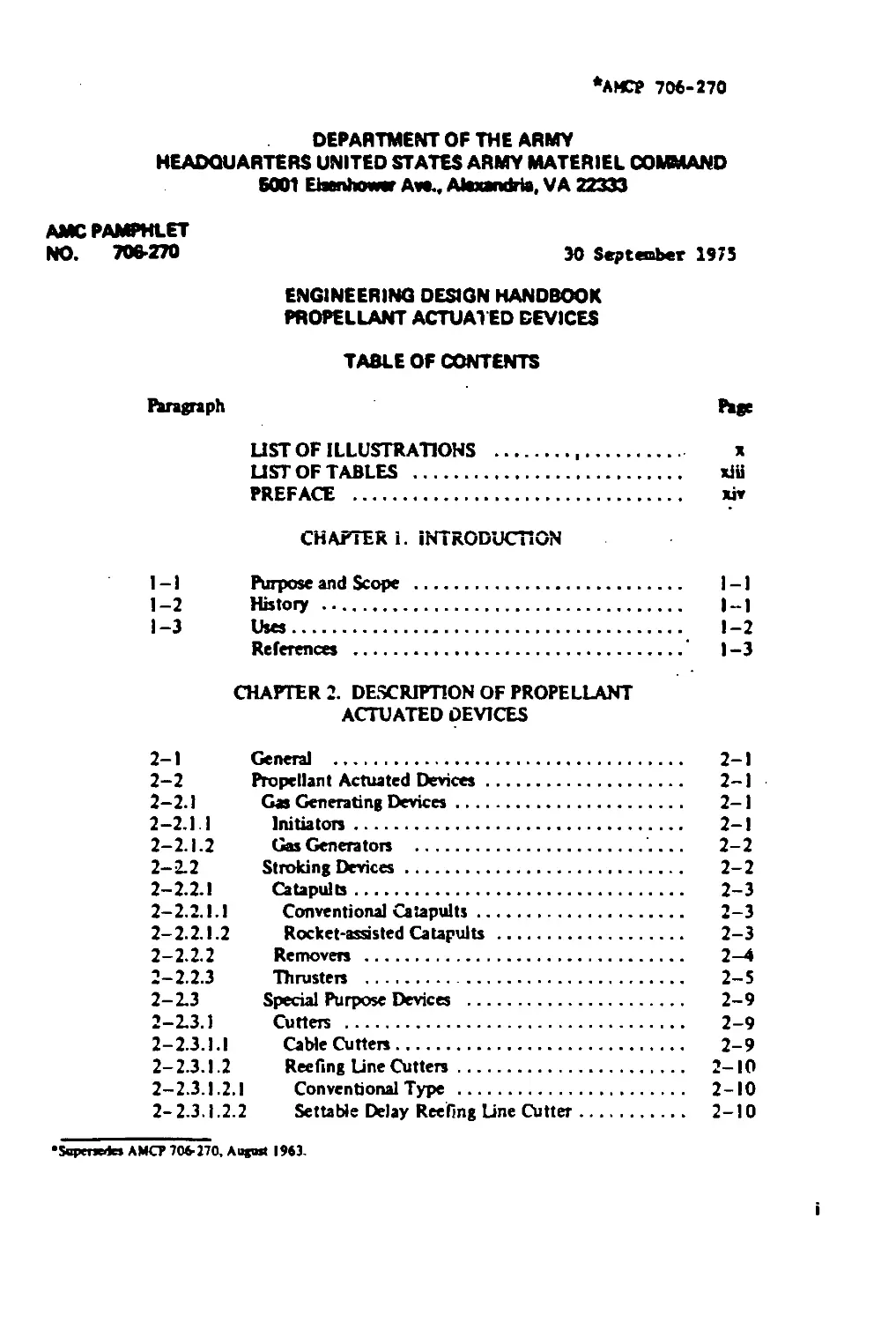
                    *АМСР 706-270
DEPARTMENT OF THE ARMY
HEADQUARTERS UNITED STATES ARMY MATERIEL COMMAND
6001 Eisenhower Aw,, Alexandria, VA 22333
AMC PAMPHLET
NO. 706-270	30 September 1975
ENGINEERING DESIGN HANDBOOK
PROPELLANT ACTUATED DEVICES
TABLE OF CONTENTS
Paragraph	Page
LIST OF ILLUSTRATIONS ....................... x
LIST OF TABLES .............................. xiii
PREFACE ..................................... xiv
CHAPTER i.	INTRODUCTION
I -1	Purpose and Scope .............................. 1-1
1-2	History ........................................ |-|
1-3	Uses............................................ 1-2
References ..................................... 1-3
CHAPTER 2.	DESCRIPTION OF PROPELLANT
ACTUATED DEVICES
2-1	General ........................................ 2-1
2-2	Propellant Actuated Devices..................... 2-1
2-2.1	Gas Generating Devices.......................... 2-1
2-2.1.1	Initiators.................................... 2-1
2-2.1.2	Gas Genera tors ................................ 2-2
2-2.2	Stroking Devices................................ 2-2
2-2.2.1	Catapults....................................... 2-3
2-2.2.I.I	Conventional Catapults........................ 2-3
2-2.2.1.2	Rocket-assisted Catapults .................... 2-3
2-2.2.2	Removers ....................................... 2—4
2-2.2.3	Thrusters ...................................... 2-5
2-2.3 Special Purpose Devices ............................. 2-9
2-2.3.1	Cutters ........................................ 2-9
2-2.3.1.1	Cable Cutters................................... 2-9
2-2.3.1.2 Reefing Line Cutters............................ 2-10
2-2.3.1.2.1	Conventional Type ........................... 2-10
2-2.3.1.2.2	Settable Delay Reefing Line Cutter........... 2-10
Saperwfei AMCP 706-270, Auym 1963.
АМЕР ТОМЯ
TABLE OF CONTENTS (Con'L)
Pkragnph
2-23.2	Releases........................................   2-11
2-233	Bectric Ignition Element! ........................ 2-11
2-233.1	Conventional Type ................................ 2-11
2-233.2	Electromagnetic Impulse Genera ton................ 2-11
2-23.4	Ejectors ......................................... 2-12
2-3 Escape Systems ........................................... 2-12
2-3.1 Conventional Aircraft Escape ........................... 2-12
2-3.2 Escape System for the F-104A and F-104C
Aircrafts .................................................... 2-13
2-33	; - Capsule Escape Systems.......................... 2-13
2-3.4	Helicopter Escape Systems......................... 2-16
2-33	Emergency Escape from Commercial Aircraft....... 2-16
2-4 Energy Transmission in Systems............................ 2-18
References ....................................... 2-18
CHAPTER 3.	BASIC DESIGN CONSIDERATIONS
3-1	General Considerations ............................ 3-1
3-2	Motion or Time	Functions .......................... 3-1
3-2.1	Propellant Actuated Stroking Devices............... 3-1
3-2.2	Gas-generating Propellant Actuated Devkes.......	3-3
S-j	Load............................................... 3—4
3—4	Weight and Size	............................... 3-5
3-5	Environment........................................ 3-5
3-5.1	Temperature........................................ 3—6
3-5.2	Humidity and Dust.................................. 3-6
3-53 Vibration .................'............................   3-6
3-5.4	Shock.............................................. 3-6
3-6	Heat Loss ......................................... 3-6
References...................................... ? -7
CHAPTER 4.	PRELIMINARY DESIGN TECHNIQUES
4-0	List of Symbols ................................... 4-1
4-1	Introduction....................................... 4-2
4-1.1	Genera] ........................................... 4-2
4-1.2	Design Requirements................................ 4-2
4-2	First-order Ballistic Approximations............... 4-2
4-2.1 General.................................................. 4-2
4-2.2 Stroking Devices	4-3
4—2.2.1	Kinematic Variables ............................... 4-3
4-2.2.2	Maximum Pressure .................................. 4-4
4-2 23	Propellant Charge Weight.........................   4-5
ii
мкнпт
TABLE OF CONTENTS (Con't)
Paragraph	hfe
4-2.14	Propellant Web..................................... 4-7
4-115	Cartridge Сие Volume .............................. 4-7
4-12.6	Igniter Charge..................................... 4-8
4-2.3 Gas-generating Device* ............................... 4—g
4-23.1	Initiators........................................  4_g
4-2.3.2 Gas Genenton........................................... 4—8
4-233	Rockets.......................................     4-10
4-3	Design Strength Calculations ..................... 4-12
4-3.1 General........................................... ...	4-12
4-3.2	Safety Factors.................................... 4-12
4-3 J	Temperature Effects............................... 4-12
4-3.4	Stresses.......................................... 4-12
4-3	Distortion-energy Theory .......................   4-13
4—3.4.2	Length of Thread Engagement....................... 4-13
4—4 Design Procedures ........................................ 4-16
4—4.1	General........................................... 4-16
4—4.2	Gas-generating Devices ........................... 4-16
4-4.3 Stroking Devices........................................ 4-17
4-4.4 Systems................................................. 4-18
4-5	Component Design ................................. 4-18
4-5.1	Cartridge ........................................ 4-18
4-5.1.1	Cartridge Cases................................... 4-19
4-5.1.2	Cartridge Head ................................... 4-20
4-5.1.3	Primers .......................................... 4-20
4-5.I.4	Cartridge Seals................................... 4-20
4-5.2	Body and Chamber.................................. 4-21
4-5.11	Gas-generating Devices ........................... 4-2|
4-5.12	Stroking Devices.................................. 4-22
4—5.13	Piston ........................................... 4—22
4—5.4	Firing Mechanism*................................. 4-23
4—5.4.1	General........................................... 4-23
4-5.4.I.I	Firing Pins....................................... 4-23
4-5.4.1.2	Firing Plugs...................................... 4-23
4-5.4.13	Firing Pin Guides................................. 4-24
4—5.4.2	Gas-operated Firing Mechanisms.................... 4-24
4-5.4.3	Mechanically Operated Firing Mechanisms......... 4-25
4-5.5	Locking Mechanisms................................ 4-26
4-5.6	Seals ...........................................  4-27
4—6 Special Problems.......................................... 4-29
4-6.1	General..........................................  4-29
4-6.2	Shear Pins........................................ 4-29
4-6.3	Damping Systems .................................. 4-29
4—6.4	High-Low Systems................................ 4—31
txi
AMCP70WXN
TABLE OF CONTENTS (Con’t)
Paragraph	Psge
4—6.5	Protective Coatings.............................. 4—32
4—6.6	DissimiJar Metals................................ 4—32
References........................................ 4-33
CHAPTER 5.	INTERIOR BALLISTIC ANALYSIS
5—0	List of Symbols .................................. $-1
5-1	Introduction ..................................... $-2
5-2	Basic Equations .................................  5-2
5-11 Propellant Burning Rate ................................. 5-2
5-2.2	Propellant Surface Development.................... 5—4
5-2.3	Gas Production.................................... 5-6
5-2.4	Gas Pressure ..................................... 5-7
5-2.5	Free Volume....................................... 5-7
5-2.6	Gas Discharge Through an Orifice.................. 5-7
5-2.7	Equations of Motion............................... 5-8
5-2.8 Energy Balance (Gas Temperature)........................ 5-8
5-3	Stroking Devices.................................. 5-9
5-3.1	Direct Stroking Device ........................... 5-9
5-3.2	High-Low Stroking Device......................... 5-13
5—4	Gas-generating Devices........................... 5-16
S-S	Grain Design..................................... 5-18
5-6	Dynamic Response Index .......................... 5-19
'	References....................................... 5-23
CHAPTER 6.	DESIGN EXAMPLES
6-0	List of Symbols................................... 6-1
6-1	General........................................... 6-2
6-1.1	Purpose........................................... 6-2
6-1.2	Scope ............................................ 6-2
6-2	M38 Catapult ..................................... 6-2
6-2.1	General........................................... 6-2
6-2.2	Design Requirements............................... 6-2
6-2.3	First-order Approximations ....................... 6-3
6-2.3.1	Stroke Length .................................... 6-3
6-2.3.2	Stroke Tune....................................... 6-3
6-2.3.3	Лак Pressure ..................................... 6-3
6-2.3.4	Propellant Charge Weight.......................... 6-3
6—2.35	Grain Geometry ................................... 6—4
6-14	Component Arrangement ............................ 6—4
6-2.5	Component Design ................................. 6-7
6-15.1	Tubes ............................................ 6-7
rv
лиепоьт
TABLE OF CONTENTS (Conft)
Paragraph	Page
6-15.2	Mount (Tnmnkm) .................................. 6-9
6-153	Head............................................ 6-12
6-15.4	Locking Mechanism............................... 6-13
6-15.5	Firing Mechanism................................ 6-13
6-3 M3A3 Thruster........................................... 6-15
6-3.1	General....................................... 6-15
6-3.2	Design Requirements............................. 6-15
6-33	Component Arrangement .......................... 6-15
6-3.4	Fost-cnder Approximations ...................... 6-17
6-3.4.I	Thruster ....................................... 6-17
6-3.4.2	Hston Assembly ................................. 6-17
6-3.43	, Propellant Charge Weight...................... 6-17
6—3.4.4	Cartridge....................................... 6-18
6—3.5	Component Design ............................... 6-18
6-3.S.1	Body............................................ 6-18
6—3.5.2	Breech.......................................... 6-21
6-333	Trunnion.......................................  6-22
6-3 5.4	Firing Mechanism ............................... 6-23
6-333	EndCap.......................................... 6-23
6—3.56	End Steeve and Locking Mechanism................ 6-24
6—33.7	Hston Group Assembly............................ 6-26
6-4 Mi 13 initiator......................................... 6-28
6-4.1	General......................................... 6-28
6—4.2	Design Requirements............................. 6-28
6—43	First-order Approximations ..................... 6-29
6—4.4	Component Arrangement .......................... 6-30
6-4.4.1 Initiator .......................................... 6-30
6—4.4.2	Firing Mechanism .. ............................ 6-30
6—4.43	Delay Element................................... 6-30
6—4.4.4	M104 Initiator.................................. 6-34
6-43	Component Design ............................... 6-35
6-43.1	Firing Pin Housing	............................ 6-35
6—43.2	Delay Element Body.............................. 6-35
6-4.53 Initiator (Ml04) Bodies.............................. 6-36
CHAPTER 7.	PERFORMANCE EVALUATION
7-1 Test Procedures ......................................... 7-1
7-1.1 General................................................ 7-1
7-1.2	Development Evaluation Program................... 7-1
7-1.2.1 General.............................................. 7-1
7-1.2.2	Workhorse Model Evaluation.................... ' -1
7-1.23	Prototype Evaluation............................. 7-2
7-1.13.1	General.......................................... 7-2
v
ДМ О Л» 270
TABLE OF CONTENTS ICmfU
Paragraph	f^ge
7-1.2.3.2	Structural Evaluation Program ................... 7-2
7-1.23.2.1	General.......................................... 7-2
7-1.23.2.2	Vibration........................................ 7-2
7-1.23.23	Drop Tests....................................... 7-2
7-1.23.2.4	WallStrength.................................... *7-2
7-1.23.2.5	No-load Requirements ............................ 7-2
7-1.2.3.2.6	Failures......................................... 7-3
7-1.233	Performance ..................................... 7-3
7-1.2.33.1	General.......................................... 7-3
7-1.233.2	Performance Requirements......................... 7-3
7-1.2.3.33	No Load and Locked Shut ......................... 7-3
7-1.233.4	Environmental fcrformance........................ 7-3
7-1.2.33.5	Failures......................................... 7-3
7-1.3	Engineering Design Tests ............................ 7-3
7-2	Instrumentation ..................................... 7-3
7-2.1	General.............................................. 7-3
7-2.1.1 Measurement Objectives  ................................ 7-4
7-2.1.2	Selection of Measurement Equipment............... 7-4
7-2.13	Sources of Measurement Error..................... 7-4
7-2.13.1	Limitations of the Measuring	Equipment .......... 7-4
7-2.13.2	Environmental Influences......................... 7-4
7-2.133	Inlerference .................................... 7-4
7-11.3.4	Interaction ..................................... 7-4
7-113.5	Response Time ................................... 7-5
7-2.13.6	System Errors.................................... 7-5
7-2.13.7	Errors of Observation and Interpretation ........ 7-5
7-2.1.4	Calibration ......................................... 7-5
7-2.2 instrumentation Components................................ 7-5
7-2.2.1	Input Devices ....................................... 7-5
7-12.1.1	Strain Gage Transducers.......................... 7-5
7-12.1.2	The Switch ...................................... 7-9
7-2.11.3	Magnetic Sensor.................................. 7-Ю
7-2.2.1.4	Other Transducers............................... 7-12
7-12.2	Signal Conversion .............................  7-12
7-2.111	Gage Zero Compensation.......................... 7-12
7-12.2.2	Gage Range Compensation ........................ 7-13
7-12.2.3	Pre-fire System Calibration..................... 7-13
7-12.2.4	Amplification .................................. 7-14
7-2.2.2.5	Electronic Switch .............................. 7-14
7-12.2.6	Anaiog-to-Digital Conversion.................... 7-15
7-12.2.7	Digital Processing ............................. 7-16
7-2.23	Output Devices.................................. 7-16
7-12.3.1	Counter......................................... 7-18
АМСР7М-270
TABLE OF CONTENTS (Con'd.)
Paragraph	Page
7-2.2.3.2	Oscillograph ..................................... 7-18
7-2.2.3.3	Printer........................................... 7-18
7-2.2.3.4	Oscilloscope ..................................... 7-18
7-2.2.3.5	Other Output Devices ...........................   7-19
7-2.3	Firing System .................................... 7-19
7-2.3.!	Power Supply and Switch........................... 7-19
7-2.3.2	Firing Line and Connectors........................ 7-20
7-2.3.3.	Firing Signa) Monitor ............................ 7-20
7-2.3.4	Safety Breaks in the Firing Line ................. 7-20
7-2.3.5	Sequencing System...............................   7-21
7-2.4	Test Fixtures..................................... 7-2!
7-2.4.I	Future Design Considerations...................... 7-21
7-2.4.2	Common Test Fixtures ............................. 7-21
7-2.4.2.1	Pressure Chamber ................................. 7-22
7-2.4.3.2.	Constant Load Cylinder............................ 7-22
7-2.4.2.3	Track and Carriage ............................... 7-22
7-2.4.2.4	Other Fixtures ....................................1-23
7-2.5 PAD Parameters............................................ 7-23
7-2.5.1	Dimension Parameters.............................. 7-23
7-2.5.1.1	Length ........................................... 7-23
7-2.5.1.2	Area ............................................. 7-25
7-2.5.1.3	Volume............................................ 7-25
7-2.5.1.4	Angle............................................. 7-25
7-2.5.2	Time Ibramete.s................................... 7-25
7—2.5.2-1	Time Intervals.................................... 7-25
7-2.5.2.2	Frequency......................................... 7-25
7-2.5.3	Motion Parameters ................................ 7-25
7-2.5.3.1	Velocity ......................................... 7-25
7-2.5.3.2.	Acceleration ..................................... 7-25
7-2.5.3.3	Rate of Change of Acceleration g.................. 7-25
7-2.5.3.4	Acceleration-Time Integral f	adt ............ 7-25
7-2.5.3.5	Dynamic Response Index (DRI)...................... 7-25
7-2.S.4	Force Derived Parameter........................... 7-25
7-2.S.4.1	Force............................................. 7-25
7—2.5.4.2	Weight ........................................... 7-26
7-2.5.4.3	Force-Time Integral J Fdf......................... 7-26
7-2.S.4.4	Pressure.................................. 7-26
7-2.5.4.5	Pressure-Time Integral f Pdt...................... 7-26
',-2.5.4.6	Torque.................................. 7-26
7-2.5.5	Electrical Parameters .................................. 7-26
7-2.5.5.1	Current.................................. 7-26
7-2.5.5.2	Voltage.................................. 7-26
vii
АМСР 706-270
TABLE OF CONTENTS (Con't)
Paragraph	Page
7-2.5.5J	Resistance....................................... 7-26
7-2.5.5.4	Amplifier Characteristics .....................   7-26
7-2.5.6	Other Parameters................................. 7-26
7-2.5.6.1 Case Temperature ................................... 7-26
7-2.5.6.2	Flame Temperature................................ 7-26
7-2.5.6.3	Flow............................................. 7-27
7-2.5.6.4	Acoustical Parameters............................ 7-27
7-2.6	Initiator Testing ............................... 7-27
7-2.6.1	Parameters....................................... 7-27
7-2.6.2	Fixtures......................................... 7-27
7-2.6.3	Instrumentation ................................. 7-27
7-2.6.4	Report........................................... 7-27
7-2.6.5	Special Considerations........................... 7-27
7-2.7	Thruster Testing ................................ 7-27
7-2.7.1	Parameters....................................... 7-27
7-2.7.2	Fixtures......................................... 7-28
7-2.7.3	Instrumentation ................................. 7-28
7-2.7.4	Record........................................... 7-29
7-2.7.5	Special Consideration ........................... 7-30
7-2.8	Rocket Catapult Testing.......................... 7-30
7-2.8.1	Parameters....................................... 7-30
7-2.8.2	Fixtures ........................................ 7-30
7-2.8.3	Instrumentation ......,.......................... 7-30
7-2.8.4	Report.........................................   7-30
7-2.8.5	Special Considerations........................... 7-31
APPENDIXES
APPENDIX A. CONVERSION OF DISTORTION ENERGY EQUA-
TION TO MORE USEFUL FORMS FOR PROPELLANT ACTUATED
DEVICES ...................................................... A-l
APPENDIX B.	TABLE OF WALL RATIOS........................ В-1
APPENDIX C.	DERIVATION OF EQUATION USED IN DETER-
MINING LENGTH OF ENGAGEMENT THREADS........................... C-l
APPENDIX D.	COMPUTER PROGRAM FOR SIMULATION OF
DIRECT STROKING DEVICE........................................ D-l
APPENDIX E.	COMPUTER PROGRAM FOR HIGH-LOW STROK-
ING DEVICE	   E-l
viii

TABLE OF CONTENTS (Cent)
Paragraph	Page
APPENDIX F.	COMPUTER PROGRAM FOR HIGH-LOW GRAIN
DESIGN	 F-l
, INDEX \......................................... I-1
ix
АЫСР7М-27О
LIST OF ILLUSTRATIONS
Figure No.	Title	Page
2-1	Mechanically Actuated Delay Initiator .................. 2-2
2-2	M17 Gas Generator....................................... 2-4
2—3	Operation of a Conventional Catapult.................... 2-3
2—4	XM39 Rocket-assisted Catapult .......................... 2-7
2-5	Gas Actuated Remover.................................... 2-8
2-6	M! 6 Oil Buffered Thruster ............................. 2-9
2-7	Typical Reefing Line Cutter............................ 2-10
2-8	Release................................................ 2-11
2—9	Electric Ignition Element.............................. 2-12
2-10	Egress Trajectory...................................... 2-14
2-11	F-104A and F-104C Aircraft Ejection System...........	2-15
2-12	Separable Nose Capsule................................. 2-16
2-13	Emergency Egress System from Commercial	Aircraft .	2-17
3-1	Simple PAD System.................................... 3-2
3-2	Pressure-time Curve for PAD System in Fig.	3-1......... 3-3
3-3	Thrust-time Curve....................................... 3-4
3-4	Thruster With Stacked Configuration.................. 3-5
4-1 Acceleration-time Curve for Propellant Actuated
Stroking Device...................................... 4-4
4-2 Ratio of Propellant Charge Weight to Propelled Load
for Propellant Actuated Stroking Devices.......................... 4-6
4-3	Hose Length vs Pressure Pm for М3 Initiator ............ 4-9
4-4	Burning Rale r and Кя vs Pressure P ............. 4-11
4-5	Biaxial and Triaxial Strength Curves' ...............4-14/15
4-6	Simple PAD System Using an Initiator ................ 4-lo
4-7	Simple Large Cartridge .............................. 4-18
4-8	Typical Small Cartridge................................ 4-20
4-9	Percussion Primer ..................................... 4-20
4-10	Initiator With Cartridge Retainer.................... 4-2!
4-11	Firing Pins............................................ 4-23
4-12	Firing Plug............................................ 4-24
4-13	Gas-operated Firing Head............................... 4-26
4-14	Mechanically Operated Firing Mechanism............... 4 —2л
4-15	Thruster Locking Mechanism ............................ 4-28
4-16	Locking Keys and Firing Pin............................ 4-23
4-17	Spring Pin ............................................ 4-29
4-18	Floating Piston and Thermal Expansion	Chamber ... .	4-30
4-19	Thruster With Fluid Damping............................ 4-31
5-1	Bum Rate Relation....................................... 5-3
5-2	Common Propellant Geometries............................ 5-5
5-3	Flow Factor vs Pressure Ratio.......................... 5-10
5-4	.Schematic of Direct Ballistic System ................. 5-11
5-5	Computer Generated Pressure and Velocity............... 5-14
x
АМСР 708-270
LIST OF ILLUSTRATIONS (ConX)
Figure No.	Title	Page
5-6	Schematic of High-Low System .......................... 5-15
5-7	Pressure vs Time for High-Low Ballistic System ........ 5-18
5-8 Displacement and Velocity vs Time for High-Low
System ........................................................... 5-19
5-9 Pressure-Time Input for High-Low Grain Design
Program........................................................... 5-20
5-10 Computer Output for High-Low Grain Design Pro-
gram ............................................................. 5-21
5-11 Surface Development vs Bum Distance for High-Low
System .............................................. 5-22
5—12	Dynamic Response Index vs Spinal Injury	Rate . 5-23
6-1	Catapult Arrangement.................................... 6-6
6-2	Catapult, Aircraft Ejection Seat, M38 Assembly....	6-7
6-3	Cartridge, Impulse, M27O Assembly....................... 6-8
6—4	Mount.................................................. 6—10
6-5	Head................................................... 6-12
6-6	Enlarged View of Head Mounting Hole.................... 6-13
6-7	Key.................................................... 6-14
6-8	Firing Pin............................................. 6-16
6-9	Thruster Component Layout ............................. 6-17
6-10	Impulse Cartridge, M44AI .............................. 6-19
6-11	Thruster Body.......................................... 6—20
6-12	Thruster Breech Assembly .............................. 6-21
6-13	Trunnion for Thruster.................................. 6-22
6-14	Thruster Firing Pin ................................... 6-23
6-15	Thr jster End Cap ..................................... 6-24
6-16	Thruster Locking Key................................... 6-25
6-17	Load Deflection Curves for Keylock Mechanisms ... . 6-26
6-18	Thruster Piston........................................ 6-27
6-19	Initiator, Propellant Actuated, Delay, Ml	13 Assembly. 6-31
6-20	Firing Pin, Part No. 117384)0.......................... 6-32
6-21	Delay Element Assembly................................. 6-33
6-22	Initiator, Propellant Actuated,	Ml04 Assembly ......... 6-34
6-23	Housing ............................................... 6-37
6-24	Mounting Bracket ...................................... 6-38
6-25	Body................................................... 6-39
7-1	The Instrumentation System.............................. 7-6
7 -2	Strain Gage............................................. 7-7
7-3 Ring Shaped Test Member Used With Strain Gage
Wheatstone Bridge.............................................. 7-8
7-4	Wheatstone Bridge Strain Gage	Transducer................ 7-9
7-5	Detailed Strain Gage Bridge............................. 7-9
7-6	S'rain Gage Pressure Transducer........................ 7-10
xi
ANCP70M70
LIST OF ILLUSTRATIONS (Con't)
Figure No.	Title	hft
7-7	Snap-action Switch.................................. 7-11
7-8	Magnetic Sensor and Passing Target.................. 7-11
7-9	Zero Compensation..................................... 7-13
7-10	Zero Balancing Circuit Гог Strain Gage Transducer ... 7-13
7-H	Effect of Gage Range Compensation .................... 7-14
7-12 Pre-fire System Calibration for Bridge Circuit Showing
Electronic Simulation of a Physical Load ........ 7—IS
7-13	Example of Linear Ampbfication ....................... 7-15
7-14 Equivalent Circuit for “RC" Effect of Long Cable and
Voltage-time Trace ................................ 7-16
7-15	Simplified Self-quenching Cathode Follower
Thyratron.......................................... 7-17
7-16	Simplified Thyristor Circuit.......................... 7-17
7-17	Typical Counter ...................................... 7-18
7-18	Oscillograph Galvanometer System...................... 7-19
7-19	An Oscillograph Record ............................... 7-19
7-20	Gas Actuated PAD Firing Apparatus .................... 7-20
7-21	Mechanically Actuated PAD Firing Apparatus.......... 7-21
7-22	Pressure Chamber Fixture ............................. 7-22
7-23	Constant Load Cylinder ............................... 7-23
7-24	Vertical Test Tower................................... 7-24
7-25	Initiator With Instrum ntation Fixture................ 7-28
7-26	Initiator Trace....................................... 7-29
7-27	Thruster and Instrumentation Fixture.................. 7-29
7-28	Thruster Trace........................................ 7—30
7-29	Instrumentation on Horizontal Track for Rocket
Catapult Test...................................... 7-31
7-30	Rocket Catapult Trace................................. 7-32
A-1	Stress Parameters...................................... A—1
C-l	Thread Parameters...................................... C-l
xii
АМГ» 700-270
LIST OF TABLES
Table No.	Title	Page
2-1	Comparative Data for	Initiators .................... 2-3
2-2	Comparative Data for	Conventional Catapults......	2—6
2-3	Comparative Data for	Rocket-assisted Catapults...	2-6
2-4	Comparative Data for	Removers....................... 2-9
4-1 Sizes of Existing Cartridge Cases........................... 4-19
4-2 Percussion Primers Used in Propellant Actuated
Devices ........................................................ 4-21
4-3	Firing Pin Ratios and Clearances..................... 4-23
4-4	Firing Pin Protrusions and Diameters ................ 4-24
4—5 Firing Pins and Shear Pins Used in Propellant Actuated
Devices ........................................................ 4—27
5 -1 Burn Distance and Perforation Circle Relations...........	5-4
5-2 Direct Ballistic Stroking Device input-output
Parameters......................................... 5-12
5-3 High-Low Ballistic Stroking Device Input-output
Parameters...................................................... 5-1?
xiii
«МСРЖ»ДО
PREFACE
This handbook-con tai»* fg basic infomutton and fundamental data useftd
in the design and dredope tnt of Army materiel-fa one in the Engineering
Denga Handbook aeries of tire US Army Materiel Command. The handbook
is a maria» of Su eritai handbook published in 1963. The revision
updates the oemed and deafen methodology, and introduces the application
of ccaapnaa bdama. Aho, Ok revision reorganizes the material and
presses tte Ari^i krifaeeutoo in a more logical sequence.
The handban*  a pride to design engineers engaged in the development
of propeSant artnated duust devices end gas generators for various
appbcatioaa. The text-written by the Propellant Actuated Devices
Branch—is based on the experience of Frankford Arsenal, which has been
engaged in the development of these devices for aircraft escape systems since
1945. It is interesting to note that more than 3200 US pilotshave been saved
by using the Frankford designed propellant actuated devices (PAD); also,
there is no record of a known failure.
Chapter I presents a brief history of PAD’S, their application to various
types of aircraft, and passible future applications. Chapter 2 describes the
specific components of PAD'S and their function. Chanter 3 considers the
basic design parameters such as time and motion functions, load, size, and
environmental factors.
Chapters 4 and 5 deal with the mechanical and ballistic design of the
various PAD components. Chapter 6 illustrates the component design
techniques of the previous chapters by integrating the methodology into the
design of PAD systems. Realistic examples are used throughout
Chapter 7 describes the instrumentation, text fixtures, and various test
and evaluation programs used in the design process.
The Engineering Design Handbooks fall into two bask categories, those
approved for release and sale, and those classified for security reasons. The
US Army Materiel Command policy is to release these Engineering Design
Handbooks in accordance with current DOD Directive 7230.7, dated 18
September 1973. All unclassified Handbooks can be obtained from the
National Technical Information Service (NT1S). Procedures for acquiring
these Handbooks follow:
a.	All Department of Army activities having need for the Handbooks
must submit their request on an official requisition form (DA Form 17,
dated Jan 70) directly to:
xiv
АМСРЯМЯ
Commander
Letterfcenny Amy Depot
ATTN: AMXLE-ATD
Chambenburg, PA 17201
(Request* for daeified documents must be submitted, with appropriate
“Need to Know” justification, to Letteritenny Amy Depot.) DA activities
will not requisition Handbooks for further free distribution.
b.	AO other requestors, DOD, Navy, Air Force, Marine Corps,
noomDitary Government agencies, contractors, private industry, individuals,
universities, and others must purchase these Handboqks from:
National Technical Information Service
Department of Commerce
Springfield, VA 22151
Classified documents may be released on a “Need to Know” basis verified by
an official Department of Amy representative and processed from Defense
Documentation Center (DDC), ATTN: DDC-TSR, Cameron Station,
Alexandria, VA 22314.
Comments and suggestions on this Handbook are welcome and should be
addressed to:
Commander
US Amy Materiel Command
ATTN: AMCRD-TV
Alexandria, VA 22333
(DA Forms 2028, Recommended Changes to Publications, which are
available through normal publications supply channels, may be used for
comments/suggestions.)
xv/xvi
амсрямго
CHATTER 1
INTRODUCTION
VI PURPOSE AND SCORE
This design handbook it intended for the
dmemination of such general and technical
information concerning propellant actuated
devices и may be necessary for their care,
handling, and utilization. It also serves as a
convenient reference of fundamental and
practical information as well as analytical
procedures necessary to aid in the design,
performance estimation, and test evaluation
cf these devices. Only the basic theory and
principle* underlying the functioning and
design of most devices in the class are
discussed; no attempt is made to treat the
mechanical details or operating procedures
that differentiate one model from another.
General reference в only made to ^recific
models lb give the reader an overall picture of
the development of propellant actuated
devices from the conception and to serve as
examples in the design and ballistic analysis
chapters.
1-2 HISTORY
Prior to World War II, escape from a
disabled aircraft in flight occurred in environ-
ments and at speeds that were physiologically
tolerable; therefore, muscular effort usually
was sufficient to separate the man from his
plane. As speeds increased, it became more
difficult to leave the aircraft safely in the
event of an emergency. The technique of
inverting the plane, opening the canopy,
releasing one’s safety belt, and falling cut was
no longer feasible.
In 1943, the US Army Air Corps made a
survey of emergency bail-outs that had
occurred in 1942. The results showed that
I2.S percent had been fatal and 45.5 percent
had resulted in injury. A similar study of
bailouts from fighter aircraft for the year
1943 showed that IS percent had been fatal
and 47 percent had resulted in injury.
The Germans, who probably had similar
experience, were the first to take corrective
action. A German directive was issued in 1944
requiring that all fighter aircraft be equipped
with ejection seats. The British followed with
a directive in 1945 requiring that all fighter
aircraft with speeds greater than 400 mph be
equipped with ejection seats.
The problems of escape from pusher-type
aircraft were studied by the Aircraft Labora-
tory at Wright Field as early as 1940. At least
one experimental airplane made during World
War II is reported to have been equipped with
an escape mechanism, but it was not until
1945 that cur Air Force and Navy began
serious development work on ejection seats.
In August 1945. the Pitman-Dvnn Labora-
tories of the Frankford Arsenal were re-
quested to develop ejection devices under the
cognizance of the Special Projects Branch,
Aircraft Laboratory, Engineering Division, Air
Materiel Command. Initial performance re-
quirements of the ejection devices were
established on the basis of data and
information from the Aircraft and Aero-Medi-
cal Laboratories of Engineering Division, Air
Materiel Command. With the passage of time
the organization now charged with this
responsibility is the Aerospace Medical
Research Laboratory, Aerospace Medical
Division. Air Force Systems Command,
Wright-Patterson Air Force Base.
1-1
M97№3«
Before gm-type devices could be wed on
penoond ^ectioa aeaU. it ns necessary to
determine toienUe xreteraboo levels for flic
hntnra body and the minmram separation
velocity necessary for ejected personnel to
dear the aircraft structure. The Aerospace
Medical Research Laboratories have been
conducting a continuing study to determine
the physiological timitatiom of the human
body when subjected to the ejection environ-
ment. Recent studies have led to the
specification of a parameter called the
Dynamic Response Index (DR1) instead of
the previously specified limitations of maxi-
mum acceleration and rate of change of
acceleration as the criterion for determining
the physiological limitations for personnel
escape systems'. The DR1 which is a measure
of human spine compression - and, therefore,
probability of injury - в intended to be a
more meaningful determinant in that it в a
measure of the stresses actually experienced
by the ejectee. A nominal value of 118 for the
average 50 percentile flying population has
been specified for this parameter for ejection
systems conditioned at 70°F.
The fust ejection seat catapult was
standardized in 1947 and designated the MI
Personnel Catapult. The design and develop-
ment of the Ml and М2 Canopy Removers
followed in quick succession. These early
devices were initiated mechanically; Le.,
cocked firing pins were released by rotating or
withdrawing a sear. The “choke coil",
bell-crank rod, and cable-actuated system left
much to be desired from a reliability,
simplicity, and maintenance standpoint.
In 1949, Frankford Arsenal developed a
propeD-~at gas pressure source that was
designated an initiator. Concurrently, the
Arsenal redesigned the existing devices to
incorporate a pressure operated firing mech-
anism. The propellant gas was transmitted by
MS-28741 hydraulic hose assemblies from the
initiators to the firing mechanisms.
With the advent of the B-52 airplane and its
requirements for multicrew, multifunction,
integrated escape system, it was realized that
new form of propellant actuated devices
(PAD) would be required for such functions
as positioning ejection teats, unlocking
hatches, and stowing control columns. With
the support of the airframe contractors,
Wright-Patterson Air Force Base and Frank-
ford Arsenal commenced the design and
development of the first series of Thrusters,
designated Ml, М2, М3, and M5 m 1951.
Since that time many new and varied
applications for PAD have been found in
aircraft escape, aerial delivery, and other
systems.
Ever since the advent of powered ejection
seats, Frankford Arsenal has supported the
US Air Force in their requirements for
Government-furnished (GFE) PAD in these
systems throughout their life cycle. With the
advent of the weapon system concept of
procurement, and the subsequent develop-
ment of much of the PAD used in newer
escape systems as contractor^fumished equip-
ment (CFE), Frankford Arsenal procures and
remanufactures many of the CFE as well as
GFE items for all services.
Over 200 GFE propellant actuated devices
have been developed and standardized. An
engineering manual is published by Frankford
Arsenal listing about 175 propellant actuated
devices1. In addition to the devices listed in
this reference, a nomenclature list for
standardized propellant actuated devices as
well as those under development1, and a
publication listing propellant actuated device
patents and technical reports covering the
period 1946 through 1969* are available.
1-3 IKES
Although propellant actuated devices orig-
inally were developed ter emergency escape
from aircraft, their use has proliferated to a
growing number of nonescape system applica-
tions. These include applications to large bore
gun scavenging, support of Army concepts for
1-2
ДМСРЯЫХ»
•chanced aerial delivery systems, applications
to devices f<< explosive ordnance disposal,
settable time delay medunisma, deployment
kite for retardation systems used in the
delivery of special stores, and cool gas
generators for foliation and rigidization
applications.
Propellant actuated devices are useful in
the* and other applications because of their
reliability, simplicity, light weight, small size,
and ability to withstand long periods of
storage under extremes of environment
without impairment of reliability.
REFERENCES
I.	MIL-S-9479A (USAF), Seat System Up-
ward Ejection. Aircraft. General Specifica-
tion fbe, 30 December 1969.
2.	IEP 65-6370-8 REV A, Propellant Actu-
ated Devices Engineering Manual, 15 June
1969, AD-872 430.
3.	Nomendattsre List for Cartridge and
Propellant Actuated Devices, Dept, of the
Army, Frankford Arsenal, July 1969,
AD-872 429.
4.	Sununvy of Start*tics for Cartridge and
Propellant Actuated Devices, Dept, of the
Army, Frankford Arsenal, February 1970,
AD-872 426.
1-3/1-4
АМСР70Ю0
CHAPTER 2
DESCRIPTION OF PROPELLANT ACTUATED DEVICES
M GENERAL
The tint aircraft personnel escape catapults
ami associated devices powered by solid
propellants were called "Cartridge Actuated
Devices" (CAD), a name which arose from the
similarity in appearance bet ween their propel-
lant containers and cartridge cases for
conventional small arms munitions. As new
applications were developed, this, similarity
disappeared, but the name continued to be
used. Many of the older records wilj show this
name. Ordnance Corp Technical Minutes
37418,. 12 April 196Q, was published to
change the name of future development of
these items to "Propellant Actuated Devices’*
(PAD), this name more nearly expressing their
principal characteristic.
The propellant actuated devices described
in this chapter have been divided arbitrarily
into three categories, gas-generating devices,
stroking devices, and special purpose devices.
Although special purpose devices could, for
the most part, be classified in either of the
first two categories, they have been separated
because of their specific applications.
Stroking devices may be further classified
as direct or high-tow. Direct systems are
devices in which the propellant is consumed
in the working chamber. In high-low devices
the propellant is burned in a separate, or high
pressure chamber, and the resultant gases are
then bled through an orifice or nozzle into
the working chamber. Only direct systems
will be considered in this chapter. High-low
systems will be considered in Chapter 4.
Various sources list information on the
physical and performance characteristics of
propellant actuated devices which have been
developed. These data and that listed in this
publication are presented to aid the design
engineer and to serve as a reference h
determining the feasibility of proposed
devices.
Escape systems are discussed and a specific
escape system application is described in
order to illustrate the use of propellant
actuated devices and to demonstrate their
interrelationship in an actual system. Energy
transmission in systems also is discussed.
2-2 PROPELLANT ACTUATED DEVICES
Propellant actuated devices will be dis-
cussed according to three categories: gas
generating devices, stroking devices, and
special purpose devices.
2-2.1 GAS GENERATING DEVICES
There are two basic types of gas-generating
devices: short duration "initiators” and long
duration “gas generators". These devices
consist of vented chambers containing car-
tridges and firing mechanisms. The method of
actuation may be either electrical, mechani-
cal, or ballistic (gas pressure).
2 2.1.1 INITIATORS
Initiators are short duration gas generating
devices designed primarily to supply gas
pressure to operate the firing mechanisms of
ocher propellant actuated devices, but they
also may be used as sources of energy for
operating piston-type devices such as lap-belt
releases, personnel restraint systems, and
safety-pin extractors. Since they eliminate
2-1
АМСРЯЫЛ»
cumbersome and difficult to maintain cable-
pulley systems and provide a more reliable
method of actuation, initiators are used
extensively in aircraft to operate the firing
mechanism of other propellant actuated
devices. In systems where the propellant
actuated device is remote from the initiator,
intermediate gas actuated initiators are used
as boosters. For applications'where propellant
actuated devices are fired in sequence,
initiators or other PAD*s may contain a
combustion train or delay element to delay
propellant ignition for a specific time to
permit completion of another operation.
The development of the gas-actuated
ejection system has paved the way for
sophisticated transmission systems that pro-
gram, sequence, and automate i complex
array of PAD devices during the entire
personnel ejection cyde. Initiator charges are
sized for a given length of transmission line.
Early initiators, such ss the M5A2, weighed
0.9 lb and occupied 6.5 in?; more recently,
miniature initiators, of which the M28 is
typical, weigh 0.33 lb and occupy 4.0 in?
A need has existed for many years for a
small lightweight Initiator that would further
reduce their size and night. This need
apparently has been filled by the MI04-type
Initiator. The Ml04 weighs only 0.083 lb. In
the F-104 aircraft, for example, 3.46 lb of
weight may be saved by using M104-type
Initiators for the 14 initiators now carried. In
addition, supply and resupply can be
accomplished at considerable cost savings1.
Fig. 2-1 shows a cross-sectional drawing of
a typical mechanically actuated delay ini-
tiator. Table 2-1 lists comparative data for
several existing initiators.
2-2.1 J GAS GENERATORS
Gas generators primarily are designed to
supply gas pressure for a longer period of time
than initiators and are used to inflate,
pressurize, or otherwise serve as a self-con-
tained propellant gas generating system. They
can be designed to deliver propellant gas for a
range of times from seconds to minutes. The
delivered gas also may be filtered and cooled
as required for a specific application.
Fig 2-2 is a partial cross-sectional drawing
Figure 2-1. Mechanically Actuated Delay Initiator
2-2
десгтов-гя)
table я
COMPARATIVE РАТА FOR INITIATOR»
takPrssMre,
Dwtei WaifKIb Dele», sec P«i (l 1
MECHANICALLY ACTUATED*’1
« M4A1	1.0	2."	750(101
Mt2A1	ID	1.0	760(10)
M14	039	3.0	78G110)
MIS	039	3.0	1000(15)
M27	033	—	1000(15)
МБ2	039	5.0	1000(15)
M88	аз	—	780(10)
M98	oa	—	1000(15)
	GAS ACTUATE
M5A2	оэ	—	1000(19
MIO	09	2.0	1000(15)
М1Б	039	30	760(10)
M28	033	—	1000(15)
M29'*»	1.75	—	1000(15)
M42	0.9	3.0	1000)151
M51	039	2.0	1000(151
M72	1.0	OS	1000(15)
Ml 04	0.083	—	1500(15)
* Рмк pr«*r« in 0.062 in. * wt* toutad « «nd of a i«ngth of
MS-28741 -4 Ком. The <««*• ЫЬ>П Л4 ргиаиг» indicMd
Ttw hoa« length in teat.
* Actuation fore* 20-35 Ъ
‘Actuation рлвх-> 750 (M maumwn
* Actuation - gai pramuta with mwxjai ewerrida
of the Ml7 Gas Generator. It is gas initiated
and is designed to pressurize a 27-in?
chamber to 7000 psi in 0.22 sec. and is used
to operate the parachute ejector mechanism
for the BDU-I2/B Practice Bomb.
2Z2 STROKING DEVICES
Stroking devices, for purposes of this
discussion, include catapults, removers, and
thrusters. These devices can be further divided
into two groups: (l)upen devices or those
which separate and allow the escape of the
propellant gas, usually upon completion of
function, and (2) closed devices that retain
the gas after completion of function.
Cosed devices must be designed to an
additional constraint since a method of
arresting the stroking member at the comple-
tion of its travel s required.
2-22.1 CATAPULTS
The ballistic catapult was developed for
emergency escape of personnel from aircraft.
In this application it serves as a connecting
member between the crewman's scat and the
aircraft structure.
2-221.1 CONVENTIONAL CATAPULTS
The conventional catapult or ballistic
catapult as it is sometimes known is a two- or
three-Cube telescoping open device which is
mounted in the aircraft on trunnions. The
firing mechanism is mounted in one end of
the catapult along with a cartridge containing
a primer, igniter, and propellant charge. When
the cartridge is actuated, the propellant gas
nils the catapult and causes it to extend (Fig.
2-3). As the catapult extends, it ejects the
seat-man from the aircraft. Table 2-2 lists
typical conventional catapults and presents
performance data for these devices.
2-22.12 ROCKET-ASSISTED CATAPULTS
Rocket-assisted catapults combine the
operation of conventional catapults with
those of a rocket to sustain thrust and thus
increase ejection height. These devices are of
two bask designs. In the M8, M9, and MIO,
for example, the launch tube surrounds the
rocket motor, while in the XM38 and XM39
the hunch tube is housed within the
perforation of the rocket grain. As the hunch
tube strokes out and separates from the
rocket, which is attached to the ejection seat,
the gas evolved during the hunch phase is
used to ignite the sustainer rocket. For
stability in the pitch plane, the rocket nozzle
is angled to allow the resultant thrust vector
to pass through the seat-man center of mass.
In the 1.18, M9. MIO. and XM39 the nozzle is
fixed at a predetermined angle, while in the
XM38 the nozzle angle is variable to allow for
амсртм-это
акт истюн drawing
Ceapooent
A Cap. Shippiag
В РЬ>* Filing
С "О” ЯЬд
D Cap, bit; мвг
Е Bodv, СлгаЬег
Ceepouest
F "О" Rbg
G Cap, Skippbg
Н Setactev
! Cartridge Аме*Ыу, М37
J Ph, Shear
Figure 2-2. M17 См Generator
variations in the location оГ the center of
mass.
The catapult portion of (he XM38 and
XM39 Rocket-assisted Catapults are small
bore high-pressure devices which, because of
their concentric con Figuration, maximize the
impulse delivered for a unit of a given size.
Also, their high operating pressure, about
5000 psi as compared to about 1500 psi for
conventional catapults, tends to reduce the
sprecd in performance over the temperature
range -65° to +200° F.
Table 2-3 lists the performance data for
several existing rocket-assisted catapults. Fig.
2-4 is a cross-sectional drawing of the XM39
Rocket-assisted Catapult.
2 2.2 J REMOVERS
Removers are two- or three-tube tele-
scoping devices which are designed to jettison
the canopy from high speed aircraft prior to
personnel ejection. They are either mechani-
cally or ballistically actuated. A third type,
the electromechanical-ballistic remover, is
designed to permit normal opening and
closing of the canopy as well as emergency
jettisoning. Comparative data for these
devices are presented in Table 2-4.
Removers are similar in design to conven-
tional catapults with one important excep-
tion: they are designed to be capable of
retaining the maximum pressure produced by
the burning propellant in the event of
2-4
АМСР ЯМ-270
OPERATIONS
2
з:
а
IN UNFIRED STATE
INNER AND TEuESCOPING
TUBES EXTENDED
TELESCOPING TUBE
STOPPED AND INNER
TUBE EXTENDED
FIRING COMPLETED
PROPELLED
MASS
INNER
TUBE
TELESCOPING
TUBE
cartridge
OUTER
TUBEi
AIRCRAFT STRUCTURE
"///////////, '/////////,
OPERATIONS®

,3
Figure 2-3. Operation of a Conventional Catapult
restricted motion of the propelled load*. This
feature is described as being able to withstand
“locked shut" firings. Also, greater accelera-
tion is permissible with removers since human
physiological limitations are not a factor. The
only limiting factor is the strength of the
aircraft structure. Fig. 2-5 is a sketch of a
typical gas actuated remover.
2-2.2.3 THRUSTERS
A thruster is a propellant actuated device
2-5

TABLE 2-2
COMPARATIVE DATA FOR CONVENTIONAL CATAPULTS
Device	Stroke, in.	Propelted Weight, lb	Velocity M 70°F. fpe	Me» i mum Acceleration M70°F, 8	Maximum Rate of Change of Acceleration at70fF, gfrac	Weight of Device, lb
M1A1	66	300	60	20	t70	8.2
М2'1’	60	300	38	12	150	13.0
M3A1	88	350	77	20	180	24.9
M4A1	45	325	38	12.5	100	6.7
M5A1	66	300	60	20	170	8.2
M6A(|>	21	300	28	8.5	160	31.5
1 MuitHhot turning mtapwll
primarily developed to serve as a source of
energy or exert a thrust, through a short
stroke, to move a weight and probably
overcome a resistive force. Thrusters are used
for operations «uch as seat positioning,
storage of equipment, hatch or canopy
unlock and canopy ejection. They generally
are designed as a closed ballistic system so
that the piston does not separate under any
operational condition including "locked shut"
and "no load** firings. Each thruster is
designed to operate against a specific mass
and a constant or varying forces.
Buffer or < il damper mechanisms are used
occasionally in conjunction with thrusters
and. in these instances, are made as integral
parts of the thruster. These buffering
mechanisms are used to restrict the velocity
and acceleration of the propellant load
because of structural or human physiological
limitations. Fig. 2-6 depicts the Mi 6 Oil
Buffered Thruster.
Thrusters have been developed which
function in the usual manner, except that at
the end of the stroke, they bypass gas through
high pressure flexible hose to initiate other
propellant actuated devices. An example is
the MI9 Thruster in the F-I06B aircraft
escape system. This thruster unlocks the
canopy and. at the completion of stroke
TABLE 2-3
COMPARATIVE DATA FOR ROCKET-ASSISTED CATAPULTS
Dev ice	Cat epull Stroke, in.	Weight Propelled, lb	Separation Velocity at 70° F. fpt	Maximum Accel Nation at70°F, 9	Rocket Impute at 70°F, Ib-wc	Rocket Action Time at 70°F, wc	Wei^it of Device, lb
M8	40	350	40	12	1200	0.40	2^
M9	35.75	350	40	12	1100	0.35	24
M10	34	400	40	t2	1100	0.40	26
XM38	34	363	47	18	1350	0.41	33
XM39	34	415	52	18	tt40	0.40	19.5
2-6
Figurt 2-4. XM39 Rocket-aahtad Catapult
KJ
do
MOUNTЮТ
BASE
LDCMMMN
Figure 2-5. Gm Actuated R*t:iow
амсртохдо
TABLEМ
COMPARATIVE DATA FOR REMOVERS
Device	Stroke, tab	WU	ThrvMat70*F,	Velocity ct WF.fpe	Stroke Time et70*F,m	Mvdwdof Initiation	System WetthLlb
М1АЭ	2X3	300	2800	2X0	0.135	Gm	2.1
M2A1	2X0	300	2600	20.5	0.160	Meeh	4.4
M3A1	2X0	300	2800	20.5	0,150	Gm	4.4
И4	1X0	300	2800	20.0	0.114	Gm	3.84
MS	1X0	1000	4600	10.0	—	Gm	X84
M8A1(|)	txo	360	5400	24.0	X160	Gm	22.6
ю(|)	27.0	300	6000	ЗЗЛ	0.090	Gm	350
1 EiactromacfMnlaMnnktic canopy remover actuator
(after the canopy h unlocked), bypasses gas
to actuate the canopy remover.
2-2.3 SPECIAL PURPOSE DEVICES
A number of propellant actuated det ices
have been developed for special applications
that do not fall into the previctniy r.^entioned
categories. These devices include 'cotters,
releases, electric ignition elements, pulse
generators, and ejectors.
2-23.1 CUTTERS
Cutten have been developed for a number
of specific applications including the severing
of electrical connections and reefing lines that
restrain a parachute from opening initially to
full size.
2-23.1.1 CABLE CUTTERS
CaUe cutters have been designed to sever
electrical cables prior to the removal or
ejection of an aircraft canopy or ejection seat.
Although most cable cutters were developed
to sever a single cable, the M8 Cable Cutter
was designed to sever a bundle of 41 electrical
wires prior to the removal of the aircraft
canopy. Tie MS has a Made attached to the
Figure 2-6 M16 Oil Buffered Thruster
2-9
АМСРГООДО
forward end оГ a piston. Gas produced by the
burning propellant in the cartridge propels the
piston forward, driving the Made into the
wires to be severed. The blade of the cutter
may be coated to prevent electrical shorting
as it passes through the current carrying wires.
2-2A1.2 REEFING LINE CUTTERS
2-2Л. 1-2.1 Convention^ Type
Reefing fine cutters are designed to sever
the reefing lines of parachutes*. Unlike cable
cutters that may be electrically or gas
initiated, reefing line cutters are initiated
mechanically. Fig. 2-7 shows a typical reefing
line cutter. The firing mechanism of the
cutter is attached by lanyard to the shroud of
a parachute. When the shroud Fnes are pulled
taut by the opening of the parachute, the
cable (sear) is pulled out of the end of the
cutter, cocking and releasing the firing
nechanism. The firing pin strikes the primer
in the cartridge which ignites a pyrotechnic
delay element. After a predetermined delay,
the cartridge is fired and the propellant gas
propels the cutter blade forward. The Made
shears the reefing line that is passed through
the hole in the end of the cutter. A whole
family of x ri ’*jes has been developed tn
provide a rang of different delay times (2*,
4-, 6-, 8-, and I (Seconds). The sear-type firing
mechcnism may be operated by pulling the
cable (sear) from any angle up to and
including 180 deg to the cutter main axis.
2-23.1^2 Settable Delay Reefing Uno
Cutter
Present technology for aerial delivery of
cargo by parachute is hampered by inaccu-
racies due to variables such as drop height and
prevailing winds. To improve delivery accura-
cy and reduce vulnerability, the parachute is
reefed during the initial portion of the
descent trajectory. Present technology uses a
fixed pyrotechnic delay reefing line cutter tc
disreef the parachute and allow for soft cargo
landing- However, this arrangement limits the
effectiveness of aerial cargo delivery systems
to performance prescribed by a fixed time
delay and a corresponding preselected drop
heigtt.
A prototype settable Mechanical Delay
Reefing Line Cutter, the XM3I, has been
developed. This device is a combination of a
modified M9 Mechanically Initiated Reefing
Line Cutter and the M564 Mechanical
Artillery Time Fuze. The XM3I is settable
and resettable in 0.1-sec increments from 2 to
100 sec*.
By use of this device it is possible to
compensate for variables that are identified in
flight and that otherwise might detract from
the accuracy of the drop.
’—CUTTING EDGE
— HOLE FOR REEFING LINE
Figure 2-7. Typical Reefing Line Cutter
2-10
«МСРТОЫ70
вМ М.ЕТ PORT
Figun2-8. Мы»
2-233 RELEASES
Releases have been developed to perform a
variety of functions inchiding releesing
external stores from aircraft and extracting
the safety pins from other propellant actuated
devices. Fig. 2-8 shows a device designed Io
accomplish this latter function. It consists of
a cylinder (body). piston with integral pin.
and locking mechanism. The release pin
replaces the safety pin in the firing mechan-
ism of a propellant actuated device. The
release contains no cartridge, but rather uses
gas supplied by another device. The supplied
propellant gas unlocks the piston and causes it
to withdraw its pin from the device to be
aimed.
This type of device has been used in
aircraft escape systems. For instance, the
Ml Al Release is used to release a spring-
loaded firing pin in the Ml A3 Canopy
Remover. For this application, the release is
actuated automatically during the pre-ejection
cycle. This prevents personnel ejection prior
to canopy removal
2-233 ELECTRIC IGNITION
ELEMENTS
2-233.1 CONVENTIONAL TYPE
The electric ignition element is a device
designed to replace the firing pins and
percussion primers used with gas or mechani-
cally actuated propellant actuated devices.
Ignition elements have been developed that
are capable of being fired by an electrical
power source such as an aircraft 28-V supply.
The Tost ignition elements developed were
designed to pass O.S A without Tiring and to
fire when the current was 1.0 A. This early
series of ignition elements used the body of
the element for a ground. A latter series was
designed with four internal pins insulated
from the body of the device (Fig. 2-9). Two
pins are interconnected and provide a testing
circuit separate from the Tiring droiit- The
other pins are connected to the Tiring circuit.
These units are designed to a 1-A. l-W. 5-min
no fire and a 5-A, SO-msec all Tire
specification’.
The two pins in the firing circuit are
connected to a wire filament in the element.
This wire is coated with an ignition bead that
is ignited when the filament is heated by
passage of the required current. Ignition of
the bead sets off the main charge. The gas
generated exerts a force against the firing pin
of the device to be actuated.
2-2333 ELECTROMAGNETIC IMPULSE
GENERATORS
To improve the reliability of electrically
initiated systems, auxiliary Tiring sources such
as electromagnetic impulse generators have
been developed*. These devices are composed
of several magnets and a coil of wire. They are
operated manually and automatically reset,
and are designed to generate sufficient
2-11
МКР 70*479
Figure 2-9. Electric Ignition Element
electrical energy to fire specified electric
ignition element. Movement of the handle or
trigger on the generator changes the reluc-
tance in the magnetic circuit, generating a
current in the coil. These units may be
designed to have an indefinite life and to be
unaffected by environmental extremes.
2-2Л.4 EJECTORS
A number of ejectors or hunching devices
have been developed for a number of specific
applications including stores and munitions
launchers, drogue guns, and parachute ejec-
tors. One such device is the XM7 Reserve
Parachute Ejector. This cartridge actuated
parachute ejector is a device used to insure
deployment of the paratrooper reserve para-
chute in the event of main chute malfunction.
The deployment bag and parachute are chest
mounted on the paratrooper and are actuated
manually. The parachute and canopy with
ballistic components are ejected laterally. As
the shroud lines become taut, the parachute is
separated, from the deployment bag and
ballistic launcher. The deployment bag and
launcher in turn deploy their own 36-in.
chute to arrest their descent.
A ballistic rarity that occurs with the XM7
Ejector is the variation of the effective load.
The ejector travels nearly 60 percent of its
stroke with almost no load while absorbing
the elasticity of the parachute container,
thereupon, it abruptly picks up the entire
parachute mas and continues to accelerate it
until the end of stroke.
2-3 ESCAPE SYSTEMS
Escape systems are only one of the many
possible systems applications of propellant
actuated devices. This application will be
discussed, however, because of its relative
importance not only in military but also
commercial applications.
2-3.1 CONVENTIONAL AIRCRAFT ES-
CAPE
Initially, relatively simple systems for
canopy removal and sea! ejection were
provided for escape of personnel from fighter
aircraft. In these systems, two separate
operations - canopy removal followed by
seat ejection - were required; mechanical
interlock insured the order of actuation. As
2-12
мкгпипп
the operation of aircraft became mon
complex, escape systems were expanded to
include prelection operations, such as
positioning the ejection seat and restraining
the efectee. The development -of escape
systems for bomber aircraft necessitated that
initiation be possible from several points and
provision be made for the escape of many
crewmen.
The sequence of events which make up a
complete emergency egress trajectory b
depicted tn Fig. 2-10.
As an example of the application of
propeSant actuated devices to conventional
escape systems, the escape system for the
F-I04A and F-104C aircraft is presented.
242 ESCAPE SYSTEM FOR THE MMA
AND F-1MC AIRCRAFTS
A schematic of ths C2 seat ejection system
for the F-I04A and F-104C aircrafts (single-
place fighters) b presented in Fig. 2-11. When
the “D" ring ta pulled, three cables attached
to it are pulled actuating four initiators. One
M27 Initiator supplies gas pressure to actuate
the Ml3 Thruster that unlocks the aircraft
canopy and then supplies gas to a remover to
jettison the canopy.
Concurrently, a second M27 Initiator,
actuated by pulling the "D" ring, supplies gas
pressure to initiate an Ml5 Thruster that
positions the pilot’s legs by tightening cables
attached to the spun of hb rlight boots. As
the piston of the thruster retracts, it actuates
an M27 initiator that supplies gas pressure to
initiate the MIO Catapult that ejects the pilot
from the aircraft.
The third initiator, actuated by pulling the
“D” rvig, в an M32 Delay Initiator that
supplies gas pressure to fire the MIO Catapult
after a I-sec delay. This initiator в insurance
against a maintenance failure or malfunction
of the pre-ejection portion of the system;
when the catapult is actuated by the M32
Delay Initiator, the pilot b ejected throu^t
the canopy.
The fourth Initiator Bettered by the
original pull of the “D" ring b an M3QAI
Delay Initiator that contains a 2-sec delay
element. After the 2-sec delay, the initiator b
fired and gas b supplied to cable cutters that
release the pilot’s legs. To insure that the
pilot *s legs arc released, a mechanical tripper
ignites an M32 !шыаия umiaining a i-sec
delay element that b supplied to the cable
cutters. Gas from the M32 Initiator b also
supplied to the M28 Initiator which acts as a
booster and supplies gas to operate the pilot's
lap belt release and rotary actuator that
separates the pilot from the seat
To sum marl re, the pilot puBs the "D” ring,
the canopy b unlocked and ejected, hb legs
are positioned, and the mt ejected. №s 1Q>
are then freed, the lap belt opened and he b
separated from the seat AD this b accom-
plished in the proper sequence, and becked
by parallel systems to insure operation of the
catapult and feg release cable cutters.
2-13 CAPSULE ESCAPE SYSTEMS
With the development of higher perfor-
mance flight aircraft operating at supersonic
speeds and extreme altitudes, it became
necessary to develop escape systems whose
performance envelopes would be compatible
with those of the advanced vehidea. The
section seat escape system в effective in the
region below 600 kt indicated air speed.
Above 600 kt the probability of a safe escape
with thb system rapidly decreases*. One of
the sj stems selected for study was the
separable nose capsule. Such an escape system
would aDcw the crewmen to separate safety
from the aircraft throughout its a. ttude and
speed range. Air Force Specifications require
that escape capsules with protective and
survival equipment be used in «П aircraft with
speeds exceeding 600 kt equivalent air speed
and operational altitudes exceeding 50,000 ft.
A design study as weD as the fabrication
2-13
Figure 2- IQ. tgreu Trajectory
АМ970М70
«жх
•псотча
поело
м яг»
акм им
a wtity
смог?
aiTiAFot
an irai.
1*1СЛ«П1ЛЯ
nonnaau
inui
wn
1MWSHW
и шла
«0СИ1
СЛ1ЛЯЯ1
ua iаю
Figure 2-1 f. F-104A and F- 104C Aircraft Ejection System
2-15
АМСРЯЫПв
«nd testing of a rocket for a separable nose
capsule escape system was conducted by
Frankford Arsenal'°. The test capsule (Fig.
2-12), based on the F-IQ4 aircraft configura-
tion, was designed to operate in the
performance envelope of 0 to 900 kt
equivalent air speed and an altitude range
from sea level to 100,000 ft.
МД HELICOPTER ESCAPE SYSTEMS
The need for emergency escape from
disabled aircraft is not limited to fixed-wing
aircraft. Recent emphasis and the increased
usage of helicopters for military and commer-
cial applications have pointed out the
necessity of equipping these aircraft with
emergency escape systems. The presence and
location of the rotor blades above the
helicopter fuselage, however, prevent the use
of the conventional upward escape trajectory.
Current concepts for effecting rescue
include: the capsule concept in wnich the
rotor blades and either all or a portion of the
fuselage are separated baTlrsticalty from the
crew or passenger compartments and the
helicopter descends by parachute; ballistic
separation of the rotor blades followed by
conventional	and lateral
ejection to a point beyond the rotor blades
and then an upward rocket impulse to a safe
recovery altitude*1.
3-&S EMERGENCY ESCAPE FROM
COMMERCIAL AIRCRAFT
Emergency escape or means of providing
for rapid evacuation from commercial aircraft
in the event of a crash landing !s a serious and
vexing, problem. This situation is even more
critical in the event of a fire. Under these
circumstances it is essential to provide for
multiple exits for maximum safety of the
passengers. One possible solution to this
problem is shown in Fig. 2-13 and involves a
concept using linear shaped charges to create
emergency exits.
According to this concept, empty shaped
charge tubing and a two-part liquid explosive
system are provided for the creation of
emergency exits. At the time of emergency
and only when the aircraft is on the ground,
the two liquid components are introduced
into the shaped charge tubing by an initiator
and are then detonated. The separate storage
of these liquid components, each of which is
nonexplosive, eliminates the hazards asso-
ciated with the day-in and day-out transport
2-16
t.
GAB
TUBING
© MCOND INITIATION lONHIBI
CNAAGI. :
Figure 2-13. Emergency Egreu Syttem from Commercial Aircraft

I LIQUID
© WON INITIATION TNI TWO1
LIQUIDS MIX FBOVIDING Al
LIQUID iKAPBD СИААО*
DBlMfiD STST6lfi.t
TU
UQU8O
.CONTAIN
ssixing
VALVB
АЖ9УГЛ-ТП
AMCP 7OM7O
of an explosive ordnance system on the
aircraft.
This concept has been evaluated by the
Federal Aviation Agency.
24 ENERGY TRANSMISSION IN SYS-
TEMS
In early aircraft escape systems all propel-
lant actuated devices were initiated mechani-
cally. This mechanical initiation requited
elaborate cable pulley arrangements to release
cocked or precocked firing pins by rotating or
withdrawing sears. The drawbacks of this
system include cable routing and tensioning,
and crash safety problems.
Gas initiated systems gradually replaced
these early systems. Gas systems use steel-
braided hose lined with Teflon and stainless
steel tubing to transmit the gas from the
gas-generating device to the propellant situ-
ated device to be operated. The gas initiated
systems not only provide a more reliable
means of initiating a system of devices, but
also permit the use of delay initiators and
bypass thrusters to sequence operations in the
system.
Electrically initiated systems have reliabil-
ity comparable to gas initiated systems. The
weight of electrical systems is less than gas
systems since all initiators, couplings, check
valves, and high pressure hose can be
eliminated; however, an auxiliary power
source must be provided. Where the propel-
lant actuated device and the initiating device
are some distance apart, booster initiators are
required. Electrical systems offer the advan-
tage of economy, smaller size, easier installa-
tion, and less maintenance, as wejl as
permitting continuity checks by pilot or
ground crews. The disadvantages of electrical
systems lie in their need for an external power
source and the possible danger of accidental
initiation by stray electromagnetic radiation
or static electricity.
Hybrid systems such as those used in the
F-lll and F-I4A aircraft incorporate gas
operated and electrical components together
with mild detonating cord (MDC).
REFERENCES
I.	IEP 65-6370-8 REV A. Propellant Actu-
ated Devices Engineering Manual, 15
June 1969. AD-872 430.
2.	ИотеяЛляе Liat for Cartridge and
hope^tt Attaotd Derices, Dept, of
Amy- Ftaakford Arsenal, July 1969,
AD-872 429
3.	H. D. MacDonald. Low Cost Energy
Transmission System. Frankford Arsenal
Technical Note TN-1146. March 1970.
4.	MIL-C-25918 (USAF). Cartridge Actu-
ated Derices. Aircraft Crew Emergency
Escape. General Specification for. 27
September 1957.
5.	USAF Parachute Handbook, WADC
Technical Report 55-265, December
1956.
6.	Nimylowycz, et al., XM31 Reefing Line
Cutter. Propellant Actuated with Settable
Mechanical Time Delay, Frankford Arse-
nal Technical Report No. R-1944, Janu-
ary 1970.
7.	M1L-1-2365B, Initiators, Electric, General
Design Specification for, 3 June 1966.
8.	A. E. White, Development of Electrically
Initiated Escape System Components,
Ignition Elements T14E2,	T19E1,
T14E3, T19E2, XM21. XM22, and
2-18
AM» 706-270
XM42; Pulse Generators XM10, ХМП.
and XM15. Frankford Arsenal Technical
Report No. R-1725, June 1964.
9.	J. Goodrich, Escape from High Perfor-
mance Aircraft. WADC (now Wright-
Patterson Air Force Base) Report No. TN
56-7, January 1956.
10.	H. D. MacDonald, Jr., Development of
the XM15 Escape Rocket. Frankford
Arsenal Technical Report No. R-I8I7,
February 1967.
11.	M. Weinstock, Emergency Escape For
Army Helicopters, paper presented at the
35th Aerospace Medical Association
Meeting, 11-13 May 1964.
2-19/2 20
ДМСР 708-207
CHAPTERS
BASIC DESIGN CONSIDERATIONS
3-1 GENERAL CONSIDERATIONS
Propellant actuated devices are basically
simple devices containing a minimum number
of parts. They are light in weight, yet strong
enough to withstand the maximum pressure
created by the combustion of the propellant
they contain. The materials selected for use in
these devices must be compatible with the
propellant, igniter, and primer formulations at
the various temperatures and in the functional
and storage conditions to which these devices
are exposed.
Constant awareness of basic concepts must
be maintained when designing propellant
actuated devices, the most important being
reliability. Determination of how these
devices will operate in conjunction with other
components in a system must be established
along with a reliable method of initiation and
a simple but sure method of installation.
Standard parts are used wherever possible,
and when special pans are necessary, they are
designed for ease of manufacture. All
components of propellant actuated devices
are interchangeable between similar units, and
under no conditions may the functional
reliability of a device be dependent upon the
selective fit of any or all parts. Propellant
actuated devices are designed for ease of
proper assembly and, wherever possible, parts
are made nonreversible to preclude improper
assembly.
3-2 MOTION OR TIME FUNCTIONS
The functioning time for propellant actu-
ated devices is the time interval between
initiation and completion of function, e.g..
end of stroke for a stroking device or
termination of effective thrust or pressure
output for rockets or gas-generating devices.
This interval may vary from as little as a few
milliseconds for initiators to as much as
minutes for gas generators. This is illustrated
by two examples: a stroking device and a
solid propellant rocket.
3-2.1 PROPELLANT ACTUATED STROK-
ING DEVICES
In the system shown in Fig 3-1, a
mechanically operated initiator is connected
to a thruster by a length of hose. When the
lanyard is pulled, the initiator cartridge is
fired. The burning propellant ir the initiator
generates gas that flows through the hose to
the thruster. When sufficient gas pressure is
exerted on the thrus.l*t firing mechanism, the
thruster cartridge is fired. As the propellant
bums in the thruster, the pressure generated
causes f'e thiuster piston to extend and move
the load. A curve showing the interrelation-
ship of pressure and time in the thruster is
presented in Fig 3-2. Point A represents the
point in time when the lanyard was pulled;
point B, the pressure rise at the thruster firing
mechanism; point C, initiation of the thruster
firing mechanism; point D, the maximum
delivered pressure from the initiator; point E,
the rise in pressure in the thruster; point F.
the first of a scries of pressure wave
reflections in the thruster Tiring mechanism;
point G, the maximum pressure in the
thruster; and point H, the completion of
thruster stroke.
If it is assumed that the piston motion
starts at time E. the actual work cycle of the
device extends from points E to H. However.
3-1
АМСР70КОТ
Figun3-1. Simple PAD Syttetл
thrusters normally have internal locking
mechanism* to prevent the piston from
extending prior to thruster cartridge actua-
tion, and the initial lock is released when the
pressure teaches some intermediate point
between E and G.
Every effort is made to minimize the time
from point A to point E, The exception to
this b in the design of the delay initiator
where the time from point A to point В в
increased intentionally to establish a specific
sequence of operations. The delay function of
the initiator is a major consideration in the
design of elaborate systems. The interval of
time from C to E, the time between initiation
and the beginning of a sustained pressure rise,
is referred to as the ignition delay. The
interval E to G affects the selection of
propellant, propellant geometry, internal
volume, and expansion ratio (ratio of final
internal volume to initial internal volume).
The time from E to G varies from a few
milliseconds for releases and initiators to 100
msec or more for some catapults.
Peak pressure, point G, also s important
since it determines the maximum acceleration
and working pressure the unit must with-
stand. This working pressure affects the
selection of piston size, the wall thickness,
material «election, and overall weight.
Finally, the interval from point G to point
H represents the remaining time required to
complete the piston stroke. Most of the
piston movement occurs during this interval.
and so it is during this time that velocity and
acceleration can be controlled most effec-
tively. Without acceleration control, the
maximum velocity normally oceure at time H,
the end of stroke.
Acceleration and rate of change of
acceleration of a device are controlled by
selection of the interior ballistic parameters
such as grain design. Occasionally, further
control is effected by the addition of a buffer
or damper. External dampen were used in
earlier propellant actuated devices. Internal
dampers hive been usrd successfully in several
newer thruster designs. Fig. 2-6 illustrates the
operation of an oil damped thruster. The
spring acting against the floating piston is
compressed or extended as the buffer fluid
reacts to temperature changes. When the
thruster is fired, the expanding gas drives the
floating piston against the fluid, exerting
pressure on the main piston. The main piston
begins to stroke when tiie pressure buildup is
sufficient to shear the locking pin. The fluid
surrounding the main piston then в forced
through the orifice into the volume between
the floating piston and the main piston The
velocity of the main piston is a function of
the viscosity of the buffer fluid, the orifice
area, and the difference in force due to the
same pressure acting against a large area on
one ride of the main piston and on a
considerably smaller area on the opposite
side.
Motion not only is contraBed by grain
design and the । Edition of oampers but also
may be repiialtd baBsticaBy by metering the
flow of prapeSart gas tteouEh an orifice. A
high-low sysun в ев cnamgde of such
ballistic cceoral Ъ a barlow system, the
propefiuae к bamrt in oar chamber and the
gas is Wed tban^ft ав oafice into a second
chamber. The pnpdtont a burned at a high
pre mire which в oondaerre to effective
combnstiori wMe the strake is controlled by
tire Io** pressure gas tn the second chamber.
A pressure relief valve also can be used to
control the motion of a propellant actuated
3-2
AMCP70B4NV
A Initiator Firing Pulae
В Pressure Rise at Thruster Firing Nechanira
C Thruster Initiation
D Peak Pressure Output of Initiator
E Pressure Rise in Thruster
F First Pressure Wave Reflection
G Maxlaxm Thruster Pressure
H End of Thruster Stroke
Figure 3-2. Pressure-time Curve for PAD System in Fig. 31
device by porting the gas that would cause
excessive acceleration. Throughout th* stroke,
the valve opens and doses to maintain a
nearly constant pressure within the device1.
3-i2 GAS-GENERATING PROPELLANT
ACTUATED DEVICES
For gas-generating devices where stroke is
not a consideration, the output of a
propellant actuated device can be thought of
as a peak pressure at the end of a given length
of hose (initiators), volume of gas delivered
(gas generators), or impulse (rockets).
Consider the case of a rocket. A typical
thrust-time output is represented in Fig. 3-3.
Point A represents the point of the applied
ignition puke; point B, the point of sustained
thrust or pressure rise; point C, the point at
which the thrust attains a value of 10 percent
of its maximum; point D, the point of
maximum thrust; point F, the point at which
the thrust declines to 10 percent of
maximum; and G, the point of effective zero
thrust level.
As with the stroking device, every attempt
*s made to minimize the ignition interval A to
3-3

A Firing Pulftw
В* Thrust &lsa
C 10Z NaxlauB Thrust
D Max 1mm Thrust
В Propellant Burnout
F 10Z Maxinua Thrust
G Zero Thrust Level
Figure 3-3 Thrust-time Сипе
В. The interval E to F is called the tail off or
sliver burning portion of the curve. For most
applications it is also desirable to keep this
interval to a minimum.
The output of a rocket is measured in
terms of the impulse or integral of the
thrust-time curve. The total impulse в simply
the integral over the interval В to G. The
impulse also may be given in terms of the 10
percent points, C to F. For practical
considerations, however, the effective impulse
usually is stated in terms of the interval C to
E, the 10 percent thrust level to the grain
burnout point. The cutoff point E usually в
taken to be the intersection of the slopes
defining the burning and tail off portion of
the curve.
The maximum thrust level (point D) and
operating time, which are specified by the
grain and nozzle parameters, determine the
maximum working pressure, rocket size, and
corresponding system weight
The ballistic equations governing the
operation of stroking and gas generating
devices will be coveted in detail in Chapter 4.
M LOAD
The load experienced by a propellant
actuated device is the total of all forces acting
on the device. These loads may assist as well
as resist motion. They indude the inertia
forces of the body being propelled and the
moving parts of the device itself, initial and
3-4
АМСРУОДО
final locks (if used), friction forces, and
damping forces. In aircraft Installations,
friction and bending forces may be present m
a result of aircraft maneuvers and aerody»
nanric loading. In addition, aircraft maneuvers
may result in variations of “f" loading. Such
variations may either resist or, depending on
the device mid loading level, increase the
output level1.
M WEIGHT AND SIZE
Weight and size, although subordinate to
reliability, generally are critical considerations
in aircraft and other asplkations. The design
of the propellant actuated device to dependent
upon a specific space allocation, which can
result in mounting problems, insufficient
actuator stroke for the task, and complicated
mechanical and ballistic designs. As an
example, space limitations can cause a device
- which could be fabricsted easily from a
single tube with piston, chamber, and end
connections aD on the same axis - to be
designed with telescoping tubes or in-а folded
or stacked configuration as for example the
M15 Thruster depicted in Fig. 3-4.
To reduce weight, the designer operates
with working stresses that approach the yield
stresses of the materials tned. The size of the
parts an adjusted and readjusted to provide
safety factors that experience has indicated
will produce a reliable Item. The safety
factors used are covered in Chapter 6 of this
handbook.
Some propellant actuated devices are used
Integrally as structure of force Bnkage In
aircraft, eg., the M25 Thruster to a force Hnk
In the canopy operating mechanism of the
T-38 and F-5 aircraft. In addition to firing
loads, the M2S has been desisted for long
term service bfe as a highly stressed force
member capable of repeated actuation cycles.
The selection of materials for propellant
actuated devices entails more than just
strength and weight consideration. Resistance
to corrosion, ease of fabrication, and
resistance to erotica and chemical action with
propellants or damper fluids also are factors.
36 ENVIRONMENT
The environment (temperature, humidity,
dirt, vibration, shock, etc.) in which propel»
tint actuated devices are required to operate,
to discussed in detail in Ref. 3. A summary
explanation of some of these factors is
presented here.
Figure 34. Thruster Tkith Stacked Configuration
3-5
МДО10МГО
Mui TEESPERATURE
In aircraft appUcattans propellant actuated
devices an expand to temperatures within
the range of -65* to +2(Xf F. A maximum
upper limit of only *!6(fF is imposed on
catapults end rocket catapults in view of their
normal poution in a cockpit (behind the mat
and mostly shielded from the direct radiant
energy of Utt sun). Nonpropulsive systems и
weD as igniters or firing mechanisms, however,
will be qualified to *200“F. Propellant,
primers, and aD mechanical components must
be selected so that they operate throughout
this rrnge with minimum variation in
performance. Particular attention must be
given to the selection of nonmetallic materials
that may age and cease to function property.
The coefficient of expansion and viscosity of
damping and buffing fluids are also important
considerations because of this wide tempera-
ture range.
In addition to meeting these specification
temperature limits, various propellant actu-
ated devices are designed to operate at
temperature levels in excess of +200* F; the
primary limiting factor for temperature
extremes being the stability at the primer and
propellant formulations.
Many devices can operate up to +35OT
and the operational range of others may be
extended to *400“ F. It is recommended,
however, that Frankford Arsenal be consulted
for use at temperatures above *200“ F.
М2 HUMIDITY AND DUST
Propellam actuated devices are supplied as
sealed units to prevent moisture or dirt entry
during long storage periods (as long аз 5 yr
either on a shelf or mounted m a system). As
added insurance, cartridges are hermetically
sealed and are replaced periodically to prevent
propellant aging from adversely affecting
performance.
3-5JJ VIBRATION
Threaded connections must be capable of
withstanding torque tests in accordance with
Ret. 3 as insurance jgrinst loosening when
exposed to vibration encountered in handlist,
shipment, от installation. A thread locking
agent - such a a Nylock pellet от Loctite
inserted in the threaded joint - creates
sufficient friction to prevent loosening, yet
the device may be disassembled by applying
suffident torque. Staking the threads is not
considered an acceptable way of meeting
vibration (torque) requirements of a device
contains a cartridge, since the device may
require disassembly.
МЛ SHOCK
If a propellant actuated device can survive a
specified drop in a variety of attitudes and in
accordance with Ref. 3 onto concrete, it can
withstand the maximum shock that will occur
in service. Devices, therefore, are designed to
withstand this drop test, which means that
the propellant grains ~~Д nst shatter and the
firing mechanism will not function as a result
of this shock. The design of shear pins used to
retain the firing pins in gas actuated devices is
critical; the pins must withstand the shock of
the drop test and yet shear when the pin it
subjected to a specific gas pressure. The
design of shear pins is presented in Chapter 6.
M HEAT LOSS
A highly theoretical discussion of heat loss
in the design of propellant actuated devices
considering conductive, convective, and radi-
ant processes is both tedious and, from the
practical standpoint, unnecessary. Propellant
actuated devices tend to have an efficiency
(percent of mechanical energy to total
propellant energy) of about 10 percent. For
ballistic analyses a simplified energy balance
has been derived which suffices for most
applications. A derivation of this equation as
well as a discussion of the analytical
techniques used for propellant actuated
devices is presented in Chapter 5.
It is important, however, that several
3-6
AMCF9OW0O
factors be imderctood. To minimize heat toss,
the metal surface hi contact with the hot
propellant gas should be kept to a minimum,
consistent with hardware requirements. Heat
lots, which can account Гог over 50% of the
avaflahle energy, reduce* the performance of
devices that retain or produce hot gas over an
extended period.
In transferring hot gas from one device to
another, as with initiators. Teflon-lined hose
fa used primarily because it absorb* les heat
than stainless steel tubing and introduce* les
friction toes than rubber hose.
REFERENCES
I.	M. Weinstock and W. Boaz, Investigation
of the Prtnapk of Controlled Acceleration
Operation of Personnel Escape Catapults,
Frankford Arsenal Memorandum Report
Na MR-712, October 19S8.
2.	R. Gelman and J. L. Helfrich, Performance
of Catapults in Various Force Fields,
Frankford Aisenal Memorandum Report
No. MR-594, October 1954.
3.	M1LC-W124, Cartridge Actuated De-
ttces/Propellant Actuated Devices General
Specification for. 30 October 1969.
3-7/.M
АМСР 704470
CHAPTER 4
PRELIMINARY DESIGN TECHNIQUES
4-0 LIST OF SYMBOLS
a 3 acceleration, П/iec1
a  rate of change of acceleration, П/sec1
a  average acceleration, П/sec1
aa " maximum acceleration, П/sec1
Ar  piston area, in?
A 'r 3 port area of rocket grain, in.1
Af instantaneous propellant burning sur-
face, in.1
At 3 gas generator orifice area, in.1
A,' = nozzle throat area, in.1
b - burning rate coefficient, in./sec-psi"
C 3 propellant charge weight, lb
C = rocket grain weight, lb
t 3 gas generator discharge rate, Ib/sec
Cp 3 propellant discharge coefficient,
Ib/lb-sec
Cy = thrust coefficient, dimensionless
d 3 minor diameter of male threads (min),
in.
Ea = i»echsnical energy, ft-lb
Ef		propellant energy, П-lb
F		propellant impetus, П-lb/lb
 thrust, lb
Ff	3	resistive force, lb
Fr	3	average resistive force, lb
a	3	acceleration due to gravity, П/sec1
hf 3 heat loss per unit hose area, ft-lb/in.1
/	3	impulse, ib-sec
/jp	3	specific impulse, Ib-sec/lb
J	=	ratio A,'IA', dimensionless
• p
Ke 3 ratio of propellant burning surface to
generator orifice required to maintain
a specified generator pressure, dimen-
sionless
L 3 length of thread engagement, in.
n	= burning rate exponent, dimensionless
P	-pa pressure, psi
Pt 3 gas generator pressure, psi
P’ - rocket chamber pressure, psi
Ря 3 maximum pressure, psi
Pt 3 pressure at end of hose, psi
4-1
ЛМСРМЫУО
r 	propellant burning rate, in ./sec
J? •	major radius of female thread (max), in.
t •	stroke, П
s. •	shear strength, psi
S, •	hose surface area, in?
t •	time, sec
	burn time, sec
	strokejime, sec
T »	gas temperature, *R
r, -	adiabatic isochoric (lame temperature, “R
r 	terminal velocity, П/sec
V •	gas volume, in?
	initiator volume, in?
	hose volume, in?
w =	propellant web, in.
W •	propelled weight, lb
W‘ =	wall ratio (OD/ID), dimensionless
x 	drspracement, ft
r «	yield strength of material, psi
•	heat loss factor, dimensionless
7	•	propellant ratio of specific heats, dimensionless
P =	solid propellant density, lb/in?
», a	equivalent yield strength, psi
ot		radici rtress, psi
0,		tangential stress, psi
e,		axial stress, psi
4-1 INTRODUCTION
4-1.1 GENERAL
This chapter provides the designer with a
task knowledge of the preliminary design of
propeDant actuated devices. Methods of
approximating parameters not generally given
in design requirements are presented. Mate-
rials, safety factors, and methods of calcu-
lating wall strengths and selecting tube sizes
to be used are discussed. The design of
individual components is described, and the
use of protective finishes and dissimilar metzh
is outlined.
4-1J DESIGN REQUIREMENTS
The customary starting point in the desgn
of propellant actuated devices is the list of
requirements which detail the size, weight,
strength, and performance of the device. A
typical Gst of design requirements might
include all or some of the following:
maximum envelope dimensions and weight,
external loading, method of initiation and
ignition delay, open or closed type system,
initial and/or final locking requirements,
maximum acceleration, rate of change of
acceleration, terminal velocity, stroke, pro-
pelled load, ps generation rate, total impulse,
action time, and physiological considerations.
4-2 FIRST-ORDER BALLISTIC
APPROXIMATIONS
4-2.1 GENERAL
AD significant parameters may not be
4-2
МКРЯВЗЯ
defined for a particular device. The deatpa
requirement! mitfit qtcdfy maximum accele-
ration and velocity but not the stroke
necessary to satisfy these requirements.
Stroke and velocity but not acceleration may
be specified for thrusters or removers. The
envelope specifications may give exterior
dimensions but not the interior volume and
expansion ratio. The unspecified parameters
must be determined by the designer in
conjunction with the baiUstidan. Methods tsf
approximating stroke, operating time, pres-
sure, acceleration, and propellant charge are
presented here. More sophisticated analytical
and simulation techniques are treated in
Chapter 5.
4-2.2 STROKINA DEVICES
The performance requirements for stroking
devices might specify all or some of the
desired kinemstic system variables: ternrinal
velocity, maximum acceleration and maxi-
mum time rate of change of acceleration,
stroke, and action time. With a knowledge of
there parameters the maximum operating
pressure and required propellant charge
weight can be approximated. When only three
of these variables are specified, the remaining
two can be determined based on the
construction of an assumed acceleration time
curve for the device.
4-2X1 KINEMATIC VARIABLES
Consider that the performance require-
ments specify only three of the five kinematic
variables. By assuming an acceleration-time
curve for the device the remaining two can be
determined by applying the equations for the
terminal velocity v and stroke r:
9  f * adt, ft/sec	(4-1)
’'a
where
а		aoceferatkw, ft/sec1
r		stroke, ft
t	•	time, sec
tt	•	stroke time, sec
9	• terminal velocity, ft/ж
For the assumed acceleration-time curve
(Fig. 4-1), which is characteristic
produced "by propellant actuated
devices. Eqs. 4-1 and 4-2 pre:
9  a_ I. - ---, ft/sec
" ’ 2л
and
+ lb, ft
2 2л бо1
of those
stroking
(4-3)
(44)
where
в* » maximum acceleration, ft/sec1
а  rate of change of acceleration,
ft/sec1
Therefore, if rhe maximum acceleration,
rate of change of acceleration, and terminal
velocity are specified, the stroke time and
stroke can he determined by rearranging Eqs.
43 and 44 to give:
and
r-J'' Г'вЛ.П
(4-2)
If only two kinematic variables are
specified in the performance requirements,
the engineer has additional latitude in the
selection of the remaining ones.
43
АМСР7М470
Figure 4- 1. AecefentiorHime Curve fur Propellant Actuated Stroking Device
As an example on the use of this equation
consider the M38 Rocket Catapult, which wiD
be discussed in greater detail in Chapter 6.
The catapult portion of this device has the
following Characteristics when fired at 70* F:
a - 46 ft/sec
a„ - 13.8 g (444 ft/sec2)
a - 117 g/sec (3770 ft/sec*)
Substituting these values into Eqs. 4-5 and 4-6
(46) +	(444)
'• ’ (444)	(2X3770)
0.163 sec
and
(46)*	(444)*	=
(2X444) *(24X3770)1=
2.64 ft = 32 in.
The actual values for these parameters are r =
34 in. and tf = 0.165 sec.
4-2Л2 MAXIMUM PRESSURE
The maximum pressure may be obtained
from the maximum acceleration by the
relation
Va_
P„ ’-------- ,psi	(4-7)
where
4, = piston area, in.1
g  acceleration due to gravity, ft/sec2
P„ c maximum pressure, Ib/in.2 (psi)
W " propelled weight, lb
Again using the M38 Rocket Catapult as an
example, where
Af = 0.7854 in.2
44
лмсртев-зто
g	 312 ft/aec1
W  383 lb
from Eq. 4-7

(383X444)
* (32.2X0.7854)
6720 psi
The actual measured peak pressure at 70°F
b 6930 psi. Eq. 4-7 also may be used to
determine the piston area of a specific
pressure if desired.
4-113 PROPELLANT CHARGE WEIGHT
It should be noted that the numerical
coefficients for the equations presented in
this paragraph wifi vary with the value of the
impetus and ratio of specific neats of the
propellant chosen for a particular application.
The purpose of thb paragraph is more to
demonstrate a technique than to generate
relations that are valid for all propellant
actuated stroking devices.
A first-order approximation of the pro-
pellant charge weight required by stroking
propefiant actuated devices may be made by
assuming that these devices have an efficiency
of about	10%; the realized mechanical	output
b 10% of the propellant energy.
E„	- 0. IE, СЫЬ	(4-8)
where
£я	 mechanical energy, ft-lb
Ед	 propellant energy, ft-lb
The energy content of solid propellant is
fven by the expression
C	• propellant charge weight, lb
F	 propellant Impetus, ft-lb/lb
7	• propellant ratio of specific heats,
dimensionless
Eq. 4-9 can be derived by using the equation
of state for the propellant gas, i.e.,
where
P	"gas pressure, Ib/in. 1
T	"gas temperature,°R
To = adiabatic isochoric flame tem-
perature, "R
V "gas volume, in.1
and 12 is a converter. from fee! to inches.
Assuming an adiabatic expansion to in-
finity and assuming the initial gas temperature
equal to the adiabatic isochoric flame
temperature
£ - I ftfK = ——	(4-11)
*	7-1
Using typical values of propellant impetus
F and ratio of specific heats 7. 3.4 X (0*
ft-lb/lb and 1.23, respectively; substituting
these values into Eqs. 4-8 and 4-9; and solving
for the charge weight gives
E„ (7-1)
0.1E
(4-12)
where
C " 6,76 X 10-« E„,lb
The charge for propellant actuated devices
4-5
АМСР70МЯ
b usually specified in grams. Making this
conversion, Eq. 4-12 becomes
C - 3.07 X 10"* Ея, gram (4-13)
For catapults, removers, and other stroking
devices in which the mechanical energy is
c/v. Ratio of Propallant Charge to Propelled Weight, grae/lb
primarily kinetic, Eq. 4-13 becomes
C - 4.9 X 10’’» h'Agram (4-14)
Fig. 4-2 is a plot of Eq. 4-14, with the ratio
of charge weight to propelled weight vs
velocity.
20	40	60
80	100	120
Velocity w, ft/sec
Figure 4-2. Ratio of Propellant Charge Weight to Propelled Load for
Propellant Actuated Stroking Device»
46
ЛМСР 7M-Z70
For thrusters and these devices where the
energy в primarily expended in overcoming a
resbtive force and the kinetic energy imparted
to the load is insignificant in comparison. Eq.
4-13 becomes
J. t
F,dx, gram (4-15)
t
where
Fr	“ resistive force, lb
x	" displacement, ft
or
C= 3.07 X 10‘» F,s, gram	(4-16)
where
* average resistive force, lb
Using the M38 Rocket Catapult as an
example - H' = 383lband f - 46 ft/sec - the
charge weight for the catapult portion may be
estimated from Eq. 4-14.
C = (4.9 X IO’1) (383X46)2 = 39.9 grams
The actual charge weight used in this device
was 40 grams.
4-2X4 PROPELLANT WEB
The propellant web wm. which is the
maximum bum distance before grain integrity
is destroyed, .may be estimated from the
relation
(4-17)
where
r = propellant burning rate, in./sec
The burning rate for most propellants can
be approximated closely over the applicable
pressure ranfee by the expression
r  ftP",in./sec	(4-18)
where
b	“ burning rate coefficient,
in./sec-psi"
л	" burning rate exponent
Utilizing the form of the acceleration-time
curve given in Fig. 4-1, setting the pressure P
equal to
„	’♦'«m	(4-19)
and substituting into Eq. 4-17 gives
(4-20)
Estimating the average acceleration a by
the relation
- _v	(4-21)
and noting that as a approaches infinity (zero
to rise time to constant acceleration level a*)
Eq. 4-20 becomes
a b (^) .in. (4-22)
4-2X5 CARTRIDGE CASE VOLUME
The cartridge case volume usually is
estimated in one of two ways - depending
upon the size of the individual propellant
grains that make up the complete charge. If
the grains are “small” and will be oriented
randomly when loaded in the cartridge, the
loading density is taken to be about 0.066
in.1/gram of propellant. For example, if 20
4-7
АМСРЛМЯ
grams of propellant are required fop a
particular application the required case
volume would be estimated as:
(0.0G6 in.1/gram) X 20 grams = 1.32 in?
Additional volume also mu;t be provided
for a case, cap, and igniter charge retainer.
This must be determined after estimation of
the igniter charge volume by a preliminary
design of the head cap.
If "large” grains are used, they may be
loaded in some definite geometrical arrange-
ment. The grains then are slacked in the
cartridge case with their centerlines parallel to
the centerline of the case. The case volume
then is estimat'd by the size and number of
the grains and their geometrical arrangement.
42X6 IGNITER CHARGE
The igniter charge used in most propellant
actuated devices has been black powder. A
rule of thumb that has evolved to estimate the
igniter charge is to use about 40 grams of
black powder per pound of propellant. This
estimated igniter charge may have to be
adjusted depending on the results of firings
between -65е and +200eF. More recently
B-KNOj (boron potassium nitrate) and a
magnesium-Tefion mixture have been used to
achieve other characteristics relating to the
ignition process such as longer duration,
greater heat, and gas output.
4-2.3 GASGENERATING DEVICES
Gas-generating devices are designed to
produce a given pressure output (initialo's).
generate a specified quantity of gas (gas
generators), or deliver a specified impulse
(rockets).
42.3.1 INITIATORS
Initiators are devices which produce a
specified pressure output at the end of a
selected length of cransmtssion tine and
commonly are used to actuate other devices.
An empirical relation which specifies the
maximum pressure at the end of a given
length of transmission line is (Ref. 2).
where
“ pressure at end or hose, psi
Л, = heat loss per unit hose area,
ft-lb/in?
= hose surface area, in?
Vf	= initiator volume, in?
= hose volume, in?
$	= heat loss factor, dimensionless
The value of 0 has been determined
experimentally to be between 0.25 and 0.35,
and for aircraft hose is about 25 to 30
ft-lb/in?. Eq. 4-23 was applied to the М3
initiator to calculate the pressure in 0.062
in? and 0.558 in? end blocks. The computed
and measured pressures as functions of hose
length are depicted in Fig. 4-3.
42X2 GAS GENERATORS
Gas generators are devices which are
designed to produce an output in the form of
a specified amount of propellant gas at a
preselected rate of delivery. A rule of thumb
used in gas generator design is that one pound
of propellant will produce approximately 15
ft1 of gas at standard conditions.
The gas generator output rate C for sonic
Pow through the orifice is equal to
C = Coi4/eJb/sec	(4-24)
4-8
мкртомга
Figure 4-2. Hose Length vs Pressure P* for М3 Initiator
where
At = gas generator orifice area, in?
Cb	- propellant discharge coefficient.
Ib/lb-sec .
Pt	= gas generator pressure, Ib/in?
Eq. 4-24 is derived i:. Appendix C of Ref.
t. The propellant discharge coefficient,
although differing for each propellant, has a
value on the order of 0.007 Ib/lbsec.
The gas generator pressure for the
propellant bum rate, as given in Eq. 4-18, is
given by
1 '(14)
(pbA \
е=(с^) ,₽Si (*2S)
where
p	- solid propellant density. Ib/in?
Аг	" instantaneous propellant burning
surface, in?
Eq. 4-25 can be derived by equating the gas
discharge rate. Eq. 4-24, to the rate of gas
production
A parameter used in gas generator ballistics
is the factor K*
A,
К - — , dimensionless	(4-26)
Or in terms of Eq. 4-25
.. ...
(4-27)
4-9
АМСРЛ»ЛО
This factor Ke b important tn that it
define* the ratio of the propellant burning
surface to generator orifice required to
maintain a specified generator pressure.
Conversely, it allow* for a prediction of the
generator pressure for a given grain geometry
and orifice.
As an example, consider the foUowmj
values for various parameters:
b		0.04 In/sec-pst"
n	-	0.4
Co	-	0.0072 Ib/lb-sec
p	-	0.06)b/in.*
The propellant bum rate by Eq. 4-18 b
r » 0.04?®-4
where by Eq. 4-27
0M12P'*
К --------------- »3P°*
•	(0.04X0.06)	'
Thus for/; = 1000 psi and<4r = 0.05 in.2,
by Eq 4-26,
A, = K„A, - 3P« ‘ <4f = 3 (1000е•*) (0.05)
" 9.45 in.2
A plot of the burning rate of Кя vs pressure
b plotted in Fig 4-4 for the numerical values
considered in the preceding example.
If the propellant surface area b not
constant but varies with the bum distance,
then the pressure will vary accordingly.
Although the preceding relations will not
yield a time dependent history of the
generator pressure for a varying surface area,
they will provide the pressure extremes.
4-2.3Л ROCKETS
The interior ballistics of solid propellant
rockets b similar to that for gas generators.
Their output, however, b measured in terras
of thrust and Impulse delivered rather than in
the production of gas. A detailed analysb of
rocket ballistics is not presented here as there
ere many excellent references available (e.g.
Refs. 2 and 4). Only a fating of the basic
equations are given here.
The thrust S developed by a solid
propellant rocket b given by the relation
5 -94,’/; , lb	(4-28)
where
§	=	thrust,	lb
Cf	"	thrust coefficient, dimensionless
A?	"	nozzle throat area, in.2
P'	-	rocket chamber pressure,	lb/in.2
The thrust coefficient C? b a function of
the nozzle geometry, rocket operating pres-
sure, propellant rates of specific heats, and
pressure into which the nozzle b exhausting
Values of the thrust coefficient are tabulated
for these varying parameters in Refs. 2 and 3.
The total impulse t delivered by a rocket b
the time integral of the developed thrust 3
$ dt, Ib-sec
(4-29)
where
tb = bum time, sec
For a constant chamber pressure
/ = СуЛД’^.Пмес	(4-30)
Another expression for the total impulse I
b given by
/= /jpC, Ib-sec	(4-31)
4-10

Burning rata r, In./aac
where
ltp	* specific impulse, lbsec/lb
C	“ rocket grain weight, lb
the specific impulse of the propellant
usually is listed as one of the specified
propellant parameters. It is to ал extent
dependent on motor design and usually is
given in conjunction with a specific set of
operating conditions. Eq. 4 3 i also serves as a
means of estimating the grain weight given the
impulse requirements. In practice, the specific
imjxilse has a value on the order of 200
Tb-secflb.
For the rocket portion oT the M38 Rocket
Catapult the impulse delivered at. 70*F is
1325 lb/sec. The rocket grain weight is 6.75
lb thus the specific impulse for this device is
196 Ib-sec/lb.
A factor of importance in the design of
♦-I1
MWNWB
•odd ргорейалt rockets в the J factor.
J , dimensionless	(♦•32)
where
 port area of rocket grain, in.1
For stable rocket operation It b desirable
to keep the J factor below 0.7. For value»
greater than thb, flow through the port from
the head to nozzle end of the grain tends to
induce erosive burning which increases the
burning rate and can lead to catastrophic
failure.
The preceding relations together with those
in the paragraph on gas generator ballistica
(par. 42.3.Z) are sufficient to make first-
order estimates of s<did propellant rocket
ballistics.
43 DESIGN STRENGTH CALCULATIONS
43.1	GENERAL
In most propellant actuated device applica-
tions. minimum weight в a primary considera-
ton. For thb reason materials that possess a
high strength-to-weight ratio, such as heat-
treated alloy steels and high strength alu-
minum, commonly are used. Critically
stressed portions of propellant actuated
devices should be designed so that material в
used efficiently. Resulphurized steeb never
are used since they contain iron sulfide
‘'stringers" (microstructural sulfide inclusions
oriented in the direction of working and
nxmai to the most critical stress) and are
thus inadequate in devices with high internal
pTCSUTCSb.
433 SAFETY FACTORS
Safety factors used in the design of
propellant actuated devices may appear low,
but they are consistent with aircraft practice
and are adequate because there devices m
subjected only to controlled loads. Cylindrical
parts that must withstand internal pressure
are desisted using the yield strength a the
design base and safety factor of I.IS. Parts
subjected to repetitive external loads - such
as locking keys, trunnions, and other similar
mechanical parts - are designed with a safety
factor of 2.0.
433 TEMPERATURE EFFECTS
Temperature has a marked effect on the
mechanical properties of metab at high
temperatures. However, the burning of
propellant in the device в for so short a time
that the meta) parts are unable to absorb and
retain sufficient thermal energy to affect their
strength. In addition, propellant actuated
devices are not exposed to ambient tempera-
tures exceeding 200*F, and the change in
strength at 200°F a пе^^Ыс. The exception
to thb fa in gas generator and certain long
burning rocket applications. In these cases the
effects of elevated temperatures must be
taken into account m fire design of load
carrying components.
43.4	STRESSES
When calculating the sizes of metal parts to
withstand the internal pressures in propellant
actuated devices, it в necessary to consider
the stresses at the weakest part of the tubes,
commonly at the undercut at the end of the
threads. The gas pressure inside the devices
produces a direct radial compressive stress
that is greatest on the inside wall, and induces
a tangential or hoop stress that в also greatest
at the inside wall. In undamped stroking
devices, the stresses are biaxial (radial and
tangential), but occasionally a longitudinal
stress fa introduced in the tube due to axial
loading and the stresses become triaxial.
Biaxial stresses put greater strains on materials
than triaxial ."'resses when the directions of
strain are directed as they are in cylindrical
pressure vessels.
412
ММ» ТОМЯ
♦ЗА1 DISTORTION-ENERGY THEORY
The distortion-energy teary of fafiure
(Von MboHencky) is the accepted criterion
for the design of ductile materials under
combined loads. This theory defines an
equivalent stress that exists for a combined
hading. The «hsrorton-etergy equation for
triaxiai stresses (Ref. 5) b given in Eq. 4-33.
2o* »(O| -et? +(Oi -Oa)1
♦ (®i - •»>)’	(4-33)
wtten
or		equivalent yield stress. Ib/in.1
O|	"	redial stress, Ib/iu.1
oa		tangential stress, Ib/in.1
o>		axial stress, Ib/in.’
Eq. 4-33 may be transformed into more
useful forms, Eqs 4-34 and 4-35.
, dimensionless
(4-341
(4-35)
P	" maximum pressure, Ib/in.’
Y " yield strength of material, ib/in.’
W'	" wall ratio (outer diameter/inner
diameter), dimensionless
When a device a designed to withstand
only biaxial stresses Ey 4-36 may be used.
Xs 	, dimensionless (4-36)
У V3W* ♦ i
These relations are derived in Appendix A.
The convenience of these forms of the
distortion-energy equation b apparent when it
b realized that the internal pressure P can
be estimated end the strength Y or the
material, guaranteed by the supplier, may be
found in moat engineering handbooks. The
wall ratio and a tube size can then be
calculated. Appendix В of thb handbook also
contains a table of waH ratios for values of
Лт/Х from 0.010 to 0.200. This table was
calculated from the preceding equations,
4-34, 4-35, and 4-36. Fig 4-5 presents curves
of as a 'function of W' for biaxial and
triaxiai stresses based on the tables of
Appendix B.
The wan ratio W ‘may be used to determine
the tube size. Tubing b supplied in standard
sizes, and it may be necessary to use a tube
that b stronger than required (higher W) to
avoid the expense of using special tubing.
The tables of Appendix В or Ftg 4-5 also
may be used to determine te maximum
permissible pressure when the tube size в
specified. Convenety. the maximum pressure
can be estimated and the wall ratio taken
from the tables or Fig 4-5. From the
estimated outer diameter or that specified by
the envelope requirements, the necessary
inner diameter can be calculated. The.
comtnerical tubing size most closely approxi-
mating the dimensions would be used.
4-14.2 LENGTH OF THREAD ENGAGE-
MENT
Threads may be designed in accordance
with Bureau of Standards Specifications (Ref
6). The length of these threads L may be
calculated by using Eq. 4-37.
4-13

«•11 Ratio
Figin 4-5. ВлкЫ and Triaxiaf Strength Ones (Sheet 1 of 21

Wall Xatlo V
Figure 4-5. Biaxialand TriaxialStrength Curvet (Sheet 2of 2)
4-15
ЛМСР7ЗДТО
£"“v-in
wbeie
L " length of thread engagement, in.
Рл “ maximum internal pressure.
Ib/in.1
S,  shear strength, Ib/in.1
R " major radius of female (max), in.
a’ 11 minor diameter of male (mink
in.
This equation, which is derived in Appen-
dix C, includes a safety factor of 1.5 to allow
for tolerances and the distribution of stresses
within the engagement.
44 DESIGN PROCEDURES
44.1 GENERAL
Турка! procedures are presented here
which, with some variations, are used in the
design of propellant actuated devices. The
procedures arbitrarily have been divided into
three categories: gas-generating devices, strok-
ing devices, and (multidevice) systems. The
design of special purpose devices such as
cable cutters and gas operated trigger
mechanisms is similar to that of stroking and
gas generating devices so it was not considered
necessary to discus» them separately.
The discussion of systems - unlike those
for stroking and gas generating devices - does
not present design procedures, but rather
presents material on how systems are
established and their reliability maintained.
44J GAS-GENERATING DEVICES
This paragraph win limit itself to a
discussion of initiator design. As an example,
an initiator may be required to produce a
pressure of 500 psi in an 0.062-in.1 chamber
at the end of a 15-ft transmission line. Using
the envelope specified, the designer estimates
the zitemai volume of the initiator, the
volume of the tubing to be used, and the
volume of the chamber in which the pressure
is to be measured (Fig. 4-6).
The ballistician uses these three values to
estimate the propellant charge necessary to
produce the required pressure. This estimate
is made with the aid of Eq. 4-23. The designer
then calculates the maximum pressure that
may be developed in the initiator when the
device is fired “locked shut”, i.e., the initiator
is sealed so that it must contain all of the gas
generated by the propellant charge. The
strength of the walls is calculated from the
“locked shut" pressure using the methods
described m par. 4-3.4.1.
To estimate the “locked shut" pressure, a
modified version of the equation of state. Eq.
4-10, is used as given in Eq. 4-38.
Figure 4S. Simple PAD System Using an Initiator
4-16
мюг-ньт
PF • 0.0264 FC, in.4b	(4-М)
where Г he been set equid to T0 and a factor
of 454 has been introduced to allow the
chaise weight C to be expressed in puns.
To iPustrate this technique, assume an
initiator Is to be designed with an internal
volume of 2.3 in.1 The ballistician determines
that 3 grams of propellant with an impetus F
of 360.000 fl-lb/lb is required. Apply Eq.
4-38.
(0.0264X360,000X3)
(23)
* 12,400 psi
Since the maximum pressure that can be
produced is 12,400 psi, this value and the
value of У corresponding to the material may
be used in the curve (Fig. 4-5) to determine
the wall ratio, and, therefore, the wall
thickness.
It is common practice to fabricate the first
model of a device out of steel and to make it
considerably stronger than necessary so that
the operation of the device and the actual
pressures that are generated can be studied.
This workhorse model also permits repeated
firinp whereas the final product, in rrest
cases, is designed as a one-shot item.
Considerable fabrication cost and time may
be saved by the liberal use of removable
portions on original test models. These
portions can be removed and modified
without the necessity of redesigning the
complete device.
4-43 STROKING DEVICES
The design procedure for stroking devices is
more complex than that for initiators. After
the design requirements have been examined
and the stroke length and stroke time
approximated, it must be decided whether to
use an open or a closed high-low or direct
system, and whether to use a damper to limit
the ve'odty. Tlie decision cm the damper и
based on the estimated stroke time and
required velocity or acceleration. Damper
design is discussed tn par. 4-6.3, and high-tow
design is treated In par. 4-6.4.
The next consideration is the envelope of
the stroking device. The envelope dimensions
may be specified completely or only a few
critical dimensions may be given. In the latter
case the designer determines all dimensions
The designer now positions the trunnions -41
the envelope according to the evex.ual
installation of the device. The purpose of
trunnions for mounting w to permit relf-slign-
ment and thus avoid bending loads in stroking
devices. With all of the preceding completed,
it then is determined whether the envelope
will permit the necessary stroke. Devices may
have to be designed with telescoping tubes to
reconcile the necessary stroke with the
specified envelope.
It is now possible to compute the initial
and final volume, and determine the expan-
sion ratio for propellant actuated devices. It is
desirable to limit the expansion ratio to 3 to
I.
Ballistics, in conjunction with the design,
now determines the charge and cartridge sizes
necessary. These determinations are critical
for devices using pyrotechnic delay elements,
since the delay elements must fit inside the
cartridge case with the propellant. The
maximum pressure to be developed also is
determined, if the device is to bypass pressure
at the end of stroke, the designer must insure
that sufficient energy remains in the device
after completion of stroke to provide (or
allow) the proper energy bypass.
The next step is to fit a firing mechanism
to the device and design the individual
components. Finally, all of the components
of the design are reconciled into a function-
able unit that may be readily assembled and
disassembled. A workhorse model now is
fabricated. The procedure then becomes one
4-17
мвямя
of test, modification, and retest until ай of
tha data vedfications ал aatisfied.
Some of the trial and error may be
eliminated from rhe design and the test phases
may be eliminated by using computer
simulation techniques to determine key
parameters. Computer simulation of propel-
lant actuated devices is treated tn Chapter 5.
4-4Д SYSTEMS
Multicomponent PAD systems generally are
configured by the airframe or missile
manufacturer under the direction of the
cognizant agency. However, in the design of
propellant actuated devices, systems can be
improved by reducing the total number of
devices or combining several operations into
one device to improve reliability and guaran-
tee proper operation of the system.
The sequencing of operations is determined
largely by experience with previous systems,
but the testing phase is the major determinant
in verifying system performance. Systems are
tested in breadboard mock-ups. and in static
and In high speed sled tests to verify system
performance and the limits of the system
performance envelope.
The operation of devices in a system may
be sequenced mechanically, pneumatically, or
electrically. Most systems now in operation
are initiated mechanically and sequenced
pneumatically. Various fittings and types of
transmission lines have been studied, but
standardization has not reached the point of
determining equivalent lengths of hose for
fittings as is done in the hydraulics industry.
44 COMPONENT DESIGN
44Л CARTRIDGE
The cartridge. Fig. 4-7, is a metal container
which houses the propellant, igniter, and
primer. In operation it is designed to burst
open from the pressure of the propellant
gases. The case is hermetically sealed to keep
out moisture. The hardware portion of the
cartridge consists of a drawn aluminum case
and a head. The head is sealed in position by
crimping the cartridge case.
Figure 4-7. Simpie Large Cartridge
4-18
АМСР 705270
Most cartridges contain percussion primers,
although electric Ignition dements are used in
place of percussion primers in selected
applications. The percussion primer is fired by
the impact of a firing pin. The primer, in turn,
ignites an igniter charge which then ipiites the
propellant.
Smail cartridges with easily ignited propel-
lants, such as that depicted in Fig. 4-8,
ordinarily do not contain separate igniter
chambers. Instead, the igniter is mixed with
tlie propellant
56.1.1 CARTRIDGE CASES
Design and development time is reduced by
using existing cartridge cases whenever possi-
ble. Table 4-1 presents data on several
developed cartridge cases. The letters in the
column headings refer only to the lettered
dimensions in Fig. 4-8 and not necessarily to
the type of cartridge. Modifications to several
of the cartridges listed hi Table 4-1
specifically the M3IA2, M69, M29A2,
M3OA2, M28A2, and M36AI - have been
made and have resulted in a simplified head
design and increased thermal stability and
primer sensitivity. The results of this study
are documented In Ref. 7.
if no difficulty is anticipated in staying
within the envelope specified, it may be
advantageous at the start of mechanical design
tentatively to select a cartridge case and buik
the chamber and body around it. The
selection of a case is based on its estimated
diameter. The diameter may be set provision-
ally according to the limitations of final
envelope size. Propellant volume may be
computed from the propellant grain dimen-
sions. A propellant density of 0.06 lb/in.’
may be used with most compositions and
large grain configurations.
TABLE 4-1
SIZES Of EXISTING CARTRIDGE CASES
Body OtanetarO, in.	Heed «a. 8. in.	Length L, in.	Shotdder H. in.	Propellant chuibor* M, in.	Approx, votwm, in.’	Cartridge
0550 		0.710	0915	0325	1/2	01	M67A1
0 KO		0710	1 415	0325	1	0.2	М7Э
0.550 		0710	1.685	0.325	1-1/4	02	M42A1
0687		0.875	1.075	0320	1/2	0.2	MI46
0687		0.875	213	0390	1-1/2	0.5	M46
0.687 		0875	2.40	0390	1-13/16	0.6	M70
0.710		0880	1.09	0330	1/2	0.2	M119
1.085 		1.245	3.38	0390	2-3/16	1.8	M31A2
1.245 		1.390	0.755	0380	1/8	0.1	M122
1.245 		1.390	1.56	0.390	3/4	0.8	M69
1345 		1.390	1.81	0.390	1-5/16	0.9	M29A2
1.245 		1.390	2.02	0370	1-1/8	1.3	M150
1345		1.410	635	0390	57/16	6.1	M37
1.495		1.660	510	0390	35/8	6.0	M30A2
1.496 		1.660	540	0390	4	6.6	M28A2
1.495 		1.660	9.50	0390	8-3/16	135	M36A1
* nandwd cartridge heed (no drtey uUfrentl.
•*Or» of Фе cartndpt rst which the case is used.
4-19
АМСР70М70
HEAD
Figure 4-3. Typical Small Cartridge
«1.2 CARTRIDGE HEAD
 The head оГ the cartridge, generally made
of aluminum and grooved to accept an O-ring
to seal the cartridge, contains a percus-
sion-type primer or a tapped hole to accept an
electric ignition element. When a percussion
primer is inserted in the center hole of the
head, the edges of the head, adjacent to the
primer,' are crimped to seal the cartridge. In
addition, lacc.jers or silicone sealants can be
used as sealants.
The base of the cartridge Jiead, under the
primer recess, is machined to a thickness
between 0.006 and 0.0I0 in. to insure that it
will “blow through” when the primer fires.
Prior to cartridge actuation, this thin web
separates the primer from the propellant
charge igniter to prevent it from coming in
contact with volatile chemicals evolved from
these sources which might desensitize it.
4-Б.1Л PRIMERS
Fig. 4-9 shows a typical percussion primer.
The dimensions and compositions of four
primers in common use in propellant actuated
devices are presented in Table 4-2.
The sensitivity of primers, as measured by
all fire height, which varies from one type to
another, must be determined ir accordance
with established test methods. The size of the
firing pin and the depth of indent necessary
to fire these percussion primers are discussed
in par. 4-5.4.
4-5.1.4 CARTRIDGE SEALS
The cartridge must be hermetically sealed
to permit storage for as long as three years
without affecting ballistic performance. As
previously described, the primer is separated
from the propellant by a thin web at the base
Figure 4-9. Percussion Primer
4-20
AMO 706-270
TABU 4-3
KRCUS8I0N PRIMERS USED tN PROPELLANT ACTUATED DEVICES
AS №• energy,
	OD. In.	Xanyth, in.	Chnrp Waifpn. <	'flwnpodtloei	1П.-О1
M29A1 		..	0.205	0.126	0.60	6CS* Rein		18
M42			0.175	0.119	033	6086 Rem		26
72M			0.213	0.133	0.66	6061 Rem		60
БОМ 		0318	0.228	2.20	6061 Rem		120
of the cartridge. An O-ring between the lead
and cartridge case completes the propellant
chamber seal, and a crimp around the primer
completes its seal. Methods of testing
cartridges for leaks are described in Chapter 7.
4*2 BODY AND CHAMBER
The body of a propellant actuated device is
the enveloping member or housing, and the
chamber houses the cartridge. Body and
chamber design for gas-generating and strok-
ing propellant actuated devices will be
discussed in this paragraph.
4-BJ.1 GAS-GENERATING DEVICES
In simple propellant actuated devices, such
as initiators, the body serves as a chamber u
well as the housing. One type of initiator is
shown in Fig. 4-10. The cylindrical shape is
chosen for ease of fabrication. The physical
dimensions either are specified or arc
functions of the necessary internal volume.
Wall thickness is a function of internal
pressure and is calculated as shown earlier in
par. 4-3.4.1. It usually is possible to reduce
the bending stresses that occur at the junction
of the cylinder and each dosed end by using a
Figure 4- JO. initiator With Cartridge Retainer
АМСР 704770
thick end section aid suitable fillets. The
stresses occurring in gas-geperating devices are
triaxial because a longitudinal stress U
introduced by the partially or fully closed
ends.
In some initiators, the cartridge must be
supported by a cartridge retainer, since the
chamber acts as the body and is considerably
larger than the cartridge. The retainer is
cylindrical in shape and has a series of slots
machined in its walls to permit the cartridge
to “blow through” when the propellant is
ignited. The slots in the retainer serve to
contain the burning propellant and prevent
the propellant grains from being thrown
against the chamber walls and shattered. The
base of the cartridge retainer fits over the exit
port of the initiator forming a filter. A series
of milled slots in the base of the cartridge
retainer permits the generated gas to flow
through the exit port while preventing small
burning particles of propellant from passing
into the transmission line. Miniature initiators
use the body or chamber as a cartridge
retainer and insert a small filter at the exit
port to prevent the escape of small particles
of propellant. The holes in the filter or slots
under the cartridge retainer should have areas
that exceed the area of the exit port to
prevent their functioning as flow restricting
orifices.
4-5^2 STROKING DEVICES
The body design of stroking devices is
similar to that of gas generators, except that
greater strains occur in the absence of
longitudinal stress (undamped-type stroking
devices are subject to biaxial stresses). In
addition, the wall thickness of the body not
only must contain the internal pressure, but
also act as a structural member.
The increase in diameter with pressure and
its effect on sliding Tits in the stroking
members must be considered. In a thruster,
the stresses also are complicated by the
piston, discontinuity at the trunnion,- and
bending effects. Provision must be made for
stopping the piston at the end of its stroke. A
common means of stopping the piston is to
provide an interference fit on the last portion
of travel of the piston.
In a catapult or remover, the body or
housing is referred to as the outside tube. This
member is provided with a complex closure at
the one end - which includes trunnions,
firing and release mechanisms, and a cartridge.
A simple cap closes the other end. The design
principles involved are similar to those
described for a thruster except that bending
forces developed during the stroking may be
significant and tubing sizes may be dictated
by standard commercial sizes.
The body designs of special purpose
devices are not considered since they usually
are similar to that of a thruster (closed
syslem) or remover (open system) already
described.
4-5.2.3 PISTON
The function of a piston in a propellant
actuated device is to transmit the gas pressure
developed in the chamber to the load to be
moved. In some devices the piston is sinply a
rod (most thrusters), while in others, one or
more tubes may form the stroking member
(catapults and removers).
Stresses developed in pistons or moving
tubes are caused by gas pressure and reactive
forces resulting from moving the load. If the
load is guided along a track or runway, the
stresses in the piston are pure tension or
compression, depending on whether the
piston pushes or pulls the load. More involved
stresses in pistons or tubes result when the
load is guided only partially, which is the case
for most removers and catapults. With
partially guided loads, any eccentricity cf the
load produces bending stresses in the stroking
member. Whenever possible, the slenderness
4-22
AMO 704770
ratio Gength-to-diameter ratio) of compres-
son loaded designs should not exceed 20 to
minimize bending effects.
For pistons loaded in compression, Euler’s
column formulas may be used. The formulas
are i<ot presented in this text since they are
dependent on end conditions that must be
established for each application. For example,
a thruster piston may be pinned to a load or
connected by a tni.mion, in which cases the
column (piston) is considered to have a
pinned connection. Pistons occasionally are
threaded directly into the load; the column
here would be considered to have a “built-in”
or “fixed" connection.
46.4 FIRING MECHANISMS
*64.1 GENERAL
The firing mechanism initiates the primer
that ignites the propellant in a device. Firing
mechanisms are classified into three general
types: (1) gas-opcrated, in which the driving
force for the firing pin is derived from gas
pressure from an initiator or by-pass port;
(2) mechanically operated, in which the Tiring
pin is driven by a compressed spring; and (3)
electrically «operated, in which electric current
Tires a special primer directly.
454.1.1 FIRING PINS
Firing pins (Fig. 411) are contained on
both gas- and mechanically operated firing
mechanisms, and their desipi is critical.
SEW
GAS
MECHANICAL
Figure 4-11. Firing Pint
Binding of the firing pin in Its wide mint be
avoided, and one method of achieving this is
by maintaining a length-to-diameter ratio of 2
to I or more although ratios as low as 0.9 to 1
have been used successfully. The surfaces of
the firing pin and guide must be finished for
protection against corrosion and to minimize
frictior. In addition, the tolerances for the
clearance be twee-, firing pin and guide must
be as small as possible. Table 43 shows the
fcngth-to-diametet ratios and the clearances
used in some existing devices.
The firing pin tip is another important
consideration in firing pin design. A hemi-
spherical nose tip is used to transfer the
kinetic energy of the firing pin in a
concentrated pattern and thus secure good
primer indent. Such a tip, however, requires
accurate alignment of the firing pin, guide,
cartridge, etc., or excessive off-center strikes
will occur. Reliable operation demands that
the firing pin not strike more than 0.020 in.
off center of the primer cup.
45.4.1 J FIRING PLUGS
Aitillery-type primers may be used in
TABLE 43
FIRING MN RATIOS AND CLEARANCES
Length/diameter Firing obi and pride
Device
ret»	clearances, in.
Catapult! М3. M4, M5			 2.5	0.003 to 0.007
Removers Ml. М3		 2.5	0.003 to 0.007
tnit'iAtrn М3. M4 				 03	0.003 to 0.007
Initiators M5, Мб, M10			 t3	0.002 to 0.006
Thrustefc Ml. М2, M5			 1Л	0.001 to 0.005
Thrurter М3 			 1.5	0ЛО2 to 0.006
423
ASKP 70*270
cartridge* using firing piu₽ seated in the
cartridge head over the primer cup. This plug
(Fig 4-12) allows a greater amount of
off-center striking by the firing pin. When the
firing pin strikes any portion of the plug the
plug strikes the primer with a minimum of
eccentricity since it is glided. The system
suffers, however, from reduced sensitivity
since the Tiring plug does not transfer all of
the energy from the firing pin to the primer.
At present, Tiring plugs are not used as
much to compensate for off-center strikes as
to prevent "primer blowback", i.e., by
backing up the primer with a firing plug and
its guide. This makes the firing mechanism
more critical, since it is often difficult to
provide a sufficient amount of energy. The
“firing plug” arrangement is used to prevent
the escape of the high-pressure gases,
developed in the chamber during locked-shut
firings, around the primer cup (“primer
Uowback").
4-5.4.1.3 FIRING PIN GUIDES
The firing mechanisms of propellant
actuated devices are designed so that the end
of the firing pin guide contacts the cartridge
head, a condition referred to as “zero head
space”. This contact not only supports the
head of the cartridge against “primer
blowback", but also determines the firing pin
protrusion. The tip of the firing pin must
indent the primer sufficiently to fire the
printer, but it h equally important that the
firing pin doe* not pierce the primer or gM
may escape through the pierced primer. Firing
pm protrusion and the diameter of the Tiring
pin tip (to avoid pierced primers) depend
upon the primer used. Table 4-4 presents the
desired protrusion* and diameters for the four
primers currently used in propeUwt actuated
devices.
TABLE M
FIRING RM PROTRUSIONS
ANO DIAMETcRS
Primer	ппп| ря Protrusion, In.	Rrinjptatip
M29A1 ..	... 0.025*0005	0075
M42		... 0025*0005	oo«o
72M 		... 0030*0007	0.078
60M 		... 0058*0.010	ООЯЗ
45.4.2 GAS-OFERATED FIRING
MECHANISMS
The firing mechanism should be designed
so «hat the firing pin develops sufficient
kinetic energy to fire the cartridge reliably.
This reliability is achieved in ps-operated
designs by the proper choice of «hear pm.
firing pin weight, firing pin cross-sectional
area, and firing pin travel.
Figure 4-12. Firing Plug
4-24

The gas-operated firing mechanism (Fig.
4*13) works in the railowing manner. Gas
enters through the port and pressure rapidly
begins to build up behind the firing pin. When
the pressure behind the pin is sufficient to
shear the firing pin shear pin, t!*e pin shears
and the Tiring pin is propelled toward the
cartridge where It strikes the primer. The
firing pin velocity is affected more by the
force required to shear the shear pin than the
maximum force (pressure) attained In the
system, since the maximum force against the
firing pin usually is attained after the Tiring
pin has completed its travel. For this reason,
the selection of the shear pin materia) and
shear pin diameter are vital to the design of
gas-operated Tiring mechanisms. Many propel-
lant actuated devices use the same combina-
tion of Tiring pin and shear pin. It, therefore,
was considered advisable to include (in Table
4-5) combinations of Tiring pins and shear
pins that art used widely. The lengths of the
Tiring pins are not common to all, but ths
lergth-to-diameter ratios listed in Table 4-3
are used.
The shear pins indicated in Table 4-5 are
made of electrical quality copper, while the
firing pins are made of stainless steel, or alloy
steel. Aluminum firing pins have been used in
propellant actuated devices because of their
lighter weight and, therefore, greater ability
to pass the drop test*. The disadvantage of
aluminum firing pins is that the tips deform
when they strike the primer. The majority of
aluminum pins in present designs are used in
conjunction with firing plugs, where the large
diameter of the firing pin end does not
determine primer indent.
Firing pins are designed with large diame-
ters to increase the force acting against them.
However, a means of assembling the Tiring pin
in the device is necessary. For example,
0-5-in. diameter Tiring pins may have to be
assembled from Che cartridge end since the gas
cztry port is sometimes as small as 5/16 in.**.
Tie smaller Tiring pins may be inserted
th.ough the gas entry port.
Firing pins use Orings to prevent the gas
entering the device from passing the Tiring
pin. However, the Oring must be so
positioned that in assembling the Tiring pin in
the firing pin housing or guide and during
operation, the Oring does not pass the shear
pin hole, or the Oring may be tm in
assembling the device or in functioning
4-6.4J MECHANICALLY OPERATED FIR-
ING MECHANISMS
The firing mechanism must be designed to
deliver sufficient energy to the primer to
provide the high reliability of firing necessary
in propellant actuated devices. This energy
must be delivered without exceeding the
stipulated range of lanyard pull. Also, the
length of lanyard travel must provide
sufficient over-travel to assure release of the
firing pin and to permit separation of the
lanyard from the mechanism.
The mechanically operated Tiring mecha-
nism (Fig 4-14) of a typical initiator operates
in the following manner. The Tiring pin is
locked to the sear (pin) by three steel balls.
When the sear (pin) is pulled, a spring
contained in the housing is compressed and
exerts a force on the Tiring pin. As the Tiring
pin enters the relieved section of the housing,
the steel balls move outward and allow the
sear (pin) to be disengaged from the firing
pin. and the sear (pin) is withdrawn from the
device. The firing pin then is propelled by the
compressed spring against the cartridge which
contains a percussion primer.
The energy required to fire the primer
(Table 4-2) must be provided by the spring
‘FmpelUni acluted device* n»4 be dropped 6 ft "nlo •
conmie ЬкчЛ. «nhowi selling мГГнэет Оюск lo «hcu
I he finng pie «heir pin.
••A sm*n dumeier ndpe в prewtded betwree ihe «Mry
port tbc finRg pm Io limit lhe entry of lhe bow
Hllrnf.	ill nmlsct with the firing pen.
4-25

Figure 4-13. Gas-operated Firing Heed
tone and the Tiring pin travel The spring is
designed to provide several times the alb fire
energy of the primer thus providing a
substantial factor of safety.
The selection of spring configurations can
best be made by using tables available in
spring design handbooks. Such tables present
spring forces and deflection per turn for
round wire helical springs of various materials.
The spring always is kept in a preload
position (partially compressed) to insure
continuous engagement between the spring
and the firing pin. This continuous engage-
ment prevents vibration of the firing pin when
assembled in the device. Propellant actuated
devices never are designed with Tiring pins in
the cocked position. However, the cocking
and firing of the device are initiated by a
single operation.
LOCKING MECHANISMS
Two functional types of locking mecha-
nisms are used in propellant actuated devices:
initial and final locks. Initial lock mechanisms
prevent motion of the stroking member
before firing. This function is of special
importance in devices operating against
tension loads, since the lock prevents the
piston from extending prior to actuation of
Figure 4-14. Mechanically Operated Firing Mechanism
4-26

TABU 44
ЯШМ HNS AM 8REAA ИЯ USED IN HtOOEUANT ACTUATED
DEVICES
FMng Rn DtaBMsr, In.	fcwsrPta*	Mewtota ЯМЙ1	IMti la «Neb used
0.500			0.048	77M	Tbrurtm, Ml, М2 ME, M7
0J43 		0.040	M43	Initiators. M8, MIO
АЭ43 		0.040	M29A1	InitiMon. M26. M91
•Ferreramrirad to4w«wo plr» оме м. (Sa. - 48 t 4 lb, 0M0 tn.dh • 41 t Sib.
the device. The two locked sections often act
as a structural element, e.g., to hold the pilot
seat in its position tn the plane. Initial lock
mechanisms also prevent unintentional separa-
tion of the device due to tampering, vibration,
or dropping.
Final locks are required on some devices to
maintain the piston in the endof-jtroke
position, extended or retracted, as the case
may be. The final lock generally is a simple
arrangement, consisting of a snap ring or
self-locking hall lock that locks into a groove
or other depression tn the piston.
While an initial lock requirement may be
met by a simple shear pin or shear ring which
locks a piston and housing together, the
problems involved with shear pins (covered in
par. 4-6) generally eliminate this type of
arrangement from consideration. A method
used in several thrusters is shown in Fig 4-15.
This thruster does not unlock until the
cartridge fires. When the cartridge fires, gas
pressure forces the piston forward (compres-
sing the spring but not moving the end
sleeve) until the four locking keys drop into a
groove in the piston, removing the connection
between the housing and the piston. The
spring keeps the piston in the locked position
prior to firing A somewhat similar device is
used to lock the tubes of many removers and
catapults, except that the locking keys are
released by the firing pin prior to Tiring the
catapult. Fig 4-16 shows a pair of locking
keys (latches) in position on a firing pin.
When gas pressure is provided behind the
firing pin, the pin is propelled toward the
cartridge. As the firing pin moves toward the
primer, cam action draws the keys inward,
thus freeing the stroking members.
Design requirements usually list the imtial
and final lock requirements from which the
size of the components involved may be
established. The total shear area and the total
area in bearing determine the size of locking
keys or locking rings. The emphasis of such
designs should be on functioning reliability.
4-6.6 SEALS
Seals in propellant actuated devices per-
form two important functions: they prevent
the entry of moisture and dirt during
extended storage periods prior to firing, and
they prevent or retard gas leakage during the
firing cycle. In units using a fluid-type
damping system, the seals prevent the loss of
fluid during storage periods, and also prevent
or control the leakage of fluid during the
firing cycle.
The majority of propellant actuated devices
rely on threaded connections and Orings for
sealing. For example, in the initiator shown in
4-27
МКРУЗДМ
GROOVE !NTO WHICH KEY
Flgun<74 ТЪпвмгLodtbgtfucfiu/Лт
Fig. 4-10, the chamber is joined to the cap by
threads, and the firing pin housing is seated in
the chamber with an Orirg. In «trying
devices, several Orings usually serve re static
seals against the entry of moisture whfte
others serve aa moving seals preventing the
loss of high pressure gas. The toes of high
pressure gas at the junction of the body and
head is prevented by the seating HTecl of the
threaded connection and the obturation of
the cartridge case.
The recommended diametral squeeze <S-
tnenstons for Orings, which vary according to
size and type of seal, generally decrease the
crosaeecticnal ares of the ring by approxi-
mately 10 percent Therefore, it is not
necessary to increcse diametral squeeze on the
sea) past the recommended values, except for
pressures above 3,000 psL Whenever Orings
are used in conjunction with buffer liquids,
the materials of the rings and the liquids must
be compatible.
Orinp are the most effective seals to retain
buffer fluids, although rubber bap, metal
containers, and sealers have been used
satisfactorily in some items.
Where a seal must retain the buffer fhrid
Figun4-16. Locking Keys and Firing Pin
4-28
ЛМСР7ВМ7В
aider static conditions and seal the ps under
dynamic condition»; tolerances, durances,
and surface finishes must be «elected care-
fully. Tests, evaluatjora, and modifications
are continued until a satisfactory combination
of conditions to obtained. Some catapults
employ a tortuous-path-type seal that has
proved effective. This type of seal to,
essentially, a dose-fi.*ring coil of wire that fits
In a helical groove. The end of the seal wire is
provided with a tang that fits into a hole in
the tube, locking the wire in position so it
cannot spiral out of the groove and cause the
tube to bind.
4-fl SPECIAL PROBLEMS
♦BJ GENERAL
The design of propellant actuated devices
presents many special problems, but this
paragraph coven orJy some of the more
important ones. The paragraphs that follow
include discussions of shear pins, buffer
systems, high-low systems, and the use of
protective coatings and dissimilar metals.
«2 SHEAR PINS
Shear pins provide a simple means of
locking parts together but have inherent
disadvantages. When the unit to assembled or
pertly assembled there to seldom any way of
insuring that the titear pin was not forgotten,
and even if one end of the pin were visible,
there would be no guarantee that the pin was
not bent or already sheared. The shear value
or shearing force of shear pins may vary by as
much as 20 percent from pin to pin. although
all are made of the same material and are the
мле size.
Spring pins (Fig. 4-17) are special types of
shear pins. They may be used in propellant
actuated devices; but in accordance with
Military Standards, they may not be used in
single shear. Military Standards also specify
the maximum and minimum hole sizes in
which the various size spring pins may be
used.
One of the greatest faults of shear pins to
the possibility of failing after a series of light
Mows, each unable to produce failure, but in
the aggregate causing it.
4-вЛ DAMPING SYSTEMS
When gas pressure is developed in the
chamber of a stroking device operating against
Figure 4-17. Spring Phi
4-29
МКРЗДЯО
• comparatively light load, *be piston Is
subjected to  relatively high accelerating
fora. One method of reducing the initial higk
rate of chance of acceleration is through
ballistic control. For example, high-low
systems (described In par. 4-6.4) are used, the
initial volumes of devices are increased, and
stower-buming or more progressive-burning
propellants are used.
Dampen are used frequently to limit the
act deration of stroking devices. Separate,
О.Ч-tilled, piston damping devices can be
loo ted between the propellant actuated
sinking device and the load to limit the
acr. kration of the piston, and, therefore, the
veiodty. Most thrusters that use dampen,
however, are developed with internal damping
for a more compact design. In the simplest
type of damper, a liquid with suitable
temperature and viscosity characteristics it
confined In a cylinder having a piston and
orifice. The thruster piston and damper piston
are connected (or intepal) so that motion of
the thruster piston to resisted by the damper.
Piston velocity is determined by the rate of
flow of the damoing liquid through the
orifice.
The design of damping systems requires
consideration not only with such obvious
factors as vtocoaity of the at various
temperatures and its effect on rate of flow,
but also expansion of the liquid at higher
temperatures. It may be necessary to include
a void or a replenisher in the damper liquid
chamber. One design compensates for expan-
sion by use of a “floating piston” (Fig. 4-18).
Baamtif piston
*- SPRING
‘-MAIN PISTON
‘-FLOATING PISTON
THRUSTER
SOOT
Figure 4- T8. Floating Piston and Thetmai Expansion Chamber
4-30
мкр подо
In Ata example, the spring between Ae main
piston and the floating piston аса to maintain
constant pressure tn the buffer liquid. At.
-6S*F, the volume of the oC ta at a minimum
and the spring compensates by expanding; at
200“F, the od volume is guatly increased and
the sprinr rnnpenntes by compressing.
The design of the spring в similar to that of
sprinp for mechanical firing mechanisms, sc
it will not be repeated here. In most stroking
devices using dampen, Ae damping liquid is a
silicone oil with a relatively constant viscosity
throughout the temperature range of propel-
lant actuated devices.
One other damping system that warrants
attention is the “hydraulic multiply" (shown
schematically in Fig. 4-19), This device
contains a gas piston and a load piston that is
connected to the load. An orifice in the lead
piston permits liquid to pass from Ae liquid
chamber into Ae space between pistons.
When the cartridge fires, the expanding gas
exerts a pressure on Ae ges piston. The liquid
on the oAer side of Ae gas piston experiences
a similar pressure and transmits Ais pressure
to Ae load piston. The load piston exerts a
force on the liquid in the chamber and causes
liquid to pass Arough Ae orifice into Ae
space between chambers. As Ae pistons move
forward, Ae load piston moves at a higher
speed than the gas piston which is Ae reason
for the name “hydraulic multiplier”. The
piston speeds are dependent on Ae size of Ae
orifice in Ae load piston.
Whether or not damping systems are used и
another consideration when calculating wall
strengths. For example, the “locked shut"
pressure in the ga chamber of Ae device
shown In Fig. 4-19 may be calculated и
described eartier in par. 4-3.4, but the greatest
pressure that Ae body of the device must
withstand occurs in the damper chamber. The
force on Ae gas piston is equal to the force
on Ae load piston, but on the fluid chamber
side of the load piston Ae force is distributed
over a smaller area (because of the area
occupied by the piston shaft); therefore, the
pressure exerted by the fluid on Ae body
walls is greater than that of the gas.
Locked-shut conditions may be simulated by
closing the orifice, but not ty resisting piston
motion.
Other damper arrangements are possible,
and one. a system A which Ae gas acts to
rotate a Areaded shaft and advance the piston
while centrifugal brakes attempt to maintain
constant velocity, is being studied at this
time. However the majority of dampers m
existence and being developed are of the
fluid-orifice type described here.
444 HIGH-LOW SYSTEMS
In propellant actuated devices using high-
low systems, propellant gases are generated in
a high pressure chamber and then are bled off
through a nozzle or orifice into a low pressure
chamber where work is performed.
The high-low system is complicated by the
two pressure levels of operation and the need
for an orifice. The ballistician provides the
designer with the approximate pressures and
the orifice size, and the designer chooses the
Figure 4-19. Thruster With Fluid Damping
4-31
AMCP7QM7*
moat efficient configuration and the location
and mounting arrangement of the orifice.
From an eroson itandpnint, hjgh-
motybdenumcontent Keel or pure molybden-
um м beat for orifice material. If the device h
to be fabricated from aluminum, the nozzle
may be a threaded insert. If, however, the
high-pressure chamber to to be fabricated
from e motybdeniim-bearing steel it may be
possible to dtopenie with an insert orifice, and
fabricate beth components as one piece. Ease
of fabrication, weight, and cost are the usual
factors that apply to decisions in such
instances. Nozzle erosion may be a special
problem in devices that are produced for
repeated applications, and the feasibility of
using high-low pressure systems must be
weighed carefully.
445 PROTECTIVE COATINGS
Protective coatings can be used on metallic
parts likely to be exposed to corrosion
environments t • reduce the possibility of
service failures. For steel components, cad-
mium, folijwed by a chromate dip, is used
widely as a protective coating. The chromate
finish acts :ts a sealer and retards or prevents
the formation of white corrosion products on
surfaces exposed to moisture.
The metallic surfaces of aluminum alloy
parts usually are anodized to prevent
corrosion. By anodizing a controlled film of
aluminum oxide is formed on the surface
which serves to protect the underlying base
metal from further corrosion. This oxide film
to bonded with the aluminum and, for this
reason, exhibits excellent adhesive properties
with the base metal and cannot be detached
readily by bending or any other process used
in ordinary fabricating.
Dichromate dipping and anodizing not only
retard corrosion, but also retard erosion. In all
cases, protective coatings should be relatively
nonporous and strongly adherent to the base
metal, especially tn such localized stress
regions и around .notches, grooves, and
drilled holes. Corrosion around these areas
generally to more harmful to the strength of
the assembly than corrosion of unbroken
surfaces.
444 DISSIMILAR METALS
In some designs of propellant actuated
devices, it to necessary that dissimilar metals
contact each other. Aluminum, for example,
because of its highly anodic characteristics,
corrodes appreciably (galvanic action) when it
contacts another metal (steel) with a lesser
anodic solution potential for a prolonged
period. Common corrosive media as rain
water, sea water, atmospheric moisture, or
some organic liquids may serve as the
electrolytic solution.
Galvanic or electrochemical corrosion to
characterized by severe local corrosion of the
anodic metal at the point of contact of the
two dissimilar metals, if that contact takes
place in the electrolyte. The corrosion is in
the form of a film, often only to a depth of a
few molecular layers, in some instances, this
film has the power to protect the metal
underneath, thereby preventing further corro-
sion. In addition, if there are any cracks, the
film will promote self-healing. However, in
thicker films, which are characteristic of a
great number of common metals under the
action of a mild, corrosive agent, this
self-healing ability of the film is absent. Where
the film is broken, corrosion tends to localize.
This localizing process eventually causes the
metal to pit, thereby lowering the resistance
of the metal to further stress, since any hole
or notch in the metal tends to intensify the
stress at that point.
The condition in which the metal is
subjected to repeated stress in a corrosive
medium is known as corrosion fatigue and
tends to reduce the fatigue strength. Hence,
under the combined action of corrosion and
4-32
МКР 70S-270
itresa, a rorrodibie iteel win fail eventually,
regardless of the magnitude of the stress. For
nonferrous metals, the effects of corrosion
fatigue are quite varied; copper is unaffected,
while nickel, brass, aluminum, and duralumin
are severely affected.
The use of contacting dissimilar metals
should be avoided to prevent galvanic
corrosion and corrosion fatigue. When it is
essential that this combination of metals be
employed, an interposing material, acting as a
protective layer, should be used.
Although contacting similar metals are not
subject to galvanic corrosion, when an
aluminum surface passes over another alum-
inum surface, there is a tendency for the
surface to gall. Galling also occurs when a
cadmium surface rubs against another cad-
mium surface, as a cadmlum-plated piston
sliding (stroking) through a cadmium-plated
brushing. Galling is eliminated by the use of
microcrystalline waxes on the sliding surfaces
and Teflon-coated aluminum pistons and
tubes. Teflon coatings and wax finishes also
serve to reduce friction between sliding
members of propellant actuated devices.
REFERENCES
I.	L A. DeStefano and. 1 Lt J. E. Hotvoet, An
Analysis and Simulation of Breech
Launched Rockets. Part I: Analysis,
Frankford Arsenal Technical Report
М69И4-1, May 1969.
2.	AMCP 706- 270, Engineering Design Hand-
book, Propellant Actuated Devices. August
1963.
3.	AMCP 706-28$, Engineering Design Hand-
book, Elements of Aircraft and Missile
Propulsion.
4.	Sutton. Rocket Propulsion Elements. John
Wiley & Sons, Inc., New York. N.Y., 1949.
5.	Timoshenko, Strength of Materials. D. Van
Ncstrand Co., Inc., Third Edition, Part II,
Page 4S4, Equation 296.
6.	SB 708-800-1, Screw- Thread Standards for
Federal Services. Handbook M28, Part I,
1957.
7.	F. W. laconelli, Improved Design of PAD
Cartridges. Impulse. M28A1, M29A2,
M30AI. M36. M43. M69 and M94.
Frankford Aisenai Report No. 6007,
August 1970.
4-33/4-34
AMCF 7M-27O
CHAPTERS
INTERIOR BALLISTIC ANALYSIS
SO LIST OF SYMBOLS		fix, dxl	3 function describing the effect
		dt, r)	of friction, air resistance, and
a(t>	 acceleration, П/sec1		any other retardation forces, lb
*0	B piston area, in.1	F	B propellant impetus, П-lb/lb
A,	B propeDant surface area, in.1	9	 rocket thrust, lb
AjW	" propeDant surface area corre-
	sponding to h>, in.1	g	“ acceleration due to gravity.
			ft/sec1
A,	B nozzle throat area, in.1
A		L	B grain length, in.
Af	 orifice area, in.1	n	3 pressure exponent, dimension-
b	" burning rate coefficient.		less
	in./stc-psP	P	= driving pressure, psi
c	= propeDant gas in chamber, lb	P,	= atmospheric pressure, psi
c	B gas weight actually contained
	within the volume, lb	Pt	3 pressure at nozzle exit plane,

Cb	B propellant gas weight, lb	PH	= high-side pressure, psi
	" gas discharge coefficient.	A
	lb/lb-sec	PH	3 driving pressure, psi
Cf	= thrust coefficient, dimension-	pL	- receiver pressure, psi
	less	PCD	= perforation circle diameter
cx	= weight of gas cFscharged, lb	t	3 time, sec
d	s perforation diameter, in.
D	= grain diameter, in.	T'	= initial gas temperature, *R
E,	= maximum propellant energy.	T.	= adiabatic isochoric flame tem-
	ft-lb		perature, eR
SI
ЛМСР 704-270
»		velocity, ft/tec
V		free volume, in.1
w		bum distance, in.
'Va	"	nuxirnum bum distance,	in.
V	"	propelled weight, lb
x		displacement of load, ft
a	"	thermal efficiency, dimension-
lea
fi	3 fraction of available energy,
dimensionless
7	3 ratio of specific heats, dimen-
siontea
 maximum spinal compression
ft
e	"	nozzle expansion ratio, dimen-
siontea
J	=	flow factor, dimensionless
r)	3	propellant gas covolume,
in?/lb
в	3 angle of elevation with respect
to horizontal, deg
p	3 density of solid propellant,
lb/in.J
p	3 spinal damping ratio, dimen-
sion! ess
w	3 natural frequency of spinal
column, rad/sec
5-1 INTRODUCTION
This chapter presents a more rigorous
treatment of the interior ballistics of propel-
lant actuated devices than that contained in
Chapter 4. General ballistic equations are
presented, and these are adapted to the
modeling of stroking (direct and high-low)
and gas-generating devices. Computer pro-
grams for the simulation of direct and
high-low stroking devices are listed in
Appendixes D and E, respectively, and sample
output are contained in this chapter. A
discussion of grain design techniques also is
presented. A fisting of a high low grain design
program is contained in Appendix F. Par. 5-6
contains a short discussion of the dynamic
response index, a parameter coming into use
м a specification limit for personnel escape
systems.
6-2 BASIC EQUATIONS
This paragraph will list the basic equations
governing the interior ballistics of propellant
actuated devices. Ti<v will be structured as
first-order differential equations for ease of
solution by digital computer techniques.
Succeeding paragraphs will apply these
equations to the analysis of stroking and
gas-generating devices.
6-2.1 PROPELLANT BURNING RATE
The burning rate of a solid propellant
usually is approximated as a pressure
dependent function according to the relation
where
w = bum distance, in.
r = time, sec
b = burning rate coefficient, in./sec-psi"
л = pressure exponent, dimensionless
Eq. 5-1 is identical to Eq. 4-18.
5-2
АМСГ70М70
Thu expression Гог the burning rate usually is
valid over a given pressure range. For some
propellants, liowever, the pressure exponent
or slope л is not constant but may vary Гог
certain pressure inteivals. In some instances it
may be aero or negative. 1Г the operating
pressure оГ a device spans one or more of the
intervals that involve such a change in the
slope, then it is necessary to specify the
burning rate eqitation Гог each region. For
instance, consider the burning rate depicted in
Fig. 5*1. The relations which characterize this
function over the pressure range 100 psi to
10,000 psi arc
~ « 0.02/” •», 1600 pri > P > 100 psi
~ • 1.672F*-1,3000 psi>P> 1600psi
of
££0.00186/””, 10000 psi
> P > 3000 psi
If it в intended to determine the interior
ballistics by programming the equations Гог
solution by a digital computer, than it may be
desirable to input the burning rate as a tabular
listing \ersus pressure and allow the program
Pressure P, psi
Figure 5-1. Bum Rate Relation
5-3
АКР70ВДО
to interpolate to find the burning rate
corresponding to a particular pressure. For
the preceding example it would be necessary
to input the pressures and corresponding
burning rates Гог the end points and at each
point where there is a change in the slope (i.e,
100 psi, 1600 psi, 3000 psi, 10,000 psi). Fo»
the sake of notation and for use in Uter
paragraphs consider that the burning rate can
be expressed by the relation
= HP,	(M)
dt
where HP) will represent the burning
either determined by Eq. 5-1 or from in
interpolation of the tabular values.
5-12 PROPELLANT SURFACE DEVELOP-
MENT
containing one, three, and seven perforations.
In addition, each of these types may or may
not have its outer surfaces inhibited to restrict
burning to the Interior of the perforations.
These six grains are depicted in F,g. 5-2. For
these relatively simple geometries it is possible
to specify the surface area as a function of the
bum distance. These relations are listed in the
paragraphs that follow where it is assumed
that the length of the inhibited grains exceeds
twice the maximum bum distance or used
as defined in par. 4-2.2.4, and that the bum
distance does not exceed wm. The relations
for the surface development for three and
seven perforation grains, therefore, do not
include the contribution due to slivers. The
maximum bum distance and perforation
erde diameter (PCD) for each grain type зге
listed in Table 5-1.
When proxHant is combusted, it is
assumed to bum in a direction normal to its
exposed surface. The burning area thus can be
determined geometrically by incrementing the
bum distance norma) to the exposed surface
and calculating the surface area as a function
of the bum distance.
The most common propellant geometries
used in propellant actuated devices are grains
Single perforation-uninhibited:
-4,= »(£“) [2£-3D-rf)-8w] (5-3)
Single perforation-inhibited:
At “ *L(d + 2w)
Three perforation-uninhibited:
TABLE 5-1
BURN DISTANCE AND PERFORATION CIRCLE RELATIONS
Sin0« PwTorvtion
	Iflhtbftsd	Uninhibited	Inhibited	Uninhibited	Inhibited	Uninhibited
	D-d	D-d	' n ’ I Im c? CXj । Q|cn	1[г(з -yr)
5-4
МКРЯМП
Figure 5-2 Common Pmpeiiant Geometries
5-5
АМСРЯМЖ»
A
£(D + 3d)*
<D2-3d2)'
2
surface area can be determined according to
♦ 4(L-D-3<nw-12w2
(54)
".
dt
! —
dw \ dt.
(5-7)
Three perforation-inhibited:
A, ’ 3»L(d + 2w)
Seven perforation-uninhibited:
Й(Р’ -7d’)'
L(D ♦ 7d) ♦ —5—'
♦ 4<32-D-7<Ow-4Ow’
(5-5)
Seven perforation-inhibited:
A, » 7w£(d ♦ 2w)	(5-6)
where
At ” propellant surface area, in.1
L " length of grain, in.
P = diameter of grain, in.
d = diameter of perforation, in.
w = bum distance, (0<w< »я) in.
The inhibited grains always will bum
progressively, i.e., the surface area is an
increasing function of the bum distance. The
uninhibited single perforation grain always
will bum regressiveiy. Although, for single
perforation uninhibited grains which are long
in comparison to their diameters (L > P) the
rate of regression may be negligible and the
grain can be assumed to have a neutral or
constant surface development. The three- and
seven-perforation uninhibited grains may be
either progressive or regressive, depending on
the dimensions of the particular grain.
The time ratio of change of the propellant
where
dAJdw ° rate of change of surface with
respect to bum distance, in.1 /sec
For the geometries just considered, dAJdw
can be obtained by differentiating the
expressions for the surface development.
Again if a digital computer is being used to
solve the ballistic equations, the surface
development may also be inputted as a
tabular function of the bum distance and the
derivative or slope computed by the program
as the particular value of bum distance.
The use of tabular input is more desirable
in that increased flexibility is achieved in the
selection of grain geometry. In addition, it
will be possible to incorporate the effect of
slivers into the surface area development
which in multiperforation grains can comprise
over 30% of the total grain weight.
Б-2Л GAS PRODUCTION
The time rate of gas production is a
function of the exposed propellant surface
and bum rate
dCb	dw
—  м,<»> —	<s-a>
where
Cb » propellant gas weight, lb
P = density of solid propellant, Ib/in?
j4f(w) = propellant surface area, in.2
5-6

The value of Af(w) b the surface area
cormponding to the value of w which has
been attained.
514 GAS PRESSURE
The pressure generated by the burning of
propellant can be determined from the
equation of state as given in Eq. 4-10.
Differentiating with respect to time
dP _ 12F d_ /7£\
dt ° Г Л \ V )
0
(5-9)
The gas weight C corresponds to the gas that
is actually contained within the volume. Only
for a closed single chamber device will the gas
weight C equal Cb as defined in Eq. 5-8. For
the low side chamber of a high-low system, C
would equal the gas weight that has been
exhausted into the low site.
C • propellant ps in chamber, lb
For a chamber in which no propellant is
consumed the 1/p term equals zero, if the
chamber does not contain a stroking member,
then the dx/dt term b zero.
Ш GAS DISCHARGE THROUGH AN
ORIFICE
The gas .discharge rate through an orifice
can be represented by the expression
 I	\ Гн f
where
C* 3 weight of gas discharged, lb
Б-2.Б FREE VOLUME
The free volume of a chamber equals the
initial free volume plus that obtained by the
movement of a piston (if any) plus the
volume obtained when propellant is con-
sumed (if any) less the volume taken up by
the gas in the chamber (covolume). Thus in
terms of the time derivative of the free
volume
3 flow factor, dimensionless
CD "gas discharge coefficient,lb/lb-$ec
Af "orificearea, in?
PH  driving pressure, Ib/in?
PL 3 receiver pressure, Ib/in?
where
V = free volume, in?
Ap = piston area, in?
dx/dt 3 velocity of piston, ft/sec
This expression b derived in Appendix C of
Ref. 1. Chapter 4. The flow factor J which b
a function of the driving and receiver
pressure, is derived in Appendix В of this
reference. For sonic flow, i.e..
,<-rh-D
(5-12)
the (low factor equals I.
p = density of solid propellant, Ib/in?
q = propellant gas covolume, in? /lb
For values of P^/P# greater than this
(subsonic flow) the flow factor is given by the
expression
5-7
АМСР708ДО
where
g
/U, V, /)
(Я5)
rf’x „ _Л
Три dt ,
(S-J6)
7  ratio of specific heats.
For 7  1.25, ?>1?я must be less than 0.555
for sonic flow. Eq. 5-13 is plotted in Fig. 5-3
for 7- I 25.
W.7 EQUATION OF MOTION
The equation of motion of a piston (load)
is given by the expression
If the driving pressure is less than the
opposing component of the load or if it is less
than the shot start pressure, then the
acceleration is zero.
6-2Л ENERGY BALANCE (GAS TEMPER-
ATURE )
The maximum energy available from a solid
propeDant (see Eq. 4-9) is equal to
x a displacement of the load, ft
9	*= angle of elevation with respect to
the horizontal, deg
dx
’ dt’
t) =
a function describing the effect
of friction, air resistance, and
any other retardation forces, lb
P = driving pressure. Ib/in.2
W = propelled weight, lb
.4 piston area, in.2
p
g = acceleration due to gravity,
ft/sec’
In terms of first-order differential equa-
tions, Eq. 5-14 may be rewritten as
where the gas temperature is equal to ’be
adiabatic isochoric flame temperature To. The
energy E available at any other temperature Г
в then equal to
(5-17)
An energy balance can then be set up as
follows:
Available Energy ** (Internal Energy) *
(Work Done by Propellant Gas) ♦ (Energy
Loss)
FCTt EXT
Гв(7- П = Гв(7- 1)
♦ Л. I Pdx ♦
BFCT
Гв(7- I)
(5-18)
where C is the gae weight in the chamber
under consideration. !t is assumed that the
propellant gas is jnitiaOy at temperature Te
5-8

nd the energy loss b мим fraction 0 of the
available energy. Assuming that Tt equals the
diabatic toobahc Пате temperature of the
propeDant, ie., 7\  Te/y. and solving for the
gas temperature T
(7-1)ГвЛ f
---——Air (5-19)
г* rf
where
a • 1 -0
nd b termed the thermal efficiency.
The term /Aix can be obtained from the
equation of motion. Eq. 5-15. by solving for
the driving pressure P and integrating over the
displacement x.
where the first term represents the kinetic
enetgy of the load, the second term represents
the potential energy, and lhe third term
represents the energy required to overcome
any resistive forces. This Iasi term cannot be
evaluated until the expression for the resistive
forces are determined.
In terms of a first-order differential
equation the gas temperature is then equal to
For most propellant actuated devices the
thermal efficiency a b found to bo between
0.5 and 0.7. This expression for the gn
temperature h aw of many which could be
derived depending on the degree of sophistica-
tion and assumptions which are made.
However, thb form has been found to give a
good correlation to the actual ballistics of
propellant actuated devices.
53 STROKING DEVICES
Thb paragraph will apply the preceding
equations (par. $-2) to the analysts of direct
and high-low propellant actuated stroking
devices. Digital computer programs for the
solution of the system equations are Usted in
Appendixes D and E. Sample output from
three programs are presented in the para-
graphs dealing with the particular type of
device.
5-3.1 DIRECT STROKING DEVICE
A direct ballistic stroking device ta one in
which the mechanical work (motion of a
load) is accomplished in the same chamber as
the combustion process. In thb analyns
provision *2 made for exhausting a portion of
the propellant gas to account for leakage or
venting if applicable. Fig. 5-4 depicts a
schematic of a direct stroking device. The
differential equations representing the devices
are:
a.	Bum Distance:

(5-2)
b.	Propellant Surface Area:
— = " (7 ~ П Г°1 -1 I ’
dr L F J dt I C
'	(5-21)
= dd, / <hv \	(5.7)
dt dw \ dt /
c.	Propellant Gas in Chamber:
dC	dw /?.\
— =P^w)--f^CDV(5-22)
5-9
МК970МЯ
Fi&ire 5-3. Flow Factor vs Pressure Ratio
where
e. Volume:
Pt = atmospheric pressure
d. Pressure:
dV	dr	1	dC.
— =	*2л.	—+—	—‘
dt	dt	p	dt
dP
dt
12F\ d
Te )dt
(5-9)
I dCb	dC.
\ dt	dt
(5-10)
5-10
АМСРЯЫЯ
sins*
h. Gas Temperature:
С » ct - с.
f. Velocity:
g. Displacement:
dx
— = v
dt
(5-1 (>)
dT	|Ъ“ ОГЛ d i 1 Г / v’
dt	L F ]л |cL X2*
+ x sin	| (5-21)
These relations constitute a set of eight
first-order differential equations which must
be solved simultaneously to give a description
of the interior ballistics of direct stroking
devices. A digital computer program (written
in FORTRAN IV) for their solution is listed
in Appendix D. The required input to this
program along with the output parameter are
listed in Table 5 2 where the burning r^e vs
pressure and propellant surface area vs bum
distance arc inputted in a tabular form of five
points for each parameter.
5-11
amcfkboo
TABUM
DIRECT BALLISTIC STROKING DEVIC* INPUT-OUTPUT PARAMETERS
ЬфЧ
FORTRAN Symbol*	NranaOar	(Ma
P	Pnnsure	m/tn.1
R	Burning rata	InJwe
W	Bon distance	in.
A	Propellant surface arte	In.’
mu	Compute interval	не
CH 2)	Print interval	MC
0(3)	Stroke	ft
0(4)	Shot tun prenure	Ib/in.1
0(5)	Piston arm	In?
0(8)	Vent area	tn?
DP)	Propelled load	lb
0(8)	Angle of elevation	84
0(9)	Retardation coefficient	Ib/Tt
D(10)	Thermal efficiency
D(11)	Ratio of specific heats
D(12)	Propellant density	Ib/in?
0(13)	Propellent impetus	ft4b/1b
0(14)	Adiabatic isochoric flame temperature	eR
0(15)	Initial pressure	tb/in?
0(18)	Initial free volume	М.»
D(17)	No date test”	—
Output

FORTRAN Symbol	Paraoww	Units

T	Time	ttC
X(1|	Bum disance	in.
GWT	Gas produced	lb
X(4)	Pressure	Ib/in?
C(l. 5)	Load acceleration	ft/sec1
X(5)	Load velocity	ft/sec
X(6)	Load displacement	ft
•Refer to program lilting in Apgendia O.
••A value of 0(17) c 0 uidlcaa that ™t data и to ba inputted. If Dt»7> > 0 the program
tanrinatai at and of run.
5-12
мае» томя
Ai «я example of the use of thb program fan
determining the interirr ballistics, consider
the following input where the burning rate
relation b that used in the example in par.
>11.
PRES- SURE	BURNING RATE	BURN DISTANCE	SURFACE AREA
100.	0.20	0.00	10.
1600.	0.80	0.02	15.
3000.	0.75	0.04	2a
10000.	1.86	0.06	25.
20000.	334	0.08	30.
Compute interval: 0.0005 sec
Print Interval: 0.001 sec
Stroke: 2.25 ft
Shot start pressure: 14.7 psi
Pfaton Area: 1.0 in?
Vent Area: 0.005 in?
Propelled Weight: 250 lb
Angie of elevation: 90 deg
Retardation coefficient: 0.0 Ib/ft
Thermal efficiency: 0-6
Ratio of specific heats: 1.23
Propellant density: 0.06 Ib/in.1
Propellant impetus: 360,000'fHb/lb
Adiabatic isochoric flame tempera-
ture: 5500° R
Initial pressure: 150 psi
Initial volume: 25 in.1
This input is not representative of a
particular device but b used merely to
illustrate the use of the program. The
computer generated pressure and load veloc-
ity are plotted vs time in Fig. >5. The
propellant grain used in thb example
corresponds to 43.5 grams of propellant in an
inhibited single perforation configuration
consisting of forty Individual grains each 1 in.
in length L and 0.24 in. in diameter D with a
perforation diameter d of 0.08 in.
М2 НЮН-LOW STROKING DEVICE
A high-low ballistic stroking device в one
in which the propellant b combusted in one
chamber (high) and the combustion products
veni J through an orifice into a second
chamber (low) in which the mechanical work
b accomplished. Fig. 5-6 depicts a schematic
of a high-low stroking device.
The following differential equations repre-
senting thb device are listed, and where
variables subscripted H correspond to the high
side chamber and those subscripted L ntet to
the low side chamber.
a.	Bum Distance:
dw
57 "*»’
b.	Propellant Surface Area:
dA, dAt / dw\
dt dw \ dt /
c.	Propellant Gas Evolved:
dC.	dw
d.	Low-side Gas Weight:
02)
07)
08)
OH)
>13
AMCP РОЮ*
Prcaaura
Ttue r, sec
Figure 5-5. Computer Generated Pressure and Velocity
e. High-side Gas Weight:
dC„	dct	dCL
---- « ------	 (5-23)
dt--dt-------dt
g. Low-side Pressure
h. Low-side Volume:
(5-25)
Г. High-side Pressure:
(5-24)
dV.	dx	dC.,
— = 12Л, — -q-JL.
dt	dt	dt
(5-26)
(The high-side gas temperature Гн is assumed
constant and equal to the adiabatic isobaric
flame temperature of the propellant, TH -
Гв/7)
i. High-sHe Volume:
= 2 dC> _ ,
dt p dt dt
(5-27)
5-14
АМСР 70*270
j. Velocity:
dv
dt
w
0 or
Figure 5-6. Schematic af High-Low Syttem
-* sin 0- г-Дх.г.Г)
П*
p < p
rL sbo< start
ш
I. Low-side Temperature:
(5-21)
k. Displacement:
dx
dt
v
(5-16)
These relations constitute a set of twelve
first-order differential equations which must
be solved simultaneously to give a description
of the interior ballistics of high-low stroking
5-15
AMCPTOWO
device». A digital computer program (written
in FORTRAN IV) (or their solution is listed
in Appendix E. The required input to this
program along with the generated output is
listed in Table 5-3. Again as Гог the direct
ballistic stroking device, the burning rate and
surface development are five point tabular
inputs.
To illustrate the use of this program the
input data corresponding to the example for
the direct ballistic program will be employed
with the following additions and changes:
Orifice Area: 0.04 in.1
Litial low side pressure: 14.7 psi
Initial low side volume: 25 in.1
Initial high side pressure: 150 psi
Initial high side volume: 2 in.1
The high and low side pressures vs time are
plotted in Fig. 5-7, and the velocity and
displacement vs time is presented in Fig. 5-8.
5-4 GAS-GENERATING DEVICES
The equations for gas-generating devices arc
essentially those for a high-low ballistic device
where the high side represents the gee
generator and the low side represents the
volume into which the propellant gas is
expelled. If the device is exhausting into the
atmosphere, the low side volume is made
essentially infinite; large enough so that the
gas entering the low side will not raise the
pressure appreciably. If the generator is
exhausting into a constant volume, then the
piston area can be set equal to zero to
preclude motion.
If the ballistics of a rocket is tc be
simulated, then the high-low program (ex-
hausting into the atmosphere) can be used
with the addition of a thrust equation and an
input corresponding to the nozzle expansion
ratio e.
8 "C?A
where
(5-27)
{J -J rocket thrust, lb
Cf	" thrust coefficient, dimensionless
At	" nozzle throat area, in.1
Ря = high side pressure, Ib/in.1
The thrust coefficient Cj is given by the
equation
J / 2y’ \/ 2 \(’r + ,^(v-i)
|\7~l/\7+l/
vw ph)
where
7	= ratio of specific heats, dimension-
less
P( - pressure at nozzle exit plane,
Ib/in.1
e	- nozzle expansion ratio, dimen-
sionless
Pf	= atmospheric pressure Ib/in.1
and the ratio P /Pu is given as the smaller
root
of the equation
5-16
АМСРЯМЖ
TAULEM
HIGH-LOW BALLISTIC STROKING DEVICS
INPUT-OUTPUT PARAMETERS
Input
FORTRAN Symbol*	I4awwton	Units
P	Pressure	Ib/rn.1
R	Burning rata	In Лес
W	Bum distance	in.
A	Pr-jpsllant rorface «гм	in?
0(11	Compute interval	MC
0(2)	Print interval	sac
0(31	Stroke	'ft
0(4)	Shot start pressure	Ib/in.’
D(S)	Pinon area	in.’
D(6)	Orifiea area	m.>
D(7)	Propelled load	lb
0(8»	Angle of eierition	0ч
D(9)	Retardation coefficient	Ib/ft
D(10)	Thermal efficiency	—
0(11)	(Udo of specific heats	VW
D(12)	Propellant density	lt/in,’
0(13)	Propellant impetus	ftlb/Tb
0(14)	Adiabatic isochoric flame temperature	’D
0(15)	Initial low tide pressure	Ib/in.’
0(161	Initial low side free volume	in.’
0(17)	Initial high side presura	Ib/in.*
0(18)	Initial high tide free voluma	in.’
D(19)	No data test"	—
Output
FORTRAN Symbol		Units
T	Tima	wc
X(t)	Burn distance	in.
X(3)	Gas produced	’br
X(7)	High tide presrire	Ib/in.’
X(’O)	Low tide pressure	Ib/in.’
X(11)	Load velocity	flMc
X(12)	Load displacement	ft ’
•Refer to proven Inting in Apcendiv E.
"A value of 01171 < 0 ndcates that mw» data are № toUow. If 01171 > 0 the program
rerrmnvrn ar and of run.
517
АИСР7ОМ7О
Preaaure P, pal
TUm t, tec
Figure 5-7. Prettun и Time for High-Love BoilirtK Sytwm
Numerical values for the thrust coefficient are
tabulated in Refs. 3 and 4. Chapter 4. Eqs. 5-
28 and 5-29 are derived in Ref. I, Chapter 4.
6-6 GRAIN DESIGN
In the analysis of the interior ballistics of
propellant actuated devices frequently it is
required to design a grain that will produce a
preselected performance. The approximate
grain weight and geometry can be determined
from the relations derived in Chapter 4. With
the use of a digital computer program,
however, the equations in the preceding
paragraphs can be restructured to make the
bum distance w the independent variable
5-18
AMCP7N470
Velocity и, ft/sec
Figure 5-8, Ditpiacement and Velocity и Time for High-Lorr Syrtem
instead of the time t. A specific pressure-time
or accelerstkn-time cur/: can be inputted,
and the propellant surface area development
then can be calculated based on this inputted
curve.
Ref. I в a report which documents this
technique as applied to a high-low ballistic
system. The computer program to perform
this analysis is listed in Appendix F. The form
of the inputted pressure-time curve is
depicted in Fig. 5-9. The program output
consists of the generated interior ballistics as a
function of the propellant bum distance. A
least squares analysis is performed cn the
generated surface development-bum distance
output to generate the dimensions of single-,
three-, and seven-perforation inhibited grains
required to produce the desired pressure-time
curve. Fig. 5-10 is a sample computer output
that lists the input data, condensed output,
and least squares generated grain dimensions.
Fig. 5-11 depicts the computer generated
surface area vs bum distance relation along
with the computer generated least squares
approximation. The scheme for computing
the grain dimensions based on th: least
squares data as well as the equations used in
the analysis are contained in Ref. 1 and are
not repeated here.
The pain design technique illustrated has
been applied to direct ballistic systems but no
reference is currently available. Suffice it to
say, the procedure is directly analogous to
that for high-low systems.
54 DYNAMIC RESPONSE INDEX
The physiological effect of the accelera-
5-19
MKPMgdM
Р~, • equilibrium preeeure
р. » initial preeeure
t " riae time
r
tg  time co stroke
Figuro 5-9. PMffun-Птв Input for High-Lavr Grain Deugn Program
tion-tiroe environment on the users of aircraft
emergency escape systems must be taken into
account >n the design of personnel escape
catapults. The maximum acceleration and
maximum time rate of change of acceleration
have been the primary determinants in
specifying the acceptable limits. Recently,
however, the Dynamic Response Index (DRI)
has tended to replace these criteria (Ref. 2).
Simply stated, the DRI is a measure of the
compression of the eject ее's spinal column
and, as such, is a direct measure of the
probability of injury. A correlation between
the dynamic response index and the opera-
tional ejection injury rate is depicted in Fig.
5-12 (Ref. 3).
The DRI is defined according to the
relation
*	(5-30)
where
w 3 natural frequency of the spinal
column, rad/sec
6„ = maximum spinal compression, f,
g 3 acceleration due to gravity, 32.2
ft/sec’
The instantaneous spinal compression is
given by the relation
— + 2pu> — ♦ ы’в = e(r) (5*31)
Л’ Л
5-20
|ци Lua G0A|H 04516* PNOGNA*
к »U-6 DISTANCE CU*wj|t iNYtWVU UN» ...........•	•
? duws DISTANCE PNfNf INHO/AL l|*l ..............
J U-*O'F IFD ...................................
« S—Ч 4T*Ml ORES^UMt <P5|A> ..•••••..............
- tQulL|n4|U* P»<tsSUM£ l’SI»>...............• ••
* -ISE ll-E (SEC................................
f um|F|C> *-<t* iSu Im .....................«••
* HMQs »*f* iSQ INI .......................• ••••
- н-.JPfLL* f L'i*U <Ltf » ..................• ••
If ANGL* ar frULWATIbx IUE64CES1 •«....•«••*.••
И hu»4	Cntr^lClLNl 11N/SkC"PSI>••*> • •••
I/ BU-5 **•!£ C*PO*t <l l3|4ENS|06LESSl ........
13	EFFICIENCY lUl'QNSl&M.fSSI ..........
>6 <*A7|0 nr SPECIFIC и£АТч |Г)|И£Ki$|OM t SSI •••
|*» AO I th* T|C IStJC^UWfC FlA*E 1ЕИРСЯА71/О£ | <41 .
I к	|MktTui IFT-LH /UH I •.......••.
I/ Huf)p»LLiMT DfcM'» 111 IL-» /Си INI ••«••«•...••
i- IN|l:JL Loa S|uu -*»£<»A>J4E |PS|A| ........
|. lMl|4 I'M M’jA *-*£t tfuLU^E ICO hl ••.•..
/♦. INITIAL Slut F-L( /ULUNE ICU |N> ...........
•lOO/A
•C/000
3.10000
|6.7u000
750.00000
•QTSOO
•0/500
*1.00000
*00.00000
60.00000
•IISOO
.30000
•50000
l«?J>IOO
6000*00000
IOOOOU.OOOOO
•06000
16.70000
>6.00000
J.OuQOO
b". LilsF t ISI	S</MFa	Ct A^EA ISO INI	T|Mh tStCl	LUa ONFSS'JMii IVSIAI	h|Gh IMISSUPE IPSIAI	VtLOClIV IF7/SECI	ST«OMf i
n.O*»UO		0.oooo	o.uooo	I6.IC	1066.10	O.OOo	u.oOo
• 0«0O		1.5-/|	• u/l 1	?/3.b4	1106.16	• 36|	•ooi
• o-oo		*.6 16*	.U6/|	6/7.	I J6O.r»/	?«/7|	«л/н
• OoGO		6.J***	• SIH	sio./г	|46/.Oh	5.517	• 647
.O/'OO		•».O VO	• 0144	V/0.66	г/<и.?о	6*615	• /3j
. b-00		6. •* 1*7	• O^A	/su.oo	/655.66	16*066	.♦«
• UOQ		— •/? Fa	• UH	150.00	J/06.60	lb./07	.041
• l-LO		N. |6б)	• |/*»H	160.00	ГМ/.?»	/?./65	*465
• IM*		IO««|5«	• 1610	750.00	6565.6?	/5.PAN	1.337
• 1'00		11.60*6	• 1*65	750.U0	ьг и.бА	/0.573	l.l|*i
		IF.JJ6N	• |M>	ISu.uO	506J.57	ЗЗ.л/м	/•1/5
		П./7О0	• |N0a	750.00	6676.30	36.175	/•565
./?j6d		I6.0P7		760.00	7030.55	30*635	3.005
L»A*»T 5 IUA-E5 AN6L»$|5
IMTHL Hi^lLL’Nl 5UP7ACC <*E* •
Fl ML ChO^ElLAn! SURFACE APF* a
/•5U4 H
|«.и^/ sw |N
(И*А1М ol ЦЙ5» IIALI.I*VIC EMICIFNC*
•lla«	«0700
«14*1	.<667
.1560	»П5б|
•ll ipiTEw ^«h Surfaces |nh|4|ICO
Figun ff-10. Computer Output lor Hfgh-Low Grain Detign Program
амсрями
Figure 5-11. Surface Development vs Bum Diitance for High-Low System
where
S	-	spinal compression, ft
p	=	spinal damping ratio, dimension-
less
of/)	=	acceleration, ft/sec1
Essentially, the spinal column is treated as
a damped harmonic oscillator where the
values of p (0.224) and ы (52.9 nd/sec) have
been determined as representative of the
mean US Air Force flying population.
A DRl of 18 corresponding to about a 5%
injury probability has been ret as the
specification limit for escape systems tem-
perature conditioned at 70° F.
Eq. 5-31 can be solved by making a
point-wise approximation to the acceleration-
time output and solving it by digital computer
techniques.
5-22
AMCP7W-27O
50
Dynaalc Response Index (DRI)
Figure S-12. Dynamic Response Index и Spinal Injury Rate
REFERENCES
I.	L. A. DeStefano, Automated Crain Design
for Solid Propellant High-Low Ballistic
Systems, Frankford Arsenal Report
M69-24-1, October 1969.
2.	M1L-S-9479A(USAF), Seat Systems. Up-
ward Ejection. Aircraft, General Specifica-
tion for. 30 December 1969.
3.	LTC C. J. Weinberg. “U.S. Air Force
Exploratory Development in Impact In-
jury Prediction and Protection", Proceed-
ings of the 8th Annual Survival and Flight
Equipment Association Symposium. 28
Sept-1 Oct 1970.
5-23/5-24
АМСРХЖ70
CHAPTER в
DteSiGN EXAMPLES
(M) LIST OF SYMBOLS
аж - maximum acceleration, ft/sec2
a 9 rate of change of acceleration, ft/sec2
A = area, in.2
A? 9 effective area of booster tube, in.2
b	9 burning rate coefficient, in./sec-ps?
C	= charge weigit, lb1
d 9 minor diameter of male thread (min),
in. .
D 9 circumferential distance between
slots, in.
F	9 force, load; lb
F	= propellant impetus, ft-lb/lb
 average resistive force, lb
g 9 acceleration due to gravity, ft/sec2
kt 9 heat loss per unit hose area, ft-lb/in.
I	=	impulse. Ib-sec
/(p	9	specific impulse, lb-sec/lb
к	9	radius of gyration, in.
L	9	length of thread engagement, in.
L	9	length of piston, in.
я	9	pressure exponent, dimensionless
F	9	maximum internal pressure,	psi
Ря	9	peak pressure, psi
P,	9	pressure at end of hose, psi
R 9 major radius of female thread (max),
in.
J	9	stroke, ft
Sf	9	tensile strength, psi
S,	9	shear strength, psi
S,	9	hose surface area, in.2
r 9 sleeve wall thickness, in.
9 stroke time, sec
v 9 terminal velocity, ft/sec
V 9 locked shut volume, in.2
Vf 9 initiator volume, in.2
V, 9 hose volume, in.2
w 9 bum distance, in.
1У 9 propelled weight, lb
к' 9 wall ratio, dimensionless
0	- heat loss factor, dimensionless
7	= propellant ratio of specific heats,
dimensionless
6-1

6-1 GENERAL
8-1.1 PURPOSE
This chapter provides examples of the
design of stroking devices and a gas-genersting
device which use the principles discussed in
preceding chapters.
8-12 SCOPE
The devices chosen to illustrate these
principles are the M38 Catapult, the M3A3
Thruster, and the MII3 Initiator. The M38
Catapult и a rocket-ossirted catapult that
provides the sustaining thrust to increase
ejection bright withest exceeding personnel
acceleration maximums. The M3A3 Thruster
b a typical thruster with a bypass port at the
end of its stroke. The Ml 13 Initiator is one of
a new family of subminiature gas actuated
initiators.
8-2 M38 CATAPULT
6-2.1 GENERAL
The M38 Catapult is a rocket-assisted
two-tube telescoping device, designed for
upward and forward ejection of a 383-lb
seat-man combination from an aircraft in the
event of an emergency.
8-22 DESIGN REQUIREMENTS
The design requirements for the M38
Catapult specified the following performance
and physical characteristics:
(1) Performance Characteristics:
Catapult (booster section)
Stroke	34. in.
Max acceleration (at 73°F)	18. g
Velocity, at separation (at
70* F)	47. fps
Max rate of change of ac-
celeration (at 70"р)	300. g/sec
Stroke time (at ‘ 0*F)	0.170 sec
Firing method	Gas actuation
Rocket (sustain section)
Action time, max (a> 70s F) 0.410 sec
Impulse (resultant at 7tf"F) 1250. lb-sec
Pressure, avenge	3200. psi
Ignition delay, inax (at 7tf"F) 0.025 sec
Nozzle angle adjustment
range	38° 50'to 52*
(2) Physical Characteristics:
Overall length	42.6 in.
Structural loads:
Tension	4000. lb min
Compression	8000. lb min
Total weight (loaded)	35.01b
Propelled weight (approx 50 percentile seat-man combi- nation)	3831b
Temperature limits	“65* to+J65*F
Mounting
Airframe	Trunnion at lower end
Seat	Male clevis at upper end
6-2
AMCP706-27V
8-23 FIRST-ORDER APPROXIMATIONS
Stroke length, stroke time, peak pressure,
charge weight, and grain geometry are
calculated in the manner described in par. 4-2,
Chapter 4. The equation numbers appearing
in the text refe. <o the equations presented in
Chapter 4.
6-23.1 STROKE LENGTH
By using Eq. 4-6 and the values specified in
the design requirene. j, the approximate
stroke length necessary to meet the require-
ments may be found. The maximum stroke
often is specified, since the airframe does have
a limit to the maximum stroke that may be
guided and it is undesirable to attempt to
eject an aircraft seat without guiding its path
out of the aircraft. If the maximum stroke is
not specified, it may be obtained in the
following manner. The overall length of the
catapult is 42.6 in. (specified), so that the
maximum stroke which may be obtained with
a single stroking tube is less than 42. in. By
substituting the values for velocity (specified),
maximum acceleration, and rate of change of
acceleration (approximations) in Eq. 4-6, the
stroke length s is estimated as follows:
(specified) maximum acceleration, and rate of
change of acceleration (approximations), the
time t' is estimated as follows:
»	%	47
t, = — t — =-----------------
2a 15 X 32.2
(4-5)
2(150 X 32.2)
6-233 PEAK PRESSURE
To use Eq. 4-7, either the peak pressure or
the booster tube diameter of the catapult
must be known. No diameter is specified for
the booster tube, but = 7000 psi pressure
is specified for the booster section of the
catapult. By substituting this value and h* =
383 lb bi Eq. 4-7, the effective area A (a
function of diameter) of the booster tube is
found as follows:
Ри я_____"
383 X (15 X 32.2)
Ap =	7000 X 32.2
(4-7)
3 0.82 in.1
f 3 47 ft/sec;am 3 15g;a = 150 g/sec
(4-6)
(47)»	(15 X 32.2)J
(2X15X32.2)	24(150 X 32.2)»
3 2.48 ft 3 30 in.
With these values established, the design for
the booster section continues.
6-233 STROKE TIME
Using Eq. 4-5 the values of velocity.
This corresponds closely to a diameter of I in.
Peak pressure and acceleration occur upon
separation of the booster tube and the
launcher tube. (In the №38 Catapult, the
booster tube and motor tube travel together.)
Therefore, the outside diameter of the
booster tube determines the effective area,
and from this calculation the diameter is 1.0
in.
6-23.4 PROPELLANT CHARGE WEIGHT
The propellant charge weight for the
booster section of this catapult may be
estimated by use of Eq. 4-14.
C = 4.9 X I0*1 kF1 grams	(4-14)
6-3
ыяситп
Substituting W <* 383 lb and f = 47 fps
C-(4.9X Id1) X 383 X 47’ =41.5 grains
Fig. 4*2 is a plot of the ratio of propellant
charge weight to propelled load for propellant
actuated stroking devices. By using this figure,
the approximate ratio of propellant weight to
propelled weight for a catapult with a
terminal velocity of 47 fps is 0.11 gram/lb.
Since the propelled weight W is 383 lb, the
propellant charge is
— = 0.11
w
C = 0.1 IX 383 = 42.13 grams
To estimate the rocket grain weight
required for the rocket section of the example
catapult, Eq. 4*31 is used. Also, as per
Chapter 4, par. 4-2.3.3, it is stated that in
practice the specific impulse has a value on
the order of 200 ll>sec/lb, then:
f = /,pC. or
/ IIGOIb-sec
s		 I—
/fp 200 Ib-sec/lb
= 5.51b (4-31)
8-2ЛЛ GRAIN GEOMETRY
(1) Based on experience with previous
type devices: the grain to be used for the
booster section of this catapult should be
cylindrical with a single per'oration. The
thickness of the web is estimated by using Eq.
5-1. Peak pressure Pmtt and stroke time tf
have already been estimated.
w=blZa* '•	с5*’)
which for P„tl =7000 psi, rf =0.147 sec,
and fcr H8 propellant:
w = 0.26 in.
(2) The web estimated can be used in the
initial charge, but it may have to be modified
during the charge establishment firings, since
it is based on an approximation, i.e., stroke
time.
6-24 COMPONENT ARRANGEMENT
The component arrangement is used to
place sufficient stroking members within the
required envelope to give the required stroke,
and to estimate the cartridge size and internal
volumes. Basically, this requires the volumes
at the beginning and at the end of stroke in
order to complete the calculations.
The arrangement of the catapult indudes the
following components: head, motor tube
(outside tube), booster and launcher lubes,
firing mechanism, mount 'lower end), swivel
nozzle, locking mechanist,., a track (whereby
changes in the seat position are transmitted to
adjust the nozzle angle), propellant grain (for
rocket motor), and a cartridge.
The initial arrangement starts with the
specified overall length (42.6 in.) and assumes
a 1.0 in. outside diameter for the booster tube
previously estimated. (In the rocket-assisted
catapult, the launcher and booster tubes are
analogous to the telescoping and inside tubes
of the conventional catapult.) The necessary
components such as the cartridge, firing
mechanism, locking mechanism, and stroking
member are then fitted to the layout; As
previously mentioned, the M38 Catapult
requires a single stroking tube. For a first
approximation, it is assumed that the
launcher, booster, and motor (outside) tubes
are approximately 36 in. long, thus providing
the necessaty stroke.
After the tubes are placed in the motor
АМСР 708470
tube (3-1/8 in. outside diameter, soecified)
and space is provided for the firing mecha-
nism and the locking mechanism, he initial
and final volumes are calculated. It is desired
to make the ratio of Final volume (expansion
ratio) approximately 2. Assume that the
launcher and booster tube are of equal
lengths, i.e., 36. in. long. Abo, the booster
tube (in thb case the stroking tube) fib inside
the launcher tube. As previously determined,
(par. 6-2.3.3), the outside diameter for the
booster tube b approximately 1 in. Again,
assume an inside diameter of 13/16 in. (3/32
in. wall thickness) for thb tube, the initial
volume b approximately 19 in.1 The Final
volume b approximately 47 in? The
expansion ratio calculated for the assumed
device shown in Fig. 6-1 b approximately 2.5.
The catapult (Fig. 6-2) b ignited by an
initiator connected by a flexible hose. The
 functioning of the initiator produces the gas
pressure that flows through the hose, exerting
a force on the catapult firing pin. Pressure
behind the Firing pin increases until it b
sufficient to shear the shear pin, driving the
firing pin forward to impinge on the booster
cartridge primer. Thb action initiates the
firing of the booster phase. The primer ignites
the booster charge contained in the cartridge.
The booster tube gas pressure moves a spring
loaded piston, thereby permitting locking
keys to be cammed inward, unlocking the
unit. Continued production of booster gas
propels the rocket motor and seat vertically.
At the point of booster tube separation, hot
booster gases are introduced into the motor
chamber and ignite the rocket propellant
grain. The burning propellant g.ain produces
gas at a high rate, pressurizing the motor
chamber. The resulting pressure acts on a
piston that rotates the nozzk to a preset
position, thus providing thrust that propels
the seat and occupant upward and forward.
The nozzle angle, which b controlled by seat
position, b adjustable from 39 deg to 52 deg
so as to direct the rocket thrust through the
center of gravity of the seat-man combination.
The cartridge b designed to Fit into the
booster tube, and contains sufficient propel-
lant to meet performance requirements. The
designer, in copjunction with the ballbik’an,
decides on the cartridge size to be used. In the
example being considered, it b determined
that the case will be 7/8 in. diameter and that
approximately 40 grams of propellant will be
used. The density for the propellant to be
used b 0.066 Ib/in? It has been previously
(par. 6-2.3.4) determined that approximately
40 gram; of propellant would be required.
Thb would require a volume of 1.3 in? A
cartridge case of approximately 7/8 in.
diameter and approximately 9 in. long would
provide thb volume.
Additional volume must be provided for a
cartridge head. Incidentally, this cartridge
head b of a new and simplified design. The
top of the head incorporates a cavity that
provides a positive seat for the primer. The
base of the head under the primer cavity is
machined thin (0.006 to 0.010 in.) to insure
that it will blow when the primer Fires. The
igniter (black powder commonly b used as an
igniter in propellant actuated devices) b
contained in a cavity in the body of the head.
The approximate igniter charge may be found
using the method described in Chapter 4.
Also, a rule of thumb has evolved whereby to
estimate the igniter charge use about 40 grams
of black powder pet pound of propellant. In
par. tr2.3.4, it was estimated that approxi-
mately 41.5 grams or 0.09 lb of propellant b
required. Then the igniter charge for this
catapult b:
0.09 lb X 40 gram/lb = 3.6 grams or 55
grains
Thb estimated igniter charge as well as the
estimated propellant charge may have to be
adjusted, depending on the results of firings
between -65* and 200’F.
The igniter charge is retained in the cavity
by a sealing disc, which in turn b held in place
6-5

Figure &1. Catapult Arrangement
MKf-mxn
Figure 6-2. Catapult, Aircraft Ejection Seat, M38 Assembly
by a retaining ring. Fig. 6-3 shows the XM270
Cartridge.
6-2.5 COMPONENT DESIGN
6-2ЛЛ TUBES
The catapult tubes act as pressure chambers
and the stroking members. The booster tube,
as previously mentioned, fits inside the
launcher tube. The inside diameter, and the
tube length, are such as to provide the initial
volume- to satisfy the expansion ratio
determined in par. 6-2.4. One end of the
exterior of this tube incorporates a groove to
accept an О-ring. This ring provides the seal to
prevent prior leakage of propellant gases being
generated therein. At the other end, the inside
diameter is increased to accommodate the
cartridge dimensions estimated in par. 6-2.4.
The exterior at this end incorporates a male
thread and two blind holes. The thread is the
means whereby the booster tube is assembled
to the catapult head. Nylon pellets pressed
into the blind holes serve as a locking agent
for the tube.
The launcher tube acts as a booster gas
expansion chamber and a guide for the
moving booster tube. Again, here the inside
diameter and tube length are such as to satisfy
the final volume to give the expansion ratio
determined in par. 6-2.4. One end contains
the catapult locking mechanism. The exterior
of this end incorporates a male thread and
two blind holes. The thread is the means for
assembling the tube to the catapult mount.
Nylon pellets, pressed into the blind holes,
serve as a locking agent for the tube. Two
slots, 180 deg apart, are machined in the tube
body, to accommodate the catapult locking
keys.
The motor tube acts as the pressurizing
chamber for the rocket motor. At one end, it
is fastened to the catapult head, and the other
end is fastened to the nozzle retainer. This
item is a component of the mechanism which
permits the catapult nozzle to rotate to a
preset position (see par. 2-4).
The sizes of the tubes are calculated using
the equation of Von Mises-Hencky, which are
plotted in Fig. 4-5. Catapults generally are not
designed to'withstand locked-shut pressures;
therefore, the peak pressure assumed in the
first order approximations (7000 psi) may be
used in the calculations.
It was previously assumed that the booster
tube had a 1.0 in. outside diameter, and a
13/16 in. inside diameter. But, the outside
diameter of the tube must be large enough to
permit incorporating a male thread (see par.
6-2.5.1). Then, r tube with an outside
diameter of 1-1/8 in. and 5/32 in. wall
thickness is selected. Assuming that a high
strength seamless steel tube is to be used, the
pressure ratio (P/У) is:
P 7000X1.15* _
- = ---------- = 0.0596
Y 135,000
•A 1.15 Safety Facte» to rued tone thn to a cytmdncai pvt
which must withstand internal pveourc witboct rapttirtag
(See par. 4-3 2).
6-7
Flgun &3. Certridge, Impulse, M270 Assembly
АМСРХ»2Я>
Using Sheet 1, Fig. 4-5 and the ordinate of
the intersection of pressure ratio 0.060 and
the biaxial stress curve (catapults are subject-
ed to radial and tangential stresses but not to
longitudinal stresses), the wall ratio в found
to be 1.064. Since wall ratio W Ъ the ratio of
outside diameter to inside diameter, the
outside diameter is calculated as follows.'
therefore:
OD » WX ID * 1.064 X 0.8125
» 0.8645 in.
As previously mentioned (par. 6-2.5.1) an
O-ring is used at one end as a seal. The
dimension for the bottom of this machined
groove в 0.890 in. Therefore, the tube
selected would be suitable. As designed, the
outside diameter of the tube is slightly smaller
than the minor diameter of the thread for a
short distance from the tube end to the
thread. Also, beyond the thread the outside
diameter has been reduced to a dimension
(approximately I О in.) comparable to the
outside diameter previously determined.
The launcher tube is very similar in design
to the booster tube. That в, the inside
diameter is symmetrical throughout, except
for a short distance at one end, which is
machined to accept the “release” component
of the catapult locking mechanism. Also at
this end a thread в incorporated on the
exterior of the tube (see par. 6-2.5 1). Again
near the thread, two slots, 180 deg apart, are
machined through the tube wall, to permit
the assembling locking keys (see par. 6-2.4). It
was previously determined that the outside
diameter for the booster tube в 1.0 in. Since
this tr.be fits inside the launcher tube, then
the inside diameter is estimated as 1.0 in.
Then, using waD ratio determined previously
(1064)
OD=W'HID= I.064X 1.0= 1.064 in.
The tube selected b approximately 1.25 fat.
OD with a 1/8 in. wall. The OD would
provide the material required to incorporate
the thread. As designed' the outside diameter
of the tube b slightly smaller thau the minor
diameter of the thread for a short distance
from the tube end to the thread. Also,
beyond the thread, the outside diameter has
been reduced to a dimension (1.13 in) siightty
larger than the calculated OD shown.
The motor tube was specified to be 3-1/8
in. outside diameter, with a'minimum wall
thickness of 0.087 in. With this information,
it b determined that the wall ratio Wb 1.059.
Refer to sheet 1 of Fig 4-5; it b determined
that the pressure ratio F/У b 0.056.
Therefore:
1J00XL15*
0.056
Since the yidd strength for the material
selected for this tube в 100,000 psi, it
provides a greater factor of safety than the
required 1.15.
&W MOUNT (TRUNNION)
The mount shown in Fig 64 в an alloy
steel component in which the lower portion is
circular in shape. Two pivots, 180 deg apart,
are incorporated on the rim. This positions
them perpendicular to the longitudinal axb of
the catapult. A short fiat. paraDei to the
centerline of the pivots, also b incorporated
on the rim. The bottom of the mount b
bevelled toward a narrow fiat surface, abo
paraDei to the centerline of the pivots. The
other side of the mount в machined in the
shape of a truncated cone. The base of this
cone в a narrow fiat surface extending out to
the rim. A slot to accept an Oring, which acts
as a gas seal between the mount and the
nozzle, в machined into the conical surface
*S*rety Factor
6-9
01-9
Flgun &4. Mount

АМСГ 70*270
маг the cone base. A cavity In the mount
accommodate* the catapult locking mecha-
nbm. A thread to accept the launcher tube'll
included at the outer end of the cavity.
The mount pivot* are integral with the
mount The diameter of these pivots b
computed on the basb of shear strength. The
maximum static load applied to the pivot*,
according to the design requirements, b 8000
lb. The maximum kinetic load F applied to the
pivots, resulting from operation of the
catapult, b computed by using Newton’s
Law:
(6-1)
V “ propeOed weight, lb, g = acceleration
due to gravity, ft/sec*
аи “ maximum acceleration, ft/sec*
Since W “ 383 lb and аж = 15g,
F = ~ (15 X 32.2)= 5745 lb
Since the kinetic load is les than the static
load specified, 8000 lb in the design
requirements, the static load b used in
calculating the size of the mount pivots. The
mount b made of 4130 steel having a tensile
strength of 125,000 psi Assume that the
shearing strength b 60% of the tensile
strength or 75,000 ря; the pivot size b
calculated as follows:
S, 75,000
F- to*d,Ib
A  area in shear, in.*
The preceding calculation indicate* that the
shear area required to support the load is
0.213 in.* The pivot diameter design dimen-
sion chosen is 0.5 in. with a 0.196 in.*
crosasectional area. Since the design of the
mount calta for two pivots, the total shear
area of 0.392 in.* b more than adequate to
support the load.
Good mount (trunnion) design requires
that the section of metal adjoining the pivots
be sufficiently thick to prevent the pivot from
being pulled out by the “roots". The size of
the fiikt radius must be a compromise
because the mount bearing loads must be
taken dose into the mount body so as to
eliminate excessive bending loads. However, a
fillet b required to minimize stress concentra-
tions in the comer.
The internal thread in the mount and the
mating exterior thread at the end of the
launcher tube may be designed in accordance
with the specifications in Handbook H28
(1969) Part 1 SCREW-THREAD STAND-
ARDS FOR FEDERAL SERVICES. Since the
launcher tube has a thin wall, (See par.
6-2.5.1), an extra-fine, 1.25 in. diameter 18
pitch thread has been chosen. To determine
the length of the thread required. Eq. 4-37 b
used:
_ зрял*
S»d	(4-37)
3 X 7000 X (1.262/2)
0.6 X 150,000 X 1.1742 "	5
where
St = shearing stress, psi
•1 h * stay tac*o> «aad fcv rtnctita antas
The calculations show that approximately
two full threads would hold the design
maximum thrust pressure of 7000 psi. As
designed, there b sufficient thread in the
mount and on the mating male thread on the
launcher tube.
6-11
МКНСМО9
frUJ HEAD
The bead (Fig. 6-5) b the component
which houses the firing mechanism. It :>
cylindrical at one end and rectangular at the
other. At the cylindrical end, an internal
thread accommodates the booster tube, and a
slot just beyond the thread accommodates a
sealing О-ring. A cavity beyond the slot
accommodates the cartridge head and a plate.
The booster tube carrying the cartridge is
screwed into the head until the cartridge head
rests against the plate. The outside diameter
of the tube slides through the Oring,
previously placed in the head, thereby
providing a gss seal. A hole, behind the plate,
extends into the rectangular portion of the
head. This hole carries the firing pin. A blind
tapped hole, with a smaller hole following,
extends into the hole with the firing pin. This
в machined throu^i a flat of the rectangular
section of the head. A shear pin in this hole
and in a matching hole in the firing pin, holds
the firing pin in place. A headless set screw in
the tapped hole prevents loss of the shear pin.
A gas inlet port is provided in the opposite
Figure 6-5. Heed
6-12
мкрт-яо
flit A mounting hole located near the end of
the rectangular portion of the head permits
assembly of the catapult separating tubes 'л
the seat.
The head must be strong enough to contain
the gas pressure supplied to the tiring
mechanism contained in the head. Aho the
area around the mounting (Fig. 6^>) must be
strong enough to withstand the 4000 lb
tensile load placed on the mounting.
The minimum thickness of material in the
wall of the mounting hole is ((0.39 - U.02) -
(0,500 * 0.002)/2) or 0.119 (see Fig. 6-6)
The area A in tension в therefore:
A » 1.61 X 0.119= 0.192in.’
The head is to be made from a steel casting of
class 150-125, therefore, the tension lend
required to tear the material is calculated as
follows:
F » SX A,lb
ж 125,000X0.192
2‘	(6-3)
F= 12,0001b
It is obvious from this calculation that the
head as designed can easily withstand the
8000 lb specified tensile load.
6ЗД4 LOCKING MECHANISM
The catapult locking mechanism (Fig. 6-2)
consists of two aDoy steel keys located in a
plane perpendicular to the longitudinal axis of
the catapult. When assembled, the keys rest
on a boss (Fig. 6-2) on the retainer and
extend upward through the dots in the
launcher tube, thereby locking the catapult.
The keys (Fig. 6-7) are subject to a-shearing
stress. By use of the stress Eq. 6-2, the area A
required for the latches is calculated as
follows:
where
F "* load; lb
= shear stress, psi
7000 X 2*
A ~ 90,000
» 0,155 m.1
As mentioned the design provides two
locking keys. This provides more than the
required cross-sectional area.
“The f aetot of afcty fat erectwB Beabus
6-13
6-14
туя-а ядов
Flgun 6-7. Kty

6-2AS FIRING MECHANISM
The firing mechanism is contained in the
catapult head. It consists of the firing pin
firing pin shear pin, and a plate (see Fig. 6-2).
The firing pin is a cylinder that has a groove
Гог an O-ring Гог sealing purposes, and a shear
pin hole. The end, from which the pin tip
protrudes, incorporates two blind holes. This
is the means by which the firing pin и rotated
to align the shear pin hole with the hole in the
head (Fig. 6-8).
The size of the shear pin for the firing pin
should be such that it will shear at the proper
pressure build-up (see par. 6-2.4). yet should
not fail in drop tests for the item.
The plate acts as a firing pin stop end
thereby prevents primer penetration. The
small hole in the plate permits the firing pin
tip to protrude and strike the cartridge
primer. The length of this protrusion is
controlled, by limiting the thickness of the
plate.
6-3 M3A3THRUSTER
M.1 GENERAL
The M3A3 Thruster is a component part of
an aircraft escape system. Its function is to
release the control column stowage spring and
to supply sufficient energy to operate the seat
actuator disconnect.
М2 DESIGN REQUIREMENTS
The design requirements for the M3A3
Thruster are:
Envelope Similar to that for the T3
Configuration Thruster
Lock Require- Initial lock required
ments
Locked-shut The thruster shall with-
stand Jock-shut firings
without mechanical fail-
ure
No-load The piston shall not sepa-
rate from the body when
the thruster is fired with-
out load
Operating Tern- -65*to+16CfF
perature Range
Stroke.	1.5 m.
Firing method	Gas actuation
Bypass requirements
Bypass pressure 600 psi min
at end of 4 ft
length of No.
4 hose
Propelled 55O!b
weight (verti-
cal)
84Л COMPONENT ARRANGEMENT
Since the envelope dimensions are speci-
fied, the stroke is short, and the load to be
propelled is light; it h expedient to fit the
necessary components into the envelope and
then, with a better knowledge of the volumes
involved, estimate the charge.
АП components of the thruster may be
mounted on a single longitudinal axis. A
typical ₽s firing mechanism, described in par.
4-5.4.2, (Fig. 4-13) is fitted to the envelope
near the ps entry port. A cartridge, the exact
size of which is still undetermined, is placed
in front of the firing mechanism. A piston
then is fitted int r the remaining space in the
envelope. A locking mechanism similar to the
one described in par. 4-5.5 (Fig. 4-15) is fitted
to the piston. Fig. 6-9 shows the layout of the
components.
6-15
6-16
5М-ХМ
«• -ОМ- 003 DiA
Figure && Firing Pin
АМСР7М470
тоя PELLET
Figure 6-9. Thnnter Component Layout
The thruster operates in the following
manner. Propellant gas from an initiator
enters the gas inlet port and exerts pressure
on the firing pin. When sufficient pressure is
built up behind the firing pin, the shear pin is
sheared and the firing pin is propelled toward
the cartridge, where it strikes the primer. The
primer fires the igniter charge (black powder)
which ignites the propellant in the cartridge.
Propellant gas, generated by the burning
propellant, causes the cartridge case to
rupture. The propellant gas then flows into
the volume behind the piston. Gas pressure on
the piston forces it forward, compressing the
spring and causing the locking keys through
camming action to move out of the annular
groove in the end cap into the piston
unlocking groove. The piston continues to
move forward until it contacts the end sleeve.
At this point, the piston transmits the force
through the end sleeve to the load As the
piston nears the end of its stroke, the O-ring
around the piston enters an enlarged section
in the end cap, permitting propellant gas to
escape around the piston and through the
bypass port while the piston completes its
stroke.
8-3.4 FIRST-ORDER APPROXIMATIONS
Before workhorse models of the thruster
can be fabricated, using the tentative
component arrangement already discussed.
the propellant charge must be estimated so
that a cartridge size can be approximated. The
pressure needed to produce the desired thrust
with the selected piston is used to establish
the wall thicknesses and other component
dimensions.
S3.4.1 THRUSTER
The thruster is designed to supply gas at a
pressure of 1,000 psi to a 0.062-in.1 chamber
at the end of 4 ft of hose after moving a
550 lb weight vertically upward for 1.5 in.
B-3A2 PISTON ASSEMBLY
The tentative diameter of the piston is 0.50
in., with a corresponding area of 0.20 in.1. To
raise the 5504b load, the minimum pressure
required is 2.750 psi. (The actual pressure
should be at least twice this, to allow for such
effects as temperature and friction.) The
volume swept by the moving piston is 0.20 X
1.5 or 0.30 in? The initial free volume of the
cylinder, taking into account the cartridge
retainer, etc., is 0.98 in.1 The total final
interior volume of the thruster is then 1.28
in.1
6-3A3 PROPELLANT CHARGE WEIGHT
Since the Minister must also supply bypass
6-17
ANCP 706470
gas, the charge weight is calculated in two
parts. The approximate charge for thrust is
found by use of Eq. 4-16:
C = 3.07 X IO*3	(4-16)
where
F, ~ average resbtne force, lb
£ = stroke, ft
Since F= 550lbandr = 1.5in.
C = 3.07 X IO*3 X 550 X 0.22 gram
The charge required for bypass can be
calculated from Eq. 4-23 with suitable
interpretation of Pf. The required pressure at
the end of 4 ft of hose is 1.000 psi; however,
turbulent, high-velocity flow at the bypass
tube entrance will cause loss of pressure to
about 70 percent of the theoretical value, i.e.,
1,000 psi is 70 percent of Pf. From Eq. 4-23.
the required charge is found to be about I
gram. The total charge, for thrust and bypass,
then, is approximately 1.25 grams.
Assume that the ballistician will use H8
propellant for the workhorse studies. H8 is
suitably slow-burning, and one grain has
adequate size (5/8-in. long, with 5/16-in. OD)
to fit the chamber and weight (1.25 grams) to
approximate the charge. Eq. 57 in Appendix
VIII of Ref. 2, Chapter 4, will give the
chamber pressure just before opening of the
bypass port. Using the 1.25-gram charge and
1-28-in? chamber volume, with 3.1 X I01
ft-lb/lb impetus and a value of 0.35, the
chamber pressure Pf is about 5,300 psi. Thus,
it satisfies the requirement for a pressure
twice the minimum. (The value of 0t was
chosen at the minimum because the thruster
is small, and the work done represents only
about one-fifth the total charge requirement.)
6-3.4.4 CARTRIDGE
The cartridge consists of a case containing
the propellant, igniter, primer, and head (see
Fig. 6-10). Table 4-1 shews that the smallest
diameter of any of the standard cartridge
cases в 0.550 in. This case size в satisfactory
because the igniter will be placed in the main
propellant chamber along with the grain.
(Separate igniter chambers seldom are wed
with small cartridges.) The cartridge case
selected has a chamber length of I in.
An M72 Percussion-type Primer is selected
for use with the igniter in the cartridge. (See
Table 4-2 for data on this primer.)
The cartridge case selected for this
application is 0.550 in. in diameter; however,
the body of the thruster cannot be made with
an inside diameter small enough to house the
cartridge properly and still maintain the
specified outside diameter without adding
appreciably to the weight of the assembly.
Equally important, if the inside diameter of
the thruster was made small enough for
proper housing of the cartridge, the initial
volume of the device would be decreased and
the expansion ratio would be increased. For
these reasons, the inside diameter of the
thruster body is made as large as possible. A
cartridge retainer, similar to the type used in
initiators, is employed to prevent plugging of
the bypass port and to prevent shatter of
propellant at -65*F. This retainer fits snugly
around the cartridge. The breech is threaded
into internal threads in the cartridge retainer
thereby holding the cartridge and cartridge
retainer in place. Four slots are machined in
the walls of the cartridge retainer. These slots
permit the walls of the cartridge to rupture
and allow the propellant gas to escape while
retaining the propellant grain in the cartridge.
6-3.5 COMPONENT DESIGN
6 3.5.1 BODY
The body (Fig. 6-11) is a cylinder with an
external thread at one end for assembly to the
end cap. Two blind holes (180 deg apart) in
the thread hold nylon pellets which act as
6-18
1.390 MAX
IGNITER-20 GRAINS
•-2Э0МА»
__* -.130 MAX
PROPELLANT
Figure &10 Impulu Cartridge, M44A1
9
млсио^т
«79О-ММЗ-2А(аСССГГ1аОСЛР)
MOO- (4N9 • 2В«4ССЕРТ8 ««СМ)
------------------------------9740*09-----------------------------------------------------------
910*009-----------------------.794*00'
га>
fW////////z7/z,Z^
~м/тшюиа\
Ft диrt 6-11, Thnater Body
locking agents. The other end incorporates an
internal thread for assembly to the breech.
The body houses the cartridge at the breech
end and houses a part of the piston at the
other end. The remainder of the piston
extends into the end sleeve.
The maximum pressure that the threaded
area (between the end cap and the body) will
withstand is calculated by using Eq. 4-37. (It
is assumed the body will be made of 7O75-T3
aluminum alloy as per FA-PD-MI-2566.)
3PR1
S,d
LS,d
ЗЯ’
0.50 X 36,900 X 0.8227
/ 0.8750 V
3X )
* 26,400 psi
(4-37)
In the calculated bypass pressure example
(par. 6-3.4.3) for the M3A3 Thruster, the
peak pressure is only 5 JOO psi; therefore, the
threaded connection will withstand over four
times the estimated peak pressure.
The wall strength equation, Eq. 4-34, is
used to calculate the maximum pressure
(locked-shut) that the walls of the body will
withstand. When several sections of wall
thickness appear thin, the wall ratio of each
section is found, and the smaller wall ratio is
used in the calculations.
The triaxia! load equation can only be used
if the piston applies the full load longitudi-
nally to the body. In this case, the peak
pressure, which the body will contain, may
occur before the end of stroke, before a full
longitudinal load could exist; therefore, the
biaxial equation. Eq. 4-36 (which provides the
highest stress), is used.
£. w''-1
r=v/5irm
. (^,-о
3 (3W*+ !)'/’	t(4-36)
where
. OD 1.07 - 0.01
Ш' = --- S	1 I
ID 0.920
3 1.16 (at undercut of threads,
cartridge end)
or
0.500 + 0.003
= 1.63 (at undercut of threads, piston
end)
f Thb equitoa ray not be erd ehere ЛясоткмМе* «t pre-
ш.
6-20
AMCP7M-Z7O
56.000 X
7600
US'
(life* - 1)
|3(l.16|* ♦II”’
6,600 psi
On the basil of these calculation!, It it
apparent that the body, as designed, will
withstand the maximum pressure developed
(5.JOO puV
6-ХБ2 BREECH
The breech (Fig. 6-12) Is a steel cylinder
with an axial gas inlet port. The breech houses
the firing pin and acts as the firing pin guide.
*S*fr«r hrter.
The dosed end of the breech has a contoured
base to fit the cartridge head. The firing pin
protrusion beyond the face of the breech is
0.037 ♦ 0.008 in. This is the protrusion
permitted by the primer specification. 0ose
tolerances must be established for the forward
end of the breech because (I) the face of the
breech must seat on the cartridge head to
support it, and (2) the closed end of the
breech must create the proper spacing for
firing pin protrusion. Four equally spaced
radial holes are located on the outside
diameter to permit the breech, to be held with
a spanner wrench when assembling the unit.
Two threads are incorporated on the exterior
of the breech, adjacent to the dosed end.
Two blind holes. 180 deg apart, are machined
into each thread. Nylon pellets pressed into
these holes act as locking agents for the
GAS INLET PORT
Figure 6-12. Thrutter Breech Assembly
6-21
МЙСГ70М7Ф
thruster body assembly (large thread) and the
cartridge retainer (small thread) (see Fig. 6-9),
The firing pin is located ahead of the gas
inlet port in a position where it cannot be
contacted by the end of the hose fitting A
hole in the breech, normal to the longitudinal
axis of the device, is provided for the firing
pin shear pin. A setscrew backs up the shear
pin to retain the pin and to prevent gas
leakage.
в-3.5.3 TRUNNION
The trunnion on the thruster в simJar to
that used in the example of the catapult. The
trunnion (Fig. 6-13), located between the
breech shoulder and the end face of the body,
в tree to rotate a full 360 deg to facilitate
mounting the thruster.
In designing any trunnion, the pivots must
be located in such a way that there is no free
play (side shake) when the thruster is in the
mounting; otherwise, the pivots will be
exposed to bending stresses as well as shearing
stresses. Stress concentrations around the
trunnion pivots should be minimized by
avoiding'sharp comers where the pivots join
the trunnion ring
The trunnion pivots must be strong
enough to permit the full tension load to be
applied to the thruster without deforming or
shearing the pivots. The maximum load that
the 0.250-in.-diameter pivots can withstand в
A. lb	(6-4)
where
F* = maximum load, lb
Sf = shearing stress (60 percent of yield
strength), psi
A * area of one trunnion pivot, in.’
125.000X06X0.049
----------------------------
1,840 lb
From this calculation, it is obvious that one
pivot can withstand the maximum load in
shear. The trunnion could also fail by tearing
through the ring on both sides of a pivot. The
area which is subject to tearing is:
A = 2 X (trunnion ring thickness) X
(trunnion width)
A = 2 X 0.075 X 0.500
A = 0.075 in.’
•Safety factor of 2 h ued for strvtmi member.
Figure 6- f3. Trunnion for Thruster
6-22
АМСР7М-270
Use thb figure and the stress formula
where F " maximum load; S, “ shearing
stress; and A  area subject to tearing:
F .	>25,000 X 0.6 X 0.075
» 2,8101b
The preceding calculation indicates that
there is sufficient area through the ring on
both sides of the pivot to prevent the material
from tearing through under the applied load.
6-15.4 FIRING MECHANISM
The firing mechanism consists of a firing
pin and a shear pin. The firing pin (Fig. 6-14)
b a small alloy-steel cylinder with a projection
(tip) on one end and a slot on the other end.
A shear-pin hole is located radially in the
body of the firing pin This hole accom-
modates a 0.040-in. diameter shear pin that
positions and retains the firing pin in the
breech prior to actuation. The slot in the rear
face of the firing pin permits the pin to be
turned in the breech during assembly to align
the shear pin holes in the Tiring pin body and
the breech. An О-ring on the firing pin
prevents the gas entering the inlet port from
escaping past the firing pin. The Oring b
located so that it does not pass over the shear
pin hole as the pin is propelled forward. The
lengfh-to-diameter ratio of the firing pin was
established at 1.5 (Table 4-3), and the travel
was designed to produce the required 60
in.-oz of energy to fire the M72 Primer (Table
4-2).
63.5.5 ENDCAP
The end cap, Fig. 6-15, is a short aluminum
cylinder with internal threads for attaching
the body. A bypass port extends from the end
cap normal to the axis of the thruster. The
bypass incorporates a standard type boss.
Interference and stoppin* shoulders, to stop
the piston at the emt of stroke, are located
ahead of the bypa-j port. The O-ring seals are
positioned so th it the relative motion of the
components wJI not cause them to pass over
any holes nr grooves which could tear the
seals and rendtr them ineffective.
The thinnest section of wall in the end cap
not only has a larger wall ratio than the body,
but also b subjected only to the bypass
pressure; therefore, it b not necessary to
calculate the strength of the walls in thb
component. A 0.000 to 0.003-in. interference
fit (Fig 6-15) which extends for 0.1 in.,
absorbs most of the kinetic energy of the
Safety facia of 2 h med fa Mractsnl member.
Figure 6-14. Thrutter Firing Pin
6-23
MKF7DBJ7O
(—1.07-.01 DIA
г- 8750 -M NS-2В(ACCEPTS ВОСТ)
г—. BOO+.002 (МА
L70 + XM
8— -  .1 (REF.)
<—.272 ♦ .005
2.075-ОЮ
Figure 6-15. Thruster End Cap
piston before it strikes the stopping shoulder
in the end cap. Tests must be conducted to
determine whether the proposed interface lit
and shoulder are capable of stopping the
piston without causing permanent deforma-
tion to the end cap or the piston.
63J5.6 END SLEEVE AND LOCKING
MECHANISM
The end sleeve has external threads for
connecting the thruster to the mechanism to
be actuated. A hexagonal flange is located at
the rear of the threaded projection. The
locking mechanism for the thruster consists of
three kidney-shaped keys (Fig. 6-16) that are
located in slots equally spaced around the
circumference of the end sleeve.
Due to space limitations of thrusters of this
small size, the key lock design becomes most
critical. In the design of this thruster, a very
shallow groove is provided for the lock keys
in the end cap. Although this is not a
desirable situation and makes for^difficulty in
the lock design, space limitations dictated its
use. The key lock is far superior to the baD
lock design used in earlier designs for the
initial locks, although its load capacity is not
realized fully when a shallow groove is used.
The keys tend to seat when subjected tn the
loads specified. Therefore, some permanent
set occurs in the lock groove due to the loads
imposed by the 100 percent inspection of the
locks. This load capacity becomes increasingly
higher as the bearing area increases because of
“Brinelling". Also, this capacity becomes
6-24

Figure 6-16. Thrurter Locking Кф
greater because the deformed metal obtrins
«оспе support from tbe end sleeve.
The load capacity under certain sudden
unsustained leads is greater than tbe permis-
sible bearing loads within the elastic region.
The criterion used for inspection is that the
unit shall not unlock under the suddenly
applied load, 800 lb in this case. This load
should not be used as the operating load in
actual installation. Because plastic deforma-
tion is encountered and tbe metal becomes
confmed by surrounding material, design
calculations become impractical The most
reliable solution, therefore, is obtained by
experiment Fig. 6-17 shows a aeries of
load-deflection curves obtained by testing the
locking keys in a fixture. It will be noted that
tbe curve is almost linear up to 800 lb, which
is the load required in the specifications.
To insure that the material between the
slots for the locking keys will not tear because
of tension loads while the unit is locked, the
minimum thickness of material for walls of
the sleeve is calculated:
where
Г	“	wall thickness, in.
F	=	maximum load, lb
N	c	number of webs
D	=	circumferential distar se between
dots, in.
= tensile strength, psi
800 X 1.15*
' = 3 X 0.24 X 125.000
= 0.0)0 in.
The end sleeve may also fail in compression
when the piston is moving the required load.
"Safety factor
6-25

Frgun 6-17. Load Deflection Сипе» for Keylock Mechanitm
The maximum compression force F due to
thrust is:
F - PA	(6-6)
where
P 9 operating pressure (5 JOO psi)
A 9 piston area, in.2
F = 5300 X 0.19* 1,0001b
The minimum thickness for the walls of the
sleeve to withstand the compressive force is
calculated in the same manner (Eq. 6-5) for
the tensile force:
F
t -------
NDS,
1,000 X 1.15’
3 X0.24X 125,000 " 00,3,n-
The walls of the end sleeve are, therefore,
made thicker than 0.013 in.
6^5.7 PISTON GROUP ASSEMBLY
The piston group consists of a piston, end
sleeve, piston locking spring, nd locking
keys. An О-ring is located on the large outside
diameter of the piston (Fig. 6-18) to prevent
the propellant gas from escaping. The
stopping shoulder is located on the piston in
front of the Oring groove, and the diameter
of the piston behind the Oring is smaller than
the bore of the end cap to permit gas to
escape агошИ it after the Oring dears the
bore of the body. The initial locking and
unlocking surfaces are located on the outside
diameter of the piston at the small end. The
forward 2 in. of the piston are » Dow, and
•safety factor.
6-26
LZ-9
Figure &18. Thnaur Pieton
МЯСРЯОДО
the piston locking spring is inserted in this
section.
Tbe design of the piston locking spring
requires a force of 20 lb to be exerted on the
piston before the spring will compress
sufficiently to permit the locking keys to
move inward, and unlock the piston and end
sleeve. Although the end sleeve is a part of the
piston group, it is described with the locking
mechanism because it contains the locking
keys.
In designing the piston, the sire of the
critical column depends on the area, end
conditions, modulus of elasticity, moment of
inertia, and the slenderness ratio. The
ultimate load or the induced stress can be
computed. Much depends on whether the
column в a “long” or “short” column.
Although the piston is hollow, the moment of
inertia is relatively large because of the
location of the mass with relation to tbe
center. The hole in the piston (for the spring)
is made as small as possible without requiring
a spring so small in diameter that it will
“make" or kink. The piston is made of
aluminum alloy and has a slenderness ratio of
23. The slenderness ratio (L/к, where £ is the
length and k is the radius of gyration) is
found as follows:
slenderness ratio = ~
(6-7)
where
£  the length of the piston taking the
maximum load is 2.8 in., i.e., (3.5-
0.68) =• 2.8
к я
+ /D'
(6-8)
assuming the hole extended the length of the
piston.
к
4
* 0.12
tenderness ratio = tr—;» 23.3
0.12
Columns having slenderness ratios of less
than 40 are not subject to critical bending
failure but will fail first in compression. The
maximum compressive load which the piston
can resist в by Eq. 6-3:
F» SA
66,000 X-j- (0.43* - 0.214») X
• 5,900 lb
6-4 Ml 13 INITIATOR
64.1 GENERAL
As mentioned at the beginning of the
chapter, the Ml 13 Initiator is one of a new
family of subminiature initiators. This new
group of initiators evolved from the develop-
ment of an “in-line” subminiature initiator,
the M104. This item permitted the integration
of a firing mechanism, either mechanical (a
the Mill) or gas to complete an assembly.
Also, these items easily could be converted to
delay initiators by assembling a delay
component between tbe firing mechanism and
the initiator.
64J DESIGN REQUIREMENTS
The specifications for the MI 13 Delay
Initiator and MI04 Initiator included the
following requirements and physical charac-
teristics:
(1) Ml 13 Initiator
Envelope To be reduced in size
when combined with a
delay component fif re-
quired) and a Ml04Ini-
tiator.
•Ssfety fKtor.
6-28
мкр томя
Standard Size
Maximum length
Maximum width
Maximum thickness
Operating tern*
perature limits
Delay time
Pressure delivered
at end of 15 ft No.
4 hose at 70е t 5*F
Method of actua-
tion
(23 M104 Initiator:
Operating tempera-
ture limits
Pressure delivered at
endofl 5 ft No. 4
hose at 70* ± 5°F
Method of actua-
tion
6 in.
3in.
2 in.
—65е to
200* F
0.3 sec
2300 psi max
1000 psi min
P>
-65е to
♦200*F
600 psi
₽s
60 FIRST-ORDER APPROXIMATIONS
The propellant charge must be calculated
prior to estimating the peak pressure, which
the device must be designed to withstand. The
propellant charge can be calculated on the
base of the pressure that в to be generated in
the pressure gage chamber and the volumes of
the pressure chamber, hose, and initiator
chamber.
length of the hose in inches. The volume of
the initiator can be estimated from the
envelope dimensions. Since no cartridge is
used (the Ml04 Initiator Is used), a
substantial reduction of the size of the
chamber may be accomplished. The initial
volume of the chamber (0.147 in.1) of the
Ml04 Initiator is calculated from its dimen-
sions.
The computed volumes and Eq. 4-23 are
used to determine the propellant charge, The
charge weight is calculated as follows:
Solve for charge weight C
where
P,	= 600 psi
Л,	- 30ft-4b/in.*
S,	=	0.0276 in.1
Vt	»	0.062 in.1
V,	=	4.9 in.1
7	-	1.25
» 0.25
F = I X 10s ft-lb/lb
Substituting these values in Eq. 4-23 gives a
charge weight of
The volume of the pressure gage chamber is
specified as 0.062 in.3 The volume of the
hose can be calculated by multiplying the
cross-sectional area (0.0.76 in.1) by the
_ Г — 12 X 30 X 0.0276(1.25-1)
C =	600 +-----------------------
I	0062 + 4.9
(corn'd)
6-29
МКР МММ
0.062 ♦ 4,9
I2X(1 X I O’XI - 0.25)
C  3.3 X IO*1 lb = 1.5 grams
With this calculated charge, the locked-shut
pressure may be estimated using Eq. 4-38.
PV - 0.0264 FC	(4-38)
ж 0.0264 FC
f’—r—
vAien
C * charge weight (1.5 grams)
V " locked-shut volume (0.147 in.»)
ж	0.0264X1.5 X10»
f------------ai«--------
Л * 26.900 ря
The device, therefore, should be designed
to withstand a maximum locked-shut pressure
of 26.9U0psi
НЛ COMPONENT ARRANGEMENT
A rough estimate of envelope size has been
obtajaed doing the first-order approxima-
te». The firing mechanism, the delay
etemeat unit, and the initiator (MI04) have
been designed to Tit into the estimated
ensefape. The mounting bracket has been
denied  conjunction with ’he estimate
esnciope and the Tiring mechanism. This
bracket afao wid permit interchange of the
МПЗ <«"e fig. 6-19) subminiature size
initiator with the standard size iritiator in an
axrcnft escape system.
МЛ1 INITIATOR
The initiator operates in the following
manner. Propellant gas from another scurce
enters the gas inlet port and exerts pressure
on the Tiring pin. When sufficient pressure is
built up behind the firing pin, the shear pin is
sheared and the firing pin is propelled toward
the percussion primer in the delay element
unit. The primer ignites the deUy charge,
which - after the elapsed burning period -
will ignite the propellant in the initiator. The
gas produced by the bunring initiator
propellant then flows through a hose to
another propellant actuated device.
6-4A2 FIRING MECHANISM
The firing mechanism consists of a Tiring
pin and a shear pin. The firing pin (Fig. 6-20)
в a small aluminum ahoy cylinder with a
projection (tip) on one end and a slot on the
other end. A shear-pin hole is located radially
in tiie body of the firing pin. This hole
accommodates a 0.040-in.-diameter shear pin
that positions and retains the firing pin in the
housing prior to actuation. The slot in the
rear face of the firing pin permits the pin to
be turned in the breech during assembly to
align the shear pin holes in the firing pin body
and the breech. An Oring on the firing pin
pre-rents the gar entering the inlet port from
escaping past the firing pin. The Oring is
located so that it does not pass over the shear
pin hole as the pin в propelled forward. The
length-to-diameter ratio of the firing pin was
established at 0.9 (Table 4-3) and the travel
was designed to produce the required 26
in.-oz of energy to fire the M42 Primer (Table
4-2).
М.4Л DELAY ELEMENT
A design requirement specified (see par.
64.2) that a 0.3-sec delay be included. This в
provided by the delay element assembly. Fig.
621. The delay element consists of a body, a
retainer and primer subassembly, and the
delay charge. The delay charge consists of an
output material, and a delay composition of
barium chromate and boron. The delay time
is controlled by variations of the composition
and weight. The mixture is pressed into pellet
630
DETAIL A
4.420 MAX
Figure &19. Initiator, Propellent Actuated, Delag, U113 Ataambly
6-32
.oeotxxn----*
0£Z«M40MV
043+JOODDIA-----
RADIUS TANGENT TO THE
DIAMETER AS SHOWN
.426-.CIO
Figure &20. Firing Fin, Fart No. 11738410
—.80 MAX
w
u>
Figure 6-21. Deley Element АгитЫу
WMOiOW
АМСР7И47Э
form, and inserted in increments into the
dslay body. It has been determined that two
pellets of output material, and two incre-
ments of delay composition are required. The
delay composition increments are pressed Into
the cavity separately.
The delay charge is ignited by a percussion
primer. The gas produced during the burning
of the delay charge is contained within the
volume of the delay element. When the delay
element bums through (with a laminar
thermal reaction) the output material (pellets
- see Fig. 6-21) the gases produced pass
through into the initiator.
64.4.4 M104 INITIATOR
The Ml04 Initiator, Fig. 6-22. wn first
designed as an "in-line** initiator, of reduced
size. This item would be inserted at
appropriate points in the transmission base of
an emergency escape system where a boost in
gas pressure is necessary. As mentioned in par.
64.1, this initiator made possible the
development of the new family of subminia-
ture initiators,
a
This initiator consists of a female and male
bodies, which, when assembled forms the
chamber which contains the propellant. The
female body has one open end, i.e., a cavity
with an interna) thread. At the other end, a
projection from the body provides a standard
male (fitting) thread. A hole runs through the
center of the thread mto the cavity. The male
body is similar Io the female body, except
that at the open end an external thread is
provided. A flash tube в fitted into the holes
through the centers of both bodies. This tube
has a blind hole drilled in from each end to
within 1/8 in. of each other. Abo. close to the
bottom of each of these holes, eight holes are
drilled inward from the outside diameter into
these holes. These holes permit the hot gases
entering through one end to ignite the
propellant in the cavity. The burning
propellant generates the gas pressure that will
bleed off through the other end of the
initiator. The male threads extending from
the bodies permit the attaching of the ho«e
whereby the initiator в connected to anoiiier
remotely installed propellant actuated derice.
The other thread permits the attachment of a
firing mechanism and/or a delay unit when
required.
Figure 6-22. Initiator, Propellant Actuated, M104 АггетЫу
6-34
ммрл»т
МЛ COMPONENT DESIGN
MLI FIRING PIN MOUSING
The firing pin housing Fig- b-2J. to  Heel
cylinder with an axial pt inlei port at one
end. A pair of flat surfaces are included on
the outside diameter at thia end to permit
item tn be held when assembling the unit. The
firing pin u located ahead of rhe gat inlet port
where it camtut be contacted by the end of
the hose fitting. A male thread to located on
the exterior next to the flat* and above the
section homing the firing pin. A du I low
counterbored hole to followed by a smaller
diameter hole, for the Tiring pin titear pin is
bored through the external thread and into
the area carrying the firing pin. A rubber plug
to pressed into the counter bored hole. A
firing pin stop shoulder to included at the end
of the firing pin chamber. A hole in this
shoulder permits the firing pin projection to
extend into the next chamber. This shoulder
thickness to controlled so that the firing
protrusion ihalt be wiihin 0.025 to 0.031 in.
(see Table 4-5). A bole on this side of the
shoulder is cf a diameter equal to the minor
diameter of the female thread which con-
tinues to the end of the housing The delay
unit is screwed into this end of the housing
until it contacts the stop shoulder. The
exterior thread permits the assembly of the
initiator to a mounting bracket (Fig. 6-24)
which in turn permits adoption of the
initiator into the aircraft escape system.
The maximum pressure that the threaded
ama (between the housing and mounting
bracket) will withstand is calculated using Eq.
4-J7. (It is assumed the mounting bracket will
be made of 7075-T6 aluminum alloy per
specification QQ-A-225/а.)
зли
V
LS d
P " “W	(*-37)
0.3631 X (77000 X 0.6) X 0.6717
3X (0.7615/2)’
w 40170 psi
The preceding calculation indicates that the
item will be retained in the mounting bracket
when subjected to the estimated locked-shut
pressure.
МЛЛ DELAY ELEMENT BODY
The delay element body to steel cylinder
open at both ends. One end incorporates an
axial hole which houses the retainer and
primer subassembly (see Fig 6-25). A hole
with a smaller diameter follows. The output
material and the delay composition are
contained in this section. A shoulder to
included at the end of this chamber. The
shoulder has a centra) small hole that leads
into the next cavity. A standard fitting type
female thread in this cavity permits assembly
to the Ml04 Initiator.
The exterior diameter of the body to
smaller at the primer end. The diameter at the
other end approximates the outside diameters
of the adjacent components (see Fig 6-P). A
pair of narrow fiat surface? are provided on
this diameter to permit holding the part at
assembly.
An exterior thread is included on the
smaller diameter adjacent to the large
diameter. This provides for assembly of the
delay unit to the firing mechanism. The
maximum pressure which this thread will
withstand to calculated using Eq. 4-37. (It is
assumed the part will be made of a carbon
steel bar, specification QQ-S-637.)

(♦•37)
6-35

0.231 X (80,000 X 0.6) X 0 369424
зх (2^)’
* 27,000 psi
This calculation indicates that the delay
unit will not separate from the Tiring
mechanism upon development of tbe locked-
shut pressure previously estimated.
e-L&3 INITIATOR (M104) BODIES
The chamber that contains the initiator
(Ml 13) propellant is formed by the assembly
of the female and male bodies described in
par. 6-4.4.4 (see Fig. 6-22). The male threads
extending from the bodies permit assembly of
the item as an in-line initiator. Also, when
combined with a Tiring mechanism (gas or
mechanical) and/or a delay unit, it win
COfnpfCtC ft ПыГ|1а*иГъ initiator»
This initiator may fail in either or both of
the following conditions: (I) the chamber
walls may not contain the estimsted locked-
*hut pressure (25,100 psi) and (2) the threads
may fail to hold the initiator to the adjacent
components.
The wall thickness required, may be found
by using the curves of Fig. 4-5, sheet no. I.
The bodies are made of steel, with a yield
strength or 40,000 psi. The mating of the male
body with the female body forms the wall of
the propellant chamber (see Fig. 6-22). The
□treaded area is considered as the solid wall of
the chamber.
P ж 25,100 X 1,15* ж O?22
Г “	40,000
The maximum pressure that the male
threads at the end of bodies will withstand
has been determined as follows. These male
threads are identical to the male thread on the
delay element body (see par. 6-4.5.2). Also,
the length of thread on the initiator bodies is
slightly longer than that on the delay element
body. Therefore, as determined in par. 6-4.5.2
the initiator will not separate from the
adjacent components when suDjected to the
estimated locked-shut pressure.
‘Safety fartoa
6-36
АМСР 706-270
SECTION F-F
2.Ю-.О2
.OM4.0CO--------------------
FROM MA JCR ИА OF ЗЛ-20 TWEAD
094 MIN --- -|
0644 003ПА--Ы M—
——сиз+освал
□ETA*. E
Figure 6-23. Housing
6-3
6-38
8
ГО1 a-a
Figure 6-24. Mounting Brocket
Of~9/t>£S
Figure &25. Body
«-Wl«
W1KCIW

CHATTER 7
PERFORMANCE EVALUATION
7-1 TEST PROCEDURES
7-1.1 GENERAL
Two Military Specifications, MIL-C-83124
and MIL-C-83125, respectively, refer to the
test procedures that apply to cartridge
actuated devices and to the cartridges for
these items. Separate specifications exist for
aircraft emergency escape systems and electric
ipiition elements. Testing that is performed
on a propellant actuated device в conducted
to determine if the requirements cootaimd in
these specifications are met.
7-1.2 DEVELOPMENT EVALUATION PRO-
GRAM
7-1X1 GENERAL
During the development program, newly
designed propellant actuated devices are eval-
uated to insure that they meet desip) require-
ments. Worthorse models, strong enough to
stand repeated firings, are fabricated from de-
sign drawing. These workhorse models are
tired to develop the proper charge and to as-
sure the feasibility of the design. After charge
development and the elimination of weak-
nesses in design through firings and modifica-
tion of the workhorse models, several proto-
type models are fabricated and evaluated.
Prior to development firings, it в important
that all devices be given a 100 percent inspec-
tion and the dimensions recorded so that, in
the event of malfunction or failure, the units
may be checked against their original dimen-
sions. All cartridges should be X-rayed to as-
certain proper assembly of primer compo-
nents.
The firings which must be conducted and
the characteristics winch must be recorded art
determined by the design requirements. The
ballistic firing program described в typical,
except when a device contains a component
or subassembly that в identical to one that is
a part of an already standardized device; then
all or a portion of the ballistic firing may be
waived by agreement with user.
7-1X2 WORKHORSE MODEL EVALUA-
TION
Workhorse models are used to develop the
charge, determine the locked-shut pressure,
and check the general operation. The
workhorse model may include provisions for
mrawiring characteristics that may not be
measured in later models; for example, it may
be designed to accept pressure pickups or
piezoelectric gages to record internal pressure.
Normally, tne test program that follows в
implemented. Workhorse models are fired at
70°F to establish the propellant charge. A
minimum of three rounds are fired with each
experimental charge. When a charge produces
satisfactory results, a series of at least 10
rounds is fired; 5 at -65*F. and 5 at 200“F.
If the performance at -65*F and 200“F в
satisfactory, five cartridges are fired at -90®F
to insure that the ignition system functions
properly. When the locked-shut requirements
are specified. a series of at least three firings is
conducted at 200“F to determine that the
maximum pressure which the device may
experience can be tolerated.
If “no-toad” requirements are given, a
7-1
июяня
minimum of three rounds in the “no-toad"
condition must be tested, end the parte
inspected for rupture or permanent deforma-
tion. Component dimensions may be checked
against original inspection records to defer*
mine if deformation ha taken place. No4oed
requirements generally are given with dosed*
system stroking devices to insure that the
body of the device will retain the piston,
tubes, cutter blade, or gas pressure when the
device to operated and permitted to stroke
without a restraining load.
The satisfactory completion of these firings
qualifies the device for prototype evaluation.
7-1.21 PROTOTYPE EVALUATION
7-1X11 GENERAL
Evaluating prototype imits to conducted to
insure that the performance of the heavy-duty
workhorse models can be duplicated in a
device that meets weight restrictions. Two
programs are conducted: structural and
performance.
7-1ЛЛ2 STRUCTURAL EVALUATION
PROGRAM
7-1X12.1 General
Structural evaluation includes tension,
compression, vibration, drop, wail strength,
and leakage tests. The tension and compres-
sion tests are conducted at -65*, 7(7*. and
200*F with the device mounted as it will be
mounted in service. The maximum loads are
applied, and the trunnions and initial and
final locks are checked for permanent
deformation or failure.
7-1737.2 Vibration
At least three units are vibrated in
accordance with Military Specifications.
7-1X121 Drop Tasto
Three units that have been vibrated are
dropped 6 fl onto a slab of reinforced
concrete. Two of the three units are dropped
so that the longitudinal axis of the firing
mechantom to perpendicular to the concrete at
the instant of impact. The units should strike
the concrete at opposite ends of the
longitudinal axis. The third unit is dropped so
that the axis of the firing mechanism to
parallel to the concrete at the instant of
Im^ct. A similar test is carried out from 40
ft.
7-1X12.4 MM Strength
Several special cartridges are fabricated and
used to evaluate wall strength. One special
cartridge should provide 150 percent of the
maximum peak operational pressure. This
cartridge to fired m a unit after conditioning
at 200*F. and the unit to inspected for
deformation. A second special cartridge to
fabricated with sufficient charge to produce
115 percent of the maximum tocked-shut
pressure obtained in the workhorse model
tests. This cartridge to installed in a unit that
to conditioned at 200° F, and the unit to fired
locked shut. If rupture does not occur, the
unit to acceptable. When the design does not
permit the use of a boosted charge,
hydrostatic tests are submitted. In hydrostatic
tests, a fluid to pumped into the pressure
chamber of the device at pressures compara-
ble to those obtained with the special
cartridges This test often is used to test wall
strength in catapult tubes.
7-1.2121 No-bad Raqutoamanto
A final structure test to necessary for
thrusters and cutters required to withstand
no-load firing. These units are conditioned st
200* F and fired. The devices are inspected for
permanent deformation or component failure.
7-2
АМСР70М70
Tbe internal and external joint* of the
device are tightened to the minimum
breakaway torque, as specified, and the
assembled units are tested for leaks.
MXlze FeBure*
If a failure occurs during the structural
tests, the deficiency must be corrected before
the program is resumed.
7-1X13 PERFORMANCE
7-1XX3.1 General
The satisfactory completion of the struc-
tural evaluation program qualifies the design
for the second phase of the prototype
evaluation program: performance evaluation.
Performance evaluation of the prototype
design is the final phase in the development
evaluation program. A sufficient number of
prototype models must be fabricated to
permit the program described.
7-1X3X2 Pwformance Requirements
At least 10 firings at each temperature.
-65s, 70s, and 200* F, are conducted to
insure that the performance of the device
meets design requirements. To check ignition
and the action of the firing mechanism below
tbe lowest specified temperature, at least 10
firings are conducted at -90°F. These usually
are done using only the cartridge and firing
mechanism portion of the device.
7-1X3X3 No Load and Locked Shut
At least two prototype models are
fabricated with their chamber walls machined
to the minimum thickness specified on the
parts drawing. These units are conditioned at
200°F and fired locked shut. If no-load
requirements are specified, several units are
tested at -65s and 200°F under no load, and
the units are inspected for permanent
deformation.
7-1ХЗЛ4 Emtrcnmantal Rarformanca
Four prototype units are subjected to
environmental conditioning. These evalu-
ations include vibration, high- and low-tem-
peratures, temperature-shock cycling, and
temperature-altitude-humidity teste.
7-1X3X5 Шипа
A new development program must be
initiated if a failure occurs during any
evaluation and a design modification is
necessary.
7-1Л ENGINEERING DESIGN TESTS
After successful completion of prototype
testing, the. cartridge actuated device or
cartridge в subjected to Engineering Design
Teste. Prior to the start of Engineering Design
Tests, metal part assembly inspections are
conducted to insure that only properly
manufactured items will undergo Engineering
Design Teste.
If a device already axists and a new
cartridge is developed, the requirements of
MIL-C-83125 are followed. If a device is
developed where the propellant is an integral
part (e.g., cast in the unit), the requirements
of MIL-C-83124 are used. In the main,
however, the development of a device usually
includes the development of a cartridge and
the requirements of both specifications apply.
7-2 INSTRUMENTATION
7-2.1 GENERAL
Instrumentation is vsed in PAD ballistic
testing to coOect, process, and record
performance information. Safety consider»
tions mandate that PAD's be tested remotely.
MIL-C-83I24 (General Design Specification
for CAD/PAD) lists three requirements fur
instrumentation:
(I)	Must be state-of-the-art.
7-3
(2)	Accuracy dial! conform to requin
ment* of MIL-STD-810.
(3)	Documented calibration record* will be
maintained and be available for Inspection by
the cognizant design agency.
7-2.1.1 MEASUREMENT OBJECTIVES
The objectives for measuring PAD param-
eter* during ballistic tests are to:
(1)	Determine the feasibility of a design
(2)	Measure the correctness and complete-
ness of a design.
(3)	Uncover PAD delects at an early stage.
(4)	Evaluate the performance of the
system.'
(5)	Determine data for a new at improved
design.
(6)	Confirm theoretical calculations.
Careful measurements are required to accom-
plish these aim*.
71U SELECTION OF MEASUREMENT
EQUIPMENT
There are many state-of-the-art methods
available tor measuring ballistic data. The
МП.-SPECs for qualified items and the “Test
and Evaluation Request” form for unqualified
items indicate the parameters that are to be
measured, with specified range and accuracy.
The particular method used to collect these
data should be based on factors of conve-
nience of use, cost, reliability, etc. Generally,
the required accuracy is 2% and the
equipment should be capable of responding to
rise times of 2 msec and higher.
Since the introduction of automatic data
processing equipment, data can be analyzed
and reduced automatically. Minicomputers
can be flexibly programmed and interfaced to
display, printing, or plotting device Econom-
ic consideration* dictate that automatic
processing equipment should be employed for
repetitious functions associated with data
reduction.
7-2.1 3 SOURCES OF MEASUREMENT ER-
ROR
7-2.13.1 LIMITATIONS OF THE MEASUR-
ING EQUIPMENT
Errors in equipment accuracy may be due
to linearity, zero drift, hysteresis, frequency
response, and-sensitivity changes caused by
deterioration of equipment. Periodic calibra-
tion should be performed to detect any such
errors.
7-2.133 ENVIRONMENTAL INFLUENCES
Use of equipment in temperatures, humid-
ities. or other environments for which the
equipment was not intended will introduce
errors.
7-2.133 INTERFERENCE
Conducted mtcrferes^e is caused by
fluctuations in AC supply voltage, voltage bias
due to unbalanced circuitry, etc. Interference
csn also be caused by stray radiation, which
can easily influence low level transducer
signals. For example, a signal line in dose
proximity to an AC power line may pick up
(have induced) some AC signal. As another
example, unshielded arcing switches will
generate electromagnetic radiation, la instru-
mentation. therefore, it в necessary to use
regulated AC power, to shield all signal lines
and isolate them from power lines, and take
any other measures necessary to prevent
interference.
7-2.134 INTERACTION
The equipment used to measure a phenom-
enon should not influence the phenomenon in
7-4
мкряыя
any way. A voltmeter, for example should
have a sufficiently high input Impedance so
that it doesn't provide a current path that will
interfere with the voltage being measured.
Likewise, a pressure transducer placed in a
system should not alter the volume (and
therefore pressure) of that system. Measuring
equipment, therefore, must be examined to
insure it b measuring phenomena and not
interacting with it.
7-2.1 АЛ RESPONSE TIME
Special precautions must be taken when
measuring time. The "RC" effect in transmis-
sior lines and some instrument drcujtry tends
to introduce a time lag Likewise, amplifiers
and other components should be chosen with
sufficient frequency response to handle PAD
dynamic signals.
7-2.1-&B SYSTEM ERRORS
Even when each instrumentation comps*
nent has high accuracy, the whole system may
not This may be due to incorrect impedance
matching between components, cumulative
component errors, etc. Therefore, it is
necessary to calibrate the whole system. This
is done by generating standard parameters
into the input device and comparing with the
finalized data from the system.
7-2.1Л.7 ERRORS OF OBSERVATION
ANO INTERPRETATION
These errors occur because some output
devices are diiTkult to read (e.g. analog
meters) and others produce complex data
output that requires careful interpretation
(multichannel oscillograph records). Human
errors of this sort often can be minimized by
use of automatic data analyzing equipment
that prints out data summaries.
7-2.1Л CALIBRATION
To insure the accuracy of the instrumenta-
tion, periodic cabbration is required on all
test and measuring equipment. Calibration
not only should be performed on compo-
nents, but on the entire instrumentation
system. Calibration is performed by compar-
ing equipment with precision standards whose
accuracy is traceable to the National Bureau
of Standards.
7-2.2 INSTRUMENTATION COMPONENTS
PAD instrumentation may be viewed as an
open system consisting of input devices, signal
conversion, and output devices (see Fig. 7-1).
7-2Л.1 INPUT DEVICES
Input devices convert physical quantities
into signal voltages that can in turn be
amplified or otherwise made Into suitable
form for recording or indication. Input
devices are either active, meaning they
generate their own voltage, or passive, m
which case they alter a pre-existing voltage.
For PAD use. input devices must be nigged,
accurate within 1%, convenient to use. and
respond to 2 msec rise times. Some input
devices commonly used m PAD instrumenta-
tion will now be discussed.
7-22. 1.1 STRAIN GAGE TRANSDUCERS
Strain gage transducers are passive input
devices that convert strain on an elastic
element into voltage signals. Strain gages are
used to measure force, pressure, and accelera-
tion. They are based on two principles:
Hooke’s law and Ohm's law (in conjunction
with the resistivity equation fur wire).
In simplest form, a strain gage consists of a
wire about 5 in. long and approximately
0.001 in. in diameter wound into a grid shape
and securely bonded with cement to the
surface of the test member (elastic element)
tn be measured (see Fig 7-2).
In accordance with Hooke's law, the
deformation (strain) on the elastic test
1-5
Physical Phanoswna
Measured
Visual
Information
Figure 7-1. The Imtrumentatlon System
мкрямя
member is proportional to the applied load:
к - deforming force
(7-1)
К = constant of proportionality
where
Y - elongation
The strain gage (on the carrier sheet) is
bonded to the test member so it deforms
longitudinally an equal amount as the test
V = KY
7-7
AMCP7W-Z70
(7-2)
(7-3)
mem» er. It will be found that It* resistance
change b proportional to the elongation. The
bask equation b that for wire resistivity:
R-pLIA*KL/D'
where
R  resistance
L = length of wire
A  area of wire
D = diameter of wire
p, К * resistivity constants
Differentiating, it will be found that:
dR _ r /dL\
where G b the gage factor and b equal to I-
2 (dDIDldL/L} + dplpldLIL. Over the range of
gage operation, G will be relatively constant.
Single strain giges are useful but have the
following limitations:
(1)	Change in output ЛЯ b small com-
pared to the base R.
(2)	They are highly temperature sensitive.
(3)	Impedance changes with load.
(4)	Side loads tend to introduce significant
errors.
All these problems are solved by using four
strain gages in Wheatstone bridge formation
bonded to a ring shaped elastic member (see
Fig. 7-3).
Two of the gages are bonded at compres-
sion points on the inner circumference and
the other two are bonded at tension points
along the outer circumference. Usually the
four gages are of equal resistance (350 Л) and
arranged as in Fig. 7-4.
Generally the excitation voltage b 5 V. As
mentioned earlier, two increase in resistance
(at tension points) and two decrease in
resistance (al compression points) as in Fig.
7-5. In actual practice, adjustment resistors
are added within the transduces to improve
linearity and other characteristics. As can be
seen from Fig. 7-5, the resistance of parallel
branches AB and CD remain constant as
viewed from the input terminals and since E
excitation remains constant. /дв and /CD
also are constant. As load b applied to the
test member and R changes, the voltage
potential across each arm will charge and in
such a way that the output voltage will be
proportional to ЛЯ.
Strain gige pressure transducers arc load
cells modified as in Fig. T-6. Pressure building
up in the inlet port pushes against the sealing
disk. Because the inlet cylinder area b
constant, the incoming pressure can be
considered as a force (F= PA). The force on
the sealing disk is transmitted to a piston and
in tum to a ring (similar to the one used in a
load cell). Strain gages mounted on the
circumference of the ring complete the
pressure transducer.
Figure 7-3. Ring Shaped Test Member Used
With Strain Gage Wheatstone Bridge
7-8
икнмя
Figure 7-4, Wheatstone Bridge Strain Gage Transducer
Strain gage accelerometers use an elastic
(spring) member with four strain gages. A ball
of known mass pushes against this member
under acceleration in accordance with F * ma
Strain gage transducers are used in PAD
work because of their durability, high
accuracy (>99.51), and adequate frequency
response.
12ЛЛЛ THE SWITCH
A switch is a passive device that opens or
closes an electric circuit. Switches are uaed to
pass a discrete signal when certain force,
pressure, or travel conditions are tncL In PAD
instrumentation, three types are commonly
employed: the snap-action switch, th: carbon
rod. and the pressure switch.
Figure 7-5. Detailed Strain Gage Bridge
7-9
лмсрпмм
Figun 7-6. Strain Gage Pressure Transducer
When* a specified force pushes against the
eatemai lever of a snap^acbon switch (see Fig.
7-7), the internal electrical contacts open or
close with a quick movement. In a snap-action
switch there is no intermediate position; the
contacts are either open or closed. In PAD
testing, the Mast of delay ignition elements
serves as the actuating force. Since all
snap-action switches have an inherent time
delay, though usually very short, care must be
taken to insure that this time error is
acceptable.
Carbon rods are of small diameter and
brittle, such as the lead used in mechanical
pencils. When a projectile or moving PAD
component strikes the carbon rod. it breaks it
and this functions like the opening of a
switch. Carbon rods, then, can indicate
amount of travel of a projectile; and if two
rods are positioned, one behind the other,
velocity can be measured.
Pressure switches are designed so that a
given pressure will open or close a circuit. In
one type, the pressure pushes against a spring
loaded piston. When the pressure is sufficient,
the metallic piston travels back and directly
closes a circuit. In another type, the pressure
builds up against a diaphragm which in turn
actuates a snap action switch. The pressure
switch normally is used to indicate the start
01 rise of pressure, and this signal can be
transmitted to a counter or graph.
7-2Х1Л MAGNETIC SENSOR
The magnetic sensor is an active device tor
delecting moving ferrous targets. When the
ferrous target disrupts the magnetic field, an
electrical voltage is generated. There are three
factors which determine the amount of
voltage generated (given a particular magnetic
sensor): (I) the target speed, (2) the ge-
ometry (size and shape) of the tar-
get, (3) target distance from the sensor.
The magnetic sensor is constructed so that
a coil of wire is placed in the field of a
permanent bar magnet (see Fig 7-8). The
7-I0

Figure 7-7. Snap action Switch
ferromagnetic target passing through the field
b a magnetic “conductor” (high permeability)
ano so the magnetic "current” (flux)
increases. The resultant emf induced in the
coil is:
E = я ~	(7-4»
dr
where
£ “ induced emf in coil
л 3 number of turns of the coil that pass
through the affected magnetic field
di * change in flux
ferrous case
moving
ferrous
target
Figure 7-8. Magnetic Sensor and Passing Target
7-11
АМСРЯМ70
dt * time period during which the change
in Пих occur
The coil is situated at the end of the
magnet by which the target passes and
consists of numerous turns so that maximum
emf в generated. The magnet and coil are
encased in a ferrous shell that serves the
primary function of shunting any stray fields
so that the coil will be interference free.
As the target approaches the centerline of
the sensor an emf is induced in the sensor.
When the target passes the centerline and
moves to the other side an emf of opposite
polarity is induced The result is that a sine
wave в generated. Pulse forming networks can
be used *f a sharper signal than a sine wave is
desired. Also, digital output sensors are
available.
Besides being employed to measure veloc
ity of a passing target, magnetic sensors can
indicate PAD ignition. This is done by
attaching a magnetic sensor either directly or
through mechanical leverage to a PAD. When
it is fired it will vibrate and the distance
between the PAD and the sensor will vary,
inducing a voltage signal.
7-2Л1.4 OTHER TRANSDUCERS
Other transducers used in PAD testing
include:
(I)	The variable reluctance transducer, in
which pressure, force, or acceleration cause a
movable component within the transducer to
vary, thus changing the gap space and
magnetic circuit reluctance in a core configu-
ration. This produces a proportionate varia-
tion in the inductance of the coils and this
variation is used to modulate the amplitude or
frequency of a carrier voltage, with the net
result being an electrical response that is
proportional to the applied pressure. These
transducers are nigged, produce a high output
signal and are low impedance devices.
(2)	Piezoelectric transducen wort on the
principle that crystals produce a voltage when
subjected to external forces or pressures.
They are small, high-impedance devices with
outstanding dynamic response capabilities.
(3)	Thermocouple networks are ured to
measure temperature. They produce an
accurate millivoltage output that is a function
of the materials used and the temperature
differential between a reference junction and
the measuring junction.
(4)	The photoelectric system is based on
the quality of some materials to chinge their
electrical characteristics when subjected to
light. Some are photoresistive and change
their resistance to a current; others are
photogenerative and generate a voltage.
Photo-cells are used to measure travel and
velocity. They must be used carefully since
they often have an associated time delay.
Many other principles are used to translate
physical quantities into voltage signals. Input
devices are purchased and used in ac. jrdaoce
with considerations in par. 7-2.1.2.
7-2^2 SIGNAL CONVERSION
Signal conversion is the process of convert-
ing *he signal from the input device into a
form compatible with the output device.
7-2X2.1 GAGE ZERO COMPENSATION
This compensates for any initial zero
unbalance (bias) in the input device. For
example, a load cell may have a slight voltage
output when no load в on it. This voltage,
unless corrected, will create an error.
Generally a zero adjustment procedure
increments each point on the transducer
linearity curse by the same amount (see Fig.
7-9). This is accomplished for bridge trans-
ducers by counterbalancing any initial voltage
output by an opposite potential derived from
the excitation voltage (see Fig. 7-10).
7-12
М0МП
Figure 7-9. Zero Compensation
74ЛХ2 GAGE RANGE COMPENSATION
This compensates for incorrect output over
the entire range (span). In the case of many
transducers, this adjustment is not necessary
since the same effect will result by changing
the amplifier gain. The effect of gage range
(span)compensation is shown m Fig. 7-11.
7-^Z2J PRE-FIRE SYSTEM CALIBRA-
TION
It is desirable immediately before each
ballistic test to generate a signal to the
Figure 7-10. Zero Balancing Circuit for Strain Gage Transducer
excitation
voltage
7-13
мкр так*
Figure 7-11. Effect of Gage Range Compematron
Instrumentation system which provides a
standard Гог measuring the output against.
For example, using an oscillograph, it is
necessary to produce a reference line (of a
particular physical load) before Tiring in order
to measure the ballistic curves produced
during the test. Preferably a physical standard
should be used to generate this output
reference, but, as this is sometimes impracti-
cal, another means may be employed, e.g,
electronic simulation of a physical load. If *
known relationship exists between an imped-
ance connected to a particular transducer and
a physical load, this impedance can be used to
generate a simulated physical load which,
when connected to the instrumentation
system, win produce a reference signal for
that physical parameter. For example, in the
case of a resistance bridge, a resistor thrown
in parallel with one arm of the bridge (see Fig.
7-12) produces an output signal since it
unbalances the circuit and the relationship of
this resistive unbalance to a physical load can
be ascertained during transducer calibration
(e.g, a 67.00042 resistor may produce an
output signal equivalent to a 72504b load)
Furthermore, the shunt resistance and equiva-
lent load are inversely proportional and so
their product is a constant, (called the
К-factor). КB (resistance) X (simulated
load). Hence, different resistances can be used
to generate a variety of simulated loads.
7-2X24 AMPLIFICATION
The purpose of an amplifier In PAD
instrumentation is to increase the voltage or
power of a signal (see Fig. 7-13).
Amplifiers chosen for PAD use should be
linear, responsive from DC to over 2 kHz,
have gain capabilities of at least 1000, and be
compatible with input and output devices.
7-22X5 ELECTRONIC SWITCH
Electronic switches are used in conjunction
with physical switches (described in par.
7-2.2.1.2) to insure immediate transmittal of
a sharp signal. This is necessary because the
cable leading from the physical switch
introduces an “RC" time delay effect (see
Fig. 7-14) before a usable voltage is reached.
The electronic switch overcomes this effect
by transmitting a short pulse of extremely
last rise time at high voltage. It should be
placed as dose to the physical switch as
possible. Both electron tube and solid-state
circuits are available for this function.
The electron tube circuit employs the
thyratron tube V( (see Fig 7-15). When the
physical switch S is dosed, the grid is thrown
relatively positive, overcoming the negative
bias, and causing immediate conduction in the
7-14
М0ЯМ»
Figure 7-12 Pre-fire Syttem Calibration for bridge Circuit Showing Electronic
Simulation ofaPhyticsl Load
гаге-gm HDed thyrstrcr. tube. When the
thyratron Cum on, the grid loses all control
until the plate voltage goes negative. The
thyratron is tut off by a self-quenching circuit
(using Q) that reduces the plate voltage.
A basic silicon controlled rectifier, or
thyristor, circuit в shown in Fig. 7-16. The
thyristor is a four-layer diode consisting of
three junctions. The center junction is reverse
biased and normally blocks current. One of
Figure 7-13 Example of Linear
Amplification
the Intermediate layers is called the ₽te and
is used to control conduction. The current
injected into the gate layer by applied
potential breaks down the reverse bias of the
center junction. As in the case of the
thyratron, this causes rapid сот’кйоп. It
also can be made self-quenching by reducing
anode current.
7-££2.6 ANALOG-TO-OIGITAL CONVER-
SION
The voltage signas coming from trans-
ducers and amplifiers are generally contin-
uously variable (analog). Therefore, a prelimi-
nary function of a digital minicomputer в to
change the expression of the information
from analog to digital, so it can he
automatically processed. The digital expres-
sion consists of the unambiguous binary
language of yes (I) and no (0), corresponding
to the conducting and nut-conducting states
of a switching device. Since ti«e analog input
changes continuously, the converter must
ignore variations in input while each sequen-
tial computation is completed. This process of
referring to the input intermittently в called
sampling.
7-13
АМСР7ОМ7О
power
•upply
(A) Equivalent Circuit
(1) Voltage-Tine Trace
Figure 7-14. Equivalent Grant for “RC~ Effect of Long СяЫа end Votaufe-time Trace
7-2X2.7 DIGITAL PROCESSING
Digital processing consists of a sequence of
arithmetic, logic, and control operations that
manipulate the data. This sequence of
operations в controlled by a “program".
Minicomputers can be programmed to rocofi-
nize points on a curve, to integrate, etc. Many
simplified computer languages are available
that resemble the English language and hence
make programming easy. These languages
must, however, be used with a standard
translating program and this, unfortunately,
occupies computer space.
As mentioned in par. 7-2.1.2, automatic
digital processing is economically advan-
tageous for repetitious data reduction, but it
also has disadvantages: (I) may not be
economical for R&D testing and (2) is more
difficult to repair than nonautomatic analog
equipment.
7-2.2J OUTPUT DEVICES
The purpose of an output device is to
convert instrumentation data into a form
(usually visible) designed for human under-
standing. Generally speaking, there are two
categories of output devices (I) display
(temporary indication, as on a counter), and
(2) record (permanent record, as on a chart).
7-16
АМСР7ОМ7»
Figure F-15 Simplified Self quenching Cethpde Follower Thyntron
7-17
масртомя
The most common output devices will now be
discussed.
7*2X311 COUNTER
A counter is an electronic device tliat will
display frequency, period, and time interval.
Its most frequent PAD uses are to: (I) moni*
Mor oscillator signals to an oscillograph, and
(2) monitor time intervals to obtain delay
times and velocities. A typical counter is
shown in Fig. 7*17.
To measure time intervals, channel A is fed
the “start" signal and channel В the “stop"
signal.
The counter functions as follows. Input
signals are amplified, limited, and shaped into
suitable pulses. A time interval is measured by
counting the pulses of an internal generator
occurring between the beginning and end of
the interval. The internal generator is
extremely stable and its frequency is set very
precisely.
7X2X2 OSCILLOGRAPH
An oscillograph creates a permanent
graphic record of a test. The medium is a strip
of paper that is ultraviolet light sensitive and
receives such light from reflecting galvanom-
eters. These ballistic galvanometers consist of
a coil (with a mirror attached) that is free to
rotate within a magnetic field. As current is
applied to the coil, the magnetism thus
generated interacts with the stationary mag*
netic field and the coil-mirror rotates. In
oecfflographs, ultraviolet light to radiated
toward the mirror and the reflected tight
beam shines on the graph paper. The system to
designed so that the deflection on the paper to
proportional to the input current (see Fig.
7-18).
Twelve or more of these galvanometers are
placed in a graph and hence multichannel data
may be recorded; for an example, see Fig.
7-19. Thq recording to produced by the
galvanometer system just described plus a
precision speed motor that drives the paper.
7X2X3 PRINTER
This is a typewriter printer that receives
output from a minicomputer. It will printout
in any format to which it has been
programmed. Printers usually are programmed
only to print data summaries.
7X2X4 OSCILLOSCOPE
Thb. is an output device that displays s
visual trace of incoming voltages on the face
of a cathode ray tube. An electron beam in
the tube is controlled precisely by horizontal
and vertical deflection plates as electrical
signals are applied to their terminals. The
electron beam creates a visible trace when it
strikes the face of the tube and activates the
phosphor there. The oscilloscope has high
input impedance and high frequency re-
7-18
мкр родео
sponse, and is quite versatile in use. Its major
drawback is tbe temporary nature of its
display. This can be overcome by use of a
camera.
7-&Z&5 OTHER OUTPUT DEVICES
Other output devices, such as peak readers,
are available but have limited use in PAD. The
oscillograph is the most essential PAD output
device since it produces a complete, analog,
and permanent record of a ballistics test.
7-Z3 FIRING SYSTEM
АП items fired in PAD ranges are actuated
remotely by means of an electric firing
system. This system consists of a power
supply and switch, a firing line and
connectors, a firing signal monitor, and safety
breaks in the line.
7-2Л.1 POWER SUPPLY AND SWITCH
Gas-actuated PAD's generally are fired by
releasing highly compressed air (1300 psi)
into the firing pin chamber. This air
duplicates the action of gases from an
initiator. The compressed air is fed from a
tank through hose and air reservoir to a
solenoid valve. When the solenoid is actuated
(by a 26 V electric signal for approximately
50 msec) it passes the air into a hose and then
into the PAD firing pin chamber (see Fig.
Figure 7-13. Ал Oscillograph Record
7-19

7-20), The solenoid «elected should be such
that the boee line to the PAD to vented to the
atmosphere when the solenoid to not actu-
ated. This is a safety precaution so pressure
can't accidentally accumulate behind the
flring pin.
Mechanically actuated PAD’s are desired
to be operated by pull of a cable. In testing,
however, an air piston pulls the cable. Low
pressure (300 psi) compressed air is released
through a solenoid (as described in preceding
paragraph) into an air cylinder in front of an
air piston. This pressure acting on the piston
area produces the force necessary (usually
about 30 lb) to activate the PAD (see Fig.
7-21X
Electrically actuated PAD's are fired either
by transient or steady power. In the first case,
a capacitor with high voltage (over 100 V) in
storage to discharged across the electric
element. Although the energy applied is
momentary, it wiD suffice to actuate most
ignition eiemenis. In the other case, a
constant voltage or current can be applied by
a regulated power supply. This introduces
more control and is specified in some ignition
dement tests. In some cases, it is required
that the current be applied for a maximum
time period, such as 50 msec, and thus,
interval timers must be added in the firing
circuit.
The power supply is connected to the firing
line by a switch merited '‘off-fire'*. In the
“off" position, every wire in the firing line
must be open as a safety feature. A
“momentary” switch is preferable for the
firing switch.
7-2X2 FIRING LINE AND CONNECTORS
The firing fine (usually a twowire shielded
cable) should be run in trays apart from AC
power lines and should be isolated from
strong electrostatic and electromagnetic
fields. Insulation should be of good quality
and conform to manufacturer's meg-ohm
requirements. The connectors should be in
good condition and be shielded effectively.
7-2X3 FIRING SIGNAL MONITOR
The firing signal is monitored by a pulse
being sent to the oscillograph when the firing
switch is closed. Ignition of electric elements
can be monitored completely by directing a
small, but proportionate, amount of the firing
current to the graph.
7-2X4 SAFETY BREAKS IN THE FIRING
LINE
There should be at least three safety breaks
in the firing line. One safety break is
controlled by the instrument operator, the
one who throws the “fire’’ switch. The
“break" consists of an open circuit in the
form of a (female) .’ack. When the instrument
operator inserts his “safety plug" into this
receptacle, he completes the circuit. The
operator should insert this plug only when the
PAD is ready to be tested and the range is
dear of personnel.
A second safety break is controlled by the
proof technician, the person who connects
the firing line to the PAD or actuation device.
The “break” is located in the instrument
room (not the test area) and opens all wires in
PAD under test
solenoid accumulator
Figure 7-20. Gm Actuated PAD Firing Apparana
to air tank
7-20
AMCF70MTO
Figure 7-21. Mechanically Actuated PA D Firing Apparatus
the firing circuit. The matching safety plug is
carried by the proof technician and is inserted
into the j*:k only after the Tiring line has
been connected and the range is dear of
personnel.
Finally, a safety break is located on the
exit door from the firing range. This break is
automatic: When the door is open the firing
circuit is open; when the door is closed, the
firing circuit is closed. Once again, all wires in
the firing fine are open at this break. The
purpose of this break is to open the circuit
when personnel are in the range (since the
door will be open under this circumstance).
When the personnel leave the test area before
the test, they will dose the door and also
dose the firing circuit.
7-2A5 SEQUENCING SYSTEM
Timers can be arranged to sequence several
normally manual operations. This eliminates
operator sequencing mistakes. For example,
by the push of a single button, the following
events automatically transpire: (I) warning
siren is triggered, (2) oscillograph starts
running, and (3) tbe PAD is sent a firing
pulse.
7-2Л TEST FIXTURES
A variety of test fixtures are in use. and fall
into two basic categories by function:
(I) Matic fixtures (involving no motion) for
gas generating devices, and (2) dynamic
fixtures for stroking devices.
7-2A1 FIXTURE DESIGN CONSIDERA-
TIONS
Test fixtures generally are fabricated from
standard structural steel members and me-
chanical components. Safety factors are quite
high because the fixtures will be used
repeatedly and must withstand the stresses
due to both RAD and production testing.
Furthermore, since the fixtures are used
frequently, they must be capable of rapid
reemployment.
Moving parts should be as frictionless as
possible. They should be supported in such a
way that they don't twist and bind. The most
common test fixture element is the holding
apparatus that liolds the PAD (or stationary
section, of PAD) in place during the test.
Sometimes an accelerometer or magnetic
pickup is attached in order to sense vibration
when the PAD actuates and. hence, produce a
"start" time signal.
7-2.42 COMMON TEST FIXTURES
The three fixtures most frequently used
are: (I) the pressure chamber, a static fixture
7-21
АМСР7ОМ7О
for inidatois, (2) conitant load cylinder, a
dynamic fixture for thrusters, and (3) car*
riage and track, a dynamic fixture for
catapults.
7-24X1 PRESSURE CHAMBER
Pressure chamben are used for testing
gas-generating devices such as initiators. The
fixture is a cylindrical chamber of a sped Tied
volume, usually 0.062 in? or 1 in? (see Fig.
7-22). The chamber is provided with at least
two ports; one for the hose which leads the
gas into the chamber, and the other to permit
insertion of a pressure transducer. Sometimes
a third port is used with a valve for rapid and
convenient release of pressure after firing. If a
pulse indicating start of rise of pressure is
desired, then a pressure switch can also be
added. Care must be taken not to change the
system volume with these additional features.
This'can be accomplished by taking up added
volume with incompressible grease, reducing
volume of basic chamber, etc. Any of these
changes must be examined to insure they are
not detrimental to instrumentation accuracy.
7-24X2 CONSTANT LOAD CYLINDERS
Constant load cylinders are designed for
PAD’» (thrusters) which have short strokes
and operate against constant loads of
thousands of pounds. The thruster is posi-
tioned (see Fig. 7-23) so that its stroking
member moves a piston in a cylinder against
pressurized air. The initial volume of the
cylinder is so large that the change In volume
resulting from the moving piston is negligible.
Since the volume is constant so is the pressure
which acts on the piston area and hence a
constant load is produced which opposes the
motion of the thruster. Some cylinders are
designed so that air pressure can be built up
on either side of the piston. This method
allows evaluation of retracting type thrusters
(where the piston withdraws into the device)
as well as pushing type thrusters. Load cells,
pressure gages, velocity switches, etc. can be
mounted on thb fixture.
7-24X3 TRACK AND CARRIAGE
The track can be vertically mounted on a
tower (Fig 7-24) or horizontally mounted.
Catapults and removers stroke against a load
(carriage) and propel it. By use of diRerent
carriages and various weighted attachments,
the total carriage weight can .jnge between
60 lb and 1200 lb. One end of the PAD b
secured to the base of the fixture and the
other end b attached to the carriage. When
the device strokes, it propels the carriage up
the track. In the case of the vertical track, a
pair of brake shoes on the carriage contacts
the rails and decelerates the carriage.
The carriage b held at its maximum height
and lowered as follows. An endless chain.
pressure
transducer
Figure 7-22. Prut'tn Chamber Fixture
7-22
АМСР70МЯ)
Figure 7-23. Content Loed Cylinder
running the length of t)*e tower, normally is
hdd fixed but may be driven upward or
townward by an electric motor. The sprocket
on the carri'gc engages this chain a.;d, by
virtue of an included clutch, may spin freely
as the carriage ascends but it is prevented
from spinning in the opposite direction;
therefore, when the carriage has reached its
maximum height, it «ill be held there by the
sprocket chain combination. To lower the
carriage, the chain is driven in the downward
direction, permitting the carriage to fall as
rapidly as the chain descends. The chain also
may be driven upward to raise the carriage for
adjusting the PAD under test.
On the horizontal fixture the track is short
and the carriage travels about IS ft before it is
decelerated and stopped by a spring and
hydraulic buffer. It is returned to starting
position manually.
7-2.42.4 OTHER FIXTURES
Other PAD testing facilities include the
bomb ejector rack, water recovery fixture,
seals tester, parachute ejector fixture, rotary
actuator test fixture, grenade launcher, etc.
Their use is for specific PAD’s.
7 2Л РАО PARAMETERS
Direct measurement of PAD parameters is
preferable to inferential since there В less
chance for error. Hence, many PAD variables
are monitored in order to avoid inferential
treatment. For example, catapult acceleration
can be computed from the thrust momtorcJ
on a load cell; but it can be more directly
measured by use л an accelerometer. The
paragraphs that follow will list the most
important measured PAD parameters.
7-2.5.1 DIMENSION PARAMETERS
7-2.5.1.1 LENGTH
Length is measured to insure correct
dimensional alignment on fixtu e, to obtain
travel distance, to insure precision spacing of
magnetic pickups (for velocity measure-
ments), to determine wear and corrosion on
parts due to firing, and to reduce data
accurately on instrument graphic output
devices. Dimension gages, steel rules, and steel
tapes are used to measure length.
1-13
Амсрл»т
Figure 724. Verticef Test Tower
7-24
АМСР79М70
7-2JL15 AREA
Area* of стой section* are measured to
establish dimensional change* due to firing of
PAD’*, to integrate oscillograph traces, etc.
Telescoping gages, dimension gages, and
planimeters are used.
7-Z5.1J VOLUME
Volumes of fittings and chambers used in
tests need to be known because pressure is a
function of system vuume. Occasionally,
liquid agents are employed in PAD work and
their volume must be measured. Dimension
gages and graduated cylinders determine
volume.
7-25.1 A ANOLE
The machined angle of rocket nozzles в
very useful information since it is related
directly to the effective thrust angle. A level
protractor w angle transducer can be used.
7-2.55 TIME PARAMETERS
7-255.1 TIME INTERVALS
Time interval measurements are necessary
to compute velocity using travel sensors. Time
intervals also determine delay times, period
measurements, etc. Counters are used to
monitor time intervals.
7-2555 FREQUENCY
Sometimes it is desirable to measure
frequency, r>:h as for galvanometer calibra-
tion. Frequency can be produced by an
oscillator and monitored by a counter.
7-25.3 MOTION PARAMETERS
7 2.5.3,1 VELOCITY
This is a required measurement on most
stroking PAD's such as catapults. It в
obtained indirectly by dividing a known
distance between sensors by the time it takes
for the moving item to travel that distance.
Therefore, a steel rule and a counter must
both be used.
7-Z555 ACCELERATION
This is a required measurement on catapult
tests. A strain gage accelerometer monitor*
this parameter.
7-253.3 RATE OF CHANGE OF ACCEL-
ERATION;
This is a requirement on older type
catapults. It was used as an indication of
dynamic effects on a pilot but has been
superceded by the Dynamic Response Index
(DRI) on newer type catapults. Rate of
charge of acceleration is measured from the
acceleration-time curve.
7-25.3.4 ACCELERATION-TIME INTE-
GRAL jadt
This is a requirement on catapults. It is
determined by integrating the acceleration-
time curve.
7-253.5 DYNAMIC RESPONSE INDEX
(DRI)
It is a requirement on newer type catapults
and is a single numerical indicator of the
physiological response of s pilot to ejection
dynamics. Since the DRI is a solution of a
second order differentia) equation with
equation acceleration as the driving function,
manual derivation is difficult, and hence a
minicomputer is programmed to sample
acceleration and compute the DRI.
7-25.4 FORCE DERIVED PARAMETER
7-25.4.1 FORCE
Force is a requirement on all stroking
7-25
АМСР 7ОМ7О
PAD’*, It define* the thrust available to move
a seat-man combination or an aircraft
component. Load cells are used for Ita.
determination.
7-2S.C2 WEIGHT
Propellant is weighed carefully since this
weight is an important determinant of other
ballistic parameters. Weight of carriages is
important in catapult, remover, and some
thruster fixtures since this represents the
specified resistance load that must be
overcome. Generally, weights are measured
with precision scales.
7-2£A3 FORCE-TIME INTEGRALfedt
This is the total impulse and in some cases
is the most important characteristic of a
stroking device. It is obtained by integrating
the force-time curve.
7 X5A4 PRESSURE
Chamber pressure is always an important
consideration regarding structural strength of
the PAD hardware. It is the prime parameter
in initiator tests and an important cdditional
parameter of rocket catapult firings. It is
measured by a strain gage pressure transducer.
For extremely fast response a piezoelectric
pressure gage can be used.
7-2Л.А5 PRESSURE-T>ME INTEGRALfpdt
The pressure-time integral is the pressure
analog to the impulse. It is determined
through integration of the pre sure-time
curve.
7 2.5.4.6 TORQUE
Torques are specified for assembly and
disassembly of PAD’s, and a torque wrench is
used to meet requirements. On most stroking
PAD'S, zero torque should be produced
during ballistic tests. This zero condition can
be checked by load cells property arranged.
7-2ЛЛ ELECTRICAL PARAMETERS
7-2&&1 CURRENT
Current entering Ignition elements can be
monitored continuously by use of a current
proportioner that selects a small, proportion-
ate « 1%) amount of the total current and
directs it to a galvanometer. The current also
can be passed directly through an ammeter.
7-2ЗД2 VOLTAGE
Voltage often must be monitored in a firing
system, etc. As with the case of current, a
small, proportionable amount can be applied
to a galvanometer, or it can be measured
directly by a voltmeter.
7-2Л.5.3 RESISTANCE
Resistance usually is checked before and
after firing of electric ignition elements. An
ordinary meter should not be used to check
the resistance since it may pass a significant
current and set off the clemeri accidentally.
Only igniter testers should be used since they
limit the current to less than 5 mA.
7 25.5,4 AMPLIFIER CHARACTERISTICS
This involves measurement of gain, lin-
earity, and flatness of frequency response.
This is accomplished by use of digital
voltmeters, oscillators, etc.
7-2.Б.6 OTHER PARAMETERS
7-255.1 CASE TEMPERATURE
This is sometimes used to indicate heat loss
in a PAD. A thermocouple system is
employed.
7 25.6.2 FLAME TEMPERATURE
This в an accessory thermodynamic param-
eter for rockets. It can be measured by
remote sensing instruments.
7-26
«срямзв
7-15X3 FLOW
Occasionally air flow studies are con*
ducted. Electronic or muslly indicating
equipment is used.
7-15.6.4 ACOUSTICAL PARAMETERS
Frequency and amplitude of sound emitted
from a PAD during i ballistic test provide an
additional method of accessing firing charac-
teristics.
7-2.6 INITIATOR TESTING
7-2X1 PARAMETERS
Usually two parameters an measured:
pressure and time. The peak pressure в
important because it is the best single
indication of the ability of the initiator to
activate another device such as a catapult. The
rise time is monitored to insure firing with
minimum hesitation (< 50 msec). The excep-
tion is the delay initiator that is purposely
designed to pause between its actuation and
firing.
7-164 FIXTURES
The initiator is mounted on a block that
has a magnetic sensor inserted against a steel
pin. When the initiator is activated, the pin
vibrates and this induces the sensor to
generate a start pulse (par. 7-2.2.1.3). Behind
the initiator is placed the tiring mechanism
(par. 7-2.3. Ik A hose leads from the initiator
(Ftg. 7-25) and enters the pressure chamber
(par 7-2.4.2.1) where a pressure transducer
and a pressure switch ate located.
7-2X3 INSTRUMENTATION
As mentioned in par. 7-2.6.2, the magnetic
sensor generates a start sgnal that is
transmitted to the graph and counter. The
stop signal is generated by a pressure switch
electrically connected to a thyratron. This
pulse goes directly to the counter aad through
an impedance matching attenuating network
Into a galvanometer. Both the graph and
counter, therefore, win display the time
interval from activation of the initiator to
start of pressure rise in the pressure chamber.
In the case of delay initiators, this time will
l« the delay time of the initiator. The
pressure transducer at the pressure chamber is
connected to an oscillograph (through an
amplifier) and provides a continuous pres-
sure-time trace (see Fig. 7-26) which is used
to determine peak pressure and time to peak.
7-2X4 REPORT
The report lists identifying information,
peak pressure, and ignition or delay time.
7-2X6 SPECIAL CONSIDERATIONS
It is imperative that there be no gas leaks in
the system. Before Tiring, all fittings and
valves should be tightened. Evidence of gas
leak is (I) propellant ash or dust around
fittings or (2) rapid decrease of pressure-time
curve on oscillograph trace.
7-17 THRUSTER TESTING
7-2.7.1 PARAMETERS
Four characteristics are of interest: peak
thrust, stroke length, velocity, and ignition
delay. The peak thrust is important because it
is the best single indication of the ability of
the thruster to move a load. The stroke length
determines that the thruster move the load a
suTicient distance. The velocity indicates the
quickness with which it accomplishes its task,
and the ignition delay must be monitored to
insure that the time between ignition pulse
and development of thrust is not excessive,
(should be less than 25 msec).
7-27
лмсгямя
Frgun 7-25. Initiator With IntOumentation Fixtun
12.12 FIXTURES
7-2.7J INSTRUMENTATION
The constant load cylinder (par. 7-2.4,2.2)
в used with thrusters since their specifications
usually call for a constant resistive load.
Instrumentation on the thruster fixture is
shown in Fig. 7-27. Completion of stroke is
noted by magnetic sensor or lead break (using
7-28
МКРЯЫ70
thyratron). The thrust a monitored continu-
ously by a load cell (which generates a
thrust-time cum). When vckrdty в measured
it is done by means of magKtk sensur signals.
For sample thruster cum. ate Fig. 7-2S.
7L7A RECORD
Besides identifying information; thrust
(peak), velocity, stroke, and ignition delay are
reported.
LOAD CELL
THRUSTER
AIR CYLINDER
Figure 7-27. Thruster and Instrumentation Fixture
7-29
ДМОРЯМЯ
7-2.7 Л SPECIAL CONSIDERATION
SUding perta in fixture must be kept
lubricated. If shearpins are used, ore must be
taken to insure proper dimension.
7-2Л ROCKET CATAPULT TESTING
7-2Л1 PARAMETERS
The tingle best indicator of catapult
performance в the DRI. The tingle best
indicator of rocket performance в impulse
/ Mt. The other parameters measured (pres-
sure, thrust, time, acceleration, velocity) are
important supptemenls to the two bask
parameters.
7-2Л2 FIXTURES
The carriage and horizontal track are used
(par. 7-2.4.2.3). Whereas in the aircraft the
“stationary** section of the rocket catapult в
attached to the aircraft, in testing in ballistic
tracks the same section is attached to the
carriage. This is done so the rocket (sustainer)
section wiD remain affixed to the stationary
fixture so it can be measured on a load cefl.
7-2ЛЗ INSTRUMENTATION
The instruments are attached to the track
as in Fig. 7-29. Pressure gages, accelerometer,
and load cells measure the parameters. The
carria^ contains a rack with gear teeth which,
when passing fixed magnetic sensors, wW
induce in the sensors signals that indicate
“travel" and velocity. Automatic data pro-
cessing equipment в needed to compute DRI
conveniently. A typical osdDogrnph trace of a
rocket catapult test is shown in Fig 7-30. The
curves that occur first (to the right) are
catapult curves. These curves should, and do,
look the same because they are merely
different aspects of the same phenomenon.
Above them occur the travel marks indicating
inches of travel and the two velocity marts.
To the left occur the curves due to firing of
the rocket motor. Again аП these are similar.
One load сей measures axial thrust and the
outer normal to axial thrust. Thi resultant
thrust can be calculated by sectoral addition.
7-2Л4 REPORT
The report states identifying data, ignition
and delay times, f Pdt. f Fdt, acceleration,
reiocity, and DRI.
7-30
АЖРЯЯДО
Ffcur* 739. Instnanmiation on Horizontal Tnck for ftocktt Catapult Test
7-2Л.8 SPECIAL CONSIDERATIONS
Catapult tubes mat be aligned to prevent
binding and sde loading. The deceleration
buffer, if one в used, should be gen tie enough
so that ballistic tests will not damage PAD
hardware or instruments attached to the
carriage.
7-31
Figure 30. Rocket Catapult Trace
«мер men
APPENDIX А
CONVERSION OF DISTORTION ENERGY EQUATION TO MORE USEFUL
FORMS FOR PROPELLANT ACTUATED DEVICES
A-1 TRIAXIAL STRESSES.
A-1.1 GENERAL
2e* “ (O| - a,)1 *(o> - o,)*
A-1 J TANGENTIAL STRESS*
(A-l)
when
«here
♦<O| -Оэ)3	(4-33)
• *	f
W'  wall ratio of tube I—
\ Q i
d “inside diameter
ot  minimum yield stnss • У
о, > radial stress  -P
D “ outside diameter
А-1Л AXIAL STRESS
o,  tangential stress	Ped*
F 4
о, =wis! stress	•» “	»£
_	.	.. ,	4'4
P	“ maximum internal pressure
(A- 2)
FigunA-1. Strut Panmetert
A-l
АМВРТОЫ7»
where
F	" force delivered to end
A	• cross-sectional area
Substituting the values of о।, o,, and o> from
Eqs. Ari sad A-2 into Eq. 4-33 yields
P	e I / К1 - 1 \
Г	" y/3 \	»•» /	(4-33)
A-2 BIAXIAL STRESSES
P „ W'- 1
Y 13W* ♦ I)'/:
(4-35)
- OP'D*
2Y* . —-------
(D* - d*)»
r “S’-------
The derivation of equation 4-36 is identical
with that of equation 4-34, except that the
axial stress o> is zero. A derivation of this
equation end tables of values of h*'for values
of PIY are presented in a report on the design
of gun tubes.
A-2
АМСРТОЫТО
APPENDIX В
TABLE OF WALL RATIOS
where
P » maximum internal praasur* (pal)
У ™ minimum strength of material (psi)
W'= wall ratio (outside dia/inaide dia)
Р/У	wl
	EUxial	Trissial
oxio	1X101	1X0»
oxn	LOtll	1X097
0X19	1X123	1X108
oxi*	1X131	1.0114
0.014	ixi<*	1X1»
0.015	1X15*	1X1»
1014	1.0183	1X141
0X17	1X17*	1X151
onia	1X18*	1X180
onia	1X194	txia
0.090	1X204	1X178
0.021	1.0115	1X187
o.on	1X2»	1X194
oxa	1X236	1X205
0X24	1X444	1X214
00»	1X257	1X224
0.024	10287	1X283
0.027	1.027*	1X242
0.023	torn	1X251
0X0	1X299	1X261
0.030	1X309	1.0270
0X31	1.0320	1X230
0X3*	1.08*1	1X289
O.OS3	1.0342	tX2M
0X84	1X851	1X308
0.085	1X38*	1.081*
0X38	1X374	1X827
0X37	1X8»	1X387
0X38	1X396	1X344
OS*	1X408	1X334
0X40	1X417	1X8»
0X41	ixm	1X37*
0.041	1X439	1X8»
0X43	1X450	1XSM
0X44	1.0481	1X404
0x45	1X471	1X414
0.044	1.0482	1X3*4
0X47	1X498	1X434
0X48	1.0504	1X443
0.04»	1.05)5	1.045*
Р/Г	0'
	Biaxial	TriaxiaJ
0X50	1X5»	1X4»
0X51	1X5*7	1X47*
0.052	1X549	1X4».
0.05*	L0540	1X491
QOM	1X571	LOSOS
0.055	1.05»	1.0519
0.064	1X6*4	1ХШ
0X57	1X606	1X6»
oxsa	1X810	1XSU
oxa	ixet*	1X554
0X60	1X8»	1X564
0.081	10651	1X574
0X62	1X8»	1X584
0X63	1.5674	1X595
	1.08»	1.0605
0.043	1X697	1X8IS
0X86	1X709	1X8»
0.067	1.07*0	1X636
0X4*	1X732	1X647
0X69	1X743	1X657
0X70	1X7»	1X8»
0.071	1X787	1X678
0X72	1.077»	1X8»
0X7*	IX7OO	1X699
0X74	ineo*	1X710
0X7»	1X814	1X721
0X74	1X8»	1X7*1
0X77	1X8»	1X743
0.078	1X84*	1X753
0X7*	1X8*1	1X7»
0X80	1.087*	1X774
0X81	1X885	1X7»
0X82	1X097	1X7*8
0.0»	1.0910	1X807
0.084	1X92*	1X818
0X85	1X934	tX8»
0XM	1X046	1X840
0.087	1.0958	1.085!
0.0»	1X971	1.08»
0.089	1X983	1X87*
B-l
лмсртодето
Р/г
	BUxial	ТНажЫ
О.ОМ	:.оом	1.0334
0.091	1.1007
ОЛИ	1.1070	1ЛМ7
ООН	1.10»	10918
0.004	t 1045	1ЛИ»
ОЛИ	1.10»	1.0940
олм	1.10»	1Л9М
0.007	1.10»	1Л94*
0.0N	1.1004	1Л975
олео	1.1107	1Л9И
0.100	7.111»	1Л994
о. tot	Lltr.	i.tow
0.101	l.I.U	L101I
0.1»	1Л15?	i.ton
. 0.104	1.1170	1.1044
0.100	l.tl»	1.10M
0.100	1.1 tM	1.1007
0.107	1.12П»	1.107*
0.100	1.1221	1.1091
0.100	t.1234	1.1103
лио	1.1247	1.1115
0.111	1.12»	1.1127
0.111	1.1273	1.11»
0.111	I.11M	l.llSt
0.114	Lim	1.11»
ОД 11	1.131*	1.117»
0.110	1.1320	1.1127
0.117	i.:s39	1.11»
0.110	1.1853	1.1211
0.11»	1.13»	1.1221
0.120	1.1870	I.ttM
0.121	1.13»	1.1140
ед и	1.1405	1.12»
0.1 и	1.141*	1.1271
0.124	1.14»	1.1285
0.125	1.14»	t.1297
0.120	1.14»	1.1110
0.127	t.1473	1.13»
0.1М	1.1488	1.13»
0.120	1.1500	1.1*4*
0.110	1.1513	1.13»
0.131	1.1527	1.1373
0.1 п	1.1541	1.13M
0.121	1.1555	1.13»
0.124	1.15»	1.1411
0.1X5	t.15»	1.1414
0.1X4	1.1594	1.1437
0.1X7	1.1010	1.1450
0.130	1.1024	1.14»
0.1»	1.16»	1.1470
0.140	1.1652	1.14»
0.141	1.1666	1.1503
0.142	LI SOO	1.1510
0.1U	1.1695	1.15»
0144	1.1710	1.1542
0.145	1.1724	1.1554
Р/Г	" '
	Blurt al	Triurial
0.1*0	1.1?»	1.15»
(.147	1.1?»	1.15»
0.148	1.17*7	1.1594
0.1»	1.1?»	1.1*10
0.1»	1.17*0	1.10»
0.151	1.1(11	1.1(2?
0.153	1.1П*	1.18»
0.1»	1.1840	1.10»
0.15*	:дш	1.1079
0.1W	i.im	1.10»
0.154	1.18(4	1.17*4
0.15?	1.18»	1.1790
0.15*	1.1(1*	1.175*
0.1»	1.19»	1.1?»
o.tso	1.1Ш	1.1?»
0.141	119»	1.1770
0.1»	1.1*74	1.1?»
4.1»	1.1М»	1.180*
0.10*	1200*	1.1018
0.1*5	120»	L1833
0.154	12038	1.1847
0.107	120»	1.1881
0.1»	12085	1.1(70
0.1»	120*1	l.!»l
0.170	120И	LI9O5
0.(71	12119	1.1920
0.171	11127	Lt 8*4
0. ITS	12149	I.IM*
0.17*	til»	1.1984
0.175	1117*	1.197»
0.170	11190	1.1*94
0.177	12304	1200»
0.17*	12229	12024
0.17»	12237	120»
0.1»	12253	12054
0.1*1	122»	120»
0.1»	11Ж	12044
0.1»	12301	12100
0.184	12310	12(15
0.105	123U	tllSl
0184	12351	12144
0.107	123»	111»
0.1»	1238*	1217?
0.1»	11*00	121»
0.190	12*1?	129»
0.191	124*4	12224
0.1»	t-2451	12240
0Л93	12*»	12254
0.194	1.2485	12272
0.195	1.2502	1.22»
0.194	12SI1	12304
0.1ГТ	12535	12320
0.1»	12551	1Д"
0.199	I-7589	12353
0.200	125»	12У*ч
В-2
АМСР70Ы70
APPENDIX С
DERIVATION OF EQUATION USED IN DETERMINING LENGTH OF
ENGAGEMENT OF THREADS
Shear force of male  Force on female
SjX, • PAt
• ЛгЯ*
L " Std
where
A । “ cylindrical shear area at assumed
diameter
<f  minimum minor diameter of screw
R	=	maximum major radius of nut
S,	“	shear stress
L	=	length of engagement
P	a	pressure
Applying a safety factor of 1.5 yields
3PR1
Std	(4--j7^
•ctum Hu oiiuerta
i- aasuaco sncm вшметхя
t.gureC-1. Thread Ptrwetm
1Д/2 b wbBbrwttd foe L шке ortfy one-krif (ярргохлмМу) the thread bqptb rtoa&y b haded ni «heat vhih the
brtrmd ртяте.
C-I.C-2
АЖ» 70» ПО
V </
APFEKD1X D
COMPUTER PROGRAM FOR SIMULATION OF DIRECT STROKING DEVICE
program sprsd 11nput.output.гapei° Input.тape3»ouTput>
SOLID PROPELLANT DIRECT BALLISTIC STROKING DEVICE
LEONARD A DESTEFANO CC J5100 CxT 6884
DIMENSION»(5I.R<5).Wt5).A(5).D<l7I.Xt8).UI8>.C(*.8>.RCXtA).S(*)
100 FORMAT<1m1*0X«*9mSOL10 PROPELLANT direct BALLISTIC stroking DEVICE
I//)
101 FORMATI5F16.S
102 FORMAT tIM //I
103 format t2X« 10MTIME (SEC) .3*. ]*.<t)URN OIST ( IN» . 3X • 19HCHARGE WEIGHT (
1L9S><3X.15НРПЕSSURE PSI Al.3X<2«HaCCELERATION IFT/SEC SO)«3X.17Mv£
2L0CITY |FT/SECI«3X«1IMSTROKf (Fill
10* FORMAT(AX.*F10.31
IOS FORMAT(5F16.3)
106 FORMAT(l*x.Imp,цх.I hR.9X.1mw.8x.1мa>
107 FORMAT 13X«F?.*.F1*.*»F19,3«2F22.2.F23.2»F17.31
100 FORMAT I8X.*6M	1	COMPUTE INTERVAL tSEC> ................  ,F|6.S)
109 FORMAT(8X.*6M	2	PRINT INTERVAL (SECT .......................Fib.SI
110 FORMAT I8X.A6M	3	STROKE (FT) ..............................F16.SI
111 format <8X.*bH	A	SHOT START PRESSURE PS1A) ................F16.S)
112 FORMAT IAX ,*6M	S	PISTON AREA ISO INI ...................  «FI6.SI
113 FORMAT I8X.A6M	6	VENT AREA ISO INI ..........................
11* FORMAT 18X.a6M	7	PROPELLED LOAD <LdMl .......................
US FORMAT I8X.A6H	8	ANGLE OF ELEVATION (DEGREES) ................
116 FORMAT<ВX.A6M 9 RETARDATION COEFFICIENT (LBF/FT) .............Fib.51
117 FORMAT(8X«*6N10 THERMAL EFFICIENCY (DIMENSIONLESS) ..........Fib.51
118 FORMATI8X.*6M11 RATIO OF SPECIFIC MEATS (DIMENSIONLESS) ....Fib.5)
119 FORMAT I8X.A6M12 PROPELLANT DENSITY (LbM/CU IM ................
120 FORMAT(8X.A6H1J PROPELLANT IMPlTuS (FT-LBFzl4MI ............F16.SI
121 FORMATI8X.A6M1* ADIABATIC ISOCHORIC FLAME TEMPERATURE IRl ..Fib.5)
122 FORMAT tax.*6H15 INITIAL PRESSURE (PSl»l ......................
123 FORMAT (8X.A6M16 INITIAL FREE VOLUME ICu INI ................Fib.5)
1 R1TEI3.100I
READ!1.IOSiP.R.m.A
WRITE 13.1061
WRlTEtJ.lCAl<P11>.R11)•<I),A<I).1 = I,5)
WRITE 13.1021
DO2I>1«*
REx < J1 о tAL06(R 11•1)/R11)I)/(ALOG(p 11•1)/Р 11)))
2 Sltl«(Al!.ll>Ailll/iM(l.ll>«(lll
REAOll.101)0
•«HE (3.108)0(1)
ritetз. io9>o<2>
WRITE(3.1 loin о I
WR1TEI3.U1 ID(*I
WRITE(3.112)0(5)
wwlТЕ(3.11 3)C(6)
WRITEI3.11*10(71
WRITEI3.115’0(9)
wR 1 ТЕ ( 3. 1161 0 (91
 RITEtj.l17)O<I & 7
IV,

RI ТЕt3,118)0< 111
••I теiз•11чio11г>
RITE<3.120>Di13»
RITECI. 12110ЦЫ
RIT£(J,1221 0 115)
RITE(3.12310116»
RITE(3.102>
RITE13.103I
Xtll«W(l>
XI2)«*tl>
A131>0(15»*0(16»*01111/<>2."D(13»*0110»>
X(4)«0tl5)
Xt5»«0.
X<6)«0.
Xt7)«Di14»*O(101/0111»
X(8»«0.
51 NT«32.2°51N(0<8»/57.29581
Cl«D(l»/2.
C2-C1/3.
C3«12.*0<131/0(14»
C4«32.2»0<5>/017»
C5«14.7«C4.SlNT
C6«-0<14)<D(11>-1•)«017)/<32.2«D(13»»
C7-28.-1./□<121
A₽12«12.»0<5»
FR«32.2*0<91/0f*»
AMU2«.5’0<9>
CD]«SORT<32.2*0<11>*0<14)/0(131•<2./(0(111•1.1)••((0(11)•1.>/<0<11
ii*1.»i»*0(i>)
TM*X«500.*0<1»
M«1
T»0.
TC«O.
CK>0.
00151-1.4
t(l<8>«0.
15 C(I.T)>«.
3 C8-C1
0041.1,4
‘.'L*0<16) • *P12«X(6>~C7*X< 3 >
6*T«X <3l«X(8)
CD-COl/SQRT<X<7))
AF«X(4)*C4-C5
h«0
5
IF<PIN)-I<4))5.6,fc
8 H«N-1
Cll « l»«R(N)»<X<4)/O<N)I•REX <N|
IF(<5»-x(1J 17.8,8
7 C(l,J»«O.
X(2)oO.
X11»<$>
60T09
8 1F(«(M»>XII))IO.IO.II
10 M«m«i
G0T08
11 C( 1.2)=S(M-1>«С(I.II
9 C(1,3»«0(121»X(2>»C(I.11 *C(I.8»
C(I,41=C3«(*<7)«Vl»C<I.3)•VL»*(3)»C<|.7)-X<3)»X<7)«<AP12»X(5>-C7»C
1 < I . 3) >) / (Vf VL)
ылсгпьт
If<АГ112.12.13
13 IFtx(4)4) <4)I 28.28,14
28 1F(X(6)112.12,14
12 C(t.5l>0.
•ОТ028
18 C<!.SI•*F-f»*X<6)
26 C(b*IUl5l
Cl 1.71«(Ce/lXI3»«X13»))•<Xt3)•tXt5I«<C(1,5).SINT»0(9)°X(6)I)-Cl 1.3
l?«<.5*Xt5»«X(5»• X161 *(5INT**NU2*X<6*I 11
cti.ai«cD"x<4»
IFCI-2»18.19.20
20 IF 11-4)21.4,4
18 IF(X<6)-0(3)»31.29,29
31 TPRINT"T-CK’Di2»
IF(ABStTPRlNT),LE..000001 IGO TO 29
GO TO 30
29 CK>CK.l.
MRI ТЕ13,107>T.X<1),GWT,X14),C < 1.5» . X (5> , X <6)
30 IF(T-TNXX132.32.IT
32 1F<X(6|-O(3»»18*16.1?
IT 1F(O(17))1.1,27
27 STOP
16 0025J«1.8
2$ UIJ1>X(JI
GOT 023
21 C8«O(I)
23 T?♦<.!
19 0022J-1.8 1
22 X(J|BV<J».C8«C<I.Ji
6 CONTINUE
0024J.1.8
24 XtJ)«UlJ) •(Ct1•J)*2,<C(2< J>»C<3. JM»C(4,J) )«C2
GOTO)
ENO
D-3/D4
МКР 70*270
п п
APPENDIX Е
COMPUTER PROGRAM FOR HIGH-LOW STROKING DEVICE
PROGRAM hlbsU (INPUT.Our**jf . TARE 1 = 1-.PUT .TAPE 3=0uTPuT)
SOLID PROPELLANT hIGh LU, BALLISTIC SThOMnG DEVICE
lEOmAHO A DESTEFANO CC JS1U0 EXT 6844
U I.MENSIDNP(S>.e<S).w<5>.A<5l.U(iv>.X<12).U(12).REX(fc).S(k).C<fc.l2)
100 FORMAT(INI I
101 FORMAT IHX .F 7.*.F l-.fc.F I •<. J.F2J.2.F21.2.F1H,2.F17.3)
102 FORMAT(5F16.5»
103 FORMAT MX. | ОнТ I »€ (SEC) • IkrinuR « UIST < IN) ,2XI 19HCMARGE HEIGHT <
ILop),2X.20"H|Gh PRESSURE	.2*.14HL0M PRESSURE (PS IAI.2X«17MVE
2L0CITY (FTzSFCI.2X.IIHSTROAt Ifni
104 FORMAT MX.kF 10.3)
10b FORMAT(5F16.3)
108 FORRATtlH z/)
107 FORMAT(АО X.51HS0L11) PRQRELLanT hIuh-LOM BALLISTIC STROKING DEVICE/
1 ZZ 1 kX . I № . 1 I X • I HP . ox • 1	. 8 A . I н A )
108	FOhhaT (НХ.чбн	I	COPuTE IkTfpval (SFC) ...................
109	FORMAT мх.кбн	г	Pw|nT Interval (SEC) .................Fib.5»
110	FO-MATMX.kbM	3	STROKE (FT) .......................  .Flb.S)
111	FORMAT MX,кбм	к	SHOT START PRESSURE (PSIA) ........  «F16.5I
112	FORMAT (Ях.кьн	5	PISTON area (so |n> ...............  Fift.S)
113	FORMAT MX.kbh	6	ORIFICE aPEa ISU In) ..................FIG.Si
Ilk	F 0pm a T (8 X .йьм	7	PROPELLED LOAu (lmm) ................«F16.5>
115	FORMAT(AX.kfcH	A	ANGLE' OF ELEVATION (DEGREES) ........FI6.S)
116	FORMAT(AX.kbM	q	RETARDATION COEFFICIENT (LdF/FT) .....F16.S)
117	FORMAT (ВХ.кбнЮ	Thermal E)F1C1EnCY (DIMENSIONLESS) .........F16.S)
HA FORMAT(AX.кбн11 ratio OF SPECIFIC "EATS (DIMENSIONLESS) ....F16.S*
119 FORMAT ( dx tkbMl a PROPELLANT DENSITY (LBMZCu IN) .........Flft.Sl
120 FORMAT (AX.46H13 PROPELLANT IMPETUS (FT-LBF/L0M) ...............
121 FORMAT(RX.kAHlk ADIABATIC ISoCrioRlC FlAME TEMPERATURE (Hl ..Fib.SI
122 FORMATtHx.k6H15 INITIAL lD* SIDE PRESSURE (PSIA) ...............
123 format(их.AbMte initial lur side free volume <cu in» .......«Fi6.s>
12* format(AX.46H17 INITIAL HlUH SIDE pressure (PSIA) ............
125 FORMAT(Ax.kbHiA INITIAL mIGh SIDE FREE VOLUME (Си IN) ......F16.5)
1 nRITEO.lOO)
RITEI3.107)
READ)I.IOSiP.p.v.a
мНТЕ I J.104) M( I > .и (I) м I I). A( I > , IM.S)
PRITEI3.106)
0021=1.4
REX (I) = AL0G(R( I • I > ZP( 1) > ZALOGM ( MI)/P( I))
2 S(I) = (A( | •J)-A( | ) )Z(•(I•I I“W(I))
REAOII.IO2)U
BITEI3.10-10(1)
•R|TE(3.10R)C(?)
• RITE I 3.110)0(3)
•*1TE(?.I11)D!4)
RblTEO.112)0(5)
•NITE(3.)13)0(6)
• di ТЕ । 3.1 l~liH7)
•° I ТЕ I. П 5 > ч (м)
E-l
MKP70TZ70
и ITEM. 114кпч»
WHITE!3«11 »>0( 10)
*414(1.] )a»O<il)
WHITE! J.)
WHITKl. pilot]31
WHITE IJ«l?lin(|M
vR|TE<3.122)0(15)
WPI ТЕ<3•12JIП(16)
white;j.i2*)0t!?>
WP1TE(3.125)0(18)
WHtT€(J«106l
HITEI3.103)
51NTa32.2*SiN(0(8»/5?.2450)
C1«D(l)/2.
C2-C1/3.
СЗ*12.*0<131/0(11)
C4«l2.*0(ll)/D(14)
C5al2.*0’5>
C6«-D(14)•tO<11)** 1 .>>01 ?)/(32.2*0!13))
C?*32.2*0 15)/0(?>
C8«14.7*С7»Ь1ЧТ
C4«32.2‘D(4>/017)
C10«2./ntll>
U 11  (0111 > » 1. >/П < ] 1)
С12в5.34*0(6)*0!11)/50НТ(0(I 3)>•(C10/C11>(Cl 1/!C10*(0(111-1.»»I
C13*1./$Q4T((tO(111-1.)/2.>*(Clo/C11):10!Ц)♦1.1/(0(11)-1.)))
Д<1>».<1>
Х(2)>*(1»
X(5)*0117)*0118)/СЗ
*<6>*0<lBI
xm«Dd?)
Xt4>>0(16)
X(10)=0(l5l
IF(O(15)-14.7)4.4.5
* X(4)«0.
X(C)«530.
GOT 06
5 X(8/*0114»*U(10)/0(11)
X14)a(0(15)->14.T)*0(l6)/(C3*D(IV))
6 X(3»aX(4).1(5)
l(U)>0.
Xt 12>«0.
TMXXaSOO.*0(1)
AMU2".5*0(4)
U«0
T*0.
СКаП.
TC«O.
PPCa(2./(0(in *1.))««(D(11>/(0(u)-i.))
00221*1.4
22 C(I.ll>*9.
? C1-=C1
0081*1.4
NaQ
4 N«N«1
IF (r»(N»-X ( 7) »4. 10. IG
E-2
с-а
Si 010-3
tm»<nn *c
2i»i=r*coo гс
<Ю1* с
C’PUliUOHt сс
ее»гс*гс<<си«-<гр>1 jt i*
£[•!••	JI 0*
I
IZlHMIUtMOUK* il)X'«C)x‘«HX»H t0t*C>31]Ha
•’•НЭ«Ю C9
V9 01 09
ГЧ 01 00<100000**JT*«INlddl I SB»! JI
«гiо.хэ-1»iNibdt 29
£*•£*•?*«<C>0-<2l>XJI
8*8*111 a-1 > J! ОС
ос*ь?‘ьг<г-п л
«п>х = (гт*1>з i?
92
120100
*0Xtt*D3 C2
92*C?'C2««2l>x>Л S2
92*S2*S2««XC-<011x1 JI *2
*г*с2‘сг<jv»л
83-13.<0! IX-JV
«<Ь*11Э.«₽)1 ’
•<*>v><e*n}•<*>*•<6	>*)•<(it)**i6>*)/чэ1=(oi*i>3
<**i>э«'ег-*и»к«$э><б*пэ i?
««< «at»ж.гп*.». i'4ts»• < г i tx* <П)х»п1> <•£*>•<«• it
3-<	in* I >3>XH i XX9)X)a(( :Х1Х.(»)Х1/93!«!8,!И 02
«11)U/<0t)Qa<9lIO"<8)X S*
02*S9*02«1-11 JI 99
12 01 09
0*0»«W»!>3 61
99*6V6t<«9>X) J!
<«9*11 За,$lX•<S‘II За«91X)a« « <9>Xa<9)Y)/F31B«4*I)3
U*l>9»*fr2-<2l)0/<C’l >9X9*113
<9* 1 > ЭХС* I >3XS* 1 >3
<1>X»213»ISX9« из 81
(113>»Hd-0l3«>«<dl ieos»ci3>is 41
910100
•1«1S 91
4t*9t«9l (3od-lki> JI 9C
810109
•о-IS 6C
6C*6C*FC <*1-d«lJI
< 11 X/(0 I > *«<<«
«1•113««21!•«2110»IC»11 3 Ct
<1*|13а«1-ы1ьхг*|)з st
2tO4OO
l«Нам 9|
S1»9l’9l<<I)X-(H>»IJI 21
СЮ109
<s>"-<t)x
•0X2>X
•na«2*l»3 11
21*tt‘lI«,tlX-«SIXJl
(H)ХЭНеа(<N>d/«4>X I а«Xd*< 1 * 113
I.Nbw ot
00904 J3HV
мютт
si ciuom
35 ГяТ.С!
г* ооз*и«ыг
Э6	j»•Cl**CtI.JI
8 CONTINUE
0037J«I.l?
3? MlJ>«и<JI•<C<l«j|•2.»(C(2.Jl»C|3«JH•€<*»JIl«C2
GOTO?
tun
АМ9Л»2Я>
APPENDIX F
COMPUTER PROGRAM FOR HIGH-LOW GRAIN DESIGN
PMCG«A" HU'.OP < INPUT. o-itRJT.TAPt I» 1№иТ. TAPE 3«0UTpuT>
C sJt.IO PROPELLANT H||»M LD. c*rAIn ntsIGB mrOGR»m
C LEONARD * DESTEFANO CL jSIJj txT 6м89
oihensionc <*•iз>.□<гi>.и i ih>.* t i □i
DIMENSIONED I J» . *L (3l »EF ( 11 .b A I ( JI »r»FFF ( j» .PCD < 1>
Ito FO» UT«IH1->O1.?9WH1GH LU. Grain Design РчОСйаР///)
101 FOP :л T(SF16.5I
102 FORMATllH /15x.3*hall OUTER G-»-1n SURFACES iMMlelTF.O»
103 F0H<ATtlH //bX.lAHHURN nisr I In|,>*•’OhSU-FACE AN. 4 (SO INI.PX.10~
ITfMf <S€C> .2X.1SHL0* P-»fSS0Kt IPSU) .Pj.eorMlGH PkESSlhE <P$|Ai«/..
г. 17HVEL0C I TV (FT/SECl «2Х. t 1.-*STno<<c (FTlI
1СА FOR. И (?X.F 7.b.l2X.F9.b.4A.F t.A. 9 a .F6.2» I*X.F A. 2» lax.Fe.3.9X.Fb. 4>
10» FOR.ATtlH //////////I
106 FOR-*AT < IX. I ЭмТнвоа T AR'A a.rb.Sl
107 FOnmAT<////10x.22ml£AsT SJU.wtS A .ALTS IS//15.. • JJrtlNl T I AL PPOPEl .»••
IT SURFACE AREA aF9.M.bM 30 IN/ISX • J 1-*F 1NAL PROPELLANT SURFACE A £A
2 «Fll.A.bH so IN»
106 FOP (AH In //7X.12NNO. OF Rt>F S./r,. IlhGRAIN qia tIni.2X.I3hPErF
i (iN» »2<»2 iHPEPF CIRCLE 0i« life» .«X. 1 ThGhaIn LENGTH (IN»«2Х•iamG*
2In «т (L^sj.ax.aoHrjALLisnc e»ficienct»
109 FOP AT<12X.II.FlA.N.Ft3.4.FIA.4.F2I• A  F I 7. A .F 1 7• M
110	FOP<AT<RX..6h	1	RUSh	Dl T-»Ct	Cu<c*uTE INTERVAL	(INI .....TIN.SI
111	F0.iiAT<4x.u6H	2	BURN	Of-TANCE	PrIrT	Interval	(IN> .......Fib.S»
112	FOnMaT (M«.*.bH	3	STPOnE (FT) ..............................Fib.SI
ЦЭ	F0R1AT(HX.«6M	a	SHOT	sTxrT PhcSsURE	(uS|a> ..............F|b.S»
11.	FOwmaT (ЧХ.аЬМ	5	EQUILIBRIUM PRESSURE tRSlA) .............Fib.S)
115	FOR (AT I HX. MbH	b	PISF TI E <3>C) ..........................FIN.SI
lib	FOR »AT («М.А6Н	7	ORIFICE ARE* I »O INI ....................Fib. 5»
117	FO->(xT(«i.«.feM	я	PISTON AmEA (So [«» ....................F16.S)
lid	FORMAT |Я1 .a6H	9	PROPELLEO LOAD (L-*M| ...................Fln.S»
119 FORMAT (Ax.-Fn-I ANGLE OF ElEV.T|J. (DEGREES» ...................
120 FUR«AT(RX.kCH]1 RURN HATE COEFFICIENT (|N/SEC»PSIA*«N) .......F16.S»
121 FOR (AT tRX.AbMl 2 HURn RATE F.»*’U.(mT П I MENS IONLESSI .......
122 FD-(АН-и.мьнI 3 Thermal EFFICIEnCT lO|MENr|O\LE5S> ............Fib.SI
123 FOhMAT (MX. 4.FH1A RATIO *»F SPECIFIC MfATS ID I M£NS IOnlESS I ....F16.il
12*. FORMAT (SX.AfeHlS ADlAdtTIC 1з')СмиМ1С FLAME ТЕм₽ЕНАГин£ (Я» ..Fib.51
12$ FORMAT I AX.MbH|b PwOPELLAHT ImrETUs IF T-LdF/LtJM) ............Fib.	»
126 FORMAT(AX,kbH|7 PHOPlULanT UE»S|Tr (LBM/CU In» ..................  >
127 FO«MAT(MX.AbH|M INITIAL LU* «lot R-ESSURt (PSIAI .............Fib.si
12м format I AX.<.6h]4 INITIAL LU. SlJt F-<EE VOLU-E (Cu lN> ......Fib.5»
129 FORMAT <MX.MbH?: INITIAL HIGH »U[ FrF*’ VULU*E <CU IN» ..........
25 «"IT-13.100»
REAutl.ID l И*
и-l 7E<3.1;0lu( I )
 R1 ТЕ ( 3. 111 »'»<? I
RRI ТЕ < 3.t1210(31
• RITE < 3.11310 1А»
 В I ТЕ(3.11 a I 0(5)
R|TE(3«II5IUIM
•RITE < ). t IMO( ?•
F-l
АМСРЭДП»
*чПЕ(Э.Н*»0(4|
*ч I те < j.: 1 ч•о 11 о >
s9|te()'12O>IHU>
ч I те < з. I г I > <и RI
•*।ге<з•।ггiи<1з>
чие < J. 1гз>0( i*i
ЧI ТЕ I3.12*10I151
шч I г е «з. I гч i о < 1 л 1
«ч । т £ t з. I г*> । о«111
ич । те < з. 1 г т > о (i в»
Ч|ТЕ13.12-*1О(
•ч i т е t з. 1 г. > о < го >
 4ITt to. юэ>
м*о
гч оэ з i*i.*
оо J J«1.1O
э cit.л»о.с
C0«5.39»O(l*l«S04TI (2./IQ I I*» •!.»>••< 101 i* I . 1.»/ <0< 1* I -1. 11 /01 IM I
Cl-O'll/2.
C2*Cl/3.
C3"	ia> »/<Dt<bi » J( u> i
C*=CJ*D(11>
CS*.0633*01151/01161
C6*il.*0<4)
C7-□(Is)«0<9)•<D<I*)-1.1/О(161
ce*C5*o<i*>/□<is>	.
C9*SIN(0(1 pi/57.245761
С10*32.2*0 I"I/<01 111*0(91»
CU = 32.2*C i/0( II I
C12*0(11>/(О I 7»*COI
C13>2./D(1*1
Cl**<0<1*1•I.>/011*1
C15=l./Sr.PT I I (О I 1*1 -1.» /2. > • I 12./(D11*» ♦ 1. 11 •• I (0 (I* > * 1.» / (D( I *1 -1
1.1111
PM*D(19l»С*’СЧ/<D<131*017»«C0>
H<C= (2./ (D I l*>«l.ll**<O<l*.l/(Uil*l-i.}}
P*0<91*C9/DI hl•]*.?
nECFaOt.1*1011*1-1.1/0(1Ы
PrtSEl*l./<1.-П(1?»1
«(i).Olhi
«<2>=0.Л
< ISI *0 1131 •£< 151 /011 * 1
Д 131 I X I 11-1*.71*0П91eC$/x151•.OuO1
X(*)iO(]9>
Х1Ы*С4*Ри«0(201
X(7i*0(20>
*ia>*x(M«xi3>
4191*0.0
«11ОМ0.0
.o*0.
5U"**0 .*>
ъимIА*э.о
AN«-1.
0-»HO.SC3*0(|M1/(D (201 *!>< I 31 *PH**D( 121 >
СД* i•
<4.iFis2.S*C3
₽LSF2s?. 3/01*1
TSF 1 =.75®C (Ы
T‘-F2«l.>5*0(61
лмсрт-л»
* С16-С1
O'J6|*1.A
РН012»Ри**г>< 12)
IF IX12)-TsFI)7.35*35
г ct i. i > «сэ/ринг
uO TO 1
35 IFtX(г)-TSF2)5.5.P
5 CU.I)*(PLSF 1-PLSF<*X12) >/Ph0l2
GOT09
8 Cl’.11*0.
ДЦ1ЧК51
9 C 11.2)  1./ (0111)*pw012)
С11.J)*CS*IXI5|*XI.)*C(I.I>•x<S)<xIЦ*C( I .a)-x (MaX11)*Ct 1*5) )/(*<
15>axiS) >
C11.о)=Cb*C(I.101-28.*C(I.Ji
Ct I.5) aC?*(X(3)a (.0311•*1.9)*C9*X(9))-1.01SS*X 19)»X(91*C9aX<
110))aC<I•3)>/Ix l 3)** 13) )
C11.6) aC8* IX I 7) *0frHi3 .*Pp*C 11 .7)1
C11.8)»C11.J>«СI 1.6)
C(|.7)»CII.bl/DI17)-2e.*C<1.6)
ИМИ)-	10.JO.30
30 IF(x <l)-')<«) > 18.11.11
10 C<t>9)>0.0
GO TO 12
11 C 11.9)(CIO*IX 11)-l*.7>-C11 I/Pnuie
12 Ctl.lO)«xl<>/(D(11)»PmO|2>
lFtt-2) 13.И.15
15 IF(|-4 I 16.6.6
13 IFl(X(l)/PM)-PfiC)la.l4.l9
18 SHI.
GJ ГО 20
19 1F(<(I)-^hi21.22.22
21 S1=C15»SQRT11x(1)/ph)*»C13-1XI1)/Рн)••C19)
GO TO 20
22 IF|K-6)28.2H«25
2» OI7)*.8*0(7»
6*8*1
•HITEI3.105)
HlТЕ <3.106)017)
•HIE (3.103)
60 TO 29
20 Рнм=(С 11.J)"Cl2/St)««PhncX
1)Рнив«<РнА»-Рн»/Сч D
PH*PmN
IF(AH)J6.J7.J7
36 *6=0.0
601038
37 *S*C(1.ЧI/С117»
38 1FI X<1nI-O(3>>J*.33•33
3* ePP|NTa4rl-CX«rH?)
IF(AeSlHPPINT).LE..00C0OI)G0 TO 33
GO TO 3?
33 C8=CK»l.
 HITE tJ.10*Iwrt.AS.x12).*<1).PH,*(H>,1 Ilo>
3? AM=AN«|.
SU‘ *»SU'4.AS
SU.4|* = Stl‘I*»AN»AS
IF(•(10).>13)>23.?*.?*
2* SLOPES(12.Z(O(|)«АН»(AN*AN-I.)))•» JUHIA-I(AN*I,>/2.> *SUMA)
ASIxSuha/an«SlOPE*•AN’I.I*CI
F-3

ASF a AS I »5L 0<-F »МИ
-МПЕ1 Ы071 A51 .ASF
(P$2« t ASF*ASF I/ (ASRAStl
(Filial.о
tF<?>tEPS2“1 . >/< l.S*7t>-EP52-l.l
if<3)«<f>s2-i .1 /< 1.г«5»»(»»5г-ь>
eot l»a?.»*SF/$l.OPF
P0(2) »2.1S«.7»-*D( 1»
B0<3»a).«R0(I»
ALD»2.•AS 1/SLOPE
GMF" .S>0117) • < ASF • ASF” AS I • AS I > Z'M. j₽E
•Ч1ТЕt3.101»
OOSlAal.}
ArtaM
UaMaN-M.l
М.1Ч1 a SLOPE, 16.283?" ( Art»AH-AM"I. I »
PCO(M) or)D(0-rtO( 1»
GMT<и»«GaF/tFI*I
O(FF<4»a4ECF*<X(4)»X<'*l/t>*.*'C'*«X tlO>)/G*T<4»
RITE( J. IQ'.IL.HOIM .AL J.PCOIMI .AL<"> .GmT (M) .9EFFCN»
31 COi'lTI'IuE
W^ITEIJ.102!
IF 10(21>>25«2$.1
I STOP
23 <30 ?6 J-1.10
26 UtJJaXlJl
WTO гт
16 C16>O<1)
2? a«aad«Cl
1* 00 17 jal.lft
17 *(„>- J<J)«С 16«С<I•J)
6 CONTINUE
GO 2 J=I.1O
2 A<J>=<J<J>.<C<l.J).?.«<Ct2«J>*C<3,J)|.CIA.J) )«C2
60 TO A
ENO
F-4
амсрявдо
index
А
Acceleration, first-order approxima-
tion, 4-7
Acceleration measurement, 7-25
Aircraft
B-S2, 1-2
F-5, 3-5
F-I4A.2-I8
F-I04A, 2-13, 2-16
F-ID4C, 2-13
F-I06B, 2-6
T-38,3-5
Aircraft escape systems
capAile escape systems, 2-13
emergency from commercial
aircraft, 2-16
helicopter, 2-16
iHustration of test capsule, 2-16
seat ejection schematic, 2-15
Amplifiers, 7-14
В
bJlistic design
see. Grain geometry, Interior
ballistics. Propellant
Body and chamber design, 4-21
Body, thruster design example, 6-18
Breech, thruster design example, 6-21
see also: Firing pin guide
Brinelling, 6-24
Buffers
see; Damping systems
Bypass, 2-6
thnster requirements, 6-15
see also: Thrusters
C
Cartridge
catapult design example, 6-5
genera] preliminary design, 4-18
seals. 4-20
thread design, 6-18
Cartridge actuated device, 2-1
Cartridge case
general preliminary design, 4-19
sizes of existing cases, 4-19
volume first-order approximation, 4-7
Cartridge head
catapult design example, 6-5
general preliminary design, 4-18,4-19
Catapults
charge weight first -order approximation,
cotn para tire data, 2-6
description, 2-3
design example. 6-2
example of design requirements. 6-2
first-order approximations, 6-3
illustration of operation, 2-5
interior ballistics, 5- 2
operation, 2-3
rocket-assisted
comparative dets. 2-6
description, 2-3
illustration, 2-7
performance data. 2-6
see also: Stroking devices
Chamber, initiator, 4-21
design example, 6-36
Charge weight
see: Propellant charge weight
Closed devices, 2-3, 4-1 7
Column formula, Euler's. 4-23
Computers
digital processing. 7-15
program for high-low grain design. F-l
program for high-low stroking
device, E-1
program for simulation of direct
stroking device, 0- I
use of, 4-18. 5-3. 5-6, 5-11. 5-16.
5-18
Concentricity, firing pin, 4- 23
Conservation of energy, 5-8
Corrosion
dissimilar metals, 4-32
fatigue, 4-32
АЫСРЯЫ7»
INDEX (Cent)
protective coatings, 4-32
Cutten, 2-9
cable, 2-9
reefing line, 2-10
settable delay, 2-10
D
Damping systems
floating piston, 4-30
general preliminary design esample, 4-29
hydrauuc multiplier, 4-31
why used, 2-6
teeebo: Thrusters
Delay
dement body. 6-33
elements, 6-30
initiators, 6- 28
pyrotechnic, 4- 17
Design
basic cottridenttionL 3-1
examples. 6-2
interior ballistic, 5-2
mechanical, 4- 2
procedures, 4-16
requirements, 4-2
Design examples
M38 Catapult, 6-2
M3A3 Tl.nister, 6-15
Ml t3 Initiator, 6-28
Development evaluation program, 7-1
Dissimilar metals, 4-32
Distortion-energy theory. 4-13
Drop tests, 7-2
Dust, 3-6
Dynamic Response Index relationship
to injury probability, 1-2, 5-7, 5-22. 7-25
7-30
E
Efficiency, thermal, 5-9
Ejectoi's, description, 2-12
Electrical firing mechanisms
advantages, 2- 18
use in systems. 2-18
ttt also: Ipntion dements
End cap, thruster, 6-23
End sleeve, thrvster design example, 6-24
Energy balance, 5-8
Energy transmission, 2- 18
see also* Bypass
Engineering design tests, 7-3
Envelope considerations
catapult. 6-4
general, 3-5
stroking device, 4-17
Environment, desipi considerations, 3-5
Evaluation programs, 7-1
Extension ratio
considerations. 4-17
design example, 6-5
seeeZso. Envelope
F
Federal Aviation Agency, 2-18
Finish
aluminum parts. 4-32
chromate dip. 4-32
Teflon coat, 4-33
wax, 4-33
Firing mechanism
catapult design example. 6-15
dcctiKally operated, 4-23. 4-25
gas operated. 4- 23, 4- 24
genera) preliminary design example, 4-23
initiator, 6-30, 6-35
mechanically operated. 4-23. 4-25
pressure operated. I -2
thruster design example. 6- 15
Firing pins, 4- 24.4-25. 4—27, 6-15
clearance, 4-23
concentricity, 4-23
design examples. 6 -30. 6 -35
general preliminary design. 4-23
general preliminary design
firing plug. 4- 23
illustration. 4-23
length-to-diamcter ratio. 4 - 23. 6-23
protrusion. 4- 24
shear pins. 4 - 25. 4- 27. 4 - 29
1-2

INDEX (Coni.)
lip. 4-23
see обо. Primers
Firing pin guides (homings)
design example, 6-21
general preliminary design, 4-24
Firing plug
design example, 6-21
general preliminary design. 4-23
set also Firing pins
First-order approximations
acceleration-time relationship, 4-4
ballistics, 4-10
bum rate, 4-7
cartridge case volume, 4-7
gas generators, 4-8
igniter charge. 4-8
impulse. 4-10
initiators, 4-8
maximum pressure. 4-4
propellant charge weight. 4-5. 4-6
propellant web. 4-7
stroke length, 4--3
th nr'., .ocket, 4 -10
Fixtures
see. Test fixtures
Free volume, 5-7
G
Gages
set: instrumentation
Galling. 4-33
Gas
discharge through orifice. 5-7
pressure. 5-7
production, 5- 6
temperature. 5-9
weight. 5-7
Gas generating devices, 3-3
body desien. 4-21
description. 2 -1
design example. 6- 28
first-order approximation. 4-8
gcnci.l preliminary design. 4- 21
illustration, 4-21
interior ballistics, 5- 16
preliminary design procedures, 4-16
thrust-time relationships, 3-4
гее also: Initiators
Gas generators
description, 2-2
first-order approximation, 4-8
Gas operated firing mechanisms. 4-24
Grain geometry, 5-4
effect on pressure rise, 5- 19
grain design. 5-18
see also' Propellant charge
H
Head, catapult
design example, 6-12
Head space. 4-24
Heat loss
design considerations, 3-6
factor (beta). 4-8
in initiators, 4-8
High-low systems. 2-1,4-17
general preliminary design, 4-31
interior ballistics. 5- 13
orifices. 4-31
why used. 3-2
Humidity. 3-6
I
Igniter
charge materia's
black powder, 4-8, 6- 5
boron potassium nitrate. 4-8
magnesium-1 eflon mixture. 4-8
first-order approximation, 4-8
Ignition delay, 3- 2
Ignition elcnient
description. 2-11
illustration. 2- 12
Initiators. 6-30
body. 6 39
АМО» 706-770
INDEX (Can't)
comparative data, 2-3 design example, 6-28 preliminary design procedures, 4-16 pressure first-order approximation, 4-8 propellant charge first-order approxi- mation, 6-29 set also: Gas generators Instrumentation accelerometer, 7-21 amplifiers, 7-14 counters, 7-18 for firing systems, 7-19	Load considerations, 3-4 Load cylinders, 7-22 Locked-shut firings, 2-5, 2-6,4-16 pressure calculation, 4-17 pressure requirements, 4-31 Locking mechanisms catapult design example, 6-13 general preliminary design, 4-26 illustrations, 4-28 load deflection curve, 6-26 thruster design example, 6-24
for initiators, 7-27 for rocket catapult, 7-30 for thrusters, 7-27 input devices, 7-5 magnetic pickups, 7-21 magnetic sensors, 7-10 oscilloscopes, 7-18 output devices, 7-16 photoelectric. 7-12 piezoelectric transducer, 7-12 signal converters, 7-12 strain gag», 7-5 switches, 7-9, 7-14 thermocouples, 7-12 variable reluctance transducers, 7-12 Interference fits design example, 6-23 use, 4-22 Interior ballistics, 5-2	M Magnetic pickups, 7-21 Measurement accuracy, 7-4. 7-5 calibration, 7-5, 7-13 error sources, 7—4 objectives, 7-4 rse times, 7-4, 7-5 Mechanically operated firing mechanism, 4-25 Metals dissimilar. 4-32 for orifices. 4-31 protective coatings, 4-32 selection, 4-12 temperature effects, 4-12 weight considerations, 3-5
J	N
/-factor (solid propellant rocket parameter), 4-12	No-load tests firings, 2-6, 7-3 requirements, 7-1,7-2
К	Nozzles erosion, 4-32
К-Гас tor (gas generator ballistic parameter), 4-10	materials, 4-32 Nylon pellets. 6-7
L	0
Linear shaped charge, 2-16	Orifices, 4-31
1-4
ДМСР7М-2Я
INDEX (Cent)
Orings
tee: Seals
P
ftrcussion primers
see: Primers
Perforation circle diameter, 5-4
Physiological limitations, 1-1
Dynamic Response Index, I -2,5-6, 7-25,
7-jO
Piezoelectric transducers, 7-12
Pins
see; Shear pins, Firing pins
Piston
equations of motion, 5-8
floating, 4-31
function, 4-22
general preliminary design, 4-22
thruster design example, 6-26
thruster desipi example Tint-order
approximation, 6-17
Pressure
chambers, 7-22
cylinders, 7 -22
effect of grain design, 5-19
first-order approximation, 4-4
₽ge», 7-12
locked shut, 6-30
ratios, 4-13,6-7
Pressure-time curve, 3-3
Primer
blowback, 4-24
general preliminary design, 4-20
illustration, 4-31
in pas operated devices, 4-25
protrusion and diameter of firing
pirn, 4-24
table of data, 4-21
Propellant
bum rate, 4—7, 5-2
density, 4-19
geometries, 5-4
grain design, 5-18
thermochepiical properties, 5-8
web first-order approximations, 4-7
Propellant actuated devices
ballistic design, 5-2
basic design considerations, 3-1
categories, 2-1
description, 2-1
history, 1 — 1
measured г inmeters, 7-23
mechanical design, 4-2
preliminary design, 4-2
testing, 7-1
uses, 1-3
Propellant charge weight
first-order approximation, 4-5
 ratio vs terminal velocity, 4-6
Propellant web
Cnt-order approximation, 4- 7
Protective costing
anodizing, 4-32
chromate, 4-32
R
Releases, 2-11
fflustration, 2-11
Reliability, 3-1,4-24,4-25
Removers
charge weight first-order approxima-
tion, 4-5
comparative data, 2 -9
description, 2-4
illustration, 2-8
types, 2-4
see also: Stroking devices
Requirements
bypass, 6-15
design requirements
catapult, 6-2
pnerai, 4-2
initiator, 6-28
thruster, 6-15
Rockets
specific impulse, 4-11
1-5
Амер идея
INDEX (Conti
thrust rust orde» approximation. 4-10
total impulse, 4—10
S
Safety breaks, 7-20
Safety factors, 4-12
see also: Design example, Weight consider-
ations
Seals
cartnuge, 4-20
firing pin, 4-2S
general, 4-27
Shear pins, 4- 27, 4 - 29
drop'tests, ч-25
general preliminary design, 4- 25
materials, 4-25
used with firing pins, 4-27
Stock, 3-6
Silicon oii, 4-31
Size consideration*’, 3-5
Slenderness ratio, 4-28, 6-28
Special purpose devices, 2-9
set also: Cutters, Releases, Ignition
elements
Springs
see.' Mechanically operated Tiring
mechanisms
Strain-resistance gages, 7-5
Strength
calculations, 4-12
slenderness ratio, 4-28,6-28
temperature effects, 4-12
see also: Design examples
Stresses, 4-12
biaxial, 4-12,4-13,4 -22.6-9
design strength, 4-12
distortion-energy theory, 4-12
thread engagement, 4-13, C-l
triaxid,4- 12, 4-22
weight considerations, 3-5
Stroke acceleration, 4-3
Stroke length
first-order approximation, 4-3
Stroke terminal velocity, 4- 3
Stroke time, 4-3
Stroke tra/el, 4-3
Stroking devices
classification, 2-1
description, 2-3
first-order approximations, 4-3
general preliminary design. 4-22
illustration, 3-2
interior ballistics, 5-9
operation, 3-1
preliminary design procedures, 4-17
pressure-time relationships, 3-3
set also: Catapult, Remover, Thruster
Structural tests, 7-2
Systems
aircraft escape, 2-13, 2-16
capsule escape, 2-13,2-16
damping, 4-29
design procedures, 4 -18
energy tiaiiSiTiissson, 2— 18
high-low, 2-1
seat escape, 2-15
T
Teflon coating, 4-33
Temperature
adiabatic isochoric, 5-8
effects on strength, 4-12
Test failures, 7-3
Test fixtures
pressure chambers, 7-22
pressure cylinders, 7-22, 7-26
vertical tower, 7-22
Testing
development evaluation program. 7-1
engineering desipi, 7-3
fixtuns, 7-21
instrumeniation, 7-3
Tests
drop. 7-2
locked shut. 7-3
on prototype models. 7-2
on workhorse models. 7-1
performance, 7-3
1-6
-АМСР70ЫП
INDEX (Cent)
structural, 7-2
vibration, 7-2
wall strength, 7-2
Threads
derivation of equation. С-1
design consideraLons, 3-6
length of engagement, 4-13
length of engagement design
example, 6-11
standards, 6— 11
Thrusters
buffering mechanisms
iUustration, 2-9
why used, 2-6
charge weight first-order approxima-
tion, 4-7,6-17
operation, 6-17
teeabo: Stroking devices
Tolerances, 6-21
Trannicn, 4- 2,4-22,4-23
catapult desipi example, 6-9
thruster design example, 6-22
Tubes
design examples, 6-7
general prehndnary design, 4-13,4-22
telescopic, 4-17,6-2
V
Velocity measurement, 7-23
Vertical tower, 7 -22
Vibration, 3-6,7-2
Von Mtses-Hencky’s equation, 4-13
W
Wall ratio, 4-13,4-17
curves, 4-14,4-15
tables, В-I, B-2
Weifht considerations, 3-5
miniinum, 4-12
Workhone models, 4-17
description. 4— 17
evaluation, 7-1
test, 7-1
I-7/I-8