/


Author: Tremayne D.
Tags: engineering mechanics racing cars transportation road transport
ISBN: 1-85960-999-6
Year: 2004


Text
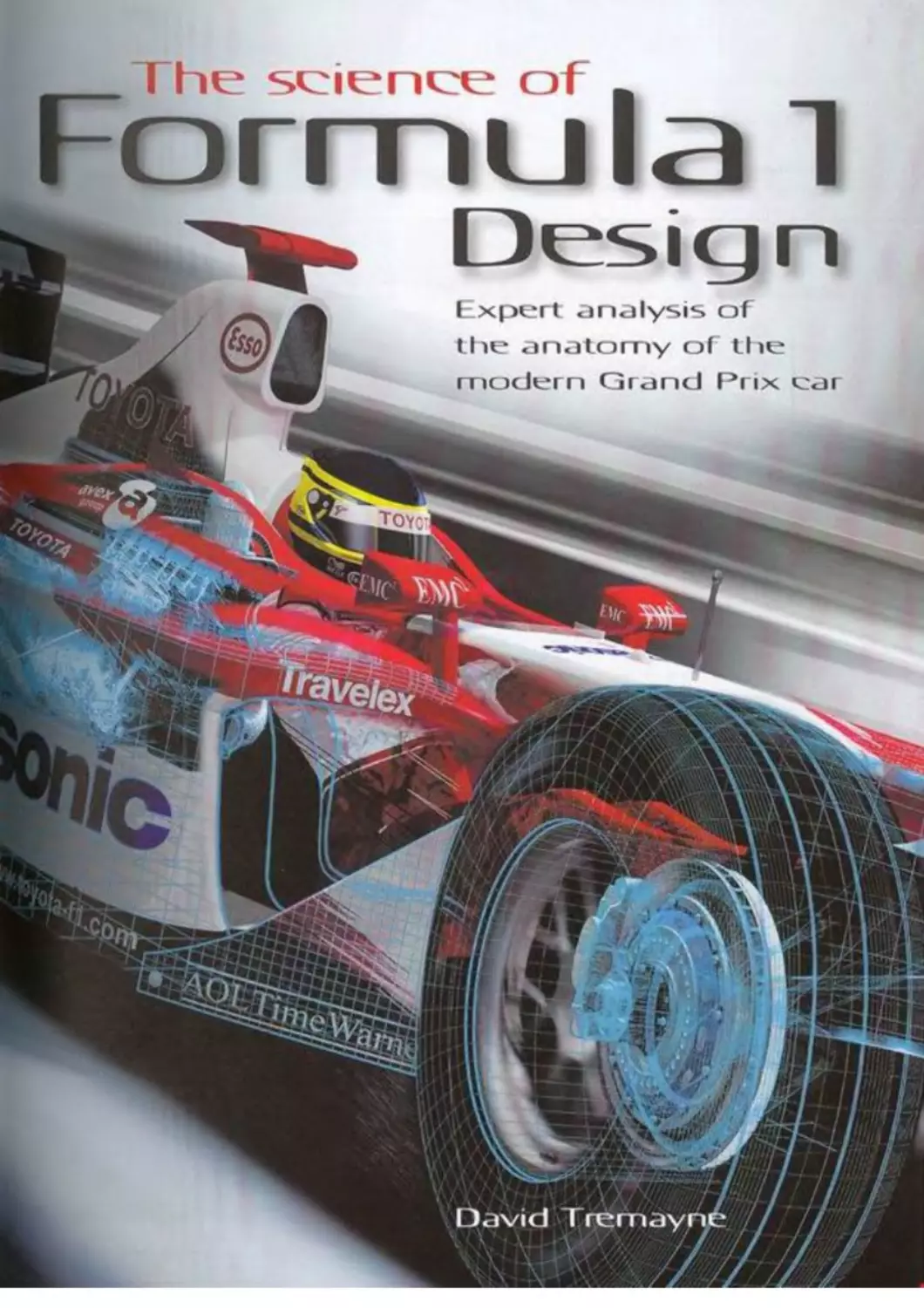
                    Formula 1
k .ш Design

DEDICATION
1b Harvcv Podiritiuviia-, superb engineer and utimimble mem.
missed nwc irr.’A rrrrh passing sea>un.
•) IXvkl Trenuyne 2001
David Trvntaync has asserted hi;- right to be kle'.til.ed a« the author
<>l ! ’I.' work
Ml rghts reserved Ku part ot th s publkatian may he rvpredvcvd,
stnreu :ii > tetr к ‘.ill system nr trnirsmittcil. in any Inrm or by r:y
means. e ectronic. mechanical. pliatucepyi g, record! g ar
о||«ег-л|м, wi'.honl p-tir H'lniMnm n v.ii’.iiy Irnni Ine Mill islk I.
I'trsl p. Nr. ed in hi’у 7(XH
Hqxir.ted 21И/5
A ; r.alogue umiii. hi- '.his lieok is as i.lahlr iitiir tin British I.ibi ry
ISBN I s5!:h--:i G
Li vary of i ongri-ss cat. I >g i arc na 20351 3464
IlayiKa North An eik;. Inc. Mil Lawrence l>rivo. Newbury Рмгк
G lih rna 91320. USA
PiiNbheil by Haynes duWishing. Spurldo-ci, Ycswil. Somerset
ВЛ7? 7H. UK.
Tel: 01963 4-2030 I ax: 31963 44300]
In tel —Я I‘ИЗ 112030 hit .lax- -11 19G3 I llXJO)
I*. in:.il. xilrsl'>'h)yhi-s.is*.uk
WcKhc: www..’.aynes с.» uk
LJcxutiK-c anc. typeset by Glad StvKkcalc
Printcxl and brnxid ir Hr ».ан l v .1 11. I iay-tes & Co. l td. Sparkhird
DEDICATION
1b Harvcv Podiritiuviia-, superb engineer and utimimble mem.
missed nwc irr.’A rrrrh passing sea>un.
•) IXvkl Trenuyne 2001
David Trvntaync has asserted hi;- right to be kle'.til.ed a« the author
<>l ! ’I.' work
Ml rghts reserved Ku part ot th s publkatian may he rvpredvcvd,
stnreu :ii > tetr к ‘.ill system nr trnirsmittcil. in any Inrm or by r:y
means. e ectronic. mechanical. pliatucepyi g, record! g ar
о||«ег-л|м, wi'.honl p-tir H'lniMnm n v.ii’.iiy Irnni Ine Mill islk I.
I'trsl p. Nr. ed in hi’у 7(XH
Hqxir.ted 21И/5
A ; r.alogue umiii. hi- '.his lieok is as i.lahlr iitiir tin British I.ibi ry
ISBN I s5!:h--:i G
Li vary of i ongri-ss cat. I >g i arc na 20351 3464
IlayiKa North An eik;. Inc. Mil Lawrence l>rivo. Newbury Рмгк
G lih rna 91320. USA
PiiNbheil by Haynes duWishing. Spurldo-ci, Ycswil. Somerset
ВЛ7? 7H. UK.
Tel: 01963 4-2030 I ax: 31963 44300]
In tel —Я I‘ИЗ 112030 hit .lax- -11 19G3 I llXJO)
I*. in:.il. xilrsl'>'h)yhi-s.is*.uk
WcKhc: www..’.aynes с.» uk
LJcxutiK-c anc. typeset by Glad StvKkcalc
Printcxl and brnxid ir Hr ».ан l v .1 11. I iay-tes & Co. l td. Sparkhird

ILJ Id 1
Design
[xpert analysis of
the anatomy of the
modern
Grand Prix ear

DEDICATION
l!> Harvey	engineer and admirable uwin,
minted rtiw H’j.'A <•«(•» putting scaarn.
•j Avid Tnwrv 2tMM
David Trviraync has asserted hia right to he ide •lilted ал tlx- author
• >l ! -|л Wolk
All rghts -eserved. Nu part ot th s pihlkadun may he tvprucktced,
Stnied in i tetik •.J system nr tiansirilted. in ar.y liiim 01 hy i-.y
means. c.cctronic. mechanical. p ’otocopyi *g, rccordi-.g or
OllllT-ЛЫ. WI’.llOlll |rnr •rrilllSMCIl II V.riltllj! Irnill t -4111 I'Jk I
First p .Hr. rd in hi’y 7lXl I
Repri ud ZlJI'h
Л ; Г.акч’пе пч1||«. hr this 1н:ок is ;:v idalilr li;«ir ills Hrilish I.1I4 ry
ISBN I J 994 6
Library ot 1. ongress cat. l.ig care no 2IXJ5I3464
Haynes North Aircikv. Inc 861 Lawrence Drive. Newbury Park
Cclil. iT.i i 91330, USA.
Published hy (Laynes I’ublishing. Sparklurc. Yeovil. Somerset
НЛ22 71.1, UK.
Tel: 01963 4-2030 I ax: 01963 440001
(rt tcl -44 1463 447OKI hit.lax- +44 1963 4 ПХМН
H-m;:il: s.Jr*w4i aynrs.ro.nk
Web* iter vvww ’iiynes ca uk
Designee anc. typeset hy Glad SKkkcalc
Pri lled ami Ixr.ind ir Bt ' ah hy .1 Ilf iayttes л Co. l id. Spirklnnl
Contents
Introduction	6
Chapter I	AERODYNAMICS	14
Tunnel vision
Chapter 2	CHASSIS	42
Fine bridgework
Chapter 3	ENGINE	68
Air power
Chapter 4	TRANSMISSION	86
Drive lines
Chapter 5	ELECTRONICS	98
Trace elements
Chapter 6	SUSPENSION AND STEERING	106
Dampened ardour
Chapter? BRAKES	122
Disc jockeys
Chapter 8	TYRES	130
Daylight rubbery
Chapter 9	IMPROVING THE BREED	140
Quality street
Postscript	] 49
Glossary	155
Acknowledgements	158
Index	159
• HE SCIENCE or FORMULA I DESIGN
w
hat is a Formula 1 car? By 21st Century
definition, it might be described as a
combination of the most updated tech-
nologies. A confection of the most state-
of-the-art techniques and research created within a
time',.ile that is inevitably too short, to be ч-nt into
white-hot competition from which there is no respite
during the season’, which is a euphemism for the
vehicle's lifespan. In days gone by teams might roll
a model over into a new season, perhaps even three
or lour. In the distant past the Lotus 49 was
introd iced in 1967 and still won я race in 1970; its
successor, the 72, won in 1970 and was still winning
in 1974. likewise McLaren’s M23 had a successful,
life from 1973 to 1977. However, such is the pace
of technological development these days that it was
unusual lor McLaren’s MP4/17 to win in 2002 Mid
still prove itself capable of doing like wise and chal-
lenging for the world championship in the following
season Today a Formula 1 car’s life is usually no
longer than 17 or 18 races. This is due not just to
the pace of development, but also to the continual
need to repackage a car’s layout to optimise its
performance.
In the past a designer would complete his work
during the winter off-season’, the fruits of his labours
be buik in time for the first European races,
usually around March, and he would not seriously
begin designing a replacement assuming one was
needed - until the following winter.
Not any more. That is too close to standing still. As
Ferrari s technical director Ross Brawn says. If you do
that, you go backwards.’
So now the development of the Formula 1 car is a
continuous process. There are rules from the Feder-
ation Internationale de Г Automobile which not only
govern, very strictly, what is and what isn’t permiss-
ible n design terms, but also what constitutes a new
car. It s fair to say that McLaren’s D specification
development of its MP4. 17 amounted almost to a
new car, but since the chassis was essentially the same
it retained the 17’ nomenclature, to satisfy not just
McLaren'S records but also the FIA's. But you get the
picture, even before tlw design has been signed off
and the team is preparing to build the components
and then assemble them, the design team is already
working on updated ideas to incorporate into the car
before it races.
McLaren s MP4/18 appeared in 2003 hut did not
race due to a number of problems. Il paved the way,
however, for the evolutionary MP4 M which
appeared in December 2003 well in advance of the
March kick-off to the 2004 FIA Formula I World
Championship. McLaren managing director Marlin
Whitmarsh explained why the MP4/18 had failed,
and his remarks were an illuminating insight into just
how Formula I mat uni a evolve in	m era
‘Three-quarters of the way through 2002 we re-
viewed our development programmes, what we per
r eived to be the performance deficit to Ferrari, and
we took the decision at that point that we needed a
big step forward to compete, ho we took a decision to
take quite a lot of risk in the design of ths- engine and
the chassis. Both were completely new. We really
said: ‘arc we on course to overhaul Ferrari", and we
took the view at that time “no", we needed to be
doing more. So inevitably when you are trying to take
a bigger jump, there is inherent risk. We threw every-
thing into it. In my 14. 15 years with the company,
MP4/18 was the biggest in-
cremental change; everything
was changed on that car. We
didn't go into that blindly. In
order to manage the risk we
embarked upon a develop-
ment programme for MP4/17
for the old I’M engine.
The 17D programme was
very substantial, and that of
course meant two parallel
Opposite: Kimi Raikkonen
fought for the 2001 World
Championship in a McLaren
MP4/17D that was created
alongside the all-now
MP4/IS which subsequently
never raced. (Mark
Thompson Getty Images)
programmes. With
hindsight we over-estimated the task. I think every-
one in 2002 thought that Ferrari were uncatchable.
And we actually had a competitive package in 17D, a
car that had been unfit to compete in 2002.
Having set ourselves up as a front-running team
we set ourselves up to be kicked if we don’t achieve
our objectives. And with MP4/18 we set ourselves up
very well. People estimated the figures squandered
on MP4/18, but people misunderstood the process.
The reality is that we have a very substantial
engineering team at McLaren, and at Mercedes-Benz
in Brixworth, and in Stuttgart, and a whole range of
development programmes: suspension, the engine,
the chassis, aerodynamics, and traditionally it is
easier for people to visualise that progression of
technology by vehicle designation. Here is vehicle
one, vehicle two, vehicle 17 or vehicle 18. The reality
is that we never race the same vehicle twice. Every
single race we modify the vehicle and that changes
because it is a relatively immature concept and we
work on the reliability, and we adapt and optimise
that vehicle for each circuit. And then wc arc also
THE S< IEXCE OF FORMI LA 1 DESIGN
7
still developing it The people who are working on,
say. the development of steering systems are con-
tinuously improving them So the engineering team
leaders have to say, as we get an incremental
improvement,  u .  hangt that foi • и next
wail and collect up a series ol modifications and bring
that out as an upgrade package of the steering and
front suspension? Or do we group them altogether
and put it on to thr next car? So 1 7D captured quite
a lot of the aerodynamics and structural thinking of
the 18 early on and moved on, and then the upgrade
packages at Monza at the end of the year were also
pulled off the 18. In a development programme we
embody the positive findings in our car at various
stages. It's not as if we set a team to design the 18,
and if we don't use it we have wasted all that effort.
If it was positive on the 18 an be sure we were
going to exploit it, either early or later on the I 7. Or
it was incorporated into the 19.’
The latter naturally bore very close family resem-
blance to the IS. and because much of the process
had been completed, it was the first 2004 contender
to be unveiled. There were frank exchanges on this
timing between Whitmarsh and technical director
Adrian Newey, because naturally the latter would
always like as long as possible before 'finalising' the
design. Whitmarsh argued that in this particular
instance, given the fate of the MP4/18, it was wiser
to start testing the new car sooner rather than later so
that they could properly understand and hone it, and
that they could still bring further modifications and
updates on stream well before the 2004 season
started in Melbourne the following March. Whit-
marsh admitted in December 2003 that he thought
McLaren had now created a car that would be com-
petitive, but asked: Have we done enough? You never
know. During the season you are able to gauge where
your competitors are. But they are off the radar al the
moment. But we know that we have a stable and
competitive car, with tremendous development
potential. We can say we arc in good shape, we have
all these resources, and we have enough time now'
until the end of February to go through substantial
changes and improvements to the car 1 believe the
Arguably two of the greatest
formula 1 engineers and
strategists of recent history;
Ross Brawn and Adrian
Xeu-ey. (Mark
I Itompsnn, Getty I mages)
8
INTRODUCTION
car is competitive now, and 1 believe we are going to
make it a quicker car before we go to Australia.’
His comment about 'managing the risk’ summar-
ised one hidden aspect of Formub 1 Today, managing
a design project is a major undertaking that requires
the man in charge to juggle a very i omnlex schedule.
It is yet one more factor in which the sport mirrors
the aerospace industry.
Naturally, all of the myriad components must he
conceived and designed (or sourced) at the right time
and must then fit together to create a unique product.
The result must not only be the best-performing car,
hut the most reliable. To achieve this, several groups
must work harmoniously and efficiently:
Research & Development
Aerodynamics
Electronics
Design Office
Structural Analysis
Vehicle Dynamics
Metallurgy
Production Departments
Suppliers
Quality Control
Car Assembly
All of the departments answer ultimately to the
technical director, which gives you some idea why-
such men are the highest paid people in Formula 1
outside the drivers and team principals. They tend to
be very intelligent, very resourceful men, with an
enduring ability to withstand pressure and to manage
and motivate.
Each team, to a greater or lesser extent depending
on their budget, has a strategic planning group whose
task is to manage the activities of all these depart-
ments, keep everyone informed of progress, and
everyone on schedule. This is a group largely unseen
by the outside world, yet whose contribution to a
project's success can be highly significant.
The project management aims to optimise and
focus the resources within the project, locate any
critical areas or problems, and generate solutions It
thus enables the technical director to make the
strategic decisions. The three variables they must all
juggle are:
Tune
Quality
Cost
Time is perhaps t test restraint (certainly for
the big teams), but the proieci must be completed
within the defined targets of quality (performance/
reliability) and within the defined cost (the budget).
Project management first defines the contents of
the ргоцх t. What will the new car incorporate? First,
have there been any significant rule changes? These
inevilaWv have serious knock-on effects because each
area of the car is so highly optimised for a given func-
tion and within a given framework, and impacts on all
the others. As an example, for 2004, teams had to use
only one engine per race weekend, and were limited
to rear wings with only two elements rather than the
multi-elements they had previously been allowed.
I hen there is the question of any new tet hnk al ot
aerodynamic solutions that are to be applied, having
previously been identified by the R&.D department.
Performance enhancements ate usually expressed in
terms of potential lap time improvement
Once brainstorming sessions have been held
between the technical director, the chief designer, the
head of aerodynamics and the design office, R&D,
structural analysis and vehicle dynamics managers,
the strategic planning begins. The group in charge
then defines the project in terms of time, quality and
cost as the project evolves into three distinct sections:
Concept development
Design
Production
Each of these can give different results depending on
the timescales imposed. For example, the longer
concept development goes on the bigger the step
forward that will be achieved in terms ot perform-
ance, but that will leave less time for design and
production (particularly if it affects long lead time
components such as crankshafts or transmissions).
Therefore the quality may also Milter and that ran
impart upon reliability, which in turn might negate
the performance advantage achieved. Strategic
planning must therefore impose that most derided of
Formula 1 words: compromise. In the hyperbole of
the sport people like to think compromise does not
exist, but of course all ot the technical packages on
the grid are defined hy it.
Much of the process of making a Formula I car
occurs concurrently, not in sequence, which of course
saves time. Rut that is why crucial decisions, such as
engine configuration and packaging, need to be
decided early on so that they do not hold up the
THE SCIENCE OF FORMULA DESIGN
9
project later on. That is one reason why a change of
engine manufacturer can often cause technical
departments nightmares. Equally, the basic aero-
dynamic definition is usually arrived at early. though
line-tuning never subsequently stops
Once these areas have been addressed, planning is
defined for the individual components groups:
Engine
Electronics
Chassis
Aerodynamics (nose shape and wings)
Transmission
Systems (fuel, hydraulics, cooling)
Suspension, steering and wheels
Brakes
Driver comfort
In parallel with all this it is also necessary to cater for
the FIA's mandatory and stringent crash tests. If a car
fails to pass these, it will not be homologated by the
FIA to race.
Once the main milestones have been defined, such
as the aerodynamic concept definition and the
general arrangement (the physical layout of the car
and its components), the main aerodynamic defini-
tion dates are set:
Chassis aero definition
Crash structures aero definitions
Suspension aero definition
Wing aero definitions
Bodywork aero definitions
Then the timing for the main components such as
chassis, bodywork, suspension and transmission arc
set The third step is to define the production timing
for all of these components, together with quality
checks and tests. The last part of the planning is
assembly.
Now that a project plan has been defined and the
path to the final product has been mapped our, it is
broken down into the detailed activities that will be
followed and implemented during the execution of
the project. Charts of the project plan allow the team
to follow the critical path and the critical activities
and thus to highlight potential problems before they
arise, and thus to find solutions early on By creating
this plan the engineers can develop the necessary
overview of the entire programme, while also going
into the minutest detail when necessary. Along the
Л1ч>1ч-. The general Inyiml of
Renault's 2004 R24 *Aou-s:
I. lower front suspension
wishbones: 2 and 5,
aerodynamic upper
suspension wishbone: 4.
mandatory truth slru< run-:
5. water radiators: 6. oil
tank: 7, I/O engine: S.
transmission. Note that the
illustration does not include
aerodynamic devices. (I’mla)
Right: Crash testing has
always been stringent since
it was introduced, and gels
tougher each year. It is a
major factor in the
development process (John
TowummkI )
11)
INTRODUCTION
way there will be a design review and progress is
analysed closely. If necessary, changes arc imple-
mented to keep everything on target. The strategic,
planners also keep everyone with an interest updated
at all times, so that everyone is fully aware ol the
status of the undertaking. That not only facilitates
collaboration, hut enhances harmony and generates
team spirit, all vital factors in any race team but even
more critical when a company grows to 400 or 500
employees and thus moves beyond the point where
the team principal or even the technical director can
be said to know everyone personally.
As far as timescale is concerned, the transmission is
defined in May, assessment of the internals allowing
the main casing design to be finalised as soon as poss-
ible. For instance, will the designer want a longitudinal
or transverse gearbox? Will the casing be aluminium,
titanium or composite? The choices affect weight
distribution, general arrangement and structure, since
the casing is part of the FIA rear-end crash test. It also
has a very significant influence on the all-important
design of the rear-end aerodynamics. The other main
aerodynamic definitions are made in July and August,
as the current car is still being developed. The design
process begins.
The suspension is aerodynamically defined by
September, and. during October and November the
final systems definitions are made. Crash testing can
begin as early as August, but usually doesn't end until
February. McLaren achieved a company first by
getting all of the MP4/19's crash testing out of the
way before the car first ran in December 2003, but
that is unusual.
While all of this is going on the engine department
has already been hard at work for many months on the
next evolution power unit that will go into the new
car. Generally, developing a car takes nine months, but
developing an all-new engine takes around twice that
and manufacturers often run two separate design
teams, one leapfrogging the other.
Electronics and systems design goes on at the same
time as the aforementioned processes, while chassis
manufacture may start as early as September. Produc-
tion of other components also begins at the same time
and continues through at least until March. This is a
lengthy process, of course, because the top teams will
not only produce up to ten chassis a season but also
need all of the associated spares to service them. The
manufacturing departments for suspension and wings
arc always particularly busy, since these are the most
easily damaged parts once the testing and racing gets
under way.
By January all of the components have been
delivered, and go through quality control before final
assembly begins. The car is then checked over
minutely, not least to make sure that it complies with
THE SCIENCE or FORMULA 1 DESIGN
11
the FlA's critical rules governing its dimensions. The
final stage is the first tire up, and then the rollout.
The first car is usually launched to the world in
January or early February'. In the economic climate of
the early 21st Century, few teams opted for bells and
whistles style launches seen in the mid 90s and
preferred instead to unveil their car to the media as
part of a test session at a circuit. By this time the
strategic planners have already turned their attention
to the next season’s new project.
Just to complicate all this, teams do not always
decide to debut a new car at the beginning of the new
season. McLaren planned to run its MP4/18 in May
in 2003. In 2002 and 2003, Ferrari opted to run its
previous year’s cars for the first few races, and to
bring their new challenger on stream once the
European leg of the championship got under way in
April. This is Ferrari's case study:
The team made an analysis of the positive and
negative aspects of introducing its new car later
rather than sooner. On the positive side, rules
stability would allow it to run the previous year’s
car without having to make major modifications.
Since the car was strongly competitive at the end
of the previous season, and had been developed
further over the winter, it should maintain its
advantages over newer hut less well sorted com-
petitors. The older car was also highly reliable,
whereas the new car, which was ready for testing,
had not yet quite been ‘bullet-proofed’. Further-
more, the newer car would have been at an early
stage of its development, and the engineers and
drivers would thus Ire less familiar with its inner
workings than they were with the older car, which
might compromise setting it up. Finally, there
would be more time in which to develop the new
Below: Early testing of the
2003 Ferrari F2003-GA
indicated the need for
further development.
The team responded ably to
the. challenge, and the car
uvnt on to win both the
drivers' and constructors'
titles. (Clive Mason/Getty
Images)
Right: Testing is often
referred to as the ‘Winter
World Championship'. but it
is only the 'summer' series
that counts. Here in
Malaysia 2004, Jaguar
proved its new R5 was
almost a match in qualifying
for Ferrari’s F2004. (Paul
Gilham/Gctty Images)
12
INTRODUCTION
car, so that it could be debuted when testing had
shown it to have reached its targeted levels of
performance and reliability.
As far as negatives were concerned, the older
car would face stronger competitors with newer
cars which had taken bigger steps forward in terms
of performance, (though they might on the
plus side not be as reliable). The team would have
to double its commitment in order to work on
two separate types of car, which would be poten-
tially decisive and onerous. It would also impact
strongly on the budget, especially early in the
season. There was also an associated risk of mis-
takes in doubling up, to both the internal groups
and to suppliers.
The data supplied by the strategic planning
department at Ferrari, such as activities charts,
time, resources and expenditure, provided the
technical department with the necessary input to
make its decision. In 2002 the plan worked
superbly, with the F2001 holding the fort until the
F2002 proceeded to wipe the floor with its
opposition. A bad start to 2003 with the F2002
almost jeopardised things, but as President Luca di
Montezemolo summarised; We made a terrible
start to the season through mistakes, we had a good
second quarter winning in Imola, Austria and
Canada, then a month of panic in August before we.
got back on the road in the final quarter and won a
record sixth drivers' title for Michael
fSchumacher] and a record fifth consecutive
constructors' championship.’
The foregoing perhaps gives an indication of just why
Formula 1 is such a pressure cooker, and why
individuals and organisations can only stand the heat
for so long. It also places into sharper perspective
those who can keep it up year after year, why Ferrari
has done such an incredible job since the late '90s,
and why Williams and McLaren are to be applauded
for their utter refusal to concede defeat and their
relentless determination to win, in spite of the
continuing dominance of their Maranello rivals.
'll nothing else,' says Ross Brawn, 'all of this is
the answer to those people who inevitably come
sidling up to you when a season is over co ask the
question: 'What on earth do you do when you aren’t
racing!'"
tilt SCIENCE OF FORMULA 1 DESIGN
13
□Aerodynamics
Tunnel vision
Пп the world of Formula 1, the aero-
dynamicist is king. And the man who can
figure out how his team can generate
more downforce for less drag than any of
his rivals, is going to be worth in real terms more than
the $30m plus that Ferrari pays Michael Schumacher.
Those are the simple facts of Formula I design.
Once, aerodynamics was a black art. Teams made
pencil-slim little cars and trimmed them at times
with the odd tab here or there to negate lift. It wasn't
until 1968 that Formula 1 designers really cottoned
on - the way that sportscar design ace Jim I fall had -
that using inverted wings to generate downforce was
what real speed was all about. The first wings were
precariously mounted on stilts, which in turn were
mounted directly on the car's suspension uprights.
Soon these proved so ludicrously fragile that they
were banned in favour of bodywork-mounted wings
which were part of the car’s sprung mass. Never-
theless, they continued to push the tyres into contact
with the road, and therefore to develop downforce
which made the car corner faster.
So how does a wing work? On an aeroplane it
works thus: a wing uses an aerofoil, teardrop shape.
As air flows over the upper and lower sides, the air on
the bottom has less distance to go because the lower
surface of the wing is flat. Meanwhile, air flowing
ever the curved top side has a further distance to
travel. This is where the theory expressed long ago by
scientist Daniel Bernoulli comes into effect. (This
18th century Swiss mathematician and physicist’s
principle applied at that time, of course, to fluids
rather than air flow'.] This suggested that when air’s
flow is restricted the air will speed up and its
pressure will drop. The air flowing on the underside
of the aeroplane wing is flowing at its normal rate;
the air clamouring to get over the curved upper side
is speeding up, and its pressure is thus falling. This
means that there is more pressure acting on the
underside and less on the upper side, so the wing
lifts. That, in a nutshell, is the theory of flight.
Now, apply the wing to a racing car, and what
happens? For a start, the wing is inverted. Now the
straighter side is the upper, and the curved arc is to
the bottom of the wing. Thus the low1 pressure area
occurs below the wing, and the greater pressure is
being exerted downwards. In the early days this was
described in aeroplane parlance as negative lift; today
it is simply known as downforce, and it is the single
most important factor in Formula I design.
An additional complication arose in the 70s when
Lotus chief Colin Chapman and his designers, Peter
Wright, Tony Rudd and Ralph Bellamy all worked
towards harnessing the air flowing beneath the car,
again using principles figured out on the remarkable
Chaparral 2J CanAm car by American Jim Hall.
Again, Bernoulli's venturi theory applies. This time
the air is being restricted as it passes through a
venturi created by the ground and the underside of
the car. As it is restricted, the air's flow speeds up
and the w hole underside of the car becomes a low-
pressure area and the vehicle is sucked down to the
track. Ground effect had arrived.
Today Formula 1 cars must use flat-bottomed
chassis (as they have had to since 1983), but they
have a diffuser at the rear which curves upwards and
helps to generate a degree of ground effect. The
downforce created here is complemented by that
from the wings and carefully
shaped bodywork.
Overall, the aerodynamicist
is looking for a stable car with
a good ratio of lift over drag, in
other words one which has
plenty of downforce and not
much drag. He also wants one
on which the sensitivity to
pitch, the up and down move-
ment, is minimal. This is the
key to good handling. On a car
that has low pitch sensitivity the aerodynamic
balance doesn't shift around as the car pitches up and
down over bumps, or tends to shift its centre of
gravity under acceleration or deceleration. Pitch
sensitivity tends to be more influential on a car's
overall behaviour than either yaw or roll stability.
The modern Formula I car is highly sophisticated
aerodynamically, and can generate close to 2,000kg of
downforce at speeds of 300kph. If you put it on a
suitably^ curved piece of road it could, in theory,
generate enough grip to stick itself to the ceiling
should it be suddenly inverted...
When a designer begins to create a new car, he
first defines the aerodynamic, performance profile
that he is seeking. In order to do this, models must
be tested so that different shapes and configura-
tions can be assessed. The designer uses two main
tools here: the wind tunnel, and a computer
modelling technique known as computational fluid
dynamics, or cfd.
The wind tunnel is the primary tool, and all of the
top teams have significantly increased their invest-
Opposite: The scale models
are held in place hy an
overhead 'sting', through
which all the fences acting on
the model are measured. The
wheels are not actually
attached to the car but are
free to spin on stalks
mounted to the sides of the
tunnel. (IPA)
THE SCIENCE Of FORMULA I DESIGN
15
ments in this field. In 2003, for example, WilliamsFl
was already investing in a second tunnel to come on
stream in 2004. I lowever, the latest facility to win
the state-of-the-art tag is Peter Sauber's at Hinwil.
The quiet Swiss team owner grasped a $50 million
nettle in 2000, and the new tunnel became oper-
ational at the end of 2003. Given the importance of
aerodynamics, it was a logical decision for me to build
a wind tunnel that sets new benchmarks,’ Sauber
explained. 'The interesting thing is that had we
invested less in the wind tunnel, the risk would have
been higher. At an early stage the tunnel was planned
to be smaller, but then the consideration was that you
don't know what is going to happen to Formula 1, so
we wanted to have a working tool that you can also
use outside of Formula 1. It was important to look as
far into the future as possible.
The tunnel is so modem that it has attracted the
attention of Sauber's operating partner, Ferrari. The
Left and Mow: Stilt-
mounted wings first
appeared tn Formula I in
1968. First they were fitted al
the rear only, but by Moura
(above on Jack Brabham’s
eponymous BT26) they were
fitted at the front, too.
Drivers hated them, and
after two serious accidents
on the Gold Leaf Lotus 49Bs
in the 1969 Spanish GP
(Graham Hill's car is seen
here in South Africa), they
were banned overnight at
Monaco. (Suttotl)
16
AERODYNAMICS
BefcwrA representation of the
flow of ait, including the
boundary layer, over it twin
element rear wing. (Piola)
Below After several seasons
in u'ltic/t body-mounted
wings provided all of a car's
downforce. lotus chief Colin
Chapman experimented
with under-car ground
effect in 1977. 4 year later
his elegant Lotus 79 (seen
here at Zandvoorl with
world champion-elect Mario
Andretti leading Ronnie
Peterson) dominated
the sport. Ground effect
is still a major contributor
to downforce today.
(Sutton)
TUI SCIENCE OF FORMULA 1 DESIGN
17
The better-financed teams
have their own tunnels. Tn
2004 arguably the most
advanced was Sauber's in
Hinu’if built at a cost of
more than 50 million dollars.
Here team principal Peter
Sauber and technical director
Willy Rampf pose with their
new bain'. (Sinton)
basic facility comprises two buildings under one roof ,
with the accent on aesthetics and functionality.
Normally tunnels are located at ground level, but part
of the reason why architect Atelier WW in Zurich
won the contract was its design for a structure that
is eight metres from the ground, enabling visitors
to walk beneath it even while it is operational. Every-
thing is visible except the data acquisition section,
which, is embedded in a concrete construction. The
overall building is 65m long, 50m wide and 17m high,
with a volume of 63,000 cubic metres. Its glass
facade manages to combine its industrial purpose
with its joint function as a museum. The two separate
sections are separated by a glass wall which also
damps out noise. There is also a facility to enable
Sauber teams to work on different projects for
different customers with complete secrecy and
confidentiality.
The tunnel uses the most advanced technology
Sauber could source and was developed in conjunc-
tion with specialist firms Turbo Lufttechnik GmbH
(TLT) and MTS Systems Corporation, in Germany
and the United States respectively, and Sauber’s
aerodynamic engineers.
MTS supplied the Flat-Trac' rolling road system,
which simulates the relative motion between car and
road and comprises a steel belt, which was chosen in
preference to the more common polyester belts.
The steel belt is the largest ever developed for a
wind tunnel. It is less than a millimetre thick and
runs on an air bearing, ft runs faster and with less
distortion than a conventional polyester belt, and
because it generates less friction, it not only lasts
longer but is also more accurate because there is
less surface heat. MTS also supplied the Model
Motion System’ which handles suspension and
control of the test model. Data acquisition is by UK-
based RHS Harntec.
In common with other formula 1 tunnels,
Sauber's is of closed-circuit design. Its tubular steel
ait circuit is 62m long and 28m wide, with a
maximum diameter of 9.4m. Dirk de Beer, the head
of Sauber’s aerodynamic group, is particularly
pleased with the corners that turn the air through
90“ and link each section of the tunnel. He says: ‘A
circular tunnel would be ideal, but if you tried to
build one it just wouldn’t work, and there would be
an enormous space requirement. As it is, these
corners are very efficient.’
Power comes from a single-stage axial fan with
carbon rotor blades, which supplies the system’s
3,000kW demand when operating under full load. At
maximum output, it can generate wind speeds of up
to 80 metres per second (which de Beer claims is
18
AERODYNAMICS
Wind tunnels are absolutely
de rigueur in Formula 1
today. Scale models are
placed on a moving ground
plane so airflow can be
simulated as accurately as
possible. Sauber's tunnel,
which can accept full-scale
cars, uses a very sophisti-
cated steel band for its
rolling road for maximum
accuracy. (Sutton and I PA)
taster than Ferrari’s tunnel) or close to 300kph within
the test section. This is very close to the airspeed over
a full-scale car in action on the track, again enhancing
data accuracy.
The test section is the heart of any tunnel, and at
15 square metres Sauber’s is unusually large and has
a longer rolling section than any other Formula I
facility. There is a strong correlation between the size
of the moving ground plane and the degree of realism
of the test results. Though Sauber will continue' to
test primarily with 60% scale models, the tunnel can
accept full-scale cars. Because of its unusual length it
can also accommodate two of them, in tandem, so
that the aerodynamicists con explore the interaction
of cars running close together at very high speeds.
This could prove particularly useful in the design of
front wings and diffusers.
‘Due to their highly efficient aerodynamics,
modem Formula 1 cars are particularly vulnerable to
changes in air flow,' explains technical director Willy
Rampf. For the first time this test configuration now
enables us systematically to measure these influences
and to take appropriate corrective action. Moreover,
given the additional possibility of testing full-size
Formula 1 racing cars, we can measure precisely such
factors as the cooling, or the airflow around the
driver’s helmet.*
When very large objects, such as full-scale vans are
under test, the test section can be converted from
closed-wall configuration into a slotted-wall configur-
ation to avoid blockage of the airflow which would
distort test results.
Another innovation is the facility to rotate the test
section turntable. Formula 1 cars don’t usually get
more than 5° out of line before they use up their
THE SCIENCE OF FORMULA I DESIGN
19
Left and middle: Sauber's
tunnel can accommodate a
full-size car, a key factor in
the team's ability to fine-tune
its aerodynamics. (IPA)
Resides the ability to skew the
rolling road turntable to a
yaw angle of up to 1 O’,
Sauber’s tunnel also allows
scale models to be tested in
tandem. Ultimately this could
be of significant assistance in
facilitating the design of a car
that can run in a rival's
turbulent air without losing
its own downforce. (IPA)
Cximpulatiimal fluid
dynamics is a vital pari of
aerodynamic research today.
This screen image shows the
high-pressure (red) and
lower-pressure (blue and
green) areas as air flows over
a typical Formula I car.
(Sutton)
Steering lock and spin, but the turncable allows cars to
be tested at a yaw angle of up to 10°.
The upper floor of the wind tunnel control room
houses the entire computer system, which includes
the high-performance computer for Sauber s cfd
department. The ability to test scale models and full-
scale cars allows Sauber to cross-check data, and cfd
provides a third avenue of research to cross-check
further. But at present cfd still has some way to go in
Formula 1 before it will match the wind tunnel as a
research tool.
At the moment we are increasing our cfd effort
quite considerably,' says de Beer. ‘It's probably 15
to 20% of our personnel that are involved with cfd,
and it's something we are putting more and more
effort into. It's an area where you can get very
significant gains. But it is still one in which everybody
in Formula 1 is finding out exactly what you can do.
The resources that you need to do cfd effectively are
quite huge. You need very large computers, ob-
viously, to run accurate simulations. We are certainly
putting a lot of effort into it, but it's not a short-term
thing. 1 think essentially the view of the team is that
we intend to be in Formula 1 for a long time and are
investing a lot of resources in stuff like building this
facility and increasing otir capacity with cfd, all with
the aim of being there for the long run.
R.impf and his team have very high hopes for the
new facility. We re expecting the new wind tunnel
to enhance the quality of our tests, improve the
correlation between our wind tunnel measurements
and the results obtained on the race track, as well as
improve repeatability of the various tests we per-
form,’ he says. 'All of these factors combined wall
enable us to build an even faster car.'
Sauber accepted the huge investment with equan-
imity, and said: If you want to survive in Formula 1
and be successful and particularly if you want to be
attractive to a potential manufacturer, then you have
to have these things. It is an investment in our future
that was not undertaken with cost-saving as its
primary goal. With the new facility we will have a
great deal more confidence that what works for us
during tests in the wind tunnel will also work for us
on the race track.'
The aerodynamics of the car dictate its shape, and
also the type of engine that will be used. All Formula
1 engines are VI Os, but the angle of the vee may be
altered if the aerodynamicist seeks a particularly
narrow rear-end package. That’s one reason why the
traditional 90’ angle gradually decreased as low as 72“
in some instances. The fact that aerodynamics can
have such influence gives you a clear idea of just how
much importance is attached to this area of design. In
the past a team would get its engine, make a chassis
into which to fit it, and then worry about the body-
work last of all. Now the process works the other way
round. The aerodynamicists come up with the outer
shape of the package that will make the fastest and
most ef ficient car, and the other engineering depart-
THE SCIENCE OF FORMULA I DESIGN
21
ments have then to make their components fit into
that profile.
Several dimensions on the chassis are fixed by
the FIA, but beyond that the aerodynamics dictate
the chassis design. Usually it is a matter of the
slimmer the better, but aerodynamics can even influ-
ence whether the car has a short or a long wheelbase.
The aerodynamics can be modified during testing
and races, as the wings are adjustable. The front wing
generates around 25% of a car's downforce, but only
when the car is running in clean air. When it is behind
another car, the latter's turbulence robs the following
car’s wing of downforce and the figure falls closer to
10%. Telemetry shows a clear trace whenever a car
gets within a couple of hundred metres of another.
Since a Formula 1 car's centre of gravity is towards
the rear, and the front wing has to exert sufficient
downforce to offset that, when this happens the
car tends to understeer. This is why you often see
one driver catch another quite quickly, only to
become stuck behind him. The resultant under-
steer hurts him when he tries to get out of a corner
fast enough to make an over-
taking attempt.
Movable wings could over-
come this problem, but they
have been banned since the
late ‘60s. Thus the designers
have to compromise in their
choice of wing settings, and
the drivers just have to live
with loss of downforce when
they run close together.
Generally speaking, the wing
settings are steeper for tight
circuits with many corners,
where high downforce is
required, such as Monte
Carlo and Hungaroring; at
places such as Barcelona or
Monza, shallow wing settings
are used to minimise drag
and maximise straight-line
speed. ‘The correct wing set-
up is always a circuit-specific compromise,’ says
BMW Williams chief designer Gavin Fisher. If they
are set too steeply, our top speed on the straights wall
be lower. If they’re too flat, we end up with less
downforce, something we need in the comers’.
The aerodynamic components exert the following
influences:
Front wing
The front wing plays an important role. At maximum
speed over 300kph, for example, it will generate
around 560kg of downforce. That means that eight
full-grown men could step on it without causing any
visible deflection. The front wing is mounted
beneath the nose on two vertical stalks, and probably
accounts for 25% of overall downforce. This is an
area of great experimentation, the latest tweak’ in
2003 being the distinctive rippled w-shaped wing do
the McLaren MP4/18 which was carried over to the
2004 MP4/19.
Crinkly wings were all the
rage in 200i. This is the
offering from Wiliams on its
FW25. Note also the endplate
detail and deep second
element. [Pinta]
Though never raced in 2i№i,
McLaren's Ml’4-18 paved the
way for the evolutionary
MP4 19 in 2004. The latter
retained this very complex
front wing. (Piola)
H
w
(1
22
AERODYNAMICS
Tl
a variety of front wing and
Ry contrast. Ferrari's front
1ии£ teas almost conventional.
(PiolaJ
endplate refinements. I is the
endplate width, 2 the end-
plate winglet tip. 5 the front
wing understrake, and 4 the
second element tiplet. (Piola)
THE SCIENCE OF FORMULA 1 DESIGN
23
Front wing endplates
The front wing endplates are the vertical ‘fences’
that primarily stop air spilling over the side of the
wing, as that would compromise its efficiency. They
help to draw air over the front wing to maximise its
effectiveness, but they also play a significant role in
smoothing the air How towards the back of the
car. They arc thus instrumental in sending the best
possible airflow back towards the undertray and then
to the diffuser to make both of those components
work to their optimum. The aerodynamicists are
always aiming to get the maximum out of every
component. Interestingly, adding frontal downforce
levies a minimal drag penalty; it is the rear end of the
car that can do that, so the aerodynamicists do what-
ever they can to make the rear work better. When
you achieve that you can run with less rear wing,
which means less drag and a more efficient car.
The endplates arc one area in which the sport’s
rule makers arc continually imposing restrictions, in
an effort to curb rising cornering speeds.
Above: Endplates serve two
purposes. On their inner side
they prevent airflow spilling
off the front wing, while their
outer side is shaped to
channel air around the front
tyres. (Piola)
24
AERODYNAMICS
;•
THE SCIENCE DE FORMULA 1 DESIGN
Kenault also had some
complex endplate shapes in
200S (above), as did Ferrari
in 2004 (below). (Piola)
26
AERODYNAMICS
Nose
High noses were almost universal by the late '90s,
having been introduced by Tyrrell's Dr Harvey
Postlethwaite and Jean-Claude Migeot in 1990, but
now they are tending to droop a little more once
again even though wings remain underslung. This
design concept helps to channel air round the front
wing and direct it efficiently back towards the under-
tray and diffuser. Again, McLaren introduced some
subtle changes on the 2003 MP4/18 by using a very
narrow-, drooping nose.
In 2004 Antonia Terzi and her team cl aero-
dynamic.ists at Williams stunned the Fl world when
the new FW26 was revealed. Gone was the elegant
conventional nose of the FW25 and in its place was a
stubby nose which stopped early and was then ex-
tended to hold the front wing in place by two walrus
tusk-shaped strakes. It gave the car a peculiar and dis-
tinctive appearance, and needless to say several other
designers claimed to have tried and discarded the
concept in the wind tunnel. Be that as it may, Williams
was adamant that the shape enhanced airflow and
efficiency and, of course, all important downforce.
The distinctive nose of the
200-4 ИШйши FM26 broke
new ground in the search for
greater aerodynamic
efficients, but so far nobody
else has followed suit. (Piola)
THE SCIENCE OF FORMULA I DESIGN
27
Suspension
Until 2001, the suspension's contribution to aero
dynamic efficiency was confined to using aerofoil-
section wishbones and steering arms to help
minimise drag. That season, however, Argentinian
designer Sergio Rinland introduced the first true
twin-keeled chassis on his Sauber C20. Normally
the lower suspension arms would pick up at a point
in the middle of the underside of the chassis.
Reasoning that this created a blockage to smooth air
flow, however, Rinland moved the lower front
suspension mountings further outwards, creating
two distinctive pick-up points, or keels. The large
gap between them permitted a much smoother flow
of air, and was deemed to be one reason why that
year’s Sauber Petronas was such an excellent car.
The jury' is still out on the concept, however.
McLaren embraced it and took it a step further on
its extremely elegant but expensive-to-make
MP4/17 chassis, as did Williams on its FW26, but so
far Ferrari has not followed suit.
28
AERODYNAMICS
Barge boards/guide
vanes
The vertical plates mounted within the front suspen-
sion or just behind it, and which are often referred
to as turning vanes or barge boards, arc similar in
function to the front wing endplates and first
appeared when the latter were reduced in size in
1994. They may be horizontal or, more usually,
vertical, and their job is to influence the wake of the
air flowing over the front wing and to tidy it up
before it gets to the back of the car. As an indication
of their importance, the barge boards on Ferrari s
1997 F31OB, with their distinctive curved top lip,
were instrumental in cutting down the serious
understeer which plagued the car's handling during
its initial test sessions. When Michael Schumacher
damaged those on his Ferrari F2002 after an off-
course moment in the 2003 Australian Grand Prix,
he lost the race. At the same time, the argument
within Williams over whether to have barge boards
behind the suspension or guide vanes within it
materially influenced the FW25’s concept, and it was
some time before the team got on top of setting the
car up as a result.
2004 .s b'20t)4 had a slightly
more distinctive shape to its
barge boards. (PiokiJ
THE SCIENCE OF FORMULA I DESIGN
29
30
AERODYNAMICS
I HE SCIENCE OF FORMULA 1 DESIGN
31
Sidepods
The sidepods alongside the cockpit are not merely
there as a cosmetic means of housing the water and
oil radiators. Their internal shaping is crucial to the
way in which the car's cooling system operates, and
they also play a safety role by providing deformable
structures on the sides of the car.
In the mid-Nineties sidepods tended to be quite
high and boxy, but in recent years they have become
very much more curvaceous and intricate as designers
seek to create the most efficient airflow over and
around the rear end of the cars. Rory- Byrne at Ferrari
was the first to take this route, and others have
followed his lead as they seek to emulate Ferrari’s
runaway success.
I eft: Ferrari tends to go for
more curvaceous sidepods
than its rivals. Those of the
F2OO3-GA are also tapered
at their leading edge. (Piola)
Kight: On circuits where
ambient and track
temperatures are very high,
teams will often run
chimneys on the sidepods to
help extract hot air from the
radiators as quickly as
possible. This is what
Kenault used in 2003. (Piola)
32
AERODYNAMICS
1
Jo facilitate lower sidepods on its 2004 K24. Renault used
these cunningly shafted radiators. 1 and 2 indicate
different types of chimney hot air extractors. 3 and 4
differing cooling louvres. (Piola)
THE SCIENCE OF FORMULA I DESIGN
33
Undertray
The floor of the air, or the undertray, is an extremely
important component. There is, of course, a separate
floor to the chassis itself, and the undertray is a full-
length carbon-fibre moulding that presents a smooth
and flat bottom to the road, and influences under-car
air flow into the kinked area ahead of and between
the rear wheels. It thus plays a crucial role even
before its trailing end flicks up to form the diffuser
that creates so much ground effect downforce at the
rear of the car. A Jabroc wooden plank fixed to the
bottom of the undertray is checked for wear during
scrutineering at the end of each race.
Left: The flaw of air beneath
a Formula 1 car is nicely
illustrated in this artwork of
a FerrariF399. (Piola)
Relow: The underbody, also
called the underfloor or
undertray, generates a
considerable degree of
downforce. The one-piece
moulding can be removed
quickly in the
event of damage after run-
ning over a kerb. In the
centre of the underside of the
undertray, all cars must
34
AERODYNAMICS
Safety Cockpits
The need to provide a high-sided safety cockpit
around the driver's head and neck initially caused
problems with aerodynamic efficiency when the FLA
made them mandatory for the 1996 season, as their
bulky shapes increased drag. Notv, however, all of the
teams have found graceful and efficient ways in
which to incorporate them, although they do still
hurt rear downforce a little as the air flow around
them is not quite as good as it was before they were
introduced.
hi comparison until Rubens
Barrichello in the 20(14
Ferrari F2V04 (bottom),
Gerhard Berger has
markedly less head
protection in the J 995 4121'1
(top). (Mike Heuntt/Paul
GiUurm/Getty Images)
THF SCIENCE OT FORMULA 1 DESIGN
35
Airboxes
The airbox collects cold air and feeds it into the
engine. The faster the car goes, the greater the so
called ram effect as the air is forced into the intake.
Its design is therefore a crucial element which affects
both aerodynamic efficiency and engine performance.
New for 2004 BAR'S 006
were revised airbox (I),
extractors (2), rear wheel
scallops (3) and notched rear
wing endplates (4). (Piola]
Winglets
These are mounted towards the rear of the sidepods,
in an area of the strict regulations that is still open to
such devices, and they are employed on circuits such
as Monte Carlo or the Hungaroring where higher
downforce is required.
Below: tor extra downforce
on certain tracks teams use
small winglets and scallops
ahead of the rear wheels.
(Author)
36
А Г. R О DY N A MILS
Rear wheel scallops
These are the shaped sections ahead of the rear tyres,
where the coke bottle effect begins as the bodywork
sweeps in. Their purpose is to help clean up the air
flow and influence it around the rear tyre so as to
maximise the efficiency of the diffuser.
Relow. left: Williams adopted
a series of rear wheel
scallops on the 2004 TW26.
The lower scallop was added
to increase the speed of the
air ahead of the rear tyres.
(Piola)
lielow: Renault's R24 makes
full use of its low sidepods
and sweeping scallops to
clean up the airflow around
the rear tyres. (Mark
Thompson/Getty Images)
THE SCIENCE OF FORMULA I DESIGN
37
Diffuser
This is the up-curved section of lhe undertray tray
that allows the restricted air beneath the car to open
and spill out at the rear of the car. The regulations do
not permit the diffusers extending beyond the rear
axle line, as it used to in the early ‘90s, but it still
accounts for almost 50% of the car's total down force
and is a key element as it affects the whole pressure
distribution beneath the car.
Above: The diffuser
of the modern Formula I
car is nowhere near as hig
as It was prior to Ayrton
Senna's death in 1994, but
lhe detail is still intricate.
(Author)
Right: Nuances highlighted
here include slight degree of
anhedrai to outer section of
diffuser, together with
strokes designed to direct
airflow. (Piola)
38
AERODYNAMICS
Rear wing
Prior to 2004 the rear wing generated some 33% of a
Formula 1 car's downforce. This could be as much as
1,000kg, meaning that a car could carry another 16
unwanted passengers there too, assuming they could
all fit on... However, for 2004 the FIA banned multi-
element rear wings and instead mandated only two-
clement wings. This means a main plane, with a
smaller plane to help generate more downforce
without the drag penalty a larger single main plane
might create.
Right: The multi-plane rear
Wing of the Williams f'W24.
(Author)
Below; McLaren introduced
an unusual droop shape to
its rear wing in Austria 2003;
inset is detail of the front
uing endplate. (Piula)
THE SCIENCE OF FORMULA 1 DESIGN
39
Above: Renault mi.i another
team to interpret the droopy
rear wing element philosophy
in 2001. (Piola)
Right: To help airflow. Toyota
began 2004 with these
internal strokes on its rear
wing endplates. (Piola)
40
AERODYNAMICS
Gurney flaps
The Gurney flap is a small and very simple device
that can have a major effect. Named after legendary
American Formula 1 pilot Dan Gurney, after he and
driver Bobby Unser developed it for the Gurney
Eagles that raced at Indianapolis in the '70s, it
comprises a simple strip of metal with a 90° angle.
This is fitted to the trailing edge of a wing, front or
rear, and forms an extra 'flick-up’ which can generate
significant extra downforce on circuits where plenty
is required.
Kiglu: This arrangement of
iring elements shows high
anil low pressure areas, and
the Gurney flap, which is the
lip on the trailing edge of the
second element. (Piola)
BeJowT Ои a circuit where
wry high downforce is
necessary, such as Monaco,
teams exploit any loophole
" Low pressure
they can find In lhe
Wheels
regulations to run middle
wings. These are on lhe
Williams. (Piola)
The wheels on a Formula 1 car have always created a
drag problem, accounting for more than a third of the
car’s total. There is, though, nothing anyone can do
about that as enclosed bodywork is not permitted in
Formula 1.
THE SCIENCE OF FORMULA 1 DESIGN
41

Chassis
Fine bridgework
42
CHASSIS
nf the engine is the heart of a car, the
chassis is the body. Traditionally it is the
part that gives the car its name. In the case
of Eddie Jordan’s cars, for example, which
in their time have used Ford, Hart, Peugeot, Mugen-
Honda and Honda engines, the car is called a Jordan
because Jordan Grand Prix designs and manufactures
the chassis.
The modern chassis is of unitary or monocoque
construction, which means that it is effectively built in
one piece, though in reality it is many pieces bonded
together to form that single entity. Its primary pur-
pose is to act as a bridge that connects all of the car’s
other components. It provides the mounting points
for the engine and transmission, the suspension and
steering, and all of the aerodynamic components. Its
other great function is to house and protect the driver,
which is why it is also known as a survival cell.
If the chassis is to perform these functions it must
be extremely strong and robust, with very high
torsional rigidity. If it isn’t, all of the loads that the
suspension feeds into it will not be relayed faithfully
to the driver, and in turn he will be unable to relay
them to the team. There are few things worse than a
flexing chassis for misleading engineers into chasing
other reasons for a car being off the pace.
The development of the carbon-fibre composite
monocoque chassis in 1980/81, by John Barnard and
his team at McLaren, and Colin Chapman at Lotus,
revolutionised chassis manufacture. Composites took
chassis strength another giant leap forward from the
strong honeycomb aluminium structures that had
superseded Chapman’s original sheet aluminium
‘tub’, which had itself supplanted the welded tube
spaceframe when it first appeared in 1962. But there
was another valuable advantage; composites elimin-
ated the need for complex internal strengthening box
structures, and this facilitated narrower monocoques.
This proved very timely as aerodynamic consider-
ations required new shapes and the modular con-
struction that composites permitted. Now, instead of
designing cars from the inside out, designers started
to design from the outside in. A team’s aero-
dynamicists could outline the optimum shape they
required, and it was then up to the chassis and engine
designers to package all the necessary equipment
within the smooth outer shell.
One of the other most significant influences is the
size of the fuel tank. In 2003 the regulations were
changed at very late notice to incorporate single-lap
qualifying and the rule that forced teams to start the
race on the fuel load with which they had qualified.
The change came too late for cars to be re-optimised,
so all of the teams went into 2004 with new cars.
‘Obviously that was one of the first things we
reviewed on the F2004,’ Ferrari's chief designer Rory
Byrne admitted. 'That has changed our thinking and
our approach.'
The other great aspect of composites is that it is
easier to repeat the production process faithfully, be
it in chassis manufacture of the production of smaller
components such as wings. Penske Cars' composites
guru Don Berrisford lays a few carbon-fibre myths to
rest. It actually improves with age, because the resins
harden. And although you maybe don't specify
gauges, like you did with aluminium in the old days,
you can specify lay-up, thickness and direction.
In CART we and Lola worked out the composite side
of the regulations in conjunction with Kirk Russell
from CART. Records are mandatory for each chassis.
Drawings, curing times etc.
Just like aircraft. It’s actually
a bit like building a space-
frame, you know. You can
localise strength then fill in
bits here and there.’
Berrisford also liked the
repeatability. 'In the old days
you could make a set of eight
aluminium wings, and there'i
between the best and the v
Opposite: By the 21st century
the Formula 1 car was a
complex carbon-flhre
composite missile of immense
strength and great structural
rigidity and integrity. This is
the Williams FW22. (Piola)
1 be 40% difference
•orst. Then we tried
carbon-fibre and from then on wings have always been
carbon-fibre. The drivers immediately found that the
cars would repeat. Whatever you dialled in to one
chassis would stay the same when you dialled it into
another.
These new design and construction philosophies
did not alter the fundamental requirements of the
process: commonsense, experience, knowledge and
flair mixed with intelligence, and clear and logical
thinking. But now methodology and the materials and
the production process have evolved. By its very
nature, the modern Formula 1 car is a complex con-
fection which requires an army of people to create.
When it began construction of its new R24
challenger for 2004, Renault began the work in late
October 2003, less than two weeks after the final race
of the season.
Producing a new carbon-fibre monocoque does not
happen automatically once its design has been
finalised on the drawing office computers. The
production phase cannot afford to leave anything to
THE SCIENCE OF FORMULA 1 DESIGN
43
chance, and the technology used in the workshops at
Renault's Enstone headquarters is cutting-edge. The
first stage of the process involves producing upper
and lower moulds which will enable the team, after
the laying up of the carbon-fibre laminates, to
produce the first chassis.
'The car begins life in the form of 50mm-thick
epoxy sheets,' explains Cohn Watts, composites
manager at Enstone. The drawing office issues a very
detailed plan which is then realised in the form of
resin patterns that reproduce the form of the part to
be manufactured. The technicians cut the epoxy by
hand according to the designs provided, and place
the sheets side by side. They are then glued together,
with two metal stems running through them
vertically to ensure they remain fixed in place. This
whole assembly is placed in a big plastic bag, we
extract the air, and then cook it in what is called an
autoclave at a pressure of lOOpsi. When the resin has
completed this process, the whole assembly is as
solid as a rock.
By this stage, a little imagination allows the overall
shape of the monocoquc to be determined, in its
three separate parts: upper left and right, and the
lower half.
The second stage of the process is the machining.
'Two five-axis machines come into play,’ explains
operations director John Mardle. These machines
work to a precision tolerance of 0.05mm, and pro-
gramming the chassis machining alone requires 40
hours' work. ‘They are computer-controlled, and
grind and mill the epoxy assembly. At this stage, the
main aim is to rough out the shape. Then, bit by bit,
the tools used become more and more delicate, until
the result is almost perfect. After 160 hours' work,
what at the beginning of the process was a rough
staircase of piled-up epoxy sheets has become a 90%
accurate representation of the final result.'
Now? it is time for the elbow grease. The moulds
for the monocoque are produced from these final
patterns, so the surfaces need to be millimetre
perfect; the tiniest defect would be replicated on the
six chassis produced during the year, and could cause
a serious delay in the build of the new car. 'When
Below and right: The tubular
space frame chassis had
largely been superseded by
1964. and the majority of
teams relied on the bathtub-
shaped sheet aluminium
monocoque which has greater
strength for superior
lightness and rigidity.
(Sutton)
44
CHASSIS
THE SCIENCE OF FORMULA 1 DESIGN
45
126 С
we receive the finished resin assembly, we then
need to prepare it for taking the moulds,’ explains
Watts. 'We use a very fine sandpaper to remove the
last traces of the machining, paint the part black and
then apply a high-shine polish. For some parts,
however, we coat the resin in a very low-friction
material instead, a little like you find on non-stick
frying pans!'
At this point, the three parts of the monocoque are
ready for the moulds to be taken, which is another
precision job. By the time the process reaches the
Ferrari's 126C. and I26C2
chassis were a combination
of very old and relatively
new in 1981, when a basic
spaceframe was clad in
aluminium panels. (Piola)
stage of taking moulds, the team possesses a chassis
pattern accurate to 0.05 mm. 'The following stage is
much more complicated as we need to decide how
the moulds will be produced,’ says Watts. ‘Some
large components, or those with very complex
surfaces, for example, require more than one section
mould.' A monocoque, for example, requires six
46
CHASSIS
different sections to produce the two moulds; four
for the upper and two for the lower.
Once the pattern has been finished, painted and
covered with a mould release agent, the Renault
engineers cover each surface with sheets of paper cut
to produce templates. These will then serve as
patterns for the composites department in order that
identical sheets of carbon can be cut. To the
I	uninitiated, the raw carbon-fibre has the consistency
of liquorice. 'The material we use is a type of carbon-
fibre that is produced in big sheets. They are stored
frozen, at a temperature of -18°C. The material
includes a high resin content to ensure that the
surfaces of the moulds arc completely smooth.’
These cut pieces of carbon are then placed carefully
Ion the resin pattern.
Once the sheets of carbon have been put in place,
the whole is then put into a large plastic bag, from
which the air is subsequently extracted to form a
vacuum. This assembly is then taken to the autoclave
- a giant oven - w here it is cured under high pressure
of around lOOpsi. Nuts and bolts are inserted into
each side of the mould, in order to ensure they can be
adjusted to perfection during the subsequent stages
of the process. After they have cooled, the moulds
are then carefully removed from the patterns. The
resin pattern nowr has no function, and is destroyed.
As for the moulds, they are machined to sand off the
sharp exterior edges. They are subsequently used
throughout the season to produce newr chassis.
Renault produces two sets of moulds for each
monocoque, allowing the team to produce multiple
chassis in parallel.
In order to streamline the forthcoming build
process and optimise reliability, Renault creates a full-
scale R24 chassis. Ian Pearce is in charge of sub-
assembly operations, and oversees each stage of the
process as the team builds full-scale facsimiles of the
mechanical components that will eventually form the
R24. We reproduce absolutely every element of the
car apart from the wishbones, bodywork and fuel
system. We use a variety of different materials:
carbon-fibre, wood, metal and even stereo-
lithographic resin models, which account for about
half the parts. Each piece is a 100%-accurate dupli-
cate of the real thing.'
THE SCIENCE or FORMULA I DESIGN
47
48
CHASSIS
Left and below: Via
computer-aided manufacture
a specific number of cross
sections are cut out and then
placed together, end to end.
to form the basic shape of the
monocoque chassis.
(Renault Fl)
This process means the team doesn't have to use
its first pukka monocoque for prototyping work, but
can instead free it up to be prepared immediately for
track testing. ‘We build a mock-up for a whole host of
reasons,’ Pearce says. 'First of all, we need to know
that all the components fit together perfectly. Once
we've done that, we can cut all the cables and pipe-
work to the right length. Components such as these
often take a long time to manufacture and it's vital to
make sure our measurements are accurate. There is
so little physical space to accommodate all the parts
that the manufacturing tolerances have to be
incredibly precise.’ The dummy monocoque comes
from the same moulds that are used to build the R24
race cars and are identical except that a different
grade of carbon is used. This is easier to work with
and thus saves a little time.
Once the dummy monocoque is ready, it is placed
on a four-sided flat bed to serve as a ‘zero’ reference
point. All the subsequent drawings that emerge from
the design department will be based around this. The
most important thing is to get the lower part of the
chassis ready. This is where the majority of com-
ponents are housed because that optimises weight
distribution. As parts arrive the team fits them to-
gether in turn. The second stage involves mounting
the engine to the lower part of the monocoque.
THE SCIENCE OF FORMULA I DESIGN
49
In artwork form, this is how
the computer cut-out cross
sections are glued together to
form the initial chassis buck.
(Piola)
When the upper part of the chassis is ready, the
assemblers take care not to glue it to the lower half
immediately. That way, they can take the monocoque
apart whenever necessary to make sure that
everything lines up correctly.
Despite all the cutting-edge technology used in
Formula 1, measurements can sometimes be slightly
wrong - albeit rarely. The use of a mock-up allows
such problems to be eradicated as and when they
occur. The drivers make use of the replica tub, too, to
fine-tune the shape of their seat and its position
within the cockpit. The team’s chief mechanic,
Jonathan Wheatley, keeps a close eye on progress, too,
to make sure that certain parts won't be too difficult
to reach, should they need to be replaced in a hurry
during the course of a race weekend. The mock-up is
Right: Once the sections are
joined together they are
machined to the smooth
contours that mirror the
final shape of the buck
from which the new chassis
will be manufactured.
(Renault Fl)
50
CHASSIS

usually ready about one month before the first race
chassis. In the case of the Renault R24 mock-up,
however, it was due to remain in service throughout
the season so that development parts destined for the
R24 could be gauged for accuracy. Once the moulds
and templates have been produced, the production of
the chassis proper begins in the operating theatre-like
atmosphere of the composites department.
A Formula 1 chassis is not simply composed of one
type of material; up to five different types go into
producing the finished article, including carbon-fibre,
resins, and aluminium honeycomb. The first step in
cutting the carbon-fibre is to transfer the digitised
files of each part to the Lectra cutting machines.
Above and right: Once the
original buck has been fully
prepared, female moulds are
taken from it. The actual
chassis will then be macle
from these. (Renault Fl)
Once this has happened, the software then collects
together all the parts to be produced from a
particular material, and organises them as efficiently
as possible. One thing that can never be changed,
though, is the orientation of material when it is cut;
the fibres must run in a specific direction according
to the forces to which the part is subjected. The
collection of parts is called a marker', and once this
is ready, the machine can begin cutting. For the upper
part of the chassis, Renault cuts up to 500 different
CHASSIS
shapes which must then be laid up in the mould.
Cutting all the markers for this part of the chassis
takes between two and three hours.
The chassis itself is composed of three layers: the
outer skin, the core and the inner skin, in a sandwich
structure. The outer skin comprises between 150 and
200 plies, or cut shapes of carbon-fibre. The mould is
assembled, and the procedure of laying up the plies
begins according to the drawings received from the
design office. Extremely careful attention is paid to
the orientation of these pieces. Different types of
carbon-fibre are applied in layers, and the amounts of
material vary according to the location on the chassis;
certain key areas, such as the engine mounts or the
roll hoop, require more material to cope with the
forces involved. During the preparation of the skins,
the plies are cooked under pressure in the autoclaves
in order to 'de-bulk’ them, and squeeze the layers of
material together. Once the skin is finished, it is then
cured in the autoclave before the core and inner skins
are added.
Throughout the laying-up stage of chassis produc-
tion, in the composites clean room, the autoclaves
have a number of different uses. They come into play
for what are termed ‘de-bulks’ and also the 'cure'
itself. An autoclave is, essentially, a big pressurised
oven in which the carbon-fibre is 'cooked'. The con-
struction of the chassis proceeds in stages, laying up
THE SCIENCE OF FORMULA 1 DESIGN
53
the different cuts of carbon-fibre, and the autoclaves
have a vital role to play at each stage. Parts are
‘cooked’ at different temperatures and different pres-
sures in a vacuum, to extract any air from the material.
For every part that goes into the autoclave, the process
is the same. The carbon-fibre laid up in the mould
must be covered in a breathable plastic layer, to allow
the air to escape. This is then covered in a breather
fabric, before being placed in a nylon bag which goes
into the oven where vacuum hoses are attached to it.
The two principal processes with the autoclave are
the de-bulk and the cure. The de-bulk is used to
compact and compress the material. The key factor is
not to go as far as with a cure, which is designed to
produce the finished, ‘hard’ material. With the de-
bulk, therefore, lower temperatures are used to get
the resin to the point where it flows and compacts the
material down in the mould. For each skin of the
chassis, two or three de-bulks might be necessary
before the plies are ready for the cure. The latter is
the process during which the carbon-fibre acquires its
strength and stiffness. Typically, for the first cure of
the chassis, it will go into the autoclave for three to
four hours, at up to 180°C under a pressure of around
lOOpsi. That pressure is then increased steadily as
temperature rises, but the exact point at which this is
done is each team's closely-guarded secret as it can
realise a competitive advantage in the chassis’ per-
formance. Cures are run for the core and the inner
skin as well, but at lower pressures.
Most modern monococ/ues
are built using two female
moulds, in which the two
halves of the chassis are
laid-up prior to being
bonded together. (Piola)
Right: Once the moulds have
been produced, the
meticulous laying-up of
the chassis weave can
commence within them.
(Renault Fl)
Once the final cure has been completed, and the
mould cracked apart to reveal the final part, the
upper and lower chassis parts undergo final
machining. The two halves arc mounted in purpose-
built jigs (in Renault’s case on a Huron machine), and
holes are machined through the carbon-fibre and into
the various metal inserts for suspension pick-ups or
engine mounts. Further work on a large JOBS
machine allows detailing such as the obligatory
camera mounting position, or areas around the fuel
filler to be completed, as well as the internal profiles
of the chassis. Once this has been done, the two
halves are ready to be bonded together. The chassis is
now virtually finished.
Machining the suspension pick-up points and
systems mounting points requires absolute precision,
so that the process can be repeated from chassis to
chassis with 100% accuracy and confidence. It takes
around three weeks on the prototype chassis, but
about a week per chassis subsequently.
In designing and producing the chassis, designers
must constantly balance the conflicting demands of
weight and stiffness. The thicker the sandwich, the
54
CHASSIS
THE SCIENCE OF FORMULA I DESIGN
55
stiffer the chassis, but it is also heavier; a thinner core
brings advantages in terms of weight, but will flex
more. Controls are stringent: the sides of the chassis
structure must be homologated with the FIA. Teams
produce a sample of the chassis construction, which
is then sent away and tested with an impact
equivalent to having the nose of another car hit the
chassis. Once this construction has passed the
strength test, it is then frozen for the season.
During the winter, Renault’s composites depart-
ment works night and day, literally, to produce the
chassis. ‘We have ten dedicated chassis laminators on
day- and night-shifts,’ explains Watts. 'We have two
upper moulds and two lower moulds in the clean
room at any one time, and lay up two chassis simul-
taneously.’ /Kithough the chassis may require the
greatest manpower, it is actually an exception to how
the composites department usually works. ’For
almost all other components, a single technician will
produce the entire part from start to finish. It is not
the most efficient method, but our system is
optimised for producing the best quality part. It
improves consistency, and also gives the technicians a
real pride in their work.’
Above and right: Al various
stages during the laying up
process, the carbon-fibre
chassis is specially 'cooked'
under pressure in one of
these giant autoclaves (above
and right). (Sutton and
Renault Fl)
As will be clear in all aspects of Formula 1 design
and construction, that kind of attention to detail
makes the difference.
Not many of the men and women who manu-
facture these works of hi-tech art would ever want to
witness the next stage of the development process,
when a complete chassis is put through the FIA’s
various mandatory crash tests (see page 61), which
are intended to provide the utmost means of
safeguarding the drivers in the event of foreseeable
accidents. Most are conducted, under FIA super-
vision, at the Cranfield Impact Centre in Bedford-
shire, though overseas teams may specify more local
sites of similar standard. These tests are rigorous
in the extreme, but since they were introduced in
1985 they have been instrumental in saving lives and
saving drivers from serious injury. They are one of the
least-touted success stories of modern Formula 1
technology.
56
CHASSIS
8n
ail
iu-
to
ss,
As
ch
of
Me
er-
rd-
cal
(US
in
(nd
the
I 1
sis
THE SCIENCE OF FORMULA 1 DESIGN
57
CHASSIS
58
Left top: The bare carbon-
fibre composite monocoque
chassis - even this two-seater
- is an imposing piece of
equipment, and can be lifted
by one man. (Sutton)
Left bottom: A Jordan
chassis, with the central
fuselage still in carbon black,
is readied for its mandatory
FIA crash test. (Sutton)
Right and below: /I group
including Roland
Bruynseraede. Gerhard
Berger. Professor Sid Hatkins
and Charlie Whiting readies
a fully-instrumented chassis
for its crash test. (Sutton)
THE SCIENCE OF FORMULA 1 DESIGN
59
so enclosed that they might
not be able to evacuate it
within the stipulated five
seconds in the event of an
accident. (Piola)
775 mm
Right: The FIA has intro-
duced a mandatory template
for the cockpit opening on all
Formula 1 chassis, to ensure
that drivers do not become
The Lear-designed removable
seat is now also mandatory,
thus enabling medics to
remove a driver without the
need to disturb his position
in the event of an accident.
This could be crucial if the
driver has suffered back
injuries. (Piola)
60
CHASSIS
FIA Formula 1
structure crash
testing - 1997
onwards
The mandatory chassis structure crash testing
introduced by the FIA dates back to 1985, and consists
ot the following stnngent tests:
TEST 1 • An impact test against a solid barrier
(introduced in 1985).
This is the head-on collision, the most nerve-
wracking for the designer since failure can compromise
the entire structure. The purpose is to ensure that
the car can adequately protect the drivers ankles
and legs.
Test structure: Nose box attached to a complete survival
cell.
Impact speed: 12 metres per second.
Mass: 780kg.
Deformation: Limited to the nose box and no damage to
the fixings of the extinguishers or seat belts. Driver’s
feet have to be at least 30cm from the front of the
survival cell.
Max mean g: 25
Conditions: Full fire extinguishers fitted. Fuel tank filled
with water
Dummy, weighing 75kg, must be fitted with seat belts
fastened. During the impact deceleration in the chest of
the dummy must not exceed 60g for more than 3 milli-
seconds.
TEST 2 • A static load test on the top of the main roll
structure (introduced in 1991).
This is designed to assess the ability of the car to
withstand inversion without its roll-over hoop distorting
or breaking under load.
Some idea of the unpleasantness of the nose-impact crash test
can be gleaned from these photos, but there is no questioning
the effectiveness of the l IA's safety campaign over the years.
(John Townsend)
THE SCIENCE OF FORMULA I DESIGN
61
Test structure: Main roll structure attached to a
complete survival cell.
Test load: 72.08kN, which corresponds to a combined
load of 57.39kN vertically, 42.08kN longitudinally and
11.48kN laterally.
Deformation: No greater than 50mm measured along
the loading axis and no failure more than 100mm below
the top of the structure measured vertically.
TEST 3 • A static load test on the side of the nose
(introduced in 1990).
This is also known as the ‘push-off test', to make sure
that the nose, with its energy-absorbing deformable
structure, remains intact during a glancing type of blow,
as if the car has struck a barrier at a relatively shallow
angle.
Test structure: Nose box attached to a complete survival
cell.
Test load: 40kN at a point 55cm in front of the front
wheel axis.
Time: Test load must be held for 30sec.
Deformation: No failure of the structure or of any
attachment between the nose box and the survival cell.
TEST 4 • A static load test on both sides of the survival
cell (introduced in 1992).
This is the 'crush' or ‘squeeze' test, and is designed
to ensure that the monocoque chassis will provide
adequate protection against side impact. The tests are
carried out at various points along the length of the
62
CHASSIS
chassis. (Gary Anderson tells the story of Jordan
mechanics driving to Silverstone one morning and
coming across a damaged racing car monocoque
lying in a hedge. It was F1 sized, and it transpired
that it was the Life • nee First - chassis from 1990
which, having failed its crush test, had simply been
discarded!)
lest structure: Every complete survival cell.
All survival cells must be produced in an identical
condition in order that their weights may be compared.
The first is weighed and all subsequent units must be
within 5% of the initial weight.
I eft and below: Most cars use devices such as this horizontal
shark's fin as the side-impact intrusion structure. This is from
a Williams FW24. (Author)
Test load: 25kN on the first survival cell, 20kN on all the
subsequent ones.
Test method: A pad measuring 10cm x 30cm is placed
against both sides of the survival cell and the load
applied.
Position: A vertical plane passing through a point mid-way
between the front wheel axis and the front roll structure.
Time: Test load must be held for 30sec.
Deformation: No permanent deformation greater than
1mm after the load has been removed. Furthermore, on
all subsequent survival cells, the total displacement
across the inner surfaces must be no greater than 120%
of the displacement measured on the first survival cell
at 20kN.
THE SCIENCE OF FORMULA 1 DESIGN
63
TEST 5 • A static load test on both sides of the survival
cell (introduced in 1988).
This is another part of the •squeeze' test, carried out
at driver hip level.
Test structure: Every complete survival cell.
All survival cells must be produced in an identical
condition in order that their weights may be compared.
The first is weighed and all subsequent units must be
within 5% of the initial weight.
Test load: 30kN.
Test method: A pad measuring 20cm diameter is placed
against both sides of the survival cell and the load
applied.
Position: A vertical plane passing through the anchorage
point of the lap seat belts.
Time: Test load must be held for 30sec.
Deformation: Maximum displacement of 20mm and no
permanent deformation greater than 1 mm after the load
has been removed.
TEST 6 • A static load test on both sides of the survival
cell (introduced in 1988).
This is another part of the ‘squeeze' test.
Test structure: Every complete survival cell.
All survival cells must be produced in an identical
condition in order that their weights may be compared.
The first is weighed and all subsequent units must be
within 5% of the initial weight.
Test load: 25kN on the first survival cell, 20kN on all
subsequent ones.
Test method: A pad measuring 10cm x 30cm is placed
against both sides of the survival cell and the load
applied.
64
CHASSIS
Position: A vertical plane passing through the centre of
area of the fuel tank side.
Time: Test load must be held for 30sec.
Deformation: No permanent deformation greater than
1mm after the load has been removed. Furthermore, on
all subsequent survival cells, the total displacement
across the inner surfaces must be no greater than
120% of the displacement measured on the first survival
cell at 20kN.
TEST 7 • A static load on both sides of the survival cell
(introduced in 1991).
This is another part of the ‘squeeze' test, which
assesses the ability of the chassis to withstand an
impact on the underside.
Test structure: Every complete survival cell.
All survival cells must be produced in an identical
condition in order that their weights may be compared.
The first is weighed and all subsequent units must be
within 5% of the initial weight.
Test load: 12.5kN on the first survival cell, 10kN on all
subsequent ones.
Test method: A. pad measuring 20cm in diameter is
placed against the underside of the fuel tank floor and
the load applied.
The rear crash structure is the black carbon element in the
lower part of the photograph. It is also part of the rear-wing
mounting system. (Author)
THE SCIENCE OF FORMULA 1 DESIGN
65
The HA's stringent crash test rules have undoubtedly saved
many lives. (Piola)
Position: A vertical plane passing through the centre of
the area of the fuel tank floor.
Time: Test load must be held for 30sec.
Deformation: No permanent deformation greater than
0.5mm after the load has been removed. Furthermore,
on all subsequent survival cells, the total displacement
across the inner surfaces must be no greater than
120% of the displacement measured on the first survival
cell at 10kN.
TEST 8 • A static load test on both sides of the survival
cell (introduced in 1991).
This is another part of the ‘squeeze’ test, carried out
at the front bulkhead level.
Test structure: Every complete survival cell.
66
CHASSIS
Test load: 20kN.
Test method. A pad measuring 10cm x 30cm is placed
against both sides of the survival cell and the load
applied.
Position A vertical plane passing through the front
wheel axis.
Time. Test load must be held for 30sec.
Deformation: No structural failure of the inner skins of
the survival cell.
TEST 9 • A static load test on both sides of the survival
cell (introduced in 1991).
This is another part of the ‘squeeze’ test.
Test structure: Every complete survival cell.
Tesf load: 20kN.
Test method: A pad measuring 10cm x 30cm is placed
against both sides of the survival cell and the load
applied.
Position. A vertical plane passing through the front
wheel axis and the seat belt lap strap fixings.
Time: Test load must be held for 30sec.
Deformation: No structural failure of the inner skins of
the survival cell.
TEST 10 • An impact test against a solid barrier
(introduced in 1995 and upgraded for 1998).
This is designed to assess ability to withstand side
impacts.
Test structure: Side impact absorbing structure attached
to both sides of a complete sunrival cell.
Test load: 7 milliseconds.
Mass: 780kg.
Position: 525mm forward of the rear edge of the cockpit
entry template.
Deformation: All deformation must be limited to the
impact absorbing structure.
No damage to the survival cell is permissible.
Average deceleration must not exceed 10g.
TEST 11 • A static load test on each side of the cockpit
rim (introduced in 1996). Another ‘squeeze’ test to
assess integrity of the cockpit opening.
Test structure: All survival cells must be produced in an
identical condition in order that their weights may be
compared. The first is weighed and all subsequent units
must be within 5% of the initial weight.
Test load: 10kN on the first survival cell, 8kN on all
subsequent ones.
Test method: A pad measuring 10cm in diameter is
placed against each side of the cockpit rim.
Position: 200mm forward of the rear edge of the cockpit
entry template.
Time: Test load must be held for 30sec.
Deformation: No permanent deformation greater than
1mm after the load has been removed. Furthermore, on
all subsequent survival cells, the total displacement
across the inner surfaces must be no greater than 120%
of the displacement measured on the first survival cell
at 8kN.
TEST 12 • An impact test against a solid barner
(introduced in 1997).
The rear-end equivalent of the head-on crash test.
Test structure: Rear impact absorbing structure attached
to the gearbox.
Impact speed: 12 metres per second.
Mass: 780kg.
Deformation: All deformation must be limited to the area
behind the rear wheel centre line.
Average deceleration must not exceed 35g and the
peak must not exceed 60g for more than 3 milliseconds.
THE SCIENCE OF FORMULA 1 DESIGN
67
Engine
Air power

68
ENGINE
he engine is the heart of a racing car, but
where the human heart pumps blood, this
mechanical heart primarily pumps air. As a
general rule, and discounting the driver,
the engine accounts for 15%, the chassis 50% and the
tyres 35% of the car's overall performance.
In the past, for example when Lotus and Williams
took quantum leaps forward as they harnessed ground
effect in the late '70s and the early '80s respectively,
it was possible for an underpowered car to beat one
with a more powerful engine if it could generate sign-
ificantly more grip. But when all of the major players
had powerful turbocharged engines and broadly
similar aerodynamics by the late '80s, this possibility
was reduced significantly. Now, when cars are so
closely matched technically because of even tighter
regulations, it is almost impossible for a car with a
really underpowered engine to make up with superior
grip what it lacks in sheer grunt over the full course of
a season. There are, however, always exceptions to
rules. In 2003 Renault’s wide-angle V10 was adjudged
to be anything up to 1 OObhp down on BMW's narrow-
angle engine, yet Fernando Alonso was able to exploit
the handling advantage conferred by his power unit's
lower centre of gravity (among other things) to win
the Hungarian Grand Prix.
All Formula 1 engines are four strokes that operate
on the Otto cycle. As most readers will know, this is
how they work. Pistons run in the cylinders, which
themselves are located in the engine block or
crankcase. The pistons are connected at their lower
end to a crankshaft, which runs the length of the
crankcase and is connected via gears to four camshafts,
which are mounted in separate cylinder heads located
atop each cylinder bank. There are two camshafts per
bank of cylinders; one operating inlet valves the other
exhausts. Ignition timing and valve timing systems are
carefully designed to make sure that valves open and
close at the right times, and that spark plugs ignite the
air/fuel mixture at precisely the right time.
On the induction stroke the descending piston
draws air and fuel into the cylinder. The air and fuel
are mixed in what is known as the stoichiometric
ratio, 14 parts air to one part fuel. Current engines use
four valves per cylinder, two inlet and tw'o exhaust.
These are more efficient and therefore generate
greater power than two valves per cylinder, which had
been superseded in all Formula 1 applications by the
'70s. Under the current regulations a maximum of
five valves per cylinder are allowed, three inlet, two
exhaust. Among those wrho tried those without
notable success were Yamaha and Lamborghini in the '80s.
On the induction stroke the camshaft opens the
relevant inlet valves so the cylinder draw's in the air and
fuel mixture. As the piston reached its lowest point,
bottom dead centre, it begins the second stroke, the
compression stroke. Now' the camshaft closes the valves so
that the rising piston compresses the air/fuel mixture and
heats it up. The ratio by which this mixture is compressed
- the compression ratio - is one of the keys to engine
power. In current engines it is usually not less than 14:1.
As the piston reaches the top of its stroke, known as top
dead centre, the ignition system triggers electric detona-
tion via the spark plug, thus igniting the air/fuel mixture.
The resultant explosion drives the piston back down the
cylinder on the third stroke, the pow'er stroke. The propa-
gation of the flame and the efficiency with which all of the
mixture is burned in the cylinder is another determinant of
engine power. When the piston reaches bottom dead
centre it rises again, this time with the exhaust valves
opened by the exhaust camshaft so that the burned
mixture can be exhausted from the cylinder. The exhaust
pipe carries it away and expels it into the atmosphere. This
is another area in which efficiency is a key to horsepower,
so modern racing engines use a
single exhaust pipe per cylin-
der which then mates further
down its length with a maxi-
mum of three others.
This is a continuous process
when the engine is running
and occurs at differing times in every cylinder in a stage
Opposite: Compact and
powerful, BMW was
generally adjudged to have
the strongest power unit
from 2001 to 2003. (Piola)
knowm as the firing order. The order in which each
individual cylinder fires is designed to create the
smoothest-running engine possible. Generally 12-cylinders
run smoother than eights, which tend to vibrate some-
what, and that’s another reason why the VI0 is a good
compromise.
The drive which all this action generates is taken off the
back of the crankshaft, from which the engine is connected
to the drivertrain. (See Chapter 1)
Some 63% of the components are made of aluminium.
The cylinder heads, the crankcase, the sump, the cam
covers, the pistons and sundries such as water pump
casings are all cast in the material. Steel accounts for
almost 30%, for the long lead- time things such as the
crankshaft, the camshafts which are case-hardened, and
the timing gears. Titanium is a very lightweight but
expensive metal that accounts for 5% of the mix and is
used for components such as the connecting rods, the
valves and sundry fasteners. Magnesium, another light-
weight material, is cast in smaller amounts for sundry
THE SCIENCE OF FORMULA 1 DESIGN
69
sides and cut-outs on the
crown to facilitate clearance
for the valves. (Piola)
housings. Carbon-fibre is also used to a small extent,
for items such as the overhead air box through which
air is ducted into the intakes, and the inlet trumpets
and their carrier.
One material that may no longer be used is
aluminium beryllium, which was very strong and
lightweight but to which one major team objected
and sought to have banned on the somewhat specious
grounds of expense. That is thought to be one reason
why Mercedes-Benz lost some of the domination its
engines enjoyed in the late '90s.
Ceramics were once predicted to be the next big
step forward in engine materials technology, but there
seems less likelihood of that now. Nor will there be
oval pistons, another development of the ’80s and
’90s which has been banned from Formula 1 engine
specifications by the FIA.
Mercedes-Benz engine guru Mario Illien believes
that improvements in materials technology have
played a key role in enhancing engine performance.
‘Today you get much better aluminiums and casting
techniques are much better. Aluminium has better
properties and so do the titaniums. You also get better
finishing techniques and coatings. It's a lot of things in
70
ENGINE
those areas that have improved, and because of that
you have greater opportunities to make lighter
components to do the same jobs that heavier
components used to.’
The current Formula 1 regulations stipulate that
engines must be normally aspirated (not turbo-
charged), have a maximum cubic capacity of three
litres, must run on what is effectively pump petrol
(not the exotic toluene-boosted brews once popular
in the Eighties) and may have a maximum of ten
cylinders.
When the original three-litre Formula 1 was
introduced for 1966, replacing a 1.5-litre formula in
which straight four-cylinder, flat-six and V8 engines
had been the norm, and Honda's ingenious VI2 the
exception, engine designers explored various solu-
tions to the need to generate high power and torque
Left: Precision engineering is
everything. The BMW
cylinder head below is a raw
casting: above is the
finished, machined end
product. (BMW)
Below: BMWs production
block-based 1.5-litre engine
of the Eighties was
dominated by its
turbocharger installation.
(BMW)
figures. While Repco and Ford opted for V8s, Honda,
Ferrari, Maserati, Weslake and Matra all went with
the VI2. BRM joined them after a disastrous
flirtation with a 16-cylinder engine which effectively
comprised two of its 1.5-litre V8s with the vee angle
opened out to a horizontally-opposed or flat' 180°
angle, mounted one atop the other.
In the 70s Renault began to exploit a loophole that
permitted turbocharged or supercharged engines of
1.5 litres. These used a crankshaft-mounted pump
(the supercharger) or an exhaust-mounted pump
(the turbocharger) to force-feed the engine its fuel
and air mixture, dramatically enhancing its power.
Eventually such engines became de rigueur until they
were outlawed for 1989 in favour of 3.5-litre
normally aspirated engines. Subsequently, to reduce
speeds, in 1995, after the deaths the previous year of
Roland Ratzenberger and Ayrton Senna, the F1A
mandated a new three-litre formula which persists to
this day. By then the V10 was almost ubiquitous, only
Ferrari sticking faithfully to the VI2. Though it was
more powerful it was longer and heavier, used more
fuel, and its crankcase was so much longer that it was
fundamentally less torsionally stiff. There were more
THE SCIENCE OF FORMULA 1 DESIGN
71
Four vee-angles have been
tried in recent years: 72*, 80°,
90and 111*. Overlaying
them thus gives an indication
of the merits and demerits.
The narrower the engine the
easier it is for the designer to
package within the chassis,
but the higher its centre of
gravity. The wider the vee-
angle the lower the centre of
gravity, but when Renault
tried 111° it encountered
problems with packaging and
tribration. Cosworth found
the same with an
experimental wide-angle
engine. (Piola)
exhaust pipes to package, which was a significant
consideration from the point of view of packaging and
excess heat in the engine bay, and the unit's inferior
heat characteristics - there was greater friction and
therefore greater heat to be rejected - necessitated
larger radiators, which in turn had a negative effect
on the aerodynamics because they generated more
drag. In the end, all of that was a high price to pay for
slightly superior top-end power. In 1999 all the teams
agreed that the FIA could outlaw engines with more
than ten cylinders, at least until the existing
‘Concorde Agreement’ runs out at the end of 2007.
The number of cylinders was once the subject of
debate in Formula 1, but now all engines have ten
cylinders arranged in vee formation. It is the angle of
the vee that now varies, from between 72° and 112°,
according to the philosophy of the engine designer. In
the past he had free rein, but in the modern era he
not only has to work very, very closely with the chassis
designer, but often accede to the latter's wishes when
it comes to choosing vee angle and packaging the
engine’s accessories. This is because everything about
the packaging of the car 's components is critical to its
weight distribution, balance and aerodynamics, and
therefore its overall on-track performance.
How much air and fuel an engine can pump, and
the calorific value of that fuel mixture, are two
arbiters of horsepower. But both are rigidly con-
trolled, the former by the capacity limit, the latter by
the regulation mandating pump fuel of given calorific
value. Thus the way to generate more horsepower in
Formula 1 at present is to make the engine rev ever
faster and thus pump more quickly. Revs, however,
generate top-end power, and that is not all of the
story. Bottom-end and mid-range power are just as
important, because they influence a car's acceleration
out of comers. This is another reason why eight and
ten cylinders proved more popular than 12s. Even
when the latter were fitted with movable inlet
trumpets in an attempt to enhance low-speed power
and torque, the big multi-cylinder power units were
still disadvantaged.
Nick Hayes, engine guru at Cosworth Racing,
explained the relative merits of the three con-
72
ENGINE
figurations, in terms of more cylinders, 12 versus ten
versus eight, in general more cylinders mean more
valve area, so you can in theory get more airflow in an
engine per revolution. More cylinders also tend to
have lighter pieces for a given capacity, so you are
often able to run them to a higher rpm. And both of
those things mean more airflow, to which you put
more fuel, and that means you get more base power.
But what you do is take off some things, too. More
cylinders give you greater losses. Though you are
producing more indicated horsepower, because there
are more bits it takes more power to turn them all
round, so in theory you get a situation where a 12
versus a ten, or a ten versus an eight, will each
respectively have more power but a lot more losses,
so that the actual brake horsepower number will be
different. But there is obviously a lot more to it,
because of the losses. More cylinders are less
efficient, so you have to use much more fuel. In the
end you've got a lot of things going against more
cylinders and only a few going for them.’
The bore and stroke of an engine are also critical.
The bore is the diameter of the cylinder (and hence
the piston) and the stroke is the distance that piston
must travel for each stroke. Generally speaking, the
higher an engine can rev, the more power it can
produce. This was not always the case, particularly
with VI 2s in the past, but modern improvements in
engine design and electronics have helped. In the past
the bore/stroke ratio was, typically, 1.3:1 for the
Cosworth DFV. Today ratios of 2.25:1 are the norm,
creating a large piston area thanks to an extremely
short stroke.
.An eight-cylinder three-litre engine has a large
bore, which is good for generating power, and a short
stroke, which is also good for boosting revs because
the piston has less distance to travel. An eight is also
relatively short and therefore easy to package, and
produces very good torque. A 12 can generate greater
top-end power because of all its little pistons
pumping up and down simultaneously, but historically
12s lacked torque in comparison to eights, even when
Ferrari produced a legendary flat-12 in 1970. When
he began designing the new normally aspirated engine
that Renault would use for 1989, Bernard Dudot
broke new ground by creating the VI0. This was a
compromise that harnessed the best aspects of an
eight and a 12. It promised good power and torque,
and was more economical and shorter than a 12 and
had fewer frictional losses, and could therefore be
packaged well. Renault set a trend that has now been
adopted universally.
Prior to that, on the 1986 version of its turbo-
charged V6, Renault had broken more new ground
THE SCIENCE OF FORMULA 1 DESIGN
73
Renault pioneered pneumatic
valve actuation in the '80s
and it is now ubiquitous. In
the diagram on the left, 1 is
the pneumatic connector: 2
the pneumatic reservoir
within the tappet: 3 the
rocker; and 4 the camshaft.
Below. 1 and 2 are the
reservoirs, 3 the interlinking
pneumatic lines, and 4 the
valve assembly. (Piola)
with its valve actuation system. Rather than relying
on old-fashioned coil springs to close the valves, in
1954 Mercedes-Benz had introduced a mechanical
means of overcoming valve bounce - when the valve
was moving at such speed that the valve spring lost its
springiness and was no longer able to control the
valve accurately. Later Dudot developed something
that achieved the same effect but was lighter and
even more efficient. He employed compressed air
instead of the springs to close the valves. Without
frail springs which were also prone to break if the
driver abused the engine, the unit could rev far
higher without the valve gear losing efficiency, and
therefore develop greater horsepower.
Back in 1966 the new three-litre Formula 1 was
billed as The Return To Power. None of the engines
that ran in that first season truly generated the
400bhp that was the avowed aim, and the first unit
to breach that figure was the 1967 Ford Cosworth
DFV V8 which pumped out a healthy 405bhp. It was
reasonably expected that with development the
three-litre racing engine might produce 450bhp - a
then impressive ISObhp per litre - with as much as
600bhp as the ultimate target in years to come.
Towards the end of the 3.5-litre formula in 1994,
Ferrari was generally reckoned to have the most
powerful engine in racing, with 8OObhp, but
Right: Stunning in its
elegance and miniscule size,
the Formula 1 engine is a
work of art. These are
Ferrari’s 2003 052 V10
power unit (above) and
BMW's P83. (Sutton
Images/BMW)
74
ENGINE
THE SCIENCE OF FORMULA 1 DESIGN
Above: The modern Formula
I engine cannot be divorced
from its ancillaries. This is
Ferrari's 2003 3'10. dwarfed
by its radiators and oil tank.
(Piola)
Again. the tiny Cosworth CK
series 3'10 is completely
overshadowed by the hefty
radiators and oil tank
necessary to keep it alive.
(Piola)
76
ENGINE
Renault's VI0 was close on 780 and the similar
engines of Mercedes-Benz and Peugeot had around
770. The Ford Zetec R in Michael Schumacher's
World Championship-winning Benetton developed a
maximum of 735/740bhp, proving that power was
not everything.
Such figures were regained under the new three-
litre formula by the late '90s, when engines reached
around l7,000rpm, as had their 3.5 litre ancestors.
When BMW re-entered Formula 1 in 2000 the
stakes were raised again. The German manufacturer's
2003 P83 engine was generally adjudged to be the
most powerful in the formula, with 920bhp. It gener-
ated this at a whopping 19,200rpm, or a fearful 320
revs per second. Such figures boggle the imagination.
Maximum horsepower isn't everything, however,
even if it is the bit that most people want to know
about. Mercedes-Benz design guru Mario Illien
dislikes the tabloid focus on outright power figures,
and draws careful distinctions. ‘If you take power,
torque and driveability, I would say that driveability
is easily the most important thing,' he said. ‘Of
course you need to have the top-end performance as
well, but there are only two really fast circuits,
Monza and Indianapolis where the drivers are at
maximum speed for longer over a lap than anywhere
else, where you really need it. All the other tracks are
high downforce places where you really need to have
a very driveable torque band which is as even as you
can possibly get it. If you want quick lap times, that
is the real key and is therefore very important.'
Axel Plasse, one of Renault Sport's track test
engineers, holds a similar view. ‘We place significant
importance on the driveability of our engine, and
driver comfort. We arc not obsessed with engine
power. We endeavour to produce an engine which is
driveable in all conditions and which gives drivers no
reason for complaint. Our aim is to produce an engine
which drivers can forget all about. It is often said that
an engine on its own cannot win a race, but that it can
lose one. An engine which puts out 10 or 20 extra
horsepower will not change a car's overall competi-
tiveness. However, an engine which fails does.'
To give some idea of the complexity of their baby,
BMW released more information towards the end of
that season than is expected in this day of super-
secrecy in Formula 1. 1,950 CAD drawings went into
creating the unit; were they printed out and laid end
to end, they would have covered 1.3 kilometres!
Idle speed was 4,000rpm, maximum race speed
19,OOOrpm and it weighed less than 90kg. In an hour
of flat-out race running it would ingest 1,995 cubic
metres of air and the maximum piston acceleration
was 10,000g. Piston speed peaked at 40 metres per
second and averaged 25 metres per second, each one
accelerating from 0 to 1 OOkph in a thousandth of a
second. The exhaust temperature reached 950°, the
air in the pneumatic valve actuation system 250°.
Such figures place into even sharper perspective
the fabulous reliability of modern Formula I cars. By
the end of the 2003 season, for example, Michael
Schumacher's Ferrari had lasted 38 Grands Prix
without a single mechanical failure.
To give some insight into the gestation period of
the highly complex modern Formula 1 powerplant,
BMW engineers began conceptualising the P83 in
November and December 2001, and the design
process began in January- 2002 and was completed in
May that year. Model construction at BMW's
foundry in Landshut occupied from March to May
and component manufacture took from April through
to July. Historically complex components such
as crankshafts have a long lead time of around
three months.
Initial assembly of the prototype engine took place
in July and the first bench test was conducted on the
last day of that month. The first phase of test and
development took the team through from August to
January 2003, with the first in-car, on-track deploy-
ment taking place on 18 September 2002.
Final development to race readiness occupied from
October to mid-February 2003, and further develop-
ment occurred from mid-February to the final race of
the season at Suzuka in October.
In 2003 BMW Williams won the Monaco,
European, French and German Grands Prix and
challenged for the World Championship, and by
4 September the 2004 P84 VI0 engine wras already
undergoing its first track tests in preparation for the
new season.
The whole subject of engine testing is an industry'
on its own. ‘Generally speaking, testing is a means of
validating a new development or a new component,’
explained Axel Plasse. ‘It is an indispensable phase of
the development process and rare indeed are the
fields of technology in which engineers can allow
themselves not to test.
‘Despite the importance of calculation work both
within teams and at Renault Sport, nothing can
replace testing. To be able to predict on paper what is
likely to work and what isn't has effectively become
increasingly important, but testing is still essential.
THE SCIENCE OF FORMULA I DESIGN
77
The exhausts of a BMW1' PS4
V10 glow red hot as
engineers in the dynamo-
meter room in Munich take
the unit to its maximum rev
limit of 19,000rpm. (BMW)
‘Although bench testing attempts to reproduce real
conditions as closely as possible, it has its limits. A
Formula 1 car moves, turns and accelerates whereas
an engine on the bench is fixed which means that a
whole host of situations cannot be simulated.
‘Having said that, the test bench remains a rigorous
tool which is capable of determining, for example,
whether a particular engine is developing, say, three
brake horsepower more than another. This is
something which a driver is incapable of doing.
However, a bench test is a bit like a computer
inasmuch as it can only quantify parameters that are
quantifiable. Some parameters - such as the charac-
teristics of a new type of fuel - are difficult to put
into figures in order to evaluate performance gains.
On the other hand, there are many subjective
considerations - such as driveability and response -
which can only be judged by a driver. Track testing is
an intermediate phase between bench testing and
race use. It s the final link in the chain before a part
or a new development can be raced.’
All engine manufacturers have access to highly
sophisticated testing equipment that can simulate
conditions on the track. Renault, for example, has a
three-phase system of engine testing that is used
prior to the first track tests.
The first is the motored dynamometer. This is
driven by electrical motors, and enables the
engineering team to test the accessories on the new
engine, such as the different pumps. As soon as the
major components of the new engine are ready, this
equipment is also used to check that specific areas of
the powerplant are functioning correctly. As an
example, the engine block fitted solely with the
cylinder heads is tested to assess the distribution,
according to head of dyno testing, Stephane
Rodriguez. ‘In this configuration, the engine is not
fired up; the electrical dyno permits us to check
certain technical solutions, or do short endurance
runs. The tests are designed to ensure that everything
is working correctly, and are therefore not
particularly severe.’
Once this phase has been completed, the second is
a visit to the thermal dyno.
This occurs around four weeks after the first
phase, according to the arrival of the primary
components and the adjustments that need to be
made during installation. The engine will then be
fired up for the first time. It is a pretty special
moment,’ said Rodriguez. ‘The first aim is to ensure
the engine starts! Then, we check and measure
78
ENGINE
dozens of parameters connected with the lubrication
systems and temperatures. We also draw the first
power curves.' The first fire-up is above all to
reassure the engineers. At the beginning, the test is
relatively undemanding; Renault's 2004 RS24 VI0
was thus analysed in its tiniest details for an entire
day. After that the engine begins its pukka develop-
ment programme, which is separated into two sec-
tions. The thermal test benches chase absolute
performance, testing engines with modified cylinder
heads or valves, for example. Specific components
and the performance of the engine are tested
according to a number of precise parameters.
Amongst this bewildering range of tests, only the
parts which bring a significant performance gain are
retained. From this point onwards, the three dynamic
dynos at Viry-Chatillon are running all day.
The dynamic dyno is the final phase and is
regarded as the ultimate torture chamber for an
engine. Once new designs have demonstrated an
acceptable level of performance on the thermal dyno
they are taken to the full dynamic dyno. One tests
the engine on its own; another tests both engine and
gearbox. At this point the aim is to check the engine's
reliability, so the load on it is steadily increased so
that it gets a thorough workout. The most demanding
circuit on the calendar is reproduced in its smallest
details using the onboard telemetry from the
previous racing season and the engine must complete
700km at qualifying speed before it is passed. 'The
process then becomes a continual exchange between
the thermal dynos, which propose performance gains,
and the dynamic dynos, which check their reliability,’
said Rodriguez. ‘It is a difficult balance to achieve; in
developing the engine, we arc constantly treading the
fine line between performance and reliability.'
Dudot, who returned to Formula 1 with Renault in
2003, said: 'You have so many tools to control and
check the engine and the running of the car, but all
these tools bring us so many questions, and you need
new areas in which to work to find the answers. It is
very interesting, but due to the fact that you have lots
of new questions, you also need to have lots of new
people to analyse and process all the data that you
acquire. That is the reason why Formula 1 teams are
growing so much.
'Back in 1989, when Renault Sport began with its
normally aspirated V10, we had about 50% fewer
personnel. I think that is the ratio for all the main
teams. We generate so much data that you need all
these extra people to go through it.’
When they have been passed raceworthy, all
engines are set up specifically for the next circuit on
the calendar, engineers ensuring beforehand that
things such as the fuel mapping are correct for a given
venue. All teams use their full or transient
dynamometers for this work as well as reliability
assessment. ‘We can simulate race distances and
certain conditions, as well as how well the engine
picks up out of corners, its driveability,' said Illien.
This way they can programme in the characteristics
of different circuits, to provide empirical evaluation
of various configurations, based on data acquired in
previous races there. The majority of engine
development is thus done on the test benches,
though the final work must always be completed in
the form of track tests.
This ceaseless search for optimum reliability
became even more critical in 2004 when new regula-
tions were introduced.
In bygone days engines were simply plugged in and
out like light bulbs. If one broke, another went in.
The days have long gone when you might try and
make an engine work at the track, ’ said former engine
builder Brian Hart in the '90s. ‘When an engine
arrives at the circuit today it's like a set of tyres. You
just put them in and take them out.’
At one stage there were even 'grenade' engines
specifically for qualifying; short-life units that were
literally meant to produce fabulous horsepower
increments over the normal race engines, for just
enough laps to get the driver a decent grid place.
The economic climate, and a general tightening of
the regulations for 2003, tended to discourage such
units. However, there was a return to the sight of
engines being worked on in the paddock, as new rules
allowed teams to replace some items when the cars
were kept in pare ferme after Saturday afternoon’s
single-lap qualifying. On more than one occasion
Mercedes-Benz received permission from the
technical stewards to replace suspect valves on Kimi
Raikkonen’s engine.
As an indication of the development process
during a racing year, BMW's P83 powerplant
underwent nearly 1,400 technical modifications.
Next spread: Packaging is a
critical part of Formula I
design, and since the engine
and transmission account for
such a significant portion of
a car, it follows that
packaging the rear end is
particularly important. Here
are four variations on а 200Л
theme, from Ferrari, Toyota.
BAR Honda and Jaguar.
(Sutton )
THE SCIENCE OF FORMULA 1 DESIGN
79
80
ENGINE
THE SCIENCE OF FORMULA 1 DESIGN
81
Above: All Formula 1 cars use
airboxes to scoop cold air
into the engine. The intake
design and shape is critical
in helping the engine to
breathe properly and
generate maximum power.
(Author)
Top right: Cooling is a crucial
part of engine performance.
The significant amount of
heat that must be dissipated
is evident from the large she
of just one of this Williams's
water and oil radiators.
(Author)
Right: Attention to detail is
vital to prevent overheating.
BMW' uses metal shrouds
and insulation material to
protect its VI0 from heat
that can turn its exhausts red
hot with the engine running
at full revs. (Author)
82
ENGINE
THE SCIENCE OF FORMULA I DESIGN
83
From 2004 onwards, however, new regulations
demanded that teams could only use a single engine
per car per race weekend. Any engine failure during
that time would automatically mean that the driver
whose car had to receive a replacement powerplant
had to drop ten places on the starting grid.
The idea, though unpopular at first, was nothing
new. Taking the wind out of the sails of critics who
suggested that the FIA did nothing to try and contain
costs, the FIA sought as long ago as 1993, at the height
of the arguments over the ban on electronic 'gizmos',
to introduce a limit on the number of engines teams
could use during a season. The idea was that the same
engine must remain in a car throughout an entire
event subject to a maximum of 12 engines per team
per season. Use of the spare car would count as an
engine change, as would removal of the sump or the
cylinder heads. The smaller teams proposed a limit of
six to eight engines per team per race meeting, to try
and counter the 'grenade' qualifying engines that were
prevalent at the time.
That particular plan was unworkable, and pre-
dictably everyone forgot about it. Until FIA president
Max Mosley raised it again over the winter of 2002
when he and Bernie Ecclestone introduced swingeing
changes to spice up the series after that year’s Ferrari
domination. Mosley talked then of three-race engines,
but Renault's Patrick Faure was among those who dis-
missed the idea of building tractor engines'.
Al that time a typical Formula 1 engine was
designed to run a maximum 500kms prior to a
rebuild. Sometimes this would mean scrapping
cylinder heads, or even blocks, depending on how
deliberately marginal the design was. In 2003 BMW
produced 200 of its P83 VI0s, and BMW Williams
would take ten to a race. Engines would usually be
changed after practice and qualifying, and each was
virtually priceless compared to the staple Cosworth
DFV which had begun its extraordinary career in
1967 at £7,500 a shot.
For 2004 Mosley’s regulation mandated that an
engine must be capable of covering at least 800km, or
one Grand Prix weekend. The idea is to reduce costs
but some argued that such a regulation would have the
effect of increasing budgets as manufacturers sought
the best way to bulletproof their existing power units.
This is easier said than done since it is quite clearly not
just a matter of beefing everything up. There are some
5,000 inter-dependent components in a Formula 1
engine, and changing one often has a deleterious effect
on others unless they too are changed to cope.
Then there was the matter of how much distance a
team could expect to run during a Grand Prix
weekend. Obviously those who took advantage of
running three test cars on a Friday would cover more
mileage and would therefore need a longer life long-
life engine, which could put them at a disadvantage on
race day. Equally, some teams might make the decision
to do less running during a weekend, in order to keep
their engines as close as possible to 2003 specification,
winning an advantage that way while possibly
depriving spectating fans of the sight of their cars and
drivers. In extremis, the better-heeled teams might
even consider building different life expectancy into
their engines depending on the circuit. Different
manufacturers would attach different life-times' to
various components, too, depending on the inherent
reliability of their powerplant. Another possibility was
that a team could have fresh short-life engines ready
for the race so that, when they swapped to them and
lost their ten grid places, they had a more potent
means of getting back up to the front of the field on
Sunday afternoon.
There was also the possibility that teams would
develop quick change’ engine installations, so that in
the event of a chassis problem the entire rear-end of
the original race car could be removed and switched
to the waiting spare car, which would not be equipped
with an engine of its own. BMW’s Mario Theissen said
categorically that his team would not use such a ploy:
It has not become more important and there have
been no developments in that direction on the
FW26,’ he said. But Ferrari engine director Paolo
Martinelli said: 'For sure the engine will be different
in 2004. It will lead to a significant reduction in costs,
which is necessary. The engine is the car now, not the
chassis. There will be an impact on strategy, and we
cannot discount quick-change engines. And one
important point is that we must use the dynos even
more to test the engine via extended race simulations.
That will save time developing the engine on the
track, when the team needs to focus more on setting
up the chassis and the aerodynamics.’
The need to focus on longevity took some of the
impetus out of advanced development projects
believed to be underway at both Mercedes-Benz and
Renault to save even more weight and lower the
centre of gravity further by doing away with the
camshafts altogether. Both companies were thought to
have embarked on research into engines where
complete valve actuation was via electronic solenoids.
Time will tell what future this concept has.
84
ENGINE
Oiling the wheels
Friction and heat are the traditional enemies of
Formula 1 engines, and as specific outputs have again
climbed closer to I.OOObhp after the halcyon 1,400bhp
days of the turbos, lubricants have had to change
to keep pace.
The basic function of the oil in an engine is not just to
lubricate metal-to-metal interfaces, but to take heat away
from sensitive spots. Engine oil must retain its properties
at ail temperatures. It must not evaporate too quickly,
must protect against wear and, through so-called high-
temperature viscosity, it must also ensure that all the
components to be lubricated are continually bathed in
oil. The forces within an engine, as we have seen, are
simply so high that any failure in the lubrication very
quickly leads to failure in the engine.
Teams have specific oil supply contracts, and the
major players such as Castrol. Shell and Mobil use
synthetically made oil mixtures developed specifically for
their engines. The formulae for these are as closely
guarded a secret as the bore and stroke measurements
or tyre compound formulae.
Interestingly, far from being the thick fluid one might
expect, Formula 1 is low-viscosity and therefore flows
like water. This is because oil that was too viscous would
create drag and therefore have a harmful effect on the
engine's all-important ability to rev. 'The lubricant
determines the so-called friction coefficient between the
engine parts that slide over each other,’ Dr David Hall,
head of lubrication development at Castrol explains. ‘The
lower it is, the easier and faster all the parts can move.
Therefore, low friction results in higher speeds, along
with lower friction loads on the components and a
reduction in fuel consumption.'
The compromise between performance and reliability
is crucial. An oil that is too thin can lead to premature
failures, partly because it does not dissipate heat as
effectively as a thicker oil. But an oil that is too heavy not
only restricts revs but actually adds to the car’s overall
weight. An engine uses around ten litres of oil, of which
seven are located in the crankcase and cylinder area.
During testing, the engine oil is renewed on a daily
basis, and often oil company representatives will
experiment with oil levels and will take regular samples
for laboratory analysis.
The optimum composition of lubricants is determined
with the aid of computers, with factors such as the
characteristics of the track affecting the format for
specific events. At tight, tortuous tracks such as Monte
Carlo, for instance, high-viscosity oil is supplied because
of the high loads imposed by the constant shifting
between high-speed acceleration and braking, as that
causes the temperatures in the engine to rise higher
than normal.
Finding the ideal mixture is a lengthy process: the oils
mixed in the computer are produced in small quantities
for testing purposes. If these are successful, the
lubricant has to be tested by the FIA to ensure that it
complies with the regulations. Only then are larger
quantities produced, which in turn are subject to
constant purity monitoring.
The most important task for the oil engineers starts
the weekend of the race, when regular samples are
taken for analysis after each session of practice. Using
sophisticated X-ray equipment they can detect any metal
residue which makes its way into the oil, due to engine
and gearbox wear. This means that under certain
conditions engine damage can be avoided. Depending
upon the oil’s degree of impurity, the engineers can then
make a decision on whether a part may have to be
replaced straight away.
During the race computer telemetry further monitors
the oil's performance, providing further notice of
impending problems.
Typically, in the course of a racing season an oil
supplier will provide around 30,000 litres of engine oil
and 3,000 litres of transmission oil, and at each race a
team will get through some 200 litres of the former and
75 litres of the latter.
As important as the oil is the fuel. This must also
comply with the FIA's regulations which make pump fuel
mandatory. Formula 1 fuel is mixed in batches by each
supplier, who must then supply the FIA with a
‘fingerprint’ for that batch. Even if a fuel matches the
batch sample, if it doesn't have the same fingerprint as
that homologated for each race, it will be deemed illegal.
Naturally, fuel plays a crucial role in the efficiency of the
combustion process in an engine and thus in its overall
power output, so the oil companies are continually
introducing new fuels as a season progresses. A typical
example was Shell introducing a new low-sulphur fuel
for Ferrari at Indianapolis in 2003; this was a direct
response to sporting director Jean Todt's call for every
one of the team's partners to produce the maximum in
the aftermath of the Hungarian Grand Prix, where
Ferrari's title chances hung in the balance. The success
of everyone's efforts ultimately enabled Ferrari to win a
record fifth consecutive constructors’ world
championship.
"HE SCIENCE OF FORMULA 1 DESIGN
85
4
Transmission
Drive lines
86
TRANSMISSION
□ he Formula 1 car's drivetrain comprises
the engine and transmission, but it is
always the engine that draws the most
attention. Everyone wants to know how
much power an engine has; it is a sexy, vibrant, high-
profile part of the machine. The transmission,
figuratively and almost literally, lives in its shadow. It
is a part of the car that is difficult to quantify in per-
formance terms and therefore it receives little
publicity' unless something goes wrong. Nobody but
the engineers and, possibly, the driver, is ever inter-
ested in which car has the fastest gearshift or the
lightest transmission. It doesn't help that the gear-
box is one of the most closely guarded technologies
in the car, and that designers like discussing it even
less than they do the engine or their overall down-
force figures. Yet the best designs are as intricate as a
Swiss watch.
Piston-engined vehicles need a gearbox because,
although the engine generates torque or twisting
power, it cannot develop enough for the vehicle to
move if it has a direct drive, or a drive ratio of 1:1. In
other words, one complete revolution of the engine
while the vehicle is at a standstill cannot generate one
complete turn of the driven axle, and thus move the
vehicle forwards. What is needed is a set of different
ratios, which enable the vehicle to move from
standstill, and then keep moving while matching the
engine's speed to that of the vehicle.
If there was only a first gear ratio of, for example,
3 4:1, the vehicle would move but pretty soon the
engine would be screaming its head off at the top of
its rev range, and the vehicle’s outright speed would
be severely limited. Even if there was a second gear
and a third, say with respective ratios of 1.9:1 and
1.4:1, there would still be times, for example when
the driver wanted to cruise on motorways, when
there would be insufficient ratios. He would thus
need a fourth gear ratio of 1:1, and to provide relaxed
driving once the car had reached cruising speed, he
might have an overdrive ratio of, say, 0.75:1.
Road cars and race cars differ in their require-
ments. Most manual road cars have five forward
speeds (though some top-line sports cars now have
six), and their ratios are sufficiently well spaced to
make maximum use of the engine’s broad power
band, and to permit rapid acceleration and serene
and frugal high-speed cruising with the highest ratio
acting as an overdrive. Generally, there is a gap of
l,000rpm between normal road car gears. The race
car needs little of this; instead it needs to maximize
its performance. All Formula 1 engines have
relatively narrow power and torque bands; the car
must therefore be geared so that the engine operates
within these bands in order to achieve maximum
performance. For that reason they all use seven
forward gears with relatively close ratios, so that the
driver can always keep the power unit ‘on the boil’.
Gearing a car for the corners on a particular circuit is
an art, and nowadays the engineers sort this out with
the aid of computers and a wide range of ratios, long
before a car actually arrives at the track in question.
Thereafter only small ratio changes are likely.
A gearbox has an input shaft which transfers the
power from the engine to the gearbox. This carries
one set of gears, while another set is mounted on
a separate shaft and is free to move backwards
and forwards, so that at different times different
gears mesh with those on the input shaft, depending
upon which ratio is selected
changing the position of the
gear lever, the driver moves
gear selectors within the
gearbox which dictate which
gears will mesh to create the
desired ratio. Drive is then
taken from a pinion at the end
of the second shaft, which is
by the driver. By
Opposite: Minardi has been
quite adventurous. Above is
its conventional 2001 -2002
gearbox casing. Relour is the
complex titanium unit that
replaced it. (Piola)
mated to a crown wheel so that the drive is turned
through 90° to turn drive shafts which transmit it to
the driven wheels. All Formula 1 cars have rear-
wheel drive.
When a car is turned through a circle, the inside
rear wheels turn through a shallower circle than the
outer rear wheels. Therefore some means must be
provided so that the inner wheel does not have to
rotate at the same speed, or do as much work, as the
outer as they follow their different paths through a
corner. Without this it would be extremely difficult,
if not impossible, to make the car turn at all. The
mechanism which enables this to happen is the
differential. Formula 1 differentials are highly com-
plex components that are recognised by designers to
exert significant influence over a car’s handling.
Some differentials incorporate a mechanical
limited-slip facility that helps to prevent wheel-spin
under heavy acceleration by locking the differential.
A completely locked differential is ideal for accelera-
tion, even in the wet, but of course a car with a
locked diff would have great trouble getting round
corners. It would always want to understeer,
especially when under power. Today Formula 1 cars
THE SCIENCE OF FORMULA 1 DESIGN
87
use electro-hydraulic limited-slip differentials which
allow either the engineers or the drivers to make
constant small adjustments via buttons on the
steering wheel. The electro-hydraulic differential can
steer the car by controlling the differential torque
across the axle. The torque distribution differs in
different states, such as when the car is under power
on acceleration, or when it is not, on the overrun
under braking. Under these conditions the limited-
slip differential can induce a yaw or turning motion
that will occur in addition to any steering input made
by the driver, or it can resist yaw and enhance
Above: Ferrari's
transmission department at
Maranello is more akin to
an expensive private
hospital. (Getty Images)
Right: These are the three
main configurations for
Formula 1 gearboxes.
At the top is the transversal
layout, with the gears
running across the box:
below that is the
conventional unit with
the differential ahead
of the gears: and below that
the favoured system with
the gears ahead of the
differential and therefore
within the wheelbase. I
is the mainshaft: 2 the
layshaft; 3 the gears;
and 4 the differential.
(Piola)
88
TRANSMISSION
stability. The electro-hydraulic differential complies
with the FIA’s strict regulations and is easier for the
engineers to set up to provide a given set of charac-
teristics. The car’s onboard computer controls a
Moog valve, which regulates the hydraulic pressure
which, in turn regulates the torque going through
each output shaft, while electronic sensors monitor
differential wheel speed.
A Moog valve is based on technology developed
during World War Iwo due to the need to convert an
electrical signal into a pressure differential which in
turn drives a spool valve. This valve controls the flow,
and the pressure and flow velocity of the hydraulic
actuator or cylinder. Moog valves are popular in
Formula 1 because they control equipment with
precision and with very high response and therefore
facilitate the operation of all the servo-hydraulic
control systems currently used.
Another mechanism is also needed to pass the
drive from the engine to the gearbox, and to enable
that drive to be separated momentarily when the
driver wishes to effect a gear change. This is called
the clutch, and without it the car could not be
driven, and nor could the gears be changed.
The clutch is mounted on to a round plate on
the rear of the engine, which is itself bolted to
the crankshaft and called the flywheel. The clutch
has a pressure plate, which is part of the clutch’s
external cover, and a driven plate, which is mounted
inside. The gearbox input shaft passes through
them both.
When the driver wishes to change gear he must
interrupt the connection between the engine and the
gearbox, which is maintained by springs in the clutch
cover, forcing the driven plate into face-to-face con-
Below: The wineglass anti
champagne bottle cork
provide remarkable
perspective for this Sachs H
clutch. Though tiny (I Hmm
diameter) it can transmit
more than 900bhp. (ZF Sachs
AG, Germany)
THE SCIENCE OF FORMULA 1 DESIGN
89
tact with the flywheel. When the driver actuates the
clutch pedal, hydraulic fluid pressure forces the
clutch pressure plate into contact with the driven
plate, momentarily withdrawing the latter away
from the face of the flywheel. Drive is interrupted
for as long as the driver operates the clutch, so he can
change gear. When he releases the clutch pedal, drive
is resumed.
Formula 1 clutches use three or more carbon
drive plates and are brilliantly compact units that
are little larger than a man’s hand-span. This is
critical as engine and chassis designers continually
call for ever lower crankshaft centrelines to lower
the engine's centre of gravity. The diameter of the
clutch is one of the limiting factors in this, but a
typical AP Racing unit is around four inches. In
the case of the Formula I clutch, the operation of
the modern transmission is so smooth that the
clutch does not need to be activated on upshifts.
There is also less impact on the clutch on down-
shifts, when it is used, so it is race starts that impose
the greatest loadings, and therefore components are
carefully 'lifed'.
*♦* *♦* *•* *♦*
In the past two decades the gearbox has become a
key part of the Formula 1 car, and an area in which
development has been expended. It is no longer
simply regarded as the means by which the engine's
rotating motion and power is converted into forward
movement. It is a crucial component. The gearbox
has to withstand high loadings and temperatures,
while also performing a structural duty. Thus the
tolerance of components and the reliability of the
gear-assemblies play a critical role in the overall
reliability of the car. It is why today’s units are built
with the close attention to detail and precision of
expensive timepieces.
In the '50s the switch from front- to rear-engined
cars necessitated the development of suitable
transaxles - a combination of gearbox and
differential that is fitted to the rear of the engine to
transmit the drive. Previously, with the front-engine
cars, the gearbox had usually been fitted to the back
of the engine, and this unit was connected to the
differential on the rear axle via a lengthy propeller
shaft. Some front-engined cars, however, balanced
their weight distribution (and therefore their
handling) by mounting the gearbox with the
differential at the rear. The new breed of cars from
John Cooper’s eponymous team and Colin
Chapman’s Team Lotus used proprietary Jack
Knight, Colotti and, later, Hewland transaxles.
In these early days the transmission was merely
there to transmit the power to the road. But with the
three-litre formula in 1966 came a fresh role as
suspension components were mounted on to the
gearbox, which thus assumed a structural duty on
the car as well, and designs became more integrated.
The fragility of ZF’s transmission, however, was
the Achilles Heel that cost Lotus the 1967 World
Championship with Chapman's innovative Lotus 49.
In the '60s the American transmission genius Pete
Weismann, worked closely with Jack Brabham,
experimenting among other things with automatic
transmission long before it became a feature of the
scene in the early 21st century. Another pointer to
the future came when March designer Robin Herd,
in search of a low polar moment of inertia, sought to
make his March 72IX less like a dumbbell with a
weight either end, by positioning the gearbox in front
of the rear axle line and thus packaging the weight
along the shaft to make the car handle better.
The most significant development, however, came
in 1975 when Ferrari mounted the gearbox trans-
versely on its title-winning 312T. This was one of the
first successful conscious efforts to package the
gearbox, rather than leaving it a passenger.
On engineer Mauro Forghieri’s design, the gear
cluster was mounted transversely between the
engine and the rear axle. This made the engine/
gearbox unit significantly shorter and enhanced the
car's balance and track performance.
Forghieri’s design endured until 1987, when for
other reasons of packaging Ferrari reverted to a more
conventional longitudinal gearbox, where the gear
duster was once again mounted inline, behind the
rear axle line.
The late '80s was a period of experimentation in
the transmission field. Weismann was active again
with McLaren's Gordon Murray when the South
African designer collaborated on the design of the
MP4/4 which went on to win 15 of the 1988
season's 16 races. Their gearbox was designed to
optimize the very low crankshaft centreline on
Honda's turbocharged V6 engine. At Benetton
fellow South African designer Rory Byrne came up
with a longitudinal gearbox in which the gear cluster
was ahead of the rear axle line. Separate castings for
the bell-housing oil tank and gearbox facilitated
faster ratio changes by splitting the two, to provide
90
TRANSMISSION
access to the gears. Williams, meanwhile, produced
its first transverse gearbox on the Judd-engined
FW12. While all this work was going on, John
Barnard and the late Dr Harvey Postlethwaite were
undertaking experiments with the most significant
gearbox development at Ferrari; the creation of a
dramatic new means of shifting gears. In 1974
Chapman had experimented unsuccessfully on his
new Lotus 76 with a standard five-speed Hewland
FG400 gearbox which was fitted with a hydraulic
system for changing gear. The car used four pedals,
a throttle to the far right, a standard clutch to the
left, and two inter-connected brake pedals in the
middle. This gave drivers Ronnie Peterson and Jacky
Ickx the choice of right- or left-foot braking,
Chapman firmly believing that two-pedal control
was the way to go, the right foot dealing with
the throttle, the left, braking. The clutch pedal
was only necessary to get the car off the start line;
after that the driver used a press-button on top of
the conventional gearlever to actuate the clutch
when changing gear, which itself actuated the
system via a hydraulic pump driven off the engine
starter motor.
In 1988 McLaren took
maximum advantage of the
low crankshaft centreline of
Honda's V6 engine, and built
a compact three-shaft
gearbox- especially for it.
(Pascal Rondeau/Gctty
Images)
That system failed and was quickly withdrawn,
together with another attempt, on the 1978 Lotus 79
which used a German Getrag transmission, when
again the technology was just not there to support the
system, and it was abandoned.
Towards the end of the '80s things had changed.
The same sort of electronic control systems that had
enabled massive progress to be made in the field of
engine management, boosting power outputs, were
also available for the transmission. At Ferrari, Barnard
and Postlethwaite set about utilizing them to revive
Chapman's concept of ‘clutchless’ gear changing.
They achieved this with a revolutionary concept.
Fhe electro-hydraulic system featured steering
wheel-mounted gear selector paddles which initiated
signals to electronic valves in the gearbox. These in
turn simultaneously activated hydraulic actuators and
the clutch mechanism to select the individual gears.
The gear cluster was an in-line arrangement located
THE SCIENCE OF FORMULA I DESIGN
91
The 1989 Ferrari
transmission, designed by
John Barnard and Harvey
Postlethuaile, revolutionised
the sport by facilitating
fingertip electro-hydraulic
gearshifting. It is ubiquitous
today. (Piola)
behind the rear axle line. Thus, instead of lifting off
the throttle momentarily while moving a gearlever
backwards or forwards through a conventional H-
pattem gate, all the driver had to do was keep his
foot down while flicking paddles located just behind
the steering wheel. In later years teams came to
develop their own specific interpretations of this
technology, and that can differ from car to car
according to driver preference. At BAR in 2003, for
example, Jenson Button preferred to activate the
right paddle to downshift and the left to upshift,
whereas team-mate Jacques Villeneuve liked to pull
just one paddle forward to upshift and away to
downshift.
Ferrari's technology was so revolutionary' that
there were inevitable problems. Many times engines
were literally split asunder when software problems
initiated shifts from seventh to second gear, sending
the revs sky high. Barnard and Postlethwaite were so
convinced of the merits of their system - and history'
would prove them absolutely right as everyone came
to embrace their idea - that the monocoque of
Ferrari’s new-for-1989 639 did not even have a hole
in it for the conventional gearshift linkage. When
the car had failed to do a full race distance prior to
its debut in the 1989 Brazilian Grand Prix at Rio
de Jacarepagua, there were some grave doubts
about Barnard's insistence on not designing-in an
emergency facility for conventional transmission,
and driver Nigel Mansell even booked an early flight
in expectation of swift retirement! Instead he won
the race, and thus was the new technology baptized.
Soon everyone began to employ it, some using
pneumatics instead of hydraulics for actuation.
Besides the speed of gear-shifting, the beauty of the
new technology, once it was fully sorted, was that
92
TRANSMISSION
Above: Ferrari has always
been innovative where the
transmission is concerned.
This is its 1998 design, where
1 is the metal casting
housing the gears, and 2 is
the carbon-fibre bell-housing
and the carbon-fibre crash
structure that is now
mounted on the transmission
on every car. (Piola)
Helow: This is Ferrari’s 1999
transmission: 1 is the
gearbox casing: 2 the
differential; 3 suspension
mounting points on the rear
crash structure: 4 mounting
point: 5 electronics; 6 the
bell-housing; 7 the oil tank; 8
suspension mounting points;
and 9 the attachments Io the
engine. (Piola)
AGNETi l
THE SCIENCE OF FORMULA I DESIGN
missed gearshifts became a thing of the past, elimin-
ating the spectre of over-revved engines.
The next step forward came with new materials
for the gearbox casing. Predictably, it was the inno-
vative Barnard who experimented with a fabricated
titanium transverse gearbox on the 1994 Ferrari
412T1, instead of the conventional cast magnesium.
On this unit he also reduced the number of electronic
control valves from seven on the original 1989 design
to just two. This led to further experimentation with
materials and the actual structure of the gearbox
casing, w hich was subject to the very high power out-
puts which had increased significantly, and dynamic
loadings as aerodynamic improvements enhanced
cornering speeds. Thin-walled aluminium castings,
similar to those used in engine technology, usurped
94
TRANSMISSION
magnesium because although slightly heavier, their
superior stiffness offset any weight disadvantage.
It was not long before Barnard began experiment-
ing with carbon-fibre composite casings on the 1998
Arrows. About the same time Alan Jenkins was also
at work on a similar concept for that season's
Stewart. Both suffered cracking and stiffness prob-
lems, and Paul Stewart later admitted that such
technology came far too soon for his fledgling team to
handle properly as Stewart reverted to aluminium.
Ferrari next experimented with vastly expensive
cast titanium, in conjunction, ironically enough, with
the under-financed Minardi team w’hich acted as
the engine to the final drive unit. This super-compact
new unit, the work of Englishman John Sutton, also
consumed less pow er and allowed faster gear-shifting.
In 2003 McLaren ran its new MP4/18 in testing, in
A specification with a conventional longitudinal
transmission and in ‘X’ specification with a newr
carbon-fibre unit designed by Sutton. The car never
raced, but the MP4/19 which evolved from it carried
over Sutton’s innovative new transmission.
guinea pig in 2000 and 2001. Initially this collabora-
tion comprised a hybrid fabricated titanium gear
casing with a carbon-fibre suspension mounting
structure, before Minardi introduced a cast titanium
unit in the middle of 2001. Subsequently Ferrari pro-
duced its own evolution of that with one-piece gear
casing, bell-housing and suspension mount casting on
its dominant F2002 in 2002. Its advantages were
strength, stiffness and minimum w-eight, and they in
turn led to improvements in the handling of the car
because of enhanced weight distribution and rear-end
packaging opportunities. With springing provided by
torsion bars rather than coil springs, Ferrari’s cast
titanium gearbox situated significantly smaller
dampers either side of the input shaft running from
Compact and light, Ferrari's
2003 transmission placed as
much weight as possible
within the F2003-GA's
wheelbase for optimum
handling balance. (Piola)
AGNEt.
ARELM
THE SCIENCE OF FORMULA I DESIGN
95
96
TRANSMISSION
Top left: This illustration
gives some idea of what a
suable piece of equipment
the modern Formula I
transmission can be, and
why so much design effort
goes into minimising its
weight. (Sutton)
bottom left: In its naked
form the Formula I
transmission scarcely
seems able to cope with
9<HI bhp of engine power
in addition to the
suspension loads.
(Sutton)
Above: When it is necessary
to change gear ratios at
races or during testing, the
transmission is separated
from the engine complete
with the entire rear
suspension and wing
assembly. (Sutton)
THE SCIENCE OF FORMULA I DESIGN
97

Electronics
Trace elements
Qhere isn’t a driver in Formula 1 who
doesn't spend ages poring over the
telemetry traces from his car after a
practice session or a race, even though
some of them profess to hate the modern-day spy-in-
the-cockpit that has left them no hiding place when
it comes to making excuses for poor performance or
driving errors. In the distant past a favourite trick was
for a driver to find out where the rev counter tell-tale
was located so that he could zero it before an irate
team manager discovered that his speed was the
product of over-revving the engine, but today there is
literally nothing that a driver can do in the cockpit of
his car that his team cannot detect on the telemetry
back in the garage.
Electronics, however, have also been helpful to
drivers. In the engine they facilitate minutely
controlled ignition timing and fuel metering. Fly-by-
wire throttles mean that there is no mechanical link
now between the throttle pedal and the engine;
everything is done by electronics there, too, to
achieve maximum efficiency. 'You know, it’s amaz-
ing,’ American F3000 driver Townsend Bell reported
after sampling a BAR for the first time. ‘They have
actually developed a spring system so that the
throttle still retains the same feel it would if it had a
normal cable, even though it is really now only
another button on the car.’
Then there is traction control, which has long been
one of those bogeyman driver aids so detested by
purists who believe that the driver should have to be
the arbiter of the balance between throttle opening
and grip level. It has undoubtedly helped lesser
drivers over the years to keep up with their superiors,
just as the electronics in the transmission have made
the missed gearshift under pressure a thing of the
past. It was outlawed for 1994, and then allowed
back in at the Spanish Grand Prix in 2001 as policing
it proved almost impossible. Those who thought
everything would be different were surprised to see
that little changed as far as respective performances
were concerned. I think to achieve 90% of what
might be available from traction control is probably
pretty easy and within the capability of all the teams
quite readily,' Williams technical director Patrick
Head observed at the time. ‘So what you are actually
seeing is whether one team's traction control is better
or smoother or less damaging to the tyres than
another's. It’s probably quite a fine difference. In
truth, on a new set of tyres, if you are actually looking
at a grid position as opposed to track position, prob-
ably you might get just as good a lap time with the
traction control switched off. It’s only really helping
to make the tyres last longer and look after them,
although I think Michelin has already said that with
traction control the wear is actually worse that it was.
I think it's different for different teams.’
Some believed that the increased electronic
freedom improved the morality of Formula 1, after
allegations that some teams had been cheating with
what amounted to traction control. Well,' Head said,
‘there's less concern that some people might be
circumventing things. 1 won't say cheating. There was
all this talk that Ferrari had some clever system of
traction control that was legal even though it was
traction control. Well, if you actually look through
the regulations there were so many different things in
different articles up to Barcelona that were catch-all
wordings, right down to as basic as the driver must
drive the car alone and unaided. It was difficult to see
how anyone could come up with something that was
traction control but was legal. There was talk that
Ferrari was varying the power
of the engine around the cir-
cuit. In the places where the
wheelspin was high it would
make the engine less powerful.
Well, I’d say it would be a
pretty fine judgement whether
Opposite: The age of the
boffin: telemetry and
computers are everywhere in
Ferrari's pit garage. (Clive
Mason/Getty Images)
that could be regarded as legal or not. But I have no
idea what it was or was not doing. But now there is
not so much talk up and down the pit lane that teams
might be cheating.
‘You’ve got to remember that certainly last year,
and the year before, rightly or wrongly everyone had
the view that Ferrari was being favoured by the FIA.'
Traction control’s role is to prevent wheelspin. It
thus has three prime functions: it enhances traction
out of corners, it reduces tyre wear, and it enables
drivers to push to the very edge in the knowledge
that their car will help them. If you dispute the latter
point, Heinz-Harald Frentzen spun his Prost in
Hungary in 2001 because the traction control failed
him at a crucial moment when he had the car
tweaked-up in a nice four-wheel drift.
The system works by using sensors to monitor
wheel-speed and cutting the power to individual
cylinders when incipient wheelspin is detected.
Sensors independently measure the difference in
rotational speed of the front and rear wheels and
collate the data. Formula 1 cars tend to be set up to
oversteer since this helps the driver turn into corners
THE SCIENCE OF FORMULA ) DESIGN
99
better, but if the detected amount of slip falls outside
this pre-determined window, the onboard manage-
ment computer will cut the fuel supply to individual
cylinders and reduce the power. That's why, when a
driver is accelerating hard out of a tight corner, you
will often hear his engine popping and banging as if it
is about to blow up; it isn't, it is merely having the
odd cylinder cut out to ensure that the rear wheels
maintain maximum traction at all times. Like brake
balance, the degree of traction control is adjustable
via a control on the steering wheel.
Extensive tests are carried out to programme the
software precisely for the traction control. Only a
perfectly functioning programme ensures that the
desired advantage can be achieved for the driver, ’ says
Sam Michael, chief operations engineer at
WilliamsFl. But at the end of the day the driver is
the measure of all things. He has to coax the best out
of the car using all the electronic aids at hand. Thus,
a driver’s skill will always be more important than the
technology factor.'
Traction control was banned at the end of 1993,
but subsequently was sanctioned again in 1995 when
an exasperated FIA finally admitted that trying to
police it was all but impossible. There were sugges-
tions that it should be banned midway through 2003
- certainly for 2004 - but in the end everyone
eventually agreed that it was better to keep it than to
go through the aggravation and protests that would be
the inevitable corollary of a new ban. Such is the
progress of technology.
One of the prime arguments in traction control’s
favour, espoused by teams and drivers, is that it en-
hances safety, particularly in the wet. 'There's no
doubt about it,' BMW WilliamsFl driver Ralf
Schumacher suggests, ‘it’s safer with traction control.
Without it 1 think there would be a lot more
accidents.'
Part of the quid pro quo for the retention of
traction control in 2003 was that for 2004 other
driver aids such as launch control and fully automatic
gearboxes were banned.
Launch control is another of those systems that get
up the purists’ noses. An electronic programme took
over the entire starting procedure for the driver, so all
he had to do was instigate it via a button on the
steering wheel prior to the start of the race and then
hang on to the steering wheel when the car took off.
100
ELECTRONICS
Left: Magnetti Morelli's
engine control unit is
a compac t but neverthe-
less vital component of
several current Fl cars.
(Sutton)
Above: David Coulthard put
his win at Monaco in 2002
wholly down to the
superiority at the start of
McLaren's launch control.
(Clive Mason/Geity Images)
A computer-controlled pre-set ideal engine speed and
dutch engagement process did the rest. In 2002
David Coulthard won the Monaco Grand Prix from
polesitter Juan Pablo Montoya, after making a much
better start. ‘It was nothing to do with me,' the
victorious Scot revealed. ‘I’d like to thank McLaren's
computer boffins back in Woking for this win.'
Purists always argued that launch control took
away from the driver one of his key means of making
up ground in a race, and the effectiveness of indi-
vidual team systems in 2003 certainly backed up the
view. Renault, in particular, had an almost bullet-
proof system that enabled Fernando Alonso and Jarno
Trulli to make ballistic dragster starts.
Since the semi-automatic electro-hydraulic gear-
box gained favour in the early '90s, it had evolved to
the point where gearshifts were pre-programmed via
the onboard computer, thus relieving drivers of the
need to make up or down changes. It ensured also
that the driver did not stall his engine, either at the
start of a race or during a pit stop. It was another
example of electronics playing a decisive role and the
technology was so sophisticated that each of the
10,000 or so sequential shifts that would occur
during a race took a mere 20 milliseconds. That
advantage would remain under the new' rules, but
from 2004 onwards drivers had to flick the gearshift
paddles themselves to effect gearshifts.
The modem Formula 1 car is a mass of telemetric
sensors located in strategic places to measure every
component's activity, efficiency and status. Teams
can literally run hundreds of sensors if they wish, and
frequently do in testing. In races, however, up to 25
functions are usually monitored. All manner of
parameters are checked, such as engine revs, water
and oil temperatures, oil pressure and the pressure of
the pneumatic valve actuation system, throttle
opening, fuel flow, fuel consumption, ground speed
and the point at which the driver selects his gear,
steering input, brake temperature, brake wear and
retardation, suspension movement and loading, g-
force, etc. If a team has been experiencing problems
in certain areas, perhaps the temperature within the
THF SCIENCE OF FORMULA I DESIGN
101
clutch bell-housing, this can also be monitored until a
suitable cure has been identified and implemented.
The data that is gathered in this way is stored in an
onboard recording system and then transmitted in
three ways. In the first, each car transmits data to the
pits in real time, so that there is a continuous flow of
information the whole time that they are in action on
the track. This way the engineers can assess whether
the car is working within its defined parameters, such
as the centre of aerodynamic pressure, roll stiffness,
ride height, etc.
The second means stores the information and
downloads it directly to the computers on each lap as
a car passes a radar beacon that is usually set up a few
hundred metres before the pits. This is turn activates
an onboard transmitter whose signal is picked up by an
antenna located at the relevant pit garage. This
antenna is linked directly to the engineers' computers.
The final means is when the car stops in the pits.
An engineer can simply plug in his own portable lap-
top computer to the car 's onboard system and down-
load as many as 12 million bits of data in moments.
This third method is the safety net. The other two are
not quite infallible as they rely on radio transmission
from the car, and at times this may be compromised
by fluctuations in radio reception due to buildings,
changes in the elevation of the track, or interference
from external electronic systems. This can be
particularly problematic at street circuits such as
Monte Carlo.
For the 1994 season FIA banned two-way tele-
metric traffic, though it subsequently made a brief
comeback for 2002 before being banned again for
2003. Pioneered back in 1993 by McLaren on its
MP4/8, two-way telemetry facilitated a wireless
connection between the car and the engineers in the
pits and enabled data to be downloaded from the car,
and for trackside engineers to upload data back to the
car. Teams developed very’ sophisticated systems
which enabled them to make changes to a car's set-up
while it was still racing on the track, thus alleviating
any set-up shortcomings and removing the final
guesswork’ from one of the most highly demanding
aspects of racing.
In 2002 it worked like this: A team could intervene
from the pits via a digital laser link to alter a number
of the car's electronic management parameters. One
laser on the car transmitted data; another in the pits
did likewise. The rule, however, was that they could
only use systems that were previously managed (and
indeed still could be) solely by the driver.
This was an important distinction. Back in the '70s,
for example, a driver could adjust things such as anti-
roll bar settings from the cockpit. Mario Andretti
indulged his Indianapolis-bred penchant for playing
with the set-up of all his race cars while on the move
by having the means incorporated on his Lotuses of
adjusting the roll bars this way. But the rule in 2002
was that the only things that can be changed are
electronically governed, rather than mechanically.
Zainman Ahmed, one of the engineers who has
come into Formula I at Sauber Petronas via its strong
Malaysian links, explained. ‘The sort of things that we
could adjust via two-way telemetry were engine
critical parameters: rpm, pressures, temperatures,
fuel mixture, traction control, engine braking, gear
shifting. That sort of thing. The other thing that takes
priority was chassis performance, mainly the
hydraulic differential and brake balance.’
Two-way telemetry' had two main functions over
and above the ability to allow a team to take control
away' from the driver if and where necessary; it could
help simply to keep a car running if a problem that
might otherwise have proved terminal arose, and it
could enhance certain aspects of its performance. It
allowed teams to anticipate problems. ‘If on the last
lap of a race, for example, you noticed the hydraulic
pressure was falling,' Minardi engineer Andy Tilley
suggested, ‘you might have chosen to disable the
gearshift. It was probably quicker just to do that than
to try and explain to the driver what to do. By the
time he’d done that he'd changed gear and broken
something.’ Probably the most significant example of
two-way telemetry helping in a race came at Monaco
in 2002 when Mercedes' engineers detected a slight
problem with David Coulthard's engine, which then
began to smoke visibly when just over one-third dis-
tance. Suitable adjustments were made, just as ever-
yone was sitting on the edge of their seats anticipating
the imminent demise of the Scotsman as he led the
race, and he was able to carry on and score a
memorable triumph.
At Magny-Cours Nick Heidfeld's Sauber Petronas
C21 developed a problem with its traction control
when a sensor failed. He lost traction and therefore
performance, but while it was a debilitating problem
it was not terminal. For a while he simply turned the
system off, but the team worked at finding a solution
that at least alleviated the problem.
All of the big money teams were running in real
time in 2002, and Peter Sauber invested close to $6m
to join them for 2003 when it was announced that
102
ELECTRONICS
Some people never actually
see their cars racing on
the track. Here Jaguar
software engineers monitor
the telemetry screens
during a Grand Prix.
(Mark Thompson/Getty
Images)
two-way telemetry was banned again. The FIA was
concerned because, as Tilley outlined: 'If you wanted
to you could select a different differential map for
each corner, working from the pits, You could
actually be scrolling down your computer enabling
just that while the guy is driving the car, if that's what
you wanted to do. On the most sophisticated systems
you'd have triggers and sensors to do that, but you
could do it manually if you wanted to.’ There were
also fears that the facility might exist for one team to
try tampering with another's cars, electronically.
So now teams arc back to just relaying information
from the cars to the pits. Most use a VHF radio link
to provide ‘ship-to-shore’ communications between
driver and the pits. The driver’s helmet carries a
microphone which is controlled by a push button on
the steering wheel. The driver can only speak while
activating this button but can receive at any time
without recourse to separate movement. Communi-
cation is on a specific frequency, and usually only the
team manager wall speak to the driver during the
course of a race. All transmissions are encrypted to
prevent rivals eavesdropping. The telemetric sensors
provide around 100 impulses per second. Real time
information flow is around 1 Mb of data per lap, while
the semi-real time download each lap provides the
engineers with around 0.5Mb.
They are, however, completely at liberty to exploit
real time computer connections between the race
track and their factories. Thus engineers at the track
can directly relay information to the factory while the
cars are running, and if there is a problem, cither with
programming or set-up, the engineers at the factory
can use the full might of the team's facilities to
produce a corrective solution. They cannot do this,
however, while their cars are in action.
Since the arguments of 1994 the FIA has initiated
stringent checks on computer software, and all
systems on board a car, or which can be connected to
it, must be validated by the scrutineers before a race
meeting. At the beginning of each season teams are
given the choice ol having their systems inspected on
two different levels.
'Option 1 ’ entails a full check of computer source
code, to ensure that the system complies with the
Technical Regulations. The FIA then copies the
programmes and holds them as a template, so that
when programmes are uploaded at race meetings
they can be compared with the initial fingerprint to
ensure that no changes have been made to the
approved software. Any updates must be re-
inspected as an Option 1 re-check'.
‘Option 2' involves a less detailed pre-season check
on the control software but a detailed check of
upload software. When programmes are uploaded at
a race meeting the FIA will take copies which it keeps
indefinitely. These may be inspected in detail at any
time, even after the season has finished. Under
Option 2’ teams can make regular updates to their
software without the need for continual re-approval.
If a team chooses 'Option 2' it may be subjected to
a full source code inspection at any time, and in
either case all hardware must be inspected and
documented to facilitate monitoring of changes
during the season.
Liverpool Data Research Associates Ltd (LDRAJ,
the independent company that the FIA employed to
investigate teams' computer software, explained
source codes thus: ‘Computer instructions are usually
called machine code and arc represented internally as
a series of noughts and ones, known as binary
numbers. This form of instruction is very difficult for
humans to understand, so computer languages have
been devised that enable us to express instructions in
a form that is more natural to us. Programmes
written in these languages are known as source codes.
A computer cannot use them directly but they can be
translated into machine code that it can understand
by using another programme called a compiler. When
the machine code is loaded into the computer’s
THE SCIENCE OF FORMULA 1 DESIGN
103
memory, the processor can then execute the instruc-
tions that are described in the source code.’
Electronics hold the greatest scope for teams to
cheat, something that has long been a source of
concern to the FIA after the controversial 1994
season. In the past teams have been fined for failing
to divulge their source codes, arguing that such
information is confidential. FIA president Max
Mosley disagrees. Source codes are regarded by
some people as confidential because there are big car
manufacturers, for example, which use similar
source codes on their road cars,' he says. Our posi-
tion is simple. There are some things that we don’t
have to check; for example, suspension geometries.
But in any area that we need to check, because it is
an area that might conceal a breach of the rules, then
our position is very simple: if you bring it to a race
meeting, we are entitled to check it. So, if your
source codes are so secret that you don't want us, or
anybody, to look at them, don't bring those codes to
a Formula 1 race, because we have to look at them in
fairness to all the other competitors.’
Under Article 2.6 of the regulations it is the duty
of the competitor to satisfy the stewards that his car
Above: Communication is the
name of the game.
Throughout a race, senior
team engineers and
strategists (this is Ferrari)
monitor data using screens
on the pit wall to keep the
drivers informed. (Clive
Mason/Getty Images)
Right: The shrouding beneath
the cars' sidepods (above
and below) is the ideal place
for locating a lot of the
complex electronics, not just
because it is otherwise dead
space but also because it is
easier to cool components
mounted there. (Author)
complies. Thus they cannot avoid revealing inform-
ation required by the technical stewards. Over the
course of a season, the latter will probably carry' out
100 random checks.
Electronics are also used to police the drivers;
all cars carry sensors to detect any jump starts.
However, on the flip side, the latter have a special
button on the wheel to press to engage the pit lane
speed limiter during pit stops, so that the car simply
cannot go any faster than the law allows. The latter
have been known to malfunction though, most
notably when the Sauber Petronas team suffered
three stop and go penalties in the 2002 Canadian
Grand Prix...
104
ELECTRONICS
THE SCIENCE OF FORMULA 1 DESIGN	|Q^
Suspension
and steering
Dampened ardour
106
SUSPENSION AND STEERING
□ he suspension is one of the most highly
loaded and crucial parts of a Formula 1 car,
and another one that's easy to overlook.
But its structural integrity is one of the
cornerstones of a car's performance. To appreciate
that, just consider that all of the loads absorbed by a
racing car, whether they be lateral cornering loads,
vertical loads, or acceleration or deceleration loads,
are all initiated by the tyres’ contact with the road
and are then fed into the chassis via the wheel/tyre
unit, through the axle/upright assembly, the
suspension arms and then finally via the pushrod to
the spring/damper units. The stability of the
structure obviously also plays an important role in the
manner in which the tyres interface with the track.
The suspension upright performs several tasks.
Principally it provides the bridge between the chassis
and the geometrically ideal position of the outer
ends of the suspension arms. But it is also houses the
wheel-bearing on which the axles rotate, and acts
as a mounting point for the brake calliper, which
nips the axle-mounted disc. It also has a brake-
cooling function. It follows, then, that strength is the
primary requirement in the upright, and one of the
significant problems that Jaguar’s R3 faced in 2002
when the car was first launched, was flexing in the
rear uprights.
The upright has to connect the points in space
determined by the geometry chosen by the designer -
the actual angles of the suspension arms where they
are located and when they are operating. It is thus
important that the unit is structurally strong enough
to withstand forces acting upon it without distorting
and thus influencing this geometry. If that happens,
any flexure under load, either at the mounting points
or across the structure, will not only affect the
geometry but will also induce an un-damped move-
ment in the load path between the tyre and the
damper. Thus there will be movement that is not
specifically controlled by the damper, and this can
influence response to steering input, generate a lack
of feel for the driver, reduce the car's inability to
carry' cornering load, and make it sensitive over
bumps, or a combination of all of these problems.
Wheel-bearing loads are also very high, under braking
and acceleration and when cornering, so the upright
must be strong enough to withstand these, too.
During braking the carbon-fibre discs glow red hot
and generate temperatures in excess of l,100°C, so
the upright must also deal with this hostile
environment. At the same time it must also cither
carry the brake cooling ducts or act as one itself, to
ensure that the temperatures generated by the
frictional interference of the brake pad against the
disc is kept in the 500°C range.
The upright and calliper also have to resist braking
loads when the driver requires the 605kg car to slow
from, say, 300kph to speeds as low as 45kph in the
case of Spa's La Source hairpin. The forces here are
enormous as the brake disc is effectively trying to
twist the upright on its suspension arms. Any flexure
here will make the car extremely unstable under
heavy' braking.
While the rear uprights have to deal with forces
arising from the engine’s power, the fronts have to
incorporate mounting points for the steering arms
which connect the wheels to the steering rack that is
mounted atop the chassis. It is vital that there is no
excessive movement or flexure here, not just because
that might prejudice the driver’s control but also
because it would generate inaccurate feedback, which
he might then misinterpret
while fighting on the edge of
control in a race.
Like brake callipers, up-
rights these days are manu-
factured in metal matrix
Opposite: The rear
suspension layout adopted by
Williams for their FW25 in
2003. The yellow dotted line
denotes the inclined torsion
because it is so light and bar. (Piola)
strong. Previously wire-cut
titanium and cast titanium were used as uprights
developed from the Triumph Herald proprietary road
car components that were used in the '60s to the
fabricated steel units of the ’80s. Titanium fabric-
ations proved unsuccessful for some time because the
material is so notoriously difficult to weld. Failures of
such units were believed to have caused the deaths of
Peter Revson at Kyalami in 1974 and Patrick
Depailler at Hockenheim in 1980. Eventually
improvements in technology gave titanium its day,
until metal matrix took over. Ferrari’s metal matrix
uprights are about 20% lighter than the titanium units
and twice their price. To give some idea of the
advantage, Ferrari's titanium front upright weighed
1.1kg, and its metal matrix upright weighed 900g, a
very significant percentage saving.
Metal matrix components, a mixture of aluminium
and carbon-fibre, are extremely difficult and
expensive to manufacture and require significant care
during the machining stages as the gases produced
during the process can create serious health issues.
The important factor here is unsprung weight.
Picture the vehicle's chassis effectively hanging
THE SCIENCE OF FORMULA I DESIGN
107
Above and below: There is
great elegance in the
suspension components of
the modern Formula 1 car.
Above is the front suspension
pushrod on the Williams
FW24. below the lower front
wishbone. (Author)
Above: Visible here is the
manner in which many teams
still mount their front
suspension. This is the single-
keel design, where the lower
suspension arms pick up on a
common lower mounting
point on the underside of the
chassis. (Author)
Below: Ferrari's lower
wishbones on its I 2002 car
picked up on a common
mounting beneath the front
of the single-keel chassis.
(Piola)
108
SUSPENSION AND STEERING
Above and below: In 2001
Sergio Rinland developed
the 'twin-keel' chassis
concept (above and below),
where the sides of Sauber’s
C20 chassis ran straight
down to create separate
mountings for the lower
front suspension wishbones.
(Piola)
THE SCIENCE OF FORMULA I DESIGN
109
caused by the mounting
point for single-keel front
suspension designs. (Piola)
Left: Ferrari constantly
experiments with new
upright designs, in a bid
to impart further strength
while reducing unsprung
weight. (Piola)
no
SUSPENSION AND STEERING
Kight: Other teams have
followed Ferrari's lead in the
use of cast titanium front
uprights. (Piola)
Below: The front suspension on
mast Formula I cars now
follows the flat blade pivot
system pioneered by John
Barnard when he was working
at Ferrari in the '90s. (Author)
THE SCIENCE OF FORMULA 1 DESIGN
111
between the wheels on the suspension arms; that is
the sprung weight. The wheels and everything else
outboard' of the suspension arms are unsprung. The
lower the unsprung weight, the less likely a car's
handling is to be affected when it is negotiating
bumps and undulations.
A significant change was introduced by Ferrari in
2001 when it relocated the front suspension pushrod
to a mounting point on the front upright, from
its more usual position on the outer end of the lower
front wishbone. This gave a more direct load path
from the upright to the damper. It had been common
practice on rear uprights, but they had no need
to pivot as there was no steering function. The modi-
fication provided the driver with much better ‘feel’
through the steering.
Composites are also used in some suspension arms,
as carbon-fibre units are some 400g lighter than their
steel equivalents. Today the use of upper and lower
wishbones (so-called because of their resemblance to
Above: Like its rivals,
Williams shapes its
suspension components to
provide optimum
aerodynamic efficiency.
(Author)
Right: Some teams mount
their front dampers atop the
monocoque, but Williams
opted to locate them inside
the chassis, down in the foot-
well. on the FW24. (Author)
the shape of the notorious chicken bone) is universal
The arms are mounted by simple plates to the chassis
and in practice need only very limited upward and
downward articulation. As the arms move up and
down, a rod mounted on the lower wishbone, or on
the lower section of the upright, activates the springs
and dampers which are mounted on the chassis.
Because it operates diagonally and pushes the
damper, this rod is called a pushrod. In previous
applications where the dampers were mounted at the
bottom of the chassis - since discontinued for reasons
of efficiency and safety - the reverse pattern applied
and pullrods were employed.
112
SUSPENSION AND STEERING

In order to maximise aerodynamic efficiency, the
suspension arms have an aerofoil section determined
by wind tunnel research, and these are tested for
efficiency and strength on factory rigs. To make sure
that the components are strong enough, they are
subjected to loads far higher than they might be
expected to encounter on the track.
The purpose of the springs is to provide necessary
compliance as the car traverses bumps, while the pur-
pose of the dampers is to absorb excessive compliance
and damp it out. Teams will experiment with different
rate springs until they find an optimal compromise; a
spring’s rate is expressed in terms of the amount of
force it needs to compress or twist it. Some springs
have rising rate, which means their characteristics
differ depending on the load imposed. There are two
schools of thought still in Formula 1; some designers
still use coil springs, others, such as Ferrari, opt for the
torsion bars - introduced by Colin Chapman back in
1970 on his Lotus 72 - for packaging reasons.
Damping is a key area of race car performance.
Dampers are highly sophisticated, and have a wide
range of adjustments. In the interests of packaging,
some have their own hydraulic fluid reservoirs.
THE SCIENCE OF FORMULA I DESIGN
113
Above and right: The rear
suspension of the Williams
FW24 is a masterpiec e of
cunning packaging, and
everything fils beneath the
engine cover, minimising the
car's rear profile. Visible
here are the pushrods, the
coil-spring/damper units
and their rocker links to the
tiny rear anti-roll bar.
(Author)
The suspension pushrod activates a rocker which is
linked to the springs and the separate dampers. The
latter use hydraulic fluid which compresses as the
damper rod is actuated. The viscosity of the fluid and
the valves within the damper influence the degree of
resistance and can be altered to provide different
behavioural characteristics. Again, teams will carry
out lengthy experiments to arrive at suitable damping
specifications for given circuits, leaving fine adjust-
ments open to the driver.
Another means of stiffening the suspension is the
use of anti-roll bars, which these days take the form
of torsion bars. These are activated when the car is
114
SUSPENSION AND STEERING
cornering. If they are set up to be stiff, the car will
resist roll during the corner. If they are set up to be
more compliant, the car will be less resistant to roll.
A further refinement is the use of bump rubbers’ to
restrict the spring travel. The springs strike against
them and so keep the car from grounding as it
bottoms out.
The suspension is one of the most adjustable parts
of the car, and the manner in which the vehicle is
set-up' has a profound influence on its track
behaviour, otherwise known as ‘handling’. The aim is
to set the car up perfectly for a given circuit. Perfect
handling is when the balance of the car - the differ-
ence between front and rear-end grip - is the same.
In other words, the car tracks neutrally through a
comer, and when it reaches its limit of grip does so
equally at each end. The influencing factor in deter-
mining understeer or oversteer is the slip angle of the
tyres. This is the angle at which the tyre is actually
Ferrari's t'2003-GA rear bar springs which are
suspension relied on torsion- compact and light. (Piola)
heading, compared to the angle at which the driver is
pointing the car. It is said to be understeering when
the front tyres’ slip angle is greater than the rears’,
and oversteering when the rear tyres' slip angle is
greater than the fronts’. In practice, understeer
means that the front end tends to wash out and the
car runs wide turning into a corner; oversteer is when
the back end steps out and the driver has to apply
corrective opposite lock to prevent a spin
The more neutral a car's handling, the quicker it is
and the easier it is to drive at its maximum. It will
also use its tyres better than a car that understeers or
oversteers. In practice, a degree of either character-
istic is to be expected.
An influencing factor is how ‘soft' or ‘hard’ the
suspension is set. On the one hand it must be soft
THE SCIENCE OF FORMULA 1 DESIGN
115
enough to absorb shocks or uneven surfaces, or to
allow the driver to vault kerbs. On the other hand, a
certain level of stiffness is necessary to stop the car
from grounding. A car that is set up too soft may have
good traction and compliance over kerbs, but it will
wallow and float' in corners; a car that is set up too
stiff will dart from bump to bump. Personal
preference plays a large part in this compromise.
Jacques Villeneuve, for example, preferred to have
his cars set up relatively stiff so that they responded
like a kart to his inputs.
The high cornering speeds at a circuit such as
Hockenheim require a relatively soft set-up, to
generate the necessary grip. Conversely, the best
example of a hard suspension set-up is that used at
Above right: Hidden among
the brake master-cylinder
fluid reservoirs at the front
of the Williams FW24's
chassis is the elegant power
steering. (Author)
Right: The steering wheel is
one of the fastest-changing
components on the modern
Formula 1 car. as functions
vary from season to season.
This is the Williams FW24's
wheel, showing the complex
buttons that operated things
such as brake balance,
traction control setting,
drinks bottle, ship-to-shore
radio and differential
settings. (Author)
116
SUSPENSION AND STEERING
THE SCIENCE OF FORMULA I DESIGN
117
Monte Carlo. The tight streets are best tackled with
the precise handling generated by a stiff set-up.
So many factors come into play that, as BMW
Williams discovered in the early part of 2003, failure
to fully understand a car’s set-up requirements can
be costly in terms of results. Once engineer Frank
Demie had come on board with his vast race engin-
eering experience, the team made rapid headway. But
finding the Holy Grail is no easy undertaking at the
best of times.
The suspension is one of the most sensitive areas
of a race car,' says Sam Michael, chief operations
engineer at BMW Williams. ‘It has to react extremely
sensitively. At the same time, it has to be very robust
to be able to withstand the forces generated. It is im-
portant to set the suspension so that all four wheels
constantly have the same level of contact with the
road, so that the car is as balanced as possible in any
situation. This guarantees the manoeuvrability and
ensures the ideal transfer of forces during braking and
acceleration.'
Above: Ferrari's steering
wheel is even more complex
than Williams’s, and has a
distinctive shape. (Piola)
Above right: McLaren's
wheel was different again in
the days when Mika
Hakkinen was driving for the
team. The Finn preferred this
butterfly shape. (Piola)
Right: Visible here are the
two paddles on the back of
the Williams steering wheel,
which enable the driver to
change gears with his
fingertips. (Author)
While general suspension operating principles are
unlikely to change, materials technology is continu-
ally evolving and a new rotary damper holds much
promise for the future. This, the Sachs rotary
damper is a vane-type hydraulic actuator driven by
the rotating end of the torsion bar. The rotating vane
displaces hydraulic fluid from one chamber to the
other, metered by normal damper-type valves. The
trick lies in sealing the vane and shaft without too
much friction, but the packaging is much neater and
also keeps the damper out of the airflow’.
118
SUSPENSION AND STEERING
THF SCIENCE OF FORMULA I DESIGN
Ferrari's 1989 640
transmission introduced the
fingertip gearshift that
Formula 1 drivers take
for granted today. (Piola)
Ferrari already uses a vane-type rotary actuator to
drive the gear change barrel, and is investigating using
the technology further in the dampers.
The FlA’s Peter Wright, the former Lotus designer,
maintains that the introduction of wheel tethers into
suspension systems was probably the biggest single
step forwards in the last 10 years.' These heavy-duty-
cables were intended to prevent wheels flying off in
accidents , and were prompted by the startline
accident in the fateful 1994 San Marino Grand Prix at
Imola which ultimately triggered Ayrton Senna's fatal
accident. When JJ Lehto's Benetton stalled on the
grid, he was struck from behind by Pedro Lamy’s
Lotus, and one of the Lotus's wheels was thrown over
the main grandstand. It injured spectators and a
policeman. Wheels flew off in other accidents, too,
notably at Canada and Spa in 1998. As part of his
safety crusade, Max Mosely introduced wheel tethers
for the 1999 season.
'We were incredibly lucky at Spa, because
somebody was killed by an errant wheel in a minor
race there a year later', Wright said. ‘It happens.
You’ve only got to look at La Source at that time, to
see the number of wheels flying around. It was pure
luck that somebody didn't get hit.’
In 1999 Mika Hakkinen and Ricardo Zonta had
accidents that proved the value of wheel tethers.
Initially they had a breaking strain of 5000kg. Later
twin tethers were introduced, and the breaking strain
has increased to keep up with the energy of accidents.
120
SUSPENSION AND STEERING
Now the strain tends to break the first wheel tether
but not the second, which retains the wheel. They arc
not infallible, but they have made a definite
contribution to enhanced safety.
Steering goes hand-in-glove with suspension. All
modern Formula 1 cars use rack and pinion steering,
where a pinion gear is attached to the end of the steer-
ing column and operates in a rack mounted on the top
of the chassis. As the steering wheel is turned the
pinion moves the rack. As the latter moves to one side
or the other depending on the direction in which the
wheel has been turned, it in turn pushes the steering
arms in one direction or the other and they turn the
front wheels. The system operates on the Ackermann
Principle, which means that in order to help the car
turn, the inner wheel moves at a smaller angle than
the outer wheel, rather like a differential helps the
inside wheel to describe a smaller arc than the outer.
In recent years power assistance has been some-
thing of a political hot potato. Today drivers benefit
from systems which rely on hydraulics, like road cars,
to provide greater or lesser degrees of assistance.
Generally 30% is regarded as sufficient for a gym-
trained racer, while still providing him with a reason-
able level of feel. Teams also incorporate safety fea-
tures, in case of power-assistance failure. All systems
have built-in fault detectors and usually operate off a
pump on the back of the engine that is driven by a
shaft mounted in the gearbox. Electronic power
steering has been banned.
The modern steering wheel has a distinctive D-
shape and is custom-made for the particular driver.
Besides being the most important component on the
car, because of its ability to transmit instant messages
to the man who controls it, it is also the centre of
operation for the controls.
The yaw angles at which modern Formula 1 cars
run are relatively low, so they can get away with
limited steering lock and have such precise steering
ratios - around 1.5 turns lock-to-lock - that a driver
doesn't need to work away at the wheel. That means
they can have a surprisingly small diameter, around
250mm or so.
In Canada in 1998 a first-
corner tangle between Alex
IVurz’s Benetton and Jean
Alesi's Sauber launched
Wurz into a terrifying series
of rolls, during which his car
lost both front wheels. After
the 1994 San Marino
startline accident and more
first-corner mayhem at Spa
later in 1998 it was too
much, and long-awaited
wheel tethers finally
appeared for the 1999
season. (David Taylor/Getty
Images)
THE SCIENCE OF FORMULA 1 DESIGN
121
□Brakes
Disc jockeys
122
BRAKES
very time a rookie driver first steps into a
Formula 1 car, inevitably it is the braking
performance and not the power and
acceleration that makes the biggest
impression. The sheer speed of the car rarely fazes
good drivers, but getting used to just how late you
can brake in a car with carbon-fibre brakes to
Formula 1 standard takes a bit of learning. More than
anything, it is a matter of the driver reprogramming
his mental level of trust to cater for the awesome
stopping power.
Ever since racing began, the ability to brake later
than the next man has been a key part of overtaking.
In the '60s and early 70s the Swiss driver Jo Siffert
revelled in fitting the description of 'the last of the
late brokers'.
The introduction of the disc brake in the '50s was
a major step forward. Prior to then cars had used
drum brakes. These comprised large cast-iron drums
which were fitted on the end of the axles, so that
they were covered by the wheels when the latter
were fitted. Inside the drum were two semi-circular
shoes, whose shape fitted the smooth internal shape
of the drum. When the driver operated the brake
pedal, hydraulic pressure from a master-cylinder
mounted behind the brake pedal, and smaller
separate cylinders fitted inside the brake drum,
pushed small pistons which in turn moved the shoes
outwards until they touched the inner face of the
drum. The resultant friction slowed the rate of
rotation of the drum, and thus slowed the car down.
Drum brakes were relatively inefficient, and had
poor heat rejection properties. Despite copious
finning on the outside of the drums, which came to
be located in the airstream just inside the wheel’s
inner face, overheating was a constant source of
concern and led to brake fade. This was a situation in
which the brakes became so hot that they lost their
efficiency. As the hydraulic fluid suffered heat
transfer from the hot brakes it lost efficiency too and
boiled, creating greater travel on the brake pedal.
That is what a driver means when he complains about
a 'long pedal.’ Most drivers prefer the brakes to
operate with very* little pedal travel because it is a
confidence booster. It’s good to know that when you
tap the brakes, they will react instantly, especially on
tight street circuits such as Monte Carlo. T here is
nothing more off-putting than racing there with a
long brake. In extremis, brake fade requires the
driver to pump the pedal to restore hydraulic
pressure and reduce pedal travel.
When Jaguar won the 1953 Le Mans 24 Hours
after equipping its C Type sports cars with disc
brakes, the motor racing world woke up, albeit slowly
in some cases, to the new revolution. Discs are now
universal in all forms of racing and on many road cars,
although cheaper models still use drum brakes on the
rear wheels, complementing discs on the front.
The primary benefit of the disc brake is that it is
not enclosed like the drum, so the heat dissipation is
much more effective. The disc rotates on the end of
the axles, usually within the wheel, and is gripped
under braking by a calliper which has a cylinder and a
brake pad either side of the disc. When the driver
operates the brake pedal, hydraulic pressure pushes
the pistons further out of the calliper so that the pads
are forced into contact with the surface of the disc to
slow the car dowrn.
Until the 70s cast-iron was the choice of material
for discs, with some reasonably exotic choices of
material for the callipers. At
times the latter have been
mounted in the nine o’clock
Opposite: Like road cars,
all Formula 1 cars use a
position behind each wheel;
at the six o'clock position to
low’er the centre of gravity, or
the callipers have been
dual-circuit braking system
in the interests of safety.
(Piola)
doubled up, with a pair, one mounted at nine o’clock,
and the other at three to counteract braking forces.
Equally, designers have experimented with the
number of pistons, or ‘pots’ per brake. Six-pot
callipers became very popular because of their en-
hanced efficiency as three cylinders each side of the
disc pushed the pads into contact with the disc.
In the 70s that innovative designer, Gordon
Murray, experimented with carbon brakes on Bernie
Ecclestone's Brabham Alfa BT45, whose large fuel
capacity and relatively high engine w’eight posed
further braking problems as the South African sought
to make a silk purse out of a concept that some
believed to be a sow's ear. Once initial problems with
wear characteristics were overcome, carbon brakes
became de rigueur from the '80s onwards. Apart
from their dull black colour (w’hich glows cherry red
under very hard braking), carbon discs look
outwardly similar to their cast-iron counterparts, but
they operate now’ in conjunction with high-tech
composite carbon pads. Not only is the level of
efficiency extremely high, they are also lighter than
their conventional steel counterparts.
Many purists have blamed them for the lack of
overtaking in modem racing, because their incredible
THE SCIENCE OF FORMULA 1 DESIGN
123

Above: Williams used
two-pedal control on the
FW24. The throttle is on
the left in this photo,
the brake on the right.
Note carbon-fibre compo-
site construction of the
pedals in the interest of
lightness, and the two
master-cylinder pistons
operated by the brake pedal.
(Autlvor)
Below: In 2001 Ferrari once
again showed its innovative
streak when the F2001
appeared with drum-shaped
ducts designed to enhance
brake cooling. Before long
everyone else followed
suit. (Piola)
124
BRAKES
Below: By 2003 the Williams
engineers had followed
Ferrari's lead, introducing a
drum duct design of their
own. (Piola)
Above: This is Ferrari’s
F2OO3-GA rear end. detailing
the rear suspension and the
latest version of its brake
duct design. (Piola)
THE SCIENCE OF FORMULA I DESIGN
125
efficiency has so reduced braking distances that one
of the traditional passing opportunities of racing has
been steadily diminished. Interestingly, however,
Williams conducted experiments at Silverstone in
1995 with a car equipped with cast-iron brake discs,
and again in 1999, and found that the efficiency and
feel were very similar to carbon discs, though the
wear rate was inferior.
There was very little difference between them
and carbon brakes,’ Patrick Head, technical director
of Williams, confirmed. ‘Carbon brakes are more
powerful, it's just that what we were running in the
In the first corner in
Bahrain in 2004 both
Ferraris are locking their
brakes as Michael
Schumacher slips ahead of
team-mate Rubens
Barrichello. (Mark
Thompson/Geny Images)
126
BRAKES
With so much ducting to keep
the brakes within their correct
operating temperature,
uprights are harder and
harder to spot. (Piola)
old days was a cast-iron disc with a fibrous pad, and
what we ran during those tests was a cast-iron disc
with a sintered carbon metallic pad.' When some-
thing is sintered it has been turned from a powder
state into solid state by the application of heat. It
was a completely different pad, but the same sort of
brakes that are on the touring cars. Very powerful,
but a different deal. I don’t think they would have
lasted a race as well as a carbon disc, but as far as
retardational power was concerned, they were pretty
much the same.'
It is possible that cast-iron discs with special
material specification to reduce their weight could
prove as effective as carbon discs in lightness and
operation, but today the latter are so good and so
well established that it would take a brave man
to seek to upset the status quo. Besides which,
FIA president Max Mosley sounded a doubtful note
when he observed: The problem is that it would be
very hard to police what materials might be used.
There are so many additives that one might then put
into a cast-iron brake disc that, really, it would
probably make little difference, both to cost and to
efficiency.’
The braking system on a modem Formula 1 car
naturally relies on a split hydraulic system, so that
failure of one part of the system still enables the
back-up to operate on three wheels. Since 1993
power assistance has been banned from Formula I,
but electronic brake balance mechanisms are
permitted even though they appear to be a driver aid.
The driver can operate the system to move the brake
balance fore or aft according to circumstance, thus
optimising braking efficiency. In the past he could do
this using cable-operated adjusters. Today’s systems
are actuated via buttons on the steering wheel. The
driver can thus press the relevant button before, or
going into, a corner in order to shift the balance to
the front or rear wheels. Since he has to do this
himself and there is no automation, it doesn’t count
as a driver aid.
The toughest circuit on brakes is Monte Carlo,
THE SCIENCE OF FORMULA I DESIGN
127
with its 14 corners and the need for thousands of
gearshifts during a race. On its short straights the cars
accelerate up to 29Okph, but inevitably have to brake
hard for the next corner. One of the toughest sec-
tions of any track is the run from the Portier corner
through the tunnel and down to the hairpin. Cars
reach their maximum speed on the approach to the
chicane, before the driver has to brake very hard and
downshift through the gears from seventh to second.
That means going from 29Okph down to 80kph in
seconds. Not surprisingly, this subjects the brakes to
enormous stress. On another section, Beau Rivage,
the speed drops by a similar amount. The highest
deceleration under braking recorded in Formula 1
was 5.99g, but even today the telemetry often
records spikes around 4.5g. That means that while
braking a driver weighs four and a half times his
normal body weight. When you consider that
Formula 1 cars accelerate at only 2g and rarely exceed
cornering forces of 3 or 3.5g, it puts the performance
of the brakes into even sharper perspective.
‘High fours are a good figure,’ suggests Jordan's
Garyr Anderson. If you were pulling 4.5g on a big
stop, that'd be pretty good. Not bad at all.’ And that
Left: This is the pedal
set-up used by Ferrari, with
side-plates to stop the
drivers' feet slipping off the
pedals. (Piola)
Right: AP’s calliper is a fine
piece of casting and the
disposition of its six pistons
is clearly evident. (Piola)
Far right: David Coulthard
preferred three-pedal
control. This is his set-up at
McLaren. (Piola)
is not the end of the extremes. The brakes reach
temperatures of 1,000°C, there is pressure of
l,200psi in the hydraulic fluid lines (which have
special outer braiding to prevent the possibility of
them bursting), and the drivers needs to exert some
150kg on the brake pedal every' time they apply it,
over 300km races...
Within limits, Formula 1 discs operate better the
hotter they get, which is just as well given the
temperatures they are subjected to. As it has always
been, overheating is thus still a problem that requires
some cleverly thought-out solutions. Teams change
their brake cooling specifications from circuit to
circuit, depending on how hard each track is on
braking. All Formula 1 discs are ventilated, which
means that slots cut into the disc help to circulate
cooling air to ensure that the brakes do not operate
outside their specified temperature range. They are
also fitted with sensors that inform the team of
impending problems. This became important after
shattered discs affected some teams in the late '90s,
but even so Kimi Raikkonen's McLaren-Mercedes
suffered a rear disc failure in the closing laps of the
2003 French Grand Prix at Magny-Cours.
Today's cars have to use aluminium callipers. The
FIA has attempted to place some limit on braking
performance by specifying aluminium, a maximum of
six pistons and two brake pads per wheel. Most
callipers are manufactured in MMC - metal matrix
composite - strengthened and stiffened some 20% by
the presence of a silicon carbide particulate in the
aluminium. For a time some teams favoured stiffer
callipers manufactured in Albermet, the trade name
for aluminium beryllium metal, an aluminium
beryllium alloy which has a remarkable performance.
Since these were 30% lighter than standard units
there was a considerable saving in unsprung weight
overall, but aluminium beryllium has since been
banned by the FIA.
There is however a price to be paid for all this
efficiency, and that is that the brake discs on a
128
BRAKES
Formula 1 car have to be replaced as a matter of
routine after each race.
Tyres are also part of the braking efficiency
equation (see Chapter 8) since it is ultimately all
about the coefficient of grip. Slick tyres have a wider
tread surface and therefore put more tyre into
contact with the road. When grooved tyres were
made mandatory for 1998, the level of grip fell by
some 20% since there was less rubber on the actual
road surface. While this slowed down cornering
speeds it naturally also affected grip under braking.
For a while, as intended, they opened up braking
distances, but soon the tyre manufacturers developed
better tyre construction and compounding which
restored the lost grip.
The aerodynamic set-up also influences braking.
Generally speaking, the more downforce in a set-up,
the more drag that is created, so that when a driver
lifts off the throttle the car will already start to slow
itself because the engine power is no longer offsetting
the drag. This can also reduce braking distances.
'The braking procedure in a Formula 1 car is an
extremely complicated one,’ says Gavin Fisher, chief
designer at WilliamsFl. 'It is the interplay between
brakes, tyres and aerodynamically generated down-
force that guarantees ideal deceleration.'
Arguably, it is still down to where the best driver
can brake later than his rivals, but we are now talking
such small distances that their effect on overtaking
has for many years tended to be minimal. Braking is
thus another area in which technology has robbed the
driver of an area in which his own feel, courage and
expertise might be exploited to generate an
advantage on the track.
THE SCIENCE OF FORMULA 1 DESIGN
129
Tyres
Daylight rubbery
11 the sensations that the Formula 1 car
relays to the driver come primarily from
four little rubber contact patches. The
tyres give the car its 'footprint' on the
track, and while you need many other things going for
you too, if your tyres aren't up to it you are never
going to get the job done. Failing to get the best out
of them can have a similar effect, as BMW Williams
and McLaren Mercedes showed in 2002 when they
didn’t make the best use of their Michelin tyres and
Ferrari and Bridgestone romped away with the world
championship.
The four tyres dictate everything, and unless you
are kind to them and don't take too much out of
them, you’re going to be in trouble,' says Jordan's
Gary Anderson. ‘They are the biggest thing, to be
honest, the biggest individual component on the car,
which gives you grip. You must look after them. It’s
what this is all about.’
The old adage is that tyres are round, black and
boring, but not in Formula 1. They are the mech-
anical prima donnas. Their compound (the mix of the
rubber) and their construction (the precise way in
which they are made), exert major influences on
their behaviour. But they are also sensitive to
temperature, track surface and driving style, not to
mention the car’s handling characteristics, grip level
and traction. But when your tyres are working in your
corner, fighting for you, there is no cheaper or better
way to make a big jump in lap speed.
Since 1998 the FIA has made grooved tyres
mandatory in Formula 1. Prior to 1971 tyres had been
treaded, but development in various areas of the
sport saw the pure slick tyre evolve. Effectively this
had no tread; put another way, its tread extended
across the whole surface of the tyre. This enhanced
grip significantly, unless of course, it was raining.
Then the tyre had zero ability to swipe away water,
and the driver was in trouble. In the 1975 British
Grand Prix at Silverstone a breakers' yard developed
at Club Comer when a late rain shower caught out
driver after driver running on slick tyres.
In 1997, anxious to curb cornering speeds and
spotting a cunning way of bringing tyres out of the
area of the technical regulations (where any changes
required unanimous agreement of the teams) and
into the sporting regulations (where changes could be
made on safety grounds without unanimity), FIA
president Max Mosley hit on the idea of introducing
grooves. This would effectively reduce tread area
again, and therefore cut cornering speed.
‘Stirling Moss started me thinking along these
lines,’ Mosley admitted, ‘when he was talking about
historic cars and said that you should never allow
histories with treaded tyres and histories with slicks
to race at the same time, because the performance
gap is so enormous. This set the whole thinking in
train. What actually happened was that slicks and
aerodynamics came in around the same time, and one
has always thought that the enormous climb in
performance was due to aerodynamics, but in fact the
quantum jump was slicks.'
The idea worked initially but the tyre wars
between Goodyear and Bridgestone, and latterly
Bridgestone and Michelin, generated such a high level
of development that soon cornering speeds went up
again as softer, more durable, tyres evolved. Had
slicks kept developing, however, it’s fair to say that
cornering speeds would now be even higher.
Whether it is a racing tyre or a road tyre, the basic-
manufacturing principles are the same. Once the
rubber has been taken from plantations, it is blended
with carbon black (which
gives the tyres their colour),
sulphur and other materials
such as oils, resins and plas-
ticisers to form a compound
pre-determined by design engineers working with
sophisticated computer programmes which take into
account previous on-track testing experience. In
Formula I, tyres are usually built within a two-week
lead time. (Even less than that in 2003 when
Michelin had to modify its front tyre design after
complaints by Bridgestone.)
Once extruded rubber sheets have been formed
Opposite: A familiar sight in
the Formula 1 paddock: the
tyre stack. (Sutton)
from the basic materials they are laid up on circular
formers, where other materials such as woven nylon
or polyester and bead rings are laid up to form the
basic carcass on which the rubber is then wound. The
way in which the various materials are laid up, in
particular the angles of each ply, have a critical effect
on its ultimate performance. The end result of this
process is the creation of the green' tyre, which is
barely recognisable as the real thing. It is then placed
in a two-part metal mould, where heat and pressure
are applied for a specific period to cure it and give the
tread its pattern.
Formula 1 tyres are constructed along similar lines
to roadgoing radials. Their sidewall stiffness is of
paramount importance in determining their influence
on steering input, feel and response, and is a function
of the construction design. They are designed to fit
THE SCIENCE OF FORMULA 1 DESIGN
131
660mm diameter wheels. Dry weather fronts fit
between 305mm and 355mm rim-width wheels, the
rears 365mm to 380mm. Both front and rear dry
weather tyres have four 2.5mm deep grooves which
are 10mm wide at their base and 14mm wide at their
contact surface. There is a 50mm spacing between
their centrelines. The front tyres weigh around 9kg
and have an overall tread contact area of 280sq cm;
the rears weigh 11 kg and have a tread area of 440sq
cm. The tyres are tubeless, and are inflated by
specially processed air converted into nitrogen-rich
gas which thus ensures that they retain constant
properties. They do not operate in a benign
Above and right: Modern
Formula 1 cars use much
higher profile tyres than their
road car brethren, in other
words the ratio of tread
width to sidewall depth is
smaller. Low profile tyres
were tried in 1971, but led to
serious vibration problems.
(Author)
environment, for the temperatures across the tread
of a slick could reach 120°C, at operating pressures
low'er than the usual 30psi of road cars. Typically,
front tyres run at 20-24psi, rears at 17-19psi.
Over a race w eekend each driver is allowed 10 sets
(40) dry weather tyres and seven sets (28) of wets
(excluding monsoon' wets), which have a much more
132
TYRES
distinctive tread designed to clear away gallons of
water a second when the car is travelling at maximum
speed on a wet surface. There may now be two types
of wet; a full wet for monsoon’ conditions, and an
intermediate better suited to less wet conditions. The
choice of two was re-introduced shortly after the
2003 Brazilian Grand Prix, when for the new season
the FIA had allowed teams only one type of wet tyre.
However, Bridgestone and Michelin gambled on
intermediate tyres but were subsequently faced with
monsoon' conditions. There was then a general
outcry and the one-wret rule was rescinded on grounds
of commonsense in favour of a choice of two.
A wet tyre is designed to be soft' enough to pro-
vide as much grip as possible in slippery conditions,
but the moment the track begins to dry out, the
movement in the tread can quickly start leading to
overheating.
Typically a manufacturer will send 1,400 tyres to
each race, where the well-trained fitters from Bridge-
stone and Michelin can fit 100 tyres an hour. On the
Thursday prior to a GP they will lit around 750 tyres.
In the course of a season, a tyre manufacturer will
make between 50,000 and 60,000 covers.
❖ ❖ ❖ ❖ ❖
THE SCIENCE OF FORMULA 1 DESIGN
133
The two most critical factors in the interface between
car and tyre and tyre and track are the choice of
rubber compound, and the temperature at which it
operates. Compounding is an art, and not surprisingly
the rubber recipes are closely guarded secrets. When
Lucky Strike BAR Honda switched from Bridgestone
to Michelin for the 2004 season, the Japanese
manufacturer ensured that the British team did not
retain any of its tyres that the French manufacturer
might then have been able to dismember and analyse.
Teams test continually prior to races. One of the
purposes of this is to determine the right tyre
compound for a given circuit, and how long a tyre is
effective before degradation robs it of performance.
Generally speaking the softer the tyre, the more grip
the tyre will generate, but its longevity will be
relatively less than that of a harder compound.
Harder tyres, by contrast, last longer; hut their
Above: The manner in which
wet weather tyres clear water
away from beneath the tread
is superbly illustrated as
Giancarlo Fisichella's
Bridgestone-shod Jordan
Ford heads for eventual
victory in Brazil in 2003.
(Sutton)
Right: The tyre fitters and
engineers play a crucial
role in enabling teams to
make the most of their
rubber choice at each
Grand Prix. Each driver is
allowed 17 sets of tyres in
total over a race weekend.
(Sutton)
inferior grip generates lower cornering speeds. At
races drivers have a choice and can leave it until
Friday evening to make it; after that, however, they
must stick with that choice. Cars are placed in pare
ferme after the single-lap qualifying session. They
must start the race on the tyres with which they
qualified, and must subsequently fit replacements of
similar compound during their pit stops.
134
TYRES
THE SCIENCE OF FORMULA 1 DESIGN
135
As far as the operating temperature is concerned,
tyre engineers must select in advance of a race the two
compounds they believe are best suited to a specific
temperature window. In testing and even at races tyre
engineers continually take temperature readings at the
most varied points in the pit lane, in order to record
the temperature of the asphalt as accurately as
possible. This provides a reference point, and unless it
is raining, the temperature rarely drops below 10°.
However, even a difference as small as one to two
degrees in track temperature (which is more relevant
to tyre performance than ambient temperature] is
enough to change the window in which a tyre
performs to the best of its ability. 'The tyre pressure
is then matched to the asphalt temperature,’ explains
Sam Michael, chief operations engineer of BMW
Williams. The front tyres nin between 1.14 and
1.2bar; the rears at 1.02 to 1.08bar. If the tempera-
ture is cool and the tyre too hard, then the car will
slide around as much as if the temperature was warm
and the tyre too soft. As little as 0. Ibar either way, or
even a difference in pressure between each tyre, can
be enough to compromise a driver’s chance of
achieving the ultimate lap time. Interestingly, drivers
of the calibre of six-time world champion Michael
Schumacher can detect such minor discrepancies.
Teams go to great length to ensure that the drivers
get tyres at the right temperature. They are inflated
to the specified pressure, and arc also pre-heated for
up to two hours to their optimum operating temper-
ature of around 100°C. Special electric tyre warmers
are wrapped round the tyres to achieve this since it is
136
TYRES
left and right: The tyre
manufacturers set up finely
equipped depots in the
paddock, where the tyre
fitters work flat out over
a race weekend in all
weather conditions to ensure
that each team has its
allotted share of rubber.
(Sutton)
vital that the tyre performs to its optimum from its
first lap. One of the things a driver learns early in his
career is the importance of generating sufficient heat
in his tyres; spinning on the opening lap on cold tyres
is a frequent reason for retirement in junior formulae.
Formula 1 tyres often need careful nurturing. In
2001 Michelin's tyres did not perform to their best
unless the driver had scrubbed them in; this entailed
putting several relatively gentle laps on them until the
shine and the sprigs of rubber known as 'sprue pips’
from the moulding process had been worn away. The
contrast in performance between scrubbed and un-
scrubhed tyres was thrown into stark perspective that
season at Spa. On scrubbed rubber Giancarlo
Fisichella thrust his Benetton Renault into second
place and eventually finished third; team-mate
Jenson Button, who had not been allowed out to
scrub his tyres in the morning warm-up, struggled
with understeer down the field as a result.
Tyres which are too cold will create oversteer as
the car slides around; in extremis this can cause the
rears to oversteer and blister, as the nibber tread
starts to separate from the tyre's carcass.
The modern Formula 1 tyre lasts about 150
kilometres, though this is dependent on the precise
blend of compound, operating temperature and the
driver's driving style.
In the overall package of the Formula 1 car, a
question is frequently asked: which is more
important, power or handling? Distilled to its basics,
is grip more important than grunt?
The simple answer, of course, is that both are im-
portant, but in Formula I nothing is ever simple.
There are different percentage returns for the same
effort from the respective chassis and engine
designers. A poor chassis can disguise a strong engine;
equally an excellent chassis can often flatter an
average engine.
Tyre performance is the single fastest way to
improve lap times. An improvement in grip will result
in an improvement in lap time. An improvement in
an engine’s power output will also achieve this, but
not to the same extent. It requires a much larger
percentage increase in horsepower to achieve the
same result.
‘The most important thing for a designer is to
understand where you should be concentrating your
efforts, and that should be what makes the biggest
difference to lap times,' says senior BMW Williams
development engineer Frank Dernie. ‘We have had
simulations for a number of years and even with the
simplest of simulations you can look at which various
things make the most difference, and at the absolute
top of the list is the tyre. It's never been different,
the fact is that the laws of physics haven’t changed;
the facts have always been the same but not everyone
realised what the facts were, and that includes the
people who were designing the cars.’
If you made a comparison between two widely
differing circuits, such as the tortuous Hungaroring
and the much faster Monza, an increase in
THE SCIENCE OF FORMULA I DESIGN
137
138
TYRES
left: Tyres only last a finite
time in the heat of formula 1
battle. Top right shows how
the tread tends to smear
across the tyre when it gets
really hot. while (below)
most tyres have almost
become slicks by the time a
driver comes in to his pit at
the end of a Grand Prix
stint. (Sutton)
Right: Shown here is the
slight difference in tread
width and shape which led to
the argument between
Michelin and Bridgestone at
Monza in September 2003,
and that some feel swung the
World Championship back in
favour of Schumacher,
lerrari and Bridgestone.
(Piola)
horsepower would have a much more significant
effect on the lap time at the latter rather than the
former. A 5% increase in power at Monza would
reduce a theoretical lap time by 0.8sec while a similar
increase in grip would reduce it by 1.25sec. If you
were to apply the same performance improvements
for engines and grip at the Hungaroring, the respective
improvements would only be 0.4 and 1.94sec. For
Hungary the grip/engine performance ratio is
485.00%, while at Monza it is 156.25%.
While this is simple, achieving increases in either
power or grip does not come without a price.
However, manufacturing a better tyre is the cheaper
alternative and has fewer knock-on effects that need
to be taken into consideration. Generally speaking, an
improvement in the tyre is just an improvement in the
tyre, and the lap times drop as a result. An
improvement in engine power, however, can have all
sorts of hidden effects - such as a corresponding
reduction in reliability, narrowing of the power curve
or the need for larger radiators to maintain the
cooling, which might result in an increase in drag.
Aerodynamics also play an important role in getting
the tyre to work and, just as importantly, allowing it to
survive. A typical simulation will show that losing a bit
of drag in the same way as gaining a bit of power makes
a difference to the lap time but far less than you
expect, whereas a bit more downforce force makes a
huge increase,’ Demie says. In the simulation you
tend not to have tyre degradation, so if you just take
downforce all on its own you go faster as it helps the
tyre enormously, particularly in medium-speed cor-
ners. By comparison the tyre is better everywhere; it’s
got better traction, better braking. The tyre is probably
the least glamorous part of the racing car but the most
important, and it was just as true in 1980 as it is today.’
If a tyre manufacturer gets its compounding and
construction right, it is then a matter of the team and
driver honing the set-up of the car to exploit it to the
MICHELIN
full. But if they get it wrong, the durability of a race
tyre can always be compromised by even the smallest
degree of understeer or oversteer.
Williams technical director Patrick Head has no
doubts about how critical tyre performance is to lap
time, but knows it is also just one of many factors.
People love to know how important the engine is
relative to the tyre, and what percentage the engine
provides and what percentage the tyre provides, but
the reality is if you want to be quick you've got to
have everything working the best you possibly can.
THE SCIENCE OF FORMULA I DESIGN
139

Improving
the breed
Quality street
□ by the end of the 2003 world champion-
ship season, Michael Schumacher s Ferrari
had survived 38 races - more than two
seasons - without a mechanical failure.
That was a stunning record, and is a testament to just
how reliable the modern Formula 1 car can be, if
there is sufficient time, money and intelligence
behind it to render it bulletproof.
The so-called small-part breakdowns', that have
for so long robbed drivers and teams of expected
success, have become increasingly rare. When he
visited the Australian Grand Prix in Melbourne in
2003, former Ferrari driver Chris Amon could only
smile philosophically at Schumacher's remarkable
car. In his day he lost Grand Prix triumphs for the
Prancing Horse for reasons ranging from differential
failure to trivia such as a blown fuse in the fuel pump.
This progress has not happened by accident. It is a
blend of choosing the right materials for the job, and
implementing stringent quality control programmes.
As we have seen, the Formula 1 car is a confection
of state-of-the-art materials: carbon-fibre composites;
metal matrix; thinwall aluminium; titanium; magnes-
ium. Nothing less will do in the never-ending search
for lightness, efficiency, durability and reliability.
Prototypes of individual components are made at
great expense, and then tested thoroughly on factory
rigs until they are passed as satisfactory. They then
provide the templates for mass production as a team’s
latest challenger comes on stream. In the longer term,
derivatives of the components themselves, or their
manufacturing processes, may filter down to road
cars. Such is the manner in which Formula 1, the
greatest category of motor racing, helps to improve
the breed. Today’s advantage on the circuit may be
tomorrow's revolution in vehicle manufacturing.
This technology transfer is what lies at the heart of
major motor manufacturers’ substantial investment in
Formula 1; they are not merely there for the publicity-
benefits and image enhancement. The processes and
the philosophies that generate the successful Formula
I car can also be utilised in road-car production. This
is especially true in areas such as tyres, electronics and
materials.
Three important factors lie at the heart of materials
sourcing. They must be light enough not to jeopardise
ideal weight distribution. They must be capable of
withstanding extreme forces during races, without
allowing defects to arise. And they must enable the
car to comply with the FIA’s safety standards and
crash tests.
Apart from this,’ says Brian O'Rourke, chief com-
posites engineer at BMW Williams, 'production time
has to be kept as short as possible. Our parts have to
be supplied to us very quickly. Indeed, sometimes
modifications have to be ready for use at the next
race. This means the parts have to be made quickly.
Overall, meeting this requirement profile means that
we have a hi-tech level that is comparable to that of
space research.’
High load-bearing capabilities, fast availability and
reliability at low weight - this demanding combina-
tion can only be achieved by using hi-tech materials.
Carbon-fibre composite is a good example.
Approximately 60% of a Formula 1 car comprises the
carbon-fibres which arc embedded in epoxy resin
(also known as CFRP). This includes the monocoque
chassis, the crushable nose assembly that plays such a
key role in safety, the front and rear wings, parts of
the suspension, the clutch and the brake discs, and
some of the engine’s ancillaries. Carbon is clearly an
extremely versatile material.
Carbon-fibre layers, consist-
ing of individual fibres woven
together, can be shaped to
suit almost any requirement.
The carbon layers arc formed
Opposite: Testing is another
means by which teams try to
ensure that their cars are as
reliable as possible. (Honda)
and then baked to match the intended application.
Carbon only weighs a quarter of a comparable
quantity of steel, but can withstand twice the load
and has impressively high rigidity.
Titanium has similar properties for Formula 1
application, though like metal matrix, which is a
mixture of carbon-fibre and aluminium, it is very
expensive. Its main advantage is that it weighs only
half as much as steel, but when used as an alloy it can
match steel’s strength while remaining almost
corrosion free. It is widely used in engine manufac-
turing, as well as parts of the suspension and gearbox.
Even lighter, and also mainly insensitive to external
influences, is magnesium. Formula 1 wheels are made
solely of this light alloy, which guarantees maximum
strength with minimum weight. Apart from this,
magnesium is also used in gearboxes or in combina-
tion with aluminium for the onboard computer's
casing. Its one disadvantage is that it burns so fiercely
that magnesium fires are notoriously difficult to
extinguish, but fire is much less of a danger in
modern Formula 1 than it used to be, thanks to sig-
nificant advances in design and safety.
Aluminium is primarily used in engines and trans-
mission casings, and in conjunction with carbon-fibre
THE SCIENCE OF FORMULA I DESIGN
141
in the chassis. As a material it demonstrates how the
technology transfer from Formula 1 to road-car pro-
duction works, but it highlights some of the
associated problems. Aluminium is a popular metal
because of its low* density (2.7g/ccm in comparison to
iron’s 7.86g/ccm) and its durability. Now aluminium-
bodied road cars, such as Jaguar’s latest XJ series, are
becoming increasingly popular too because of the
metal’s resistance to corrosion and its light weight,
and the beneficial effect that the latter has on fuel
economy and performance. However, aluminium is
much more difficult to process, particularly to weld,
because it has a lower melting point than steel, and
like titanium it can only be welded when air is
excluded. This requires a painstaking and costly
design, which in turn increases costs.
Cost, of course, is much less of a consideration in
Formula 1 than it is in road car manufacture, where
unit cost is all-important. One is effectively a series
of perhaps ten limited-run prototypes, while the
other is a mass-production process that will run into
many thousands. In the latter instance cost is a key
factor as even the slightest increase in unit cost will
have serious repercussions. For example, the fact that
a Formula 1 carbon brake disc can cost between
1,300 Euros and 4,000 Euros is immaterial. Indeed,
units are changed after each race. But such materials
could only be used on the most expensive road cars.
There is no doubt, however, that exotic materials will
continue to make inroads on production cars in the
future. Aluminium will become even more popular as
it is fully recyclable: it can be re-melted and used
again in high-grade applications. Even carbon, which
is extremely expensive because of its production
method, is now being used in the manufacture of
upper-market sports cars.
Safety experts from the Allianz Centre for
Technology in Munich expect carbon-fibre materials
to make their way into low-volume passenger-car
production soon. Examples here are ceramic brake
discs, which are reinforced by carbon-fibres, or
individual carbon-fibre components, ranging from
plenum chambers to roof modules, as used in sports
cars,' says Dr Christoph Lauterwasser from the AZT.
‘Progress in production technology is naturally
decisive in terms of mass production, although
fundamentally carbon-fibres have a series of highly-
appealing properties - next to weight, these include
crash behaviour and corrosion resistance.’
Both of these properties will enjoy increasing
142
IMPROVING THE BREED
Left: Carbon-fibre composite
material has its own very
distinctive appearance.
(Sutton)
Above: Carbon-fibre is
the perfect material for
things other than monocoque
chassis, such as brake
discs and suspension
components, and ancillary
items such as brake
cooling scoops.
(Sutton)
priority as the road car world becomes ever more
conscious of the need to conserve, and the need to
enhance safety even further. FIA president Max
Mosley's initiative with the European NCAP crash
testing will also lead to further technology transfer
from Formula 1 to road cars.
Titanium also has excellent corrosion resistance
and high strength and its limitations are its high cost
and the difficulty of processing it cost-effectively.
It is, however, used in medical technology, spectacle
frames and some motorcycle exhaust pipes. In
the meantime, Formula 1 continues its role as its
test-bed.
Building reliability into Formula 1 cars also teaches
manufacturers valuable lessons that can have direct
applications in the road car world, where reliability is
also essential. BMW Williams, for example, has
implemented a multi-stage quality management
programme to guarantee the greatest possible
reliability. Every one of a car's 10,000 or so parts is
subjected to its specified control checks.
High temperatures, humidity’, vibrations, incred-
ible acceleration and braking forces; Formula 1 is a
hostile environment that pushes everything to the
limit. It's why most teams apply the basic principle:
'Trusting is good, but checking is better'. It's not too
fanciful to suggest that in Formula 1, quality control
can be a matter of life or death. 'That is the reason
why we do not allow suppliers to construct safety-
related parts. We produce all of the critical parts
ourselves,' says Alex Burns, General Manager at
WilliamsFl, who is responsible for quality’ control.
Excellence is the watchword of every team, from
the conception of a car all the way through the design
and production processes to final operations. The
standards are higher than in any other undertaking
outside aerospace. Everything has to be co-ordinated
perfectly. At WilliamsFl there are 450 personnel
whose lives are dedicated to that pursuit, at BMW
motorsport another 220. Their safety net has an
THE SCIENCE OF FORMULA I DESIGN
143
extremely fine and intricate mesh. Computers help
quality management in the field of conception and
design, but the next stage can only be carried out by
hand. The designers began working on the develop-
ment of the chassis and engine for the 2003 BMW
Williams FW25 at the beginning of 2002, and the
first components were delivered in the summer. As a
result, the team was able to test the engine on the
test bench in September, before taking it to the test
track for the first time in October.
‘Product Lifecycle Management or PLM,
supervises the quality monitoring of individual parts
at BMW Williams. In a workflow that is a true
logistical masterpiece, the lifecycle of every com-
ponent is tracked and constantly documented.
Regardless of whether it is a seal, a damper or a sus-
pension wishbone, the quality engineers record all
data, such as: the production and processing date, the
delivery deadline and the result ol quality checks. A
record is kept of every single part of a Formula 1 car;
if a fault should occur, it can be identified and the
cause fixed immediately. Components also have
marks so that the staff member responsible for
making it can be identified.
The art of troubleshooting and avoiding problems
144
IMPROVING THE BREED
Left: Carbon-fibre exhaust
duct (above), and suspension
and brake cooling duct
components (below).
(Sutton)
Above: Composite materials
are laid out prior to
selection. Quality control is
paramount at all times.
(Sutton)
is perfected on the racetrack. All of the sensors on the
car arc used to monitor the track’s features and
deliver data on the performance and state of the
engine, transmission and other units to the team’s pit-
lane control centre. Two BMW engineers con-
tinuously monitor the engine online and the team
communicates with the driver on the radio. This
intensive data gathering and monitoring enables the
team to identify and react immediately to any prob-
lems that arise. Once all this data has been gathered,
further detailed fault analysis can begin, either after a
test, a practice or qualifying session, or a race. The
cars are completely dismantled and subjected to more
than 200 diagnostic checks. Minor defects can be
remedied before the next Grand Prix. If, for example,
problems have arisen in a fabricated component
during a race, by the following Tuesday a designer can
already be at work devising a remedy that can be
produced on the Wednesday. This can in turn be
tested on Thursday. Even changes in the software can
be made from one day to the next by modifying the
parameter settings. More significant modifications,
for instance to the aerodynamic components, can be
implemented within weeks, once all the stages of the
quality checks have been completed.
♦**
The final means of imparting quality, long before a
Formula 1 car arrives anywhere near a race track, is
to check out many of its systems on test rigs well
before it leaves the factory. It is another key part of
the process.
No matter how good the design process is, being
able to prove it before a car runs is critical. Multiple
component test rigs are thus used to measure things
such as stiffness and ultimate strength. The latter
may entail an impact, or else fatigue simulation. Long
before it goes off for its mandatory crash tests
the monocoque is subjected to torsional load tests,
while suspension, steering, dampers and electro-
hydraulic systems are also tested on purpose-built
rigs before assembly. In the case of suspension,
THE SCIENCE OF FORMULA 1 DESIGN
145
146
IMPROVING THE BREED
Left: Suspension wishbones
and their moulds (above and
below) are checked for
quality at all times. All teams
operate systems where the
individual maker of each
component can readily be
identified. (Sutton)
Kight: Typical of the quality
control and rigorous testing
systems employed by modern
Fl teams is this single-post
test rig at Toyota. (Toyota)
THE SCIENCE OF FORMULA 1 DESIGN
147
some teams use a single-corner rig, which takes up
minimal space and can be put to work while the
full-size car is needed elsewhere. The sprung mass
of the real race car is suitably represented, as is
downforce, and the rig can be used to measure
efficiency or longevity. Likewise dampers are also
put through their paces on specially calibrated rigs.
A Kinematics and Compliance (K&C) measuring
rig enables cars to be given a full workout at the
factory, to make precise measurements of the kine-
matic and compliance characteristics of suspension
and steering systems.
Brake and tyre manufacturers also have their own
test rigs, which again help to prove and develop the
product before it goes into battle.
The most important rig is the seven-poster road
simulator. Teams mount a complete car on this ex-
pensive piece of equipment, so that they' can subject
the vehicle to a fully representative cycle of what it
will encounter on the track. This will be based on
data gathered previously, and the cycle can be varied
to cater specifically for all types of circuit.
The hydraulically-powered seven-poster test rig
comprises four vertical electro-hydraulic actuators,
one beneath each wheel. Three tension struts linked
The seven-poster test rig
is another popular means
of putting a car through
a simulated Grand Priz
programme to verify
and enhance the reliability
of its components.
(Toyota)
to downforce actuators pull the chassis down to
represent aerodynamic downforce, roll, pitch loads
and load transfer.
This system is so accurate that the team can re-
programme dampers, suspension and wing settings to
compare results, or it can let drivers practise their art.
When BMW Williams tested young up-comers Nico
Rosberg and Nelson Piquet Jnr at Jerez in December
2003, they allowed each of them to drive' the
simulator for eight hours apiece on a simulation of
the Spanish circuit.
In the merciless crucible of Formula 1, perfection
remains an utopian goal. But therein lies one of the
great appeals of this highest echelon of motor sport,
in which everyone in a team, from the principal to
the production line worker, has their eye focused
solely on the attainment of excellence.
148
IMPROVING THE BREED
Postscript
As far back as 1993, FIA president Max Mosley was
anxious about the degree of electronic engineering in
Formula 1. As far as the governing body’s senior
official was concerned, the sport was dangerously
close to the point at which computerised technology,
instead of the driver, could control a car. There was’,
he said at the time, ‘a genuine worry that a team
could send a car around a test circuit entirely under
computer control and without even needing to have a
driver sitting aboard.’
That year Mosley controversially outlawed such
things as active suspension and traction control for
1994. The latter famously reappeared over time,
simply because precisely what constituted traction
control proved to be a minefield of semantics, and
policing it was all but impossible. While he could, at
least partly, ban such things as launch control (though
Renault in particular found a legal way of bypassing
the wording of the rules banning it for 2004), it
always stuck in his craw that traction control
remained. By 2002 he had come up with a suitable
means of controlling it, but it would require a sea
change in the sport. In 2004 conditions conspired to
facilitate that sea change.
On 23 April, on the Friday morning of the San
Marino Grand Prix meeting, Mosley struck. He
outlined a series of Draconian technical and sporting
changes that, he said, would be implemented one way
or another for the 2008 season.
In a nutshell the new rules (for the complete list,
see sidebar) would embrace the following:
Engines will be 2.4-litre V8s with restrictions on
other aspects of their specification, the intention
being to peg horsepower back to 700-750 bhp.
Manufacturers will also be told what materials they
can use, and what manufacturing processes are
permissible.
There will be a standard engine control unit
(ECU), something that Mosley has always been
particularly keen on. That will be the means by which
the FIA will make certain that electronic driver aids
such as traction control really can be policed
effectively enough to be outlawed.
Manual transmissions and clutches are also part of
the deal, together with the need for every car to run
with standard specification brake discs, pads and
calipers.
There will also be rules covering chassis stiffness
specification (to limit handling performance), a
reduction in minimum weight of at least 50kg to
eliminate the need for ballast, and a combined tyre
and aerodynamic package to achieve specific targets
for cornering speeds, straightline speeds, grip and
braking performance. To obviate the tyre war that saw
lap times drop so dramatically in the 2004 season,
only oe tyre manufacturer will be allowed.
Conscious of the need to improve the show,
Mosley and Ecclestone also wanted a qualifying
session again on Friday, and there was talk of a
reversion to a Saturday session in which cars would be
allowed up to four runs, though they would have to
make do with engines capable of lasting for two race
weekends and only two identical sets of tyres for
qualifying and the race.
Almost missed in this raft of change was a crucial
fact. Up until the end of the 2007 season Formula 1
would remain under the governance of the Concorde
Agreement, and one of its most troublesome clauses
was the need for unanimity before changes could be
voted through. Now, however, Mosley was effectively
proposing that from 2008 he would tear up the
Concorde Agreement, which had initially come into
being in the amnesty that followed the infamous
FISA/FOCA war in' 1980/81. What had been a
solution, Mosley argued, had now become a
hindrance. It was time for the governing body to
resume control. There would, effectively, no longer be
a Concorde Agreement. Instead, the FIA would make
its proposals and they would become law in 2008.
Henceforth change could be made if there was a
majority agreement.
Cynics saw a pattern in the way things developed
over that weekend in Imola. First there was Michael
Schumacher's visit the previous week to Dublin as
part of his remit to act as an ambassador for FIA road
safety initiatives. Then there was the question posed
THE SCIENCE OF FORMULA I DESIGN
149
to him in the Thursday press conference about
whether he saw a need for the current breed of
Formula 1 car to be slowed down, and his response
that if development continued at its current rate that
would be necessary'. Then Mosley's proposed changes
were leaked, some would say inevitably, to The Times
for its Thursday edition, and the full list appeared on
media desks ready for the arrival of other journalists
on the Friday morning. Ludicrously, a governing body
spokesman resisted accusations that the document had
indeed been leaked with the suggestion that the FIA
had acted quickly to put out the correct story after all
the media speculation.’ This was rightly seen as a disin-
genuous smokescreen to obscure all the politicking.
The changes, however, clearly held a great deal of
promise. So much so that, in this writer’s experience,
it was the first time the FIA had made such proposals
and had them received so favourably within the
media. There were a few who whinged about Formula
1 being reduced to Formula 3000 levels, but as usual
that overlooked the fact that such a situation was
highly unlikely to arise so long as the brainpower of
Formula 1 's boffins was brought to bear. As inevitably,
of course, it would be.
The proposals had to be ratified, and for that
purpose Mosley invited team principals, their
technical directors and engine manufacturers to
attend a meeting in Monaco on 4 May. That fitted in
well with the established modus operandi of Mosley,
and Fl commercial rights holder Bernie Ecclestone,
which has often been to ask for the world and
ultimately settle for what they really want. They were
determined to improve the standard and safety of
racing, while eliminating electronic driver aids
altogether, to drastically reduce the costs involved and
to encourage new teams to participate. There were 10
teams currently racing, and they wanted to see 12.
They had in mind teams such as Arden International
and Super Nova from Formula 3000, and Carlin
Motorsport from Formula Three. They would he able
to join in under new rules which allowed the big teams
to sell them chassis and other major components, and
would be given a three or four year waiver of the rule
stating that each team must manufacture its own
chassis. In this way, new teams would be able to come
in at lower cost, establish themselves, and then set up
their design and manufacturing departments over the
waiver period.
However, there was a sub-agenda to all this. Mosley
wanted the rules agreed to so that they could
voluntarily be imposed as early as 2006.
Though far-reaching, the proposed rule changes did
not have the bombshell effect that might have been
expected. Part of this may have been because
everyone bar Ferrari was extremely worried about the
effect of another 2002 season’, referring to Ferrari's
dominance then and in the first three races of 2004,
and its deleterious effect on Formula 1 audiences.
Many were genuinely frightened about the sport's
future. 'At least Premier League football has had
Arsenal stemming the Manchester United tide this
season,' one team principal said. On German tele-
vision earlier in the year, the irrepressible Niki Lauda
was his usual candid self when a co-commentator
asked him what he thought viewers should do because
of the red tide. Turn off your television sets,’ the
former champion had replied.
There was a general belief that throwing everything
back into the melting pot might genuinely produce a
formula that would be better.
The first note of dissent came, predictably, from
Grand Prix World Championship Holdings (GPWC),
the major car manufacturers’ proposed rival series. A
representative said that GPWC had now pulled out of
a Memorandum of Understanding thrashed out the
previous December with SLEC Holdings - the
company owned by the Ecclestone family, which ran
Formula One in conjunction with the FIA and
German banks at that time - and wanted no further
part in negotiations about the sport’s future. This
followed a meeting in Bahrain three weeks earlier,
between Ecclestone and the so-called independent
teams, in which they had expressed their anger that
nothing agreed in that Memorandum - particularly
money from the big teams, and cheaper engines - had
yet been forthcoming. But there was more. The
GPWC did not appear to realise that it had been
torpedoed below the waterline.
As it was then, it seemed that the situation was
once again polarised around Ecclestone's SLEC teams
- Williams, Sauber, Minardi, Jordan, Toyota and BAR
- and the GPWC teams - Ferrari, McLaren, Jaguar
(Ford) and Renault - with the odds likely favouring
the former as the proposed rules provided the road
map for the all-new Formula 1 from 2008.
But what was not then widely known was that, on
the very day that it was revealed that US advertising
giant Interpublic had paid Ecclestone $93 million to
take the rights to the troubled British Grand Prix off
its hands (the Tuesday prior to Imola), Ecclestone,
Mosley, German banker and Formula One Manage-
ment representative Dr Gerhard Gribkowsky and FIA
150
POSTSCRIPT
race director and safety delegate Charlie Whiting had
all gone to Maranello to visit Ferrari president Luca di
Montezemolo. It is safe to say they were not merely
there for afternoon tea and scones. Indeed, during the
Imola weekend Ferrari technical director Ross Brawn
let slip that had he been asked for a wish-list on future
Formula One regulations, it would have looked like
the paper published by the FIA. This was not good
news for the GPWC.
At the same time, it emerged that Renault Fl chief
Flavio Briatore was involved with his Mecachrome
engine company to manufacture a proprietary 2.4-
litre V8, which was even then taking shape at engine
builder Heini Mader's former plant in Switzerland to
the design of several high-ranking Cosworth designers
who had been lured there in previous months. All of a
sudden Mader’s two unexplained visits to the
Formula 1 paddock (Australia and Bahrain) fell into
perspective. This made it likely that Renault would
throw in its lot with the so-called independents, while
Ford would almost certainly follow suit because of
similar commercial interests. That left McLaren’s Ron
Dennis and the Mercedes-Benz hierarchy, architects
of the now seemingly moribund GPWC, sitting
between somewhere rocky and somewhere hard.
It was expected that tempers would flare at the
Monaco meeting, but again the FIA cleverly con-
trolled the flow of information. Mosley spoke individ-
ually to the media, admitting that he was astonished’
by the Formula 1 team principals’ favourable reaction
to the proposed regulation changes in the Monaco
meeting.
One of the biggest sticking points was expected to
be the standard engine electronic control unit. None
of the manufacturers was expected to want to see any
restriction on electronics, since it would strike at the
very heart of the technological progress and excellence
imagery on which they base their Formula 1 involve-
ment and advertising. Like a single-tyre formula,
however, it was an irreversible condition, an absolute
cornerstone of Mosley's game plan. Take control of
the electronics and, hey presto’ you get the control
you need to police things such as traction control,
which he has long been determined to kick out once
and for all. You also cut down the need for scores of
electronics engineers.
Restrict track testing, and teams initiate more
tn-housc test programmes on static rigs. But restrict
electronics in this way, and what do you replace
them with?
Surprisingly, there was general agreement on the
subject of standard ECUs, and only Ferrari was
concerned about the single tyre rule, since its contract
with Bridgestone went to 2007.
'There was a very good atmosphere from the start,’
Mosley said. In 2008 we can say exactly what will
happen and the teams will have to follow.' Another
sticking point was that two manufacturers - BMW
(whose forthcoming 5 Series range would include a 5-
litrc VI0 engine) and Mercedes-Benz - preferred the
idea of staying with 3-litre VI0 engines. They pro-
posed that these be reduced in power to last up to six
or eight races. However, the FIA believed they would
still have too much power, 800+ bhp, compared to
the 2.4-litre V8s which will produce around 720.
Teams and their engine partners continued talks the
following day specifically on that subject.
Most people I speak to are still enthusing about
the motorcycle fight between Max Biaggi and
Valentino Rossi in South Africa recently,' Mosley said.
‘Most of them haven’t got a clue what type of engine
the Moto GP bikes run, or what an ECU is or who
makes it. They want to see the human element in
races, not a computer-controlled spectacle. The
manufacturers are coming to realise that. Some
teams, including their engine manufacturer partners,
need 1000 people to put two cars on the grid, at a cost
of 150 million Euros. They all know that is not sus-
tainable, which is why they are prepared to talk. And
cost savings will filter down to the smaller teams too,
and they need to be kept in business.'
Mosley said that some changes, such as a new
qualifying format, could be introduced as early as
2004 if there was majority agreement (indeed, some
did occur), and admitted that redundancies within
the sport will be inevitable as a result. He defended
that by suggesting that costs could be reduced to a
tenth of 2004 levels.
By the Spanish Grand Prix a week after the
Monaco meeting, the dissidents’ voices were becom
ing louder as the first cracks in Mosley's carefully
choreographed brave new world plans. The most
strident was Michelin's. The company issued a terse
statement which communicated very effectively its
anger at not being consulted on the decision to revert
to a single-tyre status.
I am surprised by this course of action,' said group
chairman and CEO Edouard Michelin, 'as, when we
entered Formula 1 in 2001, it was following strong
lobbying from certain teams that wanted to benefit
from the positive effects of our technology on the
performance of their cars. What's more, their
THE SCIENCE OF FORMULA I DESIGN
151
requests were supported by the Formula 1 organisers
to heighten the sporting interest.'
Michelin said that a single-tyre rule was not a
satisfactory solution, and sought other means of re-
ducing costs while maintaining the spirit of competi-
tion. Later, in moments of great theatre, the
company’s voluble and passionate chief engineer
Transcript from press
briefing with FIA
President Max
Mosley - Monaco,
4 May, 2004
'Thank you very much for being here. It was a very good
meeting. Where I had expected very significant dispute
and debate, there wasn't any. It was very constructive. In
a nutshell the proposals for 2008 we simply announced.
We went through them all with the teams and discussed
them all in some detail.
‘As far as doing things sooner than 2008, there was a
wide measure of agreement that we need to bring in
changes much sooner. I think we are going to see a new
engine formula in 2006. The engine manufacturers are
going to make proposals in addition to those that we have
made to reduce the engine costs by 50 per cent. It was
pointed out by one of the major manufacturers that we are
currently spending one thousand million Euros a year to
provide engines to 14 of the 20 cars and it therefore
should not be too difficult to reduce that by 50 per cent.
That will make a big difference. Conversely, a thousand
million Euros is simply not sustainable, it is not sustain-
able by any calculation. The only discussion on the engine
was whether it was more economic to extend the engine
life of a V10 rather than to have a 2.4. That's to say a V10
3-litre doing three races, four, five and eventually six
races, rather than a 2.4 V8 doing at least two races and
possibly more races later on. But the multi-race engine
principle is completely accepted; the need to reduce the
power is completely accepted. Even the standard ECU
may come in before 2008, that is part of the package of
cost measures they will be discussing, and of course a
standard ECU means standardising all of the electronics
on the cars. The other engine proposals I think will go
through as a matter of course and come in before 2006.
Pierre Dupasquicr put the points rather more
forcefully. But Mosley made crystal clear his intention
to stand firm. Others began grumbling about their
own pet niggles. In the post-tobacco era the governing
body believes that banks and pharmaceutical and
technology companies will flock to fill the void, but
one team representative, pointing to the initials of
‘On the transmission, braking and steering, the only
discussion there was whether it would be more economic,
given the current state of knowledge, to stay with an elec-
tronically controlled differential but with the electronics
completely under the control of the FIA, so that there were
no traction control or anything of that kind. And whether we
would be better staying with modern gearboxes rather than
purely manual gearboxes, it was pointed out that we would
never go back to the old ‘H’ and missed gears and all of
that. That is in the past. But on the transmission, braking
and steering, complete agreement that we would simply go
for the least expensive solution and perhaps most import-
antly complete agreement that there will be no traction
control, no electronic driver aids, they are going to go.
'We also had agreement on standard brake discs, pads
and calipers, and agreement on reducing the weight limit
The weight limit may come down even more than we had
thought because eliminating a lot of the electronics and
the technology from the cars will in turn make the cars
much lighter, so the final reduction in weight may be very
significant, and therefore the energy going into a crash.
But with that comes the need for very substantial
reductions in aerodynamic downforce and changes to the
tyres, and also an increase in the drag of the car.
‘On the sporting aspects, again agreement that we
would not have a spare car as it is currently known, they
would have a spare chassis (a spare monocoque rather)
ready in a box, like the Formula 3000 teams, but there
would be no third car in the pits. The cars would certainly
be in pare ferme overnight, you would be able to adjust the
car but not rebuild it. There was complete agreement tor
the need of a single tyre supplier. There was just one
question about current contractual commitments, which
we think could be resolved. But there was no question that
all of the teams recognised that if we had a single tyre
supplier it would be far less expensive, because of testing,
it would be fairer, because everybody would be on the
same basis, and there would also be a very important
safety aspect in that with a single tyre we would be able to
control the degree of grip and therefore preventing
excessive cornering speeds. We might even be able to
152
POSTSCRIPT
a major computer company (Hewlett Packard)
emblazoned on his jacket, said: I can tell you, these
guys won't be here if they have no technological
reasons to be.'
The 2004 San Marino Grand Prix actually served
up some excitement away from the so-called battle
for the lead, but most people in the paddock believed
that Formula 1 was once again quite poorly after it
had rallied in 2003. They were thus disposed to agree
to take positive remedial surgery while the patient
could still recover to full health under the close
observation of its fans, rather than defer another four
years down the road, by which time it might well be
too late.
give up the grooves and go back to ordinary slick tyres.
The wheels will be wider at the back and narrower at the
front, that results from the abolition of the ballast.
'There is agreement that we need a new qualifying
system. I reminded them all that the current qualifying
system was proposed by the teams. The suggestion now
is that they should come forward with new proposals for
qualifying, but these must take into account the needs for
television for people like me, who watch most of the races
on television.
‘There was a lot of discussion about the scoring of
points, whether we should have a constructors' champion-
ship with more than two cars scoring, or another sug-
gestion that has come forward is whether there should be
an engine manufacturers'championship, and this is some-
thing that we are going to consider carefully. But everyone
is agreed on the need to strongly encourage the major
manufacturers to supply engines to the independent
teams, and I think we will have no difficultly in coming up
with a good solution there.
‘There was a lot of discussion also on allowing the sale
of chassis to encourage smaller teams to enter the
Championship, but reservations in that there are fears that
if we allow the free selling of chassis, Formula 1 might
become like other racing series with one or two or three
makes and lots of people in the same cars. There was a
feeling we would come up with solutions to these prob-
lems and I think that will certainly prove to be the case. But
there is a strong desire to encourage new teams to come
in, but understandably the existing teams do not want to
give up any money or privileges as a result of that. But we
will now see a much easier entry route for new teams, it is
recognised that we do need 12 teams to take part.
The idea of guaranteed entries for teams that contract
for a long time, agreed by everybody. The idea that we
should have majority voting on rule changes, but only
those teams voting that were contracted to take part in the
season in which the rule change applies was agreed. We
may have to introduce some sort of reserve there because
it is reasonable that the people who make the engines
should have a vote on the engines, and the people who
don't make the engines should perhaps not dictate what
they should be. but to be discussed. The basic principle
will be that the person who has an interest in something
has a vote but if you have no interest in it, either because
you are not in the championship or because it is some-
thing you don’t do - you’re not an engine manufacturer or
whatever, those with no interest would have no vote. What
that comes down to is a much more open and flexible
system for changing the rules than we have at present. It
would be much more, actually, under the control of the
FIA, as perhaps it should be.
The idea of technical rule changes being made before
1 July to come in not the following year but the year after,
and the sporting changes before 1 July to come in the
following year was generally accepted. What it all comes
down to I think is that, except for minor details, virtually
complete acceptance of these very
revolutionary proposals, agreement on the objectives
and agreement that the engine manufacturers - the seven
companies concerned with engines - are going to sit
down together to reduce the costs of the engines by 50
per cent. I think really I couldn't have asked for more from
the meeting.'
FIA President Max Mosley is the architect of the proposed new
rules aimed at reducing costs and improving the spectacle of
Formula 1. (Clive Mason/Getty Images)
THE SCIENCE OF FORMULA I DESIGN
153
The proposed new
rules
These are the new rules proposed on 23 April by FIA
president Max Mosley:
There were six objectives:
❖	to improve the racing spectacle without introducing
artificial rules
❖	to put a greater emphasis on driver skills by finally
eliminating electronic drivers aids
❖	to reduce the cost of operating a front-running
Formula 1 team
❖	to reduce very substantially the cost of operating a
smaller competitive Formula 1 team
❖	to encourage new teams to enter Formula 1
❖	to encourage a full grid of 24 cars
These were the technically relevant proposals:
Engine
❖	2.4-liteV8
❖	maximum of four valves per cylinder
❖	two-race engine (foolproof method of ensuring this
rule is observed, plus carefully calculated penalty
system for unscheduled changes)
❖	list of components which must be made from a
specific material and/or using a specified
manufacturing process
❖	ban on variable-geometry inlet and exhaust systems
❖	standard ECU (under FIA control)
❖	ban on ultra high-pressure (direct injection) fuel
systems enforced by means of FIA ECU
❖	maximum modulus of elasticity (stiffness) of
materials reduced from 40 Gpa to 32 Gpa
(throughout car)
Transmission, braking and steering
❖	manual gearbox with electronic over-rev safeguard
❖	manually operated clutch
❖	ban on electronically controlled differentials
❖	ban on power steering systems
❖	standard brake discs, pads and calipers
Chassis
❖	weight limit reduced by at least 50kg (to eliminate
ballast and thus reduce kinetic energy in an
accident)
❖	a combined tyre and aerodynamic package to be
published no later than 31 December 2004 to
achieve specific targets for cornering speeds,
straight-line speeds, grip and braking performance,
taking weight reduction into account
❖	tyre (wheel) width reduced at front, increased at rear
to allow weight distribution consistent with no ballast
and to give greater drag (total of front plus rear
widths to stay same)
Sporting
❖	one tyre supplier only, all sporting aspects of supply
contract under control of FIA
❖	drastic reduction on private testing, limited by
mileage rather than number of days, enforced by
means of FIA ECU
❖	two (identical) sets of tyres for qualifying and race
General
❖	no restriction on the sale, loan or exchange of
chassis and components between teams or to new
entrants in the championship
❖	technical and sporting rule changes for future
seasons to be subject to a majority vote of the
teams already contracted to compete during the
season in which the rule changes will apply
❖	technical rule changes concerning Formula 1 to be
announced in June to take effect on 1 January of the
second year following the announcement (for
example a technical rule change fore 2012 would be
announced no later than 1 July 2010, having first
been approved by a majority of the teams already
contracted to participate in 2012
❖	no rule changes after entries close for a given
championship without consent of all accepted
teams
154
POSTSCRIPT
Glossary
AIRBOX
The opening at the front of the engine cover to
encourage admission of ram air into the engine.
AUTOCLAVE
An oven in which carbon-fibre composites are baked
to cure them into their intended operational
condition.
BARGE BOARD
A vertical panel situated within the front suspension
to influence air flow aft of the front wing. Also
called a turning vane.
BUCK
A wooden structure that duplicates the intended
final shape of a component, such as a monocoque
chassis, from which the chassis moulds are taken.
CAD
Computer-aided design.
CAM
Computer-aided manufacture.
CARBON-FIBRE
A carbon-impregnated cloth used in chassis
manufacture.
CENTRE OF GRAVITY
The point on the car through which the forces
generated by its weights are said to act.
CENTRE OF PRESSURE
The point on the car through which all of the aero-
dynamic forces may be said to act.
CFD
Computational fluid dynamics - a branch of
mathematics used to create predictional models for
aerodynamic study.
CLOSED LOOP
A computer circuit in which the system operates
automatically.
DIFFUSER
The section ol the undertray that sweeps up to
release the air that has been speeded up during its
journey beneath the car.
DOWNFORCE
The pressure generated by the car’s motion through
the air, which tends either to push it (in the case of
high-pressure flow over the body) or suck it (in the
case of low-pressure flow beneath the car) on to the
track.
DRAG
Air resistance to the car’s forward motion.
Something that all aerodynamic research aims to
reduce to a minimum.
ENDPLATE
A vertical surface on the end of a wing, to influence
airflow.
FIA
Federation Internationale de I Automobile - the
governing body of world motorsport.
FIVE AXIS MACHINE
A cutting or milling machine capable of operating
through a wide variety of angles.
FLY BY WIRE
A system wherein there is no mechanical link
between components, just electronic, as in a
Formula 1 car’s throttle system.
FOCA
Formula One Constructors' Association the
association of Formula 1 teams.
THE SCIENCE OF FORMULA 1 DESIGN
155
FOUR-POSTER RIG
A test rig comprising four posts, which can input
forces to areas of a car on test. Used for static
assessment of a car's behaviour.
GCU
Gearbox control unit - the electronics system which
controls the gearbox's shifting action.
G FORCE
The force of gravity acting upon a car or driver.
GRENADE ENGINE
The term given in the past to special racing engines
created purely to have a short life, and to produce
maximum power, for qualifying. They were so close
to the edge of mechanical reliability that they
frequently self-destructed.
KEVLAR
A woven material used in race car chassis and
component manufacture.
LIFT
The pressure of air flowing over or under the car
when it is in motion that tends to try and lift it off
the road.
LIFT OVER DRAG
The ratio of downforce (negative lift) to drag. High
figures are the best.
MONOCOQUE
The name given to a racing car chassis structure in
which the body and the chassis are integrated as one
component.
OPEN LOOP
A computer circuit in which the system must be
operated manually.
OVERSTEER
The tendency of the rear of a car to slide wide of the
intended line through a corner, due to the rear tyre
slip angles being greater than those of the front tyres.
PITCH
The tendency of the front or rear of a car to move
up and down, independently on each other, in
reaction to changes in the road surface or
aerodynamic loadings acting upon the car.
PITCH SENSITIVITY
Pitch sensitivity is a key to good handling. On a car
that has low pitch sensitivity the aerodynamic
balance doesn't shift around as the car pitches up
and down over bumps, or tends to shift its centre of
gravity under acceleration or deceleration.
PLANK
The rubbing strip of wood - usually Jabroc - fitted
longitudinally beneath the floor of a car.
PULLROD
A suspension component that operates a bottom-
mounted spring/damper unit by pulling in response
to movement of the suspension wishbones.
PUSHROD
/X suspension component that operates a top-
mounted spring/damper unit by pushing in response
to movement of the suspension wishbones.
RAM
Random Access Memory.
RIDE HEIGHT
The height of a car’s chassis above the ground
reference plane. It can be set to different
measurements at the front and the rear. The front is
usually set slightly lower to give the car a degree of
rake which helps its dynamic performance.
ROLL
The lateral rolling motion of a car, especially during
cornering.
ROLLBAR
A metal bar, usually steel because of its strength
properties, which acts like a spring in the suspension
system to resist a car’s tendency to roll during
cornering.
ROLLOVER BAR
A hoop incorporated into the chassis structure -
immediately behind the driver’s seat and also by his
legs - to offer protection in the event of the car
becoming inverted.
SCALLOP
A shaped section of extra bodywork designed to
influence airflow.
156
GLOSSARY
SEVEN-POSTER RIG
A test rig comprising seven posts, which can input
forces to areas of a car on test. Used for static
assessment of a car 's behaviour.
SIDEPOD
Panel on the side of the car housing the water
radiators, and an area of deformable structure.
SLIP ANGLE
The actual angle at which a car corners, compared
to the intended angle selected by the driver’s
positioning of the steering wheel. The angle may
differ if the tyre is sliding across the road surface
due to speed reducing its level of grip.
SLIPSTREAM
The suction effect generated by airflow around the
back of a car travelling at high speed.
SPLITTER
A horizontal plate designed to separate - or split -
airflow, thus directing it to different points of the
car.
STRAKES
Horizontal or vertical plates designed, like
endplates, to control airflow over a car body.
TELEMETRY
A system mounted onboard a car, which gathers
data electronically during power running, either
storing it or transmitting it to the driver’s pit.
TRACTION CONTROL
A system of electronically monitoring road wheel
speed and, at the onset of wheelspin, reducing
engine power to control or obviate it.
TREAD
The area of the tyre that interfaces with the road.
On slicks it is full width; on grooved tyres the area
is significantly less.
UNDERSTEER
The tendency oi the front end of a car to slide wide
of the intended line through a corner, due to front
tyre slip angles being greater than the rears.
UNDERTRAY
The detachable floor of the car.
WIND TUNNEL
A structure, usually with belt-driven moving ground
to simulate a car 's motion over ground, in which
scale models are tested in fast-flowing air to
calculate a car’s likely aerodynamic behaviour in full
size.
WING
An aerofoil-section horizontal surface designed to
create downforce.
WINGLET
A small extra wing, usually mounted on the
bodywork just ahead of the rear wheel.
YAW
The tendency of a car to move laterally away from
its intended direction of travel.
THE SCIENCE OF FORMULA 1 DESIGN
157