/










Tags: китайский язык
Year: 2007


Text
                    €-_ .indt_ke
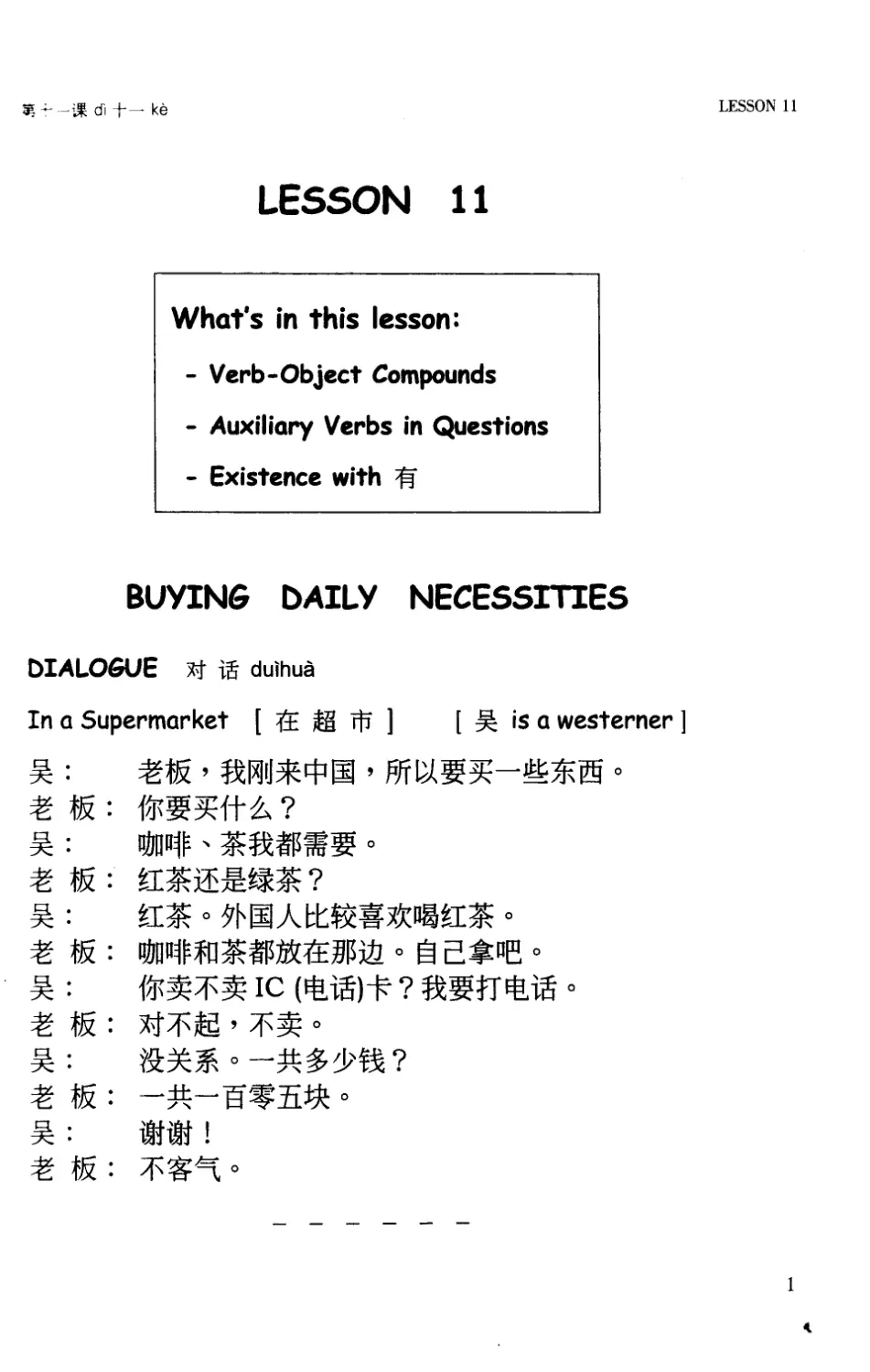
LEssoN 11
Whot'sin this lesson:
-
Verb-Object Conpounds
-
AuxilioryVerbsin Questions
-
Existencewith €
BUYINo DAILY NECESSTTIE5
DIALOAJE r'f ifi duihud
fno Supermorkett e ftEfi I I F isowesterner]
F : Zffi.,fil8rl*+tr,FfrD)*X-$rfiE"
Z tE: l,fi9-9rltL?
* : u[r1F.Afi#Fffig"
Z tF.: 21Ai6E2*#?
F : ?IX. tl.tr tt&ErlnBnK"
Z tE: UlqFfr*#W&flF)a
.
HE€BE.
+:
liy,*T* IC(Hifr)-F?fi4+TH,ifi
"
Z iE: r.tnftg'T* "
*:
IPXA.
-* *r'ffi?
Z trfl: -* -E'€fiftr "
F : iFfiFf!
Z tF.: T&4""
LESSON11

LESSON11
di+- kdH+-i4
*v.
M.
ztn
*,v .
Ita .
ztF
i,v
.
TIA .
ztF
ili :
ztF
*v.
,@.
ztF
InosmollStore [ & 4. ffi ,F E I [ il isowesterner]
Ztn , IiFIT
.
,ffiHllxiEtfrfrT
.
rrFErrFE
' 4g'rRR,! +\Etr+ZgEifi '
Itr+4^qW+?
T+. fiEExryfrrh+Ely+, FnD)ffigx
HJEA-
"
IiIWJ:...W[E4.H!
?
;tH!,trxfit+xx%z"
tH!f,r^ "
+txffialrT.
ffi^+r^ "
rnostore tA ffi Ifi g l I ih is o westernerI
: 2T8.,HI*HffiE?fi€X+WffiEEffifu"
tF.: #[iAflF+LHt?.*ffiffits' He*€ry' !
:
lT' iFfiff!
tF: 'fft*+tr#flE?
: xf ' HIEfi9fr++I ,D)ffi+IH-i.t.X.+ffiXX."
tF.: flFTffiWJ!
:
iFfol' HiftHl.+rftftEtB?
tF.: H " IH4ftfiE*H#l3EtrH"
: ll'fiHe€.
fE: =Er-s,:E'mftTH'
-*=+fir^ "BE
{ftf!4'H
"
th
z,
th
z
th
z,
th
z
th
z

H+-iR dt- kd
LESSON11
DIALOGUE duihud
fn o Supermorket I zdichdoshi] [ W0 is o westernerI
W0:
L6obdn,fi gangl6iZhdnggu6,
sudyig mdi- xi6dongxi.
Ldobdn: Ilf * mdtlttz^?
Wn:
Kaf6i.ch5 fi fl x0F.
Ldobdn: H6ngch6h6iE lr)ch6?
W0:
H6ngch6.Wdigu6z\bijidoxihuanhdh6ngch5.
Ldob6n: Kafeih6ch6 # fdngzdi fllSbidn.Zijin6ba.
W0:
{fi mdiT mdilC(didnhua)ke?fi g dddidnhud.
Ldobdn: Dui6 qi, I mdi.
W!:
ift guinxi.
-
gdngduoshdoqi6n?
Ldobdn: - gdng-H lingfi kudi.
W0:
Xidxie!
Ldobdn: T kdqi.
In o smoll Store I zdixidoshingdidnli] [ Zhdo is o west erner ]
Zhdo:
L6obdn,Itfitl.
Ldobdn: {fi*! Hany0h6n 17.
Zhdo:
rrfilirff li,mdmdhuhU! +t zhdngzdixu6xiPfit6nghud.
Liobdn: {fi huiT huixiriHin zi?
Zhdo:
T hul. f| mingtidnF kdishixu6xi6Hdnzi,sudyixu$
mdi Hjib6n.
Ldobdn: ltfi 4 daH! heiE xidoF!?
Zhdo:
DaHt,yinwdifi d6iti6nti6nlidnxi.
Ldobdn: Daffi fikudi.
Zhdo: fi mdiffib6nFle.
Ldobdn: Fl b6n f kudi.

-j.-.a,\ ..
di+- kdH+-iR
In o Store I zaishdngdidnli
I t Y6ngis o westernerI
Y5ng: Ldobin,HIPH midnbdo?ft m6itidnzdofdn# 4 chi
midnbdo.
Ldobdn: [tf,WiZh6nggu6jido-shOnS?
I
Y5ng: Dui,kdE *t * xi6nxu6Zh6ngw6n,yihduddsudnzdiddxu6
jidoYingwen.
Y6ng: i€fol,HlkH wdishdngzhih6ySgdo?
Y6ng:
,7, +1"zijin6.
_
ts E {fiH! xidoPido.
.-
.-..
_.

H+-tX dit- ke
LESSON11
ENGLISHTRAN5LATION OF THE DIALOGI/E r,f ifi ffi i+
Wu:
Mister, I've just cometo Chinaand so needto buy a few things.
Shopkeeper:What do you wanttobuy?
Wu:
I needboth coffee andtea.
Shopkeeper:Black teaor greentea?
Wu:
Black tea.Foreignersprefer drinking blacktea.
Shopkeeper:coffee & teaarc both placedover there. Help yourself to them. (note6)
Wu:
Do you sell telephonecards?I needto make a telephonecall. (note3)
Shopkeeper:Sorry,we don't.
Wu:
Never mind. How much is that altogether?
Shopkeeper:Altogetherthat's YI 05.
Wu:
Thanksl
Shopkeeper:You're welcome.
Zhao:
Mister, hello.
Shopkeeper:YourChineseis very good.
Zhao:
Not at all. It's only mediocre.I'm learning Mandarin right now.
Shopkeeper:Can you write Chinesecharacters?
Zhao:
No I can:t. Tomorrow I'm starting tolearnto write Chinese
chatacterc, so I need to buy a notebook.
Shopkeeper:Doyou want alarge oneor a small one?
Zhao:
Alarge one,becauseI must praeticeevery day. (note 4)
Shopkeeper:Largeonesare Y5.
Zhao:
I'11buyfwo then. (note1)
Shopkeeper:Ttvoare Yl 0.
Yang:
Mister, do you t uu")nyir"aaZ leatbreadfor mybreaKast everyday.
Shopkeeper:On the table over therc arc many sortsof bread.Go andhelp yourselfI
Yang:
Okay.Thanks.
Shopkeeper:Haveyou cometo China to teach?
Yarrg:
Yes,but I first want tolearn Chinese,and afterwardsI plan to
teachEnglishin a university.
\f .'rpkeeper:That's notbad! (i.e.That soundsgreat)
Yrng:
Excuseme, do you have any toilet paper andtoothpaste?
r !icpkeeper:Yes.Toilet paperand toothpasteareboth at the back.
\'-i:ri.
Okay.I'11getthem myself.
ri:.'ikccirr: 3 packetsof toilet paperand2 tubesof toothpasteis Y35
altogether.Hereis your receipt.

l.r^.:0\ I I
di+- kdf;+-i4
NAil VOCABVLARY 4 rnl shonsci
1. ftH(Wlfr (Lh)chdofii)shi(chdng)supermarket (M: fi. jte)
2. Eil (l81J) gdng(gdng) (A) just(now),justthismoment
3.U[qF
kafci
(N) coffee
m qFe
kdf€isd
(N) coffee-color(ed)
4.A
ch6
(N) tea
s.ffiF
x0ydo
(AV/N)needto/ need (note3)
6.2IX
h6ngch6 (N) blacktea
2I
h6ng
(SV) red
ts $Kffi, t&.fr-
"
E zhdngzhih6nh6ng. Thispaperisveryred
(incolor).
fr- @,
h6ngsd
(N) redcolor
+i"T E *. n E. +t frxihuanh6ngsd.Idon'tlikered(asa
color).
r. b7 (tr1
lil(se)
(SV/N)green(color)
8. tl. tr 7\ wdigu6r6n (N) foreigner
9. W.
fing
M toput(somethingsomewhere)
io.ElE
ziji
(N) self,oneself
(note5)
11. e
nA
M totakeholdof,to carryin one's
hand
12 IC H. ifi f lc didnhuiki (N)
6
telephonecard (or lC kd)

fr
ffi+*lxdi+- kd
LESSoN
rl
Ei6
didnhud
(N) telephone;telephonecall
ffEifi
dd-didnhud tvo) to makeaphonecall
13. ffi ,|F
sh6ngdidn (N) store,shop
(M: ff jia)
14.4 4J R H mimdhr.rhu (EX) mediocre,so-so
(lit.: horse-horse-tiger-ti
ger)
15.+ Z
xu6xi
M
to learn (: learningwhich
includesbothstudy& practice)
+
xu6
(V/AV) to study/ learn(how)to
16.g E ifr
Pit6nghud (N) Mandarin(language)
n.q+
xi6-zi
(VO) to write (charactersor words)
rc. ft lA
kdishi
(AV/V) beginto, startto / to begin,
to start
rs.% id 4
bijibdn
(N) notebook
(M: 4 b6n)
HiA
blji
(N) notes
20.R I ,y, m d6i/ bixr.r
(AV) must,haveto
(neg.:4 'il,lT ffi)
2r.% Z
lidnxi
(V/N) to practice/ exercise,drill
22.ffi E
midnbdo
(N) bread (M: ft tiSofor'a loafof)
m E JH midnbdodidn(N) bakery
x.+W.
zdofdn
(N) breakfast (o, F € zdocdn)

:i.\r,\ :
T
frfr
24.w .
2s.+
26. D)
27.H
wufdn
wdnfdn
jido-sh0
Zhdngw6n
yihdu
Yingw6n
a!
wdishdngzhi
wdish6ng
y6g6o
xi6opido
shOuj0
w.
hfr
VX
s
T
ffi
x
di+- keHf-i+
(N) noonmeal (o, T € wtlcdn)
(N) eveningmeal (or Efi € wdnc6n)
(VO) to teach
(note13)
(N) Chinese(language) (note2)
(MA) afterwards,thereafter
(N) English (language)
(or #. iE Yingy[)
(P) (exclamation)
(N) toilet paper
(M: ts bdo(packet)
or & judn(roll))
(SV/N) hygienic,sanitary/ hygiene
(N) toothpaste
(M: fi he)
(N) bill of sale
(N) receipt
28.rF[
2e.L +. ffi,
30.
31.
I4
*H
4.H
LW.TE

iFI'N
H+*ix di+- kd
LESSO\ II
VERB-OBJECTCOMPOUNDS(VO)
certain Verbs in chinese are normally linked together with its own
particular Object, and the Verb + its Object are said together as a
single verb unit:
e.g . W f,f chi-fdn : to eat. In English, the Object is not required.
(note13)
1. RepetitionDrill
S
+*,
+i,
Itfi
$r
++.
Xu6sheng
i0 {ir
fE ,f[
zlF
L6oshi
f&
f&
Wffi.
chi-fin
Efl
kdn-sh0
E+
xi6-zi
i.H,ifi
shu6-hud
#.fr
jido-shri
fr+
kdi-ch€
* + + *. fr + ffi www.chinesemadeeasier.com/teacherhandbook.htmt

LESSON11
2. The Object canbe modified
RepetitionDrill
di+'- kdH+-ix
+l!
-rx
+n
l,J\
Itr
{r {il
{t if-l
z t)fr
Ldoshi
i|fr.
tfr,
++.
Xu6sheng
+trffi
Zh6ngguofdn
Frfl
Yingw6nsh0
iI?
Hdnzi
11"El ifr
ji jDhud
tsAS
it b6nsh[
ryFffi +?
$[ lidngch6?
V
W
chi
E
kdn
,=
=
xi6
#.
jido
fr
kai
i.H,
shuO
The Object canbe changedfor a more specificone.
RepetitionDrill
t
1
+IAJtr
niIrdumidn
+nffiHjEZr.
fiHt € jib6n
-#t{H
-
f6ng xin
gEifi
PUtOnghud
V
W
chi
a
kdn
=l
xiti
i,H,
shud
#.
jido
fr
kai
S
+r"
+t
Itr
ItF
++.
Xu6sheng
{t {il
fE iit
zUF
Ldoshi
(fr,
tfr,
EiE
Yingyi
fiffi+
ch0zIchd
10

ffi+*ix di+* kd
LESSON11
AUXilJARv VERB5 (AV)
Conyou use chopsticks?
We first met Auxiliary Verbs (e.9 .can, like to, want to) in lesson 3.
Questions can be formed either by using the positive-negative form,
or by adding [$ to the end of the sentence. However, note that, in the
positive-negative form, it is the Atuiliary Verb, not the main Verb,
that is 'doubled'.
Remember that the negative plus Adverbs all precede the Auxiliary
Verb, notthe main Verb.
ll. WhentheAuxiliaryVerbis a two-syllableword,e.g . EI'X k6-yi,
E-fi . xi-huan, ffi-g xu-g , thepositiveAuxiliaryVerbis usually
shortenedto thefirst syllableonly.
Itr
ItF
fE {il
fu {il
Itr ll1
{fr iil
fu iir
ru {il
IX
aJ>
:x
+T+
huiT hui
ffiZiffi
xidngI xidng
1A^14
gditr gdi
EZigfi
xi T xihuan
trI6El'U
kdT k6yi
#nffig
xnT x0F
v-o
iHgEifr?
shu6Prit6nghud?
ffi rE?
ji6-hun?
*4ffi,?
q0kdn {t?
++r?
xu6Zh6ngw6n?
He+?
zlil n6ft
XHJE6?
mdt Hjib6n?
tn {it
tta
11
ffi+?
kudizi?
chopsticks ?

LESSON11
di+- kdfi+-iR
12. TransformationDrill: your teachersuppliesthe Verb; you then makea sentence
with an appropriateAuxiliary Verb using the positive-negativequestionform.
Example: Teacher:
Student:
Teacher:E W
Teacher:E 4 I
Teacher:* lfr x
Teacher:6 ffi €
Teacher:X + ltfi
Teacher:lL E +n
chi-fdn
xidnzdik6yi T kdyiqn chi-fdn?
WW
fn ,fil
ft ,fil
fl
1-
chi-fdn
kdnYingw6nsh0
q0ru jia
ji gud-hdoxin
q0 chdzhdn
wdngyduguii
Student:
Student:
Student:
Student:
Student:
Student:
l:

-rR
H+-ix dif- kd
LESSONII
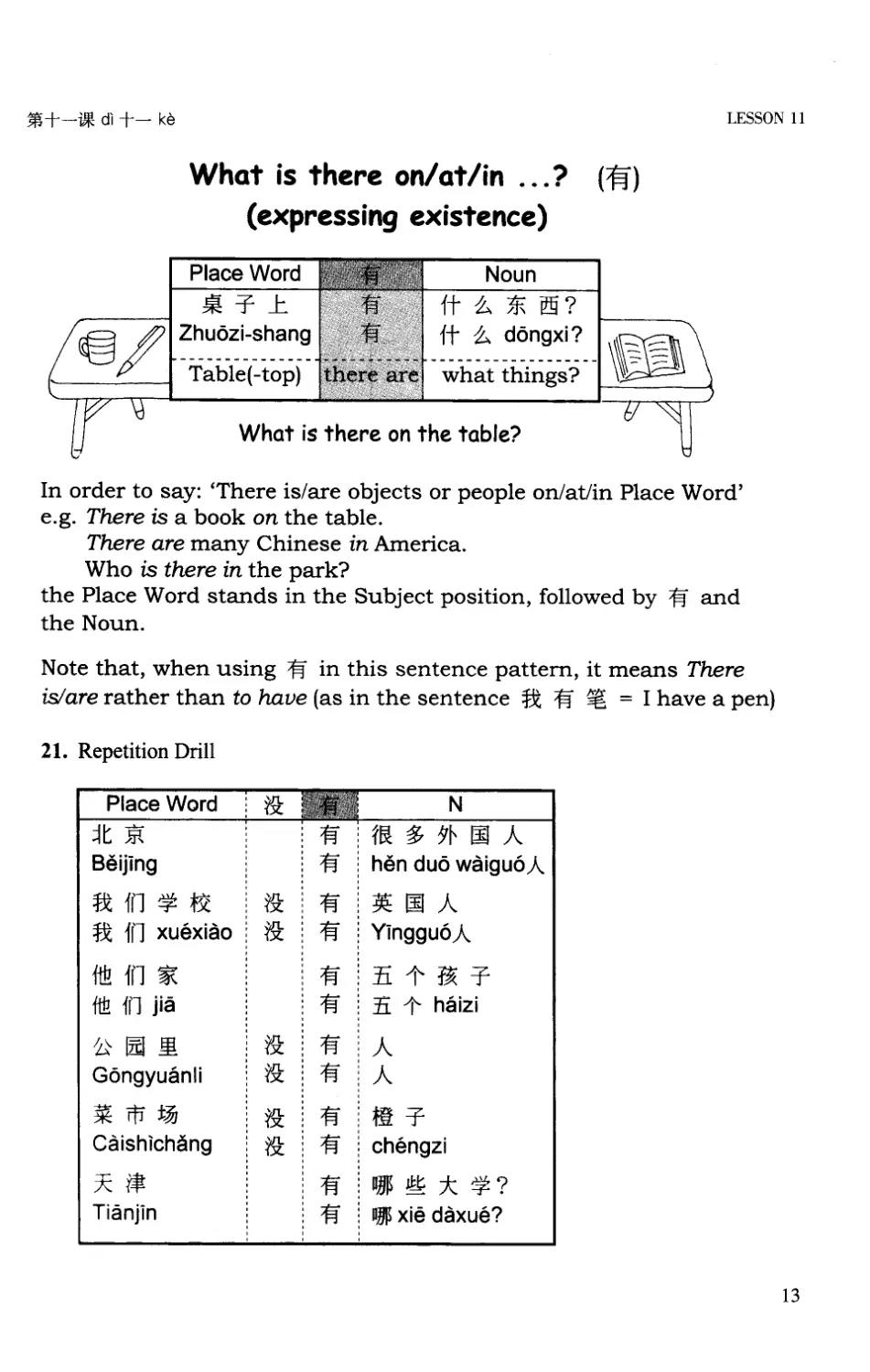
Whot is there on/otlin ...? @)
(expressingexistence)
PlaceWord
Noun
HT-t
Zhudzi-shang H
It LRffi?
It L d6ngxi?
/^: n
/|q,:=//
,-/
\W\
Table(-top) Itriri!-are what things?
I
'/
)
Whot is there onthe toble?
In order to say: 'There is/are objects or people onlat/in PlaceWord'
e.g . There is a book on the table.
There arernal,.y Chinese in America.
Who is tlrcre in the park?
the PlaceWord stands in the Subject position, followed by fi' and
the Noun.
Note that, when using H in this sentencepattern, it means There
i.s/arerather than to haue (as in the sentence +i H H = I have a pen)
21. RepetitionDrill
PlaceWord i {v-
N
JTH
Bdijing
+r,fir+ &
+n'fil xu6xido
tfr.il1x.
f&{il jia
AEE
G6ngyu5nli
*frtn
Cdishichdng
tw*fl'tr/\
h6ndu6wdigu6{
t€tr/.
Yingguo{
r+w+
E t h5izi
I
I
+H.+
ch6ngzi
vffitw *, +?
ffixi6ddxu6?
J/L
{x.
.)tL
lX-
H
H
H
E
t-1
H
F
F
H
H
H
H
H
{'I.
i/tL
tv-
J'L
lv-
iq
/\
lf
Tianjin
13

LESSON1I
22. PositionalnounasPlaceWord
RepetitionDrill
di+* kdH+-ix
Positionalnounsuffixedto othernouns.the
RepetitionDrill
whole acting asa PlaceWord
N
I
ffi+
yizi
AE
gOngyu6n
sffi+
chuz0chd
++.
xu6sheng
=t^.
=+/\
H
H
H
H
H
H
H
H
E
E
H
H
iq
iq
le
PW
ru
shdngbian
TI
xidbian
HfrJA
qi6nbian
trE
hdumian
&
&
,f )E
wdibian
gE
limi}n

H+-i.x di+- kd
ACTMTY yf; Al hu6ddns
Answerthe following questionsby looking at the pictures
LESSON1I
r_6[
AF"
U
+&sffitr'rLf
xu6xidolimian
€' ji+ /.?
jidoshili€'
{tA dongxi?
mFEfl.EHt+L?
Youjf wdibian
H ltL?
zhu6zishang€ lt/z d6ngxt?
TRAI{SL{TION ffi i* fanyi
: }c- ere two notebools on the table. Are they yours?
: llc ';..u know how to write teceiptt in Chinese?
5 ..lx rne park in the university?
{ b 'jrere a superynarketoppositethe police station?
t. :ic :r<rniv fwo yearsold sohe can't write.
*
. :,rcr practicespeakingeveryday.
? -1 l\ vou like teaching? B:No.
ll Se- 3r€ many peopleon the mountain.
t l\'y-.-'; needto buy any tomatoestadaY?
il ".b
';:'-i nrite your Chinesename?
FTr€.{f L^E?
l5

LESSON11
di |- kdH+-tx
WORTHNOTINo iT fi4
when learning a new langaagerweneedideason how to practicewhat we've
beenlearning in class.look up the ChineseIanguageLearnerswebsitefor those
learning Chinesein China: http:/ / www.chinesemadeeasier.com
TRANSLATION OF THE SENTENCEPATTERNSEJU ffi i+
1. leat.
You read.
The student(s)writes.
They talk.
The teacherteaches.
He drives.
2. I eat Chinesefood.
You readEnglishbook(s).
The student(s)writes Chinesecharacters.
They saya few words/sentences.
The teacherteachesthis book.
Which car doeshe drive?
3. I eatbeefnoodles.
You read (or look at) my notebook.
The student(s)writes aletter.
They talk Mandarin.
The teacherteachesEnglish.
He drivesataxi.
17. Canyou speakMandarin?
Do they wish to get marr.ied?/ fuethey thinking of getting married?
Shouldyou go and see/visit him?
Do they enjoy sfudyingChinese?
May I get it myself?
Do we need to buy notebook(s)?
27. Therc are many foreignersin Beijing.
There are no British peoplein our school.
There are five children in their family.
There are no peoplein the park.
There ate no orangesin the market.
Which universities arcthere in Tianiin?
l6

a+-iR dit- kd
22. There are popte upstafus/ above.
There are chair(s)underneath.
There is no park ahead.
Thereis a taxi behind.
Thereare no sfudentsoutside.
Thereare three peopleinside.
23. Therc areno receipt(s)on the table.
Thereare no notebook(s)under the chair.
There are three people in front of the post office.
Thereis a park behind the university.
Thereare two policemenoutsidethe police station.
There are lots of people in(side) the market.
NOTE5 iT fi4
l. In lesson8 we notedthat T le can indicate'exclamation'.
In the dialoguein
thislesson,Zhaosaid:
fi X ffi4 W T (fi mniffib6nFle). T le
signalsthe end of the speaker'scontributionto the topic being discussed,i.e .
giving a sort of finality to it. Another exampleof this useof T le would be
whentwo children arearguingand their mothersaysto them
"ffi
T" "fr la",
meaning
"That's enough!", "Stop itt" or
"It's
now overanddonewith !".
g E ifi PUtdnghud : thespokenformof theChineselanguage.
iE Hdnyil refersto thelanguageasa whole,includingthespokenform.
t Zhongw6n and in iF Hdny[ bothmean'theChineselanguage'.
However,+ X Zh6ngw6nrefersmoreto thewrittenaspect.
- i. AlthoughAuxiliaryVerb ffi * xUF means'needto', whenwishingto
. onveytheideaof 'needto' in Chinese,g is oftenusedinstead.
{. In thedialoguethefollowingsentenceappeared:+f. R X X %, Z
"
;t deitidntidnlidnxi.X X tidntidnisanotherwayof saying6 X mditidn.
j H d. ziji : thepositionof E E ziji in a sentencein Chineseis different
:om English.In Chinese,H d, zrji followstheSubject,e.g . 1tifiH -
*
X
E . Iif, zljl qi m6i ba = Go andbuyit yourself!
LESSON1I
I!
l1
,-.
il-
:.x
i
tl

LESSON11
di+- kdH+-iR
6. Thedialoguecontainedthesentence:[r[ qF fB A # m & frF fr.
"
Kafei h6 ch6 ffJ fdng zdi ilF bian.Notethatwith theverb ffi fdng (andafew
others),& zdi+ PW canalsofollowtheVerb. Thisgrammarpatternis
inhoducedmorefullv in Lesson19.
NOTES regording Auxilioqy Verbs
7. ManyAuxiliaryVerbscanalsofunctionasordinarymainVerbs:
i,fiE *. N ltr?
Do you like her? (mainVerb)
{ft xihuanffi n+?
ItfE*. +WiEE?
DoyoulikestudyingChinese?(AV)
{ft xihuanxu6Hdny[ HB?
8. Notethatit istheAuxiliaryVerb,notthemainVerb,whichhasthenegative
attachedto it.
9. SomeAuxiliaryVerbscanbemodifiedby anAdverb,e.g .lp..h6n ' Zi f .
NotethattheAdverbprecedestheAuxiliaryVerb:
fifEEfiW+trmo
ilikeeatingChinesefoodverymuch.
fi h6nxihuanchiZh6nggu6fdn.
10. Whenansweringa questionwhichcontainsanAuxiliaryVerb,onlythe
AuxiliaryVerbneedbeusedin theanswerwhenthecontextmakesthemeaning
clear(i.e .themainVerbis omitted).
e.s.Q:ltfi+ T A i.H,g E i6?
A:f o
e.g.Q:{fr hui 7iihuishu6Ptlt6nghud? A: hui.
NOTES ?ego?dargH
I 1. In English,we can say,
*Someonehascometo seeyou" or
"There is
someonecometo seeyou". Chinesealwaysusesthe secondway of sayingthis:
€'
*
E lif" H ^ l5i kdn'ffi. (i.e.H mustalwaysbeincludedinthe
sentence.)
12. Distinctionbetween€ and E:
\ote the differencein meaningin the following two sentences:

R
H+-,R dlt- kd
LESSON
11
Two people are walking through a shoppingarea:
a)Q:EfmATHI+LffiIE?
What(kindsof) storesare
Q:Qi6nmian# H tt A shdngdidn? thereahead(ofus)?
A:Hffififr,HmtsJF"
Thereisasupermarketand
A: € chSoshifr, H midnbdodidn.
abakery.
b)Q:HfffiE It L ffitFZ
Whatisthestoreahead(of
us)?
Q:Qi6nmianE lt L shingdidn?
A: E )t ffi JE Gu6gudngshdngdldn. GuoguangStore.
If wewanttoknowwhethersomething'exists',useH.
+tr€'Y+H*. 3fr?
ArethereMcDonaldsin China?
Zh6nggu6Ht*H Mdiddngl5o?
However,if we know thatthereareMcDonaldsoutletsin China,but aren't
certainexactlywhere,use 6 zdi:
*. Y H&+ilEfr{+Lt#'fr?
WhereaboutsinZhongshan
Mdiddngl6ozdiZhdngshdnl0 it !^ difang? RoadisMcDonalds?
13. HerearesomecommonChineseVerb-Objects:
ChineseVerb-Obiect
LiteralTranslationEnolishusaqe
ii. ifi I i# lfr shu6-hud/ jidng-hud
€ fl kin-sh0
't fl d0-sh0
t fr ji6o-sh0
:Z ffi. cht-fdn
X ^ ffi mdLdongxi
€ E8z6u-10
*
+ Kar-cne
g, W. zud-fdn
a + xi6-zi
m 5 zud-shi
to speakspeech
to readbooks
to studybooks
to teachbooks
to eatrice
to buy things
to walk roads
to drivevehicles
to makerice
to write characters
to do things
to speak,to talk
to read
to study
to teach
to eat
to shop
to walk
to drive
to cook
to write
to work
19

lJ-::O\ I I
di+- kdH+-i .x
Memonzethe FollowingChorocters
The following characters have already appeared 10 times and so the
pinyinwill be omitted from now on. Use this opportunity to memorlze
them for future recognition.
rai
to come (to)
qr)
togo (to)
ji
a few, some;
howmany?
/f\\
di6n
o'clock;
point
tidn
day;
sky,heaven
ni6n
year
Jtn
now, thepresent
ming
clear, bright
t0

LESSON11
R
+t-iR dit- kd
t=* L,R
;
,ti+i$ nI
Write a story using the Chinese characters you have already learned.
When you need to write a word or syllable but have not yet learned
how to write the Chinese character, simply write the pingin.
2l

LESSO\ I 1
di+- kdH+-ix
It
Some characters where A (r6n) is the radical
normally appears as { on the left side of the character
4e, ta
'fl] men
4& ni
f+ sh6n
4i wdi
+ jidn
t*- pi5n/ bidn
&. hdu
4e ddn
ti zhO
)->
1e xtn
M jid
4t xio
he,him
(Noun suffix indicattngthe plural)
you
what?
(polite Measurefor people)
(Measurefor items,things, clothing)
cheap / convenient, handy
period; to awalt
but, howeverl only, merely
to live, to reside
lefter (mail); to believeor trust (in)
to lendlborrow
to rest,to pause,to cease,to stop
8
8
8
10
t6
23
25
26
26
30
34
36
44
22

-;R
Hf:iR dt+- kd
LESSON12
LEssON 12
What's in this lesson:
-
Nounsmodifiedby Nouns& Pronouns
-
Nounsrnodifiedby Adjectives
BUYINGCLOTHESIN A 5HOPPIN6AAALL
DIALOATE r't ifr duihud
In o shoppingMallI E ffi ,n I
lil : 4.lH
'
fiF*
-_ l+N+t'
uJ'{H: I,f**f,fu??
lil :
=+/LH!"
zJ.{H: ltrElLltA"ufr&,?
l{ : AE. ffiC,#IJEIX
.
zJriE : il{+tr,L++?
lil : H!+Ht.-,F.JLH!?+\W&bLFiE+
"
zjr{H: €' " B{+f,.4,R/dfTf WTW^.?
llj: t4'ElI"*r'+li?
zjr iE : ffiE':
"
lil : ryrt ! tfrT ! EI6EIXEH-,fiJl?
zjrtH: IL&F.|tfT)L+fi" -HlL+l\*
.
ItJ: ,T"|.t.BilF)Ltti;h?
zjr{H: E,fll|fr.
"
lrj :
+XMEEU+VIMT" iFH ' AfL& ?
23

LESSON12
zJ'iE: -&.
lil : iffiFf!
zJ.lH : TE,*-"
"
di+- kdHf_iR
il : 4,/fvt, ffiEHETEffiWffirE,
F1D)+\$NIL{+
trf&EF.
tfh: {ftfgx{t LlYEv.?
ftX: -*KIE " +ifff$X-t[ffi .WXW&EEttffi
-
}EE?
1v<)-L
.
tu.: .
.
DIJ+ IE/I.,^E.FI
--Ltll )l gllfrJJ-//lJ {
+2.
v+l
:=
wr.
.x'rr ffi8ts+EffiA[fit\+n,Ill+k:'RFH.
-=
ili : ltr+Xht.Heq ?+t,flt-ftE*rEr
--
ffi:
,T,FllfF,fieffiryX-$rtt&,[E.iS]E]X.
--.=-=
*Y.
ll+tn1n Ji jA|r e
=-=.'
ftX: {t{il/L,fiXfl ?
==
th: +,fi.
=
il: ills|,i,F.+&tr{H/Efl.H,ELtf+?
--.1-
*A
.
)4 . iLf-f _Rfi ^
-=
tfVt: 11, l+.folflE.
.A
LA

-i.+
H+=ix di+* kd
LEiqo\ll
DIALOzuE r,f i6 duihud
fn o ShoppingMoll Izdishdngchdng]
Lin:
Xidoji6,fi g mdi- jidnchdnshdn.
Xidoji6: ift chudndudddfr,J?
Li[:
=
+t1ffi.
Xidoji6: {fi xihuanlttz Vdnsd?
Lin:
B6isd. l6nsdffJ k6yi.
Xidoji6: ts jidn zdntz^ydng?
Liir:
HytH da -,F, r fr+J?+i,xidnzdibijidopang.
Xidoji6: 6. ts jidnddxidoz6ntz^ydng?GduT gdudd?
Li0: DdxidozhdngF. Duoshaoqiin?
Xidoji6: ffitr':.
Li0: Aiyat Tdiguite! K6T k6yipi6nyi-,R r?
Xidoji6: Xidnzdizhdngzdidd Jyzhe.
-HJL+ /\ kudi.
Li0:
*T.Zeiffi rf0qi6n?
Xi6ojid: Zdi fl[ bi5n.
Li0: fi xidngkdnkanh6iziF! kizi. if;fnl,zitiIL t6u?
Xidoji6:
-
t6u.
Liri: Xidxie!
Xidoji6: T kdqi.
Zhito: XidoY6ng,+l O*g*,
OaO.nO,* ;,UnOn,su6yifi g mdi
/L jidn,xinylfu.
Y6ng: {fi xidngmdi lttz^ yrtu?
Zhiio: - ti6och5ngq[n. *] h6ixidngmdi - shuangxi6. rJFjiaB!
yifubijiaopidoliang?
YSng: R0gu6{fr yaopidoliangfr! yifu, ltf - ding g } Zhdngshdn
l0mdi.
Zhao: tF li €68 H -jid xinkaiffi shdngchang?
Yang: Dui!6rqi6Bf xingqiffI de l\zh6,jidqianh6npi6nyi.
Zhdo: ltf +X wdnshangfi kdngEEr?+fr"iil1- qi * ba!
Y6ng: {T,gdng*T +fr,t xu* mdi - xi6ndiyi,heaH tiinkiwd.
Zhdo: {&{ll Jt,F,gudnm6n?
Yang: +,F,.
Zhio: frFL, i,fi bdnzdiGu6gudngshdngdidnjidnmidn,zdntz^ydng?
vang: Xing,*gltrJti.
25

:-=].
=Z
:-===.
:-==:::----
:--:
_::-:--=-==,...
LESSON12
dif kdH+:i*
ENGUISHTRANSLATIONOF THE DIALOzuEr.f ifi ffi i+
Liu :
Miss, I want to buy a shirt.
Assistant: What sizedo youwear?
Liu:
39. (= 39 Al) gfngfdn = centimeter)
Assistant: What color do you like?
Liu:
Bothwhite andbluearc okay.
Assistant: What aboutthis one?
Liu :
Do you haveone alittlelarger? l,mrather fat now.
Assistant: Yes.What aboutthe sizeof this one?Is ttlarge enough?
Liu :
The sizeis just right. How much?
Assistant: (9220.
Liu :
WowI Too expensiveI Are you ableto let me have it alittle cheaper?
Assistanf Just at the moment there's 1Oo/ooff. y198.
Liu:
Okay.Wheredoesonepay?
Assistanf Over there.
Liu :
I wish to have a look at children'spants [u.K .: kousers]. Excuseme,
on which floor are they? (note S)
Assistanfi zndfloor. (note 3)
Liu:
Thanks.
Assistant: You'rewelcome.
Zhao
Yang
Zhao
Yang
Yang
Zhao
Yang
Zhao
Yang
Zhao
Yang
Young Yangrmy friend is getting marcied,i-,e*t*eek, so I need tobuy a
few new clothes. (note 2)
What clothes are you thinking of buymg?
A long skirt. I'm alsothinking of buying a pair of shoes.Which store's
clothesarc prettier?
If you wantbeautiful clothes, you must go to Zhongshan Roadto buy
them.
Zhao: Isn't there a newly openedshopping malltherc?
RightI furthermore they aregiving a 2Oo/odiscount all this week, sothe
prices arc cheap.
Do you have any free time this evening?Let'sgo there togetherl
Okay, it just so happens that I also need to buy some undemtear and also
somepantihose.
What time do they close?
10 o'clock.
lnthat case,how aboutus meetingat Guoguangstoreat half-past-six?
Fine,no probleml
26

LESSON12
NEW VOCABULARY E ifl shdnsci
1.ffi%
shdngchdng (N) shoppingmall,
shoppingemporium
(M: 6. jie)
(or ffiffi,shdngch6ng)
2.NYr'
chdnshdn (N) shirt
(M: {* jidn)
3.F
chudn
M towear(clothes/shoes);toputon
(clothes/shoes)
4.*
+SV
duo+SV
(a!U how? (i.e .to whatextent?)
s. VnE
y6nsd
(N) acolor
i 6.HE
b5isd
(N) whitecolor
H
b5i
(sv) white
jX tK fr H E ! B zhdngzhizh6nb6i! Thissheetofpaperis
really white !
R (e)
hei(sd)
(SV/N)black(color)
z. ffi (e)
l6n(sd)
(SV/N)blue(color)
8.
-
,fi JL yidiinr
(NU+M)alittle...
s. E+
pang
(SV) fat,obese (ofhumans)
E
shdu
(SV) thin
ro. f,
,'Jt
ddxido
(N) size
11.E *f
zhdnghdo (EX) justright
(o"lEtJlEilF sinssdnshdo)
2',7

TTSSON12
n.ryF*
13.f sv T
14.tT tft (f[)
+F*r
ts.
'ftf fi
rc.m+
ffi il+
KIE
17.ffi
IE
18.K
ffi
rs.+E+
20H (T)
ffiJE
zt.\il F
Siya!
tdi SV le
dd-zh6(kdu)
zh6kdu
f0-qi6n
k0zi
dudnkD
ch6ngki
xin
ji'i
ch5ng
dudn
q0nzi
xirS(zi)
xi6didn
r0gu6
(EX)
tvo)
(N)
(vo)
(N)
(N)
(N)
(SV)
(SV}
dif kdH+,X
Oh dear!
tooSV! soSV!
(note1)
to give a discount
(note4)
a discount
to paythemoney(for goods)
pants [U.K .:trousers]
(M: ft tiao)
shorts
(long)pants [U.K .: trousers]
new
old (i.e .theoppositeof new)
(SV)
(SV}
(N)
long
short
skirt
(M: ft ti6o)
(N) shoes
(€ hdo - size)
(M: X[ shudng = aPairof )
(M: 11.zhi = oneof aPair)
shoestore,shoeshoP (M: ff tia)
if
(also:'lFtl[ iiirt I F E )
(N)
(MA)
28

.W
))
:jie)
E.:
-iR di+- kd
LESSON12
22.
-
fr-
yiding
(A) definitely,certainly
-
frg
yidingydo (A) definitelymust
n. ft
kai
M
toopen(up)
fr fl
kdi-men
(VO) toopenthestore/shop(inthe
morning); to open the door
tfr ft ft! xinkaide (SV) anewlyopened(e.g.storeor
business)
24. Ifi E"
6rqi6
(Con) furthermore,moreover
2s, lll +k
jidqian
(N) price
26.F\ill|
gdnghdo
(MA) It justsohappensthat...
(also:exactly,precisely,just right)
{&{lllEillfT&x.
It just sohappensthattheyaren't at home.
{fiiil gang*t T zdijid.
27.fr &
ntDiyi
(N) undershirt;underclothes
ltM
ndik0
(N) underpants
28.[ €'
h6iydu
(Con) andalso
2s.&, iE i*
li6nk0wd (N) pantihose (M: X[ shudng)
l*+
wdzi
(N) socks,stockings(M: X[ shudng)
30.X fl
gudn-m6n (VO) toclosethestore/shop(attheend
of theday)

LESSON12
dl+* kdH+:i+
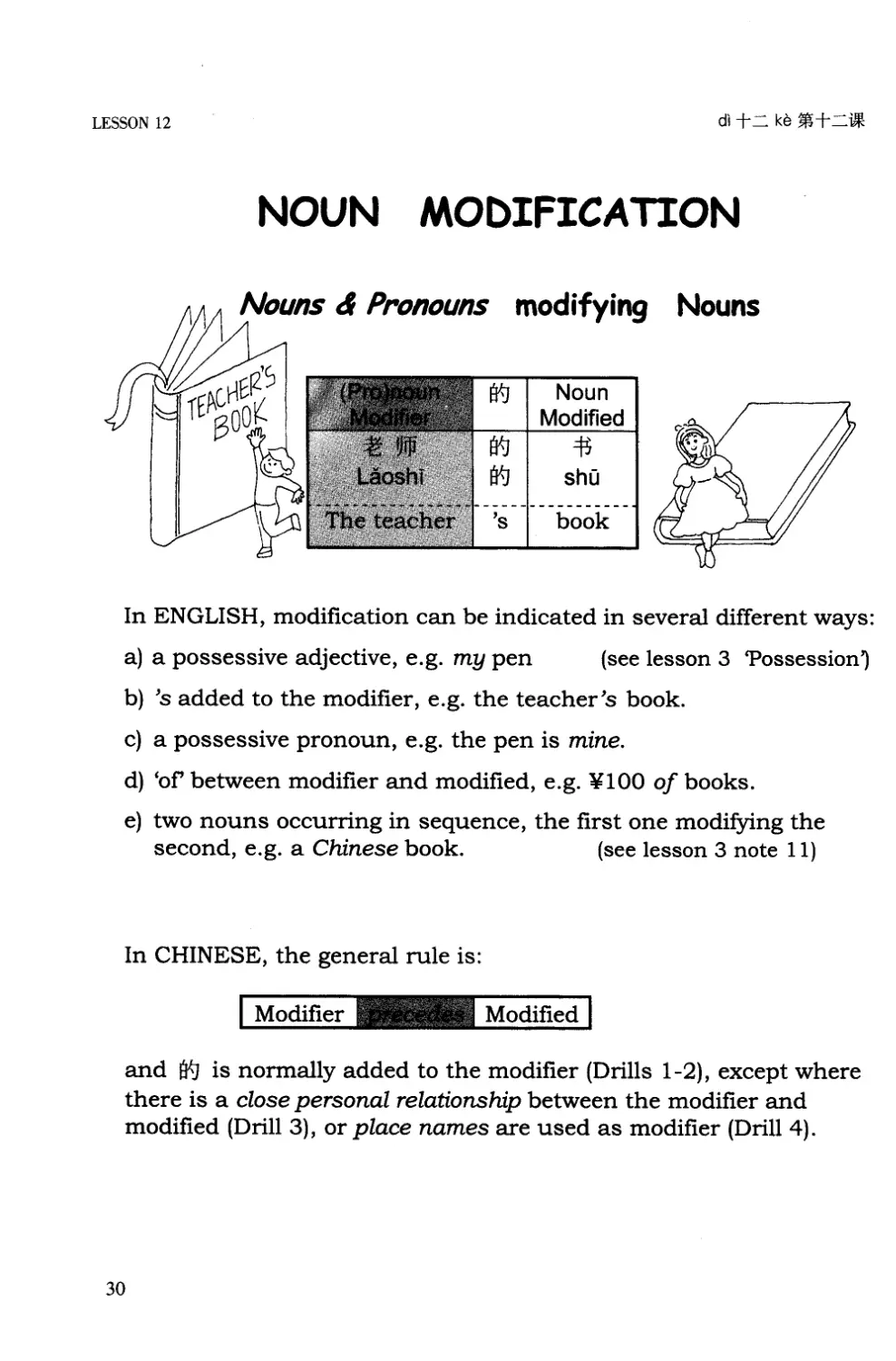
NOUN AAODIFICATION
4 Pronounsmodifying Nouns
In ENGLISH, modification can be indicated in several different ways:
a) a possessive adjective, e.g . mA per.
(seelesson3 ?ossessionJ
b) 's added to the modifier, e.g . the teacher's book.
c) a possessive pronoun, e.g . the pen is mine.
d) bf'between modifier and modified, e.g . Y1O0 o/ books.
e) two nouns occurring in sequence, the first one modifying the
second, e.g . a Chinesebook.
(seelesson3 note 11)
In CHINESE, the general rule is:
iviocirr-rerffi
Mocirr-red
and *! is normally added to the modifier (Drills 1-2), except where
there is a close personal relationship between the modifier and
modified (Drill 3), or place names are used as modifier (Drill 4).
6W Noun
Modified
30

fi
+n
ifi,
fifr,
z, \fi
Ldoshi
uv
Hitizi
ffi7
kOzi
H!
FT
H!
H!
fr!
H!
ffi
Fq
FT
N
F+
b€izi
N +')
chdnshdn
4iE
YingyI
V/SV/EV
l&.,J,
h6nxiSo
#?Rffi
fl hdnxin
ZifH
6 cud
Effi(tr)F!
E l6n(sc)H!
H+=IX dit- kd
1. Pronouns& Nounsmodiffing otherNouns
RepetitionDrill
LESSON12
ys:
nJ
Pronoun+ Nounmodiffing otherNouns
RepetitionDrill
fr! is normallyomittedwherethereis a closepersonalrelationshipbetvteen
(Pro)NounandNoun.
RepetitionDrill
re
JI
V/SV/EV
?Rfr [q?
h6ngui [4 ?
{ft ,lHZi lH?
{fi d6ng6 d6ng?
E+H5E
E W0Zi-qi5ng
#8fl.tr,^'
ASE wdigu6y',
F!
ffi
F!
H!
H!
H!
H!
ffi
F!
nntr.
p6ngyou
#+
qizi
--{-
-+-
)l*x
zhdngfu
u+
hinzi
(tr
Itr
+\
fi
ffi
fu
{&
tfr
N
ffi-
xi6zi
ffiE
p6ngyou
iX iE
Hinyil
e+
mingzi

LESSON12
Itr
Itr
+\
.lx,
,&
i&
Itfi
IIT
nnts-
pengyou
t+
qizi
i-{-
-J-
)(- ,(
zhdngfu
UT
hitizi
Ni
V/SV/EV
#.H I [qz
ji6oYingw6nn4?
EE.+(r)gEifi
zhdngzdi xue(xi)PritOnghud
EgB
E jingch6
aryFxw.rEWw.?
zdi UJFjid fdngudnchi-fdn?
4. ffi is normally omittedwhenplace Wordsmodifv Nouns
RepetitionDrill
Etr
Yinggu6
+tr
Zh6nggu6
*tr
Mdigu5
Jt ,81*
B6ijing
N
EEtr.
p6ngyou
16 /s
shdngdidn
w.rE
fdngudn
I
I
V/SV/EV
aflE *. naa E?
fl xihuanhechi [9 ?
ffi&ftfr,xnE?
# h6nwdngudn-m6n[5 ?
ffiHTX+EqJ?
ffi H kudizi14?
*fl ?Rtr
fll h6nm6ng
5. TransformationDrill: add the secondmodifier.
Example:Teacher:ts E +\ W ffi " ( EEE )
X E f! [! wdn. ( p6ngyou)
Student:ts E fi EEE W ffi"
ts € f! p6ngyoufi! wdn.
(Thisis my friend'sricebowl)
dit: kdH+_i.+
32

ffit=ix dit- kd
Teacher:
tsE+1"Wffi.
ts E *t F!wdn'
reacher:
XEfift!f{FFffi"
tsEfiFtp6igimidn.
Teacher: B
r5
Teacher:
tsE+iffi}.E+"
ts E +nH!q0nzi.
LESSON12
EfiH!A&,
E +I,H! ndiyi.
(EEF-)
( p6ngyou)
(a*)
( zhdngfu)
(u+)
( h5izi)
(tT)
(qizi)
Student:
Student:
Student:
Student:
6. The teacherpointsto objectson both hersandthe student'sdesksand asks:
"B
E iftsh6i ffi?".
Iftheyareyours,yousay"B
E +t H! (object)",
butiftheybelongtoyourteacheroranotherstudent,yousay"B E +Y"Z \fr
fdoshifr! (object)"or "E
E +t EHE p6ngyouF! (object)'nor 'oB
E,[
+ + Hxu6shengfr!(object)".
In English, a descriptive Adjective can be used to modiff a Noun,
e.g . a neut shirt.
In Chinese, Adjectives (Stative Verbs) can stand before Nouns to
modify them.
(seenote 6)
When an Adjective is preceded by some quatifying element,
e.g . fifr.h6n . t tii, etc.,
fr! is added to the Adjective. (Drill 11)
Adjectives modifying Nouns
-1J

r LESSON12
di+- kdH+:i.x
Also, when the Adjective consists of more than one syllable,
e.g . iH fr pidoliang . F ft pi6nyi, H! is added to the Adjective.
(Drill 12)
-
However,when the Adjectiveis both single-syllableandunmodified,
H! is notadded,e.g. # & EF(xinyifu), *T U + $T hSizi). (Drill13)
....
..
tt'
i$T;tx;Hff'"ded
bYanAdverb
S+V
fr z tFtr
Lin ldoshikdi
fig*
fiFmli
f&{il-EryF.
fU {ll * ding F chudn
NU+M i MODIFIER
_. ffi
-
lidng
mffi
ffi lidng
|te. iiHH
h6n ! pidoliang
tw irE
h6n I ji0
bY.# .
bijido
6tt
HJ
frh
HJ
fr!
H!
F!
F!
F!
ffi
]ar
JEt
gui
'r&.
h6n
tt-
1\-f
qichd
Ett+
m6tu6chd
&EE
yifu
HJE#
€ jib6n
IfrH
tfrH
-4
-
bdn
zJr
xido
Double-syllableStativeVerb modiffing aNoun
RepetitionDrill
t2.
ffii N
n#
h6ngch6
*
cai
sffi
shiqing
tE+
q0nzi
trH
pi6nyi
EA
16ngyi
ffi,ffi
mifan
iHH
pidoliang
B!
ffi
H!
H!
F!
ft
F!
ffi
-
EZfifTEur?
-
dinsT *TW?
fi#af&!
*n # huizud!
#,#Ziffit!
fi # 6 xidngbdn!
-t+flF'.fr
-
dinghuihdngui
34

ffi+-:t* dit- kd
Teacher:
Teacher:
Teacher:
LESSON12
fr\ is omittedwhen the StativeVerb is both single-syllableandnot
immediatelyprecededby an Adverb.
RepetitionDrill
SiA/AV
V
{
jido
x
mdi
H
H
v
chuan
v^
L\
ch5ng
da hdo
N
++
xuesheng
fiz
chEzi
i*T
wdzi
|^&
ndiyi
ztfr
Ldoshi
€lx
xihuan
-Eg
-
ding S
W
IT
f/r
xin
Itfi
lrr
fifr.
t&
fi{il
fi .fi]
.' /fL
{X
"/fL
lv.
AT
as
14. TransformationDrill: repeateachsentence,insertingthe words supplied+ ffi
Example: Teacher:tfr + m T "
(iHH)
l& chudnq0nzi. ( Pidoliang)
Student:t&+HHft+Jm7"
ffi chudnpidoliangF! q0nzi.
(Shewearsa beautifulskirt(s)
tfitrta7,
It chudnq0nzi.
lfr,h fi t^ &.
fifr,h f! ndiyi.
fiFW,Effi.
fi F chiddufu.
(iHH)
( pidoliang)
(?Rfr)
( h6ngui)
(trfitr)
( bijiaoffi )
Student:
Student:
Student:
Teacher:fi g X - +KIC-F" (
-
Hr^)
fi g mdi-zhdngICke.(
-
trkudi)
35
Student:

LESSON12
ACTIVITY ifr Al hu6ddns
dit- kdH+-:iR
Takesomeclothesto class.Your teacheris the ShoppingMall salesgirl and you
arethe shopper(s). Don't forget tobatgain for a lower pricel
TRANSLATION ffi i* fanYi
1. Where canlpvtyour new socks? (seelesson11note6)
2. Thereis a newly openedMcDonaldsin ZhongshanRoadl
furthermore they're giving a 1'Oo/odiscount all this month'
g. I must practiceusing my chopstickseveryday.
4. Thoseforeignersdon't know what time that shoppingmall closes.
5. The notebooks are on my table. Pleaseget them yourself.
6. I'm really hungryI What time doesthe school restautantopen?
7. Your telephoneiafiand alsoyour bus ticket arcboth on my chair.
8. Pleasewatt amoment.My friend wants to buy aloaf ofbread at thatbakery'
9. Do you prefer cycling anoldbicycle or a new one?
tO. pon't eat atthaitestaurantl Their pork chop-with-rice is too expensivel
WORTHNOTINo iT ffi
In Chinese,asin any languagerpolitenessdemandscertain standardresponsesto
oit-urea poUt. phrases.lr';ar"ihe appropriateresponsesand practicethem until
they becomeavtomatic.
X:i!{Ufo
X: Xidxie.
X: r.l r ftd.
X: DuiT qi.
X: ltr ffJiI iF
X: {ftF!Hanyt
Y:6ilf /
Y: 6 xie/
TE',1/n\85'""
6 kdqi/ bi6kdqi.
X: fii€
X: fiitr
Itr@.W).
{fi (chi-fin).
(iX,f+) :{&.
*T'
(shu6de)h6nlT.
Y: iqX 6"
Y: it gudnxi.
Y: nJTEI,FB,44IRffi"
Y: ltr li flffli ' mdmdh0htt.
Y: ZiffilTtT H,B'
Y: 6 ydng/ d (f Yisi.
36

tr5t,ix dit- kd
LESSON12
TRANSLATION OF THE SENTENCEPATTERNSEJry.ffi i+
1. My cup is very small.
His shirts arc allvery new.
The teacher'sEnglishis pretty good.
The child's pants areblue.
2. Are your friend's shoesvery expensive?
My wife's friends are all foreigners.
Do you understandher husband'sChinese?
His child's nameis Wu Zi-qiang.
3. Doesyour friend teachEnglish?
My wife is learning Mandarin right now.
Her husbandis a policeman.
At which restaurantdoesyour child eat?
4. Do British friends all like to drink tea?
Do Chinesestoresall closeuplate (in the evening)?
Do Americanrestaurantsall have chopsticks?
Beijing peopleare all very busy.
11. TeacherLin drives a very beautiful cat.
I want to sell two very old motorbikes.
They definitely want to wear rather expensiveclothes.
He has avery small notebook.
12. ls cheapblacktea definitely not nice?
I can make all the easydishes(of food) I
I don't wish to handle any bothersomemattersl
Beautiful skirts will definitely be expensive.
13. The teacherlikes to teachgood students.
You must definitely buy new vehicle(s).
He doesn'thave any long socks.
We all wearlarge sizeunderwear.
NOTES $ tr4
1. { SV T (tai SV le):In theDialoguethefollowingsentenceappeared:
;ft fr T tai gui le. Hereis a furtherexampleof 7 le indicatingexclamation.
2. tJ',ffi XidtoY6ng : zjr xi6o beforea familynameindicatesa termof affection.

a
==
=
=
---
:
:-
:-
-
:
--
:
:
:
:--
:
-
:
:
:-
:
:
:
::-
:
:
:
:
--=
-
:4
:===:
:
___:=
-
-_-4
:
-:1
:=
-
:
:
:
:--
LESSON
12
dl+- kdH+-iR
3. Notethat2ndfloor is rendered
-
ffi l6u not ffi ffi lou. Thisis because
it isbeingusedhereasanordinalnumber(i.e .I't, 2nd,3'd,etc.) .
4. Whenquotingdiscounts,theamountsarecalculatedin thereverseorderto
English:
(fI dA) )t tfr zhe : I}Yooff
t trftzh6 : 30%off
=
tfizhl : 70%off
5. Thedialoguecontainedthesentence:
+tmEE&+WffiT, +9"
xiing kdnkanh6iziF! kizi. ActionVerbscanbereduplicated.Notethatthis
canhavetwo different effects:
a) it hasthe ideaof 'taking a little time over doing the action':
+f"48?)Ekdn.
I wantto takealook atit.
b) it canalsohavethe effect of reducinga commandinto a suggestionor mild
imperative:
'fft fbl Fl {& '*T
T *T?
Youaskhim,okay?
Reduplicationof ActionVerbshasthesameeffectasVerb+ -
f xid.
6. ThemodifiedNouncanbeomittedasunderstood:
Whenevera modiJiedNozn is easilyunderstoodfrom the context,that Noun may
be omitted.In ENGLISH, the Pronoun'onensometimessubstitutesfor the Noun.
We say,"He sells cheapones"or
"This is the teacher'sone".
In CHINESE, no
wordis usedfor'one'.
e.g.In the dialoguein lesson11 the following sentenceappeared: ltf ry t ft
rI E 4. ff! ? (tf 4 da H! h6iE xidoF!) whichwastranslated,"Doyou
want a largeone or a small one?".
fi € lf. + fi HEE fu|o I liketowearmyfriend'sones.(i.e. fi fift yifu)
fi xihuanchuin fi p6ngyouF!.
38

H+:i.x drt- kd
LESSON12
hfi,,Y,,fr ft lH H!o
Hehastodriveanoldone. (i.e.4 7 chezi)
{t bixrkaiji0F!.
tsE*1tHk!o
ThisisMr.Cai'sone. (i.e.fi E ddngxi)
ts E Cdixidnshengk!.
ilqHTft.,! ful.
Thatpenisn'tagoodone' (i.e.H)
fllSzhi H 6E tlffi.
7. Wherethereis a string ofNouns andPronounsin succession,Ht is normally
only addedto thefinal Noun actingasmodifier, a.E.Mr. Li's child's clothes :
+ fE +. t4 + F! & EE. Lixidnshengh6iziffi yifu'
8. When ffi appearsbetweena propergeographicname(4 Sl Yinggu6, *
$| M6igu6)andtheNounwhichit modifies,a changein interpretationmaytake
place. Notethedifferencein meaningin thefollowing:
+trnnE
Zh6nggu6p6ngyou
Chinesefriends
(i.e .of ChinesenationalitY)
+ tr fr+JnEE Zh6nggu6f!p6ngyou friendsofChina
(i.e.non-Chinese)
* tr+&
M6igu6xu6xido
TheAmericanSchool
(in Beijing)
t tr ffi # flt M6igu6H!xu6xido
USAschools
9. Note the differencein meaningin the following sentences:
N +t E ff F! Theshirtisanewone
(emphasizes
ffi xin)
ChdnshdnE xinfr!
N+,&.ifr
Theshirtis(very)new
(descriptive)
Chdnshdnh6nxin
ffi f'I +t +W.fr. Newshirtsare(very)expensive(Adj.modifiesNoun)
Xinchdnshdnhdngui
+ ft.lTH!
Thevehicleisagoodone
(emphasizes
fT)
chc € trF!
_19

LESSON12
di* kdHt:i.ft
+- ffi. ftT
Thevehicleis (very)good
(descriptive)
Ch€h€n F
tT+te.*
Goodvehiclesarenumerous (Adj. modifiesNoun)
lT chc h6ndud
10. The useof Adjectivesto modify Nouns
In general,mostmonosyllabicAdjectivesmaymodi& aNounwithoutthe
additionof F!, whilemostpolysyllabicAdjectivesrequiretheuseof fr!.
Likewise,monosyllabicAdjectiveswhicharemodifiedby Adverbsrequireffi.
Thereareexceptionsto thisrule,aswill appearin thefollowingclassification
of Adjectives(StativeVerbs):
Maystandaloneas modifiersof Nouns:
tTt)\|rlt#/lEtKtffitE€', /$BHn
*Tt da I xido/ xin / ji0 / ch5ng/ duin / kdqi/cong!fi
(intelligent)
Normally require the use of *+J:
ffi,m/ trH tfitr t]#.H,t 4a t T
m6fan / pi5nyi /fdngbidn/ pidoliang/ r6ngyi I T
Requirean adverbial modifier suchas {R h6n and arefollowed by fr\:
ttIfr/r'JI*I ,)'(tew)
ming /gui/ dui / du6/ sh6o(few)
11. Modification
A Noun or Pronounmay modiff anotherNoun simply by standingbeforeit:
(seeDrills l-4)
Chinesepensarecheap.
Americangoodsare all expensive.
My husband
#.
tEt
cud
+tr2(e.fFH"
Zh6nggu6fl h6npi6nyi.
* tr fi tr ffr?Rfr'
M6igu6d6ngxiff h6ngui.
fi**
fl zhdngfu
-10

f;+:x d+- kd
LESSON12
+f"U +
MYchild
*1" hitizi
But positionalonedoesnot necessarilyequalmodification.
Coordination(: wheretwo wordsof equalrankingareplacedtogetherin a
sentence).Theconnective
'and' (il h6) is sometimesomittedbetweentwoNouns:
S.€ ffi lF..F H o
looksandpensarebothcheap'
ShU.Hffih6nPi6nYi.
48,+i,ffi4 *
"
YouandI bothwantto gothere.
X. Z, l,F
.
+ZlfrflA*'
TeachersWuandLiwillbothbe coming'
W0 ldoshi. Li ldoshiff hui ft.
E fi'E
+ tS ?Rd Ao Readingandwritingarebotheasy.
Kin-sh0 . xi6-zi # hdnr6ngYi.
[Note:Chinese . is similarto anEnglishcommabut is usedbetweenNouns]
Apposition
two Nounsarein appositionwhenoneNoun standsimmediatelyafteranother
Nounto explainor clariff it:
+n'{il * tr
WeAmericans
$Fll1m f (u\)
Youtwo
YOUROWN NOTE5
r:

LESSON12
d f: kdH+:iR
Memorizethe FollowingChorocters
The following characters have already appeared 10 times and so the
pinginwill be omitted from now on. Use this opportunity to memorize
them for future recognition.
mdi
to buy
mdi
to sell
h6n
very
f gui
expensive
tai
too, excessively
duo
much, many;
more
kudi
(Measurefor 9;
a piece, a lump
qran
money
42

ffi+*w drt- kd
Write a story using the Chinese characters you have already learned.
When you need to write a word or syllable but have not yet learned
how to write the Chinese character, simply write th'e pinyin.
LESSON12
?
x
j(.
i
fiklt
43

LESSON12
di+- kdffi+:i#
Some characters where
'double A' is the radical
It always appears as I on the left side of the character
4k h6n
very
12
4+ d6/de/d6i get,obtain/ ($rammarparticle)/ must,oughtto 26
4fr ji6
street
30
4i xing / h6ng O.K .,alright;to walk; baggage/ atrade;arow of 52
4i wiing
to go towards(agivendirection); in thepast
59
44

ffi+=ix dlt= te
LEssoN 13
Whot'sin this lesson:
-
Time - How Long?
-
Previously& Afterwords (U Ef yiqi6nI U tr yihou)
-
Experience (il gud)
BOOKINoAN AIRPLANETTCKET
DIALOzuE rf ifr duihud
4'lE' fiFXf/LH "
I ltfiWf,.rrp+trfi?
TEffifiW*nA.tnlLX "iFlol, Effin€'-Kf/L?
-
-
ru. i#FH' EIEEffiEF!ffiI/rFr4S+ftr
"
fllsL' ESI:rTl " iHlol, Effi-F!fiillJIIL,F.
?
+L/\,F.trnr).
EI'FAffiAAFJ?
ffffffrfft+afl .
fiiq*tr EA . flffifniHrr.+trFilHAry* KHt
tf,?
=
tzJ.H{"
{rEH*r'yi.?
if-
"
IirnilFxtr*?
+itrit?*E"BEXEifrltr,
,ITLT?
LESSON13
f4:
zjr lE
ffi:
zjr {H
ffi:
zJ.lH
ffi:
zJr{H
ffi:
,J'
ff
zjr
ft
Ji

LESSON13
di1= kdH+=iX
uJr
f
rJr
f
zJr
f
{H: '{t" 1t+-,!$frW.?
+nffi+-^'
x[^f ' rrJftr< . EaF!E' EEX
fflx .
lR : iFfiff.
+n(ffi)Jl+ftflk
)LT+EH*6l&f[#trIx ' tg
hx,ffi{ft"
{H: ltlEFE' ElUflH.ififlfi "
frT, ffi'ffi{ftflfi!
4.lH' fi+XFc&ffi;Il{'A*fif$Sfi# *'
{rE.ft.
EfriNI,NE.&HflftT
.
lH: xf ' tXHf€-'
EIEYL&WH7" lrrMLf/L*fRR'
gaf/l ' rl,rwtljffir{{g*KHil1?
{H: =+ I1-rl{;+
"
#[HF!?Rf*! rL,#,H-Kt/r?
{H: tL,F.: + h, llft#[Kffi]JlY+HI:u77 "
fllsi^'T-Kffilxrl,fi ?
lH: +,F.trAt). BKffiltJ{tr€'"R.*
li.+'
: llrE' +t$tsAffi!firTT"
lE : kT,ffi4rt.HH
"
:
iFlol' ifi+lel&rr[E?
lE : {ftExfHHtFFtll-ift+rf,ffiAl.l$Efr-
"
:
iFfiFf. +tqt'E*
"
EI
x
zJt
Ex
zJ.
+
zJr
g
:rc
zJ.
+
zJr
Ex
zJr
+
46

ffit=i* d 1= Ln
DIALOzuE x,fifi duihud
LESSON13
Lin:
Xidoji6:
Lin:
Xi6oji6:
Lin:
Xidoji6:
Lin:
Xidoji6:
Lin:
Xidoji6:
Lin:
Xidojid:
Lin:
Xidoji6:
Lin:
Xidoji6:
Lin:
Xidoji6:
Lin:
Wir:
Xidoji6:
W(t:
Xiioji6:
W[l:
Xidoji6:
WO:
Xidoji6:
WO:
Xidoji6:
W[r:
Xidoji6:
WO:
Xidoji6,fiEXjipiao.
ltfiF-*ryF+suojia?
Xidxingqifi g * Rib6nw6n fl I. i6lol,xingqi11"H feifi?
-
'E.i # H, kdE xingqiEr.l hangbdnF jinggudH6nguo.
frl\L,xingqi
-
t+ te. i6fnl,xingqi-f! h6ngbanfL,F,?
Zdoshangl\,F.guoI f€n.
E ryFjid h6ngk0nggOngsi?
XInji6p6h6ngk6nggOngsi.
fi ift * guoRib6n.fi xidngzhidiocongZhOngguoddo
Rib6n* e chSngshijidn?
=f xidoshi.
Wdngfdnpido* shdofi?
frf:.f,fiWXhui*?
fi heiift ju6ding.BEXsdosulffi,lTTffi?
Xing.Xidnsheng,nin ft xing?
fi xlngLin,shuangmi Lin,jidoLinGu6 F. Gu6jiaH! Gu6,
EEXH!A.
Xlbxie.
fi(H!) 6'z:ih6n[6r xidt yud 4 * Xidnggtngh6Tdigu6
w5n, ft, 4 mSfan{fi.
iqfElti, k6yidddidnhudzhdofi.
ffi,miltanltt l^!
Xidoji6,+k +X F * H6ngzh6u.B6n* fi xidngzudchu5n
*, ddnf, tingshudxidnzditt€' chu6nle.
Dui,yiqi6nH,ke E xidnzdiiqfi''e. lif zudfdiji* fR kuai.
Zudfdiji,c6ngShdnghdiddoH6ngzhdu4 * ch6ngshijidn?
:+tL f6nzhong.
flF zhdnfr\ :(e.kudi! IL,F.€' fciji?
/1,F.:+ f€n,ddnE tF ci h6ngbdnift€ wdizile.
flVL,xid - ci h6ngbdnIL,F.?
*,F. gu6fi fen. fi ci h6ngbdnh6iH fift.* wdizi.
kTba, fi zud B ci h6ngbdnll le.
,+, +fr,mdshiingch0-Pido'
ifilq, xish6ujidnzdi nXFli?
ifi kdnduimidnffi flFt m6n-xish6ujidnji0zdim6nk'Jydubian.
Xidxie.fi mdshdnghui*.
1'7

LESSON13
dif = keHf =iX
ENoUISHTRANSLATIONOF THE DIALOoIJEr,f ifi ffi i+
Lin : Miss, I want to buy a planeticket.
Clerk Which country do you want to go to?
Lin : Next week I want to go toJapanfor afew daysof enjoynent. May I ask,
on which day of the week is there a flight?
clerk Thereare flights on Tuesday(s),Thursday(s)and saturday(s),butthe
Thursdayflight goesvia SouthKorea.
Lin : lnthat case,make it Tuesday.Excusemerwhat time is the Tuesdayflight?
Clerk 8:05a.m.
Lin:
Which airline company?
Clerk SingaporeAirways.
Lin : I've never beentoJapan before.I would like to know how long doesit
take from Chrnato Japan?
Clerk 3 hours.
Lin : How much is a round-trip ticket?
Clerk: (96,200. On which day arc you comingback?
Lin : I haven't decidedyet.I'11tellyou tomorrow, okay?
Clerk Fine.Sir, what is your family name?
Lin : My family nameis Lin -'double-wood'Lin1,I'm Lin Guo-tian - the (Guo'
in (the word) (countrJr'
andthe Tian'in (the word) 'tomorrow'.
Clerk Thanks.
(seeWorth Noting)
Lin : Next month my son and daughter want to go to Hong Kong and
Thalland for a fun time. I'll alsoneedto trouble you with this.
Clerk: No problem)yolt can call andlook me up.
Lin : Okay. (Sorryto) bother you with thisl
(- polite phrase)
Wu : Miss,I want to gotollangtt outoauy.Origirrully I was thinking of
going by boatrbut lhear that therc aren't any boats any more. (note 1)
Clerk Correct.Therewere in the past,but there aren'tany now. Going by
plane is very quick.
Wu : How long doesit take from Shanghai toHangzhouby plane?
Clerk 20* minutes. (note2)
Wu : that really is quickl What time is there a flight?
Clerk 9:2O,but that flight doesn'thave any (empry; seatsleft now.
Wu : Inthat caserwhattime is the next flight?
Clerk 10:05.This flight still haslotsof seats.
Wu : Okuy,I'll go on this onethen. (note5)
Clerk Fine,I'll issuethe ticket immediately.
Wu : Excuseme. where is the toilet?
Clerk You seethat door opposite- the toilet is just to the right of the door.
Wu: Thanks.I'11befightback.
48

H+=&d1= pn
LESSON
13
NEW VOCABULARY4 iFlshensci
1. (-K) f/L H (fCi)jipido (N) airticket,planeticket
(M: 1Kzhing)
(\) tn ,h (fei)jiching (Pw) airPort
L
fei
M toflY
1, f/L
feiji
(N) aeroPlane
(M: 4 jid themachine)
(K) fifi It{ (ci)h5ngbdn (N) ascheduledflight,flightnumber
2. tr I tr A gu6/gu6jid (N) counfiry,nation
lBEltrtr7\?
WhichnationalitYareYou?
3.E4
Rib6n
(Pw) Japan (B 6 .'\'
= Japanese)
HiE
RiYt
(N) JaPanese
(language)
4. In
w5n
M toplay(atorwith);tohavetun
(bothadultsandchildren)
s. ?f fi-
jinggud
M
to passthrough'to passby (along
thewaY)
6.Sftr
H6ngu6
(PW) SouthKorea
#B+
Ch5oxidn (PW) NorthKorea
7. fiil e A n'l h6ngk6ngg6ngsi(N) airline(companv) (M: Z jia)
AFJ
g6ngsi
(N) company'businesscorporation
(M: 7 jia)
8. *fr lJnW. Xinjidp6 (Pw) Singapore

LESSON
13
d1= kdH+-tX
s. iq
m6i
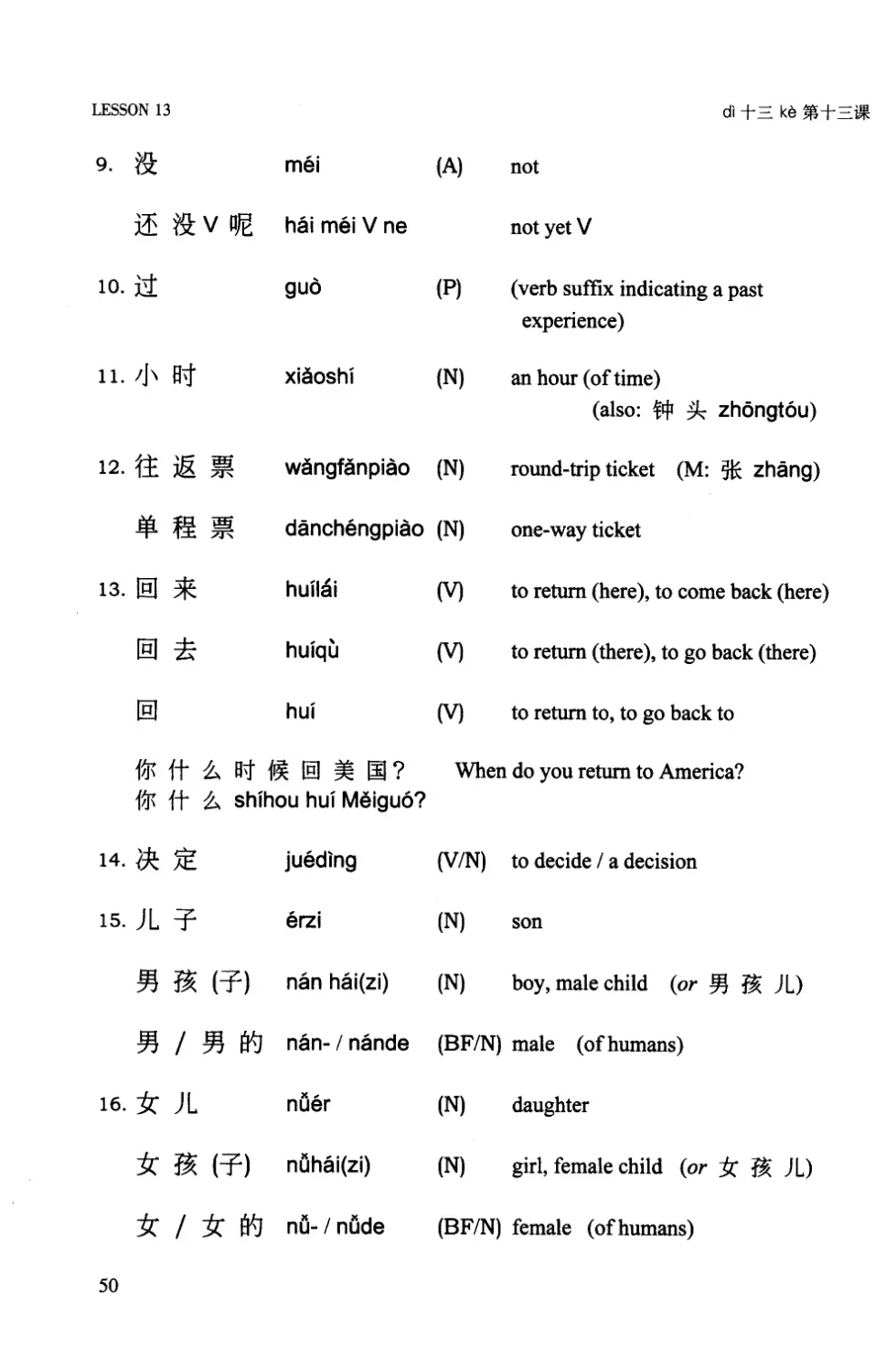
(A) not
tryftVffi h5im6iVne
notyetV
10. I
gud
(P) (verbsuffixindicatinga past
experience)
rr. zJr gt'
xidoshi
(N) anhour(oftime)
(also:fS )( zh6ngtou)
12.
'&
iEH
wdngfinpido (N) round-tripticket (M: }K zhdng)
S.fgH
dinch6ngpiio (N) one-wayticket
13.EJ*
huildi
M
to rerurn(here),to comeback(here)
E*
huiql
M
to return(there),to go back(there)
E
hui
M
to returnto, to gobackto
ItFt+ L nt f* E * tr ? WhendoyouretumtoAmerica?
Itf lt A shihouhuiMdigu6?
14.i* E
ju6ding
(V/N) todecide/ adecision
t5.)L +
6rzi
(N) son
fr U (T) n6nh6i(zi) (N) boy,malechild (or fr lA )L)
H / n H! nfun-lnSnde (BF/N)male (ofhumans)
16.k )L
nil6r
(N) daughter
k fA ffl nilrrailzil (N) girl,femalechild (or fr, U. )L)
k I k frkJ nil- I nfide (BF/N)female(ofhumans)
50

Ht--iX di1= Ln
17.6 i&
18.#tr
le. fl
20.lfi
24.Efrin
rff
2s.iq€ (N)7
26.>) m
27.Ii+
2s.q t. (ffi)
2s.frH
30.lft + lHl
31.ll
Xidnggdng
Tdigu6
zhdo
la
HSngzhOu (Pw)
bdnl6i
(MA)
chu5n
(N)
tingshuo
(V)
ting
(v)
m6iy6u(N)le
yiqi5n
(MA)
wdizi
(N)
mdshdng(i0) (MA)
ch0-pido (VO)
xish6ujidn (Pw)
m6n
(N)
Hangzhou (in ZhejiangProvince)
originally
boat,ship (M: fr ti6o for boats)
(M: [9 s6u for ships)
heardit saidthat
to listen to, to hear
aren't any longer,aren't any more
(notel)
previously,formerly
seat
immediately (or i Z[ like)
to issuea ticket (e.g.air ticket)
washroom(lit. : wash-hands-room)
door, gate
LESSON13
n#JEE)A.,k WtrE)0.
" Malesontheright,femalesontheleft.
N5nH! zdiydubian,n0H! zdizu6bian.
(PW) Hong Kong
(PW) Thailand
M
to look for, 'hunt' for
(P) (an exclamatorysentenceparticle)
(note6)
21.fr I'l'l
22.# *
23.fis
5r

LESSON13
dl1= kCffi-f
=;X
INDICATINO PASTEXPERIENCES(S g,o)
SAVffi
N/PW
+v"
+n
fr.
&
*
*
#tr
Tdigu6
I also go elrpe*enced Thailand
I hoveolsobeento Thoilondbefore .
When you want to indicate that a specific event has (orhas not ever)
been experienced(e.g .Haue you euerbeento Thailand befor&\, fiis
addedto the Verb (e.e.Iif * S # tr l*. H? ltf * guoTdigu6ift
H?\.
1. il guo suffixed to the main Verb indicatesan experiencein the past.No
specifictime referenceis indicatedwith il. (note4)
Negativeare formedby prefixing *g (€') to the Verb (or Co-Verb)
RepetitionDrill
*
xu6
w
chi
n,
jidn
ffi
ydng
x
x
,./L
{I'
{v-
{x
lv-
{x.
t/L
Iv
S
+k
+\
fi
+r"
.da
lx,
+x
+x
+k
!x,
+x
\.+
]J
guo
\J.
1!
guo
\-+
1rt
guo
\--1.'
]J
guo
il
guo
EiE
Riyn
N/PW
#trffi
Tdigu6fdn
{uH!KHEE.
{fiH! nil-p6ngyou
4X+
kudizi
f/r H
jipido
Questionsareformedby adding *. H or [$ to the end of the sentence.
Using the sentencesin Drill l, the teacherturns eachsentenceinto a question
b1.changing fi to lin andadding ift €' to the end of the sentence;you reply.
't

H+-ffi di1= LU
LESSON13
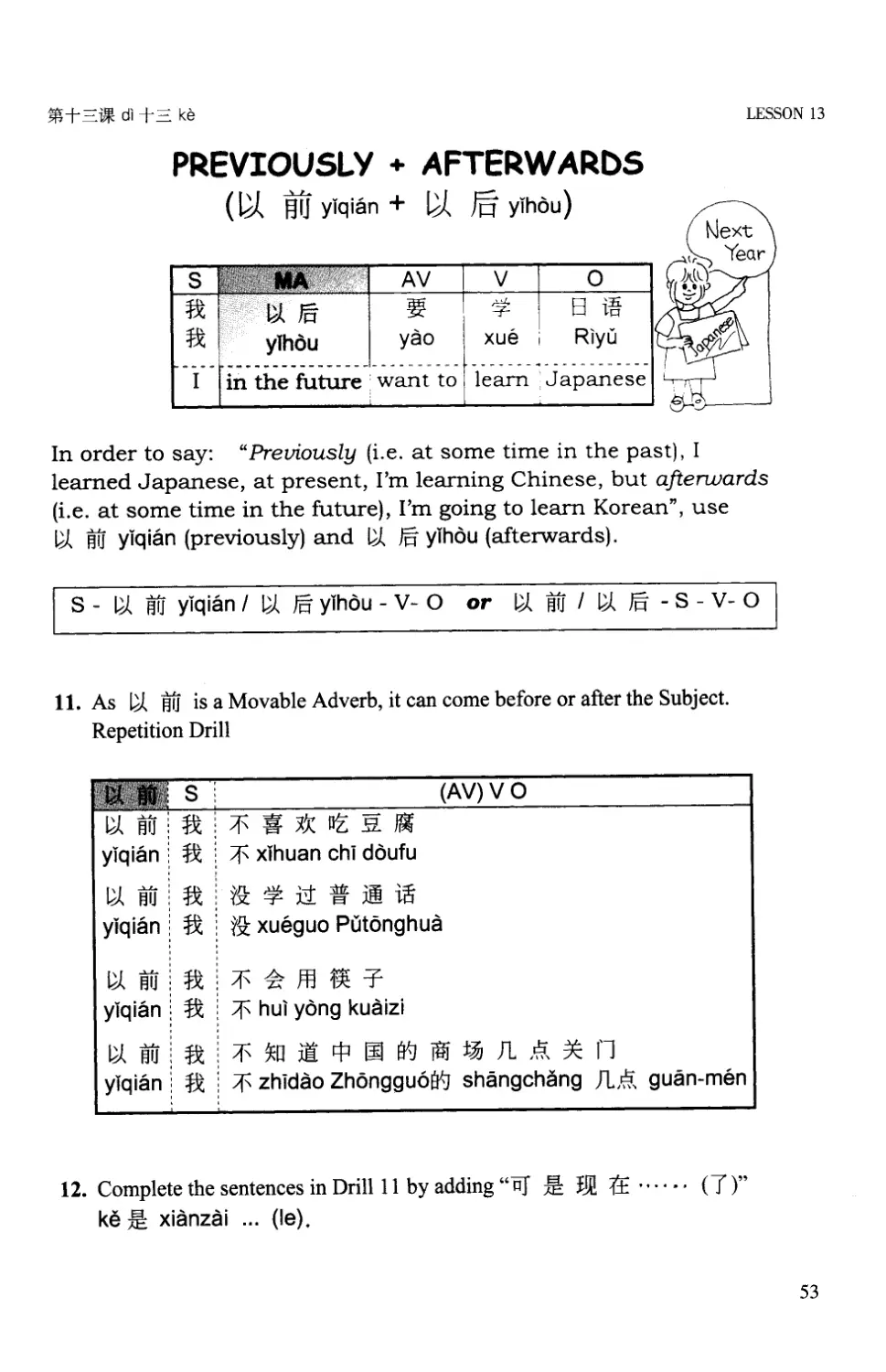
PREVIOUSLY+ AFTERWARDS
Hn
E]
,'u"*)
\ Yeor,
.lr \--\
,-l
S
i:' .:
AV
V
o
'PU/
\Y'A
trw
tx
+x
UF
ylhdu
IT
I vao
4l
I
xue i
ll in
t--J rrf
Riyt)
I in tl:e future'want to learn Jaoanese
In order to say:
"Preuiously (i.e. at some time in the past), I
learned Japanese, at present, I'm learning Chinese, bwt afi,eruards
(i.e. at some time in the future), I'm going to learn Korean", use
U Ft yiqi6n (previously) and D) ffi yihdu (afterwards).
S-XEf yiqi6nlVffiyihdu-V-oor D,{Hflt))ffi-S-v-o
11. As D.t Et is a Movable Adverb, it cancomebeforeor after the Subject.
RepetitionDrill
Si
(AV)v O
T g fi.w.tr ffi
6 xihuanchiddufu
iq+trgEifi
It xu6guoPUtdnghud
T+ffiffiT
T huiydngkudizi
TffiiH+trk!ffirn[,fi*f-l
6 zhiddoZh6nggu6H!shdngchdng/1,f. guin-m6n
D/ Hf
yiqi6n
U} HIJ
yiqiSn
+n
+fr,
+\
+x
4J\
'lx,
+x
'fY"
fi
'-A HU
yiqian
I'-( HU
yiqiSn
12.Completethesentences
in Drill ll byadding
"E
EInE"""(T)"
k6E xidnzdi... (le).
(X Bfryiqi6n+
U ffiyindu)
53

LESSON13
dif = keffif =i4
13. As U ffi is a Movable Adverb, it cancomebeforeor after the Subject.
RepetitionDrill
l\l -
VA IE
yihdu
f\f =-
uA )n
yihdu
l\l =-
uA la
yihdu
l\l =
V)\ ln
yihou
AV
TTH.
ddsudn
,L,n
bixI
E]' D/
kdyi
./ \.
E
hui
S
fi
+n
'A
tx,
.trA
tx.
+\
+k
fi
+x
VO
*#trfi+r.f -nnE
f, Tdigu6zh6o *I" nr5-p6ngyou
+$ti*
xu6H6nyi
tf.xv
jiSoYingw6n
{,Hffi+8tr
xiuxiEt xingqi
TIA,IE 5PENT
She plonsto study in Beijingfor holf o yeor.
In Lesson 6 we met 'Time When'.
Here we look at'Time
Spent'.
Time Spent sentences answer the question: "How Long?"
e.g . How long do you plan to learn Chinese?
How long do you plan to live in China?
The answer is a peiod of time, e.g . 3 months, 2 years, 5 minutes.
54

Ht=iR dit= kd
Q:fEg &{lf,H + * K Ht'lgl?
Howlongdoesshewantto
f0 g zdiB6ijingxul * changshijidn? studyin Beijing?
LESSON13
A:
iU F zdiB6ijingxu6 - 4.
Shewantsto studyin Beijing
for a year.
In ENGLISH, the Time Spent phrase is normally introduced by the
word for'(e.g . I will live here for a year). No word is needed in
CHINESE.
In both English and Chinese, the Time Words answering a .How
Long?'question follout the main Verb. (seeNote 3)
21. Time-WhenwordsandAuxiliary VerbsallprecedethemainVerb.
RepetitionDrill
TIME SPENT
lfr
lfr
+t
+x
{t iil
{fi {il
Itr
lrr
t+
HAizi
a f/r
Feiji
aE+
nA+
,rN ,l€
-7
A\E
1 -1-
./S
-r.
.rN :E
tr
hei
a2
n6ng
,/a,
E
hui
1+
d6i
4
F
+TH
ddsudn
ffi
xidng
#.
ji6o
,*
-f
xu6
.=
=l
xi6
1,
[.
fci
E
z6u
fr.
wen
m
ffi
{r
bdn
I
-
-1-
I
--r
n
fl"
* K Ht'IFJ
& ch1ngshijidn
rF
+
+
+
+
+
A,tJ
fdn
x
x
?
?
Etr
xingqi
4' H{
xidoshi
++
zh6ng
?
?
55

LESSON13
Teacher:Itf fi H + * K Ft' IEI?
{fiddsudnxu6* ch6ngsh-rji6n?
Teacher:Itf fi H tr * K. F{ IHI?
{ftddsudntingff chSngshijidn?
reacher: Itf fi H gfr * K Ht' fHJ?
{fi ddsudnqi * ch6ngshijidn?
Teacher:Itf fi Hft * K Ht'IEI?
{frddsudnkai * ch6ngshijidn?
d 1= kdH+=i+
Student:
(+ + 4' Et') Student:
(bdnf xidoshi)
(m + 4' Ht') Student:
(ru f xiSoshi)
(+ X)
student:
(bdnX)
22. Question& Answer:answerthequestions
usingthewordssupplied.
Example: Teacher:ltf fi H + * KHt' lnl?
(ffi
ifi ddsudnxu6 & ch6ngshijidn? (N
Student:fiffH+m+.
ft ddsudnxu6ffi g "
(I plan to study for two years)
+)
+)
(N+)
(m+)
23. when themainverb hasan object, fr'Jis addedto theTime-spentelement.
ThisTime-Spentphrasecomesin betweentheverb andtheobject.
RepetitionDrill
56

ffi+=& di1= L6
5ENTENCEBUILD.UP
+x
ft
En+
EE+
HE+
EE+
d
fr,
fr"
fr,
&
fr,
4
tr
4
4
g
g
4
F
+
xu6
+
xu6
+
xu6
+
xu6
+
xu6
\+2 E
-T.
'f
bdnS
vrE
-r
-r
bdnF
-r
--r.
bdnS
-r
-r
bdnS
++
Dan+
++
bdnS
F!+o
FtgEifi
ffi P[t6nghud
F!*trifi
ffi P[t6nghua
H,.lg E ifi
fi! Pitdnghud
ffi*Eifi
fi! Pritonghui
H,!gEifi
H!Pritdnghud
f!gEifi
fr! PUtonghud
ACTIVIry yf; al hu6ddns
Tell your teacherhow long it takesto fly from one country to another.
from
to
time
China
China
China
Chrna
China
South Korea
Japan
Singapore
thailand
England
2hours
3 hours
5 hours
4 hours
12 hours
LESSON13
5:

:-.=
-:
::::
-===
:=-.==
_-:=::--::::-*-.'::-=-=
=::,=::::-::==--=-=:.=
::_--=
:==::---::-:-:
=--::
*::
.,-
==
=_:::-
:-=_:-::-:-::=::::-=:-:--
I.ESSON13
TRANSLATION
11. Previously
Previously
Previously
In the past
dif = keH+=l*
ffi i+ fdnyi
1.
2.
3.
4.
5.
6.
7.
8.
9.
10.
Sv
s9n and daughter areboth going to buy new clothes tomorrow.
Igy lo"g doesit take to cycle fiom here to the TeacherTraining University?
Which countries have you been to before?
Originally hisJapanesefriend couldn't speak Mand,arin.
You must decidenow, becauseI want to buy the plane ticket immediately.
He is 18 yearsold this year so he is ableto learn fo dnve a car.
I hear thatyou have never beento my (business)company b"fo...
I have no time at the moment to praitice my Mandarin.
You_mustn'tbuyit, becausehe'sbuying it tomorrow.
A: Your chinese is really notbad ai alll B: you're being too politel It's
only mediocre I
WORTH NOTING i} ffi
Note how peopletell others which Chinesecharacterctheir name consistsof.
In the Dialogue, ffi Lin EtrGu6 X told rhe uJr {H xidoji6 his name using
thefollowingmethod:
+I,W.f4,XI ^ f ,rL{f tr X.EX A ffi tr,
EEX F! X . fi xingLin,shudngm0Lin,jidoLinGu6X . Gu6jiaH!
Gu6' EEXH! x. Askyour teacherhow you shourdtelrotherpeopleyour
name.
TRANSLATIONoF THE SENTENCEPATTERNSEJu ffi i+
1. I'velearntlapanese in the past.
I've eatenThai food before.
Itve never seenhis girl friend before.
I've never usedchopsticksbefore.
I've never bought aplane ticket before.
didn' t enjoy eating be ancurd.
had never learnt Mandafin.
couldn't usechopsticls.
didn't know what time China's shopping malls close.
13. At sometime in the \ttwe l_plant-ogo to Thailandto look for my girl friend.
At sometime in the future I must learn Korean.
At sometime in the future I canteach English.
At sometime in the fufure I will rest for trvo weeks.
58

H+-tX di1= LU
21. Next yearhe is able toteachfor ayear.
This year I will study for two weeLr.
Todaythe child must write for half -an-hour.
The plane is still going to fly for 20 minutes (beforeit lands).
How many daysdo they plan to walk for?
How long are you thinking of playing for?
23. Next year he is able to teachEnglish for ayear.
This year I will study Thai for two weeks.
-
Todaythe child must write chinese charactersfor half-an-hour.
How many daysdo they plan to walk for?
LESSON13
NOTE5 iT fi4
1. le €' (N) I le : Thisuseof T le indicatesachangein thesituation,i.e.
(in thepasttherewereboatsto Hangzhou,but)therearen't anyanymore. or
(Anhouragotherewereseatson the9:20plane,but)therearen't anyanylonger.
Thisspecialuseof T le is coveredin moredetailin Lesson22.
2. Quantitiesof TimefollowstheTimeSpentpattern:
Whentalkingof quantitiesof timee.g .I still havetwohoursleft (beforeI leave),
theNouns 4. E{ xidoshi/ f+ )k zhdngt6u(hour)and h f6n (minute)are
used.Also, tF zh6ngmustbeaddedafterjl fdn,e.g .5 minutes: T" h ++
(fi fen zh6ng),whereasit canbeomittedwithTellinstheTime.
whenTellingtheTime, h fln (minute)mayalsobeomitted.However,when
talkingof Quantitiesof Time, h fdn mustbeinctuded.
3. TimewHEN: TimewHEN sentencesanswerthequestion"when?"
TimeWHENwordsprecedethemainVerb.
TimesPENT: TimesPENTsentencesanswerthequestion"How Long?".
TimeSPENTwordsfollowthemainVerb.
59

LESSON13
orT- KerEf -uR
4. Experience-[ guo, aswell ashavingthe"Have (you) ever... before"
meaning,canalsobe usedin the senseof "At sometime in the past,,,e.g. li\ +
tr /t + ffi $f iF? ({fi xu6guoIL +ffi Hinyn?) (Forhowmany
yearsdid youstudyKorean?). what is impliedby tr guo is a cut-offfromthe
present,i.e.at someunspecifiedtimein thepast.
5. ffi [E ba hastwo differentshadesof meaning:
a) formof assentor agreement: That'sfine. Okay.
b) half-question-havingthesamemeaningas tT T ffi - ttrereplybeing
Possiblytr rE ba ! (all right).
6. chinesehasmanyexclamations:$i la' F luo. [I ya. [Ffa, etc. Thesewill
takeyou a little whileto understandhowto useappropriately,butwill makeyour
Chinesesoundmorenatural.In thesentencein theDialogue,.m
,m
li| Wi-
"m6fan
lif la", Si la indicatespolitefriendliness.
YOUROWN NOTE5

ffit-ix dif = kd
LESSON13
ftAemo
rize the FollowingChorocters
The following characters have already appeared 10 times and so the
pinginwill be omitted from now on. Use this opportunity to memorize
them for future recognition.
shdng
up, on, above;
Iast (weelc/month)
ascend,get into
xid
down, below;
next (week/month)
descend,go down
ti
in(side);
neighbrhood;
Ii 1= 590 -etres)
6rl-r
son;
Noan suffix
ziti
to be at,/in/on;
at/in/on
midn
side;
face;
noodles, tlour
b6n
volume (of booka
sh0
book
6l

}.
ft
TI
ii
*__i- -*
-_ ***** -
"i
6
w+
a;'-
^
/L
LESSON13
di+-- kdfff =i4
write a story using the chinese characters you have already learned.
when you need to write a word or syrlable but have not yet learned
how to write the chinese character, simpry write tt,e pingin.

ffi+wx di+E kc
LES5ON T4
Whot's in this lesson:
-
Prepositions ffi gcn. ffi g6i. 6 ti . f,f dui
AAAKINOA TELEPHONECAIL
DIALOAJE r,t ifi duihud
*:nF!
f,t : nR! {frftiE ?
* : ftfl*J+t{tr4 "
ff : ft{lltsEffiffi" Iir+frtF+€69?
ffi :2OO17951.
ft : fi{lltsEE 2oorTssL"
*:Ei'xfTftd.
ff :iftXK.
(Coidiolsogoin)
11: iHf{'fffEWIn?
lil : iFS-T , +*.*lfrVtEHE-E
*fr,+., xfT
fr,lfrtntrT#.x..fiE{t{H{H
TIJ:
LESSON14
63

LESSON14
ItJ:17'i+fqEE
X{:TBA.
di+E k0H+Ei.R
,
+i,--fr_g.iFit"
I
tVt:
*:
tVt:
*:
.ffttxJill{[fr.iE+TH.ifi?
illsL , Iill{lltffiiEiHifi ?
+tffi{tfHfHi_[ifi
.
rui.il,Ef iLFX, rfi.#fr_Effit
E_ -ftE*XfiE.
ItFtXlfrHItLSz
4*+nBEXr +gff +n€€ H!- +EEts.#dra,
ErEft
EEXE'S'EIFEAIFH,|r,
FnD)Wr'*frffr. +tfsl{ fq
IfrA?TA?E+r,*
"
N^i?lftf"JfE
'
EX{tH'FXffi+iin ntrffiL+tsl.,1'HiR
.
flF,t{TT. +iffwhnil.-+FEtsffEifiEEffiAl^
68f;$fift'ElEfilkHryftit "
iqx6 , IiF4Uffi+XffJIC F , *KTflE.#I3H
IC-Fff
H.ifi
.
ilfiff !
tVt:
H:
tVt:
H:
tVt:
H:
64

H+EiR di+E kd
LESSON14
DIALOzuE xf ifr duihud
Cdi: W6i!
Lin: Wei ! lft zhitosh6i?
Cdi: *i zhdoLiirGudng-yingxiansheng.
Lin: +n{il tsE xingLin. lif de nJFt hdomS?
Cdi:
-
linglingydo tJtfryao. (Note12)
Lin: fi{l'l tse E
-.
linglingyeo |-frjiLyao.
Cdi: O,duiT qi.
Lin: it gudnxi.
(Coidiolsogoin)
Cdi: W6i, ffifnl,Li0Guing-yingxidnsheng&T&?
Li0: i6foj,nin E rXFwdi?
Cdi: fi jidoCdiD6-hu5, E
'f&ffi-+ wdigu6p6ngyou.
Li0: iH d6ng-T, +k *
'f&H!f6ngjidnkdn- kdn .... Cdixiansheng,
duiT qi, {U xidnE T& jia. fi E fE ji6jie....
Cdi: {0 dagaiftZ shihouhui*?
Li0: fi Tt qingchu.{fi gcn fi shu64X k6n6ngwdn -,fi/L hui-jid.
Cdi: flFA,m6fanltt ifr l& h fi hui-didnhud,lT W?
Li0: ffi, iftfolti, fi
-
dinggdosu{fi.
Cdi: t xidxie '{ft le !
Li0: T kdqi.
Y6ng: {fl ganggangh sh6idd-didnhud?
Cdi: +fr,h Li0Gu6ng-yingdd-didnhud,ddnE lfr T&.
Ying: frFL, {ft gangc5ig6nsh6ishu6-hud?
Cdi: fji gdn i0 ji6jieshu6-hud.l& shu6m6it fibaiX, fE didi
-
dingg6nf0mil - qi * * d6ngxi.
Y6ng: {iy,zh6o lfr H lt/z shl?
Cdi: 4* fi EEX i wu g bdngfi bdbafr! .-f p6ngyoubdn-jid,
k6E fi qEX H shi,kdn6nghuifdichSngm5ng,su6ylt* bdnfd
bdngm6ng.fi xidngl"llfl {t n6ngI n6ngti +k *.
Y6ng: YlnggdiiqfF]ti, yinwdilfr zu6* g€n fi shu6xidnE (fr,i wti
?Rshdo €' ke.
Cdi: tF t F le. fi h6i 4 h lingwdi-t p6ngyoudd-didnhua
kdnkdn{t n6ngfr n6ngbingmSng,kEE +f,WH lingfi le.
Y6ng: ift gudnxi,'ffi kdyiydng fiE! IC ka ,
+i, xidnE *Sydng
IC kedd-didnhud.
Cdi: Xidxie!

Lin
Cai
tin
Cai
Lin
Cai
Lin
Cai
Liu
Cai
Liu
Cai
Liu
LESSON14
EN6UI5H TRANSLATTONOF THE
Cai
Cal
Liu
Cai
Liu
Yang
Cai:
Yang
Cai:
Yang
Cai:
Yang
ditE kdH+EliR
DTALOGUEr,f i6 ffi i+
HelloI
Hellol Who are you calling? (tit. Who are you looking for?)
Itn calling Mr,Liu Guang-ying.
We're surnamedLin. What number areyou calhng? (note Z)
2001 7957.
We are 20017591.
Oh, sorry.
Never mind. (Cai dials again)
Hellol Excuseme, is Mr.Liu Guang-yrngin?
May I ask who you are?
I'mCaiDe-hua-a foreign friend of his.
Pleasewait a moment, I'11goto his room and have alook ... Mr,cai, I,m
sorry, he's not at home atthe moment. I'm his elder sister.... (note 3)
When will he probablybeback?
I'm not too sure. He said to me that possiblyhe will bebackhome alittle
Latertoday.
rn that case,may I trouble you to ask him to return the car, okay?
Okay, no problem,I'll definitely tell him.
Thank you very muchl
You're welcomel
Whom did you just call?
I calledLiu Guang-ying,but he'snot in.
In that case,with whom were you talking just amoment ago?
I was talking with his elder sister.Shesaid that everySundaywithout
fail, her younger brother goesshopping together with his parents.
What are you looking for him for?
originally I was going to help a friendof my father's move house
tomorrow morning, but tomorrow I'm occupiedand will possibly
be extremely busy, so there,sno way I canhelp.I was thinking of
asking him whether or not he is able to go insteadof me.
There ought to be no problem becausehe said to me yesterdaythat he
seldomhas classin the mornings at present.
That's great! I still need to call another friend to seewhether or not he
canhelprbutl don'thave any small changeleft. (note 11)
Never mind, you can use my telephone card-laiways usea telephone
cardto make calls nowadavs.
Thanksl
Yang
Cai:
Cai
66

H+WuXdi+E kd
NEW VOCABVLARY
1. rF
LESSON14
shEngci
(EX) Hello ! (only on the telephone)
(N) a number
(note 2)
(N) room (in a house) (M: fnl jian )
(or: ft f w0zi)
(N) eldersister
(N) youngersister
(SV) clear,distinct
(CV) togetherwith; to ; from
(AV) possibly,may, may be / possible
fVO) to return home
(VO) to return to one's home country
tVO) to return a telephonecall
(CV) to [also means:for (the benefit
of), on behalf o!] (seeGrammar)
(MA) just a momentago,just now
(N) youngerbrother
(N) elderbrother
(N) parents
(N) father
(N) mother
+ iFl
2.+6q
3.Efsl
4. EEIE .
WW
5 iFH
6.ffi
7. trI HE
8.Ex
Etr
E€.
s.h
lo. liJllz-
n.# fr
BS
12.J4E
t*
Etr)r
r+ zfi
wr5i!
hdomd
f5ngjidn
ji6jie
mdimei
qingchu
gen
[6n6ng
hui-jid
hui-gu6
hui-diinhud
g6i
96ngc5i
didi
gcge
f0mU
fiqin
mUqin
ifi
67

LESSON14
13'fr{,
14.€
lur
ls.m
€
f4r
x
f;Frrt
ff ff ltrW
Xidxie{ftH!
#
'&.,t
,t
T ,t'
fifr,fr+tFizT
flvl
ryfi
H
r.f
bdng
bd(ba)
md(ma)
bdn-jid
bdn
fdich5ng
bdngm5ng
bdngzh0
#Wr
bdngzh0.
ti
h6nshdo
shdo
b0-shio
,t
lingwdi
lingqi5n
ydng
dui
lFH
fi{ tr
di+E kdH+Ei4
(CV) help, for (the benefit of), on behalf of
(N) Dad
(N) Mom
(VO) to move home
(V)
to move (something);to fansport
(goods)
extraordinarily,unusually
to help, to assist(someone)
to help, to assist(someone)
help, assistance
Thankyou for yourhelp.
16.
17.
i8.
19.
2t.
23.
(v)
(N)
(A)
(vo)
(cv)
(A)
(SV)
(SP)
(N)
(cv)
(cv)
(SV) not a little, quitea few
He hasnot a little money(i.e. a lot of money!)
for (i.e .substitutefor, in the
placeof, insteadof)
seldom
little (in quantity),few (note4)
another
smallchange
using,with
to
20.
22.

H+V\IXditE ke
LESSON14
CHINE5E PREPOSITION5
(Co-Verbs) (CV)
I conolso9o with youtomorrowondploy.
Chinese Prepositions (Co-Verbs) function like English Prepositions,
defining when, where, how, for whom, with whom, etc. the action of
the main Verb takes place.
In this lesson, we are introducing you to Prepositions \Mith', for',
'to'
and Trom'.
Remember that, whereas in ENGLISH, Prepositions normally follottt
the Verb (e.g .I go withyou), in CHINESE the word order is:
SubiectI Co-Verb+ Noun I pre@&t:l u"in Verb
Note that for emphasis. the Co-Verb + Noun precede the Subject.
Time Words, Adverbs, Auxiliary Verbs and negatives normally all
precede Co-Verbs.
The most appropriate English translation for a given Co-Verb differs
with the main Verb being used, e.g . flfl g6n can be used to have the
meanings \Mith',
'to'or Trom'(see examples below).
Vice versa, in the English sentence
"He bought something for me",
the Preposition Tor' corresponds to h if it means for my benefit',
but corresponds to 6 ti if it means
'in my stead'.
REPETTTIONDRILI5
Elxl ffi W
TIF
you
k6yi i g,En
-F-- -* . --.
can I with
69

I,ESSON14
1. ffi gdn = togetherwith
fi El' D.(ffi fitr-
*g * ffi ,'l.tr^ rq?
*t k6yi g6n ,|fr - qi * H6ngzh6uw6n [g ?
dl+E kotr+EiR
ItrsTgffi{tS?
{fi FZig scn{&zu6?
Ifr_ftZiAffifi_EE* O
{fi * ding g huig6n +t - qi hui*.
finHnffiffiffi-ftE*riR o
+t n xihuang6nmdimei- qi * I ke.
2. ffi gdn : from (i.e .thesourcefrom whichsomethingis acquired)
+tffi+ztF+BiE.
*l gdnLi ldoshixu6RiyU.
Itr 4 M. 1Affi {e .H " (,fSjid : toborrow)
ItFT yinggdigcn {fi jid.
Itf4ffi{ttEItL^w?
Itr 4 genru jidItL d6nsxi?
3. ffi g6n = to (i.e.with)
{eg*ffiHJr,+.ix.Fq..
{& g * gdnHu6rigxidnshengshu6zdijidn.
+IffiIBiNB iE,KTATT?
fl g6n {fi shu6Riyri,*TZI*F?
flFl+ 4, lir E u zi nI u ffi lfr,ifr.?
flFjianshi, {ft kdyiT k6yig6n {t shuo?
Ir,4t'ffir&inrfziE o
{fi me_hg6nfE shu6duiT qi.
ffiEnxaffi{fi9-H4.f*,o
Ifr HAXhuis€nltr g -H
*+*.

HtEiR ditE kd
4.h
=
for (i.e .help,assist)
F[+Fftr^h+]"+mftz_H"
FFf H5ngu6l h +fr,ne ffi h6y5g5o.
+fr,HA
X trIUh {ftX r.+ .ffi, o
fi EEXkEVth ,ffi X wdishengzhi.
E flFW.ffi"t' fi h ltrE +\frt& + "
E flllzhdngzhil +i. h {fl xi6 fiffi mingzi.
'fti4 rE! +i,h lrr+ #[^ tJFfi t +ffifl .
liy,zudba! +f,h $r nArFA Shifanddxu6f!S.
5. h : to (aperson)
(seenote6)
+fr,TM1.6"lfrEH
o
+*,T xidngh lfi xi6xin.
IB4L14.t&fiH.ifrrE!
IinmdL h ro de-dianhud
ba!
6. 6 ti : for (i.e .insteadof, in placeof, substitutingfor)
,n&Yfte'ETE?iqXF.,+k+XEltlX* o
XidnE iftkdng,frZKfr.? iftgudnxi,fi +X ti {fi * cai.
+ X & H'Bt'fnls9? +nE IB#.,*T T *T?
+x iq€' shijian14? *i ti '15iiao,*TZK*T?
ss;f.a2&HF-t'ix!
Gdgefr n6ngti didi i ke!
;{ifiTrE?fi#$rtr+o
t ldileba? +t ti .{fi kdi-ch6.
LESSON14
7T

LESSON14
diiE keHf Ei4
7. f.fdui : to
zt)frr.f+Hix,{&{ftElx{^,H,-T o
Ldoshiduixu6shengshu6{&{ll k6yixilxi -T.
lU r'f fi i.H,
*
+I"tF.E rt lil,, o
ffi duifi shu6"+k"R.xihuanfi6".
E ft t r.f+r,ffi.w o
w5nstt dui+ktsl.rT.
lKft,Hr'I+nlFH*4"o
ZhdngxiSnshengdui ft f€ich6ngkdqi.
TWoVerbswhich act like Co-Verbsare ff bang and ffi ydng
8. fr{ bdng : for (i.e .help,assist)
hT'ffiltr?F+f,+
-ry+X+ o
M6fan{ft bangfi n5 - shudngkudizi.
+fr,+
xE xf;f{ftx+/lH.
fi +X kdyibdns{ft X jipido.
fr f;fltr+,fr $ tT?
fi bdnglir n6,tl 6 *T?
SF+E#frEIfr.V!&+.
G6gebdngdidixi6 {fiF! mingzi.
9. ffi ydng : with,using (in,by)
+tr/'ffiffi+W*.\f;EEJ?
Zh6ngguo,A.ydngkudizichi Miiidangl6ofl{ ?
{&ffi + I E frF+{{H.
{fi ydngZh6ngw6nxi6 fl[ fdngxin.
fi Elxffi* I ix,H9?
*i k6yiydngYingw6nshu6 [4 ?
{Efgffi t&n HEE il1fn x ills* tE+ .
ffi xidngydngl& n6n-p6ngyouH! fi X F[ ti6oq0nzi.
l2

ffi+W1RdltE kd
10. ExpansionDrill: insert the Co-Verb+ Noun in the appropriateplace
ExamPre:
reacher:
Xlfl.ffirt#',; -rr.
Student:
616 fi.
Xidnggdngw6n.
LESSON14
(ffi+trE)
( gdn fi f0m0)
fiFfiI.E*
ft s6n{i f0mn*
Teacher:
+I"* 6Etx"
+fr"* Xidnggdng
wan.
Teacher:fi iH ltf :R.8..
fi shu6Itf ;R.shdu.
Teacher:
+fr"*#.F .I.
fi * jidoRiw6n.
Teacher:fi + lI iE "
*i xu6Hdnyr).
Teacher:
+ft"q4I{H"
fi xi6Yingw6nxin.
Teacher:fi g *.W + l^ E"
f! xihuanchini0rduH.
(ffift!.8)
Student:
( gdn 1t f0m[)
(r'Jil 4.fE)
Student:
( duiZhdoxidoji6)
(EfiEEE )
Student:
(ti fi p6ngyou)
( W.wr Z t)fr)
Student:
( g6n Y6ng ldoshi)
(fr+finHF-) Student:
( bdngf{ p6ngyou)
(Hffi+)
Student:
( ydngkudizi)
73

ttitl\
14
5ENTENCEBUILD-UP
ACTIVITY ffi iJJhu6ddns
Fill in theblankswith anappropriatePreposition(Co-Verb)
fifr,-fifrffi8
9J+&*'
{t _ {ft p6ngyou
dio xu6xido:F .
1/
t&g_fiiH
lF..* rfr.
fEg-fishu6
lp-.
* hud"
di+E kdH+EiR
{fttFT!
fi - ltn#. aTt
{fi t l6ite!
fi_
,fftjiaoba!
Si
#"
+*,
TW
-F -+
-
yue - hdo
-H-€
-
yud - hdo
CV+Nj
ffi
lfr
Ifi
fifi,
t&
tfr
fifr.
lfr
lfr
lfr
voi
*Itrx
* ltrj.a
Xlttx
* ltri.e
XltrX
* Itfi jie
Xlrr7.
* ltrj,e
Xltrx
XlBjta
Xltrx
* IBj,a
ww.
chi-fdn
ww.
chi-fdn
W,ffi
chi-fdn
ww.
chi-fdn
ww.
chi-fdn
ww.
chi-fdn
Wffi.
chi-fdn
ffi
g6n
ffi
gcn
ffi
gcn
ffi
g6n
ffi
gcn
F
F
4
F
F
g
F
F
&
&
&
fr
t
fr
tat

H+EiR ditE ke
LESSON14
tfr,+_
W,W."
{& hui_
ffi+
kudizi
fifr. _tfrf.EEF-
5 {H"
lfr - {t nfr-
p6ngyouxi6xin.
fi-ltrEFIJ++.
(assist)
fn _ liy,xi6 fllJt zi "
(assist)
chi-fdn"
TRANSLATTON ffi i* fanyi
The policeman saidto me thatl'm not allowed toparkmy vehicrehere.
Apples andmandarin orangesarcbth very expensivenow.
1.
2.
3.
4.
3.
6.
7.
8.
9.
10.
Mr.& Mrsliu's son likes to help buy the vegetables.
(seenote 1)
Just a moment agohe was speakingto his friend in Korean.
!-. uttt possiblywear his other pair of pants (trousers)this evening.
Thanks for your help. Moving houseis a real botherl
I'm not clear which room is his. It's probably on the secondfloor.
He has very few friends. one is surnamed Li, anotheris surnamedLin, but
I'm not sure which one is learning Mandafin.
Haveyou ever calleA(to) Thailandbefore?
He has decidedthat eachdayhe will speakin Chinesefor two hours.
WORTHNOTING i+ ffi
children in the samefamily seldomaddresseach other by their given namerbut
insteadcall eachother by their respectiverelationship title. Take,for instance,a
family of five children:
A (theeldest)isaboy; B (thenexteldest)is agirl; c is aboy; D isagirland
E (the youngest)is a boy.
C, when addressinghis brothers and sisterswould not call them by their given
name,butrather
callA: S ff 96ge, B: iE ffi ji6jie, D: ffi ffi mdimei
andE:tstsOiOi.

t-Essoi\14
di tW kdffi+Wt$
TRTNSLATIONOF THESENTEN1EPATTERNs6Ju ffi i+
1. May I go tqgetherwith you toHangzhou for somefun?
Do you want to sit with him?
He definitely won't come back with me.
I don't like going to classtqgetherwith my younger sister.
2. llearnJapanese from TeacherLi.
He will ask you for yIOO tomorrow.
(note g)
You shouldn't borrow it from him.
What do you want to borrow from him?
3. H_ewants to go and sayGoodbyeto Mr.Huang.
I'11talk to you in Japanese, okay?
Can you talk to him aboutthatmatter?
SaySorry to her immediately.
4. That Koreangot two tubesof toothpastefor me.
I canbuy toilet paper for you tomorrow.
I'll write my name for you on that sheetof paper.
Remainseatedl I'll get the TeacherTraining university book for you.
5. I don't wish to write him aletter. (I don'f wish to write a letter to him)
Callher immediatelyl (Make a callto her immediate$)
6. Y9u'vegp! no free time now, right? Never mind, I'll buy the vqetables
instead (of you) today.
Y_oy'vggot no time today?I'll teach instead of you, okay?
Elderbrother can'tgo to classinplace of younger brotherl
You're really tfued, aren'tyou? I,ll drive insteadof you.
7. The teachersaid to (her) studentsthat they may rest for a while.
Shesaidto me, "I like you very much.r,
Mrs.Wang is verygood to me.
Mr,Zhangis extremely polite to me.
8. May I trouble you to get apair of chopsticla for me.
I canbuy the air ticket for you today.
I'll get it for you, okay?
Elder brother writes youngerbrotherrs namefor him.
9. Do Chineseeat McDonalds with chopsticks?
He is writing thatletter in Chinese.
May I talk in English? (May I useEnglish?)
Sheis thinking of buying that skirt with her boy friend's money.
76

ffitwix di+E kd
NOTE5 i+ fi4
1. Whereasin Englishwe say,
'Mr,& Mrs.X', theChineseis rendered
'x
fr,4xidnsheng
Xt A'.
2.
"Whatis yourtelephonenumber?":
"lif
H!ft.ifi€dqE*
,,
?"
(liffl didnhudhdomdfl. * shdo?").
3. In lessonl0 note1,we saidthat - f, whenaddedto a verb,caneither
havetheideaof 'a littlewhile' or 'a moment'(e.g . S ddng -T - : waita
moment)or it canmaketheforceof theverblessdirect,hencemoregentleor
friendly(e.e . Iif E kdn -T : take(a little) look at it). Repeatingthe
Verb,with an optional - in themiddlehasthesameeffect,e.g . ffi
-
ffi
xidng- xidng(thinkaboutii, A e) E kdn (-) kdn.
LESSON14
4. When *
by anAdverb:
/R.* L
6,tfi
and ,)' shdo areusedto modiff aNoun,theymustbepreceded
(notjust * ^ )
(never ,, f*, )
NOTESon Prepositions
5. Whentelephoningorwritingtoaperson,use
ffi: +f,4 h ltf E IExi6xin.
Whentelephoningor writing to aplace,use Sil: fi F E I=; fil E 4 "
(+t g xi6xinddoRi{)
6. WhenCo-Verb9A isusedhavingthemeaning'to',
it is mostoftenused
with: makinga telephonecall lo someone,writing a letterlo someone,or
introducingapersonto someone.Although h caneitherprecedeor follow the
mainVerb,in thesouthof China,whenusedhavingthemeaningoto',
h often
follows themainVerb.
With a few otherVerbs,whenmeaningto, h alwaysfollowstheVerb,e.g .
*
(sell), H ji (mail), 4 nA(takehold of).Thisis coveredin moredetailin
Lesson19.
77

LESSON14
d +E kdH+Ei4
7. F'f dui is usedwhenonepersontalksto (at!) another,e.g . ft X.f ffi i.[ {t
T ,Z'
*
(fi dui {& shu6 {t T bi *): I saidto him thatheneedn'tcome;
ffi g6n is usedwhenonepersonhasa conversationwith another:{fi EE fi iH
tR* s {H({&genfi shudlft.*
shiqing): Hetalkedwith meabout
manymatters. However, XF canalsobetranslated/o, asin the sentence:fi
ffi {fi iH H I (fi gen {ft shu6Yingw6n): I'llralktoyouinEnglish.
8.
'[& gdn someoneF something':$ heremeans'to demand'or ,to
request'andis normallyprecededby Co-Verb E&g6n.
9. H ydng (by, with) answersthequestion:How (i.e .by whatmeansor with
whatinstrument)is theactionbeingperformed?
10. Many co-verbs canalsoactasAction verbs, althoughnormallycarryinga
differentmeaning:
&
: CV:in,at,on
\4 to bein,at,on
ffi gdn : CV.with
h
: CV: for
FtJddo : CI4to
ffi ydng: CV with
V.to follow
t4 to give
[/ to arrive
Wto use
11. TheDialoguecontainedthesentenc€,
.,......rEf
E+\#HryffiTo,,
(" ...,kd E +I, #H lingfi le."). This T le carriesthemeaning,..(Idid
havesomesmallchange,)but I don't anylonger. This ,Change
of Situation'is
coveredin detailin lesson22.
12. In telephonenumbers,roomnumbers,etc,1 is pronouncedy6o.
YOUROWN NOTE5
78

ffitv\ix dltE ke
Memorizethe FollowingChorocters
The following characters have already appeared 10 times and so the
pinginwill be omitted from now on. Use this opportunity to memorize
them for future recognition.
xidn
first
sh6ng
tobefun;
a literaryperrcn
,l\xido
small,Iittle;
young (in age)
ji6
eldersisterl
younglady
xing
fanilyname;
to fu sumamed
jido
to caIIor namel
to teIIor order
ming
name
zl
wod;
written (Chinese)
character
LESSON14
79

LESSON14
di+E kdH+Elift
Write a story using the Chinese characters you have already learned.
When you need to write a word or syllable but have not yet learned
how to write the Chinese character, simply write the pingin.
M\
t5?
f
irl
i*i-**** -**'*-
/J\
A
L
Jr+
XT
-
<-
e{

LESSON15
H+ntX dl+fi kd
LESSON 15
What's in this lesson:
CompletedAction (T te)
WHEN I WAs YOUN6
DIALOzuE fi ifi duihud
iFltrJ, lgErrFtr/.?
+tE{Htr/.'
{EEzJ'HtHt'{F+txffiF,JWtr
' ffi'f}&ilI\
ET"
H : 'ffttsL++4.'
fHX-Ef{fttE[#FAiX,rE" IirHffiEt
: ['FE['FE
'
'lAiH_,R,F.ffiE.
" TNEfrA*AflJHT.
H:
#:
-H
+
EEI
+
,H
+
-H
+
,H
+
EEI
+
F
I RAAtsT+?
: trx+
-
y H!H{{R, ft,flt+xythfrJttr*{+T.
: $THNHf.EWWJ?
:H, -+fr# 'ffE-m+mffi
"
: fft ' illsAlirB#f,.
"
: Ff'4E5U HHiH,fiTXlZf,.!
: fft' EB{+jl " {ft*+tr *KHtlslT?
: E4=+87 "
I lirtrXffilff..cltA?
:
I W\Z,|)W[9
?
: x,f" +Ht'fuR#+k,EIE€'HtHil{R&,ffifriJEfi++..
: rtri,H,ihgffigjiE/{{*
"
81

LESSON15
ditfi keH+ax
# : Ei, ffiZrlXilE
"
roEiE/{ltrA#.frsur?
H : tffiArE ! n]Erur?&frYfc.fthh+*JlFrE
.
# : ffi{tAnt'{Rffi*f+t{il+fi?
H : flTtiFE ,frTlETT(+)EffrE.
# : iffigfttr5ifr+frl/\{-1)Fws
"
ftfg+*,rfr.\^h.fu+T(_.)+
H.i6.EHXili,x{ft"
H : fit?RHxiliFrlir"
I E' is o westernerwhois leorningChinese]
I: tt'ft,+.,IiFW
"
t:*: Lfr,+. ,
IirfrT" iFff , iFff .
I : iFfrFf{ft.
6f : iFAb. iHrEA"
E: W' iffiFf
.
iFH' tF{UErE?+\rhl*nfrn&
"
f4 : Fl3{iEEf;f"
r : fliE?+filstl*+trFlHt'{F
'ffiruq.trH"
*ftrnERaf#z
ff :6fH! f&t+Fr#r?i"
E: fiil&tfrWl*'e-,tr;?-^"
ff : TE'roEfl'ill\ ,fr"gfflHt'{RffiF[F*tr€.tr?fiH!
"
I: ltrifuEtr€'jdgilE€'?
ff : F*tr€'. r.fTfrE'+ifrlgEifiTtfdifi"
E : nEFErtFE
"
E+ifrlili#trTWrTr
ff : {fttFaT ! qTg+k{#.trrfi1ftr1-T?
I: fT' iffiff"
ff : &nI ! r&A?AfrT.
I : ift(tr')X6,D)E-.Etr6rJHFlf/tA
.

ffi+frix d +fi kd
LESSON15
DIALOA/E r,f ifi duihud
Huing:iFltrl,nin E n/FguoA?
Li: ft E D6gu6{, din E 4. F! shihou+i jie bdnddoF6gu6,jiO
zhOE flFEre.
Hu6ng:If!\tsL F qing,Dew6n. Fdw6n{fi Oagai#J huishuoba.
{fi zh6ntihai!
Li:
rrFErflFE,zhihuishuO-,F,,F, 6ryi.XidnE chdT * ffi wdngte.
Hu6ng:Zdntz^hui B ydng?
Li: Ylnwdif
-
suip! shihou, +*,'l11qu6njidydubdnddoM6igu6f,
zhDle.
Hu5ng:Itf H xiongdiji6mdiE?
Li: H,
-+ didi,heiH m+ mdimei.
Hu5ng:O, flFA ltr ft. tdodd.
Li: Dui,k6E OiC,,\ chingch6ngshu6+k 6 ft xidngtdodd!
Hu5ng:O, E ts ydng)L. ttf ft Zh6nggu6* chdngshijidnte?
Li: Yrjing=f yudle.
HuSng:{ft m6i X fl zud lt /z?
Li: ft m6i x xu6(xi)pritdnghud.t xu6qr,{ft p6ngyouE fiffi
ldoshi.
Hu6ng:Zhdngldoshi[{?
Li: Dui.Pingshiro zhijido fi, k6E tr fr! shihoufl jiao bieBt
xue4.
Hu6ng:Tingshu6l& q bdnddoF0zh6u*.
Li: O, +t T zhiddo.,& E F0zh6uh6ihuijiaoS [g?
Hu6ng:Ddgdihuiba! K6E ,fr w xidngh6i r+ kdishizhdogongzudne.
Li:
*fr ItL shihoulikaift{ll xu6xido?
Hu5ng:+*,T ft qingchu,tT xidngE TT(+) xingqrba.
Li: Xidxieifi gdosufi ZhangldoshiH! shi. fi xidngfi yinggdi
h W de(-)f didnhud.Zh6ngdoxingrdnshi,ffi.
Hu6ng:+ft fr, fft gdoxingrdnshiifi.
83

LESSON15
Wdng:
Lin:
W6ng:
Lin:
W5ng:
Lin:
W6ng:
Lin:
W6ng:
Lin:
W6ng:
Lin:
W6ng:
Lin:
W5ng:
Lin:
W6ng:
di+fi kdH+f,ift
Lin fr,E, ltr W.
W6ngfr,+., llr *T.iF jin, iF jin.
Xidxieift.
iF zud.iF hech6.
ffi, xidxie.i€loj, ilFwdi E sh6i?#. ,l xidngjidnguoffi.
fl[ wdi E Ch6nFdng.
fi jide fi gdng* Zh6nggu6ft!shihou,gdn ffi jidnguoffi. tU
xidnE ziln/z ydng?
T cud! lU -t+ yudji6-h0nle.
fi jide W tT xidngE Xi'dnA.
TE, tU E Gudngzhou, fi suiP! shihoubdnddoShdnxi
sh6ngXi'6nshik!.
'fft shu6Shdnxishdnghai€ Shdnxish6ng?
Shdnxishring.Dui6 ql, +iF! Ptit6nghuaZi f bidozhun.
ryFErjFE, E +kWHdnyihei 6 gdu ll !
{fi ;k kdqile! gng +fr,h
'ffi'filjieshdo-T?
ffi, xidxie.
Aiyat lE yijingz6ule.
ift(€')guanxi,yihdu-.
dinghei H jidnffiH! jihui.
84

H+Ti,x ditfi kd
ENGUT5HTRANSLATION
LESSON15
OF THE DIALOzuEXi.i6 ffi i+
Huang: Excuseme, what nationality arc you?
Li : I'm German, but when I was small rmy familyfttome moved to France
andlived there.
Huang: Soyoung and you could probably speakboth German and French, Aght?
You're really smartl
Li : Not at all.I can only speaka very little. I've almost forgotten them now.
Huang: How come (it's like that')?
(note1)
Li : Becausewhen lwas 72 yearsold, againour whole family moved to
America to live.
Huang: Do you havebrothers and sisters?
Li : Yes,a younger brother andbvroyounSer sisters.
Huang: Oh, so you arc the eldest(child).
Li : Correct. But other peopleoften saythat I'm not very like an eldestchildl
Huang; Oh, it's like that, is itl How long have you been inChina?
ti : For three months (already).
Huang: What do you do eachday?
Li : I learn Mandarin eachday. Lastsemester,your friend was my teacher.
Huang: TeacherZhang?
Li : Yes.Normally sheonly teachesme, but sometimesshealso teaches
other students.
Huang: lhear that sheis going to move to Fuzhou.
Li : Oh,I didn't know.In Fuzhouwill she stlllteach?
Huang: Sheprobably will doI But it seemsshehasn't yet begun to look f.ora job.
Li : When is shegoing to leaveour school?
Huang: ['m not too sure -it seemslike it's probably the week after next.
Li : Thank you for telling me aboutTeacherZhang.I think I ought to give
her a call.I'mreally pleasedto know you.
Huang: I'm alsovery pleasedto know you.
HellqMr.Lin.
HellqMr.Wang. Pleasedo come in.
Thank you.
Pleasetake a seatand (please)have sometea.
Oby, thanks. Excuseme, who is that person?- It seemslike I've met
her before.
Wang:
Lin:
Wang:
Lin:
Wang:
85

LESSON15
Lin:
Wang
Lin:
Wang
Lin:
Wang
Lin:
Wang
Lin:
Wang
Lin:
Wang:
di+f kdfi+fiix
That is Chen Fang.
I remember that when I had just come to China,,I (once) met her. How
is she atthe moment?
Greatl Shegot married last month.
I seemto remember sheis from Xi'an. (a Xi,an person)
No, she is from Guangzhou,and moved to Xi'an, shaanxi province when
shewas five years old. (note 7)
Did you say'shaanxi province, or ,shanxi province'?
'shaanxi
Provincez.I'm sorry, my Mandarin isnrt very standard.
Not at all. It's (rather) that my Chineseisn,t yet good enough I
You are being too politel wourd you like me to introduce vou to her?
Okay, thanks.
Oh dearl Shehas abeadyleft.
It doesn't matter;therc arcbound to still be opporfitnities to meet her
sometime in the future.
86

HtaiR d fn t0
NEWVOCABULARY+
1. fHtry'.
D6su6r6n
2. frt H{ {R deshihou
*X tr
Fdsuo
&
zhD
LESSON15
i-nlsh6ngci
(N) German (ffi tr = Germany)
(at thetime) when ...; while ...
(PW) France
(** tr { = French)
(V) to live, to reside
(P) (indicaresactioncompleted)
3.
4.
s.T
E
6.+
F-r
7. ln
lfr
8.m
f. ir\'
81.t T) yijins(...|e) (A) already
+4.
ni6nqing (SV) young,youthtul
fA z\
ni6nqingr6n (N) youth,youngpeople
g
lihai
(SV) clever,astute (also:fierce,severe)
# + "R E E | ({fi qizi ?Rlihai ! ) Hiswifeisveryfierce!
E
6ryi
(P) only
wdng
(V) to forget
E-7
rl)r J
E7
wdngle
(V) to forget (also:fi jfl wdngji)
wdngle
(V) to haveforgotten
(also:fr id Twdngjile)
'UETffi{fli,H.
Bi6wdnglegdn {tr shu6
Don't forgetto talk to him (aboutit)
'-o.
+.X
qu6njid
(Sp+rrr)thewholefamity
87

LESSON15
x
11.X
ydu
n.n fr frEffi xi6ngdiji6mdi
rc.2 t
ldodd
z
Z
ldo
t+. fii!
bi6r6n
frlJH!
bi6de
1s.H (H)
ch6ns(ch5ns)
16.l
xiiing
{fi{il m + ^'tR {*"
ffiffi.WlfrJt*f0qin"
17.+ ff
xu6qi
t+tr
shdngxu6qi
T+tr
xidxuEqi
ts. T Ht'
pingshi
difr keH+rix
(N/M) family / a family of
(A) again (in the past)
(N) brothers& sisters
(N) theeldestchild
(N) thesecondeldestchild
(SV) elderly,old (in years)
(N) otherpeople
(N) other(s)
(A) often, frequently
(V/SV) to resemble(someone)/ to be alike
Thosetwo peoplearevery alike.
He is very like his father.
(N) semester
(TW) last semester
(TW) next semester
(MA) normally,ordinarily,usually
(o, * ffi pingch6ng)
le. H (H!) Ht' fF y6u(de)shihou(MA) sometimes
20.lE i't{
F0zhOu (pw) Fuzhou( lE € F0jidnprovince)
88

H+frtF dltA kd
2r.frTr*
22.L IF
23.ffi )t
24.H X
2s.rS
26.jEHtrt
27.v*.
6€'
wx
28.r /,1,1
hdoxidng
gongzud
tikai
gdoxing
jin
jide/ ji
Shdnxish6ng
Xi'an
Gudngzhdu
2e.f,l iE
bidozhtin
(SV/N)
(h),, ./t 2H(s6i)...jidshdo
f/L A
jihui
LESSON15
it seemsasif ...,it seemslike ...
work,job / to work (M: l+)fdn)
to leave,to depart
pleased,happy
to enter
to remember,to keepin mind
ShaanxiProvince
Xi'an
Guangzhouff ^Gudngd6ng
Province)
to be standardI a standard,
a criterion
to introduce... (to)
opportunity
(MA)
(N/v)
(v)
(SV)
(v)
(v)
(Pw)
(Pw)
(Pw)
30.
31.
M
(N)
89

LESSON15
difn kdH+fiiR
THE COI PLETEDACTTONASPECTI ARKER7
I hoveboughtit.
Worningl
T le is probably the most difficult part of speech for the student of
Chinese to understand how to use correctly. This is mainly because
many other languages have no feature quite like it, as well as foreign
students jump to the wrong conclusion that they have now found the
past tense in Chinese. So you have been warned ! See Worth Noting.
The Bosic Rule
In order to indicate that a particular actionhas been completedor an
event occurred. (similar to lnue V-edin English), T is added to the
Verb. (Drill 1)
NOTE: This rule only applies to Action Verbs, not to Stative Verbs
(Chinese Adjectives) nor to Equative Verbs. Onlg Aetlon Verbsl
Engfish tense vs. Chinese aspect
Tense: past. present. future
Asnect: starting, progressing, completine
At this stage, it is vital that you note an important distinction
between English and Chinese. In ENGLISH, past, present and
future are indicated in fi.uoways: tense + time.In English, we say,
"They wentyesterday" not "They goyesterda/. The tense of the
Verb must agree with the time of the action.
90

H+fr1R di+tr kd
LESSONls
In cHINESE, however, this system of tense is replaced by a different
system (called aspect)which looks at the action-as to whether it is
going onnow (=the progressiueaspecti & + V coveredin Lesson 10),
whether or not it has been experienced before (= the experiential
aspect: V+ff gud introduced in l.esson 13), or whether it has
alreadg been completed (= the perfectiue aspect: v+T which is what
this lesson is all about) - but without reference to any point in time
(i.e . past, present, future). However, by inserting a Time Wordinto
the sentence, the action can be nailed to a definite point on the time
scale.
And so we get: Enelish: tense (+ Time Words)
Chinese: asqect (+ Time Words)
How is aspct marked in o Chinese sentence?
Usually by adding a suffix to the main Verb.
Tlae actbn completed suffix is T, which is added on to the Action
Verb (except when the Object is simple and unmodified when I
is tacked on to the end of the sentence). [see Drills 1-2]
However, occasionally the sentence is lefi unmarked-usually
because the Time Word used or the context of the conversation
makes the meaning sufficiently clear. So be prepared to be flexiblel
Refer again to Worth Noting.
ENGLISH
CHINESE
I bought
fix7
= past tense
of verb 'to buy'
=
action completed
ofverb to buy'
1. T is usuallyattachedto themainVerb.
RepetitionDrill
9l

LESSON15
Oiflr- Ke ,FTl].tt
-7
J
le
7
le
7
le
7
le
V
A
nidn
in
et4
yijing
S
u+
H1izi
fr
M6n
tr
kai
i<
jr{
E*
hui*
a-
n5
e14
yijing
-l
h7
| ,4.
yijing
7?
le?
fitr
D6ngxi
{&{t.l
{u {il
iE
sh6i
WhentheObjectis simpleandunmodified,7 is attachedto theendof the
sentence,not to themainVerb.
Questionscanbeformedby usinga QuestionWord(e.g . i& sh6i),
or by adding [$ or &(€') to theendof thesentence.
RepetitionDrill
rg?
w?
r4r?
?
?
7
le
T
le
7
le
7
le
T
le
ffi.
fdn
fl
s
fl
fl
1E
xin
x
jia
W
chi
x
x
*,
liJ
ji
E
hui
S
n,fft
ItF
$r
iE
sh6i
Ifr
lfr
io
iV
#.
ji6o
14?
q?
?
?
aDJ?
nEJ?
++.
Xu64
iE
sh6i

'ffithtft di tl[ Ke
LESSON15
3. Transposedobject: whentheobject is broughtup to thefront of the
sentence,T is onlyattachedto themainVerb.
RepetitionDrill
OBJECT
tsi*
tsre
ffi i'l{ 'k +
-vfi
H6ngzh6uhu6chdzhdn
,[+IEtr
frflf fn]ti
fl] +f {H
fl[5fdng xin
TWIAiV
EqrI l+(H)
Si
fi{il
+t ,{it
lfr
t&
.i&
,fr
sh6i
UB)
ffi,)
trFX
zu6X
E'4
yijing
i:r7
|,L
yijlng
ift(tr')?
ift(tr')?
Yq(€')?
iq(€')?
?
?
w?
Eur?
+
xu6
StJ
ddo
f"l
thl
7
le
7
le
T
le
T
le
7
le
a
kdn
ft
rfr
ff
fD
nD.2
nrl t
Up to now, we have seen that Action Completed aspect marker T
is normally attached to the main verb, although sometimes it is
tacked on to the end of the sentence, €.g . {t ,fll E, ,-4 W W. T
(ifi{il yijing chi-fdnle). We will now look at sentences where T
must be attached to the main Verb.
WHENTHEOBJECTOF THEVERBIs QUANTIFIED:singteI
WHENI WASIN
CHINA,I WENTTO:
July1: Beijing
July4: Xi'an
July8: Shanghai
7
le
action completed
= i+!ffir
:rti lgrs
th';;-F6;;;
f wentto threeploces.
93

S
u+
Haizi
#ZIJfr
Zh6ngldoshi
TW/A
HL
-f
-l-
zdtoL
E,FX
zu6X
t'+
*+
V
{ ,H.
xi0xi
,n
w5n
#.
jido
96
qi
ft
zhdo
T
7
le
T
le
7
le
7
le
7
le
+x
+\
,ft iil
ifi ,fi]
+n
fi
I
--r
I
I
I
ffi
ffi
=
=
flfl.L
?Rjiri
tl
f6n
x
X
+
+
+
f
r+
zhdng
+ff
xu6qi
fF ik
zh6ngt6u
LESSON15
di+fi kdH+IiR
when you Etantifa tle objec:tof a Verb (i.e.the object has a Number
& Measureor qualifying phrase precedingit), e.g. = + tfr.F (=+
difang),Em W.ffiwdnfdn),
'tE* f*,,6,, EEf-[shdop6ngyou),
then 7 is addedto the verb, not to the end of the sentence. (Refer
back to Drill 2 where none of the objects was quantified, hence T
appeared afier the Object.)
This single J attachedto the Verb indicatesthat the action
happened at some time fn tlrc past.
4. RepetitionDrill
5. ExpansionDrill: insertthewordssuppliedin theappropriateplace.
Example: Teacher:lfr W W. 7 o (
{fi chi-fdnle. (
m
m
w)
wdn)
Student:lfi W 7 W ffi W.'
{& chileffi win fdn.
(Heatetwo bowlsof rice)
94

ffitfrifl. diffi t<c
Teacher:fifr,W m. 7 "
{t chi-fdnle.
Teacher:{& X +, 7,
f0X4,te.
Teacher:
ffiE flT'
{& kdn fl le.
Teacher:
LESSON15
(ffiffi)
( ffiwdn)
(EE)
(Ezhi;
(_-u)
( - shudng)
Student:
Student:
Student:
Student:
Student:
(=4)
(=4)
(-H+)
(-Ht)
Ifr,q+7.
{&xi6? le.
Teacher:
lfi.F.f*+7,
{& chudnwdzile.
THE 'PERFECTPROoRESSIVE'IN CHINESE
(have been V-ing up to now)
f hovebeento three plocessofor.
ROUND
CHINATOUR
SCHFNULF.
Mon:Beijing
Tues:Tianjin
Wed: Xi'an
Thurs:Shanghai
Fri: Hangzhou
Sat:Guangzhou
TODAY is Wednesday.
When you want to say,
"I
have been doing a certain activity up to
nou/, e.g .
"On my 'Round China'tour, I have visited three placesup
to now", you need to add T both to the main Verb andto the end of
the sentence. This is equivalent to the Perfect Progressive in
English which emphasizes the continuous nature of an activity from
the time when it started right up to the moment of speaking.
95

LESSONts
di+tr kdH+IiR
The T suffixed to the main Verb is occasionally omitted.
6. Double7
-
'up to nowhasalreadybeencompleted'
RepetitionDrill
THE NEGATTVEOF AC'rrONCOIAPLETED( ift )
S
V
o
+x
&
x EFAfl
I hav ldid not buy that book
In order either to deng that an action has been completed or to state
that an event has nof occurred, ift (or iq €') is prefixed to the Action
Verb. Note that T is therefore not used in this type of sentence.
96

H+frtY d tfi kd
LESSON15
7. Negative questionscan be formed by adding [$ to the end of the sentence.
Repetition Drill
i TW/A
V
:-
++
ting
i (r9?)
tft
lfr
.)IL{I.
.'/L
{!.
{_x .
{_x _
,)rL
{x.
ri
iq
J'L
{x.
&')rL
{v-
+s
Xu6S
{t ,fil
{& {il
I,r li1
Irrfil
,,s
-r
--7
-/\
,,(\. -.
--f
-/\
[F ,(
zu6*
+t'
zito L
%4
lidnxi
IE)K
huif;
_Em
jidnffi
nd. I
F-J
i
[g?
Eur?
figr?
fi
fi
[E
hc
8. ExpansionDrill: in orderto indicatethattheactionhasnotyet happened
(butprobably.will happenbeforetoo long), i6 h6i is insertedbefore ift.
Usingthesentencesin Drill 7,the teacherreadsout eachsentence,andthe
studentrepeats,insertingi5 hei before lft. I omit Ef X (zu6X) ]
Example: Teacher:ru e F ting . (Hehasn'tstopped.iHe didn't stop)
Student:{e j[ & F " (fi hei yft ting.)
(Hehasn'tstoppedyeQ
97

LESSON15
PAST
ditfi kdH+fiix
STTUATIONS
-d'--'|;91
Remember that T is only attached to Action Verbs.
What happens, then, about such situations as: "Last semester she
was my teacher" (Equative Verb), or "When I was young, I was very
fat' (Stative Verb)-both of which speak of events in the pasf? How
are sentences such as these to be translated into Chinese?
9. StativeVerbs
RepetitionDrill
TW
;;-:-
rFx
Zu6*.
r+,q
tfyud
r++tr
f t xu6qi
Efx
Zu67..
4' H! Ht'{4
4. F!shihou
S
ztn
ldobdn
M
f&
,g Il
-1q
r
xu64.
Er* $Z
lHl ./\
gdoxing
A
+ft
tft
H,H?R
ch6ngch6ng{ft
H
tdi
*
*
dr
IA
dr
Jd'
E+
pang
tffiT
jtzi
+i
+n
+w.
tft
1&.
t't?.
IE
TR,
f wosverybusylastnont(ft/
THAT DO
98

H+frtF diffi te
10. EquativeVerbs
RepetitionDrill
LESSON15
TW
r.++ffi
t t xu6qi
r+,E
t'tyue
*+
*+
,J' F! Ht'{R
4' ft!shihou
a iE i'tt H! Ht'{l*
E F0zh6uF!shihou
5UF!+tiWz-tfr
bieH! xu6xidofr! ldoshi
ffiztFH!++
Hu5ngldoshiffi xu64.
fiHtztn
+nH! lSobdn
fiH,!WNNF.
fi H! {f p6ngyou
ffittrWZ,ffi.Wz
sh6ngchdngH! ldobdn[9 ?
S
fn
+\
+n{il
fi{il
lfr
t&
ffi
tu
Itr
Itr
N
EI
E
EI
E
,(E
4
}E
E
tE
EI
E.
E
E-
EI
E.
EI
E
EL
,(E
The Rule
T is not used for these types of past events for the reason that they
could neuer be considered as tle completion of an action.
Have you spotted, then, what is often used to indicate that the event
is in the past? Normally a Time Word is sufficient (seeDrills 9-10).
Sometimes nothing is used - simply the context of the conversation
is suflicient to indicate that the event is in the past, e.g . & tr ,,lt H!
H{f* ,
lB ft. ffi th ffJZ ffi W? (ft FttzhduH!shihou,IitrE
shdngchdngH! ldobdnFg? )
In fact, although the drills in previous lessons have been translated
into the present tense in English, many of them could equally
correctly have been translated into the past tense.
99

LESSON15
di+fi. kdH+riR
NEGATIVEPA5TSTTUATTONs
S
TW
SV
.- ^)
ft
+n
--f -.
r+,8
t+ yuc
Tirr
4 im6ng
J-_ ___- __ _-
wasn't busy
c.
last month
Note that g {not ift) is used for negation of past situations,
i.e. Stative Verbs, Equative verbs, and a few Action verbs
take T rather than it. (seeNote: When to use T and when
to use yQ').
K
e.g .t
t.
t
!x.
zJr
zJr
(f)+ff'++.6*"
(f ) xu6qi,xu6+. T *.
(+) + ff,t&6 E
wzlfro
F'!st' i* , +1,T il iR lin"
ffi shihou,fi 6 rdnshi{fi.
Lastsemester,studentsweren'tvery
many(in number).
Lastsemester,shewasn'tmy teacher.
WhenI wassmall,Ididn'tknowvou.
11. The following sentencesall describeeventsthat happened,inthepast.
Insert 6 or ift as appropriate.
fi trFX--ff H.ifi .
+TT f ,E---h (fr,
"
fi 4' H!flt'{F_-E+ "
+it+tr_E{fiH!+4"
+fr,*
+--E E"
+fr,+x+t_m.
fnr'FX_# . lir'
+r.*f
EgH.
fnrFx.-H x"
trkzu6ft-dd didnhud.
+ntf yud. -h {t.
ft 4' F!shihou_pang.
ft t' xu6qi--E 1pfr!xu6&.
+t *+_hu1-9u6.
+t +X zdoI_6,
fi zu6X_ jiaolir.
fi X+___E jinschd.
fi zu6X_gdoxing.
100

€tf,ift dita t0
ACTIVITY ifr 6,1huoddns
Answerthe following questions:
$rfr rfftr /.?
IiF,1,H! H{ IR I+.E tffi )L?
ItrHlt+n#ist*?
Itr
IrFtx Ef{frIt L?
Itr&+ tr E t4.*^T?
gEifrltfi{,IH+*^?
Vtrltfi+IHIeftL?
IIFITA EtiRg E tr?
LESSON15
(tr ft. rffguoA?
Iif ,J' ffi shihouzhi & W)L?
$f H flf xiongdijiemei?
ItFE M6iguoxu6guoI+L?
{fi yiqi5nzud Itlz?
Itr E Zh6nggu6yijing fi jitle?
Pitdnghud{ft ddsudnxu6
t, jin?
Yihdu{fi ddsudnzud lt/t^?
ItFI+L shihou$ hui-guo?
TRANSLATION fffl i* fanyi
Notes for the Tronslotion
Whentranslatingfrom English to Chinese,many studentsmakethe mistakethat,
when seeingan English verb in the pasttense,they immediatelyfeel that they
oughtto add T to the verb or the end of the sentence.("How elsewill the other
personin the conversationknow whetherthe eventis pastor present?",they say).
Rememberthe rule is that I is only addedto Action Verbs, andthen not all the
time. Do not forget that Time Words, or eventhe contextof the conversationmay
be sufficient to showwhen the action occurred.So be readyto be flexible !
1. I normally seehim on Monday evening,but I decidedthis week not to go.
2. l"astyearI often flew to Hong Kong to visit my parents.
3. Other peopleoften saythat my Mandafin is very standard.
4. When he was youn8, he movedto Guangzhou.
5. I went to his homethis morning buthe wasn't there.
6. He left through (= from) the back door.
7. He usedmy money to buy the air ticket.
8. When I went to Shanghai,I passedthrough Hangzhou.
9. Yesterdayhe invited his friend for a meal.
10.When I wassmall.I wasunusuallvthin.
101

LESSON15
difa kdHtatx
WORTHNOTTNo iT fi4
Although I le is usedwhere an actiontook place at apointin the past,it is not
applied automatically as the past tenseis in Engltsh. Its use is, to a large extent,
determinedby the thrust of the utterance.fhe plain form of tire Verb i-n Chinese
(e.g. fl X fl) indicatesno more thanthatthe action is enteredupon;
whether it is carried through to completion or not is a point which the speaker
may or may not feel is worth making (i.e.by addingl).
e.s.lfi .r"Jfi rF X ftfrL tffi.l) ft L? (,ffir"ttr\ zu6+-w6nl
zud(fe) ttZZ ) : He askedme what I did lastnight. Whether a Chinese
person includes I in this sentencewill dependon the nature of the message
they want the sentenceto convey.our problem is that many of the sentencis
usedin classlack a context and so it is often difficult to imagine what the real
conversationalsifuation might be, andhencewhether or noi we should include
a 7 in the sentence.
TRANSLATIONOF THE SENTENCEPATTERNSEt U ffi i+
l. The child has alreadyreadit (out aloud).
The door is already open. / The door has afueadybeenopened.
The things have afueadybeen sold.
They have goneback.
Who has takenit?
2. Have they eaten?
Hasthe studentbought the book(s)?
Who taught?
Have you mailed the letter?
Who has returnedhome?
3. Have we studiedthis lesson?
Has Hangzhou tr ain station arriv ed yet?
Who askedthat questionyesterdafl
Has he akeady readthatletter?
Has the money abeadybeenpaid? (Have you abeady paidthe money?)
4. I restedfor 20 minutes in the morning. (or this morning)
Yesterdaythe child(ren) played for a day.
Teacher Zhangtaught for two semesterslast year.
They rode (bicycles/motorbikes/horses)for three hours.
I looked (for it) for a long time. (,R. ^jiri = for a long time)
t02

H+Tix dittr kd
LESSON
15
6. lhave (afueady)eatentwo bowls of rice so far.
TeacherZhanghas (already)bought four penstoday (and if thesearen't
enough,hetll buy somemore later on).
flre chltd has (alieady) read one book so far (and may start to read another
one soon).
The student(s)have (already)written 100 charactersso far this morning
(andmay carry on writing somemore aftet abreak).
I have afueadytaught for one semesterso far (and am now considering
teachingfor a secondsemester).
7. He didn't stop/ He hasn't stopped.
The student(s) didn' t / hav en't pr acticed today.
Didn't they come backYesterdaY?
Didn't you meetuP this morning?
lhaven'tdrunk (it) / | didn't drink (it).
9. Yesterdaythe bosswas very pleased.
Lastmonth shewas often very tired.
Lastsemesterthere were many students(in our school).
Yesterday,Mandarin otanSeswere very expensive.
When I was small,I was very fat.
10. l,astsemester,Iwas another school'steacher.
Lastmonth, we were TeacherHuang'sstudents.
Lastyear, he was mYboss.
When I was small, shewas mygood friend.
When you were in fuzhou, were you a shopping mall's boss?
NOTES & fi4
1.
-
,F. ,F, is anexpression
meaning'a verylittle' or 'a verysmallamount'.
NOTES rego?dirg 7
2. When an Action Verb only hasa simple andunquantifiedObject (e.g. fl)'
7 is sometimesattachedto both the Verb andto the end of the sentence,
e.g. +L X T fi T $haveboughtabook)'
However, in this type of sentence,theverb suffix 7 is often omitted-the
sentence-finalT actingastheCompletedAction T. (seeDrill2)
3. Theanswerto'l& # IE T & €' ?
"
(tfi, ji6-h0nleYIH ? ")could
eitherbe"ffi ,A T
"
(positive)or
"iq fr" (negative),
or
")[ hei &'(= notyet)'
103

LESSON15
ditfi kdHtrifr
4. Whennotto usecompletedaction I
a) Verbsof a staticnatureor of indefiniteduration(i.e .whichcannotbe
consideredascompletedat apointin time):
StativeVerbs(ChineseAdjectives) [Drill9]
EquativeVerbs [Drill 10]
i iF rdnshi (toknowsomeone)
e.s .+ +a*trHt''fiR
' +ti i.Rr z, (,fr'
e.g.+ qingfr! shihou,fi r€nshiWSngldoshi.
E (tobeataplace) e.g.zJrH! gt' ItX' +i, & W E '
e.g.4r fr!shihou,+i"E Xi'an.
F (towant)
e.s.roH'FX * ItLRE?
e.s.f& zu67-4 lt L dOngxi?
{H d6ng(tounderstand)e.g.fji 4' H! Ht fF {H i* t
'
e.g.fi 4' fr.Jshihoud6ngFdw6n.
b) Habitual or recurring actions:
e.s.i& € X # E X ({fi,m6iX fif hui-jia) (Hewenthomeeverydav')
€ + + ffi'{t fl * ?Re fr (Everysemesterheboughtalotofbooks)
(Mei+ xu6qi{& fiF* fR * fi)
c) Emotional or abstractsituations:
to love; to feel; to hoPe;to like
d) Verbshavinga clauseastheir Object:
plan to; decideto; startto (do something)
e.g .* + +k'{ll i* fr- * # tr" WedecidedtogotoThailandlastyear'
e.s.*+ ft'fll jueding* Tdigu6.
e) Direct and Indirect Speech:
e.s.+i"+X * E FFE H!flt lR,lfi,iH,,"{[* lt1Ef x fi'""""
e.g.fi +X * kdnp6ngyou
H!shihou,
'ft iH,,
"R0gudlitr'zu6* *,.""
0 Verbs-in-series(i.e. describinga sequenceof events):
(When two verbs are in series,normally only the secondverb takes T )
Ef X (fr,X * fi thcitishichingX T T ',
*"
g) Denial of completedaction or non-occurrenceof an event:
-
'f& ift * (Hedidn'tcome) lnever:
'f0 ift * 7 : Changein Situationl
104

HfIiR d fn te
LESSoN15
5.
'Purposet in T sentences
In Lesson9, Drill 21, we sawthat thepurpose phrasefollorrs * / *.
with sentencescontainingcompletedAction T. the i comesat rheendof the
sentence:
lfr gl 4 tr #. fr * T (f0 daoyingguojiaoi$ = te)
Hehasgoneto Britainto teach.
6. Warning!
Eventhougha sentencecontains7, donotimmediatelyassumethatit must
becompletedAction T . we havealreadymet t sv 7 (Lesson12,NoteI ),
aswell aschangein situation T in Lesson13(morefully explainedin l.esson
27).
7. Thisuseof H! will becoveredin lesson16.
YOUROWN NOTE5
105

di+tr kdHfaix
Whento use T ond whento use yq(€')
whereasActionverbs,stativeverbs andEquativeverbscanall benegated
byT (e.e.i0 T *.
{t n H lei. {fi n ft. Z IIFl6oshi),
whenreferringto pastevents,onlyActionVerbscanbenegatedby *ft(H),
e.s.{t t + E e (€') *. Soitmustbe,ffi
f+FTH(SV)
and{t_ttFZl.EfiWZtm(E!)
Acfion Verbs
T +V : impliesrefusal
+nn *
I'm notgoing(there)
+t+X6X
Iwon'tbuyittoday
&(€') + V = someactionor eventdid not occur / negationor denialof
action completed
ruiqG)X
He didn't go (there)/ He hasn'tgone(there)
{fi iq G) W fl[ + + F pinggud Hedidn'teatthatapple.
StativeVerbs, Equative Verbs, Auxiliary Verbs
T + SVIEV : past,presentor future (andimplies denial)
|fi. X + 6 E fi fu\ Z lfi Hewasn'tmyteacherlastyear
fifr,6 F lei
Heisn'ttired
'ftT+ ,E6ttm6ng
Heisn'tbusynextmonth
X++fr"T+qiI?
LastyearI couldn'twriteChinese
X+ fi 6 huixi6Hdn ?.
characters.
[ can imply non-intention
T + Action Verb can imply non-intentionni.e . not going to (do something):
+t n $ xu6 : I'm not going to study (i.e. a flat refusal)
However,+i 6 ffi xidng $ conveysthemeaning"I don't feellike studying"
or "I don't reallywantto study"(i.e .leavingroomfor a lifile persuasion!).
Note
Whetheror not .[ precedesor followsanAdverb(or AuxiliaryVerb)depends
on the 'scope'of its negativeforce:
(fr. T
-
EdingA*
It's notdefinitethathewill becoming
lfr
-
En*hui*
He will definitelynotbecoming
+kT El'Uk6yi* [4?
Aren't I allowedto go (there)?
fitrIXk6yi6* [4?
Is it okayfor menot to go (there)?

ffi+Ttfl ditfi re
LESSON15
Summoryof Action CompletedAspect lflorker 7
la) single T - aftertheVerb(whereno Objectis stated)
lDrill 1]
{[ ( E t4) W 7 ({& (yijlng)chile)
Hehas(already)eaten
lb) single 7 -atthe endof the sentence
(only when the Object is simple and unquantified)
[Drill2]
tfr,w.rfr.7
(,fftchi-fdnle)
He haseaten
lc) double T - afterthe Verb and at the end of the sentence[Note 2]
(when the Object is not quantified)
fifr,W 7 W.7
('ft chile-fdnle)
He haseaten(the meal)
T- after the Verb (when the Object is quantified) [Drill4]
X W,T 1 ffiwdn ffi.
He atethreebowls of rice today
7 &. * fi Eddngxi
Shebought a lot of things
2b) double T- after the Verb and at the end of the sentence
[Drill 6]
(when the Object is quantified)
{& E ?l W 7 = Wi W 7 He hasalreadyeatenthreebowls of rice
{t yijing chile = wdn fdnle
so far (andmight eat anotherone soon)
Note: the T suffixedto the Verb is often omitted.
3) after one action is completed,then anotheraction is startedupon
(fi, W 7 W., ffi EJ X 7 After he had eaten,he went home
{& chile-fdn,ji0 hui-jidle
(: past)
[Lesson22]
l&W7W.'ffi Ea
Afterhehaseaten,hegoeshome
fE chile-fdn,ji0 hui-jid
(: habitual)
[Lesson22]
WTW.
'
ffi. W E X. After hehaseaten,hewill gohome
chile-fdn,jin g hui-jid
(: tuture)
[Lesson22]
Note that
"d jiU is always includedin the Chinese,althoughthen'seldom
appearsin the English.
Remember
1. CompletedAction I is only usedwith Action Verbs.
2.7 is not appliedautomatically-refer to Worth Noting
3. Time Words,or just the contextof the conversation,may be sufficientto make
T unnecessary.However,simplepastsentencesalwaysneed T. (Drills1-2)
2a) single
fifr,+
iu*
fifr,
ifr,
l0-

LESSON15
d +r kdHtaiR
Memorizethe FollowingChorocters
The following characters have already appeared 10 times and so the
pinginwill be omitted from now on. use this opportunity to memorize
them for future recognition.
Ch6n
(familyname)
Lin
(familyname)
Hu6ng
yelIow;
(familyname)
Zhdng
sheet(ot);
(familyname)
Li
plums;
(funilyname)
WSng
king;
(familyname)
W|:|
(familyname)
i{ Li0
(farnily name)

ffi+fr1F ditfi te
Write a story using the Chinese characters you have already learned.
When you need to write a word or syllable but have not yet learned
how to write the Chinese character, simply write tl:e pingin.
LESSO\ 15
+i
-L
rfi
+
5K
i{
109

LESSON15
di+fi kdH+rix
-L wang
,n, xidn
9f bdn
tfr, w6n
't qi0
characters where -L (wdng) is the radical
king; (a Chinesefamily name)
15
now, at the presenttime
2Z
class(in rchool); (Measurefor scheduledtransport) Ss
to play or amuseoneself (at or with)
56
aball, a globe,ball-shaped
60

Htn-ix ditx kd
LESSON16
LESSON 16
Whot's in this lesson:
-
Adverbioluse of Stative Verbs
-
Emphosis(E '....H!)
LEARNINo CHINE5E
DIALOzuE r,f if; duihud
F : vfH,+i.HR{ftFtgEifrtflr(.
dK: I/FEI,FE
,frAWififlJ"
F : {ftttraT " Iir0'..i'lyiBfrfr|Rl*.
{fiElt\Ht'{Rff
rh+w?
1K:4S-.8
"
F : lIiFr1,TrT+.?
1K: Tif# !
F : Hkln4?
5K: Efr!. Z,t)fiHHiX,ftH,lH=FTWH,
ffiwFTWIK,.
F : &r5! +tTfitriliFtlLxF+ r
1K: {EE+fr,HR+Ely+tre€'H,BH!
"
F : {ftAE*r'+ly+?
Y1: ET*--H+ "
F : FFET4'WJ" E/.i,H,ltR*Zil.TAElX?. EHtq?
1K: EH!.,*i[F,&q=++hl,$EE " IiFW€;AZTAZIE
h+i,H-T ?
*:tI ,{ftffirE!
lll

LESSON16
difA kdHtxix
+K
ET
-
+K
EI
-
+K
EI
X
KFI
-
+K
trl
x
+K
EI
-
+K
FT
x
+K
X++ , IirE.$nxf?
Et' Txt " iF{fiF5-tx.,,lzr.rr?
,T"
xffiT ! +\qhltr€ ,frIZr.rt?
{T' EXHX7.....WTH+fi}R,
FfiD,(+ttrLU&%,l
.
+i
Entrn+iil r
ItrtrXft,* KHtrHt+ (Z)gEifi ?
#T*= I4,Ht'
.
fl[nt[Ftr"
+fttrX/ExLft2frZfr"tt{,+ffJk+
,
mEEn+EJ+,
tixHlHt'{F'iHZ\FEE+frWi+Afx
ruFr,fn ru.
xft'l*'fftH!iIiE flFa t/rie I
trFlHf{R,fiRTAE6, +X*H,R1F.ThTH,B
.
+i,HRIIr?RHHBE
, N.,Al+.lolFEnE
I
n-E !
Utrlrr++ff;ifiq ?
E]'6EAH!!

H+xi,R di+i kd
LESSON16
DIALOOUE x'f if; duihud
*: Wr5n-d6,f! ju6deifiF! Ptit6nghud'IR.
,1.
#: nXFEni[E,
heiT gduli0li.
*: lint kdqile.
'fftk!Hanyrijinbu?Rkudi.lf' fr. {tZ shihou
kdishixu6F!?
dK:4S -.
yue.
ft: HdnyUIlZKtT xu6?
9K:T{T xu6!
F: Zh€nF! r+?
lK: ZhcnF!. Ldoshich6ngch6ng
shuOfiH! di - shdngI gdugdo,
diEl sh6ngZi gdudi.
R: Aiya! fi [ zhiddoHdnyrifrF/t^n6nxu6l
9K:DdnE +t ju6dexu6xi6Hdn ? ting fi yisiFt.
*: lB huixi6 * shdtot Hdn ??
1K:chdT*
-tr+.
F: il[ zh6nTshdoal H A shuo+W.
* ldowdiThuixidHdn?.
Zhdnffi rg?
1K:Zh€nH!.Zhi -hui,fi xi6 -+ + h ltf kdnkan.ltffd % n6ngT
n6nsjid h +kydng-f?
S: Xing,ifi ydngba!
1K:tsf +, IiFkdnduiT dui?
F: O, T dui.ifr ltr zdixi6 - ci, *TTfr?
#r: *T.
*: Yducudle! fi xi6 h $f kdn,WTIT?
Wr:*7,yinwdiEEX4 kio dif fi kd,su6yifi yinggdi* lidnxi.fi
zhdnT xlhuankdoshi!
*.: lil m6iX hud * ch6ngshijidnxu6(xi)Pitdnghui?
1K:ChdT*
=
+ zJrshi.
F: lF TshSoa!
lK: fi m6iX & jiaH ft, lidnxitr fdnzh6ngH! fayin,rSnhduxi6 flf
jDzi,t' kdH! shihou,iF ldoshikdnkanfiE! ytifeh6 E shdng
duiT dui.
S: N6nguai{fiF! Hdnyi frFtz^biaozhtin!
ffi: [XFE.Zuihdu#, heaS zhrinbdikdw6nEH! lolti, yinwdilSoshif{
lolti H! shihou,r0gu6T huihuid6,fi huiju6defR Tfl yisi.
F: *t ju6de ItF
'tP.c6ng!f;, yingg6iiftinlti ba!
1K:6 -ding!
F: Ylhdu{fi huixu6GudngdonghudB{?
1K:K6n6nghuiH! !
113

LESSON16
d in'kd fftn-i*
ENoIJSH TRANSLATION OF THE DIALOGUEX,fi6 ffi i+
Wu:
Wen-de, I feel that your Mandarin is very good.
Zhang: Not at allrlt's still not fluent enough.
wu:
You're so politel Your chinese has progressedvery quickly. when did
)/ou start tolearnit?
In Februarythis year.
Is Chineseeasyto Learn?
No,it isn'tI
Really?
Yes,really. My teacheroften saysthatmy Z"d toneisn't high enough
and my 4thtone isn't low enough.
Oh dearl I didn't know that Chineseis so hardtolearn!
But I feel thatlearningto write chinese charactercis very interesting.
How many Chinesecharacterscan you write?
About 100.
That's rcally quite a lot I some people saythat many foreigners can,t
write Chinesecharacters.Is thattrue?
Yes,it is. Zhi-hui, I'11write a characterfor you to have a look at. Can
I borrow your pen to usefor a moment?
Okay. Go aheadl
In your opinion, is this charactercorrect or not?
Oh, it's not correct. Pleasewrite it againrokay?
Okay.
It's wrong againl I'11write it for you, okay?
Okay. (Because)tomorrow I'll be taking the test for lesson15, so I
ought to practicemore. I really don,t like examsl
How long do you spend eachday learningMandarin?
About three hours.
That's quite alotl
Eachday at home I first practicefive minutes of pronunciation,then I
write a few sentences;when I'm in classrl ask the teacherto see
whether or not my grammar and (four) tonesare correct.
No wonder that your Chineseis so standardl
You're being too polite I Finally, I still needto preparcthe questionsin
the lesson-because when the teacherasks(the) questions,if I'm
unable to reply,I will feel very embarrassed.
wu:
I feel that you're very intelligent - you ought to have no probleml
Zhang: Not necessarilysoI
Wu:
In the fufure, will you learnCantonese?
Zhang: Maybe I (note 2)
il-+
Zhang:
Wu:
Zhang:
Wu:
Zhang:
Wu:
Zhang:
Wu:
Zhang:
Wu:
Zhang:
Wu:
Zhang:
Wu:
Zhang
Wu:
Zhang:
Wu:
Zhang:
Wu:
Zhang:
Wu:
Zhang:

H+iiR ditA re
NEW VOCABULARY
1.fr,R
ju6de
ti0ti
jinbD
8......tr!
lI +v
xfi+v
fr
H i"l shdngci
(V) to feel(tha|
(SV) to be fluent
(v)
(N)
(N)
(N)
(SV)
(SV)
(A)
(sV)
(SV)
(N)
(N)
to progress,to improve
progress,improvement
(trfr tuibi = to regless)
(addsemphasis)
pleasantto / easyto
unpleasanti difficult, hard(to do)
(ordinalizingprefixto numbers)
[e.g .lst,2nd,3rd] (note7)
(Mandarin's)4 tones
l" tone(in a tonallanguage)
high;tall
low
quite,fairly (e.g .it's fairlybig)
to be interesting;to bemeaningful
not interesting,meaningless,boring
meaning; intention,idea
someone,somepeople
LESSON16
2.
3.
ift f]J
frtr
E*n
,g+
frF
H
{K
fESVF!
tr. ,H,H
YftH,B
gE
/E\ /U\
HA
shi...de
hdo+V
nin+V
di
sish€ng
diyish6ng
gao
di
tingSVde
y6u-yisi
m6i-yisi
yisi
y6ur6n
4.
5.
6.
7.
(SV)
(SV)
(SP)
8.
9.
10.
11.
I t_(

LESSON16
H
12.2,
13.
'fH
ffi
,ftr
14.Fi
1s.i^
16.ffi
17.4
I
18.ix
+ft
re.*
,,
20.TE
2r.ft
22.EJ
/E
T
(iil)
ifr
,A
-r
.'rf|-
--7
,/\. {x-
y6ude
lSowdi
jid
g6nX jid
jidsdiX
ziti
ci/ hui
cudle
kdo(shi)
kdoshi
ke
€' iR.
du6
shdo
hud
f6yin
j0zi
F!
,l
x ,ffr
hx
dt+A kdH+it+
(N) some
(N) foreigner (slang)
(V) to lend/borrow
(V) to borrowfrom X
(V) to lendto X
(A) again,more (i.e .additionally)
(note6)
(M) times,repetitions
(EX) wrong!
(V) to take/givean examor test
(N) an exam,a test (M: lf ci)
(M/N) lesson
I don't haveanylessonstoday.
(A) more
(note3)
(A) less
(V) to spend(money/time)
(NruO) pronunciation/ to pronounce
(N) sentence,phrase
EI
+
116

HtAi.R d]+A kd
'nJ
(M)
jr)
r'f . (r[ jUhud6 dui)
yufd
(N)
n5ngudi (MA)
LESSON16
sentence,expression
(Measurefor i.6 hud : a sentence)
Thatsentenceisn't correct.
gTammar
No wonder(rhat)...I
That explainswhy ...I
thetext or contentsof a lesson
textbook
to reply,to answer(a question)
a reply,an answer(to a question)
intelligent
not necessarilyso; not certainthat
Cantonese(language)
FI
23.ig
24.w
{fi8Ftr
26.t8&
27.ix
iF
28.EJ
29.4HEE
30.T
-
E
31.r fi i6
A\+
'FJ 7fr 4\
E
,IE
2s.ffi .E
zuihdu
(A)
finally, in the end
(SP) the final (one),the last(person,etc.)
You are the final one.
(V)
to prepare,to get ready
(AV) prepareto, get ready for
(or:ffi 6 y0bei)
-./\^
t-
zhUnbdi
T
A
x.
EI
kdw6n
(N)
kdb6n
(N)
huid6
(v)
(N)
congming (SV)
b0-yiding (E)vA)
Gudngdonghud(N)
tt7

LESSON16
difn- kdH+xiR
STATIVEVERBSU5ED ADVERBIALLY
In ENGLISH, in order to say that an action is (un)pleasant or (not)
easa to do (e.g .chinese food is pleasant to eat. chinese characters
ate not easg to write), words such as 'easy', 'difficult',
fleasant'are
placed immediately before the main Verb.
In CHINESE, Adjectives (Stative Verbs) such as ffi, IE n6n, d A
r5ngyi are placed immediately before the main Verb, e.g . Yn + ffi. lE
5. (Hdn+ lft nin xi6.) (seeNotese-11)
1. *T t Xgn6n + Verbindicatingsense : (un)pleasantto thesenses
RepetitionDrill
+trffi
ZhOnggu6fdn
chfi;;;i;a
u8

V
A
T
4
fE
ting
nft
zit
F
zh6n
iF H,
fdichSng
^
zi
S
n-F-
Hdn ?
{&fr!4ft+.
{& ffi zixingchd
ItrWx
Irrfr\ jta
ffiH!
vdngH!
JP
xi6
9f
qi
ft
zhdo
b
bdn
,IH
d6ng
*T
TT
t!
*T
*T
JfJ.
lft
TE
rft
xft
tra
16ngyi
IC -F
rcke
ts{+s{F
ts jianshiqing
flFAifi
flFj0hud
H+Ai,Rditn--kd
2. lf / ffi I d A +Verbindicatingactivity: easy/difficulttoaccomplish
RepetitionDrill
3. Question& AnswerDrill: answereachquestionwith ?R lf + Verb
Example:Teacher:
ltl+T+H&T?
{fi huifr huiydngkuriizi?
Student:+i,+!
ffi+ ?RtrH!
fi hui! kudizi+ftW ydng! '
(Yes,I can! Chopsticksareeasyto use!)
LESSON16
Teacher:
Teacher:
ItFeT+ffi+fr+?
{fi hui T huiydngkudizi?
Itr+T*5FfI?
{fi hui 6 huixi6H6nw6n?
ItrAT+#.'ffiY?
{fi hui T huiji6oD6w6n?
Student:
Student:
Student:
119

S
CV+ N
V ffi
+k
+ti
fr
S.
AI:f,.
zuo
-(
f/L
f6iji
--f-
-{-
E
f'$,
sb
I
by plane went
LESSON16
Teacher:
Teacher:
d tn- kdffi+xi*
{tr+
{fi hui
IIF
,,\
f{\ E
{ft hui
4+4fHft.+?
6 huiqi m6tuoch6?
T + tfr.ffiE?
6 huizudffi bdo?
Student:
Student:
Ei PHAsrswrrH E.--
.H!
I went by plone.
If you particularly wish to focus on the circttmstances connected
with an action, e.g .
a) the place where the action occurred
b) the place from which the action started
c) the place to which the person went
d) the means of conuegance used
e) the purpose of coming or going
EJ
/r c6ng1
$tJdaol
Szud/ Bfrqil
f) the timewhen the action took place
simply place ft. at the beginning of the words to be stressed
and ft! at the end of ttrc sentence. (but seenote 15)
Seeexamples below.
110

H+AiX drfA kd
fi Etr*.trrlFfr+J"
fi E E Mdigu6g6ngzudfi! "
fiE/t\.*trSAf/l*F!"
fi E c6ngMdiguozuofeiji * $! "
+ts Lf/LEtilt tr* fr!.
fi zudfeijl E ddoM6igu6* F!
.
+r,EsLf/L3IJ*tr*fi!"
fi E zudf€ijiddoM6igu6* F!
.
fiFil*tr8*I(FW"
fi ddoM6igu6E * gdngzudffi .
0 fi E f? X S 1 tll SlJ* tr * fg o lcametoAmericabyplane
+I,fr zu6X zudfdijiddoM6igu6* F!'
yesterday.
The 8""" F! pattern is mainly used when the action is in the past.
[seeNotes l2-I41.
11. E is often omitted asunderstoodinpositive sentences(but neverin
negativesentences).
LESSON16
a)
b)
c)
I workedin America.
I camefrom America by plane.
I wenttoAmericaby plane.
I went to Americabyplane.
I went to America to work.
d)
e)
CV I+PW/N lV i O ipurpose
,fH
jid
4
kdo
*
*
*
Z
*
*
E
hui
TW
11"F
rLyue
s
f*
Itfr
fifr,
{&
w
iu
+t
$.
,{ft{il
i& {il
Itr
Itr
*\z
ffi?
ffi
6t
frt'
HJ
ft!
H!
H!
F!
fr!
F!?
vl?
ffi
gcn
4t
4t
,\
cong
EI
ddo
m
qi
ifr
sh6i
w*
XI'dn
E i'l.l
F0zhdu
ffi.rE
fdngudn
aft+
zlxingch6
(E)
(E)
EL
tE-
Et,rE
(E)
(E)
(E)
(E)
EL
)'E
EtlE
(E)
(E)
n
Zi
^
T
44JJ
E .rx,
kdn fi
T{F
gOngzud
tr
guo
12l

LESSON16
di+i kdH+ ix
12. Note that the following sentencesaretranslatedinto thepassivein English.
13. Transformation
Drill: insert8.." . 6! in theappropriateplace.
Example:Teacher:{fi.M a f/L Fil -f E * T' (meansofconveyance)
{ft zudf6ijiddo Shdnghdi* le.
student:{t E S
-(
tngJi iF* [!.
lfr fr. zudf6ijiddoShdnshdi* ffi.
(He went to Shanghaibyplane)
Teacher:
Teacher:
Teacher:
Teacher:
Teacher:
Teacher:
|fi, M
-K
f/lFtJf iE* 7
.
(meansof conveyance)
lfi zudf6ljidrioShdnghdi* le.
+nFEE*+ h # tr Et* T.
(place)
fi p6ngyou*+ congTdigu6hui* le.
*Z tFFlJF tr *W. fl T"
Gurpose)
Cdi lSoshiddoYinggu6 * jido fl le.
{t{llFila?-ffi*7,
(place)
it,f[ daog6ng'dnj0* le.
f& trFXffiFil f i'l'l* II 7.
(time)
fi&zu6l bdnddoGudngzh6u* zh0le.
Eh4.WE +ttXHT"
(place)
EF4. W E chdzhdn* pidote.
iV
PW/N
[,FE
ryFE
xi+
Tidnjin
CV
&
E
4t
E
&
&
&
ft
(E)
(E)
EI
E
Et
IE
iT
H!?
fr+J?
fi,!
H!
F!
H!
H!
H!
g
Ir
€
ji
r=
xid
J?
7(
*
(E)
(E)
(E)
(E)
Y+A
Kizi
ttJ A r.RA
il^keA
HfrHh
Mingxinpidn
tsffi+
$ lidngch6
ffi ,'t'l
H5ngzhdu
rfm
duiH
T
n
t22

H+ii+ difA te
ACTMTY tfr t)Jhu6ddng
Discusswith your teacherhow you are feeling about learning Chinese.What
are someof the difficulfies for a foreigner learning Chinesein China?What do
you enjoy most about learning Chinese?
Make sentencesemphasizingthe following:
by train
from Beijing
sl*Jloi
e
to Shanghai
Describethepicturesbelow:
LESSON16
6XD\
[Nxe'-
%GerrnanV Nn" ))
e,.,sine
Mr7
ffi 7 kudizi
(veryeasyto use)
W+ Hdn?
(not easy to write)
ffi tr ft D6gu6cdi
(delicious)
TRANSLATTON ffi i+ fdnyl
l. lt -waslastyearthat I went to Singapore, not thisyear.
2. China'sfruit is all verydelicious.
3. Ifeelthat thistextbookis veryinteresting.
4. Frcm whomdidyou borrow thatpafuof shoes?
5. Finally,pleasewould you answerthisquestion.
6. Do intelligentstudentsall enjoyexams?
7. I wentto Kore4notJapan.
q. I'mprepanngto moveto HongKongnextyear.
9. Your nameisn't easyto write.
10. Thatforeigner'spronunciattonis extremelyclear.
to work
t23

LESSON16
WORTHNoTrNG i+ ffi
Memorizethisbasicsentencepattern:
di+A kdHtit+
TRANSLATTONoF THESENTENCEPATTERNStrr u 6ui+
1. This pen is nice to write with.
This shirt is so ugly-lookingl
Chinesetea is really nice tJdrink.
This kind of fruit is extremely tasteless.
That vehicle is very nice to drive.
This place isn't too much fun.
2. Chinese charactersare not easyto write.
Telephone cards are very "uryio, convenient) to use.
His bicycle isn,t too easyto ride.
Your home is really ditiicultto find.
This matter is extremely difficult tohandle.
That sentenceisn,t easyto understand,.
11. From whom did you borrow it?
He didn't take the exam in Xi'an. (- he took it somewhereelse)
Shecame from Fuzhou to seeme. (_ not from anywhere else)
I went to the restaurant to work.
They didn't come by bicycle. (- they came by some other form of transport)
Which month did you return to your home counfi?
12. Where were the pants bought?
The postcard was malled ii Hangzhou.
That textbook was written in tia"niin.
This vehicle wasn,t purchased (at"the place)opposite.
S TW A AV CV+N V-O (purpose)
124

Htn'i* difn- kd
NOTES ir ff4
1. Areyou still continuingto workon-r .ourtones?l
2. Thedialoguecontainedthesentence:nf AV+ gl (kenenghuifi!). The
fr! addsemphasis: trI HE+ + f ^ ifi H! (kenenghui xu6
Gudngd6nghudF!). Thefollowingsentencealsoappeared:+ q ty. + tre
tr' H ,B H! (xu6xi6 Hdn? ting fi yisiH!)" fr! normallyfollo*s lE ting.
3. ff (morc)and t)'shdo (less)canbeusedadverbially,standingbeforethe
Verbbeingmodified.NotethattheirEnglishequivalentsfottowtheVerbasparr
of itsObject:
&h+t-A"
,,
in * iF Ylngyri,W T ,T?
+fr,
* %IrF+* fk.
+k ,, X t# 141zhrrdu,
* * + l4ni6rdu.
\fr* E
-
t 4. Ht'shi,
rH * Wchi-
,s
"
4. ChineseAdjectives(StativeVerbs)hur.l Iostblt functions:
As apredicate
(lesson5) ts g zhi H +W.tT. Thispenisgood.
TomodifuaNoun (lesson12) E E tT H.
Thisis agoodpen.
TomodifuaVerb (lesson16) ts q H ffi. *T H. Thispenisniceto
write with.
Very few StativeVerbshaveall threefunctions.
LESSON16
s. XwdiI+L
whenh lt L
a:ft)!tt
A:Elh |fi.
(why?) tr N yinwdi(because)Fn U sudyi(therefore)
introducesaquestion,tr N oftenintroducestheanswer:
LT'*.?
f ff ffi5ng "
Give me one book more.
Talk Englishless,O.K.?
I'll giveyou Y10more.
I'll buy /esspork andmorebeef.
Pleasereadit for an hour more.
Pleaseeata little more.
Why isn't he coming?
Becausehe'stoo busy.
t25

LESSON16
di+A kdH+Aix
Butif therehasbeenno question,El t mayintroducea cause,tobefollowed
by a secondstatementgiving theeffect:
trN{&tE,FnUlfr.
Because
heistoobusy,he
6 FEn6ng ft .
(therefore)is unableto come.
In colloquialChinese,however,E )! is oftenomitted:
it ft Hldi'FfrD)+ x zi *.
(Because)heistootired.sohe
isn'tcomingtoday.
Notethefollowing sentence:
Becauseyou are too busy now,
you hadbestnot go.
or You had best not go becauseyou
are too busy now.
Note that, whereasin English either way is acceptable,in Chinesethe order musr
be:'fifh ...,FfrD)...'
6. F zdi (agaiq)isnavalusedfor actionswhichhavealreadytakenplace.
7. ordinal numbers(1"',2o, 3'o, 4^, etc.)areformedby prefixing ff di to the
number(e.9 .H
-=L,,, H- f
=thefirstone;
H=A=the
third volume).
But notethat ffi is omittedin dates:2"dMay = T- F
-
€(Eyud-
hdo), addresses:
#T,ZhongshanRoad = tr LIJW t € (Zh6ngsh6nl0
I hdo), aswell aswhichfloor in a building:2ndfloor =
-
ffi l6u. Sonote
that'2dfloor'is -
& andnot m & becauseffi di alwaystakes-,even
whenthe ffi is omittedasunderstood.
8. Summaryof fr:
E)!YnEtffffi6ns'
FfrU ltr ffi.zuifrl fltJbi6* ,
tr TwuziE €'
There are peoplein the room
Negative
He hasn't/didn'tcome
N. modifier

H+x& di+x kd
LESSON
16
When ffi is beingusedasa mainVerbmeaning'to have',either ift or ift
H canbeusedfor thenegative,e.g . +k #. fk and #i #. H fi areboth
acceptableandhavethesamemeaning.
Notealsothat fl iq (€') fh canmeaneither
"l don't haveanymoney"
(presenttense)or "I didn't haveanymoney"(pasttense)-accordingto the
contextof theconversation.
Notes on Stofive Verbs used Adverbiolly
9. InDrills l-2,theAdjectives(StativeVerbs)
*T I l[n6nl d n rongyi
functionadverbially,modifuingtheVerbtheyprecede.TheAdjective+ Verb
togetheractlike anAdjective,describingtheSubjectof thesentence.
10. Dependingonthetypeof Verbbeingused,[ fr canmeaneither'noteasy
tooor'not niceto'. To avoidpossibleambiguity,whenstatingthatsomethingis
not easyto do,youcanuse T E A r6ngyi:
flll l+ S 6 4 A il (FFjian shi T r6ngyibdn) Thatmatteris not
easyto handle.
11.Notethedifferentpaffernsin Drills 1-2:
Q:s lI T {f v? f& F! & EFyifuffi T kTE? (nicelooking)
A:s(?R)lf v
ru ft!& EE
A:s(?R)T
Ifv ruH!&EE
A:s (fR)Iff n5nv {& H! e EE
Q:sfl 6 *TvZ BiFRiyti
Q:Sl$n5nV 19? E iERiyn
A:s (?R)lf v
A:s(?R)n tr v
A:s (?R)Ift n5nv
tV.W € kdn.
(nicelooking)
(?R)TtTE.
(notnicelooking)
fE Xftnin E.
(usly)
T *T $ xu6? (easyto)
+ il4J?
(difficultto)
1,-7
JCf
rft
E iF Riyri?R*T +'
E iE Riyri(?R)T tT + "
H iF Riyri?Rxft + '
(easyto)
(noteasyto)
(difficult to)
NOTESonthe E.'.'..H! potfern
12.ConfrastV-T withthe E.'',..f! pattern:
T le: {& Ff zu6X * T : He cameyesterday(i.e .simplyreportingtheevent).
E"""fr!: {e E VFzu6* * H! : It wasyesterdaythathecame(i.e .the
speakermaybetryingto correcta falseassumptionasto whenthepersonanived:
"It wasn'ttodaythathearrived,it wasyesterday.")
t27

LESSON16
ditn' kdHtxi*
The fl"":'H! patternservesto expiainor clarift a situationby affirming(or
denying)somesupposition,whereasI sentencessimplyreporttheevent.
13. 8"""P! mainlyemphasizescircumstances
connectedwithpastactions:
+i(E)&1Y,F +F!"
I studiedin Beijing.
+t (E) fi B6ijinsxu6H!.
However, E canbe usedwithout H! for emphasis:
E +t& iHiFtr' r E ltr&.rFiF €.
E fi ift shu6qingchu,n E ltf lp tingqingchu.
(It wasmewho didn't sayit clearly,notyou whodidn'thearclearly.)
Notethat E T ft is a form of questionusedwhenwantingto ascertainthetruth
or falsityof a statement.E T E canappeareitherbeforeor afterthestatement.
14. In orderto emphasizefutureactions,addAuxiliaryVerb $:
fi g & fr E + iil . (I wantto taketheexamin Britain.\
+t g ft Yinggu6kdoshi.
15. If thesentencehasanObject,ffi canprecedetheObject,unlessit's a Pronoun.
16.Usagesof E in Chinese:
E is usedin severaldifferentwaysin chinese.Herearesixof them:
EquativeVerb
{&E++"
He is a student.
Emphasis
ZK*E?RtrH! Fruit (really) rs cheap!
HighlightingCircumstances
{tEffiX*F!" He camevesterdav.
PassiveVoice (inanimateSubject) 6.l .8tr.ts9*F!"The meatwasboughthere.
Positive-NegativeTag Question ItnZ^*'ErE? You're not going,areyou?
Interjection
ElFil!
Yes!
EquativeVerb
16g xu6*.
He is a student.
Emphasis
Shuigu6E 7RpiSnyi! Fruit (really) rs cheap!
HighlightingCircumstances
Ifrfrzu67*Ht. He cameyesterday.
PassiveVoice (inanimateSubject) RduE & tsE j( 6!. The meatwasboughthere.
Positive-NegativeTagQuestion 0rT *, ETE?
You're not going,areyou?
Interjection
Ea!
Yes!
128

ffitxiF ditx kd
LESSON16
Memorizethe FollowingChorocters
The following characters have already appeared 10 times and so the
pinginwill be omitted from now on. Use this opportunity to memorize
them for future recognition.
ldo
old (in years),
elderly
shi
teacher,tutor,
specialist
xue
to study, to learn;
Iearn to, study
how to
xido
rchool
wdi
(politeMeasure
for people)
{
ddo
to arive atl
to(wards)
shuO
to speak,to say
*a
,tJ
xidng
to think;
to think afuut
r29

i{
*a
r\J
\t2
-Lftt
,F
r\2
6?
T
t----J.----.-*._._..._
4{
4i
LESSON16
di+A kdH+AiR
write a story using the chinese characters you have already learned.
when you need to write a word or syllabre but have not yet learned
how to write the chinese character, simply write tt'e pingin.
130

ffi+|-u#'di+-b kd
LESSON17
LE5SON T7
What'sin this lesson:
-
Before / After / When (U Et yiqi5nI U tryihdu/
ffi F{ {tFOeshihou)
-
Negotive Time Spent
SPORT5 & LEISURE
DIALOzuE r.f ifr duihud
Eh: +XH!X-i.fll3Lf*' fi{ll*irfit(, tTT*T?
lil : lI, ffi:,Rffi
*' {EEpff)EF1HffJiFyiie#FAr4.XftT "
EF: Ei'EHlnEr?
lil: EnFJ! fi'fllHIX*fII*ml! flffiI*F.Ltr+?
EF': +tTtAfIffiI* .
lil : fl$L' fi{llff-EtrI*rE!
EF: xfnfrg'FEI*+fr&.7...vft{.IT
"
+i{llfff+I*,hTTflT?
ItJ: ifrE ! fi,fll*ft/t+lEt+ffifi{ft-8ff
.
Efi: IT " ffift?Afr?fi9-Tffi€ffJ+Hru?
lil : ItFW*.+s*r4?
Ef;: n, +tgfrF.TE#f4&HF'qt.ffiEl* "
ld: lT,^A"
(ot TeocherTroiningUniversitySportsGroundAtFtjA trtLh)
EF: ItrEI fllsL*^EWF I
lil : tF;tH!+&TiRUtrE\R*tsjltft:mHt+"
I _11

LESSON17
dlf-L kdH+-biR
rF['ffif* ! TNT .
tn&.n,F.7? +iHTffi+*.
I4&fi,F.+b"T-thn,s,+fflA"
tr€'-,F.Ht'ln], ffi11ft*XiT1iqttt, RLf+?
{r[F4! €rE !
DIALOGUE xI ifi duihud
Ffi:
IrJ:
F,fi:
til:
Ffi:
til:
Efi
td
Ffi
IU
1614\
ril
ffi
ril
pih
IlJ
ffi
ril
(ot
+XH! Xqi flls/^rd, fl{ll * y6uy6ng,WTIE?
q!, +1,?RI& *, ddnE fnjinsu6€'F!y6uy6ngchiff yijing
gudn-m6nle.
O,zhdnW Eur?
E a ! tri{il k6yi* oaqiOa t Ddt6nqi0z6ntzydng?
+k6 t huiddl6nqi0.
frVL,1t,filOapingpdngqirl
ba!
DuiT qi,pingpdngqi0+f,ffi.jirj iA ddte. ft{il Oabingqi0,
*TAtT?
lT a I fi{i] * zhdofLf t6ns$ gcn fi{ll - qidd.
*7. f{ n6ngli n6ngjid-T
s0shdH! ydoshi?
ItFW * nAqiri rg?
T, +I"W ft, huisOshdhuAnyifu,mei jir)hui*.
,7, 4 ji.
TeacherTroiningUniversitySports6round &r)trf..trtlJz)
( A tFddy0nddngchdng)
{ftkdnlBFL* ^ ftpaobut
IFOaffJ++. T keyihdu,xihuan* tsJLdudntidn
sh6nti.
A,ziogdo! T ynle,
ift gudnxi,+Xll1X kdndiAnytngffi te.
XidnE /1,F,]e? fi wdngleddish6ubido.
XidnE E,F. f fen. T
-
chdngtr,F.bdnkdishi.
HeiH -,F, shijidn,fi{ll fr, * { bingqilin,zln/t^ydng?
ll al Z6uba!
Eft
XrI
Efi
ril
ffi
ril
pfr
ril
132

Ft*-ix dit-b kd
LESSO\17
ENoUTSHTRANSLATIONOF THE DIALOoUEr,f ifi ffi i+
Chen: Today'sweatheris sohot, let,sgo for a swim, okay?
Liu: okay,I wouldverymuchliketo gorbut alltheswimmingpoolsin the
vicinity have abeadyclosed.
Chen: Ohrrcally?
Liu:
YesI We can go andplayballl What aboutplayingbasketball?(noteS)
Chen: I'm not verygood atbasketball.
Liu: ln thatcase,let's playtabletennis.
chen: sorry, r haven't playedtable tennisfor ages.How about playingbaseball?
Liu: okayl we'll go andlookfor a few schoolmatesto praywith us.
Chen: Okay.Canlborrow the(orour) dormitory'skeysfor amoment?
Liu: Are you goingto get aball?
chen: No,I want to (first) return to our dormitoryto changemy clothes;I,ll
be right back.
Liu: Okay,no hurry.
(ot TeocherTroiningUniversitySportsGround)
Chen: Lookl Somany peoplejoggingl
Liu:
TeacherTraining University sfudentslike to come here after classto
take exercise.
Chen: Oh dearl It's now raining. (= Changein Situation T le)
Liu:
Never mindr let's go and seea movie then.
Chen: What's the time? I forgot to wear my wristwatch.
Liu:
It's 5:10. The next showing starts athalf past five.
chen: we still have a little time - what aboutfirst going andbuyrng anice
cream?
Liu:
Okayl lrt's gol
133

LESSON17
NEW
1.x
2.ft
A
3.ffi
ffi
iF
4. F{f
5. Ffi
-)4
o.;t
tidnqi
rd
l6ng
y6uy6ng
y6uy6ngchi
y6uy6nggudn
fijin
su6y6ude
gu6n
-1
VOCABULARy S iFl
di+-bkcH+tt
shdngci
(N) wearher
(SV) hot
(SV) cold
(VO) to swim
(N) swimmingpool
(N) indoorswimmingpool
(PW) (in the)vicinity, nearby
(N/SV) all, every,all thereare
(V) to close(e.g .doors/windows)
to shut(someonOor something)up
(into a confinedspace)
tVO) to closethedoor
to close(down)a shopor business
ijft
,,i(
yi(
I
H
i&
rE
ffJ
7.
xft
gudn-m6n
ff$
I*
fI
ffi$
Ftr*
&,
dd-qi0
VO) to playball
qiO
(N) ball
de
M
to hit (somethingor someone)
l5nqi0
N) basketbail
pingpdngqi0 (N) tabletennis; a pingpongball
h6njii
(A) for a longtime
(note1)
9.
10.
r34

H+1u1Rdi+-b k0
11.fa r.*
12.lEl+
IE'[TIE +
13.ffi€
16.e
17.E tJJtr
tral
tr61 ffi
ffi.'/.frH t6
I8.EEfr
ffi
1e.(u)tr
(u)Hf
20.ffiffi
21.TN
22.8W
bdngqi0 (N)
t6ngxu6 (N)
t6ngbint6ngxu6(N)
s0shd
(N)
ydoshi
(N)
hudn
(V)
(sv/)
y0nddngchdng(PW)
y0nddng (V/N)
y0nddngxi6 (N)
dudnlidnshcnti(VO)
pdo-b0
(vo)
peo
(yi)hdu
(v)
(MA)
(yi)qi6n
(MA)
zdogdo
(EX)
xid-yU
(Vo)
didnying
(N)
LESSON17
baseball
schoolmate,fellow sfudent
classmate
dormitory (the Chinesehasa
wider meaningthan the English)
key
(M: fE bd)
to change(clothes,etc.),
to exchange(money,goods,etc.)
in a hurry, hasty,urgent/ be hasty
sportsground,sportsarena
to do sports / sports
sportsshoes,running shoes
to do exercises,to takeexercise
tojog (or fEl EE mdnpdo)
to run (althoughnot alwaysliterally)
after...
(seeGrammar)
.. . ago. Before...
Oh dear! What a nuisance!
to rain
movie
(M: g{ b0)
V.+8ru
ls.f4
135

LESSON17
H *R,13ff
%
%.w.
.r z<
i/( iH
/E I*
EAE
EN
27, Ffr,
didnyingyudn (Pw)
ch6ng
(M)
dai
v)
sh6ubido
bingqilin
z0qi0
ti-z0qi0
ti
dit-L kdH+{tR
movietheater
(M: ft jia)
(Measurefor a performance)
to wear (on head,neck,wrists)
to put on (watches,hats,etc.)
24.
(N) wristwatch ( * biao: watch)
(N) ice cream
(N) soccer
[U.K .: football]
(VO) to play soccer [U.K .: football]
(V) to kick
then (introducesa subsequent
action)
,f4
25.
26.
I*
Jtu
(A)
r36

H+t& di+-L kd
l))ffi t
yihdu I
H! Ht'{tF)
deshihou)
BEFOREIAFTER
/WHEN
(xEt
( yiqi5n t
ACTION 1
ACTION 2
S v-o
(s)AVCVPW v-o
rfr
w
,!" lE
ji6-h0n
F
4
IX.
&
E+
Ri#
tkfr
jiaofi
She marry
after l she want to 1n Japan
teach
After she is morried,she wantsto teoch in Jopon.
In order to say:
"Before
/ Nter / When I do one thing, I do something else",
place U Hf I D) tra / F! Et' lt* attleendofthefirstclause.
S-V -O+ U HfI U ffi / H! Ht'{R' AssociatedAction
Note that, whereas in ENGLISH we can reverse the order of the two
clauses, in CHINESE the clause containing before / after / when'
must comefirst.
1. X HfryTqi5n : before
RepetitionDrill
LESSON17
t37

I-E,SSON1?
2. Utr yihdu : after
RepetitionDrill
di+t kbH+'LrX
(ffi jit) often appearsin the 'Action
2' clause)
=
when,while,during
F! H{ {R Oeshihou
RepetitionDrill
S
v-o
AssociatedAction
{& {il
{u {ft
f,f
Itr
ztfr
z t)fr
ItF
f,fi
-8.E
jidnEi
,4.ft. E /'t'l
jinggudF0zh6u
ESl"ltr
huid6 tEti
H
likdisOshd
H4
fi kdng
ffiE{fx
F!shihou
H!Ei{R
H!shihou
ffiHff*
F! shihou
H! Et' {R
F!shihou
ffiEi{R
F!shihou
* ifr?
* hud?
aY,4HESil+i.x * ft fi?
n6ng
fl|JEiEffifii,il,-T
bi6wdngjigen fi ifi,
-T
*T^in&.
huiT hui iH fR
-Egrtrzt)frRLin
-
ding$ ting Z t)frzdntz iil
i€9J+Xx*fi)L
itr Fil+t,j.a * w6nJL

H+L,& di+-L kd
LESSON17
4. Time-Whenwordscanalsoprecede(U) Ft : ago and (X) tr : after
Notethepattern: NU+M+N+ (X) tf or NU+M+N+ (X) tr
RepetitionDrill
5. TransformationDrill: changethesentencesfrom U tr yihdu to X Ffryiqi6n
Example:Teacher:fi X T tsFH U F, g 6 {H.
+t * ley6upidoyihdu,F ji xin.
Student:fi 6 {H U Hfr'g X fr[ H"
f! ji xinyiqi5n,F X youpido.
reacher:+i * 7 fi13H Uffi 'F 6 iH'
*t X ley6upiioyihdu,$ ji xin.
Teacher:+ +. +lt* D)tra'g E]E A "
+ +. ddqi0yihdu,F huis0sh6.
Teacher:Ilf tr 7 ffi D,tE,g
**HHq?
f:i chudnlexi6yihdu,* * * pidoFB?
Teacher:
lfrXT Ii6D)tr,W
*f /'l'|.
lfr X leShdnghiiyihdu,4 * Gudngzhdu.
reacher:+n*7+HD]ffi'gI+.
+i X lechEpidoyihdu,* I ch6"
Student:
Student:
Student:
Student:
Student:
TIME CLAUSE
ASSOCIATEDACTION
NUM
N
(x)Htt(u)ffi S
=
m
-l-
I
h
f6n
rF
-t.
,/i\
I
.^
I
F
,F,
f+
zh0ng
fF )k
zh6ngt6u
++
zhong
l\l
=.
VA IA
yihdu
t\f e.
UA IE
yihdu
t)) Et
yiqi6n
(x) tf
(yi)qi6n
Ifr
Ifr
+k
+t
Itr
Itr
fi
+x
&#tr.{}U
fi Tdigu6zh0guo
tr a +v.x
heiE fi jia
ffiElDlEx
ji0 k6yihuijid
at'i*
Eire
r39

S (tr.)
neg.
v-o
7
+v,
'A
{x
(€')
(€')
ffi+
ffi+
''rfl
Iv
JTL
{x
ifr,ir ig
iH HdnyU
7
le
I
not speak Chinese
LESSON17
I didntspeokChinese
for 2 yeors.
di+-b keHt{iR
2 years
I
.- ---- ---- ---- --t
I
past
now
future
NEoATIVE TI,IAESPENT
In Lesson 13, we learnt that Time Spent phrases follow the main
Verb. However, when the Verb is negatiue, i.e. stating for how long
you havedt been doing something, the Time Words precede the Verb.
Note that H sometimes precedes the Time Spent expression without
any changein meaning,e.g . t. + E +f"H
-
+1Lf+itAfl"
(I+ yuc fi E'
-+ libaiiq jiaofl)
11. Sentencefinal T le: up to the presenttime.
RepetitionDrill
(note3)
+n
+fr
t&
tfr
+\
+x
i(€'
i(€)
ital
;
t(€')
t(€)
ital
ital
negi
rq
iq
{x
Yq
.' /fL
1v
.)rL
tv
zi
$
T
Zi
iTi
mt
mx
ffitE
ffifyue
=tEff
=
+ xingqi
v-o
ffi*-
ddl6nqi0
tsd
huiji6
M h*,
duinlidn
ix, ln iF
iX Hdnyri
ww.
chi-fdn
ffiAKE[q?
ji0 huiwdngji19?
T
le
T
le
T
le
ffiRifti
R0gu6{fi i
lnR
R0gud
-rF
-'+
-X
-x
+i,*tF-ffi
fihui?Re
l-10

ffi+-tifl. dif-L kd
SpecifyingWHENthe
LESSON17
periodof non-octionwosoccurring:
12. Note:no 7 le = didn' t
RepetitionDrill
I7 : hasn't (seeDrill11)l
s
i(€')
+x
+x
fl$4 ffi t1
il[ jiashdngchdng
- +tLf+
---
+ ribai
-fE
- fyud
negi v-o
L.fr
Z^
'f
-+- H
6-r
tF
t yud
F
F
E
/a
F
E
11
/A
En
,fi
nfr
ffi+,H
ffifyud
mx
ffix
t Kli
I l'l)
Tyu
{I.
.' /tL
lX-
t/rL
tv-
iq
JTL
{x
irfl-
ix
,'/L
ffi irt
y6uy6ng
fffl
kdi-m6n
#.fi
jiaoS
t.+E.tr
f + xlngqi
A-ft
--7
-T.
lrF
1-f
13. ExpansionDrill: makewholesentencesusingtheTimeSpentpattern,first in
thenegativethenin thepositive,usingtheverbssupplied.
Example: Teacher:+ g E ifi " (+ Ptitdnghud)
Student:+Y,+ 7 E +,E H! g E ifr 7 " @ositive)
+\ + le E t Yudfi! P[tdnghudle'
(I havebeenlearningMandarin for four months)
Student:fi ruf ,EY++ * E ifi T
"
(negative)
fi E t YudYft+ PUtdnghud
le.
(I haven't beenlearningMandarin for four months)
Lostyeor there weretwo monthswhenI didn'tspeokChinese
t41

LESSON17
Teacher:
Teacher:
Teacher:
Teacher:
Teacher:
+*Ei6"
i*flo
EAEr8^"
E H.W"
l+.tr ffi€ E,
$ Pritdnghud.
d0 fl.
tiz0qi0.
kdndidnying.
zhi E sishdE.
dif-b kdH+-Li*
Student:
Student:
Student:
Student:
Student:
ACTIVITy ifr iJJhu6ddns
9b9ryl_*ith your teaeheroneor two of yjg favolte sports:eg. where canyou
d.oit? .Howto getthere? tP"l is a gooi time to ao itz rie. op{ning/ closing
"
times,lesspeoplethereretc.).How riuch doesit cost(entranceticket,etc.) .
TRANSLATION ffi i+ f6nyi
1. Ihaven'tplayed soccerfor a lonc time.
2. oh dearl My classmateforgot t6 take his examslast week.
3. I spenta lot of rygnel buying thatpair of running ,t o"*.
!. Are you still looking for your dormitory keys?
5. Do you prefer hot weather or cold?
6. All of the watchesare ylZO.
7. What's the hurry? The storeclosesat 7l p.m.
8. How much money do you want to chang€t
9. There is no movie theater nearby.
10. when you feel thatyour chinesi is fluent enough, are you going to start
learningJapanese?
woRTH NOTTNo ig fi4
I'anguagelearning involves a relationship betweenindividuals, not just merely
the memori zationof words & phtases and the practicing oi sentencepattems.
Sportsis an excellent way to build meaningful'relationslips with chiirese peopte.
It1

ffi+LrY d t-b kd
LESSON17
TRANSLATIONOF THE SENTENCEPATTERNSH ry.ffi i+
1. BeforeI play bax,ball,I want to first changemy clothes.
Before you return to your home country, first say Goodbye to your friends.
Beforehe cameto Xi'an, where did he live?
Beforeyou go backrpleasefirst tell me.
Before one boards the planermust one first buy an air ticket?
2. After I tell you, pleasedon't tell others.
When we have awivedrwe willgive you acall.
when studentsfinish class,they like to go to the sportsground to playball.
After I awive home,I want to rest straightaway.
After you have writtenthe chatacters, ask the teacher to seewhether vou
have got them right
3. When they meet, will they have a lot to say?
When you go through Fuzhourcan you come to my home to look meup?
When the teacher answers a question, you must definitely listen to what she
says(i.e. how sheanswers).
When you leave the dormitory, don,t forget to have a word with me.
When you have free time, please come to my home to rrelaxr.
4. Three minutes agorhe was still atmy home.
TWoyears ago,I lived in Thailand.
You can go home after one hour or After one hour you canthengo home.
Itm in classafter 10 otclock.
(note4)
11. I haven'tplayedbasketballfor two days.
He hasn't been home for two months.
Ihaven't taken any exercisefor three weeks.
If Vou dontt speakChinesefor ayearrwill you forget it? (note4)
If I don't eat for a dayrl will be very hungry
12.l^astyear there were two monthswhen I didn,t swim.
There was a week in July when that shopping mall didn t open.
There were two days last week when itdidntruin.
There was a month this year when shedidn,t teach.
t43

LESSON17
NOTE5 is fi+
di+-L kdH+-ti .+
l. Notethat ^ii[ (for a longtime)actssimilarto a BoundFormin thatit
cannotstandalone.Adverbssuchas tR or li usuallyprecedeit, e.g . tR ^
(foralongtime),^
(beforelong),e.g.n I^ E,+1, g E tr
(n jiti yihdu, ft g hui gu6) : beforelong,I'm goingto returnto my
homecountry. flfl . 6 njidn !
-
Longtimeno see!
2. Drill l: ift (havenot)canprecedetheverb withoutanyrealchangein
meaning:+*,W + W.U Et (ft chizdofdnyiqi6n)andfi #. W,+ ffi.
U Ef havethesamemeaningandcanbothbetranslated"BeforeI eatbreakfast....
3. NotethatnegativeTime Spentsentencescancontainboth lt-V and j le.
Note the inclusionof ffi ji0 in thesentence.Althoughit canbetranslatedas
,l
)
or consequent
actionor result.
5. Particleffi hasmanyfunctions. In thislesson,it is usedfor exclamation.
YOUROWN NOTES
t44

ffi+trY dif-b kd
LESSON17
Memorizethe FollowingChorocters
The following characters have already appeared 10 times and so the
pinginwill be omitted from now on. Use this opportunity to memorize
them for future recognition.
da
big,Iarge
shdo / shdo
few,Iittle;
Iess;
young,youthful
bci
cuprglass,mug
zilzi
(nounsuffix)
dui
cotrect,right;
to(wards)
xid
to thank;
(family narne)
Zhdo
(familyname)
YSng
(family name)
r45

LESSON17
dif-L kdH+-ti .*
jr
xt
ir
v
'r_--
-''_*''.'--''-'*'--
---..-..-.......-...,.....--,i..
i/li. M
Write a story using the Chinese characters yotl tr4r,,g
you need to write a word or syrlable but have not yet rearned
how to write the chinese character, simply write the pingin.
146

H+/\iRdiizt re
I.ESSON18
LEssoN 18
Whot's in this lesson:
-
Although..., but ... ( E ft suir6n...
.., EI Ek6shi......
)
-
Aiore & rliost ( F gdng& ft zui)
-
liore, Over ( * |
A LETTER TO ,l y PARENTS
€€ 'lsrrsr:
fr* + BE,?aE
+,87, +i,Hf+ts/Lxtrlftf.4r +tftlfH
*?R*rHE
"
+l€x+ti,F.+ftgft,EIE€-H!+HF+.
F
+H!E-+i4tfljr[/\ - tfr,Ex+t.fi,R*E*uE, ffi
*+&kl EEJJTnWfr
"
&W+ffililffi+- iH*f[tr X.
"
W
7 +ffiUtr , +X,rfr,ftift+i*
'
ftF*tiX .
figfi96aft+*tix " Etx^ffi+lfl.*, Fnrx+frq+
tS5U4.,L,"
+i{ll+ &+ t /1,F.f+f iX, IEftH- tw+ HfRB€
tr - /1,F.
*tfrL. t.+8 ffi' ZlFtW.+F",
WhlR*+H
i+*t.ifl.
+f,H:t+
+Z iIiFlFHEg .Eft )kIj"+Effi+in tAiX
gEifi' EIE+tEXtLtRtHt'Ft?fr',, Ffrt^tntrE?hbtf;ift
fIJT .
147

LESSON18
difzt kdH+/\iR
€xT 7i.XUtr' +lFfrftI,l**+tiEtrw+fi["Eff €
tr,R1,}' EIE?RTi+, RTEI.*
#ISIFWW,
"
T+ +nAfr*2fr,2gEifi "ftft,L&€-H!Ht'{RtrTEAEE
H.lfl' €-Hlnt'{Rsa*'1+*,k+}fipftrE
frIh,{EE,A+H
* ' b*Yt+HHift€'{uT'+if+u&
+fl^"w!++r?RH,
FfrU+Ht'+i#lsf+
+-,F,,,Lm"
+nEE!€+tr " ftWlitr{lltFE*ts/LrxrLX
.
)L TH+ ffiT

ffi+/\tX ditz\ t<0
Bdba, Mdma :
LESSON18
*t * Zhongguoyijingruf yudte, fl juedets/L shiE lfl.bdng!
flft! s0shd?Rshufu.trt m6iX zdoL X,F.bdnqi_chu6ng,
k6E EF!
#S gdngzdo.Zuizito#JE -+ Aoddtiydu\- {t m6iX z6oi
fr,F, * qi* yihdu,jii f, +&fr! y0nddngchdngpdobi. *frfft zitofitn
fp jidndan- y6uti6oh6dduji6ng.chirezdofdnyihdu,+t ji0 ft, xrt
zdo,rSnhdu
* -tke.
fi xihuanqi zixingchd* -t kd.yinwdiwdimianch€ ?R*, su6yifg
dditdbi6z]rxin. +t{ll +& zdoL /l,fi zhong-h ke,ddnE fi - xi6
++.
'{Wsuibidn- /l,fi * ciil FtJ. t.+ xingqi,Zr)N.R.H qi,yinwdi
tE.*++.tp*tte.
fi ju6de S xi HdnyifdichingzhdngS. Suirint6u flf xingqifi
n ;{l hui i.[ P[tdnghud,k6E ft m6iX hud tfl + shijidntidnxi,
su6yixidn& yijingbijidoti0tile.
M6ix f lekdyihdu,fi ji0 gdnkudi* +& cdntingchiwufdn.
Suir6ncdntingfp chdo,k6E fR genjing,6rqi6cdi ffJ !fr.*T chi.
T wri fi huich0* tidnxipritdnghud.Win L +k frffi shihou#
s0shdkdnkandidnshi,HH! shfhouzudgdnggdngqichd* hu6ch6zhdn
fujingudng-ji6,ddnE z\ f6ich6ng*,gonggdngqichdch6ngchdngiqfi
liT, fi Oeizhdn ?Rjirt.Yinwdi# Zh6ngw6n?Rtei,sudyipingshifi
fl ddi zito- FJL shui.
fi zhdnft! aiZh6nggu6.Xiwdngttflll fr n6ngfi EJL wdn n X.
)L D6-hu6 jingI
r49

LESSON18
ENGIJSHTRANSLATTONffi i+
Dad andMom,
Your son,
De-hua
di-lzt kdH+/\in
rhave abeadybeenin china for four months and,lfeeLthatit's reallygreat
hereI My dormitoryis very comfortabLe.I get out of kd athalf_past_sixeach
day,but somesfudentsare evenearlier.Theearliestis an Australian- eachday,
afterhe getsup atjust afters (o'crock),he (then)go", ; the school,ssports
ground for a jog. My breaKastis very simpre- ,Jil ,ti"k, and.soybeanmilk.
After finishingbreawast,I havea shower uidth"ngo to crass.
I eruovcyclingto class.Becausethereis alot of trafficoutside,I mustbe
speciallycarcful.At our school,classstartsat g a.m .rbut somesfudentsarevery
casual- they dont arrive until after9 (o'clock).l,asi week the teacherwasvery
anrybecause manysfudentsdidntcome to class.
I feel that learningchinese is extremeryimportant. Arthoughfor the first
few weeksI couldn't speakMandarintoo well, i spend arotof time eachday
practicing, sonow lrm abeadymore fluent.
After classeachdayrl rush off to the schoorrestauranttoeailunch.
dthough the restaurL"l ir very noisy,it,s very clean and(furthermore) the
dishesare allvery delicious.
In the afternoon,I go out to practicemy Mandarin. In the eveningI
sometimeswatch the televisionin my dormitoryo" *^"ti^es I takea busto
near the train station anddo somewindow shopping; bu,ttherearerotsof
people,andthereis oftenno seaton the bus,soimrirt rtuna for a long while.
Becauselearningchineseis very ttringrl mustnormanygo tobed/sreepa rittle
earlier.
I reallylovechina. I hope you canarsocomeherefor a few daysof fun.
150
(note5)

LESSON18
Hfl\i* di f,'\ kd
NEW
1.x
Ft5
2. t4
3.tr
T
fi
+. ftg
frE
/
s.F
6.F
7. iF
8.*
s.ffi
10.iH
f fRxa.
bdng
shr.rfu
b0-sh0fu
f;l ju6de €'
VOCABVLARY E i'l shensci
E.
shizdi
(A/SV) really,truly / to bedownto earth
EF
fiT
.{\-7
EF
AH
That personis really down to earth.
(SV) fantastic!
(SV) comfortable; to feel well
(EX) to be unwell,
'under the weather'
-
,F, 6
*f EE
'
I'm feeling a little
unwell today.
(VO) to get out of bed
(V) to arise(from sleep); to get up
(N) bed
(M: 1K)
(A) more / still more, evenSV-er
(A) the most,
-est (: the superlative)
(PW) Australia
(NU) over, plus, more than [Grammar]
(SV) simple,concise
(N) a deep-friedfritter of twisted dough
(eatenat breakfast) (M: ffi gen)
,
*
tfilI[
qi-chu6ng
qil6i
chu6ng
geng
zui
Aodiliyd
du0
jidnddn
y6uti5o
+
*
soybeanmilk
(M: ffi wdn bowl of)
tr )?.
ddujidng
(N)
151

LESSON18
12.lfi w
lfc.
13.++5tl
fi[+/.
t+. zJi ,1,
1s.[€F
ffiE{ft
16.t
17.+-
''-"
18.8F
le.E ffi
20.)(
21.ffitI
xi-z6o
xi
tdbi6
++5lJ"
xidoxin
suibidn
tfl
difzt keH Fzti*
(VO) to takea bath/shower
(V) to wash
(A/SV) specially/ special,distinctive
Thatpersonis special.
(V/SV) to be careful/ to take care
(SV) to be casual& carefree
Ulal to do asonepleases
(EX) Justasyou wish/like !
(A) not until, then and only then
(i.e. later than expected)
(SVA/O)tobe angry,to get angry
(SV) irnportant (o, 4 H jin)
(MA) although
(SP) first (rn a series\
(notel)
(A) to makehaste,to hurry(to do
something) (o, fr. ffi gdnjin)
(SV /) noisy/ to disturbothers(bynoise)
(SV) clean
(SV) dirty
22.ED
%.+ t#
Eli
suibidnni
cai
shdngqi
zhdngydo
suirAn
t6u
gdnkudi
chdo
gdnjing
zdng
l5l

H+/\iRditzt re
24.#, *
2s.EE il
H. ?fl (f/L)
26.8
',ffi
iE
LESSON18
27.
28.
is
ffi
EFH
g
&-
ft4
zhdn
shui
shui-jido
ai
xiwdng
ch0qi
kdn-didnshi
didnshi(ji)
gudng-jid
gudng
tv)
(vo)
(N)
(vo)
(v)
(v)
M
(vo)
(v/AV)
(AV)
(N)
to go out
to watch television
television(set)
(M: ft t6i)
to go window shopping
to wanderabout(e.g.stores);
to roam around
to stand
to go to sleep,to sleep
to sleep(for a period of time)
to love / love to
hope that, hope for, expectthat
hope,expectation
29.
30.
153

LESSON18
difzt kefffr\i*
ALTHOVGH
E *.,....,
,fE.E / EIE
suirSn..., ddnE / k6ft.
E *-'' ., {E E / El'E : although ..., (but) ... [seenotes 2-3]
l. Notethat E * suirdn cancomeeitherbeforeor afterthesubject.
If bothclausessharethesameSubject,thentheSubjectgenerallycomesatthe
beginningof theentiresentence.If, on theotherhand,thetwo clausesdo not
sharea commonsubject,E * suirdn md {E E / EI f, usuallyappear
beforetheirrespectiveSubjects.
RepetitionDrill
+NEffi+Ht't,F.ER,EIE+XF + -,F.€ *"
f{ suir6npingshit,F. qi-chu6ng,k6E +X F zdo _,F. qi*.
E tr )KiF tffifR*TW,'q E ft n rfr.1AWK * "
Suir5nbingqilin:tR.
*T chi,k6 E fi [ yinggdichi * *.
Effifi+XHRAI f;YEE,EIEtrEq*TiX.
Suir6n+t +X ju6de6 t sh0fu,k6Eh6iE g * ike.
EtrIfH.+TNEffi,fr,EIEfitrEf+* "
Suir5nch6ngT xidnE +Efi, k6E fi h6iE d6i X.
+TE * H R I+.ts JL18,I+, EIE tr E 1+ffi gI frIJWtr.
nt"
ft suir5nju6dezh0tsJLfR bang,k6E h6ishiddibdnFilbi6ft
difangf.

ffi-|tti* diizt ko
DEOREESOF COMPARISON (E geng/ ffizui)
S1
SV
trIE S2
SV
flt3+
FFf
Hr
lI'
Hr
JA
EIE
k6E
tsf
ts+
-E
J4
Jai
.F'
That one 15 expenslve,
but this one
expenslve
F zui (most)indicatesthesuperlative
RepetitionDrill
LESSON18
When wishing to state degrees of comparison, f, gdng (even more)
and F zui (most) precede the Stative Verb.
^,:
%
*^.\8Qt\*,^^{
eav
ll. RepetitionDrill
!'"Y \:J
'rY
V
51+5Y E'E
s2ffisv
Jt,nffi
B6ijingrd
##4HEE
Didi c6ngFE
A_E6K
fr"
-
l0chdng
€€E
Bdbashdu
*iEk.+
YingyfikT+
ffiI*fTrn
L5nqi0{T w6n
E]E
k6E
E].E
k6E
E]' E
k6E
trIE
k6E
E]' E
k6E
EIE
k6E
Eq
Xi'dn
fsr fr4r
mama
ffiffi.w
Ji6fdngl0
FtrI*
pingpdngqi0
ss
gcge
'ffi
iF
D6yri
F
geng
F
geng
F
geng
E
geng
F
geng
E
geng
4HBE
c6ngEE
tJt,
rd
E
shdu
11
chSng
fr+
kr+
wtn
*T w1n
155

S1
SV
s2ffi SV EIEJ s3 IIH sv
It ,F,-
B6ijing
#*
Didi
*iF
Yingy[
ffir*
L6nqi0
€a
Bdba
fi-E&
fi-lt)
&
ch6ng
w+
*T+
wfr.
ffi w6n
m
rd
EEEE
c6ng![
E
shdu
ffi*
Xi'dn
ffiw.w
Ji6fdnglD
trtr$t
pingpdngqi0
trs
gcge
,Er t4r
mdma
ffiiE
D6yri
F
geng
,E
geng
F
geng
F
geng
,E
gcng
H
geng
&L\
ch6ng
tT+
W+
ffirn
Fw6n
ffi
rd
$uH
cong!fl
E
shdu
EIE
k6E
EIE
k6E
FI€
k6E
qIE
k6E
EIE
k6E
FIE
k6E
+rXE*
Zh6ngsh6nh)
6i&
Xidnggdng
ffiffi
ffiffi
WW
mdimei
EiE
Fiy0
F$
bdngqi0
F
zui
F
zui
F
zui
E
zui
F
zui
F
zui
t(
chdng
*T+
fi+
*! ,]E
*TwAn
*
rd
EHH
congEE
E
sh6u
LESSON18
difl\ kdH_|z\ix
APPROXUATENUIABERS(*l
fr,wl'en used in approximations, means ,over,
or ?nore than,.
Note the two different patterns below:
21. Normallyfor numberswhichendin I to 9 (e.g .3, 36,l0g)
thepatternis:NU-M - *
-N
NUM
N
fi
m
E
m
+
+
4
fr
f
+
*
*
*
*
*
*
E ff xingqi
,Eyud
G*)
ffi ^zhurdu
zJtF'fshi
Note: when * comesafter theMeasure,it meansafractionof a whole number.
156

ffi*z\tRditz\ kd
22. Normallyfor numberswhichendin azero(e.g .20,200,2600)
thepatternis:NU- t
-M -N
RepetitionDrill
Transformation Drill: add * in the appropriateplace
Example: Teacher:+f,
-
,.lt€'=+ni*+'
(30+;
fi - gdng€' =*
shudngwa+.
Student:
+I"- *€'= + *ry iX+"
+n- gdng€.
=+
* shudngwa+.
(AltogetherI haveover30pairsof socks)
Teacher:+I"- *H
=
+ X[]* T'
Student:
+i"
* gdngE.
=f shudngwdT.
Teacher:fi-{.H
-+mE)f."
Student:
fi - gdng€'
-
f wdnddujidng.
Teacher:+I,-
*H
*
fiRMM.
Student:
+i
-
gdng€ -fi ti6odudnk0.
T,ESSONI8
Mi
shudng
ll
shu6ng
*
ti5o
N+t
chdnshdn
ffi+
kudi7
EE,
Ei bdo
NU
z ])fr
ztfr
ti'!f,tr
xi6
*H
ySgdo
{n{n
XT
4.m
h6
T+
jidn
I
--r
I
I
=n
=n
MHE+
MHT+
-tr-+
-tr'-+
._- r
-*f
fi+
E+
157

LESSON18
Teacher:
Teacher:
Teacher:
4J!
'!1"
+r"
+i
+t
+x
+t
-
* €'ffi+nE++*'
-
sdns€' mfIH + sh6ubi5o.
-*H-tr-+ttEl +.
-
sdngH -tr =+ + t6ng#.
-
^tHfr+ frH.l[f/l"
-
gdngH fr+ t6ididnshiji.
ditrt keffitrti-R
Student:
Student:
Student:
ACTIVITY ifr tJJhu6ddng
Write aletter to friends andfamily athome telling them what your daily
scheduleis here in China.
TRANSLATION ffi i* ranyi
1. Thereare more than 2OAustraliansin that university.
2. I really love playing baseball andbasketball.
3. He didn't begin playing socceruntil he was 15 yearsold.
4. This dormitory is too noisy- there'sno way I can sleephere.
5. Hurry up andget out of bed - classstartsin a few moments.
6. Shelovesgoing window shopping.
7. He drank over three cups of soybeanmilk at breaKast this morning.
8. Although hejogs everyday, he's sti1lvery fat.
9. Your room is dirfy, but my room is evenmore dirfy.
10. Irarning to speakChineseis difficult, butlearningto write Chineseis even
more difficult.
woRTH NOTTNo ii ffi
The bestlanguagelearntngsituation is learning at ahtgltlevel of intensity,where
the langaagecan be heard dairy, and emphasizing learning over studying and
listening & speaking over reading & writing. If you need ideas as to wheie to go to
practiceyour chinese,try this website:htfp:/ / www.chinesemadeeasier.com
r58

Htl\i* dit/\ kd
TRAN5LATIONOF THE 5ENTENCEPATTERNS6 4 ffi
1. Although I usually get up at 7 o'clock, today I need to get up a little earlier.
Although ice creamis very nice to eat, I shouldn't eattoo much of it.
Although I don't feel too well today,I still needto go to class.
Although oranSesare expensiveat the moment, I must still buy some.
Although I feel that it's fantasticliving here, I must still moveto another
place.
11. Beijingis hot,but Xi'an is evenhotter.
Youngerbrother is intelligentrbut elderbrother is even more intelll8ent.
Dad is thin. but Mom is eventhinner.
Wuyi Roadis long, butJief.angRoadis evenlonger.
Englishis easyto learnrbut Germanis eveneasierto learn.
Basketballis fun to play,buttable tennis is evenmore fun to play.
1,2.Beljing is hot, Xi'an is evenhotter, but Hong Kong is the hottest.
Youngerbrother is intelligentrelder brother is even more intelligentrbut
elder sisteris the most intelligent.
Dad is thin, Mom is eventhinner, but younger sisteris the thinnest.
Wuyr Roadis long,Jiefang Roadis evenlongetrbut ZhongshanRoad
is the longest.
Engtishis easytolearnrGerrnan is eveneasiertolearnrbut french is the
easiestto learn.
Basketballis fun toplayrtable tennis is even more fun toplayrbutbaseball
is the most fun to play.
2'1..Over 3 weeks Out lessthan 4 weeks)
Over 5 months (but iessthan 6 months)
Over Y2
(but lessthan Y3)
Over 1jin of pork (but less than 2 jin)
Over 4 hours (but lessthan 5 hours)
Over 2 years (but lessthan 3 years)
22. Over 20 teachers (but lessthan 30)
Over 30,000 pairs of shoes (but lessthan 4O,000)
Over 250 tubesof toothpaste (but lessthan 260)
Over I20 shits (but lessthan 130)
Over 1OOOpairs of chopsticks (but lessthan 2OOO)
Over 5Oloavesof bread (but under 60)
LESSON18
i8
159

LESSON18
dit/\ kdffitl\X
NOTES ii fi4
l. )k t6u (first) : indicatesthefirst unit or groupin a series,e.g .)( m a
: thefirsttwo volumesin a seriesof books,whereasff di indicatesanyunit of
aseries,e.g .H
-
i+ (di - kd; : thefirstlesson;
H t X = ti.76day.
2 whereasin Englishwe couldsay,
"I still feelcold,although(eventhough)
thedooris closed",in chinesetheclausecontainingE * suir6n mustcome
first.
3. E * suir6n..., {E E / EI E ...: although...,
but...:whereas.but,is
usuallyomittedin theEnglish,{E E / El' E (ddn E / k6 E) mustappearin
theChinesesentenceat theheadof thesecondclause.
4. when 4 is usedin approximatenumberswith themeaning.over,
or.more
than',notethepositionof theMeasureword:
a) for numberswhichendin l-9, thepatternis: NU_M_*.
b) for numberswhichendin zero,thepatternisNU_4_M .
5. Theletterendedwith ffi jing t: thismeans:o.yours
respectfully".
YOUROWN NOTE5
160

H+/\W ditz\ kd
Memortzethe FollowingChorocters
The following characters have already appeared 1Otimes and so the
pinyinwill be omitted from now on. Use this opportunity to memorize
them for future recognition.
LESSON18
f+
;l i"
4'tJ i,";#,:{'#::;
H1qr
a period of time
a
+-l€
xing
a star orplanet
a
T
hdo
numberl
day (of month);
1ii
161

LESSON18
difr\ keffifz\iR
ni
H
\
4
1E
f+
12
T
n
Ewrite a story using the chinese characters you have already learned.
when you need to write a word or syllable but have not yet learned
how to write the Chinese character, simply write tlnepingin.
r62

ffitJL,Rdi+/L kd
LES5ON 19
Whot's in this lesson:
-
Verb+ ft. trj . ffi
-
Or (in stotements) (*, A hudzh6)
-
Or (in guestions)
(tr E h6ishi)
EATINo OUT
DIALOzuE xf ifi duihud
ftX:AXWffi+RLt+?
lrVtzt1 "
il : fi{ilABArUrE!
wt: lTnW! tsA?RHZ.
il : EnF[! +t&,rFFrnFlnlbffiVtF+lflWE
"
lrVt:#4*!+trIRLBL* I
il : trtE/AXffi ! E*/.#l\bLW*"
iVt: *' ft{ll$tsJl " litr9cEIlffi?
il: :ffi'EIE6XI:JEWTW
I
tvt: tkETW" ft{llffi+ H- fr , rTTfrTz
ftX: {T" R4iq€'€Yfrf[r*ff{?
lrVt: HnW, #lsffiE.flWL-,
+i,*+ "
il : iFfiff"
tVt: ItruETiE?FngnEii,zKEf#r4iH{tLV!?
il : Tffi7 , ffinBfr7Kffitl7"
lrVt: WT*T , fi'fll€rE !
LESSON19
r63

LESSON19
I I is a westernerwhois leorning Chinesel
di+/r kdffitlLi+
(E)/rl*tt&i*, IiTWTF*-T?
F[pI! +TK,H!
+n,fil,fi{tL#?
i6E{ft,F,rE
'
#SfiTtAE .
,T " Iir9cr2ffi*trffitrEH{Xx$T
?
ffi*EHEI#H{XI9T#EID),Iirtfrtr,F.
rE!
fllsL'fi{ll,fiH{xrgTfFT.
F,F.-+nrfrfuEY
!
,T"Ztn,
-t2rffifu.
_.fH{*IgT ..i6€- #W
E*"
+tffiE-,fia.
I,xWnWftAX?
{fi{ll€'*tHflIX?
I*TH**H
"
lifiWZ"WWr*X?
+t^tslkEt*x. firEAft7KlT7"
FrE!
fi{ilE{t Lffi?
nE"m" , ft."\h"
-
ffi-F"
ffi!r'f!
"
ln"
.
+l{ilrBftLtVr?
F*trHtnRL++?
..i;F..*T'
fi1FffiETftE"
ffiffiTy+€'|"]ffi! W+tr*MAffim+ .
**T '* !* ! HE* ITgB-i..
,7, ffiZKa.*aw"
+
{
+
E
+
E
+
T
+
E
+
E
+
E
+
E
+
E
+
T
+
E
+
E

ffifi1& di+tL ke
DIALOGUE duihud
LESSO\ 19
M
i,J
il
T'J
M
th
-tv
,t
T'J
fr
T'J
il
th
il
T'J
il
tfn
4X chijido7 zdntt^ydng?
Xing.
ffill1 & jXjiachiba!
*Tal tsjia;ffi.H&.
E a ! +f,fr tinsp6nsyouifi,{fi{llH!jidoT ?RfTchi.
Qigudi! +X z\ z6nL )ZL * |
YinwdiE zhoumdma ! Zh6umdu\ Afl fijido *.
*, fi.{ll zudBJL. Itr 4 chi fL ffi?
: m, kdE T zhiddogduT gdu!
*i kdnT sdu.*t{il m+ u\ F - jin,*T4lT?
*T.ZEnL yftH jidngy6uh6lijido?
H a, # fdng#. flFbian,fl * n6.
iFfiFf.
Itf k6T k6? gTg h6qishuthudzhdpiji(tlt/lfr\?
T ydngle, fl h6kdishuijii xingte.
JidoT * le, fi,fll chiba !
+
T
+
T
+
T
+
I
+
I I is o westernerwhois leorningChinese]
(tr)chudncaibijidoE, IiFgng ch6ng-T'?
*T a ! f{ yudnyi!
+i{ll ,fi It la cdi?
HeiE .ffr ,F, ba,cdiddn+I"T t huikdn.
*7. Itf F chi m6p6ddufuhaiE gongbdojiding?
M6p6ddufuhudzhdgdngbdojidingfl k6y1,li6 suibidn,f, ba !
flFL, fi{ll ,fi sdngbdojidingfJ te.
Zai ,R
-f
h6ngshdoyirba !
W. ftbdn,
-f
h6ngshdoyri,
-f g6ngbdojiding,hitaf- - p5n
chdoqingcdi.
fi ffi h6 -,F. cna.
Itf 4 hc lt/z^ chit?
ruiil AeH ndich6?
I
+
T
165

LESSON19
+
E
+
T
+
E
+
E
+
r
+
T
di+/r kdH+)LLX
Kdnspdyq€. {fi gTF h6tilch5?
+t,T f, xihuanhdhich6. fi heb6ikdishuilT te.
ff ba!
fi'fll hc lf /z ftnsz
TE "tdng",ft utang"
-
di- sh€ng.
O!Xf! "tang".
fi{ll he lt/a 16,ngt
Qingcdiddufutdngz6n/z^ydng?
:ffi.kT,fl f6ich6ngxihuanhd.
Itf 4 ydngkudi+ EUJ?heiE {fi ju6dedao,chdbijidofangbidn?
Ydngkudi7 iq6 pl ti ! ChiZh6ngguocdiyinggdiydngkudif .
Cai*le, * ! * ! ZUi* !T* kdqi.
lT, +1,6 huikeqiF!.

ffifiLtX di+/L kd
LESS0\le
ENGUT5HTRANSLATIONOF THE DIALOGI'Er,f ifi ffi i+
Zhao
Yang:
Zhao
Yang:,
Zhao
Yang:
Zhao
Yang:
Zhao
Yang:
Zhao
Yang:
Zhao
Yang:
Zhao
Yang:
Li:
Sichuanfood is ratherfr*, a" y"" *ur,r atO some? (note 1)
Wang: Okayl I'm willing (to have a goX
Li:
What dishesshall we order?
Wang: It would be bestif you order;l can't read the menu too well.
Li:
Okay.Do you want to eatbeancurd with hot sauceor hot peryery
peanutswith chicken?
Wang: Either beancurd with hot sauceor hot peppery peanutswith chicken
arc okayryou order what you like.
Li:
lnthat case,we'llorder ahotpeppery peanutswith chickenthen.
Wang: And let's alsoorder aredbraised fishl
Li:
Okay. Mister, a redbraised fish, ahotpeppery peanutswith chicken,
and also aplate of fried green vegetables.
Wang: I would like to drink sometea.
Li:
What sort of tea do you want to drink?
Wang: Do they have miLkcytea?
Li:
I'm afraid they don't have any.Do you want to drink greentea?
Wang: I don't like drinking green tea very much. t1l drink Ooiled) water then.
Li:
Okayl
Wang: What sugar shall we drink?
What do you think about eatingjiaozi today?
Fine.
Let'seat at this place!
FineI Olrrthis place is very famous.
YesI I've alsoheard friends saythat theirjiaozi are delicious.
That's strangeI How comethere are so many people todayl (note2)
Becauseit's the weekendl There arc alwaysmore people atthe weekend.
Let'scomeand sit here. How many liang do you wantto eat?
Two liangrbutl don't know whether it's enough?
In my opinion it wontt be enough. kt's have onejin for the two of us,
okay? (note 10)
Fine.How comethere is no soy sauceandhot chilipepper?
Yesrthereis - they arebothplaced over there; I'11go and getthem.
Thanks.
Are you thirsty? Would you like to drink somesodapop orbeer,etc.?
No needl I'11justdrink (boiled) water.
Ttrejiaozi havecome,let's eatl
t6'7

LESSON19
di+/L kdH+/Li*
Li:
Not 'sugart,itts (soupt- Ist tone.
Wang: Oh, rightl ,soupr. What soup shall we drink?
Li:
How about beancurd-with -grcen-vegetable soup?
Wang: Great,I really enjoy drinking it.
Li:
Are you going to use chopsticks? - or do you feel that aknife and fork is
more convenient?
wang: chopsticls are no probleml one ought to use chopsficks when eatrng
Chinesefood.
Li:
The dishes arehererhelp yourselfr and dontbepolite.
Wang: Okay, I won't.
(note7)

3.a'E
4.EX
5.ffi
1.w.+
,K ffi,
Rfr
ffififiJL
2.H&
6.ffi
7.gw
8*xf*I
*x f$r{€
s. iE
to.i5 zK
jiitozi
shuijiio
zhdngjido
guOti6r
y6uming
qigudi
zh6umd
ma!
lidng
jidngy6u
ldjido
ldjidojidng
k6
qishul
ffi+/LiF di+/L kd
NEW VOCABVLARy+ iE
I-ESSON19
shdngci
(N) Chinesestuffed dumpling, jiaozi
(N) borled jiaozi
(N)
steamedjiaozi
(N)
lightly fied jiaozi
(SV) famous,well-known
(or S f; ch[ming)
(SV) strange
(TW) weekend
(P) it's obviousthat...(i.e.stresses
thatthereasonis obvious)
(M) tael (= Chineseunit of weight
equivalentto 0.05kg)
(N) soysauce,soybeansauce
(N) hotchili pepper
(N) hotchili peppersauce
(SV) thirsty
(N) carbonateddrink,sodawater,fizzy
drink
(tE ping = bottle(o|)
(Con) or (usedin statements)
(o, fr.ft hudshi)
11.*, #
hudzh6
169

LESSON19
L2.w
iH
ffn
ftE
13.it
14.fr 7K
kdishui
(N)
pijiri
(N)
jin
(N)
pingzi
(N)
gudnzi
(N)
ffi
sh6nmede (EX)
shui
(N)
Sichudn
(PW)
ra
(sv)
ch6ng
(V)
yudnyi
(AV)
didn-cai (VO)
H E m5p6ddufu (N)
Xg T gdngbdojidins(N)
Ig T ydogu6jiding (N)
fu hongshdoy0 (N)
di+/t kdH+/LiX
beer
(ffi gudn= can(o0)
wine,liquor
a bottle
a can
and so forth and so on; etc., etc.
(o, # $ d6ngd6ng)
boiled water (for drinking)
(or 3 ft ,Kb6ikdishu|
water
Sichuan(Province)
hot pepperytaste
to taste(something)
be willing to
to order dishes(of food), to order
a meal
beancurdwith hot pepperysauce
hot pepperypeanutswith chicken
cashewnutswith chickencubes
fish braisedin a brown sauce
iH
+
+
L
7K
ls.E )\
16.fX
a2&
,t. E
18.8H
19. ,F. *
20.mw
2r.Hlx
MR
22.fr-
',H
r70

H+jiut+. di+/L kd
LESSoNle
fu
y0
(N) fish
(M: ft ti6o)
23.#
Pen
(M) dish(of),Plate(of)
#T
p6nzi
(N) plate
24.WH *
chdoqingcdi (N) friedgreenvegetables
XD
chdo
(V) tostir-fry
2s.th #
ndich6
(N) teawithmilkadded
+,h
ni0nii
(N) (cow's)milk
26. fA ffi
k6ngpd
(MA) fearthat,beafraidthat
27.T t
bfi-da
(A) notvery,notverymuch
28.m
t6ng
(N) sugar
2s.n +
ddozi
(N) knife
(M: fl bd)
30.X 7
chdzi
(N) fork
(M: fE,bd)
\+
sh5ozi
(N) spoon;ladle
(o, ffi $ ti5ogdng)
31.H-*
zijil5i
(EX) helpyourself
*
Ei
(V) (to do something)
(note9)
32.
'A
H
shit6ng
(N) schoolor collegedining hall
t7l

LESSON19
di+/L kdffitl1i.ft
Co-Verb& suffixed to Verbsof Locotion
STW
qptiar i #'l
pW
+x
{x
fd+
t),J I*.
xidnE
{+
zlr,)
I+':
4*
6i&
Xidnggdng
Hong Kong
I
now
live
1n
In Lesson 9, Drill 1, we met co-Verb of position & (in, at, on) and,
like other Co-Verbs, it precedesthe main Verb.
However, with a few Verbs of Location, E + pW can also follout the
main Verb. The most common Verbs where ft acts as a verb-suffix
are: $ zud (sit), I& zhdn(stand), {I zh0 (live), ffi shui(sleep),lifftdng
(lie down), ffi fdng (put), f;l gud (hang), g xi6 (write), S (Ueborn).
with most other verbs, therefore, co-Verb ft appears in its normal
position- before the main Verb.
Remember that fi always requires a place word after it. (Note3)
l. RepetitionDrill
+i {it
+r.f[
4l: I]E -t-
v"nn/x
f{ p6ngyou
utrg.
yihdu $
u),Eu
yiqi5n
EAA
xihuan
ryFE?
ryFE?
4*.
&.
{t
4L
.ft.
1T
IX.
&
E
4t
w.
fdng
#F
fl
ffFtu?#
{ftHtfl
tfr
,fr
\E $r
:*.
lh
rFt t4\
s
i TWA/AV
PW
TEA-&
sDshd- l6u
rr'l'[+ifrr'fm
Gudngzhouch6zhdnX,fH
a*ii+trm
gonggongqich6hduE
+r.* )a.
f! p6ngbi6n
ffi
shui
I+IT
zh0
IA
-f.
zud
+F.
vE
zhdn
r-l

ffitniR di+/L kd
Co-VerbFil suffixed to Verbs of AAotion
f'm returningto Britointhis year.
In Lesson 8, Drill 11, we met co-Verb of Direction $rJ(to),
and like other Co-Verbs, it precedesthe main Verb.
However, when used with Verbs of Motion which involve a
destination (except * and *), gll + pw fottort the main Verb:
e.g . EEpdo (run), fr zdu (walk), t fei (fly), E hui (return), f& ban
(move), f kai (drive), ffi ji (mail), € nr6(take), X sdng (deliver).
*
and * often follow 3rJ+ pw, thereby indicating the direction
the motion-whether awag from or towards the speaker.
11. RepetitionDrill
LESSON19
TWA/AV
rFx
zu6X
qt.
mdt.
PW
fiil l,l't
HSngzhou
xt*
(*)
(*)
(*)
(*)
(*)
(*)
*7
*le
)K
)<
E4
BA
glj
rlJ
fu
FlJ
FlJ
gJ
Frj
9[
6rl
FlJ
E
hui
ffi
bdn
L
Iel
]E
z6u
€FIJ
ji
EEXq
ryxtr
6
T
F
tr
B+t{H
B fdngxin
*fr)rnW.
Xinjidp6
WZ$FflF)L
wzl4F'frF)L
fiffF-iltt)L
fi p6ngyouflF )L
+x
+r,
$,)L+
+fr,)L +
tsyraill
fi bdnfdiji
Itr
Itr

LESSON19
di+rL keHtlLiR
FtJ= verb-suffix meoning
'until'
3J (until, up to) can also be suffixed to a few Verbs:
e.g . E kdn (read), g (study, learn), i* d0 (study or read aloud),
$ xi6 (write), I(i* kd) (attend class), I# E zhrinbdi(prepare),
4 kdo (test, examine), #jiao (teach).
used in this way, it defines when or where an activity lasts until or
reaches to.
*
and * are notneeded.
21. RepetitionDrill
S
41\-
tx
+fr"
+rit
+nil
M+
th+
z t)fr
ztfr
++
++
fU
9J
Frj
F,iJ
Erl
YJ
z;'il
YJ
gJ
gil
FlJ
-r
4S
-?
q-f
lit-f
iff
jidng
#.
jido
4
k6o
ilr
ilr
z l)F
z t)F
!,F
|,F
H.
't
|+-
+x
,zS
--r
--7
-/\
+
\+
l\LVs- -E-
yinggdi - zhi
F
g
trTX
zu67.
R
d6i
TWA/AV
N/TW
tsJL
tsJL
Z, Eur?
Z frur?
IL ,fi?
IL ,F.?
H ni*?
di rL kd?
lLf+fi
tLf+fi
r74

LESSON19
ffifiLiX dif/L kd
Co-Verbh suffixed to o few Verbs
Topic
S
N
x4fl
tsAS
+x
tx
{g
jid
&A
w
%
Itr
fffi
t;;
This book I lend to
co-Verb % (tol can also fottow the main verb. The Direct object is
usually transposed to the head of the sentence.
The most common Verbs where 9A acts as a Verb-suffix are:
ffi dai llnl (bring), S ji (mail), fi (se11),$ xi6 (write), ffi20 (rent),
'{Hjie [end), I hu6n(return something borrowed)' fT €. ifi
dd didnhud(telephone), E sdng(givea gift).
DirectObjectrS lE iAV
N iff'l
ts #{ ,fH
B f6ngxin
811+
Zixingchd
n-y
Dao. chd
+x
+\
{fi
l&
$r
Itfi
AEH
T yudnyi
r=
=J
xi6
*
*
1ft.
'tE
jid
ETlJ
ji
TI
de
lrA.
- ).p
h
ltL
,E
,.L
"a
h
OL
,E
h
h
h
L,
7E
fiss
ft g6ge
lffi EEJ?
lff EtJ?
1E?
iE?
*
4
1E
Xin
EI
EI
E.
EI
,^E
JtE
f0mu
HI
H!
frh
HJ
H!
Eifi
Didnhud
tE+
t6ng#
31. RepetitionDrill
t75

LESSON19
32. Fill in theblanksusingft . gil . h
a)lHItr+_+tJaE'
a)
b)+fl8+H!+ATfr_ryFE? b)
c) xrJz!,Ft.+8ff#_rr[E? c)
d) {fttrIU'f#_fi
.
d)
e)X#f{H{tgff_6}E.
e)
g +kkFlnafs_tFtfl.H
.
0
s) {tigffH.ifi _ie ?
s)
h) +iffi{*&_mFE*ia "
h)
di+/LkdHf/LiX
asappropriate
tfr ltr ne_ f! fnm!.
fi tons+e! S ff fdns_ ryFE?
XUZYF-t+ trtr jido- rJFg?
{fr k6yijie_ +i .
fr fdngxin it g ji _ Xidnggdng.
fi nrip6ngyouzhdn_ l,Ft wdiH.
(tr 4 dddidnhua_ iE f
*i mdimeizhO_ y6uj0p6ngbidn.
EXPRE5STN6ALTERNATTVE5
CHOICE-TyPESTATETilENTS(A ErA B,a[..)
Alternative1
Alternative2
comment
x+kx
*#,x
Go to my home
fr"#
hudzhE
* ltrx,
* lirx,
flq x
ffJ k6yi
or
go to your home, both okav
Goingto either my homeor yours is okoy.
*. a (hudzh6)is only used in statemenfs,whereas i[ E (heiE) (or)
is used in questions.
A comment is often added with Ef ff (hudzh6):
ItF* & A (fr,
*
'#
trI X.
Eitheryouorhego.
176

ffi+fulF dif/L kd
41. RepetitionDrill
Alternative1 :'E € Alternative2
comment
w.w+
ChijidoT
*mr
*tFt
Etfi
Gudng-ji6
ffitsia
ShuiB bian
trva
-
F
hudzhri
EXA
hudzh6
ET,#
hudzhd
EXA
hudzh6
w+6m
chiniirduE
*j,Y.X
2i B6it
E H"M
kdndidnshi
ffi#Fia
shui il[ bian
IBAe?^€rE!
li1, ztjijuedingba !
filEl x
frfikdyi
Vfrl*. ltr
suibidn{ft
#iqxa
#Fift guinxi
42. Question& AnswerDrill:answerwith ,,- . .. ' .r*,
A......, # EI X,
Example:
Teacher:
ltfWgAHft+ *, il EgAtrft.+ *?
Itf g qizixingchd*, haiE qim6tu6ch6* ?
student:gAF ft + fr, # 96l# ft, +,# FI U.
Qi zixingette hudzhdqi m5tiroeh€,ff k€yi.
(Eitherbicycleor motorbike,bothareokay)
reacher:lt! 4 96 E 11 + *'
I EgfE+t+ *.? Srudent:
ltf W qizixingchd*, heiE qim6tu6che* ?
Teacher:$r\W ifi ff{ ' i5 E ig iH?
ItF4 ldjido,h6iE jidngy6u?
reacher:ItT4 fT ffi I.*'I
E+If#$?
Itf 4 di l6nqi[,haiE d6bdngqirt?
Teacher:l,f E fi fd H!, I E f+ H!?
,fllixihuanreH!,h6iE t6ngfr!?
LESSON19
Student:
Student:
Student:
t77

LESSON19
di+/L kdH+/LiX
E Bz1
6HOI6E-TYPEeUEsTToNs (E n ;5
S
Alternative1
Alternative2
N+t
Chdnshdn
ffifr!
l5nf!
tr€
h6iE
#,
EI
-+,
ECI
w?
H!?
Shirt
{Fi blue
or
Is the shirt blueor yellow?
51. RepetitionDrill
52. RepetitionDrill
S
f,f
ItF
t&
tfr.
+x'
IA
tx'
ffi
w
{fr
,ffr
Alternative1
/L ,F.t' i+
/L ,F.t' ke
4+.8+ il ffi
zh0 E Zhdngshdnli
nEH, zK
hd qishui
FX+R
F X pinggu6
Alternative2
+ ,f,t i*?
+ ,F,r kc?
I+,aKEW?
zhOE Ch6ng'dnl0?
[Eq iE?
hc pijifi?
* x6H?
F X xi6ngjido?
trE
heiE
trE
h6iE
trE
h5iE
trE
h5iE

HfiLrX dit/l kd
ACTIWry E al hu6ddns
Using the menu below, practrceordering a mealconsistingof three dishesplus a
soup.
LESSON19
MEAT
H{XIET
MRIET
T.ffi,+ tA
ffiESf1Ftr
''i.DlE T
gongbaojiding
ydogu6jiding
h6ngshdoni0rdu
t6ngc0piigt)
chSojiding
h6ngsh6oyti
t6ngci y0
hot pepperypeanutswith chicken
cashewnuts with chickencubes
redbraisedbeef
sweet & sour spare ribs
fried chicken cubes
red braisedfish
sweet& sour fish
fuancurdwith hot peppry sauce
rcdbraisedsoybeancurd
HSH
2TTR
t#iEs
BEANCTJRD
ffi4trffi
fr.rfr,tr ffi
tu
6
frnffi,llD&
X frB4rD&.
m6p6ddufu
h6ngshdoddufu
xih6ngshichioddn egg&tomato
hu6tuichioddn
hamomelette
VEGETABLES
klE#-
wa#-
ch6oqingcdi
chdobiicdi
fried green vegetables
fnedcabbage
SOUP
€ff
-E-
ffi lZ qingcdi ddufu tdng beancardwith greenvegetablesoup
WORTHNOTING iT ffi
When ordering dishesin a restaurantronenormally orders ameat dish, a fish
dish, a plate of green vegetables,beancurd or egg, and a soup.
t79

LESSON19
TRANSLATION ffUiF fanyi
1. This weekendI,m going to fly to Fuzhou.
?. He is a very strangeperson - he only drinks boiled water.
3. F,atingjiaozi with either knife & fork or chopsticksis fine.
4. On which (Mandarin) tone is (sugar,?
5. Runto me.
9. Drinking either milky teaor green tea,either is okay.
7. Up to which lessonhave you prepared.to?
8. He slepton my bed.
9. My teacheris very famous.He has written manv books.
1O.Do you prefer drinking beer or wine?
d f /L keHtlLiX
TRANSLATIONoF THE SENTENCEPATTERNShJU ffi i+
1. In the future -: y"il.ry sleeping on the Zndfloor of the dormitory.
Previously,my friend lived oppositeGuangzhouStation.
Where are your books allplaced?
Shelikes to sit at the back of the bus.
Pleasestand next to me.
I 1. I returned to Hangzhouyesterday.
My son is moving herc toJapantomorrow.
This flight isn,t going to Singapore.
Walk (over) to TeacherChen immediatelv.
This letter is to be mailedto my friend.
21.l'll studyup to here today.
Shouldwe keep onlearninguntil we,re old?
up till what fime doesTeacheryangwant to teach/lecture?
What lessondidthe teacherteachto yesterdav?
The students must take exams up to Friday.
'
31. I am writing this lefter to my elder brother.
Isn't he willing to sell you the bicycle?
T9 whom areyou lending the knife(s) and fork(s)?
The letter was written to (my) parents.
The telephone callwas made to (my) fellow student.
41. whether we/you eatjiaozi or beefnoodles,it's up to you io decideI
w]n9the.r
!y) go to the TeacherTraining university or Beijing universify,
either is fine.
Going window shopping or watching the television,it,s up to you.
Sleepingover here or over there, it doesn,t rcalV matter.
180

ffifi1& ditlr to
51. Is the milky tea eldersister'sor younger brotherrs?
Did you comewith Mom or Dad?
Do the studentshavetheir examsthis week or next week?
Is the dormitory gate/door red or green?
52. Do you haveclassat 9 o,clockor 1Oorclock?
Doeshe live in Zhongshan Roador ChangranRoad?
Shallwe drhk sodapop orbeer?
Does shewant to buy apples orbananas?
LESSO\I9
NOTES E fi4
1.X
- T (ch6ng-T) = "haveataste(ofit)"
2. X F . L flF4 SV?l = howcomethatXissoSV?!
fl'r|l+ N +t R L frFL fr?! = howcomethatshirtissoexpensive?!
FFjidn chdnshdnzdn/z flfL fr? |
3. Drill 1:Don't forgetthatNounswhichfollow fi normallyneeda pw-suffix
(- E,
-
l), unlesstheyarea PlaceWordin theirownright,or areoneof the
exceptionsmentionedin Irsson 8, Note8c.
4. E, whenactingasaVerb-suffix,is sometimesomittedin speech:
e.g .A:SzudX E,W T rT?
B:ft g E EhduH"
X:{ft ftzhn rr[E?
Y:{0& B 4i.
5. 3tJ in the normal co-verb position meanssimply that the Subjectmovesto
the destinationwherethe namedeventtakesplace,e.g . {& € m6i X FlJ +
trl * EEpdo - Every day he goesto (the) schoolto run (i.e . for a run).
v + Fti implies that the actionis carried out to the destinationnamed,
e.g.{t FEpdo gl + & * = Herunstotheschool.
6. Drill 31: when telephoningor writing or introducingsomeone,$ (to) can
eitherprecedeor follow the main verb. Note, therefore,that the sentence +1, h
'ft
+l' H. ifi dd didnhud is ambiguousasit canmeaneither"I'll
makethe
181

LESSON
le
dtll kcHtllif;
telephonecallfor him" (becausehe doesn'tunderstandhow thesenew phones
work) or'ol'll makea telephonecall to him" (becausehe's waiting to hearfrom
me). Only the contextof the conversationwill makethe meaningclear.
7. TheDialogueendswith:"fli
T+E
,"1
w (..fi n huikdqiffi").
His meaningis not that he doesnot intendto be polite, but that he won't standon
ceremony- he'll just go aheadandhelp himself.
8. S! is an interjectionwith the meaningoh ! or ah!
9.
*
hasthe ideaof o'todo it", e.g. fi
*
: I'll do it (wherewhat 'it'
refers
to is an action which is understoodby both parhrersto the conversation). *
alsohasthe ideaof "do theVerb-ing", e.g. +t * * : I'11dothebuying.
10.+i E T W (ft kdn 4 gdu). fi kdn = inmyopinion.
YOUROWN NOTE5
r82

ffifiLiX dif/u kd
Memorizethe FollowingChorocters
The following characters have already appeared 10 times and so the
pinginwill be omitted from now on. Use this opportunity to memorlze
them for future recognition.
k6
but, however;
may, can;
indeed, certainly
yi
becauseof;
bymeans of
aE,
neng
can, able to
hui
know how to;
shall, wiII;
an association
xi
joyfal,glad,
be pleased with
hudn
joyful,glad,
fu pleasedwith
de
to hit, beat, fight;
to make, dorget
sudn
to calculate;
toplan (to)
LESSO\19
183

LESSON19
difTL kdH+/LiX
t^ fra
jr
^
6JT
I
+xK
write a story using the chinese characters you have already learned.
when you need to write a word or syllable but have not yet learned
how to write the Chinese character, simply write the pingin.
18,1

ffi*+1R di -i kd
LESSON20
LEssoN 20
Whot's in this lesson:
-
If (m + r0sud)
-
Adverbioluseof Adjectives
PLANNINo A WINTER VACATTONTRIP
DIALOOUE r,f iE duihud
* : tlj#{t* , !&rntrHl+,He?
74: rflE+tlU{fy+S
.
*' iFff riHff!
-
: ilJ#ltP'+i*+trE,l++7 '-.H#F&+ZgEifi,
E18......
ItJ: pIEItL? IFw=.Eifii.H,f+fF{rw
r +frEltl+f+fRfft
ffi!
* : iffilfxtJt'\t*'{88fift'H+nHliri#6EiHf+EififlJ
.
l[ : fiE-El+1"][EH!I Itr*HItLSu4?
R : TfE +fifl6D{+{Fi. #i{ftIlIrHlFl+ffi*Ai+
a-a "
TIJ:
F : fi'fl1trtsLm.+i,fl1*.IH|eftfiElj"+ttHtH!ffifi"
IrI: tsfittljTffi .
F : {rRH{tHl0tHtifi'
fi{ileffiA6}&IxflX "
ItJ: {ft{ll&ElXllfr{F*fiffifi IL+trA, l*i1{+^Hrp-{
.
fffmfr[F[. q*EI[r[4 , S$ .
185

LESSON20
di--+ kdH:fiR
4 : ]'*tfiT|I' BX+ifi11B++tu1+k6*,*
"
lil : BffiTm " D)ffi-.-8tr€'t/LA*H!
.
F : r.f " lil#ffi ' fi,fllffiWftlffi+ittll' TffHjfrHEnFE
fi$fi{it-.ttr ?
llj : tri ' rtF(-)DffiH!?
*: b?friX,t.'Siil' NI/LH' SS
.
lil : *fttrIU !
XlJ: fFL, +*T+n"Mffiltr*/{A?, illZnfrT?
* : {t{lltrHf;ryttn4?
lil : ifttEtr! {&,fllFlxfirfi,fllt'$il ' ffrffH{/i'' ++
.
F : flFt+&l !
lil : Efii4{ft{ilffH{'}.frftffirq?
F : fifEDftfHtrAT " +tffigEfi'fllnlx{++fiffi*'
til : il[,RT64ffit*t-t+.
* : *ltXAfS "
lil : fi{ilIflAFi*4'AArE !
F : lT , iFfi*fllj#W."

ffi=+tx di*t kd
DIALOzuE duihud
gr
x
r[l
+
ril
+
IrJ
+
tilq
x
tI
E.
7r<
ril
+
I|J
+
til
+
til
+
tilg
t\i
til
B7r<
til
+
til
E
x
tlJ
B
x
LESSON20
lil jidoshdu,ninxidnE HYIH kdng?
Xidn& fi gangW lk shi. ft, iF jin! iHjin!
lil jidoshdu,fi ft Zhonggu6yijingbin4le,
-zhi#E#xi
PUt6nghud,HIE....
qE ftL? {ftH!PiltonshudiH,de?R*T al fi kdn|,fi+de'tE
kudima !
ffff fil jidoshdu,ddnE fi xiwdngfiF! HdnyriHEi.H,degdngli0li.
fi kdn- dinsl*ltrJtiffi! ltt* H ltL shirB?
T+ ,E #& kaishifdngh5njid.fifi bant'ffi t6ng+ ffi *
TSiwdnkdn- kdn.
fi{lt &, tse ffi. +kll1+IH * r6ib6ih6 IL+ bijidotH!
ch6ngshi.
Sf jihuaT cud.
R0gu6shijidngduF! hud,fi,fll e, ffi fi Xidnggdngw6nn X.
Itllll fr, nIX shrinbidn* D6ng-n6n-yaILf gu6ji6,xidngFdililbin
a . Xinjidpda - Mdf; xiyda,d6ngd6ng.
KdngpdI xing,yinwdifi'fll li0+Hffi ffi, T X. * .
ts+ fi lidoji6.p,ihdu*ding heiH iie *W.
r,t. ltj jidoshdu,fi{ll xUF fr, zudt jihud,6 zhidaonin fr?ZF..HV
bangfi,ffl
-f msng?
o, ryF(-)fangHH!?
Blfangi[ bdnqiSnzhdng,{ jipido,ddngddng.
Ddngr6nEID.{!
Yinwdi+Y,H t hudixigudn,chSngch6ngddnggJ 'tA.wdnc5i
kdishizhrinbdi.
flFL,d6ng-T +t ji0dai {ft * bingongshi,Ff F ?
{0'fl-lyuanyibdngm6ng[q ?
Bfnlti ! {&'lll sIX bdngfi{il banqidnzhdng,ff tingpidojid,
ddngd6ng.
flF t bdngle !
E T6iwdn$rll1 +IH zh0lrigudnuB?
fi ffi lfrsuin t fr le. fi xiwdng+t'fll FIU zh0 #& slshd.
flF,zuitT T4 dai t * xingli.
fittsaffi.
fi{il xian& ji0 * bdngongshiba !
lf, lFfrFflil jidoshdu.
187

LESSON20
di -+ kdH:+l*
EN6IJ5H TRAN5LATION OF THE DIALOA/E r,f ifi ffi i+
Wu: ProfessorLiu, do you have any free time now?
Liu: It just so happensthat I'm not busy atthe moment. pleasecome inI
wu: ProfessorLiu,lhave alreadybeenin chinaforhalf-a-year constantly
learning Mandann, but ....
Liu: But what? Your Mandarin is spokenvery welll In my opinion, (it seems
obviousthat) you've learnt it very quicklyl
wu: Thank you ProfessorLiu, but I hope that my chinese is ableto be spoken
even more fluently.
Liu: In my opinion that's definitely not a problemI Is there anything you've come
for? (note 2)
Wu: Next month schoolbeginsits winter vacation.Our classmatesarethinking
of visiting Taiwan.
Liu: Good.I feel it's good to takea look aroundl
wu: we were thinking the same.we plan to go to Taipei and a few somewhat
Iarger cities.
Liu: This plan soundsgood.
wu: If there is enough time, we are alsothinking of having afew daysof fun in
Hong Kong.
Liu: You can alsogo to a few countriesin s.E .Asia en route, such asthe
Philippines,Singapore,Malaysia,etc.
(note 8)
wu: I fear that'sout, becausewe overseasstudentsdontt have a lot of money.
Liu: I understandthis. In the future there will definitely still be opportunities to go.
wu: Right. ProfessorLiu, we first needto make aplary I wonder if you canhelp
us with something? (note 3)
Liu: Oh? Which aspect?
Wu: For example, dealingwith visas,buyng air tickets,etc.
Liu: Of courseI can!
wu: I have abadhablt- I often wait until very late before starfing toprepare.
Liu: In that case,in a few momentsI'll takeyou to the office, okay?
Wu: Are they willing tohelp?
Liu: No problemI They can help us deal with visas,inquire aboutair ticket
prices,etc.
Wu: That's great!
Liu: In Taiwan,do you intend to stayin hotels?
wu: I think that hotelswill be so expensive.I hope that we can stayin school
dormitories.
Liu: In that case,,it's best not to take too much luggage.
Wu: I was thinking the same.
Liu: Irt's go to the office nowl
Wu: Okay. Thank you ProfessorLiu.
r88

ffi=+tx di-+ kd
NEW VOCABVLARY ipJ shdngci
(N) professor
(VO) to breakfor (winter/summer)
vacation
(N) winter vacation
(N) summervacation
(N/M) class (in school)
(PW) Taiwan
(Pw) Taipei
(N) a city, metropolis
(o, flSfr dushi)
LESSO\20
1. #. Ig.
2.m{H
* {Fi
E {Fi
3. tjl
4.a *g
s.a)Y.
6.frfr
jidoshdu
fdng-jid
h6njid
sh[jid
bdn
T6iwdn
Teib6i
ch6ngshi
z.itfl
jthud
(N)
(AV)
8. l[ R ""..ffi
ifi r0su6...dehud
e. fln tr
sh0nbidn (A)
10.6 ffi IL
^
t+t
E
plan
planto, expectto, intendto
if (or 4 8"""H! ifi)
(to do something)while on one's
way (to do somethingelse);
atone'sconvenience
Dong-n6n-yd (PW) South-EastAsia
d6ng
(PW) east
nan
(PW) south
xi
(PW) west
189

LESSON20
)Y,
tr
rr.ffi
12.1F
13.q
14.T
t1
1s.g
w1
EI
t6.T
R
tru
b6i
Ydzh6u
xidng
Fcilibin
MdlSixiyd
b0-xing
xing-b0-xing
li0xu6shdng
li0xu6
lidoji6
fdngmidn
bifangshu6
qi6nzhdng
ddngd6ng
ddngrSn
hudi
ifll
d-+
kdH. -+i*
(PW) north
(Pw) Asia
(EV) suchas
(PW) ThePhilippines
(PW) Malaysia
(EX) not O.K . not alright
(QW) Is it okay? Can/may...? (when
requestingpermission)
(N) a studentwho is studyingabroad
(V) to studyabroad
M
to comprehend,to understand
(N) understanding
(N) aspect,sphere,quarter
(EX) for example
(or bt ffi ifr, bir0shu6)
(N) visa (l bdn : to dealwith)
(EX) andsoforthandsoon; etc.,etc.
(MA) of course,naturally
(SV) bad
'{+
*
t1
T
+
+
ffi
11
E
m
frin
17.l
18.11,
le.s iiE
20.++
21.E*
22.t4

24.ffi
2s.ll, A a
,tb
H-+tX d -+
kd
%.4
,Et
26.tT nfr
27.H lfl
ze.lfs.ffi
2s.ffi
30.{T+
xigudn
dai
bdngOngshi
wii bdn
ddting
pidojid
lfigudn
dai
xingli
(N)
(v/AV)
M
(N)
(N)
(v)
(N)
(Pw)
(v)
(N)
LESSON20
habit"custom,practice
to be accustomedto
to lead,to accompany
office
ForeignAffairs Office
(=fl'Hfi,bE
wiishi bing6ngshi)
to inquire(about),to makeinquiries
ticketprice
hotel (or binguin RtB) (note1)
to take(along),to bring (along)
luggage,baggage
(M: {f jiin : apiece)
191

LESSON20
di-t kdH:+iR
.IF' CLAVSES
(fi R.. .''
Ff....)
(r0gud..., jii ...)
Chinese and English'If clauses'are very similar.
However, it is important to note that, in Chinese, the ,If clause,
always precedes the main statement it conditions. In other words,
Chinese would always say: "If he doesn't come, then we won't go",
neuer "We won't go if he doesn't come".
ffR(fr,T *
,
+1,
,fll
Ht
T*'(R0gu6 (fi,6*'fi,{llji0T*.)
Note also that ffi ji0 (then) is normally included in the Chinese
whereas 'then'is generally omitted in English, €.g .
"If
he doesn,t
come, (then) we won't go". And vice versa, whereas tf is essential
in the English, fi F r0gu6is often omitted in the Chinese. Also
refer to note 4.
l. fi R r0gu6 caneitherprecedeor follow theSubject,whereasffi jii
alwaysappearsaftertheSubjectof thesecondclause.
RepetitionDrill
t92

ffi-+ix di*t kd
2. ExpansionDrill:reply to eachquestionusingthepattern:
fi R liy,v, fi ffi.."'.
(R[su6lifrv, fi ji0....)
Example:Teacher:
+kTtrHS*
"
(fi T yudnyich0*)
Snident:l[FffiTtrHS*'fi mS*7
"
(If youarenotwillingtogoout,I'11gooutthen.)
Teacher:fintrHfl*"
ch[*
Student:
Teacher:+I"T E H ift & EE.
xi yifu
Student:
Teacher:fiTtrH,F.*o
,F.cdi
Student:
Teacher:fi ^ E H Y&E ts JL" zhdn E ts JL Student:
Teacher:
fi6trH*f#+"
kdigudnT
Student:
Teacher:
+irHH'.xbXo
ch6ocdi
Student:
193

LESSON20
di-+ kdH:+ix
ExpressingHOW Actionso?ebeingdone
In ENGLISH, in order to describe lnw an action is being performed,
an appropriate Adverb is placed afier the Verb:
Q: How does the teacher speak to her students?
A: She speaks sloutlg and clearlg.
English Adverbs of Manner are normally formed by adding -ly to the
Adjective, €.9 . slow-slowly; clear-clearly.
In CHINESE, many Adjectives can also be used adverbially.
when a Stative verb (chinese Adjective) is used to describe the
manner in which an activity is being done, the Subject + Verb stand
before the Stative Verb, and ?+de is added to the Verb. Adverbs
precede Stative Verbs.
Note that the negative T stands before the Sfafiue verb, unrike
English where it stands before the Action Verb:
e.g . {& EE1+ 6 +* ({fi pdode fi kudi) = He doesn'r run quickly
t94

LESSO\20
H-+iR dl-+ kd
11. RepetitionDrill
12. RepetitionDrill
f,i iE
bi6ozhin
Tt
nt
Z.t
ZiA
t-{ -
(&.
"R,
E
JR
zh€n
,R
de
,R
de
,R
de
'H
de
'I+
de
1+
de
E
z6u
fr
kai
rE
hc
xb
chSo
Itr
lrr
zr.
z,r
fi ,fil
+t {il
$F
Itr
Ftt
HXX
V
:i;-
1,n
shu6
A
nidn
S
{eH!*Ei6
{t B!Prit6nghud
ift flj
lirili
tg
mdn
+x
kudi
,,
,,
wwt
ff chi!
++F|J
tebie
AiV
iS
TOPIC
E*il++
X ti6ok07
sFf+Rifr
Feil0bin-hua
+l+
gdnjing
i+l
kuai!
lFH
fdichSng
F
zh6n
&.
t&.
R
zui
ffi
ting
4+
de
R
de
R
de
'n
de
R
de
tft,
xi
+
+
*
*
iH,
iH,
q
xi6
fl
#
f&
ffi
Itr
Itr
ffi
Ifr
Itr
Itr
{utfr
mqFfra
KefCih6chi
flFI+H
flFjidnshi
Yn+
Hdn?
trH
pi6nyi
iHffH!
qingchufr!
€.H ,B
€ yrsl
195

LESSON20
Teacher:ffi, q f+ €. L lf+?
{fl xi6deziln2^ydng?
Teacher:{& iH f+ €, L ++?
{& iHdezdntlydng?
Teacher:lfi * f+ f;. L If+?
{& chudndez6nt2^yitng?
Teacher:'ft fft f+ ffi L t+?
{fi zuddezilntz^ydng?
Teacher:
Ifr.Weg ffi L++?
{& p6odeziln!^ ydng?
d\-+ kbH*+lR
({R ffi S.)
Student:
(?Rjidndan)
(TtB-.")
Student:
(T t keqi)
(1FH' lH H)
Student:
(f€ich6ngpidoliang)
(?Rf*)
Student:
(fR bans;
(fE +* H!)
student:
(tingkudiH.!)
13. Question& AnswerDrill: answerthe questionusingthe words supplied:
Example: Teacher:fifi.E {+ F, L lf+?
(fRffi+ )
,ft xi6dez5ntz ydng? ( ?Rjiendan)
Student:fifi.E t+ tE ffi + .
(Hewritesverysimpty)
{fl xi6de?Rjidnddn.
14. Question& AnswerDrill: answerthequestionby using F gdng
Example:
reacher:Z #. EEfr , W,1+lF H' 19.'Z, H EE?+tr L tf+?
Z lK p6ob0,pSodef6ich6ngmen,Z H p6odeziln!^ ydng?
(WhenOldZhangjogs,hejogsveryslowly,howdoesOldHuangjog?)
Student:Z fr frER F fE.
(OldHuangjogsevenmoreslowly)
Z fr p6odeg6ngmdn.
reacher:
Z lKEEfr ,VA
'++
1FH 19.,Z H EE?+tr, L t+?
Z #. pdob0,pdodefdich6ngmdn,Z fr pdodeziln /t^ydng?
r96

H-+tX di -f kd
Teacher:
Teacher:
Teacher:
LESSO\20
z
z
z
z
z
z
5K+l r*'+T?+lFH f+, Z,ffi tr R E.L ++?
$Kfl'qiO, +Tdefdich6ngbdng,Z H fI de z5nL ydng?
#ww.,w1+1FHffi
4.,2,frW1+F.Ll+?
}K chi-fdn,chidefdich6ngjidnddn,Z fr chidezdn/z^ydng?
1Ki.H,E iE ' i,il,1+lF H' ifi ftj , Z, fr. iX,++E L t+?
dKiX, Elyi, i,H,def6ich6ng
tittt,Z H iX,dez6nt6ydng?
TRANSLATION ffi i* fanyi
1. If it is not convenientto talk to ProfessorLi now, I can comeback againthis
afternoon.
2. On what datedoesthe TeacherTraining University start its summer
vacation?
3. How many countries arc thercin Asia?
4. In which hotel arc you staying?
5. I like eating hot peppery (things),such asbeancurdwith hot pepperysauce,
hot pepperypeanutswith chickenretc.,etc.
6. If you don'twant to go to Taiwan in your winter vacationryou can go next
yeat.
7. How many overseassfudentsarc thercin your class?
8. His visa was dealt with very quickly.
9. I'm not too accustomedto eatingSichuandishes/cuisine.
10. I don't really Comprehendhis meaning.
ACTIVITY if; Bl hu6ddns
Discusswith your teachera proposedtdp arovndChina.
WORTH NOTINo iT ffi
You have now learnt approximately 5O7oof Chinese grammaL Although there
is still someway to go, it's worth rememberingthe following: ((Use
what you can
sayto get what you can't say!"
r97

LESSON20
di-+
kdH-+i.+
TRANSLATTONOF THE SENTENCEPATTERNSEt.U ffi i+
1. If you want to eat ice cream,then go andbuy someI
If you don't understand,askthe teacherthen I
If you don't like living here, then move to thereI
If you don't know how to go, we'lI take you there.
If you go to Xi'an this afternoon,pleasego andseemy parentsen route.
If over here is out, what aboutover there?
11. His Mandafin isn't spokenvery standardly.
You don't read aloudvery fluently.
Old Wang walks speciallyslowly.
We are driving too quickly.
You drink very little.
MrsHuang frys (food) really deliciousl
12. Shehas washedthis pair of pantsextremely clean.
You have learnt T agalogreally quickly I
He sellsboth coffee andtea very cheaply.
You spokeon that matterin the most interestingway.
He writes Chinesecharactercvery clearlv.
NOTES iI E4
1. Thereare severalwords in chinesewhich canbe translatedas 'hotel'.
e.g .lirguinift tH, iitldidniEfE andbinguanRffi.
2. In the Dialogue,the sentenceI,f H It L S shi [9 ? was translatedas
"Is there anything ...?". Note that when a sentencecontains It L + BEJ? ,
ItL=any.
3. IndirectQuestions:notea typeof 'If clause'in Englishwhich is an indirect
questionandnot a conditionalclause:
"I don't know if (i.e. whether)he will come
today". In this type of sentence,'if or
'whether'
are not translatedin chinese:
+t
f[Hzhiddol&+X*6 *.
Idon'tknowifheiscomingtoday.
+t
f € 1f, fiJ 7 le iQ 6. Idon'tknowifwhetherhehasarrivedyet.
4. Notethatthe T le usedin 'If clauses'is not'CompletedAction' I . The
7 in 'If clauses'indicatesa changein circumstances.Thisis introducedin more
detailin Lesson22.
r98

ffi-+tR di -t kd
LESSON
20
5. The patternintroducedin Drills ll-12 not only describesthe mannerin
which an activity is being carriedout (e.g . Shewrites quickly, He drives very
carefully),but canalsobe usedto describethedegreei.e. to what extentis the
effect,achievementor quality attained:
i&H'!gEifi+f+Tffi"
HehaslearntMandarinquitewell.
{fi6! P[tonghud# de T cud.
m qFf[ A'{& * R ffi.F Ho Hesellsbothcoffeeandteaverycheaply.
Kafcih6ch6,,{t * de ?Rpi6nyi.
fNote: if the Object is lengthy,it is normally movedup to the topic position.]
6. Drillsll-L2:the1$deusedinthispattern,e.g.
l& VAt+ fR t*
"(t
pdode?E kudi)isdifferentfromthe fr! introducedin Lesson12.Inthislesson,
itsuseisdesqiptiv€,8.9.{t H! + E
'R
lE iF E ({&f! 7 xi6defR
qingchu)= His charactersarewrittenveryclearly, whereasin Lessonl2,the
functionof fr! wasto indicatepossession
or modification,e.g .ifi F! + ffi.
iF € ({0H! + +e.qingchu) : His charactersareveryclear.
7. Drill 12:analternativeto transposingtheObjectto theheadof thesentenceis
to statetheSubject+ Verb+ Object,thenrepeattheVerb+ f+ + StativeVerb:
Itf+ IF t+ R i6'+'R E {*. (ltf+ Fdiltbin-hua,
+dezhenkudi.)
TheDialoguecontainedthesentence:l*, 1F 'I+ R W . ffi ln fr W .
* tr lL W (xidngFeil0bina, Xinjidp6a, Meft xiyda).TheNoun+ Wil
a /lsrof items.
YOUROWN NOTES
8.
EJ
r99

LESSON20
di-+
kdH-+iR
Memorizethe FollowingChorocters
The following characters have already appeared 10 times and so the
pinginwill be omitted from now on. Use this opportunity to memorize
them for future recognition.
zhong
middle
gu6
counfty
ddng
east
xl
west
n5n
south
jb b6i
north
>
a Jlng
capital (of a
country)
hin
Han (dynasU);
Chinese(Wople
or language)

ffi-+tX di-+
kd
Write a story using the Chinese characters you have already learned.
When you need to write a word or syllable but have not yet learned
how to write the Chinese character, simply write ttre pingin.
LESSON20
#,
>
a
jbX
201

LESSON20
di-+ kdH-+x
SPEAKING APPROPRIATELY
(seepages239-240)
Greetings +fir$
Apologizing HfX
Leave-takings 1HEU
Making requests iH*
Introducing people .ftr!
Giving directions fEzrf Fl
Attractingattention Elffiilffi
Answeringthe telephone HffiEi6
Asking someoneto repeatsomething iH*E![
Likes and dislikes / Preferences H*TE,E* | lffit1
Giving invitations and declining invitations tri€ &fftififtri€
Asking for transportation/travel information ibl{tE/iftfTHitl,
102

English - Chinesc
ENGLI5H
CHINEsE
VOCABULARY
LIST

Pictures:
http://images.google.com

accompany
accustomedto
aeroplane
afraidthat
after...
afterwards,thereafter
again (i.e .additionally)
again (in thepast)
ago
air ticket
airline
airport
alike
all
already
although
andalso
angry
another
answer(a question)/ ananswer
arise(from sleep)
Asia
aspect
assist/ assistance
assist/ assistance
Ausffalia
ffi
uffi
-r
fn
r*ffi
t))tr
l\l €-
VA ItrI
F
X
XEf
(fei)jipido (A) f/t H
h6ngk6ngg6ngsiffieAfl
(fei)jichnns (\l tn t r
xiing
&
su6y6ude FfrH fr\
yijing
suirAn
h6iy6u
shEngqi
e, ,4
E*
tr€'
rtE
-rt
lingwdi
n,f
huidd
E6
qil6i
*d*
Ydzh6u W it+t
fdngmidn i- ffi
bdngmSng 7f ti
bdngzh0 +# WJ
Aoddliyd &tf[IL
A
dai
xigudn
fciji
kdngpd
yihdu
yihdu
zdr
ydu
yiqi6n
English- Chinese
20
20
13
19
t7
11
16
15
t7
13
r3
13
15
t7
15
18
t2
18
t4
L6
18
20
20
14
t4
18
243

English - Chinese
bad
baggage
bakery
ball
baseball
basketball
bath (verb)
beancurdwith hot pepperysauce
bed
beer
before
beginto lto begin
bill of sale
black (color)
blacktea
blue (color)
boat
borrow
bottle
boy
bread
break for (winter/summer) vacation
breakfast
bring (along)
brother (elder)
brother (younger)
brothers& sisters
businesscorporation
hudi
t4
xingli
Tt
midnbdodidnm
qi0
I*
bdngqi[
t+
l6nqi0
ffi
xi-z6o
lfc,
mapooouTu ,+
cnuang
/
pUiU
r+
yiqiSn
D)
kdishi
ft
xidopido
ujr
hci(sd)
.-s^
hongch6 {
l5n(sd)
ffi
chu6n
Fft
jid
.ftr
pingzi
fE
n6nh6i(zi) n
midnbdo m
fdns-jid
ffi
zdocdn/zdofdn$
dai
ffi
gege
s
didi
#
B
+
EIE
rx
r*
IE
Ix
rytrffi
iE
HU
hA
xEl
E
(e)
A
(c,)
+
th ffl
TI
{Fi
E/+W.
ff
H
20
20
11
t7
L7
77
18
19
18
T9
L7
11
11
72
11
T2
13
L6
19
13
11
20
11
20
T4
L4
15
13
xidnsdiji6mdi
nHMW
g6ngsi
Arl
214

English - tlurx
call (using the telePhone)
can (noun)
Cantonese(language)
carbonateddrink
careful / to take care
carry (in one's hand)
cashewnuts with chicken cubes
casual& carefree
certainly
change (clothes,moneY)
Chinese(written language)
city
class (in school)
classmate
clean
clear
clever, astute
close(doors/windows)
closethe store/shoP
coffee
coffee-color(ed)
cold
collegedining hall
color
comeback (here)
comfortable
company,business
comprehend
country
c
dd-didnhud fT H. ifi
gudnzi
tr#+
Guingd6nghud
l" fi ifr
qishui
i5 zK
xidoxin
zJr,i.
na+
ydogu6jidinsHRXET
suibidn
FEE
yiding
*
E-
hudn
Ifu
Zh6ngw6n + X
ch6ngshi/dushififfi / AF
bdn
Bfr.
t6ngbdnt6ngxu6lE:J!fi lE:J+
sdnjins
+t+
qingchu
iF#
lihai
gudn
ffiE
l3
7(
gudn-m6n * ll
kar6i
rffi qF
kdfeisd
ril qFg
l6ng
shit6ng
y6nsd
huilai
shufu
gongsi
lidoji6
gu6jia
}A
€H
WAE
tEl x
f;THE
A
7ffi
@x
11
19
16
19
18
11
19
18
r2
17
11
fi20
20
l7
18
t4
15
T7
L2
11
11
t7
19
'L2
13
18
13
20
13
2-15

English - Chinese
Dad
daughter
decide/ a decision
deep-friedfritter of twisted dough
definitely
definitely must
depart
difficult (to do)
dirty
discount (verb)
discount (noun)
dish (of1
do as one pleases
door
dormitory
down to earth
east
easyto
elderbrother
eldersister
elderly
eldestchild
English(language)
enter
etc.,etc.
etc.,etc.
evenSV-er
bd(ba)
nri6r
ju6ding
y6uti5o
yiding
yidingydo
rkai
nan+V
zdng
dd-zh6(kdu)
zh6kdu
pen
suibidn
m6n
srishd
shizdi
H
Ifr
[E
+T
+fi
ffi
pfi
it
ffi
x
€
)L
4
IL_
*
E
Etr
ft
+V
fF (fr)
fI
tr
oong
^
h6o+V
F+V
sase
ff ff
jiejie
ffi. {H
ldo
Z
lsodd
ZX
Yingyri/ Yingw6nFiE / F
.\
\4
Jln
rl|
d6ngddng + +
sh6nmede It L W
geng
E
€
k
i*
w
t+
13
13
18
L2
t2
15
16
18
t2
t2
19
18
13
17
18
*
4t
20
16
l4
l4
15
15
11
15
L9
19
18
216

eveningmeal
every
exactly
exam (verb/noun)
exercise,practice (noun& verb)
exercise,to takeexercise
exhange(money/goods)
extraordinarily
family/afamilyof
famous
fantastic !
fat (of humans)
father
fear that
feel (that)
fellow student
female (ofhumans)
fierce
finally / the final (one)
first (in a series)
fish
fish braisedin a brown sauce
fizzy dink
flight number
fluent
fly (verb)
football (British)
for (i.e. substitutefor, insteadof)
for (the benefit of;
wdncdn/ wdnfdnHfr€ I Vfrffi
su6y6ude FfrH ffJ
sdnshdo l{il lf
kioshi
A ifi
lidnxi
%,4
dudnlidn
sh6ntiffi.ffi H W
hudn
fft
f6ich6ng 1FH
F
jia
x
y6uming/ ch0mingfi
bing
fF
pang
fl+
f0qin
!.
k6ngpd
I*
ju6de
fr,
t6ngxu6 E
nil-l nirde k
lihai
B
zuihdu
ffi
t6u
*
v0tu
h6ngsh6oytl 2I
qishui
i5,
h6ngbdn fiil
tiilt
ifi
fci
1,
&tfr&
*
fH
1+
-f
tt ffJ
g
FI
€.
IN
rx,tu
zK
w.
f]J
English - Cfc*
11
t7
L2
16
11
r7
17
t4
15
19
18
t2
L4
19
t6
t7
13
15
16
18
19
L9
19
13
16
13
l7
t4
L4
z0qiI
ti
b6ng
tr r.8
#
fif
247

English - Chinese
for (the benefit ofl
for example
Foreign Affairs Office
foreigner
foreigner (slang)
forget
forgotten
fork
France
French (person)
frequently
fried greenvegetables
from
tun (havetun)
furthermore
Fuzhou
gate
German (person)
Germany
get out ofbed
get up
girl
go back (there)
go back to
go out
grammar
green(color)
GuangdongProvince
Guangzhou
t-r8
s6i
h
bifdngshu6 VU.fi in
wdibdn
,fb
wdiguoren tl. tr 7\
ldowdi
Z,f
wdngle/wdngjiE T / E id
wansfii)le H (id) T
chdzi
X7
Fdsu6
** tr
Fdgu6r6n iX tr 7\
ching(ch5ns)H (H')
chdoqingcdi 'XDE #
gen
ffi
w6n
In
crqie
R[H
F[rzhdu lE ,/'t'l
m6n
ll
D6gu6r6n ffi tr u\
D6su6
ffi tr
qi-chu6ng E ffi
qilei
*d*
nrinailziy t U ff)
huiqil
E*
hui
EI
chriqi
fi*
yufd
iE t*
li(se)
2*.(&)
Gudngddngsh6ng
ffr,A
Gudngzhdu f tfl
T4
20
20
11
16
15
15
L9
15
15
15
19
l4
13
t2
15
13
15
15
18
18
13
13
13
18
16
11
15
15

habit
Hangzhou
happy
hard (to do)
haveto, must
hear
heardit saidthat
Hello ! (only on the telephone)
help (verb & noun)
help (verb & noun)
help yourself
help, for (the benefit of)
high
hit (verb)
Hong Kong
hope that/for (verb & noun)
hot
hot chili pepper
hot chili peppersauce
hot pepperypeanutswith chicken
hot pepperytaste
hotel
hour (of time)
how? (i.e. to what extent?)
hurry, make haste
hurry, hasty, urgent
hygienic / hygiene
xigudn
t tfi
H6ngzhdu ffi ,'l'l
gdoxing
HX
n6n+V
lE +V
ddi/ bix0
1+ I 'Y,,n
ting
rfr
tingshuo
[ff' ],.H,
w6i!
rR
bdngmSng fi+ft
bdngzhD +#frt
zijil6i
H-*
bdng
f;f
gao
H
de
tI
Xidngging 6 l&
xiwdng
frW
16
ldjido
ffi
f* ff{
ldjidojidng *fi ttl g
gdnsbdojidingE {* lE T
ta
i*
lrigudn/fdndiinffi. fE I ffi.
xidoshi/ zhongt6u4t Et' i fS
du6+sv & +sv
sdnkudi ftI +*
jie
wdish6ng L +.
tr
/Ft
JI
x
English- Chinese
20
13
15
T6
11
13
13
t4
L4
t4
L9
T4
16
T7
13
18
t7
19
19
19
19
20
13
72
18
t7
11
249

Enelish - Chinese
icecream
if
if
immediately
important
improvement/ to improve
in theend,finally
inquire(about)
intelligent
interesting
introduce
Japan
Japanese(language)
Japanese(person)
jiaozi
jiaozi (boiled)
jiaozi (lightly fried)
jiaozi (steamed)
job, work
jog
just (now),just thismoment
just a momentago
Justasyou wish/like!
just right
just right
just sohappensthat ...
bingqilin )f i^Eiffi
jidrttydoshi{Hfi t4 fr.
r0gu6...de
hudlUR""'H! i6
mdshing/likeqLtirr4l
zhdngydo/ydojlnE F / 4'R
T7
L2
20
13
18
16
16
20
16
16
15
13
13
13
19
19
19
19
15
L7
11
L4
18
t2
t2
L2
congming $S EE
y6u-yisi
€'H.,B
jidshdo
ft tA
J
jinb0
zuihdu
ddting
Ribdn
Riyri
Ribdn16n
jidozi
shuijido
gudti6
zh6ngji6o
96ngzuo
pdo-bu
gang(gang)
gdngc6i
suibiinni
zhdnghdo
gdnggdnghio
gdngh6o
fr.fr
Rtr
fT rff
E6
BiF
B4/.
w+
,K W.
ffi fifi
*a
TTF
vafr
tErJ08!J)
jilt
ffitr{fi
Effi
I8|JIEilffi
EilIT
250

key
kick
knife
(verb)
Korea (North)
Korea (South)
lastsemester
lead (verb)
learn(how)to
learn (includesstudy& practice)
leave (verb)
lend
less
lesson
listento
little (a little)
little (in quantity)
live, reside
long
longtime
look for
love/ loveto
low
luggage
K
yioshi
ti
d6ozi
ChSoxidn
H6ngu6
EFW
EN
n+
ffiw
Fftr
F
Et
English - Chinese
L7
I7
19
13
13
15
20
11
11
15
16
16
16
13
r2
t4
15
r2
L7
13
18
16
20
shdngxu6qi
dai
xu6
xu6xi
tikai
jie
shdo
ke
ting
yididn
shdo
zh0
ch5ng
h6njin
zhdo
ai
di
xingli
t.+ffi
tr
B-f
+4
Htr
{F
,,
ix
rF
,,
{t
wL\
IF'.^
+n
g
4-
{ft
11+
25r

Endish - Chinese
Malaysia
male (of humans)
Mandarin(language)
may, may be, possibly
meaning
meaningless
mediocre
milk
Mom
more (i.e. additionally)
more (adverb)
more (still more)
more than, over
moreover
most,
-est (= the superlative)
mother
move (something)
move home
movie
movie theater
must
naturally
nearby
needto / need
new
next semester
No wonder(thaQ... !
M
Md15ixiyd
nfln-I n6nde
Pitdnghud
k6n6ng
yisi
m6i-yisi
mdmdh0hu
niundi
md(ma)
zea
duO
geng
du6
6rqi6
zui
mUqin
bdn
ban-jid
didnying
didnyingyudn
d6i/bix0
q*EIE
n/nfr+J
giEi6
EI FA
H,B
&H,B
Er4Rffi,
+ frt
t4rI4r
F
*
F
*
rffE
E
sx
&*
ffi
ffix
Hffi
qWFfr.
'R
I ,L'n
20
13
11
t4
16
16
11
19
I4
16
16
18
18
L2
18
L4
l4
L4
L7
17
11
N
ddng16n
fUjin
xrJydo
xin
xidxu6qi
n6ngudi
**
pffiE
ffiF
*f
T+ff
xft,t*
20
L7
11
L2
15
l6
t52

noisy/ to disturbothers(by noise)
noonmeal
normally
north
not (referingto pastaction)
not necessarilyso
not okay
not until, thenandonlythen
not very,not verymuch
notebook
notes
number
obviousthat ...
ofcourse
offrce
often
Oh dear!
Oh dear! Whata nuisance!
old (oppositeof new)
old (oppositeofyoung)
oneself
one-wayticket
only
open(up)
openthedooror store/shop
opportunity
or (usedin statements)
orderdishes(of food),ordera meal
ordinalizingprefix to numbers
chdo
wicdn / wifdn
pingshi
b6i
m6i
b0-yiding
b0-xing
cei
bu-da
bijibdn
biji
hiomd
Et+ffi.
E{
-E.
t-l
t
iil4
JE
n4
#
AB
(H')
nx
rffi
-
f5H
E
ft
/X
T,
*
*
English- Chinese
18
11
15
20
13
16
20
18
I9
11
11
t4
T9
20
20
15
r2
T7
T2
15
11
13
15
I2
L2
15
19
19
T6
E)
T
+
1?
au
.' /L
lv-
T
T
--F
./J
T
z
H
E
o
ma!
ddng16n
bdng6ngshi
ch6ng(ch5ng)
5iy5 !
zdogdo
ji0
ldo
zll
ddnch6ngpido
eryl
kai
kdi-m6n
jihui
hudzh6
didn-cdi
di
ffi
!14
-=
tt.
H,
ry
ffi
IH
z
E
F
m
*
fr
f/L
EX
F
FI'H
253

English- Chinese
originally
other(s)
otherpeople
over, more than
b6n16i
bi6de
bi616n
du6
P
f0mU
jinggud
f0-qi6n
chdng
Fcililbin
yiqi6n
jidqi5n
il+t*
W+
J'E
,4 fi.
ftr9
L'J
{Ff+R
xtf
Ifi f*,
#7
ffi
In
EUtrI*
fT I*
W E'*
F+v
H$/
IHJ
,/\
E]' HA
%,2
4X
EUH!
ElJ
*
13
15
15
18
t2
t2
T4
13
t2
t7
20
T7
20
13
L9
19
13
t7
t7
t7
16
15
L4
11
T2
16
13
72
20
pantihose
pants,trousers
parents
passthrough,to passby
pay the money (for goods)
performance
Philippines
pingpong
plan / plan to
planeticket
plate
plate (of)
play (at or with)
play (British) football
play ball
play soccer
pleasantto
pleased
possibly/ possible
practice,exercise (noun & verb)
precisely
prepare
previously
price
professor
1<t
k0wd
kDzi
pingpnngqi0F tr I*
jihud
ii ttj
(fdi)jipido (-U trl H
pAnzi
p5n
wAn
ti-z0qi0
dd-qi0
ti-z0qiI
hdo+V
gSoxing
k6n6ng
lidnxi
gdnshdo lEilF
zhinbdiiy0bdilE & t ffi &
jidoshdu W.W

progress/ to progress
pronunciation/ to pronounce
put (somethingsomewhere)
put on (clothes/shoes)
quite a few
rain (verb)
ready(for)
really,truly
receipt
redcolor
red
remember
resemble(someone)
return(here)
return(there)
returnhome
renrrnto
returnto one'shomecountry
room(in a house)
round-tripticket
run
runningshoes
xid-yri
T ffi
zhrinbdi/y0bdi
ffi& /ffi
snrzar
Jk .rt
sh6uj0
Lly.+n
h6ngsd
2lE
h6ng
fr.
jide/ ji
iE f$riE
xidng
W
huilAi
E*
huiqir
E*
hui-jid
EX
hui
E
hui-gu6 tr tr
f6ngjidnlwuzi E fnl / tr
wingfdnpiio {f jE H
peo
VA
y0nddngxi6tr El ffi
jinbD
fdyin
fdng
chudn
a
bD-shdo
R
frfr
rJt
ar'
/X El
&
EX
tr
4r'
L.ngir-.h
-
Liun.
16
16
11
L2
l7
t6
18
11
11
11
15
15
13
13
T4
13
t4
t4
13
t7
L7
L4
&
T
255

English- Chinese
scheduledflight
schooldining hall
schoolmate
seat
secondeldestchild
seemsasif ...
seldom
self, oneself
semester
sentence
ShaanxiProvince
ship
shirt
shoe
shoestore,shoeshop
shop
shoppingmall
shoppingmall
short
shorts
shower (verb)
shut
Sichuan(Province)
simple
Singapore
sister (elder)
sister (younger)
size
skirt
sleep(for a period of time)
256
h6ngb6n
shitSng
tongxu6
wdizi
ldo'dr
hdoxidng
h6nshdo
ziji
xu6qi
j0zi
Shdnxish6ng
chuSn
chdnshdn
xi6(zi)
xir5didn
shdngdidn
shdngchdng
shdngch6ng
dudn
dudnk0
xi-zdo
guan
Sichudn
jidnddn
Xinjidp6
jidjie
mdimei
ddxiio
q0nzi
shui-jido
s
ffifi
-a
,!5
trt _+.
tE+
ffi+
z'
tT&
'rE.
,,
HE
+ffi
EJ+
F*tr€
fls
N Y',
ffi (7)
ffiJE
ffi,8
ffirh
ffifr
'E
ro.
ffiffi
ift r*
l3
7(
ZqJII
ffi+
*frttnW.
{H.ffi .
ffiffi
t zJ'
ffi+
HEH
13
19
L7
13
15
15
l4
11
15
16
15
13
t2
T2
L2
11
72
L2
12
t2
18
17
19
18
13
L4
t4
12
12
18

sleep,go to sleep
smallchange
soSV!
so-so
soccer
socks
some
somepeople
sometimes
son
south
South-EastAsia
soysauce,soybeansauce
soybeanmilk
specially/ special
spend(money/time)
spoon
sports(verb& noun)
sportsground,sPortsarena
sportsshoes
stand (verb)
standard/ a standard
startto / to start
still more
stir-fry
stockings
store,shop
sfange
study
studyabroad
suchas
sugar
shui
ffi
lingqi5n
4 fi.
tii SVle
t SVT
mdmdhuh0 4r 4 R.R,
zuqru
wdzi
y6ude
y6ur6n
ET*
i*+
HE\
€'/.
y6ushihou E' E{ iR
6rzi
)L+
.+
nan
Hl
D6ng-n5n-yd6 H W
jiinsy6u g ifr
d6uji6ng tr- )f.
tebi6
f+ ElJ
+
nua
ry,
tdnschi/ti6os€ngl
W/ffi*
y0nddng tr rJJ
yDnddngchdng
i6 r)Jt r
y0nddngxi6 tr Al ffi
zhdn
Yt
bidozhiln trl iE
k6ishi
gcng
frla
E
chdo
W
\+-
wazt
f -J-
shdngdidn ffi ,F
qigudi
xu6
li0xu6
xidng
t6ng
English- Chinese
18
I4
T2
11
17
12
L6
16
15
13
20
20
19
18
18
16
19
17
1,7
t7
18
15
11
18
t9
72
11
19
11
20
20
19
6 ,l*
!L'+
6n 'V
EE.f
t*
,#i
257

English - Chinese
summervacation
supermarket
supennarket(shortenedform)
swim
swimmingpool
table tennis
Taipei
Taiwan
take (along)
tall
tea
teawith milk added
teach
telephone; telephonecall
telephonecard
telephonenumber?
television (set)
test (verb & noun)
text of a lesson
textbook
Thailand
then
thin
thirsty
ticket price
times, repetitions
to
to
to
258
sh0jia
*{F
chdojishichdngftl ,&.fr Lrr
chdoshi ffi fr'
y6uydng ffi i,i(
y6uy6ngchi ffi irk *U
20
11
11
T7
L7
L7
20
20
20
16
11
19
11
11
11
t4
18
16
16
16
13
t7
12
19
20
16
t4
L4
t4
T
pingpdngqiOF tr
r6ib6i
a ft.
T5iwdn
Aig
dai
ffi
gao
H
cha
a
ndich5 th #
jido-shu #t S
didnhui
Ei6
rcke
rcf
dudshdo(hao)*
,,
didnshifii) H, ?[
kdoshi
AH
kdw6n
iFX
kdb6n
i+4
Tdisu6
#tr
JIU
ET
shdu
E
k6
iE
pidojid
H I'll
ci/hui
W/
s6i
h
dui
f't
g6n
ffi
f*
(+)
(f/r)
E

togetherwith
toiletpaper
tones(Mandarin'sfour tones)
tooSV !
toothpaste
transport(goods)
trousers
truly, really
underpants
understand
underwear
unpleasantto
unusually
unwell,
'undertheweather'
using,with
usually
very
vicinity
visa
wanderaround(e.g. stores)
wash
washroom
watch, wristwatch
U
gen
wdishdngzhi
sishdng
tdi SV le
ySgdo
bdn
kDzi
shizdi
ndik0
li6oji6
ndiyi
n6n+V
fEich5ng
b0-shufu
ydng
pingshi
v
tingSVde
f0jin
qidnzhdng
gudng
xi
xlsh6uji6n
biio
ffi
r- +- ffi,
ruH
ASVT
TH
ffi
ffi+
xa
t^ lr+
7ffi
fi&
xft+v
Jh AS
1r ffI
AfiTEF
ffi
+B{
fEsv fr!
Ff{JE
ffiE
E
lfE
ifi f fnl
*
English - Chinese
14
11
L6
L2
11
L4
t2
18
r2
20
L2
16
14
18
L4
15
16
T7
20
18
18
13
1,7
w
259

English - Chinese
watchtelevision
water
water,boiled (for drinking)
wear (clothes/shoes)
wear (on head,neck,wrists)
weather
weekend
well-known
west
when...
while...
whitecolor
white
whole family
willing to
windowshopping
wine
winter vacation
with, using
work,job / to work
wristwatch
write (charactersor words)
write out an air ticket
wrong !
kdn-didnshi
shui
(b6i)kdishui
chudn
dai
tidnqi
zhdumd
ydumins/chumins
H&Ifr&
€H. lfl
7K
(H)f zK
*
#
X-a
/ax
18
19
19
T2
t7
17
19
19
20
15
15
L2
12
15
L9
18
19
20
14
15
17
11
13
16
youg, youthful
youngerbrother
youngersister
youth,youngpeople
xi
deshihou
deshihou
b6isd
b6i
qu6njid
yudnyi
gudng-ji6
jiu
h6njid
ydng
gdngzud
sh6ubido
xi6-zi
chtJ-pido
cudle
nranqrng
didi
mdimei
nianqing16n
tr
H! Ht'{F
ffiHffR
frE
E
+x
trH
E{fi
iH
*{H
ffi
TIF
+fr
5+
LFE
Lq z<
ffi,
-7
rEJ
+ +4.
H*
ffiffi
++4.
^
Y
15
T4
L4
15
260

Chinese- Enelish
CHINESE - ENGLTSH
VOCABULARY
LIST
26r

Chinese- Enslish
Gettingit in andKeepingit in
Manylanguagelearnershaveproblemsgettingnew vocabularyintotheir
long-termmemory. Somewords are memorizedeasilywhile others
stubbornlyrefuseto go in. So hereis a simplemethodwhichmany
studentshavefoundhelpful.
Buy a largebox of chocolates.Firsteat the chocolates.(That'sthe fun
part.) Then partitionthe box into six sections:
Oi@ @
@
@@
Purchasea few boxesof blank namecardsfrom a localstore that prints
name cards.They are sold in boxesof 100 cards.
Write eachvocabularyitem of your new lesson(let's callthis Lesson1)
on a separatecard- the Chinesecharacterand/orpinyinon oneside,the
Englishtranslationon the other side.Whenyou have written a cardfor
eachof the new vocabularyin Lesson1 and havethoroughlymemorized
them, placethem in sectionO of the box. Whileyou are still studying
that lessonin class,get the cardsout eachday and test yourself.
Whenyou commencethe next lesson(Lesson2), test yourselfonce more
on Lessonl's vocabularycards.Thosewordsyou remember,placethem
in section@of the box. Thoseyou fail to recall,leavethem in sectionO
togetherwith the new vocabularycardsfrom Lesson2. Whileyou are
studyingLesson2, get out all the cardsfrom sectionO and work on them
daily.Also,as time permits,test yourselfwith the cardsin section@.
Whenyou commenceLesson3, test yourselfwill allthe cardsfrom
sectionsA and @. Thosein section@you rememberare now movedup
to section@.Thosein sectionO you rememberare moved up to section
@.Any vocabularyitems in sectionsO or @that you fail to recallare a//
placedin sectionO togetherwith the new vocabularycardsfrom Lesson
3. Andso on. The principleis that, if at any time you failto recalla
vocabularyitem, it is returnedto sectionO. Be strict with yourself-if
you can't rememberthe tone, you'veforgottenthe word! It will
thereforebe necessaryto make sectiono largerthan the other sections!
Thosein section@that passthe test can be storedaway.
262

a!
ai
diya !
Aoddliyd
WI
(P) (exclamation)
*.
[V/AV) to love / love to
ry rF FX) Ohdear!
iF t f[ tr (Pw) Australia
(N) white color
(N/I\lt) class (in school)
(VO) to move home
(N) office
(SV) fantastic !
(N) baseball
(PW) north
(MA) originally
Chinese- English
11
18
T2
18
L4
L2
t2
20
t4
20
18
T7
20
13
bd(ba)
bei
b6ikdishui
bSisd
bdn
bdn
bdn-jid
bdngOngshi
bdng
bdngm6ng
bdngzht)
bdng
bdngqiI
b6i
b6nl6i
bifdngshud
biji
bijibdn
bixu
bidozhIn
biao
birSde
bi616n
blngqilin
€€
F
E+
AE,
$1
ffi
ffi.x
^b
frf
+r$ti
+FWJ
t4
t+r*
)Y.
#*
vu.)1
%iE
H)E
,Y,tn
f,nH
:#
&.
5|Jffi
ElJ/'
}K iH
(N) Dad
(SV) white
(N) boiled water (for drinking)
19
(V)
move (something);transport(goods) t4
(CV) help,for (thebenefitof), on behalfof 14
(VO/N) to help,to assist/ help,assistance 14
ryO/Irl) to help,to assisti help,assistance 14
iX, tEX) for example(or VLIniHbirfishud) 20
(N) notes
A (N) notebook
(AV) must,haveto
(SV/N) to be standardI a standard,criterion 15
11
11
11
(N) watch
(N) other(s)
(N) otherpeoPle
ifN
icecream
17
15
15
t7
263

Chinese- English
b[-da
b0-shdo
b0-sh0fu
b0-xing
b0-yiding
(A)
(SV)
(Ex)
(EX)
(DVA)
t
(A)
X+
(N)
A
(N)
H (H) (A)
&
(SV)
Kil+ N)
,h
(M)
ffiw fi 'z (N)
fti ffi (N)
sBg+ (Pw)
v)
(sv /)
rD
v)
fl)F* (N)
N+t (N)
ufr' N)
fr & (sv)
fiH
Vo)
s*
fv)
tr
tv)
fift
(N)
R
(N)
W.
(M)
SHEE (SV)
ffi 7
(EX)
Tt
Trt
zi *r
T' Tt
T-
flE
E
not very, not very much
19
not a little, quite a few
14
to be unwell, 'undertheweather'
18
not O.K. not alright
20
not necessarilyso; not certainthat 16
not until, then and only then
18
fork
L9
tea
11
often, frequently
15
long
L2
(long) pants [U.K .: trousers]
12
(Measurefor a performance)
17
supermarket
11
supermarket (shortenedform)
11
North Korea
13
noisy / to disturb others(by noise) 18
to stir-fry
L9
fried greenvegetables
19
shirt
12
a city, metropolis
20
famous,well-known
19
to write out an air ticket
13
to go out
18
to wear or put on (clothes/shoes) L2
boat,ship
13
bed
18
times,repetitions
16
intelligent
16
wrong !
16
c
cal
chdzi
che
ch6ng(ch6ng)
ch6ng
ch5ngk0
chdng
ch6ojishichdng
chdoshi
Ch5oxidn
chdo
chdo
chdoqingcai
chdnshdn
ch6ngshi
ch0ming
ch0-pido
ch0qu
chu6n
chuSn
chuSng
ci
congming
cuole
16,{

Chinese- t C.f
D
da
dd-didnhud
dd-qiI
ddting
dd-zh6(kdu)
dixido
dai
dai
dai
dinch6ngpido
ddngrdn
ddozi
de shihou
D6gu6(16n)
d6i
d6ngddng
di
di
dldi
didn-cdi
didnhud
didnhudkd
diinshifii)
didnying
didnyingyudn
ddng
D6ng-n5n-yd
ddujidng
drlshi
dudn
fTM
ff H.ifi (vo)
+l's ryo)
fIffi M
fl fF (+r) (vo)
t4. (N)
ffi
(v)
trN)
*
(v)
+EF N)
E*
(MA)
n+
(N)
H!H{fF
ffitr( )(N)
1+
(AV)
++
(EX)
ift
(sv)
H
(SP}
ffifr (N)
,R*
VO)
Ei6 N)
H.i6 f (N)
+. il (f/L)(N)
HW N)
E" W Fft, (PW)
fi
(Pw)
fi ffi ![ (Pw)
tr- )f. (N)
#fi
(N)
N.
(SV)
to hit (somethingor someone)
L7
to makeaphonecall
11
to playball
17
to inquire(about),makeinquiries 20
to givea discount
12
size
12
to lead,to accompany
20
to take(along),to bring(along)
20
to wear(onhead,neck,wrists)
t7
one-wayticket
13
of course,nafurally
20
knife
19
(atthetime)when...; while...
15
German(y)
15
must,haveto
11
andsoforthandsoon; etc.,etc. 19
low
16
(ordinalizingprefixto numbers) 16
youngerbrother
L4
orderdishes(of food),ordera meal 19
telephone;telephonecall
11
telephonecard (or lC kd)
11
television(set)
18
movie
L7
movietheater
17
east
20
South-EastAsia
20
soybeanmilk
18
acity,metropolis
20
short
12
265

Chinese- English
dudnk0
duinlidnsh€ntl
dui
du6+ sv
du6
duo
du6shio(hdo)
ffiffi (N)
ffi.b6I{4Vo)
r.t
(cv)
* +sv (Ow)
*
(A)
*
(NU)
* ,, (€) (aw)
shorts
to do exercises,to take exercise
to
how? (i.e. to what extent?)
more
over, plus, more than
what telephonenumber?
L2
17
l4
L2
16
18
L4
6rqi6
6ryi
6zi
ffi
rfi
)L
!+\
+t
/X El
*tr
W.IE
trH
tr fHl
w.
il{H
L
aryi
L f/t
-t.
f/L
trFH,
1F'{+
?E/'l't
Ff'liE
It +9l
.H.
E
-l-
(MA) furthermore,moreover
(P) only
(N) son
L2
15
13
(NA/O)pronunciation/ to pronounce
16
(PW) France (French)
15
(PW) hotel
20
(N) aspect,sphere,quarter
20
(N) room(in a house)
14
M
to put(somethingsomewhere)
11
(VO) breakfor (winter/summer)vacation 20
M
tofly
13
(N) aeroplane
13
(PW) airport
13
(N) air ticket,planeticket
13
(A) extaordinarily,unusually
14
(PW) ThePhilippines
20
(PW) Fuzhou
15
(PW) (in the)vicinity,nearby
17
tVO) to paythemoney(for goods)
L2
E
F
fdyin
Fdgu6(16n)
fdndidn
fdngmidn
f5ngjisn
fdng
fdng-jid
fci
f6iji
fdijichdng
fEijipino
fdich5ng
FCitilbin
F0zhOu
fnjin
fu-qian
r66
()
,
Ezi
E.

f0mI
fDqin
IE
lCX
(N)
(N)
parents
father
G
gdnjing
+t+
(SV) clean
18
gdnkudi
tr f*
(A) to makehaste,to hurry
18
gdng(gdng) 18il([tJ) (A) just(now),justthismoment
11
gdngc6i
l{|JU'
(MA) justamomentago,justnow
14
gdnggdnghdo lEil|tlillf (EX) justright
12
gdnghdo
lE[ F (MA) exactly,precisely,justright
12
gdnghdo
lEiltr
MA) It just sohappensthat...
L2
gao
H
(SV) high;tall
16
gdoxing
HX
(SV) pleased,haPPY
15
g6ge
SS
(N) elderbrother
L4
gei
h
(CV) to / for (thebenefitof)
14
gen
ffi
(CV) togetherwith; to ; from
14
gdng
E
(A) more/ stillmore'evenSV-er
18
g6ngbdojiding H iX XgT N
hotpepperypeanutswith chicken 19
gdngsi
AFl
(N) company,businesscorporation
13
gOngzud I (F
NM work,job/towork
15
gudn
X
M
to close(doors/windows);to shut 17
gudn-m6n X fl
tVO) to closethestore/shop
12
gudn-m6n X fl
ryO) to closethedoor
17
gudnzi
ftE 7
(N) acan
19
Gudngd6nghudl-" fi
ifr (N) Cantonese(language)
16
Guingd6ngsh6ng
f R A (PW) GuangdongProvince
15
Guiingzhdu f fil
(PW) Guangzhou
15
gudng
E
M
to wanderabout(stores),roamaround18
guing-jiE
WIh
ffO) to gowindowshopping
18
gudtiGr
ffi [fi JL (N) lightlvfriediiaozi
19
gu6/gu6jia tr/tr4(N
country,nation
13
Chinese- English
T4
l4
267

Chinese- English
gud
I
h6iy6u
il
H5ngu6 Ft
hSnjid
*
hSngbdn fiil
h6ngk6ngg6ngsiffi
H6ngzh6u ffi
hdo+V
lT
hioxidng
,l
hdomd
€
hci(sd)
R
h6njiri
&.
h6nshio
'{E
h6ng
2I
h6ngchi
21
h6ngsd
T.
h6ngshdoyir 2I
hud
ft.
hudi
16
hudn
f4
hui
E
hui
tr
huid6
E
hui-gu6
E
hui-jia
E
nuitdi
E
huiqir
E
nuozne
yx
H
(Con)
tr (Pw)
{F N)
Tfi (M)
+AflN)
,'N (PW)
+V (SV)
W
(MA)
n4 (N)
(c,) (sv/N)
A
(SV)
,,
(A)
(SV}
A
(N)
e,
(N)
ffi,tu (N)
(v)
(SV)
(v)
(v)
(M)
E
MN)
tr ryo)
x
vo)
*
(v)
*M
#
(MA)
(P) (suffix indicatingpastexperience) 13
H
andalso
12
SouthKorea
13
winter vacation
20
a scheduledflight, flight number
13
airline (company)
13
Hangzhou
13
pleasantto / easyto
16
it seemsasif ...,it seemslike ...
15
number
14
black(color)
12
for a long time
L7
seldom
14
red
1l
black tea
1I
red color
11
fish braisedin a brown sauce
19
to spend(money/time)
L6
bad
20
change(clothes),exhange(money) L7
to return to, go back to
13
times,repetitions
16
to answer(a question)/ an answer 16
to refurn to one's home country
L4
to return home
14
to return (here),comeback (here) 13
to return (there),go back (there)
13
or (usedin statements)
19
268

Chrnx - lrEs
jichdng
jihui
jipido
ji
jide / ji
jihua
jia
ji6r0
jiiqi6n
ji6ndin
jidngy6u
jiSo-shtl
jiitozi
jidoshou
ji6jie
jie
jidshdo
jin
jinbi
jinggud
jirl
jiu
jiCl
ju
j0zi
ju6de
ju6ding
tfn,vr
f/ra
il,l H
e
i1 lgrid
it T|J
x
,fFi
ln
hri
ffi+
Eifr
#.fr
w.+
+fr.t9.
iH.ffi .
,{#
fiffi
tr
'+l- r-E
)8. /l
24.fr_
iH
tr[
IH
'trJ
6t+
fr,'R
i*E
(PW) airport
13
(N) opportunitY
15
(N) air ticket,Planeticket
13
(SV) in a hurry,hastY,urgent
17
(V) to remember,to keePin mind
15
(N/AV) plan lplanto, intendto
20
(N/M) family/ a familYof
15
(MA) if
12
(N) price
12
(SV) simple,concise
18
(N) soysauce,soYbeansauce
19
(VO) to teach
11
(N) Chinesestuffeddumpling,jiaozi 19
(N) professor
20
(N) eldersister
14
M
to lend/borrow
16
(V) to introduce...
15
(V) to enter
15
(V/N) to progress,improve/ progress
16
(V) to passthrough,to PassbY
13
(N) wine,liquor
19
(A) then
17
(SV) old . (i.e .oPPositeof new)
12
(M) sentence,exPression
16
(N) sentence,Phrase
16
(V) to feel(that)
16
(V/N) to decide/ a decision
13
269

Chinese- English
K
kafci
kdfdisd
kai
kdi-m6n
kdishi
kdishui
kdn-didnshi
kdo(shi)
kdoshi
k6
kdn6ng
kd
kdb6n
kdw6n
k6ngpd
k0wd
k0zi
u[
0r
fr
ff..r
/l
ft
tr
4
E
4
I
iE
EI
ix
ix
lX
,,
/Lb
il+
ffi
qF
qFe
f -'l
IJ
lh
zK
Elfl
(tfi)
ifi
frz
A
T
TH
r*
+
(N) coffee
11
(N) coffee-color(ed)
11
fV) to open(up)
12
tVO) to openthedooror store/shop
L2
(AV /) beginto, startto / to begin,to start 11
(N) boiledwater (for drinking)
19
tVO) to watchtelevision
18
tV) to take/giveanexamor test
16
(N) anexam,a test
16
(SV) thirsty
19
(AV/SV)possibly,may,maybe/possible 14
(M/N) lesson
16
(N) textbook
16
(N) thetextor mntentsof a lesson
16
(MA) fearthat,beafraidthat
19
(N) pantihose
12
(N) pants [U.K .:trousers]
12
L
la/ luo
ta
ldjiao
ldjiaojidng
rai
l6n(sd)
16nqi0
ldo
ldodd
try
ffl
tf{ €
(€)
I*
t
(P)
(SV)
(N)
(N)
M
(sv/N)
(N)
(SV)
(N)
fru
+*
ix
**
x
+
rl,F
.@
irF
ln
z
z
(an exclamatorysentenceparticle) 13
hotpepperytaste
19
hotchilipepper
L9
hot chili peppersauce
19
(to do something)
19
blue (color)
12
basketball
17
elderly, old (in years)
15
theeldestchild
15
270

ldo'dr
ldowdi
le
l6ng
tikai
lihai
rikd(ji0)
liinxi
li6oji6
lingqi6n
lingwdi
rifli
li0xu6
li0xu6shdng
higudn
l0(sd)
(N)
(N)
(P)
(SV)
M
(SV)
(MA)
(v/N)
(v/N)
(N)
(SP)
(SV)
M
(N)
(Pw)
(sv/N)
Chinese- English
15
16
15
t7
15
15
13
11
20
L4
t4
16
20
20
20
11
fl'
z
z,
-7
t
i+
ffi
tr
]Z
%
7
+
n
iffi
6J1
E
w1
E
frft
&
ft
FI
4JCd)
4
ffi
+&
,f
flJ
r+
++.
IE
(e)
ffi
(P)
FJ lsr
N)
ffi*trffi(N)
q*tru(Pw)
Er 4r rRffi (EX)
q t' (ffi) (MA)
IE Ef, ryO)
*q
(A)
w.H7
iqH,K(SV)
ffiffi (N)
ft
N)
EE
(N)
the secondeldestchild
foreigner (slang)
(indicatesaction completed)
cold
to leave,to depart
clever,astute/ fierce, severe
immediately
to practice/ exercise,drill
to comprehend/ understanding
small change
another
to be fluent
to study abroad
a studentwho is studying abroad
hotel
green(color)
M
ma!
mi(ma)
m6p6ddufu
M616ixiyd
mimdh0h0
mdshdngfiit))
mdnpdo
m6i
m6iy6ule
m6i-yisi
mdimei
m6n
midnb6o
it'sobviousthat...
19
Mom
14
beancurdwith hotpepperysauce 19
Malaysia
20
mediocre,so-so
11
immediately
13
tojog
17
not
13
aren'tanylonger,aren'tanymore 13
not interesting,meaningless,boring 16
youngersister
L4
door,gate
13
bread
11
1-I

Chinese- English
midnbdodidn
miqin
(N) bakery
(N) mother
N
HE/E
!tn
11
I4
ne
ndichS
n1n-I ndnde
n6nh6i(zi)
nen
nen+V
n5ngudi
ndik0
ndiyi
ni6nqing
ni6nqing16n
niundi
x,xl
nu-/ nuoe
t.
nuer
nfrh6i(zi)
+
(V) to takeholdol carryin one'shand 11
,It X
(N) teawith milk added
19
n I H fu! (BF/N) male (ofhumans)
13
n U ff) (N) boy,malechild
13
ffi
(Pw) south
20
IE + V (SV) unpleasant/ difficult,hard(to do) 16
Xfi{E (MA) Nowonder(tha0...!
16
It il+
(N) underpants
12
|*1 &
(N) underwear
12
+ +4. (SV) yomg, youthtul
15
+ +4.^
(N) youth,youngpeople
15
+,h
(N) (cow's)milk
19
k I f B! (BF/N) female (ofhumans)
13
f )L (N) daughter
13
X U ffl (N) girl,femalechild
13
pan
pflnzi
pang
pao
pdo-b0
pili0
pidojid
pingpdngqiI
pingchSng
272
(M)
(N)
(SV)
(v)
(vo)
(N)
(N)
I* (N)
(MA)
.€-
ffi
&r
H+
w
wfr
r+ iE
El/>
7J< vl
rr rr
;H
dish (of), plate (of)
plate
fat, obese (of humans)
to run
to jog
beer
ticket price
tabletennis; a pingpongball
normally, ordinarily, usually
19
19
T2
L7
T7
19
20
T7
15

Chrnes - Lrq::r:
pingshi
pingzi
P[tOnghud
qiguai
qi-chu6ng
qilei
qishui
qidnzhdng
qlngchu
qi0
qu6njid
qinzi
re
Rib6n(16n)
Riyti
rugu6
r0gu6dehud
ffi
(SV)
EA()Fw)
BiE N)
fiR
MA)
ffiRHtifi
hot
Japan(ese)
Japanese(language)
if
if
15
19
11
+ E{ (MA)
ifET
(N)
gEifi N)
normally, ordinarily, usually
a bottle
Mandarin(language)
a
(SV) strange
(VO) to get out of bed
(V) to arise(from sleep); to get uP
(N) carbonateddrink, frzzY drink
(N) visa
(SV) clear,distinct
(N) ball
(SP+N)thewholefamily
(N) skirt
a{E
frdR
!i
+
ftgx
i5, zK
ffi[
i€ff
I*
+.x
bE+
19
18
18
19
20
t4
L7
15
r2
17
13
13
T2
20
Shdnxishdng
shdngchdng
shdngch6ng
shdngdidn
shdngxu6qi
shdo
ShaanxiProvince
shoppingmall
shoppingmall
store,shop
last semester
less
F*
ffi
ffi
ffi
T
,,
tr € (Pw)
tr
(N)
ffi, (N)
/E N)
+tr Fw)
(A)
15
L2
72
11
15
16
1-:

Chinese- English
shdo
sh6nmede
sh6ngqi
shitSng
shizdi
shi...de
shdujr)
sh6ubido
shdu
sh0fu
shnjid
shui
shuijiSo
shui
shui-jido
sh0nbidn
Sichudn
sish6ng
s0shd
suirSn
suibidn
suibidn
suibidnni
su6y6ude
,t
l+L#r
I+
.4.
,)f+
R -+.
XE
8 "".'H!
{ft +E
+*
W-
fiTBF
5 {Fi
zK
,K ffi.
ffi
ffiH
IIFE
E /rl
[qF
,,1,>
-6.
lEI E'
E*
p€E
Ffrtr
PEffi{ft
FfrHW
(SV) little (in quantiry),few
14
(EX) and so forth and so on; etc., etc.
19
(SV /O)to be angry,to get angry
18
(N) schoolor collegedininghall
19
(A/SV) really, truly / to be down to earth
18
(addsemphasis)
16
(N) receipt
11
(N) wristwatch
17
(SV) thin
12
(SV) comfortable; to feel well
18
(N) summervacation
20
(N) water
19
(N) bolledjiaozi
L9
(V) to go to sleep,to sleep
18
(VO) to sleep(for a periodof time)
18
(A) (do something)while on one's way 20
(PW) Sichuan(Province)
19
(N) (Mandarin's)4 tones
16
(N) dormitory
17
(MA) although
18
(SV) to be casual& carefree
18
{VO) to do asonepleases
18
(EX) Justasyou wish/like !
18
(N/SV) all, every,all thereare
LT
T5ib6i
TSiwdn
tdi SV le
Tdigu6
t6ngchi
274
Z^
Z^
-*-
ZF
IVJ
)r. (Pw)
E
(PW)
sv T (Ex)
tr (Pw)
EI (N)
Taipei
Taiwan
tooSV! soSV!
Thailand
spoon
20
20
1,2
13
19

ta
tebi6
ti
ti-z0qiI
ti
tidnqi
ti6o9Eng
ting
tingshu6
tingSVde
t6ngbdntongxu6
t6ngxu6
t6u
wdzi
wdi bdn
wiiigu616n
w5n
wdncdn
wingfdnpido
wdng
wdng(ji)le
wdngle
w6i !
wdishdng
wdish6ngzhi
wdizi
w0zi
wUcdn
ffi
(N)
ffi 5|J (Aisv)
En
v)
EAE r* Vo)
tr
(CV)
X -i.
(N)
lffi =
(N)
ffi
(v)
[F i.H, M
fEsv H! (A)
lE:lffiE+(N)
E+
(N)
)(
(sP)
l*+
^b
fl'tr/\
,n
Efi€
{rtrH
E/l)\
H (id)T
ET
rf,
I+
T+-ffi .
ffi+
E+
+€
Chinese - Lndr.h
19
18
t7
t7
L4
l7
19
13
13
16
17
17
18
sugar
specially/ special,distinctive
to kick
to play soccer [U.K .: football]
for (i.e. substitutefor, irrsteadof)
weather
spoon
to listen to, to hear
heardit saidthat
very
classmate
schoolmate,fellow student
first (in a series)
(N) socks,stockings
L2
(N) ForeignAffairsOffice
20
(N) foreigner
11
(V) to play(ator with); to havefun
13
(N) eveningmeal (or W f,[ wdnfdn) 11
(N) round-tripticket
13
(V) to forget
15
(V) to haveforgotten
15
M
to forget (ot E ifl wdngji)
15
(EX) Hello ! (onlyon thetelephone) L4
(SV/N) hygienic,sanitary/ hygiene
11
(N) toiletpaper
11
(N) seat
13
(N) room(in ahouse)
14
(N) noonmeal (o, T f,flwtifdn) 11
w
215

Chinese- English
x
Xi
Xi'an
xiwdng
xigudn
xigudn
Xi
xish6ujidn
xi-zdo
xid xu6qi
xid-yr)
Xidnggdng
xidng
xidng
xidopido
xidoshi
xidoxin
xln
Xinjidp6
xing-b0-xing
xingli
xidngdiji6mdi
xi6(zi)
xiedidn
xi6-zi
x0ydo
xu6
xu6qi
xu6xi
tr
tr
fr
n
4
tft
Ift
i+
l)L
T
T
6
t*
t
zJr
rJi
zJ.
ffi
#r
1-
t1
n
ffi
H
E
rrg
+
)J.'+
+
(Pw)
E
(PW)
H
(AV/N)
tti (N)
{H (v/AV)
(v)
t fsl (Pw)
iR (vo)
+tr (Tw)
N
(VO)
B
(PW)
(EV)
(visv)
HN)
B{
(N)
,l' (v/sv)
(SV)
lrnW. Pw)
T.'r1 (aw)
+
(N)
fr,Hffi(N)
(+) (N)
/E (N)
+
(vo)
west
20
Xi'an
15
hopethat/for / hope,expectation
18
habit, custom,practice
20
to be accustomedto
20
to wash
18
washroom
13
to takea bath/shower
18
next semester
15
to rain
L7
HongKong
13
suchas
20
to resemble(someone)/ be alike
15
bill of sale
11
an hour (of time)
13
to be careful/ to take care
18
new
L2
Singapore
13
Is it okay? Can/may...?
20
luggage,baggage
20
brothers& sisters
15
shoes
12
shoestore,shoeshop
12
to write (charactersor words)
11
needto / need
11
to study llearn (how) to
11
semester
15
to learn (includesstudy & practice) 11
g (AV/N)
(v/AV)
(N)
(v)
tr
z
276

I,l:x
-
t-
Y
yagao
Ydzh6u
y5nsd
ydogu6jidlng
ydojin
ydoshi
ydoshi
yiding
yidingydo
yididnr
yijing
yihou
yihdu
yiqi6n
yiqi6n
yisi
Yingw6n
ydng
y6uti6o
y6uy6ng
y6uy6ngchi
y6ude
y6uming
y6ur6n
y6ushihou
y6u-yisi
you
yu
yrifn
yilbdi
*H
N
toothPaste
11
W }It'l Fw) Asia
20
ffiE
N acolor
12
m X E T (N) cashewnutswithchickencubes' 19
FK
(SV) imPortant
18
gE
(MA) if
12
+F.W
(N) key
17
-
E
(A) definitelY,certainlY
12
-
E 4 (A) definitelYmust
12
-
,fi -,1 (NU+M)alittle ...
L2
E,4
(A) alreadY
15
t\ ffi
(MA) after'..
17
l)) ffi (MA) afterwards,thereafter
11
D.tEfr (MA) ...ago. Before...
17
U Efr MA) PreviouslY,formerlY
13
H,B
N
meaning; intention,idea
16
+X
N
English(language)(or HiE Yingyfi) 11
ffi
(CV) using,with
14
iH*
(N) deep-friedfritterof twisteddough 18
its i2X VO) to swim
17
iF b](ie N
swimmingPool
17
Hffi
N
some
16
H&
(SV) famous,well-known
19
H^
N
somePeoPle
16
€' E{ 'fiF (MA) sometimes
15
€' H ,B (SV) to beinteresting;to bemeaningful 16
X
(A) again (in thePast)
15
fu
(N) fish
1e
iE i*
N
grammar
16
ffi &
(V/AV) to prepare,to getready(for)
16
1a-

Chinese- English
yuanyi
tr
y0nddng tr
yinddngchdngg
ylnddngxi6 tr
(AV) bewilling to
(V/N) to do sports / sports
(PW) sportsground,sportsarena
(N) sportsshoes,runningshoes
:s
,E
frJ
TJJTK
alH
19
t7
t7
L7
z
zdti
zang
zeogao
zeocen
zhdn
zhdo
zh6kdu
zhdngjido
zhringhdo
zhdngt6u
Zhongw6n
zhdngydo
zh6umd
zhD
zhtinbdi
ziji
ztjtl6i
z0qi0
zui
zuihdu
tr
EE
ffirffi
+€
+l-
w
fn
+n+n
Rft
Etr
f+ )k
+I
EF
/a*
{T
tE&
HE
HE
trI*
EL
EY
frtr
(A)
(SV)
(EX)
(N)
(v)
(v)
(N)
(N)
(Ex)
(N)
(N)
(SV)
(rw)
M
(v/AV)
(N)
(EX)
(N)
(A)
WSP)
*
again,more (i.e. additionally)
16
dirty
18
Oh dear ! What a nuisance|
17
breakfast (or F Wzdtofdn)
11
to stand
18
to look for,
'hunt' for
13
adiscount
12
steamedjiaozi
19
just right
12
an hour (of time)
13
Chinese(language)
11
important
18
weekend
19
to live, to reside
15
to prepare,to get ready(for)
16
self, oneself
1I
helpyourself
19
soccer [U.K .: football]
17
the most,
-est (= the superlative) 18
finally, in the end/ the final(one)
16
178

Reference Section
REFERENCE
sECTION
203

Reference Section
INDEX
Countries of the World and Major Cities in East Asia 2Os
Street Names (selected)
206
Family Relations
2O7
Banking & Business
2O8
Fruits & Vegetables
2O9
Cooking
2IL
Miscellaneous Foods
2L3
Menu Items
2Ls
Placesof Interest
217
Daily Necessities
222
Clothing & Colors
224
Rooms & Furniture in a House
227
Educational System
228
Sports & Leisure Activities
229
Weather
23I
Hairdresser
232
Water, Gas & Electricity
233
Shops & Stores
234
Medical Attention
235
Parts of the Body
236
Mqior Festivals
237
Religions & Philosophies
238
204

Reference Section
COUNTRIES OF THE WORLD
America
Australia
Britain
China
France
Germany
India
Indonesia
Italy
Japan
Korea (North)
Korea (South)
Malaysia
New Zealand
Philippines
Russia
Singapore
Switzerland
Thailand
Bangkok
Jakarta
Kuala Lumpur
Manila
Seoul
Tolryo
ttr
iFAf[TE
4tr
+tr
ixtr
ffitr
EI'JE
1bTItr.IEFEtrtrW
HAflj
E4
#s+
$ftr
q*tru
ffrtr=
lF'{+R
l#,y ffi
*frlrlW.
ffit
#tr
M6igu6
Aoddliyd
Yingguo
ZhOnggu6
Figu6
D6guo
Yind0
Yinni/ Yind0nixiya
Yidali
Ribdn
ChSoxidn
H5nguo
MdlSixiyd
Xinxll6n
F€ililbin
t.
tstuosl
Xinjidpo
Ruishi
Tdigu6
MaJor Cities in East Asia
EA
xHIr i*
HEfr
a'rtrfi
EB
,h ,R
Mdngl
Yejiade
JilongpO
Mdnil6
Sh6udr
D6ngjing
205

Reference Section
MAJOR
STREET
NAMES
ChSng'dn
Ch6ngjidng
F0xing
Gongyu6n
Heping
Hu6ngh6
Ji6fdng
Jinshdn
Jidngu6
N5njing
R6nmin
Shdngli
56ngjidng
Wriyi
Xinhu6
Xinshdng
Y5n'dn
Y6nping
Y6uyi
ZhOnghu6
Zhdngshdn
K*
KiI
,8. !Z
E- z:
AE
fil+
E iE]
ffiffi.
# rl:
rgtr
HA
AR
ffif[
f/Air
n-
ffi+
ffi+-
wx
ro+
+\A
/x E"
++
+il
Circle Roads
-14
'+a
-
2t'
=If
yl huen
drhuSn
sdnhuSn
Provinces and Provincial capitals are commonly used as street names
206

Reference Section
FAMILY RELATIONS
ME AND MY FATHER'S LINE
w vf ?ffn%l* |
'fH'ff 'Hlt'o?#"
@4ffi
D**tBE. #t**o
"ss- \Y fH1-T BH k'' 'fi6ff "qPoV
trt HH'"11*""H#'"
6:f #t qq fit ffi
@006 H .@ooB
Ea--qcqG=q
w;-wp*ffi
'Fr ,I) F_il +
"r{d
*raril
| fu' nil6r \
uDtsherry wttshengnil
4E+
**
_do
*,"91 't*n 'i*n*
.a\
-)6ft
ntbnr
,/
\ {clu *+F
'
dl?.
strnd \?'
sonnfi
tr'\,+
r":'r tJ.*
207

Reference Section
account
*
to open an account
arrive at/begin work
bank
Bank of China
borrow money
business, to do
cash
cheque
counter (in a bank)
credit card
deposit (verb)
exchange money
exchange rate
factory
finish work (at the end of a day)
I.D. card
identification
loan
office
passport
RMB
Resident Certificate
signature
*
to sign your name
travelers cheque
US dollars
visa (to enter a country)
window (in a bank or P.O .)
withdraw money
work unit
BANKING & BUSINESS
trx
ftF
Ilx
+fttl
+trfRfT
4E+&
iffisH
w#.
#E
)< 7J<
fEfr
{Hffi_F
#Fi
tfrYi.
if#
IT
Tv{
H Ltjirt
iil ,f+
trtt
^bE
fF Ffi
Rtr
EgiE
E+
#.&
frf.ft q H
2< )L
si[
atr
EY+t
(r if)s{n
h0t6u
kaih0
shdngbdn
yinh6ng
ZhOnggu6Yinhilng
jidqi6n
zud shdngyi
xidnjin
zhipido
guitSi
xinyongkd
cunqi6n
hudnqi6n
huilil
g0ngchdng
xii bdn
shdnfenzhdng
zhdngjidn
ddikudn
bdngongshi
h0zhdo
16nminbi
julinzhdng
qi6nzi
qidnming
lfrxingzhipido
m6iyuSn
qiSnzhdng
chudngk6u
qI qi6n
(gdngzud)ddnwdi
208

Reference Section
apple
banana
cantaloupe
coconut
dragon eyes
grape
grapefruit
guava
honeydew melon
lemon
loquat
lychee
mango
musk melon
orange
orange (mandarinorange)
papaya
peach (Chinese)
peach (Western)
pear
persimmon
pineapple
plum
pomelo
pomegranate
star fruit (carambola)
strawberr5r
sugar cane
watermelon
FRUITS
+R
6R
[AB /r\.
ftr7
)EHfl/tr*tr
ffiH
€Hffi
Eft
6 lfi,
f?H
ffifE
ffi f9.
EF
f;H/n,
ffi.+
ffi7
^m
ffi(+)
/KE f'tr
#(7)
ffiT
w.r
+(+)
ffiT
Effi
J,VJtIK
H6
trffi
EM
pinggu6
xidngjido
hdmigud
ydzi
l6ngyin/ guiyuSn
p0t5o
p0tdoydu
bete
xidnggud
ningm6ng
pipd
llzhi
m6nggu6
tiSngud
ch6ngzi
juzi
m0gud
tao(zi)
shuimit6o
ti(zi)
shizi
bdluo
li(zi)
yduzi
shiliu
yangt6o
cdom6i
gdnzhe
xigud
209

Reference Section
aspa_ragus
bamboo shoots
bean sprouts
broccoli
cabbage (round)
Chinese cabbage
carrots
cauliflower
celery
corn
cucumber
eggplant / aubergine
ginger
green bean (French)
green leafy vegetables
green pepper
lentil
lettuce
mushroom
mushroom fWestern)
onion (Chinese)
onion fWestern)
pea
potato
spinach
spinach with hollow stems
squash (pumpkin)
sweet potato
tomato
winter melon
VEGETABLES
r
.HJ
T\F
tr+(*)
wvft,
6 ,L,* lE,L, *
tE*
frfrvt
ft.* t#tE
EX
HM
ffi+
(E)*
E+trttrffi
E*
F ff{
Htr
tL^
'+
r. iK
6ffi
ffiffi
H,
i+tr
-ff itr
ttr
w*
e,L'*
ffim
frE
wztffit#ffi
+n
lIx0n
zhfrsrin
dduy5(cdi)
xilSnhud
judnxlncdi/ bdoxincdi
ddbriicdi
h0lu6bo
hudcdi/ cdihud
qincdi/ xiqin
yDmi
hu6nggud
qi6zi
(sheng)jiang
sijiddu/ ddujido
qingcai
qingjido
bidnddu
shdngcdi
xidnggU
m69u
cOng
y5ngcOng
wdndou
ttiddu
bdcai
kdngxincdi
n6ngud
hongshr)
xihongshi/ fdnqi6
ddnggud
2r0

Reference Section
baking powder
baking soda
bake
boil (verb)
butter
chop (verb)
chili pepper
cook (verb)
cooking oil (vegetable)
cooking wine I nce wine
cornstarch
cube (meat)
curry powder
flavor
*
bitter
*
salty
*
sour
*
spicy
*
sweet
flour
freeze (verb)
fry in a shallow pan (verb)
fry, deep (verb)
garlic
lard
meat
*
beef
*
chicken
*
ground meat
*
lamb
*
pork
margarine
COOKING
X.WtYtt
fr,+Ttfii
,11
fi
fiffi
vlffi
i* f$r
tffiwt'xD*
€&w
f+iE
EXvir)
IAJT
mEfri
r*H
#
,il
EA
IX
frH
ffi fr)
r+i6
FI{
tVc
AF
l-f
,^ d'',n
,AH
t4
+tA
xgt4
&.6
+t4
ffi6
/.ifiHifi
fdjidof6n
sIdif6n
kdo
zhri
hu6ngy6u
qi6sui
laji6o
zudfdn/ chdocdi
sdl6y6u
lidojir)
yimIGn
rdudlng
gdlifdn
wdidao
k'i
xiSn
sudn
la
ti6n
midnf6n
l6ngddng
jidn
zhA
ddsudn
zh0y6u
rdu
ni0rdu
jirdu
ji6ordu
ySngrdu
zhurdu
r6nzdohu6ngyou
211

Reference Section
oil
*
sesame oil
*
peanut oil
*
olive oil
*
(too) oily
pepper (ground)
recipe
roast (verb)
salt
scramble, stir fry (verb)
seasoning
shred (meat) (verb)
soy sauce
spices
five spices
star anise
steam (verb)
stew (verb)
sugaf
suga.r (brown)
white sugar
vanilla tablet
vinegar
vinegar (white)
yeast (powder)
is
zffiiH/6iH
tt +.ffi
ffiftrH
(t )ifr / ffit
fiEifl (rir))
Ai*
ffi
*
*D
lEf+
fi(wta
€w
6 'f+
fi6[r]
t\ffitt f+
R
fi | '/.q. .,
ffii
fr.ffi
E (D)mi
6HH
ffi
FE$
y6u
zhimay6u/ xidngy6u
hudsh€ngy6u
gdnldnyou
(tdi)y6u/ (tdi)ni
h0jiao(f6n)
shipr)
kdo
yan
chdo
ti6olido
qi6(rdu)si
jidngy6u
xidnglido
w0xidngfdn
bdjido/ ddlido
zhdng
zhrl/ din
tSng
h6ngting
b6i(sha)t6ng
xidngc6opidn
ci
bSic!
jidomil(fdn)
H E (rft))
212

Reference Section
bacon
beer
butter
cake (Western)
can, carxnedgoods
candy
catsup
cheese
chocolate
cigarettes
cocoa
cookies
crackers
crab
drinks (general term)
duck
fishball
fruit juice
ham
honey
ice (cubes)
ice cream
jam
liver
macaroni
meat rolls (steamed)
milk
milk powder
oatmeal
oats
orange juice
oyster
oyster sauce
Jil IA
qiE
HiH
Effi
ftEX
ffiR
#ffi9
YLEf,I f{IJM
nfr.)J
6'tE
FI EI
f;HffT
,ilt+T
[BH
WN
Fg(+)
&iL
Rlf
tfrB
ffiE
,k4
i?riHif
Rg
ET
E,L'E
E.+
+rh
th tfij
EH
ffie
&i+
+1[F
il€ifr
FOODS
xiSnrdu
pijiri
hu6ngy6u
ddngdo
gudntou
t6nggud
fdnqi6jidng
rrildo/ ndildo
qidokeli
xidngydn
k6k6
ti6nbinggdn
xi5nbinggdn
p6ngxid
yinlido
ya(zi)
y0w5n
gu6zhi
hu6tui
f€ngmi
bingkudi
bingqilin
gudjidng
gan
t6ngxinmidn
b6ozi
niIndi
ndif6n
mdipidn
ydnmdi
ch6ngzhi
mlli
h5oy6u
MISCELLANEOUS
21,3

Reference Section
peanuts
peanut butter
prawn
raisins
rice (cooked)
rice (uncooked)
salmon
sandwich
sausage
shrimp
*
dried shrimp
soda / soft drinks
*
Coca Cola
*
Pepsi
*
7-up
*
Sprite
soybean curd
soybean milk
spring rolls
sugar
tuna fish
wine
liquor (generic)
yogurt
ft. +.
ft.+.&
r'f $
HHT)L
*w.
x
ffiftt=x.fu.
=EEi6
EEh
ilT
f,TX
i,1Z(
E]'trEIfi
tr's Elfi
+H.
+#
=a
trE
tr- jf.
#a
ffii
#fatut6_+a
ffiHiH
iH
wrh
hudshdng
hu6shdngjidng
duixiS
prltSogdnr
mifdn
mi
guly0/ sdnw6ny0
s6nmingzhi
xidngch6ng
xia
xidmi
qishui
k6k6uk6ld
bdishik6ld
qixi
xudbi
ddufu
ddujidng
chInjudn
t5ng
jinqidngyir/ tInn6yu
prltSojiri
jiri
sudnndi
1rI

MENU
fried mixed sea food
cashew nuts with chicken cubes
pork with cabbage & egg
hot pepper minced pork dish
curried chicken
fried beef with spring onion
braised cooked beef
ITEMS
FISH
,xD=w
MEAT
MRET
* rnw
tu66U
MEE
trR+t4
,ITN+ W
Reference Section
ch6osanxidn
y6ogu6jidlng
muxtrrdu
y0xidngrdusi
gal'rji
c6ngbdoni[trdu
h6ngshdoni0rdu
piddnddufu
liSngbdnddufu
xi5r6nddufu
jidch6ngddufu
m6p6ddufu
m5ldddufu
hu6tuichdoddn
rousichSoddn
fdnqi6chioddn
gdnbidnddujiSo
xidnggIcdixin
yfxidngqi6zi
chdoqingcdi
BEAN CURD
bean curd with 100 year eggs
bean curd salad
prawns with bban curd
family style bean curd
hot and spicy bean curd
hot and spicy bean curd
ham omelette
shredded pork omelette
egg & tomato
double cooked beans
mushrooms and fresh greens
eggplant with hot pepper
fried green vegetables
VDGBfABLES
Ee,trffi
iHf+HE
frI{:trffi
AHtrE
ffiwtrffi
n"ri*tr8
E(GG
AHBli.D&
wak)&
# ffi'l.D&
TfHtrffi
6 ffi*,1,
tu6.ffi+
'ui.DE#
215

ReferenceSection
dumplings (small)
fried rice
fruit juice
iced water
pickled vegetables (cold)
rice noodles
roll, steamed (contains meat)
ro1l, steamed (no filling)
sea food
soft drinks / soda
spring rolls
water (boiled)
OTHER ITEMS
w+
*Dffi
Ri+
id<zK
iE*
x tdt)
E+
t€ )k
iFs+
ii zK
#&
frrK
jiitozi
chdofdn
gu6zhi
bingshui
piocdi
mlf6n
bdozi
mSntou
hdixi6n
qishui
chunjudn
kdishui
breakfast pastry
egg pancake
fried oil stick
rice ball
rice porridge
soybean milk
BRT.AKFAST
'rfr,rfr
xgE?tr
iH*
w.a
ffiffi t lttt
tr- jf.
shdobing
jiddnbing
y5uti6o
fdntu6n
xifdn/ zhOu
doujidng

PLACES
Anhui
Hefei
Yellow Mountains
BeiJing
Beihai Park
Forbidden City
Great Wall
Heavenly Temple
Summer Palace
Tian'anmen
Chongqtng
FuJian
Ftrzhou
Xiamen
Gansu
Dunhuang
Lanzhou
Guangdong
Canton
Chaozhou
Foshan
Shantou
Shenzhen
Guangxl
Guilin
Nanning
Anhui
H6f6i
HuSngshin
86ijing
BdihdiG0ngyu6n
G0g6ng
(Wdnli)Ch6ngchrSng
Tidnt5n
Yih6yu6n
Tidn'dnm6n
Gh6ngqlng
F0jidn
Firzh6u
Xidm6n
Gdnstr
D0nhuSng
LSnzh6u
Guingddng
Gudngzh6u
Ch6ozhdu
Foshdn
Shdnt6u
Shdnzhrln
Gulngxi
Guilin
Ndnning
OF
tfr
Aflg
Fil
INTEREST
Reference Section
Jt,R
JIiFAE
ffiH
(T'E)Kfr
*. ftx,
mfnE
x?il
EF
IEE
IE j,'l.l
trfr
trffi
w.tr
:3 ''l'l
r fr.,
r,'l'l
H l'll
'f#
Ll
tdr)k
ift #rl
rE
f+f
ffi?
2r7

Reference Section
Guizhou
Guiyang
Huangguoshu Falls
Hainan Island
Haikou
Hebei
Beidaihe
Imperial Summer Villa
Shijiazhuang
Henan
Zhengzhou
Heilongiiang
Harbin
Hubel
Wuhan
Hankou
Wuchang
Hunan
Changsha
Shaoshan
Inner Mongolla
Hohhot
JiIin
Changchun
Lake of Heaven
F /fl
FFH
HRf$tlF6
t6ffi.s
iEtr
FIJI
it ffi inl
trEIIH
6Xft
Flffi
xl3i't'l
Rtrr
[AfiiR
ifr1r
frYn
YItr
frE
Hffi
Ki!)
ET] UJ
FJHfi
ry frl ifr f+
Hffi
K6
xi&
Gulzhdu
Guiy6ng
Hu5nggu6shiddpib0
Hdin6nddo
Hdikdu
H6b6i
B6idaih6
Bishrishdnzhudng
Sh-rjidzhudng
H6n6n
Zhdngzh6u
HEil6ngji6ng
Ha'6rbin
HIb6i
WUhdn
Hdnk6u
WUchdng
Hin6n
Ch5ngshd
Sh5oshdn
NdiM6ngg0
Hnh6hdotd
Jilin
Chdngchun
Tidnchi
218

Reference Section
Jiangsu
Grand Canal
Lake Taihu
Nanjing
Suzhou
Wuxi
Yangtse River
Jiangxi
Nanchang
Lushan
Liaoning
Shenyang
Dalian
Macau
Ningxta
Yinchuan
Qinghai
Golmud
Qinghai Lake
Xining
Shandong
Jinan
Taishan
Qingdao
Shanghai
The Bund
Huang Pu River
Jidngs0
Ddyinhe
Taih'i
NSnjing
S0zh0u
Wnxi
Changjidng
Jidngxi
N6nchdng
L0shdn
LiSoning
Sh6ny6ng
DdliSn
Aom6n
Ningxid
Yinchudn
Qinghdi
G6'6rmD
QInghiih0
Xining
Shdnd6ng
Jin5n
Tdishdn
Qingddo
Shtnghti
Wditdn
Hu6ngpijidng
rrfr
ttri{
^ifr
I+I ,F.
fr,')'l'l
fr,ra
KiI
iIE
+E
t+l H
lE rlr
uu
tf?
if, FH
t)S
&n
?E
fRJII
HE
t&B*
FiFifi
E?
ri6
fifr
FiHiI
ilfi
{n'Fr
#tX
F,B
2t9

Reference Section
Shaanxi
Big Goose Pagoda
Terracotta Warriors
Xi'an
Yan'an
Shanxi
Huayan Monastery
Taiyuan
Wutaishan
Sichuan
Chengdu
Emeishan
Leshan
Tianjin
Tlbet
Lhasa
Potala Palace
XinJiang
Kashgar
Turpan
Urumqi
Uygur Autonomous Region
Yunnan
Kunming
Lake Dian
Stone Forest
Zhellang
Hangzhou
West Lake
Shdnxi
Ddydntd
Bingmdy6ng
Xi'an
Y6n'dn
Shdnxi
Huay6nsi
Tdiyu6n
W0t6ishdn
Slchudn
Ch6ngdI
Em6ishdn
Ldshdn
Tidnjin
Xizdng
Ldsd
BDd6ldg6ng
Xinjidng
Kdshi
Trlhifdn
Wllimiqi
i6 X W6iwti6z0 zizhiqu
Y0nn5n
K0nming
Didnchi
Shilin
Zhdjiang
H5ngzhdu
Xihr:l
Htr
tffitr
trqiffi
trt
reR
rlE
+P+
IH
fi4il
E JII
fi#
ffiEil
fit!
XH
tr#
fntrF
fr*+nB
6Hl
f,,Hn
iHiE
E+
trir
ffi I'll
tr i'fr
#E
t&ft
Fteffi
gg^f
ffiE rffi fr
220

USTFUL WORDS &
airplane ticket
airport
boat / ship
drive a vehicle
entrance ticket
gas station
gasoline
*
add gasoline
*
fill up (with gasoline)
go on vacation
hotel
*
reserye a room
*
stay in a hotel
kilometer
luggage
map
mountain
parking lot I car park
passengers
platform (on a station)
river
seaside
seat (on public transport)
seat, hard (on trains)
sleeper, hard (on trains)
sleeper, soft (on trains)
sleeping compartment
timetable (bus/train)
travel agency
go traveling, sightseeing tour
tourist
visit (a museum)
waterfall
weekend
Reference Section
PHRASES
(fei)jipido
(fei)jichdng
chu6n
kdiche
m6npido
jidy6uzhdn
qiy6u
ji6 you
jidmdn
(qn)dDjia
lfigudn
dingf6ngjidn
zh0 lilgudn
gOngli
xingli
dit0
shdn
tingchdching
tilke
zhdnt6i
h6/ jiang
hdibidn
wdizi/zudwdi
yingzud
yingwo
rudnwo
wdp0
shikdbiio
lfixingshd
(qn)liry6u
y6ukd
cangudn
p0bD
zh6umd
(a)f/1.+
(\ltnwr
ffft
#t
,tl
'-.'-.
frH
fiiHnfr
ii iH
fiifi
miffi
(x )H{F
rr?fE
iTFIHJ
IT.hETE
AE
tI+
r&K
ilJ
+++rh
fr?.E
nrF A
.rtr Ff
iFJ/ iI
iEia
ffi+ t M.t:u
ffiE
ffi Hl'
Fi FI'
Fl.ffi
WhlJ#-
htr.t1+t
(* )rftffi
tft*
axn
*R4
iax
221

Reference Section
DAILY
air conditioning
bag
bleach
blender
broom
can opener
chopping/ cutting board
clothes hanger
clothespin / clothespeg
comb
cup
dishpan (plastic)
dish towel
dustpan
electric fan
fork
fryrng pan fWestern)
fuse wire
glass
glass tumbler
hairbrush
iron (for clothes)
*
to iron (verb)
kettle
key
knife
lid / cover
matches
metal
mirror
mop
newspaper
oven
NECESSITIES
eiE
#7
iH F /fIJ
k6ngti6o
ddizi
pidobSiji
ffi l+ +ntffi,f+ f/L zhdzhiji/ jidobdnji
f] fE
sdoba
f ffiAS
kdisudnqi
RfE
dnbin
&.#
yuia
+-
Xf
pazl
ffi T
sh0zi
tr+
bdizi
4 f+f;
s0lidop6n
Rffi fr
cdwdnb0
ffiH
bdji
EH
didnshdn
X+
chdzi
+ /Rffi
pingdigud
RWU
bdoxidnsi
& ffi
boli
* IEfT
b0lib6i
tfr,T
shozi
ry+
y0nd6u
ry t W (& FF) y0n/ tdns(yifu)
,K ffi.
shuih0
+Eru
ydoshi
V(+)
ddo(zi)
+-
ffi. f
gatzl
'k
X.
hu6chSi
#tr
jinshri
ffi +
jingzi
+ftlE
tu6ba
tV (ffi,)
bdo(zhi)
WfG
kdoxidng
222

peeler
*
to peel
plastic
quilt (Chinese style)
refrigerator
rice cooker
scales (for weighing)
scissors
screwdriver
shampoo
sheets (bed)
spoon
stainless steel
straw (for drinking)
tea cup
teapot
toilet paper
toothbrush
toothpaste
towel (Chinese)
trash can
vacuum cleaner
washing machine
washing up bowl
wood
Reference Section
xidopiddo
xiaopi
s0lido
miSnbdilbdizi
blngxidng
didnfdnguO
(bdng)chdng
jidnd6o
luosiddo
xifishui
chuSngddn
sh5ozi
b0xiDgdng
xigudn
ch6bGi
ch6h0
wriishdngzhi
y5shud
ySgdo
m5ojin
ldjit6ng
xichenqi
xiyiji
s0lidop6n
mUtou
HUE.N
HlJE
4f+
frF?EI
,r f;E
E W.rfr
(B )ffi
ryv)J
MA)l
Vcfr.rK
ffi+
n+
T+fiffi
ah.H
Affi
Affi
r" +.ffi"
Tffi\
TH
+ ttt
fv t&.tfr
ryAE*
llr.&.+n
4f+a
x)k
+fr.+
223

Reference Section
belt
blouse
boots
bra
button
clothes
coat
CLOTHING
H.ffi
ffi ifrY,,(k *)
f/+t+
fi8H
fi+
EEE
,t#
fiHix
,frt€
€ffi
f+r / frf+
E.E
*+
fiB+
++
xn
+{+ffi
+ntr
t&
ffi+IKW
i+ffit*
r'f iE
tr#
ftE
ffi&
ffi&
iHffi
N+",
$+(T)
ft'H
Effi
iailffi
Hffi
ffiilF
piddi
dudnxi0shan(nffshi)
xuczi
xi6ngzhdo
kduzi
yifu
wditdo
mi6n'do
qip6o
tdoq0n
liiiozi/b0lido
shdutdo
pibdo
ddizi
mdozi
jiake
nifizdik0
lingddi
ddyi
kizi I ch6ngk0
liSnk0wd
chdnq0n
k6uddi
qiSnbdo
shuiyt
yuyi
liSngxi6
chdnshdn
xie(zi)
b0xi6
pixi6
y0nddngxi6
xi6ddi
dudnk0
coat padded (Chinese style)
dress (Chinese style)
dress (Western s$e)
fabric
gloves
handbag
shoulder bag
hat
jacket (with zipper)
jeans
necktie
overcoat
pants (U.K .:trousers)
pantihose
petticoat / slip
pocket
purse
p$amas
rainwear
sandals
shirt
shoes
*
cloth
*
leather
*
grm
shoelace
shorts
"la A

skirt
slippers
socks
stockings / nylons
style
suit (Western style)
sweater
Tee shirt
trousers
umbrella
underpants
underwear
vest (sleeveless)
vest (short-sleeved)
zipper
tight
loose
short
long
cotton
leather
silk
wool
thread (cotton)
men's department
women's department
children's department
infant's department
thick (clothing)
thin (clothing)
western style
length
+E+
ffi f;+
l*+
affi
++T
E)|f,
H]l aa
+Lu.
r{m
ffi+IKffi
(N)+
It il+
l^&
ff,L.
WY,'
fnfs
K
ilat
N.
K
tf
EH
u (ffiil
.E
e,
F#*F
n'# *F
HX*I3
gJL*F
E-
s
trfr
KH
Reference 5ection
q0nzi
tuOxi6
wdzi
siwd
ydngzi
xlzhuang
mSoyi
Tx0
kizi lchSngkr)
(yri)sdn
neik0
ndiyi
bdixin
hiinshdn
ldlidn
jin
sdng
dudn
ch5ng
miSn
pige
si(chou)
mao
xidn
n6nzhudngb0
nrizhudngbr)
tongzhudngb0
ying'6rb0
hdu
b6o
xishi
chdngd0
Addttional words & phrases
225

Reference Section
width
height
synthetic
measuring tape
to measure
alter (clothes)
to iron/press clothes
ready made
made to measure
try on (clothes)
When will it be readv?
frtr
Htr
iEffi
(a)R
E
*.
w.&.HE
r[fiffi
ft_t&.tu1
H+
coLoRs
x€
R€
ffie
MqF€
*H€
#.tr.
t.*tr
IRE
ffiwt8
tfJi2rE
Htr.
nE,
+8.E,
fr8,
HE
ifr
ii
{^
kudnd0
gdod0
16nzdode
(judn)chi
li5ng
gdi
tdng yifu
xiiinch6ngde
dingzudde
shichudn
It LN tR+tl ?
Sh6nmeshihduhuihdo?
Whencan I cometo collectit? {t L Et ltF.4 U * g ?
Sh6nmeshihduk6yil6in6?
beige
black
blue
brown
cream
gold
green
grey
orange
pink
purple
red
silver
white
yellow
dark
light
pale
226
(coffee)
misd
hdisd
lSnsd
kdf€isd
mihu6ngsd
jinsd
l0sd
huisd
j6(h6ng)sd
f6nh6ngsd
zisd
hongsd
yinsd
bdisd
hu6ngsd
shdn
qidn
ddn

Reference Section
FURNITURE IN A HOUSE
ROOMS &
bath
bathroom
bed
bedroom
bookcase
bookshelf
carpet
ceiling
chair
cupboard
curtain
desk
desklamp
door
downstairs
floor(ing)
flush toilet
garage
kitchen
light
living room
roof
sofa
stairs
T.V .
toilet
upstairs
wall
wardrobe
window
yard/garden
rdftr
rdE
ffi
FI'H
flfE
fr*
rb.ffi
xutn
ffiT
fET
afr
flHrq+e
A 'NI
it
&T
ie(ffi)
9ffirstr#
+tr
ffiF
*T
trtr
Erfr
i!) fr.
&ffi
€.?n(f/L)
mFfr/L&tHl
&r
fE*(&)
& ffitlu.tE
6 (F)
Fft,+
yugang
y0shi
chu6ng
wdshi
sh[gui
shujid
ditin
tidnhudbdn
yizi
guizi
chudngli5n
shr.rzhu6/ xi6zit6i
t6iddng
m6n
l6uxid
di(bdn)
mdt6ng/ zudbiinqi
chdk0
ch0f5ng
dEng
kdting
wuding
shdfd
louti
didnshi(ji)
cdsud/ wdishdngji6n
l6ushdng
qiSng(bi)
yich0/ yigui
chudng(hu)
yudnzi
227

ReferenceSection
EDUCATIONAL
kindergarten
primary school
high school
junior high school
senior high school
college
university
examination
high school entrance exarn
universit5r entrance exatn
grad. school entrance exam
pass into a school/college
to fail (an exam)
(university) degree
bachelors degree
masters degree
doctorate
to obtain (a degree)
cr€rm classes
pressure is great
to skip classes (slang)
SYSTEM
ydu6ryu5n
xidoxu6
zh6ngxu6
ch0zhdng
gdozhdng
zhudnkExu6xido
ddxu6
kdoshi
zh6ngkdo
gdokdo
kdo yiln
kdoshdng
b0jis6
Ur)Ln
4'#
++
+n+
BEtr
€f++fn
-+-+
_/\
-T
4i{
+4
Ft4
+'Eft
+L
T &.t&
+{n
+
6n*+in
1$*+{n
€ silt *.1+
?l'tffi
E h IF'.f.
Fri+ / i,Ei+
xuewel
xu6shixu6wdi
shudshixu6wdi
b6shixu6wdi
n6ddo/ hudd6
brixibdn
ydlihdndd
kudngkd/t6o kd
228

Reference Section
LEISURE ACTIVITIES
SPORTS &
athletics stadiurn
backpack
badminton
baseball
billiards
bowling
Bridge
calligraphy
cards, to play
camping
chess, to play
computers
cycling
dancing
digital camera
fishing (with a rod)
flower arranging
football (British)
*
to play football
football (American)
frisby
golf
guitar, to play
grmnasium
hobby / interests
ice skating
internet, the
internet, to go on the
internet cafe
kite flying
kung fu
mahjong
mountain climbing
to go mountaineering
I+HT'J
HE
lx€r*
+aI*
6r*
{xfi+$
bTfi4
Jr yf,
,nffi
EFE
EF'E
TfH
H.flfi
ffi1ft+
/L#
f[ rgfEt/r
Y!tu
ffitt
,E i.*
EAET*
ffi fffit'*
-(.
ffi
Hfi*r.*
dF#{&
{46 rE'
E.*T/ Xffi
iH i7r
vftt&
t. FxJ
l4 rE
ffi IA,+
tJJ*.
ffi{+
,IEil
HII
tiy0chdng
bdibdo
y[m5oqi0
bdngqiI
t6iqi0
bdolingqiri
qiaop5i
sh0fd
w6n p5i
l0ying
xidqi
didnndo
qi zixingchd
tidow[
shDmdxidngji
didoy[
chdhud
zIqi0
ti z[qi0
gdnldnqi0
fcidi6
gdo6rfUqiI
t6njita
tiyigudn
riihdo/ xingq0
li0bing
wdnglud
shdngwdng
wdngbd
fdngfGngzheng
gongfu
m6jidng
pi shdn
d6ngshdn
229

*
to visit (a place of interest) ffi H
music, listen to
painting
piano playrng
physical exercises
radio, listen to the
read novels
roller skating
rowing
rucksack
rugby
sailing boat
shadow boxing
soccer (British football)
*
to play soccer
softball (rounders)
stamp collecting
table tennis
television, to watch
video, to watch
Reference Section
museum
*
to visit (a museum)
activity
team
sports equipment
start (an activity/ game)
end (an activity/game)
participate (in)
to go out to play
to go on vacation
to go for a picnic
to go on an outing
to stay at home
230
ffiwtE
*xn
EFBft
mm
1+ftE+
{4ffi
ilftLW.B ilI
€ 4'iH,
iH+'r
TlJfiE
H@.
ffi+H$
WEF
t&+
/EI*
EAET*
€I*
F HII
trtrI*
EEM
E *.{4.
Additional words & phrases
tfr6rt
h
{+HHffi
ft\h
t#R t fr,
Eln
fr *rn )L
*triFi
*ry€
*iFiF
xEa(s)
bowigudn
canguan
youldn
tingyinyud
hudhud
t5n gdngqin
ticdo
tlng sh6uylnji
kdnxidoshu6
li0hdnbing
hu5chu6n
bdibdo
gdnldnqiI
fdnchu5n
tdijiqu6n
z[qi0
tl zirqiI
ldiqi0
jiy6u
plngpdngqi0
kin didnshi
kdn lixidng
hu6ddng
dui
tiy0ydngpin
kdishi
jieshDlw1n
cdnji6
ch0q0w6nr
q0d0-jid
q0y6cdn
q0jidoy6u
ddizdijia(li)

Reference Section
below zero
centigrade
cloud.y / overcast
cold / cool
cool {comfortable)
degree
fall I autumn
foe / mist
thick fog
hot
humid
mugry & hot
pleasant
rain
*
to rain
snow
*
to snow
spring
summer
sun
sun is very strong
temperature
typhoon
warrn
weather
weather report
weather has become colder
wind
wind is strong
winter
WEATHER
€T
ffiK
FEX
YA
{R
ix"t*
Ht
,t-
ftxx
*
{&.8
ft
HEffi
t)qffi
|Rtl
ffi
TN
=
Tg
6x
H_X
AFE
IFH?R[E
ifiE
AX
rE(fr )
X-1
xaffi+E
xasr+T
X
fil?Rt
&X
lingxid
shdshi
yintidn
l6ng
liSngkudi
d0
qi[tidn
w0
n6ngwD
rd
ch6oshi
m6nrd
h6n hdo
yri
xia yri
xud
xid xud
chuntidn
xidtidn
tdiySng
tdiydnghdnshdi
wdnd0
t6if6ng
nudn(huo)
tidnqi
tidnqiy0bdo
tidnqibidnl6ngle
f6ng
f6nghdndd
ddngtiSn
231

Reference Section
beauty parlor
blow dry
comb hair back
curl hair
get a pennanent
hair
hair spray
haircut (VO)
have long hair
permanent
rinse hair
shampoo
barber shop
cut hair
cut it a litfle shorter
hair
hair cut
rinse
wash hair
IRDRESSER
WOMEN
*+Fi
V7.T
t..}trtfr,
6Xt
w)<fr_
)ka
HBi
4ikt
gKx&
tz.fr.
sxt
lfEfr. ,K
m6irongyudn
chuigdn
wdnghdushu
judn t6ufa
tdngt6ufa
toufa
fdjido
jidn t6ufa
li0 ch6ngt6ufa
tdng fd
ch6ngt6ufa
xlfdshui
lifdting
jidnt6ufa
jidndudnyididnr
t6ufa
Ifa
ch6ng
xi toufa
HA
MIN
T8fr.tr
gx&
w ffi.
-,F. JL
*fr.
TEfr.
F
'tft,
*H.
232

wATER, cAS &
Reference Section
ELECTRICITY
air conditioning
bottom, underneath, below
broken
electricity
electricity bill (S)
faucet (tap)
fuse wire
gas
natural gas
gas bill ff)
gas tank, gas cylinder
on-off switch
outlet (plug socket)
plug
read the meter
receipt
repair
top, above
urgent (matter)
washer (in faucet)
mains water
water bill tS)
water & electric parts shop
Our X is broken.
Can you come immediately
and repair it?
e1E
Tffi
167
H,
H,fr
7KlE )(
RWU
'H-1tt-6 - .ft.a
rx<"HH
ffiq"fr
fx5ffi
frx
ffiB
ffi)k
A*
&tE
t6-rE
Tffi
A
&Effi
H*uK
,Kfr
fi#ffi,F
k6ngtiSo
xidmian
huiiile
dian
didnfdi
shuilongtou
bdoxiinsi
mr6iqi/ ydhudqi
m6iqigudnddo
meiqifdi
m6iqigudn
kdiguin
chdzud
chdt6u
ch6bido
shoujr)
xir"rli
shdngmian
ji
xidngpiquan
zilSishui
shuifdi
wljin shdngdidn
Some useful sentences
+t'{llF! x t4T
W6mendeX huriile.
Itrfr?Z^A?.Et
L*Wfr ?
Nin6ngbun6ngmdshdngl5ixiuli?
To collect water/ elec.f gasY LW.lpfr.lffia1fr o
shou shui/ didn/ m6iqi fei.
233

ReferenceSection
SHOPS
bakery
bookstore
drugstore (chemist)
flowershop
furniture store
grocery store, corner store
hardware store
hotel
XYZ hotel
tibrary
movie theater
photographers
shoe store
shopping mall
sports shop
stationery store
supermarket
tailors
theater
travel agency
watch and clock shop
& STORES
HA/F
+/E
frfd
++
4X.tE
X.HIE
*ffitr
E#/E
hF.te
xYZ W.fa
KflIH
E WFfr,
FHfEIB
ffirE
ffitr
{+Hffiffi,F
r F,F
t6ffi
# €,F
\fr"w
ifr.'fr4t
f+*,8
midnbdodidn
sh0didn
ydodidn
huddidn
jiaj0didn
z6huddidn
wUjindidn
lirgudn
XYZ fdndidn
tnsh[guin
didnyingyudn
zhdoxidnggudn
xi6diin
shdngchdng
tiy0ydngpindidn
w6nj0didn
chdoshi
c6if6ngdidn
xiyudn
lilxingshd
zhdngbidodidn
_- :i+

Reference Section
MEDICAL
ache / hurt
allerry, to have an
band aid
car accident
cold, to have a
cotton, absorbent
cough
dentist
*
to see a dentist
diarrhoea
discharged from a hosPital
doctor
*
to see a doctor
drugstore (Western)
emergency (medical)
emergency room
fever, to have a
glasses, sPectacles
glasses, to get
headache
hosPital
hospitalized, to be
i11,sick, to become
injured, to be hurt
itch (Sv)
nurse
operate, to
operate, to
operation, an
pain, to be Painful
patient (in a hosPital)
sensitive skin
sore (SV)
ATTENTION
RI 'B
EEl
ffiffi
+?fi
RE
,4 lffltt
VAW,
TW
ifrJ-b
ETW
fnflr+
trffi
w+.tx*.
Effi
(tr)6 lF
A,i,
A1, E
8ffi.
HRfH
EdHFTH
*,+
EVfr,
,{TF.i'
4ffi
9ffi
E
fFt
frn
trt+*
+^
f€l,E
ffi/'
H.ffi .trtr
m
t6ng/ tong
gudmin
bEngddi
ch6hud
gdnmio
ydomi6nhui
k6sou
veyi
kdny6chi
ldd0zi
ch0-Yudn
yish6ng/ ddifu
kdnbing
(xi)ydodidn
jizh6n
jizh6nshi
fdshdo
ydnjing
pdiYdnjing
t6ut6ng
yiYudn
zh0-Yudn
shEngbing
shdu-shdng
yeng
hushi
kdiddo
ddngsh6ushD
sh6ushit
t6ng/ tdng
bingren
pif0gudmin
suan
23s

Reference Section
sore throat
sore throat
stomach ache
thermometer
throat
unwell, to be
well, to be (after an ilLress)
sdngzit6ng
h6ul6ngtdng
weit6ng
tiw6nbido
sdngzi/h6ul6ng
b0sh0fu
hSole
B7f€
q* H/I'E
Hr+
{+iH*
B7INRfrJT
ASTEE
W7
abdomen
arm
back
bottom
chest
ear
eye
face
finger
fingernail
foot
hair
hand
head
knee cap
leg
mouth
neck
nose
shoulder
skin
stomach
tongue
tooth
waist
236
PARTS OF THE BODY
firT
B*ffi
H
ffi,w.
f;8*F
4*
HRffi
ffi
+fF(x)
+E'F
ffil
)kt
+
)k
ffi#
frE
W(E)
W+
FT
HH
Effi
EI
F'
fix
Tfr
m
d0zi
gEbo
bdi
pigu
xi6ngb0
6rduo
ydnjing
lidn
sh6uzhi(tou)
zhijia
ji6o
t6ufa
sh6u
t6u
xigdi
tui
zui(ba)
b6zi
bizi
jidnbdng
pifu
wdi
sh6tou
y6chi
yao

MAJOR
January 1 New Year's Day
February
Chinese New Year
15 days later Lantern Festival
March 8
Women's Dav
Tomb Sweeping Day
Easter
Labor Day
Youth Day
Mother's Day
Children's Day
FESTIVALS
l[Etffi+
#i5lE+
7[E"T
E{t
iFEET
Eifr fr
+-I+
T T)JIJ
-k+
E'-IF
l]
BtrX
JLET
uts+
vffi1-T
t.t)frft
+ f,tt'
trRt
Eirut
yuSnddn/ xinniSn
ch0nji6/ gud ni5n
yu6nxidojie
TUnUJre
qingmingji6
f0hu6ji6
l6oddngji6
qingni5nji6
milqinji6
ertongji6
dudnw[jie
jiaoshiji6
zhongqi[ji6
gu6qingji6
shdngdanji6
Reference Section
April 5
April
May 1
May 4
May
June 1
May/June
Dragon Boat Festival
September 10 Teacher's Day
September Mid-Autumn Festival
October I
National Day
December25 Christmas
Useful Words and Phrases:
to have a day off (for a festival)
What special festival is today?
ffiffi
fdngjid
+xE{tLfi?
jintidnshish6nmeji6?
237

Reference Section
RELIGIONS
Buddhism
Confucianism
Confucian temple
Catholicism
Christian (Protestalt)
Confucius
Islam
Taoism
church (the organizationl
church (the building)
mosque
temple
godshelf
to believe (in a religion)
& PHILOSOPHIES
4ffiW.
ffix
*7'H
x+ #.
&tr#.
7L(* )T
E tf.
E#I
#.+
th.E
iHF+
+,H/,H(+)
ffi{u
(fH){H
fojido
r0jia
f0zimido
tidnzhrijiio
jid0jido
kdng(fu)zi
hu'rjido
ddojido
jidohui
jidotSng
qlngzhEnsi
simido/ mido(y0)
sh6nwdi
(xidng)xin
ti8

SPEAKINGAPPROPRIATELY
:....11
A foreigneroncesaidtoa westernwoman,
"You'resowhiteandsofat"' Inhis
owncu'iture,hewouldbepayinghera compliment,butina westernculture.his
useof Englishwasinappropriateforthatparticularsituationandcausedoffence.
Weknowit'simportantto learnChinesewell.Wealsoknowwemustacquirean
understanding
of Chinesecultureinorderto knowhowto actina culturally
appropriate
way.But,inallourlanguagelearning,arewespendingsufficient
timefocusingohthelinkbetweenlanguageandculture,i'e.howtospeak
appropriatetfitearningto bea well-manneredforeigneris keyto becoming
acceptedbychinesepeople.
So,aswestudyChinese,whilewearebusymemorizingvocabularyand-getting
to gripswithth6grammar,howcanwealsolearnto speakappropriately?The
mo-re'time
wespendonthis,themoreChinesepeoplewillenioyspendingtime
withus,forChineseappreciateandwarmtothewelFmanneredforeigner'
Appropriateness
isallaboutthesocialrulesofthelanguage.Forexample,
suipoiingweneedto askthenameof someonewehavenevermetbefore,our
laiduage-willvaryaccordingtotherelativeage,statusandrelationshipwehave
witlitnepersonwithwhomwearecommunicating.
Wealsoneedto beclear
whetherthesituationisformalor informal.
Hence,wegetthefollowing:
So,iftheotherpersonis someoneolderandthesituationisformal,wewould
say,,,Ninguixing?tgftffi ?" butif it isa youngpersonwhomwemeetat a
friend'sparty,itwouldbeappropriatetosimplysay,"N[jidoshEnmemingzi?
ItfirLlltL&??
".
TIONSHI
@
FT'nrUS
FetaTloxsHtPl
INFORMAL-----------
or -----' -- -'
FORMAL
Elicitingnames
239

Reference Section
"Eliciting
names"inlinguisticsiscalleda "function".
Herearesomeother
commonfunctions:Greetings,leave-takings,
invitations,
makingappointrnents,
expressingthanks,apologizing,
expressingdisapproval,interrupting,givingand
respondingto compliments,
expressingdoubt,correcting& disagreeing,giving
opinions& advice,complaining,
offeringsympatfry,
askingforanddenying
permission,
congratulating.
So,foreachfunction,it is importantto understandtheappropriatewayto
expressourselves.A possiblechartmightlooklikethefollowing:
@
mTusl
INFORMAL ------------------ or
TATIONSH
FORMAL
Elicitingnames
-
formal/adult
-
informal/childNijidosh6nmemingzi?
Ninguixing?
As regardssomeoftheotherfunctions,wearenotjusttryingto learnhowto put
sentencestogetherina grammaticallyaccurateway,butalsoto understand
whatarethesocialrulesappropriateto thatparticularfunction.Forinstance,
invitations:howto knowwhentheotherpersonisgivingagenuineinvitationor
issimplybeingpolite(e.9.
"y6ukdngddow6jia Ei zudzud €'49J+frXXM.M\.
apofogizing:whenandhowit is necessaryto expressregrettorafauxpas,or
whennoapologyisneeded(e.9.accidentallybumpingintosomeone).
expressingdisapproval:whento usesilenceornon-cooperation
toshow
disagreement
(e.9.
"XtrFiH 'WTW?")
respondingto a compliment:whento acceptoneandwhento simplysay,"lff
E['FE'.
Howcanwe goaboutlearninghowto speak(andbehave)moreappropriately?
Cultivatean insatiablecuriosity.keepaskingyourteacherandgoodChinese
friendswhatisappropriateina certainsituation.Peopleappreciatetheforeigner
whohasa teachablespirit.
Beobseruanf:noticehowChinesepeopleinteract- bothin reallifeandon
T.V.
-
andwhenyouspotsomethingthatisdifferentto howyouwouldbehave,
askforeignerswhohavebeeninChinaforsometimeandarethemselves
culturallysensitivehowtheyviewit.
l_r()

CHINEsE
CHARACTERS
LIsT
6-20
Chinese Characters
279

Chinese Characters
The followingchorocters hove oppeoredin Lessons6-20
ba
bei
bai
bei
b6i
b6n
bi
bu
ch6n
de
da
ddo
de
di6n
d6ng
dou
dui
duo
6r
dr
ge
g6i
gui
gu6
hdn
hdo
hdo
hen
huan
hu6ng
280
tr'
#
fn
1Y.
4
H
Z.
ffi
{T
t
FtJ
E!
,fi
'fr
,4\
#
r.t
&
tl
t
tr.\
"E
ft
tr
YN
*T
€
tfl
rR
:rf
FI
86
hundred
7
to worship
18
cup,glass,mug
17
north
20
volume(of books); (Measureforbooks)
13
pen (generalterm for writing instruments)
9
not (thenegative)
8
(a Chinesefamily name)
15
to make(a phonecall); hit, beat,fight; to do; to get L9
big,large
17
to (a place/time); to arrive at
16
(NounI/erb suffix of possessionor modification
9
o'clock; (Measurefor hoursof the clock); point I 1
east
20
all, both; always
10
to be correct,right; to(wards)
17
much,many; more
12
son
13
26
(generalMeasure)
7
to give (to)
9
expensive
L2
country
20
Chinese(peopleor language); Han (dynasty)
20
good,well; okay
9
day (of month); number(of house); size(of clothing) 18
very
12
joyful, glad,be pleasedwith
L9
yellow (color) / (a Chinesefamily name)
15

hui
ji
jido
ji6
jin
jing
jiri
k6
kudi
t5i
l6o
li
li
ti
lidng
lin
liLl
ti0
ma?
mdi
mdi
Chinese Characters
A
will, shall; can(i.e.know how to); an association 19
L
how many? a few, some
11
nq
to be called (by a name); to tell/order (someone)
14
{H.
eldersister; younglady
14
+
now, thepresent
11
H
capital (of a country)
20
he7
E]'
may,can; but,however; indeed,certainly
19
4
dollar; a pieceor lump(of)
12
*
to come(to)
11
Z,
old (in years),elderly
16
+
(aChinesefamilyname); plum
15
tr
in(side)
13
?L courtesy,polite; rites,ceremony; a gift or present 18
ffi
2 (mustbefollowedby a Measure)
7
f
(a Chinesefamily name)
15
lil
(a Chinesefamily name)
15
^66
q
(intenogativesentsnceparticle)
8
*
tobuy
12
*
to sell
12
L
(intenogativeparticle)
10
iq
not
9
'ffl
(Nounsuffix indicatingtheplural)
8
H
side,face; noodles,flour
13
&
name; glvenname
14
BE clear,bright
11
rtF which?
10
gl3 that
10
ffi
south
20
6E can (in thesenseof 'beableto')
19
ItF you
8
me
m6i
men
midn
ming
ming
nd
nd
n5n
n6ng
ni
281

Chinese Characters
nran
+
qr
t.
qitr
qian +
qran
qing
qD
r
ren
Yi.
:+,
rFt
*
)L
t
year
11
76
a periodof time
18
L,000
7
money
12
to asldrequestto ...; to invite; please...
9
togo(to)
11
Nounsuffix
13
man,person,people
7
duy; sun; Japan
18
36
on,up,above; ascend,getinto; last(week/month) 13
little (in quantity),few; less / young,youthful 17
who?
18
what?
10
to beborn; a literaryperson
L4
teacher,tutor,specialist
16
107
tobe
9
book
13
to say,to speak; to saythat
16
46
to calculate,to compute; to plan(to)
19
he,him
8
she,her
8
too,excessively
12
duy; sky,heaven
11
10,000
7
Hng; (a Chinesefamilyname)
15
(politeMeasurefor people)
16
to ask(a question),to inquire
10
I,me
8
riB
san
=
shdng t
shdo/shdoz-L'
sh6i iE
sh6n lt
shdng +.
shi
tIF
shi
+
shi
fr
shu
fl
shu6 i,H,
SiE
suan H
ta
lfr
taru
tai
t
tidn
X
wan
n
wSng I
wdi
{n
wdn
l"l
w6
+tr'
282

WU
wu
Xi
xi
xia
xidn
xidng
xido
xido
xid
xing
xing
xu6
yang
yao
y6
yi
yi
y6u
yue
ziri
zhdng
zhdo
zhd
zhOng
zi
zl
*
fi
E
_E-
;
]1^
lt
ffi
zJr
&
iff
tr
W
+
+h
q
t
t))
H
E
ft
1K
"d
ts
+
+
+
Chinese Character:
(a Chinesefamily name)
15
56
west
20
joyful, glad,be pleasedwith
19
down, below; descend,go down; next (weeldmonth) 13
first
14
to think (that/about),to think (of doing)
L6
small,little; young(in age)
L4
school
L6
to thank; (a Chinesefamily name)
LT
18
staror planet
to be surnamed,surname
14
to study,learn,to learnhow to
16
(a Chinesefamily name)
17
to want; want to, going to
8
also,too
10
16
becauseof, by meansof
19
thereis/are; to have
9
month; moon
18
to be (located)at; in, at,on
13
(Measurefor stamps& flat objects); (Chinesename) 15
(a Chinesefamily name)
L7
this
10
middle; China
20
(Noun suffix)
17
word; written (Chinese)character
14
283

5OME U5EFULWEBSITE5
www.pleco.com/ dictaddons.htmt
PlecochineseDictionaryhavea set of flashcardsfor palmsand
PocketPCsof the vocabularyof chineseMadeEasierwhichcan be
downloadedfrom their website.
www.supermemo.com
www.Iearn -chin ese-fa st.com/ chin esemad eeasier. htm t
supermemohavea set of flashcardsfor palmsand pocketpcs of the
vocabularyof chineseMadeEasierwhichcanbe downloadedfrom
their website.It alsohassomeexcellentarticleson Memory& Recall.
www.wenlin.com
wenlin offersa softwarefor learningchinese.usg150. If you want to
read newspapersor articlesin chineseon the computer,get this
software.If there is a word you don't know in the text, you just move
the mouseto it and it givesyou a completedefinitionof the-word.
www.mandari ntools.com
This is a good websitefor differentcomputertools for chinese.
www.zhongwen.com
Thisis for chineselanguagelearning.It has manylinksand leads
you to someothergoodwebpages.
www.clavisinica.com
Youcan makeyour way throughany digitizedchinesedocument
without the needfor a dictionary.
www.ocrat.com
This websiteshowsyou the strokeorder for many characters,A good
websitewith manyarticlesaboutchinese,particularlygrammar
explanations,in greatdetail.Greatanimationof characlerwriting,
but no simplifiedcharacters.
http://i mages.google.com
Millionsof picturesfor makingyour own Flashcards.
284

LESSON11
ffi
1:1supermarket 1:3 coffee
'l:6 blacktea
1i12 to telephone 1:13 store,shop
1:17writecharacters1:19notebook
1i22bread
1:23breakfast
*,91R
*)x*
dr.-bAlr
"Jillr-
k*t*fi@-
-a7--1iT'-
.*
'.::_- *
jtltL
ilG
1l:31 receipt
1:29toiletpaper 11:30toothpaste 11:25Chineselang. 1:31billof sale
11:8foreigner
11:2iustnow
1:4tea
11:5needto/ need 1:7green(color)
11:9to put,to place 1:10self,oneself 11:11to takeholdof 11:12teleohonecard
'l:14
mediocre
11:15 to learn
l1:16Mandarin 11:1I start, begin (to) 11:20must.haveto 11:21to practice
Vocabulan Draxrng.
285

VocabularyDrawings
LESSON12
D*
rq\--.-\
\//
.)
'T,AFZ
lb r1
,q,
nllnllwtrwt
12:2shirt
12:9fat, obese
l,g,n*
'.*
-
l2:14giveadiscount
12:15 payfor goods 12:16 trousers
2:16shorts
2:19skirt
2:20shoes
rL-Ji
jf *1'.
f\
F-*<i
t li-r
2:25price
2:27underwear
2:29socks
2:3to wear
2:5a color
2:6 white(color)
2:6 black(color) 12:7blue(color) 2:8a little
2:10size
12:11justright
2i17 new
2i17old
2:18long
2i21 it
12:22 delinitely
12:23opentheshop 2:24Jurthermore 2:26lt iustso happensl2:30 closethe shop
286

Vo<abulan []ra-r+
LESSON13
287

VocabularyDrawings
LESSON14
tt
4:3room
4:4 eldersister
4:4youngersister 4:11youngerbrother4:11elderbrother
4:12parents
4:12father
4:12mother
4:15to movehome 4:5clear
4:6 togetherwith
4:7possibly,may 4:8to returnhome 4:9 to, tor
4:10justnow
4:13help(someone) 4:16extraordinarily 4:17to help,assist 4:17 help,assistance 4:18insteadof
4:19seldom
4:19little(quantity) 4:20another
4:21smallchange 4:22using,with
14:23to
4:8returnohonecall 4:2number
4:8returnto country 4:1Hellol(onphone
288

i
t
t
t
5:1Germany
5:3France
5:4 to live,reside 5:6youngperson 5:10wholefamily
t
I
I
t
5:12brothers& sisters is2il;.'k;l;; 5:23to leave/depart5:24pleased,happy 5:25to enter
5:2 when:while
15:7clever,astute 5:9to forget
5:11again(in past) 5:13eldestchild
15:14otherpeople 15:15trequently 15:16to resemble 15:17semester 15:1I normally
15:19sometimes 15:20Fuzhou
l5:21 it seemslike . 15:26to remember 15:27ShaanxiProv.
15:28Guangzhou 15:29standard 15:30to introduce 15:31opportunity '15:5
already
LESSON15
\'-ocabularyDrawings
289

VocabularyDrawings
LESSON16
6:8 tall,high
6:8 low
16:17takean exam 16:27textbook
l6:1 tofeel (that)
16:2fluent
l6:3to progress
6:6 1$, 2d, 3d, etc. 16:7the 4 tones
6:9 fairly, quite
16:10tobeinteresting6:11somepeople 6:12 foreigner
16:13to lend/bonow 6:14again,more
6:15times
6:16wrong!
16:18lesson
16:20spend(Yltime) l6:21pronunciation
6:22sentence
16:23grammar
l6:24Nowonder...1 16:25finally;the last 6:26to prepare
6:27lessoncontent 6:28to reply
6:29intelligent
6:30notnecessarily6:31Cantonese
290

\-,-.cabnlaryDrawings
LESSON17
r;;;od;;";
17:23wear(on
7:27then
291

VocabularyDrawings
LESSON18
T-rI
il,;;;il;#ik
18:4 to get out of bed
18:7Australia
8:10breaHastfritter
I
t,r
18:12tobathe/showe 8:17angry
8:22noisy
18:23clean/ dirty 8:24to goout
8:25televisionsel 18:26windowshopping 18:27to stand
8:28to sleeo
8:1really,truly
18:2fantasticl
8:3comfortable 8:5(still)more
18:6themost.
8:9simple,concise
18:13special(ly) 8:14becareful
8:15casual& carefree 8:16notuntil
8:18important
ie't9",,torgh
8:201"'(ina series)8:21to makehaste 8:29to love(to) 8:30hope(thaVfor)
292

VocabularyDrawings
LESSON19
({ {{
;-^*\l
w9:1 jiaozi
9:19to orderfood 9:7soysauce
19:8hot chilipepper 19:9thirsty
9:10fizzydrink
9:12beer
9:12 bottle
9:12can
19:14boiledwater
19:22tish
19:23plate
9:25milkytea
9:28sugar
9:29knife& fork
9:30spoon
19:2famous
9:3 strange
19:4weekend
9:5it'sobviousthat!
9:11or (statements)19:13etc.,etc.
19:15Sichuan
l9:16hotpeppery 9:18be willingto
9:24 fried greenveg 19:26learthat,
19:17totaste
l9:31helpyoursetf 9:32schoolcanteen
293

VocabularyDrawings
LESSON20
,1r
€)
l0:1professor
l0:3 schoolclass 20:4Taiwan / Taipei r0:10Asia
20:10 north/south/eastlwest
.
ffiIT#
20:12Philippines lO:13Malavsia
20:19visa
l0:24 accompany
20:28hotel
l0:30 luggage
20:2breakfor vacation 20:6city
l0:7 plan
20:8if
20:17aspect,spherel0:18forexample 20:20etc.,etc.
20:21of course
20:22 bad
10:23habit,custom 20:25ForeignAffairsOtfice 20:26to inquire
20:27ticketprice
294

Extra Activities
EXTRA+tr + iE*X ACTIVITIES
tsR/fr@K, ;i/i4 ffiE 5 N?' lEffig 5 Nilf , /frU4FSE#4 E 6 E/4+rt'
#ft#firtrw?, ffi51#8.
tr ++EIVlt +100" iF{tr,.TffifrkJtqt,n4.*frF
"
lZr)fr: TffiH!fiERE+ftKH' t,iFHAiEHt'{/}fi! l
YouhaveY100to spend.Choosefrom the followingitems.
cotfeeqDlqF+30
penfttil
toiletpaperLEffi, +4
blacktea 2IX+25
bowlffi Y5
iln of apples-ff#R +5
chopsticksffi+ Y5 clockfS Y40 lin of oranges-fffH7 Y4
notebook€id4 +5
cupfT? 1€
iln of tomatoes-ffE2lf-fi Y3
toothpasteTF Y8 breadHE +6 /n of carrots-fffiE9 1.,+3
E {fi*tr traq ?
tZtJfiffi9.WFUFteK map of world + +trr8K map of Chinat%Z'[ gud']
Whichcountrieshaveyou beento before?
Youwant to visitthe followingcountriesand so needto buy planetickets.
ButyouonlyhaveY6,000to spend.Decidewhichonesyouwouldliketo goto.
lgn*vs. ffiT -rtI (customervs.travelagent):+4.ffi*XfrLH " {UF.EIUII+6000'
from
to
cost
China
China
China
China
China
SouthKorea
Japan
Singapore
Thailand
England
Y1000
+1500
+2500
+2000
+5000
+jSfi!trfif;: America,Britain,Japan,SouthKorea,NorthKorea,Singapore,
HongKong,Thailand.(AlsoReference
Section"Countriesof theWorld"p.205,)
A+tr: +EB!frfi€: Shanghai,Tianjin,Hangzhou.
tr IIHifra\J+t,r,JHTEWW.
/ iEtr€ifiif,l"l
+s.fIf EElfWZlf&x, rf.ltLWf E*, EAEf
-
W,L 7:3oH4rzf '
Makean appointmentwith a friendfor a meal/ or obtainsome
informationoverthe telephone.
Youneedinformationonwhetheryourteacherisat home(negative),whenwillshe
returnhome(uncertain),andwhetherfreefora mealon Mondayeveningat7:30.
295

Extra Activities
iH+HH
"
H34.H{'frRFtSlH"X+EE'
5fi1=F
"
Write/tellyourownstory
"WhenI wasyoung,..."
M WhatsportsaretheYPlaYing?
lbt)fr: iFEt+ Etu\Bilth: E/.EAiSffiDITHliEtll
+trH!trai: iFi/x' ffiS ' trtrt*
'
t+$*
-
Ytufr'EAE*
'
ffih+qW"
(AlsoReferenceSection
"sports& LeisureActivities"p'229')
E p.215tr'*K*+iH+4itffi ' -*E
Ef ^' &.*lL+60'
Usingthe menuon p, 215,choosedishesup to Y60for you + 3 friends'
+H*itt[-t6tfr1]''{EET€Effi[+1,000'
tiE + t t&K' tdKt g Ee N+/\tnHtlt + ltRff'f
"
+t f t&fETf l
Plana trip with+1,000to sPend.
places#[: shanghai,Tianjin,Hangzhou,Fuzhou,Guangzhou,
HongKong,Xi',an.
(AlsoReferenceSection
"Placesof lnterest"p.217 -22O')
296

F{t
(q HEFtiLiB) + riB+ Z +h?+*Wffi
ffi
(*,H€,*,rxiF) +n €.+ 1#-4+fr.&it F4xfi ia,e.&t 4-iJRara frH.fr#
+ Ewx.Ft
ti t htFl-t ixis* 1+ 6 " Et&.** frfi6,1+lnrEi*.+tFH.
i+Hf,rtF{FHE,EE*
f *Arefl.: #,14| ^t)).t ,!I 9^ifu,+AFifr\h
HtcPUNtEKh
frk:128M8i\D),LFEE-
@,#:lGBILFH
4 !H1+,X4+;
AdobelEj**S
iE?{++:fft/6-+
X/9*1++X
#t+HFee#41
&* X.D)ffiE k.n lEwww.ezsino.
comf il frft#,1+IflP 4 E-#44" EIX i6t
&**-fi_tx+ffi F t,)+Ht)ffi1+rfl
PLfrSa4.
E#
+E**#ffi^)L# 1,W4IW+
" il 4,* X+FHX,ffi,A# autorun.
exeX|++
dtEt)j4*+E'ffi"
1) +Xi€F FvffiF)XiEt++,,k# InstallMicrosoftChineseSupport*4{pfq
**-vji}'|.lAWiFfr"
2) ,k# InstallEZSINOCSE-2007
+* EZSINOCSE-2007"9*X.flt)ffi*Rrl
€ Ft,iFtR#ffi*&++4i}.TfrJF4 :
* #fu\Frl++*#,fi$ next,+EFI+AHi) h 1{4 FI,jTlP4fu*6!r" ( HA
AH.HIft1PA4frVNKA)
* IFR,KEd www.ezsino.
comFJiS)iff-+e,#,1+fr]P 4fr#44 ,i6,F.# skip
r]: ,} r+' i+
76 n\K *o
3)*X +xr€)Xi*&&
,F.ii EZSINOChineseLessons,fR m +ft-i.rft, Fk EZSINOChineseLessonsi{

.)- *X
X7'v.o
4)t* Trs
Trs(ixx - jili*)fr. -+i1+1:+, Htuiill 1 ||t-itH-il|frV.A&
AthFAi*+x
i^.
,F.#rrs rRffi+Em
ftl\*x"
tr;F+iiE+aWft
Eft,f\,*XD)fr,xX#*ffi + xi€ EZSINocsE2}}7
'l*&K46€1i4EF.K
t,El- x )), start/aIlprograms/EZSINOCSEPlatform/EZSINOCSE-2007frlh€f1
*E
13'
lrlJ o
EfrthH p&tf K fti#e+ffizr/SHtIXPLffi*64l-!hlf .,ft1.
*Tf ieHtrfr!4t&tfl
*Downloaded
Lessons(LTfiHtift),ffiH /SeX4*fFT4\WA X EZSINO
csE-20071ft$sfll+4it-ts.#rtff #ifte6tFE D)+t6l6Ht+ { .
*roorbox(
rAM) zffiHTfifpX#-&/SH,XtrjHt ft EfurA#lFt'JtE)L
g.
,F.#i[6ln*[rtTft1fi!€]}Download
newtool+q+tr&'f*Hta4"
*PurchasedItems(gI4*BtP Fo):/Sd www.ezsino.
comEe'rM*WiKtEP
FoilF,l*#Lg.. /SE D)t)LEEATfi ,lH)X,.Afi t if /SI4X W& - ffiP Fo
fr 3 tklfi HtdLa, v),(F-t l&E & t g-wt&,F^lh,( Bt4 zarE' ^ E e\x I&'jfu't &-
/flA1nfiP Fo"
*Topdownloads(f
fi+iFlf);/f www.ezsino.
com
-[AFtt
b*iKB+fsrltr
A11-9",F.t1+H.FFo
{H#tXwww. ezsino.
comHtT+)tFm.
*"/S E * 9-+ tn #Jfr X EZSINQCSE-20074*-ftJ#r4€,g ,
-}frl*
EZSINOCSE-2007
in 6 f at rt e-&fr LA')RA'.
F't4iffi: server@unitesoft.com.cn
Flit:www. ezsino.com
298
)V,R4*.# .fa,g& t A l]Ra\A

Installation Guide
This is a brief guide for installing EZSINO CSE-2007; an intemet based Chinese Study Envi-
ronment, developedby Beijing Unitesoft Information Technology CompanyLtd. You are supposedto
read this guide carefully before you start installing EZSINO CSE-2007.
Minimum System Requirements
CPU: Pentium 1 or later or other CPUs of equivalent capability
Memory:128MB or above
Hard Disc:1GB or more
Multimedia:Adobe Flash Player
Language Support; Simplified Chinese,/Traditional Chinese
Installing EZSINO CSE-2007and its components
Getting user name and password
Visil andregisterat wvw.ezsino.comfirst to get usernameandpasswordbeforethe installation.
The serial number on the cover of this manual is for users who do not have an internet
connection. They can get automatically generateduser name and password by entering the
serial number later during the installation.
Installation
Insert the install-CDinto the CD-Drive. Ezsino Install guide popsup. To manuallystart the
installguide, doubleclick autorun in the install-CD:
1) EZSINOproductsrequireChineselanguagesupport. Click Install Microsoft ChineseSup-
port to seethe demonstrationof how to install the Asian LanguagePackage.
2)Click Install EZSINO CSE-2007to installthe EZSINOCSE-2007.
When the serial numberis required, do one of the following:
) Enter the one on the coverof this manualand click next. The programwill automatically
generateuser nameand passwordfor you.
*. Automatically generated user name is not changeable.
> If you haveregisteredat www.ezsino.comand alreadyhaveusernameand password,click
skip and finish the installation.
3 ) To install EZSINO Chinese Lessons
Click EZSINO Chinese l-essons and follow the instructions to install RZSINO Chinese lessons.
4 ) To install TTS
TTS (Text-To-Speech) is a voice enginefor making the computercapableof pronouncingChi-
nese text automatically. Click TTS(Text To Speech) and follow the instructionsto completethe
installation.
Running EZSINO CSE-2007
After you complete the installation, double click the shortcut icon EZSINO CSE-2007 on vour
299

desktop to run the program. You can also start it from statVa[ programs,/EZSINO CSE Plat-
form./EZSINO CSE-2007.
In the start window, select your language and enter your user name and passwordto log in.
The 4 function windowsof CSE-2007
\ downloaded lessons: all the lessonsyou purchased and downloadedfor EZSINO CSE-2007
are listed here. Go to this tab and click lesson title to start learning.
\ toolbox: the components and tools downloaded and installed on your computer are listed
here. Click the link download new tool at bottom rieht of the window to check for new tools availa-
ble.
\ Purchased Items: the lessons you bought online at www. ezsino. com will be listed here.
You can see the statusof downloads. Every purchaseditem is allowed to be downloaded3 times so
that you are not confined to one place to use our product but whereverthat is convenientfor you,
such as your office, your home or else where.
\ Top downloads: the most downloaded lessons or courses at www. ezsino. com are listed
here. Click any item to go directly to the download page at www. ezsino.com.
For detailed information about using EZSINO CSE-2007, pleasepress FL in EZSINO
CSE-2007to seethe animated product manual.
Thanks very much for purchasing EZSINO CSE-2007. If you have any questions, com-
ments or feature requests, feel free to contact us.
E-Mail: server@unitesoft. com. cn
M S N: server@unitesoft.com. cn
Website; vfww. ezsino.com
)LRW9'I";,9&^Apne\-a
BEUINGUNITESOFTINFORMATIONTECHNOLOGY