/


Author: Shanti S. Gupta S. Panchapakesan
Tags: mathematics statistics probability theory
ISBN: 978-0-89871-532-3
Year: 2002



Text
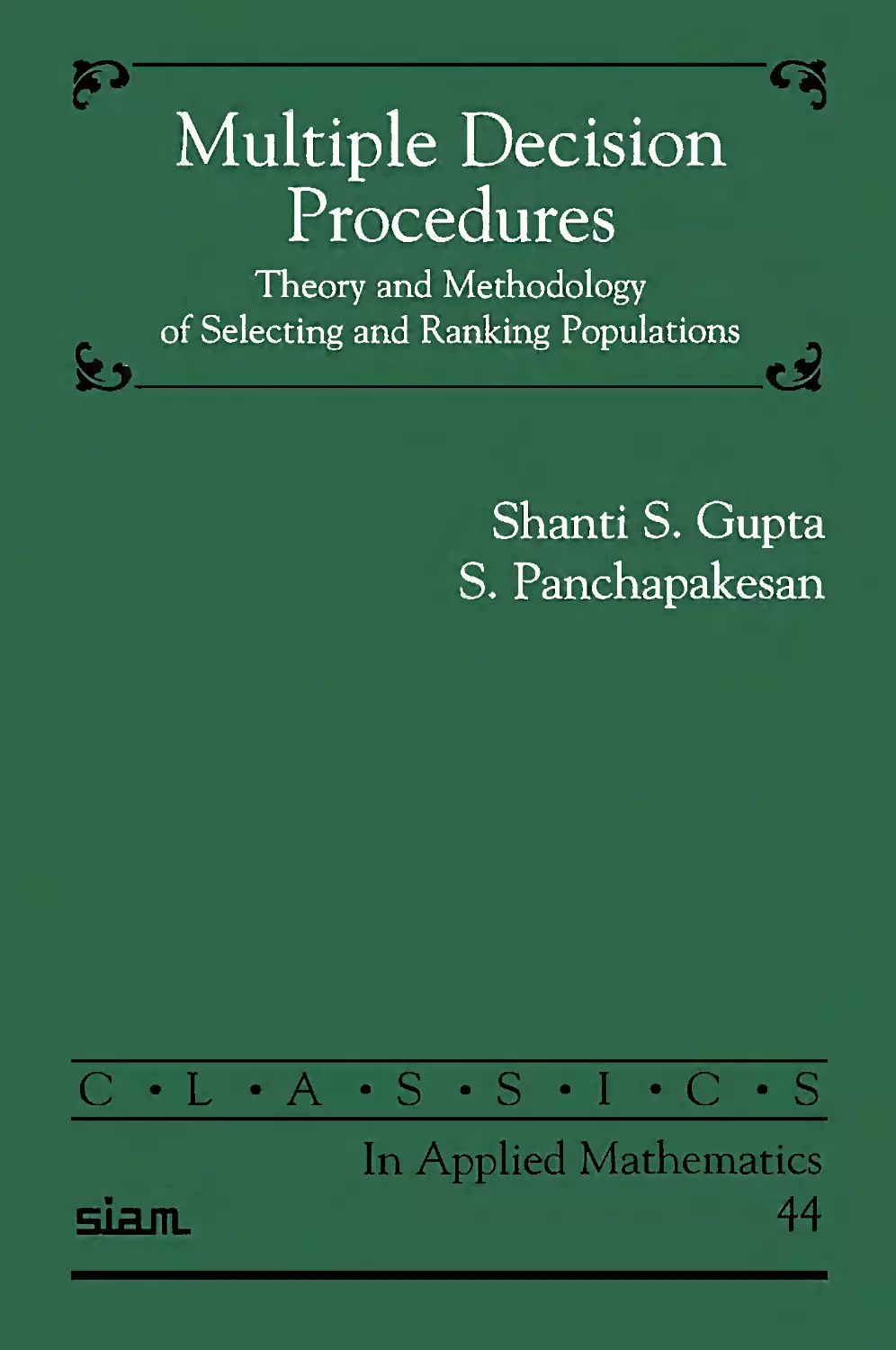
                    Multiple Decision
Procedures
Theory and Methodology
of Selecting and Ranking Populations
Shanti S. Gupta
S. Panchapakesan
C-L-A-S-S-I-C-S
In Applied Mathematics
qiam	44
Multiple Decision
Procedures
SIAM’s Classics in Applied Mathematics series consists of books that were previously
allowed to go out of print. These books are republished by SIAM as a professional
service because they continue to be important resources for mathematical scientists.
Editor-in-Chief
Robert E. O’Malley, Jr., University of Washington
Editorial Board
Richard A. Brualdi, University of Wisconsin-Madison
Herbert B. Keller, California Institute of Technology
Andrzej Z. Manitius, George Mason University
Ingram Olkin, Stanford University
Stanley Richardson, University of Edinburgh
Ferdinand Verhulst, Mathematisch Instituut, University of Utrecht
Classics in Applied Mathematics
С. C. Lin and L. A. Segel, Mathematics Applied to Deterministic Problems in the
Natural Sciences
Johan G. E Belinfante and Bernard Kolman, A Survey of Lie Groups and Lie
Algebras with Applications and Computational Methods
James M. Ortega, Numerical Analysis: A Second Course
Anthony V. Fiacco and Garth P. McCormick, Nonlinear Programming: Sequential
Unconstrained Minimization Techniques
F. H. Clarke, Optimization and Nonsmooth Analysis
George E Carrier and Carl E. Pearson, Ordinary Differential Equations
Leo Breiman, Probability
R. Bellman and G. M. Wing, An Introduction to Invariant Imbedding
Abraham Berman and Robert J. Plemmons, Nonnegative Matrices in the Mathematical
Sciences
Olvi L. Mangasarian, Nonlinear Programming
*Carl Friedrich Gauss, Theory of the Combination of Observations Least Subject
to Errors: Part One, Part Two, Supplement. Translated by G. W. Stewart
Richard Bellman, Introduction to Matrix Analysis
U. M. Ascher, R. M. M. Mattheij, and R. D. Russell, Numerical Solution of
Boundary Value Problems for Ordinary Differential Equations
К. E. Brenan, S. L. Campbell, and L. R. Petzold, Numerical Solution of Initial-
Value Problems in Differential-Algebraic Equations
Charles L. Lawson and Richard J. Hanson, Solving Least Squares Problems
J. E. Dennis, Jr. and Robert B. Schnabel, Numerical Methods for Unconstrained
Optimization and Nonlinear Equations
Richard E. Barlow and Frank Proschan, Mathematical Theory of Reliability
*First time in print.
Classics in Applied Mathematics (continued)
Cornelius Lanczos, Linear Differential Operators
Richard Bellman, Introduction to Matrix Analysis, Second Edition
Beresford N. Parlett, The Symmetric Eigenvalue Problem
Richard Haberman, Mathematical Models: Mechanical Vibrations, Population
Dynamics, and Traffic Flow
Peter W. M. John, Statistical Design and Analysis of Experiments
Tamer Bajar and Geert Jan Olsder, Dynamic Noncooperative Game Theory, Second
Edition
Emanuel Parzen, Stochastic Processes
Petar Kokotovic, Hassan K. Khalil, and John O’Reilly, Singular Perturbation
Methods in Control: Analysis and Design
Jean Dickinson Gibbons, Ingram Olkin, and Milton Sobel, Selecting and Ordering
Populations: A New Statistical Methodology
James A. Murdock, Perturbations: Theory and Methods
Ivar Ekeland and Roger Temam, Convex Analysis and Variational Problems
Ivar Stakgold, Boundary Value Problems of Mathematical Physics, Volumes I and II
J. M. Ortega and W. C. Rheinboldt, Iterative Solution of Nonlinear Equations in
Several Variables
David Kinderlehrer and Guido Stampacchia, An Introduction to Variational
Inequalities and Their Applications
E Natterer, The Mathematics of Computerized Tomography
Avinash С. Как and Malcolm Slaney, Principles of Computerized Tomographic Imaging
R. Wong, Asymptotic Approximations of Integrals
O. Axelsson and V. A. Barker, Finite Element Solution of Boundary Value
Problems: Theory and Computation
David R. Brillinger, Time Series: Data Analysis and Theory
Joel N. Franklin, Methods of Mathematical Economics: Linear and Nonlinear
Programming, Fixed-Point Theorems
Philip Hartman, Ordinary Differential Equations, Second Edition
Michael D. Intriligator, Mathematical Optimization and Economic Theory
Philippe G. Ciarlet, The Finite Element Method for Elliptic Problems
Jane K. Cullum and Ralph A. Willoughby, Lanczos Algorithms for Large Symmetric
Eigenvalue Computations, Vol. I: Theory
M. Vidyasagar, Nonlinear Systems Analysis, Second Edition
Robert Mattheij and Jaap Molenaar, Ordinary Differential Equations in Theory
and Practice
Shanti S. Gupta and S. Panchapakesan, Multiple Decision Procedures: Theory and
Methodology of Selecting and Ranking Populations
This page intentionally left blank
Multiple Decision
Procedures
Theory and Methodology
of Selecting and Ranking Populations
Shanti S. Gupta
S. Panchapakesan
siam_
Society for Industrial and Applied Mathematics
Philadelphia
Copyright © 2002 by the Society for Industrial and Applied Mathematics.
This SIAM edition is an unabridged republication of the work first published by John
Wiley & Sons, New York, 1979.
10 98765432 1
All rights reserved. Printed in the United States of America. No part of this book
may be reproduced, stored, or transmitted in any manner without the written permis-
sion of the publisher. For information, write to the Society for Industrial and Applied
Mathematics, 3600 University City Science Center, Philadelphia, PA 19104-2688.
Library of Congress Cataloging-in-Publication Data
Gupta, Shanti Swarup, 1925-
Multiple decision procedures; theory and methodology of selecting and
ranking populations / Shanti S. Gupta, S. Panchapakesan.
p. cm. — (Classics in applied mathematics ; 44)
Originally published: New York : Wiley, cl979.
Includes bibliographical references and index.
ISBN 0-89871-532-6 (pbk.)
1. Sequential analysis. 2. Ranking and selection (Statistics) I. Panchapakesan, S.
II. Title. III. Series.
QA279.7 .G86 2002
519.5’42—dc21	2002029212
S1HJTL is a re
gistered trademark.
To our families
This page intentionally left blank
Contents
Prf.iact io tiil Classics Edu ion	xxv
Prijacp:	xxix
Lisi of Abbreviations and Symbols	xxix
1 Introduction	1
1.1	Origin of the Problem, 1
1.2	Slippage Tests, 3
1.3	Multiple Decision (Selection and Ranking)
Procedures, 4
1.4	The Indifference Zone Formulation, 7
1.5	Subset Selection Formulation, 10
1.6	Some General Remarks, 12
1.7	On the Chapters to Follow, 13
1.8	Bibliography and Other References, 15
PART I: INDIFFERENCE ZONE FORMULATION
2	Ranking of Normal Populations	19
2.1	Ranking in Terms of the Means, 20
2.1.1 A Single-Stage Ranking Procedure:
Known Variances, 20
2.1.2 Two-Stage Ranking Procedures:
Unknown Variances, 22
2.1.3 Two-Stage Selection Procedures:
Common Known Variance, 25
2.2	Ranking in Terms of the Variances, 28
2.3	Ranking in Terms of the Absolute Values of the
Means, 29
2.4	Ranking of Normal Means under r-Way Classification
without Interaction, 30
2.5	Ranking Multiply Classified Variances of Normal
Populations, 32
ix
X
CONTENTS
2.6	Selecting the Largest Interaction in a Two-Factor
Experiment, 35
2.7	Д-Correct Ranking and Some Remarks on the Ranking
Procedures for the Normal Means, 39
2.8	Notes and Remarks, 41
3	Some Optimum Properties of Fixed Subset Size Selection
Rul	es	42
3.1	Most Economical Character of Rules, 42
3.2	Uniformly Best Impartial Rule, 44
3.3	Bayes, Minimax, and Admissibility Properties, 49
3.4	Consistency of Single-Stage Ranking Procedures, 53
3.5	Asymptotically Optimal Procedures, 56
3.6	Notes and Remarks, 58
4	Ranking and Selection Problems for Discrete
Distributions	59
4.1	Several Binomial Distributions: Fixed Sample Size
Procedure, 60
4.2	Several Binomial Populations: A Multistage
Procedure, 62
4.3	Two Binomial Populations: Play-the-Winner and
Vector-at-a-Time Sampling, 64
4.3.1 Rules with Termination Based on (5^ — S2|, 65
4.3.2 Rules with Termination Based on Inverse
Sampling, 69
4.3.3 Rules with Fixed Total Sample Size, 72
4.3.4 A Truncated Procedure with VT Sampling, 73
4.4	Three or More Binomial Distributions: Inverse
Stopping Rules with Play-the-Winner and
Vector-at-a-Time Sampling, 75
4.5	Sequential Procedures Based on Likelihood Ratios, 76
4.5.1 Procedures with PIV and VT Sampling, 77
4.5.2 Two Binomial Populations Case with Two
Formulations, 79
4.6
4.7
4.8
Eliminating-Туре Sequential Procedures, 81
Selecting the Coin with the Largest Bias, 84
Poisson Populations, 85
CONTENTS
xi
4.9	Selection of the Best Multinomial Cell, 88
4.9.1 Most Probable Cell, 88
4.9.2 Least Probable Cell, 92
4.10	Notes and Remarks, 93
5	Selection from Univariate Populations, Optimum
Sampling, and Estimation of Probability of Correct
Selection	94
5.1	Selection from Finite Populations and Univariate
Continuous Populations, 95
5.1.1 A Two-Stage Subsampling Procedure for Ranking
Means of Finite Populations, 95
5.1.2 Selection from Exponential Populations, 97
5.2	Some Problems of Optimum Sampling, 98
5.2.1 Selection of the Population with the Largest
Mean, 99
5.2.2 Selection of the Gamma Population with the
Largest {Smallest) Scale Parameter, 102
5.2.3 Optimal Sampling Using I'-Minimax
Criterion, 103
5.3	Estimation of the Probability of Correct Selection, 104
5.3.1 Point Estimation-. Location Parameter Case, 105
5.3.2 Point Estimation: Scale Parameter Case, 107
5.3.3 Interval Estimation, 108
5.4	Notes and Remarks, 108
6	Sequential Selection Procedures	109
6.1	Introduction, 109
6.2	Selection of the Largest Normal Mean, 109
6.3	Asymptotically Nonparametric Procedures for
Selecting the Largest Mean, 116
6.4	Selection of the Largest Center of Symmetry, 119
6.5	A Paulson-Type Procedure Based on Likelihood
Ratios, 122
6.6	Selection of the Normal Population with the Smallest
Variance, 124
xii
CONTENTS
6.7	Selection from Populations Belonging to
Koopman-Darmois Family, 125
6.8	Other Contributions, 127
6.8.1 Identification Problems, 127
7	Selection from Multivariate Populations	130
7.1	Introduction, 130
7.2	Ranking of Several Multivariate Normal
Populations, 131
7.2.1 Selection in Terms of Mahalanobis Distance, 131
7.2.2 Selection in Terms of the Generalized
Variance, 135
7.2.3 Selection in Terms of Multiple Correlation
Coefficients, 136
7.2.4 Selection in Terms of the Sum of Bivariate
Product-Moment Correlations, 137
7.2.5 Selection in Terms of the Coefficient of
Alienation, 137
7.3	Procedures Relating to a Single Multivariate Normal
Population, 138
7.3.1 Selection of the Component with the Largest
Population Mean {Equal Known Variances), 139
7.3.2 Selection of the Component with the Smallest
Variance, 139
7.3.3 Selection of a Subclass of Components with the
Smallest Population Generalized Variance, 140
7.4	Notes and Remarks, 140
8	Nonparametric Selection Procedures	142
8.1	Introduction, 143
8.2	Selection in Terms of Quantiles, 143
8.3	Selection Procedures Based on Rank Order
Statistics, 146
8.3.1 A Class of Procedures Based on Ranks, 146
8.3.2 More Procedures Based on Ranks, 148
8.3.3 Selection Procedures Based on Hodges-Lehmann
Estimators, 152
CONTENTS	xiii
8.3.4 An Optimal Procedure Based on Relative
Rank—The Secretary Problem, 156
8.4	An Adaptive Procedure for the Largest Location
Parameter, 158
8.5	Selection Procedures Using Paired Comparisons, 159
8.6	Inverse Sampling and Other Procedures for
Tournaments with Two or Three Players, 164
8.6.1 Inverse Sampling Procedure Rt, 165
8.6.2 Inverse Sampling with Elimination:
Procedure RE, 167
8.6.3 Other Sequential Procedures, 167
8.6.4 The Modified Formulation of Bechhofer, 168
8.6.5 A Single-Stage Procedure RB, 169
8.6.6 A Sequential Identification Procedure Rq, 170
8.6.7 Some Remarks on Sobel- Weiss and Bechhofer
Procedures, 173
8.7	Selection in Terms of Rank Correlation, 173
8.7.1 Selection from Bivariate Populations, 173
8.7.2 Selection from Multivariate Populations, 174
8.8	Notes and Remarks, 174
9	Fixed-Size Subset Selection: A Generalized Goal and
Other Modifications	176
9.1	Introduction, 176
9.2	Fixed-Size Subset Selection with Generalized
Goal, 177
9.2.1 A Fixed-Sample Procedure, 177
9.2.2 An Inverse Problem, 178
9.2.3 Nonparametric Procedures, 179
9.2.4 Selection from Restricted Family of
Distributions, 181
9.3	An Adaptive Sequential Procedure, 183
9.4	Notes and Remarks, 185
10	Bayesian Selection and Ranking Procedures	187
10.1	Introduction, 187
10.2	Selecting the Largest of к Normal Population Means:
xiv
CONTENTS
Determination of Sample Size to Achieve a Specified
Probability of a Correct Selection, 188
10.3	Selection of the Largest Normal Mean Using a Linear
Loss Function, 190
10.4	Selection of the Best of Several Processes: Analysis in
Terms of Differential Utility, 192
10.5	Selection of the Best Population Using Utility
Functions Involving Coverages, 195
10.5.1 The Case of Normal Populations, 195
10.5.2 The Case of Exponential Populations, 196
10.6	Bayesian Procedures for Complete Ranking, 197
10.6.1 Loss Functions Depending on (f, 198
10.6.2 Comparison of Ranking Procedures, 198
10.7	Partial Ranking of Binomial Probabilities, 199
10.8	Notes and Remarks, 200
PART II: SUBSET SELECTION FORMULATION
11	Subset Selection: General Theory	203
11.1	Introduction, 204
11.2	Basic General Theory, 204
11.2.1 Formulation of the Problem, 204
11.2.2 The Class of Procedures Rh, 205
11.2.3 Some Properties of Rh, 207
11.2.4 Some Special Cases, 208
11.2.5 A Decision-Theoretic Formulation and Best
Invariant Rules, 211
11.2.6 A Desirable Property of the Probability of a
Correct Selection, 215
11.2.7 A Generalization of the Subset Selection
Goal, 218
11.3	A Restricted Subset Selection Formulation, 220
11.3.1 Formulation, 220
11.3.2 The Class of Procedures R(n), 222
11.3.3 Probability of a Correct Selection and Its
Infimum over £l(p), 222
CONTENTS
XV
11.3.4 Properties of {/?(«)}, 223
11.3.5 A Generalized Goal for Restricted Subset
Selection , 225
11.4	A Modified Goal: Elimination of Nonbest
Populations, 225
11.4.1 Formulation of the Problem, 225
11.4.2 Location Parameter Case, 226
11.4.3 Elimination of Non-t-best Populations, 228
11.4.4 Selection of tsp-Superior Populations, 228
11.5	Notes and Remarks, 229
12	Selection from Univariate Continuous Populations	230
12.1	Introduction, 231
12.2	Selection from Normal Populations in Terms of the
Means, 232
12.2.1 Equal Sample Sizes and Common Known
Variance, 232
12.2.2 Equal Sample Sizes and Common Unknown
Variance, 233
12.2.3 Unequal Sample Sizes and Common Known
Variance, 233
12.2.4 Unequal Sample Sizes and Common Unknown
Variance, 235
12.2.5 Allocation of Sample Sizes When Variances Are
Unknown, 237
12.2.6 A Procedure Based on Contrasts of Sample
Means, 238
12.2.7 Restricted Subset Size Procedures, 240
12.2.8 A Two-Stage Procedure for Selecting Good
Populations, 241
12.3	Selection from Normal Populations in Terms of the
Absolute Values of the Means, 242
12.4	Selection from Normal Populations in Terms of the
Variances, 243
12.4.1 Equal Sample Sizes, 244
12.4.2 Unequal Sample Sizes, 244
12.4.3 Selecting the t Best Populations, 245
12.4.4 Procedures Based on Sample Ranges, 245
xvi
CONTENTS
12.5	Selection from Normal Populations in Terms of the
Coverages of a Fixed Interval, 246
12.5.1 Unknown Means and Common Known
Variance, 246
12.5.2 Unknown Means and Known Variances, 247
12.5.3 Unknown Means and Common Unknown
Variance, 247
12.5.4 Common Known Mean and Unknown
Variances, 247
12.5.5 Known Means and Unknown Variances, 248
12.5.6 Unknown Common Mean and Unknown
Variances, 249
12.6	Selection from Gamma Populations in Terms of the
Scale Parameters, 249
12.7	Selection from Exponential Populations in Terms of
the Coverages of a Fixed Interval, 251
12.8	Selection from Uniform Populations, 252
12.9	Notes and Remarks, 253
13	Selection from Discrete Populations	254
13.1	Introduction, 255
13.2	Selection from Binomial Populations, 255
13.2.1 Selection in Terms of Success Probabilities:
Fixed Sample Size Rules, 255
13.2.2 Selection in Terms of Success Probabilities:
Conditional Rules, 258
13.2.3 Selection in Terms of Success Probabilities:
Inverse Sampling Rules, 261
13.2.4 Selection in Terms of Entropy Functions, 262
13.2.5 Elimination of Inferior Populations, 265
13.3	Selection from Poisson Populations, 266
13.3.1 Usual Location-and Scale-Type
Procedures, 266
13.3.2 A Modified Procedure, 266
13.3.3 Conditional Procedures, 267
13.3.4 Selecting the Population Associated with X(1), 268
13.3.5 A Procedure Using Inverse Sampling, 269
13.4	Selection from Negative Binomial and Fisher’s
Logarithmic Distributions, 271
13.5	Selection from Hypergeometric Distributions, 272
CONTENTS
xvii
13.6	Selection from Multinomial Distributions, 273
13.6.1 Selection of the Best Multinomial Cell, 273
13.6.2 Selection from Finite Schemes, 276
13.7	Notes and Remarks, 278
14	Selection from Multivariate Normal Populations	280
14.1	Introduction, 280
14.2	Selection of the Best Component of a Multivariate
Normal Population, 281
14.2.1 Selection in Terms of the Means, 281
14.2.2 Selection in Terms of the Variances, 283
14.2.3 Selection of the Best Subclass of Components
in Terms of the Generalized Variances, 284
14.3	Selection from Several Multivariate Normal
Populations, 285
14.3.1 Selection in Terms of Mahalanobis Distance
Function, 285
14.3.2 Selection in Terms of Generalized
Variances, 288
14.3.3 Selection in Terms of Multiple Correlation
Coefficients, 290
14.3.4 Selection in Terms of Measures of Association
between Two Subclasses of Variates, 292
14.3.5 Other Ranking Measures, 295
14.4	Notes and Remarks, 295
15	Nonparametric Procedures	297
15.1	Introduction, 297
15.2	Selection in Terms of Quantiles, 298
15.3	Procedures Based on Ranks, 300
15.4	Procedures Based on Estimators, 308
15.4.1 Elimination of Strictly Non-t-Best
Populations, 308
15.4.2 Generalized Goal of Selecting a Subcollection
of Subsets of Fixed Size, 310
15.5	Selection of Regression Equation with the Largest
Slope, 310
15.6	Procedures Based on Paired Comparisons, 313
15.7	Selection from Multivariate Populations in Terms of
Rank Correlation, 315
15.8	Notes and Remarks, 316
xviii
CONTENTS
16	Selection from Restricted Families of Probability
Distributions	317
16.1	Introduction, 317
16.1.1 Partial Ordering in the Space of Probability
Distributions, 318
16.1.2 The Setup of the Problem, 319
16.2	Selection in Terms of Quantiles from Distributions
Starshaped w.r.t. G, 319
16.3	Selection in Terms of the Medians for Distributions
/•-Ordered w.r.t. G, 324
16.4	Selection Procedures Based on Generalized Total Life
Statistics, 325
16.5	Selection in Terms of the Means for the Class of IFR
Distributions, 327
16.6	A General Partial Order Relation and a Related
Selection Problem, 328
16.7	Notes and Remarks, 329
17	Sequential Procedures	331
17.1	Introduction, 331
17.2	A Class of Noneliminating Procedures for Normal
Populations, 332
17.3	Procedures with Restrictions on the Subset Size, 336
17.4	Selection of Mildly t Best Populations, 339
17.4.1 Parametric Procedures, 339
17.4.2 A Nonparametric Procedure, 343
18	Bayes, Empirical Bayes, and Г-Minimax Procedures	345
18.1	Introduction, 345
18.2	Bayes Procedures, 345
18.2.1 Procedures with Linear Loss Functions, 346
18.2.2 Nonlinear Loss Functions, 347
18.2.3 Selection Problem as a Restricted Product of
Two-Decision Problems, 353
18.3	Empirical Bayes Procedures, 354
18.4	Г-Minimax Procedures, 355
18.5	Notes and Remarks, 357
CONTENTS
xix
19	Some Modified Formulations and Other Related
Problems	358
19.1	Introduction, 358
19.2	Selecting a Subset Containing at Least One of the
t Best Populations, 358
19.2.1 Procedure R, 360
19.2.2 Procedure R', 361
19.2.3 Procedure RM, 362
19.2.4 Truncated Versions of R, R', and RM, 362
19.2.5 Comparisons of Procedures, 362
19.3	Subset Selection with Modified Requirements, 364
19.4	A Subset Selection Formulation of the Complete
Ranking Problem, 367
19.4.1 Location Parameter Case, 368
19.4.2 Scale Parameter Case, 369
PART III: COMPARISON WITH A CONTROL,
ESTIMATION, AND RELATED TOPICS
20 Comparison of Several Populations with a Standard
or a Control
373
20.1	Introduction, 374
20.2	(Л+ 1)-Decision Procedures for Comparing к
Experimental Categories with a Standard or
Control, 375
20.2.1 Comparison of Normal Means, 375
20.2.2 Comparison of Normal Means: Modified
Probability Requirements, 377
20.2.3 Comparison of Processes with Regard to
Conforming to Product Specifications, 380
20.2.4 Some General Results for Comparison of Several
Populations with a Specified Standard, 382
20.3	Asymptotically Optimal Procedures, 383
20.3.1 Fixed Sample Size Procedures, 383
20.3.2 Sequential Procedures, 384
XX
CONTENTS
20.4	Choosing All Populations That Are Better than a
Control, 385
20.5	Selecting a Subset Containing All Populations Better
than a Control, 386
20.5.1 Parametric Procedures, 387
20.5.2 Nonparametric Procedures, 389
20.5.3 Procedures with Modified Requirements, 395
20.6	Partitioning a Set of Populations with Respect to a
Control, 395
20.6.1 Normal Populations, 396
20.6.2 Exponential Populations, 402
20.7	Lehmann’s Formulation, 404
20.7.1 A Minimax Solution, 405
20.7.2 Normal Populations with Common Unknown
Variance, 406
20.8	Comparison of Multivariate Normal Populations, 406
20.8.1 Comparisons in Terms of Linear Combinations
of the Mean Vectors, 406
20.8.2 Comparisons Based on Distance Functions, 408
20.8.3 Partitioning a Set of Multivariate Normal
Populations, 409
20.9	Г-Minimax and Bayes Procedures, 411
20.9.1 Г- Minimax Procedures for Translation
Parameter Family, 411
20.9.2 Bayes Procedures for Comparison with a
Standard, 413
20.9.3 Bayes Procedure for Partitioning a Set of Normal
Populations, 415
20.10	Multiple Comparisons with a Control: One-Sided and
Two-Sided Intervals, and Optimal Allocation of
Observations, 415
20.10.1 One- and Two-Sided Comparisons'. Equal
Variances Case, 416
20.10.2 One-and Two-Sided Comparisons'. Unequal
Known Variances, 417
20.10.3 Multiple Comparisons with a Control for
Multiply Classified Variances of Normal
Populations, 420
CONTENTS	xxi
21 Estimation of Ordered Parameters	422
21.	1 Introduction, 423
21.	2 Point Estimation, 423
21.2.1 Estimation of the Larger Translation
Parameter, 423
21.2.2 A Natural Estimator of 0(,j, 426
21.2.3 Maximum Likelihood Estimators for Ranked
Means, 426
21.2.4 Maximum Probability Estimators for Ranked
Means, 427
21.2.5 A Two-Sample Estimator of the Largest Normal
Mean, 428
21.2.6 Estimation of Ordered Parameters with Prior
Information: Isotonic Regression, 429
21.	3 Confidence Intervals for Ordered Parameters: Some
General Results, 431
21.3.1 Confidence Interval for 0^, 432
21.3.2 An Alternative Two-Sided Interval, 433
21.	4 Confidence Intervals for Ordered Parameters: Location
and Scale Parameters, 434
21.4.1 Location Parameters, 434
21.4.2 Scale Parameters, 437
21.	5 Interval Estimation of Ordered Means from к Normal
Populations, 440
21.5.1 Interval Estimation of the Ordered Means of Two
Normal Populations Based on Hybrid
Estimators: Known Variances, 440
21.5.2 Single-Stage Procedures with Unknown Equal
Variances, 442
21.5.3 Two-Stage Procedure with Unknown
Variances, 444
21.5.4 Efficiency of Some Multistage Procedures, 446
21.5.5 A Sequential Procedure, 447
21.5.6 Interval Estimation of the Largest Mean:
Unequal Sample Sizes, 448
21.	6 Interval Estimation of the Largest a-Quantile, 450
21.	7 Combined Goals of Selection and Estimation, 452
21.7.1 A Selection and Estimation Problem for Poisson
Processes, 452
xxii
CONTENTS
21.7.2 Interval Estimation and Simultaneous Selection:
Location and Scale Parameters, 453
21.	8 Tolerance Intervals for Stochastically Ordered
Distributions, 455
21.	9 Notes and Remarks, 458
22	General Theory of Some Multiple-Decision Problems
and Some Miscellaneous Topics	459
22.1	Introduction, 459
22.2	General Theory of Some Multiple Decision
Problems, 460
22.2.1 A Class of Multiple Decision Problems, 460
22.2.2 Restricted Products of Decision Problems, 463
22.2.3 Decision Procedures Allowing Partial
Conclusions, 464
22.2.4 Some Further Results on Multiple Decision
Problems, 465
22.3	Selection of Variables in Linear Regression, 466
22.3.1 Computational Techniques, 467
22.3.2 Selection Criteria, 468
22.3.3 Subset Selection Problems for Variances with
Applications to Regression Analysis, 469
22.3.4 An Indifference-Zone Approach for Selecting
the Best Predictor Variate, 472
22.4	Slippage Tests, 472
22.4.1 A Decision-Theoretic Formulation, 472
22.4.2 Some Additional Results, 474
23	Guide to Tables	475
23.1	Introduction, 475
23.2	Tables Relating to Multivariate Normal Integrals, 476
23.3	Tables Relating to Multivariate t, 483
23.4	Tables for the Studentized Largest and Smallest
Chi-Square Distributions, 487
23.5	Additional Tables for Chi-Square Distributions, 489
23.6	Distributions of Maximum and Minimum of
F Ratios, 491
CONTENTS
xxiii
23.7	Distributions of Maximum and Minimum of Ratios
and Differences of Order Statistics, 492
23.8	Tables Relating to Discrete Distributions, 494
23.8.1 Binomial Distribution, 494
23.8.2 Hypergeometric Distribution, 496
23.8.3 Multinomial Distribution, 497
23.9	Some Miscellaneous Tables, 498
24	Illustrative Examples
24.1	Introduction, 501
24.2	Normal Means, 501
24.3	Normal Variances, 507
24.4	Binomial Proportions, 508
24.5	Poisson Processes, 510
24.6	Gamma Populations, 511
24.7	Multinomial Cells, 512
24.8	Nonparametric Procedures, 512
24.9	Restricted Families of Distributions, 514
24.10	Multivariate Normal Populations, 516
24.11	Selection of the Largest Location Parameter:
Procedures Based on Sample Medians, 517
Bibliography
Related References
Monographs. Books and Special Issues of Journals Devoted Fully
or Partially to Ranking and Selection Problems
Author Index
Subject Index
501
520
553
561
563
569
This page intentionally left blank
Preface to the Classics Edition
The ranking and selection approach in multiple decision theory arose out of the
need for a realistic formulation of the practical problem of comparing к given
populations with a goal such as to rank them or select the t best among them. The
traditional approach of homogeneity tests did not address such goals. Early papers
by Paulson (1949, 1952) and Bahadur (1950) began the move in the new direc-
tion. The now-classic paper by Bechhofer (1954), using the so-called
indifference-zone approach, along with the pioneering contributions of Shanti S.
Gupta (using the subset selection approach) and Milton Sobel, set the stage for
rapid development of the ranking and selection theory in the late 1950s and the
1960s. In 1968, Shanti Gupta and I embarked on a project of preparing a survey
monograph discussing significant results, along with a comprehensive bibliog-
raphy. We believed that such a monograph not only would serve as a reference for
users but would also be of use in delineating directions for future research.
Because of the great advancements made by the ever-growing number of
researchers in this area, we had to constantly update our material until it became
essential that the material be available to researchers and practitioners. The
product of our efforts was the first edition of the book published in 1979 by John
Wiley and Sons. This book attempts to summarize and survey in a unifying
manner a great majority of more than 600 published articles and reports devoted
mainly to the topic of ranking and selection procedures.
Today there are more than 1000 published articles and 7 other books on this
topic, including a categorized bibliography. Three international conferences have
been organized exclusively devoted to this field of research. Besides the published
proceedings of these conferences, five special issues of different journals have
appeared on this topic. Excepting the present book and those by Bechhofer,
Santner, and Goldsman (1995) and by Gibbons, Olkin, and Sobel (1977, 1999),
the other books focus on a few specific aspects such as sequential and multistage
procedures and decision-theoretic approaches. The two books by Bechhofer,
Santner, and Goldsman and Gibbons, Olkin, and Sobel have a broader coverage,
yet they do not attempt to provide a survey of the ranking and selection literature.
The present book, to quote Bechhofer, Santner, and Goldsman, is “an encyclo-
pedia of work on indifference-zone and subset selection procedures as of 1979.”
Further, this book contains a substantial amount of material not discussed in other
books. These facts make it still valuable as a reference to the practitioner as well
as the researcher.
XXV
xxvi
PREFACE TO THE CLASSICS EDITION
Subsequent to the publication of the first edition of the present book, signifi-
cant developments have taken place with respect to several topics discussed in the
book. More importantly, substantial progress has been achieved regarding aspects
which were barely or never explored earlier, namely, Bayes and empirical Bayes
selection procedures, the decision-theoretic approach, isotonic selection proce-
dures for comparison with a control, estimation of the true probability of correct
selection, estimation after selection and multiple comparisons. Discussions of
multiple comparisons with the best and with a control can be found in Bechhofer,
Santner, and Goldsman (1995), Hochberg and Tamhane (1987), and Hsu (1996).
Other developments mentioned are not yet available in any book. Details of these
developments and pertinent references can be obtained from the books, special
journal issues, and survey papers listed in the bibliography following this preface.
The book edited by Panchapakesan and Balakrishnan (1997), a collection of
research papers in honor of Shanti Gupta, contains a complete list of his publica-
tions. This list contains several papers depicting developments in the areas
mentioned earlier. In addition to the books on multiple comparisons already
mentioned, Braun (1994) and Westfall et al. (1999) are further references for
multiple comparisons in general.
Most of the efforts to see our book brought out in the SIAM Classics series
were due to my mentor and co-author Shanti Gupta. It is unfortunate that his
untimely death occurred just before his efforts came to fruition. I wish to express
my deep appreciation to his wife, Dr. Marianne Gupta, for her support, coopera-
tion, and encouragement in completing this project.
Finally, it is with great pleasure that I express my sincere thanks to Sara
Triller Murphy for her encouragement and cooperation in making this Classics
edition a reality.
S. Panchapakesan
Southern Illinois University
Carbondale
June 2002
BIBLIOGRAPHY
American Journal of Mathematical and Management Sciences, Vol. 5, Nos. 3 & 4,
1985: Special Volume, Part I, Dedicated to Robert E. Bechhofer, Shanti S.
Gupta and Milton Sobel. Also issued as Modem Statistical Selection, Part I
(M. Haseeb Rizvi, ed.), Vol. 13, Series in Mathematical and Management
Sciences, American Sciences Press, Inc., Columbus, Ohio.
American Journal of Mathematical and Management Sciences, Vol. 6, Nos. 1 & 2,
1986: Special Volume, Part II, Dedicated to Robert E. Bechhofer, Shanti S.
Gupta and Milton Sobel. Also issued as Modern Statistical Selection, Part II
(M. Haseeb Rizvi, ed.), Vol. 14, Series in Mathematical and Management
Sciences, American Sciences Press, Inc. Columbus, Ohio.
PREFACE TO THE CLASSICS EDITION
xxvii
Bechhofer, R. E., Santner, T. J. and Goldsman, D. M. (1995). Design and Analysis
of Experiments for Statistical Selection, Screening and Multiple Compar-
isons, John Wiley, New York.
Bofmger, E., Dudewicz, E. J., Lewis, G. J. and Mengersen, K. (eds.). The Frontiers
of Modern Statistical Inference Procedures, II, Proceedings and Discussions
of the IPASRAS-II Conference on Inference Procedures Associated with
Statistical Ranking and Selection held in Sydney, Australia, June 1987.
Series in Mathematical and Management Sciences, Vol. 28, American
Sciences Press, Columbus, Ohio, 1992.
Braun, H. (ed.). The Collected Works of John W. Tukey: Multiple Comparisons,
Vol. VIII, Chapman & Hall/CRC Press, Boca Raton, Florida, 1994.
Biiringer, H., Martin, H. and Schriever, K. (1980). Nonparametric Sequential
Selection Procedures, Birkhauser, Boston.
Dudewicz, E. J. (ed.). The Frontiers of Modern Statistical Inference Procedures,
Proceedings and Discussions of the IPASRS Conference on Inference Proce-
dures Associated with Statistical Ranking and Selection held in Honolulu,
Hawaii, June 1982. Series in Mathematical and Management Sciences, Vol.
10, American Sciences Press, Columbus, Ohio, 1985.
Dudewicz, E. J. and Koo, J. O. (1982). The Complete Categorized Guide to Statis-
tical Selection and Ranking Procedures, Series in Mathematical and
Management Sciences, Vol. 6, American Sciences Press, Columbus, Ohio.
Gibbons, J. D., Olkin, I. and Sobel, M. (1999). Selecting and Ordering Popula-
tions: A New Statistical Methodology, Classics in Applied Mathematics, 26,
Society for Industrial and Applied Mathematics, Philadelphia. Unabridged
reproduction of the same title, John Wiley, New York, 1977.
Gupta, S. S. (1990). Recent advances in statistical ranking and selection: theory
and methods, in Proceedings of the 1990 Taipei Symposium in Statistics
(Eds. M.-T. Chao and P. E. Chen), pp. 133-166, Institute of Statistical
Science, Academia Sinica, Taipei.
Gupta, S. S. and Huang, D.-Y. (1981). Multiple Decision Theory: Recent Develop-
ments, Lecture Notes in Statistics, Vol. 6, Springer-Verlag, New York.
Gupta, S. S. and Panchapakesan, S. (1993). Selection and screening procedures in
multivariate analysis, in Multivariate Analysis: Future Directions (Ed. C. R.
Rao), pp. 233-262, Elsevier Science Publishers B.V, Amsterdam.
Gupta, S. S. and Panchapakesan, S. (1996). Design of experiments with selection
and ranking goals, in Handbook of Statistics 13: Design and Analysis of
Experiments (Eds. S. Ghosh and C. R. Rao), pp. 555-585, Elsevier Science
Publishers B.V, Amsterdam.
xxviii
PREFACE TO THE CLASSICS EDITION
Herrendorfer, G. and Miescke, K. J. (eds.) (1993). Selection Procedures I,
Proceedings of the 3rd Schwerin Conference in Mathematical Statistics held
in Bad Doberan, Germany, September 5-10, 1993, Forshunginstitut fur die
Biologie landwirtschaftlicher Nutztiere, Dummerstorf, Germany, 1994.
Herrendorfer, G. and Miescke, K. J. (eds.). Selection Procedures II, Proceedings
of the 3rd Schwerin Conference in Mathematical Statistics held in Bad
Doberan, Germany, September 5-10, 1993, Forschunginstitut fur die
Biologie landwirtschaftlicher Nutztiere, Dummerstorf, Germany, 1994.
Hochberg, Y. and Tamhane, A. C. (1987). Multiple Comparison Procedures.
John Wiley, New York.
Hoppe, F. M., editor (1993). Multiple Comparisons, Selection, and Applications
in Biometry: A Festchrift in Honor of Charles W. Dunnett, Marcel Dekker,
New York.
Hsu, J. C. (1996). Multiple Comparisons: Theory and Methods. Chapman &
Hall/CRC Press, Boca Raton, Florida.
Journal of Statistical Planning and Inference, Vol. 54, Nos. 2 & 3, 1996, Special
Issue on Forty Years of Statistical Selection Theory, Parts 1 and 2 (Guest
Eds. K. J. Miescke and Dieter Rasch).
Mukhopadhyay, N. and Solanky, T. K. S. (1994). Multistage Selection and
Ranking Procedures: Second-Order Asymptotics, Marcel Dekker, New York.
Panchapakesan, S. and Balakrishnan, N., eds. (1997). Advances in Statistical
Decision Theory and Applications, Birkhauser, Boston.
Santner, T. J. and Tamhane, A. C. eds. Design of Experiments: Ranking and
Selection: Essays in Honor of Robert E. Bechhofer, Marcel Dekker, New
York, 1984.
Statistics & Decision, Supplement Issue No. 4, 1999: Recent Advances in
Ranking and Selection, Dedicated to the memory of R. E. Bechhofer.
Westfall, P. H., Tobias, R. L., Rom, D., Wolfinger, R. D. and Hochberg, Y. (1999).
Multiple Comparisons and Multiple Tests using the SAS System, SAS
Institute, Inc., Cary, North Carolina.
Preface
The ranking and selection approach in multiple decision theory gained
recognition as an active area of research in the fifties. The basic contribu-
tions of the first author of this monograph were made during that period.
With the zeal and devotion of the early researchers in this area the
literature grew steadily, and by the mid-sixties a second generation of
researchers emerged, mostly from Cornell University, Minnesota, and, of
course, Purdue University.
As is usually the case in a developing field of research, there is always a
time lag between the published research literature and availability of the
same in a compact book form. This lack of a readily accessible source for
recent results and developments motivated the authors to provide a survey
monograph giving significant results, along with a comprehensive bibliog-
raphy not only as a reference for users, but also as a useful aid in
delineating directions for future research. The present monograph found
its origin in the initial effort to realize this objective starting in 1968.
Because of the increased pace of research in the area, quite significant
strides were made in the advancement of the field in the last ten years.
This has necessitated a constant updating of the material, without which
the monograph would have been of very limited use while its publication
would have been a little premature. We now feel that the progress in the
field has reached a point where it is essential to have this material available
to the researchers and the practitioners.
Since the very start of this venture about ten years ago, two books have
been published dealing mainly with the field of ranking and selection. The
first of these is a monograph by Bechhofer, Kiefer, and Sobel on sequential
identification and ranking procedures. Its emphasis is on sequential proce-
dures for parametric families of distributions and the approach is primarily
the indifference-zone formulation. The second book, by Gibbons, Olkin,
and Sobel, more elementary in nature, was published in 1977. It also places
emphasis on indifference-zone formulation. The present monograph differs
from these two works in its objective and coverage. It covers the entire
field, placing equal emphasis on the subset selection and the indifference-
zone formulations. It also deals with related problems, such as estimation
xxix
XXX
PREFACE
of the unknown ordered parameters. We have attempted to summarize and
survey in a unifying manner a great majority of some six hundred main
references in the bibliography and have also provided some one hundred
and forty related references in the body of the monograph.
The authors feel that this monograph will provide a suitable text for a
two-semester graduate course on ranking and selection, as it has done at
Purdue University for the last several years. It is our sincere hope that the
publication of this book will also lead to further research in this area and,
more importantly, encourage the applications of these techniques in agri-
culture, industry, engineering, physical, social, and behavioral sciences and
other fields where statistics is so widely used.
The authors gratefully acknowledge the financial support received for
this project over the years under the Office of Naval Research Contracts
NONR-1100(26), N00014-67-A-00014, and N00014-75-C-0455, all at
Purdue, and in particular wish to acknowledge the assistance and coopera-
tion of Drs. Robert J. Lundegard, Edward J. Wegman, and Bruce J.
McDonald of the Office of Naval Research, Arlington, Virginia, and Mr.
Robert L. Bachman, ONR Resident Representative at Purdue University.
For various useful comments and discussions that have helped to im-
prove the presentation of this book, the authors thank Professors R. E.
Bechhofer, R. J. Carroll, J. C. Hsu, D. Y. Huang, W. C. Kim, G. Kulldorf,
G. C. McDonald, K. J. Miescke, I. Olkin, T. J. Santner, and W. J. Studden.
Finally, the authors wish to place on record their deep debt of gratitude
to Norma Lucas for her excellent faultless typing, and unfaltering coopera-
tion and patience in going through several revisions of the manuscript.
Shanti S. Gupta
S. Panchapakesan
Purdue University
Southern Illinois University
March 1979
List of Abbreviations and Symbols
a.e.	almost everywhere
a.s.	almost surely
cdf	cumultative distribution function
r.v.	random variable
w.p. 1 with probability 1
V	for all
convergence in probability
£
-» convergence in distribution
a„^bn as n-> oo means lim an/bn = \
n—>0©
xxxi
This page intentionally left blank
CHAPTER 1
Introduction
1.1	Origin of the Problem	1
1.2	Slippage Tests	3
13	Multiple Decision (Selection and Ranking) Procedures	4
1.4	The Indifference Zone Formulation	7
1.5	Subset Selection Formulation	10
1.6	Some General Remarks	12
1.7	On the Chapters to Follow	13
1.8	Bibliography and Other References	15
1.1 ORIGIN OF THE PROBLEM
In the practical world of everyday life, full of complexities, we face the
baffling problem of making myriad of decisions. Each situation requires
formulation of the problem under a suitable theoretical model followed by
sifting and a careful analysis of the evidence leading to a decision whose
validity is based on reason. In the advancement of scientific reasoning,
statistical inference provides the methodology developed to meet these
requirements. Significant original contributions, which have lasting impact
on the subsequent phenomenal growth of this branch of science in the last
50 years, were undoubtedly made first and foremost by the British statisti-
cian, Sir Ronald Fisher.
Among others whose fundamental contributions have provided
breakthroughs and inspired new avenues of research are Jerzy Neyman
and Abraham Wald. The signal contributions of Neyman are the
Neyman-Pearson theory of testing hypotheses and the theory of confi-
dence intervals which form the backbone of any statistical training today.
Abraham Wald influenced the course of modem theory of statistical
decisions.
1
2
INTRODUCTION
CH. I
Historically, then, the problems of statistical inference were basically
being formulated as those of estimation or testing of hypotheses. This
formulation, however, does not exactly suit the objectives of an experi-
menter in many situations when he is faced with the problem of comparing
several populations. These are generally the populations of the responses to
certain “treatments.” The treatments may be, for example, different varie-
ties of wheat in an agricultural experiment, or different competing designs
of engines to be used in an automobile plant, or different drugs for a
specific disease. Some other examples are comparison of chicken stocks
[Becker (1961)f], common stocks for investment [Dalal and Srinivasan
(1977)] and traffic fatality rates of several states [Gupta and Hsu (1977b)
and McDonald (1977b)]. In all these problems, we have к (>2) popula-
tions and each population is characterized by the value of a parameter 0,
which may denote, for example, in the agricultural experiment, the popula-
tion average yield for a variety of wheat. In the example of drugs, 9 may
denote an appropriate measure of the effectiveness of a drug. For compar-
ing chicken stocks Becker (1961) considers the henhouse egg production as
the measure of comparison. For the comparison of common stocks, an
appropriate measure is the average ratio of price to earnings.
The classical approach in all the preceding situations is to test the
hypothesis Ho: 9l= - = 0k, where 0x,...,0k are the values of the parame-
ter 9 for these populations. The hypothesis Яо is usually referred to as the
null hypothesis or the homogeneity hypothesis. If the populations are
assumed to be normal with means 9l,...,9k, and a common variance <r2,
then the test can be carried out by using the analysis of variance technique
developed by R. A. Fisher. In cases of other distributions for which 9 may
denote a different measure, one can develop a test of the null hypothesis
using the Neyman-Pearson theory. Such tests have been developed for
various situations and many of these are available in the statistical litera-
ture.
It should, however, be recognized that a satisfactory solution to any
statistical inference problem depends on the goal of the experiment. In this
sense, the classical tests of homogeneity cannot provide a panacea for the
problems of the experimenter. In many situations, the goal of the experi-
menter is not just to accept or refute the homogeneity hypothesis. For
example, in the agricultural experiment, one would expect the varieties of
grain to be essentially different and so would expect to reject the null
hypothesis at any preassigned level of significance by taking a sufficiently
large sample from each variety. This makes the test of homogeneity
unrealistic [see Chew (1977a)]. Further, the experimenter’s real goal often
fFor an explanation of the listing of Bibliography and other related references, see § 1.8 (p.
15).
SEC. 1.2
SLIPPAGE TESTS
3
is to identify the variety with the largest average, the most effective drug,
and so on. In view of this, if a test of homogeneity is carried out and the
test result is significant, the experimenter faces some real problems. In the
past, the method of least significant differences based on i-tests has been
used to detect differences between the average yields and thus to choose
the “best” variety. This method is at best indirect and less efficient,
because it lacks protection in terms of a guaranteed probability against
picking out a wrong variety. Although the deficiencies of the classical
approach of tests of homogeneity are evident, it should be borne in mind
that these drawbacks are not in the design aspects of the procedure, but
rather in the types of decisions that are made on the basis of the data.
The continued use of the classical tests in instances where the formula-
tion was inadequate for the problem was largely due to the lack of
procedures under more realistic formulations. The origin of selection and
ranking procedures lies in seeking formulations based on more realistic
goals.
1.2 SLIPPAGE TESTS
The first step in the direction of a somewhat more realistic approach came
in the form of Л-sample slippage tests where the alternative hypothesis
states that one of the populations has “slipped” to the right or to the left.
In other words, we test the hypothesis Ho: 9X = -- =9k against one or
more of the alternatives Hu: 0t =    = 0, _ j = 0,+(=  • • = 9k — 0,< — Д where
Д>0 implies slippage to the right and Д<0 implies slippage to the left.
Such a formulation also arises from the necessity to decide whether one or
more apparently outlying observations come from a different population
than that generating the others.
Even though the problem of outliers has been of interest for a long time,
Mosteller [1948] may be mentioned as the first author who made more
formal investigations in this area. He considered к continuous populations
with densities/(x —0,), i=l,...,k, where the 0, are unknown. The interest
is in devising a test to decide on the identification of a 0( such that 0i>0r,
1 <r <k, r^i. Later, Paulson [1952] studied a similar problem in the case
of normal means 0, with the requirement that the null hypothesis Ho\
0j= • • • —0k be chosen with probability 1 — a (0<a< 1) when Ho is true.
Since then, many authors have investigated such procedures in several
cases. Some early investigators in this area are Truax [1953], Kudo [1956b],
and Doombos and Prins [1956]. A decision-theoretic formulation of Karlin
and Truax [1960] and some other related results are briefly discussed in
Chapter 22. A survey of some of the important results is given by
Doornbos [1966].
A related development is that of multiple comparison tests and simulta-
neous confidence intervals. Among the early authors here, significant
4
INTRODUCTION
CH. 1
contributions were made by Duncan [1947, 1951, 1952, 1955], Tukey
[1949], and Scheffe [1953]. While Duncan developed the use of multiple
range tests, Tukey was largely responsible for the use of multiple compari-
son techniques in practice. Scheffe gave a method of judging all contrasts
in the analysis of variance by considering simultaneous confidence inter-
vals. The interest in multiple comparison techniques arises from the desire
to draw inference about the populations when the homogeneity hypothesis
is rejected. For details regarding several multiple comparison techniques,
the reader is referred to the book of Miller (1966) and a later bibliography
by him [1977].
13 MULTIPLE DECISION (SELECTION AND RANKING)
PROCEDURES
The formulation of a ^-sample problem as a multiple decision problem
enables the experimenter to answer his natural questions regarding the best
populations. Among the early investigators of multiple decision procedures
are Paulson (1949), Bahadur (1950), and Bahadur and Robbins (1950).
Suppose we have к independent normal populations with unknown means,
fig, i= 1,...,k, and a common variance a2 (known or unknown). Paulson’s
goal is to classify the к populations into two groups: “superior” and
“inferior.” In doing so, he is interested in defining a procedure that will
select a nonempty superior group with a preassigned (small) probability of
not including all the populations in the superior group when = • • • =
As a measure of the performance of his rule, he considers the probability
of not having a superior group consisting only of the population associated
with the largest mean, when = /х + Д (Д > 0) and all other means are
equal to /x. (Given a set of quantities Xp-.-.x*., their ordered values will
always be denoted, unless otherwise stated, by xp] < • • • <x[A.].)
Bahadur (1950) considered a class of “impartial” decision rules for the
^-sample problem. Let «Г|,...,^ be a given set of populations where w, is
characterized by the absolutely continuous distribution function (cdf)
F’(x,0/) = /i((x —6,)/c,), 0/=^,^), c(>0, i=l,...,fc. Based on independent
sample observations {Xy}, j =	from тг,, let 7] be a sufficient statistic
for 0/. The problem is to construct a suitable decision rule d=d({ Tt}) for
selecting one or more populations subject to minimizing the expected value
of the random distribution function
к
S Zi(d)G(ti,0i)
G(t\d) = -^---------------,	(1.1)
S z,(rf)
SEC. 1.3 MULTIPLE DECISION (SELECTION AND RANKING) PROCEDURES 5
where t=(tx,...,tk), 0(^,9^ is the distribution function of Tf, and where
Z,(d)=l if 77, is selected by d, and =0, otherwise. The decision s(J)
according to d is given by s(d) = {px(d),...,pk(d)), which is, in general, a
random vector. Thus, for any fixed t, G(t|s(d)) is a random variable. Let
G(t|s(rf))] = S GM)E[Pi(d)]	(1.2)
< = i
which is the average overall effect of using the decision rule d. In terms of
mixtures of distributions, Z7(t|d) is the mixture of G(t|s) with respect to 6,
where 8 is the probability measure induced by the decision rule d on the
class of Borel sets in the space of all possible decisions s.
In general, one may wish to find a rule d* in a class D such that
a(d*) = s\ipd£Da(d), where
a(d) = J u(t)dH(t\d)
and w(t) is some appropriate function. Setting
n, = J'u(t,)dG(tl,0l),
it can be shown that our object is equivalent to constructing d in such a
way that the expected value of the “weight function”
к
!£(«, s) = max M	(1-3)
' i= i
is minimized for every parameter point ы=(01,...,0А).
Bahadur (1950) considered decision rules under the following restric-
tions.
1. It is assumed that 7’=ф(А'/1,...,A',n), i=\,...,k, and У=ф({Ху})
form a set of independent random variables having densities. The choice of
ф and ф will, of course, depend upon particular cases.
2. Given the statistics {7}}, and Y, the class 7)(<J>;^) is the class of all
impartial decision rules based on them.
A decision rule d=d({Ti},Y) is said to be impartial if it has the
following structure. Let £[,]<T[2)< • • • <T\k] be the ordered 7]. Then d
defines nonnegative random variables	Y), j = i,...,k, such
6
INTRODUCTION
CH. 1
that 2y_ 1A/ = 1. Here is the proportion p7(rf) which is assigned by d to the
population corresponding to T, The impartiality of such a rule lies in the
fact that it determines the proportions (Xx,...,Xk) without regard to which
Ti belongs to which population, and then assigns these proportions in strict
order of the 1\.
Suppose the populations irx,...,irk are normal with means p, and a
common unknown variance o2. Then, for the problem of the largest mean,
D is the class of all impartial decision rules that are based on the statistics
=	,	i=\,...,k,
y = 1 n
The main theorem of Bahadur (1950) demonstrates that in th£ class D, the
rule dk which selects always the population corresponding to cannot be
improved upon, no matter what the observations or the parameter values
may be. It also follows that dk is the uniformly best decision rule in the
class of impartial decision rules for all weight functions of the type
IF=p[fc] — (S*=1z,p,/S*=1z,). This theorem of Bahadur is given in Chapter
3 where we discuss some optimal properties of fixed subset size selection
rules.
To see an application of the preceding results, let us consider the
following example of Bahadur (1950). Grain is to be raised on a given area
A of land and к varieties, irj,...,®*., are available. It is assumed that the
yields per unit area are normally distributed with unknown means p, and a
common variance o2, also unknown. A preliminary field experiment has
been carried out with n plots of unit area assigned to each variety, and
{Xy},j= l,...,n; i= l,...,fc, is the set of independent plot-yields obtained.
The problem is to divide the land between the к varieties with the object of
making the total expected yield as large as possible. In other words, we
want to choose s=(p1,...,pt) with 0<p,< 1 and £*_]/»,= ! to minimize
the loss
p
IF(«,s)= max Лр, - 2
‘	<=i
In the class of all impartial rules based on {A,} and s2, the uniformly best
procedure assigns the whole area to the variety with the greatest observed
yield.
SEC. 1.4
THE INDIFFERENCE ZONE FORMULATION
7
Bahadur and Robbins (1950) considered a minimax rule for the problem
of the larger of two normal means, which is a special case in Wald’s
general theory of decision functions. However, the results of Bahadur and
Robbins are derived by very simple direct methods without recourse to
Wald’s general theory.
The formulation of multiple decision procedures in the framework of
what has now come to be known as selection and ranking procedures has
been generally accomplished under one of two basic approaches, namely,
the indifference zone formulation and the subset selection formulation. Most
of the literature surveyed in this monograph comes under one of these two
approaches and related modifications and problems. Recently, Gibbons,
Olkin, and Sobel (1977) have used the terminology of ‘ordering of popula-
tions’ instead of the traditional ‘ranking of populations’ employed by us.
1.4 THE INDIFFERENCE ZONE FORMULATION
The indifference zone approach was introduced by Bechhofer in his now
classical paper of 1954 in which he considered the problem of ranking к
normal means. To explain the basic formulation, let us consider the simple
problem of selecting the population with the largest mean from к normal
populations with_unknown means i=A,...,k, and a common known
variance o2. Let %,, i=l,...,k, denote the means of independent samples
of size n from these populations. The^natural” procedure will be to select
the population that yields the largest Xr Naturally, the experimenter would
need a guarantee that this procedure will pick with a high probability P*
the population associated with which will be called the best popula-
tion. Let X(0 denote the mean of the sample observations from the
population with mean It is easy to see that
Pr{the best population is selected)	(1-4)
= Pr{xw>XU),	i=l,...,k-l}
= / П ф Z + —- (- /Xpj) ) d&(z),
•'-00 i =11.	°	J
where Ф( ) denotes the cdf of a standard normal variate. Now for the
problem to be meaningful P* lies between \/k and 1. Since the true values
of the рц are not known, we need the probability of selecting the best
population to be at least P* whatever be the values of the Thus we are
8
INTRODUCTION
CH. 1
interested in the configuration of the p, for which the probability in (1.4) is
a minimum. Such a configuration will be called a least favorable configura-
tion (LFC). It is obvious that the LFC is given by Др]в • • • — /^ky But
unfortunately the minimum value of the probability is 1 /к. So we cannot
meet the probability requirement whatever be the sample size unless some
modification is made in the probability requirement.
A natural modification is to insist on the minimum probability P* of
selecting the best population whenever the best is sufficiently far apart
from the next best. In other words, the experimenter specifies a positive
constant Д* and requires that the probability of selecting the best popula-
tion is at least P* whenever —	The specification of 3*
provides a partition of the parameter space Я into two parts, namely, Я4*
in which	and the complement of it. The minimization
of the probability of selecting the best population is over Я4Ш. For the
obvious reason, Я4# is called the indifference zone by Bechhofer (1954).
Subsequent authors have termed Я4* the preference zone.
It is now easy to see that the least favorable configuration in Яд„ is given
by ~	and the minimum sample size required is
the smallest integer n for which
Ф* ^z + — 8*]d<P(z)>P*.	(1.5)
•'-oo	\ О )
This procedure will be discussed in greater detail in the next chapter.
Remark 1.1. In the preceding discussion, we mean by the least favor-
able configuration in Я4# a set of vector points д=(^1,...,/гл) in Я4*
satisfying the condition gp] = • • • = i]= Mjaj — For апУ M in this set,
the probability of selecting the best population does not depend upon the
value of P[i]. However, this need not be the case in general. Suppose we
have parameters	and the infimum of the probability of selecting
the best population over Яд# = {0:	e[k- j] >S*} occurs at a point в
satisfying
0(1]= • • •	!] = #[£] — S*.	(1.6)
However, the probability may depend upon 0(1]. In this case, we must carry
on the process of finding the vector-point(s) at which the minimum occurs.
The LFC may contain only one point, as in the case of binomial popula-
tions discussed in Chapter 4. The configuration (1.6) will then be called the
generalized least favorable configuration (GLFC). Of course, in the case of
normal means the LFC coincides with the GLFC.
SEC. 1.4
THE INDIFFERENCE ZONE FORMULATION
9
It should also be noted that the LFC in the case of normal means is the
same for all к and n. This need not be true in general. □
Let us now describe the general ranking problem under the indifference
zone approach. Suppose there are к populations	where тг,- is
characterized by the distribution function Fe, i=l,...,k, where 0, is a
real-valued parameter belonging to the set 0. It is assumed that the 0, are
unknown. Let the ordered 0, be denoted by 0(1J <0J2J < • • • <0(Л] and the
population associated with 0(<) be denoted by w(1), i=l,...,k. The popula-
tions are ranked in terms of their 0-values. To be specific, we define to
be better than тг(1)	if i<J. The experimenter has no prior
knowledge relevant to the true pairing of the populations and the ordered
0t. Usually, two goals are considered: Goal I is to select an unordered set
of t populations associated with the set {0(fc _(+1),...,0(i]}, and Goal II is to
select t populations and associate them with the set { 0(*—f + ip - - - »0[*]} by a
one-to-one correspondence. The statement of a ranking problem is not
complete without specifying certain constants and an associated probabil-
ity requirement. To spell these out, let 8^, denote a suitably defined
measure of distance between the populations and i <j. (It should
be pointed out that here and in the sequel the word “distance” is used as a
measure of separation between populations. It may, in special cases,
denote a distance function.) The natural choice of 5,., in the cases of
location and scale parameters will be and 0y]/0yj, respectively. In
the case of Goal I, it is required that the probability of a correct selection
(PCS), that is, a selection of t populations satisfying the goal, is at
least a preassigned number P*, whenever 1 л_,	where
‘s a positive constant specified in advance. Obviously, for a
meaningful problem P* must be restricted to the interval (l/( j, ij. For
Goal II, the probability of a correct selection should be at least P*
whenever 5Л_,+ 1Л_, >3£_,+1 л_;, i = l,...,/, where all the starred quanti-
ties are positive constants specified in advance. Of course, for this goal
P*&((k -t)\/k\, 1).
One can consider a more general goal which includes Goals I and II as
special cases, namely, to partition the set of к populations into s nonempty
subsets denoted by	consisting of ky,...,ks(ki +   + ks = k)
populations, respectively. The probability of a correct selection is required
to be at least P*&(k}l ...ks\/k\, 1), whenever +	i=l,...,
s—1, where k, = S'a=]&a and the starred quantities are positive constants
specified in advance. These goals have been discussed by Bechhofer (1954).
Let Я denote the parameter space {0: 0 = (0р...,0л), 0;G@}. Denoting
the probability of a correct selection using a procedure R by P(CS\R), we
10
INTRODUCTION
CH. 1
can write the probability requirement described previously as
P( CS | R ) > P* whenever 0 e Я*,	(1.7)
where 0* denotes the subset of Я defined by the bounds (denoted by
starred quantities) on appropriate distances. The usual approach is to
propose a rule R on heuristic grounds and investigate its properties. The
rule R is generally based on statistics 7}, i — \,...,k, where 7} is usually
sufficient for 0,. The main problem, as we have seen in the special case
considered earlier, is the evaluation of the infimum of P(CS|7?) over Я*. If
we assume that the samples from these populations are of the same size n,
then we need to determine the smallest n for which
inf P(CS\R)>P*.	(1.8)
Thus the experimenter has the choice of the sample size to control the level
of the PCS.
A dual problem that arises is the following. Suppose the common sample
size n and P* are given. For a rule R designed to select the t best
populations, we are interested in determining the minimum t for which
(1.8) can be met.
1.5 SUBSET SELECTION FORMULATION
In the subset selection formulation one of the authors has made a large
number of contributions starting with the work in Gupta (1956), where
investigation was carried out for the case of normal means. To see the
motivation behind this approach, consider к normal populations^ with
unknown means	and common known variance a2. Let Xt, i =
1...к, be the means of samples of size n from these populations. If we
want to select a subset of fixed size 3 (assuming к > 3), we will select the
populations that yield the three largest sample means. Suppose the three
largest sample means in an experiment are 35, 33, and 4. Now if а/^Гп =
2, say, one may be content with selecting the first two alone if there is no
compelling need to take three. Thus the main feature of selecting a subset
of random size is to allow the size to be determined by the observations
themselves.
To describe the problem formally, let us assume as in the previous
section that tz,, f=l,...,k, are к populations where w, is characterized by
Fe, The goal is to select a nonempty subset of these populations so
that the selected subset includes with a high probability the t best popula-
tions, that is, the populations associated with the set {0()t_ (+1);... ,0(Jt)}. If
SEC. 1.5
SUBSET SELECTION FORMULATION
11
there are more than t contenders because of ties, it is assumed that t of
these are appropriately tagged. The size of the selected subset is an
integer-valued random variable taking on the values 1,2,It is re-
quired that
P(CS\R)>P* forOGQ,	(1.9)
where P* l/( j, 1 j is preassigned.
As in the indifference zone approach, the rule R for selecting a subset
containing the t best will depend on sufficient statistics 7’ when they exist.
Usually, the distribution Ge of 7} belongs to a family that is stochastically
ordered in 9. The distribution Ge is stochastically smaller than Gti (or
equivalently, Gg2 is stochastically larger than G#i) if the distributions Ge^ and
Gg2 are distinct, and G#2(x) < Ge (x) for all x.
In the case of t= 1 (i.e., selecting a subset containing the best), the rules
proposed in many specific cases are one of the following two types, Rx and
Я2.
Select тг, if and only if
T> max T-d,	(1.10)
I <r<k
R2: Select тг, if and only if
Tt>c max Tr.	(1.11)
1 <r<k
In the preceding rules, d is a positive constant and c is a constant
between 0 and 1. For given n and P*, the constants c and d are to be
determined to meet the requirement (1.9). Thus we are interested in
evaluating the infimum of P(CS\R) over Й. Though we do not explicitly
state it in defining the rules Pj and R2, it should be borne in mind that we
are really defining the classes of rules {PJJ)} and {P2(c)}. Thus, in the
case of the former, we will choose the rule with the smallest d for which
inf P(CS'|/?1) >P*.	(1.12)
In the other case, we will choose the largest c for which the infimum of the
PCS is greater than or equal to P*.
When the 0, are location parameters, we use an Prtype procedure. The
other type is used when the 0t are scale parameters. Of course, when the 0,
are neither location nor scale parameters one could still decide on Rt or R2
depending on the nature of the supports of the distributions Fe.
12
INTRODUCTION
CH. 1
One could consider a general class of procedures defined through a class
of real-valued functions {Ла6(х)}, a>l, b>0. Of course, one needs to
impose certain conditions on this class. Letting h(x)=ha b(x), we can
define the following class of procedures.
Rab; Select w; if and only if
й(Т)> max T.	(1.13)
1 <r<k
It is easily seen that the class of rules Ra b includes the classes {R((j)} and
{T?2(c)}. These generalizations and the relevant theorems have been ob-
tained by Gupta and Panchapakesan (1972a). These are dealt with in detail
in Chapter 11.
1.6	SOME GENERAL REMARKS
As we have seen, the probability of a correct selection is required to satisfy
(1.7) or (1.9) depending upon the formulation. This requirement is com-
monly referred to as the basic probability requirement or the P*-condition.
The infimum of the PCS in Bechhofer’s formulation is evaluated over the
preference zone, whereas in the subset selection formulation it is over the
entire parameter space. Under both formulations we are interested in
investigating the properties of a procedure. Suppose we are interested in
selecting the best population. For a good rule R under either formulation
one would like to have
Pr(w(jt) is selected) > Pr(ir(,) is selected), i =	1. (1.14)
This property is known as the unbiasedness of the rule R. A stronger
property called the monotonicity is defined by
Pr( 7г(() is selected) > Pr(w(7) is selected)	(1 • 15)
for any pair such that tr^y^tr^y.
To evaluate the performance of a subset selection rule R, one considers the
supremum of the expected subset size. These and other properties are
discussed in several places in this book.
In any given situation, the preference for one over the other of the two
formulations is mainly dictated by the objectives of the experimenter.
Selecting a fixed number of populations is generally identified with a
terminal decision. On the other hand, selecting a random subset can be
looked upon as a screening process as well as a terminal decision.
SEC. 1.7
ON THE CHAPTERS TO FOLLOW
13
Closely related to the problem of selecting the best among к populations
is the problem of comparing к populations with a control or standard
population. The goal of the experimenter in these problems is to choose the
best among the к populations only if it is better than the control or the
standard population. More generally, one can define good and bad popu-
lations with respect to a standard or control with a possibility of a
population not being substantially different from the standard in either
direction. Then the goal of the experimenter may be to select a subset with
a high proportion of good populations. All these and related aspects of
comparing several populations with a standard or control are discussed in
Chapter 20.
There are also some modifications and generalizations of the basic
indifference zone and subset selection formulations investigated by several
authors among whom are Lehmann (1961), Mahamunulu (1967), Gupta
and Deverman (1968), Carroll, Gupta, and Huang (1975), Santner (1975),
Huang and Panchapakesan (1976, 1978), and Panchapakesan and Santner
(1977). Attempts have also been made to combine the features of the two
formulations by Sobel (1969), Gupta and Santner (1973), and Santner
(1975). These are discussed in several appropriate places in this mono-
graph.
1.7	ON THE CHAPTERS TO FOLLOW
Chapters 2 through 10 comprising Part I are devoted to the indifference
zone formulation. Chapter 2 deals with ranking of normal populations in
terms of their (i) means, (ii) variances, and (iii) absolute means. Some
problems in r-way classification models are also discussed. This chapter
also discusses a concept of Д-correct ranking, and selection of the largest
interaction in a two-factor experiment. Some optimum properties of fixed
subset selection rules are given in Chapter 3. These include most economic
character of rules, uniformly best impartial rule, Bayes, minimax, and
admissibility properties, and consistency of ranking procedures.
Chapter 4 describes ranking and selection problems for discrete distribu-
tions. The discussion on procedures for binomial populations includes not
only fixed sample size procedures but also those using sequential proce-
dures with different sampling schemes such as inverse sampling and
play-the-winner sampling. This chapter also includes procedures for select-
ing the best multinomial cell.
Two-stage subsampling procedures for finite populations are discussed
in Chapter 5 which also includes some problems of optimum sampling and
estimation of the probability of a correct selection.
14
INTRODUCTION
CH. 1
The remaining chapters of Part I contain sequential selection procedures
(Chapter 6), procedures for selection from multivariate populations
(Chapter 7), nonparametric selection procedures (Chapter 8), Bayesian
procedures (Chapter 10), and a discussion of a generalized goal for
fixed-size subset selection and other modifications (Chapter 9).
Part II consists of nine chapters (11 through 19) devoted to subset
selection procedures. Chapter 11 describes the general theory of subset
selection which includes the formulation discussed earlier as well as the
modified goals of restricted subset selection and elimination of nonbest
populations.
Selection from univariate continuous populations and selection from
discrete populations are discussed in Chapters 12 and 13, respectively.
Normal, exponential, and gamma distributions are the most important
continuous distributions considered. The discrete distributions discussed
are binomial, Poisson, negative binomial, hypergeometric, and multi-
nomial.
The next five chapters are devoted to selection from multivariate normal
populations (Chapter 14), nonparametric procedures (Chapter 15), selec-
tion from restricted families of probability distributions (Chapter 16),
sequential procedures (Chapter 17), and Bayes, empirical Bayes and Г-
minimax procedures (Chapter 18). The last chapter of Part II is concerned
with some modified formulations and related problems.
Part III comprises five chapters (10 through 24) dealing with several
problems related to the procedures described in the preceding chapters.
Chapter 20 discusses different aspects of the problem of comparing several
populations with a control or standard. The next chapter deals with the
problems of estimating ordered parameters and procedures with combined
goals of selection and estimation.
Chapter 22 contains brief discussions on some general theory of multiple
decision problems, selection of variables in linear regression, and slippage
tests.
The purpose of the next two chapters is to assemble information mostly
available in the earlier chapters regarding the tables needed for the
applications of several of the procedures described therein (Chapter 23)
and also to illustrate through examples the applications of some important
procedures (Chapter 24).
In arranging the material in several chapters as indicated previously, we
are naturally faced with the problem of determining the most appropriate
place for results relating to a particular procedure, as for example, a
sequential nonparametric procedure for multivariate populations, or a
procedure for the best multinomial cell. In resolving the issue, we have
SEC. 1.8
BIBLIOGRAPHY AND OTHER REFERENCES
15
been strongly guided by the general context of the problem and the main
emphasis of the results as we perceived them.
In describing the results of several authors, the notations have been
changed in many places for the sake of uniformity. The procedures have
been relabeled. A procedure denoted by R6 in a chapter might well have
been called D or R or R2 in the original paper. For referring to other
sections of this book, we have used the notation such as §2.7.3. This refers
to Chapter 2, Section 7, Subsection 3.
1.8 BIBLIOGRAPHY AND OTHER REFERENCES
The sources for the results described in the book are referenced by the
author(s) and the year. The year is enclosed in either ( ) or [ ]. The first
indicates that the item is listed under Bibliography whereas the second
refers to an item under Other References. The first list includes all the
items that are directly and mainly related to the theme of the monograph.
The list of Other References includes publications that relate to some
background materials and also those which are undeniably important to
ranking and selection problems but are written in a wider context. The
items under either list are specified by the name(s) of the authors), the
year, the title of the paper or book, the name of the publisher in the case of
a book, and the page numbers. In case of multiple authors, an item is listed
only once at an alphabetical location based on the first author’s name. The
Bibliography includes only a few abstracts. Technical reports that are
known to have been published are omitted. Every effort has been made to
bring the bibliography to date.
This page intentionally left blank
PART I
INDIFFERENCE ZONE
FORMULATION
This page intentionally left blank
CHAPTER 2
Ranking of
Normal Populations
2.1	Ranking in Terms of the Means	20
2.1.1	A Single-Stage Ranking Procedure: Known Variances	20
2.1.2	Two-Stage Ranking Procedures: Unknown Variances	22
2.1.3	Two-Stage Selection Procedures: Common Known Variance	25
2.2	Ranking in Terms of the Variances	28
23	Ranking in Terms ot the Absolute Values of the Means	29
2.4	Ranking of Normal Means: r-way Classification without Interaction 30
2.5	Ranking Multiply Classified Variances of Normal Populations	32
2.6	Selecting the Largest Interaction in a Two-Factor Experiment	35
2.7	Д-Correct Ranking and Some Remarks on the Ranking Procedures
for the Normal means	39
2.8	Notes and Remarks	41
Normal distribution is used as an appropriate model in many situations
and as such one of the most studied parametric models in ranking and
selection. For comparing normal populations several different measures
can be used. In this chapter, we discuss ranking of normal populations
according to measures such as the mean, the variance and the coefficient
of variation. We also discuss two-factor experiments and selection of the
levels of the factors that have the largest interaction.
Notation. We have к independent populations denoted by чтх,...,<пк,
where w, is a normal population with mean g, and variance o2,
In this chapter as well as the rest of the book, unless otherwise stated, we
use Ф( •) and <p( •) to denote the cdf and the density of a standard normal
random variable.
19
20	RANKING OF NORMAL POPULATIONS	CH. 2
2.1 RANKING IN TERMS OF THE MEANS
Bechhofer (1954), introducing the indifference zone formulation, consid-
ered the problem of ranking means of normal populations with known
variances. The problem of selecting the t (1 < t < k) best populations
becomes a special case of the general ranking problem. In this section, we
first discuss the single-stage procedure of Bechhofer (1954) when the
variances are known, and then proceed to some two-stage procedures in
the case of unknown variances for which there does not exist a single-stage
procedure that will satisfy the probability requirement. We also discuss
some two-stage procedures when the variances are known; in these proce-
dures, the first stage is used for screening the populations. In ranking the
populations, Ttj is considered better than tz, if
2.1.1 A Single-Stage Ranking Procedure: Known Variances
The goal of a general ranking problem is to partition the set of к normal
populations into s nonempty subsets denoted by Zj,...,Is, and consisting of
kj....ks (fcj+ - • • + ks = k) populations, respectively, so that any popula-
tion in the set is better than any population in the set /, for i <j. Let Xi
be the mean of a sample of nt independent observations from w,, i = 1,..., k.
Bechhofer (1954) proposed the following rule R(.
Rtt Include in Ir, r= the populations associated with
(2.1)
where	and Ло=О.
In particular, for selecting the best population (5 = 2, к, = к-1, Л2=1),
the rule /?( selects the population that yields the largest X- and the PCS is
given by
Р(СЭД) = Pr( У. > 0,..., Yk_, > 0),	(2.2)
where the joint distribution of Y1,...,Yk_l is the (к — 1)-variate normal
distribution with mean vector (6k i,...,8k k_1) and covariance matrix 2 =
(ffj,). and
=	y= l,...,fc-1,
= м = i,invy.
nw
SEC. 2.1
RANKING IN TERMS OF THE MEANS
21
In (2.3), and n(z) denote the variance of the population associated with
and the associated sample size, respectively. If is same for all
i k, then У1,...,УА_1 are equicorrelated with correlation equal to
1/2. The PCS is to be minimized over where
Ци-I) )	(2-4)
and 6* > 0 is specified in advance. The LFC is given by
Mli)= ' ’ ’ = P-[* -1]= P-[a) — S*-	(2-5)
For selecting the t best populations without ordering them (s = 2, k} =
k t, k2—t), the rule R{ chooses the populations corresponding to the t
largest values among the A",. The PCS in this case is minimized over
Я6,= {P:	and the LFC is given by
tt(l] = ' ' ’ =	- =	Ц(* г + 1] = ’' ’ = Нч = H +
Bechhofer (1954) has tabulated the values of J=Vn 6*/<r for several
selected values of k, t, and P*, where « = «,= ••• =nk, and a=o, = • •• =
ak. In the special case of 1=1, it can be easily seen that the minimum
sample size required by 7?] is the smallest n such that
Pr(Zl<H,...,Zk_l<H)>P*,	(2.6)
where 7/ = (n/2)1/2(5*/a) and Zt,...,Zk_l are standard normal variates
with equal correlation p=|. Evaluation of the probability on the left-hand
side of (2.6) has been discussed by Gupta [1963a], who has tabulated the
Я-values for j for selected values of к and P*. The //-values for p=|
have also been tabulated by Milton [1963]. Tables of Gupta [1963a] also
give the probability for selected values of k, p, and H. On the other hand,
Gupta, Nagel, and Panchapakesan [1973] give the values of H for which
the probability in (2.6) is equal to P*, for selected values of k, p, and P*.
These tables are discussed in detail in §23.2.
Approximations for Minimum Sample Size and //. Several ap-
proximations are available for the //-value satisfying (2.6). In terms of n
(the smallest sample size), the following presents five different approxima-
tions denoted by n, through n5:
i \2
n, = -1 — I log(l - P*), Dudewicz (1969a);
\ О /
22
RANKING OF NORMAL POPULATIONS
CH. 2
1-P*
£-1
2
, Ramberg (1972);
n3 = (	V Ф~ "1 ]2, Ramberg (1972);
(2-7)
o2
n4 = —-
4 S*2
’	( k —11	, { k — 1 ]
41°S| I j -21oglog( y-p* ] ~2 log 4 w
Bechhofer, Kiefer, and Sobel (1968); •
«5 =
2o2
3*2
|log(к — 1), Robbins and Siegmund (1968).
It has been shown (by respective authors) that lim^^ n5/n = 1 and
lim/>._>1 ttj/n = 1, i = 1,... ,4. The approximation n2 is based on a Bonferroni
inequality whereas n3 uses the Slepian inequality (see Slepian [1962] or
Gupta [1963a]). These approximations can be used for any к and P*, and
n3 provides a better approximation [Dudewicz and Zaino (1971), and
Ramberg (1972)]. Asymptotically (P*—>1), nx, n3, n4, and n are equal. As
k->oo, п3/n and n4/n tend to 2. For some numerical comparisons, see
Dudewicz and Zaino (1971). It should be noted that the approximation n2
was obtained in terms of the corresponding 77-value by Paulson (1952)
who observed that the approximation seemed better for small values of k.
2.1.2 Two-Stage Ranking Procedures: Unknown Variances
It is unrealistic to assume that we always have a common known variance.
Generally, the variances are unknown and are not necessarily all equal as,
for example, in computer simulation experiments dealing with models for
business and economic systems.
When the variances o2 are unknown, it is not possible to predetermine
the sample sizes for a single-stage procedure since the standard error of the
sample means are unknown [see, for example, Dudewicz (1971a) ].
Bechhofer, Dunnett, and Sobel (1954) have considered a two-stage
procedure when o?=at<r2, where the a, are assumed to be known positive
rational numbers, which without loss of generality, can be taken to be
integers. For ranking the populations according to their means, then-
procedure R2 is described as follows.
1. Take a sample of observations from w,, i—\,...,k, where nQ is
any integer such that n = n0S;=1a, —k>0.
SEC. 2.1
RANKING IN TERMS OF THE MEANS
23
2.	Calculate
к a.no
4 = n~l S ai~l S	S Xij
i=l 7=1	7=1
where X,y,y’= l,...,a(»o, are observations from %„ i = l,...,k.
3.	Take a second sample of (А- м0)а, observations from 1т,, i= I,...,k,
where A=max{n0, (2s^h2 / 8*2)}, where	denotes the smallest integer
>У-
4.	Calculate X, = 2^X^/ a, N, i = I,... ,k.
5.	Rank the populations according to the rankings of the Xj.
The constant h = h(n,k,P*) is chosen so as to satisfy the ^’-condition.
For к = 2, the evaluation of h reduces to the determination of the ap-
propriate percentage point of the univariate Student’s t. For k = 3, we have
a bivariate generalization of t with correlation p=| for the goal of
selecting the population with the largest mean and p= -1 for the goal
of completely ranking the populations with 8J2 = 8£l = 8* in the notations
of Chapter I. In these cases, the values of h are tabulated to three decimal
places by Dunnett and Sobel [1954] for P* =0.50, 0.75, 0.90, 0.95, 0.99 and
n= 1(1)30(3)60(15)120, 150, 300, 600, and 00. For the case of a, = l,
Freeman, Kuzmack, and Maurice (1967) have tabulated the values of h in
the case of complete ranking goal for P* = 0.95, к = 3(1)6, and n0=
10(10)100, 200, 500. For the evaluation of multivariate t integrals, see also
Dunnett (1955), Dunnett and Sobel [1955], Gupta [1963a], Gupta and
Sobel (1957), John [1964], [1966], and Krishnaiah and Armitage [1966].
For selecting the normal population having the largest mean when the
variances a2 are unknown, Dudewicz and Dalal (1975) have studied a
generalized Stein-type procedure. Of course, such a possibility had earlier
been mentioned by Bechhofer, Dunnett, and Sobel (1953).
Let h = hm(k, P*) be the unique solution of
Г [Fm(z + h)]k~ifm(z)dz = P*	(2.8)
J - OO
where Fm( ) and/m( ) are the cdf and the density, respectively, _of a
Student-? random variable with m = n0 — 1 degrees of freedom. Let Х,(п0)
and s2 denote the sample mean and the sample variance based on n0
observations from tz,, i=l,...,k. Define
n, = max| n0+ 1,
where (y) denotes the smallest integer
(2.9)
24
RANKING OF NORMAL POPULATIONS
CH. 2
The procedure R3 of Dudewicz and Dalal (1975) is based on a first stage
sample of n0 observations from each of the populations and an additional
sample of и, —n0 observations from i=l,...,k. The procedure chooses
the population associated with the largest where a weighted
average of the observations XiJyj= from w, given by Xj = '2^^laijXij,
the ац being subject to the conditions:
2	=	= =aino	(2.10)
7=1
and
r.2 2 ау=(у) •	(211)
A possible choice of the atJ is obtained by letting ait = • • • = at, t = c,,
and then choosing c, subject to (2.11). For this procedure, the PCS has
been shown to be independent of	Its infimum over in (2.4)
occurs when • • • = M[*-u=	— and is equal to P*. Dudewicz and
Dalal (1975) have tabulated the values of P* in (2.8) for к = 2(1)25,
no = 2(l)15(5)3O, and h = 0.0(0.1)5.1.
An alternative procedure P4 considered by Dudewicz and Dalal (1975)
is same as R3 except that the n- are defined by
and X/n,) is used in the place of X(, /=!,...,k. For £ = 2, it has been
shown that
P(CS|P4,5?,s22) >P(CS\R3,s],s})	(2.13)
uniformly in s? and however, a similar assertion does not hold for к >2
[see Rinott (1978)].
Let us define two more rules /?4 and P4" which are same as R4 except
that h is replaced by h' and h", respectively, where
\	I*-1
h	i
---------------------— g(x) dx g(y)<fy = P*
{(и0-l)(l/x +1/y)} 7 /
(2-14)
SEC. 2.1
ranking in terms of the means
25
and
Г Fm(t +	=	(2.15)
— 00
Here g is the density function of a chi-square random variable with n0— 1
degrees of freedom. Again, Fm and fm are the cdf and the density,
respectively, of a Student t variable with w0 — 1 degrees of freedom.
Both T?4 and R4 satisfy the basic probability requirement. Also h <h' <
h" with equalities holding in the case of к = 2 and strict inequalities in the
case of к >2. If w, and n[ are the sizes of the samples from w, for the
procedures R4 and R4, respectively, then Rinott (1978) has shown that
£(«,) + 1 > E(n').
A few other two-stage procedures in the case of unequal and unknown
variances have been investigated by Maurice (1958a), Ofosu (1973), and
Chiu (1974d). Errors in the proofs regarding the evaluations of the
infimum of the PCS invalidate these procedures. For further information
regarding these the reader is referred to Bechhofer (1974), Dudewicz and
Dalal (1975), Lam and Chiu (1976), Tong and Wetzell (1979), and the
correction notes of Ofosu (1975), and Chiu (1975).
2.1.3 Two-Stage Selection Procedures: Common Known Variance
For selecting the population having the largest mean from normal popula-
tions with equal known variance a2, Cohen (1959), Alam (1970b), and
Tamhane and Bechhofer (1977) have all studied a two-stage procedure R5
which uses a subset selection procedure of the type proposed by Gupta
(1956, 1965) for screening the populations at the first stage. The procedure
R5 is described as follows:
R5: Take a first-stage sample of nt independent observations from each
population. Define 7 = {i: Xt>X[k] — ha}, where the Xl are the sample
means and Л>0 is to be specified prior to the experimentation. Let
П, = {тг,: ie/}, If П, consists of only one population, stop sampling and
select that population. If П, consists of more than one population, take an
additional sample of n2 observations from each of the populations in the
set П, and choose the population associated with the maximum of F„
where the У, are the means based on cumulative samples of nt + n2
observations for those populations in П,.
The fixed-sample procedure 7?, of Bechhofer (1954) described earlier
becomes a special case of R5 corresponding to h=0 or h= oo. Analytical
and computational difficulties restricted most of the results of Cohen
(1959) and Alam (1970b) to the special case of к = 2.
26
RANKING OF NORMAL POPULATIONS
CH. 2
Let S' denote the cardinality of the set I and define
fO if S'=l,
I 5" if S>1.
Then T = кпл + S>i2 is the total sample size required by the procedure R5.
For any given {A,8*,P*}, we have an infinite number of combinations of
(П1,и2,Л) which will guarantee the minimum PCS when g is a vector in
Я(8*) defined in (2.4). The design criterion proposed by Alam (1970b) is to
minimize sup £(T|/?S)
subject to inf$ P(CS\R^) >P*
where n( and n2 are nonnegative integers and h > 0. This insures that
E(T\R5)<kn for gGQ(8*) where n is the minimum sample size from each
population required by the fixed sample size procedure Rt of Bechhofer
(1954). However, the true ц may not be in Я(й*). Also, it is possible to
have = and E(T|R5) very large compared to kn for P* sufficiently
close to unity. To avoid this difficulty, Tamhane and Bechhofer (1977)
have used an unrestricted minimax criterion which requires minimization
of supMSB£(T|7?5) rather than sup(ieO(6.)£(7’|.R5).
Let g(8*)={g: д11)= •••	=	—5*}. In the case of к = 2, any
gG ц(8*) gives an LFC. Such a result is only conjectured to hold for к > 3
by Alam (1970b) and Tamhane and Bechhofer (1977). However, the latter
authors have obtained a lower bound for P(C5'|R5) that attains its in-
fimum over Я(8*) at gGg(8*). Thus their result provides a conservative
procedure.
Tamhane and Bechhofer (1977) have further obtained an approximate
solution by removing the restriction that nl and n2 must be integers and
solving a continuous version of the optimization problem.
Define
8*Vn^ hV^
------ c =---------- j —---------
(2-16)
Let R5EU, ^5eR> and /?5CU denote the various cases of the procedure Rs
that arise. The subscripts E and C refer to exact and conversative proce-
dures; R and U refer to the restricted and unrestricted minimax criteria,
respectively. Tamhane and Bechhofer (1977) have tabulated the values of
Cp c2, and d to be used in R5EU and R5er for к=2 and £* = 0.55(0.05)0.95,
0.99, 0.999, 0.9995, 0.9999. They have also given the constants to imple-
SEC. 2.1
RANKING IN TERMS OF THE MEANS
27
ment Л5Си for Л = 3(1)5(5)15, 25 and the following values of P*: 0.75, 0.90,
0.95, 0.99 for all the values of к given previously, 0.60 and 0.45 for k= 10,
15, 25, and 0.60 for к = 5.
Their numerical evaluations for different parametric configurations indi-
cate that T?5EU and Л5си are highly effective as screening procedures. The
effectiveness of T?5CU seems to be increasing with k. Also, it is recognized
by the authors that a sharper bound for P(CS|T?5) can be obtained?
Zinger and St-Pierre (1958) have discussed the problem of choosing the
best among three normal populations with known variances with a slight
modification in the formulation. Suppose 7т1,%2,тг3 are three independent
normal populations, N(^,o2), i — 1,2,3, where the variances are known.
The objective is (i) to select the population with the largest mean subject to
an upper bound a for the probability of taking a wrong decision, and (ii)
to determine the smallest sample sizes required to detect the population
with the largest mean in the case of some given values for the noncentrality
parameters. Let X^, i= 1,2,3, be the sample means based on n, observa-
tions from w, determined by o,2/n, = a2, i— 1,2,3. Let
a
Y=.^n.r_^;	(2.17)
a
( Mf2)~ Я111)
a
The procedure R5 of Zinger and St-Pierre is as follows:
R5‘. Select the population associated with Aj3) as the best if и >c;
otherwise, do not make a decision.	(2.18)
The constant c is chosen such that lT(c, y, <5 )=Pr( taking a wrong deci-
sion) < a, 0<a< 1. Based on numerical results, W(c,y,8) is maximized at
(y0,60) given by y0 = 0 = <5n or by yo = O, 30= oo depending on whether a is
greater than 0.2726 or not. Tables are available for the values of c
corresponding to selected values of a and vice versa. The least sample sizes
required are determined such that the probability of making a correct
decision is > 1-(0<a< j8< 1) whenever g(3) — gp]> A, besides the re-
quirement on W(c,-y,8) being satisfied. If a = fi, then c = 0 and a decision
is always taken and the procedure is comparable to that of Bechhofer
(1954).
fRecently, Tamhane and Bechhofer (1979) have given tables based on this sharper bound.
28
RANKING OF NORMAL POPULATIONS
CH. 2
2.2 RANKING IN TERMS OF THE VARIANCES
The problem of ranking the normal populations according to their vari-
ances was first investigated by Bechhofer and Sobel (1954a). Here we
consider тг, to be better than ttj if a^<Oj. Two goals are considered by
Bechhofer and Sobel, namely, (I) to divide the set of к populations into
two groups, the t best and the k — t worst, both groups unordered (1 <r<
к— 1), and (II) to divide the set of к populations into r+1 groups, the
r-best ordered and the к — t worst unordered. The two goals coincide for
1=1. Let 9tJ = It is required that the PCS should be at least P*
whenever 6t+l t>0*+l, in the case of Goal I, and whenever 0i+i ,,
i = in the case of Goal II, where all the starred quantities are > 1
and specified in advance by the experimenter.
Let 5? be the best unbiased estimator of a2 based on a sample of size
from i = 1,..., k. Let p, be the degrees of freedom associated with s2. The
procedures of Bechhofer and Sobel denoted by R6 and R7, for Goals I and
II, respectively, are as follows.
R6: Include the populations associated with
5ц],... ,52r] in the best group and the	(2.19)
remaining in the worst group.
J?7: Select the populations associated with	],...,s(2j
as the best, second best,..., the /th best, and	(2.20)
group the remaining as the worst.
In the case of p, = p for all i, it has been shown that the LFC is given by
^ll=... =a2] = a2;	<j2r+11= • • • =ofk} = a20*+l't (2.21)
in the case of Goal I, and by
®P+i] = ^*+i>,41>	n?(+i]= • • • =0[k) = o2	(2.22)
in the case of Goal II.
For Goal I, assuming that n, = n for all i, the PCS corresponding to the
LFC is given by
P0(CS\R6) = tf  f	f1gn(ul,...,uk_l)dul...du,_idut...duk_l,
J\/e*	J0
(2.23)
SEC. 2.3 RANKING IN TERMS OF THE ABSOLUTE VALUES OF THE MEANS 29
where 0* = 6*+, ( and
(2-24)
In the case of Goal II, for n, = n, the corresponding expression for the PCS
is given by
р0(сад=f-f
Цкп/2)
[Г(п/2)]л
(2.25)
where П"=т Ц, = 1, if m>n, and the range of integration for u, is
(0*“/]oo),	1 and for each of ut,...,uk_l it is (в*7+\it, °o).
Thus, the determination of the smallest n for which the P*-condition is
met involves the evaluation of the integral in (2.23) or (2.25) depending on
the goal. It should be noted that for / = 1 the two goals coincide. For Goal
I, Bechhofer and Sobel (1954a) have tabulated the values of P0(CS'|A6) for
0* = 1.0(0.1)2.2 and (k,t) = (2,1), (3,1), (4,1), and (3,2). In the cases of k = 2
and 3, both exact and approximate values are given for v = 1(1)20. In the
case of к = 4, exact values are given for v = 2(2)12 and approximate values
for v= 1(1)20. For Goal II, the values of P0{CS\R1) (both exact and
approximate) are tabulated for k = t = \ v= 1(1)20, and the same values of
0*(=0*,2 = 0£ J as previously. The reader is also referred to the discussion
of these tables in §23.5.
23 RANKING IN TERMS OF THE ABSOLUTE
VALUES OF THE MEANS
Let it-,	be к independent normal populations with means
...,	and a common known variance o2. Let 0, = |/x,|; i=l,...,k. Rizvi
(1971) has considered the problem of selecting the / best populations, that
is, the populations associated with the r largest 0-values. It should be noted
that because of the common variance the problem of ranking the popula-
tions according to the values of the 0, is equivalent to that of ranking them
30
RANKING OF NORMAL POPULATIONS
CH. 2
according to the values of the A, = | /x,|/a. The X, are the absolute values of
the reciprocals of the coefficients of variation and can be looked upon as
the (univariate) Mahalanobis distances of the populations from a normal
population with mean zero and variance o2. Selection procedures for
multivariate normal populations in terms of the Mahalanobis distances are
discussed in §7.2.1. In the univariate case, A, denotes the signal-to-noise
ratio, and thus ranking in terms of A* is meaningful for comparison of
electronic devices.
For selecting the populations with t largest 0-values the P* condition is
to be met whenever 0еЯ4„ = {0: O=(0!,...,^);	— 0[t_zl>8*>O),
where 8* is specified in advance. Assuming without loss of generality that
<j2= 1, let И< = |.¥||, where X, is the sample mean based on n independent
observations from wz, i= l,...,fc. The procedure proposed by Rizvi is
/?8: Select the t populations associated with
^_(+1),...,1ГИ).	(2.26)
He has shown that
infP(CS|Rg)
= 2(*-0^0О[2Ф(И)-1]'с''~,[Ф(-м+Л) + Ф(-м-Л)]'^Ф(М), (2.27)
where Ф(-) is the standard normal cdf and A=Vn 8*. Thus, the sample
size required is the smallest integer n for which the right-hand side of (2.27)
is >P*. Tables are provided for the two special cases: (1) 1=1 and (2)
t = k— 1. The second case corresponds to selecting the population with the
smallest в. The tables give the PCS for к = 2(1) 10 and selected values of A
and the value of A for selected values of к and P* such that the infimum of
the PCS is P*.
If the variances <j2 = az<r2, i = where o2 and a, (rational) are
known constants, then one could choose the sample sizes n„ i= l,...,k, to
make the variances of the sample means equal. This is not necessarily an
optimal way but it makes the tables in the preceding case applicable.
2.4 RANKING OF NORMAL MEANS UNDER
r-WAY CLASSIFICATION WITHOUT INTERACTION
Bechhofer (1954) has discussed two single-stage procedures for ranking
normal populations with a common known variance, for problems involv-
ing an г-way (r>2) classification without interaction. For selecting the
SEC. 2.4 RANKING UNDER Г-WAY CLASSIFICATION WITHOUT INTERACTION 31
best level of each of the г-factors, one of the procedures involves conduct-
ing one r-factor experiment and using the observations obtained therefrom
to select the r best levels, while the other procedure consists of conducting r
one-factor experiments and using the observations from each experiment
to select the best level of each of the associated r-factors.
Bechhofer considered the two-way classification in particular. Let Xijm
be normally and independently distributed random variables with
=	(2-28)
for i = l,7=1,...,b; m= where the parameters satisfy the
restriction S/=|«, = SJ=1/^ =0. It is assumed that ц, the a„ and the ф are
all unknown; the oj are known and may be equal or unequal. Let
a(1j< • - - <a(a) and • • • < j8[61 be the ranked a, and /^, respectively.
Define
",J X
x.= 2	i=l,...,a;J=l,...,b;
m = 1 ny
b X
i=l,...,a;	(2.29)
7=1 b
The sample mean, the population variance, and the sample size associated
with the population having the mean ц + aM + /3^ are denoted by X(iM,
U(,)W, and	respectively. We also define X(f) and X similar to Xt
and X j with instead of Xir The ranked X- and X . are denoted by
X(1J <X[2] < • • • <X[a] and % (11	< • • • <X[6), respectively.
Any goal for the two-way classification is of the same type as for the
one-way classification except that they consist of two parts. For example,
the experimenter’s goal may be to find the best set of populations accord-
ing to the first classification, and the best set of populations according to
the second classification. The procedure for this goal will choose the set
associated with as the best set of populations according to the first
classification, and will choose the set associated with X[6] as the best set
32
RANKING OF NORMAL POPULATIONS
CH. 2
according to the second classification. It can be shown that
Pr(^(l).	' <^(a). an^ X
= Pr(X(I). <X(2). < • • <X(e>.)Pr(X(1) <X (2)< • •  <XW),	(2.30)
if the means in each cell have the same variance, that is, if
a2
— =a£(say), i =	(2.31)
nu
The first of the probabilities on the right-hand side of (2.30) can be
increased (for fixed b) by decreasing a^, that is, by increasing nir But
increasing ntJ has the effect of increasing the second probability on the
right-hand side of (2.30). Thus the factorial design of the experiment makes
the data “work twice” and in this sense more efficient than two separate
experiments.
In this connection Bawa (1972) studied the efficiency of the factorial
experiment relative to several one-factor experiments for the ranking
problem. The relative efficiency is defined here as the ratio of the minimum
total number of observations needed by each procedure to guarantee a
certain specified PCS, P*. Asymptotic relative efficiency is then defined as
the limit of the relative efficiency as P*-»l. In the symmetric case (same
number of levels for each factor and the same 6* for defining the
indifference zones), the r-factor experiment is r times more efficient than r
one-factor experiments.
In the next section we discuss the problem of ranking multiply classified
variances of normal populations investigated by Bechhofer (1968a). The
use of the log transformation of the sample variances makes it possible,
when n is moderately large, to regard the problem of ranking normal
variances as one of ranking means; this is the consequence of the fact that
the distribution of the logarithms of the sample variances approaches the
normal distribution very rapidly as n increases.
2.5 RANKING MULTIPLY CLASSIFIED VARIANCES
OF NORMAL POPULATIONS
Ranking multiply classified variances is a generalization of the problem
investigated by Bechhofer and Sobel (1954a) which was discussed in §2.2.
Let Xijm (l<i<a; I < j<b; 1 <m be distributed normally with mean
sec. 2.5
RANKING MULTIPLY CLASSIFIED VARIANCES
33
/Ху and variance Let
‘J 2d’
a aiPj
(2.32)
The parameters satisfy the equations
a	b	a	b
П «,= П Pj= П ry = П Уу=1,
'=•	7=1	1=1	j-1
o,>a2a,j6,V	(2.33)
We also define
8y = aifyy,
(2-34)
corresponding to i — 1,..., cr, j = 1,..., b. In some problems, it is convenient
to relabel the 8tj as 8r, r=l,...,ab, and regard them as the main effects of
Factor D. The a, and the /8, are the main effects of Factors A and B,
respectively. Under the indifference zone formulation, Bechhofer (1968a)
considers the following goals:
I.	Select the level of Factor A associated with a(1).
II.	Select the level of Factor В associated with Дц.
III.	Select simultaneously the levels of Factors A and В associated with
a(1j and /3(1].
IV.	Select the level of Factor D associated with 6(1).
Goals I and II are meaningful, whether or not there is an interaction
between the levels of A and B. Goal III can be used when there is no
interaction. When there is an interaction, it is meaningful to consider Goal
IV. The ranking procedures of Bechhofer in these cases are based on the
observed values of the aft-independent estimators Sy of о?, 1 <i <a; 1	<
ft. Here nySy/oy has a chi-square distribution with ny degrees of freedom
and the value of Пу depends on the particular E(Xy) regression model
which is appropriate in the (Lj)th cell.
34
RANKING OF NORMAL POPULATIONS
CH. 2
Now, define
Let
(2.35)
(2.36)
Bechhofer’s rule for any goal is to rank according to the relevant estimates.
Goals I and II are similar. For these goals, assuming nj} = n for all i and j,
he has considered several special cases, namely,
(i)	a = 2.
(ii)	a = b = 2, n= 1(1)6,8
(iii)	a = 2, b = 3, n = 2,4.
For Goal IV, the experimenter is essentially regarding the two-factor
experiment in Factors A and В as a one-factor experiment involving the
new Factor D. Thus the results of Bechhofer and Sobel (1954a) are
applicable to this case. For Goal III, the special case discussed is that of
a = Z> = 2, ntj = n.
Tables are given by Bechhofer (1968a) for the exact PCS for Goal I
corresponding to LFC configuration a(1)0* = a(21= • • • =O[a] for 9* =
1.0(0.2)3.0(0.5)8.0(2.0)26.0, 30.0(5.0)50.0(10.0)100.0 in the following cases:
(i) a = b = 2, n=l(l)6,8 and (ii) a = 2, b=3, n = 2,4. When b = l, the earlier
tables of Bechhofer and Sobel (1954a) discussed in §2.2 are applicable with
a and n playing the roles of к and v, respectively.
When n is moderately large, one can use the asymptotic distribution of
the log transform of the sample variance to obtain approximate value of
the PCS. The log transformation reduces the problem to that of ranking
means, when n is moderately large.
SEC. 2.6
LARGEST INTERACTION IN A TWO-FACTOR EXPERIMENT
35
2.6 SELECTING THE LARGEST INTERACTION IN A
TWO-FACTOR EXPERIMENT
Bechhofer, Santner, and Turnbull (1977) have considered a two-factor
experiment, both factors qualitative, involving r levels of the first factor
and c levels of the second. In the motivating example of the preceding
authors, the first factor is sex having r=2 levels, the second factor is
method of treatment with c levels, and the variable observed is a physical
response. It is assumed that the effect of the treatment on the mean
response not only varies from treatment to treatment, but is also different
for men than for women. In other words, there is an interaction between
sex and method of treatment. It is naturally of interest to identify the
sex-treatment combination for which this interaction is largest because
such information may provide some understanding of the effectiveness of
the methods of treatments.
Assuming a fixed-effects linear model, we write
Уут = Д + a, + ф + Уу + eI>m, 1 < i < r; 1 <7< c; 1 < m < n, (2.37)
where the e.iJm are independent normal random variables with 7T(ey>n)=0
and l/(eym) = ff2. The parameters satisfy the conditions
brhrSvSvO.	(2.38)
/=! j=l /=1	7=l
It is also assumed that /x, the fy, and yy are unknown, and that o2 is
known.
Bechhofer, Santner, and Turnbull (1977) considered the goal of selecting
the factor-level combination associated with yf„.| with a preference-zone for
the probability requirement different from that of Bechhofer (1954). It is
now required that
PCS > P* whenever y[rf) > Д* and
(2-39)
The three quantities {Д*,3*,Р*} are to be specified by the experimenter
such that
0<Д*<оо, 0 <6* < ('—п/" V1 A*’
(r-l)(c-l)
36
RANKING OF NORMAL POPULATIONS
CH. 2
1 /rc <P* < 1. Here “correct selection” is the event of selecting the levels of
the two factors associated with y(re) when y(rel- Yp-c— i] > 0- The preference-
zone specified in (2.39) is appropriate for the present problem. Since we
want to identify the largest positive interaction, we are interested in this
interaction only when it is sufficiently larger than zero, the value corre-
sponding to “no interaction.” In a way, the situation is similar to the one
to be discussed later in §20.2 since the zero value defines the standard.
Let YiJm (1 <m <n) be n independent observations for (z,j)-combination,
i— l,...,r and j— l,...,c. Define
y^^-iS.-Fj + r.	(2.40)
where
Y =n-1 У Y
л ij.	л ijm’
__ C n
y= I m= 1
S yiJm,
1 = 1 m=l
S S yiJm-
i' = 1 )=! m = 1
The rule proposed by Bechhofer, Santner, and Turnbull (1977) is the
“natural” rule:
R: Select the factor-level combination which produced y(rel. (2-41)
In view of the constraints on the values of S*/A*, we have c>3 and
c>r>2. The exact PCS can be expressed in terms of rc — 1 linear
stochastic inequalities involving (r — l)(c — 1) correlated normal variates.
The specific results of the preceding authors relate to the two special cases:
(A) r=2, c>3, and (B) r = c = 3.
Case At r=2, c>3. In this case, we have
PCS = Pr| £ (X2j + y2j)-(X2b + y2b)>0, (2<b <c);
lj = 2
i + 72>) +	+ 12b) > 0, (2 < b < c) |,	(2.42)
7 = 2	)
SEC. 2.6 LARGEST INTERACTION IN A TWO-FACTOR EXPERIMENT	37
where the = Уг,_ Ъу ^ave a (c ~ l)-variate normal distribution with
£(X2y) = 0, 2<7 <c,
^v(X2jeX2J=-~o2Jl¥=j2; 2<jlJ2<c.	(2.43)
We need to introduce the following notation before stating the result of
Bechhofer, Santner, and Turnbull (1977) regarding the LFC. Let y=
(Y22’Y23>---’Y2c)- For each 711 >д*. let
£(Yii)=|y| S Y2>= Yip 3*-Уц<у26<Уц-8*, (2<6<c)|.
I 7 = 2	J
(2-44)
Then £(yu) is the set of configurations in the preference zone on the plane
2y=2Y2y = Yn and £= иУ11>д.£(уц) is the entire preference zone. We
further let p = (c — 3)/2 or (c — 4)/2 according as c is odd or even, and
define the integer s as follows:
0<8*<
c — 2 - 2p
с — 1 2p Y11
t (0<Z </>), if
c-2-2z
(2.45)
c-\-2t Y"'
The integer s always exists and is uniquely defined because of the fact that
0<8* <(c —2)Д*/(с-1). Furthermore, let
y(5»Yh) = (Yh—8*,...,yll — 8*,rf„8* —yn,...,8*—yu) (2.46)
where ds = 8*(c-2 — 2s) — yH(c — 3-2$). The vector у(х,уи) has the first
с-2 — s elements equal to yH —8*, and the last s elements equal to
8* — yu. Finally, define
, 4	/ 8*(c-3 — 2t)\
)•	(2.47)
Now, we are ready to state the main theorem of Bechhofer, Santner, and
Turnbull (1977).
38
RANKING OF NORMAL POPULATIONS
CH. 2
Theorem 2.1. For the 2Xc case (c>3) and any specified (Д*,3*) with
0<Д*<оо, 0<8*<(c —2)Д*/(с — 1), define s by (2.45) with yn set equal
to Д*.
A.	If 5=p (i.e., Д* >8*(c — 1 — 2p)/(c-2 — 2p)) then y*, the LFC of the
у over E, is given by у*=у(р,Д*)=(Д*-6*,...,Д* — 8*,dp,8*—A*,...,8*
—Д*).
B.	If s = t <p, then y* occurs at one of the following points:
YU Д*), Ye(0> Ye0 + 1), • • •, Уе(Р - !)•
Case B: r=c = 3. In this case
PCS = Pr
3	3
S S(^, + Y^)-(^ + Yefr)>0,(2<a>i<3)
where X=(X22,A'23,A'32,X33) has a 4-variate normal distribution with E{Xf)
= 0 (2	<3) and the covariance matrix 2 given by
[4-2-2	1
°2 -2	4	1-2
9n -2	1	4 — 2
1-2-2	4
In this case the LFC is y*2 = Y*3 = Y*2 = A*~8*, Узз=38* — 2Д* for all 5*
(0<8* <ЗД*/4).
Remark 2.1. In the 2x3, 2x4, and 3x3 cases, there is only one
distinct y* independent of 8*/Д*. It is a conjecture that these are the only
ones of the general г X c case having only one distinct y*. To implement
the rule R, one has to evaluate the exact PCS numerically which can be
done with the existing tables in the case (r,c)=(2,3), (2,4), and (3,3). □
Santner (1978) has discussed the general rXc experiment, treating the
problem of minimizing the PCS as one of nonlinear programming. The
LFC is shown to occur at an extreme point of a certain convex polytope.
In the special case of a 3x4 experiment, Santner (1978) has made a
detailed analysis of LFC for various values of Д* and 8*. He has also
considered the problem in the light of Fabian (1962), by defining a correct
selection as the selection of any preferred factor-level combination. Any
combination (i,f) is said to be preferred if either (а) у[гс)<Д*, or (b)
у(ге)>Д* and у,у>У[«] — 8*. It has been shown by Santner (1978) that the
sample size needed under the indifference zone formulation is also the
sample size needed to guarantee the minimum specified PCS for selecting a
preferred combination of levels.
sec. 2.7
Д-CORRECT RANKING
39
2.7 Д-CORRECT RANKING AND SOME REMARKS ON
THE RANKING PROCEDURES FOR THE NORMAL MEANS
In this section, we discuss some results concerning the general ranking goal
of Bechhofer (1954) and the associated probability requirement. These
results are due to Fabian (1962).
Following our notations of §1.4, the general goal of Bechhofer (1954) is
to partition a collection of к normal populations tt,-:	i=\,...,k,
into j nonempty sets	consisting of kv...,ks (kx+ • • +ks = k)
populations, respectively, such that for чг^1а and l<a</3<s, we
have ft </*,. It is required of any decision rule R that P(CS\R) satisfies the
condition
P(CS\R)>P* for gGfl(5*),	(2.48)
where
8* = (8^,<,	8->0,	i=l,...,s-l,
fl( &*)={?	~Я-[л,]
and
S MM
a = 1
Let the set S of the sample means A,, i=l,...,k, each based on n
independent observations, be partitioned into S' = {S'1,...,S'J}, where Sa =
i + 1),...,X[^]}. The rule /?, proposed by Bechhofer includes in Ir,
r=l,...,s, all the populations associated with the means in Sr.
Now, in specifying Й(8*), the numbers 8* are chosen by the experi-
menter as the smallest values of the differences p^ + 1I—which are
“worth detecting.” With this intuitive meaning of 8*, we now define a
Д-correct ranking. It should first be noted that any ranking can be
regarded as к classification statements of the form “tt, belongs to the group
Ia.” Let Д={Д1,...,Д1_1}, Д,>0, i=l,...,s-l.
Definition 2.1. We say that the classification of tt, and ttj in the groups
Ia and 7a+1, respectively, is Д-correct if р7>р, —Да.
Definition 2.2. The classification of tt, and w, in the groups Ia and Ip,
respectively, is Д-correct, if for every y = a,a + 1,1, the classification
of 77, and ttj in the groups Iy and 7y+1, respectively, is Д-correct, that is, if
р?>р1-тт{Ду; y = a,a+l,...,/3 — 1).
40
RANKING OF NORMAL POPULATIONS
CH. 2
Any partitioning of the к populations into s groups is called a ranking
/=	Fabian (1962) introduces the concept of Д-correct ranking
in terms of the preceding definitions.
Definition 2.3. A ranking I is Д-correct if, for every ^е/а, ttj^Ip,
\<a<P<s, the classification of irl and чг} in the groups Ia and Ip,
respectively, is Д-correct.
Let us denote by Р{Д-С£>; ц} the probability of a Д-correct decision,
that is, the probability that S' is a Д-correct ranking. According to this, S is
Д-correct if and only if the following implication holds:
1 <,a</3<s, w, eSa, ^eS^^^-min^: y = a,a +1,...,)8—1).
(2-49)
Suppose one defines the Д-correctness of the ranking I by the implica-
tion
W,. £ Ia, TTj e Ia+,,	1 <a <s=^Hj. >Ц1. - Да.	(2.50)
It is shown by Fabian through an example that the ranking obtained by
changing a Д-correct ranking into a “better” one may not be Д-correct if
we adopt (2.50). A ranking better than a given ranking I is one that can be
obtained by a finite number of successive changes consisting of transfer-
ring w, and iTj—if they satisfy %,£/„, iTj&Ip, ц, >цу, a<fl—from Ia to Ip
and from Ip to respectively.
The special case of s = 2, k{ — kj-1 is of interest. Let be the mean of
the population associated with Х[л). Then, for Bechhofer’s procedure, we
have
рг(М(*) = Н*])>Р* for МеП(Д),	(2.51)
where Я(Д) = {/х:	Д}- It is easy to show that (2.51) is equiv-
alent to
Рг(р.(*)>М[Л]-Д)>^* for /хеЯ.	(2.52)
Thus, for the special case of selecting the largest mean,
inf P(CS'|Al) = inf/’(A-CDIT?!).	(2.53)
Я(Д)	Я
The following theorem of Fabian shows that the assertion in (2.51) can be
strengthened without decreasing the infimum of the PCS.
sec. 2.8
NOTES AND REMARKS
41
Theorem 2.2. Let 4/=max{0,A-(Xw — X(Jt_1])} and
,/J\ = I
I (
d>0
d=0.
Then (2.51), (2.52), and
Pr(/xwe2(d))> P* for every д ей	(2-54)
are mutually equivalent.
The assertion n(k)El(d) is stronger than the assertion /х(А>— A, since
d< Д. For the general ranking problem, let р(йд) be the infimum of PCS in
Bechhofer’s formulation, where & = (8k ,...,8** ),and let рд = inf я Р(Д-CZ);
g). It has been shown by Fabian that, for every Д = {Д|,...,Д5_ i}e£5_,
(the Euclidean (s — l)-space), Да>0, we have
/>д<Р(Яд)
(2.55)
with the equality holding in the special case of 5 = 2, k{ = к — 1. This means
that, according to the definition of Д-correctness, the LFC of the means /x,
does not necessarily lie in the region Я(Д).
2.8 NOTES AND REMARKS
Sequential procedures for selection from normal populations are discussed
in Chapter 6. An important reference for sequential procedures is the
monograph of Bechhofer, Kiefer and Sobel (1968). In §2.1.3, we discussed
two-stage selection procedures for the normal means problem in the
common known variance case. Tamhane (1977) has discussed a class of
multistage selection procedures for this problem. In another earlier paper
(1976), he considered a three-stage elimination type procedure when the
common variance is unknown.
In discussing two-stage procedures we saw that there arises the problem
of determining the first-stage and the second-stage sample sizes for each
population. There are other results regarding optimal choice of sample
sizes. These are discussed in Chapter 5. Chiu (1974a, b, c) has discussed a
generalized goal which is Д-correct selection relative to the best population.
In this chapter we did not discuss procedures for selection from corre-
lated normal populations. These procedures and several other procedures
for selection from two or more multivariate normal populations form the
content of Chapter 7. Selection procedures for normal populations under
the subset selection approach are described in Chapter 12.
CHAPTER 3
Some Optimum Properties
of Fixed Subset Size
Selection Rules
3.1	Most Economical Character of Rules	42
3.2	Uniformly Best Impartial Rule	44
33 Bayes, Minimax, and Admissibility Properties	49
3.4	Consistency of Single-Stage Ranking Procedures	S3
33 Asymptotically Optimal Procedures	56
3.6	Notes and Remarks	58
In Chapter 2, we discussed ranking of normal populations in terms of
several measures. Before discussing selection procedures fot other specific
distributions, we review some results concerning optimum properties of
selection rules. These are also applicable in many specific cases.
3.1 MOST ECONOMICAL CHARACTER OF RULES
The procedures of Bechhofer (1954) and Bechhofer and Sobel (1954a) were
proved by Hall (1959) to be most economical in the sense that no other
single-stage rule can meet the basic probability requirement for a correct
selection with a smaller sample size. The result of Hall is, in fact, applica-
ble to any analogous problem of choosing the population with the largest
parameter when, for each sample, there is a sufficient statistic with a
monotone likelihood ratio (MLR) and the parameter is one of location or
scale. To state the main result of Hall more precisely, we make the
following assumptions under which it is true.
Let Xn,...,Xin be a random sample from w, which has the associated
density ft,	(the real line), i=\,...,k, with respect to a fixed
42
SEC. 3.1
MOST ECONOMICAL CHARACTER OF RULES
43
measure. The region of positive density is assumed to be independent of
the parameter 0. Let t, =	be a statistic sufficient for 0,.
Assume that has a monotone likelihood ratio and 0, is a location
parameter in the distribution of t,. Let Dn denote any decision rule for
choosing the population with the largest 0, based on samples of size n from
each population and let D° denote that Dn which chooses the population
corresponding to the largest I, (with ties broken by randomization) as the
population with the largest 0,. The following theorem on optimality of Dn is
due to Hall (1959).
Theorem 3.1. Suppose N is the least n for which
f G^~l(t + 8—0)dGll(t)
+ i 7( k~_ ; )f t+ 8) -	+ 5-°)Г1 [	+ 5-0)]m~rdGn(/)
>y, 6>0, 0<y<l,	(3.1)
where Ge„{t)=Gn{l — 0) is the cdf of t with parameters 0 and n, and
Gn(/ + S-0) = limxT(+eG„(x). Then D° satisfies
(a)	P{CS\Dn)>y for all 0=(01,...,0A)efl(6), where
^(^) =	— and
(b)	there does not exist a Dn satisfying (a) with n <N.
The preceding theorem is also valid for the scale parameter case with the
following changes:
R		positive real line
location		scale
«>0		6>1
G„(r-0)	changed
t + 6	into	t8
		9[k]/9[k-l\
Rizvi (1963) has proved the most economical character of his rule /?g
described earlier in §2.3 by demonstrating its minimax and admissible
nature with respect to a simple loss function. In an earlier paper, Hall
44
PROPERTIES OF FIXED SUBSET SIZE SELECTION RULES
CH. 3
(1958) has discussed multiple decision procedures in general for which the
sample size is a minimum subject to lower bounds on the probabilities of
making correct decisions. Recently, Miescke (1979a) has proved the most
economical property in the case of distributions with monotone likelihood
ratio property for the class of procedures that are permutation invariant
and based on total orderings in the sample space.
3.2 UNIFORMLY BEST IMPARTIAL RULE
Consider the problem of selecting the population with the largest mean
from к normal populations N(pj,o2), i=A,...,k. If we take samples of
equal size, the “natural” selection rule selects the population from which
the sample with the largest mean came as the one associated with /^к}. In
§1.3 we discussed impartial decision rules and referred to the theorem of
Bahadur (1950) which shows that the natural rule cannot be improved
upon under the restriction of impartial decision rules. Before stating the
theorem of Bahadur, we introduce a few more notations and definitions in
addition to what we have in §1.3. Let atj denote the indicator function of
the set Аи = {Т, = Т{Л}.
Definition 3.1. Let fi=(bx,...,bk) be a vector of real numbers b(, and
f=(/„...,/*.) a vector of real-valued functions/(x) defined for every real x.
We say that feAf(jB) if for any r,s = l,2,...,k for which br<bs, the set
{fi(x)fs(y)<fr(y)fs(x), x<y} is of measure zero.
We now make a complete statement of Bahadur’s theorem.
Theorem 3.2	. Let w = (0],...,^k). Suppose we have the following.
A.	P(w) = (fe1,...,ftjt) and y(w)=(u1,...,uJt) are defined for every u> such
that
6,	</>y=>u, <Uy, i,j= \,...,k.
Given an s={pi,...,pk), withp, >0, S,=iA = l, the loss W(a>,s) is defined
by
к
W(a,s) = max {u,} — 2 PM-
>	i= i
B.	Tt,...,Tk; Y are independent random variables each Ti having a
density fit, et) =fi i), say, and f(w) = (/p... ,fk).
C.	D is the class of all decision rules d such that
d=4TU],...,Tw; n=[X1,...,Ajt],
к
\>0,
7 = 1
sec. 3.2
UNIFORMLY BEST IMPARTIAL RULE
45
and
s(d) = (p1(d),...,pk (d)),
where p,(d)=2*=	i = 1,..., k.
Given dGZ>, the risk is given by r(d|w) = £[ IF(«,s(d))|«].
D.	For every w, f e M( (3 ).
Then, for every w,
r(d]|«)= sup r(d|«),
defl
r(dA|w)= inf r(d|w),	(3.2)
where d, = [1,0,...,0] and ^[0,0,...,0,1].
Certain improvements of the preceding result are provided by Bahadur
and Goodman (1952), who define impartiality in terms of permutations of
the к samples rather than the к ordered values of an arbitrarily chosen
real-valued statistic. We will slightly change the notations from the earlier
paper of Bahadur (1950). Let u(-=(x(1,...,x,„) be the sample of n indepen-
dent observations drawn from w,, i=l,...,k, and let the combined sample
point be v=(up...,ил). Let <p(v)=(Pi(v),--,pk(y)) be an ordered set of
functions Pj of the combined sample point v such that 0 < p,(v) < 1 and
2f_lp,(v) = l for all v. Then <p(v) is a decision rule. If dt is the decision to
choose it,, then p,(v) denotes the probability of taking the decision d, when
v is the observed sample point.
Definition 3.2. Two decision rules <p(y)=(Pt(v),...,/>*.(¥)) and <p'(v) =
(pj(v),...,X(v)) are equivalent if £[p,(v)|<o] = £[p,'(v)|<o] for i—l,...,k, and
all «ей.
Definition 3.3. A decision rule <p(v) = (/>|(v),...,pk(y)) is said to be
impartial if, for any v = (ub...,ил) and any permutation it,...,ik of i,...,k,
we have
£/u.,’-- ’u<*)=a/u1’-”’u*) for >=1’  >k-
We assume that there exists a function z(u), not necessarily real-valued,
on м-dimensional sample space such that z, = z(u,) is a sufficient statistic for
6,, i= l,...,k, and that the conditional distribution of u, given that tz = c is
the same for each i. (These assumptions are satisfied if, for example, the к
populations are (i) normal, or (ii) rectangular, or (iii) exponential, or (iv)
binomial, or (v) of Poisson type.) Then z(v) = (z1,...,zA) is a sufficient
statistic for a. Let <p*(z(v)) be the conditional expectation of <p(V) given
46	PROPERTIES OF FIXED SUBSET SIZE SELECTION RULES CH. 3
that t(V)=t(v). It is easy to verify that <p*(l(v)) is a decision rule. It has
been shown by Bahadur and Goodman (1952) that <p(v) and <p*(l(v)) are
equivalent. They further show that if <p(v) is an impartial rule, so is the
equivalent rule <p*(r(v)). Another of their results gives a characterization of
impartial decision rules which relates the present definition to the one
adopted by Bahadur (1950). To state the result, let i^(u) be a real-valued
function on Rn and for any v = (u1,...,uA:), set ^=^(и,.), i = \,...,k. Let
6i)(4') be the class of all impartial decision rules that are based on^,...,^
alone, that is, all impartial decision rules of the form <p(v) =
(P]^!,...,^),...,/»*^!,...,^*)). Since ip(u) is a given function, (’D(4/) will,
in general, be a subclass of the class of all impartial decision rules, but may
coincide with it. For any given v, let the ordered ifa be denoted by
and let
f 1
0
=
i,J = \,...,k.
otherwise.
The following theorem of Bahadur and Goodman (1952) characterizes
the class <5D(i/') of impartial decision rules.
Theorem 3.3	. A decision rule <p(v) = p/v),... ,p*(v)) is a member of (ф)
if and only if there exist functions A^Zj,...,^), j— \,...,k, such that
0 < < 1, Д = 1 and such that
A(v)= S
7=1
for each i=l,...,k, and all v.
These results and Theorem 3.2 of Bahadur yield the desired improve-
ments. Thus, the results of Bahadur (1950) and Bahadur and Goodman
(1952) show that for certain families of distributions the natural selection
procedure uniformly minimizes the risk among all symmetric procedures
for a large class of loss functions. Lehmann (1966) has restated the result
of Bahadur and Goodman and given an alternative proof. His approach is
based on invariant procedures.
Continuing the notations of the preceding discussion, let the distribution
of the sufficient statistics	have the density
йв0) = с(0)Д(<1)- • -A(4)
(3.3)
sec. 3.2
UNIFORMLY BEST IMPARTIAL RULE
47
with respect to a о-finite measure v which is invariant under the group G of
all permutations of	Let have monotone likelihood ratio in I„
i — 1,;..,к. For any g e G, let g and g* be defined as the same permutation
of (0v...,6k) and (^,...,<4), respectively.
Definition 3.4. A procedure <p is said to be invariant if
g*<p(t) = <p( gt) for all t and g.	(3.4)
We now assume that the loss function L satisfies
L(g0,g*4) = L(0>4))	j=l,...,k,
0.	(3.5)
Under the preceding setup, Lehmann (1966) has proved the following
theorem.
Theorem 3.4	. Let <p(0) be the procedure that takes decision dt when I, is
the unique largest among ...,tk) and decisions die...,dt each with
probability l/г when 4,..., 4 are tied for the largest. Then <p(0) uniformly
minimizes the risk among all procedures based on t that are invariant
under G.
Theorem 3.4 is shown by Lehmann to imply many other optimum
properties. For examples, the procedure <p(0) of the theorem maximizes the
minimum probability of a correct selection whenever the best population is
sufficiently much better than the second best, a property proved also by
Hall (1959). It also follows that <p(0) minimizes sup[0(t) — ^j„\9jEetpj(X)], a
measure of regret considered by Bahadur (1950) and Bahadur and
Robbins (1950).
A generalization of Theorem 3.4 is given by Eaton (1967a) whose
treatment of the problem is also restricted to the symmetric case.
Consider a Borel subset %C;Rk (Л-dimensional Euclidean space) and
let /a be a о-finite measure on 9C. Also, let 0 be a symmetric subset of Rk
and A be an arbitrary set.
Definition 3.5. A family of real-valued density functions (with respect
to g) (fa(x,0)|а£Л} is said to have Property M if, for each a&A and for
each i,j{i^=j\ 1 <i,j<k, the following holds:
and 0,>^/a(x,0)>/a(x,(0^)))	(3.6)
where (0(,,л) is the vector 6 with components 0, and 0, interchanged.
48
PROPERTIES OF FIXED SUBSET SIZE SELECTION RULES
CH. 3
Lehmann (1966) considered densities of the form (3.3) where f is
assumed to have a monotone likelihood ratio and C(6) is constant when
the coordinates of 0 are permuted. Densities of this form have Property M.
But the converse is not necessarily true. We will discuss presently a
necessary and sufficient condition of Eaton for a class of densities to have
Property M.
For the general ranking problem of Bechhofer (1954) for к populations
whose densities belong to a class with Property M, Eaton has shown that
the natural selection procedure uniformly minimizes the risk among sym-
metric decision rules. The other optimum properties of this procedure
obtained by Eaton are discussed in the next section. We conclude this
section with some additional remarks on Property M.
Remark 3.1. Property M, as one can easily see, is a multivariate analog
of the monotone likelihood ratio property. Suppose a family of density
functions {/,(x,0)|a} EA has the form
*
/й(Х1,...,хл;01,...Л)= П g„(x,.,0,.),	(3.7)
<=i
where ga is a density. Then the family {/„|аеЛ} has Property M if and
only if {gJaG/l} has a monotone likelihood ratio. This result allows the
construction of many densities {/J which have Property M. However,
there are multivariate densities of interest that cannot be written in the
form (3.7). The following theorem of Eaton (1967a) gives a necessary and
sufficient condition that a certain class of densities has Property M. □
Theorem 3.5	. Let f be a positive strictly decreasing function defined on
[0, oo) and consider
Лл(х,0)=с(Л)/((х —0)Л(х —0)')
(3-8)
where 0 and x are (row) vectors in Rk, к > 2, Л is а к X к positive definite
matrix and c(A) is a positive constant. Assume that йл(х, 0) is a density on
Rk. The following are equivalent:
(i)	hK(x,0) has Property M.
(ii)	N. = cxI—c2e'e where e = (l, 1,..., 1), >0,	(3.9)
- oo <c2/Cj < \/k, and Z is the к X к identity matrix.
Bechhofer, Kiefer, and Sobel (1968, p. 41) have defined a rankability
condition(see §6.8) which implies Property M.
SEC. 3.3	BAYES, MINIMAX, AND ADMISSIBILITY PROPERTIES	49
33 BAYES, MINIMAX, AND ADMISSIBILITY PROPERTIES
In this section, we discuss further results of Eaton (1967a) and their
applications. We follow here the notation of Eaton for a fairly general
treatment of the ranking problem.
Consider a random observable Z = (%, Y) with values in a measurable
space (9Cx% ®(9C)X®(^)) so that X has values in % and Y has
values in . The space % is assumed to be a symmetric Borel subset of Rk
and ® (%) is the Borel field inherited from Rk while is arbitrary. It is
assumed that Z has a density
да(х,у;0)ф(х,у)	(3.10)
where д is a а-finite measure on ® (%)x ® (^) and (0,a) is a parameter in
a set & XA aEA). The set 0 is assumed to be a symmetric Borel
subset of Rk. For the ranking problem, we consider 0 as a vector of
parameters we want to rank and a as a nuisance parameter. In most
problems, the observation Z represents a sufficient statistic for the parame-
ter (0, a) based on a sample size of n from each of к populations.
The general ranking problem of Bechhofer (1954) is to partition the set
of coordinate values of the parameter 0 = (01(...,0Л) into s disjoint (non-
empty) subsets 11,...,Is containing кj,..., ks(k(+ • • • + ks = k) components,
respectively, such that, for 0,GZ, and 6 fa Ip l<,i<j<k, we have 0(<0y.
Equivalently, one can partition the set {l,...,fc} into s disjoint subsets, say,
y„..., ys, where y, has k, elements 1 < kt <k, S’=fa = k, and then make the
obvious association between y, and It. Thus the action space for the
ranking problem is the set Г = {у) of all partitions У = {У], --,У5) of
{!,...,Ar) as described previously.
Let G be the group of permutations of the set {!,...,k} and g denote
any element of G. The element of G which interchanges i and j, leaving all
other members of {1,2,...,k} fixed, is denoted by (i,J). For (x, y) G % X
and g£G, define g(x,y) by g(x,y)^(gx,y) where gx is defined by (gx), s
x -i;. Similarly for (0,«)G8x,4 and g&G, g(0,a) is defined by g(0,a)=
(g0,a) where (g0),=0g-i(. Also, for у = {У|,.-.,у5} GT and gG G, define gy
by gy = { gy i, • • , gys} where gy ] is the image of у ( under g. For the density
p and the measure д, the following invariance is assumed:
/’a(x-y;0)=/>„(gx,y;g0),	(3.11)
^(x,y) = 4u(gx,y).	(3.12)
Let 6D be the class of all decision functions, that is, functions <p which
are measurable vector functions on 9C X such that <p = {<py : у G Г} where
50
PROPERTIES OF FIXED SUBSET SIZE SELECTION RULES
CH. 3
0<<pY<l and £убГфу = 1. For and gGG, define g<p by (gq>)y =
Vg-'y A decision function <p is invariant if g<p(x,y) = <p(gx,y), that is,
Vg-i1,(x,y) = <p1,(gx,y). Let ^D, be the set of invariant decision functions.
We need the following definition for stating the assumptions regarding
the loss function Lfffa), which is the loss for taking action у GT at the
parameter point (0,a).
Definition 3.6. If y = {y1,...,7'.r} and y' = (y'i,...,y^} are elements of Г,
then у differs adjacently from y' at [г, J] if there exists an integer /?(! < fl<s)
such that: (i) i£yp, i^y'p+l, (n)jey'pJеул+1, and (iii) у’^=у.
The loss functions 2^.(0, a) are assumed to satisfy the following:
O<Ly(0,a) = 2gy(g0,a),	(3.13)
2^,(0,a) <Ly(0,a) when у differs adjacently from y' at [i,j] and 0, >0r
(3-14)
The assumption (3.14) is natural for the ranking problem, whereas (3.13) is
suggested by the natural invariance of the problem.
We define the risk function of <p G by
p(<p, 0,a)= f 2<Рт(х,у)£>.(0,а)рв(х,у;О)ф(х,у).	(3.15)
J т
Also, if F is a probability measure on 0 X A (0 X A is assumed to be a
measurable space with ® (0) being the Borel sets of 0), then the Bayes risk
of <p G Ф is
p(<p,F) = уp(vp,9,a)dF(6,a).	(3.16)
For each у = {У1,...,у5)сГ, let
By = {x|xg9C, x(| > • • • >xt for all i}Gyy,/= 1,(3.17)
For each xG%, let Я(х)= (y|yGF, xGBy} and let n(x) be the number of
elements in the set 2f(x) so that n(x) > 1. The decision rule ф* is defined by
x ( l/«(x)	ifyG2f(x),	z-
fM'lo	ifre-W	(318)
Thus ф* = {ф*|у GT) is not a function of y. It is easy to see that ф* g^D,.
SEC. 3.3
BAYES, MINIMAX, AND ADMISSIBILITY PROPERTIES
51
The decision rule <p* is the natural rule which ranks the vector в according
to the ranking of the observed vector X.
Now, let % be the class of probability measures on (0ХЛ, ®(0)x
®(Л)) such that /’'66?0<=>f= FVF2, where F( and F2 are probability
measures on 0 and A, respectively, and F, is invariant under the group G
operating on 0.
The following results regarding the optimum properties of the decision
rule <p* were obtained by Eaton (1967a).
Theorem 3.6. Suppose pa(x, y;0) has Property M for all yEty. Then
a.	<p* is Bayes for F E 90, that is,
p(<p*,F) = inf p(<p,F),
b.	For all (O,«)t0xA,
p(<p*,0,a) <p(<p,0,a) foralltpG^,,
c.	<p* is minimax and admissible in .
Remark 3.2. Part (b) of Theorem 3.6 states that the natural selection
rule uniformly minimizes the risk among invariant decision rules. This is a
generalization of Theorem 3.4. If one assumes the result in (b), then Part
(a) can be proved easily. From (b), one obtains the minimax nature and
admissibility of <p* within the class . Since the group G is finite, Part (c)
follows. □
Eaton has also extended the results of Hall (1959) on most economical
decision rules, to the class of densities with Property M and applied his
results to the specific cases of (i) ranking main effects in analysis of
variance, (ii) ranking variances in normal populations, and (iii) ranking
correlation coefficients in bivariate normal populations. It is shown that, in
the case of (i), no most economical sample size can exist if o2 (error
variance) is unknown. However, if o2 and p (correlation between any two
different error terms) are known and if the main effects are sufficiently
separated, the decision rule <p* is most economical. For (ii), if a most
economical sample size exists, then <p* based on sufficient statistics is most
economical in the class of all decision rules. The rule <p* based on sample
correlation coefficients is minimax within the class of all decision rules for
the problem (iii). Also, if the populations are sufficiently different (in terms
of their correlation coefficients), then <p* is most economical.
52	PROPERTIES OF FIXED SUBSET SIZE SELECTION RULES CH. 3
Alam (1973) has also obtained some optimal properties of the natural
ranking procedure. His goal is a special case of Eaton’s, namely, to
partition the set of coordinate values of the parameter 6={6l,...,0k) into
two sets /) and I2 consisting of k — m and m components such that, for
Oi&Ij and we have The action space now is the set Г of all
partitions y = {y1,y2} °f {Е---Л} as described earlier. Let X=(X,,...,Xk)
be a random vector whose distribution depends on в and be the class of
all decision functions ф = (ф7(х):убГ] where 0<ф7< 1 and 27еГф7 = 1.
The natural ranking procedure is ф* = (ф*(х):уеГ) which is defined as
follows: Let
Ay = {x:xi>xJ for all iGy( andyGy2},	(3-19)
C(x) = {y: у£Г, хел7)
and let n(x) be the number of elements in C(x). Then
Ф*(х) = f 1 /”<x) lf 7 6 C(x)’	(3.20)
( 0 otherwise.
We now define the Stochastically Increasing Property (SIP) of a family
of distributions introduced by Lehmann [1955]. Let a partial ordering <
be defined on 9C by the relation: x<x' if and only if x,<x-, i = l,...,k.
Similarly, if and only if 9t <6', i=\,...,k.
Definition 3.7. A measurable subset S' of the sample space 9C is said to
be monotonically increasing (with respect to •<) if xGS and x<x' implies
x'es.
Definition 3.8. The distribution of X is said to have SIP in 0 if
Pe(S)<Pe.(S') for every monotone nondecreasing set S and в<8', where
Pe(S') denotes the probability measure of S' under the conditional distribu-
tion of X, given 0.
As before, let G denote the group of permutations of the components of
a Л-vector. We assume that 9C and Я are symmetric Borel subsets of Rk.
Let П be a given symmetric prior distribution on Я (that is, П(Л) = П(§Л)
for all measurable set A and gG G, where П(Л) is the probability measure
of A under П). Let Px denote the family of posterior distributions of 0,
corresponding to x. We assume that the loss function Ly(0) satisfies the
following property: For all у GT, gEG, and 0GH,
(i) L7(0)=Lg7(g0),	321
(ii) Ly(0) is nonincreasing (nondecreasing) in 0, for iGy/yJ.
The following theorem has been proved by Alam (1973).
SEC. 3.4 CONSISTENCY OF SINGLE-STAGE RANKING PROCEDURES
53
Theorem 3.7. If the loss function satisfies the property (3.21) and if the
family of posterior distributions Px with respect to a prior distribution П, is
invariant with respect to G, and stochastically increasing in x, then <p* is a
Bayes procedure with respect to П.
If follows from Theorem 3.7 that <p* is admissible if (i) Sl = Rk and the
support of П is Й, (ii) /£(х)4/Рв(х) is a continuous function of 0 for all
bounded measurable functions %, and (iii) L^(S) is bounded and continuous
in 0 for each у G Г.
Remark 3.3. If the family of distributions Pe has Property M of Eaton,
then Theorem 3.7 is not as strong as Eaton’s. A family of distributions may
have SIP but not Property M (as in the case of a location parameter 9 in
general) or may have both (as in the case of the multinomial distribution).
□
3.4 CONSISTENCY OF SINGLE-STAGE RANKING
PROCEDURES
To begin, let us restate the formulation of the problem. We have к
populations with distributions F(x;9/), a subset of the real line. We
assume that $ = {F(x,0), 0G0} is a stochastically increasing family. For
every 9 G0, let F(x,9) be absolutely continuous with respect to a fixed
(Lebesgue or counting) measure and assume that F(x,9) depends on 9
only through its functional form. Further, let 6: R2—»/?’ (Л1 and R2 are
the one- and two-dimensional Euclidean spaces, respectively) be a distance
function satisfying the conditions: (i) <5(a,Z>)>0, (ii) 6(a,Z>) = 0 if and only
if a = b, (iii) 8(a, b) = 8(b, a), and (iv) 8(a, b) is strictly increasing (decreas-
ing) in a for fixed b when a >b(a< b). For any two distributions F(x,0()
and F(x,02) in %, the distance between them can reasonably be measured
by 3(0j,02). If we have a location parameter family, we can use 8(a,b)=
\a — Z>|. On the other hand, 6(a,Z>) = |loga/Z>| can be used for the scale
parameter family. In general Й is not a metric because the triangle
inequality is not assumed. However, the triangle inequality is satisfied in
most applications.
For an arbitrary but preassigned <5*>0, we define
Q(5*)={w = (0l,...,^):e(^1,^_11)>5*}.	(3.22)
We are interested in a procedure R for selecting the population associated
with Our probability requirement is
PJCS\R)>P* for«GB(5*).	(3.23)
54	PROPERTIES OF FIXED SUBSET SIZE SELECTION RULES CH. 3
For fixed n, let {Xj} and {X^}, J—be independent random
variables with distributions F(x,0) and F(x,0,), i=l,...,k, respectively. Let
T = Т’(л) be a real-valued statistic and
t = t^=T(Xi,...,Xn),
ti = 4n)^T(Xil,...,Xin),	i=l,...,k.	(3.24)
Let G„(y,0) and g„(y,0) denote the cdf and the density of t.
Definition 3.9. T is consistent with respect to (?F,3) if, for every 8* >0
and every P*£(k~',l), there exists an N=N(‘$,8*,P*) such that
1 2,1 <3-25>
for every n >N.
Equivalently, we can state that
lim inf Ptt(CSj/?) = L	(3.26)
«—00 weQ(«*)	1	v ’
Usually, the ranking statistic T is chosen to be a consistent estimator of
0. However, in general, a consistent estimator of 0 is not always consistent
for the ranking and selection problem. Further, in the case of certain
families of distributions, the consistency of T depends on the distance
function 5.
(i)	If S7 is the Poisson family with parameter 0, then the means
procedure is not consistent with respect to fi(fyt-i],fyt])=	or
^(^[*-ip^[*])=l°g(^[*:]/®[*-i]) lsee Sobel (1963)].
(ii)	If S7 is the Cauchy family with location parameter 0, then the
means procedure is not consistent but the procedure based on the medians
is.
(iii)	If <37 is the family of uniform distributions on [0,0] for 0 F(0, oo),
then the means procedure is consistent with respect to 3(0(Jt_i],0[J4) =
log(0[*]/ 0{k-1]), but not with respect to 8(0[k _ n, =0(Jt) - 0[k _,
These have been discussed by Tong (1972), who has investigated the
conditions for the consistency of a ranking procedure. He has shown that
SEC. 3.4 CONSISTENCY OF SINGLE-STAGE RANKING PROCEDURES
55
the consistency of a ranking statistic T does not depend upon the number
of populations involved; in other words, T is consistent with respect to
(<3r,5) for any к if and only if T is consistent with respect to (^,8) for
к = 2. Thus we can restrict ourselves to the case k = 2 with no loss of
generality.
Tong also establishes the relationship between the consistency of rank-
ing procedures and the uniform consistency of hypothesis-testing proce-
dures. Consider a two-sample problem of testing Ht: 6}<,62 against H2:
0} >02 where the test ф depends on {Xy),у =i = 1,2, only through
(t],t2), and
Ф=Ф('(,'2)=Р	(3-27)
(. 0 otherwise,
where H{ is accepted if and only if ф = 1. Let
я(|)= {(0(л): о. <e2,s(eve2) >8*},
Я(2)={(0„^): 9x>92,8(fix,92) >8*}.	(3.28)
Definition 3.10. The test ф is said to be uniformly consistent on Я(|,иЯ<2>
if
lim inf £..ф=1 and lim sup Е,.ф=0.
П —>00	w	л—»oo
Theorem 3.8	. T is consistent with respect to if and only if the test
ф defined in (3.27) is uniformly consistent on Я(1>иЯ<2) for every 8* >0.
In many applications, it is not easy in general to justify whether a certain
test is uniformly consistent even if it is known that a uniformly consistent
test exists. Suppose there exists a group & of transformations on 9C =
{(tptz)} and let ® be the induced group of transformations on the product
parameter space. If the test ф defined in (3.28) is invariant and if the
distance function 8 is a maximal invariant with respect to &, then it can be
shown that T is consistent with respect to (^,8) if and only if (1) the test ф
is constant, and (2) the power of the test ф is monotonically increasing
(decreasing) in 8(0j,02) for (0],02)бЯ(1)(Я(2)). It follows that ф is uniformly
consistent on Я(|)иЯ(2).
The following theorems of Tong (1972) state sufficient conditions for the
consistency of ranking procedures in terms of convergence in distributions
uniformly in 0.
56
PROPERTIES OF FIXED SUBSET SIZE SELECTION RULES
CH. 3
Theorem 3.9	. Let T be a consistent estimator of 0. Assume that S is a
metric, that is, in addition to conditions (i)-(iv) on 8, the triangle inequal-
ity is also satisfied. If 6(t^,0) converges to 0 in probability uniformly in 0
as m—»oo, then T is consistent with respect to (<T, S).
Theorem 3.10	. Let rn(0) = Eet(n), o2(0) = £Дг(п)-тя(0)]2, and
tf„(x,0) = Pr
*(n)-T„(fl)
uniformly in 0. Then T is consistent with respect to (?T,S) if and only if the
absolute value of
, }	[тя(02)-т„(0,)]
[o«(^i)+o«W]l/2
approaches infinity uniformly in w for w 612(6). In particular, if г(я) is an
unbiased estimator of 0 and 6(01,02) = |01 - 02|, the preceding condition
reduces to o„(0)^>O uniformly in 0.
The preceding results of Tong (1972) have been applied by him to
demonstrate the consistency of some commonly used ranking procedures.
The means procedure (under which the ranking statistic is the sample
mean) has been used for ranking problems relating to normal (Bechhofer,
1954), binomial (Sobel and Huyett, 1957), Poisson (Sobel, 1963), and
gamma (Gupta, 1963) populations. Lehmann (1963) has discussed means
procedure with respect to location and scale parameter families. The
ranking procedure based on the maximum likelihood estimator is con-
sistent when 5(0i,0г) = l^i ~ 02l> provided the conditions of Parzen [1954]
are satisfied. These conditions ensure the uniform convergence of the
estimator in probability to 0. The ranking procedure based on certain
linear combination of order statistics is also shown to be consistent for a
location parameter family. Some investigation has been done in the case of
exponential family.
3.5 ASYMPTOTICALLY OPTIMAL PROCEDURES
Dalal and Hall (1977) have discussed asymptotically most economical
procedures for location parameters. Let Xjj,j— be n independent
observations from w, which has the associated cdf F(x — 0,}, i=\,...,k. Let
us consider the goal of selecting the population associated with the largest
sec. 3.5
ASYMPTOTICALLY OPTIMAL PROCEDURES
57
0Z. Let Я(Д)={0: 0[A.] — 6[к_ц> Д}, where Д>0. The problem is formulated
as follows: Find a sequence of selection procedures (one for each sample
size) and a sample size formula N = N(&) such that
lim inf PCSnW(F,0)>P*.	(3.29)
еей(1)
Definition 3.11. A procedure satisfying (3.29), for some suitable g
containing Ф (standard normal), is said to be asymptotically robust at
Ф
Definition 3.12. If every other procedure satisfying (3.29), but with
А=А'(Д), has the property Итд^0[А'(Д)/А(Д)]> 1, then the procedure is
said to be asymptotically most economical for
The approach here is to choose a suitable family *3 of possible error
distributions and determine N (minimally) so as to meet the PCS goal for
every F £ ? and in particular, for a least favorable F° G ‘S. Dalal and Hall
(1977) considered ‘Э7 = {F|F=(1 - у)Ф + yH}, where H is an arbitrary
distribution function symmetric at the origin, and 0 < у < 1. In other words,
we have a contaminated neighborhood of the ideal model Ф. Let c = c(y)
be implicitly defined by (1 — y)“1 = 1 — 2Ф( — c) + 2q>(c)/c. Dalal and Hall
(1977) have shown that a procedure that selects the population that yields
the largest Huber’s Af-estimate (Huber [1964]), with sample size chosen to
meet the PCS requirement, meets the goal for every FG^0, an equicon-
tinuous-at-c subset of ‘S, and the appropriate asymptotic sample size N is
г/2(То/Д2, where a^ = 1/[ 1 — 2(1 — y)<p(c)/c] and d is the solution of
/“00Ф*-1(х + </)</Ф(х) = P*. Moreover, this N is minimal. This means that
the procedure is (asymptotically) a most-economical robust selection pro-
cedure.
Asymptotically optimal (minimax) ranking and selection procedures
have been investigated by Bawa (1970a) using the method proposed by
Weiss and Wolfowitz [1969] in developing asymptotically minimax tests of
composite hypotheses. The problem is solved for an arbitrary, but fixed,
location of the ranking parameter. If the ranking parameter is a location or
scale parameter admitting a sufficient statistic, then the results hold
irrespective of the specified location of the parameters. If a least favorable
location is not known, then the procedure gives an asymptotically optimal
identification procedure, for any arbitrary, but fixed, location of ranking
parameter. Bawa (1970a) has also considered the goal of selecting a
fixed-size subset, a formulation discussed in Chapter 9.
58	PROPERTIES OF FIXED SUBSET SIZE SELECTION RULES	CH. 3
3.6 NOTES AND REMARKS
Alam and Wallenius (1977) have considered the problem of optimal
selection rule in a specified class for selecting the best population. Miescke
(1979a) has shown that the optimum properties of selection procedures
based on total orderings in the sample space are closely related to those of
corresponding test procedures. In selection procedures, problems arise
regarding optimum sampling. Such problems are discussed in Chapter 5.
Optimal properties of subset selection procedures are discussed in Chapter
18.
CHAPTER 4
Ranking and Selection
Problems for
Discrete Distributions
4.1 Several Binomial Distributions: Fixed Sample Size Procedure	60
4.2 Several Binomial Populations: A Multistage Procedure	62
43 Two Binomial Populations: Play-the-Winner and
Vector-at-a-Time Sampling	64
43.1	Rules with Termination Based on 15, — S2|	65
43.2	Rules with Termination Based on Inverse Sampling	69
433	Rules with Fixed Total Sample Size	72
43.4	A Truncated Procedure with VT Sampling	73
4.4 Three or More Binomial Distributions: Inverse Stopping Rules
with Play-the-Winner and Vector-at-a-Time Sampling	75
4.5 Sequential Procedures Based on Likelihood Ratios	76
43.1	Procedures with PW and VT Sampling	77
4.5.	2 Two Binomial Populations Case with Two Formulations 79
4.6	Eliminating-Туре Sequential Procedures	81
4.7	Selecting the Coin with the Largest Bias	84
4.8	Poisson Populations	85
4.9	Selection of the Best Multinomial Cell	88
4.9.1 Most Probable Cell	88
4.9.2 Least Probable Cell	92
4.10	Notes and Remarks	93
59
60
RANKING AND SELECTION FOR DISCRETE DISTRIBUTIONS
CH. 4
Discrete distributions serve as appropriate models in many practical prob-
lems especially in biomedical and social sciences. Perhaps the most widely
used discrete distributions are the binomial and Poisson distributions.
Clinical trials with any drug give rise to dichotomous data, the response of
each patient being a success or a failure. Thus the problem of comparing
two or more drugs (treatments) is a problem of comparing two or more
binomial populations in terms of their single-trial success probabilities.
One can reasonably use a Poisson model to describe accident data. Some
other well-known discrete distributions used as models are negative bi-
nomial, multinomial, and Fisher’s logarithmic series distributions. Multi-
nomial distribution is an appropriate model in pollen profile studies.
Counts of the numbers of the various kinds of fossil pollen grains found at
different depths in accumulated sediment form a fossil profile. The char-
acteristics of this profile reflect the past changes in vegetation and climate
that occurred in the area of sediment deposition. The sample counts of
pollen at a given depth for each of к types of pollen are distributed
according to a multinomial distribution. An interesting example of nega-
tive binomial distribution arises in market research studies. Ehrenberg
[1959] observed that the negative binomial distribution gives a good fit to
the data relating to the number of consumers in the sample who bought r
units (r=0,1,2,...) of a nondurable consumer product. The logarithmic
series distribution is found to be a good model for rainfall distributions.
Selection procedures have been investigated for all these distributions.
From the preceding examples, it is easy to see how the problem of
comparing different populations arise in each of these contexts.
In this chapter, we discuss the selection and ranking problems under the
indifference zone approach for discrete populations. Although parametric
and nonparametric sequential procedures are discussed in a later chapter,
we have included here some of the sequential procedures for binomial and
Poisson distributions because of the comparative studies made with regard
to many competing procedures.
4.1 SEVERAL BINOMIAL DISTRIBUTIONS: FIXED
SAMPLE SIZE PROCEDURE
Let irv...,<rrk be к independent binomial populations with single-trial
success probabilities pt, i=l,...,k, respectively. The goal is to select the
population associated with In case of a tie, selection of any population
with Pt = рщ is a correct selection. The basic probability requirement is to
be satisfied whenever р=(р1,..,,рА.)еЯд., where Я(Д*) = {р: p[kJ—p{k_4>
Д*} and Д*>0 is preassigned. Let n be the number of independent
SEC. 4.1 binomial distributions: fixed sample size procedure
61
observations from each population and let S, be the number of successes in
n observations from tz,, i=l,...,k.
Sobel and Huyett (1957) proposed a rule (denoted here by Л,) based on
the numbers of successes, namely,
Select w, associated with the largest St, using randomization
to break a tie.	(4.1)
For this rule, we have
P(CS'|2?1) = Pr(S'(l)<S'(A),	f=l,2,...,£-l)
1
+ x 2 Pr(\a)==,S'(*) ar,d S(i)<S(k), i= l,2,...,k — 1, i^=a)
Z a=l
+ •••+ lpr(S(1)=--- =sw),	(4.2)
К
where S()) is the S, associated withг=Л,...,к. The GLFC for this rule
is shown to be
P(i]= ' ’ ‘ =P[*-i]=F[*]~ A*-	(4-3)
The sample size required is the smallest n for which P(CS|/?() evaluated at
the LFC is >P*. The sample sizes (exact and approximate) are tabulated
by Sobel and Huyett (1957) for £ = 2,3,4,10, A* =0.05(0.05)0.50, and
P* = 0.50,0.60,0.75,0.80,0.85,0.90,0.95,0.99.
When n is large, the normal approximation to the PCS yields
where с = c(k, P*) is the constant satisfying
/•00
I Ф*-,(х + с)б/Ф(х)=Р*.
Thus the tables of Bechhofer (1954), Gupta [1963a], Milton [1963], and
Gupta, Nagel, and Panchapakesan [1973] are relevant here. When к is
large, the value of n required to meet any specification of A* and P* is
shown to be approximately equal to a constant multiple of log£.
Sobel and Huyett (1957) have suggested an alternative approximation to
the PCS. Starr and Woodroofe (1974) have pointed out that the classical
62
RANKING AND SELECTION FOR DISCRETE DISTRIBUTIONS
CH. 4
approach of letting the sample size tend to infinity and appealing to the
central limit theorem yields the correct limiting PCS only if it is tacitly
assumed that Д*->0 at a suitable rate. However, the classical approxima-
tions used by Sobel and Huyett (1957) are found to be excellent for the
choices of P* which are of the greatest practical interest.
Sobel and Huyett (1957) also consider a modification of the specifica-
tion of parametric region where the P* -condition is to be met. The
modified region is QQ^-ij,^])»{p: Р[*-Ц<Л*-Ц andP[k}>P*k\}- Such a
specification is meaningful when we have some prior information of this
type. The LFC in this case is given by
'—P{k-\}=P*[k-i\, Р[Л]=Р*[*1-	(4-^)
In this case, the sample sizes are tabulated by Sobel and Huyett for
& = 2,4, P* =0.50,0.60,0.75,0.80,0.85,0.90,0.95,0.99, and (p*k-^p*k]) =
(0.60,0.75), (0.80,0.95), (0.80,0.90), (0.80,0.85), (0.90,0.95).
Remark 4.1. The sampling rule adopted in the procedure Rl of §4.1
can be described as Vector-at-a-Time (VT) sampling which is terminated
when the total number of observations is N=kn. This sampling rule and
another one are explained in §4.3 which deals with several procedures for
selecting the better of the two binomial populations. The importance of the
problem lies in its applications to clinical trials where the experimenter is
interested in deciding on the better drug, the efficiency of a drug being
measured by p, the probability of a success when tried on a patient. Since
all these procedures are strongly motivated by the practical problem, we
often describe these procedures in terms of the clinical trials. □
4.2 SEVERAL BINOMIAL POPULATIONS: A MULTISTAGE
PROCEDURE
Taylor and David (1962) have discussed a multistage procedure for the
selection of the best of several binomial populations. The purpose of
the multistage sampling is to allow more observations to be made on the
populations with larger success probabilities. More descriptively, we can
state the problem in terms of к treatments, wt,..., irk, with probabilities of a
success (in treating a patient)pt, i—\,...,k, respectively. It is assumed that
1.	Each patient has a response to the treatment that is dichotomuns:
success or failure.
2.	The time between application of the treatment and observation of
response is small compared to the duration of the trial.
sec. 4.2
BINOMIAL populations: a multistage procedure
63
3.	The probability that a given patient responds favorably to treatment
w, is constant throughout the trial.
4.	All responses are independent.
The essential feature of the procedure of Taylor and David (1962) is to
define a weighting function that will operate on the results accumulated up
to any particular stage to determine the proportion of observations to be
taken from each population for that stage. Let	j— l,...,m)
be the number of patients allocated to w, for the yth period (stage) and let
Гц be the corresponding number of successes. Let N be the total number of
patients to be allocated among the к treatments at each stage. Define
S rt«
Pij=~—’	i=l,...,k;j=\,...,m.	(4.6)
2 nia
a= 1
Now, several functions providing nonnegative weights for each treatment
and period and summing to unity for each period, have been considered by
Taylor and David.
a.	The rank weight for w, and Jth period is defined by
[ к + 1 — R.: _ I 1
p„ =----:-----------,	i=l,...,k;	(4.6a)
v |fc(k+l)
where Ry is the rank of py among pl7 to pkj (the largest pi} gets rank 1), and
Ri 0 is defined to be |(k + 1) so thatpa = k~ *. The allocation is determined
by nij = NpiJ, i=\,...,k. It should be noted that the upper and lower
bounds on the number of patients that can be assigned to a particular
treatment тг, are independent of />,.
b.	The first power weight for %, and the y th period is defined by
+	i=\,...,k,j=l,...,m',	(4.6b)
wherepj = ^ki^lpiJ/k, dlj=pll~pd, and di0 is defined to be zero. It is clear
that the weights (4.6b) are not very different unless the treatment parame-
ters are far apart.
c.	The rth power weights are defined by
к
w\j} = w.j/ 2 w'p i—\,...,k’,j=\,...,m',r>Q,	(4.6c)
64
RANKING AND SELECTION FOR DISCRETE DISTRIBUTIONS
CH. 4
where Wg is defined in (4.6c). In particular, и'р=и',;/. The case r=0
corresponds to equal allocation. For r = oo, all patients are assigned to the
leading treatment for each period following the first. If ties for the first
place occur, the patients for that period are divided equally among the tied
treatments.
The selection procedure R' of Taylor and David (1962) selects at the end
of the experiment the treatment that yielded the highest proportion of
successes. The procedure of Sobel and Huyett (1957) which we have
discussed in §4.1, corresponds to the special case of one period (m = 1) or
equal allocation. For m>\, no result is available about the LFC. Monte
Carlo results utilizing five somewhat arbitrary weighting functions (rank;
first, second, fourth, and eighth powers) indicate a higher probability of a
correct selection than in the case of equal sample experiments.
43 TWO BINOMIAL POPULATIONS: PLAY-THE-WINNER
AND VECTOR-AT-A-TIME SAMPLING
The statement of a procedure for a selection problem has three parts,
namely, (i) the sampling rule, (ii) the termination rule, and (iii) the decision
rule. The procedures discussed in this section differ in this respect from
one another. The main thrust of these investigations is to compare the
performance of different sampling rules.
Play-the-Winner (PW) sampling rule was first suggested by Robbins
[1956]. For comparing two treatments, the PW rule determines the treat-
ment to be used for any trial on the basis of the previous trial and its
result; a success generates another trial on the same treatment and a
failure generates a switch to the other treatment. In particular, it is
assumed that the result of each treatment is observed without delay.
Vector-at-a-Time (VT) sampling rule implies an equal number of ob-
servations on each treatment. We have a vector of observations as one
stage.
Throughout this section we assume without any loss of generality that
P\ < Pi- Our goal is Ю select the treatment tr2 subject to the P*-condition
whenever p2-pl>^*, Д*>0. Let denote the number of successes
observed on treatment w,, i= 1,2, at any stage of the sampling.
The problem of finding a sequential rule for taking observations from
two Bernoulli distributions to optimize a chosen criterion such as the
expected number of or proportion of successes, is known as the two-armed
bandit problem. Contributions to this problem have been made by several
authors among whom are Berry [1972, 1978], Bradt, Johnson, and Karlin
[1956], Fabius and van Zwet [1970], Feldman [1962], Robbins [1952, 1956],
Samuels [1968], Smith and Pyke [1965], and Vogel [1960].
sec. 4.3
TWO populations: pw and vt sampling
65
4.3.1 Rules with Termination Based on IS, — S2|-
Sobel and Weiss (1970a) investigated two procedures, one using PW
sampling and the other VT sampling. Both use the same rule to terminate
sampling, namely, stop sampling when |S'1 — S’2| = r, a preassigned positive
integer. Let us denote these rules by RD PW and RD VT, respectively, where
D indicates that the termination rule is based on the absolute difference
Z> = |S’i - S^l. The decision rules for RD PW and RD VT are same, namely,
Select w, if and only if S(=max(Sl,5'2).	(4.7)
To derive the PCS for RD PW, we define
Л1= is selected	— S'(= n, NT=2),
Qn = Рг(тт2 is selected	— S1 = n, NT = 1),	(4.8)
where NT=i denotes the fact that the next observation is taken on
treatment / = 1,2. The first treatment at the outset is chosen at random.
The PCS at termination is given by
P(CS|«OPW)=^M	(4.9)
Using the PW sampling rule and (4.8), and letting g, = !-/>,, /=1,2, we
have
=Р1?п+ I + 920П’
Qn=p&„~i+<hP„-	(4-10)
The boundary conditions are
Pr=l, 0_r = O.	(4.11)
The integer r needed to satisfy the ^’-condition is the smallest integer >
the root in x of
V = (4?2P*)*1 [ (91 + q2) - {(91 + qj- 16?192JP*( 1 - P*)}1/2],
(4-12)
where X=p1/p2< 1. In the LFC,p2— = Д* and we minimize the PCS (or
maximize the solution of (4.12) in x) as a function of p2 for Д* <p2< 1.
This minimum occurs at a value close to 1. The corresponding maximum
66
RANKING AND SELECTION FOR DISCRETE DISTRIBUTIONS
CH. 4
of r, denoted by rm, is approximately given by
log{2(l-/>*)}
log(l—Д*)
(4-13)
where [z] denotes the largest integer <z.
For the procedure ЛПУТ, 'et
Ря' = Рг(тг2 is selected — Sj = n).
(4-14)
Then Pn' satisfies the recurrence relation
Pn =P2Q\Pn+ l + 42PfPn-i+ (P1P2 + 41^2) Р»
(4-15)
with the boundary conditions,
p;=i, P'_r=0.
(4-16)
Then, corresponding to (4.12), the integer needed to satisfy the recondi-
tion [see Sobel and Weiss (1972b)] is the smallest integer > the root in x of
P*(1 + <5X)=1,
(4-17)
where 5=/>1?2/р2^] < 1. Under the LFC, we set pj = (l — Д*)/2 andp2=
(1 + Д*)/2 so that x is given by
log[(l-P*)/P*]
X 1оё[(1-Д*)/(1+Д*)]’
(4-18)
To compare the two sampling rules for the same pair (Д*,Р*) and the
same termination rule, two different criteria are employed by Sobel and
Weiss (1970a). Let Nt and N2 be the number of patients put under the
poorer and the better treatment, respectively. The first criterion is the
expected loss or risk E(L) (which we denote here by L) defined by
L = (p2-P1)E(^).
(4-19)
This criterion represents the difference in the expected number of successes
between a conceptual set of trials in which the better treatment is always
used and the actual set of trials; thus we have LD pw and LD Vr corre-
sponding to the two sampling schemes.
+ 1
sec. 4.3
TWO populations: pw and vt sampling
67
The second criterion is the expected total number of trials needed for
termination which is denoted by E(N) and is given by
Е(Л0 = Е(ЛГ,) + Е(ЛГ2).	(4.20)
This is the standard criterion used by Bechhofer, Kiefer, and Sobel (1968)
for comparing procedures that satisfy the same (Д*,Р*) requirement. For
convenience, let r and s denote the r-values for the two procedures RDPW
and f?o vT’ respectively, so that r = rpyft. and 5 = ^. Then
-	_ (/’2 + 292г)(1-аг)(91-92АГ)
°PW’ 2(91-.2X-)
£(N |RDtpw) = (1 - X')(?(~ q2Xr)(p + 2rq) [ p2( 1 - X)(q, - q2X2r) ] "
E(JV|EAvt)=2j( 1 - 8s)(p2-Pl)-‘(1 + 59"(4.21)
wherep = (Pi +p2)/2 and q= 1 —p = (q} + 92)/2.
The asymptotic (/**—>1) analysis of Sobel and Weiss (1970a) shows that
£nPW is superior to ЛД Ут if
3 A*
/’2>Т-4-+б?(Д*3)	(4-22)
4 О
in terms of the criterion L, and if
(Л+Р2) >|_^ + о(д,3)	(423)
in terms of the criterion E(N). The procedure RD VT is superior to RD Pw if
the inequalities are reversed in (4.22) and (4.23). These results are corrobo-
rated by the tables of Sobel and Weiss (1972b) who have tabulated the
exact values of L and E(N) for the configuration in whichpl=p2 — E* and
A* < p2 < 1 for some selected values of (Д*, P*).
Hoel, Sobel, and Weiss (1972) proposed a two-stage procedure, in which
the first stage is devoted to finding a rough estimate of p2 and the second
to carry out the remainder of the trial with the sampling scheme judged to
be better. Let us call this procedure RD E (D indicates that termination
depends upon the value of £>, and E denotes the fact that the sampling rule
is either PW or VT depending on the first stage). The procedure RD E can
be described as follows.
68	RANKING AND SELECTION FOR DISCRETE DISTRIBUTIONS CH. 4
First take M observations on each treatment. Let m and n denote the
numbers of successes on the two treatments. The type of sampling used in
the second stage depends on a critical parameter k0 such that when
max(m, n) > k0	(4.24)
the experimenter uses PW sampling for the second stage, whereas in the
contrary case he uses VT sampling. We assume that termination can take
place at any time during the second stage or at the end of the first stage.
Let and S2 denote the number of successes observed on treatments 1
and 2, respectively, at any stage of the experiment. Then the termination
rules depending on the sampling method are:
VT: terminate when | S, — S^l = s(m, n, k0, M),
PW: terminate when | S'] — S2| = r(m, n, k0, M).
The decision rule of RD E is: Select the treatment associated with the larger
S;.
Detailed numerical results of Hoel, Sobel, and Weiss (1972) indicate that
a relatively small amount of preliminary sampling leads to an efficient
experiment as measured by the loss due to the necessity of conducting an
experiment. Of course, an experimenter can design the experiment more
efficiently if he has prior knowledge of bounds on p2.
The procedure PW yields very large expected total sample size when
both />] and p2 are small and never terminates when />]=/>2=0. To
overcome this, Fushimi (1973a) proposed a truncated version of this rule,
which is denoted here by Rg:PW. For this procedure, sampling is continued
until either |S] —S2| = r or F] + F2=s, where is the number of failures
observed on treatment тг,, i=l,2, and r and s are preassigned positive
integers. At termination of sampling, REPW chooses the treatment with
larger number of successes, while randomizing in case of a tie. Of course,
one could modify the rule so as to choose the treatment with fewer failures
in case of a tie in the number of successes. This would increase the PCS
slightly when s is odd. However, the change has no influence on the
asymptotic theory.
Similar to (4.8) in the case of RD PW, we now define
Pma = Pr(ir2 is selected | Fx + F2 = s — m, S2 — S, = n, NT=2),
0TOI = Pr(w2 is selected |Fl + F2 = s — m, S2 — Sx = n, NT=l),
where, as before, NT=i indicates that the next observation is taken on
sec. 4.3
two populations: pw and VT sampling
69
treatment w,, i = 1,2. These probabilities satisfy
P2^m,n+
Qrnn PlQm,n— 1 91 Pm — l.n’
(4-26)
with the boundary conditions
Pmr = Qmr= l(«=l> .	r = 0(w=l>. -^),
Pf)n ~ Qon ~	P M| — a	a	a II	II	II 1	о	Г •| 1 + I-—
Fushimi’s computations suggest that one may be able to obtain a good
approximation to the value of r which guarantees the probability require-
ment by letting 5—»oo and, similarly, to the value of s by letting r—>oo. If
5=00, we note that this procedure reduces to RD P^ of Sobel and Weiss
(1970a). If г =oo, then the procedure reduces to an inverse sampling
procedure similar to £/PW of Sobel and Weiss (1971a), discussed in §4.3.2.
Thus rm given by (4.13) is an approximate lower bound for r of the
procedure /?pPW. If г = г(Д*,Р*) denotes the smallest integer r for which
the ^’-condition is met, the table values of Fushimi show that rm given by
(4.13) is a good approximation to r.
For the case of r—»oo, let us assume for simplicity that 5 is even and
5 = 2c. As pointed out earlier, in this case R'D reduces to a procedure
similar to R, PW discussed in another section. For this procedure we have
с>с0(Р*,Д*)«^(Х/Д*)2, where X = X(P*) denotes the 100X percentile of
the standard normal distribution.
4.3.2 Rules with Termination Based on Inverse Sampling
For the problem discussed previously, Sobel and Weiss (1971a) investi-
gated two procedures, one using PW sampling and the other VT sampling,
but both based on an inverse sampling termination rule. We shall denote
these by R, Pw and R, VT, respectively. To be specific, the sampling is
terminated when any one of the treatments yields r successes. The decision
rule in either case is: Select %, if and only if S, = r.
For any pair and any r, the PCS is the same for both R{ PW and
R, VT, and is given by
P(CS\RlPW)=P(CS\RIVT)
= |£r{Z9i(X,r) + ZjX+l,r)}, (4.27)
where Ip(x,y) is the usual incomplete beta function, Z?(0, r) = 1 = 1 — Ip(r, 0)
70
RANKING AND SELECTION FOR DISCRETE DISTRIBUTIONS
CH. 4
for г> 1, and Er(X) denotes the expectation of the random variable X
which has the discrete negative binomial probability law
/(x) = p'( x + '- 1 )q}, x = 0,1,....	(4.28)
However, the two procedures do not have the same expression for E(N) or
.#(#!). The exact expressions are given by Sobel and Weiss (1971a).
Disregarding an error of order Д*2, the LFC is given by pt = | — Д*/2 and
р2 = | + Д*/2, and a lower bound to the PCS using either rule is given by
Ф(Д* V27r/8 ). Thus the appropriate r value is given by
г = 8Х2[27Д*2](4.29)
where Ф(Х) = Р*.
For large values of r,
EWR^)<E(N\RhVTy,	(4.30)
that is, the procedure RJ PW is uniformly better than RiVT. As we noted
earlier, such a result is not true for Po pw and RD vr- It’s found that
for small Д*, the procedures RD PW and RD vr are preferable to P7PW and
P/Vt> whereas the reverse is true for Д=р2-р| small or zero, when Д* is
fixed and P* is sufficiently close to unity. Thus there is no result in terms
of E(N) and L that is uniform in both Д* and P*.
It is obvious that the inverse sampling procedures R/PW and RJ VT of
Sobel and Weiss (1971a) have the problem of no termination when
Pi=p2=0. Hoel (1972) proposed a modification in RJPW. His procedure
(denoted by P7'PW) retains PW sampling rule and the inverse sampling
nature of the termination rule. However, the termination now depends on
Tt = 5t + F2 and T2 = S2 + Ft, where S/F,) denotes the number of successes
(failures) on treatment w,, i— 1,2. The sampling is continued until either 7\
or T2 is equal to r. Consequently, the decision rule is: Select w(. if and only
if 7] = r.
This procedure is obviously truncated; that is, at most 2r — 1 observa-
tions are needed. The PCS is given by
(24г1)-,[91ег_1{/91(х+1,г-х)}+еД/?1(х+1,г-х)}
P(GS|P;>pw) = ^ -PlEr{lqi(X+l,r-X-l)}], q^Q,
9i = 0,
(4.31)
sec. 4.3
TWO populations: pw and vt sampling
71
where Ip(b,c) is the incomplete beta function and Er(X) denotes the
expectation of a binomial random variable X with parameters r and q2.
The LFC is given by p{ =(1 — Д*)/2 and p2=(l + Д*)/2. Under the LFC,
(4.31) gives
P(CS|/?;,PW) = Er_I{Z,i(X + l>r-X)}.	(4.32)
Computations made for the purpose of comparing R{ Pw and R[ PW show
that the expected sample sizes are larger for R, PW when Jp = (Pi+/’2)/2<
0.5. Neither procedure is uniformly better; however, R[>PW is truncated and
it makes substantial savings in sample sizes for low values of pt and p2.
Another procedure (denoted by P/'PW) has been investigated by Berry
and Sobel (1973). This procedure modifies R, Pw by truncating sampling
whenever the PW scheme has gone through c cycles (i.e., whenever c
failures have been obtained on both treatments). Under P/'PW, therefore,
sampling terminates whenever either max(SuS2) = r or Fx = F2 = c. In
either case, the population with the larger number of successes is selected,
using randomization to break a tie.
Many pairs (r,c) used in procedure Л/'pw satisfy the P*-condition; one
obvious such pair has the r used in P/PW and c = oo. The PCS is given by
P+P' where P is the probability of selecting чг2 before c cycles and P' is
the probability of selecting w2 based on the number of successes in exactly
c cycles. For i= 1,2, let F^r) denote the number of failures on w, before the
rth success on and let S^c) denote the number of successes on тг, before
the cth failure on w,. Then
P(CS\R;'pw) = P+P',	(4.33)
where
P = Pr(F2(r) <Ft(r),F2(r) <c) + |Pr(F2(r) = F,(r) <c)
and
P' = Рг(5,(с) <S2(c) <r) + iPrt^c) = S2(c) <r).
Exact expressions for £(Aj) and E(N) have been obtained by Berry and
Sobel (1973). It is shown that asymptotically (r = c—»oo)r = c = r0, where r0
is given by (4.29), makes F/'PW uniformly better than P/ Pw in terms of
E(N) as well as E(Nt). In the exact case, a slightly larger common value of
r and c than r0 is required under R2'PW to make it satisfy the P*-condition,
thus making E(N) and E(Nt) slightly larger for some values of (P|+/>2)
under P/"PW. Also, P/'PW is not uniformly better than P/ PW in the exact
case.
72	RANKING AND SELECTION FOR DISCRETE DISTRIBUTIONS CH. 4
433 Rules with Fixed Total Sample Size
We now discuss some procedures using PW and VT sampling with total
sample size N fixed. For VT sampling, N is even. This case for any к > 2
(where N is a multiple of k) has been discussed in §4.1. Nebenzahl and
Sobel (1972) have investigated an alternative procedure based on PW
sampling where the sampling is terminated with N observations. We
denote this procedure by 7?rPW, where F denotes fixed total sample
observations. In this section we relabel the procedure Rl of §4.1 as RFVT.
For the procedure PW, we start sampling from one of the two popula-
tions at random and continue sampling (switching the population with
every failure) until N observations. The decision rule of RFPW is: Select the
populations w, associated with тах(51,52), using randomization to break a
tie. It is shown by Nebenzahl and Sobel (1972) that
/>(CS'|RFtPW) = P(CS|Rf>VT)	(4.34)
and
£WRfpw)<E(N1\Rfvt).	(4.35)
They have also proposed a slight modification in the sampling rule of
^f.vt so that A can be odd or even. We select a population at random at
the outset and then switch after every observation. The sampling rule of
RFPW *s already defined for odd N. The decision rules are now slightly
modified to handle a tie in the number of successes when N is odd. A
quantity 9 is introduced representing the probability of selecting the
population with fewer failures in case of a tie in the number of successes at
termination. For an even N such a tie also implies a tie in the number of
failures and there is no need to define 9. The modified procedures are
denoted by RFPW(9) and RFV1(9). It should be noted that RFPW(9) is not,
in general, the same as the original RFPW for odd N. Of course, for 9 = ^,
the procedure 7^Pw(|) is same as RFPW for all N. It is shown that
F(CS|/?f>PW(0)) = P(CS|/?f>VT(0))	(436)
if and only if 9 = 1. Also, for all N, and all 9,
P(CS\Rfpw(9)) >P(CS\Rfvt(9)).	(4.37)
The equality holds in (437) for all 9 when N is even. Intuitively, one would
want to take 0=1 for a slightly better procedure of either type, and in this
case (436) holds for all N.
sec. 4.3
TWO populations: pw and vt sampling
73
Pradhan and Sathe (1973) have derived exact expressions for the proba-
bilities of various events connected with the selection of the better popula-
tion. Their main result shows that it is possible to curtail the sampling in
the case of RFPW and RFVF- Let N = 2n. For the PW rule, when the ith
treatment is observed first, sampling can be curtailed after r trials if, for
i,j =1,2(1»),
S,r — Sjr = 2n — r, r = n,...,2n — 1, or
Sj r — Sir = 2n — r+ 1, r=n + l,...,2n,	(4.38)
and decision Si2n>Sj2n or ^,2n>^,2n> respectively, can be taken, where
S', r is the number of successes for the ith treatment in r trials.
For the VT rule the sampling can be curtailed after observing r pairs, if
Si r + Fj r = n+ 1 or n + 2(i,y= 1,2,/»)	(4.39)
and decision S, >Sy in n pairs can be taken; otherwise n pairs are obtained.
4.3.4 A Truncated Procedure with VT Sampling
The following procedure (denoted by RDTyy) proposed by Kiefer and
Weiss (1971) is based on VT sampling and can be considered as a
truncated version of ^D>VT of §4.2.1. However, the type of decision made is
slightly different. For this procedure VT, a decision is made at or
before test N (where each test is assumed to contain both treatments). The
sampling is terminated at test j<N if |5| — 52| = х; otherwise, at test N.
The decision rule of RDT VT is: If the sampling is terminated at j <N with
|S'] — ,V2| = .v, choose w, associated with max(.S’1,S2). Otherwise, conclude
that both treatments are equal. The PCS is given by
2-v 1
P(CS'|/?z,rvT) = ^(l + ^)-,-5 l^+1V2 S (-iy+,ArW-e),
r= 1
(4.40)
where
0=^,
\=/>1/>2+91^ + 2V^P^2C0s(-),	(4.41)
,<r 0) - sin(ffr/2)sin(^r/25)
[ 1 -I- 0 — 2V9 cos(wr/2s) ]
74
RANKING AND SELECTION FOR DISCRETE DISTRIBUTIONS
CH. 4
Let WS(N) denote the probability that no population is designated as
better after N pairs of trials. Then
2s-	i
Ws(N) = s-lff(l~^2 2 [l+(-l)r+1^]A/^(r,0).	(4.42)
r=l
An upper bound for T= expected number of tests before termination, is
given by
T<s~l0<l~s)/2	(l-\N)(l-\r'[l + (-l)r+'0s]yp(r,0). (4.43)
r=l
Now, three possibilities arise:
a.	Fix N and determine s so that the PCS is a maximum.
b.	Choose the smallest N (depending on s) consistent with the P*-
condition when p2~P\ > Д’-
c.	Require that W3(N)>P* when pt=p2, in addition to meeting the
P*-condition whenp2— pt > Д*.
Kiefer and Weiss (1971) have discussed the first two possibilities. For
Case (a), the PCS is minimized when pj = (l —Д*)/2 and р2 = (1+Д*)/2
and the numerical calculations indicate that the minimum is unique. Also,
for p = 0.5 and a given P*, WS(N) decreases as Д* decreases. For Case (b),
detailed numerical calculations show that the expected trial length is not
appreciably shorter than that for unrestricted testing. The only advantage
seems to be the option of declaring the two populations equal. As jV->oo,
the PCS for the truncated trials is always less than the PCS for the
untruncated trials. This result is not proved when N is fixed.
Taheri and Young (1977) compared the PW and VT sampling for
selecting the better of two binomial populations taking the ratio of the
success probabilities to define the “distance” between the populations. The
probability requirement is to be met whenever ppj/p(1] > Д* > 1. They
considered termination rules based on the difference in the number of
successes as well as on inverse sampling. The PW sampling is found to be
better than the VT sampling under both termination rules. When Д* is
close to 1, the rule based on the difference in the number of successes is
better than the inverse sampling in the sense that the expected number of
trials on the poorer treatments is less.
A survey of adaptive sampling for clinical trials is given by Hoel, Sobel,
and Weiss (1975). Simon, Weiss, and Hoel (1975b) have discussed sequen-
SEC. 4.4 THREE OR MORE DISTRIBUTIONS: INVERSE STOPPING RULES
75
tial likelihood ratio procedures for choosing the better of two competing
dichotomous treatments, or to decide that they are equal. Their procedures
are described in §4.5.
4.4 THREE OR MORE BINOMIAL DISTRIBUTIONS:
INVERSE STOPPING RULES WITH PLAY-THE-
WINNER AND VECTOR-AT-A-TIME SAMPLING
The procedures discussed in this section are generalizations of R1PW
and RI Vt of §4.2.2. These have been proposed and studied by Sobel and
Weiss (1972a). The PW sampling in this case is a cyclic variation of the
earlier one. This scheme (denoted by PWC) puts the populations in a
random order at the outset, say, чгх,...,чгк. Population is sampled until a
failure is observed and then tt( + 1 is sampled (j= irk+l is identified
with 57r Sampling terminates as soon as any one population has r successes
and that population is selected as the best. We assume that pk is the largest
pt. We determine r so that the P*-condition is satisfied whenever
pk — max1<7<A._|p7 > Д*>0. The PCS is given by
Р(СЭД™,с)=|ег
/V
fc-1
П Ш/)
j-i
• £-1
H ^(X+l,r)
> = «
(4.44)
where the random variable X has the negative binomial distributions with
index r>0, success parameter pk, and mean rqk/pk.
For Rt yy, the decision rule selects the population yielding the largest
number of successes, using randomization to break ties. The PCS is
minimized by setting	f=l,...,k —2. This minimum denoted by
Pl(CS\Rl VT) is given by
1	( I* (X,r) — Ig (X+l,r) )
(4.45)
The right-hand side of (4.45) is also the minimum of P(CS\Rr PWC) for
P, Pk-1> i = 1, • • •,к ~ 2. Thus the LFCs are the same and rpwc = rVT- This
value of r needed by both is again approximately given by (4.29) for small
Д* except that now Х=Х(/>*,р,Л) is the value of H that satisfies
Ф^‘(х+\/2 Я)(/Ф(х) = Р*.
(4.46)
76
RANKING AND SELECTION FOR DISCRETE DISTRIBUTIONS
CH. 4
The criteria for comparing RJVT and RfPWC will be E(N) and E(L),
which is now given by
ед=	(4.47)
<=i
where Nt is the number of observations from w,. It is shown by Sobel and
Weiss (1972a) that asymptotically (A*->0, Д*г1/2—»constant >0) the PWC
is uniformly better than VT with regard to both E(N) and E(L).
One can define a variation, R,PWC, of Rt pwc by reordering the к
populations according to the number of successes (using randomization for
ties) after every complete cycle, consisting of к failures (one from each
population). It is shown that this does not alter the PCS and thus the same
value of r will be required for Rt pwc. However, E(N) and E(L) are
reduced, but for any k, large r and fixed pk > 0, the saving is small.
Another variation, R*P^C, discussed by Sobel and Weiss (1972a) can be
considered as a dual of Л/.pwc- is defined by waiting until every
population has exactly r failures under PWC sampling. The population
yielding the larger (or largest) number of successes is declared the best. It
is shown asymptotically to be an improvement on Rj pwc when pk< 1/2.
Eckardt (1976) considered a two-stage procedure modification of the
rule 7?/PWC of Sobel and Weiss (1972a) referred to previously. The first
stage is used for screening inferior populations. It consists of first taking a
random order of the populations and use PW sampling which is
terminated when one of the treatments yields r successes or m failures. Let
5], s2, and s3 be the numbers of successes at the end of the first stage. Then
the treatment i is eliminated if s, <c тах(^<357, 0<c< 1. If there remain
more than one population under consideration, we go on to the second
stage by still using PW sampling which is terminated when any treatment
yields r successes (including the first stage). At termination, the treatment
that yielded r successes is selected. This modified procedure is neither
uniformly superior nor uniformly inferior compared to other procedures.
45 SEQUENTIAL PROCEDURES BASED ON LIKELIHOOD
RATIOS
Our main interest here is to consider the procedures for selecting from two
or more binomial populations. We first describe some sequential likelihood
ratio procedures employing PW and VT sampling schemes and results
relating to their comparisons. We then discuss some sequential procedures
again based on likelihood ratios for choosing the better of two competing
dichotomous treatments, or deciding that they are equal.
SEC. 4.5 SEQUENTIAL PROCEDURES BASED ON LIKELIHOOD RATIOS
77
4.5.1 Procedures with PW and VT Sampling
Sobel and Weiss (1972b) have discussed procedures based on likelihood
using PWC sampling rule. These procedures, denoted here by RLPWc an<^
^Lc.pwc have been discussed also by Hoel and Sobel (1972) while compar-
ing several sequential procedures using PW and VT sampling rules. To
write down these rules, let us consider the case k = 3 and let .S', <S2 <.53
denote the current (ordered) number of successes from the three popula-
tions. Also, let Ft denote the current number of failures from the popula-
tion associated with S,, i = 1,2,3. If 53 = S2( >St), we associate S3 with the
smaller of the two corresponding F-values; similarly for Д', = S2 = S3, we
assign S3 to the one with the smallest F-value. If it is still not determined,
then we use randomization. It is shown by Hoel and Sobel (1972) that the
rule never terminates when randomization is used for P* > 1 /2. The
stopping rule for RL PWC is: Stop sampling as soon as F3<min(F],F2) and
(/, Д*\Г|/	1-p \У| /,	Д*\г7	1-p	x~p*
A‘</<il\	p) \1-р+Д /	\	p) \1-/’+Д*/ j p*
(4.48)
where Tt = S3- S, and Ц = Ft-F3, i = 1,2.
A modification of RL PWC is FLC pwc (likelihood conservative) which
replaces (1 — p)/(l — p + Д*) in (4.48) by its upper bound 1. This procedure
stops if F3<min(F1,F2) and
(1-Д*)Г|+(1-Д*)Гг<		(4.49)
Both procedures select the population associated with S3.
Monte Carlo results for k = 3 show that RL PWC and FI C PWC give similar
results with RL Pwc showing a reduction of about 20 percent in E(N) over
^lc. pwc-
Bechhofer, Kiefer, and Sobel (1968) have investigated a procedure based
on likelihood using a VT sampling rule. In the case of this procedure
(denoted here by FLVT), sampling is terminated as soon as
1-Д*\2Г	/i-Д*^2	(i-p*)
1+Д*) Д1+Д*/ < P*
and the population associated with 53 is selected as the best. For P*> j,
we will not stop when 53 = S2 and hence, randomization will not be
required at termination. Numerical comparisons of Rivr and RL PWC show
п
RANKING AND SELECTION FOR DISCRETE DISTRIBUTIONS
CH. 4
that PWC sampling rule is better for p(3) > 0.75 and the VT sampling rule is
better for pt3) < 0.75 (approximately).
For к >2, an elimination procedure has been proposed by Hoel and
Sobel (1972). This procedure, denoted by REPWC, is an extension of RD PW
of §4.2.1 defined for к = 2. In this procedure, population itj is eliminated if
for some % (not yet eliminated) Si — SJ = r. The ^’-condition is met by
setting г = the smallest integer greater than or equal to rk, where
log[2(l-/>*)(Ar- I)"1]
log(l—Д*)
(4.51)
Based on general results of another paper of his (1971a), Hoel (1971b)
derived an elimination procedure using VT sampling. This procedure P£VT
eliminates population if for some w, (not yet eliminated)
Si-Sj>c + dn*,
(4-52)
where c >0 and d< 0 are predetermined constants and n* is the number of
unlike pairs from itt and w) (that is, observations in the same vector of the
form S, F or F, S).
Define t0 by
and let t, denote any value such that
TO<T1 <r0 1
(4-54)
It is shown by Hoel (1971b) that the P*-condition is satisfied by setting
(4.55)
Asymptotically (P*—>1) for the configuration p(1] = • • • =P[*-i]=P[A:) —A*,
the risk E(L) in (4.47) is minimized when T| = t0-1 (this implies J=0).
Hoel and Sobel (1972) have compared the procedures P/PW, REPW,
REPW, Rj,pwc and Rl,pwc *n the case of Л = 2 populations. Their table
values show the following:
(i) Forp=(Pi+p2)/2>b Rl,pw is preferable using either of the two
criteria, E(L) and E(N).
SEC. 4.5 SEQUENTIAL PROCEDURES BASED ON LIKELIHOOD RATIOS
79
(ii)	For p<|, the value of E(N) becomes infinite for RL P^c, f?7PW,
and R, р^с when pl=p2-
(iii)	Procedures f?7'PW and Rj'PW have a bounded E(N) function even
for Pi=p2 and the numerical improvement for small p (especially for
Р1—Р2) ’s significant.
(iv)	Procedure R} Pwc shows only a small improvement over Я7 pw;
however, it is uniform over the entire parameter space.
Hoel and Sobel (1972) have also made Monte Carlo comparisons of
several procedures using PW as well as VT sampling in the case of k = 3
populations. The PW sampling procedures included in the comparisons are
f?7PWC, ^£pwc> ^lc.pwo an<i ^£,pwc> whereas VT sampling procedures
considered are RL yrr, REyr, and Rp VT (which is discussed in §4.6).
As a group, the PW sampling procedures are different from the group of
VT sampling procedures. The risk and E(N) change very little in value
over varying values of />(3) in the case of the VT sampling procedures,
whereas they appear to be monotonically decreasing with />(31 for the other
group. The cross-over point is about 0.65 or 0.75 according as the criterion
is the risk E(L) or E(N).
Among the PW sampling procedures, REPWC and ^z.,Pwc are quite
similar and uniformly better than both R2 PWC and f?LC Pwc- However,
RLPWC appears to be slightly better than RE PWC.
For the VT sampling procedures, REVT is preferable to both RLVT and
vt using either E(L) or E(N) as the criterion. The latter two procedures
perform about the same.
Sobel and Weiss (1972) have surveyed many of the procedures discussed
in this and the preceding sections of this chapter. They also refer to a
number of related problems under investigation. Some of them use other
variations of the PW,VT, and allied sampling schemes.
4.5.2 Two Binomial Populations Case with Two Formulations
Simon, Weiss, and Hoel (1975) have discussed sequential likelihood ratio
procedures for choosing the better of two competing dichotomous treat-
ments, or deciding that they are equal. They have considered different
assignments including an adaptive assignment. Their procedures are dis-
crete analogs of designs proposed by Flehinger and Louis [1971, 1972] and
Hoel and Weiss (1974).
Let p, be the success probability for the treatment w,, / = 1,2. Simon,
Weiss, and Hoel have considered two formulations; the first choosing
between the two hypotheses Ht: />2>Д* and H2: p2-pt>A*, where
Д* is the present discrimination level, and the second allowing a third
hypothesis, Ho: pv=p2.
80	RANKING AND SELECTION FOR DISCRETE DISTRIBUTIONS CH. 4
For the two-decision problem it is required that the PCS>P* whenever
|pi — p2| > A*. At any point in the trial, let 5, and Ft denote the numbers of
successes and failures, respectively, for w(. Define
L(a, b) = a s'b s\ 1 - «/'(1 - b)F\
£( = max L(j>,p — Д*),	(4.56)
i
£,= max L(p—Д*,п).
Д*</,<1
Termination of the procedure is based on A = £]/£2. Let N denote the
number of tests made at any stage. The sampling continues as long as
N<N*, a predetermined number, and с-1<Л<с, where c is a stopping
parameter determined by simulation. For any N<N*, we choose if
A>c. If N=N* without a decision, then the treatment with the larger
success ratio is chosen using randomization to break a tie.
The stopping rule described previously can be used with any method for
assigning treatments to successively arriving patients. Simon, Weiss, and
Hoel (1975) have considered two different assignments. The first is an
alternating assignment with a random start. The second is an adaptive
assignment based on 0 = Л/(1 + Л). Treatment is allocated by assigning
probabilities 9 and 1 — 0 to ir, and w2, respectively. The stopping rule
constrains 0 to satisfy (k+1)”1 <0 <k(k +1)-1.
For the three-decision problem, it is required that the PCS>P*
whenever |Pi~p2l^^* and ^at Pr(accepting 7/0)>P* whenever Pi=p2-
Termination is now based on
max ps'+S1(\—p)F'+Fl
p_	__________________
max(£1,£2)
Sampling is continued as long as N<N* and c0<A<Cj, where c0 and ct
are the stopping parameters determined by simulation. If N<N* and
Г>С] then the two treatments are declared equal. If Г Ccq, the trial is
stopped and the treatment with the greater value of £ is selected as the
better one. For this problem, Simon, Weiss, and Hoel (1975) consider three
assignment methods: alternating assignment, random assignment in which
a patient is assigned to either treatment with probability |, and adaptive
assignment. The adaptive sampling is such that if £, > £j the next arriving
patient is given чг1 with probability equal to min{6, (2 + Г)/(2+2Г)}, where
b is a parameter allowing the degree of adaptiveness to be limited. If
£( < £2, this probability applies to tz2.
SEC. 4.6
ELIMINATING-TYPE SEQUENTIAL PROCEDURES
81
Simon, Weiss, and Hoel have compared their design with several other
designs in the literature using the expected number of patients given the
poorer treatment and the expected total number of patients used in the
trial. Their results based on simulation show their design to be substan-
tially better or equal to other designs except in the case of both treatments
having high success probabilities.
4.6 ELIMINATING-TYPE SEQUENTIAL PROCEDURES
Paulson (1967) proposed and investigated an eliminating-type sequential
procedure for selecting the best of к binomial populations under two
different specifications of the preference zone considered by Sobel and
Huyett (1957). The first one is to satisfy the /’’'-condition whenever
1]>Д* and the other is to satisfy the condition whenever pw>
+Д* and P\k~ !]</>(* _ i]. Paulson’s sampling scheme is based on ad
hoc independent Poisson random variables that have no intuitive relation
to the problem.
Let {Nir}, i=l,...,k; r=l,2,..., be a double sequence of independent
random variables each having a Poisson distribution with mean M, where
M is a positive integer fixed in advance of the experiment. Let Sir and Fir
denote the numbers of successes and failures, respectively, when Nir
observations are taken from w,. If Nir=0, then Sir= Fir=Q. For each i and
r, it is easy to see that the (unconditional) joint probability distribution of
Sjr and Fir is that of two Poisson random variables with means Mp. and
A/(l —pj), respectively. The pair (Sir,Fjr) is independent of (S)(,F^) unless
i—j and r=L
Let us consider the first specification of the indifference zone, which is
the usual specification. For any X, 1 <X<(1+Д*)(1-Д*)~ *, define
a = (l-P*)(k-l)"1,
A (X) = M [ Д*(Х2 - 1) - (X - 1 )2 ] [ X logX ]"',	(4.57)
Y (X) = largest integer < [ - log a ] [ Л (X)log X ]'.
The restriction on the choice of X makes Л(Х)>0. We can assume that the
parameters were so chosen that N(X)>0. Paulson’s sequential procedure
denoted by RP (called RP>VT in the context of §4.5) can be described as
follows.
We observe the values Nll,...,Nkl of к independent Poisson random
variables each with mean M. We take Nn observations from w(., i= \,...,k.
82
RANKING AND SELECTION FOR DISCRETE DISTRIBUTIONS
CH. 4
After the first stage of the experiment, we reject any population w, for
which
5,.— F, < max Г S',, — F.l + -—-+Л(Х).
”	71	71J logX
(4.58)
Proceeding by induction, suppose at the start of the rth stage there are T(r)
populations, wr|,...,ir , left after the (r— l)st stage is completed. We
observe the values of T(r) additional Poisson random variables, namely,
^ir,Arjr,...,A and take Nr,r observations from тг^, i = l,...,F(r). Reject
any remaining population тг,- for which
S (S/p ^)<max 2 (Sjp +
P-i	L^=|
logA
(4-59)
where the maximum is taken over the T(r) populations. Terminate as soon
as only one population is left. Since N(X) is such that [loga/logX] +M(X)
<0 for r<N(X), the populations can never all be eliminated before the
[A(X) + l]st stage. If more than one population are left after A(X)th stage,
terminate at [A(X) + l]st stage by selecting the population for which
Ftp) is a maximum. Randomization is used to break ties. An
optimum choice of X is not determined. Based on numerical calculations,
Paulson suggested X = [l + 0.75Д*][1 — 0.75Д*]1.
The specification of the region of the parameter space in the preceding
formulation seems satisfactory when nothing is known about the magni-
tudes of />!,...,/>*. or if there is some a priori information available indicat-
ing that p[jt) and p{k_ у do not differ too much from 0.5. The alternative
formulation seems reasonable when the a priori information indicates that
and p[Jfc_ у differ substantially from 0.5. This formulation considered
first by Sobel and Huyett (1957) requires the P*-condition to be satisfied
whenever Pj*_y<P[*_y and p[Jt]>P[*_у+Д*. Paulson (1967) considered
the formulation in a little more general form. The P*-condition is to be
met whenever	у <ci(° <CT < 1) or p[Jtl/P[ft_y >c2> 1, depending
on whether a priori information indicates that p(t) is large or small. Here
4[,1= 1 “Ppp i= 1,By setting
[1-р*и_у-Д*]
’ [1-
,	(P*[A- 1]
and c,=-------L——
P [*-i]
it can be verified that either case includes the Sobel-Huyett formulation.
When p|2] is known to be large, restrict a, to the interval <at < 1 and
obtain a family of sequential procedures, one for each choice of a, in this
SEC. 4.6
ELIMINATING-TYPE SEQUENTIAL PROCEDURES
83
interval, such that the basic probability requirement is satisfied for each
procedure in the family. To obtain this family of procedures, the selection
of M and the general sampling procedure is the same as for the main
formulation. However, instead of (4.59), we now eliminate at the rth stage
(r= 1,2,...) any population % remaining after the (r— l)st stage for which
1
S Fip> < min 2 ^jloga, + loga H log
/3=1	( J \/3=l	/	J (
C1
(l + fi-aj
(4.60)
where the minimum is taken over all populations not eliminated in the first
(г - 1) stages. The experiment is terminated as soon as only one population
is left, in which case that population is selected as the best. However, if at
any stage (4.60) is satisfied for all the remaining populations, we terminate
the experiment and select one of these populations with minimum cumula-
tive sum as the best.
For each choice of a, in the interval c( <a1 < 1 the resulting sequential
procedure is partially closed in the sense that the number of stages in
which at least one failure occurs with at least one of the remaining
populations is bounded.
As in the main formulation, the optimum choice of is unknown. The
value suggested by Paulson (1967) is at = cl +0.25(1 — c().
The alternative formulation when p[2) is small can be handled in a
similar way except that in the place of (4.60) we now have
S maxi	Sj/} | [ log( 1 + c2-a2c2)] + loga H-loga2) 1
/3=1 I J \/3=l	/	J
(4.61)
where the maximum is taken over all the populations left after the first
(r - 1) stages and a2 is restricted to the interval c2 1 <a2 < 1. The value of a2
recommended is a2 = c2Г1 + 0.25(1 — c2 *).
A more complicated procedure (/Q was proposed by Paulson (1969). To
write this procedure, we define
r s - r F
s„r= S V’ F^= 2 —	(4-62)
»=i r	»=i r
Let x0 = x0(i,j,r) be the root of the equation
- x- 4og( 1 - X2) = (1)Д*м[ Sfr_, + Sjr_, ]"1	(4.63)
84
RANKING AND SELECTION FOR DISCRETE DISTRIBUTIONS
CH. 4
andy0=y0(i,J,r) be the root of the equation (4.63) with Fin the place of S.
Define
	g?=-	*o> 2 2 »	otherwise,	(4.64)
and	4r)=^	№ 2’	otherwise.	(4.65)
Also let
		Dr		(4.66)
where
Л=1°ё
(*-l)
(1-P*)
~ S {S’Jog(l-g^)
p = 2
+ Sy,log(l +gW) + FJog( 1 + /#)) + F>g(l - /#>)}
and
[4',)+4")]-
» = 2
At the first stage we take Nn,...,Nk} observations from trv...,trk, respec-
tively. At the rth stage (r=2,3,...) take Njr from each чг} not yet eliminated
and then eliminate any population tri for which	for some
j^i. When (Л-l) populations are eliminated the experiment terminates
and the remaining population is selected.
4.7 SELECTING THE COIN WITH THE LARGEST BIAS
Let я; be a Bernoulli population with probability of a success (head) equal
toPj, i= Let 0i = \Pi~ ||. Then is the bias of w,- and the popula-
tions are ranked according to flt. We want to select the population
associated with the largest bias. A large bias corresponds to a small
variance. The parameter space is Я = {0: 0(0^...,0k);	The
sec. 4.8
POISSON POPULATIONS
85
P*-condition must be met whenever 0ей8. = (в:	(]>8*}. Based
on n observations from each population, let St be the sample sum from w,.
Define y,: = |S, - n/2|, i = 1,..., k.
Let the ordered y, be	•  • <yiki<n/2. Sobel and Starr (1975)
have proposed and investigated the following procedure.
R: Select it, if and only ify, =у[Л), using randomization to break any ties.
For this procedure, the PCS is minimized for a configuration of the type
O<0[1)= • • • =0[t_11 = 0o = 0[A1-6*. Thus one has to minimize the PCS
over 60 where O<0o<| — 8*. Sobel and Starr (1975) have shown that
asymptotically (8*—>0 and therefore n—»oo) this minimum takes place for
0o=O.
The entropy function associated with тг, is
>Иа) = “Alogp, - (I -p,)log(l -/l).
It can be easily seen that selecting the coin with the largest bias is
equivalent to selecting the population with the smallest associated entropy
function. Subset selection procedures for selection in terms of entropy
function have been studied by Gupta and Huang (1976b) and are de-
scribed in §13.2.3.
4.8 POISSON POPULATIONS
Let us consider к independent Poisson processes тг,, i = \,...,k, with mean
arrival times A,~1, i = 1,..., k, respectively. The best process is defined to be
the one with the smallest mean arrival time, that is, the one associated with
X[tj. The probability requirement is to be met whenever \ky/\k-^>6 > 1.
Let N be a fixed positive integer. Observations are made at successive
intervals of time /(/ = 1,2,...) and are continued until time /0, say, when
the number of arrivals from any one of the processes is equal to or greater
than N. Let Xt, be the number of arrivals from тг, during time /. Define
Xj Alam (1971b) has studied the following two procedures,
and R2.
To describe Rt, let
ni = Xi —X,. „
1 Mo Mo-1’
m: = N- X: . _ ,,
'	'.(0
(4-67)
i=\,...,k.
Let U(m,n) denote the mth smallest observation in a sample of n indepen-
dent observations from a uniform distribution on (0,1). Observe t7(/n,,n,)
RANKING AND SELECTION FOR DISCRETE DISTRIBUTIONS CH. 4
and define Ц = t0— 1 + I7(m,yn,), i = 1,...,k. The procedure selects if
and only if
U. = min U:.
jei J
(4.68)
For this procedure
P(CS|/?,)= f°° П 1-G,
«s= I
A[,]X
(4.69)
0 i =

where GN(x) is the gamma cdf given by
С„(х) = (Г(ЛГ))-' fXe-yyN-'^.
(4-70)
The LFC is given by Xll)= ••• = A1)t_i] = 0 and N is the smallest
positive integer satisfying
dGN(x)>P*.
(4-71)
The value of N can be obtained approximately for selected values of 6 and
P* from the tables of Gupta and Sobel (1962b) and Armitage and
Krishnaiah [1964]. For large N, normal approximation gives
<p(x)dx >P*.
(4-72)
For procedure R2, observations are continued as before until z0 when the
number of arrivals from any one of the process is >N. The rule R2 is:
Select if and only if
X,. = max X,,
J.h
(4-73)
using randomization to break ties. To write down the expression for the
PCS, define
^Нда^+1),вд= S hv(z),
x=0
9 = (l + 0-1.
sec. 4.8
POISSON POPULATIONS
87
Iq(m) =
m <0,
m>Q,
(4-74)

^“(l + z)^,],	i=\,...,k,
Q,(vl,...,vk) = S 7 П h (z),
r /=1
where the summation is over Л-vectors {zx,...,zk) for which г[л)>А and
(r- l) = the number of z(11’s (i= l,...,k~ 1) equal to z[fc]. Then the PCS can
be written as
P(CS|T?2)= 2 Q,(vv...,vk).	(4.75)
r=o
Note that g,^,...,^) is the probability that z0 = / + l and that a correct
selection is made. The PCS is minimized for the configuration
X=X[1]= • • • =X[ft_11 = 0 ‘X^j.	(4.76)
Thus we need the minimum of 2^=0бг(Х), where
Q,(X) = k-'e~^1^ £ 0‘{(^(z))‘-(^(z-l))*)	(4.77)
z = A
and v, = (1 + /)X. The monotonicity of P(CS\R2) at LFC in terms of N and
X has not been established but surmised from the computations. If To'
denotes the stopping time for the procedures R1 and R2, we have
oo Ar
£(W= S П [l-адх,.)].	(4.78)
Г=0<=1
The selection problem discussed previously corresponds to the problem
of selecting from к Poisson populations the one having the largest mean.
For the corresponding procedures, observations are taken one at a time
from each population until the sum of the observed values from any one of
the populations is greater than or equal to N. Alam (1971b) has also
studied a rule R3 to be used when the processes are observed continuously
until the number of arrivals from any process w,, say, equals N. Then R3
selects this process w,. The PCS is same as that for Rt given by (4.69). So
the smallest N needed for the rule is given by (4.71).
88
RANKING AND SELECTION FOR DISCRETE DISTRIBUTIONS
CH. 4
The basic ranking procedure of Bechhofer, Kiefer, and Sobel (1968) for
Koopman-Darmois populations is applicable to the Poisson problem and
the application is discussed in their monograph.
4.9 SELECTION OF THE BEST MULTINOMIAL CELL
4.9.1 Most Probable Cell
Consider a multinomial distribution with к cells, where the cell w; has
probability />,. For selecting the cell with the largest probability
Bechhofer, Elmaghraby, and Morse (1959) proposed a fixed sample proce-
dure which we call R{ here. Let Yt N denote the number of observations
that arise in the cell тг,. The procedure is: Select the cell tz, for which
F,.№ max Yr N	(4.79)
l<r<fc
with the provision that a tie will be broken by randomization. The PCS is
given by
P(CS\IQ= £ -	• Pftl>	(4-8°)
where the summation is over all the vectors У=(У1,...,У*) such that
i У/ = and yk >y,, i = 1,..., к — 1, and s denotes the number of y,’s tied
for the largest. The basic probability requirement is to be satisfied
wheneverР^ку/Р[к-ц>9* > 1- It is shown by Kesten and Morse (1959) that
the LFC is given by
/>(!]=•• =Pp-Ii = (fl* + k-ir^*] = 0*(0* + *-l)_1- (4-81)
Though tedious it is, one can compute in principle the PCS for the LFC
and obtain the smallest N for which it is at least P*. Bechhofer,
Elmaghraby, and Morse (1959) have tabulated the values of PCS
corresponding to the LFC for к = 2(1)4, N = 1(1)30, and 9* =
1.02(0.02)1.10(0.10)2.00(0.20)3.00,10.00. The usual normal approximation
yields
/	Г N I-1/2
i=l,...,k-ll, (482)
sec. 4.9
SELECTION OF THE BEST MULTINOMIAL CELL
89
where the Ц are standardized normal variates with equal correlation
p = [(il+l)O’-l][(A: + 2)6»’ + (A:-2)]“l. Tables of Gupta [1963a] and
Gupta, Nagel and Panchapakesan [1973] can be used to obtain approxi-
mate values of A for selected values of k,0*, and P*. Bechhofer,
Elmaghraby, and Morse (1959) have computed the approximate values in
some cases by considering the arc sine transformation. In this case, the
large sample approximation is obtained in terms of standardized normal
variables with equal correlation=0.5.
An alternative procedure R2 was proposed and investigated by Cacoul-
los and Sobel (1966) for the same problem. This procedure uses an inverse
sampling rule. Observations are taken one at a time and the sampling is
terminated when the count in any one of the cells reaches M (specified in
advance). Let y, be the count in at termination. Then R2 is defined as
follows.
R2: Select the cell w, for which у, = M.
(4-83)
Of course, the probability requirement is the same as in the case of Rt. It is
easy to see that
<4-84)
л-о л-.-o r(W) 1-1
where y0=y,+ • •  +yt_|. The multiple sum in (4.84) can be written as a
Dirichlet integral using the result of Olkin and Sobel [1965]. In other
words,
A — I
П УЛ-
P(C5|P2) = Г(кл/) 7-°°	r°°	(4.85)
[Г(ЛГ)]лЛг’ Ч-'.и+Уо)*"
where O^P^/Pik-w It follows that the LFC is again given by (4.81). Thus
the value of M required to satisfy the P*-condition is the smallest positive
integer >n = n(k;0*,P*), the solution of the equation
Г(ки)
[Г(<
(l +y0)‘"
(4.86)
The values of 0* 1 satisfying (4.86) for selected values of к, P*, and n
can be obtained from the tables of Gupta and Sobel (1962b). Using these
90
RANKING AND SELECTION FOR DISCRETE DISTRIBUTIONS
CH. 4
tables, one can obtain the M values for selected values of к, P*, and 0*.
This has been done by Cacoullos and Sobel (1966) who have also tabulated
approximate values of M in selected cases.
It is shown by Cacoullos and Sobel that, for к=2, R2 is uniformly more
efficient than Rt, in the sense that, for all configurations of the parameters,
N0>E(T),	(4.87)
where No is the minimum sample size required for Я1 and T denotes the
total number of observations in the case of R2.
For к > 2, only asymptotic comparisons are available and these are also
only with respect to the LFC and the worst configuration (WC),
= • • • =p[t]. For 0* sufficiently close to 1 (and hence M large),
£(T|WC)<JV0 for/c<3,
£(T|WC)>iV0 forfc>3.
(4.88)
For the purpose of comparison under LFC, the criterion employed is the
asymptotic (0*->l) proportion saved (APS) defined as follows. For fixed
P* the first-order asymptotic proportion saved (APS]) for any procedure R
relative to R' is defined by
APS1(P,P';P*)= lim
£(T|/r;LFC)
£(T|P;LFC)
(4-89)
The procedure R is said to be asymptotically first-order more efficient than
or asymptotically first-order equivalent to R' according as the limit in (4.89)
is positive or zero. If the limit is zero, the second-order asymptotic proportion
saved for R relative to R' is defined by
АР8г(Л,Я-;Р.)=Пп,1^[™ЬШ-1].	(4.90)
If APS] = 0 and APS2 >0, we say that R is asymptotically second-order more
efficient than R'.
The following theorem has been proved by Cacoullos and Sobel (1966).
Theorem 4.1. For к > 2 and all P*,
APSi(P2,Pi;P*)=0
(4.91)
sec. 4.9
SELECTION OF THE BEST MULTINOMIAL CELL
91
and
fc + 2
(4.92)
which is positive for all P* > |; in particular, for к = 2 and 3, it is positive
for all nontrivial P* values, that is, for all P* > 1 /к.
Alam, Seo, and Thompson (1971) considered a procedure using a
variation of the sampling scheme of Cacoullos and Sobel (1966). Let a
positive number A and a positive integer M be given. Let Nl,N2,... denote
a sequence of random observations taken from a Poisson distribution with
mean A. At stage /(/=1,2,...), we take Nt observations from the multi-
nomial distribution. Let Yf, denote the count in the cell тг, at stage /. The
sampling is terminated when the total count for any one of the cells is
equal to or greater than M. Let /0 be the terminal stage. Then Xi t _{ =
S'(°_ <Af for i = l,...,k, and X, ,o for at least one value of i. If T is
the total number of observations sampled from the multinomial distribu-
tion, then E(T)=XE(t0). Let I={i: Xita>M} and Umn be the rath
smallest observed value in a sample of n independent observations from a
uniform distribution on (0,1). We observe I/(ra,,«,) for each /G/, where
ra,= Л/-Х, ,o_j and л, = X, ((>—X,/o_ k Set 17, = /O— 1 + L/(m,.,«,), i = l,...,k.
The rule R3 of Alam, Seo, and Thompson (1971) is: Select тг, for which
t/,.= min t/y.	(4.93)
ye/
Another procedure R4 discussed by the same authors is: Select тг, for
which
X,;,o=maxXy>,o	(4.94)
using randomization to break a tie. The LFC for R3 as well as R4 is given
by (4.81).
Yet another procedure R5 has been proposed by Alam (1971a). This
procedure consists of taking one observation at a time until the difference
between the highest and the next highest cell counts is equal to a positive
integer r. Let У, denote the count in the cell тг, at termination of sampling.
The procedure R5 is: Select тг, for which
Г = max Y,.	(4.95)
i<j<k J
92
RANKING AND SELECTION FOR DISCRETE DISTRIBUTIONS
CH. 4
It can be shown that the sampling for R5 terminates with probability 1.
For к = 2, the LFC is again shown to be (4.81). However, it is only
conjectured that the same is true for к >2. For к = 2, the expected sample
size for Я5 is less than or equal to that for R2. Of course, R2 is more
efficient than R\ for A = 2 (see (4.87)).
It is known that if Xt,...,Xk are independent Poisson random variables
with means X|,...,XA, respectively, then the conditional distribution of
Xv...,Xk given X{ + • • • +Xk = N is multinomial with parameters pz, i =
1,...,A, wherepz=X,/(A1 + • • • +kk). Thus procedures for Poisson popula-
tions have applications to the multinomial problem. One can see this from
the procedures Я, and R2 of §4.8 and, Я4 of this section.
4.9.2 Least Probable Cell
For selecting the multinomial cell with probability p^, one can use a
procedure analogous to Rt defined in (4.79). This procedure (denoted by
R{) has the same sampling scheme as Rt and selects the cell wz for which
YiN = min YrN	(4.96)
using randomization to break ties. It will now be required that R{ satisfies
the P*-condition whenever P[2]/P[i] ># > L In this case, it can be shown
that the LFC is given by
0Р[ц—Р[2]=''' —Р[к-1рРц]~ 1 — [ 1 + (k — 2)0]/>[|]	(4.97)
and that P(CS'|/?I')—>(A—1)“1 for all N as р^—>0. Thus, given P* >
(к — I)-1, the probability requirement cannot be met.
To overcome the preceding difficulty Alam and Thompson (1972) have
used a modified formulation. They require that P(CS\R't)>P* whenever
P[2]—P[i]>c, where 0<c<(A—I)-1. Under this formulation, they have
shown that the LFC is given by
P[U=	p[2]=--- =pw = (l + c)k-1.	(4.98)
For large N, using the normal approximation, we get under the LFC
P(CS\R', LFC) as f°°	(4.99)
for c <k~ *, where a2=k~l(\ + c)(l — ck) and b2 = A-I(l + c).
Alam and Thompson (1972) have tabulated the minimum values of the
sample size for A = 2(1)5, c=0.05(0.05)0.20, and P*=0.70(0.05)0.95,0.99.
sec. 4.10
NOTES AND REMARKS
93
4.10 NOTES AND REMARKS
Sequential procedures for binomial, Poisson, and negative-binomial dis-
tributions are given by Bechhofer, Kiefer, and Sobel (1968) who have
considered different distance functions for defining the indifference zone.
Alam and Thompson (1973) have considered the problem of simulta-
neously selecting the Poisson process with the largest parameter \ and
obtaining a confidence interval for the largest A,. This is discussed in §21.7.
Contributions to subset selection procedures for discrete distributions are
reviewed in Chapter 13. For some useful results on the monotonicity
properties of the multinomial cell probabilities see Alam (1970a) and Olkin
[1972]. Recently, Ramey and Alam (1979) have obtained some empirical
results for selecting the most probable multinomial cell using a procedure
that combines the features of Л2 and R5 of §4.9.1 in its stopping rule.
CHAPTER 5
Selection from Univariate
Populations, Optimum Sampling
and Estimation of Probability
of Correct Selection
5.1	Selection from Finite Populations and Univariate Continuous
Populations	95
5.1.1 A Two-Stage Subsampling Procedure for Ranking Means of
Finite Populations	95
5.1.2 Selection from Exponential Populations	97
5.2	Some Problems of Optimum Sampling	98
5.2.1 Selection of the Population with the Largest Mean	99
5.2.2 Selection of the Gamma Population with the Largest (Smallest)
Scale Parameter	102
5.23 Optimal Sampling Using Г-Minimax Criterion	103
53	Estimation of the Probability of Correct Selection	104
53.1 Point Estimation: Location Parameter Case	105
53.2 Point Estimation: Scale Parameter Case	107
533 Interval Estimation	108
5.4	Notes and Remarks	108
In Chapter 2, we discussed selection from normal populations in terms of
various ranking measures. Selection problems for discrete distributions
were reviewed in the last chapter. Selection from multivariate normal
populations, nonparametric procedures and sequential procedures are dis-
cussed in the next three chapters. There are some single-stage and two-
stage procedures relating to other distributions such as exponential and
94
SEC. 5.1
FINITE AND UNIVARIATE CONTINUOUS POPULATIONS
95
uniform distributions. These and selection procedures for finite popula-
tions are discussed in this chapter. Besides these we also discuss some
problems of optimum sampling and estimation of the probability of correct
selection.
5.1 SELECTION FROM FINITE POPULATIONS AND
UNIVARIATE CONTINUOUS POPULATIONS
Importance of sampling from finite populations cannot be overstated. It is
a realistic problem to compare, for example, the average annual incomes of
two or more industrial cities or states. One naturally resorts to an ap-
propriate method of survey sampling, such as stratified sampling or cluster
sampling. We discuss here a two-stage subsampling procedure for ranking
the means of finite populations. We also discuss in this section some
single-stage and two-stage procedures for exponential populations that are
ranked according to their guaranteed lives.
5.1.1 A Two-Stage Subsampling Procedure for Ranking Means of Finite
Populations
Let tri,...,Trk be к finite populations. The situation we consider here is one
in which each population is divided into U primary units and each primary
unit in turn is divided into T secondary units. A simple random sample of
и < U primary units is drawn without replacement from each population.
From each primary unit selected, a simple random sample of t < T ele-
ments is drawn without replacement. This technique of sampling in two
stages is known as subsampling in sample surveys. Subsampling has also
applications in other contexts such as processes that involve physical,
chemical, or biological tests that can be done on a fairly small amount of
material.
Now, let Xip9 (/= l,2,...,k; p= l,2,...,f/; q = 1,2,...,Г) denote the
value of the pth element in the <?th primary unit of тг,. Let
xip= S Xip9/T and X,= f Xip/U.
</=i	p = i
These are, respectively, the population mean per element in the pth
primary unit of тг, and the overall population mean per element of тг,. Let
the population variance among primary unit means of тг, be denoted by
96
SELECTION FROM UNIVARIATE POPULATIONS
CH. 5
and the population variance among elements within primary units of ir by
°	(T-t)u •
It is assumed that S',2 = S? and = S2, i = 1,..., к and that Sf and S2 are
known. The values of Xip and Xt are unknown. The goal is to select the
population associated with X[A] with the requirement that the PCS>P*
whenever X[AJ- ,| > 8*. For this problem, Bechhofer (1967) proposed
the following two-state subsampling procedure R based on a random
sample of t elements from each primary unit in a random sample of и
primary units from each population. Let x, = S^=|S'?=ia,^, where xipq is a
sample observation. Then R selects the population associated with
For given {k,T,U}, known {S2,S22}, and specified {8*,P*}, the basic
probability requirement can be approximately guaranteed if t and и are
chosen such that
where z = z(k, P*) is given by
/• 00
/	Ф*-1(у + 2)</Ф(у) = Р’
J — СГ1
(5-2)
and hence can be obtained from the tables of Bechhofer (1954), Gupta
[1963a], and Gupta, Nagel, and Panchapakesan [1973].
Let c, and c2 be the cost of sampling for a primary unit and for an
element from a primary unit, respectively. Then the total cost of sampling
is
c(t, u) = 1/(64+ c2t).
(5-3)
The problem is one of integer programming, namely, to find a pair of
integers (Z,u) which minimizes u(cj + c2t) subject to (5.1) and the addi-
tional constraints: 1 < / < T, 1 < u < t/.
Bechhofer (1967) has proposed the following simple method for obtain-
ing a solution to the problem. Let c3 = (8*/z)2 and L be the smallest
integer > [/S2/(I7c3 + Sf). Define u,; = i, i = L, L + 1,..., U. For each ut, let
be the smallest integer >[(S22/T) — S2 + u,(c3 + S2/ [/)]“ *. Determine
the costs u,(<4 + c2(), i = L, L + 1,..., U, and choose the pair
SEC. 5.1 FINITE AND UNIVARIATE CONTINUOUS POPULATIONS	97
(t*,u*) for which
min и,(с1 + с2т) = и*(с1 + с2г*).
L<i<U
Then (z*,w*) is a solution to the problem. The i-value(s) at which the
minimum is achieved clearly depend(s) on ct,c2 only through cx/c2. One
could use the к -population analog of the method given in Section 10.6 of
Cochran [1963]; however, as pointed out by Bechhofer (1967), this method
need not yield the correct solution (when the solution is unique) nor even
an admissible solution.
5.1.2 Selection from Exponential Populations
Let тгу,...,тгк be к independent exponential populations where тг, has the
density
f(x; y,,0)=	x>y„ 0>O.
The parameter y, is called the guaranteed life of the population
For the case of known 0, assuming it to be unity, Barr and Rizvi (1966a)
and Raghavachari and Starr (1970) considered the goal of selecting the t
best populations, that is, the populations associated with Y[*-z+u»- ->Y[*]-
The /^-requirement for PCS is to be met whenever Y[*-/+i]—
where 6*>0 is specified. Let У, be the minimum of n independent
observations from тг,, i=\,...,k. The preceding authors proposed the
natural rule Rx which selects the populations that yielded the t largest
values of the У,. For this rule Ru the LFC is given by Y[i]= " ' =7[k~t]~
Y; Y(*-z+i]= ”' =Y[*j=Y + e*. Equating the PCS corresponding to the
LFC to P*, we get
(1 - e~nS')k~‘ + (к - /)^пб*7(е“лб'; t + \,k - /) = P*,	(5.4)
where I(x;a,b) is the incomplete beta function. Raghavachari and Starr
(1970) have tabulated the values of v = e~n&' satisfying (5.4) for k — 1(1)15,
t=l(l)it- 1, and P’=0.90, 0.95, 0.99.
For the case of unknown 0 and the goal of selecting the best population
(i.e., t= 1), Desu, Narula, and Villarreal (1977) have proposed a two-stage
procedure R2 similar to the one considered by Bechhofer, Dunnett, and
Sobel (1954) which we discussed in §2.1.2.
The procedure R2 consists of the following steps:
1.	Take an initial sample of size n0 from each population; let
< - -  <2^] be the ordered observations from тг,, i—l,...,k.
98
SELECTION FROM UNIVARIATE POPULATIONS
CH. 5
2.	Let K10=X([|j, i= and estimate 0 by
«= У У
АД к(и0—1) ’
3.	Choose h satisfying the equation
Jc 00 f 00	,	)
g(t)dt=p*,
where g(t) is the density of the chi-square distribution with 2k(n0— 1)
degrees of freedom.
4.	Compute q=2hk(n() — V)0/6*. The total sample size N is given by
N=
«о
[t?] + 1
if 7? < n0
if V>»0
where [] is the largest integer function;
5.	If necessary, take (TV —n0) additional observations from each popu-
lation, and compute Yt the minimum of all the N observations from тг,-,
i=l,...,k.
6.	Select the population that yielded the largest У, value.
The procedure R2 satisfies the ^’-requirement. The values of h are
tabulated for /” = 0.95, к = 2(1)6, and ло=2(1)30. Desu, Narula, and
Villarreal have also discussed several criteria for the choice of the initial
sample size и0. This aspect of the problem has not been explored fully.
S.2 SOME PROBLEMS OF OPTIMUM SAMPLING
Let ., trk be к populations with distribution functions Fe(x), i = 1,..., k,
where the are unknown real-valued parameters. The goal is to select the
population associated with 0lk]. The problem is to determine the optimum
sample size for each population balancing the cost of sampling and the
PCS. Let us assume without any loss of generality that <02< • • - <0k.
Let W{6i,6k) be the loss incurred in selecting the population where W is
a real-valued function with continuous second derivative. Let W(0k,0k) = O
and IP(tf,,^)>0. Let a total sample of size kn be taken by an arbitrary
procedure: one-stage, two-stage, and so on. Let C(n) be the cost of a
sample of size kn, where C(n) is a real-valued function. Let pt be the
sec. 5.2
SOME PROBLEMS OF OPTIMUM SAMPLING
99
probability that w, is chosen. Then, the expected loss is
+	(5.5)
i= I
Somerville (1954) has shown the following: Given 0k, a maximum of L
occurs, under certain conditions, when 0x — • • • = 0k~\ = 0', where O' will,
in general, depend on 0k. If, W{0t,0k) depends on a function gi = g(0i,0^
and each pt can be expressed explicitly in terms of these g„ then a
maximum of L occurs (again under certain conditions) when gt = • • • =
gfc_]=g', where g' is independent of 0k.
5.2.1 Selection of the Population with the Largest Mean
Suppose that w, is normal with mean 0, and variance a2. While selecting the
population with the largest mean, it is desired to use this population for N
occasions. A preliminary sample of size n is taken from each population.
The N individuals are taken from the population yielding the largest
preliminary sample mean. Thus the expected loss L is given by (5.5) where
= Pr(X, >Xj, j = 1к; j^i). If our object is to make the expected value
of the N individuals as large as possible, then it is reasonable to take
W(0i,0k)^N{0k~0,).	(5.6)
Under the preceding setup, Somerville (1954) has shown that a local
maximum of L occurs at a point 0 for which 0, = •  • = 9k_ i = 0k - 8*. This
gives a unique maximum in the case of two normal populations. For к > 2,
such a result is not shown to be true.
Suppose we define W{Oi,0k) as follows:
^(М*)=(’ 2i9k~9i>8*,	(5.7)
10 otherwise.
If we assume that the populations are normally distributed, the expected
loss from choosing the wrong population is
L*= s' W(0t,0k)Pi.	(5.8)
i- 1
It can be proved that L* is maximized when 0t = 02= • •  =0k_l = 0k — 8*.
The optimal choice of n is found by minimizing L*ax.
100
SELECTION FROM UNIVARIATE POPULATIONS
CH. 5
Somerville (1954) has also discussed a two-stage procedure in the case of
three normal populations. As before, it is desired to choose N individuals
from 773. We are allowed a preliminary sample of total size Зи. The
procedure is as follows.
Take a sample of size nt from each of the three populations. Discard the
population having the smallest sample mean in the first stage, and take a
further sample of size n2 from each of the remaining populations, where
3nj+2л2=Зл. Choose the N individuals from the population having the
largest cumulative sample mean.
Let Р/ be the probability that the N individuals are selected from ?r,,
i = 1,2,3. The expected loss is
2
L = 2 ^,03)Р1 + С(п),	(5.9)
i= 1
where 03) = N(03 — 0,).
The computational results of Somerville (1954) show that the two-stage
sampling procedure has a smaller maximum expected loss than the one-
stage procedure using the same total sample size, provided that 1 < a <
1.92, where а = [(п1 + л2)/и1],?/2.
Somerville’s formulation of the two-stage procedure for three normal
populations is generalized by Fairweather (1968) to an arbitrary finite
number of populations as follows. Fix an integer t, — 1. Take nt
independent observations from each population; compute the к sample
means; discard the populations that produced the t smallest sample means;
take n2 additional, independent observations from each of the remaining
k — t populations and select as the population associated with 0k that
population which entered the second stage and produced the largest
sample mean based on all nt + n2 observations.
Let n be such that the total sample size for the procedure is kn = knt +
{k — t)n2. The problem is to find the allocation of sample sizes that
minimizes the maximum of L over the parametric configurations. Let
а2 = (п1 + и2)/и1. For numerical comparisons, Fairweather (1968) has con-
sidered the case of к = 4 with t = 1 and 2. For each case the two-stage
procedure has a smaller maximum expected loss than the associated
one-stage procedure. Also, the smallest maximum expected loss can be
achieved by taking t=2; however, this result is not uniform in a.
For a wide range of losses due to incorrect selection and for a wide
range of procedures, one-stage, two-stage, and so on, the expected loss is
maximized for a configuration of the type 0, = •  • = 0k _ j = 6k — Д (Д > 0),
and to find the optimal allocation we need to compute p0, the probability
sec. 5.2
SOME PROBLEMS OF OPTIMUM SAMPLING
101
of a correct selection for the preceding configuration. As we remarked
earlier, the computations of Somerville (1954) and Fairweather (1968) are
only for к = 3 and 4, respectively. An algorithm for calculating p0 in the
case of к normal populations is given by Somerville (1971b).
Somerville (1970) considered another two-stage problem. Let чт},...,1тк
be к populations. It is required to choose N individuals in all from these к
populations. In the first stage we choose n individuals from each popula-
tion. In the second stage, we choose the remaining N-kn individuals from
the best population as determined from the first stage, that is, the popula-
tion with the largest first-stage sample mean.
We assume that 0t<02<,    <0k are the unknown means and a2 is the
common known variance. The cost unique to the first stage is given by
C(n) = c0 + cI«, where c0 is the fixed overhead cost, and c, is the cost of
taking one individual from each of the к populations. The loss in choosing
an individual from w, (common to both stages) is taken to be c2(0k — 0j
where c2 > 0 is a constant. Therefore the expected loss is given by
k~l	k t
L=nc2 S	S	(0*~0,)p, +	C(«),	(5-10)
1=1	1=1
where p, is the	probability that tt, is chosen as the	best	from	the	first stage.
Somerville (1970) obtained a minimax solution for the optimum n by
minimizing the maximum expected loss over the parametric configurations.
It is obvious (see also Ofosu (1974a)) that the loss function considered by
Somerville is not bounded. Thus the minimax solution does not exist.
However, if we have prior information regarding bounds on 0k — 0t, then
we can find a minimax solution in the restricted range. Somerville (1974a)
has given some computations to show that there are situations in which his
procedure can give “fairly good” results.
Ofosu (1975c) has considered a Bayes single sample solution to the
problem of selecting the largest of к normal means. Let тг, (I <i <k) be
a normal population with unknown mean p, and known variance a,2. The
p; have independent normal prior distributions with known means 0,
(i= l,...,k) and a common known variance o^. We select N individuals in
two stages as follows. In the first stage, n, individuals are selected from tt,
and in the second stage (N-nt— • • • -nk) individuals are selected from
the population that yielded the largest posterior mean in the first stage.
Ofosu (1975c) has discussed the problem of how large the и, should be.
Similar to his (1954) one-stage procedure, Somerville (1957) has consid-
ered the problem of optimal sampling in the case of two binomial popula-
tions.
102
SELECTION FROM UNIVARIATE POPULATIONS
CH. 5
5.2.2 Selection of the Gamma Population with the Largest (Smallest) Scale
Parameter
Let 77, have the density
/(хЛ) = {0;Г(г)}~'(у) expj-^j, x>0,	(5.11)
with unknown scale parameter #,(>0) and a known shape parameter r >0.
It is desired to select the population associated with 0{к] based on a sample
of size n from each population and to use the selected population for N
occasions. We assume that < • • • <9k. Ofosu (1972) has discussed a
minimax procedure for this problem when the expected loss L is given by
(5.5) with
С{п) = кс}па+ cQ,	(5-12)
where c0 is the fixed overhead cost, c, is a known positive constant
measured in the same units as c0, and d is a positive constant. Some
possible loss functions are
IF1(l9„l9J = Ac2A„	(5.13a)
«>°>	(5.13b)
W3(0M = Nc2(l-h~fi), /3>0,	(5.13c)
where A, = log(0A/0,) and c2 is a positive constant measured in the same
units as c0 and cP Ofosu (1972) considers the loss function in (5.13a). The
problem is to determine n which minimizes the maximum of L over all
parametric configurations (^.....t)k). To evaluate this maximum of L,
Ofosu (1972) appeals to the sufficient condition of Somerville (1954,
Theorem 2) which is usually verified numerically. If this condition holds,
then we need to evaluate maxsL(«,8), where L(n,8) is the expected loss
when 0k / 0^,=8, i = 1,..., к — 1. Let 8* be the value of 8 such that L{n, 6*) =
maxsL(n,8). It is not analytically feasible to minimize L(n,8*) with respect
to n. One has to evaluate L(«,8*) over a grid of n values or L(n,8) over a
grid of n,8 values and obtain the solution by inspection. The numerical
study of Ofosu (1972) indicates that for all realistic values of cp c2, d, r, k,
and n, the function L(n,8) which takes the value C(«) for 8 = 1, increases
to a unique maximum as 8 increases, and then decreases approaching C(n)
as 8-»oo. Asymptotic (р = иг->оо) minimax solution is given by
n = ^Ac2MA_i{(2r)l/2c1z//c} ij2/(2rf-«-1>,	(5.14)
sec. 5.2
SOME PROBLEMS OF OPTIMUM SAMPLING
103
where Mkl = тахии{1 —	1//2(и,...,и)} and JF”*_i,i/2(') denotes the cdf
of the (k - l)-variate normal distribution with zero means, unit variances,
and correlation coefficients |. Applications of these results are considered
by Ofosu (1972) to the scale parameter problem for the Weibull distribu-
tions and to the normal variances problem.
S.2.3 Optimal Sampling Using Г-Minimax Criterion
Gupta and D. Y. Huang (1977b) have discussed the problem of optimal
sampling using the Г-minimax criterion. In other words, they assume that
the parameters are random variables and determine the sample size that
minimizes the maximum expected risk over Г, a class of prior distributions.
If Г consists of a single prior, then the Г-minimax criterion is the Bayes
criterion for that prior. At the other extreme, if Г consists of all possible
priors then the Г-minimax criterion is the usual minimax criterion. Gupta
and Huang (1977b) have discussed both the location and the scale parame-
ter cases.
Let us first consider the location parameter case. The population тг, has
the associated distribution function F(x —0,), where 0, is unknown. A
sample of size n_is taken from each population. Let G„(y|F) be the cdf of
Xj — Of, where Xt is the sample mean from тг,-. We note that G„(y|F) is
independent of 0,. The population that yields the largest sample mean is
declared as the population associated with Let pt be the probability
that 77, is selected. Clearly,
f o°
A=f П G„(x + 0,-07|F)dG„(x|F).	(5.15)
J — oo j --1
Let Я = {O|O=(01,...,0J} and Я, = {0|0,> max7yt,0y + A}, where A is a given
positive constant. Then Я=и*=0Я„ where Яо is the indifference zone.
Define
8,.(x)=f1	=	(5.16)
10 otherwise.
If p denotes a distribution over Я, the expected loss is given by
Yn(p) = ck» + f i f f L<'>(e,8/x))dFe(x)dp(e),	(5.17)
,«1 j=l JQ,JEk
where c is the cost per observation and L(,>(0,^(x)) is the loss incurred
by selecting tt7 when 0GS,. We consider the loss function Lw(9,8y(x))=
c'(Oj - 0j)8j(x), where c' is a known positive constant.
104
SELECTION FROM UNIVARIATE POPULATIONS
CH. 5
It is assumed that partial information is available so that we are able to
specify X, = Pr(0Gf2,),S*_oX, = 1- Define
Г= {p(0)|j^<Zp(0)=A,,/== !,...,£ j.	(5.18)
Gupta and Huang (1977b) have shown that
sup y„(p) = ckn + c'(l-Xo)RM,
per
where
Лм= sup [g~g f G*~l(x+g)dG„(x)
g>&	J - oo
When •ni is the normal population 1), we get
(5-19)
(5.20)
supyn(p) = <*« +
per
e'O-Ao)^-,,
(5.21)
where is as defined in (5.14). The Г-minimax solution is given by n*.
the smallest integer greater than or equal to [(2c2k2)-1c'2(l —Xo)2^2-]]1/3.
Evaluation of Mk_t has been discussed by Dunnet (1960). Gupta and
Huang (1977b) have tabulated n* for k = 2(l)6, Xo = 0.1,0.3,0.5, and с'/kc
= 5,10,15,30,50,100.
Gupta and Huang (1977b) have also discussed the scale parameter
problem with Lw(^,^(x))=c'^(x)log(61/^). The evaluation of suppery„(p)
is analogous to the earlier case. If we consider the special case of gamma
populations (density as in (5.11)), it is not analytically feasible to minimize
the maximum risk with respect to n by differentiation. One can determine
n* numerically as explained by Ofosu (1972). Asymptotic Г-minimax
solution can be obtained by usual considerations and it is given by the
smallest integer greater than or equal to (2r)~ *[1 + {2rc'(l — Xo)
Afjt_I/ck}2/3]. Similar applications can be made in the case of the Weibull
scale parameters problem and the normal variances problem.
53 ESTIMATION OF THE PROBABILITY OF CORRECT
SELECTION
So far we have approached the problem of selecting the best of к
populations from the point of view of designing an experiment that will
guarantee a certain probability of a correct selection. However, once the
sample has been taken and the decision made, one may be interested in
estimating the true PCS based on the sample data. Olkin, Sobel, and Tong
SEC. 5.3 ESTIMATION OF THE PROBABILITY OF CORRECT SELECTION 105
(1976) have studied the point estimation problem for the location and scale
parameter families. The interval estimation aspect is discussed by Ander-
son, Bishop, and Dudewicz (1977).
5.3.1 Point Estimation: Location Parameter Case
Let 77,, i=l,...,k, be independent populations, where 77, has the associated
distribution function F(x,t)l). We are interested in selecting the population
associated with and we use the rule R which selects the population that
yields the largest У,, where У, is an appropriate statistic based on n
independent observations Xa,...,Xin from tt„ i=l,...,k. For this rule R,
the PCS is given by
л-
a(8
/•» Г *тт*
•A-i)= f П G(y-0,) dG(y),
J - 00 7=1
(5-22)
where G(y — 0,) is the cdf of У,, and 8t = 0[A] - fyj.
Suppose that У, is a consistent estimator of 0,. Then a(6j,...,8k_l) will
be a consistent estimator of «(Si,...,^-,), where 6,= У[А]- Tp], i = l, ..,
к-I. However, the evaluation of the estimate is often difficult. Olkin,
Sobel, and Tong (1976) have given upper and lower bounds for the PCS
that hold for any true configuration, with no regard to any least favorable
configuration.
For any fixed r <p, we let a{,.. ,,ar be distinct positive integers such that
0=йо<й| <  • • <ar~p
and let р} = a, - h j = 1,..., r. Now define the partition
5(Л) = (5,,..„ б„,,6а|+1,-, у..,У| + |,..., 5Р),
Pt	P2	Pr
where 25-iPy=/’ = к— 1. Thus 6(Л) is the vector S = (51,...,6fc_1) in which
the components are partitioned into r sets. Let 8j(j = \,..._,r) be the average
of the 6-values in the jth set in the partition. Define 8(A) as the vector
obtained from 6(Л) by replacing the 6-values in each set of the partition by
the average value of that set. In other words,
б7л)=(б;(л),...д(л))
=	8{,82,..., 82,...,8r,..., 8,(5.23)
Ti pT"
Here A denotes the set A = {a1(...,ar} which induces the partition.
106
SELECTION FROM UNIVARIATE POPULATIONS
CH. 5
Let A cB mean that the partition 8(B) is a refinement of 8(A), that is,
every partition set of 8(B) is contained in some partition set of 8(A). Olkin,
Sobel, and Tong (1976) have obtained the following results.
Theorem 5.1. If logG(y) is concave, and AcB, then
«(^....SjCa^X.-.J^^C^S^),...,^)).	(5.24)
We can obtain bounds for «(S],...,^) that reduce the dimensionality of
the integrals involved. This is achieved in terms of the size of the intervals
(j=l,...,r). Define
Д(61(Л),...,5ДЯ)) = Г fi G(y + 5,)rfG(y)x Г П G(y +S>G(y)
•'-00 J—I	•'-OOj = a|+l
/•OO Д
X-X П	G(y + 8j)dG(y).	(5.25)
•' — oo j = ar-\ + 1
In particular, for r=p, we have p(8t,...,8p)=a(8l,...,8p). The following
theorem is due to Kimball [1951].
Theorem 5.2. If A cB, then
д(а1(в),...,адв))<?8(а1(Л),...,аг(л))<а(а),...,бД	(5.26)
Of particular interest are the results for the partition A = {!,...,p),
namely,
p
II Г G(y + 8})dG(y)<a(<8i,...,8p)
j-i
= f П G(y + 8}dG(y).	(5.27)
‘'-007=1
If G is normal, then the left-hand side of (5.27) is equal to nj=IG(8?/V2 ),
and the evaluation of the right-hand side integral has been discussed by
Milton [1970, 1972].
Consider the case of normal distribution under configurations having
equally spaced means with common spacing d. Then the right-hand side of
(5.27) becomes
Г Пф(у+7^Ф(у) = Рг[27<^,7=1,...,р|	(5.28)
‘/-ooya»i	( v2	J
SEC. 5.3 ESTIMATION OF THE PROBABILITY OF CORRECT SELECTION
107
where the Z, are equally correlated standard normal variables with correla-
tion Olkin, Sobel, and Tong (1976) have tabulated the values of the
integral in (5.28) for d=0.00(0.02)0.20(0.10)4.00 and £ = 2(1)10, 12, 15, and
20.
Consider again the case of normal distributions with known common
variance which is taken to be unity. Here У, is the sample mean, and the
PCS is given by
/* 00 11
a(8)=a(8i,...,8p)= j П ф(г + Vn 8,рФ(/)	(5.29)
J - oo j = 1
and its estimator a(8) = a(8l,. ..,8p) where 8, = i = The follow-
ing theorem of Olkin, Sobel, and Tong (1976) gives the asymptotic distri-
bution of «(6).
Theorem 5.3. £(Vn (a(S) — a(8)])->7V(0,v„), where v„(8) = 2y’=l<^2 +
(S;=I4)2, and
4 =	s] f П ф( ~- + Vn 8 -	- ^</Ф( t).
(5.30)
The asymptotic variance v„ defined in Theorem 5.3 is complicated. One
can use the estimate S, in v„(8) and obtain a confidence interval for the
PCS by using the fact that
Vn (a(8) —a(8))
-MO, 1).

53.2 Point Estimation: Scale Parameter Case
The handling of this case is analogous to the location parameter case with
a few changes. If we are interested in the largest scale parameter, we define
8; = i= !,...,£—1. For the smallest scale parameter, 8k_i+l =
In either case 3, > • •  >8k_t > 1 and the PCS is given by
«(8i, - A-
.)= Г П G(V)]<ZG(j).
•'-CO	<=1
(531)
If G(y,ff)= G(y/9) with G(0) = 0, we take the 8j in (5.23) as the geometric
means instead of arithmetic means. The results of Theorem 5.1 and 5.2
hold with obvious changes.
108
SELECTION FROM UNIVARIATE POPULATIONS
CH. 5
533 Interval Estimation
Anderson, Bishop, and Dudewicz (1977) considered one-sided (lower)
confidence bound for the true PCS in the cases of selection from normal
and exponential populations. We briefly discuss their approach in the case
of normal populations in this section.
Let 77,(1 </<&) be a normal population with mean /r, and variance a2.
We consider the natural selection rule of Bechhofer (1954) for the goal of
selecting the population associated with /x^j. The rule selects the popula-
tion that yields the largest sample mean based on samples of size n from
the к populations. The approach of Anderson, Bishop, and Dudewicz is to
obtain first a lower confidence bound on Д/ст where Д = Д(А] — Jfy-ij, and
then use it to obtain a lower confidence bound for PCS. Suppose that
Рг{Д/a >L} = y, then with 100y% confidence we can say that
PCS > f °° Ф* ‘(x + LVn )</Ф(х).	(532)
— 00
5.4 NOTES AND REMARKS
The idea of estimating the PCS has been used by Tong (1978) to define an
adaptive sequential procedure for selecting the best population. The point
estimate of PCS is used for defining the stopping rule. The idea here is to
have the PCS approximately equal to P* under the true configuration. This
procedure is discussed in §93.
CHAPTER 6
Sequential
Selection Procedures
6.1 Introduction
109
6.2	Selection of the Largest Normal Mean	109
63	Asymptotically Nonparametric Procedures for Selecting the Largest
Mean	116
6.4	Selection of the Largest Center of Symmetry	119
6.S	A Paulson-Type Procedure Based on Likelihood Ratios	122
6.6	Selection of the Normal Population with the Smallest Variance	124
6.7	Selection from Populations Belonging to Koopman-Darmois	Family 125
6.8	Other Contributions	127
6.8.1 Identification Problems
127
6.1 INTRODUCTION
Early contributions to sequential ranking procedures under the indif-
ference zone formulation date back to mid-fifties and these are attributed
to Bechhofer and Sobel (1953, 1954b, 1956a, 1956b, 1956c, 1958a). Many
of the results of these authors along with the contributions of Kiefer have
taken the final form of a monograph by the three authors (1968). Their
book lays special emphasis on selection from Koopman-Darmois family
which includes many known particular cases. We do not attempt here to
survey all their results; however, some of these results are referred to at
appropriate places. Also, a brief discussion of the general approach of
Bechhofer, Kiefer, and Sobel is presented in §6.8.
6.2 SELECTION OF THE LARGEST NORMAL MEAN
Stein (1948) considered the following problem. Let X^, i =	j =
1,2,..., be independent random variables where X^ is distributed normally
with mean £, + tj7 and variance oj. It is assumed that the and are
109
по
SEQUENTIAL SELECTION PROCEDURES
CH. 6
unknown and the of are known. Let e and a be fixed such that €>0 and
0<a<l. The problem of Stein can be described as follows. For every
/= l,2,...,k, and ^,7?!,rh,... satisfying £,>£, +e for i¥=l, we want to
choose an	such that Рг(Л/ = /)> 1 — a. For this problem
Stein proposed the following procedure. For stage n(n = 1,2,...), we com-
pute
" 1 -
4= S -
i = l,...,k,.	(6.1)
where Xj is the average of the observations with the same second subscript
j and tj is the number of such observations. We continue taking observa-
tions n+I,... only for those i for which
Л>^.	(6.2)
Eventually there will be at most one subscript / = l,...,k, for which one
continues to take observations. If there is one, this is chosen to be M. If
there is none, the subscript i for which A, is maximum is chosen to be M.
This procedure is a straightforward application of a lemma of Wald [1947,
p. 146].
Bechhofer and Sobel (1954b) considered a sequential procedure for
selecting the population with the largest mean from a set of к normal
populations with unknown means	and a known common variance
o2. A modification of this procedure is given by Bechhofer and Sobel
(1953). This latter procedure is given in the monograph of Bechhofer,
Kiefer, and Sobel (1968, pp. 258-259). We denote this procedure by 7?]
and describe it in following text. The requirement is that P(CS\R1)>P*
whenever	и>6’.
Let Xtj,j= 1,2,..., be a sequence of independent observations from tt(,
/ = l,...,k. At the /nth stage of the experiment, m = 1,2,..., we take an
observation from each of the к populations and compute the sample totals
Yim = SJLxXjj, i=l,...,k, based on the first m observations. Let
^m=Sexp------------(6.3)
»-i I a )
where Dim = Y[k]m- Y{i]m, / = 1.к- 1 and Г[1]ш < - • • < У[4(т denote the
ranked values of the Yim. If Wm <(! — /’*)//’*, stop experimentation and
choose the population yielding Y[i]m. If kYm>(l — P*)/P*, take another
SEC. 6.2
SELECTION OF THE LARGEST NORMAL MEAN
111
observation from each of the к populations and compute Wm+t. Continue
in this manner until the rule calls for stopping. It has been shown by
Bechhofer, Kiefer, and Sobel ((1968) Theorem 6.1.1.) that the P*-condition
is satisfied by Rv Further the following result is true regarding E(N\Rl),
the expected number of stages to terminate the experiment using /?,.
Theorem 6.1. [Bechhofer, Kiefer, and Sobel (1968, p. 161)]. If /j.t <
<  • • < pk_। = pk - 8*, then
Е(У |Я,) = a2(3*) “2 log( 1 - P*) ~1 + o(log( 1 - P*)) as P* ->1. (6.4)
Huang (1976) has obtained an upper bound for £'(7’|Я1), the expected
sample size using the procedure Rv Let a = max(A/4,A2/48*2) where
b = (k — 1)P*(1 — P*)-1. Then Huang’s bound is given by
E(7W<(bl){(8+4a)(8*)~2+ 1).	(6.5)
Bechhofer (1958) proposed a procedure for the case of unknown a2;
however, some difficulties arise with this procedure [see Bechhofer (1970)].
It is still of interest to note that the Monte Carlo robustness investigations
of Kleijnen (1977) indicate that the procedure of Bechhofer (1958) works
often though not always.
In the remaining part of this section, we discuss the procedures of
Paulson (1964a), and Robbins, Sobel, and Starr (1968). In the next section,
we discuss the procedures of Srivastava (1966), and Srivastava and Ogilvie
(1968). The procedures of Paulson (1964a) satisfy the probability require-
ment for any fixed P* and 8* > 0. The other procedures meet the require-
ment for a fixed P* asymptotically as 8*->0 and no definitive result is
available in the case of an arbitrarily fixed 8* > 0. Also, none of these
procedures is shown to capitalize on favorable configurations of the
population means; that is, the expected number of stages to terminate the
experiment is not shown to decrease when the configuration of the popula-
tion means becomes more favorable.
Paulson (1964a) considers both the cases where o2 is known and un-
known. His procedure modifies that of Paulson (1962) and differs from the
procedures of Bechhofer, Kiefer, and Sobel (1968) and Stein (1948). Let
^,7= 1,2,..., be a sequence of independent observations from tz, which is
N^o2). Let us first consider the case of known a2. Under this case,
Paulson (1964a) defines a class {SA} of sequential procedures indexed by a
parameter X (0<X<8*), using triangular stopping regions. Such regions
were earlier considered among others by Armitage [1957], Donelly [1957],
112	SEQUENTIAL SELECTION PROCEDURES	CH. 6
and Anderson [1960]. Given P* and 6*, define
°2 I \
a*~ 8»-Х°8(Гр»)’
= the largest integer less than .	(6.6)
The procedure is defined as follows.
Let Xil,...,Xkl be a set of one observation from each population.
Eliminate from consideration any population w, for which
Хц< max X.~ ax+X.	(6.7)
1 <r<k
If all but one population are eliminated, then stop the experiment and
select the remaining population. Otherwise take one observation from each
population not eliminated. At the /nth stage, m = 2,3,..., Wx, eliminate any
of the remaining population iri for which
S XyCmaxI S ^y|-ex + w’^	(6.8)
7-1	\j=l /
where the maximum is taken over all oppulations left after the (m — l)st
stage. If only one population is left after the /nth stage, stop the experi-
ment and select it. Otherwise, go to (m + l)st stage. If more than one pop-
ulation remains after the B\th state, the experiment is terminated at the
(Wx + l)st state by selecting the population for which the sum of (И\+ 1)
observations ia a maximum. It is shown that
P(CS'|S'A)>P* whenever p[AJ-g[A_i]>6*.	(6.9)
The optimum choice of X is not known. Calculations of Paulson (1964a)
indicate X = 6*/4 to be a reasonably good choice. For some discussion on
analytic choice of X, see Fabian (1974a) who has also given an improved
bound on the probability of an incorrect selection. Some Monte Carlo
comparisons of the Bechhofer-Kiefer-Sobel procedures and Sx are made
by Ramberg (1966) and Ramberg and Bechhofer (1973).
For Paulson’s procedure Sx, let Nt denote the number of observations
needed to eliminate тг,, i = l,...,k. The following theorem has been proved
by Pemg (1969).
SEC. 6.2
SELECTION OF THE LARGEST NORMAL MEAN
113
Theorem 6.2	. If p, < p.2 < • • • < p* _ । = p* — £*, then
EGV,.|Sa) = O2(A+ - p,)” '(6* - A)'1 log	+ «(log ДД )
(6.Ю)
as for i=	I.
As a corollary to Theorem 6.2, we get
Pr{Ai<A2<---<A*_I}-^l	(6.11)
as P*->1 when p| <p2< ''‘ <!>*
Perng (1969) has compared procedures and ,S\ in terms of the
asymptotic (P*—>1) expected total number of observations. Denoting the
total number of observations by T, we have
lim
p*-^i
ЗД/?,)
E(m)
= k(S*-A)(S*)“2
k-2
S (Х+^-яГ'+гсл+б’)
! = 1
(6-12)
When k = 2 or pt, = p.2 =    = P*-i<PA, (6.12) becomes
lim
CT,)
E(T|SX)
= [(<5*)2-A2](6’)-2< 1.
(6.13)
From (6.13) one can conclude that if k = 2, or p^--- = р*_,<рА, the
procedure /?, is more efficient asymptotically. From (6.12) we see that
a.	if S*_2(A + p.k — p,) 1 <k(8* - A)(S*)~2-2(A + S*)_| then the proce-
dure 5A is more efficient asymptotically, and that
b.	limP._I[E(7’|/?1)/E(r|SA)] is a decreasing function of A.
Intuitively speaking, this means that (1) 5A is better when к and the
differences (pk — p,) are large, and (2) to maximize the asymptotic relative
efficiency of 5A, we should take a small value of A.
When the common variance a2 is unknown, Paulson (1964a) considers
two situations, namely, (A) one-way classification and (B) randomized
block design. Let X^Nfjn^o2). Then we have m,7 = p, and m^^^ + Pj,
114
SEQUENTIAL SELECTION PROCEDURES
CH. 6
respectively, in the two situations. For и0 observations from each popula-
tion, let
«0	к	_ к nQ
=	and X=(M_12
у-l	<=1	I=1J=-I
Let s2 be the usual estimate of a2 (depending on whether we have the
situation A or B) so that vs2/о2 is distributed as a chi-square with v
degrees of freedom where v = k(n0 — 1) or (к — 1)(л0— 1) depending on the
situation. Define
/ k-\ \2/'	1 v
(1 - P* )	1 2 ’
a
4j2g
36’ ’
(6-14)
and let W* be the largest integer less than 4a*/S*. The procedure S' of
Paulson (1964a) is defined as follows.
Take «о observations from each population. If и0> W*, stop the experi-
ment and select the population with the largest cumulative sum £”«,\Х^. If
n0 < IF*, then eliminate tt, for which
S X„< max I 2 Xn |-a*+4'1n08*.	(6.15)
y-1	1<г<Ц7=1
If only one population is left, stop the experiment and select it. Otherwise,
go to (и0+ l)st stage taking one observation from all the populations that
are not eliminated. At the («0 + /)th stage (r=l,2, ...,fF* /i0), we
eliminate w, for which
«o+1	I ло+1 \
2 А^>тах| S ^1-0* +
j=i	\j=i /
(”o + ')S*
4
(6.16)
where the maximum is taken over all populations not eliminated after the
(n0 +1— l)st stage. If more than one population is left after the W*th stage,
we terminate the experiment at the (W* + l)st stage and select the popula-
tion with the largest cumulative sum.
This procedure S' is shown to meet the probability requirement. The
choice of rig is very important in determining the efficiency of the sequen-
tial procedure. A very small value of n0 results in a large g which makes the
procedure inefficient. A very large value of и0 also makes it inefficient
because there is no elimination until the «oth stage. An optimum procedure
for selecting и0 is unknown. Paulson (1964a) suggests the following tenta-
SEC. 6.2
SELECTION OF THE LARGEST NORMAL MEAN
115
tive procedure. Two cases arise: (1) No information about о is available;
(2) it is known from past experience that o' is an approximate value of o.
Under Case (1), we select v (which determines n0) so that g shall not
exceed its limiting (г->оо) value by more than a specified amount, say, 10
percent. Under Case (2), let 7V(o') = the number of stages required by the
fixed sample size procedure corresponding to a = o'. We then take и0=
min{N(e')/3,n0}> where й0 is the value of и0 corresponding to v of Case
(1).
Another sequential procedure has been proposed and investigated by
Robbins, Sobel, and Starr (1968) for selecting the largest normal mean
when the common variance e2 is unknown. Let Xh, j= 1,2,... denote a
sequence of independent observations from w,,	and define for
r>2
Mr = [k(r-l)]-‘i 2(^-ВД)2	(6.17)
i = 1 j = 1
where Xt{r) is the sample mean of r observations from я;. For the
procedure Л3 of Robbins, Sobel, and Starr (1968), sampling proceeds
sequentially where at the rth stage we take a single observation from each
of the populations and compute a fresh estimate ur of a2. We terminate
sampling at the Ath stage, where the random variable N is the least odd
integer n > 5 such that
u„<nS*V2,	(6.18)
where h = h(k, P*) is the solution of
f °° Ф*- V + h)d<S>(y) = P*.	(6.19)
J — 00
If a is the smallest i such that Xt(N) >X,(N) for all 1= l,...,k, we select ira.
The sample is terminated only with an odd number of k-tuples of observa-
tions to simplify the computations of the probability distribution of N. It is
shown that
liminf P(CSIR3) >P* for fiESist	(6.20)
8*-»o
where £is* = {ir.
As a measure of the cost of ignorance of o2 we define
/=/(А) = £(А)-и*,	(6.21)
where X = o/8* and и* = (оЛ/6*)2.
The following theorem is due to Robbins, Sobel, and Starr (1968).
116
SEQUENTIAL SELECTION PROCEDURES
CH. 6
Theorem 6.3	. For all 8* >0, 0<a2< oo,
/<5.	(6.22)
Remark 6.1. The result in (6.20) holds whatever the distribution of the
Xy provided only that a2<oo. Also, the inequality (6.22) cannot be
sharpened since the procedure requires that N > 5, and /->5 as 8*—>oo.
□
It should be noted that Paulson’s procedure combines two properties
that other indifference zone procedures do not typically possess; namely,
the procedure is truncated and fully sequential. Truncation is self-explana-
tory, and by fully sequential we mean that the procedure is able to
discontinue taking observations from a particular population before the
procedure terminates sampling altogether. A fully sequential procedure
will often make a substantial savings in the total number of observations
taken by quickly eliminating “bad” populations if they are present among
the populations under consideration.
In the next section we discuss sequential procedures for selecting the
population with the largest mean from к populations having fixed distribu-
tions Fj (possibly unknown) with finite but unknown variance a2. These
procedures could be called asymptotically nonparametric in the sense that
the optimum properties of these procedures are large sample properties
and the asymptotic normality of chosen statistics hold.
6.3 ASYMPTOTICALLY NONPARAMETRIC PROCEDURES
FOR SELECTING THE LARGEST MEAN
Let 77, (/ = 1,..., k) be a population having an unknown distribution Ft with
an unknown mean p, and an unknown but finite variance o2. The problem
is to design a sequential procedure R for selecting the population with the
largest mean so that
lim inf P(CS I/?)>/”	(6.23)
5*—»0 Q(5«)
where Я(8*)={/<:	_ 4 > 8*}.
The procedure of Robbins, Sobel, and Starr (1968) discussed in §6.2 is
applicable here (see Remark 6.1). For this problem Srivastava (1966) has
investigated two classes of sequential procedures which are discussed in the
following text.
Let Xy denote the yth observation from population тг,, i= l,2,...,k;
j =1,2,.... The observations are all assumed to be independent. Our
SEC. 6.3
ASYMPTOTICALLY NONPARAMETRIC PROCEDURES
117
attention is restricted to two situations: (A) one-way classification and (B)
randomized block design. If we let Е(Ху) = 0^, then 0^ — g, in the case of
(A) and 0y = g, + Pj in the case of (B). The ranking of the populations is in
terms of the g-.
Define
vW(£ S(^-W)2+ll- n>l, (6.24)
l-=iy=i	1
where Xl(n) = n	Let a„a2,... be any sequence of positive con-
stants such that
liman=«	(6.25)
and
PrfZC-a)-^
(6.26)
where Z is a standard normal variable.
This sequence {a„} determines a member of the class Q of sequential
procedures defined by Srivastava (1966) and described as follows.
Q: Sample one observation at a time from each population and stop
according to the stopping variable N defined by
N = smallest n > 1 such that vn < n
(6-27)
When sampling is stopped at N = n, select the population with the largest
sample mean.
The following theorem of Srivastava (1966) states the asymptotic proper-
ties of the class Q.
Theorem 6.4	. Under the assumption that 0<a2<oo,
.. S’2A ,
lim —— = 1 a.s.,
s'^o 2a2o2
lim inf P(C5ie)>P’,
«*->0 Я(в’)
lim
«•-»o
8*2E(N) _
2a2o2
(6.28)
(6-29)
(6.30)
118	SEQUENTIAL SELECTION PROCEDURES	CH. 6
Any procedure of the class Q is said to be asymptotically consistent if
(6.29) holds and asymptotically efficient if (6.30) holds. The asymptotic
efficiency here implies that the procedure has expected sample size equal
(asymptotically as 3*—>0) to the smallest sample size one could use if a2
were known.
The property (6.28) is proved by using the following lemma of Chow
and Robbins [1965].
Lemma 6.1. Let (и = 1,2,...) be a sequence of random variables and
fin) be any sequence of constants such thaty„>0 a.s., lim„_>coyn = J a.s.,
/(n)>0, lim„_oc/(n)=oo, and Нт^^Дл)//^-1)= 1. For each r>0, de-
fine
N=N(t) = smallest m > 1 such thatym <	.	(6.31)
Then N is well defined and nondecreasing as a function of t, and
lim N=oo a.s., lim E(N) = oo, lim -^ = 1 a.s. (6.32)
f—*OO	f—*00	/—*00 t
An alternative class of sequential procedures proposed by Srivastava
(1966) is as follows. Let bl,b2>--- be any sequence of positive constants
such that
lim b=b	(6.33)
and
Pr( max (Z-Z*)< V2	(6.34)
I I<j<k-I J	J
where Zt,...,Zk are independent N(0,1) variables. The class Q' is defined
similar to Q with b„ instead of a„ in (6.27). This class Q.’ also enjoys those
properties of & given in Theorem 6.4. These two classes of procedures with
some slight changes have been compared by Srivastava and Ogilvie (1968)
in the case of normal populations. Let
к n	__
Vn = (km)-X^	«>1,	(6.35)
(=i7=i
where m = n — 1. Let Hr(x) denote the cdf of a Student’s t random variable
with v degrees of freedom. Suppose a and akm are chosen so that
Ф(- a) = Hkm(-akm) = (\-P*)(k-1)"'.
(6.36)
SEC. 6.4
SELECTION OF THE LARGEST CENTER OF SYMMETRY
119
Then we have lirnm_00a*m = « and the sequence {a*m} determines a proce-
dure A of the class Q.
In the case of Q', we choose b given by (6.34) and bkm such that
Gkm(bkm) = P* where Gkm(x) is an appropriate multivariate /-distribution in
order to yield hmm^=cAltm = b. Then the sequence {bkm} determines a
procedure В of the class Q'.
The stopping variable N is defined to be the smallest integer n > 1 such
that Vn <«(8*/V2 akm)2 in the case of G, andF„ <«(8*/V2 bkm)2 in the
case of Q'.
We note that for k = 1 the two procedures are identical. Let X =
8*/(V2 a). Further let еДХ) and eB(X) denote the probability of not
selecting the best population using the procedures A and B, respectively,
when //£Й(8*). Computations of these error probabilities and the average
sample sizes for к = 4 and 6 and several values of X indicate that the
average sample size for the procedure В is less than that for the procedure
A, whereas the error probabilities are almost the same.
6.4 SELECTION OF THE LARGEST CENTER
OF SYMMETRY
Let 77!,...,77* be к populations with distribution functions F(x — 9}),...,
F(x — 9k) where F is continuous and symmetric about the origin, so that
9],...,9k are the centers of symmetry of the respective distributions. The
function F and the 9t are unknown. Our goal is to select the population
associated with the largest 9, with probability at least P* whenever 0[AJ-
0[Л_ ц >8, where P* and 8 are preassigned constants with к 1<P*< 1 and
8>0. For this problem we describe a general method of constructing
sequential procedures discussed by Geertsema (1972).
At each stage of sampling we take one independent observation from
each population. Let X-y denote the jth observation from 77,. Let L;(n) =
L(Xi!,...,Xjn) be an estimator of 0. such that as и->оо, Lt{n) has the
normal distribution N{9i,{nA2)~ *), / = l,...,k, where A is a constant de-
pending upon F. The stopping variable N — N(8) is defined to be the first
n>n0 such that n >h2S2/62 where и0 is a suitable positive integer, S2 is an
estimator of A"2 based on all к populations, and h is given by (6.19).
Upon termination of sampling, select irr where r is the smallest i such that
L,(Y) > La(N) for all a = 1,..., k.
The procedure of Robbins, Sobel, and Starr (1968) discussed in §6.2 is of
this type. For the asymptotic analysis of the procedure just described we
need a set of assumptions. In other words, we restrict F to a subclass Л of
the continuous and symmetric distributions for which the following condi-
tions hold.
120
SEQUENTIAL SELECTION PROCEDURES
CH. 6
Conditions 6.1. For all 0=(0I,...,^)GB, and FGA,
a.
Vn (^(«) — 0,) = A ~ *Z,(n) + o(l) a.s. as л-+оо,
where Z/л) is a standardized average of independent and identically
distributed random variables having finite second moment and A > 0 is a
constant depending only on F.
b. Нт5л2=Л ~2 a.s. as л—>oo.
c. The set (82ЛГ(6)}4>0 is uniformly integrable.
Then the following results hold for the sequential procedure (call it R2)
discussed previously.
Theorem 6.5. Under the Conditions 6.1 the following results hold for
all 0G12 and all F EA:
(1)	W(6))oo as 3—>0 a.s., EN{8)-xx> as 8->0,
(2)	Нт4Л32N(8) = h2A ~2 a.s.,
(3)	Нт^82£(М6)) = Л2Л-2,
(4)	lim4_4)infa(4)P(CS'|£2)
where й(6) = {0: 0[k]- 0{k_ (]>6}.
These results can be used when we employ statistics other than the
sample means. Two examples considered by Geertsema (1972) are proce-
dures based on sample medians and estimators of Hodges and Lehmann
[1963].
When £,(«) are the sample medians we choose
S2 = л(4Ч2)’1 S №,«(«>(') - XnMny(i))2, (6.37)
i = i
where Xnj(i)< • • • <%„ n(i) are the order statistics of the sample from tz,.,
i = l,...,k,
й(л) = тах
а(л) = л —£(л) + 1	(6.38)
Ф(га)=1— a, |<a<l,
and [x] is the largest integer less than or equal to x.
The Hodges-Lehmann estimator L/n) for 0, is the sample median of the
л(л+1)/2 quantities (Ху + Ху.)/2 for 1	i=l,...,k. In this case
SEC. 6.4
SELECTION OF THE LARGEST CENTER OF SYMMETRY
121
h(«) = max< 1,
choose
Sn2 = n(4kz2a) “1 f (^л,а(л)(0 - и;,Л(л)(0)2	(6.39)
i = l
where lFnjl(0< • •  < ^л,л(л+d/2(D are the ordered (Xy + X^/2 for
1 <7 < j' < n,
и(и + 1) /и(и + 1)(2л+1)\'/2
4	4	24	/
а(и)=	-b(n) + 1.	(6.40)
In both the cases some regularity conditions are assumed so that the
Conditions 6.1 are satisfied.
Carroll (1974a) has considered several generalizations of the results of
Geertsema (1972), Robbins, Sobel, and Starr (1968), and Srivastava (1966).
Suppose 77],...,tt*. are к populations with distribution functions Fe{x),
i=\,...,k, where ^£0, a compact set. Let XiU...,Xin be n independent
observations from тг, and {w„} be a sequence of constants such that
(w \
—— 1 = 1.	(6-41)
w । /
n — 1 '
We assume that for each тг, there are statistics L,(«) = L(XtXin) and
and constants fjLg and Ae such that
(i)	a.s. and gin >0 a.s.
(ii)
(iii)	{£,(«)} are uniformly continuous in probability (see Anscombe
[1952]).
(iv)	and w* /w4->l imply Лл//л^1.
Let Ni(8) be the first integer n such that w„ >/igin/6, where h is given by
(6.19). The procedure R selects the population with the largest L,(./V,(8)) as
the best. The main theorem of Carroll (1974a) states (under a set of
sufficient conditions) that
lim inf P(CS\R)>P*,	(6.42)
й|0 цбН(й)
where 0* = 0 x ... x 0 and
й(й) = {^ = (/11,...,^)| M, = ^,M[*]-M[*-1]>S}.
122
SEQUENTIAL SELECTION PROCEDURES
CH. 6
6.5 A PAULSON-TYPE PROCEDURE BASED ON
LIKELIHOOD RATIOS
As we remarked in §6.2, the procedure of Paulson (1964) for selecting the
largest normal mean is both truncated and fully sequential unlike other
procedures. By Paulson-type we mean a procedure having these two
features. Hoel (1971a) has discussed a method of constructing such sequen-
tial procedures based on log-likelihood ratios.
Let <rr,,...,чтк be к populations whose distribution functions are not
completely known. Let Xy denote thejth observation from w,. It is assumed
that the observations {Y,7} are independent for all i and j. Let 7L(«),
«=1,2,..., be a sequence of statistics defined by
XJlf...,Xjn)	(6.43)
as functions of the first n observations from irj and itj. In a given problem,
the function fn is chosen so that it indicates the differences between the
populations in a reasonable way. We assume that 7]/(«) = (7]/(l),...,Ty(ri))
has a joint probability density function g„T..(fj,(«)) depending on the
parameter Ту. Usually 7^(и) is a sufficient and transitive sequence and also
invariantly sufficient for Ту (see Hall, Wijsman, and Ghosh [1965]). The
parameter Ту is used as a measure of distance between the populations irt
and ttj. Define
т = max min т .	(6.44)
' J^i
The best population is тг, for which min^,ту = r. The problem is to design
a sequential procedure for which PCS>P* whenever t>t*, where k~l<
P*<1 and t*>t„ are preassigned constants. We further assume that the
functions (/,} have been chosen so that there exists a monotonically
decreasing function h such that
TJ,, = A(Ty)-	(6-45)
Let r0 = Л(т*) and define the log-likelihood ratios
4( та(п)) = bggn,T1( Ty(«)) - loggn>To( Ty(n)).	(6.46)
In (6.46) we assume that t, is a fixed constant greater than t0.
The procedure (denoted by R3) of Hoel (1971a) is defined as follows:
R3: Begin at stage one by taking a single observation from each of the к
populations. Calculate the values of the k(k— 1) log-likelihood ratios
SEC. 6.5 A PAULSON-TYPE PROCEDURE BASED ON LIKELIHOOD RATIOS
123
/,(7^(1)), i= l,...,k; j= 1, i¥j. If for some i
/,( T.(1)) > log{ (k - 1)( 1 - P*) *1},	(6.47)
eliminate population тгу from further consideration. If only one population
remains we terminate sampling and declare this population as the best. If
two or more populations remain we proceed to the next stage and take one
observation from each of the remaining populations. The log-likelihood
ratios for the contending populations are again computed and the same
elimination rule is used except that /2(Ty(2)) replaces lt(7^(1)) everywhere.
We continue in this manner until only one population is left at which time
the procedure is terminated and this population is selected as the best. If at
any stage (и say) all the remaining populations are eliminated, we then
select as the best from among these populations sampled at stage n that •ni
for which min/^, (1(Ту(п)) is a maximum.
By varying the choice of T] >Tq, we have a family of selection proce-
dures. If we pick Tj = r*, the comparison made by the procedure between
any two populations becomes a sequential probability ratio test (SPRT)
with stopping boundaries (—a,a) where a = log{(k — 1)(1 — P*)-1}. Thus
the procedure can be considered as consisting of k(k— l)/2 simultaneous
SPRTs when Tj = r*. The following theorem of Hoel (1971a) states the
sufficient conditions for R3 to satisfy the P*-condition.
Theorem 6.6. Assume that for each i and j
Л,[ 4(n(«)) > bg{(k - D(1 -/>*)-} ]	(6.48)
is a nondecreasing function of ry. Then the sequential procedure satisfies
the requirement:
P(CS\R3)> P* whenever t>t*,	(6.49)
provided that the procedure terminates with probability one.
In all applications considered, the procedure R3 is truncated whenever t,
is chosen in the open interval (t0,t*). Also, it has been noted that there is
less over protection (PCS — P*) when rt > t, where тж = А(т„). Thus, one
will generally choose Tj in the interval and a choice recommended
by Hoel (1971a) is t, = (t, + t’)/2.
The procedure R3 can be applied to selecting the population with the
largest mean from a set of к normal populations with unknown means
#„...,and known common variance a2. Choose Tij(n) = 'Z"_l(Xir —Xjr).
124
SEQUENTIAL SELECTION PROCEDURES
CH. 6
Here Tjj — Oj — 0j and т= 0[k-iy The rule for eliminating populations
at any stage n is: Eliminate wy if
S Vjr<max У,г-202а(т1-то) ‘-2 ‘«(tq+t!),	(6.50)
where a= — log[(k — 1)(1 — P*)1] and the maximum is taken over those
populations which remain under consideration at stage n. This procedure is
truncated if T] < - t0 = r* and it is precisely the procedure of Paulson
(1964) [discussed in §6.2], who requires that t0<t1 < — t0 and recommends
6.6	SELECTION OF THE NORMAL POPULATION
WITH THE SMALLEST VARIANCE
Let	be к normal populations	i= The p, and <ji
are all unknown. For selecting the population associated with <7^, Hoel
(1971a) has applied his sequential procedure R3 which was described in the
previous section. Define
= S Xir,
m	—2
r— 1
(6.51)
and let Ty(n) = s}„/sjn, « = 1,2,.... Thus

(t0~ 1+ ?;(«))/т0\ 1/2
(тГ‘+W)’ '
(6.52)
with Ty = o,?/aZ and T=a[2]/a[2i]. It is shown by Hoel (1971a) that the
procedure can continue for at most
fT-1+ 1 / т X1/2
stages provided	The procedure terminates with probability 1 if
Ti = tJ'1. Thus the probability requirement is satisfied for	The
procedure is both location and scale invariant.
SEC. 6.7
SELECTION FROM KOOPMAN DARMOIS POPULATIONS
125
Empirical results of Hoel (1971a) indicate that truncated procedures can
often make considerable savings in undesirable cases without giving up too
much when the parameters are in the least favorable configuration.
Bechhofer, Kiefer, and Sobel (1968) have considered a different measure
of distance between 77, and tt,, namely ajj2- a^2 for i >j. They have shown
that in this case there does not exist a truncated procedure; and have given
a procedure [p. 117] for the case of the largest variance. One can also use
an analog of Paulson’s procedure for normal means by eliminating popula-
tion w, at stage m if .v,21>min;_t,.v72I + 2aA~l. For this procedure, PCS>P*
whenever oj 2 - > Д.
6.7	SELECTION FROM POPULATIONS BELONGING TO
KOOPMAN-DARMOIS FAMILY
As we mentioned in the beginning of this chapter, the monograph of
Bechhofer, Kiefer, and Sobel (1968) deals with sequential identification
and ranking procedures with special reference to Koopman-Darmois
family. For all the selection problems discussed earlier, Bechhofer, Kiefer,
and Sobel have given sequential procedures. As stated earlier, we explain
in the next section the general approach of their monograph. In this
section we are concerned with the procedures of Hoel and Mazumdar
(1968) and Hoel and Weiss (1974).
Let 77|,...,irk be independent populations with associated density func-
tions fe(x), i=l,...,k, where
Л (x) = exp{ T(x)Q(ff,) + R(x) + 5(0,)}.	(6.53)
The function Q( ) is assumed to be a continuous, strictly increasing
function of 0. The functions T, Q, R, and 5 are assumed to satisfy usual
regularity conditions. Let t, = g(0,). Then the t, are called the Koopman-
Darmois parameters. Hoel and Mazumdar (1968) have investigated a
procedure to select the population associated with Тщ satisfying the re-
quirement that PCS >7’* whenever т[А]-т[д._1]>5*>0. Their procedure is
an extension of the procedure of Paulson (1964a) discussed in §6.2.
However, the present procedure is not truncated whereas Paulson’s is. As a
matter of fact, Bechhofer, Kiefer, and Sobel (1968) have shown that in
general no procedure using a finite number of stages can guarantee the
probability requirement for all the members of the Koopman-Darmois
family when the measure of distance between two populations тг,- and tt, is
taken to be |r, — ry|. The Hoel-Mazumdar procedure, of course, terminates
with probability one.
126
SEQUENTIAL SELECTION PROCEDURES
CH. 6
Let Xy denote the jth observation from тг,-, / = к. The Xy are
mutually independent. Let Yim = SJL।T(Xy), i = I,...,к; m = 1,2,.... The
procedure of Hoel and Mazumdar (1968) (denoted by P4) is defined as
follows.
R4: Take one observation from each population and compute Y(i,
i=i.....k. Eliminate тг, if
LijC max — (S*)-Ilog{(k-1)(1 — P*) *},	(6.54)
i=i,...,k. For the next stage, take one observation from every population
not eliminated at the first stage. At stage tn, we eliminate any population тг,-
not eliminated until (m — 1 )st stage if
Yim< max У„„ —(5*)-llog{(k —1)(1 —P*)-1},	(6.55)
where the maximum is taken over those populations not eliminated until
(m — 1 )st stage. This procedure is terminated when only one population has
not been eliminated and this population is selected.
It has been shown by Hoel and Mazumdar that R4 guarantees the
P*-requirement. However, the number of inequalities used in its construc-
tion makes the exact PCS always exceed the nominal requirement P*. The
amount of overprotection for low values of P* may be considerable. Some
improvements have been achieved by Hoel and Mazumdar (1968) for к < 5
by strengthening one of the inequalities used.
Hoel and Weiss (1974) have discussed the problem of choosing the
better of two negative exponential lifetime distributions. In terms of
clinical trials, we assume that the success or failure of a treatment is
measured by the lifetime following it, and that this lifetime has a negative
exponential distribution. Let the parameters of the two distributions Tti and
ir2 be Aj and X2 (i.e., the mean survival times are Xf1 and X2-1), respec-
tively, with X2>XI. Let Д* be a constant satisfying 0<Д*< 1, and T* be a
fixed time, both chosen in advance of the trial. Most of the investigation of
Hoel and Weiss is concerned with the two-decision problem that tests H,:
exp( —X,T*) = Д* + exp( —Х2Г*) against H2: exp( — X2T*) = Д* +
exp(—Х/Г*). In other words, the survival probabilities at time T* are
compared. They consider two stopping rules. One makes use of the
likelihood function and the other is an SPRT type stopping rule proposed
by Flehinger and Louis [1972]. The purpose of their investigation is to
compare several methods for adaptively allocating treatments to patients
who arrive sequentially. Based on results obtained by simulation, the
SEC. 6.8
OTHER CONTRIBUTIONS
127
technique of Flehinger and Louis appears to be effective in reducing the
number of tests on the poorer treatment.
Discrete analogs of designs proposed by Flehinger and Louis [1972], and
Hoel and Weiss (1974) have been used by Simon, Weiss, and Hoel (1975)
for selecting the better of two binomial populations. This has been dis-
cussed in §4.5.2.
6.8	OTHER CONTRIBUTIONS
As we have mentioned earlier, substantial contributions to the theory of
sequential selection and ranking problems have been made by Bechhofer,
Kiefer, and Sobel (referred to in this section as BKS for short) in their
1968 monograph which began as a short paper more than 12 years before
it was published. The extent of this work is large and therefore we will not
attempt to survey the results in detail. We have, in fact, referred to some of
the results in the earlier sections. Our aim here is to provide a brief
summary explaining the general approach of the authors. The reader is
referred to the reviews of this monograph by Dudewicz (1970b), Fabian
(1970b), and Gupta (1972).
In the beginning of their momograph, BKS develop a sequential proce-
dure for multiple decision problems. This procedure is a generalization of
Wald’s Sequential Probability Ratio Test (WSPRT) and it coincides with
WSRPT in the special case of к = 2 populations. For a certain class of
sequential procedures which includes their basic ranking procedure, they
have developed useful bounds for the expected loss and ASN.
The emphasis is on untruncated procedures without elimination which
facilitates obtaining of important quantitative properties. The basic ap-
proach of BKS is to obtain the solution of a ranking problem through that
of an identification problem (discussed in §6.8.1). Though the identifica-
tion problems are of interest in themselves, the emphasis is on the insight
they provide into the solution of a class of ranking problems.
6.8.1 Identification Problems
The basic identification problem can be described in simple terms as
follows. Suppose that X=(X1,...,XJt) is a vector of observations having the
frequency function f(x\O;4,)=f(xi,...,xk\0i,...,0k;4') where &t,в2,• • •,9k are
the unknown scalar parameters that are of interest in our identification or
ranking problem, and $ is an unknown vector of nuisance parameters. The
random variable Xf is paired with fy in the sense that, for every subset
{it,i2,--,is} of {l,2,...,k}, the joint distribution of {X, ,...,Х4} depends
on the set {0),...,0A;i/'} only through the subset {0, ,...,^ ;^). The pair
128
SEQUENTIAL SELECTION PROCEDURES
CH. 6
is said to be associated with the component тг, of the frequency
function f. When the components are independent, they are regarded as к
populations.
The ranked values of the 0/ are denoted by	In the
identification problem these values are assumed to be known a priori; it is
further assumed that the true pairing of the w, with the 0^ is unknown to
the experimenter. Suppose that	Then an identification goal
would be “to identify the component tt, associated with 0°k}.” The probabil-
ity requirement for any decision procedure for this problem is that it
identifies the correct population with a minimum guaranteed probability
P* for specified в° = (^],...,^]) with 0[“_1]<6'[°r
Definition 6.1. A frequency function f is said to satisfy the Symmetry
Condition if it is invariant with respect to interchanging (xa,0a) with (xp,0p)
for a,fi = 1,2,..,,k.
Let /°> denote the frequency function /(x|0;^). For 1 <л, Д <k, let
denote the vector obtained from O=(01,...,^) by exchanging 0a and 0p.
Define f(a,/3>(x|0; ip)=/(x|0<“4)- If/ satisfies the Symmetry Condition,
then	= /(x(“’/’>|0, #
Definition 6.2. A frequency function f is said to satisfy the Rankability
Condition if it satisfies the Symmetry Condition and for fixed there
exists a strictly increasing real-valued function t = t(0;^/) on the domain of
0, and a real-valued function у on the space of X„ such that for any
pair (a,/?), n,j8 = 1,2,...,k, we have
/°>(х|9;^ = eX₽ { ~(Т* “ Т“)(>'3 ~Уа)}	(6-56)
where r, = t(0, ; ф) and y, =y(xi), i = 1,..., k.
BKS have concentrated their attention on two important goals that are
special cases of the general ranking goal of Bechhofer (1954). These are:
Goal I of selecting an unordered set of components associated with the set
{0[*_/+i],...,0pt]}, and Goal II of selecting the population associated with
-»+i]> one associated with 0|А_/+.2р •••> and the one associated with
They have shown (Theorem 6.1.3) that the Rankability Condition
provides a sufficient condition for their basic procedure for solving identi-
fication problems to lead to a solution of the corresponding ranking
problem for the particular choice 6 of the distance function, given by
5(0„fy)=T[yl —T[,j. Of course, this result holds for much more general goals.
In the case of к = 2 populations, they have shown (Theorem 3.6.1) that,
under certain regularity conditions, the identification problem leads to a
SEC. 6.8
OTHER CONTRIBUTIONS
129
solution of the ranking problem if and only if the frequency function
f(x\0)=f(x\0,0 + 8*) is Koopman-Darmois with connected natural param-
eter, that is, log/(x|0)= P(x)Q(0) + R(x) + S(0) with Q continuous and
strictly monotone.
In their monograph, BKS have discussed in detail applications of their
general results to ranking Koopman-Darmois parameters with special
reference to normal means. For selecting the best population under Goal I,
they have discussed several special cases (Section 12.6), which include (a)
normal populations with unknown means and known variances, (b) nor-
mal populations with unknown variances and known means, (c) exponen-
tial populations with unknown scale parameters and known location
parameters, (d) Bernoulli populations with unknown probabilities of
success on a single trial, (e) Poisson populations with unknown means, and
(f) negative-binomial populations with unknown probabilities of success on
a single trial and common known number of successes to be achieved per
stage. They have also given some Monte Carlo sampling results for the
problem of ranking means of normal populations with a common known
variance.
CHAPTER 7
Selection from
Multivariate Populations
7.1	Introduction		130
7.2	Ranking of Several Multivariate Normal Populations		131
	7.2.1	Selection in Terms of Mahalanobis Distance	131
	7.2.2	Selection in Terms of the Generalized Variance	135
	7.23	Selection in Terms of Multiple Correlation Coefficients	136
	7.2.4	Selection in Terms of the Sum of Bivariate Product-Moment Correlations	137
	7.2.5	Selection in Terms of the Coefficient of Alienation	137
73	Procedures Relating to a Single Multivariate Normal Population		138
	73.1	Selection of the Component with the Largest Population Mean (Equal Known Variances)	139
	73.2	Selection of the Component with the Smallest Variance	139
	733	Selection of a Subclass of Components with the Smallest Population Generalized Variance	140
7.4	Notes and Remarks		140
7.1	INTRODUCTION
In many practical situations, when comparing systems or groups, we are
interested simultaneously in two or more characteristics of each compo-
nent or individual. In other words, our observations are vector-valued and
the components of the vector observations are correlated random vari-
ables. For example, we may be interested in comparing the achievements
of two or more groups of students. The achievement is defined in terms of
verbal and quantitative skills. Thus we will have tests designed to give two
scores for each student, one for each type of skill. The most common
multivariate model is the multivariate normal distribution.
130
SEC. 7.2 RANKING OF SEVERAL MULTIVARIATE NORMAL POPULATIONS 131
Let WpTTj,...,77a be к independent p-variate normal populations with
mean vectors p, and covariance matrices S„ i = l,...,k, respectively. All
our vectors are column vectors and the S, are assumed to be positive
definite. In general, one may define a partial order relation on the set of
multivariate normal distributions. This would naturally mean that any two
of these normal populations may not be ordered in terms of a vector-val-
ued parameter. However, one may define a real-valued function 0i of the
parameters p, and S and use the 0, to rank the populations. This has been
the approach in most of the investigations. In the subsequent sections we
are concerned with ranking of several multivariate normal distributions as
well as ranking of components of a single multivariate normal distribution.
7.2	RANKING OF SEVERAL MULTIVARIATE NORMAL
POPULATIONS
Here we consider several scalar functions 0t of the mean vector fi, and
covariance matrix namely, (a) Mahalanobis distance, (b) generalized
variance, (c) multiple correlation coefficient, (d) sum of bivariate
product-moment correlations, and (e) coefficient of alienation.
7.2.1 Selection in Terms of Mahalanobis Distance
The ranking parameter here is 0, =g'S,“ *p„ which is Mahalanobis’ distance
function. This parameter can also be looked upon as the multivariate
analog of the reciprocal of the square of the coefficient of variation. The
best population is the one associated with 0(AJ. Let Xt and S’, denote the
sample mean vector and covariance matrix based on a sample of size n
from тг,, i=\,...,k. Let Й, = {0: 0[*_,+i] —	and Я2 =
{0: 6lk_t + |j/0(*.^,] >S2) for some S, >0, 62> 1. Define S23=£2jr>£22. For the
cases of S, known and unknown, Alam and Rizvi (1966) have proposed
rules for selecting the t best populations such that PCS > P* whenever
Case I: S, known. Let Ut = X'S ~ *X„ i = 1,..., k. Then the procedure R ।
of Alam and Rizvi is to select the populations associated with
Ца-/+1]’- -’Ц*]- One can write the expression for the PCS using the fact
that nUj has a noncentral chi-square distribution withp degrees of freedom
and noncentrality parameter «p'Sf'p,. The LFC is given by
0U]=--- =01*_/J = 6I(S2-l)-,;
(7.1)
^[*-<+i]= ' • • =^[*] = SiS2(S2 —1) '.
132
SELECTION FROM MULTIVARIATE POPULATIONS
CH. 7
The smallest value of n required to satisfy the P* condition is obtained
from
lf0 Fp 82- l	82-l )/	82-l )<Zx = P*’
(7-2)
where jf(x,0) and Fp(x,0) denote the density and the distribution function,
respectively, of a noncentral chi-square random variable with p degrees of
freedom and noncentrality parameter 0.
Case II: S, unknown. In this case, the procedure R2 of Alam and Rizvi
(1966) selects the^ t populations associated with F[A_, + 1],...,K[A], where
И,=[(и —/>)/np](X'5,-*X.). The random variable «Й, has a noncentral F
distribution with p and (n—p) degrees of freedom and noncentrality
parameter «0,. The LFC is again given by (7.1). The smallest value of n
required to satisfy the P*-condition is obtained from (7.2) with Fp(x,\) and
j^(x,A) replaced by Gp n_p(x,X) and gP:„-p(x,X) where the last two repre-
sent, respectively, the distribution function and the density of a noncentral
F random variable with p and (и — p) degrees of freedom and noncentrality
parameter A.
Sequential Procedures. Srivastava and Taneja (1972) have investi-
gated sequential procedures for selecting the best population in terms of (i)
the Euclidean distance function 8,2=/i-p„ an<^ (“) ^e Mahalanobis dis-
tance function 0, =fi-S~'ft,, where S is the common covariance matrix.
Let us first consider the Euclidean distance. For selecting the population
associated with 8[jt], Srivastava and Taneja have proposed a class 'Я of
rules based on the sequential theory of Chow and Robbins [1965] so that
lim Р(С5|51) >P* whenever 8[A] —A, (7.3)
where P* and A are preassigned constants._
We first assume that S is known. Let X,„ be the sample mean vector
based on n independent observations from тг,-, i = 1,..,,k. The procedure P3
of Srivastava and Taneja is defined as follows.
Take a sample of size n from each population where n is given by
n>a2X{&~2	(7.4)
where
A,= max c'Sc	(7.5)
c: c'c = 1
SEC. 7.2 RANKING OF SEVERAL MULTIVARIATE NORMAL POPULATIONS 133
and a is given by
ф(-^~) = (1-/'*)(Х-1Г'.	(7.6)
V V2 >
Note that A, defined by (7.5) is the maximum characteristic root of S. Now
select the population associated with the largest X-„X,„.
Suppose S is not known. Let
к n	__
S (X,7-X1,)(X,7-X,n)'	(7.7)
i- i y-i
and
Л1л =	. b 5'lb’	(7-8)
b: b b— 1
Note that limn_Q0Xln =X| a.s. Let {a„} be a sequence of positive constants
such that limn_(O0an = a, where a is defined by (7.6). Then the sequence
{a„} determines a member of the class ft of sequential procedures defined
as follows:
61: Start taking n()>p observations from each population and then one
observation at a time from each population and stop according to the
stopping rule defined by
N = smallest n >n0 such thatX[„ <иД2ал 2.	(7-9)
When the_sampling is stopped at N = n, select the population with the
largest Х;ЛХ,Л as the best population.
The random sample size A depends on Д and А(Д)->оо a.s. as Д->0. It
can be shown that
L'(A) <а2Х|Д-2 + 0(1).	(7.10)
Thus the sequential procedure is asymptotically efficient and E(N) —
а2Х|Д-2 is uniformly bounded.
Now we consider the problem in terms of 0, =	1 i = l,...,k. For
selecting the best population, Srivastava and Taneja (1972) have investi-
gated truncated and nontruncated sequential procedures similar to those of
Paulson (1964a) and Hoel and Mazumdar (1968).
A useful lemma in this context is a version of a lemma of Bechhofer,
Kiefer, and Sobel (1968, p. 164) and is given as follows.
Lemma 7.1. Let Z[,Z2,... be a sequence of independently distributed
random variables having the same distribution as Z=X — Y where X and
134
SELECTION FROM MULTIVARIATE POPULATIONS
ch. 7
У are independent noncentral chi-square random variables with p degrees
of freedom and noncentrality parameter 0 and ф, respectively. Let 0<ф,
0<Х<ф— 9, and h>0. Then
Pr( sup 2 (Z, +X)>b | <e~‘°b	(7.11)
( m i-i	j
where t0 > 0 is the solution of
maxp: (1	< Q, 0</<|.
(7.12)
To define the nontruncated procedure R4 let = X'/yS “‘Xv, i=l,...,k;
J =1,2,..., and Zi„='2j=lUu. Now, for t*>0, define
Ст.-/0-‘1о6{(Л-1)(1-Р*)-*}	(7.13)
where t0 is the solution of (7.12) with X=0. The value of t0 is tabulated by
Srivastava and Taneja for selected values of ф — 0 and ф+0 for p=2,3,4.
R4: Take one observation from each population. Eliminate from further
consideration any population irs for which
Zsi < max ZH - CT,.	(7.14)
If all but one population are eliminated, terminate the experiment and
select the remaining population as the best. Otherwise we go on to the next
stage taking one observation from each population not eliminated. Pro-
ceeding this way, at the /nth stage (m = 2,3,...), take one observation from
each population not eliminated until (m — l)st stage, and then eliminate
any population irs for which
< max Zm - CT.,	(7.15)
where the maximum is taken over all the populations left after the {m — l)st
stage. We terminate when there is only one population left out and select it
as the best.
It has been shown that the procedure Я4 terminates with probability one
and that P(CS\R4)>P* whenever	>t*. However, no upper
bound for the expected number of observations is available. For this
reason, Srivastava and Taneja (1972) have considered a class of truncated
procedures similar to that of Paulson (1964a). Let 17 be chosen such that
SEC. 7.2 RANKING OF SEVERAL MULTIVARIATE NORMAL POPULATIONS 135
0<t)<t* and define
(7.16)
where is the solution of (7.12) with A=tj. Let be the largest integer
less than tj “ !C . The class S4 of sequential procedures defined by
Srivastava and Taneja (1972) is as follows.
S4:	Start sampling as in the case of the nontruncated procedure R4
described above with (7.14) and (7.15) replaced, respectively, by
Zsl < max Zrl-Cn + r)	(7.17)
and
Zjm < max Zrm — С^ + птц.	(7.18)
If more than one population remain after the W^th stage, the experiment is
terminated at the next stage by selecting the population with the largest
Z-value. For this procedure with tjG(0,t*) we have
P(CS\SV)>P* whenever	(7.19)
As in the case of Paulson’s procedure, the optimum choice of t) is not
known. One may take tj = t*/4 as recommended by Paulson (1964a). The
remarks of Fabian (1974a) about improving the bound of the probability
of an incorrect selection for the procedure Sx of Paulson (1964a) in §6.2
apply here, too.
7.2.2 Selection in Terms of the Generalized Variance
Eaton (1967b) has considered the ranking of the multivariate normal
populations in terms of the generalized variances A, = |S,|, i=l,...,k,
where | • | denotes the determinant of the appropriate matrix. His results in
this case follow from the theorems of his earlier paper (1967a) discussed in
§§3.2 and 3.3 and the property (proved in his latter paper) that the density
function of the sample generalized variance possesses a monotone likeli-
hood ratio. It is assumed that the loss function for the ranking problem
depends only on (A|,...,AX) and satisfies (3.13) and (3.14). Let <p* be the
decision rule which ranks the populations according to the values of the
observed sample generalized variances V-,	Then the following
theorem holds.
Theorem 7.1. Within the class of decision rules that depend only on
F=(L1,..., Vk), <p* is (i) minimax, (ii) admissible, and (iii) the uniformly
136
SELECTION FROM MULTIVARIATE POPULATIONS
CH. 7
best decision rule within the class of rules which are invariant under
permutations of the vector V= (Vv..., Vk).
It also follows from a general minimax theorem that the rule <p* is
minimax within the class of all decision rules. This in turn implies that <p*
is a most economical decision rule (see Eaton (1967a) and Hall (1959)).
7.2.3 Selection in Terms of Multiple Correlation Coefficients
Let \=pk и...p be the squared population multiple correlation coefficient
for тг, between the first and the remaining set of variables. Let
^i = {^: ^=(^р”->^л)А[*-»+1]_А[*-/]>8|)	(7.20)
and
Я2= {X: X = (Aj,...,Xfc),X[t_,+ ij >rj}	P-21)
where 0<8j <1 and 62>1 are specified constants. Define Я3 = Я]ПЯ2.
Rizvi and Solomon (1973) have investigated the following procedure
(denoted by Л5) for selecting the t best populations so that
P(CS\R5)>P* whenever ХеЯ3.	(7.22)
Consider a random sample of size n (n >p) from each of the к popula-
tions and let Yt = Rp I2 the squared sample multiple correlation coef-
ficient. Then the procedure Л5 selects the population associated with the t
largest l<’s. Rizvi and Solomon consider only the asymptotic case. We can
compute the PCS using the result that, for fixed p as и-»оо, nYt is
asymptotically distributed as a noncentral chi-square random variable with
9 =•(/> — 1) degrees of freedom and noncentrality parameter n\. The LFC
is given by
\i]= ’ " =\*-»]=®i(^2—0	‘ =\*]=8|82(82— 1) *.
(7.23)
From the results of Rizvi (1963), it follows that the procedure Л5 is, for
large л, unique Bayes, unique minimax, and hence also admissible in the
class of invariant rules.
The previous procedure R5 has been investigated subsequently in the
exact sample case by Alam, Rizvi, and Solomon (1975) except for the
difference that the probability requirement in (7.22) is now met whenever
X G О, Г) where
fi'1 = {X:X = (XI,...A),(l-X[t_/])>81'(l-X^_,+I1),8I'>l).	(7.24)
SEC. 7.2 RANKING OF SEVERAL MULTIVARIATE NORMAL POPULATIONS 137
It is shown that the LFC is given by
(s;—i)(sl,s2—1)_|,	/=1,...л-/,
62(6;-i)(6;62-i)-1, i=k-t+\,...,k.
(7.25)
7.2.4 Selection in Terms of the Sinn of Bivariate Product-Moment
Correlations
Let vi be a measure associated with the population w- defined by
".= IX	-	(7-26)
m=l/=1 p(p-l)
m^l
where p£) is the bivariate product-moment correlation coefficient between
the /nth and the /th coordinates of a vector X from w,.
Govindarajulu and Gore (1971) have studied the procedure R6 described
as follows for selecting the population associated with PlkJ so that the
P*-condition is asymptotically (n->oo) satisfied. Define V} similar to (7.26)
with sample correlation coefficient in the place of p$. Then R6 selects
the population associated with the largest И,. It is shown by Govindarajulu
and Gore that, for large n,
P(CS\R6) > Pr U^Vndl -^+-^P—31 j ' ,
I P(P~1) J
i= l,...,k — 1
(7.27)
whenever p[k]P[k -ij^> where Ut,...,Ukare standard normal random
variables with equal correlation |.
In the bivariate case, will be the product-moment correlation and
will be the sample correlation coefficient. In this case,
P(CS|P6)>Pr
V2
i=	— 1
(7.28)
7.2.S Selection in Terms of the Coefficient of Alienation
Let X1 = (Y,,Z,)' be a (<?+p)-dimensional random variable with covariance
matrix
S'	27
yy	yz
S'	S'
zy	zz
138
SELECTION FROM MULTIVARIATE POPULATIONS
ch. 7
We assume that q<p and let	be the canonical correlations
associated with Y(. and Z,. The coefficient of alienation between Y, and Z, is
7, defined by
2_ IS,I
Y' lW
The coefficient of alienation is a measure of association between the two
sets of variables. In particular, for q= 1 it is equal to 1 — p2, where p is the
multiple correlation coefficient between Y and (Zt,...,Zp~).
Frischtak (1973) considered selection of the population associated with
y(I] subject to the P*-requirement whenever Y[2]>0*Y[2ij, #*> L Let Ц be
defined by
v*—15L.
where S' is the sample covariance matrix based on N independent vector
observations from tz,- and, and S‘z are the appropirate components of
the partitioned S’, matrix. Frischtak proposed the natural rule R which
selects the population that gives the smallest Ц. An asymptotic (V->oo)
lower bound on the PCS is given by
Pr(
2(2« p
J=2,...,k
(7-31)
where V2,...,Vk are standard normal random variables with equal correla-
tion |.
73 PROCEDURES RELATING TO A SINGLE
MULTIVARIATE NORMAL POPULATION
In this section we briefly discuss several selection procedures relating to a
single /с-variate normal population Vt(ja,S). Let Г =(p,y) denote the corre-
lation matrix. If we assume that S = /, the identity matrix, the problem
reduces to selection from к independent normal populations which has
been discussed extensively in Chapters 2 and 6. When we do not have
independence, we refer to the marginal normal populations as “compo-
nents” and talk about selecting the best component. This distinction is not
crucial but sometimes convenient.
SEC. 7.3 RULES FOR A SINGLE MULTIVARIATE NORMAL POPULATION
139
7.3.1 Selection of the Component with the Largest Population Mean
(Equal Known Variances)
Here we assume that S = tr2r, where a2 is known. For selecting the variate
associated with Frischtak (1973) investigated the procedure J?, that
selects the component corresponding to the largest sample mean %, based
on N vector observations from the population. The problem is to de-
termine the smallest integer N so that PCS>P* whenever Pfk]~р^_ц>8*
>0.
If the correlations p,y are all equal to p, then it is easy to show that
inf PCS = Pr Z, > -a(N)
«i	I
i = l,...,k-l , (7.32)
where а(А)=(5*/о)(А/2)5, the Z, are equicorrelated V(0,1) variables
with correlations and	Я-pt—i] >8*}. The smallest integer
N satisfying the P*-condition can be obtained using the tables of Gupta
[1963a] and Gupta, Nagel, and Panchapkesan [1973].
For к = 2, the PCS is minimized when р^2]~ Mfij= 8* and pI2 = — 1. Thus
we get a(N) = V2 Ф- '(P*). In the general case, let us assume, without loss
of generality, that pk	For рк — ру>8*, we have
PCS>Pr{ J}>-e(V)(l-pA)-\	j=l,...,k-l),	(7.33)
where a(N) = (8*/o)(N/2)^ and the Yj are standard normal random
variables with
corr(Y„ y,.)= [ 1 -pkl -pky+p,y]/2(l-pkl)i(l~Pky)>.	(7.34)
For k = 3, the infimum of Pn the right-hand side of (7.33), is shown to
occur when |Г]=0. But there is no analytical result available on the
configuration of the piy which gives the global minimum of P{. Fewer small
sample results are available in the case of к > 3. Of course, one can get a
conservative approximation to the sample size by using Bonferroni’s in-
equality to obtain a lower bound of P,.
73.2 Selection of the Component with the Smallest Variance
We write the covariance matrix as S = A Г A where A = diag(<jI,...,ai) and
Г = (p,7). We want to select the component associated with such that
PCS>P* whenever	#*>!• Frischtak (1973) has investigated
the “natural” rule which selects the population associated with the smallest
140
SELECTION FROM MULTIVARIATE POPULATIONS
CH, 7
5„ = 2а=1(Х1а- X')2. For к = 2, the infimum of the PCS occurs when
<7[2j = 0*®[2i] and p=0. For к >2, only a conservative approximation to the
sample size has been obtained. Of course, one can obtain large sample
results which are special cases of the results of the following section.
73.3 Selection of a Subclass of Components with the Smallest Population
Generalized Variance
Let us consider a kp-variate normal population with unknown mean vector
ц and unknown covariance matrix
	Sil	2.2	2ia
	^21	2 22	22a
s=
	2*1	2*2	2**
where the S„ (1 </<k) arepXp symmetric positive definite matrices. Let
\ = |S„|. Thus the variates are partitioned into к subclasses and A, is the
generalized variance of the /th subclass. We want to select the subclass
associated with A^. It is required that PCS>P* whenever A[2]>#*A[1],
D*> 1. This problem is a generalization of the problem discussed in §7.3.2
as well as the problem in §7.2.2. Frischtak (1973) considered the natural
procedure which selects the subclass associated with the smallest |S„|,
where is the submatrix of the sample covariance matrix S' appropriate to
the /th subclass. However, he has obtained only an asymptotic solution.
Asymptotically (/V--+00) the LFC is given by А[1]0*=А[2]= • • • = A[jt] and
So=0 (/¥7). Using the asymptotic normality of (N— l)j(log|S|| —
logAl,...,log|SJt|-logA*), we get
inf PCS«Pr Г,<2
a(e‘) I J
log#*,
y=l,...,k-l	(7.35)
where П(#*) = {Л: At2j>#*A[I]} and the Yj are equicorrelated standard
normal variables with correlations equal to |.
The reader can easily see that there are not enough satisfactory results
available in many of the cases discussed previously.
7.4 NOTES AND REMARKS
In all the problems discussed so far, we used a scalar function of the
unknown parameters to rank the multivariate normal populations. It is
necessary to consider other partial ordering relations. For example, if we
sec. 7.4
NOTES AND REMARKS
141
consider two bivariate normal populations with mean vectors /<i = (Mii’Mi2)
and /12“(Mu,M22) and a common known covariance matrix S. The compo-
nents of the mean vector may be the population averages for two char-
acteristics for both of which high values are desirable. In this case, we will
naturally prefer the first population if /i,7	= 1,2. However, if /iu >/i2I
and g12<g22, the two are not comparable.
There is practically no result available in this direction. Also, there has
been no work done for distributions other than multivariate normal
populations.
CHAPTER 8
Nonparametric
Selection Procedures
8.1	Introduction	143
8.2	Selection in Terms of Quantiles	143
8.3	Selection Procedures Based on Rank Order Statistics	146
83.1 A Class of Procedures Based on Ranks	146
83.2 More Procedures Based on Ranks	148
833 Selection Procedures Based on Hodges-Lehmann Estimators 152
8.3.4 An Optimal Procedure Based on Relative Rank—The
Secretary Problem	156
8.4	An Adaptive Procedure for the Largest Location Parameter	158
8.5	Selection Procedures Using Paired Comparisons	159
8.6	Inverse Sampling and Other Procedures for Tournaments with Two or
Three Players	164
8.6.1	Inverse Sampling Procedure R,	165
8.6.2	Inverse Sampling with Elimination: Procedure RE	167
8.63	Other Sequential Procedures	167
8.6.4	The Modified Formulation of Bechhofer	168
8.6.5	A Single-Stage Procedure RB	169
8.6.6	A Sequential Identification Procedure Ro	170
8.6.7	Some Remarks on Sobel-Weiss and Bechhofer Procedures	173
8.7	Selection in Terms of Rank Correlation	173
8.7.1	Selection from Bivariate Populations	173
8.7.2	Selection from Multivariate Populations	174
8.8	Notes and Remarks	174
142
sec. 8.2
SELECTION IN TERMS OF QUANTILES
143
8.1 INTRODUCTION
In this chapter we discuss several procedures for ranking populations
whose distribution functions are not known. In some cases we may
justifiably assume that distributions have location or scale parameters but
the form of the distribution functions may not be known. If no parameter
in the usual sense (such as mean and variance) is involved, one can rank
the populations according to quantile of a given order. We consider
procedures based on sample quantiles, and rank order statistics. We also
consider procedures based on paired comparisons with special reference to
ranking players in a tournament. Finally, a brief discussion is given on
selection in terms of rank correlation coefficients for bivariate populations
and a multivariate analog of this.
8.2 SELECTION IN TERMS OF QUANTILES
Let тг1,..., чгк be к populations with continuous distribution functions FJx),
i=\,...,k, respectively. Given 0<a<l, let xa(F) denote the ath quantile
of F. For simplicity, we assume that the a-quantiles of the к populations
are unique. Let F[,j=F[,j(x) denote the cdf associated with the population
having the zth smallest quantile. Let F[(] < F[J} better than тг,) denote the
fact that ха(^]) < xo(F[7j). It is not required that the distributions have the
same support, nor is it assumed that they differ only in a location
parameter.
Sobel (1967) has investigated the problem of selecting the populations
with the /-largest «-quantiles under the indifference zone formulation. In
order to specify the preference zone in which the probability requirement
is to be satisfied, Sobel has adopted two basic formulations and two slight
modifications of them.
Formulation 1A. Let e* >0 (y= 1,2) be two specified numbers such
that e* <« < 1 — e*. Define
xjg(F) = inf(x: F(x) = /?},
x/s(F) = sup(x: F(x) = 0}.
(8-1)
In this section, unless otherwise stated, the subscripts i and j run over the
ranges i=\,...,k — Г, j = k — t+\,...,k. Let
F=F(a)= min F[zj(a),
F=F(x)= max/j^x),
(8.2)
144	NONPARAMETRIC SELECTION PROCEDURES	CH. 8
and let I be the closed interval [x„_t.(F), xa+eJ(F)]. We now define
(8-3)
where = infxe/(^i/](%)—	so ^at we ^ave
d= inf (F(x)-F(x)).	(8.4)
X € I v
The goal is to select the t best populations with the guarantee that
PCS > P* whenever d>d*	(8.5)
/ L \ - 1
where </* > 0 and I I <P* < 1 are specified in advance.
Let n be the common size of independent samples from the к popula-
tions. We assume n to be sufficiently large so that l<(n + !)«<«. We
define r to be a positive integer such that r < (n+ 1)« <r+ 1 so that
1 <r<«. Let
Wt = [ r + 1 - (n + 1)«] Yri + [ (n + 1)« - r] Yr+ M, (8.6)
where Yjt denotes thejth order statistic from Fjt i=A,...,k. Then Sobel’s
rule R is:
Select 77, if and only if Wi >	,j.	(8.7)
We assume a to be rational so that (« + !)« will be an integer for some
arithmetic progression N of n-values and r=(n+ l)a. In this case IP, = Yri.
Find the smallest n in N for which the ^’-condition is satisfied. The
inefficiency due to the restriction of n to the set N is negligible. With the
additional assumption that for all x
F[,](x) > Flk _ t+n(x) = F(x),	i=l,...,k — t,
F[>1(x)<F[jt_,J(x) = F(x), j = k —t + \,...,k,	(8.8)
we will refer to the formulation as IB. Of course, for the special cases of
1 and t = k— 1 we omit the appropriate part of (8.8).
One could assume that for all pairs (y,S) with у <6
Л«](х)</?[7](х) for all x;	(8.9)
but the weaker assumption (8.8) is sufficient for our purpose.
sec. 8.2
SELECTION IN TERMS OF QUANTILES
145
Formulation 2A. Let «*>0 (y= 1,2) be two specified numbers such
that e* < a < 1 — Let
+	(8-Ю)
and define
^'=min4} = xa_ef(F)-x„+t.(F).	(8.11)
Under this formulation it is required that
PCS>P* whenever d'>0.	(8-12)
The form of the selection procedure is the same as in (8.7). As before, we
assume a to be rational and find the smallest n&N such that (8.12) is
satisfied. With the additional assumption stated in (8.8), this is referred to
as Formulation 2B.
Sobel (1967) has obtained a lower bound for PCS under all the four
formulations^ Under Formulation IA, the LFC is given by F[i} = F, F^ = F,
and F(y) = F(y) + d*. This gives
P(CS\R)>t fa + tiGk '(u + rf*)[l-G(M)]'-1rfG(u)
+ Gk '(a + e* + rf*)[ 1 - G(a + e*) ]',	(8.13)
where G(p)= Gr „_r+1(p) denotes the incomplete beta function
G(p) =
я!
(г—1)!(л —г)!
" rdx.
(8.14)
With fixed n and «/*->0, the right side of (8.13) approaches a lower
bound that is less than or equal to (*)~‘, with the equality holding only if
a + «* = 1 and a — = For n->oo and r/n-+a, it is shown that the right
side of (8.13) approaches unity for any fixed rf*>0. If simultaneously
rf*—>0, then the limit must be at least (,)-1.
Corresponding to (8.13), we have under Formulation IB a lower bound
that is greater than the right side of (8.13), and hence the я-value for
Formulation IB is not larger than that for IA. The lower bounds obtained
in both cases are asymptotically equivalent for large я (or, equivalently, for
d* close to zero). Similar remarks hold in the cases of Formulations 2A
and 2B. The table values show that the difference in the sample size
146
NONPARAMETRIC SELECTION PROCEDURES
CH. 8
because of the assumption (8.8) is quite small for P* > 0.75 and that it
decreases with increasing P* and also with increasing k. The tables of
Sobel (1967) relate to selecting the population with the largest median
(a = |). He has tabulated the (exact) smallest n required under all the four
formulations for к = 2(1) 10, P*=0.550(0.050)0.950, 0.975, 0.990, cf = cj =
€*=0.05(0.05)0.20, and </* = €* (under Formulations 1A and IB).
Sobel (1977) has discussed a procedure R' for selecting the population
associated with the smallest inter (a,/?)-range, Qt = xp(Fi)- xa(.F,\ where a
and are specified numbers such that 0<a<|</J<l, with neither being
close to |. The quantity Qt is a measure of dispersion.
For any fixed number n of observations, let Sia and Si/3 denote the ath
and jSth sample quantiles from Ft and let S, =	- Sia. The procedure R'
selects the population associated with the smallest S',. The preference zone
for meeting the P*-requirement is specified in a way similar to the case of
the procedure R.
83 SELECTION PROCEDURES BASED ON
RANK ORDER STATISTICS
Selection procedures based on ranks were first proposed and investigated
by Lehmann (1963) for location and scale parameter families of distribu-
tions. The basic techniques of this paper have been used by others and are
discussed in this section.
83.1 A Class of Procedures Based on Ranks
Let Ху, j= be independent observations from the population тг,-
which has the associated cdf F(x — Ol), i=l,...,k. The goal is to select the
population associated with 0[t]. Toward this end, the following approach is
made by Lehmann (1963).
Definition 8.1. 77,(1 = 1, is called a good population if
0,->0тах-Д’,	(8.15)
where tfmax = max(tfI,...,0t) and Д*>0 is given. It is required that
Pr(selected population is good) > P*.	(8.16)
The selection of a good population is a special case of Д-correct ranking
of Fabian (1962) discussed in §2.7.
When F is normal, the natural procedure is the means procedure RI
which selects the population associated with the largest Xt, where X,,
/ = 1...k, are the sample means. Without the assumption of normality, we
SEC. 8.3 SELECTION PROCEDURES BASED ON RANK ORDER STATISTICS 147
can find a large sample solution which depends on a2, the common
variance of the populations. Consider a sequence of situations for increas-
ing n and define the population тг, to be good if
0,>0max-A<">,	(8.17)
where Д(л) is defined in Lemma 8.1. This definition seems rather opportun-
istic since the acceptable 0-values change with n, the sample size. The
sequence is really improvised as a mathematical device for approximating
the actual situation. If in a practical situation, the definition (8.15) applies
with a given value of Д*, then Д(л) will be identified with Д*.
In what follows we assume without loss of generality that 0k = 0raax. For
the means procedure Rt, the LFC for selecting a good population is given
by
»! = ••• =^^ = ^-А<л)	(8-18)
and the sample size is therefore determined by
Pr(^ = ^max) = ^*	(8-19)
when	satisfies (8.18).
The large sample solution follows from the following lemma of
Lehmann (1963).
Lemma 8.1. For fixed P*, and with “goodness” of a population defined
by (8.17), let n be determined so that (8.18) and (8.19) hold. Then, as
«—>oo,
Д<п>=ДаЛ-,/2 + о(«-1/2),	(8.20)
where o2 is the variance of F, and Д is determined by
Pr(t/;<A/V2 , i = l,...,fc-l) = P*.	(8.21)
Here the Ц are equicorrelated N(0,1) random variables with correlation |.
For a given Д*, the large sample solution of n for which (8.15) and (8.16)
hold is obtained by putting Д*=Дап-1/'2. Thus,
(8.22)
148
NONPARAMETRIC SELECTION PROCEDURES
CH. 8
To define the procedure R2 of Lehmann (1963) based on scores, let
Rfj = Л(Х,7) denote the rank of Xtj in the set of pooled observations. Define
A(r) = £fo(Zr>„),	r=\,...,N	(8.23)
where ZrN is the rth order statistic based on N( = kn) independent ob-
servations from the distribution Fo and EFa denotes the expectation with
respect to Fo.
The procedure R2 is:
Select тг, if and only if F, = max Va,	(8-24)
where
S KRJ-	(8-25)
7=1
For R2, the claim of Lehmann (1963) that (8.18) is the LFC is not true in
general. This has been shown by Rizvi and Woodworth (1970) through
counterexamples. But the approach of Lehmann has been adopted with
some modifications by other authors.
Let m = g(n) be the sample size required by R2 if it is to satisfy (8.16)
with “goodness” given by (8.17) and (8.20). Lehmann’s interest was to
study the asymptotic efficiency of R2 relative to R] defined by
limn_oo«/w.
When Fo is a uniform distribution over (0,1), the procedure R2 is
equivalent to selecting the population tz. for which R, = S"=IR(J is the
largest. This is the procedure considered by Alam and Thompson (1971)
who assume that the populations	are stochastically ordered and
the best population is which is stochastically the largest. They have
shown that, for k = 3, when the distributions are normal, the slippage
configuration is the least favorable for large n. Monte Carlo studies for
к = 3,4,5 in the normal case indicate that the preceding result may hold for
all n in these cases.
83.2 More Procedures Based on Ranks
Puri and Puri (1968, 1969) have investigated procedures based on scores
for location and scale parameter cases. Their approach and results are
similar to those of Lehmann (1963); however, they get by the difficulty
relating to the least favorable configuration by restricting themselves to
that part of the parameter space where 0|A] —0[|] = O(rt~l//2) in the location
parameter case and to that part where 0^/0m=l+O(n~'/2) in the scale
parameter case. It seems difficult to translate this idea into practical terms.
SEC. 8.3 SELECTION PROCEDURES BASED ON RANK ORDER STATISTICS 149
Puri and Puri (1969) have considered the goals of selecting the t best
populations with and without reference to ordering, from populations
belonging to a location parameter family. In this case, it is required that
PCS>P* whenever +	(8.26)
Under nonnormality, one can use the means procedure R3 which selects
the populations associated with the set {X^k+where the %, are
the sample means. The result obtained by Puri and Puri (1969) is similar to
that of Lehmann (1963). We state the result in the following lemma.
Lemma 8.2. For fixed P*, under the condition that
Д<л), let n be the smallest integer such that P(CS\R3)>P* for the least
favorable configuration 0^ = • • • = O[kl]=0[k_, + 1]-Д(л); 0[A] — 0[*._, + 1]=O.
Then, as n->oo,
Д<л) = Даи~|/2 + о(п~1/2).	(8.27)
Here a2 is the variance of F and Д is determined by
Pr(U,<2“|/2Д and i= l,...,k-t;j= 1,. ,.,t - 1) = -y,
(8.28)
where the Ц and the Wj are 7V(0,1) random variables such that cov(t/„ I/,.)
= cov(»5, Wj,)= | for	and cov(t/„ WQ = -1.
Given Д*, a large sample solution for n is given by
To define the F0-scores procedure R3 of Puri and Puri (1969), let Xtj,
be independent observations from тг,, i= l,...,k. For the pooled
sample of N=kn observations, define
1, if thejth smallest observation is from %,	,
(o.3U)
0, otherwise.
Let
T^n-1 i £(F>JV)Z^,	(8.31)
7=1
Z^={
150
NONPARAMETRIC SELECTION PROCEDURES
CH. 8
where N < V2N < • • • < VN N is an ordered sample from a given continu-
ous distribution Fo. The procedure R4 selects the populations associated
with the set {T[A_,+I),...,T[A]}.
Puri and Puri (1969) have obtained the sample size tn required to
guarantee (8.26) subject to the condition that the differences of any two 0’s
is of order m~l/2. The asymptotic efficiency of the F0-scores procedure R4
relative to the means procedure R3 is given by
where
/ = F0-1,
Л2 = flJ2(x)dx-^'j(x)dx^2.	(8.33)
If Fo is a uniform distribution over (0,1), eRiR}>0.864 for all F, and if
Fo is an N(0,1) distribution, 1 for all nonnormal F.
For the problem of selecting the t best populations with order, the
means procedure R5 and the /'□-scores procedure R6 select the same set as
R3 and R4, respectively, ordering them in that order starting with and
7^] as the best, respectively. The sample size n for Rs is chosen so that
Pr( CS with regard to order) > P*,	(8.34)
where the 0t are subject to the conditions
0[, + 1]-0[,]>8(л>, i = k-t,...,k-l,	(8.35)
with
5<">=Sa„-'/2 + o(„-i/2).	(8.36)
The constant 8 is determined by
S2-I/2,...,62-‘/2) >P’,	l<Z</c— 1; (8.37)
k-t-l	i
where Qk-t stands for the cdf of a normal random vector
SEC. 8.3 SELECTION PROCEDURES BASED ON RANK ORDER STATISTICS 151
(Ц,...,	(F,,..., 1F() satisfying
E(U,) = E(Wj) = O;
cov(t/p[/f)=1(1 + 5.,-);
cov( Wj, = -
otherwise;
(8.38)
cov( и„^)= (	2	lfy ’’
I	0	otherwise;
i,i' = 1,. ..,k -1 — 1; j, / = !,..., t.
The 8)Z in (8.38) are Kronecker deltas.
Let tn be the sample sizes needed for R6 subject, as before, to the
condition that the difference of any two 0’s is of order m“1/2. A compari-
son of Я5 and Rb similar to that of Я3 and Л4 gives
еЯб,Я5(Г) = еЛ4^(Г).	(8.39)
In another paper, Puri and Puri (1968) have investigated the selection
problem with reference to a scale parameter. The general trend of the
investigation is the same and we briefly indicate the formulation and the
results as follows.
Let Xj}, j =1,...,«, be independent observations from ir,(i= \,...,k)
whose associated distribution function is Дл/а,), a(>0. In this case, we
define the population with a(I] as the best. Let S2 = n~l^,nj_lXl2. For
selecting the l best populations without regard to order, it is required that
PCS > P* whenever 0t+1 , >0* > 1, where 9^• = о2^/а2л and 0* is specified in
advance. The normal theory procedure R7 selects the populations
associated with {S'[2),...,S’[2]). The large sample solution in this case is
given by и=(у2 + 2)Д2(0* — I)-2, where y2 is the kurtosis of F.
To define the F0-scores procedure R&, consider the N—kn absolute
values |%,7| and define
1	if the jth smallest is from ir;,
0 otherwise.
The procedure R% selects the populations associated with the set
Z(,) =
152	NONPARAMETRIC SELECTION PROCEDURES	CH. 8
{Tp],...,/},]}, where
T^n-'^ Ej>nZ}^	(8.41)
and Ej N denotes the expected value of the square of the jth order statistic
based on N independent observations from Fo. Same procedures with the
natural ordering of the populations of the selected set are used if t best
populations are to be selected with regard to order. The asymptotic
efficiency of Rs relative to R7 (for selection with or without reference to
ordering) is given by
Л-2(Ъ + 2)ЛЛ^)
=----------4---------
where G(x/a;) is the cdf of |X,-7|, J=(FU *)2, A2 is given by (8.33), and
/(J,G) = £°x^{J[G(x)])<ZG(x).	(8.43)
Randomized and nonrandomized procedures based on rank-sum statis-
tics have been studied by Bartlett and Govindarajulu (1968) for selecting
the best population; however, there are difficulties regarding the least
favorable configuration. Investigations based on techniques similar to
Lehmann (1963) and Puri and Puri (1968, 1969) have been made by
Bhapkar and Gore (1971) for procedures based on generalized G-statistics.
83.3 Selection Procedures Based on Hodges-Lehmann Estimators
In this section we discuss some selection procedures for location parame-
ters based on one-sample and two-sample estimators of Hodges and
Lehmann [1963]. Let	j'=!,...,«, i=l,...,k be independent observa-
tions from к populations тг,,...,^, where tz, has the cdf F(x — Oj). Assume
that F is absolutely continuous. The goal is to select a good population
which is any тг, for which 0,>0тах~Д for a specified Д>0.
Let =	where X,- = (X(I,...,X,.„)', i=l,...,k. Suppose
Ф(Х„Х() is an estimator of 0^0, with the following properties for each x,
and x( :
F c = (c,...,c)' is an и-vector, then
^(x,+c,x,) = c + ^(x„x();	(8.44a)
^(x„x,)= —^(x„x,);	(8.44b)
(8.44c)
If xtj > xtj	for у = 1,...,«, <P(x„ x() > 0.
SEC. 8.3 SELECTION PROCEDURES BASED ON RANK ORDER STATISTICS 1S3
Some examples of estimates with these properties are:
(a)	x, - x„
(b)	median (xia-x,p),
(c)	median (x) — median (x(fl),
«	в
For testing the equality of F(x - and F(x - 0,), consider the F0-scores
test based on the statistic ^'j^\EFo{Vr 2n) where И, 2n< • • • <V2n,2л are
order statistics of a random sample of size In from the distribution Fo, and
rj is the rank of x,y in the joint ranking of xn,...,x,„, xl{,...,xtn. Hodges and
Lehmann [1963] have proposed estimates of 0j — Ot based on these rank
tests. It can be shown that, if Ф(х„х,) is the Hodges-Lehmann (H-L)
estimate corresponding to the two-sample F0-scores test, ^(x^x,) satisfies
properties (8.44).
We now estimate 0, — 0t by
Zrt(x) = *,. (х)-Ф,(х),	(8.45)
where 4', (x)=k_|S*_1'J,(xi,xJ). The procedure R investigated by Randles
(1970) is:
Select тг, if Z,,(x) >0 for all t=Fi.	(8.46)
In other words, the rule R selects the population corresponding to
тах{,к1(х),...,'1'Дх)}. Here it is assumed that ^(x,,x,) satisfies properties
(8.44).
Remark 8.1. If 'J,(x,,x;) = qp(x,)-<p(x,), the procedure R selects the
population corresponding to max{<p(X|),... ,<p(x^)}. In particular, if
Ф(х,, x,) = x, — x„ the resulting procedure is one studied by Bechhofer
(1954). □
The following theorem of Randles (1970) gives the result regarding the
infimum of PCS. Here a correct selection refers to selection of any good
population.
Theorem 8.1. For any procedure R in the class of rules (8.46),
infP(CS|R) = Pr(selecting7rJ6»I=- - = 0k_l = Ok-&)	(8.47)
154
NONPARAMETRIC SELECTION PROCEDURES
CH. 8
where Я is the parameter space and the probability on the right side of
(8.47) is independent of 0k.
To compare two procedures S, and S2 in the class of rules (8.46), we
determine the corresponding sample sizes nt =	and n2=
n2(A.,P*,F) so that
inf P(CS\R)=P*.	(8.48)
ft
Now we assume that the sample size л, and its corresponding Д are such
that
Д<Л.») = К^. 1/2 +	l/2) as «7->oo,
(8-49)
where is a positive constant. An asymptotic comparison is made by
examining the ratio of the sample sizes under a sequence of Д values
approaching zero.
Randles (1970) has compared the asymptotic efficiency of the procedure
S] for which Ф(х,.,х;) is the H-L estimate of 0, -0, corresponding to the
two-sample F0-scores test relative to the procedure for which Ф(х(, x,) =
Xj — xt. If F(x) is the distribution function of an absolutely continuous
random variable with a finite variance aI. 2, then under certain regularity
conditions, the asymptotic efficiency of relative to S2 is same as the
Pitman efficiency of the two-sample F0-scores test relative to the t-test.
As one can see, the procedure R of Randles (1970) requires the com-
putation °f ( 2 ) two-sample H-L estimates each based on ranks of 2n
observations. Ghosh (1973) has proposed an alternative procedure R'
which uses only one-sample H-L estimates each based on ranks of n
observations. However, Ghosh assumes F to be symmetric.
Assume that 0I < • • • < 0k and define, as before, тг, to be a good popula-
tion if 0j>0k — Д, where Д>0. Ghosh (1973) considered three goals,
namely,
I. Select a good population.
II. Select the t best populations without regard to order.
III. Select the t best with regard to order.
Let
7 = 1,/=1,...Л;	(8.50)
7-1
SEC. 8.3 SELECTION PROCEDURES BASED ON RANK ORDER STATISTICS 155
where
«(0=1
if t>0,
if 1 = 0,
if/<0.
(8.51)
Thus Rjj is the rank of |Xy| among |X,I|,...,|X,„|. Define
Й(Х,)= s sgn(Xj£(j([/n.^)), i= l,...,k,
(8.52)
where
1 ifz>0,
sgn(/)~	0 if 1=0,
-1 ifr<0,
(8.53)
and	< U„ „ are the order statistics of a sample of n independent
observations from a uniform distribution over (0,1). The function J in
(8.52) is given by
J(M) = 'F-,(1 + ^),
(8-54)
where Ф(х) is the cdf of a symmetric random variable.
The one-sample H-L estimators are given by
4(X,) = 2~1 [ 0fl (X,) + 4(X,) ],	i = 1, • - , k,
(8.55)
where
0,i(X,) = sup{a: Л(Х, — al„) >0),
fy2(X,) = inf{a: й(Х;-а1„)<0},
1„ = (1,..., 1), an n-vector.
(8.56)
In particular, when J(u) = u or Xi *(M) (the inverse of the cdf of a chi
random variable with 1 degree of freedom), the statistic 0, becomes the
Wilcoxon signed-rank statistic or normal scores statistic.
The procedures of Ghosh (1973) corresponding to the three goals are:
I. Select the population associated with 0[fc].
156	NONPARAMETRIC SELECTION PROCEDURES	CH. 8
II. Select the populations associated with the set	...,0[A]).
III. Select the t populations in II and order them according to the
order of the 0t.
In each of these cases, let Й' denote the subset of the parameter space
over which we require PCS>P* for any goal. For Goal I, П' = ЛА, the
Л-dimensional Euclidean space. For Goals II and III, 12' is (0: 0k_l+l —
Д) and {0: 0, + I —0, >Д, i=k — t,...,k — 1), respectively. It has been
shown that the least favorable configurations for these goals are:
I. 0I = ... =0A 1 = 0А-Д.
П. ----------=0a_z = ^_/+i-a=... =0А-Д.
III. 0! = --- =0А_, = ^_/+1-Д=-.- =^-?Д.
In each of the three cases, the asymptotic efficiency of the proposed
procedure relative to Bechhofer’s means procedure turns out to be the
same as the Pitman efficiency of a Chernoff-Savage test with respect to
Student’s /-test.
8.3.4 An Optimal Procedure Based on Relative Rank—The Secretary
Problem
In this section, we discuss an optimal procedure investigated by Chow,
Moriguti, Robbins, and Samuels (1964) for the problem of selecting the
best person from among n rankable persons who appear sequentially in a
random order. This problem is called Secretary Problem or Marriage
Problem. Here rank 1 will mean the best and rank n will indicate the worst.
For every person we can observe only the rank relative to the prede-
cessors. So, for the ith person, the relative rank =1 + the number of
predecessors better than the ith person. If we select the ith person, the
process terminates; otherwise we reject the ith person and go to the
(i + l)st person. The ith person cannot be recalled.
Let X denote the absolute rank of the person selected. Then X can take
on values 1 through n with probabilities determined by the strategy used.
The problem is to find a stopping rule for which E(X) is minimized.
Let (X{,...,Xn) denote a random permutation of the integers
All permutations are equally likely. The integer 1 corresponds to the best
person. For any i = 1,..., n, let
Y, = 1 + number of terms Xl,...,Xi_l which are <Xt.	(8.57)
Then Yt is the relative rank of the ith person among the first i persons to
appear. A simple but interesting result is that У|,...,У„ are independent.
SEC. 8.3 SELECTION PROCEDURES BASED ON RANK ORDER STATISTICS 157
For any stopping rule r,

(8.58)
We want to minimize this by an optimal choice of r. The technique used
here is the usual method of backward induction. Define, for »=0,1,
c, = <?,(«) = minimal possible expected absolute rank
of the person selected if we must confine ourselves
to stopping rules т such that т > i + 1.	(8.59)
It is easy to see that cn_ j =(n + l)/2 and for i = n— 1,..., 1,
c, _ i = i 1 2	J’c,)-	(8.60)
7 = i	>
Now, define
i = n-l,...,l,
(8.61)
=
where [x] denotes the greatest integer <x.
It has been shown by Chow et al. (1964) that the optimal stopping rule
is: Stop with the first i > 1 such that У, <s,. The expected absolute rank of
the person selected is c0.
Lindley (1961) has treated this problem heuristically for large n. His
results indicate that for и->оо, c0—>a finite limit. But his method is too
rough to give a value of this limit. A more adequate, but still heuristic
approach indicates that limn_>Mc0=IJ“L1((j + 2)/j)l/G+l)s 3.8695. Chow et
al. prove this result by an alternative method involving several inequalities.
One of the interesting results is that c0 = cu(«) is strictly increasing with
n. Thus we find that c0(n)<3.87, n= 1,2,....
There are many mathematically interesting results relating to several
variations of the secretary problem; however, we do not discuss them here.
For more information the reader is referred to Deely and Smith [1975],
Gilbert and Mosteller [1966], Mucci [1973], and Samuels and Gianini
[1976].
158
NONPARAMETRIC SELECTION PROCEDURES
CH. 8
8.4	AN ADAPTIVE PROCEDURE FOR THE
LARGEST LOCATION PARAMETER
Let Xit,...,Xin be independent observations from a population тгг
(z = 1,..., k) which has the density f{x — 0,), where the 0, are unknown. It is
assumed that /(x) is symmetric about the origin. The goal is to select the
population associated with 0[jt]. It is conceivable that by using different
estimators one may arrive at different conclusions about which is the best
population. In this section we are concerned with three kinds of estimators,
namely, (a) sample mean, (b) a trimmed mean, and (c) a mean of
trimmings. The choice of the estimator depends on whether the distribu-
tions are light, or medium, or heavy tailed. The selection procedure
investigated by Randles, Ramberg, and Hogg (1973) involves two stages.
The first stage is to classify the underlying distribution as light tailed (LT),
or medium-tailed (MT), or heavy-tailed (HT). The second stage uses an
estimator appropriate to this classification and selects the best population.
For details regarding adaptive estimators and related results, see Hogg
[1967, 1972] and Davenport [1971].
Let Up and Lp denote, respectively, the sum of the largest nj8 order
statistics and the sum of the smallest nft order statistics. If nft is not an
integer, fractional items are used. For example, if л = 30 and ft = 0.05, we
take Uoos =y3o+0-5^29 an<^ ^o.o5=Ti + 0.5y2, where yt < • • • <y30 are the
ordered observations.
The selection procedure R of Randles^ Ramberg, and Hogg (1974) uses,
as the estimator of 0„ or XL, or J^3/,g (defined below) according as
the underlying distribution is classified as LT, or MT, or HT on the basis
of the sample data^
The estimator Л^1/8 is a mean of trimmings; it is ^he mean of n/8
smallest and «/8 largest order statistics. The estimator X. 3/g is a trimmed
mean; it is the mean of the middle | of these order statistics. The estimator
X/ is the usual sample mean. These estimators can also be written as
*(^0.125+ ^0.125)’
XL = n-l(U^ + L‘5),	(8.62)
^C.3/8 ~^n *( Uq.5 ~ Цз.375 +	5 ~ Lq 375).
Let Yi} i = l,...,k, denote the appropriate estimators of the Then R
selects the population associated with У^.
Randles, Ramberg, and Hogg (1973) have made Monte Carlo studies for
comparing the performance of the adaptive rule (which we will call R1
SEC. 8.5 SELECTION PROCEDURES USING PAIRED COMPARISONS 159
now) with Bechhofer’s means procedure R2 and Lehmann’s procedure R3
which selects the population with the largest rank-sum. The criterion used
for the comparison is the percentage of samples for which the procedure
correctly selected the population with the largest location parameter. The
results of their study can be summarized as follows.
1.	All the three procedures perform equally well in the case of normal
populations (medium tailed).
2.	For uniform populations (light tailed), R2 and R3 perform equally
well, and Rt is considerably better than either of the other two if и > 10.
3.	In the case of Cauchy distributions (heavy tailed) R2 is poor. If
n > 10, Я j seems to be the best.
4.	The observed percent of correct selection using R3 was fairly con-
stant over a wide range of underlying distributions.
Since the performances of R{ and R2 are approximately the same for
normal, one can use the л-value of R2 as an ad hoc choice of the sample
size for ЯР
8.5	SELECTION PROCEDURES USING PAIRED
COMPARISONS
In this section we are concerned with selection procedures in an experi-
ment involving к treatments and a design with paired comparisons. If
every possible pair of treatments is compared a fixed number of times the
design is called the completely balanced paired-comparison design. For
example, if we have 5 brands of toothpastes, we can present for compari-
son all 10 possible pairs to 10 judges. This balanced design is similar to the
scheme of round robin tournament. In comparing a pair of treatments the
possibility of a tie arises. We discuss problems with the possibility of ties as
well as with the assumption of no ties. Some procedures for selecting the
best player in a tournament with two or three players are discussed in the
next section.
Trawinski and David (1963) investigated the problem of comparing к
treatments by the method of paired comparisons based on n replications of
all k{k— l)/2 pairs. Let 7]->7} denote the fact that the treatment 7} is
preferred to T- and define
1 ifT;->7},
0 if 7}—>7],
(8.63)
i,j= l,...,k; i*j, y=
160
NONPARAMETRIC SELECTION PROCEDURES
CH. 8
It is assumed that there are no ties and no replication effect. It is also
assumed that all the comparisons are independent. Let
Pr(^Y = I) = ^
Pr(*VY = 0) = -rrji	(8.64)
The score for treatment Ti is given by
(8.65)
Y= 1 ji^i
which is the number of times the treatment T. is preferred in the total of
n(k— 1) comparisons that it was involved in. The -j are called the
preference probabilities. Trawinski and David (1963) have assumed that
the preference probabilities satisfy a linear model defined as follows.
Suppose the treatment 7] has the true value or “merit value” Vf when
judged on some characteristic. Its observed merit Yt may be represented
by a continuous random variable on the same scale. If it is possible
to construct a merit scale such that the probability of preference тг1? =
Pr(Yj— Yj>0) can be expressed for all i andj as H(Vt — VJ), where H(x) is
a nondecreasing function such that H( — oo) = 0, H(oo)= 1, and H( — x)= 1
— H(x), then the preference probabilities are said to satisfy a linear model.
The treatments are ranked according to the Vf. The goal is to select the
population associated with L[t]. The procedure R proposed by Trawinski
and David (1963) selects the population associated with a[A], using ran-
domization to break the ties, if any.
Without loss of generality, we let V\ < • •  < Vk. It is assumed that
J = l,...,k-L
(8.66)
The model (8.66) has not been shown to be least favorable. Trawinski and
David (1963) have tabulated the smallest n needed to guarantee that
PCS > P* under the assumption (8.66) for fc = 2(1)10(2)20, p =
0.55(0.05)0.95, and P’=0.75, 0.90, 0.95, 0.99.
Under the assumption in (8.66), let each pair be compared once and the
best treatment be selected by the procedure R. It is shown by Huber
(1963a) that lim^^ PCS= 1 for all fixedp > |.
SEC. 8.5 SELECTION PROCEDURES USING PAIRED COMPARISONS 161
Biihlmann and Huber (1963) considered the following problem of com-
paring к > 3 items pairwise. It is convenient to describe the problem in
terms of tournaments. For the game between Player i and Player j, let
au =
1,
0,
if i wins,
if j wins.
(8-67)
We assume that there are no draws. Let Pr(e,y = l)=pf, and Pr(aiy=0) =
Pjj. Obviously, p-y+pyi = l. It is also assumed that all games are indepen-
dent. The matrix P = ((p,7)) describes the underlying probability structure
of the preference matrix A =((a,y)). The can be considered as follows.
(	i) a^Kf) are independent zero-one trials with p,y = Pr(a0 = 1).
(ii)	a,7(i>j)=l-ayi.
(iii)	au = | for all i.
The players could be ranked in several ways, namely,
a.	in	the	descending	order	of m , where m,= minp, ;
b.	in	the	descending	order	of />,, where p, = ^p^',
c.	in	the	descending	order	of p^\ where p = (Pi,  •  ,Pk )
withp, as defined in (b) and p(JV>=(p.,.,p^N)')
is given by p(JV>=PJV |p.
(8.68)
Now, if р^ = F(9j — 0y), where the 0, are parameters associated with the
players and F(f) is the distribution function of a symmetric random
variable, then they should obviously be ranked in the descending order of
8j. This ranking satisfies all three principles of ranking in (8.68). This
special case arises if the performance of Player i is of the form 0, + Д, and
Player i wins over Player j if 0, + Д, >0,+ Ду, the fluctuation terms Д, being
independent and identically distributed random variables.
The problem is to hit the correct ranking (defined in terms of P) given
the outcome A. If there are more than one correct ranking, we arbitrarily
distinguish one of them as the best. Let A=(dv...,dk) denote the ranking
vector, where dt = l means that Player i has been assigned rank I. Let
•S’ = {P } be the space of probability matrices. If = F(0, — with fixed
F, <3> is in one-one correspondence with @ = {0}. Let ® and <3) denote,
162	NONPARAMETRIC SELECTION PROCEDURES	CH. 8
respectively, the space of the tournament outcomes and the space of
rankings. Thus a ranking procedure 8 is the mapping 8: &—>6D. The risk
function is given by
Л(8,Р) = ЕР[Е(8(Л),Р)],	(8.69)
where EP denotes the expectation if P is the true underlying probability
matrix. The ranking procedure 8 is uniformly better than the procedure 8'
(or 8 dominates 8') for the class ‘З’ if
R(8,P)<R(8',P) for aliped.
Let ‘З’о be the class of a given matrix P, and all matrices P" obtained
from P by permutations of the players, that is, p° = poW<jW, where о stands
for permutation of the integers 1 through n. In other words, ^Po is the orbit
of P under the group of all permutations of the players. We define
j (,] p\ _ f 0 if d is the correct ranking,
I 1 otherwise.
The problem is to find 8(Л) which, among all permutation invariant
procedures, is uniformly best for %. Let Wp(A) denote the probability
that the outcome of the tournament is A, given P is the true underlying
probability matrix. Then the following procedure 8 is shown to be the best
permutation invariant procedure in the class ‘Po.
We determine the permutation о for which JVP„(A) is maximum. The
procedure 8 ranks according to the true ranking for Pa. In other words
8(Л) = (а(1),а(2),...,а(и)). If the maximum is attained for more than one
a, then one of them is chosen randomly.
Thus the preceding procedure 8 chooses a ranking with maximum a
posteriori probability given the outcome, for the uniform a priori distribu-
tion on Фо.
The preceding problem where the class *3* is restricted to ^Po, the orbit of
a given matrix P under the permutation group, is referred to as the reduced
ranking problem. The general ranking problem will be to find a ranking
procedure 8 which is uniformly best among permutation invariant proce-
dures, given a class ‘З’, and an invariant (under o) loss function L(d, P). An
example of Biihlmann and Huber (1963) shows that no such procedure
exists unless the class 0* is quite restricted or the loss function is very
unrealistic. So, one can ask the question: What is the class ^Ри for which
the usual ranking procedure by the scores ^=5^. turns out to be
uniformly best? The following theorems of Biihlmann and Huber (1963)
provide answers to this question.
sec. 8.5
SELECTION PROCEDURES USING PAIRED COMPARISONS
163
Theorem 8.2	. Assume that P is a probability matrix such that for
all i,j. Then Wp(A) depends on A only through the score vector s=
(51;...,5И) if and only if P=(p,7) is of the form
^ = F(0-0y)	(8.71)
where {0,} are constants and F(t) — (1 + e~‘)-1 (logistic function).
The preceding theorem reduces the class <3>u that we are seeking to a
class of P of the form (8.71). Let us denote this reduced class by l?z.
Corollary 8.1. Let S’ be a class of matrices for which /»у¥=0 for all i
and j, and which, with each element P, contains all matrices Pa. Let
L(d,P) be defined by (8.70). Then, if S’ contains at least one element
P0£S’/, the usual ranking procedure using the scores s, is not uniformly
best for S’ among the invariant procedures.
Theorem 8.3	. Assume that S’ = S’/ and L(d,P) = L(d,0) is invariant
under permutations and
L(d,0)<L(d',0)	(8.72)
whenever dk<dt, dk = dt, dj = dk, d' = dt for the remaining i, and 6k>6i-
Then the usual ranking procedure based on the scores is uniformly best
among all permutation invariant procedures for the class S’.
Remark 8.2. The assumption (8.72) means that the loss does not
decrease if two players are “wrongly interchanged” in the ranking. □
Remark 8.3. Theorems 8.2 and 8.3 remain true if a fixed number к > 1
of games is played between each pair of players and if a-y is the number of
games Player i has won against Player j. Theorem 8.2 remains true (with
obvious modifications) if each player does not play against every other
one. □
Huber (1963b) considered the problem of comparing к players when
draws are possible. Let xtJ be a real number that is a measure of the
comparison made between Player i and Player j such that
xtJ + xy, =0 for all i and j.	(8.73)
The number x^ might be some measured difference between i and j, or xtJ
could be defined by

1
0
-1
if i wins,
if the game ends in a draw,
if j wins,
(8-74)
164
NONPARAMETRIC SELECTION PROCEDURES
CH. 8
or Xy could be a statistic summarizing several comparisons between i and J.
Let Si ^.tXy.
The ranking procedure which ranks the players in the descending order
(rank 1 means the best) of the scores st is termed the row sum procedure by
Huber (1963b). The following theorem of Huber (1963b) gives an optimal
property of this procedure.
Theorem 8.4	. Assume that the joint distribution of the 5, is of the form
Qe(ds) = c(e)f(O,s)X(ds),	(8.75)
where A is some permutation invariant measure on ty, the space of
statistics, and f is a density function satisfying
f(0,s) > f(Oa,s), whenever 0, >0j, Sj >Sj, and a is the
transposition interchanging Players i and j. (8.76)
If L(d, 0) is a loss function invariant under permutation and satisfying
(8.72), then ranking in descending order of the j,, breaking ties randomly,
has minimal risk among all invariant ranking procedures that depend on x
only through s.
It is also shown by Huber (1963b) that, for independent x(J, the exponen-
tial distributions given by
Pr(^. < I) =	~ ty f e^e^p(dy)	(8.77)
J — 00
are essentially the only distributions for which s is sufficient.
8.6 INVERSE SAMPLING AND OTHER PROCEDURES
FOR TOURNAMENTS WITH TWO OR THREE PLAYERS
In this section we discuss mainly some inverse sampling and related
procedures for ranking two or three players in a tournament, which have
been investigated by Sobel and Weiss (1970b) and Bechhofer (1970b).
It is assumed that the comparisons are independent and there are no
draws. The inverse sampling procedure of Sobel and Weiss uses a Drop-
the-Loser (DL) sampling rule. This rule is a 3-player analog of the
Play-the-Winner (PW) rule discussed in Chapter 4. Let px, p2, and p3
SEC. 8.6
TOURNAMENTS WITH TWO OR THREE PLAYERS
16S
denote the single-game probability that A beats В, В beats C, and C beats
A, respectively, and let qt = 1 —i= 1,2,3. Let p0 and P* denote specified
constants with | <p0< 1 and | <P* < 1. Player A is defined to be the best
player if and only if min(p1,q3)> j. According to this definition, it is
possible that none of the players is best. However, Sobel and Weiss assume
that there are only three possible decisions available to us, that is, one of
the players has to be selected and declared the best player. We seek a
procedure R such that
P(CS|R) = Pr(selecting A using R)>P* whenever min(pI,^3) >pQ,
(8.78)
regardless of the value of p2. Some of the procedures investigated by Sobel
and Weiss do not satisfy (8.78). So a weaker form of (8.78) is required in
these cases. Letting 0 to stand for p2, it is required that (8.78) hold for
specific values of 0 and for p0>P> wherep=p{0) may depend on 0 as
well as the procedure R.
8.6.1 Inverse Sampling Procedure R,
The sampling rule of R, consists of deciding the first game randomly out
of the three possible games (A vs. В, В vs. С, C vs. A), and for the
succeeding games, using the DL-sampiing rule, that is, the loser of any
game sits out the next game. Sampling is terminated as soon as any one
player has a total of r wins and this player is selected as the best.
Probability of a Correct Selection. Let wA denote the number of
games won by A and let w'A — r — wA; similar quantities for В and C are
denoted by wB, w'B, wc, and w'c. Let W'= (w'A,w'B,w'c). We use “wt” to
denote “wins the tournament” and “PNG = ” to denote “the players of the
next game are.” Define
Л*тл=Рг(Л wt|W' = (A,/u,«) and PNG = X vs. B),
Sk m n = Pt(A wt|W' = (k,m,n) and PNG=Z? vs. C), •
ТАтл = Рг(Л wt|W' = (k,/u,n) and PNG=C vs. A).
(8.79)
The DL-sampling rule gives recursive relations for Rkmn, Skmn, and
m „, and the stopping rule of R, gives the boundary conditions. Sobel
and Weiss (1970b) have solved the recursive relations numerically and
calculated the PCS given by
Р(СЭД) = |(/?f r r+ Sr r,+ Tr r r).
(8.80)
166	NONPARAMETRIC SELECTION PROCEDURES	CH. 8
It has been shown by Elliot and Liu in an appendix to the paper by Sobel
and Weiss (1970b) that the LFC for Л, is given by
Pi = ?3=Po (5<P<0>
(8.81)
p2 = 0	(|<0<1).
The configuration in (8.81) is least favorable in the sense that P(CS\Rj) is
minimum for this configuration over all triples (р1,р2,Рз) with пйп(^|,?})
>p0 and fixed p2 = 9.
The expected number of games required to reach a decision is denoted
by E{N\Rj) and can be evaluated by a technique similar to that employed
for P(CS\Rj). Since Rr depends only on the total number of wins for each
player an inefficiency arises which is affected by the sampling rule used.
For certain points in the parameter space where A is the best player,
P(CS\Rj) does not approach 1 as the number of games grows indefinitely.
Under the LFC given in (8.81), the PCS approaches 1 if
p>i(-0+(02+40)1/2).	(8.82)
If we use the vector-at-a-time (VT) sampling rule, in the place of (8.82) we
have
P >1(1 + 0)-	(8-83)
Since the right members of (8.82) and (8.83) are both increasing in 0, and
equal to (V5 —1)/2 and |, respectively, for 0=1, we see that PCS->1
regardless of how close 0 is to 1, when p>(V5 —1)/2 under the DL-sam-
pling rule and when p > | under the VT-sampling rule. An upper bound
and approximations for both P(GS'|LFC) and £(V|LFC) have been ob-
tained for Rt by Sobel and Weiss.
Remark 8.4. An alternative definition of best player is to define A as
the best player if the average of his probabilities of beating each of the
other contestants (in a single game) is larger than the corresponding
averages for В and C, that is, if and only if
Pi+ 03	0i + 0 Рз+1-0)	/йй4ч
—-	>max< - ,----------- >.	(8.84)
For this definition of the best player, it can be shown that (8.78) is
satisfied, regardless of the value of 9, under both DL and VT sampling
rules by taking r sufficiently large. □
SEC. 8.6
TOURNAMENTS WITH TWO OR THREE PLAYERS
167
8.6.2 Inverse Sampling with Elimination: Procedure Rf
The procedure RE, based on inverse sampling and the DL-rule, eliminates
one of the three players at or before the termination of the tournament. As
in the case of Rt the recurrence formulae provide an algorithm for
obtaining the exact values for P(C5|LFC) and £(/V|LFC). The first game
is decided by randomization. Using the DL-rule, a player is eliminated as
soon as he accumulates a total of r losses.
The PCS and E(N) have been evaluated for the configuration (8.81) but
this configuration has not been shown to be the least favorable for RE even
when 0 is fixed as in the case of RE
8.6.3 Other Sequential Procedures
For the purposes of comparisons, Sobel and Weiss (1970b) have consid-
ered several sequential procedures and obtained Monte Carlo results. Let
fFp WB, and Wc denote the number of games won by A, B, and C,
respectively. The ordered values are denoted by W\<W2< W3, where ties
are clearly possible.
Procedure Rs. This procedure uses the DL-sampling rule. The sam-
pling is terminated as soon as 1T3 — W2 >d for a specified d>0, and selects
the player with W3 wins as the best. The constant d is to be determined
subject to the probability requirement.
The three other sequential procedures use a certain likelihood ratio
statistic W. To define W, let WAB be the number of games in which A beat
В and let WBA, WAC, WCA, WBC, and WCB denote similar quantities. Six
likelihoods are defined for the LFC given by (8.81). These are denoted by
LABC, Lacb and so on. For example,
LABC = P W'B4 1 - 0) WcBP •	(8-85)
The sum of LABC and LACB represents the “total likelihood” that the
commonp(=px = <73) is associated with Player A, that is, that A is the best
player. Now, let £л, £B, and £c denote the total likelihood for A, B, and
C, respectively. Then W is defined by
max(£. ,£д,£г)
W =		(8.86)
£л + ев + ес	1 7
For all the other three procedures, sampling is terminated as soon as
W > P* and the player with the largest £-value is selected. For P*> |
we cannot have ties for the first place. For | <P* < we may have ties at
termination, in which case randomization is used to break the ties. The
three procedures differ only in the sampling rule. One of them uses the
168
NONPARAMETRIC SELECTION PROCEDURES
CH. 8
DL-sampling rule and is denoted by /?nL. Another one called the “Double
Duty” procedure and denoted by T?DD uses the sampling rule: Find the
two largest £’s and play the corresponding two players in the next game.
In the case of ties and at the outset use appropriate randomization.
For the third procedure denoted by /?DDR, we define
C	—___ _
1 2(e^ + eB + ec)’
(£B + £C)
(£c + ej
'3 2(£л + £B + £c) ’
At the outset we randomize by taking a uniform variate L7(0< £7< 1)
and play A vs. В if 0 < U<sx, play В vs. C if S| < U<sx + s2, and play C vs.
A if j1 + 52< U< 1.
The procedures /?DD and T?DDR eliminate noncontenders in a more
natural way by gradually lowering the probability of putting them into the
next game rather than by a sudden complete withdrawal from the tourna-
ment.
All the six procedures, R„ RE, Rs, RDL, T?DD, and /?DDR have been
compared using Monte Carlo estimates of P(CS|LFC) and £(A|LFC) for
the last four.
The procedures /?DL, T?DD, and /?DDR require an arbitrarily large number
of observations to terminate sampling, when the true state of affairs is such
that the probabilities that i beats j, that j beats k, and that к beats i (/ #=j,
j=£k, k=£i, ij,k=l,2,3) all approach one. As pointed out by Bechhofer
(1970b), this is due to the fact that the Sobel-Weiss formulation does not
allow as a possible decision not selecting any one as the best player.
Bechhofer considers the problem with the addition of the preceding
decision.
8.6.4 The Modified Formulation of Bechhofer
One modification introduced by Bechhofer (1970b), as described in §8.6.3,
is to permit a fourth decision: “No player is best.” His formulation also
includes an additional probability requirement.
Let = Pr(Player i beats Player J), i=£J; i,j= 1,2,3. The ptj are unknown
and it is assumed that we have no knowledge about whether ptJ < | or
ptJ > |. (We assume that the possibility ptJ = | cannot occur). If ptJ > |, then
SEC. 8.6
TOURNAMENTS WITH TWO OR THREE PLAYERS
169
Player i is better than Player j. Let wab cd ef be the State of Nature in which
Ped Л/>1- Then there are eight possible States of Nature:
23 31»• •• ’w2i 32 31» which are grouped into sets ЙО,...,Я3 as follows.
^0= (W12,23,31’W21.32,1з}’
^1 = {WI2,23,13’W12.32,13}’
^2 ~ {W21,23,l3’t*)2l.23,31}’
й3 = {W12,32,3I’W21.32.31}’
(8.88)
Clearly, Bo comprises the states corresponding to “no player is best,” and
Й, (i- 1,2,3) includes the states for which Player i is best. The goal is to
determine which one of the Й, (i = 0,1,2,3) represents the true State of
Nature. Let oj (i = 0,1,2,3) denote the decision that the true State of
Nature is Ц. Prior to the start of the play, four constants {/>0,P*
are specified with | <P0,Pi < 1, and |	< 1, and it is required that
Po — Pr(making decision d^ > P*
Co:	when min{p12,p23,p31} >p0, or
when min{p21,p32,/>i3} >P0,	<8-89)
and
Pi = Pr(making decision d,) > P* (i = 1,2,3)
Cp-	when min{рь,р1к} >px	(8.90)
(J=£i; к jj,k = 1,2,3).
8.6.5 A Single-Stage Procedure RB
A c-cycle tournament is conducted, where c is a predetermined number,
and a cycle consists of three games (Player 1 vs. Player 2, Player 2 vs.
Player 3, Player 3 vs. Player 1). Let ptJ denote the proportion of games in
which Player i beat Player j in the c-cycle tournament. The procedure RB
of Bechhofer (1970b) compares each of these ptj to | and makes the
obvious terminal decision. If ties occur, randomization is used to choose
between the decisions. For example, we randomize between decisions dQ
and J, with probability | if p12>|, p23>|, and pI3=|. Of course, ties
cannot occur if c is odd.
170
nonparametric selection procedures
ch. 8
Probabilities of Terminal Decisions. Assuming c to be odd for sake
of simplicity, and letting P(x|«,p) = S"=xQ ^(1 -p)n~y, we have
d d( c+ 11	\ D( c+ 1 ।	\ D( c + 1
~2~	-у-кРгз —
|<\Рз1
1-Д(£±1|с,р31)
(8.91)
and for j=£i, k=£i,j=£k, and j,к = 1,2,3, we have
l=1’2’3-	(8-92)
It has been shown by Bechhofer (1970b) that the LFC for Po is given by
Pl2=P23=P3l=Po when ™n{P 12’^23’^31} >Po and ЬУ P\2 = ?23 =Рз1 = 1 ~Po
when тт{р21>Рз2,Р1з} >Po> and that the LFC for P, is given byРу—р^—рх
when min{p)7,pjt} >/>,. The minimum value of Po is same in both cases.
The smallest value c* of c that will guarantee the probability requirements
(8.89) and (8.90) is given by
c* = max{c0,cI),
(8.93)
where c0 and c, are the smallest (odd) integers c such that
(8-94)
and

(8-95)
respectively.
8.6.6 A Sequential Identification Procedure Ro
Let py be defined as in §8.6.4. We assume that p&p^O are three given
probabilities with ~ <p0,pl,& < 1, and that there are eight possible States of
Nature: ^?2.2з,з1,--->ш21,з2,31’ which represent certain possible pairings of
the triple (/’]2,/’2з,Рз|) with Ле probabilities ро,р1г0. The pairings and the
groupings of the w°s into sets ..., are given in the following table.
SEC. 8.6
TOURNAMENTS WITH TWO OR THREE PLAYERS
171
State	’ of Nature	Pairings of (ptl,p23,p3l) withp^p^
		P12	P23	P31
fig	,.o w12,23,31	Po	Po	Po
	<•>21,32,13	l Po	1-Po	1 -Po
a?	/1° “42,23,13	Pl	0	1 —Pl
	“12,32,13	Pl	1-9	1 - Pl
я“	,,0 “21,23,31	1 —Pl	Pi	9
	w21,23,13	1 —Pl	Pi	1—0
ng	0 ^12,32,31	9	I-Pi	Pi
	/40 <*>21,32,31	\ 9	I —Pi	Pi
We further assume a known prior probability £,«w°) >O(SBo£(w°)= 1),
associated with each one of the eight States of Nature in fi0=U-=0I2°- It
seems reasonable, because of the symmetries, to set £(w°) = (l-3A)/2 for
each of the two w°’s in and £(w°)=A/2 for each of the six w°’s in
fig U «g U Я?. Then £0=«fig) = 1 - ЗА and |, = «Я?) = A(i = 1,2,3).
The goal is to determine which one of the fig represents the true State of
Nature. Let dt be the decision that the true State of Nature is in fig,
i= 1,2,3. Two constants {PS,P*} with ^<P$,Pf <1 are specified in
advance and it is required that
C°: P° = Pr(making decision d0 when fig is true) > P*,	(8.96)
and
C°: P,°=Pr(making decision d, when fig is true) >P*, i = 1,2,3.
(8.97)
For simplicity, only symmetric procedures are considered so that the
probability expressions of (8.96) and (8.97) are the same for both members
of fig (i = 0,1,2,3).
172
NONPARAMETRIC SELECTION PROCEDURES
CH. 8
For this problem, Bechhofer (1970b) has proposed a sequential proce-
dure Ro which is based on eight likelihoods, each one of which is
associated with a different one of the eight States of Nature. Letting
Р^|2,23,31>,...,L^i,32,3i> denote the eight likelihoods based on m games, one
can define the four likelihood sums £m(4), f=0,1,2,3. For example,
E^rf,)^^2’23-31^^21-32-1^ Let
,	7=0,1,2,3.	(8.98)
r = 0
The stopping and terminal decision rules of the procedure Ro are based on
the P?m and a constant P*(| <P* < 1) which is chosen to guarantee (8.96)
and (8.97). As stated earlier, we let £0 = 1 — ЗА and £ = A (t = 1,2,3), where A
is assumed to be known.
The Procedure Ro. Run the tournament in cycles. Stop the tourna-
ment at the first cycle n for which
max P°>P*,
o<y<3
where
po
P* =J max{ P* + 3A(1 - PJ), 1 - 3A( 1 - P*)}
p;
(8.99)
for A=0,
for 0<A<|,
for A = |.
(8.100)
Make the decision that has associated with it the largest of P°, ties being
resolved by randomization.
The identification problem discussed above is the first step toward a
sequential ranking procedure. The probability requirement (8.96) and
(8.97) corresponds to protecting against the least favorable configuration
of (8.89) and (8.90) with the addition of the nuisance parameter 0.
However, Bechhofer (1970b) has not defined a sequential ranking proce-
dure that reduces to the sequential identification procedure Rq.
The procedure Ro which uses P* of (8.100) is very conservative for
0<A<| because of the crude inequalities employed in deriving it.
sec. 8.7
SELECTION IN TERMS OF RANK CORRELATION
173
8.6.7 Some Remarks on Sobel-Weiss and Bechhofer Procedures
As stated earlier, the Sobel-Weiss formulation of the problem is similar to
that of Bechhofer except that the decision d0 is never permitted. Thus,
Sobel and Weiss consider only the probability requirements C, of (8.90)
and C° of (8.97). Ideally they would like all their sequential procedures for
tournaments with three players to guarantee C, of (8.90). However, this has
not been proved for any of their procedures. They have shown that their
procedure Rr of §8.6.1 does so if the value of the nuisance parameter
0—pjk in (8.90) is known. The procedure RE of §8.6.2 has been shown by
Sobel and Weiss to guarantee the probability requirement C° of (8.97).
The procedure Rs of §8.6.3 is expected to guarantee Cf* but there are no
analytic results. The other procedures of §8.6.3, namely, T?DL, RDD and
/?ddr guarantee C°.
The important advantage of Bechhofer’s formulation is that his proce-
dure will tend to terminate early by making the decision dQ when either
min{p12,p23,p3l}—>1 or min{p21,pl3,p31}-^l.
8.7	SELECTION IN TERMS OF RANK CORRELATION
In this section, we discuss some selection procedures for choosing the best
of к p-variate populations which are ranked according to the usual rank
correlation coefficient when p — 2 and according to a p-variate analog of
the rank correlation coefficient when p > 2. We first discuss the bivariate
case.
8.7.1 Selection from Bivariate Populations
Let F,(x,y) denote the continuous distribution function of the bivariate
population 77, with rank correlation t, (i=l,...,k). Let (X#, УДу = l,...,n
and i=\,...,k denote n independent observations from each of the к
populations. Let /?,,,...,Rin denote the ranks of the Ytj (j= l,...,n) when
the Xy (j = l,...,n) are such that An< • • • <Xin. Then the rank correlation
coefficient is defined by
^ = (2)	i=l,...,k.	(8.101)
J < s
Govindarajulu and Gore (1971) have investigated a procedure R for
selecting the populations associated with т[Л] which will guarantee that
PCS>P* whenever	1 ></*>0.	(8.102)
174
NONPARAMETRIC SELECTION PROCEDURES
CH. 8
The procedure R selects the population associated with the largest Tf.
Suppose that
= + zv
; i=l,...,k;j=
(8.103)

where X*, Y£, and Zy are independent random variables having absolutely
continuous distribution functions F, G, and H, respectively. Under certain
conditions on F, G, and H, Govindarajulu and Gore have obtained a lower
bound for PCS when n is sufficiently large and the Д, are sufficiently small.
8.7.2 Selection from Multivariate Populations
For ranking p-variate populations, Govindarajulu and Gore (1971) con-
sider the measure given by
0,. = Рг(Х<;>>Х£> or X<i’>X<”),	(8.104)
where X)°>X^) if and only if Xjp > X$, j = I,... ,p. The parameter 0, can
be looked upon as the probability of concordance for the population tz,-,
which is taken as a measure of association.
Let
’	( 0
ifX<'>>x£>orX<?>X<0
otherwise,
(8.105)
and
=	(8.106)
l<m
Then the procedure of Govindarajulu and Gore (1971) selects the popula-
tion corresponding to the largest Tt.
8.8	NOTES AND REMARKS
The role of the procedures for selecting the best multinomial cell as
nonparametric procedures is obvious. Let	have continuous dis-
tributions F(x;0,), i=\,...,k, respectively. Assume that the distributions
{F(x;0)} are stochastically increasing in 0. Let Xy,j= be indepen-
sec. 8.8
NOTES AND REMARKS
17S
dent observations from тг,. Define
Pi = Рг(^. >Xrj, r^i),	i=l,...,k;j=l,...,n.
Thus, if thenpt>Pj. If we let
( 1 if
10 otherwise,
(8.107)
(8.108)
r—\,...,k,
then У- = S"= । Yjj is the number of observations in the cell with probability
Pj in n multinomial trials. Thus the procedures for selecting the best cell
discussed in §4.9 can be used for selecting the population with the largest
(smallest) 0,.
Dudewicz (1971b) has studied the efficiency of the multinomial
procedure of Bechhofer, Elmaghraby, and Morse (1959) when F(x;0i) =
F(x-D-), i=\,...,k. For some interesting applications of nonparametric
selection procedures, see Lee (1977b), McDonald (1977b), and Sobel
(1977).
CHAPTER 9
Fixed-Size Subset Selection:
A Generalized Goal and
Other Modifications
9.1	Introduction 9.2	Fixed-Size Subset Selection with Generalized Goal 9.2.1 A Fixed-Sample Procedure 9.2.2 An Inverse Problem 9.2.3 Nonparametric Procedures 9.2.4 Selection from Restricted Families of Distributions 93 An Adaptive Sequential Procedure 9.4 Notes and Remarks	176 177 177 178 179 181 183 185
9.1	INTRODUCTION
Suppose that iru...,<nk are к populations, where the observable random
variable %, from 77, has the cdf F(x|0j), i=\,...,k. The parameters 0, are
unknown, and they belong to the interval 0, of the real line. The t
populations with largest ^-values are defined as the t best populations. The
problem of selecting the t best populations under the indifference zone
formulation was first studied by Bechhofer (1954). One can generalize this
basic goal in different ways. For example, one may want to select a subset
of size s(>t) which contains the t best populations. Sometimes it is of
interest to select a subset of size s( < t) which includes any s of the t best
populations. These goals can be brought under one generalized goal which
has been considered by Mahamunulu (1967) whose procedure is described
in the next section.
176
SEC. 9.2 FIXED-SIZE SUBSET SELECTION WITH GENERALIZED GOAL
177
Let c,s,t be integers such that max(l,s +1+ 1 — k) <c < min^.z), which
implies that max(j,/) <k— 1. The generalized goal of the experimenter is to
select a subset of size j which contains at least c of the t best populations.
As in the original formulation of Bechhofer, two positive constants d* and
P*(< 1) are specified. It is required of the selection procedure to guarantee
that the probability of realizing the goal (the event which is synonymous
with correct selection) is at least P* whenever the distance (suitably
defined) between and	is at least d*. For a nontrivial
problem, it is easy to see that
? (0\ Q = 7*(c,A:,5,/), say. (9.1)
The constraints on c, s, and t, assure us that the right side of (9.1) is less
than 1.
Most of this chapter is devoted to fixed-size subset selection procedures
under the generalized goal described previously. We also discuss here a
sequential adaptive procedure of Tong (1978) with a formulation free of
indifference zone. The central idea here is to use an estimate of the PCS at
each stage to define the stopping rule.
9.2	FIXED-SIZE SUBSET SELECTION WITH
GENERALIZED GOAL
In this section we describe a fixed-sample procedure of Mahamunulu
(1967) and a related inverse problem considered by Desu and Sobel (1968).
Further we consider selecting in terms of quantiles.
9.2.1 A Fixed-Sample Procedure
Mahamunulu (1967), known as Desu in later publications, has investigated
the procedure R{ which selects the populations corresponding to the j
largest T-values, where Tt is a suitable statistic based on a random sample
of size n from w,, i= \,...,k.
The distance function d(x,y) is a continuous nonnegative real-valued
function defined for x >y, where x and у are both real, such that d(x,y)=O
if and only if x =y. It is assumed that d(x,y) is strictly increasing in x for a
fixed у, and is strictly decreasing in у for a fixed x. It is also assumed that
7} has an absolutely continuous distribution (7Л( |0), and that § =
£0} is a stochastically increasing family.
178	FIXED-SIZE SUBSET SELECTION	CH. 9
Mahamunulu has shown that in fl(rf*) = {0: <f(^_( + 1),tf[A._(!) >d*} the
LFC is given by
0|i]=  • •	=	0[fc-»+i]= ’ • ’ =0[*] = ^;	d(0,9') = d*.
(9-2)
It has also been shown that the infimum of PCS over the entire parameter
space Й is P(c,k,s,t). Now, the required sample size is given by the
smallest n for which
inf Р(СЭД) >P*,	(9.3)
where £lL is the set of parametric points satisfying (9.2). Suppose that the
infimum of Р(С5|Л1) over SlL takes place at the point where 0[tJ = 0o. Then
the existence of the required sample size for the procedure R{ is assured by
the sufficient condition that
/•00
lim J G„(xlffo)dG„(xl»i)=0,	(9.4)
where d{90,9^ = d*. If K, and Yk are independent random variables with
cdf G(x|0o) and G(x|0q), respectively, (9.4) is true provided that
lim ЦИМЧ _fl	(,5)
[£(Г,)-Е(У,)]г
The condition (9.5) is more easily verifiable than (9.4).
More specific results have been obtained by Mahamunulu (1967) in the
cases of location and scale parameter, and also for particular cases of the
general goal which correspond to (1) c = t when s>t, and (2) c = s when
9.2.2 An Inverse Problem
In our preceding discussion, the size j of the selected subset is fixed and
the problem is the determination of the smallest common sample size
needed to meet the probability requirement. Desu and Sobel (1968) are
concerned with the inverse problem. For a given common sample size,
their problem is to select a subset of the smallest fixed size s that will
contain the t best of к populations (/<$<£). In the notation of §9.2.1,
their procedure R2 selects the populations corresponding to the s largest
T-values, where 5 is the smallest integer for which
P(CS\R2)>P* whenever OeQ(rf*).
(9-6)
sec. 9.2
FIXED-SIZE SUBSET SELECTION WITH GENERALIZED GOAL
179
The existence of such a value of j is clear from the fact that Р(С5|/?2) = 1
for all OGfi when s — k.
It has been shown by Desu and Sobel that, for any s<k, the infimum of
P(CS\R2) is attained for a configuration satisfying (9.2). Let Q(s, t|0)
denote P(CS\R2) when the parameter point in Й satisfies (9.2). Define
Q(s,t) = inf e(M|0>-	(9.7)
E0
The following theorem of Desu and Sobel (1968) establishes the existence
of a unique solution for j.
Theorem 9.1. For t <s <k and any fixed 0
A0(V|0)>O and	(9.8)
where
де(м|0> еы#)-e(*-Mi#),
Ag(j,t) = inf Q(s,t\9) — inf Q(s-l,t|0).	(9.9)
«Е0	«Е0
The latter inequality in (9.8) is strict if, for each s, inf Q(s, t\0) is attained
for some 0£0.
For the special case of the normal means (known common variance a2),
Desu and Sobel (1968) have tabulated correct to four decimal places the
values of X = d*Vn /о for which Q(s,l)~ P* for P* = 0.900, 0.950, 0.975,
0.990,0.999; k=2, t= 1, j= 1; and £ = 3(1)9, t= l(l)/c —2, s = t(\)k~ 1. For
к > 3, the Л-values corresponding to some values of .v = t are left out in the
table because they can be obtained from earlier entries in the table using
the fact that Q(k — t,k — f). Since Q(s,t) increases with s and also
with Л, the integer j is obtained so that X(s — 1)>X* >X(r), where Л* is the
computed values of Л. Here we define X(0) = oo and X(k) = 0.
The procedure R2 possesses the usual unbiasedness property. For a loss
function proportional to (/ — B) where В is the number of best populations
included in the subset, the procedure R2 has the smallest risk among all
invariant procedures based on T{,..., Tk.
9.2.3 Nonparametric Procedures
Sobel (1967) investigated nonparametric procedures for selecting the t
populations, with the largest a-quantiles, from a given collection of к
populations. This has been discussed in §8.2. In this section we discuss the
fixed-size subset generalization of this problem. These procedures are the
nonparametric analogs of those in §§9.2.1 and 9.2.2.
180
FIXED-SIZE SUBSET SELECTION
CH. 9
Let	be к populations with continuous distribution functions
Ft(x), i=\,...,k. The setup and the notations are the same as in §8.2.
There are four formulations as explained earlier. However, P* must now
be greater than	Proce^ure Л3 studied by Desu and
Sobel (1971) selects the j populations which give rise to the j largest
Tr-values. The least favorable configuration satisfies
гш= • • • =Fr_,) = F;Fr_,+I)= •.. =FW = F. (9.10)
If l3r=(F[I],...,Fw) is a configuration satisfying (9.10), then
F(C5|F3,^)=F(F,F)= Г U(y)dV{y)= [°° [ 1 - KbO]dU(y),
J — 00	J - 00
(9.11)
where
t/(y)= G(H(yy,k-s,s-t+ 1),
F(y)= 1-[1 -Я(/)]',
Я(у) = G(F(y);r,« —r+1),
H(y) = G{F{y)-,r,n-r+\),
(9.12)
and G(p;r,n — r+ I) is the incomplete beta function. Desu and Sobel
(1971) have obtained lower bounds for F(CS|F3, under the four diffe-
rent formulations. Let Q(s,t\n) denote the lower bound obtained under
any particular formulation. Then, for fixed n, к, P*, d*, «*, and «J,
Q(s,i\n)>Q(s —I,f|n)	(9.13)
when j — 1 > t. In particular,
Q(s,t^n) >Q(t,t[n) for s>t.	(9-14)
This inequality relates the lower bounds of this paper with the correspond-
ing lower bounds for the problem of Sobel (1967), which is discussed in
§8.2. This implies that whenever the required л-value for the earlier paper
of Sobel exists for a given set of specifications, then the required л-value
for the present problem, with the same set of specifications, exists.
SEC. 9.2 FIXED-SIZE SUBSET SELECTION WITH GENERALIZED GOAL
181
Desu and Sobel (1971) have tabulated the smallest odd integer n
required for their procedure for selecting the 5 populations with largest
medians (a = j) under Formulation 1A with ef = e£ = d*, and under For-
mulation 2A with = The values of n are tabulated for k = 2(1)6,
e’ = e* = 0.15, 0.20, P* = 0.75(0.05)0.95, 0.975, 0.99, and all combinations of
(s,t) such that t<s, and t = s = l. Under Formulation 2A, when k>3, the
л-values required for s = t>2 are the same as the «-values for j = t = 1 (that
is, when a = 1 /2 and ef = e*).
The related problem of determining the smallest integer j > t when the
sample size n is specified can be treated in a manner similar to Desu and
Sobel (1968).
9.2.4 Selection from Restricted Families of Distributions
In many situations, even though we may not know the underlying distribu-
tions, we may be able to make reasonable assumptions regarding some
partial ordering relation that they may have with a known distribution G.
Such situations occur very naturally in reliability studies. The increasing
failure rate (IFR) and increasing failure rate average (IFRA) distributions
are well-known examples of such ordered families. These are called
restricted families of probability distributions. In fact, IFR and IFRA class
of distributions are special cases of families of distributions which are
convex and star-shaped, respectively, with respect to a known G, this being
exponential in these special cases.
Contributions to ranking and selection problems for restricted families
of distributions under (random-sized) subset selection approach are due to
Barlow and Gupta (1969), Barlow, Gupta, and Panchapakesan (1969),
Panchapakesan (1969), Gupta and Panchapakesan (1974, 1975), Lu (1976),
Gupta and Lu (1977), Hooper (1977), and Hooper and Santner (1979). The
fixed-size subset selection problems (either with an indifference zone or a
preferred population formulation) have been discussed by Hooper (1977),
Hooper and Santner (1979), and Gupta and Lu (1977).
We have dealt with the order relations in some detail in Chapter 16
dealing with subset selection procedures. Here we deal with two order
relations and some associated selection problems.
Let / be a given interval (finite or infinite) of the real line and let ‘J, be
the class of distributions F which satisfy:
1. F is absolutely continuous with respect to Lebesgue measure,
2. S(F), the support of F, is a convex set contained in I.
182
FIXED-SIZE SUBSET SELECTION
CH. 9
For convenience, let 5" and % denote the set when /=real line and
7=[0, oo), respectively. For F, GG%, (1) F is convex ordered w.r.t. G
(F~<c G) if and only if G~lF(x) is convex on S(F), and F is star-ordered
w.r.t. G(F-<* G) if and only if G " xF(Xx) < AG “ *F(x) whenever x G S(F),
Xx G S(F), and 0 < A < 1. For F, G Gf, F is said to be tail ordered w.r.t. G
(G-<,G) if and only if G~'F(x)— x is nondecreasing on S(F).
Hooper and Santner (1979) studied fixed-size subset selection proce-
dures for selecting good populations in terms of a-quantiles from star- and
tail-ordered distributions; in other words, from distributions Fj,...,^
belonging to or %. Let xa(Ft) denote the (unique) л-quantile of Ft. Also,
let F[fl be the cdf with the /th smallest л-quantile and let its a-quantile be
denoted by xa(F[,]).
Any population тг, is preferred in the star-ordered case if and only if
xa(7^) >c*xa(F[jt_/+ц) where 0<c* < 1. In the case of tail-ordered distribu-
tions, тг, is preferred if and only if ха(Р;)>ха(Р[А_,+1])-/7* where d*>0.
Given 1(1 <t<k), r(l <r </), s(r <s <k — t + r) and «(0<« < 1), the goal
of Hooper and Santner (1979) is to select a subset of size s containing at
least r preferred populations. Let Aa = min{n> 1|1 <(n+ l)«<n}. For
each n>Na, Hooper and Santner (1979) have proposed the following
procedure T?4 based on sample «-quantiles	from samples of size n
from each population.
T?4: Select tt, if and only if
7;>Tr_4+ij.	(9.15)
The problem is to determine the smallest n > Na so that
P(C5|F4)>P’	(9.16)
for all F=(FI,...,FA)Gi2, in the star-ordered case and FGfi, in the
tail-ordered case, where
fi, = {F = (FI,...,F,)|F].-<4G V/},
(9-17)
0, = {F = (F1,...,FJ|F/SGVi},
and G is a known distribution. Recall that for a nontrivial problem,
P* > P(r,k,s,t) defined in (9.1).
Let B(p‘,q,ri) be the incomplete beta function given by
n)	rP
*(**»>- (»-,)!(,-l)lZ
sec. 9.3
AN ADAPTIVE SEQUENTIAL PROCEDURE
183
and define
H(y) = B(B(y);k- t — s + r,k~ t),
J(y) = B(B(y).t —r+l,t),
F* =F%(r,t,s,k,a,c*)
Га	( ( Gv) \\	//1П
= j	kW+Фк (i-A«)),
•zG(c*) \ \ c ))	\ \C f f
F‘=F!,(r,t,s,k,a,d*)
= Г ^(G(G-1(y)) + rf*))d/(j)+^(G(rf*))[l-J(a)].
Hooper and Santner (1979) have shown that the infimum of P(CS|Z?4)
over Я* in the star-ordered case is given by F% and that the infimum over
Я, in the tail-ordered case is given by F„'. Actually in the latter case, the
probability requirement can be guaranteed for any P* < 1.
Consider the case where G(x)= 1 — exlog<1 x > 0. Then Я* is the set of
all configurations of IFRA distributions. For the goal of selecting at least
r=t preferred populations, Hooper and Santner (1979) have tabulated the
smallest odd sample sizes required for a = 0.25(0.25)0.75, c* =0.65,0.70, P*
=0.75,0.95,k = 2(l)9,r= l(l)[/c/2],r= r, 5 = t(\)[k/2\. Here [k/2] denotes
the largest integer contained in k/2.
Gupta and Lu (1977) have considered the problem of selecting the best
population using the indifference zone approach from к populations which
are convex ordered w.r.t. G. The best population is the one which is
stochastically larger than any other. It is assumed that there exists an
F((tj(x) such that F^/xy> F\k/x / F) for all x, i= \,...,k — I, where 8 G(0,1)
is specified.
93 AN ADAPTIVE SEQUENTIAL PROCEDURE
In Chapter 5, we discussed the problem of estimating the PCS and the
results of Olkin, Sobel, and Tong (1976). Any procedure R in the classical
indifference zone approach guarantees that the PCS>P* whenever the
true parametric configuration belongs to a specified preference zone. The
idea of estimating the PCS is important because we do not know whether
the true parametric configuration belongs to the preference zone or the
indifference zone. Tong (1978) proposed an adaptive procedure which is
designed to yield a PCS that is approximately P* under the true config-
uration.
184
FIXED-SIZE SUBSET SELECTION
CH. 9
Let тгх,...,'пк be к independent populations. Let XiV>Xa,... be a
sequence of independent observations from 77, with distribution function
F(x,6t), a subset of the real line. We are interested in selecting the
population associated with The observations are taken sequentially
vector-at-a-time. For n vector observations, let 7] = 7}(л)= T(Xit,. ..,Xin),
i=\,...,k, be appropriately chosen statistics. For our discussion we
assume that Tt has a continuous distribution with cdf Gn(y — 0,). The
decision rule R selects the population that yields the largest 7}. For any
fixed n, the PCS is given by
00 k~l
P^CS\R)= [ П G„(y + 8,)Л7л(у)
“'-00 /= I
= yfn),say,	(9-18)
where 8 = (8I,...,8A?_I) and 6, =	-6»w. Let 8; = 8^=Т$- T$> and у<л>
is the estimate of у*л> obtained by substituting 8, for 8, in (9.18).
For a predetermined P*, Tong (1978) proposed the following procedure
*1-
/?,: (a) Observe sequence of vector observations. Stop with Nt = n where
n = the smallest integer satisfying у<л> > P*.	(9.19)
(b) When sampling terminates, select the population corresponding to
7“(л)
Tong (1978) has also proposed two more procedures R2 and R3 for the
purpose of obtaining bounds on Define
А = Дл = 81л2),8 = 8л =	S' 6>>;	(9.20)
and evaluate
ZOO
Gk~l(y+tydG„(y),
- 00
Zoo	*
Gk-\y + 8)dGn(y).	(9.21)
- 00
The procedures R2 and R3 are defined by using у£л) and у^л), respectively,
in the place of у,(л> in (9.19).
For к = 2, all three procedures are identical. The following theorem of
Tong (1978) compares the three procedures.
sec. 9.4
NOTES AND REMARKS
185
Theorem 9.2. If \ogGn(y) is a concave function of у for every n, then
(a)	< у!"* <у<л) a.s.
for every в and n, and hence
(b)	A3<AI<A2a.s.
for every 0.
It can be easily seen that the first inequality in the statement (a) of the
preceding theorem does not require the log concavity of Gn(y). The second
inequality of this statement follows from a theorem of Olkin, Sobel, and
Tong (1976).
Under certain regularity-type conditions, Tong (1978) has shown that,
for any arbitrary but fixed e>0, and 0 for which	>0, there
exists а Yo) = Yo° (e,k,0) such that
|Pe(CS|R,)-P*|<c	(9-22)
for all P* >Yq\ /=1,2,3. In particular, we have
Pe(C51/?,)->! as P*-^l,	/=1,2,3.	(9.23)
Tong (1978) performed Monte Carlo studies in the case of k( = 2, 4, 5, 8,
and 10) normal populations with a common unit variance under two
configurations: (i) в = (0,0,...,0,0.8), and (ii) 9=(0.0,0.4,0.8,1.2,...), for
P*=0.75, 0.90, 0.95, and 0.99. The performances of R}, R2, and R3 were
studied with regard to observed probability of correct selection and the
average sample number (ASN). The results of the study can be
summarized as follows:
1.	The procedure R2 yields an observed PCS in excess of P* in all the
cases considered, but it is too conservative in the sense of ASN.
2.	The procedure R} seems to perform satisfactorily with regard to
ASN, but very poorly in terms of the observed PCS.
3.	The procedure R{ performs very well under all circumstances.
9.4 NOTES AND REMARKS
The formulation of Desu and Sobel (1968) is useful if the experimenter
wants to take a subset of smallest possible fixed size when the common
sample size is given. The natural appeal in the random subset size ap-
proach of Gupta (1956) is that the experimenter need not be tied down to
186	FIXED-SIZE SUBSET SELECTION	CH. 9
selection of a predetermined number of populations unless warranted by
the evidence of the sample.
One can restrict the size of the random subset by requiring that it may
not exceed a specified integer m(<k). Procedures of this type have been
proposed by Panchapakesan (1969), Santner (1973), and Gupta and
Santner (1973). A generalization of the subset selection goal of Gupta
(1956) in a different direction has been investigated by Deverman (1969),
and Deverman and Gupta (1969). Their generalized goal is to select a
random subcollection of the collection of all subsets of a given size 5 from
a set of к populations such that at least one such selected subset contains
at least c of the t best populations. This generalization can be thought of as
the counterpart of Mahamunulu’s generalization of the Bechhofer formula-
tion. These variations of the basic goal have been discussed in Chapter 11.
CHAPTER 10
Bayesian Selection and
Ranking Procedures
10.1 Introduction	187
10.2	Selecting the Largest of к Normal Population Means: Determination of Sample Size to Achieve a Specified Probability of a Correct Selection	188
103	Selection of the Largest Normal Mean Using a Linear Loss Function	190
10.4	Selection of the Best of Several Processes: Analysis in Terms of Differential Utility	192
10.5	Selection of the Best Population Using Utility Functions Involving Coverages	195
	103.1 The Case of Normal Populations	195
	10.5.2 The Case of Exponential Populations	196
10.6	Bayesian Procedures for Complete Ranking	197
	10.6.1 Loss Functions Depending on 0,	198
	10.6.2 Comparison of Ranking Procedures	198
10.7	Partial Ranking of Binomial Probabilities	199
10.8	Notes and Remarks	200
10.1 INTRODUCTION
When we rank к populations according to the values of their parameters
0t,i= l,...,k, it is assumed that no a priori information about the true
configuration of the к unknown parameters is available to the experi-
menter. Hence the experimenter would adopt a procedure that protects
him against all possible configurations of the including the least favor-
able one. Situations occur in practice, as for example in the slippage
problems, in which the experimenter feels fairly confident of facing the
least favorable configurations.
On the other hand, there also exist situations in which the least favorable
configuration of the population parameters is a priori so unlikely to occur
187
188
BAYESIAN SELECTION AND RANKING PROCEDURES
CH. 10
that the experimenter may not consider it necessary to design his proce-
dure to cover this eventuality. One such situation is that in which the
population parameters have been chosen at random from a priori distribu-
tions.
Bross (1949) considered the problem of selecting the best of к normal
population means, under the assumption that the к means were a priori
normally distributed with unequal expected values, and using a linear loss
function. His main concern was the criterion to be used for the selection
rather than the optimum sample size. In another paper (1950), he de-
termined the optimum sample size in the case of к = 2 populations with
equal prior estimates of the means. His result is a special case of that of
Grundy, Healy, and Rees (1956) who considered the problem of selecting
from two normal populations the one with the greater mean. They consid-
ered the situation in which prior estimates of jit and /i2, the two population
means under consideration, are available from the results of a preliminary
experiment. Assuming a linear loss function, they integrated the expected
loss or the risk over the fiducial distribution of and ц2 defined by these
preliminary estimates, and then determined the sample size n which
minimized this integrated risk. Formally, one can obtain the same results
by assuming that the parameters have a priori distributions over which the
expected loss can be integrated. This, in fact, was done by Dunnett (1960)
who considered several different formulations of the problem of selecting
the largest of к normal population means, when each population mean has
an a priori normal distribution. Dunnett is the first author to investigate in
detail Bayesian procedures. In this chapter we review the results of
Dunnett (1960), Raiffa and Schlaifer (1961), Guttman and Tiao (1964),
Bland and Bratcher (1968), and Govindarajulu and Harvey (1974).
10.2 SELECTING THE LARGEST OF к NORMAL
POPULATION MEANS: DETERMINATION OF
SAMPLE SIZE TO ACHIEVE A SPECIFIED
PROBABILITY OF A CORRECT SELECTION
We have к normal populations with a common known variance o2. It is
assumed that the mean p, of the population тг, is distributed a priori
normally with mean Ц and variance 0%. It is also assumed that the p, are
independent, that Oo is known, and that the values of are known at least
up to an unknown additive constant. The goal is to select the population
associated with The procedure RI described in this sectionjs due to
Dunnett (1960) and_is based on the adjusted sample means Z, = Xt + Uf/N,
i=l,...,k, where X( is the mean of a sample of size n from тг,-, and
SEC. 10.2 SELECTING THE LARGEST OF к NORMAL POPULATION MEANS 189
^=иa□/ff2. The effect of considering the adjusted sample mean is to
weight Ц and X, in inverse proportion to their variances.
Rt: Select the population that corresponds to the largest Zt. Note that
the procedure Я, reduces to that of Bechhofer (1954) when the £7(. are
equal. Let P, denote the probability that tt, is selected. Then
p, = Fk -1, | { “m  - , «/-I,.’	1,/’’	}	0°- 0
where
a- , =.....................
О V2/n
and Fk_li{zl>...,zk_{] denotes the cdf of the (k — l)-variate normal
distribution with zero means, unit variances, and correlation coefficients |.
Integrating the expression for P, with respect to the joint (k — l)-variate a
priori distribution of а1(,...,аЛ( over negative values of p —/1,(7= 1,...,
i — l,i+ I,...,&), we get P;, the joint probability that p, is the largest
population mean and w, is selected, which can be written as
p, = f-  ff(.vi^--’v2k-2)dvt...dv2k^	(10.3)
the range of integration being from — 00 to V/V+l (Ц — Us)/o0y/2N for
the first к— 1 variables and from — 00 to (17, — Us)/o0V2 for the last к— 1
variables (s = l,...,i— l,i+ l,...,k). The function f(vv..,vlk-2) represents
the (2k — 2)-variate normal density function with zero means, unit vari-
ances and correlation matrix
A В
В A ’
where А = ((а^)) and B = ((biJ)) are submatrices of order к- 1 in which
	( 1 for i=j u	(IM)
V'	! '	(10.5) 1 p/2 for i*j	1	’
and p = (N/(N +I))2. Then the probability of a correct selection is given
by
к _
P(CS\R,)= £ P, .
(10.6)
190
BAYESIAN SELECTION AND RANKING PROCEDURES
CH. 10
Dunnett (1960) has compared his method with that of Bechhofer (1954)
in the case of к=2 populations, by equating 8* (the width of the indif-
ference zone) to the expected separation of and g2, which is 1.1284u0.
The values of n required by Bechhofer’s procedure to discriminate between
two n’s differing by an amount 8* are always smaller than the correspond-
ing n required to discriminate between two g’s whose expected separation
is 8* (except for P*=0.50 where «=0 by both methods). As one might
expect, the difference in the n required by the two procedures is consider-
able when P* is near unity.
Dunnett has also considered the conditional probability of a correct
selection given that the largest mean exceeds the others by an amount 8*
or more. This probability is given by
S J’ ' • ff(vl>---’v2k-2)dvl-' ' dv2k-2
P(CS\R; 8*) =	, (Ю.7)
1,1/2(Д'1»-”’Л'Л-1)^’СГ ' ’ ^k-l
where the range of integration is from — oo to (Ц— Us — 8*)/(a0V2 ) for
the variables in the denominator and for the last к — 1 variables in the
numerator, and from — oo to VA+ 1 (Ц — Ut)/o0\/2N for the first к— 1
variables in the numerator (j = 1,..., i — 1, i + 1,..., k). The function
Is the same multivariate normal density that appears in
(10.3) and fk_t i(xI,...,xA_I) is the (k-l)-variate normal density corre-
sponding to the cdf Fk_l	defined earlier.
Dunnett (1960) has also considered the probability that the selected
mean is within a specified amount of the largest mean. This probability
(denoted by P) can also be obtained by defining a loss function that is
zero if the selected mean is within an amount 8* of the largest, and unity
otherwise. If R is the risk integrated with respect to the a priori distribution
of the fa, then P= 1 — R.
103 SELECTION OF THE LARGEST NORMAL MEAN
USING A LINEAR LOSS FUNCTION
Consider the loss function
Ц = с'(12.[к]-^),	i=l,...,k,	(10.8)
where Д is the loss if тг, is selected, and c' is a positive constant. The cost
of performing an experiment involving n observations from each popula-
tion is cn, where c is a positive constant. Overhead and other fixed costs
SEC. 10.3	SELECTION USING A LINEAR LOSS FUNCTION	191
are omitted here. The risk function is
(k	\
S h (,0-9)
<=i	/
where P,, the probability of selecting is given by (10.1).
The sample size was determined by the minimax risk method by Bross
(1950) when k = 2 and by Somerville (1954) for general k. Somerville shows
that the risk is maximized over the parameter space when all the other
than ^k] are equal. If we denote by Mk_{ the maximum, with respect toy,
of the function y[l — Fk_l	у)], then the minimax solution of n is
given by
( 1	c'2a2 ) 1/3
«= 5^.^	•	(Ю.10)
( z c j
Dunnett (1960) has investigated the optimum sample size for the proce-
dure Rt when the /t, have a priori normal distributions with known means
Ц (i = \,...,k), and a common known variance a^. In some applications,
the number к of populations from which a selection is to be made is at our
disposal, as in plant selection where к is the number of varieties, the
potential number of which may be large. Even in situations where к is
fixed, one may wish to consider the desirability of discarding some of these
without test. Motivated by these considerations, Dunnett (1960) has con-
sidered the optimum value of к as well as that of n.
When к is not fixed, the loss function defined in (10.8) is not satisfactory
since the expected value of varies with k. Dunnett defines an yield
function
к
Yn(iky,...,ikk) = c’ 2 ^-спк-с'к,	(10.11)
1
where c' > 0, c > 0, and c" > 0. The worth of w, is c'g, — cn. Thus the yield in
(10.11) represents the conditional expected worth, of the selected popula-
tion for fixed values of the ц. As far as the optimum sample size is
concerned, the problem is not affected by shifting our consideration from
(10.8) to (10.11), because, for fixed k, minimizing (10.8) is equivalent to
maximizing (10.11).	_
It has been shown by Dunnett that the expected yield, У, is given by
y_y( N V/Z 7 ^+1)
co2 U(A+1)/ *4 N
<№+\)
N
-k(N+v),
(10.12)
192
BAYESIAN SELECTION AND RANKING PROCEDURES
CH. 10
where A' = c'agV2 /(co2), v = c"o^/(co2), and ox/(0,,o2) is the expected
value of the maximum of к independent normal variates with means (/,
i = 1,..., k, and a common variance o2. The optimum choice of N for which
the right-hand side of (10.12) is a maximum has been investigated by
Dunnett. For the special case in which the I/ are all equal, the equation
(10.12) reduces to
тг X' и X' , In ,,,, ,	,, „, „,
Uq V	V	¥
where U is the common value of the Ut, and x* is the expected value of the
largest of к standard normal variates.
The quantity y^o^N/(N + l)]l//2 is the expected increase due to selec-
tion, measured from the mean U of the parent population from which the
/Xj- are drawn. It is equivalent to the so-called “genetic advance” in plant
selection.	_
The expression for Y in (10.13) is maximized with respect to N if V is
chosen as the unique positive root of
V'/2(V+l)3/2=-~^.	(10.14)
2V2 к
This optimum choice of V is for a fixed number к of populations. When к
is at our disposal, we choose the particular combination of к and N for
which Y, given by (10.13), is as large as possible. If p=0, it is interesting to
see that it never pays to select from fewer than 5 populations no matter
how small A' is. This result has also been noted by Curnow [1958] in
considering the problem of maximizing the average genetic advance with a
fixed total number of test plots.
The selection of the best normal population has also been studied by
Raiffa and Schlaifer (1961) whose terminal utility is linear in the mean of
the chosen population. Their analysis is based on differential utilities and
their general approach for selecting the best of several processes is de-
scribed in the next section.
10.4	SELECTION OF THE BEST OF SEVERAL
PROCESSES:
ANALYSIS IN TERMS OF DIFFERENTIAL UTILITY
Let ?r,(i= 1,. ,.,/c) be a process that generates independent random vari-
ables XilfXi2,... with identical densities/(x|^). Let u(e,z,aitG) denote the
utility of performing experiment e, observing z, and choosing the action a,
sec. 10.4
SELECTION OF THE BEST OF SEVERAL PROCESSES
193
(which corresponds to choosing the process tt,), when в=(91,...,0к) is the
true state of nature. The following assumptions Al through A5 are made.
Al: The utilities of terminal action and experimentation are additive.
A2: The terminal utility of choosing the action a, is linear in 0, and is
independent of Oj,j=£i.
Formally, we assume that
u(e,z,al,0) = u,(ai,0) — cs(e,z),	i=l,...,k,	(10.15)
and that there exists a mapping W from the state space 0 into a new space
Я carrying 0 into fF(0), such that
ul(al,0) = At + /,ц, i—\,...,k, and all flE0. (10.16)
Here u,(a,,0) denotes the utility of a terminal decision and c,(e,z) is the
sampling cost for the experiment.
A3: The experimental outcome x, =(x;I,...,x,„) from the process tt, can
be described by a sufficient statistic y, = (y,I,  -,yim) of fixed dimensionality
[which means that m is independent of n], where y/>=yJ>(x,,,...,х,л).
A4: Given any n and any sample (хц,...,Х'П) from tt,, there exists a
function h and an m-tuple of real numbers
y,Ui’  • •	= y, =(t,l • •  л)
where m does not depend on n, such that the likelihood of the sample is
proportional to A(y„0,).
A5: It is assumed that the prior measure Pe on 0 is a member of the
conjugate family with respect to the conditional measure Р^ев on the
sample space Z.
Let Uj = и,(a,, 0) and U = (Ut,..., Uk). The measure Pe induces a measure
Ри on the space Ql = {U} with respect to which we can evaluate the
expectation E(U) = (E(Ul),...,E(Uk)). The experimenter will obviously
choose the action a* which is a member of {fl|....,at) for which the
expected utility is maximum under the prior distribution. Let us assume
that a,, is an optimal action and denote the associated utility by Ц».
Now, for an experiment e with outcome z, we can substitute for Pe the
posterior measure which induces a posterior measure which
194	BAYESIAN SELECTION AND RANKING PROCEDURES CH. 10
permits us to evaluate £’u|I(U) = (£'(I7i),...,£'(14)) and select an action
that is optimal under the posterior distribution.
The prior expected terminal utility of а1Ж is at least as large as that of
any other action. However, its actual terminal utility may be exceeded by
that of one or more other actions. If the decision maker were to be given
perfect information on 0 and thus on U, he would choose an action for
which the terminal utility is maximum. The value of this information is
ч(е»>0) = тах{	Ц»
= max{8p... Д),	(10.17)
where
S, = £,-£,».	(10.18)
Before the perfect information is received, vfe^, 0) is a random variable,
and one can compute the expected value of perfect information
v*(e„) = £emax{ ... Д},	(10.19)
where the expectation is with respect to the measure Pg induced by the
measure Pe via Pv.
Let a,» be the action optimal under the posterior distribution. The
resulting increase in utility or value of the information z is obviously
v,(e, z) = max(£( L/,).£(£*))- £( Ц»)
= max{S],... Д),	(10.20)
where
5/ = £(Ц)-£(С4.).
When the experiment e is being considered but has not been performed,
S' is a random variable with a measure induced by the marginal
measure P^e. One can compute for any e the expected value of sample
information
vf(e) = E^[evt(e,z).	(10.21)
The net gain of sampling is defined by
о*(е) = ц*(е)-с*(е),	(10.22)
where cf(e) = Eg,\fcfe,z)).
SEC. 10.5 SELECTION OF BEST POPULATION USING UTILITY FUNCTIONS 195
On the basis of this, one can find an optimal e. Specific results for
normal distributions under various cases are given in Chapter 5B of Raiffa
and Schlaifer (1961).
10.5	SELECTION OF THE BEST POPULATION USING
UTILITY FUNCTIONS INVOLVING COVERAGES
Let 77, (i = l,...,k) have the associated density function /(y|0,), where 0,
may be vector-valued. Associated with tz, is a utility function U(0,). The
best population is the one with the largest value among the 1/(0,). Usually
the experimenter is interested in a specific criterion = g(0,) where g is
known. It would then be natural for the experimenter to regard his utility
function U as a function of hh that is, U = 17(й,). In this section, we are
concerned with the case in which g(0) is defined as
A = g(0) = I f(yl0)^y,	(Ю.23)
•'«I
for specified and a2. The interval (at,a2) is referred to as a tolerance
interval and the quantity h is called the coverage of this interval.
Guttman and Tiao (1964) have discussed the problem by assuming that
U(hi) = hi for all i and comparing the expected values of the posterior
distribution of the coverages. Their results relate to normal and exponen-
tial populations and are discussed in the next two subsections.
The prior distribution of the parameters of the к populations under
consideration is denoted byp{Ox,...,0k). Given the samples (y^.-^y*) from
these populations one can in principle determine the joint posterior distri-
bution of (hx,...,hk). It is assumed that the population parameters
(0[,...,0Л) are locally independent a priori. This means that in the region in
which the likelihood is appreciable, the joint distribution p(0v...,0k) can
be written approximately as the productp{{0^...pk(0k). Such an assump-
tion will be appropriate in situations where the prior distribution of the
parameters is diffuse and gently changing over a wide range. This indepen-
dence assumption together with the assumption about the independence of
samples implies that the Л, are locally independent a posteriori and hence
can be analyzed individually.
10.5.1 The Case of Normal Populations
It is assumed that little is known a priori about the values of (p,o). In
other words, the information we have about (p,o) comes primarily from
the sample. We may then assume (see, for example, Box and Tiao (1962])
that p and logo are independent and locally uniformly distributed a priori.
196
BAYESIAN SELECTION AND RANKING PROCEDURES
CH. 10
It has been shown by Guttman and Tiao (1964) that the posterior expecta-
tion is given by
F(A|y1,...,y„) = F„_I(t2)-F„_I(/I),	(Ю.24)
where F(1_1 is the cdf of a Student t-variable with (и—1) degrees of
freedom,
/ n- 1 \'/2( aj~y\
L = ---г I —------ >
J \n+1/ \ j )
j =1,2,
(10.25)
and у and s2 are the maximum likelihood estimators of p and a2, respec-
tively.
In the special case where a, = — oo, the selection procedure is equivalent
to deciding that the best population is the one with the largest value of
(a2—y)/j. This is an intuitively pleasing result because the coverage
h = g(/1,а) = Ф[(а2 — fi)/a], where Ф is the standard normal cdf.
10.S.2 The Case of Exponential Populations
Here the density is

1
— exp{ — (у — 1})/<г), у >^1,
. 0	otherwise.
(10.26)
We assume, as before, that the prior distributions for if and logo are
locally uniform. The posterior expectation of h is
/* ^2
£(й|_У1,...,у„) = / p(x\yi,...,y„)dx,	(10.27)
where
n[(/i+l)tv] ’[ 1 + и(у*-х)/(л — 1)и>] " if x<y*,
и[(л + l)w]-1[l +(x— y*)/(n—	if x>y*,
(10.28)
( y. — y*)
w =	(10.29)
(л-1)
SEC. 10.6
BAYESIAN PROCEDURES FOR COMPLETE RANKING
197
and y* is the smallest observation in the sample.
Guttman and Tiao (1964) have discussed the problem when the utility
function is some function of h. They have also discussed the cases where
U(h) = h and the criterion h is either a location or a scale parameter of the
population distribution.
10.6	BAYESIAN PROCEDURES FOR
COMPLETE RANKING
Govindarajulu and Harvey (1974) have considered Bayesian procedures
for deciding on the complete ranking of к populations. Let/(x|0,w) denote
the likelihood function for these distributions, where 0 is the single param-
eter of interest and w denotes a vector of nuisance parameters. Let 0,
denote the true value of 0 associated with тг, and Л,(0) denote the marginal
posterior density concerning Probabilities and expectations taken with
respect to posterior distributions are denoted by P" and E", respectively.
A typical decision about the ranking of the к populations in terms of
their (Lvalues will be denoted by R: 0t <0{<  •  <0,t, where {r’1,/2.4}
is a permutation of the integers {l,2,...,k}. The decision R will be
denoted by the ordered sequence (ij,...,ik) itself. Let l(R,0) denote the loss
in making decision R when в is the true parametric vector. Then the
procedure is to choose an R for which
L(R) = f  • f /(R,®)^»)^- -(10.30)
is minimized.
The simplest loss function is, of course, the one that assigns loss 1 to any
incorrect ranking, and loss zero to the correct ranking. This loss function,
simple as it is, does not differentiate between a slightly incorrect ranking
and a drastically incorrect one. We can define a loss function by consider-
ing a distance function d(R,R'), which is defined as the minimum number
of interchanges to go from R to R', where an interchange means a
transposition of two adjacent indices in a ranking. Denoting the correct
ranking by R°(0), we have
/(R,0) = rf(R,R°(0)).	(10.31)
If two rankings R and R' differ only by an interchange of 0, <0y in R to
0j<0i in R', then it has been shown by Govindarajulu and Harvey that
L(R) - L(R') = P "(0у <0,) - P"(0y <0j).	(10.32)
198
BAYESIAN SELECTION AND RANKING PROCEDURES
CH. 10
10.6.1 Loss Functions Depending on
Instead of defining the loss function as in (10.31), we can make it depend
on the true values 0, in situations where the ranking is for the specific
purpose of selecting later one or more populations according to a given
procedure. It is somewhat more convenient to consider utility rather than
loss. Let u(R,0) denote the utility function chosen and U(R) the posterior
expected utility. It is assumed that a utility w^) is realized whenever w, is
selected, where the w, are preassigned functions.
Govindarajulu and Harvey (1974) have considered four types of situa-
tions, namely, (i) selection of a single population from the к ranked
populations according to a probability distribution depending only on the
ranks of the populations, (ii) selection of a specified number r (1 <r<k) of
the ranked populations, again according to a probability distribution
depending only on the ranks of the populations, (iii) selection of r
populations, where r is not specified in advance, and qt (i=l,...,k) is the
imputed probability that the i populations with the highest ranking are
selected, and (iv) selection of a single or no population from the ranked
populations. The selection probabilities in the first three cases are based
entirely on the ranks of the populations. In the fourth case, the populations
are considered one at a time starting with the highest ranked population.
The decision to accept or reject each population depends on the popula-
tion itself rather than its ranking. A utility u0 is associated with the
decision of not selecting any population. It has been shown that, in all
these cases, the optimal ranking based on the posterior expected utility is
given by
W" <W^< -   <W",	(10.33)
where
1F/ = E"(h^)).
10.6.2 Comparison of Ranking Procedures
In the beginning of Section 10.6, we discussed optimal ranking which
minimizes L(R) defined by (10.30), where the loss function l(R,ff) is given
by (10.31). In §10.6.1, optimal ranking was discussed in terms of maximiz-
ing the posterior expected utility U(R) for different subsequent selection
goals. One may be interested in finding out whether these procedures can
lead to the same optimal ranking. The fact that such is the case has been
proved by Govindarajulu and Harvey (1974) under the following assump-
tions.
sec. 10.7
PARTIAL RANKING OF BINOMIAL PROBABILITIES
199
A,: The likelihoods /(x|0,), i=\,...,k, associated with the populations
belong to the exponential family,
/(x|0,) = c(0,)exp{ u(x)Q{Oi)} r(x)	(10.34)
where 0(9,) is a strictly increasing function of 9,.
A2: For each population тг, (i=\,...,k), an independent prior density
g;(0) has been assigned from the natural conjugate family, that is, for some
constants г/, and t„ and a function К independent of 9,
g,(9) = [ c(0) p ехр{т,е(0,)) К,	(10.35)
and an independent sample х, = (х11,...,х,Лг) of size и, has then been taken.
A3: The posterior densities, which are of the form
ht{9) = [ c(9) ]”'+ exp { (t,. + T(x,)) Q(9)} r(x,),	(10.36)
where T(xl) = S"L1u(xy) have all the same value for •>), + «,.
Under these assumptions, the optimal ranking in terms of minimizing
l(R,0) or maximizing U(R) is given by
r(i + Дх,.,) < • •  <т4 + T(x,4).	(10.37)
There are cases where the assumptions A,-A3 are not satisfied. It has
been shown by Govindarajulu and Harvey (1974) that the ranking proce-
dures become identical if each posterior density A,(0), — oo<0<oo, is
symmetric about some point, r", i= l,...,k, and н'(й) = «0 + Д «>0. The
optimal ranking is given by т" <t" < • •  <t".
10.7	PARTIAL RANKING OF BINOMIAL PROBABILITIES
Bland and Bratcher (1968) have considered a partial ranking problem for
binomial success probabilities where the goal is to divide the set of к
binomial populations into j ranked groups. Here j is not predetermined.
Their procedure is based on comparison of the populations in pairs. In
other words, the ranking decision is based on several component two-deci-
sion problems.
Let p, be the success probability of тг,. It is assumed that each p, has the
same prior distribution, that the loss functions are the same for each
component problem, and that the loss for a decision in the ranking
problem is the sum of the losses for the generating decisions in the
component two-decision problems. With these assumptions, it is necessary
to find a Bayes rule for only one of the component two-decision problems.
200
BAYESIAN SELECTION AND RANKING PROCEDURES
CH. 10
Consider the component two-decision problem with decisions
d\'-P\<P2 and d2-Px>p2.
The loss functions considered are
(0,	z>i < p->',
(	, L 2	(10.38)
т\{Р\-Рт), Рх>Ръ
and
<10Л’
(.о,	Pt >р2,
where £, is the loss corresponding to the decision and mt and m2 are
positive constants (the same for each pair of p’s). The prior distribution
for each p is taken to be a beta distribution. The Bayes rule for the
two-decision problem considered previously is:
Make decision dx or d2 according as h(t) > or <0;
make an arbitrary decision if h(t)=O,
where t = Xt — X2 (X, is the number of successes in n trials of irt),
h<J)= f' f'[Ь2(Р1>р2)-£|(р1,р2)]ф(р|)ф(р2)/(^р|,Р2)Ф1Ф2.
Jo Jo
(10.40)
and/(t|pItp2) is the probability function of Xx — X2.
For the component two-decision rules to be compatible, it is necessary
to impose the additional restriction that m = ml/m2 be not less than unity.
The ranking procedure is now easily carried out in the obvious manner.
10.8	NOTES AND REMARKS
In §3.3 we discussed the results of Eaton (1967a). Theorem 3.6 establishes
optimal properties of his ranking procedure for a class of populations. His
procedure is a Bayes procedure. Tiao and Afonja (1976) have studied the
choice of design with respect to a variety of utility functions for ranking.
Bayesian procedures under subset selection formulation have been dis-
cussed by Deely (1965), Deely and Gupta (1968), Govindarajulu and
Harvey (1974), Bickel and Yahav (1977), Chernoff and Yahav (1977), Goel
and Rubin (1977), Gupta and Hsu (1978), and Hsu (1977). These proce-
dures are discussed in Chapter 18.
PART II
SUBSET SELECTION
FORMULATION
This page intentionally left blank
CHAPTER И
Subset Selection:
General Theory
11.1	Introduction	204
11.2	Basic General Theory	204
11.2.1	Formulation of the Problem	204
11.2.2	The Class of Procedures Rh	205
11.2.3	Some Properties of Rk	207
11.2.4	Some Special Cases	208
11.2.5	A Decision-Theoretic Formulation and Best Invariant Rules 211
11.2.6	A Desirable Property of Probability of Correct Selection	215
11.2.7	A Generalization of the Subset Selection Goal	218
113	A Restricted Subset Selection Formulation	220
113.1	Formulation	220
11.3.	2	The Class of Procedures R(n)	221
1133	Probability of Correct Selection and Inf imum over Й(р)	222
113.4	Properties of {Л(л)}	223
113.5	A Generalized Goal for Restricted Subset Selection	225
11.4	A Modified Goal: Elimination of Nonbest Populations	225
11.4.1	Formulation of the Problem	225
11.4.2	Location Parameter Case	226
11.43	Elimination of Non-/-best Populations	228
11.4.4	Selection of Ap-Snperior Populations	228
11.5	Notes and Remarks	229
203
204	subset selection: general theory	ch. 11
11.1	INTRODUCTION
In Chapter 1, we briefly discussed the basic problem of selection and
ranking formulations using either the indifference zone approach or the
random subset size approach. The several succeeding chapters dealt with
the investigations carried out under the indifference zone approach and
some modifications of the basic formulation. In the present chapter as well
as in a few following ones, we are concerned with the random subset size
approach of Gupta (1956).
The early investigations of Gupta (1956, 1963, 1965), and Gupta and
Sobel (1957, 1960, 1962a, 1962b) were concerned with ranking of normal
means and variances, gamma scale parameters, and binomial success
probabilities. General results were obtained for the cases of location and
scale parameters. In view of the subsequent developments in the literature,
we supersede the chronological order and present in this chapter some
general theory of subset selection.
11.2	BASIC GENERAL THEORY
11.2.1 Formulation of the Problem
Let TZj,...,irk be к independent populations. Let Л be an interval on the
real line. Associated with ir,(i = l,...,k) is a real-valued random variable Xt
with an absolutely continuous distribution F,=Fx,A,eA, and density
function , It is assumed that the functional form of Fx is known, but
not the value of A,. It is also assumed that {FX),AGA, is a stochastically
increasing family of distributions, all having the same support. The dis-
tribution associated with A[jt] is defined to be the best. (The population
associated with A^ could be defined as the best and an analogous theory
could be developed.) If there are more than one population with А, =А[4],
then we assume that one of them is tagged as the best. It should be noted
that this assumption is made only for the purpose of evaluating the
infimum of the PCS. In practice, if \=A[Jfc] for more than one population,
then they are all equally good. As described in Chapter 1, the goal is to
select a subset of the к populations to include the best population with
probability at least equal to P*(k~1 <P*< 1). We want to define a rule R
so that
P(CS\R)>P* forallAefi,	(11.1)
where 0 = {A:X=(A],...,At)}.
SEC. 11.2
BASIC GENERAL THEORY
205
11.2.2 The Class of Procedures Rh
Let h=hc d,cG[l,oo),6Z G[0, oo) be a class of real-valued functions defined
on the real line satisfying the following conditions (A): For every x
belonging to the support of Fx,
(i)	hcd(x)>x,
(ii)	Л1>0(л) = л,
(iii)	hc /x) is continuous in c and rf, and
(iv)	rf(x) = oo, c fixed, and/or
lim^^ d(x)= oo, d fixed, x^=0.
Using the class of functions h defined previously, Gupta and
Panchapakesan (1972a) have considered the following class of procedures
whose typical member is denoted by Rh.
Rh: Include the population тг, in the selected subset if and only if
h(x,}> max xr,
1
(11.2)
where x, is an observation from 77/* = For this procedure we have
k-1
P(CS|/?A)=J II F[r](h(x))flk](x)dx,	(11.3)
where /|r] denotes the density corresponding to F|r), and the integral is
taken over the common support of the distributions. Because of the
stochastic ordering,
P(CS\Rh)> f F^l(h(x))flk](x)dx.	(11.4)
Define
Ш4'+1) = f F((h(x))A(x)dx.	(11.5)
Then
infP(CS\Rh) = inf $(X;c,d,k).	(11.6)
206
SUBSET selection: general theory
CH. 11
Because of the set of conditions (A) imposed on h, we have for any X GA,
(i)
(ii)	*(X; l,0,fc) = |,
(iii)	lim^^iXX;c,d,k) = 1, c fixed, and/or
limc_00i//(X;c,rf,X)= 1, d fixed.	(11-7)
In general, the preceding conditions are not enough to ensure the
existence of constants c and d so that the /^-condition is satisfied. If the
condition (11.8) (stated in Theorem 11.1) is satisfied then $(k;c,d,k) is
nondecreasing in X and infXeAi//(X; c,d,k) = i//(X0; c,d,k), say. Then, we can
evaluate the constants c and d so that the ^’-condition is satisfied,
provided the set of conditions (A) hold for Xq in case Xo £ Л. Under these
conditions, there can be obviously several choices of c and d satisfying the
P*-condition. Some additional conditions can be imposed to determine the
choice of a pair (c, d).
Now we state a theorem of Gupta and Panchapakesan (1972a) which
gives a sufficient condition for the monotonicity of i//X ;<?,</,£). The proof
of the theorem assumes regularity conditions not explicitly stated. The
theorem is stated as follows in completeness.
Theorem 11.1. Let (Fx(-)},XGA, be family of absolutely continuous
distributions on the real line with continuous densities /x(-). Let i//(x,X) be
a bounded real-valued function possessing first partial derivatives and
tpx with respect to x and X respectively and satisfying regularity conditions
(11.9). Then Ex[i//(x,X)] is nondecreasing in X provided for all XGA,
Л(х,Х)^/х(х)-^-»р(х,Х)--^-Гх(х)-^-1//(х,Х)>0 fora.e.x, (11.8)
ОД	0Л. ox
and
(i) for all ХеЛ,(Э/Эх) ^(х,Х) is Lebesgue integrable in R;
(ii) for every [XpXjcA and X3GA there exists M(x) depending only
on X],X2, and X3 such that
<Af(x)
for all Xg [X|,X2J	(11.9)
and M(x) is Lebesgue integrable on R.
SEC. 11.2
BASIC GENERAL THEORY
207
Remark 11.1. If \[4x,X) = \p(x) for all AGA, then (11.8) reduces to
(3/3A)Fx(A) (d/dx)i/'(A) < 0. This is satisfied if {Fx} is a stochastically
increasing family of distributions and ^(x) is nondecreasing in x, in which
case, Ex\p(x) is nondecreasing in A. This special case is a result of Lehmann
[1959, p. 112]. A generalization of Lehmann’s result has been given by
Alam and Rizvi (1966) and Mahamunulu (1967) for the case of indepen-
dent random variables with distribution functions Fx(j=\,...,k) and
i/'(x1,...,xA.) nondecreasing in each argument. □
Remark 11.2. If we assume that i//(x,A)>0, then, for any positive
integer t, we can let <^x,X) = ^‘(x,X) play the role of ф(х,Х) of Theorem
11.1. It follows immediately that Ex\]/(x,X) is nondecreasing in A if (11.8)
holds. □
In view of Theorem 11.1 and Remark 11.2, we have the following
theorem of Gupta and Panchapakesan (1972a).
Theorem 11.2. For the procedure Rh defined by (11.2), i//(A;c,d,k) =
P(C5|Ra;Ai = • • • =A*=A) is nondecreasing in A provided that for all A
and x,
A(x) А Гх(й(х)) - й'(х)А(й(х)) A FK(x) >0,	(11.10)
where h'(x) = (d/dx)h(x). The monotonicity of i}/(X;c,d,k) is strict if strict
inequality holds in (11.10) on a set of positive Lebesgue measure.
11.23 Some Properties of Rh
The procedure Rh is monotone; that is,
Pr(selecting wj < Pr(selecting wy) when \ < A^,	(11.11)
provided that h(x) is nondecreasing in x. This implies that the procedure
Rh is unbiased, that is,pk >pt,i= 1,...,к — 1, wherepi is the probability that
the population associated with А|(] is included in the selected subset.
An obvious criterion for evaluating the performance of a subset selec-
tion procedure is the expected value of S', the size of the selected subset. It
is easy to see that, for any rule R,E(S)=Pf +    +pk. We are interested in
the supremum of E(S\Rh) over the parameter space Й and the following
theorem of Gupta and Panchapakesan (1969b) gives a sufficient condition
under which this supremum is attained for Лей0 where
й0~{A:A[ —— Xk}.
(U-12)
208
SUBSET selection: general theory
CH. 11
Theorem 11.3. For the procedure Rh defined by (11.2), the supremum
of E(S |/?A) takes place for a A in Яо provided that
^,(*Z*))A2(x) - h'(x)	FM(h(x))fX2(h(x)) > 0
forallX|<X2 and all x.	(11.13)
Remark 11.3. The condition (11.13) with h(x) = x + d,d >0, is essen-
tially the assumption made by Sobel (1969) so that the supremum of E(S)
for his rule is attained when the distributions are identical. □
It should be noted that the condition (11.13) implies condition (11.10).
Thus the condition (11.13) which ensures that the the worst configuration
for sup£(S) lies in й0 also establishes the monotonicity of P(CS\Rh) in
a fact observed by Gupta and Panchapakesan (1972a). This incidentally
shows that, if P(CS\Rh) is constant (=£*) in (as is seen to be the case
for location and scale parameter families with appropriate choices of Л(х)),
then the sup£(S') = kP* when (11.13) holds. For monotone rules £(£)<
kpk-
Instead of E(S), one can consider E(S') where S' denotes the num-
ber of nonbest populations included in the selected subset. Gupta and
Panchapakesan (1969b) have shown that the supremum of £(S'|£A) takes
place in S20 provided that (11.13) holds.
Nagel (1970) has defined a just rule. In our case, this could be stated as
follows.
Definition 11.1. Let x=(x1,...,xA) and y=(yI,...,yA) be two sets of
observations from the populations such that x, <y, and Xj>yjJ^i. Then a
rule R is said to be just if the probability of selecting тг, based on у is at
least as large as the probability of selecting тг,- based on x.
It is easy to see that the procedure Rh is just if h(x) is nondecreasing in
x.
11.2.4 Some Special Cases
We now discuss applications of the preceding general results to selection
problems concerning parameters of location, scale, and convex mixtures of
distributions. These three broad categories cover most of the selection
procedures investigated under this formulation.
(a)	Location Parameter Case. In this case, £x(x)= F(x—A),A = real
line, and we see that the condition (11.13) reduces to
Л'М/л1(^)Л2(Л(х))-А2(х)А1(й(х))>0.	(11.14)
SEC. 11.2	BASIC GENERAL THEORY	209
Since h(x)>x, (11.14) is satisfied if h'(x)> 1 and fx(x) has a monotone
likelihood ratio in x. The location parameter case has been discussed by
Gupta (1965) using the obvious choice, h(x) = x +d,d>0. It can be seen
that $(X;c,d,k) is independent of X so that the construction of the
constants d is accomplished by solving
(X Fk-l(x + d)dF(x) = P*.	(11.15)
- oo
An important special problem in this case is, of course, selection from
normal population in terms of means. This is discussed in the next chapter
in detail.
(b)	Scale Parameter Case. Here we have Fx(x) = F(x/X),x >0,A =
[0, oo). The condition (11.13) becomes
•хЛ'(^)Л1(л)Л2(х)~/,(х)Л1(л(л:))А2(х)>0-	(П.16)
If хЛ'(х)>й(х)>0 and /л(х) has a monotone likelihood ratio in x, then
(11.16) is satisfied. The usual choice in this case has been Л(х) = сх,с> 1.
Procedure Rh with this choice of h(x) has been studied by Gupta (1965).
For this choice, ^(X\c,d,k) becomes independent of X and thus the
constant c is given by
{°°Fk'(cx)dF(x) = P*.	(11.17)
Of particular interest under this case are the problems of selection of
normal populations in terms of variances and selection from gamma
populations. These are discussed in detail in Chapter 13.
In the preceding two cases, it is clear from our discussion in §11.2.3 that
the supremum of E(S) = kP* for the appropriate choices of h(x) provided
that the density /x(x) has a monotone likelihood ratio in x, a result proved
earlier by Gupta (1965).
(c)	Convex Mixtures. In this case, we assume that
(11.18)
j-0
where g,(x) = 0,1,... is a sequence of density functions and w(X,y) are
nonnegative weights such that S°low(Xj)= 1. We consider weights given
210
subset selection: general theory
CH. 11
by
a,XJ
w(x,7')= 7^71 ’	Л(Л)>0’	A>0’
ai+i = (w +	j = 0, l,...;/,m>0.
(П19)
From (11.19), we have
Л(Х) = а0(1-Х7)“т//	(11.20)
provided that X <1 ~ *.
This special case is of interest. If we set m= l,/=0, and a0= 1, we get
w(Xj) = e-xX-'//!- Thus the densities g7(x) are weighted by Poisson proba-
bilities. Familiar examples of /x(x) ’n this case are the densities of non-
central chi-square and noncentral F variables with noncentrality parameter
X. Again, if we set /=1 and a0=l, we get densities gj(x) with negative
binomial weights. The distribution of R2 * * *, where R is the multiple correla-
tion coefficient, in the so-called unconditional case is an example of the
preceding. Subset selection procedures in these cases have been discussed
by Gupta and Panchapakesan (1969a), and Gupta and Studden (1970)
with h(x) = ex, c > 1. These procedures have been developed in the context
of selection from multivariate normal populations and as such are dis-
cussed in a later chapter. The preceding authors have obtained sufficient
conditions for the monotonicity of $(X;c,d,k) in X for those specific cases.
For the case of the densities fx (x) given by (11.18) with weight functions
specified by (11.19) it has been shown by Gupta and Panchapakesan
(1972a) that the sufficient condition (11.13) is equivalent to
2 yr t ('W<X(x)>o,	(11.21)
i-0 ' a = 0 ' '
where
7L(X) = 6' “("* + /a)g,_e(x)AGo(A(x))
- Л'(х)6“(т + l(i - a))&(/i(x))AG,_„(x),	(11.22)
and Д(7у(х) = (7у+1(х)- Gj(x).
One can obtain more stringent sufficient condition by saying that the
coefficient of X' for every i in (11.21) is nonnegative. Thus, (11.21) is
SEC. 11.2
BASIC GENERAL THEORY
211
implied by the condition that, for every integer i > 0,
S (')ааЦ.-аГа(л)>0.	(11.23)
Grouping the terms corresponding to a and i — a in the summation of
(11.23), we see that (11.23) is in its turn implied by the condition that, for
a = 0, l,...,[i/2],
T„(x)+7;_e(x)>0	(11.24)
where [j] denotes the largest integer <.v. Though (11.24) is a much stronger
condition than (11.21), it is satisfied in the cases investigated by Gupta and
Panchapakesan (1969a), and Gupta and Studden (1970).
In discussing these special cases we find that the choice of Л(х) has been
either й(х)=сх,с> 1, or й(х)=х + d, d>0. A third choice of interest is
h(x)=cx + d,c> 1,d >0. This has been used to advantage by Gupta and
D. Y. Huang (1975a) in discussing selection from Poisson populations. For
this problem, there is difficulty in meeting the ^’-requirement by using the
usual choices of Л(х). We examine this in detail while discussing selection
problems for discrete distributions. There remains to be answered, how-
ever, the general question: How does one determine a “reasonable” choice
of h(x) for a given class of distributions?
McDonald (1977a) has discussed subset selection procedures based on
sample ranges when tt, is F((x —ft)/a,] and the ranking is in terms of the
u,. The general results of this section can be applied to this problem.
11.2.5 A Decision-Theoretic Formulation and Best Invariant Rules
Let w,(i= !,...,£) be described by the probability space (9С,Ф,РД where
Pi belongs to some family 9 of probability measures. We assume that
there is a partial order relation > defined in <5P. To be specific, P^Pj
means that P, is better than or equal to Pf, in other words, P, is preferred
over Pj. In many problems, > denotes stochastic ordering. Other partial
orderings that have been considered are: convex ordering, star-shaped
ordering, and tail ordering. In the preceding setup, we assume that there
exists a population ?r7 such that for all i. This population will be
called the best population. As usual, in the case of more than one
contender we assume that one of them is tagged as the best.
From each population we observe a random element X,. The space of
the observations is: 9C* = {x = (x1,...,xA),x,e9C,i = l,...,k). In most ap-
plications 9C* will be a real vector space. The decision space consists of
212
subset selection: general theory
CH. 11
the 2k subsets d of the set {1,2,to put it formally
<3)={rf|rfC{l,2,...,fc}}.	(11.25)
Thus a decision d corresponds to selection of a subset (which could be 0,
the empty set) of the к given populations. Any decision G 6D is called a
correct selection if j G d, where тт,- is the best population.
Definition 11.2. A measurable function 3 defined on %k X is called a
selection procedure provided that for each xG%*, we have
3(x,J)>0 for any d G^D, and
s 3(x,rf)=l	(11.26)
where 3(x, d) denotes the probability that the subset d is selected when x is
observed.
The individual selection probability /j,(x) for the population тг,- is then
given by
A(x)= 2 8(x,d)	(11.27)
rfai
the summation being over all subsets that contain i. If the selection
probabilitiesp,(x), i= l,...,k, take on only values 0 and 1, then the selec-
tion procedure 3(x,J) is completely specified by them. The following
example shows that this is not true in general.
Example 11.1. [Nagel (1970), p. 9]. For к = 2, and some fixed x,
selection rules 3 and 8' are defined by
3(x,0) = 3(x,{l}) = 3(x,{2)) = 3(x,{l,2}) = |;
3'(x,0) = 3'(x, {l,2})=0;
5'(x,{l}) = 5'(x,{2}) = |.
Both rules have the same individual selection probabilities (5,5).
Let us now assume that the probability measures P, are members of the
family {Pe}. We say that Pe >Pe, if >ffj. Let/(x; 0) denote the density of
the vector of observations x = (x[,...,xk), where 0=(0b...,6k). Studden
(1967) has investigated the problem of defining “optimal” subset selection
rules for the case where we have к fixed density functions and only the
correct pairing of the densities and the populations is unknown.
SEC. 11.2
BASIC GENERAL THEORY
213
Let Я be the set of Л-vectors consisting of permutations of the к fixed
0-values. We shall assume that a selection of the subset d G “D results in a
loss L(0, J) = S,erfL,(0) where L((0) is the loss whenever iri is selected. An
additional loss L is imposed if a correct selection is not made. It is easy to
see that
к
2 L(9,d)EJ(x,d) = 2 L,(9)£eA.	(11.28)
>-i
The problem is to minimize the risk
Я(0,р)= S Ц(0)Евя + Ь[ 1 -Pe(C5|p)].	(11.29)
i= I
This minimization is done under the usual symmetry conditions imposed
by the group G of permutations g( 1,..., &)->( g 1,... ,gk). If h=g ~1 denotes
the inverse of g, let gx = (xft),...,xhk) and g0 = (0A|,...,0w). All quantities
involved are assumed to be invariant under G, that is, the measure /r (with
respect to which/(x;0) is the density) is invariant,/(x;0)=/(gx;g0),L1(0)
= Lgi(gff), and 8(x,d) = 8(gx,gd), where gd— {gi\iEd}. The invariance of
the selection rule 8 implies that the individual selection probabilities are
also invariant, that is,p,(x)=pgl(gx),i = 1,- -Л- An invariant selection rule
8 or a set of invariant individual selection probabilities that minimizes
(11.29) is said to be best invariant.
Since G acts transitively on Я it is easily seen that for invariant 8 both
адр)= S*=iL,(0)£ep, and Pe(CS |p) are invariant under G; that is, they
are independent of 0ЕЯ. The class of invariant loss functions includes the
following cases.
(i) L,(0)=1. In this case /?|(0,p) = S*_|Ee/>, is the expected size of the
selected subset.
In this situation /?|(0,p) is the expected subset size excluding the best
population.
(iii) L,(0)=rank of 0, in the sequence 0W,...,0(1]. Here we assume that
0(A] has rank one and 0(l] has rank k. Then Л,(0,р) is the expected sum of
ranks of the populations in the selected subset.
Let Я*. be the set of permutations of (0|,...,0A) such that (or the
tagged parameter) is the last component. In addition, let
M,(x;0)=[(fc-l)!]-|S/(*;g9),	i=l,...,k	(11.30)
G,
214
subset selection: general theory
CH. 11
where Gy = {g|g 'k = i}. Studden (1967) has proved the following theo-
rem.
Theorem 11.4. A selection rule S is best invariant if and only if
aW=-
о
к
if Lua(x;0)> 2 A(®)M.(x;®)
i = 1
к
if Lua(x;0)< 2 Л(®)ц(х;®)
<«=i
(11.31)
for 0еЯл, almost everywhere g. The function pt,i^k, is defined by the
invariant conditions on p.
Let y(L) = /’(C5'|p) where p satisfies (11.31) for a given value of L. Then
the following corollary of Studden is immediate.
Corollary 11.1. An invariant selection procedure minimizes
S*-iA(0) E9pt subject to the condition
Pe(CS|p)>y(L) forallflGB	(11.32)
if and only if the individual selection probabilities are determined by
(11.31).
The function y(L) is nondecreasing in L so that for a fixed value of
y£(0,1) the minimum of '£k,^}L-(&)Eepi subject to />e(CS'|p)>y will be
attained by the p in (11.31) where L is the minimal value of L for which
P^CSIp) >7.
The expression given in (11.31) defining the selection probabilities that
minimize the risk Л(0;р) is rather complicated when written down ex-
plicitly in terms of the original densities. However, for the slippage situa-
tion when the underlying densities are from an exponential family and
1, the expressions simplify considerably. Let /(x,0,) = C(0,)ee,Jt with
respect to some а-finite measure g on the real line, and let 011]= • • • =
= A f°r some fixed Д>0. It has been shown by Studden (1967)
that an invariant selection rule 8 minimizes the expected subset size subject
to the condition that P(CS|p) > у if and only if for almost all x
(11.33)
SEC. 11.2
BASIC GENERAL THEORY
215
Let us define
{k-1
x| 2 e^>Ce^
i= 1
(11.34)
This is the region for which we select the /сth population with probability
one. This region is shown by Studden to have nice properties. The region is
(i) convex, (ii) translation invariant, that is, if (X|,...,x4)eAk then (xt +
b,...,xk + b)&Ak for all b, and (iii) symmetric in X\,...,xk_v If the
constant C in (11.33) is >k- 1 then S*_)P,(x)> 1 for all x; that is, we
select at least one population with probability one. On the other hand,
if C<fc-1, then 2;_|Р,(Х)<1 at least for x in a neighborhood of
the equiangular line. The following example shows that situations where
i P,(x)< 1 for some x do exist.
Example 11.2. [Studden (1967)]. Consider the case of k~2 with/(x,0)
—f(x~0), where f(x) is the standard normal density. In this case the
second population is selected if x2>xt -Д ‘logC. If у is sufficiently close
to | and в2>6х, then C< 1. In this situation/>|(x)+/»2(x) = 0 for |x2 — x(|<
A'logC*.
The results described previously have been obtained by Studden (1967)
assuming that 6l,...,0k are к fixed values. However, he has considered a
simple situation concerning the normal populations where the parameters
are permitted to vary.
Let /(х;0)=П;_1/(х, — 0,) where /(x) is the standard normal density.
For fixed Д let р(х,Д) denote the selection probabilities defined by (11.33)
where C is chosen so that Рв(С5|р(х, Д))= у for all 0—(6, . ,.,0,0 + Д). Let
Ф(Д) denote the class of invariant procedures satisfying
Pe( CS |p) > у	for all в e Й(Д)
where
й(Д) = {0|0[i]< • • •	Д).
Studden (1967) has shown that for any 0 with 0(1] = • • •	=	— A
the minimum value of the expected subset size over the class Ф(Д) is
attained by р(х,Д).
11.2.6 A Desirable Property of the Probability of a Correct Selection
Here we continue the notations and the formulation introduced in §11.2.5.
However, we now do not assume the f). to be fixed values. We noted in
216
subset selection: general theory
CH. 11
Example 11.1 that two different selection rules may have the same individ-
ual selection probabilities. If we assume that vk is the best population, then
Pa(CS\8) = Ea 2 8(X,d) = EaPk(X)	(11.35)
d
dSk
where a = (J\,P2,..., Pk), G ‘S’, is a typical point of Я and Pa denotes the
corresponding product measure with respect to . In the case of parame-
ter families *? = {Pe}, Я denotes the space of parameter vectors. We recall
that Яо denotes the subset of Я where all the Pt are identical.
Suppose that s(d) denotes the number of elements in d. Then
£„(5|5)=£; 2 W(X,rf)
de1®
= Ea S S 8(X,d)
de°® ted
= №)
<=1 d
dSi
= £m1a(X).	(11.36)
<•-1
From (11.35) and (11.36) it is clear that 7\,(GS'|S) and £'и(5'|3), the
quantities which are of interest to us, depend on 8 only through the
individual selection probabilities. Therefore we consider two rules with
identical selection probabilities to be equivalent and use the following
simplified definition of a selection rule.
Definition 11.3. A subset selection rule R is a measurable mapping
from %k into Rk (the Л-dimensional Euclidean space) where R: x->
(Pi(x)> • • •	0< P,(x) < I-
If the rule R is nonrandomized, that is, the p, take on only values 0 and
1, then R can equivalently be defined by the sets Л, = {хе9Сл|д(х) = 1),
i	In defining a rule R, we want the basic probability requirement
be satisfied. In other words, we require that
inf P(CS | R)>P*.	(11.37)
In our discussion of the procedure Rh in §11.2.1, we saw that the infimum
on the left side of (11.37) is attained for a parametric point in Яо because
of the stochastic ordering.
SEC. 11.2
BASIC GENERAL THEORY
217
To define a reasonable property of any rule R, we may require that the
rule satisfies the condition
inf P(CS\R) = inf P(CS\R)	(11.38)
ft	ftp
and study how to characterize such a rule. This was investigated by Nagel
(1970).
Let > define a partial order in 9C. We say у is preferable to x if у A
subset А С 9C is called an increasing set if and only if x G A and у > x
imply у GA. For any two members P and Q of we say that P is
stochastically larger than Q(T>stQ) if and only if P(A)>Q(A) for all
increasing sets A G ®.
Definition 11.4. A selection rule R, defined by its individual selection
probabilities p,(x), i=l,...,k, is called just if and only if
x	У i>xj iZУ] for a11 Ji=>а(у) >P,(x)•
When 9C = R k and > stands for “componentwise larger,” the increasing
sets are those introduced by Lehmann [1955]. In this case, Definitions 11.1
and 11.4 coincide.
Nagel (1970) has shown that (11.38) is satisfied for any R which is just.
In addition, if R is also symmetric (i.e„ invariant under permutation), then
the rule R is monotone. Nagel has shown that many procedures earlier
available in the literature are just procedures.
For an arbitrary family of distributions in general one may not have a
transformation under which invariance could be required for selection
rules. It is reasonable to require that P(CS\R) be constant in fi0. The
invariance under certain transformation, when reasonably required, turns
out to be a sufficient condition for P(CS’|/?) to be constant over fi0. The
following lemma of Gupta and Nagel (1971) can be used to construct a
rule with constant P(C5|/?) in fi0.
Lemma 11.1. Let Xv...,Xk be independent and identically distributed
random variables with joint distribution Pg. Let T(Xv...,Xk) be a
sufficient statistic for 0.
(i)	If E(8(Xt,...,Xk)\T)=P* for all T, then £eS = P* for all T.
(ii)	If T is complete for the family {Pe}, then Ев8 — P* for all 9 only if
Ев(5(Х1,...,Х0|П=Р*.
Application of this lemma to several families of distributions such as
gamma, binomial, and Poisson is discussed in later chapters.
218	SUBSET SELECTION: GENERAL THEORY	CH. 11
11.2.7 A Generalization of the Subset Selection Goal
In Chapter 9 we discussed a procedure of Mahamunulu (1967) with a
selection goal which is a generalization of Bechhofer’s basic formulation.
Deverman (1969) and Deverman and Gupta (1969) have discussed a
similar generalization of the basic subset selection formulation.
Suppose that there is a binary order relation (<) on {7Г|,...,7ГЛ}. We
assume that there exists at least one permutation of subscripts, say,
i„...,iL, such that тг,- Kir,- К• •  Kw,. If there exists more than one, that is,
if for some i and j, and we agree to write down a specific
one. Let the ranked populations be denoted by тг(1)< • • • <тг(А). Any subset
of exactly j populations is called an s-subset. The goal is to select a
subcollection of the collection of all the ( j ^-subsets of the к populations
with a minimum guaranteed probability P* that the chosen subcollection
contains at least one s-subset having at least c of the t best populations.
Obviously, for a meaningful problem, the integers c, s, t, and к must be
such that and max[l,.v +1 + I — k] <c <min[s,z]. Selection of any
subcollection satisfying the goal is a correct selection. An s-subset that
contains at least c of the / best populations will be called a relevant
s-subset. [Such a subset is called an interesting s-subset by Deverman
(1969).] Since there are	1\ = ^о(к,t,s,c) such sets we will
\ i / \ s — i /
require that
P*>(*)-,/V0(M,s,c).	(11.39)
We assume that 7]== Т(Х,|,...,ХЙ) is a statistic based on n(. independent
observations from тг,- (with an absolutely continuous distribution G,) and
that 4ti<4rJ=^Ti is stochastically smaller than Tj.
Definition 11.5. A continuous real-valued function Д(х,/) of real argu-
ments x and у will be called a generalized difference if and only if
(i)	Д(х,у) = 0<=>х=>',
(ii)	for fixed у —y0, Д(х,у'о) is increasing in x, and
(iii)	for fixed x = x0, Д(х0,у') is decreasing in y.
For any /-set of real numbers A — {al,a2,...,al}, we define the set
functions U^fA), i = 1,..., I, by
tWHapj, /=1,...,/.
(11.40)
SEC. 11.2
BASIC GENERAL THEORY
219
The procedure Rs investigated by Deverman (1969) is based on the
observed values of the Tt and is as follows.
/?,: The 5-subset { w,-, w,-,..., } having the corresponding set of observa-
tions A —	} and the complementary set of observations Ac =
{tj tik} is included in the collection of selected ^-subsets if and only if
Д[ Ц»(Я), Ц^)(ЛС)] > ~d*	(11.41)
where J* >0 is a constant to be chosen so that the probability of a correct
selection is at least P*.
Deverman (1969) has proved the following theorem.
Theorem 11.5. Let тг,, Tf, and G„ i=\,...,k, be populations, corre-
sponding statistics, and the distribution functions of these statistics, respec-
tively. Let ir'j, T':, and G' be similarly defined, where	/=1,...,
k- t, and	i = k-1+ l,...,k. Then
P(CS\Rs)> P'(CS\Rs)	(11.42)
where P and P' denote probabilities relative to populations чг{,...,чгк and
n|,..., tt^, respectively.
The preceding theorem leads to the fact that the infimum of Р(СД|/?5)
over all population configurations	occurs for some config-
uration^) wherein all the populations are identical with respect to the
binary relation with which they are ordered, that is, 7г(1)=тт(2)^ •  •
The procedure Rs has the desirable monotonicity property, namely, if
5i = {тг,,,...,тг,.} and 52 = {wy } are ^-subsets of {w,,...,^} such that
тг, -<w , a= 1,•••>$, then
Pr(S| is selected]/Q < Pr(S2 is selected]Rs). (11.43)
Deverman (1969) has also shown that the supremum of the expected
number of s-subsets selected occurs for some configuration of the popula-
tions wherein all populations are identical provided that certain condition
holds. This sufficient condition is a generalized version of (11.13).
The choice of the generalized difference Д in (11.41) depends upon the
nature of populations. In the case of location and scale parameter families
we have natural choices of Д.
Location Parameter Families. Suppose тг, has the associated cdf
F(x — Oj), i = \,...,k. Let the binary order relation < be defined by
220
SUBSET selection: general theory
CH. 11
тг, < iTj<=> 0t< 9j. In this case, we use Tt = Xt and Д(«, b)=a — b. The cdf of Tt
is G(t — 0j). The constant d* is the solution of
[°° V(y + d*)dH(y) = P*	(11.44)
where H(-) is the cdf of the cth largest of Z(X_, + 1),...,Z(X); K(-) is the cdf
of the (s-c+l)st largest of	and Z(1),...,Z(A) are indepen-
dent and identically distributed with cdf G(t). Deverman and Gupta (1969)
have applied these results to the normal means problem.
Scale Parameter Families. In this case тг, has the associated distribu-
tion function F(x/ffi), 0,>O. The binary order relation is defined by
<9^ We can use the means procedure with Д(а,6)=(а — b)/b.
113 A RESTRICTED SUBSET SELECTION
FORMULATION
113.1 Formulation
The basic formulation of the subset selection problem discussed in §11.2.1
has as its goal selection of a nonempty subset that will include the best
population with a minimum guaranteed probability. The procedure Rh
proposed for this purpose selects a subset of random size. If the data make
the choice of the best population less obvious, we are likely to select all the
populations. We would expect this to happen if the A, are all very close to
one another. So it is meaningful to put an additional restriction that the
size of the selected subset will not exceed	Any selection
problem with such a restriction is naturally called a restricted subset
selection problem. Santner (1973, 1975) and Gupta and Santner (1973)
have investigated restricted subset selection procedures. In formulating the
problem, we need to introduce an indifference zone in the parameter
space. As in §11.2.1, we assume that FX,\6A, are absolutely continuous
distributions. Let Tin— T„(Xn,...,Xin) be a statistic based on n independent
observations from w,. We assume that the sequence {7}„} is consistent for
that is, Tin-^\ as n—>oo. In practice it suffices to assume that Tin
converges to a monotone function of \ so that the resulting selection
problem is equivalent to the original one. It is assumed that Tin has an
absolutely continuous distribution with respect to Lebesgue measure with
Gn(y|\) as cdf and g„(y|X,) as its density. The support E*‘ of the distribu-
tion of Tin is assumed to depend on Fj only through \. Also for each n, we
assume that {G„(y|X)|XGA} forms a stochastically increasing family.
An indifference zone in Я is defined by means of a real-valued function
p: A—>R such that
SEC. 11.3
A RESTRICTED SUBSET SELECTION FORMULATION
221
(i)	/>(•) is continuous and nondecreasing on Л,
(ii)	p(X)<X,\EA,
(iii)	p: A'o^*qA where Л' = {XgA|/j(X)GA}.	(П-45)
Define
^(p)= {АеП|Л[Л_|) </»(A[t])}
and
^°(р) = {АеЯ|\1]=А[а- i]=/’(\*|)}-
The subspace &(/>) is the preference zone and its complement is the
indifference zone. The subspace S2°(p) is the set whose elements are the
least favorable configurations in fi(/>).
Example 11.3. [Santner (1975)].
(1)	л(А)=Х-«, (5,>0) => fi(p1) = {A|X[M-X[ft_1)>ei}>
a location-type preference zone.
(2)
/,2(^)==^2	(62 > 1 and A c(0, oo)) => й(р2) =	>52Х[*_||},
a scale-type preference zone.
0)
[Л-Ш>0), 0<А<М2/(в2-1)> rn
Рз() [ S2“‘X(S2 > 1), AXJ.V^-l), (	[,00))
=>Q(j>3) — fi(/>2) H fi(/>|),
a mixed-type preference zone.
Remark 11.4. The emphasis in the formulation is on the case 1 <m <k
and the strict inequality p(X) < A insures that the indifference zone does not
vanish. However, it should be noted that the general theory formally
reduces to give the results of Bechhofer (1954) and Gupta (1956, 1965) for
the choice of m = 1 and m=k, respectively, if the weaker assumption
/>(Х) < X is allowed. □
222	SUBSET SELECTION: GENERAL THEORY	CH. 11
113 J The Class of Procedures R(n)
To define a class of procedures for every n, we define a sequence of
functions {/;„(•)} such that Лл(-): En—>R{ (real line) where икелЕ* cEn
and the following properties hold.
(i)	For each n and x, hn(x)>x.
(ii)	For each n, h„(x) is continuous and strictly increasing in x.
(iii)	For each n, hn(x)-+x as n-^ca.	(11.46)
The following class of procedures R(n) was proposed and investigated by
Santner (1975).
Л(л): Select tt, if and only if
Tin >max{ T{k_m+l]n,hn ‘(T^,,)}	(П.47)
where Т[11л < < are the ordered Tin.
Given P*, p(-) and the sequence R(n), the goal is to find the common
sample size n necessary to achieve
P(OS|/?(«))>/>* for all ХеВД.	(11.48)
1133 Probability of a Correct Selection and Its Infimum over fi(p)
For any ЛЕЙ,
(*;')
Р(С5|Л(л))= s’ S Г П G^(y)
l = k-m >•=! -ooyeS/(ft)
X П {Gp)(A„(y))-G<»(y)}JGW(y) (11.49)
yesi(*>
where { S'(z)|j’ =	j is the collection of all subsets of size I
from =	— {/},
s'(0= u(i) -sm
G?)(y)=G„(>'IW.
SEC. 11.3
A RESTRICTED SUBSET SELECTION FORMULATION
223
The infimum of P(CS\R(ri)) is shown by Santner to occur at a point in
fi°(/>). Thus
inf P(CS|R(n))= inf ф(Х,п)	(11.50)
£2(p)	ХЕЛ'
where
^(X,») = /{Gn(X„(y)|p(X))}^'
<^„OIX\>)
GzXWIX*))
IdGn{y\X)
(11.51)
and l(y;a,b) is the usual incomplete beta function with parameters a and
b. Sufficient conditions are obtained by Santner (1975) for ^(X,n) defined
in (11.51) to be nondecreasing in X. His regularity conditions on Gn(y|X)
insure that (11.9) holds and hence can be used to obtain the following
sufficient conditions.
For all ХеЛ'

9G„(h„(y)|XA))
ЭХ
-Л;(у)^л(Лп(у)|/.(Х))^Ж >0 a.e. in £„,	(11.52)
, . 9G„(y|p(X))
MW------------
-g„(y|p(X))^^^- >0 a.e. in £„.	(11.53)
113.4 Properties of {£(«)}
Santner (1975) has studied several properties of the sequence {£(«)} as
well as the individual rules R(ri). To describe these properties, we need the
following definitions.
Definition 11.6. The sequence of rules {£(«)} is said to be consistent
with respect to fi' if infaP(C£|R(ri))—> 1 as n-»oo.
Definition 11.7. The rule R(n) is said to be strongly monotone in w(i) if
/>"(/) = Pr(/?(n) selects the population associated with Х(у]) (11.54)
224
SUBSET selection: general theory
CH. 11
is increasing in Л[(] when all other components of A are fixed, and is
decreasing in Х[7](у^0 when all other components of X are fixed.
The results of Santner (1975) are given in the following theorem.
Theorem 11.6. a. If there exists A>1 and Ao GA' such that for all
n >N,infA6A,ip(X,n) = ip(X0,n), then any sequence {R(n)} defined by
(11.47) is consistent with respect to Я(р).
b. Any rule R(n) of form (11.47) is strongly monotone in w(/) for any
i=l,...,k.
It follows from Theorem 11.6 (b) that the rule R(ri) is monotone in the
sense of (11.11) and hence is unbiased.
Let S(n) and S’(n) denote, respectively, the number of populations and
the number of nonbest populations included in the selected subset. Then
the following asymptotic properties of {£(n)} and {A'(n)} have been
established by Santner (1975).
Theorem 11.7. For any A such that A[fc]>A1A_1],	for i = k and
/>A(z) —>Ofor i<k as n-»oo.
Define
^.(„)=[1	”-(0 elected,	(ц.55)
10 otherwise.
Corollary 11.2. For any A Gfi such that Хи>X[A._ (],
а.	И<(п)-> 1 for i= к and И<(п)-»0 for i<k as n ->oo.
b.	S(ri)-* 1 and S'(n)—>0 as n-^ao.
P	P
As a consequence of Corollary 11.2 (b), we see that for X such that
X[A]>X[Jt_1], £[£(«)]-> 1 and £[£'(«)]—>0 as n—>oo.
The preceding properties relate to the sequence {£(«)}. For any fixed n,
the supremum of £(£(«)) occurs when X, =   • =Xk if certain regularity
conditions are satisfied and for all XpXj in A with Aj <X2,
4(W.) z,, x ^„(jIa,)	.
--------------------------------8п\К(у)\ъ)К(у) >0 a.e. in En
(11.56)
which is essentially the condition of Gupta and Panchapakesan (1972a)
given in (11.13).
SEC. 11.4 MODIFIED GOAL: ELIMINATION OF NONBEST POPULATIONS 225
Application of these results to the ranking and selection of normal
means has been studied by Gupta and Santner (1973) and their results are
discussed in the next chapter.
113.5 A Generalized Goal for Restricted Subset Selection
The results of Santner (1975) have been generalized by him (1976a) for the
goal of selecting at least one of the t best populations. The treatment is
similar to the case of I = 1 but for the natural differences. We briefly
indicate the results in this case.
We now define
®'(p)— (AGfi|X1A„,j <p(\k-1+1])}>
Яо(р) =	1] =	- <] ~P(\k-1 +1]),	-1+1]=}>
fio=
The sequence of functions {/>„(•)} are defined with the properties specified
in (11.46). The rule R,(n) selects iri if and only if
7’,.„>max{Tlt_m+1J„,V'(W)-	(1L57)
Given />*,/>(X), t, and R,(n), we want to find the smallest common sample
size n needed to satisfy the requirement
P(CS\R,(n))> P* for all AGS2'(/>).	(11.58)
We note that the rule R,(n) defined by (11.57) is same as Л(и) in (11.47).
Santner (1976a) has shown that the infimum of P(CS\Rt(n)) over fi'(p)
occurs when XeQ^p) for — m and when AGS20 for i>k — m. The
monotonicity of P(CS\Rl(n)) in terms of A when either A =
(p(X),...,XA),A,...,A) or A=(A,A,...,A) is given by the sufficient condi-
tions (11.52) and (11.53). The rule R,(n) is consistent and it has the other
monotonicity properties of R(n).
11.4 A MODIFIED GOAL: ELIMINATION
OF NONBEST POPULATIONS
11.4.1 Formulation of the Problem
In the notation of §11.2.1, one may be interested in selecting the popula-
tions that are fairly as good as the best populations. The emphasis is on
excluding any population that is sufficiently inferior to the best population.
Desu (1970) considered such a goal. Let S(A,,Xy) denote a measure of the
226
subset selection: general theory
CH. 11
distance between the populations я,- and яу. Let 3f and 8* be known
constants such that 0<S*<S*. Any population я, is called a superior (or
good) population if 3(Х[Л),Х,) <3* and an inferior (or bad) population if
5(Х|Л],Х,) >3*. This definition is slightly more general than the one used by
Lehmann (1963) [see §8.3]. The goal is to select a nonempty (random-
sized) subset that excludes all the inferior populations with a minimum
guaranteed probability P*. Selection of any subset satisfying the goal is
called a correct selection. Let 7] be a statistic based on a sample of n
independent observations from w, and let (7„(/,0,) denote the cdf of 7}.
Desu (1970) has investigated the cases when the ff are location or scale
parameters of the distributions of the 7]. His procedure R selects я, if and
only if
d(Tw,T^d(8l,c)	(11.59)
where d(a,b) = a — b for the location parameter case and —a/b for the
scale parameter case, and cG(0,3*) is suitably chosen to satisfy the
^•-requirement.
11.4.2 Location Parameter Case
Let t1 and denote the unknown number of inferior and superior
populations, respectively, in the given set of к populations. Clearly, >0,
t2 > 1 and Г| +t2 <k. For specified 3f and 8*, let
\ij < • • • < Х[Г1] < X(*j —
<\*j —	‘	(11.60)
Then U,1;,2{fi(G,^)}- T° choose c we need infaP(CS,|JR). Desu (1970)
has shown that the infimum of P(CS\R) over £l(tt,l2) occurs when
Л(1]= • • • =X[Zi| = m,
V.+ij* ’ ‘ ’ =\*-<2]="i'>	(ii.6i)
\*-<2 + l]=   	=
Let P' denote P(GS|7?) at points X given by (11.61). For fixed X, P' is
minimized by letting m, tn', and m" approach X — 8*, X—3*> and X—3f,
respectively. Desu has shown that for all possible values of f and t2, the
SEC. 11.4 MODIFIED GOAL: ELIMINATION OF NONBEST POPULATIONS 227
preceding minimum is least when tx = k. This gives
inf
я
/• 00
P(CS\R) = I G„k-'(t + c)g„(t)dt,
J — 00
(11.62)
where G„(t,X) = G„(t-A) and g„(/-A) is the corresponding density. In
other words, the infimum in (11.62) is independent of A. The required
c-value is the largest real number c (less than 8*) such that
Г Gk-\t^c)gn{t)dt = P*.	(11.63)
— 00
Even though not explicitly stated by Desu (1970), the solution c0 of (11.63)
will be less than 8* for a proper choice of n. This can be done if the
left-hand side of (11.63) tends to 1 as n->oo.
Let Tf and f denote, respectively, the numbers of inferior and superior
populations included in the selected subset. Desu (1970) has investigated
the performance of the procedure R by considering £(tj), £(.(), and
E(y/lx). He has shown that
sup£(4) = (fc-l) f [Gn(l + 8^-c)]k~2G„(t-c)g„(t)dt,
Я	•'-oo
(11.64)
provided that g„(t— A) has a monotone likelihood ratio in /. If c is chosen
to satisfy the /'’-requirement, then
sup £(4) > 1 - P*.	(11.65)
я
With the monotone likelihood ratio assumption, it can also be shown
that
(	/ 7J \	1
sup < sup £( — )) = — sup £(tj)	(11.66)
zb/2 l Я(<|,<2) ' Л / J * * Я
and
inf£(f)= Г Gtl(t + 8* + 8*-c)8n(t)dt.	(11.67)
“	— 00
The treatment of the scale parameter case is similar and hence is
omitted. Applications of these results to the ranking of normal means and
gamma scale parameters are discussed in the following chapters.
228
SUBSET selection: general theory
CH. 11
11.43 Elimination of Non-/-best Populations
Carroll, Gupta, and Huang (1975) have considered a generalization of the
problem of eliminating the nonbest populations discussed in § 11.4.2. Any
population tt, is called a strictly non-t-best population if S(X(A_,+ 1],X,)> Д
>0. The goal is to select a subset that excludes all the non-/-best popula-
tions. Naik (1977) has considered the same problem for /= 1. The rule R'
investigated by Carroll, Gupta, and Huang selects tt, if and only if
d^^T^d^)	(11.68)
where d{ 6(0,Д) is to be determined to satisfy the /’’"-condition.
In the location case, d(a,b)= a — b. It has been shown by Carroll, Gupta,
and Huang that, if Kk-t,
r 00
infP(CS|2?') = /J С;-'(у + ^)[1-С„(у)]'-^(у)^ (11.69)
»	•'-00
so that for sufficiently large n, a value of dx (less than Д) is given by
tC	(H.70)
J — 00
The scale parameter case is analogous. Applications to the cases of normal
means and gamma scale parameters are obvious.
11.4.4 Selection of Др-Superior Populations
Panchapakesan and Santner (1977) have considered a class of procedures
for selecting from a general family of stochastically ordered distributions
employing a class of functions to define a good population. Suppose tt, has
the distribution function F^, where \ЕЛ, a known interval on the real
line. Let Xa,...,Xjn be independent observations from tt, and let Tin =
T„(Xii,...,Xin) be sufficient and consistent for X,. Let G„(>'|X,) denote the
cdf of Tin. It is assumed that for each n, {6„(у|Л)|ЛбЛ} is a stochastically
increasing family and that each member of the family has the same
support S’ = Л.
Let у = inf{X|XeA} which can possibly be — oo. In order to define a
good population we introduce a function p: Л—>Л such that
(i)	p(K) is continuous,
(ii)	p(X)<X for all ХеЛ' = {Х£Л|р(Х)>у},
(iii)	p(X) is strictly increasing on Л'.	(11.71)
For a given /(1 <t < к — 1), any populations tt, is said to be good (relative to
the /th best) if \ >p(X[fc_,+ l!).
SEC. 11.5
NOTES AND REMARKS
229
Panchapakesan and Santner (1977) have considered two goals: Goal A
of selecting a nonempty subset containing only good ones, and Goal В of
selecting a subset whose size does not exceed a predetermined level
m(l C/я <k) and which will include at least one good population. In either
case, selection of any subset satisfying the goal is called a Ap-correct
selection (Ap - CS).
Define a sequence of functions S—>R possessing the following
properties:
(1)	For each n, hn(x) is continuous and strictly increasing in x.
(2)	For each x, h„(x)[x as n—>oc.
(3)	For each n and x, hn(p(x))<.x.	(11.72)
Panchapakesan and Santner (1977) have proposed and studied the follow-
ing classes of procedures {Rh(n)} and {Rtfn)} for Goals A and B,
respectively:
**("): Select тг, if and only if
^>Vp(^-( + i]))	(11.73)
and
**'(«): Select -тг, if and only if
7>max(V'(W’^-w+n}-	(H-74)
The treatment regarding the PCS and the expected number of good
populations are similar to that of Gupta and Panchapakesan (1972a) and
Santner (1975).
Panchapakesan and Santner have also established a large sample con-
sistency property of Rh(n). If Х[|,< •• <X[*-iJ<p(X[*_,+i))<X(*_j+l]
< ••• t<s<k, then the number of good populations selected con-
verges stochastically to s as n—>oc.
11.5 NOTES AND REMARKS
In this chapter we have confined our attention to the general theory for the
basic subset selection formulation and certain important variations of the
goal. We have considered only single-stage procedures with equal sample
sizes. There are other general results especially for location and scale
parameter cases and these results are discussed in the sequel in several
chapters devoted specifically to topics such as nonparametric procedures,
sequential procedures, Bayes procedures, and procedures for restricted
families of distributions. Some minimax properties and construction of
Г-minimax rules are discussed in Chapter 18.
CHAPTER 12
Selection from Univariate
Continuous Populations
12.1	Introduction
12.2	Selection from Normal Populations in Terms of the Means
12.2.1 Equal Sample Sizes and Common Known Variance
12.2.2 Equal Sample Sizes and Common Unknown Variance
12.2.3 Unequal Sample Sizes and Common Known Variance
12.2.4 Unequal Sample Sizes and Common Unknown Variance
12.2.5 Allocation of Sample Sizes When Variances Are Unknown
12.2.6 A Procedure Based on Contrasts of Sample Means
12.2.7 Restricted Subset Size Procedures
12.2.8 A Two-Stage Procecdure for Selecting Good Populations
123 Selection from Normal Populations in Terms of the Absolute
Values of the Means
12.4	Selection from Normal Populations in Terms of the Variances
12.4.1 Equal Sample Sizes
12.4.2 Unequal Sample Sizes
12.43 Selecting the t Best Populations
12.4.4 Procedures Based on Sample Ranges
12.5	Selection from Normal Populations in Terms of the
Coverages of a Fixed Interval
12.5.1 Unknown Means and Common Known Variance
12.5.2 Unknown Means and Known Variances
12.53 Unknown Means and Common Unknown Variance
12.5.4 Common Known Mean and Unknown Variances
12.5.5 Known Means and Unknown Variances
12.5.6 Unknown Common Mean and Unknown Variances
12.6	Selection from Gamma Populations in Terms of
the Scale Parameters
231
232
249
SKKSSgg sHHS sgSSgggg
230
SEC. 12.1
INTRODUCTION
231
12.7	Selection from Exponential Populations in Terms of
the Coverages of a Fixed Interval	251
12.8	Selection from Uniform Populations	252
12.9	Notes and Remarks
253
12.1	INTRODUCTION
In this chapter we are concerned with subset selection procedures for
selecting the best population from a set of к populations belonging to
several specific families of univariate continuous populations. Of special
interest to us are normal, gamma, and uniform populations. We discuss in
detail the selection from normal populations in terms of the means, the
variances, and the absolute values of the means. As one can see, the
problem of selecting the best normal population in terms the variances is
essentially selection of chi-square distributions which are special cases of
gamma populations. We also discuss selection in terms of the coverages of
a fixed interval. Many of the procedures discussed fall under the general
type discussed in Chapter 11. However, there are many interesting specific
results such as those for procedures based on unequal sample sizes.
Since our attention is mostly on selection from normal populations, let
us define the following quantities associated with к independent samples
where Xtj, j=\,...,ni, are independent observations from тг, (i = 1,...,k).
к
N~ 2 «,
i = 1
nl
X,^' 2 Xij
o2-1)
7=1
s2 = (N-k) ' S («, - l)s*
<=i
ц2=«Г‘ S C^-a)2
7=1
232
SELECTION FROM UNIVARIATE CONTINUOUS POPULATIONS CH. 12
As usual, Ф( ) and <?(•) denote the cdf and the density, respectively, of a
standard normal random variable. The cdf of Y=Xt, the sample mean
from N(^,o^) is denoted by (z	which equals Ф(Л/й^ a,~ l(y — p,)).
12.2	SELECTION FROM NORMAL POPULATIONS
IN TERMS OF THE MEANS
12.2.1 Equal Sample Sizes and Common Known Variance
Let n, = n and o,2 = a2 for all i'=l..k. For this case Gupta (1956)
proposed and studied the rule
Rf. Select if and only if
—	(12.2)
Vn
where d— d(k,P*)>0 is to be determined so that the ^’-requirement is
met. It can be seen that this problem comes under the location parameter
case discussed in §11.2.4. The infimum of P(CS'|R1) occurs when pj
= • • • = fi,k and is independent of the common value of the p,. If we let
d{ = do/Vn , the constant dx is given by
Г G^1(y + </1;0,l)JG„(>';0,l) = P*	(12.3)
•'-00
which can be rewritten as
f°° Ф*~'(y + d)ЛФ(у-) = Р*.	(12.4)
J-00
Tables giving the values of d have been constructed by several authors in
different contexts. Gupta (1956) has tabulated the values of d for k =
2(1)51 and P*=0.75, 0.90, 0.95, 0.975, and 0.99. Table I of Bechhofer
(1954) includes the values of d for к = 2(1)10 and P*=0.10(0.05) 0.80(0.02)
0.90(.01) 0.99, 0.995, 0.999, 0.9995, the starting value of P* depending on k.
The values of d/ V2 are given for £ = 2(1)51 and P*=0.75, 0.90,0.95,
0.975, and 0.99 by Gupta [1963a] as well as by Gupta, Nagel, and
Panchapakesan [1973]. The last two papers are concerned with the order
statistics from equally corrrelated normal random variables and the d-
value required for the procedure Pt corresponds to the case where the
correlation is 0.5.
The monotonicity properties of Rx and the results relating to the
supremum of the expected subset size follow from the discussions in
§11.2.4.
SEC. 12.2 SELECTION FROM NORMAL POPULATIONS IN TERMS OF MEANS 233
Assuming the common variance a2 to be unity, Deely and Gupta (1968)
have tabulated the PCS, the probability of selecting a fixed nonbest
population, and the expected proportion of populations selected for the
rule Л| under the slippage configuration (g,...,g,p. + 6). These values are
tabulated by them for £ = 2(1)10, 25, 50; 6/Vw =0.00(0.50) 1.00(0.25)3.00,
4.00, 5.00, oo, and P* = 0.75, 0.90, 0.95.
12.2.2 Equal Sample Sizes and Common Unknown Variance
In this case, the following rule R2 was investigated by Gupta (1956).
R2: Select тт, if and only if
— — d2s
^>Х1кГ^г	(12.5)
V n
where d2 = d2(k,n,P*)~>Q is to be determined subject to the P*-condition.
The infimum of P(CS\R2) occurs when the are equal and is independent
of the common (unknown) value of the Thus the constant d2 is the
solution of
f f Фк '(u + d2y)<p(u)qp(y)ducfy = P*	(12.6)
•'0 •'-00
where q„(y) is the density of x₽/vV ,v = N-k. The values of d2 have been
tabulated by Gupta and Sobel (1957) for k = 2, 5, 10(1)16(2)20(5)40, 50;
p = 15(1)20, 24, 30, 36, 40, 48, 60(20)120, 360, oo; and P* = 0.75, 0.90, 0.95,
0.975. It should be noted that d2 is the 100P*-percentage point of Y=
(I7max—Uj/s,, where I7max = max(t/1,...,UA_1), the random variables
U, U\,..., Uk _ ] are independent and identically distributed as N( ц, a2), and
vs2/a2 is a x2 random variable with v degrees of freedom which is
distributed independently of the set {U, 17,,..., 14_,}. Moments of Y and
the evaluation of the percentage points have been discussed by Gupta and
Sobel (1957). See also Carroll (1974c) for some approximations based on a
lower bound for PCS.
12.23 Unequal Sample Sizes and Common Known Variance
Without loss of generality we can assume that the common variance a2= 1.
Gupta and W. T. Huang (1974a) have proposed the rule
R3: Select тт, if and only if
- - d,
—(12.7)
Vn,
where d3 — d3(k, P*, nh..., nk) > 0 is to be determined subject to P*-require-
ment.
234
SELECTION FROM UNIVARIATE CONTINUOUS POPULATIONS CH. 12
Let n(/) denote the sample size associated with the population having the
mean	and define rfj — n(i)/n(j). Then
,<» Vr‘
infP(CS|A3) = / П Ф(г#(х-И/3))^Ф(х).	(12.8)
Я	•'-oo 7-1
Since the rjk are unknown, the problem reduces to finding minl<J<AJ(n(),
where
/(«,)= Г П Ф| (х+ф(4	(12.9)
\ у nt	j
Gupta and W. T. Huang (1974a) have shown that
Д ”[*])= min '(”,)•	(12.10)
1 <<<k
Thus we have
inf P(CS\R3)>P*	(12.11)
for any configuration (, цк) if d3 satisfies the equation
,oo
I п Ф(/,(х + </3))^Ф(х)=Р*	(12.12)
-'-OO /=]
where 1^п[в/п[к].
One can use a crude lower bound, namely,
infP(CS\R3)> (°
Я	7- oo \ И[1] /
+ Гф1''(-^Хф(и-^).	(12.13)
'О	\ п[к} /
The preceding bound is easier to compute than the left-hand side of
(12.12).
An alternative procedure for this problem has been proposed by Gupta
and D. Y. Huang (1976a). Their procedure is
R4: Select тг, if and only if
X, > max
1 <j<k
(12.14)
SEC. 12.2 SELECTION FROM NORMAL POPULATIONS IN TERMS OF MEANS 235
where J4 = d4(k,P*,nl,...,nk)>Q is chosen to satisfy the /’"-condition. For
any given association between (n\,...,nk) and	the infimum of
P(CS|/?4) is attained when /t[q= • • • =^Л). This gives
min inf P(CS|Л4)
ль • ••»** я
б/Ф(у).
(12.15)
It has been shown by Gupta and Huang (1976a) that the minimum in
(12.15) is given by
d4-a,u
—-----Ц- d4>(u).	(12.16)
o-«?ri
where
«< = «М2(лн + и(*1)~1/2> i = L••Л-1-	(12.17)
For this procedure, an upper bound for the expected subset size is given
by
sup£(S|7?4)<it0(J4).	(12.18)
12
For к = 2 and equal sample sizes, we have equality in (12.18).
12.2.4 Unequal Sample Sizes and Common Unknown Variance
Gupta and W. T. Huang (1974a) proposed the rule R5 which selects w, if
and only if
-—	-—	d<s
(12.19)
where d5 = d5(k,P*,nx,...,nk)>Q is to be chosen subject to the /’"-condi-
tion. It has been shown by them that
inf P(CS\R5)>P*
(12.20)
236
SELECTION FROM UNIVARIATE CONTINUOUS POPULATIONS CH. 12
provided that d5 satisfies
£—1
JC 00 f. QO л__
/ П ^x + d5y))d$(x)dQr(y)~P*,	(12.21)
0 J-xj^ 1
where у — п{Л/п[к}, Q,(y) denotes the cdf of x^/Vp and v-N-k.
An alternative procedure Л6 has been proposed by Gupta and D. Y.
Huang (1976a). This procedure selects тг, if and only if
X, > max
(12.22)

where d6 = d6(k,P*,ni,...,nk)>0 is to be determined so that the />*-condi-
tion is satisfied. In this case

min МР(<ЭД)-ГГ
!»•••>«* Я	•'О	•'—00 1=1	,
a?
d*(u)dQr(S)
(12.23)
where a,- is defined by (12.17). Also an upper bound for the expected
subset size is given by
E(S\R6)<k f°°<P(d6x)dQ,(x).	(12.24)
Jo
Sitek (1972) proposed the procedure R7 which selects тг,- if and only if

(12.25)
where d7 > 0 is to be chosen approximately and M is the rij of the
population that yielded However, her calculation of the infimum of
the PCS is incorrect. Chen, Dudewicz, and Lee (1976) have proposed a
modification in the procedure R7. Their modified rule is
f?g: Select тг, if and only if
— d^s
(12.26)
SEC. 12.2 SELECTION FROM NORMAL POPULATIONS IN TERMS OF MEANS 237
where a>0 is any fixed constant and dt = di(k,P*,nl,...,nk,a)>0 is to be
determined to satisfy the P*-condition. For this procedure
inf P(CS|/L)>Pr
я
л An(«+»w)
V a("lH+"[*])
(12.27)
l,..,,k-l
where (Г|,...,ГЛ_,) has a (k — l)-variate /-distribution with v = N — k de-
grees of freedom and equal correlations p(0<p < where
Equality holds in (12.27) if and only if n{ = • • • = nk, in which case p=|
and the procedure Rs reduces to that of Gupta (1956) defined by (12.5).
The question of an optimal choice of a in defining Rs has not been
answered. For results of appropriate comparisons among the preceding
rules R3, R4, R5, R6, and Rs, see also Gupta and D. Y. Huang (1977c).
12.2.5 Allocation of Sample Sizes When Variances Are Unknown
Dudewicz and Dalal (1975) have defined a two-stage procedure for select-
ing the largest mean when the unknown variances need not be equal. The
problem here is the determination of the sample sizes n, so that for the
procedure proposed the /’"-condition is satisfied. The sampling procedure
is same as that employed by them for this problem under the indifference
zone formulation which was discussed in §2.1.2 (procedure R3). The first
stage sample size is n0 and the total sample size n, is determined by (2.9)
where we replace 5* by d. The selection procedure of Dudewicz and Dalal
selects ?r, if and only if
Xt>Xw~d,	(12.28)
where Xt is a weighted average defined by (2.10) and (2.11). This procedure
has the monotonicity property and it satisfies the P*-condition irrespective
of the choice of d. The choice of d can be made by imposing restrictions on
the expected subset size for specific parametric configurations.
Gupta and Wong (1976b) have discussed a single-stage procedure based
on unequal sample sizes for selecting the normal population with the
largest normal mean when the variances are unknown and possibly un-
equal. They propose the procedure Л9: Select tt, if and only if
X. > max X: — c max S’,	(12.29)
J injuk J
238
SELECTION FROM UNIVARIATE CONTINUOUS POPULATIONS CH. 12
where	|(X,y - X,)2. To satisfy the P*-condition, the constant
с = c(k, P*, nh..., nk) is determined by
c
.(x-'+y-1)172
JGw(x,)p<w(y) = P*, (12.30)
where </[,-](•) denotes the cdf of a chi-square random variable with n1(]— 1
degrees of freedom. Gupta and Wong (1976b) have also shown that an
upper bound for the expected subset size is given by
адя9)<-1-
К- 1
с
(x-'+y-1)'72
Л^(х)Л^(у),
(12.31)
where Gn() is the cdf a chi-square random variable with и,— 1 degrees of
freedom.
12.2.6 A Procedure Based on Contrasts of Sample Means
Here it is assumed that the variances are equal but unknown. Seal (1955)
defined a procedure based on the ordered sample means and a set of
nonnegative constants cx,...,ck_{ such that S;Ji*c,el- Let
denote the ordered sample means after deleting X„i =
\,...,k. Then the procedure Pi0 of Seal (1955) selects tt, if and only if
_ k~1 _
x,.> S сЛ[(и-^	(12.32)
r=l
where г = /(Л,Р*,С|,...,сл_|) is the upper 100(1 —P*) percentage point of
the distribution of S?j’c,Kw — Yk, where Yt,...,Yk are i.i.d. A(0,<r2) and
Kpj < ’ ” ^[k-1] аге ordered random variables corresponding to the
set	It is shown by Seal that
P(GS|P10)>P*.	(12.33)
The procedure is unbiased. Actually, P10 defines a class of procedures
depending on the various choices of the constants ci,...,ck_i. Let this class
be denoted by Q. Seal (1955) has considered the optimum choice of the
constants by maximizing P(CS|P10) when ^,] = • • • = plA_1] = plA] —S (S >
0) and by maximizing the probability of excluding the worst population
when pll] + S = pl2j = • • • He has shown that the optimum choice is
given by Cj = • • • =ck l — \/{k — 1). This choice approximately (because of
normal approximations) maximizes the probabilities considered.
SEC. 12.2 SELECTION FROM NORMAL POPULATIONS IN TERMS OF MEANS 239
For the determination of the optimal choice of the constants, Seal (1955)
did not consider the chance of rejecting nonbest populations other than the
worst. Nor did he consider any measure of actual superiority of the rule Do
(which is /?|0 with q = • •  — ck_l = (k- I)-1) over other members of the
class (2. However, in another paper (1957), he considered the optimal
choice using minimization of the expected subset size as the criterion.
Specifically, he considered the case of к — 3 populations (a known) and the
three types of configurations: (i) ц — 8,ц,ц + 8; (ii) /i,/r,g + 8; and (iii)
g- 8,11,11; 8 >0. In these situations the optimum choice is seen to be
C|=... =Ck_2 = 0 and cft_|=l. This rule will be denoted by D(k— 1).
Under the earlier criterion used by Seal (1955), the superiority of Do over
D(k - 1) is negligible. The conclusions of Seal for the general problem are
based on particular cases and not resolved analytically.
It should be noted that the rule D(k - 1) of the class Q has been
proposed and investigated by Gupta (1956) and is denoted by Rt (o
known) and R2 (o unknown) defined by (12.2) and (12.5), respectively. The
rules /?| and R2 were derived by Gupta using likelihood test considerations
under the slippage alternative hypotheses. This derivation has been gener-
alized by Nagel (1970) for Koopman-Darmois families and more general
hypotheses.
Let &' denote the class of rules {Z>(a):a = \,...,k — 1), where Z>(a) is
defined by ca — 1 and c, = 0 for i=£a. Assume that <rf = - • • = ak = 1. In this
case, the rule D(a) selects w, if and only if
(12.34)
Vn
and Do sleects if and only if
(12.35)
k 1 jVi Vn
Deely and Gupta (1968) have compared the expected subset sizes for the
rules D(a) for the parametric configurations /i6Q(8) where
^(^) —	< /*[*-1]^ S, 8>0}.	(12.36)
They have shown that there exists a 80 such that
sup £[5|D(k- 1)1 <2 for 8 >80.
Я(«)
(12.37)
240
SELECTION FROM UNIVARIATE CONTINUOUS POPULATIONS CH. 12
For P* sufficiently large,
£[SjjD(a)] >2 for a= —2.	(12.38)
Thus, for P* and 8 sufficiently large,
£[£|2>(а)]>£[5|2>(Л—1)]	(12.39)
which provides a justification for using D(k— 1). Deely and Gupta (1968)
have also compared the expected subset sizes of the rules Do and D(k — 1).
Under the slippage configuration	=/*[*] — S, they have
shown that £[£|/>(к — 1)]<£[S’|Z>0] when S is sufficiently away from zero.
Gupta and Miescke (1978) have discussed optimality of D(k— 1) in the
Seal’s class of procedures in terms of £(S) in the case of three normal
populations. Numerical work together with asymptotic results show that
for every fixed P* and /*, D(k — 1) is optimal for sufficiently large n.
122.1 Restricted Subset Size Procedures
Gupta and Santner (1973) have discussed the application of the results of
§11.3 to the problem of selecting the normal population with the largest
mean when oj= • • • = a^ = a2 (known). Corresponding to fi(/>) and Я°(р)
of §11.3 we have
fi(5)~	—
B°(S)—	----— Д[*] —S},
The procedure is
Ru: Select тг, if and only if
X(>max< Х[Л_т+1],Х[д.] ——
I	vn
S>0.
(12.40)
(12-41)
It should be noted that under this formulation, we require the P*-condition
to be satisfied for /*Gfi(3). The admissible range of P* values are given by
k~l <P* <Pl(k,n,m,8), where
1 — Ф11-
Vn 8
a
Ф*-'и~,(0[1 -Ф(0]'""1^Ф(0-
(12.42)
The infimum of Р(С£|Л10) over fi(S) is attained for /*efi°(S). The
SEC. 12.2 SELECTION FROM NORMAL POPULATIONS IN TERMS OF MEANS 241
properties of this procedure follows from the general results of §11.3. As
one can see, special choices of m, d, and 8 lead to known earlier results of
Bechhofer (1954; m=l, S>0), Gupta (1956; m — k, 0<d<oo, 8 = 0), and
Desu and Sobel (1968; 1 <m<k, d= oo, 8 >0). For implementation of the
procedure Rn, Gupta and Santner (1973) have tabulated the values of
V^S/ст for к = 3(1)10(5)20, m = 2(l) min(5,£-l), and P* = 0.75, 0.90,
0.975, using rules with J=0.4 and 0.7.
For comparing Ли with the fixed-size subset rule of Mahamunulu
(1967), we define
e(P*,k,n,d)=^T	(12.43)
n(oo)
where n(d) is the sample size necessary to achieve the basic probability
requirement using rule Rl0 with k, m, and d. This ratio has been tabulated
by Gupta and Santner (1973) for £ = 3(1)9, m = 2(l) min(4,£— 1), P* =0.90,
0.975, and J=0.4, 0.7. For larger J-values, this ratio gets closer to 1
indicating that in many cases a slight additional cost will allow us use of a
restricted subset procedure and still meet the same probability require-
ment.
12.2.8 A Two-Stage Procedure for Selecting Good Populations
Santner (1976b) considered the problem of selecting a subset containing
only good populations. Any population тг,. is said to be good if - S*,
where S* > 0 is specified. It is assumed that the normal populations have a
common unknown variance a2. The formulation is the same as that of
Desu (1970), Carroll, Gupta, and Huang (1975) and Panchapakesan and
Santner (1977) discussed in §11.4. The parameter space is fi =
{(р1,...,рк,ст2)|ст2>0, - oo <g, < oo, i= !,...,£} and it is required that
PCS > P* for all (/i, ст2). A correct selection is selection of any subset which
includes only good populations.
Let X'=(X|,...,X) have a p-variate normal distribution with zero
means, unit variances and covariance matrix S. Let Zm be a chi-square
random variable with tn degrees of freedom, independent of X. Recall that
the distribution of (T|,...,Tp) where T^Vm Х^у/т^ is said to be the
p-variate / distribution with m degrees of freedom and associated matrix S.
In particular, let Tm(-) denote the cdf of the (£ — l)-variate t distribution
with m degrees of freedom and associated matrix S having common
covariance |.
The steps involved in the procedure R(N) of Santner (1976b) are
described as follows.
242
SELECTION FROM UNIVARIATE CONTINUOUS POPULATIONS CH. 12
1.	Choose n (arbitrary) observations from each population and com-
pute the pooled-estimate s2 given in (12.1). The choice of n should be made
so that s2 has a reasonable number of degrees of freedom p( = k(n — 1)).
2.	Find d= d(y,k,P*), the solution of Tr(d/V2 ,...,d/\Fi )=P*.
3.	Fix N by any stopping rule having the form A' = max(«,[/(№)]),
where [•] denotes the greatest integer function and f(s2) is Borel measur-
able. Then take an additional (N—ri) observations from each population.
4.	Compute the sample means, Xf, i= 1,..., k, based on N observations
from each population and select all ет/s having Xi>Xm~8*-^-ds/Vn .
Santner (1976b) has shown that R(N) satisfies the probability require-
ment. He has also given a stopping rule which will guarantee a specified
minimum proportion p of good populations present in the selected subset.
Let h be chosen so that
(к-1)тЪ*Л--^,...,3*й--^,(5*-Д)Л-—
\ V2	V2	V2 /
„(5*+Д)Л--^)
V2 /
= 4p.
Then the special choice of stopping rule is given by M =
max(n,[s2max{2A2,(tf/S*)2}]} +1 where [•] again denotes the greatest
integer function.
123 SELECTION FROM NORMAL POPULATIONS
IN TERMS OF THE ABSOLUTE VALUES OF
THE MEANS
In §2.3 we discussed selection from normal populations in terms of the
absolute values of their means. Rizvi (1963, 1971) has also investigated a
location-type subset selection procedure.
Case (i).	We assume that o2= • • • —a^— 1. In this case, Rizvi’s proce-
dure Rn selects тг,- if and only if
^>Ww-d,
(12.44)
where И^ = |Х,| and d= d(k,n,P*)>0 is to be determined to satisfy the
P*-condition. Let =	= |pj>0}. The infimum of
SEC. 12.4	SELECTION IN TERMS OF VARIANCES	243
/>(С5|Л|2) over occurs when 0[i]= • • • = 0lki = 0 (say). It is shown that
Pe(CS\Ri2) = P(CS\Rl2;9i = ••• = 9k = 0) is a monotonic decreasing func-
tion of 0. Thus infnP(CS|A12) = lime_(OOPj(C5|2?12). The constant d
= Vn у is given by
Г ^(x + yjdtyx^P*.	(12.45)
J — oo
The value of у in (12.45) is same as that of d in (12.4) and so can be
obtained from the tables mentioned in the other case. Also
supE(S\Rl2) = 2k /’°°Г2Ф(и + у)-11*“,</Ф(и).	(12.46)
я,	•'о
One can control sup£(S|/?12) over
fi(£)= {®: 0[*]~ &[k~1] > £> 0}-
It is possible to find the smallest n such that supS2({)£(S|JR12) < 1 + e for any
arbitrarily preassigned e > 0.
Case (ii).	af,..., ak are known. If we can choose и, such that a,2/n, = c,
then it reduces to Case (i).
Case (iii).	aj — •   =ak = a2 (unknown). In this case the procedure R l2
is modified as
Ri2: Select тг, if and only if
W^W^-sd,	(12.47)
where d=d(k,n,P*)>0 satisfying the P*-condition is given by
f ( Ф^'Ы—~^y\<p(u)q„(y)dudy = P*	(12.48)
where q„(y) is same as in (12.6). The value of d in selected cases can be
obtained from the table of Gupta and Sobel (1957). The problem of
selecting the population with 0(l] can be handled analogously.
12.4 SELECTION FROM NORMAL POPULATIONS IN
TERMS OF THE VARIANCES
In ranking normal populations in terms of their variances, we define the
best population as the one associated with о2ц. There is really no need to
deal with the cases of known and unknown means separately. We first
244 SELECTION FROM UNIVARIATE CONTINUOUS POPULATIONS CH. 12
discuss procedures based on the statistics o2 or s2 defined in (12.1)
according as the means are known or unknown. To avoid unnecessary
duplications, we use sf in both cases so that p,s?/o2 has a chi-square
distribution with p, degrees of freedom where P| = п, or п, — 1 depending on
the case. We also discuss some results for using sample ranges in the
decision rule.
12.4.1 Equal Sample Sizes
In this case, Gupta and Sobel (1962a) investigated the rule Ri3 which
selects тг,- if and only if
52<c-ljpj,	(12.49)
where 0<c = c(v,k,P*) < 1 is determined so that the basic probability
requirement is satisfied. Here £2 = {ст: n,> 0}. The infimum of P(CS\Rl3)
occurs when	= ct[AJ and is independent of the common value.
Thus we have
Jr00	ь 1
[l-G,(cx)]*-‘rfG,(x),	(12.50)
о
where Gp(x) is the cdf of a chi-square variable with v degrees of freedom. It
should be noted that this problem falls under the scale parameter case
discussed in §11.2.4. It can be easily seen that swpaE(S\R[3) = kP*.
The values of the constant c so that the right-hand side of (12.50) is
equal to P* are tabulated in a companion paper by Gupta and Sobel
(1962b) for к = 2(1)11, 7 = 2(2)50, and P* = 0.75, 0.90, 0.95, and 0.99. These
c-values can also be regarded as percentage points of the smallest of
several correlated F statistics. For large v, we can obtain an approximate
value of c using the asymptotic normality of [(?— l)/2]I/2log[^/2/o/2].
This approximate value of c is given by (12.4) by setting d =
-[O'- l)/2],/2logec.
12.4.2 Unequal Sample Sizes
When the degrees of freedom are vb...,vk, let p(i) be the degrees of
freedom associated with the population with ст{2]. To find the minimum of
P(CS’|P13) over all possible associations between the sets {?,} and {’'<,)},
Gupta and Sobel (1962a) considered two special cases, namely, (i)
= • • • = v{k_ и — 2 <г>[к], and (ii) к = 2, у(1] <7(2]. In these cases, the minimum
is attained for p(1) = p1a,|. It was conjectured that in general P(CS\R) is
decreased by an interchange of p()) and 7(o) (a> 1) if
For the case of unequal sample sizes, Gupta and D. Y. Huang (1976a)
have obtained two different lower bounds for this minimum. They have
sec. 12.4
SELECTION IN TERMS OF VARIANCES
245
shown that
P(CS|/?13) > тах{Л,В},	(12.51)
where
। _ G / Cf,Wx \
Pp] /
dG^’
ct,U)x )
''[i] /
dG^'
For some large sample approximations, see Gupta and D. Y. Huang
(1976c).
12.43 Selecting the t Best Populations
Gupta and Sobel (1962a) also considered selecting a subset containing the
t best populations. For this problem, they investigated the rule Л14 which
selects тг, if and only if
(12.52)
In the general case, they conjectured that the least favorable configuration
is of the type 0=ст2||=--	• • • = a2ft], where l<s<&, and
proved the conjecture in the special case of к = 3, 1 = 2, and a common
p = 2.
12.4.4 Procedures Based on Sample Ranges
McDonald (1977a) investigated a class of selection procedures based on
the sample ranges. Let /? be the sample range based on n independent
observations from i	To select the population associated with
the smallest variance, McDonald proposed the rule A15 which selects the
population ?r, if and only if
A < — min R:	(12.53)
where c = c(k,n,P*) is a constant in the interval (0,1) and is chosen as
large as possible subject to the probability requirement. The infimum of
the PCS occurs when <Tj = - • • —ak and is independent of the common
value. The constant c required in this case is the solution of the equation
J’“[l-G(cx)]*",JG(x) = />*	(12.54)
246
SELECTION FROM UNIVARIATE CONTINUOUS POPULATIONS CH. 12
where
G(x) = nf Ф(>')[Ф(>' + х)-Ф(>')]'’_|^’.
McDonald (1977a) has tabulated the ovalues for k = 2(1)10, n —
2(1)10(5)25, and /’* = 0.75, 0.90, 0.95, 0.975, 0.99. The values corresponding
to и > 10 are approximately determined through Monte Carlo simulations.
As regards the expected subset size, it has been shown that its maximum
value is kP* in the particular cases of и = 2 and 3. McDonald (1977a) has
made Monte Carlo comparisons of his procedure /?15 with the procedure
Rt (defined in (12.49)) of Gupta and Sobel (1962a) in terms of ^(S^/PCS
choosing a slippage and a geometric configuration of the parameters. His
studies indicate that both procedures are roughly equivalent for small
values of n and к (n<15 and k< 10) and that is definitely better
otherwise.
12.5 SELECTION FROM NORMAL POPULATIONS IN
TERMS OF
THE COVERAGES OF A FIXED INTERVAL
Let w. be a population defined over the sample space %. Let (%, ty>,P^ be
the probability space associated with тг,. For any set A G ®, we define
A,= f dPt.	(12.55)
(a — u. \
---“I-
°, /
The quantity A, is the coverage of the set A under the probability measure
Pt. Guttman (1961) and Guttman and Milton (1969) have considered
selection from normal populations using A, as the ranking parameter and
the interval A = (— co, a) where a is known. In this case we see that
(12.56)
It is clear that ranking the populations according to the values of \ is
equivalent to ranking them according to the values of (a - д)/at. If we let
8,=(^ —a)/a„ Ле best population is defined as the one associated with
8ц]. Let us examine several possible cases.
12.5.1 Unknown Means and Common Known Variance
In this case, the best population is the one with the smallest mean and the
procedure Dx is the analog of Gupta’s procedure Rx defined by (12.2). The
SEC. 12.5 NORMAL POPULATIONS SELECTED IN TERMS OF COVERAGES 247
procedure selects iri if and only if
X, <*[,) + -!—	(12.57)
Vn
where the constant Sf = 8*(n,k,P*)>0 satisfying the P*-condition is given
by
[1-Ф(х-3*)]*-1</Ф(х) = P*.	(12.58)
The results relating to infP(CS\D{) and supEfSIiDj) are obtained in a
manner quite analogous to the case of Rt and therefore are omitted.
Because of the symmetry of the standard normal distribution, it should be
noted that the constant S* satisfying (12.58) is equal to d defined by (12.4).
Thus the constant can be obtained from the tables mentioned earlier.
12.5.2 Unknown Means and Known Variances
Let Z, = (X, - a)/a,. Then the coverage of ( — oo,a) under tt, is the same as
the coverage of (- oo,0) under the distribution of Z,. The Z, have normal
distributions with unit variance. Thus the problem reduces to the case
discussed in §12.5.1.
12.53 Unknown Means and Common Unknown Variance
The problem in this case is equivalent to selecting the population with the
smallest mean; thus we can use the analog of the procedure R2 of Gupta
(1956) defined by (12.5). The analog will be
D2‘ Select if and only if
— —	82 S
+	(12.59)
Vn
where 8^ = 8^(n,k,P*) satisfying the P*-condition is same as d2 of (12.6).
12.5.4 Common Known Mean and Unknown Variances
In this case, selecting the population with the largest coverage is equivalent
to selecting the population with or according as ц>а or д<«.
Suppose that g<a. Then the procedure P13 of Gupta and Sobel (1962a)
defined by (12.49) is applicable. The values of the constant c are given by
Gupta and Sobel (1962b). Guttman and Milton (1969) have given the
values of c-1 for & = 2(1)4, v = 2(2)60(5)100, and P*=0.75, 0.90, 0.95, 0.99.
If д>а, we can define the analogous procedure
248 SELECTION FROM UNIVARIATE CONTINUOUS POPULATIONS CH. 12
£>3: Select тг,- if and only if
u,2>S3*u^],	(12.60)
where v2 is defined in (12.1) and 0<3* = 8$(n,k,P*)< 1 is chosen subject
to the P*-condition. The constant 3* is given by
(12.61)
J0 \o3 /
where v = n and G,(y) is as in (12.50). The values of 3* are given by Gupta
(1963) for Jt = 2(l)ll, 7 = 2(2)50, and />* = 0.75, 0.90, 0.95, 0.99. These
values are obtained by Gupta (1963) for his procedure defined for selection
from gamma populations. This is discussed in the next section. The values
of 3* are also tabulated by Guttman and Milton (1969) for к = 2(1)4,
7=2(2)60(5)100, and P* = 0.75, 0.90, 0.95, 0.99.
12.5.5 Known Means and Unknown Variances
Suppose that ц,>а for all i=l,...,k. The population with the largest
coverage corresponds to the population with 3[fc], where 3, = n,/(ft — a). We
define the procedure D4 which selects w, if and only if
U2>8*U2[k],	(12.62)
where Ц = u,/( ft - a) and 0 < 6* = 6$(n, к, P*) < 1. It is easy to see that the
constant 3* is same as 3* of the procedure D3 defined by (12.60).
Remark 12.1. Guttman (1961) proposed a procedure that selects ?r, if
and only if	His evaluation of the probability of a correct
selection can be handled more easily by writing the procedure in terms of
U2. Also Guttman and Mil ton (1969) proposed the procedure (procedure
5.1 in their paper) which selects tt, if and only if Q2>dQ2k], where
0 2 = U<V( A ~ °)- The problem of finding the infimum of the probability of
a correct selection for their procedure is complicated and is not estab-
lished. The difficulty arises in associating the o, with the ordered 3;.
If ft<a for all i=\,...,k, then we are selecting the population with the
smallest Д, = o,/(a — ft). We can define an analogous procedure in terms of
^2 = [ft/(«-ft.)]2.
If some ft are less than a and some are greater than a, it is easy to see
that we can eliminate the populations with ft>a, thereby reducing the
problem to the case of all means less than a with a reduced set of
populations. □
SEC. 12.6	SELECTION FROM GAMMA POPULATIONS	249
12.5.6 Unknown Common Mean and Unknown Variances
The best population is the one associated with <r(1] or depending on
whether ц<а or ц>а. Since ц is unknown, Guttman and Milton (1969)
proposed a procedure D5 which first estimates ц and uses the information
to decide the type of selection rule. Let X = k~l'2,Xi, where the means are
based on j common sample size.
Ds: If X >a, select тг, if and only if
^>^*1^]	(12.63)
and if X <a, select тг,- if and only if
(12-64)
where । G(0,1) and S*2 > L
It is shown by Guttman and Milton that the /^-condition is satisfied by
taking й*! and 8*2 to be the constants й* of the procedure D3 defined by
(12.60) and the reciprocal of the constant c of the procedure R[3 defined
by (12.49), respectively. The degrees of freedom v must now be taken as
(n-1)-
Remark 12.2. Even though Guttman (1961) and Guttman and Milton
(1969) considered the coverage of the interval (- oo,a) as the ranking
measure, in several special cases discussed the selection problem is equiv-
alent to selection in terms of means or variances. These procedures have
been proposed earlier and more thoroughly investigated by Gupta (1956,
1963, 1965) and Gupta and Sobel (1962a, 1962b). Further the expression
for the probability of a correct selection obtained by Guttman (1961)
[(2.11) in his paper] for his procedure (2.10) [which is the procedure R2 of
Gupta (1956) defined by (12.5)] is incorrect because the Student -t random
variables involved are wrongly assumed to be independent. □
12.6 SELECTION FROM GAMMA POPULATIONS
IN TERMS OF THE SCALE PARAMETERS
Let тг,- (/ = \,...,k) be a population with density
y(xд) = f [Г(г)}~'б( гехр(-х/0,КЛ x>0, 0,>O,	q2.65)
10	otherwise.
As we can see, it is assumed that the populations have the same shape
parameter r (>0). Further, r is assumed to be known. The problem of
250
SELECTION FROM UNIVARIATE CONTINUOUS POPULATIONS CH. 12
selecting the population with the largest (smallest) 9, falls under the scale
parameter case discussed in §11.2.4. Gupta (1963) investigated the proce-
dure Л1б which selects тг, if and only if
X,>bX[k},
(12.66)
where X, is the sample mean based on n, observations from тг, and
0<b = b(k,P*,nx,...,nk)< 1 is to be determined subject to the />*-condi-
tion. The sample mean Xt has a gamma distribution with scale parameter
Bi/tij and degrees of freedom vjl—щг. We have
Р(С5|Я16) = J°° П	(1267)
•'0 7=1	* л	*
where v(f) is the (unknown) p, associated with the population having the
largest 9t and Gr(x) is the cdf of a standardized gamma random variable
(i.e., with 9= 1) with parameter p/2.
Gupta (1963) obtained the infimum of P(CS|A16) over J2={0:0=
(0b...,0A), 0,>O) for the case of equal sample size n. The infimum in this
case occurs when = • • • = 9k and the constant b is given by
/o°°G*-1(^)^(x) = P*,	(12.68)
where v = 2nr. Thus the constant b depends on n and r through v. We have
referred to the solution of b in §12.5.4 and have given the ranges of к, P*,
and v for which the values of b are tabulated by Gupta (1963). The
properties of the procedure follow from our general discussion of the
scale parameter case in § 11.2.4.
For the case of unequal sample sizes, Gupta and D. Y. Huang (1976a)
have obtained a lower bound for the minimum of inf0P(CS| A16) over all
possible associations between the sets {p,} and {p(i)}. They have shown
that
f .oo *
Р(С5|Л16)>тах 1 Ц ,p'[I]x)rfG[I](x),
(J-2
ж k — X	-I
f П <zI*)(6-1/U]x)rfG[,](x) , (12.69)
•'o 7=1	J
where G(J](x)= GrJx) and p^ = р[л/pR].
SEC. 12.7 EXPONENTIAL POPULATIONS SELECTED IN TERMS OF COVERAGES 251
To select a subset containing the smallest Seal (1958a) investigated a
rule which is the scale-type analog of his procedure discussed in §12.2.6.
Let У|,...,УА be a set of observations from the к given populations and
У^ denote the yth smallest observation in the reduced set obtained by
eliminating У,. Then the procedure Л)7 of Seal (1958a) selects тг, if and
only if
У,</£с,У[%	(12-70)
where C|,...,c*._| are nonnegative constants such that S*J1lc7 = l and
q= q(k,P*c[,...,ck_[)> 1 is the upper 100 (1 —P*) percentage point of the
distribution of их/^~1с}и^, where Ux,...,Uk independent and Ц has
the gamma density (12.65) with 0, = 1. As in the case of ranking normal
means, the optimum choice of the c, is inferred to be Cj — 1 and c2 = • • • =
ck = 0 based on some special cases and approximations.
12.7 SELECTION FROM EXPONENTIAL POPULATIONS
IN TERMS OF THE COVERAGES OF A FIXED INTERVAL
Let w, (/=!,...,£) be an exponential population with density
Дх;а,в>( <'exp{-(x-g,Oaf1},	(1271)
10	otherwise.
Guttman (1961) has considered selection in terms of the coverages of the
interval A =(~ cx>,a) under these distributions where a is a known con-
stant. The coverage X, under tt, is given by
X, = l-exp{-(*-№)<'}.	(12.72)
Thus selecting the population with the largest X, is equivalent to selecting
the population with the largest S, =(a —р,)ст,-1. As in the normal case
discussed in §12.5, here also several cases arise. Let X(J, j=\,...,n, be
independent observations from tt, and let	denote the
ordered observations from tt, (i = l,...,k). Define
__	n
Y, — n~' 2
7=1
P= min Xu,
\<j<n	1
252
SELECTION FROM UNIVARIATE CONTINUOUS POPULATIONS CH. 12
<12-73)
7=2
i=l
и; = £,(<*-Ю "•
Several essential cases and the procedures investigated are listed in the
following table.
	Case	Select iTj if and only if
(i)	ц, = g(known), o, unknown
(ii)	a, = a(known), ft unknown	7]<7’(lj + d1
(iii)	ft unknown, Oj known
(iv)	All nt <a are known, a, unknown
(v)	Hi and a, both unknown	7} < 7’[|] + d3Z)
The constants 4(>0) and e,(> 1) are determined subject to the /’•-condition.
12.8 SELECTION FROM UNIFORM POPULATIONS
Barr and Rizvi (1966b) have discussed selection from a set of к uniform
populations, where w, is uniform over (0,^). The best population is the one
associated with (or й^). Their procedure is based on the Х,(я], where
JV,[„] = max(A'(1,...,X(n). They have extended their procedure to a class of
nonregular distributions with density,
g(x f Л/(х)£>(0), a(0)<x<b(0),	(1274)
10	otherwise.
In (12.74) it is assumed that a(0) and b(6) are continuously differentiable
and that supa(0) = inff»(0). Further it is assumed that, of the two functions
a(0) and b(0), either one is a constant function and the other is strictly
increasing in 0, or one is strictly increasing and the other strictly decreas-
ing.
McDonald (1976) has considered uniform populations where w, is uni-
form over the finite interval (a,, 6,). Let й, = 6, - a,. The goal is to select the
population associated with йщ. The procedure R of McDonald (1976)
sec. 12.9
NOTES AND REMARKS
253
selects w, if and only if
Y^c-%),
(12.75)
where У, is the range of the sample from w, and 0<c = c(k,n,P*)< 1 is
chosen to satisfy the P*-condition. The infimum of P(CS\R) is attained
when the й, are equal and the constant c is given by
f‘[l-F(cx)]* 'dF(x)=P*,
о L
(12.76)
where the density f(x) corresponding to the cdf F(x) is given by
/(x)=[ n(n-V)xn 2(l-x),
I 0
0 x 1,
elsewhere.
(12.77)
12.9 NOTES AND REMARKS
Among other distributions, double exponential is of interest in reliability
studies. Subset selection procedures for double exponential populations
have been studied by Gupta and Leong (1977). W. T. Huang (1974) deals
with Pareto populations. Subset selection procedures for discrete distribu-
tions are discussed in Chapter 13. The procedures relating to multivariate
normal populations are given in Chapter 14. Chapter 17 deals with sequen-
tial procedures.
CHAPTER 13
Selection from
Discrete Populations
13.1	Introduction	255
13.2	Selection from Binomial Populations	255
13.2.1 Selection in Terms of Success Probabilities:
Fixed Sample Size Rules	255
13.2.2 Selection in Terms of Success Probabilities:
Conditional Rules	258
13.23 Selection in Terms of Success Probabilities:
Inverse Sampling Rules	261
13.2.4	Selection in Terms of Entropy Functions	262
13.2.5	Elimination of Inferior Populations	265
133	Selection from Poisson Populations	266
133.1	Usual Location- and Scale-Type Procedures	266
133.2	A Modified Procedure	266
1333	Conditional Procedures	267
133.4	Selecting the Population Associated with X[ 11	268
133.5	Procedure Using Inverse Sampling	269
13.4	Selection from Negative Binomial and
Fisher’s Logarithmic Distributions	271
13.5	Selection from Hypergeometric Distributions	272
13.6	Selection from Multinomial Distributions	273
13.6.1	Selection of the Best Multinomial Cell	273
13.6.2 Selection from Finite Schemes	276
13.7	Notes and Remarks	278
254
sec. 13.2
SELECTION FROM BINOMIAL POPULATIONS
255
13.1	INTRODUCTION
Discrete distributions provide theoretical models for several chance
mechanisms in a wide variety of disciplines such as biological and medical
sciences, social sciences, physical sciences, and engineering. Some exam-
ples of how different distributions arise were given in Chapter 4.
The initial investigations of subset selection procedures for discrete
distributions were naturally focused on binomial populations. The investi-
gations of Gupta and Sobel (1960) were inconclusive in the sense that the
infimum of the probability of a correct selection was shown to occur when
the success probabilities are equal but no definite result was obtained,
except in the case of к = 2 populations, about the common value of the
success probabilities for which the infimum is attained.
As an alternative, Gupta and Nagel (1971) and Gupta, Huang, and
Huang (1976) have investigated conditional procedures where the condi-
tioning is on the number of successes obtained in a fixed number of trials.
These and other procedures for binomial populations are discussed in this
chapter. We are also concerned with selection procedures for Poisson,
negative binomial, hypergeometric, and Fisher’s logarithmic distributions.
Although one could discuss selection of the best multinomial cell under
multivariate distributions, we discuss these procedures also in this chapter.
13.2	SELECTION FROM BINOMIAL POPULATIONS
13.2.1 Selection in Terms of Success Probabilities: Fixed Sample Size
Rules
Let Oj be the probability of a success on a single trial associated with tt,
(i = 1,..., k). Let be the number of trials from тг, and Xi be the number of
successes obtained in these trials. In the case of n{ =    =nk = n, for
selecting the population associated with Gupta and Sobel (1960)
proposed the rule Rt which selects тг, if and only if
X,>Xik]-d,	(13.1)
where d= d(n,k,P*) is the smallest nonnegative integer that satisfies the
P*-condition. It is shown by them that P(CS|R|) is minimized when
0x = • • • —6k. Thus the integer d is the smallest nonnegative integer for
which
inf 2 6(a;n,0)[B(a + d;n,0)]k *>Р*,	(13.2)
256
SELECTION FROM DISCRETE POPULATIONS
CH. 13
where
3(a;n,0) = (”)0“(l —0)"'“,
У
B{y\n,6)— 2 b(a;n,ff).
or = 0
(13.3)
In the case of k — 2 populations, Gupta and Sobel (1960) have shown
that the infimum on the left-hand side of (13.2) is attained when 0=For
к > 2, the common value 0O at which the infimum takes place is not known.
However, it is shown that this value 0O-»| as «->oo.
For large n, using the normal approximation, the approximate solution
d is given by
00	J+0.5	| ,*z 4	*	z.„ 4
inf I Ф* ‘lx-I----------------|^Ф(х) = Р*.	(13.4)
\ V«0(1~0) /
The solution d need not be an integer. The infimum on the left-hand side
of (13.4) occurs when Thus we get
(i3.5)
where
Ф'с-‘(х + и)^Ф(х) = Р*.	(13.6)
— 00
To implement the procedure, we replace d in (13.1) by d', the smallest
integer equal to or greater than d. It should be noted that (13.6) is same as
(12.4) and the tables providing the «-values have been described in §12.2.1.
The values of d (or d') have been tabulated by Gupta and Sobel (1960) for
к = 2(1)20(5)50, « = 1(1)20(5)50(10)100(25)200(50)500 and Рф=0.75, 0.90,
0.95, 0.99. The values are exact for small values of n. In all cases where
both exact and approximate values were computed, it was found that d'
was conservative (i.e., d' > d) and never exceeded the exact value by more
than unity (i.e., d'<d+l). Gupta and Sobel have also tabulated the
expected proportion of the populations retained in the selected subset,
E(S)/k, under the slippage configuration 0^]= • • • =9^k_^=6 = 6^ — 8
for 3=0, 0.10, 0.25,0.50; 0 + 8=0.50, 0.75, 0.95, 1.00; k=2, 3, 5, 10;
« = 5(5)25; and P* = 0.75, 0.90, 0.95. For any fixed n, k, d, and 8, E(S) is
the same for 0=0 and 0=1 — 8.
SEC. 13.2	SELECTION FROM BINOMIAL POPULATIONS	257
Gupta, Huang, and Huang (1976) have proved the following theorem
which gives a conservative value of d for the procedure Rv
Theorem 13.	1. For given P* and any integer z(0 < t < kn), let d(t) be the
smallest value such that
N(k;d(t),t,n)>P*(k(n),	(13.7)
where 2V(£;J(t),i,«) = s(	the summation being over the set of
all nonnegative integers s, such that Sfo = t and sk > max1<y<lt_  — d(f)
for some constant d(t). If J=max0<r<A.„J(t), then
inf P(C5|P1)>P*.	(13.8)
The smallest value d(t) satisfying (13.7) has been tabulated by Gupta,
Huang, and Huang for k=2, 4(1)10, «=1(1)10, z = 1(1)20, and P* = 0.75,
0.90, 0.95, 0.99. They have also tabulated the J-values satisfying (13.8) for
P* = 0.75, 0.90, 0.95, 0.99, and «=1(1)4 when £ = 3(1)15, and « = 5(1)10
when £ = 3(1)5.
When the «, are not all equal, the procedure R{ is modified into R2
which selects тг, if and only if
r(>T|A|-c,	(13.9)
where T, = X,/n, and c = c(£,P*,«l,...,«ft)>0 is the smallest nonnegative
number for which
min [ inf P(CS;0,c,«,)] >P*,	(13.10)
i-l,...,* 1 0<9< I	!
where P(C5; 9, с, n,) is the probability of including in the selected
subset when 9{ = • • - = 9k.
For large n, the infimum in (13.10) is attained when 9 = \. For £ = 2,
Р(С5;0,с,«,)«Ф c
0(l-fl)(— + —
\«i	«2/
(13.11)
which is independent of i. In other words, if and n2 are large enough,
then (13.11) shows that both possible assignments of sample sizes give
approximately the same probability of a correct selection and that the
common worst value of 9 will be close to Actually, in this case, Gupta
and Sobel (1960) have shown a stronger result which states that we need
258
SELECTION FROM DISCRETE POPULATIONS
CH. 13
consider only one of the two possible assignments for any nt and n2. They
have shown that for any n{, n2, c, and 9.
P(CS; 9, c, n,) = P( CS; 1 - 9, c, n2).
(13.12)
Procedures Based on Transformation of Variables. One can use
the arc sine transformation and define a procedure R3 which selects if
and only if
%i %[k] ~ Ь,
(13.13)
where Z( = 2 arc sinv^/n, and b = b(k,P*,nl,...,nk)>0 is to be de-
termined. For «]=••• = nk = n large, using the asymptotic normal distribu-
tion of Z;, we have
f $k~l(x + bV^ )ЛФ(х) = Р*
J - 00
(13.14)
and b can be obtained from the tables described in §12.2.1. The arc sine
transformation can be modified to improve the approach to normality by
replacing Z, with
Z/ = arcsin
+arc sin
(13.15)
13.2 J Selection in Terms of Success Probabilities: Conditional Rules
Gupta and Nagel (1971) and Gupta, Huang, and Huang (1976) have
investigated in the case of equal sample sizes procedures for which the
constants defined depend upon 7’=S;_1VJ. Since the procedure of Gupta,
Huang, and Huang is of the same type as that of Я ( we discuss their rule
first. Their rule Я4 selects tt, if and only if
X,.>XW-D(O, given T—t.	(13.16)
Я4 actually denotes a class of procedures whose members correspond to
the possible values of T. Exact result about inffiP(CS'|^4) is available only
in the case oi к=2. In this case, it has been shown by Gupta, Huang, and
Huang that the infimum is attained when 9X = 92 = 9 (say) and that this
infimum is independent of the common value 9. Their results for к = 2 and
к > 2 are given in the following theorem.
SEC. 13.2	SELECTION FROM BINOMIAL POPULATIONS
259
Theorem 13.	2. Given P*(k 1 <P* < 1), let d(r) be the smallest value
such that
N{2-,d{r\r,n)>
к = 2,
k>2,
(13.17)
P*(r”)
where P* = 1 — (1 — P*\k— 1) ', and r=0, l,...,min(/,2n). Then, for the
procedure P4 using
D(t) =
4').
max{J(r): r = 0, l,...,min(l,2n)),
k = 2,
k>2,
(13.18)
we have
infP(CS|P4)>P*	(13.19)
Gupta, Huang, and Huang have also obtained upper bounds for
supa£(S|P4) when к = 2 and k>2. It should be noted that for the
procedures discussed so far no result is available for the exact evaluation
of the infimum of the probability of a correct selection except in the case
of k = 2.
Gupta and Nagel (1971) have defined a rule P5 which is just in the sense
of Definition 11.4 and for which P(CS|P5)=P* for all where fi0 is
the set of equal-value parametric configurations. This cannot be achieved
with a nonrandomized rule, because when 0 = (O,...,O) or 0=(1,..., 1), the
observations will be x = (0,...,0) or x = («,...,«) with probability 1, thus
requiring the use of individual selection probabilities p,(x)= P*. Since we
are interested in symmetric rules it is sufficient to know one of the
individual selection probabilities, say, pk. From Lemma 11.1, it follows that
£(рл(Х)|Т) = Р* for T=0,l,...,kn.	(13.20)
The requirement that Rs be just leads to
i=l,...,k-l)	(x)<^(y)	(1321)
Ук^хк	j
Figure 13.1 shows the partial ordering induced by (13.21) among the
observation vectors for the case k = 3, n = 2. The individual selection
probability /»3(X|,x2,x3) defines a just rule if its values are nondecreasing in
260
SELECTION FROM DISCRETE POPULATIONS
CH. 13
Figure 13-1. Partial ordering for binomial observations. fc = 3, л = 2.
the direction of the arrows. Because of symmetry only one of the two
permutations (xj,x2>x3) and (x2,X|,x3) *s plotted. The numbers underneath
the observation vectors denote the corresponding Г-values.
The conditions (13.20) and (13.21) do not determine a rule uniquely.
Gupta and Nagel (1971) have proposed the following rule Rs:
1
Л(*) =
if xk >cT,
if xk <cT,
(13.22)
P
0
where p = p(T,P*,k) asnd cT— Cf(P*,k) are determined to satisfy
£(Л(Х)|Г) = Р*.
(13.23)
The conditional distribution of Xk given T is hypergeometric. Let ZT have
the hypergeometric distribution for which
Pr(Zr=0 =
/ n\l (k — l)n\
Ь'Л T~i )
( kn\
\ T I
Then the constant cT is the smallest integer such that Pr(ZT>cT) <P* and
sec. 13.2
SELECTION FROM BINOMIAL POPULATIONS
261
Pr(ZT>cT)>P*. From (13.23) we get
P*-Pr(ZT>cT)
Pr( ZT=cT)
(13.24)
It has been established by Gupta and Nagel (1971) that the rule P5 is
just and they have tabulated the values of cT and p for к = 2, 3, 5; n = 5, 10;
and P* = 0.75, 0.90, 0.95, 0.99, with T in each case going from 0 to nk.
Since T takes on the values 0, \,...,kn, these tables become very exten-
sive for large values of к and n. Therefore it is desirable to find approxima-
tions for cT and p. The normal approximation for the hypergeometric
distribution gives good results when n is large and T is not extreme (close
to 0 or kn). The expectation and the variance of ZT are p=T/k, and
a2 — T(kn — T)(k — V)/(kn— l)Xc2, respectively. Using the fact that ZT is
asymptotically N(p,a2) distributed, we obtain the approximate values cT
and p given by
cT = [0.5 + ц-<тф-'(Р*)],
р = ст + 0.5 — (р — аФ~1(Р*)),	(13.25)
where [j] denotes the integral part of s. The exact and approximate values
of cT and p have been compared by Gupta and Nagel (1971) for k = 2, 3, 5,
10; n = 5, 10, 20; and some selected values of T and P*. Their results show
no change in the values of cT and cr, and only small deviations in those of
p and p.
The nonrandomized version R's of Rs selects ni if and only if x, >cT. This
procedure is conservative in the sense of meeting the P*-requirement.
However, R< may not be just and it selects large subsets if the 0, are close
to 0 or 1. A comparison of the procedures P, and Rs is difficult because
infnP(GS'|P|) is not known. Since it takes place near 0=±, the P*-value
for R5 has been chosen by Gupta and Nagel (1971) to satisfy P(CS\R$) =
P* for в = (|,..., |) which makes the comparison slightly more favorable to
Л]. Under the slippage configuration (6,...,0,0 + 8), the numerical com-
putations show that R5 yields better results for small values of 8, whereas
Pi is better for large 8. It should, however, be noted that R5, unlike Rt,
may select an empty subset.
13.23 Selection in Terms of Success Probabilities: Inverse Sampling Rules
In Chapter 4 we discussed procedures for selecting from two or more
binomial populations under the indifference zone formulation using
vector-at-a-time (VT) and play-the-winner (PW) sampling and stopping
262
SELECTION FROM DISCRETE POPULATIONS
CH. 13
rules based on inverse sampling. In this subsection we discuss subset
selection rules for these cases.
Stated in terms of treatments and clinical trials, Barron and Mignogna
(1977) considered the case of к = 2 treatments. They have defined two
procedures: R{ V1 based on VT sampling rule and RlPV/ based on PW
sampling rule. For R1VT, sampling is terminated whenever there are r
successes or c failures for any one of the treatments. For Rt vw, the
sampling is terminated when r successes are yielded by one of the treat-
ments or when c failures are yielded by both. Let m be the stopping time
for either procedure and Sim be the number of successes resulting from тг,,
i — 1,2. The procedures 7?/vl and PW °f Barron and Mignogna (1977)
are the following.
/?ZVt: Select ir, if and only if
^>max(Slm,S2J-^	(13.26)
where d >0, d=d} if the sampling is terminated with r successes on one
treatment and less than c failures on the other, and d= d2 if the termina-
tion occurs with c failures on one treatment and less than r successes on
the other.
7?ZjPW.‘ Select тг,- if and only if
S’,m>rnax(5lm,S2m)-/	(13.27)
where f > 0, and or f2 according as the termination occurs with r
successes on one of the treatments or with c failures on both. The sampling
rule and the stopping rule of 7?zPW are the same as those of the procedure
Л/'pw of Berry and Sobel (1973) discussed in §4.3.2.
For both Rj vt and AZPW, the LFC is given by P[i]=P[2]- Barron and
Mignona have obtained exact and approximate formulas for the PCS, the
expected sample size, and the expected subset size. They have also shown
that, asymptotically, it is possible to choose the constants r—c, dx = d2 =
xr1/2, where Ф(х) = P*, so that Rt VT satisfies the P*-condition and
E(S\Rf>VT)< 1 + e whenever	Д* where Д* and e are specified
constants. Similar results for R{ pw are discussed by Mignogna (1975).
13.2.4 Selection in Terms of Entropy Functions
A finite scheme A consists of a set of mutually exclusive and totally
exhaustive events Av...,Am along with their probabilities /jp...,^. We
denote the scheme by
(A । A2	...
12	ml
Pl	Pl	••• Pm /
sec. 13.2
SELECTION FROM BINOMIAL POPULATIONS
263
where = 1. Every finite scheme describes a state of uncertainty or
randomness. In the preceding scheme A, we have an associated experiment
the outcome of each trial of which is one of the events	and we
know the probabilities of their occurrences. The amount of uncertainty
may, of course, vary from scheme to scheme. Consider the two schemes A
and В where
.	/	1	A j \	,	n /	В । IL \
A =	1	2 I	and	B = |	2 I.
V0.5 0.5/	\0.99 0.01/
The amount of uncertainty in A is obviously much more than that in B.
The outcome of an experiment in the second case is “almost surely” Bx,
whereas in the first case we will naturally make no attempt to predict the
outcome. The entropy function
m
H(px,p2, • • • ,/’m) = - S Pi te^Pi	(13.28)
i = i
is a very suitable measure of the uncertainty of a finite scheme introduced
by Shannon [1948] in his now classical paper out of which grew the present
information theory.
Our present interest is in comparing к finite schemes, irv...,nk, each
with tn —2 states. It is assumed that the state-probabilities pn,pi2; / =
1,. ..,k, are unknown. (Of course, we know thatpA +pi2 — 1 for all /). Let \
denote the entropy function of the scheme it,. Our goal is to select the
scheme associated with
In other words, using the earlier notations of this chapter, we have к
binomial populations, тг, having the success probability 0,. The ranking
parameter is
\	= - Q. log». - (1 - »,)log( 1 - »,).	(13.29)
Gupta and D. Y. Huang (1976b) have proposed and investigated the
rule R6 which selects тг,- if and only if
(X \	/X\
— ]> max iLl —1-tZ,	(13.30)
П ) Kj<k [n j
where d — d(k,n,P*) is a nonnegative constant such that 0<J<
i[i([n/2]/n), where [x] denotes the largest integer less than or equal to x.
For this rule, Gupta and Huang have shown that inffiP(CS'|K6)=
inf^/XCS|R6), where й0 = {в|»] = • - - = 0k = 0}. However, as in the case of
R{, the common value of 0 for which the infimum is attained is not known
and so a conservative value of d is obtained.
264
SELECTION FROM DISCRETE POPULATIONS
CH. 13
Let	= j -'' where the summation is over the set
of all nonnegative integers s, such that S*=1s,= t, 0<Sj<n, i =
0<tCkn, and ^(sft/n)>max1<y<fc_1«p(sy/n)-d(f) for some constant d(f)
depending on t and 0<d(f) <«p([n/2]/л). The following theorem of Gupta
and D. Y. Huang (1976b) gives the conservative value d to be used in R6 to
satisfy the P*-condition.
Theorem 13.3. For given P*, and for each t, Oct <kn, let d(f) be the
smallest constant, 0<d(f) <$([n/2]/n), such that
M(k;d(t),t,n)>{^n}p*.	(13.31)
If J=max{J(z): 0</<кл}, then
inf P(CS | A6) >P*.	(13.32)
The ^-values required for the procedure R6 are tabulated by Gupta and
Huang (1976b) for к=2(1)7, n=4(1)15, and P* =0.75(0.05)0.95.
Gupta and Huang have also derived upper bounds for £(S|A6) when 0
is restricted to Я4 given by
fi4 = {X: 0<ф(8)	Clog2 — ^(8), 0<8< |).	(13.33)
Let us define
y(y)“ylog2y + (l-y)log[2(l-y)],0<y < 1.	(13.34)
Then the rule R6 can equivalently be stated as:
Select ir, if and only if
(X \	/ X- \
—11 < min <pl — I + d.	(13.35)
n / i<j<k \ n J
It is known (see Kullback [1959]) that, for 0<#,<l, 2лф(Х,/л) is
asymptotically distributed as Y + 2n{^log( 0,/(l - 0,)) + log 2(1 — 0J},
where Y has a chi-square distribution with 1 degree of freedom. In this
case,
infP(CS|/?6) = fl 1- Gl(y-2nd)]k~xdGl{y), (13.36)
Ho	J0
where G((-) is the cdf of Y.
sec. 13.2
SELECTION FROM BINOMIAL POPULATIONS
265

Gupta and D. Y. Huang (1976b) have also shown that the procedure R6
is strongly monotone and unbiased. Further the sequence of rules (R6(n)}
is consistent with respect Я [see the definitions in §11.3.4].
The case of general m is considered in §13.6.2 under the discussion of
selection from multinomial populations.
Selection in Terms of a Generalized Entropy Function. Let f(u)
be a real-valued nonnegative convex function defined on (0,1] with a
continuous derivative on (0,1] and /(l) = 0. Define
Ф/0) = mfo { fff(z) + (1 -	1 - z)}.	(13.37)
The function fyi#) is a generalized entropy function. Some useful properties
of the function have been proved by Arimoto [1971]. The modified
procedure R{ of Gupta and D. Y. Huang (1976b) selects if and only if
Y \	/ X \
— )> max 1/4 —I-J',	(13.38)
П )	\ n }
where d' = d'(k,n,P*) is a nonnegative constant such that
i/y([n/2]/n). Letting X/=i/y(0z), Gupta and Huang have shown that
infn(C5|2?/) is attained when X{= • • • =X/. A conservative constant d' can
be obtained as in the case of R6.
13.2.5 Elimination of Inferior Populations
Gupta, Huang, and Huang (1976) have also considered the selection
problem under the formulation of Desu (1970) discussed in §11.4. Any
population iri is called inferior if 0(<0lAj-6, where S is a given positive
constant. The goal here is to exclude all the inferior populations. The
procedure /?7 of Gupta, Huang, and Huang (1976) includes тг, in the
selected subset if and only if
X,>Y(jt]-(3-c)n,	(13.39)
where 0<c — c(k,n,P*)<8 < 1 must be chosen subject to the P*-condition.
A conservative -constant c can be obtained by having
inf P( max XM<X(k}-(8-c)n)>P*	(13.40)
Я(в) ' 1 <a 1 ' ’	>
where X(/) is the number of successes from the population having as
the success probability and Я(3) = {в: 0(1]= - • • =0(ft_|j = 0-S,	=
<5<0<1}.
266
SELECTION FROM DISCRETE POPULATIONS
CH. 13
For large n, we can evaluate the probability in (13.40) for	using
the normal approximation. Gupta and Huang have shown that
Ф*_|(с(2и/(1 —S2))*/2} is a lower bound for the infimum in (13.40).
133 SELECTION FROM POISSON POPULATIONS
Let тг,. be a Poisson process with parameter Our observation from тг, is
the number of occurrences in a specified interval of time with mean rate of
occurrence being \. We first consider the usual location- and scale-type
procedures for selecting the Poisson population associated with for
which the P*-condition cannot be met for all permissible values of P*.
133.1 Usual Location- and Scale-Type Procedures
Let XlfX2,...,Xk denote the numbers of occurrences from the к popula-
tions. One can define the following procedures Rx and R2, which are of the
location and scale types, respectively.
Select тг, if and only if
X(>X{k}-d.	(13.41)
R2: Select тг,- if and only if
X(>cXw.	(13.42)
The constants d= d(k, P*) > 0 and 0<c = c(k,P*)< 1 must be chosen so
that the P*-condition is met. It has been shown by Goel (1972) that
infP(CS|4)<(J5’	j = !’	(13.43)
In the case of к — 2, we have equality in (13.43). Hence the rules and R2
cannot satisfy the P*-conditions for all values of P* such that k~'<P*
< 1. Gupta and D. Y. Huang (1975a) have proposed a modified rule which
is discussed in the next subsection for which the /’"‘-requirement is met for
all permissible values of P*.
1333 A Modified Procedure
Gupta and D. Y. Huang (1975a) investigated the procedure R3 which
selects тг,. if and only if
X, + l>c,Y[M	(13.44)
SEC. 13.3
SELECTION FROM POISSON POPULATIONS
267
where 0<c, = с{(к,Р*) < 1 is to be chosen subject to the P*-condition. The
motivation behind this procedure is a result of Chapman [1952] which
states that there is no unbiased estimator of the ratio X(/A2 but the
estimator A", /(A"2 4-1) is “almost unbiased.”
For the procedure R3 it has been shown that infBP(CS'|P3) =
inf8oP(CS’|P3), where fi0= {Л|Л1 = • • • =\}. The values of PCS in fi0
depends on the equal value of the parameters. As in the case of the
procedure /?, of §13.2 defined by (13.1), Gupta and D. Y. Huang (1975a)
have obtained a conservative value of c, given by the following theorem.
Theorem 13.	4. For given P*, let Pf=(P*)‘/(*-l). For any nonnegative
integer r, let C|(r) be the largest value such that
Pr[ Y,(l + c((r)) <r+ 1|A\ + X2= r] >P* forAefi0. (13.45)
If c,=mf(C1(r): r>0) then infBP(C5|P3) >P*.
An upper bound for E(S) has been obtained by Gupta and Huang for
the case where А[ц= • • •	A[jt]=3A, 3 > 1.
1333 Conditional Procedures
As in the case of the binomial populations, Gupta and D. Y. Huang
(1975a) defined a conditional procedure P4 which selects tt, if and only if
к
X, +1 > C2( t)X[k}, given T = 2 Xt = t,	(13.46)
(-1
where 0<I and 0<C2(l)< 1 is chosen to satisfy the P*-condition. Their
result is summarized in the following theorem.
Theorem 13.	5. For a given P*(k~l <P* < 1), and any r(0<r</), let
c2(r) be the largest value such that, for Aefi0,
{ph frvr k' —
p; fol к >з,	<13-47)
where P£ = 1 -(1 — P*)(£ — I)-'. Define
4 ( c2(l),	к-2,
C2(/)=	,	4	„	(13.48)
[ min(c2(r): 0<r <l),	k>3.
Then inff2P(CS|P4) >P*.
268	SELECTION FROM DISCRETE POPULATIONS	CH. 13
133.4 Selecting the Population Associated with Х(1]
For this problem, an analog of the procedure R3 of Gupta and D. Y.
Huang (1975a) does not work. Gupta, Leong, and Wong (1978) have
proposed a modified procedure R3 which selects if and only if
X Cc', min X. + c’,	(13.49)
\<j<k J '
where c'} = cj(k, P*) > 1 is the smallest number to be chosen to satisfy the
probability requirement.
Let
S , (т/	(13 50)
Л| • * *	л^> \ ^ /
where the summation is over all к-tuples of nonnegative integers
(xp...,^) such that %! <c'|(l)min2<y<Axy+ c{(r) and^-t- • • • +xk — t.
To implement the procedure R3, the following theorem of Gupta, Leong,
and Wong (1978) gives a conservative value of c\.
Theorem 13.	6. For given P* and any r>0, let be the smallest
number such that A(k, t, > P*. If c'( = sup,>0{c't(t)}, then
infaP(GS|P£ >P*.
Analogous to R4, one can also define a conditional procedure, namely,
R'i which selects тг, if and only if
к
X^C^t) min Xj + C^t), given £*, = '-	(13.51)
i<y<*	(=1
where C2(r) > 1 is the smallest value chosen so that the probability require-
ment is met. In this case, the following theorem which gives a result similar
to Theorem 13.5 has been established by Gupta, Leong, and Wong (1978).
Theorem 13.	7. For a given P*(k~1 <P* < 1), and any r(0<r</), let
c2(r) be the smallest value such that for Xefl0
P7v c2(r)(l + f),y . Y L J P* forA = 2, n „
pipG< i + c'2(rj lxi + x2~j>|p* fork>3, (13-52'
where P£ = 1 - (1 - P*)(k - 1)“ ’. Define
(	к=2,
,	(13.53)
[ max{c2(r):	k>3.
Then infaP(CS|P^)>P*.
SEC. 13.3	SELECTION FROM POISSON POPULATIONS	269
Gupta, Leong, and Wong (1978) have also investigated a procedure /?3"
which selects tt, if and only if
(13-54)
where c3 > 1 is the smallest constant to be chosen subject to the probability
requirement. The LFC is where all the X, are equal. As in other cases, here
also the PCS depends on the equal value of the X, and one can obtain a
conservative value of the constant c3.
Gupta, Leong, and Wong have tabulated approximate values (de-
termined by numerical methods) of the infimum of PCS for the rules R3
and P3" for * = 2(1)10 and c = 1.6,1.8,2.0,2.4,2.8,3.0,3.5(0.5)5.0 where c
denotes c\ in the case of R3 and c3 in the case of R3. They have also
tabulated (a) the PCS, (b) the probability of selecting any nonbest popula-
tion, and (c) the expected proportion of the selected populations, under the
slippage configuration (3X,X,...,X) for к = 3,5, and S = 0.3,0.5 using both
P3 and P3".
A rule similar to R3 of §13.2.2. has been constructed by Gupta and
Nagel (1971) in the Poisson case. We denote this rule also by R3. It has the
same form as (13.22). The constants cT and p in this case are determined as
before except that the conditional distribution of Xk given T=t is given by
Рг№ = х|Т=/) = (')^^Д	x=0,...,L	(13.55)
Gupta and Nagel (1971) have tabulated the values of cT and p for
* = 2,3,5; t=0(1)50; and P* =0.75,0.90,0.95,0.99.
133.5 Procedure Using Inverse Sampling
Instead of observing the number of Poisson events during an interval of
fixed length, one can observe all the к Poisson processes at discrete time
points / = 0,1,2,.... We fix a positive integer M and observe the random
variables Tt M(i= 1,...,*) where Ti M is the first time point such that the
number of events, for the zth population, occurring during (0, T, is at
least M. Goel (1972) considered this inverse sampling rule to define a
selection procedure for selecting a subset containing the population
associated with X[ft].
Let X,, denote the number of events up to time t in the zth population.
Define

(13.56)
270	SELECTION FROM DISCRETE POPULATIONS	CH. 13
where «,= Xt^TjM~Xt= Af—X,- j. p and U(m,n) is the mth order
statistic in a random sample of size n from a uniform distribution on the
interval (0,1). If the random samples from the uniform distribution are
selected independently for each population, then has a gamma distribu-
tion with scale parameter 1 and M degrees of freedom. Thus, one
can use the procedure of Gupta (1963). So we have the procedure R6 which
selects w, if and only if
(13.57)
where 0<c = c(£,A/,P*)< 1 is to be chosen subject to the P*-condition.
The constant c is tabulated by Gupta and Sobel (1962b) discussed in
§12.4.1.
Since Vt > 7\~м for all i, it is clear from the rule R6 that we do not have
to observe Ti M for those populations for which 7^ A/>c-lFj1]+1. There-
fore, by putting a bound on c~we will in effect put a bound on the
sampling costs. Goel (1972) proposed the following criterion for determin-
ing M.
Writing c as cM, choose the largest M such that
supPr[^‘K[1)>/\7‘]<r	(13.58)
й
for given values of t and /3*. The supremum in (13.58) occurs when
X[|]= • • • =Л[А]. Thus (13.58) reduces to
(13.59)
where G„(x) is the cdf of a x2-variable with v degrees of freedom. For
given values of P*, fi*, and t one can easily obtain M with the help of the
table of Сду-values and tables of the incomplete gamma function ratio.
Extensive tables for G2M(x) by Khamis [1965] could be used for this
purpose. Goel (1972) has tabulated M values for P*=0.75; к=2(1)5;
/3 = .01,.05,. 10, .25; and r = 3(l)10,15,20, 25.
Gupta and Wong (1977) have also discussed selection procedures for
selecting the Poisson process associated with the largest mean rate of
occurrence One of their procedures uses continuous inverse sampling.
Each process is observed continuously in time. As before, Xit denotes the
number of events up to time t in the process тг,- Sampling is terminated
when Xt t is equal to a specified positive integer N for some i. Then the rule
R7 of Gupta and Wong (1977) selects the process тг,- if and only if
Xi^N-by	(13.60)
sec. 13.4
NEGATIVE BINOMIAL AND LOGARITHMIC DISTRIBUTIONS
271
where bx = bx(k,P*,N) is the smallest nonnegative integer subject to the
probability requirement. For this procedure, the infimum of the PCS is
attained when A| = • • • and is independent of the common value. The
constant />! is given by
Г[1-б„09]*-^ fci(y)	(13.61)
y0
where
Gf(y) = f xr~'e Xdx.	(13.62)
Jo Г(г)
Gupta and Wong (1977) have tabulated the smallest integer bx necessary to
meet the P*-requirement and the actual minimum PCS attained for k =
2(1)6, A = 3(l)10, and P* = 0.75,0.80,0.90, 0.95. They have also tabulated
(a) the actual PCS, (b) the probability of selecting a nonbest population,
and (c) the expected proportion of populations selected in the subset for
Jt = 2(l)6, A=4(l)10, and P* = 0.75,0.80,0.90.
Besides P7, Gupta and Wong (1977) have discussed three different
procedures for selecting a subset containing the process with the largest
mean rate of occurrence. One of them, say Pg, uses the sampling scheme
similar to that of Alam (1971b). Another procedure is R9 which selects ir, if
and only if JY, ,o/l0+1 >63max1<y<ftXy ,o/i0 where b3 = b3(k,P*,t0) is the
largest nonnegative number subject to the P*-condition. The third proce-
dure P|0 is the conditional analog of R3. The investigations of R9 and P10
are similar to those of Gupta and D. Y. Huang (1975a) discussed in
§13.3.2.
13.4	SELECTION FROM NEGATIVE BINOMIAL AND
FISHER’S LOGARITHMIC DISTRIBUTIONS
When we use inverse sampling rule and terminate Bernoulli trials on
obtaining a given number of successes, the total number of trials has a
negative binomial distribution. Let 0, be the probability of a success on a
single trial associated with ir, and let the sampling be terminated at the rth
success. Then X = the total number of trials until the rth success has a
negative binomial distribution given by
Рг{Х = х) = (х-1Ъ'(1-0у-г, x = r,r+l,...	(13.63)
\ r— 1 /
Gupta and Nagel (1971) have considered a rule R similar to their rule R3
in the case of binomial populations defined by (13.22). The rule R is
272
SELECTION FROM DISCRETE POPULATIONS
CH. 13
defined by
	1	if xk <cT,
p*(x) =	p	if xk = cT,
	0	if
(13.64)
where p=p(T,P*,k) and cT = cr(P*,k) satisfying (13.23) are tabulated by
Gupta and Nagel for k = 2,3,5; r=5,10; P* =0.75,0.90,0.95,0.99; and the
values of T ranging from rk to rk + 50.
A similar rule has been discussed by Nagel (1970) for Fisher’s logarith-
mic distributions. The probability distribution for тг, is given by
Pr(Y, = x) =
-1	9*
log(l-0,) x ’
O<0,<1. (13.65)
x = l,2,...,
We can define a rule R' similar to R5 in the Poisson case. However, R'
does not work satisfactorily in this case because, unless 9t is extremely
close to 1, there is a very high probability concentrated at x=l. For
example, Pr(X = 1) takes the values 0.72, 0.39, and 0.21 corresponding to
0 = 0.5, 0.9, and 0.99. Hence, even for large 9, small values of X are very
likely to be observed. This leads to small values of cT and hence the rule
includes with a very high probability all populations in the selected subset.
This situation can be improved by taking repeated observations JV;1,..., Xin,
i-\,...,k. Then Ti = 'S,]-iXij is sufficient for 0,. But unlike the Poisson
distribution, the logarithmic distribution is not reproductive, that is, 7}
does not have a logarithmic distribution. Thus for each value of n we must
use a different table. Nagel (1970) has constructed a table of cr- and
p-values for k = 2,3,5,10; n = 5; P*—0.75,0.90,0.95,0.99, and for 50 values
of T starting from T—kn in steps of 2 in the case of к=2 and 3, and in
steps of 5 in the case of к = 5 and 10.
13.5	SELECTION FROM HYPERGEOMETRIC
DISTRIBUTIONS
Let itj be a finite population of size N and 0, be the proportion of elements
having a desirable attribute. These elements could be called good items or
nondefectives. To select a subset containing the population associated with
0[JtJ, Bartlett and Govindarajulu (1970) considered the procedure R which
selects irt if and only if
Х.^Хщ c
(13.66)
SEC. 13.6
SELECTION FROM MULTINOMIAL DISTRIBUTIONS
273
where X, is the number of good items in a random sample of size n drawn
from тг,. without replacement and c = c(k,N,n,P*)>0 is chosen subject to
the /’’•'-condition. The probability of a correct selection using R is mini-
mized over fi for a configuration such that 0()]= • • • = 0^ = 0, that is, for
0gJ2o. For k~2, inf^PfCSj/?) is attained when 0=|. For к >2, the
infimum occurs near 0 = but not always at the integers nearest to 2V/2.
The c-values needed to guarantee the P*-condition are tabulated by
Bartlett and Govindarajulu for к — 2,3; N = 5(5)50, oo; n —
l(l)min(15,[N/2]); and P* =0.75,0.90,0.95,0.99.
If we now assume that the population is large, we can consider the
sampling with replacement as an approximation. In other words, X, has the
binomial distribution
13.6	SELECTION FROM MULTINOMIAL DISTRIBUTIONS
In this section we discuss two different problems. The first is a subset
selection procedure for selecting the most or the least probable cell of a
single multinomial distribution. The other problem is a generalization of
the selection problem for к finite schemes each with two states discussed in
§13.2.4 to finite schemes with m (arbitrary) states.
13.6.1 Selection of the Best Multinomial Cell
Let p{,...,pk be the unknown cell-probabilities in a multinomial distribu-
tion with к cells. Let us first consider the case where the cell associated
with p(k] is defined as the best cell. Gupta and Nagel (1967) defined the
following procedure R{ based on a fixed sample of size N. Let X, be the
observed frequency of тг,, the /th cell. The procedure R{ selects тг, if and
only if
X,>X[kj D	(13.67)
where D = D(k,N,P*) is a nonnegative integer. The probability of a
correct selection is given by
Л'1
/,(cs|«,)=S-r77-T/>f;i- pi;) <l3-68>
where the summation is over nonnegative integers v{,...,vk such that
and vj<vk +D, i=\,...,k — 1. Gupta and Nagel (1967) have
proved the following theorem regarding the least favorable configuration.
Theorem 13.8. Let g be the smallest integer such that pt ] > 0 and let v
be the largest integer such that p^<piky For a configuration minimizing
274
SELECTION FROM DISCRETE POPULATIONS
CH. 13
P(CS|P1) we must have
p>v.	(13.69)
Further, the inequality in (13.69) is strict if p = k — 1.
According to this theorem the LFC is of the type
(0,...,0,s,s<p.	(13.70)
Let F(k,N,D', p) denote the P(CS'|P1) for any pefi. If r is the number of
positive pt, then
minF(k,N,D\ p)= min < min F{k,N,D\ (0,...,0,5,p,...,p)) }
П	r-2,...,k 111	I
I
= min min F(r,N,D\ (s,p,...,p)).	(13.71)
Thus it is not necessary to consider the cases where r is less than k, when
the problem is already solved for all smaller values of к with same N and
D. Hence one need consider only vectors of the type (s,p,... ,p), r = 1 -
(k — l)p. The numerical computations of Gupta and Nagel (1967) showed
that the minimum of F(k,N,D-, (s,p,...,p)) over p&[l/k,l/(k — 1)] usu-
ally took place at either end of the interval. In PCS evaluations for
D = 0(1)4, к=2(1)10, and A = 2(1)15, the minimum was attained at an
interior point of the interval in only one case, namely, k = 3, N=6, and
D=4. Gupta and Nagel have constructed tables giving (i) probability of a
correct selection, (ii) probability of selecting a fixed nonbest population,
and (iii) expected proportion of the populations selected for the configura-
tion (p,...,p,Ap), A > 1, for A — 1,3,5; D=0,1,2; £ = 2(1)10; and N =
2(1)15. For fixed N, k, and P*, the minimum £>-value needed to guarantee
the P*-condition can be obtained from the preceding tables by a simple
search procedure. These Z)-values have been tabulated by Gupta and
Nagel for £=2(1)10; A = 2(l)15; and P* = 0.75, 0.90.
For selecting a subset containing the most probable multinomial cell,
Panchapakesan (1971) has investigated a procedure R2 based on inverse
sampling. Observations are taken one at a time until the count in any one
of the cells reaches a predetermined integer M. Let Xl be the count in cell
itj at termination of sampling. Then the procedure R2 selects тг,- if and only
if
Xf>M-D
(13.72)
SEC. 13.6
SELECTION FROM MULTINOMIAL DISTRIBUTIONS
275
where D is an integer such that 0</)<Л/ and the constants are to be
chosen subject to the /’’•'-condition. It has been shown by Panchapakesan
(1971) that the least favorable configuration for P(GS|/?2) is of the type
(0,. ..,0,r- ’,. ..,r-1), where r(l <r <£) is the number of cells with positive
probabilities. Further the configuration (k~к-l) has been proved to
be asymptotically the least favorable in fi when A/—>oo and (M— D)/M—>
X, 0 < Л < 1. This configuration is, in fact, the LFC for finite M [see
Panchapakesan (1973)]. In the case of k~2, supa£(.S|/?2) is attained when
the cell-probabilities are equal.
Nagel (1970) proposed a randomized rule R3 defined by
1
Mx) =
if xk >d,
if =
if xk<d,
(13.73)
P
0
where the p,(x) are the individual selection probabilities (see (11.27) of
§11.2.5) and the integer d is determined such that
k~N^ (2V)(£-1)"“'>P*.
i = d^ f '
It follows that
P*kN- 2 (О"-'
______i — d +1 f ’ _
(k-\f “
(13.74)
(13.75)
In §13.3.3 we discussed conditional procedures for selection from
Poisson distributions. If У,,...,^ are independent Poisson variables with
parameters ЛЬ...,ЛА, respectively, then the conditional joint distribution of
Yi,...,Yk given У। + • • • + Yk = N is multinomial with cell-probabilities
Using this idea, Gupta and D. Y. Huang (1975a) have pro-
posed the following procedure R4 for selecting a subset containing the
most probable multinomial cell based on a fixed sample size.
R4: Select the cell tt, if and only if
+ 1 >
(13.76)
276
SELECTION FROM DISCRETE POPULATIONS
CH. 13
where 0<c=c(k,N,P*) < 1 is to be chosen so as to satisfy the /’‘-condi-
tion. This rule R4 is equivalent to the procedure R4 of §13.3.3 where pt is
the parameter associated with w,. Thus the constant c can be obtained from
Theorem 13.5.
Suppose the least probable cell is defined as the best. For this problem,
Gupta and Nagel (1967) have investigated the fixed-sample rule R' which
selects iri if and only if
X; <Х[И+C	(13.77)
where C is a nonnegative integer. In this case T’(C5'|/?') is shown to be
minimized for a configuration of the type
/>[!]=••• =р{к-ц=р-	pw=\-(k-\)p.	(13.78)
In the preceding GLFC, p<£-1. Numerical evaluations of Gupta and
Nagel (1967) carried out for £ = 2(1)10; A=2(l)15; and C=0(l)4 showed
that the overall minimum of P(CS,|/?') is attained for p = 1/k. As in the
case of the most probable cell, tables have been constructed providing (i)
the probability of a correct selection, (ii) the probability of selecting a fixed
nonbest cell, and (iii) the expected proportion of populations included in
the subset corresponding to the configuration {p /A ,p,... ,p) for A = 1,3,5;
C=0,1,2; £=2(1)10; and A = 2(l)15. Using these tables, the minimum
C-values satisfying the /’‘-condition have been tabulated for £ = 2(1)10;
A=2(l)15; and P‘= 0.75,0.90.
13.6.2 Selection from Finite Schemes
In §13.2.4 we considered finite schemes each consisting of m states where
the entropy function \=H(pii,...,pim)= —'S,^ipiJlog,pij represents the
amount of uncertainty and discussed selection from £ such schemes in the
special case of m = 2. We now consider the general case m > 2 assuming a
partial order restriction among the finite schemes.
For any vector л-{ах,...,ат), let <a[2]< • • • <a[m] denote the
ordered components and Ar = S7_,<»[,]•
Definition 13.1. A vector a=(a1;...,am) is said to majorize another
vector b={bl,...,bm) of same dimension (written a>b or b<a) if Ar>Br
for r=2,...,m, and Al = Bl.
Note that if x = (x!,...,xm) and x'=(x,..xim) where {iit...,im} is a
permutation of {l,...,m} then x>x' and x'>x.
Definition 13.2. If a function f satisfies the property that/(x) > (< )/(x')
whenever x>x', then f is called a Schur-convex {Schur-concave) function.
SEC. 13.6
SELECTION FROM MULTINOMIAL DISTRIBUTIONS
IT!
Functions that are either Schur-convex or Schur-concave are called
Schur functions (or alternatively, are said to possess the Schur property). It
should be noted that a Schur function is necessarily permutation invariant;
that is,/(x)=/(x') whenever x' can be obtained by permuting the coordi-
nates of x. A theorem of Ostrowski [1952] is very useful in verifying if a
function f has the Schur property. This theorem states that a differentiable,
permutation invariant function f on Rm (Euclidean zn-space) is Schur-
convex (Schur-concave) if and only if
(x,-x2)(-^--^]>(<)0	(13.79)
у OX ।	0ДС2 /
for all x.
Examples 13.1. 1. ffx) =	1 g,(x,) is Schur-convex (Schur-concave) if
all g, are convex (concave) functions. In particular, the entropy function
-STLiftlog/», is Schur-concave.
2.	/2(x)=S7- 1*, is both Schur-convex and Schur-concave.
Now, let W|,...,wft be к independent finite schemes each with tn states
where the state-probabilities of w, are рц, j=\,...,m. The scheme тг,- is
defined to be better than the scheme тг7 if p,, = (p,i, ,P,m)<PJ =
(pt,...,p.m). Since the entropy function is Schur-concave, p,<py implies
that Я(р,) > Я(ру).
It should be noted that the same entropy may arise from two different
noncomparable vectors. So we will assume that there exists a scheme that
is better than the others. This scheme will be called the best scheme. In
case of ties we assume one of them to have been tagged as the best.
For selecting a subset containing the best, Gupta and Wong (1976a)
have considered a class of procedures Rv based on n independent observa-
tions from each scheme and a Schur-concave function g>. Let XtJ be the
number of occurrences in theyth state of the scheme тг,.
/?ф: Select the scheme тг, if and only if
I XX \	/ X, Xim \
J—max J—-</	(13.80)
X П nJ	\ П nJ
where d—d(k,m,n,P*)>0 is to be determined subject to the P*-condition.
Gupta and Wong (1976a) have shown that infaP(CS|PT) is attained
when all the parameter vectors are equal. A conservative value of the
constant d can be obtained in a manner similar to that of Gupta and D. Y.
Huang (1976b) for the special case of m = 2 taking <p to be the entropy
function. Let t—(tl,...,tm) where 0<t,<Azz,	and S7=^, = kn.
278
SELECTION FROM DISCRETE POPULATIONS
CH. 13
where the summation is over the set of all m-tuples (s(1,...,s,m) such that
•/ = <•, 0<s,-,<n, i— l,...,k;j= and
<P
Am \
— I > max <p| —
n /	1 <_/<*-! \ n
nJ
for some constant d(t) depending on t. The following theorem of Gupta
and Wong (1976a) gives the conservative value of the constant to be used
in the procedure R^.
Theorem 13.9. For given P* and for each	(Xt^kn,
S7=if< = kn, let J(t) be the smallest constant such that
(Jen \
IP*.
If J=maxt{J(t)}, then
infP(CS|/Q>P*.
13.7 NOTES AND REMARKS
It can be seen from the investigations of the procedures discussed in this
chapter that there is potential and need for further investigations in the
area of selection procedures for discrete populations. There are generally
difficulties in evaluating the exact infimum of the probability of a correct
selection. Consequently lower bound to this infimum is obtained in many
cases to evaluate conservative constants for the procedures. The bounds on
the supremum of the expected subset size have been obtained only under
slippage configurations. There is the problem of comparing several alterna-
tive procedures and also that of comparing several sampling schemes.
Gupta, Huang, and Huang (1976) have also discussed the related prob-
lem of tests of homogeneity for binomial populations. The mean and the
variance of the largest and the smallest order statistic in a sample of size N
from a Л-cell multinomial distribution have been tabulated by Gupta and
Nagel (1967) for the configuration (/»,...,p,Ap), A > 1, in the case of the
smallest order statistic, and for the configuration (p/A,p,...,p), A > 1, in
sec. 13.7
NOTES AND REMARKS
279
the case of the largest order statistic. The ranges covered by their tables
are: £ = 2(1)10, 7V = 2(1)15, and A = 1,2,3,5.
The concepts of majorization and Schur function discussed in §13.6.2
have been used by many authors to develop useful inequalities in many
branches of mathematics. Many well-known inequalities arising in proba-
bility and statistics are equivalent to saying that certain functions are
Schur functions. These techniques as applied to probability and statistics
have become increasingly useful and understandably popular in recent
years. One of the early papers in this area of applications was by Cacoullos
and Olkin [1965]. Some of the recent contributors are Marshall and
Proschan [1965], Marshall, Olkin and Proschan [1967], Marshall and Olkin
[1974], Olkin [1972], Proschan and Sethuraman [1977], and Nevius,
Proschan, and Sethuraman [1977a, b]. The reader is also referred to the
book by Marshall and Olkin [1979].
In this chapter, we discussed some conditional procedures studied by
Gupta and Nagel (1971), Gupta and D. Y. Huang (1975a), and Gupta,
Huang and Huang (1976). Recently, Kiefer (1977) has discussed condi-
tional confidence procedures and estimated confidence coefficients, and
has briefly indicated their applications to selection and ranking problems
both under indifference zone and subset selection approaches.
CHAPTER 14
Selection from Multivariate
Normal Populations
14.1 Introduction	280
142 Selection of the Best Component of a Multivariate
Normal Population	281
14.2.1 Selection in Terms of the Means	281
14.2.2 Selection in Terms of the Variances	283
14.23 Selection of the Best Subclass of Components
in terms of the Generalized Variances	284
143	Selection from Several Multivariate Normal Populations	285
143.1	Selection in Terms of Mahalanobis Distance Function	285
143.2	Selection in Terms of Generalized Variances	288
1433	Selection in Terms of Multiple Correlation Coefficients	290
143.4	Selection in Terms of Measures of Association between
Two Subclasses of Variates	292
143.5	Other Ranking Measures	295
14.4	Notes and Remarks	295
14.1	INTRODUCTION
In this chapter we discuss subset selection procedures relating to a single
multivariate normal population as well as several multivariate normal
distributions. Of course, the former problems can be considered as selec-
tion from a set of correlated univariate normal populations. As we saw in
Chapter 7, the first problem in ranking multivariate populations is to
choose an appropriate measure for comparing two populations. Investiga-
tions in this area have been generally carried out by choosing a scalar
measure which allows a complete order of the populations. The choice of
280
SEC. 14.2 SELECTION OF BEST MULTIVARIATE NORMAL COMPONENT
281
the ranking measure thus depends on the specific situations. We discuss
procedures for selection in terms of distance functions, generalized vari-
ance, multiple correlation coefficients, and coefficients of alienation.
14.2	SELECTION OF THE BEST COMPONENT OF A
MULTIVARIATE NORMAL POPULATION
In this section we consider ranking of the components in terms of their (a)
means, (b) variances, and (c) generalized variances. Let the normal distri-
bution have the mean vector p'=(g|,...,fy) and covariance matrix 2 =
((u,y)), which is assumed to be positive definite.
14.2.1 Selection in Terms of the Means
We want to select a subset of the components containing the one
associated with	It is assumed that 2 is positive definite. We first
discuss the case in which 2 is known assuming without loss of generality
thata„ = l for i=
Let X'«(X,,...,^) be the vector of sample means based on n observa-
tions. Gnanadesikan (1966) considered the procedure
Select the /th component if and only if
Х<>Х1р1~	(14.1)
vn
where J(n,p,2)>0 is to be determined so as to satisfy the /’’'-condi-
tion. It is easy to show that
infP(CS|/?l) = Pr{^>y7-J,j = l,...,p-l},	(14.2)
where У; = Vn (X(1) — /*(,-]) and X(() is the sample mean associated with pip-j.
Let A = ((a,7)) denote the dispersion of Y. Then (14.2) can be rewritten as
inf P(CS|R.) = Pr{ Zj <	, j = 1,.. .,p - 1 ],	(14.3)
where the randopi vector Z' = (Z1,...,Zp^1) is given by Z = BY where
В = ((fry)) is the (p — 1) Xp matrix with
282
SELECTION FROM MULTIVARIATE NORMAL POPULATIONS CH. 14
Forp = 2, the right-hand side of (14.3) is equal to Ф{^/^2(1 -a12) } and
so the constant d needed for the procedure is given by
rf=V2(l-oI2) Ф-‘(Р*)-	(14.5)
However, whenp>2, the dispersion matrix So= BAB' of Z is not known.
To obtain a conservative value of d, one would obtain a lower bound of
the probability in (14.3). Let J0=min{ J/^2(l — apJ)	1}. Then
inf Р(С5|Л1)> Pr{Z, <J0,	j=\,...,p-i}.	(14.6)
Gnanadesikan (1966) considered two different lower bounds for the right-
hand side of (14.6). The first bound is №~'(d0) which is obtained by using
an inequality due to Slepian [1962] under the condition that for
1 < i,j, I < p(i,j, I all different), where afJ t is the partial correlation
coefficient between У, and Yj given Yt. The other bound is (2—p) +
(j>— 1)Ф(г/0) which is obtained by using a Bonferroni inequality. Let the
approximate values of d using these two bounds be denoted by d^ and
d^, respectively. For p = 2, both are equal to the exact value. The com-
putations of Gnanadesikan (1966) for p — 2(1)10, and /’* = 0.75, 0.90, 0.95,
show that is closer to the exact value than d^2> and that the difference
between the two approximate values decreases as P* increases and is very
small when P* > .90.
One can obtain a better value of d0 for special cases of S by equating the
right-hand side of (14.6) to P*. This involves the determination of the
equicoordinate percentage points of a multivariate normal distribution.
For various methods of evaluating these percentage points the reader is
referred to Gupta [1963а]. The determination of the constant d is consider-
ably simplified when a,7 — p > 0, i =£j. In this case we have
inf/’(CS|JR1) = Г* ^-‘{x + cO-p)"*} ЛФ(х) (14.7)
S2	* — oo
and the values of // = c{2/(l — p)p are tabulated by Gupta [1963a] and
also by Gupta, Nagel, and Panchapakesan [1973] who have also consid-
ered the selection problem for this special case.
Suppose the covariance matrix S is not known. However, we make an
assumption that a„ = a, i = 1,... ,p, and let a2 denote an estimator of a2 on v
degrees of freedom independent of the Xr In this case, the procedure
SEC. 14.2 SELECTION OF BEST MULTIVARIATE NORMAL COMPONENT
283
proposed by Gnanadesikan (1966) is
/?/: Select the /th component if and only if
X,>X[l>}-d'sp/y/n	(14.8)
where d' = d'(v,p, P*) > 0 is to be determined subject to the P*-condition.
Then
inf P(C5|P[) > Pr{ t, <do,i= 1,...,p - 1}
p-1
>1- 2 Рф. >4)}	(14.9)
i-1
where /, = Z,/^,Z~A;j(O,So), and vs2~x$a2. The last member in the
inequalities in (14.9) is equal to (2-/>) + (/>- l)G„(t/0), where G„( ) is the
cdf of a Student’s /-variable with v degrees of freedom. We can get an
approximate value of d0 by equating this to P*. A better approximation
obviously involves the evaluation of equicoordinate percentage points of a
multivariate /-distribution. As we pointed out in Chapter 2, for the
methods of evaluation of these percentage points, see Dunnett and Sobel
[1954], Dunnett (1955), Dunnett and Sobel [1955], Gupta [1963a], Gupta
and Sobel (1957), John [1964], [1966], and Krishnaiah and Armitage [1966].
14.2.2 Selection in Terms of the Variances
We now define the best component as the one associated with Opp where
o2=ou. The natural procedure on the analogy of Gupta and Sobel (1962a)
is
J?2: Select the /th component if and only if
s?<c_|sp],	(14.10)
where 0<c = c(p,n, P*) < 1 and s2=su, the ith diagonal element of the
sample covariance matrix .£ based on n independent observations on the
random vector. Frischtak (1973) has considered this procedure. Forp = 2,
he has shown that the infimum of P(CS|P2) is attained when	and
<Ti2 = 0 and that the constant c satisfying the P*-condition is given by
f°°	z(n-3^\l + z)~a+'dz = P*.	(14.11)
Jc \	1 \ I2
284
SELECTION FROM MULTIVARIATE NORMAL POPULATIONS CH. 14
For p > 3, we can obtain an asymptotic solution using the asymptotic
normality of
v11
J	(	2(1—py)	j
where s(2() is associated with and p2y is the correlation between
the components associated with and The asymptotic (n—>oo) least
favorable configuration is given by
<*i = -'=<£	Р,7 = 0(г^/)-
Thus
infP(CS| A2)«Pr( Yj < (n - l)h-’logc, 1)	(14.13)
where the Yj are standard normal variables with equal correlation |.
14.23 Selection of the Best Subclass of Components in Terms of the
Generalized Variances
Consider a Ap-variate normal population with unknown mean vector
p' —	where—	and unknown covariance
matrix
2ц ^12
2 _ 22i	S22	•  • S2ft
2i2	• • •
where S„(l <i<k) are pXp symmetric positive definite matrices. The kp
variates are divided into к subclasses each containing p variates. Let
\ = |Se|,i—l,...,k. Then \ is the generalized variance of the /th subclass.
Our goal is to select a subset of the к subclasses to contain the subclass
associated with Лщ. Let S denote the sample covariance matrix based on a
sample of size n. Let St denote the sample covariance matrix for the /’th
subclass and Zi — \Si\,i= 1..k.
Frischtak (1973) considered the procedure R3 which selects the ith
subclass if and only if
^[i]
(14.14)
SEC. 14.3 SELECTION FROM MULTIVARIATE NORMAL POPULATIONS
285
where c' = c'(^,n,P*)6(0,1]. He obtained only an asymptotic (n->oo)
solution by using the fact that Vn- 1 (ISJ — |S1|,...,|SJ — [S^.]) is asymp-
totically normal, with zero means, variances equal to 2p|S,|2, and covari-
ances equal to 2|S,.||S,.|trS%,.. The LFC is given by S, = • • • = S*,
and S,- ==0(« =^7*)- Thus the constant c' is given by
Pr{ Ц< - V(n-l)p 2~l\ogc',j=l,...,k-l} = P* (14.15)
where the Ц are equally correlated N(0,1) variables with correlation equal
to
143 SELECTION FROM SEVERAL MULTIVARIATE
NORMAL POPULATIONS
In this section, we consider selection from several multivariate normal
populations using different ranking measures such as the Mahalanobis
distance function, the generalized variance, the multiple correlation coef-
ficient, and the coefficient of alienation.
Let tt, be a p-variate normal population with mean vector p, and
covariance matrix S, which is assumed to be positive definite. Let X,7
denote the yth observation on the p-dimensional random vector associated
with w,.
143.1 Selection in Terms of Mahalanobis Distance Function
Let	the Mahalanobis distance of тг, from the origin. Define
y^7 = X'yS,“*X0(i= l,...,k:j= !,...,«) and let У,-=	, У^-. For selecting
the subset containing the population associated with AfA.j, Gupta (1966b)
proposed the procedure A, which selects w- if and only if
y,>c,yw	(14.16)
where 0<cl = ci(k,p,n,P*)< 1 is to be suitably determined. It is known
that У, has a noncentral x2 distribution with noncentrality parameter
X/ = n\ and p’ = np degrees of freedom. It is easy to see that
inf/’(CS|R,) = inf flHyUw, (14.17)
a	x > о Jq	\ c । )
where Fx (’) *s the cdf of a noncentral x2 variable with noncentrality
parameter X' and degrees of freedom p'. Gupta (1966b) showed that the
integral on the right-hand side of (14.17) is non decreasing in X' in the case
of k — 2 populations. Later Gupta and Studden (1970) proved the result for
286
SELECTION FROM MULTIVARIATE NORMAL POPULATIONS CH. 14
к > 2. They provided a sufficient condition for the integral in (14.17) to be
nondecreasing in X'. Actually, they proved a general result stated as
follows.
Theorem 14.1. Let g,(x)j = 0,1,2,... be a sequence of density functions
on the interval [0, oo) and define
7«o J-
For a fixed integer к > 2 and c > 1, let
/(X)= /“[Fx(cx)]fc-‘/x(x)rfx
•'0
(14.18)
(14.19)
and

J(X)= [
Jo
fx(x)dx
(14.20)
where Fx(x) is the cdf associated with /x(x). Then I(X) and J(X) are
nondecreasing in X provided that
S ( 0{AGf(cx)&_,(x)-cg,(x)A(7/_,.(x)} >0	(14.21)
for every I >0, where Д<7((х) = G/+](x)— Gf(x). The monotonicity is strict
if we have a strict inequality in (14.21) for some integer /.
The noncentral x2 density with noncentrality parameter X is of the form
(14.18). It should be recalled that we have discussed densities of this form
in §11.2.4 and the condition (14.21) is a special case of (11.23) with 6=1,
/=0, m=l, and <я0=1- The monotonicity of J(X) in (14.20) is required
when we use an analogous procedure for selecting a subset containing the
population associated with Хщ.
The constant q for the procedure Л1 is given by
rG.-(i)rfc,w-p.
(14.22)
where G,(x) is the cdf of a standardized gamma variable with degrees of
freedom v — np/2. The values of the constant c are tabulated by Gupta
(1963) and Armitage and Krishnaiah [1964]. The tables for the selection
procedure for the population with the smallest parameter are given by
SEC. 14.3 SELECTION FROM MULTIVARIATE NORMAL POPULATIONS 287
Gupta and Sobel (1962b), and Krishnaiah and Armitage [1964]. We have
referred to these tables in Chapter 12.
Now, for the procedure Rwe can obtain large sample solution by using
normal approximation. Gupta (1966b) used the approximation based on
the Wilson-Hilferty cube root transformation. This and other approxima-
tions have been discussed by Abdel-Aty [1954]. The approximate values of
c have been tabulated by Gupta (1966b) for к=2(1)10,2? = 5(1)10(5)50,
and P*=0.75, 0.90, 0.95, 0.99.
Remark 14.1. It should be noted that the procedure /?, is based on the
statistics У, = S”=	*X(y. Let X, denote the sample mean vector for
and let Z,=X,'Sf‘X,. One may want to use a procedure that selects тг, if
and only if
Z,.>c'Zw	(14.23)
where 0<c'<l. This procedure was in fact used by Alam and Rizvi
(1966). However, this procedure is unsatisfactory in the sense that the
constant c' does not depend on n. We may alternately try a location type
procedure based on the Z,. Such a procedure and its performance relative
to R{ have not been investigated. □
Let us now consider the case of S, unknown. In this case, Gupta and
Studden (1970) proposed the procedure R2 which selects tt, if and only if
С27;>Ги1	(14.24)
where Tt= X'S,.-IX,, St is the usual sample covariance matrix with (n- 1)
as the divisor, and c2= c2(k,n,p,P*)> 1. It is known that (n-p)/?-1/; is
distributed as a noncentral F variable whose density is of the form (14.18).
It has been shown by Gupta and Studden that
inf P(CS|R2) = [°° F^~l(c2x)dF (x),	(14.25)
W	•'O
where Fp n_p(x) is the cdf of a central F-variable withp and n—p degrees
of freedom. The values of c2~‘ have been tabulated by Gupta and
Panchapakesan (1969a) for к = 2(1)5; P* = 0.75, 0.90, 0.95, 0.99, and the
following combinations of q—p/l and m = (n—p)/2:m = 1(1)8 for <7=
1(1)4, and m—1(1)4 for ^ = 5(1)8.
Alam and Rizvi (1966) have also considered the procedure R2 which was
originally studied by Gupta and Studden in a 1965 technical report. The
288
SELECTION FROM MULTIVARIATE NORMAL POPULATIONS
CH. 14
monotonicity of the integral involved was established by Alam and Rizvi
by direct differentiation in the specific case.
143.2 Selection in Terms of Generalized Variances
It is meaningful to rank multivariate normal populations according to the
amounts of dispersion. A natural measure of the dispersion is |2|, the
determinant of S, called the generalized variance. Let X' = (Xt,...,Xp) be
distributed as Np(p, S) and S' denote the sample covariance matrix based
on a sample of size n. Then |S| is an estimator of |S|, and |.S,| is
proportional to the sum of squares of the volumes of all parallelotopes
formed by using as principal edges,/» vectors withp of Xj,...,X„ as one set
of end points and X (the mean of the X;) as the other, and the factor of
proportionality is (л — l)-₽ (see Anderson [1958]).
In this section we discuss a procedure of Gnanadesikan and Gupta
(1970) for selecting a subset containing the population associated with the
smallest |S(|. Let X, = |S,| and Z, = | S’, |,i=	This problem is a special
case of the problem discussed in §14.2.3 with =Q,i=£j. The procedure of
Gnanadesikan and Gupta is
Я3: Select w, if and only if
сC Zj ] j	(14.26)
where с3 = с3(к,л,р,Р*)£(0,1]. It is known that Z, is distributed as
\(n — 1)“₽ times the product of p independent factors, the rth factor being
distributed as a x2 variable with (л - r) degrees of freedom. Using this fact
we get
inf P(CS|R3) = Pr{u = 2,...,£},	(14.27)
where	are i.i.d. random variables, each being the product ofp
independent factors where the rth factor has a chi-square distribution with
(л —r) degrees of freedom. Thus the constant c3 is the 100(1 — P*) per-
centage point of i)' = min{?7,/i)1,i = 2,...,A:}. The distribution of ij, is
known only when p=2. In this case, 2(л — l/^Zy/X,)5 is distributed as a
X2 variable with 2(л—2) degrees of freedom and the constant c3 can be
obtained from the tables of Gupta and Sobel (1962b) and Krishnaiah and
Armitage [1964]. When к = 2,сг is the 100(1 — P*) percentage point of the
F-distribution with (2 л —4,2 л—4) degrees of freedom. In the particular
case when p = 2, and the variances of both the components of the к
populations are equal, the problem is equivalent to the selection of a subset
containing the population with the maximum absolute value of the correla-
tion coefficient between the two components.
SEC. 14.3 SELECTION FROM MULTIVARIATE NORMAL POPULATIONS
289
When p>2, Gnanadesikan and Gupta (1970) have considered the rela-
tive merits of different approximations to the distribution of i), =
UitUa... Ujp where the are independent and the distribution of l/y is %2
with (n—j) degrees of freedom. Hoel [1937] suggested approximating the
distribution of -r)-/p by the gamma distribution with density
g(y) = [r(m)]’10we-<!y”_1,	(14.28)
where т = 2~'р(п-р) and 20 =/>[ 1-(2«)-l(/>-!)(/>-2)]l/₽. Another
approximation is that of p 'logr), using the normal approximation of
logx2 suggested by Bartlett and Kendall [1946]. The investigations of
Gnanadesikan and Gupta (1970) show that (1) Hoel’s approximation
of ti-/p decreases in accuracy as p increases, (2) the approximation of the
distribution of logx2 by the normal distribution improves with the degrees
of freedom of the x2 variable, and (3) the normal approximation to the
distribution of the logarithm of the generalized variance improves with
both p and n.
Approximating the distribution of />-llogi) by the normal distribution,
we get
infP(CS|R3)^ Фк '(у-с0)<1Ф(у),	(14.29)
£2	J -co
where
co=( S ^(logx,2-,)} logc3.
As we have seen earlier, the values of c0 have been tabulated by Gupta
[1963a] and Gupta, Nagel, and Panchapakesan [1973] for various values of
к and P*.
Regier (1976) proposed two procedures Л3 and R3" as alternatives to R3.
These procedures are based on the geometric mean and the arithmetic
mean, respectively, of the sample generalized variances. The procedure R3
selects irt if and only if Z1<а(Пк_^)'/к whereas R3 includes тг, in the
selected subset if and only if Z( <6S*=1Zy/k, where the constants a and b
should be determined subject to the /’‘-condition. The determination of an
approximate value of a is based on the normal approximation to logx2
given by Bartlett and Kendall [1946]. For determining b, we use the
asymptotic distribution of the sample variance. Some numerical compari-
sons of the three procedures are given by Regier (1976).
290 SELECTION FROM MULTIVARIATE NORMAL POPULATIONS CH. 14
1433 Selection in Terms of Multiple Correlation Coefficients
In some situations we may be interested in comparing the populations in
terms of the association between a particular component and the rest. This
component is assumed to be the first one. A measure of this association in
the population tt, is p,.=p^ the multiple correlation coefficient between
JV,i and	which is defined by
1-^= ~	(14.30)
°ii |2,(U)|
where a}1/ is the leading element of S, and S,(11) is the matrix obtained from
S,- by deleting the first row and the first column. The multiple correlation
p, is the positive square root of p? and it is the maximum of the correlation
between Xa and a linear combination of Xi2,...-.X^ over all possible linear
combinations. We discuss in the following paragraphs procedures studied
by Gupta and Panchapakesan (1969a) for selecting a subset containing the
population associated with p[A] (or p^j).
Let Rj^Ri^.p be the sample multiple correlation coefficient between
Xa and	defined analogous to p, by replacing S, by the sample
covariance matrix S', in the definition of p,. Two cases arise: (i) the case in
which Xl2,...,Xip are fixed, called the conditional case; (ii) the case in
which X(2,..,,Xip are random, called the unconditional case. The density of
7?,2 is given by
/\We S w(q,m;\J)b(x;q+j,m),	(14.31)
7=o
where
1	2	(P_l)	(n~P)
\=Pt, <1 =	2 - > m = >	,
(14.32)
and the weight function w(q,m;X,,y) is given by
w(^,m;\,y)=-
2L(j -X.)*+OT (unconditional case),
(conditional case). ^-ЭЗ)
SEC. 14.3 SELECTION FROM MULTIVARIATE NORMAL POPULATIONS
291
In other words, the density of R2 is a mixture of beta densities with
negative binomial weights in the unconditional case and Poisson weights in
the conditional case. In either case the procedure proposed by Gupta and
Panchapakesan (1969a) for selecting the population with the largest p, is
D: Select тг, if and only if
Rf>c4R^k]
(14.34)
where R*2 = R,2(1 — R,2)~* and 0<c4 = c4(k,P*,q,m)< 1 is chosen subject
to the P*-condition. Using the stochastic ordering of the distributions, we
have
/* 00	/ Y* \
inf P(CS|D) = inf 1	— ]dHx(x),
О	A Jq	\ ^4 /
(14.35)
where Hx(x) is the cdf of R*2. Gupta and Panchapakesan (1969a) have
shown that the integral in (14.35) is nondecreasing in A using the result of
Gupta and Studden stated in Theorem 14.1 in the conditional case, and
using the following theorem obtained by them in the unconditional case.
Theorem 14.2. Let g,(x), J = 0,1,... be a sequence of density functions
on the interval [0, oo) and define
A(x)= S Г-г7У тг (1 ~* > 0,0 < X < 1. (14.36)
7=о Г(<Г1) J-
For a fixed integer к > 2 and 0<с < 1, let

fx(x)dx
(14.37)
and
R(A)= /“[l-Fx(cx)]*-|A(x)<&.	(14.38)
Then Л(Х) and B(X) are nondecreasing in X provided that, for each integer
/>0,
S (	, f (9i +	V,_;(x)
i = 0vl’	1	vc ’
-c-‘(91 + /-0&(7)aG/-,+i(x)} >0, (14.39)
292
SELECTION FROM MULTIVARIATE NORMAL POPULATIONS CH. 14
where = q^q, + 1)... (q1+ s - 1), Д G,(x) = Gi+ t(x) - G,(x), and G}(x) is
the cdf corresponding to gj(x). The monotonicity is strict if we have a strict
inequality in (14.39) for some integer I.
The density hK(x) of R*2 is of the form (14.18) or (14.36) depending on
the case, and the gj(x) are central F-densities with degrees of freedom
2(?+J) and m. It should be noted that the density of A*2 is a special case
of the convex mixtures discussed in §11.2.4 with m = l,/=0, and a0= 1 in
the conditional case, and with /=1 and a0= 1 in the unconditional case.
Thus the condition (14.39) is a special case of (11.23). In fact, the more
stringent condition (11.24) is satisfied in this case. Thus the infimum on the
right-hand side of (14.35) is attained when X=0, and the constant c4 (in
either case) is given by
J,	/ X \
- ]dF2qyM = P\	(14.40)
0	\ c4 >
where F2q2m(x) is the cdf of a central F variable with (2q, 2m) degrees of
freedom.
If we assume that q and m are integers, that is, p and n are odd, we can
write (14.40) after a change of the variable of integration and some
simplifications in the form
p* = f1 rtg + mjr-Hl-O*-1
с”Ги)Г(т){1+с4-(1-с4)/}'"+?
xf1 + ^<+'" + Г 'dt О4-41)
(1!	m! J
where m' = m — 1. The values of the constant e4 are tabulated by Gupta
and Panchapakesan (1969a) for к = 2(1)4; P* = 0.75, 0.90, 0.95, 0.99, and
for m = 1(1)8 when q= 1(1)4 and m = 1(1)4 when ^=5(1)8. As for the
properties of the procedure D, it has been shown that it is monotone and
the supremum of E(S\D) is attained when = • • • =Xk.
143.4 Selection in Terms of Measures of Association between Two
Subclasses of Variates
In comparing к p-variate normal distributions, we consider the p-variates
to be made up of two subsets of q{ and ^2(?i + Qi =p) variates and rank the
populations according to the values in these populations of a suitable
measure of association between the two sets of variates. There are several
such possible measures.
SEC. 14.3 SELECTION FROM MULTIVARIATE NORMAL POPULATIONS
293
Let (X,Y) be a (^ + <72)-dimensional random vector with covariance
matrix
We assume that q{<q2 an^ ’et	be the canonical correlations
associated with X and Y. The conditional generalized variance of Y given X
is
M =	(14.42)
Selection in terms of the conditional generalized variance of the <?2-set
given the ^,-set has been considered by Gupta and Panchapakesan
(1969a).
The coefficient of alienation between X and Y is у , where
2 _ IMI _ |S|
|S_| isjim'
Selection in terms of the vector coefficient of alienation was considered by
Frischtak (1973). We briefly discuss these two problems.
Let irfj = 1,..., k) be a />-variate normal distribution with mean vector ft,
and covariance matrix S,. The p-variates are partitioned into two sets of q{
and q2 components. The corresponding partition of S, is denoted by
zy>\
y(0 y(0 J
"21	^22'
Let 6i — |Sr|/|SVil» the conditional generalized variance of the q2-set given
the q 1 -set. Gupta and Panchapakesan (1969a) considered selection of a
subset containing the population with the smallest
If the observations are taken on the variables of the q2 set, holding the
variables of the q{ set fixed, then the problem reduces to selecting in terms
of the generalized variances for the conditional normal distributions with
dimensionality q2. This has been solved by Gnanadesikan and Gupta
(1970) and discussed in §14.3.2. Suppose we consider the unconditional
case and still rank the populations according to the 0-values. Let S’, be the
sample covariance matrix from tt, based on «(>/>) observations and let the
S,.=
294
SELECTION FROM MULTIVARIATE NORMAL POPULATIONS CH. 14
partition of 5, be denoted by
S,=

Sg
Define 5,- = |S,/|/|S}'|)|. Gupta and Panchapakesan (1969a) defined the pro-
cedure
/?: Select тг, if and only if
S' D ^[i]>
(14.44)
where 0<D = D(k,P*,n,q},q2)< 1 is to be chosen subject to the /^-condi-
tion.
In this case it has been shown by them that
infP(CS|P) = y’“[l-<7(JDx)]*"‘rfG(x),	(14.45)
where G(x) is the cdf of a random variable that is distributed as the
product of q2 independent x2 variables with degrees of freedom n — q{ —
\,n — ql — 2,...,n — ql — q2, respectively. The problem of evaluation of D is
similar to that of c3 in the procedure R3 of Gnanadesikan and Gupta
(1970) defined by (14.26).
For selection in terms of the coefficient of alienation, let y2 =
and G,2=|S'/|/|S1(?||S^|. Then the procedure of Frischtak
(1973) is
/?': Select ir, if and only if
G/cc^G^,	(14.46)
where 0<c — c(k,P*,n,qi,q2) < 1 is a constant to be determined subject to
the P*-condition. Frischtak has only obtained an asymptotic (n->oo)
solution. The value of c is given by
Prj У <
— Vn — 1 logc
2(2<^
J=l,...,k-B = P*,
(14.47)
where the Yj are equally correlated N(0,1) variables with correlation equal
to 1/2.
Finally we note that when qt = 1, we have 1 —y2 = the square of the
multiple correlation coefficient between the first variable and the rest.
sec. 14.4
NOTES AND REMARKS
295
143.5 Other Ranking Measures
There are several other measures that could be used for ranking multi-
variate normal populations. Suppose тг, is Мр(р^ S,), i = 1,..., k. If S, = S for
all i, one may want to order the populations on the basis of the mean
vectors. For example, tt, can be defined to better than Vj if > pJa, for
a = l,...,p. This leads to only a quasi-ordering because any two popula-
tions may not be comparable. For a population to be best, it must be so
componentwise. Such a population can be called “uniformly best.” How-
ever, we do not know if there is one such among a given set of populations.
Gnanadesikan (1966) has done some investigation of this problem assum-
ing that (i) there does exist a uniformly best population, and (ii) a
uniformly best population exists with a specified probability.
As a measure of association between the sets X and Y, we defined the
coefficient of alienation, yxy, in (14.43). Two other possible measures
mentioned in this context are the vector multiple correlation coefficient, Rxy,
and the trace correlation coefficient, pxy, defined respectively by
(14.48)
I-Sy I
and
p^qf'tr^-%^.	(14.49)
We assume that q{ <q2- Let the canonical correlations associated with the
two sets of variates be . Then we have
(14.50)
Another possible measure is an analog of the product moment correlation,
namely, |S^|/|S_||S^|.
14.4 NOTES AND REMARKS
As we have seen in this chapter as well as in Chapter 7, most of the
investigations involve a scalar measure for comparing two populations. As
296	SELECTION FROM MULTIVARIATE NORMAL POPULATIONS CH. 14
explained in §7.4, it is interesting and useful to investigate when compari-
sons are based on vector-valued measures which induce a partial ordering.
Another problem of practical interest is to select the best subset of
regression variables where bestness can be defined in different ways. Some
recent work in this area has been done by McCabe and Arvesen (1974),
Arvesen and McCabe (1975), and Gupta and D. Y. Huang (1977e). These
problems are discussed in greater detail in §22.3.
CHAPTER 15
Nonparamctric
Procedures
15.1	Introduction	297
15.2	Selection in Terms of Quantiles	298
153 Procedures Based on Ranks	300
15.4	Procedures Based on Estimators	308
15.4.1 Elimination of Strictly Non-t-Best Populations	308
15.4.2 Generalized Goal of Selecting a Subcollection
of Subsets of Fixed Size	310
15.5	Selection of Regression Equation with the Largest Slope	310
15.6	Procedures Based on Paired Comparisons	313
15.7	Selection from Multivariate Populations in Terms
of Rank Correlation	315
15.8	Notes and Remarks	316
15.1 INTRODUCTION
In this chapter we assume that the functional forms of the underlying
distributions are not known. However, we do assume some general pro-
perty of the class to which they belong. In the problem of selecting the
population with the largest a-quantile we only assume that the underlying
distributions are absolutely continuous. In some other problems, we
assume that the distributions differ in a location or a scale parameter.
There are situations in which we can assume that the distributions belong
to a family which can be described by a partial order relation with respect
to a known distribution. For example, the family of distributions with
increasing failure rates is of this type. Such distributions are convex
ordered with respect to an exponential distribution. These families of
297
298
NONPARAMETRIC PROCEDURES
CH. 15
distributions have been called restricted families in the literature. We
briefly discussed such families in §9.2.4. The selection procedures concern-
ing these families could be called nonparametric in a sense; however, these
are discussed separately in the next chapter in view of their special
importance in reliability problems.
15.2 SELECTION IN TERMS OF QUANTILES
It is assumed that the population я,- has associated with it a continuous cdf
Fj(x), i= that a sample of size n is taken from each population and
that observations from the same or different populations are all indepen-
dent. We follow the notations of §8.2 wherein we discussed the procedure
of Sobel (1967) for selecting the populations with the /-largest a-quantiles
under the indifference zone formulation. A procedure of Desu and Sobel
(1971) under the fixed-size subset selection approach was discussed in
§9.2.2. We now discuss a selection procedure of Rizvi and Sobel (1967) for
selecting a subset containing the population with the largest a-quantile. It
is assumed that n is sufficiently large so that
1 < (n + l)a
and a positive integer r is defined by the inequalities
r < (n + l)a <r +1
(15-1)
(15-2)
It follows that l<r<n. The procedure Rl = Rl(c) of Rizvi and Sobel
(1967) given below is defined in terms of a positive integer c(l <<?</— 1)
and the order statistics ,, where Yj t denotes the yth order statistic from
я(-
Rx: Select я,- if and only if
Yri> max Yr_ci
’ i<j<k J
(15.3)
where c is the smallest integer with 11 for which the P*-condition
is satisfied.
For this procedure, we have
,oo V
P(CS|R,)= / П Hr_eJ{y)dHr^y)
(15-4)
— 00 i » I
where
Hr, ,(y)= s
(15.5)
sec. 15.2
SELECTION IN TERMS OF QUANTILES
299
The infimum of Р(С5|Л|) over fi, the space of all Л-tuples (FI;...,FA), is
attained when the distributions are identical and after a simple transforma-
tion we get
infP(CS|R1) = f' GrkJc'(u)dGr(u),	(15.6)
я	Jq
where Gr(u) = Iu(r,n- r+ 1), the standard incomplete beta function. For
c=0, the right-hand side of (15.6) is clearly \/k. It can be easily shown
that Gr_c(u) is an increasing function of c for fixed r and u, or that Gr(u) is
decreasing in r for fixed u. Thus the maximum permissible value of P*
such that a c-value satisfying the P*-condition exists is obtained by setting
c = r- 1 in (15.6) and this maximum value is given by
, /-(-O'?-1)
os?)
A short table of P,-values is given by Rizvi and Sobel for a — | and
k = 2(1)10. The «-value increases from 1 in steps of 2 until a value
(depending on k) for which Pt is very close to 1. Another table gives the
largest value of r — c for a = | (and so r=(n +l)/2), £=2(1)10, n =
5(10)95(50)495, and P* = 0.75,0.90,0.95,0.975,0.99.
Rizvi and Sobel (1967) have shown that the procedure Rt is monotone
and that E(5|P|) is maximized when the distributions are identical. They
have compared their procedure asymptotically with the procedure R2
based on sample means. To make this comparison it is assumed that the
have a finite, known and (for simplicity) common variance a2, and that the
sample mean from the distribution F|r] has an asymptotic normal
distribution with mean The procedure R2 of Gupta (1965) selects тг, if
and only if
(15.8)
Vn
where d— d(n,P*)>0 is given by (see §12.2)
&k~i(y + d)d$(y) = P*.
J —00
The asymptotic relative efficiency (ARE) of PI relative to R2 for transla-
tion alternatives (TA) is the limit as e->0 of the ratio of n2(e)/n1(t), where
n,(e), i=l,2, is an approximation to the sample size needed to satisfy
Е(5|Л„Йд)<1 + £
(15.9)
300
NONPARAMETRIC PROCEDURES
CH. 15
and Вд={0: 0ц] = • •  = ^[*-i] = ^[*] —	A>0). It has been shown that
ARE(R],R2;TA) = ^^,	(15.10)
aa
where F(X) = a.
The asymptotic efficiency of Rt has been discussed by Rizvi and Sobel
(1967) relative to procedures of Bartlett and Govindarajulu (1968) to be
defined in the next section and by Barlow and Gupta (1969) relative to
their quantile selection procedure for a restricted family which is discussed
in the next chapter.
153 PROCEDURES BASED ON RANKS
Let tt, have an associated continuous distribution function F(x,0,). Let X^,
j= l,...,n,, be independent observations from tt,, and RtJ- be the rank of X-}
among all the A=S*_1n, observations in the pooled sample. Let Z(l)<
Z(2)< • • • <Z(N) be the ordered observations based on N independent
observations from a continuous distribution G with finite expectations.
Define
a(r) = E[Z(r)|G],	r= 1..N,
i=\,...,k,	(15.11)
;=i
Я/ = <‘£ Z(R,-,),	i=\,...,k.
y=i
When F{x,Oi)= F{x —Oj), Gupta and McDonald (1970) proposed the
rule R|(G): Select tt, if and only if
Ht>H{k}-d	(15.12)
where 0<d=d(k,nv...,nk,P*) is to be chosen subject to the P*-condition.
It has been shown by Gupta and McDonald that the infimum of
P(CS\Rt(G)) over fi is attained for = 0[fc_1] = 0[A]}. This shows
that for k—2 the infimum occurs at an equi-parameter configuration.
However, for к > 3 the LFC is not given by the equi-parameter configura-
tion as claimed earlier by Bartlett and Govindarajulu (1968). The difficulty
in establishing the LFC can be seen from the counterexamples of Rizvi
and Woodworth (1970).
sec. 15.3
PROCEDURES BASED ON RANKS
301
Suppose that n, = n. It is easy to see that
k-i	n
(&-1)S max	S a(r)> (15.13)
;=l	i<J<k-l	r = N_„+l
where Я(Л is the H, corresponding to the population associated with 0(y].
Using (15.13) and the result that Pr(/7W>/) is minimized for 0, = • •• = 9k,
it has been shown by Gupta and McDonald (1970) that
P^Hw>v)<mlP(CS\R\G))<P9(Hw>u) (15.14)
where the bounds are for the configuration 0f = • • • = f)k = 9, and
л
v— v(d,k,n)= n~1	2 a(r) — d,
r=N- n+ 1
u = u{d,k,n) — {nk)
N
S a(r) — nd(k — 1)
/-=1
(15.15)
In the special case of a(r) = r, a more useful form of the lower bound
appearing in (15.14) is given by Pr(U <nd), where U is the Mann-Whitney
statistic associated with samples of size n and (k — l)n taken from identi-
cally distributed populations. When a(r) = r and n, = n, let T^n^-. Then
Tt is the rank-sum statistic. The distribution of T'=(Tv..., Tk) is asymptot-
ically normal with mean vector /i'r=(g|,...,gA) and covariance matrix
’ZT = ((olJ)), where ^ = Е(Т^, au = V(Tt), and oir=cov(7’,7’). Let
W = HT,	(15.16)
where A is a (& — 1)X & matrix given by
fl 0 ••• 0 -1]
00-	1	-1
Thus Wj^Tj- Tk, i=l,...,k — \, and for large n,W' = (IF|,..., VEk_i) is
approximately distributed normally with mean vector = and co-
variance matrix А^ТА'. Now define
WP = ^,T,
302
NONPARAMETRIC PROCEDURES
CH. 15
where A, is the matrix obtained from A in (15.17) by moving column j to
column j +1 for 7 = v,v + 1..k, and replacing column v by column k. Let
= and assume that is positive definite. Then the asymptotic
expression for E(S\Rl) (Rt(G) is called P, in the special case) is given by
E(S\R^ f [(2”’)i l|S,|]_|/2
r=I
rd	rd
X j - I exP
•'-Q0	•'-Q0
’(w-p,) Jw (15.18)
We saw that infP(CS|P|) over fi' = {0: 0[i]=”' =	*s at-
tained when — • —9k. Suppose we want to evaluate d for which this
infimum is at least P*. Using the rank-sum statistics, this means that we
want the smallest integer m = nd such that
Pr(T*>T[*)-m)>P*
(15.19)
where the Tf are i.i.d. random variables. McDonald (1971) has discussed
two methods of approximating the solution. The first method uses the
asymptotic (n—>oo) expression for the probability given by
Pr(Tk>T{k}-m)^ (X ^-'(х + тг-^Ф^х),	(15.20)
where z = z(n,k)=n\k(nk +l)/12]l/2. The approximate value can be
calculated using the tables of Gupta [1963а]. The second approximation is
for large P* (near 1). Suppose Zl,...,Zk are N(0, 1) random variables with
the correlation matrix S. Let
Pr{Z[1]> — 3} = P*.
(15.21)
Dudewicz (1969a) has shown that, for large P* (near 1), an approximation
to S is given by
62rs — 2[log(l — P*)]
(15.22)
in the sense that the ratio tends to 1 as P*->1. Using this approximation
and the joint asymptotic normal distribution of [n2k(nk+ l)/6]“l/2(Tfc-
T/), i= l,...,k— 1, we obtain the approximation
m
^(пк М)
2as
log(l-P*).
(15.23)
sec. 15.3
PROCEDURES BASED ON RANKS
303
One can also obtain this approximation from (15.20) by noting that
Ф~'(Р*) as P*->1, a result of Rizvi and Woodworth (1970),
and using the well-known fact that
Ф ‘(P*)«[-21og(l-P*)]l/2 as P*-»l.	(15.24)
The two approximations have been compared by McDonald (1971) in the
case of P* = 0.99 for к = 2(1)5, n — 5(5)25.
Let mj and m2 denote the approximate values of m given by (15.20) and
(15.23), respectively. The numerical evaluations of mx and m2 show that (a)
m2 — mx increases in n for fixed k, and decreases in к for fixed n, (b)
mx/m2 increases in к for fixed n, and is constant for fixed к over various
values of n, and (c) both approximations are conservative, m2 being more
so than гй|. For к = 2, McDonald (1971) has analytically shown that
m2-mx is positive and increasing in n, and that m2/rft| is independent
of n.
If G is the distribution of a nonnegative random variable, then //, > 0 for
all i. In this case, Gupta and McDonald (1971) defined the class of
procedures R2(G): Select тг, if and only if
Нх>с~'Н[кх	(15.25)
where c = c(k,P*,«|,...,nA) is a constant > 1. As in the case of RX(G), the
infimum of P(CS\R2(G)) over fi is attained at an equi-parameter config-
uration only for k = 2. Corresponding to (15.14), Gupta and McDonald
have shown that
Pe(Hw>v’)< infP(C51P2(G))<Pe(Hw>u')	(15.26)
where the bounds are for the configuration 0x = • • • = 6k = 0, and
v' = v'(d,k,n) = (nc)-l	2	a(r),
r=N-n+ 1
u' = u'(d,k,n) = [n{l +c(k- 1)}]2 a(r)-	(15.27)
r=l
A third class of rules proposed by Gupta and McDonald (1971) is R3(G):
Select ?r( if and only if

(15.28)
304
NONPARAMETRIC PROCEDURES
CH. 15
where D£(- 00,00). R3(G) differs from the other two classes of proce-
dures in the sense that the subset chosen could be empty. However,
infnP(CS |R3(G)) is attained when 9\ = •  • = 9k.
It should be noted that for к = 2 and Л| = n2, the rules Rt{G), i= 1,2,3,
are equivalent. For the special case of rank-sum statistics based on equal
sample sizes, Gupta and McDonald (1971) have studied the asymptotic
efficiency of Rt relative to the means procedure of Gupta (1956) for
normal populations (procedure Rt of §12.2.1) and the efficiency of R2
relative to the procedure of Gupta (1963) for gamma populations (proce-
dure Ri6 of §12.6) both in the case of k — 2 populations.
Let <rrl and w2 be independent normal populations with means 90 and
90+9(9>0) and common unit variance. Let R denote Gupta’s means
procedure. For both R{ and R satisfying the /’"‘-condition, the asymptotic
efficiency of R3 relative to R is АИЕ(Л|,/?;Й) = Нтс^олл(€)/ил (е), where
nR(e) and лЛ|(е) are the samples sizes for which E(S) — PCS=e for R and
Rlt respectively. It is shown by Gupta and McDonald that
ARE(RpR;0) =
2Ф(0/У2 )~1
29B(9)
(15.29)
where
В
Ф2(х + 0)<р(х)г/х —Ф2
As 9 decreases to zero, we see that ARE(R1,JR;0)—>3/?r=0.9549.
Let R' denote Gupta’s procedure for gamma populations. Let the scale
parameters of чт1 and ir2 be 90 and 9Q9, 9 > 1. In this case
ARE(R2,R';0) =
(0-1)
4(0+l)B(0)log0
(15.30)
and limeilARE(./?2,R';0)=~.
In another paper (1972), Gupta and McDonald have compared the
procedures Rx, R2, and R3 based on rank-sum statistics with a procedure
R„, which they proposed for selection from gamma populations in terms of
the guaranteed life. Let have the associated density function
/(x-0,.)=[ [^('•)]",[(x-0i)/X]^,e-<-W\ x>9t
10	elsewhere
sec. 15.3
PROCEDURES BASED ON RANKS
305
where r(>0) and Л(>0) are known common parameters. In life-testing
problems, the parameter 9 is called the guaranteed life time. We can
assume with no loss of generality that X=l. Let У^Х,^, the smallest
order statistic based on n independent observations from ?r,.. It is known
that У, is a complete sufficient statistic for 9t. The procedure Rm of Gupta
and McDonald (1972) for selecting a subset containing the population with
the largest guaranteed life is
Rm'. Select тг, if and only if
r,>rw-Z>,	(15.31)
where b = b(k,n,P*)>0 is chosen to satisfy the /^-requirement. They have
shown that
inf P(CS\Rm) = [°° Hk~l(x + b)dH(x),	(15.32)
я	Л,
where H(x) is the cdf Yt when 0, = 0.
In the special case of r= 1 (the exponential case) (15.32) reduces to
inf P(CS|Rm) = к ~'(1 - w) '(1 - wk),	(15.33)
where w=l-e“"i. For this special case, Gupta and McDonald (1972)
have tabulated the values of b for k — 5,10; « = 2(1)25; and P* =
0.75,0.90,0.95,0.975,0.99.
Consider three exponential populations with location parameters 0|=O,
92 = 93 = 9 >0. In this case, Gupta and McDonald (1972) have compared
the expected subset sizes for the procedures Rx, R2, R3, and Rm for
0* = O(O.1)1.5 and P* =0.6,14/15. The computations indicate that (1) Rx
and R2 perform equally well for P* = 0.6, (2) R2 and R3 perform equally
well for P*= 14/15, (3) £(S|P2)=£(S|P3)<£(S|P1) for all 9, equality
holding for 9 = 0, (4) Rm performs better than all the distributionfree
procedures for the smaller value of P*, (5) for the larger P*, the distri-
butionfree procedures are better than Rm for 9 < 0.5, and (6) for larger
values of 9 {9 > 1.1) Rm is the best among the four rules.
More details оц the preceding distributionfree procedures are given by
McDonald (1969a). In the location parameter case, Bartlett and
Govindarajulu (1968) have discussed the randomized version of Rx which
uses H- defined in (15.11) in the place of Ht. The randomized and the
nonrandomized rules are asymptotically equally efficient.
In the preceding procedures Rx, R2, and R3, the statistics H, are defined
using the ranks of the observations in the pooled sample. When we have
306
NONPARAMETRIC PROCEDURES
CH. 15
equal samples, we can use vector-at-a-time sampling. Let (Xy,X2
be theyth vector and Ry be the rank of Xy among the к observations of the
vector. Let Z(1)<Z(2)< • • • <Z(k) denote an ordered sample of size к
from a continuous distribution G. Define
b(r)~ E[Z(r)|G],	r=l,...,k,
=	b(Ry), i=\,...,k.
J-i
(15.34)
McDonald (1972) investigated the classes of procedures R[(h;G) and
^2(g;6) which are defined using the two classes of functions {h(x)) and
{ &(*)}> where h and g are nondecreasing real-valued functions defined on
die interval 7=[£( !),£(£)] and h satisfies the additional property that
h(x) > x for all x E I. The two classes of procedures are
R[(h',G)'. Select tt, if and only if
Л(Л) >/[*],	(15.35)
and
/?2(g;G): Select 7Т,- if and only if
g(/;)>0	(15.36)
Of course, K2(g;G) can select an empty set. Particular members of these
classes that are of special interest are R[(G) with h(x) = x + b, b>0, and
T?2(6) with g(x) = x-d, d real. The treatment of A('(G) and A2(G) is
similar to that of RX(G) and R2{G) described earlier in this section. The
infimum of PCS over Я is attained at a point in Q,k in the case of R{(h; G).
However as in the case of RX(G), it is not generally true that the infimum
is attained at an equi-parameter configuration. But the statement is true in
the case of 7?2(g;G).
When £(/)= r, nH^Tj, the rank-sum statistic associated with тт,-
McDonald (1973) has discussed the related distribution of {/“max^y^T)
— Tp where the distributions Ff are identical. He has tabulated Pr(t/<b)
for k = 2, « = 2(1)20; k = 3, « = 2(1)8; k = 4, « = 2(1)5; and k=5, n = 2,3.
For Pr(tZ <b) = P* = 0.75, 0.90, 0.95, 0.975, and 0.99, he has tabulated the
asymptotic value of b for к = 2, « = 10(5)20; k=3, « = 6(1)8; к=4, « =
3(1)5; and k — 5, n = 3.
The investigations of McDonald (1973) with respect to slippage config-
uration based on simulations show that R{ and A2 (which are R't(G) and
7?2(G), respectively, in the special case with b(r) — r) are roughly equivalent
sec. 15.3
PROCEDURES BASED ON RANKS
307
when the underlying distribution has a long tail and the slippage is small,
and that R{ is better otherwise.
In another paper, McDonald (1975) considered the case of three ex-
ponential distributions with parameters (guaranteed lives) 0 = = 02 <03 =
6 with samples of size two. For the rules Rx, R2, and R3 (using rank-sum
statistics 7]) the infimum of PCS takes place when = 02 = f)3. However, it
is shown that the expected subset size is not bounded above by kP*, a
property enjoyed by many parametric procedures [see Gupta (1965)] for
the location parameter case under monotone likelihood ratio conditions.
Blumenthal and Patterson (1969) have considered selecting a subset
containing the population with the smallest scale parameter from a set of к
populations with associated distribution functions F(x/o^, i = l,...,k,
which are assumed to be continuous with mean zero but otherwise un-
known. They would like to define a procedure that satisfies the /^-condi-
tion and does not select a large subset when а(1) and о[2] are sufficiently
apart. In absence of any general result relating to the configurations that
will enable one to achieve this, they consider the sample size required to
guarantee that E(S)-\ + e* when 0*^,] = ^= • • • = and PCS=P*
when <T[i] = ' • • - CT[A], where e* and 0* are given.
Let Я, and H- be defined as in (15.11) with n, = n for all i except for the
fact that Rfj is now the rank of |XI?| among the absolute values of all the
observations in the pooled sample. Blumenthal and Patterson (1969) con-
sidered a randomized procedure R3(G) which selects tt, if and only if
H*<b3lH'fa,	(15.37)
and a rank scores procedure R4(G) which selects if and only if
(15.38)
where 0<63,	< 1. The two procedures are asymptotically equivalent and
the large sample solution for b3 (and hence for b4) is obtained using the
techniques of Lehmann (1963) and Puri and Puri (1968). For large n, the
region of possible bias—where PCS may fall below P*—is claimed to be
confined at most to a circle of radius a/Vn about the “origin” (ст^
= • • • = <T|fc]).
The procedures that we have discussed so far in this chapter and the
nonparametric procedures under the indifference zone approach have been
reviewed by Lee and Dudewicz (1974) who have considered among other
things procedures based on vector ranks under the indifference zone
formulation.
308
NONPARAMETRIC PROCEDURES
CH. 15
15.4	PROCEDURES BASED ON ESTIMATORS
In §8.3.3 we discussed selection procedures based on one-sample and
two-sample Hodges-Lehmann estimators. One could use these estimators
to define subset selection procedures. The advantage of using these estima-
tors is in establishing the least favorable configuration for the PCS.
However, it should be noted that it is assumed that the populations differ
by a location parameter. In this section we deal with subset selection
procedures based on one-sample Hodges-Lehmann estimators. These pro-
cedures were investigated by Gupta and D. Y. Huang (1974) under the
goal of eliminating all strictly non-/-best populations discussed in §11.4
and under the generalized subset selection goal discussed in §11.2.7.
Let Xip j=\,...,n, be independent observations from iri which has the
associated continuous distribution function F(x — 9t), i=\,...,k. It is
assumed that the density /(•) is symmetric about the origin and that the
populations have a common known variance taken to be unity.
15.4.1. Elimination of Strictly Non-/-Best Populations
Any population is called “strictly non-/-best” if	^>A, where Д
is a given positive constant. The goal as we pointed out earlier is to select a
nonempty subset with a minimum guaranteed probability P* of eliminat-
ing all the strictly non-/-best populations. The procedure R of Gupta and
D. Y. Huang (1974) rejects a population tt, if and only if
—(Д—rfj,	(15.39)
where dx is the smallest number such that 0 <d{ < Д for which PCS > P* for
all ©Gfi, and is given by (8.55).
Let S'p =	} be any subset of {9t,...,9k} and Ss p = (a\9a&
S'p}. It is easy to see that (15.39) is equivalent to
9t< max min 9 — (Д—dA.
(Pi,-,P,) aes,^ “
It has been shown by Gupta and Huang (1974) that the
P(CS\R) over fi is attained at a configuration of the type
0[i]=	= A;	0[*-<+n = 0[*] = 0-
Define
A2 = 4-If J2(u)du,
Jo
B(F) = f0 ^(2F(x)~\)dF(x),
(15.40)
infimum of
(15.41)
(15.42)
sec. 15.4
PROCEDURES BASED ON ESTIMATORS
309
where =	'{(1 + u)/2) and <//(•) is a symmetric distribution func-
tion. Now, let 0(l) denote the estimator associated with and Ss(py =
where S'<(py= {ff(0iy,...,6(M}. It can be seen that
max Vn	—
inf P( CSIR) = inf PrJ ----------------------
я	ЯЬ	A
max min v
(01,...,Д) “еД.(0)
A
+ B(F)d{Vn IA
(15.43)
where is the space of 0 satisfying (15.41). The reason for rewriting the
PCS as in (15.43) is to obtain the asymptotic value using the result (see
Hodges and Lehmann [1963]) that, under some regularity conditions,
Vn (0(;) —0(,])В(Р)/Л is asymptotically (n-»oo) distributed as 7V(0,1),
where A and B(F) are defined in (15.42).
We are interested in two special cases. For J(u) — u (Wilcoxon case),
A2 = -^ and B(F)=f£2f2(x)dx. Hodges and Lehmann [1956] showed that
for all F, 12[/“00/2(x)dr]2> 0.864. Thus we have B(F)/A > V0.864 . The
lower bound is attained for some distribution with parabolic density. If
J(u) = Xi~ ‘(u) (normal score case), then B(F)/A > 1 for all F (see Puri and
Sen [1971], pp. 117-118). The lower bound is attained if Р(х) = Ф(х).
Thus we have
infP(CS|P)> infPr
я	e
Vn[6(iy-(6-^)]B(F)
max --------------------
A
. V^[0(a)-0]B(F)
< max min --------------—*-----ErfVn
Д) ae5,.₽	A
(15.44)
where d— V0.864 dx in the Wilcoxon case, and d=dx in the normal score
case. Now we can use the asymptotic theory and obtain the following
theorem of Gupta and D. Y. Huang (1974).
310
NONPARAMETRIC PROCEDURES
CH. 15
Theorem 15.1. For large n,
ini P(CS\R)>(t-r)({} [" Ф'с-'(х + ^)Фг(х)[1-Ф(х)]'"г-1^Ф(х),
Я	V ' J _ QQ
(15.45)
where r - min(z, к — t) — 1.
For the normal score case with Г(х)=Ф(х) we have equality in (15.45)
and the right-hand side of (15.45) is same as the result of Carroll, Gupta,
and Huang (1975) discussed in §11.4.3.
The supremum of the expected number of strictly non-/-best populations
included in the selected subset is shown to tend to zero as и—>oo in the
Wilcoxon case for some distribution with parabolic density and in the
normal score case with F(x) = Ф(х).
If we consider the sequence of rules { A|(n)}, it is consistent with respect
to Я in the sense that limn_00infee£2P(CS'|P1(n))= 1.
15.4.2 Generalized Goal of Selecting a Subcollection of Subsets of Fixed
Size
In § 11.2.7, we discussed a generalized goal of selecting a random subcol-
lection from the collection of all the 1^1 subsets of size s so that there is at
\ s /
least one 5-subset having at least c of the t best populations. Of course, we
recall that к, t,s, and c are known integers such that max[l,s + r + l — k]<
c < min[s, /]. Parametric procedures for this goal have been investigated by
Deverman (1969), and Deverman and Gupta (1969). Gupta and D. Y.
Huang (1974) have discussed a nonparametric procedure based on
Hodges-Lehmann estimators. Their procedure Rs selects the .v-subset
{я0,...,зтд) if and only if
min^^,...,^} >max{flft + ,...,flA} — d.	(15.46)
The least favorable configuration can be shown to be 0, = • • • = 0k and one
can obtain lower bound for the infimum of the PCS by using the same
arguments as in the case of the procedure R in §15.4.1. For large n,
conservative constant d can be computed using the results of Deverman
(1969).
15.5	SELECTION OF REGRESSION EQUATION WITH THE
LARGEST SLOPE
Let Yy,j— l,...,n, be independent observations from population w, which
has the associated distribution function F(y,at,!ty—F(y — а, — Дх,). The
SEC. 15.5 REGRESSION EQUATION WITH LARGEST SLOPE	311
populations are assumed to have a common known variance a2 (taken to
be unity) and the x, are known constants such that
(Klim n 1 S(x? — x„)2
(15.47)
|limx„| < oo,
where xn = n ~%xp the summation goes from 1 to n, and the limits are
taken as n—>oo. We also assume that the underlying distribution function F
belongs to a class ‘S of absolutely continuous symmetric distributions
functions whose densities are also absolutely continuous and square inte-
grable. With these regularity conditions, Adichie [1967b] defined an esti-
mate of Д that is similar to the Hodges-Lehmann estimate used in the last
section.
Let 7}(Y,)= 7](У,.|,...,У<л) be a statistic that satisfies the following two
conditions:
A.	For fixed a, T(y + a + 6x) is nondecreasing in b for each у and x.
Here у + a + bx stands for (yt + a + bx{, ...,yn + a + bxn).
B.	When a = 0 = 0, the distribution of 7’(Y) is symmetric about a fixed
point ц, independent of F G. S.
Let
/?,* = sup{6: 7](y—a —6x)>g forall a],
/?** = inf{6: ТДу-а —ftx)<g forall a}.	(15.48)
For a suitable function 7], Adichie [1967b] proposed
(ft + РГ)
2
(15.49)
as an estimate of /?. Many existing estimates of /? belong to this class. In
particular, the least-squares estimate of /3 can bejpbtained as a special case
by taking 7](Y,.) = fa - x„)( Yy - Y,), where Y. = n ~ 'S"=, Yy.
312
NONPARAMETRIC PROCEDURES
CH. 15
For any distribution G & and 0<u< 1, define
-
g'(G~\u))
g(G~\u)) ’
(15.50)
where G 1 is the inverse of G. Consider the statistics
"	/ R \
г	(i5.5i)
y=i	\ " 1 /
where Ry is the rank of Yy in the ordered sample from w(, xn = n-lS"=1xy,
and
for <15-52)
\ i Д J	H	H
The statistic 7}(Y,) in (15.51) has been studied by Hajek [1962] and it
satisfies the conditions (A) and (B) mentioned earlier.
Gupta and D. Y. Huang (1977d) have studied the problem of selecting a
subset containing the population associated with Д[Л]. Their rule R selects
iTj if and only if
(15.53)
Vn
where d= d(k,P*,n)>0 is chosen to satisfy the P*-condition. Using the
stochastic ordering of the distributions of Д-, it is shown that the infimum
of the PCS occurs when Д = • • • = Pk = (i.
Under certain regularity conditions, Adichie [1967b] has shown that
Vn (Д(/)-/1и)с/Л(ф) is asymptotically (n->oo) distributed as A(0,1)
where
^2 = limn-12U-^I)2,
7-1
f't2(u)du
U^)
SEC. 15.6
PROCEDURES BASED ON PAIRED COMPARISONS
313
where ^(w) is defined in (15.50), and <p(u) is defined similar to ip(u) with F
in the place of G. Using this result, we can get the asymptotic expression
for P(CS\R) when - = [Sk as Pr{Zk > maxi<J<k^lZJ-cd/h($)},
where the Z, are independent N(0,1) variables.
If we choose G to be the logistic distribution function, then i^(u) = и and
7}(Y;) coincides with the Wilcoxon two-sample statistic. In this case, it is
known (see Hodges and Lehmann [1956]) that [Л('/')] 1 is bounded below
by V0.864 , a bound that is attained for some distribution with a parabolic
density. If G is chosen to be the normal distribution function Ф, then
<//(и) = Ф-|((и + l)/2) and T, is of Van der Waerden type. In this case, the
lower bound of [h(i//)]_| is known (see Puri and Sen [1971]) to be unity.
Using these results, we can obtain a lower bound for the infimum of the
PCS for large n. Specifically,
infP(C5|A)> f°° ФкЧ(х+Ц)«/Ф(х),	(15.55)
J ~ oo
where d{ = V0.864 d or d according as it is the Wilcoxon case or the
normal score case.
15.6 PROCEDURES BASED ON PAIRED COMPARISONS
In §8.5 we discussed a selection procedure of Trawinski and David (1963)
under the indifference zone formulation for selecting the best treatment. In
this section we discuss their procedure for selecting a subset containing the
best. The setup and the notations are carried over from the earlier
discussion.
The procedure R of Trawinski and David (1963) selects тг, if and only if
— v,	(15.56)
where v= v(k,n,P*) is a nonnegative integer. It has been shown that the
least favorable configuration is given by iriy==|; i,j— i^j, provided
that any configuration of the preference probabilities satisfies a linear
model. We can evaluate the exact expression of the PCS when all the
treatments are equally good with the help of tables of partition functions
G(a,n) giving the number of permissible partitions of | nk(k— 1) into к
scores ax,...,ak irrespective of order. The asymptotic (n—>oo) expression
for the infimum of the PCS is given by
infP(CS’|P)« f°° ^-\z + w)d^(z),	(15.57)
00
where
w = (2»-+l)(nk)~,/2.	(15.58)
314
NONPARAMETRIC PROCEDURES
CH. 15
Trawinski and David (1963) have tabulated the values of v for к=2(1)20,
и = 1(1)20(5)50(10) 100, and P* = 0.75, 0.90, 0.95, 0.975, 0.99. These values
are based on asymptotic theory except for the following cases where the
exact theory is used: k = 2, all n; k = 3, « = 1(1)20; A=4, «=1(1)8; k — 5,
« = 1(1)3; and k = 6(l)8, n = 1.
Trawinski (1969) considered the expected subset size corresponding to
the slippage configuration given by irk=p(> |), i = 1,...,к — 1, and ir/y= |,
ij= 1,...,£ — 1, i=£j. We denote this configuration by C(|,p). Let
<S = «k(/>-|),
a2 = «{2/>(l-/>) + |(k-l)},
^ = n{(jt + 2)p(!-p) + |(k-2)},
a
сл = «{(Л + 1)Я1 -/’)-{},
a
zl — z + V2 Д,
z,.V2(p/V^) + ^l,
_ (Vft г+д*}
Trawinski (1969) has shown that the asymptotic expression for the ex-
sec. 15.7
SELECTION IN TERMS OF RANK CORRELATIONS
315
pected subset size corresponding to the slippage configuration is given by
£{эдс(|,Р)}~ Г
J — 00
(15.60)
His evaluation of the expression assumes ck to be positive. This is equiv-
alent to the restriction that pk > 0. Hence the asymptotic approximation
(15.60) holds whenever p < | + |{£/(£ +1)},/2. For p= 1,
£{ЖС(|,1)}~(Л-1)Ф(М) + 1,
(15.61)
where u=(2v + 1 — nk)/(n(k — 2)}'/2.
Expected proportion of the populations included, that is, k~lE(S), has
been tabulated by Trawinski (1969) for P* = 0.90, к = 3(1) 10(2)20, n —
2(1)6, 8, 10(5)25, and p — 0.6(0.1)1.0. Extensive tables have been prepared
(but not published) by Trawinski for /с = 3(1)20, « = 1(1)20(5)50(10)100,
p = 0.6(0.1)1.0, and P* = 0.75, 0.90, 0.95, 0.975, 0.99.
15.7 SELECTION FROM MULTIVARIATE POPULATIONS
IN TERMS OF RANK CORRELATION
In §8.7, we discussed selection procedures under the indifference zone
formulation investigated by Govindarajulu and Gore (1971) for selecting
the best of p-variate populations which are ranked according to the usual
rank correlation coefficient when p — 2 and according to a p-variate analog
of rank correlation coefficient when p > 2. In this section we describe their
results for subset selection procedures in the preceding cases. The nota-
tions of §8.7 are carried over here.
To select a subset containing the bivariate population associated with rfkl
Govindarajulu and Gore (1971) defined the procedure RA which selects тг,
if and only if
(15.62)
where 7] is given by (8.101) and h = h(k,p, n, P*) > 0 is to be determined
subject to the P*-condition. As in §8.7, a lower bound for P(CS|P1) has
been obtained when n is sufficiently large and the Д, (see (8.103)) are small.
When p>2, the populations are ranked according to the measure 0,
defined in (8.104). The procedure of Govindarajulu and Gore (1971) is Rt
defined by (15.62) except that Tt is now given by (8.106). They have also
316	NONPARAMETRIC PROCEDURES	CH, 15
discussed other measures for ranking the populations, namely, the sum of
bivariate product-moment correlations and the sum of bivariate rank
correlations.
15.8 NOTES AND REMARKS
Some interesting applications of nonparametric procedures are given by
Lee (1977b), McDonald (1977b), and Sobel (1977b), Hsu (1978b) has
studied the construction of asymptotically distributionfree procedures un-
der the location model by using location estimators. He has also studied
procedures based on pairwise ranking and their efficiencies. In §8.2, we
mentioned a procedure of Sobel (1977) for selection in terms of inter
(a-/?)-range. He has also briefly discussed the corresponding subset
selection problem. Gupta, Huang, and Nagel (1979) have discussed locally
optimal subset selection procedures based on ranks. In this chapter, we
have not discussed sequential procedures; they are presented in Chapter
17.
CHAPTER 16
Selection from
Restricted Families of
Probability Distributions
16.1	Introduction	317
16.1.1 Partial Ordering in the Space of Probability Distributions 318
16.1.2 The Setup of the Problem	319
16.2	Selection in Terms of Quantiles from
Distributions Star-Shaped w.r.t. G	319
163	Selection in Terms of the Medians for
Distributions r-Ordered w.r.t. G	324
16.4	Selection Procedures Based on Generalized
Total Life Statistics	325
16.5	Selection in Terms of the Means for the Class
of IFR Distributions	327
16.6	A General Partial Order Relation and a	Related
Selection Problem	328
16.7	Notes and Remarks	329
16.1 INTRODUCTION
In the last chapter we discussed procedures for selecting a subset from a
given set of populations whose distribution functions are not known. In
some cases we only assumed that they differ by a location or scale
parameters. In this chapter we assume that these populations belong to a
family of distributions which is characterized by a partial order relation
with respect to a known distribution. As we pointed out earlier, the
connotation of “nonparametric procedures” is vague and in some sense the
procedures for these restricted families of distributions can be said to be
317
318
SELECTION FROM RESTRICTED FAMILIES OF DISTRIBUTIONS CH. 16
nonparametric. However, these partial order relations imply special struc-
tural properties which are important in reliability problems. As such these
procedures are discussed now rather than in the last chapter.
16.1.1 Partial Ordering in the Space of Probability Distributions
A binary ordering relation (< )is called a partial ordering in the space of
probability distributions if
a.	F<F for all distributions F, and
b.	F-<G,G^H imply F<H.
In other words, a partial order relation is reflexive and transitive. It
should be noted that F<G and G<.F do not necessarily imply that F=6;
that is, the order relation is not antisymmetric.
The preceding definition has been used by early authors and followed by
Barlow and Gupta (1969) who were first to investigate selection procedures
for restricted families. On the other hand, Barlow, Bartholomew, Bremner,
and Brunk [1972, p. 24] have defined a partial order relation by the
properties of reflexivity, transitivity, and antisymmetry. According to them
the relation without the antisymmetry property is a quasi-ordering.
Assuming that all our distributions are absolutely continuous, we now
define some of the special order relations of interest to us. In these
definitions F and G denote distribution functions. Further the terms
“increasing” and “decreasing” are used in a loose sense to mean nonde-
creasing and nonincreasing, respectively.
1.	F is said to be convex with respect to (w.r.t.) G (written F-<CG) if
and only if G ~ lF(x) is convex on the support of F.
2.	F is said to be star-shaped w.r.t. G (written F<*G) if and only if
F(0) = 6(0)=0, and G ~ lF(x)/x is increasing in x > 0 on the support of F.
3.	F is said to be r-ordered w.r.t. G{F~<rG) if and only if
.F(0) = 6(0) = | and G~lF(x)/x is increasing (decreasing) for x positive
(negative).
4.	F is said to be tail-ordered w.r.t. G{F<f G) if and only if F(0) = G(0)
= | and G ~ *F(x) — x is increasing on the support of F.
Let 6(x)=l —е~л(х>0). Then F-^G is equivalent to saying that
— log(l — F(x}) is convex. This implies that г(х)=Дх)/[1 — F(x)] is in-
creasing in x on the support of F. The function r(x) is called the failure
rate or the hazard rate or the mortality rate. If F is a life-length distribu-
tion of an item (or individual), then r(x)dx is the probability that the item
fails between x and x + dx given that it survives x units of time. When r(x)
SEC. 16.2 SELECTION IN TERMS OF QUANTILES FROM DISTRIBUTIONS 319
is increasing, F is naturally called an increasing failure rate (IFR) distribu-
tion. Several properties of the class of IFR distributions have been studied
by Barlow, Marshall, and Proschan [1963].
When G(x) is exponential, F~<*G means that F(0)=0 and R(x) =
— x-1 log[l - F(x)] increases on the support of F. Since R(x) =
x	we see that F has an increasing failure rate average (IFRA).
The class of IFRA distributions has been studied by Barlow, Esary, and
Marshall [1966].
Van Zwet [1964] has studied convex-ordered distributions. Properties of
linear combinations of order statistics from star-ordered distributions have
been investigated by Barlow and Proschan [1966]. It is easy to see that
convex ordering implies star ordering. In particular, F is IFR implies F is
IFRA. The implication does not hold the other way.
The r-ordering has been defined and investigated by Lawrence [1975].
The tail ordering was defined by Doksum [1969].
16.1.2 The Setup of the Problem
We assume that я, has the associated absolutely continuous distribution Ff.
The best population is defined in terms of a characteristic such as the
mean or quantile of a given order. Let denote the cdf of the best
population. We assume that
F[,](x)>F[Jfc](x) forall x, i=\,2,...,k;	(16.1a)
there exists an absolutely continuous distribution G such
thatF1(]<G, i = l,2,...,*,	(16.1b)
where < denotes a partial ordering relation in the space of probability
distributions. The space of the ^-tuples (Fv...,Fk) is denoted by fi. The
procedure is based on suitable statistics Tj(Xa,...,Xjn),i = 1,...,*, where
XtJJ— are independent observations from w,. The statistics chosen
are such that the properties in (16.1) are preserved. The property (a)
ensures that the infimum of the PCS takes place when F} = • • • = Fk, and
the property (b) enables us to obtain a lower bound for this infimum which
can be evaluated with the knowledge of G.
16.2 SELECTION IN TERMS OF QUANTILES FROM
DISTRIBUTIONS STAR-SHAPED W.R.T. G
Let £,,(/ = 1,...,*) be the a-quantile (assumed to be unique) of Ft and let
F(1] denote the cdf of the population with the /th smallest a-quantile. We
make the assumptions (a) and (b) of (16.1) with star ordering as the partial
320
SELECTION FROM RESTRICTED FAMILIES OF DISTRIBUTIONS CH. 16
ordering. For selecting a subset containing the population with the largest
a-quantile Barlow and Gupta (1969) proposed the rule R{ which selects тг,
if and only if
Тц>с, max Tir,
J' \<r<k J'
(16-2)
where 7}, denotes the jth order statistic based on n independent observa-
tions from j<(n+ l)a <y + l, and ()<£?! = C\(k,P*,nJ)< 1 is determined
so as to satisfy the /’"‘-condition.
Let Hj j denote the cdf of 7), and Gj denote the cdf of the yth order
statistic based on n independent observations from G. Since G ~ 1Н^(х) =
G~lFi(x), the properties (a) and (b) of (16.1) are preserved by the order
statistics, that is,
(a')	[fc](x) for all x and i= 1,2,...,£;
(b') Hj^^Gj, z= 1,2,...,£.
The following theorem of Barlow and Gupta (1969) enables us to evaluate
the constant c(.
Theorem 16.1. If Fw(0)= G(0)=0, FM(x)>F[A](x), x>0,i — 1,2,...,k,
and F[k]<*G, then
infP(CS|/?,)=
JG/x).
(16.3)
Thus the constant c, which defines the procedure Rt is determined by
equating the right-hand side of (16.3) to P*. As we have noted earlier,
when G(x) = 1 — e~x(x > 0), the populations Ft have increasing failure rate
averages. For this case, the values of c1 have been tabulated by Barlow,
Gupta, and Panchapakesan (1969) for P*=0.75, 0.90, 0.95, 0.99 and the
following values of k,n, and j corresponding to each selected value of P*:
(i)	j— 1, к = 2(1)11 (in this case c, is independent of n);
(ii)	£ = 2(1)4, « = 5(1)15,7 = 2(l)n;
(iii)	£ = 5, n = 5(1) 12,7 = 2(1)«;
(iv)	£=6, « = 5(1)10,7=2(l)n.
These tables can be used also when the F, are star-shaped w.r.t. the
Weibull distribution GA(x)= 1 — exp( — xK/0) for x>0 and 0,X>O. The
class of such distributions is the smallest class of continuous distributions
containing the Weibull class of distributions with shape parameter X which
SEC. 16.2 SELECTION IN TERMS OF QUANTILES FROM DISTRIBUTIONS 321
is closed under the formation of coherent structures and limits in distribu-
tion. For the selection problem in this case, we use the rule Rt with the
constant c'| = C|l/x, where c, is obtained from the table of Barlow, Gupta,
and Panchapakesan (1969).
Assuming that (6) has a differentiable density (g) in a neighbor-
hood of the a-quantile (ija) and thatj/jAj((a)^O (g(rja)^O), we can obtain
the asymptotic (n—><x>) expression for the infimum of the PCS using the
asymptotic normality of the sample quantile. Barlow and Gupta (1969)
have shown that
{2 x
ci ‘x + (1 -	‘( 4) 4 </Ф(х)
\ aa / J
/* О®	(	/ П \ 2 1
>/ Ф" ' сГ1х + (1-С1)^(7}а)С|-1 — рФ(х),
—oo	I	V aa / J
(16.4)
where j/n—>a as n-»oo, and a = l — a. Setting the right-hand side of the
inequality in (16.4) to P*, we see that
—ы(к,Р*,а)п 2 as n—>oc,	(16-5)
where v(k,P*,a) is some constant independent of n. For к = 2, and
g{x) — e~x, we have
C1(2,P*,n,7)= 1 - ~ ~ - 4^ +0(n 2),	(16.6)
where С=Ф “ \P* )(ttd)5 / (1 — a)[ — log( 1 — a)].
For the quantile selection when there is no partial order restriction, we
have discussed in §15.2 a procedure of Rizvi and Sobel (1967) defined by
(15.3). Barlow and Gupta (1969) have studied in the case of k = 2 the
asymptotic efficiency of Rx relative to the Rizvi-Sobel procedure (denoted
here by Rs) and the means procedure (denoted here by Rc) of Gupta
(1963) for selection from gamma population discussed in §12.6.
When к = 2, let'F(1](x) = F(x/S) and F[2j(x) = F(x),0<S< 1. It has been
shown that
£’(^|Л1)-Р(С5|Л1)^ф{-/(С<)С1(^р(««)4(1 + (-П 2 •
\	/	i \ Ci / I
(16-7)
322
SELECTION FROM RESTRICTED FAMILIES OF DISTRIBUTIONS CH. 16
Setting the right-hand side of (16.7) equal to £ and using — C(2/ri)'*
(from 16.6)) we obtain
nRi(£)«[-(aa)U-‘(e)(l+«2)l + 2ic^AO]42/2(C,)(l-5)2]'‘.
(16.8)
Similarly, we get
^(е)«[(аа)Ч1 + 82)2ф-‘(е)-у]2(1-8)-2[С,ЛО]-2. (16.9)
where у/ Vn = a/(n + l) and a is the integer (earlier denoted by c) which
defines the procedure Rs [see (15.3)].
For the procedure Rc we have and 02 as scale parameters where
^[1I = 60[2],O<S< 1. It is shown that
^(^[ФЛ^-ФЛРЧГИад2]"’,	(16.Ю)
where r is the common shape parameter of the gamma distributions.
It has been shown by Barlow and Gupta (1969) that ARE(R{,RS;8)=
limt^on/!j(£)/njRi(£)= 1, and that
ARE^RyR^S) > 2(1 — S)2a2[loga]2[r(log6)2aa(l + 52)]-,»*'>l;
(16.11)
when r = 1 and a = |, we get ARE(R\,RG-, Sfl)> 0.493.
The selection of the population with the smallest а-quantile can be
handled analogously, Here, of course, we assume that Fw(x)<F(|](x),i =
1,2,..., A and all x>0, and F^-i^G. The procedure proposed by Barlow
and Gupta (1969) is R2 which selects tt, if and only if
dTJt<	(n+l)a <_/+1,	(16.12)
where d= d(k,P*,n,f) is a constant between 0 and 1, and its value
satisfying the P*-condition is given by
Г[ 1 - G;(xd) 1 dGj(x) = P*.	(16.13)
Jo
For G(x)=l — e~x, the J-values have been tabulated by Barlow, Gupta,
SEC. 16.2 SELECTION IN TERMS OF QUANTILES FROM DISTRIBUTIONS 323
and Panchapakesan (1969) for P* = 0.75, 0.90, 0.95, 0.99 and the following
ranges of k,«, and j corresponding to each P*-value:
(i)	7= 1, к = 2(1)11 (J is independent of «);
(ii)	k = 2(l)5, « = 5(1)15,j = 2(l)«;
(iii)	k = 6, « = 5(1)12,7 = 2(1)«.
Another special case of interest is where G is the folded normal distribu-
tion obtained by folding A(0,a2) at the origin, where we assume a to be
known. The cdf G(y) is given by
6(>') = ф(-)-ф( —),	y>0.	(16.14)
G(y) is also the cdf of a chi random variable with 1 degree of freedom. Of
course, it will have a noncentrality parameter A = |/r|/o, if the initial
distribution is A(g,o2). The failure rate function for the folded normal
G(y) is given by г(г) = о^|ф(//ст)/[1 — Ф(е/о)],( >0. It should be noted
that r(t) is the reciprocal of Mill’s ratio. It is known (see Gordon [1941])
that r(t) is increasing in t>0. Thus the folded normal is an IFR and
therefore an IFRA distribution. In other words, the folded normal is
star-shaped w.r.t. the exponential distribution. Since the star ordering is
transitive, the family of distributions which are star-shaped w.r.t. the
folded normal have increasing failure rate averages. Thus our class of
distributions is a special subclass of IFRA distributions. The selection of
the population with the largest a-quantile from populations belonging to
this class has been considered by Gupta and Panchapakesan (1975). We
still use the procedure Rt. Let us denote the constant by c2 for the purposes
of later comparison. The values of c2 have been tabulated by Gupta and
Panchapakesan for k = 2(l)10, « = 5(1)10, j= 1(1)«, and P* = 0.75, 0.90,
0.95, 0.99.
As we pointed out earlier, the class of distributions which are star-
shaped w.r.t. the folded normal is a subclass of IFRA distributions. Thus
one could use the procedure R{ with the constant c,. It can be seen that
cx(k, P*,n,j)<c2(k,P*,n,j). This means that the use of the constant c( will
result in a larger subset size. For к = 2, let F[1](x) = F(x/8) and F[2](x) =
F(x),0<S<l. Let «,(«) be the sample size needed to satisfy E(S'|R1) —
P(CS\Ri) = e when the constant c, is used. Gupta and Panchapakesan
(1975) have evaluated the «, using asymptotic (n->oo) expressions and
shown that limeiOn2(e)/n|(e) = 1.
324 SELECTION FROM RESTRICTED FAMILIES OF DISTRIBUTIONS CH. 16
163 SELECTION IN TERMS OF THE MEDIANS FOR
DISTRIBUTIONS r-ORDERED W.R.T. G
Here we consider selection of the population with the largest median from
a set of distributions that have lighter tails than a specified distribution G.
We say that Ft has a lighter tail than G if Ft centered at its median, Д,-, is
/-ordered w.r.t. G((j(0) = |) and {d/dx)Fj{x + ^^\x^0>{d/dx)G{x)\x=a.
Let Tj j denote the yth order statistic based on n independent observations
from Fj. For selecting a subset containing the population associated with
Д[А], Barlow and Gupta (1969) proposed the rule R3 which selects tt, if and
only if
7],> max Tir-D, j< ("t <7 + l, (16.15)
l<r<k	I
where D = D(k, P*, ri) > 0 is chosen subject to the P*-condition. It has been
shown by them that
infP(CS|R3)= Gjk-\t + D)dGj(t),	(16.16)
where Gj is as defined in the last section.
If Fj has a lighter tail than (7(6(0) = |), then it follows (Doksum [1969])
that Ft, centered at its median Д;, is tail-ordered with respect to G. In fact,
the procedure R3 of Barlow and Gupta (1969) can be used for selecting the
population with the largest median from a set of populations which,
centered at their respective medians, are tail-ordered w.r.t. G. This has
been discussed by Gupta and Panchapakesan (1974) who have proved the
following theorem.
Theorem 16.2. If F(/)(x) > £[Л](х) for all x,i=l,2,...,k,G(P)=~ and
—x is nondecreasing in x on {x :0<F[jt](x+A(Jt^ < 1},
then
infP(GSjR3)= f°° Gk~\t + D)dGj(t) (16.17)
J - oo
where fij is the space of the Л-tuples (F\.Fk) such that ?](х + Д,) is
tail-ordered w.r.t. G.
The values of D = D(k,P*,n, j) satisfying the equation
f°° Gk~i(t + D)dGJ(t) = P*	(16.18)
J — «4
SEC. 16.4
SELECTION BASED ON TOTAL LIFE STATISTICS
325
have been tabulated by Gupta and Panchapakesan (1974) for к = 2(1)10, n
= 5(2)15, and P* = 0.75, 0.90, 0.95, 0.99 when G is chosen to be the logistic
distribution G(x) = [l + ex]~ ’. In this case, the distributions Fj belong to
the class for which /(х + Д,) >Р)(х+Д,)[1 — F,(x + A()J for all x on the
support of F;.
The definition of tail ordering can be generalized by centering F and G
at their respective a-quantiles. In other words, F is a-quantile tail ordered
w.r.t. G{F<, G) if G ~ xF{x + ^a)— x — rja is nondecreasing in x on the
support of F, where £,a and are, respectively, the a-quantiles of F and G.
The problem can now be stated in general as one of selecting the distribu-
tion with the largest a-quantiles from distributions which are a-quantile
tail-ordered w.r.t. G. The rule RA in this case is same as R3 except that 7},
is now thej'th order statistic where j<(n + V)a<j+ 1. For this rule, the
constant D is shown [Gupta and Panchapakesan (1974)] to satisfy (16.18).
16.4 SELECTION PROCEDURES BASED ON
GENERALIZED TOTAL LIFE STATISTICS
Let	be к independent populations whose associated distribution
functions Ftr (1 </c) belong to a restricted family satisfying the properties
in (16.1) with < denoting the convex ordering. We assume that F,~ '(0)=0
for i=\,...,k. Gupta and Lu (1977) have studied procedures based on
generalized total life statistics. Let Xi:j n(Yjn) denote theyth order statistic
in a random sample of n observations from FfG). Define
r
7=1
(16.19)
where r(l <r<n) is a fixed integer and
г_гС-.(7_1)_8С-.(2),
7=l,...,r—1.

(16.20)
Remark 16.1. If G(x)= 1 — е-л,х>0, then ay= \/n for j= l,...,r — 1,
and ar — (n - r + l)/n. Thus Tt — n-l[A',.l n + • • - + X,.r_1 „ +
(n — r+ V)Xi:r „], which is the well-known total life statistic until the rth
failure from Fr □
326
SELECTION FROM RESTRICTED FAMILIES OF DISTRIBUTIONS CH. 16
Gupta and Lu (1977) proposed the following procedure R5 for selecting
a subset containing the best population, namely,
Rs: Select тг, if and only if
T:>c5 max T,	(16.21)
i<y<* J
where c5= c5(k,P*,n,r) is the largest number between 0 and 1 subject to
the P*-condition. The following theorem of Gupta and Lu (1977) states the
result regarding the infimum of the PCS.
Theorem 16.3. If f](x) > F[A](x) for all x and i— l,...,k,Fw<cG,aj>0
forj— l,...,r, g(0)< 1, and ar>c5, then
inf P(CS|P5) =	— ]dGr(x)	(16.22)
where GT(x) is the cdf of T. Thus the constant c5 is the largest number
between 0 and 1 determined by
fC°G^-,( — )dGr(x)>P* and
J0	\ C5 '
gG-‘(^-)>c5.	(16.23)
Let us consider some special choices of G. If G(x) = l — e-JC,x>0, then
for n > max(r,(r— 1)/(1 — c5)) we have
inf P(CS | Я5)=	Hk~l{ — \dH(x)	(16.24)
S2	•'O	\ C5 /
where H(x) is the cdf of a chi-square random variable with 2r degrees of
freedom. This result is a slight generalization over that of Patel (1976). If
G(x) = x,O<x< 1, the statistic 7} becomes the rth order statistic based on
n observations from w, and Theorem 16.1 of Barlow and Gupta (1969)
applies.
Gupta and Lu (1977) have studied the asymptotic efficiency of their
procedure Rs relative to the procedure P, (defined in (16.2)) of Barlow and
Gupta (1969) and the procedure of Gupta (1963) for selection from gamma
populations (see §12.6). The efficiency comparisons are for k—2 and are
similar in approach to the comparisons discussed in §16.2.
SEC. 16.5
SELECTION IN TERMS OF MEANS FOR THE IFR CLASS
327
Other problems considered by Gupta and Lu (1977) include selection
from distributions that are convex ordered with respect to Weibull distri-
bution and selection with respect to the means from gamma populations.
16.5 SELECTION IN TERMS OF THE MEANS FOR
THE CLASS OF IFR DISTRIBUTIONS
Let p, be the mean of the distribution F(x;pJ,i = 1,2,...,k, and assume
that
F(x,/*[,]) >F(x; g|AJ) for all x,i= 1,2,...,£;	(16.25a)
F(x;g[,])<c(7(x) = 1 — e~x, i—\,2,...,k.	(16.25b)
For convenience we assume that F(0; Pj)=O for all i. For selecting a subset
containing the population associated with Ц{к], Barlow and Gupta (1969)
proposed the rule
R6: Select тг, if and only if
Х^с'Х[к]>	(16.26)
where Xf is the sample mean based on a random sample of n observations
from тг,. As a consequence of (16.25a), the distribution is stochastically
larger than Ц() (i= l,...,k — 1), where l/(j] is the cdf of the sample mean
from F(x;pj,]). Since the class of IFR distributions is closed under convolu-
tion (see Barlow, Marshall, and Proschan [1963], we have U^-^G,
i = l,...,k. Using these properties, Barlow and Gupta (1969) have shown
that
P(CS\R6) > fjGk ^ ~ jdG(x).	(16.27)
An obvious disadvantage of the previous procedure is that the bound in
(16.27), and hence the constant c' satisfying the P*-condition, is indepen-
dent of n. However, if we restrict the class of distributions to the gamma
family, we can obtain a lower bound for the PCS which depends on n by
taking the density f(x; 0/) = 0°‘xa~1 exp{ — ^х}/Г(а), x > 0,> 0, i =
and a> 1. The value of a is unknown. In this case, selecting the
population with the largest mean is equivalent to selecting the population
with the smallest ff,. It has been shown by Barlow and Gupta (1969) that
r °°F	/ r \ 1 _
P(CS|R6)> f G(n)l —)
'o L \c '.
dG(n\x),
(16.28)
328
SELECTION FROM RESTRICTED FAMILIES OF DISTRIBUTIONS CH. 16
where С(л) denotes the distribution of a gamma variate with parameter
a = n. Thus the constant c' = c'(k,P*,n) satisfying the P*-condition is
obtained by equating the right-hand side of (16.28) to P*. The value of this
constant c' is same as the constant b of the procedure Rl6 of Gupta (1963)
defined in (12.66) and is tabulated by him for к = 2(1)4,n =2(2)50, and
P* = 0.75, 0.90, 0.95, 0.99.
16.6	A GENERAL PARTIAL ORDER RELATION AND A
RELATED SELECTION PROBLEM
Gupta and Panchapakesan (1974) have defined a general partial order
relation and discussed a related selection problem. Let % = {й(х)} be a
class of real-valued functions h(x) defined on the real line. Let F and G be
distributions on the real line such that F(0)=G(0). We say that F is
%-ordered w.r.t. G(F<KG) if 6“‘Г(й(х))>й(6-1Г(х)) for all *G% and
all x on the support of F. It is easy to verify that the order relation is
reflexive and transitive. It is readily seen that (a) the star ordering is
obtained by taking 3C = {ax,a> 1} and F(0)= 6(0)=0, and (b) the tail
ordering is the result if % = {x + b,b > 0} and F(0) = G(0)= |.
Let ir,(i= l,...,k) have the associated absolutely continuous distribution
Ft. We assume that there is one among the к populations, denoted by F[A],
which is stochastically larger than any other. We assume that ^-<^6,/ =
l,2,...,k, where G is a specified continuous distribution, that the F] have
the same support I and that % = {Л} is a class of continuous distributions
satisfying the following properties:
(i)	й0:х->х is a member of %,
(ii)	Л(х)>х for every ftG% and xE/,
(iii)	for every x G I, and й G %, there exists a sequence {hm] in % such
that Итда^00йт(х) = й(х),
(iv)	for every x G I, except perhaps on a set of Lebesgue measure zero,
there is a sequence {йт} in % such that Нтт^00йт(х)= oo. (16.29)
Let 7] = T(XiX,Xa..Xjn),i = and T= T(Yt, T2,..., Y„) be statis-
tics based on independent observations Xn,...,Xin from F(,i= 1,2,...,k,
and Yl,Y2,...,Yn from G. It is assumed that the T’ and T preserve the
stochastic and % -ordering of the parent distributions. For selecting a
subset containing the distribution Fw, Gupta and Panchapakesan (1974)
SEC. 16.7
NOTES AND REMARKS
329
proposed the rule A7 which selects тг, if and only if
A(7))>TW,	(16.30)
where Лб% is chosen so that the /’"'-condition is satisfied. It has been
shown by Gupta and Panchapakesan that
inf P(CS\Rt)= f°° G^'(h(x))dGT(x),	(16.31)
n	J - ж
where GT is the cdf of T. The preceding result is proved by using the fact
that the 7} associated with is stochastically larger than the statistic
associated with any other distribution and the following lemma of Gupta
and Panchapakesan (1974).
Lemma 16.1. If F<XG, then for any positive integer m,
Fm(h(x))dF(x)> f°° Gm(h(x))dG(x) (16.32)
for all ЛеХ.
Gupta (1966b) proved a lemma which is stated as follows essentially in
its original form.
Lemma 16.2. Let X be a random variable having the distribution Fx.
Let hb(x) be a class of functions and suppose there exists a distribution
function F such that hb(gx(x)) >gx(hb(x)) for all X and all x, where gx(x) is
defined by Fx(gx(x)) = F(x) for all x. Then, for any r>0,
1* OO	/*00
I F‘(hb(x))dFx(x)> /	F‘(hb(x))dF(x).	(16.33)
Although the preceding lemma is not stated in terms of a partial order
relation, it can be seen that the hypothesis of the lemma amounts to saying
that Fx<.<xF, where % = {Л6}. It should be pointed out that Lemma 16.1 is,
in fact, true for any m > 0.
16.7	NOTES AND REMARKS
In §9.2.4, we discussed fixed-size subset selection procedures of Hooper
and Santner (1979) for selecting good populations in terms of «-quantiles
for star- and tail-ordered distributions. Hooper and Santner have also
studied the problem of selecting good populations using the restricted
330
SELECTION FROM RESTRICTED FAMILIES OF DISTRIBUTIONS CH. 16
subset size approach of Santner (1975) discussed in §11.3. The procedure
and analysis are analogous to those of Santner (1975). There are other
important classes of distributions which have not been considered so far.
For example, one may consider NBU (new better than used) or NWU
(new worse than used) distributions. These are distributions that are
super-additive or sub-additive with respect to the exponential distribution.
It is known that NBU is a strictly larger class that includes IFRA
distributions. One can rank life length distributions of certain components
in terms of the optimal replacement period, that is, the period after which
it is profitable to use a new item in the place of a used one. Also, little has
been done for restricted families of distributions in more than one dimen-
sion. Some important sources of information on many of these and other
related problems in reliability and related areas are Barlow and Proschan
[1965], Barlow, Bartholomew, Bremner, and Brunk [1972], Proschan and
Serfling [1974], Barlow and Proschan [1975], and Barlow, Fussell, and
Singpurwalla [1975].
CHAPTER 17
Sequential
Procedures
17.1 Introduction
331
17.2 A Class of Noneliminating Procedures for Normal Populations 332
173 Procedures with Restrictions on the Subset Size
336
17.4 Selection of Mildly t Best Populations	339
17.4.1 Parametric Procedures
339
17.4.2 A Nonparametric Procedure
343
17.1 INTRODUCTION
In this chapter we discuss sequential subset selection procedures both
parametric and nonparametric. As we have seen in Chapter 8, the sequen-
tial procedures are either of eliminating type or of noneliminating type.
The procedures of Barron (1968) and Barron and Gupta (1972) are of
noneliminating type. Gupta and D. Y. Huang (1975b) have investigated
procedures of both types using a generalization of the formulation of Desu
(1970). Swanepoel and Geertsema (1973a) considered a sequential proce-
dure for which the expected subset size does not exceed a specified
number. Guttman (1963) defined a procedure which is pseudo-sequential.
In other words, it is sequential in that after each stage a decision is made
as to whether sampling is to be continued or not. It is not sequential in the
conventional sense because at each stage for making a decision the
observations of the previous stages are not used. We discuss these proce-
dures in the following sections.
331
332
SEQUENTIAL PROCEDURES
CH. 17
17.2 A CLASS OF NONELIMINATING PROCEDURES
FOR NORMAL POPULATIONS
Let Uj be a normal population with unknown mean 0, and known variance
ст2. It is assumed that the successive differences of the ordered 0, are
known. The procedure of Barron and Gupta (1972) uses the subset
selection procedure of Gupta (1956) at each stage. Suppose X, is the mean
of a sample of n independent observations from тг;. Then the fixed-sample
procedure of Gupta (1956), which is denoted by R(n) here, selects тг, if and
only if
(17.1)
vn
and we saw in §12.2.1 that the constant J >0 satisfying the P*-condition is
given by
(°° Фк~Чх+4)4Ф(х) = Р*.	(17.2)
J — oo
Let p, denote the probability of selecting tt(z), the population associated
with 0(,]. Then it is known that pr <p2 < • • • <pk, where
Г	(17.3)
•'-ooy=l
Since the successive differences of the ordered are assumed to be known,
the pt are known. The approach of Barron and Gupta (1972) is to make use
of this fact to convert the problem into one involving Bernoulli random
variables as follows.
Sampling is done sequentially taking one observation from each popula-
tion at every stage. Let Xy denote the jth stage observation from тг,-. At
each stage, we perform Л(1) and define
Y _ 1 if Ttj is selected by R(l),
,J 10 otherwise.
At any stage m( > 1) we define
sec. 17.2
A CLASS OF NONELIMINATING PROCEDURES
333
so that Sim has a binomial distribution with parameters m and pt.
Let us consider now a pair of sequence of real numbers tj =T)b c =
such that for all m> 1,
(0	^vn^^m+1’
(») bm<cm,
(iii) lim dOT = oo,
m—*oo
(iv) Pr| П [6m<SjM<cm]|=0 for all	(17.6)
I m-l	J
The existence of such sequences is well known and one such pair is
discussed later. We now define the class of sequential procedures S(t}6c.)
of Barron and Gupta (1972).
S(i)ftc): Tag each unmarked population at stage m
(m> 1) for which S,OT^(/>m,cm); mark it “rejected” if
Sim < and “accepted” if Sim >cm. Terminate sampling (17 7)
when all the populations are tagged and include in the
selected subset all those populations which are marked
“accepted.”
It should be noted that a population which is tagged “accepted” or
“rejected” stays that way irrespective of later changes in Sim. To describe
the properties of this class of procedures, we need the following notations
and definitions.
Let а1(т)=а/(т,7}ь c.) = Pr{accepting тг(/) at stage w|S(r/fti(.)} and r-(m)=
г,(/и,т)* r) = Pr{rejecting 7r(;) at stage w|S (tj6 c)}. Further, let а(.=а(.(т)й c) =
2“=1a,(m) and r,=/7(’?ft>c)=S"=ir,(m). Then a, is the probability that w(/)
is included in the selected subset and r, is the probability that it is not
included. When there is no ambiguity we use S (tj) for S (yb,c)- It should be
noted that ak = P(CS |S (rj)).
Definition 17.1. Two sequences {bm} and {b'm} are said to be pairwise
ordered if and only if bm < b'm for all m > 1. This relation is denoted by
(bm}<{b'm).
Definition 17.2. Let tj = ({/>„}, {cm}) and 7)' = ({O {CU) be two Pairs
of sequences. The pair tj is said to be ordered with respect to tj' (written
rj<7j') if {bm}<{b’m} and
334
SEQUENTIAL PROCEDURES
CH. 17
Definition 17.3. Let Q be a class of pairs of sequences tj. We say the
class G is ordered if for all t),t)'GG we have either T)<rf or
Barron and Gupta (1972) have proved the following theorem which
gives some general properties of their sequential procedure.
Theorem 17.	1. (a) If rfthen a,-(»f) and г,(т)') <г,(т;), ,=
\,...,k. In particular, P(CS|S(t}'))>P(CS|S(7))). (b) The procedure S(tj)
is monotone and unbiased, i.e., ak >ak_x > • • • >ax and rk <r„ i— 1,2,...,
k—\.
The rest of the investigation of the procedure S (tj) relates to the special
class S] of pairs of sequences given by bm = 6m — and cm = 8m + y2,
where 5 is a rational number in (0,1) and y„y2 are positive integers. For
fixed Y] and y2, the class Gj is ordered in 5. For this class the conditions of
(17.6) are satisfied. Let Rim = Sim - 8m. For any t)GG1; the events [5m —
<5m+ y2], [Sim> 8m+ y2], and [S,m<5rn —yj are equivalent to
[“ Vi <Rin, <Y2L I*™ >Y2]> and [P,m < - yj, respectively. By taking 5 «t/s
where t and s are relatively prime integers with t<s, the problem of
evaluating the various probabilities and expectation can be restated in
terms of a random walk on the line where the state space is all the points
of the form (Ns — Mt)/s for all integers M >N >0. It is now possible to
reduce the problem to a random walk on the space of integers. Using this
technique, Barron and Gupta have obtained exact expressions for the
probability of selecting a specified population and the expected number of
stages to reach a decision. However, these expressions are not always easy
to compute and hence it is useful to have approximations and bounds. The
following two theorems of Barron and Gupta (1972) are in this direction.
Theorem 17.	2. For the sequential procedure S(rj) where tj =
({8m — y},{5m + y}) and 5 = Z/s>0,
fo
lim a,(5,y)~
y—>00
if Pi<t/s,
if Pi~l/S,
if pt>t/s,
1
2
1
(17.8)
where pt is given by (17.3) with n = 1.
Theorem 17.	3. Let m, be the smallest m > 1 such that is accepted or
rejected, and = E {m,|S(Tj)}. Then, for the sequential procedure S(tj)
sec. 17.2
A CLASS OF NONELIMINATING PROCEDURES
335
specified in Theorem 17.2,
provided that у is sufficiently large and p^t/s.
Numerical evaluations made for 3 = 0.75, у = 3(1)10, and p, =
0.4,0.6,0.8,0.9 indicate that the approximations are good. In the case of the
probability of selecting a population the approximation becomes better as
у increases.
There still, however, remains the problem of choosing the two constants
3 and y. Theorem 17.2 guarantees that for any choice of 8 e(pJt_l,pi.)
there exists a number y = y(8,e) such that for any e>0
(i) o*(8,y)>l-e,
(ii) ал_,(8,у)<£,	(17.10)
regardless of the configuration of Pi<p2< •• < Л an<^ hence that of
Thus, for a sufficiently small e, the P*-condition can
always be satisfied by choosing an appropriate TjeGp Since ^S^Cl-l-
(k- l)at l, (17.10) can be replaced by
(i) afc(8, y) > 1 — e.
(ii) 1 — t <£(5) < 1+(&—I)t.	(17.11)
For any 3 6(ft|,pt), the experimenter has a countably infinite number of
procedures 5 (r>) satisfying (17.11). Given two procedures corresponding to
7j and rf belonging to <3, and satisfying (17.11), the procedure with the
smaller expected number of stages is preferable in some sense. If M =
max]<I<JtAf/, then the experimenter will want to choose an tj that mini-
mizes M over the subclass SjcG, of procedures satisfying (17.11). The
following theorem of Barron and Gupta has been obtained using ap-
proximate value of M.
Theorem 17.	4. For 8 e (pk _\,pk),
mm
6
min (У|(8)/(8-р*_,)}
min {y2(8)/(pfc - 8)}
for 8* <8,
for 8 <8*,
(17.12)
336
SEQUENTIAL PROCEDURES
CH. 17
where y1(S) is the first positive integer such that ak > 1 — «, y2(8) is the first
positive integer such that ak_l <e, 8* is the value of 8 such that у,(3)=
Y2(3), and 8=(pk_l+pk)/2.
A lemma of Barron and Gupta shows that the approximate unique value
8* is given by
a*=
10g[ PA(1 -Pk- J/Pk-i(l - P*)]
2
itPk-\+Pk*^ .
(17.13)
otherwise.
As we can see, there still remains the question of how to choose a specific 3
if 8*^8. It has been empirically found by Barron (1968) that often 8*«8
so that the experimenter will not be “far” from the minimum for^ any
choice of 8 between 8 and 3*. Numerical evidence indicates that if 3 and
8* are significantly apart, the minimum takes place near 3*. It seems that
an approximate minimax rule which possesses certain desirable properties
will be S(t/*) where i)* = ((8*m — у*}, {3*/и + у*}).
Barron and Gupta (1972) have compared the procedure S(r>*) with the
fixed-sample procedure R(ri) of Gupta (1956) defined by (17.1) in the cases
of the slippage configuration given by 0ц]= • • • =	= 6,6^— 0 + r,r>
0, and the equally spaced configuration given by 0w=0+(f—1)т, t>0,
assuming a = I in both cases. The comparison between Л/=тах1<1<АЛ/,
for S(t/*) and the sample size n of R(n) was carried out for k =
2(1)10,25,50; r = 0.05(0.10)0.60,1.2; and P* = 0.75,0.90 in the case of slip-
page configuration, and for fc = 2(l)5; r=0.5,0.10(0.10)0.60; and P* =
0.75,0.90 in the case of equally spaced configuration. The empirical results
indicate that S(t/*) does better when the means are close and R(n) is
better when any one of the means gets significantly larger than the others.
173 PROCEDURES WITH RESTRICTIONS ON
THE SUBSET SIZE
Let ir((i= l,2,...,k) be a normal population with mean д, and variance
a?. To select a subset containing the population тг(А) associated with д[А] but
not exceeding in size a given number, Swanepoel and Geertsema (1973a)
define what they call a selection sequence. For each n > I, let Bn denote a
subset of the к populations based on n observations from each population.
Any sequence (B„) is called a selection sequence if
Рг(тг(А)еР„ for all n>l)>P*	(17.14)
SEC. 17.3
PROCEDURES WITH RESTRICTIONS ON THE SUBSET SIZE
337
for all (gj,...,^)eS2 where O<P*<1 is given. The idea of a selection
sequence is analogous to that of a confidence sequence introduced by
Robbins [1970].
Let Xy denote the jth observation from тг, and %,(«) the mean of n
observations from тг,. Define
= S ((x,-x,7)-(x,.(n)-Xjn))}2,
sni — max H( i, i', n),
(17-15)
Л(^) = [(0')У ' — 1 ]1/2,
,= (l + «2)2
2
where a is defined by the equation
1 (arctana) a _(1~P*)
2 тг W(1+a2)	2(Jt-l)’	‘ ’
Now we define the sequence {/?„} where
Ri = {тГ|,...,ттл},
= (ттг: X,(n) > max X^n) — snrh(l,n)\.	(17.17)
Swanepoel and Geertsema (1973a) have shown that the preceding sequence
{/?„} is a selection sequence. The proof uses a result of Robbins [1970, p.
1402].
A second sequence {B„'} can be defined based on {/?„} by taking
Д,'=А*?	n>\.	(17.18)
7=1
It follows easily that {/?„'} is also a selection sequence. Although could
be empty for some n, the probability of that happening is at most 1 — P*.
Let 5(n) denote the size of the subset Bn and let r be the number of
indices j with = y= 1,...,A. Swanepoel and Geertsema have shown
that 5(n)-»r a.s. as n->oo, and •B„ = (,r(*-r+i)’ - ’7r(*)} a-s- f°r aH n large.
Now define the stopping variable N to be the first integer n > 1 such that
S’(n) < m where m is an integer chosen in advance with 1 < m < к — 1. If
338
SEQUENTIAL PROCEDURES
CH. 17
JV< oo, the subset BN contains at most m populations and includes the best
population with a minimum probability P*. If r<m, then 2V<oo a.s.
However, for the case r > m + I, it is clear that N — oo with positive
probability.
We can define another stopping variable AT as the first integer n > 1
such that S'(n)<m, where S'(n) is the size of the subset The following
asymptotic (P*-»l) results have been obtained by Swanepoel and
Geertsema (1973a).
Theorem 17.	5.
г E<N)	г E(N')
7>‘™1 { -lOg(l - P*)}	{~log(l-P*)}
4
log(l + ^m+i])
where	are the ordered 9j given by	-ju(y))/
maxJ9ty(a^+ff^)1/2,j= \ and is the variance of tt(i).
Guttman (1963) has discussed a different procedure for selecting a
subset whose size is constrained by cost considerations. Suppose that тг, has
the density fe. Let Ti be an appropriate statistic based on a sample of n
independent observations in the sense that = or a monotonic
function of в,. Consider the rule R which selects тг,- if and only if
T,S6in>A(P*,T)	(17.19)
where w„ A(P*,T) is a random linear set contained in the sample space of
Т/ and depends on T=(Tt,..., Tk) and is such that the P*-condition is
satisfied. Since the size of the selected subset is random, a natural question
is how to proceed sequentially so that we could select one population as
the best or reduce the size of the subset selected subject to certain cost
considerations which restrict the number of stages.
Let t denote the stage of the experiment and kt denote the number of
populations retained at the start of the stage. If M units of capital are
available to spend on the procedure and at each stage a sample of n,
independent observations are taken from each retained population, let t0
be the largest integer for which 2'“= xktntd < M where d is the cost per
observation. The sequential procedure proposed and investigated by
Guttman (1963) is defined as follows.
R'-. At each stage t, use the rule R defined by (17.19) with P* = P*,
where P* = 1 - (1 — Д)2-' adopting the following stopping rule.
sec. 17.4
SELECTION OF MILDLY t BEST POPULATIONS
339
At the end of stage t,
1.	Stop if t = t0.
2.	Stop if t<t0 and k(+1 = 1.
3.	Continue if t<t0 and kl+i > 1.
It has been shown by Guttman that P(CS\R')>/3. Suppose that there is
infinite capital. The rule R' is said to be in state у at stage t if k, = y. The
initial state is к and the states form a Markov chain with nonstationary
transition probabilities
Л«(0 = Рг{^+1 = а|*, = т}>	(17.20)
These are dependent on y(P*,T). We note that py„(t)=O if y<a and
2a-iPya(0= 1- The following theorem has been established by Guttman
(1963).
Theorem 17.	6. Consider the Markov chain with the preceding structure.
Let paa(t)= 1 -8n(t), 0<3„(r)<l for a^l. Then the Markov chain is
absorbed at state 1 (i.e., R' terminates at a finite stage) if and only if
S?Li8a(t) diverges for all a^l.
It might be possible to find a “reasonable” value of nt in some special
cases. Suppose that the expected subset size at stage t can be written as a
function of n„ k„ P* and the differences	' < J- Since k, and P* are
known, if we have information about the differences of the ordered we
can set E(S)= 1 and solve for n,.
As we pointed out in the introduction, the decision at each stage
depends only on the observations of that stage and not on those of the
previous stages.
17.4 SELECTION OF MILDLY t BEST POPULATIONS
In this section we discuss three sequential procedures of Gupta and D. Y.
Huang (1975b) one of which is nonparametric. This nonparametric proce-
dure and one of the parametric procedures are of the nonelimination type.
17.4.1 Parametric Procedures
Let Xjn denote the nth observation from w,. The observations {Xzn} are
assumed to be independent for all i and n. The distributions associated
with the populations тг, are not completely known. The selection proce-
dures depend on the observations through a sequence of statistics 7^(n) =
/„(A',l,...,A',n;A/l,...,A'yn), i,j= 1,2, ...,k. In a given problem the function fn
340
SEQUENTIAL PROCEDURES
CH. 17
is chosen to indicate the differences between the populations in a reason-
able way. For example, if я, is normal with unknown mean and known
variance a2, a choice of 7^(n) is given by
S (Xjr-Xir).	(17.21)
r=l
Now we assume that T,•,(«) = (7^(1),..., 7^(n)) Las a joint probability
density function g„(tj,(n); r^-) involving the parameter ту Usually the
sequence Ty(l),7^(2),... is chosen so that it is a sufficient and transitive
sequence and also invariantly sufficient for т,у. The parameter Ту is
assumed to be a suitable measure of the distance between тг, and wy. Next,
let = {Yp.-.jY,} be any л-subset of (1,2,and let r, =
max{Y....7()minaes< ria, i=l,2,...,k.
The r-subset St y is called the t best if for any i^St , r, is one of the t
smallest values among rp..., rk. A population тг,- is said to be mildly t best if
т, <Д, and strictly non-t-best if т,>Д, where Д is a specified positive
constant.
For the normal means problem with 7V(n) given by (17.21), we have
Ty = 9j-9i and r, = 0[A_,+1) —0,. Thus тг, is mildly t best-if 0, >0[A._,+1]-Д
and is strictly non-t-best if 0, <0[A_,+1] —Д. For 1=1, mildly t best and
strictly non-t-best populations are called superior and inferior populations
by Desu (1970). The parameter space Й can be written as S=u^Lo^m,
where Йт = {0:	Д<т[А_т+1]< • • • <rw}. Thus is
the set of configurations corresponding to exactly m strictly non-t-best
populations.
Gupta and Huang (1975b) have studied a nonelimination type proce-
dure 7?! for selecting a subset containing all the superior populations (i.e.,
mildly t best for t= 1) based on log-likelihood ratios /„(T,-,(«)) defined by
/„(Ttf(n))=logg„(TXn); t0) -logg„(T,-,(«); Д)	(17.22)
where Д>т„ and т0(>Д) is a constant chosen preferably close to Д. Let
a = 2(1 — P*)/{(k — !)£(£+ 1)} and 0</?< 1 be given. We choose a and
b(b<a) such that a < log[(I — fi)/a] and fe>log[/?/(I -a)]. Then the
procedure Rt of Gupta and Huang is defined as follows.
Rtt Begin by taking one observation from each population. Calculate the
values of the k(k — 1) log-likelihood ratios /1(T4r(l)), (i, j= \,...,k-,i=£j).
Mark the population tt, “accepted” or “rejected” according as
/1(TJZ(1))<6 for all jVi, or	(17.23)
/1(T,7(I))>a for some j^i.	(17.24)
sec. 17.4
SELECTION OF MILDLY t BEST POPULATIONS
341
If neither of (17.23) and (17.24) is satisfied for any of the populations, then
proceed to the next stage and take an additional observation from each
population. Repeat the steps of the first with /2(T,7(2)) in the place of
/,(T17(I)). Continue in this manner until the stage where every population is
marked one way or the other. At this stage terminate sampling and declare
the set of populations marked “accepted” as the selected subset. If all
populations are marked “rejected” at termination, then include in the
selected subset all populations тг,- for which max /„(! ,,(«)) is a minimum.
1 < j < к
j^i
It should be noted that at each stage all the populations are marked
afresh. The decision rule is based only on the markings of the terminal
stage. The following theorem of Gupta and Huang gives sufficient condi-
tions for meeting the ^‘-requirement.
Theorem 17.7. Assume that for all i and j,
PT {/></r(T,7(r))<a for r	1 and /„(T,7(n)) >a for some л)
(17.25)
is a nondecreasing function of tv. Then P(CS\Rl)>P* for all 0еЯ
provided that the procedure terminates with probability one.
The probability in (17.25) is the probability of accepting Ht by using the
sequential probability ratio test (SPRT) for HQ: т = Д against r = r0
with stopping boundaries (b,a). Therefore (17.25) is satisfied if the SPRT
has a monotone ОС function.
Returning to the normal means problem with Ty(n) given by (17.21), it
can be seen that the inequalities in (17.23) and (17.24) reduce, respectively,
to
у	w(To+A)	2q2fc
jn	in	2	(t0—A)
and
У	у	и(т0+Д)	2o2a
Jn ‘n 2	(r0-A)’
where У'„ = 2"=1Х>Г. In this case, the procedure Rr terminates with proba-
bility one. Gupta and Huang have obtained an upper bound for the
expected subset size.
Remark 17.1. One can use the procedure Rt for selecting normal
populations with variance a^CAo^, A>1, by taking Ту{п) = s2n/sjn, n =
342
SEQUENTIAL PROCEDURES
CH. 17
2,3,..., where s?n is the usual unbiased estimator of a? based on (n— 1)
degrees of freedom. □
Gupta and Huang (1975b) have also considered an elimination-type
procedure R2 for selecting the mildly t best populations which is described
as follows.
R2: Begin by taking «j(> 1) independent observations from each popula-
tion. Calculate the values of the k(k — 1) log-likelihood ratios /„ (T
(i,j= l,...,k;i=£j). Eliminate w, from further considerations if 1„1(Ти(п1))>
a for all j^St y,j^i, and any {yi,...,y(J, where
Proceed to the next stage by taking n2~”i independent observations from
each of the remaining populations. The log-likelihood ratios for the con-
tending populations are computed again and the same elimination rule is
used except that /„2(T,7(n2)) replaces /П)(Т,^(«0). Continue in this manner
(with number of observations equal to n3 — n2, n4— n3, and so on) until the
stage where no population is eliminated. At that stage terminate sampling
and select all the remaining populations. If after applying the rule at the
sth stage (say) the number of remaining populations is less than t, then
select the t populations from among those populations тг, sampled at the
sth stage such that
max min / (T,„(n5))
tn...?/) «es,., *
a¥=<
is one of the t smallest values.
Theorem 17.8. P{CS\R^)>P* for all ©6Я provided that for all i and j
РтД/„(Т(>(п)) >c for some n)	(17.28)
is a nondecreasing function of t^, where c is a constant.
The condition (17.28) is explained by Hoel (1971a) as a modified SPRT
with stopping boundaries (—oo,c). For the normal means problem, let
nse...,irs{r >t) be the remaining populations at the sth stage. Then тг, is
eliminated if
Ylnt < T[r_z+ ц„, - 2" Ч(т0+Д)- 2а2с(т0-Д)" ’,	(17.29)
sec. 17.4
SELECTION OF MILDLY t BEST POPULATIONS
343
where Yin= 2?=lXiy, / = 1,2,...,£, L[r-,+i^ is the /th largest among the
У,„, and c is chosen such that
,ns
c —
(\ 1) + (1-в,1)(*_11)]/од[Л(А+1)/2(1-Р*)].
Gupta and Huang (1975b) have done Monte Carlo study of the expected
subset size assuming that (k — t) populations are N(0,1) and t populations
are (а) А(2Д, 1), (b) А(4Д, 1), and (c) А(6Д, 1). In each of these cases the
values of the other constants chosen are: £ = 2(1)5, r=l(l)£-l, Д=
0.5(0.5)1.5, r0 = 2A, n, = 10i, and P*=0.90,0.95.
17.4.2 A Nonparametric Procedure
Let тг, have the associated absolutely continuous distribution function
F(x-6t) where 0, is unknown and F belongs to the class % of all
absolutely continuous distribution functions symmetric about the origin
whose densities are Polya frequency functions of order 2 and are differen-
tiable almost everywhere. Let {%,„} be a sequence of independent observa-
tions from тг, and let Y:j(n) = Xjn - Xjn — Д. Then F(y-Ty) is the cdf of Ytj
with parameter т^ = ^-0,-Д [see Randles and Hollander (1971)].
For each pair тг, and тту, and for every n > 1 and real d( — oo <d< oo), let
«,r^) = i+ S с(|гй(г)-^|-|у;.(/)-^),	r=i,...,«,
/=i
(17.30)
where с(и)= 1, j, or 0 according as и is >, =, or <0. Thus R£ r(d) is the
rank of |У^(г) — d\ among | !<(/)— d\,	Consider a set of scores
Jn(i/n + 1)= EJ{U„,) or J(i/n+l), z=l,...,n, where Uni < • • • <Um are
the ordered random variables of a sample of size n from the uniform
distribution over (0,1), the score function J(u) is defined by
J(u)=~g\G '(-yll/gfC (—I-
0<u<l, (17.31)
and G E % is a nondegenerate strongly unimodal distribution function
having the density g. As we have seen in Chapter 15, notable examples of
G are the normal and the logistic distributions.
Now define
e-(^)= S j,((n+i)-4”’r(rf)MW-^	(17.32)
r= 1
344
SEQUENTIAL PROCEDURES
CH. 17
where s(u) = 2c(u)- 1. The Qy(d) are the usual one sample rank order
statistics. When ry = 0, Q,"(0) has a known distribution symmetric about
the origin. We can select {Qy’e} such that
Pr{lG™(0)|	-e asn-»oo.	(17.33)
Let 0*£„ = sup{J: Q.^d)>Q^}, 0% = inf{J: Q,"(d)<-Q,"’'}, and
C„*(iJ-) = 2C57n(n,n-^ln)-
We choose Д close to zero and let 2 ’(к — l)k(k + 1)(Л — 1)(Л2 — 1) ’ =
(1 - P*) where A <(1 - Д)а-1 and — a)-1 with 0<B< 1 <A < oo.
The following procedure R3 was proposed by Gupta and Huang (1975b)
for selecting a subset containing all superior populations.
R3: Begin by taking a single observation from each population. Calcu-
late the values of the k(k-I) rank order statistics Qy(&/2) and Cf(i,j)
(i,j = l,...,k; i^j). A population iri is marked “rejected” if
ДC*(iJ) Cjу j > av f°r some J	(17.34)
and it is marked “accepted” if
ACr(ij)6^yj< -av2 foralljVi,	(17.35)
where v2 = foJ2(u)du. If neither of (17.34) and (17.35) is satisfied for any
of the populations, then proceed to the next stage by taking one more
observation from each population. Repeat the same rule for marking each
population with 2,2(Д/2) and replacing £)^(Д/2) and
respectively. Continue in this manner until the stage when all the popula-
tions are marked one way or the other. At this stage terminate sampling
and select all the populations that are marked “accepted” at the terminal
stage. If at any stage n (say) all the populations are marked “rejected”,
then select all the populations for which max &C*(i,j)Qy(&/2) is a
minimum.
This procedure is shown by Gupta and Huang (1975b) to be satisfying
the ^‘-condition.
CHAPTER 18
Bayes, Empirical Bayes,
and Г-Minimax Procedures
18.1 Introduction
345
18.2	Bayes Procedures	345 18.2.1	Procedures with Linear	Loss Functions	346 18.2.2	Nonlinear Loss Functions	347 18.23 Selection Problem as a Restricted Product of Two-Decision Problems	253
183	Empirical Bayes Procedures	354
18.4 18.5	Г-Minimax Procedures	355 Notes and Remarks	357
18.1	INTRODUCTION
In Chapter 10 we discussed Bayesian selection and ranking procedures for
selecting the best population. In this chapter we are concerned with the
Bayesian approach to subset selection problems. We also discuss an
empirical Bayes approach to the problem. The empirical Bayes approach
to statistical decision problem is due to Robbins [1964]. In this approach,
we assume the existence of an a priori distribution G on the parameter
space but the form of G is unknown. We also discuss some Г-minimax
procedures for which we assume a possible class of prior distributions.
Thus Г-minimax, procedures include Bayes procedures as well as the usual
minimax procedures.
18.2	BAYES PROCEDURES
Let 9, denote the unknown characteristic of the population тг;, / = к.
Let Xa,...,Xin be n observations from iri and У,= X,Xin) a suitable
345
346 BAYES, EMPIRICAL BAYES, AND Г-MINIMAX PROCEDURES CH. 18
estimator of 0t. As we have seen in other chapters, У, is usually a sufficient
statistic for 0,. It is assumed that, given 0, the Yi are independently
distributed and their joint distribution F(-,9) is absolutely continuous with
respect to a а-finite measure ju. Let us denote the pdf of У, by /(У;|0,).
The elements of the action space & are all possible subsets (except the
null set) of 77],...,^. Let us denote these subsets by SJt j= 1,2,..., 2* — 1.
Since we are interested only in Bayes procedures, we need to consider only
nonrandomized decision rules (see DeGroot [1970], §8.5). A selection
procedure D is a mapping from , the sample space of Y, to the action
space &. Let у = (yl,...,yk)E<^. Then Z>(y) is some nonempty subset of
the к populations. Let L(Z)(y),0) denote the loss incurred when 9 is the
true state of nature and the subset Z»(y) is selected. We assume that G is
the a priori distribution on the parameter space Й. The Bayes risk of a
decision procedure D with respect to the a priori distribution G is given by
B(D,G)= f ( f L(D(y),0)Xy|0)dyljG(0).	(18.1)
18.2.1 Procedures with Linear Loss Functions
Deely and Gupta (1968) considered the loss function L(Sj,9) correspond-
ing to the choice of S) given by
L(Sy,0)= 2 aJq(0w-0q),	(18.2)
where aJq > 0. This loss function is analogous to the linear loss function
considered by Bahadur and Robbins (1950), Dunnett (1960), and Bland
(1961). Some examples of such a loss function are:
(i)	L(Sj,9)= 2 (0[Л]-0,), sum of losses,
(ii)	£(5у,0)=у|т 2 (^j-^), average loss,
I*3/! qe.Sj
(iii)	L(sy,e)=(k+i-|sj) 2 {9w-0q).
qCS/
Note that |S)| denotes the cardinality of the subset Sr A sufficient
condition for the rule D* to be Bayes is that
^с(2>*,у)<Фс(Ау)
(18-3)
sec. 18.2
BAYES PROCEDURES
347
for any D, where
Шу) = [ L(D(y),9)f(y\9)dG(9).	(18.4)
Ja
Let denote the one-element set {тг,}, j= \,...,k and the remaining
subsets Sj be associated one-to-one with j = k +	1 arbitrarily.
Deely and Gupta (1968) proved the following theorem.
Theorem 18.1. Let the loss function be given by (18.2) in which
ay? = a>0 for j—\,2,...,k and hence	f°r 7 = 1,2,...,2A — 1.
Then the Bayes procedure with respect to G is given by D* = D*(y) = Sj
where j is any positive integer 1,2,...,к such that ipc(S},y) = min{i/'c(S'„y):
1 <i <k}.
Several special cases have been considered by Deely (1965).
18.2.2 Nonlinear Loss Functions
Goel and Rubin (1977) have considered the loss function L(S,9) corre-
sponding to any selected subset S' defined by
L(5,0) = /1|5| + /2(0[t)-0[S])	(18.5)
where 6lS]-maxJsS0j, and lt and l2 are the weights for each component of
loss. Without any loss of generality the loss function can be rewritten as
L(S,0) = c|S| + (flw-0[S]),	(18.6)
where c = /t//2>0.
Before discussing the results of Goel and Rubin we introduce some
notations which differ from theirs. Let us recall that Y^< -  • <Y[k] are
the ordered observations. The population and the observation associated
with are denoted by тг(1) and T(i), respectively. The population and the
parameter associated with У[(] are denoted by and respectively.
Thus our scheme of notations can be summarized as follows.
9i,.--,0k	#[!]< ’ ’ ’ ^[k]
Yt,...,Yk r(1),...,rw
fyi),--•,#(*)
K[i] < • • • <Y[k]
For j=\,2,...,k, let d, be the rule that chooses the subset S* =
{ягц.],...,яГ|*_>+1]} with probability 1. For j = k+ 1,...,2 — 1, the d.s and
the remaining subsets in & are associated one-to-one arbitrarily.
348 BAYES, EMPIRICAL BAYES, AND Г-MINIMAX PROCEDURES CH. 18
Given у={Ух,---,ук), the posterior risk of the decision d, which chooses
the subset S' with probability 1, is denoted by
r(J,y) = c|S| + £{(0IM-0[S])|y},	(18.7)
where the expectation is taken with respect to the posterior distribution of
© given y. The following lemma of Goel and Rubin (1977) reduces the
number of posterior risks to be compared from 2* — 1 to k.
Lemma 18.1. Assume that the density f(y,0) has a monotone likeli-
hood ratio and the prior distribution of 0 is symmetric on Й (i.e., the
random variables 01(...,0Л are exchangeable). Then the Bayes rule d* is
given by
r(rf*,y) = min r(dj,y).	(18.8)
J-
Remark 18.1. The result of Lemma 18.1 holds for any loss function
which satisfies the conditions (3.13) and (3.14) in §3.3. Also it is not
necessary that J{y,8) possesses a monotone likelihood ratio. Instead, it
could be a stochastically increasing family. However, we will need an extra
condition on the posterior distribution of 0. If the posterior distribution of
0 has the stochastically increasing property (SIP) defined in §3.3 (see
Definition 3.8), then Lemma 18.1 can be proved by using Theorem 3.7 due
to Alam (1973). □
Let > denote an order relationship whereby dt>dj means that the
subset S* is preferred to S*, that is, the posterior risk of dt is less than that
of dj. The following theorem of Goel and Rubin (1977) shows that it is
sufficient to consider the (к — 1) differences Дт = r(dm+ i,y)~ r(dm,y), m =
\,...,k— 1, for a complete specification of the Bayes rule.
Theorem 18.2. Let the prior distribution of 0 be symmetric on fl. If the
set A = {j: Ду>0} is empty, then the Bayes rule is d* = dk, otherwise,
d* = dm where m is the smallest number in the set A.
Goel and Rubin have shown that
дт>с-£{тах(°>^*-т)-^))|у}> m = \,...,k — \.	(18.9)
This bound can be used to eliminate the computation of Дт for some large
values of m.
No further simplification of the Bayes rule is possible unless some more
assumptions on the prior distribution of 0 are made. Goel and Rubin
sec. 18.2
BAYES PROCEDURES
349
assume that, given	are i.i.d. random variables with density
£(-,w) and the distribution of W is known. This prior is a mixture of i.i.d.
random variables.
Now, it follows that, given Y = y and fF=w, the random variables
..., f)k are a posteriori independently distributed. Let =
g(0(,)|y[,],w) and С,(в0))= G(e(l)|yM,w) denote the density and the cdf of 0(1)
given У|У] and u, respectively. Furthermore, we let Q(w|y) denote the
conditional cdf of W given y. With this specification of the prior, define
W)=f°° П GXz)[l-G*_m(z)>.	(18.10)
J-oa i = k — m+1
It is shown by Goel and Rubin that
=	f°°/m(W)^(«|y),	m=\,...,k — \.	(18.11)
J — OO
Let
«m = £[max(O,0(*_OT) - 0(Jt))],
y.00 /«OO
vM=/ / Gr_w+1(z)[l-G*_m(z)]^^(w|y),	(18.12)
J — 00 J “ 00
л OO /«00
«m=J I G-(z)[l-Gk_m(z)]dzdQ(^y).
Further, let r, = min(a„ t>,), i: = 1,... ,k — 1, and rk = 0.
Theorem 18.3. [Goel and Rubin (1977)]. If the prior distribution of 9 is
a mixture of i.i.d. random variables, then the Bayes rule d* in the selection
problem is given by
(i)	c >r}=>d* = d},
(ii)	r2<c <rt=>d* = d2, and
(iii)	r, < c <r, _, and c < uy for i = 3,...,k, and some j e {2,..., / - 1 }=><7* =
dm, where m is the smallest number G{j +1,...,/} which satisfies
Am>0.	(18.13)
For k = 2, the Bayes rule is given by:
(18.14)
( d2 otherwise.
An “approximate” Bayes rule R, which will select larger subsets than d*
350
BAYES, EMPIRICAL BAYES, AND Г-MINIMAX PROCEDURES CH. 18
but is the Bayes rule for к = 2, is suggested by Theorem 18.3 and is given as
follows:
Л: If Oat, select S*; if am <c<am_l, select S*, m = 2,...,k.
Let us now assume that the posterior cdf of 0(I) is of the form

(18.15)
for some b1,b2>0. Then, for к = 2, the Bayes rule d* is given by
if ^[i] <.У[2]~ b8i,
otherwise,
(18.16)
where 5, = — t, '(с/Ь2) and
*i(z)= f	G(u + z)(\ —G(u))du.
J -co
(18.17)
The approximate Bayes rule now reduces to R: Select тг, if у, >y(Aj — 5,6,
which is the classical subset selection procedure of Gupta (1956). In the
classical case, the value of 5, is a function of к and P*, whereas 5] here
depends only on the cost per population.
Goel and Rubin (1977) have also considered the special case where тг, is
normal with mean 9i and variance o2 (known). The prior of 9 is assumed to
be exchangeable multivariate normal for all k. It has been shown that
d* = dx or d*^{dvd2} according as c/y> 1/Vtt or .2821 <c/y< 1/Vrr ,
where у is the posterior standard deviation.
Chemoff and Yahav (1977) have also discussed Bayes rules for selecting
the best populations. Let тг, be a normal population with mean /i, and
variance a2,	It is assumed that the /i, are unknown and a2 is
known. The unknown means are assumed to have a joint normal prior
distribution. Let K= .,k} and let J be any subset of K. Define
— jx(J) + r max
(18.18)
where r is a positive constant.

J* =
^2

sec. 18.2
BAYES PROCEDURES
351
The loss function associated with the subset J is
LQi,J) = (l + r)MlM-K(|t,J).	(18.19)
This loss function is motivated by the following considerations. We have к
varieties of treatments available for use on a land. Suppose we carry out an
experiment on each treatment and use the resulting data to select a subset
of the treatments. The selected treatments are applied on equal areas of
land and the ensuing crop determines the best among the treatments of the
selected subset. This best treatment is applied to the land for the next r
years. We can see that /1(7) is the average of the mean yields associated
with the subset J and represents the expected yield for the first crop.
Further rmax,eyju, stands for the expected yield for the next r years. Thus
the loss L(g,J) is based on the comparison of the value with the
best achieved when a correct decision is made regarding the best treat-
ment.
Chemoff and Yahav (1977) have compared the Bayes procedure with
the (random size) subset selection procedure of Gupta (1956) and the
fixed-size subset selection procedure of Desu and Sobel (1968). Their
results are based on Monte Carlo studies of the integrated risks with
respect to exchangeable normal priors.
Bayes procedures typically require numerical integrations to implement
them and this makes them sometimes unsuitable for practical use. So if
there is an easy-to-implement procedure whose performance is close to
that of Bayes procedure, then this procedure ought to be used. This
possibility was explored by Hsu (1977) in his thesis in the case of normal
populations problem with normal exchangeable priors. For each pair of
prior and loss function considered by him, it turns out that there is always
a Gupta-type procedure that performs almost as well as the Bayes proce-
dure. However, it is not known how these procedures perform when the
prior is not normal.
Bickel and Yahav (1977) have discussed the problem of selecting a set of
good populations. Let us again assume that тг, is normal with unknown
mean p, and variance a2=l, i = l,...,k. Let 5= (%, ,...,w, } be any subset
of the к populations. The loss function associated with it is defined by
r
L(n,S) = nlk]-r-1 2 +	}>	(18.20)
7=1
where tt(A) is the population with the largest mean, К is a positive constant,
and 1Л is the indicator function of A. Bickel and Yahav (1977) have
352
BAYES, EMPIRICAL BAYES, AND Г-MINIMAX PROCEDURES CH. 18
investigated the optimal solution when к goes to infinity under the assump-
tion that the “empirical distribution” of the means i=l,...,k, con-
verges in a suitable sense to a smooth limiting probability distribution.
Their asymptotic solution is “select the populations that generated the last
IOOXq percent of the order statistics”, where Xo depends on the limiting
distribution of the and on the penalty associated with a wrong
decision.
Gupta and Hsu (1978) and Bjomstad (1978) have also studied compara-
tive performances of subset selection procedures under various loss func-
tions. The Gupta type procedures are referred to as the maximum type
procedures as opposed to the average-type procedures of Seal (1955)
discussed in §12.2.6. For the purposes of comparison, Gupta and Hsu
(1978) have slightly modified the average-type procedure so that it will not
select an empty set. For observations Xt,..., Xk from the к populations the
modified average-type procedure selects тг, if and only if X, >X^k_ and/or
к
X,>(k—I)-1 2 Xj-d, where d=d(k,P*)>Q.
7=1
Let us consider the case of location parameters. For any subset S, let
1С8(0,5) denote the simple loss due to an incorrect selection and |5”|
denote, as before, the size of the subset. The comparisons have been made
using different combinations of loss components. The four loss combina-
tions that have been used are shown in Figure 18.1. As we have seen
before, Goel and Rubin (1977) used linear combinations represented by
(2). Bickel and Yahav (1977) used the combination indicated by (3)
whereas Chemoff and Yahav (1977) employed the combination denoted
by (4). Gupta and Hsu (1978) used linear combinations of ICS(0,S) and
|S| in their Monte Carlo studies in the case of normal means with
exchangeable normal priors. Their results also indicate that the maximum-
type procedures do almost as well as the Bayes procedures.
sec. 18.2
BAYES PROCEDURES
353
Bjornstad (1978) studied a class of procedures which are just and
translation-invariant and whose selection probabilities are certain Schur-
concave functions. For normal populations, these procedures and the
maximum-type procedures are found to be quite comparable. Further, the
average-type procedures are found to be clearly inferior to the other two.
Under certain additive loss functions, Miescke (1978) has shown that in
the normal case, with symmetrical priors, the Gupta-type procedure is the
limit of Bayes rules as the sample size tends to infinity.
18.23 Selection Problem as a Restricted Product of Two-Decision
Problems
Let us consider the loss function
L(S,0) = Cl £ e(0w-07) + c2t(0[A)-0[s)),	(18.21)
jts
where t(x) =1 if x > 0, and 0 if x < 0. Each action 5 of the selection
problem (i.e., the subset of the к parameters) may be generated by taking
the proper action from each of the к two-decision problems:
e^s,
i=i,2,...,k.	(18.22)
d‘_: fyeS,
The only sequence of decisions not acceptable is	Lehmann
(1957a,b) has proved that an optimal solution for a restricted product
problem is given by the compatible optimal solutions for the generating
problems if the losses are additive. If the loss for each action in the
restricted product problem is the sum of the losses of the corresponding
generating actions, then we have additive losses. Bratcher and Bhalla
(1974) have adopted this approach.
With the assumption of additive losses, the loss functions for the
two-decision problems are appropriately defined by
/4(0)=
if 0, — 0[*j,
if

if 0, — 0[*],
if 0, ¥=0^].
(18.23)
From the Bayes decision criterion we include тг, in the selected subset (i.e.,
354
BAYES, EMPIRICAL BAYES, AND Г-MINIMAX PROCEDURES CH. 18
take the action d‘+) if
£(^(0)|y)<4^-Wly)	(18-24)
which is equivalent to
Рг(<?, = Уу)>(с + 1)‘',	(18.25)
where c = c1/cv If there is exactly the same amount of information on
each 0;, then Pr(0, = 0w|y) = к ~ *, i = 1,..., k. Hence, if с <к — I then each ni
could be excluded from the selected subset. If Ok—\, the null set will
never result. Bratcher and Bhalla (1974) have derived the expression for
the PCS and considered the example of binomial populations with uniform
prior.
183 EMPIRICAL BAYES PROCEDURES
In this section we continue with the general setup of §18.2. However, we
assume only the existence of a prior distribution G of 0 and not any
specific form of G. Deely (1965) has investigated selection procedures in
this case using the empirical Bayes approach of Robbins [1955, 1963,
1964].
Let Y = (Yt,..., Yk) where the joint distribution of the Yj is F( •, 0). Let y,,
i = l,...,r, be r observations on Y. Let у* = (y1,...,yr)'. Thus y* is an rXk
matrix. Suppose that independent observations (у*,01), ..,(у*,в„) on the
random variable Y are available with 0/s all being drawn from the same
prior distribution G. The “prior observations” contain information about
G and thus if a decision procedure tn based upon y*,..., y* could be found
such that the Bayes risk R{tn,G) converges to the Bayes risk R(tG,G) for
any G in some family G, then the procedure tn is asymptotically optimal
with respect to tG and is called an empirical Bayes procedure with respect
to the unknown G. The following theorem of Deely (1965, pp. 33-34) gives
a method for finding empirical Bayes procedures for the selection problem.
Theorem 18.4. Let Xp X2,... be independent random vectors, X,- having
the density /(x|0,) and consisting of к components which are independent
random variables. Let Gn be a distribution function on the parameter space
fl. Suppose Gn is a function of X1,X2,...,X„ such that Pr(Hmn_>ooG„(0) =
G(0) for every continuity point 0 of G)= 1, where G is a к -dimensional
distribution on fl and does not depend upon the X’s and the probability is
with respect to X],X2.... Let the loss function £(4-,®) and the densities
sec. 18.4
Г-MINIMAX PROCEDURES
355
/(x|0,) be such that L(d,, 0)/(x|0) is bounded and continuous in 0 for every
^£(2 and xe9C. Let £(0) = max{ £(</„#): d'E&}. Then {tc } is asymptot-
ically optimal with respect to G if jaL(0)dG(0)< oo.
To find Gn, we assume G to be a member of some parametric family G
with parameter X = (A1,...,XJfe). Suppose now an estimate X^ of Xy depend-
ing upon the prior observations from тту can be found such that Gnj
converges to Gj with probability one. Then Gn = IIy_|G„y converges to
G = П*_, Gj with probability one. Further, Gn is also a member of G and if
the Bayes procedure with respect to any G in G is available, then in
particular the Bayes procedure with respect to G„ is available and thus an
empirical Bayes procedure with respect to G is obtained by Theorem 18.4.
Deely (1965) has derived the empirical Bayes procedures in several
special cases among which are (a) normal-normal, (b) normal-uniform,
(c) binomial-beta, and (d) Poisson-gamma.
Using a result of Robbins [1964], Deely (1965) has also investigated the
case where G is not assumed to be a member of some parametric family.
The only assumption is that each G, has a finite absolute first moment.
18.4 Г-MINIMAX PROCEDURES
We discussed in §5.2.3 optimal sampling using Г-minimax criterion. As we
said earlier, the Г-minimax criterion requires one to select a decision rule
that minimizes the maximum expected risk over Г, a class of prior
distributions. If Г consists of a single prior, then the Г-minimax criterion is
the Bayes criterion for that prior. On the other hand, if Г consists of all
possible priors then it becomes the usual minimax criterion. Gupta and
D. Y. Huang (1977a) have discussed Г-minimax selection procedures.
Let тг, have the associated probability density /#(•), i—\,...,k. We have
one observation from each population. The vector of observations x=
(xxk) is assumed to have density/e(x) (with respect to some a-finite
measure g). Let Й be the whole parameter space. We use т,у as a measure
of distance between тг. and ir . Define r, = max tz>. Let S2, = {в|т; <r0),
\<j<k J
i—I,where r0 is a given constant. The parameter space Я is parti-
tioned into k+ 1 mutually exclusive subsets, fl = floufliU - US*, where
fl0 is an indifference zone. It is possible for fl0 to be an empty set.
Let 8t,...,8k be individual selection probabilities. The population тт,-
associated with r- = min1<y<JfeTy is called the best. A selection of the best
population is called a correct selection. If 9eQ0, the selection of any one
of the populations is a correct selection.
356 BAYES, EMPIRICAL BAYES, AND Г-MINIMAX PROCEDURES CH. 18
We define the loss function associated with 8 = (8],...,8Л) by
к к
MM)= S S L&(9,8j),	(18.26)
/ = 1 7=1
where, for any i (1 <,i<k) and L(r)(0,8y) = O for all r^i,
T1*'	<,827>
(0	for j = I,
and wtj (i¥=j) are given positive numbers and мл.=0. For 0ЕЙО, the loss is
zero. We assume that partial information is available so that we are able to
specify ft = Pr{0eQ(), 2*=1ft < 1. Define
Г = {Р(О)|/Й(dp(9) = ft, i = 1,...,k},	(18.28)
where p(0) is a prior distribution over Й. A decision rule 8° is called
T-minimax if
sup r(p, 8 °) = inf sup r(p, 8 ),	(18.29)
per	s per
where r(p,8) is the risk of a decision rule 8. Gupta and Huang (1977a) have
proved the following result.
Theorem 18.5. For any i, 1	<k, let be such that
r k	r к
sup I S	= f S w08y%.(x)rfp(x),
eeaiJEkj=i	JEkj=\
where
	1	if L^x.) <	mm L,(x), i<j<k J j*i
8°(x) = -	ft	ifL,(x) =	min L,(x), \<j<k J
	0	if 4(x)>	min L,(x), J
Л(х) = 2)_]Мл,^Д.(х), 1 <i <k, and S^ftM. Then 8°=(81°,...,8A°) is a
Г-minimax procedure.
sec. 18.5
NOTES AND REMARKS
357
Gupta and D. Y. Huang (1977a) have discussed an application of
Theorem 18.5 to a problem of selecting “superior” populations. They have
obtained similar results in the case of subset selection procedures under a
slippage model. In another paper (1978a), Gupta and D. Y. Huang
considered the class 6 of all rules 8 such that
Pe(CSjS)>yfor0efl	(18.30)
where Я = Я - Яо. They have discussed how to construct an optimal proce-
dure in 6 which minimizes the supremum of £(5|3). Gupta and D. Y.
Huang (1978b) have considered rules for which the expected subset size is
controlled and the infimum of the PCS over Я is maximized. Their main
theorem deals with construction of an essentially complete class of selec-
tion rules of the preceding type. This class contains some classical rules.
In an «-contaminated model, the form of the distribution is specified
only with probability 1 - «, the probability being « that the distribution is
something totally different and unspecified. Berger (1977a) has shown that,
in a finite parameter space multiple decision problem, the usual Bayes rule,
ignoring any contamination, is robust in the sense that, for small e, it is
Г-minimax when the subclass of priors is a class of priors on the family of
«-contaminations.
Berger and Gupta (1977) have discussed minimax rules in the class of
nonrandomized, just and invariant rules when the risk is measured by the
maximum probability of including a nonbest population. These minimax
rules are of the form studied by Gupta (1956) in location and scale
parameter problems. Berger and Gupta (1977) have applied their results to
the normal means problem with known unequal variances obtaining com-
parison of several rules proposed earlier. The rule of Gupta and Wong
(1976b) is shown to be minimax.
18.5 NOTES AND REMARKS
Some results regarding the monotonicity of Bayes subset selection proce-
dures are given by Gupta and Hsu (1977a) and Miescke (1978). Brostrom
(1976) has discussed admissibility of subset selection procedures. Bayes
rules for subset selection under models involving series and parallel sys-
tems are studied by Brostrom (1977a) and Kim (1978).
CHAPTER 19
Some Modified Formulations
and Other Related Problems
19.1	Introduction	358
19.2	Selecting a Subset Containing at Least One of
the t Best Populations	358
19.2.1	Procedure R	360
19.2.2	Procedure A'	361
19.23	Procedure RM	362
19.2.4	Truncated Versions of R, Rand RM.	362
19.2.5 Comparisons of Procedures	362
193	Subset Selection with Modified Requirements	364
19.4	Subset Selection Formniation of the Complete
Ranking Problem	367
19.4.1 Location Parameter Case	368
19.4.2 Scale Parameter Case	369
19.1	INTRODUCTION
In Chapter 11, while discussing the general subset selection theory, we
discussed some modifications in the basic formulation and the goal. In the
present chapter we continue this discussion with several other modifica-
tions and related problems among which is a subset selection formulation
of the complete ranking problem.
19.2	SELECTING A SUBSET CONTAINING AT LEAST
ONE OF THE t BEST POPULATIONS
Let 77, (i=\,2,...,k) have the cdf Fi=F(x,0i) where 0,60, an open
interval on the real line. Let 3(0Р02) be a suitable nonnegative distance
358
sec. 19.2
SUBSET CONTAINING AT LEAST ONE OF t BEST
359
function measuring the distance between the populations with parameters
0t<02 such that (i) S(0t,02)=O if and only if 0x — 02 and (ii) 8(01,0^
increases in 02 for fixed 0{, and decreases in 0t for fixed 02. Let Й denote
the set of all 9 and й(3*) denote the subset of Й on which S,=
^(0[*-<],0[*-/+i]) where S*>0 is given.
Sobel (1969) investigated three procedures R, R', and RM along with a
truncated form of each for selecting a subset containing at least one of the
t best populations (i.e., populations with the t largest ^-values) such that
PCS>P* for all 9ей(5*).	(19.1)
These procedures select a subset which is either of fixed size or of random
size depending on the values of P*, S*, and so on. Hence, they can be
regarded as an attempt to relate the fixed subset-size approach and the
random subset-size approach.
Let X^, j= 1,2,be independent observations from тг, and T( =
T(Xtгр...,Xin) a suitable statistic whose cdf is denoted by Gff(y). We make
the following two assumptions about the family {Ge(x): 0 G@}.
Assumption 1. The family {Ge(x): О E0) is a stochastically increasing
family of absolutely continuous distributions, and the derivative GJ(x) with
respect to 0 exists in @.
Assumption 2. For xt <x2 and 0l<02 (both in @)
G^x2)dxGe2(xt)-G^(xi)dxG№2(x2)>0,	(19.2)
where dx denotes the differential element with respect to x.
It should be noted that for a location-parameter problem, the assump-
tion (19.2) is equivalent to a monotone likelihood ratio property for Ge(x).
In this case Assumption 2 implies Assumption 1. Actually Assumption 2 is
required only to show that the expected subset size is maximized when the
parameters are equal.
Under the procedures R and R ’, we select a subset of size at least s, and
to avoid the trivial case, it is assumed that s<k — t. For the truncated
procedures the subset size is at most к — t + 1.
that
more
This
If only one value of s is considered, then we would assume
P*>P(s)—\-^c*)/($)• ®ut we consider different s-values (1
k-t). It is sufficient to assume that P*>P(l) = t/k; however, it is
convenient and practical to assume that P* >P(k — t)— 1 — I I
enables us to use the full range 1 OCk — t for 5. For any t(Kt<k), it
follows that P* >(k- l)k
360 SOME MODIFIED FORMULATIONS AND OTHER RELATED PROBLEMS CH. 19
For convenience, we write G,(y) instead of Gg (y) and omit the limits
— oo to oo on integrals.
19.2.1 Procedure R
To define the procedure R of Sobel (1969), an ordered set of pairs (r,br),
r=l,2,...,k— t, with 0<Z>r<oo for r<k — t and bk_t = <x>, is constructed
as a function of k, t, P*, and 8*. We investigate the infimum Q(r, br) of the
PCS for 9ей(3*) for the rule based on selecting if and only if
Ti > 7’[A_r+1] — br. Thus, each pair corresponds to a rule, and part of the
procedure R is to decide on the value s of the integer r to be used.
R’. Construct the ordered set (r,br), and use it to select an integer s,
described as follows. Select w, if and only if
T, > T[t_s+1] — as,	(19.3)
where as (with 0 <6^ <Z»S) is determined by using the equality sign in (19.1).
If the pair (s=l, a,=0) already satisfies (19.1), then we use a fixed
subset-size procedure and select only the population with the largest
T-value.
For the normal means problem with common a2= 1, the latter part of
the procedure R applies when n is large enough so that
j^(x-8*Vn)d^-‘(x)>P*.	(19.4)
For t = 1, the left-hand side of (19.4) reduces to the well-known form
f^l(x + 8*Vn)d^(x).	(19.5)
Sobel (1969) has shown that the infimum of the PCS over Й(3*) is
attained for a configuration of the type
^-,+i] = 0W=* with 5(0',0) = 5*. (19.6)
Let Q(s,as;0) denote the PCS for 0 satisfying (19.6) and let Q(s,as) =
Similar to Q(s,as; 0), let Q(r,ar; 0) denote the corresponding quantity for
any integer r(l <r<k — t). The quantity £>(г,аг)=тГвев£>(г,а,.;0) is use<i
to define the constants br needed to make the procedure R explicit. For
each r, define br as the smallest value of b for which
e(r,Z>)>G(r+I,O),
(19-7)
sec. 19.2
SUBSET CONTAINING AT LEAST ONE OF t BEST
361
where Q(k —1+ 1,0) = 1. Finally, we define the integer s as the smallest
value of r for which
Q(r,br)>P*.	(19.8)
If 0 is a location parameter with 8{0',6) = B — 0' = 8, and G0(x)= G(x) is
symmetrical about zero, then
e(5,aj;S) = i(*;/)/{l-[l-G(x + aJ + e)]'}
X G5“'(x)[ 1 - G(x)]k~s~'dG(x).	(19.9)
It has been shown by Sobel that E(S\R) is maximized over Я at a vector
9 with equal components. Let E{S-9} denote the expected subset size
when all the components of 0 are equal.
19.2.2 Procedure R'
Before we define the procedure R', let us define the fixed subset-size
procedure Ro with the same assumptions on 8* and P*. This is a special
case of R and we need only set as = 0. Under the procedure Ro, we find the
smallest s for which Qo(s,t;0)> P*. We do not restrict ourselves to integer
values of s but consider the average of two adjacent integers, denoted by s
or by (j,s + 1;0). This corresponds to a randomized procedure Ro which
attains a PCS exactly equal to P*.
To define the procedure R', we replace s by r and as by b' in the
derivation of E(S',0) and call the expression E(S,r,0). For each r(l <r<
к — t), we define 6r' as the smallest //-value for which
тах£’(5;г,в)>г+1.	(19.10)
«ей
In most applications, the left-hand side of (19.10) is continuous and strictly
increasing in b' for each r so that we can write (19.10) with equality sign
and b'r is the unique root of this equation.
Applying these new constants b'r as in the procedure R, 'fit again define s
as the r-value in the first pair (r,b‘) that satisfies (19.1). The procedure R'
is now defined either as given by (19.3) with the preceding л-value and
a'-value satisfying (19.1) with equality, or as the fixed subset-size procedure
Ro based on (л,л + 1;0), whichever gives the smallest maximum E(S,s,9).
Remark 19.1. Although the procedures R and R' are identical for
many values of k, t, P*, and S*, the tables of Sobel (1969) show that this is
not always the case. It should also be noted that the constants b'r do not
depend on 8* as in the case of the br. □
362 SOME MODIFIED FORMULATIONS AND OTHER RELATED PROBLEMS CH. 19
19.23 Procedure RM
The procedure RM arbitrarily sets s = t. Since s<k—t for our goal, this
procedure is defined only for t<k—t or t<k/2. For 8*=0 and t= 1, this
procedure is identical with the procedure of Gupta (1965) which will be
called Rc in this section. For t = 1 and 8* >0, the improvement of RM over
Rg is due only to the introduction of the indifference zone. All the
necessary formulas for the procedure RM are the special cases of the
previous results. As in the cases of R and Rwe use a fixed subset size if
the smallest constant a, satisfying (19.1) is negative.
19.2.4 Truncated Versions of R, Rand RM
Although we assumed that s<k — t, there was no assumption about an
upper bound for the subset size S' under the random subset-size (RSS)
procedures R, R', and RM. Corresponding to each of these RSS proce-
dures, Sobel (1969) defined a truncated procedure that selects the popula-
tions associated with the k — t+ 1 largest Г-values whenever S >k —1+ 1.
Truncation is only concerned with the case t > I since the procedure is
unchanged for t — I. The truncated procedures are denoted by RT, R?, and
RMT, respectively. Truncation does not affect the values of PCS or
Q(s,as,6). It can only reduce the value of E(S;9), and the reduction is
small unless Л=8*Vn is close to zero or P* is close to one. The maximum
of E(S;9) is at most k— r + 1 under truncation. Let ST denote the size of
the subset selected under truncation. Sobel has shown that, for any integers
k,t,s(l <s <k— t),E(ST;9) under any one of the preceding truncated pro-
cedures is maximized at a vector 9 whose components are all equal.
19.2.5 Comparisons of Procedures
Sobel (1969) has given tables for a numerical comparison of the E(S;9)-
values for (a) the untruncated procedures for t = l, and for (b) both the
truncated and untruncated procedures for t = 2 in the case of к = 5 normal
means problem with common a2=l. In the case of (a), the values are
tabulated for the LFC and the equal parameter (EP) configurations when
P*=0.95, and X=8*Vn =0,0.50,1.00,2.25,3.00, oo. In the case of (b), the
values are for the EP configuration with P*=0.95, and Л=0,0.25, 0.50,
1.00, 3.00, oo.
For the normal means problem, Sobel (1969) has considered the asymp-
totic (P*—>1) relative efficiency of R with respect to RM defined by
ARE(P;PM) = lim [	1-	(19-11)
P’-»l [ к - £(d \KM, r.r)
He has shown that for t < к — t, this limit is oo, thus showing that, for P*
sec. 19.2
SUBSET CONTAINING AT LEAST ONE OF I BEST
363
close to 1, the max E(S) is smaller for R than for RM. In particular for
t = 1, this limit is oo for all к > 3.
For t= 1 and S* = 0, the goal of the selection problem is the same as that
considered by Gupta (1965). To compare R and RG for a location parame-
ter problem, we note that the E(S) is maximized when the parameters are
equal and this maximum is kP* in both cases. Hence this criterion is not of
much value here. Sobel and Yen (1972) have made asymptotic (P*-»l)
comparisons of ДЗ)#) for any vector OeQ in the case of the normal
means problem with common o2= 1. They have shown that E(S\9,R) is
smaller than E(S\0,RG) for P* close to one when
/2 k
\ k(k-l)	(19.12)
where \j-Vn	and it is larger when the inequality in (19.12) is
reversed. For к = 2, the procedures are identical and (19.12) is vacuous.
For k = 3, the inquality in (19.12) holds when
(0I2J-^[.OXl 4- V3 )(0[3]-0[2]).	(19.13)
If we define the configurations Cj{j= l,2,...,k) by setting
0[1]= ’ ' ’ =^[k-jy^[k-j+t]= ’ ’ ’ =0[*i	(19.14)
then (19.12) takes the form
j>Vk(k-\)/2	(19.15)
and we note that (19.12) always holds for Q_, for k>2. On the other
hand, for all k>2 the inequality in (19.12) is reversed for C1 and also for
the configuration in which the adjacent parameters are equally spaced. A
table of values of E(S\Cj),j = 1,2,3,4, for k = 5 is given by Yen (1969) and
it illustrates numerically the results proved by Sobel and Yen (1972).
Sobel has also studied the asymptotic (P*-»l) efficiency of a likelihood
ratio procedure RL with respect to R in the case of normal means problem
with t = I. Under the procedure RL [see Bechhofer, Kiefer, and Sobel
(1968), p. 88], the size S of the selected subset is the smallest integer j for
which
S ехр{-Л(л-л)}
,	(19-16)
S ехр(-Л(Л-^)}
i
364 SOME MODIFIED FORMULATIONS AND OTHER RELATED PROBLEMS CH. 19
where	<Ук are the ordered sample means. For S=j, the
procedure selects the populations that give rise to the j largest sample
means. The asymptotic efficiency of RL with respect to R is zero.
193 SUBSET SELECTION WITH MODIFIED
REQUIREMENTS
The usual goal in the subset selection formulation of Gupta (1956) is to
select a nonempty subset of the к given populations so as to include the
best (i.e., the population associated with 0[A]) with a minimum guaranteed
probability P*. In other words,
inf Р(С5|Л)>Р*	(19.17)
Я
where 0= (O:O=(0l,...,Ok)} is the set of all parametric configurations. A
modified formulation was considered by Santner (1975) whose aim was to
restrict the subset size by an upper bound j <k— 1. In order to do this, he
introduced an indifference zone (see §11.3). In this section, we will discuss
a modified formulation studied by Huang and Panchapakesan (1976).
Let * denote a continuous binary operation on the elements of the real
line and c0, the identity of the operation. Let 8(0-, 0j) denote the distance
between the populations tz, and such that (i) 8(0,, Oj) > c0 with equality if
and only if 0, = 0j, (ii) 8(0„fy) = S(0y,0,), and (iii) (Oi/\OJ)*8(0i,0j) = 0i\/Oj,
where a/\b=mia(a,b), and a\Jb = тал(а,Ь). For 8*>Cq, let
«(«*) = { 9: «(«U - ij) > 8* } •	(19-18)
The modified formulation requires that besides (19.17) the procedure R
also satisfies
E(S'\R)< /3 whenever ©£й(3*),	(19.19)
where /?G[0,k—1] is specified by the experimenter in advance, and S'
denotes the number of nonbest populations included in the selected subset.
Let {Xiy]J= 1,2,..., be a sequence of independent observations from
and Гш-«ГЛ(ХП,...,Х/Я) be defined such that {Tn,} is consistent for 0t.
Usually Tni is a transitive sufficient sequence. Let G„(y|0,) denote the cdf
of Tni. It is assumed that {Gn(y|0),0 £0} is a stochastically increasing
family of distributions for each n having a common support E independent
sec. 19.3
SUBSET SELECTION WITH MODIFIED REQUIREMENTS
365
of n. For n> 1 and e>c0, let h=hn i.E-^R (real line) be a function such
that
(i)	/i(x) = c„*x*e,
(ii)	cn|0as л->оо,
(iii)	Л(х) is continuous in x for every n > 1 and e >c0, and
(iv)	Л(х)>х*е.	(19.20)
Finally we assume that
a <b =ф c*a <c*b for any cEE.
(19.21)
Examples
Location Parameter Case. A(x)=c„ + x + e,andcn|0 as n—>oo. For 6X<
^1-
Scale Parameter Case. h(x) = cnxe, and c„|l as n—>oo. For 6}<
92,6(9i,92) = 92/ei.
For selecting a subset containing the population associated with
Huang and Panchapakesan (1976) have proposed a class of procedures
Rne=R(hn t) defined as follows.
Rnt: Select тг, if and only if
h(Tj>Tnlk],
(19.22)
where Tn[1] < • •  < ГЛ[Л] denote the ordered Tni.
Let Pe(CS\Rnt) denote the PCS when 0ейо={©:01=  • • = f)k}. Let
&(7|fl)=(9/9.r)G»(.y|0) and Л'(^)=(Э/Эу)Ллe(j). Further, let Cl and C2
denote the following two conditions.
Cl: For fixed n and e
^Сл(Л(7)|б>)ял(7|(?)-йХ7)^<?л(7|в)ял(ад1^)>0 (19.23)
almost everywhere on the support E.
C2: For <02 both in @
- h'(y)G„(y^)g„(h(y)lff2) > 0 (19.24)
almost everywhere on E.
366 SOME MODIFIED FORMULATIONS AND OTHER RELATED PROBLEMS CH. 19
The general results of Huang and Panchapakesan (1976) are contained
in the following theorem.
Theorem 19.	1. The class of procedures Rn e has the following proper-
ties.
a.	infP(C5|P„>£)=i^P(CS|P„;£).
b.	Pe(CS\Rn£)-»l as n-*oo for any 0€=йо and £>c0.
c.	For fixed n and £, Pg(CS\Rn £) is nondecreasing in 0 G0 provided
that the condition Cl given by (19.23) is satisfied.
d.	The supremum of E(S'\Rn £) for вей(5*) is attained at a configura-
tion given by 0n]= • • •	with d(0[jt],0[A_i]) = 5*.
Applications of these results to the location and scale parameter cases
are straightforward. Huang and Panchapakesan (1976) have also consid-
ered the specific problems of selection from normal populations in terms of
means (with common o2=l) and variances. The problem of finding the
smallest n satisfying the requirements (19.17) and (19.19) has been dis-
cussed by obtaining suitable bounds on infaP(CS'|P) and supa(e.)£(S,,|P).
It should be noted that the procedure has to be modified in an obvious
way for selecting the population with the smallest variance.
Huang and Panchapakesan have also considered selection in terms of
the treatment effects in a two-way layout. Consider the complete block
design with one observation per cell. Our observations are
^ = м + Да + т, + е,а	(19.25)
where g is the mean effect, the J3a(a = 1,2,...,n) are the block effects, the
r,(i = l,2,...,k) are the treatment effects, and the e/e are the error compo-
nents. It is assumed that €a = (ela,...,eAa),a = l,...,n, are independent and
identically distributed having the Л-variate normal distribution with zero
mean and covariance matrix S = a2/+a2p(lT —7), where I is a kxk
identity matrix, 1 is a row vector with к unit components, and 2 is
assumed to be positive definite. The best treatment is defined to be the one
associated with r(A]. The block effects are nuisance parameters in the
fixed-effects model and are random variables in the mixed-effects model.
The requirement (19.19) must now be met when тЕЙ(й*)={т:ги-г^_1|
>5*}. Let
X„r=n~l S Xia,i=l,...,n,
_ k _	_	(19.26)
%„ = *-'and Tm = Xn,-X„.
I-1
SEC. 19.4 SUBSET SELECTION FORMULATION FOR COMPLETE RANKING 367
Then the procedure R„ e in this case is: Select iri if and only if
Tni>TnW-dn-e	(19.27)
where dn[0 as n-»oo.
The following theorem of Huang and Panchapakesan (1976) shows that
the problem can be reduced to the one-way model case.
Theorem 19.	2. For the procedure R„ e defined by (19.27)
infP(CS|/? ) = Pr((7t> max UnJ-dn-t) (19.28)
where the Uni are i.i.d. normal random variables with zero mean and
variance equal to (2k—\)(kn)~l(l — p)a2. Furthermore, the supremum of
£(5,|Л„ t) over й(8*) is attained when	=	— 8*.
19.4 SUBSET SELECTION FORMULATION OF THE
COMPLETE RANKING PROBLEM
Let тг,(г= \ ,...,k) have the associated distribution Fe(x) which is assumed
to be absolutely continuous. The parameter 0, is unknown and it belongs
to an open interval © on the real line. Our interest is in ranking all the к
populations according to their 0-values. Let us denote a typical permuta-
tion of the set of integers {l,2,...,k} by	which corresponds to
a ranking of trx,tr2,...,тгк. Huang and Panchapakesan (1978) have consid-
ered the problem of selecting a random nonempty subset of all the k\
permutations to include the correct ranking of the populations. Selection
of any subset containing the correct ranking is called a correct selection.
We require any procedure R to satisfy the P*-condition, namely, P(CS\R)
>P* whatever be the unknown configuration of the 0r
Let T;=/](%,],%,2,...,%,„) be a statistic based on n independent ob-
servations Xn,Xi2,...,Xin from 7Г, and let He{t) be the cdf of Titi =
l,2,...,k. Huang and Panchapakesan (1978) considered the following
types of procedures, P, and R2.
Rx: Include the ranking {ix,i2,...,ik) in the selected subset if and only if
max max (T - T ) <d,	(19.29)
where d = d(k, n, P*) > 0 is to be determined so that the P*-condition is
satisfied.
368 SOME MODIFIED FORMULATIONS AND OTHER RELATED PROBLEMS CH. 19
R2. Include the ranking (j\,i2,*n Ae selected subset if and only if
/ Ti \
max max |	<c,	(19.30)
7} J
where c-c(k,n,P*)>\ is to be determined so that the P*-condition is
met.
It should be noted that as well as R2 will always include the ranking
corresponding to < • • • < T[A).
19.4.1 Location Parameter Case
If He(t) = H(t- 0;),0 = (— oo, oo), - oo <t <oo, we use the procedure Rv
In this case, the PCS is shown to be minimized for = • • • = 0k. The value
of the smallest d satisfying the P*-condition is given by
Pr{ Ur — Us <d, r,s= l,2,...,k;r<s} = P*,	(19.31)
where the Ц are ii-d. with cdf //(/)•
Let G be the group of permutations on the ranking / = (1,2,...,k). Given
any ranking /^(q,^,...,^), let gjl, denote the permutation obtained from
I, by interchanging and ij+l. Huang and Panchapakesan (1978) have
shown that, for	such that 0,->0^+i, for somej = l,2,...,k,
/>(/,.)< p(g/),	(19.32)
where р(^) denotes the probability that the ranking /,. is included in the
selected subset. As a corollary to this, we get P(C5|Pt) >/?(/,) where I, is
any ranking of the к populations. In other words, the procedure Rr is
unbiased.
For ranking the means of normal populations with a common known a2,
T\ is the sample mean based on n observations. In this case, D = dVn /a is
given by
Yx(Z,-Zs<D, r,5=1,2,.,.,k;r <s} = P*,	(19.33)
where the Z, are independent N(0,1) variables. For к >2, we can obtain a
conservative value of D by equating to P* a lower bound for the probabil-
ity on the left-hand side of (19.33) given by
Pr( ---------------,i= I,2,...,k —1 ,	(19.34)
I V2(k-1)	J
SEC. 19.4 SUBSET SELECTION FORMULATION FOR COMPLETE RANKING
369
where the W] are N(0,1) random variables with correlations
	1,	i=J,
	— 1 2 ’	l'-7l = h
	.0,	otherwise.
(19.35)
19.4.2 Scale Parameter Case
When (/)=//( z / 0,), 0 = (0, oo), z >0, we use the procedure A2. The PCS
is minimized for 6t = • •• The procedure R2 is also unbiased. The
results can be applied to the problem of ranking normal variances. In this
case, = and 7} is the usual unbiased estimator s} based on n(>6)
observations so that vs}/ o1 has a chi-square distribution with р = л —1
degrees of freedom. A conservative value of the constant с = c(k, n, P*) is
given by
Pr{ Y,	i=l,2,...,k-\) = P*,	(19.36)
where the У, are correlated F-variables with (v,v) degrees of freedom and
correlations
1,
(y~4)
2(,-l)’
0,
otherwise.
(19.37)
Huang and Panchapakesan (1978) have also discussed ranking accord-
ing to stochastic ordering of populations that belong to a stochastically
increasing family and that are star-shaped with respect to a known distrib-
ution G.
This page intentionally left blank
PART III
COMPARISON WITH
A CONTROL, ESTIMATION,
AND RELATED TOPICS
This page intentionally left blank
CHAPTER 20
Comparison of
Several Populations with a
Standard or a Control
20.1	Introduction	374
20.2	(&+ 1)-Decision Procedures for Comparing К Experimental
Categories with a Standard or Control	375
20.2.1 Comparison of Normal Means	375
20.2.2 Comparison of Normal Means: Modified
Probability Requirements	377
20.23 Comparison of Processes with Regard to Conforming
to Product Specifications	380
20.2.4 Some General Results for Comparison of
Several Populations with a Specified Standard
203 Asymptotically Optimal Procedures
203.1 Fixed Sample Size Procedure
203.2 Sequential Procedures
20.4	Choosing All Populations That Are Better than a Control
20.5 Selecting a Subset Containing All Populations Better
than a Control
20.5.1 Parametric Procedures
20.5.2 Nonparametric Procedures
20.53 Procedures with Modified Requirements
20.6	Partitioning a Set of Populations with Respect to a Control
20.6.1 Normal Populations
20.6.2 Exponential Populations
20.7	Lehmann’s Formuiation
20.7.1 A Minimax Solution
20.7.2 Normal Populations with Common Unknown Variance

373
374
COMPARISON WITH A STANDARD OR A CONTROL
CH. 20
20.8	Comparison of Multivariate Normal Populations		406
	20.8.1	Comparisons in Terms of Linear Combinations of the Elements of the Mean Vectors	406
	20.8.2	Comparisons Based on Distance Functions	408
	20.83	Partitioning a Set of Multivariate Normal Populations	409
20.9	Г-minimax and Bayes Procedures		411
	20.9.1	Г-Minimax Procedures for Translation Parameter Family	411
	20.9.2	Bayes Procedures for Comparison with a Standard	413
	20.93	Bayes Procedures for Partitioning a Set of Normal Populations	415
20.10	Multiple Comparisons with a Control: One-Sided and Two-Sided Intervals, and Optimal Allocation of Observations		415
	20.10.1	One- and Two-Sided Comparisons: Equal Variances Case	416
	20.10.2	One- and Two-Sided Comparisons: Unequal Known Variances	417
	20.103	Multiple Comparisons with a Control for Multiply Classified Variances of Normal Populations	420
20.1 INTRODUCTION
In the preceding chapters we discussed decision procedures devised for
choosing the t(\<t<k) best from a given set of к populations. The
problem of selection was considered under the indifference zone formula-
tion as well as the subset selection approach. We have also discussed
several modifications of the goals and also formulations that combine the
features of both the approaches (see Chapters 11 and 19).
Although the experimenter is generally interested in selecting the best
one of the competing categories, in certain classes of experiments even the
best one of the competing categories may not be good enough to warrant
the experimenter’s choosing it. For example, if the competing categories
are varieties of wheat, the best one will not be worthy of consideration
unless its mean yield is at least a specified amount or is larger than the
mean yield of a variety that may be in use already. Thus the problem of
simultaneous comparison of к given experimental categories among them-
selves and with reference to a standard is of practical interest. This
problem has been investigated by several authors under different types of
formulations with different criteria to be satisfied by an acceptable proce-
dure. When the true value of the parameter of the standard population is
sec. 20.2
(А+ 1)-DECISION PROCEDURES
375
not known, it becomes necessary to take sample observations from it and
in this case, it is called the control. Of course one can keep this distinction
by referring to them as the “specified standard” and “variable control”
cases. However, we do, at the expense of some precision, refer to the
population as the control in either case, when it is convenient to do so.
20.2 (k + 1 )-DECISION PROCEDURES FOR COMPARING к
EXPERIMENTAL CATEGORIES WITH A STANDARD OR
CONTROL
Let w0 be the control and	denote the experimental categories. Let
F(x,6j) be the distribution function associated with тг,,/ = 0,1,...,k. We say
that the population iti is better than тг0 if >60. Of course, the number of
populations that are better than the control is not known. The goal is to
select the population associated with 0^, the largest of the 0,, provided that
and not to select any population if <0O for all i=\,...,k.
20.2.1 Comparison of Normal Means
The initial investigation was made by Paulson (1952) who considered the
cases of normal means and binomial proportions of successes. Let us first
discuss the normal means problem. Suppose тг, is a normal population with
mean p, and variance a2. The p,(/ = 0, l,...,k) are assumed to be unknown.
Let P(i]< • • • < Ppt] denote the ordered g„/ = 1, --Л, and let
Я=	-oo<g,<oo, /=0,1, ...,*},
О, = {/л: ju, + Д, 7 = 0, l,...,k;	Д>0}, i= 1,...,k (20.1)
fio={P:ft<Ato> i=l,-..,k}-
Remark 20.1. In the earlier chapters we have generally used O0 to
denote the part of the parameter space where all the populations have
equal values for the parameter. The departure here from this convention
must be kept in mind. □
Three constants (Д, P*, P*) are specified in advance by the experimenter
such that Д>0,2“'£ <P* < 1 and (1 — 2~*)A“1	< 1. Paulson (1952)
required that a rule R satisfied the following two conditions.
Pr{ tz0 is selected} > P* whenever ц efi0,	(20.2)
Pr{ 77, is selected) > Pf whenever gGflj,	i=l,(20.3)
376
COMPARISON WITH A STANDARD OR A CONTROL
CH. 20
Case (i): o2 known. In this case, Paulson (1952) proposed the following
rule /?! defined in terms of the sample means Xi(i=0,l,...,k) based on n
independent observations from each of the (k +1) populations. Let
X* = max X: and a = (l — Po)/k.
KJCk J
Ry. Select •ni associated with X* if
X* - Xo > XoVl/n ;	(20.4)
select irQ otherwise.
The constant X>0 in rule Rr is determined so that the requirement
(20.2) is met.
For /*ей0, the probability of choosing vr0 is minimized when p^=
= • • • =цк and thus X is given by
f°° Фк(у + У2Х)<1Ф(у) = Р*.	(20.5)
•'-00
Paulson (1952) approximated the solution for X by given by 1 — Ф(Х0)=
a. It should be noted that this approximation corresponds to the approxi-
mation n2 for n discussed in §2.1.1 in connection with the procedure of
Bechhofer (1954). The values of X for selected values of к and P$ have
been subsequently tabulated by Gupta [1963a] and Gupta, Nagel, and
Panchapakesan [1973].
Now, for fixed X, Д, k, and n, the probability of selecting a particular
experimental category, say тгк, when /*ей* is minimized when M0=g1
= • • • ==— A- The minimum sample size required to meet the
condition (20.3) is approximated by n given by
Ф(Л° -х) = Р?=.	(20.6)
Using the approximate solution for X, we get
« =	{ф_|(1-«)+Ф-1(^*)} •	(20.7)
\ д /
This approximation appears to be good when P* > .95 and Pf > .80.
Case (ii): o2 unknown. In this case the procedure R2 is the same as R}
with a2 replaced by the usual pooled estimator with v=(k + 1)(и -1)
SEC. 20.2	{к + 1)-DECISION PROCEDURES	377
degrees of freedom. The least favorable configurations for the probabilities
in (20.2) and (20.3) are the same as before. An approximate solution of
X — X(k,P*,n) is given by X* = X*(k,P*,n) which is defined by
PrU>H = -^	(20.8)
where is a Student t random variable with v degrees of freedom. A good
first approximation of n is usually given by (20.7) which can be modified if
necessary.
20.2.2 Comparison of Normal Means: Modified Probability Requirements
Bechhofer and Turnbull (1978) also have considered the problem of
comparing normal means with a specified standard; however, they have
slightly modified the probability requirements. They have discussed both
known and unknown o2 cases.
Let
fl=(g:/*=(g1,...,gA): -oo<g,<oo, » =
^о = {/*:Мо^М[*1 + ^о}’	(20.9)
fl' = {f*:/V]>Po+s* and M[*]	+
where 8*, 8f, and 8* are specified constants such that 0 <81,85 <00 and
- 8* <8* < 00, and gp] < • •  < are the ordered means of the experi-
mental categories. For 8J=0 and 8* = 8*, we get the formulation of
Paulson (1952). For specified constants P$ and P*(2k<P*<} and
(I -2~k)/k<P{ <\), the probability requirements imposed on any rule
are:
Рг{тг0 is selected) >Pq whenever gGfl0, and
Pr{the best experimental category is selected) >P* whenever дей'.
(20.10)
Case (i): Known a2. Let Xl,...,Xk be the sample means based on N
independent observations from each of the experimental categories. The
procedure R3 proposed by Bechhofer and Turnbull (1978) is as follows.
Choose 770 if X। *] < g0 + c; otherwise choose the population
that produced Х[Л] as the one associated with g[Jtl.	(20.11)
378
COMPARISON WITH A STANDARD OR A CONTROL
CH. 20
The sample size N is the smallest integer which, when used with an
appropriate c, guarantees (20.10). Let V = [VJ + 1 be the common sample
size per population, where [x] denotes the largest integer less than or equal
to x. Then Bechhofer and Turnbull (1978) have shown that Ne and c which
exactly guarantee (20.10) are those that satisfy the simultaneous equations:
(20.12)
/•«	, . ( Vn a? i
[	Ф*~‘ y +	‘ 2 \d&(y) = P*.
V^(c-a;)/a	( a J
In many applications, we take 5*=0> and S* = S* = S* (say). Letting
h = yfWec/o and g=yfWe8*/a, we have h* = h*(k,P£) and g* =
g*(k,P*,P*) which satisfy the simultaneous equations:
^(A) = P0*,
f 0A-1(y+g)^(y)=P*.
Jh-g
(20.13)
Then Лг = [(/г*а/а*)2] +1 and c = h*8*/g*. Values of h* and g* are tabu-
lated by Bechhofer and Turnbull (1978) for & = 2(I)15, and selected values
of Pfi and P*.
It has also been shown by Bechhofer and Turnbull that the same (V,c),
which guarantee (20.10) when 8* = 8* = 8*, also guarantee that
Pr{selecting any one of the t best experimental categories) >P^
whenever jipt]>p0+3*, and	for any r(l <t<k-\), the
probability inequality being strict if t > I. If t = k, we define /X[0|= - oo.
Case (ii): a2 Unknown. In this case, Bechhofer and Turnbull (1978)
have proposed the following two-stage procedure RA. To define this proce-
dure, let X,(n0) denote the mean of a sample of n0 independent observa-
tions Xipj = 1,...,n0, from тг, and define
sec. 20.2
(к + 1)-DECISION PROCEDURES
379
which is an unbiased estimate of o2 based on v = k(nQ- 1) degrees of
freedom. Let h and c be constants that satisfy the simultaneous equations:
Ф*-' [ {У + W(c + So*)"* ]9>(y)dy Шdz = P*
S*)hz/(c + Sg)
(20.14)
where /„ is the density function of • Obviously, the pair (h,c)
depends on k,v, and the specified quantities {Sq,8*,8^,P^,P*}.
The procedure R4 of Bechhofer and Turnbull (1978) is defined as
follows:
a.	In the first stage, take nQ > 1 independent observations from тг„
i=l,...,k.
b.	In the second stage, take N— n0 additional independent observations
from each of the к populations, where A=max{[(/w,,/8* + c)2] + l,n0) and
[x] denotes the largest integer less than x.
c.	If A'[Jt)(A)<g0+ c, select no population; otherwise, select the popula-
tion that produced as the one associated with g[A).
As before, we are interested in the special case 8J = 0,8J‘ = 8J = 8* (say).
In this case, let (g*,A*) be the pair (g,h) which satisfies (20.14) where
g = h8*/c. Bechhofer and Turnbull (1978) have tabulated the values of
(g*,A*) for k = 2(l)15 and selected v and {Pq^P*} with an accuracy of
± 10-4 in the associated (Pfi,Pf) values. For k = \, g* and h* can be
obtained from the usual tables of Student’s t. If G„(z) denotes the cdf of
the /-distribution with v degrees of freedom, we get G„(h*) = P$, and
Gr(h*-g*)=\-Pt
Bechhofer and Turnbull have also shown that the same (h,c) which
guarantee (20.10) when 8* = 8* = 8*, also guarantee
Pr{selecting one of the t best experimental categories)
whenever >g0 + 8*,^_(+1]	for any l(l<t<k), the proba-
bility inequality being strict if t > 1; again ^0|= - oo.
In the general case when we do not have 8* = 0 and 8* = 8*, one can find
the value of c from the value of h*. The A*-values are also tabulated (to
two decimal places) by Krishnaiah and Armitage [1966] for «'=5(1)35,k =
1(1)10, and P* = 0.95, 0.99.
380
COMPARISON WITH A STANDARD OR A CONTROL
CH. 20
Remark 20.2. In implementing the procedure R4, the choice of the
first-stage sample, is optional. Any prior information such as an interval
for the possible values of a can be used to choose n0. With such informa-
tion one can choose n0 which minimizes the maximum expected loss in
number of extra observations needed because of ignorance of a. Also,
increasing n0 has the effect of reducing the chance of being required to
take an extremely large N. □
20.23 Comparison of Processes with Regard to Conforming to Product
Specifications
Let 7rt,...,ттк be к industrial processes producing similar items. Each item
can be classified as being conforming or nonconforming. Let qt = 1 — pt
(1 <i<k) denote the fraction of conforming items produced by w,. Thenp,
is the familiar fraction defective in the process w,.. These processes are
compared in terms of the fraction of conforming items among themselves
and against a specified standard <r0. Bechhofer and Turnbull (1977) have
considered this problem along the lines of their 1978 paper for comparing
normal means. To be specific, the goal is to select the process associated
with q^ provided that q^>qQ and in case no process has a q-value larger
than then to reject all the processes. As in §20.2.2, the probability
requirements are:
Prfrejecting all processes) >P* whenever qlkj and
Pr{selecting the best process) >Pf whenever q\k_ <q* and q* <qlk],
(20.15)
where {q*,q*,P*,P*} are specified constants all between 0 and 1.
Bechhofer and Turnbull (1977) have discussed two types of sampling
plans: (1) variables sampling plans and (2) attributes sampling plans. For
the variables sampling plans, we assume that an observation X/ from тг, is
normally distributed with unknown mean g, and known variance a1
(common to all processes). Thus Xt is an observation on the quality
characteristic of interest of a random item from the process тг,. Let A and
B(A <B) be lower and upper specification limits, respectively. Then
<?, = Ф
В — g,
a
. ГA
-Ф ----
(20.16)
a
First, let us take -oo<A and B = oo. So we have a one-sided lower
specification limit and q,, = I — Ф[(Л — р,)/о]. For given A and specified
{?o><7*}, we define gj and gf by q* = I-Ф[(Л-p*)/o],r=0,1. In this
SEC. 20.2	(к + 1)-DECISION PROCEDURES	381
case, we use the procedure R3 of Bechhofer and Turnbull (1978) defined
by (20.11) with /ig in the place of Note that choosing vr0 means rejecting
all the к processes.
For two-sided specification limits, define M = (B + A)/2,D = (B — A)/2,
and let 0J- = | Ju*. — M\. Then //;=Ф[(£) - А,)/а] — Ф[(—Z) — flj/o] which is
maximized when А,=0. The maximum value of qi is Ф(£)/а) — Ф(— D/о).
The process with the largest g-value is the one with the smallest fl-value.
We assume that q$ and q* are specified so that q^<q^<q>{D/c) —
Ф(—Z)/o); otherwise, the probability requirements cannot be satisfied.
For a given D, we define ()* and flf as the positive solutions to the
equations
4* = Ф
D-в/
r = 0,1.
The procedure R5 of Bechhofer and Turnbull, based on N independent
observations from each тг, is as follows.
Rs: Compute FF, = |X, — M\,i= \,...,k. If	— d, reject all
processes; otherwise select the process that yielded as the
one having the smallest fl-value (and hence the largest //-value).
(20.17)
The values of N and d/а are tabulated by Bechhofer and Turnbull (1977)
for k= 1(1)5,(fl*/a,fl*/a) = (0.6983, 0.2038), (1.3551, 0.6691), (2.3551,
1.6737), and (P*,P*)=(.9O, .90), (.95, .90), (.95, .95), (.99, .90), (.99, .95),
(.99, .99).
Now let us consider attributes sampling plan. In this case, ^ =1 or 0
according as the jth item from ith process is classified as conforming
(nondefective) or as nonconforming (defective). We assume that all the Xtj
are independent and that Pr{ = 1 } = //,, I <Л<к. Then q, is the fraction
of conforming items produced by w(. The procedure R6 of Bechhofer and
Turnbull (1977) is based on N independent items drawn from each iri and
j:\Xfj/N. Their procedure is
R6: If ?[*.)<?*, reject all processes; otherwise select the process that
yielded qlk] as the one associated with q^, using randomization
to break ties.
(20.18)
382
COMPARISON WITH A STANDARD OR A CONTROL
CH. 20
Here N and q* are to be chosen to guarantee (20.15). There are no readily
available tables of these constants. When N is large, we can use the arc
sine transformation and (asymptotic) normal approximations.
20.2.4 Some General Results for Comparison of Several Populations with a
Specified Standard
Let	be an experimental category or population whose
associated distribution depends on an unknown real parameter 0,. The
possible values of 0, are assumed to be some fixed subset Й of the real line
and we let 0 and 0 (which may be infinite) to be the infimum and
supremum of Й, respectively. Let Xt be a sufficient statistic for 0, based on
n independent observations from тг,, having an absolutely continuous
distribution F„(x,0,). We assume that the form of Fis known, but the 0, are
unknown. For each x and n,Fn(x,0) is assumed to be stochastically
increasing m 0. The 0, are to be compared with the specified standard
0O(0<0O<0).
The goal is to select the population associated with 0[A] unless 0[Jfe) <0O in
which case we select no population (i.e., we choose tt0, say). The procedure
R7 of Turnbull (1976) chooses tt0 if X[k}<c; otherwise the population that
produced is selected as associated with 0[A]. The sample size n and the
constant c are chosen such that
Pr{selecting 7r0} >P* whenever 0[Jfe] <0*	(20.19)
and for all t= I,2,...,k,
Pr{selecting any one of the t best populations) > P* (20.20)
whenever 0[Jt_z] <0* <0(Л_,_Ь1] and 0W>0£. Here 9*,6*,0у,Р^,Р* are
specified constants, with 0*<0£, and 0^<0*. When t-k, we define
0[O]= ~ 00 •
To guarantee (20.19) and (20.20), the values of n and c should be chosen
to satisfy:
[F„(C,0*)]‘>Po*,
roo	,	(20-21)
/ [F„(x,0*)]a-1JF„(x,0^)>7’*.
Jc
In practice, we solve for n and c with equality signs in (20.21), allowing
first n to be real, and then round it up to the next larger integer.
When 0 is a location or scale parameter, the pair (n, c), which guarantees
the requirement (20.19) and (20.20), does in fact guarantee a requirement
sec. 20.3
ASYMPTOTICALLY OPTIMAL PROCEDURES
383
much stronger than (20.20), namely, for all t( 1 < t < k),
Pr{one of the t best populations is selected} >P*
whenever 0[л| >6^ and (a) 0[A._,+ ij— -z) >8* = 0£ - 0* >0 in the location
parameter case, and (b) 0[*_,+i)/0[t-,)>8* = 0^/0* > 1 in the scale
parameter case.
203 ASYMPTOTICALLY OPTIMAL PROCEDURES
Let w,,...,^ be к experimental categories with the associated density
functions g(x,Ti),i= l,...,k, and тг0 be the control with the density g(x,r0).
We say 0=0 when T0 = Tt = • • • — тк and say ff—i when т,. = т0+Д(Д>0)
and T0 = Ty, j=£i. The decision Do is preferred if t, <t0 for i = \,...,k. The
decision Dy is preferred if ту = тах1</<лт, and ту>т0.
203.1 Fixed Sample Size Procedure
Let XtJ be thejth observation from w„i = l,...,k;	Define
zo = 1°8 ~~’ , = 1’	-
g(№ij)
(20.22)
where go(x)=#(x’To) and gi(x) = g(x,r0+Д). Define 5 to be the integer for
which =	If s is not unique, select randomly one
of those i for which the maximum is attained.
Roberts (1964) proposed the procedure S* which takes «, = ••• = nk — n
and makes the decision 0 = 5 if 2”=1Zy >m and the decision 0 = 0 other-
wise. Let c>0 be the cost per observation. We use a simple zero-one loss
function and assume a prior distribution $ which assigns probability £,>0
to 0 —j with £0 + ’ ’ ’ + & = L The risk of any procedure 5 when 0 is the
true state of nature is given by r(0,8) = R(0,8) + cEeN, where R(0,8) is the
expected loss with procedure 8 and EeN is the expected total sample size
required. The price of the procedure 8 is defined to be
pl 6) = hm sup —	,
с—о	[ clogc
where r(S) is the expected risk given by r(8) = 2*=0£,r(i,8).
Define Л0=тГ(Е0(е'гп) and 50=inf(E1(e-'z"), t real. Then Ao and Bo
are both finite and positive. The following results have been obtained by
Roberts (1964).
384
COMPARISON WITH A STANDARD OR A CONTROL
CH. 20
Theorem 20.1.
I. Any fixed sample size procedure 8 (whose sample sizes may depend
on the cost c) has p(8)> — k/log{max(Z0,50)}.
2. If n, = ••• =nk = logc/logfmax^o, Bo)}, then for each fixed
P(S^)=-*/log{max(^0,5o)}.
The first part of the preceding theorem states that there is a certain
minimal price possible for fixed sample size procedures and the second
part shows that for a particular choice of the sample sizes the procedure 8*
is asymptotically (c-*0) the best fixed sample size procedure.
The constant m is chosen so that the probability of making the decision
Do when 6=0 is at least P*.
203.2 Sequential Procedures
For the problem of comparing several experimental categories with a
control discussed in §20.3.1 Roberts (1963) has compared three sequential
procedures defined in this subsection. The three procedures differ in the
sampling rule; they have the same stopping rule and terminal decision rule.
The third procedure 83 was proposed by Paulson (1962).
Procedure 8p Take one observation from each of	Then
select after each single observation a category on which to sample next.
The rule is to take one observation next from it (the integer s is defined in
§20.3.1).
Procedure 82. Select at random an order to examine the categories,
and then one-by-one decide if a category is better than the control. If the
order (ix,i2,...,ik) is chosen, sample first from w,., then from and so on.
Once sampling from starts no more observations are taken from
Procedure 83. Sample in к (or less)-tuples of one observation from
each experimental population beginning with a k-tuple. After each ob-
servation, either decide a population is better than the control and stop
further sampling, or continue sampling after (possibly) eliminating popula-
tions that appear no better than the control.
Let b<0<a. For 8V82, and 83 the following stopping and decision rules
are used.
1.	Stop sampling from тг,- as soon as b < 2^= 1Z,7 <a is violated for some
«.•
2.	If for some	stop further sampling and make decision
A-
SEC. 20.4 CHOOSING ALL POPULATIONS BETTER THAN CONTROL
385
3.	As soon as	and observations have been taken on all к
categories, stop further sampling and make decision Do.
We assume the cost per observation and zero-one loss function as
before. We also assume that /0= — E0Zn and /^EjZn exist and are
positive.
Roberts (1963) has shown that any procedure S has p(3)>££0//0+
(l-^0)//p where £0 is the probability assigned to 9 = 0 by the prior
distribution £. By obtaining lower bounds for p(82) and p(83), he has also
shown that the minimum value for p(S) cannot be achieved by S2 and 53.
With the choice of a= — b= — log c, the procedure Sj is shown to be
optimal.
Comparing S2 and S3, we find that 32 is better than S3 if 7) <70 and S3 is
better than S2 if 2I0<Iv Also S2 is approximately optimal if 7,/70 is small
and 53 is approximately optimal if It/I0 or 70/7( is small.
To meet the requirements that the probability of selecting Do when 9=0
is at least P* and that the probability of selecting Dj when 9=j is at least
P* for j = \,...,k, Roberts (1963) suggested the choices of the constants a
and b given by
1
’(*-1)(1-Ро*)(^о+(*-1)Л)
fl=,ogX(T^)’
Г ч (£-l)(l-P*)X 1
6 = log (!-/>*)-A----ZL----.
К
The preceding choices of a and b were earlier suggested by Paulson (1962)
who has made some numerical comparisons between the sequential proce-
dure S3 and the nonsequential procedure of his defined in (20.4) in the
normal means case when po=O, and o = 1.
Paulson (1962) has also briefly discussed a procedure similar to S3 when
the ft are normal means and p0 is unknown. Roberts (1962) has shown that
each of the three sequential procedures S2, and 63 is strictly better than
any fixed sample size procedure 8 (whose sample size may depend upon
the cost c).
20.4	CHOOSING ALL POPULATIONS THAT ARE BETTER
THAN A CONTROL
Dunnett (1955) considered a procedure to choose a subset (possibly empty)
of the experimental categories that consists only of all those that are better
X —min
386
COMPARISON WITH A STANDARD OR A CONTROL
CH. 20
than the standard. In other words, the procedure selects one of the 2*
possible decisions: Do corresponding to selecting the control as the best,
and the remaining 2* — 1 decisions corresponding to all possible nonempty
subsets of the set of experimental categories. His requirement on the
procedure is
Pr{making the decision Do] >P*	(20.23)
whenever all the experimental categories are equivalent to the control.
Let w/i—O,\,...,k) be a normal population with mean p, and variance
a2. The common variance a2, and the_mean of the control population
are assumed to be unknown. Let Xt be the mean of n independent
observations from тг, and s2 be the pooled estimate of a2 based on
v = (k + I)(n — 1) degrees of freedom. Dunnet’s rule 7? includes 77,(1 =
in the selected subset of the experimental categories if and only if
Xt-X0>.	(20.24)
If the subset is empty, then the control is selected as the best. The smallest
constant d satisfying (20.23) is given by
Pr{t1<J,...,^<J} = P*,	(20.25)
where the joint distribution of the /, is the multivariate t (see Dunnett and
Sobel [1954]). The ^-values are tabulated by Dunnett (1955) for к = 1(1)9, v
= 5(1)20, 24, 30, 40, 60, 120, 00, and P* = 0.95, 0.99.
The sample size n may be determined as the minimum sample size
required to achieve a specified probability of accepting a particular one of
the experimental categories, say тг,, as the best when ju, —S = /i0 = /i2
= ••• =g*,a>o.
20.5	SELECTING A SUBSET CONTAINING ALL
POPULATIONS BETTER THAN A CONTROL
Analogous to the subset selection formulation of Gupta (1956) for selecting
the best population, Gupta and Sobel (1958a) investigated procedures for
selecting a subset of random size of the experimental categories to include
all those that are better than a control with a minimum guaranteed
probability P* whatever be the true configurations of the parameters. Thus
a correct selection is selecting any subset that contains all the populations
that are better than the standard.
sec. 20.5
SUBSET CONTAINING ALL BETTER POPULATIONS
387
20.5.1 Parametric Procedures
Gupta and Sobel (1958a) considered the problems of normal means,
gamma scale parameters, and binomial success probabilities.
Normal Populations. Let тг, be М(^,о2) where g,,i = are
unknown. Several cases arise depending on whether_the common variance
a2 and the control mean are known or not. Let X, be the sample mean
based on n, independent observations from тг,. When and o2 are known,
the rule R{ of Gupta and Sobel (1958a) selects %,(/ = l,...,k) if and only if
(20.26)
where d > 0 is determined so that the probability requirement on a correct
selection is met. It is easy to see that
P( CS | R J = П	1 - ф(	j 1,	(20.27)
.ei \	°	/J
where I is a subset of {l,2,...,k} whose elements correspond to those tt,
for which jUj > g0. However the number of such populations is not known.
The infimum of P(CS'|/?1) is attained when /={1,2,...,k) and
= • • • — pk. Thus the constant d is given by
Ф<Л) = (Р*)'/к.	(20.28)
For other cases, Gupta and Sobel (1958a) proposed rules of the form R}
with jjlo (unknown) replaced by A"o and a2 (unknown) replaced by the
pooled estimate s2 based on v degrees of freedom, where p=2;=1(n, — 1)
when pg is known and »'=2*=0(п, — 1) when g0 is unknown. The value of d
in these cases is given by
p» = I
Ф*(Л),
Фк(и + <1)<1Ф(и),
f ^{yd)qr{y)dy,
•'o
{“к и
p0 and о both known
ju0 unknown, о known
g0 known, a unknown
<№qXy)dudy> goand
к
a both unknown,
(20.29)
where q„(y) is the density of у — a J a.
388
COMPARISON WITH A STANDARD OR A CONTROL
CH. 20
The J-values satisfying the second equation in (20.29) are tabulated for
several selected values of к and P* by Bechhofer (1954), Gupta [1963a],
and Gupta, Nagel, and Panchapakesan [1973]. When л0=Л]=--- —nk,
methods of evaluating the double integral in (20.29) are given by Gupta
and Sobel (1957) who have tabulated the ^-values for k = l, 4, 9(1)15(2)19
(5)39, 49, p = 15(1)20, 24(6)36, 40, 48, 60(20)120, 360, oo, and P*=0.75,
0.90, 0.95, 0.975, 0.99. Values of J/V2 for other values of к and v are
given by Dunnett (1955), whose tables were referred to in §20.4.
Gamma Populations. The population тг, has the density
— -	0,^/2ха</2~1е~л/<?'	i = 0,l,...,A:.	(20.30)
г(т)
It will be more natural to define тг,. as better than тг0 if f)i <0o. Let Z, be the
sum of n, independent observations from тг;. Then the density of z, is given
by (20.30) with a, replaced by p, = n,a,. The procedure R of Gupta and
Sobel (1958a) includes тг,(/ = 1,...,*) in the selected subset if
2, f(i + rf)fl0,
( (1 + d)t0/v0
60 known,
0O unknown,
(20.31)
where d>0 is determined subject to the probability requirement. Applica-
tion of this procedure to normal populations when comparison is in terms
of their variances is straightforward. We can get an approximate value of d
by applying the transformation y, = log(Z,/j',) and using the normal ap-
proximation.
Binomial Populations. Here тг, is a binomial population with parame-
ter which denotes the probability of a unit being defective in the
population тг,. We define тг, to be better than тг0 when <60. Let x, denote
the number of defectives observed in the sample of nt observations from тг,.
When 90 is known, the procedure R of Gupta and Sobel (1958a) includes
ir,(i= 1,...,*) in the selected subset if
— <0O+d\le0(\-e0)/ni ,	(20.32)
ni	’
where d > 0 satisfying the probability requirement is given by
(20.33)
SEC. 20.5	SUBSET CONTAINING ALL BETTER POPULATIONS	389
where [»i;(^)] denotes the largest integer contained in
m,(d) =	+ d\jnfi0{ 1 — 0O) , i = 1,..., k. (20.34)
When 0O is unknown, the procedure R' proposed by Gupta and Sobel
(1958a) selects тг, if
7 C T + (I }y/n‘~' + no' •	(20-35)
The probability of a correct selection is minimized when the number of
populations better than тг0 is к and 60 = 6t = • • • = 0k = 6 (say). If this
probability is denoted by P{0, d) then the desired value of d is the smallest
number for which
min P(»,d)>P*.	(20.36)
i
The exact value of в for which P(B,d) is minimized is not known. Since,
except for very small л, or very large k, the minimum occurs near 0=0.5,
we can obtain an approximate solution by finding the smallest number for
which P(0.5,d)>P*.
Naik (1975) considered a slight modification in the usual procedure.
Suppose 77, has an associated distribution F(x;0(),i=O, 1,..., 1. We assume
that 0O is known. Let T,(i = !,...,£) be a suitable statistic based on n
independent observations from тг, whose density is g(r,|0,). We assume that
the densities of 7] differ only in 0-values and that the distribution of Tt is
stochastically increasing in 0,. The rule R considered by Naik (1975) uses к
constants <![,]< • • • <a[k}. The Tt are ordered and TJ,] is compared with
starting with (=1 and proceeding until the first time for some /(!</<
k)T^>aw At this stage select all the populations associated with
У],],..., T[kj. The probability requirement for a correct selection is met by
choosing the constants such that
Рг{Т1>а[/)|01 = 0о}=(Р*)1/(*:+1^),
20.5.2 Nonparametric Procedures
In this section we discuss several nonparametric procedures. Rizvi, Sobel,
and Woodworth (1968) discussed comparison of populations in terms of
a-quantiles. Puri and Puri (1968, 1969) considered procedures based on
ranks in the cases of location and scale parameters. Sen and Puri (1972)
discussed procedures based on rank order estimators in a two-way layout
model.
390
COMPARISON WITH A STANDARD OR A CONTROL
CH. 20
A.	Comparison in Terms of «-Quantiles. Let w0 be the control
population and irt,...,irk be k experimental populations. We can think of
these as (fc+1) lots of items available for purchase. On the basis of
random samples of common size n, we want to select those that are at least
as good as тг0. We suppose that items are judged on the basis of a
continuously distributed attribute X and a known fraction a(0<a < 1) of
the items in the control population are deficient (i.e., their X-values are too
small). A population is considered to be better than the control if it has a
smaller proportion of deficient items. Let Ffj — 0,..., к) denote the distrib-
ution function of X for the population itj and xa(Fj) its ath quantile. Then
ifj is better than тг0 if xa(Fj)>xa(F0).
Rizvi, Sobel, and Woodworth (1968) considered the problem of selecting
a subset containing all populations better than tz0. To make this more
precise, we say that Ft is as good as Fo uniformly if and only if Ffx) < F0(x)
for all x and that Ft is worse than Fo uniformly if and only if xa(Ff <xa(F0)
and Ffx) > Fffx) for all x. Let 0 denote the space of all (k+1)-tuples
w = (F0,Fv...,Fk) and let denote the subspace of Й consisting of those w
such that for each i(i = 1,...,k) either Ft is as good as Fo uniformly or F] is
worse than Fo uniformly.
For any preassigned P* with 2*</’*<l, we want a procedure R such
that
P(CS'|/?)>P* whenever wGflj.	(20.37)
For any fixed a with 0<a < 1, we assume that 1 < (n+ l)a < n and define
the integer r by the inequalities r < (л + l)a <r+ I (see §15.2).
The procedure R = R(c) is defined in terms of an integer c and the order
statistics 1^, where У), is the jth order statistic in a sample of size n from w,.
Since the Ft are unknown we take У01. to mean — oo for each i.
Case (1): Unknown Fo. The procedure A(c) includes nfi=\,...,k) in
the selected subset if and only if
Yri>Yr_c<0.	(20.38)
The procedure R is defined as that R(c) for which c is the smallest integer
(0 < c < r) such that R(c) satisfies (20.37).
For any a and k, a value of c < r — 1 (for which the procedure is
nondegenerate) may not exist for all pairs (n,P*). If P* is chosen not
greater than some Po= PQ(n,a,k), then a value of c <r - 1 satisfying (20.37)
sec. 20.5
SUBSET CONTAINING ALL BETTER POPULATIONS
391
does not exist. It is shown that
P0 = « f * [ Gn r+1(v)]kvn“1 dv,	(20.39)
Jo
where Gr{p) = Ip(r,n-r+ 1), the standard incomplete beta function.
As a secondary problem we suppose that for some preassigned fraction
S* the decision-maker considers a population nl to be S*-inferior to тг0 if
more than 100(a + S*) percent of the items in tz, are as bad as at least one
of the worst 100(a — 5*) percent of items in тг0; that is, w, is ^‘-inferior if
xa_s.(F0)>xa+e.(Fj). Rizvi, Sobel, and Woodworth (1968) have obtained
asymptotic expressions for the smallest sample size needed to guarantee
that the expected proportion of S*-inferior populations selected by R will
be less than a preassigned number /3*.
The procedure R is compared with a competing nonparametric proce-
dure S’ based on rank sums and a competing asymptotically nonparametric
procedure M based on sample means. For small values of 8*, these two
procedures require sample sizes proportional to the square of that required
by R to achieve the same degree of rejection of ^‘-inferiors. For moderate
S*-values, the procedure S' is shown to require a sample size that has the
same order of magnitude as that required by R.
Case (2): Known Fo. Let xa_p(F0) denote the (a — |8)-th quantile of Fo.
The procedure Rt defined by Rizvi, Sobel, and Woodworth (1968) includes
7Tj(r — l,--.,k) in the selected subset if and only if
T„ >xa_p	(20.40)
where fl is the smallest number between 0 and a for which (20.37) holds.
The results obtained in this case for investigating the expected number of
misclassifications are exact.
B.	Procedures Based on Ranks. Puri and Puri (1968, 1969) have
considered the problem of selecting a subset containing all populations
better than a control when location and scale parameters, are involved in
comparison. We first consider the case of location parameters.
Case (1): Location Parameters. The population w, has the continuous
distribution F(x — #,), i = 0,1,..., k. A population тг, is defined to be as good
as or better than тг0 if >0О + Д(п) where Д(л)=Да/ Vn +0(l/Vn ). Here
o2 is the variance of F, and Д is determined by the condition
Pr( max( Uv..., Uk) < Д/V2 } = P*,	(20.41)
392
COMPARISON WITH A STANDARD OR A CONTROL
CH. 20
where the U{ are equally correlated N(0,1) variables with correlation equal
to Puri and Puri (1969) have studied two procedures based on ranks.
Let XiJ,j=l,2,...,n, be independent observations from 77„i=0,l,...,k.
Let N=(k + l)n and define
Z<^=-
1,
lo,
if the rth smallest observation in the
pooled sample is from 77,-,
otherwise.
(20.42)
Let
N
1} = п~1 % E(Vlr])Zr%,i=0,1,...,k,	(20.43)
r = 1
where Pp]< • • •	an ordered sample from a given distribution Fo.
Then the first procedure Rt selects 77, if and only if
T, > To.	(20.44)
To find the desired sample size n, we restrict ourselves to a certain part of
Й and obtain the LFC over this part. The asymptotic efficiency of the
means procedure relative to Rx is same as in the case of their procedure for
selecting the t best populations discussed in §8.3.2. The two procedures
have the same asymptotic performance.
For the alternative procedure R2 we combine separately each of the к
samples from 1г1г...,1гк with the sample from t70. We define
L
if rth smallest of 2n observations from
тг, and 77O belongs to 77,,
otherwise.
Let
__	In
Hi = n~x S E(V[r})Z^
/=]
(20.45)
__	2n
^Hd)(i-z<:>0))
r= 1
where KU]< • • • < F[2n] is an ordered sample from a given distribution Fo.
Then the procedure R2 selects 77, if and only if

(20.46)
sec. 20.5
SUBSET CONTAINING ALL BETTER POPULATIONS
393
which is equivalent to Я, > constant. The two procedures Rt and R2 are
asymptotically equi-efficient.
Case (2): Scale Parameters. Let тг, have a continuous distribution
function F(x/az)>i = 0,1,-Л- The population тг, is defined to be better
than tt0 if 0,о<0(л), where	Here 0(л) is known to be less than or
equal to unity and in actual practice is identified with a constant 0 <6* < 1
prescribed by the experimenter. Let	be independent ob-
servations from tt,,i=0,	Define Zr^=l if the rth smallest of
N = n(k + 1) absolute values	is from tt, and Zr('^ = 0 otherwise. Alter-
natively, consider for each i= 1,2,...,k, the In absolute values |X,y|, from
тг, and tt0. Let Z^';0) = 1 if the rth smallest in the above 2n absolute values is
from tt,; otherwise, let Zj';0) = 0. Define
N
7} = п-' £ E(^rJ)Z(%i = 0, !,...,£,
r-1
_	2n
Tj = n~l £ £(Гfr))Z£n°\i = 1,...,k,	(20.47)
__	2л
7’,,o=«-‘ S £(^])(l-Z^),i=l,...,A:,
r= 1
where Ищ < • — < К[Л,] (in the definition of T,) and < • • • < K[2n] (in the
definition of Tt) are ordered samples of sizes N and 2n, respectively, from
a given distribution Fo.
For selecting a subset containing all the populations that are better than
the control Puri and Puri (1968) defined the following two rules R3 and R4.
The rule R3 selects tt, if and only if 7} < To and the rule R4 selects tt, if and
only if Tf < T,o (which is equivalent to Tt < constant).
The two procedures R3 and R4 are asymptotically equi-efficient. The
asymptotic efficiency of the procedure R3 relative to the normal theory
procedure is studied in a manner similar to the procedures of Puri and Puri
(1968) discussed in §8.3.2.
C.	Procedures Based on Rank Order Estimators. Sen and Puri
(1972) have discussed the problem of selecting a subset of treatments better
than a control in a two-factor complete block design with one observation
per cell. The observable random variable Xta(f=0, l,...,k;a = l,...,n) is
expressed as
Xia = li+ Pa + Ti + (ia
(20.48)
394
COMPARISON WITH A STANDARD OR A CONTROL
CH. 20
where p is the mean effect, Д,,...,^ are the block effects (nuisance
parameters for the fixed effects model and random variables for the mixed
effects model),	are the experimental treatments, r0 is the control
treatment, and the are the error components. It is assumed that
= («<)„, ela,..., eka), a = 1,..., n, are independent and identically distributed
random vectors with a continuous cumulative distribution function F(e),
where eE.Rk+1 (the (k+ l)-dimensional Euclidean space) and F(e) is
symmetric in its (£ +1) arguments.
Let X*On = Xia - X^ and X%=(X*o, P,X&J. Define
n
hn(X?0) = n~l £ 4((«+l)‘1^o,Jsgn2f*a
a = 1
where Я,0>а = гапк of among |А’Д1|,...,|А'Д„|, sgn и is equal to 1, 0,
or — 1 according as и is >, =, or <0, and Jn((n + I)1') is the expected
value of the ith order statistic of a sample of size n from the distribution
4*(x) = 4'(x:) — $(— x), x> 0, i= l,...,n, where ф(х) is a symmetric (about
the origin) nondegenerate distribution function satisfying certain assump-
tions (see assumptions I, II, and III in Puri and Sen [1967]).
Now, for i=l,...,k, let
A<5?1 = sup{/:A„(X,*o-/l„)>0),
Д$2 = тф:Ал(Х*-;1„)<0},
д(П)-Ж^
A.o -	2
The rule R5 proposed by Sen and Puri (1972) selects all the treatments for
which A^>0.
The procedure of Gupta and Sobel (1958a) can be modified to use in the
two-way layout. The only change needed is to replace o2 by o2(I —p). Here
a2 is the variance of and p is the common correlation of eia and
q.^(a=#=j8). By virtue of the central limit theorem, the same solution holds
asymptotically for the entire class of cdf’s with finite second moments. The
Gupta-Sobel solution also asymptotically holds for the rank scores proce-
dure provided a2 is replaced by certain appropriate quantity Oq [see (3.7) in
Sen and Puri (1972)]. Hence the asymptotic relative efficiency of the rank
scores procedure with respect to the Gupta-Sobel procedure can be
measured by o2(l — p)/^.
sec. 20.6
PARTITIONING WITH RESPECT TO A CONTROL
395
20.53 Procedures with Modified Requirements
Turnbull (1976) also considered the problem of choosing a subset consist-
ing of those populations that are better than the specified standard;
however, his probability requirements incorporated an indifference zone
feature as explained in this subsection. We have the same assumptions
regarding the populations and the distribution of the statistics X, as in
§20.2.4. The procedure R6 of Turnbull is as follows.
R6: If <B, select no population (i.e., choose тт0);
otherwise select all populations тг, for which Xt>A.
The real numbers A,B,(A<B) are chosen to satisfy:
Pr{selecting tt0)>P* whenever	and Pr{select-
ing all populations tt, for which 0t>0* } >P* whenever
(20.49)
(20.50)


Here {0£,0£,Р$,РТ} are specified constants with <0J,O <PJ < 1, and
[1 — Fn(B,0^)]k <P* < 1 — Fn{B,0^), where В satisfies the relation P* =
[F„(B,0£)]*. The procedure R6 will guarantee the probability requirements
for all sample sizes n. In general, Fn{B,6*)-^Q as n-»oo for fixed 0* <0*.
Therefore a P*-value may be specified as close to unity as desired,
provided that the sample size is large enough.
To guarantee the probability requirements, Turnbull (1976) has shown
that A and В should be chosen to satisfy:
PS=[Fn(B,0£)]k,
Pf = min {1 - Fn(A, 0*) - a k 1 [ Fn(B, Oft - F„(A,0*) ],
[1	[Fn(B,0l)-F„GO*)]‘}	(20.51)
where a = Fn(B,0). Usually 0 = - oo and a = 1.
20.6 PARTITIONING A SET OF POPULATIONS
WITH RESPECT TO A CONTROL
In the preceding two sections we discussed the formulations of Dunnett
(1955) and Gupta and Sobel (1958a). The goal in these formulations is to
divide the set of к populations	into two sets, say, SG and SB. The
396
COMPARISON WITH A STANDARD OR A CONTROL
CH. 20
goal is either to partition such that SG contains all the populations that are
better than a control population vr0 and SB contains the rest, or only such
that SG will include all the better populations satisfying in either case
certain probability requirements imposed on a correct selection. It is
possible that the experimenter is really concerned about only misclassify-
ing populations that are “sufficiently better” or “sufficiently worse” than
the control population.
20.6.1 Normal Populations
Let us consider (fc +1) normal populations where w,(i = 0,1,..., k) is normal
with mean and variance a2. For arbitrary but fixed constants 8* and 5*
such that S*<S*, we define three disjoint and exhaustive subsets ‘З’д.'З’у,
and ^Pc of the set Ф = {%],...,%*}:
= {тг,-: /г,- < go
:g0+ si <14 <Po+ S*)>
^с = {тг,:М/>Мо + а2*}.	(20.52)
Any population w, G ^PG is sufficiently better than the control and can be
called a good population. Similarly any population тг, G ^B is sufficiently
worse than the control and is called a bad population. After observations
are taken, the set 9 is partitioned into two disjoint sets SB and SG which
are declared as the sets of bad and good populations, respectively. A
correct decision (CD) is made if 9B c SB and 9G c SG. In other words, a
correct decision requires no misclassification of the populations in 9B and
^PG. The experimenter is not concerned with how the populations in P7 are
classified. Thus, a population tt,. G 9 is said to be misclassified if w,. G(‘3>B n
SG) U (^G П SB). The interest is in finding a procedure R for which
P(CD|P)>P*	whenever g eft,	(20.53)
where ft = {g:g=(gG,g1,...,gA)} when a2 is known and ft={g:g =
(HQ,...,lj.k,o2)} when o2 is unknown. Tong (1969) has discussed a single-
stage (a2 known), a two-stage, and a sequential procedure for this problem.
Sobel and Tong (1971) have discussed the optimal allocation of observa-
tions using two optimal rules. These problems and a slightly different
formulation of Bhattacharya (1956, 1958) are discussed in this section.
However, the formulation of Lehmann (1961) considering several possible
optimality requirements and related results are discussed in the next
section.
sec. 20.6
PARTITIONING WITH RESPECT TO A CONTROL
397
A.	A Single-Stage Procedure. Let X,(j = 0,1,... ,k) be the mean of
a sample of size N from vr.. The decision rule Л, of Tong (1969) is:
SG-.{T,-.X,^X0<d}
SB: [тт,:X, —X0>d]	(20.54)
where d=(8* + 8*)/2. The sample size N is to be determined such that
(20.53) is satisfied.
Let X — 2o/(8^ — 6f). Then, for every Л and N, the LFC under the
procedure Rr is given by
g, = g2= ’ • •	=
^+1 = ^+2= ••• =^ = Mo+s*’	(20.55)
where m = к/2 if к is even, and m =(k+ l)/2 if к is odd. The minimum
sample size N required to satisfy (20.53) is the smallest integer satisfying
N > 2X2b2,	(20.56)
where b=b(P*,k) is given by
Рг{У1<д,...,УА<6} = Р*,	(20.57)
where Yt,...,Yk are correlated N(0,1) variables with the covariance matrix
S =
1
1
1
m
m+ 1
(20.58)
к
Tong (1969) has tabulated the equicoordinate percentage point b for
к = 1(1)10(2)20 and P* = 0.50, 0.75, 0.90, 0.95, 0.975, 0.99.
398
COMPARISON WITH A STANDARD OR A CONTROL
ch. 20
An upper bound N' for the minimum sample size required is given by
the smallest integer AT satisfying
N’>2X2b'2,	(20.59)
where
Hm(b') +Hk_m(b')=\ +P*,
(20.60)
Hq(c) = Pr{Ui<c,...,UqKc},
and the Ut are equicorrelated N(0,1) variables with correlation |. Numeri-
cal computations of у = (b’/b)2 carried out for selected values of к and P*
lead to the conjecture that у = y(P*, k) is monotonically decreasing both in
P* and k.
It has also been shown by Tong (1969) that the procedure Л] is Bayes,
minimax, and admissible among the class of translation invariant decision
rules. He has tacitly assumed, apparently, that the decision in the ith
component problem depends only on Xt and XQ. Randles and Hollander
(1971) have shown through an example that this restriction is necessary for
the minimax property to be true.
When a2 is unknown, there is no single-stage procedure that can solve
the problem. In this case, one can use the two-stage or the sequential
procedure discussed as follows.
B.	A Two-Stage Procedure. We assume that a2 is unknown. The
following procedure R2 is proposed by Tong (1969)
R2‘ 1. Let n0 > 2 be a preassigned positive integer. Let s2 be the pooled
estimator of a2 with v—(k+ l)(n0 — 1) degrees of freedom based on a
sample of size n0 from each population.
2.	Take an additional sample of size (N— nQ) from each population,
where N is_to be determined as follows.
3.	Let Xf, i - 0,1,..., k, be sample means based on the complete samples
of size N.
4.	Apply the decision rule in (20.54).
Let hv = h„(P*,k) be the solution of the equation
Pr{V}<h„...,Vk<hv} = P*,	(20.61)
where the Vt are Student’s t variables with v degrees of freedom, and they
are correlated with correlation matrix S given in (20.58). Then the smallest
SEC. 20.6	PARTITIONING WITH RESPECT TO A CONTROL	399
sample size N required by R2 to satisfy (20.53) is the smallest integer N
satisfying
(	2h2s2 1
X>maxk-^	(20.62)
( a2 )
where a = (S£-Sf)/2. The values of h„ are tablulated by Tong (1969)
for к = 2( 1)6(2)!2(4)20, P* = 0.50, 0.75, 0.90, 0.95, 0.975, 0.99, and r =
5(1)10(2)20(4)60(30) 120, oo.
Let N be the random sample size defined by (20.62) and No be the
sample size required under the single-stage procedure for the LFC. Then it
is shown by Tong (1969) that, for every P*,k and the first-stage sample
size n0,
(i> да >/M2for every x,
No \ b /
X—oo No \ Ь /
Tong has also obtained lower and upper bounds for the expected misclassi-
fication size and studied its asymptotic (Л-»оо) behavior.
C.	A Sequential Procedure. The observations are taken a vector at
a time. Let Xj=(XOj,XtJ,Thus the observation sequence is
{XJ^.1- The procedure R3 defined by Tong (1969) has the following
stopping rule: Stop with XN where N is the first integer n > 2 such that
s2= na2/(2h2), where a = (8% — 8{)/2,v=(k + l)(n — 1), hp satisfies (20.61),
and s2 is the pooled estimator of a2 based on the observations Xj,j =
1,2,
Let the observed value of the stopping time N be n. Then the decision
rule of Я, is same as (20.54), where X, is the mean based on n observations
from 77,.
As before, let No be the sample size needed for the single-stage proce-
dure. Then it is shown that
lim
lim
N i
— = 1 a.s.;
yvo
(20.64)
In other words, the procedure Л3 is asymptotically relatively efficient.
400
COMPARISON WITH A STANDARD OR A CONTROL
CH. 20
The sequential procedure provides only an “asymptotic” solution to the
problem in the sense that the probability of a correct decision under this
procedure may be slightly less than P* for some values of the unknown
parameter a2, or equivalently X. Tong (1969) has shown that, for every
mean vector p = ( /i0, ..., цк),
lim P( CD I/*, Х;Л3)=1,
X—»oo
lim P(CD\p,X,R2)>P*.
X—»oo
D.	Optimal Allocation of Observations. Here we assume that w0
is N(hq,Oo) and ir,(i = l,...,k) is М^.о2). We consider a single-stage
procedure based on n0 observations from тг0 and nr observations from each
of	Let Xt(i=0, l,...,k) be the sample mean associated with тг,.
We use the decision rule R defined by (20.54). Let a = n0/nt. For a fixed
п-Пд+кп^ let Сд(а) and M^(a) denote the probability of a correct
decision and the expected number of populations misclassified, respec-
tively. These two quantities depend on n0 and n1 only through a. For every
fixed a the LFC p* for Cp(a) is given by (20.55). Let C(a) = Cp.(a). Sobel
and Tong (1971) have shown that infa M^a) = M^a^, where a,
- Vk a0/aP Let a2 satisfy supa C(a) = C(a2). Then the behavior of a2 is
summarized in the following theorem of Sobel and Tong (1971).
Theorem 20.2.
a.	When к = 2, а2>аг for every X and every b = (8% — 8f)Vn /2ap
b.	when k>2, a2<ar for every b and large X;
c.	for every к > 2 and every X, a2-^al as b—>x>.
So we have two optimal a values, a, minimizing the expected number of
populations misclassified and a2 maximizing the probability of a correct
decision. These two optimal rules are not the same for finite n, but they are
asymptotically equivalent.
When Oo,a2, and X are completely unknown, Sobel and Tong (1971)
have also defined an asymptotically optimal sequential sampling rule for
the purpose of optimal allocation when the total sample size n is large. This
sequential rule has the nature that, at each stage, a decision is made on
whether we should take one observation from the control or take a vector
of observations from the к experimental populations. This sequential rule
R' is as follows.
sec. 20.6
PARTITIONING WITH RESPECT TO A CONTROL
401
R': a. Let n* > 2 be a predetermined positive integer. We first take n*
observations from each one of the (k +1) populations.
b.	At each stage after observing r observations from tt0 and s observa-
tions from each one of тг,,...,^, compute the sample standard deviations
ur and t>j, where
г	к s
(r-l)u2 = S (x0j-Xo)2 »nd к(л-1)ч2= S S (Xij-X,)2-
j=i	<-ij=i
c.	For the next stage take one observation from ir0 if r/s < Vk ur/vs,
or a vector of observations from	if r/s~> У/k ur/vs.
d.	Stop sampling when r + ks = n and apply the decision rule in (20.54).
E. A Modified Formulation In the problem of partitioning a set of
к normal populations with respect to a control discussed so far, the set $
consisting of the experimental populations is partitioned into three sets
‘З’д, ‘З’у, and 9g. The procedure sought partitions the set on the basis of
observations into two sets SB and SG. We now discuss a formulation of
Bhattacharya (1956, 1958) whose aim is to find a rule for partitioning the
set into three sets SB, S/t and SG assuming the control mean to be
known with 8* —8 and 8* = - 8. Restating the problem, we have vr0,...,
where тг- is A(g,,o2). Based on n independent observations the decision
rule Dx is defined by
5c={’r,: ^>4
^ = {^:	(20.65)
$в~	— Mo < —
where X is chosen to be A*, the value for which infMP(CD;X) is maximized.
It should be noted that a correct decision occurs if and only if SB = C$B,
S’/ = ‘3>/ and SG — 9G. There is no significance of an indifference zone.
Assuming a simple loss function for the classification of a population, it is
shown that DK. is an admissible minimax rule. However, it is inconsistent
in the sense that the supremum of the risk function does not tend to zero
even if the sample sizes increase indefinitely. This inconsistency arises out
of the simple loss function. The problem was therefore studied afresh by
Bhattacharya (1958) with a loss function which is identical to simple loss
function except in some neighborhoods of 8. In other words, for some
« > 0, the decisions тг, e SG and tt, e S, are equally good when 8 - e <g, - p0
402
COMPARISON WITH A STANDARD OR A CONTROL
CH. 20
<S + e and decisions tt, e S{ and tt, e SB are equally good when — 8 — e <
д, - po< -8 + e. This was essentially done also by Seeger (1972) who
formulated the problem as one of comparing the normal populations tt,:
N(ni,a2), i=l,...,k, with two controls irOj: N(nOJ,o2),J=i,2, where р.<ц<
H02- All the means are unknown and o2 is known. For arbitrary but fixed
constants 6*, SJ, S*2, and 822, such that 8^ <8^ and <822, set
9 = {тт1,...,ттк} is partitioned into five disjoint subsets: 9B - {тг,-: ju, <
+ 8^},	/*01 ®*1 <'ft <'/*Ol "* 8*1},	Moi ®21 Mi /*02
8*2}, ^12 ~ {^i- /*02‘*’®*2<'/*«<'/*02"*"^22}» an<^ ^G = {7ri' Mi Mo2 + ®22}•
On the basis of the observed sample means Xo^Xg^Xj,...^, the set ‘S’ is
partitioned into three subsets SB, SM, and SG. A correct decision occurs if
c S„, c SG;
i C SM U SB; 9I2 C SM и SG.
When ju.0l + S*i >Po2 + 8*2> a correct decision occurs if 9ВС$В and 9G c
5g.
Following Tong (1969), Seeger (1972) proposed the procedure:
= { -	< *01 "I" *^1}’
SM = {TT,.: X01 + dx <X, < Xv + d2),	(20.66)
$G = { '!Ti- ^XQ2 + t/2},
where </, = (8*2 + 5*i)/2 and 672 = (8f2 + 3^2)/2. It is assumed that the proba-
bility for X01 + dl >Xra + d2 is very low. However, Seeger’s minimization of
the probability of a correct decision is in error. See Cane (1979) for a
discussion of this.
20.6.2 Exponential Populations
Let тто.ттр...,^ be (fc+1) one-parameter exponential populations. Let tt,
have the associated density function
/(х,0) = ехр{Р(х)£7(0) + Я(х) + 5'(0)},	/=0,1,..., к.
As usual, ttq is the control and the 0t (i = 0,1,are all unknown. We
consider the partition in terms of r, = 0(^,).
sec. 20.6
PARTITIONING WITH RESPECT TO A CONTROL
403
Pemg and Groves (1977) have discussed two sequential procedures.
Their formulation of the problem is similar to that of Tong (1969) in the
case of normal populations which was discussed earlier in this section.
For arbitrary but fixed constants 8, and 82 specified by the experi-
menter, the set = {w1,...,^} is partitioned into three subsets,
Vfa: ^<^-8,},
t0—8] <т, <t0+82),
^G = ^i- ^>т0+82}.
On the basis of the observations we want to partition into two disjoint
sets SB and SG. As before, a correct decision (CD) is made if 6?в c SB and
C $g- We are interested in procedures which will guarantee that P(CD)
>P*, where 2~k<P*< 1.
Let Xy denote the jth observation from тг;, i=0, l,...,k; у =1,2,....
Define
m
« = 0,/и = 1,2,....
7=1
The sampling for the procedure Pt of Pemg and Groves (1977) starts
with taking one observation from each of the Ar+1 populations. At any
stage m (m = 1,2,...),
put 7Г, in SG if Yim ~Yom>Cx,
put in SB if Yim - Tom < - C2,	(20.67)
make no decision about тг, if — C2 < Yim — Yom <Ct,
where C, = 8,~’log[k/(l — P*)], i=l,2. At stage m + l, we take one ob-
servation from each of irQ and those other populations for which no
decision has been made. The procedure is terminated when all the popula-
tions are classified.
The previous procedure terminates with probability 1 and P(CD|Pt)
>P* for all т=(Г],т2,...,тл). Perng and Groves (1977) have proposed
another sequential procedure R2 for the same problem based on the
approach of Girshick [1946]. The procedure R2 is obtained from Л, by
replacing Ct and C2 in (20.67) with C = 8 “1 log[(к - 1 + P*)/(1 - P*)]
where 8 = min(8t,82). This procedure also guarantees the probability re-
quirement. If 8j = 82 ( = 8), the procedure R2 is superior to RA in the sense
that it requires a smaller number of observations for its termination.
404
COMPARISON WITH A STANDARD OR A CONTROL
CH. 20
20.7 LEHMANN’S FORMULATION
Let Wj,...,irk be к given populations where the quality of w, is characterized
by a real-valued parameter 0„ i = 1,..., k. A population is said to be positive
(or good) if 6t > 0O + Д, and negative (or bad) if 0t < 0O, where Д is a given
positive constant and 0o is either a given number or a parameter that may
be estimated. We wish to select a subset of the к populations in some
desirable way. A negative population included in the selected subset is
called a false positive, whereas a positive population included in the set
is called a true positive. Roughly speaking, the aim of a selection procedure
is to seek out the true positive while holding false positives to a mini-
mum.
For measuring the effectiveness of a procedure in identifying the positive
populations, a number of criteria can be used, namely,
a.	the expected number of true positives,
b.	the expected proportion of true positives,
c.	the probability of at least one true positive,
d.	the probability of including in the selected group the best population
(i.e., the population associated with the largest 0,), provided it is positive,
e.	the probability of including all good populations.
The criteria (a) and (b) are appropriate if the aim is to include in
the selected subset as many of the positive populations as possible. If the
selection is only a step in a scheme, of which the eventual aim is the
selection of a single population, then (c) and (d) may be appropriate.
As a measure of the performance of a procedure with respect to false
positives we shall take either (i) the expected number of false positives or
(ii) the expected proportion of false positives.
For a given 9=(0{,...,9к) and a selection procedure 8, let S(0,8) denote
any one of the quantities (a) through (e) and R(0,8) denote either (i) or (ii).
It should be noted that S' is defined only for the subset Й' of the parameter
space Й for which at least one of the populations is positive. Then the
problem is to find a procedure S for which supBR(0,S) is minimized
subject to
infS(0,d)>y.	(20.68)
In the dual problem, infS(0,5) is maximized subject to an upper bound on
supR(0,5). It is interesting to note that the condition (20.68) with S given
by (b), that is,
inf
fi'
{expected proportion of true positives) >y,
sec. 20.7
LEHMANN’S FORMULATION
405
implies
inf Pr{at least one true positive} >y.
20.7.1 A Minimax Solution
The following theorem of Lehmann (1961) gives a minimax solution in the
case of certain families of distributions.
Theorem 20.3. Let the probability density of X be denoted by p0 when
0, — • • • = f)k = 0O, and by p, when = 0O+A and the parameters for j =/=/
have a common value 0'<0O + A determined so that the following condi-
tions are satisfied. Suppose that p,(x)/p0(x) >s a nondecreasing function of
a real-valued statistic 7} and that the distribution of 7} depends only on 0„
is stochastically increasing in fy, and is independent of i. Then the proce-
dure So that minimizes supn/?(0,S) subject to (20.68) with S' equal to any
one of the quantities (a)-(d) and R defined by (i) or (ii), is given by
i//, = l,A0,0 as 7}>,=,<C,	(20.69)
where Xo and C are determined by
Ева+^ = У-	(20.70)
The solution to the dual problem in which (20.68) is replaced by
sup«(e,S)<y'	(20.71)
n
is also given by (20.69), with Xo and C now determined by
WoH'	(20.72)
where 0O=(0O,. ,.,0O).
The preceding theorem readily applies to the case of independent
samples A'|1,...,X,„ from populations with probability density fe depending
only on the real-valued parameter 0, with respect to which we wish to
select, if there exists a sufficient statistic 7} for (Xa,...,Xin) with monotone
likelihood ratio. Lehmann (1961) has also shown that, if the criterion (e) is
used instead of one of the criteria (a)-(d), then the minimax solution is no
longer given by (20.69). The case of unequal sample sizes requires only a
slight generalization of Theorem 20.3.
406
COMPARISON WITH A STANDARD OR A CONTROL
CH. 20
20.7.2 Normal Populations with Common Unknown Variance
Let A^,j =be independent observations from vr, which is N(nj,o2),
i= l,...,k. We wish to select the populations with large values of 0/ = ^/о.
More specifically, we consider vr, to be negative if A, < 0 and positive
if А;>Д. In this case we do not get a minimax solution. However,
Lehmann (1961) has shown that the intuitive procedure which selects тг, if
X,./[SS(^-X,)2]l/2>c, is approximately minimax under the assumption
that 9t>0 for all i in the sense that subject to (20.68), the maximum
expected number of false positives can at least be improved only slightly
over its value for the intuitive procedure.
D. Y. Huang (1974) has considered the problem of finding an optimal
procedure to seek out the true positives while controlling false positives.
Let 3,(x) denote the individual selection probability for tr,, i = 1,..., k. As in
Theorem 20.3, we assume that p,(x)/p0(x) is a nondecreasing function of a
real-valued statistic 7} whose distribution depends only on fl, and is
stochastically increasing in fl,. Then Huang (1974) has shown that the
procedure given by S, = 1,X,, 0 as T\> , = , < c, maximizes
infeeS2 2*_15е<Д(Х) among all rules for which St £во5,(Х) = y, where
йс = {0: А,>А0+Д, < = 1,...,kJ, 0O = (fl0,...,Aq), and 0W is a parameter
vector 0 which has fl, >fl0+Д and fly <А0+Д for all jVi.
20.8 COMPARISON OF MULTIVARIATE NORMAL
POPULATIONS
Let 7Г,- (i =!,...,£) be a ^-variate normal population with mean vector /*,
and covariance matrix 2,. The control population тг0 is So). In this
section we discuss selection of a subset of the к populations which contains
all positive populations (suitably defined) with a guaranteed minimum
probability. We also consider partitioning the set of к populations with
respect to a control in terms of generalized variance under the indifference
zone setup used by Tong (1969).
20.8.1 Comparisons in Terms of Linear Combinations of the Elements of
the Mean Vectors
Krishnaiah and Rizvi (1966) have considered comparison of к multivariate
normal populations with a control defining positive and negative popula-
tions using different criteria based on linear combinations of the elements
of the mean vectors. In all these cases, let P(w,5) denote the probability of
including all positive populations, 5(w,S) the expected proportion of true
positives, and R(w,S) the expected proportion of false positives in the
selected subset; w and S are used as generic notations for a point in the
SEC. 20.8 COMPARISON OF MULTIVARIATE NORMAL POPULATIONS
407
appropriate parameter space and the selection procedure applied, respec-
tively. It should be noted that P(w,5) and Д(ш,6) are defined only for the
set of parameters for which there is at least one positive population. We
seek a procedure 8 subject to
inf Р(ш,8)>Р*,	(20.73)
or
inf S(u,8)>p*,	(20.74)
where P* andp* are given constants. The performance of 8 is measured by
supwP(w,S). The selection procedures considered are of the form: Select тг,
if Tic>d for c=\,...,r, where Tic is a suitable function of the sufficient
statistics from ni and tt0, and d is a constant determined subject to (20.73)
or (20.74).
Let 0,c=a'/*, (c=l,...,r; i=0,	where ap...,ar are specified
vectors whose elements can be considered as economic weights assigned to
the elements of the mean vectors. The different definitions of positive and
negative populations adopted by Krishnaiah and Rizvi (1966) are as
follows.
Positive	Negative
A.	+	c=l,...,r	eic<60c,c=\,...,r
where Af are given positive constants.
B.	(9ic-0Oc)2>\c,c=i,...,r	(в,с-^)2<Д2с,С = 1,...,г,
where Д)с > Д2с >0 are known constants.
C.	|0J>|0Oc|, c=l,...,r	|^|<|0Oc|,c=l,...,r.
As we have said earlier, the rule 8 proposed by Krishnaiah and Rizvi
(1966) in each of these cases includes тг, (/= !,...,£) in the selected subset
if Tic > d for c — 1,..., r, where the appropriate choice for Tic in each case is
described as follows.
Let a sample of size n, be taken from tt, (i = 0, !,...,£) and let X, denote
the sample mean. Define
v	»;(x,-Xp)
(20.75)
408
COMPARISON WITH A STANDARD OR A CONTROL
CH. 20
where Wjc is defined when n, = n and S, = S for all i = 0,Then the
statistic Tic is given by
Uic in Case A,
U2 in Case B,
Wic in Case C.
(20.76)
In Case A, a lower bound for inf Р(ш,8) is given; solving for d by equating
this lower bound to P* is difficult unless the covariance matrices are
assumed to have special structures. In Cases В and C, lower bounds for
infP(w,S) have been obtained by using Bonferroni’s inequality. Krishnaiah
and Rizvi (1966) have no results regarding supR(w,3).
In another paper, Krishnaiah (1967) has considered the problem of
selecting multivariate normal populations better than a control on the basis
of linear combinations of the elements of covariance matrices.
20.8.2 Comparisons Based on Distance Functions
Krishnaiah and Rizvi (1966) have also considered positive and negative
populations defined through distance functions as follows.
Positive	Negative
D.	(а'/л, — а'Цо)2 > Д,	(a'g;—a'g0)2 < Д2,
for а=#=0, where Д, > Д2>0 are known constants.
assuming that S, = S for all i.
Their procedure includes tri in the selected subset if
(X,.-XO)'[<1S, +«„%] ‘(X. -Xq) >d in Case D, and if
X'S“ ’X, >^X^S~1X0, d > I, in Case E.
These procedures have not been investigated thoroughly. In Case E, it is
also assumed that /х()2_1/*0<т, where т is known. In these, as well as the
earlier cases, the procedures are modified in the usual way if the S, are
unknown.
SEC. 20.8 COMPARISON OF MULTIVARIATE NORMAL POPULATIONS
409
20.83 Partitioning a Set of Multivariate Normal Populations
W. T. Huang (1973a) considered the problem of partitioning a set of
p-variate normal populations with respect to a control when the compari-
son is made in terms of their generalized variances. The formulation is
similar to that of Tong (1969). Given 0<pj < 1, and p2>Pi, the set
6P = {т^,...,?^} is partitioned into the subsets <3’G = {w(: |2,| <pJS0|},
‘З’/ = {w,= p,|So|< |SJ <p2|S0|), and <$в = {чт,: |SJ >p2|S0|}. A typical deci-
sion corresponds to a partition of ‘S’ into two sets SG and SB based on
samples of equal size n from all the (k + 1) populations. A correct decision
occurs when <$B c SB and c SG. Huang (1973a) considered a single-
stage as well as a sequential procedure.
Let S', denote the sample covariance matrix based on the sample
observations from w,-, i = 0, l,...,k. Then the procedure Rt is given by
Sc= {w,: |S,|<c|S0|),	(2077)
Sfl={^:|S,.|>C|S0|}(
where c = c(n,k,p,P*)>0 is to be determined so that P(CD|/?1)>P*. The
LFC is of the type
N = 'Z .	(20.78)
(02|2'ol>	i — q+i,...,k.
Let 20(?) denote the preceding configuration. Of course, q = 0 means
|S,|=p2|S0|, i=l,--,k. The value of /’(CDItfJ for the LFC can be
evaluated using the fact that Л, = (л-iy’|S,|/|S/| is distributed as the
product of p independent random variables which have a chi-square
distribution with (и —1),(л —2),..., and (n-p) degrees of freedom.
The exact distribution of 4, is known when p = l or 2 (see §14.3.2). In
these two cases, Huang (1973a) has obtained a lower bound for
mino<9<*2’(CD|/?1;So(?)). For p>3, we can use, as noted earlier in
§14.3.2, the approximation for the distribution of A-/p suggested by Hoel
[1937]. This approximation becomes less accurate as p increases. When p is
large, we can use the fact that Vn [(| S^|/|S,-|) — 1] is asymptotically nor-
mally distributed with mean zero and variance 2p. Thus, for large n,
infPfCDIflJ^
min
Очдчк
V^(X-1)
X2Vlp
k-p
d<b(x},
(20.79)
410
COMPARISON WITH A STANDARD OR A CONTROL
CH. 20
where X1 2=p2/pl. It is only conjectured that the minimum on the right-
hand side of (20.79) is attained for q = k. The procedure Л, is minimax in
the class of invariant rules.
For the preceding problem, Huang (1973a) has also considered trun-
cated sequential procedures when p = l,2. For given pn p2 and P* such
that 0<p] < 1, p2>P], and 2~k<P*< 1, let т be a value such that 1 <r<
min(pf,p|~2), a=(l- P*)/2k, and /?„ =	n>2. Define
Л=рШ-1)/х(л-д„),
В„=р2Х(Х-Д„)/(ХДп-1),
m0=[loga-1/logX]+2,
m(^)=l + [loga~71og{X(p^+ l)/(X2 + p2)}],
(20.80)
m(5)= 1 + [logo 71og{(X+p2X)/(p?X2+1)} ],
ffij =min{ m(A), m(B)},
т2 = пип{п|Лл >Bn for //!(<« <m3},
m3 = max.{m(A),m(B)},
where [ • ] denotes the integral part.
Suppose that ml = m(A'). Then, the procedure Л2(Х) defined by Huang
(1973a) is as follows.
1. At each stage of sampling, we always sample from tt0. At first stage,
draw m0 observations from each of the (k+ 1) populations. Let S?,o denote
the sample variance for тг,. Put тг, in SG or SB according as Sl^A^S^ or
S2mo>BmSQm<>. If all populations are classified, the sampling is terminated
and the disjoint sets SG and SB are obtained. Otherwise, draw one more
observation from those populations that are not yet classified. Any тг,-
which is not classified in the first stage is now put in SG or SB according as
1	+ 1 ОГ $1,та + 1 ->^т0+1‘$т0+1- If there are populations yet
to be classified, we continue sampling from those remaining ones. This
procedure is continued until all the populations are classified or until
(ml — w0) stages, whichever occurs first.
2. At stage — mQ + 1), take one more observation from those popula-
tions that are not yet classified. If tt, is sampled at this stage, include it in
SG or SB according as S2„t <S2mi or S2m>Bm
sec. 20.9
Г-MINIMAX AND BAYES PROCEDURES
411
3. If all the populations are not yet classified after the stage (ml — m0 +
1), then take (m2 — observations from the remaining populations and
assign tt, to SB if	This is continued in an obvious manner
taking one observation at a time from each remaining population until the
stage (m3~ m0+ 1).
4. At stage (m3 —m0+l), one more observation is drawn from those
populations that are yet to be classified. Any tt, which is sampled now is
put in SB if S^„з > Sgmi and in SG otherwise.
Some obvious modifications are to be made in the description of R2(X)
when ml — m(B). Huang (1973a) has shown that the probability require-
ment on the correct decision is met when p = 1 and 2. It is also shown that
the procedure has desirable monotonicity properties.
20.9 Г-MINIMAX AND BAYES PROCEDURES
In this section we first discuss a Г-minimax procedure investigated by
Randles and Hollander (1971) for selecting treatment populations that
have larger translation parameters than that of a control population
assuming that the associated density functions possess the monotone
likelihood ratio property. Both known and unknown control populations
are considered. The Г-minimax rule has been compared with a Bayes
competitor based on independent normal priors for the case of normal
populations with common known variance. We also discuss other Bayes
procedures for comparison with a standard and for partitioning a set of
normal populations.
20.9.1 Г-Minimax Procedures for Translation Parameter Family
Let tt, (i=0, !,...,£) have the associated density function/(x —0,) which is
assumed to have a monotone likelihood ratio in its parameter. We define tt,
(i = to be positive if 0, >0O + A and negative if 0,<0O where Д is a
specified positive constant. The objective is to select all positive popula-
tions while rejecting all negative ones. Let Lt denote the loss incurred if we
fail to select a positive population and L2, the loss for each negative
population selected. We consider decision rules of the form S(x) =
(Sj(x),...,St(x)) where S,(x) denotes the conditional probability of selecting
tt, given the observation x = (x0,xp...,xt). The loss function is then
к
L(9,8) = £ £(,)(0,a),	(20.81)
412
COMPARISON WITH A STANDARD OR A CONTROL
CH. 20
where
(20.82)
0	otherwise.
The risk function R(0,8) = LrNt + L2N2, where is the expected
number of positive (negative) populations rejected (selected). Randles and
Hollander (1971) assumed the following partial prior information regard-
ing the family of prior distributions of 0. Let йР(/) = {0|0; >0O+Д) and
ЙЛГ(»')=(0|0/<0О}. is assumed that we are able to specify 9, = Pr{0e
fiF(i)} and g,'=Pr{0Efly(i)} so that ?, + ?,' <1 for z = 1,...,k. The subset Г
of the set of all prior distributions t(0) over Й is defined by
Г = < r(0)| f	dr(e) = qj and f dr(0) = q' for j = !,...,£ L
l •'«HO	JaN(.i)	J
(20.83)
The Г-minimax rule minimizes the maximum of the Bayes risk over Г.
Case I: Known Control Population. In this case Randles and Hollander
(1971) have shown that the Г-minimax rule S°=(51°,...,Slt0) is of the form
3j°= 1 or 0 as x, > or <4 for i = I,...,k, where each is determined so
that
Ь2д-//(х- 0O) -	- 60—Д) < or >0	(20.84)
according as x > or <dt.
It should be noted that the procedure depends on the prior probability
qfq-) that 77,• is positive (negative) only through the ratio ?,/q'.
Suppose 7Г, is a normal population with mean 0, and variance a2. Assume
that 0O and o2 are known. In this case, the Г-minimax rule selects w, if and
only if
X,> 0O + у + о2(Д«,) 'log/
2	\ Li4t
(20.85)
where X, is the mean of a sample of size и from тг,, i = 1,..., k.
Case II: Unknown Control Population. Let X, be an observation from
77,., /=0,and let g,(y-(0,— 0O)) denote the density of У^ = Х- —Xo.
The Г-minimax rule in this case is of the form: 5,°=1 or 0 according as
sec. 20.9
Г-MINIMAX AND BAYES PROCEDURES
413
У, > or < d[ where the d- are determined so that
“ L\4iSi{y - Д) < or >0	(20.86)
according as у > or <d-. See also Miescke (1979b) regarding the proof.
For the normal means problem discussed earlier, the Г-minimax rule
selects тг,. if and only if
X,- XQ > | + у (л ~1 + n0 >)log(j, (20.87)
where Xt is the mean of a sample of size n, from тг,, i = 0,1,...,n.
If a priori considerations yield a class of prior distributions over Я, one
can utilize such information by selecting a member of the class and using
the corresponding Bayes decision rule. Alternatively, one can find a rule
that is Г-minimax with respect to the class of priors given. Thus Bayes
rules corresponding to prior distributions in Г are natural competitors for a
Г-minimax rule.
Suppose тг, (i=0, !,...,&) is a normal population with mean and
variance o2. We assume o2 to be known. Let Оо,0{,...,Ок have independent
normal priors r,(0,) with known mean a, and variance Д,2. Let us also
assume that L, = L2 = 1. Then the Bayes procedure 8* — (8f,..., 8*) is given
by
* ( 1 if a,— a0> Д/2,
(0 ifa,-a0<A/2,
where
_ (и,.х,а-2+«,.Д, 2)
(n,a2+ ft2)
Under these independent normal priors, we know and q-. Randles and
Hollander (1971) have compared the Г-minimax rule and the Bayes
procedure given in (20.88) for three distributions in Г in terms of the
expected risks and have found the performance of the Г-minimax rule
satisfactory.
20.9.2 Bayes Procedures for Comparison with a Standard
Here we continue the general setup of §20.2.4. The comparison of the
populations with the standard (0O) is in terms of the parameters The X,
are suitably chosen statistics. Let B(fi) denote the joint prior distribution
414
COMPARISON WITH A STANDARD OR A CONTROL
CH. 20
for 9 = (9i,...,9k) defined on Й*. We also let L(9) = (Lo(9),Ll(O),...,Lk(9)),
where £,(©) is the loss incurred when population тг, is selected and 0 is the
true configuration. We assume that, given 0, the Xt are independent with
marginal density functions, /(-,0,), with respect to some measure. For
0 < j < k, we define
к
R,.(x)=f L/o) Ц/Ы)^в(е)
Jak i=i
where x = (x1,...,x„). A Bayes rule chooses tt; (0<i<k) if only if
Л,(х)= min Л(х).	(20.89)
0<J<k
In case of ties, we use randomization.
Let us consider loss functions which satisfy the following conditions:
A.	L^, ...,9vk) = 1^(6^ for 0 < j < k, where tt is any permuta-
tion of {1,2,...,k} and ttO=O.
B.	Lo(0)<L,(0) for 1 <i <k, if 9jfor all j.
C.	L/0)</.,(0) = Lo(0), 1 <i,j <k if 0t=X for t¥=j, and 0, = X +Д,
where Д > 0.
An example (Turnbull (1976)) of such a loss function is:
Lo(0)=(-1 lfWA
I 0 otherwise,
and
L,(0) = I -1
I 0 otherwise.
Let us now consider symmetric priors В which give weight only to
slippage configurations. Specifically, let BX p c denote the prior that assigns
probability (1 — kp) to the configuration with all — Х and probability p for
the configuration 9 with 0у = Х + Д for some Д>0 and the remaining 0,
equal to X. Let (?(Д) be the conditional distribution of Д given that Д>0.
Recall the natural rule Л7 of Turnbull (1976) discussed in §20.2.4. Turnbull
has shown that if has a monotone nondecreasing likelihood ratio,
then the natural decision rule is admissible when the loss function satisfies
the conditions A, B, and C. He has also established that the rule R7 is
Bayes with respect to some symmetric slippage prior BkpG.
sec. 20.10
MULTIPLE COMPARISONS WITH A CONTROL
415
20.93 Bayes Procedures for Partitioning a Set of Normal Populations
Let tt, (/ = 0, be a normal population with mean and variance a,2.
Given 0<S2<3t, the set Ф = {тт,,...,^} is partitioned into three subsets:
‘S’g = I77;' - ~	= -	~ S2}, and <3’7= {tt,:—82<f). f)0<
Sj}. Based on the sample observations, the decision is a partition of the set
9 into SG and SB. A misclassification occurs if a population in 9G gets
assigned to SB or if a population in 9B gets assigned to SG. W. T. Huang
(1975a) has obtained a Bayes procedure assuming independent normal
priors V(X,,t,2), i=A,...,k, where the \ and t2 are known and using two
different loss functions.
Let L}i(SG,9) denote the loss associated with tt, when 0 is the true
parameter vector and the decision results in the partition 9 — {SG,SB}.
Then the loss L(SG,9) is given by
L(SG,0) = f LU(SG,9),	(20.90)
/ = i
where
a if tt, G 9G П SB,
^i,(SG,0)= Д ifTT.G^n^,
(20.91)
0 otherwise.
An alternative loss function considered by W. T. Huang (1975a) is with
L2,(Sc,0) instead of Lli(SG,9) in (20.90) where
a(Wo)
l2i(sg,9)=\ ^-9.)
[0
if tt, G 9G n SB,
if TT,G^Bn5G,
otherwise.
(20.92)
The Bayes procedure is admissible. Huang has also considered an empiri-
cal Bayes procedure.
20.10 MULTIPLE COMPARISONS WITH A CONTROL:
ONE-SIDED AND TWO-SIDED INTERVALS,
AND OPTIMAL ALLOCATION OF OBSERVATIONS
In this section we consider (k+1) normal populations, where тг, is
(=0, l,...,/c. As before, tt0 is the control population. The prob-
lem here is to obtain confidence intervals for g,—	i=l,...,k, such that
the joint confidence coefficient is P*(0<P* < 1). The earliest paper in this
416
COMPARISON WITH A STANDARD OR A CONTROL
CH. 20
direction is that of Dunnett (1955) who considered one-sided and two-
sided intervals when = oj = • • • = o* = a2. He posed the problem of
optimal allocation of the observations between the control and the treat-
ments but did not really solve it. Bechhofer (1969) and Bechhofer and
Nocturne (1972) considered the optimal allocation problem for one-sided
and two-sided comparisons, respectively, assuming that the o2 are known.
Their allocation procedure is globally optimal when a2 = • • • = a2 and is
suboptimal when a2, i = \,...,k, are not all equal. In the latter case,
Bechhofer and Turnbull (1971) have obtained the globally optimal proce-
dure for one-sided comparisons. We discuss in this section these proce-
dures as well as those of Sobel and Tong (1971) for two-sided comparisons
and Bechhofer (1968b) who considered one-sided comparisons for multiply
classified variances of normal populations.
20.10.1 One- and Two-Sided Comparisons: Equal Variances Case
Dunnett (1955) considered the problem of obtaining one- and two-sided
confidence intervals for go, i—\,...,k, so that the joint confidence
coefficient is at least P*(0<P* < I). Let X, be the mean of a sample of n,
observations from w,, i = 0,l,...,k. The lower joint confidence limits are
given by
Х,-Х0-4У\/— + — , i = l, ...,k,	(20.93)
V ni n0
where s2 is the usual unbiased estimate of o2 based on m = 2*I=onJ — (k+ 1)
degrees of freedom and the constants dt are chosen such that
K{tx<dx,...,tk<dk} = P*.	(20.94)
The joint distribution of the /, is the multivariate t distribution (see
Dunnett and Sobel [1954]). Similar statements can be made with respect to
upper confidence limits and two-sided limits. If n, = • • • — nk = n, then the
tt are equicorrelated with correlation p=n/(n + n0). Further if n = n0, the
correlation is 0.5. Percentage points of the bivariate t are given by Dunnett
and Sobel [1954] for p= ±0.5. Tables of Krishnaiah and Armitage [1966]
give the equi-percentage point of the multivariate t for several values of the
parameters and constants involved. These tables are discussed in §23.3.
Dunnett (1955) has tabulated the values of d, the common value of
dv...,dk satisfying (20.94) for k = 1(1)9, m = 5(1)20, 24, 30, 40, 60, 120, oo
and P* = 0.95, 0.99. In another set of tables, Dunnett has tabulated the
values of the constant for two-sided comparisons for the same values of k,
sec. 20.10
MULTIPLE COMPARISONS WITH A CONTROL
417
m, and P* as previously. But the values are not exact, as a result of an
approximation, for more than two comparisons. In a later paper, Dunnett
(1964) has given the exact values for k = 1(1)12, 15, 20 and the same values
of m and P* as before.
Dunnett (1955) also posed the problem of optimal allocation of observa-
tions between the control and treatments. The optimality is in the sense of
maximizing the confidence coefficient for fixed	F°r the case of
one-sided comparisons with «, = ••• = nk, Dunnett’s numerical calcula-
tions of the effect of different allocations on the confidence coefficient
show that if the experimenter is working with P* in the neighborhood of
0.95 or more, then he should design such that n0-ntVk , a result recom-
mended earlier by Fieller [1944] and Finney [1952].
When o2 is known, we replace s by о in (20.93). If dx — •• • = dk = d, then
d is an equi-percentage point of a ^-variate normal distribution. For the
equicorrelation case, the values of d can be obtained from the tables of
Gupta, Nagel, and Panchapakesan [1973].
20.10.2 One- and Two-Sided Comparisons: Unequal Known Variances
Bechhofer (1969) considered the optimal allocation problem for one-sided
comparisons. Let Xf denote the mean of a sample of size n, from тг,
(z = 0, !,...,&). Define
0, = —,	1 < i < k,
1»=^,	0<i<k,	(20.95)
where	F°r ’	<&, we also define
—	-	/a2 a2 \~,/2
Z,. = [ (Xo - X,) - (g0 -	] I I	(20.96)
and consider
Pr{<d', i = 1,..., к} = P*.	(20.97)
The Z, are correlated N(0,1) random variables with
cov(Z„Zy) =
+ +
\	7, )\ 7j J

418
COMPARISON WITH A STANDARD OR A CONTROL
CH. 20
Assuming that d' = d'(k,P*) has been calculated, equations (20.96) and
(20.97) permit one to make joint lower (or equivalently) upper confidence
interval estimates, with confidence coefficient P*, of the к differences
('= !>•••,*)•
Suppose we now set
(_2	_2\!/2
—+ -Ч = d,	(20.98)
no ni /
where d is regarded as a specified “yardstick” and define X=dVN /a0.
Then the left-hand side of (20.97) becomes
Рг[г,<Х(уо' + ^УГ'Г1/2’	i=l,-.-,k}	(20.99)
where X is a pure number, the 0, are the known variance ratios, and y,
(1 <i <k) is the proportion of the total number of observations taken from
77,-.
For fixed к, X, and values of the 0, (1 <i <k), the problem is to find the
optimal allocation у = (y0>Yi>•••>'?*)> ^at *s> Ae choice of the у, &,^0У1= 1)
for which (20.99) is maximum. Bechhofer (1969) has obtained an explicit
formula for determining у and studied the behavior of у as a function of X.
Some special cases are of interest. In the limiting (as X-»oo) case, we have
y0 = (l + V7)“’, and y, = 0;/V7 (1 +\Ge ), i=l,...,k, where /? =
As a consequence, y0/y; = V/? /0,- If 0, = 1 (1 <i<k), that is, if
CTo = ai= ’ ’ ‘ =ak> then Уо/У,~ 'fk , which leads to the recommendation of
Dunnett (1955). Finally, for к = 1 we get the well-known optimal allocation
y0= Yi/x/0? which holds uniformly in X(0<X< oo).
One could consider a more general formulation of the problem which
would involve replacing d' in (20.98) by d{ (I <&) and optimizing
simultaneously with respect to the d- and the yt. An exact solution for this
general formulation would be quite difficult to obtain. It can be shown
that the exact solution for the general formulation coincides with the exact
solution for the restricted formulation only if 0( = 0 (1 </<&). Thus the
results of Bechhofer (1969) are optimal for the restricted formulation
(20.98), but are not globally optimal for the more general formulation
unless the 0, = 0 condition holds.
A similar investigation was carried out by Bechhofer and Nocturne
(1972) for the case of two-sided comparisons. It is desired to make an exact
confidence statement of the form
Xq — Xj — d<1^— g] <X0 — Xf + rd,	i=\,...,k, (20.100)
where the constants r > - 1 and d > 0 are specified prior to experimenta-
tion. Bechhofer and Nocturne (1972) have obtained the optimal allocation
sec. 20.10
MULTIPLE COMPARISONS WITH A CONTROL
419
y. Their results will be globally optimal only if a2 = • • • = ok, and will be
optimal for the situation of possibly unequal a} (1 < i < k) only within the
class of procedures for which the sample sizes и, (1 <( <k) are chosen so
that a,2/n,= constant for i— l,...,k. The proportion y, to be taken from
depends only on 0t and X. Bechhofer and Nocturne (1972) have studied
analytically the behavior of the y, as functions of r and A.
It should be noted that the problem of Bechhofer (1969) is obtained as a
special case of the general problem by taking r = oo. The results stated
earlier concerning the optimal allocation when X-»oo are true in the
general case.
Bechhofer and Nocturne (1972) have tabulated the optimal allocation on
the control (y0), and the associated maximum probability (P) for the
following values of r and X when k = /? = 2:
a.	X=0.5, 1.0; r = 0(1) 10(5)30, oo;
b.	r=0.5, 1.0, 1.5, 4, oo; X = 0(0.2)7.0(0.5)9.5, V2/7 , oo.
Sobel and Tong (1971) have also considered the optimal allocation of
observations for the construction of two-sided confidence intervals, assum-
ing that a2= •• • = a2 and nt = • • • = nk. It is desired to make a confidence
statement of the form
X0-^-4<p0-/ii<X0-^ + ^,	i=\,...,k.	(20.101)
The confidence coefficient associated with (20.101) is
G(a) = Pr{|Z,|	i=\,...,k),	(20.102)
where the Z, are equicorrelated standard normal random variables with
correlation p=p(a) = X/(a+ X), X = ao/o2 and a = n0/nt. Let a* satisfy
G(a*) = sup G(a). Sobel and Tong (1971) have shown that, for every к > 2,
(a)a*<VXX for every d = (dt,...,dk) and every N, and (b) a*-*VkX as
A->oo if = • • • —dk. Part (b) of the preceding statement is consistent
with the results of Bechhofer and Nocturne (1972). It should, however, be
noted that Bechhofer and Nocturne (1972) have followed the multiple
comparisons approach of Dunnett (1955, 1964) whereas Sobel and Tong
have used the formulation of partitioning into random subsets adopted by
Tong (1969) [see §20.6].
As we have remarked earlier, the solution of Bechhofer and Nocturne
(1972) is globally optimal if o2== • • • = o2. When the variances of the “test”
populations are not equal, their allocation procedure is optimal within a
more restricted class of procedures. The results of Bechhofer and Nocturne
420
COMPARISON WITH A STANDARD OR A CONTROL
CH. 20
have been generalized by Bechhofer and Turnbull (1971) who have ob-
tained an allocation procedure for one-sided comparisons that is globally
optimal.
It is desired to make a confidence statement of the form
Xo — X,— d<HQ—	(20.103)
The formulation of the optimal allocation problem is a discrete one and
its solution involves the solution of an integer programming problem.
Bechhofer and Turnbull (1971) have given a continuous version of the
same problem. For given k, a* (0 < i < k) and specified N and d, the
globally optimal proportion depends only on the 0, and X. In the special
case of к=2, it is interesting to note that V 0/02 f°r
sufficiently small, whereas yi/y2«s0i/02 f°r arbitrarily large.
In the case of k = 2, Bechhofer and Turnbull (1971) have tabulated the
values of the optimal allocation proportions у0,УрУ2> an^ associated
maximum probability for the following combinations of 0, and 02
and the selected values of X as shown in the table besides X=
(V0? + V^2 )/V2^ , and 00.
01	02	X
1/10	1/10	03(0.1)1(0.2)4,5
1/10	8/10	0.7(0.1)l(0.2)5
1/10 1/10	1 1 10/8/	O.7(O.l)3(l)8
1/10	10	1.6(0.2)4(0.5)13
8/10	8/10	0.8(0. l)2(0.2)3(0.5)8
8/10 8/10	1 1 Ю/8 /	0.9(0.1)2(0.2)3(05)8
8/10	10	1.8(0.2)6(1)14
I	1	l(0.2)6(l)8
1	10/8	l(0.2)5(0.4)7(l)9
1	10	1.8(0.2)5(0.4)7(1)14
10/8	10/8	1(0.2)5(0.4)7(05)9
10/8	10	1.8(0.2)5(0.4)7(1)14
10	10	3(0.2)5(0.4)7(1)20
20.103 Multiple Comparisons with a Control for Multiply Classified
Variances of Normal Populations
Bechhofer (1968a) introduced a multiplicative model for variances of
normal populations and studied the problem of ranking multiply classified
SEC. 20.10 MULTIPLE COMPARISONS WITH A CONTROL
421
variances, which has been discussed in §2.5. In a companion paper,
Bechhofer (1968b) used the multiplicative model as the basis for making
multiple comparisons with a control for multifactor experiments involving
variances of normal populations. We use here the notation of §2.5.
Suppose that the first level of Factor A is the “control” level, and the
remaining are “test” levels, that is, a, is the effect associated with the
control level, and a2,a3,...,aa are the effects associated with the test levels.
It is desired to make a joint confidence statement concerning the effect-
ratios ai/al (i = 2,3,...,a).
For fixed a>2, b> 1, n> 1, and for i = 2,3,...,a, let us define the a-1
random variables
(20.104)
7=1 J
where the x?('>j) (1 <i <a; !</</>) are independent chi-square variates,
each based on n degrees of freedom. Thus, for fixed i, G^'b is the product
of b independent central F-statistics, each based on (n,n) degrees of
freedom. Note that for G^'b and are correlated. Now, for
0<X< 1, let (?“’*( 1 — A) be defined by the equation
Pr{ G“,fr(l - X)<G^-b,	i=2,3,...,a) = l-A. (20.105)
Let denote the sample variance based on n degrees of freedom
associated with the rth level of Factor A and the jth level of Factor B.
Then the following statement holds with confidence coefficient 1—A:
b „2
П
<?-’*(l-A) У-i Aj
i/*
i = 2,...,a.	(20.106)
Bechhofer (1968b) has also given a two-sided interval estimate of «2/a1
when a = 2. For 0<A„A2; A,+A2< 1, the following statement holds with
confidence coefficient I—At—A2:
.	2 IM*
1 TT 52/	< —
sl
sl
\/b
----!---П
G^l-A,);-,
(20.107)
Bechhofer (1968b) has tabulated the values G„2 fr(A) for A=0.0005, 0.001,
0.005, 0.01, 0.025, 0.05, 0.10, 0.15, 0.25 and (i) b = 2, « = 1(1)6, 8; (ii) /> = 3,
« = 2, 4.
CHAPTER 21
Estimation of
Ordered Parameters
21.1	Introduction	423
213	Point Estimation	423
21.2.1 Estimation of the Larger Translation Parameter	423
213.2 A Natural Estimator of 0[,j	426
21.23 Maximum Likelihood Estimators for Ranked Means	426
21.2.4 Maximum Probability Estimators for Ranked Means	427
21.23 A Two-Sample Estimator of the Largest Normal Mean 428
21.2.6 Estimation of Ordered Parameters with Prior Information:
Isotonic Regression	429
213 Confidence Intervals for Ordered Parameters: Some General
Results	431
213.1 Confidence Interval for	432
213.2 An Alternative Two-Sided Interval	433
21.4 Confidence Intervals for Ordered Parameters: Location
and Scale Parameters	434
21.4.1 Location Parameters	434
21.4.2 Scale Parameters	437
213 Interval Estimation of Ordered Means from к Normal	Populations	440
213.1 Interval Estimation of the Ordered Means of Two Normal
Populations Based on Hybrid Estimators: Known	Variances	440
2133 Single-Stage Procedures with Unknown Equal Variances 442
2133 Two-Stage Procedure with Unknown Variances.	444
213.4 Efficiency of Some Multistage Procedures	446
2133 A Sequential Procedure	447
213.6 Interval Estimation of the Largest Mean: Unequal
Sample Sizes	448
21.6	Interval Estimation of the Largest	a-Quantile	450
21.7	Combined Goals of Selection and	Estimation	452
21.7.1 A Selection and Estimation Problem for Poisson Processes 452
422
sec. 21.2
POINT ESTIMATION
423
21.7.2 Interval Estimation and Simultaneous Selection:
Location and Scale Parameters
453
21.8	Tolerance Intervals for Stochastically Ordered Distributions	455
21.9	Notes and Remarks	458
21.1	INTRODUCTION
Let ir,(i= 1,2,be a population with the associated distribution func-
tion F(x, 0,) where 0, is an unknown real-valued parameter. The ordered 0,
are denoted by 0[t|< • •• <0[t). We are interested in obtaining point and
interval estimates of 0(,|(1	<k). We assume that there is no prior infor-
mation regarding the correct pairing of the ordered and the unordered
parameters. Under different assumptions regarding the distribution func-
tions and the nature of the parameters involved we discuss the problems of
maximum likelihood estimators, maximum probability estimators, mini-
max estimators, and optimal confidence intervals. We also discuss a
combined goal of selecting the population associated with 0[A| and estimat-
ing 0[*r
In some contexts we may assume that the correct pairing of the ordered
and the unordered parameters is known but not the values of the parame-
ters themselves. In this case we briefly deal with the theory of isotonic
regression and the maximum likelihood estimation.
21.2	POINT ESTIMATION
We first discuss the estimation of the largest parameter 0W when k = 2 and
the 0, are translation parameters.
21.2.1 Estimation of the Larger Translation Parameter
Let f(x — 0,) be the density (with respect to Lebesgue measure) of i= 1,2.
We assume, with no loss of generality, that /oooox/(x)=0. Let XjV...,Xin be
independent observations from w,,i = 1,2. Let i//(tz,h) = max(a,Z>). If n= 1, a
natural estimator of i//(015 02) is $(Xn,X2i). This estimator is symmetric and
invariant under translations which take (01,02) to (0t + a,02 + a) for any
real constant a. Under suitable conditions (one of which is that f be
symmetric), it can be shown that tfXll,X2l) is minimax with a squared
error loss. However, it is not in general admissible. Further, when f is not
symmetric, it need not be minimax.
Another estimator with the invariance property stated previously is the a
posteriori expected value of ip(01;02), given (Xn,X2l), when the generalized
424
ESTIMATION OF ORDERED PARAMETERS
CH. 21
prior distribution of (0t,02) *s taken to be the uniform distribution over the
two-dimensional plane. An adaptation such as this of the Pitman estimator
is known to be minimax for many estimation problems. However, for the
present problem, under suitable conditions (again including the symmetry
of f), this estimate need not be minimax. Yet this estimator is admissible.
Blumenthal and Cohen (1968a) have obtained the following results for
general n.
Let Xt be the a posteriori expected value of	given X^, j = 1,..., n, when
Of has the generalized uniform distribution as a prior distribution, that is,
Y, =----,	/ = 1,2.	(21.1)
/ПЛ^-^И
It should be noted that Xt is the usual Pitman estimataor of Of. Thus, if f is
the normal density, then X,- is the sample mean.
Let ip(A'11,...,Xln,Ar21,...,X2n) —i//(Ar1,X2)=max(X1,A'2). Define 8* to be
the a posteriori expected value of $(0t,0^), given X,y,i=l,2; j=
when the general prior distribution of (0v 02) is the uniform distribution on
the two-dimensional plane, that is,
f f mA) П
8*(*n...An) =-----------------------------------------•
f f П [XV'iVMMA
J J j “= 1
(21.2)
Let Yi = (Yfl,Yf2,...,Yft„_l) where = XiJ+1-XtJ. Let p(x,y) denote
the conditional density of Xt given Yt when 0t=0. The main results of
Blumenthal and Cohen (1968a) are summarized in the following theorem.
Theorem 21.1
a.	Ifp(x,y) =p(- x,y) and E{£((X,2 + X^l Tp Y2)} < oo, then
is minimax.
b.	The estimator ф(Х{,Х2) need not in general be admissible.
c.	If £[£2{(X2 + X22)|log(X2 + X2)|^| Гр У2}]< oo for some Д >0, then
S* is admissible.
d.	8* need not be minimax.
sec. 21.2
POINT ESTIMATION
425
Remark 21.1 If p(x,y\y=p(- x,y), then the problem is complicated.
Blumenthal and Cohen (1968a) have given an example in which ^(Xt,X2)
is not minimax. They have also shown that ^(Xt,X2) is admissible when/
is normal. □
Despite the inadmissibility of ^(X^XJ, this estimator has great intuitive
appeal and it is easy to use. There is apparently no estimator whose risk
improves on that of ^(X^X^. The estimator S*, though admissible, is more
difficult to compute and has a larger bias than
Blumenthal and Cohen (1968b) have considered the special case of
estimating the larger of two normal means and compared five different
estimators (or sets of estimators) including $ and S* discussed previously.
Suppose that тг, is A(0,-,t2),i = 1,2, where т is known. The problem of
estimating the larger can arise in practical problems. Given two equal
volume constant pitch signals, some physiological models assume that a
subject will hear only the higher pitched one. Here will denote the pitch
of signal. Using repeated readings from unbiased but imperfect measuring
instruments regarding the two pitch values, we wish to estimate the pitch
which the subject hears.
As pointed out earlier, Xt and X2 are now the sample means. We have
x X. + X, 1*1-*2I	Z X
+ L 2......	(213)
and
a* =	+ |X1 _ х2|[ф(Vn |%1 _ X2|/tV2 ) -1 ]
T ( -n(X,-X2)2]
+ -"'V- exP I -------3---- •	(21.4)
Vnvr ( 4т J
As regards the other estimators, let 8M denote the maximum likelihood
estimator, and 8e(d) the generalized Bayes estimator with respect to a
generalized prior distribution which is the product of priors; one of which
is uniform for (flj + fl2)/2 and the other is normal with mean zero and
variance v2 for - 62)/2. Here d=(2p2)~i[2v2 + (r2/n)]. The last is a set
of hybrid estimators. For c > 0, let

(Xt + X2)/2 if \Хх-Х2\<2стЛ/п ,
^(Xt,X2) otherwise.
(21-5)
For c = 0,SH(c) = ip(Xt,X2).
426
ESTIMATION OF ORDERED PARAMETERS
CH. 21
All the estimators described previously are symmetric in (X^X?) and
translation invariant. Blumenthal and Cohen (1968b) have the bias and
MSE (mean squared error) formulas for each of these estimators. They
have made numerical comparisons in several special cases. The findings
can be summarized as follows.
The intuitively appealing and easy-to-compute estimators ^(X^X^) and
8H(c) compare reasonably well with the others. Although these two estima-
tors are inadmissible, it is not known which estimators have smaller mean
squared errors than these. The estimator ^(Х^Х^) is minimax. Both are
consistent. In terms of MSE it appears that 8* has some advantage.
21.2.2 A Natural Estimator of 0(1)
Let Х^(Хп,Ха,...,Х1гч) be a random sample of size from тг,. Let
Tj- T„i(Xi),i= l,...,k, be estimators for 0v...,6k, respectively. Let
< • • • < T[A] denote the ordered 7].
Definition 21.1. If w is a constant with probability one (w.p. 1), a
sequence of estimators {w„ :n > 1} is said to be strongly consistent for w if
w„ converges to u> (w.p. 1).
Chen and Dudewicz (1973a) have shown that, for any i(l <j<k),Tw is
strongly consistent as an estimator of if Tj is strongly consistent as an
estimator of Oj for j=I,2,They have also shown that Tw is an
asymptotically unbiased estimator of if 7} converges to Oj in Lx (i.e.,
E|7} —	>0 as n-»oo) for j= \,...,k.
21.23 Maximum Likelihood Estimators for Ranked Means
Let я,(' = be a normal population with mean and variance a2.
The Hi are unknown and the common variance a2 is assumed to be known.
Let X;j, j=denote n independent observations from тг, and let X,
be their mean. If all the ц, are distinct, the maximum likelihood estimators
(MLEs) of the ц, based on the Xt exist and are uniquely given by
(ii = Xj,i= l,...,k. If	is a one-to-one function, then it is well
known that g(/X],...,gA) = g (say) furnishes a solution to the problem of
finding an MLE of g. If g is not one-to-one, Zehna [1966] and Berk [1967]
have given different justifications for picking only the “right” point p,1 =
/1],...,^ = ^ for attention and calling it an MLE. Thus Д; = Xw,i= l,...,k,
is the Berk-Zehna MLE of (/Хц],...,/^]). Dudewicz (1971c) has discussed
the problem of MLE-type estimators of (gfl],...,g[Ji.1) based опХц],...,^].
Let fxi..х4(^1,- -,Л) denote the joint density of Xr.....Xk. Also, let Д
be any element of the permutation group on к elements. Then the joint
sec. 21.2
POINT ESTIMATION
427
density of Xj,X[fc] is given by

*1*1
otherwise.
0
(21-6)
Because of the symmetry of the preceding likelihood function in
it is clear that if (g(1),....gj^) is an MLE so is any permutation
of it. Thus it is not necessary that gj^C • •  < /*(*]• Such a possibility is
eliminated by requiring the consistency criterion which allows only that
permutation for which gj,]< g[2)< • • • < g[t). (See Dudewicz. (1971c).)
Dudewicz (1971c) has shown that the MLE is given by
g[,]=X[/) + a,.(X[1],...,Xw),	i=\,...,k,	(21.7)
where a„...,ak are some solution of a certain system of equations and
must satisfy
- (x( - x,) <a(. < (xk — x;),	i=l,...,k
and а,+ -.+ал=0. When k—2,al= a2 and 0<a,<x2 — x,. Let d=
x2- x, and x = (x, + x2)/2. Then it has been shown by Dudewicz (1971c)
that the MLE is given by
a.	(x,x) when 0<</<aV2/n and
b.	(x— tfp1 /2dn,x + e0o2/2dn) when d >оУ/2/п , where e0 is the posi-
tive solution of d2no~2—e coth (e/2).
21.2.4 Maximum Probability Estimators for Ranked Means
Weiss and Wolfowitz [1966] introduced the concept of generalized maxi-
mum likelihood estimators (GMLEs). The GMLEs provide (where availa-
ble) asymptotically efficient estimators whereas this is not always true for
MLEs even if the latter can be found. The theory of Weiss and Wolfowitz
[1966] is applicable in more general situations even though most of their
applications are to i.i.d. “nonregular” cases. The concept of maximum
probability estimators (MPEs) was introduced by Weiss and Wolfowitz
[1967] who have shown that, for the case of m = 1 parameter, every GMLE
is an MPE. Dudewicz (1963) has extended this result to 2 parameters.
428
ESTIMATION OF ORDERED PARAMETERS
CH. 21
To define an MPE, let 6^be a closed region in Rm [m-dimensional
Euclidean space] and © C 0, a closed_ region such that every finite
boundary point of 0 is an inner point of 0. For each n, let X(n) denote the
(finite) vector of random variables of which the estimator is to be a
function. Let А„(х|0) be the density (with respect to a а-finite measure g„)
of X(n) at the point x (of the appropriate space) when 0 is the “true” value
of the unknown parameter. Finally, let £ be a fixed bounded set in Rm,
and define
J-[k(n)p*£=/(zi.........zm)e0:^--y-r-=z„ i=l, ...,m,
I	^i\n)
(^„.„yjef},	(21.8)
where d=(dl,...,dm) and k(n) = (kl(n),...,km(n)) is such that k(n)—>oo as
n->oo. The following definition is from Dudewicz (1973).
Definition 21.2. Zn is a maximum probability estimator with respect to £
and k(n) if (for a.e. (р„) value x of X(n)) Zn(x) equals a de® such that
/•••/ Kn(x\0)d^...dOm = sup /•••/ Kn(x\O)d0,...d0m.
</-{*(л)] '£	zee '-(*(«)] 'E
(2L9)
Dudewicz (1973) has discussed MPEs of ranked normal means where
the populations concerned are assumed to have a common known vari-
ance. He has derived the MPE in the case of m = 2 and shown it to have all
the good properties of the GMLE.
Some corrections to Weiss and Wolfowitz [1966] are given in their later
papers of 1967 and 1968. For more information on MPEs and related
references the reader is referred to Weiss and Wolfowitz [1974].
21.2.5 A Two-Sample Estimator of the Largest Normal Mean
Let 77, be N{pj,o1),i=\,...,k. It is required to estimate The loss
function is defined by
n( T— Urtl)2
£= —------WL	(21.10)
o2
where T denotes the estimate of and n the total number of observations
from all the populations, which is fixed. Alam (1967) has considered the
following procedure which requires experimentation in two stages.
sec. 21.2
POINT ESTIMATION
429
Draw a sample of equal size m, say, from each of the populations in the
first experiment, where mk<n. Compute the sample means and take the
remaining n — mk observations in the second experiment from the popula-
tion that yielded the^ largest sample mean breaking any possible tie by
randomization. Let X be the largest sample mean from the first stage and
Y be the mean of the sample taken at the second stage. Then an estimator
of g[Jtl is given by
mX + (n~mk)Y
T=--------Ц------L---.	(2i.li)
n — mk + m
The problem is to determine the optimal choice of m, given n. Alam (1967)
has considered a restricted minimax solution, that is, the value mk of m
which minimizes max/?*, where Rk is the risk and the maximum is taken
over the subset H of parameter space where к - 1 populations are equally
shifted from the largest mean.
Let uk = mk/(n — kmk + mk). Alam (1967) has shown that uk is uniquely
determined for к = 2. The same result is seen to hold for k=3 from the
computed values of Rk. We get u2 = 0.645 and u3 = 0.68 (approx.).
If we let u = m/{n — mk + m), then и = 1 corresponds to experimentation
restricted to one stage with km = n. Let Rk(u) = maxHRk. Comparison of
the values of T?A(uA) and /?*.(!) would indicate the advantage of the
two-stage sampling procedure. It is shown that /?2(1) = 2 and
7?3(1) = 3 + 3V3 /2т, whereas 7?2(u2)=1.78 and 7?3(u3) = 2.59 (approx.).
Approximate values of Rk(u) are given by Alam (1967) for k = 2,3 and u =
0 (0.1)1. He has further shown that, for u= I, T is admissible in a class of
invariant estimators and that it is also minimax for к = 2.
21.2.6 Estimation of Ordered Parameters with Prior Information: Isotonic
Regression
In our discussion so far we assumed that there is no prior information
available regarding the pairing of the ordered and unordered 0,. Now we
discuss the problem of estimation of ordered parameters where complete
or partial information is available regarding this pairing. Such problems
arise in practice. For example, consider the two-sample problem in which
the mean responses for two treatments are compared. If Treatment 1 is the
application of a fertilizer to the soil in which a crop is grown and if
Treatment 2 is simply to grow the crop without fertilizer then it may be
possible to assert a priori that /q > /ij. A similar situation arises when
several means are being considered. Suppose that У is a measure of
performance or a test of ability carried out under varying degrees of stress,
x. It may be expected that g(x) = £'(y|x) is a decreasing function of x. It
430
ESTIMATION OF ORDERED PARAMETERS
CH. 21
may be impossible to quantify stress; however, if the experiment is carried
out at levels of stress xl,x2,...,xk, then it could be asserted that p(xt)>
Хл2)> >Kxk)-
It may not be possible always to have a total, or simple, ordering as in
the preceding example. To be specific, the conditions ju(X]) > p.(x2),p.(x1) >
p(x3) may hold with no possible ranking of p(x2) and ju(x3) with respect to
each other. This kind of partial orderings may also arise when x is vector
valued. For example, it might be possible to assert only that /r(xj,x;')>
ц(х'2,х2) if x\<x2 and x'( <x2. The ranking of the /z-values when only one
of these inequalities holds may be unknown.
The subject of statistical inference under order restriction has been
elaborately treated by Barlow, Bartholomew, Bremner, and Brunk [1972]
(referred to hereafter as BBBB [1972]) who have given a unified account of
the statistical theory which has grown up to deal with problems in which
conditional expectations are subject to order restrictions. Underlying the
diverse applications is the theory of isotonic regression over an ordered set.
This provides maximum likelihood estimators of ordered parameters. We
briefly outline the basic theory of isotonic regression to indicate how it is
applied to obtain maximum likelihood estimators.
Definition 21.3. A binary relation “ < ” on a set X establishes a simple
order on X if
I.	it is reflexive: x < x for xGX;
2.	it is transitive: x,y, zEX, x < y,y < z=>x < z;
3.	it is antisymmetric: x, у GX, x < у, у < x=^x=y;
4.	every two elements are comparable: x,yEX=> either x<y or
< x.
A partial order is reflexive, transitive and antisymmetric, but there may
be noncomparable elements. A quasi-order is reflexive and transitive but
not necessarily antisymmetric. Thus, every simple order is a partial order
and every partial order is a quasi-order.
Definition 21.4. A real-valued function f on X is isotonic with respect to
a quasi-ordering “ < ” on X if x,y E. X,x < у imply f(x) < f(y').
Definition 21.5. Let g be a given function on X and w a given positive
function on X. An isotonic function g* on X is an isotonic regression of g
with weights w if and only if it minimizes in the class of isotonic functions f
on X the sum 2xeX[g(x)—/(x)]2w(x).
sec. 21.3
CONFIDENCE INTERVALS: SOME GENERAL RESULTS
431
The existence of an isotonic regression of g can be demonstrated
(Theorem 1.6 in BBBB [1972]). Theorem 1.3 in BBBB states that the
isotonic regression is unique, and gives a necessary and sufficient condition
that an isotonic function be the isotonic regression.
Let Ф be a convex function that is finite on an interval I containing the
range of the function g and infinite elsewhere, and let <p be an arbitrary
determination of its derivative (i.e., having at a “comer” any value be-
tween the left and right derivatives), defined and finite on I. Then <p is
nondecreasing. For numbers u and v set
Ф(и) — Ф(г) — (и — v)tp(v), ifu,vel,
oo,	if v€El,u&7.
Д(и,о) =
The number Д is nonnegative, and may be interpreted as the excess of the
rise of the graph of Ф between v and и over the rise of the line tangent to
the graph at v. Then the generalized isotonic regression can be defined in
terms of minimizing 2xA[g(x),/(x)]w(x). As we can see, Ф(и)=и2 in
Definition 21.5.
The estimation of ordered parameters associated with binomial, geomet-
ric, Poisson, and gamma populations have been discussed in Section 1.4 of
BBBB [1972]. In all these cases, the problem of maximizing the likelihood
function subject to the order restrictions on the parameters is equivalent to
that of generalized isotonic regression estimators for suitable choices of Ф.
Further general theory and examples relating to maximum likelihood
estimation of ordered multinomial parameters, and ordered means of
populations belonging to a common exponential family are discussed in
Chapter 2 of BBBB [1972].
213 CONFIDENCE INTERVALS FOR ORDERED
PARAMETERS:
SOME GENERAL RESULTS
Several authors have investigated the problem of constructing one-sided
confidence intervals for ordered parameters. Most of these investigations
relate to the largest (or the smallest) parameter in the cases of location and
scale parameter families. We discuss these results in detail in the next
section. Our present discussion is confined to certain general results.
Let w,(i= l,...,k) have the associated distribution function F(x,0,),
where 0, is a real-valued parameter belonging to the open interval
(0t,0*), — oo <0*<0* < oo.
432
ESTIMATION OF ORDERED PARAMETERS
CH. 21
213.1	Confidence Intervals for 0(г]
Let Xj=(/V,be a random sample of n observations from w, and let
7] = Тп(Х/) be an appropriate estimator of 0, with cdf (?„(/, 0,). It is assumed
that the family {Gn(t,6)} is stochastically increasing in 0. It is also
assumed that Gn(t,9) is degenerate at 0* and 6*, that is,
G„(f,0)=P aS* = **	(21.12)
(O as 0 = 0*
for all t^(Tt,T*), the support of T. Let ёп(1,0^ be the density of Tt. We
want a procedure for constructing a random interval I so that
inf Pr(0we/)>y	(21.13)
Я(0(,|)
where 0<y<l is a preassigned number and fl(0[,1)={0=(0],...,0A) for
which 0^] has a fixed value}.
Chen (1977a) has obtained a class of one-sided (upper and lower)
intervals and used these to construct two-sided intervals. These results are
described as follows.
A.	Lower Confidence Intervals. Let hx be a continuous increasing
function with inverse g2. Define
4 = (W.]Iyi),0*)	(21.14)
to be lower confidence interval for 0(,] with coverage probability yP Chen
(1977a) has shown that
inf Pr{ 0(/] e IL} = [ G„( g2(0[z]), 0[z)) ](21.15)
and given yj E(0, V),k,n, and i(l<i<k), the end point /^(Т^уО can be
obtained as the unique solution in 0[,.] of
(2i.i6)
B.	Upper Confidence Intervals. Let h2 be a continuous increasing
function with inverse g,. Define
/(/=(0#,Л2(Т[1]|у2))	(21.17)
to be an upper confidence interval for 0[Z] with coverage probability y2.
sec. 21.3
CONFIDENCE INTERVALS: SOME GENERAL RESULTS
433
Then
inf Pr{0[,)e/y} = [l-G„(g1(0I1-]),^/))]fc“/+'	(21.18)
“(epi)
and given y2G(0, 0, an^ z> the end point h2( Т[,]|у2) can be obtained as
the unique solution in вр-j of
СДя.Ц,M]) = 1-Yy<*-+1>	(21.19)
C.	Two-Sided Confidence Intervals. Let
/т=(А1(Гр)|У1),Л2(Г11)|у2))	(21.20)
be the intersection of the lower interval IL and the upper interval Iv with
coverage probabilities y, and y2, respectively. Let y, and y2 be such that
7,4-72—1 = 0 (a fixed and 0<a<l). Then the interval IT is a two-sided
confidence interval for with coverage probability at least a. This
method was earlier used by Dudewicz (1972a) in the case of location
parameters.
The lower confidence interval IL and the upper confidence interval Iv
have minimal coverage probability y, and y2, respectively. Chen (1977a)
has shown that IL and Iv have maximal coverage probability 1 —
(1 - y*/')ft_'+l and 1 -(1 -y2/(A:”'+1))', respectively.
213.2	An Alternative Two-Sided Interval
Alam, Lal Saxena, and Tong (1973) have discussed a different class of
two-sided intervals for It is assumed as before that, for each n, the
family {(?„(!,0)} is stochastically increasing in 9 and Gn{t,9) satisfies
(21.12). It is further assumed that un(t,9) = -(Э/Эв)(Сл(1,д)) exists for
9 &(9t,9*) and that
Un(t,9)Ua(f,9')-ua(t,9')un(t',9)>0	(21.21)
for t <t' and 9<9'. The condition (21.21) reduces to that of monotone
likelihood ratio when 9 is a location or a scale parameter.
Let A, and h2 be strictly increasing functions such that Л,(/) >Л2(/) for all
t and let g, and g2 be the corresponding inverse functions. Alam, Lal
Saxena, and Tong (1973) considered
/=[Л2(Г[М),Й,(Г1М)]
(21.22)
434
ESTIMATION OF ORDERED PARAMETERS
CH. 21
as a two-sided confidence interval for 0[A]. Let
Hr(e)=G;(g2(0),0)-G;(gi(6),0), r=i........k. (21.23)
Under the assumptions about Gn(t,0) stated earlier, Alam, Lal Saxena,
and Tong (1973) have shown that
inf Рг{^е/}=тт[Я1(^1),ЯД^1)].	(21.24)
Similaiy, if we take 7=[A2(T[1]),A1(T[1])], then
inf Рг{д[11е/} = пйп[я;(в[1)),я((д[1))]	(21.25)
«(»[!])
where Я/(0)=[1 - G„(gl(0 W~[l ~ Gn(g2(0),0)Y,r=
Now, if the functions gl and g2 are such that Gn(g|(0),0) and
Gn(g2(0),0) are independent of 0, it is possible to satisfy the condition
infPr{0wef} >y	(21.26)
where 0<y<l is specified in advance. Thus we will have a class of
confidence intervals given by (21.22) satisfying (21.26) and we can select
an optimal interval from this class. Similar statements hold in the case of J.
Results along these lines in the case of 0^ are given by Alam and Lal
Saxena (1974).
21.4 CONFIDENCE INTERVALS FOR ORDERED
PARAMETERS:
LOCATION AND SCALE PARAMETERS
In this section we discuss the applications of the general results of the
previous section to the cases of location and scale parameters. Some
special results relating to the normal means and variances are also dis-
cussed.
21.4.1 Location Parameters
In the notations of §21.3, Gn(t,0)=Gn(t — 0) for te(T<„71*) and ЙЕ
(—oo,oo). In this case, we have
4 = (^]-С;п'’(71’Л).оо).
/[/ = (-оо,Т[1.гСл-1(1-У’/л-'+1)),
(21-27)
SEC. 21.4 INTERVALS FOR LOCATION AND SCALE PARAMETERS 435
The one-sided intervals in (21.27) have been discussed earlier by
Dudewicz (1970a) and the two-sided intervals by Dudewicz (1972a). Both
assume that F(x,0) = F(x- 0) and HQ = f-00xdF(x) is finite and_known.
Thus the mean of w, is ^ = ^ + 0^ Let Gn(y) denote the cdf of X,— 0, so
that Tj = X' has the cdf Gn(y - 0;). The two-sided interval in this case is
/г=(^[<]-Я*(71)Л[,1 + Л*(у2)),	(21.28)
where g/*(y1) = G~ 1(у|л)~g0 and A,*(y2) = - G~ ’(1 - yJ/<Ar~'+,)) + g0. As
we saw earlier, for 0<y1;y2< 1 such that y, + y2= a +1 (a fixed, 0 <a < 1),
IT as a confidence interval for 0[z] has a coverage probability not less than
a.
Let L(y,) denote the length of the interval IT in (21.28). Then L(y,) =
A*(y2) + g*(yt). Using £(yt) one can numerically approximate that y*(a<
y* < 1) which minimizes L(yt). This furnishes one reasonable way of
selecting the best interval from the class in (21.28). Dudewicz (1972a) has
made some comparisons of 1T and the interval used by Lal Saxena and
Tong (1969) whose result is given as follows.
Theorem 21.2 Let a(0<a<l) be fixed. Suppose that g„(y) — gn(-y)
and that g„(y - 0) has a monotone likelihood ratio in y. Then the interval
I = (xlk]-d,Xlk] + d)	(21.29)
as a confidence interval for gjA1 has minimal coverage probability equal to
Gn\d)-G!t(-d).
If we set d so that the minimal coverage probability equals a, we can
compare this with the interval IT in (21.28). We can see that gk(y2)= Л*(у2)
if and only if y2=y*. Taking this to be the case, the minimum coverage
probability of /г is y, -[1 — y[/k]k >a. Consider the special case where vr, is
where о is known. In this case, we have
Zr=(x[fc)- -^Ф->(у}А),Х[А]+ -£-ф->(у2))	(21.30)
with 0 <Yj, y2 < 1: and yj + y2 = a + 1, and
I=(xw~-^-d,Xw+-^d\	(21.31)
' Vn	Vn '
where <bk(d) — <bk( — d) = a. Both the intervals have minimum coverage
probability a. Let L(y,) and L* denote the lengths of the intervals IT and
436
ESTIMATION OF ORDERED PARAMETERS
CH. 21
I, respectively. Dudewicz (1972a) has shown that
...... £(Yi)	1
L* 2	(2L32>
and for any к > 2 with yt + y2 = (I + a)/2,
lim-^^ = l.	(21.33)
afl L*
We discussed in §21.3.2 some general results of Alam, Lal Saxena, and
Tong (1973) for the interval I given in (21.22). When Gn{t,0) = Gn(t — 0),
we set g}(0) = 0 — d2 and g2(0) = 0+ dt where dl and d2 are real numbers
such that dt + d2 > 0, and consider the class of intervals
I(dlyd2) = (T[A] - dly Tlk]+d2)	(21.34)
with length L — di + d2.
Dudewicz and Tong (1971) have investigated the problem of optimal
choice of d2 (or dx) when L is fixed. The optimality criterion used is the
infimum of the coverage probability. Thus we require the value of d2 which
maximizes the infimum of coverage probability. Dudewicz and Tong
(1971) have shown that this optimal value d0 is L/1 when к = 1 or 2, and is
less than L/2 for k>3. Therefore for k>3, the unsymmetric interval
I(dvd2) performs better than the symmetric interval of Lal Saxena and
Tong (1969).
Consider the special case where тг, is N(0f, of). We assume that the a2 are
known and that r2 = a,?/n,.,i= l,...,k, so that the sample means 7} (based
on n, observations from тг,) have equal known variance r2. The optimal
interval is given by
r=(^[k]~(L~ ™o)>*[&] + TXo)-	(21.35)
Dudewicz and Tong (1971) have tabulated the x0-values for A: = 3(l)6(2)14
and c = L/r= 1.0(0.1)4.0.
Now going back to the interval I(c,d) defined by (21.34), Alam, Lal
Saxena, and Tong (1973) have considered minimizing L without the
assumption of the symmetry of Gn. They assume that G'(y) is unimodal
for r — 1 and k. Given y(0<y < I), let
c* =inf{c: G'(c) >y),	r=l,k.
(21.36)
sec. 21.4
INTERVALS FOR LOCATION AND SCALE PARAMETERS
437
For a given value of Oc*, let
<(c) = inf (d: g;(c) - G„'( - d) = y).	(21.37)
Let d(c) = max[dj(c),t4(c)].
Now, let cr and dr denote the values of c and d, respectively, minimizing
L = c + d subject to G„r(c) - G'( — d) > y. Let Lr = cr + d(cr) and define r' — 1
if Lt<Lk and r' = k if Lx>Lk. Then the optimal confidence interval is
given by
/=[^IM-er„^[M + zZ(er,)].	(21.38)
21.4.2 Scale Parameters
In the notations of §21.3, we have Gn(t,6)= Gn(t/9^ for all ге(Т», T*) and
0 G (0, oo). Then the lower, the upper and the two-sided confidence inter-
vals for в[,] with coverage probabilities y1; y2, and y,+ y2 — 1 = a are given,
respectively, by
I = I о______Sil______j
J =( Ttn_________rU]________
т \Gn-\y^Y
(21.39)
Consider the particular example of normal variances. Let тг, be
N(ni,o?),i=\,...,k. The a2 are unknown and we require an interval
estimate of a^. We assume that the g, are not known. Let s2 be the sample
variance based on n independent observations from so that (n — \)s2 /o2
has a chi-square distribution with v — {n- 1) degrees of freedom. Here s2
plays the role of 7] and G„(/,a2) is the cdf of 52. The general results of
Chen (1977a) give the following results for
For any i(l </ <k), an upper confidence interval for Opj with coverage
probability not less than y2 is given by
i s2 \
S/=	(21-40)
where bn is the solution of
(1-<Ж)Л' + 1 = у2
(21.41)
438
ESTIMATION OF ORDERED PARAMETERS
CH. 21
and Gn(y) is the cdf of x»/1’- A lower confidence interval for with
coverage probability not less than yt is given by
(21.42)
where an is the solution of
[G„(«„)]' = Yi-
(21.43)
Chen (1977a) has tabulated the values of an and bn for k = 1(1)5, i = l(l)Ac,
v = 1(1)20, 25, 30, 40, 60, 100, and Y] (or y2)=0.95, 0.99. Additional tables
for selected values of к and yj (or y2) are given by Chen and Dudewicz
(1973a).
Returning to the general results of §21.3.2, we set gx{9) = d0 and g2(0) =
cdf), d>0, c> 1. The two-sided interval for is
/=((crf)-1T[M,rf-ITIft)).	(21.44)
For selecting the best interval from this class, Alam, Lal Saxena, and Tong
(1973) used the criterion of choosing c as small as possible subject to the
requirement that the coverage probability be not less than a preassigned
number y. They have given a method of constructing the optimal interval.
Define
0(c,rf) = min[^(c,rf),//fc(c,rf)]	(21.45)
where Hr(c,d) = G'(cd) — Grn(d),r=\,k. For a given c, let d^c) =
maxrf Q(c, d). Now choose the smallest c, say c0(y), such that
S{co(y)>^o(co(y))} >Y- Then the optimal interval is given for c=c0(y) and
t/=J0(co(y)). A similar algorithm can be used for the optimum choice of c
and d in the confidence interval for 0U) given by Jr=((aZ)_|7,[1],<Z ” ‘Тщ).
Suppose 77- is N(ni2o}). The role of Tt is played by s? = n-—//>)2
or (n- l)-1S7(Xy — X^2 according as whether the ju, are known or un-
known. Alam, Lal Saxena, and Tong (1973) have tabulated the optimum
values of c and d in the cases of both Оц] and a2A] for к = 2(1)8(2)12, у =
0.75, 0.90, and v= 10(10)60 where v = n or n -1 depending on whether the
Hi are known or unknown.
Lal Saxena (1971) has considered intervals of the type
4 ~ (an *]> Ьп Т[Л))
(21.46)
sec. 21.4
INTERVALS FOR LOCATION AND SCALE PARAMETERS
439
where 0<an< Ki>„< oo for all n. It is assumed that (a) {|g„(|)) has a
monotone likelihood ratio in t, and (b) an and bn are so chosen that
G„« ’) +	*) < 1, 0 <a„ < 1 <bn < oo. Then
inf Pr{ e /„} = G„*« *) - Gk(b~').	(21.47)
Case I. Suppose that n and у are preassigned. Then we must choose an
and bn such that
G„«,)+G„(6-,)<1	(21.48)
and
СЯЛ«,)-СД6-1) = У.	(21.49)
We see that (21.48) and (21.49) do not give a unique solution. One can take
a particular solution such that
G„(a"1)+G„(V1) = l.	(21.50)
Using (21.50) in (21.49), we get
G„*(«n-1)_ [ • — G„(a„”')]* = Y-	(21-51)
For fixed k, n, and y, (21.51) gives the unique choice of an which in turn
gives the unique choice of bn from (21.50).
Case II. Suppose that an = a < 1 and у are preassigned. We consider
the choice of the smallest n and bn to be such that
Gn(a-l)+Gn(V‘)=l	(21.52)
and
G^a-'Hl-GJa-1)]*^.	(21.53)
Since the left-hand side of (21.53) is an increasing function of Gn(a~l),
there exists a number c — c(k,y) such that (21.53) is satisfied whenever
Gn(a~l)>c. Since limn_00G„(a“1)= 1, there exists a smallest value of n,
say n*, such that (21.52) holds. This n* is the chosen value of n. The
corresponding bnt is obtained from (21.52). In some cases when у is very
440
ESTIMATION OF ORDERED PARAMETERS
CH. 21
small, could be less than unity. In that case we choose bn4 = 1. The
result in (21.47) is still valid.
Generally, the interval estimation of can be handled in a way
analogous to that of
21.5 INTERVAL ESTIMATION OF ORDERED MEANS
FROM к NORMAL POPULATIONS
Let тг, be N(iLj,o^),i= l,...,k. When the a? are known, we have discussed
interval estimation of (in particular, /»(,] and ^к]) based on a single-stage
sampling procedure as a particular case of estimation of ordered location
parameters. These results are contained in Alam, Lal Saxena, and Tong
(1973), Chen and Dudewicz (1973a), Dudewicz (1970a, 1972a), Dudewicz
and Tong (1971), and Lal Saxena and Tong (1969). Further, the preceding
results are for equal sample sizes. In this section, we discuss the cases of
unequal sample sizes, multistage procedures, and interval estimation based
on a hybrid point estimator.
21.5.1 Interval Estimation of the Ordered Means of Two Normal
Populations Based on Hybrid Estimators: Known Variances
Let X and Y be means of samples of sizes пг and n2 from яу and яг2,
respectively. We assume that X and Y have a common known variance
т2 = а2/п1 = а2/п2. Let 5 = |gi — p?]. We want an interval estimate of gpj.
Blumenthal and Cohen (1968a,b) have considered the class of hybrid
estimators of g[2] [see (21.5)] defined by
T=
|(*+ Y),
M,
if |X- Y\<a,
otherwise,
(21.54)
where Af=max(X, У) and a>0 is a fixed number. Tong (1971) has
considered interval estimation of based on T.
For fixed a>0, and fixed dx, d2, d3, and d4 such that di + d2>0 and
d3 + d4>0, let the random interval I have the form
_ f (T-d„T+d2), if T=(X+Y)/2,
f~\(T-d3,T+d4), if T=M.
(21-55)
Note that dt + d2 is not necessarily equal to d3 + d4; hence the length of I is
not assumed to be fixed. Also, the signs of the dt are not assumed; so T is
not necessarily contained in I. The one-sided intervals can, of course, be
obtained by setting dx = d3—x> or d2=d4=(n. Let у be the coverage
sec. 21.5
INTERVAL ESTIMATION OF ORDERED NORMAL MEANS
441
probability and define
c=~, 9=-, \ =	(i= 1,2,3,4).	(21.56)
T	T	T
It is seen from the expression for у that it depends on a, 8, and 4 only
through c, 9, and X,. Also у depends on and ju2 only through S. Tong
(1971) has obtained the following results.
Theorem 21.3. For every fixed 9 > 0,
a.	if Xj+X2 = X3 + X4< oo and X1>X2>0, then y = ye(c) is strictly de-
creasing for c satisfying 2(X3 - X,) <с < 2{9 + (\ — X4)}, and strictly increas-
ing otherwise; the supremum of ye(c) is achieved at either c = max{0,
2(X3 —X,)} or c= oo;
b.	if X]=X3 = oo, then ye(c) is strictly decreasing for c>2(X2 —X4) and
strictly increasing otherwise; the supremum of ye(c) is achieved at c=0
when X2<X4 or at c = 2(K2-XA) when X2>X4;
c.	if X2=X4= oo, then yff(c) is strictly decreasing for c<2(X3—X,), and
strictly increasing otherwise; the supremum of ye(c) is achieved at c = oo
when X3 < X] or at either c = 0 or c — oo when X3 >X,.
As a consequence of Theorem 21.3, we see that for the construction of
one-sided confidence interval, no matter what the true value of 9 is, we
should always use T= M for the interval with Xj = X3 = oo and X2=X4, and
use 7’=(X+ T)/2 for the interval with X2 = X4= oo and Xj = X3.
For the rest of the discussion we consider two-sided intervals and
assume that X, =X3 > X2 = X4> 0. We have
a(0) = У»(0)-Ув(°о)
= { Ф(Х2)Ф(0 + X2) - Ф( - Х2)Ф(0 - X2)}
«Л	(id \	1
у +X,)V2 |-ФЦу-X2)V2 j
(21.57)
As a consequence of Theorem 21.3 we should either always use the
maximum of the sample means or always use the pooled sample mean,
depending on whether a(9) is positive or negative. Tong (1971) has shown
that, under the assumption that X,=X3>X2=X4>0 and 0<Х,+Х2<оо,
either a(9)>0 for every 9>0 or there exists a 0o=0o(X],X2) such that
a(9)<, =, or >0 according as 9<, =, >0O. When the maximum of the
sample means is used, Dudewicz and Tong (1971) have proved that for
fixed X] + X2 the choice Xj=X2 is optimal in the sense that the coverage
probability under the least favorable configuration is maximized. When the
442
ESTIMATION OF ORDERED PARAMETERS
CH. 21
pooled sample mean is used, the symmetric interval is approximately
optimal for small 9. Therefore in most applications the symmetric interval
with X1=X2=X, saY, should be suitable. Tong (1971) has tabulated the
values of 0O(X) for A = 0.1(0.1)4.0.
Tong (1971) has also compared the performances of different proce-
dures, including procedures based on the maximum of sample means, the
hybrid estimators, the Pitman estimator, and the Bayes estimators, for the
interval estimation of We consider symmetric intervals and first take
up the situation in which we have partial information about 9, namely,
whether 9 <90 or 0 >90 where 0O=90(k) is the point at which a(9) changes
sign. From the earlier discussion, we know that the procedure Rt (i.e.,
always use the pooled sample mean if 9<0O and always use the maximum
of the sample means if 0 >0O) is optimal among the class of all procedures
based on hybrid estimators. In terms of coverage probability the procedure
Rt can do almost as well as if 0 were known. It also turns out that R{ is
better than the procedure R (i.e., always use the maximum of the sample
means) when the partial information about 0 is available and when 9 is
small.
Now consider the situation in which no information about 9 is available.
In this case, the procedure Л, cannot be applied. One natural way is to use
the procedure R2 which uses the hybrid estimator with a = n90. Numerical
results show that R2 is better than R if and only if 0 is small. We can
compare R2 with the procedures based on the Pitman estimator and Bayes
estimators. Based on Monte Carlo studies it is found that (a) for small 0
the Bayes estimators are better than R2 which in turn is better than the
Pitman estimator, (b) for moderate or large 0 the Pitman estimator is better
than R2 which in turn is better than Bayes estimators, and (c) the
procedure R2 is the most stable one in the sense that the change of the
coverage probabilities over different 9 values is the smallest. There is none
that is found to be uniformly the best.
21.5.2 Single-Stage Procedure with Unknown Equal Variances
Let Xt be the mean of the sample of size n from тг,., i = 1,..., k, and s2 be the
usual pooled unbiased estimate of a2 on j> = k(n — 1) degrees of freedom.
Chen and Dudewicz (1973a) have discussed one-sided and two-sided
intervals for The one-sided intervals are defined by
(—	\
X[(]—^,oo ,
Vn	/
_	5	\
-oo,X(,.j+-g- ,	(21.58)
vn J
sec. 21.5
INTERVAL ESTIMATION OF ORDERED NORMAL MEANS
443
where a, and are to be determined so that the coverage probability is not
less than y(0<y < 1). It is shown that a, and are given by

(21.59)

(21.60)
where Fr „(у,...,y\Ir) is the cdf of an r-variate t distribution with v degrees
of freedom and identity correlation matrix Ir of order r. Values of «, and
are tabulated by Krishnaiah and Armitage [1966] for k= 1(1)10, p = 5(1)35,
and у = .90, .95, .975, .99.
The one-sided intervals in (21.58) can be combined to obtain a two-sided
interval with minimum probability coverage a. Let yi,y2(0<yt,y2< 1) be
such that уj + y2 = a + 1 (a fixed and 0 <a < 1). Then
------- , Л r.-i "Г
Vn-----Vn
is a two-sided interval for with minimum coverage probability a.
Let us consider a two-sided interval for which is of the form
/(J1,J2) = (v[Jt)--^,Xw+^y	(21.61)
\ Vn Vn J
In the case of the symmetric interval with d} = d2 — d, Chen and Dudewicz
(1973a) have shown that the minimum coverage probability is у if d is
chosen as the solution of
Fk^d,...,d\Ik)-Fk^~d,...,-d\Ik)=y.	(21.62)
It has also been shown that
inf Pr{ gwe/(rft, rf2)} >
min[{Fk p(dv.-.ДК)-Fkr( — d2,..., -d2|4)},
(21.63)
where F„(-) is the cdf of a univariate student /-distribution with v degrees
of freedom.
In the case of variances equal and known, the length of the two-sided
confidence interval for proposed by Dudewicz (1972a) is shorter than
444
ESTIMATION OF ORDERED PARAMETERS
CH. 21
that of the symmetric one proposed by Lal Saxena and Tong (1969) for
most values of k, and the asymmetric confidence interval given by
Dudewicz and Tong (1971) is optimum. Similar results in the case of equal
but unknown variances are only conjectured.
21.53 Two-Stage Procedure with Unknown Variances
Let us first assume that the variances are equal to a2. For p = l,2,..., let
the sequence of real numbers {a,} satisfy
Fk, ,( a„,   • ,a„\Ik) -Fk,(-a„...,- aJ4) = y,	(21.64)
where Fk r is defined as in (21.59). Following the idea of Stein [1945], Tong
(1970) has proposed the following two-stage procedure for constructing a
symmetric two-sided interval of width 2d and minimum coverage probabil-
ity Y-
Let Xj=‘(Xij,X2J,...,Xk^, j= 1,2,..., be a sequence of independent
vector observations, each_vector being a set of observations from the к
normal populations. Let %,(«) be the mean of the first n observations from
w, and s2 =	j2"_ JXy - 2Q(n)]2 with v - k(n — 1).
Procedure Rt: (a) Let n0>2 be a preassigned positive integer. Ob-
serve the sequence {XJ forj = l,...,n0. Compute s2 with v = k(n0— 1). (b)
Observe the sequence {X,} for j= n0+l,...,N where N is the smallest
integer n satisfying
(c) Take the interval to be
/=(*[*]-4XW +J),	(21.66)
where X[k] is based on N observations.
Lal Saxena and Tong (1969) have used the two-sided interval in (21.66)
using a single-stage sample of size n. Let us refer to this procedure as Ro.
The minimum sample size required is the smallest integer n > Vo, where No
is the smallest integer greater than or equal to a2z2 /d2 and Ф*(г)- Ф*(— z)
= у. For every X=о/d >0, if we disregard that No must be an integer, the
efficiency of Л, with respect to Ro can be defined as
(21-67)
/vo
sec. 21.5
INTERVAL ESTIMATION OF ORDERED NORMAL MEANS
445
Note that the efficiency of R, is <1 if tja(A) > 1. Now let CA.(X) denote the
infimum of the coverage probability of Rt. Then the results relating to R,
and its efficiency are summarized in the following theorem of Tong (1970).
Theorem 21.4. Under R„ for every к and n0 we have
a. Ck(X) > у for every A > 0,
b. 7jt(X) > {a„/z)2 for every X > 0,
c. т^(Х)->(а„/г)2 as X-»oo.
Tong (1970) has also given an approximation to based on the
Student’s /-distribution which could be helpful for practical purposes. It
should be noted that at least for к < 2, the efficiency of Rt is uniformly less
than one. For к = 1, the relative inefficiency of the two-stage procedure can
be explained as a consequence of the fact that the observations in the
second stage are not utilized in estimating the unknown parameter a2.
A different two-stage procedure has been proposed by Chen and
Dudewicz (1976). Their approach is to use one-sided intervals to obtain a
two-sided interval. We now assume that the variances a,2 are unknown and
possibly unequal. Let us first describe the sampling procedure.
Take an initial random sample XtXino of size n0(>2) from w,(i =
l,...,k) and define
f
n,=max ло+1>< —>
(21.68)
where s2 is the sample variance based on (n0—1) degrees of freedom,
h = h(k,-f,no,a,b), and <y) denotes the smallest integer >y. Take n, —n0
additional observations X,:	X, „ from тг,- and define
/, n0-t- 1 ’	»
nt
S «оЛр I	(21.69)
7=1
Here the a,j are to be chosen such that
”.	ni
S «0 = l,a,., = • • • = aino, and s2 £ a2 = A2.	(21.70)
7=1	7=1
The one-sided intervals for proposed by Chen and Dudewicz (1976)
are
4 =

(21.71)
446
ESTIMATION OF ORDERED PARAMETERS
CH. 21
where the values of a and b for which each of the intervals will have
minimum coverage probability у are given by
*?({)=<21-72)
where Fr(-) is a univariate t distribution with v = n0 — 1 degrees of freedom.
The Л-values are tabulated by Chen and Dudewicz (1976) for a = b = 1,2,
*= 1(1)10, v = nQ- 1 = 1(1)20, 25, 30, 40, 60, 100, and y = 0.90, 0.95, 0.99.
For constructing a two-sided interval, given a 6(0,1) and L>0, let yx
minimize /(y)=Fp_1(y1/A) + Fr_1(H-a —y) subject to ye(a,l). Let A =
Т//(У1), and a = hF~\y\/k), and let nt be given by (21.68). Then
— a,X\k-\ + L —a)	(21.73)
is a two-sided confidence interval for of length L with confidence
probability not less than a.
Chen and Dudewicz (1976) have also discussed a symmetric confidence
interval for g[A], namely, ITS = (Xlk}- d,X[k}+d). They have shown that ITS
has minimum coverage probability у if A is the solution of Fk(d/h) —
Fk(-d/h) = y, where v = nQ— 1. The values of h are given for d=\,
* = 1,2,3, v = 1(1)20, 25, 40, 60, 100, and у = 0.90, 0.95, 0.99.
Chen (1977b) has used the approach of Chen and Dudewicz (1976) to
define a class of two-sided intervals for Given length £>0, a 6(0,1),
and any у 6 (a, 1), the interval (Xw — a,+ L - a) has a minimum confi-
dence probability a when h = L/f(y) and a = hF~\yx/i) where /(y) =
FI,_,(y1/') + F’I,_,(l+ a-y)l/(*-,+1) subject to y6(a, 1). Chen (1977b) has
shown that, subject to y£(a, 1), /(y) has a unique minimum occurring at
y = y0 when a>0.8413. The values of h and a are tabulated by Chen
(1977b) for L=l; * = 2(1)10, 12; p = 2(l)25, 27, 30(5)60, 80, 120; and
a = 0.80, 0.90, 0.95, 0.975, 0.99, where у is chosen such that /(y) reaches its
minimum.
21.5.4 Efficiency of Some Multistage Procedures
In §21.5.3, we discussed a two-stage procedure RT of Tong (1970) and
noted that at least for * < 2 it is inefficient relative to Ro [the procedure of
Lal Saxena and Tong (1969) when the common variance o2 is known],
Tong (1970), in fact, has considered a class of multistage procedures and
their efficiencies relative to Ro. We continue the notations used earlier.
Let R be any multistage procedure having the following features.
sec. 21.5
INTERVAL ESTIMATION OF ORDERED NORMAL MEANS
447
1.	Initially n0( > 2) observations are taken from each population.
2.	At any stage with observed (X„X2, ...,Xn), the stopping rule N
depends on (^..„X.) only through V„ = (52„o_1),s2„o,...,s2) where
=	S(^-^)2	(21-74)
,-iy—i
with v = k(n - 1) for every n.
3.	Pr[A< оо|д,о2,Л] = 1 and E(A)<oo for every a2>0.
4.	For every observed value n of N, the terminal decision rule is given
by/ = (Xw-J,Xw+rf).
Let = Ф*(у) — Ф*(-у), y>0. It is concave for y>0 when к <2.
For к >2, there exists &yk such that [ik(y) is a concave function for у >yk.
The following theorem of Tong (1970) gives an upper bound for the
coverage probability Q(X) of any multistage procedure R with the features
described previously.
Theorem 21.5. When к < 2,
Q(*)<ft(V£GV)/X) for every X>0,	(21.75)
and when k>2, (21.75) holds for all X< Vhq /yk.
The efficiency of R relative to Ro is defined by tj*(X) in (21.67). As a
corollary to Theorem 21.5, we get C\(X)>y for every к <2, X>0 and for
every к > 2, X < Vn^ /yk, only if т)к(X) > 1. In other words, for к < 2 and for
k>2 with o2 not very large, the multistage procedure cannot do better
than the single-stage procedure (with the advantage of knowing a2) if it
must meet the minimum coverage probability requirement.
21.5.5 A Sequential Procedure
We remarked in §21.5.3 that for k = l the relative inefficiency of the
two-stage procedure Rt can be explained as a consequence of the fact that
the observations obtained in the second stage are not utilized in estimating
the unknown parameter a2. This suggests the idea of performing the
experiment so that a2 can be estimated sequentially. A random stopping
rule for this purpose was developed by Chow and Robbins [1965]; its
performance has been considered by Starr [1966] for the interval estima-
tion of one population mean. Tong (1970) considered its application to the
interval estimation of It should be noted that this solves the problem
only asymptotically. If X is not very large, C\(X) may be less than y. The
448
ESTIMATION OF ORDERED PARAMETERS
CH. 21
sequential procedure Rs is described as follows. We continue the notations
of §§21.5.3 and 21.5.4.
Procedure Rs: (a) Let n0>2 be a preassigned positive integer. Ob-
serve the sequence {XJ one vector at a time. Stop with XN where N is the
first integer n > n0 such that
s2<nd2/a2,
(21.76)
where v = k(n- 1), a, satisfies (21.64), and s2 is given by (21.74).
_(b) Forjhe observed value n of N in (a), apply the decision rule /=
The asymptotic behavior of Rs established by Tong (1970) is contained
in the following theorem.
Theorem 21.6. Under Rs, for every к and every n0, we have
a.	lim^,*, A/X2z2 = 1 a.s.,
b.	limA^00TjA(X)=l,
c.	limA^Q(X)=y.
21.5.6 Interval Estimation of the Largest Mean: Unequal Sample Sizes
The single-stage procedures discussed so far were based on samples of
equal sizes from the к populations. We now discuss procedures based on
samples of unequal sizes.
We first consider the case of a common known variance a2. Chen and
Dudewicz (1973b) have considered one-sided intervals for given by
01 = l max X,
oo
/02 = | — oo, max
(21.77)
where the constants a and b subject to the minimum coverage probability
requirement are given by
Ф*(а)=у and Ф(й)=у.	(21.78)
A two-sided interval is given by
Л)з
max
Vnt
max
(21.79)
sec. 21.5
INTERVAL ESTIMATION OF ORDERED NORMAL MEANS
449
where the constant d is to be chosen as the solution of
Ф*(</) + Ф*(-<0 = у.
(21.80)
The constant a in (21.78) and the constant d in (21.80) can be computed
using the algorithm of Mil ton and Hotchkiss [1969] for Ф(-).
One can also combine the results for the one-sided intervals to obtain a
two-sided interval
04 = 1 max
X-
д(У1)о
— Ь(уЛо
max Xt -I-----
' Vnt
(21.81)
which is the intersection of /Ol and I02 with coverage probabilities y, and
y2, respectively. If y] and y2 are such that yj + y2 = « + 1 (« fixed, 0<« < 1),
then /q4 is a two-sided interval for with a coverage probability not less
than a.
Let L > 0 be given and define
I05 — max
- (L-J)a
Л :	... ~
max
(21.82)
where d<L. This can be taken as a two-sided interval for The optimal
choice of d is the value that maximizes infnPr{	Chen and
Dudewicz (1976) have shown that the optimum d is equal to L/2 for
к =1,2 and is less than L/2 for k>2.
In the case of nt =  • • = nk = n, /01,/02, and reduce to the intervals of
Dudewicz (1970a, 1972a), I03 becomes the interval of Lal Saxena and Tong
(1969), and /05 reduces to the interval of Dudewicz and Tong (1971).
Other possible intervals are
/n = (^i*]-a(Yi)a’00)’
/]2 = (-oo,%w+6(y2)a),
(21.83)
Лз = (*(*]-</(у)о>^[*] + </('г)°)>
= (*(*] “ fl( Yi)<L^[*] + К y2)u)
with coverage probabilities at the least equal to y,, y2, y, and
450	ESTIMATION OF ORDERED PARAMETERS	CH. 21
a = У] + y2 — 1, respectively. The constants are given by,
*
П Ф(а(у1)\^) = у1,Ф(б(у2)Ул^) = у2,
/= 1
к	к
П Ф(^(у)\^)- II Ф(-^(у)^) = у, (21.84)
1=1	>=1
*
Л Ф(«(у 1)) + Ф(^(у2)	) - 1 = а,
<=1
where Пц^пипСл,,...,^). However, there is no available result comparing
the intervals in (21.83) and the earlier set {/орЛй’ЛтЛм}-
Chen and Dudewicz (1976) have similarly considered the case of un-
known common variance a2.
21.6 INTERVAL ESTIMATION OF THE LARGEST
a-QUANTILE
Let 77,(1 = !,...,£) have the unknown continuous distribution F] and let
be its unique a-quantile for 0<a<l. Define ^ = max,^tl. Rizvi and Lal
Saxena (1972) have discussed a distribution-free confidence interval I such
that
infPr{0G/)>y	(21.85)
where Я is the set of k-tuples {F],...,FA}.
Let У„(1 <r<n) denote the rth order statistic based on n independent
observations from тг,. Define Уг = тах1<1<А Yri,r= 1,..,,n. We set Ya =
— oo and Уп+1 = oo. For s<t, let
I = (Ys,Y,).	(21.86)
Then
к	к
¥т{е&1}= Ц GS(F^))~ П адш (21.87)
1-1	<-1
where
<?,.(/>) = wrl(l — u)n~'du, г=1,...,п,
G0(-) = l, and (7я+,(•)=().
(21.88)
SEC. 21.6
INTERVAL ESTIMATION OF THE LARGEST a-QUANTILE
451
We get upper and lower confidence intervals (denoted by 1и and /L) by
taking (a) 5=0, t<n + l, and (b) s>0, 1 = л+1. Rizvi and Lal Saxena
(1972) have shown that
inf Pr{0G/} =
G/(«), when I = IL,
1-G,(«), when I—Iv.
(21.89)
Thus, to meet the coverage probability requirement, we have to take the
largest 5 such that G/(«)>y with 0<y < (1 -(1 - а)л}* and the smallest
integer t such that 1 - G,(«)>y with 0<y < 1 -an. For fixed к and «, we
can find IL and 1и for any у provided n is taken large enough.
For the two sided interval /(0о<Кл + 1),
inf Pr{0 £/} = min[ G,(a)-G,(a),G/(a)- G*(a)].	(21.90)
For specified k, a, y, and n, the choice of integers .v and t such that the
two-sided interval satisfies the probability requirement may not be unique
unless some optimality criterion is introduced. Rizvi and Lal Saxena (1972)
have used the optimality requirement that the ranks 5 and t be as close as
possible. The following algorithm is given by them.
Let c be a positive integer <n. Consider I=(YS, Ys+e) and let Q(s,c) =
infnPr{ Ys <0<Ys+c}. For every fixed c, let .v0(c) be the value of s(l <
n - c) for which Q(s, c) is maximum. Now choose the smallest c (call it c0)
such that £?(s0(c), c) > y. Then the optimal interval is given by I with c = c0
and 5 = s0(c0).
For large n, one can use the normal approximation. We can see
that, for the one-sided intervals, s is the largest integer such that
s <л« + [л«(1 — а)]гФ-|(1 — у1/*) and t is the smallest integer such that
t >л« + [ла(1 - «)рФ-1(у). For the two-sided optimum interval we have
2(s,c) = ппп{Ф(б/— x) —Ф( — х),Ф*(«/ — x) — Ф*( — x)}, (21.91)
where
d= c[ ла(1 — а)]2 and x = (t — л«)[ ла(1 — а)] 2.	(21.92)
Dudewicz and Tong (1971) showed that for any d, the value of x, say x0,
that maximizes the right-hand side of (21.91) is either the value for which
the two terms within the braces of (21.91) are equal or the value which
maximizes the second term. For k= 1 and 2, x0=d/2. Table 1 of Dude-
wicz and Tong (1971) gives x0 for £ = 3(1)6(2)14 and d= l(0.1)4.
452
ESTIMATION OF ORDERED PARAMETERS
CH. 21
21.7	COMBINED GOALS OF SELECTION AND
ESTIMATION
In this section we discuss two problems. The first is a problem of selecting
the best of к Poisson processes and simultaneously estimating its parame-
ter. The second is a problem of confidence interval with simultaneous
selection in the cases of location and scale parameter families.
21.7.1 A Selection and Estimation Problem for Poisson Processes
Let tt,(i = be a Poisson process with parameter (rate of occurrence)
\. The goal considered by Alam and Thompson (1973) is to select the best
process (the one associated with X^) and to estimate its parameter. Let tt(A)
denote the best population. Given 9 > 1, a >0, 0</?< 1, we want to select
the population associated with and seek an estimator 6 of A[A] such that
P = Pr< 77(Л) is selected and
Й	1	X[bl
------1 <« > >/3 whenever -r—L >9 > 1.
A[*j	J	л[*-ц
(21.93)
Note that the accuracy of the estimate is not important if an incorrect
selection has been made. We assume that a< 1; otherwise, the condition
on the error of estimation is trivally satisfied for ЗнО.
Alam and Thompson (1973) have considered two cases, namely, (i) the
continuous case in which the processes are observed continuously in time,
and (ii) the discrete case in which they are observed at successive intervals
of time t= 1,2,.... Following are two procedures R and 5 applicable to the
continuous and discrete cases, respectively.
Procedure R\ Let N denote the waiting time for the Nth occurrence
from тг,, where N is a fixed positive integer. Let rJV=min(r1N,N).
Observe tN. Let tl N = tN. Select tt, as the best process, and set 8 = c/tN,
where c > 0 is a predetermined number.
Procedure 5: Let U(m,n) denote the mth smallest observation in a
random sample of n observations from a uniform distribution on (0,1). Let
Xt t denote the number of occurrences form tt, until time t, and let 7} N
denote the smallest positive integer value of t for which Xit>N. Let
TAr = min(T1_ N,..., Tk N). Observe TN. Let I denote the set of integers i for
which TiN= TN. For each i&I, observe t/(zn,,n,) where m,= N — X-T
and л,- = ’xt Tn — X/ Tn _ j. Let U, = TN — 1 + t/(m„ л,) and U=min( UJt j G I).
Let Uj = U. Select тг, as the best process and set 8 = с/ U.
sec. 21.7
COMBINED GOALS OF SELECTION AND ESTIMATION
453
If we consider к Poisson populations with means Xj,...,\, the proce-
dure S leads to a sequential procedure for selecting the population with
mean X[A] and estimating X^.
In the continuous case, the waiting time for the Nth occurrence from a
Poisson process with parameter X has a gamma distribution with the
density
gA(t) = [r(N)]"lXA'tA'-|e-A',/>0.	(21.94)
Therefore, tN (defined for R) represents the smallest observed value in a
sample of к observations taken one from each of к gamma distributions
with parameters X,,...,\k. In the discrete case, it can be shown that U has
the same distributions as tN. Thus, for both R and 5,
p- *n
<7(1+a) z=l
(21.95)
where G(t) is the cdf corresponding to gx(f) with X= 1.
It has been shown by Alam and Thompson (1973) that P is minimized
when X|]]= • • • = X[A_|]=0 lX[*j-
The value of P at a least favorable configuration depends only on k, c,
a, 9, and N. Let this value be denoted by Q. Given k, a, 9, and N, let c(N)
be the value of c that maximizes Q and let P(N) denote this maximum
value of P. Alam and Thompson (1973) have tabulated the values of P(N)
and c(N) for A: = 2(1)5, 9 = 1.1, 1.2, 1.4, « = 0.1, 0.2, and N = 2(2)20(5)40. It
is conjectured that P(N) is monotone increasing in N. Given /3(0 < /3 < 1),
the smallest value of N equal to n, say, can be determined such that
P(N)> ft for N >n. The values of n are given for k = 2(1)5, 0=1.1, 1.2, 1.4,
a=0.1, 0.2, and P(N) = 0.80(0.05)0.95, 0.99.
21.7.2 Interval Estimation and Simultaneous Selection: Location and Scale
Parameters
Let {F(x; 0)} be a family of absolutely continuous distribution functions
on the real line indexed by parameter 9 and f(x,9) denote the density
corresponding to F(x,9). Let tt„i = 1,...,X, be к populations from the
preceding family with parameters 9V...,9k, respectively. For 1	<k, Rizvi
and Lal Saxena (1974) have discussed the problem of selecting all the
populations with 0,>0|A_,+ I] and simultaneously give an interval I such
that 0|*_,+|)£7- Let CS denote the (correct) selection of all itj with 0[7],
j = k — r+ \,...,k, and CD (correct dedision) denote the inclusion of
0|A_(+i] in I. Let P(9) denote Pr{CSnCD|R). Then the procedure R, for
454
ESTIMATION OF ORDERED PARAMETERS
CH. 21
some preassigned y(O<y < 1), is required to satisfy
(21.96)
where Q(^) = {0:fl[t_,] ^(fyt-<+!])} and ’Z' is a given function on the real
line such that $(x)<x.
Let XIt...,Xk be a set of observations from ..........irk, respectively.
Consider two suitably chosen continuous increasing functions h{ and h2
(with inverses g2 and glt respectively). The procedure R of Rizvi and Lal
Saxena (1974) selects the populations corresponding to XlJ],j = k — t + 1,
and choose I=(hl(X[k_t+l^,h2(X[k_l+^).
The following theorem gives the result regarding the infimum of P(9).
Theorem 21.7. Suppose F(x,9) is differentiable for all 9 in the parame-
ter space. Also, suppose that (a) (d/d9)F(x, 0) < 0 for all x, (b)
(9/90)P(x,^)/(9/90)F(x',0) is an increasing function of 9 for every
x>x', and (c) F(x,9*) = 0 for all x, where 9* is the largest possible value
of the parameter (+ oo included). Then
inf P(0) = min P(0(r))	(21.97)
Я*(^)	r = 0,1,...,!- 1
where H*W') = {0:0[ife_,]<i//(0[Jfc_,+i])>0[Jt_,+ |] = 0 held fixed) and &r) is a
vector 9 with the first (k — t) ordered components equal to i/>(0),(r+l)
among the best t ordered components equal to 9 and the rest equal to 9*.
If the conditions of Theorem 21.7 hold and
F(gl(0),0)+P(&(0),0)>l,	(21.98)
then it has been proved by Rizvi and Lal Saxena (1974) that the minimum
on the right-hand side of (21.97) occurs for r= t— 1.
If the Xt are consistent estimators, it is possible to choose gi(9) and g2(9)
so that the infimum of P(9) over 0*(i//) goes to unity for any fixed 9 as the
common sample size n tends to infinity. This requires choosing gt(9) and
g2(9) such that g1(9)<9,g2(9)>9 and (21.98) holds.
The condition (a) is satisfied when 9 is a location or a scale parameter.
The condition (b) reduces in these cases to that of a monotone likelihood
ratio. We briefly mention some explicit results in these two cases. In what
follows we write Fn(x,9) for a typical F(x,9).
Location Parameter Case. Let Fn(x,9) — Fn(x — 9), ty(9) = 9 — 8, gi(9) =
9 — a, g2(9) = 9 + b, where 8 > 0 and a and b with a + b > 0 are preassigned
constants. If the density f„{x — 9) has a monotone likelihood ratio in x, and
sec. 21.8
TOLERANCE INTERVALS
455
a and b are chosen such that
F„(-a)+F„(6)>l,	(21.99)
then for 1 < l < k,
inf P(0) = tf* '(x + 6)[l Fn(x)y-'dF„(x).	(21.100)
“W	J-a
If the X/ are consistent and both a and b are chosen to be positive
constants satisfying (21.99), then the right-hand side of (21.100) goes to
unity as n->oo for any fixed к and t. Thus for a preassigned y, there exists
a smallest value of n so that (21.96) is satisfied. If Fn{ ) is symmetric about
the origin, a and b can be any pair with b > a > 0. In general, the choice of
a and b may depend on n.
Scale Parameter Case. Let Fn(x, 8)~ Fn(x/9),x>0,0 >0, Fn(0) = 0,
ip(0) = c0, gl(0) = 0/a and g2(^) = ^/^> where a,b,c are preassigned con-
stants such that 0<b<a and 0<c< 1. If (\/0)fn(x/0) has a monotone
likelihood ratio in x for 0, and constants a and b are chosen such that
F„Grl) + Fn(6-')>l,	(21.101)
then for 1 Ct <k,
inf P(9) = tfb 'гГ'(^)[1-Гл(х)]' X(x).	(21.102)
If the Xj are consistent and constants a and b are chosen (possibly
depending on n) such that OcZ> < 1 <a in addition to (21.101), the right-
hand side of (21.102) goes to unity as n->oo. Thus there exists a smallest
value of n so that (21.96) is satisfied.
Remark 21.2 The formulation of the problem includes as a special
case the indifference zone formulation of the ranking problem by taking
a = b = oo in the case of location parameters, and a = oo and b = 0 in the
case of scale parameters. It also includes as a special case the confidence
interval formulation for the largest location or scale parameters by setting
t = k. □
21.8	TOLERANCE INTERVALS FOR STOCHASTICALLY
ORDERED DISTRIBUTIONS
Let Ft,...,Fk be unknown continuous distributions belonging to a family
of stochastically ordered distributions. Let	• - • <F[t] denote the
ordered cdf’s so that F[t] is the stochastically largest distribution. Lal
456
ESTIMATION OF ORDERED PARAMETERS
CH. 21
Saxena (1976b) has discussed distribution-free tolerance intervals for F^,
i <J <k. Let X,,,...,^ be a random sample from Fpi= \,...,k. For fixed
j, let Ij = Ij(Xa,...,Xin) denote a tolerance interval for Since is a
random interval, the probability coverage of Ij by F[y], denoted byPw(7/),is
itself a random variable. Let S2={F:F=(F|,...,FA)}.
Definition 21.6. An interval Ij is a ^-expectation tolerance interval for
inf £f(P(7)(/,))>/?.	(21.103)
e«
Definition 21.7. An interval Ij is a ^-content tolerance interval for F[7) at
confidence level у if
infPF(PO)(/J>/?)>y.	(21.104)
Let Yj.r „ denote the rth order statistic in the sample from /<. For every
i, we define }<.On=—oo and У,.л+1п = оо. For i<i' and (with at
least one strict inequality), let us consider the following tolerance intervals
for F[7.r
7V = (~ °°> :Ли) for i' >k-j+l ;
/27 = (У[, ]: л, oo ) for i < Л -7 + 1;	(21.105)
73/ = ( K[.]: r.n, У[Г]: r',n) for i < к -j - 1 < i', Г < /
with at least one strict inequality.
Then
(21.106)
Lal Saxena (1976b) has obtained the infima of EJm=El.(P(J-)(Im/')) and
Pjm=Pv(P(j-)(Imj)>= 1,2,3. To state his results, let Z(iy(r,n) denote
the ith order statistic in a random sample of size j from a beta distribution
with density
»(г:- Г(,)Г(("-'Д|)	'0	< 1-
sec. 21.8
TOLERANCE INTERVALS
457
and with the cdf G(z;r,n). The results of Lal Saxena (1976b) are given in
the following theorem.
Theorem 21,8.
a.	For i' >k — j+ 1,
inf Ej\ = Ezy-k+j\/r',n) and
inf Pa = 1 - G(G(^-,r',n)-,i-k+j,f).
я
b.	Fori<£-y+l,
inf Efl= 1 - £Z|,I>Jt_y+,(/-,«) and
infPy7 = G(G(l-jB;r,n);/>-7+l).
c.	For i <k— j+ 1 </', r <r' with at least one strict inequality,
inf Ej3 > EZy _k +yk(r',n) - EZli]tk_j + i(r,n) and
As regards the choices of i, i', r, and r', if the interest is in the criterion
Ejm, then it is desirable to have i as large as possible and i' as small as
possible to keep the interval as small as possible. So we take i'= к - j + 1 =
i'. Also, we would want r' as small as possible and r as large as possible.
On the other hand, if one is interested in PJm, it is still desirable to choose i
as large as possible and i’ as small as possible. So we take as before
i = k—j+\ = i'. For deciding on r and r' for the two-sided tolerance
interval it is suggested that the largest r and the smallest r' be chosen so
that
G|
1-jB
2
i/(*-7 + d
and
1-
i-g(
1 + /?
2
1-7
2 ’
provided у is between 0 and minr_y*-y+l[2{l -((1 + 0)/2)n}' — 1].
458
ESTIMATION OF ORDERED PARAMETERS
CH. 21
21.9 NOTES AND REMARKS
Alam and Lal Saxena (1974) have also discussed the special case of
binomial parameters. Chen (1977a) has applied his results for the stochasti-
cally ordered distributions to the cases of binomial and Poisson parame-
ters. The nonexistence of an exact ^-confidence interval for a scale
parameter is shown by Chen (1977c).
CHAPTER 22
General Theory of Some
Multiple Decision Problems and
Some Miscellaneous Topics
22.1	Introduction	459
22.2	General Theory of Some Multiple-Decision Problems	460
22.2.1 A Class of Multiple Decision Problems	460
22.2.2 Restricted Products of Decision Problems	463
22.23 Decision Procedures Allowing Partial Conclusions	464
22.2.4 Some Further Results on Multiple Decision Problems 465
22.3	Selection of Variables in Linear Regression	466
223.1	Computational Techniques	467
223.2	Selection Criteria	468
2233 Subset Selection Problems for Variances
with Applications to Regression Analysis	469
223.4	An ludifference Zone Approach for Selecting the
Best Predictor Variate	472
22.4 Slippage Tests	472
22.4.1	A Decision-Theoretic Formulation	472
22.4.2	Some Additional Results	474
22.1	INTRODUCTION
In this chapter we discuss some general theory of certain multiple decision
problems and other related topics such as slippage tests and selection of
variables in linear regression. Our discussions of these topics are in no way
meant to be exhaustive because of the size of the literature in these areas.
However, we briefly discuss certain salient features of these problems since
they are of related interest.
459
460
GENERAL THEORY AND RELATED TOPICS
CH. 22
22.2	GENERAL THEORY OF SOME MULTIPLE DECISION
PROBLEMS
Lehmann (1957a) has discussed a class of multiple decision procedures and
has shown the members of this class to be possessing uniformly minimum
risk among all procedures that are unbiased with respect to a certain loss
function. In a companion paper (1957b), he has extended the theory to
problems in which it is permitted not to come to a definite conclusion
regarding one or more of the questions under consideration.
22.2.1 A Class of Multiple Decision Problems
Let X be a random observable, the distribution of which depends on the
parameter 0. We are interested in a number of different hypotheses
concerning 9, say Hy: 0 GwT, yGl'. The class of alternatives Ky to Hy is
that 9 lies in the complement of wy, which is denoted by When
considering these hypotheses simultaneously, we wish to determine which
of these hypotheses hold and which do not. One is therefore faced with a
multiple decision problem in which the different possible decisions corre-
spond to the statements that a certain set of the hypotheses H is correct
while the remaining ones are false, or equivalently, that 9 lies in a certain
set, say i & I, determined by these conditions. The sets Я„ which are the
atoms of the field of sets generated by sets ыу, are formally given by
«, = П	(22.1)
where the x’s indicate which of the hypotheses are true (x,T = 1) and which
are false (xty= — 1) for the given Я,.. Some of the intersections formally
defined by (22.1) could be empty, in which case we restrict the fi’s to
denote the nonempty ones and require that none of the possible decisions
should correspond to the empty intersections.
To specify a loss function, we assume that the losses for the individual
testing problems are ay and by for falsely rejecting and accepting Hy,
respectively. We further assume that in the simultaneous consideration of
these problems the losses are additive. If 9 G Я, and the decision dk is taken
that 9 GfiA, the resulting loss is
wik= S ^ikray + ekiyby),	(22.2)
yer
where
1 ifx/T = l,x*T=-l,	(22j)
0 otherwise.
^iky
sec. 22.2
GENERAL MULTIPLE DECISION THEORY
461
In other words, wik is the sum of all those ay for which Hy is true but
rejected plus the sum of all the by for which Hy is falsely accepted. The risk
is thus a weighted sum of the probabilities of error. One can define wik
slightly more generally by setting
Wik = S »у(Чку“у + <ЧауЬу)
yer
in the case of finite Г, using any positive weights p,, and
w,k = f(bkyar + *kiyby) (y)	(22.4)
in the general case.
For problems of interest to us here, we can restrict ourselves to non-
randomized procedures with no essential loss of generality. Then a deci-
sion procedure for the given multiple decision problem is a partition of the
sample space into sets Di such that, when the observation falls into D„ the
decision 0 GO, is taken. We can relate these decision procedures to the
tests of hypotheses Hy. Let S be a family of such tests with acceptance
regions Ay for Hy and the rejection regions A ~1 and consider the decision
procedure induced by (J through the relation
A= П Ay*”-	(22.5)
yer
It is possible for P(U,e/7),) to be less than unity. The partition (22.5) is
then not a procedure for the given decision problem. The family (J is said
to be compatible when the induced procedure satisfies
Иил)=1 for all °-	(22.6)
\ iei '
Compatibility is equivalent to the condition that the simultaneous applica-
tion of the tests Ay not lead to any inconsistencies.
When Г is uncountable, it is possible that a set of measurable HT’s gives
rise to a nonmeasurable Dt. In specific problems such difficulties can be
eliminated and so we assume that such difficulties do not arise. Lehmann
(1957a) has shown that the relation (22.5) defines a 1-1 correspondence
between the decision procedures for the problem induced by the hypothe-
ses Hy, у GT, and the compatible families & of tests of these hypotheses.
Lehmann (1957a) has illustrated the preceding general concepts with
examples of three-decision problems relating to a single parameter, classifi-
cation problems for two independent parameters, and comparison of
462
GENERAL THEORY AND RELATED TOPICS
CH. 22
several populations. The simplest three-decision problem is to decide
whether a real-valued parameter 9 is less than, equal to, or greater than a
specified value 90. This may be generated by the hypotheses H{: 9 >90 and
H2: 9<9W which according to (22.1) lead to the choice from the three
parameter sets B0 = WjW2: 9 = 9O~,	9>90; fi2 = <J1~lw2: 9<9O.
Frequently one wishes to determine only whether or not 9 is approximately
equal to 90. The corresponding three-decision problem of deciding whether
9<9b 9'<9<92 or 9>92 (where 9X<9Q<92), can be generated by the
hypotheses Ht: 9>9t and H2: 9<92.
Let £, tj be two real-valued parameters. The problem of classifying £ and
ц as being < or > than and < or > than tj0, respectively, leads to the
choice from the four parameter sets
Яр £<£o, rj Я2:	4 >4o>
03: £>£□> 4 ^4o> ^4-£ >£o> 4 >4o-
This can be generated by the hypotheses Ht: £<£0, H2: rj
For comparing several populations, let samples be given from к popula-
tions with distributions depending on the parameters 9l,...,9k and possibly
on certain nuisance parameters, which may or may not be common to the
different populations. We may consider the hypotheses HtJ: 0l<9j or Щ:
9^9у + Ь, (Д>0).
The problem of point estimation can also be formulated as a multiple
decision problem. Let 9 be a continuous real-valued parameter, and
consider the decision problem generated by the set of hypotheses H(90):
9 < 90. If 9* denotes the true value of the parameter, the hypothesis H(9^
with 9* <90 are true while those with 9*>9O are false. The associated
intersection (22.1) is therefore
А«№)пП»’Ш	(22-7)
o0<o*
The set (22.7) obviously consists of the single point 9*, or in the case that
nuisance parameters are present, of the totality of points for which 9 = 9*.
The possible decisions in the induced multiple decision problem corre-
spond to the possible true values of 9.
In some situations one may be interested in obtaining a point estimate of
9 after testing and rejecting some hypothesis concerning it. If, for example,
a new treatment is compared with a standard one, we may test the
hypothesis that the new treatment does not represent an improvement, that
sec. 22.2
GENERAL MULTIPLE DECISION THEORY
463
is, that 0 = - £ < 0, where rj and £ denote the means of the new and old
treatments. In case the hypothesis is rejected one requires an estimate of
ij-£. A procedure for testing H: 0<0O, and estimating 9 in case of
rejection, can be generated by the set of hypotheses H(9}): 9 <9V with
0,>0O.
Lehmann (1957a) has also discussed some nonparametric problems
which can be treated by simultaneous tests of hypotheses. Let Xt,...,X„ be
independently distributed with cdf F. The problem of goodness of fit is to
decide whether F= Fo. In case this is rejected, suppose we want to
determine the sets of points и for which F(u) is <, =, and >F0(u). This
problem may be generated by the set of hypotheses H+(u): F(u)>F0(u)
and Z/_(u): F(u)<F0(u). One can similarly handle the two-sample prob-
lem and the problem of estimating a cumulative distribution function.
In all the examples explained previously, Lehmann (1957a) has given
procedures for testing the corresponding hypotheses. For many distribu-
tions of interest (normal, binomial, Poisson, etc.) the indicated procedures
possess the optimum property of uniformly minimizing the risk among all
unbiased procedures, provided the levels of the test of Hy are related
to the losses ay and by through the equation
________b1__
ау (л+ьгу
22.2.2 Restricted Products of Decision Problems
The method, described in §22.2.1, of generating a multiple decision prob-
lem from a set of hypotheses is a special case of the following process. Let
={Fe, 9 Gfi} be a family of distributions, ={d}, a space of possible
decisions, and W(9,d), a loss function. Suppose that 9 is fixed but that
two different decision spaces 6D " with the loss functions W" are
of interest. From the two associated decision problems we form a new
problem by considering simultaneously the two given ones. This new
problem is called the product of the two. Its decision space is the Cartesian
product 6D'x6i)" and the loss resulting from the decision d=(d',d") is
W(9,d) = W'(9,d')+ W"(9,d”),	(22.9)
or slightly more generally W(9,d) = pW(9,d') + (\—p)W"(9,d"). If in a
product problem some of the decision pairs (d',d") are omitted from
' x ", so that 6D is a subset of ' X <£>", we refer to this as a restricted
product. Given any procedures 6', 6" for the component problems with
decision spaces 6D' and ", let 6 —(6',6") be the procedure that takes the
464
GENERAL THEORY AND RELATED TOPICS
CH. 22
decision (d',d") when 8' = d’ and 6" = d". The pair (8',8") is said to be
compatible with the given set of restrictions if Pe{(S'(X),8"(Ar))66i)} = l
for all 9.
22.2.3. Decision Procedures Allowing Partial Conclusions
Lehmann (1957b) extended the theory of his earlier paper (1957a) to
problems in which it is allowed not to come to a definite conclusion
regarding one or more of the questions under consideration.
In earlier discussion we were concerned with testing a set of hypotheses
Hy: 0 so that in each component problem the choice was between the
two decisions 0 GwY and 9 Gw'1. Instead of this one may want to know
only whether the data reject the hypothesis. In case they do not, no
alternative positive statement is required. The choice then lies between the
statements 0Gw'1 and 0 6ы° = Я.
If we consider simultaneously a number of such problems, we have a
multiple decision problem in which the different possible decisions corre-
spond to the statements that a certain number of hypotheses are false,
while nothing is said regarding the remaining hypotheses. This is equiv-
alent to
Й,= П	(22.10)
Y
where the .y’s are — 1 for each rejected and 0 for the others. When all
the _y’s are zero, we have B. = B, and thus make no statement whatever
about the position of 9. As before, some of the formal intersections (22.10)
may be empty and we shall then restrict the B’s to denote the nonempty
ones and require that none of the possible decisions should correspond to
these empty intersections. If we assume that in the simultaneous considera-
tion of a number of problems the losses are additive so that the total loss is
the sum (or a weighted sum) of the losses of the component problems, and
if we suppose the losses to be ay for rejecting Hy when 9 Gwy, by for not
rejecting it when JGw'1, and zero in the other two cases, the total loss is
again given by (22.2) and (22.3) with
х/т = 2Лу+1.	(22.11)
It now leads to the statement tfGw'1 orSGwJ as X€EA~l, or X&Ay,
where Ay is the acceptance region of the best unbiased test of Hy. Carrying
out simultaneously a number of these tests leads to a procedure in which
sec. 22.2
GENERAL MULTIPLE DECISION THEORY
465
the decision dt: 0 is taken when X falls in the set
£>,= П	(22.12)
where 0, is now defined by (22.10) and (22.11).
The sets D(, which define the possible decisions, no longer constitute a
partition of the parameter space. It is possible that Я, = Яу, i^=j. However,
the losses resulting from decisions J, and dj when 9 is in some Я* will
usually not be the same. For this reason one must consider all formal
intersections (22.10) as distinct. In applications of interest to us, this
difficulty is overcome by a natural further restriction of the decision space.
We eliminate from the list of permissible decisions not only the formal
intersections (22.10) that are empty, but also those for which the intersec-
tion Я, equals some other Яу satisfying yJy < yt for all y.
22.2.4 Some Further Results on Multiple Decision Problems
Schaafsma (1969) has also discussed minimax risk and unbiasedness for
multiple decision problems. His paper starts from a point of view similar to
Lehmann (1957a). However, unlike Lehmann, he does not define the loss
for all 9 еЯ. The basic setup is as follows: On the basis of an observation
x in the sample space 9C of a random observable X, we choose a decision
d out of the finite space = {d0,...,da} of all interesting decisions. It is
known that X has the density p№ out of the class ^ = {p№'- 9 Gfi) of
admissible densities with respect to some а-finite measure p over 90. The
parameter space Я is partitioned into m +1 mutually exclusive subsets so
that Я=Яои...иЯлп where Яо is an indifference zone (Яо=0 is per-
mitted). Let Я' = Я — Яо and the loss function L: Я'х6!)—>[0, oo) be defined
by L(9,d) = wtJ for d—dj and 9 ЕЯ, (/ = !,...,m; j=0,...,a). For fixed d,
the loss is constant over each Я, whereas no loss is defined for 9 GH0. We
are concerned with multiple decision problems of Type I; that is, the
parameter space Я is a subset of the Euclidean space such that (i)
£9{<]p(X)} is a continuous function of 9(9 6Я) for each test function <p and
(ii) Яд¥=0 where Яд is the intersection of the closures of Я,,...,Ят.
Schaafsma (1969) has considered several problems. In particular, he has
considered the problem of selecting a nonempty subset of к normal
populations, N(pj, 1), f	so that the selected subset contains the
population with the largest mean. Here Я = Яои...иЯА, consists of all
possible 9 = (pt,...,pk); Я, is defined by pt>max^,py (i= l,...,fc). The
decision space consists of all 2*- 1 decisions iZ(A,,...,A4). Here /i. =0 or
1 (i=l,...,k), SA, >0 and d(hx,.. .,hk) corresponds to selecting all the
466
GENERAL THEORY AND RELATED TOPICS
CH. 22
populations for which h. = 1. If 9 GB. and /i, = 0, an error of the first kind is
committed resulting in a loss of b units. If ff GB, and hj= 1 in d(hl,...,hk)
for j^i, it results in a loss of a units. Accordingly, the loss function
becomes
(k	\
2 hj. — hj I, 0 GB-, i=l,...,k.
/-	/
(22.13)
The general results of Schaafsma (1969) yield the following particular
results in this case.
(1) If b>(k — l)a, there exists a unique minimax risk procedure which
assigns J(l,l,...,l) with probability 1 to (almost) all xG%. This trivial
procedure is not attractive because the risk is everywhere equal to (£ — l)a.
(2) If b<(k — l)a, a minimax risk procedure never selects a subset
consisting of more than one population.
223 SELECTION OF VARIABLES IN LINEAR
REGRESSION
In applications of regression analysis for prediction purposes, we often
have a large number of independent variables. In such situations, for
“adequate” prediction, it may be sufficient to use only a subset of these
variables. Thus arises the problem of determining the “best” subset of
variables. This problem has long been of interest to applied statisticians,
one of the earliest authors being Hotelling (1940). He considered the
example of predicting the ultimate weight of a mature ox by using one of
two available variables, namely, the length at an early age and the calf’s
girth at his heart. The problem of selecting the best set of independent
variables has received considerable attention in recent years thanks to the
availability of high-speed computers. Several authors have dealt with
various aspects of this problem including the application of the subset
selection formulation discussed in earlier chapters.
The typical regression user has not apparently been benefited much
from several techniques in the literature for reducing the number of
predictor variables in the model. One reason for the lack of a definitive
solution is that there is not a single problem but rather several of them.
Recently Hocking (1976) has provided a nice summary of the state of the
art with a long list of relevant references. Thompson (1978) has made a
brief review and evaluation of significant methods. Our aim here is to
sketch only briefly the essential features of the development.
SEC. 22.3 SELECTION OF VARIABLES IN LINEAR REGRESSION	467
The problem of selecting a subset of independent or predictor variables
is usually described under the assumption that the set of variables under
consideration contains all important variables and variable functions, and
that the analyst has available to him “good data” on which to base the
conclusions. The assumption of good data includes the usual assumptions
such as homogeneity of variance. A serious problem arises out of multicol-
linearity among the independent variables.
Suppose there are n > t + 1 observations on a t-vector of input variables,
x =	and a scalar response, y, such that the yth response (7 =
!,...,«) is determined by
Wo+b,Vei-	(22.14)
< = 1
The residuals c, are assumed to be independent and identically distributed
A(0, o2). Let RSSp denote the residual sum of squares for the least squares
fit for a p-term subset model. The p-term model with minimum RSSp
among all possible p-term models is called the best model of size p.
223.1	Computational Techniques
Several computational techniques have been proposed to identify the best
model. If t is not too large one can consider fitting all possible models. The
availability of high-speed computers has led to efforts in this direction and
a number of efficient algorithms are available for evaluating all possible
regression. Obviously, the computational task increases enormously as t
increases. Various methods have been proposed for evaluating only a small
number of subsets by either adding or deleting variables one at a time
according to a specific criterion. These procedures, generally referred to as
stepwise methods, consist of variations on two basic ideas called forward
selection (FS) and backward elimination (BE). The FS technique starts
with no variables in the equation and adds one variable at a time until
either all variables are in or a stopping criterion is satisfied. The BE
technique, on the other hand, starts with the equation in which all the
variables are included and eliminates the variables one at a time until
either all variables are eliminated or a stopping criterion is satisfied. One
popular combination of the two techniques is basically FS with the
possibility at each step of deleting a variable as in BE.
The stepwise procedures are not satisfactory for several reasons. They do
not generally assure that the best subset of a given size will be obtained.
Also they imply an order of importance to the variables. This can be
misleading. For example, the first variable included by the FS technique
468
GENERAL THEORY AND RELATED TOPICS
CH. 22
may be quite unnecessary in the presence of other variables. Also, the first
variable deleted by the BE technique may be the first variable selected by
the FS technique. Further, the subsets revealed by the stepwise methods do
not satisfy any reasonable optimality criterion.
Several authors have developed algorithms designed to ensure that the
best subset of each size for 1 < p < t + 1 will be identified with only a small
fraction of the 2' subsets evaluated. Among the contributors in this
direction are Beale (1970), Beale, Kendall, and Mann (1967), Furnival and
Wilson (1974), Hocking and Leslie (1967), Kirton (1967), and LaMotte
and Hocking (1970). As a compromise between the stepwise procedures
which have limited output and the optimal procedures, some suboptimal
methods have been proposed by Gorman and Toman (1966) and Barr and
Goodnight (1971).
Hoerl and Kennard (1970) have suggested the use of the biased ridge
estimator for problems involving nonorthogonal predictors. Ridge regres-
sion is not designed for the purpose of variable selection; however, there is
an inherent deletion of variables. From the computational point of view
ridge regression is found to be quite efficient.
223.2	Selection Criteria
The criterion to be employed in the decision regarding the choice of the
subset or subsets should naturally be governed by the intended use. For
example, if the objective is to obtain a good description of the response
variable, and a least-squares fit is used, then the residual sums of squares is
a good criterion. The other possible uses of the regression equations are
prediction and estimation, extrapolation, estimation of parameters, model
building, and control of output level by varying the input levels. To suit
these different purposes, several criteria have been suggested. The more
common ones are [see Hocking (1976) for references]:
1. The residual mean square, RMS/l = RSS7,/(n— p),
2. The squared multiple correlation coefficient,
R^= 1 — (RSSp/TSS), where TSS is the total sum of squares,
3. The adjusted R 2,
Rp2=\-(n-l)(l-Rp2)(n-pyl,
4. The average prediction variance,
, (n+p)RMSp
sec. 22.3
SELECTION OF VARIABLES IN LINEAR REGRESSION
469
5.	The total squared error, Cp = (RSSp/a2) + 2p — n,
6.	The average prediction mean squared error,
RMS„
Sp= (n-p-iy
7.	The standardized residual sum of squares,
RSS* = e'pDp 'ep, where ep = Y-Y and
Z)p = diag(/-Xp(Yp'Xp)’1Y;),
8.	The prediction sum of squares,
PRESS = e;Dp-2ep.
Hocking (1976) has also discussed biased estimation, relation of ridge to
principal component estimators, and analysis of subsets with biased esti-
mators.
Recently, Hawkins (1976) has studied two methods for reducing the
dimensionality by discarding irrelevant variables in multivariate analysis of
variance. One method is exact and laborious and hence is suitable only in
the cases of data of low dimensionality. The other is a stepwise procedure
whose motivation and algorithmic aspects are closely related to stepwise
regression. As we have seen earlier, this cannot guarantee that a globally
optimal subset will be found.
2233 Subset Selection Problems for Variances with Applications to
Regression Analysis
In §14.2.2, we discussed selection of the best component of a multivariate
normal population in terms of the variances. We now continue the discus-
sion and consider some applications to regression analysis.
Let W' = ((Wj),(W2),...,(W^)) be a normally distributed random vector
of length kn with mean zero and covariance matrix 2. Each W, is a
random vector of length n with
E(W;W') = o22,, = a2/,
and
E(WfW;) = 0,0,2,,
470
GENERAL THEORY AND RELATED TOPICS
CH. 22
with positive definite. Thus S = (a,a7Sy) and it may be singular. It is
assumed that Sy’s are known. Here 77,. refers to the distribution of W,. For
selecting a subset containing the population associated with Arvesen
and McCabe (1975) employed a procedure similar to that of Gupta and
Sobel (1962a) in the case of independent populations discussed in §12.4.1.
The rule R selects 77, if and only if
SSrii
SS,<—i=i,...,k,	(22.15)
c
where SSj=W-W<. The problem of calculating a lower bound for the PCS
involves the joint distribution of a set of dependent chi-square random
variables.
For к = 2, we can simplify the problem by transforming to canonical
variates. Thus, we assume that £ц = 222 = I, and S12 = S21 = diag(p1,...,p„).
In this case, the solution can be obtained by iterative methods on a
computer; however, the convergence will be slow if some of the {p,} are
large.
In the special case of pt = • • • =p„ = p, further simplification is possible.
For arbitraiy k, Arvesen and McCabe (1975) have discussed the asymp-
totic case using an Edgeworth-type approximation.
Now, to discuss the application of these results to the problem of
selecting the best regression equation, we assume the following standard
linear model,
Y = X0+e,	(22.16)
where X is an N Xp known matrix of rank p < N, ft is a p X1 parameter
vector, and e~N(O,02IN). The model (22.16) which includes p independent
variables is considered as the “true” model. Now, consider the models
Y = X,.ft + c„	(22.17)
where T, is an N X t matrix (of rank t), ft,, is a t X1 parameter vector, and
7	I P\
ci~^N((S,02IN), where f=l,...,k = ll over all possible partitions. The goal
is to select that design (or set of independent variables) associated with
„2
°[i]-
Let
ss,.=y' {i - х,(х;х,)"1 x;} y
= X'Q,X, say.	(22.18)
SEC. 22.3 SELECTION OF VARIABLES IN LINEAR REGRESSION	471
Then SS,/a2 has a chi-square distribution with N — t degrees of freedom
and a noncentrality parameter (Xp)'Qi(Xfi)/2a2.
The procedure R of Arvesen and McCabe (1975) selects the design Xt if
and only if
SS,<^,	(22.19)
where 0<c = c(p,t,N,P*) < 1 is to be determined so that P(CS\R)> P*. It
has been shown by Arvesen and McCabe that the PCS is asymptotically
minimized when /?, = -•• = ftp = 0. This reduces the problem to that dis-
cussed first.
McCabe and Arvesen (1974) have provided an algorithm for determin-
ing c for given P* and X using Monte Carlo methods. A write-up for a
FORTRAN program implementing this algorithm is given by McCabe,
Arvesen, and Pohl (1973). This procedure has been applied to certain data
sets by Arvesen and McCabe (1973).
Gupta and Huang (1977d) considered a formulation in which the goal is
to exclude all “inferior” independent variables. The “true” model is given
by
Y = X0 + e,	(22.20)
where X is an A Xp known matrix of rank p < N, Д is a p X 1 parameter
vector, and e~ A(0, All vectors are column vectors and we have
X = (l,X1,...,Xp_1), =	•,/?,-!) and !'=(!,..., 1).
Consider the models
Y = X(l)jB(,) + €,.,	i=l,..., k,	(22.21)
where Х(,.) = (1,Х1,...,Х,._1,Х,.+ 1,...,ХДЭ;,) = (До^р- ->Д-рД+1>---.^)>
c,. ~A(0, a?4), and k=p-\. X{!) associated with model (22.21) is re-
ferred to as population тг,. Any population тг, is said to be inferior if
^<8* a,2 where 0<8* < 1 is a known constant.
Define SS, =Y'{/-X(,)(Ar(',)AF{1))-1Ar(',)}Y, i-\,...,k. When is known,
Gupta and Huang (1977d) have proposed a rule R which rejects тг, if and
only if
SS, > (N~PC	(22.22)
o2
where 8* <c < 1. The constant c is to be determined so that the probability
472
GENERAL THEORY AND RELATED TOPICS
CH. 22
that all inferior populations are rejected is at least P*. It has been shown
that asymptotically the worst configuration is given by Д = 0. Asymptotic
case discussion is similar to that of Arvesen and McCabe (1975).
223.4. An Indifference Zone Approach for Selecting the Best Predictor
Variate
Here we are concerned with selecting one variate from a set of predictor
variates. Let X=(Ar0,Ar1,...,Art) have a multivariate normal distribution
with unknown mean vector /t and unknown covariance matrix S = ((o,y)),
where Xo is the variate to be predicted and the other Xt are predictor
variates. Let denote the conditional variance of Xo given Xt. Ramberg
(1977) considered the problem of selecting the best variate which is defined
to be the variate associated with the smallest Oq,. Since Оо., = 0оо0 — РоД
the problem is equivalent to selecting the variate associated with the largest
Po,. Based on a sample of N independent vector-observations, Ramberg
(1977) proposed the natural rule R which selects the variate that yields the
smallest sample conditional variance Jq,. The sample size N must be
determined so that PCS >P* whenever	> L
Ramberg (1977) has given an asymptotic solution for к = 2, namely,
Aa = 2 +
2Ф~'(/>*) I2
logfl*
(22.23)
He has also considered some approximations to Na for к >3.
22.4 SLIPPAGE TESTS
In Chapter 1 we discussed very briefly the slippage tests as the first step in
the direction of more realistic formulations overcoming certain deficiencies
in the classical tests of homogeneity. We now discuss the slippage prob-
lems in a little more detailed manner.
The list of early authors who studied these problems includes among
others Mosteller [1948], Paulson [1952], Truax [1953], Doombos and Prins
[1956], and Kudo [1956b], Although these problems are related to selection
and ranking problems, one has to bear in mind that these problems are
formulated as simultaneous tests of hypotheses.
The problems of Mosteller [1948] and Paulson [1952] were stated in §1.2.
We now give a decision-theoretic formulation of the slippage problem.
22.4.1 A Decision-Theoretic Formulation
We observe a Л-dimensional random variable X={Xl,X2,...,Xk) distrib-
uted according to a density function f(xv...,xk; 9{,92,...,9k) which is
known except for the parameter point 9=(9l,...,9k) where the 9t are real
sec. 22.4
SLIPPAGE TESTS
473
numbers. We assume the following symmetry of the density:
f(x„i>xv2,...,x„k-, 9^9v2,...,9vk)=f(xl,x2,...,xk; 9x,92,...,9k) for all per-
mutations (!,2,...,A:)->(wl,w2,...,?rA:). As we know, there are (k + 1) avail-
able actions, denoted by a0,a],...,ak, and the loss in taking action when
9 is the true parameter point is L^O). The loss functions are assumed to
have the following properties.
(1) ДуДнЯ*---Д*)=^(01А>-- A) for a11 permutations (1,2,...,k)
-^{тг\,тг2,...,тгк) and for all j. (We may include the casej = 0 by defining
ttO=0.)
(2) Ly(0)<L,(0) f°r all	’f 9j = u+& for some real ы and Д >0, and
0,=w for all i=£j. Lo(0)<min1<(<tLI(^) if 0, = w for some real ы, i =
1,2,...,k. Otherwise, L^9)= Lf9) = • • • = Lk(9).
A symmetric decision function q> = (4‘0,q>i,-.-,q>k) satisfies the conditions:
(i) 0<<p,(x)<l, (ii) S-_o<PX^)=1, and (“i) 4>^(х„х,...,х„к)=<р}(х}, ...,xk)
for all permutations ir of the set (!,...,£) and all j (including j=0 with
тг0=0).
Karlin and Truax [1960] have shown that any symmetric Bayes solution
is Bayes against a symmetric distribution. Letffx^-.^x^, ы,Д) denote the
density of X when 0,=ы + Д, and 9у = ы for j=£i. Let us make the following
assumption (A) on the densities.
A. Fory>0 and k> 1,
fj(xx,x2,...,xk; ы,Д)>fk(x,,x2,...,xk; w,A)
if and only if xy >xk, or strict inequality in both instances.
The following theorem of Karlin and Truax [1960] gives the general
form of the Bayes procedures, but does not make explicit the nature of the
set Ro (the set where Ho will be accepted) besides the fact that Ro is
symmetric.
Theorem 22.1. If /(x; 9) satisfies the assumption (A), then any symmet-
ric Bayes procedure for the slippage problem has the form <p0(x) = 1 if
хЕЙ0, a symmetric set, and <p,(x)=l if х£Я0, and x,. >xy for all j^i,
i=l,2,...,k. If x&R0 and max1<,<Ax> = x/| = x,2= • - • —xk, then <p, (x) +
<p,2(x)+--- +<p,(x)=l.
Karlin and Truax [1960] have studied the form of the Bayes solution in
the particular cases of normal means (variance known or unknown) and
gamma distributions. In most of the situations they have considered both
the “uncontrolled” and the “controlled” cases. The controlled case refers
to the situation where in addition to an observation from each of the к
densities, we have an observation from a density whose parameter is
known not to have slipped.
474
GENERAL THEORY AND RELATED TOPICS
CH. 22
Karlin and Truax [1960] have also discussed the general form of the
invariant Bayes solutions for the translation and the scale parameters
problems. Further they have proved, subject to slight smoothness restric-
tions, that each symmetric invariant Bayes procedure involving a single
critical parameter is uniformly most powerful among the class of all
symmetric invariant procedures, having a prescribed error associated with
hypothesis Ho. The loss functions are assumed to be zero or one, according
as a correct or incorrect decision was made.
22.4.2 Some Additional Results
Doombos [1966] has surveyed some of the important results on slippage
tests. The list of topics covered by him includes slippage tests for one
outlier as well as more than one outliers. The procedures discussed are
both parametric and nonparametric. Specific distributions considered in-
clude normal, gamma, binomial, Poisson, and negative binomial. He has
also discussed optimum properties and efficiency of the procedures. These
results relate to the papers of several authors among whom are Doombos,
Kesten and Prins [1956], Doombos and Prins [1956, 1958], Kudo [1956b],
Paulson [1952], and Truax [1953].
Conover [1968] has discussed two nonparametric tests for the Л-sample
slippage problem. One of them is intended for samples of equal size and
the other for samples of unequal sizes. Both can be considered as generali-
zations of the test proposed by Mosteller [1948].
Srivastava (1966) studied some asymptotically efficient sequential proce-
dures for a univariate and a multivariate slippage problem using the results
of Chow and Robbins [1965].
Hall and Kudo [1968a] have discussed slippage problems without assum-
ing the condition of invariance on the procedures. They have given a
generalization of the Neyman-Pearson lemma to slippage problems and
obtained conditions under which a uniformly most powerful test exists. In
a companion paper [1968b], they have applied the concept of similarity in
hypotheses testing to slippage tests.
CHAPTER 23
Guide to Tables
23.1 Introduction
475
23.2	Tables Relating to Multivariate Normal Integrals	476
233 Tables Relating to Multivariate t	483
23.4	Tables for the Studentized Largest and Smallest Chi-Square
Distributions	487
23.5	Additional Tables for Chi-Square Distributions	489
23.6	Distributions of Maximum and Minimum of F Ratios	491
23.7	Distributions of Maximum and Minimum of Ratios and
Differences of Order Statistics	492
23.8	Tables Relating to Discrete Distributions	494
23.8.1 Biomial Distribution	494
23.8.2 Hypergeometric Distribution	496
23.83 Multinomial Distribution	497
23.9	Some Miscellaneous Tables	498
23.1 INTRODUCTION
While discussing several procedures in the earlier chapters, we have de-
scribed relevant tables available in the literature. Some of these tables are
of interest in other problems too. In this chapter, we describe again many
of the important tables and provide references to procedures of the earlier
chapters which use these. There are several other computational results
available in the literature that are not described here. Many of these are
important in specific contexts and have been described in relevant places
in this monograph.
In each case, the notations are explained; however, consistent with our
earlier practice, Ф(-) and <?(•) denote the cdf and the density of a standard
normal distribution unless otherwise specified.
475
476
GUIDE TO TABLES
CH. 23
23.2 TABLES RELATING TO MULTIVARIATE NORMAL
INTEGRALS
I. For given integers к and t such that к > 2 and 1 <1 <k— 1, let
rQ0	,	,
tf [Ф(у + с1)]к-,[\-Ф(у)],-'<р(у)4у = Р*.	(23.1)
J — 00
Suppose Yt,Y2,...,Yk are independent random variables where У,—
N(ii,a2),i = \,...,k — t, and У,—N(p + 8,o2),i = k —1+ l,...,k,8 >0. Then
the left-hand side of (23.1) is
Pr{max( ri,...,yjt_,)<min(yt_(+1,...,yj)
where d=8/a. The values of d satisfying (23.1) have been tabulated by
Bechhofer (1954) for the following combinations of к and t:
2(1)10
11	2(1)5
12	3(1)5
13,14	5
The selected values of P* are: 0.05(.05)0.80(.02)0.90(,01)0.99,
0.995,0.999,0.9995. For any given combination of к and t, the smallest
value of P* chosen is such that P* > [t!(k — ОЦ/к!
The value of d determines the smallest common sample size n for the
procedure of Bechhofer (1954) described in §2.1 in the special case of
selecting the populations associated with the t largest means from a set of
к normal populations with unknown means and common known variance.
For the rule Rt, d=V7i 8/о. For the special case of selecting the best
(t = l) population, (23.1) reduces to
f Ф* '(y + d)<p(y)dy = P*
J - GO
(23.2)
II. Let Z,,Z2,...,ZM be correlated standard normal variates with corre-
lations Pu= E(Z-Zj),i^j. Let f(z{,z2,...,zM; {p/7}) denote the joint density
sec. 23.2
MULTIVARIATE NORMAL INTEGRALS
477
of Z|;Z2,...,ZW and
= Pr{Z1<7/1,...,Zw<7/A/)
=	'ZM'4Pij})dztdz2'--cizM-
J — <x>J — OO ^—00
(23.3)
If the correlation matrix (p0) of the Z, has the structure р;у = а,«^(/т^/)
where —1<«,<1, then the variates Z, can be generated from M+\
independent standard normal variates Wo,	by the transforma-
tion
Z, = (1 - Wt + a, Wo	(23.4)
and it follows that (see Dunnett and Sobel [1954])
/ Il CL Z \
FM(Hx,...,HM,(Plj}) = Г П Ф ~ Мг)Л. (23.5)
\(l-«2)2/
In particular, when PlJ,=p>0 and Ht = • • • = HM = H, (23.5) reduces to
FM(H,...,H-{p}) = ГФМ
J - 00
zP2 + H
(1-pp
<p(z)dz.
(23.6)
Evaluation of multivariate normal probability integrals has been discussed
in detail’by Gupta [1963a] who has given an extensive bibliography on this
and related topics in a companion paper [1963b], We denote
FM(H,...,H\ {p}) by FM(H;P). The values of H = H(M,P*,P) satisfying
FM(H,P) = P*	(23.7)
have been tabulated correct to three decimal places by Gupta [1963a] for
M= 1(1)50, and P* = 0.75,0.90,0.95,0.975,0.99 in the case of p = 0.5. It
should be noted that, when p = 0.5, H(k-\,P*, |)= d/V2 where d is given
by (23.2). Thus the tables of Bechhofer (1954) for the case of t=l are
related to the tables of Gupta [1963a] for the case of p=0.5. Gupta, Nagel,
and Panchapakesan [1973] have tabulated the values of H(M,P*,p) correct
478
GUIDE TO TABLES
CH. 23
to four decimal places for M= 1(1)50, P* = 0.75,0.90,0.95,0.975,0.99, and
p = 0.100, 0.125, 0.200, 0.250, 0.300,1/3,0.375,0.400,0.500,0.600,0.625,2/3,
0.700,0.750,0.800,0.875,0.900.
The values of	have been tabulated by Gupta [1963a] correct to
five decimal places for M = 1(1)12, H = — 3.5(O.l)3.5, and p =
0.100,0.125,0.200,0.250,0.300,1 /3,0.375,0.400,0.500,0.600,0.625,2/3,0.700,
0.750,0.800,0.875,0.900. In the special case of p = 0.5, Milton [1963] has
given the values of FM(#;0.5) correct to eight decimal places for M-
2(1)9(5)24 and Я=0.00(.05)5.15. The probability FM{H‘, 0.5) is a particular
case of rank order probabilities (see Milton [1970], p. 5).
The tables of Я-values (especially in the special case of p = 0.5) and the
tables of values satisfying (23.1) are applicable to many procedures that
have been discussed in earlier chapters. In the cases of some of these
procedures, the tables are relevant to asymptotic solutions. The following
list provides the contexts in which the tables are useful. The notation
/?i(§13.2.1), for example, refers to the procedure R{ of §13.2.1.
1.	Procedure Л, (§2.1) of Bechhofer (1954) for selecting the popula-
tions associated with t largest means from a set of к normal populations
with unknown means and common known variance a2.
2.	Procedure Rx (§12.2.1) of Gupta (1956) for selecting a subset con-
taining the population with the largest (smallest) mean from a set of к
normal populations with unknown means and common known variance.
3.	Procedure R{ (§14.2.1) of Gnanadesikan (1966) for selecting a subset
of the components of multivariate random vector to include the compo-
nent with the largest expectation when the covariance matrix 2 is known
and the correlations are equal and positive.
4.	Procedure Al2 (§12.3) of Rizvi (1971) for selecting a subset contain-
ing the population with the largest absolute value of the mean from a set of
к normal populations with unknown means and a common known vari-
ance.
5.	Procedure R{ (§20.2) of Paulson (1952) for comparing к normal
populations with a control normal population in terms of their means in the
case of common known variance.
6.	Procedure R{ (§20.5.1) of Gupta and Sobel (1958a) for selecting a
subset of normal populations to include all those populations that are
better than a control normal population assuming that they all have a
common known variance.
7.	Approximate solution for the common number of observations per
process required for the procedure Rt (§4.1) of Sobel and Huyett (1957) for
sec. 23.2
MULTIVARIATE NORMAL INTEGRALS
479
selecting the binomial process associated with the largest probability of a
success.
8.	Approximate solution for the procedure Rt (§4.9.1) of Bechhofer,
Elmaghraby, and Morse (1959) for selecting the most probable multi-
nomial cell.
9.	Approximate solution for the two-stage subsampling procedure R
(§5.1.1) of Bechhofer (1967) for selecting the finite population with the
largest population average.
10.	Solution of the constant involved in the stopping rule of the
sequential procedure R3 (§6.2) of Robbins, Sobel, and Starr (1968) for
selecting the population associated with the largest mean from a set of к
normal populations with unknown means and a common unknown vari-
ance.
11.	Approximate solution for the constant of the procedure Л,
(§13.2.1) of Gupta and Sobel (1960) for selecting a subset containing the
binomial population with the largest success probability.
Suppose that Hr = rd,	and p,y = 0.5 in (23.3). In this case,
{0.5}) has been tabulated by Olkin, Sobel, and Tong (1976)
for <7=0.00(0.02)0.20(0.10)4.00 and M= 1(1)9, 11, 14 and 19. This integral
appears in the discussion of the estimation of PCS in §5.3.1.
III.	Suppose that Yt,Y2,...,Yk are correlated standard normal variates
with the correlation matrix {p,7}, where for m = the integral part of
(k+l)/2,
i,j = l,...,<n or
и-Л.(^У)	(238)
i=	+ or
i = m+ \,...,k,j=
Tong (1969) has tabulated the values of b = b(k, P*) satisfying the equation
Pr{y,<6,...,yt<6} = P*	(23.9)
for k= 1(1)10(2)20 and P* = 0.50,0.75,0.90,0.95,0.975,0.99. These values
are used to determine the smallest sample size required for the procedure
Л] (§20.6.1) of Tong (1969) for partitioning a set of normal populations
with respect to a control in terms of their means when they are assumed to
have a common known variance.
480
GUIDE TO TABLES
CH. 23
IV.	Let Z{,...,Zk be independent random variables which are normally
distributed with means pk and common variance a2. Let
B,	= Pr( max(r-У,)<як i=\,...,k.	(23.10)
Deely and Gupta (1968) have computed these probabilities when o2 = n-1,
the means have a slippage configuration in which g*. — /i, = 6 > 0 for i =
—1, and H=d/yJn , where d>0 is the solution of (23.2). In this
case, we have
Bt— f <^~2(z + d^(z + d— 8Vn )tp(z)dz, i— l,...,k — 1,
J — 00
(23.11)
Bk= f Qk-Hz + d + Sy/n )tp(z)dz.
J — oo
Let В denote the common value of B{,...,Bk_x, and define
Г=£-'[Л + (£-1)В].	(23.12)
Deely and Gupta (1968) have tabulated the values of Bk, B, and T for
к - 2(1)10, 25, 50; P* = 0.75, 0.90, 0.95, and 8Vn = 0.00, 0.50,
1.00(0.25)3.00,4.00,5.00, oo.
As we have pointed out earlier, the constant d satisfying (23.2) is used in
the procedure R{ (§12.2.1) of Gupta (1956) for selecting a subset contain-
ing the population with the largest mean from a set of normal populations
with unknown means and a common known variance a2. When a2 = 1 and
= • • • = цк_ । = цк — 8, the probability Bk denotes the PCS using Rt. The
probability of including any particular nonbest population is given by B.
The value of T is the expected proportion of the given set of populations
that is included in the selected subset.
V. Let Xt,X2,...,Xk be independent random variables that are normally
distributed with means	respectively, and a common variance
o2/n, where л is a positive integer. Let Wi = |Ar,| and 0,.=| ^1,1 = l,2,...,k.
Then the cdf of Wt is given by
GM)= Ф
(23.13)
. 0	otherwise.
sec. 23.2
MULTIVARIATE NORMAL INTEGRALS
481
The distribution of is folded normal with folding at the origin. It is also
a noncentral chi-distribution with one degree of freedom and noncentrality
parameter Vn 9Jo-
Now, we assume that o= 1, and that the 0- are such that
01 = -Л-,=О;^г+1=-- =0* = «М*>о.	(23.14)
We are interested in
Р(Л,1,л,8*) = Рг{тах(И/|,..., KzJi_,)<min(IF(fe_,+ 1,..., И^)}.
(23.15)
This probability
— tf [ф(х/п у) — Ф( — Vn у)]* ‘
-'о
X [ф( — Vn у — Vn 8*) + Ф( — Vn у + Vn S*)]' 1
X Vn [<p(Vn у — Vn 6*) + <p(Vn у + Vn 5*)]dy.
Let X = Vn 8*, change the variable of the integration by z = Vn у and then
integrate by parts. Now the probability in (23.15) can be written as
P(k, t, X) = 2(k -1) jT°° [2Ф(х) - 1 ]k "''1 [Ф( - z + X) + Ф( - z -X) ]'<p(z)dz.
Rizvi (1971) has tabulated the values of X=X(k,P*) satisfying the
equation
P(k,/,X) = P*	(23.16)
for к = 2(1)10, and P* = 0.5000, 0.7500, 0.9000, 0.9500, 0.9750, 0.9900,
0.9950,0.9990, 0.9995,0.9999 in the two special cases: t= 1 and t = k — 1.
The X-value staisfying (23.16) determines the minimum sample size
required to guarantee that PCS>P* for the procedure R8 (§2.3) of Rizvi
(1971) for selecting the population associated with the t largest absolute
values of the means from a set of к normal populations with a common
known variance. For this procedure the least favorable configuration is
given by (23.14). For the two special values of t, Rizvi (1971) has also
tabulated the PCS for k = 2(1) 10 and X=0.0(0.5)2.0(0.2)7.0.
482
GUIDE TO TABLES
CH. 23
VI. Let Xt,X2,...,Xk be independent random variables that are normally
distributed with means 9t,92,...,9k, respectively, and common known
variance a2. Carroll and Gupta (1977) have developed algorithms for
computing probabilities of rankings of к populations with the associated
distribution functions differing in a location or a scale parameter. The
numerical values are approximate because of approximating a continuous
distribution by a discrete distribution. They have computed the approxi-
mate values of
a.	Pr{X, <X2< •   <Xk} when 9l+l - 9,,= 8,i= 1,2,...,*- 1,
b.	Рг{У1<У2<-’ <Xk) when 9i+l - 9t = &(/+ l)/2,i = 1,2,...,*- 1,
and
c.	Pr((X1,Ar2)<(X3,Ar4)< • • • <(Xk_},Xk)), when * is even, 9} = 92,93
= 94,...,9k_x=9k, and 93 — 92 = 95 — 94= - • - = 0k_{ — 9k_2 = 8. Here
(X„ A'j) < (X3, X4) means that max(X1,Ar2)<min(Ar3,Ar4).
The ranges of * and 8 in the preceding computations are as follows.
Case (a): * = 2(1)10 and 8 = 0.00(0.10)4.40,
Case (b): * = 2(1)6 and 8 = 0.25(0.25)3.75,
Case (c): * = 4(2)10 and 8= 1.60(0.20)4.80.
As Carroll and Gupta (1977) have indicated, these table values provide
lower bounds on the probability of a correct ranking when, for example,
—^[,]> До in the case of (a) and 0[/+|] —01(]>гДа in the case of (b).
Vn. Let Xl,X2,...,Xk be independent and normally distributed with
means 9u92,...,9k, respectively, and common variance a2/n. Let t and s be
integers such that !</<$<*. Suppose the 9t have the configuration
=	=	(23-17)
Let Xp] <X[2] < • • • <.¥[А] and define
P(k, s, t,8*)=Pr{y,>X[t_i+l],i=*-z + l,. ..,*}.	(23.18)
Letting X = Vn 8*/о, this probability can be written as
P(*,j,t,X) = (	f°° [1-Ф(х-Х)]'[1-Ф(х)]5 ^Ф/£-л(х).
\ к S / J — oo
(23.19)
sec. 23.3
TABLES RELATING TO MULTIVARIATE t
483
Desu and Sobel (1968) have tabulated the values of X=X(k,s,t,P*)
satisfying the equation
P(k,s,t,X) = P*
(23.20)
for P* = 0.900,0.950,0.975,0.990,0.999, and for the following sets of values
of k,t, and s:
к	t	5	к	t	5
2	1	1	8	1	1(1)7
3	1	1,2		2	2(1)7
4	1	1(1)3		3	3(1)7
	2	2,3		4	4(1)7
5	1	1(1)4		5	6,7
	2	2(1)4		6	7
	3	4
6	1	1(1)5	9	1	1(1)8
	2	2(1)5		2	2(1)8
	3	3(1)5		3	3(1)8
	4	5		4	4(1)8
7	1	1(1)6		5	6(1)8
	2	2(1)6		6	7,8
	3	3(1)6		7	8
	4	5,6
	5	6
The value of X determines the minimum sample size required for the
fixed subset size procedure R{ (§9.2.1) of Mahamunulu (1967) for selecting
a subset of s populations from к normal populations with common known
variance a2 so that the selected subset contains the populations associated
with the t largest means.
23.3 TABLES RELATING TO MULTIVARIATE t
Let X = (A'1,Ar2,,..,X'p) have ap-variate normal distribution with the mean
vector /t=(/q,|u2,...,^) and correlation matrix B=(pj ). It is assumed that
V(X,)=<}2,i=l,. -,p- Also, let vs2/o2 be a chi-square variate with v
degrees of freedom distributed independently of X{,X2,...,Xp. Then the
joint distribution of tift2,...ft where t^XJs is called a central or
noncentral p-variate t distribution with n degrees of freedom according as
the mean vector p is a zero vector or not. Dunnett and Sobel [1955] have
obtained the density function of the central p-variate distribution in the
484
GUIDE TO TABLES
CH. 23
form
(23.21)
(wf' Hr/2) v i j
where A = ((a,7)) is the inverse of the correlation matrix 0. The preceding
expression was derived independently by Cornish [1954].
I. Tables in the Bivariate Central Case
Let
С₽(й;р) = Рг{/1 <Л, t2<h}.	(23.22)
The values of G„(h;p) have been tabulated correct to six decimal places by
Krishnaiah, Armitage, and Breiter [1969] for h = 1.0(0.1)5.5, p =
— 0.9(0.1)0.9, and v = 5(1)35. These values have also been tabulated by
Dunnett and Sobel [1954] in the case of p= ±0.5 for h =
0.00(0.25)2.50(0.50)10 and v = 1(1)30(3)60(15)120,150,300,600, oo. For
these special values of p, Dunnett and Sobel [1954] have also tabulated the
values of h = h(v, P*) such that
G,(A;p) = P*	(23.23)
for v= 1(1)30(3)60(15)120, 150, 300, 600, oo, and P* = 0.50, 0.75,
0.90,0.95,0.99.
IL Tables in the Multivariate Central Case.
Let p0 = p for i¥=j. Now
GF(A;p) = Pr{z, <h,...,tp<h}
= [h ...fh	(23.24)
where g(Z1,...,Zp) is given by (23.21).
Krishnaiah and Armitage [1966] have given tables of upper 1 and 5
percent points forp= 1(1)10, p = 0.0(0.1)0.9, and v — 5(1)35. For the special
case of p = |, tables have been constructed earlier by Dunnett (1955) and
Gupta and Sobel (1957). Dunnett has given the upper 1 and 5 percent
points for p = 2(l)9, and v = 5(1)20,24,30,40,60,120, oo.
Gupta and Sobel (1957) considered the distribution of
max (X, — Xp)
Z = ;<£<,-1----------- (23.25)
sec. 23.3
TABLES RELATING TO MULTIVARIATE t
485
If we let =	— Xp)/^/2 s, i= l,...,p- 1, then
Pr{Z<rf} = Pr< t]
(23.26)
where t = (t1,...,tp_1) has the multivariate t distribution with p^ = |. The
probability in (23.26) is equal to
f f x(u +dy)q(u)qp(y)dudy,	(23.27)
J0 J -oo
where q„(y) is the density of Y=y[x1 2 3 4/v . Gupta and Sobel (1957) have
tabulated the values of d=d(p,v,P*) satisfying the equation
Pr{Z<d) = G,p/V2 ;|) = P*
(23.28)
for p = 2,5,10(1)16(2)20(5)40,50; v = 15(1)20,24,30,36,40,48,60(20)120,
360, oo; and P* = 0.75,0.90,0.95,0.99.
Tong (1969) has tabulated the values of h = h(p,p,P*) satisfying
Gp(A;{p,7}) = P*	(23.29)
for p = 2(1)6(2)12(4)20, P* = 0.50,0.75, 0.90,0.95,0.975,0.99, and v =
5(1)10(2)20(4)60(30)120, oo when the are given by (23.8).
Following are the procedures described in earlier chapters to which these
tables are relevant.
1. Two-sample procedure R2 (§2.1) of Bechhofer, Dunnett and Sobel
(1954) for selecting the population with the largest mean from a set of к
normal populations with variances a2 = aia2,i=\,...,k, where the a, are
known positive integers and a2 is unknown.
2. Procedure R2 (§12.2.2) of Gupta (1956) for selecting a subset contain-
ing the population with the largest mean from a set of к normal popula-
tions with a common unknown variance based on equal sample sizes.
3. Procedure R{2 (§12.3) of Rizvi (1971) for selecting a subset containing
the population with the largest absolute value of the mean from a set of к
normal populations with a common unknown variance.
4. Procedure R (§20.4) of Dunnett (1955) for choosing all the experimen-
tal populations that are better than a control when all the populations are
normal with unknown means and common unknown variance, and the
comparisons are in terms of the means.
486
GUIDE TO TABLES
CH. 23
5.	Procedure Rt (§20.5.1) of Gupta and Sobel (1958a) for selecting a
subset containing all populations better than a control when all popula-
tions are normal with a common unknown variance and the comparisons
are in terms of the means (equal sample sizes).
6.	Two-stage procedure R2 (§20.6.1) of Tong (1969) for partitioning a set
of populations with respect to a control when all the populations involved
are normal with a common unknown variance and the comparisons are in
terms of the means.
7.	Procedure (§20.10.1) of Dunnett (1955) for constructing one-sided
simultaneous confidence intervals for ц, —11^,1 = \,...,k, where the p, are
the means of к normal populations and is the mean of a control normal
population, and the variances are assumed to be equal and unknown.
8.	Procedure (§21.5.2) of Chen and Dudewicz (1973a) for constructing
one-sided confidence interval for the ith smallest among the means of к
normal populations which have a common unknown variance.
III.	Tables of Multivariate |i| Distribution
Let |f| = (|/j|,..., pj), where have the joint density g(i],...,/p) given
by (23.21). Let
{р0.}) = Рг{|11|<й,...,|1р|<й}.	(23.30)
The values of h satisfying the equation HJJv, {ри})=Р* have been tabu-
lated by Dunnett (1955) for p = 2(1)9, P* = 0.95,0.99; and v =
5(1)20,24,30,40,60,120,00 in the special case where po=0.5 for all i=£j.
These values give approximate solutions except when p=2, since they were
computed by equating to P* the right-hand side of the inequality
Pr{|i,| <&,...,|rj <й|р0 = р}
>[Рг{|11|<й,|г2|<й|р12 = р}]/'/2.	(23.31)
In a later paper, Dunnett (1964) has tabulated the exact values of
h = h(v,p,P*) for p = 0.5, /> = 2(1)12,15,20; P* = 0.95,0.99; and v =
5(1)20,24,30,40,60,120,00. In these tables, the value shown as a super-
script multiplied by (l-2p)/(l —p) gives in each case the percentage in-
crease required in the critical value of t when 0.125 <p<0.5.
The й-values are used in the procedure (§20.10.1) of Dunnett (1955) for
constructing simultaneous two-sided confidence intervals for pj—p^i^
l,...,k, where the /1, are the means of experimental populations, Po is the
mean of the control population, and the populations are all normal with
common unknown variance.
SEC. 23.4 STUDENTIZED LARGEST AND SMALLEST CHI-SQUARE
487
IV.	Tables Related to Univariate t
Let G„(x) be the cdf of a Student’s t random variable with v degrees of
freedom. Also, let
(23.32)
Chen and Dudewicz (1976) have tabulated the values of h satisfying
each of the preceding equations for у = 0.90,0.95,0.99, and v =
1(1)20,25,40,60,100 and the following choices of a, b, or d depending on
the case: a= 1,2; b= 1,2; d= 1. The range for к is: k = 1(1)3 in the case of
the last equation and k= 1(1)10 in the other cases. These values are used in
procedures (§21.5.3) of Chen and Dudewicz (1976) for constructing one-
sided and two-sided confidence intervals for the largest among the
means of к normal populations all having a common unknown variance.
V.	Other References
Dunnett and Sobel [1955] have given some approximations for the evalua-
tion of the probability integral of the multivariate t distribution when the
correlation matrix has the structure = John [1961] suggested some
recurrence relations for the evaluation of the integral. In later papers, he
[1964, 1966] has discussed alternative methods. Pillai and Ramachandran
[1954] have tabulated upper 5 percent points of the multivariate t with an
identity correlation matrix for p = 1(1)8, and v = 3(1)10(2)14, 15,16,
18,20,24,30,40,60,120, oo.
23.4 TABLES FOR THE STUDENTIZED LARGEST AND
SMALLEST CHI-SQUARE DISTRIBUTIONS
Let Xl,X1,...,Xp bep independently distributed chi-square variates with v
degrees of freedom. Let Xo be another chi-square variate with v' degrees of
freedom distributed independently of the other X/s. Define
^max
^Gnin
(23.33)
488
GUIDE TO TABLES
CH. 23
where Xroax = max(X1,...,Ap) and Xmin = min(Ar1,...,A'/I). The distributions
of U and V are known as the studentized largest and smallest chi-square
distributions.
Let <?= c(p,v,v',P*) be the upper 100(1 — P*) percent point of the
distribution of U. Then
Pr{L/<c) = P*.	(23.34)
It is easy to see that
₽r([7<c] = J	;p^g(x;p')dx
where G(x;v) and g(x;v) are the cdf and the density of a chi-square
distribution with v degrees of freedom.
Armitage and Krishnaiah [1964] have tabulated the values of c =
c(p,p,/,P*) for (i) P* = 0.90,0.95,0.975, v = 1(1)19, v' = 5(1)45, p = 1(1)12,
and (ii) P*=0.99, v = 1(1)19, / = 6(1)45,p = 1(1)12. Gupta (1963) has given
tables of the values of b = c~x in the case of v = v' forp = 1(1)10, p = 2(2)50,
and P* = 0.75,0.90,0.95,0.99. He has also given approximate values of b in
selected cases based on normal approximation for large v. The values of b
are given also by Guttman and Milton (1969) for p = 1(1)3, v =
2(2)60(5)100, and P*=0.75,0.90,0.95,0.99.
Some very special cases of the tables of the studentized largest chi-
square distribution have been given by Finney [1941], Nair [1948], Pearson
and Hartley [1954], David [1956], and Ramachandran [1956]. The square
roots of the upper 5 percent points are given by Pillai and Ramachandran
[1954] for p = l,p= 1(1)8, and / = 5(5)20,24,30,40,60,120, oo.
Let us now consider the distribution of V, the studentized smallest
chi-square. In this case,
i dvx
1 — G ——; v
\ v
Pr(/>J)= f
Jo
p
g(x;v')dx.
(23.35)
The upper 100P* percent point of the distribution of V is given by
d=d(p,v,v',P*) satisfying the equation
Pr(/>J) = P*.
(23.36)
Krishnaiah and Armitage [1964] have tabulated the values of d satisfying
(22.36) forp = 1(1)12, v= 1(1)20, / = 5(1)45, and P*=0.90,0.95,0.975,0.99.
In the case of v = /, Gupta and Sobel (1962b) have given these values of d
for p = 1(1)10, p = 2(2)50, and P*=0.75,0.90,0.95,0.99. On the other hand,
SEC. 23.5 ADDITIONAL TABLES FOR CHI-SQUARE DISTRIBUTIONS
489
Guttman and Milton (1969) have tabulated the reciprocals of d for
/>=1(1)3, „ = 2(2)60(5) 100, and P* = 0.75,0.90,0.95,0.99. The lower 5 per-
cent points of the distribution of V have been constructed by
Ramachandran [1958].
The tables of Gupta (1963), Armitage and Krishnaiah [1964], and
Guttman and Milton (1969) are applicable in the following cases.
1.	Analogs of the procedures Rt (§4.8) and R3 (§4.8) of Alam (1971b)
for selecting the Poisson process associated with the largest mean arrival
time.
2.	Procedure R,6 (§12.6) of Gupta (1963) for selecting a subset contain-
ing the gamma population having the largest scale parameter from a set of
gamma populations having the same shape parameter.
3.	Procedure R, (§14.3.1) of Gupta (1966b) and Gupta and Studden
(1970) for selecting from multivariate normal populations a subset contain-
ing the population associated with the largest Mahalanobis distance.
Procedures employing the tables of Gupta and Sobel (1962b),
Krishnaiah and Armitage [1964], and Guttman and Milton (1969) are:
1.	Procedures Rt (§4.8) and R3 (§4.8) of Alam (1971b) for selecting the
Poisson process having the smallest mean arrival time,
2.	Procedure R,3 (§12.4.1) of Gupta and Sobel (1962a) for selecting a
subset containing the population having the smallest variance from a set of
к normal populations,
3.	Analog of the procedure R} (§14.3.1) of Gupta (1966b) for selecting
a subset from multivariate normal populations to contain the population
having the smallest Mahalanobis distance,
4.	A special case of the procedure R3 (§14.3.2) of Gnanadesikan and
Gupta (1970) for selecting a subset from bivariate normal populations to
include the population having the smallest generalized variance.
For some other applications of these tables, see Krishnaiah and
Armitage [1964] and Armitage and Krishnaiah [1964].
23.5 ADDITIONAL TABLES FOR CHI-SQUARE
DISTRIBUTIONS
I.	Let Xl,X2,...,Xk be independent random variables such that Zt =
Xi/a^(i= !,...,£) has a chi-square distribution with v degrees of freedom.
We are interested in the evaluation of the probabilities of two types of
events, namely,
490
GUIDE TO TABLES
CH. 23
A.	PrfmaxGV,,... ,X,) < min(X,+ „..., X*)}
when a2 = •  • = o2=o2 and o2+1 = • • • = o2=9*a2,ff*> 1, and
B.	Pr{X1<X2< • • • <X,<min(X,+1,...,XJ)
when o12+1]=^+i,,a121, 9*+i, i> M= L-.-Л and O[2+1] = • • • = 0^.
We note that the two types A and В are the same for t = 1. Bechhofer
and Sobel (1954a) have evaluated these probabilities in the following cases.
к	t	Type	Range for v and в*
2	1	A(=B)	v= 1(1)20; 0* = 1.0(0.1)2.2
3	1	A(=B)	same as above
4	1	A(=B)	same as above
3	2	A	same as above
3	3	В	same as above with
			0*3,2 = 0*2,. =
The contexts of these evaluations are the procedures R6 and R7 (§2.2) of
Bechhofer and Sobel (1954a) for dividing a set of к normal populations
with variances a2, into two groups, namely, the t best (i.e., those
associated with o^) and the k-t worst. This is called Goal I. Goal II
requires in addition that the t best populations be completely ranked. The
configurations of the o2 specified under A and В are the least favorable
configurations for the procedures R6 and R7 corresponding to Goals I and
II, respectively. The probabilities evaluated become the probabilities of a
correct decision.
II. Ratio of Two Noncentral Chi-Square Variates
Let X{ and X2 be independent and identically distributed each having a
noncentral chisquare distribution with p degrees of freedom and non-
centrality parameter X. Let
P = Prl—^>с1.
\ X2 J
(23.37)
Gupta (1966b) has tabulated the values of P for X=0(0.2) 1,2,5, p=2(2)6,
and c=0.05(0.05)1.00.
III. Distribution of x2/v
Let G,(y) be the cdf of X/ v, where X has a chi-square distribution with v
degrees of freedom. Given integers к and i such that к > 1 and 1 < i < k, let
[^(a)]' = Yo
[1-ад]*-‘+, = у2.	(23.38)
sec. 23.6
MAXIMUM AND MINIMUM OF F RATIOS
491
Chen (1977a) has tabulated the values of a and b for k — 1(1)5, i= 1(1 )£,
v= 1(1)20,25,30,40,60,100, and У] = y2 = 0.95,0.99. These values are used
in the procedures (§21.4.2) of Chen (1977a) for constructing lower and
upper confidence intervals for a^, the zth smallest among the variances of
к normal populations. Additional tables for selected values of к and y, (or
y2) are given by Chen and Dudewicz (1973a).
23.6 DISTRIBUTIONS OF MAXIMUM AND MINIMUM OF
F RATIOS
Let Yo, Y,,..., Yp be independent and identically distributed each having a
central F distribution with r and s degrees of freedom. Define
K=niin
Let c = c(p,r,s,P*)>0 be defined by the relation
Pr[ t/< -) = P*
I c }
(23.39)
which can be rewritten as
Fj^jYfJ^dx^ P*,
(23.40)
where Fr s(x) and/r 5(x) denote the cdf and the density of an F variate with
r and s degrees of freedom.
Let us now denote by d— d(p,r,s,P*) the upper 100P* percent point of
the distribution of V. Then
Jr00
[l-Ff>,(xrf)]X«^ = ^*-
о
(23.41)
By using the fact that Frs(y) = 1 - Fs /1 /у), we can rewrite (23.41) in the
form

(23.42)
Thus c = c(p,r,s,P*) which satisfies (23.39) and d=d(p,r,s,P*) which
492
GUIDE TO TABLES
CH. 23
satisfies (23.41) are related by the equation
d(p,r,s,P*) = c(p,s,r,P*).	(23.43)
The values of c(p,s,r,P*) satisfying (23.39) have been tabulated by
Gupta and Panchapakesan (1969a) for p — 1(1)4, P*=0.75,0.90,0.95,0.99,
and the following combinations of q=r/l and m — s/'l'. m— 1(1)8 for
q = 1(1)4, and m= 1(1)4 for q = 5(1)8.
These tables are applicable in determining the constants defining the
following procedures.
1. Procedure R2 (§14.3.1) of Gupta and Studden (1970) for selecting a
subset from a set of multivariate normal populations to include the
population having the largest (smallest) Mahalanobis distance, assuming
that the covariance matrices are unknown.
2. Procedure D (§14.3.3) of Gupta and Panchapakesan (1969a) for
selecting a subset from a set of multivariate normal populations to include
the population having the largest (smallest) multiple correlation coefficient.
23.7 DISTRIBUTIONS OF MAXIMUM AND
MINIMUM OF RATIOS AND
DIFFERENCES OF ORDER STATISTICS
Let Yl,Y2,...,Yk be independent and identically distributed as the jth
order statistic based on n independent observations from a continuous
distribution G. The distribution function of У,(/= l,...,k) is given by
с7о)= s (") <?'(/)[ i - адг'	1	(2344)
If the support of G is the positive real line, we are interested in the
distributions of
(7=max
(23.45)
and
П-.
Yk
(23.46)
sec. 23.7
RATIOS AND DIFFERENCES OF ORDER STATISTICS
493
If the support of G extends over the real line, we are interested in the
distributions of
=max( Г, - Yk, Y2 - Yk,..., Yk_, - Tj	(23.47)
and
Z = тй1( Y, - Yk, Y2 - Yk,..., Yk_, - YJ.	(23.48)
Tables of percentage points or reciprocals of percentage points are
available for the distributions of U and V when G is exponential. Recipro-
cals of the percentage points of the distribution of U are available when G
is folded normal. When G is logistic, percentage points have been tabu-
lated in the case of W. We consider each of these in the following
paragraphs.
Let c = c(k,n,j, P*) be the reciprocal of the upper 100(1 — P*) percent
point of the distribution of U. Then
(23.49)
When G is exponential (G(x)= 1 — e~x,x >0), the values of c (which, in
this case, will be called c,) have been tabulated by Barlow, Gupta, and
Panchapakesan (1969) for P* = 0.75,0.90,0.95,0.99 and the following val-
ues of k, n, and j:
(i)	J= 1, k = 2(l)ll (in this case is independent of n),
(ii)	A: = 2(l)4, л = 5(1)15,у = 2(1)л,
(iii)	k = 5, л = 5(1)12,7=2(1)л,
(iv)	k = 6, л = 5(1)1О,у = 2(1)л.
In the case of G being folded normal (0(х) = Ф(х)-Ф(-х),х >0),
Gupta and Panchapakesan (1975) have computed the values of c (now
denoted by c2) for £ = 2(1)10, л = 5(1)10, у=1(1)л, and P* = 0.75,
0.90,0.95,0.99.
The values of c, and c2 are needed for the procedure Rx (§16.2) of
Barlow and Gupta (1969), and Gupta and Panchapakesan (1975) for
selecting a subset containing the population having the largest a-quantiles
from a set of populations that are star-shaped with respect to G when G is
(i) exponential and (ii) folded normal, respectively. When G is exponential,
the selection is from a set of IFRA distributions. When G is folded normal,
the set belongs to a subfamily of IFRA distributions.
494
GUIDE TO TABLES
CH. 23
Let d=d(k,n,j,P*) be the upper 100P* percent point of the distribution
of V. Then
£°[ 1 - G/xJ)]*"1 dG/x) = P*.	(23.50)
In the case of G(x) = l — e~x,x>0, Barlow, Gupta, and Panchapakesan
(1969) have tabulated the values of d for P*=0.75,0.90,0.95,0.99 and the
following combinations of the values of k, n, and j:
(i)y = 1, A: = 2(1)11 (d is independent of л),
(ii) £ = 2(1)5, л = 5(1)15,7 = 2(1)л,
(iii) £ = 6, n = 5(1)12,/=2(1)л.
The values of d are used in the procedure R2 (§16.2) of Barlow and Gupta
(1969) for selecting a subset containing the population having the smallest
a-quantiles from a set of IFRA distributions.
Let D = D(k,n,J,P*) be the upper 100(1 —P*) percent point of the
distribution of W. Then
f°° G/k-'(t+D)dGJ(t') = P*.	(23.51)
•' — oo
The values of D are given by Gupta and Panchapakesan (1974) for
£=2(1)10, n = 5(2)15,7 = (n+ l)/2, and P*=0.75,0.90,0.95,0.99 when G is
logistic distribution, G(x) = (l + e-x)-1. These values are applicable in the
case of the procedure R3 (§16.3) of Gupta and Panchapakesan (1974) for
selecting a subset containing the population having the largest median
from a set of distributions which are tail-ordered with respect to G.
23.8 TABLES RELATING TO DISCRETE DISTRIBUTIONS
In this section we consider tables concerning binomial, hypergeometric,
and multinomial distributions.
23.8.1 Binomial Distribution
A.	Let Xt,X2,...,Xk be independent and let Xt have the binomial distribu-
tion B(n,p^, where /’]=••• —pk _ , =pk - 8*, 8* > 0. Define
P(n,Pv • • • ,Pk) = Pr{ Xk >max(X„... ,Xk_,)}.	(23.52)
Sobel and Huyett (1957) have tabulated the exact and approximate values
sec. 23.8
TABLES RELATING TO DISCRETE DISTRIBUTIONS
495
of n required so that
P(n,Pi,...,Pk)>P*	(23.53)
for к = 2,3,4,10, 5* = 0.05(0.05)0.50, and P* = 0.50,0.60,0.75(0.05)0.95,0.99.
The value of n gives the number of observations required per process in
the procedure Rx (§4.1) of Sobel and Huyett (1957) for selecting the
binomial process having the largest success probability.
B.	Let d be the smallest positive integer for which
inf 2 b(a;n,9)[B(a + d;n,0)]k~l>P*,	(23.54)
°<9< 1 a = 0
where 6(a;«,0) = ( ”)0“(1 — 0)"~“ and B(y;n,0) = '2,ya=ob(a;n,9). Gupta
and Sobel (1960) have tabulated the values of d for к = 2(1)20(5)50,
«=1(1)20(5)50(10)100(25)200(50)500, and P* = 0.75,0.90,0.95,0.99. The
values are exact only for к = 2.
The values of d are used in the procedure Rx (§13.2.1) of Gupta and
Sobel (1960) for selecting a subset of к binomial populations to include the
population with the largest success probability. As pointed out previously,
the values are approximate in the case of к > 2. Better (approximate) values
of d using conditional distribution have been given by Gupta, Huang, and
Huang (1976) for k = 3(1) 15, n = 1(1)10, and P*=0.75,0.90,0.95,0.99.
C.	Let d be the smallest integer for which (23.54) is satisfied. The
left-hand side of (23.54) is the infimum of the PCS for the procedure Rx
(§13.2.1). Now, define
p(5)= S £>(«;«,p + <s)[B(a + </;«,/>)]*“'
a = 0
+ (k — 1) 2 b(a;n,P)[B(a + (/;«,/>)]* 2B(a + d;n,p + 8).
a = 0
(23.55)
Then E(S) denotes the expected number of populations included in the
selected subset when Px =  pk^\=p and pk=p + 8. Gupta and Sobel
(1960) have tabulated the values of E(S) for 5 = 0.00,0.10,0.25,0.50; p + 8
=0.50,0.75,0.95,1.00; £ = 2,3,5,10; « = 5(5)25; and P*=0.75,0.90,0.95.
D.	Consider a random variable XT which has the distribution specified
by
Рг{Уг = х} = (£)(-Щ1-1)Г’Х,	x = 0,l,...,T.	(23.56)
496
GUIDE TO TABLES
CH. 23
(23.57)
(23.58)
(23.59)
For given P*, k, and T, let cT be the smallest integer such that
Pr(XT>cT) <P* and Pr(Xr >cT)>P*.
Define
_ Р* — Рт(Хг>сг)
P Pr(Xr = cr) ’
Gupta and Nagel (1971) have tabulated the values of cT and p for
к = 2,3,5, T=0(1)50, and P* = 0.75,0.90,0.95,0.99. The values of cT and p
are used in the randomized conditional procedure P5 (§13.3.4) of Gupta
and Nagel (1971) for selecting a subset containing the best Poisson
population. If Yl,...,Yk are the observations from the к Poisson popula-
tions with common parameter, the distribution in (23.56) arises when
conditioning on S У,.
23.8.2. Hypergeometric Distribution
A.	Let ZT have the hypergeometric distribution for which
( n(k — l)n\
Pr(Zr = i) =	\ T~l ' , i = 1,...,«; T<kn.
For given P*, k, n, and T, let cT be the smallest integer such that
Pr( ZT>cT)<P* and Pr(Zr>cr)>P*.
Define
P*-Pr(Zr>cr)
P Pr(Zr=cr)
The values of cT and p have been tabulated by Gupta and Nagel (1971)
for £=2,3,5, « = 5,10, and P* = 0.75,0.90,0.95,0.99, with T in each case
going from 0 to nk. These values are used in the randomized (conditional)
procedure R5 (§13.2.2) of Gupta and Nagel (1971) for selecting a subset
containing the best binomial population.
B.	Let Xi,...,Xk be independent and identically distributed random
variables where Xt is the number of nondefectives in a random sample of
size n drawn without replacement from a finite population consisting of N
(23.60)
(23.61)
sec. 23.8
TABLES RELATING TO DISCRETE DISTRIBUTIONS
497
units of which N9(Q<9 <l) are nondefectives. The distribution of Xt is
hypergeometric. Let c = c(k,N,n,P*) be the smallest integer such that
Рг(Хк>Х;-с for j=\,...,k-\}>P*.	(23.62)
Bartlett and Govindarajulu (1970) have tabulated the values of c for
£ = 2,3; N = 5(5)50, oo; n = l(l)min(15, [7V/2]); and P* = 0.75,0.90,
0.95,0.99, where [j] denotes the largest integer less than or equal to s.
These tables are needed for the procedure R (§13.5) of Bartlett and
Govindarajulu (1970) for selecting a subset containing the hypergeometric
distribution associated with the largest from к populations with un-
known proportions 0b...,9k of nondefectives.
23.83 Multinomial Distribution
Let P' denote the probability associated with the ith cell of a multinomial
distribution. For a sample of N observations, let X, denote the number of
observations that fall into the ith cell. We consider two types of configura-
tions of the cell probabilities.
A.	Case I: Letp,=p for i= l,...,k- 1, andpk = Ap, A > 1. For a given
integer D(0<D <N), let
Рк = Рх{Хк>Х}-D,j=\,...,k — \},
P, = Pr{X, >X/ —£>,у = 2,...,£),	(23.63)
к
B = £ Рт{Х^Х}-D,j=\,...,k,j^i}
i = 1
= P*+(£-l)P,.
Gupta and Nagel (1967) have tabulated the values of Pk, Pt and B/k for
A = 1,3,5; £>=0,1,2; £ = 2(1)10; У=2(1)15. For the procedure P, (§13.6.1)
of Gupta and Nagel (1967) for selecting a subset containing the most
probable cell when the cell probabilities have the configuration
(p,...,p,Ap), the probabilities Pk and Pt denote the probabilities of select-
ing the best cell and a fixed nonbest cell, respectively. The expected
proportion of cells included in the selected subset is given by B/k. For
fixed X, £, and P*, the minimum value of £) required to guarantee the
P*-condition is given by Gupta and Nagel (1967) for £ = 2(1)10; W=
2(1)15; and P* = 0.75,0.90.
498
GUIDE TO TABLES
CH. 23
B.	Case 11: Let/J, =p/A, A > 1, andp(=p for i = 2,...,k. For a given
integer C(0 < C < N), let
e, = Pr{X, <Xj + C,j = 2,...,k},
Qk = Pr{Xk<Xj +C,J=l,...,k — \},
к
B' = S Pr{Xi<Xj+C,J=i,...,k;j^i}
i-i
= Qi + (k-l)Qk.
(23.64)
The values of Qv Qk, and В'/к have been tabulated by Gupta and Nagel
(1967) for A = 1,3,5; C=0,l,2; *=2(1)10; and #=2(1)15. For the proce-
dure R' (§13.6.1) of Gupta and Nagel (1967) for selecting a subset
containing the least probable cell when the cell probabilities have the
configuration (p/A,p,...,p), the probabilities Qt and Qk denote the proba-
bilities of selecting the best cell and a fixed nonbest cell, respectively. The
expected proportion of cells included in the selected subset is given by
В'/к. For fixed N, k, and P*, the minimum value of C that guarantees the
P*-condition is given by Gupta and Nagel (1967) for * = 2(1)10, # =
2(1)15, and P* = 0.75,0.90.
C.	Let Armax = max(Ar1,...,Art) and Armill=min(X1,...,Xt). Gupta and
Nagel (1967) have also tabulated the expected value and the variance of
Xmax and ^min corresponding to the two configurations (p,...,p,Ap) and
(p/A,p,...,p) of the cell probabilities in each case for * = 2(1)10, N =
2(1)15, and A = 1,2,3,5.
Neuts and Carson (1975) have discussed several numerical algorithms
developed for evaluating probabilities related to multinomial trials.
23.9 SOME MISCELLANEOUS TABLES
In this section we discuss tables relating to several distributions that have
been constructed in special contexts of procedures discussed in the earlier
chapters.
I. Let

(23.65)
sec. 23.9
SOME MISCELLANEOUS TABLES
499
and

г / x
1-(7„(х)] 1-G„(?) dGN(x),
(23.66)
where c>0, 0>l, 0<«<l, and GN(x) is the cdf corresponding to the
density gN. For given a, Q, k, and N, we consider maximizing Q as a
function of c. Let c = c0 be the value for which Q is maximum. Alam and
Thompson (1973) have tabulated the values of c0 and the maximum value
2(c0) for A=2(l)5; 0 = 1.1,1.2,1.4; «=0.1,0.2; N = 2(2)20(5)40. These val-
ues are used in the procedures R and 5 (§21.7.1) of Alam and Thompson
(1973) for a combined goal of selection and estimation for Poisson
processes.
IL Given positive integers к and n, define
, /- (-< •')
л- ; S	(23.67)
,=o | л(г + 1) I
\ r )
for 1 </<«. Rizvi and Sobel (1967) have provided a short table of
P|-values in the case of r equal to the greatest integer <(л+1)/2 for
к = 2(1)10. The л-value starts from 1 and increases in steps of 2 until a
value (depending on k.) for which P{ is very close to unity.
This table is relevant to the procedure R} (§15.2) of Rizvi and Sobel
(1967) for selecting from a set of к continuous distributions a subset
containing the distribution with the largest «-quantile. The procedure can
be constructed subject to the P*-condition only if P* does not exceed Pt in
(23.67). Generally, r is chosen such that r < (л+ l)a <r + 1. The table
values are for the case of a = |.
III.	Let
(23 68)
where r and л are positive integers such that I <r <л. Gr(u) is the standard
incomplete beta function denoted by Iu(r,n — r+ 1). Let c be the smallest
integer such that 1 <c <r — 1 and
f lGrkJcl(u)dGr(u)>P*.
Jo
(23.69)
500
GUIDE TO TABLES
CH. 23
Rizvi and Sobel (1967) have tabulated the largest value of r — c for
r = («+l)/2, k = 2(1)10, « = 5(10)95(50)495, and P* = 0.75,0.90,0.95,
0.975,0.99. These values are applicable to their procedure /?, (§15.2) for
selecting a subset of continuous distributions in terms of their a-quantiles
when «= |.
IV.	Let XtJ, j — 1,...,«, be independent observations from a population
77,(i = !,...,£) which has the associated continuous distribution Fj. Let
denote the rank of Xtj (rank 1 denotes the smallest) among the ordered
observations of the pooled sample of size kn. Define	which is
the rank-sum statistic associated with тг,-. In the case of к = 2, this is the
well-known Wilcoxon-Mann-Whitney statistic.
McDonald (1973) has discussed the distribution U=maxl<J<kTj— Tt,
when the distributions F/ are identical. The values of Pr( U < b} have been
tabulated by him for k=2,« = 2(1)20; k = 3,« = 2(1)8; k=4,«=2(1)5; and
к = 5, « = 2,3. McDonald (1973) has also provided a table of asymptotic
values of b satisfying Pr{U<b} = P* for P* = 0.75,0.90,0.95,0.975,0.99
and the following combinations of к and «: к = 2,« = 10(5)20; k=3,« =
6(1)8; k=4,« = 3(1)5; andk=5,« = 3.
V.	For positive integers к >s >t, let
A(k,s,t,c*,n)
(23.70)
where
ГУ e ~ Xx n ~ *
G(b«) = J -7-^dx.	(23.71)
Jo (л — 1)!
Hooper and Santner (1979) have tabulated the smallest odd integer « for
which
A(k,s,t,c*,n)>P*	(23.72)
for c*=0.65,0.70, P*=0.75,0.90,0.95, k = 2(l)9, t=l(l)[k/2] and s =
t(l)[k/2], where [•] denotes the largest integer function. The solution is the
sample size for the means procedure for selecting from к exponential
populations [F(x,0,)= 1 -e~x/e‘,x> 0,0,>0] a subset of size s containing
at least t preferred populations (i.e., those for which 0,. >c*0[t_,+ 1]).
CHAPTER 24
Illustrative Examples
24.1	Introduction	501
24.2	Normal Means	501
243	Normal Variances	507
24.4	Binomial Proportions	508
24.5	Poisson Processes	510
24.6	Gamma Populations	511
24.7	Multinomial Cells	512
24.8	Nonparametric Procedures	512
24.9	Restricted Families of Distributions	514
24.10	Multivariate Normal Populations	516
24.11	Selection of the Largest Location	Parameter: Procedures
Based on Sample Medians	517
24.1 INTRODUCTION
In this chapter we discuss some examples to illustrate some of the im-
portant procedures we have discussed so far. We also describe some
specific applications of these procedures. In their book, Gibbons, Olkin,
and Sobel (1977) have discussed several examples under the indifference
zone formulation. Our main emphasis is on the subset selection approach.
In the course of these examples, we also include some additional discus-
sions. For referring to a procedure in an earlier chapter, we use the
notation R2 (§13.2.2) to refer to the procedure R2 of §13.2.2 of this
monograph.
24.2 NORMAL MEANS
The problem of comparing normal means is one that arises most often in
several contexts. We consider here the data of Duncan [1955] from a
501
502
ILLUSTRATIVE EXAMPLES
CH. 24
randomized block experiment with six blocks and seven treatments (varie-
ties of barley). The conventional analysis of variance test for homogeneity
of the populations at level a = 0.05 yields in this case a significant F-ratio
of 4.61. The ordered sample means (yield in bushels per acre) for the seven
varieties А, В, C, D, E, F, and G (relabeled) are x[1] = 49.6, x(2] = 58.1,
x[3]=61.0, x[4]=61.5, x[5] = 67.6, x[6] = 71.2, and x[7)=71.3. The error mean
square is s2 =79.64 with p = 30 degrees of freedom. Since the F-ratio is
significant, one might use, following some classical analysis, the least
significant difference (LSD) and group all the varieties which are not
significantly different. For the data under consideration LSD =
j, V2/n ta/2₽= 10.51 and the grouping obtained is: (A,B), (В, C, D, E),
and (C,D,E,F,G). This technique is not very satisfactory for different
reasons. One drawback is that the groups are not necessarily nonoverlap-
ping. Several other methods such as Newman-Keuls’ multiple range test,
Tukey’s honestly significant difference method and multiple-range test,
Scheffe’s method, Duncan’s multiple-range test, and Bayesian ЛГ-ratio LSD
rule, are available in literature. All these are multiple comparison proce-
dures and are summarized and are applied to Duncan’s data by Chew
(1977b). Chew (1977b) has also applied the subset selection procedure of
Gupta (1956) to the same data. Using Gupta’s procedure, the selected
subset consists of varieties C, D, E, F, and G with P* = .95. Thus we can
assert with (confidence) probability P* = .95 that varieties corresponding to
(C,D,E,F,G) contain the best variety in terms of the highest true mean
yield.
We now give another example for the problem of selecting large (true)
unknown means subset containing the best.
Example 1. The study of Carrier, Orton, and Malpass [1962] is con-
cerned with comparison of the anxiety levels of four groups (B = Bright,
N = Normal, NEMH = Noninstitutionalized Educable Mentally Handi-
capped, and IEMH = Institutionalized Educable Mentally Handicapped)
of children aged 10-14 years in five Southern Illinois communities. The
grouping was based on their scores on the Wechsler Intelligence Scale for
Children. A random sample of children was then taken from each group
and each child was scored on the Children’s Manifest Anxiety (CMA)
scale. Large scores represent greater anxiety. We use the simulated data of
Gibbons, Olkin, and Sobel (GOS), p. 33.
Group	Sample size	Sample mean
В	9	12.9
N	9	21.2
NEMH	9	22.4
IEMH	9	30.1
sec. 24.2
NORMAL MEANS
503
Here we assume that the CMA scores for the four groups are distributed
normally with a common (unknown) variance. The “best” group is the one
with the largest true (population) average. We are interested in selecting a
subset containing the best with /’* = 0.95. The pooled sample variance is
.j2 = 27.7. Using the procedure R2 (§12.2.2) of Gupta (1956), we include the
group yielding sample mean X, if and only if
X, > max X, - d2 .
i<y<4 J y/n
To obtain the d2- value corresponding to к = 4 and v= k(n- 1) =32
from the table of Gupta and Sobel (1957), we need to interpolate in
terms of both к and v; however, we get J2/V2 =2.14 from the table of
Krishnaiah and Armitage [1966]. Hence the procedure R2 selects a group if
the corresponding sample mean is at least as large as 24.79 ( = 30.10 — 5.31).
Thus we select only one group, namely, I EMH.
Suppose we have available to us a hypothetical value of a2=30 based on
past experience. In this case, we use the procedure Rt (§12.2.1) of Gupta
(1956). This procedure selects all groups whose means are at least equal to
30.1 — d^/Vn , where dx = y/2 X2.0621 from the table of Gupta, Nagel,
and Panchapakesan (1973). In other words, groups whose means are at
least as large as 24.78 are selected. The decision will then be to select only
the group IEMH.
The performance of the procedure Rx can be evaluated in terms of the
true PCS and E(S) for various true configurations of the means. A single
measure of efficiency taking both the PCS and E(S) into account is
eff(/?t) = PCS/E(S). We consider two types of configurations, namely, (A)
slippage configuration: Mp]= • • • = /г^ц =	— <5, and (B) equally spaced
configurations: g[/+l]_M[,j=8.
Under the slippage configuration, the efficiency of Rt can be obtained
from Table 3 of Deely and Gupta (1968). Table 24.1 considers selected
values of к and /о for P* = 0-95. The efficiency is directly available
Table 24.1. Eff(P,)/or slippage configuration ^,|= •   = P[jt_|]=fipt] — 8
P* = 0.95
к	6\fn X. 0	0.5	1.0	1.5	2.0	2.5	3.0	4.0	5.0
2		.52	.55	.58	.63	.69	.76	.89	.97
3		.35	.36	.39	.42	.47	.55	.73	.91
4		.26	.27	.29	.31	.35	.41	.60	.83
5		.21	.22	.23	.25	.28	.33	.50	.75
10		.10	.11	.11	.12	.13	.15	.25	.46
504
ILLUSTRATIVE EXAMPLES
CH. 24
for these selected values from Table 6 of Deverman (1969) in the case of
P* = 0.90.
For a fixed configuration, as one can see, the efficiency decreases as the
number of populations increases, as is to be expected. For a fixed number
of populations, the efficiency increases as the slippage distance increases.
In our example, A: = 4, n = 9, and o2=30. Suppose g[i] = g[2] = Д(3] = М(4] —7.
Then fiVn /о = 3.83 and the efficiency is approximately .60.
Now, let us consider the equally spaced means configuration +
8,...,p + (k—1)6). Table 24.2 gives the efficiency of Rt for P* = .95 and
selected values of к and sVn / a. The entries of this table are obtained
using Table IB of Gupta (1965).
It should be noted that for к = 2, both slippage configuration and equally
spaced means configuration coincide, and hence the first rows of Tables
24.1 and 24.2 are same. Table 24.2 shows that the procedure Л, performs
well when the means are far apart from one another.
The procedure Rx is defined for every sample size n. The constant dl
depends upon к and P*. One could impose some additional requirement
which can be met only by samples of certain minimum size. For example,
one may require that the expected proportion of the populations selected
should not be more than a specified fraction when
—6. This expected proportion is maximum when /x[1(= • • • =Mpi-i] =
6 and so we must control the expected proportion corresponding to
this configuration. In our example, let it be required that the expected
proportion of populations selected should not be more than 0.65 when
д[1] = /1[2]=Р[Э]=А1[4)-3. To determine the minimum n required we use
Table 3 of Deely and Gupta (1968) where expected proportion of popula-
tions selected is tabulated for P* = .95, and selected values of к and
6Vn /a. For k = 4, we see that 8Vn /a > 3 will satisfy the requirement. In
other words, n > 9 a2/62 = 30. Thus we can meet the requirements on PCS
and the expected proportion of populations selected by taking 30 observa-
tions from each population. Although we considered so far equal sample
Table 24.2. Eff(Pt) for equally spaced configuration р.у+ц—
i = l,2,...				,*-l; P*=0.95
к	fiVn /о	0.5	1.0	1.5	2.0	3.0	4.0	5.0
2		.52	.55	.58	.63	.76	.89	.97
3		.36	.39	.46	.54	.70	.85	.95
4		.27	.33	.42	.51	.67	.82	.93
5		.23	.30	.40	.49	.65	.80	.92
10		.16	.27	.37	.46	.61	.75	.88
sec. 24.2
NORMAL MEANS
505
Table 24.3. Simulated scores on the children’s manifest
anxiety scale for four groups of girls
В	N	NEMH	IEMH
19.0	20.2	24.2	31.7
8.0	18.2	21.7	27.6
17.2	22.4	20.2	31.7
2.0	37.8	21.9	29.9
9.8	22.7	24.0	24.7
10.0	19.4	16.7	27.5
15.2			31.4
14.8			31.0
sizes, often we do not have equal sample sizes as was really the case with
the study of Carrier, Orton, and Malpass [1962]. Data of Table 24.3 are
adopted from the data of GOS (p. 33) by leaving out some of the simulated
observations.
Our goal is still to select a subset including the best population with
P*=0.95. We use the procedure R4 (§12.2.3) of Gupta and D. Y. Huang
(1976a). We have k = 4, И|1]=И[2] = 6, and n[3) = n[4] = 8. From the table of
Gupta and D. Y. Huang (1976a), we have d4=2.074. The procedure R4
also selects only one group, namely, IEMH.
As we have noted earlier, the subset selection approach is designed to
include as many populations as necessary for the guaranteed PCS. The
example illustrates the fact that we will not be selecting too many if the
data show enough evidence that the population means are far apart.
Example 2.	This example illustrates the use of the selection procedure
using the data of an experiment on the yield of 35 varieties of oats by Dr.
G. K. Middleton, and given in Chapter 3 of Bose, Clatworthy, and
Shrikhande [1954]. The intra-block estimates of the 35 treatment effects are
as follows:
Treatment no.	Intra-block estimate	Treatment no.	Intra-block estimate
1	428.933	19	385.222
2	432.800	20	362.089
3	446.045	21	311.667
4	508.822	22	355.556
5	497.534	23	288.955
6	509.622	24	291.489
7	571.622	25	263.000
8	473.445	26	425.178
9	479.600	27	339.578
10	339.045	28	264.067
506
ILLUSTRATIVE EXAMPLES
CH. 24
Treatment no.	Intra-Ыоск estimate	Treatment no.	Intra-Ыоск estimate
11	494.690	29	401.934
12	358.222	30	365.445
13	396.111	31	384.089
14	385.312	32	437.511
15	275.200	33	359.711
16	515.667	34	261.045
17	423.400	35	433.645
18	454.756
Since the experiment was a partially balanced one, the estimates, though
unbiased, are not truly equicorrelated but as the variance of the estimated
difference between two treatments remains approximately the same
whether the treatments are first or second associates, we may consider the
treatments approximately equicorrelated and take the variance of the
difference to be the weighted average of the variances of the difference
between first associates and the variances of the difference between second
associates (the weights being the number of pairs which are first and
second associates, respectively). This is given by
Var( - £) = 2?( 1 - p') = 1957.255,
so that
sVbV =31.28.
Since the number of degrees of freedom on which the estimate s2 of a2 is
based is 56, which is large, we can reasonably consider o2 known. Then
consulting Table Al of Gupta (1956) or Table I of Gupta [1963a] or the
Table for p = | in Gupta, Nagel, and Panchapakesan [1973], we find that
corresponding to к = 35 (N=34), the J-values for P* = .75, .90, .95, .975
and .99, are 2.839, 3.524, 3.939, 4.301, and 4.726, respectively. Hence the
selection procedure that selects a population if x( >xmax—fibVl — p' ,
selects subsets of desirable populations as follows:
P*	Numbers of the varieties selected	Size of the selected set
.99 .975 .95 .90 .75	1, 2, 3, 4, 5, 6, 7, 8, 9, 11, 16,	18, 26, 32, 35	15 3,4,5,6,7,8,9,11,16,18,32	11 4,5,6,7,8,9,11,16,18	9 4,5,6,7,8,9,11,16	8 4,5,6,7,11,16	6
Example 3.	To compare five different types of phosphorescent coatings
of airplane instrument dials, each type was assigned randomly to 9 dials.
sec. 24.3
NORMAL VARIANCES
507
The coated dials were then excited with an ultraviolet light. The following
table shows the number of minutes each dial glowed after the light source
was turned off.
Tjpe of Coating
I	II	III	IV	V
45.7	51.7	45.9	54.8	65.9
48.4	46.4	54.8	55.6	65.4
51.9	49.8	62.9	63.5	60.0
57.0	52.7	64.7	61.6	70.1
41.0	48.1	54.3	55.7	69.5
61.4	54.8	57.9	59.2	64.0
47.0	54.0	53.9	53.2	56.0
51.1	49.1	51.7	56.9	68.1
56.9	44.7	47.9	66.7	61.4
We assume that the duration of glow for each type is normally distri-
buted and for the purpose of this example, we assume that the standard
deviation for each type is 5 minutes. Our goal is to select a subset
containing the best type (i.e., the type with the largest true mean duration
of glow) but with the restriction that we do not select more than 3 types.
The PCS is required to be at least .90 when — Mj*-]] >4. We use the
procedure /?,, (§12.2.7) of Gupta and Santner (1973). Using their Table II,
we can see that the PCS requirement is guaranteed by selecting the ith type
if and only if Xt> max(X|3],— 0.4a/Vn ). The sample means are 51.2,
50.1, 54.9, 58.6, and 64.5, respectively. The procedure selects the ith type if
and only if Xj > max(54.9,63.8). Our decision, therefore, will be to select
the type V only.
The preceding example illustrates an interesting application of subset
selection where the size of the selected subset is also controlled. It com-
bines the subset selection with the indifference zone approach.
243 NORMAL VARIANCES
The problem of comparing normal variances is a special case of compari-
son of gamma populations; however, the emphasis here is that the basic
observations arise out of normal populations.
Example 4.	An experiment was conducted to compare the variability
in the same grade of gasoline sold by four dealers of different brands. Nine
tank trucks are sampled for each dealer and the octane rating is de-
termined for each sample. The ratings are given as follows.
508
ILLUSTRATIVE EXAMPLES
CH. 24
Brand
I	II	III	IV
31.2	35.4	39.1	38.2
33.3	33.6	40.2	28.2
25.4	25.8	33.4	35.1
29.8	27.7	42.2	31.4
37.1	36.7	43.1	30.2
42.3	26.2	37.2	27.4
41.6	36.3	39.5	34.2
32.4	34.2	27.4	31.4
42.2	37.6	35.7	29.7
The goal is to select a subset containing the best (the dealer with the
smallest variation) with P* = .9O. The procedure to be applied here is Al3
(§12.4.1) of Gupta and Sobel (1962a) which selects the /th brand if and
only if $? Cc-'jp] where the value of c = .261O from Table 3 of Gupta and
Sobel (1962b). For the data, $^ = 37.05, $2 = 22.26, sj = 23.68, and s^ = 12.15.
Thus the rule selects Brand i if $,2< 46.55; in other words, the selected
subset includes all the brands. Our decision indicates that the brands are
not very much different from one another as far as this measure of
variability (variance) is concerned.
24.4 BINOMIAL PROPORTIONS
Example 5.	An important problem in marketing management is to
pretest comparative effectiveness of advertising copies. The most com-
monly used method for this is called monadic design [Wolfe et al. [1963],
pp. 24-26] in which each individual in the sample is shown only one of the
к different test ads typically along with advertisements of one or more
competitors. Thus each ad is exposed to a randomly chosen group of n
individuals. A measure of effectiveness of an ad is the (population)
proportion of people who will recall it. This provides a binomial model,
with к populations, B(n,pt), i = l,...,k, wherep, is the proportion for the
zth population.
Let us consider the following data for five different ads.
Ad no.	1	2	3	4	5
Sample size (л)	10	10	10	10	10
Number who
recalled (x,)	6	3	4	8	2
sec, 24,4
BINOMIAL PROPORTIONS
509
Our goal is to select a subset to include the most effective ad with a
P*-value equal to .90. The procedure Rx (§13.2.1) of Gupta and Sobel
(1960) selects the Zth ad if and only if x, > 8 — d, where J=4 from Table 2
of Gupta and Sobel (1960). Our decision will, therefore, be to select ad
Nos. 1, 3, and 4.
Let us look at the performance of /?, (§13.2.1) in terms of the expected
proportion of populations retained in the selected subset when the true
configuration of the p, is given by р(1]= • •' ~P\k-\}~P an<* P\k]~P + &,
8 >0. Table 24.4 is excerpted from Table 3 of Gupta and Sobel (1960).
Suppose that four of the ads are equally effective with p = .45 and the
fifth was the most effective with its true proportion equal to 0.95. Then we
see from the Table 24.4 that the procedure R{ in the long run will select on
the average .502 or half the number of ads.
If we use the conditional procedure R4 (§ 13.2.2) of Gupta, Huang, and
Huang (1976), we will select the Zth ad if and only if x,>8 —D(t), where
observed value of SAr/ = t = 23. The value of D(t) here is needed for
Pf = .975. From values in Table ПС of Gupta, Huang, and Huang (1976)
for Pf = .95 and .99, we get a conservative value of D(t) — 7. Our decision
based on this conditional rule will then be to include all ads.
Another conditional rule R5 (§13.2.2) of Gupta and Nagel (1971) has the
selection probabilities
1
p,(x)= .78
0
if x, >3,
if x, — 3,
if x,. <3.
Thus according to this rule the ad Nos. 1, 3, and 4 will be included with
probability 1, and ad No. 2 will be included with probability .78 on the
basis of an auxiliary experiment.
Table 24.4. Expected proportion of populations retained
in the selected subset by Rt (§13.2.1) for the true configuration
Л I]= ' =P[k-\\=P> P[*] =P + 8 for к = 5, n = 10, P*=0.90,
and selected values of 8 and p + 8.
Р + Й		.75	.95	1.00
fi	.50
.00	.934	.974	1.000	1.000
.10	.923	.946	.994	.999
.25	.853	.849	.912	.937
.50	.502	.505	.502	.502
510
ILLUSTRATIVE EXAMPLES
CH. 24
24.5 POISSON PROCESSES
Example 6.	To compare the performance of five different machines
that produce sheet of metal in continuous rolls, data may be collected on
the number of defects, X, that are spotted in several time segments of, say,
5 minute duration. It is reasonable to assume that X has a Poisson
distribution with parameters \, i= 1,...,5, for the four machines. Our goal
is to choose (eliminate as undesirable) the machines that have high rate of
defects. In other words, we wish to select a subset that will contain the
population associated with with a minimum guaranteed probability
P* = 0.90. The output of each machine was inspected for 10 randomly
chosen time segments. The data are summarized below:
Machine	I	II	III	IV	V
Total no. of defectsfx,)	12	8	4	9	11
We apply the conditional procedure Rs (§13.3.3) of Gupta and Nagel
(1971) which assigns selection probabilities (p1(x),...,p5(x)) where
1
P,(x) = 1 P
0
if X/ >cT
if %,- = cT
if Xj<cT
where T is the total number of defectives for all the machines. For our
data, T=44. From Table 2 of Gupta and Nagel (1971), we get cT=5 and
pr=.9O. Thus we see that all machines except III will be selected
(“eliminated” as highly undesirable).
It should be pointed out that in the preceding example we are choosing
the subset of worst populations if large values of X’,s are undesirable. This
is not the same as claiming that those machines that are not selected
provide a subset containing the best (i.e., the one with the smallest value of
\) with a guaranteed probability of P*.
Example 7.	There are five different counters with unknown mean
arrival rates. It is assumed that the arrivals occur according to the Poisson
distribution. Our goal is to select a subset containing the process with the
largest mean rate. The five processes are continuously observed until there
are 10 arrivals at any one of the counters. The following table gives the
sec. 24.6
GAMMA POPULATIONS
511
data at termination:
Counter	1	2	3	4	5
Number of arrivals	2	10	6	3	4
The procedure P7 (§13.3.5) of Gupta and Wong (1977) can be applied.
This procedure selects a counter if the number of arrivals is at least equal
to 10-Cp where the constant c, can be obtained from Table I of Gupta
and Wong (1977). For P*=0.90, the value of ct is 7, which means that all
counters except the first are selected. If we choose P*=0.75, then c = 5. In
this case, we select only two counters. The tables also show that in the
preceding cases, the actual minimum PCS values are 0.9429 and 0.7737,
respectively. These higher probabilities are due to the fact that we are
dealing with discrete distributions.
24.6 GAMMA POPULATIONS
Example 8.	The data for this example were obtained by simulation
consisting of five observations from each of three gamma populations
having the densities/(х;Л,) = Л?хе_А,х/Г(2), x>0, i = 1,2,3. If the gamma
distributions are used as a model for life distributions, then the mean life
of the /th population is 2/Л,. Our goal is to select a subset that contains the
population associated with Лцр in other words, we want to select a subset
that contains the population associated with the largest mean life. The
procedure P,6 (§12.6) of Gupta (1963)Js applicable here. This rule selects
the /th population if and only if Xt > bX[k], where X, is the г th sample mean
and 0<b< 1 is determined to guarantee a specified minimum PCS (P*).
Population	Data Observations (arranged in increasing order)
1 2 3	3.0925,	5.2966,	5.6316,	17.8707,	24.8762 0.0618,	0.3192,	1.0409,	1.2856,	2.2585 2.1589,	3.1773,	6.0540,	6.4198,	7.9153
Let us take P* = 0.90. From Table IB of Gupta (1963), we obtain b = .492.
The sample means are 11.35352, 0.9932, 5.14506. The procedure selects a
population if the corresponding sample mean is at least 5.5859. Our
conclusion will, therefore, be to select only the first population.
512
ILLUSTRATIVE EXAMPLES
CH. 24
24.7 MULTINOMIAL CELLS
Example 9.	A grocer wants to compare consumer preferences for five
different brands of cereal he is interested in selling. He would like to select
a subset of highly preferred brands. He surveys a random sample of 15
customers regarding their most preferred brand. The results are:
Brand	A	В	c	D	E
Number of
customers	3	1	7	1	3
For P* = .9O, the procedure Я, (§13.6.1) of Gupta and Nagel (1967)
selects a brand if the number x, of customers in favor of it is at least equal
to xmax — Z) = 7 — 5 = 2. Thus the brands A, C, and E are selected.
The value of D for implementing Rt (§13.6.1) is obtained from Table IB
of Gupta and Nagel (1967). Suppose we use P* = 0.75 in the preceding
problem. Then D = 3 and the decision will be to select only brand C.
To illustrate the performance of the previous procedure R{ with the help
of the existing tables, suppose k = 3, N = 7, and P*=0.75. Then the
value of D is 2. Table 24.5 provides the true PCS and the efficiency
(=PCS/E(5)) of R} whenp,,^-- - =plk_1]=pM/A, for A = 1,3,5.
Table 24.5. Performance of Rt (§13.6.1) k — 3, N=T, P*=0.75, and
P[l]~ ' ' ’ = P[k-l]=P[k]/^-
A	True PCS	E(S)	Efficiency = P(CS)/E(S)
1	.781	2.344	0.333
3	.982	1.794	0.547
5	.997	1.407	0.709
It is clear from Table 24.5 that if /1=3, that is, if the true unknown
cell-probabilities are .2, .2, and .6, then the actual probability of selecting
the cell associated with .6 is .982 and the procedure will select on the
average a proportion .60 of the cells in the long run.
24.8 NONPARAMETRIC PROCEDURES
In this section we discuss some nonparametric procedures applied to traffic
fatality data and also a related parametric procedure.
Example 10.	McDonald (1977b) has given data relating to motor-
vehicle traffic fatalities per year per 100 million vehicle miles. His data are
for the years 1960 through 1976 and cover the 48 contiguous states and the
District of Columbia in the United States. The states are our populations
sec. 24.8
NONPARAMETRIC PROCEDURES
513
and we have 17 observations per population. The goal is to select a subset
of the 49 states (counting D.C. as a state) to include the state with the
largest motor vehicle fatality rate (MFR) with a guaranteed minimum
probability P* = 0.90. Let 7] = Sjl|Ry, where Ry is the rank of the observa-
tion for state i among the 49 observations for the jth year. The procedure
R, (a special case of R't(h, G) of §15.3) selects State i if and only if
I\> maX|<7<49 Т} - b. Since к and n are large, we can use normal ap-
proximation to obtain b = 215.09. In obtaining the scores 7], ties are
resolved by midranks (averaged rank). One can alternatively use the
procedure R2 (a special case of R2(g,G) of §15.3) which selects State i if
and only if 7]>c. This is equivalent to (using normal approximation in
evaluating c) selecting State i if and only if Tt > 350.27. In applying these
procedures to the data Rt selects 16 states whereas R2 chooses 30 states.
McDonald (1977b) has applied the counterparts of Rx and R2 (R[ and
R2, say) to select the states with small fatality rates. In this case, Rj
chooses 12 states but R2 selects 31 states.
Sobel (1977) has applied his procedure Rt (§15.2) to the motor vehicle
fatality data to compare the states in terms of medians of the distributions
of their MFRs. His procedure chooses 17 states. For the dual problem of
selecting a subset containing the state with the smallest median rate, an
analog of R, chooses 2 states.
We now discuss a parametric approach to handle the MFR data.
Example 11.	Gupta and Hsu (1977b) have considered a parametric
approach to the motor vehicle traffic fatality problem. Let Xy denote the
MFR for the zth state and they'th year, i= l,...,49;y = 1,..., 17. The index i
denotes the state in alphabetic order and j denotes the year in increasing
order. Our goal is to select the states having the lowest (highest) “average”
MFR. An appropriate model is the two-way layout:
XiJ = m + at + bJ + (ab)ij + eiJ,	i = l,...,49; J=l,...,17
where 2X^ = 0, £,'1^ = 0, S^,(a6)y = 0, ^jLt(ab)y = 0, and the are
independently distributed with mean zero.
To achieve our goal, besides good estimates of the a„ we need to have
estimates of the variances of these estimates. So it is generally necessary to
have (ab)y=0 for all i.j. The analysis of McDonald (1977b) shows that the
transformation Yy= \oge(Xy — 1) is such that for the transformed data the
interaction can be assumed to be zero. Thus for the transformed data, a
reasonable model is:
Yy-p + at + fy + ty, /=1,...,49; /=!,..„17
514
ILLUSTRATIVE EXAMPLES
ch. 24
where Sfl,a, = O, Sjlj Д; = 0, and the are independently distributed with
mean zero. The goal is to select the states having the smallest 0argest)
p + a,. To apply Gupta’s normal means procedure R2 (§12.2) we estimate
each ц + ц by y; =2)1,^/17 and o2 by №=22(/<у-у{	)2/(48x
16). For P*=0.90, the means procedure selects only one state as having
the lowest MFR, and chooses a subset of 6 states as having the highest
MFR. It is important though not surprising to note that the corresponding
figures for McDonald (1977b) using rank-sum statistic are 12 and 16.
24.9 RESTRICTED FAMILIES OF DISTRIBUTIONS
In this section, we consider two examples of selection from IFRA distribu-
tions in terms of medians and an example of selection in terms of medians
from distributions that are tail-ordered with respect to logistic distribution
when centered at their respective medians. One of the IFRA examples is
concerned with selecting a subset containing the population with the
largest median and the other relates to selecting a subset whose size is
restricted with a goal of selecting good populations.
Example 12. For this example, we use the data of Example 8. The
gamma distributions of this example are distributions with increasing
failure rate (IFR) and therefore are also distributions with increasing
failure rate on the average (IFRA). Hence we are justified in using the data
as observations from three IFRA distributions. Our goal is to select the
distribution with the largest a-quantile; in particular, we take a = 0.5. We
apply the procedure Rt (§16.2) of Barlow and Gupta (1969) to select a
subset of the IFRA populations to contain the population with the largest
median life with a guaranteed minimum probability P*=0.90. Our proce-
dure is based on the sample medians 7} and it selects the rth population if
and only if	where ct is found to be .25464 from Table 2B of
Barlow, Gupta, and Panchapakesan (1969). The sample medians are
5.6316, 1.0409, and 6.0540. We select a population if the corresponding
sample median is at least 1.5416; this results in the selection of populations
1 and 3. Compare this with the selection in terms of large mean life
discussed in Example 8 of Section 24.6 in which only the first population
was selected.
Example 13. Suppose we have three IFRA distributions Fx, F2, and F3.
Let denote the median of Fr Any population Ft is a good or preferred
population if £>c*£pj, where we take c* = 0.7. The goal is to select a
subset consisting of not more than two populations to contain at least one
good population with a guaranteed probability P*=0.75. For this problem,
sec. 24.9
RESTRICTED FAMILIES OF DISTRIBUTIONS
515
Hooper and Santner (1979) have proposed the procedure R which selects тг,
if and only if 7] >max[T|2],i//n~1(7’[3))] where the T- are sample medians
based on n observations from each population and ^n(y) = 4l/v"y. Hooper
and Santner (1979) have used this choice of tp„(y) in constructing their
tables, but theoretically 4,n(y)=j’pc<"), where p> 1 and {e(n)) is a sequence
of positive numbers converging to zero as n->oo. The problem is to
determine the minimum sample size needed. For P* = 0.75, and the preced-
ing special choice of ^„(y), the minimum odd sample size needed is 17
[Table 4.2 of Hooper and Santner (1979)]. The application of the proce-
dure is now straightforward.
Example 14. Let Ft be a continuous distribution with median Д„
i=l,...,5, such that Ft centered at Д, is tail-ordered with respect to the
logistic distribution G(x) = [l + e-x]-'. The goal is to select a subset of
these five distributions so that the population with the largest Д, is included
in the selected subset with a guaranteed minimum probability P*=0.90.
The following data were generated from logistic distributions 7\(x)=[l +
exp{-(х-Д,)/#,}]-’, i= 1,...,5, where we chose (Д,,0,) = (2,.7), (5,.4),
(-2,3), (3,.l), and (1,,8), respectively.
Samples
I	II	III	IV	V
2.3171	4.8000	-2.1149	3.0341	1.5696
2.7735	5.0868	-2.1503	2.9811	2.5208
1.6297	4.9064	-1.6616	3.0499	-0.7520
1.6570	5.5220	-1.5542	2.6596	2.1544
3.5113	4.3148	-3.1440	3.2830	3.1816
2.9660	4.9872	-1.6814	3.0579	1.0712
1.4400	4.5524	-1.6769	3.1498	0.9888
2.2807	3.9756	-1.3172	2.8442	0.1968
2.4655	4.2784	-3.1688	3.0205	0.9960
The procedure R3 (§163) of Gupta and Panchapakesan (1974) is applica-
ble here. This procedure is based on the sample medians Tf, i= 1,...,5. For
our data, ^ = 2.3171, T2 = 4.8000, T3= -1.6814, T4=3.0341, and T5 =
1.0712. The procedure R3 selects the distribution Ft if and only if
4.8000— D, where the Z)-value from Table 1 of Gupta and Panchapakesan
(1974) is 1.7296. Thus the procedure selects Ft if and only if the corre-
sponding sample median is at least as large as 3.0704. Our selected subset
thus consists only of one population, namely, the one that gave rise to the
sample median 4.8000, that is, the population with (Д,0) = (5, .4).
516
ILLUSTRATIVE EXAMPLES
CH. 24
24.10 MULTIVARIATE NORMAL POPULATIONS
Example 15. Becker et al. [1965] have studied the problem of talker
identification. Their speech spectrographic data consisted of seven repli-
cate utterances of ten words by ten speakers. The within speaker covari-
ance matrix for each word and each speaker provided a measure of
variation among the repeated utterances of the same word by a speaker. It
is of interest to find for each speaker the word with the least variation. A
reasonable measure of variation is the generalized variance. Our goal is to
select a subset of the words which would contain the word with the
smallest generalized variance with a minimum guaranteed probability
P* = 0.95.
For one speaker the generalized variances for the ten words are 3.4323,
1.5411, 748.5346, 31300.2675, 306138.2997, 197.3952, 3624.5861,
720616.4465, 7.89846, 3.50126. The vector of log (generalized variance) is
[1.2330, .4324, 6.6181, 10.3513, 12.6318, 5.2851, 9.0623, 13.6879, 2.0666,
1.2531]. The procedure R3 (§14.3.2) of Gnanadesikan and Gupta (1970)
selects the /th word if and only if
logZ, ClogZ(1]-logc3,
where Zt = IS,! is the sample generalized variance for the /th word. With
the help of the approximation in (14.29), logc3 is found to be —6.9266.
Thus the rule includes the ith word if log Z, is in the interval [.4324, 7.359].
This results in selection of six words which have small generalized vari-
ances and can thus be used for the talker identification problem.
Example 16. Fisher [1936] studied the data consisting of four measure-
ments on samples of flowers from three species of iris: Virginia, versicolor,
and setosa. The four measurements are sepal width, sepal length, petal
length, and petal width. Thus we have k = 3 populations each with p—4
variates. We assume that for each species these variables follow the
multivariate normal distribution. The goal is to select a subset of the
species of iris which includes the species having the largest (weighted)
Mahalanobis distance Л, = p'S “ *p, with a minimum guaranteed probability
of P* (=0.90), where К=(д>-],№,р>з,№4), /=1,2,3, denotes the true un-
known vector of the means of the four variables for the /th species and S,
is the covariance matrix. The S, are assumed to be unknown. Suppose we
have л = 20 observations from each population. The procedure R2 (§14.3.1)
of Gupta and Studden (1970) is applicable here. This procedure R2 selects
w,. if and only if с2Т}>Туф where 7^=XJS,-IX(, X( is the sample mean
vector, and S, is the sample covariance matrix for the sample from тг,. The
values of c2 are tabulated in Gupta and Panchapakesan (1969a) (see Table I
sec. 24.11
location parameters: median procedures
517
with p = 2q and n-p = 2m). It should be pointed out that this problem is
equivalent to the subset selection problem for the largest of the noncentral-
ity parameters Л, of к independent noncentral F distributions with p and
n—p degrees of freedom.
Example 17.	Suppose we want to compare three groups (populations)
of persons in terms of the association between verbal ability and the set of
two factors, namely, chronological age and years of formal education. In
other words, we are ranking k = 3 populations in terms of the multiple
correlation coefficient between the variable ( = verbal ability score) and
the set (X2,X3) where X2 = chronological age, and X3 =years of formal
education. In the subset selection formulation, we are interested in select-
ing a subset containing the population with the largest true unknown
multiple correlation coefficient pl23 with a minimum probability P* =
0.75. We take a sample of л =19 individuals from each population and
compute the sample multiple correlation coefficients Rt,R2,R3. Let Я,*2 =
Я,2/(1 — R,2), /=1,2,3. The procedure D (§14.3.3) of Gupta and
Panchapakesan (1969a) selects the /th population тг, if and only if R*2 >
c4/?(*2. Suppose for the sample observations, Я 2=.447, R2 = .581, and
Я3=.817. Then Я^2 = .8О8, R*2= 1.387, and Я3*2 = 4.464. The value of
c4 = . 18794 from Table 1 of Gupta and Panchapakesan (1969a). Thus the
procedure D selects any population for which R*2 is at least as large as
.839. Our decision, therefore, is to select ir2 and тг3.
24.11 SELECTION OF THE LARGEST LOCATION
PARAMETER:
PROCEDURES BASED ON SAMPLE MEDIANS
In this section, we consider the problem of selecting a subset containing
the best from к populations which have unknown location parameters 0,,
i=l,...,k. The best population is the one associated with the largest
unknown Our purpose here is to illustrate the use of procedures based
on sample medians in the cases of normal and double exponential popula-
tions and point out the efficiency of the median procedure relative to the
means procedure in these cases. One can expect the median procedure to
be “robust” when dealing with logistic and double exponential distribu-
tions which have heavier tails compared to normal distributions. Extreme
observations from these populations are more likely than those from the
normal. Since the mean is very sensitive to extreme observations, we might
expect that in the cases of logistic and double exponential populations, the
medians procedure performs better than in the normal case.
518	ILLUSTRATIVE EXAMPLES	CH. 24
Example 18.	Random normal deviates were generated from the four
normal populations N(ni, 1), i= 1,...,4, with means /i, = —3.0, 1.0, 2.0, and
4.0, respectively. In each case a sample of size n = 11 was considered. The
observed sample medians came out as follows: —3.294, 2.121, 1.921, and
4.060. The procedure of Gupta and Singh (1977b), denoted here by RM,
selects тг,- if and only if its sample median is at least as large as 4.060—J,
where the value of <^ = .982 [Table I of Gupta and Singh (1977b)] for
P* = 0.90. Thus the selected subset will consist of only one population,
namely, the population with mean 4.0 which yielded a sample with median
4.060. From symmetry considerations, the subset selected to contain the
smallest unknown true mean consists of populations whose medians lie in
the interval [ — 3.294,—3.294+.982]. This also results in the selection of
only one population, namely, the one with p = — 3.0.
For the preceding problem we can also use the procedure R} (§12.2.1) of
Gupta (1956). The asymptotic efficiency of RM relative to Ri has been
discussed by Gupta and Singh (1977b). Let us recall the definition of
asymptotic relative efficiency (ARE) of RM relative to Rt. For a given e
(0<€ < 1), let be the number of observations needed so that E(S'|R()
= e for the procedure R,,	where S' is the number of nonbest
populations selected. Then ARE of RM relative to Rt is ARE(RAf,R1)=
Нт<г0(АЛ|(е)/^м(с)). Let ARE(RAf,R1; Д) denote the asymptotic relative
efficiency corresponding to the slippage configuration of the means given
by /t[i]== ' ’ ’	=	— A- Gupta and Singh (1977b) have shown that
ARE(RAf,R1;A) = 2/77=0.64. Suppose that тг(. is not W(/i,, 1) but a mixture
(contamination model) of 1) and N(nj,b). In other words, if /\(х,ц,) is
the density of A(/i,, 1) and /jfx,/!,) is the density of Nf^b), then the
density associated with is
/(x,№) =	+ (1 - a)/2(x,g,),	0<a < 1.
In this case, Gupta and Singh (1977b) have shown that ARE(RM, R,; Д) =
(2/тг/>)[а+(1-«)/>][ 1 - а + аУГЬ J2 which increases indefinitely as b in-
creases. This shows that depending on the values of a and b, the medians
procedure can be expected to perform much better than the means
procedure in the case of contamination model. Note that the ARE’s are
independent of Д.
Example 19.	Suppose we have к = 5 Laplace or double exponential
populations with densities
f(x,9i) = ^e Iх 4 —oo<x<oo, 0,>O, i = l,...,5.
sec. 24.11
location parameters: median procedures
519
We are interested in selecting a subset containing the population
associated with the largest 0,. The following data were simulated by Gupta
and Leong (1977) with 0,=O, 02 = 2.5, 03 = 3.4, 04=—2.0, and 0s= —0.65
for the five double exponential distributions.
	ТГ2	^3	ir4	ir5
-3.4839	-0.9839	-0.0839	-5.4839	-4.1339
-2.6762	-0.1762	0.7238	-4.6762	-3.3262
-0.3129	2.1871	3.0871	-2.3129	-0.9629
-0.2264	2.2736	3.1736	-2.2264	-0.8764
-0.1761	2.3239	3.2239	-2.176]	-0.8261
0.1462	2.6462	3.5462	- 1.8538	0.5038
0.3033	2.8033	3.7033	-1.6967	-0.3467
1.6160	4.1160	5.0160	-0.3840	0.9660
5.6924	8.1924	9.0924	3.6924	5.0424
Let У, denote the sample median based on nine observations from тг„
/=1,...,5. The procedure of Gupta and Leong (1977), denoted here by
R^f, selects тг, if and only if У, > max] Yy - d. For P* = 0.95, the value
of d= 1.3210 [Table of Gupta and Leong (1977)]. The sample medians are
Tj= -0.1761, У2 = 2.3239, У3 = 3.2239, T4=-2.1761, and T5=-0.8261.
Thus the procedure R} selects a population if its sample median is at least
as large as 3.2239-1.3210=1.9029. The decision will, therefore, be to
select the populations w2 and iry
Gupta and Singh (1977b) have compared the performances of the
procedure R^ and the means procedure R{ for the Laplace distributions.
They have shown that under the slippage configuration 6,iy = • • • =вг4-п =
^]-Д,Д>0,АКЕ(/?*,/?1;Д) = 2.	''	‘	'
For similar comparisons of medians and means procedures for logistic
distributions, see Lorenzen and McDonald (1978).
Bibliography
Alam, К. (1967). A two-sample estimate of the largest mean. Ann. Inst. Statist.
Math. 19, 271-283.
Alam, K. (1970a). Monotonicity properties of the multinomial distribution. Ann.
Math. Statist. 41, 315-317.
Alam, K. (1970b). A two-sample procedure for selecting the population with the
largest mean from к normal populations. Ann. Inst. Statist. Math. 12, 127-136.
Alam, K. (1971a). On selecting the most probable category. Technometrics 13,
843-850.
Alam, K. (1971b). Selection from Poisson processes. Ann. Inst. Statist. Math. 23,
411-418.
Alam, K. (1973). On a multiple decision rule. Ann. Statist. 1, 750-755.
Alam, K. (1977). A Bayes rule for selecting the most probable multinomial event.
Tech. Report No. 241, Dept, of Math. Sciences, Clemson University, Clemson,
South Carolina.
Alam, K., and Rizvi, M. H. (1966). Selection from multivariate populations. Ann.
Inst. Statist. Math. 18, 307-318.
Alam, K., Rizvi, M. H., and Solomon, H. (1975). Selection of largest multiple
correlation coefficients: exact sample size case. Ann. Statist. 4, 614-620.
Alam, K., and Saxena, К. M. Lal (1974). On interval estimation of a ranked
parameter. J. Roy. Statist. Soc. Ser. В 36, 277-283.
Alam, K., Saxena, К. M. Lal, and Tong, Y. L. (1973). Optimal confidence interval
for a ranked parameter. J. Amer. Statist. Assoc. 68, 720-725.
Alam, K., Seo, K., and Thompson, J. R. (1971). A sequential sampling rule for
selecting the most probable multinomial event. Ann. Inst. Statist. Math. 23,
365-374.
Alam, K., and Thompson, J. R. (1971). A selection procedure based on ranks. Ann.
Inst. Statist. Math. 23, 253-262.
Alam, K., and Thompson, J. R. (1972). On selecting the least probable multinomial
event. Ann. Math. Statist. 43, 1981-1990.
Alam, K., and Thompson, J. R. (1973). A problem of ranking and estimation with
Poisson process. Technometrics 15, 801-808.
Alam, K., and Wallenius, К. T. (1977). On selecting the best population. Commun.
Statist.-Theor. Meth. A6, 1091-1104.
520
BIBLIOGRAPHY
521
Anderson, P. O., Bishop, T. A., and Dudewicz, E. J. (1977). Indifference-zone
ranking and selection: confidence intervals for true achieved P(CD). Commun.
Statist.-Theor. Meth. A6, 1121-1132.
Arvesen, J. N. (1971). A subset selection procedure for selecting the largest multiple
correlation coefficient. Mimeo. Ser. No. 269, Dept, of Statist., Purdue Univer-
sity, West Lafayette, Indiana.
Arvesen, J. N., and McCabe, G. P., Jr. (1973). Variable selection in regression
analysis, Proceedings of the University of Kentucky Conference on Regression
with a Large Number of Predictors (Ed. W. O. Thompson and F. B. Cady),
Dept, of Statist., Univ, of Kentucky, Lexington.
Arvesen, J. N., and McCabe, G. P., Jr. (1975). Subset selection problems of
variances with applications to regression analysis. J. Amer. Statist. Assoc. 70,
166-170.
Bahadur, R. R. (1949). On A Class of Decision Problems in the Theory of к
Populations. Ph.D. Thesis. Univ, of North Carolina, Chapel Hill.
Bahadur, R. R. (1950). On the problem in the theory of к populations. Ann. Math.
Statist. 21, 362-375.
Bahadur, R. R., and Goodman, L. (1952). Impartial decision rules and sufficient
statistics. Ann. Math. Statist. 13, 553-562.
Bahadur, R. R., and Robbins, H. (1950). The problem of the greater mean. Ann.
Math. Statist. 21, 469-487. Correction, 22 (1951), 310.
Bangdiwala, I. S. (1958). Some Sequential Procedures for Ordering Populations
According to Means, Variances and Regression Coefficients. Ph.D. Thesis.
North Carolina State College.
Barlow, R. E., and Gupta, S. S. (1969). Selection procedures for restricted families
of distributions. Ann. Math. Statist. 40, 905-917.
Barlow, R. E., Gupta, S. S., and Panchapakesan, S. (1969). On the distribution of
the maximum and minimum of ratios of order statistics. Ann. Math. Statist. 40,
918-934.
Barr, A. J., and Goodnight, J. H. (1971). Statistical Analysis System. Raleigh
Student Supply Store, North Carolina State Univ., Raleigh.
Barr, D. R., and Rizvi, M. H. (1966a). An introduction to selection and ranking
procedures. J. Amer. Statist. Assoc. 61, 640-646.
Barr, D. R. (Capt.), and Rizvi, M. H. (1966b). Ranking and selection problems of
uniform distributions. Trabajos Estadist. 17, 15-31.
Barron, A. M. (1968). A Class of Sequential Multiple Decision Procedures. Ph.D.
Thesis (Mimeo. Ser. No. 169). Dept, of Statist., Purdue Univ., West Lafayette,
Indiana.
Barron, A. M., and Gupta, S. S. (1972). A class of non-eliminating sequential
multiple decision procedures. Operations Research-Verfahren (Ed. Henn,
Kiinzi, and Schubert), Verlag Anton Hain, Meisenheim am Gian, Germany,
pp. 11-37.
Barron, A. M., and Mignogna, E. (1977). Sequential selection procedures for
choosing the better of two binomial populations. Commun. Statist.-Theor.
Meth. A6, 525-552.
Bartlett, N. S. (1965). Ranking and Selection Procedures for Continuous and
Certain Discrete Populations. Ph.D. Thesis. Case Inst, of Technology, Cleve-
land, Ohio.
522
BIBLIOGRAPHY
Bartlett, N. S., and Govindarajulu, Z. (1968). Some distribution-free statistics and
their application to the selection problem. Ann. Inst. Statist. Math. 20, 79-97.
Bartlett, N. S., and Govindarajulu, Z. (1970). Selecting a subset containing the best
hypergeometric population. Sankhya Ser. В 32, 341-352.
Bawa, V. S. (1970a). Asymptotically Optimal Ranking and Selection Procedures.
Ph.D. Thesis (Tech. Report No. 102). Dept, of Operations Res., Cornell Univ.,
Ithaca, New York.
Bawa, V. S. (1970b). Asymptotic efficiency of one multifactor experiment relative
to several one-factor experiments for selecting the normal population with the
largest mean. Tech. Report No. 121, Dept, of Operations Res., Cornell Univ.,
Ithaca, New York.
Bawa, V. S. (1972). Asymptotic efficiency of one R-iactor experiment relative to R
one-factor experiments for selecting the best normal population. J. Amer.
Statist. Assoc. 67, 660-661.
Beale, E. M. L. (1970). Selecting an optimal subset. Integer and Nonlinear Program-
ming (Ed. J. Abadie), North-Holland, Amsterdam, Holland, pp. 451-562.
Beale, E. M. L., Kendall, M. G., and Mann, D. W. (1967). The discarding of
variables in multivariate analysis. Biometrika 54, 357-366.
Bechhofer, R. E. (1954). A single-sample multiple decision procedure for ranking
means of normal populations with known variances. Ann. Math. Statist. 25,
16-39.
Bechhofer, R. E. (1955). Multiple decision procedures for ranking means. Proc.
Ninth Annual Convention of Amer. Soc. Qual. Contr., pp. 513-519.
Bechhofer, R. E. (1958). A sequential multiple decision procedure for selecting the
best one of several normal populations with a common unknown variance and
its use with various experimental designs. Biometrics 14, 408-429.
Bechhofer, R. E. (1967). A two-stage subsampling procedure for ranking means of
finite populations with an application to bulk-sampling problems. Techno-
metrics 9, 355-364.
Bechhofer, R. E. (1968a). Single-stage procedures for ranking multiply-classified
variances of normal populations. Technometrics 10, 693-714.
Bechhofer, R. E. (1968b). Multiple comparisons with a control for multiply-classi-
fied variances of normal populations. Technometrics 10, 715-718.
Bechhofer, R. E. (1968c). Designing factorial experiments to rank variances.
Transactions of the Twenty-Second Annual Technical Conference of the Ameri-
can Society for Quality Control, pp. 69-73.
Bechhofer, R. E. (1969). Optimal allocation of observations when comparing
several treatments with a control. Multivariate Analysis-II (Ed. P. R.
Krishnaiah), Academic, New York, pp. 463-473.
Bechhofer, R. E. (1970a). An undesirable feature of a sequential multiple-decision
procedure for selecting the best one of several normal populations with a
common known variance. Correction note. Biometrics 26, 347-349.
Bechhofer, R. E. (1970b). On ranking the players in a 3-player tournament.
Nonparametric Techniques in Statistical Inference (Ed. M. L. Puri), Cambridge
University Press, London, pp. 545-549.
Bechhofer, R. E. (1974). A two-sample procedure for selecting the population with
the largest mean from several normal populations with unknown variances:
BIBLIOGRAPHY
523
some comments on Ofosu’s paper. Tech. Report. No. 233. Dept, of Operations
Res., Cornell Univ., Ithaca, New York.
Bechhofer, R. E. (1975). Ranking and selection procedures. Proceedings of the
Twentieth Conference on the Design of Experiments in Army Research Develop-
ment and Testing. ARO Report 75-2, Part 2, Dept, of the Army, pp. 929-949.
Bechhofer, R. E. (1977). Selection in factorial experiments. Proceedings of the 1977
Winter Simulation Conference (Ed. H. J. Highland, R. G. Sargent, and J. W.
Schmidt) held at the National Bureau of Standards, Gaithersburg, Maryland,
pp. 65-70.
Bechhofer, R. E., and Blumenthal, S. (1962). A sequential multiple decision
procedure for selecting the best one of several normal populations with a
common unknown variance, II: Monte Carlo sampling results and new com-
puting formulae. Biometrics 18, 52-67.
Bechhofer, R. E., Dunnett, C. W., and Sobel, M. (1953). A two-sample multiple
decision procedure for ranking means of normal populations with unknown
variances (preliminary report). Abstract. Ann. Math. Statist. 24, 136.
Bechhofer, R. E., Dunnett, C. W., and Sobel, M. (1954). A two-sample multiple-
decision procedure for ranking means of normal populations with a common
unknown variance. Biometrika 41, 170-176.
Bechhofer, R. E., Elmaghraby, S., and Morse, N. (1959). A single-sample multiple
decision procedure for selecting the multinomial event which has the highest
probability. Ann. Math. Statist. 30, 102-119.
Bechhofer, R. E., Kiefer, J., and Sobel, M. (1968). Sequential Identification and
Ranking Procedures. The University of Chicago Press, Chicago.
Bechhofer, R. E., and Nocturne, D. J. (1972). Optimal allocation of observations
when comparing several treatments with a control, II: 2-sided comparisons.
Technometrics 14, 423-436.
Bechhofer, R. E., Santner, T. J., and Turnbull, B. W. (1977). Selecting the largest
interaction in a two-factor experiment. Statistical Decision Theory and Related
Topics-II (Eds. S. S. Gupta and D. S. Moore), Academic, New York, pp.
1-18.
Bechhofer, R. E., and Sobel, M. (1953). A sequential multiple-decision procedure
for ranking means of normal populations with known variances (prelim,
report), Abstract. Ann. Math. Statist. 24, 136-137.
Bechhofer, R. E., and Sobel, M. (1954a). A single-sample multiple-decision proce-
dure for ranking variances of normal populations. Ann. Math. Statist. 25,
273-289.
Bechhofer, R. E., and Sobel, M. (1954b). On a sequential ranking procedure
(prelim, report). Abstract, Bull. Amer. Math. Soc. 60, 34-35.
Bechhofer, R. E'., and Sobel, M. (1956a). A sequential multiple-decision procedure
for selecting the population with the largest mean from к normal populations
with a common unknown variance (prelim, report). Abstract, Ann. Math.
Statist. 27, 218-219.
Bechhofer, R. E., and Sobel, M. (1956b). A scale invariant sequential multiple-
decision procedure for selecting the population with the smallest variance
(prelim, report). Abstract, Ann. Math. Statist. 27, 219.
Bechhofer, R. E., and Sobel, M. (1956c). A sequential multiple-decision procedure
524
BIBLIOGRAPHY
for selecting the multinomial event with the largest probability (preliminary
report). Abstract. Ann. Math. Statist. 27, 861.
Bechhofer, R. E., and Sobel, M. (1958a). Sequential Multiple-Decision Procedures
for Ranking Parameters of Koopman-Darmois Populations with Special Refer-
ence to Ranking Means of Normal Populations. Cornell Univ., Ithaca, New
York [earlier version of Bechhofer, R. E., Kiefer, J., and Sobel, M. (1958)].
Bechhofer, R. E., and Sobel, M. (1958b). Non-parametric multiple-decision proce-
dures for selecting that one of к populations which has the highest probability
of yielding the largest observation (prelim, report). Abstract. Ann. Math.
Statist. 29, 325.
Bechhofer, R. E., and Turnbull, B. W. (1971). Optimal allocation when comparing
several treatments with a control, III: Globally best one-sided intervals for
unequal variances. Statistical Decision Theory and Related Topics (Eds. S. S.
Gupta and J. Yackel), Academic, New York, pp. 41-78.
Bechhofer, R. E„ and Turnbull, B. W. (1977). On selecting the process with the
largest fraction of conforming product. Proceedings of the Sis’/ Technical
Conference of the American Society for Quality Control, pp. 568-573.
Bechhofer, R. E., and Turnbull, B. W. (1978). Two (k+ l)-decision selection
procedures for comparing к normal means with a specified standard. J. Amer.
Statist. Assoc. 73, 385-392.
Becker, W. A. (1961). Comparing entries in random sample tests. Poultry Sci. 40,
1507-1514.
Becker, W. A. (1962). Ranking all-or-none traits in random sample tests. Poultry
Sci. 41, 1437-1438.
Becker, W. A. (1964). Changes in performance of entries in random sample tests.
Poultry Sci. 43, 716-722.
Berger, R. L. (1977a). Minimax, Admissible, and Gamma-minimax Multiple
Decision Rules. Ph.D. Thesis (Mimeo. Ser. No. 489). Dept, of Statist., Purdue
Univ., West Lafayette, Indiana.
Berger, R. L. (1977b). Minimax subset selection for loss measured by subset size.
Mimeo. Ser. No. 507, Dept, of Statist., Purdue Univ., West Lafayette, Indiana.
Berger, R. L., and Gupta, S. S. (1977). Minimax subset selection with applications
to unequal variance problems. Mimeo. Ser. No. 495, Dept, of Statist., Purdue
Univ., West Lafayette, Indiana. To appear in Scand. J. Statist.
Berry, D. A., and Sobel, M. (1973). An improved procedure for selecting the better
of two binomial populations. J. Amer. Statist. Assoc. 68, 979-984.
Berry, D. A., and Young, D. H. (1977). A note on inverse sampling procedures for
selecting the best binomial populations. Ann. Statist. 5, 235-236.
Bhalla, P. (1973). A Bayes Selection Procedure with Particular Results for Binomial
Probability Parameters. Ph.D. Thesis. Dept, of Statist., Univ, of Southwestern
Louisiana, Lafayette, Louisiana.
Bhapkar, V. P., and Gore, A. P. (1971). Some selection procedures based on
U-statistics for the location and scale problems. Ann. Inst. Statist. Math. 23,
375-386.
Bhattacharyya, P. K. (1956). Comparison of the means of к normal populations.
Calcutta Statist. Assoc. Bull. 7, 1 -20.
BIBLIOGRAPHY
525
Bhattacharyya, P. K. (1958). On the large sample behaviour of a multiple-decision
procedure. Calcutta Statist. Assoc. Bull. 8, 43-47.
Bickel, P. J., and Yahav, J. A. (1977). On selecting a subset of good populations.
Statistical Decision Theory and Related Topics-II (Eds. S. S. Gupta and D. S.
Moore), Adademic, New York, pp. 37-55.
Bishop, T. A. (1976). Selecting the better of two negative exponential populations:
Bayes and minimax procedures. Tech. Report No. 127, Dept, of Statist., Ohio
State Univ., Columbus, Ohio.
Bishop, T. A., and Dudewicz, E. J. (1977). Complete ranking of reliability-related
distributions. IEEE Transactions on Reliability, 26, 362-365.
Bjefrnstad, J. F. (1978). On Optimal Subset Selection Procedures. Ph.D. Thesis,
Dept, of Statistics, Univ, of California, Berkeley.
Bland, R. P. (1961). A minimum average risk solution for the problem of choosing
the largest mean. Mimeo. Ser. No. 280. Inst, of Statist., Univ, of North
Carolina, Chapel Hill.
Bland, R. P., and Bratcher, T. L. (1968). A Bayesian approach to the problem of
ranking binomial populations. SIAM J. Appl. Math. 16, 843-850.
Blumenthal, S. (1975). Sequential estimation of the largest normal mean when the
variance is unknown. Comm. Statist. 4, 655-669.
Blumenthal, S. (1976). Sequential estimation of the largest normal mean when the
variance is known. Ann. Statist. 4, 1077-1087.
Blumenthal, S., Christie, T., and Sobel, M. (1971). Best sequential tests for an
identification problem with partially overlapping distributions. Sankhya Ser. A
33, 185-192.
Blumenthal, S., and Cohen, A. (1968a). Estimation of the larger translation param-
eter. Ann. Math. Statist. 39, 502-516.
Blumenthal, S., and Cohen, A. (1968b). Estimation of the larger of two normal
means. J. Amer. Statist. Assoc. 63, 861-876.
Blumenthal, S., and Patterson, D. W. (1969). Rank order procedures for selecting a
subset containing the population with the smallest scale parameter. Sankhya
Ser. A 31, 37-42.
Bofinger, E. (1976). Least favorable configuration when ties are broken. J. Amer.
Statist. Assoc. 71, 423-424.
Boyce, D. E., Farhi, A., and Weischedel, R. (1974). Optimal Subset Selection-
Multiple Regression, Interdependence and Optimal Network Algorithms. Lec-
ture Notes in Economics and Mathematical Systems. No. 103. Springer-Verlag,
Berlin-Heidelberg-New York.
Bratcher, T. L. (1969). A Bayesian Treatment of a Multiple Comparison Problem
for Binomial Probabilities. Ph.D. Thesis. Southern Methodist Univ., Texas.
Bratcher, T. L., and Bhalla, P. (1974). On the properties of an optimal selection
procedure. Comm. Statist. 3, 191-196.
Bratcher, T. L., and Bland, R. P. (1975). On comparing binomial probabilities from
a Bayesian viewpoint. Comm. Statist. 4, 975-985.
Bross, I. (1949). Maximum Utility Statistics. Ph.D. Thesis. North Carolina State
College.
Bross, I. (1950). Two-choice selection. J. Amer. Statist. Assoc. 45, 530-540.
526
BIBLIOGRAPHY
Brostrom, G. (1976). Admissibility of subset selection procedures. Statist. Res.
Report No. 1976-8, Inst, of Math, and Statist., Univ, of UmeA, UmeA, Sweden.
Brostrom, G. (1977a). Subset selection with a reliability application. Statist. Res.
Report No. 1977-2. Inst, of Math, and Statist., Univ, of UmeA, S-90187 UmeA,
Sweden.
Brostrom, G. (1977b). An improved procedure for selecting all populations better
than a standard. Tech. Report 1977-3, Inst, of Math, and Statist., Univ, of
UmeA, Sweden.
Brostrom, G. (1978). Sequentially rejective subset selection procedures. Statistical
Research Report No. 1978-1, Inst, of Math. Statistics, University of UmeA,
UmeA, Sweden.
Biihlmann, H., and Huber, P. J. (1963). Pairwise comparison and ranking in
tournaments. Ann. Math. Statist. 34, 501-510.
Burlacu, V. (1972). Metode ale Selectiei Bazate pe Ordonare. Stud. Cere. Mat. 24,
1193-1207 (English summary).
Cacoullos, T. (1965a). Comparing Mahalanobis distances I: comparing distances
between к known normal populations and another unknown. Sankhya Ser. A
27, 1-22.
Cacoullos, T. (1965b). Comparing Mahalanobis distances II: Bayes procedures
when the mean vectors are unknown. Sankhya Ser. A 27, 23-32.
Cacoullos, T., and Sobel, M. (1966). An inverse-sampling procedure for selecting
the most probable event in a multinomial distribution. Multivariate Analysis
(Ed. P. R. Krishnaiah), Academic, New York, pp. 423-455.
Cane, G. J. (1979). Note on a result of Seeger in partitioning normal populations.
Ann. Statist. 7, 917-919.
Canner, P. L. (1970). Selecting one of two treatments when the responses are
dichotomous. J. Amer. Statist. Assoc. 65, 293-306.
Carroll, R. J. (1974a). Some Contributions to the Theory of Parametric and
Nonparametric Sequential Ranking and Selection. Ph.D. Thesis (Mimeo. Ser.
No. 359). Dept, of Statist., Purdue Univ., West Lafayette, Indiana.
Carroll, R. J. (1974b). Asymptotically nonparametric sequential selection proce-
dures. Mimeo. Ser. No. 944, Inst, of Statist., Univ, of North Carolina, Chapel
Hill.
Carroll, R. J. (1974c). Some approximations in selection theory. Mimeo. Ser. No.
957, Inst, of Statist., Univ, of North Carolina, Chapel Hill.
Carroll, R. J., and Gupta, S. S. (1977). On the probabilities of rankings of к
populations with applications. J. Statist. Comput. Simul. 5, 145-157.
Carroll, R. J., Gupta, S. S., and Huang, D. Y. (1975). On selection procedures for
the t best populations and some related problems. Comm. Statist. 4, 987-1008.
Carroll, R. J., and Santner, T. J. (1975). A note on a minimization result for
sequential ranking procedures. Tech. Report No. 258. Dept, of Operations
Res., Cornell Univ., Ithaca, New York.
Chambers, M. L., and Jarratt, P. (1964). Use of double sampling for selecting best
population. Biometrika 51, 49-64.
Chambers, M. L., and Mack, C. (1966). On confidence limits for the minimum of
two normal means; a new inference principle. J. Statist. Operational. Res. 2,
14-27.
536
BIBLIOGRAPHY
Gupta, S. S., and Sobel, M. (1962b). On the smallest of several correlated F-statis-
tics. Biometrika 49, 509-523.
Gupta, S. S., and Studden, W. J. (1966). On some aspects of selection and ranking
procedures with applications. Mimeo. Ser. No. 81, Dept, of Statist., Purdue
Univ., West Lafayette, Indiana.
Gupta, S. S., and Studden, W. J. (1970). On some selection and ranking procedures
with applications to multivariate populations. Essays in Probability and Statis-
tics (Eds. R. C. Bose et al.), University of North Carolina Press, Chapel Hill,
pp. 327-338.
Gupta, S. S., and Wong, W. Y. (1976a). Subset selection procedures for finite
schemes in information theory. Colloquia Mathematica Societatis Janos Bolyai,
Topics in Information Theory. Conference held at Keszthely, August 1975, pp.
279-291.
Gupta, S. S., and Wong, W. Y. (1976b). Subset selection procedures for the means
of normal populations with unequal variances: unequal sample sizes case.
Mimeo. Ser. No. 473, Dept, of Statist., Purdue Univ., West Lafayette, Indiana.
Gupta, S. S., and Wong, W. Y. (1977). On subset selection procedures for Poisson
processes and some applications to the binomial and multinomial problems.
Operations Research Verfahren (Eds. Henn et al.), Verlog Anton Hain,
Meisenheim am Gian, Germany, pp. 49-70.
Guttman, I. (1961). Best population and tolerance regions. Ann. Inst. Statist. Math.
13, 9-26.
Guttman, I. (1963). A sequential procedure for the best population. Sankhya Ser. A
25, 25-28.
Guttman, I. (1970). Statistical Tolerance Regions'. Classical and Bayesian. Griffin’s
Statistical Monographs & Courses, No. 26, Charles Griffin and Company,
London.
Guttman, I., and Milton, R. C. (1969). Procedures for a best population problem
when the criterion of bestness involves a fixed tolerance region. Ann. Inst.
Statist. Math. 21, 149-161.
Guttman, L, and Tiao, G. C. (1964). A Bayesian approach to some best population
problems. Ann. Math. Statist. 35, 825-835.
Hadian, A., and Sobel, M. (1970). Selecting the /th largest using binary compari-
sons. Combinatorial Theory and its Applications, II (Proc. Colloq. Balatonfiired,
1969), North-Holland, Amsterdam, pp. 585-599.
Hall, W. J. (1954). An optimum property of Bechhofer’s single-sample multiple-
decision procedure for ranking means and some extensions. Mimeo. Ser. No.
118, Inst, of Statist., Univ, of North Carolina, Chapel Hill.
Hall, W. J. (1958). Most economical multiple-decision rules. Ann. Math. Statist. 29,
1079-1094.
Hall, W. J. (1959). The most economical character of Bechhofer and Sobel decision
rules. Ann. Math. Statist. 30, 964-969.
Halmgren, E. G. (1972). Contributions to the Estimation of Ordered Parameters.
Ph. D. Thesis. Dept, of Statist., Univ, of Iowa, Iowa City.
Hawkins, D. M. (1976). The subset problem in multivariate analysis of variance. J.
Roy. Statist. Soc. Ser. В 38, 132-139.
BIBLIOGRAPHY
537
Hirunraks, A. (1969). An Information Theory Approach to Selection Problems
Involving the Multinomial Distribution. Ph.D. Thesis. Dept, of Statist., Oregon
State Univ., Cornwallis.
Hocking, R. R. (1976). The analysis and selection of variables in linear regression.
Biometrics 32, 1-49.
Hocking, R. R., and Leslie, R. N. (1967). Selection of the best subset in regression
analysis. Technometrics 9, 531-540.
Hoel, D. G. (1971a). A method for construction of sequential selection procedures.
Ann. Math. Statist. 42, 630-642.
Hoel, D. G. (1971b). A selection procedure based upon Wald’s double dichotomy
test. Tech. Report No. TM-3237. Oak Ridge National Laboratory, Oak Ridge,
Tennessee.
Hoel, D. G. (1972). An inverse stopping rule for play-the-winner sampling. J. Amer.
Statist. Assoc. 67, 148-151.
Hoel, D. G., and Mazumdar, M. (1968). An extension of Paulson’s selection
procedure. Ann. Math. Statist. 39, 2067-2074.
Hoel, D. G., and Sobel, M. (1972). Comparisons of sequential procedures for
selecting the best binomial population. Proceedings of the Sixth Berkeley
Symposium on Mathematical Statistics and Probability, Vol. IV (Eds. L.
Le Cam, J. Neyman, and E. L. Scott), University of California Press, Berkeley
and Los Angeles, pp. 53-69.
Hoel, D. G., Sobel, M., and Weiss, G. H. (1972). A two-stage procedure for
choosing the better of two binomial populations. Biometrika 59, 317-322.
Hoel, D. G., Sobel, M., and Weiss, G. H. (1975a). Comparison of sampling
methods for choosing the best binomial populations with delayed observa-
tions. J. Statist. Comput. Simul. 3, 299-313.
Hoel, D. G., Sobel, M., and Weiss, G. H. (1975b). A survey of adaptive sampling
for clinical trials. Perspectives in Biometry (Ed. R. M. Elashoff), Academic,
New York, pp. 29-61.
Hoel, D. G., and Weiss, G. H. (1974). Comparison of methods for choosing the
better of two negative exponential lifetime distributions. Reliability and Biome-
try (Eds. F. Proschan, and R. J. Serfling), SIAM, Philadelphia, pp. 563-583.
Hoerl, A. E., and Kennard, R. W. (1970). Ridge regression: biased estimation in
non-orthogonal problems. Technometrics 12, 55-67.
Hooper, J. H. (1977). Selection procedures for ordered families of distributions.
Ph.D. Thesis (Tech. Report No. 339). Dept, of Operations Res., Cornell Univ.,
Ithaca, New York.
Hooper, J. H., and Santner, T. J. (1979). Design of Experiments for selection from
ordered families of distributions. Ann. Statist. 7, 615-643.
Hotelling, H. (1940). The selection of variates for use in prediction with some
comments on the general problem of nuisance parameters. Ann. Math. Statist.
11, 271-283.
Hsu, J. C. (1977). On Some Decision-Theoretic Contributions to the Problem of
Subset Selection. Ph.D. Thesis (Mimeo. Ser. No. 491). Dept, of Statist., Purdue
Univ., West Lafayette, Indiana.
Hsu, J. C. (1978a). Robust and nonparametric subset selection procedures. Tech.
Report No. 156, Ohio State Univ., Columbus.
538
BIBLIOGRAPHY
Hsu, J. C. (1978b). A class of nonparametric subset selection procedures. Technical
Report No. 166, Dept, of Statist., Ohio State Univ., Columbus.
Huang, D. Y. (1974). On some optimal subset selection procedures for Model I and
Model II in treatments versus control problems. Mimeo. Ser. No. 373, Dept, of
Statist., Purdue Univ., West Lafayette, Indiana.
Huang, D. Y. (1975a). Some Contributions to Fixed Sample and Sequential
Multiple Decision (Selection and Ranking) Theory. Ph.D. Thesis (Mimeo. Ser.
No. 363). Dept, of Statist., Purdue Univ., West Lafayette, Indiana.
Huang, D. Y. (1975b). A note on a sequential selection procedure with applications
to regression analysis. Mimeo. Ser. No. 439, Dept, of Statist., Purdue Univ.,
West Lafayette, Indiana.
Huang, D. Y. (1976). A note on an efficiency of the Bechhofer-Kiefer-Sobel
sequential selection procedure. Bull. Inst. Math. Acad. Sinica 4, 249-252.
Huang, D. Y., and Panchapakesan, S. (1976). A modified subset selection formula-
tion with special reference to one-way and two-way layout experiments.
Commun. Statist.-Theor. Meth. A5, 621-633.
Huang, D. Y., and Panchapakesan, S. (1978). A subset selection formulation of the
complete ranking problem. J. Chinese Statist. Assoc. 16, 5801-5810.
Huang, W. T. (1972). Some Contributions to Sequential Selection and Ranking
Procedures. Ph.D. Thesis (Mimeo. Ser. No. 295). Dept, of Statist., Purdue
Univ., West Lafayette, Indiana.
Huang, W. T. (1973a). On partitioning к multivariate normal populations with
respect to a control. Bull. Inst. Math. Acad. Sinica 1, 191-206.
Huang, W. T. (1973b). Some selection procedures for Poisson populations condi-
tioned on die sum of observations. TamkangJ. Math. 4, 195-202.
Huang, W. T. (1974). Selection procedures of Pareto populations. Sankhya Ser. В
36, 417-426.
Huang, W. T. (1975a). Bayes approach to a problem of partitioning к normal
populations. Bull. Inst. Math. Acad. Sinica 3, 87-97.
Huang, W. T. (1975b). On some optimal properties of selection procedures for
finite populations. Mimeo. Ser. No. 431. Dept, of Statist., Purdue Univ., West
Lafayette, Indiana.
Huber, P. J. (1963a). A remark on a paper of Trawinski and David entitled:
“Selection of the best treatment in a paired-comparison experiment.” Ann.
Math. Statist. 34, 92-94.
Huber, P. J. (1963b). Pairwise comparison and ranking: optimum properties of the
sum procedure. Ann. Math. Statist. 34, 511-520.
Jensen, D. R. (1976). The comparison of several response functions with a stan-
dard. Biometrics 32, 51-59.
Johnson, N. L., and Maurice, R. J. (1963). Minimax-regret procedure for choosing
between two populations using sequential sampling. J. Roy. Statist. Soc. Ser. В
25, 297-304.
Kappenman, R. F. (1972). A note on selection of the greatest excedence probabil-
ity. Technometrics 14, 219-222.
Kapur, M. N. (1958). On a class of decision procedures for ranking normal
populations according to their variances. J. Indian Soc. Agric. Statist. 10,
99-106.
BIBLIOGRAPHY
539
Kesten, H., and Morse, N. (1959). A property of the multinomial distribution. Ann.
Math. Statist. 30, 120-127.
Kiefer, J. (1977). Conditional confidence and estimated confidence in multidecision
problems (with applications to selection and ranking). Multivariate Analysis—
IV (Ed. P. R. Krishnaiah), North-Holland, Amsterdam, New York, and
Oxford, pp. 143-158.
Kiefer, J. E., and Weiss, G. H. (1971). A truncated test for choosing the better of
two binomial populations. J. Amer. Statist. Assoc. 66, 867-871.
Kiefer, J. E., and Weiss, G. H. (1974). Truncated version of a play-the-winner rule
for choosing the better of two binomial populations. J. Amer. Statist. Assoc.
69, 807-809.
Kim, W. C. (1978). On a selection problem in reliability theory. Mimeo. Ser. No.
78-16, Dept, of Statist., Purdue Univ., West Lafayette, Indiana.
Kirton, H. C. (1967). “Best” models in multiple regression analysis. N. S. W. Dept,
of Agriculture, Sydney, Australia.
Kiviat, P. (1960). An I.B.M. 704 E.D.P.M. program for the Monte Carlo simulation
of a sequential multiple-decision procedure for selecting the best one of several
normal populations with a common known variance. Tech. Report. Dept, of
Industrial Engineering, Cornell Univ., Ithaca, New York.
Kleijnen, J. P. C. (1975). Statistical Techniques in Simulation, Vol. 2, Marcel
Dekker, New York.
Kleijnen, J. P. C. (1976). Robustness of multiple ranking procedures: a Monte Carlo
experiment illustrating design and analysis techniques. Tech. Report No.
76.015, Katholieke Hogeschool, Tilburg, The Netherlands.
Kleijnen, J. P. C. (1977). Robustness of a multiple ranking procedure: a Monte
Carlo experiment illustrating design and analysis techniques. Commun.
Statist-Simula. Computa. B6(3), 235-262.
Kleijnen, J. P. C., and Naylor, T. H. (1969). The use of multiple ranking proce-
dures to analyse simulations of business and economic systems. Proceeding of
Business and Economics Section of the Amer. Statist. Assoc., Washington, D.C.,
pp. 605-615.
Kleijnen, J. P. C., Naylor, T. H., and Seaks, T. G. (1972). The use of multiple
ranking procedures to analyze simulations of management systems. A Tutorial
Management Series, Application Series 18, B, 245-257.
Krishnaiah, P. R. (1967). Selection procedures based on covariance matrices of
multivariate normal populations. Blanch Anniversary Volume, Aerospace
Research Laboratories, U.S. Air Force, Dayton, Ohio, pp. 147-160.
Krishnaiah, P. R., and Rizvi, M. H. (1966). Some procedures for selection of
multivariate normal populations better than a control. Multivariate Analysis
(Ed. P. R. Krishnaiah), Academic, New York, pp. 477-490.
Kulldorf, G. (1977). Bibliography on Selection Procedures. Institute of Mathematics
and Statistics, Univ, of Umea, Sweden.
Lam, K., and Chiu, W. K. (1976). On the probability of correctly selecting the best
of several normal populations. Biometrika 63, 410-411.
LaMotte, L. R., and Hocking, R. R. (1970). Computational efficiency in the
selection of regression variables. Technometrics 12, 83-93.
Lawing, W. D., Jr. (1965). Multiple Decision Sequential Procedures. Ph.D. Thesis,
Dept, of Statist., Iowa State Univ., Ames.
540
BIBLIOGRAPHY
Lee, Y. J. (1977a). On selecting the best contestant. Tech. Report No. TR-77-24.
Dept, of Math., Univ, of Maryland, College Park.
Lee, Y. J. (1977b). Winner selection. Proceedings of the 1977 Winter Simulation
Conference (Eds. H. J. Highland, R. G. Sargant, and J. W. Schmidt) held at the
National Bureau of Standards, Gaithersburg, Maryland, pp. 87-91.
Lee, Y. J., and Dudewicz, E. J. (1974). Nonparametric ranking and selection
procedures. Tech. Report No. 105, Dept, of Statist., Ohio State Univ.,
Columbus.
Lehmann, E. L. (1957a). A theory of some multiple decision problems, I. Ann.
Math. Statist. 28, 1 -25.
Lehmann, E. L. (1957b). A theory of some multiple decision problems, II. Ann.
Math. Statist. 28 547-572.
Lehmann, E. L. (1961). Some Model I problems of selection. Ann. Math. Statist. 32,
990-1012.
Lehmann, E. L. (1963). A class of selection procedures based on ranks. Math. Ann.
150, 268-275.
Lehmann, E. L. (1966). On a theorem of Bahadur and Goodman. Ann. Math.
Statist. 37, 1-6.
Leong, Y. K. (1976). Some Results on Subset Selection Problems. Ph.D. Thesis.
(Mimeo, Ser. No. 475). Dept, of Statist., Purdue Univ., West Lafayette,
Indiana.
Leong, Y. K., and Wong, W. Y. (1977a). A note on selection and ranking
procedures from multinomial distribution. Research Report No. 16/77, Dept,
of Math., Univ, of Malaya, Kuala Lumpur, Malaysia.
Leong, Y. K., and Wong, W. Y., (1977b). On Poisson selection problems. Research
Report No. 23/77, Dept, of Math., Univ, of Malaya, Kuala Lumpur,
Malaysia.
Leong, Y. K., and Wong, W. Y. (1978a). Subset selection procedures for selecting
binomial populations better than a control. Research Report No. 11 /78. Dept,
of Math., Univ, of Malaya, Kuala Lumpur, Malaysia.
Leong, Y. K., and Wong, W. Y. (1978b). A class of subset selection procedures for
binomial populations. Research Report No. 14/78, Dept, of Math., Univ, of
Malaya, Kuala Lumpur, Malaysia.
Levy, K. J. (1975). Selecting the best population from among к binomial popula-
tions or the population with the largest correlation coefficient among к
bivariate normal populations. Psychometrika 40, 121-122.
Lindley, D. V. (1961). Dynamic programming and decision theory. Appl. Statist. 10,
39-51.
Lorenzen, T. J., and McDonald, G. C. (1978). Selecting logistic populations using
the sample medians. Research Report, General Motors Research Laboratories,
Warren, Michigan.
Lu, M. W. (1976). On Some Multiple Decision Problems. Ph.D. Thesis (Mimeo.
Ser. No. 464). Dept, of Statist., Purdue Univ., West Lafayette, Indiana.
Mahamunulu, D. M. (1966). On a Generalized Goal in Fixed Sample Ranking and
Selection Problems. Ph.D. Thesis (Tech. Report No. 72). Dept, of Statist.,
Univ, of Minnesota, Minneapolis, Minnesota.
Mahamunulu, D. M. (1967). Some fixed-sample ranking and selection problems.
Ann. Math. Statist. 38, 1079-1091.
Male, L. M. (1971). A Multiple Comparison Procedure for Binomial Random
Variables. Ph.D. Thesis. Cornell Univ., Ithaca, New York.
BIBLIOGRAPHY
541
Matsui, T. (1972). On selecting the best one of к normal populations based on
ranks. J. Japan Statist. Soc. 2, 71-81.
Maurice, R. J. (1957). A minimax procedure for choosing between two populations
using sequential sampling. J. Roy. Statist. Soc. Ser. В 19, 255-261.
Maurice, R. J. (1958a). Ranking means of two normal populations with unknown
variances. Biometrika 45, 250-252.
Maurice, R. J. (1958b). Selection of the population with the largest mean when
comparisons can be made only in pairs. Biometrika 45, 581-586.
Maurice, R. J. (1959). A different loss function for the choice between two
populations. J. Roy. Statist. Soc. Ser. В 21, 203-213.
McCabe, G. P., Jr., and Arvesen, J. N. (1974). A subset selection procedure for
regression variables. J. Statist. Comput. Simul. 3, 137-146.
McCabe, G. P., Jr., Arvesen, J. N., and Pohl, R. J. (1973). A computer program for
subset selection in regression analysis. Mimeo. Ser. No. 317. Dept, of Statist.,
Purdue Univ., West Lafayette, Indiana.
McCabe, G. P., Jr. and Ross, M. A. (1975). A stepwise algorithm for selecting
regression variables using cost criteria. Proceedings of Computer Science and
Statistics: 8th Annual Symposium on the Interface, Health Sciences Computing
Facility, Univ, of California, Los Angeles.
McDonald, G. C. (1969a). On Some Distribution-free Ranking and Selection
Procedures. Ph.D. Thesis (Mimeo. Ser. No. 174). Dept, of Statist., Purdue
Univ., West Lafayette, Indiana.
McDonald, G. C. (1969b). A note on monotonicity in the gamma distributions.
Res. Publ. GMR-930. General Motors Research Laboratories, Warren,
Michigan.
McDonald, G. C. (1971). On approximating constants required to implement a
selection procedure based on ranks. Statistical Decision Theory and Related
Topics (Eds. S. S. Gupta and J. Yackel), Academic, New York, pp. 299-
312.
McDonald, G. C. (1972). Some multiple comparison selection procedures based on
ranks. Sankhya Ser. A 34, 53-64.
McDonald, G. C. (1973). The distribution of some rank statistics with applications
in block design selection problems. Sankhya Ser. A 35, 187-203.
McDonald, G. C. (1975). Characteristics of three selection rules based on ranks in
the 3x2 exponential case. Sankhya Ser. В 36, 261-266.
McDonald, G. C. (1976). The distribution of a variate based on independent ranges
from a uniform population. Technometrics 18, 343-349.
McDonald, G. C. (1977a). Subset selection procedures based on sample ranges.
Commun. Statist.-Theor. Meth. A6, 1055-1079.
McDonald, G. C. (1977b). Nonparametric selection procedures applied to state
traffic fataility rates. Proceedings of the 1977 Winter Simulation Conference
(Eds. H. J. Highland, R. G. Sargent, and J. W. Schmidt) held at the National
Bureau of Standards, Gaithersburg, Maryland, pp. 93-100.
McDonald, G. C. (1978). Subset selection rules based on quasi-ranges for uniform
populations. Research Report GMR-1775 (Revised). General Motors Research
Lab., Warren, Michigan.
Meilijson, I. (1969). A note on sequential multiple decision procedures. Ann. Math.
Statist. 40, 653-657.
Meyer, W. W. (1978). On a desirable property of range in relation to subset
selection. Research Report GMR-2802. General Motors Research Lab.,
Warren, Michigan.
542
BIBLIOGRAPHY
Miescke, К. J. (1978). Bayesian subset selection for additive and linear loss
functions. Mimeo. Series No. 78-23, Dept, of Statist., Purdue Univ., West
Lafayette, Indiana.
Miescke, K. J. (1979a). Identification and selection procedures based on tests. Ann.
Statist. 7, 207-219.
Miescke, K. J. (1979b). Simultaneous testing problems. Mimeo. Ser. No. 79-1,
Dept, of Statist., Purdue Univ., West Lafayette, Indiana.
Mignogna, E. (1975). Procedures for Choosing the Best of к Bernoulli Populations.
Ph.D. Thesis. Dept, of Math., Statist., and Comput. Sci., American Univ.,
Washington, D.C.
Miller, R. G., Jr. (1966). Simultaneous Statistical Inference. McGraw Hill, New
York.
Nagel, K. (1966). On selecting a subset containing the best of several discrete
distributions. Mimeo. Ser. No. 66. Dept, of Statist, Purdue Univ., West
Lafayette, Indiana.
Nagel, K. (1970). On Subset Selection Rules with Certain Optimality Properties.
Ph.D. Thesis (Mimeo. Ser. No. 222). Dept, of Statist., Purdue Univ., West
Lafayette, Indiana.
Naik, U. D. (1967). Bayes rules for comparisons of scale parameters of certain
distributions. Ann. Inst. Statist. Math. 19, 19-37.
Naik, U. D. (1970). Bayes rules for selection of the best normal population. J.
Karnatak, Univ. Sci. 15, 70-87.
Naik, U. D. (1975). Some selection rules for comparing p processes with a
standard. Comm. Statist. 4, 519-535.
Naik, U. D. (1976). On selection procedures based on the excedence probability
Calcutta Statist. Assoc. Bull. 25, 29-40.
Naik, U. D. (1977). Some subset selection problems. Commun. Statist.-Theor. Meth.
A6(10), 955-966.
Nebenzahl, E. (1970). Play-the-Winner Sampling in Selecting the Better of Two
Binomial Populations. Ph.D. Thesis (Tech. Report No. 147). School of Statist.,
Univ, of Minnesota, Minneapolis.
Nebenzahl, E., and Sobel, M. (1972). Play-the-winner sampling for a fixed sample
size binomial selection problem. Biometrika 59, 1-8.
Neuts, M. F., and Carson, С. C. (1975). Some computational problems related to
multinomial trials. Canadian J. Statist. 3, 235-248.
Nomachi, Y. (1967). A closed sequential procedure selecting the best population in
a family of populations with one parameter exponential distributions. Bull.
Math. Statist. 12, 21-34.
Nomachi, Y. (1969). A closed sequential procedure selecting the population with
minimum variance from several normal populations. Kumamoto J. Sci. Ser. A
8, 129-134.
Nordbrock, E. (1976). An improved play-the-winner sampling procedure for select-
ing the better of two binomial populations. J. Amer. Statist. Assoc. 71,
137-139.
O’Brien, P. C. (1967). Selection Procedures Relating to Gamma, Weibull, Poisson
and Normal Distributions. M.S. Thesis, Dept, of Statist., Iowa State Univ.,
Ames.
O’Brien, P. C. (1970). Procedures for selecting the Best of Several Populations.
Ph.D. Thesis, Iowa State Univ., Ames.
Ofosu, J. B. (1972). A minimax procedure for selecting the population with the
BIBLIOGRAPHY
543
largest (smallest) scale parameter. Calcutta Statist. Assoc. Bull. 21, 143-154.
Errata 22 (1973), 129.
Ofosu, J. B. (1973). A two-sample procedure for selecting the population with the
largest mean for several normal populations with unknown variances. Bio-
metrika 60, 117-124. Correction Biometrika 62 (1975), 221.
Ofosu, J. B. (1974a). Optimum sample size for a problem in choosing the popula-
tion with the largest mean: some comments on Somerville’s paper. J. Amer.
Statist. Assoc. 69, 270.
Ofosu, J. B. (1974b). On selection of procedures for exponential distributions. Bull.
Math. Statist. 16, 1-9.
Ofosu, J. B. (1975a). A two-stage minimax procedure for selecting the normal
population with the smallest variance. J. Amer. Statist. Assoc. 70, 171-174.
Ofosu, J. B. (1975b). On selecting a subset which includes the t best of к
populations: scale parameter case. Bull. Math. Statist. 16, 7-18.
Ofosu, J. B. (1975c). A Bayesian procedure for selecting the largest of к normal
means. Calcutta Statist. Assoc. Bull. 24, 43-51.
Olkin, I., Sobel, M., and Tong, Y. L. (1976). Estimating the true probability of
correct selection for location and scale parameter families. Tech. Report No.
174. Dept, of Operations Research and Dept, of Statist., Stanford University,
Stanford, California.
O’Neill, R., and Wethrill, G. B. (1971). The present state of multiple comparison
methods. J. Roy. Statist. Soc. Ser. В 33, 218-241, with discussion 241-250.
Panchapakesan, S. (1969). Some Contributions to Multiple Decision (Selection and
Ranking) Procedures. Ph.D. Thesis (Mimeo. Ser. No. 192). Dept, of Statist.,
Purdue Univ., West Lafayette, Indiana.
Panchapakesan, S. (1971). On a subset selection procedure for the most probable
event in a multinomial distribution. Statistical Decision Theory and Related
Topics (Eds. S. S. Gupta, and J. Yackel), Academic, New York, pp. 275-298.
Panchapakesan, S. (1973). On a subset selection procedure for the best multinomial
cell and related problems. Abstract, Bull. Inst. Math. Statist. 2, 112-113.
Panchapakesan, S. (1978). On a monotonicity property relating to the gamma
distribution. J. Chinese Statist. Assoc. 18, 6003-6005.
Panchapakesan, S., and Santner, T. J. (1977). Subset selection procedures for
Др-superior populations. Commun. Statist.-Theor. Meth. A6, 1081-1090.
Patel, J. K. (1968). Selecting a subset containing the best one of several IFRA
populations. Ph.D. Thesis, Univ, of Minnesota, Minneapolis.
Patel, J. K. (1974). On selecting a subset of IFRA populations which are better
than a control. Trabajos Estadist. 25, 89-101.
Patel, J. K. (1976). Ranking and selection of IFR populations based on means. J.
Amer. Statist. Assoc. 71, 143-146.
Patterson, D. W. (1966). Contributions to the Theory of Ranking and Selection
Problems. Ph.D. Thesis. State University of Rutgers, New Brunswick, New
Jersey.
Paulson, E. (1949). A multiple decision procedure for certain problems in analysis
of variance. Ann. Math. Statist. 20, 95-98.
Paulson, E. (1952). On the comparison of several experimental categories with a
control. Ann. Math. Statist. 23, 239-246.
Paulson, E. (1962). A sequential procedure for comparing several experimental
categories with a standard or control. Ann. Math. Statist. 33, 438-443.
Paulson, E. (1964a). A sequential procedure for selecting the population with the
largest mean from к normal populations. Ann. Math. Statist. 35, 174-180.
544
BIBLIOGRAPHY
Paulson, E. (1964b). Sequential estimation and closed sequential decision proce-
dures. Ann. Math. Statist. 35, 1048-1058.
Paulson, E. (1967). Sequential procedures for selecting the best one of several
binomial populations. Ann. Math. Statist. 38, 117-123.
Paulson, E. (1969). A new sequential procedure for selecting the best one of к
binomial populations. (Abstract). Ann. Math. Statist. 40, 1865-1866.
Paulson, E. (1970). A note on a sequential procedure for comparing two
Koopman-Darmois populations. Ann. Math. Statist. 41, 1756-1759.
Pemg, S. K. (1969). A comparison of the asymptotic expected sample sizes of two
sequential procedures for ranking problem. Ann. Math. Statist. 40, 2198-2202.
Pemg, S. K., and Groves, B. D. (1977). Two sequential procedures for partitioning
a set of one-parameter exponential populations with respect to a control.
Austral. J. Statist. 19, 56-60.
Pradhan, M., and Sathe, Y. S. (1973). Play-the-winner sampling for a fixed sample
size with curtailment. Biometrika 60, 424-427.
Pradhan, M., and Sathe, Y. S. (1974). Equivalence between fixed sample rule and
Hoel’s inverse sampling rule for play-the-winner. J. Amer. Statist. Assoc. 69,
475-476.
Pradhan, M., and Sathe, Y. S. (1976). Analytical remarks on Calmer’s minimax
method for finding the better of two binomial populations. J. Amer. Statist.
Assoc. 71, 239-241.
Puri, M. L., and Puri, P. S. (1969). Multiple decision procedures based on ranks for
certain problems in analysis of variance. Ann. Math. Statist. 40, 619-632.
Puri, P. S., and Puri, M. L. (1968). Selection procedures based on ranks: scale
parameter case. Sankhya Ser. A 30, 291-302.
Raghavachari, M., and Starr, N. (1970). Selection problems for some terminal
distributions. Metron 28, 185-197.
Raifa, H., and Schlaifer, R. (1961). Applied Statistical Decision Theory. Graduate
School of Business Administration, Harvard University, Boston, Massachu-
setts.
Ramberg, J. S. (1966). A Comparison of the Performance Characteristics of Two
Sequential Procedures for Ranking Means of Normal Populations. M.S. Thesis
(Tech. Report No. 4), Dept, of Operations Res., Cornell Univ., Ithaca, New
York.
Ramberg, J. S. (1969a). A Multiple-Decision Approach to the Selection of the Best
Set of Predictor Variates. Ph.D. Thesis (Tech. Report No. 27). Dept, of
Operations Res., Cornell Univ., Ithaca, New York.
Ramberg, J. S. (1969b). Selection and ranking procedures: a comment. The Design
of Computer Simulation Experiments (Ed. T. R. H. Naylor), Duke University
Press, Durham, North Carolina, pp. 161-164.
Ramberg, J. S. (1972). Selection sample size approximations. Ann. Math. Statist. 43,
1977-1980.
Ramberg, J. S. (1977). Selecting the best predictor variate. Commun. Statist.-Theor.
Meth. A6, 1133-1147.
Ramberg, J. S. and Bechhofer, R. E. (1973). A comparison of two multiple decision
procedures for ranking means of normal populations with common known
variance. Abstract. Inst. Math. Statist. Bull. 2, 108.
Ramey, J. T., Jr. (1974). Selecting the Most Probable Event. Ph.D. Thesis. Dept, of
Math. Sciences, Clemson Univ., Clemson, South Carolina.
Ramey, J. T., Jr., and Alam, K. (1978). A Bayes sequential procedure for selecting
the most probable multinomial event. Tech. Report No. 293, Dept, of
Mathematical Sciences, Clemson University, Clemson, South Carolina.
BIBLIOGRAPHY
545
Ramey, J. T., Jr., and Alam, K. (1979). A sequential procedure for selecting the
most probable multinomial event. Biometrika, 66,171-173.
Randles, R. H. (1969). Gamma-Minimax Procedures for the Use of Incomplete
Prior Information in Selection and Classification Problems. Ph.D. Thesis.
Dept, of Statist., Florida State Univ., Tallahassee.
Randles, R. H. (1970). Some robust selection procedures. Ann. Math. Statist. 41,
1640-1645.
Randles, R. H., and Hollander, M. (1971). Г-minimax selection procedures in
treatment versus control problems. Ann. Math. Statist. 42, 330-341.
Randles, R. H., Ramberg, J. S., and Hogg, R. V. (1973). An adaptive procedure for
selecting the population with the largest location parameter. Technometrics 15,
769-789.
Rasmussen, W. T., and Robbins, H. (1975). The candidate problem with unknown
population size. J. Appl. Probability 12, 692-701.
Regier, M. H. (1975). Choosing the most homogeneous multinomial. Contributed
Papers (40tA Session of the International Statistical Institute), pp. 681 -685.
Regier, M. H. (1976). Simplified selection procedures for multivariate normal
populations. Technometrics 18, 483-489.
Rinott, Y. (1978). On two-stage procedures and related probability-inequalities.
Commun. Statist.-Theor. Meth. A8, 799-811.
Rinott, Y., and Santner, T. J. (1977). An inequality for multivariate normal
probabilities with application to a design problem. Ann. Statist. 6, 1228-1234.
Rizvi, M. H. (1963). Ranking and Selection Problems of Normal Populations Using
the Absolute Values of Their Means: Fixed Sample Case, Ph.D. Thesis (Tech.
Report No. 31), Dept, of Statist., Univ, of Minnesota, Minneapolis.
Rizvi, M. H. (1971). Some selection problems involving folded normal distribution.
Technometrics 13, 355-369.
Rizvi, M. H., and Saxena, К. M. Lal (1972). Distribution-free interval estimation of
the largest a-quantile. J. Amer. Statist. Assoc. 67, 196-198.
Rizvi, M. H., and Saxena, К. M. Lal (1974). On interval estimation and simulta-
neous selection of ordered location or scale parameters. Ann. Statist. 2,
1340-1345.
Rizvi, M. H., and Sobel, M. (1967). Nonparametric procedures for selecting a
subset containing the population with the largest a-quantile. Ann. Math.
Statist. 38, 1788-1803.
Rizvi, M. H., Sobel, M., and Woodworth, G. G. (1968). Nonparametric ranking
procedures for comparison with a control. Ann. Math Statist. 39, 2075-2093.
Rizvi, M. H„ and Solomon, H. (1973). Selection of largest multiple correlation
coefficients: asymptotic case. J. Amer. Statist. Assoc. 68, 184-188. Corrigen-
dum, 69, 288.
Rizvi, M. H., and Woodworth, G. G. (1970). On selection procedures based on
ranks: counterexamples concerning the least favorable configurations. Ann.
Math. Statist. 41, 1942-1951.
Robbins, H., and Siegmund, D. (1968). Iterated logarithm inequalities and related
statistical procedures. Mathematics of the Decision Sciences, Part 2 (Eds. G. B.
Dantzig and A. F. Veinott, Jr), American Mathematical Society, Providence,
Rhode Island, pp. 267-279.
Robbins, H., Sobel, M., and Starr, N. (1968). A sequential procedure for selecting
the best of к populations. Ann. Math. Statist. 39, 88-92.
Roberts, C. D. (1962). An Asymptotically Optimal Sequential Design for Compar-
ing Several Experimental Categories with a Standard or Control. Ph.D. Thesis
546
BIBLIOGRAPHY
(Mimeo. Series No. 344), Inst, of Statist., Univ, of North Carolina, Chapel
Hill.
Roberts, C. D. (1963). An asymptotically optimal sequential design for comparing
several experimental categories with a control. Ann. Math. Statist. 34, 1486-
1493.
Roberts, C. D. (1964). An asymptotically optimal fixed sample size procedure for
comparing several experimental categories with a control. Ann. Math. Statist.
35, 1571-1575.
Roberts, C. D. (1965). An asymptotically optimal fixed sample size procedure for
comparing several experimental categories with a control. (In Spanish. English
summary) Estadistica 23, 288-294.
Roth, A. J. (1978). A new procedure for selecting a subset containing the best
normal population. J. Amer. Statist. Assoc. 73, 613-617.
Ryan, T. A., Jr., and An tie, С. E. (1976). A note on Gupta’s selection procedure. J.
Amer. Statist. Assoc. 71, 140-142.
Santner, T. J. (1973). A Restricted Subset Selection Approach to Ranking and
Selection Problems. Ph.D. Thesis (Mimeo. Ser. No. 318). Dept, of Statist.,
Purdue Univ., West Lafayette, Indiana.
Santner, T. J. (1974). Selection criteria for partially specified worth parameters.
Tech. Report No. 244, Dept, of Operations Res., Cornell Univ., Ithaca, New
York.
Santner, T. J. (1975). A restricted subset selection approach to ranking and
selection problems. Ann. Statist., 3, 334-349.
Santner, T. J. (1976a). A generalized goal in restricted subset selection theory.
Sankhya Ser. В 38, 129-143.
Santner, T. J. (1976b). A two-stage procedure for selection of 6*-optimal means in
the normal case. Commun. Statist.-Theor. Meth. A5, 283-292.
Santner, T. J. (1978). Designing two factor experiments for selecting interactions.
Tech. Report No. 376. Dept, of Operations Research, Cornell Univ., Ithaca,
New York.
Saxena, К. M. Lal (1971). Interval estimation of the largest variance of к normal
populations. J. Amer. Statist. Assoc. 66, 408-410.
Saxena, К. M. Lal (1976a). A single-sample procedure for the estimation of the
largest mean. J. Amer. Statist. Assoc. 71, 147-148.
Saxena, К. M. Lal (1976b). Distribution-free tolerance intervals for stochastically
ordered distributions. Ann. Statist. 4, 1210-1218.
Saxena, К. M. Lal and Tong, Y. L. (1969). Interval estimation of the largest mean
of к normal populations with known variances. J. Amer. Statist. Assoc. 64,
296-299.
Saxena, К. M. Lal, and Tong, Y. L. (1971). Optimum interval estimation for the
largest scale parameter, (abstract). Optimizing Methods in Statistics (Ed. J. S.
Rustagi), Academic, New York, p. 477.
Schaafsma, W. (1969). Minimax risk and unbiasedness for multiple decision
problems of Type I. Ann. Math. Statist. 40, 1684-1720.
Schafer, R. E. (1974). A single-sample complete ordering procedure for certain
populations. Reliability and Biometry (Eds. F. Proschan and R. J. Serfling),
SIAM, Philadelphia, pp. 597-617.
Schafer, R. E. (1977). On selecting which of к populations exceed a standard. The
Theory and Applications of Reliability (Eds. С. P. Tsokos and I. N. Shimi),
Academic, New York, pp. 449-473.
BIBLIOGRAPHY
547
Schafer, R. E., and Rutemiller, H. C. (1975). Some characteristics of a ranking
procedure for population parameters based on chi-square statistics. Techno-
metrics 17, 324-331.
Seal, К. C. (1954). On a Class of Decision Procedures for Ranking Means. Ph.D.
Thesis (Mimeo. Ser. No. 109), Inst, of Statist., Univ, of North Carolina,
Chapel Hill.
Seal, К. C. (1955). On a class of decision procedures for ranking means of normal
populations. Ann. Math. Statist. 26, 387-398.
Seal, К. C. (1957). An optimum decision rule for ranking means of normal
populations. Calcutta Statist. Assoc. Bull. 7, 131-150.
Seal, К. C. (1958a). On ranking parameters of scale in Type III populations. J.
Amer. Statist. Assoc. 53, 164-175.
Seal, К. C. (1958b). Selection of a subset superior, inferior or equivalent to a
control population. Calcutta Statist. Assoc. Bull. 8, 20-30.
Seeger, P. (1972). A note on partitioning a set of normal populations by their
locations with respect to two controls. Ann. Math. Statist. 43, 2019-2023.
Sen, A. K. (1971). Tests for change in Mean and Sequential Ranking Procedure.
Dept, of Math., Univ, of Toronto, Toronto, Canada.
Sen, A. K., and Srivastava, M. S. (1972). On a sequential procedure based on
Wilcoxon statistic. J. Statist. Res. 6, 43-51.
Sen, P. K.., and Puri, M. L. (1972). On some selection procedures in two-way
layouts. Z. Wahrscheinlichkeitstheorie Verw. Geb. 22, 242-250.
Shorock, R. A. (1969). The Slippage Selection and Detection Problems. Ph.D.
Thesis. Univ, of Washington, Seattle.
Sievers, S. R. (1972). Topics in Ranking Procedures. Ph.D. Thesis. Dept, of Math.,
Cornell Univ., Ithaca, New York.
Simon, R., and Weiss, G. H. (1975). A class of adaptive sampling schemes for
selecting the better of two binomial populations. J. Statist. Comput. Simul. 4,
37-47.
Simon, R., Weiss, G. H., and Hoel, D. G. (1975). Sequential analysis of binomial
clinical trials. Biometrika 62, 195-200.
Singh, A. K. (1977). On Slippage Tests and Multiple Decision (Selection and
Ranking) Procedures. Ph.D. Thesis (Mimeo. Ser. No. 494), Dept, of Statist.,
Purdue Univ., W. Lafayette, Indiana.
Singh, J. (1963). Statistical Theory of Selection (Selection Problems). Ph.D. Thesis.
Univ, of Toronto, Toronto, Canada.
Sitaramaiah, A. (1966). Sampling Procedures for Ranking (or Selecting Best Popu-
lation) of Correlated Populations. Ph.D. Thesis, Univ, of Iowa, Iowa City.
Sitek, M. (1972). Application of the selection procedure R to unequal observation
numbers. Zastoswania Matematyki 12, 355-371.
Smith, A. V., Jr. (1967). Comparison of two Bernoulli processes by multiple stage
sampling using Bayesian decision theory. Ann. Inst. Statist. Math. 19, 505-518.
Smith, A. V., Jr. (1970). Comparison of the means of two normal processes by
multiple stage sampling using Bayesian decision theory. Ann. Inst. Statist.
Math. 22, 137-143.
Smith, M. H. (1975). A secretary problem with uncertain employment. J. Appl.
Probability 12, 620-624.
Sobel, M. (1956). Sequential procedures for selecting the best exponential popula-
tion. Proceedings of the Third Berkeley Symposium on Mathematical Statistics
and Probability (Ed. J. Neyman), Vol. V, Univ, of California Press, Berkeley,
pp. 99-110.
548
BIBLIOGRAPHY
Sobel, M. (1963). Single sample ranking problems with Poisson populations. Tech.
Report No. 19. Dept, of Statist., Univ, of Minnesota, Minneapolis.
Sobel, M. (1967). Nonparametric procedures for selecting the t populations with
the largest a-quantiles. Ann. Math. Statist. 38, 1804-1816.
Sobel, M. (1969). Selecting a subset containing at least one of the t best popula-
tions. Multivariate Anafysis-II (Ed. P. R. Krishnaiah), Academic, New York,
pp. 515-540.
Sobel, M. (1977). Selecting the population with the smallest dispersion in a
nonparametric setting. Proceedings of the 1977 Winter simulation Conference
(Eds. H. J. Highland, R. G. Sargent, and J. W. Schmidt) held at the National
Bureau of Standards, Gaithersburg, Maryland, pp. 103-114.
Sobel, M., and Huyett, M. J. (1957). Selecting the best one of several binomial
populations. Bell System Tech. J. 36, 537-576.
Sobel, M., and Starr, N. (1966). The performance of the sequential procedure for
choosing the largest of к means. Tech. Report No. 88, Dept, of Statist., Univ,
of Minnesota, Minneapolis.
Sobel, M., and Starr, N. (1968). Selecting the t fairest coins. Tech. Report. No. 99,
Dept, of Statist., Univ, of Minnesota, Minneapolis.
Sobel, M., and Starr, N. (1975). Selecting the coin with the greatest bias. Sankhya
Ser. A 37, 197-210.
Sobel, M., and Tong, Y. L. (1971). Optimal allocation of observations for partition-
ing a set of normal populations in comparison with a control. Biometrika 58,
177-181.
Sobel, M., and Tong, Y. L. (1975). Estimating the true PCS in ranking and
selection. Tech. Report. Dept, of Math., Univ, of Nebraska, Lincoln.
Sobel, M., and Weiss, G. H. (1970a). Play-the-winner sampling for selecting the
better of two binomial populations. Biometrika 57, 357-365.
Sobel, M., and Weiss, G. H. (1970b). Inverse sampling and other selection proce-
dures for tournaments with 2 or 3 players. Nonparametric Techniques in
Statistical Inference (Ed. M. L. Puri), Cambridge University Press, London, pp.
515-543.
Sobel, M., and Weiss, G. H. (1971a). Play-the-winner rule and inverse sampling in
selecting the better of two binomial populations. J. Amer. Statist. Assoc. 66,
545-551.
Sobel, M., and Weiss, G. H. (1971b). A comparison of play-the-winner and
vector-at-a-time sampling for selecting the better of two binomial populations
with restricted parameter values. Trabajos Estadist 22, 195-206.
Sobel, M., and Weiss, G. H. (1972a). Play-the-winner rule and inverse sampling for
selecting the best of к > 3 binomial populations. Ann. Math. Statist. 43,
1808-1826.
Sobel, M., and Weiss, G. H. (1972b). Recent results on using the play-the-winner
sampling rule with binomial selection problems. Proceedings of the Sixth
Berkeley Symposium on Mathematical Statistics and Probability (Eds. L. Le
Cam, J. Neyman, and E. L. Scott), Vol. I, Univ, of California Press, Berkeley
and Los Angeles, pp. 717-736.
Sobel, M., and Yen, S. P. (1972). An asymptotic comparison of subset selection
procedures. Ann. Inst. Statist. Math., 24, 465-468.
Soller, M., and Putter, J. (1964). On the probability that the best chicken stock will
come out best in a single random sample test. Poultry Sci. 43, 1425-1427.
BIBLIOGRAPHY
549
Seller, M., and Putter, J. (1965). Probability of correct selection of sires having
highest transmitting ability. J. Dairy Sci. 48, 747-748.
Somerville, P. N. (1953). Some Problems of Optimum Sampling. Ph.D. Thesis,
Univ, of North Carolina, Chapel Hill.
Somerville, P. N. (1954). Some problems of optimum sampling. Biometrika 41,
420-429.
Somerville, P. N. (1957). Optimum sampling in binomial populations. J. Amer.
Statist. Assoc. 52, 494-502.
Somerville, P. N. (1970). Optimum sample size for a problem in choosing the
population with the largest mean. J. Amer. Statist. Assoc. 65, 763-775.
Somerville, P. N. (1971a). A generalization of a fundamental theorem of ranking
and selection. Biometrika 58, 227-228. Correction, 63 (1976), 412.
Somerville, P. N. (1971b). A technique for obtaining probabilities of correct
selection in a two-stage selection problem. Biometrika 58, 615-623.
Somerville, P. N. (1974a). Rejoinder to Ofosu’s Comments. J. Amer. Statist. Assoc.
69, 270-271.
Somerville, P. N. (1974b). On allocation of resources in a two-stage selection
procedure. Sankhya Ser. В 36, 194-203.
Somerville, P. N. (1975). Optimum sample size for choosing the population having
the smallest variance (large sample results). J. Amer. Statist. Assoc. 70, 852-
858.
Srivastava, M. S. (1966). Some asymptotically efficient sequential procedures for
ranking and slippage problems. J. Roy. Statist. Soc. Ser. B. 28, 370-380.
Srivastava, M. S. (1967). Comparing distances between multivariate populations:
the problem of minimum distance. Ann. Math. Statist. 38, 550-556.
Srivastava, M. S., and Ogilvie, J. (1968). The performance of some sequential
procedures for a ranking problem. Ann. Math. Statist. 39, 1040-1047.
Srivastava, M. S., and Taneja, V. S. (1972). Some sequential procedures for ranking
multivariate normal populations. Ann. Inst. Statist. Math. 24, 455-464.
Starr, N., and Woodroofe, M. B. (1974). Approximations in large sample ranking
problems. Sankhya Ser. В 36, 400-405.
Stein, C. (1948). The selection of the largest of a number of means. Abstract, Ann.
Math. Statist. 19, 429.
St-Pierre, J. (1954). Distribution of linear contrasts of order statistics. Ph.D Thesis.
Inst. Statist., Univ, of North Carolina, Chapel Hill.
Studden, W. J. (1967). On selecting a subset of к populations containing the best.
Ann. Math. Statist. 38, 1072-1078.
Sverdrup, E. (1969). Multiple Decision Theory. Lecture Notes Series No. 15,
Matematisk Institut, Aarhus University, Denmark.
Swanepoel, J. W. H. (1977). Nonparametric elimination selection procedures based
on robust estimators. S. Afr. Statist. J. 11, 27-41.
Swanepoel, J. W. H., and Geertsema, J. C. (1973a). Selection sequences for
selecting the best of к normal populations. 5. Afr. Statist. J. 7, 11-21.
Swanepoel, J. W. H., and Geertsema, J. C. (1973b). Nonparametric sequential
procedures for selecting the best of к populations. S. Afr. Statist. J. 7, 85-94.
Swanepoel, J. W. H., and Venter, J. H. (1975a). On the construction of sequential
selection procedures. S. Afr. Statist. J. 9, 103-118.
Swanepoel, J. W. H., and Venter, J. H. (1975b). A class of elimination selection
procedures based on ranks. S. Afr. Statist. J. 9, 119— 128.
Swanepoel, J. W. H., and Geertsema, J. C. (1976). Sequential procedures with
550
BIBLIOGRAPHY
elimination for selecting the best of к normal populations. S. Afr. Statist. J. 10,
9-36.
Taheri, H., and Young, D. H. (1974). A comparison of sequential sampling
procedures for selecting the better of two binomial populations. Biometrika 61,
585-592.
Taheri, H., and Young, D. H. (1977). An inverse sampling procedure for selecting a
subset containing the best binomial population. Sankhya Ser. В 29, 130-144.
Tamhane, A. C. (1975a). A Minimax Multistage Elimination Type Rules for
Selecting the Largest Normal Mean. Ph.D. Dissertation. Also Tech. Rep. No.
259. Dept, of Operations Research, Cornell Univ., Ithaca, New York.
Tamhane, A. C. (1975b). A minimax two-stage permanent elimination type proce-
dure for selecting the smallest normal variance. Tech. Rep. No. 260. Dept, of
Operations Research, Cornell Univ., Ithaca, New York.
Tamhane, A. C. (1976). A three-stage elimination type procedure for selecting the
largest normal mean (common unknown variance) Sankhya Ser. В 38, 339-
349.
Tamhane, A. C. (1977). On a class of multistage selection procedures with screen-
ing for the normal means problem. Discussion Paper No. 27, Center for
Statistics and Probability, Northwestern University, Evanston, Illinois.
Tamhane, A. C. (1978). Selecting the better Bernoulli treatment using a matched
samples design. Discussion Paper No. 31, Center for Statistics and Probability,
Northwestern University, Evanston, Illinois.
Tamhane, A. C., and Bechhofer, R. E. (1977). A two-stage minimax procedure with
screening for selecting the largest normal mean. Commun. Statist.-Theor. Meth.
A6, 1003-1033.
Tamhane, A. C., and Bechhofer, R. E. (1979). A two-stage minimax procedure with
screening for selecting the largest normal mean (II): an improved PCS lower
bound and associated tables. Commun. Statist.-Theor. Meth. A8, 337-358.
Tamura, R. (1968). Some distribution-free multiple comparison procedures. Mem.
Fac. Lit. Sci. Shimane Univ. Natur. Sei. 1, 1-7.
Tamura, R. (1969). Some multivariate comparison procedures based on ranks. Ann.
Math. Statist. 40, 1486-1491.
Tasaka, M. (1973). Successive multiple decision procedures for ordered parameters.
Bull. Math. Statist. 15, 1-20.
Taylor, R. J., and David, H. A. (1962). A multistage procedure for the selection of
the best of several populations. J. Amer. Statist. Assoc. 57, 785-795.
Thompson, M. L. (1978). Selection of variables in multiple regression: Part I. A
review and evaluation. Int. Statist. Rev. 46, 1-19.
Thomby, J. I. (1964). A Study of the Ranking Criteria for Selecting a Subset
Containing the Best of к Bivariate Normal Populations. Ph.D. Thesis (Tech.
Report No. 36). Dept, of Statist., Univ, of Minnesota, Minneapolis.
Tiao, G. C., and Afonja, B. (1976). Some Bayesian considerations of the choice of
design for ranking, selection and estimation. Ann. Inst. Statist. Math. 28,
167-185.
Tong, Y. L. (1967). On Partitioning a Set of Normal Populations by Their
Locations with Respect to a Control Using a Single-Stage, a Two-Stage and a
Sequential Procedure. Ph.D. Thesis (Tech. Report No. 90), Dept, of Statist.,
Univ, of Minnesota, Minneapolis.
Tong, Y. L. (1969). On partitioning a set of normal populations by their locations
with respect to a control. Ann. Math. Statist. 40, 1300-1324.
BIBLIOGRAPHY
551
Tong, Y. L. (1970). Multi-stage interval estimation of the largest mean of к normal
populations. J. Roy. Statist. Soc. Ser. В 32, 272-277.
Tong, Y. L. (1971). Interval estimation of the ordered means of two normal
populations based on hybrid estimators. Biometrika 58, 605-613.
Tong, Y. L. (1972). On the consistency of single-stage ranking procedures. Ann.
Inst. Statist. Math. 24, 271-284.
Tong, Y. L. (1973). An asymptotically optimal sequential procedure for the
estimation of largest mean. Ann. Statist. 1, 175-179.
Tong, Y. L. (1977). Application of a probability inequality to ranking and selection
and other related problems. Commun. Statist.-Theor. Meth. A6, 1105-1120.
Tong. Y. L. (1978). An adaptive solution to ranking and selection problems. Ann.
Statist. 6, 658-672.
Tong, Y. L., and Wetzell, D. E. (1979). On the behaviour of the probability
function for selecting the best normal population. Biometrika 66, 174-176.
Trawinski, B. J. (1961). Selection of the Best Treatment in a Paired-Comparison
Experiment. Ph.D. Thesis, Dept, of Statist., Virginia Polytechnic Institute,
Blacksburg.
Trawinski, B. J. (1969). Asymptotic approximation to the expected size of the
selected subset. Biometrika 56, 207-213.
Trawinski, B. J., and David, H. A., (1963). Selection of the best treatment in a
paired-comparison experiment. Ann. Math. Statist. 34, 75-91.
Turnbull, B. W. (1976). Multiple decision rules for comparing several populations
with a fixed known standard. Commun. Statist.-Theor. Meth. A5, 1225-1244.
Uvell, S. (1977). A problem of selection and estimation for variances of normal
populations. Statist. Res. Report No. 1977-9, Dept, of Math. Statist., Univ, of
Umea, S-90187 Umei, Sweden.
Wackerly, D. D. and Rao, P. V. (1976). Sequential procedures based on sample
medians for choosing the best of к populations. Tech. Report No. 107, Dept,
of Statist., Univ, of Florida, Gainesville, Florida.
Walker, W. (1964). The revised control data 1604 program for the Monte Carlo
simulation of a sequential multiple-decision procedure for selecting the best
one of several normal populations with a common known variance. Unpub-
lished report. Dept, of Industrial Engineering, Cornell Univ., Ithaca, New
York.
Wethrill, G. B., and Ofosu, J. B. (1974). Selection of the best of к normal
populations. Appl. Statist. 23, 253-277.
Williams, G. W. (1974). On selecting a subset containing the best treatment in the
case of matched samples. Tech. Report No. 1, Dept, of Biostatist., Univ, of
Michigan, Ann Arbor.
Wong, W. Y. (1976). Some Contributions to Subset Selection Procedures. Ph.D.
Thesis (Mimeo. Ser. No. 454). Dept, of Statist., Purdue Univ., West Lafayette,
Indiana.
Wong, W. Y. (1977a). Selecting the /-largest means from several normal popula-
tions with unknown variances. Research Report No. 8/77, Dept, of Math.,
Univ, of Malaya, Kuala Lumpur, Malaysia.
Wong, W. Y. (1977b). On some nonparametric subset selection procedures for the
location and scale parameters. Research Report No. 12/77, Dept, of Math.,
Univ, of Malaya, Kuala Lumpur, Malaysia.
552
BIBLIOGRAPHY
Woodworth, G. G. (1965). An extension of a result of Lehmann on the asymptotic
efficiency of selection procedures based on ranks. Tech. Report No. 66, Dept,
of Statist., Univ, of Minnesota, Minneapolis.
Yao, Jing-Shing (1976). Game-theoretic aspects of selecting a subset of к popula-
tions containing the best. Chinese J. Math. 4, 87-92.
Yen, S. P. (1969). Efficiency comparison for two subset selection procedures. Tech.
Report No. 119. Dept, of Statist., Univ, of Minnesota, Minneapolis.
Young, D. H. (1973). A note on some asymptotic properties of the precedence test
and applications to a selection problem concerning quantiles. Sankhya Ser. B.
35, 35-44.
Zinger, A. (1961). Detection of best and outlying normal populations with known
variances. Biometrika 48, 457-461.
Zinger, A., and St-Pierre, J. (1958). On the choice of the best among three normal
populations with known variances. Biometrika 45, 436—446.
Related References
Abdel-Aty, S. H. [1954]. Approximate formulae for the percentage points and the
probability integral of the non-central x2 distribution. Biometrika 41, 538-540.
Adichie, J. N. [1967а]. Asymptotic efficiency of a class of nonparametric tests for
regression parameters. Ann. Math. Statist. 38, 884-893.
Adichie, J. N. [1967b]. Estimates of regression parameters based on rank tests. Ann.
Math. Statist. 38, 894-904.
Anderson, T. W. [1958]. An Introduction to Multivariate Statistical Analysis. John
Wiley, New York.
Anderson, T. W. [1960]. A modification of the sequential probability ratio test to
reduce the sample size. Ann. Math. Statist. 31, 165-197.
Anscombe, F. J. [1952]. Large sample theory of sequential estimation. Proc. Camb.
Phil. Soc. 48, 600-617.
Arimoto, S. [1971]. Information-theoretical conservations on estimation problems.
Inform, and Control 19, 181-194.
Armitage, P. [1957]. Restricted sequential procedures. Biometrika 44, 9-26.
Armitage, J. V., and Krishnaiah, P. R. [1964]. Tables for the studentized largest
chi-square distribution and their applications. ARL 64-188, Aerospace Re-
search Laboratories, Wright-Patterson Air Force Base, Dayton, Ohio.
Barlow, R. E., Bartholomew, D. J., Bremner, J. M., and Brunk, H. D. [1972].
Statistical Inference under Order Restrictions. John Wiley, New York.
Barlow, R. E., Esary, J. D., and Marshall, A. W. [1966]. A stochastic characteriza-
tion of wear-out for components and systems. Ann. Math. Statist. 37, 816-825.
Barlow, R. E., Fussell, J. B., and Singpurwalla, N. D. [1975]. Reliability and Fault
Tree Analysis. Society for Industrial and Applied Mathematics, Philadelphia.
Barlow, R. E., Marshall, A. W., and Proschan, F. [1963]. Properties of probability
distributions with monotone hazard rate. Ann. Math. Statist. 34, 375-389.
Barlow, R. E., and Proschan, F. [1965]. Mathematical Theory of Reliability. John
Wiley, New York.
Barlow, R. E., and Proschan, F. [1966]. Inequalities for linear combinations of
order statistics from restricted families. Ann. Math. Statist. 37, 1574-1592.
Barlow, R. E., and Proschan, F. [1975]. Statistical Theory of Reliability and Life
Testing: Probability Models. Holt, Rinehart and Winston, Inc., New York.
553
554
RELATED REFERENCES
Bartlett, M. S., and Kendall, D. G. [1946]. The statistical analysis of variance
heterogeneity and the logarithmic transformation. J. Roy. Statist. Soc. Suppl.
8, 128-138.
Bechhofer, R. E., and Tamhane, A. C. [1974]. An iterated integral representation
for a multivariate normal integral having block covariance structure. Bio-
metrika 61, 615-619.
Becker, M. H., Gnanadesikan, R., Mathews, M. V., Pinkham, R. S., Pruzansky, S.,
and Wilk, M. B. [1965]. Comparisons of some statistical distance measures for
talker identification. Unpublished Bell Telephone Laboratories Memorandum.
Berk, В. H. [1967]. Review of ‘Invariance of maximum likelihood estimators’ by P.
W. Zehana. Math. Rev. 33, 342-343.
Berry, D. A. [1972]. A Bernoulli two-armed bandit. Ann. Math. Statist. 43, 871-897.
Berry, D. A. [1978]. Modified two-armed bandit strategies for certain clinical trials.
J. Amer. Statist. Assoc. 73, 339-345.
Bose, R. C., Clatworthy, W. H., and Shrikhande, S. S. [1954]. Tables of Partially
Balanced Designs with Two Associate Classes. Tech. Bulletin No. 107, North
Carolina Agricultural Experiment Station, Raleigh.
Box, G. E. P., and Tiao, G. C. [1962]. A further look at robustness via Bayes’
theorem. Biometrika 49, 419-432.
Bradt, R. N., Johnson, S. M., and Karlin, S. [1956]. On sequential designs for
maximizing the sum of n observations. Ann. Math. Statist. 27, 1060-1074.
Cacoullos, T., and Olkin, I. [1965]. On the bias of functions of characteristic roots
of a random matrix. Biometrika 52, 87-94.
Carrier, N. A., Orton, K. D., and Malpass, L. F. [1962]. Responses of Bright,
Normal, and EMH children to an orally-administered Children’s Manifest
Anxiety Scale. J. Educational Psychology 53, 271-274.
Chapman, D. G. [1952]. On tests and estimates for the ratio of Poisson means. Ann.
Inst. Statist. Math. 4, 45-49.
Chow, Y. S., and Robbins, H. [1965]. On the asymptotic theory of fixed-width
sequential confidence intervals for the mean. Ann. Math. Statist. 36, 457-462.
Cochran, W. G. [1963]. Sampling Techniques. John Wiley, New York.
Conover, W. J. [1968]. Two к-sample slippage tests. J. Amer. Statist. Assoc. 63,
614-626.
Cornish, E. A. [1954]. The multivariate small t-distribution associated with a set of
normal sample deviates. Austral. J. Phys. 7, 531-542.
Curnow, R. N. [1958]. The consequences of errors of measurement for selection
from certain non-normal distributions. Proceedings of the 31Я Session of the
International Statistical Institute.
Davenport, A. S. [1971]. Classification of Distributions Based on Measures of
Spread. Ph.D. Thesis. University of Iowa, Iowa City.
David, H. A. [1956]. On the application to statistics of an elementary theorem in
probability. Biometrika 43, 85-91.
David, H. A. [1963]. The Method of Paired Comparisons. Hafner Publishing Co.,
New York.
David, H. A. [1970]. Order Statistics. John Wiley, New York.
RELATED REFERENCES
555
Deely, J. J., and Smith, M. H. [1975]. A secretary problem with finite memory. J.
Amer. Statist. Assoc. 70, 357-361.
Degroot, M. H. [1970]. Optimal Statistical Decisions. McGraw-Hill, New York.
Doksum, K. [1969]. Starshaped transformations and the power of rank tests. Ann.
Math. Statist. 40, 1167-1176.
Donelly, T. G. [1957]. A Family of Truncated Sequential Tests. Ph.D. Thesis. Univ,
of North Carolina, Chapel Hill.
Doombos, R. [1966]. Slippage Tests. Mathematical Research Center, Amsterdam.
Doombos, R., Kesten, H., and Prins, H. J. [1956]. A class of slippage tests. Report
S 206 (VP8) Mathematics Centre, Amsterdam.
Doombos, R., and Prins, H. J. [1956]. Slippage tests for a set of gamma variates.
Indag. Math. 18, 329-337.
Doombos, R., and Prins, H. J. [1958]. On slippage tests, I, II, and III. Indag. Math.
20, 38-55, 438-447.
Duncan, D. B. [1947]. Significance Tests for Differences between Ranked Varieties
Drawn from Normal Populations. Ph.D. Thesis. Iowa State College, Ames.
Duncan, D. B. [1951]. A significance test for differences between ranked treatments
in an analysis of variance. Virginia J. Sci. 2, 171-189.
Duncan, D. B. [1952]. On the properties of the multiple comparisons test. Virginia
J. Sci. 3, 49-67.
Duncan, D. B. [1955]. Multiple range and multiple F tests. Biometrics 11, 1-42.
Dunnett, C. W., and Sobel, M. [1954]. A bivariate generalization of Student’s t
distribution, with tables for certain cases. Biometrika 41, 153-169.
Dunnett, C. W„ and Sobel, M. [1955]. Approximations to the probability integral
and certain percentage points of a multivariate analogue of Student’s t-distri-
bution. Biometrika 42, 258-260.
Ehrenberg, A. S. C. [1959]. The pattern of consumer purchases. Appl. Statist. 8,
26-41.
Fabius, J., and Van Zwet, W. R. [1970]. Some remarks on the two-armed bandit.
Ann. Math. Statist. 41, 1906-1916.
Feldman, D. [1962]. Contributions to the “two-armed bandit” problem. Ann. Math.
Statist. 33, 847-856.
Fieller, E. C. [1944]. A fundamental formula in the statistics of biological assay and
some applications. Quart. J. Pharmacy Pharmacol. 17, 117-123.
Finney, D. J. [1941]. The joint distribution of variance ratios based on a common
error mean square. Ann. of Eugenics 11, 136-140.
Finney, D. J. [1952]. Statistical Method in Biological Assay. Hafner Publishing Co.,
New York.
Fisher, R. A. [1936]. The statistical utilization of multiple measurements. Ann.
Eugen, bond. 8, 376.
Flehinger, B. J., and Louis, T. A. [1971]. Sequential treatment allocation in clinical
trials. Biometrika 58, 419-426.
Flehinger, B. J., and Louis, T. A. [1972]. Sequential Medical trials with data
dependent treatment allocation. Proceedings of the Sixth Berkeley Symposium
on Mathematical Statistics and Probability. Vol. IV (Eds. L. Le Cam, J.
556
RELATED REFERENCES
Neyman, and E. L. Scott).University of California Press, Berkeley and Los
Angeles, pp. 43-52.
Gilbert, J. P., and Mosteller, F. [1966]. Recognizing the maximum of a sequence. J.
Amer. Statist. Assoc. 61, 35-73.
Girschick, M. A. [1946]. Contributions to the theory of sequential analysis I. Ann.
Math. Statist. 17, 123-146.
Gordon, R. D. [1941]. Values of Mills’ ratio of area to bounding ordinate and of
the normal probability integral for large values of the argument Ann. Math.
Statist. 12, 364-366.
Gupta, S. S. [1963а]. Probability integrals of the multivariate normal and multi-
variate t. Ann. Math. Statist. 34, 792-828.
Gupta, S. S. [1963b]. Bibliography on the multivariate normal integrals and related
topics. Ann. Math. Statist. 34, 829-838.
Gupta, S. S., Nagel, K., and Panchapakesan, S. [1973]. On the order statistics from
equally correlated normal random variables. Biometrika 60, 403-413.
Hajek, J. [1962]. Asymptotically most powerful rank order tests. Ann. Math. Statist.
33, 1124-1147.
Hall, I. J., and Kudo, А. [1968а]. On slippage tests, I: a generalization of
Neyman-Pearson lemma. Ann. Math. Statist. 39, 1693-1699.
Hall, I. J., and Kudo, A. [1968b]. On slippage tests, II: similar slippage tests. Ann.
Math. Statist. 39, 2029-2037.
Hall, W. J., Wijsman, R. A., and Ghosh, J. K. [1965]. The relationship between
sufficiency and invariance with applications in sequential analysis. Ann. Math.
Statist. 36, 575-614.
Hewitt, E., and Savage, L. J. [1955]. Symmetric measures on cartesian products.
Trans. Amer. Math. Soc. 80, 470-501.
Hill, W. G. [1976]. Order statistics of correlated variables and implications in
genetic selection programmes. Biometrics 32, 889-902.
Hodges, J. L., Jr., and Lehmann, E. L. [1956]. The efficiency of some nonparamet-
ric competitors of the z-test. Ann. Math. Statist. 27, 324-335.
Hodges, J. L., Jr., and Lehmann, E. L. [1963]. Estimates of location based on rank
tests. Ann. Math. Statist. 34, 598-611.
Hoel, P. G. [1937]. A significance test for component analysis. Ann. Math. Statist.
8, 149-158.
Hogg, R. V. [1967]. Some observations on robust estimation. J. Amer. Statist.
Assoc. 62, 1179-1186.
Hogg, R. V. [1972]. More light on the kurtosis and related statistics. J. Amer.
Statist. Assoc. 67, 422-424.
Huber, P. J. [1964]. Robust estimation of a location parameter. Ann. Math. Statist.
35, 73-101.
John, S. [1961]. On the evaluation of the probability integral of the multivariate
Z-distribution. Biometrika 48, 409-417.
John, S. [1964]. Methods for evaluation of probabilities of polygonal and angular
regions when the distribution is bivariate t. Sankhya Ser. A 26, 47-54.
John, S. [1966]. On the evaluation of convex polyhedra under multivariate normal
and t distributions. J. Roy. Statist. Soc. Ser. В 28, 366-369.
RELATED REFERENCES
557
Karlin, S., and Truax, D. [1960]. Slippage problems. Ann. Math. Statist. 31,
296-324.
Khamis, S. M. [1965]. Tables of Incomplete Gamma Function Ratio. Justus Von
Liebig, Germany.
Kimball, A. W. [1951]. On dependent tests of significance in the analysis of
variance. Ann. Math. Statist. 22, 600-602.
Krishnaiah, P. R., and Armitage, J. V. [1964]. Distribution of the studentized
smallest chi-square, with tables and applications. ARL 64-218. Aerospace
Research Laboratories, Wright-Patterson Air Force Base, Dayton, Ohio.
Krishnaiah, P. R., and Armitage, J. V. [1966]. Tables for multivariate /-distribution.
Sankhya Ser. В 28, 31-56.
Krishnaiah, P. R., Armitage, J. V., and Breiter, M. C. [1969]. Tables for the
probability of integrals of the bivariate t distributions. Tech. Report ARL
69-0060. Office of Aerospace Research, U. S. Air Force Base, Dayton, Ohio.
Kudo, А. [1956а]. On the invariant multiple decision procedures. Bull. Math.
Statist., Res. Assoc. Statist. Sci. 6, 57-68.
Kudo, A. [1956b]. On the testing of outlying observations. Sankhya 17, 67-76.
Kullback, S. [1959]. Information Theory and Statistics. John Wiley, New York.
Lawrence, M. J. [1975]. Inequalities for ^-ordered distributions. Ann. Statist. 3,
413-428.
Lehmann, E. L. [1955]. Ordered families of distributions. Ann. Math. Statist. 26,
399-419.
Lehmann, E. L. [1959]. Testing Statistical Hypotheses. John Wiley, New York.
Marshall, A. W., and Olkin, I. [1974]. Majorization in multivariate distribution.
Ann. Statist. 2, 1189-1200.
Marshall, A. W., and Olkin, I. [1979]. Majorization and Schur Functions. Academic,
New York.
Marshall, A. W., Olkin, L, and Proschan, F. [1967]. Monotonicity of ratios of
means and other applications of majorization. Inequalities (Ed. O. Shisha),
Academic, New York, pp. 177-190.
Marshall, A. W., and Proschan, F. [1965]. An inequality for convex functions
involving majorization. J. Math. Anal. Appl. 12, 87-90.
McCabe, G. P., Jr. [1978]. Evaluation of regression coefficient estimates using
а-acceptability. Technometrics 20, 131-139.
Miller, R. G., Jr. [1977]. Developments in multiple comparisons. J. Amer. Statist.
Assoc. 72, 779-788.
Mil ton, R. C. [1963]. Tables of equally correlated multivariate normal probability
integral. Tech. Report No. 27. Dept, of Statist., Univ, of Minnesota, Minneap-
olis.
Milton, R. C. [1970]. Rank Order Probabilities'. Two-Sample Normal Shift Alterna-
tives. John Wiley, New York.
Milton, R. C. [1972]. Computer evaluation of the multivariate normal integral.
Technometrics 14, 881-889.
Milton, R. C., and Hotchkiss, R. [1969]. Computer evaluation of the normal and
inverse normal distribution functions. Technometrics 11, 817-822.
558
RELATED REFERENCES
Mosteller, F. [1948]. A Л-sample slippage test for an extreme population. Ann.
Math. Statist. 19, 58-65.
Mucci, A. G. [1973]. On a class of secretary problems. Ann. Prob. 1, 417-427.
Nair, K. R. [1948]. The studentized form of the extreme mean square tests in the
analysis of variance. Biometrika 35, 16-31.
Nevius, S. E„ Proschan, F., and Sethuraman, J. [1977а]. Schur functions in
statistics II: Stochastic majorization. Ann. Statist. 5, 263-273.
Nevius, S. E., Proschan, F., and Sethuraman, J. [1977b]. A stochastic version of
weak majorization, with applications. Statistical Decision Theory and Related
Topics- II (Eds. S. S. Gupta and D. S. Moore), Academic, New York, pp.
281-296.
Olkin, I. [1972]. Monotonicity properties of Dirichlet integrals with applications to
the multinomial distribution and the analysis of variance. Biometrika 59,
303-307.
Olkin, I., and Sobel, M. [1965]. Integral expressions for tail probabilities of the
multinomial and negative multinomial distributions. Biometrika 52, 167-179.
Ostrowski, A. [1952]. Sur quelques applications des functions convexes et concaves
au sens de I. Schur. J. Math. Pure Appl. 31, 253-292.
Parzen, E. [1954]. On uniform convergence of families of sequences of random
variables. Univ. Calif. Publ. Statist. 2, 23-54.
Paulson, E. [1952]. An optimum solution to the Л-sample slippage problem for the
normal distribution. Ann. Math. Statist. 23, 610-616.
Pearson, E. S., and Hartley, H. O. [1954]. Biometrika Tables for Statisticians, vol. I.
Cambridge University Press, England.
Pfanzagl, J. [1959]. Ein Kombiniertes test und Klassifikationes-Problem. Metrika 2,
11-45.
Pillai, К. C. S., and Ramachandran, К. V. [1954]. On the distribution of the ratio of
the ith observation in an ordered sample from a normal population to an
independent estimate of the standard deviation. Ann. Math. Statist. 25, 565-
572.
Proschan, F., and Serfling, R. J. [1974]. Reliability and Biometry. Statistical Analysis
of Lifelength. Society for Industrial and Applied Mathematics, Philadelphia.
Proschan, F., and Sethuraman, J. [1977]. Schur functions in statistics. I: The
preservation theorem. Ann. Math. Statist. 5, 256-262.
Puri, M. L., and Sen, P. K. [1967]. On some optimum nonparametric procedures in
two-way layouts. J. Amer. Statist. Assoc. 62, 1214-1229.
Puri, M. L., and Sen, P. K. [1971]. Nonparametric Methods in Multivariate Analysis.
John Wiley, New York.
Ramachandran, К. V. [1956]. On the simultaneous analysis of variance test. Ann.
Math. Statist. 27, 521-528.
Ramachandran, К. V. [1958]. On the studentized smallest chi-square. J. Amer.
Statist. Assoc. 53, 868-872.
Rawlings, S. O. [1976]. Order statistics for a special class of unequally correlated
multinormal variates. Biometrics 32, 875-887.
Robbins, H. [1952]. Some aspects of the sequential design of the experiments. Bull.
Amer. Math. Soc. 55, 527-535.
RELATED REFERENCES
559
Robbins, H. [1955]. An empirical Bayes approach to statistics. Proceedings of the
Third Berkeley Symposium on Mathematical Statistics and Probability (Ed. J.
Neyman), Vol. I, Univ, of California Press, Berkeley, pp. 157-164.
Robbins, H. [1956]. A sequential decision problem with a finite memory. Proc. Nat.
Acad. Sci. U.S.A. 42, 920-923.
Robbins, H. [1963]. The empirical Bayes approach to testing statistical hypotheses.
Rev. Inst. Internal. Statist. 31, 195-208.
Robbins, H. [1964]. The empirical Bayes approach to statistical decision problems.
Ann. Math. Statist. 35, 1-20.
Robbins, H. [1970]. Statistical methods related to the law of the iterated logarithm.
Ann. Math. Statist. 41, 1397-1409.
Samuels, S. M. [1968]. Randomized rules for the two-armed bandit with finite
memory. Ann. Math. Statist. 39, 2103-2107.
Samuels, S. M., and Gianini, J. [1976]. The infinite secretary problem. Ann. Prob. 4,
418-432.
Scheffe, H. [1953]. A method forjudging all contrasts in the analysis of variance.
Biometrika 40, 87-104.
Shannon, С. E. [1948]. A mathematical theory of communication. Bell System
Tech. J. 27, 373-423, 623-656.
Slepian, D. [1962]. On the one-sided barrier problem for gaussian noise. Bell
System Tech. J. 41, 463-501.
Smith, С. V., and Pyke, R. [1965]. The Robbins-Isbell two-armed-bandit problem
with finite memory. Ann. Math. Statist. 36, 1375-1386.
Starr, N. [1966]. The performance of a sequential procedure for the fixed-width
interval estimation of the mean. Ann. Math. Statist. 37, 36-50.
Stein, C. [1945]. A two-sample test for a linear hypothesis whose power is indepen-
dent of the variance. Ann. Math. Statist. 16, 243-258.
Truax, D. R. [1953]. An optimum slippage test for the variances of norma]
<J:stributions. Ann. Math. Statist. 24, 669-673.
Tukey, J. W. [1949]. Comparing individual means in the analysis of variance.
Biometrics 5, 99-114.
Van Zwet, W. R. [1964]. Convex Transformations of Random Variables. Mathemati-
cal Center, Amsterdam.
Vogel, W. [1960]. A sequential design for the two-armed bandit. Ann. Math. Statist.
31, 430-443.
Wald, A. [1947]. Sequential Analysis. John Wiley, New York.
Wald, A. [1950]. Statistical Decision Functions. John Wiley, New York.
Weiss, L., and Wolfowitz, J. [1966]. Generalized maximum likelihood estimators.
Tear. Veroyat. Primen. 11, 68-93.
Weiss, L., and Wolfowitz, J. [1967]. Maximum probability estimators. Ann. Inst.
Statist. Math. 19, 193-206.
Weiss, L., and Wolfowitz, J. [1968]. Generalized maximum likelihood estimators in
a particular case. Teor. Veroyat. Primen. 13, 657-662.
Weiss, L., and Wolfowitz, J. [1969]. Asymptotically minimax tests of composite
hypothesis. Z. Wahrscheinlichkeitstheorie Verw. Geb. 14, 161-168.
560
RELATED REFERENCES
Weiss, L., and Wolfowitz, J. [1974]. Maximum Probability Estimators and Related
Topics. Lecture Notes in Mathematics, No. 424. Springer-Verlag, Berlin.
Wolfe, H. D. et al. [1963]. Pretesting Advertising. Studies in Business Policy, No.
103, National Industrial Conference Board, New York.
Zehna, P. W. [1966]. Invariance of maximum likelihood estimators. Ann. Math.
Statist. 37, 744.
Monographs, Books and
Special Issues of
Journals Devoted
Fully or Partly to
Ranking and Selection
Problems
Bechhofer, R. E., Kiefer, J., and Sobel, M. (1968). Sequential Identification and
Ranking Procedures. The University of Chicago Press, Chicago.
Chow, Y. S., Robbins, H., and Sigmund, D. O. (1971). Great Expectations: The
Theory of Optimal Stopping. Houghton Mifflin, Boston.
Communications in Statistics—Theory and Methods. (1977). Special Issue on Selec-
tion and Ranking Problems. Vol. A6, No. 11, S. S. Gupta (ed.).
Dudewicz, E. J. (1976). Introduction to Statistics and Probability. Holt, Rinehart and
Winston, New York (Chapters 11 and 12).
Gibbons, J. D., Olkin, I., and Sobel, M. (1977). Selecting and Ordering Populations.
John Wiley, New York.
Gupta, S. S. and Huang, D. Y (1980). Multiple Statistical Decision Theory, to be
published.
Gupta, S. S. and Moore, D. S. (eds.). Statistical Decision Theory and Related Topics
—II. Academic, New York, 1977.
Gupta, S. S. and Yackel, J. (eds.). Statistical Decision Theory and Related Topics.
Academic, New York, 1971.
Kleijnen, J. P. C. (1975). Statistical Techniques in Simulation, Vol. 2. Marcel
Dekker, New York.
Kulldorf, G. (1977). Bibliography of Selection Procedures. Institute of Mathematics
and Statistics, University of Umea, Sweden.
Miller, R. G., Jr. (1966). Simultaneous Statistical Inference. McGraw-Hill, New
York.
Technometrics, vol. 7, Number 2, 1965, Fred C. Leone (Editor); has articles on
multiple comparisons and multiple decision theory.
561
This page intentionally left blank
Author Index
Abdel-Aty, S. H., 287,553
Adichie, J. N., 311, 312, 553
Afonja, B., 200, 550
Alam, K., 25, 26, 52, 58, 85, 87, 91,92,
93, 131, 132, 136, 148, 207, 271,287,
288, 348,428, 429, 433, 434, 436, 438,
440, 452,453, 458, 489,499, 520
Anderson, P. O., 105, 108, 521
Anderson, T. W., 112, 288, 553
Anscombe, F. J., 121,553
Antle, С. E., 546
Arimoto, S., 265, 553
Armitage, P., 111, 553
Armitage, J. V., 23, 86, 283, 286, 287, 288,
379,416, 443, 484, 488,489, 503, 553,
557
Arvesen, J. N., 296,470,471, 472, 521,
541
Bahadur, R. R., 4, 5, 6, 7, 44-47, 346, 521
Bangdiwala, I. S., 521
Barlow, R. E., 181, 300, 318-322, 324, 326,
327, 330, 430, 431, 493, 494, 514, 521,
553
Barr, A. J., 468,521
Barr, D. R., 97, 252, 521
Barron, A. M., 262, 331-336,521
Bartholomew, D. J., 318, 330, 430, 431, 553
Bartlett, M. S., 289,554
Bartlett, N. S„ 152, 272, 300, 305,497,
521,522
Bawa, V. S., 32,57,522
Beale, E. M. L., 468, 522
Bechhofer, R. E., 7, 8, 9, 20-23, 25-37,
39-42, 48,49, 56,61,67, 77, 88, 93, 96,
97, 108-112, 125, 127,128, 133, 153,
156, 159,164, 168, 169, 170, 172, 173,
175, 176, 177, 186, 189,190, 218, 221,
232, 241, 363, 376-381,416-421,476-479,
485, 490, 522, 523, 524, 544, 550, 554,
561
Becker, M. H., 516, 554
Becker, W. A., 2, 524
Berger, R. L„ 357, 524
Berk, B.H., 426, 554
Berry, D. A., 64, 71,262, 524, 554
Bhalla, P„ 353, 354,524,525
Bhapkar, V. P., 152, 524
Bhattacharyya, P. K., 396,401, 524, 525
Bickel, P. J., 200, 351, 352,525
Bishop, T. A., 105, 108,521,525
Bjtfrnstad, J.F., 352, 353,525
Bland, R. P., 188, 199, 346, 525, 528
Blumenthal, S., 307, 424, 425, 426, 440,
523, 525
Bofinger, E., 525
Bose, R.C., 505, 554
Box,G. E. P., 195,554
Boyce, D. E., 525
Bradt.R.N., 64,554
Bratcher, T. L., 188,199, 353, 354, 525
Breiter, M. C., 484, 557
Bremner, J. M., 318, 330,430, 431,553
Bross, 1., 188, 191,525
Brostrdm, G., 357, 526
Brunk, H. D., 318, 330, 430,431, 553
BUhlmann, H., 161, 162,526
Burlacu, V., 526
Cacoullos, T„ 89, 90, 91, 279, 526, 554
Cane, G. J., 402, 526
Canner, P. L., 526
Carrier, N. A., 502, 505, 554
Carroll, R. J., 13, 121, 228, 233, 241, 310
482,526
Carson, С. C., 498, 542
Chambers, M. L., 526
Chapman, D. G., 267, 554
563
564
AUTHOR INDEX
Chen.H. J., 236, 426, 432, 433, 437, 438,
440, 442, 443, 445, 446, 448,449, 450,
458, 486,487, 491,527,529
Chernoff, H., 200, 350, 351,352, 527
Chew, V., 2, 502, 527
Chiu, W. K., 25,41,527,539
Chow, Y. S„ 118, 132, 156, 157, 447, 474,
528,554,561
Chiu, W. K„ 25,41,527,539
Chow, Y. S., 118, 132, 156, 157, 447, 474,
528, 554, 561
Christiansen, H. D., 528
Christie, T., 525
Clatworthy, W. H., 505, 554
Cochran, W. G., 97, 554
Cohen, A., 424,425,426, 440, 525
Cohen, D. S., 25, 528
Colton, T., 528
Conover, W. J., 474, 554
Cornish, E. A., 484, 554
Curnow, R. N., 192, 554
Dalal, S. R., 2, 23, 24, 25, 56, 57, 237, 528,
529
Dariyal, L. D., 528
Davenport, A. S., 158, 554
David, H. A„ 62, 63, 64, 159, 160, 313,
314,488, 528,550, 551,554
Deely, J. J., 157, 200, 233, 239, 240, 346,
347, 354, 355,480, 503, 504, 528, 555
DeGroot, M. H., 346, 555
Desu, M. M., see Mahamunulu, D. M.
Deverman, J. N., 13, 186, 218, 219, 220,
310,504,528
Dixon, D. O., 528
Doksum, K., 319, 555
Donelly, T. G., 111,555
Doornbos, R„ 3,472, 474, 555
Dudewicz, E. J., 21-25, 105, 108, 127, 175,
236, 237, 302, 307,426, 427, 428, 433,
435, 436,438,440-446,448-451,486,
487,491, 521, 525, 527-530, 540, 561
Duncan, D. B., 4, 501,502, 530,555
Dunnett, C. W., 22, 23, 97, 188, 190, 191,
192, 283, 346, 385, 386, 388, 395, 416,
417,419, 483-487, 523, 530, 555
Eaton, M. L., 47, 48, 49, 51, 5 3, 135, 136,
200, 530
Eckardt, W. L., Jr., 76, 530
Ehrenberg, A. S. C., 60, 555
EHiot, N., 166
Elmaghraby, S., 88, 89, 175, 479,523
Esary, J.D., 319, 553
Fabian, V., 38, 39,40, 112, 127, 135, 146,
530,531
Fabius, J., 64, 555
Fairweather, W. R., 100, 531
Fan, C., 529
Farhi, A., 525
Farrell, E. J., 531
Federer, W. T.,531
Feldman, D., 64, 555
Fieller, E. C„ 417,555
Finney, D. J., 417,488, 555
Fisher, D. M., 531
Fisher, R. A., 1,2,516,555
Flehinger, B. J., 79, 126, 127, 555
Flora, J. D., Jr., 531
Freeman, H., 23, 531
Frischtak, R. M., 138, 139, 140, 283, 284,
293, 294, 531
Furnival, G. M., 468, 531
Fushimi, M., 68, 531
Fussell, J. B., 330, 553
Garside, M. J., 531
Gaynor, J. A., 531
Geertsema, J. C„ 119, 120, 121, 331, 336,
337, 338,531,549
Ghosh, J. K., 122, 556
Ghosh, M., 154, 155,531
Gianini, J., 157,559
Gibbons, J. D., 501, 502, 505, 531, 561
Gilbert, J. P., 157,556
Girshick, M.A.,403, 556
Gnanadesikan, M., 281, 282, 283, 288, 289,
293, 294, 295, 478, 489, 516, 531
Gnanadesikan, R., 516, 554
Goel, P. K., 200, 266, 269, 270, 347-350,
352,531,532
Goodman, L., 45,46, 521
Goodnight, J. H., 468, 521
Gordon, R. D., 323, 556
Gore, A. P., 137, 152, 173, 174, 315, 524,
532
Gorman, J. W., 468, 532
Govindarajulu, Z., 137, 152, 173, 174, 188,
197-200, 272, 300, 305, 315, 497, 522, 532
AUTHOR INDEX
565
Groves, B. D., 403, 544
Groves, J. E., 532
Grundy, P. M., 532
Gulati, С. M., 532
Gupta, S. S„ 2, 10, 12, 13, 21, 22, 23, 25,
56,61,85,86, 89, 96, 103, 104, 127,
139, 181, 185, 186, 200, 204 211, 217,
218, 220, 221, 224, 225, 228, 229, 232-
241, 243-250, 253, 255-261, 263-271,
273, 274, 276-279, 282, 283, 285-294,
296, 299-305, 307-310, 312, 318, 320-
329, 331-336, 339-344, 346, 347, 350-
353, 355, 356, 357, 362, 363, 364, 376,
386-389, 394, 395, 470, 471, 477-480,
482, 484, 485,486, 488, 489, 490, 492-
498, 502-519, 521, 524, 526, 528,532-
536, 556, 561
Guttman, I., 188, 195, 196, 197, 246-249,
251, 331, 338, 339, 488, 489, 536
Hadian, A., 536
Hdjek, J., 312, 556
Hall, 1. J., 474, 556
Hall, W. J., 42, 43, 47, 51, 56, 57, 122, 136,
528,536,556
Halmgren, E. G., 536
Hartley, H.O., 488, 558
Harvey, C., 188, 197, 198, 199, 200
Hawkins, D. M., 469, 537
Healy, M. J. R., 532
Hewitt, E., 556
Hill, W. G„ 556
Hirunraks, A., 536
Hocking, R. R„ 466, 468, 469, 537, 539
Hodges, J. L.,Jr., 120, 152, 153, 308-311,
313, 556
Hoel, D. G., 67, 68, 74, 77-81, 122-125,
127, 133, 342,537,547
Hoel, P. G., 289, 409, 556
Hoerl, A.E.,468, 537
Hogg, R.V., 158,545,556
Hollander, M., 343, 398, 411, 412,413, 545
Hooper, J. H„ 181, 182, 183, 329, 500, 515,
537
Hotchkiss, R., 449, 557
Hotelling, H., 466, 537
Hsu, J.C., 2, 200, 316, 351, 352, 357, 513,
532,533,537,538
Huang, D. Y„ 13, 85, 103, 104, 211,228,
234-237, 241,244, 245, 250, 255, 257,
258, 259, 263-268, 271,275, 277, 278,
279, 296, 308, 309, 310, 312, 316, 331,
3 39, 340-344, 355 , 356, 357 , 364-36 9,
406, 471,495, 505, 509, 526, 533, 538,
561
Huang, W. T„ 233, 234, 235, 253, 255, 257,
258, 259, 265, 278, 279,409,410,411,
415,495,509,534,538
Huber, P. J., 57, 160-164,526, 538, 556
Huyett, M. J., 56, 61,62, 64, 81, 82, 478,
494,495,534,548
Jarratt, P., 526
Jensen, D. R., 538
John, S.,23, 283, 487,556
Johnson, N. L., 538
Johnson, S. M., 64,554
Kappenman, R. F„ 538
Kapur, M. N., 538
Karlin, S„ 3, 64, 473,474, 554, 557
Kendall, D. G., 289, 468, 522, 554
Kennard, R.W., 468, 537
Kesten, H„ 88,474,539,555
Khamis, S.M., 270,557
Kiefer, J., 22, 41, 48, 67, 77, 88, 93, 109-
112, 125, 127, 128, 133, 279, 363, 523,
539,561
Kiefer, J. E., 73, 74, 539
Kim, W.C., 357,539
Kimball, A. W„ 106,557
Kirton, H. C., 468, 539
Kiviat, P., 539
Kleijnen, J. P.C., 11 1,539,561
Krishnaiah, P. R_, 23, 86, 283, 286, 287,
288, 379, 406, 407, 408, 416, 443, 484,
488,489,503,539,553,557
Kudo, A., 3,472, 474, 556, 557
Kullback, S., 264, 557
Kulldorff, G., 539, 561
Kuzmack, A., 23, 531
Lam, K„ 25, 539
LaMotte, L. R.,468, 539
Lawing, W. D., Jr., 539
Lawrence, M. J., 31, 557
Lee, Y. J., 175, 236, 307, 316, 527, 540
Lehmann, E. L., 13, 46, 47, 48, 56, 120,
146-149, 152, 153, 159, 207, 217, 226,
307, 308, 309, 310, 311, 313, 353, 373,
566
AUTHOR INDEX
396, 404, 405,460,461, 463, 464, 465,
540,557
Leong, Y. K., 253, 268, 269, 519, 534, 540
Leslie, R. N., 468, 537
Levy, K. J., 540
Lin, Y. S., 166
Lindley, D. V., 157,540
Lorenzen, T. J., 519, 540
Louis, T. A., 79, 126, 127,555
Lu, M. W„ 181, 183, 325, 326, 327, 534,
540
McCabe, G. P.,Jr., 296,470,471,472,521,
541,557
McDonald, G. C., 2, 175, 211, 245, 246, 252,
300-307, 316,500,512,513,514,519,
534, 540, 541
Mack, C., 526
Mahamunulu (Desu), D. M_, 13, 97, 98,
176-181, 185, 186, 207, 218, 225, 226,
227, 241, 265, 298, 331,351, 483, 528,
540
Male, L. M., 540
Malpass, L. F., 502, 505, 554
Mann, D. W., 468,522
Marshall, A. W„ 279, 319, 327, 553, 557
Mathews, M.V., 516, 554
Matsui, T., 541
Maurice, R. J., 23, 25,531, 538, 541
Mazumdar, M., 125, 126, 133, 537
Meilijson, I., 541
Meyer, W. W.,541
Miescke, K. J., 44, 58, 240, 353, 357, 413,
534, 542
Mignogna, E., 262,521,542
Miller, R. G., Jr., 4, 542, 557, 561
Milton, R. C., 21, 61, 106, 246-249,449,
478,488,489,536, 557
Moore, D. S., 561
Moriguti, S., 156, 528
Morse, N., 88, 89, 175, 479, 523, 539
Mosteller, F„ 3, 157, 472, 474, 556,558
Mucci, A.G., 157,558
Nagel, K., 21, 61, 89, 96, 139, 208, 212,
217, 232, 239, 255, 258-261, 269, 271-
276, 278, 279, 282, 316, 376, 388, 477,
496, 497,498, 503, 506, 509, 510, 512,
534, 542,556
Naik, U. D., 228, 389,542
Nair, K. R., 488, 558
Narulla, S. C., 97, 98, 528
Naylor, Т.Н., 539
Nebenzahl, E., 72, 542
Neuts, M. F., 498, 542
Nevius, S. E., 279, 558
Neyman, J., 1,474
Nocturne, D. J., 416, 418, 419, 523
Nomachi, Y., 542
Nordbrock, E., 542
O’Brien, P. C., 542
Ofosu, J. B., 25, 101-104,542, 543, 551
Ogilvie, J., Ill, 118, 549
Olkin, I., 89, 93, 104-107, 183, 185, 279,
479,501,502,505,531,554,557,558,561
O’Neill, R., 543
Orton, K. D„ 502, 505, 554
Ostrowski, A., 277, 558
Panchapakesan, S., 12, 13, 21, 61, 89, 96,
139, 181, 186, 205-208, 210, 224, 228,
229, 232, 241, 274, 275, 282, 287, 289-
294, 320, 321, 323, 324, 325, 328, 329,
364-369, 376, 388, 477, 492, 493, 494,
503,506,514-517,521,535,538,543,556
Parzen, E., 56, 558
Patel, J. K., 326, 543
Patterson, D. W., 307, 525, 543
Paulson, E., 3, 4, 22, 81, 82, 83, 111-114,
116, 122, 124, 125, 133, 134, 135, 375,
376, 377, 384, 385, 472, 474, 478, 543,
544, 558
Pearson, 488, 558
Perng.S.K., 112, 113,403,544
Pfanzagl, J., 558
Pillai, К. C. S., 487, 558
Pinkham, R. S., 516, 554
Pohl, R. J., 471, 541
Pradhan, M., 73, 544
Prins, H. J., 3,472,474, 555
Proschan, F„ 279, 319, 327, 330, 553, 557,
558
Pruzansky, S., 516, 554
Prui, M. L„ 148-152, 307, 309, 313, 389,
391-394, 544, 547,558
Puri, P. S„ 148-152, 307, 389, 391, 392,
393, 544
Putter, J., 548, 549
Pyke, R„ 64, 559
AUTHOR INDEX
567
Raghavachari, M., 97, 544
Raiffa, H„ 188, 192, 195,544
Ramachandran, К. V., 487, 488, 489, 558
Ramberg, J. S„ 22, 112, 158,472, 529,
544, 545
Ramey, J. T., Jr., 93, 544, 545
Randles, R. H., 153, 154, 158, 343, 398,
411,412,413, 545
Rao, P. V., 551
Rasmussen, W. T., 545
Rawlings, S. O., 558
Rees, D. H., 532
Regier, M. H„ 289, 545
Rinott, Y., 24, 25, 545
Rizvi, M.H., 29, 30, 43, 97, 131, 132, 136,
148, 207, 242, 252, 287, 288, 298, 299,
300, 303, 321, 389, 390, 391, 406, 407,
408, 450, 451, 453, 454, 478, 481, 485,
499, 500,520,539, 545
Robbins, H., 4, 7, 22, 47, 64, 111, 115,
116, 118, 119, 121, 132, 156, 337, 345,
346, 354, 355, 447, 474, 479, 521, 528,
545,554, 558,559, 561
Roberts, C. D., 383, 384, 385, 545, 546
Ross, M. A., 541
Roth, A. J., 546
Rubin, H„ 200, 347, 348, 349, 350, 352
Rutemiller, H. C., 547
Ryan, T. A., Jr., 546
Samuels, S. M„ 64, 156, 157, 528, 559
Santner, T. J., 13, 35, 36, 37, 38, 181, 182,
183, 186, 220-225, 228, 229, 240, 241,
242, 329, 330, 364, 500, 507, 515, 523,
526,535,537,543,545,546
Sathe, Y. S., 73,544
Savage, L. J., 556
Saxena, К. M. Lal, 433, 434, 435, 436,438,
440, 444, 446,449,450, 451,453, 454,
456,457,458,520,545,546
Schaafsma, W., 465,466, 546
Schafer, R.E., 546, 547
Schalifer, R., 188, 192, 195, 544
Scheffd, H„ 4, 559
Seaks, T. G., 539
Seal, K.C., 238, 239, 240, 251, 352,547
Seeger, P., 402, 547
Sen, A. K., 547
Sen, P. K., 309, 313, 389, 393, 394, 547,
558
Seo, K., 91,520
Serfling, R. J., 330, 558
Sethuraman, J., 279, 558
Shannon, С. E., 263, 559
Shorock, R. A., 547
Shrikhande, S. S., 505, 554
Siegmund, D. O., 22, 545,561
Sievers, S. R., 547
Simon, R„ 74, 79, 80, 81, 127, 547
Singh, A. K„ 518, 519, 535, 547
Singh, J., 547
Singpurwalla, N. D., 330, 553
Sitaramaiah, A., 547
Sitek, M., 236, 547
Slepian, D„ 22, 559
Smith, A. V., Jr., 547
Smith, C.V., 64, 559
Smith, M.H., 157,547,555
Sobel, M., 13, 22, 23, 28,29, 32, 34,41,
42,48, 54,56, 61,62, 64-72, 74-79, 81,
82, 85, 86, 88-91,93, 97, 104-107, 109-
112, 115, 116, 119, 121, 125, 127, 128,
133, 143, 145, 146, 164-167, 173, 175,
177, 178-181, 183, 185, 204, 208, 233,
241,243-247, 249, 255, 256, 257, 262,
270, 283, 287, 288, 298, 299, 300, 316,
321, 351, 359, 360-363, 386-391, 394,
395, 396,400, 416, 419,470,478, 479,
483-490, 494, 495, 499-503, 508, 509,
513, 523-526, 528, 531, 534-537, 542,
543, 545, 547,548, 555,558, 561
Soller, M., 548, 549
Solomon, H., 136, 520,545
Somerville, P.N., 99, 100, 101, 102, 191,
549
Srinivasan, V., 2, 528
Srivastava, M.S., Ill, 116, 117, 118, 121,
132, 133, 134,474, 547,549
Starr, N„ 61,85,97, 111, 115, 116, 119,
121, 447,479, 544, 545, 548, 549, 559
Stein, C., 23, 109, 111, 444, 549, 559
St. Pierre, J., 27, 549, 552
Studden, W. J., 210, 211, 212, 214, 215,
225, 285, 287, 291,489, 492, 516, 536,
549
Sverdrup, E., 549
Swanepoel, J. W. H„ 331, 336, 337, 338,
549
Taheri, H„ 74, 550
568
AUTHOR INDEX
Tamhane, A. C„ 25, 26, 41, 550, 554
Tamura, R., 550
Taneja, V. S„ 132, 133, 134,530, 549
Tasaka, M., 550
Taylor, R. J., 62, 63, 64, 550
Thompson, M. L., 91,92,93, 148, 452, 453,
466, 499, 520, 550
Thornby, J. I., 550
Tiao, G. C., 188, 195, 196, 197, 200, 536,
550, 554
Toman, R. J., 468, 532
Tong, Y. L., 25, 54, 55, 56, 104-108, 177,
183, 184, 185,396-400, 402, 403,406,
409, 416, 419, 433-436, 438, 440, 441,
442, 444-449, 451, 479,485, 486, 520,
530, 543,546, 548,550,551
Trawinski, B. J., 159, 160, 313, 314, 315,
551
Truax, D., 3,472, 473, 474, 557, 559
Tsai, P. J., 527
Tukey, J. W., 4,559
Turnbull, B. W., 35, 36, 37, 377-382, 395,
414,416, 420,523,524, 551
Uvell, S., 551
Van Zwet, W. R., 64, 319, 555, 560
Venter, J. H., 549
Villarreal, B., 97, 98, 528
Vogel, W., 64, 560
Wackerly, D. D., 551
Wald, A., 1, 110, 127,559
Walker, W., 551
Wallenius, K.T.,58, 520
Wang, M.W., 527
Weischedel, R., 525
Weiss, G. H., 65-70, 73-77, 79, 80, 81, 125,
126, 127, 164-167,173,537,547, 548
Weiss, L„ 57, 427,428, 539, 559
Wethrill, G. B., 543, 551
Wetzell, D. E., 25,551
Wijsman, R.A., 122, 556
Wilk, M.B., 516, 554
Williams, G.W., 551
Wilson, R. W., Jr., 468, 531
Wolfe, H.D., 508,559
Wolfowitz, J., 57, 427,428, 559
Wong, W. Y„ 237, 238, 268-271, 277, 278,
357,511,534,536, 540,551
Woodroofe, M. B., 61, 549
Woodworth, G. G„ 148, 300, 303, 389, 390,
391, 545,551
Yackel, J. W., 561
Yahav, J. A., 200, 350, 351, 352, 525, 527
Yao, Jing-Shing, 552
Yen, S. P., 363, 548, 552
Young, D. H„ 74, 524,550, 552
Zaino, N. A., Jr., 22,530
Zehna, P. W., 426,560
Zinger, A., 27, 552
Subject Index
Adaptive sampling, 80
Adaptive selection procedures, 158-159,
184-185
Admissibility, 51,53, 357
Arc sine transformation, 258
Asymptotic relative efficiency, 32, 90, 118,
150-152, 300, 304, 322, 352,518-519
Bayes procedures, 51-53, 188-200, 345-354
for comparisons with a control, 414, 415
Bernoulli distribution, see Binomial
distributions
Best predictor variables, selection of, 466-
472
Binomial distributions, arc sine transforma-
tion, 258
conditional procedures, 258-261
entropy function, 85, 263-265
fixed total sample size, 60-64, 72, 255-
266
inverse sampling stopping rules, 69-71,
261-262
likelihood ratios procedures, 77-80
multistage procedure, 62-64
play-the-winner sampling, 64-72, 75-79,
261-262
selection from, 60-85, 255-266
sequential rules, eliminating type, 81-85
subset better than standard or control,
388-389
vector-at-a-time sampling, 60-62, 64-79,
255-265
Clinical trials, 62
adaptive sampling for, 80
Coefficient of alienation, 138, 293
Comparisons with standard or control,
374-42]
asymptotically optimal rules, 383-385
Bayes procedures, 414
distance functions, rules based on, 408
gamma minimax rules, 411-413
generalized variance, based on, 409-411
(k+l)-decision rules, 378-385
minimax rules, 404-406
partitioning rules, 396-403, 409-411,415
quantiles, selection based on, 390-391
ranks and rank order estimators, rules
based on, 391-394
sequential procedures, 384-385, 399-400,
409-41]
subset selection rules, 386-395
two-stage procedures, 399-400
Complete ranking, Bayesian procedures for,
197-199
under indifference zone formulation, 20-21
probability evaluation for, 482
under subset selection formulation, 367-
369
Confidence intervals,for multiple compari-
sons, 416-421
for ordered parameters, 432-451
Configuration, generalized least favorable, 8
least favorable, 8
slippage, 3
Consistency of selection procedure, 54, 223
asymptotic, 118
Contaminated model, 357,518
Convex mixtures, 209-211
Correlated normal variables, 20, 21,476-
479
Cube root transformation, 287
Decision rules, equivalence of, 45
Д-Correct ranking, 39
Др-correct selection, 229
Double-exponential distribution, procedure
based on medians, 5 19
569
570
SUBJECT INDEX
Drop-the-loser sampling rules, 164-166
Empirical Bayes procedures, 354-355
Entropy function, 85, 263, 265
Estimation of ordered parameters, interval,
432-451
point, 423-431
Exponential distributions, coverages of
fixed interval, 251-252
sequential rule for partitioning with
respect to control under indifference
zone, 403
selection rule for best guaranteed life,
97-98
Failure (hazard) rate, 318
Finite schemes, selection from, 263-265,
276-278
Fisher’s logarithmic distributions, selec-
tion from, 272
Fixed-size subset selection, generalized goal
and dual problem, 177-181
Folded normal distribution, 30, 242-243
Gamma distributions, comparisons with
control or standard, subset selection
rules for, 388
selection from, 249-251
Gamma minimax procedures, 355-357, dll-
413
Generalized difference, 218
Generalized least favorable configuration, 8
Generalized variance, selection rules for,
135-136, 140, 284-285, 288-289,409-
411
Genetic advance, 192
Hodges-Lehmann estimators, rules based on,
152-156,308-310
Homogeneity tests, deficiencies of, 2, 3
Hybrid estimators, 425, 440
Identification procedures, 127-128, 171-172
Impartial rules, 4, 44-45, 47, 213
Incomplete beta function, 69, 145, 182, 391
Increasing failure rate average (IFRA) dis-
tribution, 181,319, 323
Increasing failure rate (1FR) distributions,
181,319
Increasing sets, 52
Indifference zone, 8
Indifference zone formulation, defined, 8
generalized goal of selection, 177
general ranking problem, 9
probability requirement, 9
Individual selection probabilities, 212
Interaction, two-factor experiment, 35-38
Invariant rules, permutation, 213-215
translation, 353, 357
Inverse sampling procedures, binomial dis-
tributions, 69-71, 261-262
Poisson processes, 85-87, 269-271
tournaments, 165-167
Isotonic regression, 430
Just rules, 217, 353
Koopman-Darmois family, 125-129
Least favorable configuration, 8
Least significant difference, 502
Loss functions, 6, 47, 50, 52, 99-103, 190,
197-198, 200
in comparisons with standard or control,
411-412,414-415
in subset selection, 213, 347, 351-352,
356
Mahalanobis distance, selection rules based
on, 131-132, 134-135, 285-287,408
Majorization, 276
Maximum probability estimators, 428
Medians procedure for largest location
parameter, 518-519
Mildly t-best populations, selection of,
339-344
Mill’s ratio, 323
Minimax rules, 51,357
Monadic designs, 508
Monotone procedures, 12
Most economical character, 42-43, 51,57
Motor vehicle fatality rate data, procedures
for, 513-514
Multinomial distribution, selection of best
cell under indifference zone, 88-92
subset selection rules, 273-276
Multiple comparison tests, 3
Multiple correlation coefficient, selection
rules based on, 136, 290-292
Multiple decision problem, 4
SUBJECT INDEX
571
general theory, 460-466
restricted products of, 463
Multiple range tests, 4, 502
Multiply classified normal variances, com-
parisons with control based on, 421
ranking procedure for, 33-34
Multivariate best component, selection rules
for, 139-140, 281-284
Multivariate normal populations, bivariate
product-moments, sum of, 137
coefficient of alienation, 138, 293-294
comparisons with control or standard,
406-411
generalized variance, 135-136, 288-289
Mahalanobis distance, 131-132, 134-135,
285-287
multiple correlation coefficient, 136-137,
290-292
selection from 131-140, 281-295, 406-
411
Multivariate t, 23, 483-486
Negative binomial distributions, selection
from, 271-272
Net gain of sampling, 194
Neyman-Pearson theory, 1-2
Nonparametric procedures, 143-174, 298-
315
estimators, based on, 152-156, 308-313
location parameter families, selection
from, 158-159
paired comparisons, 159-164, 313-315
quantiles, based on, 143-146, 179-181,
298-300
rank correlation, 173-174, 313
ranks, based on, 146-152, 300-307
for subset selection, 298-315
for tournaments, 165-173
Non-t-best populations, elimination of,
228,308-310
Normal distribution, 19-41, 109-116, 124-
125, 232-249, 332-339, 384-385, 399-
400,416-420, 426-429,440-450
absolute values of means, selection based
on, 30, 242-243
comparison with control or standard,
selection rules based on, 375-379, 386-
388
confidence interval for ordered means,
440-450
coverages of fixed interval, selection
based on, 246-249
estimation of ordered means, 426-429
means, selection of best population based
on, 4-7,20-27, 40-41,232-241
multiple comparisons, intervals for, 416-
420
multiply classified variances, 33-34
partitioning with respect to control,
396-402
sequential procedures, 109-116, 124-125,
332-339, 384-385,399-400
two-stage procedures, 22-27, 237-238,
241-242, 398-399
unequal sample sizes, rules for largest
mean based on, 22-27, 235-237
variances, selection of best population
based on, 22-27, 235-237
Optimality properties, see Admissibility;
Bayes procedures; Gamma minimax
procedures; Impartial rules; Invariant
rules; Minimax rules; Most economical
character; and Robustness
Ordered parameters, confidence intervals
for, 432-451
point estimation of, 423-431
Ordering relation, convex, 182, 183
n-, 328
partial, 318
quasi-, 430
r-, 318
simple, 430
star, 182, 318
stochastic, 11,52
tail, 182, 318
P*-condition, 12
Paired comparisons, rules based on, 159-
164, 313-315
Perfect information, expected value of, 194
Play-the-winner sampling, 64-72, 75-76,
261-262
Poisson populations, conditional selection
rules for, 267
fixed sample size rules for, 266-269
inverse sampling rules for, 85-87, 269-271
selection and estimation, combined goal of,
452-453
Preference zone, 8
572
SUBJECT INDEX
Preferred populations, 182
Probability of correct selection, 9-11
estimation of, 104-108
Property M, 47
Rankability condition, 48, 128
Rank correlation, rules based on, 173-174,
315
Regression equation with largest slope, sub-
set selection rule for, 311-313
Restricted families of distributions, selec-
tion procedures for, 181-183, 320-329
Robustness, 57
in Bayes optimality sense, 352
of medians procedures, 517
in presence of contaminations, 357, 518
Row sum procedure, 164
r-way classification without interaction,
31-32
Sample information, expected value of, 194
Sample sizes, approximations for, 21-22,
302-303
gamma minimax criterion in optimization
of, 103-104
optimal allocation of, 24, 26, 98-104,
114-115, 416-420
Schur functions, 276-277, 353
Secretary problem, 156-157
Selection and estimation, combined goal of,
452-455
Selection and ranking problems, early
investigations of, 4-7
generalized goals for, 177-180, 218-219
indifference zone formulation of, 7-10
modified goals of, 226-229, 358-369
probability requirements associated with,
9, 11
restricted subset size formulation of,
220-225
subset size (random) approach to, 10-12
Selection sequence, 336-337
Sequential procedures, 64-84, 109-129, 164-
173, 184-185, 331-344, 384-385, 399-
401, 409-411
adaptive procedure, 184-185
asymptotically nonparametric, 116-119
for centers of symmetry, 119-121
for comparison of normal populations
with standard or control, 384-385
using likelihood ratios, 76-81, 122-125,
167-168, 172
for partitioning multivariate normal dis-
tributions with respect to control, 409-
411
with restrictions on subset size, 336-339
for selecting from binomial distributions,
64-84
for selecting from Koopman-Darmois
family, 125-129
for selecting largest normal mean, 109-116,
332-336
for selecting mildly t best populations,
339-344
for selecting smallest normal variance,
124-125
for selecting from tournament players,
164-173
for subset selection, 332-344
Slippage tests, 3, 472-474
Strongly monotone procedures, 223-224
Studentized chi-square, largest and smallest,
487-490
Subset selection formulation, basic theory
of, 10-11, 204-217
efficiency criteria, 207, 503
expected subset size, 207
generalization of basic goal, 218
modified goals, 220-229, 358-359, 364,
367
probability requirement, 11
Subset selection procedures for the best,
Bayesian, 345-355
binomial population, 255-266
gamma minimax, 355-357
gamma scale parameter, 249-251
multinomial cell, 273-278
multivariate normal component, 281-285
multivariate normal distribution, 285-
294
normal absolute mean, 242-243
normal mean, 232-239
normal mean with restricted subset size,
240-241
normal population based on fixed interval
coverage, 246-249
normal variance, 244-246
Poisson population, 266-271
based on ranks and rank order estimators,
300-310
SUBJECT INDEX
S73
from restricted families of distributions,
317-329
sequential, 332-344
in terms of quantiles, 298-300, 319-323
Subset selection procedures for comparison
with standard or control, 386-395, 404-
408,411-413
for binomial distributions, 388-389
gamma minimax, 411-413
for gamma scale parameters, 388
for multivariate normal populations, 406-
408
nonparametric, 390-395
for normal means, 386-388,406
Symmetry condition, 128
Talker identification problem, 516
Tests of hypotheses, 1
uniform consistency of, 55
Tolerance intervals, 456-457
Total life statistics (generalized), 325-326
Trace correlation coefficient, 295
Two-stage procedures, for estimating the
largest normal mean, 428-429, 444-446
for selecting exponential population with
largest guaranteed life, 97-98
for selecting from finite populations,
95-97
for selecting largest normal mean, 22-27,
100-101, 237-238, 241-242
Unbiased procedures, 12
Uniform distributions, selection from,
252-253