/






Text
                    OCT

MARILYN
& ME

BY LENA DUNHAM

COURAGE
UNDER FIRE
UKRAINE’S
OLENA ZELENSKA

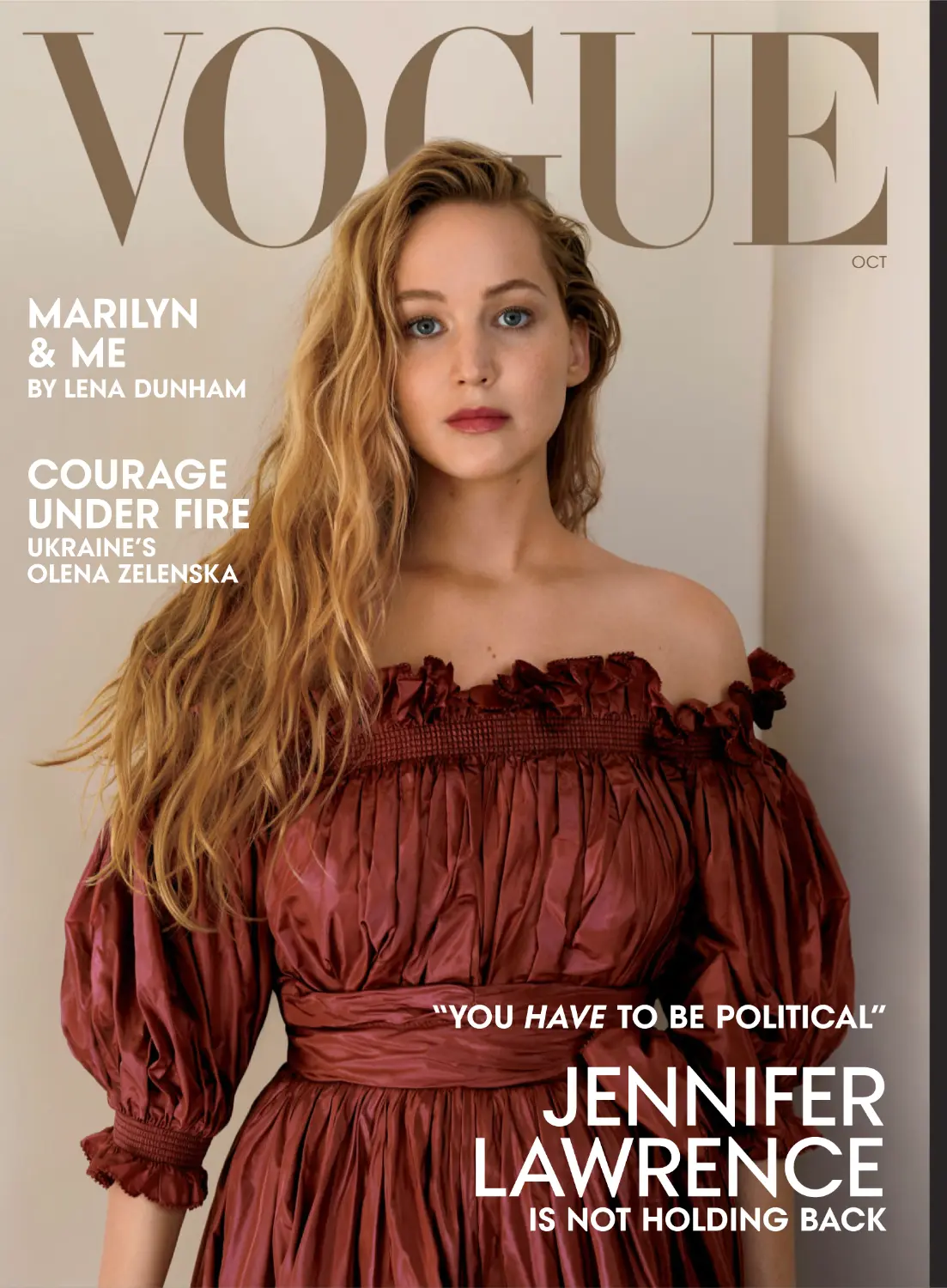
“YOU HAVE TO BE POLITICAL”

JENNIFER
LAWRENCE
IS NOT HOLDING BACK

ROMA

FENDI BOUTIQUES 646 520 2830 FEN D I .CO M

Confidence is unstoppable.

#1 Foundation in the U.S.*
Cashmere matte.
Breathable. Whisper soft.

Adut wears
9N1 Ebony.

October 2022

48
Contributors
52
Remembrance

Dodie Kazanjian on
Eric Boman

54
Nostalgia

Lena Dunham
considers the
legacy of Marilyn
Monroe

58
Cozying Up

Gigi Hadid launches
her own label.
By Chioma Nnadi

64
Arch Madness

Subversive brows
have a moment. By
Jancee Dunn

66
The Fashion
Plate

Deeda Blair’s guide
to entertaining

68
Rooms of Her
Own

Painter Danielle
McKinney mines
interior lives.
By Alexis Okeowo

72
Pure Love

David Mallett
expands his
hair-care line

72
Discovery
Channels

Fresh fall fiction

80
Unlock the Rules
A genderless
Tiffany collection

82
History Lessons

Three new movies

82
Night Moves

Casa Cruz opens
in New York

86
The Here and
Now

Jennifer Lawrence is
a new mom with a
highly personal new
film. By Abby Aguirre

96
Nowstalgia

Retro staples come
back to life

108
Portrait of Bravery
Rachel Donadio
profiles Olena
Zelenska, the first
lady of Ukraine

118
King of the City

Ralph Fiennes stars
as Robert Moses in
Straight Line Crazy.
By Sarah Crompton

120
Playing Favorites
The season’s best
accessories

126
The F Factor

Marc Jacobs joins
forces with Fendi.
By Lynn Yaeger

130
Just One Thing
Hardware-heavy
Miu Miu boots

136
The Get

Style inspired by the
great outdoors

144
Last Look

Cover Look Changed for Good

TWIST AND SHOUT
FROM LEFT: MODEL SORA CHOI WEARS AN ALEXANDER MCQUEEN JACKET, DRESS, AND
NECKLACE. MODEL IMAAN HAMMAM WEARS A PROENZA SCHOULER DRESS. SAINT LAURENT
BY ANTHONY VACCARELLO EARRINGS. PHOTOGRAPHED BY NADINE IJEWERE.

28

O CTO B E R 202 2 VO GU E .CO M

Jennifer Lawrence wears a Dior top, skirt, and belt. To get
this look, try: Dior Forever Foundation in 1.5N Matte, Dior
Forever Natural Bronze in 02 Light Bronze, Diorshow Brow
Styler in 021 Chestnut, Dior 5 Couleurs Couture in
599 New Look, Diorshow Mascara in 090 Black, and Dior
Addict Lip Tint in 491 Natural Rosewood. All by Dior Beauty.
Hair, Jenny Cho; makeup, Fulvia Farolfi. Thanks to Hearst
House and Image Locations. Details, see In This Issue.
Photographer: Tina Barney.
Fashion Editor: Tonne Goodman.

FAS HIO N E DITOR: GAB RIE LLA KAREFA-JO HN SO N. H AIR, E DWARD LAMPLEY; MAKEUP, GRAC E AH N.
PRO DUC ED BY JN P RO DUCTION ; S E T DES IGN , HE ATH MATTIO LI. DETAILS, S EE IN THIS ISSU E .

40
Editor’s Letter

HOME FRONTS
LEFT: JENNIFER LAWRENCE WEARS A DIOR DRESS. VAN CLEEF &
ARPELS NECKLACE. PHOTOGRAPHED BY TINA BARNEY. ABOVE:
UKRAINE’S FIRST LADY, OLENA ZELENSKA, PHOTOGRAPHED IN KYIV
IN JULY 2022 BY ANNIE LEIBOVITZ.

The Real World
“I KNEW FULL WELL THAT the response would be
powerful,” said Ukraine’s first lady, Olena Zelenska. “I never
regretted it. It was an important step for me. I accepted it.
It was another chance to focus the attention of millions of
people around the world on the developments in Ukraine.”
She was talking about the reaction to Annie Leibovitz’s
images of her and her husband (see “Portrait of Bravery,”
page 108) for Vogue. We published these photographs
online in July, along with Rachel Donadio’s well-reported
profile of Zelenska. Some voices on social media, including
a Republican politician or two, tweeted that they were
inappropriate, or a poor use of a wartime leader’s schedule,
or…something.
To be honest, it was hard to make sense of the social
media complainers. As Donadio writes, this terrible war
has been fought on the ground and in the information
space from the beginning, and President Zelenskyy has
been brilliant at harnessing the world’s attention and
support. Why shouldn’t his wife do the same? She is a
poised, intelligent, empathetic first lady, who has become
an effective frontline diplomat, appearing before the U.S.
Congress to ask for more aid, passionately and persuasively,
this summer. Keeping the world focused on Russia’s brutal
invasion isn’t a question of vanity, and it certainly shouldn’t
prompt one more tiresome debate about the intersection
40

O CTO B E R 202 2 VO GU E .CO M

of fashion and politics. This is life or death—and Zelenska,
along with ordinary Ukrainians, has been living that reality.
I was moved by Annie’s pictures, proud to publish them here
with Rachel’s updated profile, and cheered to see a viral
movement of women worldwide who have honored Zelenska
in a series of images on social media tagged #SitLikeAGirl.
Politics are everywhere. That is a reality brought home by
our cover star, Jennifer Lawrence, in her characteristically
no-holds-barred interview with Abby Aguirre (see “The
Here and Now,” page 86). Abby met with Jennifer shortly
after the Supreme Court overturned Roe v. Wade, and the
actor was horrified. “I’ve tried to get over it and I really can’t.
I can’t,” she said—a feeling of disbelief shared by so many
of us. Jennifer grew up in a conservative home and speaks
about divisions with her extended family, and her hope for
repair. She also talks about being a new mother and the joy
that her family—her son, Cy, and her husband, Cooke—
have brought her. It’s a personal interview, an extremely
human one, and, of course, it’s hilarious. Jennifer’s candor
and self-possession are irresistible, and her intimate new
film Causeway, from director Lila Neugebauer, is one more
fascinating choice she’s made in her career. It’s a chamber
piece with the wonderful actor Brian Tyree Henry about
war, emotional trauma, and the need for human connection.
Finally, as this issue went to press, we lost Eric Boman,
a wonderful friend, photographer, and all-around person of
perfect taste. Contributing editor Dodie Kazanjian knew
him well, and his husband of many years, the artist Peter
Schlesinger, and wrote a lovely remembrance (see page 52)
that captures his inimitable creativity and slightly
wicked wit. Eric was ahead of his time and a joy to be
around. I’ll miss him.

LAW RE NC E: FAS HIO N EDITOR: TO NN E GO O DMAN. H AIR, JE N NY C HO ; MAKEU P, FU LV IA FA RO L FI. PRO DUC E D BY CON N ECT T HE DOTS; TH AN KS TO H EARST HOUSE A ND
IMAG E LO CATI ONS. S ET DES IG N: S PEN C E R VROO MAN. ZE LE NS KA: STYL IST: J U LIE PE L IPAS. HAIR , IG OR LOMOV; MAKEUP, SV ET LA NA RYMAKOVA. PRODUC E R , A NN ASA BATI N I /
AL STU DIO; LO CAL PRODUCE R, MARY NA SANDUG EY-S HYS HKINA; LO CAL PRODUCT ION ASS ISTAN TS, MA RYN A SH U LIK I NA, V LAD MYK HN YUK, K AS I A K RYCHOWS KA .

Letter From the Editor

Difficult People
Ahead of the New York premiere of
Straight Line Crazy—David Hare’s
new play about urban planner Robert
Moses—star Ralph Fiennes spoke to
Sarah Crompton for “King of the
City” (page 118), and sat for a portrait
by photographer Paul Wetherell in
London. (The show marks Fiennes’s
first appearance on the New York stage
since 2006.) “David writes dubious
men very, very well,” Fiennes told her,
reflecting on his 20-plus-year history
with Hare’s work—and on Moses’s
divisive legacy. “He’s famously written
great parts for women with a clear
moral sense of direction. And men
who are a bit lost, who had a moral
direction, but somehow they’ve lost it.”

Let’s Do the Time Warp
Styled by contributing editor Gabriella Karefa-Johnson and photographed
by Nadine Ijewere, “Nowstalgia” (page 96) declares its premise outright:
fashion that splits the difference between past—in this case, the rockabilly
1950s and ’60s—and present. For a suitably evocative setting, the team
looked west: “We decided to shoot in the desert,” Ijewere explains, “because
we loved the idea of a modern approach to a road trip vibe.” They ended
up in sepia-tinted Palmdale, California, inviting along models Imaan
Hammam, Sora Choi (above), and musicians Bela Salazar, Eloise Wong,
Lucia de la Garza, and Mila de la Garza of the Linda Lindas. “While
we faced windy weather and serious heat, it was such a pleasure,” Ijewere
says. “Sora, Imaan, and the Linda Lindas really brought the energy—and
the patience—to the shoot.”

Happy Days
For this month’s cover story (“The Here and
Now,” page 86), photographer Tina Barney and
Vogue’s Tonne Goodman, pictured at left, flew
to Southern California to see Jennifer Lawrence—
now in the flush of new motherhood and
preparing to promote Causeway, her upcoming
film with Brian Tyree Henry and director Lila
Neugebauer. Their shoot day, at a light-flooded
house in Beverly Hills, was a warm and joyful
affair. “Just as I imagined, Jennifer was as downto-earth as anyone could be, as stunning in
her bathrobe as she was in those fabulous dresses
Tonne and her amazing team pulled together,”
Barney says. “Everything was perfection,
including that adorable husky”—CC, owned by
set designer Spencer Vrooman—“who refused
to get out of the pool. So we just went with it.”
48

O CTO B E R 202 2 VO GU E .CO M

FIE NN ES : P HOTOG RAP HE D BY PAUL WE THE RE LL. FASH IO N EDITO R: AL EXAN DE R PICON . H AIR, KE I TERADA; MAKEU P, C IO NA JO HN SO N -KIN G. PRO DUC E D BY 1972 AGEN CY. CH OI : PH OTOG RA PH ED BY N A DI N E I JEW ER E .
FAS HIO N E DITOR: GAB RIE LLA KAREFA-JO HN SO N. H AIR, E DWARD LAMPLEY; MAKEUP, GRAC E AH N. PRODUC ED BY J N P RO DUCTIO N. S ET DES IG N : H EAT H M ATTI O LI . LAW RE N C E: PH OTO GRA PH ED BY TI N A BARN EY.
FAS HIO N E DITOR: TON N E GO ODMAN. HAIR, J ENN Y C HO ; MA KEU P, FU LV IA FARO L FI. PRODUC E D BY CO NN ECT TH E DOTS. S E T D ESIG N: S P E NCER VRO OM A N . D ETA ILS, SE E I N THI S I SSU E.

Contributors

Eric Boman,
1946–2022

E

ric Boman, who died in August at the age
of 76, was always the youngest person
I knew. I met him in 1987, when Anna
Wintour, then the editor in chief of House &
Garden, asked me to write about the quirky
New York loft in the Flatiron district that
he and his partner, the artist Peter Schlesinger, had created.
Eric was known for making women look fabulous in
photographs, and I somehow found myself sitting for
him. He redrew my eyebrows, which were “too pale
and not the right shape” for my face, had me put my right
hand on my waist, elbow out, and then
started clicking away. “You’re so vain,”
he said. “You’re the vainest person I’ve
ever come across. It’s really quite
shocking.” He kept me laughing the
whole time, and I absolutely loved
the way he made me look. I also knew
he would be in my life forever.
Forty-two years old at the time, with
white-blond hair and breathtakingly
blue eyes, he was better looking than
the actor Tab Hunter and neither
embarrassed nor self-conscious about
it. He wasn’t interested in fame or
in money, and nobody, certainly not
the high-octane goddesses he
photographed, could intimidate him.
What made Eric Eric? It wasn’t the
dozens of European Vogue covers, or
the indelible offbeat still lifes of rooms
and gardens and objects that he did
for U.S. Vogue. Nor was it the many books he published or
the album covers he did for Bryan Ferry, Roxy Music,
and others. “Eric-ness” had more to do with the way he
breathed and saw life.
He could be wickedly funny in conversation, and in
his spot-on impersonations, even when they were directed
at you. And he could just as easily direct his impish
irreverence on himself. He had opinions on everything,
always unexpected, never banal, and usually against
the grain. Influenced, no doubt, by his family history as the
descendant of Swedish Lutheran ministers—a lineage
that stretched back 350 years—Eric’s quiet confidence was
unshakable. It was direct and honest, sentiment-free, no
frills. He was a cat who went his own way. He started as a
fashion illustrator after graduating from the Royal College

52

O CTO B E R 202 2 VO GU E .CO M

of Art, and in 1972, he borrowed Peter Schlesinger’s
Pentax (Peter was doing street photography at the time).
His first photographs appeared in Harpers & Queen, on
an assignment from Wintour, who was a young editor
there. Eric could do anything. He was a multimedia artist
before the label existed.
Eric and Tad, New Yorker staff writer Calvin Tomkins
and my soon-to-be husband, got along seamlessly. Eric
immediately dubbed Tad “The Duke.” They shared a wry
and sometimes cutting sense of humor. Eric loved it
when Tad said, “After a certain age, women lose the right
to bare arms.” And Tad loved Eric
saying, “The rich don’t even know
how to use their toilet brushes.”
They also shared a complete lack of
talent for self-promotion. Eric made
a lot of photographs that were just
for himself. I particularly liked his
portraits of rubber bands—worthless
throwaways, part of his “waste not,
want not” frugality, that he turned
into art. I urged Eric to show his
photographs and arranged for him to
talk with a dealer, but he never did.
I admired his eye so much that when
three architects couldn’t redesign the
simple cottage Tad and I had bought
in Rhode Island to my satisfaction,
I called Eric and we did it ourselves.
Tad and I told Eric and Peter that
we were getting married before we
told anyone else. To celebrate, they
cooked lunch for us (a mouth-watering asparagus soufflé)
in their 1835 country house in Bellport, Long Island. Eric
and Peter had met at a dinner at Mr Chow in London,
after the premiere of Luchino Visconti’s Death in Venice.
(Peter’s partner at the time, David Hockney, had skipped
this one.) They met again a few months later at Marcel
Duchamp’s old apartment in Cadaqués, Spain, where Eric
was a guest of his artist friend Mark Lancaster. “Peter
came with David Hockney and notoriously stayed on,
causing their real dramatic and public breakup,” Eric
told us several years ago. “It was considered best that Peter
and I go home, and we left at the C O N T I N U E D O N PA G E 1 3 8
JUST SO
ABOVE: VOGUE’S NAMESAKE ROSE, PHOTOGRAPHED BY BOMAN IN 2017.
OPPOSITE: A SELF-PORTRAIT AT HIS MANHATTAN HOME IN 1988.

ROS E : P HOTOG RAP HE D BY E RIC BOMAN. VO GU E, 2017. S E LF- PORTRAIT: PH OTO GRAPHE D BY E RIC BOMAN. HOUSE & GARDE N, 1988.

With inimitable taste, ready opinions, and a quick wit,
the photographer and author led a life of irreverence and flair.
Dodie Kazanjian looks back.

Remembrance

Nostalgia
Mirror, Mirror
Sixty years after her death,
Marilyn Monroe is more resonant
than ever. Is she a symbol,
spirit guide, or cautionary tale?
To Lena Dunham, the
answer is: everything at once.

I

54

O CTO B E R 202 2

VOGUE.COM

and other things I had forgotten to
want. Alissa handed me her gift, that
fat white coffee-table book, its
corners tugged at by wear—Norman
Mailer’s ode to (and thesis on) Marilyn, titled simply
with her first name. On the inner cover, Alissa had
inscribed: “For Lena—who, like Marilyn, has something
for everybody.” In that moment, when I felt I had
nothing for nobody, I clung to it: a bible and a life raft.
It could be argued that no woman has been more
closely examined. She’s received the once-over in books
by public intellectuals, biographers, and fiction writers
alike—not just Mailer but Gloria Steinem and Joyce Carol
Oates, whose 2000 novel, Blonde, will be given a film
treatment starring Ana de Armas this month. She’s a
figurehead of crass American excess, standing in Madame
Tussauds with her skirt forever blowing upward, her
famous dress on display at Ripley’s Believe It or Not! (and,
more reverently, on the Met Gala red carpet last spring).
Her death 60 years ago, of a barbiturate overdose in her
Brentwood bed, has created a cottage industry of
conspiracy theorists—was it the CIA? murder?—and
some who intersected with her only briefly have made
their livelihoods talking about it. We can even, if we are
so inclined, google an image of her in the morgue. > 5 6

AMERICAN BEAUTY
PHOTOGRAPHED BY
BERT STERN, VOGUE,
SEPTEMBER 1962.

COURTESY OF TH E BE RT STE RN TRUST.

t wasn’t until my 33rd birthday
that I really understood Marilyn
Monroe, in all her beautiful and
pained glory. It wasn’t, as these
things go, a very happy birthday.
The year 2018 had already
yielded three humiliations: a stint in
rehab, the loss of my fertility, and a
breakup that everyone expected (hard to
know if that’s the better or worse kind).
Unlike the reticent Marilyn—whose
early 30s produced her own 50-car pileup
of public humiliation, but who rarely spoke about any of
it—I never shut up and I certainly didn’t put red lipstick on
to cover the sad truth. My resistance to celebrating was
so great that my friends decided to throw me an arts-andcrafts party, as if I were an obstinate 11-year-old whose
class needed to be bribed into attending her festivities.
Amid tempera paints and sequins and press-on googly
eyes, we drank ginger ale—the sober woman’s Dom—and
friends nodded with loving patience as I decorated a
jewelry box in muted tones. I was well past any illusion
of adulthood being ahead of me, but dogged by a sense
that I was still not living like a grown-up, and I couldn’t
find much reason to try.
In the stack of presents from friends—a tie-dye
sweatshirt, a pearlescent locket with my dog’s photo in it,
a pair of shoes with cat ears on the toe—was a book
from my friend Alissa, who has made it her business in life
to catalog, with rare empathy, the humiliations of women
exposed to public attention (we now do it together, on a
podcast called The C-Word, where we have spent nearly
70 hours detailing the triumphs and miseries of female
eccentrics, icons, and even murderers—a gothic hobby,
but a hobby nonetheless). As the night wound down, adults
with glitter on their hands smoked cigarettes over
subway grates and talked about day care and mortgages

Nostalgia

Marilyn Forever

pain is gripping—her desire to disappear, the losing
Megan Fox proudly got a tattoo of her and then had it
struggle she is in with the camera. And then when she
removed, saying, “I do not want to attract this kind of
married Arthur Miller, a union widely speculated on
negative energy in my life,” and it was easy to understand
because of the different intellectual spaces they seemed
what she meant. Marilyn’s fame was—is—gigantic but
to occupy, she attempted domestic life in Connecticut,
lonely, lasting but impersonal. Who, once they really
studying watercolor and pivoting to the role of muse. But
looked at the facts, would want to wear that as a totem?
Miller’s love letters, one in particular sold at auction, show
As a young woman, I didn’t much care about her. I was
that he was as obsessed by her body as any boy with a
obsessed with those I perceived as shifting the cultural
poster of her above his bed: “And as you stand there cooking
landscape toward something more like…weirdness—
breakfast, I will kiss your neck and your back and the sweet
Gilda Radner, Grace Jones, and, later, Tina Fey. I thought
cantaloupes of your rump and the backs of your knees and turn
that girls who cited Monroe as an inspiration were at
you about and kiss your breasts and the eggs will burn.”
best trite and at worst boring. I did pose as Marilyn for a
In private, Marilyn suffered—not just from unceasing
magazine—with bleached hair, sucking on a whippedanxiety and depression, which doctors were happy to
cream-dotted cherry—but only after convincing myself
medicate (and here I can relate, having relied on a readily
it was a kitschy commentary on the kind of woman we
available chemical shield to navigate the terrors of my
deem worthy of attention.
late 20s). She also dealt with severe endometriosis, a
It was, finally, reading about her private life that
disorder of the reproductive system that remains woefully
showed me the triumph and tragedy of her arc. Marilyn’s
misunderstood and is the reason I had my own uterus
public presence was playful, seductive, and purposeful.
ousted at age 31. Marilyn was obsessed with becoming a
She posed like she was living in an ecstasy of eternal
mother, convinced it would cure the loneliness that plagued
summer, her breathy voice conveying an appealing lack
her. When she had her appendix
of need—but her private life was
removed in 1952, she is rumored to have
marked by pain. Abuse, addiction, and
Marilyn’s
public
taped a note to her stomach, begging
abandonment defined her until, at 36,
she died and became forever encased
presence was playful, them not to take her ovaries. Marilyn’s
miscarriage in 1957 (at the time, the
in the amber of our all-American
seductive,
and
Palm Springs newspaper, The Desert
fantasies. Thirty-six—an age that
seemed, when I first learned her story,
purposeful. She posed Sun, reported she was five to six weeks
pregnant when “the curvaceous screen
to be without defining factors. But
like she was
star was wheeled into the hospital
now that I’m here—36 and a half, to be
exact—I understand the unique set
living in an ecstasy of on a stretcher”) was said to be a major
contributing factor to the depression
of fears that set in once you’ve moved
eternal
summer
that hastened her addiction and haunted
past your prodigious 20s. To be 36 is
her cinematic swan song, The Misfits.
to understand that, while a lot more life
Losing your fertility has a way of forcing questions about
can be expected, there are certain things that cannot. If
your womanhood—I spent a good two years asking myself
you are childless, you have either made that decision, or
what my purpose was, despite staying busy with work and
you’ve entered a phase of hoping that has the bitter tinge
knowing, intellectually, that family takes many forms. But
of panic. If you are not yet seen as the thing you believe
imagine being the most discussed woman in the world,
you are—you feel people don’t know quite how serious or
both valued and cursed for your feminine power—what
powerful or sexy you can be—you have realized it will
would it look like to be that woman and yet not be able to
be a Herculean struggle to change this. Thirty-six is an
do what we think women should do? Women get pregnant
age where, without the proper support structures and
without even trying, and so to have spent my life doing
self-belief in place, it would be easy to roll over, say “Fuck
nothing but trying—in all the ways—and still have come
it,” and go back to sleep. It seems, based on the all too
up empty-handed was a humiliation more ancient than
readily available photo of the bed where she was found
any I had known. Without her wished-for baby, Marilyn
dead, that this is what Marilyn did.
was just another lonely starlet with a few broken marriages
Marilyn—famously once Norma Jeane Baker, and born
under her belt—of the “we told you so” variety—and
to a single mother who would later be diagnosed with
a raft of people she paid to look out for her interests but
schizophrenia—spent her young life being passed like
continued to treat her as a disposable resource.
a minor inconvenience from home to home. When
Marilyn does, indeed, have something for everyone. If
she was 16, rather than be recommitted to foster care, she
you feel you are caged by male perceptions of your beauty,
married a 21-year-old neighbor, marking the beginning
she is a cautionary tale. And yet if you feel your body is
of a “this bed’s too hard, this bed’s too soft” journey that
would take her through two more marriages and countless too big, too wild, or too different, she let the curves that
spoke louder than she could show through clingy fabrics.
relationships. Her union with Joe DiMaggio was
celebrated by the public until, nine months after they wed, If you feel you are not taken seriously by the powers that
be, Marilyn is someone who never became the actress,
she appeared outside their house in Beverly Hills in tears,
poet, or painter she was in her
having filed for divorce. In the still-available footage, her
C O N T I N U E D O N PA G E 1 3 8
56

O CTO B E R 202 2

VOGUE.COM

Gigi Hadid is launching Guest In Residence, her own label
of wildly colorful cashmere. By Chioma Nnadi.

W

hen Gigi Hadid moved to New York from
Los Angeles almost a decade ago, it was on
the brink of a particularly bitter East Coast
winter. Needless to say, the bone-chilling
weather was a shock to the system. “I’m always the person
who’s cold even when other people feel hot,” says Hadid,
with a sigh. Thankfully, her parents had planned ahead:
They’d sent their then teenage daughter off to college at
the New School with the cashmere sweaters she’d swiped

58

O CTO B E R 202 2 VO GU E .CO M

from their wardrobe on cooler days in California. Her
favorites were all stealthy chic: a gray turtleneck that
fastened with leather straps (her mother’s) and an allengulfing button-up cable-knit cardigan from her father.
With her life in a moment of transition—one both > 6 0
WINNING SCORE
Hadid in a color-block rugby shirt and shorts from
her label, Guest In Residence.

COURTESY OF GU EST IN RES IDE N CE . PH OTO GRAPHE R: PAB LO DI PRIMA.

Cozying Up

©2022 Walmart Apollo, LLC

60

O CTO B E R 202 2 VO GU E .CO M

COURTESY OF GU EST IN RES IDE N CE . PH OTO GRAPHE R: PAB LO DI PRIMA.

wildly exhilarating and bewildering—the cozy knits have—not to mention a megastar-worthy social media
offered the reassuring feeling of home. “Those were the following. And it doesn’t hurt that she’s worked with
only cashmere pieces I owned for a long time,” Hadid many of the most talented names in the business. “If you
pay attention, you can learn wild things beyond modeling
admits. “I still have them.”
I am speaking to the supermodel via Zoom; when she in this job,” she says.
More than all of that, though, the choices Hadid has
called me from a hotel room in London, she popped up on
the screen dressed in—what else?—a gorgeous sunflower made with Guest In Residence reflect style values she
orange cashmere crewneck. Except this one isn’t a hand- picked up at home. “Both my mother and father have
me-down—it’s a sweater from her just-launched new label, been really good about investing in things they love, and
Guest In Residence. “It’s the first time I’m wearing one I was always shown that growing up,” she explains. Given
of the new samples, and I love the color,” says Hadid, a the brand’s direct-to-consumer model, the investment
pieces in her line won’t
little giddy with excitecost the earth either—
ment. That sweater is
the classic crewneck
part of a series of forshe’s wearing for our
ever pieces—slim-fit
Zoom, for example,
joggers, hoodies, tanks,
retails for $295. That
scarves, beanies, and
said, Hadid’s not cutthe like—that come
ting corners on quality.
in a myriad of warm
In fact, she’s gone the
hues: bubble-gum pink,
extra mile to source
turmeric yellow, and
long-fiber cashmere
cherry red, to name a
in Inner Mongolia—a
few. There are limitedbiodegradable yarn
edition drops in the
to avoid pilling, every
works as well, including
knitwear devotee’s pet
one Hadid calls “varsity
peeve. “I want clothes
funk” that shows off her
that feel sustainable
flair for color blocking
and realistic to have for
on preppy shapes like
a long time,” she says.
the classic rugby.
“If you look after cashThe line of cashmere
mere correctly, it can
knits, three years in
last for decades.”
the making, is someThe two golden rules
thing of a labor of love
she swears by come via
for Hadid, 27. A few
her grandmother: (1)
months pregnant with
Anything that works
her daughter Khai and
on your hair works on
hunkered down on the
cashmere. (2) In lieu of
family’s farm in Pennwashing a sweater with
sylvania, she began to
each wear, hang it out of
incubate the initial conthe window at the end
cept just as the world
of the day. “Cashmere
went into lockdown.
GETTING WARMER
is a natural fiber, so it
“I think a lot of people
For Hadid, it’s not simply about how things look—it’s
how they feel—and how they last. Guest In Residence polo,
will naturally let go of
assumed that starting
shorts,
and
socks.
Details,
see
In
This
Issue.
fumes,” she insists.
my own brand would
It seems that cerbe the next natural
step,” says Hadid, who has worked on several collabora- tain members of her family are especially eager to get
tions over the years—everything from runway collections their hands on the new collection. Her sister Bella has
for Tommy Hilfiger to swimwear capsules for Frankies her eye on the cropped cardigan with raw edges and a
Bikinis founder Francesca Aiello, a friend since eighth hook-and-eye closure that was originally known as “the
grade. “But I wasn’t trying to rush it. I knew that something undercover.” “Bella came by the office and grabbed it—it
was her favorite thing,” Gigi says of the layering piece.
would come to me that felt right, that had integrity to it.”
In the current landscape of multihyphenate designers, “Now we call it ‘the Bella.’ ” And though Gigi’s daughter
her latest career move couldn’t be more well-timed. The might only be a toddler, she’s clearly right behind her
likes of Mary-Kate and Ashley Olsen, Victoria Beckham, auntie. “Khai is not even two and picks out her own outand Rihanna have long proven there’s more than one way fits. The other day she picked a dress out of the hamper.
into fashion, and as someone who is photographed as I said, ‘What are you doing—it’s dirty!’ But she wouldn’t
often on the street as she is on the runway, Hadid has put anything else on. She already has huge opinions of her
developed a keen sense of her own style much like they own,” says Hadid. “She’ll be our first intern.” @

eau de parfum

SEPHORA

CHANEL.COm

Karen
Elson

Quannah
Chasinghorse

Hamish
Bowles

Daniel
Roseberry

Gigi
Hadid

Stella
McCartney

Michelle
Pfeiffer

Bleached, drawn-on, shaved, or bejeweled,
subversive eyebrows with retro roots are
quickly becoming Gen Z’s preferred beauty
statement. Jancee Dunn gets the skinny.

T

hroughout the tweeze-happy
’90s, I enthusiastically pruned
away at my eyebrows. Inspired
by Kate Moss’s delicate arches,
I obliterated my own—chestnut colored, with a totally acceptable, softly
angled natural shape—until they were
as slight as my slip dresses. When the
Clinton administration ended, so, too,
did my follicular assault, but not without lasting damage. It took years for
some semblance of regrowth to materialize, thus closing a traumatic chapter in the beauty history of an entire

64

O CTO B E R 202 2 VO GU E .CO M

generation. That is, until it was pried
open again by TikTok, where a popular thin-eyebrow filter that renders
full-to-feral shapes into reedy wisps
sent a shiver across my forehead when
I first came upon it in early spring.
How did we get here, I brooded to
myself, as I flipped through images
from fall shows where brows weren’t
so much streamlined as completely
decimated. At Burberry and Versace,
the makeup artist Pat McGrath broke
out her bleach pots to create what
she describes as a “strong, daring,

PORTRAIT MODE
The face-framing feature is fertile
ground for experimentation.
Pablo Picasso, Portrait of a Woman
(Dora Maar), 1939, oil on panel.

© C HRISTIE ’S IMAG ES/© SUCC ES ION P ICASSO/ARSN Y, 202 2/B RIDG E MAN IMAG ES. COPY RIG HT© 2022
ESTATE O F PAB LO PICASSO/ARTISTS RIGH TS SOC IETY (ARS) , N EW YORK. 59.7 X 4 5.1 CM, PRIVATE COL LECTIO N.

Arch Madness

powerful, and otherworldly” look.
The makeup artist Diane Kendal
called the bare foreheads she sculpted
underneath sharp-edged mullets at
Marc Jacobs “gothic and futuristic,”
adjectives not typically associated
with supermodel Bella Hadid, who
blended in with the rest of Jacobs’s
dystopian-couture cast.
Hadid herself is certainly part of
the minimized-brow comeback, regularly romanticizing all things ’90s—a
decade in which she spent just four
living years. But the retro revival is as
much an homage to the original supermodels as a reflection of our collective
emotional state, suggests makeup
artist Marcelo Gutierrez. Using brows
as a creative canvas—slimming them
down, bleaching, shaving or dyeing
them, or affixing them with jewels
or glitter—provides a welcome shot
of fantasy in our triggered times, says
Gutierrez, who has worked with Troye
Sivan, Dua Lipa, and Euphoria’s Alexa
Demie. Existentialism begets escapism, and in moments of uncertainty a
skinny brow is decisive. “It’s a very—
how do I put this—bitchy-in-thebest-way eyebrow.”
Even bleached brows have effectively migrated off the runway, notes
Rihanna-approved makeup artist
Raisa Flowers, who has long sported
them herself (while many makeup artists use Jolen Creme Bleach on their
brows, Flowers prefers Wella Blondor).
“They give you more range if you want
to experiment with makeup—like,
everybody’s been doing those graphic
liner looks that cover the whole eye,”
says Flowers, who adds that the really
young makeup artists on Instagram
either don’t have brows, or they’re
drawing them on really thin. “We’re
approaching brows with an attitude
of playfulness and experimentation,”
adds New York–based makeup artist Sam Visser, who at 22 is Dior’s
youngest-ever U.S. makeup ambassador. For Visser, tinkering with brow
shape also offers the opportunity for
a low-cost makeover. “They’re the
one thing in beauty that really > 6 6

*Recommended for retinol users and not for beginners **See improved look of wrinkles © J&JCI 2022

GENTLE

ON SKIN*

RETINOL PRO+ SERUM

W R I N K L E R E S U LT S I N O N E W E E K * *

FOR PEOPLE WITH SKIN

TM

does transcend your economic status,”
Gutierrez agrees. “I see skinny brows
on people working the register at
CVS, and on the most famous people
in the world.”
One place you may not see them,
however, is in Paris. “The majority of
my customers are not touching their
eyebrows,” says Sabrina Eleonore,
founder of the chic brow-shaping
salon Un Jour Un Regard with locations in the 4th and 16th arrondissements, where natural shapes and
light grooming are the only things
on the menu. “A fine eyebrow can be
very pretty if the line is well worked,
but it does not suit everyone and can

Existentialism begets
escapism, and in moments
of uncertainty a
skinny brow is decisive
make the face appear tired,” continues
Eleonore; it can also cause trauma to
the hair follicles, “which can result in
scarring and can affect regrowth,” says
New York City dermatologist Doris
Day, MD, who notes that prolonged
pruning can lead to permanently
barren real estate between brow and
eye, which anyone who swayed along

to Sarah McLachlan at the original
Lilith Fair can attest to.
But there’s nothing that can’t be
undone: Just ask Kendall Jenner,
who memorably showed up to this
year’s Met Gala virtually browless,
only to enjoy the after-parties with
her dark arches fully intact, a bit of
trickery from makeup artist Mary
Phillips. If you don’t like your newly
bleached brows, says Gutierrez, “just
go to the drugstore, get some men’s
beard touch-up, and you can color
them back to normal in two minutes.”
The most important thing, Gutierrez
emphasizes, is to just have fun. “It’s a
look,” he says. “Not the look.” @

The Fashion Plate
Deeda Blair wrote the book
on elegant entertaining long ago;
now, it’s being published.

66

O CTO B E R 202 2 VO GU E .CO M

WHAT WOULD DEEDA DO?
above: Deeda Blair’s dining table in New York,
photographed by Ngoc Minh Ngo.
left: Blair, photographed by Eric Boman.

“Everyone wants to fund projects that
they know will succeed,” Blair notes in
the introduction. Yet now as much as
ever, her mission is to uplift. “I want to
fund young researchers I believe in.”
—lilah ramzi

BOTH IMAG ES COU RTESY OF RIZZO LI NEW YO RK .

D

eeda Blair knows the power of a well-orchestrated
supper. Born in Chicago, she enjoyed stints in
Washington, D.C., New York City, and abroad
as wife to William McCormick Blair Jr., an
ambassador to both Denmark and the Philippines, throwing her first big fundraisers in the 1960s. (These days, her
main cause is the diagnosis and treatment of mental illness, having launched the Deeda Blair Research Initiative
for Disorders of the Brain in 2021.)
Indeed, on meeting her at home in Manhattan, it’s hard
to know what’s the most impressive: Beyond Blair’s staunch
dedication to medical research is her ferocious elegance,
documented in Pinterest-famous images by Horst P. Horst
and Andy Warhol. Deeda Blair: Food, Flowers & Fantasy
(Rizzoli), a new book edited by Deborah Needleman, also
dazzles, pairing Blair’s recipes for dishes like cold beet
soup and Gruyère roulade with images of the memorable settings where she has dined (Hubert de Givenchy’s
French country estate Château du
Jonchet; the Villa La Fiorentina in
Saint-Jean-Cap-Ferrat) and colorful snapshots from her life. “Some
of these recipes dated back to my
grandmother,” she says. “I mean,
have you had an aspic recently?”
She dedicates the book both to
her late son, who suffered f rom
bipolar disorder, and to her husband, who died in 2015, and will
donate its proceeds to the medical
grants overseen by her initiative.

IT'S MORE THAN CHOCOLATE

IT'S MAGNUM ICE CREAM

In richly atmospheric paintings,
Danielle McKinney mines
the interior lives of Black women.
By Alexis Okeowo.

W

hen I first saw the work of painter Danielle McKinney, at a show at Night Gallery
in Los Angeles last year, I got as close as
I could without setting off the alarms. Her
portraits of solitary Black women at home, beautiful and
enigmatic, have a cinematic quality; McKinney captures
them with an acute female gaze—red lipstick, curls of cigarette smoke, pink nail polish—in moments of reflection,
smoking, reading, or sprawled naked on a rug. “I wanted
to paint this feeling of: When I get home and no one’s
around, who am I? Who am I without this façade? And the

68

O CTO B E R 202 2

VOGUE.COM

FRO M LE FT: DANIE LL E MCK IN NEY W ITH H ER PAIN TIN G S: ET ERNAL, 2022 , AN D STAY PUT, 2022 . P HOTO GRA PHE D BY P IERRE LE HORS. AC RYLI C O N CAN VAS, 24 X 1 8 I N . COURT ESY OF THE ARTI ST, MA R IA NN E BOESKY GAL LERY,
NEW YO RK AND ASP EN , AND N IGH T GALL ERY, LOS AN GE LES. AC RY LIC O N CAN VAS, 24 X 18 I N. COU RTESY O F THE ART IST, MARIAN NE BOESKY GALL ERY, NEW YOR K A ND ASP E N, A ND NI GH T GAL LE RY, LOS A N GE LES.
DAN IEL LE MC KINN EY, TEL L M E M ORE , 202 1, ACRY LIC ON CAN VAS, 24 X 18 IN . PH OTO G RAPH Y: LAN C E BREWE R / COU RTESY O F T H E ARTIST, M A R I AN NE BOESKY GA LLE RY, NEW YO RK A N D ASPE N, A N D N IG HT GALLE RY, LOS AN G ELES.

Rooms of
Her Own

interior space was perfect for that,” McKinney
says. In the Western art tradition, Black women
tend to be at work, in the background, or at the
edges of the frame—almost never centered and
at rest. “You don’t get to see them lying down on
a sofa,” she adds.
Based in Jersey City, McKinney, who is 40, only
started painting full-time during the COVID
lockdown, but she had prominent space at Night
Gallery, which co-represents her with the Marianne Boesky Gallery, where she will have a
major solo show this October in New York. She
has already had her paintings acquired by places
like the Dallas Museum of Art, Miami’s Institute of Contemporary Art, and the Hirshhorn Museum
and Sculpture Garden at the Smithsonian; Beyoncé owns
a piece too. “There is a strong sense of self that emanates
from each solo figure, made all
PRIVATE EYE
the more powerful by the intimate
left:
Artist Danielle
spaces that they not only inhabit,
McKinney with two of
but command,” Thelma Golden,
her paintings, Eternal,
the director and chief curator of
2022, and Stay Put,
the Studio Museum in Harlem, 2022. Photographed by
Pierre Le Hors. above:
wrote me by email. “Her focus
Tell me more, 2021.
unveils assumptions around what
is afforded Black women at rest, as much as it maintains a
level of protective distance from the viewer. Ultimately, Danielle bringing these scenes to life is an act of reclamation.”
When I saw McKinney’s paintings for the second time,
this past February, it was at her studio, where canvases in
various stages of completion lined the walls. They were
moody, rendered in shades of shadowy brown, orange, blue,
and green, and dominated by a languorous female form.
McKinney often paints from scenes she sees in photos
and film, and listens to soul music and old R&B while
she’s working. She always starts with an all-black canvas,
and then lifts her figures from the background, followed
by their rooms. On a mauve-pink table was a bound collection of vintage issues of Better Homes & Gardens >7 0

70

O CTO B E R 202 2

VOGUE.COM

DAN IEL LE MC KINN EY, DRE AM CATCHE R, 2021, AC RY LIC O N CAN VAS, 24 X 18 IN. PHOTO GRAPHY: P IER RE L E H ORS/COURT ESY
OF TH E ARTIST, MARIANN E BOES KY GALLE RY, NEW YORK AND ASP EN, AN D N IG HT GALL E RY, LOS AN GE LES.

that McKinney ordered from eBay, which she uses, along when she touched them. After graduating, McKinney
with other magazines from the 1960s and ’70s, as refer- stayed on working in the education department at Parences for her “minimal but pop” domestic spaces. Their sons and taking pictures in her free time. She submitted
imagery reminds her of her grandmother’s friends’ living to photography open calls, but never heard anything back.
rooms, with their plastic-covered printed sofas. Above the Before the pandemic started, she felt stuck.
But she had been painting for years, and as an intern at
table, McKinney had posted a sepia-toned photo of her
father, who passed away when she was one. “He keeps me the Studio Museum in Harlem in the summer of 2013, she
straight when I’m standing there looking around like, ‘Is discovered the portraits of Barkley Hendricks. (McKinney
is also captivated by the work of Jacob Lawrence, Franthis okay?’” she says.
We talked again over the summer, when she was at her cisco de Zurbarán, and Henri Matisse.) “Painting was like
gallery in New York and I was in London, where McKin- a diary for me. I would be in a relationship with a guy and
ney had just visited with her artist husband, Robert Roest, have these feelings, and I would paint them,” McKinney
says of her early canvases.
and one-year-old daugh“And I started going at it
ter, Charlotte, after finishreally hard when COVID
ing a residency in Spain.
We share a connection:
hit, because I couldn’t get
We both grew up in Montout and photograph on
gomery, Alabama. Raised
the streets. So that was my
on the outskirts of the city
release.” She set up easels
by her mother Barbara,
in her spare bedroom, and
aunt Frances, and grandafter taking a virtual crimother Margaret, she was
tique class, started sharing
an only child. McKinney
her paintings on Instagram.
remembers playing under
She wrote to dozens of galthe magnolia trees with
leries, including Night Galf riends, going to family
lery, which offered to give
reunions “out in the counher a show the following
try,” passing days with her
year, in the spring of 2021.
grandfather in his cow
“I just sobbed,” McKinney
field in Lowndes County,
says. “I wanted to repreand sitting with her grandsent for all the times that
mother’s f riends on the
I would go to openings at
porch as they knitted and
galleries and not see Black
played gospel music. “I
art.” After curators from
spent a lot of time with
New York’s Fortnight Instiolder people. It was a sensitute saw her work, they also
tive time for me, but a very
proposed a solo show, in
beautiful time,” McKinney
April 2021—McKinney’s
says. “My grandmother
first. Pregnant at the time,
would put me in a room and
she was overwhelmed by
give me all these magazines,
the response at the openPEACE PIECE
and I would cut these figing, where a crowd of peoMcKinney’s
Dream
Catcher,
2021,
will
appear
in
her
solo
exhibition
ures out and build houses
ple waited outside. A few
at the Marianne Boesky Gallery this October.
in shoeboxes. I would stay
months later, Beyoncé and
in there for hours, and I
Jay-Z purchased her paintmean hours, and I would just be in my own world. It was ing of a luminous woman in a billowing orange blouse,
the most comfortable, soothing feeling.” She presented the dangling a cross necklace above her head. “They support
houses to her family when she was done.
young Black artists, so I felt honored,” McKinney says.
McKinney was drawn to the act of creating worlds with
Her fall show will have paintings that feel more delibher own hands. “I was just restless, but art was my safe erative, inspired by changes in her life over the past few
place,” she recalls. Her grandmother took her to painting years. “Now it’s time to grow up,” she says. “I can’t go party
classes, and her mom bought her a Nikon camera when and paint in the studio for 10 hours with a negroni and
she was 15. McKinney began photographing her friends a cigarette. It’s about moving forward in my life, and the
in nature, and studied photography at the Atlanta Col- tension of that.” Dark green is a prominent color, and many
lege of the Arts before going to the Parsons School of of the women seem to be looking into an abyss. Her time in
Design in New York. The move north was not easy; she Spain moved her to start experimenting with leaving negawas depressed for a year and felt out of place. But even- tive space around her figures, instead of painting them into
tually, “Parsons became my family,” she says. While there, rooms. But she remains “obsessed” with creating domesshe pursued a project about intimacy, photographing peo- tic worlds for her figures. “I’m kind of putting myself into
ple on the subway as she watched them in their “inner those spaces,” McKinney says. “I just hope I leave them
moments” and making a video about how strangers reacted open enough for people to feel comfortable coming in.” @

Pandora.net

Pure Love

DAVID MALLETT’S STYLING products, which include
his Fresh Eau de Concombre—the very first dual hair and
face mist—and the Volume Powder that launched a thousand imitations, offer the same satisfaction as his haircuts,
which book out months in advance: performance that
appears effortless. But there is no display at Sephora, no
rigorous launch schedule to take Mallett’s name beyond the
rarefied circles he operates in, from New York to his fourchair salon at the Ritz in Paris. “Sharing my message was
never really my priority,” the Australian-born coiffeur says
over the whir of a blow-dryer during a recent trim. Then,
in 2021, after losing his husband, who had been the driving
force behind building Mallett’s namesake line, the 57-yearold locked in on what his clientele—which includes
Charlotte Gainsbourg and the designer Natacha RamsayLevi—wants now. “It’s an evolution, not a revolution,”
Mallett says of Pure, a 96 percent natural, fragrance-free,
amino-acid-rich shampoo and organic coconut oil, argan
oil, and shea butter–laced conditioner that manages to be
rich yet extremely lightweight. Inspired by the unadulterated island landscape in Ponza, just north of Naples, where
Mallett spends his summers sailing and administering
stern-side trims, the Pure line will grow this month with

Discovery
Channels
Fall fiction explores
new worlds.
SET IN A TENSELY SURVEILLED
near future, Celeste Ng’s follow-up to
Little Fires Everywhere, Our Missing
Hearts (Penguin Press), tells the story
of Bird, a 12-year-old boy gasping for
hope and love in an America that runs

72

O CTO B E R 202 2

VOGUE.COM

MY BLUE HEAVEN
Mallett (above, with a friend) was inspired by the pristine landscape
of Ponza, Italy, when designing the new, naturally formulated line.

the addition of a 100 percent natural hair serum, followed
by a scalp oil, mask, and a dry shampoo. Don’t call it a
brand expansion, though. For Mallett, who will also debut
his riff on a classic chignon pin reimagined as an oversized
safety pin this fall, it’s simply an extension of a belief
system that he pauses before identifying as “beautiful left
of center.”—celia ellenberg

on scapegoating and fearmongering.
The nation has undergone an economic and political crisis of unseen
proportions, and the recently passed
(and popular) laws of the land codify
racism and sanction the removal of
children from the homes of suspected
subversives. In her tale of Bird’s quest
for his mother, a dissident poet on the
loose, Ng has written an unwaveringly dark fairy tale for a world that
has stopped making sense.
Pulitzer- and Nobel Prize–winning
lyric poet Louise Glück makes her
first foray into narrative fiction with

Marigold and Rose (FSG) , a book

that unfolds like a fable as two infant
twin girls come to grips with time,
safety, happiness, loss, and the vagaries
of communication. (Marigold, who
fancies herself a writer even before
she can read, is surprised when Rose
starts speaking first—and loudly.)
Reed-slim, the book teems with
small wisdoms.
Lydia Millet’s Dinosaurs (Norton)
comes at its modern themes (climate
change, the dissolution of community) from a delightful slant. Gil, 45,
has seen his girlfriend of 15 years
leave him for a professional cyclist,
and his response is to leave behind
his Manhattan apartment and walk
west, eventually settling down in
Phoenix. As he works through memories of his past life—his coldhearted
ex; a seismic childhood tragedy—a
compelling attention to the natural
world emerges. Tender but never
sentimental, wearing its intelligence
in a low-slung style, Dinosaurs is a
garden of earthly delights.—lauren
mechling and marley marius

CON DITIO NE R: COU RTESY OF DAVID MAL LETT PARI S. MAL LE TT AND FRI EN D: COU RTESY OF DAV ID MALLE TT/ @ DAVIDMALL ET T. PAST EL FI S H ING VI L L AG E : PH OTO GRA PH E D BY
JANN HUIZENGA/GETTY IMAGES. BOATS: PHOTOGRAPHED BY GIACOMO SANDOLO/EYEEM VIA GETTY IMAGES. WHITE CLIFF: PHOTOGRAPHED BY LORENZO ANTONUCCI/GETTY IMAGES.
BOO K COV ERS, FROM L EF T: COURTESY OF PEN GU IN RANDO M HOUS E . COU RTESY OF FARRAR, STRAUS AN D GIROUX. COU RT ESY O F W.W. N O RTO N & CO M PA N Y, I NC.

David Mallett doubles down on his
cult-favorite hair-care collection.

VERSACE
POUR FEMME
DYLAN TURQUOISE

VERSACE
POUR FEMME
DYLAN BLUE

BLOOMINGDALE’S DILLARD’S MACY’S

Tiffany & Co.’s new Lock collection
underscores a modern way to shine:
gold and gems first, gender last.

S

ome revolutions shatter boundaries with a crash
and a bang; others arrive on tiptoe and, with a
whisper, change the rules forever. Up until a very
few years ago, a guy with a diamond Art Deco
brooch winking from his black-tie ensemble would at least
raise an eyebrow—and the fellow you went to high school
with who has now paired his Hanes T-shirt with a single
strand of pearls would elicit—well, if not a guffaw, at least
a titter. But no longer.
Women have for decades helped themselves to maleidentified jewelry—the signet ring, those massive two-ton
wristwatches. No one blinks an eye when we string an
antique pocket watch around our necks or have a chunky
ID bracelet cut down so that it fits our wrist. The clean
lines of men’s jewelry, along with the charm and edge of
androgyny, have long seduced women, but lately men have
begun crossing the aisle as well. Which is why Tiffany &
Co., for the first time in its nearly 200-year history, is
launching Tiffany Lock, a bracelet the company describes
as “all-gender” with an ethos of “No rules. All welcome.”

80

O CTO B E R 202 2 VO GU E .CO M

S ET DES IG N: JOC E LY N CABRAL.

Unlock the Rules

“It’s all about unity, belonging, the universal
bonds that tie us together forever—and the
open-minded spirit of today’s generation,”
says Alexandre Arnault, Tiffany’s executive
vice president of product and communication. Arnault, who himself is just 30, brought
Beyoncé and Jay-Z into the Tiffany fold, a
spectacular example of the brand’s commitment to a fresh perspective.
What today’s generation wants, according to Arnault, is an elegant, streamlined,
elongated bangle available in yellow, white,
or rose gold, sometimes enhanced with diamonds. And of course, like all bangles, the
Tiffany Lock simply cries out for company—
why would any arm, regardless of gender, be
satisfied sporting a single rose gold example
when it could be joined with, say, a diamondstudded yellow gold sibling?
The Tiffany Lock bracelet’s padlock motif
has a long history with the house. First
employed as a working latch in the late 19th
century—to protect the secrets in your strongbox, perhaps—it reappeared in the 1950s, and
from then on its form and shape have informed
brooches, necklaces, money clips, and those
iconic key rings. The mechanism that opens
the lock, meanwhile, is a bit of an engineering
feat: The clasp features an innovative swivel
that echoes the functionality of a padlock.
Asked whether he thinks all jewelry in the future will be
gender-neutral, Arnault demurs. Certain collections, like
Tiffany’s HardWear, were originally intended for women,
“but you see a lot of men wearing it now,” he says—and he
is sure there are gentlemen out there
HANG TIME
flaunting Elsa Peretti’s bone cuff;
The distinctive
after all, he has already seen them
bangles of the new
sporting that designer’s Diamonds
Tiffany & Co.
by the Yard chains.
collection, Tiffany
That said, Arnault believes that
Lock, are made
for anyone. Details,
some categories may prove more
see In This Issue.
challenging. Traditional diamond
Photographed by
and engagement rings remain overRyan Jenq.
whelmingly the province of women.
As Arnault—who married Géraldine Guyot, cofounder
of accessories brand Destree, last year—explains, “I don’t
expect our high-jewelry clients to be men anytime soon—
it is still very feminine, and at the moment, 100 percent
of those clients are women,” he tells me. ( Just you wait,
Monsieur Arnault, I think but don’t say—any day now,
some hunky movie star or brawny athlete will show up
flaunting the high-jewelry necklace he bought for himself,
and you will stand up and cheer.)
In any case, when it comes to gender-specific jewelry, the
best-laid plans can be delightfully disrupted. “Last summer we launched a range of engagement rings for men—
diamond rings that were meant to be more masculine,
more suitable for a man’s finger,” Arnault remembers. But
no sooner had those rings appeared than a woman in his
office at Tiffany snatched one up. And now, he confesses,
“I see it on her hand every single day.”—lynn yaeger

History Lessons
Three new films go in search of lost time.

DRIVING FORCE
Elizabeth Banks in Phyllis Nagy’s Call Jane.

Night Moves
London hot spot Casa Cruz
touches down Stateside.
JUAN SANTA CRUZ has a single goal for
Casa Cruz New York, the sister property to
his Notting Hill restaurant-slash-nightclub
favored by Kate Moss and Victoria Beckham. Whether guests want to dance, dine,
or just take in a beautiful room, they should
have fun—like, a lot of fun. “My intention
is to do all of those things so well that,
regardless of what you care most about, you
have everything you’ve ever wanted,” Santa
Cruz says. Housed in a Beaux Arts mansion
on East 61st Street, Casa Cruz serves up
orecchiette al limone and Wagyu picanha
in the main restaurant. Come for lunch, and
a hostess dressed by Emilia Wickstead will
seat you in a drawing room humming with
New Age jazz; come at night, and you can
sip a drink in one of two handsome bars.
And then there are the interiors, swathed
in green velvet and curved Brazilian cherry
wood. The rooftop terrace is covered in a
colorful tent by Johanna Ortiz, and in a nod
to Santa Cruz’s Chilean heritage, custom de
Gournay murals of different South American landscapes adorn the bathroom walls.
The effect is not just glamorous, but transporting, too. “When you enter,” Santa Cruz
says, “you’ll leave New York behind you.”
—elise taylor
SCENES FROM A MANHATTAN RESTAURANT
Casa Cruz New York occupies an art-filled
six-story building on Manhattan’s Upper East Side.

82

O CTO B E R 202 2 VO GU E .CO M

BAN KS: PH OTO GRAPH ED BY W ILSO N W EB B. COURTESY OF ROADS IDE ATTRACTIO NS. SARUS C RAN ES: COURTESY O F DE GOU RN AY.
DAV ID H OC KN EY, THE CH AIR, 1985, OIL ON CANVAS, 4 8 X 36 IN/ PHOTO: STEV E O LIV E R. IN TE RIO R: WESTO N WEL LS.

PAST LOOMS AS PROLOGUE in the brisk and elegantly forceful
drama Call Jane, a film depicting the secret collective of Chicago
women who provided abortions in pre-Roe 1968 America. Elizabeth Banks plays Joy, a pregnant housewife in a Nixon-supporting
suburb who dials an anonymous number on a flyer in a desperate
bid to end her pregnancy. Lucky for her, the formidable Sigourney
Weaver is on the other end of that line—a merry-warrior feminist
who leads a band of polyester-clad activists in a clandestine fight
for reproductive freedom. Banks and Weaver are both excellent,
and filmmaker Phyllis Nagy brings fine-grained period detail and
a comedic touch to a deadly serious subject.
Armageddon Time also mines the past, but for a coming-ofage story about class, race, and ambition in 1980 Queens. James
Gray’s autobiographical film is a gorgeous, confidently made
morality tale with titanic performances from Anthony Hopkins,
Anne Hathaway, and Jeremy Strong as members of a striving
Jewish family confronting unpleasantness at the heart of the
American dream. Paul is their sixth grader, an incandescently sensitive boy played by newcomer Banks Repeta, who finds the codes
of a private school—and the naked racism of his classmates—
nearly unbearable. His grandfather (Hopkins, magnificent here)
counsels and comforts him as he faces impossible choices between
integrity and ambition, friendship and his future.
The quietly devastating God’s Creatures is set in a vague present,
but it brims with ancient traditions and ancient pain. Emily Watson
turns in a bravura performance as Aileen, a supervisor at a seafood
processing plant in an Irish fishing village, whose wayward son
Brian (Paul Mescal) has come back from exile in Australia. Charming and unpredictable, Brian is determined to start his life over, to
make a go of oyster farming, and Aileen will do anything to help
him, even when a local woman, Sarah (Aisling Franciosi), accuses
Brian of assault. Filmmakers Saela Davis and Anna Rose Holmer
tell a story of mythic proportions with uncommon restraint, and
the climax exerts patient, lingering power.—taylor antrim

®

ON THE EDGE
Lawrence has
no patience for
the politically
unengaged.
“You have to be
political. It’s too
dire. Politics are
killing people.”
Altuzarra dress.
Fashion Editor:
Tonne Goodman.

The Here
and Now
Jennifer Lawrence is a happy
new mom, with a highly personal
new film about trauma—and
a lot to say about politics. She and
Abby Aguirre unpack it all.
Photographed by Tina Barney.

I

t is safe to say that in her 32
years on planet Earth, Jennifer Lawrence has never
struck anyone as the countryclub type. So I was surprised
to learn that for our first
meeting, she wanted to go golfing.
“Does she golf?” I asked her publicist
over the phone. The publicist wasn’t
sure. “I’ll leave that for you to unpack,”
she said with a laugh.
I was still trying to figure out what
sort of shoes a first-time golfer wears
to a driving range when I got word
that Lawrence had changed her mind.
She no longer wanted to go golfing. I
learned she wanted to have an unconventional spa experience, “like when
they spank you with those leaves,” she
said. With two days to look, I couldn’t
locate a spa that offered Russian venik
massage in private enough quarters.
So we settled on Tikkun, a small, intimate spa in Santa Monica.
I met Lawrence there on a drizzly
Friday summer morning. She arrived
wearing a pink sundress, brown leather
sandals, and an oversized printed cardigan she calls her “Big Lebowski
sweater.” Her blond hair was longer
than I could ever remember seeing it
in photos, almost down to her waist.
More immediately striking, Lawrence, who had a baby in February
with her husband of three years, the
art gallerist Cooke Maroney, was
wearing the unmistakable aura of new
motherhood—that mix of euphoric
new love, sleep deprivation, and a certain wide-eyed rawness that comes
with having your world cracked open.
We were in a suite with side-byside massage tables, showers, and a
candlelit hot tub. Flute music played
overhead. I remarked that, given the
weather, it was probably for the best
that we didn’t go to the driving range.
Lawrence nodded. “Also, like, I’m
a mom,” she said. “I need to just lie
down. This is the only time I could
come to a spa and not feel guilty.”
Moments later she added that she’d
gotten a spray tan the day before,

NEW PATTERNS
“There are no games,” says
Lila Neugebauer, director
of Lawrence’s new film
Causeway. “There’s no
fortress. She’s present and
she’s in it with you and
she’s game.” Erdem dress.

89

DOUBLING UP
“It’s so scary to talk
about motherhood. Only
because it’s so different
for everybody,” she
says. “The morning after
I gave birth, I felt like
my whole life had started
over.” Erdem dress.

feigning the dotty tone of an eccentric shut-in: “I was like, I’m meeting
somebody from the outside! I hope she
doesn’t think I’m pale!” A spa employee
appeared and invited us to make use
of various communal areas—a Himalayan salt room, a Korean clay room,
a cold room. As the woman spoke,
Lawrence fiddled with breast-pump
gear that she would later wear into
one of the rooms.
If it’s awkward-slash-comical to
undress and go into a sauna with
someone a few minutes after meeting them, it is even more awkwardslash-comical to conduct an interview
in that situation. Wrapped in flimsy
sarongs, we made small talk in the
heat, the red light of my audio recorder
glowing between us. I felt an impulse
to ask Lawrence about her baby,
about giving birth—all the things
two women might normally discuss
in a sauna when one of them is a new
mom. But I’d been warned that Lawrence was still finding her footing with
the topic, boundary-wise. Conversation turned instead to her new movie.

C

auseway is the first film
directed by Lila Neugebauer, who comes from
the theater world. (Her
Broadway restaging of
Kenneth Lonergan’s
The Waverly Gallery in 2018 was nominated for the Tony Award for best
revival of a play, and its star, Elaine
May, won for best actress.) Lawrence
plays an American soldier who returns
to her hometown of New Orleans
after a traumatic brain injury in
Afghanistan. On one level it’s a movie
about acute post-traumatic stress.
On another it’s a homecoming story,
about being adrift in the fraught territory of one’s family. The most central
narrative involves a relationship that
Lawrence’s character, Lynsey, forms
with a mechanic, James, who fixes
her broken-down truck, played by the
supremely talented Brian Tyree Henry.

90

92

TESTING THE WATERS
In Causeway, in theaters and on Apple
TV+ in November, Lawrence is a
soldier recovering from a head injury
who finds an unexpected friend in a
mechanic, played by Brian Tyree Henry.

fast-paced Marvel movie as much
as the next person. But I do miss the
slow melody of a character-driven
story.” After reading the script, she
moved on it immediately. “I was
like, We have to make this. Let’s make
it now.” There’s usually a deeper reason Lawrence gravitates to a role, one
that doesn’t become clear until later.

“It’s very personal,” she said of
Causeway. “I get emotional
every time I watch the movie”
“I don’t really know why I’m making
a movie or why I’m drawn to make a
movie until it’s in retrospect.”
They shot some of Causeway in late
2019. Then, because of the pandemic,
production stopped. They weren’t
able to shoot the rest until late 2021.
A lot happened in those two years.
Lawrence got married. She slowed
down. Without the set schedules
of big franchises—a structure that
had always made her feel safe—she

It was time for Korean body scrubs.
This took place in separate rooms.
Afterward, we met back in the suite
for reflexology. Lawrence announced
that she’d thought about it and now
had a more specific answer to my
question: “Art more often than not is
about one’s mother. I hesitate to say
that because I would hate for somebody to go back and watch my movies, or watch this movie in particular,
and think that that is the way that I’m

WILSON WE B B/COURTESY OF APP LE .

The various threads are weaved
into a meditation on trauma, but an
unusual one, in ways I couldn’t put my
finger on. It does not invite comparisons to other movies that deal with
war and post-traumatic stress, such as
The Hurt Locker. It’s quiet and meandering, a trauma plot unconcerned
with Plot. It seems less interested in
what happened in the past than with
the question of what to make of it.
There are no flashbacks.
It’s the first movie Lawrence has
done with her production company,
Excellent Cadaver. (The company
name refers to a Sicilian mafia term
for a hit job on a high-profile person.
“I will have a target on my head every
time I make a film,” Lawrence joked.)
This fact interested me. Lawrence is
a force in Hollywood, a four-time
Oscar nominee and a best-actress
winner of record-breaking financial
might, most known for big, loud comedies (Silver Linings Playbook, American Hustle, Don’t Look Up) and even
bigger, louder franchises (The Hunger
Games, X-Men). In its subtlety and
attention to substantive emotional
matters, Causeway has more in common with one of Lawrence’s first movies, Winter’s Bone, in which she played
a teenager scraping by in the Ozarks.
I was curious: Why this story?
“At first I didn’t know,” Lawrence
said. “I think I was just off-thebat drawn to the rhythm. I like a

had the space to ask herself: Who am I?
What do I want to do? By the time they
resumed shooting, Lawrence was
pregnant, and the more subterranean thing about Lynsey had come
into focus. “Her untenable home,
her inability to commit to one thing
or another because of these internal
injuries that are completely invisible
but huge—I think I connected with
that at that specific time in my life,”
she said. “So much was going on with
me at that time that I didn’t realize.
Until I was back, pregnant, married,
making it. And I was just like, Oh, this
is a woman who is scared to commit.”
We moved to the cold room. I told
Lawrence that I’d wondered if there
was more of a story behind this choice
of film. “It’s very personal,” she said.
“I get emotional every time I watch
the movie. Not just because of what I
said about getting married and stuff.
It’s too personal to talk about.” In one
way or another, she is always revisiting the same ground, she added. “I
have had a pretty consistent theme
in all my movies since I was 18. I’m
curious if, now that I’m older and
I have a baby, I’ll finally break out
of that.” Assuming she meant the
young, maternal, Joan-of-Arc-inthe-wilderness thing, I suggested
that it didn’t apply to all her movies.
Certainly her role in Joy, as Miracle
Mop inventor and infomercial mogul
Joy Mangano, was a little different.
“Yeah,” she said. “But not. Not in
terms of the theme that I’m thinking.”

GO TIME
“She’s just human,”
says her Causeway
costar Henry. “Put
us both in a room,
it’s just going to
be human as hell.”
Dior dress. Dior
Fine Jewelry
Couture earrings.

BRIGHT SPOT
Lawrence wears a
Brandon Maxwell
sweater and skirt. In
this story: hair,
Jenny Cho; makeup,
Fulvia Farolfi. Details,
see In This Issue.

painting my mother. My mother is a
wonderful person. But that doesn’t
mean that there aren’t still things from
my childhood that I’m working out.”
The subject of motherhood was
starting to feel less like an elephant
in the room than a giant woolly
mammoth. Eventually, as we both
lay horizontal on the dueling massage tables, I broached it. Lawrence
said she was willing to talk about her
own experience, but that she would
be drawing a boundary around her
baby and husband. (She did share that
the baby is a boy, and that his name
is Cy, after the postwar American
painter Cy Twombly, one of Maroney’s favorite artists.)
Lawrence spoke deliberately, with,
as I read it, a keen understanding that
she was approaching a third rail. “It’s
so scary to talk about motherhood.
Only because it’s so different for
everybody. If I say, It was amazing
from the start, some people will think,
It wasn’t amazing for me at f irst, and
feel bad. Fortunately I have so many
girlfriends who were honest. Who
were like, It’s scary. You might not connect right away. You might not fall in
love right away. So I felt so prepared
to be forgiving. I remember walking
with one of my best friends at, like,
nine months, and being like, Everyone keeps saying that I will love my baby
more than my cat. But that’s not true.
Maybe I’ll love him as much as my cat?”
But she did fall in love right away,
and it does seem she loves her baby
more than she loves her cat: “The
morning after I gave birth, I felt like
my whole life had started over. Like,
Now is day one of my life. I just stared.
I was just so in love. I also fell in love
with all babies everywhere. Newborns
are just so amazing. They’re these
pink, swollen, fragile little survivors.
Now I love all babies. Now I hear a
baby crying in a restaurant and I’m
like, Awwww, preciousssss.”
She went on. “So many of my
films in the past have been about my
mother, my C O N T I N U E D O N PA G E 1 3 8
94

PRO DUC ED BY CO NN ECT THE DOTS.
THAN KS TO H EARST HOUSE AN D IMAG E LO CAT IO NS.
S ET DES IG N: S PE NC ER VRO OMAN.

PUMP IT UP
Have leather and
denim ever looked
quite so smart? Model
Sora Choi refuels
and refreshes in a
cropped Marni jacket
and skirt; marni.com.
Fashion Editor:
Gabriella KarefaJohnson.

NOWSTALGIA

Something old-school this way comes,
as a flurry of midcentury staples—
from motorcycle jackets and sherbet-colored
separates to prim A-line skirts—
are wondrously reimagined for today.
Photographed by Nadine Ijewere.

CHAINED MELODY
Model Imaan
Hammam wears a
Valentino cardigan;
Valentino boutiques.
Versace corset
top, skirt, and belt;
versace.com. Choi
wears a Versace
corset top, pants, and
belt; versace.com.
Both in Ralph Lauren
Collection shoes.

DO THE TWIST
Hammam in a Bottega
Veneta sweater, skirts,
and shoes; bottega
veneta.com. Choi in a
Prada knit, skirt, and
shoe; prada.com. Both
wear Ben-Amun by
Isaac Manevitz earrings.

CURB APPEAL
In her matched pink
tops and checkered
tweed skirt from Chanel
(Chanel boutiques),
Hammam looks ready to
do the twist—or, better
yet, settle down in a booth
with her sweetheart.
Ben-Amun by Isaac
Manevitz earrings.

99

TOUGH STUFF
Alessandro Michele’s
modern suiting comes
in big, bold colors—
with plenty of glinting
hardware to spare.
Choi and Hammam
both wear Gucci
jackets, pants, shirts,
and ties; gucci.com.
beauty note

Let your hands do
the talking. Chanel
Le Vernis Longwear
Nail Colour in
963 Super Lune is a
brickish, dark-red
conversation starter.

SLOW RIDE
from left: Punk-rockers Lucia de la Garza, Bela Salazar, Eloise Wong, and Mila de la Garza
of the Linda Lindas cuddle up. The de la Garzas and Salazar wear Coach dresses; coach.com.
Wong wears a Tory Burch vest and Tory Sport turtleneck top; both at toryburch.com.

101

WISHING, WAITING,
HOPING
from far left: Wong,
Lucia de la Garza, Mila de
la Garza, and Salazar
join Hammam for a deep
think. Wong wears a
Coach vest, T-shirt, and
pants; coach.com.
Lucia de la Garza wears
a Chocheng jacket;
chocheng.com. Hammam
wears a Molly Goddard
dress and sweater;
mollygoddard.com. Mila
de la Garza wears an
8 Moncler Palm Angels
cardigan; moncler
.com. Salazar wears a
Tach Clothing cardigan;
tachclothing.com.
beauty note

Give retro hairstyles a
modern twist. Part
foam, part cream, OGX’s
innovative Locking +
Coconut Curls Decadent
Creamy Mousse is infused
with coconut oil and shea
butter for hydrating hold.

103

ONE STEP AHEAD
Hammam shuffles along
in a Miu Miu coat, knit,
shorts, briefs, belt, and
shoes; miumiu.com.
Choi wears an Erdem
coat and skirt; erdem
.com. Dior sweater and
shirt; Dior boutiques.

SHORT STORY
Let’s go crazy, let’s get
nuts—and let’s step out
in a leopard-print Michael
Kors Collection jacket
and miniskirt; michaelkors
.com. Tory Burch top;
toryburch.com.

WE GO
TOGETHER
A pair of coordinated
looks from Louis
Vuitton (select Louis
Vuitton boutiques)
fuse formality and
purity of line with fun
and abandon—a rare
and admirable feat.

P RODUCED BY JN PRODUCTION. SET DESIGN: H EATH M ATTIOLI.

OFF THE GRIDS
Choi wears an Alaïa top
and skirt; maison-alaia
.com. Mounser earrings.
Mila de la Garza wears
a Marine Serre sweater
and skirt; marineserre
.com. Sportmax shirt
and tie; sportmax.com.
G.H. Bass Originals
shoes. In this story:
hair, Edward Lampley;
makeup, Grace Ahn.
Details, see In This Issue.

107

Portrait of
Bravery
As the war in Ukraine drags on, first lady Olena Zelenska
has become a key player—a frontline diplomat and
the face of her nation’s emotional toll. Rachel Donadio travels
to Kyiv to meet her. Photographed by Annie Leibovitz.

LIFE UNDERGROUND
“The first weeks after the
war broke out, we were just
shocked,” Zelenska said.
“After Bucha we understood
it was a war intended to
exterminate us all. A war
of extermination.”
Sittings Editor: Julie Pelipas.

T

here is no script for Zelenska, who, like her husband, is 44, further, before considering negotiafirst ladies in wartime, has become a face of her nation—a tions. Ukraine insists victory is possiand so Olena Zelenska woman’s face, a mother’s face, an ble; Russia seems unlikely to give up
is writing her own. empathetic human face. If Zelenskyy any of the territory it has claimed. It
The wife of Ukrainian leads a nation of civilians who over- has also occupied a Ukrainian nuclear
president Volodymyr night turned into combatants, she has power facility, raising fears of catastrophe. Through it all, Congress and the
Zelenskyy, a longtime comedy writer, visibly carried their emotional toll.
In Ukraine, tens of thousands of Biden White House have walked a
always preferred to stay behind the
scenes, while her husband, a comedian women have been on the front lines, delicate line: providing billions in
turned politician whose presidency including in combat, and Zelenska’s military aid to Ukraine but reluctant
may yet determine the fate of the free role has increasingly turned toward to permanently antagonize Russia,
world, glowed in the limelight. But diplomacy. In July she traveled to get tangled up in forever wars, or send
ever since Russia invaded Ukraine on Washington, albeit on an unofficial, too many arms to a Ukrainian military
February 24, Zelenska has found her- unannounced visit, and met with that may not be trained to use them or
self center stage in a tragedy. When President Biden, first lady Dr. Jill to keep them from falling into RusI met her on a rainy summer after- Biden, and Secretary of State Antony sian hands. At the same time, major
noon in Kyiv, where cafés were busy Blinken. There, she also addressed European countries have been heaveven amid frequent air-raid sirens, her Congress, telling lawmakers that she ily dependent on Russian gas, effecluminous face and green-brown eyes was speaking as a mother and daugh- tively funding Russia’s war effort even
seemed to capture the range of emo- ter, not just a first lady. She showed as they offer Ukraine military and
tions coursing through Ukraine today: pictures of Ukrainian children who technical support.
Zelenska’s visit to Washington was
deep sadness, flashes of dark humor, had been killed by Russian rockrecollections of a safer, happier past, ets, including a four-year-old with a reminder of the power of imageDown syndrome, before amping it making. Tetyana Solovey, a Londonand a steely core of national pride.
“These have been the most horri- up: “I’m asking for something I would based former editor at Vogue Ukraine,
says Zelenska’s emergence
ble months of my life, and the
has been critical. “The female
lives of every Ukrainian,” she
said, speaking her country’s “We’re looking forward to victory,” voices in this war need to be
heard, need to be represented,”
language through a translator.
Zelenska
said.
“We
have
she says. Zelenska is “the first
“Frankly I don’t think anyto speak about the human
one is aware of how we have
no doubt we will prevail. And
experience of the war.” And the
managed emotionally.” What
this is what keeps us going”
first lady has helped Ukraine
inspires her, she told me, is
assert its own voice. At the start
her fellow Ukrainians. “We’re
looking forward to victory. We have never want to ask for: I am asking for of the war, “the whole media landscape
no doubt we will prevail. And this is weapons—weapons that would not be was: ‘Biden said,’ ‘Boris Johnson said,’
used to wage a war on somebody else’s ‘Olaf Scholz said’ something,” she says.
what keeps us going.”
I met Zelenska—surnames are land but to protect one’s home and the “Her presence in the media helps give
this sense of agency to Ukraine as a
gendered in Slavic languages—deep right to wake up alive in that home.”
That’s a more heartfelt version of country which has a right to be heard,
inside the presidential office compound, a heavily guarded place I had the message her husband has been to speak, to be considered relevant.”
In early June, in one of her first
traveled long hours to reach. With making all along: that the war in
Ukraine’s airspace closed to flights, Ukraine is about who will uphold the public appearances since the invaI took a train from Poland, through values of the West and the postwar sion, Zelenska paid homage to some
landscapes that have seen some of the rules-based order. If Vladimir Putin 200 Ukrainian children killed in the
20th century’s worst horrors. Once can invade a sovereign country to ful- war, giving a speech to a crowd that
inside the compound, I passed secu- fill his ambition to reunite the former included grieving parents outside
Kyiv’s Saint Sophia Cathedral, its gold
rity checkpoints and a labyrinth of Russian empire, where will he stop?
For all the efforts of Zelenska and domes reaching to the early summer
blacked-out corridors full of sandbags
her husband, Ukraine’s Western allies sky. (A month later, the number had
and soldiers. Life in wartime.
From the start, this war has been still remain somewhat reluctant to get risen to 300 children, she told me.)
fought on the ground and in the even more deeply involved in a conflict “The whole country knows your stoinformation space, where Zelenskyy— that shows no sign of clear resolution. ries, and you are not alone,” she said
savvy, telegenic, down-to-earth in his The same day Zelenska addressed that day. “You should know that you
famous olive-drab T-shirts—has Congress, Russia’s foreign minister are important. You were the most
excelled. In the war’s crucial new said Russia would consider expand- important people for your children.
phase, with Ukraine battling for inter- ing into further territory if Western So take care of yourself for them.
national support and fresh military countries gave Ukraine more long- They would like that.” Zelenska and
aid, the first lady’s role is no longer range weaponry. Zelenskyy, mean- the parents hung bells in the trees, one
minor or ornamental. After spending while, wants to push the Russians back for each child. “The bells stood for the
the first months of the war in hiding, to the pre–February 24 borders, if not voices of the innocent children, so they

110

LOOKING AHEAD
Zelenska’s recent
speech to the
U.S. Congress
showed her style:
a tough message
with a soft look.

HAND IN HAND
Zelenska and
President Volodymyr
Zelenskyy in the
presidential office
compound in Kyiv.

114

would ring forever and be heard forever,” she said to me. “I was in tears
the whole hour I was there.” With
Russian missiles falling on civilian
targets, Zelenska has also started an
initiative to help attend to Ukrainians
suffering from trauma. She’s leading
an effort to train mental-health practitioners and teach first-line responders
to act as counselors. “More generally
this initiative looks to improve mental health in the nation,” she said. It’s
a modern response to an old-school
war of aggression. Zelenska told me
the initiative is up and running, and
a first group of Ukrainians received
training at a trauma and resilience
center in Israel.

B

STANDING STRONG
Zelenska at Antonov
Airport, in Hostomel,
with a group of female
Ukrainian soldiers.

eing first lady is not a role
Zelenska ever wanted to
play. “I like being backstage—it suited me,” she
told me. “Moving into
the limelight was quite
difficult for me.” She and Zelenskyy
met in high school, started dating at
university, and had a full life in the
entertainment world before he won
the presidency in 2019 in a landslide
on an anti-corruption platform. Protective of their family life, she hadn’t
wanted him to run. But like so many
of her fellow Ukrainians in this war,
Zelenska has risen to the occasion
with grace and grit. “I’m trying to
do my best,” she said. She has always
been a diligent student.
In our two conversations in Kyiv,
Zelenska was forthright, dignified,
elegant, a subtle promoter of Ukrainian
designers. On one day she wore an ecru
silk blouse with a black velvet bow tied
around the neck and a black mid-calf
skirt, her ash-blond hair swept up
in a loose bun. The next day, it was
wide-leg jeans, chunky white sneakers
with yellow and blue detailing, a nod
to the Ukrainian flag and a fundraising project by the brand The Coat,
her hair loose on her shoulders, and
a rust-colored button-down shirt. I
couldn’t help but think the shirt had
the same rusty hue as the burnedout Russian tanks that I saw lining
roads in Irpin and Bucha, suburbs
of Kyiv where Ukraine pushed back
the Russians. In Bucha, the site of a
now infamous mass grave, investigations are under way to determine if
Russia committed war crimes. I asked
115

116

PRO DUC ER, ANN A SABATIN I/AL STU DIO; LOCAL P RODUC E R, MARY NA SANDUGEY- SH YSHK INA; LOCAL PRODUCTIO N ASS ISTAN TS, MARY NA S HU LI K I N A , VLA D M YKH NYUK, K AS I A KRYC HOWS K A.

On day two of the war, Zelen- Zelenska stayed busy, and sane, by
Zelenska how news of Russian atrocities in Bucha had changed the game. skyy filmed a now famous handheld keeping up with her official first lady
“The first weeks after the war broke video of himself and his team out- duties, conducting written interviews,
out, we were just shocked,” she said. side the presidential compound. His trying to reshape some of her initia“After Bucha we understood it was a message—“We are here. We are in tives for wartime. “My daily schedule
war intended to exterminate us all. Kyiv. We are protecting Ukraine”— didn’t have a free moment when I
inspired Ukrainians to do the same. could just sit back and start thinking
A war of extermination.”
It is strange to talk about Ukrainian Since then, his daily video briefing about bad things,” she said. She helped
extermination and Ukrainian fashion to the nation has also helped boost her son with online school, which was
in the same conversation, and yet this morale. Before becoming president, challenging because they weren’t able
is the cognitive dissonance of today’s Zelenskyy had not only been a popular to be online in real time. They played
Ukraine, where designers and profes- comedian, a film and television star, the board games and read. She reread
sionals of all kinds mobilize at home Ukrainian voice of Paddington Bear in George Orwell’s 1984. “It’s a horrible
and abroad to support their country. the recent films, and a winner on his coincidence. It’s a picture of what is
That cognitive dissonance is espe- country’s version of Dancing With the happening in Russia these days.”
For a while Zelenska wasn’t able to
cially true in Kyiv, where you can sip Stars, he also cofounded one of the
a matcha in a café and then drive an biggest television and film production communicate with her husband, or
hour to Bucha to visit a mass grave. It companies in the post-Soviet sphere, with her parents. She used to speak
is hard to get one’s head around it all. Studio Kvartal 95. Zelenska worked to her mother on the phone every
For all Zelenska’s grace under pres- as a writer and editor on its leading day. “I don’t even know how I would
sure, it was clear the war had taken a prime-time satirical comedy show have survived these months if we had
toll. She was at times anxious and on and on a spin-off aimed at women. been apart,” she said of the children.
edge, as if locked in a semipermanent Once in office, Zelenskyy brought At the start of the war, the president
state of fight-or-flight. Her eyes television colleagues and friends into wasn’t able to see the children, for
would fill with sadness, especially the administration. This has led to security reasons. “He’s having a much
harder time in this regard. He
when speaking of dead children,
suffers. And then my kids do, too,
and at times she’d stare out the
window and cross her hands “We are fighting for things that because they can’t see each other,”
she said. Like so many Ukrainian
across her stomach, a gesture of
could
happen
in
any
country,”
families, the first family has
self-protection. It’s no wonder.
been separated. Some 9 million
When Russia invaded Ukraine,
said President Zelenskyy.
Ukrainians have fled the counZelenskyy became target number
“That’s why Ukraine needs
try since the war began, most of
one, and she and their children
target two. This cannot be easy.
support—significant support” them women and children. Men
between the ages of 18 and 60 are
“I can’t think about it too serirequired to stay and encouraged
ously, because otherwise I would
become paranoid,” she said, casting a challenges—most notably accusations to serve in territorial defense forces.
wary glance at an aide, when I asked, of institutional incompetence (in July An estimated 5,000 Ukrainian civilians
he fired a childhood friend whom have died, probably more, and at peaks
as gingerly as possible, how it all felt.
When the war began early that he had appointed head of Ukraine’s in the fighting the administration estiFebruary morning, Zelenska was at security services). Even so, there is no mated it was losing 200 soldiers a day.
When Zelenska finally emerged
home in the presidential residence in doubt that Zelenskyy and his team
Kyiv, with the president and their two have orchestrated brilliantly effective into public view, appearing with first
children: Oleksandra, 18, and Kyrylo, communications and understood soft lady Jill Biden to visit a shelter for dis9. For months, the Biden adminis- power and celebrity. Beyond address- placed people in western Ukraine on
tration had shared intelligence with ing parliaments worldwide, Zelenskyy May 8, Mother’s Day, it sent a strong
Ukraine and Europe warning of an also spoke via video at the Cannes Film message: She was in the country and
imminent Russian invasion. Still, Festival. In August, Jessica Chastain working for the common good. This
no one, not even Zelenskyy, actually paid him a visit in his office in Kyiv. marked a new phase of the war and
expected it to happen. When it did, The president is ready for prime time, of Zelenska’s role as first lady—a beahe declared martial law, changed into even if the country’s institutions may con to her citizenry and a player in
military garb, and won the undying not be. The hard work of reform Ukraine’s battle for hearts and minds.
Before the war, she’d already become
support of Ukrainians and the admi- looms if Ukraine aspires to join the
an advocate for the vulnerable, esperation of the world by not fleeing the European Union, a lengthy process.
But while at the start of the war Zel- cially children with special needs, and
country, as one of his predecessors, the
pro-Russian Viktor Yanukovych, had enskyy was visible on screens world- also worked to raise awareness and
when faced with the Maidan Square wide, imploring the United States fight domestic violence. She brought
popular uprising in 2014. “I need and Europe to send weaponry and in a renowned Ukrainian chef, Ievammunition, not a ride,” Zelenskyy aid, Zelenska and the children had gen Klopotenko, to overhaul public
said, apparently, at the time (a line vanished from view, moving between school cafeteria nutrition, introducing
secure locations. In those difficult days, more f ruits C O N T I N U E D O N PA G E 1 4 0
that may be apocryphal but lives on).

IN THE LEAD
“Of course she is my
love,” said President
Zelenskyy. “But
she is my greatest
friend.” In this story
the first lady wears
Ukrainian designers
such as Bettter, Six,
Hvoya, The Coat,
Kachorovska, and
Poustovit. Hair, Igor
Lomov; makeup,
Svetlana Rymakova.

I

n January 2022, the actor
Ralph Fiennes took a helicopter ride over New York,
looking down like a god on
the avenues, expressways,
and bridges that shape the
city’s daily life. He studied the view
with care, not as a tourist might, but as
preparation to play the man who created much of it all: Robert Moses, once
the most powerful urban
planner in the world.
“I just wanted to get a
sense of the reach of his
vision,” says Fiennes from
Umbria, Italy, where he’s
renting a farmhouse with
no Wi-Fi, so he’s at a local
café, wearing a loose white
shirt open at the neck in
the heat. “From all the
conversations I have had
with New Yorkers, they
consider his legacy to be
extremely negative. But
you can’t go to New York
and not benefit from the
West Side Highway or
Riverside Park. You still use the tunnels and bridges that he built. Of
course, the Cross Bronx Expressway
is horrendous—it’s a divided legacy.
And that is very much addressed
in the play.”
The play in question, Straight
Line Crazy, headed to New York’s
busy, multidisciplinary arts center
The Shed in October, is written by
the celebrated English playwright
David Hare—one of Hare’s rare
excursions into American life. Nearly
two decades ago, Hare addressed the
causes and repercussions of the American invasion of Iraq with Stuff Happens and The Vertical Hour. This time
he’s reaching further back into U.S.
history to the vision and delusions of
a man who transformed midcentury
New York. “Who would have thought
you could actually make a play about
urban planning?” says Hare f rom
Paris, where he spends part of the

118

In Straight Line Crazy,
Ralph Fiennes
brings Robert Moses to
the stage—divided
legacy and all. By Sarah
Crompton. Photographed
by Paul Wetherell.

PLANNING COMMITTEE
Samuel Barnett, Ralph Fiennes, and
Siobhán Cullen onstage in Straight Line
Crazy at the Bridge Theatre in London.

year with his wife, the former fashion
designer and sculptor Nicole Farhi.
The play revolves around two key
moments in Moses’s life. The first
is in 1926, when we see him driving
through his plan to open up Long
Island and create Jones Beach State
Park, changing the coastline from
a playground for established families such as the Vanderbilts and the
Whitneys into a recreational amenity for everyone. By 1955, that idealism had soured and Moses’s plan to
route a highway through Washington
Square was thwarted by a mass protest
of local residents, determined to protect their community.
When Hare’s play, directed by
Nicholas Hytner, opened in London

in March 2022, it was a revelation:
huge ideas dealt with in witty, robust,
and vivid ways. And it was an education too, introducing a largely ignorant English theatergoing public to
the whole idea of Moses. “But in New
York,” says Hare, “everyone already
has a view about him.”
Architect Elizabeth Diller of
Diller Scofidio + Renfro, the studio
responsible for reimagining some of New York’s
most high-profile public
spaces, certainly does.
“The negative legacy of
Robert Moses merits—at
the very least—a round of
debate,” she says. Diller’s
studio notably designed
The Shed, and helped
to re-create the adjacent High Line—part of
Moses’s history and now
a site of sky-rocketing
gentrification. “It’s hard
to ignore the fact that
Straight Line Crazy is
opening at The Shed, a
space that the city reserved for a new,
independent cultural entity within a
mega-development of soaring towers. Ironically, audiences will be asked
to contemplate in very stark terms
Moses’s ambiguous legacy amid a city
of oscillating values.”
Fiennes is also anticipating a reaction. “Traditionally New York audiences are much more vocal and
expressive. I wouldn’t be surprised if
we got a more live-wire response from
people, with people cheering on the
young Black architect who challenges
Moses in the second half of the play. I
do hope so. When I read the play, my
first thought was, I hope we can take
this to New York.”
Hare and Fiennes have been working together for more than 20 years,
ever since Hare cast Fiennes in his
version of Chekhov’s Ivanov, and
then later in his adaptation of Ibsen’s
The Master C O N T I N U E D O N PA G E 1 4 2

STRAIGHT LINE C RAZY: MANU EL H ARLAN. P ORTRAI T: HAIR, KEI TE RADA; MAKEUP, C IONA JO HN SON K ING.
COSTU ME DESIG NE R: BOB CROWLEY. PRODUC E D BY 1972 AGE NCY; COSTUME MANAG E ME N T, EL E AN OR DO L AN; W IG DES IG N, RO B WILSON .

King of the City

BIG SHOT
Ralph Fiennes is
the legendary
Robert Moses in
David Hare’s new
play, opening in
New York.
Fashion Editor:
Alexander Picon.

IT’S ALL FLUFF
Here’s a bright idea:
Make like model
Devyn Garcia and pair
your Gucci faux-fur
hat (gucci.com) and
fuzzy Bottega Veneta
shoes (bottegaveneta
.com) with an eyepopping Balenciaga
dress; balenciaga.com.
Fashion Editor:
Alex Harrington.

PLAYING
FAVORITES
Fall’s best accessories—from hats and bags to
boots and jewelry—have a cool practicality,
a striking sense of color, and pack all the fun.
Photographed by Larissa Hofmann.

STICK WITH HER
Garcia gives us the
all-clear in a whimsical
Loewe dress (shoes
included!); loewe
.com. Chanel bag;
Chanel boutiques.

STOP MOTION
Garcia leans into the
easy charms of a
Bottega Veneta bag
and earring; bottega
veneta.com. The Row
top; therow.com.
beauty note

Look on the bright
side. Noble Panacea’s
The Exceptional
Vitamin C Booster
delivers a potent dose
of glow-enhancing
L-ascorbic acid in
a sheer, fluid formula.

122

P RODUCED BY ROSCO P RODUCTION. SE T DESIG N: SP E NC ER V ROOM AN.

124

FUN AND GAMES
Get a little playful
with a pocket-size
pair of Prada
bags; prada.com.

JUST ADD WATER
Garcia wears a
Louis Vuitton
necklace and dress;
select Louis Vuitton
boutiques. Miu Miu
beaded necklace;
miumiu.com. In this
story: hair, Dylan
Chavles; makeup,
Homa Safar. Details,
see In This Issue.

THE

F

FACTOR
As Fendi celebrates all that New York City has
given it, a Baguette-toting Marc Jacobs
does a star turn for the house. By Lynn Yaeger.
Photographed by Annie Leibovitz.

GLITTERING PRIZE
Kim Jones (sitting) and Marc Jacobs
(standing), photographed in New
York City in June. Jacobs carries a Fendi
Baguette handbag; fendi.com.
Fashion Editor: Tonne Goodman.

“G

ive me your bag!” a
robber yells to a startled Carrie Bradshaw
in season three, episode 17 of Sex and the
City. “It’s a Baguette!”
Bradshaw cries out, and with that,
millions of viewers understood in a
flash what their heroine was saying:
This wasn’t a mere purse—it was
something far more important, far
more beloved.
In the words of Silvia Fendi, the
Baguette’s redoubtable creator, that
truncated, short-handled, often highly
embellished envelope has “its
own personality and its own
identity—it’s a little sexy bag!”
Fendi dreamed up this icon a
quarter of a century ago, and
now the house is pulling out
all the stops with a series of
tributes that began during
New York Fashion Week—
because if the Baguette first
saw the light of day in Rome,
it came of age and had its
early triumphs in Manhattan.
Kim Jones, Fendi’s artistic director of womenswear,
not only decided to show
a special collection in New
York—to make things even
more exciting, he invited his
friend Marc Jacobs, who he
refers to reverently as the
King of American Fashion,
to present a small collection
honoring both the Baguette
and Fendi itself on that same
runway. “Marc is one of my
heroes, the reason I am here,”
Jones says, and indeed, years ago
Jacobs hired Jones to do the menswear
at Louis Vuitton.
Fendi is also issuing special Baguettes for the occasion, and the eminent Tiffany & Co. is also getting
into the act, offering some stellar
interpretations—a sterling edition!
A gem-studded version! Even the
spiritual godmother of the bag, Sarah
Jessica Parker herself, is contributing
a Baguette she has helped design.
These creative conversations reflect
a fashion industry that couldn’t be
more different than the one that
existed when the Baguette arrived in
the 1990s—and if that decade lives
in your mind as a long-lost paradise

(and you can feel that way even if you
were not alive then), certain fashion
phenomena that we now take for
granted could never have been imagined back then. Consider alliances
and cross-pollinations like Balenciaga and Adidas, Gucci and The
North Face—and, of course, Fendi’s
historic collaboration with Versace
in September 2021, which has come
to be known cheekily as Fendace. As
for inviting an American designer to
share the runway of an esteemed Italian house that was mounting a show
in New York City? Dream on.

District! Lying on a big bed at a fivestar hotel clad in a stupendous Versace Mille Feuille dress, getting ready
to trade one suitor—a narcissistic
artist—for the formerly infuriatingly
unattainable Mr. Big, cut down to
size at last. And all of these fantastical goings-on were taking place
with a Baguette hanging from your
shoulder—even if you were young,
and broke, and lived hundreds of miles
from a Fendi store, and your bag was
purely imaginary.
“It came at the right moment, when
everyone was wearing a minimal
backpack—I wanted something that would break the
rules,” Silvia Fendi explains,
likening the bag to a delicious
addictive treat: “They are so
appealing you almost want to
eat them—you want a chocolate one, and then a cream one,
then a strawberry one!”
Jones describes the Baguette as “one of the pillars
of the house. It became very
famous—it was the It bag
and the symbol of New York.
I’ve always loved the vibe and
energy of the city, the beauty
in the way it regenerates itself,” he explains. The 1990s
were a special time for Jones
and his nascent Manhattan
adventures. He was still underage—he had a fake ID to
get into clubs like the Pyramid
in the East Village—and was
fascinated by “the excitement
of New York” and the mix of
uptown and downtown. “You
would see a gallerist next to a skateboarder,” he says. “I still have every
flyer from those days!”
For his homage to New York, Jones
has created a collection that, he confesses, is quite different from those he
shows in Italy. There is a streetwise
wisdom to these New York clothes—
sleeveless tees and black-sequined
windbreakers—and you cannot help
but notice more than a smattering
of that particular shade somewhere
between sky and aqua, known universally as Tiffany Blue, showing up in
everything from a gauzy asymmetrical skirt to a sleek jumpsuit. Jones
smiles. “Well, the Tiffany flagship in
New York is near the Fendi flagship.

“At first I
wondered, Can
I work outside
of my comfort
zone?” Jacobs says.
“But finally
I decided to stop
overanalyzing
it and just have
fun with it”

128

Which is not to say that the 1990s
didn’t have their own special power.
The Baguette arrived at a moment in
fashion when the divisions between
uptown and down were collapsing,
when you could be a file clerk by day
and a fashion star by night. The ability
to defy conventional wisdom—to gain
admittance to the swankiest venue just
because you looked like you belong
there—made the appeal of a glittering New York City life irresistible to
people both around the country and
around the world. And more than
any single cultural phenomenon, Sex
and the City crystallized this fantasy:
endless cocktails with your three best
pals! Gay proms in the Meatpacking

S ET DES IG N: MARY HOWARD STUDIO.

SIGN MY NAME
Jacobs—Jones calls him the King of American Fashion—sketches out his vision for Fendi.
Grooming, Kiyonori Sudo. Photographed at The Art Students League of New York.

They are blue, and Fendi is yellow, so
there’s a synergy.”
Believe it or not, Jacobs wasn’t at
all sure he wanted to be a part of this
lollapalooza when Jones approached
him—as it turns out, he’s actually
much more comfortable when asking someone to work on a project
with him, not the other way around.
“At first I wondered, Can I work outside my comfort zone?” Jacobs says.
“I tried to think about what Fendi
meant to me—I thought back to Karl
and the late ’70s, and then I thought
about, What is Fendi today? I took a
look at what Kim is doing, and the
Baguettes, put it all together, and
finally I decided to stop overanalyzing
it and just have fun with it and see
what I could bring to Fendi.”

What he could bring, in addition
to runway looks that further explored
his recent experiments in proportion,
which have consumed his New York
runways—those humongous sweaters, those voluptuous trousers—is an
unrivaled aesthetic dissertation on the
logo. This is a subject Jacobs knows
intimately, reaching back to his days at
Vuitton. “I thought about what we are
doing with bags at Marc Jacobs right
now—we have really gotten into logos
the last couple of seasons; it’s what
people like.” And so he has echoed the
typeface decorating his wildly popular “The Tote Bag,” applying it to a
purse that now reads “The Baguette”
over “Fendi Roma.” “I kind of mixed
the two together—it’s a link between
Fendi and our own product,” he says.

Details of the clothes Jacobs has done
for Fendi reference the Baguette as
well, with Baguette-shaped pockets
adorned with double Fs.
In truth, though, Jacobs’s admiration for the house goes far beyond the
Baguette. If Jones claims he remembers every single night on the town,
even if they took place 25 years ago,
Jacobs confesses that he has only the
haziest recollections of crazy bacchanalia with best pals Kate and Naomi—
but there is one crystal-clear memory
that he holds dear: “When I was 16, I
went to Capri with my grandmother,”
Jacobs says. “I was hanging out with
Egon von Furstenberg and a bunch of
other people, and I met Carla Fendi.
My eyes were so wide open, I was in
heaven. I got to meet a Fendi sister!” @
129

JUST
ONE
THING

These hardware-heavy Miu Miu boots
were made for stomping the English countryside,
as Lila Moss shows us, in everything
from Chanel tweeds to Burberry checks.
Photographed by Sean Thomas.

LEG UP
Lila Moss shows
off the array of
gunmetal buckles,
rings, and grommets
adorning these
kicks. Dior blouse
and skirt; Dior
boutiques. Miu Miu
boots (worn
throughout); miumiu
.com. opposite:
Etro jacket; etro
.com. Dress by
Molly Goddard;
mollygoddard.com.
Fashion Editor:
Tabitha Simmons.

THEMES AND
VARIATIONS
A full Miu Miu look—
peekaboo lacy dress,
bra top, briefs, belt,
socks, and choker—
transmits the runway
to the country while
the boots add a bit of
local practicality.
The finishing touch?
The Queen Anne’s
lace in the Miu Miu
bag; miumiu.com.

132

SEEING RED
When all eyes are on
your shoes, go the
monochromatic route
elsewhere—a principle
Moss demonstrates
brilliantly in a Max Mara
puffer skirt, knitted
turtleneck, and sweater;
maxmara.com.

Scan to
see more from
this story.

ALL P RODUCTS FEATU RE D I N VOGUE A RE INDEP ENDENTLY SELECTE D
BY OU R E DI TORS. HOWEV ER , W HE N YOU BUY SOM ETHI NG THROUGH
OUR R ETAIL LINKS, VOGUE M AY EA RN AN AFF ILI ATE COM MI SSION.

CHECKS AND
BALANCES
An off-kilter Burberry
skirt pairs perfectly
with the Miu Miu
boots, while the glitzy
Burberry sweater
on top creates a
sublime contrast;
us.burberry.com.

P RODUCED BY BELLHOUSE M ARK ES; SET D ESIGN: M AX BE LLHOUSE .

IN THE TWEEDS
Moss shows us what we
already sort of knew:
These boots look great
with Chanel. A pageboy
hat, a signature tweed
jacket, and a pair of
ribbed socks come
together gloriously to
produce an outfit worth
bookmarking; Chanel
boutiques. In this story:
hair, Ryan Mitchell;
makeup, Lisa Houghton.
Details, see In This Issue.

135

The Get
1
2

8

The Call
of the Wild

As the days cool and leaves
turn, we’re taking style cues
from the great outdoors.

PRO DUCTS : COURTESY
OF BRANDS/ WE BS ITES.

5

136

O CTO B E R 202 2 VO GU E .CO M

10

PH OTO GRAPH ED BY JOS H O LINS,
VOGUE , O CTOB ER 2018.

13

1. TORY BURCH KNIT, $498; TORYBURCH.COM. 2. DIOR MAISON
WATER BOTTLE, $250; DIOR BOUTIQUES. 3. COACH COAT; COACH.COM.
4. EÉRA EARRING, $1,399; BROWNSFASHION.COM. 5. MOLLY
GODDARD CARDIGAN, $785; MOLLYGODDARD.COM. 6. LOEWE HAT,
$490; NET-A-PORTER.COM. 7. LORO PIANA BOOTS, $2,400;
US.LOROPIANA.COM. 8. ETRO SKIRT, $1,600; ETRO.COM. 9. ROLEX
WATCH; ROLEX.COM FOR INFORMATION. 10. CHLOÉ SCARF, $970;
CHLOE.COM. 11. GABRIELA HEARST BACKPACK; GABRIELAHEARST
.COM. 12. DOLCE & GABBANA SNEAKER, $745; SELECT DOLCE &
GABBANA BOUTIQUES. 13. 1 MONCLER JW ANDERSON PANTS, $760;
MONCLER.COM. 14. BOTTEGA VENETA BAG; BOTTEGAVENETA.COM.
SHOP THE ISSUE ONLINE AT VOGUE.COM/SHOPPING

137

ERIC BOMAN

CONTINUED FROM PAGE 52

crack of dawn in Ossie Clark’s Bentley….
The next morning, Ossie put us on the
train, and since we had no reservations
the conductor let us stand in the corridor
all the way to Paris in our swimsuits—
the beginning of our new life.”
Eric and Peter were together for 51
years. To their many friends, the relationship was unlike anyone’s. Although
they would interrupt and talk over each
other at dinner parties, there was never
a sign of annoyance. They were equally
devoted to Louise, their first wire fox
terrier, and then to her successors, Alice
and currently Oscar, all named for Swedish royalty. They were both excellent and
inventive cooks, and connoisseurs of
inexpensive but always delicious wine,
which they served in stylish, non-stem,
$2 glasses from IKEA. “Eric does not
believe in good wine except in other
people’s houses,” wrote the artist Jennifer
Bartlett, their dear friend who died not
long before Eric. Peter became a ceramic
artist whose powerful and highly individual sculptures are recently attracting
more and more attention.
“Peter has taken over from me as the
family breadwinner,” Eric emailed last
summer, and added, “As long as there’s
one…. Now he’s being fought over by
two dealers—this after having nobody
interested for as long as you know.” The
email continued: “My ‘career’ went the
way of the magazines, which you’re as
familiar with as I, so I happily fix dinner for us and can safely say I feel no
bitterness at all! So there you have it.
With love, Eric.” @
Written with Calvin Tomkins.

MIRROR, MIRROR

CONTINUED FROM PAGE 56

private time. And if you want to prove
that a sex kitten can powerfully shift
the culture, there she is, singing “Happy
Birthday” to the president who happened to be her erstwhile lover. She’s
in Las Vegas and New York and Hollywood. She’s Helen of Troy for the Kennedy clan. I’ve lived on three different
blocks, in multiple cities, where people
claim she made her home—it doesn’t
matter if it’s true. She is everywhere.
And despite being everywhere, with
something for everyone, she had something just for me. Her story was a tilted
fairy tale I could wear like that dogphoto locket, believing—as so many
have believed—that the ways in which I
saw her were different.
I used to think of Marilyn as ageless
and very old. Now, 60 years from her
138

O CTO B E R 202 2 VO GU E .CO M

death and the same age she was when
it happened, I think of her as impossibly young. She could have had five other
acts—mother, serious actress, memoirist,
game show fixture, showbiz oldie—if she
had lived to gain a single wrinkle. What
would that have looked like? Would she
have become frustrated with the attention, or would she have relished it?
Soon I will be 37. Then, God willing, 38. I will find out the joys and fears
that each of these years brings up, feel
my youth lose its currency, hopefully
replaced by love, respect, safety—a great
head of wild, gray hair. Marilyn never
got any of that, but in a way she got it all,
living infinitely in her proxies: as story,
as motif, as warning bell. We move past
where she stopped, defined by so much
that she started. @

THE HERE AND NOW
CONTINUED FROM PAGE 94

childhood. I wonder what will happen
now that I’ll be witnessing somebody
else’s childhood. And I wonder what
he’s going to be talking about with his
therapist. She wouldn’t put me down. She
kisses me on the mouth. She asked me not to
go to college.”
It was the best thing ever, and yet
totally terrifying. “My heart has stretched
to a capacity that I didn’t know about. I
include my husband in that. And then
they’re both just, like, out there—walking
around, crossing streets. He’s gonna drive
one day. He’s gonna be a stupid teenager
and be behind the wheel of a car. And
I’m just gonna be like, Good night! You
know? Like, who sleeps?”
In late June, I drove to Lawrence’s house
in Beverly Hills. She greeted me at the
door in a knee-length gray robe and fluffy
white slippers. She had just finished a fitting for this photo shoot, and given the
dress code of our first meeting, saw no
need to put on more clothes. “I was like,
She’s already seen me naked, so who cares.”
Lawrence led me through a sunken
den to a large outdoor dining area that
was screened in, Southern-style. As
she uncorked a bottle of white wine,
she warned me that she was in a mood.
Not a bad mood, exactly. But a consistently emotional one, brought on by the
Supreme Court decision overturning
Roe v. Wade a few days earlier.
Much of her disappointment was
directed at certain relatives back in Louisville, Kentucky, where she’d grown up,
including her father. The 2016 election
had torn open a rift in her family. Repairing it was an ongoing process. Particularly
since having a baby, she had been trying
to heal. She even discussed with her

therapist the recurring nightmares she
has about Tucker Carlson. “I just worked
so hard in the last five years to forgive
my dad and my family and try to understand: It’s different. The information they
are getting is different. Their life is different.” Lawrence had a haunted look in her
eyes. She would stop at times to apologize
or make a self-deprecating joke, then get
visibly overtaken by emotion again. I felt
like I was watching a real-life version of
whatever it is that happens when she acts.
“I’ve tried to get over it and I really can’t.
I can’t. I’m sorry I’m just unleashing, but I
can’t fuck with people who aren’t political
anymore. You live in the United States of
America. You have to be political. It’s too
dire. Politics are killing people.”
The reversal of Roe was reigniting all
of it. She had not been entirely in Hillary
Clinton’s corner, but still found it incredibly upsetting that the country elected
Donald Trump. “It breaks my heart
because America had the choice between
a woman and a dangerous, dangerous jar
of mayonnaise. And they were like, Well,
we can’t have a woman. Let’s go with the
jar of mayonnaise.” And now, thanks to
Supreme Court justices appointed by
that dangerous jar of mayonnaise, the
unthinkable had happened. “I don’t want
to disparage my family, but I know that
a lot of people are in a similar position
with their families. How could you raise
a daughter from birth and believe that
she doesn’t deserve equality? How?”
Growing up in a conservative home,
Lawrence thought of herself as Republican. But it was almost a cultural thing,
like sports or something. She had the
notion that there were two teams and
that the Republicans were her team.
Then one night when she was 16, she
was watching 30 Rock and Liz Lemon
said something along the lines of, I’m
not a crazy liberal. I just think people
should drive hybrid cars. It made sense. It
seemed rational. Later, when she made
movies in other countries, she saw how
money always tended to concentrate at
the top, not just in the United States,
how it rarely trickled down to working
people. She gathered more perspective the more money she made. To her,
“Republican” had always meant: Why
should my taxes pay for your haughty lifestyle? Now she saw holes in that logic.
“Nobody likes to see half their paycheck
go away, but it made sense to me. Yeah,
for the greater good, I guess it makes sense.”
Just as the professional inevitably
mixed with the personal, the personal
inevitably mixed with the political. The
persistent pay gap between her and her
male costars, for example. (The hacking
of Sony Pictures computers in 2014

revealed that Lawrence’s compensation
for American Hustle had been considerably less than that of her male costars.
More recently, Vanity Fair reported that
she earned $5 million less than Leonardo DiCaprio for Don’t Look Up.) She
knows all actors at her level are overpaid,
but the discrepancy is still bothersome.
It reflects the pay gap between men
and women writ large, and it delivers the same insult: “It doesn’t matter
how much I do. I’m still not going to
get paid as much as that guy, because
of my vagina?” The hacking and leaking of her nude photos felt punitive, as
though it was because she was one of the
highest-paid actresses in the world that
someone thought: Strip her clothes off.
Roe was hitting especially hard. Lawrence herself got pregnant in her early
20s. She one hundred percent intended
to get an abortion. But before she could,
“I had a miscarriage alone in Montreal.”
She got pregnant again a couple years
ago, while shooting Don’t Look Up. By
then she was married and very much
wanted to have a baby. She had another
miscarriage. The second time, she had
to get a D&C, the surgical procedure by
which tissue is removed from the uterus.
To imagine children and 18-year-olds in
any sort of situation with limited options
was simply too much to bear. Even more
so now that she does have a baby. “I
remember a million times thinking about
it while I was pregnant. Thinking about
the things that were happening to my
body. And I had a great pregnancy. I had
a very fortunate pregnancy. But every
single second of my life was different.
And it would occur to me sometimes:
What if I was forced to do this?”
And how on earth can anyone have
children and not want to restrict access
to guns, she wanted to know. “I’m raising
a little boy who is going to go to school
one day. Guns are the number-one cause
of death for children in the United
States. And people are still voting for
politicians who receive money from the
NRA. It blows my mind. I mean if Sandy
Hook didn’t change anything? We as a
nation just went, Okay! We are allowing
our children to lay down their lives for
our right to a second amendment that
was written over 200 years ago.”
At one point I asked Lawrence if there
was still open communication about politics with her family, if she still broached
the subject with her relatives in Kentucky.
“I broach the subject in the sense that I
unleash text messages. Just: Boom. Boom.
Boom. Boom. Boom. They don’t respond.
And then I’ll feel bad and send a picture
of the baby.” At another point I looked
down at my list of questions about her

movie and her acting career and started
to laugh. It felt absurd to segue into all
that. Lawrence read my mind instantly
and started to laugh too. “Yes, I did make
a movie. I worked really hard on it. It was
the hardest shoot of my life. It was three
years. I hope people see it. But if not, we’re
all going to die anyway so who cares.”
Causeway has three writers attached to
it—Elizabeth Sanders, who wrote the
short story on which it is based, “Red,
White, and Water,” and the novelists
Ottessa Moshfegh and Luke Goebel,
who helped turn it into a screenplay. But
the movie that will come out in November bears only a passing resemblance to
what any of them wrote. Why is a longish story, best told from the beginning.
Around the time that Excellent
Cadaver received the script, it was also
sent to Neugebauer, by the producer
Scott Rudin. Lawrence and Neugebauer
discussed the project over dinner. “We
were just completely on the same page
creatively and aesthetically,” Lawrence
said. “I knew that she was the right person for it, regardless of her being a firsttime film director. I felt like whatever
obstacles come with that are worth it for
her insight and instincts.” Neugebauer
was certain too. “The feeling for me
was not just that I can do this with this
person, but I sort of have to,” she said.
“There are no games. There’s no fortress.
She’s present and she’s in it with you and
she’s game, as a person at a dinner table
and a person on a set. That’s who she is,
and it’s apparent immediately.” (Rudin
exited the project last year after The Hollywood Reporter published accusations
detailing an alleged history of bullying
and abusive behavior.)
Neugebauer had known Lawrence’s
costar, Brian Tyree Henry, since their
student days at Yale (when she was
an undergraduate and he was in the
graduate drama school). “The scope of
Brian’s range, his remarkable ability
with language, his creative imagination,
his depth of spirit, his magnetism—that
has been apparent to me for a very long
time,” Neugebauer said. When Henry
saw that Neugebauer was directing the
movie, he signed on right away. “I absolutely jumped on it the minute that I saw
it was her,” he said. Lawrence and Henry
had an instant rapport on set. “They
had once-in-a-generation chemistry,”
said Justine Polsky, Lawrence’s producing partner and best friend of 14 years.
“Even when they called ‘Cut,’ we just
hung around each other,” Henry said. It
became even more apparent in the edit
room. The scenes with Lawrence and
Henry were the most compelling.

During lockdown, everyone began to
wonder if they should be making more
of that chemistry. There was a shared
feeling that something was missing, a
longing for something more. Henry
was living not far from Lawrence in
Los Angeles. Together with Neugebauer
they started workshopping the script.
“We just broke this thing apart,” Henry
said. “We really just got together and
busted this open the best way we could.”
Henry thought there might be more
to explore in the familiarity found in
trauma. He told Lawrence and Neugebauer something to the effect of:
“I am a native of New Orleans in the
movie. I’ve suffered a great trauma. I
feel like there’s something to be said
about trauma-bonding, especially when
you have this Black man and this white
woman who come from the same area
but are trying to figure each other out.”
Henry did not want the connection
between the two characters to become
romantic. He did not want them to find
each other through lust. Nor did he want
it to be any sort of savior relationship.
“I’m always really conscious of what
the relationships look like when you
have a Black man and a white woman
in this society,” he said. What if it was
a friendship, but with a familial aspect
to it? “There’s something about when
somebody sees another person for who
they truly are because of what they’ve
lost. And you lean into that. And you’re
like, Oh, well, I’ve lost too. Are we going to
continue losing together? Are we going to
build each other up?”
Neugebauer also recut some of the
war-related stuff. The rehabilitation
scenes stayed. (Neugebauer spoke to
numerous experts in the field of traumatic brain injury and numerous veterans
groups, especially the VA in New York
and the VA down in New Orleans. “The
way they opened their life stories to us,”
she said. “The movie wouldn’t exist without those people.”) But the Afghanistan
flashbacks had to go. The photography
was great. The scenes just didn’t feel right.
“Lila was like No—the whole movie will be
in the present,” Lawrence said.
The workshopping continued through
the reshoots. Some scenes were rewritten until the day of. When Lawrence and
Henry weren’t sure where a scene should
go, they would improv. “I could tell that
that’s her pocket,” Henry said. I asked
Henry to describe Lawrence’s acting
process overall. “It’s just human,” he said.
“It’s just fucking human.” Moments later
he said it again. “She’s just human. And I
would like to believe that is something
I possess. Put us both in a room, it’s just
going to be human as hell.”
139

Lawrence was in the early stages of
pregnancy when they shot the rest of
Causeway and very pregnant when she
started doing press for Don’t Look Up
toward the end of last year. (“Imagine
promoting that movie seven months
pregnant. Yeah, the world’s gonna end!”)
She was going up the back stairs of
her house in L.A. when her water broke,
“like in the movies.” She’d written down
a bunch of inspirational quotes that she
wanted Maroney to repeat to her when
she was in the throes of labor. “And then
obviously once you get there and you’re
having contractions, that’s just, like, not
the vibe.” At one point Maroney came
over to her in their hospital room. “He
was like, Do you want me to say any of this
stuff? Doesn’t seem like you want me to.”
She didn’t. Lawrence was on the ground,
leaning on an exercise ball and repeating a
more helpful affirmation that she’d come
up with on the fly: Don’t be a pussy. It’s not
that bad. Don’t be a pussy. It’s not that bad.
Lawrence will start making movies
again this fall. First she’ll be shooting
No Hard Feelings, a Harold and Maude–
type comedy based on a Craigslist ad in
which a mom was seeking someone to
date her son before he went to college,
directed by Gene Stupnitsky. (It was
Stupnitsky who introduced Lawrence to
Maroney. She had a question about art,
so Stupnitsky gave her Maroney’s number, and then Maroney showed her some
art. “I was like, Do you know how gorgeous you are? I didn’t say that, but I was
like, Is this a joke? Is this a prank?”) Then
she’ll be shooting Sue (working title), a
biopic about the Hollywood agent Sue
Mengers directed by Paolo Sorrentino.
“There is almost, and I say this with love
and admiration, a sociopathic tendency
that I think sometimes I’m jealous of,”
Lawrence said of Mengers. “I kind of
covet the heartlessness that I have no
doubt she had to have.”
For the moment, Lawrence was preoccupied with the midterm elections. In
the days and weeks after the interview
at her house, she kept thinking of more
things to say. There were multiple calls,
one on the Fourth of July, and at least
one voice memo. She would send long,
thought-out, fact-filled paragraphs—
mini op-eds—via text. Later, on the
phone, emotion would pour out.
She was upset about Kentucky’s trigger laws banning abortions immediately
after the Supreme Court decision, and
how the overturning of Roe was sure to
affect poor people most. (“Like Ruth
Bader Ginsburg said, a woman of means
is always going to be able to get an abortion.”) She was demoralized by the anemic response of Democratic leaders and
140

O CTO B E R 202 2 VO GU E .CO M

what she felt was Biden’s toothless executive action. (“If anybody ever needed
proof that our two-party system is a
failure.”) She was beside herself that a
conservative-majority court could take
away a right that roughly 85 percent
of Americans believe in, and that the
so-called party of small government
didn’t view this as overreach. (“Get the
government out of my snatch. Okay? Pull
quote! On the record!”) She was enraged
that male politicians and male talking
heads would weigh in on the matter at
all. (“It’s too personal to a female’s existence to watch white men debate over
uteruses when they from the bottom of
their hearts can’t find a clitoris.”) She was
incensed by the Court’s decision expanding gun rights after the school shooting
in Uvalde, and its decision limiting the
EPA’s ability to regulate carbon emissions, and the average age of politicians
in general. (“We have to live in the future
that they’re creating. These people are
fucking old. They’re a hundred. McConnell was alive and well and thriving when
schools were segregated.”) She was heartened by all the union-organizing in the
news, but appalled that J.D. Vance, the
Yale-educated author of Hillbilly Elegy,
was running in Ohio for Senate. (“He’s
not a hillbilly if he wrote a huge book.
Rich twat. I mean, I’m a rich twat, but
I’m not running for office pretending
that I’m not.”)
Lawrence would rethink and revise
and rewrite, then go quiet for a bit, and
then fire off more texts. Boom. Boom.
Boom. Boom. Boom. She seemed to be
animated by a faith that if only she
found the right words, she could reach
certain relatives in Kentucky, and perhaps all women in all red states. She was
convinced that the way many people
vote, or don’t vote at all, has nothing to
do with what they actually believe. That
it was all a misunderstanding. That the
real divide was not between right and
left, as so many politicians would have
us believe, but between those at the top
and everyone else at the bottom. That
most Americans had more in common
than not.
Amid all this was the daily miracle
of Cy, and the heart-exploding amount
of love Lawrence felt for him. He just
started smiling a couple of months
ago and was now “on the precipice of
laughing,” meaning he would smile so
hard that the smile itself would become
overwhelming and he’d have to roll his
little head around to accommodate it.
He recently tried avocado for the first
time and she couldn’t stop crying. She
jokes that her baby is her little voodoo
doll, because everything that hurts him

hurts her. “I mean the euphoria of Cy is
just—Jesus, it’s impossible,” Lawrence
said. “I always tell him, I love you so much
it’s impossible.” @

PORTRAIT OF BRAVERY

CONTINUED FROM PAGE 116

and vegetables to a diet largely of meat
and potatoes, and helped negotiate the
introduction of Ukrainian-language
audio guides at major international
museums. Zelenska has continued
this work, not least because millions
of Ukrainians are now living abroad,
especially in Europe. The schools initiative has shifted because the question is now whether children can go to
school at all—Russia has been bombing schools and not all have adequate
bomb shelters—or have enough to eat.
In her speech to Congress, Zelenska
compared Russia’s strategy in Ukraine
to The Hunger Games.
That speech showed Zelenska’s style:
a tough message with a soft look. Her
family had long projected a youthful,
future-oriented image of an independent Ukraine to the rest of the world.
No longer was this a country of oligarchs
and kleptocrats of the post-Soviet years,
it was a modern, European country,
filled with strong women.
That is precisely the image Zelenska
said she wanted to convey in the photos
Annie Leibovitz took for this story—
photos that started a global conversation
about whether it was appropriate for the
first couple to appear in Vogue during a
war. “I knew full well that the response
would be powerful,” Zelenska told me
after this story was published online
in July. “I never regretted it. It was an
important step for me. I accepted it. It
was another chance to focus the attention of millions of people around the
world on the developments in Ukraine.”
She said she was particularly heartened
by one response in which women posted
photos of themselves with the hashtag
#SitLikeAGirl in the same pose she
struck for Leibovitz: sitting on steps
with her arms on her legs, in front of
sandbags in the presidential compound
in Kyiv. “I hope our women will never
let anyone tell them how they should
sit, dress, or work,” Zelenska said. “I felt
support. I could see that there is powerful women’s solidarity in Ukraine.”
The war in Ukraine, she went on, “is
giving a reality check to the values of
the world. You can’t remain apolitical or
remain neutral. It’s a fight to the death
between two enemies, like a duel—this
is you and this is your enemy. So you
have to choose sides. And either fight
or not fight.”

Not long before Zelenska’s visit to
Washington, I asked President Zelenskyy about his wife, and how she was
helping the cause. When I reached his
office in the presidential compound in
Kyiv, past a gauntlet of security, it took
me a minute to realize that I’d arrived.
There was an ornate parquet floor. I
recognized his desk, flanked by a flag of
Ukraine, from his video messages. He
wore an olive sweater and pants, and sat
at the head of a giant long table. Zelenskyy was slight, with a several days’
beard, and he looked tired. We shook
hands. I told him I was there to talk
about another f ront in the war: the
home front. “Home is also the front
line,” he said in his gravelly baritone, in
English before switching to Ukrainian.
He told me he understood why millions
of Ukrainians had fled the country, but
that those who remained needed to act
as role models, starting with his family.
“I can do it for one part of our people,
for a significant part,” he said. “But for
women and children, my wife being here
sets an example. I believe that she plays
a very powerful role for Ukraine, for our
families, and for our women.”
The war has entered a crucial, transitional phase. Large swaths of Ukraine’s
east and south are under Russian occupation. Zelenskyy wants more military
support for defense and to claw back
territory Russia has seized since February, if not since 2014, when Russia
first invaded Crimea and parts of eastern Ukraine. International attention
has been flagging, while inflation and
gas prices have risen worldwide. When
I asked him about this, Zelenskyy was
direct. “I will be very honest and maybe
not very diplomatic: Gas is nothing.
COVID, even COVID is nothing when
you compare it to what’s going on in
Ukraine,” he said. “Just try to imagine
what I’m talking about happening to
your home, to your country. Would
you still be thinking about gas prices
or electricity prices?” The battle, he
repeated, goes beyond Ukraine. “We are
fighting for things that could happen
in any country in the world,” he told
me. “If the world allows this to happen, then it is not upholding its values.
That’s why Ukraine needs support—
significant support.”
I asked Zelenskyy how the war has
affected his own family. “Like any ordinary man, I have been worried sick about
them, about their safety. I didn’t want
them to be put in danger,” he said. “It’s
not about romance. It’s about horrors
that were happening here in Kyiv’s outskirts and all those horrors that are happening now in our country, in occupied

territories,” he said. “But of course I’ve
been missing them. I’ve wanted to hug
them so much. I’ve wanted to be able to
touch them.” He’s proud of Zelenska,
he said, for coping. “She has a strong
personality to start with. And probably
she is stronger than she thought she was.
And this war—well, any war is probably
bound to bring out qualities you never
expected to have.”
If Zelenskyy was a bit stiff—telling
me Zelenska is a great mother who
takes her responsibilities as first lady
very seriously—he warmed up immediately when asked about her human
qualities, their shared past, what people should know about her. “Of course
she is my love. But she is my greatest
f riend,” he said. “Olena really is my
best friend. She is also a patriot and she
deeply loves Ukraine. It’s true. And she
is an excellent mother.”
The couple first met in their hometown of Kryvyi Rih, an industrial city in
southeast Ukraine. When they started
dating, it wasn’t love at first sight. He
was first drawn to her looks: “You look at
someone’s eyes, and lips,” he explained.
Then they got to talking. “That’s when
you cross the distance from like to love.
That’s what happened for me,” he said.
(“Probably, humor was this mutual
chemistry,” she said when I asked about
their origin story.) Did Zelenskyy try
out his jokes on her? He smiled. “Yes,
of course. My jokes don’t always go over
well with her. She is a very good editor.”
Zelenska was born Olena Kiyashko.
Her mother was an engineer and manager in a construction company and her
father a professor in a technical school.
Both she and Zelenskyy are only children. Both were raised in Russianspeaking households and learned
Ukrainian later. They were 11 when
the Berlin Wall fell, and in junior high
school when Ukraine gained its independence, in 1991. Aerosmith and the
Beatles were her adolescent soundtrack.
“We were teenagers in the last days of
the Soviet Union,” she said. “The world
started to open up for us.” That’s another
reason why Russia’s invasion of Ukraine
is such a shock. “When someone starts
telling us that there are no Ukrainians
and a Ukrainian is just a bad Russian,
we don’t buy it,” she said. “People who
were born in independent Ukraine are
now in their 30s. It’s a new generation.
So nobody in Ukraine can understand
their pretext or reasons for invading us.”
At university, Zelenska graduated
with a degree in architecture, and Zelenskyy studied law, but soon both changed
course to dedicate themselves to satirical comedy. At first she had her doubts

about making a living in comedy. But
the comedy troupe anchored by Zelenskyy had already won a hugely popular
competition. “So there was a good foundation,” she said. The troupe would go
on to win multiple times, and in 2003
Zelenskyy and friends, including Zelenska, started Kvartal 95, a production
company that became one of the largest
in the Russian- and Ukrainian-speaking
world. They named it after the district of
Kryvyi Rih where they grew up.
Kvartal 95 produced a popular satirical program, Evening Kvartal, where
Zelenskyy was a star and Zelenska a
writer for years. She was often the only
woman in the writers room, which she
enjoyed. “For me it’s easier to deal with
men than with women,” she said. Then
she hedged: “The doors to the humor
world for women are open as wide as
they are for men. But fewer women
venture in. It takes some courage to
take up this path.” The show mocked
the region’s politicians and mores, a
more mainstream and less edgy version of Saturday Night Live. It helped
make Zelenskyy a household name in
Ukraine. Evening Kvartal was “a unique
thing: the only theater of political satire
in the former Soviet Union,” says Alexander Rodnyansky, a film and television
producer who has known Zelenskyy
for years and whose son is an economic
adviser in his government. Rodnyansky
was head of the Ukrainian television
network that put the show on prime
time. “He was doing a very important
thing in the social and political process
of the country,” he says.
In 2015, Zelenskyy starred in a television series, Servant of the People, in
which he played a high school teacher
who finds himself elected president of
Ukraine. A few years later, Zelenskyy
would—a little uncannily—make this
a reality, winning the presidency by
defeating Petro Poroshenko, a businessman who had been in power since the
first elections after the 2014 Maidan
uprising that pushed Ukraine closer to
Europe and further from Russia. Rodnyansky recalls talking to Zelenskyy just
before he won. “He said, ‘It’s going to
be just one term, we will try to change
the country for the better, and then I’ll
go and I’ll become a producer again and
I’ll do the movie based on my experience
and I’ll win the Oscar.’ That’s what he
said to me. I was laughing.”
When Zelenskyy decided to run for
office, Zelenska was upset. “I respected
his choice and I understood that this
was an important step for him to make.
At the same time I felt that my life and
the life of my family would change
141

quite radically. The change would be
long-lasting and quite complex,” she
told me. “I knew there was going to be
a lot of work for me, and I was right.”
Zelenska’s most relaxed moments in our
conversations came when she recalled
the years before the war and before the
presidency. Going to an Adele concert in
Lisbon. Driving with friends to Kraków
to see Maroon 5. Traveling to Barcelona
for a weekend. Watching movies as a
family. (They’ve watched Forrest Gump
“millions of times,” and she loves Legends of the Fall and The Bridges of Madison County.) Like everyone in Ukraine,
she wants a normal life again.
I asked her if anything had prepared her for the war. “Nothing,” she
said. “We were living happy lives and
we never thought this would happen.
But we have hope.” The more I spoke
to Zelenska, the more I felt for her, and
sensed her isolation, her fear. “It’s true, I
feel isolated,” she said. “I can’t freely visit
what I want to. Nowadays going shopping is a dream that cannot be realized.”
But she was holding it together, for her
country, to meet all those expectations.
“It’s a difficult task because you feel this
burden of responsibility constantly.”
On my last morning in Kyiv, before
another long train ride back to Poland,
the rain had stopped and I took a walk
through Maidan Square. I stopped to
ask people what they thought of Zelenska. The responses were all positive.
“She’s humble and she’s more contemporary and more modern,” said Antonina Siryk, who proudly told me she
works in the state office that designs
postage stamps, including a famous
new one issued by Ukraine that says
“Russian Warship, Go Fuck Yourself.”
I chatted with a couple, Svitlana and
Sergiy Karpov, who were living in Kyiv
but hoped to return to their home in
the Donbas region, now a war zone.
Both said they admired Zelenska.
“First of all, she’s pretty,” says Sergiy,
an excavator operator. “We like their
family,” his wife, who works in insurance, added. “They look like they really
love each other. You can feel it.”
Back in her office, before I said goodbye to Zelenska, she gave me a book
about the city of Kharkiv, which Russia had pounded with artillery. That
day, Russia had also fired missiles into
Vinnytsia, a city southwest of Kyiv, far
from the front lines—sending the message that nowhere is safe. Zelenska was
clearly shaken. With an aide’s phone
she showed me an image of a dead child
there. It was all so much to bear. The
war machine, the media machine. She
was doing a job she never signed up for
142

O CTO B E R 202 2 VO GU E .CO M

and doing it well. As I left, we shook
hands, and then I ventured a brief hug.
She walked me to the door. I told her I
hoped her family would soon be able to
have dinner together again at the same
table. So many separated families. So
many lives lost. “I dream about that,”
she said. @

KING OF THE CITY

CONTINUED FROM PAGE 118

Builder opposite Succession’s Sarah
Snook (a play with obvious echoes here).
But what Fiennes describes as their “creative friendship” was cemented when
they collaborated on The White Crow,
Fiennes’s 2018 film about the early
years of the dancer Rudolf Nureyev. “It
was thrilling to be close to his brilliant
mind,” says Fiennes warmly. “I think
he’s one of the most humane and sensitive people I know.”
In 2020, Fiennes embodied Hare in
Beat the Devil, the playwright’s monologue about his own serious bout of
COVID and his fury at the British government’s reaction to the pandemic.
“I think he enjoyed what I did,” says
Fiennes, with a sudden broad smile. “I
tried not to mimic him but just to let
the bits of the David that I knew come
to me. It was a sketch.”
For Hare, Fiennes “connects me to
the classical tradition of heroic acting of
my youth. It isn’t so much that I write
for him, as that when I’ve written, it sort
of seems absolutely inevitable that he’s
right.” He pauses, looking back over a
career that has included Plenty, Skylight, and Amy’s View—plays with huge
roles for women at their heart—and
then laughs. “Having spent my whole
life campaigning for the role of women
onstage, I am pleased to say that now
as the culture is changing, I am as ever
out of step. I was out of step when I was
writing these walloping great women’s
roles, and I am now out of step, writing
these walloping great men’s roles.”
It’s something Fiennes appreciates.
“David writes dubious men very, very
well. He writes the flaws of the male.
And he’s very good at writing male
characters who are a mixture of vanity,
idealism, a kind of self-knowledge, and a
bizarre lack of sensitivity. He’s famously
written great parts for women with
a clear moral sense of direction. And
men who are a bit lost, who had a moral
direction, but somehow they’ve lost it.”
Robert Moses very much falls into
this category. Both men acknowledge
their debt to Robert A. Caro’s monumental 1974 biography. But Hare’s own
research took him in different directions.
“Caro sees Moses as fundamentally

about power,” he says. “He documents
very brilliantly the accumulation of
power, as if he loved it for its own sake.
I think that might be a false charge. I
think he had a vision of how New York
should be, that started idealistically,
with the idea of liberating the working
classes. When public opinion changed
radically, when the car is no longer a
source of liberation but is beginning to
be seen as a source of oppression, he can’t
adapt his vision. That is so true of so
many of us. I have spent my life among
people who have had an idea and persist
with that idea in the face of a changing
reality. That seems to me a great tragic
subject. It’s not about urban planning.
It’s about all of us.”
In depicting that withering and hardening of Moses’s vision over the course
of two acts, Fiennes achieves an extraordinary physical transformation. In front
of your eyes, he seems to become older
and more set in his ways. “I’m in my late
50s, and in the first half I have to suggest
someone in their late 30s. I’m helped by
an extra bit of hair here,” he says, smiling and rubbing his receding hairline.
“Then, in the second half, I’m helped by
a big, thick double-breasted suit, which
gives a sense of weight.
“It was important, without recourse
to grotesque makeup, to suggest the age
difference in someone who got a little
bit heavier but probably was still very
active,” Fiennes goes on. “In all the pictures and old footage, you see someone
who’s sort of fortified himself. There’s
a great clip of him being interviewed,
being challenged on why he thought it
was that the communities were being
destroyed by his roads. And he brings
it back to the individuals, the individual
has to yield to the majority. He basically
says this is for the greater good. He has a
sense of conviction about his own ideas.”
Fiennes has unconsciously adopted
Moses’s voice—or at least the patrician
Yale- and Oxford-educated tones that
he uses to convey Moses’s attitudes,
combined with a lift of the head that
suggested he was looking down on
those he claimed to represent. The most
serious charge against this unelected
public official is that he was a racist, one
whose plans wiped out Black neighborhoods. It is an accusation that the play
does not shirk.
“The Cross Bronx Expressway is probably his greatest crime,” says Hare. “I
don’t think anyone can defend that road.
A community was destroyed. It was after
the road was built that James Baldwin—
who seems a bigger and bigger figure as
we move into the next century—said
‘Urban renewal means Negro removal.’ ”

Other issues in the play are also still
loudly resonant today. Fiennes sees
Moses’s obsession with the car, and his
inability in the 1920s to foresee an overreliance on the road system, as echoing
the development of the tech industry.
“[In the 1920s] the car was exciting.
Then suddenly the roads were congested, and his answer was to build more
roads. It’s a bit like having our mobile
phones, and then suddenly we are on
the receiving end of so much crap. And
what do we do? We just have more social
media and more mobiles.”
Fiennes has been thinking about such
things, not just because of his current
isolation in rural Italy, but because one
of his projects in the uncertain times of
COVID lockdowns was to stage T. S.
Eliot’s Four Quartets. “I think it’s a great

poem about being human—written at
a time of crisis,” he says, looking down
thoughtfully. “It addresses in a complicated but brilliant way the great questions of time, faith, memory, and death,
and I felt it had resonance, given where
we were in a huge collective uncertainty.”
He worked on his stage version
in Suffolk, where he was born and to
which he has returned, putting down
roots when he is not in London. But
he has remained phenomenally busy,
with film and theater projects, including starring in an adaptation of Robert Harris’s novel Conclave. He says he
tries to be bold in decisions about his
career. “When I was doing Four Quartets, I thought, Do I dare this? And then
I thought, Well, don’t be cautious. Just
see what happens.”

A WOR D A BOUT D I SCOUN TERS W HILE VO GUE TH OROUGH LY RESE ARC HES T HE COM PAN IES
ME NTIO NE D IN ITS PAG ES, W E CANN OT GUARANTEE TH E AUTHE N TIC ITY O F ME RC HANDISE SO LD
BY DISCOUN TE RS. AS IS ALWAYS THE CAS E IN PURC HAS IN G AN ITE M FROM A NY W HE RE OT H ER
THAN THE AUTHORIZED STORE, THE BUYER TAKES A RISK AND SHOULD USE CAUTION WHEN DOING SO.

In This Issue
Table of Contents: 28:
On Choi: Jacket, dress,
and necklace; alexander
macqueen.com. On
Hammam: Dress;
proenzaschouler.com.
Earrings; ysl.com.
Manicurist: Emi Kudo.
Tailor: Leslie Suzuki.
Cover Look: 28: Top,
skirt, and belt; Dior
boutiques. Manicurist:
Ashlie Johnson.
Tailor: Susie Kourinian.
Editor’s Letter: 40:
Left photo: Dress; by
special order at (800)
929-DIOR. Necklace;
vancleefarpels.com.
Manicurist: Ashlie
Johnson. Tailor: Susie
Kourinian. Contributors:
48: Top right photo:
Balenciaga dress and
sunglasses; balenciaga
.com. Manicurist:
Emi Kudo. Tailor: Leslie
Suzuki. Bottom photo:
Manicurist: Ashlie
Johnson. Tailor: Susie
Kourinian. Cozying

Up: 58: Rugby shirt and
shorts; guestinresidence
.com. 60: Polo, shorts,
and socks; guestin
residence.com. Unlock
the Rules: 80:
Bangles; tiffany.com.

THE HERE
AND NOW

87: Dress; altuzarra
.com. 88: Dress;
erdem.com. 90–91:
Dress; erdem.com.
93: Dress; Dior
boutiques. Earrings;
by special order at
(800) 929-DIOR. 95:
Sweater and skirt;
brandonmaxwellonline
.com. Manicurist: Ashlie
Johnson. Tailor: Susie
Kourinian.

NOWSTALGIA

96: Charvet scarf.
97: On Hammam:
Shoes; ralphlauren.com.
Calzedonia socks;
calzedonia.com. On
Choi: Shoes; ralph

lauren.com. 98: On
Hammam and Choi:
Earrings; ben-amun
.com. 99: Earrings;
ben-amun.com. 101:
On Salazar: Fry Powers
earrings; frypowers
.com. On Mila de la
Garza: Swarovski
earrings; swarovski
.com. 102–103:
On Wong: Ganni vest;
ganni.com. Church’s
shoe; church-footwear
.com. Sock from Happy
Socks; happysocks
.com. On Lucia de la
Garza: Dior dress; Dior
boutiques. Salvatore
Ferragamo shoes;
ferragamo.com. Socks
from Happy Socks;
happysocks.com. On
Hammam: Shoes;
ralphlauren.com. On
Mila de la Garza:
Michale Kors Collection
turtleneck; michael
kors.com. G.H. Bass
Originals shoes; ghbass
.com. Calzedonia
socks; calzedonia.com.
On Salazar: Rokh
turtleneck top.
Chopova Lowena skirt;
chopovalowena.com.

But as for everyone, COVID, which
interrupted the Moroccan filming of
Fiennes’s newest film, the haves-andhave-nots drama The Forgiven, had
a decided impact on his thinking. “It
encouraged me, pushed me to be grateful for every opportunity,” he says. “And
if we’re talking about theater, it makes
you value what it is to go to the theater.
“For myself, I love being onstage, I
love being with a company. I have never
lost the sense of the theater being the
truest arena for an actor. That’s where
you are exposed, but also connecting with
an audience, feeling an audience being
engaged. New York audiences may not
like us coming with a play about their
city, but I have a feeling that this play is
witty, provocative, and funny enough for
it to be an exciting evening.” @

Christian Louboutin
shoe; christianlouboutin
.com. 104: On Choi:
Versace shoes; versace
.com. Calzedonia socks,
calzedonia.com. 105:
Ralph Lauren Collection
shoes; ralphlauren.com.
Calzedonia socks;
calzedonia.com. Bottega
Veneta earrings;
bottegaveneta.com.
107: On Choi: Bottega
Veneta shoes;
bottegaveneta.com.
Earrings; mounser.com.
On Mila de la Garza:
Saint Laurent by
Anthony Vaccarello
sunglasses; ysl.com.
Shoes; ghbass.com.
Calzedonia socks;
calzedonia.com.
Manicurist: Emi Kudo.
Tailor: Leslie Suzuki.

PLAYING
FAVORITES

socks; select Chanel
boutiques. Givenchy
necklace; givenchy.com.
133: Chanel socks;
select Chanel boutiques.
134: Miu Miu socks;
miumiu.com. 135:
Chanel necklace and
brooch; select Chanel
boutiques. Manicurist:
Jenni Draper.

THE GET

136–137: 3. Coat,
$2,600. 9. Watch,
$10,050. 11. Backpack,
$8,600. 14. Bag,
$7,500.

LAST LOOK

144: Hood; altuzarra
.com for information.
CONDÉ NAST IS
COMMITTED TO GLOBAL
ENVIRONMENTAL
SUSTAINABILITY. SCAN
HERE FOR DETAILS.

120: Manicurist:
Naoko Saita using
Chanel Le Vernis.
Tailor: Aneta Velizar.

JUST ONE THING
130: Erdem shirt;
erdem.com. Chanel

VOGUE IS A REGISTERED TRADEMARK OF ADVANCE MAGAZINE PUBLISHERS INC. COPYRIGHT © 2022 CONDÉ NAST. ALL RIGHTS RESERVED. PRINTED IN THE U.S.A. VOLUME 212, NO. 9. VOGUE
(ISSN 0042-8000) is published monthly (except for a combined June/July issue) by Condé Nast, which is a division of Advance Magazine Publishers Inc. PRINCIPAL OFFICE: 1 World Trade Center, New York,
NY 10007. Roger Lynch, Chief Executive Officer; Pamela Drucker Mann, Global Chief Revenue Officer & President, U.S. Revenue; Jackie Marks, Chief Financial Officer. Periodicals postage paid at New York, NY,
and at additional mailing offices. Canada Post Publications Mail Agreement No. 40644503. Canadian Goods and Services Tax Registration No. 123242885-RT0001. POSTMASTER: Send all UAA to CFS (see
DMM 507.1.5.2); NON-POSTAL AND MILITARY FACILITIES: Send address corrections to VOGUE, P.O. Box 37617, Boone, IA 50037-0617. FOR SUBSCRIPTIONS, ADDRESS CHANGES, ADJUSTMENTS, OR
BACK-ISSUE INQUIRIES: Please write to VOGUE, P.O. Box 37617, Boone, IA 50037-0617, call 800-234-2347, or email subscriptions@vogue.com. Please give both new and old addresses as printed on most
recent label. Subscribers: If the Post Office alerts us that your magazine is undeliverable, we have no further obligation unless we receive a corrected address within one year. If, during your subscription term or
up to one year after the magazine becomes undeliverable, you are ever dissatisfied with your subscription, let us know. You will receive a full refund on all unmailed issues. First copy of new subscription will be
mailed within four weeks after receipt of order. Address all editorial, business, and production correspondence to VOGUE Magazine, 1 World Trade Center, New York, NY 10007. For reprints, please email reprints@
condenast.com or call Wright’s Media 877-652-5295. For reuse permissions, please email contentlicensing@condenast.com or call 800-897-8666. Visit us online at www.vogue.com. To subscribe to other Condé
Nast magazines on the World Wide Web, visit www.condenast.com. Occasionally, we make our subscriber list available to carefully screened companies that offer products and services that we believe would
interest our readers. If you do not want to receive these offers and/or information, please advise us at P.O. Box 37617, Boone, IA 50037-0617, or call 800-234-2347.
VOGUE IS NOT RESPONSIBLE FOR THE RETURN OR LOSS OF, OR FOR DAMAGE OR ANY OTHER INJURY TO, UNSOLICITED MANUSCRIPTS, UNSOLICITED ART WORK (INCLUDING, BUT NOT LIMITED
TO, DRAWINGS, PHOTOGRAPHS, AND TRANSPARENCIES), OR ANY OTHER UNSOLICITED MATERIALS. THOSE SUBMITTING MANUSCRIPTS, PHOTOGRAPHS, ART WORK, OR OTHER MATERIALS FOR
CONSIDERATION SHOULD NOT SEND ORIGINALS, UNLESS SPECIFICALLY REQUESTED TO DO SO BY VOGUE IN WRITING. MANUSCRIPTS, PHOTOGRAPHS, AND OTHER MATERIALS SUBMITTED MUST
BE ACCOMPANIED BY A SELF-ADDRESSED STAMPED ENVELOPE.

143

Altuzarra hood
To showcase this black-shearling-lined, button-front hood, artists Tomihiro Kono and Sayaka Maruyama
merged their talents: Kono, a master hair artist based in Japan, styled the starry waterfall of hair,
while New York–based photographer Maruyama snapped the collision of color and texture. Warm,
dreamy, and cozy—meet playful, pragmatic, and chic. We think you’ll all get along quite nicely.
P H O T O G R A P H E D B Y S AYA K A M A R U YA M A

144

O CTO B E R 202 2 VO GU E .CO M

MODE L: TIARA . ART DIRECT ION BY KON OMAD.

Last Look