/





Text
                    NOV

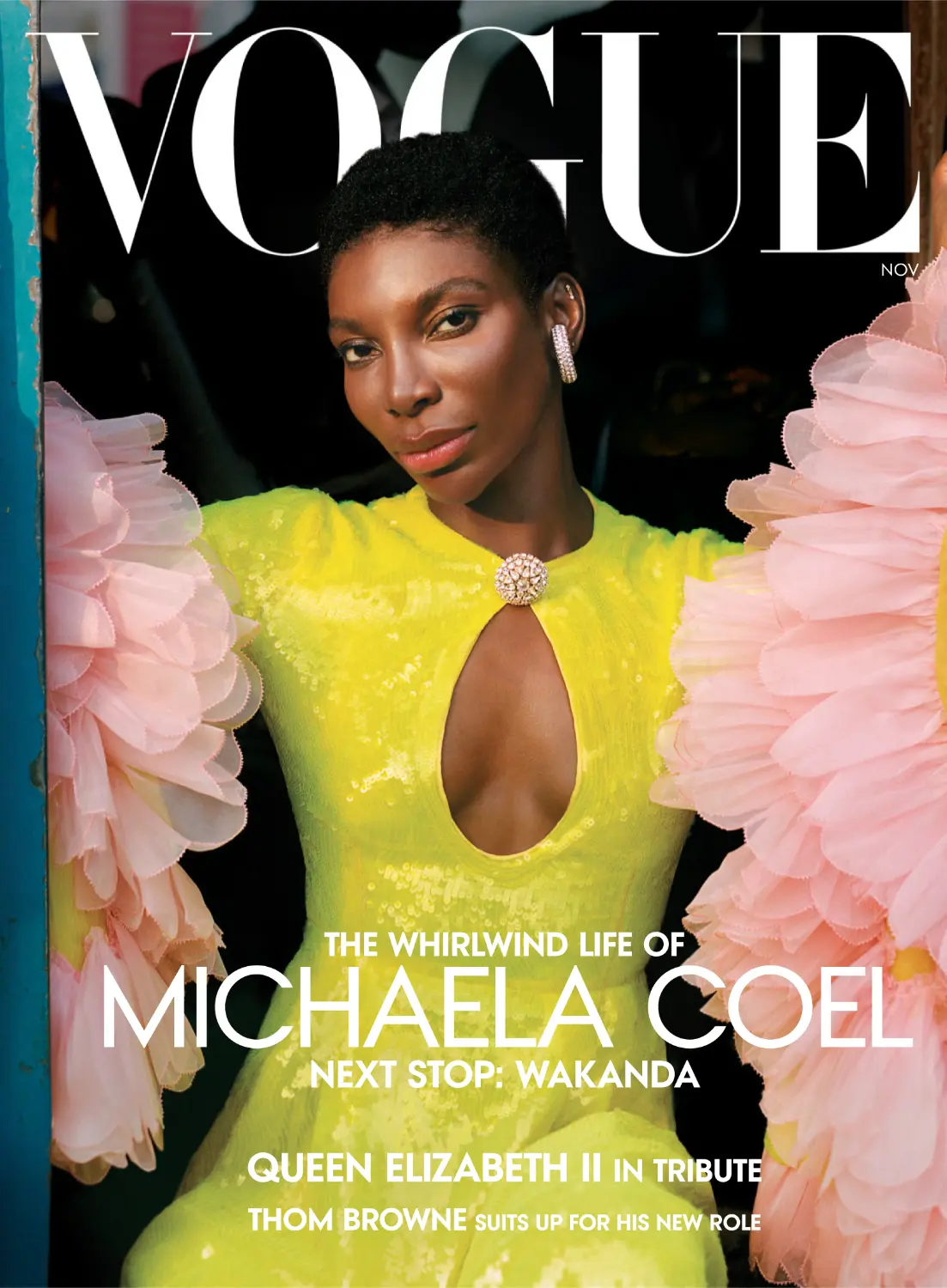
THE WHIRLWIND LIFE OF

MICHAELA COEL
NEXT STOP: WAKANDA

QUEEN ELIZABETH II IN TRIBUTE
THOM BROWNE SUITS UP FOR HIS NEW ROLE

D I O R B O U T I Q U E S 8 0 0 .9 2 9. D I O R ( 3 4 67 ) D I O R . C O M

FENDI BOUTIQUES 646 520 2830 FEN D I .CO M

© 2022 Estée Lauder Inc.

Repair is change.
FOR ALL AGES, ALL SKINTONES, ALL SKINTYPES.
PATENTED UNTIL 2033.

esteelauder.com

AMANDA GORMAN
Estée Lauder Global Changemaker

Discover the One, the Only.

NEW

LE 8 HYPNÔSE
SERUM-INFUSED
VOLUMIZING MASCARA

BUILDABLE VOLUME &
REVITALIZED LASHES OVER TIME

8 OUT OF 10 WOMEN FELT STRONGER,
HEALTHIER-LOOKING LASHES IN 4 WEEKS*

*In a consumer test
Lashes enhanced with lash inserts

scan now to try on
& learn more

November 2022

64
Passion Projects

40
Contributors

The best new
books explore
obsessions

42
Remembrance

66
Idyll Time

Annie Leibovitz
and Hamish
Bowles on Queen
Elizabeth II

48
Nostalgia

In 1971, Mary
Gordon found
herself among
women brave
enough to tell
their abortion
stories. Then
she found the
courage to
share her own

56
View From
the Top

After years of
highs on the
slopes and the
streets, Moncler
is launching a
customizing
program. Emma
Elwick-Bates
tries it
on for size

60
Unlaced

The corset,
long a symbol of
constraint, is
reinvented as an
emblem of body
empowerment—
for any gender.
By Liana
Satenstein

62
Strong
Weather

Three fall films
pack a punch

Monteverdi opens
a new wellness
center in Tuscany

66
Scene Stealers

Renée Fleming,
Kelli O’Hara, and
Joyce DiDonato
bring The Hours to
the Met

68
Skin Deep

Jared Leto’s
desert-inspired
beauty debut is
more than a mirage

70
Here Comes
Trouble

Three new
streaming series
cover dangerous
territory

70
Legion of
Meret

A sprawling
Meret Oppenheim
survey opens
at the Museum
of Modern Art

76
Gains and
Losses

Does a
groundbreaking
new study change
what we thought
we knew about
metabolism and
aging? asks
Amy Synnott
C O N T I N U E D >2 6

THE SWING OF THINGS
MODEL ABBY CHAMPION WEARS A MAX MARA
TEDDY COAT. LAFAYETTE 148 SHOES
AND SOCKS. THE ROW BAG. PHOTOGRAPHED
BY SEAN THOMAS.

20

NOVEMBER 2022

VOGUE.COM

FAS HIO N E DITOR: J ORDE N BIC KHAM. HAIR, MUSTAFA YANA Z; MAK EUP, ROMY SO LEIMAN I. P RO DUC E D BY AN N A PAN OVA FO R DI RTY P RET TY PRO DUCTI O N S.
E XECUTIV E PRO DUC ER: MATE EN MORTAZ AV I. LO CATIO N: RIV ERTOWN LO DGE , H UDSO N , N Y. DETAILS, S EE IN T HIS ISSUE .

32
Editor’s Letter

ROMA

FENDI BOUTIQUES 646 520 2830 FEN D I .CO M

November 2022

80
On a Roll

Michaela Coel
has always set
the terms of her
career. What’s
next? Playing a
Black Panther
super warrior. On
a visit to Ghana,
Coel’s ancestral
home, Chioma
Nnadi tries to
keep up

94
Strong Suit

Thom Browne
ushered in a
radical revision of
what tailoring
could be, changing
it forever. Now,
he tells Nathan
Heller, he’s trying
something else
on for size as
the new chairman
of the CFDA

100
Meet the Press

Reporters Jodi
Kantor and Megan
Twohey open up
about their

Harvey Weinstein
investigation
for The New York
Times, and how
art imitates life in
a stirring new film

104
The Odd Couple
The Collaboration
is putting Andy
Warhol and
Jean-Michel
Basquiat on
Broadway. Costars
Paul Bettany and
Jeremy Pope
paint us a picture.
By Marley Marius

108
Just One Thing

A coat can truly
go the distance,
as model Abby
Champion and her
piece from Max
Mara prove

114
Play On!

The sporting life
gets glamorous
as key pieces from
the court to the
track are sharply
reinterpreted
for daytime

128
The Get

Outfit your
weekend jaunt
with neat knits
and adventureready accessories

136
Last Look

Cover Look Full Flight
Michaela Coel wears a Gucci Made To Measure
Dress by Alessandro Michele. Gucci earring. To get
this look, try: Teint Idole Ultra Wear Care & Glow
Foundation in Shade 520W, Dual Finish Highlighter
in Radiant Rose Gold, Hypnôse 5-Color Eyeshadow
Palette in Bronze Absolu, Le Crayon Khôl in Black
Ebony, Le 8 Hypnôse Mascara, Sourcils Styler
in Brun, and Juicy Tubes in Framboise Pop.
All by Lancôme. Hair, Virginie Moreira; makeup,
Bernicia Boateng. Details, see In This Issue.
Photographer: Malick Bodian.
Fashion Editor: Ib Kamara.

26

NOVEMBER 2022

VOGUE.COM

FAS HIO N E DITOR: MAX O RT EGA. HAIR, C HARLIE LE MIN DU; G ROOMI NG FO R PO PE , JAI WI LLIAMS; G ROOMIN G FOR BE TTANY, AMY KOMO ROWS KI.
S PECIAL E FF ECTS MAKEU P, E LIZABE TH YOO N. PRODUCE D BY ARTPRODUCTIO N. S ET DES IGN : MILA TAY LO R-YOU NG. DE TAILS, SE E IN T HIS ISSU E .

OPPOSITES
ATTRACT
JEREMY POPE (FAR
LEFT) AND PAUL
BETTANY STAR ON
BROADWAY IN THE
COLLABORATION.
PHOTOGRAPHED
BY TESS AYANO.

Letter From the Editor

Role Models

32

NOVEMBER 2022

VOGUE.COM

HIGH LIGHTS
ABOVE: QUEEN ELIZABETH II AT
RICHARD QUINN’S RUNWAY SHOW IN
2018. LEFT: ROGER FEDERER AND
HIS WIFE, MIRKA, PHOTOGRAPHED BY
PATRICK DEMARCHELIER, VOGUE,
2004. BELOW: MIRKA AND ROGER AT
THE MET GALA IN 2017.

So raise a racket
with me to Roger as he
embarks on the next
phase of an extraordinary
adventure. It’s not a
question of who will be
the next Roger Federer: There is, and there will always
ever be, just one.
It is fitting to consider both of these heroic figures in an
issue with such strong currents of personal confidence.
Certainly the American designer Thom Browne knows
exactly who he is. Nathan Heller’s perceptive profile of
him (see “Strong Suit,” page 94), accompanied by images
from Annie Leibovitz, coincides with Thom taking over
leadership of the CFDA. I can’t imagine a better mentor
for young American designers, nor a better advocate for
our industry. And our cover star, Michaela Coel, has made
a reputation of working only on her own terms. Vogue’s
Chioma Nnadi spent time with her in Ghana (see “On
a Roll,” page 80), and Malick Bodian’s images capture
her in the busy streets of Accra. We’re all excited to see
Coel in the next Black Panther movie. She plays Aneka,
a fearsome combat instructor who is brimming, naturally
enough, with self-confidence.

TOP: YUI MO K-POO L/G E TTY IMAGES. BOT TO M: TAYLOR JEW E LL , THEO WE N NE R .

AS THIS ISSUE WENT TO press, Her Majesty Queen
Elizabeth II died at Balmoral Castle in Scotland. It felt,
as so many have said, like the end of an era. Her reign
reaches back as long as I have memories—but a recent one
stands out. I remember sitting with her at designer
Richard Quinn’s show in 2018.
She told me she was delighted
to be there, remembering
how she herself had appeared
in a fashion show before she
became queen. She spoke with
a joyousness and a humor that
bounded around the room.
Unforgettable for all of us there.
And there was another loss in
September—less monumental,
of course, more personal
and bittersweet. My friend and
hero Roger Federer announced
that he is retiring from
professional tennis. This
news—following so soon after Serena Williams’s
farewell—was an added heartbreak, but also cause for
gratitude and a celebration. For no player deserves
retirement more.
I remember first watching Roger play when he was a
longhaired youth at the 2003 Tennis Masters Cup in
Houston. There was that incredible speed, the unreal work
close to the net. And there was the way he made it all look
devastatingly easy. But there was also, just as important,
a kindness and a grace—one might even say a dignity—in
the way he carried himself on the court and off.
It wasn’t long before I managed to meet Roger. He
was interested in fashion and eager to talk about it. There
was nothing I wanted to talk about less; I wanted to talk
tennis. We never stopped conversing at cross-purposes
this way, him asking me about designers and me brushing
off the questions to ask about what he did on the court.
But at some point we realized that—even if we never did
get the information we wanted—we liked each other
enormously. I helped him with some looks, and he did his
valiant best to help me with my game.
I have come to see how generous he is—to his wife,
Mirka, and his four children above all. They are devoted to
one another, and it’s a delight to see how the many Federers
will often travel together, and seem to sleep all together in
a single hotel room, like a touring circus on a budget. Roger
recently told me that the upside of retirement, for him, was
that it would give his family their turn to shine. He wanted
his children to be able to go to school in one place; he
wanted them to be free to grow and define their own lives.

CHANEL .COM

MACY’S

THE

WITH

HOSTED BY CHIOMA NNADI AND CHLOE MALLE

LISTEN AND SUBSCRIBE TO
THE RUN-THROUGH WHEREVER
YOU GET YOUR PODCASTS.

The most riveting stories in fashion, culture, and politics
from around the globe, with new episodes each week.

ADVERTISEMENT

A Dramatic Bow

Ava DuVernay’s QUEEN SUGAR follows the formidable Bordelon family as they navigate
tragedy, intrigue, and redemption after inheriting an 800-acre Louisiana sugarcane farm.
“To write and produce seven seasons of a modern drama centered on a Black family is a radical
act,” says DuVernay, “and a triumph that has far exceeded every hope I held.”

(pictured from left)

Hollywood Desonier played
by Omar J. Dorsey

Hollywood ‘s optimism lifts the
Bordelons even during the most
challenging situations. Dorsey
has said of his character, “Think
of him as an everyday hero.”

Ralph Angel Bordelon
played by Kofi Siriboe

Ralph Angel’s admirable
commitment to his wife and
son—at all costs—creates a series
of less-than-ideal situations.
A lesser actor might let this arc
border on futile, but Siriboe
conveys the depth of a man
trying fervently to live up to
the dreams of his father.

Micah West played
by Nicholas L. Ashe

Micah is an ambitious
second-year student at HBCU
Xavier University. As he grapples
with his sexuality, it leads the
series to ask, as Ashe puts it,
“How are Black men allowed to
love one another in America?”

ADVERTISEMENT

(pictured from left)

Nova Bordelon played by Rutina Wesley

Nova is a compelling mix of sharp edges
and vulnerability. A journalist and activist,
she doesn’t rest until justice is served.
“I meet a lot of women who just love Nova’s
rawness, and love that nothing about her
is sugarcoated,” Wesley has said.

Darla Sutton played by Bianca Lawson

In a show full of complex women, Darla’s
journey is poignant. She’s a recovering
addict against whom the cards seem
stacked, but after a beautiful backyard
wedding during the pandemic, and the
joyful news of a new baby on the way, it’s
impossible not to root for a happy ending.

Violet Bordelon played by Tina Lifford

When asked about Aunt Violet,
Lifford—the veteran actress who has
portrayed the matriarch since the series’
debut in 2016—has said, “She leads with
love, and yes, she has opinions, and yes,
she can dig her heels in, and yes, she
can sometimes overstep—but the
bottom line is she is leading with love.”

DON’T MISS QUEEN SUGAR’S
SEVENTH AND FINAL SEASON,
TUESDAYS 8/7C, ONLY ON OWN

Game Time
“If ever there were a time to shoot a Vogue
story, it would be during a heat wave,”
jokes photographer Campbell Addy. This
summer, he, contributing fashion editor
Gabriella Karefa-Johnson, and models
Achenrin Madit, Akon Changkou, Maty
Fall, and Nyagua Ruea decamped to a
field in boiling North London to set fall’s
sportiest separates into motion (“Play On!”
page 114). Suffice to say that they and
choreographer Abdourahman Njie, who
masquerades in the story as a local
footballer (that’s him with Madit, wearing
a Ralph Lauren RLX tank and Max Mara
skirt, above), worked up a real sweat—
although it hardly put a damper on the fun.
“What can I say? I feel like this shoot was
meant to be,” Addy goes on. “All of our
energies were bouncing off one another.”

A Moving Scene
For this month’s cover story, centered on Ghanaian British writer-actor
Michaela Coel (“On a Roll,” page 80), photographer Malick Bodian and
stylist Ib Kamara rushed headlong into the hustle and bustle of central
Accra, Ghana, shooting Coel in Makola Market, at the beach, and zooming
down the streets on her Rollerblades. “It was amazing to see an African
woman celebrated in the way I have always believed they should be,” says
Kamara, the Sierra Leone–born, London-based editor in chief of Dazed
magazine. “I hope young Black girls will be able to see themselves in this
light—inspiring and opening doors for more African talent in the future.”

Speak Now
In “Meet the Press” (page 100), New York Times journalists
Megan Twohey and Jodi Kantor—who together
published an investigation into sexual misconduct by
Harvey Weinstein in 2017—discuss how their reporting
and their 2019 book, She Said, became a major new
film starring Carey Mulligan (as Twohey) and Zoe Kazan
(as Kantor). Their landmark story earned them a Pulitzer
Prize and further ignited the #MeToo movement—
but for Twohey and Kantor’s Vogue portrait, proceedings
were happily low-key. “The great surprise was that the
New York Times newsroom, which is usually buzzing with
activity, was nearly empty, as many offices still are in
Manhattan,” says photographer Susan Meiselas. “That
was also lucky in some ways, so we could find a place
to frame Jodi and Megan together without disturbing
anyone”—and, when all was said and done, they could
quickly go back to work.
40

NOVEMBER 2022

VOGUE.COM

MADIT AN D NJ IE: PH OTO GRAPH ED BY CAMPBE LL ADDY. FAS HION E DITOR: GAB RIE LLA KAR EFA-JO HN SO N . HAIR, ISSAC PO LEO N; MAK EU P, CH IAO- LI H SU. PRO DUC ED BY JA N UA RY P RODUCT I O N S. S ET D ES IG N: I BBY NJ OYA .
MOVE ME NT: YAGAMOTO. COE L: PH OTOG RAPHE D BY JUAN COSTA PAZ. FAS HIO N E DITO R: IB KA MARA. HAIR , VI RGINI E MO REI RA; MAKEUP, BER NI C I A BOATE N G. P RO DUC E D BY D E BONA I R A FRI K STU D IOS.
KAN TO R AND TWO HEY: PH OTO G RAPH E D BY SUSAN MEI SE LAS OF MAGN UM PH OTOS. SITTIN G S E DITOR: WI LLOW LIN DLEY. HAI R, KIYO NO RI SU DO; MA KEU P, KA RA N FRANJ OLA . D ETA ILS, SE E IN T HI S I SSUE .

Contributors

Annie Leibovitz was invited to
photograph Queen Elizabeth II at
Buckingham Palace in 2007. She took
four portraits that day—and would
photograph the queen a second time,
at Windsor Castle in 2016. Here are her
memories of her first, historic sitting.

I

wanted a straightforward,
intelligent portrait. I thought
that this would be my only
chance to photograph the
queen, and I was allotted less than
half an hour. They showed me
catalogs of her clothes and jewelry
and asked me to pick what she
would wear. I picked a long gold dress
as a base. The rest—the dark cloak
that Cecil Beaton photographed
her in, and the Order of the Garter
robe, and a fur coat—would be
layered on top of it and removed for
the different pictures.
The queen arrived late, not in a
terribly good mood, and was wearing
a tiara, which wasn’t in my plan
(the tiara was supposed to come later
in the shoot). I asked if she could
remove it so that the image would be
simpler. “Less dressy” was how I put
it. “Less dressy!” the queen replied.
“What do you think this is?”
She was probably the most
photographed person in the world
and we talked about photography.
I brought up Dorothy Wilding and
she said Wilding didn’t even come to
the famous shoot in 1952. Wilding
had her assistant take the photograph
of her. We also talked about Jane
Bown, who was about the queen’s age
and took her 80th birthday portrait.
Bown came to the palace alone,
carrying two bags full of equipment.
“Yes, she came all the way by herself!”
the queen said. “I helped her move
the furniture.” She remembered all
these things. I told her I was using
Beaton as a reference for working at
Buckingham Palace, and she said,
“You have to find your own way.”
In this image she is seated in the
White Drawing Room, by the
window. She was someone who gave
herself over to the creative process,
to the photographer, or the artist or
the painter, to use their imagination.
—annie leibovitz

42

NOVEMBER 2022

VOGUE.COM

Queen
Elizabeth II,
1926–2022

In honor of Britain’s longestreigning monarch, Annie Leibovitz
and Hamish Bowles pay tribute
to a life of resilience and service.

AMAZING GRACE
The queen in the White
Drawing Room at
Buckingham Palace in
2007. Photographed
by Annie Leibovitz.

Remembrance

In an appreciation, Hamish Bowles
recalls the late monarch’s twisting
path to the throne, her legacy of staunch
leadership, and her unfailingly good
style, as chronicled in the pages of this
magazine over many decades.

I

n September, Her Majesty
Queen Elizabeth II, Britain’s
longest reigning monarch, died
at Balmoral Castle in Scotland,
age 96 and surrounded by her
children, including King Charles III.
Through the 70 years of her reign—
years of steadfast service to her
country and the Commonwealth—
the queen was globally revered
and widely beloved as she
weathered a roiling century
(and some personal storms)
with enduring equanimity and
grace. She witnessed history
being made and was a part of
it. Her knowledge of world
events, politics, and power
structures was nonpareil.
Known to us all as a symbol
of stability, she was at once
perceived as an extended
member of her subjects’ families
and a fierce guard of her own
inner world, remaining in many
ways inscrutable to the end.
Princess Elizabeth Alexandra
Mary (carefully named for one
distinguished British monarch,
her great-grandmother Queen
Alexandra, and her devoted
grandmother) made her formal
debut in Vogue in the issue
published August 15, 1927, flashing
a beaming smile for the society
photographer Marcus Adams
and even coaxing one from her
grandmother Queen Mary.
The young princess had been born
to a famously happy home. Her
father, Prince Albert, was the
excruciatingly shy, stuttering second
son of the martinet King George V
and the frigidly correct Queen Mary.
His glamorous older brother, Prince
Edward—known to friends and
family as David—was destined to be
king, and so not too many eyebrows
were raised when Albert fell madly
in love with a woman who would
become, as Vogue put it, “our first

44

NOVEMBER 2022

VOGUE.COM

consort in centuries not a royalty
born.” Lady Elizabeth Bowes-Lyon,
daughter of the Earl of Strathmore
and Kinghorne, was raised at
Scotland’s storied Glamis Castle, a
place of doughty stone walls and
spiky gray turrets built at the turn of
the 15th century. She and Albert were
married in April 1923 at Westminster
Abbey, and their eldest daughter
was born three years later. Princess
Elizabeth’s sister, Princess Margaret,
was born at Glamis Castle in 1930.
Marcus Adams also photographed
the solo portrait published in the
May 1, 1928, issue of Vogue, in which

FIRST BLUSH
A young Princess Elizabeth cuddles a
corgi at home in London in 1936.
opposite: Photographed by Cecil Beaton
for the March 1, 1946, issue of Vogue.

the infant princess—dressed in a coral
necklace, holding a silver rattle, and
backlit to accent her aureole of pale
curls—was included in a portfolio of
“Young Persons of Importance.”
In 1937, the year that Princess
Elizabeth’s uncle David was due
to be anointed King Edward VIII,
he succumbed to the jet-set charms
of American divorcée Wallis
Simpson, whom he had met in 1930,
renouncing his throne in order to
be with “the woman I love.” And so

David’s stammering younger brother
Bertie suddenly found himself
king, crowned as George VI, and
David was created the Duke of
Windsor. The queen’s parents may
not have possessed the shiny,
hollow glamour of the Windsors, but
these were not qualities that had
distinguished King George V and
Queen Mary either. Instead, the new
royal family made a virtue of their
ordinariness, presenting themselves
as a close-knit nuclear family leading
lives of cozy domesticity that many
middle-class Britons could identify
with. When the nation wanted
Cinderella romance, pomp,
and ceremony, however,
they could provide that too.
In 1939, when she was 13,
Vogue deemed Princess
Elizabeth “very self-possessed.”
She had now graduated from
coral beads to a diamond
bracelet that her father had
gifted her for this significant
birthday; her mother gave her
her first long silk stockings.
“She has her own sitting room
at Buckingham Palace,” Vogue
noted, “orders her own flowers,
arranges menus and issues
invitations for her own parties,
and is patroness of a charity.”
By the time Vogue published
its February 15, 1943, issue,
however, this decorous life was
over: Britain was at war, and
when the 16-year-old Elizabeth
appeared in the magazine,
posing for Cecil Beaton, she now
wore a martial hat and the diamondset badge of the Grenadier Guards,
of which she was the honorary
colonel (“the first woman in English
history to command a senior
regiment of foot guards”), pinned
to the lapel of her tweed jacket.
Happily, Cecil Beaton was back for
a photographic portrait published
after the war on March 1, 1946. This
time, “the Heiress Presumptive to
Britain’s throne and the handsome
symbol of Britain’s continuity”—now
19—was pictured against one of
Beaton’s famous backdrops (blown
up from the detail of a Fragonard
painting), wearing a dress of
>46

LE FT: LISA SH ERIDAN/G E TTY IMAGES. OPP OS ITE : C EC IL B E ATO N, VOGUE, MARCH 1946.

Remembrance

Known to us all as a
symbol of stability, she
was at once perceived as
an extended member of
her subjects’ families
and a fierce guard of her
inner world

tulle fluttering with sequined
butterfly embroidery created by
Norman Hartnell.
In 1938, the dashing, flaxen-haired
Prince Philip of Greece and
Denmark had entered the Britannia
Royal Naval College at Dartmouth,
where he first met the young Princess
Elizabeth, then 13, and her sister
when they came to visit. The former
was struck by the young man
whom Vogue’s writer Ray Livingston
Murphy (a biographer of Lord
46

NOVEMBER 2022

VOGUE.COM

Mountbatten) considered “tall,
blonde, with the shoulders of an
athlete, a firm chin, and frank eyes.”
The young princess and lieutenant
began to correspond, she kept
his photograph on her desk, and
romance eventually bloomed.
The couple wed on November 20,
1947. “The Wedding became a
pageant to refresh the inner eye,”
noted Vogue in the January 1948 issue,
“to expand the historical imagination.
At its center were two young people,

surrounded by the full resources of
the church and royal state—gold plate
on the high altar, trumpeters, glass
coaches, tiaras, Household Cavalry,
mediaeval standards.” British Vogue
surrendered its assigned press seat to
the Polish-born expressionist painter
Feliks Topolski, who had lately
distinguished himself as an official
war artist, and American Vogue
shared his wonderfully evocative
lightning sketches of the scene—
capturing, in his impressionistic
brushstrokes, such recognizable
figures as the dowager Queen Mary
in one of her distinctive toque hats.
The princess was dressed by
Hartnell in a gown of British woven
silk satin, inspired, as the designer
noted, by Botticelli’s Primavera and
embroidered with seed pearls in
foliate designs. The bloom-shaped
pieces cut from the dress to form the
design were reembroidered onto
the veil, and the effect was suitably
romantic and theatrical for a nation
starved of glamour through the
make-do-and-mend war years and
the rationing and austerity to

TOP LE FT: CEC IL BE ATO N/CAMERA PRESS/REDUX. TO P RIGH T: C EC IL B EATON , VOGU E, AUGUST 1947.
ILLUSTRATION : CARL OSCAR AUGUST E RIC KSO N, VOGUE , OCTO BE R 1957.
OP POS ITE TO P LEF T: WO RLD HISTO RY ARC HIV E /ALAMY. OPPOS ITE TOP RIG HT: C EN TRAL PR ESS/GE TTY IMAG ES.

A LIFE IN FULL
clockwise from
left: A 1957
illustration by Carl
Erickson; in her
capacity as Colonel
of the Grenadier
Guards in 1942;
photographed by
Cecil Beaton in
1942; alongside
her husband,
Prince Philip, in
1953; at Balmoral
Castle in 1967.

Remembrance

“She holds the affection and
admiration of a world
which watched her grow up,” wrote
Vogue of the queen in 1953
follow. (Although fashion-forward
Princess Margaret had already
embraced the soft-shoulder romance
of Christian Dior’s New Look,
her elder sister still followed the
hard-shoulder wartime line.)
Prince Philip’s role was clear: to
support his wife and stabilize the
crown. “He told me the first day he
offered me my job,” Michael Parker,
the prince’s first private secretary,
related to his feisty biographer
Fiammetta Rocco, “that his job—first,
second, and last—was never to let her
down.” Six years after their
wedding—in the middle of a royal
tour of Africa, India, and Australia—
this role became preeminent when
the self-effacing King George VI
died of coronary thrombosis at the
age of 56 and his eldest daughter
ascended to the throne. Forced to
give up his naval career, Prince Philip
instead devoted himself to public
service: Over the ensuing decades
he became the diligent patron,
president, or member of more than
780 organizations, and by the time
he retired from official duties in

2017, at the age of 96, he had
completed a giddying 22,219 solo
engagements—and, of course, many
more with his wife.
“The catching excitement in this
Coronation of a young Queen,”
wrote Vogue in 1953, “goes far beyond
the people of her own Dominions,
for she holds the affection and
admiration of a world which watched
her grow up.” Hartnell again rose to
the occasion with a magnificent
coronation robe of stiff white satin
embroidered in silken thread and
spangles with the symbols of the four
countries that compose the United
Kingdom—the rose of England,
the thistle of Scotland, the shamrock
of Northern Ireland, the leek of
Wales—and the flower symbols
of the Commonwealth nations.
The dress represented the spirit of
monarchy translated into cloth.
Over the decades, Hartnell, Sir
Hardy Amies, Sir Ian Thomas,
Stewart Parvin, and latterly Angela
Kelly dressed the queen in daytime
ensembles of striking and uniform
color, hat to garment, so that she

would stand out in a crowd and in
evening dresses designed to set
off royal orders and jewels—and in
many instances pay subtle homage
to host nations (wattle-flower
embroideries for Australia, maple
leaves for Canada, green and white
in Pakistan like the colors of that
country’s flag, California poppies for
a visit to the Reagans).
In 1957, Vogue thrilled to news
of a visit by Queen Elizabeth II
and Prince Philip to America that
October. “There is more to this
welcoming wave of excitement than
pure romanticism: much more
than pure curiosity,” its story read.
“There is also the solid, ungrudging
respect that most of us feel for
a young woman, barely out of her
twenties, who performs an
enormously complicated and taxing
job with courage and sensitivity,
industry and intelligence.”
Vogue later celebrated the
engagement of the couple’s daughter,
HRH Princess Anne, to Captain
Mark Phillips in 1973, and
subsequently C O N T I N U E D O N PA G E 1 3 2
47

Nostalgia

Out of the Dark

t is the fall of 1971. I have just walked into a
room in a church basement, where there is
a meeting of NARAL, the National Association
for the Repeal of Abortion Laws, the organization
created two years earlier by Betty Friedan.
Although abortion had been legal in New York
since 1970, it was still illegal in most states.
I’ve moved to Syracuse—the first time I have lived
outside the New York metropolitan area. I’m feeling a
bit unmoored, not yet at home in my MFA program, and
missing the political engagement I had experienced as a
college student at Barnard and Columbia.
When I see my fellow attendees, I know, as Dorothy
knew that she was not in Kansas, that I’m not in New York
City anymore. Only two of the women look like anyone
I would have ever had practice speaking to. One must be,
like me, a student: She’s wearing jeans and a peasant
blouse. The other is a Black woman with a luxuriant Afro,
a jade green turtle necklace, a black skirt, and boots. The
others seem like strangers. I had not believed that I would
ever be in a room with anyone who wore flesh-colored
pantyhose, or who wore her hair in what was called a pixie
cut, but here I am. Here we all are.
48

NOVEMBER 2022

VOGUE.COM

The meeting is called to order by a short, dark, wiry,
fast-talking woman. Quickly, we get down to tactics, which
involve organizing travel to Albany and to Washington.
Despite the legalization of abortion in New York,
antiabortionists are tirelessly picketing the state legislature
with gruesome pictures of mangled fetuses. We sign up
both for counter-protests and to speak to our local
legislators in person. Pennsylvania, a close neighbor state,
will be another target of our lobbying. And we will be on
the alert for actions in DC, targeting the Supreme Court.
So far, so straightforward. But then our leader says,
“What we need is to talk about why we’re all here. The
problem is no one wants to talk about abortion. But
I think it’s important to make things personal.”
She describes growing up in an Italian neighborhood
in Buffalo. “You’d hear it whispered among the women,
‘enceinta, enceinta…’ and not in a happy way. I got
pregnant when I was 16. An older cousin forced himself
on me. He was making more money than anyone in the
family, and was looked up to as a success, and he
>52
WOMEN TALKING
“I THINK IT’S IMPORTANT TO MAKE THINGS PERSONAL,” OUR LEADER
SAYS. CATHERINE REPKO, CONTINUUM, 2022, OIL ON CANVAS.

CONTIN U UM , 2022, O IL ON CAN VAS, 55 X 45 C M; PAINTE RS PAIN TING PAIN TING S, H ERTFO RDS H IRE .

In 1971, Mary Gordon found herself among women brave enough to tell their
abortion stories. Then she found the courage to share her own.

Nostalgia

Truth Telling

woman doctor, very distinguished, and it was known that
said no one would believe me if I said anything about
she would perform abortions. I volunteered to help her
what was going on. And he said to remember that he was
because in the hospital where I worked so many women
lending my family money so my brother could go to
had experienced botched abortions—the part of the
college. I was terrified, and ashamed, but I told my sister,
hospital where they were sent was known as ‘the septic
who was older, married, with children. She said everyone
tank.’ The doctor I volunteered for was discovered and
in the neighborhood knew about a woman who took care
jailed for a year. She lost her license to practice medicine.
of things. She came with me to this woman’s apartment.
She died a year later, shunned by the community, and
We didn’t talk. The woman covered her kitchen table with
deprived of her work.”
a white sheet, took some kind of medical instrument
The one Black woman in the room speaks next. “It was
out of a pot of boiling water and after an excruciatingly
my sister. One night she came home and passed out the
painful time, she showed me into her bedroom, where
minute she walked in the door. She had aborted herself
I rested. My sister handed her money, and we left.”
The next woman to speak is older and the most elegant using a knitting needle. We called an ambulance, but
ambulances took their time coming to our neighborhood.
in the room. She wears a tweed suit; her silver hair is in a
She bled to death on the bathroom floor.”
French twist, her accent refined, although not off-putting.
“I have two kids,” she continues, “a good husband, but I
It reminds me of someone, and then I realize who: Julia
had a miscarriage between my kids, it was only 10 weeks.
Child. “It was 1937. I was 21 and working on a newspaper
I was lying in bed, and I passed something that I thought
in Washington. I was having a relationship with a
maybe was a heavy period. I collected what I had passed
rather aristocratic Englishman, separated from his family
and took it to the doctor. He said that I had miscarried.
overseas. It was a pleasant relationship, but nothing
serious. I became pregnant, or ‘fell pregnant,’ in his words. And I thought of my sister, and that people were saying
that people like her had committed murder, and I knew
There was no way we were going to marry. He told me
that whatever it was that had come
not to worry: It had happened to many
out of my body was not a child, not
of his friends in London and there
We
were
given
a person, and since then I’ve been so
was an easy way of dealing with it.
A well-known Harley Street doctor
strength, knowing that furious, I just have to do something.”
Then it is my turn. I have never
had a nursing home in the country
what
had
happened
spoken publicly about my abortion,
where posh girls who needed abortions
could go. It was safe, and not, he assured
to us had happened to but I am full of admiration at
the dignity of the women who have
me, harrowing. We flew to London.
many,
many
women
expressed themselves.
It was exactly as he said: clean, pleasant,
“It was the day after Thanksgiving,”
even a bit bucolic. It would never have
I say, “and I had a date with a friend of a friend to see the
happened here, and it would never have happened if he
movie Camelot. I wept uncontrollably leaving the theater.
weren’t wealthy and connected.”
My date, feeling the need to comfort me, invited me to his
The young woman who I assumed was a student speaks
apartment. Comfort led to what was then known as heavy
next. “I got pregnant and told my best friend. She said
petting. We did not have intercourse, and I didn’t know
she would talk to her father, who was an obstetrician. He
then that intercourse was not, in some rare cases, required
was very kind, and said he would help me but we would
for impregnation. I missed my period, but I couldn’t
have to say that I was threatening suicide. I was ashamed,
imagine that I was pregnant. I consulted a gynecologist.
but I knew I was safe.”
He told me that in fact I was 10 weeks pregnant. If I could
“I’m from California,” says a woman who seems to be
come up with $2,000, he could arrange for a psychiatrist
somewhere in her 30s. She is wearing what I think might
to write a letter asserting that I was mentally unstable and
be a Laura Ashley dress: small pastel flowers on a pink
therefore an abortion was required. There was no way
background. “I married young. My husband was a high
I could come up with $2,000. I would literally rather have
school teacher, money was tight, and we had three kids.
died at the hands of an illegal abortionist than tell my
I was only 30, and we’d agreed that when the youngest
mother. She was a hyper-devout Catholic, a widow, and
went to school, I could go back to college. Then I got
I was her only child. The shame that would have fallen on
pregnant. It wasn’t an easy decision, but we both knew
me and my mother was unbearable even to contemplate.
that another child would put horrible burdens on
Panicked, I asked everyone I knew where I could get an
the family…and would be the end of my chances for an
abortion. I got a number from one of my classmates.
education and my dream of work. There was a group in
“I was told to come alone and stand in front of a movie
California that connected women with doctors in Mexico
theater in the Bronx and bring $300 in cash. A car pulled
who would perform abortions safely. One of the women
up and the driver told me to sit in the back. He put a
in the group accompanied you to make sure everything
was in order. We used all our savings to make it happen… blindfold around my eyes and drove in what seemed like
circles and then stopped. I was terrified; I felt like the girl
and of course I was sad, but I’ve never regretted it.”
A very pale woman with a pageboy and bangs says, “I’m who gets kidnapped in a gangster movie. Still blindfolded,
I was led by him to the basement C O N T I N U E D O N PA G E 1 3 2
from Gary, Indiana. I’m a nurse. There was a wonderful
52

NOVEMBER 2022

VOGUE.COM

THE ICONIC EAU DE PARFUM,
NOW REFILLABLE

DISCOVER
LA VIE EST BELLE
AT LANCOME.COM

SCAN TO BUY

THE ICONIC EAU DE PARFUM,
NOW REFILLABLE

PLUS, SIGN UP FOR THE GET AND RECEIVE OUR TOP SHOPPING PICKS
DELIVERED TO YOUR INBOX EVERY WEEK.

SLEEK PEAK
Jacket by Moncler By Me.
8 Moncler Palm Angels
pants. Details, see In This
Issue. Photographed
by Campbell Addy.
Fashion Editor: Gabriella
Karefa-Johnson.

After years of highs on the slopes and the streets, Moncler is launching
a customizing program. Emma Elwick-Bates tries it on for size.

T

he gleaming slopes are perfectly poised for self-expression,
a blank canvas for showoff f reestylers, schussing
snowboarders—and, of course, a great
showcase for medal-worthy style
feats. My early attempts at ski style
were formulated on trips to Sweden
on school breaks when my sisters and
I lavished zinc oxide rainbows over
our faces (the deft “color play” of Pat
McGrath it was not).
But the ultimate ski staple—a
trusty down jacket—has, along the
way, become a mainstay of the workaday winter, and so much more: As
temperatures drop, I wear mine bundled with knits and track pants on

56

NOVEMBER 2022

VOGUE.COM

the whippet walk, or thrown over
Saint Laurent cocktail minis and
barely-there blouses for evening. And
while we may have loathed athleisure
as a fashion hype word, it did give us
all license to throw a jaunty sleeping
bag over anything and get away with
it—for a while. (While down jackets
are cozy on the inside, they can come
off as a little dire from the outside.)
But with a ski trip planned for
early 2023—to regain my alpine confidence after a long hiatus—I’ve been
thinking: What to wear now? Something individual, yes, away from the
identikit-Instagram crew—but since
I’m not in the practice of relegating
my skiwear merely to annual trips, I

want something that plays well on
the off-piste of home soil, too. Enter
Moncler, the luxury outerwear label
with its roots in the mountain village
of Monestier-de-Clermont, after
which it is named, but equally at home
in music videos and the metropolis; its
new bespoke personalization service,
Moncler By Me, launches online and
at Moncler stores this month in Manhattan, Paris, Milan, and Tokyo.
There are two quilted jacket designs
ready to personalize, both of them
inspired by the iconic glossy and puffy
Maya. “It’s the original Moncler—the
first jacket we made, in 1952,” says
chairman and CEO Remo Ruffini
from his office in Milan. “Of > 5 8

HAIR, ISSAC PO LEON ; MAKEUP, CH IAO -LI HSU. PRODUC ED BY JAN UARY PRO DUCTIONS.
S ET DES IG N: IBBY N JOYA; MOVE ME NT, YAGAMOTO. DE TAILS, S EE IN THIS I SSU E .

View From the Top

course, it’s not exactly the same—we
have improved a lot in terms of technology, weight, and quality.” This year’s
model has a leaner silhouette thanks to
the distinctive boudin construction—
horizontally stitched quilting with
each square centimeter filled with a
precise ratio of down, ensuring both
greater warmth and a lighter weight.
The Mir is the women’s cut and the
Vion the men’s, but this is far from
prescriptive—there’s an intentional
fluidity to the project that feels modern and in keeping with the diverse
aesthetic Ruffini has brought to the
label. Four years ago, he pioneered
Moncler Genius, a rotating roster of
designers that radicalized the Moncler
offering and that has featured, among
others, Pierpaolo Piccioli of Valentino,
Craig Green, Jonathan Anderson, and
Simone Rocha. “It was a way to talk
with a different crowd, different communities,” Ruffini says. By not relying
on a single vision, Genius allowed the
brand to speak to a wider demographic
as each designer challenged what fashionable activewear could be. Perhaps
most radically, a pre-Genius collaboration with Junya Watanabe “helped
us to develop new technology, new
ways to work,” Ruffini says. (When
he saw the early designs, the notion of
actually producing them seemed, let’s
say, daunting. “I said, ‘No—there is no
chance,’ ” Ruffini says.)
Ruffini, a consummate sportsman
himself—he skis everywhere from
Courchevel and St. Moritz to Jackson Hole and Aspen—doesn’t see this
new service as about fashion per se
but about “freedom—it’s what I want
to give our customers.” Over the summer, friends of the house, including
Sarah Andelman, Fabien Baron, and
Karl Templer (the brand’s campaign
stylist), have given the service a sort
of trial run. “Sarah did a great job,”
Ruffini says of the legendary Colette
founder and creative consultant. She
customized her jacket while “thinking
of the snow, love, and happiness!” as
Andelman puts it. Cue an all-white
base—decorated with several green
clovers—and a big red heart. She also
shares my on-piste/off-piste notion of
the new service: “Moncler By Me—
to me—means the mountains and the
city, the softness and the protection.”
Inspired, I try the online configuration process—oddly, in the midst of
58

NOVEMBER 2022

VOGUE.COM

London’s historic 100-plus-degreesFahrenheit heat wave. First, I immediately size up by one, wanting to take
on my sports with heat-tech layers
underneath—but also venture into
the less glamorous environs of citypark life with my jacket atop a hooded
sweatshirt or Aran knit. Next up, I
choose from the four Moncler-themed
colorways laid out onscreen like Pantone charts. There’s Iconic (the classic
tricolor you probably associate with
Moncler branding), Mountaineering
(tougher shades—emerald, white,
olive), Paninaro (a mix of nostalgic
’80s and ’90s notice-me-now sportswear hues—a cool vintage orange, a
bright peacock blue), and Special 70°
(lilac and turquoise, in honor of the
brand’s 70th anniversary).
I’m sold on the Paninaro, named
after a stylish ’80s youth subculture
in Milan—think early hypebeasts

I start with the
hood and immediately
go for leopard—it’s
detachable, so goes my
reasoning, so any Dame
Joan Collins drama
could be played at will
in a preppy mix of colorful, graffitied Moncler and mopeds—which
inspired Ruffini’s first Moncler purchase at age 15 in nearby Como.
“My mom said, ‘If you want to go to
school on the back of a motorcycle,
you need a big jacket—it’s freezing,’ ”
Ruffini tells me. (So it was practical
as well as fashionable.) It also brings
me back to those early ski trips of
mine, all mirrored shades, snoods, and
the lurid color flashes of an era when
brighter was always better. (Discreet
black jacket—begone!) I pick the
vivid “azzuro” blue, and “leopy” animal print, arranging them over the six
customizable jacket sections.
Onscreen 3D jacket visualization
simulates shadow and light and offers
360-degree views, and my jacket is
starting to remind me of two of my
favorite (if disparate) sportif style references: the dashing Formula 1 driver
Ayrton Senna, and Princess Diana,

whose daring ski mix of Head and
Bogner elegantly stood out in Lech
and Klosters. Distributing the colors,
I start with the hood and immediately go for leopard—it’s detachable,
so goes my reasoning, so any Dame
Joan Collins drama could be played
at will. Keeping the body of the jacket
fresh in minimal white, I add more
leopard to the arms, creating a gilet
effect (which also captures that retro
sports vibe I am feeling).
There’s a felted logo-bearing pocket
on the one sleeve, and that’s status
enough for me, but you can also emblazon a larger logo, text, or a symbol—
snowflake, heart, star, lucky clover, sun,
flame, or cloud—as you wish. (The
price of your jacket—updated in real
time—reflects the level of customization, and can range anywhere from
$1,945 to $2,670.) Experimenting
with my monogram, first modestsized on the chest and then larger on
the back, I settle on a gothic font on
the arm in blue, playing on my aprèsski reveal: an endorphin-popping,
sky blue lining. I am usually nervous
when using the term color blocking—
it brings to mind Lego Duplo color
combinations—but as I click “Design
Complete,” I feel that I have created a
nostalgic ski jacket on my own terms.
(A bit of derring-do in the design, I
secretly hope, may even kick my performance up a notch.)
Three weeks later, my cocoon-like
jacket arrives in a giant Moncler box
(perfect for stashing lesser-used goggles, moon boots, and the like). The
jacket is slick and ultra glossy, and a
well-executed parallel stop before my
full-length mirror appears to provide
the perfect contrast to high-rise black
Khaite jeans and turtlenecks (the
urban Bond-girl default look for now).
A storm on a snowcap this is not:
Ruffini talks of endless possibilities
and the expansion of the service in
terms of both design and delivery.
“This is just a taste,” he says, and then:
“Ciao!” He’s off on his boat, heading
for Capri and then Southern Italy.
His own navy Moncler By Me jacket
awaits him for a cooler adventure
later, in the Altiplano of Argentina.
“It’s not a typical ski,” he told me earlier. Maybe we should all be aiming
for peak individuality—whether on
actual slopes or in Park Slope, facing
the elements never felt so lively. @

THERE’S NO
PLACE LIKE
UNKNOWN

LEXUS.COM/RX

NEVER LOSE YOUR EDGE

THE WIZARD OF OZ and all related characters and elements © & TM Turner Entertainment Co. (s22)
©2022 Lexus, a Division of Toyota Motor Sales, U.S.A., Inc.

Intuitive tech, courageous performance and
heart-pounding design–oh my! Never lose
your edge in the boldest reimagining of a
celebrated classic. Welcome to a new world
of possibilities with the all-new Lexus RX.

The corset, long a
symbol of constraint and
control, is reinvented
as an emblem of

A

and Cali-sober younger
millennials. The looks
were ferocious, with
skin showing all-round,
from itty-bitty skirts to
curve-skimming dresses

CLOSE FIT
clockwise from top
left: Horst P. Horst’s
iconic corset image from
1939; Giorgio Armani
bustier-print T-shirt
the Dior runway in 2022.

60

NOVEMBER 2022

VOGUE.COM

sent, Cohan had her corset, which at this party she
wore with wide-leg cargos.
Years ago, of course, the
corset was something that
constrained not just physically but psychologically. In
the Victorian era, it created
the wasp waist on women,
transforming even an expansive midsection into a
tiny concave triangle. The
effects of long-term wear
were extreme: organs were
shifted; simply breathing could be a challenge.
For these reasons—along
with fashion charting a
course toward the f reedom (and social scandale)
of flappers—the corset has
been, for more than a century, a kind of
sartorial Debbie Downer.
But while yesteryear’s corsets have
long been emblematic of women’s
oppression when hidden underneath
dresses, when worn with confidence
out in the open now, they feel like a
provocative expression of whatever
wave of feminism we’re currently
living through. And while the corset
is, historically, the most feminine of
pieces, made to accentuate and exaggerate a woman’s curves, it has lately
become—at a time when the landscape of gender and sexuality > 6 2

TOP LE FT: PHOTOG RAP HE D BY HO RST P. HO RST, VOGUE , S EPTE MBE R 1 5, 1939. TO P RIG HT: P HOTO G RA PH ED BY DAV ID S IMS/ART PARTN ER. VO GU E , O CTO BE R 20 07.
PALO MA ELS ESSE R: PH OTOG RAPH ED BY ZOE GHE RTN ER /ART PARTN E R. VO GU E, MARC H 202 1. BOTTOM : GO RUN WAY RTW F/W 2 2 D IOR.

Unlaced

and personal freedom is being policed
like never before—the most democratic of garments, donned by any and
all. Dario Princiotta, a corset maker
based in Palermo, Italy, made his
first corset at the age of 11 and often
models his creations on Instagram.
“I love to wear them because of the
way they make me feel—they give
me an attitude, a stronger and more
dramatic appearance.”
Celebs love to be harnessed into
them, too—Dua Lipa will slip into a
strapless one, Bella Hadid a denim
one; Kourtney Kardashian even married Travis Barker (at the third of their
three ceremonies) in a corset minidress.
But no one loves a corset more than
Lizzo, who collects them and steps out
in them and performs in them. At the
2022 Met Gala, she dazzled on the red
carpet in a black Thom Browne corset dress with an exaggerated peplum.
(She also owns a corset with the image
of the Mona Lisa on it—though with
the famous face replaced with Lizzo’s.)
On the fall 2022 runway, Marc
Jacobs showed corsets that whittled
the waist—a standout was a white

iteration so tight it made the hulking
black shirt it was styled over almost
explode. That same season, Versace
showed saucy bone-in silk corsets in
electric blues and baby pinks—and
another in pinstripes—all of which
created a sexy bull’s-eye at the waist.
Fendi, meanwhile, styled theirs over
boyish button-up shirts.
Thom Browne alum Jac kson
Wiederhoeft, who launched his
Wiederhoeft label three years ago,
transformed the old-time pieces
into new-era creations including a
clubby strap dress with a built-in
waist-pinching corset. Wiederhoeft
even created corsets for two grooms
for their wedding ceremony, to “give
that feeling of sculpture,” he says, like
“when you look at a marble statue.”
The corset works its magic not only
by its shape—and its shaping—but by
the process of actually putting it on.
Somewhere out in the ether, there
exists a hilarious video of me helping
Vogue editor Lilah Ramzi get herself
into one for some megawatt gala: My
knee is pushing into her back to create more space, and I’m summoning

Mike Tyson–level strength to lace her
into the piece.
As anyone who’s been in a corset
can attest, the immersive experience
is real. “Obviously a shoe can shape
your foot,” as Wiederhoeft notes, “but
it mostly changes the position of your
foot, whereas a corset can really change
your body—it changes your posture,
how you breathe, how you walk.”
And while that might not be the
most comfortable situation, the frockand-frill messiah Batsheva Hay of
Batsheva, who has been using corsets throughout her racy-Little House
on the Prairie collections, says maybe
a bit of discomfort isn’t such a bad
thing. We’ve been used to it forever
with punishing shoes, so why not with
a corset? Only this time the option is
open to everyone, on our own terms.
“It’s such a gendered move to chisel
the waist, because the waist-hip ratio
is the epitome of classical femininity,”
Hay tells me over drinks in the East
Village, “and a corset creates an artificial femininity—so whoever wants to
feel feminine can just put it on.” And
what’s more liberating than that? @

Strong Weather

T

ragedy shades the domestic family drama The Son,
a movie about a teenage boy’s struggle with depression that becomes—thanks to the force of Hugh
Jackman’s performance as the father—an engrossing tale of helplessness and confusion. This chamber piece,
costarring Laura Dern, Vanessa Kirby, and Zen McGrath
as the titular son, comes from the French filmmaker Florian Zeller, adapting his own stage play. Mental illness is
a whirlpool here, and Jackman, who adores his 17-year-old
but also needs to believe he is okay (even when he is very
much not), finds himself drowning in it. His descent is
gripping to watch and unbearably sad.
Erudite and ferociously powerful, TÁR is a conversation starter of a movie about creative brilliance, obsession,
and sexual manipulation. The performance at its center
is from Cate Blanchett as the conductor Lydia Tár, a formidable public figure who emulates Leonard Bernstein
and is readying a prominent German orchestra to record
Mahler’s Symphony No. 5. She’s convinced of her genius,
as are we—even when the film reveals the cruel manipulations she’s engaged in. Writer-director Todd Field—this
is his third film, his first in 16 years—has meticulously
built a portrait of intelligence and venality that defies our
judgments and confounds our sympathies.

62

NOVEMBER 2022

VOGUE.COM

FAMILY MAN
Hugh Jackman
stars in Florian
Zeller’s The Son,
out this November.

Aftersun also brims with emotional power. Scottish
filmmaker Charlotte Wells’s feature debut is the story
of a young, newly single father taking his 11-year-old
daughter on an inexpensive holiday in Turkey. Paul Mescal does subtle work as the outwardly genial, inwardly
broken Calum, adrift between youth and responsibility,
and newcomer Frankie Corio is his daughter Sophie, a
brave, expressive girl who desperately needs something
from her dad she’ll never get. Vibrant and melancholy, this
is a lovely sunlit heartbreak of a film.—taylor antrim

RE KHA GARTO N © S EE-SAW FILMS LIMITE D/COU RTESY O F SONY P ICTURES CLASS ICS.

Three fall films pack a punch.

©2022 Walmart Apollo, LLC

The season’s best new
books explore obsessions.

S

hirley Hazzard once
said that she thought
literature should be

life,” and in Shirley Hazzard:
A Writing Life (FSG), scholar
the novelist’s eventful biography with the literature it
became. Born into Depressionera Australia, Hazzard moved
Zealand, New York, and
Europe. Olubas’s biography is
more than just a map of the
author’s movements; it’s an
account, as she puts it, of “a writer
in the process of making herself.”
What do Prince and Charles
Dickens have in common? Perhaps
not that much except the admiration of Nick Hornby, a writer
whose enthusiasms have always
fueled the best of his work. The
two men were both staggeringly
prolific, of course, and that’s the
starting point for Dickens and
Prince (Riverhead), an ardent fan
letter that makes you want to reread
Great Expectations while listening
to Sign o’ the Times. This slim, companionable biography champions
the creative impulse to always make
more. A love letter to maximalism.
In Claire Keegan’s Foster (Grove), the Irish writer
Wexford while her parents prepare
for the birth of their next child. What
complex coming-of-age tale, both
intimate and richly expansive, as the
girl’s foster family provides her with
the room and space to blossom. Balancing Keegan’s delicate prose with
heart-wrenching treasure.
the shocking suicide of a beloved bartender turned writer turned culinary-

64

NOVEMBER 2022

VOGUE.COM

Not the Time to
Panic (Ecco), is

cleverly cute without tipping into
saccharine territory, telling the
story of two teenage misfits who
create a poster that
sets an entire community on edge
anonymously
around town. The
n o ve l u n r a ve l s
f riends and neighbors
imbue the poster with their
own—sometimes sinister,
often comic—significance,
and the bond that ensues
between two young adults
secret. Though the book
has an earnest heart, it’s
colored by Wilson’s appealingly offbeat prose.
In How Far the Light

Reaches (Little, Brown),

an engrossing debut essay
collection, the science
considers their family and

FRO MT TOP TO BOTTOM: COU RTESY O F VIK IN G. COURTESY OF RIVE RHE AD BOO KS. COU RTESY O F LITT LE, BROW N AN D COMPANY. COU RTESY OF ECCO. COU RTESY O F FSG. COU RT ESY O F G ROVE ATL A N TI C.

Passion Projects

handlers, and hangers-on.
If it sounds uncomfortably
familiar, that’s because S. E.
Boyd is the nom de plume of
two veteran journalists and
one book editor who know a
thing or two about highbrow
dining and lowbrow media.
Befitting of its title, the caustic
novel is an archly acidic look at
the celebrity-death industrial complex and all those who
seek to seize the narrative—
and the spotlight—in the wake
of a famous person’s death.
Kevin Wilson’s
new book, Now Is

Organic Sleep
from $699
America’s best rated, certified organic mattresses are now affordable for everyone. Our mission is to be the most
respected source for organic mattresses, pillows and bedding — while maintaining environmentally conscious, ethical,
and sustainable business practices — to help safeguard the health of people and the planet. Experience Avocado at your
local experience center or online at AvocadoGreenMattress.com.

CU 861640

CU 861640

Idyll Time
Monteverdi’s new wellness center
reimagines la dolce vita.

T

VILLAGE PEOPLE
The Tuscan retreat marries old-world
details with modern amenities including
full-body diagnostic assessments.

preventative (nutritional testing,
immune-boosting IV therapies), and
programmatic (multiday experiences
that include diagnostic assessments
and holistic treatments), all overseen
by plastic surgeon Maurizio Cavallini. But unlike many other detox
destinations, deprivation is not on the menu. “We want our
guests to revel in something I like to call ‘epicurean wellness,’” says Cioffi, explaining the idea that enjoying a plate
of pici all’aglione and a Bach cello suite along with rejuvenation and relaxation leads to happiness. You can have your
Brunello and your Botox, too.—danielle pergament

Scene Stealers
n 2017, the operatic
soprano Renée Fleming bid adieu to the
traditional canon—

itan Opera. Based on Michael
Cunningham’s 1998 novel and

GETTING THEIR
FLOWERS
The three stars of the Met’s
new production.

66

NOVEMBER 2022

VOGUE.COM

she is wrestling with loss and regret
in a much more subtle way,” Fleming
says of Vaughan, a character previously portrayed by Meryl Streep.
(Kelli O’Hara and Joyce DiDonato
costar as Brown and Woolf, roles
once played by Julianne Moore and
Nicole Kidman, respectively.) “The
film starred arguably the three best
actresses at that time, and we have
arguably the three best singing
actresses of our time,” says Yannick
Nézet-Séguin, the Met’s magnetic
music director, who will conduct. He
hopes the book and film will bring
new visitors to the Met—in addition
to those just keen to see Fleming.
“Renée is a major event,” he adds.
For her to trade Wagner for Woolf
on opera’s biggest stage has stakes
worthy of any bel canto story line.
—christopher barnard

MON TEV E RDI: B ERN ARD TOU ILLO N, BOTH COU RT ESY O F MO NTEVE RDI TUSCAN Y.
BOTTOM IMAG ES : PAO LA KUDAC KI/COU RTESY O F THE MET ROPO LITAN OPE RA. BOTAN ICAL ILLUSTRAT ION S: GE TTY IM AGES.

he beautiful Tuscan hilltop of Castiglioncello del
Trinoro is as layered in its history as its name is hard
to pronounce. There’s the past—Etruscans, Pope
Pius II, the Medicis—and
the present, which largely belongs
to Monteverdi, the lauded hotel and
spa that spans 22 acres. Over the
last 10 years, Michael L. Cioffi, an
American lawyer turned hotelier, has
bought up the town’s ancient stone
structures, refurbishing them building by building—20 guest suites here,
an enoteca there. The result is an Italian idyll: private villas, a slow-food
restaurant, a culinary academy and
garden, and a 14th-century church
that regularly hosts artists in residence, such as the conductor Sir John Eliot Gardiner and violinist Joshua Bell. This
month, Monteverdi will enter the final phase of its reincarnation with a split-level, 1,720-square-foot wellness center
dedicated to four areas of expertise: aesthetic (lasers, fillers,
injections), regenerative (minimally invasive micrografting),

Skin
Deep

Jared Leto
has entered the
beauty game.
But his desertinspired product
debut is more
than a mirage.

68

NOVEMBER 2022

VOGUE.COM

IMMERSION THERAPY
The gender-neutral line of skin care and hair care
essentials features prickly pear, aloe vera, and evening
primrose. Photographed by Julia Noni.

violet-hued glass, aluminum, and post-consumer recycled
plastic bottles nod to its purple skies at twilight. The formulations follow a similar script. “Because of this challenging, unforgiving environment, these ingredients have
to be incredibly resilient to survive,” Leto says, relaying the
restorative benefits of the line’s desert botanicals. (That
aforementioned eye cream is packed with brightening
prickly pear extract as well as retinol and ceramides, and,
to Leto’s credit, it leaves my eye bags looking smooth and
my dark circles minimized.)
Leto’s willingness to learn and his dedication to both
clean formulas and clean living is what persuaded Kate
Forbes to join Twentynine Palms after years of heading
up innovation for Aesop. “If I could adhere to some of
Jared’s strict guidelines, I think I’d be much healthier,”
laughs Forbes, a veteran product developer with a PhD in
chemistry. “He is 100 percent committed to anything that
he decides that he wants to do,” confirms Jimmy Chin, the
codirector of the Oscar-winning rock climbing documentary Free Solo, who met Leto six years ago.
That commitment will soon take Twentynine Palms
beyond beauty, Leto tells me with such enthusiasm he
briefly drops his iPhone. He is planning a partnership with
High Desert Test Sites, the ambitious Coachella Valley–
adjacent artist residency, as well as limited-edition home
and design objects in collaboration with a rotating list of
multidisciplinary creators. Fragrances that build on earthy
aromatics (smoky Japanese vetiver, eucalyptus, myrrh) will
come next. It’s a convincing performance in which Leto
plays the part of wellness apostle; maybe it’s the beard. “It’s
just the beginning,” he suggests.—liam hess

FAS HIO N E DITOR: TOB IAS FRE RIC KS. HAIR, LARRY K IN G ; GRO O MI NG, LUCY HALP ERIN . PRO DUCE D BY MAMMA TE AM.

Y

ou would think we’d be immune to the famousfounder story at this point in its saturation. Yet I
was still surprised to receive Twentynine Palms, an
11-piece range of gender-neutral skin care, body
care, and hair care products from Jared Leto. I had questions. “Twentynine Palms, like the town at the entrance to
Joshua Tree National Park?” (Yes.) And, “Is this eye cream
actually $97?” (Also yes.)
“I know I’m a student here, but I think that’s the best
place to be,” Leto says of his entry into a very crowded
space when I interrupt his vacation in Tuscany via FaceTime in late August. Swatting away mosquitoes in a widebrimmed sun hat, the Oscar-winning actor, Gucci muse,
and Thirty Seconds to Mars frontman is sporting a scruffy
beard and a loose dressing gown, chiseled chest on view.
But it’s his skin that draws the eye: At 50, Leto has the
porcelain-smooth complexion of a Renaissance cherub.
“I’ve never been really interested in beauty products,”
insists Leto, whose initial drop has a lot of them, including a detoxifying kaolin powder clay mask and an impressive exfoliating solution to gently resurface skin. “But I’m
interested in the idea of taking care of ourselves in the most
natural way possible,” he continues.
Leto is known for going all in on anything he does.
(He reportedly gained 67 pounds to channel disturbed
Beatles fan Mark Chapman in Chapter 27 before Master
Cleansing himself back to his normal weight, and one can
only imagine what madness will transpire when he goes
Method to play Andy Warhol in an upcoming biopic.) His
wellness-oriented way of life is no exception: He is a vegan
who abstains from both alcohol and caffeine, and when he
discovered the “rugged beauty” of the desert while directing a 2016 documentary series about rock climbing, his
interest in the sport snowballed into a full-blown obsession. Leto bought a home in Nevada to further immerse
himself in the Mojave Desert, and his new brand’s refillable

*Recommended for retinol users and not for beginners **See improved look of wrinkles © J&JCI 2022

GENTLE

ON SKIN*

RETINOL PRO+ SERUM

W R I N K L E R E S U LT S I N O N E W E E K * *

FOR PEOPLE WITH SKIN

TM

Here Comes
Trouble
Three new series cover
dangerous territory.

LOVE AND WAR
Alice Englert as the Marquise de Merteuil
in Starz’s Dangerous Liaisons.

70

NOVEMBER 2022

VOGUE.COM

Legion of Meret

T

A sprawling Meret Oppenheim
survey opens at MoMA.

he story behind Object, the fur-shrouded teacup, spoon, and
saucer for which Meret Oppenheim (1913–1985) is best
known, goes like this: In 1936, Oppenheim met Pablo Picasso and Dora Maar for a meal in Paris, turning up to the
Café de Flore in a bracelet she’d covered in ocelot. (In 1935, when
money from her parents—who were then fleeing Nazi Germany—
stopped coming in, Oppenheim began designing jewelry to support
herself.) Her companions complimented it, moving Oppenheim to
wonder what else she might coat
in fur, and the result was Object,
which she sold to the Museum of
Modern Art a decade later.
That and nearly 200 other
beguiling creations form “Meret
Oppenheim: My Exhibition,” a
survey opening at MoMA this fall
after stops at the Kunstmuseum
Bern and the Menil Collection in
Houston. Spanning paintings, drawings, sculptures, assemblages,
poetry, and works on paper, the show makes a persuasive case for
Oppenheim as more than just a Surrealist wunderkind—although
Object set a kind of precedent. “That object provides a key to threads
that run throughout her tremendously varied body of work,” says
Anne Umland, the Blanchette Hooker Rockefeller Senior Curator
of Painting and Sculpture at MoMA. “She is interested in works
that make domesticity walk on the wild side.” She also had a wonderful sense of humor, a sharp eye for color, and the good sense
not to fade into obscurity after her early success. “At our opening,
I asked who had met Meret at least once, and one third of the audience raised their hand,” says Nina Zimmer,
director of the Kunstmuseum Bern. “Every
IN THE ABSTRACT
15-year-old
who had the chance to shake
from top: Meret
Oppenheim at her
her hand lovingly remembers it.” Now, surstudio in Oberhofen,
rounded by the artifacts of Oppenheim’s
Switzerland, in
inventive career, New Yorkers can make
1958. New Stars (Neue
some memories of their own.—m.m.
Sterne), 1977–82.

TOP: THE ARTIST ME RE T O PPE NH E IM AT WO RK IN HE R ST UDIO IN OBE RH OFE N , CA NTO N BE RN, 19 58. KEYSTONE / WALTE R STU D ER. PA INTIN G: ME R ET OPPE N HE I M, N EW STA RS (NEU E STE R NE).
1977–82, O IL ON CAN VAS. 6 FT. 8 11/16 X 8 FT. 1 13/16 IN. KUN STMUSEUM B E RN. ME RE T O PP EN HE IM BEQU EST. COU RTESY OF TH E MUS EUM O F MO DE R N A RT. BOTTOM LEF T: COU RT ESY OF STA RZ.

A

villain story is a mutable thing,
as the endless revisions of old
IP demonstrate. (See Malef icent, Joker, Cruella, et cetera.) In
Mammals, a Prime Video miniseries from
playwright Jez Butterworth, the nefarious
character is a bit more mysterious: Who,
exactly, is sleeping with Amandine (Melia
Kreiling), the wife of Jamie ( James Corden)? He’s a chef opening his first restaurant
and discovering his wife’s infidelities at the
very same moment. Corden is sharp and
surprisingly dark here, the troubled heart
of a story about the many things that can
go wrong in a modern marriage.
Dangerous Liaisons, meanwhile, a new
series from Starz, invents a richly realized
prologue for the 1782 novel of the same
name. The show charts how the Marquise
de Merteuil and Vicomte de Valmont came
to be such scheming cynics, ruining marriages all over 18th-century Paris. Alice
Englert is the marquise, avenging heartbreak through wiles she learned from a wise,
if embittered, mentor (Lesley Manville).
Vengeance is also central to The English,
a Prime Video drama set in the Great Plains
at the end of the 19th century. Created by
Hugo Blick, it stars Emily Blunt as Lady
Cornelia Locke, an English aristocrat hunting down the person who killed her son
with the help of a Pawnee ex-cavalry scout.
It’s a Western worthy of Wayne, thick with
heady adventure.—marley marius

KITCHEN
CONFIDENTIAL
Weight gain as we
age has less to do
with numbers,
and everything to
do with diet,
exercise, and
hormones.

Gains and Losses
For years, women have been warned that their
metabolism will inevitably slow as they get
older. Does a groundbreaking new study change
the equation? asks Amy Synnott.
76

NOVEMBER 2022

VOGUE.COM

PH OTO GRAPH ED BY PAMELA HANSON , VOGUE , J UN E 1992.

I

t is a blistering Thursday afternoon in August and I am sitting
at my desk on Manhattan’s Upper
West Side, glistening in sweat as I
wait for David Borenstein, MD, with
my Zoom camera on. “Thank you so
much for agreeing to speak with me
today,” I say when he appears. I’ve
been gently fanning my face with a
Gucci Lovelight floral-print fan that
was gifted to me for my 50th birthday
a few months ago—an omen of hot
flashes to come.
For the last year, I’d been a hot
mess, literally: anxious, moody, prone
to waking at 4:32 a.m. swathed in a
damp tangle of sheets. My hair was
thinning, my “elevens”—vertical glabellar lines Manhattan dermatologist
Dendy Engelman had been zapping
with Botox since my early 40s—now
resembled 12s, and perhaps most
unnervingly, my waist seemed to
be expanding.
Like countless other women swan
diving into their 50s, I was entering
the twilight zone that is menopause.
I could deal with the hot flashes
(thank you, Pause Well-Aging Cooling Mist). But the weight gain >7 8

no digital
distortion

around my midsection—the moti- reflect broad trends across huge num- apparently isn’t doing my metabolism
vation for today’s consultation with bers of people, they do not account any favors. So for the next few months,
Borenstein—troubled me. “I feel like for individual differences,” says I trade in my long jogs through CenI’m eating and exercising the same Raffaele—most notably body mass tral Park for two metabolism-boosting
way I always have,” I tell him. “But I’m and fat percentage. So could locking classes at Equinox: Stronger, a new
still gaining weight, especially here,” in on the impact of my own diet, strength-building group class focused
I continue, motioning toward a small exercise, and hormone levels on my on low reps with heavy weights, and
bulge under my cream-colored Chloé individual body mass and fat per- Tabata Max, a HIIT class featuring
blouse. Borenstein nods as he peers centage help speed up my metabo- intense bursts of cardio that’s the best
through his screen. “There’s very good lism, or at least keep it steady—even thing to happen to my core since Kim
data associating menopause with a at 50—I wondered?
Kardashian introduced the Skims
decreased metabolic rate.”
waist trainer. Mark Hyman, the bestI was, of course, grimly aware of
irst up, I was checked for hypo- selling author of UltraMetabolism
this conventional wisdom regarding
thyroidism. Perhaps I was and senior adviser at the Cleveland
metabolism: Our body’s ability to
one of the nearly 5 percent of Clinic Center for Functional Mediefficiently convert calories into usable
Americans suffering from the cine, also suggests that I eat at least
energy decreases with age, taking a condition that slows down your metab- 25–30 grams of protein per meal
particularly cruel dip during meno- olism? Nope: My thyroid-stimulating (think: chicken breasts, egg whites,
pause, at which point most women hormone (TSH) levels were just fine. and wild salmon) as protein-based
gain 5 to 8 percent of their baseline My insulin, a key metabolic hormone diets can also enhance metabolic
body weight. When you are young that regulates blood sugar, also proved functioning by helping to build musand flush with estrogen, “excess cal- to be “within range.” Looking over my cle. While I’m at it, he recommends
ories are distributed into subreducing inflammation and
cutaneous fat around the hips
blood sugar imbalances—
and the butt,” explains New
which can compromise met“It’s possible people are
York age-management speabolic functioning—with a
just eating and drinking more
cialist Joseph Raffaele, MD.
“pegan” diet that combines
As you lose estrogen, Raffaele
paleo (whole, low-glycemic,
as they get older and
suggests, that fat makes a beephytonutrient-rich foods) and
that’s
why
they
are
gaining
line for your abdomen.
vegan principles (no dairy, lots
But a groundbreaking study
of nutrient-rich fruits and vegweight,” Pontzer posits
recently published in the jourgies). I haven’t eaten gluten in
nal Science largely refutes just
years, so that isn’t a problem.
how early this process starts. The rate lab work, Borenstein zeroes in on my But eschewing all dairy? I’m not sure
at which your body converts the food vitamin D levels. “You need a supple- how I will go without my favorite aged
you eat into energy is often deter- ment, big-time,” he says. In addition Asiago, but I can try.
mined by genetics, explains Herman to jeopardizing bone health, vitamin
And that willingness may be the
Pontzer, PhD, an associate profes- D deficiencies can negatively affect crucial variable. If the new findings
sor of evolutionary anthropology your metabolism, he adds, recom- are not exactly a magic bullet, they
and global health at Duke Univer- mending more tests: estrogen, tes- have made me think differently about
sity and the study’s lead researcher. tosterone, growth factor, leptin levels, what was previously thought to be an
Pontzer and a team of researchers ghrelin (the list is long and daunting, inevitability. “It’s possible people are
discovered that basal metabolic rates requiring about 30 vials of blood to just eating and drinking more as they
(BMR)—the amount of energ y be drawn the following morning). get older and that’s why they are gainexpended on basic functions like “All of these hormones, which tend ing weight,” Pontzer posits, promptbreathing or circulating blood—don’t to fluctuate as you get older, can ing me to similarly consider how the
drastically change until much later affect your ability to lose weight,” he creaky joints, sore knees, and all the
in life than previously thought. “Our explains. The decrease in testosterone, other fun aspects of aging also likely
BMR stays pretty consistent from for instance, can lower muscle mass. contribute to less time at the gym.
age 20 until 60,” says Pontzer. The In terms of metabolic functioning, But actively pushing back against all
findings have been lauded by some this is very important: Not only does of these inclinations has led to tangias being among the most import- muscle burn more calories per pound ble results: My core is tighter, I feel
ant studies about metabolism ever than fat, it also helps lower the risk stronger and more toned, and while
conducted, and seem like very good of insulin resistance, which can lead it is certainly comforting that the
news—for me, and for the number of to the accumulation of abdominal fat benchmarks for my body’s eventual
friends who have been interested in (among other, far scarier cardiovas- decline may have receded, I am more
my reporting on this subject.
encouraged by something else: a sense
cular issues).
The reality is a bit more compliI work out regularly but tend to favor of control over the way I look and feel,
cated. “While those numbers may cardio over strength training, which BMR be damned. @

F

78

NOVEMBER 2022

VOGUE.COM

ADVER TISEMENT

HOME AGAIN
Actor, writer, and director
Michaela Coel in Accra,
Ghana’s capital, with her
father, Derek Kwesi
Coel, and grandmother
Jemima Andam (in an
Erdem dress). Coel wears
a Dolce & Gabbana blazer
and top. Louis Vuitton
dress. Dior shoes.
Fashion Editor: Ib Kamara.

Michaela Coel has always set the
terms of her career. What’s next?
Playing a Black Panther super warrior.
On a visit to Ghana, Coel’s ancestral
home, Chioma Nnadi tries to keep up.
Photographed by Malick Bodian.

ichaela Coel
doesn’t like to sit
still; she’s a selfdescribed mover,
the type to run
a half-marathon
in the middle of the night for fun.
So I’m not all that surprised when
the 35-year-old actor-writer-director
suggests meeting for a Rollerblading session on a Sunday morning in
Accra, Ghana’s capital city. “Totally
down for that, sounds like fun!!!” I
respond via WhatsApp, adding one
too many exclamation points out
of apprehension. To be honest, it’s
a terrifying idea. The day before, in
Accra’s historic Jamestown, I’d witnessed Coel flying through traffic on
her skates, her polka-dot
Burberry cape flapping
wildly behind her, photographer Malick Bodian
and his crew in hot pursuit. It was a daredevil
stunt suited more to an
action movie than a Vogue
cover shoot.
Looking every inch the
athlete, Coel shows up
early for our meet, slender but strong in black
r unning shor ts and a
sports bra, a purple baseball hat thrown over her
closely cropped ’fro. She
shows me her skates—
white with gigantic lilac
wheels—and tells me that
big wheels equal great
speed. “The balance is
tough, but the enjoyment is max,” she
says, grinning. We’re in the parking
lot of Decathlon, a sprawling French
sports-supply store where she’s persuaded me to buy my first ’blades. The
pair I’ve chosen have small wheels—
the better to keep me grounded, I
think. With guards on my wrists and
elbows and kneepads strapped over
my baggy jeans, I look like an overgrown teenage boy. Still, safety first—
Coel insists on it. “If my skate teacher
saw you he’d be like, ‘Where’s the helmet?’ ” she says. For now though, the
bucket hat is a fair compromise.
Luckily, Rashaq, one of several
skater-boy types on the store’s staff,
has agreed to give me a crash course
before we take to the streets. As someone who’s only ever used old-school

quads, I quickly realize that in-line
skating is a totally different beast.
Coel compares it to switching from
Android to iPhone. And she’s not
wrong. I’m struggling to control my
limbs and rapidly perspiring in the
unrelenting heat. Aside from a couple of trees flanking the entrance of
the lot, there’s little shelter from the
sun—but Coel’s basically doing pirouettes and has barely broken a sweat.
“There’s some sort of slow euphoric
feeling that I get when I skate. It’s just
my time,” she says, breezing past. “I
feel like skaters are never stressed or
agitated. They’re on good vibes.”
As a little girl, Coel would skate
around the East London council
estate where she grew up with her

school’s history to join the team,
performing at the talent show the
same year. Skating is more than that
though—it gives her a mind-body
connection, a sense of liberation,
especially here in Ghana, she says,
where she moves with a particular kind of ease. “I’d been to Africa
before—Kenya and Uganda—but
when I came here I was really seeing people who looked like me,”
says Coel, who first came to the
West African country to film Black
Earth Rising, Hugo Blick’s searing
2018 drama series about the Rwandan genocide. “A f riend of mine
was with me, and he remembers us
getting off the plane and me walking around as if I knew where I was
going.” On that trip, she
traveled the length and
breadth of the country,
discovering places even
her mother and father,
who emigrated to London before she was born,
didn’t know. “I remember
looking at all the kids
playing and it hit me, like,
Wow, this could’ve been
me and I think I would
have really enjoyed that,”
she says. “Yes, there are a
lot of sad things; poverty,
unemployment, struggle.
There’s also a lot of peace,
f riendliness. There’s a
lack of anxiety.”
By midday I’m feeling less wobbly, and my
teacher Rashaq thinks
we’re ready to hit the road. Coel
knows all the best routes in the city,
and suggests we head to Cantonments, an affluent neighborhood
with smooth tarmac perfect for Rollerblades. She navigates the streets like
a local because she practically is one;
last year she lived around here for six
months. I do my best to keep pace
as we skate past the organic grocery
store where she buys all her vegan
supplies, an upscale eatery called
Bistro 22, and an Irish pub popular
with the expat crowd. Mercifully,
there are very few cars on the road
and we quickly find ourselves cruising
down a virtually deserted residential
street. I fail to realize a pretty steep
decline—and before I know it, I’ve
lost control of my skates and, arms

In Ghana, Coel moves
with a particular kind
of ease. “I’d been to
Africa before—Kenya
and Uganda—but
when I came here I was
really seeing people
who looked like me”

82

mother and older sister. But it wasn’t
until March of last year, while visiting her grandmother in Accra and
inspired by a group of kids learning
to Rollerblade, that she picked up the
sport again. Before ascending to the
impressive custom gear she’s wearing
today, she bought her first grown-up
pair of skates at Decathlon. “This is
what happens when you’re not riskaverse,” she deadpans pointing to
the scars on her knees, the result of
a tumble she took last spring shortly
before she flew home to London for
the BAFTA awards.
Coel has always been a fast learner,
the type to throw herself headfirst
into new challenges: As a teenager, she took up Irish dancing, the
only Black girl in her London high

ALL WITHIN SIGHT
Joining Black Panther:
Wakanda Forever is
something of a wish fulfilled;
while in drama school,
Coel was one of the many
who auditioned for Ryan
Coogler’s 2018 blockbuster.
Undercover earring.
Saint Laurent by Anthony
Vaccarello bangles.

FASCINATING
RHYTHM
“Michaela can really
do anything she wants,
have any role she
wants,” says Donald
Glover, “because of the
choices she’s made.”
Michael Kors Collection
gown. Loewe shoe.
Chanel earring.

JOY RIDE
“Everyone talks about
her genius talent,”
says her friend Paapa
Essiedu, “but the
thing that impresses,
inspires, and moves
me most about
Michaela is the size of
her heart.” Saint
Laurent by Anthony
Vaccarello jacket.
Christopher John
Rogers shirt and pants.

85

IN MEDIAS RES
Coel stops traffic
in Accra’s bustling
Makola Market
wearing a Michael
Kors Collection wrap
and Gucci jacket,
shirt, pants, gloves,
and shoes.

flailing, I’m zooming on a direct collision course with a garden fence.
Somehow, Coel manages to rescue
me, grabbing both my elbows just in
time to bring me to a stop. “Learning
to break is the hardest part,” she says
as I giggle nervously with embarrassment. “You know, every time I think
about that, I think about my career.
Taking rest, learning to do that—
learning to break,” she says. “It means
something on every level.”
Coel has had a lot of practice in
setting professional boundaries, in
trusting her instincts. To maintain
ownership of her work, she famously
walked away from a $1 million deal
with Netflix in 2017 to make what
would become I May Destroy You,
the earth-shattering BAF TA- and
Emmy Award–winning drama based
on her experience of sexual assault.
She also severed ties with her talent
agency that year, who she claims had
pressured her to sign that deal. It was
the BBC who agreed to give her full
creative control and rights for the
show, with HBO signing on as a coproducer. “No is the only power you
really have in this industry, that’s the
only way to carve a path,” says her
f riend Donald Glover. “Michaela
can really do anything she wants,
have any role she wants. She means a
lot because of the choices she’s made,
and I don’t think she takes those
choices lightly.”
Later in the day, after a welldeser ved nap, I head out to join
Coel for a sunset dinner in Kokrobite, a town on the Atlantic coast
an hour away known for its whitesand beaches. According to her, the
grilled-fish platter at this one spot
86

88

By the time Black Panther was
released, Coel was making a name
for herself with Chewing Gum, the
hilarious one-woman play turned
BAF TA award–winning sitcom
she created that follows the life of
Tracey Gordon, an amateurish 20something on a mission to lose her
virginity. She remembers attending
the London premiere of Black Panther in a halter-neck dress she’d made
out of wax print fabric her mother
had brought back f rom Accra. “I
thought to myself, I’m def initely
going in something Af rican,” she
says. Unbeknownst to Coel, director
Ryan Coogler already had his eye on

BREAKING MOLDS
“That sold me on the role, the fact that
my character’s queer,” Coel
says of playing the combat instructor
Aneka in Black Panther.

her, and he noticed how easily she
mingled with cast members. “Aneka,
the character Michaela plays, is kind
of a rebel,” says Coogler. “It made
a lot of meta sense with Michaela
being someone who is pushing the
industry forward and carving out her
own space.”
The role Coel would play in the
Black Panther sequel was still taking
shape when Chadwick Boseman,
who starred as the beloved titular
superhero, died at the age of 43 after
a long battle with colon cancer. When
filming began last year, “it felt like the
entire cast was processing grief,” she
says. “There was a sense that we have
to bring this baby home in the name
of Chadwick. I thought to myself, I’m
rolling up my sleeves and I’m getting
in. I don’t need to be front and center,

I’m here to support.” Her castmate
and friend Winston Duke describes
the emotional experience as a bonding moment. “She really became part
of the family,” he says.
Coel wasn’t the only newcomer
on set. Ultimate Fighting champ
Kamaru Usman has a cameo in the
movie, and the pair became fast
friends. “We’re like brother and sister,” says Usman. In the midst of
filming in Atlanta, Coel and Duke
traveled to see Usman face his UFC
rival Colby Covington at Madison
Square Garden in New York. She
was immediately enthralled. “I was
going through a rough time, and
Usman said, ‘You
need to go fighting,’ ” says Coel,
who picked up the
sport a month later
and now trains with
a Canadian mixed
martial arts fighter
in London. “It’s like
physical chess.”
In comic book
lore, Aneka is a
captain and combat
instructor in the
Dora Milaje, the
fearless all-female
crew of warriors
who protect the
kingdom of Wakanda. As the story
goes, she falls in love with her warrior colleague Ayo, played by Florence Kasumba, and their forbidden
affair causes disruption in the ranks.
“That sold me on the role, the fact
that my character’s queer,” Coel says.
“I thought: I like that, I want to show
that to Ghana.” Like many African
countries, Ghana has draconian antigay laws dating back to the colonial
era. Most recently though, a bill has
been put to parliament calling for
some of the most oppressive antiLGBTQ + legislation the continent
has ever seen. If passed, it could make
identifying as gay or even an ally a
second-degree felony, punishable by
five years in prison. “People say, ‘Oh,
it’s fine, it’s just politics.’ But I don’t
think it is just politics when it affects
how people get to live their daily lives,”
she says. “That’s why it felt important for me to step in and do that role
because I know just by my being Ghanaian, Ghanaians will come.”

COURTESY OF MARVE L STU DIOS. © 2022 MARV E L.

is worth the drive alone. I’ve been
encouraged to pack my bathing suit;
she’s hoping we can squeeze in a dip
before we eat. When I arrive though,
it seems all bets are off. The sun’s
already low on the horizon, and I find
her at the bar on the beach under a
big Jacquemus straw hat, dressed in
a peasant-style Ganni sundress and
flat sandals. Without her enormous
skates, she appears petite and delicate,
though her energy still radiates. “You
should try some of this, it’s homebrewed,” she says, tapping the side of
her glass. The owner of the lodge, a
cheerful barrel-chested man named
Lion, pours me a shot of Akpeteshie,
a Ghanaian liquor
made from distilled
palm wine. The taste
is sweet with a surprisingly strong finish, a drink better
sipped than slammed.
The place has a
reassuringly soulful
vibe. There are lights
strung from reclaimed
wooden beams, colorful murals decorating the walls, and
thatched beach huts
festooned with flags.
The backdrop—lush
coconut groves and
endless sandy beach—looks like
something from the movies. If you
can believe it, the restaurant’s name is
Wakanda, after the fictional African
country of superhero legend Black
Panther. “My 10-year-old son came
up with it,” says Lion proudly.
In November, Coel will appear in
Black Panther: Wakanda Forever, the
second in Marvel’s wildly popular
Afrofuturist series. News of her role
immediately lit up the internet, energizing Coel fans and comic book aficionados alike. For the actor, joining
the ensemble cast was a wish fulfilled;
she’d been one of the many young
hopefuls who auditioned for the first
Black Panther movie while she was
still a student at the Guildhall drama
school in London. “I think for a lot of
people it was the first time we’d seen
some sort of representation on a very
mainstream platform about the magic
of Africa, the magic of the people, our
ancestors,” she says. “Coming here,
you do feel something magical.”

he’s challenged conventions before: I May Destroy
You struck like lightning in
2020, just as the world was
shutting down, igniting
searching conversations
around sexual violence and consent.
In fact, the series’ cultural impact is
still being felt. In January, a bill to
legally classify stealthing—the act
of removing a condom during sex
without consent—as a crime was
passed in Chile as a direct result
of a scene Coel had written. Maite
Orsini, a congresswoman from Santiago, was inspired to lobby for the
law after watching one particularly
chilling episode of the series. Coel
compares the experience of seeing
the world react to her work to flying
a kite—an act she set in motion but
that has taken on life of its
own, buoyed by a collective
force. “There’s this huge
thing in the air and maybe
at one point I was holding
the string, but now I’m just
gazing up with everybody
else,” she says.
The real-life events
that I May Destroy You is
based on took place when
she was working on season two of Chewing Gum.
While up late writing at
the office, she headed
out to meet a friend at a
bar. Sometime that night,
her drink was spiked, she
says, and she was sexually
assaulted. As she tells it, the emotional trauma she suffered has been
tempered by confronting it head-on.
“I don’t think I really understood how
much making a show would make this
thing lose its power,” she says. “Now
it’s just a scar like these ones.” She
points to her knees.
And yet certain injuries linger. Since
the assault, she’s experienced unexplained blackouts, most recently while
having dinner with her cousin and a
friend in New York, an episode her
doctors say could have been triggered
by another spiked drink. “All I can tell
you is that it’s the most scared I’ve
ever been,” says Coel, who remembers
stumbling toward the restaurant’s exit
before losing her vision for 15 minutes. “The strange thing is when I was
spiked, there’s a complete memory

gap,” she says. She doesn’t remember
falling, as her character does in the
show. “There’s no memory of fear.”
Coel first shared her story publicly
at the Edinburgh International Television Festival in 2018, where she was
invited to deliver the prestigious keynote speech, known as the MacTaggart lecture, the first Black woman in
the event’s 42-year history to do so. In
the address, she spoke candidly about
the experiences that had shaped her
perspective, including her harrowing
assault, the racism she faced at drama
school, and the isolation she felt in
the entertainment world. The speech,
which formed the basis of her 2021
book Misf its: A Personal Manifesto,
would also serve as a creative springboard for I May Destroy You. Its import
was clear: The industry needed to be

unflinching series, Osborne was compelled to share her experience with
sexual violence, a family secret she had
all but buried. “For Michaela to turn
what happened to her into a show—
for a lot of people to see and be
touched by it, and for some to come
out and say, ‘This happened to me,’ is
just so inspiring,” says Osborne, a
mental-health nurse who suffered
abuse at the hands of someone she
knew when she was a child. “And
because it touched me personally, I had
to open up and tell her everything.”
Coel describes her relationship
with her mother in loving terms. “I
mean, that’s my whole twin,” she says,
pulling up a picture of them together
outside her mom’s home in London
on her phone. The resemblance is
uncanny : the wide-set almondshaped eyes, the sy mmetrical face, and those
extraordinary high cheekbones. I recognize Osborne
as the elegantly dressed
woman of ten pictured
next to Coel at awards
shows. For a long time,
Osborne would make the
African-print dresses Coel
wore on red carpets before
she was being dressed by
the likes of Balenciaga and
Christopher John Rogers.
“Michaela is really good
with fabric even though
she doesn’t know how to
sew herself,” says Osborne,
who learned the trade from
her own dressmaker mother. “When
the dress doesn’t fit, she knows.” She
made clothes for Coel when she was
a little girl too—as a way to connect
to their Ghanaian heritage—and she
told stories of her own childhood
in the small village where she was
raised, and the high school where
she met Coel’s father. “I didn’t think
my daughters would love Ghana
because I grew up there and left,”
says Osborne. “But when they went
themselves and fell in love with the
country, I loved it so much.”
Though separated for most of
Coel’s childhood, her parents have
an amicable relationship now, and
in recent years, the actor has gotten
closer to her father, who has moved
back to Ghana. “I started to imagine
my parents as people, not parents,

Black Panther is
about “representation
on a very mainstream
platform,” Coel says,
“about the magic of
Africa, the magic of the
people, our ancestors”
held accountable, to be more transparent, to lift up voices like hers that had
been silenced for far too long.
And yet physically her voice was
failing her. “I don’t know if you listened to the audiobook of Misfits, but
I’m so hoarse. I have so many nodules and a blood blister on my vocal
chords,” explains Coel, adding that,
in preparation for our interview, she
was prescribed medication and two
days of vocal rest in order to be able
to speak. It’s part of the reason Coel,
a theater kid at heart, has more often
than not found herself in front of a
camera and not on the stage. “My
voice is too fragile for theater.”
Fo r C o e l ’s m o t h e r, Kw e n u a
Osborne, I May Destroy You signaled
the moment she would find her own
voice. Empowered by her daughter’s

89

and what a crazy life it must have
been to emigrate to England. Imagine you’re a smart, intelligent man
like my dad, but you are just seen as
someone who cleans. You face this
glass ceiling,” she says. “And so I have
to thank him for everything he did,
because he made me who I am.”
Coel plans to build a house in her
father’s village and is toying with the
idea of buying an apartment in Accra
as well. I ask her if the vision of her
future home includes a partner. She
responds with her trademark wry
humor—the annoying thing about
having a house in rural Ghana, she
tells me, is that you will eventually
need someone to help you kill all the
creepy-crawlies, if nothing else. Then
her tone changes: “I do want a life
companion,” she says. “I love romance
and I love when romance
turns into something deeper,
a relationship where there’s
understanding, transparency,
forgiveness, openness. But
you have to find that person, and I personally haven’t
seen many healthy men. So
I don’t know if I trust myself.
I’m trying to do the work. I
talk about this in therapy all
the time, and actually, person by person, they’re getting healthier and healthier.”

recognized by European and American transplants on the night scene—
and that suits her. She has a healthy
aversion to celebrity; up until a few
years ago, she still lived in London
with a roommate, Ash, who she met
on an apartment-sharing app. “Ash
lives in Northampton now, and I go
up there and stay at his house,” she
says. “We cook the same meals that
we used to make when we were living together.” She balks at the mere
mention of an entourage, preferring
the meaningful exchanges that can
spring from striking up conversations with strangers instead. Her
circle is an eclectic mix of old and
new, friends she’s known since high
school and people she’s connected
with along the way. Much like
the characters she’s written, Coel

something wasn’t gelling. “I couldn’t
figure out what my motivations were;
money and creating jobs are fine,
but that’s not it for me,” says Coel,
who remembers being in her office
in Central London, surrounded
by flowers and cookies sent by her
producers, and a feeling of unease
overwhelming her. “There was the
assumption that, okay, so now I May
Destroy You has happened, you’ve
got this window and you have to
capitalize on it. And when I hear
that, it sounds like the root is fear,
because the assumption is the window is going to close. And I don’t
feel comfortable making decisions
based on fear,” she says. Instead, she
did what felt right at the time: She
took a break, traveled to Iceland, one
of the few places that wasn’t in lockdown, hired a car, found
an Airbnb, googled the
top 20 scenic places in
the country, and visited
each one.
There are revelers
spilling out onto the
sidewalk when we arrive
in Accra, and the street
is chock-full of local
taxicabs. Her cousin has
sent word via text that
the venue is packed. It
might be best for her to
go a little incognito. I
offer my bucket hat as a
disguise and she happily
accepts. As we finish
touching up our makeup
in the car, she shares a thought that’s
been on her mind lately: What if
the concept for her new show was a
woman sitting at the bar? Of course
she’d be amazing looking—huge
shades, somewhat elusive. Coel’s mission, as she sees it, is to get to know
this woman, find out her story. But
she can’t do that unless her intentions
are pure. “When I make a show, it’s
because I’ve sat at the bar. I’ve looked
across at her. I’ve let her know I’m
not going anywhere. No contracts or
money involved, it’s just me and her.
But when that’s not true, she doesn’t
come over,” she says. Right now she
has a good feeling, her head and heart
are aligning, there’s a sense of forward
motion. “It feels like she’s slowly turning her face toward me,” she tells me.
“She’s slowly opening up.” @

“There’s some sort of
slow euphoric feeling
that I get when I
skate,” she says. “Skaters
are never stressed
or agitated. They’re on
good vibes”

t’s well after dark by
the time we’re done
with dinner, and the
already quiet beach
is empty. To Coel, though,
the night is still young. She
suggests I tag along with her to her
favorite lounge in the city where she’s
planning to meet a few friends. “You
took a nap earlier didn’t you?” she says,
ribbing me. My energy is waning, but
the invitation is tempting for two reasons: Accra is known for its vibrant
nightlife, and Coel has a reputation
for her taste in music. (Some of the
songs she handpicked for the I May
Destroy You soundtrack were written
by Ghanaian artists such as Lady
Jay, a singer she met on a night out
much like this one.) “In Ghana, I like
it when I’m creating things for other
people,” she says. “That’s what I like
about making TV.”
Coel moves with relative anonymity here—only occasionally
90

tends to be emotionally porous, not
guarded, at once fearless and fiercely
vulnerable. “Everyone talks about her
genius talent, which is true and can’t
be underestimated, but from the first
moment I met her, the thing that
impresses, inspires, and moves me
most about Michaela is the size of
her heart,” says friend and collaborator Paapa Essiedu, who has known
Coel since drama school and starred
opposite her in I May Destroy You. “I
think it knows no limits, and she’s
incredibly courageous in the way she
chooses to share it.”
W hat exactly she’ ll choose to
do next is something that Coel is
not quite ready to talk about. She
had begun work on a project on
the heels of I May Destroy You in
2020 but ended up setting it aside;

GOTTA MOVE
She’s an in-line skater,
runner, and, most
recently, mixed martial
arts fighter, inspired
by UFC champion
Kamaru Usman. “It’s
like physical chess,”
Coel says of the sport.
Burberry coat and
skirt. Gucci earring.

92

P RODUCED BY DEBONAIR AFRI K STU DIOS.

SUDDEN IMPACT
Seeing the world react
to her work is like flying
a kite. “There’s this
huge thing in the air and
maybe at one point I
was holding the string,
but now I’m just gazing
up with everybody else.”
Gucci dress. Alberta
Ferretti jacket and
pants. Chanel shoes.

SO LONG,
FAREWELL
Chanel cardigan,
shorts, glove, earring,
and necklaces.
In this story: hair,
Virginie Moreira;
makeup, Bernicia
Boateng. Details,
see In This Issue.

Thom Browne ushered in a radical revision of what tailoring could be.
Now, he tells Nathan Heller, he’ll be trying something else on for size: the
new chair of the CFDA. Photographed by Annie Leibovitz.

hom Browne is sitting
in his office, waiting
for a model to appear.
Across the marble table,
a design director, Thi
Wan, sits with a thick
sheaf of sketches. They are reviewing
looks for their October show; Browne
is quietly attentive, with his glasses
riding high on his nose. It hardly bears
mentioning—and yet seems impossible not to mention—that, on one
of the hottest, haziest days of New
York’s late summer, Browne is dressed
impeccably: a light gray cardigan vest
with the top two buttons fastened, a
pale seersucker tie with stripes on the
diagonal, a matching pair of pressed
shorts, and a pristine white shirt. Since
launching his distinctive line 20 years
ago, Browne has yet to be spotted in a
sub-impeccable state.
The model, Helen Henderson,
appears, wearing a pink taffeta coat
over a second, powder blue Oxford
coat with a pale green striped tie.
Wide, high-hemmed trousers hang at
garter height, below her underpants.
Browne looks closely as she turns
around, then doffs the first of her two
coats. A gentle smile of satisfaction
appears at his lips.
“I think it works,” he says at last.
One might posit that there are
two Thom Brownes, distinct yet, like
the faces of a silver dollar, somehow
joined. On one side is the designer
who has made a uniform of his unique
take on the gray American business
suit; who works in cold, clean spaces
of his own design (terrazzo floor, gray
marble hallways, venetian blinds); and
who seems to be, in manner and habit,
a model of unworldly self-control.
This is the Browne who, whenever he
visits any of the world’s great cities—
Paris, say, or Rome—stays at exactly
the same hotel and eats his meals
within it to avoid any surprises on
the plate. He’s “the worst creature of
habit,” he explains apologetically. “I
don’t have an interest in exploring.”
ÉMINENCE GRISE
Browne, photographed at home in
New York, has long loved gray of every
hue—but as his designs reveal,
his imagination works in Technicolor.
Fashion Editor: Jorden Bickham.

95

At the moment, though, Browne confidence to Thom that is so inspir- evolve, but not to change,” Browne
is in a different state of mind. “There ing, and a self-belief that is so natural,” says. Whether through evolution,
might be a last-minute addition,” he says. “But if someone says to him, transformation, or something more
he murmurs to Wan, who looks ‘You should lower the hem of your like quiet ambition, Browne has
up sharply. This is the other Thom trouser an inch,’ he’ll raise it an inch.”) become one of the pillars of the
Browne, the one who now chuckles Browne has been known to chase fashion industry, so it’s appropriand wrinkles his nose in impish judg- provocation on the theory that any ate that this January will also mark
ment; the one who has designed looks strong response is better than none. “I Browne’s ascent to one of fashion’s
based on Bugs Bunny; who, in his last would rather someone really hate my most emblematic roles. He has been
men’s show, oriented the entire collec- work than them just ‘liking’ it,” he says. named the new chair of the Council
tion around tweed kilts and trousers “If you want to move things forward, of Fashion Designers of America,
hanging off jockstraps. That show, like you have to challenge people in both succeeding Tom Ford. The position—
part standard-bearing, part organizamany of his, was also a fourth-wall- positive and negative ways.”
In his younger years, with his buzz- tional, part mentor-like—amounts to
breaking theater piece, with a stream
of well-known women—Marisa Ber- cropped hair and his Clark Kent a deanship of the American fashion
enson, Anh Duong—arriving late and jawline, Browne looked like the col- industry, and for Browne, a board
lege athlete turned briefcase-toting member of the CFDA who particimaking a fuss.
Generally speaking, Browne’s col- businessman that, in a sense, he had pated in some of the first years of its
lections can be understood this way, become. (Unusually among design- CFDA/Vogue Fashion Fund and won
as a riff on a material (such as tweed) ers in growth mode, Browne owned several of its awards over the years
plus a plotline, with each look designed 100 percent of his label until 2009, (he’s now on the jury), the posting has
to represent a character. The collection when he sold a majority share to the a full-circle quality. “Thom wanted to
in progress, to be shown at the Paris Cross Company of Japan.) Now, with give something back to an organizaopera house, is based on Oxford cloth a salt-and-pepper gray and the gravi- tion that he has been a beneficiary of
(which, in Browne’s mind, is
and a member of,” Steven Kolb,
quintessentially American and
the CFDA’ s chief executive,
associated with flatness and
explains. “And Thom has the
“My
design
team
is
like,
tailoring) and silk taffeta (in
experience and the ideas.”
‘Pretty is not always so bad.’
Browne’s mind, quintessenAs Browne describes those
tially French and associated
ideas, they center on emphasizBut I don’t want pretty!
with volume and draping). The
ing the qualities he finds unique
Sometimes
I
want
it
to
be
ugly.
story line is “Cinderella”—with
to American design. “The most
a touch of the American prom
interesting thing about American
In it being ugly, it could
added—in deference to the
fashion is the diversity in Amerbe
so
interesting
and,
in
a
opera, by Jules Massenet, that
ican fashion,” he says. Michael
was performed at the venue in
Kors, a longtime CFDA member,
weird way, pretty”
the spring. Browne’s looks are
lauds Browne’s appointment for
designed to show the major
his experience “building a busicharacters—the fairy godmother, the tas of middle-middle age—Browne ness from the ground up” and his “firm
evil stepsisters, the mice—and, because recently turned 57—his visage has a grasp on how global business is today.”
he considered the trousers-hanging- bullish, magisterial air, and it is easy (“Being empathetic to designers who
from-jockstraps of his men’s show a to imagine him as the lord of a large are at different points in their careers,
success, he’s now playing with a related manor: an image that, likewise, is not with different types of businesses, is
idea in his women’s collection: Many these days wildly untrue to life. A year key to the job, and I find Thom to be
of the looks feature skirts and trousers ago, Browne and Bolton moved to a very empathetic human being,” Kors
one of the grand old brick mansions says.) Commerce is important, in
hung from male briefs.
“I want the men’s collection to be as in Sutton Place, on the East Side of Browne’s view, but this messy, crowded
feminine as possible and the women’s Manhattan, with a shared private gar- sphere of talent must also be protected
collection to be as masculine as pos- den overlooking the river. Browne’s from its smothering demands. “I want
sible, because I love the idea of men’s empire, meanwhile, has continued to to create more of a balance, so that
and women’s worlds becoming con- grow. This past July, it was announced the creativity is not sacrificed to the
nected,” Browne explains. “My design that Zegna, its current owner, was commerce,” he says. He sees himself,
team is like, ‘Pretty is not always so aiming to double the revenues of the more than ever, as a coach for the home
bad.’ But I don’t want pretty! Some- label, benchmarked at some $260 mil- team. “My overarching idea is for the
times I want it to be ugly. In it being lion last year, by 2027. In 2021, sales world to look again at New York, and
ugly, it could be so interesting and, in grew by 47 percent—the largest leap at American fashion, and to give it the
a weird way, pretty.” (Browne’s partner, in Zegna’s stable—carrying Browne credit it’s due.”
Andrew Bolton, the head curator of into a mainstream far from his origins
the Metropolitan Museum of Art’s at the industry’s fringy edge.
Thom Browne is sitting in his office,
“I always looked at my work as liv- reflecting on his past. “I think I probCostume Institute, describes him
as “incredibly stubborn.” “There’s a ing art that kept moving forward—to ably will always be perfecting what I
96

started 20 years ago, and that probably will go on forever, because I don’t
think I’ll ever be able to perfect it,” he
says. He is wearing a tightly tailored
gray jacket over a dark gray sweater,
a dark gray tie, a white shirt, pleated
shorts, and black brogues with no visible socks: the look on which his work
has played in ever more extravagant
variations.
“For me, the most important designers over the last hundred years, when
you think of them, you have a clear
image in your head,” he says, naming
Karl Lagerfeld, Rick Owens, Miuccia
Prada, and above all Coco Chanel as
models in their lifelong elaborations
of a norm-shifting theme. “When you
create an image that people can always
identify,” Browne says, “it opens up so
many things that you can do within
that frame.”
His looks have been inspired by
everything from his childhood stuffed
animals to the sportswear that he lived
in as a young athlete. His restive, sometimes vaguely perverse fantasies—
from tunic dresses with sleeves of
various uneven lengths to stovepipe
hats paraded before an audience of

TOP: MIKAE L JANSSO N. VO GUE , 2018. BOTTO M: N ORMAN JEAN ROY. VOGUE, 2006.

EARNING HIS STRIPES
Browne’s distinctive silhouette—sharp,
lean, and short, short, short—as seen in
Vogue in 2018 (above) and 2006 (left).

uniformed teddy bears—are often
subject to nostalgic memory. “I like to
take my past—or the past—and use
it as much as possible, but the most
important thing is that you don’t really
see the specific reference,” Browne says.
The one thing the young Browne
never dreamed of, he says, was

becoming a fashion designer. Reared
in Allentown, Pennsylvania, in the
’70s, one of the middle of seven children, Browne swam competitively
through school before heading off to
do the same at Notre Dame. (This year,
Browne will be the artist in residence at
the university, which is also debuting a

course on his work devised in consultation with him; it will include guest
speakers and pieces from the Thom
Browne archive. “It’s very selective,”
Browne says with a delighted grin.)
Browne’s siblings grew up to become
lawyers, businesspeople, doctors, and, in
one case, a current Republican Pennsylvania state senator. After a flirtation
with Japanese studies, Thom majored
in business. Even then, he says, the idea
of becoming a designer, or even working creatively, had barely struck him. “I
had no creative expression,” he says.
While living in L.A. in his 20s—
trying to make it as an actor but barely
breaking into TV commercials—he
decided he wanted to dress in the old
gray-flannel-suit style but couldn’t
find the vintage suits he had in mind.
In New York, he began working with
a tailor, Rocco Ciccarelli, to make
these suits, and only later realized that
they were new C O N T I N U E D O N PA G E 1 3 2
97

ICONS ONLY
Start with a suit—and
then go to the outer
reaches of fantasy and
creativity. Longtime fans
Erykah Badu and Russell
Westbrook both wear
Thom Browne. Grooming
for Browne, Shin Arima;
barber for Westbrook,
Marcos “Reggae”
Smith; grooming for
Westbrook, Kumi Craig;
hair for Badu, Chuck
Amos; makeup for Badu,
Melanesia Hunter.
Details, see In This Issue.

SET DESI GN: M ARY HOWARD STUDI O.

REPORTERS JODI KANTOR AND MEGAN TWOHEY
OPEN UP ABOUT THEIR HARVEY WEINSTEIN
INVESTIGATION FOR THE NEW YORK TIMES, AND
HOW ART IMITATES LIFE IN A STIRRING NEW FILM.
PHOTOGRAPHED BY SUSAN MEISELAS.

TRUTH AND
CONSEQUENCES
Kantor and Twohey
in the New York
Times newsroom.
She Said is in
theaters this month.
Hair, Kiyonori Sudo;
makeup, Karan
Franjola. Details,
see In This Issue.
Sittings Editor:
Willow Lindley.

What happens when journalists become the story? That’s the
question Vogue posed to reporters Megan Twohey, 46, and
Jodi Kantor, 47, whose 2019 book She Said has become a new
film, directed by Maria Schrader and starring Carey Mulligan
and Zoe Kazan. Twohey’s and Kantor’s personal lives are on
display, alongside the bravery of the victims who talked to them
about Harvey Weinstein’s sexual predation. Here, Twohey and
Kantor take us behind the scenes of their Pulitzer Prize–winning
investigation, and its journey to the screen.

h e fi r s t c l u e t h a t o u r
investigation into Harvey Weinstein might one
day turn into a film came,
oddly enough, f rom the
producer himself.
It was back in October 2017, the
day before we published our investigation into his treatment of women,
and Variety had somehow gotten
word of what we were up to. The
piece revealed that our story was in
the works and quoted Weinstein pretending not to know a thing about
it. He quipped, “The story sounds so
good, I want to buy the movie rights.”
At the time, the idea of a movie
sounded preposterous. We were
rewriting drafts, coaxing reluctant
sources, and struggling to force
Weinstein to respond to allegations.
We were also exhausted, subsisting
on takeout and the chocolate almonds
our editor stashed in her desk, and
could barely see beyond the strict
obligations to facts. One night, as we
shared a cab back to Brooklyn, we
wondered aloud: Would anyone even
care about what we were doing?
Five years later, the film She Said,
based on our 2019 book, depicts so
much of what we witnessed and experienced, including the takeout, that
late-night cab ride, and a few personal
truths we’ve never shared before. In
fact certain details are shown precisely as they were, down to the font
on an incriminating document one
of the victims read to us. The actors
Zoe Kazan and Carey Mulligan convey emotions and moments we never
thought could be captured, and Jennifer Ehle, Samantha Morton, and
other actors embody our sources’
tenacity, deep reflection, and risk.
It’s not a documentary. There are
differences, compressed chronologies, a couple of completely invented
scenes. And some of the moments
that feel like playback have nuance
now. That ’s because so much has
102

shifted since 2017: The #MeToo
movement has exploded, endured, and
suffered backlash. Like many workplaces, the New York Times newsroom
has been upended by the pandemic.
Harvey Weinstein is a convicted rapist serving a decades-long sentence.
But the film’s focus on process and
on truth feels just as relevant now—
and it serves as a reminder of what
journalists and courageous sources
can accomplish together. It also may
reach people who have never heard
these stories before. We both have
daughters who were babies during
the investigation, and after the film’s
trailer, they each had the same question: “Who is Harvey Weinstein?”
JODI KANTOR: Megan and I laugh

about it now—our initial perceptions
of each other. I had built my own little world at the paper, and she was
new, arriving from Reuters in 2016. I
noticed her because she broke some of
the first sexual misconduct allegations
against Trump while pregnant.
I had been through contentious stories during pregnancy too (an Amazon
investigation, published when I was
38 weeks). Reporters usually keep the
focus on our work, and we don’t want
to complain. But I knew that feeling of
trying to hold the story with one arm,
a new life with the other.
So I brought a bag of maternity
clothes to the office for Megan, handme-downs from a group of Times colleagues. She left the bag untouched at
her desk. I was like, Who doesn’t take
the clothes? There was something a little guarded about her, a little reticent.
Early in the Weinstein investigation, I called her for advice. Movie
stars were confiding in me, sharing
upsetting stories—but also saying that
coming forward would be unlikely,
maybe unthinkable. So I was holding
terrible secrets, and a dawning sense
of how big this was, with no path to
making any of it public.

MEGAN TWOHEY: When I fielded

that first phone call from Jodi, I was
in rough shape. The hope and joy I
felt being pregnant had turned to
terrifying dread once my daughter was born. There’s a scene in the
film where Carey is sobbing to her
husband, not quite able to articulate
what’s wrong. It plunged me back to a
day in early motherhood when I asked
my husband to come home from work
because I felt too shaky and scared to
be alone with the baby.
Jodi helped me bear the load. She’d
suffered postpartum depression a
decade before, and gave me the name
of the doctor who had treated her. In
return I offered her the phrase I had
used before, a reporter’s attempt to
give courage to victims: I can’t change
what happened to you in the past, but if
we work together, we may be able to use
your experience to help other people.
The call helped me realize how
much I needed to go back to work,
how I needed that sense of self. In
the film, there’s something about the
way Carey yanks open the door to the
newsroom on her first day back from
maternity leave that captures exactly
how I felt.
But I admit I was skeptical of Jodi’s
investigation. A lot of my reporting
had focused on women and children
on the margins of society who are
ignored or overlooked. The plight
of famous actresses like Ashley Judd
and Gwyneth Paltrow didn’t feel as
urgent—and I wasn’t sure what Weinstein’s pattern of behavior amounted to.
I also wasn’t sure what to make
of Jodi, who wore girly dresses and
talked a lot more than I did. But
I knew she had a track record: In
response to that 2015 examination of
Amazon, the company had granted
paternity leave to its entire workforce.
And soon all her talk made an impression on me. I saw that her reporting
had promise.
JK: Megan knew about investigat-

ing sex crimes; I had delved into the
workplaces of powerful companies.
We would spend an hour polishing a text message to a source. The
film shows how we became glued
together—how we began to finish
each other’s sentences. We shared
everything: I had won Gwyneth Paltrow’s trust on the phone, but when

PH OTO GRAPH ED BY SUSAN MEIS E LAS OF MAG NUM PH OTOS.

the time came to visit her in the
Hamptons, I wanted Megan along,
to hear the unfamiliar sound of a
star speaking with complete candor.
On the drive back to the city, we
shared a junk food binge and our own
dead-honest observations about the
Times, marriage, motherhood.
Have you ever met a woman you
assumed was different from you, then
realized you had a common core?
That was us.
Also, I had been wrong about
Megan’s reticence. Let’s just say the
woman has a talent for confrontation.
There’s a moment in the film when
she tells off a drunk man at a bar. It
doesn’t matter that the scene is fiction.
As I came to learn, she’d done that
before—even more forcefully.
MT: The pandemic has, for the

moment, hollowed out the physical
newsroom of the Times, but the office
comes roaring back to life onscreen.
You see not only the bustling cubicles,
coffee-machine banter, and beautiful
view from the cafeteria, but also camaraderie that is impossible over Zoom.

GETTING THE STORY
Carey Mulligan and Zoe Kazan as
Twohey and Kantor in She Said.

Watching the film made me realize
how physical our bonds were during
the investigation. In some of the
moments in which Zoe and Carey
square off against Weinstein and his
team, they are physically surrounded
by their editors. I remembered how
empowering and poignant it was to
have our bosses—Dean Baquet, Matt
Purdy, our editor Rebecca Corbett—
literally at our backs.
At one point, Jodi and I were on
the phone with a Weinstein lawyer
who was obfuscating on his behalf.
Furious, Dean grabbed the phone
from my hands and barked into the
speaker: “Cut the shit.” After Ashley
Judd called Jodi to say she would go
on the record, Jodi broke down crying
in front of us. When I ran through the
newsroom to tell Rebecca that I had
confirmed the number of settlements
Weinstein paid to silence victims, she
sprang from her desk and threw her
arms around me.

Several months ago, Dean retired as
executive editor, and much of the staff
returned to see him off. It looked like
the old newsroom, colleagues crowded
together—and it felt like another
moment to take stock of all that was
lost to the pandemic. I had to slip into
the bathroom to hide my tears.
JK: The film’s portrayal of the victims

is not about replaying stories of abuse,
but showing these women as individuals working through a choice—they
didn’t do anything to cause the predation, so why was it on them to risk
helping us?
Take Zelda Perkins—she’s a force,
a former Weinstein assistant who
spent decades prohibited by a heavyhanded legal agreement from telling
her story. In those years of enforced
silence, she gained a remarkable ability to look beyond herself. From the
first moment I called Zelda, startling
her on her work phone, she placed
responsibility on our shoulders: This
isn’t just about Weinstein, she said.
You have to blow open the entire legal,
financial, and C O N T I N U E D O N PA G E 1 3 4
103

PORTRAIT OF THE
ARTISTS
Jeremy Pope and
Paul Bettany play
Jean-Michel Basquiat
and Andy Warhol
in The Collaboration,
which opens at
the Samuel J.
Friedman Theatre
on December 20.
Sittings Editor:
Max Ortega.

The Odd Couple
After a hit run in London, The Collaboration is putting Andy
Warhol and Jean-Michel Basquiat on Broadway. Costars
(and fast friends) Paul Bettany and Jeremy Pope paint us a picture.
By Marley Marius. Photographed by Tess Ayano.

he posters framed it as a fight; a challenge
between two heavyweights. At left was
Andy Warhol, wearing shiny Everlast boxing gloves, shorts, a black turtleneck, and a
vaguely haunted look on his face—he was,
by then, a frail 56—his arms crossed like
Tutankhamen’s. At his side was Jean-Michel Basquiat,
shirtless, impassive, and not yet 25, in the same gloves,
shorts, and stance. In other imagery, their gloves are raised,
or Warhol (softly) lands a blow on Basquiat’s jaw. It was
1985, and paintings from a collaboration between the two
artists—orchestrated by Swiss art dealer Bruno Bischofberger, who formally introduced them in 1982—were
headed to Tony Shafrazi’s gallery on Mercer Street.
The critical response to their project was not warm.
When, the year before, paintings that Warhol, Basquiat,
and Italian artist Francesco Clemente worked on together
were shown in Zurich, Artforum deemed them “disappointing…Basquiat’s scribbles, Clemente’s sensuous
figures and faces, and Warhol’s silkscreen techniques all
display visual brilliance, but rarely do they engage in any
real dialogue”; and after the Shafrazi show opened in September, The New York Times called its 16 untitled canvases
“large, bright, messy, full of private jokes and inconclusive.”
(The insinuation, in the same review, that Basquiat had
become a feckless “art world mascot” proved especially
hurtful; he broke ties with Warhol not long afterward.)
In the end it was less a creative showdown, pitting Pop
art’s studied flatness against the barely controlled chaos of
neo-expressionism, than the creation, at least for a while,
of an unlikely friendship. That’s the subject of The Collaboration, Anthony McCarten’s absorbing new play starring
Paul Bettany and Jeremy Pope and directed by Kwame
Kwei-Armah. After a buzzy run at London’s Young Vic
(where Kwei-Armah is the artistic director), it begins
previews at New York’s Samuel J. Friedman Theatre this
November; a film adaptation with the same main cast,
director, and writer is also in progress.
The Collaboration is the second entry in what McCarten
calls his “Worship Trilogy,” focused on stories about
“two people who occupy the same métier but who have,
often, diametrically opposed positions.” His first was

no common ground at all, finding common
ground and kind of falling in love.”
It’s also about fame, race, addiction, police
brutality, and, of course, art—what it’s for,
who it’s for—spending most of its time
in either Warhol’s Factory, or at the loft he
loaned to Basquiat on Great Jones Street.
Fear is in there, too, at least on Warhol’s end;
he hadn’t put paintbrush to canvas in about 20
years when he began working with Basquiat.
Bettany, who has been a mainstay of the
Marvel Cinematic Universe since 2008,
lately as the superhero Vision, could understand the feeling: Before the play opened at
the Young Vic in February, he hadn’t been
onstage since 1998. Yet his queasiness about
portraying Warhol had other underpinnings.
“A dear old friend of mine, Denis O’Sullivan, a producer, he called me up and he said,
‘Do you wanna play Andy Warhol?’ And I
said, ‘Absolutely not,’ ” Bettany recalls, his
lanky frame folded into an armchair at New
York’s Lowell Hotel. He had long admired
the artist’s work, but was put off by the persona. “I didn’t know if I could get out from
underneath the wig and the glasses and the
monosyllabic thing.”
Pope, 30, who also leads a new film this
fall, Elegance Bratton’s military drama The
Inspection, had his own reservations. After
an extraordinary year on Broadway in 2019,
when he starred in both Choir Boy and Ain’t
Too Proud: The Life and Times of The Temptations (earning Tony nods for both), he wanted to pick his next show
carefully. “I read the script, and there were a lot of beautiful
things, but I had questions,” he tells me. We’re in a quiet
corner of the Civilian Hotel in the Theater District—two
minutes from the Friedman—where the afternoon light
makes his eyes flash amber. “I wanted to know how they
were going to interpret telling these two stories.”
But something broke open once the actors, KweiArmah, and McCarten were all in the same room, looking

Bettany calls The Collaboration a play “about two people, with seemingly no
common ground at all, finding common ground and kind of falling in love”
The Pope, about Popes Francis and Benedict XVI (later
adapted into Fernando Meirelles’s Oscar-nominated film
The Two Popes); the next will be a project about Warren
Buffett and Bill Gates. In each work, the dialogue that
emerges is the point. “Here was a master in his 50s who
had done everything and was right at the top, and here was
a young, brilliant new prince about to be crowned king,”
says Kwei-Armah of Warhol and Basquiat, The Collaboration’s two poles, “and there is something about them both
looking at each other and seeing a bit of themselves in
the other person.” Bettany, who will make his Broadway
debut at “the blushing age of 51” with this production, calls
The Collaboration a play “about two people, with seemingly
106

over the material. “I’ve gotta tell you, we had a four-way
affair,” Kwei-Armah says. “I have seldom worked with
actors that intelligent; I have seldom worked with people
who work as hard as they do. The four of us just dived into
the script and discussed the ideas, and literally the play was
reborn through us.”
Bettany, who was familiar with the context—he had
seen some of the paintings that Warhol and Basquiat made
together at a Whitney show in 2019 (“Andy Warhol—
From A to B and Back Again,” which McCarten saw,
too)—got a handle on Warhol’s voice through his diaries,
which also informed the script. “They were basically him
downloading his night before to Pat Hackett, his assistant,

PH OTO GRAPH ED BY MARC BREN N ER/COU RT ESY O F THE COL LABORATI ON.
PRO DUC ED BY ARTPRO DUCTIO N. S E T DES IGN : MILA TAYLO R-YOU NG.

DIFFERENT STROKES
Pope and Bettany onstage at the Young Vic in London.
In this story: hair, Charlie Le Mindu; grooming for Pope, Jai Williams;
grooming for Bettany, Amy Komorowski for Circa 1970 Beauty;
special-effects makeup, Elizabeth Yoon. Details, see In This Issue.

and he speaks in these long, circuitous sentences…nothing
like the sort of monosyllabic public persona,” Bettany says.
“He sounded more like Truman Capote—the diaries are
deliciously witty and bitchy at times.”
Pope had a similar wall to climb with Basquiat, whose
legend—from the crazy locs to his early death from a heroin overdose in 1988—loomed large. But as Pope went
through the text, he felt a powerful affinity form. “There
is the commercialized idea of who Basquiat is; you see his
prints, and his artwork on Converse,” he says. “But diving
into who he was just as a human, outside of his artistry,
and how he navigated the late ’80s in New York City as
a Black artist—a lot of those things felt very parallel to
my experience, where you’re just trying to take space in a
predominantly white industry. How do you make strides?
How do you get attention? How do you stay authentic and
true to yourself?”
“There’s something really conflicted about Basquiat,” Bettany says. “We think of him as this homeless graffiti artist
who exclusively does graffiti in SoHo, the center of the art
world; and Andy seems so alien, you feel he’s never going
to fit in. And suddenly, these two are together.” If Warhol’s
fixation on banality and ubiquity in his art had little to do

with the clanging emotionality of Basquiat’s canvas—there
was, as Pope puts it, a “one-way
channel from his heart, mind,
and soul” to his paintings—
both were strangers in a strange
land: Warhol, as a queer son
of Eastern European immigrants burdened by Catholic
guilt; Basquiat, as an art-world
phenom who was also a young
Black man. (In the play’s back
half, Basquiat confronts the fatal beating of his friend Michael
Stewart, another Black graffiti
artist, by New York transit police
officers in 1983.)
Both Pope and Bettany credit
McCarten, and Kwei-Armah—
himself a playwright and an
actor—for letting them find
their own ways into the piece.
Early on, McCarten was constantly rewriting scenes as new
ideas took off in the room, and
Kwei-Armah gave his company
not notes but “observations.”
“I think Kwame is one of the
most gifted individuals I’ve ever
worked with,” Pope says. “He
allows space for you to explore
and to play and feel safe.” Bettany lights up describing Kwei-Armah’s magnetism. “I was
getting changed, and I left my wife”—the actor Jennifer
Connelly—“with him for five minutes, and later she went,
‘Oh, my God, I think I just fell in love.’ I said, ‘Oh, you’ve
been Kwame’d.’”
The chemistry between Bettany and Pope was another
happy surprise. Unlike Warhol and Basquiat’s yin-andyang thing, the actors are more like two sides of the same
coin. “From day one, I loved that man so deeply,” Pope says
of Bettany. “There’s nothing like working with someone
onstage who is generous—they make every scene about you,
and in return, you make it about them.” “Working with Jeremy has been like flying in your dreams,” Bettany says, without a hint of irony. “I was kind of terrified the whole way
through rehearsals…but I just had this moment of thinking,
None of this fear is helping me. I’ve got this great scene partner with whom I do 90 percent of the stuff onstage.”
Like the canvases that Warhol and Basquiat painted
together, layering words and figures over logos for Paramount or General Electric, The Collaboration is, itself, a
labor of love—and as its run on Broadway nears, the work is
ongoing. “We can’t walk into New York with a level of complacency, just because it was a hit in London,” Kwei-Armah
says. “We’re building it new, and I’m every bit as anxious
and every bit as focused on making it the best we can.” So,
too, are the actors—although they look at their chief task a
little differently. As they shook off their nerves before the
first preview in London, Bettany remembers, Pope laid out
a credo that still stands: “He just went, ‘Only for the fun.’” @
107

More than any other piece, a coat can truly
go the distance—it’s outerwear for everywhere, as
model Abby Champion and her Max Mara
Teddy Coat prove. Photographed by Sean Thomas.

108

LOCATION: G REE NPORT CONSE RVATION AREA , NY.

THE PROVEN PATH
Max Mara’s woven
camel-hair-and-silk
Teddy Coat (maxmara
.com), first launched
in 2013, is back and
looking more cozychic than ever—here,
Champion throws
it over a long flowing
dress and boots
by Chloé; chloe.com.
Fashion Editor:
Jorden Bickham.

109

LOCATION: THE SEC RET GARDE NE R, HU DSON, NY.

PUT A PIN ON IT
Make your outerwear
pop with a pin—or two.
Champion adorns
her lapel with Lizzie
Fortunato and Prounis
brooches—and adds a
bit of punch to her
Tory Burch two-piece
set (toryburch.com)
with Tiffany & Co.
pendants and Brother
Vellies heeled oxfords.

110

LO CAT ION: WEST TAGH KANIC DIN ER, H UDSON, NY.

SHAKE IT ON
With a fabrication so
indulgently plush it’s
likened to—well, a teddy
bear—it’s no wonder
Champion kept her
coat on indoors. Shirt by
The Row; therow.com.

Scan to
see more from
this story.

ALL P RODUCTS FEATU RE D I N VOGU E ARE I NDE PE NDE NTLY SELECTED
BY OU R E DI TORS. HOWEV ER , W HE N YOU BUY SO METHING TH ROUGH
OUR R ETAIL LINKS, VOGUE M AY EA RN AN AFF ILI ATE COM MI SSION.

UP IN THE AIR
Amp up the texture
with a woolly plaid
Gucci kilt and shirt
(gucci.com) and
a perfectly striped
pullover by Khaite
(khaite.com). A bag
from The Row
elevates the entire
look. In this story:
hair, Mustafa Yanaz;
makeup, Romy
Soleimani. Details,
see In This Issue.

PRO DUC ED BY AN NA PAN OVA FO R DIRTY PRE TTY PRODUCTIO NS.
E XECUTIV E PRO DUC ER: MATE EN MORTAZ AV I. LO CATIO N: RIV ERTOWN LO DGE , H UDSO N , N Y.

113

WHISTLE WHILE
YOU WORK
Model Achenrin Madit
sounds off in a Nike
headband (nike.com)
and cheery green
Bottega Veneta
sunglasses. Tiffany &
Co. necklace. Coach
whistle earring.
Fashion Editor:
Gabriella
Karefa-Johnson.

PLAY
ON!
THE SPORTING LIFE
GETS GLAMOROUS
AS KEY PIECES FROM
THE COURT TO THE
TRACK ARE SHARPLY
REINTERPRETED
FOR DAYTIME. LET THE
GAMES BEGIN.
PHOTOGRAPHED BY
CAMPBELL ADDY.

FINE LINES
Make like model
Maty Fall and show
off your racing stripes
from Balenciaga’s
collaboration with
Adidas. Balenciaga/
Adidas T-shirt
and parka as skirt, and
Balenciaga boots;
all at balenciaga.com.
Adidas customized
by Matty Bovan
yellow jacket;
mattybovan.com.

#GOALS
It’s up…and it’s
good! Model Akon
Changkou goes
long in an Adidas x
Gucci corset,
dress, and bonnet;
gucci.com.

BOTH SIDES NOW
A deft bit of layering
lends an already-playful
evening look some
extra muscle. Model
Nyagua Ruea wears
a Valentino gown;
Valentino boutiques.
Tory Burch jacket and
top; toryburch.com.

117

118

GAME, SET, MATCH
Changkou serves up
a winning combination
in her silky Tom Ford
hoodie and skirt;
tomford.com. Nike
top and shorts; nike
.com. Necklaces
from Chrome Hearts
and Jack Vartanian.
Versace shoes.

PITCH PERFECT
With an assist from
choreographer
Abdourahman Njie,
Fall kicks things up a
notch in her Puma x
Dua Lipa tee (puma
.com) and Loewe
shorts (loewe.com)—
while Ruea gets in on
the action in a Puma x
Dua Lipa jacket and
shorts (puma.com)
and Prada skirt (prada
.com). Both wear
W Nike Premier/
CDG shoes.

FANCY FOOTWORK
How’s this for changing
the game? Ruea moves
and grooves in a sherbetcolored Roksanda dress
and hood; roksanda
.com. Roksanda x Fila
bag; fila.co.uk. Balmain
boots. Ear cuff from
Paula Mendoza Jewelry.

120

PLAYING THE FIELD
Clear eyes, full hearts,
Fall’s rugby-inspired Louis
Vuitton polo T-shirt and
fanciful floor-length dress
(select Louis Vuitton
boutiques) can’t lose.
Tiffany & Co. earrings.

ON THE DOUBLE
It’s no secret that the
world of athleisure
has evolved leaps and
bounds in recent
years. Madit proves as
much in a Burberry
jacket and matching
skirt (us.burberry.com)
with Versace shoes,
while Fall spreads the
good word in a Rokh
jacket (shopbop.com)
and Balenciaga boots.

PHOTO FINISH
Madit wears a Miu Miu
knit, tops, skirt, briefs,
and belt. Christian
Louboutin shoes.

123

124

MADE YOU LOOK
Let’s put it this way:
Ruea doesn’t need
much warming up in
her body-conscious
Versace top (versace
.com) and high-waisted—
and high-visibility—
Paco Rabanne shorts
(pacorabanne.com).

BEST PRACTICE
A few reps (and a little
vamping) later, Ruea
cools down again in a
cozy matched set from
Diesel; diesel.com.
Adidas x Gucci shoes.

LET’S GET LIVE
Fall roots, roots,
roots for the home
team—and makes
a persuasive case for
monochromatism—
in a Jean Paul Gaultier
Haute Couture
by Olivier Rousteing
jumpsuit; 325 Rue
Saint Martin, Paris.
beauty note

Go for gold. Revlon’s
So Fierce! Prismatic
Eye Shadow Palette in
966 The Big Bang
features high-impact
metallic pigments in
a powder-to-gel formula
for a winning payoff.

P RODUCED BY JANUARY PRO DUCTIO NS.
SET DESI GN: IBBY NJOYA. MOV EM ENT: YAGA MOTO.

POLE POSITION
What’s black and white
and red all over? Why,
a chic Ralph Lauren
Collection column dress
(ralphlauren.com)
and cropped Versace
puffer (versace.com),
of course! In this story:
hair, Issac Poleon;
makeup, Chiao-Li Hsu.
Details, see In This Issue.

127

2

4
11

5

Away We Go!
Gone leaf peeping? Outfit your
weekend jaunt with neat knits and
10

128

NOVEMBER 2022

VOGUE.COM

P RODUCTS : COURTESY OF BRANDS/W EBSITES.
P HOTOGRA PHE D BY ALAS DAIR M CLE LLAN, VOGU E, JU NE 20 19.

6

13

1. BARBOUR X CHLOÉ DUSTYN JACKET,
$2,265; CHLOÉ BOUTIQUES. 2. JEANETTE
FARRIER QUILT, $725; JOHNDERIAN.COM.
3. TORY BURCH PLATE, $148 FOR A SET OF 4;
TORYBURCH.COM. 4. ARMANI/CASA
BOTTLE, $815; ARMANI/CASA SHOWROOMS.
5. GUCCI HA HA HA SUITCASE; GUCCI.COM.
6. PARAVEL CARRY-ON, $375; TOURPARAVEL
.COM. 7. PRADA KNIT, $2,200; PRADA.COM.
8. HERMÈS SANDAL, $970; HERMÈS STORES.
9. HERMÈS BAG ACCESSORY, $299;
HERMÈS STORES. 10. BODE PILLOW, $268–
$398; BODENEWYORK.COM. 11. CHANEL
TENNIS BAG; SELECT CHANEL BOUTIQUES.
12. BURBERRY BAG; US.BURBERRY.COM.
13. ADIDAS ORIGINALS BY WALES BONNER
PANTS, $250; WALESBONNER.NET.
14. PUMA X VOGUE SHOES, $100; PUMA.COM.
15. FLIGHT: A NOVEL BY LYNN STEGER
STRONG, $28; AMAZON.COM. 16. ISABEL
MARANT BAG, $1,090; SAKSFIFTHAVENUE.COM.
SHOP THE ISSUE ONLINE
AT VOGUE.COM/SHOPPING

14

129

Loved by Beauty Editors.
Delivered to Your Door.
Join Allure Beauty Box and each month you’ll receive:
6+ editor-approved products valued at $100+, 3+ full-size items,
free shipping in the contiguous U.S., access to exclusive discounts
and always a free gift with your first box.

Join now ALLURE.COM/VOGUE
every box just $23 a month
Scan here to
see what you’ll
receive when
you sign up

All while supplies last. Products may vary by box.

QUEEN ELIZABETH II,
1926–2022
CONTINUED FROM PAGE 47

the marriage of her elder brother, then
the Prince of Wales, to winsome Lady
Diana Spencer, and in turn the marriages of their sons Prince William and
Prince Harry to Catherine Middleton
and Meghan Markle, respectively.
The queen was a beloved mother,
grandmother, and great-grandmother,
and in his first address as sovereign,
her son King Charles III acknowledged “the most heartfelt debt any
family can owe to their mother; for
her love, affection, guidance, understanding, and example.”
But above all, she was the monarch. To celebrate the queen’s silver
jubilee in the May 1977 issue, Vogue
ran a portrait by Andy Warhol and
commissioned the 84-year-old writer
Rebecca West to consider that reign.
“She is,” West opined of Her Majesty,
“one-third a constitutional monarch,
one-third a myth, one-third a woman.”
“I have in sincerity pledged myself
to your service,” the queen avowed
in a broadcast on the day of her coronation, “throughout all my life and
with all my heart I shall strive to be
worthy of your trust,” and the solemn
compact that she made then with her
people, she stayed true to through
eight decades. Two days before she
died, the queen was performing official duties, appointing Britain’s new
prime minister—the 15th of her reign.
“What has to be the extent of her dedication only she knows,” wrote Elizabeth Bowen in 1953. “How dare we
compute the weight of the crown?” @

OUT OF THE DARK

CONTINUED FROM PAGE 52

of an apartment. I had no idea where
I was.
“He removed the blindfold only
when I was inside. The room was small
and anonymous; a fluorescent light on
the ceiling buzzed. Several women
were seated on salmon-colored plastic
chairs. One by one, they disappeared
into a room and after a time walked
out, looking white and shaken. I was
the last to be called. A man in a white
jacket, who spoke no English, offered
me a Darvon, a mild painkiller. I got
on the table, and the excruciating procedure began.
“Then, the man who’d driven me
blindfolded me again, and left me in
front of the Bronx theater.”
132

NOVEMBER 2022

VOGUE.COM

I know I have to say something
that is in the air, but unspoken. “If
you had money, you could go to
England, or Mexico, or get a doctor
to say you were suicidal. If you didn’t,
you risked your life.”
Everyone is silent. People hug, and
there are tears, but the group leader
was right: We are energized for the
fight, however long it takes. Talking
about it has made what we had gone
through seem more normal; we were
given strength, knowing that what
had happened to us had happened
to many, many women—women we
admired, loved, mourned.
Two years later, Roe v. Wade was
passed, and we believed that we had
won the fight. We knew a majority
of Americans were with us. We were
unprepared for the relentlessness of
the antiabortion movement, and for
the money behind them. We didn’t
expect that evangelicals, who at first
were not important to the movement
(even Billy Graham refused to join
antiabortion activists in their campaign), would align with Catholics
in hijacking American religion in the
name of a minority belief.
We were unprepared for the weakness of our democracy.
And we were unprepared for the
murder of doctors, the bombing of
abortion clinics. We were unprepared for a fear that our beliefs could
bring danger to us and to the people
we loved.
I often think of that small, wiry
group leader. She was right that
talking about abortion takes it out of
the scary dark. It has occurred to me
that one reason that gay rights and
gay marriage became mainstream
was because courageous people came
out and spoke about the truth of their
lives. You realized that Uncle Jim
wasn’t just a confirmed bachelor, that
Cousin Sarah’s roommate Bess was
more than just a roommate.
As a mother, mother-in-law,
godmother, and retired teacher of
beloved students, I am enormously
distressed to realize that the dangers
I had thought were past are still a
present fear. And that it is no easier
to “come out” about having had an
abortion than it was 50 years ago.
Harder, perhaps, because America is
a more violent country than it was
50 years ago, and many more Americans are armed with ever more dangerous weapons.

One in four American women has
had an abortion, and for nearly half
a century they have done so safely.
Women have always had abortions
for very good reasons, and they have
often died in the process. The spectacle of thousands of deaths must spur
people of goodwill, people who value
life to stand together.
And tell our stories. Like the women
in the room. @

STRONG SUIT

CONTINUED FROM PAGE 97

rather than old: The perfect vintage
suit he had been chasing was an image
he’d invented. It marked the moment
when his imagination turned inward;
he began taking cues from his inner
fantasy life.
Browne’s first major innovation was
in the proportions. His suit jackets
were startlingly short, with shoulders
that—rather than being constructed
in the English style, or straight and
boxy in the American ’90s way—
were snug and largely unconstructed,
as if extending from the armholes
of a vest. “I remember Savile Row
being appalled by it,” says Bolton,
who bought his first Browne suit not
long after moving to New York from
London. By then, Browne had used
$100,000 raised from his siblings to
set up an appointment-only shop on
West 12th Street; Bolton got cold
feet on the approach. “It was such an
unwelcoming exterior—deliberately
so—that I lost courage and bought
the suit from a much jollier tailor at
Bergdorf Goodman,” he says. “I’d
been seduced by the images Thom
was putting out at the time. He was
very savvy in placing his suits on particular people around town, and they
were very noticeable. You’d see them,
you know, in Pastis or at Soho House.”
What everybody noticed first about
Browne’s suits—or, rather, about the
people wearing them—was ankles.
Browne cut his trousers high and
urged men to wear them without
socks. “I felt very, very self-conscious
when I first wore the suit, because of
the ankle—it’s amazing how people
would say something in the street or
stop and stare and laugh in airports,”
Bolton recalls. “To play with those
proportions was shocking.”
“I had f riends say, ‘Thom, why
would I want it? It doesn’t even
look like it fits you,’ ” Browne recalls.
But he held his line. Several early

customers describe buying a Thom
Browne garment as a process of submitting to his control.
“I remember going in and seeing
a rack of these gray suits and going,
‘These are cool—is there any way
we could make the legs longer? And
can I get this in black or navy blue?’
And Thom goes, ‘No—and no,’” says
Jimmy Fallon, who started buying
Browne’s suits in the early 2000s
when he was a cast member at Saturday Night Live. “The first time I wore
it, people were like, ‘Wow—where’s
the flood?’ ” What Browne had realized by then was that offering a gray
suit that many people found preposterous was much better than offering
just another well-tailored gray suit:
What was distinctive could, in time
and by the laws of fashion, stir desire.
That public skepticism now
seems long ago. Over the years, the
Browne collections grew: Womenswear launched in 2011 (within two
years, Browne had dressed Michelle
Obama for her second inauguration),
and menswear expanded far beyond
the suit. Today there are sporty cardigans and polo shirts with the signature quadruple stripe on the left
sleeve. There’s knitwear, swimwear,
athleticwear, loungewear, and—for
want of a more precise term—wry
preppy wear. (A recent collection
featured a lobster print on various
styles of cotton and wool.) There’s a
natty, much-coveted childrenswear
collection, for the rising generation
of Browneans. Along the way, the
allegiance of Browne’s customers
has assumed a cultlike quality, the
cultishness not minimized by the
uniformity of what they wear.
Browne describes himself as ambivalent about dressing celebrities—
“It depends on who it is”—but does
it often, across an electric range of
personalities and styles: His posse at
last year’s Met Gala alone included
Fallon, Erykah Badu, Pete Davidson,
Lee Pace, Michaela Jaé Rodriguez,
Amandla Stenberg, and Lil Uzi Vert;
this year’s roster included Lakers star
Russell Westbrook, who wore a top
hat, a gold chain, black-and-whitestriped socks, and white-tie kit with
a long black pleated skirt. “The skirt
is unique in that a lot of people don’t
like to wear it,” says Westbrook,
who has taken to wearing Browne
skirts off the court. “And for me,
because of my length and my height,

it just works well.” The top hat and
the chain, he says, were additions
of his own. (And while Westbrook
has become one of Browne’s most
consistent champions in the NBA,
he is not the only one—in 2018,
LeBron James led the entire Cleveland Cavaliers team during the NBA
playoffs in coordinated gray Thom
Browne suits.)
Badu understands Browne’s attention to uniformity and consistency
as being ironic and thus liberating:
By calling out the constraints, she
thinks, his work invites the imagination to break free. “When everything
is going too smoothly, you want to
deviate from that—to me, that is his
whole aesthetic.” It was Browne who
designed Badu’s divine all-white look
for the Soul Train Awards in 2017—a
long white suit-dress trimmed with
great clouds of frayed fabric, white
boots, and big white stovepipe hat
topped with a brass-colored metallic
sculpture of her own. For the 2021
Met Gala, he put her in black: a down
stole, a twill jacket and suspender
skirt, and lace-up patent- leather
boots. A black hat, a Browne-tricolor
headband, and a sausage-like leather
bag in the form of Browne’s pet
dachshund, Hector, finished the outfit. The look was both elegant and
ominous, gloriously and unsettlingly
exaggerated, as in a dream.
Thom Browne is standing in his new
house, admiring the fruits of a lengthy
renovation. “I’ve known about this
house ever since I’ve lived in New
York,” he says, gazing at the beautiful
black-and-white-checkered marble
floor of the atrium, on which sits, atop
a pedestal table, a statue of Diana drawing back her bow which mirrors one
that used to sit over Madison Square
Garden. The house was designed by
Mott Schmidt and built for the heiress Anne Vanderbilt, in 1920. Browne
and Bolton bought it three years ago,
then spent two years renovating it
under the guidance of their friend the
interior designer David Kleinberg—
a pandemic project that Browne,
unusually for people undertaking renovations, says he enormously enjoyed.
I ask what was redone. “Everything,”
he says. Behind him, Hector is running in tight circles, chasing his tail.
The Sutton Place house has dark
brown herringbone floors, tall windows (with venetian blinds, of course),

and a selection of furniture reaching
back to the 18th century. To one side
of the entry hall is a sitting room; to
the other is a dining room fitted with
gilded mirrors, which extends to a
patio and then the garden. Browne
opens the door, and Hector runs
out merrily, then pauses in apparent
self-restraint: Dogs are not allowed
to tread the pristinely mowed, bright
green lawn, so he satisfies himself
with the paved edge. Inside, some
antique silver (a gift from Bolton) is
set on an antique inlaid side table. An
elegant hearth (Bolton and Brown
imported fireplaces from England) is
topped by an ornate mirror. Opposite
the entryway, a vast and glorious spiral
staircase ascends, covered by a stripe
of black carpet up the middle.
Upstairs, Browne—an architecture
nut with a particular taste for midcentury and Georgian design—wanders
through the main sitting room and a
study in a masculine style (black marble hearth, black carpet, midcentury
black leather chairs), all of it perfectly
and pristinely arranged. Hector has
discreetly gone to a corner to chase
his tail once more.
Browne and Bolton describe themselves as having a domestic life that
is both simple and preternaturally
placid. “Thom is the calmest person
I’ve ever come across,” Bolton says,
“and there’s a specific, soft cadence
to our lives.” They rise early to exercise. (Browne runs; Bolton cycles.)
Browne breakfasts at Sant Ambroeus,
an upscale café chain, and then heads
to his offices in a nondescript building on a loud, crowded block of West
35th Street, beside a lunch buffet and
opposite a fabric store. At the end of
the day they converge at home, have a
drink, and try to relax. “We live a very
boring life,” Browne says. According
to Bolton, Browne’s two great nonathletic hobbies are scrolling through
StreetEasy, the real estate listing
website, and being a “CNN addict.”
When they’re out, they sometimes go
to shows on Broadway. (“Funny Girl is
great,” Browne says. He also liked The
Lion King: “The entrance? Is amazing.”) More often, though, they’re in,
and dining together; neither of them
cooks much. “We have mastered caviar delivery,” Browne says. “The pandemic taught us how.”
It wasn’t always thus. In 2009, when
the economic crash struck the luxury
retail sector, Browne’s label was “days
133

away” from going under. “There were
a lot of business people who suggested
that I go out of business and start
over,” he recalls. “I just told them that
there’s no way I could do this again.
There was so much emotion and work
that went into those first eight years.”
Instead, he sold a majority share to the
Cross Company, which sold to Sandbridge Capital, which in turn sold,
in 2018, to Zegna, which now holds
85 percent.
This decade, Browne’s business
challenges are different. In order to
meet his half-billion-dollar retail
targets by 2027, he is opening a new
round of shops, starting with his first
French outpost, in St. Tropez. (It specializes in tennis wear.) And after a
couple seasons of showing abroad, his
label is coming home: His fall-winter
2023 show next February will take
place in New York.
Thom Browne is sitting in his office,
studying the garments he has designed
for one of Cinderella’s impeccable
mice: a short, blooming fuchsia taffeta
coat with a French bow in back, worn
over a hooded bodysuit of white tulle
strung with elastic to create a matrix
of squares. He is quick to cast himself as an outsider. “I don’t know that
much about fashion, and I consciously
don’t want to know that much about
fashion—I was never really schooled
in it, and I didn’t grow up surrounded

by it,” he says. “I’m more of an instinctual designer—I create things that are
interesting to me.”
Browne and Wan, the design
director, head into the next room,
where exactly 102 swatches and
some sketches for the collection are
mounted on boards against the wall.
Many designers generate lots of ideas
and edit many away to hone the collection to its strongest core. That’s not
Browne’s style. “These will all be in the
show,” he says. At the start, he creates a
fixed number of basic looks and iterates
them into a fixed number of variations.
Design, from there, is about refining
the details. His working sensibility
is, in this respect, quite academic—it
shares more with a LeWitt sequence
than a Brancusi bronze.
And so the looks before him
become ever more colorful, ever more
whimsical, ever further from the tight,
controlled profile of the gray suit. To
see them is to have a sense of Browne’s
own aspect—his perfect tie, his primly
buttoned cardigan—loosen and, with
a boom, explode outward.
As his retinue of designers stand
behind him, all dressed in iterations
of the uniform, he walks slowly
around the room, peering at sketches
and feeling swatches with growing
delight. He offers notes; he trades
ideas about the theater of the runway.
When the fashion figures—Berenson,
Duong, et al.—pretended to come

In This Issue
Table of Contents: 20:
Coat; maxmara.com.
Khaite sweater; khaite
.com. Gucci shirt;
gucci.com. Shoes and
socks; lafayette148ny
.com. Bag; therow.com.
Cover Look: 26: Dress;
available upon request.
Earring; gucci.com.
Contributors: 40: Top
left photo: On Madit:
Ralph Lauren RLX tank
top and shorts;
ralphlauren.com. Skirt;
maxmara.com.
Balenciaga sunglasses;
balenciaga.com.
Christian Louboutin
shoe; christianlouboutin
.com. Earrings from
Paula Mendoza Jewelry

134

NOVEMBER 2022

(paulamendoza.com)
and Gucci (gucci.com).
Top right photo: On
Coel: Gucci Made To
Measure Dress By
Alessandro Michele;
available upon request.
Gucci shoe and
earrings; gucci.com.
View From the Top: 56:
Jacket and pants;
moncler.com.
Manicurist: Simone
Cummings. Tailor:
Eleanor Williams.

ON A ROLL

80–81: On Coel: Blazer
and top; dolcegabbana
.com. Dress; select
Louis Vuitton stores.
Shoes; Dior boutiques.

VOGUE.COM

Chanel earrings and
bracelet; select Chanel
boutiques. On Andam:
Dress; erdem.com.
83: Earring; Dover
Street Market. Bangles;
ysl.com. 84: Gown;
michaelkors.com.
Shoe; loewe.com.
Earring; select Chanel
boutiques. Alexander
McQueen cuff;
alexandermcqueen
.com. 85: Saint Laurent
by Anthony Vaccarello
jacket and bangles;
ysl.com. Shirt and
pants; net-a-porter
.com. Miu Miu earrings;
miumiu.com. 87: Wrap;
michaelkors.com.
Jacket, shirt, pants,
gloves, and shoes;
gucci.com. Versace
earrings; versace.com.
91: Coat and skirt;
us.burberry.com. Paula

late to his summer show, he says, he
was thrilled, even moved; it opened
his mind and his heart. “What they
did was even better than I thought,”
he says. “They brought a really nice
life to it that”—he offers a big, wondering grin—“I just didn’t expect.” @

MEET THE PRESS

CONTINUED FROM PAGE 103

cultural system constructed to keep
women silent.
She’s played by Samantha Morton
in the film, which depicts an actual
meeting in a London restaurant
when Zelda again delivered that
charge. In Zoe’s face, especially her
eyes, I felt the layers of my own reaction in that moment: I’m sitting here
with a notebook, going up against huge
forces. The scariest part is the prospect
of failing. I believe in this process. I am
honored by your trust. And we are not
going to let you down.
In life, and the film, there’s an
implicit but powerful contrast
between the way women like Zelda
were treated by Weinstein and the
level of support our own editors gave
us. That gap has always been a little bit
of a heartbreak. Creative, enterprising
women like Zelda were erased from
the film business. Nothing can change
that. But the filmmakers have returned
them to Hollywood and given them a
level of respect and dignity they were
never granted the first time around.

Rowan glove; paula
rowan.com. Earring;
gucci.com. 92: Dress;
gucci.com. Jacket and
pants; Alberta Ferretti
boutiques. Shoes;
select Chanel
boutiques. Erdem
earrings; erdem.com.
Versace choker;
versace.com. 93:
Cardigan, shorts, glove,
earring, and necklaces;
select Chanel
boutiques. Manicurist:
Nails by Mimoberry.

STRONG SUIT

98: Jacket, turtleneck
sweater, skirt,
headpiece, and bag;
thombrowne.com
for information.
99: Coat, shirt, skirt,
necktie, shoes, and tie
bar; thombrowne.com.
Manicurist: Alexis Maye.

MEET THE PRESS

100–101: Tailor: Hailey
Desjardins.

THE ODD COUPLE
104–105: Tailor:
Cassady Rose Bonjo.

JUST ONE THING

110: Shoes;
brothervellies.com.
Pins from Lizzie
Fortunato (lizzie
fortunato.com) and
Prounis (prounisjewelry
.com). Pendants; tiffany
.com. 112–113: Bag;
therow.com. Lafayette
148 New York shoes and
socks; lafayette148ny
.com. Mateo necklace;
net-a-porter.com.

PLAY ON!

114: Sunglasses;
bottegaveneta.com.
Necklace; tiffany.com.

MT: People always ask me and Jodi

JK: Zoe, who understood she was

if we were scared of Weinstein. But
the movie captures a common trait
of investigative reporters: We relish
squaring off against wrongdoers.

dealing with a reporter who wanted
to know everything, was generous
and clear: She wasn’t mimicking the
precise me, but using certain things
about me to build a character of her
own. Her questions were half technician, about the details of reporting,
and half shrink, about my deepest
motivations. In that second category,
she went to places we never could.
If I try to explain in prose how my
relationship with my older daughter,
Talia, fueled this work, it would come
out treacly. Zoe’s version onscreen
is slightly fictionalized, but sharp,
beautiful, and true.

JK: The most f requent reaction

we’ve gotten to our book, and now
the film, is that going through this
recent histor y is less depressing
and more galvanizing than people
assumed. Perhaps that’s because the
story answers the perennially difficult
question of how you confront a bully:
You do it together.
MT: As she prepared for her role,

A WOR D A BOUT D I SCOUN TERS W HILE VO GUE TH OROUGH LY RESE ARC HES T HE
COMPAN IES MEN TION E D IN ITS PAG ES, WE CAN NOT GUARAN TEE T HE AUTH ENT IC ITY OF
ME RC HAN DISE SO LD BY DISCOU NTE RS. AS IS ALWAYS THE CAS E IN PU RC HAS IN G
AN ITE M FRO M AN YW HE RE OTHE R THAN TH E AU THO RIZED STO RE, THE BUY ER TAKES
A RIS K AND SH OULD US E CAUTIO N W HE N DO IN G SO.

Carey combed through my public
interviews and observed me over
Zoom from her home in England,
then over meals and playdates with
our children in New York. I’ll confess
it all made me a bit self-conscious.
But I can now see that research
paid off.
Take the scene where she fields a
surprise visit from Weinstein and his
lawyers in a Times conference room.
As they frantically scramble to try
to smear Weinstein’s accusers, Carey
watches calmly, a slight smile spreading across her face.
By that point, we knew we had
the facts and the backing of a powerful news organization. There was
nothing Weinstein could do to
stop us.

Earring; coach.com.
115: Paula Mendoza
Jewelry hoops;
paulamendoza.com.
118: Versace shoes;
versace.com. Ear cuffs
by Paula Mendoza
Jewelry; paulamendoza
.com. Gucci earrings;
gucci.com. Necklaces
from Chrome Hearts
(chromehearts.com)
and Jack Vartanian
(us.jackvartanian.com).

MT: Along with everyone else, Jodi

and I watched with wonder as the
#MeToo movement that Tarana
Burke had founded a decade earlier
accelerated with breadth and speed
no one could ever have predicted.
If this story was just a movie, it
would have stopped there: Women
triumph. The end. But as reporters
well know, stories are rarely that tidy.
And sure enough, as the movement
progressed, it became increasingly
complicated—and controversial.
When we watched this film for the
first time last summer, Johnny Depp
was successfully suing Amber Heard
for defamation, as his supporters
flocked the courthouse and viciously
attacked her online.

119: On Fall: Tiffany & Co.
necklace; tiffany.com.
Coach whistle (coach
.com) and Balenciaga
ring (balenciaga.com),
both as pendants.
On both: Shoes; Dover
Street Market. 120:
Boots; Balmain
Madison. Ear cuff;
paulamendoza.com.
121: Earrings; tiffany
.com. 122: On Madit:
Nike headband;

nike.com. Shoes;
versace.com. Tiffany &
Co. necklace; tiffany
.com. On Fall: Boots;
balenciaga.com. 123:
Polo Ralph Lauren
cap; ralphlauren.com.
Shoes; christian
louboutin.com. 124:
Adidas x Gucci shoes;
gucci.com. Puma
guards; puma.com.
125: Shoes; gucci.com.
127: Hat by Kangol

But as reporters, we’re also cautious
about sweeping statements of where
things stand. That same week, the
Southern Baptists, the largest Protestant denomination in the country,
were in turmoil over #MeToo issues,
and there are other signs of the durability and scope of the movement.
The final accounting on what has and
hasn’t changed in the past five years is
not done, and the question of where
we go from here is unknown.
JK: Megan and I are on fresh reporting quests now—she has delved into
online dangers to vulnerable teenagers, while I have returned to my
obsessions with Amazon and the
workplace. As the film was being
made, the two of us were enduring
the pandemic, trying to channel that
newsroom energy from corners of our
Brooklyn bedrooms. We coped in part
by meeting for long loops in Prospect
Park, developing our own shared ideas
about investigative journalism and
where it could go in the future.
We hope the film will help bolster
the case for this work. Our job is to
build people’s confidence in telling
the truth. We want people to feel as
deeply as we do that facts and stories
matter, that change can happen. If a
single truth-teller gains the confidence
to call a journalist because of this film,
that would be the best possible reward:
the cycle beginning anew. @

Hats; kangol.com.
Manicurist: Simone
Cummings. Tailor:
Eleanor Williams.

CONDÉ NAST IS
COMMITTED TO GLOBAL
ENVIRONMENTAL
SUSTAINABILITY. SCAN
HERE FOR DETAILS.

THE GET

128–129: 5. Suitcase,
price upon request.
11. Tennis bag, $4,300.
12. Bag, $3,750.

LAST LOOK

136: Boot; Dior
boutiques.

VOGUE IS A REGISTERED TRADEMARK OF ADVANCE MAGAZINE PUBLISHERS INC. COPYRIGHT © 2022 CONDÉ NAST. ALL RIGHTS RESERVED. PRINTED IN THE U.S.A. VOLUME 212, NO. 10. VOGUE
(ISSN 0042-8000) is published monthly (except for a combined June/July issue) by Condé Nast, which is a division of Advance Magazine Publishers Inc. PRINCIPAL OFFICE: 1 World Trade Center, New York,
NY 10007. Roger Lynch, Chief Executive Officer; Pamela Drucker Mann, Global Chief Revenue Officer & President, U.S. Revenue; Jackie Marks, Chief Financial Officer. Periodicals postage paid at New York, NY,
and at additional mailing offices. Canada Post Publications Mail Agreement No. 40644503. Canadian Goods and Services Tax Registration No. 123242885-RT0001. POSTMASTER: Send all UAA to CFS (see
DMM 507.1.5.2); NON-POSTAL AND MILITARY FACILITIES: Send address corrections to VOGUE, P.O. Box 37617, Boone, IA 50037-0617. FOR SUBSCRIPTIONS, ADDRESS CHANGES, ADJUSTMENTS, OR
BACK-ISSUE INQUIRIES: Please write to VOGUE, P.O. Box 37617, Boone, IA 50037-0617, call 800-234-2347, or email subscriptions@vogue.com. Please give both new and old addresses as printed on most
recent label. Subscribers: If the Post Office alerts us that your magazine is undeliverable, we have no further obligation unless we receive a corrected address within one year. If, during your subscription term or
up to one year after the magazine becomes undeliverable, you are ever dissatisfied with your subscription, let us know. You will receive a full refund on all unmailed issues. First copy of new subscription will be
mailed within four weeks after receipt of order. Address all editorial, business, and production correspondence to VOGUE Magazine, 1 World Trade Center, New York, NY 10007. For reprints, please email reprints@
condenast.com or call Wright’s Media 877-652-5295. For reuse permissions, please email contentlicensing@condenast.com or call 800-897-8666. Visit us online at www.vogue.com. To subscribe to other Condé
Nast magazines on the World Wide Web, visit www.condenast.com. Occasionally, we make our subscriber list available to carefully screened companies that offer products and services that we believe would
interest our readers. If you do not want to receive these offers and/or information, please advise us at P.O. Box 37617, Boone, IA 50037-0617, or call 800-234-2347.
VOGUE IS NOT RESPONSIBLE FOR THE RETURN OR LOSS OF, OR FOR DAMAGE OR ANY OTHER INJURY TO, UNSOLICITED MANUSCRIPTS, UNSOLICITED ART WORK (INCLUDING, BUT NOT LIMITED
TO, DRAWINGS, PHOTOGRAPHS, AND TRANSPARENCIES), OR ANY OTHER UNSOLICITED MATERIALS. THOSE SUBMITTING MANUSCRIPTS, PHOTOGRAPHS, ART WORK, OR OTHER MATERIALS FOR
CONSIDERATION SHOULD NOT SEND ORIGINALS, UNLESS SPECIFICALLY REQUESTED TO DO SO BY VOGUE IN WRITING. MANUSCRIPTS, PHOTOGRAPHS, AND OTHER MATERIALS SUBMITTED MUST
BE ACCOMPANIED BY A SELF-ADDRESSED STAMPED ENVELOPE.

135

Dior boot
The great outdoors seems even more beautiful in—or on—Dior’s floral-patterned
rubber-coated boots. With ski boot–style buckles and lug soles for heft,
along with fanciful images of clematis flowers and sparrows, they’re a natural
harmony of form and function, perfect for a hike, a birding adventure—
or for bringing the country scenery to the city for a rainy or snowy commute.
P H O T O G R A P H E D B Y R YA N J E N Q

136

NOVEMBER 2022

VOGUE.COM

S ET DES IG N: JOC E LY N CABRAL.

Last Look

The New refillable fragrance

E M M A W AT S O N

OPEN TO
DISCOVER
THE NEW
FRAGRANCE
BY PRADA

E M M A W AT S O N