/


Author: Temko F.
Tags: diy do it yourself origami handicrafts kirigami
ISBN: 0-8048-3606-X
Year: 2004
Text
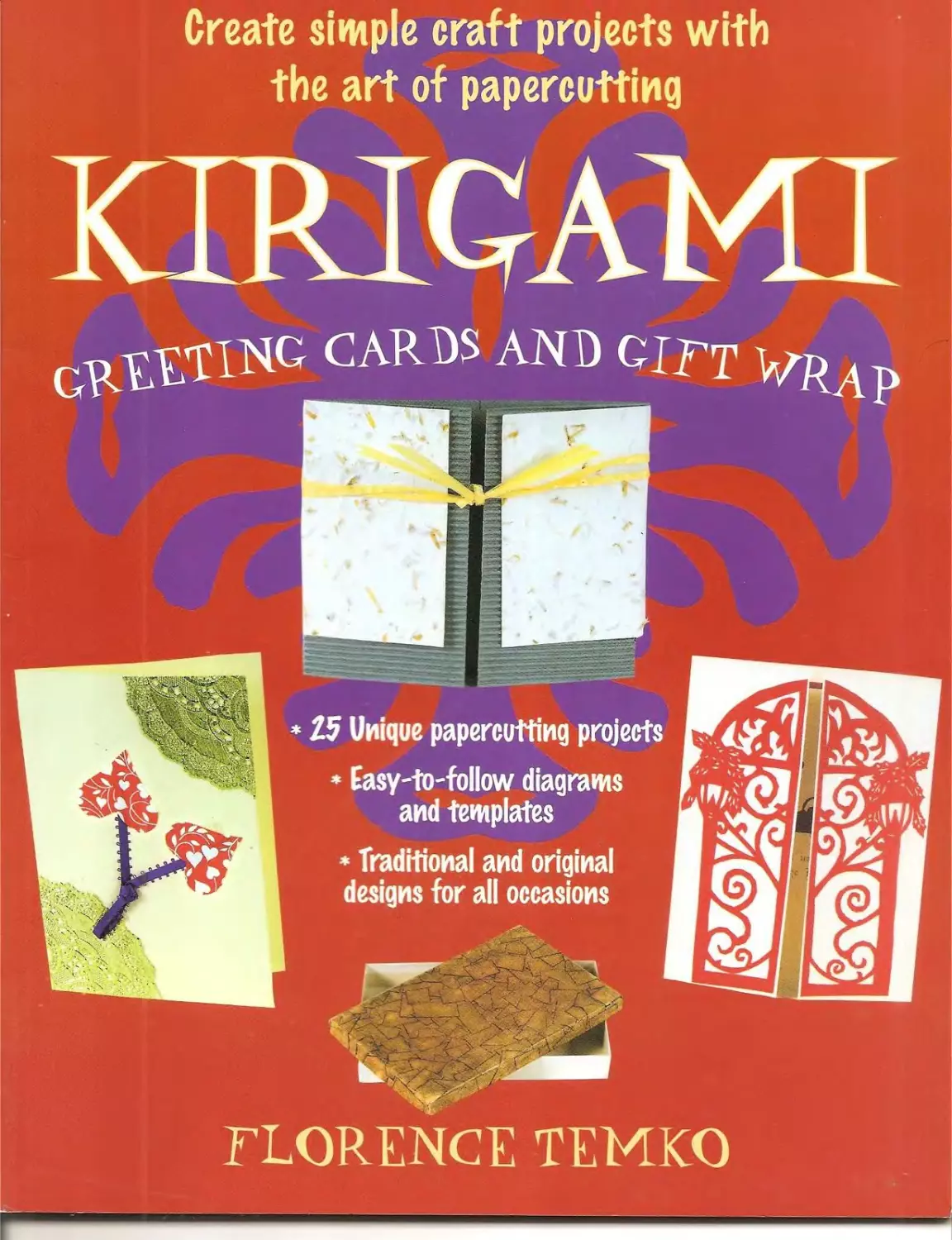
                    Create simple craft projects with
the art of papercuttiwg
KIRIGAMI
G4WWCCARDS AND GIFT Vrap
25 Unique papercutting projects
* Easy-to-follow diagrams
and templates
* Traditional and original
designs for all occasions
FLORENCE TEMKO
KIRICAMI
CK^ING CARDS AND CIFT Wp
Florence Temko
TUTTLE PUBLISHING
Boston • Rutland, Vermont *Tokvo
CAUTION: The projects in this book require cutting with scissors, which can cause physical injury if used improperly. Children should
be supervised carefully and provided with any assistance they need to insure their safety when using scissors or other sharp objects.
First published in 2004 by Tuttle Publishing, an imprint of Periplus Editions (HK) Ltd., with editorial offices at 153 Milk Street, Boston,
Massachusetts 02109.
Copyright © 2004 Florence Temko
All rights reserved. No part of this publication may be reproduced or utilized in any form or by any means, electronic or mechanical,
including photocopying, recording, or by any information storage and retrieval system, without prior written permission from the
publisher.
Temko, Florence.
Kirigami greeting cards and gift wrap / Florence Temko.— 1st ed.
p. cm.
ISBN 0-8048-3606-X (pbk.)
1. Paper work. 2. Cut-out craft. 3. Greeting cards. 4. Gift
wrapping. I. Title. TT870.T4453 2004
745.594'1—dc22
2004007242
Distributed by
North America, Latin America & Europe
Tuttle Publishing
Distribution Center
Airport Business Park
364 Innovation Drive
North Clarendon, VT 05759-9436
Tel: (802) 773-8930
Fax: (802) 773-6993
Email: info@tuttlepublishing.com
www.tuttlepublishing.com
Japan
Tuttle Publishing
Yaekari Building, 3rd Floor
5-4-12 Osaki
Shinagawa-ku
Tokyo 141 0032
Tel: (03) 5437-0171
Fax: (03) 5437-0755
Email: tuttle-sales@gol.com
Asia Pacific
Berkeley Books Pte. Ltd.
130 Joo Seng Road
#06-01/03 Olivine Building
Singapore 368357
Tel: (65) 6280-1330
Fax: (65) 6280-6290
Email: inquiries@periplus.com.sg
www.periplus.com
First edition
08 07 06 05 04 10 9 8 7 6 5 4 3 2 1
Design by Linda Carey
Diagrams by Daniel P. Brennan based on original diagrams by Florence Temko
Photographs by Dave Kutchukian
Printed in Singapore
You may use the designs and templates in this book for personal use or in educational settings free and without special permission.
However, republication or reproduction of any illustration or design by any other graphic service whether it be in a book or any other
design resource, is strictly prohibited, as is any commercial use of the designs in this book.
"Intricate Dragon" on page 26 reprinted from Chinese Folk Designs by W. M. Hawley (Dover Publications, New York, 1949).
Contents
Introduction	4
Kirigami Questions	4
and Answers
Papercutting Techniques 6
Kirigami Piefold 8
Three-Dimensional Cards 3o
Cate Cards........................30
For Your Valentine ...............3\
KosesAreKed ......................3Z
Birthday Pop-Up...................54
Christmas Tree Card...............56
Fiesta Card ......................57
Pop-Up for Any Occasion...........58
and Gift Wrap
Kirigami Cutouts.......................9
Collages ..............................\3
Cut-Aparts ............................14
Press-Up Polls.........................16
Stars .................................18
Мои-Kiri Japanese Crests ..............19
Boys and Girls Together................ZZ
Flags and Shields......................24
Alphabet Soup..........................Z5
Pragon.................................26
Hummingbird ..........................-27
Punch of Crapes .......................28
Hop on Over Invitation ................29
Boxes, Bags, and More 4o
Chrysanthemum Gift Box.......40
Book Mark....................42
Snowman Gift Bag.............44
Remember Pad Box.............45
Envelopes....................46
Acknowledgments	48
inTaoducTiom
Kirigami, the creative art of
papercutting, is a surprisingly easy
craft that requires only paper, a pair of scissors,
and sometimes glue. With these simple means
anyone can create greeting cards, calendars, and
unusual gift wraps that will be welcome year round.
The word kirigami
suggests its connection
to Japan: kiri means
“cutting” and garni
means “paper.” For
many designs a piece of
paper is folded one or
more times, with cuts
added through all layers.
When the paper is unfolded an unexpected
symmetric design is revealed. As may be guessed,
kirigami is related to origami, the art of folding
paper, but many people find it to be easier.
Cutting paper seems to be an instinctive
pleasure. At an early age most children like to snip
paper into small pieces. Before long they design
pictures by pasting the shapes on a background. In
Kirigami Greeting Cards and Gift Wrap this
experience has been expanded for enjoyment by
older children as well
as adults, who can
achieve magic
results with just a
few cuts.
Papercutting
is well recognized to
provide educational benefits in the areas of art,
math, graphic design, and hand-eye coordination.
When expanding to spatial relationships, two kinds
of symmetry can be observed: line symmetry,
which reflects mirror images, and rotational
symmetry, which moves around a central point.
You will find step-by-step directions for making
birthday and holiday cards, as well as many
wonderful ideas for wrapping gifts in unusual ways,
all of which can provide many hours of fun for
family and friends.
My objective in writing Kirigami Greeting Cards
and Gift Wrap is to provide projects that are simple
to make, though they may look complex, and that
will appeal to all ages.
KnyCjAMi QUEsTioms
AMD ANSWERS
Are origami and kirigami related?
Both words are adaptations from the Japanese that
have found their way into the Western vocabulary.
In origami a paper square is folded into an object or
animal without cutting or gluing. In kirigami paper
may be cut and glued, and may sometimes be
folded before cutting. Both terms include the
Japanese word garni, which means “paper”; ori
means “folding” and kiri means “cutting.”
I popularized the word kirigami in the English
language when I prepared a papercutting kit in
1962. At the time I had
been practicing origami
and a publisher asked
me to write a book
about papercutting.
When it came to
choosing a title, the
publishing staff and I
sat around debating
various possibilities. I
suggested kirigami and we checked with the
Japanese consulate to be sure this word would be
acceptable. The kit had such a wide distribution
that the word kirigami became a common term.
Are special scissors needed?
Any pair of scissors that feels comfortable is
suitable for most of the designs in this book, but
the sharper the better. If you move on to making
intricate paper cuts, you may wish to acquire a pair
of small scissors with narrow blades. Because
paper contains silicones, which abrade scissors in
time, it is best to
reserve a pair of
scissors especially for
papercutting, since
they may lose the
sharpness needed for
cutting fabric.
4
What kinds of papers are suitable?
Almost any kind of
paper can be cut —
successfully. When
a paper has to be
folded into several
layers before
cutting, a fairly thin
weight is best, but
whatever is around
the house, including
gift wrap, makes for a good start. Colored printing
papers are next in line. Tissue paper may be more
difficult to handle, but may be useful for certain
projects. Origami squares colored brilliantly on the
front and white on the back come in packets.
Japanese handmade washi papers, decorated with
glorious patterns, are sold in squares and larger
sheets.
The selection of paper is one of the most
important aspects of kirigami. It is appropriate to
choose some more unusual papers when it comes
to preparing beautiful cards. Most cities now have a
paper store with an interesting selection of papers
from all over the world. Otherwise catalogs may
prove helpful. And do not forget to recycle papers
from flyers, magazines, and correspondence.
What are some of the practical uses for kirigami?
Obviously the title of this
book, Kirigami Greeting
Cards and Gift Wrap,
suggests two major
applications, but do not
overlook using paper cuts in
scrapbooking, for holiday
room decorations, and for
gift tags. Gift tags can be
smaller versions of the
cutouts chosen for the gift
wrapping. Any kind of handmade cards can be sold
for raising funds for a good cause.
What about cards and gift wrapping?
The flat surfaces of cards, gift packages, and gift
bags lend themselves to applying paper cuts, and
are especially useful for mailing. It is a good idea to
make a bunch of cutouts for cards or gift wrapping
all at one time, ready for future birthdays or
holidays.
Nowadays, when what’s
outside the gift seems
almost as important as the
gift itself, kirigami ideas can
help you create unusual
packaging. It may even
trump the contents when a
recipient treasures one of
your cards enough to frame
it or keep a box for storing small items.
Remember that the selection of beautiful papers
will always enhance your efforts and that many
designs can be placed either vertically or
horizontally as the card or box demands.
Is kirigami educational?
Definitely. Whether in the classroom or art room,
working on some of the projects in this book will
improve students’ graphic design ability, color
sense, and visual acuity. Some of the projects are
based on geometry and help students visualize
math concepts. In social studies students can
investigate paper crafts as practiced in different
countries.
Studies show that, among other benefits,
papercutting improves manual dexterity by
exercising and training
small motor muscles, as
well as furthering
interaction between hand
and mind. Most projects in
this book are relevant for
use in art and math
classes. Thus, the
technique relates to
curriculum requirements. In
California papercutting is included in the
“Framework for Public Schools, K-12.”
5
At what age can children begin to cut paper?
With the availability of
safety scissors, very young
children can have fun
cutting paper. In fact, it
seems a natural outlet that
can keep them occupied
for long periods of time.
Papercutting, like any craft,
offers children and adults
different challenges for
different ages and different stages of development.
Is papercutting creative?
In a way papercutting is "drawing with scissors,” so
that taking a pair of scissors in hand invites limitless
designing. Some artists who have applied their
talents to papercutting have created true works of
art. They may pencil in their
design first, or they may work
freehand. Since papercutting
lends itself well to producing
simple, dynamic, or bold images,
it has been used in many
advertisements and company
logos. Some of these are based
on Japanese crest cutting.
To explore your own
creativity, experiment with one or
two paper cuts according to the
directions in this book. Then begin to apply
variations, which may lead you to entirely new
approaches. The projects shown are quite basic,
but you can enhance them by decorating them
with your own touches of glitter, confetti, paper
snips left over from other cuttings, ribbon, yarn,
and other odds and ends.
Why add extra
framing?
Just as with pictures
and photos, framing
enhances a
composition by adding
a finishing touch. To
form a frame, glue a
rectangular or freeform
piece of paper to the card before applying the cut
designs inside the frame.
What about tearing paper?
Many cutouts can be torn instead of cut. In that
case, paper selection is important. The fibers in
machine-made papers are aligned in one direction,
which is called grain. The paper
will tear more easily with the
grain than across the grain. You
may have discovered this if you
have ever tried to tear out an
article from a newspaper. In
contrast, handmade papers
exhibit no grain direction. They
will show nice fuzzy edges when torn,
giving a different effect than cut lines.
What about copying the designs?
For some projects you may wish to fold the cutting
lines exactly. You can copy the diagrams by making
photocopies or tracing them. Then place the copy
on top of the piece of paper you have selected and
cut through all layers. It is alright to copy the
designs for your personal use, but not for any
commercial purposes.
РАРЕ(уЗиП1ц|С|
Techniques
Diagrams
The following symbols are used:
A line of this thickness shows the outline shape of
the paper or existing creases made previously.
Cut on the heavier lines.
6
Fold toward you on the broken lines (valley fold).
Scissors or
Utility Knife?
All patterns can be cut
with scissors. Many
people, including me, are
more comfortable with
scissors than with craft knives. If you prefer, you
can use a utility knife, which allows for more
intricate cutting. Several layers can be cut at the
same time by holding the knife like a chisel, straight
down. In this case always use a board or a
magazine for backing to avoid marring a tabletop
or other surface.
Fold away from you on the broken/dotted lines
(mountain fold).
Your paper cuts may not look exactly like the
illustrations—scissors have a way of wanting to go
their own way and you should let them.
Ж
Square Paper
For some of the projects,
square pieces of paper are
indicated. You can cut any
letter-size paper or other
rectangle into a square with
this simple method:
1.	Fold a short edge to a long edge, bisecting a
corner.
2.	Cut off the extra rectangle.
3.	Completed square.
Measurements
Measurements are given in
inches and centimeters, but
they may not always be
exactly equal in order to avoid
awkward fractions. In some
cases specific sizes are
recommended, but in most
cases you may use smaller or
larger pieces of paper.
How to Cut
When cutting curves,
always hold the hand
with the scissors still
and move the paper
into the scissors..

Though it may seem
awkward at first, this method will become a habit in
a short time and will result in smoother cuts.
Some artisans cut even very intricate designs
with the shank of the scissors, which is the part of
the blades closest to the handles. This provides
better control. So why don’t you try it and see how
it works for you.
Basie Supplies
and Other
Materials
The basic supplies for
most projects are paper,
scissors, and glue. For
greeting cards you also
need blank cards. All
needed supplies are specified at the beginning of
each project.
Glue sticks or household glue usually works
well, but be sure to apply it thinly. In addition, since
white glue dries transparent, it may be applied as a
finishing varnish. Paper cement is useful when
pieces of paper may have to be repositioned.
You can buy blank greeting cards or make your

own from card-weight
papers, such as construction
paper, tag board, cover
stock, or manila file folders,
poster board, railroad board
(slightly lighter in weight than
poster board), Canson Mi-
Teinte, and handmade
papers. These choices offer a wide selection of
colors and textures, and may work out to be
cheaper than ready-made blank cards.
Pattern Designs
The patterns can be duplicated with freehand
drawing, by photocopying, or by tracing. Place
photocopies or tracings on the paper you plan to
use and cut through both layers.
Multiples
For holiday greetings that you plan to send to many
people you may want to duplicate one of your
cutouts or copy a design from elsewhere. You can
trace or photocopy it or
use a computer scanner.
You can cut several
pieces at the same time,
if you use thin paper, but
you may find that tissue
paper is harder to
handle. You can also cut
a template from strong
paper, such a tag board,
which is the same
weight as manila folders. Use this pattern to outline
your design.
KiiyCiAMi Piy=Fo[p
Many people associate the word kirigami with paper cut into circular designs, which is a technique
closely related to cutting snowflakes. With this method, paper is prefolded into layers, which multiplies
any subsequent cuts. The designs that appear when the paper is unfolded always have a strong appeal,
because their symmetry pleases our senses. After you have worked on the projects in this book, you
may enjoy experimenting with your own designs for greeting cards, invitations, or gift tags.
You need:
A square piece of paper (see page 7)
Pencil
Scissors
4 CORNERS HERE
CLOSED
CORNER
1. Fold the paper into
quarters.
2. Look for the closed corner,
which is the center of the
paper. Fold this corner in
half.
3. Completed Kirigami
Prefold.

DECORATIONS FOR CARDS AND GIFT WRAP
Kii^iQAMi cuTouTs
These cutouts are all made on kirigami prefolds. They are achieved by
cutting sections of paper away from any of the three edges. When you
cut on the lines, some areas will fall off. The lines may first be drawn
freehand with pencil, traced, or photocopied.
The first cutout is made solely with straight snips. In the second
example a simple curved line produces a strong graphic design; the fall-
off is used as a frame on a card. Other examples follow.
The triangular prefolds are shown full size to fit a 6" (15 cm) paper
square.
After making these cutouts you may be tempted to create your own
designs, as you realize that an immense variety is possible with this
method simply by cutting away areas from the edges of prefolds.
You need:
Paper squares
Pencil and tracing paper, or photocopy
Scissors
1b. Draw, trace, or photocopy the two lines shown.
1e. Cut on the lines. The darker area will fall off.
Id. Unfold the paper.
9
K«RJCiAM« cuTouTs
TWO FOR THE PRICE OF ONE
A single cut produces two results,
CORNER
la. On a prefold, draw, trace, or photocopy
a curved line and cut on it.
1b. Unfold the two pieces.
10
K.iiyCi4M> cuTouTs
MORE CUTOUTS
CORNER
1. On a prefold, draw, trace or photocopy
the pattern shown and cut on it.
1. On a prefold, draw, trace or photocopy
the pattern shown and cut on it.
2. Completed cutout.
2. Completed cutout.
। Caution
1 Cutouts made
 on prefolds may
। fall apart if the
1 center point is
, not observed or
। if a cut reaches
1 from one edge
। all the way
 across to
J another edge.
 After this has
 happened to
, you once or
। twice, you will
1 quickly learn to
। avoid these
• pitfalls.
11
KiRJCiAMi cuTouTs
MORE CUTOUTS
CORNER
1. On a prefold, draw, trace or photocopy
the pattern shown and cut on it.
CORNER
1.	On a prefold, draw, trace or photocopy
the pattern shown and cut on it.
2. Completed cutout.
2. Completed cutout.
12
collates
Collage consists of an artistic arrangement made
by gluing various pieces of paper on a background.
This allows you to make greeting cards in the most
creative way, since the shapes can be rearranged
until you are pleased with the results. Experiment
and play with paper pieces in various colors and
textures. Scraps left over from other projects in this
book are well suited for collage as are shapes and
words cut from magazine pages.
Since collage is such an individual expression,
it is demonstrated here with two examples to serve
as inspiration rather than with step-by-step
directions.
Ybu need:
Paper sheets and scraps
Scissors
Paper Cement
Blank card or gift package
I This illustration shows a musical card.
2.	This illustration shows three scraps with different
textures appliqued on a card: two pieces of tree
bark, and paper corrugated with a paper crimper.
13
cuT-aparJs
Rectangles, circles, and other simple geometric
shapes cut into pieces can present very bold
images when glued on greeting cards. Such strong
contrasts are termed positive and negative
designs. In the first example a circle undergoes this
treatment, while the tree that follows expands on
the idea.
After you have completed these simple
projects, experiment with cutting apart other paper
shapes with straight and curved lines. If a result
does not please you, toss it out and start again.
You need:
Colored paper
Blank greeting card, construction paper, or
wrapped gift
Plate or compass
CUT-APART CIRCLE

Pencil
Ruler
Scissors
Glue
la. Draw and cut a circle on the colored paper, with
the aid of a plate or a compass.
1b. Fold the circle in half.
2a. Draw two lines from the curved edge to meet
at the bottom of the paper.
2b. Cut on the lines and on the crease.
3.	Glue the separate pieces on a blank card.
4. Completed Cut-Apart Circle.
14
сиТ-цр arJs
CUT-APART TREE
1a. Draw or trace a circle.
1b. Cut it out.
1c. Draw and cut wavy lines on it.
2. Draw and cut a tree trunk.
3a. Glue the separate pieces
on a blank card or
wrapped gift.
3b. Completed Cut-Apart Tree.
15
DI^ESS-UP BOLLS
Paper dolls were important toys before the age
of television, but they can still provide much
creative play. You can become a fashion
designer by making your own paper dolls and
providing them with several changes of clothing.
The doll itself must be made from heavyweight
paper or thin cardboard, but all kinds of
interesting paper patterns can be used for the
clothing. The dolls' clothing can be changed at
will when it is attached with rubber cement or
glue stick applied lightly.
For a surprise, enclose a set in a plastic
envelope and send it as a greeting card or
attach it to a gift package.
You need:
Card-weight paper for doll
A variety of papers for the clothing
Pencil and tracing paper, or photocopy
Scissors
Rubber cement
Completed Dress-Up Dolls.
la. On the heavy paper draw, trace, or
photocopy the outline of one or more dolls.
1b. Cut out on the lines.
16
DI^ESS-UP ООЦ5
VARIATIONS
In addition to the basic wardrobe shown, you
can create other apparel, hairstyles, shoes,
accessories, and whatever else you can think
of, perhaps cutting patterns from magazines
and catalogs. Imagine styles favored by
friends and family members, rock stars, or
historical figures.
STANDING DOLL
Glue the top of a strip of heavy paper to the
back of the doll, letting the lower end of the
strip extend below the feet of the figure. Pull the
strip away from the figure at an angle and fold
back the extra length at the bottom for a firm
stand.
17
sTa^s
Many different stars can result from making cuts on
the basic kirigami prefold.
You need:
Square paper
Pencil
Scissors
VARIATIONS
Note that any
star can become
more or less
pointed by
changing the
angle of the cut
in step 1b.
la. Make a kirigami prefold.	2. Completed Star.
1b. Make a slanted cut beginning at the closed
corner.
1c. You will have two pieces. Unfold the long triangle.
1b. Cut away the lighter area from the
long edge.
EIGHT POINTED
STAR
For an eight-
pointed star, glue
two four-pointed
stars together.
Japanese
CRESTS
—_e art of cutting family crests has been a custom
' .scan for centuries. Distinctive heraldic crests,
oaled mon-kiri, or "crest cuttings," were handed
~Tom one generation to the next and were
□soayed on the clan’s possessions. Crests
stached to samurai warriors’ clothing and armor
made it easy to identify friend or foe in battle.
'.'any mon-kiri designs are geometric, but also
г: uoe a variety of plants, animals, clouds, and
omer forms in nature. Their bold designs have
ser.-ed as the inspiration for many jewelers,
:-g designers, and other artisans. Crests first
seated in paper may later be converted to fabrics
=r ~ other materials. For the best effect, glue mon-
' crests on blank cards or gift wrap in strong
: ntrasting colors. The authentic crests shown
here may inspire you to design a mon-kiri crest as
your own personal signature.
You need:
Paper
Scissors
Glue
PEONY
t -old a piece of paper in half.
1 Completed Peony.
2a. Copy or trace half a peony on the folded edge.
2b. Cut it out through both layers. Note that the interior
ovals are reached by cutting slits from the edge. The
slits disappear when the peony is glued down.
2c. Unfold the paper.
19
MON-Kiiy Japanese
c^esTs
FOUR COMMAS
Use paper that is colored the same on both sides.
1. Fold a piece of paper in quarters.
2a. Draw on the comma shape and a round dot as shown.
2b. Cut on the lines through all layers.
3a. Separate the four layers and arrange them in a circle on a piece of card.
3b. Glue down all cutouts.
3c. Completed Four Commas.
20
Мом-KiRJ Japanese
c Apsis
LOCKED SQUARES
• ou need a 4" (10 cm) paper square.
3a. Draw, trace, or photocopy the design on the
folded paper in the exact position shown.
3b. Cut out through all layers. Be especially careful at
point X, where the square will be held together.
3c. Carefully unfold the paper.

Boys UNO 4'MS
You can cut a circle of boys and girls dancing
together from one piece of paper.
You need:
Paper
Plate or compass
Scissors
Pencil
la. On a piece of paper draw a circle with the aid of a 2. Fold the circle in half three times,
plate or a compass (8" (20 cm) would be a good size).
1b. Cut out the cirole.
22
Boys AND ToQeThei^
4. Completed Girls and Boys Together.
За. Draw on half a figure of a boy and half a figure
of a girl on the edges, as shown.
3b. Cut out the half figures through all layers.
3c. Unfold the paper.
BONUS
You can use the pieces that fell off
to decorate greeting cards or
report covers.
Fmqs AMD SHIELDS
Cutting papers to create flags and shields is a form
of collage. They can be inspired by international
flags of different countries or states, or they can be
wholly imaginary. For fun at a party you can provide
colored paper, scissors, and glue and let guests
design personal flags and shields. Information
about heraldry found in books and on the Internet
may serve as inspiration. The designs could be
applied to skateboards, surfboards, snowboards,
and other equipment or used for decorating large
rooms or halls by increasing the size of the
patterns.
You need:
Paper
Plate or compass
Scissors
Pencil
The shields are cut from paper folded
in half. The yellow diamonds are cut
through several layers placed on top of
one another, illustrating how repetitive
designs can be multiplied.

ALPHABET soup
-^socialize a greeting card or gift by arranging
ecers of the alphabet in a circular pattern. Cut the
г oa of the recipient through several layers of
: ice- and you may be surprised at the result. Any
ejers of the alphabet can be used in this way, as
el as any sign of the Zodiac.
You need:
Colored paper
Card-weight paper
Pencil
Scissors
Glue
U. Place eight layers of paper in a pile. If the
caper is colored on one side only, then all
colors must face up.
t. Draw the outline of the initial on the top
It. Cut it out through all layers.
2a. Glue the letters in a circle on card-weight paper.
2b. Completed Alphabet Soup.
25
The dragon is an example of pictorial papercutting
as it has been practiced in China for centuries.
Many designs depicting flowers, birds, and scenes
from daily life carry deep symbolic meanings. For
example, in Asia dragons symbolize strength and
goodness and are not considered monsters.
You need:
Red paper
Pencil
Tracing paper or photocopy
Blank card
Scissors
Glue
1. Copy the dragon, cut it out,
and glue it on a blank card.
The eye of the dragon is
reached from the edge of
the paper with a slit that
becomes hidden when the
dragon is glued down.
INTRICATE DRAGON
Here is an example of an
intricate dragon made by a
Chinese artisan.
26
lacing paper or photocopy
need:
:rful papers
uaerrc several paper cuts on top of one another
ar ea~ :o very colorful effects, as seen in this
crc-sa-ea nummingbird.
2a. Glue the two layers
together and then glue
them onto a card.
2b. Draw on an eye.
2c. Completed Hummingbird.
la. Trace or photocopy all outlines,
lb. Cut them out.
27
J
вицсн oF
Composing pictures with torn paper is an old
tradition in Japan. In the example shown the
grapes and stem were torn from handmade
Japanese washi paper. Its long fibers result in
softer, fuzzier outlines but other papers may also
be used.
Ybu need:
Purple and brown paper
Ballpoint pen
Coin or small, round, plastic lid
Scissors
Rubber cement
Card or wrapped gift
ООО
ООО
1a. On the purple paper, outline
a circle for each grape by
drawing with a ballpoint pen
around a coin or small lid.
Press hard.
1b. Press down around the
edges with your thumbnail
as you tear out the round
pieces. The tear may not
follow the circle exactly.
2a. With a ballpoint pen, draw a
stem on the brown paper.
2b. Carefully tear out the stem.
3a. Glue the grapes and stem
on the background.
3b. Completed Bunch of Grapes.
28
-OF ОМ OVE^ INVlTjJlOM
x : Over” is a good message for an invitation but you might also think
xr sending other messages to a friend on this frog-themed card. For
roe the story of “The Notorious Jumping Frog of Calaveras County”
Va'- Ovain, which is great fun to read, can inspire the theme of your
Z' . ou could let the classic fairy tale of the Frog Prince move you
- a saying such as “Have you been kissed by a frog lately?” or “You
e " <ss a few frogs before you find your prince.”
HOP ON OVER I
need:
Green paper
Pencil and tracing paper, or photocopy
29
THREE-DIMENSIONAL CARDS
ЧАТе cards
These cards, which open from the middle instead
of from the side, allow for many variations. The
instructions show how to make the basic card,
followed by suggestions for enhancing it.
You need:
Card-weight paper, 8 ’A" x 11" (or A4)
Scissors
Pencil
Eraser
1. Cut the card paper in half
lengthwise. Each half will
make one card.
2a. Mark the middle of one long edge
lightly with pencil.
2b. Fold the two narrow edges to the
pencil mark. Erase the mark.
3a. This shows the basic card
folded with two equal flaps
on the front.
3b. Completed Gate Card.
BERIBBONED CARD
This card features handmade textured paper
and a ribbon closure. Raffia is attached to the
back of the card with tape, brought around,
and tied in front. Narrow ribbon may also be
used.
CUTOUT DECORATIONS
Gate cards may be designed with mirror
images of cutouts glued opposite each other,
illustrated with a card made by children in a
Chinese school.
30
*>Я, you^ VALENTINE
:st people know how to cut the well-loved shape
г a symmetrical heart. Here this simple shape
trns the basis for a Valentine’s card, which is
er-bellished with a lacy doily and ribbon in imitation
~ ~e elaborate handmade Valentines fashionable
г —e Victorian era of the nineteenth century.
Ybu need:
Red paper
Doily
Two colored paper strips
Blank card
Scissors
Glue
2a. Draw half a heart against the folded edge.
2b. Cut on the line through both layers of paper
and unfold it.
31
KjOSES Ц^Е ЦЕО
Make this oversize card for that special person in
your life. When opened, the card reveals a three-
dimensional rose.
You need:
Red tissue paper
Green tissue paper or green marker
Scissors
Glue stick
Cover stock paper, 11" x 8 ’/2" (or A4) or
larger, folded in half
CUT 2
t Cut two pieces of red tissue paper 2" x 7" (5 cm x 18 cm).
1b. Cut two pieces of red tissue paper 3" x 10" (7 cm x 25 cm).
1c. Cut one piece of red tissue paper 4" x 12" (10 cm x 30 cm).
32
«OSES A^E f^ED
2i =old each of the five strips in half four times,
parallel to the short edges.
Л. Open the paper and rearrange the creases
alternately up and down (mountain and
. alley folds).
3. Double up each fan and glue two
sides together.
4. Slue all the right sides of the five fans
'side the card, close to each other.
The middles of the fans sit on the
o'ease of the card.
5. Put glue on the left side of the five
fans; then close the card.
» 0'= a stem and leaves on green
tissue paper and cut them out.
fc Deen the card and glue the stem
а- з leaves below the rose.
ADDA
GREETING
You can write
your message on
the front of the
card or inside at
the sides of the
rose. A patterned
piece of gift wrap
will enhance the
front of the card.
33
birJhday pop-up
Offering a nice surprise when opened, pop-up cards are
always memorable. The instructions show how to make the
basic mechanism for a birthday or wedding cake. Cardstock
is sold in printing shops or craft and art supply shops, but
other stiff paper will do.
You need:
Colored cardstock, 8 '/2" x 11" (or A4), for
the card
Cardstock in the same color, cut into a strip
1 ’//' x 7" (4 cm x 16 cm), for inside the card
Cardstock in another color, for the cake
cutout
Glue
Scissors
Pencil or pen
1. Fold the large piece of
paper in half-the short way
for the outside of the card.
2a. Fold the strip in half and
unfold it.
2b. Fold the short edges to the
crease you just made.
3. Put a dab of glue on both
end panels of the strip
and glue them to the
inside of the card.
BIRjHQUY POP-UP
5a. Fold the other colored cardstock in half.
5b. Draw half of a cake on the folded edge and
cut it out through both layers.
OTHER THEMES
Instead of a birthday or wedding
cake you can substitute a flower,
an animal, any other cutout or
photo. Always make sure that the
paper figure is completely hidden
when the card is closed so you
don’t spoil the surprise.
i-i. Unfold the cake cutout and paste it to the front
of the strip inside the card.
S. Completed Birthday Pop-Up. Write your
~essage on the front of the card or on any
empty space inside.
35
ch^isTmas Tree сц|ф
This simple but effective holiday card can be
created in minutes. All members of the family can
join in the fun and personalize each card with stars,
markers, glitter, and other add-ons.
You need:
Green foil gift wrap or a green paper square,
white on the back
Ruler
Pencil
Scissors
Glue
Blank card
la. Cut a piece of green paper to measure
3 Уг"х 5" (9 cm x 13 cm)
1b. Fold it in half.
1c. Draw a line from corner to corner.
1d. Cut on the line through both layers of paper.
2a. Cut parallel slits at an angle, beginning at
the folded edge and ending about ’//'
(Уг cm) away from the opposite edge.
2b. Open the paper.
3a. Fold up the angled cuts.
3b. Glue the tree on a blank card.
4. Completed Christmas Tree Card.
FiesTa с а АР
Make this dramatic card for a special person or a
special occasion. As you tear the various layers as
shown in the illustration, secure them temporarily
with two or three very small dabs of rubber
cement. When the arrangement suits you, paste
them down with glue stick.
You need:
Printing papers in various colors
Blank card
Gold foil gift wrap
Ballpoint pen
Scissors
Rubber cement or glue stick
2. Draw and cut a sun from the gold paper.
I i ear pieces of paper into irregular strips, wider
than the card.
3a. Arrange the strips on the front of the card
and glue them down. Since the strips are
wider than the card, you have leeway to
move them around. Cut any extra off the
sides of the card.
3b. Glue on the sun.
3c. Completed Fiesta Card.
37
pop-up Foi^ дну
ОССЦБ1ОМ
A surprise is waiting when this card is opened.
You need:
Colored paper
Blank card
Scissors
Glue
Marker or crayons
2a. Draw the outline and cut it
out through both layers.
2b. Unfold the paper.
3a. Place the paper so that
the crease is up (a
mountain fold). Fold the
slanted edges to the
crease.
3b. Unfold them.
pop-up Fbi^ ищу
occasion
4a. Glue the two areas at the top to the
inside of the opened card, placing the
long mountain fold on the middle crease
of the card.
TO МУ
FRIEND
VARIATION
You can turn the pop-up into a face
by drawing eyes on both sides of
each corner, which will become a
nose.
CLOSED CARD
6. Completed Pop-Up Card. Write the message
on the front and on the empty spaces inside.
39
BOXES, BAGS, AND MORE
chi^YsamThemom qiFT box
This gift box decoration is achieved with just a few
pieces of tissue paper.
You need:
Tissue paper in one or more colors
Stapler, or needle and thread
Scissors
Glue
Gift box
2. Place them on top of one another and
staple or sew them together in the center.
1. Cut six squares of tissue paper with 5" (15 cm)
sides, or larger.
4. Cut a curve using the folded edge as
the base line.
CHRYSANTHEMUM CjiFT BOR
5. Separate the sides evenly to show the staple
or sewing.
6a. Glue the bottom layer on top of a gift box.
6b. Pull up the top layer and make it stand upright by
bunching and pinching it up against the staple or
sewing.
6c. Repeat with each layer by pulling the paper gently
toward the middle.
7a. Tweak the flower into a pleasing three-
dimensional shape.
7b. From the top, cut snips into the layers.
41
book МАКК
The complex pattern shown on the bookmark is
achieved simply by cutting parallel lines on a folded
strip of paper. Patterns will vary, depending on the
angle and distance between the cuts made in step
2a. Papers with different colors on the front and
the back will produce interesting effects.
You need:
Paper 7" x 1 ’/2" (18 cm x 4 cm)
Cardstock 8" x 2 У2" (20 cm x 6 cm)
Scissors
Glue stick
the strip. Begin the cuts
on the folded edge,
(angled) cuts. Crease up
every other chevron.
stopping about У" ('/г cm)
short of the opposite edges.
2b. Unfold the paper carefully.
book МАКК
VARIATION
Punch a hole at the top and
knot on a ribbon.
ADD A STRIP
For the bookmark shown in the
photograph cut a narrow strip of
paper slightly longer than the
bookmark itself. Slide it under
the bent-up sections and glue it
down.
GREETING
CARDS AND
GIFT BOXES
These bookmarks
are equally effective
for decorating
greeting cards and
gift boxes. The
framed box shown
in the illustration is
personalized with a
photo.
43
SNOWMAN фП" BAQ
You can recycle plain paper bags into gift bags by
decorating them with cutouts. By relating designs
to the special interests of a recipient, you will
always show your friendly attention.
You need:
White, black, and red paper
Round lids or compass
Plain paper bag
Scissors
Pencil
Glue
t From white paper, cut three circles in different
sizes with the aid of a compass or round lids.
2. From black paper, cut a hat,
eyes, scarf, and buttons.
3. From red paper, cut a pair of mittens, ear muffs,
and a nose.
4a. Glue all the pieces on a paper bag.
4b. Completed Snowman Gift Bag.
ВДЬ ВОК
Any dad would be proud to receive this handmade
box as a gift. The leatherlike effect is produced by
covering a box with pieces of masking tape and
rubbing it with brown shoe polish.
You need:
Box
Masking tape
Scissors
Shoe polish (solid cream type)
Paper towels
White glue
Small piece of sponge
1. Cut a piece of masking tape about 1 /2"
(3 cm) square. Adhere it to the lid of the
box. Continue covering the lid and sides of
the box, cutting more pieces as you go
along and overlapping the pieces at
random. Tuck the ends of the tape inside
the lid.
2a. With paper towels, rub shoe polish all over the
lid. The coloring will be darker at the edges of
the masking tape, where the polish
accumulates.
2b. Clean off any excess polish with paper towels.
2c. Spread glue all over the box lid with a small
piece of sponge. Let the box dry completely,
until the glue is no longer sticky to the touch
and becomes transparent. Repeat with
another layer of glue.
3. Completed Remember Dad Box.
Caution
Shoe polish can stain clothing and
furniture. Children should be closely
supervised by an adult.
45
ENVELOPES
It is a good idea to size cards to fit
into standard envelopes, but you
can make your own envelopes in
odd sizes or to match the color of a
card by following this simple
pattern.
You need:
Greeting card
White or colored paper or
gift wrap
Pencil
Scissors
Glue
la. Cut the paper three times the smaller side
of the card. Add extra along the sides, as
shown.
1b. Place the card on the paper chosen for
the envelope.
1c. Fold and unfold the four edges over the
card, leaving some leeway each time.
2. Cut away the areas at the four corners
as shown by the shading in the diagram.
ENVELOPES
4a. Fold in the short edges on existing creases.
4b. Spread giue along the sides of the longer
bottom flap and fold up the flap.
4c. Fold down the top flap.
5. Completed Envelope. Seal it with glue, tape, or
a round seal.
47

Crafts
Kinganii,
the art of papercutting, is an ideal pastime for both adults
and children alike. You'll be amazed at the intricate and beautiful projects you
can create with just a piece of paper and a pair of scissors.
Kirigami Greeting Cards and Gift
Wrap features 25 original paper-
cutting projects including Heart
Valentines, Dress Up Paper Dolls,
Gift Box Borders, Woven Gift Wrap,
and an Appliqued Gift Bag. Crafts
expert Florence Temko provides
clear, easy-to-follow instructions and
step-by-step diagrams that make
learning kirigami fun and simple.
FLORENCE TEMKO is an internationally acclaimed author of over fifty how-to crafts books and a
leading authority on origami and kirigami. Her greatest passion is sharing crafts with others, not only
through her books, but also through teaching and by exhibiting her designs in museums and art gal-
leries. She has presented hands-on programs in schools, libraries, colleges, teacher conventions, cor-
porate settings, and museums, including the Metropolitan Museum of Art in New York City. She is a
founding board member of Origami USA, a member of the Authors' Guild, and a consultant for the
Mingei International Museum.
TUTTLE PUBLISHING
Boston • Rutland, Vermont •Tokyo
www.tuttlepublishing.com
Cover design by Laura Shaw Design
Printed in Singapore