/



Text
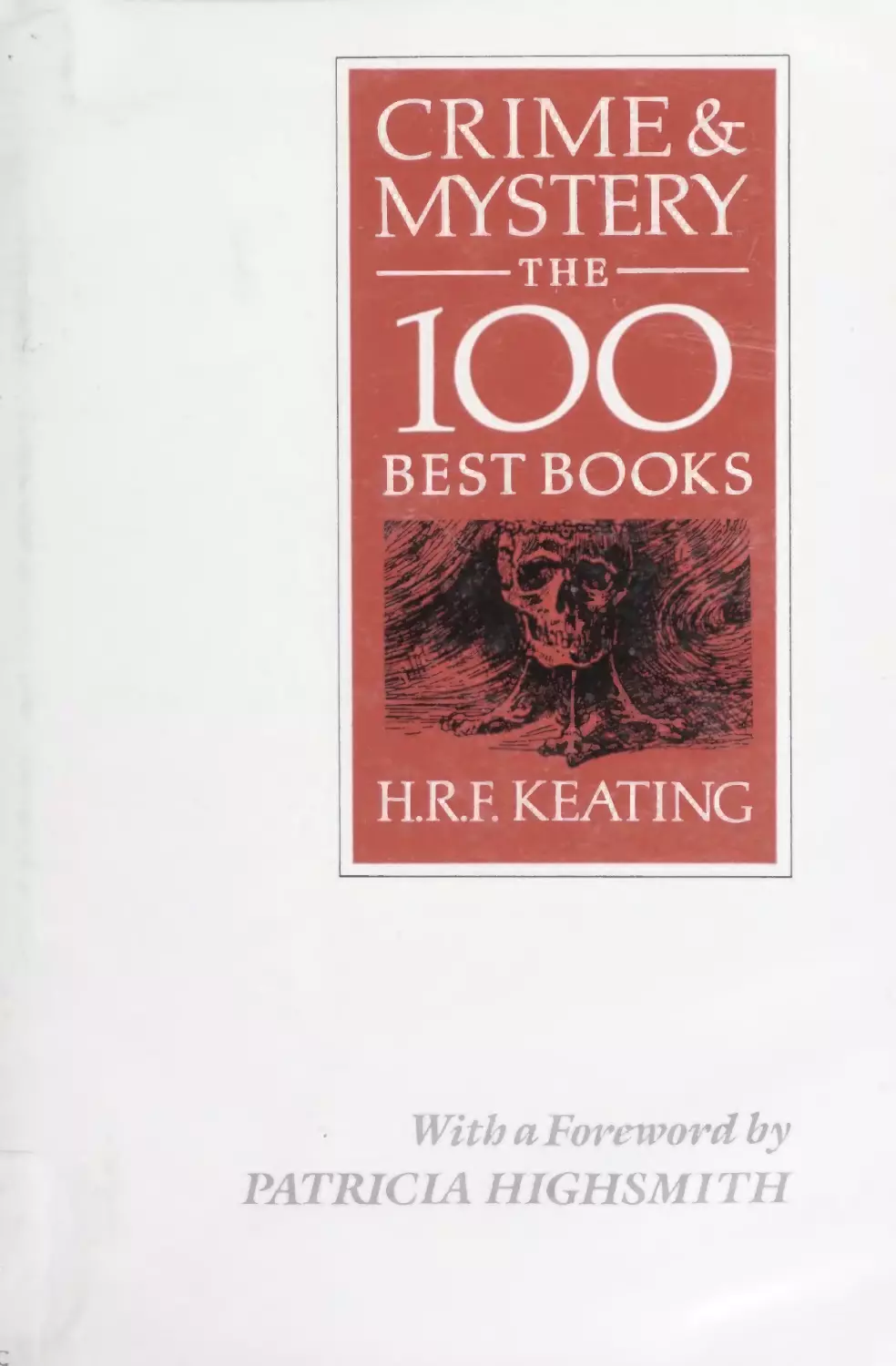
                    With a Foreword by
PATRICIA HIGHSMITH

15.95
ISBN 0-88184-345-8
H.R.E KEATING
CRIME & MYSTERY
THE 100 BEST BOOKS
rom Edgar Allan Poe to P.D. James, the mystery
tory has not only attracted generations of
eaders but it has also developed from puzzles
written primarily for entertainment to powerful
tatements about contemporary society. In this
authoritative and hugely entertaining survey,
listinguished author and critic H.R.E Keating
lraws on a lifetime’s experience to select the 100
>est works that the genre has to offer.
Nobody is better qualified to make such a
election, and the author’s enthusiasm and in-
ider’s knowledge illuminated every page as he
issesses recognised classics like Agatha Chris-
ie’s The Murder of Roger Ackroyd and Dashiell
lammett’s Red Harvest — but many more con-
roversial books are nominated, guaranteeing
ierce debate among fans and critics alike. Mr
Seating casts his net wide (he was for many years
Vhe Times’ resident mystery-story reviewer), and
ill types of writers are included and shrewdly
veighed up, from Mary Roberts Rinehart and the
Had-l-But-Known’ school (not as contemptible as
iome might think) to Joseph Hansen and his
sympathetically-portrayed gay detective. The
luthor argues convincingly that, at its best, the
nystery story transcends its genre to present an
■vocation of human experience to rank with any
)ther kind of literature.
The essays are arranged in chronological order
o that the book builds into a fascinating history
)f the genre, and details of first editions are
jrovided, making it an invaluable reference for
:ollectors, dealers and libraries, destined to sup-
)lant Queen’s Quorum as the definitive modern
;uide to mystery fiction.
Above all, H.R.E Keating makes you want to
ush out and devour the books he describes so
veil.

H.R.F. KEATING
CRIME&
MYSTERY
		THE

1OO
BEST BOOKS
FIELDS corner

Copyright © 1987 by H.R.F. Keating
Foreword copyright © 1987 by Patricia Highsmith
All rights reserved
First published in 1987 in Great Britain by
Xanadu Publications Limited
First Carroll & Graf edition 1987
Carroll & Graf Publishers, Inc.
260 Fifth Avenue
New York, NY 10001
Library of Congress Cataloging-in-Publication Data
Keating, H. R. F. (Henry Reymond Fitzwalter), 1926-
Crime and mystery.
Includes index.
1. Detective and mystery stories, English—Biblio¬
graphy. 2. Detective and mystery stories, American—
Bibliography. 3. Bibliography—Best books—Detective
and mystery stories. 4. Bibliography—Best books—Crime
and criminals. I. Title.
Z2014.F4K43	1987	016.823'0872'08	87-17377
[PR830.D4]
ISBN 0-88184-345-8
/ ¥/
Manufactured in Great Britain

Foreword
BY PATRICIA HIGHSMITH
H.R.F. Keating, well-known as a crime writer himself and critic
for The Times, has done crime and mystery fans a great service in
creating this book, his choice of the hundred best of the genre. It
is a pleasure to refresh one’s memory of The Moonstone’s story,
or a discreet part of it, and at the same time (in barely two pages,
like all of these entries) have the novel appraised by so apt a man
as Keating. What happened in Helen Eustis’s The Horizontal
Man, and why has it won a high place? Maybe more difficult,
what happened in The Long Goodbye of Raymond Chandler,
whose plots are said to be less memorable than some of his
ripostes?
But Keating gives not so much concern to plot as to evaluation
of the author and of one selected opus. The list begins with Edgar
A. Poe and ends with the timely P.D. James’ A Taste for Death',
on the latter there is a remark from Keating that ‘the central
mystery of death is surely what comes after, the sustaining key to
religious faith.’ Is it? More food for thought and discussion.
Among other entries are Dickens, Conan Doyle, E.W. Hornung,
Rex Stout, Cornell Woolrich, Simenon, P.M. Hubbard. Some
writers’ names may ring the dimmest of bells or none at all, and
perhaps lovers of such tales as these can make new friends, and
significant ones, by learning here what these authors wrote. All
the books that are mentioned are fairly readily available.
What makes this book more than merely a distinguished list or
a who’s who are the thoughtful words which H.R.F. Keating has
for each writer’s work. On Poe, for instance:
He was a pioneer in the struggle that won for us today the notion
that the individual has rights as an individual . . . that established
that great art can come from the self-expression of the artist and
not only from following rules laid down in antiquity.
And on Dickens’ The Mystery of Edwin Drood'.
.. . this theme, the frightening duality of human nature, that
3

never-settled combat between our duties and our desires, is so
woven into the story of the crime that the whole book is beyond
doubt an example of what later became known as the crime novel.
The whole book? Of course not, writes Keating. He describes
June 8, 1870, when, after working all day, Dickens at dinner
abruptly got up from the table declaring that he had to go to
London, and then collapsed. He lingered on for twenty-four
agonised hours before dying. He never gave a hint of his
intention for Edwin Drood's ending. There is great affection in
Keating’s prose in regard to Dickens.
I now have a different view of Cornell Woolrich, thanks to the
two pages on him here. Keating describes The Bride Wore Black,
and Woolrich’s curious and indirect methods of laying out his
plot and his clues. A homosexual who apparently lived in the
closet, Woolrich shared a life in residential hotels with a mother
whom he both loved and hated. Could anything be worse? Yet
‘books and short stories poured in a huge stream under his own
name and those of William Irish and George Hopley.’ And more,
Otto Penzler and Chris Steinbrunner have hailed him in The
Encyclopedia of Mystery and Detection as possibly ‘the finest
mystery writer of the twentieth century.’
To represent Maj Sjowall and Per Wahloo, whose ten novels
were intended as a planned ‘assault on Swedish society and by
implication on all Western society,’ Keating chooses Roseanna,
‘because it most clearly stays within the bounds of crime fiction.’
He has certainly read all the other nine.
One can open The 100 Best anywhere and be entertained by its
contents, learn something new, or reinforce what is already in
one’s head. Keating modestly states in his Introduction that he
may have left out some fine writers, for which he anticipates
reproach. But who in our time could have done it better?
4

Contents
FOREWORD BY PATRICIA HIGHSMITH	3
author’s INTRODUCTION	8
Tales of Mystery and Imagination by Edgar Allan Poe
(1845)	11
The Moonstone by Wilkie Collins (1868)	13
The Mystery of Edwin Drood by Charles Dickens (1870)	15
The Adventures of Sherlock Holmes by A. Conan Doyle
(1892)	17
The Amateur Cracksman by E.W. Hornung (1899)	19
The Hound of the Baskervilles by A. Conan Doyle (1902)	21
The Thinking Machine by Jacques Futrelle (1907)	23
The Circular Staircase by Mary Roberts Rinehart (1908)	25
The Innocence of Father Brown by G.K. Chesterton (1911)	27
Uncle Abner by Melville Davisson Post (1918)	29
The Mind of Mr J.G. Reeder by Edgar Wallace (1925)	31
The Murder of Roger Ackroyd by Agatha Christie (1926)	33
Red Harvest by Dashiell Hammett (1929)	35
Death of My Aunt by C.H.B. Kitchin (1929)	37
The Documents in the Case by Dorothy L. Sayers (1930)	39
The Maltese Falcon by Dashiell Hammett (1930)	41
The Sands of Windee by Arthur W. Upfield (1931)	43
Before the Fact by Francis Iles (1932)	45
The Case of the Sulky Girl by Erie Stanley Gardner (1933)	47
Murder on the Orient Express by Agatha Christie (1934)	49
The Postman Always Rings Twice by James M. Cain (1934)	51
The Nine Tailors by Dorothy L. Sayers (1934)	53
The Hollow Man by John Dickson Carr (1935)	55
The League of Frightened men by Rex Stout (1935)	57
The Wheel Spins by Ethel Lina White (1936)	59
The Beast Must Die by Nicholas Blake (1938)	61
The Bride Wore Black by Cornell Woolrich (1940)	63
Surfeit of Lampreys by Ngaio Marsh (1940)	65
Calamity Town by Ellery Queen (1942)	67
5

Tragedy at Law by Cyril Hare (1942)	69
The High Window by Raymond Chandler (1942)	71
Green for Danger by Christianna Brand (1944)	73
Appleby's End by Michael Innes	75
Murder Among Friends by Elizabeth Ferrars (1946)	77
The Horizontal Man by Helen Eustis (1946)	79
The Moving Toyshop by Edmund Crispin (1946)	81
The Fabulous Clipjoint by Frederic Brown (1947)	83
The Franchise Affair by Josephine Tey (1948)	85
Devil Take the Blue-Tail Fly by John Franklin Bardin
(1948)	87
More Work for the Undertaker by Margery Allingham
(1948)	89
My Friend Maigret by Georges Simenon (1949)	91
The Asphalt Jungle by W.R. Burnett (1949)	93
Smallbone Deceased by Michael Gilbert (1950)	95
The Stain on the Snow by Georges Simenon (1950)	97
The Daughter of Time by Josephine Tey (1951)	99
Last Seen Wearing ... by Hillary Waugh (1952)	101
The Tiger in the Smoke by Margery Allingham (1952)	103
Five Roundabouts to Heaven by John Bingham (1953)	105
The Long Goodbye by Raymond Chandler (1953)	107
Post Mortem by Guy Gullingford (1953)	109
The Party at Ho A by Shelley Smith (1954)	111
The Talented Mr Ripley by Patricia Highsmith (1955)	113
Beast in View by Margaret Millar (1955)	115
Gideon's Week by John Creasey (1956)	117
Mystery Stories by Stanley Ellin (1956)	119
Maigret in Court by Georges Simenon (1960)	121
The New Sonia Wayward by Michael Innes (1960)	123
Gun Before Butter by Nicolas Freeling (1963)	125
The Expendable Man by Dorothy B. Hughes (1963)	127
Pop. 1280 by Jim Thompson (1964)	129
R.S. V.P. Murder by M.G. Eberhart (1965)	131
The Man Who Killed Himself by Julian Symons (1967)	133
Murder Against the Grain by Emma Lathen (1967)	135
Roseanna by Maj Sjowall and Per Wahloo (1967)	137
The Last Best Friend by George Sims	139
The Glass-sided Ants' Nest by Peter Dickinson (1968)	141
Mr Splitfoot by Helen McCloy (1968)	143
The Private Wound by Nicholas Blake (1968)	145
6

The Tremor of Forgery by Patricia Highsmith (1969)	147
Blind Man with a Pistol by Chester Himes (1969)	149
Young Man, I Think You 're Dying by Joan Fleming (1970)	151
Beyond This Point are Monsters by Margaret Millar (1970)	153
Sadie When She Died by Ed McBain (1972)	155
The Friends of Eddie Coye by George V. Higgins (1972)	157
The Players and the Game by Julian Symons (1972)	159
Mirror, Mirror on the Wall by Stanley Ellin (1972)	161
The Dance Hall of the Dead by Tony Hillerman (1973)	163
The Poison Oracle by Peter Dickinson (1974)	165
Fletch by Gregory McDonald (1974)	167
The Black Tower by P.D. James (1975)	169
The Long Shadow by Celia Fremlin (1975)	171
The Flaked Nuns by Colin Watson (1975)	173
The Blue Hammer by Ross MacDonald	175
Sleeping Murder by Agatha Christie (1976)	177
A Death in the Life by Dorothy Salisbury Davis (1976)	179
The Investigation by Dorothy Uhnak (1976)	181
A Judgement in Stone by Ruth Rendell (1977)	183
Laidlaw by William Mcllvanney (1977)	185
Nobody's Perfect by Donald E. Westlake (1977)	187
A Pinch of Snuff by Reginald Hill (1978)	189
Skinflick by Joseph Hansen (1979)	191
Kill Claudio by P.M. Hubbard (1979)	193
The Green Ripper by John D. MacDonald (1979)	195
All On A Summer's Day by John Wainwright (1981)	197
Death in a Tenured Position by Amanda Cross (1981)	199
The Glitter Dome by Joseph Wambaugh (1981)	201
To Make a Killing by June Thompson (1982)	203
The False Inspector Dew by Peter Lovesey (1982)	205
The Artful Egg by James McClure (1984)	207
A Taste for Death by P.D. James (1986)	209
publisher’s note: The One-Hundred-and-First Choice	211
index	213
7

Introduction
Please, please don’t prosecute me under the Trade Descriptions
Act. But if I was to avoid that liability, the title of this book
would have to be a little longer. Not Crime and Mystery: the 100
Best Books, but something like:
One Hundred Very Good Crime and Mystery Books, Taking into
Account that No Author Should be Represented by More Than
Three Titles (So As To Be Fair to Others) and Allowing for a Little
Personal Idiosyncracy in Naming One or Two Whom the Majority
of Other Commentators Might Not Have Chosen Very Readily
—and even then there would be outcries. Where’s Dick Francis?
Charles McCarry? Stephen King? Daphne du Maurier? Mary
Higgins Clark? The answer is that I have had to decide, quite
arbitrarily, that by ‘Crime and Mystery’ I mean books with
crime in them that are not pure thrillers, nor espionage novels,
nor horror stories, nor stories of pure suspense. And certainly
not novels proper that happen to have a crime in them. Sorry,
Dostoiesvski.
And even here I have had to make some tricky decisions. The
line that divides thrillers, books written to provide a succession
of thrilling or exciting moments, from mysteries, books written
to baffle readers, is at best an extremely wobbly one, as are the
other dividing lines in our area. So some books I might have
included I have kept out, and perhaps one or two that I have put
in defy rigorous interpretation of my own definition.
Nor am I yet out of trouble. I hear outraged voices screaming
‘Where’s Fergus Hume?’ (Fergus Whol You know, the author of
The Mystery of a Hansom Cab, which some people claim as the
father of all mystery stories and thus entitled to a place in the best
hundred). And ‘Where’s Arthur B. Reeve?’, yell others. Well, his
Craig Kennedy may once have been the American equivalent of
Sherlock Holmes as a scientific detective, but the sad fact is that
Reeve is no longer an author easily found, and on those grounds
I have excluded him, since I see little point in a book praising
8

authors if no one is going to be able to get hold of the books I
have praised them for. On that count a number of other once-
famous names, such as R. Austin Freeman, Alice Tilton, Free¬
man Wills Crofts and Stuart Palmer, are not to be found in the
pages that follow, even if on an academic listing of the hundred
best some of them might have made it.
But what anyhow constitutes the best? Is it those books with
the most ingenious puzzles? Or the most exciting? Or is it the
books that are best-written? And what’s best-written? With the
most convincing characters? With the most mellifluous prose?
The funniest? The most grisly? No, there is no way of ranking
the extraordinarily diverse products of the writing itch. Who’s to
say, turning out of embarrassment to another field, that Beet¬
hoven’s Fifth is better than Mozart’s ‘Don Giovanni’?
And who said that there must be only a hundred best books? I
confess that, owing to difficulties with simple arithmetic, I
actually wrote one hundred and one pieces before I made my
final count. (No, I do not intend to divulge the name of the
unlucky author.)
Well, of course, my publisher issued that hundred-best decree
in the interests of a snappy catch title, one preferable to my more
comprehensive effort which would have caused some production
difficulties in the way of necessitating a book with a spine three
times its own width. You have, when it comes down to it, to
make absolutely arbitrary decisions, just as I have had to make a
hundred arbitrary decisions in my choices.
Ultimately, ‘best’ for me is simply the books I have most
enjoyed. (What’s enjoyment? Laughing aloud? Gasping in de¬
light? Remembering long afterwards? Oh, stop, stop, stop.) A
critic can do no more than depend upon his own feelings, when
you come down to it. I was conscious as I pored over lists and
indexes considering my possibilities that other critics and readers
have views different from mine; that, say, Julian Symons would
have produced in all likelihood a very different roll-call.
So I have to some extent taken into account the united voices
of all the commentators I know of. And that has resulted, I think,
in the book becoming, in outline at least, a sort of history of
crime writing from Edgar Allan Poe to P.D. James, something I
am glad to have arrived at. But, spoiling this a little, I have once
or twice defied all those other commentators and included a
personal favourite simply as such, though I firmly believe such
9

choices are in fact very good books.
And then I am conscious, too, that I am a fallible human being.
I have not read all the books in the world. Not even all the crime
books. So I may quite easily be totally unaware of a book that
ought to have ousted one of my choices. But which? Ah, which?
Thank goodness, my ignorance has saved me from having to
make that last, unkindest cut of all.
So what’s left after all these quibbles? I’m afraid, really, no
more than a hit-or-miss selection of crime and mystery books, all
of which I fervently believe to have virtues that raise them out of
the common run. And, looking over the complete list, I cannot
help thinking that they are indeed a pretty splendid collection—
best, next-best, fourth-from-best or what you will.
H.R.F. KEATING
London,1987
Note
Details of first editions in Britain and the USA are given at the end
of each essay. In every case the actual first edition is given first,
and the succeeding transatlantic edition (if there is one) comes
below. The 100 books have of course been chosen on account of
their quality rather than their rarity (unlike some of the ones in
Qweezz’s Quorum, for instance), but a few of them are nonetheless
extremely rare as first editions. Edgar Allan Poe’s Tales of 1854,
for example, published in New York by Wiley and Putnam, was
the first to collect together all three Dupin stories and it is
extremely valuable. But the first appearance of ‘The Murders in
the Rue Morgue’ in a book was in The Prose Romances of Edgar
A. Poe (Philadelphia: Graham, 1843) and that is one of the rarest
of all books, with only a dozen or so copies known to exist.
Anyone wishing to collect all of these 100 books in first-edition
form may therefore be excused trying for the early Poes, and
perhaps for The Moonstone and The Adventures of Sherlock
Holmes too. Apart from those, happy hunting!
The bibliographical information has been compiled with the
help of Camille Wolff of Grey House Books, 12A Lawrence St,
London SW3, who has an excellent stock of rare and out-of-print
crime books.
10

[1845]
1
EDGAR ALLAN POE
Tales of Mystery and Imagination
Crime stories have always been with us, ever since huddled
round the cave fire or squatting beneath the palm-tree men and
women delighted to hear tales of how the bonds of society, even
such simple bonds as theirs, could be broken by a hero of enough
daring, and how when these bonds were broken and terror
stalked there was another hero to put all things right. Or you can
say that detective fiction began on the day in 1843 when one
Edgar Allan Poe put pen to paper and produced a story called
‘The Murders in the Rue Morgue’.
With this story, together with two others that appear in the
book, and perhaps a couple more, this genius (or possibly
part-genius) laid down almost all the basic tenets of mystery
fiction. ‘The Murders in the Rue Morgue’ presented to us for the
first time that figure who was to grow into a self-generating
myth, the Great Detective. The story, too, adumbrated the
locked-room, or impossible crime, situation.
In ‘The Mystery of Marie Roget’, where Poe attempted, with a
certain amount of success, to solve the real-life mystery of the
disappearance in New York of a certain Mary Rogers, transpos¬
ing the whole to the Parisian world of his detective, Le Chevalier
C. Auguste Dupin, he set out the principle of the ‘armchair
detective’, the person who solves crimes by the pure use of
intellect.
In ‘The Purloined Letter’ he put forward the device, after¬
wards much copied, of the object deceptively hidden in the most
obvious place. Here, too, he put at its clearest the concept of the
painstaking but limited police official opposed to the sideways¬
leaping, brilliant amateur detective. All three stories, too, sketch¬
ed out what was to become known as the Holmes-Watson
relationship, the all-seeing detective and the trailing-behind
narrator.
Two other stories in the collection laid down minor aspects of
mystery fiction: ‘The Gold Bug’—the .cryptogram defeating all
11

but the genius—and, though it is essentially a melodrama, ‘Thou
Art the Man’—false clues left by the victim to implicate an
innocent plus the least likely person murderer. In other stories in
this collection there are further elements with crime fiction
overtones, such as the theme of imprisonment and escape (‘The
Pit and the Pendulum’), and, working at a deeper psychological
level, the theme of burial alive or the mind trapped in its own
definition of its personality (‘The Cask of Amontillado’, ‘The
Fall of the House of Usher’).
Poe’s major achievement, however, was the creation of the
Great Detective. He was able to seize on deep and complex
patterns from a jumble of devices which hack writers had played
with for years, unaware that they were using gold dust to fashion
trumpery articles. He saw that the commonplace detective could
be made into the romantic hero, the breaker of the false bonds of
society. More than this, he created the man combining in himself
the poet and the mathematician, the man of imagination and the
man endowed with ratiocination.
You have only to look at the first pages of ‘The Murders in the
Rue Morgue’ to see that it is something more than merely an
ingenious story of detection. Before there is any mention of the
mysterious deaths Poe gives us four mighty paragraphs of
philosophy. There can be no opening words of a crime story
more unexciting than ‘The mental features discoursed of as the
analytical . . .’ This opening is even followed by a long mental
pen-portrait of Dupin. It is plain that here is a man aiming to do a
great deal more than merely entertain.
Poe was, in fact, taking part in the great battle between the
rising Romantics and the entrenched Classicists. He was a
pioneer in the struggle that won for us today the notion that the
individual has rights as an individual, the struggle that laid the
foundations of democratic, equality-oriented societies. This was
the struggle, too, that established that great art can come from
the self-expression of the artist.
And the figure that embodied all this was the detective as
super-hero, the investigator who in the hands of Poe’s successors
was to emerge definitively as the Great Detective.
First edition See note on page 10
First collected edition New York: Simms and McIntyre, 1852
as Tales of Mystery, Imagination and Humour; and Poems
12

[1868]
2
WILKIE COLLINS
The Moonstone
The first, the longest and the best of modern English detective
stories: thus did T.S. Eliot, guru-poet and, incidentally, detec¬
tive-story fan who pinched words from a Sherlock Holmes tale
for his verse-play Murder in the Cathedral, once describe The
Moonstone. He was not altogether right, but he was right in that
the book is the first work in English fiction to show a detective
actually detecting.
Collins put into The Moonstone much that has been a staple of
crime fiction ever since. His story provides the classic example of
the innocent who must, despite all odds, prove he did not
commit the crime. It actually put into the mouth of its detective,
Sergeant Cuff, that since-done-to-death phrase ‘the pieces of the
puzzle are not all put together yet.’ From Cuff, too, we get
another phrase with a powerful echo, Tn all my experience along
the dirtiest ways of this dirty little world, I have never met with
any such thing as a trifle yet.’ At once we hear Sherlock Holmes,
‘You know my method. It is founded upon the observance of
trifles.’ And there is surely even a foretaste here too of the
disenchanted private eyes many years in the future. Cuff was also
a master of the throwaway remark. ‘Nobody has stolen the
diamond,’ he declares, and immediately clams up.
So much for ‘the first.’ As to ‘the longest’, there are others
longer, though I doubt if many readers have wished The
Moonstone a page shorter. And ‘the best’? Perhaps the term is
more advocacy than elucidation and even more advertising than
advocacy. But The Moonstone is certainly a very good book.
It is good as a detective story. The solution to the theft of the
fabulous Moonstone is splendidly unexpected. And Collins was
marvellously clever at slipping in clues in a fine fair-play way.
Almost all you need to know is given in the first ten chapters.
And what came to be known as ‘red herrings’ are, too, set up
with delightful skill. Watch out for Franklin Blake’s giving up
smoking to please the beautiful Rachel Verinder. Listen carefully
13

to the solid lawyer, Mr Bruff, talking about Franklin’s notorious
debts, and someone else’s.
But the book is also a fine novel. It is full of splendid character
studies, each of its various narrators realised in depth: Rachel
shown as a ‘good’ girl but by no means a namby-pamby, and
made to be genuinely in love, the crippled maidservant Rosanna
Spearman never sentimentalised.
As a novel, the book has a theme of full significance, the
irrational lying just underneath the apparently rational surface of
life. The irrational is embodied, indeed, in the Moonstone itself,
the stolen jewel that is the mainspring of the plot. It is described
as a gem from mysterious India, worshipped under the moon’s
light, and when it is looked at it ‘seemed unfathomable.’ Then, a
major symbol, there are the Shivering Sands, the quagmire that
plays such a large part in the story, its surface ‘glittering with a
golden brightness,’ hiding ‘the horror of its false brown face.’
Countless smaller details reinforce the feeling.
But, set against this, we have dozens of reminders of what
Collins called the Actual. There is, to begin with, the comment
that the Moonstone itself is after all ‘mere carbon.’ Or there is the
delightful comic touch (Collins’ recipe was ‘Make ’em laugh,
make ’em weep, make ’em wait’) of staid old Betterage, the house
steward, saying of the painter whose designs Franklin and Rachel
copy, a business ingeniously used in the plot, ‘the one, I mean,
who stocked the world with Virgin Marys, and had a sweetheart
at the baker’s.’ High art and low life in one.
It is curious that a book so packed with good things did not
spawn a host of direct followers. Crime fiction had to wait a
good many more years before it came into its own. Perhaps one
reason for this is that The Moonstone, though it sold extraordi¬
narily well, did not receive particularly enthusiastic reviews. The
Pall Mall Gazette, indeed, could only say with high-toned
disparagement Tn sliding-panels, trap-doors and artificial
beards’—only one of these actually features in The Moonstone—
Mr Collins is nearly as clever as anyone who has ever fried a
pancake in a hat.’
But time has made amends. The Moonstone is a classic.
First edition London: Tinsley, 1868 (in three volumes)
First US edition New York: Harper, 1868
14

[1870]
3
CHARLES DICKENS
The Mystery of Edwin Drood
Dostoievski’s Crime and Punishment will not be found in this
gathering of the hundred best crime books, though if ever a novel
had murder as its mainspring that masterwork does. But it is a
novel proper, an exploration first and foremost of an aspect of
the human character. And the same bar withholds from us
Charles Dickens’s Bleak House, though it has a murder mystery
and a first-class detective in its pages. Again, however, it is a
novel before it is a crime story. But with Dickens’s last book of
all, The Mystery of Edwin Drood, the case is altered.
True, the book has, besides the mystery of what happened to
the young man Edwin Drood one storm-shattered night in the
ancient cathedral city of Cloisterham, a theme such as might
power any novel. But this theme, the frightening duality of
human nature, that never-settled combat between our duties and
our desires, is so woven into the story of the crime that the whole
book is beyond doubt an example of what later became known as
the crime novel. Consider in this light Julian Symons’s declara¬
tion, a hundred years after Dickens, that the aim of the crime
novel is ‘to show the violence that lives behind the bland faces.’
The whole book? But, of course, Edwin Drood is not a whole.
All day on June 8, 1870, Dickens was hard at work on it, sitting
in the little Swiss chalet that was his isolated writing hut at his
home at Gad’s Hill Place, near Rochester, otherwise Clois¬
terham. At dinner that evening he abruptly got up from the table
declaring he had to go to London. And then he collapsed. He lay
there, on the sofa in the dining-room, terribly ill for almost
another twenty-four hours, and at last he died. He had com¬
pleted only six of the twelve projected parts of his book.
I can remember with lasting vividness the London Exhibition
in 1970 commemorating Dickens’s centenary, where I saw the
very last page he had written on that fatal day, and the very
last words from his pen, ‘... and then falls to with an appetite.’
So, although as a crime novel Edwin Drood has a right to its
15

place in these pages, should it—as only a ‘haunting and broken
vision’, as James Wright of the University of Minnesota striking¬
ly calls it—be here at all? I am altogether convinced that it
should. And for exactly the reason indicated in James Wright’s
description. Because, though broken, its vision is haunting.
Dickens died before he was sixty, at the height of his powers.
The pages of Edwin Drood are crammed with splendid things.
There are pulsatingly vivid descriptions of the old cathedral city
and, in glimpses, of the hidden side of the teeming metropolis of
London. There is the extraordinarily skilful way in which we, the
readers, are moved between scenes of humour, of farce, of
sentiment, of brooding mystery. There is a host of different
characters, each one standing out in sharp memorability.
But, more than this, the truncated whole gives us in full that
theme, the inescapable duality of our nature, which Dickens
wished to put into our heads as we attempt to solve the book’s
puzzle. And that is a puzzle, incidentally, that remains unsolved.
Any new reader can join the dozens of commentators who have
attempted to guess what solution Dickens had in mind.
Finding a satisfying answer, however, is a daunting task.
Dickens had set for himself a situation of fearful complexity, and,
though it is almost certain he knew before he had done much
thinking about the book what solution he wanted, he had, as is
the way of fiction writers, told no one what he had in mind. We
have only a few tantalising hints, such as his correction of the
drawing for the first draft of the title page.
But we should pay more attention to something Dickens’
intelligent daughter, Mrs Perugini, once wrote: that no one
would be ‘able to detect any word or hint from my father that it
was upon the Mystery alone that he relied for the interest and
originality of his idea.’ Dickens wanted to write the story, she
goes on, because it was with ‘his strange insight into the tragic
secrets of the human heart, that he desired his greatest triumph to
be achieved.’
Broken though the book is, it is yet a triumph, a triumph in the art
of the crime novel. We can in our turn ‘fall to with an appetite.’
First edition London: Chapman and Hall, 1870 (in parts)
First US edition Boston: Fields, Osgood, 1870
16

[1892]
4
ARTHUR CONAN DOYLE
The Adventures of Sherlock Holmes
On November 11, 1891, a not-very-well-known author, Arthur
Conan Doyle, wrote to his mother to say he had just completed
five more stories about his detective, Sherlock Holmes, to add to
the seven he had produced for the Strand Magazine earlier. ‘The
twelve,’ he said, ‘ought to make a rather good book of sorts.’
Considering that among them were ‘A Scandal in Bohemia’, ‘The
Red-headed League’ and ‘The Speckled Band’, I think we can feel
Doyle’s modest claim was justified.
The stories as they appeared month by month in the then-new
magazine became so much the rage that when, not much later,
Doyle brought the series to an apparent end by killing off
Holmes, groups of young men wearing black armbands marched
on the magazine’s office, and in various American cities ‘Let’s
Keep Holmes Alive’ clubs sprang up like mushrooms on a dewy
summer morning. There was more than one reason for this
extraordinary explosion of popularity.
First, perhaps, a detective who insisted on scientific method
appealed to a new generation. It is not too much to say that until
about this time the large majority sought explanations for almost
any phenomenon in superstition. They believed in fairies. They
had not been taught to trace back an event by logical stages to its
mechanical cause. But in 1870 in Britain an Education Act had
instituted reading, writing and arithmetic for all. Similar moves
had happened in America. In consequence, by 1892 there was a
large layer of society which could not only read but could tackle
reasonably difficult material and had some grasp of scientific
method.
On to this seedbed the Holmes stories fell, grew and pros¬
pered. But they would not have done so well, or lasted so long,
were it not that Doyle had created in Holmes a figure to admire,
even almost to worship. He was the hero. He was the lone
bachelor untrammeled by everyday difficulties. But he was more
than this. He was a recognisable human being, if one of a very
17

superior sort. He was capable of human weaknesses, not only in
his recourse to a stimulating seven per cent solution of cocaine,
but also in his susceptibility to the prick of vanity. And he was a
bundle of human contradictions.
He was an English gentleman, and yet a drug-taking, music¬
loving aesthete. He hated publicity, and yet subtly egged on Dr
Watson to recount his exploits. He was a woman hater, yet he
could show women ‘a remarkable gentleness.’ And to all this
Doyle added something more. He made us see Holmes through
the eyes of Dr Watson, an invention in some ways more
remarkable than that of Holmes himself.
Watson, unblushing, can tell us Holmes was a genius. Watson
can fail to see what Holmes has observed, and thus keep the nub
of a story secret till its end. Watson is just a little more stupid
than ourselves and thus gives us a feeling of quiet superiority.
But Watson, though often something of a fool, was not a figure
to despise. He was unquestioningly brave, unquestionably de¬
cent. He was, morally, ourselves as we hope we are.
Add to these assets a third, a technical advance, Doyle’s
invention of the series story, and you can see why the tales in this
first collection merit the highest stature. But there is yet more to
them. Tales I have called them, and this is what most of them are.
Not concocted stories with a pay-off, but .living entities which
appeal to the depths in us.
Take the one called ‘The Engineer’s Thumb’. At first glance
this is just a good story, curiously paralleling Edgar Allan Poe’s
‘The Pit and the Pendulum’, with its hydraulic press, large as a
room, and its last-minute escape. But look more closely and you
see that both press and pit are prisons and represent prisons for
minds. They tell of people locked into their own preconceptions.
And by whom in Doyle’s story is the prisoner finally released
when the press is located? By the Great Detective. In whom,
thus, we find a figure of much more weight than any mere solver
of simple criminal puzzles. In Holmes we find a figure of more
than passing meaning. He is a true myth.
First edition London: Newnes, 1892
First US edition New York: Harper, 1892
18

[1899]
5
E.W. HORNUNG
The Amateur Cracksman
At their best I rate E.W. Hornung’s linked stories about A.J.
Raffles, gentleman and burglar, squarely beside Conan Doyle’s
tales of Sherlock Holmes. Both, it seems to me, have an air of
absolute rightness, the air that marks out the classic in any
branch of literature. In many of the Raffles stories there are
blemishes, but then so there are in not a few of the stories that
Doyle, curiously Hornung’s brother-in-law, wrote about
Holmes. Yet in neither are they more than flakes of rust on
engines that work with oiled perfection.
There is certainly no need to make more allowances than this
for the Raffles stories in this collection. Although they date from
so long ago, they can still be read today with pure pleasure. It
comes not just from their period atmosphere, heady though that
is. Unless you remember them exceptionally clearly, they can be
re-read and still provide delightful and genuine surprises. Hor¬
nung knew the secret of telling the adventure tale. He had the
trick not just of making us readers ask ‘What next?, What next?’
but of making us almost cry aloud: ‘How on earth will he
wriggle out of it this time?’
Hornung was a fine craftsman, and within the rigid limits of a
short story craftsmanship is needed more than in the novel,
where there is room for diversions that can cover up the sound of
basic machinery inclined to clank. But look at the way Hornung
varies a basic formula, the simple idea of a gentleman being a
thief and getting away with his thefts despite all odds. On the
face of it one might think that this would be good for two or
three outings before it became obvious and boring.
But sometimes Hornung takes his Raffles out of his snug and
snobby set of expensive flats, the Albany, to some different
location, for example to Italy in ‘The Fate of Faustina’. Some¬
times he gives the usually cynical Raffles a tinge of being a righter
of wrongs. Sometimes he makes the thrust of a story not ‘How
will Raffles wriggle out now?’ but a duel with the truly formid¬
19

able Inspector Mackenzie. Sometimes a story depends largely on
Raffles as a master of disguise.
Yet Hornung was more than a clever craftsman. He possessed
all the sensitivity of the good writer. George Orwell points out in
one of the essays in The Decline of the English Murder that a
lesser writer would have crudely made his anti-hero a lord or a
baronet so as to get the maximum of showy contrast. But
Hornung made Raffles a simple gentleman. And in the same way
one comes across countless instances of Hornung preferring to
the brutally obvious, and thus dull, something less than obvious
but marked with the stamp of truth.
This avoidance of the crudely obvious is the reason why
Raffles has lived when other heroes of crime stories of that era
are long forgotten. Raffles is far more than a walking formula.
He is a person one can believe in. Indeed, Hornung made him
something yet more subtle than the simple gentleman. He is a
gentleman who has not inherited the wealth needed to keep up,
in those days, the gentlemanly show. He is a cricketer of renown,
which on the face of it is an easy way of making him a hero, but
he is no sporting hearty. Hanging in his Albany apartment are
pre-Raphaelite etchings.
It is interesting, indeed, to compare him to that other figure
who might have been a plaster hero and is a human being,
Sherlock Holmes. Both were apt to act not for reward but for the
satisfaction of exercising their art, whether detection or burglary.
Holmes, like Raffles, was a sensitive man beneath a hard outer
casing. And both had a companion through whose eyes we see
them. For Doyle’s Watson, Hornung gave us Bunny, not the
brightest of brains but brave and all too loyal, a puppy to the
bulldog Watson. And, to redeem anti-social traits, both Holmes
and Raffles were ardent patriots in the days when such senti¬
ments were natural among the great body of the public. Where
Holmes had pistol-pocked his wall with ‘VR’ for Victoria
Regina, Raffles in the story ‘A Jubilee Present’ sends his Queen a
gold cup, stolen especially for the occasion.
Holmes and Raffles: they are the obverse and reverse of the
same coin. Abiding heroes.
First edition London: Methuen, 1899
First US edition New York: Scribner, 1899
20

[1902]
6
ARTHUR CONAN DOYLE
The Hound of the Baskervilles
In 1894 Conan Doyle, little realising what his inner mind had
given to the world in the shape of that myth, the Great Detective,
killed off Sherlock Holmes so as to have time to write more
‘important’ historical and moral novels. But from then on he was
under pressure to revive his hero—from countless readers, from
publishers and, almost certainly, from the internal power of
his own genius. And at last the dam broke. On a postcard, with
true Holmesean immodest modesty, Doyle wrote ‘Very well.
A.C.D.’ Holmes was back.
The Hound of the Baskervilles, the book-length adventure that
restored Holmes to us, claims to date from before his death
struggle with Professor Moriarty. But from page one it gives us,
with satisfying richness, the true Holmes as, first, he allows
Watson to derive clues from a walking-stick left in their rooms,
and then firmly squashes his deductions and goes on to create
their as-yet-unseen visitor from the tell-tale marks on the stick.
The dialogue simply crackles. You can almost see Doyle hopping
in his head first to Watson (one side of his own character), then
to Holmes (another, more mysterious, better-hidden side).
A hidden side. This, in fact, is the deeper theme that lies
underneath what might have been a pretty kitsch sort of ghost
story. The Victorians, and still more the Edwardians, priding
themselves on a Britain that seemed to be progressing to
ever-new heights, secretly feared something below the surface.
They feared a violence below that might erupt, reducing the
civilised beings they believed they had become to savages. The
name they gave their fear was ‘atavism’, the recurrence of
primitive characteristics from the remote past.
The idea of atavism permeates the book. When Watson looks
up in the medical directory Dr Mortimer, their stick-leaving
visitor—the Great Detective’s suppositions about him having
proved totally correct—they find he is the author of ‘ “Some
Freaks of Atavism” (The Lancet, 1882).’ Seemingly this is a
21

touch designed merely to add plausibility to the directory entry,
but already we have a pointer to the book’s deeper purpose.
Then, when the story takes Holmes to Dartmoor, we get the
complicating presence of an escaped convict, his face ‘all seamed
and scored with vile passions’, such that he might be ‘one of those
old savages’ from the moor’s primitive caves. Finally, the villain
proves to be a throwback to a wild earlier generation.
So Doyle was putting a wince-inducing finger on a fear shared
by many of his contemporaries, the dread of the violence within.
It was something he recognised from his own depths. There is a
curious poem he wrote that gives a lot away—just. It tells of the
different beings who inhabit ‘The Inner Room’ of his mind,
among them ‘a stark-faced fellow/ Beetle-browed/ Whose black
soul shrinks away/ From a lawyer-ridden day.’ It is this self-
knowledge that accounts for the power of the book.
But there are other things that account for the hold it has had
on hundreds of thousands of readers. There is the legend of the
black dog, a shiver-making ghost that has haunted people from
the days of Ancient Egypt, where Anubis the jackal-headed
undertaker-god roamed, to the many tales that have only in
recent years faded from the British countryside. And there is
Doyle’s sheer good writing, from that often quoted ‘Mr Holmes,
they were the footprints of a gigantic hound’-to the quieter, but
almost as telling, ‘there came no other sound but the chiming
clock and the rustle of the ivy on the wall.’
On the other hand, the book has its share of errors. Doyle
knew Dartmoor only from one brief visit. He has wild orchids
flowering there in October (they don’t); he has bitterns, those
mournful-sounding birds, ‘booming’ at that time (they do so
only in the spring); his Grimpen Mire is a bog a lot more
dangerous than anything in actuality: and, worst of all, he put
Baskerville Hall fourteen miles from Princeton prison, which
would place it in the smiling Devon countryside.)
Yet none of these errors matter. The sweep of Doyle’s
narrative swishes us past them. He has used fiction-facts, things
invented for the purpose of the story alone, a right established by
the sheer story-telling power of this, one of the most gripping
books in the language.
First edition London: Newnes, 1902
First US edition New York: McClure, 1902
22

[1907]
7
JACQUES FUTRELLE
The Thinking Machine
The respected American critic, E.F. Bleiler, has said of Jacques
Futrelle’s story ‘The Problem of Cell 13’, the centrepiece of this
book, that it ‘is surely one of the dozen most famous detective
stories ever written.’ He adds that it has made its author familiar
to almost everyone who reads crime fiction. Not so, I fear, to
readers in Britain. The book was published in London in 1907,
but when it was put out again in New York in 1918 under the
title The Problem of Cell 13 the edition was not picked up on the
other side of the Atlantic. Since then, to the best of my
knowledge, there has been only one British reprint, of an
American edition called Best Thinking Machine Stories in 1973,
though ‘The Problem of Cell 13’ has featured in anthologies.
This is sad. The story deserves all the praise it has received
from Mr Bleiler and in Britain from Julian Symons, who in his
magisterial survey Bloody Murder., parallels Futrelle’s Professor
S.F.X. Van Dusen with G.K. Chesterton’s Father Brown, seeing
the pair as the two most successful creations of the Golden Age
of the detective short story and acknowledging ‘Cell 13’ as
Futrelle’s finest work.
Professor Van Dusen perhaps has failed to attain the world¬
wide fame of Sherlock Holmes, whom he much resembles for
omniscience—and indeed excels—precisely because Futrelle sac¬
rificed in him the human element in favour of the power of pure
thought. Not for nothing is he called the Thinking Machine.
Futrelle describes him as dwarf-like in stature, with a head big
enough to need Size 8 in hats, though with a face that is small and
white and overshadowed by a shock of yellow hair. He shares
Holmes’s heroic disdain of womankind (‘I know nothing about
women myself’) but he has nothing of the sudden softening
ability to make mistakes and acknowledge them that makes
Holmes such a human figure.
So, though it is easy to step into the professor’s shoes as we
read and see ourselves for a short time as all-conquering geniuses,
23

it is not easy at all to step into his mind.
Yet all-conquering genius he was, and Futrelle’s great achieve¬
ment is convincingly to show him solving problems that really
do seem impossible. I refrain from analysing ‘The Problem of
Cell 13’ since there will be, especially in Britain, many readers
yet to meet its challenge. But let me spoil one other of the
Thinking Machine stories.
In ‘The Crystal Gazer’, Futrelle first shows a somewhat
sceptical American traveller named Varick, much interested in
the occult, being allowed by an Indian seer in New York to peer
into his crystal. In it he sees a room which he recognises as his
own study, miles away in his apartment. He himself appears to
be seated there. Then, more astonishingly, he sees a man enter
and plunge a dagger into his back.
Varick does at least have the gumption to tell his fearful
experience to the Thinking Machine, who questions him closely
and then sends him into hiding. Later the professor’s legman, a
reporter called Hutchinson Hatch, seizes the seer in the act of
attempting to knife a substitute victim whom the professor has
provided. The professor explains: the fraudulent seer wanted to
kill Varick for his money. To clear himself in advance he
contrived a system of mirrors reflecting into his crystal from a
room below an exact replica of Varick’s study.
This is a foolproof explanation, and it would be a bright reader
indeed able to hit on it. But the brilliance of the story lies not in
the trick itself so much as in Futrelle’s ability to envisage the
whole idea. He must have had an extraordinary imagination.
And he had other useful gifts to supplement it. He wrote
fast-moving, direct prose. His characters were, at least on the
surface, very well observed. He was able to embellish the stories
with nice touches of humour.
Sadly, we were given less chance than we might have had to
delight in these talents. Shortly after his thirty-seventh birthday
Futrelle was on board the Titanic on the night she sank. He
pushed his wife into a lifeboat, but refused to get in himself. He
went down with the ship.
First edition New York: Dodd, Mead, 1907
First UK edition London: Chapman and Hall, 1907
24

[1908]
8
MARY ROBERTS RINEHART
The Circular Staircase
‘This is the story of how a middle-aged spinster lost her mind.’
Thus begins Mary Roberts Rinehart’s The Circular Staircase, a
book which has been hailed as the best novel by the most
important American woman mystery-writer. Those opening
words point both to the common notion of what the book is
about, and to its real and long-lasting achievement.
First, how the book is commonly seen. To many casual
readers, and to more who have never actually read it, the book
appears to be the arch-example of a school of writing, mostly by
female authors and designed apparently for female readers
(though somehow males seem to have acquired considerable
knowledge of a good many of its products) that has been labelled
the ‘Had I But Known’ genre. It was epitomised in a poem by
Ogden Nash:
Sometimes it is the Had I But Known what grim secret lurked
beneath the smiling exterior, I would never have set foot within the
door;
Sometimes the Had I But Known then What I Know now, I could
have saved at least three lives by revealing to the Inspector the
conversation I heard through that fortuitous hole in the floor ...
Indeed, at a superficial level this is what happens in The Circular
Staircase. Rachel Innes, the spinster, impulsively rents a lonely
country house and, when it seems to be haunted, she investigates
with increasing temerity until she has wrested its secret from the
hidden room no one else can find, and has witnessed five lives
‘sacrificed in the course of this grim conspiracy.’ And all to
create, in Julian Symons’ words, ‘an entirely comfortable shiver.’
For many readers that is all the book holds, or seems to hold.
But, whether they recognise it or not, it is a novel that operates at
a much deeper level than this, a more affecting level.
Despite the way—irritating to some readers—in which major
clues are withheld from the official detective, and despite what
others will see as the excessive use of coincidence, the book is, in
25

fact, a major example of the use and functioning of that figure of
potent myth, the Great Detective.
Rachel Innes, middle-aged and at a point of mid-life crisis, a
spinster (and in that at one with the lonely bachelors, Sherlock
Holmes and Poe’s Dupin), does just what the more obvious
examples of the myth figure do. She combines the approach of
logic with the approach of intuition. She climbs to the truth both
directly up the straight line formed by a spiral staircase (and,
note, there is no outward reason why the stairs in the house
should take this form), and simultaneously by taking the wind¬
ing, spiralling path of intuition, the path of the right-hand side of
the brain as opposed to the logical left side.
And, more in the way of underlying symbolism, the story
switches constantly between light and dark, between the light of
logic and the night-side, the often feminine way of intuition,
which comes marvellously into its own when at midnight the
local electricity company shuts off the power and the old-
fashioned lights fade slowly ‘until there is only a red-hot loop to
be seen in the bulb, and then even that dies away.’
Then we are in the realm that women writers from Mary
Shelley fantasising Frankenstein and his half-mad monster to
Daphne du Maurier and her haunting Rebecca have made their
own. It is a world where women are frequently symbolically
trapped in the twisting-corridored houses of their constrained
lives. It is the world which Rachel Innes ‘lost her mind’ to enter
and in the end to break out of.
It is a world, a book, that demands and gets complete
emotional identification with its heroine, from male readers
eased along by the author’s splendidly readable prose as well as
from women. And, note, it is a world where besides the murders
and the horrors there is a constant reference to normality, partly
from the warm and unforced humour that threads through it,
partly from the presence of lovers gradually coming together and
partly, again, from a strong sense of place and an even stronger
ability to create believable characters at all levels.
No wonder that at one time Mary Roberts Rinehart was the
highest paid writer in America. No wonder her book still lives.
First edition Indianapolis: Bobbs-Merrill, 1908
First UK edition London: Cassell, 1909
26

[1911]
9
G.K. CHESTERTON
The Innocence of Father Brown
G.K. Chesterton was a spouting, ever-active volcano of spark-
bright words, from his first collection of essays in 1902 to his
autobiography published in the year of his death, 1936. And
almost all those fiery particles have left, it seems, only dead ashes.
With two exceptions. A handful of all the thumping verses he
wrote lives on, and, above all, so do the stories he invented about
Father Brown, the little Catholic priest who was somehow also
one of the band of Great Detectives.
Towards the end of Chesterton’s words-whirling life a good
many of the Father Brown stories tended to be sparks that would
soon end as cold ash. Told by his wife that the bank balance had
shrunk low, he would sigh and say ‘That means Father Brown
again.’ But the earliest tales of the priest-detective, the ones in
this volume, have kept their fiery glow to this day and are hardly
ever likely to lose it.
These are the ones he wrote con amove, with immense verve
and splendid vividness; not for nothing was he also a highly
talented artist, who originally trained at the prestigious Slade
School. They sprang in part from his own simple delight in the
detective story. The pockets of the huge cape he delighted to
wear were frequently stuffed with what he called ‘penny dread¬
fuls’ and, ten years before he brought Father Brown to popping
life, he composed a fine, fulminating ‘Defence of Detective
Stories.’
He hailed these then somewhat despised tales as ‘the earliest
and only form of popular literature in which is expressed some
sense of the poetry of modern life.’ Men, he said, ‘lived among
mighty mountains and eternal forests for ages before they
realised they were poetical; it may reasonably be inferred that
some of our descendants may see the chimney-pots as rich a
purple as the mountain peaks, and find the lamp-posts as old and
natural as the trees.’ A prophecy which the novels of Margery
Allingham in England and Raymond Chandler in California may
27

seem to have fulfilled.
The detective, Chesterton went on, is ‘the original and poetic
figure, while the burglars and footpads are merely placid old
cosmic conservatives, happy in the immemorial respectability of
apes and wolves.’ The image gives a good flavour of Chesterton’s
chief gift, his fecund paradox-making. And, note, a paradox is
not simply something turned upside-down: it is something
turned upside-down to bring to light a forgotten truth.
Chesterton’s gift of paradox came most into its own, perhaps,
in his detective stories. The ability to see paradoxes is something
any detective-story writer might well ask as a gift from his fairy
godmother. Essentially, detective stories depend on a sudden
seeing of something the right way up, which often means turning
it upside-down. Poe showed us that the best place to hide a letter
is in a letter-rack. Conan Doyle told us that the really significant
thing was that the dog did not bark in the night-time.
The gift was all the better in Chesterton’s case for being
powered not just by a puzzler’s delight in producing conun¬
drums but by the whole man and his beliefs. He saw everything,
as often as not, upside-down. And nowhere is this more so than
in his running portrait of Father Brown.
Though based on a real priest whom Chesterton knew, Father
Brown is, in fact, not a portrait-in-depth. He is rather a walking
idea, an immensely lively and paradoxical doll, the tame little
priest who both knows more about human wickedness than any
policeman and can defeat the most murderous of evil men. He is,
indeed, a Great Detective.
The paradoxical method of this innocent priest is to put
himself heart and soul (and ‘soul’ is the word) into the minds of
his suspects. Then, when he has bent himself into the murderer’s
posture of ‘hunched and peering hatred’, he knows who done it.
At that moment of truth we see him, in ‘The Secret Garden’,
looking up ‘with a face quite fresh and serious, like a child’s.’ He
has the wisdom of the child, the directness to go to the heart of
things and see them as they are; to see them, often, the other way
up from the angle that adults have taught themselves to look at
things.
First edition London: Cassell, 1911
First US edition New York: John Lane, 1911
28

[1918]
10
MELVILLE DAVISSON POST
Uncle Abner
‘It is a law of the story-teller’s art that he does not tell a story. It
is the listener who tells it. The story-teller does but provide him
with the stimuli.’ So comments Melville Davisson Post some¬
where in the middle of the first of the linked stories that make up
his magnificent novel Uncle Abner. For me, certainly, the stimuli
he provides in each of the book’s eighteen detachable chapters
make me tell myself stories of wonderful puzzlement and, more,
of thunderous power.
It is sad, even astonishing, that these stories are not household
tales in every English-speaking land, like those of Sherlock
Holmes. But although Post wrote them for magazines in Amer¬
ica in the years before 1918, when they were collected together in
the USA, they were not published in Britain until 1972 and now
fifteen years later they have dropped out of sight once more. This
cannot be because Post was not an extremely skilled story-teller,
as witness his observation above, let alone his commercial success
which was without parallel in his day, whether he was writing
about the unscrupulous lawyer Randolph Mason, who later
became like Simenon’s detective a ‘corrector of destinies’, or
about that monumental figure Uncle Abner.
Uncle Abner performed his feats of detection in the back-
woods of Virginia in the early days of the nineteenth century
when, in the area protected by the towering Allegheny Moun¬
tains, the law hardly ruled. He brought to his occasional and
self-imposed task two sterling attributes: keen observation (as
evinced in the tale ‘An Act of God’, when he explains that a deaf
man could not have written a certain letter because a word in it
was mis-spelled phonetically) and, more powerful, a deep know¬
ledge of and love for the Bible.
But Abner is no milksop religionist. Physically he is
tremendously strong, huge in stature, sinewy, bearded. When he
is mocked for sitting in a tavern reading his Bible, after the
ensuing fisticuffs it is Abner alone who is able to get astride his
29

horse and depart. And he is, above and before all, a man of good.
Challenging all-comers with what he knows to be the truth, he
stands there ‘like the shadow of a great rock.’
His goodness, however, is shown always in the strict terms of
his Bible-based religion. Asked what the motive for the crime
was in the story ‘Naboth’s Vineyard’ (a courtroom drama as
packed with surprises as any of Perry Mason’s, but with much
greater power), he replies simply that it is to be found ‘In the
twenty-first chapter of the Book of Kings.’ And that is, of
course, the story of Naboth’s vineyard, which was coveted by
one prepared to use any means to acquire it.
And in the truly magisterial first story in the book, ‘The
Doomdorf Mystery’ (incidentally one of the best of all locked-
room tales), when his Watson, the pompous yet courageous
Squire Randolph, asks under what statute of Virginia the crime
should be prosecuted, Abner replies ‘under an authority some¬
what higher.’ He refers, he says, to the Bible’s injunction ‘He
that killeth with the sword must be killed by the sword,’ and
goes on to add something yet more significant. ‘Must! Randolph,
did you mark particularly the word “must”? It is a mandatory
law. There is no room in it for the vicissitudes of chance or
fortune. There is no way round that word. Thus, we reap what
we sow and nothing else.’ Tough talk, from-a tough man.
In that splendid story we see, too, plodding Squire Randolph,
the semi-official examining magistrate, attempting to solve the
mystery of the death of the rot-gut seller Doomdorf solely by
linear thinking, and ending baffled. In contrast we see Abner,
hearing one of the suspects, a fiery hill preacher, rant that he had
prayed to have the evil man destroyed ‘with fire from heaven’,
take on ‘a deep, strange look.’ The typical Great Detectival
trance has come upon him, in which he combines rational
observations at the scene of the death (where all is laid out with
scrupulous fairness) with an intuitive understanding, to arrive at
the solution of an ‘impossible’ mystery.
First edition New York: Appleton, 1918
First UK edition London: Tom Stacey, 1972
30

[1925]
11
EDGAR WALLACE
The Mind of Mr J. G. Reeder
The author of crime novels at one time so popular that every
fourth book sold in Britain came from his pen surely deserves a
place in a list of the hundred best. Some of his output, certainly,
should never get near it. Edgar Wallace wrote at enormous speed.
The Coat of Arms (The Arranways Mystery in the U.S.), was
written from start to finish over one weekend. And he wrote
enormously copiously, a total of 88 crime novels, some 62
volumes of short stories, six straight novels, 28 plays and four
volumes of verse, plus quantities of journalism. So it will come as
no surprise to learn that he was capable of changing the name of a
character half way through a book, or that he could perpetrate
howling errors of fact.
But amid all the plethora of the meretricious there are books of
real merit. His stories of Sanders of the River in West Africa had
so much power they induced a cousin of mine to make a career in
overseas administration. And some of the crime novels can be
ranked equally high. The one I have chosen is actually a series of
linked short stories detailing the methods of Mr J.G. Reeder,
‘something over fifty, a long-faced gentleman with sandy-grey
hair and a slither of side whiskers that mercifully distracted
attention from his large outstanding ears.’
In this description one can see several of Wallace’s qualities.
There is the economy of the writing. We get a good picture, both
physically and mentally, of our hero in some three lines. There is
an easy vividness in that ‘slither of side-whiskers’. Not for
nothing did Edgar, aged about twelve and playing truant from
school to sell newspapers at a windy corner of London’s Fleet
Street, keep himself warm by jumping up and down reciting
Shakespeare. And there is a nice touch of humour in that
reference to our hero’s ears. Wallace has been compared, perhaps
a trifle ambitiously, to his friend P.G. Wodehouse.
Mr Reeder, once some sort of private inquiry agent specialis¬
ing in fraud, is transferred at the start of the book to the office of
31

the Public Prosecutor, an individual and a post invented by
Wallace, with a certain quick plausibility, for the occasion. As
such Reeder is set to investigate crimes which for various rather
vague reasons do not come within the purview of Scotland Yard,
an organisation which, incidentally, Wallace in defiance of fact
saw as the headquarters of a national police force. Before much
of the book has passed Reeder has become the secret terror of a
large part of the criminal community.
It is, in fact, in describing this community and the dodges its
members can get up to that Wallace comes into his own. He
knew that world well. Not only had he reported court cases, but
he had been brought up—he was the illegitimate child of an
actress—in a Billingsgate fish porter’s family in the ‘lower
depths’ of London, (where, however, he was taught to be
ferociously honest.)
‘The criminal mind is a peculiar thing,’ Mr Reeder is once
made to remark. ‘It harbours illusions and fairy stories. Fortu¬
nately, I understand that mind.’ Wallace, too, understood that
mind, and its curious link to illusions and fairy stories. He
understood, as well, the curious link between crime stories and
fairy stories. They both need to be set in worlds which do not
really exist. Their readers want the happy endings that only very
occasionally come to pass in the dirty, grim real world, and are
prepared to suspend a good deal of disbelief in the cause.
Thus in reading the stories of Mr J.G. Reeder one must, first of
all, accept that such an unlikely person does exist. (He is a deadly
shot with a pistol despite being ‘a gentleman who liked to work
in an office where the ticking of the clock was audible and the
turning of a paper produced a gentle disturbance.’) Then one
must occasionally suspend yet more disbelief at some pretty
unlikely turns of events.
But give in to Wallace’s happy blend of excitement, mystifica¬
tion and humour and these stories, written no doubt in some
haste all of sixty years ago, still amuse, intrigue and notably
entertain.
First edition London: Hodder and Stoughton, 1925
First US edition New York: Doubleday, Doran, 1929
as The Murder Book of J.G. Reeder
32

[1926]
12
AGATHA CHRISTIE
The Murder of Roger Ackroyd
The Murder of Roger Ackroyd is one of the landmarks of
detective literature. I am not going to be able to write about it
without giving away its fundamental idea, a notion in part
suggested to its young author by the man who was to become
Earl Mountbatten, Viceroy of India, and who was at last to be
assassinated in Ireland. So, reader, beware. In the unlikely event
that you do not know the trick, don’t read on.
The idea is simply that the narrator-Watson turns out to be the
murderer. It is a notion that might seem to flout the agreed
conventions of the detective story. But, in fact, it merely takes
advantage of these conventions in order to create a puzzle that is
a peak of the genre’s art. To bring off the feat Mrs Christie had,
of course, to abandon the faithful Watson she had put alongside
her regular sleuth, Hercule Poirot. For Captain Hastings, no
great loss, she substituted a neighbour of Poirot’s in his ill-
advised attempted retirement to the country, one Dr Sheppard.
The book’s story is told totally in his words and, with
extraordinary cunning, Mrs Christie contrived that not a single
thing he says is other than true. Only occasionally did she
arrange his prose in such a way as to conceal from the reader that
a period of time has elapsed.
Consider the classic instance of this clever word use. Sheppard,
accompanied by Parker, the butler, has broken into the study
where they have found the body of Roger Ackroyd. Sheppard
recounts how he sent Parker for the police. ‘Parker hurried away,
still wiping his perspiring brow. (Paragraph) I did what little had
to be done. I was careful not to disturb the position of the body,
and not to handle the dagger at all.’ That ‘what little had to be
done’ is taken by almost every reader to mean some small task of
medical tidying up. In fact, Sheppard has stowed the dictaphone
that simulated Ackroyd’s voice into his doctor’s bag and has
restored the chair which concealed it to its proper place.
But the splendid cunning of the plot is not the only merit of
33

Roger Ackroyd. The book embodies at least one fine character
study; (commentators on Christie’s art have too often, in
lavishing praise on her cunning, neglected her considerable skill
as a straightforward novelist). The successful portrait is of Dr
Sheppard’s spinster sister, Caroline. Caroline is, simply, a gossip.
As such she is a standard character, one that might have been
included in Ben Jonson’s theatre gallery of ‘humours’. But Mrs
Christie succeeded in drawing her so well that she takes on a life
of her own, a life as vivid as those characters who are created by
the author putting in the contrasts to the ‘humour’ that is their
basic reason for existence. It is a considerable feat.
But the book on its first appearance created a sensation solely
because of its plot. Those were the days when detective fiction
was the staple entertainment of the reading public, occupying a
place comparable to that of the most popular television program¬
mes of today. So sides were taken up in no uncertain manner
over Mrs Christie’s daring device.
Opinions ranged from ‘a rotten, unfair trick’ to ‘a brilliant,
psychological tour-de-force.’ In America condemnation came
from Willard Huntingdon Wright (S.S. Van Dine, creator of
Philo Vance); in Britain Dorothy L. Sayers, Mrs Christie’s rival,
leapt to her defence. The London News Chronicle called the
book ‘a tasteless and unforgiveable let-down by a writer we had
grown to admire.’ Its Fleet Street fellow, the Daily Sketch,
countered with ‘The best thriller ever!’
The row brought about a quite unexpected consequence.
Coupled with the fact that Agatha Christie’s beloved mother had
recently died, and that her husband had just announced that he
was cancelling their much-needed holiday because he had fallen
in love and wanted a divorce, the brouhaha caused the young
author to suffer a severe nervous breakdown. It was on one
evening during this period, and after a row with Colonel Christie,
that she got into her car and drove off. For nine days she was
seen no more. A huge manhunt was mounted. Headlines pro¬
liferated. Edgar Wallace was asked for his opinion. Then Mrs
Christie was found, living under another name, in a hotel in
distant Harrogate. She never got over the experience, and in her
autobiography she passes over it without a word.
First edition London: Collins, 1926
First US edition New York: Dodd, Mead, 1926
34

[1929]
13
DASHIELL HAMMETT
Red Harvest
To appreciate Dashiell Hammett’s first novel to the full it is
necessary to know something of his life. Though a man of
considerable intelligence, he had left school at fourteen and made
a higgledy-piggledy living in a variety of jobs, ending up as an
operative for the famous Pinkerton detective agency. Then in the
course of war service he contracted tuberculosis and did not
expect to live long. About 1922 he decided to try to make a living
writing.
He contributed to pulp magazines stories about an unnamed
operative working for an agency much like Pinkerton’s called the
Continental. So his hero was, baldly, the Continental Op, and
was based on a fellow Pinkerton man. In the stories Hammett
endeavoured to tell it how it was. He kept out of them any trace
of the authorial voice and any of the thoughts in the Op’s head.
His objective was to give his readers the genuine thing.
Commenting on his method later, he said: ‘The contemporary
novelist’s job is to take pieces of life and arrange them on paper.
And the more direct their passage from street to paper the more
lifelike they should turn out.’ But some time in 1927 he began to
feel that the pieces of life he was arranging as short stories were
not enough. He began work on Red Harvest.
In it he did more than present directly chunks of life. Indeed,
the book can be seen as an allegory, or a morality story from the
earliest days of print. It tells of the Continental Op being
summoned to a grim mining town called Personville (allegorical
point one), a place customarily referred to as Poisonville (allegor¬
ical point two) and corrupt from top to bottom, with every
member of its police department on the take. The Op has been
called there by the town boss, Elihu Willson (another possible
allegorical point in the first syllable of that surname) to pin the
murder of his son on a rival set of gangsters. But when the Op
finds the killing was one of passion, he takes Willson’s ten
thousand dollar fee and says he is going to use it ‘opening up
35

Poisonville from Adam’s apple to ankle.’
This he proceeds to do by the simple expedient of setting one
group of crooks against another. The deaths pile up. There are
twenty-five of them directly described, and more obliquely
implied. But, though the bullets fly, the Op appears to be
invulnerable. Indeed this quality, which makes him somehow an
avenging angel, or avenging demon, is emphasised by the two
tiny injuries he does receive. One bullet just creases his hand. A
chair-leg in a fight bruises his arm.
Yet, despite this almost fairytale unlikeliness, the book is
splendidly real. I suppose it could be described as an example
before its time of late twentieth-century ‘magic realism.’ Ham¬
mett discovered for it a power of visual description not only
riveting in itself but laying out characters in front of one with
wonderful clarity.
Add to this a stinging humour, and as a reader one is in no
danger of feeling caught up in a dreary morality. It is an
achievement to parallel John Bunyan’s Pilgrim's Progress, though
the humour is far from Bunyan’s delightful innocence. ‘I haven’t
laughed so much,’ the Op says once, ‘since the hogs ate my kid
brother’, while the town’s bootleg bourbon is described as
tasting ‘a little bit like it had been drained off a corpse.’
But there is yet one more level of reality to take into account.
The Op is seen eventually as more than an avenging angel/
demon. He is shown as being, despite his immunity from bullets,
liable to fail. It will be a failure from within. He recognises in
himself a growing tendency to go ‘blood-simple’. He begins to
see in every common object a deadly weapon, an ice-pick, a
length of wire, a lighter that could be filled with gelignite.
In this he can be likened to Sherlock Holmes, whom Conan
Doyle made occasionally fallible. This recognition makes of two
towering figures of crime fiction something more than unreal
gods. It makes them figures whom ordinary readers can yet see as
part of themselves.
First edition New York: Knopf, 1929
First UK edition London: Cassell, 1929
36

[1929]
14
C.H.B. KITCHIN
Death of My Aunt
C.H.B. Kitchin was a man loaded with talents, especially perhaps
a talent for using words. His obituary in The Times called him a
man of uncompromising intellectual honesty, of wide erudition
and of iridescent wit. So it might have been expected that when
he turned his hand to plaything literature, as crime fiction was in
the Golden Age of the detective story, he would produce a book
well above the common ruck. And so Death of My Aunt was.
In fact, Kitchin somewhat overshot the mark, at least as far as
his own ultimate satisfaction was concerned. The book was
acclaimed, and the public expected him to do it again, and again.
But he by no means wanted to be put on this treadmill. He
wanted to go on writing his mainstream novels, fastidious
blendings of shimmering humour and quiet lyricism, far from
even the civilised murder of Death of My Aunt.
This he did, earning himself a small band of devoted admirers
only—many of them, like L.P. Hartley, fellow writers. He came
to refer to his single detective story as ‘that wretched book.’ But
after five empty years he did produce another, Crime at Christ¬
mas., and after another five years he yielded again with Death of
My Uncle. Finally, ten years later, there came his last venture,
The Cornish Fox. Luckily, he did not need the financial rewards
of bestsellerdom. He had private means, and, like the hero of his
detective stories, Malcolm Warren, he was a member of the Stock
Exchange as well as being an adroit and successful collector of
Georgian silver, Meissen teapots, French paperweights.
From this it can be seen that he was very much an amateur
writer in detection, as his Malcolm Warren is an amateur
detective of the most unprofessional sort. In so far as he is the
hero of Death of My Aunt—and he would be the first fastidious¬
ly to jib at such a description, which is one of his great
attractions—he is very much a part-time hero. He has a way of
standing back from the hurly-burly which, while it endears him
to some, must have helped to ensure that Kitchin’s detective
37

stories, like his novels, were never to have wide popular sales.
Added to his delicate sensitivity there is, too, in him a streak of
the sharply sardonic, something that must have alienated a few
more readers. Right at the beginning of Death of my Aunt you
come across him saying of that lady, ‘Nothing was more galling
to her than that one should mention ... a play which she had not
seen.’ A bitter little pill for anyone with any intellectual preten¬
sions.
But that tiny, acute observation demonstrates Kitchin’s virtue
as a crime writer. He had a fearsome knowledge of the crevices of
human nature. ‘I see,’ Inspector Glaize says to Malcolm Warren,
with intent to crush, ‘that you are a student of human nature.’ It
is what Warren is, and behind him it is what Kitchin is. And it is
his being such a sensitive and sharp student of humankind and its
follies that lifts the book out of the realm of the detective story
and into that of the detective novel. Kitchin was a writer ahead of
his day.
It is this which, to my mind, puts Death of My Aunt into the
topmost category. As a detective story pure and simple it is no
match for the best of that sort. Malcolm Warren is altogether too
unpressing an investigator. But among the crime fiction that
depends less on any cunning laying-down of clues and ingenious
recognising of their significance than on crime revealing charac¬
ters as recognisably real people, Kitchin can hold his own.
After his day it came to be seen that there was a type of crime
fiction which had, as it were, two separate solutions: the one an
answer to a basic factual mystery, the other an answer to some
aspect of the greater mystery of what people are truly like. Death
of My Aunt, for all its waywardness, is firmly of this second sort
and as such deserves enduring life.
First edition London: L. and V. Woolf, 1929
First US edition New York: Harcourt, Brace, 1930
38

[1930]
15
DOROTHY L. SAYERS
The Documents in the Case
The Documents in the Case, which Dorothy Sayers wrote in
collaboration with Robert Eustace, adviser on the science aspect
of the story, is first of all a classical detective story, or a variant at
one remove. It tells the story of the murder of George Harrison,
a comfortably-off electrical engineer, first detailing the circumst¬
ances prior to his death and then exposing the murderer. There is
never more than one suspect, but the element of mystery is fully
present in what seems to be an unbreakable alibi. But the book is
also a novel, a rumination on a philosophical theme, no less.
This theme is, in fact, an age-old and basic crux of philosophy,
the problem of perception. What is the real? Since the evidence of
our senses is notoriously fallible, what can we believe of what
they tell us?
The book is largely presented in the form of letters, the
documents in the case. It opens with one from Miss Agatha
Milsom, Mr Harrison’s genteel housekeeper, a fussy, doctor¬
bound, Freud-flirting spinster, who garrulously compares her
new doctor and her old one. Innocuous scene setting stuff? Not
at all. Miss Sayers used it to play a little trick. By stating clearly
that the new doctor is a man and by using only the surname of
the former one she plants in our minds the notion that that
person also was a man, only, after some eight lines, to explode
the idea with a sharp little ‘she’. Things are not always what they
seem, it warns us.
The second correspondent whose letters we read is one of two
bachelors sharing a top-floor flat in the Harrison house, John
Munting, an author who is writing a biography. This gives Miss
Sayers another lever on her theme. What is a biography but the
asking ‘What exactly was such-and-such a person?’? And she
adds to this by making the subject of the biography a Victorian
worthy, so we get references arising from the typically Victorian
belief in man’s over-riding importance. ‘We say,’ the intelligent
Munting writes to his fiancee, ‘it is important when we have a
39

magnum opus to present to an admiring creation, and unimpor¬
tant when it suits our convenience to have our peccadilloes
passed over.’ This lack of objectivity proves to cast a shaft of
light on to the motive of the murderer, the artist who is
Munting’s flat-mate.
At the book’s climax Munting goes to dinner with the local
vicar, who happens to have as his guests old university friends, a
physicist, a biologist and a chemist. They discuss—what else?—
the origin of life, what makes the organic different from the
inorganic. The talk is, frankly, rather too long-winded, but in the
middle of it Munting sees that something said could solve the
Harrison murder, the possibility of distinguishing an artificial
substance from a natural one with exactly the same chemical
formula. Real-life is lop-sided, and this will show up in the beam
of light from a polariscope.
Munting hurries off with the chemist and tests the meal the
victim has eaten to see whether the poison is artificial and could
thus have been added to some beef stock in advance, depriving
the murderer of his alibi, or whether it is the natural poison from
a fungus picked by Mr Harrison himself. In a passage of
considerable excitement a shaft of light shines out and the proof
is obtained.
So the plot of the book as a whole is madfc to serve both the
puzzle element and a symbolic structure, the symbolism being
complemented by the choice of major characters to reflect
aspects of the theme as well as by countless incidental details,
such as Miss Milsom’s doctor. It is a remarkable feat, and all the
more so for coming in what is generally seen as the heyday of the
pure and simple detective story.
The book is a telling demonstration that this formal detective
story, perhaps because of its formal qualities themselves, can
make an excellent vehicle for expressing an author’s beliefs, even
about a major theme. It might be asked whether the addition to a
piece of ‘mere entertainment’ of such profundities is worth the
effort. But symbolism works in secret, and is at its most effective
when it is least noticeable. So perhaps crime fiction is the best
way of putting into readers’ minds an author’s deepest thoughts.
First edition London: Benn, 1930
First US edition New York: Brewer, Warren, 1930
40

[1930]
16
DASHIELL HAMMETT
The Maltese Falcon
Dashiell Hammett’s The Maltese Falcon is in many ways the
archetypal private-eye novel, America’s distinctive contribution
to mystery fiction. Its hero, Sam Spade, was enshrined in cinema
history in the person of Humphrey Bogart as the very type of the
‘tough guy’ in what the critic James Agee called ‘the best
private-eye melodrama ever made.’ But Sam Spade is more, much
more, than a figure of celluloid melodrama. There had been
hard-boiled heroes, as they were called, before him. But into
these stereotypes Hammett put a charge that made of Spade a
folk hero for his times, and perhaps still for ours.
He saw that the private eye could be portrayed, in his own
description of Spade, as a ‘blond satan.’ A satan he is, a man free
of almost all the clinging softnesses that impede ordinary people.
He is free, most notably, from sentiment. He is free from the fear
of death, that unfaceable thing that keeps the majority of us in
our place. He is free of the temptation of money, something
many of us like to feel we are safe from but which, if offered
enough of the stuff, we might well succumb to. Finally, he is free
from the lure of sex, a yet more powerful bribe, though of course
he is no asexual nonentity, ending as the book begins an affair
with his partner’s wife.
In The Maltese Falcon we watch him flinging aside one by one
each of these sticky trammels. We see him reject the advances of
the sexy Brigid O’Shaughnessy, taking her to the bathroom and
making her strip to be searched in a spirit of calculated coolness.
We see his wretched office—he can afford no better—where ‘a
buff-curtained window, eight or twelve inches open, let in from
the court a current of air faintly scented with ammonia.’
We see him, in the curious long tale he insists on telling Brigid,
the story of a man named Flitcraft, as prepared for death at any
moment. Flitcraft, he tells the uncomprehending Brigid, was a
man ‘in step with his surroundings’ till one day a beam fell from a
building and came within an inch of killing him. Converted as
41

dramatically as Saint Paul on the road to Damascus, Flitcraft
disappeared. ‘He knew that men died at haphazard like that, and
lived only while blind chance spared them.’
Spade, the working detective, was sent to locate Flitcraft and
found that after some years of free wandering he had simply got
himself another wife as like his first in her bourgeois outlook as
possible and had settled down to raise a new family. Here Spade
is telling Brigid, whom he has already fingered as the killer of his
partner, Archer, that he himself is the Flitcraft of the free years,
the man who never forgets the beam that fell out of a blue sky. So
that no threat of death—and these come—can really touch him.
But, above all, it is sentiment the blond satan is free from. The
whole book can be seen as his battle with Brigid, the ‘vamp’ who
ought to be beyond sentiment but who sees life as being dictated
by the softer emotions. All through we get Spade’s wisecracks—
more than just decoration—mocking Brigid’s sentimental plati¬
tudes. Hammett is portraying a new man for new times—at the
beginning, incidentally, of a new decade, the 1930s.
But on top of this theme there is a subject, Spade’s obligation
to find out who shot his partner, the not very admirable Archer.
‘When a man’s partner is killed,’ he says, ‘he’s supposed to do
something about it.’ And on top of that subject there is a story,
the story of Spade’s search for the Maltese Falcon, the bird statue
which, rumour has it, is of incalculable value. The ins-and-outs
of this produce for us a memorable gallery of figures from the
California underworld, from the fat Gutman to the homosexual
gunman Wilmer (a character it was more than a little mould¬
breaking to portray in 1930). And there is, too, near the start of
the book, as fine a detective-story clue—shan’t tell you—as any
in Agatha Christie.
First edition New York and London: Knopf, 1930
42

[1931]
17
ARTHUR W. UPFIELD
The Sands of Win dee
Here among my hundred best mystery books is one which is,
frankly, written in leadenly ponderous prose. Why have I chosen
it? Because it features a very remarkable detective, Inspector
Napoleon Bonaparte of the Queensland Police in Australia.
If Bony, as his creator Arthur Upfield says he insists on being
called, were no more than an example from Australia of the
Great Detective or even of a fine police detective, I would not
have given him his place in this century of crime writing. But
Bony is more than a mere Australian detective, although what
makes him more is, paradoxically, his Australian quality.
Bony is a combination of the two main strains of Australian
life in his day, the British settlers (by no means all transported
convicts) and the original inhabitants of that sparse-centred
continent, the aboriginals—or, as they were called in Bony’s
time, the blacks. It is the combination of European logicality
with aboriginal intuition and observation that puts Bony on a par
with Sherlock Holmes or Poe’s Dupin, despite the thumping
prose with which his creator depicted him.
It was a stroke of luck, or of sudden inspiration, that brought
Bony into existence. Arthur Upfield was one of those people
who have a tremendous desire to see themselves in print but lack
the twist of originality which is, almost always, the passport into
fiction authorship. As a young man, sent by his English family to
make good in Australia, he had produced a book, The Barrakee
Mystery, which had failed to find a publisher. Then, spurred on
by actually getting into print a mystery called The House of
Cain, he decided to replace the detective of The Barrakee
Mystery with a figure he had met in his days of working as a
trapper, miner, cook and boundary rider in the outback, one
Tracker Leon, a half-caste attached to the Queensland Police.
On to this acquaintance he grafted a rather more romantic
background. He gave him his mildly absurd name by stating that
he had been found as an abandoned baby and had attempted to
43

eat a Life of Napoleon. He gave him, too, a university education,
a wife and family (scarcely seen) and a naive boastfulness which,
if it were not laid on with so heavy a hand, would be more
endearing than it is.
In The Sands of Windee, in which Bony investigates a ‘perfect
murder’ in the sheep station country of New South Wales, one
gets example after example of a tracker’s magnificently close
observation, combined with European ratiocination and flashes
of intuition. At one point Bony’s eye falls on an ants’ nest and he
works out why the creatures are methodically carrying tiny
pebbles up from below and replacing them with others from the
surface—it is what they do to keep their nest at the right
temperature, constantly swapping cold pebbles for sun-warmed
ones. And one of these minute stones proves to be a sapphire,
and a clue.
There is an interesting story about this book. Upfield had
spent a long time devising a really tough case for boastful Bony
to crack, and had come up at last with the notion of burning a
body, pounding the ashes to powder in a ‘dolly pot’, sieving
them to remove any tell-tale dental work or metal pieces from
the clothes and then mixing the remains with those of the
kangaroo victim of a bush fire. So ‘perfect’ was this murder that
Upfield was unable to work out how Bony could solve it.
A young man called Louis Carron suggested a hole in the sieve
which, unnoticed, lets one tiny clue slip through, and Upfield
gave him a copy of The Sands of Windee when it came out. Some
time later Carron disappeared in mysterious circumstances.
Upfield, convinced he had been murdered, eventually found at a
likely spot in the bush the copy of the book, badly burnt, but not
so badly that he was unable to see that the four pages describing
the ‘perfect murder’ method had been torn out.
Eventually, by the rather more mundane process of seeing
who was spending more than their earnings, the murderer who
had employed the Windee method was brought to justice. A
justice that vindicates the book as a masterpiece of authenticity.
First UK edition London: Hutchinson, 1931
First US edition New York: British Book Centre, 1959
44

[1932]
18
FRANCIS ILES
Before the Fact
Before the Fact is one of the key texts in the history of crime
fiction. It was called a ‘masterpiece’ in Howard Haycraft’s listing
of detective-story cornerstones in his pioneering Murder for
Pleasure, and even at its first appearance Christopher Morley, the
novelist, spoke of it as ‘one of the finest studies of murder ever
written’ adding, pre-echoing Haycraft, ‘it is a masterpiece of
cruelty and wit.’
The book owes its fame, basically, to the fact that it reversed
totally the accepted pattern of the detective story, telling you
who done it from the very start. Yet it would not have found its
high place had it not also been extremely well-written. It was not
the first crime story to turn the genre topsy-turvy. It was
preceded, indeed, by the author’s own Malice Aforethought with
its wonderful opening words, ‘It was not until several weeks after
he had decided to murder his wife that Dr Bickleigh took any
active steps in the matter.’ And even that was not incontrovert -
ibly the first of the strain.
Iles, in the preface to his own The Second Shot (1932, written
under his other pseudonym of Anthony Berkeley), draws atten¬
tion to R. Austin Freeman’s collection of short stories The
Singing Bone of 1912, in which the criminal is seen first actually
doing the deed and then the detective is seen at work. In that
same year, too, Mrs Belloc Lowndes, author of the Jack the
Ripper novel The Lodger and creator of a detective called
Hercules Popeau, had produced a murder novel seen from the
victim’s viewpoint, The Chink in the Armour.
Yet Before the Fact deserves its place in the history of the
genre, despite these predecessors, for two reasons. First, for
taking the victim’s view, an advance on taking the murderer’s
standpoint, and for being influential as such (Mrs Belloc Lown¬
des had no followers); and secondly, and more importantly,
because it shifted the whole genre towards an increased interest
in character. It put people before plot.
45

In the preface to The Second Shot Iles claimed that ‘the days of
the old crime-puzzle pure and simple, relying entirely upon plot
and without any added attractions of character, style or even
humour, are, if not numbered, at any rate in the hands of the
auditors.’ The detective story, he said, was already developing
into the novel with a detective or crime interest. ‘The puzzle
element will no doubt remain but it will become a puzzle of
character rather than a puzzle of time, place, motive and
opportunity. The question will not be “Who killed the old man
in the bathroom?” but “What on earth induced X of all people to
kill the old man in the bathroom?” ’
But, as Christopher Morley pointed out, the book has more to
it than this, a good deal more. It is something of a masterpiece of
wit, often very savage wit. Hear this: ‘She had never realised that
the percentage of happy marriages among the population of
Great Britain is probably something under .0001.’ Or, less savage
but stinging enough, there is the jibe at Iles’s fellow member of
the Detection Club, Dorothy L. Sayers, lightly disguised as
Isobel Sedbusk, whom the heroine wishes had been ‘fitted with a
volume control, like the wireless.’
Nowhere, perhaps, is Iles’s unblinking perception of human¬
kind’s follies and weaknesses more evident than in his treatment of
sexual relations. The vast majority of the detective stories of the
1930s in England scarcely referred to sex. Occasionally for plot
purposes a young couple would be ‘in love’. There might even be
a guarded reference to adultery. But Iles snapped the taboo like
a piece of dried stick. We have Johnny, the murderer, trying
‘terrifyingly improper things’ with Lina, the victim heroine. We
have him calling her ‘a stingy bitch in bed’ and saying he would
‘sooner have a wet fish in my bed’.
The note of reality sounds out. And it is Iles’s triumph that he
creates believable people in some depth, and people not only
believable as first described but capable, too, of changing and
developing in a believable way. Here is not only the detective
story turned upside-down, but the detective story very much as
‘a puzzle of character’.
First edition London: Gollancz, 1932
First US edition New York: Doubleday, Doran, 1932
46

[1933]
19
ERLE STANLEY GARDNER
The Case of the Sulky Girl
Erie Stanley Gardner may be said to have made one important
contribution to the shifting history of crime fiction. With his
immensely successful creation of Perry Mason, lawyer first and
detective afterwards, he put a final nail into the coffin of the
brilliant amateur sleuth in American crime writing. S.S. Van
Dine’s Philo Vance (who, as Ogden Nash famously stated,
needed ‘a kick in the pants’) is dead: long live Perry Mason.
And long Perry Mason did live. There are eighty-two inves¬
tigations, from The Case of the Velvet Claws in 1933 to The Case
of the Postponed Murder, published posthumously in 1973. By
and large any one case is hard to distinguish from another,
though over the years some change did take place. Gardner came
to Perry Mason from writing stories for the famous Black Mask
magazine, cradle of Dashiell Hammett among others, and the
early Masons have a toughness which when Gardner started
writing serialisations in the Saturday Evening Post vanished
away, leaving Mason an out-and-out goodie instead of part¬
goodie, part-toughie.
Each plot is, of course, different, with some being more
complicated and ingenious than others. But the progress of the
story, whether written in the 1930s or the 1960s, is almost always
exactly the same. A client enters Perry Mason’s office, ushered in
almost invariably by his secretary Della Street, who is usually
described capsulewise—I quote here from The Case of the Sulky
Girl itself—as ‘about twenty-seven years old. Her manner
radiated assurance and efficiency.’ Mason questions the client,
often with more than a little aggressiveness. A murder soon
comes to light.
Mason, with the aid of various minions, investigates the
circumstances. Generally the client is arrested. And always there
is a court scene at the end of which Mason by some tremendous
dramatic stroke reveals one of the witnesses as being the true
murderer. End of book, bar a final piece of swift moralising,
47

doubly assuring a happy conclusion.
This is formula fiction at its most—word beloved of academic
critics—formulaic. But formula fiction should not be despised.
Many readers—millions of readers, as Gardner has proved—
want just this sort of book. A book you can rely on, a book that
is going to give you what you expect and nothing more. In short,
pure and simple entertainment. And many more readers who
customarily ask more than this from their fiction can find times
in their lives when what they want is something altogether
undemanding.
Because Gardner makes, really, only one demand: that the
reader should outguess Perry Mason. And even this is never
pressed. You can read a Perry Mason and make no effort at all to
arrive at the properly clued solution, and I hazard that the
majority of Gardner’s readers do that. But for those who want
the small stimulation of a puzzle set and a puzzle solved Gardner
plays strictly fair.
One character Gardner did create in some depth, and that was
Perry Mason himself. Generally his characters are introduced
with no more than a brief description. In The Sulky Girl, for
example, the girl’s lover, Robert Gleason, is described: ‘A man
came into the room who radiated restlessness. He was a thin
man, with a very pointed nose and large ears. He walked with
nervous, jerky steps. He was in his late twenties or early thirties.’
From which you can see that Gardner was no stylist, though he
is a splendid rush-on, non-stop storyteller.
But Mason receives slightly better treatment, and from all one
reads about Gardner himself, who had to leave college by his
own account for bopping a professor on the nose, he and his
creation were not unlike. Mason, Gardner says here, ‘gave the
impression of bigness; not the bigness of fat, but the bigness of
strength. He was broad-shouldered and rugged-faced, and his
eyes were steady and patient. Frequently those eyes changed
expression, but the face never changed its expression of rugged
patience.’ From such clumsy but well-meant words a myth was
created; not a myth of any great subtlety or deep meaning, but a
myth nevertheless, and one which is here to stay.
First edition New York: Morrow, 1933
First UK edition London: Harrap, 1934
48

[1934]
20
AGATHA CHRISTIE
Murder on the Orient Express
Sir Max Mallowan, Agatha Christie’s second husband, relates in
his book Mallowan’s Memoirs how his wife nearly lost her life
under the train called the Orient Express shortly before she
wrote this book (published in America as Murder on the Calais
Coach). It was in Calais that the incident occurred. Sir Max
wrote: ‘It was lucky she lived to write the book, for not long
before penning it, while standing on the railway station at Calais,
she slipped on the icy platform and fell under the train. Luckily a
porter was at hand to fish her up before the train started moving.’
Perhaps it was this escape which prompted Agatha Christie to
make this book rather more than just her usual puzzle. She was
too much of a craftswoman, however, to let the injection from
life affect the story. One of her great virtues is that she always
knew her limitations and kept firmly to what she knew she could
do.
And cunning with plot was one of her greatest strengths,
though curiously enough the plot for this book, which matches
that of The Murder of Roger Ackroyd for the daring advantage it
takes of the conventions of the detective story, was suggested to
her by Sir Max. The handling of it, however, was entirely her
own and is of its kind masterly.
In it we see her chief sleuth, Hercule Poirot, at his most
characteristic. Poirot is the Great Detective as a purely literary
conceit. He possesses everything that Edgar Allan Poe laid down
as necessary for this figure, and, since his creator described in her
autobiography how she came to him directly from considering
what went to make Sherlock Holmes, this is not surprising.
Poirot is, if you like, the pure essence. As such he has little of a
real person about him. There is only an indiscriminate collection
of engagingly eccentric traits, none of them too far from the
imagination of the ordinary reader. Agatha Christie was wise in
the latter days never to allow him to appear on any dust jacket:
the various traits would not add up.
49

However he does possess the key characteristics. He is obser¬
vant (at least of that which plot-clever Christie wishes him to
observe). He is shrewd: a quality, I suspect, he derives from his
creator herself. And then, at the height of a case, comes his
intuition. There will be a short withdrawal, and, emerging as it
were from a trance, the words ‘I know.’ And Poirot has,
probably another inheritance from his creator, a strong, even
bourgeois, feeling for right and wrong.
It is this that allowed Agatha Christie to touch in this book on
real life, if discreetly. Its story of a murder in a cut-off coach of
the Orient Express, delayed and isolated by snow on its journey
from Istanbul to Calais, a murder which not one of the possible
suspects could have committed, was clearly based on the in¬
admissible Lindbergh kidnapping case. Poirot’s solution, after
which revelation he allows the train to proceed with no arrest
made allowed his creator to say something about life, to set forth
her own beliefs.
In discussing in An Autobiography the various sorts of crime
fiction she came to write—they are more varied than is often
supposed—Christie draws attention to ‘what I can only describe
as the detective story that has a kind of passion behind it—that
passion being to save innocence. Because it is innocence that
matters, not guilt.'
Yet, for all the underlying thread of passion, the book is still
primarily a most cunning puzzle. The plot, though perfectly
logical, is in fact immensely unlikely. So much so that it aroused
the particular ire of Raymond Chandler in his famous essay ‘The
Simple Art of Murder’. But Agatha Christie was ever one to put
entertainment first. While you read you are willing to suspend
disbelief and to be caught out magnificently by her simple
cunning.
First edition London: Collins, 1934
First US edition New York: Dodd, Mead, 1934
as Murder on the Calais Coach
50

[1934]
21
JAMES M. CAIN
The Postman Always Rings Twice
No mystery in The Postman Always Rings Twice, except the
mystery of human behaviour. But crime there is, certainly. And
crime written, I venture to think, for all the background serious¬
ness of the book and for all the mainstream novels Cain was later
to produce, primarily as entertainment; even if it is entertainment
of a fairly grim kind.
The book is the simple tale, the sordid story even, of how
Cora, a young woman of blatant sexuality who has left her home
in a small town in Iowa for California and the hope of Holly¬
wood stardom, marries the gross Greek owner of a rundown
roadside cafe, a man much older than herself, and of how, not
long after, when a wandering bum called Frank Chambers comes
by, she is led by lust to betray the husband who has given her at
least some security, to collaborate in his murder with Frank an<’
at last to make love beside his dead body.
And there is no postman in the book, either. It owes its
strangely memorable title to Cain’s sideways acknowledgement
of the power of fate, of chickens coming home to roost.
Though the book eschews all comment and authorial moralis¬
ing, it is by no means the simple storytelling of an untutored,
unambitious writer. It is not one of the many products of the
‘hard-boiled’ school of American popular writing of the 1930s,
into which Cain, against his expressed opinion (‘I belong to no
school, hard-boiled or otherwise’) is often placed.
Cain’s simplicity and bare straightforwardness arise from
sources other than the demands of popular magazines. This style
was the conscious choice of a man, then aged forty-two, who
wrote this his first novel from an individual motive. He believed
that this was the way books should be written in America at the
time of the Depression. He was no untutored hack, but a college
product (B.A. and M.A.), a skilled journalist (Editorial writer for
the New York World from 1924 till 1931) and a professor of
journalism. His books came to be an acknowledged influence on
51

the Nobel prizewinner Albert Camus’ L'Etranger.
So Cain deliberately wrote this book in a spare, basic style
which has often been compared to Hemingway’s. He shied away
from anything in the nature of an abstraction and he used very
few adjectives to modify the planked-down nouns which tell the
story he wanted to make people read. And in 1934 to write about
the sexual coming-together of two human beings in these terms
was the cause of much scandal, if nowadays what he wrote may
seem merely run-of-the-mill.
But at the time even a fellow writer like Raymond Chandler,
for all his talk of putting murder back where it belonged, was
shocked. Writing to his publisher about The Postman, he yelped:
‘Faugh! Everything he touches smells like a billygoat. He is every
kind of writer I detest, a faux naif, a Proust in greasy overalls, a
dirty little boy with a piece of chalk and a board fence and
nobody looking.’
Even Chandler’s literary judgment was sent astray by the
violence of his objection. There is nothing falsely naive about a
narrative which Cain cast in the form of Frank Chambers’s
first-person confession. This is told to us, with all the hypnotic
grip of Coleridge’s Ancient Mariner, as if by Frank in the death
cell, when at the end of the story he has received the rough justice
of the book’s denouement.
This is, and it is Cain’s point, justice imposed implacably by
the ironies of chance. It is this which gives the story a universal¬
ity which a mere recounting of the lusts and viciousnesses of two
ordinary, unremarkable people—Frank and Cora actually yearn
for respectability—would otherwise not possess.
Cain’s handling of this first-person narrative put him at once
into the front rank of American storytellers, but to it can be
added an almost equal mastery of place. The run-down cafe that
is the chief locale of the book seems engraved on the mind after
even a single reading. And the set scenes, the big encounters, are
almost as vividly memorable. The reader feels the sexual attrac¬
tion between Frank and Cora almost as a tangible heat coming
off the black and white of the page. From out of nowhere, in
1934, a journalist-turned-writer produced a kind of masterpiece.
First edition New York: Knopf, 1934
First UK edition London: Cape, 1934
52

[1934]
22
DOROTHY L. SAYERS
The Nine Tailors
Dorothy L. Sayers made two great contributions to the art of
crime writing. She moved the conventional detective story, the
pure puzzle, forward towards being a book in which a whole
social milieu could be examined and chronicled with characters
much more real than cardboard cut-outs. And she created Lord
Peter Wimsey.
Coolly invented to be a detective-story hero who would sell
books by the thousand, Lord Peter eventually became a cross
between his creator at her most perceptive and the man she
would have liked to have loved. He had, in fact, a short,
never-seen pre-existence in an unfinished story designed for a
crude Sexton Blake series. But from his proper beginning, in
Whose Body? in 1923, he was a character to be adored, or
derided, and clearly one of the elite of Great Detectives.
Sayers made him the second son of a duke, since everybody
loves a lord as the saying was. She gave him, too, all the money
he could ever need, since, she said, ‘at that time I was particularly
hard up, and it gave me pleasure to spend his fortune.’ He had a
fine war record behind him, masked by a ‘silly ass’ manner. He
had a Jeeves-like ‘man’, Bunter, at his beck and call. Every Chief
Constable and lesser policeman was eager for his assistance, and
when that failed he was able aristocratically to poke his nose in
wherever he liked, thus overcoming a particular difficulty of
amateur sleuths less nobly born. He was strikingly and convin¬
cingly intelligent, as well as thoughtful and considerate. He also
had an unpleasant contempt for Jews and especially ‘bolsheviks’,
traits which were perhaps excusable, just, in the days before
Hitler’s war.
Various men whom Dorothy Sayers knew and admired have
been put forward as the model for this pretty well superhuman
soul. There was John Cournos, a now forgotten novelist, with
whom she had once been in love. There was a chaplain at Balliol
College. There was Eric Whelpton, a handsome ex-Army under¬
53

graduate at Oxford for whom she later acted as secretary in
France. But, more and more, Lord Peter became Dorothy
Sayers, transvestited so to speak and magnifying her passing
moods and thoughts into the stuff of fiction.
Something that she said of her creation in an essay she
contributed to a book called Titles to Fame ought to be added.
‘The essential Peter,’ she wrote, ‘is seen to be the familiar figure
of the interpretative artist, the romantic soul at war with a
realistic brain.’ This is remarkably close to Edgar Allan Poe’s
great hammered-out definition of the detective as genius, the
man combining in himself the poet and the mathematician.
So much for Dorothy Sayers’ hero. In The Nine Tailors he
does not appear as a sleuth until quite late in the affair, having
established himself in the opening pages merely as a snowbound
traveller. In the book Dorothy Sayers was aiming, and not
without success, to do more than add to her continuing portrait
of the much-loved Lord Peter. She was revisiting her own
childhood, much of which was spent in the East Anglian fens,
that curious, flat, windswept region through which Wimsey and
the faithful Bunter tramp. ‘To the left of them, the drain ran
straight as a rule could make it, black and sullen, with a steep
bank shelving down to its slow, unforgiving waters. To their
right was the broken line of the sunk hedge, with, here and there,
a group of poplars or willows.’
This bleak countryside, described with an undertow of love,
allowed Dorothy Sayers to do more than produce a jolly setting
for the book, with its background of the art of bell-ringing,
causing the ‘nine tailors’ to peal out in a long and complex
pattern. It allowed her—the book was to be ‘a labour of love,’
she wrote to her publisher—to say things about the old, tradi¬
tional England in whose strengths she fervently believed and
whose noble churches, nowhere more noble than standing up in
this flat rich country, had given her the religious faith that was
her mainstay in a life not without troubles.
First edition London: Gollancz, 1934
First US edition New York: Harcourt, Brace, 1934
54

[1935]
23
JOHN DICKSON CARR
The Hollow Man
No collection of the hundred best crime and mystery books
would be complete without the one example of that special
corner of the field known as the ‘Locked-Room Problem’ which
is recognised by almost every commentator as supreme: John
Dickson Carr’s The Hollow Man, or as it is called in the U.S. The
Three Coffins.
The book contains not only two murders committed in, to use
the words of Dickson Carr’s detective Dr Gideon Fell, ‘hermeti¬
cally sealed chambers’, but also, in its much-written-about
seventeenth chapter, a monstrous and unashamed digression
entitled ‘The Locked Room Lecture.’ In this the author, through
the rumbustious sentences of Dr Fell, magisterially outlines the
seven types of explanation for what seem to be impossible
crimes.
He does more than this, even. He produces a fine and robust
defence of the classical puzzle story in general and of its
apotheosis, the locked-room problem, in particular. Carpers, he
says, have for long denigrated the detective story on the grounds
of its improbabilities. But, Dr Fell trumpets, speaking for his
creator, improbability is in fact the chief glory of the detective
story, and even more so of its culmination in the hermetically-
sealed chamber mystery.
The good reader, he says, wants improbabilities; wants indeed
to have proposed by the author a situation of marvellous
improbability and then to be shown that it is not impossible, not
quite impossible, if the author is allowed a series of unlikely but
actually just-possible events and coincidences. Thus in The
Hollow Man itself—I give away little or nothing—it has to be
accepted that no fewer than three reliable educated witnesses do
not, in the year 1935 in up-to-date London, carry watches, but
rather rely on a street clock, a street clock that proves not to be
telling the right time.
‘When the cry of “this sort of thing wouldn’t happen!” goes
55

up,’ Dr Fell says, “You are merely saying “I don’t like this sort
of story.” That’s fair enough. If you do not like it, you are
howlingly right to say so. But when you twist this matter of taste
into a rule for judging the merit or even the probability of the
story, you are merely saying “This series of events couldn’t
happen, because I shouldn’t enjoy it if it did.” ’ The case may not
be perfectly logical, but it is well put.
One cavil to this theory of improbabilities. On the dust-jacket
of the early American editions of The Three Coffins its author
defended, very properly, fiction against fact. Mysteries such as he
delights in, he said, do not happen in real life, nor should they. ‘I
have prowled around Limehouse,’ he wrote, ‘and the gummiest
sections of Paris, but I have never yet seen a really choice murder
in a locked room.’ Yet life does occasionally imitate art.
Even before Dickson Carr’s book came out, a Chinese laun¬
dryman in New York was murdered in precise locked-room
conditions. Furthermore, many years later I myself heard a
forensic scientist in California describe a real case which came
neatly under Dr Fell’s fourth heading in ‘The Locked Room
Lecture’, a suicide in which the victim ‘shoots himself with a gun
fastened on the end of an elastic.’ Eagerly in my next Inspector
Ghote book, set in California, I adopted the hoary device. It
seemed to work, given a few of Dickson Carr’s readers longing
for improbabilities.
It worked because it remains true that the speed of the hand
deceives the eye, or, to put it in writing terms, the speed of the
prose deceives the reader—as Dickson Carr himself showed time
and again in his books, especially in the wonderfully daring The
Crooked Hinge, and in The Problem of the Wire Cage (in which
a man is found strangled in the middle of a wet tennis court with
only his own footsteps leading to the body). In such books you
give your reader the essential clue and at the same time neatly
distract his attention from it—even, if necessary, by having the
stately alter ego to Dr Fell, Sir Henry Merrivale in the books
written as by Carter Dickson, slip on a banana skin. Delightful
improbability.
First edition London: Hamish Hamilton, 1935
First US edition New York: Harper, 1835
as The Three Coffins
56

[1935]
24
REX STOUT
The League of Frightened Men
When Rex Stout died in 1975 he left behind, among other
writings, a corpus of some forty novels and as many short stories
featuring Nero Wolfe, a figure it is not unjust to call the last of
the Great Detectives. Stout’s rolling river began to flow in 1934
with Fer de Lance. It ended with the posthumous A Family
Affair, in which, through Wolfe, his creator had some trenchant
things to say about an America that had spawned Watergate. I
have chosen The League of Frightened Men as Stout’s best book,
though I might have picked on half a dozen others. But this early
work has Wolfe fully established and also has the virtue of being,
as it were, time-hallowed.
Wolfe has been neatly characterised as the most eccentric
fictional sleuth to stay this side of being human; but he gets on to
that right side, though only just. To begin with, he weighs an
almost incredible one-seventh of a ton, has the greatest difficulty
in crossing his legs owing to the enormity of his thighs and needs
especially strong chairs when he sits. So, naturally enough, he
seldom stirs from the brownstone house on New York’s West
35th Street which he inhabited for the full length of his career.
In The League of Frightened Men, Archie Goodwin, his
legman, suggests that Wolfe step out into the street in front of the
house to bring his powers to bear on an important witness, a cab
driver stationed just there. ‘Out?’ Wolfe looks at Archie in
horror. Archie explains that his employer would not even have to
step off the kerb. ‘I don’t know, Archie,’ Wolfe is made to say, ‘I
don’t know why you persist in trying to badger me into frantic
sorties.’
Did I say eccentric? To add to this, Wolfe has a collection of
ten thousand orchids and is a gourmet’s gourmand who once ate
a whole eight-pound goose in the course of a single day. He has,
too, a routine which has to be adhered to with the utmost
strictness, come hell or high water: a murderer with a confession
or a man with a gun.
57

Much of The League of Frightened Men is concerned with
describing this routine, with the arrival at intervals during any
confrontation of glasses of beer for the great man (though it is
never stated just how they materialise), with his method of
entering a room, his method of sitting at his desk. The effect is
curious. It is rather like looking at one of those late twentieth¬
century buildings where the architect has put all the plumbing on
the outside. You see the workings, and not only the workings of
the story (you don’t see the workings of the plot till in the last
pages Stout launches his surprises), but also of the building-up of
the central figure, of the self-proclaimed genius.
Wolfe has often been compared to Sherlock Holmes, with
Archie Goodwin cast in the role of Dr Watson, though a Watson
whose task in life, or in books, is more than to ask the right
questions. Archie has work to do. If Wolfe will not leave the
brownstone, Archie is frequently and unceremoniously de¬
spatched to do the sort of things a Californian private eye does.
But Wolfe collects the fees, and Stout makes a point of naming
them. Here lies a notable difference between Wolfe, the Amer¬
ican Great Detective, and the various English examples of the
breed who almost always work for the love of the chase or some
other high-minded motive. The cash nexus, as they used to call it,
gives just a thin lining of real steel to a figure that otherwise
would be too much beer-inflated flesh to end on that right side of
being human.
Yet Wolfe is not all that real. In this early book he is aided by a
variety of hired-hand detectives, not much characterised but
named as Saul Panzer, Fred Durkin and Orrie Cather. Thirty
years later, in The Doorhell Rang, what do we find? A pushy
female client pointing out to Wolfe, who for his own reasons has
stated he has only Archie to assist him, ‘You have Saul Panzer
and Fred Durkin and Orrie Cather.’ So we see that Wolfe
himself, Archie, the brownstone and all the subsidiary characters
are, in fact, timeless.
First edition New York: Farrar, 1935
First UK edition London: Cassell, 1935
58

[1936]
25
ETHEL LINA WHITE
The Wheel Spins
Not many books can stand up to being read simply for them¬
selves fifty years after they were written. But among those that
can, The Wheel Spins certainly earns its place. What keeps it
fresh, despite more than a few topical references such as that to
Diana Wynyard as a current cinema delight, and the frequent use
of ‘topping’ as an exclamation of pleasure, is writing of an
unobtrusively high order. This is the salt that preserves, when
books from that period as exciting or more puzzling are long
forgotten.
What enabled Ethel Lina White to put so much energy into her
writing was that she had something to say beyond the simple tale
of a girl in a train finding that an elderly woman fellow-passenger
seems to have disappeared, even though there have been no
stops. The title given to the Hitchcock film based on the book
was The Lady Vanishes, which is also used on many later
editions. This is in many ways a pity. The Wheel Spins points
plainly to the book’s theme, to what Ethel Lina White wanted to
say.
Which is that chance plays an extraordinarily important part in
the lives of all of us, even those, like the Mr Flitcraft of Dashiell
Hammett’s The Maltese Falcon, who lead the most humdrum of
existences. The theme is a difficult one for the novelist, since
novels are in essence rational orderings of the chaos of human
existence. Conrad tackled it in his novel named, simply, Chance.
Patricia Highsmith has also, many years after Ethel Lina White,
succeeded in using the theme effectively in a novel of suspense,
Ripley's Game. But few other novelists have been courageous
enough to tackle it.
Perhaps it is in the novel of suspense, which The Wheel Spins
partly is, that chance can most easily be handled as a theme.
When a high-tension situation has been successfully contrived, as
it most certainly is here, the effects of chance come into play with
perfect naturalness.
59

Take one example from The Wheel Spins, a tiny episode made
to say much. Max Hare, a man who befriends the heroine, Iris,
without consistently believing her story of the vanished Miss
Froy, is bringing her a cup of soup into which he half-intends to
put a sleeping draught given him by the enigmatic local doctor.
He decides that if he can carry the brimming cup through the
crowded, swaying train without spilling it he will use the
draught, a notion typical of the irrational way we often go about
our business.
Max almost succeeds in getting the soup to Iris unspilt. But at
the last moment a child buffets into him. Chance. But—and this
is where Ethel Lina White scores over less sophisticated rivals—
Max, put out by the nearness of his success, returns to the train
kitchen and collects a second cup which this time he does succeed
in conveying intact. So Iris, by a double mischance, is given the
draught which almost prevents her pursuing her search.
None of that got into Hitchcock’s film, excellent though it is,
of its kind. And indeed a lot more of the book is missing from the
film. In Ethel Lina White’s story Iris does not board the express,
taking her from a holiday in a remote corner of Europe where
royal extravagance goes hand in hand with primitive sanitation
and deadly power politics, until we have read sixty pages.
These pages do much more than describe the sunstroke which
is the necessary preliminary to Iris’s disoriented state as her
journey takes its nightmare course. We see her among a noisy,
rather unpleasant, group of hedonistic young people, some as
wealthy as she is, others spongers, all careless of others—as Iris
herself is at this stage of the story.
So the subsequent adventure on the train is an account of how
Iris reaches maturity, and the book benefits from a deeper layer
below that of the theme of the spinning roulette wheel of chance.
No wonder it is as readable today as it was when it was first
published.
First edition London: Collins, 1936
First US edition New York: Harper 1936
Subsequently published as The Lady Vanishes
60

[1938]
26
NICHOLAS BLAKE
The Beast Must Die
The title of this detective story is taken from the text of Brahms’s
Four Serious Songs, a paraphrase of the Book of Ecclesiastes, ‘The
beast must die, the man dieth also, yea both must die.’ The
author, whose pseudonym concealed the poet (eventually Poet
Laureate) Cecil Day-Lewis, had learnt the music while an
undergraduate at Oxford, his ‘loud, confident but wonderfully
inaccurate’ pianist being the poet W.H. Auden, who later became
the primary model for Nicholas Blake’s detective Nigel Strange-
ways.
All of which is perhaps a clue to the fact that, under the
outward show of being a straightforward detective story, The
Beast Must Die is a good deal more. Seriousness was shouldering
its way into the plaything genre. You can tell from the very
opening page of the book that you are in the hands of a writer
who has something of weight to put before you, however
apparently light-hearted the means.
The book begins with a declaration: ‘I am going to kill a man
. . . I have no idea what he looks like. But I am going to find him
and kill him.’ Then, at once, with a nice play on the old phrase
‘gentle reader’, the narrator steps down from his melodramatic
note, only within a couple of hundred words to step up again,
not into melodrama but into a consideration of modern man’s
predicament, no less. ‘Deep inside us all there exists,’ he says,
‘that compulsion to make atonement—a sense of guilt, the traitor
within the gates.’
It is, incidentally, this sense of guilt which, according to
Day-Lewis’s friend Auden in his essay ‘The Guilty Vicarage’,
accounts for the enduring popularity of the detective story,
which Auden saw as absolving us temporarily and in miniature
from that sense of guilt. It was a view shared by Day-Lewis, who
spoke of the detective story as a substitute religious ritual at a
time when the religion of the churches was at a discount. The
detective and the murderer, he thought, represented the light and
61

dark sides of our divided nature, and the detective’s eventual and
mandatory triumph was an assertion of our hope that in the end
good must triumph.
There is also another and different element of seriousness in
The Beast Must Die. The reason its narrator is going to ‘kill a
man’ is that the unknown man, a hit-and-run driver, was
responsible for the death of the narrator’s seven-year-old son.
And that loss, and its effect on the widower father, is wonderful¬
ly brought to life. Here, one feels, is no play-acting but what
seem entirely to be real thoughts, real mourning.
So it nearly was. The idea of the book came from a terrible
moment in the poet’s own life when his small son was almost run
over in similar circumstances.
On virtually every page that follows it is evident that one is in
the hands of a fine novelist, from the moments of affecting
seriousness to the moments of glancing wit, as when the narrator,
himself a writer of detective stories who has kept his identity
secret, pretends that he is busy with a biography of Wordsworth,
although ‘I’d as soon eat a hundredweight of solid glue as write
his Life.’
Amusingly, this concealed identity which Nicholas Blake
makes such good use of in his story was also based on real life.
When Day-Lewis wrote his first detective story, in order to
scrape together money to repair the roof of the tumbledown
cottage he was then living in, his agent, the formidable A.D.
Peters, advised him that it would be best for his career if the
up-and-coming poet and the lightweight detective novelist were
separated. Alas, though considerable precautions were taken, the
disguise proved not to be as effective as that of ‘Felix Lane’
adopted by our narrator, Frank Cairns.
Nor was Cairns’s disguise eventually proof against the perti¬
nacity of Nigel Strangeways. The ‘beast’ of the book’s opening
words is indeed killed, but Strangeways is able to lay his finger
on the executioner. He lets him choose his own way out,
however, allowing Cairns to set sail in a tiny dinghy into the
storm-tossed Channel, thus lending a fine touch of irony to the
book’s title quotation: ‘The man dieth also.’
First edition London: Collins, 1938
First US edition New York: Harper, 1938
62

[1940]
27
CORNELL WOOLRICH
The Bride Wore Black
Never take your child aged eight to Puccini’s tragic opera
Madam Butterfly. Or perhaps you should. Because, it has been
argued, this experience gave Cornell Woolrich his deep and
pervasive feeling for tragedy and was ultimately responsible for
such a landmark book as The Bride Wore Black and the
succession of titles that followed, each containing the significant
word ‘Black’.
On the other hand, Woolrich himself lived a life of reclusive
misery which may also have been triggered by that too-early
experience of the lush sadness of Puccini and his doomed
Japanese heroine, though it was doubtless also much affected by
the collapse of his parents’ marriage, by his own extremely
short-lived marriage and by his homosexuality in a period when
such an inclination could not be flaunted.
Together these afflictions sent Woolrich to live the life of a
recluse in a series of New York residential hotels, with a mother
he both loved and hated. Nevertheless the experiences also gave
us his books and short stories. Both poured out in a huge stream
under his own name and those of William Irish {Phantom Lady,
1942) and George Hopley {Night Has A Thousand Eyes, 1950).
The Bride Wore Black, his first mystery novel following five
straight novels in the manner of F. Scott Fitzgerald, an early
hero, is the story—though this is hardly the word for Woolrich’s
particular method of holding the reader—of a series of murders
of young men-about-New York, at first apparently uncon¬
nected, and of the tenacious pursuit of the criminal by a detective
named Lew Wanger.
Wanger is described almost solely in the following terse terms:
‘Lew Wanger left the cab with its door teetering open and
elbowed his way through the small knot of muted onlookers.’
The brevity is typical of the driving speed which Woolrich got
into his stories, as well as being typical, with that word ‘teeter¬
ing’, of the vividness of his writing.
63

Woolrich was later to coin the term ‘the line of suspense’ to
describe his method. Unusually and daringly he abandoned the
‘line of story’, the ‘what next, and what next?’ that most crime
writers and many straight novelists rely on. Instead he asked
himself: ‘What will snatch up my readers next into a state of
nail-biting suspense?’, and by laying out situation after situation
of that sort he constructed in the end books that hang together,
though along the way you have to give him a good deal of trust.
So, here we get first a short unexplained scene of a woman
leaving a house, being called after, pathetically, by an unnamed
friend, and then carefully buying a rail ticket for a distant
destination—and getting out of the train at the first stop within
the confines of New York City. Then we are lifted up and
dumped down in what might almost be a self-contained short
story about a socialite at whose apartment block a mysterious
and beautiful girl calls. We next see this girl gatecrashing the
socialite’s engagement party at his fiancee’s penthouse and
manoeuvring herself out on to the high balcony alone with the
socialite, who appears not to know her. This section ends swiftly
with a phone call telling us that the socialite’s body is lying on
the pavement below. Enter Lew Wanger.
Similar short episodes follow, each unexplained. Only in the
book’s final pages do they all come together. The result is
extraordinarily satisfying.
It well accounts for the high praise, often laced with sharp
criticism of much of the output, that has been heaped on this
writer, a writer much better known and appreciated in his native
country than in stodgier Britain. He has been called by his
biographer Francis M. Nevins, with only a little exaggeration,
‘the Poe of the twentieth century and the poet of its shadows.’
The Encyclopedia of Mystery and Detection, edited by Chris
Steinbrunner and Otto Penzler, hails him as ‘possibly the finest
mystery writer of the twentieth century’, and Ellery Queen, fine
writer himself, has said that few other books make the reader
share so deeply ‘the agony of the hunted and the terror of the
doomed.’
First edition New York: Simon and Schuster, 1940
First UK edition London: Hale, 1942
64

[1940]
28
NGAIO MARSH
Surfeit of Lampreys
The murder in this book (tamely known in America as Death of
A Peer) occurs on Page 71, out of a longish total of 284. Its
coming as late as this is not without significance. Ngaio Marsh
had undertaken to provide a conventional detective story, with a
puzzle to solve before she produced the answer, but what she
wanted to do was to paint a pen portrait of a group of characters.
That group is the Lamprey family, English aristocrats of a
delightfully feckless sort, seen through the eyes of a quiet,
intelligent New Zealand girl. Ngaio Marsh was always more
interested in character than in crime, though as a conscientious
upholder of the still-viable detective story she provided her
readers with, generally, a puzzle to be solved, often an extremely
complex one (as in the business here of the lift at Pleasaunce
Court Mansions, Cadogan Square, London S.W.) which typical¬
ly was clued with scrupulous care. But here, as elsewhere, it is the
people who most interest her.
It is in this book that her group portraiture is seen at its best no
doubt because the Lamprey family was closely based on an actual
English family the young Ngaio had become friendly with in
New Zealand and had subsequently stayed with in London. She
succeeds in painting a whole family united in the possession of
one quality, charm.
It is difficult to indicate in a few words the nature of this
charm, for only Ngaio Marsh could succeed in communicating it
complete. It consists partly in the hilarious contrast between the
family’s exalted station and their constantly recurring bouts of
poverty, during which they are apt to buy a second car so as to be
able to economise by using the Rolls a little less. It hardly
consists of wit, though there is an abundance of family jokes. A
little of it is to be found in the Lampreys’ universal habit of gaily
and inconsequentially speaking the truth (‘Gabriel’s our uncle.
He’s a revolting man’; in due course Gabriel, otherwise the
Marquis of Wutherwood and Rune, is murdered). But principal¬
65

ly it consists in the undoubted niceness of each and every one of
the Lampreys, including even Old Nanny and the butler.
Niceness, indeed, is the quality that this book brims over with,
even to the point of somehow softening the gruesomeness of the
murder when Lord Wutherwood’s eye is put out, leaving him
not dead but noisily dying. Ngaio Marsh’s murders are apt to be
of this sort. They reflect her abiding interest in the theatre in
general and in particular in Shakespeare, (who has Gloucester’s
eyes put out on stage in King Lear). But niceness is what,
fundamentally, makes all Ngaio Marsh’s output so enjoyable.
Above all her detective, Roderick Alleyn, is ‘a nice chap.’ He
is of the breed of ‘noble’ detectives which the English school of
detective-story writers made its own. Though a policeman, he is
a gentleman to his fingertips, with an incidental elegance learnt
no doubt during his Eton schooldays. And he is invariably
courteous, to witnesses and suspects alike. Yet it is subtly
indicated that underneath he is as tough as is necessary.
Even, however, with Alleyn we do not really get deep down.
Ngaio Marsh herself had a reticence which is perhaps peculiarly
English—her parents were of firmly English stock, even though
they gave their daughter the Maori name of Ngaio which means
‘Reflections on the water’—and she did not allow herself to bare
any souls, not her own, nor Alleyn’s.
Her drawing of them is acute, perceptive, warm, but it always
rests upon their outward manifestations. Perhaps in the sort of
detective story she undertook to provide anything more is
impossible. She certainly believed this herself. ‘The more deeply
and honestly,’ she wrote in her autobiography, ‘one examines
one’s characters the more disquieting becomes the skulduggery
that one is obliged to practise.’
But what can be done on the surface and just below it, Ngaio
Marsh did. Her writing is as good as any to be found in crime
fiction. Let me end with one sentence from Surfeit of Lampreys
that shows it. Roberta is arriving by boat in London. She looks
out at the other ships at anchor in the early morning light.
‘Stewards,’ she says, ‘pallid in their undervests, leant out of
portholes to stare.’ There is an artist in words.
First edition Boston: Little, Brown, 1940
First UK edition London: Collins, 1941 as Death of a Peer
66

[1942]
29
ELLERY QUEEN
Calamity Town
One day in 1928, in the full flush of the puzzle detective-story’s
triumph on both sides of the Atlantic, two young New Yorkers,
cousins, decided to enter a mystery-novel contest. They sent in
their entry, The Roman Hat Mystery, under the pseudonym
Ellery Queen. It won. But then the sponsoring magazine was
taken over by another firm which gave the prize to another
entry. Nothing daunted, the two cousins went on to write one
detective story after another, all of the utmost ingenuity.
By 1942, however, they felt the time had come to do more than
just propose games to their readers. Calamity Town does
propose such a game, and it will be a clever reader even today
who beats Ellery Queen at it. But on page after page one finds in
it the fresh phrases, the truth-touching observations, the felicities
that mark out a book as doing the work of the true novel,
explaining the world to the world.
Take one phrase with that extra of life in it: ‘It was a
temptation ... to crunch the crisp dry corpses of the leaves
underfoot.’ ‘Corpses’ gives that extra to a simple description of
the glories of the Fall, and it does something more. It is one of
the hundreds of touches whereby Ellery Queen conducts the
mystery story against a counterpoint of the changing year, a nine
months’ pilgrimage from late summer into the Fall; on into
snow-sheeted Winter; through Spring, when ancient cemetery
trees sprout ‘with sly fertility’; and finally to Summer again.
But it is not only nature that Ellery Queen can describe so
well. He sees into hearts. There is ‘a woman trying to hold on to
her world as it growled and heaved about her.’ There is the silent
suspect ‘bowed, three-quarters dead, pickled in some strange
formaldehyde of his own manufacture.’ There is, on a lighter
note, a whole letter written by a live-wire woman journalist to
her boss that gets the tone exactly right all the way. Or there is
observation of a more general kind in the picture of small-town
gossip-mongers streaming ‘up and down the Hill like trekking
67

ants, pausing ... to pick up some luscious leaf-crumb and bear it
triumphantly down into the town.’
The splendidly puzzling mystery, whose developments are
described with such truth, has as its starting point a situation
which can hardly fail to grip the most jaded reader. In the small
mid-American town of Wrightsville, Jim Haight, an outsider, is
found to have written three letters laying out the course of his
new and rich wife’s fatal illness before she dies. When his visiting
sister dies in her place on the exact appointed day Jim is arrested.
But did he do it? And if not, what possible explanation can there
be?
There is an explanation—and almost without saying—it takes
a Great Detective to hit on it. Ellery Queen, detective and
novelist hero of the books written pseudonymously by the
cousins Ellery Queen, is such a detective. He is for a time as
baffled as we are. But then, he says, ‘Something’s been annoying
me for weeks. Flying around in my skull. Can’t catch it. . .’
A few pages later, as Ellery walks down ‘the eye-studded
corridor in the County jail, a cell exploded in his brain with a
great and disproportionate amount of light’ and he actually stops
dead in his tracks. But still the full revelation eludes him, until,
near the end, ‘a formless something took possession of his mind
in a little leap, like a struck spark.’ This is the leap between
rational thought and intuition. A few moments later Ellery sits
there ‘pale and growing perceptibly paler’, with the answer fully
in his mind.
The Great Detective has performed the magic which it is his
myth-formed lot to perform, a magic expressed as the solution to
a trivial puzzle. But here it is also the solution to an enigma of the
human character, and, beyond that, it is a symbol of the magic
reconciliation of opposing forces into something above either.
First edition Boston: Little, Brown, 1942
First UK edition London: Gollancz, 1942
68

[1942]
30
CYRIL HARE
Tragedy at Law
Tragedy at Law is a book with three outstanding virtues. Rather
than a who-done-it? it is a when-will-he? From the very start it
looks likely that Mr Justice Barber, the Judge we see going from
English town to English town ‘on circuit’, is going to come to a
sticky end. But in fact it is not until almost the final pages that the
dagger gets thrust between his shoulders. The book is also a
first-rate ‘backgrounder’, one of those detective stories half of
whose attraction lies in the setting in which the crime takes place,
in this case the legal world in general and circuit life in particular.
And, finally, the book contrives in those last pages to be a
beautifully unguessable murder story.
Cyril Hare managed the ‘when-will-he?’ aspect in masterly
fashion. Time and again, as you stay hooked to his story waiting
for what you expect to happen, he contrives to make you believe
it must be ‘Now’, and each time, with nice plausibility, it turns
out to be ‘Later’.
The unpleasant yet not wholly unsympathetic Mr Justice
Barber receives threatening notes of growing immediacy. Yet no
one strikes. A box of chocolates—the Judge is greedy—arrives
and the experienced reader says ‘Aha’. But the Judge’s wife has
taken a chocolate too, spits it out and briskly removes the
just-sucked sweetie from between the judicial jaws. Later it
seems that a mysterious stranger has invaded the Judge’s lodgings
and turned on the gas tap in his bedroom. But again he is rescued.
So it goes on until, on page 253 out of a total of 290, the dagger
is thrust at last. And in the final explanations, each past incident
is decently accounted for. But, more than this, the incidents
occur among people you not only believe in as likely human
beings, but whom you also get to know in more than a little
depth. This is perhaps a fourth virtue of the book, though it is so
bound up with the fine portrayal of legal life that it is hard to
separate the two. The book is at the same time a depiction of an
interesting social group and a novel of manners, told with
69

delightful sparkle.
The manners are those of the legal profession, from the Judge
at its height to such lowly figures as the Judge’s butler who
accompanies him on his journeying from court to court and from
trial to trial. One of these, a murder trial described in some detail,
is ingeniously made to have a share in the plot and to add to the
possible motives when the Judge, by tough courtroom tactics,
ensures a guilty verdict—to the fury of the defending barrister
Francis Pettigrew, who had once been in love with the Judge’s
wife.
Pettigrew, a splendid study of a man who has shown
tremendous promise but who for a dozen different reasons has
failed to fulfil that promise, is in fact to become the book’s
amateur detective, who just beats the official one, Inspector
Mallett, used by Hare in earlier books. (In later books, indeed,
Pettigrew goes on to solve a case or two himself.) He is a
character one can fully believe in, and one with whom it is easy
to identify and to sympathise.
Of the legal background, smoothly and amusingly woven in,
the novelist of courtroom comedy Henry Cecil (a Judge himself,
as was Cyril Hare under his own name), has said: ‘This book is
acknowledged by many lawyers to be the classic detective story
with a legal background .. . written with a master’s hand and wit
of a very high order.’
Concerning the central murder, I am inclined to say little.
With a book that starts with a corpse it is perhaps as pleasurable
to watch the author’s cunning hand knowing the identity of the
murderer as it is to take the author on at the guessing game, but
with this ingeniously compressed puzzle that exercise would be
pointless.
Suffice it to say that, though the solution depends upon a nice
point of English law, the clue to it is firmly placed earlier in the
tale, albeit placed with enough cunning to put most readers off
the scent. And, though the space Cyril Hare allowed himself
between murder and solution is minimal, he contrived with fine
ingenuity to present in it three, or even four, suspects for the
guessing reader to choose among.
First edition London: Faber and Faber, 1942
First US edition New York: Harcourt, Brace, 1943
70

[1942]
31
RAYMOND CHANDLER
The High Window
I do not suppose many critics, asked to choose two of Raymond
Chandler’s seven novels to include among the hundred best
crime and mystery stories, would select The High Window. They
would say with Jerry Speir, author of one of the half-dozen
books about Chandler’s art, that it ‘is two stories that are
insufficiently woven together . . . and the crucial bridge between
the two stories is never adequately realised.’ I have made The
High Window one of my choices precisely because of this plot
weakness, however, though I don’t feel it comes over as weakly
as Mr Speir thinks.
The point I want to make is that Chandler’s books depend
very little on plot. Whereas one reads a Golden Age whodunit
solely for plot, one reads Chandler for the characters and, even
more, for the background.
So here it is: the Southern California of rich and nasty people,
and poor and nasty people, that one greedily allows to linger on
the tongue. We get it from the very first paragraphs, with their
description of a large, tasteless house in wealth-oozing Pasadena
which has inside ‘a stained-glass window about the size of a
tennis court.’
We get such nasty rich as Mrs Elizabeth Bright Murdock, the
house’s widowed owner, with her ‘pewter-coloured hair set in a
ruthless permanent, a hard beak and large moist eyes with the
sympathetic expression of wet stones.’ And nasty indeed Chand¬
ler’s ‘insufficient’ plot shows her to be. Nasty, and believable.
Chandler digs deep.
And we get the nasty poor, though of necessity they are not as
deeply seen into as Mrs Murdock, since they are encountered
more briefly during the hunt which Philip Marlowe, the crusader
down mean streets, carries out on behalf of Mrs Murdock for a
rare coin called the Brasher, or Brashear doubloon. (Chandler
wanted to call the book The Brashear Doubloon but his
publisher feared the public would pronounce it ‘brassiere’—dear,
71

innocent days of long ago.)
There are vigorous and exciting portraits of these nasty poor,
such as the old coin-dealer, Elisha Morningstar, an ‘elderly party
in a dark grey suit with high lapels and too many buttons down
the front . . . Fuzz grew out of his ears, far enough to catch a
moth ... A Hoover collar which no decent laundry would have
allowed on the premises nudged his adam’s apple and a black
string tie poked a small hard knot out of the bottom of the collar,
like a mouse getting ready to come out of a mousehole.’
Chandler’s portraits, whether in depth or in vigorous outline,
are designed, however, to do more than show us typical Southern
Californians. They reflect the theme of self-condemnation,
something which obsessed Chandler. He wrote to his publisher
about the book that he ‘seemed to have to get the thing out of my
system’, and this obsessive need is what powers the book,
turning it from a routine ‘hard-boiled’ story into something
hauntingly memorable.
In that same letter Chandler also said that he was afraid the
book would not be a commercial success since it had ‘no likeable
characters.’ But Marlowe, at least, is deeply likeable, as genera¬
tions of eager readers have proved. He has two attractive sides to
his nature, one boldly there for all to see, the other a little less
conspicuous. The first is the tough man; in Chandler’s own
words in his famous plea for his kind of writing, ‘The Simple Art
of Murder’, he is a man ‘with rude wit, a lively sense of the
grotesque, a disgust for sham, and a contempt for pettiness,’ a
man well able to look after himself when threatened by such
people as the gun-toting Vannier in The High Window or the
fist-ready hold-up man, Hench.
But the other side shows a softer, hidden, human Marlowe;
something that comes out particularly in the closing pages when
he takes Merle, Mrs Murdock’s totally mixed-up secretary, back
to her parents in Wichita, Kansas, and as he leaves, seeing her
contentedly rolling pie-crust, thinks of himself: ‘I had a funny
feeling ... as though I had written a poem and it was very good
and I had lost it and would never remember it again.’
First edition New York: Knopf, 1942
First UK edition London: Hamish Hamilton, 1943
72

[1944]
32
CHRISTIANNA BRAND
Green for Danger
Green for Danger was perhaps the last golden crown of the
Golden Age detective story. It is a splendidly worked-out
detection puzzle, as good as any in the field. It also has
substantial characters in acknowledgement of the gradual move
in detective fiction away from mere mechanical figures and
towards characters who evince the darknesses of real life; in
effect, the move from the detective story to the crime novel. The
characters are seen, I hazard, with as much depth as possible in a
book that offers the full enjoyments of the pure detective story.
Their creator was constrained, however, by not being at
liberty to tell us all that is going on in the mind of the one of her
closed circle of six suspects who actually committed the murder.
So although the characters are seen with what one might call
outward penetration, and with delightfully warm vivacity, they
are never truly seen from within.
I myself am particularly conscious of the sheer skill with
which the characters are presented under these conditions from
having, many years later, attempted as a sort of serious pastiche a
detective story in the full classical style, The Murder of the
Maharajah. I found I could present my characters with just the
same amount of outward penetration that Miss Brand adopted
but not a half-inch more (and I managed much less champagne
vivacity, I fear).
Certainly my plot in the book, set appropriately in the year
1930, the mid-point of detection’s Golden Age, was not a patch
on Miss Brand’s in Green for Danger. I did not (alas, I was not
passionate enough about it) fit every piece together with the
utmost scrupulousness, as various correspondents over the years
have pointed out to me. Occasionally I failed to reject something
that did not quite hang together. Christianna Brand, on the other
hand, was ready to jig endlessly with her pieces, to reject and
replace until there was not a single gap that a reader would
detect.
73

Indeed she has compared herself to a mechanic attempting to
manufacture some machine. She sees herself as poking a finger
among all the little bits and pieces of metal in front of her,
discarding and rearranging until the machine is there and will
work. It is not, she has said, like putting together a jigsaw
puzzle—that favourite analogy of Golden Age detective-story
writers—because one knows with a jigsaw that all the pieces are
there in the box and will at last fit together to make the picture.
In something related to life, however, there will be pieces that
have to be discarded, and presumably pieces that have to be put
on the lathe of reason and fashioned to provide that last vital cog
or ratchet.
Then, Miss Brand goes on to say, once the sorting has been
done you begin to tell the story, and your troubles begin all over
again. But whatever troubles she experienced as, at the height of
the Blitz, she sat writing this story with a tin hat on her head,
nothing of them appears in the final product. Green for Danger
tells an unswerving story. Little Inspector Cockrill probes away
at the mysterious deaths that have occurred at the military
hospital in which the book is set, in the middle of that same Blitz
during which its author wrote. And the reader hangs on to the
coat-tails of the Inspector’s disreputable mackintosh every step
of the way.
Or rather gets swept every step of the way by Miss Brand’s
cleverness and gusto. The gusto, that warm outward penetration
of personality, makes the book a very fine example incidentally
of what the good romantic novel can be, something rosily warm
yet never ridiculous. The cleverness lies in the fearsome problem
Miss Brand set herself. She undertook to provide six suspects,
each of whom could in a simple mechanical way have committed
not one but two or even three murders, each of whom had a
credible motive, gradually revealed, and each of whom had to be
kept equally likeable the whole book through.
She succeeded. No wonder when Will Cuppy reviewed Green
for Danger in the New York Herald Tribune, he said that it was
‘a whooper-dooper of a detective tale.’ It is.
First edition London: Dodd, Mead, 1944
First UK edition London: Bodley Head, 1945
74

[1945]
33
MICHAEL INNES
Appleby's End
With his very first book, Death at the President's Lodging (in
America and in paperback Seven Suspects), Michael Innes, other¬
wise Dr J.I.M. Stewart, Oxford don and novelist, was praised for
having brought something new to crime fiction, the donnish
detective story. That judgment was reinforced with publication
of his second book, Hamlet, Revenge!.
It has subsequently been challenged, with the suggestion that
Innes’ contribution was neither altogether innovatory nor of any
real importance in the development of crime fiction. I certainly
quarrel with the latter part of that put-down.
The donnish story, more interesting for its asides than for its
crime, may not have brought new realism to crime fiction, but it
did make a distinct advance. It showed that the form of the
detective story, painfully arrived at during the 1920s and 1930s,
could be used to do more than merely provide puzzle games for
the puzzle-minded. Together with contributions from other
writers, it showed that the classical detective-story could be used
to carry more or less whatever an author wished to heap on to its
sturdy frame.
I have chosen Appleby's End because it illustrates this hypoth¬
esis to the full. It is also an enormously amusing book, even for
readers who do not share the wide-ranging erudition of its
author and so are bound to miss some of what the critic Michele
Slung has felicitously called ‘the piquant spirit of enlightened
pedantry’ with which it is written.
What Innes made the dear old formula whodunit carry was,
indeed, a great fluffed-up featherbed of academic jokes and
literary allusions, in short ‘donnishness’ or, often ‘cultivated
reverie,’ to use the words of Innes’s hero Inspector Appleby;
(later to become Sir John, retired Scotland Yard Commissioner).
Appleby says he has a weakness for cultivated reverie, and so he
has, though perhaps it is also a strength.
Certainly the book begins (and I hope it puts no readers off)
75

with such an extended reverie, inspired by a slow, slow train
journey into the snow-covered depths of the English country¬
side. It takes in Hardy’s poetry, the Great Exhibition of 1851, the
artist De Chirico, the god Pan, the rape not of any sexploitation¬
story victim but of Prosperpine, whose fate was simply to be
snatched up by the god Pluto, as well as Flaubert’s Madame
Bovary and yet more.
But Innes underpins such prolonged academic musings—
prolonged, interesting and funny—with a decidedly strong, if
extraordinarily odd detection plot. I reveal little if I say that in
the end it is found that no murder has been committed. It is the
strength of this plot, always proposing some new riddle (such as
the apparent coincidence of Appleby leaving his train at a station
called Appleby’s End, or the substitution for a real cow of a huge
marble one), which keeps the book dancing forward.
And Appleby himself is very much worth having. He is one of
the breed of ‘noble’ detectives, parallel to Ngaio Marsh’s Alleyn
and to the later Mr Campion of Margery Allingham. He is not a
very likely figure as a working Scotland Yard officer. He seems
seldom, if ever, to consider such things as fingerprints. But his
manners are notably good (though in this book he is not always
very pleasant to his local colleague, Inspector Multow).
But, above all, he is a quoter. You often feel that he is more
concerned to cap a literary or classical allusion than to clap the
bracelets on a murderer. He is, to use the word much bandied
about in Appleby's End, ‘booksy,’ and much of the pleasure in
following him through his cases comes from the feeling that one
might know as much as he does of the highways and byways of
the world of books if only one had had time to read a little more.
To Appleby one could well apply the words which Michael
Innes, writing under his own name in the novella The Man Who
Wrote Detective Stories, employs to describe that hero: ‘He
loved tumbling out scraps of poetry from a ragbag collection in
his mind—and particularly in absurd and extravagant contexts.’
In Appleby's End our sleuth is whirled up and down, round and
round, in as fantastical a situation as anyone could wish—and all
the while out tumble the scraps of poetry.
First edition London: Gollancz, 1945
First US edition New York: Dodd, Mead, 1945
76

[1946]
34
ELIZABETH FERRARS
Murder Among Friends
From the very first words of Elizabeth Ferrars’ Murder Among
Friends (known as Cheat the Hangman^ by E.X. Ferrars, in the
United States) you realise that the hunt you are embarking on
with the author is not simply for the identity of a murderer. It is
a hunt for a much more elusive quarry: for a person. ‘Alice often
tried to remember her first impression of Janet Markland,’ she
writes. ‘What had she seen, what had she felt?’ And almost the
last words of the book, spoken in fact by the murderer, whose
tracking down has provided only the superficial storyline, are:
‘So there you are, Alice—now you know the whole thing. Now
you know all about Janet Markland, don’t you?’
Another departure from the classical Golden Age detective¬
story is also apparent. There is no Great Detective in pursuit
solely of a worthy opponent. There is only Alice, very much an
ordinary woman, if one gifted with somewhat more than average
intelligence, a nicely sharp wit on occasion, an enviable persist¬
ence and perhaps more than the common share of curiosity about
other people which it is not unjust to call ‘feminine.’
It is these qualities that enable this wife and mother, who
happens to meet the woman Janet Markland in London one
evening towards the end of World War II—an incidental pleasure
of the book is the casual descriptive touches of wartime life in
England—to trust her instinct and doubt that Janet could
possibly have committed murder. Despite heavy circumstantial
evidence, and even blurted words that might constitute a confes¬
sion, Alice pursues her doubts to a conclusion. But it is an
ordinary conclusion.
The ‘method’ this detective, hardly even a detective in the most
amateur sense of the word, uses to track down the real murderer
is to question as many people as she can about this unknown
Janet Markland, who is apparently the epitome of level¬
headedness as a successful literary agent, and to find out what
made her what she really was. During the course of her hesitant
77

inquiries she comes across facts of life likely among a somewhat
bohemian set of people. It is a mark of the realism Elizabeth
Ferrars achieved that her regular publishers declined the book on
the grounds that detective stories could not be this seamy.
The book, in fact, makes only one concession to the classical
detective story: one proper, old-fashioned clue. It is enough to
enable Ferrars to use the form of the detective story eventually to
lay out for our benefit and pleasure a fully plausible human
being. And along the way she presents us, in less depth but by no
means superficially, with a whole gathering of people bound by
that curious tie we call friendship.
A curious tie? Well, when you come to think about it, or when
Elizabeth Ferrars directs your attention to it, you see that it is.
Friends are, we say, friends; people we like and have liked for a
long time. Really? Listen to non-detective Alice: ‘Alice . . .
thought that he and Cecily must be the sort of old friends who in
their hearts have always disliked one another, yet who feel in that
very dislike a kind of security with one another.’ A hit scored, I
think, by that hard-working feminine curiosity about what really
makes the people we come across tick.
So Elizabeth Ferrars, while not neglecting to provide that
simple who-done-it tug which in the past had been shown to be
so effective, uses the form of the detective story to put before her
readers something more fascinating, the mystery of the human
personality. She wrote, in fact, not a detective story but a
detective novel.
And perhaps the most remarkable thing about the book is that
it was written as long ago as 1946. It might have been thought
then that the Golden Age detective-story, that essentially simple
delight, was still in its full glory. But 1946, in fact, marked a
definite ending of that phase in crime literature, though of course
Golden Age-type books are still being written some forty years
after Murder Among Friends. Quietly and without any fanfare,
and indeed much in the way of informed critical comment,
Elizabeth Ferrars, together with other writers such as Dorothy
L. Sayers, had begun to give us a whole new sort of crime fiction.
First edition London: Collins, 1946
First US edition New York: Doubleday, 1946
as Cheat the Hangman
78

[1946]
35
HELEN EUSTIS
The Horizontal Man
American crime writing has been hailed frequently for its
willingness to go down the mean streets. A less frequently
acknowledged, though perhaps a greater, contribution to the art
is its willingness to go down the mean streets of the mind.
American willingness to admit to emotion, often in contrast to
the typically British distrust of the overt expression of feelings,
has produced in crime fiction John Franklin Bardin, Cornell
Woolrich, Jim Thompson and perhaps especially this book, one
of the only two crime novels Helen Eustis wrote. (The second,
The Fool Killer, is only three-quarters of a crime novel, a hybrid
aimed simultaneously at a juvenile and an adult readership.)
The Horizontal Man is a mystery, and a thoroughly puzzling
one, set essentially in the minds of its characters, although its
nominal setting is an exclusive girls college, Hollymount, in
Connecticut. Perhaps now, in the late 1980s, its solution (which
has been compared for its startling unexpectedness to Agatha
Christie’s for The Murder of Roger Ackroyd) will be more
apparent to readers acquainted with the many accounts of
extraordinary personality disorders than it was back in 1946. But
even if you get a hazy glimpse of the eventual outcome at a quite
early stage there is still enormous pleasure to be got out of
watching how Helen Eustis prepares for that topsy-turvying
denouement.
In The Horizontal Man we enter in greater or lesser degree
into the minds of a selection of people working or studying at
Hollymount. There is the fiercely shy and self-distrusting stu¬
dent, Molly Morrison, in the grip of a thought-annihilating crush
on the murder victim, the handsome Irish lecturer and poet,
Kevin Boyle. There is—equally disturbed—the distinguished
author suffering from total writer’s block and slowly recovering
from a nervous breakdown, George Hungerford. There is the
fish-out-of-water young English-studies lecturer, Leonard
Marks, caught between memories of a thunderous preacher
79

grandfather and the unquenchable stirrings of sexuality. There is
even the genuinely charming college president, Lucien Bain¬
bridge, shakily dependent on his secretary and on the college
psychiatrist.
All are more or less inadequate people, and Helen Eustis
understands them down to the very bottom of their minds. Set
against them are a clutch of people able to cope. They are the
vertical men, and women, as opposed to the horizontal of the
W.H. Auden verse from which Miss Eustis took her title:
Let us honour if we can
The vertical man
Though we value none
But the horizontal one.
Chief among the book’s vertical men is the psychiatrist who
eventually solves the mystery, Dr Julian Forstmann. Miss Eustis
keeps this hero sleuth on the right side of being too upright and
omniscient—just. He echoes perhaps her faith in the vast revolu¬
tion that began with Sigmund Freud, a Sherlock Holmes of the
dark places of the psyche.
But he is not alone in his verticality. There is the earth-mother
figure of the sexually experienced, flamboyant Dr Freda Cramm,
another lecturer, fighting her way at last to-emotional stability.
And there is a delightful portrait of the podgy, rootedly com-
monsensical editor of the college magazine, Kate Innes (a coded
acknowledgement here, possibly, to the sensible heroine of Mary
Roberts Rinehart’s The Circular Staircase). In her, Miss Eustis is
able to give full reign to a robust humour which contrasts
splendidly with the dark areas into which her main story leads
her.
The book, indeed, can be seen as the story of people striving to
find the reasonable answer amid the seas of unreason which swirl
around them, and we follow their struggles with passionate
interest and hope. The book is a song, if you like, to the human
ability—washed over by the strange inner events arising from
our sexuality—to reach, or strive for, verticality out of the
swamps of the bed-bound horizontal.
First edition New York: Harper, 1946
First UK edition London: Hamish Hamilton, 1947
80

[1946]
36
EDMUND CRISPIN
The Moving Toyshop
The novels of ‘Edmund Crispin’ (Bruce Montgomery, composer,
who died in 1978) are unique for their successful blending of high
comedy and crime in the form of the intricate Golden Age
detection plot. Of them all—and there are only nine, written,
with one final exception, between 1944 and 1951—The Moving
Toyshop is perhaps the best example, and a perennial delight.
Its comedy, as in all the Crispin books, is highly individual, a
froth of bubbling spirits. It is to be found at its peak in a scene in
which Crispin’s detective, Professor Fen, in pursuit of a witness
invades a massive choir and orchestra rehearsal in the sedate
atmosphere of university Oxford where Fen holds the (non¬
existent) office of Professor of English Language and Literature.
(The book is, of course, a sparkling example of the donnish
detective story.)
Passing off his companion pursuer as the eminent German
composer Hindemith, Fen hacks out a path through the orches¬
tra (‘the second horn, a sandy, undersized man, went quite out of
tune with indignation’), while the amateur 300-strong chorus
roar out the words of the poet Holderlin set to Brahms music:
‘Blindly, blindly, from one dread hour to another.’
Balked of his prey by the massed ranks of the singers, Fen
joins them, neither tunefully nor accurately, with ‘We
STAAAAAY not, but WAAAAnder. We grief-laden mortals,
Grieee-EEEF-laden mortals’ until, as his quarry slips out, he
follows to hear the conductor say venomously, ‘Now that the
English Faculty has left us, we will go back to the letter L.’ The
scene stays in the mind to be revived, generally with unstoppable
giggles, whenever anything reminds one of it.
Crispin devised for the book a plot exactly complementing its
quality of bizarreness, a bizarreness arising (almost always
legitimately) from the story itself, the high frivolity with which
he describes scenes like the interrupted rehearsal. The involuted
complications he contrives do not, as in most detective stories,
81

detract from the whole. Indeed, they positively aid it.
The word to describe The Moving Toyshop is ‘rococo’. It
possesses in splendid abundance the ebullient charm of the works
of art thus labelled. It is alive with flourishes. Its mainspring, the
actual disappearance of a toyshop visited in midnight Oxford,
has all the right fancifulness, and at the end it is explained with
perfect plausibility. Here and there one even gets touches
comparable to the rococo artists’ trick of putting a swirl of
drapery outside the picture frame, as when Fen pauses during a
check in the chase to start ‘making up titles for Crispin.’
It is all, of course, wildly artificial. But, however much we may
as readers look for truth in writing, there are times when its very
opposite, sheer fancy, truly farcical exaggeration, can overwhelm
one with pleasure. The Moving Toyshop abounds with circum¬
stances extraordinary beyond the bounds of expectation. Co¬
incidences pop up like rabbits in a field. But so high-spirited is
the whole that we cheerfully co-operate with the author.
Almost all classical detective stories, in fact, strain the bounds
of credibility, if only in assembling so many people wanting to
make away with the victim. Mostly they rely on a secret pact
with the reader to gloss over this, as John Dickson Carr pointed
out in his famous defence of the locked-room mystery. Crispin,
however, positively delights in open complicity with his readers.
‘After all,’ Professor Fen says at one point to the poet who
discovered the body in the disappearing toyshop, ‘it’s a some¬
what unusual business, isn’t it?’
‘So unusual,’ Crispin makes the poet boldly reply, ‘that no one
in his senses would invent it.’
As might be expected with a book written in such a rush of
high spirits, and by an author scarcely more than an undergradu¬
ate, The Moving Toyshop has, alas, scenes that do not quite come
off. It has its longueurs. But there is no reason why each and
every one of the hundred best crime books should be perfect
from first page to last, and the virtues of the book well outweigh
these small failures.
First edition London: Gollancz, 1946
First US edition Philadelphia: Lippincott, 1946
82

[1947]
37
FREDRIC BROWN
The Fabulous Clipjoint
There are certain books that are not among the all-time classics
but which yet deserve to be read, as long as there are readers with
eyes in their heads. Two of Fredric Brown’s fall, to my mind,
into this special class: his most popular book, The Screaming
Mimi, though it is flawed, and The Fabulous Clipjoint.
Yet I doubt if, in Britain at least, The Fabulous Clipjoint has
many readers. In Britain, Brown is known chiefly as a writer of
science fiction. Even in his native America he is not, fifteen years
after his death, much commented on. There are various possible
reasons for this neglect. It is even perhaps something to do with
his name. ‘Brown’ is desperately forgettable. Only one Brown is
at all known in British literature—John, a nineteenth-century
Scottish essayist—and in America there is, besides the enormous¬
ly prolific crime-merchant Carter Brown, only one: Charles
Brockden Brown, ignored predecessor of Edgar Allan Poe as a
gothic novelist.
Other reasons for Fredric Brown’s comparative neglect may
be more valid. He suffers from having written in two modes,
crime and science fiction. Lumpen John Public finds it hard to
believe that anyone can be good at two things. But yet more
telling is that Brown’s books were frequently seen merely as pulp
fiction. They were, indeed, often presented in paperback as just
that, with cheap and lurid covers. No wonder Mickey Spillane,
writer of brutish pulp in excelsis^ called Brown his ‘favourite
writer of all time.’ Pretty well the kiss of death.
Even a sympathetic American critic like Newton Baird has
described Brown’s books as ‘easy-to-read entertainment’ with
the implication that they are easy to forget, too. Easy reading
they are, but they stay in the mind. Brown’s writing is a model of
pure straightforwardness. His sentences are never long and very
seldom complex. To the unthinking, they may seem simply to be
laying down the information he wants to put over. Yet the
people he puts before his readers are by no means simple.
83

Nor is what he has to say. The Fabulous Clipjoint, with its
iron-grip story, its direct writing, its click-into-place plot, is
beyond all these a splendid mingling of the realistic and the
romantic. The romantic comes in the book’s narrator hero, the
young Ed Hunter. Brown catches him at just the right age, a boy
just nudging into manhood. He is capable of doing what a man
can do, even to going to bed with a gangster’s moll, but he is also
fired with the dreamy hopes of youth.
He is an earlier Holden Caulfield, of J.D. Salinger’s Catcher in
the Rye-, earlier by just four years, a looker-on who is hearte-
ningly alert for all adult phoniness. He is a later Jim Hawkins, of
R.L. Stevenson’s Treasure Island, another book I put into the
category of non-masterpieces that deserve to be read for ever.
Like Jim Hawkins, Ed is seeking something of large import¬
ance, the identity of the man who killed his father rather than a
lost treasure. Ed, though prey to fear like Jim, can rise to a
heroism, or a toughness, he did not know he possessed, as when
he helps to break down the crooked bar-owner Kaufman in a
blaze of inspiration when he uses his forefinger as a gun barrel.
And, like Jim again, he can bravely but stupidly disobey orders as
when, in place of single-handedly re-capturing the ship Hispa¬
niola, he single-handedly tackles the floozie, Claire Raymond.
The reality of The Fabulous Clipjoint that mingles so memor¬
ably with the romance comes from its setting, Chicago, seen in
all its unvarnished brutality and squalor. ‘Guys who take ten-
cent beds or two-bit partitioned rooms in flophouses and in the
morning somebody shakes them to wake them up, and the guy’s
stiff, and the clerk goes quickly through his pockets to see if he’s
got two bits or four bits or a dollar left, and then he phones for
the city to come and get him out. That’s Chicago.’
Fredric Brown described Chicago as it was, coolly and with no
hectic exaggeration. This is the mark of the real writer. Nor is
that all he did with this sleazy city. In the final charged pages we
learn what the book’s title means. Chicago, we are told, is the
clipjoint, the club that takes you for as much as you let it. But it
is a fabulous clipjoint. Its squalor can be lit by a light that comes
from no earthly source.
First edition New York: Dutton, 1947
First UK edition London: Boardman, 1949
84

[1948]
38
JOSEPHINE TEY
The Franchise Affair
One way of selecting the best hundred crime books would be to
ask a computer which had been most read. Frankly, a few of the
titles that might show in little icy green letters I would never for a
moment consider. But one which, to judge from its being
reprinted time and again over the forty years since its publica¬
tion, would come high on the computer list also comes high on
mine. It is The Franchise Affair.
I chose it despite the fact that it goes clean against an axiom of
detective fiction to which I usually give full assent: that there
must be a murder to lend weight to what otherwise would be
intolerably trivial. The Franchise Affair is simply an account of
how a fifteen-year-old girl, Betty Kane, accuses two respectable
ladies, Miss Marion Sharpe and her elderly mother, of kidnap¬
ping her and attempting to force her to work for them as a
maidservant—servants still lingered precariously at that time in
middle-class British homes—by starving and whipping her into
submission. Are they really guilty? A quiet local lawyer, Robert
Blair, sets out against the odds to prove they are not.
Just that. Yet I have no difficulty in putting the book into my
list, for the simple reason that it is extremely well written, in an
unemphatic manner, while being an account of a crime (though
not necessarily the crime of kidnap) told primarily to entertain. I
may add I am backed in this judgment by the great and good
Howard Haycraft, author of that comprehensive 1941 survey
Murder for Pleasure. Asked in the late 1950s by Julian Symons
what post-war writers he would now admit to his pantheon, Mr
Haycraft would name only Josephine Tey.
So what exactly is it about The Franchise Affair that is so
good? A small plus is that it is simultaneously two things. It is a
truly gripping story; you really put yourself emotionally into the
shoes and the mind of Robert Blair as, setting aside a huge weight
of circumstantial evidence, he does his ordinary best to solve the
mystery. And it is also a likely explanation of one of the great
85

historical crime puzzles, the mystery of the abduction of one
Elizabeth Canning in eighteenth-century England. There is, in
consequence, a sort of double pleasure in reaching Miss Tey’s
double solution. (The same mystery also provided the basis for
the American writer Lillian de la Torre’s 1945 novel, Elizabeth is
Missing.)
But the major reason for the book’s excellence is the charge
that Josephine Tey (real name: Elizabeth Mackintosh) succeeded
in putting into it. As you read it you feel, almost at once, that
here is a writer set on saying something she believes worth
saying. What it is she has to tell us, at a deeper level than solving
the mystery of Elizabeth Canning or of solving the mystery she
herself has contrived of Betty Kane, is what people are truly like.
She wants to show us, convincingly and in depth, a group of real
human beings.
So we get Robert Blair, solicitor, already in early middle age
set in his ways, who yet, seeing the tea-tray brought to him each
day at ten minutes to four precisely—two digestive biscuits on
Tuesdays, Thursdays and Saturdays, two petit beurres on Mon¬
days, Wednesdays and Fridays—feels an odd sensation in his
chest, an alien doubt about whether this is all.
We get, too, Marion Sharpe, gypsyish in looks, strong-wristed
golfer, impecunious gentlewoman, whose life till her mother
inherited that odd house The Franchise was helping in lady-like
businesses, ‘Lampshades ... or flowers, or bric-a-brac,’; and her
mother, a wonderfully sharp-tongued old lady, totally indepen¬
dent, scorning her ‘reduced circumstances’ and most of the
people around her. A fine, unusual, believable character-portrait.
The story that embraces these people may seem slow, but it is a
necessary slowness. It enables Miss Tey to build up not just the
people but their true and proper surroundings, their little, telling
everyday circumstances, till at last you have to remind yourself
as you read that these are people only actually alive as black
marks on white paper.
First edition London: Peter Davies, 1948
First US edition New York: Macmillan, 1948
86

[1948]
39
JOHN FRANKLIN BARDIN
Devil Take the Blue-Tail Fly
Romantic boots are big. It takes, in the wide field of crime fiction
as in other wider fields, a writer who is no mean strider to wear
them. John Franklin Bardin marches in them unfalteringly—
indeed, even the publishing history of this book is romantic.
It was written in 1948, the successor to two other crime novels
of equal romantic intensity written in the two preceding years,
The Deadly Percheron and The Last of Philip Banter. These were
published in America, Bardin’s native country and the setting of
each of them, but Devil Take the Blue-Tail Fly, though equally
set in America, failed to find a publisher there. It was issued only
in England, by the crime-devoted Victor Gollancz, who took it,
unrevised, from the office of a literary agent. Though written
within a span of six weeks, the book shows little sign of needing
any re-working. Another sign of the true romantic.
Nor was that the end of the book’s romantic history. It met
with some success in Britain, was lapped up by readers as
discriminating and diverse as the novelist Kingsley Amis, the
politician Denis Healey, the poet-lawyer Roy Fuller and the
writer of crime comedy Edmund Crispin. But with the years it
became almost completely forgotten, as did its author.
In the 1970s Julian Symons, then editing the Penguin crime
list, attempted to get in touch with Bardin, only to find that
neither his publishers nor his agents had had any communication
from him for years. Eventually Symons did track him down to
Chicago, where he was editing a lawyers’ magazine, and Bardin
agreed with enthusiasm to the re-publication of all three of these
astonishing books.
They were ahead of their time. It is this, I think, that accounts
for the almost bottomless pit into which they fell and out of
which they emerged, almost by a miracle, to take their place
among the high points of crime fiction. They were ahead of their
time because Bardin chose to explore, not the then extremely
popular fringes of experience described in science fiction, but the
87

fringes of experience found by voyaging in exactly the opposite
direction. Inwards. Into the mysterious depths of the mind.
In 1976, when all three books came out again, readers who had
heard of brain-washing, of the effects of LSD and of the work of
the newest schools of psychology were better prepared to accept
the strange, hallucinatory world that John Franklin Bardin,
especially in Devil Take the Blue-Tail Fly, led them into. Bardin
wanted in this book and the two former ones, as he said in a
short comment in the encyclopaedic Twentieth Century Crime
and Mystery Writers (1980), to warn a reader ‘of the mines of his
own emotions’.
So in Devil Take the Blue-Tail Fly (its extraordinary but
altogether appropriate title is taken from a blacks’ song of the
mid-nineteenth century sung by one of the characters, an ironic
little tale of a ‘massa’ killed when his horse is stung), we live in
the mind of Ellen, a concert harpsichordist who has suffered a
breakdown, received electric-shock therapy, been released. But
she finds herself at last wholly taken over by a wicked alter ego
named Nelle, eventually to the point where she contrives the
death of her husband.
Her story is told with an almost overwhelming intensity of
feeling, and in prose to match. There is, too, a wonderfully
orchestrated long, slow rise to the climax; from the opening
paragraphs, in which we live inside Ellen’s head on the day she is
to be released from the mental home and wakes to a feeling of
pure joy, to the almost final words, ‘she did not have to close her
eyes to hear those screams. Their piercing ululation filled her ears
whether she waked or slept, banishing music for ever.’
First edition London: Gollancz, 1948
First US edition New York: Macfadden, 1967
88

[1948]
40
MARGERY ALLINGHAM
More Work for the Undertaker
Each time I read More Work for the Undertaker—and I am
inclined to re-read it quite frequently—I find myself thinking
‘surely there can’t be a crime story more burstingly alive.’
Margery Allingham had, supremely, the gift of energy. It infuses
all her books giving them, in the cookbook expression, a rich
consistency. Her best stories, and More Work for the Undertaker
is certainly one of those, give us worlds stamped with her
particular outlook, richly romantic yet springing undeniably
from the actual world in which she lived.
She had energy of observation. She takes, time and again,
simple, ordinary objects and transforms them almost into living
people. ‘On the desk,’ we read here, ‘the telephone squatted
patiently’; or we have the police detective, the tough, vivid
Charlie Luke, ringing for the landlady in the private room of a
pub, thumping ‘the hump-backed bell on the table.’
She had energy of characterisation. Here is the local doctor,
seen through Charlie Luke’s eyes: ‘A tallish old boy—well, not
so very old, fifty-five—married to a shrew. Overworked. Over-
conscientious. Comes out of his flat nagged to a rag in the
mornings and goes down to his surgery—room with a shop front
like a laundry . . . stooping. Back like a camel. Loose trousers,
poking at the seat as if God were holding him up by the centre
buttons. Head stuck out like a tortoise, waving slightly. Worried
eyes. Good chap. Kind. Not as bright as some (no time for it) but
professional. Professional gent.’
She had moral energy. Her earliest books were simply detec¬
tive yarns, swingeingly told. But with the years she began to see
that this sort of thing could be used—cried out to be used—to
convey her deepest thoughts about the world and the people in
it. World War II, during which her crime muse fell silent,
advanced this belief by a great bound, as this, her second
post-war book, shows.
The development is reflected in her view of her customary
89

hero, Mr Campion. Originally he was no more than a version of
Baroness Orczy’s Scarlet Pimpernel, the silly ass who in reality is
a lot more—a member, for one thing, of the Royal family
(though the exact connection is never specified). But by the time
she reached More Work for the Undertaker he had become a pair
of observing eyes (her own) and a quietly confident commentat¬
ing voice. ‘There were new lines on his over-thin face and with
their appearance some of the old misleading vacancy of express¬
ion had vanished.’ And now he looks on the people Margery
Allingham has him encounter with penetration, penetrating
sympathy or penetrating judgment.
And Margery Allingham also had energy of idea. The plot of
More Work for the Undertaker, an affair of domestic murder in a
house occupied by the oddest of families, the Palinodes, and of
large-scale criminal activity centring, with equal oddity, on the
funeral parlour of Jas Bowels & Son, ‘Courtesy, Sympathy,
Comfort in transit,’ is a splendidly vigorous, sweeping concep¬
tion. And, as well, it allowed Margery Allingham to display to
the full her energy of invention over names. There are the
Palinodes and Jas Bowels, minor figures like Police Sergeant
Picot and Detective Officer Corkerdale or the forensic expert Sir
Doberman (we never hear his surname), as well as the phone¬
bugging expert Thos T. Knapp and the bank clerk Oliver
Drudge, known as Clot; not to mention such coinages from past
books as the police Commissioner, Stanislaus Oates, and Mr
Campion’s faithful, obese and vulgar manservant, Magersfontein
Lugg.
Humour and humanity, excitement and complexity, characters
that are at once larger than life and rooted firmly in life, with a
whiff of the Great Detective of past days (Mr Campion declines
the Governorship of some important British colony so that he
can pursue the case)—they are all there in More Work for the
Undertaker, a marvellously rich stockpot of a book.
First edition London: Heinemann, 1948 (revised: 1964)
First US edition New York: Doubleday, 1949
90

[1949]
41
SIMENON
My Friend Maigret
If one was constrained to place the hundred best crime books in
order of precedence—something, of course, impossible—I might
very well put one of the three Simenon books I have chosen in
the pole position. If only because I see Simenon as the inventor
of the story in which the detective is seen as writer. Almost
always he arranges a book so that his Maigret comes to a hitherto
unknown area of life and discovers, bit by bit, its essence. At
which point the identity of a murderer, or an unlikely killer’s
reason, becomes plain.
So it is in My Friend Maigret. A small-time crook who has
been heard boasting of ‘my friend, Maigret’ is murdered on the
island of Porquerolles off the Mediterranean coast, and Maigret
is sent to investigate. With him there goes one Inspector Pyke, of
Scotland Yard, there to observe the methods of Maigret (who
boasts of having no method). It is Pyke’s presence, handled with
delightfully teasing humour and more than a little subtlety, that
makes this book particularly useful for watching Maigret at
work.
At work. It might seem that one is watching him permanently
at leisure. Because this is the methodless method of Maigret. He
does what a writer does when a subject or setting sends through
him the tingle that betokens that here is something that will
enable him to explore some sector of life.
So here Maigret, or Simenon, explores the people who have
come to rest on this sun-soaked, highly individual island. And
how does Maigret begin? By resenting the details the local
inspector tries to thrust on him, ‘for in actual fact he was no
longer interested in anything.’ Later that first day, when Inspec¬
tor Lechat inquires ‘Will you be doing your interrogations at the
town hall?’, Maigret all but retorts ‘What interrogations?’ Facts
are not what he seeks. Instead he longs to soak up impressions,
and is a little ashamed of doing so with Pyke, British and correct
(only less so than Maigret believes), at his elbow.
91

In the end, yielding to moral blackmail, Maigret does conduct
some formal interrogations, although ‘it was the island which
interested him at the moment, not such and such a person in
particular’, and he has about the island thoughts still extremely
nebulous. After the questioning session he is described as gazing
at Pyke with large, sleepy eyes. ‘He had a feeling that it was all
futile, that he ought to have tackled it differently. For example,
he would have liked to have been on the square, in the sunshine,
smoking his pipe and watching . . .’.
But before long, finding Pyke less stiff-upper-lipped than he
had expected, he goes out into the square, sleepily with his pipe.
And ‘he sensed something. He sensed a whole heap of things, as
he always did at the start of a case, but he couldn’t have said in
what form this mist of ideas would sooner or later resolve itself.’
The author is not yet ready to write.
Gradually, though, as Maigret begins to get the feel of the
island’s lost-land indolence and sun-and-wine-soaked irresponsi¬
bility, things germane to the murder begin to rise up from his
subconscious. He realises the significance of something he has
been told about the victim, that he had hoped ‘to make a packet.’
Then he begins to see how certain people may be involved, and
he moves into action, if only slowly. He phones Paris. ‘What do I
want to know exactly?’, he says, echoing his subordinate’s
inquiry. ‘I’ve no preconceived ideas.’ But he is beginning to see
what must have happened, now that the island atmosphere is
firm in his mind and he has ‘the feeling that he had been taking
this walk daily for a very long time.’
Now he questions particular suspects, though in no very
intensive way, looking at one of them ‘dreamily, heavily, like a
person whose thoughts were far away.’ But very soon these
thoughts crystallise. The answer becomes clear (we have had a
clue or two decently put before us), and a brutal arrest is made.
The methodless method of Maigret is once more vindicated.
First edition London: Hamish Hamilton, 1956
First US edition New York: Doubleday, 1957
as The Methods of Maigret
(Originally Mon Ami Maigret: Paris, 1949)
92

[1949]
42
W.R. BURNETT
The Asphalt Jungle
The Asphalt Jungle has two claims for inclusion in the roll-call of
the hundred best crime books. First, it is extremely well written,
in terse, forward-moving American prose with depth and reso¬
nance. Second, it is the first great example of the Caper Novel,
the story of some major crime told for itself in all the necessary
detail. As such its successors have been legion, particularly in
crime fiction’s sister art, the crime film.
The caper novel is more, however, than a simple description of
a major crime. It is a statement in miniature, and in terms of
crime, of what happened to American society in the second half
of the twentieth century, and what has been reflected in societies
all over the Western world. It marks the age of collective action,
as opposed to earlier ages of individual action. The Asphalt
Jungle, in this light, is the story of the collision and the
interaction between two collective organisations, the gang
gathered for the caper and the police force there to frustrate it.
As a caper novel, the book sees through many eyes its story of
the robbing of a half-million-dollar haul from Pelletier and Co,
the biggest jewellers in the state, with a luxurious store in the
middle of what Burnett calls ‘the City’, which is to all intents and
purposes Chicago.
These eyes include the hard-bitten journalist Lou Farbstein,
who like the Greek philosopher Diogenes had ‘been looking out
for an honest man for a long time, and had begun to feel that the
flame in his lantern would splutter out before he found him.’
Then there is ‘Doc’ Riemenschneider, the brains behind the
caper; Louis Bellini, ‘better known as the Schemer’, crook and
devoted father; and Emmerich, the boyish fifty-year-old lawyer
who stakes the crime, who ‘looked and talked and breathed
money.’ And—a key figure—there is Dix, the out-of-work
heavy from the rural South, a figure ultimately of black romance,
well characterised by David Wingrove in his introduction to a
collection of Burnett novels as ‘a fallen Adam with the taste of
93

straw still in his mouth and the taint of the City in his nostrils.’
All are drawn with honesty and insight. We see them for what
they are, and we cannot help sympathising with them a little.
Crooks, too, Burnett shows us, are human beings. And they live
in an unlovely world. If Burnett is sparing of his characters, he is
unsparing of the city they live in. Here is the Police Commis¬
sioner describing it: ‘You say the bunco squad works with the
con men. You say the police are taking a fortune from syndicated
prostitution—and rousting around and making their arrest re¬
cords from the unsyndicated and lone-wolf prostitutes. You say
the racket squad allows big-time racket men to live here for a
consideration, and then kicks around and persecutes the little
local boys . . .’.
I quote at some length because the speech gives a glimpse of
Burnett’s grasp of the low life of his day. He was at one time a
desk clerk in the Northmere Hotel in Chicago, a haunt of the
city’s notorious gangsters. He was also one of the first on the
scene of the St Valentine’s Day massacre. But, as I have said,
beneath the easy use of gangster talk there lies always something
er.
It is not without relevance that The Asphalt Jungle, this
seemingly tough-guy tale in the pulp fiction tradition, is pre¬
ceded by a quotation from the philosopher and psychologist,
William James (brother of Henry, the mandarin novelist): ‘Man,
biologically considered ... is the most formidable of all beasts of
prey, and, indeed, the only one that preys systematically on its
own species.’ Parallel that with Burnett’s casual reference to
Diogenes, already quoted, and you can see that he knew that,
while in writing crime fiction the primary aim is to entertain, a
writer can also use it to make his comment on his times and on
the human condition.
First edition New York: Knopf, 1949
First UK edition London: Macdonald, 1950
94

[1950]
43
MICHAEL GILBERT
Smallbone Deceased
Smallbone Deceased is in the classical tradition of the detective
story, and a fine example of that art. It lacks that Golden Age
staple, the Great Detective and even the Nearly Great Detective.
But this only emphasises its difference from books written in
Britain in the 1920s, 1930s and 1940s. Smallbone Deceased is
clearly a late flowering of the classic art. One of its incidental
pleasures comes from its depiction of Britain’s immediate post¬
war years, with an electricity cut playing a notable part in the
establishing of alibis.
The plot is in every way as good as those of Agatha Christie at
her best: as neatly dovetailed, as inherently complex yet retaining
a decent credibility, and as full of cunningly-suggested red
herrings (I faithfully followed one while re-reading before
writing this, having forgotten who was the eventual murderer).
Its background—the workings, lightly exaggerated, of a firm of
ultra-respectable London solicitors—is every bit as amusing and
informative as that of Dorothy L. Sayers’ Murder Must Advertise.
The book also has the additional pleasure of style. It is written
in a manner delightfully urbane and warmly humorous; in the
tradition, say, of Fielding and Surtees. One example: ‘John had
by now reached that well-defined stage in intoxication when
every topic becomes the subject of exposition and generalisation,
when sequences of thought range themselves in the speaker’s
mind, strewn about with flowery metaphor and garlanded in
chains of pellucid logic; airborne flights of oratory to which the
only obstacle is a certain difficulty with the palatal consonants.’
There you have precise observation (oh dear yes, I have been
there in my day) seized on and fixed in fine, deliberately
mannered prose (‘pellucid’, ‘intoxication’, ‘palatal consonants’).
And this tone is maintained throughout the book, lowered a little
for the necessary passages of exposition and of action, and raised
a little more for the scenes of comedy (which may contain a
neatly-planted clue).
95

But there is something more, the something that marks the
work out as that late flowering, subtly-different example of the
detective story. It is marked by well-judged injections of realism.
You see it in Michael Gilbert’s concern over the realities of a
police investigation. A lawyer himself, his awareness of the legal
aspects of the case and, more important, the necessity of
producing well-attested evidence at a trial was what perhaps led
him to go to some lengths, in what is a detective story and not a
police procedural novel, to show the actualities of an investiga¬
tion of murder. The book is peppered with descriptions of actual
police work, though they are presented with great neatness and
economy, and they are also generally made to push forward the
progress of the story.
A second injection of realism—apart from the realistic descrip¬
tion of life in a solicitors’ office of the standing of Horniman,
Birley and Graine (allowing for some well-judged exaggera¬
tion)—comes in passages such as a scene with the Yard patholog¬
ist who describes the murder method, garotting. I quote: ‘The
photograph . . . looked, at first blink, like an aerial view of the
Grand Canyon of Colorado. There were innumerable fissile
crevices running in from either side towards the centre, the gulfs
and gullies, the potholes and pockmarks of the surrounding
terrain; and there down the middle, as if ruled off by a
draughtsman, was the deep, steep-sided indenture of the canyon
itself, and far down at the bottom the dark line of the stream.
“Effect of picture-wire on the human neck,” said Dr Bland.
“Two hundred magnifications”.’
These touches of realism make you feel this ingenious tale is a
good deal more closely related to real life than your average
detective story. But note again the style of it: that nice allitera¬
tion of ‘gulfs’ and ‘gullies’, of ‘potholes’ and ‘pockmarks’. It
keeps the book in its proper realm, as a story set at a decent
distance from the full ignominies of human existence.
First edition London: Hodder and Stoughton, 1950
First US edition New York: Harper, 1950
96

[1950]
44
SIMENON
The Stain on the Snow
Simenon wrote three kinds of novel. In tandem with his Maigret
stories he wrote books he called ‘hard’ novels, into which he saw
himself as putting yet more effort, yet more psychological
capital. And these ‘hard’ novels can be divided into those that are
crime fiction and those that are not, though with almost all of the
former sort there is doubt about whether they can truly be said
to come under the crime fiction remit or whether they are novels,
like Dostoievski’s Crime and Punishment, that have a murder at
their heart but have no hint of entertainment about them. It is a
grey area.
However, I believe The Stain on the Snow does fall within the
crime category, where it ranks among the highest. It is, to put it
bluntly, quite superbly written.
Published in France in 1950 (though not translated into
English until 1953), it is set during World War II in an area
occupied by the Germans, though this locale is deliberately
somewhat obscured, and made in effect more universal, by there
being no direct references to the nationality of the German
troops (they are called simply ‘the Occupiers’), while the inhabi¬
tants of the unnamed city in which most of the action takes place
are given Germanic or even Anglo-Saxon names. For instance,
the hero, through whose eyes we see the whole, is called Frank.
I have said ‘hero’. But Frank is not at all what is usually
thought of as a hero-figure. He seems at first totally obnoxious.
Aged eighteen, he is seen in the opening pages coolly setting
about killing his first man, a fat sergeant from among the
Occupiers for whom he bears not the shadow of a grudge. The
only half-motive he has for sticking a knife in the man’s ribs is
that he will get possession of a gun, but that is clearly shown as
being a secondary consideration. Frank simply feels that the time
has come to take the step of killing, just as earlier in life he had
taken the step of losing his virginity.
The world Simenon shows us, through Frank, is thus the
97

world without morality. It is a world for which a city under
prolonged enemy occupation is the ideal setting. Everywhere
there is corruption, spurred on by the need to keep alive, with
food appallingly short, and with the bitter cold of winter made
more terrible by the almost complete absence of fuel. You are
lost, unless you have entered the world of the unmoral, as has
Frank’s mother, who in their small apartment conducts a brothel
frequented by black marketeers, officers of the Occupiers and a
few privileged inhabitants of the city whom she finds useful. In
her cellar under the apartment block she has two tons of coal.
But Simenon is not concerned simply to paint for us a picture
of the man, or rather boy, entirely without moral sense. He aims
to show how conscience at last manifests itself even in such
starved soil, even in someone as morally benighted as Frank—
who, later in the book, calmly shoots an old woman who had
been notably kind to him, when he was boarded out with her in a
village near the city, because he wants to secure her collection of
antique watches to bribe a General of the Occupiers.
Simenon wants to show us how, even in the forcedly arid soil
that Frank represents, he has admitted into his bleak inner world
the love of a girl whom he had arranged for a fellow black¬
marketeer to rape. Simenon wants us to realise, in the words of
the rape victim’s almost saintly father, at the end of the book that
‘It’s a tough job to be a human being.’
So the bleak book—and bleak it is with both the moral climate
and the physical one evoked in a marvellously unmechanical
manner—is in the end a message of hope, even if it is a terribly
difficult hope. I doubt whether it is possible for the crime novel
to rise to greater heights than it does in Simenon’s hands here.
First edition New York: Prentice-Hall, 1950
First UK edition London: Routledge, 1953
(Originally La Neige Etait Sale: Paris, 1948)
98

[1951]
45
JOSEPHINE TEY
The Daughter of Time
The Daughter of Time is generally seen as a sort of sport in crime
fiction, the only example of a detective story that upsets the
verdict of history on a double murder committed on the orders
of a reigning monarch. If this were actually so, the book, being as
well-written as it is, might deserve a place on the honour roll as a
curiosity.
But, in fact, the book is not exactly this. It is more. And I have
put it on this, my honour roll, because of what I see it as being:
not simply an ingenious and plausible reversal of the story of the
Princes in the Tower, and how their wicked uncle, Richard III,
had them put to death. Nor just the dramatic revelation, backed
by not a little logic, common sense and research, that the boys
(who were not so much princes as the illegitimate sons of a king)
were killed on the orders not of Richard III but of Henry VII,
the man who wrested the crown from Richard at the Battle of
Bosworth. No, The Daughter of Time is a crime novel, a story
with murder at its centre, written with the purpose of making
readers think about truth—‘the daughter of Time’, as an old
proverb has it—and how truth can be twisted.
The book does indeed do what most commentators say it
does: it takes Miss Tey’s detective, Chief Inspector Alan Grant,
puts him in hospital recovering from a spinal injury, and gets him
interested in Richard III and soon determined to account for
discrepancies in the records of the murders. Miss Tey contrives
with splendid skill to make a story out of this, and to tell it
splendidly.
She was confronted with the problem of all conventional,
classical whodunits: that they have a static situation, a murder
committed by an unknown who has contrived to hide how it was
done, which must yet be told in an ongoing way. It needs really
only one starburst of inspiration by the detective to see how the
murder was done and end the book. So great pains must be taken
to spin out the situation, like a ball of hot sugar, till it makes a
99

long strand for readers to gobble their way along.
Miss Tey, by adroitly delaying the facts Grant needs to build
up his case against Henry VII, contrives just such a long-spun
sugar thread. It begins with Grant’s first reliance on a single
postcard reproduction of a contemporary portrait of Richard,
showing no villain but a fine and interesting face; it goes on with
Grant, not implausibly, having at first just a couple of child’s
history books at his disposal (‘But the king won no profit from
this wicked deed’), and at last reaches a final twist when it seems
Grant’s whole new theory is in danger of falling to pieces.
At the risk of somewhat spoiling the story I must state what
this last twist is: it is the discovery by a young American
researcher helping Grant that the whole astounding theory had
been written about at intervals over the past 350 years. Because
this is what The Daughter of Time is actually about: the fact that
truth can not only be twisted but that it will tend to stay twisted,
whatever truth-tellers may do. Indeed, my own 1950s multi¬
volume encyclopedia bears this out nicely by writing of Richard
III in terms almost as simplistic as the child’s history already
The prime example of this persistence of error, which Grant at
first seems to mention only as a similar instance, is a confronta¬
tion in 1910 at a place called Tonypandy between striking Welsh
miners and bullet-firing soldiers, whereas in sober fact the
confrontation was with police armed only with rolled-up mack¬
intoshes. But, Grant says, it is still widely believed in 1950 that
miners were killed. His researcher produces a similar case, the
so-called Boston Massacre when British troops were supposed to
have mown down countless innocent civilians, although in fact
there was only a minor incident with a total of four casualties.
So ‘Tonypandy’ becomes a key word in the book, and Miss
Tey finds example after example of this process whereby truth,
daughter of Time, is traduced. It makes a fine novel, lurking
behind a fine crime story, with an innocent suspect cleared
against all odds and the true murderer revealed.
First edition London: Peter Davies, 1951
First US edition New York: Macmillan, 1952
100

[1952]
46
HILLARY WAUGH
Last Seen Wearing . . .
Some time in 1950 an American crime writer, Hillary Waugh,
who had three books to his credit featuring a toughie called
Sheridan Wesley, happened to pick up a book of factual crime
cases. It was much the usual sort of thing, aiming to grab readers
by offering gruesome or sexy details. But Waugh was struck by
the tone of its writing: flat, detail-crammed and unmistakably
dealing with real events. He wondered if he could transfer that
tone to a fiction story and thus give it something special,
something not offered by all other writers of crime fiction.
The book he wrote to try out this theory was Last Seen
Wearing . . . , and it took him two years to get it published. Yet it
is now acknowledged not only as a pioneer volume in the category
of police procedural novels, but as a classic of the sub-genre.
Other books, in retrospect, proved to be police procedurals
predating Last Seen Wearing . . . , notably those by Lawrence Treat
beginning with one called V as in Victim; but it was Waugh’s
book which, despite its initial unsuccess arising from that new
approach, eventually gained recognition for this kind of crime
story.
Deservedly so. Waugh did catch to a T that tone he had been
impressed by in his chance-read volume of true-crime cases. He
hits with deadly accuracy the note struck by a non-fiction writer,
usually some sort of journalist, desperately concerned to con¬
vince readers that nothing in his pages is made up (though quite
frequently things are). The result is always a proliferation of
unnecessary detail. Anything goes in, provided it has been seen,
once, by that journalistic eye.
Waugh used just that sort of detail—detail that a practising
fiction writer would always attempt to discard as slowing up
progress. But, in this case, facts like these did not have that effect,
since each one contributes to the air of realism. Many years later,
in an essay on the American police procedural he wrote for
a volume called Whodunit that I edited, Waugh explained that, in
101

fact, realism cannot truly be attained in this sort of book, since
almost all police work is actually dull routine, as well as
depending on the efforts of many people and having its crimes
solved more often than not by someone coming in from the
street with the vital information.
But he did produce an air of realism in Last Seen Wearing. . . .
Example: ‘She led the way into a large combination study and
parlour. . . lined with neutral shade of wallpaper on which
clipper ships sat.’ What on earth have those clipper ships to do
with the disappearance of a girl student from her room at Parker
College, Bristol, Massachusetts? Nothing. What a reader would
be wanting to know at this point in the book is whether the girl’s
house-mother, whose parlour we are entering, will be able to
throw any light on that disappearance. But the flat description of
the wall and its paper has its foreseen effect. It adds, as it were
secretly, to the air of reality.
Take in with this trick of the caught tone a good uncluttered
story, and you have another ingredient giving Last Seen Wear¬
ing ... its classic standing. There are no sub-plots. Nothing takes
away from the single problem Waugh presents, first as a how-
did-it-happen? in place of a who-done-it?, and later as a will-
police-work-nail-the-murderer?. There is, too, one good old-
fashioned clue for a reader to miss. Or for the police in the book,
and the astute reader, to hit on. It comes in the missing girl’s
diary. I say no more.
Finally, the crime, when it is found to be a crime, is shown as
nothing like the diabolically clever affairs that tested Hercule
Poirot or Sherlock Holmes. It proves to be a spur-of-the-
moment murder, just the sort of thing that occurs in real life, and
which is generally either never solved, or solved within hours of
the discovery of the body. It is Hillary Waugh’s achievement that
out of this he spins a story that keeps its suspense from the first
page to the last.
First edition New York: Doubleday, 1952
First UK edition London: Gollancz, 1953
102

[1952]
47
MARGERY ALLINGHAM
The Tiger in the Smoke
The Tiger in the Smoke is one of the peaks of crime fiction. It is a
mystery story. It is a story of suspense. But, too, it is a story so
powerful, so onwardly rushing, that it can carry on its tumbling,
tossing waters a great many weighty objects—and ultimately the
weightiest of considerations, good and evil. But before those it
sweeps you onwards, riding massive tree-trunks of atmosphere
and boulders of fine characterisation.
The atmosphere put richly before you is that of a certain
section of the huge metropolis of London, in certain weather
conditions and at a certain time in its long history. That time is
the period immediately after World War II, and remnants of that
gigantic conflict abound, from the very opening puzzle of
whether a dimly-glimpsed man is someone reported missing
believed dead but now claiming, or hinting, that he is still alive
down to odd little pieces of the social history of those days that
have a new interest now.
But those are mere trivia, little sticks borne along on the flood.
What has more weight is the weather: fog, London fog as for a
century or more it had existed (though now with Clean Air
legislation it is a thing of the past). Fog is marvellously evoked,
but it also plays a major part as a symbol of the shrouded
mystery in which the earlier events occur. The second sentence
of the whole book runs: ‘The fog was like a saffron blanket
soaked in ice-water.’ And the last but one chapter opens: Tn the
morning, when the sun was shining through the newly-cleaned
windows ... as blandly as if no such thing as a London fog had
ever existed . ..’ and one knows then that the mystery is on the
point of being cleared up.
The final ingredient of this atmosphere is the area of London
itself, the then ‘square mile of vice’ round Paddington Station,
the evil core of the huge city referred to in slang as ‘The Smoke,’
depicted with a power that is exaggeration not exaggerated. ‘To
the west the Park dripped wretchedly and to the north the great
103

railway terminus slammed and banged and exploded hollowly
about its affairs. Between lay winding miles of butter-coloured
stucco in every conceivable state of repair.’
So much for atmosphere. But, standing out from this vivid,
almost hallucinatory background, are the people. And they are
drawn with as much vividness, and with yet more insight. There
is, for instance, a mere incidental character, Mrs Gollie, the pub
manager’s wife, coming to give evidence ‘as if she was hastening
to the scene of some terrible disaster, or perhaps merely going on
the stage.’ And listen to the way she talks: ‘I saw him, you see,
and, I mean to say, you want to know, don’t you?’
Then there is, hovering as always in the later Allingham books,
Mr Campion, ‘easiest of men to overlook or underestimate.’ But,
bulking larger, there is Canon Avril, the embodiment of good,
who ‘asked so little of life that its frugal bounty amazed and
delighted him.’ It is not easy to portray a wholly good person.
Even Charles Dickens was apt to smear them over with a thick
sauce of sentimentality. But Margery Allingham succeeds
altogether with Avril.
As she succeeds, at the other end of the spectrum, with Jack
Havoc, the tiger in the Smoke, the escaped prisoner whose first
murder victim is found when the fog is at its thickest ‘rolling up
from the river dense as a featherbed’, hanging between street
lamps ‘in blinding and abominable folds.’ Havoc is a believer in
‘the Science of Luck’ with his ‘I’m one of the lucky ones ... I
watch for every opportunity and I never do the soft thing.’ That
is his ruthless creed, the principle of evil, and Margery Allingham
makes one believe in it and in him, if at the end she finds in his
character just the smallest glint of ‘the soft thing.’ It reflects,
surely, her belief that good exists in every man, woman and
child. And that reinforces our hope that this is indeed so.
First edition London: Chatto and Windus, 1952
First US edition New York: Doubleday, 1952
104

[1953]
48
JOHN BINGHAM
Five Roundabouts to Heaven
John Bingham brought to crime fiction something new. He
approached the genre with what might be called psychological
realpolitik. Instead of presenting a world where in the end justice
is done and the murderer brought to light, as in the classical
detective story and even, in principle, in the private-eye story,
Bingham showed people as being moved this way and that by the
inexorable facts of life and by opportunistic grabbing at what
seems any quick way out of a particular dilemma.
This much was apparent in his first novel, My Name Is
Michael Sibley, famous for the unpleasant reality of the investi¬
gating officers who land the innocent hero in a cell, and notable
for the fact that its murder is never solved. In Five Roundabouts
to Heaven this revolutionary attitude to crime fiction (since
often copied) is developed even more.
The book recounts in a series of flashbacks, most skilfully laid
out, how it comes about that Philip Bartels, a traveller for a wine
firm and an averagely sympathetic man, murders the wife he
once loved and for whom he still feels the deepest pity. Its
narrator-hero, who tells the story in the first person, is the man
who coolly manipulates its events. But, although he shows
himself as a realist to the point of cynicism, his attitude is not
shared by the author. Instead he lays it out as being simply what
happens in life.
In doing so he shows very considerable understanding of the
way people—cynics or believers—arrive at the actions they
undertake. He illustrates not what should happen in logic but
what does happen through the curious mixture of logic and
emotions—often contradictory emotions—that are the actual
workings of our minds. To read the passages where John
Bingham does this most clearly is to recognise, with a stimulating
shock, what has gone on in one’s own head.
The book has other virtues as well. The descriptive writing is
of a high standard. Take this account of a cheap hotel-room
105

Bartels briefly occupies: ‘the mass-produced furniture, the
linoleum-covered floor with the narrow strip of carpet by the
bed, the window-panes of frosted glass so that you could not see
out of them, and the one harsh electric-light bulb hanging from
the middle of the ceiling.’ Sadly accurate, but also locating the
unsuccessful Bartels for us and arousing sympathy for him, a
sympathy that will give a grimly cutting edge to the subsequent
story of his downfall at the hands of the narrator.
Btagham, too, can raise his essentially squalid tale to a height
where he can be seen to ponder the ancient verities and ultimate
simplicities of the human situation. Towards the book’s climax
he allows Bartels, driving fast towards his home (along a road
with five roundabouts) hoping to be in time to unset the fatal
trap he has laid for the wife he has not the courage to leave, to
reflect on sin and virtue. Sin, he thinks, is not simple. Virtue is
simple, but not easy. Sin, he realises, is tortuous and twisted,
involving not only straight lies but lies within lies, the ever¬
present need to be on the watch. But on the other hand virtue,
though not in the least tortuous, is very hard to live up to.
On a lower level this book, like its predecessor, shows the
supposed guardians and protectors of virtue, the police, as in fact
tyrants, here on a small scale where in My Name is Michael
Sibley they put the hero in jeopardy of his life. For Philip Bartels
they are just one more wretched obstacle as he drives along the
road with five roundabouts and is stopped because his car’s rear
light is out. He rectifies this with a bang of his hand. But his
troubles have scarcely begun. ‘You were, of course, committing
an offence, sir,’ says one of the officers, taking out his notebook
with play-acting ponderousness. So the power game is played
out in miniature, as Bartels seethes with an impatience he must
conceal.
Finally, the book is lit by flashes of dark humour, a little
shocking yet invigoratingly delightful. They extend to an ‘Au¬
thor’s Note’ postscript, where Bingham says the poison he has
written of has been given a fictitious name ‘in the public interest’,
and adds: ‘The main purpose in mentioning this is to save
discontented husbands the trouble of searching fruitlessly
through medical books.’
First edition London: Gollancz, 1953
First US edition New York: Dodd, Mead, 1953 as The Tender Poisoner
106

[1953]
49
RAYMOND CHANDLER
The Long Goodbye
The Long Goodbye was Raymond Chandler’s last great attempt
to write the sort of crime novel he believed could and should be
written. Playback, which comes after it, is more of a despairing
last kick. And what Chandler thought could be done was, in his
own words in a letter to a friend, to find ‘a means of expression
which might remain on the level of unintellectual thinking and
yet acquire the power to say things which are usually said only
with a literary air.’
How well he kept his balance on that desperate tightrope is
something that can be judged only in the individual gawping of
each watcher below. But The Long Goodbye is certainly Chand¬
ler’s most daring walk from one end of the swaying rope to the
other.
And, as the book into which he put his fondest hopes, it is not
surprising that he also put a great deal of himself. In fact, he put
himself in three times. First, of course, there is Marlowe, his hero
and mouthpiece. Marlowe is his ideal of himself, an ideal he was
able to regard simultaneously with pride and a wry acknow¬
ledgement of how he might look a fool. There is a revealing
moment when Marlowe first meets the gangster, Mendy Menen¬
dez, who promptly labels him ‘Tarzan on a big red scooter.’ In
other words, an idealised hero with an incongruous child-like
simplicity about him.
But Chandler also appears as the writer Roger Wade, drink-
sodden author of ‘fat sex and swordplay historical novels’,
money-making bestsellers, as Chandler was the hard-drinking
author of ‘hard-boiled’ crime stories that made a lot of money. In
other words, he could not help wondering, fearing and doubting
whether his great enterprise of saying things usually said only in
literary terms was not a great chimera after all.
Then there is the third Chandler: Terry Lennox, drunk and (it
is gradually revealed) war hero. Chandler laid no claim to being a
war hero, but he was, though reluctant to talk about it, a war
107

victim, one of the many whose whole lives were deeply affected
by the experiences of World War I; the politican and later
Prime Minister, Harold Macmillan, is a prime example. Chand¬
ler, who had dual British/American nationality, joined the
Canadian Army in 1917 and was the sole survivor in his unit of
an artillery bombardment in 1918, eventually writing, in a single
short story, of being ‘alone in a universe of brutal noise’ under a
night sky ‘white and blind and diseased like a world gone
leprous.’
This traumatic experience came in what was seen as ‘a war to
end wars’. Imagine then the impact World War II must have
made on this sensitive, even shrinking man. And he made his
creation, the scarred Terry Lennox, a commando who was
captured and tortured. ‘It wasn’t any fun with those Nazi
doctors,’ he says once in a terse aside.
So Chandler asks ‘Why?’ Why does humankind produce the
phenomenon of Nazism? Why, the book demands again and
again, do things have to be the way they are? Why, Marlowe asks
himself, does he go on being a private eye? Why does he do one
thing rather than another?
Of course, the story of the book also asks why. Why does
Lennox, apparently, commit suicide? Why is there something
iffy about the whole situation? And all the questions are asked in
the language that Chandler evolved for asking such questions
within the private-eye story.
So we get the famous put-downs. I choose one at random.
Marlowe is visiting an ultra-chic investigation agency that has a
hundred grey-suited employees; a boss, Colonel Came, with ‘as
much charm as a pair of steel puddler’s underpants’; and a
receptionist who has ‘an iron smile and eyes that could count the
money in your hip wallet.’ She rebukes Marlowe with ‘We are
very particular about details here. Colonel Carne says you never
know when the most trivial fact may turn out to be vital.’ And
Marlow ripostes ‘Or the other way around.’ She doesn’t get it.
So, yes, for one reader at least The Last Goodbye achieves
Chandler’s aim. It says something—it says a very great deal—in a
way wholly remote from the literary novel.
First edition London: Hamish Hamilton, 1953
First US edition Boston: Houghton Mifflin, 1953
108

[1953]
50
GUY CULLINGFORD
Post Mortem
Guy Cullingford’s Post Mortem is perhaps the most unlikely
among my choices of the hundred best crime and mystery books.
So I was somewhat reassured, when preparing to write about it,
to come across Mary Groff’s assessment in that monumental,
and pretty magnificent tome Twentieth Century Crime and
Mystery Writers. ‘If Guy Cullingford has a fault,’ she wrote, ‘it is
perhaps that all the characterisations are so entertaining that one
can lose sight of the crime and the victim.’
Certainly, the characterisations in Post Mortem are extremely
entertaining, but in this case I think it unlikely that one will lose
sight of crime and victim since the latter is—a brilliant stroke—a
ghost, who both narrates the story and acts as the book’s sleuth.
The idea is splendid in its simplicity, something that once done
could never be repeated, and enormously entertaining in itself.
What fun is had with the notion of mere ghostness. Here is the
narrator-spirit describing his former parlourmaid serving dinner:
‘I stood in front of the sideboard . . . but my presence had no
effect on Jenkins at all. She reached right through me for her
dishes without turning a hair.’
All along, too, there is a delicious undertow of quietly witty
sniping at the deserving targets set up by life in general. It begins
in the book’s opening words: ‘I am a writer and a moderately
successful one—though far indeed from being the cornerstone of
a crime club or the pillar of a popular publishing concern.’ The
darts are quietly planted.
That wit, hardly seeming to be there until you pay full
attention, is what makes Guy Cullingford for me one of the
pleasantest female companions to sit next to at the dinners of the
Detection Club in London. Yes, female companions. Because,
for reasons unknown, Constance Lindsay Taylor, after her first
book (Murder With Relish, published in 1948) where she used an
ambiguous initial to conceal her sex, chose always to write under
her decidedly male pseudonym.
109

Entertaining characterisation is, I suppose, what makes Post
Mortem, for all that it is comparatively little-known, one of the
classics of crime. Some more examples would include snippets of
the narrator’s pre-death assessments of his grown-up children,
who, he has come to suspect, harbour designs on his life. There is
his elder son, who at twenty-seven is still undecided about a job:
‘The only thing that would settle Julian’s career for him would be
a full-scale war, and that solution seems a little harsh on the rest
of us.’ Or his brother: ‘Robert is now nearly twenty-one, and
takes himself more seriously than he will do when he is twice that
age.’ And finally: ‘As for my daughter, Juliet, I imagine that had
she been anything but the dim echo of her mother, I might have
cared for her more. But I have seen it done once already, only
better.’
But Guy Cullingford’s delightful malice comes to a peak with
the give-away things her narrator says of himself (as well as his
assessments of his children turning out to be largely wrong). He
ponders, for instance, over ‘the true attitude of a father to his
sons, as opposed to the conventional one’ which turns out to be,
baldly, ‘I have never felt the slightest shade of affection for either
of my boys since they turned three years of age.’
It is another stroke of brilliance to have made this central
figure so utterly unlikeable, and yet to force us to see the events
of his post-mortem quest for the identity of his murderer
sympathetically, through his eyes.
What enabled ‘Guy Cullingford’ to bring off this feat is the
quality of her writing. Time and again, right up until the final
deliciously ambiguous twist in the tail, she produces the small
but different phrase to describe what it is she wants us to see or
feel. Unashamedly I quote once again: ‘Suspicions . . . are as
unreliable as ferrets which are apt to pursue their underground
activities in empty, profitless burrows.’
Such fresh and telling phrases are the salt which has kept this
book, a third of a century after its publication, from showing any
signs of time’s mildew.
First edition London: Hammond, Hammond, 1953
First US edition Philadelphia: Lippincott, 1953
110

[1954]
51
SHELLEY SMITH
The Party at No. 5
I have chosen The Party at No. 5 (or The Cellar at No. 5, as it is
called in America) firstly, of course, because it is an extremely
good book, one that I am happy to see among the ‘best hundred’.
But I have also had in mind that it is an example, (necessarily
rare) of the best sort of novel written by English women writers
of the time, with an added virtue in the tension of its crime plot.
The writers I have in mind are such as Rosamund Lehmann,
Elizabeth Bowen (though she was Anglo-Irish), Olivia Manning
or Elizabeth Taylor, a distinguished ‘school’. Mary McCarthy is,
perhaps, the nearest American equivalent. It is their gifts of
perceptive character-study—mostly feminine—psychological in¬
sight and keen social observation (albeit of limited layers of
society) combined for the most part with quiet coolness of style
that I see in this book.
But to Shelley Smith’s perceptions about its ‘heroine’, the
ageing Mrs Rampage in her big London house yearning over her
faraway married daughter and cherishing her motley collection
of beautiful and valuable objects, and about the woman who is
thrust on her, the widowed Mrs Roach, pious and self-centred,
she has added a story of frightening power.
For two-thirds of the book we read only of the struggle,
conducted genteelly under the surface with just occasional out¬
breaks of vituperation, between the two ladies. Great stress is
laid, rightly, on the ladylikeness of each of the combatants, a
factor that takes nothing from the intensity of their battle. At its
climax, perhaps inevitably, a killing occurs, and from there on
the book takes on something of the horror story—the quiet
horror story—until it reaches its ordained, justice-filled end.
Shelley Smith conducts the slow-burn struggle that is the main
interest with suberb timing. First one contestant seems assured of
victory, then the other. And each battle in this war is on a larger,
more involving scale. At each victory for one side or the other
you think, ‘Well, that must be that’, but each time Shelley Smith
111

produces an entirely plausible reversal. It is a long duel fought
with half-expressed feelings and, as an occasional illuminating
firework, the forced downright lie by which one or other of the
embattled pair seeks to gain an ultimate result. But that result, in
the end, is achieved only with the descending poker striking the
frail skull.
Equally, Shelley Smith allows her readers to discover the
depths of her two protagonists only little by little. At first one is
all sympathy for Mrs Ramage, alone in her big house, not finding
on this, her birthday, a letter from her daughter; exclaiming
aloud of herself with attractive derision, ‘Poor old Mum’; and
swinging an instant later into a more cheerful mood when she
sees that the day is going to be fine, and immediately believing
that the letter (which we are already convinced will never come)
will tumble through the letter-box with the second post.
In the same way, the portrait we first get of her opponent-to-
be, Mrs Roach, seems wholly sympathetic. We see her through
the eyes of Mrs Ramage’s carelessly do-gooding niece. She judges
her ‘to be the wife of a vicar in some provincial town. She had
just that look of utterly respectable and unseductive attractive¬
ness which is to be found nowhere else in the world; the look of
simple goodness.’
But before all is done ‘the look of simple goodness’ is shown to
conceal an iron determination to secure her own comforts, a
tendency to unambiguous theft coupled with regular church¬
going and a vein of remorseless cruelty. On the other side of the
battle line, Mrs Rampage is shown, too, to be a mass of unlovely
traits, colossal meanness coupled with a darting extravagance in
the purchase of ‘pretty things’, a sprawling vulgarity and a
complete lack of sympathy for any underling she feels has
betrayed her.
Yet by the time all this is revealed about our two lady wrestlers
(wrestlers with words, looks and sulks, be it understood), we
find we are committed to them. Shelley Smith has caught us in
her trap. We are forced to understand two people with hardly a
redeeming feature between them. And we have been engrossed in
a struggle culminating in one fatal blow.
First edition London: Collins, 1954
First US edition New York: Harper, 1954 as The Cellar at No.5
112

[1955]
52
PATRICIA HIGHSMITH
The Talented Mr Ripley
‘Tom glanced behind him and saw the man coming out of the
Green Cage heading his way.’ Thus, bang in the middle, with a
whiff of unease, begins Patricia Highsmith’s saga about Tom
Ripley, running eventually to four major books, though she
cannot have known when she wrote those mysteriously edgy
words what lay in the far distance. But she did know, indeed,
what lay immediately ahead; Tom Ripley—we learn his surname
almost at once when he imagines a police hand on his shoulder
and the words ‘Tom Ripley, you’re under arrest’—is going to be
a creature of his age, the era that the poet W.H. Auden called
the Age of Anxiety.
Very soon, too, we get in the book a typical Ripley action. He
asks himself whether he should go into a bar near the Green
Cage, where his mysterious pursuer apparently spotted him, or
whether he should contrive safely to hide himself in a dark
doorway on Park Avenue. He plumps, almost unhesitatingly, for
the riskier alternative. And he turns out to be lucky. His pursuer
is only a worried father ready to finance a trip to Europe for Tom
so that he can contact his stay-away son. ‘Something always
turned up. That was Tom’s philosophy.’ An echo here of
Dickens’ Mr Micawber with his ‘in case anything turns up.’ But
Dickens, while exulting in Mr Micawber, disapproves of him.
Patricia Highsmith exults in Tom Ripley, in a more wry fashion,
and by no means disapproves.
Tom Ripley is a thief, and before the book is done a double
murderer, whom we like—or, at least, cannot help sympathising
with. Others recoil. I well remember a meeting of the judges for
the Crime Writers’ Association’s Gold Dagger award where one
of our number announced that if we chose Ripley's Game for the
prize she would resign.
In later books in the Ripley saga it becomes clear—just—what
it is that makes some of us like Tom so much. In these books we
are briefly shown sides of his character that are fundamentally
113

admirable, his genuine love of art and his true appreciation of the
fruits of the earth, especially if deliciously cooked. Or there is his
love for the beautiful French wife he later acquires, and the
simple affection he feels for his friends, and his real interest in the
earth-loving pursuit of gardening. But here, on his first appear¬
ance, almost all we have to make us go along with him is his
charm, a quality hard to portray from the outside, and yet harder
from the inside.
Perhaps, though, another quality that attracts us to Tom, with
a sort of awed admiration, is his willingness to take risks. We
have already glimpsed it in the opening pages of this first Ripley
book. Soon we get a yet more telling example, when Tom
deliberately puts at hazard his trip to Europe, which will get him
out of the way of the police, by giving a different name for the
advertising agency where he has just claimed, falsely, that he
works.
Tom lives, then, in a world of dizzying chance. And so Patricia
Highsmith wants to tell us, do we all. But she shows us this
frightening, wrong world in no spirit of railing criticism nor even
with the relished cynicism many another author would wallow
in. All she says is: this is the way things are. One could produce a
booming roll-call of great names that have said much the same
thing: Kierkegaard (Tom quotes him once irra later novel), Gide
with his famous acte gratuity Sartre, and even Henry James
(Tom’s adventures in Europe are a modern re-telling of many of
the James novels). But the Ripley books are altogether less
solemn than these heavyweights. And deliberately so. Patricia
Highsmith, for all her unblinking stare at the terrors of our time,
never forgets that her aim is to write not a novel but a crime
novel, that she wants first of all to entertain.
She treats us, then, time and again to spurts of idiosyncratic,
throwaway, deadpan humour. I find them very funny. They are
perhaps the final touch that makes the Ripley books in general
and The Talented Mr Ripley in particular novels that are
wonderfully, insanely readable.
First edition New York: Coward-McCann, 1955
First UK edition London: Cresset Press, 1957
114

[1955]
53
MARGARET MILLAR
Beast in View
Margaret Millar is surely one of late twentieth-century crime
fiction’s best writers, in the sense that the actual writing in her
books, the prose, is of superb quality. On almost every page of
this one there is some description, whether of a physical thing or
a mental state, that sends a sharp ray of extra meaning into the
reader’s mind. We talk of those vellum sheets the monks of old
used to decorate with enamel-bright colours as illuminated
manuscripts: Margaret Millar’s images produce illuminated
pages.
I could fill all the space at my disposal with examples. Here are
just a few. First, the ‘hero’ of the book, Paul Blackshear,
fifty-year-old, semi-retired, a successful stockbroker: ‘Black¬
shear made a wry grimace as he pictured himself in the role of . . .
reluctant rescuer, a tired, detached, balding knight in Harris
tweeds.’ Or there is the maidservant who is owed ‘back wages in
civility as well as cash.’ Just two extra words about that civility,
and a relationship between employer and employee is thrown
into sharp light. One last instance: a mother learning apparently
harsh truths about her daughter. ‘Mrs Merrick’s plump face was
like rising dough.’ Phrases as simply telling as this come only
from the white heat of a fine creative mind.
But it is the use to which Mrs Millar puts her strongly
imagined words that makes this book so exceptional. She is
concerned with laying down a truth, or truths, about the people
with whom she fills her pages. There is Miss Clarvoe, the central
character, the thirty-year-old perpetual spinster living like a
recluse in a private suite in a second-rank hotel in Hollywood,
oblivious of the pulsing life that goes on all round her, a life
etched in rapidly and effectively by Mrs Millar with a few
overheard banal words from the room next to Miss Clarvoe’s
suite. There is her brother, the pathetic homosexual, seen with a
compassion that takes nothing away from his unlikeability.
There is their foolish widowed mother, looking like ‘a starved
115

sparrow preserved in ice.’ Each of them is put before us in a
white revealing light, revealing and understanding.
But the book is by no means a series of portraits, however
compelling. It is a story, a swiftly moving, grabbing story, that
begins with Miss Clarvoe receiving a telephone call that seems to
come from a mad woman, and tells of how Paul Blackshear,
appealed to, sets out to track down the caller—and finds in the
last pages a figure of evil more desperate than in his worst
moments he has been able to imagine.
Mrs Millar can take us to the beast-core in the human beings
she shows us. Other writers, chiefly of horror fiction, often set
out to portray evil, and almost always their desire to give us a
happy frisson leads them to laying on the adjectives, piling up the
effects. Not Mrs Millar. Truths about what can happen to human
beings are what she is aiming to find. They are the beasts she has
in view. And she has the toughness of mind to be able to portray
them as they are, neither turning away in fear (as most of us are
apt to do when confronted with the worst man can do to man)
nor overpainting in a desperate effort to convince readers of
something not fully grasped by the writer.
Yet—again—the book is not a study of a disturbed mind,
whether treated as factual description or fictional reconstruction.
Beast in View is crime fiction. It is, despite the hard truths it tells,
entertainment. And nowhere is this more apparent than in the
final grand trick Mrs Millar plays on us readers, as if we were
puppets in the hands of an Agatha Christie. The book is a study
in madness, and it is also a splendid conjuring trick, with no
cheating. The main clue is there in its opening pages, neatly
placed before us and neatly glossed over while our eyes are made
to focus on something else.
So, a rare feat: a book that is simultaneously a whodunit game
and a deep and compassionate study of the dark places of the
human psyche.
First edition New York: Random House, 1955
First UK edition London: Gollancz, 1955
116

[1956]
54
JOHN CREASEY
Gideon's Week
One day in 1954 or thereabouts a London police inspector who
happened to be a neighbour of the extremely prolific author John
Creasey—he of the twenty-five pseudonyms ranging from Mar¬
garet Cooke to Tex Reilly—challenged him with ‘Why don’t you
show us as we are?’ Next year, under the pseudonym of J.J.
Marric, Creasey produced the first of what was to be a long
stream of stories featuring Gideon of the Yard. And, save
perhaps that, Creasey being a nice chap, the books do not dwell
on the worser side of the Metropolitan Police, they do show the
force and its workings as they are. Or, certainly, as they were at
the time of writing.
Gideon's Week opens with George Gideon—name well chosen
to say ‘a good man’—just promoted to Commander and in
charge of the Criminal Investigation Department at Scotland
Yard. Straight away we get those little details of the running of
the Yard that contribute to give the book, and all the saga, that
aura of authenticity which is so quietly fascinating.
‘One of the advantages of his new rank,’ Marric/Creasey
writes, ‘was the fact that parking space was always left for him.’
And we register, without stopping to notice, that you have to
have attained that high a rank to get this unacknowledged
privilege. Perhaps we also register, again without particularly
noticing, that the detail is given us in very ordinary language.
There is that intrusive and unnecessary ‘the fact that’. Creasey
was no master of gem-hard, economical prose. But what he has
to tell us he tells in a plain workmanlike style, never laden with
the dazzling adjectives more pretentious writers attempt.
‘Gideon’s first mentor in the Criminal Investigation Depart¬
ment had been fond of saying that the burden of proof was the
heaviest burden the Yard had to carry,’ Creasey writes at the
book’s very start, nicely planting a little moral that is to pop up
later with added force. And then he, in the voice of George
Gideon, comments: ‘Trite but true.’ You could apply that label
117

to the whole book. And it is not as derogatory as you might
think. There is a certain triteness, yes, but there is also a great
deal of simple, detailed truth. And it has a powerful cumulative
effect.
So, as we read, we get these true little details slipped in without
fuss, such as Gideon noticing that the door of the office he shares
with Chief Inspector Lemaitre is open by an inch as he
approaches. This is one of the countless tiny pieces of what might
be called ‘secret etiquette’ that Creasey handles so well. The door
is just open so that Lemaitre will get a moment’s warning of the
arrival of his boss and can greet him in the correctly accepted
manner.
It all adds to the authenticity of this multiple portrait of a great
police organisation at work. You get it in other ways, too,
bearing perhaps more directly on criminal investigation. There is
Gideon’s observation, for instance, that a spell of really cold
weather means fewer burglaries, since breaking and entering is
made more hazardous by slippery ice and frozen fingers. And,
equally, that when (as in the climax here) a major raid is carried
out on some area suspected of harbouring a dangerous man, the
minor crooks will slip off into neighbouring districts depleted of
their full quota of officers, with burglary in mind.
So as the routines are described and varying excitements arise
we get, first, a portrait of a police force shown ‘as we are’, and
then a portrait of a senior police officer, if not warts and all with
at least a minor wart or two left. It is a portrait that is probably
fairly near the mark for more than a few senior policemen in
Britain at any one time, men who are conscientious, tough
enough when they have to be—‘there was a hard streak in
Gideon; had there not been he would never have reached his
position’—not at all intellectual but decidedly shrewd, and,
above all, despite the newspapers’ eagerly seized-on stories of
corruption and chicanery, decent and honest and determined to
get at the truth.
First edition London: Hodder and Stoughton, 1956
First US edition New York: Harper, 1956
118

[1956]
55
STANLEY ELLIN
Mystery Stories
Mystery Stories is a dull title for a book which critic Julian
Symons has called ‘the finest collection of stories in the crime
form published in the past half-century’, a judgement I am
happy to concur with. But that title, though dull, does say
exactly what the contents of the book are—mystery stories, that
and no more. ‘These are short stories, for God’s sake,’ Ellin
wrote in his introduction, years later, to a complete collection of
his tales up to 1979; ‘not some great overblown kapok-stuffed
novel.’ Each one, he went on, was a story, and it was short. There
you have him and them: modest, cheerful, unpretentious, seeing
just what’s what—and author eventually of crime novels notably
unkapok-stuffed and notably saying what short stories cannot.
What was what in the 1956 collection was a handful of short
stories of the very first quality, led off by Ellin’s first published
story, ‘The Specialty of the House’, which won the annual
contest run by Ellery Queen's Mystery Magazine, as did no
fewer than six immediate successors. But, though that now¬
classic tale was Ellin’s first to be published, it was by no means
the first he wrote. He learnt his craft long and hard and in silence,
if not in a silence he wished for.
He began that learning process, he has said, at the age of three.
He was ill, and his father read to him Beatrix Potter’s immortal
tale Peter Rabbit. And then read it again, and again, at the infant
Ellin’s demand until the budding writer had it word perfect in his
head. He had recognised, he said, ‘the true magic.’ It was
something in the course of his growing-up that he recognised
from time to time again; in Hemingway’s contributions to the
magazines that came into the Ellin home, in Faulkner, in Scott
Fitzgerald and in Ring Lardner. On the family bookshelves he
discovered Mark Twain, Kipling, Poe, Stevenson and finally de
Maupassant, ‘the true magic again.’
It was not until his late college days, however, that he tried to
produce the true magic himself, though through all his childhood
119

he had been, he admits, ‘an incorrigible daydreamer.’ But those
early daydreams did not seem to produce the right stuff, and it
was only after many years and a period of failing interest that at
the age of thirty and the insistence of his wife he had one last
attempt. During this he conceived an idea ‘so outrageous’ that
even as he wrote he told himself that this way lies oblivion. The
outrageous idea, which I will not divulge to anyone who has not
read the story (no one who has will have forgotten it) was the
notion for ‘The Specialty of the House’—the story that gave the
British edition of this first collection its title.
But the book contains nine other stories hardly less good. ‘The
Moment of Decision’ is a tale about a conjuror, Raymond the
Magician, a flabbergasting riddle piece that could be preferred
without causing offence to ‘The Specialty of the House’. ‘The
Cat’s-Paw’ is a story that evokes comparison with Doyle’s
masterpiece ‘The Red-headed League’. ‘The House Party’ is a
fantasy—Ellin has said that one of the attractions of crime fiction
for him is its infinite diversity of theme and treatment—which
won the Mystery Writers of America’s Edgar award for its year.
‘Broker’s Special’ is a splendid crime-on-the-lines tale, one of the
sub-sub-genre of railway mysteries. ‘The Orderly World of Mr
Appleby’ is a fine example of the ‘perfect murder’ sub-sub-genre.
Yet you could hardly do better than to pick out from the
bunch ‘The Best of Everything’, a story about a young man in a
very prestigious office who, consumed with envy for his idle
fellow-employees gifted with the inherited aplomb of Money,
Family and School, arrives at a way of acquiring the outward air
of all these (and the boss’s daughter to boot) only to meet with a
fearful and beautifully logical comeuppance. Told with a marvel¬
lous tone of what might be called tough deflation—‘It is also
necessary to come riding in golden armor, mounted on a blooded
horse, and bearing orchestra seats to the best musical comedy in
town’—and flipping in its murder in the same easy manner: ‘after
considerable choked protest and thrashing around, Charlie Peace
lay dead.’ It has a plot and a punch, reverberating long in the
mind, to rival that classic story by Ellin’s hero de Maupassant,
‘The Necklace.’
First edition New York: Simon and Schuster, 1956
First UK edition London: Boardman, 1957
Later issued as The Speciality of the House, and other stories
120

[1960]
56
SIMENON
Maigret in Court
Some of Simenon’s Maigret novels are, I suppose, less successful
than others, though what he does is always remarkable. So I have
chosen Maigret in Court from among a host of other possibilities
because it gives as good a portrait as any of Simenon’s extraor¬
dinary detective.
It covers more or less the whole life of the man, referring to his
childhood when he was an altar-boy serving Mass in the country
church where he was brought up, and to his coming retirement at
the mandatory age of fifty-five when he envisages himself back in
the countryside sitting in a corner of a cafe playing belote^ a card
game for which there seems to be no foreign equivalent and
which thus emphasises Maigret’s intense Frenchness (though his
creator was Belgian), and equally his bred-in-the-bone affinity
with the bourgeoisie.
But over and above this, the opening scene of the book, a court
hearing, gives us a picture of Maigret the believer in the subtleties
and complexities of life. We get it from his stifled angry reactions
to the various formulas of the legal process and its necessarily
gross simplifications. Even though Maigret has accustomed
himself to falling in with the conventions, to the extent of
wearing an overcoat and carrying a hat in the court even though
its building is actually connected directly with police headquar¬
ters, sometimes when faced with a particularly hidebound magis¬
trate he clenches his fists in impotence at the way the rigidities of
procedure have prevented the full truth appearing. It is that full
truth which he feels is indispensable in judging anyone’s actions.
And, of course, it is the full truth of a man’s actions, or a
woman’s, that Simenon is dedicated to producing for us through
his invented personage, Maigret. Maigret is very different from
the archetypal Great Detective of British crime fiction or the
archetypal private-eye of American. The typical British Great
Detective solves mysteries by standing back, observing and
pondering. ‘You see but you do not observe,’ Sherlock Holmes
121

rebukes Dr Watson, while Poirot, that most British of Belgians,
refers everything to his little grey cells. Raymond Chandler’s
Marlowe and his host of successors, on the other hand, solve
their cases by going in two-fisted.
Maigret does neither of these things. He may to some small
extent exercise logical deduction, as here, where he works out
that because there is the victim’s blood on the sleeve of a
suspect’s Sunday suit it means, not that he was the killer, but that
someone deliberately borrowed the suit. In other books he is
shown, too, behaving in a typical Great Detective manner by
going into a trance of some sort (once in bed dully fighting off a
heavy cold), and then combining the rational and the imaginative
to solve the apparently unsolvable. Very occasionally, even, he is
tough with a suspect in a faint reflection of the American way of
detection.
But far outshining these approaches is his customary manner
of dealing with his cases: by understanding. As I put it
earlier, he is the detective as author. Here he strives to get into
the mind, not as it happens of the actual killer but of the suspect
he has arrested at the insistence of the Examining Magistrate, and
whom he contrives to get freed in a court scene that might come
from a Perry Mason drama, except that Maigret on the stand
produces not crude facts but a subtle analysis of the accused’s
background.
So, with Maigret, we come to understand at a profound level
one human being, the suspect Gaston Meurant, who eventually
comes to shoot the man who had callously murdered the victims
of the crime he himself was originally arraigned for. And Maigret
lets him do it. He acts, in a phrase Simenon used about him at the
outset of his career, as a Mender of Destinies, a putter-right of
the injustices of an imperfect and hidebound world. A high task
for a high priest of detection.
First UK edition London: Hamish Hamilton, 1961
(Originally Maigret aux Assizes: Paris, 1960)
122

[1960]
57
MICHAEL INNES
The New Sonia Wayward
This book is an unashamed personal favourite of mine, but it
does have other claims to inclusion in the Grand Order of the
Hundred Best. It is a fine example of the work of Michael Innes,
not featuring urbane, quotation-imbued Appleby. It is, too, as a
contemporary reviewer enthused, ‘wonderfully written.’ And it
is funny—to my mind very funny, though I realise that what I
find hilarious may to another be merely mildly risible.
But a book whose very title, The New Sonia Wayward, is a
pun and a pun rooted in the very heart of its plot must have more
than a little going for it. The New Sonia Wayward is, in fact,
both the new novel supposedly written by Sonia Wayward,
bestselling romantic novelist, as well as the lady who eventually
comes to take her place. In the very first page the first Sonia dies
of a sudden stroke while at sea in the small craft owned by her
husband, Colonel Ffolliot Petticate, who, after a moment’s
bewilderment, eats the chops she was cooking when her sudden
demise occurred, consumes most of a bottle of whisky and is then
inspired to give her the burial at sea which he feels in his capacity as
master of the vessel he is entitled to perform. First joke.
Joke the second comes in the heading to the first chapter,
‘Colonel Petticate at Sea’, another neat pun. Plot development
the second comes with Petticate’s resolve that Sonia’s literary
output, on which he has depended for the finer things in life,
must go on. At once Michael Innes has at his command a fruitful
and delicious source of light irony.
Petticate now visits Sonia’s publisher with a view to finding
out more about books he has hitherto given scant attention. The
publisher, Ambrose Wedge, is interested to hear about the new
Wayward, one-third already written. ‘It builds up suspense?’ he
asks. ‘Oh, most decidedly,’ Petticate replies: ‘I’ve been spending
quite a lot of time wondering what’s going to happen next.’ And,
as he continues the book himself, all sorts of nice small surprises
follow, little petards of words exploded.
123

But Michael Innes does more than this. The late, great
Margery Allingham once gave me a rough formula for crime
fiction: ‘a surprise every ten pages and a shock every twenty.’
And, if not at these precise intervals, Innes does provide some
splendid shocks. On the very train back to his comfortable
country house from his interview with Wedge, the Colonel is
faced with a woman looking exactly like his truly dead wife. A
volte-face that is neatly resolved, and later used in the plot to
great effect. A similar trick is played two-thirds of the way
through when Petticate, now being blackmailed by his odious
servants, Mr and Mrs Hennwife, believes he has riposted by
causing an ancient barn to collapse on them fatally, and then is
greeted by the smooth Hennwife with the words ‘You rang, sir?’
The timing is immaculate. And its effect is enhanced by that
being precisely the right thing for Hennwife to say. Innes, in fact,
fills the book with characters, not of depth, but of tremendous
coloration. Too many to single out, except perhaps to look for a
moment at Ambrose Wedge, publisher and man of splendidly
elaborated meanness, down to tapping his cigar ‘against an
ashtray thoughtfully donated to his impoverished enterprise by a
firm of mineral-water manufacturers.’ A neat joke by an author
against publishers in general, and a swift addition to a brightly-
coloured picture.
Innes is, in short, a magician with words, a relishing magician.
Look how cleverly he ameliorates any harshness that his beauti¬
fully-crafted plot leads him into. The woman who becomes the
new Sonia Wayward is referred to as possibly ‘an elderly
harlot,’—not, note, an ancient whore nor anything more graphic.
Similarly, Petticate’s sexual tastes are wrapped up in the finely
melliflous phrase ‘a man not without intermittent inclinations to
venery.’ The effect is exactly the same as Agatha Christie killing
off a victim with ‘a neat hole in the middle of the forehead.’ It
allows a story of crime to be told as a long, marvellously
sustained joke, peppered, too, with jokelets in abundance.
Oh, and by the way—though I am resolute that this is a crime
story, when you look back at it you will see that no crime was
actually committed.
First edition London: Gollancz, 1960
First US edition New York: Dodd, Mead, 1960
as The Case of Sonia Wayward
124

[1963]
58
NICOLAS FREELING
Gun Before Butter
It cannot be expected that one particular assessor of fiction
should be equally sympathetic to every manifestation in the field
under consideration. So let me confess at once that I don’t much
like the work of Nicolas Freeling. But that work has been much
praised by reviewers, critics and literary historians whose judg¬
ments I respect, so I have little hesitation in including Gun
Before Butter, one of Freeling’s output that has been much
singled out, in this assembly.
Freeling as a writer showers the unprotected reader with
opinions. Often these are contradictory—witness his simul¬
taneous trumpeting and blasting of the city of Amsterdam in the
opening pages here—and always they are expressed in the
starkest terms. He seems to set out, much of the time through the
mouth of his detective Van der Valk, to shock—which is
something different from being naturally shocking. He appears
to delight in the unusualness of the opinions he holds.
He is, too, infuriatingly knowing, a trait displaying what
seems to me a similar attitude to his lambasting of his readers
with his opinionated views. For example, he frequently allows
Van der Valk to think or speak in untranslated French. A word
or two of simple French whose meaning is obvious is, of course,
not out of place in crime fiction, as witness Agatha Christie
having Hercule Poirot fall into his natural Belgian French when
it is simple, and keep to English when the thought is complex.
But Freeling does precisely the opposite.
Then, too, Freeling will expect every reader to pick up quite
abstruse cultural references, as when he describes a girl by saying
simply she has ‘a Sisley look.’ Or referring, maddeningly, to an
orchestral conductor just as ‘Erich’, leaving the reader to wonder
for three-quarters of the book just who is meant until Freeling
deigns to throw in a ‘Kleiber’. Nor are these casually-dropped
references always at the high cultural level which, it might be
argued, Freeling has some right to expect of readers of intelligent
125

crime fiction. In one instance at least we are asked to recognise
‘Captain Haddock’, but surely it is too much to expect every
reader to know the Tintin comic-strip books.
Yet, set against these irritating tricks, Freeling does have
virtues of a high order. The very opinions which often make me
boil with rage can be expressed with a telling sharpness that
delights. I barked with laughter when I read that Van der Valk
had said ‘that Dutch was a language for farm-girls to call chickens
in.’ I recognised a deflating pithiness worthy almost of Raymond
Chandler in the description of a senior detective in the political
police as being ‘as self-important as an advertising agency’ or
another of a woman hotel-owner ‘about as tender . . . and gentle
as a footballer’s right boot.’
Alongside this sharpness there is its opposite: sympathy. As
when Van der Valk first sees the corpse of the murdered man
central to the book’s story, ‘a man who, until a few hours ago
was an alert, breathing human being, with his own vivid eyes and
ears and nose, with his public life and his private life and his own
inner, secret life. And now he lies like a sack.’ Or there is the
lyrical, loving description—too long to quote—of the woodland
cottage that was the dead man’s hidden retreat.
Freeling possesses a strongly developed power of seeing into
that which lies below, often that ‘inner, secret life.’ Indeed, this is
what Gun Before Butter is about. It is more, much more, than a
thriller centred round the unusual and very European business of
the smuggling of butter between Holland, where it was cheap,
and Belgium, where it was twice the price. It is more, too, than a
vehicle for expressing the author’s cranky notions. The book is
designed to present a portrait-in-depth of one curious, odd,
fiercely independent girl, Lucienne Englebert, daughter of a
famous conductor and by choice a petrol-pump girl, a deliberate
drop-out. And in a long section in which Van der Valk does not
even figure, we get the final revelation of how she came to be
what she eventually was, and why the book’s murder was
committed.
Because this is what Freeling is above all: a writer of the
why-done-it. And perhaps, despite his every irritating manner¬
ism, as good a one as any.
First edition London: Gollancz, 1963
First US edition New York: Harper, 1964 as A Question of Loyalty
126

[1963]
59
DOROTHY B. HUGHES
The Expendable Man
The Expendable Man, a late addition to the thirteen crime stories
Dorothy B. Hughes wrote with great success in one prolific spell
between 1940 and 1952, is one of the great trick novels of crime
fiction. Yet to call it that is to belittle it. Its trick is no clever,
superimposed bit of literary legerdemain: it is integral to the
whole conception of the book.
So much so that I have little hesitation in giving Ms Hughes’
trick away here and now, even though that may to an extent spoil
the book’s first impact for those who have yet to read it. But as
with Agatha Christie (whose tricks were literary legerdemain,
and most delightfully so), there is as much pleasure to be got out
of watching the cunning hand preparing the firework surprise as
there is in innocently reading the book and being rocked back
when the surprise comes.
You are rocked back by Ms Hughes some fifty pages into her
story, and I can certify that the effect is truly rocking. You even
read past the vital word, just one word in a sentence of swift
dialogue, before you realise what it has said, and what a new and
different light it casts on everything you have read up to that
moment. Till then you are engrossed—Ms Hughes is a fine
storyteller—in an account of a young American intern doctor
driving his parents’ white Cadillac between Los Angeles, where
his hospital is, and Phoenix, Arizona, where his well-off parents
live and his sister is about to get married. He stops in a stretch of
desert highway and picks up a young, feckless girl wanting a lift.
So far, so fine. Vivid descriptions of the landscape—Ms
Hughes began her writing career with a volume of poetry—and a
nice study of the girl, a fluent liar and apparently ready at the
drop of a scarf to use a little moral blackmail to extend that lift all
the way to her destination, also in Phoenix. The young man, one
begins to feel, is perhaps a little paranoid about the dangers of
giving a girl on her own a lift, and is even a little bit of a prig.
Then comes Ms Hughes’ bombshell. Let me quote the piece of
127

dialogue entire. It is spoken by an unpleasant, macho police
detective named Venner, questioning the hero, Dr Densmore,
after a girl resembling the one to whom he gave the lift has been
found dead. ‘We got a tip,’ he says. ‘Right after that report went
out on the radio. This guy says a nigger doctor driving a big
white Cadillac brought Bonnie Lee to Phoenix.’
A nigger doctor. The words slip by, then pull you up sharp.
When I first read the book I stopped and went back and combed
through the pages to see if I had missed something. But, no.
There is no explicit statement that Dr Densmore, successful
intern at a great Los Angeles hospital and acme of all that is
middle class, is actually black. But there are clues, placed with all
the craft of an Agatha Christie.
A girl that Hugh Densmore—and what cunning in that
Christian name—sets his eye on before the wedding is described
as having a beautiful sand-brown complexion. ‘Ah yes, a sun¬
lover,’ one says at the time. But, of course, she too is a black.
Then a swimming-pool at the motel where Hugh stays is
described. ‘Across the green was a tropical blue pool with
clusters of sky-tall palm trees bending over it. Hot-pink umbrel¬
las shaded white tables.’ How inviting, one thinks as one reads;
how well described, even. And one wonders just fleetingly why
Hugh, who is hot and ragged, does not go out and take a cooling
dip. It is only after one has read that one word ‘nigger’ that one
realises he was avoiding possible unpleasantness he might be
subjected to in largely white Phoenix, Arizona, in the mid-1960s.
And after that one speech of Detective Venner’s, in an
adroitly-plotted succession of events keeping up the suspense
right to the last pages, one sees Hugh in a new light. No longer is
he a mite priggish, no longer unnecessarily uptight. Instead he
becomes one of those heroes one does not merely ride along with
during the progress of a story, but a person one identifies with,
palpitatingly. And in doing so one gets a fearsome insight into
man’s inhumanity to man, racist-view up; into what can make
one person see another as ‘expendable’; and, more, into man’s
decency to man. A fine achievement, through a literary trick.
First edition London: Deutsch, 1964
First US edition New York: Ransom, 1963
128

[1964]
60
JIM THOMPSON
Pop. 1280
The great merit of the novels of Jim Thompson is that they are
completely without good taste, and of them perhaps Pop. 1280
(the title refers to the population of a small town in an imaginary
Potts County in deepest America) has the least good taste of all.
A few examples. The hero, Nick Corey, the seemingly weak¬
ly-corrupt sheriff of Potts County, eventually shoots one of his
tormentors and then kicks him. ‘You might think,’ he comments,
‘it wasn’t real nice to kick a dying man, and maybe it wasn’t. But
I’d been wanting to kick him for a long time, and it just never had
seemed safe till now.’
Sex, naturally, plays a large part in this tissue of bad taste. A
favourite quote of mine comes from Rosa, Nick’s wife, who after
telling him that she is not going to say what she had in mind
because she is ‘a decent woman’, promptly goes on: ‘If I wasn’t
. . . I’d heist a leg and pee in your ear until it washed out that
stinking pile of crap you call brains.’
Or there is the humour of bodily functions with Nick in
reflective mood as he sits idly at his desk, having of course no
law-keeping to do amid the prevailing corruption. ‘I found a long
hair sticking out of my nose, and I jerked it out and looked at it,
and it didn’t look particularly interesting. I dropped it on to the
floor, wonderin’ if falling hair from fellas’ noses was noted along
with failin’ sparrows.’ I spare you the remainder of Nick’s
reverie, which goes from the lavatorial to the masturbatory in the
same vein of easy humour.
But note that casual reference to the falling sparrows of the
Bible. It shows that behind the lavatory humour and behind the
story of crime and corruption, Jim Thompson had a more serious
purpose, or a deeper and darker vision of life. And, as Nick
Corey’s story progresses we find that the flicked-in reference to
the New Testament grows monstrously until we hear Nick
saying, ‘I’m the saviour himself, Christ on the cross, come right
here to Potts County, because God knows I was needed here.’
129

While a little earlier Nick philosophises that ‘a heck of a lot of
things are bound to go wrong in a world as big as this one. And if
there’s any answer to why it’s that way—and there ain’t al¬
ways—why, it’s probably not just one answer by itself, but
thousands of answers.’ And, of course, why a heck of a lot of
things are bound to go wrong is the question that the great novels
equally confront, though for the most part (one might except
Rabelais) they do not do it with such ebullient lack of good taste.
Nick, despite his unlovely manners and willingness to kick a
dying man, is not an entirely callous creature. He feels, as he
says, ‘sorry for people.’ But, he goes on, ‘When you’re sorry for
someone you want to help them, and when it sinks in on you that
you can’t, that there’s too god-danged many of them . . .’ There
he breaks off, unable to say what he wants to do in a world where
nothing can be done.
Because it is a bleak view of life that Jim Thompson is
concerned to present, through the foul-talking mouth of Nick
Corey. ‘What else is there to do,’ he asks, ‘but laugh and joke . ..
how else can you bear up under the unbearable?’
A bleak, bleak view. And I think were this all, I would say a
book like Pop. 1280 deserved the oblivion it nearly fell into. It
was first published in America as a paperback in 1964, and did
not appear in Britain until 1983, when ir came out in a fine
hardback edition together with three other Thompson novels
and an excellent introduction by Nick Kimberley.
But its bleak view has two redeeming features. There is, first,
those bad-taste jokes. They bring gusts of optimistic laughter
through the grey, grim prospect. And, second, there is the
writing itself. That someone can look at the world and see it in its
most corrupt and impossible-of-remedy aspect, and can then put
it down in words which convey to the full the meaning of that
vision is in itself a major cause for optimism.
It makes the book that brings it off one worthy of preserva¬
tion, not merely in the vaults of the British Library or the
Library of Congress, but in the minds of many readers.
First edition New York: Fawcett, 1964
First UK edition London: Zomba, 1983
130

[1965]
61
MIGNON G. EBERHART
R.S. V.P. Murder
Mignon G. Eberhart, or, as she was known in Britain, M.G.
Eberhart, is important in crime fiction as heir and successor to
Mary Roberts Rinehart. After a trial period producing what
might be called nurse-and-doctor detection, she found her true
metier in a well-judged mixture of suspense, seen from the point
of view of a female heroine, and mystery. She became, in fact, a
star writer in the 1st. pers. sing. fem. tradition.
She has some fifty titles to her credit, and, as with some other
authors in this selection, it was not easy to pick one of her books
from the others as being above her customary level of high
competence. I eventually chose R.S.V.P. Murder because in
many ways it shows M.G. Eberhart at her most typical.
To begin with it is partly set on the Riviera, and not a few of
the Eberhart books have similarly exotic locales as their starting
points (Five Passengers from Lisbon, Message from Hongkong).
Then its characters are chosen from among the wealthy, an
ingredient necessary to lend a proper air of romance, giving the
reader something to aspire to or dream of. And, finally, R.S. V.P.
Murder is an excellent example of the way an atmosphere of
suspense can be built up out of dozens of tiny hints and vague
intimations. M.G. Eberhart frequently uses glancing references to
characters’ eyes, for instance; state just once that someone’s eyes
are ‘cold’, and for the rest of the book suspicion lingers that he or
she must be the person behind mysterious events.
The mysterious events in R.S.V.P. Murder are cunningly
chosen, and cunningly worked out. At its start on the Promenade
des Anglais in fashionable Nice, the young American heroine,
whose father has just died leaving her a moneyless orphan, learns
that he is not the impeccably upright man she had always
believed him to be. A trial lawyer famed for his successes, he has
sent in his dying days five letters to people whose secrets he had
learnt, hinting in finely roundabout ways that after his death they
should send his daughter large cash contributions, since she will
131

have come into possession of his confidential diary. But Fran,
our heroine, has no notion to whom these near-blackmail letters,
possibly putting her life in danger, have been sent. The book tells
the story of how she unearths the recipients one by one, hunts
for the missing diary—and discovers love.
The discovery of love and a loved one is, of course, a
mandatory element in 1st. pers. sing. fem. writing. It is a style
that is often mocked, a close relative to the ‘Had I But Known’
school where heroines step into the utmost danger at the dictate
of nothing more than the author’s need to produce a suspenseful
situation—such as the point in R.S.V.P. Murder where Fran
thinks ‘My careful reasoning, my plan for a sensible approach . . .
everything in fact that was sensible at all disappeared.’
But this is an isolated moment where the worst excesses are
just a hairsbreadth away. For all the rest of the book M.G.
Eberhart plays with us, her readers, with high adroitness. Which
is what we—male as well as female, I dare claim—really like. The
situations of peril here, as elsewhere in M.G. Eberhart’s work,
are made credible because the heroine to whom they happen is a
believable, middle-of-the-road character and her thoughts are
brought to us at that moment of danger.
It is only fair to add that, as a writer of English prose, M.G.
Eberhart is not among the greats, though her writing is always
perfectly serviceable. But the best writing is not a necessary
ingredient of the best crime fiction (though it’s nice when you get
it); there are many other factors that take an author to crime’s
heights. M.G. Eberhart possessed them. She could create an
atmosphere of true suspense. She could devise a plot of real
ingenuity. She could produce characters with enough reality
about them to lift what might have been merely mechanical into
the realm of engrossing fiction.
First edition New York: Random House, 1965
First UK edition London: Collins, 1966
132

[1967]
62
JULIAN SYMONS
The Man Who Killed Himself
Julian Symons in his book about Edgar Allan Poe, The Tell-tale
Heart, distinguished between two Poes, Logical Poe and Vision¬
ary Poe. He was perhaps the better able to see this divide in Poe
because it corresponds to a division in his own crime fiction. His
crime books come, broadly speaking, in two modes, the inge¬
nious and the perceptive. For this collection I have chosen one of
each. The Man Who Killed Himself is my example of Symons the
ingenious.
Except that it isn’t only this. If I had wanted ingenuity and
nothing more, I suppose I would have selected The Plot Against
Roger Rider. But this book, which has more to it than the
wonderfully ingenious, is one that has impressed me to a greater
extent. It shows—and I derive great pleasure from this—Symons
the philosopher, the student of human nature in depth, as well as
Symons the laugh-aloud creator of comic situations.
But first the ingenuity, which is also a hands-rubbing delight.
The Man Who Killed Himself is at the outset the story of timid,
suburban Arthur Brownjohn, and in the opening pages we get a
description of suburban life of a fierce accuracy that almost
scorches the page. But the first half of the book also contains the
parallel story of Major Easonby Mellon, vigorous and dicey
owner of a matrimonial agency. And soon we learn that Arthur
Brownjohn and Easonby Mellon are actually one and the same
person.
Which brings us to the first hints of the deeper layers, as
Arthur contrives that Easonby Mellon shall patently murder the
bullying wife he daily resents. Masks and fantasies: they are a
staple of the Symons oeuvre. Time and again they recur, and
Symons himself has said, in an introduction to an omnibus
collection of his novels, that what absorbs him most is ‘the
violence behind respectable faces.’
But part at least of The Man Who Killed Himself is that
straightforward satire on suburban life, and satire, however
133

fierce, is always in the mode of comedy. Thus we get delightfully
cool humour when, in flash-back, Arthur’s proposal to well-off
but lumpen Clare is accepted with alacrity, and he feels ‘as if he
had put his head inside the jaws of an apparently stuffed alligator
and had found them decisively snapped together.’ Or there is the
moment of the actual murder, when Arthur in his richly-suited,
bewigged Easonby Mellon disguise enters his own house, revol¬
ver at the ready in his pocket, only for Clare to say ‘What are you
doing in those ridiculous clothes, and that—’ She finds it
impossible actually to name his transforming wig, and simply
commands ‘Take it off immediately.’ I have heard Julian Symons
read this passage to an audience in Berlin, and it brought the
house down.
Ingenuity (and there is a great deal more of it in the final
ramifications), laugh-aloud humour and speculation about man’s
fascination for masks and his need for them—but on top of all
that something more: Symons the philosopher.
The Man Who Killed Himself is a crime story that continues to
put us in the murderer’s shoes after his successful crime. In doing
so it shows us that the crime was successful only in the most
limited, mechanical sense. Because Arthur Brownjohn, free at
last and established in the home of his choice, finds that ‘in any
meaningful sense, he did not exist.’ His being had been created,
he realises, in large part out of his reactions to others. In his hated
suburban home he had played with model racing cars in the attic,
not because it was what he himself wanted to do but as a reaction
to the bullying which Clare had meted out. We—all of us,
Symons says—need an experience of the Other.
So when, in the book’s penultimate ironic jab, the detectives
who have satisfied themselves that Easonby Mellon was re¬
sponsible for Clare’s death ‘prove’ that Arthur used Easonby
Mellon as a hired killer, he simply goes mad. He has been
defeated by his own ingenuity. Then we come to the final irony
of all. Arthur is in Broadmoor Criminal Lunatic Asylum, and the
book’s very last words are ‘He ate voraciously, grew fat and
seemed quite happy.’
The crime story turned definitively into the crime novel.
First edition London: Collins, 1967
First US edition New York: Harper, 1967
134

[1967]
63
EMMA LATHEN
Murder Against the Grain
The novels, written jointly by Mary Latsis and Martha Henissart
under the name Emma Lathen (work it out), are among the most
amusing crime stories in the canon—and the most informative.
They opened their account in 1961 with Banking on Death, a
book that introduced the world of Wall Street to crime writing,
as well as their perennial hero, John Putnam Thatcher, senior
vice-president of the Sloan Guaranty Trust. At once they showed
that they not only knew about banking and office procedures,
but that they had the ability to make them crisply clear to the
most unfinancial of readers.
Murder Against the Grain was the sixth Thatcher case, and, if
ever Emma Lathen had needed to get into her stride—and she
hardly did—by her sixth book she certainly knew all there was to
know about telling a story, about handing to readers on a plate a
fascinating world about which most of them knew nothing, and
finally about how to spice the whole with humour without ever
making any part of the dish too hot to savour.
Each of the Lathen books has considered a different aspect of
the world of finance and its meshing with the world of industry,
commerce or entertainment. John Putnam Thatcher, Emma
Lathen says in this book, ‘was always willing to learn about the
ways in which money was made.’ Plainly, this also goes for the
two ladies who make up Miss Lathen, and indeed Mary Latsis
was an economist and Martha Henissart had a career in corporate
finance and banking, but they are more than interested them¬
selves: they have the power to interest us too.
The area of financial complications made clear, and amusing,
in Murder Against the Grain was the early trading treaty
between the U.S.A, and the U.S.S.R., under which surplus
American wheat was shipped to Russia. Emma Lathen ingen¬
iously conceived of a major crime this might give rise to: the
cheating of the Sloan out of 985,000 dollars (not for Lathen the
crudity of a million dollars, not the first-joke humour of
135

999,999). Then, yet more ingeniously, murder was added, since it
is a curious fact that to hold readers in an entertainment novel it
must feature a crime of this ultimate importance.
Then, subject laid down and plot arrived at, Emma Lathen
proceeds briskly and pointedly to sketch out characters by the
dozen and to tell the story. And bouncingly told it is, much
assisted by the particular brand of Lathen humour, all the more
remarkable for its unique stamp when you consider that it is the
product of two minds, each writing alternate chapters. But two
minds do provide two terminals between which sparks can fly.
The humour is, to my mind, of an oddly British cast. It relies
frequently on a tone of light exaggeration, as in the description of
a meeting of the Sloan investment committee being interrupted
by a secretary. The meeting is one whose ‘solemn deliberations
were sacrosanct’, and it took Miss Turvin, the secretary, ‘several
days before she could think of the whole thing without shudder¬
ing.’ This is the method favoured by as dyed-in-the-wool
English a writer as P.G. Wodehouse.
In handling character a similar rather British deflation is used,
and with splendid timing. Whether it is the flurry of solemn
editorial comment from around the world that forms the pro¬
logue (and neatly introduces a complex subject), with each
editorialist pompously taking a diametrically opposite view from
his predecessor, or whether it is a simple hire-car driver loosing
off about bigwigs taking a liner trip as ‘so many bums ready to sit
in the sun for a week and relax from the heavy partying’, only for
us to be reminded that the liner is to plough across the Atlantic in
March, the device is the same. Deflation. The comment is sharp,
but also amusing.
Yet if the basic method seems British—and this may account
for British readers lapping up Miss Lathen—it is always Amer¬
icanised, always that much sharper. But it is always fun, too, and
this in the end is the great contribution Emma Lathen has made
to crime fiction: a bubbling and overwhelming sense of fun.
First edition New York: Macmillan, 1967
First UK edition London: Gollancz, 1967
136

[1967]
64
MAJ SJOWALL AND PER WAHLOO
Roseanna
Once upon a time crime fiction was the simple detective story, a
game between the writer and the reader. Then, gradually, writers
realised that the format could be used to do what straight novels
do, to say things about life. The culmination of this movement
came perhaps in the ten novels a pair of Swedish Communist
writers, Maj Sjowall and Per Wahloo, produced between 1967
and 1976.
The ten books were planned as an assault on Swedish society,
and by implication on all Western society. The authors, accord¬
ing to an essay Per Wahloo wrote when the series had just begun,
aimed to start with one or two seemingly innocuous stories and
then, having established a sympathetic hero, Inspector Martin
Beck, and a group of colleagues around him, bit by bit to
introduce more and more direct criticism of the Swedish state
and the Swedish way of life. The first book was Roseanna.
I have chosen it in preference to the others—they are all of a
high standard—because it is the one of the ten that most clearly
stays within the bounds of crime fiction, although one of the
later ones, The Locked Room, does contain a John-Dickson-
Carr-type puzzle, and a good one. But it also carries a heavy load
of direct social criticism, and may be said to have crossed the
mine-strewn border between crime fiction and pure fiction (or,
rather, impure didactic fiction).
Roseanna^ however, can be read almost without reservation as
a simple police procedural story. Its authors certainly provided it
with a plot worthy of the best in this sub-genre. The body of a
girl is discovered when a dredger goes to work at the mouth of a
ship canal somewhere in Sweden. Nothing is known of the girl,
not even her name, and nor does it appear that anything will
come to light. No similar person is on any of the Swedish lists of
missing persons, nor on those of neighbouring countries. So even
to discover who the victim is seems an impossibility, and to find
who murdered her an impossibility of impossibilities.
137

But Martin Beck and a colleague from the town where the
body was found become possessed by a sullen determination not
to be beaten by these circumstances. And eventually news comes
from distant America that the description they have furnished
worldwide fits one Roseanna McGraw, who set out on a lone
tour of Europe and never returned.
So the hunt for her killer can begin. Eventually, Martin Beck
realises that on a tourist boat like the one Roseanna had been
aboard, people take photographs by the dozen, then, after much
solid police work getting hold of them, hundreds of such
photographs are examined by him and his colleagues, and at last
they find some shots of Roseanna accompanied by a man.
Their task is, of course, by no means over then. They succeed
eventually in identifying the man, and Martin Beck questions
him. He admits that he talked to Roseanna, but there appears to
be no other evidence against him. Beck, however, is convinced he
is the killer and, again after a good deal of time has passed, he
succeeds—though nearly failing—in using a policewoman to trap
his man and at last get a confession.
A fine example of the police procedural, and one that sticks
closely to what seems like actual police work. But, even in this
first of the authors’ ten purpose-filled books, the aim of the
whole can be seen. It comes in what might appear to be excessive
description. We are told, for instance, the population figure of
the small town where Roseanna’s body was found. We are given
Martin Beck’s career from the age of twenty-one, and a good deal
about his inability to sleep, his tendency to indigestion, his
limping marriage. Together, these and a hundred other seemingly
irrelevant facts put the story of the hunt for Roseanna’s killer
into a wider, deeper perspective.
Chance, too, is allowed to play a bigger role than most
storytellers, those shapers of events to their own ends, would
allow. This, once more, introduces an element of outside reality.
So, as one puts the book down, one is apt to think: a good story,
and interesting, but also, in the words of the newspaper adver¬
tisement, ‘all human life is there’.
First edition New York: Pantheon, 1967
First UK edition London: Gollancz, 1968
138

[1967]
65
GEORGE SIMS
The Last Best Friend
A crime novel that is about a man changing is a rarity indeed.
Many books in the genre are set within a time-lapse of only a day
or two, which is quite appropriate for their purposes. But
occasionally a crime story is made to last over enough time to
show how a character can start as a limited man or woman and
end as something more. Mary Roberts Rinehart’s The Circular
Staircase was one such. The Last Best Friend, though essentially
it takes place over quite a short span of time, is also of this kind.
You believe in Ned Balfour, London dealer in autograph
letters and manuscripts, when you meet him, hedonistically on
holiday with a luscious girl called Bunty. You follow him in the
quest he embarks on when he gets, first, a curious, worrying
cable—‘Vital I have your advice on terrible decision’—from an
old friend, Sammy Weiss, and then when he hears Sammy has
died, apparently throwing himself from the tenth storey of a
block of flats, although he has a morbid fear of heights,
acrophobia. Sammy has met what the poet Southey called ‘the
last best friend,’ death. So for this account of Sammy’s last
friend’s doubting hunt for whoever might, despite the lack of all
evidence, have killed him, George Sims has his punning title.
In a subtle weaving of suspense and that old infallible whodu¬
nit tug we go with Ned here and there through a London George
Sims seems to know in its every peculiar corner, in search of the
truth. And as we go we meet the various people who might be
able to give Ned a clue, as all the while he wonders whether in
fact he has set out on a wild-goose chase.
The possible providers of confirmatory clues are a fascinating
varied bunch, and all quiveringly alive. Each is made clear to us
with sympathy, and in depth. There is Max Weber, the high-
powered art-dealer, protected by defensive layers of assistants,
all of a pattern, ‘quiet, discreet, very polite and, underneath, as
tough as old boots.’ Weber himself has a face ‘as calm as Buster
Keaton’s, but restlessness, impatience, unfulfilled desires showed
139

in his blue-grey eyes.’ Next there is Howard Garratt, owner of a
gallery in the seedy Seven Dials area as tatty as Max Weber’s is
opulently discreet; possibly an Old Etonian, a sponger with ‘a
puny rachitic physique.’ And then there is Leo Spiegl,
flamboyant, jokey, ‘said to have attended a summer sale at
Christie’s in a Hawaiian shirt and Bermuda shorts’, who yet
when his store of quips and insults is expended can be relied
upon for sober truth.
So the search goes on, leading Ned into active danger just
when he is about to give up, from which he extricates himself by
using his fists. Sims is particularly good at describing fighting,
bringing to such passages the exactitude of the poet he was in his
early days. No biff, bam, wham for him, but ‘a very short punch,
using the youth’s momentum to provide the power.’
But this exactitude, which extends to all the visual aspects of
life that Sims describes, is simultaneously his triumph and
something like his downfall. He cannot resist a hundred and one
touches of precise description: ‘a sunbleached rosewood table,’ ‘a
charmingly coloured Cantazala majolica reproduction of the
Madonna and Child by della Robbia,’ ‘lily-covered water now
frequented only by fat carp and golden orphe and green whirring
dragon-flies.’
All such peripheral elaborations show up Sims as an amateur
writer (his main interest was his antiquarian bookselling busi¬
ness), an assessment intended not at all disparagingly. He can, on
occasion (but not here) fearsomely break the rules as only an
amateur can, as when in The End of the Web he interests the
reader engrossingly in an apparent hero whom he arbitrarily kills
off on Page 50.
Amateurism can spoil marvellously promising material, but
here it hardly does. Perhaps one or two of the curious London
locations are a little over-described, but mostly we benefit from
the amateur’s love of things; after all, ‘lover’ is what ‘amateur’
means. So we get all those vibrantly alive people, all those odd,
quirky settings brought sparklingly to life, and above all we get
that intense interest in the hero that makes him a man who has
convincingly changed, a man we seem to know in the flesh and to
the depths.
First edition London: Gollancz, 1967
First US edition New York: Stein, 1968
140

[1968]
66
PETER DICKINSON
The Glass-sided Ants' Nest
My unpaid assistant critic in this gathering of crime greats, O.F.
Time (Old Father, as we affectionately call him), tells me that I
was a little unfair to this book when I reviewed it in The Times
on its first appearance. (It was called then Skin Deep, as some
wiseacre at Dickinson’s publishers had pronounced that no book
with insects in the title ever did well.) Now, getting on for
twenty years later, I find I am left with a strong, abiding memory
of that first reading, surely the best praise.
My memory is, first, of its extraordinary setting. In the attics
of a row of curiously-built London houses, Peter Dickinson
postulated that there lives intact a small primitive New Guinea
tribe. Here are its women members mourning the murder victim
as the attic door is opened: ‘The caged smells weltered out ...
rugby changing rooms, burnt tyres, Italian restaurants, meths,
cheap talcum . .. They wore jerseys and woollen skirts, but they
didn’t sit English—they squatted on the floor boards in attitudes
which spoke of bare breasts and coarse cotton prints knotted at
the waist. Tikaru mindi kmava itaki jissu'
These last chanted words are in a language Peter Dickinson
created for the purpose. A manifestation of the extraordinary,
forceful imagination that has been his chief gift to crime fiction.
In another book, Sleep and His Brother, he imagined a group of
child victims of a disease which turned them into sleepily
charming psychic sensitives; my wife was so convinced by this
invention that she hurried to examine our children for the telltale
symptom. Dickinson once told me, indeed, that his method of
work was to create whatever he needed as facts for his story and
to do the research afterwards, a system which puts to utter shame
the majority of us who have painfully to hunt out a preliminary
mass of facts to feed our imaginations.
Not for nothing has Dickinson said of his crime writing that
he thinks of it as science fiction with the science left out. But he
also prides himself on writing ‘proper detective stories, with
141

clues and solutions.’ In The Glass-sided Ants' Nest, partly
over-shaded by that extraordinary background, there are just
such clues, as well as a solution both hard to guess and logical. It
is in another book, One Foot in the Grave, that a proper clue is
cunningly presented in the form of a piece of jam-roll pudding.
In this book, though it is the first, Dickinson has a proper
series detective as well, Superintendent Jimmy Pibble. And, as
one might expect, he is as odd a detective as could be, for all that
he is a Scotland Yard officer and pays due attention to the
routines of police work. Despite, as we learn, early promise as a
detective and considerable intelligence (it would have been hard
for Peter Dickinson, a scintillatingly intelligent man, not to have
created a sleuth with more than an ordinary grasp of logic and
the facts of life), despite even being known as ‘a copper’s copper,’
Pibble is doomed from the start. He is always given the
assignments that are bound to bring condemnation in place of
kudos. He is also unfashionably unsexy and, perhaps even worse,
no asserter of his rights.
In this book he also fills an odd role. Unlike other series
heroes, he is the chief psychological interest of the whole,
because, beneath the rich layers of fantasy, we have here a study
of a particular, and almost peculiar, mentality: the man who is
haunted not by a ghost from the past but by, so to speak, a ghost
from the future. From the outset Jimmy Pibble, not untough
policeman, fears a certain sort of individual. He calls him, indeed,
‘his destined Adversary’, and as soon as he meets him—he is a
fairly ordinary man, a hail-fellow-well-met ex-Air Force type—
‘his innards cringed.’
A large part of the book, then, is a subtle study of this
relationship, perhaps more usual than is generally thought. And,
since this is coupled with a first-rate plot, splendidly effective
writing and that memorably extraordinary setting, it is little
wonder that this first novel walked away with the Crime Writers’
Association Gold Dagger award for its year. Dickinson’s next
book, A Pride of Heroes gained the same prize in the following
year, a hitherto unique feat.
First edition London: Hodder and Stoughton, 1968, as Skin Deep
First US edition New York: Harper and Row, 1968
Later published as The Glass-sided Ants’ Nest
142

[1968]
67
HELEN McCLOY
Mr Splitfoot
Mr Splitfoot is a novel that shows just what can be done with the
seemingly simple form of the classical detective story; the sort of
book which Helen McCloy herself has said, in a comment on her
own work in Twentieth Century Crime and Mystery Writers, is
‘fun to write and fun to read.’ It has all the classic ingredients, ‘a
detective who appears in each book,’ I am quoting again, ‘a
startling or puzzling beginning followed by twists and turns in
the plot, including hidden clues to the murderer, and a surprise
The detective here is Dr Basil Willing (he does not, in fact,
appear in all the McCloy novels, but he does feature in many),
the first psychiatrist sleuth actually to employ psychological
knowledge in solving crimes. In this story he uses, among other
things, the simple fact that it is almost impossible for the human
brain to locate the origin of a sound without some accompanying
visual assistance. He is not perhaps one of the Great Detectives,
lacking that magnification of character that seems to be neces¬
sary, but he is Helen McCloy’s eyes and voice, and this is much.
A puzzling beginning. We are in the shoes of an adolescent girl
prowling through an empty house with intent. Intent to do
what? Helen McCloy cunningly keeps us in suspense about that,
but almost at once comes Twist No. 1, a voice snapping out
‘Caught you!’, and this leads instantly onwards. Helen McCloy
is telling a story, with all the storyteller’s art.
So much for the twists and turns she talked about. Hidden
clues are there, too, fairly placed for any reader wanting the fun
element. And the surprise ending is the classic revelation of the
murderer as the person you simultaneously least suspected and
had most reason to suspect. But all this is merely the framework
of the book, the fun that makes it a pleasure to read.
Behind it and interwoven with it there is a good deal more, and
it is this more that makes the book, with some others of the
McCloy oeuvre if full justice were to be done, one to hang, as it
143

were, in the National Gallery of Crime Fiction.
Take the title, to begin with. Mr Splitfoot is an old New
England soubriquet for the Devil, and the book ingeniously
makes use of an old custom, the saying of ‘Mr Splitfoot, do as I
do’ with the mysterious repeating answer that sometimes comes,
as an essential part of the plot. But Mr Splitfoot, as Basil Willing
(or Helen McCloy) points out is, also a symbol for the two
sides of our nature, a parallel, as Willing again points out, to
Stevenson’s famous Dr Jekyll and Mr Hyde.
The book is threaded through with other references to great
writers of the past, such as quoting the sixteenth-century French
essayist Montaigne on the various selves that lurk in each one of
us. It is a reference which brings to mind the little-known poem
of Arthur Conan Doyle’s that I mentioned earlier, ‘The Inner
Room’, in which he speaks of ‘the motley company’ inside his
head including the one ‘whose black soul shrinks away from a
lawyer-ridden day and has thoughts he dare not say, half
avowed.’ Sherlock Holmes, too, is a figure Helen McCloy
acknowledges in the course of her narrative.
There are also comments culled from something deeper than
wide reading, culled from a thoughtful experience of life. They
may be as slight as a chance reflection on ‘the ancient hills’
surrounding the snowbound house in the remote Catskills where
the murders take place. Or it may be a sharp comment on
contemporary sloppy thinking, as in Willing’s thoughts about
the twentieth-century convention that allots more sympathy to
the perpetrator of a crime than to its victim, ‘an inverted
sentimentality as mechanical as the sentimentality from which it
derived.’ There’s a slap for you.
Or it may be flashes of that intuitive insight I like to call
wisdom. It is this that makes Willing think about one of the
suspects, ‘He must be resigned to success, and perhaps that was
harder to bear in old age. Failure can console itself with so many
ifs . . . But there are no consolations for success.’ It is finally, I
believe, this sort of wisdom that makes of what seems at first glance
to be ‘only a detective story’ something memorable.
First edition New York: Dodd, Mead, 1968
First UK edition London: Gollancz, 1969
144

[1968]
68
NICHOLAS BLAKE
The Private Wound
Thirty years after Nicholas Blake had written The Beast Must
Die and shortly after, flying under his true colours as Cecil
Day-Lewis, he had been made Poet Laureate, he produced what
was to be his last crime novel, The Private Wound. The years
between had, to be frank, seen somewhat of a decline in his art.
There is a whiff of the potboiler—the merest whiff perhaps—
about some of his output then. But with this book all was
massively changed.
Gone is Blake’s familiar sleuth, Nigel Strangeways, and gone
with him is all the fanciful apparatus of literary references, puns
and allusions that so delighted us as we read the early books, and
delighted us a little less as the years went by. Almost all that
remains of the literary is the book’s epigraph, a somewhat
obscure but telling quotation from Shakespeare’s Two Gentle¬
men of Verona, ‘The private wound is deepest.’ Gone as well is
the mandatory unreality of the classical detective story, though
Nicholas Blake contrives with tremendous literary adroitness to
keep its elements—some proper clues and, certainly, a surprise
final discovery.
In place of the unreality (which in its due place is entirely
proper) there is a pervading reality, almost smoking off the
pages. It derives partly from the book being a re-telling of an
early experience of the author’s, in his own words in his
autobiography, ‘a shameless, half-savage, inordinate affair’ he
had with a beautiful and unrestrained woman called in real life
Billie, who is transformed in the book, where the physical setting
is also transferred to a wonderfully well described West of
Ireland, to Harry.
And from the very first page of The Private Wound one knows
one is in the presence of a true writer of imaginative literature.
One feels upheld in the hands of a master. Here is the throbbing-
ly-recalled first description of Harry: ‘I am lying on a bed
drenched with our sweat. She is standing by the open window to
145

cool herself in the moonlight. I see again the hour-glass figure,
the sloping shoulders, the rather short legs, that disturbing
groove of the spine halfway hidden by her dark red hair.’
Throughout the story of love, violence and mystery in the
fateful pre-war months of 1938 this level of intensity is kept up.
The tiny, revealing details are always there, matted and springy
as the down on skin. Each pale wisp of hair may seem unneces¬
sary to the body from which it grows, but together they
transform that body from some metal-encased robot into some¬
thing alive.
And real. That beatingly-true description of sexual aftermath
is taken up in other passages that show how writing about the
sexual act need not be a tissue of exaggerations or a wild swirl
into indifferent poeticising. Equally, too, violence is described—
plain physical violence—with that combination of detachment
and commitment that is the mark of the best fiction. The book
confronts man’s inhumanity to man fairly and truly. It shows
terrible things being done by credible human beings, fellows to
us all.
In sum, we have in The Private Wound a good—even very
good—detective story entwinedly combined with a novel that
stays long in the memory; whole, sad, true and lit by the
menacing flames that have sprung from Ireland’s violent history
and by the leaping shadows of the yet more violent future which
in 1938 the whole world was shortly to see.
For some reason, perhaps connected with that tunnel of
darkness into which a writer’s reputation so often plunges with
death (Day-Lewis died in 1972), the book has been much
neglected. It fails, for instance, to secure even a mention in the
assessment of Nicholas Blake in the all-embracing Twentieth
Century Crime and Mystery Writers. But it ought to have its
place, and a high one at that, in any listing of crime’s hundred
best books.
First edition London: Collins, 1968
First US edition New York: Harper and Row, 1968
146

[1969]
69
PATRICIA HIGHSMITH
The Tremor of Forgery
What is it, I have sometimes asked myself, about the books of
Patricia Highsmith that makes them simply so hard to put down?
A jumble of qualities, more or less linked together, is the nearest
I get to an answer. I have chosen The Tremor of Forgery from
among her books not presided over by Tom Ripley as in many
ways the most characteristic, where perhaps we shall see that
jumble of qualities most clearly.
The first thing to say is that the book has only the shadow of a
crime: it tells us that Miss Highsmith never depends for her
readability on your bizarre murder or monster hijack. Nothing
so crude. But, make no mistake, just because the crime here is so
tenuous this is still a crime story (though it ventures near to the
pure novel’s territory) and it certainly lacks nothing in tension—
indeed, it pulsates with unease. There are no mysterious figures
waving guns. No blood is made insistently to drip. There are, in
fact, just one or two places where figures that are ambiguous
rather than mysterious impinge, and there is one small episode
where someone is heard wiping up what is possibly spilt blood.
But that is all.
Yet the uneasiness is there from the very beginning when the
narrator-hero, Howard Ingham, a fairly successful American
novelist just arrived in Tunisia to look for local colour for a film
script, asks in the lobby of his hotel, ‘You’re sure there’s no letter
for me?’ Why, we cannot help asking ourselves, is he so anxious
to get a letter? Who will it be from? What will it tell him? The
tremor of unease is there.
And, more crudely, a little riddle has been put before the
reader in the book’s very first lines, a riddle the reader can hardly
help wanting to know the answer to. This is a technical device
Miss Highsmith herself recommended in a short book she wrote
in her early days called Plotting and Writing Suspense Fiction. It
should never be forgotten that, though she may appear to write
in a thoroughly haphazard manner, she is as good a technician of
147

storytelling as, say, Agatha Christie.
But how different in manner. Where in an Agatha Christie all
is simple and logical and laid-out bar the meaning of the clues
that expose the final mystery, in Highsmith all is fuzzy, ambig¬
uous, doubtful, except at the end when you ponder the book as
a whole, its final meaning.
Fuzziness, ambiguity is, indeed, the subject of The Tremor of
Forgery, a subject echoed by the shimmering Tunisian heat that
pervades the story. ‘What was possible and what wasn’t?’
Ingham thinks to himself towards the end; his months in Tunisia
had made ‘this borderline fuzzy.’ In another characteristic
Highsmithian phrase a little later on, she speaks of Ingham
making up his mind not to write a letter to his ex-wife as ‘a
brinkish decision.’
The book is full of such decisions and of phrases that state
something only immediately to qualify it. ‘He was on an
assignment to write a film script about two young people in love,
or rather three.’ Or ‘Ingham knew the man he had hit was
Abdullah. At least, he was ninety percent sure of it.’ Or, ‘On the
other hand, what was the other hand?’ A glimpse here of Patricia
Highsmith’s wry, teasing humour, something that glints at
intervals throughout and does its share in making the whole so
clawingly readable.
And, that second illustration—it is the nearest the story gets to
an actual crime—shows us Ingham after he has thrown his
typewriter at an intruder and does not know, never does know,
whether he has killed him, or whom he has possibly killed. More
unease. More readability.
More, too, of the to-and-fro indecisiveness of real life, such as
one can see if one stops and analyses one’s own recent behaviour
in the complex, mind-battering world of today. It is a philosophy
for such a world, a way of being able to look at it clearly, that is
the theme behind the subject—heat-shimmering, distorting, fuz¬
zy Tunisia—of the book. It is hardly a popular concept, or a
sentimentally safe one. But does it not speak of the world that
has come into existence about our ears more faithfully, more
helpfully, than writing of a world constructed from outmoded
conventions?
First edition New York: Doubleday, 1969
First US edition London: Heinemann, 1969
148

[1969]
70
CHESTER HIMES
Blind Man With A Pistol
In selecting these hundred best books I have tried to avoid basing
my choices on anything other than the merits of the books
themselves, but in the case of Chester Himes another considera¬
tion has influenced me: his life, though the book I have chosen
can stand comparison with any of its ninety-nine fellows. But
Chester Himes, who was born in 1909 and died in 1984, spent
seven of those years in the Ohio State Penitentiary, and so had an
experience of the authentic depths. It was while he was inside
that he took to reading the books of Dashiell Hammett and
decided, approaching the age of fifty, that he, too, might be able
to produce something of the sort if he ‘told it like it is.’
The other important fact about Chester Himes as a man is that
he was black. His books are so firmly imbued with the experi¬
ence of being black in America, and to a small extent in France
where he spent the last part of his life, that there is no getting
away from the race question.
His notion of telling it like it is paid off, though not with the
certainty it deserved to. His first book, written originally in
French, as were all his books except this one, won for him the
Grand Prix de la Litterature Policiere. But subsequently, with
the books going only into paperback in the English-speaking
countries, he went through a bad patch. He did not deserve to.
The books, especially this one, bring us a fundamentally tragic
vision in terms that are often wildly funny.
And in Coffin Ed Johnson and Grave Digger Jones he created
a duo of detectives fit to stand beside any in the roll of
memorable sleuths. They embody, in an uncompromisingly
black way, all that is best in the American private-eye tradition,
though they are in fact detectives of the New York Police
Department. They contrive, however, to get themselves so
loosely linked to the white police high-ups of the world outside
Harlem where they operate that, beyond just reporting by radio
to Captain Anderson when they find a corpse, they are to all
149

intents as much their own men as Philip Marlowe or Lew
Archer. They didn’t care, Himes writes, who became boss. ‘We
just get pissed-off with all the red tape,’ Grave Digger once said.
‘We want to get down to the nitty-gritty.’
So they do, to the nitty-gritty of the horrifyingly violent and
macabre world of black Harlem, where they war industriously
against their soul brothers on the other side of the law, as tough
and violent themselves on occasion as the criminals they aim to
prevent from committing worse violence. They maintain a grand
unconcern with such lesser crimes as prostitution and its feeder
vices like bottle peddlers, short con and steering, and as far as
they are concerned ‘pansies could pansy all they pleased.’
And they make jokes. The first thing to learn about whore¬
chasing, Coffin Ed gravely observes, ‘is what to do with your
money while screwing.’ Simple, Grave Digger answers, feeding
him: you leave what you don’t need at home. And Coffin Ed
comes up with the punch-line. ‘And let your old lady find it?
What’s the difference?’
But they also make comments on the sordid surroundings they
work in, like the indoor walls of an apartment block they visit in
the course of a night’s duty, ‘covered with obscene graffiti,
mammoth sexual organs, vulgar limericks, opened legs, tele¬
phone numbers, outright boasting, insidious suggestions, and
impertinent or pertinent comments about the various tenants’
love habits.’ Grave Digger takes it all in. ‘And people live here,’
he says, his eyes sad.
There is worse than this, too. As the book’s twin stories of
grotesque and serious crime draw to an end there is an extraor¬
dinary scene in a subway train beneath teeming Harlem when a
blind man gets in, believes himself to be insulted, pulls out a big
.45 revolver and attempts to shoot a ‘fat, yellow preacher’ who
has tried to calm him with ‘Peace, man, God don’t know no
colour.’ And pandemonium follows as the blind man looses off
shot after shot.
It is a fearful symbol of how Chester Himes came to see life, in
Harlem and elsewhere. He says in a preface that he was told this
true story by a friend, and then thought ‘that all unorganised
violence is like a blind man with a pistol.’
First edition New York: Morrow, 1969
First UK edition London: Hodder and Stoughton, 1969
150

[1970]
71
JOAN FLEMING
Young Man, I Think You're Dying
There are rules for writing books. Mostly unstated, and decided¬
ly complex. Perhaps they can be summed up as one command¬
ment: ‘Thou shalt write a book in essence like all the books that
have been written before thine.’ If you break this commandment
you can expect, as you can with the other set, to get your
comeuppance, or rather godownance. But, fiction being different
from the rigidities of the moral universe, on occasion a writer can
break this first and greatest of the commandments and be shot up
into the heaven of the hundred best crime and mystery books.
Such a writer is Joan Fleming, such a book Young Man, I
Think You're Dying. It is the story of young Joe Bogey, a cook
in a London pizza bar and part-time tearaway, and of how he
eventually comes to his senses after being nearly fitted-up for a
murder committed by his best friend. Or is it? Because by the
end it seems that it has been the story of the best friend, a young
man with the unlikely, not to say impossible, name of W. Sledge,
and of how he eventually gets his comeuppance, or godownance.
So Rule No. 1 is broken: horses switched in mid-stream. And,
on the side, one or two other rules are broken, such as characters
being given ridiculous names though they are not meant as
figures of fun. Soon there is added the (literary) crime of allowing
characters to know more than they possibly could in real life, as
having working-class, ill-educated W. Sledge, when reflecting on
coincidence in general, cite an announcement in the prestigious
obituary columns of The Times, that stuffiest of newspapers, of
two people named Kipper dying on the same day. No doubt
Miss Fleming had seen the announcement herself, but to put it
into the head of W. Sledge is rule-breaking with a vengeance. It
could almost be said to be deliberately designed to stop readers
having that suspension of disbelief all fiction requires.
Then the words that W. Sledge and his equally unlikely named
companion, Joe Bogey (names insisted on time and again) speak
veer wildly between just-possible slangy talk and rather elaborate
151

prose. Nor does Miss Fleming always get her slang right: she
seems possessed of the idea, for instance, that the London slang
for a policeman is ‘dick’. A moment to consult a dictionary
would have told her that a dick is a private-eye or even a police
detective in American and English English, but never an ordinary
copper or cop. Yet somehow . . .
Most of the characters we meet in the course of this changed-
horses story are as unlikely as W. Sledge and Joe Bogey. There is
a mysterious upper-class girl whom Joe finds sleeping on the roof
of the tower block where he lives, a block called (incidentally
without much reality) the Fiery Beacon. This girl, Frances,
speaks mostly in a reverse of W. Sledge’s style, in grammatically
correct speech dotted with vulgarisms. Or there is the pizza bar’s
cleaning lady who is made to be, for no good reason, a genteel
person called Mrs James Trelawny, and who gives the bar, Miss
Fleming writes, ‘more than a taint of an English seaside tea¬
room.’ Is it likely such a person would have such a job? No, it is
not.
Yet somehow Joan Fleming gets away with it all. To the
extent, indeed, of winning the Crime Writers’ Association Gold
Dagger, a prize that has particular value from being awarded by a
jury of critics. Why did they consider this book better than any
others before them? The answer, I think, is that it spills over with
demonic, maniacal energy. Joan Fleming grabs her unlikely
characters, her less-than-likely way with their speech, her cava¬
lier treatment of readers’ expectations about storyline and, by
sheer exuberance, makes them all cohere into something unique.
At the end you are left with the impression, hard indeed to
forget, of a mad whirling world that has been subjected to an
intense and intensely moral scrutiny, a scrutiny about as power¬
ful as a poised car-crusher about to descend.
First edition London: Collins, 1970
First US edition New York: Putnam, 1970
152

[1970]
72
MARGARET MILLAR
Beyond This Point Are Monsters
There is no settling the point of precedency between a louse and
a flea, said the great Dr Samuel Johnson when asked whether
Derrick or Smart was the better poet. Similarly, to my mind,
there is no settling precedence between a lion and an elephant. I
might have chosen How Like An Angel as my second example of
the work of Margaret Millar. Or I might have plumped for A
Stranger in My Grave, with its classic opening mystery of the
gravestone marked with the name of a living person. But my
wavering finger has alighted on a book as good as either of these,
Beyond This Point Are Monsters.
One reason for choosing it is that its title and the key passage
from which it is taken exemplify one of Mrs Millar’s greatest
virtues, her recognition of the abysses in the human psyche that
may lie behind the most ordinary-seeming individuals. The title
is taken from a warning at the edge of a reproduced medieval
map once owned by Robert Osborne, the young married man
who disappeared one night a year before the book opens. Robert,
as a boy, had copied those words to make a notice for the door of
his room.
‘The world of Robert’s map,’ his mother tells Devon, the girl
he married and the book’s heroine, ‘was nice and flat and simple.
It had areas for people and areas for monsters. What a shock it is
to discover the world is round and the areas merge and nothing
separates the monsters and ourselves.’ The book is, on the one
hand, an exploration and a recognition of the monstrous parts of
the human mind, but, on the other—and this is what singles out
Mrs Millar as better than many of the best—she also explores and
recognises the angel part of us.
In this book she does so chiefly through her imaginatively
sympathetic portraits of the Mexicans who work the Southern
California ranch-farm once owned by Robert Osborne. She sees
into their minds with rare empathy and apparent effortlessness.
There is, for example, fourteen-year-old Jaime. ‘He lay now
153

on his stomach in the back of the station wagon, gnawing his
right thumbnail and wondering if the kids at school knew where
he was and what he had to do’—to testify at the hearing to
establish that Robert Osborne is dead—‘Maybe they were
already blowing it up into something wild like he was a friend of
the fuzz. Word like that could put a guy down for the rest of his
life.’
Or there is another witness: Carla Lopez, an eighteen-year-old
divorcing mother entirely gripped by the conviction that she has
had a jinx on her ever since she was born. ‘If I did a rain dance
there’d probably be a year’s drought.’ A nice example of the
darts of humour that add to a story full of hinted darkness.
They are signs of the sheer good writing that Mrs Millar rises
to, and which take to heights a book with already an excellent
plot, keeping you on your toes asking ‘Is this the way of it?’ or
‘Is it that?’, and with a fine last-paragraph-but-one twist of irony
and surprise. But, to my mind at least, the prose, the actual
words used, is what puts the seal on the whole.
It may sometimes, indeed, be just one actual word. ‘A little
hum of laughter vibrated through the courtroom and bounced
gently off the walls.’ That ‘bounced’ is what makes the merely
good into the splendid.
Or there are the two owls that Devon sees at night as she sits
outside and ponders the ever-darkening mystery she is caught up
in, and the way the simple and almost pre-determined court
hearing appears to be turning up, from burial by earth and time,
facts and feelings she had never suspected the existence of. ‘Both
owls flew silently over her head and vanished into the tamarisk
trees that ringed the reservoir. She had often heard the owls
between twilight and dawn, but this was the first time she had
had more than a glimpse of their faces, and it was a shock to her
to discover that they didn’t look like birds at all but monkeys or
ugly children, accidentally winged.’ A fine and vivid piece of
nature watching, but also a sudden, sharp, penetrating symbol.
No wonder, reading the book before writing this, I twice laid
it down and murmured aloud ‘Jesus, how well she writes.’
First edition New York: Random House, 1970
First UK edition London: Gollancz, 1971
154

[1972]
73
ED McBAIN
Sadie When She Died
Ed McBain has produced over a period of some thirty years a
police procedural series, stories of the detectives of the 87th
Precinct in an imaginary city, running to more than 35 books.
‘The people, the places are all fictitious,’ says the preface to each
book; ‘Only the police routine is based on established investiga¬
tory techniques.’ As a matter of fact, the city can be seen to be
New York turned on to its side, but—totally imagined or
half-real—it matters not. There is never any difficulty in believ¬
ing, while you read, that you are reading about real people.
The reason for this, I believe, is that McBain has developed to a
high point the technique of providing easy reading. You whizz,
for a variety of reasons, through the pages and, as you make that
headlong journey, there is never time to question any of the
things McBain tells you. It is for this reason that out of all the
series I have chosen Sadie When She Died for the way it shows
McBain at his swiftest.
I might, on the other hand, have picked the book that preceded
this one, Hail, Hail, the Gang's All Here, since it uses all the
varied characters McBain has invented for the series and has no
fewer than fourteen different storylines to keep them all in play.
But perhaps that feat, though dizzying to watch, makes the book
less good than it might be.
Sadie When She Died uses a fair selection of all these multiple
heroes. Chief among them is Carella, the detective whose
persistent belief that in this case an intruder in the apartment of
the wealthy lawyer Gerald Fletcher, who has admitted stabbing
Fletcher’s wife, was not in fact her murderer, provides the main
story. But Bert Kling, the ever-learning, features largely too, and
brings in incidentally Meyer Meyer (his father named him thus
out of Jewish humour). Even the moronic street cops, Monoghan
and Monroe, rate a brief, memory-jogging mention. Of
McBain’s major creations, only Cotton Hawes, son of the pastor,
is absent.
155

But the book is here for its speed. First, McBain provides a
tremendous puzzle-tug. It comes in the very first words when
Carella, unbelievingly, hears Gerald Fletcher declare he is "very
glad she’s dead.’ Only in almost the last words do we discover
why.
Then there is the famous McBain joky irony. If ever he has to
convey facts that are in themselves possibly somewhat boring, he
adopts this breezily light tone, as in his description of the
Interrogation Room where Fletcher is questioned. A neat joke
about the way all criminals know about its one-way mirror gets
you zoomingly past the necessary underlining of Fletcher’s
intransigent view of his beautiful wife’s death.
The next weapon in McBain’s armoury is the use of apparent
pieces of real life. It may come in tiny things like giving a precise
time for an event which in fictional terms needs no such
accuracy: ‘the call came from a physician in Riverhead at 4.37.’
This is it, you feel, when you read that pinpointed time; I must
hurry on to find the significance. And by the time you have
found there isn’t any, McBain has you on a new helter-skelter.
Or it might be his famous trick of giving you a slice of ‘real life’
such as a purported print-out of a question-and-answer session.
Partly you think, once again, ‘This is extra important’, and partly
you read at double speed the duff parts (Q:-Ten pm? A: Yes, ten
pm). The McBain conjuring trick works once more.
Yet another device is similar in effect. McBain gives you the
lifelike bits other writers leave out, the mundane exchanges with
a receptionist before an important interview, for instance. And,
because you realise that these are absolutely insignificant, you
hurry, hurry, hurry. So McBain can confine his main story to,
when you count them, very few pages, and you read a novel¬
length book with the speed of a short story, getting thrown in
some nice little tales, like the interchange between Bert Kling and
Meyer Meyer over the efficacy of a copper anti-bursitis bracelet.
Not only does an 87th Precinct book give you two for the
price of one, or sometimes fourteen for the price of one, but each
of them is faster than almost anything else on the shelves. And
through that very speed McBain succeeds in leaving in your mind
an impression of detective life that is hard to forget.
First edition New York: Doubleday, 1972
First UK edition London: Hamish Hamilton, 1972
156

[1972]
74
GEORGE V. HIGGINS
The Friends of Eddie Coyle
Roughly speaking, you can divide crime fiction into two kinds:
the cosy and the gritty, Christie and Chandler. But the gritty, it
may be said, has a curious tendency to slide with time into
cosiness. So that what set out to be gritty as thrown gravel, like
Chandler’s Marlowe stories, becomes eventually smooth—
pickled in nostalgia, and revealing an essentially unrealistic
romanticism under the surface. So, every decade or two, a new
attempt has to be made to get back to true grit.
In the early 1970s that attempt was made, with startling
success, by an assistant U.S. Attorney for Massachusetts, one
George V. Higgins. Enraged and admiring, Norman Mailer said
of The Friends of Eddie Coyle, ‘What I can’t get over is that so
good a first novel was written by the fuzz.’
Where Higgins dug down to his new true grit was in the
dialogue he used to do much of the telling of his story. He
succeeded in getting into it a good deal more of the groping
hesitations and ineffective convolutions of the talk of your less
articulate criminal, or for that matter of the non-criminal, than
anyone had hitherto managed. He filled these longish passages
with up-to-date criminal slang and the timeless obscenities that
were, at that period, not so often set down in print.
Here’s a small sample, though you really need to read the
whole book to get the full flavour: ‘I can’t understand where the
fuck he is. That friend of mine, I was telling you about. He give
me both his tickets. I invited my wife’s nephew. I can’t under¬
stand where he is. Loves hockey, that kid. I don’t know how he
stays in school, he’s always down here, scrounging for tickets.
Twenty years old. But bright kid.’
This sort of inconsequential, subcutaneously mysterious talk
builds up and up, one layer following another. When you have
read a page you find you have a better understanding of each of
the paragraphs in it. When you come to the end of a chapter you
realise you have somehow acquired more of a grasp of the
157

contents of each of its pages. Of course, though much of the
onward flow is conveyed by this oblique, salty dialogue, the
whole of the book is not written in it; there are passages of pure
narration that advance the action as well, written in direct
uncomplicated prose that might almost be a lawyer’s report.
‘At five minutes of six, Dave Foley escaped from the traffic on
Route 128 and parked the Charger at the Red Coach Grille in
Braintree. He went into the bar and took a table in the rear
corner that allowed him to watch the door and the television set
above the bar. He ordered a vodka martini on the rocks with a
twist.’ This is a typical chapter start. And, for the most part, it is
only in such seemingly dull passages that one learns of the
appalling violence that threads through and through criminal life
in Boston: the calm killings, the unemotional matter-of-duty
maimings and beatings-up.
So the picture that emerges as you lay down the book is
certainly one that makes many of the previous attempts at reality
in crime fiction look over-romanticised or under-facted. But I
would be misinforming you if I implied that the whole book is
on these two notes, vividly complex dialogue and swift photo¬
graphic reportage. One of its merits is the variety Higgins
succeeded in getting into what might seem to be only alternate
specimens of those two manners.
Higgins is no mean writer. Part of The Friends of Eddie Coyle
first appeared in a literary magazine, North American Review,
and its doing so is a clue to Higgins’s ultimate aim. When I met
him on a trip to England in 1986 and greeted him, open-armed,
as a fellow crime-writer among a conference full of academics I
received a swift rebuff. ‘I’m a novelist,’ he said. Or he might have
said ‘I’m a novelist, is all.’ I contend that what emerged on to the
pages in The Friends of Eddie Coyle was in fact a crime novel,
and an important one.
First edition New York: Knopf, 1972
First UK edition London: Seeker and Warburg, 1972
158

[1972]
75
JULIAN SYMONS
The Players and the Game
If The Man Who Killed Himself was an example of Julian
Symons as the constructor of wonderfully clever teasers with
seriousness bobbing and weaving through, then The Players and
the Game shows Symons as the critic of society and life, with an
element of playfulness still retained. The book is based on two
horrific real-life cases; the so-called Lonely Hearts murders in
America in the 1940s, for which an unlikely couple, Raymond
Fernandez and Martha Beck, joined in murder and were even¬
tually found guilty of committing three and suspected of seven¬
teen others; and the Moors Murders in the 1960s in Britain, in
which, again, a couple united in what was called folie a deux.
Grim enough cases both of them, especially as children were
the victims in the latter. So how does it come about that they can
be made the basis of a mere crime novel, a piece of entertainment
fiction? Julian Symons has his answers which are to my mind
convincing on the whole.
In an essay in a book of collected reviews, Critical Occasions,
he says: ‘To exclude realism of description and language from the
crime novel in a period when it has been accepted as normal in
other fiction is almost to prevent its practitioners from attemp¬
ting serious work.’ Certainly in The Players and the Game
Symons felt free to state in plain terms appalling details. ‘Some
four dozen incisions had been made in her body, so that by the
time she died she must have been a mass of blood .. .’
In a little book Symons wrote some years after Critical
Occasions, called The Modern Crime Story, he elaborates his
theory in specific defence of The Players and the Game. ‘Why
should one use such a sordid and horrific tale?’ he writes. ‘Partly
because it actually happened. That is, it seems to me that there
should be no subjects barred from any writer.’ And he goes on,
‘the fact that crime fiction is so widely regarded as a form of
writing stamped “for amusement only”, makes it in my view all
the more necessary to assert and to show that it isn’t true.’ In
159

other words, there is a distinction between ‘amusement’ and
‘entertainment’. The latter can do things other than make readers
gleefully rub their hands: it can simply hold them. As such it is a
legitimate weapon in the writer’s armoury.
And here Symons wields that weapon both playfully and
brilliantly—a term he himself, with a bob of modesty, uses of his
handling of the guessing element whereby he attempts to conceal
the identities of his two protagonists, who speak of themselves
simply as ‘Dracula’ and ‘Bonnie’. He does it ‘by what seems to
me a fairly brilliant piece of juggling with extracts from journals
and other bits of trickery.’ I confirm the brilliance, especially in
the case of Dracula, whose identity is put before one with all the
cunning boldness of the great Agatha.
But it is the seriousness that makes the book, for me, what it is:
one of my top hundred. For one thing it is set to a considerable
extent in the world of work, where men and women actually
spend the greater part of their time, yet which few novelists
tackle. Symons, who spent a dozen early years in a routine office
job, did not blot out this period (as Dickens did with his blacking
factory days) but instead let it enter his subconscious to emerge
many years later.
More, within a story that asks, in a slightly altered form, that
old tugging question ‘Who done it?’, The Players and the Game
considers, it is not too much to say, a major philosophical
concept on which much that is characteristic of twentieth¬
century life is based. The book questions, albeit obliquely, the
theory of conduct called Irrationalism, a theory that began with
the Romantics’ glorification of natural impulses and was in our
time snatched up by D.H. Lawrence with his preaching of
instinct, and was above all promulgated by the philosopher
Nietzsche, the man said to lie behind Conan Doyle’s arch-villain
Moriarty.
And Nietzsche himself figures abundantly in the journal
‘Dracula’ keeps. Indeed, the book’s last words, spoken by the
unmasked figure, are: ‘My name is Nietzsche Caesar. I have
effected in my own person the Transvaluation of All Values. I
forgive you all.’ But the madman has been brought to justice.
First edition London: Collins, 1972
First US edition New York: Harper, 1972
160

[1972]
76
STANLEY ELLIN
Mirror, Mirror on the Wall
Sex edged its way into crime fiction very slowly. In the classic
puzzle-stories of the Golden Age it was hardly there at all,
occasionally a remote motive in an age of difficult divorce or a
final taking of the hand with a ‘Darling, it’s all over now.’ Little
more. With crime, in Raymond Chandler’s words about Dashiell
Hammett, being given ‘back to the kind of people who commit it
for reasons’ something more entered in, though Hammett’s Nora
asking Nick in The Thin Man whether he got an erection while
grappling with the luscious Mimi was cut out of British editions.
However, after World War II, sex entered the crime world in no
uncertain way. And yet. . .
Yet it was used, almost always, more or less only as extra
titillation. Only with Stanley Ellin’s Mirror, Mirror on the Wall
did sexuality really become an integral part of a murder mystery.
Ellin was always wonderfully cunning with a plot, and here he
contrived a murder mystery depending entirely on the unravell¬
ing of its hero’s sex life, going back to his feelings for his
protective Southern belle mother and to his macho, shaggy-
chested, fight-teaching father, and going on to his most adult
fantasies.
But the book is still a murder mystery. It has a surprise ending
that zonks you with the best. It has clues—a whopper within the
first twenty pages. It goes so far as to have a message in code, just
as if it was an early Sherlock Holmes case. Yet all are necessary
parts of the book’s^background’, which is the hero’s sexuality;
that and nothing more.
If that were all, Mirror, Mirror on the Wall would have earned
its place in my list of the hundred best, but it is not all. The book
is wonderfully well-written. Dialogue and narration are in
sinewy, fresh-minted, no-holds-barred prose in the very best
tradition of American writing.
Take the narrator’s teenage son answering a somewhat embar¬
rassed question about his sex life. ‘Well, like say you’re with a
161

girl and everything is set up to ball her. Her folks are away, the
lights are low, the whole shtick. So when do you ask her if she’s
on the pill? I mean, you ask too soon and she thinks that’s all
you’ve got on your mind .. .’
And there follows the narrator’s reflection: ‘Jesus, the roman¬
tic problems youth has today certainly are complicated by
science.’ A nice example of the irrepressible Ellin humour, even
when the matter is murder. Humour comes even more to the fore
in his portrait of the narrator’s psychiatrist, Dr Joseph Ernst, ‘the
Shrink of Shrinks.’ Dr Ernst is made classically ridiculous,
almost cruelly so. ‘Peter . . . Your thoughts wander, you follow
them like a child following a butterfly through tall grass, coming
closer and closer to the precipice. That is not good.’ But, fun
though Ellin makes of this figure, he also time and again gives
him the last laugh vis-a-vis the hero. So you see both sides.
It is in the meshes of this prose, true, fast-moving and lithe,
that there is held up the ticklish matter the book deals with (and
writing about sex is still a tricky business, touching as it is bound
to do on the most hidden, most sensitive aspects of each reader’s
nature). Ellin uses all the words, the words that are likely to
offend and are generally labelled ‘dirty’, but held in place as they
are in the web of the whole they are no longer ‘dirty’. They are
no longer words used for their titillating or shocking effect, as in
so many cheaper crime novels, and cheaper novels of all sorts.
They are used because they are the words to say what Ellin has
to say about an area of human life circumscribed entirely by his
hero’s feelings about his particular sexuality. The book is, if you
like, the triumph of all that is good in the concept of the
Permissive Society, in freedom to examine this once dark,
under-wraps, huge territory. No wonder when Mirror, Mirror
on the Wall was translated into French it "won the Grand Prix du
Meilleur Roman Policier Etranger.
First edition New York: Random House, 1972
First UK edition London: Cape, 1973
162

[1973]
77
TONY HILLERMAN
Dance Hall of the Dead
Dance Hall of the Dead is an example of the so-called ‘ethnic’
crime story, but I have placed it in my hundred-best list not for
that reason but because it is an exceptionally fine crime novel.
Part of this quality, however, is of course due to the ethnic
content.
The ethnic crime story is, as I see it, a crime novel which
considers some aspect of life by looking at the contrast between
how people live in its country of origin and how they live in
some very different part of the world. Part of its appeal may be
its setting in a Communist country; it may work, as my own
fiction attempts to do, by being set in an Asian country; or, in
the case of Dance Hall of the Dead, it may work by being set
among the Navajo and Zuni peoples of America’s New Mexico.
Out of the contrast between their approach to life and that of the
majority of Americans all around them, there emerges a sharper,
better picture of dilemmas and difficulties common to humank¬
ind everywhere.
You get this at the very start of the book, the first short
chapter of which describes a boy of fourteen out running. But
this is how the opening words depict him: ‘Shulawitsi, the Little
Fire God, member of the Council of the Gods and Deputy of the
Sun, had taped his track shoes to his feet.’ There you get that
contrast, as diametrically expressed as possible: the Deputy of
the Sun, and the boy caught up in the contemporary adolescent
fashion for running just like thousands of young Americans all
around.
Tony Hillerman goes on to elaborate this contrast a little, and
in doing so brings out for us the quality of boyishness common
to young males the world over. He does so because he wants us
to have a glowing, memorable image of this boy who at the end
of the chapter is cut down by an unknown hand. That image, of
universal boyishness brutally struck down, is what will fuel our
interest throughout the ensuing inquiry conducted by the Nava¬
163

jo police officer, Lieut. Joe Leaphorn.
And we need to have our interest fuelled more strongly than it
would be in a simple whodunit story, because Hillerman wants
us to begin to understand the very different way of life which his
Navajo characters carry in their heads. This he does, keeping our
heads down in his story while feeding us with not a little
information. Tn this book,’ he says in an Author’s Note, ‘the
setting is genuine . . . accurately depicted to the best of my
ability.’ And the best of his ability is considerable.
Because, apart from everything else, Hillerman can write. He
has the gift of calling up a whole picture, vague in background,
precise in foreground, in just a few words. Here is something as
simple as Joe Leaphorn smoking a cigarette as he tries to wheedle
information out of a young witness: ‘Leaphorn spoke thought¬
fully. He exhaled a cloud of smoke. It hung blue in the still
sunlight.’ Reading that, there sprung up in my mind a vivid
scene, and the thought was planted in me that Joe Leaphorn was
a patient, skilled interrogator by any standards.
Indeed, he is more. At the climax of the book, after a long,
tense action scene, he lies wounded and drugged, shot by a
tranquillising dart designed for use with wild deer. And in the
state of trance thus induced he does exactly what Sherlock
Holmes, Dupin and all the Great Detectives do: he combines in
the depths of his mind the rational process and the process of the
imagination to get a notion of what lies behind all the complica¬
tions and contradictions of his case.
With writing as easily read and as expressive as the short
passage I have quoted, Hillerman paints for us a very different
way of life from our own, be it in America or Europe, with
enough of our familiar way to point the contrast. So at one
moment he deals neatly with the six different law enforcement
agencies caught up in the investigation, and at another he gives us
a considerable exposition of the Navajo religion, central to both
the story and the theme of the book, such as the idea that it takes
five days for the spirit of one whose life has ended to reach a
remote lake called the Dance Hall of the Dead.
First edition New York: Harper and Row, 1973
First UK edition London: Pluto, 1985
164

[1974]
78
PETER DICKINSON
The Poison Oracle
The Poison Oracle is a book that is at once a good old-fashioned
detective puzzle and an examination of perhaps the most impor¬
tant problem facing Western civilisation, no less. And it is a
tribute to the crime novel, and especially to Peter Dickinson as
author, that it is possible to make this claim.
The problem which the book tackles is the whole complex of
ideas and hard brutal facts that arises from our ability to alter
through the discoveries of science the environment around us.
The jargon word for it is ‘ecology’: a massive subject, and an
extremely complex one. It is the great virtue of Dickinson’s
deliberate, head-on confrontation that he does not answer it with
any one simple slogan. Shouting ‘Greenpeace’ is too easy for
him.
But perhaps the chief merit of the book is that Dickinson does
not allow his major theme to swamp his minor art. He plainly
hopes to make his readers more aware of the implications of what
is being done to their world, but he realises that they have taken
up his book expecting a crime story (though if they know
Dickinson at all they will be expecting a crime story with at least
double the customary intellectual content), and he takes a lot of
care to provide just what is expected. But, as he does so, the
questions he wants to stir up in torpid minds constantly break
through the surface.
So we get the dear, long-loved murder mystery, even if it does
have new twists. The setting, for example, though it is as
enclosed as any snow-bound old house with a body in its library,
is an oil-sheik’s palace somewhere in Arabia, built upside-down;
that is, with the larger floors above the smaller for the good and
sufficient reason that this keeps out the heat better.
There is a locked-room mystery, too. Except that the room is a
locked zoo, where the sheik keeps a menagerie of apes with the
object of experimenting to see how far their intelligence can be
made to take them; the intelligence, in particular, of what might
165

be called the girl in the case, the remarkable chimpanzee Dinah.
And in—another detectival staple—the final gathering of the
suspects it is Dinah’s newly-discovered ability to cope with the
grammatical concept of the relative clause, as she spells out her
thoughts by means of coloured shapes moved into differing
combinations, that at last exposes the murderer.
There is poison. The poison of the book’s slightly mysterious
title is four things at once, which adds to the considerable depth
of the whole. First, the poison is the actual toxic substance that
kills the victim. Second, it is the thing that confirms Dinah’s final
accusation. Third, it is a simple and powerful symbol for the
poisoning activities which civilisation is inflicting on the world it
has to live on (‘Soon all you fools will be dead. Cause and effect.
Cause and effect. Cause and effect’ are the book’s last words).
And, fourth, the poison is an image for the flow of words back
and forth around the world, that both adds to that ill and seeks to
trace its source.
The flow of words, this way and that, to which Dickinson
contributes, of course. He offers no panacea. Instead he explores
with words, as the true novelist should, as many aspects as he can
encompass of the syndrome he has chosen to confront. He uses,
then, characterisation, ranging from the sympathetic and ex¬
tremely likeable Dinah, through the hero, a brilliant and fearfully
naive linguist, on through the delightful sheik, Oxford-veneered
and ruthless Bedu underneath, to a handful of primitive marsh¬
dwellers. Each one illuminates the central dilemma from a
different angle.
Nor does the fantastic background—the sheik’s palace, the
desert and the neighbouring marshes—fail to play a double part;
half is extraordinary, put there for our amusement, and half says
something through the cunning of symbolism. Ponder for a
moment just one flick of description, ‘the ugly noise of the
lungfish adapting themselves over thousands of generations to
live in an altered world.’ Doesn’t that make us ask ourselves ‘Are
we altering our world much faster than we are adapting to it?’
All this in the compass of the humble detective story.
First edition London: Hodder and Stoughton, 1974
First US edition New York: Pantheon, 1974
166

[1974]
79
GREGORY McDONALD
Fletch
One might think that intelligence, even a considerable degree of
intelligence, was mandatory for a writer of the best crime fiction.
Not necessarily. To begin with, what makes a work of fiction
really good is the amount its author can get from the subcon¬
scious on to the page, and intelligence there is only of use in
organising the material after it has appeared. Secondly, too much
intelligence can produce a book that is too complex to be read
with any pleasure, and pleasure is an essential ingredient.
But occasionally a writer contrives to have intelligence spurt¬
ing out of his ears and is yet still able to keep readers-to-be so
much in mind as to give them a truly gripping story. Gregory
McDonald is one such writer—at least in most of his output. As a
measure of his intelligence, the rapid movement of a penetrating
mind, one has only to read a few pages of this book, a notable
debut that won for him the Edgar award of the Mystery Writers
of America.
Its protagonist Fletch, otherwise I.M. Fletcher, one of McDo¬
nald’s perennial heroes, is a reporter, or to be more precise an
in-depth investigator. We first meet him, in fact, when he is
working on a story about the drug scene on a notorious
California beach; tanned as any beach boy and as feckless as any
drugs-dependent drifter, it only later emerges that he was
awarded the Bronze Star for his services with the Marines in
Vietnam, and that, with characteristic throw-away modesty, he
refuses to collect it.
Fletch is, in fact, the model of the reporter as crime-fiction
hero, a figure very much of our day and, to the writer, very
useful as a man (sometimes a woman) even less tied to the
legalities than a private-eye (whose licence is always in jeopardy)
and designed even more as a penetrating machine for investiga¬
tion. Implicit throughout this book is the sanctity of the press
investigation. Listen to Fletch talking to his immediate editor, a
former cookery columnist currently sleeping with the editor-in-
167

chief, when she argues that the paper ought to tell the local police
of his undercover assignment in their area: ‘You never blow a
story! To anyone, at any time, ever! Christ, I wish I didn’t have
to talk to you, you’re such an idiot.’
And when Fletch breaks the drugs racket on the beach it is
revealed, of course, that the local chief of police is the man
behind it. I disclose this since, in fact, it is reasonably obvious
before Fletch latches on to it, neatly though McDonald handles
this aspect of his story. What is far less obvious is the other half
of his tandem tale. The book opens with two-thirds of a page of
rapid back-and-forth dialogue between Fletch on his beach and
an unnamed man, which ends with the words ‘I want you to
murder me.’ As intriguing a beginning for any first crime novel
as you could find. Why this man with his ‘black shoes tainted
with sand’ wants to be murdered, whether he even does, forms
the main part of the book. Fletch investigates every aspect of the
man’s life, mostly by telephone and using the most bare-faced
lies to gain the information he wants, often adopting quickly-
assumed names so polysyllabic that no one is going to remember
them when the call is over. Try catching ‘Yahmenaraleski’ on the
end of a crackly line.
This sort of thing—the sheer impudence—is the charm of
Fletch, the charm that keeps one glued to his progress however
shocking bits of it seem, such as the fifteen-year-old druggie
prostitute with whom he shares a room and her suggestion that
he, too, should become a prostitute. ‘You might make money, is
all.’
Fletch is brilliantly clever, but comes over—cunningly
enough—with one just able to follow his swift thoughts. He is
delightfully perverse, upsetting one’s pre-conceived notions in
the nicest way. He is plainly and simply mischievous, and one
squats on his shoulder revelling in the mischief. He is Fletch,
magician and crime-solving reporter.
First edition Indianapolis: Bobbs-Merril, 1974
First UK edition London: Gollancz, 1976
168

[1975]
80
P.D. JAMES
The Black Tower
Paradoxically, the one subject that the writers of the classical
Golden Age detective-story could not afford to let creep into
their pages was death. Real death. So Agatha Christie had the
fatal shot in her final Poirot tale produce only that neat hole in
the middle of the forehead. Sanitisation was the rule. All the
more astonishing, then, that in The Black Tower P.D. James
succeeded in writing a classical story of detection with its whole
subject death and dying.
The book is set in a large house on the Dorset coast called
Toynton Grange, which is a home for incurables: a pretty
unmentionable matter for starters. As the book begins P.D.
James’s customary detective, Commander Adam Dalgliesh, is
not macho-like raring to go on a new case but instead is lying in a
hospital bed suffering from what had been diagnosed as acute
leukemia, a sentence of death. But now, as the title of Chapter
One puts it, he is awarded a ‘Sentence of Life.’
From those very opening pages you find you are in the hands
of a writer who is not going to shirk anything. When the great
consultant physician approaches it is not at all romance and
sentimentality a la Dr Kildare. Dressed for a fashionable wed¬
ding, P.D. James writes, the doctor could have been the groom
himself, with the flower in his buttonhole and himself looking ‘as
if they had been brought and burnished to a peak of artificial
perfection, gift wrapped in invisible foil, and immune to chance
winds, frosts and ungentle fingers.’
Coming grudgingly back to life, Dalgliesh goes to Toynton
Grange to visit an old clergyman friend of his father’s, who has
written him a mildly disturbing letter. He finds the clergyman
has died, and at the big house with the ominous black tower
perched above the dangerous cliffs, in which once a Victorian
eccentric had walled himself up alive, he soon suspects murder.
The closed community limits the number of possible suspects
in the classical form which P.D. James has delighted to read and
169

write, and it provides her with a fine gallery of real, tormented
people to portray for our pleasure and, be it said, for our
enlightenment. The surrounding countryside gives her room for
the descriptions she delights in, and which lend all her books an
especial warm solidity. Indeed, she has said that it was walking
along that breath-taking piece of coastline that put the first
glimmerings of the book into her head.
On top of all this she sets us a crime puzzle absolutely in the
traditional manner. It has its clues, its revealing interviews
(which often cunningly reveal something other than they appear
to do), its surprises and its picture of a classical detective at work,
a picture to compare with Lord Peter Wimsey, Roderick Alleyn
or John Appleby.
Adam Dalgliesh is one of the profound pleasures of the book.
In it we see, perhaps for the first time, into the interior of a man
we had been taught in his earlier cases to admire, and to stand
somewhere just behind. Now we enter in. We knew him as a
poet, but only as a poet seen occasionally at his publisher’s
parties. Now we are given an inkling, not of the poetry itself
(P.D. James is too modest and too sensible to attempt that) but of
the sensibility that could produce poems.
Here is Dalgliesh looking back at the first weekend he spent at
Toynton Grange: ‘He saw it as a series of pictures, so different
from the later images of violence and death that he could almost
believe his life . .. had been led on two levels and at different
periods of time. Those early and gentle pictures, unlike the later
harsh black and white stills from some crude horror film, were
suffused with colour and feeling and smell.’ There, indeed, you
get a hint of a poem, with both the horror film and the gentle
colour-washed, scent-pervaded pictures in it. It is a poem that a
man who was a true poet, besides being a proven policeman,
could clearly have written. A pretty fair achievement.
First edition London: Faber and Faber, 1975
First US edition New York: Scribner, 1975
170

[1975]
81
CELIA FREMLIN
The Long Shadow
Through a crime reviewer’s hands in the course of a year there
are apt to pass as many as three hundred books, give or take a few
dozen, of which less than half can be got on to the pages of even
the most welcoming newspaper. And of that half, how many
dare the reviewer, living in a house with unexpandable walls,
allow to stay on his shelves? Very, very few. Of all the books that
came to me during fifteen years of reviewing for The Times, I
find Celia Fremlin’s The Long Shadow in one of those places of
selective honour.
It might have been other books of hers. But her first, The
Hours Before Dawn, which won the Mystery Writers of Amer¬
ica’s Edgar in 1960, was before my reviewing days, as was the
much- and rightly-praised Uncle Paul. But I am happy that in
these pages The Long Shadow should be my choice, for it is a
book that is not only splendidly enjoyable on every page, but it
also carries—essential cargo—a fine ballast of truth. Its story of a
newly-widowed woman who becomes caught up, inexplicably it
seems, by mysterious warnings and messages, unfolds with
brilliant ingenuity. Always the mystery seems on the point of
being explained, and each time, with complete plausibility, the
bewildered narrator Imogen is plunged yet more deeply into the
inexplicable.
Any hint of the mechanical in this beautifully engineered plot
is swept away by the sensitivity and perception with which Celia
Fremlin puts before us the people of her book. It is seen in
almost the first words. Imogen has had to explain yet once more
to an acquaintance that her Classics professor husband has
recently died. ‘She waited,’ Celia Fremlin writes, ‘for the tiny
recoil behind his eyes, the twitch of unease.’ And one realises
that in one’s day, one had also been unable to restrain the tiny
recoil when one has been put in the embarrassing, but common
enough, predicament.
Common enough. It is one of Celia Fremlin’s great virtues that
171

she sets her books among the common experiences. One of her
British publishers once said to me, delight shining in his eyes,
‘You can feel the wet nappies hanging to dry brushing against
your face.’ And, whether they be British nappies or American
diapers, the experience is a small everyday occurrence of the
period of early parenthood which most of us know. But against
this ordinariness—here it is new widowhood’s embarrassments,
but there is also the wretched seaside holiday in Uncle Paul, or
the domestic jangle of metal coat-hangers in The Spider-
Orchid—Celia Fremlin sets terror.
What she aims to do, she has said, is to put a plot that is
exciting or terrifying against a background that is domestic, very
ordinary, humdrum. It is an aim she succeeds in carrying out to
the utmost in The Long Shadow. By that method of hers she is
able to explore her characters, caught in the searchlight of the
unexpected, to a deeper degree than she ever could if she wrote
the sort of women’s novel full of acute observation which,
without the crime or the looming possibility of a crime, her
books might be.
Yet there is one other quality that needs to be added. Almost
surprisingly, in view of the unease she succeeds in transferring
from her heroine to us her readers, Celia Fremlin is also, and
quite frequently, sharply funny. Here is Imogen’s stepson advis¬
ing her on what sort of students she might take as lodgers. ‘I’d
choose Depressions rather than Anxiety States . . . From the
point of view of a landlady, Depressions are good because they
lie in bed till midday and don’t eat breakfast. Whereas Anxiety
States want grapefruit—All-Bran—the lot.’
Through all this there is Celia Fremlin’s excellent writing. Her
style is graceful, polished, pointed. Her perceptions are always
acute, sometimes almost to the point of cruelty. Her insights,
since they so often seem to be insights into the obscurer corners
of one’s own psyche, are often frightening. There is a film, a
Czech one I think, whose title is Closely Observed Trains. Celia
Fremlin’s book might well bear the label Closely Observed
Strains.
First edition London: Gollancz, 1975
First US edition New York: Doubleday, 1976
172

[1975]
82
COLIN WATSON
The Naked Nuns
There are only a very few crime stories that are pleasurable
because they view the baser parts of our nature not with the
cosinesses of a typical Agatha Christie or the romanticised
realism of Raymond Chandler, but as hilarious farce. The books
which Colin Watson set in the imaginary English provincial
town of Flaxborough clearly come into this category, and The
Naked Nuns is one of his best.
From its very title you get a whiff of the contents within.
‘Naked’: the word tells you that sex in its grosser aspects will
rear its head. ‘Nuns’: the word indicates, surely, that though the
matter will appear on the surface to be well into the area of
pornography, somehow an air of frivolity will deflate any
over-excited notions.
So, from the book’s second sparkling chapter—the first has
briefly established the plot—the frivolous, the fireworkily farcic¬
al appears. It is a most cunningly drawn-out expectation scene,
taking place in a lady’s bedroom. ‘The Deputy Town Clerk of
Flaxborough,’ it begins, ‘stared down reflectively upon the satin
nightdress case of Mrs Sophie Hatch . . . and wondered whether
he had been wise, after all, to accept her invitation.’ Whether you
are re-reading the book and know that the invitation will turn
out merely to be to watch the working of Mrs Hatch’s darkness-
operated curtain-closing apparatus, or whether the closing para¬
graph of the chapter which reveals this comes as a surprise, you
will hardly be able to read it without constant chuckles of
pleasure.
They may be chuckles at the comically tension-mounting
suspense. They may be chuckles at the sexual innuendoes. Or
they may be chuckles at Colin Watson’s scalpel-sharp exposure
of middle-class pretensions, deadly accurate as regards British
provincial life, but applying equally to the same sort of mater¬
ialistic snobbery anywhere. The decor of Mrs Hatch’s bedroom,
the mother-of-pearl vinyl wallcovering, the cafe-au-lait fitted
173

carpet, the dressing-table made to look like a white piano, its
keys operating little drawers for cosmetics and its mirror etched
with music notes, the midnight-blue padded ceiling and the vast
water-bed, ‘a round, lung-pink, be-frilled slab that wobbled with
the passage of traffic like some incredibly obese ballerina’, may
be unique to the nouveau riche of the British provinces, but the
equivalents are to be found wherever nouveaux riches exist.
And note that adjective ‘lung-pink’. It brings one to a stop
with a wince of dismay before one accepts Watson’s wittily
jaundiced view of his characters. He is an expert in saying the
unsayable. So we have in this opening scene, for instance, a
character chuckling ‘with the aid of some spare phlegm.’ The
mention of what is generally by common consent unmentioned
sends an unsparing searchlight beam on to the pretentiousness of
the people portrayed.
So, with similar bedroom and lavatory jokes, all carried off by
a simple delight in their existence, Watson’s story unfolds until at
last his astute and modestly sane Inspector Purbright unravels a
reasonably tortuous plot with the revelation that the naked nuns
of the title are simply misprinted Vatican postage stamps of
considerable value.
But Watson does not reach this point without there having
taken place a ‘Medieval Banquet’ organised for American tourists
at the Floradora Club (which masks a cheerful brothel, each girl
named after a flower), where ‘capons’ are served by waitresses
dressed as Nell Gwyn, their bosomy charms disguising the
ill-cooked chickens they hand round. As one who has seen the
actual thing on one unforgotten occasion, I can vouch for the
dreadful accuracy of Watson’s account.
It is this accuracy, this telling it how it was with only the
smallest exaggeration, that accounts for the solidity of Watson’s
Flaxborough saga, a work that eventually extended to twelve
hilarious volumes. It is hilarity backed by a certain truth. So that
in the end Watson created in his imaginary Flaxborough a place it
is not preposterous to compare with the creation of Arnold
Bennett in his classic Five Towns novels, or even perhaps with
William Faulkner’s Yoknapatawa County.
First edition London: Eyre Methuen, 1975
First US edition New York: Putnam, 1975
174

[1976]
83
ROSS MACDONALD
The Blue Hammer
Ross Macdonald once wrote that he had found to his pleasure
that the two best private detectives he knew personally much
resembled his own fictional detective, Lew Archer, in their
intelligent humaneness, their interest in other people rather than
themselves, and the toughness of mind that enabled them to face
with open eyes all human weaknesses, including their own. Then
he added a little extra: ‘Both of them dearly love to tell a story.’
It is this telling of a story, often unremarked upon because it is
so unexpected, that is, I think, the chief merit of the Lew Archer
novels; books that have been hailed by the critic William
Goldman in the New York Times Book Review as ‘the finest
series of detective novels ever written by an American.’ And, in
many ways, Macdonald’s last book, The Blue Hammer, though
it is probably less well-known than the The Moving Target
(which has been filmed) or The Underground Man, is the peak of
his achievement.
The story Macdonald tells in The Blue Hammer is of Archer’s
quest for an answer to the mystery of the disappearance some
thirty years earlier of the young painter, Richard Chantrey. It
begins with him being asked to find a Chantrey painting missing
from the house of a typically high-rich California couple, Jack
and Ruth Biemeyer. Before the quest has carried him very far it
has brought about a murder, and another follows. By the end
Archer has discovered the killer as well as taking to bed the
funky newspaper reporter, Betty Jo Siddon, kidnapped in the
course of his complex investigation.
It is a short passage describing Betty Jo lying beside Archer at
dawn that gives the book its curious title. ‘After a while I could
see the steady blue pulse in her temple, the beating of the silent
hammer which meant that she was alive. I hoped that the blue
hammer would never stop.’ From which we see that the book is a
paean of praise to life, to the continuing future, even to its
farthest romantic reach of defying death for ever.
175

Set against this wide-eyed optimism are the dead, the dying
and the lookers-back to a dead past. As is almost always the case
with Ross Macdonald, the mainspring here goes back to
tremendous and terrible events that occurred when the rich and
aged people Archer meets were young and mostly bad. So his
investigation takes him away from the California Macdonald
describes so well to an Arizona he describes almost as well and to
past events there. Towards the end, as Archer begins to under¬
stand, he says ‘I felt the thirty-two-year case was completing a
long curve back to its source.’ That element of time, of people
having a history, is what makes the Archer stories dense with
lived life.
Part of their strength comes from the particular identification,
too, that Macdonald made with Archer. At the start, he has
written, Archer was created ‘from the inside out.’ He himself was
not Archer, ‘but Archer was me.’ Later, and notably here,
Macdonald feels that he threw off the strong influence of
Raymond Chandler and developed Archer away from being ‘a
fantasy projection of myself and my personal needs.’ He goes on:
‘Cool, I think, is the word for our mature relationship. Archer
himself has what New Englanders call “weaned affections”.’
It is this mature outlook that gives The Blue Hammer its
exceptional strength. But note that however much Lew Archer
is the mature and distanced Macdonald, and however much he
remains the classical American private eye investigating by going
in there, he is also that figure of myth, the Great Detective.
He solves this case in just that same sudden fiery fusing of
disparate elements with which Dupin solved the mystery of the
Rue Morgue. Let him speak for himself: ‘These facts coming
together in my mind gave me a kind of subterranean jolt, like an
earthquake fault beginning to make its first tentative move. I was
breathing quickly and my head was pounding.’ The authentic
revealing trance of the Great Detective.
First edition New York: Knopf, 1970
First UK edition London: Collins, 1976
176

[1976]
84
AGATHA CHRISTIE
Sleeping Murder
Sleeping Murder is in many ways the most typical case of Agatha
Christie’s second-most-famous sleuth, Miss Marple. It was also
her last case, though the book was in fact written during World
War II but kept in a safe until the end of her creator’s career.
We hear of Miss Marple first at second-hand, in a jocular
remark of her nephew: ‘She’s what I should describe as a perfect
Period Piece,’ he says; ‘Victorian to the core. All her dressing¬
tables have their legs swathed in chintz. She lives in a village
where nothing ever happens.’ A few paragraphs on (Agatha
Christie is a swift storyteller) we meet the lady herself and learn
that ‘Her blue eyes often had a little twinkle in them.’ Thus
economically Agatha Christie tells us her sleuth is only outward¬
ly an old pussy.
Soon we see her commonsensical attitude to life and a certain
shrewdness that is based on simple and direct observation. The
book’s young heroine has been devastatingly affected at hearing
in the theatre Webster’s famous lines ‘Cover her face. Mine eyes
dazzle, she died young.’ Miss Marple convinces her she had
heard the words eighteen years earlier at the time she saw a dead
body. ‘Children are odd little creatures,’ she says. ‘If they are
badly frightened, especially by something they don’t understand,
they don’t talk about it.’ Sound psychology, coming, one
guesses, as much from Mrs Christie, mother of a daughter, as
from Miss Marple. ‘There was something oyster-like about
Rosalind,’ Agatha Christie remarks in her autobiography.
Miss Marple’s armoury also encompasses the wisdom of
experience, as when she advises the heroine, Gwenda, not to go
into what had happened eighteen years before. Don’t, she says in
more or less these words, play detectives. A tricky passage for
the writer of detective stories, who knows that the book is going
to end abruptly in Chapter Five if Miss Marple’s advice is taken
to let sleeping murder lie. Adroitly handled, though; it tells us
that the book is a degree more serious than the unashamedly
177

frivolous works with which the author began. It is going to say
something, a certain amount, about real people and, more, about
the existence of evil.
But before we encounter this evil we glimpse Miss Marple, the
charmingly sly, cajoling her doctor into insisting she needs a
holiday and that the only place for it is the seaside town where
Gwenda lives. And, once there, we see her, playing the elderly
gossip for all she is worth, gently extracting information as she
debates the merits of knitting patterns. Then about midway
through the book we get a picture of Miss Marple as the feminine
sleuth as opposed to the male, as opposed indeed to the
unmentioned presence of Hercule Poirot. ‘Gentlemen,’ she says,
‘always seem to be able to tabulate these things so clearly.’ And
we know, because we realise that Miss Marple is going to solve
this case, that Poirot-like tabulation will not provide the answer.
Now we are in the realm of pure intuition.
When Miss Marple, hearing a fact about the days of this
long-ago murder, experiences the evil she has forecast (‘There’s a
great deal of—well, queerness about—more than people im¬
agine’), her intuition is such that she becomes physically affected
to the point of looking actually ill.
But before the end Miss Marple the hard-headed is to the fore
again. She says she is ‘a little worried’ by the way Gwenda has
accepted all she has been told; ‘I’m afraid I have a sadly
distrustful nature.’ An attitude justified in the book’s brilliant
denouement when it is revealed that a letter apparently written
by the victim at a later date than the murder, a letter verified by
an expert as in the same hand as a specimen of the victim’s
writing, does not necessarily mean the victim was alive at the
later date. Quite simply, Gwenda (and everybody else) has taken
the murderer’s word for it that the specimen was written by the
victim when both it and the letter were written by the murderer
himself.
‘It really is very dangerous to believe people,’ Miss Marple
says. ‘I never have for years.’ Portrait of woman as detective, and
a dazzling one.
First edition London: Collins, 1976
First US edition New York: Dodd, Mead, 1976
178

[1976]
85
DOROTHY SALISBURY DAVIS
A Death in the Life
Crime and compassion: they seem an unlikely coupling. Yet in
the books of Dorothy Salisbury Davis (from which out of a by
no means meagre output of decidedly varied approaches I have
almost arbitrarily selected this book) the two are not only closely
interwoven, but in that interweaving lies a good part of their
success.
Compassion runs like a soft silver thread through almost
everything that Dorothy Salisbury Davis has written. It is
frequently a compassion not simply for the victim of a crime, of
murder, but also for its perpetrator. She sees that, very often, the
person who on the surface seems a cold-blooded killer is—
scratch the skin only a little—a human being like other human
beings, like those of us reading her books. Indeed, she has stated
as her aim—perhaps an involuntary one—the pursuit of truth,
which she sees as shining out best amid the dark excesses which,
in theory, we are all capable of reaching.
I think it is not too outlandish to label this quality Woman
Wisdom. It is something Dorothy Salisbury Davis shares with
the best, the very best, of the crime novelists of her sex. It shows
itself, paradoxically in a crime writer, as an abhorrence of
violence (she once edited a volume called Crime Without Mur¬
der). Yet when necessary, as it is from time to time in A Death in
the Life, she does not flinch from facing the violence that can
erupt from men and women too oppressed by the stresses of
modern living, of which the worser quarters of New York, her
setting here, can be taken as a symbol.
Her books have been well described as being serious studies of
character set against particular environments, and in A Death in
the Life (‘The Life,’ for the benefit of the more innocent reader,
is the profession of prostitution in the language of its American
practitioners) she shows us this life, unflinchingly and even at
times with warm humour, through the half-innocent, half-aware
eyes of Julie Hayes, a young, footloose, upper-middle-class New
179

Yorker, who, almost on a whim, sets up as a fortune-teller in the
centre of one of the city’s prostitute prowling-grounds.
Julie Hayes is the nearest Dorothy Salisbury Davis has been
able to come towards creating and nurturing a running hero or
heroine. She has deplored her inabililty to do this, seeing it (not
without justice) as being a way in which a crime writer, writing
books that of their nature have difficulty in making the impact of
a powerful straight novel, can nevertheless make a memorable
impression. She has said that, before she hit on Julie, she always
grew tired of a central character as soon as the first situation in
which they had been involved was brought to a successful
conclusion. But to this lack she makes one exception: ‘Myself’,
as she puts it, making it clear that this is no joke. She is right to
do so, because what links all the books she has written is the
presence of their author, a person she has described as ‘a restless
and sometimes troubled writer.’ It is that troubled quality that is
her strength.
But she has other considerable weapons at her command. Her
technique is first class. A Death in the Life is sown with quietly
swift and effective descriptions. Vividness abounds. As you read
you feel, too, that you are in the hands of a writer who knows
exactly what she is doing, and in this book what she is doing is by
no means simple and straightforward. Ambiguities run through
it.
This is a matter for rejoicing. A book without ambiguities is, in
this complex and contradictory world, a book that is probably
not worth more than a quick perusal. And A Death in the Life
leaves its readers with a fine final ambiguity (though not about
the actual answer to the question ‘Who done it?’). John Fowles,
that most inward-looking of novelists, has spoken somewhere of
the power of the unanswered. Graham Greene is notable for the
way he allows suspense to continue after his story is told.
Raymond Chandler once suggested that the ideal mystery was
one you would read ‘if the end was missing.’ A Death in the Life
has all the ongoingness evoked by this trio of great names.
First edition New York: Scribner, 1976
First UK edition London: Gollancz, 1977
180

[1977]
86
DOROTHY UHNAK
The Investigation
Dorothy Uhnak has three qualifications for writing a first-class
crime novel. First, she was for fourteen years a policewoman in
New York, spending twelve of those years as a detective moving
steadily up the promotion ladder. Second, she is a woman and is
impelled by a wish to show that a woman can hold her own in
places usually thought of as men’s worlds. Third, she can write,
although in a style that is more hammer than chisel.
She began with a non-fiction account of her own early career
called Policewoman, a book on which a popular television series
was based. After leaving the police she wrote fiction, a book
featuring a young woman police officer called Christie Opara. It
shared the Mystery Writers of America prize for a first novel.
Two other Opara books followed, each making the case for a
woman detective who could be as successful as any. Then she
produced a more ambitious venture, a long novel called Law and
Order which chronicled three generations of a New York police
family, the O’Malleys. The book has been hailed as deserving to
become a classic of crime fiction.
I have, however, preferred its successor, The Investigation, as
being the fruit of all that Dorothy Uhnak learned in writing Law
and Order. Told with all her vigour of style, a prose that batters
you into understanding what she wants to say, it is the story of a
woman on the other side of the line dividing the so-called good
(like Christie Opara) from the so-called bad. Kitty Keeler is
revealed in the story as having been the beloved mistress of a
Mafia boss, Alfredo Veronne, a figure who rings true indeed. But
Kitty, though nominally a criminal and suspected of murdering
her two children, is no black-painted villainess. Instead, she is
shown convincingly as a woman. And, more, she is shown as the
equivalent of Christie Opara, as a woman capable of running a
business, of taking decisions, and also as a mother in the full
meaning of the term. T never deserved any medals as the best
mother of the year,’ she says to her detective lover towards the
181

end of the book as they talk about her two murdered sons, ‘but
when it gets down to it, who the hell does? I did love them’
Italics Dorothy Uhnak’s, typical of her sledgehammer style.
Kitty goes on to tell her lover, Detective Joe Peters, who with
solid persistence has fought his way to the truth about the
murder of the two boys, just what her relations with the dead
Mafia boss, Alfredo Veronne, had been. ‘I was of value to him,
Joe. Not just my body. God, he was the only one who loved me
for my brain. Yes, loved me. And trusted me, Joe. You know
what it’s like for a man like Alfredo to trust—completely,
totally?’
This in its simplicity is Dallas or Dynasty territory, and indeed
The Investigation became a bestseller and had a huge paperback
sale. But it is a better book than this might seem to indicate
(though large sales are not to be despised as an indication of the
effectiveness of a book). What The Investigation does have,
however, that is not present in the smooth surface of high-class
television soap is a real acknowledgement of the appalling things
men and women can do.
This is what Detective Uhnak learnt in those years as a New
York cop. And when she became a writer she proved to have the
gift of being able to convey these appalling things in words (no
wonder that they are often heavy-handed words). It is not a gift
given to every writer, not even to every writer who sets out to
write about crime. But the emotional shell Dorothy Uhnak
developed in her early years as a policewoman, and which she
describes well in her Christie Opara books, stood her in good
stead when she came to imagine events similar to the ones she
had had to face in real life.
So she is able to present them to us in all their horror, but
shown coolly. It is a considerable feat.
First edition London: Hodder and Stoughton, 1977
First US edition New York: Simon and Schuster, 1977
182

[1977]
87
RUTH RENDELL
X Judgement in Stone
Reviewing A Judgement in Stone ten years ago I wrote ‘This
could become a classic among chillers.’ I like to think that my
prophecy has now been made good. Certainly, during all the
time that has passed since 1977, whenever I have been reminded
of the book a strong impression of it—of its implacable story
recounted, as I said in The Times, ‘with Vermeer-like accuracy
and inevitability’—came back into my head.
Inevitability is the key word. The book treads out a path of
doomed inevitability from its very first words: ‘Eunice Parch¬
man killed the Coverdale family because she could not read or
write.’ The book is indeed, in one sense, a study of the
potentially evil-making effects of the mischance of illiteracy, but
it is more than that. It is a study of evil itself, a powerful account,
sympathetic for all its relentless accuracy, of how a mass murder
can happen.
It is, too, an intensely gripping story, which is achieved
without the benefit of the famous who-done-it? tug. From those
opening words one knows what is going to happen, who is going
to be the killer and, if in outline only, who are to be the victims.
But part of the pleasure, or perhaps the chill, of reading the book
is to meet one by one this Coverdale family who we know are to
meet their deaths. Because Ruth Rendell has drawn fine portraits
of each one of them; nice, attractive, believable people with flaws
in their characters, but only such flaws as we ourselves possess.
There is George Coverdale, the father, a man of good intellect
and decent common sense if touched with a little pomposity.
One who does not deserve to die. There is his younger second
wife, Jacqueline, with whom he is devotedly in love; a touch
vain, a trifle lazy in things that do not interest her, and plainly
well-meaning. It is her laziness, combined with that well-
meaningness, which allows her to take on Eunice Parchman as
housekeeper without checking the crudely-fabricated references
she has induced a blackmail victim to supply.
183

Then there are the two children, one from each side of the
family, and equally nice in their different ways. Giles, at
seventeen still at school, is a charming head-in-the-clouds swot,
delightfully full of romantic notions gathered from his reading. A
boy with an obviously brilliant future ahead of him—and
destined, we know, to die at Eunice Parchman’s hands. And
Melinda, a deliciously well done portrait of young girlhood,
friendly as a puppy, pretty as the proverbial picture; a young
woman designed if anyone ever was for marriage and happy
motherhood. Yet doomed.
That thudding note of doom sounds deeply out as one turns
the pages. When George’s older married daughter, pregnant,
meets Eunice she feels ‘as if a coldness, almost an icy breath,
emanated from her.’ But, preoccupied with the coming birth, she
says nothing. Then Jacqueline fails to take up the false reference,
just a phone call away. Tn that moment ... an invisible thread
lassoed each of them, bound them to one another, related them
more closely than blood.’
Stroke after warning stroke sounds out, blithely ignored by
the victims-to-be, as Eunice appears to be the ideal home help at
the pleasant country house. George goes for his annual check-up
with the doctor and is given a mild warning about his blood
pressure. At once he makes a will and shows it to Jacqueline who
almost light-heartedly says that, younger than him by some
years, she is likely to live on long after his death. But, adds Ruth
Rendell implacably, ‘she was to be a widow for only fifteen
minutes.’
Finally, there is the double irony arising from the dismissal of
the paragon housekeeper because of her insistence on entertain¬
ing the village postmistress, a woman on the verge of religious
mania who has been spreading vicious rumours about the family.
They go out to dinner, partly to avoid unpleasantness while
Eunice Parchman is still in the house. ‘Afterwards,’ Ruth Rendell
writes, ‘the waiters and other diners were to wish they had taken
more notice of this happy family, this doomed family.’
First edition London: Hutchinson, 1977
First US edition New York: Doubleday, 1978
184

[1977]
88
WILLIAM McILVANNEY
Laidlaw
Here is a magnificent multi-layered crime novel. It was written
by a poet, and indeed there are short passages in it that have
almost the gem-hard concentration of poems. And ‘hard’ is the
word. One is apt at the mention of a poet to think in terms of ‘As
I walked along the Strand with a lily in my hand,’ but what
makes most poets is their capacity for taking a hard look at what
is, coupled with the gift of stating their findings memorably.
Such a poet is William Mcllvanney, and much of the pleasure of
Laidlaw comes from the interaction of the sensitive seer of things
and the raw brutality of the Glasgow at which he looks.
The first layer of the book, the man at its centre, Detective
Inspector Laidlaw, incorporates all this contrast. He is as hard a
man as a Glasgow policeman needs to be, ready to use his fists
and, more, possessed of all that instant aggressiveness that marks
out Glasgow Man, and Woman. Yet he is deep-seeing, a thinker;
above all, a man with doubts, and one who makes use of those
doubts.
‘What I’ve got against men like Lawson,’ he says once, ‘isn’t
that they’re wrong. It’s just that they assume they’re right.
Bigotry’s just unearned certainty, isn’t it?’ And in those two last
words comes the saving doubt again.
From this picture of a highly unorthodox detective (yet one we
can believe in as a real-life police officer), who is often successful
where others fail or only half-succeed, comes another layer of the
book. It can be read as a study of the philosophy of policing
society. This comes out most clearly in the struggle that runs like
a flailing chain through the pages between Laidlaw and his rival,
Detective Inspector Milligan, who believes he has ‘nothing in
common with thieves, and con-men and pimps and murderers’;
that they are ‘another species’ with whom he is simply at war.
Laidlaw’s view is, of course, the opposite. Society, he says,
pretends crimes like the sexual killing of a girl (the nub of the
book’s story) are committed by monsters, not people. ‘We can’t
185

afford to do that. We’re the shitty urban machine humanised.
That’s policemen.’
Another layer to the book is the struggle between Milligan and
Laidlaw for the allegiance—the soul, if you like—of a young
detective constable, Harkness. But a layer that is much thicker,
indeed almost the whole of the book, is Mcllvanney’s portrait of
Glasgow and the sort of person who is a Glaswegian, whether it
is the disappearing Glasgow where ‘streets were places for living
in, not just passing through’, or the city whose inhabitants
indulge in the aggressive pastime of insisting on giving strangers
‘bulletins on your progress’ with the parallel assumption that
anybody doing anything unusual, like chasing a criminal, ought
to be willing to stop and explain.
Mcllvanney describes it all with a wit that has more than a
little ‘Glasgowness’ itself. A character forks bacon into his
mouth ‘and it couldn’t have tasted worse if he’d been a rabbi.’ A
doddery hotel porter opens its door ‘with all the ease of the
Venus de Milo cracking a safe.’ Laidlaw visits a respectable house
where ‘the nearest thing to turmoil would be when the tea was
stirred.’ And Mcllvanney, a fine craftsman, also has the gift of
rendering Glasgow’s thick argot in phonetics that make it
miraculously possible to follow.
But there is one more layer still. It is Mcllvanney’s attempt to
understand not simply the complex man, Laidlaw, who came
into his head, not even the pulsating city he hymns, but life itself.
He wrestles, in true Glasgow fashion, with the problem of what
life is truly about. ‘Take it far enough,’ Laidlaw’s pupil Harkness
exclaims to his gropingly searching mentor, with a touch of
exasperation, ‘and it’s all just an act of God.’ And Laidlaw
replies—in a way it sums up the book—‘So maybe we should
find out where He is and book him.’
First edition London: Hodder and Stoughton, 1977
First US edition New York: Pantheon, 1977
186

[1977]
89
DONALD E. WESTLAKE
Nobody’s Perfect
I sometimes think that the hardest form of crime fiction to
write—and it’s all hard to write—is the combination of crime and
the farcical. All the more pleasure, then, when in the hands of a
writer of enormous adroitness the difficult mixture adds up to a
satisfying whole. And Donald E. Westlake is that writer. One of
crime’s prolificoes (some half-dozen first-class tough novels of
organised crime for a start, twenty books as Richard Stark with
thief heroes, half a dozen books as Tucker Coe in the thoughtful
Ross Macdonald private-eye vein, and more than twenty comedy
crime novels), he has certainly learnt his craft.
It was something that needed to be learnt to bring off the
difficult feat he has attempted time and again, and nowhere
perhaps more successfully than in Nobody's Perfect. The title
itself was a cheeky challenge to reviewers everywhere. You can
imagine the easy put-down it invited: ‘but Westlake, sad to say,
is far from it.’ In fact, when I reviewed the book I was happy to
take that title the other way and say the writer was as near
perfection as anyone was likely to get in his chosen field.
Re-reading the book, I see no reason to go back on that verdict.
The challenge that faced Westlake when he wrote it was simply
that crime is, of its nature, not funny. People get hurt when
crimes take place. They get killed. At the least they lose things
precious to them, or their illusions (which is worse). On the
other hand, farce has to be funny or it is a deflated balloon.
To work his way out of this dilemma, Westlake brings a
considerable battery of talents to bear. First, he knows exactly
what is needed to write effective farce. If you want ridiculous and
extraordinary events to be truly funny, you have first to create a
firm base of the ordinary.
The beginning of this book, then, is a down-to-earth descrip¬
tion, nowhere exaggerated, of a burglar awaiting swift trial in
New York. Westlake gives us the setting straight, and tacky. The
cubicle ‘with its institutional green walls, its black linoleum
187

floor, the great hanging globe of light, the frosted glass window
in its door, its battered wooden table and two battered wooden
chairs and one battered metal waste basket.’ Only after a page or
two of such plain description does he venture on the first flicker
of upward flight with the attorney assigned to defend, an
incompetent who cannot even get his briefcase open; ‘he was
young, possibly fourteen.’ A tiny touch, but the first stirring of
delightful, impossible (but somehow seeming just-possible)
things to come.
Then Westlake brings to his difficult task a splendid skill with
the basic words. He chooses time and again the best, the only,
the unlikely but right. An empty bourbon glass with ‘nothing
but an amber echo round the bottom.’ Or, ‘he hadn’t wanted to
steal. . . but at the time it had seemed to him his need was greater
than theirs; certainly his arithmetic was.’ And, trickiest moment
of all, making actual mayhem seem funny, as when the mon¬
strous crook, Tiny, complains about the inept driver on his last
robbery, ‘Before we got outa the car, when the cops surrounded
us, I broke his neck. We all said it was whiplash from the sudden
stop.’ You need the whole context to appreciate the joke
properly, but somehow the words used and the order they are
used in make even death a laugh.
Then there is the sheer skill of the plot. Farce crime needs a
plot that provides incident after incident in swift, dazzling
succession. Westlake’s story of his unlucky burglar Dortmund
(met in earlier books) and how he is persuaded to steal a painting
in order to give it back to its owner is just such a story, taking
one whirlingly through New York, to London and to Scotland at
its romantic zaniest.
Pace, of course, is what does it. You are never left thinking ‘I
wonder if that is really likely.’ Before you do, an event just one
stage more unlikely, and funnier, has swept you up. Enormous
inventiveness is what is needed to do this, and that Westlake
triumphantly supplies.
First edition London: Hodder and Stoughton, 1978
First US edition New York: Evans, 1977
188

[1978]
90
REGINALD HILL
A Pinch of Snuff
A Pinch of Snuff might well be the title of any of the detective
stories of the so-called Golden Age, the time when sex was more
or less confined to He took her hand. 'Darling,' he said, 'it's all
over'. Much talk about variations in the manufacture of boxes
holding different sorts of snuff is indicated, with perhaps a joke
or two about sneezing and of course a murder, altogether
bloodless. Reginald Hill’s book, perhaps the best example of his
output, is very far from all that.
The snuff of his title is snuff as in ‘snuff movie’, those
pornographic films in which, it is reported, a real live victim is
actually done to death in a horribly violent manner. Hill writes
not detective stories but crime novels, books in which he
examines in depth some aspect of human activity, generally
contemporary. So in A Pinch of Snuff he muses, through the
medium of an always-ongoing story, about precisely that com¬
bination of sex with violence which many people see as a
particularly modern phenomenon.
He is not afraid, either, to do this at what might be called
uncomfortably close quarters. Where a less probing writer might
be content to present the theme of sex-cum-violence in general
terms, by confining it for instance to the porno cinema and
not-too-detailed descriptions of the films it shows, Hill not only
describes the reactions of his young detective to one of these
films (mixed voyeuristic pleasure and puritan disapproval), but
he also describes later the detective’s wife’s reactions. And he
goes further. Into his plot he weaves the fact that the murder
victim had shortly before his death been the willing recipient of a
caning.
But Hill does all this strictly within the confines of a crime
story, even a story of detection. And he sets his tale in the large
provincial town in Northern England used in a good many of his
previous books (it is, adroitly, never named). He uses, too, the
sleuths he invented for his first book, A Clubbable Woman:
189

Detective Superintendent Dalziel (you pronounce it, if you
remember to, Dee-ell) and Detective Sergeant (in A Pinch of
Snuff Detective Inspector) Peter Pascoe.
The pair are a subtle variation, befitting a writer of consider¬
able subtlety, on the traditional Holmes-Watson partnership, so
useful to the writer wanting to conceal the meaning of clues
while laying them fairly in front of the reader. Neither of the two
is Holmes; neither is Watson. Instead, the two men learn from each
other in a continuing clash of temperaments.
Dalziel is a ‘copper’ in the old style; down-to-earth, often
unashamedly gross (Hill makes a good deal of his habit of
scratching his groin), but an exemplar of all that traditional,
commonsense police work can achieve. Pascoe is a graduate—in
sociology, no less—a typical sensitive liberal of the 1970s. He is
aware, compassionate, and liable not to see the unpleasant facts
in front of his face.
Thus in A Pinch of Snuff he remains unaware of who one of
the principal villains must be until, intervening at a late stage,
Dalziel produces the rabbit from the hat. But, on the other hand,
Pascoe’s sensitivity enables him to pierce the veils put up by
other figures in the story. He is, one suspects, in many ways Hill
himself, a writer endowed with sharp perceptions and a delight¬
fully whimsical wit. Here he is writing about an elephant’s-foot
umbrella-stand that sets the tone for a house visited in the course
of the investigation. ‘The huge foot, which had been raised for
the last time on some Indian plain and set down (no doubt to the
ghostly beast’s great amazement) here in darkest Yorkshire .. .’
The combining of light wit and an unflinching look at the
darker sides of human existence is what marks Hill out as a
writer of some stature, even among the ranks of non-crime
novelists. But to this mix of the amusing and the alarming, with
neither allowed to swamp the other, he brings, too, one of the
chief gifts of the detection writer, the weaving together of an
ingenious and credible plot. There are many strands in A Pinch of
Snuff but at the final climax they come satisfyingly together to
produce a pleasure not always to be found in the novel proper.
First edition London: Collins, 1978
First US edition New York: Harper and Row, 1978
190

[1979]
91
JOSEPH HANSEN
Skin flick
The world of homosexuals has not been absent from crime
fiction in the last half of the twentieth century, but almost always
it has been there in the form of the exaggerated, show-off, camp
world. With the Dave Brandstetter novels of Joseph Hansen we
entered a new, saner era. Dave, Californian insurance investiga¬
tor, is a homosexual who convinces without the author using any
of the easy-label traits earlier writers grabbed at (and many later
writers still grab) when they want to portray a gay. Brandstetter
is a homosexual without hysteria.
As such he would be welcome in the genre. But he is more
than this. He is the classical private-eye brought up to date,
hence the fact that he is not strictly a private-eye but works in the
death-claims division of insurance companies. But the way he
works is the way in which the great private-eyes of an earlier
day—Philip Marlowe, Sam Spade—worked: by putting them¬
selves into the thick of things. If Dave Brandstetter does not
often use his fists and does not carry a gun, it does not mean that
he cannot act tough.
Here he is in action in Skinflick. ‘Fullbright charged . . . He
lunged across the bar grabbing for Dave. Dave stepped out from
behind the bar . . . pushed his glasses into his pocket. “Take it
easy,” he said.’ Fullbright, of course, charges again. Dave
side-steps, puts out a foot. And before we know it he is mopping
up Fullbright’s broken nose.
Something else, too, of the classical private-eye story is to be
seen here: the laconic, one-sentence-at-a-time prose. It is right
for this sort of story, and Hansen uses it in the way it ought to be
used. He says only what needs to be said. He avoids the
temptation, wide open to every follower of Chandler and
Hammett, to embroider, to put in favourite bits of their own
world. Which is not to say that Skinflick is devoid of humour; far
from it. Hansen’s description of the actual making of a cheap
porno movie is laugh-a-line stuff, but the laughs are not there
191

just for laughs’ sake. They are there to make us see that the
people who make porno films are human beings too.
But another of Hansen’s virtues in his portrayal of Dave
Brandstetter needs to be pointed out. He does not make him,
sympathetic though he is, into any cardboard propaganda figure
pleading for tolerance towards the homosexual community. He
is simply a man. A man of determination, who, armed with only
the slender evidence that the overly religious murder victim has
not been killed by a supposedly vengeful porno bookshop
owner, refuses to let go, even when the tttheory he has painfully
arrived at proves not to be the true answer. He is a man, too, who
happens to have a caring streak, which induced him to try to
re-establish the drunk whose job he has succeeded to.
For some of the characters Brandstetter encounters in his
search for the truth, Hansen does ask for our tolerance. There is,
for instance, the transvestite actor in skinflick movies (‘That’s
what skinflick means—what you see ain’t what you think, but it
makes you think it is.’). Randy is shown as happily cheerful for
the most part: ‘Ho hum,’ he says when someone comments
about him warily ‘I don’t think that’s a girl.’ But he is sometimes
shown to be sad, as we all are at times. ‘Randy looked at [the
youth] bleakly. “God, to have a body like that!”.’ Dave tells him
his body looks fine. But, says Randy, ‘It came from the wrong
outfitter.’ Hansen, in short, knows how to bring to life charac¬
ters who bear a real relationship to the human beings who
breathe the air of our world.
He knows, too, how to make that world spring to life in his
pages. He has an eye for the detail that says everything. In
consequence, in just a few words, he can make vivid scene after
scene in sun-soaked Southern California. Here is Dave getting
back into his car after being peppered with shotgun pellets: ‘The
blood on the leather bucket seat had dried in the hot wind. It
crackled when he sat on it.’ It takes a real writer, not any mere
propagandist for the homosexual way, nor any ordinary chur-
ner-out of private-eye stories, to see something as forcefully as
that ‘it crackled,’ and to find the few short words needed to send
the image winging into our imaginations, miles and miles away,
years and years later.
First edition New York: Holt, Rinehart and Winston, 1979
First UK edition London: Faber and Faber, 1980
192

[1979]
92
P.M. HUBBARD
Kill Claudio
P.M. Hubbard is a unique figure in crime literature. That, I
realise, is something of a claim when there are writers as
individual as Hammett and Simenon—to name but two—to be
taken into account. Yet I have no hesitation in staking out a
special area for Hubbard, one that he has made his own and one
which no other writer could lay claim to. It lies in the view he
had of the world and the sort of person who best inhabits it.
To anyone who has read any of his books what I have said will
make immediate sense. The flavour comes over, unmistakable as
that of a fine burgundy amid a myriad bottles of good red wine. I
will, however, bring one witness to underpin my contention. He
is Anthony Quinton, Lord Quinton, the distinguished philo¬
sopher of the British school. It must be rare for such a figure to
review a crime novel, let alone in the learned pages of the Times
Literary Supplement, but Quinton on one occasion reviewed a
new Hubbard at some length there.
‘The fact is,’ he wrote, ‘that Hubbard is a wholly original
writer with an idiosyncratic vision of people and the way in
which they interact . . . Hubbard expresses his vision with wit,
delightful verbal economy and the special unforgettable intensity
of genuine commitment.’ It is this last intense commitment, I
believe, that puts the Hubbard novels into the topmost flight.
A word first, though, about that verbal economy. As with the
style of any writer worth his salt, the style is the man, and the
particular contained economy of Hubbard’s writing expresses, I
hazard, the author himself and certainly the sort of man he holds
up for our admiration. The sentences are almost always short,
but they do not seem to be making a virtue of shortness, as with
some of the lesser writers of the American pulp school. Hub¬
bard’s sentences are short not to achieve the effect of the jab or a
punch, but because he means to say only just what he wants to
put over, and no more.
And these sentences may be said to paint for us equally the
193

Hubbard hero. He is a man who always works within himself,
who never goes further than necessary. But that necessity may
go, as it does in Kill Claudio^ to what in other people would be
considered extraordinary lengths.
The whole story of this book is based on the premise that Ben
Selby, once an agent in some undisclosed organisation, finding a
former colleague killed in mistake for himself, is perfectly willing
to set out to discover and eliminate the killer. And he does so at
the mere behest of the dead man’s wife, a behest as terse and as
unexpected as that of Shakespeare’s Beatrice in Much Ado About
Nothing when she says to Benedict simply, ‘Kill Claudio.’
The Hubbard hero, then, is a man who would set about this
task coolly, calmly and with no trace of heroics. ‘I walked at my
own pace,’ he says after he has discovered his erstwhile friend’s
body. No feelings that he has a duty to the forces of the law will
make him hurry to report the death.
In this he is very British, and in fact the Hubbard hero is a
particular type of Briton held up for our admiration, one of the
sort who with hardly more than a handful of similar colleagues
administered the vast sub-continent of India for some two
hundred years of quiet unassuming work.
He is also portrayed—for all that he is the essence of reti¬
cence—in depth. Not for nothing does Hubbard take his title,
and the book’s very mainspring, from Shakespeare. The
Shakespearian understanding of man and his roots is there, as is a
tremendous sense of Time. We get that in the very opening
paragraph when Ben Selby says that had he not by chance come
across his friend’s body on the moor, ‘the bones would have
gone neatly down into the peat along with all the other riff-raff
of the centuries.’ And Time emerges at the book’s climax when
the mysterious, never-accounted-for treasure for which Selby’s
friend was killed is found at last—buried beneath an unshiftable
rock fall, the effect of the slow erosion of a timeless landscape.
So, against such vast eternities Hubbard tells a story tingling
with suspense, and portrays a hero he patently believes is one
worth holding up to posterity as a true man.
First edition London: Macmillan, 1979
First US edition New York: Doubleday, 1979
194

[1979]
93
JOHN D. MacDONALD
The Green Ripper
John D. MacDonald was an enormously prolific writer of tough
crime stories, which over the years became thinking crime
stories. He was best known for the series about Travis McGee,
the six-foot-four ex-football player, living on a boat in Southern
Florida called The Busted Flush, which he won in a poker game.
McGee in his early days was something of a crookedish knight-
errant, righting wrongs in what he called ‘salvage operations’.
Later, as here, he espoused causes.
The twenty-odd McGee books—each has a colour in the
title—are, in fact, perhaps our best example of the crime story as
a novel of feelings. In this it is not unfair to compare MacDonald
to Charles Dickens, although Dickens had of course an infinitely
wider range. But it is Dickens the novelist of feelings, of
sentiment, and of sentimentality, that MacDonald brings to
mind.
In The Green Ripper we get no hint in the opening of any
crime puzzle or crime situation. Instead there is a rapid, and
skilful, evocation of a warm and cosy world. It is the Dickens of
A Christmas Carol, only in place of Tiny Tim exclaiming ‘God
bless us every one’ we have the girl McGee has been living with
exuding remembered sensuous pleasures; and in place of
Scrooge, ready to be turned to treacle, we have McGee’s old
friend Meyer, the world-class economist, crying universal woe—
but not yet.
Soon, of course, the action does begin. McGee’s girl is killed.
But there is no sudden extermination by a single shot or quick
knife thrust before the action zooms off. Instead we get a death
scene drawn out to the farthest point. McGee’s Gretel, Grets for
short, is killed with a slow-acting poison and we live her last
hours very much as in the The Old Curiosity Shop we live the last
hours of the girl always called Little Nell.
Again, after Grets’ death we get Dickensian sentiment in the
memorial service mourners: ‘together we form a village. And
195

share the trouble as much as we can. Take as much of it upon
ourselves as is possible, and we know it is not very much. Okay?’
It is not the language of Dickens: it is his way of feeling.
This also extends to the other side of the coin, as one might
say. Dickens could portray a bad woman; in deference to his
readers he seldom did, but he portrayed such a person in Edith
Granger, who married Mr Dombey of Dombey and Son for his
money, in what might be called sentimental terms reversed. It is
in just such a way that MacDonald describes the almost-widow
Anna Farmer, ready to give herself to McGee for sex.
Like Dickens, too, MacDonald can produce social comment
with feeling. Where Dickens took his readers tremendously to
task after the death of Jo the crossing-sweeper in Bleak House,
with ‘Dead, right reverend .. .’, MacDonald castigates us more
briefly but with almost as much feeling with ‘They were
promoting Christmas carols at the big shopping centre, pumping
them out into the night wind. Jangle bells. And the silent stars go
by.’ MacDonald has, as well, something of the Dickensian skill
with the feelings-charged pun, as in the title of this book. The
Green Ripper, McGee tells us, is a child’s irony-laden mispro¬
nunciation of the Grim Reaper. And before the book is done,
that Grim Reaper has at McGee’s hands added not a few to his
harvest.
Nor is the Dickens catalogue yet over. We get the tart with a
heart in The Green Ripper, a brainwashed religious nut willing to
solace McGee when he has infiltrated himself into the organisa¬
tion behind Grets death, just as Nancy in Oliver Twist comforts
(though in a very different way) Oliver in Fagin’s den. And
finally, in a letter McGee writes before he sets off to penetrate the
evil organisation, we have ‘I have this very strong feeling that I
am never coming back here, that this part of my life is ending . . .’
There is surely an echo there of Sidney Carton’s ‘This is a far, far
better thing that I do . . .’.
Sometimes Dickens is accused of sentimentality, and the same
charge could be levelled, at a different power, at MacDonald. But
Dickens could, like none other, sound the note of true sentiment,
of strong and warm feeling. At his own level John D. MacDonald
with Travis McGee does just this.
First edition London: Hale, 1980
First US edition Philadelphia: Lippincott, 1979
196

[1981]
94
JOHN WAINWRIGHT
All On A Summer’s Day
Of the sixty-four books John Wainwright wrote between 1965,
when he began, and 1985 (he is still writing away), which should
be chosen as typical? First, perhaps it should be said that I have
no doubt that one at least ought to figure among my hundred
best. The mere fact that a writer is more than usually prolific
does not necessarily mean that the goods produced are shoddy.
Look at Balzac. But there is a further complication in selecting
one Wainwright: in the course of producing those sixty-four
books he has worked with success in a good many of the
sub-genres of the crime story. As a former police officer,
however, he is primarily a chronicler of police life, and in the end
I chose this police procedural as my example, although it is in
some way untypical since it is one of the few—if not the
only—multi-police procedural he has written.
But by selecting it—and it is certainly a fine, strongly-written
book in itself—I have been able to point to more aspects of
Wainwright’s love affair with the police than I might otherwise
have done. It gives us all aspects of policing, from the home life
of a constable on the beat, a night-time ‘door-knob-tryer,’
through accurate accounts of the necessary bureaucratic routines
of a typical British force (the Keyholders’ Register, the correct
form of an Arrest Report, the Telephone and Teleprinter Mes¬
sage Book) on to the politics of high office.
All On A Summer’s Day is set in an imaginary Yorkshire town,
Sopworth, and in the course of its 300 pages we meet a whole
variety of policemen. There is the door-knob-tryer, happy on his
perch at what is considered the bottom rung, content if when he
retires they will say ‘He was a cracker of a copper.’ There is, at
the top of the ladder, the Assistant Chief Constable (Crime) for
the region in which grimy but wealth-producing Sopworth is
situated.
But Wainwright’s range is not only up and down the ladder of
police ranks. It is also up and down the moral character scale.
197

And it is his ability to view his fellow human beings of all types
with both judgement and compassion that marks Wainwright
out from the common ruck of crime writers. It is this that
underpins a style of writing that many have found crude and
hectoring, though most have acknowledged that it is also com¬
pelling.
Thus in All On A Summer's Day we get pen-portraits, in depth,
of policemen like Chief Superintendent Blakey, the clawer-up
the rungs of the ladder who ‘knew when to smile a sycophantic
smile and agree... or not agree, as the case may be’—an
example, by the way, of the Wainwright no-holds-barred way
with the language. Blakey is shown, without compunction, as
unpleasantly contemptuous of all beneath him in the ranks of the
force, and as being convinced through and through of his own
importance. Yet in the end, when he gets his comeuppance,
Wainwright has for him more than a shade of understanding and
compassion.
At the other extreme there are Wainwright’s hero policemen,
whether it is the contented constable happily doing his duty
‘bobbying’ as Wainwright frequently calls it, or Detective Chief
Superintendent Robert Blayde, tough, determined, yet by no
means without humanity, and fired by a wish to equal the great
names of the police before him, while still modestly aware of his
powers and limitations.
And as the varied events of a single period of exactly twenty-
four hours unroll in Sopworth, ranging from murder (which is
not a common occurrence in this solid Yorkshire town) to
incidents of pure farce (which are more common) and on to the
drudgery, loved by some, hated by others, of the every-day and
all-night bobbying, we get both a picture and a philosophy of
police life as it is and has to be, with variations, wherever men act
against the necessary constraints of society.
First edition London: Macmillan, 1981
First US edition New York: St Martin’s, 1981
198

[1981]
95
AMANDA CROSS
Death in A Tenured Position
Death in A Tenured Position (known in Britain, where tenure of
an academic post is not such a fraught matter as in the States, as A
Death in the Faculty) shows that in the 1980s the classic detective
story still has life in it, though it is a life that needs more than
mere nostalgic imitation to keep air flowing in and out of the
lungs. It shows too—it is a notably well-written book—that the
genre is, in these 1980s, attractive to the probingly intelligent,
sensitive writer. ‘Amanda Cross’ is the pseudonym of Carolyn
Heilbron, Professor of English at Columbia University, New
York.
In the pages of this, her sixth detection work, she brings
together several strands of the genre into a well-woven and
highly entertaining whole. Most obvious is the donnish school,
with the Cross detective, Professor Kate Fansler, a worthy
successor to Edmund Crispin’s Professor Fen—if that is possible
in a sleuth who in crossing the Atlantic has undergone a
sex-change and lost much of that fey British eccentricity (perhaps
not such a bad thing).
Kate Fansler acts as a detective chiefly by applying the
methods of literary criticism to puzzles of human behaviour as
particularly revealed by the advent of sudden death, in this case
death by cyanide poisoning. Here she is explaining at last to a
lawyer why the chief suspect is not guilty: ‘He didn’t have the
opportunity, or the means, to take your sine qua non, and he
didn’t even have mine: the motive.’ The motives of human beings
are the stuff of the great novels that this Professor of English
spends her working life pondering, and they are equally the key
to the murders she takes time off to solve. (She has that final
necessary qualification for the amateur detective: private means).
Then, too, Death in A Tenured Position is an 1980s instance of
the ‘backgrounder’, popularised and established by Dorothy L.
Sayers. Here the particular background is Harvard University
with, behind it, academic life in general (described with know¬
199

ledge and acuteness) and—an added important layer—what one
might call the female status, anxious as one is to avoid that
equivocal word ‘feminism’.
There is also, of course, the familiar contest between reader
and writer which, however attenuated in form, cannot be
omitted from any book in the detection mould. Here Amanda
Cross sets a pretty puzzle indeed: who administered that cyanide
to the newly-appointed woman professor at stuffy Harvard, and
why was her body found in the men’s room, let alone why had
she been found dead drunk in a bath in a woman’s room together
with an out-and-out libber some time earlier? Without giving
much away, I can say that the answer is the very least likely
person.
Finally, our old friend the Great Detective here makes a
ghostly appearance. Ghostly, I say, because Amanda Cross treats
this mythic figure with a decidedly wry reverence. Three times in
the course of the book is Kate Fansler given the attribute, but on
each occasion it is implied that she both is and is not such a
figure. She is, because that is the role she may be seen as
inheriting; she is not, because in these 1980s no one, perhaps, can
be. The age of the hero, even the female hero, has departed. Now
we knowing readers think, possibly wrongly, that we have learnt
too much to be able to believe in simple heroes.
The author’s yet more knowing, yet cooler eye looks more
positively, however, at everything her book encompasses, which
is what makes it more than a mere imitation. The Harvard
background is not offered simply as interesting in itself, but
critically—very critically most of the time—as a still-active bastion
of male prejudices.
The same cool, appraising, deliciously sharp eye is brought to
the central subject, that female role in the world. A true academic
is above partisanship so, finally, we hear Kate answering another
out-and-out libber named Joan Theresa: ‘Is Fansler your hus¬
band’s name?’ ‘No. It’s my father’s name. Theresa, I take it, is
your mother’s.’ Long live the assessing, balanced novelist in
detection’s pages.
First edition New York: Dutton, 1981
First UK edition London: Gollancz, 1981
as A Death in the Faculty
200

[1981]
96
JOSEPH WAMBAUGH
The Glitter Dome
In Britain the police procedural novels written by former officers
have given us accounts of police work and police life that ring
true and, while not glossing over the bad, present us on the
whole with pictures of policemen as heroes. In America a former
detective sergeant in the Los Angeles Police Department, Joseph
Wambaugh, has written police procedurals, every bit as authen¬
tic-seeming, which to a large extent turn the British approach
upside-down. They show police work as often making of insuf¬
ficient heroes debased men. They are police procedurals as
comedy, black and cutting-edged.
Not that Wambaugh has a jaundiced view of the police. He left
the L.A.P.D. only when he found that his celebrity as a
writer—his books were tremendous bestsellers—was interfering
with the work he loved. One evening, called to the scene of an
armed robbery, he asked the barman victim, who had blood
streaming from his pistol-whipped face, which hand the gunman
had used. Instead of answering, the man asked Wambaugh in his
turn what George C. Scott (who starred in the films of his early
books) was really like. Next day Wambaugh resigned.
The Glitter Dome is perhaps Wambaugh’s finest work, espe¬
cially if one regards The Onion Field, which Wambaugh calls a
non-fiction novel, as falling outside the scope of this book. In
The Glitter Dome, Wambaugh depicts in a realistic way (though
on occasion, one suspects, succumbing a little to the temptation
to overegg the pudding) the life of pairs of police officers; two
detectives, two narcotics men, two patrolmen. He shows us their
humour, which is frequently extremely crude, their difficulties
and degradations, and—in vividly splashed-on detail—the sex
lives that are inextricably bound up with the police way of life in
California, if nowhere else.
He tells us of their many woes and occasional semi-triumphs,
wandering round the murder of a Hollywood film mogul, in a
strongly satirical manner and in short, chopped, juxtaposed
201

fragments which have evoked comparisons with Joseph Heller.
This episodic way of telling a story not only makes the reader
wonder time and again what is happening (and keep turning the
pages in the hope of finding out) but, more importantly, it
mirrors the chancy series of events which Wambaugh sees as
constituting the usual way a murder gets investigated. The two
detective sergeants in the book, Al Mackey and Marty Welborn,
by sticking to procedure in a mad, whirling world, get no more
than near to the solution of the mystery.
Wambaugh shows us, with (I imagine) a good deal of justice,
that the police approach to a major murder can be primarily
concerned not with discovering the actual murderer but with
providing the public at large with an acceptable account of the
matter. Thus his two principal heroes, after much work and
many difficulties, contrive an explanation for the finding of the
body of Nigel St Claire, the studio president, in the parking lot
of a downtown bowling alley, and only afterwards do the true
facts come to light, by chance.
The work and the difficulties are presented to us in a fine flow
of easy writing, with dialogue that smacks everywhere of the way
actual policemen talk. Make no doubt of it, Wambaugh is
another of the ex-police officers who are also natural writers of
fiction. Look at his description of the life of'the then-in-fashion
roller-skaters, a truly lyrical evocation. So the in-talk—the hints
that are dropped and the digressions we get, or seem to get—
swish by and we find ourselves at the end more or less clear
about what has happened (and that’s like much of life, after all),
and certainly with a vivid idea of the way police action bites into
the souls of the men who are foolish enough, or braggart enough,
to take it up.
We are also left, perhaps above all, with the memory of the
Glitter Dome; at once a garish, lights-swirling watering-hole
where tired and randy police officers of both sexes meet and
mingle, and a symbol for the false world of Hollywood. And that
is a symbol, too, of the falsities and hollow glamour of Southern
California life (‘Nothing was for free in the Glitter Dome’), and
perhaps of much of life in the wider world.
First edition New York: Morrow, 1981
First UK edition London: Weidenfeld and Nicolson
202

[1982]
97
JUNE THOMSON
To Make A Killing
In America, for some reason, this book was re-titled Portrait of
Lilith (and, for reasons almost as obscure, June Thomson’s
detective, Inspector Finch in Britain, becomes Inspector Rudd in
the States). A title with ‘portrait’ in it is, however, not at all bad
as describing the sort of books June Thomson writes, for though
To Make a Killing is not a portrait of anyone called Lilith (it is a
painting of ‘Lilith’ that figures in the story), it does contain
splendid, life-threaded portraits of the characters who act out its
murder mystery; a mystery to which the British title, a twisting
of the old proverb ‘It takes two to make a quarrel,’ gives a faint,
echoing clue.
The murder, the mystery and Inspector Finch (or Rudd) enter
the book only after more than eighty pages have gone by. June
Thomson uses those pages to give us three fine character-studies
of people who come to seem as real as anyone we have known in
the flesh.
There is Max Gifford, the now-crippled, once-flamboyant
painter, first seen ‘lying, a great, grey bull-seal of a man beached
amongst the crumpled bedding, the neck of his nightshirt
unbuttoned to reveal a broad chest, Jove the Ravisher’s once
magnificent torso grown flabby with age, and with one eye slyly
open.’ Mrs Thomson succeeds in depicting this stereotype figure
in terms that make him by no means a stereotype but a living,
awkward real human being. She does this, as much as anything,
through his relationship with his mistress, Nina, the girl who
while still of school age had run away with him nearly thirty
years earlier. It is in the interplay of personalities, observed with
tremendous subtlety and attention to the minute details of
everyday life, that Mrs Thomson excels.
Take this early exchange between Max and Nina after she has
given him a letter from an unknown gallery-owner offering, after
many years of neglect, to hold a one-man show for him. He has
pretended not to have thought about the offer, but now as she
203

leaves he abruptly tells her to telephone an answer. This she must
do from the house of a friend named Lionel, who, Max has said
will offer to marry her as soon as he himself is dead. ‘Straighten¬
ing up, she said “You old sod.” He grinned at her, unrepentant.
“Give my love to Lionel.” She slammed the door anyway,
determined to have the last word.’
This is the to-and-fro of real life. You feel, from the very
opening pages of the book that you are in safe hands. The dense,
different, otherwhere world of true fiction will never be ripped
apart by crude statement in place of the quiet, natural emergence
of such facts as you need to know.
And, note, that for all that this is the method of the pure
novelist, some of the facts Mrs Thomson needs you to know are
no less than the dear old clues to a murder mystery. She may go
very much deeper into her people than, say, Agatha Christie, but
she does not neglect to provide a who-done-it? tug and a surprise
solution. Indeed, her puzzle—why it is that Eustace Quinn, the
gallery-owner, is murdered on only the second time he comes to
the house—is as intriguing as any from the great Golden Age.
I have said that the book begins with three fine character
studies. The third is of Nina’s brother, the waster, Danny, whom
Nina sees as looking ‘famished . . . and a little weird with those
high, triangular cheekbones and prominent’Adam’s apple stick¬
ing out above the collar of his shirt which moved convulsively up
and down as he answered her.’ Again, it is through the rela¬
tionship of brother and sister, rarely portrayed in this age of sex,
that we get the deep-plunging picture of Danny.
Not that Mrs Thomson shirks sexuality, nor describing with
precision its effects: ‘that sudden jolt of desire, as much a real
physical sensation as an electric shock.’ Sex, indeed, is at the root
of her story, that gradual series of discoveries ending with, at the
same point, the revelation of what lies behind the tense, complex
relation of Max to Nina, Nina to Max and the revelation of who
did kill Eustace Quinn. This is what the detective novel, as
distinct from the detective story, ought to be able to do. At its
best, as here, it does it with a final coming-together that makes
one think of a master symphony’s final chords.
First edition London: Constable, 1982
First US edition New York: Doubleday, 1983
204

[1982]
98
PETER LOVESEY
The False Inspector Dew
There is a passage in the prizewinning The False Inspector
Dew—it gained the Gold Dagger of the Crime Writers’ Associa¬
tion for 1982—that goes: ‘He dealt two hands of five on to a
glass-topped table. “Look at yours.” She had the eight, nine, ten,
jack and queen of clubs. “I just dealt you a straight flush,” he
said. “What would you bet on that stake, Poppy? Your new
dress? Better not. Mine’s a royal.” He turned over the ace, king,
queen, jack and ten of diamonds.’
It is merely an incident in the complex story Peter Lovesey
tells in this book, intriguingly set for the most part aboard the
liner Mauretania swirling its way from Southampton to New
York in the year 1921. But it also describes what Lovesey does in
the book. He produces a whole series of infinitely cunning
surprises, one after another. No sooner has he lulled us into
accepting one version of what is going on than he ups and neatly
reverses the whole. So it would be quite unfair to give any
account of the book’s plot, and in less than fifty pages it would
be impossible.
Lovesey made his reputation with a series of books set in
Victorian days and featuring a lowly detective hero, Sergeant
Cribb, with a yet lowlier Watson, Constable Thackeray. They
put before us for our delectation various little-known aspects of
Victorian life, researched with extraordinary thoroughness, and
The False Inspector Dew owes its success in part to that same
thoroughness, here devoted to another period.
Its major success, I am sure, is to be attributed to that
legerdemain in plotting combined with steadily forward-driving
narration. However much it was necessary for Lovesey to hop us
readers from one set of characters to another, from one scene to
another, in the interests of his plot—and for the better part of the
first half of the book, hop we do—he contrives always to keep
you reading. He employs no fireworks of style to achieve this.
Instead he puts a never-ending series of little questions into one’s
205

mind. What will so-and-so do next?, one constantly asks. And
constantly keeps reading to find out.
But the historical background is there from the very begin¬
ning; a solid, four-page, factual account (with one or two tiny
fictional interpositions) of the sinking of another liner, the
Lusitania, which succumbed to a torpedo attack in 1915 with the
loss of 1,210 lives, including those of the millionaire Alfred
Vanderbilt and the impresario Carl Frohman. This—it contains
a key to the eventual solution—is recounted in a tone of sober,
almost newspaper-reporting factuality. And, cleverly, Lovesey
keeps this tone as his story unfolds, so one is left believing.
There is much to believe in, on board the peacetime Maureta¬
nia plunging to her destination. There are dances featuring the
tango and the foxtrot. There is much Bridge playing. There are
deck games. There is an amateur variety concert. There is the
statutory fancy-dress party, with passengers ingeniously teasing
lengths of rope into false beards and fashioning togas out of
Company bedspreads. And there is the working area of the huge
ship, the main hold ‘big as a warehouse and stacked high with
boxes and crates and near it the hold containing a line of
motor-cars ... roped to the deck and secured with wooden
blocks under the wheels.’ Those wooden blocks are typical of the
detail Lovesey has at his command, as is the perfume, Essence of
Stephanotis, typical of the 1920s, which one of the characters
wears.
Out of it all, and aided by his steady prose, Lovesey creates a
reality. This is his aim. Historical mystery, he has said, ‘provides
an escape from modern life. But we are not at the mercy of a
science-fiction writer’s fantasising. The world we enter is real.’ In
this book, Lovesey has added to that escape into a real world of
the past his dazzling plot: no wonder the book was a
prizewinner.
First edition London: Macmillan, 1982
First US edition New York: Pantheon, 1982
206

[1984]
99
JAMES McCLURE
The Artful Egg
The Artful Egg is the culminating volume in the series of crime
novels James McClure has written featuring the white South
African police detective Lieutenant Tromp Kramer and his Zulu
side-kick, Bantu Detective Sergeant Mickey Zondi. The subtlety
and truth with which Kramer is shown as both inherently
colour-prejudiced and as a complex, caring human being is
remarkable. Writing of one of the series in the London Sunday
Times, the critic John West has said: ‘The seedbed of future good
fiction probably lies in the best of current crime writing; the best
novels about South Africa today are McClure’s stories of the
Trekkersburg police.’
In The Artful Egg, McClure succeeds in making a credible
progression for Kramer from the cheerful beater-up of black
suspects in the earliest books to a 1980s ‘kaffir-lover’, friend as
well as comrade-in-arms to Mickey Zondi, but in doing so he has
yielded not an inch to an easy sentimentality. The book, too, is
McClure’s most ambitious attempt to use the crime story in
order to put into the minds of his readers a theme with all its
implications, a considerable advance from his early aim of simply
acquiring readers through detective stories who would be made
to think about the South African situation.
The Artful Egg is decidedly complex, with two cases taking
place simultaneously, but it succeeds splendidly in putting
forward its deeper theme. Each part of its double denouement is
equally surprising and satisfactory as both detection pay-off and
final coming-to-light of that theme, a hymning of the irrepressi¬
ble force of life.
The book’s odd title is, in fact, an almost poetic statement of
this (McClure wrote poetry in his early manhood days); he puts
it in the book’s very opening words, ‘A hen is an egg’s way of
making another egg.’ In other words, the urge of life will force its
way upwards through any and every necessary tortuosity, in the
way that a plant will twist and bend in stone-thick earth to come
207

to the light.
That almost comical expression about the artful egg is put into
the mind of one of the most sympathetic characters to have come
from McClure’s pen, Asiatic Postman 2nd Class Ramjut Pillay,
and it is Ramjut Pillay’s delivery of the morning mail in a
middle-class suburb of McClure’s imaginary Trekkersburg that
precipitates the book’s complex plot. His subsequent writhings
and twistings after discovering a body in a house where he has
been too conscientious in delivering a letter—delightfully
humorous in the telling—are a vital thread in the story and a fine,
active illustration of the theme.
The Artful Egg, then, is a fine summing-up of all that McClure
does best. It draws for us South African society, a society at
which all the world looks. It gives us heart-based humour. It
presents us with a gallery of credible and deeply-seen human
beings. And—a particular gift of McClure’s—it contrasts, time
and again, life’s delights and life’s horrors. Take this passage: ‘it
was as near to a perfect day as anyone could wish. A butcher bird
came to sit on a branch above him. It had a fledgling in its beak,
still struggling feebly.’ It is in such insights, in the recognition
that the bad exists as well as the good, or the good as well as the
bad, that differentiates McClure from a hundred lesser practi¬
tioners of crime fiction.
Yet he has always been content to remain a crime writer.
Crime, he has said, he finds fascinating. It is through crime, as he
sees it, that a society is judged; through its attitudes towards
crime, through the way it controls crime, and—this has special
reference to the South Africa where he was born and spent his
early years—through what is considered by any particular
society to be a crime. And let me add that McClure has shown,
and nowhere better than in The Artful Egg, that in writing about
crime it is possible, too, to write about life.
First edition London: Macmillan, 1984
First US edition New York: Pantheon, 1985
208

[1986]
100
P.D. JAMES
A Taste for Death
With a book written as recently as 1986 I am clearly deprived of
the assistance of my colleague, O.F. Time, in making my
judgement that this is something worthy of my hundred-strong
Temple of the Criminous Muse. But I have no hesitation in
including it.
First, it is by any standards a very good novel of detection with
a mystery, clues, suspects—and suspects presented at a fascina¬
tingly deep level—and a genuine surprise solution. Second, P.D.
James has succeeded here, I believe, in widening the scope of the
crime novel in a way that has hardly been done before. By
entering the worlds and minds of all her main characters—
suspects, investigators, bystanders—she has been able to say
more about life than has hitherto been attempted in the crime
form. But, third, and most important to my mind, she has
succeeded in writing, in the form of the crime novel, a book that
has let her express her most profound beliefs.
Never before has there been a crime novel about religious
faith. Yes, we have had dozens set in monasteries and convents or
with churches, vicars and rabbis in them, but what P.D. James
has done here is to achieve what Conan Doyle abandoned
Sherlock Holmes in order to do: to write a book expressing his
deepest beliefs. With Doyle it was historical novels that were
intended to set a pattern of behaviour for all Britain to follow, a
mighty ambition to which he was unable to rise. I believe that
P.D. James, aiming rather less high, has succeeded. She has
convincingly, if at times a little obscurely, put into a book all her
feelings, doubts, fears and hopes concerning faith in God. This is
something that may not be obvious at a first reading when, as
P.D. James intended, one is caught up in the outward story of
who killed Sir Paul Berowne, just-resigned Minister of the
Crown, and the dilapidated tramp, Harry Mack. But at a
second reading, or a thoughtful look back, the theme can hardly
help but emerge.
209

Consider first where Sir Paul and Harry Mack were murdered:
in the vestry of a church. Consider why Sir Paul was there to be
murdered: because, visiting the building out of a mere interest in
architecture, he had been struck by a divine revelation. Consider
where the clinching clue is found: in that same church—a tiny,
simple thing like a button in the box meant for candle money.
Turn then to the book’s last pages, where an author is completing
what he or she has to say. Are they concerned with Commander
Dalgliesh? With the murderer? With any of the major characters?
No, P.D. James chooses to end with the character she began
with, the church mouse spinster who discovered the bodies. And
what do we find her doing? Praying. But not praying any easy
prayers; she is praying that her fast-failing faith may return. And
in doing so she makes us, the readers, ponder on precisely the
mystery of faith.
Or look at what might seem quite an incidental passage in this
long book (long because it has a great deal to say). Chapter eight
begins with a sketch of the pathologist coming to examine the
bodies. A piece of necessary filling-out, you might say. But no;
P.D. James gives us Doc Kynaston as a man who has ‘a taste for
death,’ one fascinated by ‘each new piece of evidence which
might, if rightly interpreted, bring him closer to the central
mystery.’ Because the central mystery of death is surely what
comes after, the sustaining key to religious faith.
Or consider what Lady Ursula, Sir Paul’s aged, sharp-tongued
mother, says to Dalgliesh when he comes to see if he can extract
from her evidence which he needs. She puts him off by telling
him she has been visited by the priest of the murder church: ‘He
seemed to me a man who has long ago given up the expectation
of influencing anyone. Perhaps he has lost his faith. Isn’t that
fashionable in the Church today? But why should that distress
him? The world is full of people who have lost faith; politicians
who have lost faith in politics . .. for all I know, policemen who
have lost faith in policing and poets who have lost faith in
poetry.’ Home jabs these, for doubting Dalgliesh. But, even
more, the expression of P.D. James’s central preoccupation in a
long, ideas-crowded, wonderfully powerful book.
First edition London: Faber and Faber, 1986
First US edition New York: Knopf, 1986
210

PUBLISHER’S NOTE
The One-Hundred-and-
First Choice
H.R.F. Keating is far too modest. No account of crime fiction
would be complete without some mention of his own contribu¬
tion, and any list of the ‘100 Best’ in this genre must surely
include at least one of Keating’s own novels. Since his list is now
complete let us add, on our own account, one of these as the
101st choice.
But which one? Should it be one of the strange trio of novels
with which Keating introduced himself in the early 1960s—A
Rush on the Ultimate, perhaps, with its almost surreal atmos¬
phere and its curious plot? Many critics would opt for The
Perfect Murder, the dazzling (and award-winning) debut of
Inspector Ghote, whose adventures have since filled more than a
dozen volumes. Or perhaps it might be an affectionate period¬
piece such as The Murder of the Maharaja, another award¬
winner. In fact it is none of these.
Inspector Ghote has no crime to solve in Under a Monsoon
Cloud, his most recent exploit, and there are no clues for the
reader to pounce on, no suspects, no thrilling chase—none of the
traditional ‘hooks’. Yet the book grips from the first page to the
last, it is unequivocally a crime novel, and it is completely
original. It is about anger.
Posted as a relief officer to a remote village during the
scorching lull before the monsoon breaks, Ghote has to submit
to an inspection by his long-time hero, the formidable ‘Tiger’
Kelkar, who in a burst of annoyance flings a brass inkstand at a
subordinate, which kills him. Ghote, reluctant to arrest Tiger and
appalled that such a mishap could ruin a magnificent career,
comes up with a plan to remove the body and conceal the
accident, and in a grisly charade he and Tiger execute the scheme
as the monsoon breaks. The deed is hastily covered-up and a year
passes before Ghote, back in Bombay, learns that suspicions have
at last been aroused and that an investigation is underway. He
211

alerts the proud Tiger, whose response is to commit suicide,
leaving a note accepting all the blame but exposing Ghote to
some extremely awkward questioning.
All this is merely a prologue to the Inquiry, however, the
prospect of which faces Ghote with a colossal moral dilemma; to
tell the truth would obviously be the ‘right’ thing, but it would
certainly mean dismissal and the end of everything he has
worked for, when he was simply trying to protect a man he
admired and to be a good policeman himself. After much internal
anguish, Ghote confides in his wife Protima and at once they are
at odds: ‘Then there is one thing to do only,’ she insists. ‘You
must give out a lie.’ As the Inquiry begins the monsoon rages
again, turning the pathetic fallacy splendidly on its head.
The Inquiry occupies the whole of the last two-thirds of the
book, and the twists and turns of its progress would bemuse even
a Perry Mason. Ghote’s conscience is strikingly personified in
the form of Mrs Ahmed, the civil-liberties-walli who acts as
council for his defence between rushing off to assist the beggars
whose dwellings have been swept away by the monsoon. To her
Ghote also has to tell the lie. The problem for the reader is not
who did it (we know that all too well), nor even will he get away
with it, but how on earth can this ethical paradox be resolved? It
speaks volumes for the author’s ability that'such an adult theme
can be not merely incorporated into the fabric of a detective
story but also made as exciting as any thriller.
Apparently, Keating had not visited Bombay when he wrote
the first Inspector Ghote novel, although he has been several
times since. In this book the background is wonderfully evoked
in a host of vivid details—but authenticity is not the overriding
concern, for this is also a Bombay of the mind, where the heat
and the confusion mirror the world beneath the ordered, deter¬
minate one that we would like to think we inhabit, and where
Ghote, a good though by no means a perfect man, barely copes,
but does his best and just about muddles through somehow. As,
much of the time, do we.
First edition London: Hutchinson, 1986
First US edition New York: Viking, 1986
212

Index
Adventures of Sherlock Holmes,
The 17-18
Agee, James 41
Alleyn, Roderick 66, 76, 170
Allingham, Margery 27, 76,
89-90, 103-4,124
All On A Summer's Day 197-8
Amateur Cracksman, The 19-20
Appleby, John 75-6, 170
Appleby's End 75-6, 123
Archer, Lew 150, 175-6
Arranway s Mystery, The 31
Artful Egg, The 207-8
Asphalt Jungle, The 93-4
Auden, W.H. 61,80, 113
Avril, Canon 104
Baird, Newton 83
Banking on Death 135
Bardin, John Franklin 79, 87-8
Barrakee Mystery, The 43
Beast in View 115-6
Beast Must Die, The 61-2, 145
Beck, Martin 137-8
Before the Fact 45-6
Bennett, Arnold 174
Berkeley, Anthony 45
‘Best of Everything, The’ 120
Beyond This Point Are Monsters
153—4
Bingham, John 105-6
Black Tower, The 169-70
Black Mask magazine 47
Blake, Nicholas 61-2, 145-6
Blake, Sexton 53
Bleak House 15
Bleiler, E.F. 23, 24
Blind Man With a Pistol 149-50
Bloody Murder 23
Blue Hammer, The 175-6
Bogart, Humphrey 41
Bonaparte, Napoleon 43—4
Brand, Christianna 73—4
Brandstetter, Dave 191-2
Bride Wore Black, The 63—4
‘Broker’s Special’ 120
Brown, Charles Brockden 83
Brown, Father 23, 27-8
Brown, Frederic 83—4
Bunyan, John 36
Burnett, W.R. 93—4
Cain, James M. 51-2
Calamity Town 76-8
Campion, Albert 76, 90, 104
Camus, Albert 52
Canning, Elizabeth 86
Carella, Steve 155, 156
Carr, John Dickson 55-6, 82,
137
Case of the Postponed Murder,
The 47
Case of the Sulky Girl, The 47-8
Case of the Velvet Claws, The
47
‘Cask of Amontillado, The’ 12
‘Cat’s-Paw, The’ 120
Cecil, Henry 70
Cellar at No. 5, The 111-12
Chandler, Raymond 3, 27, 50,
52, 71-2, 107-8, 122, 126, 157,
161, 173, 180, 191
Cheat the Hangman 77-8
Chesterton, G.K. 23, 27-8
213

Chance 59
Chink in the Armour, The 45
Christie, Agatha 33—4, 42, 49-
50, 79, 95, 116, 124, 125, 127,
128, 148, 157, 160, 169, 173,
177-8
Circular Staircase, The 25—6, 80,
139
Clubbable Woman, A 189
Coat of Arms, The 31
Cockrill, Inspector 74
Coe, Tucker 187
Collins, Wilkie 13-14
Conrad, Joseph 59
Continental Op, The 35-6
Cornish Fox, The 37
Creasey, John 117-18
Crime Without Murder 179
Critical Occasions 159
Crooked Hinge, The 56
Crime and Punishment 15, 97
Crime at Christmas 37
Crispin, Edmund 81-2, 87, 199
Cross, Amanda 199-200
‘Crystal Gazer, The’ 24
Cuff, Sergeant 13
Cullingford, Guy 109-110
Cuppy, Will 74
Dalgleish, Adam 169-70
Dalziel, Detective Superintendent
190
Dance Hall of the Dead 163—4
Daughter of Time, The 99-100
Davis, Doris Salisbury 179-80
Day-Lewis, C. 61-2, 145
Deadly Percheron, The 87
Death at the President's Lodging
75
Death in a Tenured Position
199-200
Death in the Faculty, A 199-200
Death in the Life, A 179-80
Death of a Peer 65-6
Death of My Aunt 37-8
Death of My Uncle 37
‘Decline of the English Murder,
The’ 20
Devil Take the Blue-Tail Fly 87-
88
Dickins, Charles 15-16,	104,
113, 195-6
Dickinson, Peter 141-2, 165-6
Dickson, Carter 56
Documents in the Case, The 39-
40
‘Doomdorf Mystery, The’ 30
Doorbell Rang, The 58
Dostoievski 8, 15, 97
Doyle, A. Conan 17-18, 19, 21-
22, 28, 36, 144, 160, 209
Dr Jekyll and Mr Hyde 144
Drood, Edwin 15-16
Dupin, C. Auguste 11, 12, 26,
43, 164, 176
Eberhart, Mignon G. 131-2
Eliot, T.S. 13
Ellin, Stanley 119-20, 161-2
Encyclopedia of Mystery and
Detection 4,64
End of the Web, The 140
‘Engineer’s Thumb, The’ 18
Eustace, Robert 39
Eustis, Helen 3, 79-80
Expendable Man, The 127-8
Fabulous Clipjoint, The 83—4
‘Fall of the House of Usher, The’
12
False Inspector Dew, The 205-6
Family Affair, A 57
Fansler, Professor Kate 199-200
‘Fate of Faustina, The’ 19
Faulkner, William 119,174
Fell, Dr Gideon 55-6
Fen, Professor Gervase 81-2,
199
214

Fer de Lance 57
Ferrars, Elizabeth 77-8
Fitzgerald, F. Scott 63, 119
Five Passengers from Lisbon 131
Five Roundabouts to Heaven
105-6
Fleming, Joan 151-2
Fletch 167-8
Flitcraft, Mr 41-2, 59
Fool Killer, The 79
Franchise Affair, The 85-6
Frankenstein 26
Freeling, Nicholas 125-6
Freeman, R. Austin 9, 45
Frelin, Celia 171-2
Freud, Sigmund 80
Friends of Eddie Coyle, The
157-8
Futrelle, Jacques 23-4
Gardner, Erie Stanley 47-8
Gidion's Week 117-18
Gilbert, Michael 95-6
Ghote, Inspector 211-12
Glass-Sided Ants' Nest, The
141-2
Glitter Dome, The 201-2
‘Gold Bug, The’ 11
Goldman, William 174
Goodwin, Archie 57-8
Greene, Graham 180
Green for Danger 73—4
Green Ripper, The 195-6
Groff, Mary 109
‘Guilty Vicarage, The’ 61
Gun Before Butter 125-6
Hartley, L.P. 37
Hatch, Hutchinson 24
Hammett, Dashiell 35-6, 41-2,
47, 59, 149, 161, 191, 193
‘Had I But Known’ School, The
25, 132
Hail, Hail, the Gang's All Here
155
Hamlet, Revenge! 75
Hansen, Joseph 191-2
Hare, Cyril 69-70
Hastings, Captain 33
Hawes, Cotton 155
Hawkins, Jim 84
Haycraft, Howard 45, 85
Heilbron, Carolyn 199
Heller, Joseph 202
Hemingway, Ernest 52,119
Henissart, Martha 135
Highsmith, Patricia 3, 59, 113—
114, 147-8
Higgins, George V. 157-8
High Window, The 71-2
Hill, Reginald 189-90
Hillerman, Tony 163—4
Himes, Chester 149-50
Hitchcock, Alfred
Hollow Man, The
Holmes, Sherlock
59, 60
55-6
11, 13, 17-18,
19, 20, 21-2, 23, 26, 29, 36, 43,
49, 58, 80, 102, 121, 144, 164,
190, 209
Hopley, George 4, 63
Horizontal Man, The 3, 79-80
Horning, E.W. 19-20
Hound of the Baskervilles, The
21-2
Hours before Dawn, The 171
House of Cain, The 43
‘House-Party, The’ 120
How Like An Angel 153
Hubbard, P.M. 193—4
Hughes, Dorothy B. 127-8
Hume, Fergus 8
Iles, Francis 45-6
Innes, Michael 75-6, 123—4
Innocence of Father Brown, The
27-Z
Investigation, The 181-2
215

Irish, William 4, 63
James, P.D. 9, 169-70, 209-10
Johnson, Coffin Ed 149-50
Jones, Grave Digger 149-50
Judgement in Stone, A 183—4
Keating, H.R.F. 3—4,211-12
Kennedy, Craig 8
Kill Claudio 193—4
Kipling, Rudyard 119
Kitchin, C.H.B. 37-8
Kling, Bert 155, 156
Lady Vanishes, The 59-60
Laidlaw 185-6
Lardner, Ring 119
Last Best Friend, The 139—40
Last of Philip Banter, The 87
Last Seen Wearing . . .	101-2
Lathen, Emma 135-6
Latsis, Mary 135
Law and Order 181
Lawrence, D.H. 160
League of Frightened Men, The
57-8
Leaphorn,Joe 164
Lewis, C. Day 61-2, 145-6
Locked Room, The 137
Lodger, The 45
Long Goodbye, The 3, 107-8
Long Shadow, The 171-2
Lovesey, Peter 205-6
Lowndes, Mrs Belloc 45
MacDonald, John D. 195-6
MacDonald, Ross 175-6, 187
Mackintosh, Elizabeth 86
Maigret, Inspector 91-2, 121-2
Maigret in Court 121-2
Mailer, Norman 157
Malice Aforethought 45
Maltese Falcon, The 41-2, 59
Man Who Killed Himself, The
133—4, 159
Man Who Wrote Detective Stories,
The 76
Marlowe, Philip 71-2,	107-8,
122, 150, 157, 191
Marple, Miss 177-8
Marric, J.J. 117
Marsh, Ngaio 65-6, 76
Mason, Perry 30, 47-8, 122, 212
Mason, Randolph 29
Maupassant, Guy de 119,120
Maurier, Daphne du 8, 26
McBain, Ed 155-6
McCloy, Helen 143—4
McClure, James 207-8
McDonald, Gregory 167-8
McGee, Travis 195-6
Mclllvanney William 185-6
Merrivale, Sir Henry 56
Message from Hong Kong 131
Meyer, Meyer 155, 156
Millar, Margaret 115-16, 153—4
Mind of Mr J.G. Reeder, The
31-2	’
Mirror, Mirror on the Wall 161—
162
Modem Crime Story, The 159
‘Moment of Decision, The’ 120
Montgomery, Bruce 81
Moonstone, The 3, 13-14
More Work for the Undertaker
89-90
Morley, Christopher 45, 46
Moving Target, The 175
Moving Toyshop, The 81-2
Mr Split foot 143—4
Murder Against the Grain 135-6
Murder Among Friends 77-8
Murder Book of Mr J.G. Reeder,
The 32
Murder in the Cathedral 13
Murder of Roger Ackroyd, The
33-1, 49, 79
216

Murder of the Maharajah, The
73
Murder Must Advertise 95
Murder on the Calais Coach 49,
50
Murder on the Orient Express
49-50
Murder for Pleasure 45, 85
‘Murders in the Rue Morgue,
The’ 11,12,176
Murder with Relish 109
My Friend Maigret 91-2
My Name is Michael Sibley 105,
106
Mystery of Edwin Drood, The
15-16
‘Mystery of Marie Roget, The’
11
Mystery Stories 119-20
‘Naboth’s Vineyard’ 30
Naked Nuns, The 173-4
Nash, Ogden 25, 47
Nevins, Francis M. 64
New Sonia Wayward, The 123-4
Night Has a Thousand Eyes 63
Nine Tailors, The 53—4
Nobody’s Perfect 187-8
One Foot in the Grave 142
Onion Field, The 201
Orczy, Baroness 90
‘Orderley World of Mr Appleby,
The’ 120
Orwell, George 20
Party at No. 5, The 111-12
Pascoe, Peter 190
Penzler, Otto 4, 64
Phantom Lady 63
Pibble, Jimmy 142
Pilgrim's Progress, The 36
Pinch of Snuff, A 189-90
Tit and The Pendulum, The’ 18
Playback 107
Players and the Game, The 159—
60
Plot Against Roger Rider, The
133
Plotting and Writing Suspense
Fiction 146
Poe, Edgar Allan 9, 11-12, 18,
26, 28, 43,49, 54, 83, 119, 133
Poirot, Hercule 33, 49, 50, 102,
122, 125, 169, 178
Poison Oracle, The 165-6
Policewoman 181
Pop. 1280 129-30
Portrait of Lilith 203—4
Port, Melville Davisson 29-30
Postman Always Rings Twice,
The 51-2
Post Mortem 109-110
Pride of Heroes, A 142
Private Wound, The 145-6
Problem of Cell 13, The 23, 24
Problem of the Wire Cage, The
56
Purbright, Inspector 174
‘Purloined Letter, The’ 11
Queen, Ellery 64, 67-8, 119
Quinton, Anthony 193
Raffles, A.J. 19-20
Randolph, Squire 30
Reeder, Mr J.G. 31-2
Rebecca 26
Red Harvest 35-6
‘Red-Headed League, The’ 17,
120
Reeve, Arthur B. 8
Rendell, Ruth 183—4
Rinehart, Mary Roberts 25-6,
80, 131, 139
Ripley's Game 59, 113
Ripley, Tom 59, 113-14, 147
Roman Hat Mystery, The h7
217

Roseanna 4, 137-8
R.S.V.P. Murder 131-2
Sadie When She Died 155-6
Salinger, J.D. 84
Sands of Windee, The 43—4
Saturday Evening Post 47
Sayers, Dorothy L. 34, 39—40,
46, 53-4, 78, 95, 199
‘Sandal in Bohemia, A’ 17
Screaming Mimi, The 83
Second Shot, The 45, 46
‘Secret Garden, The’ 28
Seven Suspects 75
Shelley, Mary 26
Simenon, Georges 29, 91-2, 97-
8, 121-2, 193
Sims, George 139—40
Sjowall, Maj 4, 137-8
‘Simple Art of Murder, The’ 50
Singing Bone, The 45
Skin Deep 141,142
Skinflick 191-2
Sleep and His Brother 141
Sleeping Murder 177-8
Smallhone Deceased 95-6
Smith, Shelley 111-12
Spade, Sam 41-2, 191
‘Speciality of the House, The’
119,120
‘Speckled Band, The’ 17
Speir, Jerry 71
Spider-Orchid, The 172
Spillane, Mickey 83
Stain in the Snow, The 97-8
Stark, Richard 187
Steinbrunner, Chris 4, 64
Stevenson, R.L. 84, 119, 144
Stewart, J. I. M. 75-6
Stout, Rex 57-8
Strand Magazine, The 17
Stranger in My Grave, A 153
Strangeways, Nigel 61-2, 145
Street, Della 47
Surfeit of Lampreys 65-6
Symons Julian 9, 15, 23, 25, 85,
87, 119, 133-4, 159-60
Talented Mr Ripley, The 113-14
Tales of Mystery and Imagina¬
tion 11-12
Taste for Death, A 209-10
Taylor, Constance Lindsay 109
Tey, Josephine 85-6,99-100
Thatcher, John Putnam 135-6
Thin Man, The 161
Thinking Machine, The 23—4
Thompson, Jim 79, 129-30
Thompson, June 203—4
‘Thou Art the Man’ 12
Three Coffins, The 55
Tiger in the Smoke, The 103—4
To Make a Killing 203—4
Torre, Lillian de la 86
Tragedy at Law 69-70
Treat, Lawrence 101
Tremor of Forgery, The 147-8
Twain, Mark 119
Twentieth Century Crime and
Mystery Writers 88, 109, 146
Uhnak, Dorothy 181-2
Uncle Abner 29-30
Uncle Paul 171
Under A Monsoon Cloud 211—
12
Underground Man, The 175
Upfield, Arthur W. 43—4
V as in Victim 101
Valk, Van der 125
Vance, Philo 34, 47
Van Dine, S.S. 34, 47
Van Dusen, Professor F.S.X.
23—4
Wahloo, Per 4, 137-8
Wainwright, John 197-8
218

Wallace, Edgar 31-2, 33
Wambaugh, Joseph 201-2
Wanger, Lew 63—4
Warren, Malcolm 37
Watson, Colin 173—4
Watson, Dr 11, 18, 20, 21, 30,
33,58, 122, 190
Waugh, Hilary 101-2
Westlake, Donald E. 187-8
Wheel Spins, The 59-60
White, Ethel Lina 59-60
Whose Body? 53
Willing, Dr Basil 143-4
Wimsey, Lord Peter 53—4, 170
Wright, James 16
Wodehouse, P.G. 31, 136
Wolfe, Nero 57-8
Woolrich, Cornell 4, 63—4, 79
Wright, Willard Huntingdon 34
Young Man, I Think You're
Dying 151-2
219

H.R.E KEATING was for fifteen years crime-books
critic for The Times and is the author of studies of
detective fiction ranging from Murder Must Appet-
ize, a look at the Golden Age of the art, to Writing
Crime Fiction and Sherlock Holmes, the Man and
His World, given an Edgar Allan Poe Special Award
by the Mystery Writers of America.
He has also edited Agatha Christie: First Lady of
Crime, Crime Writers (based on the BBC televi¬
sion series) and Whodunit: A Guide to Mystery,
Suspense and Spy Fiction, as well as contributing
critical assessments to the Dictionary of National
Biography in the UK, the Dictionary of Literary
Biography in the USA, and Twentieth Century
Crime and Mystery Writers.
In his own fiction he is the creator of Inspector
Ghote of the Bombay CID, called by The New York
Times “one of the great characters of the contem¬
porary mystery novel". Ghote's first appearance in
The Perfect Murder in 1964, which won for the
author the Gold Dagger of the Crime Writers’
Association, has recently been filmed by Mer¬
chant Ivory Productions, and The Murder of the
Maharaja gained a second Gold Dagger in 1980.
Mr Keating has been Chairman of both the
Crime Writers’ Association and the Society of
Authors, and was recently elected President of
the Detection Club, donning the cloak previously
worn by G.K. Chesterton, Dorothy L. Sayers and
Dame Agatha Christie.

Also published by Carroll & Graf:
SCIENCE FICTION
THE 100 BEST BOOKS
by David Pringle
This lively and authoritative guide to science fiction comes with an
introduction by Michael Moorcock, who says of David Pringle:
“There are few modern commentators better qualified to make a
selection of this sort." The selection itself is broad in scope, ranging
from such classics as Ray Bradbury’s The Martian Chronicles and
George R. Stewart’s Earth Abides to the recent and much acclaimed
The Book of the New Sunby Gene Wolfe. Included also are the equally
powerful voices of Thomas M. Disch, Ursula Le Guin, Bernard Wolfe
and John Sladek. As the essays progress in chrono-logical order, the
author traces the growth of science fiction and builds up a cogent
history of the genre.
Critical praise for Science Fiction: The 100 Best Novels:
“Pringle provides the serious science fiction reader with valuable
critical reviews of 100 excellent novels.”
— THE LOS ANGELES TIMES
“Pringle’s enthusiasm is infectious enough to send you back to his
choices.”
— THE WASHINGTON POST BOOK WORLD
“1 commend this book to one and all.”
— Tom Disch. TIMES LITERARY SUPPLEMENT
ISBN 0-88184-345-8