/


Text
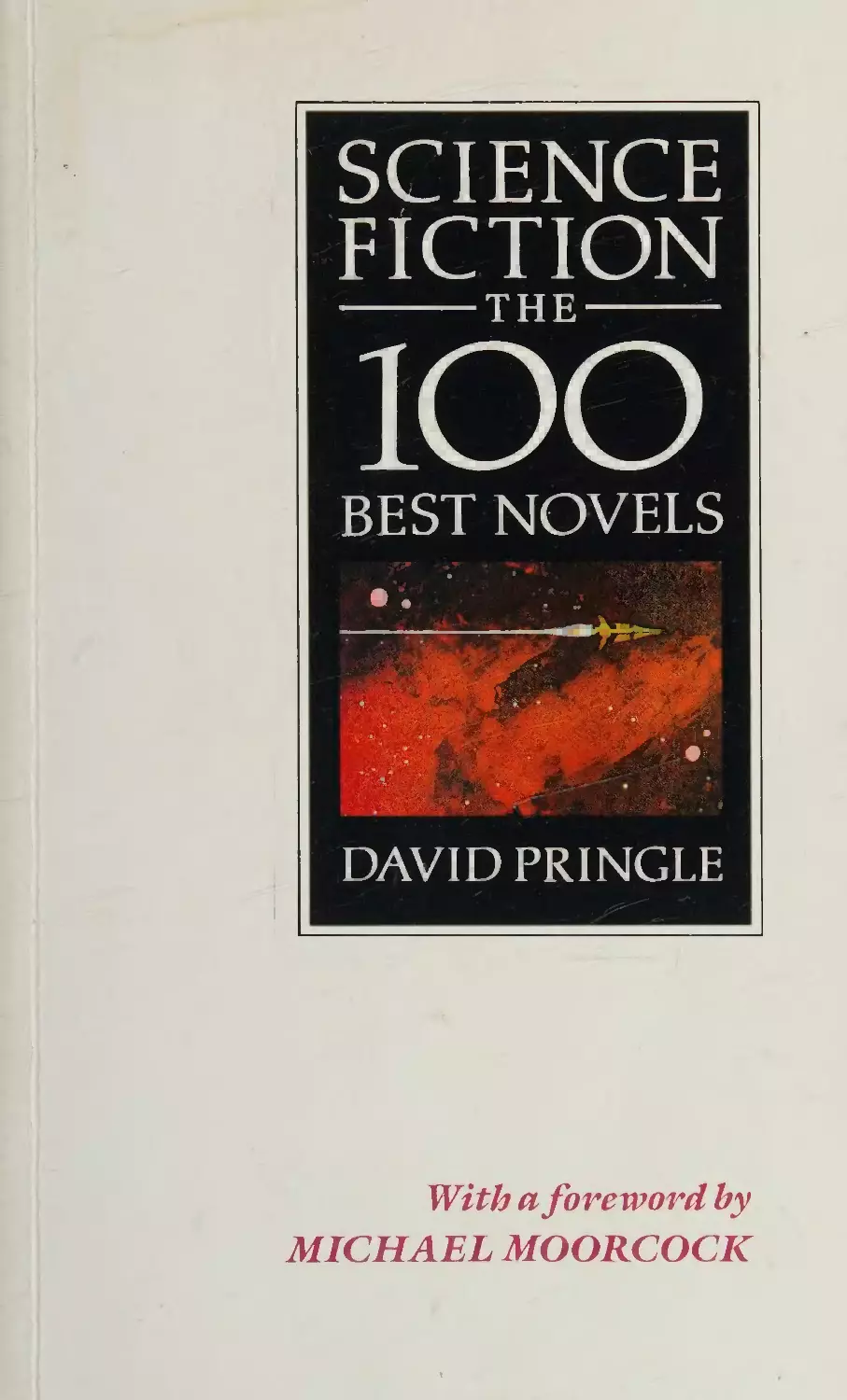
                    SCIENCE
FICTION
THE
BEST NOVELS
DAVID PRINGLE
With a foreword by
MICHAEL MOORCOCK

FEB. 1986
CIENCE FICTIO1
HE 100 BEST NOVELS
'> English-Language Selection, 1949-19C
by
David Pringle
Xanadu

FOR MY MOTHER
AND IN MEMORY OF MY FATHER,
MAURICE JOHNSTONE PRINGLE
(4th February 1924 - 29th October 1984)
British Library Cataloguing in Publication Data
Pringle, David
Science Fiction: the 100 best novels: an English-language selection,
1949-1984
1. Science fiction, English—History and criticism 2. English
fiction—20th century—History and criticism
I. Title
823’.0876’09	PR888.S35
ISBN 0-947761-11-X
ISBN 0-947761-10-1 Pbk
Copyright (C) David Pringle 1985
Foreword © Michael Moorcock 1985
First published in 1985 by
Xanadu Publications Ltd., 5 Uplands Road, London N8 9NN
Distributed by Bookpoint Limited
39 Milton Trading Estate, Abingdon, Oxon. OX14 4TD
Typeset by John Button
Myrtle Cottage, Laurieston DG7 2NL
Printed and bound in Great Britain by
Redwood Burn Ltd., Trowbridge, Wiltshire
All rights reserved

Foreword
It seems to me that there are few modern commentators on
science fiction better qualified to make a selection of this sort
than David Pringle, and I am happy to agree with most of his
choices. I can’t claim to have read every book included here but I
was surprised, when I came to study the list, at how many I did
know! During my main period of enthusiasm I found unreadable
many of the ‘Golden Age classics’ so praised in the fifties, and
although I’m sure the inclusion of the likes of Robert Heinlein is
necessary to give the book balance, I must say I remain blind to
their virtues. But many of David Pringle’s choices are actually
readable! Not a few are very well written, and a handful come
from some of our best modern writers.
There’s no question that the earlier books mentioned here (and
some of the later ones) were seminal to the development of sf
subject-matter and, to some extent, its treatment. We find the
political satire of Nineteen Eighty-Four, the post-disaster story
of Earth Abides, the romantic and ironic metaphors of The
Martian Chronicles, the paranoid conspiracy theme of The
Puppet Masters and the unplanned-for disaster of The Day of
The Triffids all in the first three years. In the early fifties there
were certain attempts to break narrative conventions (in Bester,
for instance, with his brilliantly imagined use of telepathy and
teleportation), but in the main sf story-telling was extremely
conventional—William Burroughs excepted. Because this is a
selection of novel-length stories, examples of experimentalism
only begin to appear in the late sixties; many of the fresh narra¬
tive techniques were being explored in the mid-sixties in shorter
forms, however, and it is a shame that some of the best writers to
bring attack and adventurous techniques to sf (e.g. Langdon
Jones and Harlan Ellison) are excluded for this reason, while
some who are included such as Robert Sheckley, M. John Harri¬
son and J.G. Ballard are not necessarily represented by their best
work. Short-story collections by Ellison and Sheckley are readily
available, and I would recommend Harrison’s The Ice Monkey
and The Machine in Shaft Ten-, Langdon Jones’ The Eye of
the Lens remains a remarkable collection of short, mainly
3

experimental fictions, and I should also mention Barry Bayley’s
The Knights of the Limits, as well as his novel Soul of the Robot.
Again, very few women were writing full-length stories until
relatively recently. I’m glad to see Leigh Brackett represented,
disappointed not to find C.L. Moore, Katherine MacLean or
Judith Merril. I am glad, however, to endorse David Pringle’s
choice of Joanna Russ’s The Female Man, which I believe is an
outstanding piece of fiction on every level. By the time the list
gets into the seventies there are a few more women novelists
appearing and of these the best, in my opinion, are those who
have used sf to express their own righteous anger, producing
feminist fiction in a form which best suits what they have to say.
Too few people, it seems to me, have chosen the sf form as a
means of harnessing and directing their impatience, sense of
injustice, political frustrations and general indignation at the
greed, folly, violence and unconscious (or conscious) misuse of
power displayed everywhere today. Brian Aldiss once said that sf
could never claim to be a mature form until as many women as
men read it. I would agree, and add that the form overall (as
opposed to many individual exceptions) will have come into its
own when as many good women writers find it suitable for their
needs.
It would be a good sign, I think, if the next list of 100 Best SF
Novels (from 1985) contained a predominance of books by
women, and by black people—only two black writers (Delaney
and Butler) are included here—as the present list contains (for
understandable reasons) a majority by white middle-class men.
The potential is there. I continue to believe that it has a good
chance of being realized.
How can you know if this selection is actually the best hun¬
dred sf novels published since 1949? I’m sure any individual
would quarrel with some of the choices. I’m also pretty certain
that most readers would agree on at least fifty of the books
mentioned here. And that, I think, is an excellent percentage.
MICHAEL. MOORCOCK
4

Contents ‘‘ / 0304?/ c
,	b'!o. 3# 3.05^
* ■‘•'7*** '		 —_	,r.. f f - --j— ,

FOREWORD BY MICHAEL MOORCOCK
3
AUTHOR’S INTRODUCTION
8
BRIEF BIBLIOGRAPHY
19
Nineteen Eighty-Four by George Orwell [1949]	21
Earth Abides by George R. Stewart [1949]	23
The Martian Chronicles by Ray Bradbury [1950]	25
The Puppet Masters by Robert A. Heinlein [1951]	27
The Day of the Triffids by John Wyndham [1951]	29
Limbo by Bernard Wolfe [1952]	31
The Demolished Man by Alfred Bester [1953]	33
Fahrenheit 451 by Ray Bradbury [1953]	35
Childhood’s End by Arthur C. Clarke [1953]	37
The Paradox Men by Charles L. Harness [1953]	39
Bring the Jubilee by Ward Moore [1953]	41
The Space Merchants by Frederik Pohl and C.M. Kornbluth [1953] 43
Ring Around the Sun by Clifford D. Simak [1953]	45
More Than Human by Theodore Sturgeon [1953]	47
Mission of Gravity by Hal Clement [1954]	49
A Mirror for Observers by Edgar Pangborn [1954]	51
The End of Eternity by Isaac Asimov [1955]	53
The Long Tomorrow by Leigh Brackett [1955]	55
The Inheritors by William Golding [1955]	57
The Stars My Destination by Alfred Bester [1956]	59
The Death of Grass by John Christopher [1956]	61
The City and the Stars by Arthur C. Clarke [1956]	63
The Door into Summer by Robert A. Heinlein [1957]	65
The Midwich Cuckoos by John Wyndham [1957]	67
Non-Stop by Brian Aldiss [1958]	69
A Case of Conscience by James Blish [1958]	71
Have Space-Suit—Will Travel by Robert A. Heinlein [1958]	73
Time Out of Joint by Philip K. Dick [1959]	75
Alas, Babylon by Pat Frank [1959]	77
A Canticle for Leibowitz by Walter M. Miller [1959]	79
5

The Sirens of Titan by Kurt Vonnegut [1959]	81
Rogue Moon by Algis Budrys [1960]	83
Venus Plus X by Theodore Sturgeon [1960]	85
Hothouse by Brian W. Aldiss [1962]	87
The Drowned. World by J.G. Ballard [1962]	89
A Clockwork Orange by Anthony Burgess [1962]	91
The Man in the High Castle by Philip K. Dick [1962]	93
Journey Beyond Tomorrow by Robert Sheckley [1963]	95
Way Station by Clifford D. Simak [1963]	97
Cat’s Cradle by Kurt Vonnegut [1963]	99
Greybeard by Brian W. Aldiss [1964]	101
Nova Express by William S. Burroughs [1964]	103
Martian Time-Slip by Philip K. Dick [1964]	105
The Three Stigmata of Palmer Eldritch by Philip K. Dick [1964]	107
The Wanderer by Fritz Leiber [1964]	109
Norstrilia by Cordwainer Smith [1964-68]	111
Dr Bloodmoney by Philip K. Dick [1965]	113
Dune by Frank Herbert [1965]	115
The Crystal World by J.G. Ballard [1966]	117
Make Room! Make Room! by Harry Harrison [1966]	119
Flowers for Algernon by Daniel Keyes [1966]	121
The Dream Master by Roger Zelazny [1966]	123
Stand on "Zanzibar by John Brunner [1968]	125
Nova by Samuel R. Delany [1968]	127
Do Androids Dream of Electric Sheep? by Philip K. Dick [1968]	129
Camp Concentration by Thomas M. Disch [1968]	131
The Final Programme by Michael Moorcock [1968]	133
Pavane by Keith Roberts [1968]	135
Heroes and Villains by Angela Carter [1969]	137
The Left Hand of Darkness by Ursula K. Le Guin [1969]	139
The Palace of Eternity by Bob Shaw [1969]	141
Bug jack Barron by Norman Spinrad [1969]	143
Tau Zero by Poul Anderson [1970]	145
Downward to the Earth by Robert Silverberg [1970]	147
The Year of the Quiet Sun by Wilson Tucker [1970]	149
334 by Thomas M. Disch [1972]	151
The Fifth Head of Cerberus by Gene Wolfe [1972]	153
The Dancers at the End of Time by Michael Moorcock [1972-76] 155
Crash by J.G. Ballard [1973]	157
Looking Backward, From the Year 2000 by Mack Reynolds [1973]	159
The Embedding by Ian Watson [1973]	161
6

Walk to the End of the World by Suzy McKee Charnas [1974]	163
The Centauri Device by M. John Harrison [1974]	165
The Dispossessed by Ursula K. Le Guin [1974]	167
Inverted World by Christopher Priest [1974]	169
High-Rise by J.G. Ballard [1975]	171
Galaxies by Barry N. Malzberg [1975]	173
The Female Man by Joanna Russ [1975]	175
Orbitsville by Bob Shaw [1975]	177
The Alteration by Kingsley Amis [1976]	179
Woman on the Edge of Time by Marge Piercy [1976]	181
Man Plus by Frederik Pohl [1976]	183
Michaelmas by Algis Budrys [1977]	185
The Ophiuchi Hotline by John Varley [1977]	187
Miracle Visitors by Ian Watson [1978]	189
Engine Summer by John Crowley [1979]	191
On Wings of Song by Thomas M. Disch [1979]	193
The Walking Shadow by Brian Stableford [1979]	195
Juniper Time by Kate Wilhelm [1979]	197
Timescape by Gregory Benford [1980]	199
The Dreaming Dragons by Damien Broderick [1980]	201
Wild Seed by Octavia A. Butler [1980]	203
Riddley Walker by Russell Hoban [1980]	205
Roderick and Roderick at Random by John Sladek [1980-83]	207
The Book of the New Sun by Gene Wolfe [1980-83]	209
The Unreasoning Mask by Philip Jose Farmer [1980]	211
Oath of Fealty by Larry Niven and Jerry Pournelle [1981]	213
No Enemy But Time by Michael Bishop [1982]	215
The Birth of the People’s Republic of Antarctica by John
Calvin Batchelor [1983]	217
Neuromancer by William Gibson [1984]	219
INDEX	221
7

Author's
Introduction
What is science fiction?
For many people nowadays, science fiction—‘sci-fi’ as the
media folk miscall it—means movies. It means Star Wars, E.T.
and 2010. For others it signifies television shows such as Doctor
Who and Star Trek, or radio series like The Hitch-hiker's Guide
to the Galaxy. For some, it may denote the comics, from ‘Super¬
man’ to ‘Judge Dredd’. Yet again, it may mean computer games
such as ‘Space Invaders’ or ‘Trader’. Clearly, science fiction has
many faces. It could even be defined as a type of advertising, used
to sell instant mashed potato or the services of British Airways.
However, the present work is not a study of such pop-cult
phenomena. It is strictly about the written word, about science
fiction in book form. Let us call the subject matter of this volume
‘sf’. All the rest is sci-fi. Written sf is at least as old as the voyages
extraordinaires of Jules Verne, which began to be published in
English translation in the 1870s. It is older than the ‘scientific
romances’ of H.G. Wells and his imitators, which appeared in
abundance after 1895. For several decades it was kept alive
principally by popular magazines—magazines which were
founded in the 1920s, 30s and 40s, and bore titles such as
Amazing, Astounding and New Worlds. These periodicals
encouraged the writing of sf short stories and novelettes—and, in
due course, they gave birth to the modern sf novel.
Yes, but what is science fiction?
There is no short answer to this vexed question. In the present
context, the best reply is simply to point at the pile of one hun¬
dred novels which are listed in this book, and to say ‘there—
those are science fiction!’—but I cannot duck the issue quite so
easily. After all, I chose those hundred titles, and I must have
done so according to some definitional criteria, however murky
8

and instinctive. Here, for better or worse, is my own working
definition of sf. It is neither elegant nor watertight, and I do not
make great claims for it. Science fiction is a form of fantastic fic¬
tion which exploits the imaginative perspectives of modern
science.
As with any definition, one has to explain the constituent
parts. By ‘modern science’ I mean the scientific world-view of
the 19th and 20th centuries, especially that world-view as it has
come to be accepted by the intelligent layperson (‘SF is no more
written for scientists than ghost stories are written for ghosts’ as
Brian Aldiss once put it). It can be argued that the scientific
world-view first became common property in the mid to late
19th century. By that time, the Newtonian understanding of the
physical universe had filtered down to the lowest intellectual
levels. Perhaps even more important, Lyell’s geology and
Darwin’s evolutionary biology had begun to make a strong
impression. These scientific advances opened up new imaginative
perspectives for the common man and woman—perspectives of
space (distant stars and galaxies), perspectives of time past
(dinosaurs and ‘cave men’), and perspectives of time future (the
end of the human race and of the earth). Above all, they estab¬
lished the idea of change, the realization that we have evolved
from ape-like ancestors and that we may continue to evolve in
the future. The impact of 19th century socialist theories, includ¬
ing Marxism, was also very important. They showed that society
too was subject to drastic change. Utopia ceased to be a vague
location on a fanciful map, and became a future possibility.
People became aware of how much their society had changed as a
result of technological innovation (the steam train, the electric
telegraph, and so on), and they began to realize how much more
it was going to change in the foreseeable future. It was against
this background that Verne began to write his voyages extra¬
ordinaire and Wells began to produce his scientific romances.
Science fiction had become a necessity.
For a long time sf had no sharply-defined identity. In Britain,
occasional novelists wrote stories in the Wellsian tradition.
Aldous Huxley is perhaps the best known, although Olaf Staple-
don, author of Last and First Men (1930) and Star Maker (1937),
has a claim to being the greatest. Stapledon did not call his books
‘science fiction’—the term is supposed to have been invented in
America in 1929—but he was certainly aware that his self¬
9

imposed task was to illuminate, in fictional form, the perspec¬
tives of modern science. ‘To romance of the far future,’ he wrote
in the Preface to his first novel:
... is to attempt to see the human race in its cosmic setting, and to
mould our hearts to entertain new values.
But if such imaginative construction of possible futures is to be
at all potent, our imagination must be strictly disciplined. We must
endeavour not to go beyond the bounds of possibility set by the
particular state of culture within which we live. The merely fantas¬
tic has only minor power. Not that we should seek actually to
prophesy . . . We can only select a certain thread out of the tangle
of many equally valid possibilities. But we must select with a pur¬
pose. The activity that we are undertaking is not science, but art . . .
Yet our aim is not merely to create aesthetically admirable fic¬
tion. We must achieve neither mere history, nor mere fiction, but
myth. A true myth is one which, within the universe of a certain
culture (living or dead), expresses richly, and often perhaps tragic¬
ally, the highest admirations possible within that culture.
Stapledon’s own essays in myth creation have their failings, yet
they are tremendously impressive. Their primary purpose was to
help the reader attain a new sense of humanity’s place within the
grand sweeps of space and time. Stapledon chose the largest sub¬
ject possible, the Meaning of the Universe, and he tackled it
courageously.
Since the deaths of H.G. Wells in 1946 and Olaf Stapledon in
1950, the imaginative endeavour which they helped begin has
become ever more urgently relevant. Scientific knowledge has
doubled, trebled, quadrupled—and more. At the same time the
technological fruits of science have become increasingly available
to us (and to our political masters). From plastics and antibiotics
to microprocessors and gene-splicing, from jet aircraft and atom
bombs to the space shuttle and laser weapons in orbit, from tele¬
vision and transistor radios to interactive videodiscs and com¬
puter networks, the new things which have entered our lives are
baffling in their profusion and often frightening in their implica¬
tions. There is no need to rehearse them all here. If science fiction
was in some sense a necessity to the Europeans of the late 19th
century, then it is ten times as necessary now, in the late 20th
century, and it is of growing importance not only to Europe and
North America but to the entire world. Science fiction has be¬
come very popular in Japan, the Soviet Union, Latin America,
10

China—and its spread is continuing apace, part of the immense
cultural fallout of the West.
At its best, sf provides our urbanized, technologized society
with its most valid myths (to use that word as Stapledon used it in
1930)—literary myths which do not necessarily compel faith but
which help us to understand the devastating changes that sweep
our world. This is the most incredible, overwhelming period of
development and disruption through which the human race has
ever passed; and sf, whatever its shortcomings, is the character¬
istic literature of the age. It is a body of stories which we tell
ourselves in order to overcome our fear and puzzlement. At root,
sf is an attempt to comprehend all that is happening to us.
So sf is a form of fantastic fiction which exploits the imaginative
perspectives of modern science. While bearing in mind that it is
difficult to draw sharp boundaries between literary genres, I
would argue that there are two other forms of contemporary
fantastic fiction. These are the Supernatural Horror Story and the
Heroic Fantasy. By the supernatural horror story I mean such
works as Bram Stoker’s Dracula, the stories of H.P. Lovecraft
and his imitators, and most of the books of Stephen King.
Characteristicaly, these describe the irruption of some super¬
natural force into the everyday world, and they are horrific pre¬
cisely because the forces and phenomena described are irration¬
al—which is to say they are inexplicable in terms of the modern
scientific world-view. By heroic fantasy I mean such works as
J.R.R. Tolkein’s The Lord of the Rings, the whole sword and
sorcery sub-genre, and all those books which carry titles like The
Elfstones of Shannara. Usually, these are set in completely
imaginary worlds, never-never lands where the modern scientific
world-view is suspended and ‘magic’ rules. The emotional tenor
of these works is not so much horrific as pleasurably escapist.
Science fiction, as distinct from the other types of fantastic
fiction, always attempts to locate itself in the real universe, and to
present the reader with fantastic developments which are
explicable in terms of the scientific world-view. Of course, many
sf writers cheat: they use sleight-of-hand rather than genuine
scientific knowledge, but that does not matter as long as the
reader is more or less convinced that the marvellous things des¬
cribed could conceivably come within the bounds of scientific
rationality. Thus such dubious propositions as the likelihood of
11

time travel, telepathy, faster-than-light space flight, and
alternative universes have long been accepted in legitimate sf. If
the authors, through the skilful use of pseudo-science and
gobbledygook, can make things sound plausible in terms of their
scientific world-view, then they have achieved their aim. Even
so, some readers make a distinction between ‘hard’ sf, the sort of
thing which is written by physics graduates, and ‘soft’ sf, in
which the writer tends to be more concerned with the feel of a
technological world than with its workings.
Categorization can be invidious, and many writers are drawn
to sf because it seems to offer them more freedom than any other
‘category’. There are many eccentric individualists among those
who are commonly labelled sf writers, and to construct a defi¬
nition which neatly covers all of their works is utterly impos¬
sible. My definition is offered as a working tool, no more. It
describes a subject matter and an approach which is common to
most of the books covered in this volume. I say ‘most’ rather
than ‘all’ because rules are made to be broken, and some of the
best writers will delight in confounding our expectations.
This book contains brief essays on one hundred English-lan¬
guage sf novels which were first published between 1949 and
1984. Some appeared as magazine serials before they achieved
book form (in all cases, the dates I have given are those of first
book publication); others were published initially in hard covers.
In my opinion, these hundred titles are ‘the best’ that con¬
temporary science fiction has to offer. Admittedly the reasons
for selection are personal, but I have endeavoured to make my
choice as balanced as possible, without pretending that it is
anything other than an individual’s choice. There are in existence
various awards and prizes for The Best Science Fiction Novel of
the Year (the Hugo Award, the Nebula, the British sf Award, the
John W. Campbell Memorial prize, and so on), but for my
present purposes I decided to ignore them entirely. Many of the
hundred novels listed herein did win awards; on the other hand,
many did not. You will find no further mention of the awards in
this book, and if you are eager to know which novels were
winners I recommend that you consult Peter Nicholls’ excellent
Encyclopedia of Science Fiction, and similar reference works.
As I say, this is a personal choice, although I would not be so
foolish as to claim that I have been wholly uninfluenced by the
critical consensus on modern sf. Yes, there is such a consensus,
12

and I have indeed been influenced by it. I could hardly have
escaped the influence, since I have been editor of Foundation:
The Review of Science Fiction for the past five and a half years.
That journal, which is published three times a year by North
East London Polytechnic, was founded in 1972, and has become
one of the two or three leading periodicals in its field (the
Canadian sf Studies, begun in 1973, is another). Inevitably the
past editors and the regular critics who write for Foundation have
affected my judgement of contemporary sf. I salute them, and in
particular I should like to name John Clute, Malcolm Edwards,
Peter Nicholls, Brian Stableford and Ian Watson, but I must
stress that the choice of novels presented here is my own, not
theirs.
Why have I chosen 1949 as my starting point? There are several
reasons. I could have begun my listing in the 1890s or even
earlier, with the scientific romances of Wells and his contempor¬
aries, but that early ground has already been covered in several
histories of sf and in numerous reference books. Surely no-one
needs to be told again that The Time Machine, The War of the
Worlds and The First Men in the Moon are among the enduring
masterpieces of science fiction. I wanted the present volume to be
usefully up-to-date, so I decided to concentrate on the sf of the
post-World War II period.
As it happens, relatively few sf novels were published in the
immediate post-war years; the flood did not commence until
1949-1950. I wanted to begin with a strong title, a novel which is
generally recognized as major: George Orwell’s book suggested
itself as the obvious choice. So I settled on 1949 because it was
the year of Nineteen Eighty-Four (it was also the year of that
other fine work, George R. Stewart’s Earth Abides). Moreover, it
was in 1948-49 that major publishers began to issue science
fiction novels which were labelled as such.
The term ‘sf’ did not appear on the covers of novels published
before and during World War II. A.E. van Vogt’s The World of
Null-A, issued by Simon and Schuster in 1948, is credited with
being the first sf category novel to appear from a mainstream
American publisher. In the following year Doubleday began
their celebrated sf line, with Max Ehrlich’s The Big Eye as their
premier title, soon to be followed by works from Asimov, Hein¬
lein, Bradbury, and other sf writers who had built a reputation in
13

the magazines. In Britain, it took a little longer for the public to
become aware of sf as a book-publishing category; nevertheless,
‘science fiction’ seems to have become a widely-used term in the
early 1950s. The success of John Wyndham’s The Day of The
Triffids encouraged the London publisher Michael Joseph to
experiment with an sf line, and others such as Hart-Davis, Sidg-
wick and Jackson, Weidenfeld and Nicolson, Dobson, and
Heinemann also dabbled. Surprisingly, it was as late as 1960
before Victor Gollancz began a regular sf list.
The present selection concentrates on science fiction novels
published as books1, hence it is highly appropriate that I should
begin my survey in 1949, which is, roughly speaking, when sf
book publishing began. It also happens that I was born around
that time (in March 1950, to be exact) and so this volume covers
the years of my life. I have grown up with sf, as has the majority
of my readers. (For what it is worth, 1950 was also the year of the
first Hollywood sci-fi movie, Destination Moon.) It is hard for us
to imagine what it was like for readers of sf in the pre-1949 per¬
iod, when a belief in the likelihood of rocket flights to the moon
was almost enough to have one certified, and when sf books were
so scarce that one could read an entire year’s output in next to no
time and be left hungering for more.
Of course, there were the sf-specialty magazines, those pulp
repositories of dreams. The sf periodicals did not die in 1949; far
from it. That year saw the founding of The Magazine of Fantasy
and Science Fiction, a title which is still going strong in the 1980s.
In 1950 there came Galaxy, a monthly which had a great initial
impact, and which endured for more than two decades. In Britain
the chief sf magazine, New Worlds, did not really hit its stride
until the middle 1950s, though it had been founded in 1946.
Science fiction magazines remain important to this day, for they
are manufactories of new talent. Countless hardcover and paper¬
back anthologies have been culled from the pages of the maga¬
zines, and many of the sf novels mentioned herein would not
have been written were it not for those publications. In 1982 I
became co-publisher and co-editor of a new British quarterly,
Interzone, which is dedicated to sf short stories and has now
published over a dozen issues. I have credited the magazines
wherever possible throughout this book.
Nevertheless, I am writing here about novels, not magazines,
and not short stories. I have given full entries to two or three
14

books which are collections of short stories rather than novels
proper—an example is Ray Bradbury’s The Martian Chronicles
—but in each case it can be claimed that the collection forms a
unified work, a novel as near as dammit. Collections of unrelated
short stories are mentioned only in passing, and only in those
cases where I feel that a particular author has achieved some of
his or her most notable work in shorter forms.
I have a great fondness for science fiction, and I have a contin¬
uing faith in the form’s literary value and potential. But it is time
to make a confession. In writing this book, a task which has nec¬
essitated a good deal of intensive reading and re-reading over a
nine-month period, I have discovered that there are fewer than a
hundred masterworks in modern English-language sf. No more
than ten or a dozen of these novels can be described as literary
masterpieces. If one is in a generous mood, perhaps another
dozen or so can be called masterpieces of their sort, but that still
leaves over seventy which are decidedly less than masterpieces.
Some of them are old favourites of my own, books which gave
me great pleasure at fourteen or eighteen or twenty-two. Some
are other people’s favourites, novels which have been outstand¬
ingly popular or influential, or which seem to be especially good
representatives of their type. A small minority, perhaps as many
as ten, are books for which I have little or no personal enthus¬
iasm: they have been included for the sake of balance and variety.
I am aware that the title of the book is a misnomer. There
cannot be a hundred ‘best’ of anything, but to call it A Hundred
Better SF Novels or A Hundred Good-to-Brilliant SF Novels
would be silly, an all-too-public hedging of bets. Like Anthony
Burgess in his Ninety-Nine Novels: The Best in English Since
1939, I find myself working to an arbitrary number and a faintly
untruthful title. Perhaps I should borrow the statement with
which he ended his introduction: ‘If you disagree violently with
some of my choices I shall be pleased. We arrive at values only
through dialectic.’
Talk of literary values may strike some readers as odd. Surely,
they will say, sf is a form of paraliterature, or pop lit. It is inher¬
ently vulgar, at best crudely vigorous and naively inventive—and
open to fruitful sociological analysis. What bearing do the
values of literary criticism have here? On the other hand, some of
the more aggressive sf fans make the claim that science fiction is
its own universe of discourse, a unique form which is not
15

susceptible to evaluation by traditional literary standards. It
requires wholly new means of evaluation, means which may turn
black into white and make the frivolous seem profound. While I
must admit to occasional sneaking sympathies with these points
of view, I am obliged to reject them in the end.
In the long term, each of the novels described here will stand
or fall on its own merits: the genre props will decay, the tides of
fashion ebb away. Then we shall be forced to judge these books
on their individual qualities. Structure and style, characterization
and wit will become the salient points, points which we look for
in any novel. Above all, we shall judge each author’s vision, and
when we do so we shall be looking for a quality of truthfulness.
Great novels ‘tell it like it is’: they are true to reality, to human
nature, to the spirit of their age. Science fiction novels cannot
escape these demands. However fanciful the plots and ideas,
however ornate the decor, they must, in the end, have authenti¬
city if they are to live.
Darko Suvin, sf’s most formidable critic, defines science fic¬
tion as ‘the literature of cognitive estrangement’. I have no love
for his terminology, but his definition does point to two neces¬
sities. The ‘estrangement’ is what makes sf different from most
other fiction, it is what strikes us immediately as colourful and
intriguing: the changed worlds, the far planets, the bizarre alien
beings (or bizarre human beings). But we must not forget the
cognitive element: the knowledge, the perception, the vision,
which makes the gaudily or wondrously estranged relevant to the
here and now. Without that relevance, that authenticity, sf is
mere diversion, good for a few hours’ entertainment and then fit
only to be thrown away and forgotten.
I believe that a fair number of the novels listed here will not be
forgotten in the coming decades, for they have truthfulness.
Having made this large claim, I should say a few words about
omissions from my list. Obviously, I have omitted all works of
modern fantastic fiction, which I do not regard as sf. I have
ignored novels which may be placed in the aforementioned
classes of supernatural horror and heroic fantasy. I have also left
out fabulations, unless they have a significant scientific or
technological content. The term Tabulation’ may be taken as
descriptive of such hard-to-define books as Brian Aldiss’s The
Malacia Tapestry (1976) and John Crowley’s Little, Big (1981).
16

These titles are missing from my list not because I regard them as
less than fine works (they are very fine indeed), but because I do
not see them as science fiction.
At this point, undoubtedly, there will be objections to my
procedure, just as there may be a measure of disagreement with
my earlier off-the-cuff definition of sf. We have often been
warned against definitions—for instance, by the critic Mark
Rose, who writes in his book, Alien Encounters-. ‘A literary genre
is not a pigeonhole but a context for writing and reading . . .
Instead of thinking of science fiction as a thing, a kind of object
to be described, it is perhaps more useful to think of it as a tradi¬
tion, a developing complex of themes, attitudes and formal strat¬
egies that, taken together, constitute a general set of expecta¬
tions.’ In terms of an ever-changing context of generic expecta¬
tions, perhaps there is a sense in which novels such as the Aldiss
and the Crowley are sf. For the purposes of this book, however,
I am obliged to stick to a less permissive use of the term. I know
that science fiction is not a ‘thing’, but I must assert that sf is
these hundred books, and these hundred books are sf.
Nevertheless, there are many indubitable works of science
fiction that do not appear in my list, and there may be several
recognized sf writers who will feel slighted because they are not
represented at all while others are included three or four times
over. By now we are no longer talking about definitions: we are
down to the irreducible matter of taste. My taste in sf may be a
poor thing, but it is my own. I admit to blind spots—for ex¬
ample, I have little affection for the type of sf story which has
been called ‘planetary romance’ (the Prisoner of Zenda meets
Ayesha on Barsoom) whose leading practitioners nowadays
include Marion Zimmer Bradley and Anne McCaffrey, two
authors who are entirely missing from my list. I also admit to
ignorance, for after all I have not read everything. English-
language sf has become a very large field in the last thirty-five
years, from Nineteen Eighty-Four to 1984, and I did not have
room to mention everybody who can claim a share of the patch.
There are certain writers, from Barrington J. Bayley and
Richard Cowper to James Tiptree and Jack Vance, whom I part¬
icularly regret omitting, and of course there are new (and rela¬
tively new) people who keep coming to one’s attention. If I had
been permitted a hundred-and-first entry I might well have in¬
cluded a 1985 novel by Bruce Sterling called Schismatrix, an
17

exciting, imaginative work, of a type that strongly appeals to me.
Enough. Let the list stand, for all its imperfections and
partiality. The purpose is not to arrive at an irreproachable final
judgement, but to provoke people into reading more good
science fiction. Perhaps the list will also help to correct a few of
the false generalizations about sf which seem to be common—
for instance, the generalization that sf consists almost entirely of
stories about space travel. In fact, fewer than half of the hundred
novels described here touch on the subject of space travel, and
many of those that do—for example, Walter Miller’s A Canticle
for Leibowitz—deal with it only glancingly. Another false asser¬
tion about sf is that it is inherently childish, an escapist fantasy
fiction for kids, and I can only make the counter-claim that the
best science fiction addresses itself to adult concerns. These
hundred novels (with a few obvious exceptions such as Hein¬
lein’s Have Space-Suit—Will Travel, written specifically for
early-teenage readers, and possibly Clarke’s The City and the
Stars glowing with a somewhat naive and child-like sense of
wonder) are intended for adult minds.
But then one runs straight into another, contradictory, gener¬
alization: that sf consists for the most part of doom-laden horror
stories about disaster and dissolution. Modern sf has imagined
good places and bad, utopias and dystopias, just as it has pictured
wonderful expansive futures and bitter, terminal cataclysms. You
should not damn the whole by describing a part. Horror fiction
has its own virtues, but the point is that sf is much larger than
horror: it encompasses many modes. It can be horrific, yes, but it
can also be romantic, ironic, elegaic, comic, cerebral. It can
partake of the pastoral, or of the Menippean satire. It can be a
multitude of things, a protean form indeed.
I believe that the flexibility of the form is brilliantly demon¬
strated in the hundred titles I have selected for discussion. Many
of them are superbly entertaining books; a number are deeply
moving, and a few will disturb you profoundly. Some of the
finest English-language fiction of the past thirty-five years is
touched on here. This book invites you to enjoy it.
DAVID PRINGLE
Brighton, 1985
18

Brief Bibliography
The best one-volume reference work on sf is The Encyclopedia of
Science Fiction, edited by Peter Nicholls with associate editor
John Clute (London, Granada, and New York, Doubleday,
1979). -A second edition is now overdue. Runner-up to the
Nicholls book is Anatomy of Wonder: A Critical Guide to
Science Fiction, edited by Neil Barron (New York and London,
R.R. Bowker, second edition 1981). The best history of the genre
remains Billion Year Spree by Brian Aldiss (London, Weidenfeld
and Nicholson, and New York, Doubleday, 1973). I am told that
a new edition of this is in preparation.
Scholarly works on sf are now surprisingly numerous, and
worthy recent examples include Metamorphoses of Science
Fiction by Darko Suvin (New Haven, Conn., Yale University
Press, 1979); Science Fiction: Its Criticism and Teaching by
Patrick Parrinder (London, Methuen, 1980); Alien Encounters:
Anatomy of Science Fiction by Mark Rose (Cambridge, Mass.,
Harvard University Press, 1981); and The Entropy Exhibition:
Michael Moorcock and the ‘New Wave’ in British Science Fiction
by Colin Greenland (London, Routledge and Kegan Paul, 1983).
Studies of individual authors abound, and I should like to
mention in particular the (American) Oxford University Press
series ‘Science Fiction Writers’ under the general editorship of
Robert Scholes. This includes such volumes as Robert A.
Heinlein: America as Science Fiction by H. Bruce Franklin (1980)
and Olaf Stapledon: A Man Divided by Leslie A. Fiedler (1983).
Similarly, there are many bibliographies of individual writers,
and I single out for mention the ‘Masters of Science Fiction and
Fantasy’ series edited by L.W. Currey and published by G.K.
Hall and Co. of Boston, Mass. This series includes my own
J.G. Ballard: A Primary and Secondary Bibliography (1984).
The best books of interviews with sf writers are Dream
Makers: The Uncommon People Who Write Science Fiction by
Charles Platt (New York, Berkley, 1980), and its sequel, Dream
Makers II (Berkley, 1983).
Foundation: The Review of Science Fiction is published three
19

times a year by the SF Foundation, N.E. London Polytechnic,
Longbridge Road, Dagenham RM8 2AS, United Kingdom. SF
Studies, also thrice-yearly, comes from Robert M. Philmus,
English Dept., Concordia University, 7141 Sherbrooke Street
W., Montreal, Quebec H4B 1R6, Canada.
20

[1949]
1
GEORGE ORWELL
Nineteen Eighty-Four
My first choice is one of the best-known novels of our time, so I
shall not attempt to describe it in very much detail here. This
harrowing story about the tribulations of a minor official in a
future totalitarian state has provided us with much of the polit¬
ical argot of the age—words and phrases such as ‘Thought Pol¬
ice’, ‘Newspeak’, ‘Ministry of Truth’, ‘doublethink’, and ‘Big
Brother is watching you’ were all invented by George Orwell for
this book. It is quite simply a novel which has changed the
world. It is written in a good plain style which has made it
accessible to millions of readers, and by affecting the minds of
those millions Orwell ensured that his dark predictions did not
come true. Of course, it has been pointed out many times that he
was not really concerned with prediction at all—he was writing,
in an exaggerated form, about how things actually were in the
1940s.
The book did not have ‘Science Fiction’ printed on its cover.
By what right, then, do we claim it as sf? The story is set thirty-
six years into the future from the time of writing; more impor¬
tantly, it depicts certain technological devices which are used to
control the population of Airstrip One in the state of Oceania—
chief among these is the telescreen, a wall-mounted television set
which watches you even as you watch it. That is a pure sf image,
and perhaps a predictive one (with fibre-optic cables such as we
have in the 1980s a device like that could become a reality). But
the novel’s links with sf are deeper and more fundamental than
these details would suggest.
Like so many of his generation, Orwell (whose real name was
Eric Blair, 1903-1950) was profoundly influenced by Wells. In
his essay ‘Wells, Hitler, and the World State’, Orwell wrote: ‘It
was a wonderful thing to discover H.G. Wells. There you were,
in a world of pedants, clergymen and golfers . . . and here was
this wonderful man who could tell you about the inhabitants of
the planets and the bottom of the sea, and who knew that the
21

future was not going to be what respectable people imagined.’
Although he went on to criticize some of Wells’ political ideas, it
is clear that Orwell regarded the earlier writer’s work as a great
liberating force. Many other imaginations were stimulated in a
similar way—to such an extent that a whole tradition of ‘post-
Wellsian’ fiction came into being in Britain and further afield.
Now-forgotten authors such as J.D. Beresford, S. Fowler Wright
and John Gloag contributed novels and stories to that tradition,
as did more enduring writers like Olaf Stapledon, Aldous Hux¬
ley and C.S. Lewis. None of their books was published as science
fiction, for the term did not come into general use on this side of
the Atlantic until the early 1950s. If a generic label had to be
pinned on these exercises in ‘the Wellsian kind of thing’, then
they were usually known as scientific romances.
E.M. Forster’s novella ‘The Machine Stops’ (1909) was a scien¬
tific romance which set out to rebut the notion that one could
perfect the human race through the application of modern tech¬
nology. Huxley’s Brave New World (1932) was another such
cautionary tale. Both are examples of the anti-utopia, or ‘dys¬
topia’. Orwell’s Nineteen Eighty-Four is a successor work, the
bleakest dystopia of them all. It was the example of Wells, both
in terms of the forms he invented and the subject matter he used,
and moreover it was the debate that Wells began and which con¬
tinued throughout the work of at least a dozen other writers, that
made Orwell’s masterpiece possible. I see Nineteen Eighty-Four
as a Janus of a book, facing two ways: it is both a culmination of
the British scientific romance, and a source book for much of the
science fiction which has followed. It sums up the terrible exper¬
iences of the 20th century’s first half, and it casts a long shadow
of foreboding over its second half, our half.
First edition: London, Seeker, 1949 (hardcover)
First American edition: New York, Harcourt Brace Jovanovich, 1949
(hardcover)
Most recent editions: London, Penguin and New York, nal
(paperbacks)
22

[1949]
2
GEORGE R. STEWART
Earth Abides
Like Orwell’s Nineteen Eighty-Four., this book was not pub¬
lished under the ‘science fiction’ label—yet it has come to be
accepted as one of the great American sf novels. There is no
doubt that it is sf: the science which so effectively underpins the
narrative is ecology (far from being a buzz-word in 1949).
George Rippey Stewart (1895-1980) taught English at the Uni¬
versity of California and wrote over thirty books, ranging from
historical novels to scholarly studies of place-names. He had an
abiding interest in the history and landscape of America, and a
deep understanding of the ways in which the environment has
shaped human activity. His novels Storm (1941) and Fire (1948)
are about the efforts of Americans to cope with natural catas¬
trophes. In his finest work, Earth Abides, he describes in meti¬
culous detail the aftermath of a more unusual disaster —a mys¬
terious plague which kills the vast majority of the human race.
Isherwood Williams, a graduate student of geography, returns
from a sojourn in the mountains to discover that everybody is
dead. At the beginning of the novel he is like a Robinson Crusoe
who has an entire continent to sustain him. He ranges through
empty towns and cities, watching the devolution of the landscape
with a disinterested scientist’s eye. He befriends a dog; he ob¬
serves plagues of insects and rodents; he watches the fields go to
seed and the highways crack up. All this is described with a su¬
perb naturalism which draws on a rich fund of knowledge. At
length Ish returns to San Francisco, where he meets a female
survivor who becomes his wife. They have children and a small
community forms around them. Years go by as they live the life
of their pioneer ancestors, an existence made slightly more
comfortable by their foraging in the detritus of civilization.
Ish tries to teach his children to read books and to understand
all the achievements of humanity’s past, but young Joey, the
brightest of his kids, dies. The others go their own way, learning
the physical skills necessary to cope with their environment but
23

showing no interest in the past. As the decades pass the few sur¬
vivors of the pre-plague era die off, until only Ish is left as a
witness to the greatness that has been. His grandchildren and
great-grandchildren regard him almost as a tribal deity, an in¬
comprehensible old man who babbles of impossible things. They
have become a band of hunter-gatherers, in harmony with their
surroundings, roaming the West Coast like the Amerindians of
old. History has gone full circle, and Ish realizes in his dying
moments that ‘men go and come, but earth abides’.
The novel is written with great conviction and emotional in¬
tensity. It moved me to tears when I first read it. The poet Carl
Sandburg wrote in the 1950s: ‘If I should be naming five novels
out of the last ten years most worthwhile, most worth reading, I
would certainly include a book titled Earth Abides. It reads as a
good story and has profound meanings. I thank Brother Stewart
for writing it.’ Just so. In this beautiful meditation on ecology,
old age, and the implacability of change, George R. Stewart
wrought, albeit unknowingly, one of the masterworks of science
fiction.
First edition: New York, Random House, 1949 (hardcover)
First British edition: London, Gollancz, 1950 (hardcover)
Most recent edition: London, Corgi Books (paperback)
24

[1950]
3
RAY BRADBURY
The Martian Chronicles
Ray Bradbury (born 1920) has long been acclaimed as one of
America’s finest short-story writers. This was the book which
established his reputation. It is a collection of closely-linked
stories about the exploration and colonization of the planet
Mars. Given that theme, and the fact that most of the stories had
appeared in the (lesser) sf magazines of the late 1940s, it is natural
to assume that the book is unequivocally science fiction. In fact,
that definition has often been disputed, since Bradbury shows no
interest in science as such. His space rockets are like firecrackers;
his Mars people are Halloween ghosts; while his Martian land¬
scape is an arid version of the American mid-west. Moreover,
Bradbury was known as a frequent contributor to Weird Tales (a
magazine of the fantastic and horrific) and he has since published
books such as Dandelion Wine (1957) and Something Wicked
This Way Comes (1962), which are fantasies of childhood magic
far removed from the concerns of sf. None of Bradbury’s Mar¬
tian stories appeared in Astounding S-F, the leading magazine of
‘hard’—which is to say rationalistic—science fiction. That maga¬
zine’s purist editor, John W. Campbell, would have rejected
Bradbury’s stories out of hand. The stories may have had ‘reli¬
gion’, but they had no physics; they were almost blasphemous in
their disregard for the facts of time and space.
Or so it once seemed. Modern science fiction has become
much more diverse since 1950, and Bradbury’s radicalism now
looks rather tame. I would certainly contend that The Martian
Chronicles falls within the definition of sf, since it uses all the
trappings of interplanetary fiction, as well as such familiar motifs
as telepathy, invisibility, and the threatening nuclear arma-
geddon. The innovative thing about Bradbury’s work was that he
used all these elements to achieve personal, private ends, ignoring
the consensus views on how a good sf story should be written.
He put far more emphasis on style and mood than he did on
technical detail or scientific plausibility, thus offending the
25

already hardening sensibilities of editors and writers who had
grown up with the American sf magazines during the 1930s and
40s. His reward was a stunning popular and critical success: he
was taken up by the literary world at large and invited to write
for the highest-paying general magazines, as well as for Holly¬
wood. In all the subsequent clamour, his effect on the sf genre
has been overlooked: despite opposition from certain quarters,
his work became an example to many younger writers, and even
if they didn’t emulate him they felt that he had helped free them
to be themselves.
So The Martian Chronicles is an historically important work.
It now seems dated, its poetry at times rather precious, its wist¬
fulness more than a little sentimental, but the best passages still
have a magical quality. My favourite of the Chronicles is the one
entitled ‘—And The Moon Be Still As Bright’, in which a band of
roughnecks from Earth begins to despoil the empty cities of
Mars. One of these men is moved to rebel, and takes to the hills
as a lone defender of the dead Martian culture. He is eventually
hunted down and shot, but not before his actions have made
most of the others aware of their own wrongdoing. The twilit
atmosphere of this story pervades much of the rest of the book. I
also like the chapter called ‘The Off Season’, with its evocation of
the Martian sand ships: ‘The wind hurled the sand ship keening
over the dead sea bottom, over long-buried crystals, past
upended pillars, past deserted docks of marble and brass, past
dead white chess cities, past purple foothills, into distance . . .’.
First edition: Garden City, Doubleday, 1950 (hardcover)
First British edition: London, Hart-Davis, 1951 (hardcover;
retitled The Silver Locusts)
Most recent editions: New York, Bantam Books, and London, Granada
(paperbacks)
(Recent British editions have restored the American title)
26

[1951]
4
ROBERT A. HEINLEIN
The Puppet Masters
Throughout the 1940s the most influential science fiction maga¬
zine was John W. Campbell’s Astounding S-F, and that maga¬
zine’s chief contributor and leading light was Robert Anson
Heinlein (born 1907). He was a tough-minded ex-Navy man
with engineering training, who on occasion liked to compare
himself with Stevenson, Kipling and Wells, in that he was ‘really’
a man of action and affairs, forced to take up the slightly effete
profession of writing because of ill-health. He did not begin to
write until he was 32, by which time he had variegated experience
in business and politics as well as in military service. This stood
him in good stead when he started to produce hard-edged, real¬
istic near-future stories for sf magazines. Many of his stories
were about the politics, law and industrial relations of the com¬
ing space age, and they formed a continuous so-called ‘Future
History’. These works of the 1940s are collected in such books as
The Man Who Sold The Moon (1950), The Green Hills of Earth
(1951) and Revolt in 2100 (1953). At the same time Heinlein
wrote a number of more fanciful stories, including the excellent
tale of time travel ‘By His Bootstraps’, but these were published
initially under pseudonyms. After World War II he began a long
series of sf novels for teenagers, notable for their verve,
conviction and technical accuracy. His first new post-war novel
for adults was The Puppet Masters.
But this one did not receive serial publication in Astounding.
In 1950 a new monthly magazine called Galaxy Science Fiction
appeared, which promptly became the leading periodical in the
field, and one of the first serials it ran was Heinlein’s The Puppet
Masters. A surprising number of the 1950s novels I have chosen
for this volume first appeared in Galaxy, and its importance as
a stimulus to American sf should not be underestimated.
The first-person narrative of The Puppet Masters opens in the
year 2007. The hero is a secret agent who works for a CIA-type
organization. Together with his boss—known throughout as the
27

‘Old Man’—and a beautiful female colleague he refers to as ‘Sis’,
he investigates the reported landing of a flying saucer in Iowa. At
first assumed to be a hoax, it turns out to be terrifyingly
genuine—and the first of many. The alien vessels carry intelligent
slug-like organisms which attach themselves to the backs of
human beings, tapping into their hosts’ nervous systems and
taking control of their minds and actions. The human puppets
and their hideous masters intend to take over the whole world:
they must be fought without mercy.
The story moves along vigorously, full of violence, paranoia
and a subliminal nastiness. When one bears in mind that it was
written in the usa of the early 1950s, it is easy to see the puppet
masters as stand-ins for the Communist Menace. Whether or not
one agrees with Heinlein’s implied political views, one has to
admit that the novel delineates a certain state of mind with great
energy and skill. Much of the ‘charm’ of the book lies in the
method of narration, a mixture of wisecracks and laconic senti¬
mentality which leaves no doubt that Heinlein had learned a
thing or two from Hammett, Chandler and the ‘hard-boiled’
school of crime fiction writers. There is also a curious sub-plot
which revolves around an intensely emotional Family Romance
(I use this phrase with Freud in mind). It turns out that the ‘Old
Man’ is indeed the hero’s father; there is even a hint that the
heroine might genuinely be his sister. At a couple of high points
in the narrative the hero breaks down in tears. He is a strong man
who is only too ready to weep and be comforted by his ‘Sis’. It is
all rather strange. Perhaps Heinlein can best be described as an
unconscious artist: without quite realizing what he is doing, he
reveals, very honestly, that all our manly aggressions are rooted
in extremely boggy emotional ground, well watered by the tears
of longing and frustration.
First edition: Garden City, Doubleday, 1951 (hardcover)
First British edition: London, Museum Press, 1953 (hardcover)
Most recent editions: New York, nal, and London, Pan (paperbacks)
28

[1951]
5
JOHN WYNDHAM
The Day of The Triffids
I well remember the thrill that Wyndham’s book gave me when I
first read it at the age of thirteen. The hero awakes in hospital, his
eyes bandaged after a minor operation. He knows it is Wednes¬
day, but there is an odd lack of weekday noises; he hears no
motor traffic, just a strange shuffling sound and an occasional
human cry. Finally he tears off his bandages to find that almost
everyone in the world apart from himself has gone blind. It is a
brilliant opening, one of the best hooks in popular fiction. The
style is unpretentious, very English, very middle class, a trifle
cosy, a bit stiff-upper-lip. But the narrative is tremendously in¬
volving. Bill roams the streets of London, dodging the panic-
stricken people. He soon meets up with an attractive young
woman who also retains the ability to see. They are the chosen
ones indeed. Then the triffids arrive, large ambulatory plants,
possibly of extraterrestrial origin, which have been bred for their
valuable oil. In a suddenly blinded world they have come into
their own, lurching through the city streets and lashing out with
their fatal stings. In summary it sounds absurd, but Wyndham
makes it all surprisingly convincing. He plays on collective post¬
war fears by suggesting that the universal blindness has been
caused by the premature activation of a secret military device in
Earth orbit. He hints that the triffids are nature’s revenge on an
overweening human race. But it would be a mistake to stress the
‘moral’ in what is first and foremost an exciting escapist romp.
The author, whose full name was John Wyndham Parkes
Lucas Beynon Harris (1903-1969), had served a long apprentice¬
ship in the British and American pulp magazines—though he did
not let that show. To most readers ‘John Wyndham’ was a new
writer in 1951 (most of his previous work had appeared under
the bylines ‘John Beynon Harris’ or ‘John Beynon’). He became
a bestseller in Britain, and reviewers frequently compared him
with H.G. Wells. In fact he had considerably less depth and orig¬
inality than Wells. His subsequent novels, The Kraken Wakes
29

1953) and The Chrysalids (1955), also did extremely well and
inspired many imitators. They are the quintessential British ‘dis¬
aster novels’, now a recognized sub-category of modern science
fiction. In each of them some cataclysm overwhelms the Earth,
and a few plucky individuals struggle to survive, usually without
too much difficulty. In truth they are rather genteel books, tales
of apocalypse tamed.
The Day of the Triffids portrays a very enjoyable catastrophe.
Millions die, but the reader feels no pain. Bill and his handful of
well-disciplined friends are given plenty of opportunity to prove
their manliness. There is much sexual opportunity too. At one
point the hero is exhorted to take on several ‘wives’; there just
aren’t enough fit men to go round. In the event he sticks to mon¬
ogamy, but what a pleasant predicament. There is no overt sex in
the book, though the reader is free to let his fantasies spin off
from the page . . .
The story ends with the hero and heroine living happily on the
Isle of Wight, and there is no doubt that their children will grow
up to be stalwart English types. Contrast this with the aching
sense of loss that one feels in the closing chapters of George
Stewart’s Earth Abides. Wyndham’s novel lacks the profundity
of the earlier book, but for all that it is an effective piece of
modern myth-making. In a sense it is full of nostalgia for the
Home Front of World War II, projecting as it does a rather jolly,
Dunkirk-spirit, keep-the-home-fires-burning view of things.
First edition: London, Michael Joseph, 1951 (hardcover)
First American edition:Garden City, Doubleday, 1951 (hardcover)
Most recent editions: London, Penguin, and New York, Fawcett
(paperbacks)
30

[1952]
6
BERNARD WOLFE
Limbo
If Brave New World and Nineteen Eighty-Four are the two great
dystopian visions in modern British fiction, then Bernard
Wolfe’s Limbo has some claim to being their closest American
equivalent. Yet, curiously, it has failed to exercise that claim,
either in the popular imagination or in the literary-critical con¬
sensus. I think it is a masterpiece, although I must admit that it
has been a sadly neglected one. Perhaps its central image—of a
near-future society in which men cut off their own limbs to
prevent themselves from waging war—is too disturbing, too
crazed, to make for ready acceptance. It is easier to imagine us
succumbing to the ‘feelies’ and soma, or indeed to the everlasting
boot in the face, than it is to project ourselves into Wolfe’s limb¬
less, lobotomized world of 1990.
But what a grand cornucopia of a book Limbo is! It is big (413
pages in the Ace paperback edition), blackly humorous, and full
of a passionate concern for the problems of its day—particularly
the problems of war, institutionalized violence, and humanity’s
potential for self-destruction. It is a novel which goes gloriously
over the top, replete with puns, philosophical asides, satire on the
American way of life, comments on drugs and sex and nuclear
war, doodles and typographical jokes, medical and psycho¬
analytical jargon—a veritable Tristram Shandy of the atom¬
bomb age. In an afterword the author pays tribute to Norbert
Wiener, Max Weber, Dostoevsky, Freud and, surprisingly, the sf
writer A.E. van Vogt. ‘I am writing,’ he continues, ‘about the
overtone and undertow of now—in the guise of 1990 because it
would take decades for a year like 1950 to be milked of its
implications.’
Bernard Wolfe (born 1915) earned a b.a. in psychology from
Yale University, and for a short time he worked as a bodyguard
to Leon Trotsky in Mexico, though he was not present when
Trotsky was eventually assassinated. His first book, Really The
Blues, was about jazz music, and he went on to write a variety
31

of novels and non-fiction works. Evidently a man of parts. Ex¬
cept for a few short stories, Limbo remains his only venture into
science fiction, yet it gives ample proof that he understood the
form better than most. ‘The overtone and undertow of now’ is
precisely the subject matter of all the most serious sf.
The plot concerns the travels and travails of Dr Martine, a
neurosurgeon who in the year 1972 fled from a limited nuclear
war to the haven of a forgotten island in the Indian Ocean. He
has spent eighteen years there, performing lobotomies on the
more antisocial of the simple natives (this is a humane continu¬
ation of the natives’ ancient practice of mandunga, or crude brain
surgery). In 1990 Martine sets out to rediscover the world. He
finds a partially destroyed North America in which the ideology
of Tmmob’ holds sway. In this grotesque post-bomb society
men have their arms and legs removed and replaced with com¬
puterized prosthetics, in the belief that self-mutilation will pre¬
vent the recurrence of world war. It is a faulty equivalent of the
islanders’ mandunga, the lobotomy which cuts away aggressive
urges. Martine is horrified to discover that much of the inspira¬
tion for Tmmob’ comes from a diary which he himself wrote and
lost in that fateful year of 1972. He is the unwitting prophet of
this nightmarish state; his jokes of eighteen years ago have been
taken all too seriously. In any case it has all been in vain, for
things are falling apart and a new war is about to begin. The story
ends with Martine fleeing to his peaceful island as the bombs fall
once more on the cities of America. It sounds grim and fatalistic,
but in fact the novel is enormously funny and invigorating, and
in the end holds out a kind of hope. Rich with ideas, all-embrac¬
ing in its references, it is a book which uses the science and psy¬
chology of 1950 to grapple with the largest issues of our century.
It is time that Limbo was recognized for what it is: the most
ambitious work of science fiction, and one of the most success¬
ful, ever to come out of America.
First edition: New York, Random House, 1952 (hardcover)
First British edition: London, Seeker and Warburg, 1953 (hardcover;
retitled Limbo ’90)
Most recent editions: London, Penguin (paperback, abridged),
and New York, Ace (paperback, unabridged)
32

[1953]
7
ALFRED BESTER
The Demolished Man
This is a novel which features ESP—extra-sensory perception—a
commonly-accepted scientific term for telepathy and kindred
powers of the mind. Despite the experiments of Dr J.B. Rhine
and his successors in the USA, the scientific status of ESP remains
dubious: most scientists would deny that mind-reading, precog¬
nition and the like are even remotely possible. This has not de¬
terred science fiction writers from using ESP as a recurring motif
in their novels. Like time-travel and faster-than-light spaceflight,
it is one of those ‘impossibilities’ that sf takes in its stride. And
ESP does make for good stories, as Alfred Bester demonstrates in
this sparkling thriller.
It is set in the world of the 24th century. Space travel has
become commonplace, and there are human colonies on Mars,
Venus and the major satellites of the outer planets. One of the
novelties of Bester’s fast-moving narrative is that it leaps from
scene to scene, sometimes from planet to planet, within the space
of a paragraph; he makes the entire solar system seem like the
suburbs of New York. A minority of the population has e.sp
powers. These people are organized into the ‘Esper Guild’, one
of the purposes of which is to train normal folk in telepathic
skills. The protagonist, Ben Reich, is a non-telepath. The fabul¬
ously wealthy head of a huge business empire, he is an obsessed
and driven man, mistrustful of all those who are gifted with ESP.
He sets out to commit a murder, and elicits the aid of a corrupt
member of the Esper Guild. The latter’s assistance is essential,
since in this society murderers can be detected telepathically
before they carry out their crimes. Reich wishes to kill a business
rival, using an antique weapon known as a gun . . .
The murder is duly committed, and the bulk of the story is
taken up with a protracted duel of wits beween Reich and his
nemesis, a charming telepathic police chief called Lincoln Powell.
The penalty for Reich’s crime is demolition—total destruction of
the personality—and he and Powell move in an ever-tightening
33

spiral until that shattering climax is reached. It is a very ingenious
story, and it all takes place against a swiftly-changing backdrop
which is sometimes quite literally riotous with colour. Consider,
for example, Number 99 Bastion West Side, the Rainbow House
of Chooka Frood, madam and clairvoyant: ‘Number 99 was an
eviscerated ceramics plant. During the war a succession of blaz¬
ing explosions had burst among the stock of thousands of chemi¬
cal glazes, fused them, and splashed them into a wild rainbow
reproduction of a lunar crater. Great splotches of magenta, vio¬
let, bice green, burnt umber and chrome yellow were burned into
the stone walls. Long streams of orange, crimson and imperial
purple had erupted through windows and doors to streak the
streets and surrounding ruins with slashing brush strokes.’ It
reminds one of some psychedelic hippy pad, described fifteen
years before its time.
Alfred Bester (born 1913) has written comparatively little
science fiction, and yet he is second only to Robert Heinlein as
an influence on the sf field in America. Such later writers as
Philip K. Dick, Samuel R. Delany and William Gibson reveal
that influence in differing ways. Moreover, unlike Heinlein he
has had a major impact on certain younger British writers,
notably Michael Moorcock and M. John Harrison. What im¬
pressed all these people is Bester’s style, his dash, his New York-
bred ‘street wisdom’. He brought to sf a certain profanity and
iconoclasm allied to a species of idealism (usually expressed as
‘sympathy for the common man’) and a willingness to experi¬
ment while never deviating from a strong narrative line. The
Demolished Man, his first novel, still seems fresh after more than
three decades.
First edition: Chicago, Shasta, 1953 (hardcover)
First British edition: London, Sidgwick and Jackson, 1953 (hardcover)
Most recent editions: New York, Pocket, and London, Penguin
(paperbacks)
34

[1953]
8
RAY BRADBURY
Fahrenheit 451
The burning of books is a subject which holds a horrid fascina¬
tion for Ray Bradbury. He has touched on it in several of his
short stories as well as in this, his nearest approach to a full-
length sf novel. The title refers to the temperature at which paper
is supposed to catch fire, which itself may be an immodest meta¬
phor for the ‘ignition’ of Bradbury’s prose style. Unlike other sf
writers of his day he has an intensely self-conscious style:
‘Without turning on the light he imagined how this room
would look. His wife stretched on the bed, uncovered and cold,
like a body displayed on the lid of a tomb, her eyes fixed to the
ceiling by invisible threads of steel, immovable. And in her ears
the little Seashells, the thimble radios tamped tight, and an
electronic ocean of sound, of music and talking and music com¬
ing in, coming in on the shore of her unsleeping mind. The room
was indeed empty. Every night the waves came in and bore her
off on their great tides of sound, floating her, wide-eyed, toward
morning.’ Repetitive, incantatory, this is actually one of the less
purple passages. It describes Mildred, Guy Montag’s wife, in¬
dulging in her favourite pastime of listening to her personal hi-fi.
Stupid, empty-headed woman, one is encouraged to think—and
yes, there is in this book, as in most sf novels of the 1950s, a rote
sexism, which once noted, I shall pass over perforce.
It is a rather simple-minded dystopia which Bradbury creates.
Everyone listens to the ‘Seashells’ and watches wall-to-wall tv.
Pedestrians are arrested; even to drive as slowly as forty miles an
hour is considered an offence. All books are banned and conver¬
sation is a truly forgotten art. Suicide and juvenile delinquency
are rife, the world is overpopulated, and states are gearing them¬
selves up for yet another war. Montag works as a ‘fireman’; his
duty is to burn books, the former owners of which are carted off
to prison or the mental home. In spite of himself, Montag has
intellectual and poetic yearnings, and when he meets a fey seven-
teen-year-old girl who teaches him to appreciate trees and
35

flowers and rain he is moved to rebel against his job and his
society. He reads Matthew Arnold’s ‘Dover Beach’ and becomes
aware of the ignorant armies clashing by night all around him.
He makes contact with a secret underground of readers who are
keeping literary culture alive by stealth. But eventually he is
found out, and the fire engine arrives at his front door.
Fahrenheit 451 is a very straightforward book, a scream of rage
against the mass media and the whole 20th century communica¬
tions landscape. Television, pop music, comic books, digests,
theme parks, spectator sports—Bradbury is agin ’em all, and if he
had been writing this book thirty years later he would no doubt
have included video games, home computers and role-playing
fantasies in his tirade. It is the litany of an old-fashioned, puritan¬
ical moralist; small wonder that the message of this novel has
fallen sweetly on the ears of schoolteachers and other Guardians
of Culture the world over. Wrapped up as it is in an exciting
story with poetic overtones, that message has proved to be a very
acceptable one. Bradbury’s book has become a Set Text, and so
he has done his bit against the steady spread of Marshall
McLuhan’s ‘global village’ and the growing network of vacuous
entertainment and ‘information’. As a tract for teenagers,
Fahrenheit 451 still has considerable merits, but it is scarcely a
classic of adult science fiction. It is too unbalanced to be counted
as a serious attempt to grapple imaginatively with the moral
values of the media barrage.
First edition: New York, Ballantine, 1953 (hardcover and paperback)
First British edition: London, Hart-Davis, 1954 (hardcover)
Most recent editions: New York, Bantam, and London, Granada
(paperbacks)
36

[1953]
9
ARTHUR C. CLARKE
Childhood's End
A novel about transcendence, with a very apt title, this book was
another particular favourite of mine when I was in my early
teens. It is generally recognized as Clarke’s first major work (he
had already published The Sands of Mars, a humdrum novel
about space colonization, in 1951), and it gained praise from C.S.
Lewis, among others, for its deft blend of hard science and re¬
ligious mysticism. Set in the immediate future, at a time when the
first manned space rockets are about to be launched, it depicts
the arrival on earth of vastly powerful alien beings who become
known as the ‘Overlords’. Despite that ominous name, this is not
a horrific tale of invasion and violent takeover: Clarke’s Over-
lords have come to do us good in spite of ourselves, and the novel
convincingly demonstrates the way in which beneficent alien
rulers might spread harmony over a warring planet. As a young
reader I assented to the whole idea, though its implications now
make me uneasy. Arthur Charles Clarke (born 1917) is an Eng¬
lish writer who has chosen to live for the past several decades in
the former British colony of Sri Lanka. In my more questioning
moments I cannot help feeling that the Overlords are an idealized
projection of the Foreign Office bureaucrats who once ran the
British Empire.
But there is a twist: these Overlords are not white-skinned.
For fifty years they hide from humanity, and when at last they
do reveal themselves it comes as a shock. ‘There was no mistake.
The leathery wings, the little horns, the barbed tail—all were
there. The most terrible of all legends had come to life, out of the
unknown past. Yet now it stood smiling, in ebon majesty, with
the sunlight gleaming upon its tremendous body, and with a
human child resting trustfully on either arm.’ That revelation
knocked me sideways when I first read the novel. It comes just
one-third of the way through, and the next section is an extended
description of the scientific utopia that the Overlords have
wrought, a world without poverty, happily united under one
37

government; crime almost non-existent, everyone living in gar¬
den cities, with endless leisure to pursue the arts and science. It
made me sigh with longing: how rational, how wonderful!
There is more to come. The children of this utopia begin to
dream strange dreams; they have night-time visions of far suns,
alien planets. Under the tutelage of the Overlords they are begin¬
ning to evolve into something which will seem incomprehensible
to their parents. They are about to join the ‘Overmind’. In a
grand metaphysical climax, thrillingly described, the entire
human race undergoes an ‘inconceivable metamorphosis’, giving
up the flesh in order to become a free-floating, star-roving Pla¬
tonic ideal of mind. The Overlords look on rather forlornly: they
are midwives at this cosmic rebirth, and they are unable them¬
selves to become part of the Overmind. Poor devils.
The prose now seems slightly juvenile, the characters very
thin—but the story still moves me. It is a generalized religious
‘myth’ for a scientific age, the tale of a benign Last Judgement
when the gates of the City of God are opened to all.
First edition: New York, Ballantine, 1953 (hardcover and paperback)
First British edition: London, Sidgwick and Jackson, 1954 (hardcover)
Most recent editions: New York, Del Rey, and London, Pan
(paperbacks)
38

[1953]
10
CHARLES L. HARNESS
The Paradox Men
This is one of the schlock classics of American magazine sf. It has
been compared frequently with the fiction of A.E. van Vogt, a
very popular though slapdash writer whose works I have not
been able to include in this listing (van Vogt’s most characteristic
novels are Sian, 1946, and The World of Null-A, 1948). In my
opinion, Harness’s book is superior to anything by the better-
known author. The Paradox Men was first published in a shorter
magazine version in 1949, under the title ‘Flight into Yesterday’.
The alternative titles give us strong clues to the principal motif of
the story: the paradoxes of time travel.
Alar the Thief, the man with no memory, is pitted against
Haze-Gaunt, the Chancellor of America Imperial. The latter
likes to fondle a pet tarsier, which stares from his shoulder with a
perpetually terrified gaze. We are in the 22nd century; society
has advanced technology and space travel, yet human slavery has
been reintroduced and sword-fights are commonplace. Harness
anticipates Frank Herbert’s Dune in this respect—his Thieves are
protected by ‘body armour’ or force fields, which only the rela¬
tively slow-moving sword or knife-blade can penetrate. The
Society of Thieves is dedicated to the abolition of slavery, and to
that end its members fight Haze-Gaunt’s tyranny with stealth
and swordsmanship. Against this unlikely background Harness
builds an involuted story-line.
The hero, Alar, has no memory of who he was or what hap¬
pened to him before he emerged from a wrecked spacecraft five
years before. It seems that his faster-than-light craft did a com¬
plete circuit of the universe, travelling backwards in time as it
flew, and arrived on earth five years prior to its launch. The tar¬
sier, now Haze-Gaunt’s pet, came from that spaceship too. Alar
has strange powers; he appears to be a highly ‘evolved’ human
being—and the tarsier is possibly a devolved human being. Who
is Alar? Moreover, who is the tarsier? As the novel rushes to¬
wards its breathless climax, the launching of the spacecraft, these
39

questions grow in importance until the fate of humanity depends
upon their answers.
The Paradox Men is a short but surprisingly rich book. The
imagery and ideas are extraordinary, even if the prose is undis¬
tinguished. Harness uses Einsteinian physics and Arnold Toyn¬
bee’s cyclical theory of history to good effect. An inventive high
point is the description of Alar’s visit to the sun; the decisive
sword-fight takes place on a drifting ‘Solarion’—a refrigerated
space station which sails the surface of a sunspot. This scenario
stretches our credulity, to say the least, but it is presented with
such joyous throwaway erudition that it is almost convincing.
The ending of the novel—where Alar is transformed into a god¬
like intelligence which declares to the universe that ‘All men are
brothers!’—is even more fantastic, though heartwarming.
Charles L. Harness (born 1915) has never been a prolific
writer. Besides The Paradox Men, he is best remembered for his
novella ‘The Rose’ (1953), another complex and moving parable
of human transcendence embedded in a melodramatic narrative.
His later novel, The Ring of Ritornel (1968), is well worth
reading, although it already seemed old-fashioned at its time of
publication.
First edition: New York, Bouregy and Curl, 1953
(hardcover; as Flight Into Yesterday)
First British edition: London, Faber and Faber, 1964
(hardcover; as The Paradox Men)
Most recent editions: London, nel (paperback) and New York, Crown
(hardcover; as The Paradox Men, which has now become
accepted as the official title)
40

[1953]
11
WARD MOORE
Bring the Jubilee
‘Although I am writing this in the year 1877,1 was not born until
1921. Neither the dates nor the tenses are in error—let me ex¬
plain.’ So begins Ward Moore’s delightful novel. Evidently it is
another tale of time travel, but it is more than that. It is also one
of the earliest, and finest, full-length examples of that sub¬
category of science fiction which has come to be known as the
‘alternative world’ story. The rationale for these works is more
or less as follows. It is possible that many different universes
branch off from ours at each moment in time, and thus there
must be an infinitude of other worlds, other Earths, stemming
from variants of the crucial turning-points in history. By setting
stories in one or another of these alternative time-lines, the sf
writer can ring innumerable changes on known history. For
example, he can imagine a world in which the Chinese were the
first to colonize North America, as did Murray Leinster in ‘Side¬
ways in Time’ (1935), or where contemporary American society
stems from successful mass settlement by the Vikings nine hun¬
dred years ago, which was what L. Sprague de Camp did in ‘The
Wheels of If’ (1940). In Bring the Jubilee Ward Moore builds his
fiction on just such a conceit, in his case the supposition that the
South won the American Civil War.
The hero, Hodge Backmaker, is a lad who grows up in the
shrunken, underdeveloped United States of the 1920s and 30s. At
the age of seventeen he makes his way to the great metropolis of
New York, a city of cobblestones, gas-lamps and balloons,
streets crammed with bicycles, and almost a million people living
among the ten-storey ‘skyscrapers’. He does not realize it, but
this New York is but a pale shadow of what it might have been
had the Confederate States not won their independence in the
1860s. The Confederacy, which now embraces Mexico, is much
the richest nation in North America, and Washington, St. Louis
and ‘Leesburg’ are the truly great cities of the continent, leaving
New York in the provincial doldrums.
41

Hodge goes to work for a bookseller, and in his spare time he
immerses himself in historical learning. He reads such books as
"Causes of American Decline and Decay by the always popular
expatriot historian, Henry Adams.’ After six years he becomes a
full-time scholar of history, taking as his specialty the ‘War of
Southron Independence’. For a further eight years he studies the
campaigns of that long-ago war, writing monographs which
‘were published in learned Confederate and British journals—
there were none in the United States.’ Meanwhile, some scientific
colleagues have devised a means of time-travel, and Hodge is
tempted to use it in order to visit the time and place of the battle
which decided the outcome of the war that so fascinates him.
Arriving on the battlefield of Gettysburg in 1863, Hodge inad¬
vertently changes the course of history. He finds himself in a new
timeline, in a world where the South is losing the Civil War . . .
It is a lovely story, exceedingly well told. Even those who
know little of North American history should enjoy this novel,
full as it is of humour, colour and atmosphere. Ward Moore
(1903-1978) is another of those writers who produced all too few
works of science fiction; his only other significant sf book is
Greener Than You Think (1947), a comic novel about the world
being overrun by a mutant strain of grass. But he will be remem¬
bered for Bring the Jubilee, an enduring minor classic.
First edition: New York, Farrar, 1953 (hardcover)
First British edition: London, Heinemann, 1955 (hardcover)
Most recent edition: London, nel (paperback)
42

[1953]
12
FREDERIK POHL & C.M. KORNBLUTH
The Space Merchants
This novel was first serialized in Galaxy magazine in 1952, under
the title ‘Gravy Planet’. It is short and sprightly, and its continual
inventiveness and barbed humour are delights. In many ways it
represents the quintessence of the ‘social science fiction’ of the
1950s, a style of writing particularly associated with Galaxy
under H.L. Gold’s editorship. In 1960 the novelist Kingsley
Amis declared that The Space Merchants ‘has many claims to
being the best sf novel so far’. He was talking about American
magazine sf as opposed to the more respectable British tradition
of Wells, Huxley and Orwell, but it was nevertheless a high
compliment. Does the book live up to Amis’s praise? I believe so.
Frederik Pohl (born 1919) and Cyril Kornbluth (1922-1958)
had started young as writers, scribbling many pseudonymous
stories for the lesser sf magazines of the 1940s. They had been
science fiction fans from childhood, which is to say that they
were part of the American sf subculture of readers’ clubs and
amateur magazines. They had grown up with sf, living it and
breathing it. They were also highly intelligent. Thomas M.
Disch, himself a bright kid of twelve at the time The Space Mer¬
chants appeared, was later to describe them as ‘a pair of magnifi¬
cent smart-alecks’. Pohl had worked in advertizing, Kornbluth in
journalism. They were to put their worldly-wisdom, and their
familiarity with the tones and tropes of magazine sf, to excellent
use in this, their first collaborative novel.
Mitch Courtenay works for Schocken Associates, a New York
advertising agency of two centuries hence. In this world the ad
agencies run everything, including the government of the United
States. It is a densely-populated scene, with millions of consu¬
mers cowed by the outrageous, all-intrusive advertisements.
Pitted against the status quo is an underground group of sabo¬
teurs known as the ‘Consies’ (short for ‘conservationists’—bear
in mind that environmental conservation was not a fashionable
theme in the early 1950s). Courtenay is given the task of selling
43

the planet Venus to unwilling emigrants. His company portrays
it as a paradise, but it is of course a hell-hole. Before he can fulfil
this dubious assignment, he is kidnapped by the Consies and his
eyes are opened to the ghastly reality of things. It is a conven¬
tional slam-bang plot, full of action and reversals. One reads it
with pleasure because of the wealth of incidental detail and the
many sly jokes, not least for the implied criticism of the anti¬
communist crusade of Senator Joe McCarthy, at its height in
1952. In fact, The Space Merchants is not about the future at all, it
is about mid-20th century Madison Avenue writ very large in¬
deed. The ‘feel’ of the novel is absolutely authentic, despite its
technique of comic exaggeration. By being so true to its own
time, the book has succeeded in becoming more relevant to the
decades that have followed.
No other writer has surpassed Pohl and Kornbluth’s achieve¬
ment in this particular vein. Their own subsequent novel Gladi-
ator-at-Law (1955) comes close, but it rests a notch further down
the scale. The Space Merchants is a work of great self-confidence,
■at once cocky and urbane. Ultimately, perhaps, it is a little too
slick and self-satisfied in its wit, but it remains a testament to the
all-too-brief period in which American magazine sf first achieved
a kind of political maturity.
First edition: New York, Ballantine, 1953 (hardcover and paperback)
First British edition: London, Heinemann, 1955 (hardcover)
Most recent editions: New York, Del Rey, and London, Penguin
(paperbacks)
44

[1953]
13
CLIFFORD D. SIMAK
Ring Around the Sun
The ‘ring’ referred to in the title is a metaphorical hoop of planet
Earths, each occupying a separate, parallel continuum of space
and time. All these worlds, apart from our own, are virgin terri¬
tory, untouched by humanity. Assuming, as Simak does in the
novel, that one can travel between the parallel worlds, then we
have the perfect dream of lebensraum—enough land for an in¬
definite expansion of the human race, without our being com¬
pelled to leave the surface of the planet that we know and love. It
is an implausible daydream, but a seductive one.
The story is set in 1977, twenty-five years from the time of
writing. The Cold War between the USA and the Soviet Union is
still going on (one wonders how many of Simak’s readers in 1953
believed that would be in the case), and it is an unhappy world,
full of economic and military tensions. There are famines in Asia;
meanwhile, the ordinary citizens of the USA escape into role¬
playing games. The central character, Jay Vickers, is a writer who
leads a rather solitary life in a rural suburb of New York. Strange
things start to happen, altering the fabric of his all-too-familar
world. A mysterious new company begins to market everlasting
razor-blades and light-bulbs; soon it is providing cheap housing
and automobiles—-and, most worrying of all, free food.
Ring Around the Sun is essentially a Tall Tale about the des¬
truction of capitalism. Certain mutated human beings have dis¬
covered that they can gain access to parallel worlds by purely
mental means. On one of these pristine planet Earths they have
built automated factories which produce food, clothing, gadgets,
cars and housing units of very high quality at tremendous speed.
The mutants import the goods to our world and use them to un¬
dermine the economic system. Factories fall idle, whole indus¬
tries crash, men and women are thrown out of work. The unem¬
ployed are then enticed to disappear from this world, to enter a
parallel continuum and become pioneer settlers. All this is done
for the good of humanity, to break the stalemate of the Cold War
45

and to forestall a nuclear armageddon. Jay Vickers finds that he
may well be a mutant himself: his means of reaching the first of
the parallel Earths, the ‘factory world’, is to revisit a scene of
childhood happiness and to hypnotize himself by watching a
brightly-coloured spinning-top.
It is a Tall Tale indeed, and it becomes too complicated for its
own good. Although his prose style is plain (in fact simple to the
point of banality), Simak introduces a new plot twist in almost
every chapter, so that the final impression on the reader is that
this is a very ornate book—part mystery story, part satire on the
McCarthyite era (with its fears of internal conspiracy), part pas¬
toral meditation, part economic speculation, part gosh-wow
adventure yarn of mutants and robots and wonderful technolog¬
ical panaceas.
Clifford Donald Simak (born 1904) has had a longer career
than any other American sf writer. He published his first maga¬
zine story in 1931, and he is still producing novels in the 1980s. A
sentimental countryman at heart, he has always shown an anti¬
pathy to cities, to the capitalist economic system (though he is an
agrarian populist rather than a socialist), and to modern life in
general. Ring Around the Sun was his third novel, and it is one of
his best in that it reveals his obsessions to the full. For all its
complexity and confusion, it is a deeply felt work.
First edition: New York, Simon and Schuster, 1953 (hardcover)
First British edition: London, World, 1960 (paperback)
Most recent edition: London, nel (paperback)
46

[1953]
14
THEODORE STURGEON
More Than Human
Freaks have always been a favourite subject for science fiction
writers, perhaps because many of them felt lonely and alienated
during their own childhoods. Theodore Sturgeon (born 1918)
first came to fame in 1940 with a short story called simply ‘It’,
about a hideous, misshapen but roughly humanoid monster
which awakes deep in a forest and sets out to look for things to
kill. Sturgeon’s first novel, The Dreaming Jewels (1950), des¬
cribes a troupe of circus freaks who are in communication with
an alien intelligence. In his second novel, More Than Human, he
is at it again, inviting us to empathize with the odd and the out¬
cast. And we respond, for this is an intensely-written and very
moving book.
It is in three parts. The first section, ‘The Fabulous Idiot’, is
mainly about an indigent subnormal called Lone. Dumb, emo¬
tionless, almost insensate, he is jerked into awareness by tele¬
pathic contact with a young woman who is being persecuted by
her insane father (no one in this novel is ‘normal’). The girl dies,
and Lone is taken in by a farming couple who pine for the son
they never had. He spends eight years on the farm, gradually
learning to speak. On leaving, he builds a hut in the woods and
provides a home there for three runaway girls aged four to six, all
of whom have spectacular mental powers. A mongoloid baby is
born to the farming couple (the mother dies in childbirth) and
Lone adopts it. He comes to realize that he, the baby and the
three little girls constitute one being, a gestalt entity of tremen¬
dous latent abilities. The baby’s brain is like a computer; the
girls, with their various telepathic and telekinetic talents, provide
the input and output; and Lone, the erstwhile idiot, controls and
co-ordinates the whole. Together, they devise an antigravity
mechanism for the old farmer’s run-down truck. In a moment of
high pathos Sturgeon describes how this is left to rot away in a
muddy field: ‘Powered inexhaustably by the slow release of
atomic binding energy, the device was the practical solution of
47

flight without wings, the simple key to a new era in transporta¬
tion, in materials handling, and in interplanetary travel. Made by
an idiot, harnessed idiotically to replace a spavined horse, stupid¬
ly left, numbly forgotten . .
The second part, ‘Baby is Three’, is the first-person narrative
of Gerry Thompson, an orphan who joins the group at the age of
eight. When Lone is killed by a falling tree, Gerry has to assume
the leadership. He takes the children to live in the home of a rich
spinster, but he ends up murdering their benefactress when he
realizes that her influence prevents the group from ‘bleshing’,
that is, from becoming one organism as it did before. Gerry visits
a psychoanalyst in order to find out why he committed this
crime, and during the session he reaches a full awareness of his
own telepathic abilities, which are more powerful than Lone’s.
The third section, ‘Morality’, tells of the coming of Hip
Barrows, a young man who has no special psychic talents, but
who is able to provide Homo gestalt with a code of ethics and a
conscience. At the very end of the story the collective entity dis¬
covers that it is not alone in the world—there are others that have
delayed welcoming this newcomer until it has gained a measure
of maturity.
More Than Human still seems an extraordinary novel. Marred
by occasional touches of sentimentality and sadism, perhaps
weakened by a rather forced optimistic ending, it is nevertheless
a most memorable fantasy about the next step in human evol¬
ution—and indubitably the best book of its kind.
First edition .'New York, Farrar, Straus and Young, 1953 (hardcover)
First British edition: London, Gollancz, 1954 (hardcover)
Most recent editions: London, Corgi, and New York, Del Rey
(paperbacks)
48

[1954]
15
HAL CLEMENT
Mission of Gravity
This is a well-known example of ‘hard’ science fiction. It belongs
to that species of sf which takes its inspiration directly from
mathematics, physics and chemistry, and which is written by
someone who knows these disciplines at first hand. Indeed,
Mission of Gravity reads as though it was written with a slide¬
rule close by the typewriter. Its author, whose full name is Harry
Clement Stubbs (born 1922), is a Harvard graduate and former
b-24 pilot who has worked for most of his life as a science
teacher. He first gained his reputation as an sf writer in the pages
of Astounding, where this novel was serialized in 1953. It has
proved to be a popular and long-lived work, one which has
appealed to an audience wider than the core of technologically-
minded adolescents who no doubt formed its initial readership.
It is a quest-narrative set on an alien planet, Mesklin, which is
discus-shaped (rather like a broad spinning-top). The planet is
very large and dense, and spins rapidly on its axis. Because of its
peculiar formation the surface gravity varies enormously, from
three times Earth-normal at the equator or ‘Rim’, to almost seven
hundred times Earth’s gravity at the poles. Hal Clement imagines
intelligent life existing in this inhospitable environment: small
flat creeping things with immensely tough bodies and an inbuilt
fear of heights (towards Mesklin’s poles a fall of a few inches
would be instantly fatal even to the hardiest organisms). Despite
the virtually two-dimensional quality of their lives, these Mesk-
linites have a developed society which indulges in long-distance
trade. The hero of the novel, a centipede-like creature called
Barlennan, is the ambitious and independent-minded captain of a
trading ship. Before the story opens he has been contacted by
aliens from outer space, who turn out to be frail human beings
from the planet Earth.
The Earthmen are in search of an unmanned rocket probe
which has crash-landed near one of Mesklin’s poles. If its instru¬
ments can be retrieved, the readings might enable humanity to
49

build an anti-gravity machine. Charles Lackland, human ambas¬
sador to Mesklin’s Rim and the man who has befriended Barlen-
nan, explains this to the Mesklinite skipper as best he can: ‘The
poles of your world have the most terrific surface gravity of any
spot in the Universe so far accessible to us ... We wanted mea¬
sures in that tremendous gravity field—all sorts of measures. The
value of the instruments that were designed and sent on that trip
cannot be expressed in numbers we both know . . . We must have
that data . . .’.
Barlennan has his own motives for co-operating with the
Earthmen. As the story progresses he comes to appreciate the
value of science, which one day may allow his people to trans¬
form their vast world. Meanwhile he and his crew are obliged to
undertake an odyssey of truly heroic dimensions, travelling by
land and sea all the way from the Rim to an unknown region of
the pole. They have to deal with monsters, storms, hostile natives
and towering cliffs. Charles Lackland accompanies them on the
first leg of their journey, until the steepening gravity becomes
too much for him to endure even with the aid of an armoured
suit. Thereafter he can only guide the Mesklinites by radio from
an orbiting space vessel.
Of course the psychology is minimal, the characters wooden,
the prose flat. All the same, Mission of Gravity is an impressive
feat of world-building, and a rather touching adventure story. It
is written with hearty conviction, which is what matters most.
Even if there is something inherently absurd about following the
progress of a band of centipedes across a totally imaginary land¬
scape, we find ourselves in sympathy with the little creatures as
their quest nears its end. Above all, we can sympathize with Bar¬
lennan, whose plea for knowledge seems universal: ‘I want to
know why a fire glows, and why flame dust kills. I want my
children or theirs, if I ever have any, to know what makes this
radio work, and your tank, and some day this rocket. I want to
know much—more than I can learn, no doubt . . .’.
First edition: Garden City, Doubleday, 1954 (hardcover)
First British edition: London, Hale, 1955 (hardcover)
Most recent editions: New York, Del Rey, and London, Penguin
(paperbacks)
50

[1954]
16
EDGAR PANGBORN
A Mirror for Observers
Unusual for its period, this is a slow-moving, painstakingly
atmospheric and decidedly ‘literary’ science fiction novel. Edgar
Pangborn (1909-1976) was best known for his first sf story,
‘Angel’s Egg’, which appeared in Galaxy in 1951, and for his
picaresque post-holocaust tale Davy (1964). A Mirror for Obser¬
vers, his second novel, brought him a measure of critical acclaim,
although it has never been a very popular work with the general
sf readership. One can see why. The various sections of the book
begin with quotations from Plato, Santayana and Emerson,
which are indicative of the sententiousness and high moral tone
the author strives for throughout.
Martian observers have been living on Earth, unknown to us,
for many centuries. They maintain several underground bases in
remote parts of the globe, from which they emerge to mingle
with humanity. Although they have immensely long life-spans,
and hearts that beat just once a minute, they are able to pass for
human. Their motives are generally benign, but one of their
number, an embittered renegade called Namir, begins to take an
unhealthy interest in the life of a certain human boy. Another
Martian, Elmis, is given the task of spying on Namir and the boy.
He must find out what is going on, and ensure that no harm is
done.
The story opens in a New England town in 1963. The boy,
twelve-year-old Angelo Pontevecchio, is an intellectual prodigy
with a crippled leg. Elmis, in human guise, moves into Angelo’s
mother’s boarding house and begins to make friends with the lad
and the other tenants. Posing as a retired teacher, he gives Angelo
f books to read. ‘He wallowed in Mark Twain and Melville; I
knew he was startled by Dostoevski, and amused by the thin
wind of fallacy that blew through the insanitary beard of Marx.’
But Namir, the evil Martian, is also at work, encouraging Angelo
to join a juvenile gang and learn how to wield a knife . . .
In the second half of the novel the action moves to New York
51

in the year 1972. Elmis traces the runaway Angelo to the head¬
quarters of a political organization, the neo-fascist Organic
Unity Party, which is secretly run by Namir. The story climaxes
with the accidental release of a man-made plague which kills a
quarter of America’s population (the virus has been developed by
a scientist who works for Namir). In the chaos, Elmis wins
Angelo away from the opposition and encourages him to accept
the love of a good woman—his former childhood sweetheart,
now a successful concert pianist. The Organic Unity Party is
discredited, and Angelo works selflessly for the relief of the
plague-stricken. Elmis kills Namir, then disappears from human
view to resume his Martian identity, full of a faith in ‘the incor¬
ruptible promise of returning spring’.
A Mirror for Observers is an anguished parable of good versus
evil told from a humanistic point of view—but perhaps inev¬
itably it is often religiose in tone. It makes a commendable
attempt to plumb the confused depths of the human heart, and to
reveal humanity’s capacity for sainthood as well as for mass
destruction. In the end, however, one cannot help but feel that
the device of the Martian ‘observers’ reduces the stature of
Angelo and the other merely human characters in this drama.
First edition: Garden City, Doubleday, 1954 (hardcover)
First British edition: London, Muller, 1955 (hardcover)
Most recent editions: New York, Bluejay, and London, Star
(paperbacks)
52

[1955]
17
ISAAC ASIMOV
The End of Eternity
He is one of the best-known sf writers in the world, so I felt I
had to include something by Isaac Asimov (born 1920), though I
confess I have little enthusiasm for his work. It was a choice
between this novel of time travel, or his famous Foundation Tri¬
logy (1951-53). The latter has always seemed to me to be over¬
rated; a long series of short stories and novellas from 1940s
Astoundings, cobbled together into three volumes, it collectively
resumes the narrative of Gibbon’s Decline and Fall of the Roman
Empire as projected on to a future galactic backdrop. Nor do
Asimov’s robotic detective novels, The Caves of Steel (1954) and
The Naked Sun (1957) appeal to me. They may confirm his
standing as the Agatha Christie of sf but, frankly, I would rather
read Christie. That leaves The End of Eternity, which has the
merits of being pure sf and a novel.
The hero, Andrew Harlan, is a native of the 95th century. At
the age of fifteen he was recruited into the guardians of Eternity,
and he now roves the time-stream, helping to keep human his¬
tory balanced and serene. Despite that grand theme, there is
surprisingly little detail and colour in the novel. Eternity itself is
a sort of warren of grey corridors which stand outside Time
(everything in this book has a capital letter). It runs from the 27th
century, when men first attained the ability to set it up, to the
remote period of futurity when the sun goes nova (that titanic
explosion is the energy source which maintains Eternity).
Andrew Harlan is first of all a Cub, then an Observer, then a
Technician, answerable to the Allwhen Council. Others of the
Eternals are Sociologists, Computers, and Life-Plotters. Their
collective task is to engineer Reality Changes which produce the
Maximum Desired Response for the Minimum Necessary
Change. Thus they iron out all the unhappy wrinkles in the
fabric of human society—if one century is suffering from too
much crime or drug addiction or whatever, then a small but
cunningly-crafted Reality Change will take care of the problem.
53

It is a monkish bureaucracy, devoted to the highest ideals of
chastity and service. ‘If there was a flaw in Eternity, it involved
women’: there are none, to speak of—until one day Harlan
catches a glimpse of Noys Lambent, a girl of the 482nd century.
The narrative promptly stutters into rhyming embarrassment:
‘Harlan had seen many women in his passages through Time, but
in Time they were only objects to him, like walls and balls,
barrows and harrows, kittens and mittens. They were facts to be
Observed. In Eternity a girl was a different matter. And one like
thisV The author seems to be every bit as discomfited as his hero;
one of the other characters describes Noys as being ‘built like a
force-field latrine’, a simile which makes the mind boggle.
Harlan swiftly Falls in Love, and this is the catalyst for the plot.
From now on he will find himself in increasing conflict with
Eternity until, many ingenious plot twists, exclamation marks
and capital letters later, he has succeeded in destroying the whole
set-up. Although she sincerely loves Harlan, it turns out that
Noys has been acting as a Secret Agent on behalf of Change. The
operations of Eternity have led the human race into soft deca¬
dence: ‘Safety and security. Moderation. Nothing in excess. No
risks . . .’ Now, with Eternity wiped from existence, humanity
will be free to go onwards and upwards and outwards—to build
a Galactic Empire, no less. In the closing lines of the novel Noys
assures Harlan that ‘we will remain to have children and grand¬
children, and mankind will remain to reach the stars,’ It is ‘the
final end of Eternity. —And the beginning of Infinity.’
First edition: Garden City, Doubleday, 1955 (hardcover)
First British edition: London, Panther, 1959 (paperback)
Most recent editions: New York, Del Rey, and London, Granada
(paperbacks)
54

[1955]
18
LEIGH BRACKETT
The Long Tomorrow
In his Encyclopedia of Science Fiction (1979) Peter Nicholls has
an entry on ‘Conceptual Breakthrough’, which, he argues, is the
essential theme of most science fiction. The idea of arriving at a
whole new awareness of one’s surroundings—of metaphorically
breaking through into another universe of concepts—lies at the
heart of many sf stories, and it may be the reason why science
fiction appeals especially to young readers: they actively seek
these ‘breakthroughs’ in order to help them to come to terms
with the world. Many sf works dramatize such moments of
intellectual realignment in a very literal fashion, and Leigh
Brackett’s The Long Tomorrow is one of them.
The story takes place in the United States a couple of genera¬
tions after an all-out nuclear war. At first glance it is a pleasant
pastoral scene. Cities have been outlawed; the surviving popula¬
tion is spread thinly on farmsteads and in hamlets; the religious
sect known as the New Mennonites has the chief say in govern¬
ment, and it preaches self-sufficiency, respect for the land, and
the virtues of honest toil. Young Len Colter and his cousin Esau
have grown up in this reasonably happy, well-fed, God-fearing
society—and they are restless. They dream of machines', they
listen to their grandmother’s tales of big cities, artificial fabrics,
flight, and long-distance communication; they dream above all of
a possibly mythical place called Bartorstown, where the old
knowledge and technical ability have been kept alive.
The Long Tomorrow is the tale of Len and Esau’s journey to
Bartorstown, and what happens to them when they get there. It
is the story of their struggle to escape from the miasma of funda¬
mentalist ignorance and breathe the clear air of scientific reason.
It is a very pro-science novel and, in a way, it is almost ‘a
collapsed history’ of the USA, a retelling of the progression from
New England theology to Californian nuclear physics. It is also
strangely prophetic, in that the conservative born-again society it
depicts has some of the lineaments of the reactionary Christian
55

movement known as the ‘Moral Majority’ that has influenced
American politics in the 1980s. It also puts one in mind of
Ayatollah Khomeini’s Iran. In this world people are stoned to
death if they are discovered to possess a radio set. If any
settlement grows above the ordained limit of two hundred
buildings, the farmers will come and raze it to the ground. It is a
society which does everything according to the Book, and in
which science and all 20th-century technology are abhorred.
Leigh Brackett (1915-1978) was well known as a writer of film
scripts in addition to sf stories—she co-scripted such movies as
Howard Hawk’s The Big Sleep and Rio Bravo. For the most part
her sf output consisted of colourful adventure stories, of which
The Sword of Rhiannon (1953) is perhaps the most memorable.
She married the sf writer Edmond Hamilton, the author of
numerous crudely-written space operas, and because of that
relationship her work is sometimes regarded as though it were an
extension of his. In truth, she was a vastly superior writer to
Hamilton. The Long Tomorrow is a beautifully-written novel,
full of sharply-realized physical detail, believable characters and
convincing action. Somewhat underrated today, it remains one of
the most readable sf novels of its decade.
First edition: Garden City, Doubleday, 1955 (hardcover)
First British edition: London, Mayflower, 1962 (paperback)
Most recent edition: New York, Del Rey (paperback)
56

[1955]
19
WILLIAM GOLDING
The Inheritors
William Golding (born 1911) is now regarded as one of the great¬
est English writers. I have long believed The Inheritors to be his
best book, and I am happy to say that it is also his most science-
fictional. As I said in the introduction to this book, my definition
of sf is a form of narrative fiction which exploits the imaginative
perspectives of the modern scientific world view. The Inheritors
is a good case to point to when I try to explain what I mean by
those ‘imaginative perspectives’. The novel was not published as
sf, and is not generally perceived as such, yet to me it is a fine
example of a certain easily-recognizable type of science fiction. It
could not possibly have been written were it not for the the dis¬
coveries of palaeoanthropology, the study of Stone Age human¬
ity through the bones and tools it has left behind. The perspec¬
tive which The Inheritors imaginatively exploits is the dark back¬
ward and abysm of time, as it has been revealed to us by one
branch of modern science.
It begins with a quotation from H.G. Wells’ Outline of His¬
tory. ‘We know very little of the appearance of the Neanderthal
man, but this . . . seems to suggest an extreme hairiness, an ugli¬
ness, or a repulsive strangeness in his appearance over and above
his low forehead, his beetle brows, his ape neck, and his inferior
stature . . .’ Golding proceeds to flesh out Wells’ picture of the
Neanderthals, and, by doing so, to invert all the values implied
by words such as ‘ugliness’, ‘repulsive’ and ‘inferior’. These
Neanderthals are people-, we feel for them. They form a large
family group: the old woman guards the fire, the old man decides
when to travel from winter to summer quarters, the younger men
and women hunt and gather, and they all care for the children.
Among the younger men is Lok. He is big and agile and carefree,
sweet-natured but not very bright. He laughs a lot, and is good
with the little girl, Liku. We follow the family as it makes its way
back to its summer cave near a waterfall. We experience the
people’s great sadness when the old man sickens and dies and is
57

buried beneath the floor of the cave. Although they use few
words, and everything is narrated in terms of deceptive simpli¬
city, Golding makes us appreciate that the Neanderthal’s culture
is humane. They have a mother-goddess religion (Liku carries a
twisted root, roughly female in shape—she calls it the Little Oa,
or Little Goddess), and they are mainly vegetarian, feeling guilt
when they occasionally eat carrion meat.
A new thing comes into their innocent lives. One of their
number disappears, and they slowly come to realize that he has
been killed by strangers. Men—impossibly thin and hairless
men—have arrived in the area, equipped with canoes, spears,
bows and arrows. They are the Inheritors, the first human beings
of our own type (though we see them only through the Neander¬
thal’s eyes until the very last chapter). One by one the Neander¬
thals are killed, until only Lok and the woman Fa are left. Al¬
though terrified, they try to rescue a baby from the new people.
Fa too is killed and is carried away down the waterfall. There
follows an extraordinary scene, in which we view poor solitary
Lok from the ‘outside’ for the first time: ‘The red creature stood
on the edge of the terrace and did nothing . . . the bar of its brow
glistened in the moonlight, over the great caverns where the eyes
were hidden . . .’ Lok weeps, for himself and for his species—and
the reader feels like weeping too, for this one forlorn creature or
for the Fall of Man. Whatever you chose to read into it, this
passage, like the whole book, is intensely moving.
First edition: London, Faber, 1955 (hardcover)
First American edition: New York, Harcourt, Brace, 1962 (hardcover)
Most recent editions: London, Faber, and New York, Pocket
(paperbacks)
58

[1956]
20
ALFRED BESTER
The Stars My Destination
The title is misleading, for this is not a novel about flight to the
stars. The action takes place within our solar system, and much
of it on Earth. It opens in space, however, on a drifting, wrecked
spaceship where one man survives. He is Gulliver Foyle, Mech¬
anic’s Mate 3rd Class, and he has been on his own for 170 days.
Another space vessel, the Vorga, ignores his distress flares and
passes him by. This casual act of inhumanity galvanizes Foyle; he
changes from the ‘stereotype common man’ into a passionate
angel of revenge, determined to survive, escape, and hunt down
the owners and crew of the Vorga. He manages to bring his
crippled ship to the Sargasso Asteroid, an orbiting junkyard
inhabited by ‘the only savages of the twenty-fourth century;
descendants of a research team of scientists that had been lost and
marooned in the asteroid belt two centuries before’. These
people receive him happily, tattoo his face so that it resembles a
Maori mask, and then attempt to marry him off to one of their
girls. Obsessed with revenge, Foyle finds a working rocket ship
and blasts away from the asteroid, heading for Earth.
The colourful culture which Bester portrays in this book is
even more outrageous than the one he depicted in The Demol¬
ished Man. Teleportation by mental means takes the place of the
esp which featured in the earlier novel. The ability to transport
oneself over short distances, using only the power of the mind, is
supposed to have been discovered by a man named Jaunte; hence
the act of teleportation is known as jaunting. It is a skill which
has to be learned, but it leads to immense social changes. ‘There
were land riots as the jaunting poor deserted slums to squat in
plains and forests . . . There was a revolution in home and office
building, labyrinths and masking devices had to be introduced to
prevent unlawful entry by jaunting. There were crashes and
panics and strikes and famines as pre-jaunte industries failed . . .
Crime waves swept the planets and satellites as the underworlds
took to jaunting with the night around the clock . . . There came
59

a hideous return to the worst prudery of Victorianism as society
fought the sexual and moral dangers of jaunting . . It is ex¬
tremely far-fetched, but again it makes for a good story.
On his return to Earth Gully Foyle learns how to jaunte. He
learns many other things in the course of his quest for revenge on
Presteign of Presteign, the powerful owner of the spacefleet
which includes the Vorga. The scene changes swiftly, from Pres-
teign’s eccentric mansion in New York, haunted by his beautiful
albino daughter who can see only in the infra-red, to a prison
which is located in immeasurable caverns beneath the Pyrenees,
to the ‘Freak Factory’ in Trenton where Foyle has his facial tat¬
toos removed. At one point he is confronted by ‘a shrieking mob
of post-operative patients, bird men with fluttering wings, mer¬
maids dragging themselves along the floor like seals, hermaphro¬
dites, giants, pygmies, two-headed twins, centaurs and a mewling
sphinx’. Bester’s inventiveness is prodigious, his manic glee
infectious.
The narrative builds up tremendous energy, with the action
flitting from Earth to outer space and back to Earth; from Can¬
berra to Shanghai to Rome and once more to New York as Foyle
hunts his enemies, dealing one by one with the crew-members of
the Vorga. The plot becomes ever more complex—impossible to
describe in brief—and is finally resolved in a spectacular synaes-
thetic climax in which towers of drunken typography totter
across the page. Earth is almost destroyed by the super-explosive
PyrE, but Foyle puts an end to all war by distributing the danger¬
ous stuff to the common folk, saying ‘I’ve blown the last secret
wide open. No more secrets from now on . . . I’ve handed life
and death back to the people who do the living and dying.’ He
also becomes the first man capable of jaunting to the stars. A note
of hope and idealism is sounded, a fitting conclusion to one of
the most justly celebrated of all American sf novels.
First edition: London, Sidgwick and Jackson, 1956
(hardcover; under the title Tiger! Tiger!)
First American edition: New York, Signet Books, 1957 (paperback;
as The Stars My Destination, which has since become
accepted as the definitive title)
Most recent editions: London, Penguin (as Tiger! Tiger!),
and New York, Berkley (paperbacks)
60

[1956]
21
JOHN CHRISTOPHER
The Death of Grass
This is commonly perceived as another British Disaster Novel,
school of John Wyndham. Indeed that is what it is, though it has
a sharper edge—a more disturbing, cutting quality to it—than
either The Day of the Triffids or The Kraken Wakes. John Chris¬
topher (real name Christopher Samuel Youd, born 1922) had
already contributed a number of stories to the British and Amer¬
ican sf magazines. With this novel he became a bestseller.
The book begins gently, introducing us to a comfortable,
middle-class English family called Custance. One branch of the
family owns a farm in a secluded valley of the Lake District; the
other branch, headed by John Custance, lives in London. They
have few problems, although they worry occasionally about ‘the
poor wretched Chinese’—‘Chinks’ as John calls them. There is a
famine in China, where the rice crops have been destroyed by the
new Chung-Li virus, and two hundred million people are dying.
It all seems very far away, but soon John hears from a friend who
works in government that the virus has mutated and spread. It
now attacks all grasses, including wheat, oats, barley and
rye—and it has reached Britain.
‘Damn it!’ John said. ‘This isn’t China.’
‘No,’ Roger said. ‘This is a country of fifty million people that
imports nearly half its food requirements.’
‘We might have to tighten our belts.’
‘A tight belt,’ said Roger, ‘looks silly on a skeleton.’
Within a year the whole world is affected, and all the scientists’
attempts to curb the virus have come to nothing. Despite ration¬
ing, the British attempt to carry on as normal—until John hears
from his friend that the army is about to seal off the major cities.
Only one-third of the population can survive on root crops and
fish; the government has decided that the city-dwellers must be
eliminated. John gathers his family and begins a frantic car
journey northwards from London, heading for the safety of his
brother’s farm. With the aid of a gunsmith who has joined their
61

party, they shoot their way through a roadblock to escape the
city. English civilization is crumbling very rapidly indeed.
It is a tense, exciting narrative. The bulk of it is taken up in
describing the journey. The party is forced to abandon its cars in
Yorkshire and walk the last ninety miles through open country¬
side. They witness rape, looting and murder. They are them¬
selves obliged to rob and kill in order to survive. Middle-class
morality has not prepared them for this ordeal, nor for the need
to take ruthless life-or-death decisions at every turn. Yet they
carry on. By the time they reach the valley it comes as no surprise
to the reader when John’s party, now swollen to thirty-four
people, is refused entry. The happy valley has been barricaded
from the world; John’s brother, David, has his own band of
mouths to feed. The outsiders decide to take the valley by force,
using a route known only to John. In the ensuing fight David
Custance is killed. The valley has been gained, John Custance’s
family is safe, but he compares himself bitterly with Cain.
There is no grand deus ex machina, no cure for the viral
plague. It is a happy ending only insofar as the characters who
have been our immediate concern throughout the novel succeed
in reaching their haven. Civilization and common humanity have
lost out. One could accuse John Christopher of cynicism, but
one could also say that The Death of Grass blows a much-needed
cold draught of reality through the cosy parlour of 1950s disaster
fiction.
First edition: London, Michael Joseph, 1956 (hardcover)
First American edition: New York, Simon and Schuster, 1957
(hardcover, retitled No Blade of Grass')
Most recent editions: London, Sphere, and New York, Avon
(paperbacks)
62

[1953]
22
ARTHUR C. CLARKE
The City and the Stars
‘Like a glowing jewel, the city lay upon the breast of the desert.
Once it had known change and alteration, but now Time passed
it by. Night and day fled across the desert’s face, but in the
streets of Diaspar it was always afternoon . . .’ Arthur C. Clarke
writes an unusually pure form of science fiction. Many sf novels,
especially the better ones, do not necessarily conform to the
popular stereotype of what a good science fiction story should be
(far-future setting, space travel, alien beings and wonderful
machines). This one does, and moreover does it beautifully.
Originally written in a shorter form in the 1940s and published
under the title ‘Against the Fall of Night’, it reached its definitive
shape in 1956, and I doubt whether Clarke has written a better
novel since. His later works include the world-famous 2001: A
Space Odyssey (1968) as well as the highly-acclaimed Rendezvous
With Rama (1973) and The Fountains of Paradise (1979), none of
which I have chosen to describe in the present volume. It seems
to me that the later works are inherently old-fashioned—good as
they are in their way, they offer more of the same: yesterday’s
pleasures.
The City and the Stars has the simplicity and the resonance of
a fairy tale. Diaspar is the last city on Earth, and it has endured
for a thousand million years. It is completely self-contained,
sealed off, run by miraculous machinery. Its citizens have no
navels, for they are born by unnatural means. The ‘pattern’ for
each individual is stored in the city’s memory banks, and every¬
one is incarnated anew at intervals of several millennia. Nor do
these people have any urge to explore, to leave Diaspar and brave
the endless desert which now covers the planet. They have infi¬
nite amusement—games, sexual play, arts and sciences—immed¬
iately to hand. In any case, they have been conditioned to shun
the outside—their legends say that humanity once ruled a gal¬
actic empire but was beaten back to the planet Earth by terrible
Invaders from beyond. To venture into space once more, even to
63

step outside the city’s walls, would be foolishly to incur the
wrath of these Invaders.
Our hero, Alvin, is a sport—the first completely new indi¬
vidual to have been ‘born’ in Diaspar for countless millions of
years. He is consumed by an inexplicable urge to leave the city,
and to this end he explores the air-vents and all other possible
avenues of escape. From a high tower he is able to look out over
the desert and to see the stars as night falls. It is a moment of
epiphany. With the aid of the city’s Central Computer, he dis¬
covers an underground railway system which still has one func¬
tioning line. At last he has found an exit. The automatic train
carries him away to the vale of Lys, a forgotten oasis inhabited
by a tribe of telepathic pastoralists, and thence he eventually
makes his way to the stars.
As is usual in Clarke’s fiction, the characterization is minimal,
the dialogue embarrassingly stilted, but the story succeeds in
evoking a childlike sense of wonderment. Alvin’s is the arche¬
typal science fiction quest: to break out of an enclosed world, to
discover the true nature of reality, and to return with star-
begotten gifts which will revitalize a stagnant society. Like
Asimov’s The End of Eternity, like numerous other sf novels
before and since, Clarke’s book ends with an optimistic surge:
‘Elsewhere the stars were still young and the light of morning
lingered; and along the path he once had followed, Man would
one day go again.’
First edition: New York, Harcourt, 1956 (hardcover)
First British edition: London, Muller, 1956 (hardcover)
Most recent editions: London, Corgi, and New York, nal
(paperbacks)
64

[1957]
23
ROBERT A. HEINLEIN
The Door Into Summer
In contrast to his earlier The Puppet Masters, this novel by Hein¬
lein is a mellow and charming work. It features time-travel, a
little girl and a pussy-cat—but it is not nearly as twee as that
thumbnail description makes it sound. Apparently written at
great speed (not that it suffers for that), The Door Into Summer
was originally published as a serial in the Magazine of Fantasy
and Science Fiction—which, by the late 1950s, was overtaking
Galaxy as the most important of the American sf periodicals.
The story opens in 1970 (the future!). The hero, Dan Davis, is
a talented engineer, designer of the domestic robots ‘Hired Girl’
and ‘Flexible Frank’. He is also a cat lover. Thwarted in business
by a treacherous partner and betrayed by his fiancee, he decides
to take the Long Sleep in search of a ‘door into summer’. That is
to say, he invests his money cannily, then allows himself to be
frozen into suspended animation, to awaken three decades later
with swollen investments and a fresh start in life. The only per¬
son he regrets leaving behind is little Frederica (‘Ricky’), his part¬
ner’s step-daughter: ‘Ricky had been “my girl” since she was a six-
year-old at Sandia, with hair ribbons and big dark solemn eyes. I was
“going to marry her’’when she grew up . . .’ He also regrets leaving
his puss, Petronius Arbiter.
His plans go awry. Dan finds himself a pauper in the year
2000. It is a highly-automated world, one which he helped to
create with his robotic designs of thirty years earlier, yet he has
no recognized place in it. He has been cheated out of his ‘inheri¬
tance’. Desperate to put things right, he contacts the inventor of a
top-secret time machine and succeeds in throwing himself back
to 1970. As in most tales which involve the paradoxes of time
travel, the plot is complex. It is also delightfully absurd. All ends
happily, with Dan getting the money, the girl (her age suitably
adjusted) and the damned cat—and they return to the 21st cen¬
tury to live blissfully ever after amidst the fruits of Dan’s labour.
In short, the novel is a piece of flummery. Yet it is interesting
65

in that it casts light on the central obsessions which run through
all Heinlein’s fiction. As is the case with his famous short story,
‘—All You Zombies—’, a twelve-page epic of time-travel and sex
change in which the protagonist becomes his own mother and
father, this novel illustrates a kind of solipsism, the belief that
one is alone in an unreal world and that the individual’s only
means of elevation is to pull himself up by his bootstraps. This
gells with Heinlein’s ‘political’ philosophy of self-reliance and
rugged individualism, but it all seems rather sad, and ultimately
futile. But Heinlein is full of contradictions: the texture of this
novel is anything but sad; on the contrary, it is a light, bright,
jolly read, perhaps the slickest in the author’s entire canon. The
engineering details are very well handled, and the narrative
carries a surprising amount of conviction throughout. I recom¬
mend The Door Into Summer, for its texture rather than its
substance, to anyone who has been puzzled by the extent of
Heinlein’s reputation. It shows a great popular writer, a ‘natural’,
at the height of his powers.
First edition: New York, Doubleday, 1957 (hardcover)
First British edition: London, Panther, 1960 (paperback)
Most recent editions: New York, nal, and London, Pan
(paperbacks)
66

[1957]
24
JOHN WYNDHAM
The Mid/wich Cuckoos
For this novel—written during the early rock’n’roll era when
‘Teddy Boys’ of menacing appearance were roaming the streets
of Britain—Wyndham came up with a clever idea which resolves
itself into the perfect nightmare image of that 1950s problem, the
Generation Gap. Not that the novel has anything whatsoever to
do with rock music or Teddy Boys: it begins as if it is another of
Wyndham’s ‘cosy catstrophes’ (apt phrase courtesy of Brian
Aldiss), in a quiet pastoral English setting.
The narrator and his wife are returning to their home in the
little village of Midwich. They are stopped by a policeman, as an
army truck lumbers past. ‘Revolution in Midwich?’ jokes the
narrator. In fact, something much more serious has taken place.
An alien spacecraft has landed in the village, and for a night and a
day it casts a mysterious spell on the place. As in the tale of
Sleeping Beauty, all living things slumber. The affected area is a
perfect circle, two miles in diameter, and anyone who attempts to
enter it immediately loses consciousness. The army can do
nothing, but when the spacecraft leaves everyone suddenly
wakes up. There have been a few deaths from exposure, but
otherwise everybody is apparently unharmed. The villagers come
to call the experience the ‘Dayout’.
The consequences of the Dayout take nine months to reach
term. Every Midwich woman of childbearing age has become
pregnant, suggesting that each of them has been inseminated by
the alien visitors, who no-one even saw. All of them give birth to
perfect, beautiful babies, who have one unusual feature— golden
eyes. The next odd consequence is that a few mothers who have
moved away from Midwich return there, carrying their babies.
They say the infants have compelled them to return. It seems that
this sleepy village is the adoptive nest for a clutch of superhuman
‘cuckoos’. As the children grow, their frightening powers
become ever more apparent. They communicate with each other
telepathically, perhaps they even share a common consciousness.
67

By the time the children are nine years old they have the physical
build of teenagers; they are tall, blonde, golden-eyed youths and
maidens, who keep close together and seem to have a faintly
menacing aura . . .
In due course these inscrutable juvenile delinquents begin to
kill. A normal Midwich youth is compelled to drive his car into a
wall; when his brother tries to take revenge, he ends up turning
the gun on himself, forced to commit suicide by the alien child¬
ren. The local people decide to take action, with the vicar giving
philosophical support: ‘They have the look of genus homo, but
not the nature. And since they are of another kind, and murder
is, by definition, the killing of one’s own kind, can the killing of
one of them by us be, in fact, murder? . . . Since they are another
species, are we not fully entitled—indeed, have we not perhaps a
duty?—to fight them in order to protect our own species?’ But
when a mob tries to attack the children, the latter simply use
their suasive powers to make the villagers fight each other, leav¬
ing four dead. After this incident, even the most rational and
humane of the normal folk are forced to the decision that the
children should be destroyed. By devious means this brutal end
is finally achieved.
It is a novel which poses an unpleasant moral dilemma, and
comes to a harsh conclusion. At the finish one cannot help feel a
pang of regret, despite the fact that Wyndham has been careful to
keep the reader’s sympathy on the side of the regular human
race. If the book is read as a parable of the generation gap,
though I doubt whether that is what the author intended, it
becomes very frightening indeed.
First edition: London, Michael Joseph, 195.7 (hardcover)
First American edition: New York, Ballantine, 1958 (paperback)
Most recent edition: London, Penguin (paperback)
68

[1958]
25
BRIAN W. ALDISS
Non-Stop
The first thing that needs to be said about this book is that it
owes an imaginative debt to ‘Universe’ (1941), a novella by
Robert Heinlein. In that story we are introduced to savages
living in a mysterious artificial environment; before the end we
discover they are descendants of the original crew of a vast space¬
vessel which is embarked on a generations-long voyage to the
stars. Aldiss’s novel follows the same pattern, with significant
new twists. Such Generation Starship stories have been written
by other authors since Heinlein and Aldiss, and have become a
recognized convention of modern sf. It was not the first, but
Non-Stop is probably still the best treatment of the theme. It also
happens to be the first published novel of Brian Wilson Aldiss
(born 1925), who is one of the most considerable talents in
contemporary British sf.
Non-Stop differs from most of the sf of its decade in that it has
an anti-heroic tone. The central character, Roy Complain, seems
petty, mean, vindictive, and a bit stupid, although he grows in
moral stature as the narrative unfolds. But then all the characters
are mean and petty, hemmed in by their peculiar circumstances.
Like later novels by Aldiss, this is essentially a book about ‘little
people’; in this case we discover that they are little both meta¬
phorically and literally, since few of the characters are over five
feet tall. Roy Complain is a member of the Greene tribe, which
dwells in a claustrophobic world of endless corridors and iden¬
tical small rooms. The corridors are choked with a plant growth
which thrives in the artificial light. These plants are called the
‘ponies’, and they are a principal source of food. There are no
windows in this hellish environment, and the tribesfolk have
only a hazy idea that there may be an ‘outside’. They subscribe to
a home-made religion, full of decayed Freudian jargon, which
teaches them they are on board a ‘Ship’—but no-one seems to
know what a ship is.
The opening chapters are taken up with bickering and fighting.
69

The story begins to grip the reader only when Complain and a
few of his comrades break free of the tribe and set out on a jour¬
ney of discovery. Their trek through the ponies is fraught with
danger. They encounter human mutants, mysterous ‘Giants’
who maintain the ship’s mechanisms, and—most terrifying of
all—mutated rats. A high point of the journey is their discovery
of the Sea, an inexplicable, functionless sheet of water which is
the most beautiful thing they have ever beheld. It is in fact a
swimming pool. Eventually they reach Forwards, a fabled realm
of civilization; here the ponies have been cut back and everything
is relatively tidy and well-ordered. But even the educated inhabi¬
tants of Forwards are unaware of the true nature of their world.
The story proceeds through a series of ingenious revelations
until the break-up of the ship in the last chapter. A marvellous
epiphany occurs near the end when Complain and his new-found
girlfriend, Laur, enter an airlock where there is a window.
‘Beyond the window, with stars tossed prodigiously into it like
jewels into an emperor’s sack, roared the unending stillness of
space. It was something beyond the comprehension to gaze
upon, the mightiest paradox of all, for although it gave an
impression of unyielding blackness, every last pocket of it
glistened with multi-coloured pangs of light.’ It is the moment of
conceptual breakthrough, that magical moment which so much
science fiction strives to capture.
Non-Stop offers a number of conventional sf pleasures, but it
does more. Unlike the Heinlein novella, it refuses to resolve itself
into a happy, wish-fulfilling ending. The characters discover that
they are the victims of a cosmic joke: ironies abound, the struggle
goes on.
First edition: London, Faber, 1958 (hardcover)
First American edition: New York, Criterion, 1959
(hardcover, as Starship)
Most recent editions: London, Pan, and New York, Avon
(paperbacks; the latter as Starship)
7Q

[1958]
26
JAMES BLISH
A Case of Conscience
This book mixes elements of hard science (physics, biology and
chemistry) with theological, sociological and even literary spec¬
ulations. The author’s range of intellectual reference is astonish¬
ing. Brian Aldiss was not exaggerating when he said that Blish
had ‘one of the most powerful intellects—and one of the most
diverse stores of knowledge, I would say—ever to apply itself to
science fiction.’ This seems all the more surprising when one
recalls that James Blish (1921-1975) was a genre sf writer who
had cut his teeth in the American pulp magazines of the 1940s.
But he also happened to have a degree in biology, and had
worked for a large pharmaceutical company before becoming a
full-time writer. Prior to A Case of Conscience he was best
known for his rather pretentious space-operatic stories in the
‘Okie’ series, several of which were combined to form the book
Earthman, Come Home (1955)
A Case of Conscience is about a planet called Lithia, and the
central character, Father Ramon Ruiz-Sanchez, is a Jesuit biolo¬
gist. Together with three other scientists, he has been sent to
Lithia to determine whether the planet is suitable to serve as a
way-station for human spacefarers. The world is inhabited by a
highly-intelligent species of reptile. These Lithians grow to
heights of twelve feet and resemble dinosaurs, but they are ex¬
ceedingly well-mannered and peaceful. In fact, Ruiz-Sanchez is
elated—and appalled—to discover that their society is, to all
appearances, perfect', they have no crime, no inequality, no un¬
happiness—and no conception of God.
The Lithians live in pottery houses, surrounded by sea and
jungle. Their world has never known an ice age, and dangerous
wildlife is almost non-existent. Lungfish bark on the shores,
while small jumping lizards and larger reptiles roam the forests.
There are numerous insects and poisonous plants, rendering the
environment uncomfortable to human beings, but the possibility
remains that Lithia is in reality a Garden of Eden with unfallen,
71

sinless inhabitants. There is even a Tree in this paradise—known
to the natives as the ‘Message Tree’. It is the centre of a sophis¬
ticated communications network, and provides the novel with its
most memorable image: ‘A sequoia-like giant ... As the winds
came and went along the valley, the tree nodded and swayed . . .
With every movement, the tree’s root system, which underlay
the entire city, tugged and distorted the buried crystalline cliff
upon which the city had been founded ... At every such pres¬
sure, the buried cliff responded with a vast heart-pulse of radio
waves . . .’
Ruiz-Sanchez comes to believe that the Lithians, and their
whole world, are the creations of the Devil, a snare set for
humanity by the Great Adversary. Blish does not endorse this
view—the novel is a piece of hard sf, not a religious fantasy—but
he explores his hero’s agony of conscience with considerable
delicacy. He states in a foreword: ‘The author ... is an agnostic
with no position at all in these matters. It was my intention to
write about a man, not a body of doctrine.’
It is a knotty, involving narrative, with a density of scientific
and theological thought which is rare in American sf. Unfortun¬
ately, the creative pressure falls away in the second half, when the
action moves back to Earth, though even here there are some
splendid passages, such as the description of the growth to con¬
sciousness of Egtverchi, a Lithian ‘baby’, which is surely one of
the finest pieces of science-fictional prose poetry ever penned.
Blish’s most notable later work is the historical novel Dr Mira-
bilis (1964), about Friar Roger Bacon. Despite the fact that Blish
regarded it as a thematic sequel to A Case of Conscience, it can
scarcely be claimed for sf..
First edition: New York, Ballantine, 1958 (paperback)
First British edition: London, Faber, 1959 (hardcover)
Most recent edition: London, Arrow (paperback)
72

[1958]
27
ROBERT A. HEINLEIN
Have Space-Suit—Will Travel
It has an awful title, but it is a significant book. This is the twelfth
and last of the series of juvenile sf novels which Heinlein pub¬
lished, one a year, from 1947 onwards. Intended for bright teen¬
agers, they have been read copiously by adults—indeed, most
paperback reprints give no indication that the books were meant
originally for children. Many admirers of Heinlein’s writing
believe that the better of these volumes are among his most satis¬
fying works. Earlier books which stand out from the rest of the
series include Red Planet (1949), Starman Jones (1953) and
Citizen of the Galaxy (1957), but none of them is quite such a
bravura masterpiece as Have Space Suit—Will Travel.
The setting is ‘Centerville’, USA, in the near future. The hero,
Kip Russell, is an intelligent lad in his late teens who is obsessed
with flying to the moon. His father tells him: ‘A man almost
always gets what he wants badly enough. I am sure you will get
to the Moon someday, one way or another.’ We hear the voice of
Heinlein the pedagogue in the opening chapters of this book,
advising the youth of America to excel. Like a latter-day Horatio
Alger character, Kip works himself into a fine frenzy of ambi¬
tion. When a soap company advertises a free trip to the Moon in
return for a winning sales slogan, Kip sends in no fewer than
5,782 entries. But he fails to win outright, and receives the conso¬
lation prize of a second-hand space suit. Heinlein’s lengthy des¬
cription of this suit, and of Kip’s heroic labours to make it fully
functional, is remarkably engrossing: it almost adds up to a mini¬
Zen and the Art of Space-Suit Maintenance. But then, Heinlein
knows whereof he speaks—he worked on the design of high-
altitude pressure suits during World War II.
Soon Kip gets his reward. Before selling the suit in order to
pay his college fees, he decides to wear it one last time, out in the
fields at night. A flying saucer homes in on his suit radio; he is
knocked unconscious and awakes to find himself halfway to the
Moon. He meets Peewee, an eleven-year-old girl who corrects
73

Kip’s grammar, uses phrases like ‘semantic inadequacy’, and
describes herself as a genius. They have been kidnapped by
menacing aliens. Also a prisoner on the ship is the ‘Mother
Thing’, a sympathetic alien who converses telepathically with
Kip and Peewee. A comforting presence, she is almost like a run-
in for Spielberg’s E.T.. Kip’s space suit proves very useful when
they reach the Moon: it is roomy enough for both him and the
Mother Thing.
Every scene in the novel is vividly realized, a clever blend of
humour, excitement and technical detail. The book is like a tele¬
scope, starting small but opening out in a succession of widening
circles—first Centersville, then the Moon, then Pluto, then
twenty-seven light years out to Vega (in a matter of hours—‘Dr
Einstein must be known as “Whirligig Albert” among his ceme¬
tery neighbours,’ thinks Kip). Finally they travel right out of the
Galaxy to the Lesser Magellanic Cloud, where Kip and Peewee
have to stand trial as representatives of the entire human race.
Needless to say, they acquit themselves well before the inter-
galactic court, and are duly returned to Earth by the Mother
Thing, who, it turns out, is actually ‘a cop on the beat’. Kip gets
his place in college.
Have Space Suit—Will Travel may sound ridiculous in out¬
line, but it is a wonderful story, beautifully told. It is the last
Heinlein novel I have chosen to describe in the present volume.
He has written many books since, including the bestselling
Stranger in a Strange Land (1961), but to my mind his slimmer,
less hectoring novels of the 1950s stand at the peak of his
achievement.
First edition: New York, Scribner’s, 1958 (hardcover)
First British edition: London, Gollancz, 1970 (hardcover)
Most recent editions: New York, Del Rey, and London, nel
(paperbacks)
74

[1959]
28
PHILIP K. DICK
Time Out of Joint
We come to the late great Philip Kindred Dick (1928-1982), one
of science fiction’s cult authors. Although none of his books was
a bestseller on first publication, he elicited an extraordinary
loyalty and protectiveness from his many admirers—particularly
in Europe, where he is viewed by some as the greatest American
sf writer. But it took a long time for that reputation to grow. His
early novels, including Solar Lottery (1955), The World Jones
Made (1956) and Eye in the Sky (1957), were all issued as paper¬
back originals and tended to get lost in the flow of pulp publish¬
ing. Time Out of Joint was his first hardcover book.
For the first third of its length it scarcely reads like science
fiction at all. It seems to be a pleasant, mildly witty novel of
everyday life in the contemporary United States. It is the story of
Ragle Gumm, a man in his mid-40s who lives quietly with his
sister and brother-in-law and their ten-year-old son. The only
peculiar detail is the means by which Ragle earns his money. He
spends each day filling in the entry form for a newspaper compe¬
tition called ‘Where Will The Little Green Man Be Next?’. He
always wins the competition, and has done so without fail for
three years. It has become a tiresome chore, but it is a steady
living and he feels unable to stop.
Gradually, insidiously, the family’s sense of reality begins to
break down. Many of the incidents are humorous. For instance,
Ragle finds a tattered magazine which features a photograph of
‘A lovely blonde Norse-looking actress . . . She smiled in an
amazingly sweet manner, a jejune but intimate smile that held
him . . . The girl leaned forward, and most of her bosom spilled
out and displayed itself. It looked to be the smoothest, firmest,
most natural bosom in the world . . . He did not recognize the
girl’s name. But he thought, There’s the answer to our need of a
mother. Look at that.’ He shows the picture to his brother-in-
law, who also fails to recognize the actress. The reader is told that
it is a photograph of Marilyn Monroe, but in this America of
75

1959 Marilyn does not exist . . .
Soon Ragle is picking up mysterious messages on his nephew’s
crystal radio set: they appear to be coming from invisible aircraft,
possibly spaceships, overhead. He hears his own name, Ragle
Gumm, and his feeling of paranoia rises sharply: ‘I’m retarded—
psychotic. Hallucinations . . . Infantile and lunatic. What am I
doing, sitting here? . . . Imagining that I’m the centre of a vast
effort by millions of men and women, involving billions of dol¬
lars and infinite work ... a universe revolving around me.’ The
irony is that Ragle’s surmise is exactly correct—this world does
revolve around him. It is an artificial environment which has
been expressly designed to keep him docile as he performs vital
work of great military importance. In reality it is the year 1998,
and he is in the midst of a war of attrition between the ‘One
Happy World’ dictatorship and rebels on the Moon. Ragle’s
task, disguised as a Little-Green-Man contest, is to predict the
pattern of incoming missiles, since he has an uncanny talent for
guessing where the next strikes will take place. In order to
prevent him from questioning the purpose of the war, and hence
losing heart, the government has forced him into a ‘withdrawal
psychosis’—a retreat to the world of his childhood, a make-
believe small-town paradise of 1959.
The predicament which is dramatized in Time Out of Joint is a
metaphor for the workings of the US military-industrial complex.
In some ways it is a prescient novel, a book about the ‘home
front’ of the Vietnam war, written ten years ahead of its time.
Many of the small details of Dick’s imagined future are spot-
on—his description of punk youths with spiky hair and tattoed
cheeks for example. In this fiction, a cosy suburban scene is riven
by nightmare, a nightmare which may have seemed far-fetched in
1959, but which now strikes us as strangely truthful.
First edition: New York, Lippincott, 1959 (hardcover)
First British edition: London, Science Fiction Book Club, 1961
(hardcover)
Most recent editions: London, Penguin, and New York, Bluejay
(paperbacks)
76

[1959]
29
PAT FRANK
Alas, Babylon
This story about a nuclear holocaust and its immediate aftermath
has long been a steady seller in the United States, though it
appears to have made little impression elsewhere. Perhaps this is
because it gives a very American (and now badly dated) picture
of atomic doom. It is an American pastorale, a hymn to self-
sufficiency and the virtues of small-town life. In this novel the
atomic war is liberating: it makes a man of you. That must be
morally repugnant to most Europeans in the 1980s, yet it is a
skilfully-written book, and a curiously compelling one.
The hero, Randy Bragg, is a privileged loafer who lives in a big
old house in Fort Repose, central Florida. His garden is ‘bright
with poinsettias and bougainvillia, hibiscus, camellias, gardenias
and flame vine’. His neighbour, a spinster who operates the local
telephone system, believes him to be ‘a hermit, and a snob, and a
nigger-lover’. One day Randy receives a telegram from his
brother, an intelligence officer in the Strategic Air Command. It
contains the code phrase ‘Alas, Babylon’, which means the Russ¬
ians are about to launch a pre-emptive nuclear strike on the USA.
Randy spends a busy day laying in groceries (and booze),
alerting his girlfriend and a local doctor, and preparing for the
arrival of his sister-in-law and her two children. After collecting
his relatives from an airport some hours’ drive away, he falls into
an exhausted sleep, to be awoken by a distant rumbling and
strange lights in the sky. The war has begun: Miami and various
other targets in Florida have already been hit. ‘Gazing at the
glow to the south, Randy was witnessing, from a distance of
almost two hundred miles, the incineration of a million people.’
Another bomb goes off at closer range and one of the children is
temporarily blinded. Chaos ensues.
The author has a grim word to say about the inadequacy of
preparations for such a war: ‘This chaos did not result from a
breakdown in Civil Defence. It was simply that Civil Defence, as
a realistic buffer against thermo-nuclear war, did not exist.
77

Evacuation zones for entire cities had never been publicly
announced, out of fear of “spreading alarm”.’ Nevertheless, the
inhabitants of Fort Repose are very lucky. Their main problems
are caused by heart attacks, destitute refugees, escaped convicts,
failed power supplies. Most of the radiation and serious fall-out
seems to pass them by.
Now the pastoral idyll begins, and Randy comes into his own
as a leader of men and women. He gives up drinking and gains is
on physical fitness. It is not a bad existence, being head of his
own small community in the wake of a disaster which has
effectively destroyed central government. After all, there is no
income tax to worry about. Randy eventually forms a vigilante
troop to maintain law and order in Fort Repose. As the months
go by, life settles into a peaceful round of hard work and simple
pleasures: they hunt and fish, grow corn and oranges, search out
a salt supply. Exactly a year after the Day of the Bombs they hear
news from the outside world: America has won the war, but by
now nobody cares. Pat Frank (real name Harry Hart, born 1907)
narrates all this with great expertise. His book has something of
the appeal of George Stewart’s Earth Abides, although it lacks
that work’s sweep and grandeur. Fundamentally a cosy fantasy,
Alas, Babylon belongs very much to its period. It would be
impossible to write such a hopeful novel about nuclear war
today.
First edition: New York, Lippincott, 1959 (hardcover)
First British edition: London, Constable, 1959 (hardcover)
Most recent edition: New York, Bantam
(paperback—41 printings by 1983)
78

[1959]
30
WALTER M. MILLER
A Canticle for Leibowitz
Like James Blish, Walter M. Miller (born 1923) is a science fic¬
tion writer with a strong interest in Christianity, but he differs in
that he is evidently a believer rather than an agnostic. A Canticle
for Leibowitz remains his only novel. When it was first published
it did not carry the ‘sf’ label despite the fact that its three parts
had originally appeared (in shorter form) as stories in the Maga¬
zine of Fantasy and Science Fiction. Miller wrote a goodly num¬
ber of short stories for the American sf magazines throughout
the 1950s—the best of these are collected in Conditionally
Human (1962) and The View from the Stars (1964)—but on the
completion of his novel he ceased writing altogether.
The story opens in the former United States of America, six
centuries after a devastating nuclear war. The first third of the
novel concerns an exciting discovery made by Brother Francis
Gerard, a novice monk. Scrabbling in some ancient ruins, he
finds a fallout survival shelter which contains a few relics of the
blessed I.E. Leibowitz, legendary founder of his Order. The
most valuable item is the blueprint of a circuit design, although
the relics also include a grocery list and racing forms (whatever
they might be). Almost all books and documents have been des¬
troyed during the ‘Age of Simplification’ which followed the
nuclear war. Brother Francis’s findings, fragmentary as they are,
represent a treasure trove to the monks, who are slowly, pain¬
fully, almost blindly, trying to accumulate and preserve the scat¬
tered knowledge of the past. Francis spends fifteen years copying
the precious blueprint and illuminating his copy with gold leaf,
even though he is utterly ignorant of the document’s meaning.
He then departs on a pilgrimage to New Rome, and is robbed of
his life’s work along the way. But Leibowitz—one-time weapons
scientist turned ‘booklegger’—is canonized. Francis’s discoveries
have not been in vain.
It is a touching fable, full of pathos and humour. In the middle
section of the book another six hundred years have passed. It is
79

now a time of renaissance, and of wars between princelings. To
the monastery of St Leibowitz comes the leading natural scientist
of the day, a scholar-aristocrat called Thon Taddeo. He is aston¬
ished to find that the monks have built a workable electric arc¬
light, powered by the muscles of novices. He is even more aston¬
ished when he examines the Leibowitz Memorabilia: ancient
texts and blueprints, scraps of scientific papers, mathematical
equations—all dating from the mid-20th century. On the basis of
this material, and with confidence in his own coldly intellectual
genius, Taddeo predicts: ‘A century from now, men will fly
through the air in mechanical birds. Metal carriages will race
along roads of man-made stone. There will be buildings of thirty
stories, ships that go under the sea, machines to perform all
works.’
In the final part of the novel yet another six centuries have
gone by, and Taddeo’s foretellings have been surpassed. Once
more the world is able to manufacture nuclear weapons—and to
carry its wars into outer space. As the bombs begin to fall, the
last abbot of the Leibowitzian Order arranges for a number of
his monks to escape the planet aboard a starship, bearing with
them on microfilm the much-augmented Memorabilia. History
repeats itself: the abbot dies amid the debris of his monastery,
while the monks of St Leibowitz, and the Christian faith, fly
away to endure on the world of another star. It is a moving end
to a beautifully-written novel, rich in character and ironic detail,
at the same time funny and sad. Flawed for some readers by its
unabashedly religious content, and in particular by its emphasis
on the fallen nature of humanity, A Canticle for Leibowitz is
nevertheless one of the greatest works of modern science fiction.
First edition: New York, Lippincott, 1959 (hardcover)
First British edition: London, Weidenfeld and Nicolson, 1960 (hardcover)
Most recent editions: New York, Bantam, and London, Corgi
(paperbacks)
80

[1959]
31
KURT VONNEGUT
The Sirens of Titan
Wry, sentimental, wacky and hilarious, Kurt Vonnegut (born
1922) is now one of America’s bestselling novelists. Not so when
this book slipped out, almost invisibly, as a paperback original.
The author had published one previous novel, the satirical Player
Piano (1952, and in my view of less interest than Bernard Wolfe’s
Limbo which appeared in the same year). It was with The Sirens
of Titan that Vonnegut found his voice, and it remains the best of
his several ventures into science fiction. That ‘voice’ is of prime
importance. Vonnegut writes in a wide-eyed but knowing style,
falsely innocent, which uses short sentences and one-sentence
paragraphs, banal rhymes, occasional doodles and babytalk. It is
not a voice which appeals to everyone—some find it too coy and
cutesy—but millions of readers, particularly the young, have
responded to it warmly.
The Sirens of Titan is the one about millionaire astronaut
Winston Niles Rumfoord, who flies his spaceship into a chrono-
synclastic infundibulum (a space/time warp in plainer sf-speak).
He and his pet dog now exist as ‘wave phenomena—apparently
pulsing in a distorted spiral with its origin in the Sun and its
terminal in Betelgeuse.’ They also pulse through time, able to
view everything that has ever been and will be.
It is the one about the Reverend Bobby Denton, crusading
evangelist and opponent of space travel: ‘You want to fly
through space? God has already given you the most wonderful
space ship in all creation! Yes! Speed? You want speed? The
space ship God has given you goes sixty-six thousand miles an
hour . . . He’s given you a space ship that will carry billions of
men, women and children! Yes! And they don’t have to stay
strapped in chairs or wear fishbowls over their heads. No!’ This
reminds one of the idea of Spaceship Earth, promoted by the
ecology movement in the 1970s.
It is about Malachi Constant, son of a know-nothing billion¬
aire who owes his business success to the Gideon Bible. Malachi
81

feels that there must be more to life than endless Hollywood
parties can offer, and that there is some significant truth about
the universe which he is destined to find. He is duly press-ganged
into Winston Rumfoord’s private army on the planet Mars. His
memory wiped clean, and answering to the name of ‘Unk’, he has
sundry adventures in the caves of Mercury before returning to
Earth and becoming an unwitting scapegoat of Rumfoord’s new
religion, the Church of God the Utterly Indifferent.
It is also about Salo, an alien being from the planet Tralfama-
dore in the Lesser Magellanic Cloud, whom Rumfoord encoun¬
ters on Titan, one of Saturn’s moons. Salo has been there for
200,000 years, awaiting a spare part for his grounded flying¬
saucer. His mission is to carry an important message across the
universe. The text of this message is sealed in lead and hangs
around his neck. When he reads it to Malachi and Rumfoord it
turns out to be just one word: ‘Greetings’.
In short, The Sirens of Titan is a very funny novel about the
Meaningless Of It All. The whole of human history has been
guided by the Tralfamadorians with the express purpose of prov¬
iding a replacement part for Salo’s space vessel. Salo’s galaxy¬
spinning mission is simply to say to whoever may be listening:
‘Here I am, here I am, here I am.’ What else is there to say? God,
if He exists, is utterly indifferent to the sufferings of human
beings and alien entities alike—and the only appropriate res¬
ponse to such an absurd universe is an explosion of laughter.
First edition: New York, Dell, 1959 (paperback)
First British edition: London, Gollancz, 1962 (hardcover)
Most recent editions: New York, Dell, and London, Coronet
(paperbacks)
82

[1960]
32
ALGIS BUDRYS
Rogue Moon
This novel is an oddity. It was highly original in its day, and in
some ways it prefigures the ‘New Wave’ science fiction of the
late 1960s with its disturbing emphasis on psychology rather
than engineering. Algis Budrys (born 1931) was still in his twen¬
ties when he wrote the book, though he was already well-known
to American readers for his near-future thriller WAo? (1958).
Rogue Moon is about a scientist called Edward Hawks who
has invented a matter transmitter. He works for a large corpora¬
tion, and his research is funded by the us navy, which has seized
on his invention as a means of sending men to the Moon and thus
stealing a march on the Soviet manned space programme. (These
events are supposed to be taking place, in secret, at the very time
the novel was written.) Hawks and his team have succeeded in
transmitting human beings instantaneously to the Moon, but
they have now come up against a greater challenge. On the far
side of the Moon, just out of sight of Earth’s telescopes, is an
object which has evidently been put there by some alien
intelligence. It is a maze-like structure which kills all the
volunteers who enter it. It has no apparent purpose; it is an
unfathomable mystery.
The reader never does discover the provenance of the alien
maze, for that is not the purpose of the book. Rather, it is a story
of human endurance and the testing to destruction of men’s
spirits. It is a novel about death. Hawk’s volunteers do not return
from the Moon; they die there, inevitably. But what Hawks is
able to do is to create a second replica of each individual at the
moment of transmission; this ‘additional copy’ is kept in a state
of sensory deprivation for a short while, during which time the
subject’s mind is in contact, by some unexplained telepathic
means, with the mind of his other self on the Moon. Thus the
man in the sensory deprivation tank on Earth experiences the
death of his alter ego in space—a traumatic ordeal indeed. All the
military volunteers emerge insane from the sensory deprivation
83

chamber, until Hawks decides to use Al Barker, a civilian eccen¬
tric who is more than half in love with death. In a sense Barker is
already crazy, having tested himself to the limits in various sports
and daredevil stunts. He is able to go to the Moon, run the alien
maze, die, and reawaken on Earth with his mind intact. He does
this over and over again, until the maze has been mapped and a
trail blazed for the technicians who will follow.
Needless to say, Barker is an extremely dislikable character, as
are several of the other people in the novel. Edward Hawks is the
true hero, though he does not go to the Moon himself until the
very end of the story. In his depiction of Hawks, Budrys gives us
a portrait of the scientist as moral superman, an unflinching gazer
into the void: ‘Only one thing in the universe grows fuller, and
richer, and forces its way uphill. Intelligence—human lives—
we’re the only things there are that don’t obey the universal law.
The universe kills our bodies ... in the end, it kills our brains.
But our minds . . . There’s the precious thing; there’s the
phenomenon that has nothing to do with time and space except
to use them—to describe to itself the lives our bodies live in the
physical universe.’
Algis Budrys was born of Lithuanian parents in East Prussia,
but. has lived in the USA since childhood. It seems to me that his
novel expresses an aggressively American view of the scientific
mission, tempered by a degree of European pessimism.
First edition: New York, Fawcett, 1960 (paperback)
First British edition: London, Coronet, 1968 (paperback)
Most recent edition: London, Fontana (paperback)
84

[1960]
33
THEODORE STURGEON
Venus Plus X
Sturgeon is among the most talented writers ever to have devoted
themselves to science fiction. In fluidity of style and sheer com¬
mand of language he towers over the likes of Asimov and Clarke
and even Heinlein. Unfortunately, he has written relatively few
novels. Apart from the classic More Than Human, his most satis¬
fying work is to be found in his many short stories and novellas
of the 1940s and 50s. Particularly good collections of them in¬
clude A Touch of Strange (1958), The Worlds of Theodore Stur¬
geon (1972), The Stars are the Styx (1979) and The Golden Helix
(1980). James Blish once described Sturgeon as ‘the finest
conscious artist science fiction ever had,’ and more recently,
Samuel R. Delany has said that ‘Sturgeon is the American short¬
story writer.’ Both are overstatements, but they are indicative of
the enthusiasm this author is capable of arousing. His is not a
‘hard’ sf; it is mainly psychological in emphasis, and is given to
exploring the varieties of human response to odd situations.
Venus Plus X is Sturgeon’s last full-length novel to date, and
one of his most interesting. Charlie Johns, a citizen of the con¬
temporary USA, awakes to find himself mysteriously translated
into another world. He is surrounded by beautiful men who have
multi-coloured clothes and high fluting voices. They inhabit a
delightful utopia known as ‘Ledom’ (read it backwards). Force¬
fields waft them from their lofty top-heavy towers to the perfect
greensward below. They are peaceful and contented folk who
devote their time to arts and sciences. Charlie assumes that these
people are the successors to the Homo sapiens of his day. Im¬
printed with their language by some uncanny technological
means, he is invited to wander the place and ask all the questions
he can think of. Apparently, the citizens of Ledom have brought
him to their paradise in order to view themselves afresh through
his untutored eyes.
Charlie is profoundly shocked by the central fact of Ledom
society: its inhabitants are not ‘men’ after all. They are neither
85

male nor female, but hermaphroditic. Each is fully equipped with
the reproductive organs of both sexes, and each is capable of
bearing children. But Charlie is a progressive guy with a strong-
er-than-average imagination: ‘Though he made no pretense of
being a bigdome, [he] seemed always to have been aware that
progress is a dynamic thing, and you had to ride it leaning for¬
ward a little, like on a surfboard, because if you stood there
flatfooted you’d get drowned.’ His present predicamant, how¬
ever, takes a lot of getting used to.
Sturgeon has interspersed this narrative with a succession of
short chapters set in the suburban USA of 1960. We see two coup¬
les do the shopping, look after their kids, go ten-pin bowling—it
is a mundane contrast to the wonders of Ledom, but the main
point is to show that even now, in our 20th century, the distinc¬
tions between the sexes are breaking down. Affluent suburban
man is already part-way towards hermaphroditism, even if he/
she does not yet realize it. Venus Plus X is a remarkable prefig¬
uration of the feminist sf of the 1970s. It owes a small debt to
Philip Wylie’s The Disappearance (1951), a novel which imag¬
ined a world without men (and its converse, a world without
women), but Sturgeon’s book remains one of the most original of
all speculations on the subject of gender. It is marred by mom¬
ents of slightly sickly coyness, especially in the ‘contemporary’
scenes, but despite these lapses it is an intelligent and engrossing
work.
First edition: New York, Pyramid, 1960 (paperback)
First British edition: Gollancz, 1969 (hardcover)
Most recent editions: London, Corgi, and New York, Bluejay
(paperbacks)
86

[1962]
34
BRIAN W. ALDISS
Hothouse
‘Obeying an inalienable law, things grew, growing riotous and
strange in their impulse for growth.’ I have always remembered
that opening sentence; it encapsulates for me what Aldiss’s
fiction is all about: fecundity. His novels and stories are replete
with images of burgeoning life, idiosyncratic growth and variety,
fullness and multifariousness. We see it in his later works—in
Greybeard, for instance, in which an abundance of natural life
reconquers England, and in Barefoot in the Head (1969), where a
torrent of language points up the theme, language grown as
fantastic and intertwined as the woods and jungles of the earlier
novels (and Aldiss’s penchant for a pun is highly indicative of his
imaginative bent: he revels in the serendipity of incongruous
juxtapositions). But nowhere does his celebration of fecundity
come across more strongly than in Hothouse, his story of the
inconceivably remote future when the Earth has ceased to rotate
and a giant banyan tree covers much of the sunny side. In the
branches of that world-tree live the last human beings, small
green-skinned creatures of limited mentality who have to com¬
pete for survival with a billion species of voracious plant and
insect.
Aldiss coins scores of new names for these fabulous species:
berrywhisk, tigerfly, dumbler, whistlethistle, trappersnapper,
crocksock, leapycreeper, slashweed, dripperlip, oystermaw,
wiltmilt, fuzzypuzzle . . . Most fabulous of all are the traversers,
vast vegetable gasbags which are capable of flying through space,
hauling themselves along the web-like strands of matter which
hang between the Earth and the stationary Moon—an astronom¬
ical impossibility, but it makes for a lovely image. Human beings
are able to stow away aboard these traversers and hence take
passage for the Moon, which is now a slightly more hospitable
environment for them than the Earth itself.
Hothouse is about the adventures of Gren, humanity’s last
questing hero. Carried by a suckerbird, he and a few members of
87

his dwindling tribe are stranded in Nomansland, the dividing line
between the banyan forest and the ravening weed-choked sea.
There they must avoid the dangerous sand octopus and the
killerwillow. Separated from the others, Gren is infected by a
sentient fungus, the morel, which attaches itself to his head. This
creature is able to penetrate Gren’s brain, quicken his intelligence
and draw upon his racial memories. In happy symbiosis, Gren
and the morel embark on a picaresque series of adventures which
eventually lead them deep into the frozen night-side of the stilled
planet. There they meet an intellect greater than their own, and
learn something of the future fate of the Earth, the Moon and the
universe.
This is a novel of prodigious inventiveness and linguistic dex¬
terity, marred by occasional whimsicalities and by a rather too
loosely episodic structure which betrays the book’s proven¬
ance—it was originally a series of separate short stories in the
Magazine of Fantasy and Science Fiction. It is not Aldiss’s most
serious work, but it is surely his most joyous.
First edition: New York, Signet, 1962
(paperback; as The Long Afternoon of Earth)
First British edition: London, Faber, 1962 (hardcover)
Most recent editions: London, Granada, and New York, Baen
(paperbacks)
88

[1962]
35
J.G. BALLARD
The Drowned World
The Drowned World was published in the usa in August 1962 as
a scruffy paperback original, and attracted almost no attention.
When the British hardcover edition appeared in January 1963,
the reaction was completely different. Kingsley Amis wrote: ‘We
have something without precedent in this country, a novel by a
science fiction author that can be judged by the highest standards
. . . Mr Ballard may turn out to be the most imaginative of Wells’
successors.’
James Graham Ballard (born 1930) spent his childhood in
Shanghai, China, but has lived in England since the age of fifteen.
He published his first short stories in 1956, and with The
Drowned World he emerged as unquestionably the most power¬
ful and original talent in British sf. The narrative is set in the 21st
century, after fluctuations in solar radiation have caused the
Earth’s ice-caps to melt and the seas to rise. All low-lying land
areas have become flooded, global temperatures have climbed,
and civilized life continues only within the Arctic and Antarctic
Circles. The novel is actually set in and around London, a city
turned swamp. Dr Robert Kerans is a member of an expedition
which is logging the flora and fauna of this new Triassic Age. A
loner, he chooses to camp in the abandoned Ritz Hotel, among
the bats and iguanas and ferns and moulds which are now its nat¬
ural inhabitants. He begins to experience strange dreams which
suggest that part of his mind is descending on a ‘night journey’
into the deep wells of humanity’s remote biological past.
It is a haunting story, richly described in Ballard’s dense par¬
enthetical prose. It ends on an apparently perverse note which
disconcerted some readers at the time—Kerans decides to travel
deeper into the drowned world in search of the ‘forgotten para¬
dises of the reborn sun.’ This is a course of action which will
surely lead to his physical death, even if it first brings him to a
psychological fulfilment. What Ballard has done is to invert
the priorities of the ‘classic’ English disaster novel, such as
89

Wyndham’s The Day of the Triffids or Christopher’s The Death
of Grass. In this text the disaster is welcomed because the
landscape it has produced gells with the hero’s state of mind.
Keran’s quest is a surrealistic one, in search of a psychic truth.
It is apt to mention surrealism, because Ballard has been
marked by the painters of the Surrealist Movement to a larger
extent than he has been influenced by any writer. The inundated
London of this novel resembles one of Max Ernst’s magical for¬
ests; the book might even have been called Europe After the
Rain. At the same time, Ballard is very much his own man. As in
the best of his early short stories—collected in The Voices of
Time (1963) and The Terminal Beach (1964)—the language of
this novel is distinguished by its vivid use of medical and bio¬
logical terminology, and by its breadth of artistic and mytholo¬
gical reference. Ballard is one of the very few sf writers who has
successfully fused influences from the sciences and the arts on a
sentence-to-sentence level, in such a way that one of his subord¬
inate clauses may carry all the thrill of a whole story by a lesser
science-fictional talent. While he is not to everyone’s taste,
Ballard is the kind of author whose work generally proves ad¬
dictive to the sympathetic reader, for his is indeed a unique voice.
First edition: New York, Berkley Books, 1962 (paperback)
First British edition: London, Gollancz, 1963 (hardcover)
Most recent edition: London, Dent (paperback)
90

[1962]
36
ANTHONY BURGESS
A Clockwork Orange
John Wyndham’s The Midwich Cuckoos gave us an image of the
generation gap—in the guise of mutant children. Anthony Bur¬
gess’s A Clockwork Orange gives us an alternative image of the
same thing, but in a much more literal, straightforward way. This
is a novel about juvenile delinquents in a near-future Britain.
More deeply, it is a novel about conditioning and free will: the
‘clockwork orange’ of the title is a metaphor for that impossible
entity, the perfectly programmed man. Burgess (full name John
Anthony Burgess Wilson, born 1917) is a lapsed Catholic who
seems to retain a strong belief in the doctrine of Original Sin, and
this gives his novel something in common with William Gold¬
ing’s The Inheritors. In this fiction Burgess makes it clear that he
is opposed to the kind of social engineering which will try to turn
a sinner into a saint by mechanical means.
The story is told in the first person by its unlovely anti-hero,
Alex. He and his three mates are given to mugging lonely pedes¬
trians, robbing tobacconists’ shops, and the like. The most not¬
able feature of the book is the amazing language which Alex
speaks; a futuristic juvenile slang, full of Russian loan-words.
Here is Alex’s description of a raid on a shop at the beginning of
the novel:
‘Mother Slouse, the wife, was sort of froze behind the counter.
We could tell she would creech murder given one chance, so I
was round that counter very skorry and had a hold of her, and a
horrorshow big lump she was too, all nuking of scent and with
flipflop big bobbing groodies on her. I’d got my rooker round
her rot to stop her belting out death and destruction to the four
winds of heaven, but this lady doggie gave me a large foul bite on
it, and then she opened up beautiful with a flip yell for the milli¬
cents. Well, then she had to be tolchocked proper with one of the
weights for the scales, and then a fair tap with a crowbar they had
for opening cases, and that brought the red out like an old friend.
So we had her down on the floor and a rip of her platties for fun
91

and a gentle bit of the boot to stop her moaning. And, viddying
her lying there with her groodies on show, I wondered should I
or not, but that was for later on in the evening. Then we cleared
the till, and there was flip horrorshow takings that nochy, and we
had a few packs of the very best top cancers apiece, then off we
went, my brothers.’ It is easy to derive the sense of the invented
words from the context: ‘groodies’= breasts; ‘rooker’ = hand;
‘rot’= mouth; ‘millicents’= police; ‘tolchocked’ = hit; ‘platties’ =
clothes; ‘viddying’= seeing; ‘nochy’ — night, and so on. ‘Cancers’
for cigarettes is an obvious black joke, while ‘horrorshow’ serves
as an all-purpose term of praise and/or disgust. Burgess sustains
this argot brilliantly; it is very funny as well as frightening.
Alex and his three ‘droogs’ enter the house of a writer (who is
working on a book called A Clockwork Orange), beat the poor
man brutally, rape his wife, and get away with it. A few evenings
later, however, Alex is arrested after breaking into another
house. He has struck its elderly owner a little too hard, and
realizes that he has committed his first murder. Meanwhile, we
have discovered two surprising facts about Alex: he is a lover of
classical music—Beethoven seems to inspire him to ever-greater
height of ultra-violence—and he is just fifteen years old. He now
undergoes an enforced reformation in prison, compelled to
watch the most appalling torture films while under the influence
of an emetic drug. One film, a documentary about Nazi atro¬
cities, is accompanied by the music of Beethoven. This aversion
therapy cures Alex of his violent impulses—and of his love for
great music. On his release from prison he becomes the pawn of a
protest movement dedicated to the abolition of forcible con¬
ditioning for violent criminals. By a horrid irony, it turns out
that the man whose wife Alex raped, the author of A Clockwork
Orange, is a leading activist in this movement. Burgess’s novel is
none too convincing as an exploration of the causes and conse¬
quences of juvenile delinquency, but it is written with great
vigour and inventiveness, and adds up to a most memorable
black comedy.
First edition: London, Heinemann, 1962 (hardcover)
First American edition: New York, Norton, 1962 (hardcover)
Most recent editions: London, Penguin, and New York, Norton
(paperbacks)
92

[1962]
37
PHILIP K. DICK
The Man in the High Castle
This work has many of the attributes of a social novel. It is about
the interactions of male and female characters in a realistically-
depicted society—in the year 1962, as it happens. It even contains
some pointed ‘comedy of manners’. Nevertheless it is indubi¬
tably science fiction, belonging like Ward Moore’s Bring the
Jubilee to the subcategory of ‘alternative world’ stories. The
donnee of The Man in the High Castle is that Germany and
Japan were the victors in World War II and that they have split
the territory of a conquered America between them. In this 1962
the German Reich is busy carrying out some ghastly final solu¬
tion in Africa, even as it lays plans to send the first manned
rocket to Mars. Meanwhile, a comparatively benign Japanese
Empire administers the West Coast of the erstwhile usa, its offi¬
cials obsessed with the folkways and pop-cultural artifacts of the
defeated Californians.
Robert Childan runs a memorabilia store, selling Mickey
Mouse watches, old movie posters, comic books and the like to
the more cultured of the Japanese overlords, who are willing to
pay high prices for these genuine Americana. Childan is only too
eager to please. In one of the novel’s most effective and quietly
hilarious scenes he is invited to the home of a chic young Japan¬
ese couple who wish to play him some of their prized New Or¬
leans jazz records. Childan misreads their motives and denigrates
the black music in conventionally—and in this world socially
acceptable—racist terms, before realizing he is committing a faux
pas. Thus in the early 1960s, at the very height of the post-war
American imperium, Philip K. Dick succeeded in creating a
plausible imaginary world in which Americans are obliged to
squirm with embarrassment, resentment and remorse; they bear
the full weight of cultural oppression which has been borne in
our time-stream by so many of the world’s other peoples. It is a
salutary reversal.
The Man in the High Castle is not just Robert Childan’s novel.
93

The viewpoint shifts continually: to Mr Tagomi, the sympathetic
Japanese businessman; to Juliana Frink, the judo instructress
who goes in search of the reclusive Hawthorne Abendsen; to
Abendsen himself, the ‘man in the high castle’ of the title, who
has written a science fiction novel called The Grasshopper Lies
Heavy in which—you may have guessed—Germany and Japan
are imagined as having lost World War II. So Dick carefully
builds a complex narrative of many strands, much of it bound
together by references to the I Ching, the ancient Chinese orac¬
ular work which all the characters consult at intervals. The novel
questions our whole notion of ‘reality’, showing just how frail
the consensus can be. Paradoxically, for a book which tears real¬
ity apart at the seams, the characters are very real indeed. One of
Dick’s greatest strengths was his power of characterization—not
a quality one normally expects of an sf writer—and that power is
fully applied in this fine, subtle novel. It is probably Dick’s best
work, and the most memorable alternative world tale, or fantasia
of historical possibility, ever written.
First edition: New York, Putnam, 1962 (hardcover)
First British edition: London, Penguin, 1965 (paperback)
Most recent editions: New York, Berkley, and London, Penguin
(paperbacks)
94

[1963]
38
ROBERT SHECKLEY
Journey Beyond Tomorrow
Robert Sheckley (born 1928) is a peripatetic American who has
often lived in Europe. Like Ray Bradbury and Cordwainer
Smith, he is one of those writers who is not best represented by a
novel. It was for his sparky, provocative short stories that he first
became famous; they were collected in such volumes as Un¬
touched by Human Hands (1954), Citizen in Space (1955) and
Pilgrimage to Earth (1957). Of his early novels, Immortality, Inc.
(1959) is the most notable. Journey Beyond Tomorrow is, how¬
ever, a funnier book—and it is for his sharp humour that Sheck-
ley’s work is most prized. The story was first published as a 1962
serial in Fantasy and Science Fiction under the title of ‘Journey of
Joenes’.
The eponymous Joenes is a sweetly innocent young man of the
early 21st century. Born of American parents, he has been raised
on the tiny island of Manituatua in Eastern Polynesia. At the age
of twenty-five, having read many books from his father’s exten¬
sive library, he sets out to discover the wider world for himself.
In particular, he wishes to see the United States of America, that
fabled realm. Arriving at San Francisco docks, he immediately
falls in with a drug-pushing hipster called Lum—and conse¬
quently lands in jail (‘A commie, huh?’ says the arresting cop,
after Joenes has made a fine little speech about the flawed nature
of human laws and the higher morality which stems from
‘following the true dictates of the illuminated soul’). He is
whisked before a Congressional Committee which happens to be
in town. The chairman of this committee takes a good old-
fashioned line: “Comrade,” he asked, with simple irony, “are you at
this present time a card-carrying member of the Communist Party? ”
Unable to convince his questioners that he is not a
communist, Joenes (or ‘Comrade Jonski’ as the chairman insists
on calling him) is sent to the east for a trial by computer—fol¬
lowing which he is given a suspended sentence and decanted on
to the streets of New York.
95

Many madcap adventures follow, filled with zany characters
and tales-within-tales. Joenes meets Lum once more, in a home
for the criminally insane. Then he is pressed into service as a
university lecturer, his subject being the culture of the South¬
west Pacific. He becomes the guest of a very strange utopian
commune: its artificial language contains no words for ‘homo¬
sexuality’, ‘rape’ or ‘murder’, and therefore these things are
deemed not to exist. Finally Joenes is recruited by the us gov¬
ernment and goes to work as a spy for the Octagon. He makes a
trip to Moscow, where he also has difficulty in persuading the
authorities that he is not a communist, but on his return to
America an automatic radar station identifies his plane as an
invader—and triggers a nuclear armageddon. America blows
itself to pieces, the east coast and west coast lobbing missiles at
each other as well as the rest of the world. ‘And soon the civiliz¬
ation of proliferating machinery had vanished from the face of
the earth.’ Joenes survives of course—with his luck how could he
fail to? He escapes in a small boat together with his friend Lum,
and they sail back to Polynesia, which is now destined to become
the centre of world civilization, with the tales of Joenes and Lum
as its treasured scriptures.
All of this is narrated in a very slick and amusing manner.
Sheckley’s targets for satire are all fairly obvious ones, and the
book seems mild stuff these days—but at the time of its first
appearance it was praised as refreshingly iconoclastic.
First edition: New York, nal, 1963 (paperback)
First British edition: London, Gollancz, 1964 (hardcover)
Most recent edition: London, Sphere
(paperback; retitled Journey of Joenes)
96

[1963]
39
CLIFFORD D. SIMAK
Way Station
‘The southwestern corner of Wisconsin is bounded by two
rivers, the Mississippi on the west, the Wisconsin on the north.
Away from the rivers there is flat, broad prairie land, with
prosperous farms and towns. But the land that runs down to the
river is rough and rugged; high hills and bluffs and deep ravines
and cliffs, and there are certain areas forming bays or pockets
that are isolated. They are served by inadequate roads and the
small, rough farms are inhabited by a people who are closer,
perhaps, to the pioneer days of a hundred years ago than they are
to the twentieth century.’ So one character describes the scene of
this novel—it is in fact the area where Simak was born and raised.
It is a scene to which the author has returned, almost obsessively,
in work after work—his own equivalent of William Faulkner’s
Yoknapatawpha County. If this seems oddly parochial, conser¬
vative and backward-looking in a science fiction writer—well, so
it is. But Simak delights in a simple irony which he repeats over
and over again: whenever he visits southwest Wisconsin in his
imagination, he invests it with the other-worldly and the alien,
turning this backwoods patch into a crossroads of the cosmos.
Nowhere does he do this more effectively than in Way Station.
It is the story of a fabulous hermit, Enoch Wallace, who is 124
years old and a veteran of the American Civil War. In the late
1860s, sickened by the war, he retreated to his father’s little
Wisconsin farm. There he was approached one day by a tall and
gangling stranger whose ears were ‘just a bit too pointed at the
top’. This visitor proved to be an extraterrestrial emissary—
Enoch dubbed him ‘Ulysses’—who was looking for a suitably
secluded spot to set up a galactic way station. Now, almost a
century later, the eternally youthful Enoch still lives on his
untended farm, serving as a sort of station master for an inter¬
stellar civilization. His house has been rendered indestructible by
means of alien technology, and it has been filled with teleporta¬
tion equipment. Every so often an alien creature materializes
97

therein, using Enoch’s home as a staging post before travelling on
to some other point in the galaxy. Frequently, Enoch shares food
and coffee with his ‘guests’, and they reciprocate with outlandish
gifts-
Once, an alien wayfarer died in transit and Enoch buried its
body with great reverence in his family graveyard. A us govern¬
ment agent, who has been sent to investigate Enoch’s miraculous
longevity, finds the grave, opens it, and removes the alien
remains. This action sets the plot of the novel in motion. The
alien’s kindred learn that the body has been moved, and they
blame Enoch. Ulysses, the emissary from Galactic Central,
warns him that the way station may be closed down. Meanwhile,
Enoch is having trouble with his neighbours: a beautiful deaf-
mute girl runs away from her brutal father, and Enoch gives her
refuge in his house. He discovers she has the telepathic ability to
activate one of his alien gifts, a small pyramid of rotating spheres
which hitherto has remained inert. Perhaps this mysterious
artifact will prove to be the key to galactic harmony and peace on
Earth.
It may sound like an implausible farrago, yet this slow, medi¬
tative story has considerable charm. The rural setting is depicted
with genuine feeling, and the theme of universal harmony is
given an immediacy which is not too cloying. The message of the
novel would seem to be: Sit still and ye shall know; just listen to
the stars . . .
First edition: Garden City, Doubleday, 1963 (hardcover)
First British edition: London, Gollancz, 1964 (hardcover)
Most recent editions: New York, Del Rey, and London, Methuen
(paperbacks)
98

[1963]
40
KURT VONNEGUT
Cat's Cradle
This is the one about ice-nine, a laboratory-produced crystalline
substance designed to help the American army fight its way out
of mud-holes. The only problem with ice-nine is that a single
chip of it will freeze all the water in the world, permanently.
It is about Dr Felix Hoenikker, ‘father of the atomic bomb’,
inventor of ice-nine, and eccentric head of a very odd family.
Hoenikker is dead before the action of the novel commences, yet
he is one of the most important characters in the book. He is the
perfect amoral scientist, totally uninterested in human beings,
obsessed with his intellectual games.
It is also about Bokonon, real name Lionel Boyd Johnson, an
aged black West Indian who founds the world’s first calypso
religion—which he cheerfully admits is a pack of lies. ‘Live by
the foma that make you brave and kind and healthy and happy,’
says Bokonon. He defines foma as ‘harmless untruths’.
It is about the Republic of San Lorenzo, the Caribbean home
of Bokononism, a desperately poor island paradise where Dr
Hoenikker’s worthless son, Frank, becomes ‘Minister of Science
and Progress’. The unnamed narrator—‘Call me Jonah’—travels
to San Lorenzo to interview Frank and other people, and finds
himself elevated overnight to the Presidency of the island.
It is also about Mona Aamons Monzano, the heartbreakingly
beautiful half-caste daughter of a Finnish architect who built San
Lorenzo’s only hospital. She is adept in the practice of Boko-
mam, the mutual foot massage which leads to the ecstatic
mingling of souls through the soles. She converts the narrator to
Bokononism, the only religion which makes sense of a crazy,
crazy world.
It is about much more besides, for Cat’s Cradle is one of Kurt
Vonnegut’s most continuously inventive and delightfully com¬
plex novels. It makes a mockery of science, religion, patriotism,
sex—everything; and it concludes in the only way it possibly
can, with the End of the World. Some ice-nine is accidentally cast
99

into the sea off San Lorenzo, and everything freezes over to the
accompaniment of worldwide tornadoes. The narrator survives
for six months, occupied in writing his memoirs. Finally, all that
is left for him to do is to follow Bokonon’s last words of advice:
to climb a mountain and lie down with his history of human
stupidity for a pillow, to put some ice-nine to his lips, grin
horribly, and thumb his nose at You-Know-Who.
Vonnegut’s droll, and ultimately rather comforting, brand of
nihilism eventually became very fashionable with the publication
of his later novel, Slaughterhouse-5 (1969). There was not much
in that book which had not already been said—humorously,
slyly, even movingly—in The Sirens of Titan and Cat’s Cradle,
and in the excellent non-sf novel Mother Night (1961). I doubt
that Vonnegut is a sage, but he is certainly one of the most
original entertainers of our time.
First edition: New York, Holt, Rinehart and Winston, 1963
(hardcover)
First British edition: London, Gollancz, 1963 (hardcover)
Most recent editions: New York, Dell, and London, Penguin
(paperbacks)
100

[1964]
41
BRIAN W. ALDISS
Greybeard
Parts of this novel remind me of After London (1885), a small
masterpiece by the Victorian nature writer Richard Jefferies. In
Jefferies’ book—which we may regard as one of the earliest Eng¬
lish disaster novels—London has been swept away by some ill-
defined cataclysm, and nature has long since reclaimed its own.
The opening section of the story is a lovingly detailed description
of the wild plants and animals which flourish in the abandoned
Home Counties. In Brian Aldiss’s Greybeard the human race has
been struck by a terrible plague of infertility: no children have
been born for several decades, and the population shrinks by a
process of natural wastage until the landscape comes to resemble
that imagined by the earlier writer:
Wild life swarmed back across the Earth as abundantly as it had
ever done . . .
The Earth had great powers of replenishment ... It had support¬
ed many different kinds of life through many different ages. As far
as that outcast spit of the European mainland called the British Isles
was concerned, its flora and fauna had never entirely regained the
richness they enjoyed before the Pliocene. During that period, the
glaciers descended . . . But the ice retreated again; life followed it
back towards its northern strongholds . . . like the opening of a
giant hand, a stream of life poured across the lands that had recent¬
ly been barren. The ascendency of man had only momentarily
affected the copiousness of this stream.
Now the stream was a giant tide of petals, leaves, fur, scales, and
feathers. Nothing could stem it, though it contained its own balan¬
ces. Every summer saw its weight increasing as it followed paths
and habits established, in many cases, in distant ages before homo
sapiens made his brief appearance . . .
They greybeard of the title is Algy Timberlane, one of the
youngest men left in the world—despite the fact that he is over
fifty years old. He was born just before the ‘Accident’ of 1981,
when nuclear weapons were exploded in Earth orbit, which is the
cause of the universal sterility. It is now the year 2029, and Algy
101

and his wife, Martha, live in the little village of Sparcot by the
banks of the Thames. They have been there for over a decade,
during which time the world has grown wild and woody. The
remaining members of the population are all aged sixty or over—
most of Algy’s contemporaries died in childhood from radiation-
induced diseases—and they view their surroundings through a
haze of superstition and fear. There are rumours of sprites and
goblins, marauding Scotsmen, ravening hordes of stoats, and
wild badger children. Despairing of Sparcot, Algy and a small
group of others decide to go on a boat trip down the river to the
sea. It seems safe to travel once more, now that the country has
become quiescent and senescent. This will be the last voyage of
discovery.
The novel is beautifully structured. As Algy wends his way
down the Thames the story of his past life is told in alternating
chapters, in reverse order of events. Thus, when he reaches his
journey’s end we have also reached back into his childhood.
Along the way the party meets various bizarre old folk, such as
Norsgrey, who they mistake for a gnome, and the quack doctor
Bunny Jingadangelow, who peddles rejuvenation serums and has
a booth at Swifford Fair where he displays a ‘youth’—in reality a
castrated oldster, cunningly made up. They reach Oxford, where
a few elderly scholars still eke out a life of ‘learning’, and then
they travel on across the inland Sea of Barks. The book ends on a
note of hope. The legends of wood sprites are borne out: a few
human children survive in the wilderness. Sadly, Algy realizes
that they must be allowed to live in their own way, well removed
from a fast-decaying civilization which will only imprison them
and exploit them as sideshow freaks.
Brian Aldiss has written many sf novels since Greybeard. With
such works as Report on Probability A (1968) he became closely
identified with the British ‘New Wave’. Just recently, he has been
producing his magnum opus, a science fiction trilogy beginning
with Helliconia Spring (1982), the final part of which has still to
be published at the time of writing.
First edition: New York, Harcourt, Brace and World, 1964 (hardcover)
First British edition: London, Faber, 1964 (hardcover)
Most recent editions: London, Granada, and New York, nal
(paperbacks)
102

[1964]
42
WILLIAM S. BURROUGHS
Nova Express
The blurb on my paperback edition describes this book as ‘an
hallucinatory interplanetary cops and robbers game with the
Nova Police on one side and the Nova Mob (among whom, Izzy
the Push, Hamburger Mary and the Subliminal Kid) on the
other.’ Clearly, all of American pop culture—and much of its
high culture—is grist to William Burroughs’ word-mill. Science
fiction has its place therein, along with the private-eye novel, the
horror comic, the western, and the shapeless beat ‘confession’. In
fact, sf looms larger than most other genres in Burrough’s ram¬
shackle but very telling mythology. He used great gobbets of
science-fictional imagery in The Naked Lunch (1959), The Soft
Machine (1961) and The Ticket That Exploded (1962)—and he is
on record as being an admirer of various sf authors from Theo¬
dore Sturgeon to J.G. Ballard. In Nova Express he founds an
entire book on an sf conceit.
The basic idea is this: there is a group of entities which
Burroughs calls the Nova Mob, and their purpose is to take
control of this planet by manipulating the strings of addiction—
not just drug addiction, but the human dependence on sex, on
violence, and on language itself. They are in cahoots with ‘the all-
powerful boards and syndicates of the earth’, and they offer us
the Garden of Delights, Immortality, Cosmic Consciousness,
and the Best Ever in Drug Kicks. As Burroughs’ spokesman
says: ‘Listen: Their Garden of Delights is a terminal sewer . . .
Their Immortality Cosmic Consciousness and Love is second-
run grade-B shit—Their drugs are poison designed to beam in
Orgasm Death and Nova Ovens—’.
Pitted against the Nova conspiracy are the good guys, Inspec¬
tor J. Lee (that is, Burroughs himself) and the Nova Police. They
offer nothing but ‘total austerity and total resistance’. Their
object is to expose the Nova criminals who, by extension, are all
the forces of capitalism and bureaucratic control, and to ‘occupy
The Reality Studio and retake their universe of Fear Death and
103

Monopoly . . It is a simple, Manichean view of things, and it is
clear that Burroughs utterly believes in it. The bulk of the book
consists of an avalanche of metaphors which in differing ways—
funny, horrific, enlightening, disgusting—give power to this
straightforward message. There is no plot, no linear narrative.
Instead we have a tumble of brilliant and disturbing images, and a
continuous rhetoric of subversive outrage interspersed with hil¬
arious ‘routines’ which feature the most bizarre characters (for
example, Uranian Willy, the Heavy Metal Kid, who visits a cafe
where ‘two Lesbian Agents with glazed faces of grafted penis
flesh sat sipping spinal fluid through alabaster straws’).
We are introduced to the Insect Brains of Minraud, and to the
Venusian Fish People: ‘The green boy-girl climbed out on a
ledge . . . He squirmed towards the controller with little chirps
and giggles—The controller reached down a translucent hand felt
absently into the boneless jelly caressing glands and nerve
centres—The green boy-girl twisted in spasms of ingratiation—’.
We are taken on a tour of the Amusement Gardens, and of the
Biologic Courts: ‘Swarming with terminal life forms desperately
seeking extension of cancelled permissos and residence certi¬
ficates . . . Holding up insect claws, animal and bird parts, all
manner of diseases and deformities . . . Shrieking for compen¬
sations and attempting to corrupt or influence the judges in a
thousand languages living and dead . . .’.
These vivid, ungrammatical ramblings are rather more than
crazed hallucinations. They amount to an alternative mythology
of our time, deployed in a moral cause. William Seward Bur¬
roughs (born 1914), much loved and much imitated by poets and
punk musicians as well as by certain of the younger sf writers, is
the greatest demonologist of the science fiction era.
First edition: New York, Grove Press, 1964 (hardcover)
First British edition: London, Cape (hardcover)
Most recent editions: New York, Grove, and London, Granada
(paperbacks)
104

[1964]
43
PHILIP K. DICK
Martian Time-Slip
The Mars of this novel ‘is exactly and vividly drawn’, writes
Brian Aldiss in his introduction to the British edition; ‘it is
neither the Mars of Edgar Rice Burroughs—an adventure play¬
ground, nor the Mars of Ray Bradbury—a parallel of Pristine
America; this is Mars used in elegant and expert fashion as a
metaphor of spiritual poverty.’ Which is not to say it is a realistic
portrayal of the bleak Mars we known from the findings of NASA
probes: on the contrary, Dick uses a number of traditional in¬
gredients—a network of canals, a long-decayed Martian civil¬
ization—which are sheer fantasy, but he reworks them to fit his
personal vision of a near future in which the wonders of space
travel and advanced technology have failed to transform the
human condition. In this book, Earth’s colonists on Mars lead an
existence which is meagre (a favourite adjective of Dick’s); they
have to contend with dust and boredom, with broken-down
machines and an untrustworthy water supply. A typical canal is
‘a sluggish and repellent green ... it showed the accretions of
time, the underlying slime and sand and contaminants which
made it anything but potable. God knew what alkalines the pop¬
ulation had absorbed and built into its bones by now. However,
they were alive.’
There are many people in the book, but none of them, in the
last analysis, is a hero or a villain. The most sympathetic charac¬
ter, Jack Bohlen, is a handyman, a fixer of gadgets; he worries
about a recurrence of the schizophrenia which once afflicted him,
but he muddles along as best he can. The least sympathetic char¬
acter is Arnie Kott, a corrupt trade union boss, who refers to the
Bleekmen (the apparently primitive Martian natives) as ‘niggers’.
The plot involves a land deal which will transform an area of
wilderness—holy territory to the Bleekmen—into a vast housing
tract for a new wave of colonists from Earth. Bohlen and Kott
both become involved with a ten-year-old autistic boy whose
father has committed suicide. It may be that this boy has the
105

ability to see the future, and has been terrified into his autistic
state by a prevision of his own far-off death. It turns out that the
Bleekmen are the only people who can ‘heal’ him.
Boredom, schizophrenia, suicide, corruption, death: a dismal
litany indeed—but the surprising thing is (and it is a paradox we
come to expect of Philip K. Dick) that the novel is frequently
amusing, and sometimes downright funny. A small example of
Dick’s humour: there is a psychiatrist in Martian Time-Slip who
has been slighted by Arnie Kott and wishes to take revenge.
Concerned about his own motives, he assures himself that he is
not ‘the anal-expulsive or . . . the oral-biting type . . . long ago he
had classified himself as the late genital type, devoted to mature
genital strivings.’ Characters in Dick’s novels are always analyz¬
ing themselves—and forever taking psychological pratfalls.
In addition to the humour there is tenderness. At the end of
the novel Kott gets his come-uppance: while trying to stake a
fraudulent claim in the Martian mountains he is shot by a small¬
time smuggler. Jack Bohlen (who at one point Kott has tried to
kill) is at his side: ‘The realization that Arnie Kott was dead filled
him, to his incredulity, with grief . . . Silently, they continued on
back to Lewistown, carrying with them the body of Arnie Kott;
carrying Arnie home to his settlement, where he was—and
probably always would be—Supreme Goodmember of his Water
Worker’s Union, Fourth Planet Branch.’ There are no heroics
here, no great victories: life just goes on.
First edition: New York, Ballantine, 1964 (paperback)
First British edition: London, nel, 1976 (hardcover)
Most recent editions: New York, Del Rey, and London, nel
(paperbacks)
106

[1964]
44
PHILIP K. DICK
The Three Stigmata
of Palmer Eldritch
Philip Dick was extraordinarily prolific during the mid-60s. In
1964 alone he published five novels, including the aforemen¬
tioned Martian Time-Slip and three minor but very interesting
paperback originals, The Simulacra, Clans of the Alphane Moon
and The Penultimate Truth. His last novel of 1964, and perhaps
the most significant, was The Three Stigmata of Palmer Eldritch.
This was the book which turned me on to Dick (I use the phrase
advisedly) when I first discovered it at the age of sixteen. I did
not fully understand it then, and I am not sure that I comprehend
it all now, for it is Dick at his wildest and strangest. Among other
things, it is a novel about drugs, which made it seem very appro¬
priate to its decade.
It opens in the manner of a Pohl-and-Kornbluth satire. Barney
Mayerson is a ‘precog’; he has the ability to foresee the future to
a limited degree. He works as a ‘Pre-Fash’ expert for a New York
company called Perky Pat Layouts, Inc., where his task is to
foretell fashions in dress, ornaments and interior design. P.P.
Layouts manufactures dolls and dollhouses for the users of a
drug known as Can-D. Anyone who consumes the drug is able to
enter the world of Perky Pat and similar dolls, to lead an illusory
life of leisure and erotic play. This escapist hobby is especially
appealing to the bored and homesick colonists on Mars. Al¬
though he is one of the best precogs in the business, Barney has
his problems. He feels threatened by his new assistant, Roni
Fugate (the two of them go to bed together after a few hours’
acquaintance: ‘You’re both precogs,’ his computer psychiatrist
explains to him the following morning. ‘You previewed that
you’d eventually hit it off, become erotically involved. So you
both decided . . . why should you wait?’). He has also received
his draft notice—the demand that he becomes a Mars colonist—
and hence is carrying the suitcase-sized psychiatrist, Dr Smile,
around with him wherever he goes, in the hope that it will make
107

him neurotic enough to fail the emigration test. Meanwhile New
York swelters in a permanent 180-degree heatwave (presumably
caused by the Greenhouse Effect—this is the 21st century), and
the bulk of the population lives in vast ‘Conapts’ where they
have to pay a fortune in cooling bills.
Barney’s boss, Leo Bulero, is one of the privileged few who
can afford to have Evolution Therapy in a German clinic, and
this is gradually turning him into a ‘bubblehead’. He boasts:
‘Because I take that E Therapy I’ve got a huge frontal lobe; I’m
practically a precog myself, I’m so advanced.’ This is of little use
to him when he hears that a rival industrialist, Palmer Eldritch,
has returned from a ten-year voyage to Proxima Centauri with
some alien lichens which may be the source of a new drug to rival
Can-D. Bulero flies to the Moon to confront Eldritch, and to kill
him if needs be. But he is too late: a corporation has already been
set up to market Eldritch’s wonder-drug, Chew-z; shipments of
the stuff are beginning to arrive on Mars. Unlike Can-D, Chew-z
is supposedly non-addictive; it has been approved by the United
Nations, and soon everyone will be taking it, on Earth as well as
on Mars and the various unhappy moons of the solar system. But
the new drug is vastly more powerful in its effects than Can-D: as
Bulero and Barney Mayerson discover, it may even plunge one
into a permanent world of illusion, a world which is controlled
by Palmer Eldritch (whose ‘stigmata’ are an artificial hand,
mechanical eyes and steel teeth), or by some demonic entity who
is working through Eldritch.
The novel is not so much a satire as a metaphysical black
comedy which becomes more and more nightmarish. Towards
the end, it is hard to distinguish illusion from reality; and that, no
doubt, is the point. The Three Stigmata of Palmer Eldritch is a
mystifying but brilliant book.
First edition: Garden City, Doubleday, 1964 (hardcover)
First British edition: London, Cape, 1966 (hardcover)
Most recent editions: London, Granada, and New York, nel
(paperbacks)
108

[1964]
45
FRITZ LEIBER
The Wanderer
If I were writing a volume about the The Hundred Best Fantasy
Novels Fritz Leiber (born 1910) would deserve at least three
entries. He has produced fewer notable works of science fiction
than he has of supernatural horror and sword-and-sorcery, and
of the few his short novel The Big Time (1961) is often cited as
the best. I prefer The Wanderer, which is a long novel, an ambi¬
tious one, and eminently readable.
It begins with an eclipse of the Moon. All over the world
people are looking at the sky and, in rapid succession, we are
introduced to dozens of them: amateur astronomers, science
fiction fans, flying saucer enthusiasts, others—all sharply drawn,
quirkily individualized. It is a narrative of many strands. The
main one concerns Paul Hagbolt and Margo Gelhorn, and their
cat Miaow, who are out for an evening drive in Southern Califor¬
nia. They fall in with an open-air gathering of UFO-spotters.
Suddenly the stars flicker to one side of the darkened Moon, and
a new planet swims into view. It is the Wanderer, four times the
size of the moon, its visible face patterned like a Yin-Yang
symbol, half gold, half purple: a vast unidentified object beyond
the wildest dreams of the flying saucer nuts—an artificial world
which has travelled through hyperspace and stopped off in our
solar system to refuel itself from the Moon.
The Wanderer’s abrupt arrival causes catastrophic gravita¬
tional effects. Don Merriam, an American astronaut on the lunar
surface, manages to escape in a small spacecraft just as the Moon
begins to crack down the middle and split in two. He is drawn to
the Wanderer’s surface and discovers that it is a hollow planet
inhabited by all manner of intelligent beings. Meanwhile, Cali¬
fornia is riven by earthquakes, and oceans the world over begin
to swell with tidal waves. Many people die. Paul and Margo and
their pet cat are about to be engulfed by a tsunami when a ‘flying
saucer’—a miniature version of the Wanderer itself—descends
and saves them. Paul and the cat are whisked away. The flower-
109

filled, mirror-lined vessel is piloted by a beautiful feline creature
(Paul comes to call her Tigerishka) who has mistaken Maiow for
an intelligent being. Realizing her mistake, and learning English
by telepathic means, she refers to Paul contemptuously as a
‘monkey’. Nevertheless a kind of friendship grows between the
man and the cat-woman, which culminates in an act of physical
love. Tigerishka explains where the Wanderer has come from and
why: it is a rogue planet on the run from an intergalactic civiliza¬
tion which has become overcrowded and decadent. She provides
a disturbing vision of the cosmos:
A pond can fill with infusoria almost as quickly as a ditchwater
puddle. A continent can fill with rabbits almost as swiftly as a
single field. And intelligent life can spread to the ends of the
universe—those ends which are everywhere—as swiftly as it grows
to maturity on a single planet.
The planets of a trillion suns can fill with spaceship-builders
as quickly as those of one. Ten million trillion galaxies can become
infected with the itch of thought—that great pandemic!—as readily
as one.
Intelligent life spreads faster than the plague. And science grows
more uncontrollably than cancer.
Eventually Paul is united with Don Merriam from the Wanderer,
and the two are returned safely to Earth, before the artificial
planet flees back into hyperspace just three days after its arrival.
The Wanderer is part disaster novel, part space opera. Leiber
enriches the book by cramming in countless references to myth¬
ology, religion, the arts—and sf. The characters talk incessantly.
Despite its grab-bag plot, this is no slickly-written piece of best¬
seller fiction, but a richly eccentric, almost encyclopaedic work, a
summation of its author’s wide-ranging interests and obsessions.
Although it was popular with sf readers at the time of its first
publication, The Wanderer has become a neglected novel, hardly
ever mentioned in critical studies of science fiction. I believe it is
Leiber’s chef-d'oeuvre, and overdue for revaluation.
First edition: New York, Ballantine, 1964 (paperback)
First British edition: London, Dobson, 1967 (hardcover)
Most recent editions: London, Penguin, and New York, Tor
(paperbacks)
110

[1964-68]
46
CORDWAINER SMITH
Norstrilia
‘Cordwainer Smith’ was a pseudonym for Dr Paul M.A. Line-
barger (1913-1966), a rather remarkable American whose
achievements included the authorship of a prominent work on
psychological warfare. Norstrilia, his only science fiction novel,
was initially published in two halves as The Planet Buyer (1964)
and The Underpeople (1968). A unified, corrected version was
eventually issued in 1975, well after its author’s death. The title
refers to the planet, Old North Australia, whence the hero
comes. This is extravagant, far-future sf which imagines a
universe thickly populated by humanity and other intelligent
beings, including the so-called underpeople, animals that have
been turned into the semblance of men and women by latter-day
avatars of Dr Moreau. The interstellar imperium is ruled by the
mysterious Lords of the Instrumentality, a sort of scientific
priesthood which also figures in many of Cordwainer Smith’s
short stories. In fact, almost all the stories which Smith published
in the sf mgazines between 1950 and the year of his death are set
in the same future cosmos as Norstrilia, and references to the
characters and events of those stories abound in the novel. The
tales—which tend to have whimsical sing-song titles such as
‘Alpha Ralpha Boulevard’ and ‘Golden The Ship Was—Oh! Oh!
Oh!’—are Smith’s finest works, and they have been reprinted in
several overlapping volumes. The Best of Cordwainer Smith
(1975) is an excellent selection.
The novel’s hero is a youth called Rod McBan, scion of an
ancient family on the rugged and deeply conservative planet
Norstrilia. Originally settled by Australians from Old Earth,
Rod’s world has become immensely wealthy, thanks to a disease
of the local sheep. The farmers’ hideously bloated sheep are the
source of a drug, stroon, which confers near-immortality on
human beings. It is impossible to manufacture the drug arti¬
ficially, or to export the lucrative disease to other planets, so
Norstrilia remains the sole provider of this life-giving substance.
Ill

The natives guard their farms jealously, and cull their own
population to prevent overcrowding and degeneration. At the
opening of the story Rod undergoes a test to determine whether
he shall live or die. There is reason to doubt his future, since he
suffers from an incapacity to communicate telepathically, as can
all his neighbours. He passes the test, but he also makes a
dangerous enemy, and it seems that his best course of action is to
leave the planet of his birth. With the aid of an age-old (and
illegal) computer he gambles his inherited wealth on the galactic
stock market. Overnight he becomes the richest man in the
universe, and the effective owner of humanity’s homeworld. He
is now free to travel across space and claim his own—to see for
the first time the ‘mad wild faraway skies of Old Earth’.
On Earth Rod finds a society of daunting complexity. He
becomes involved with the underpeople, and with the ‘Re¬
discovery of Man’. This last is a movement which has been
launched by certain members of the Instrumentality in order to
bring to an end the sybaritic stagnation which ensnares the
majority of humankind: ‘Earth had no dangers, no hopes, no
rewards, no future except endlessness . . .’.
It is a rich, colourful, and at times irritating narrative, full of
veiled religious overtones. Although somewhat fragmentary in
its effects, it serves to confirm that Cordwainer Smith was one of
science fiction’s most original writers, and also one of its most
eccentric. John Sladek once wrote a parady of Smith which he
entitled ‘One Damned Thing After Another—A Co-ordainer’s
Myth’. Indeed, Norstrilia is a book which contains one damned
thing after another—but many of those things are vividly drawn
and wonderfully suggestive.
First editions: The Planet Buyer, New York, Pyramid, 1964;
The Underpeople, New York, Pyramid, 1968;
Norstrilia, New York, Ballantine, 1975 (all paperbacks)
First British editions: The Planet Buyer, London, Sphere, 1975
The Underpeople, London, Sphere, 1975
(both paperbacks)
112

[1965]
47
PHILIP K. DICK
Dr Bloodmoney
Bob Dylan once sang ‘You can be in my dream if I can be in
yours’, and essentially that is what this book is all about. The ‘Dr
Bloodmoney’ of the title is Bruno Bluthgeld, a German-born
scientist who works for the us military. The time is the 1980s, the
place California, and Bluthgeld is cracking up. Ten years ago he
was responsible for a dreadful miscalculation which led to many
people being contaminated by nuclear radiation. Now he has an
irrational conviction that he is disfigured, his face covered in
blotches. He also believes he is being hounded by an ‘interna¬
tional communist conspiracy’. Contrasted with the dangerously
paranoid Bluthgeld are various other characters (it is a richly-
peopled novel): Stuart McConchie, a black salesman of stereo tv
sets; Hoppy Harrington, a young thalidomide victim, armless
and legless, who works as a repairman in the tv shop; Walt
Dangerfield, a wisecracking astronaut—‘a sort of Voltaire and
Will Rogers combined’—who becomes trapped in an endless
orbit around the Earth; and Bonny Keller, flighty enchantress,
who will give birth to a little girl who carries a Siamese twin
inside her stomach.
The novel opens on the day that World War III breaks out.
San Francisco is destroyed, but life goes on in West Marin
County, to the north. The surviving characters make their way
there, and over a period of several years they build a rural barter
economy. Superficially, the situation resembles that in Pat
Frank’s Alas, Babylon', however, as one might expect of a Philip
K. Dick novel, the development is anything but conventionally
realistic. This post-bomb pastoral society is held together by the
wit and wisdom of a disc jockey. Walt Dangerfield, the astronaut
who was launched into space on the day the bombs fell, is
equipped with ‘a million miles of video and audio tape’, and he
broadcasts endless music and readings of classic books to the folk
down below—Somerset Maugham’s Of Human Bondage proves
particularly popular.
113

This relatively happy state of affairs is threatened by the two
characters who wish to remake the world in their own cracked
moulds. Bruno Bluthgeld believes that he was responsible for the
H-bombs—which in a sense is true. At first he lives quietly under
an assumed name, protected by Bonny Keller, who is the only
person aware of his true identity. When others begin to suspect
that he is the terrible Dr Bloodmoney, Bluthgeld’s madness
returns, stronger than ever. He threatens to blow the world up
once more. The other character with megalomaniac ambitions is
Hoppy Harrington, the limbless handyman. Hoppy propels
himself around in a mechanical cart of his own design; he fixes
things by telekinetic means. In this crazy world of biological
freaks Hoppy’s talent grows immensely. He is able to reach out
to the orbiting satellite and take control of Walt Dangerfield’s
tape machines; mimicking Dangerfield’s voice, he intends to
broadcast his own messages to the world. He clashes with Bluth¬
geld, killing him by tossing him into the air. The only remaining
character who can deal with Hoppy and prevent him from
becoming a dictator is Bill Keller, Bonny’s unsuspected seven¬
year-old son, who leads an invisible unborn life inside his sister’s
belly . . .
It is a loopy book, grotesque and endearing. At one point the
sympathetic Stuart McConchie, who makes a living after the war
by selling small-animal traps, meets a man who tells him about
his pet rat—a mutant, like so many of the creatures in the novel:
‘He’s smart; he can play the flute. I’m not putting you under an
illusion, it’s true. I made a little wooden flute and he plays it,
through his nose . . . it’s practically an Asiatic nose-flute like they
have in India.’ This image of a rat that plays the nose-flute is
somehow central. It epitomizes Dick’s comic vision of life
persisting in a million unexpected ways, despite the ‘bad dreams’
of a Hoppy Harrington and a Dr Bloodmoney.
First edition: New York, Ace, 1965 (paperback)
First British edition: London, Arrow, 1977 (paperback)
Most recent editions: London, Arrow, and New York, Bluejay
(paperbacks)
114

[1965]
48
FRANK HERBERT
Dune
Why has Dune been such an enormously popular novel? Its
British paperback publisher asserts that it is ‘the finest, most
widely acclaimed Science Fiction novel of this century.’ Hmm. It
is a fat book, as bestsellers tend to be, and it contains many well-
tried ingredients. It is part ‘hard sf’, part Ruritanian romance,
part family saga. It embraces everything from cynical realpolitik
and courtly intrigue to religious aphorisms and mystical rhap¬
sodies. It has a large cast of characters, including a youthful hero
and a strong feminine presence (the hero’s mother). It ranges
from high estate (counts, princes, emperors) to low (the noble
savages known as the Fremen). It has an exotic setting—the des¬
ert planet Arrakis with its giant sandworms— and it encompasses
a great deal of action, from individual swordfights to vast ar¬
moured battles. It contains hints of torture and sexual depravity.
It depicts the use of drugs in order to expand the powers of the
human mind, a theme which undoubtedly helped make it pop¬
ular with the campus readership of the late 1960s. And with its
emphasis on hierarchy, messianic leadership and militaristic
virtues it gives off a faint musk of fascism—an aroma which, I
regret to say, does make for popularity.
Above all, it is a. yarn. It moves along for almost five hundred
pages, building a world for the reader to get lost in. The book has
many complexities, perhaps even some profundities, which make
certain intellectual demands upon the reader, yet at times it is
crudely written:
A chuckle sounded beside the globe. A basso voice rumbled out
of the chuckle: ‘There it is, Piter—the biggest mantrap in all his¬
tory. And the Duke’s headed into its jaws. Is it not a magnificent
thing that I, the Baron Vladimir Harkonnen, do?’
‘Assuredly, Baron,’ said the man. His voice came out tenor with
a sweet, musical quality.
The fat hand descended on to the globe ... ‘I invite you to ob¬
serve,’ the basso voice rumbled. ‘Observe closely . . .’
115

That is Hollywood fustion at its most ’orrible. To be fair, the
passages which deal with the hero, Paul Atreides (known as
Muad’Dib), are usually better written than those which describe
the villains, but Dune remains an odd blend of the vulgar and the
genuine highflown. Blood-and-thunder cliches jostle with ingen¬
ious speculations, and I suppose that very mixture goes a long
way towards explaining the book’s commercial success.
There is no need for me to attempt an explanation of the plot
here. Personally, I detest all the courtly-intrigue stuff—it is as
though Herbert wants his readers to live in an eternal Middle
Ages of the mind. For me, the book comes to life when Paul and
his mother get out into the desert and begin to roam with the
Fremen. The hard-sf element of the novel, the careful construc¬
tion of the ecology of Arrakis, its landscapes and wildlife, is
appealing, and of course the sandworms are marvellous. I wish
the book told us more of the worms and less of the Harkonnens.
It was probably this invented ecology, with all the details of still¬
suits, ornithopters and spice-gathering, which held an attraction
for the readers of Analog (as Astounding was retitled in its long
declining years) where the novel was originally serialized in
1963-65. Frank Herbert (born 1920) was considered a fairly
minor American sf author before Dune took off as an under¬
ground bestseller. He was remembered for his first novel, The
Dragon in the Sea (1956), a futuristic submarine thriller. Since
Dune he has written a number of interesting but flawed sf
novels—notably Destination: Void (1966), The Santaroga
Barrier (1968) and Hellstrom's Hive (1973), which in various
ways explore the subject of human transcendence. But the suc¬
cess of Dune has trapped Herbert into the writing of endless
sequels to that famous book. It has become a ‘saga’, as
unstoppable as the interstellar Jihad which Paul Muad’Dib
foresees with such sorrow.
First edition: Philadelphia and New York, Chilton, 1965 (hardcover)
First British edition: London, Gollancz, 1966 (hardcover)
Most recent editions: London, ni.l, and New York, Berkley
(paperbacks)
116

[1966]
49
J.G. BALLARD
The Crystal World
Dr Edward Sanders, an expert on leprosy, arrives at Port Matarre
in West Africa. He has been summoned by a friend, who has sent
him fragmentary reports of a jungle which is turning into crystal.
Before travelling upriver, Sanders encounters several odd charac¬
ters, including a priest who is apparently tortured by guilt, and a
moody architect who carries a gun. For different reasons, all are
drawn towards the mysterious transformation which is taking
place inland. A military cordon surrounds the affected area, but
eventually Sanders is permitted to see what is going on. He finds
that the vegetative and animal life of the forest has been frozen,
by a disease of time, into something resembling a vast crystalline
grotto. The author’s descriptions of this phantasmagorical land¬
scape are hallucinatory in their power.
In truth, the plot of The Crystal World is of little consequence.
The book’s strength lies in its visual imagery, the set-pieces at
which Ballard excels: a crashed helicopter crystallized into the
semblance of a fabulous dragon; a jewelled crocodile; a man torn
from the jungle in a half-crystallized state, staggering bloodily
back into the affected zone with a wooden spar across his shoul¬
ders; Father Balthus adopting a cruciform stance as he begins to
be crystallized into the nave of his church; the lepers transformed
into a joyful band of harlequins; a black gunman dressed in a
crocodile skin fusing into something part man, part beast.
Ostensibly a disaster novel and a completion of the loose trilogy
begun by The Drowned World and The Drought (1964), this
book is in fact a metaphysical thriller about the human impulse
to seek a world beyond time, and about the need to negate one¬
self in order to enter such a world. The ending of the novel, in
which Sanders travels upriver once more to lose himself in the
crystalline forest, embodies a fulfilment rather than a defeat.
The Crystal World was first published in shorter form as a
serial in New Worlds, a British magazine which, in the mid-
1960s, became the platform for a ‘New Wave’ in science fiction
117

writing. There was a shared belief that sf had become over¬
conventionalized, ossified, decadent, and that it was time to find
a new subject matter and new means of expression. No one
played a more important part in creating this climate of feeling
and endeavour than J.G. Ballard. He did not invent the ‘New
Wave’ label (which critics came to use by analogy with the
nouvelle vague of the French cinema represented by the films of
Truffaut, Godard and Resnais), but he was soon perceived as its
leading British champion. ‘The biggest developments of the
immediate future will take place, not on the Moon or Mars, but
on Earth,’ wrote Ballard in a New Worlds guest editorial, ‘and it
is inner space, not outer, that needs to be explored. The only
truly alien planet is Earth.’ In The Crystal World Ballard
successfully evokes the alien-ness of our own planet, just as he
does in his brilliant short stories of the period, which are
collected in such volumes as The Disaster Area (1967), Vermilion
Sands (1971), and his most ‘experimental book’, The Atrocity
Exhibition (1970). All these works prove him to be the most
original and wayward of modern sf writers.
First edition: London, Cape, 1966 (hardcover)
First American edition: New York, Farrar, Straus, 1966 (hardcover)
Most recent editionsAAew York, Avon, and London, Granada
(paperbacks)
118

[1966]
50
HARRY HARRISON
Make Room! Make Room!
Science fiction is not so much a trend-setter as a dedicated
follower of fashion. It plunders ideas from the sciences, from
popular sociology and from the Sunday supplements, working
them over and exaggerating them into nightmare images of The
Future. The 1950s was the great decade for Bomb stories—
almost every other sf novel seemed to be set in the aftermath of a
nuclear war—whereas in the 1960s the fashion was for tales of
Overpopulation and Pollution. In the mid-60s it became a
commonplace that the world’s population would double by the
year 2000, and this notion struck a horror into many hearts.
Harrison’s Make Room! Make Room! is one of the classic ex¬
pressions of that horror (another is John Brunner’s Stand on
Zanzibar, which I shall come to later). Harrison appends to his
novel a list of some forty ‘Suggestions for Further Reading’, non¬
fiction works ranging from Malthus to Vance Packard and J.K.
Galbraith. Of such stuff are science fiction stories born.
His narrative is set in New York in the year 1999, a city where
35 million people compete for water and space. The hero, Andy
Rusch, is a policemen. Despite his regular income, he is obliged
to share his one-room apartment with another man, the 75-year-
old Sol Kahn. Sol is something of a homespun philosopher, and
one cannot help feeling that he is a stand-in for the author (Harry
Harrison will be in his middle 70s in 1999). When a teenage boy
kills a local racketeer, Rusch becomes involved in the murder
hunt. He has an affair with the dead man’s former girlfriend, and
eventually the girl moves into his tiny apartment. Sol dies, after
participating in an ‘Eldsters” street riot. Rusch goes on searching
for the boy, eventually finding him long after the trail has gone
cold. There is no sense of triumph. The woman leaves, and Rusch
has to live on without her or Sol, lonely in the midst of a teeming
city. It is a simple story, lacking in sensationalism or heroics, and
nari^ted in a dignified fashion with much careful—and moving—
detail. It is not a mystery novel, for the reader knows the identity
119

of the killer from the first, but it uses the crime story format in
order to build up a picture of a city in long-drawn-out crisis. It is
rather more than Ed McBain in a fin-du-millenium setting.
Harrison’s New York, where everyone lives on soylent
burgers and Ener-G oatmeal, and collects water from a standpipe
in the street, is probably not far removed from the realities of a
Third World city like Calcutta in the 1960s. It is a salutary exper¬
ience to see such verities projected into the future of the world’s
richest nation. Even if 1999 in New York turns out to be nothing
like Harrison’s imaginings, this will remain a truthful novel.
Harry Harrison (born 1925) is best known for his humorous
adventure stories, like The Stainless Steel Rat (1961), and for his
spoofing sf romps such as Bill, the Galactic Hero (1965) and The
Technicolor Time Machine (1967). In Make Room! Make Room!
he produced his most serious and heartfelt work. It is a great pity
that when it was filmed, as Soylent Green (1973), the story was
trivialized by the introduction of cannibalism and other grue¬
some elements which are not present in the book. An impressive
sf novel became just another mediocre movie.
First edition: Garden City, Doubleday, 1966 (hardcover)
First British edition: London, Penguin, 1967 (paperback)
Most recent edition: New York, Ace, and London, Penguin
(paperbacks)
120

[1966]
51
DANIEL KEYES
Flowers for Algernon
This is the best-known of a triptych of modern American sf
novels which deal with the enhancement of intelligence in human
beings. The others are Poul Anderson’s Brain Wave (1954),
which I had intended to list in this volume until I discovered on
re-reading it just how ill-written and patchy it is, and Thomas M.
Disch’s Camp Concentration, which I describe later. The forcing
of an individual’s intelligence quotient to giddy new heights is a
natural theme for science fiction, given the genre's leaning
towards tales of conceptual breakthrough. Indeed, many stories
of extra-sensory perception and other unlikely mental powers
can be read as dealing with precisely this theme in slightly
disguised form. To tackle the subject head-on, though, is a
demanding imaginative task. How does own describe transcend¬
ent intelligence? Even if the writer has the ability to do it, how
can he or she retain the reader’s understanding of, and sympathy
for, the character concerned? Daniel Keyes’ remarkable achieve¬
ment in Flowers for Algernon was to discover a rhetoric, a ploy,
for attaining those ends.
It is the story of Charlie Gordon, a 32-year-old of subnormal
intelligence who sweeps the floor in a bakery. He comes to the
attention of Alice Kinnian, a teacher at a school for retarded
adults, and she recommends him to some university researchers
who are looking for someone to experiment on. These men have
found a way to boost human intelligence by surgical means, and
Charlie becomes their first subject. He makes the acquaintance of
Algernon, a laboratory mouse that has already undergone the
operation. Charlie is asked to keep a diary, and the novel is cast
in the form of his daily ‘progris riports’. At first these are very
childlike, full of fear, bewilderment and spelling errors. After the
operation Charlie’s perceptions, and his prose style, begin to
improve slowly and steadily. We see him grow to full intelli¬
gence—and onwards and upwards until he reaches genius level.
He loses his job at the bakery and has an unhappy affair with
121

Alice Kinnian. He rebels against the university and his role as a
laboratory subject. He remains fascinated by the mouse, Alger¬
non, and when its behaviour becomes erratic, its intelligence
apparently decreasing, Charlie foresees his own sad end . . .
It is a narrative tour-de-force, very moving, beautiful and
remorseless in its simple logic. A human mind is brought out of
the darkness and into the light; after a short spell of vision and
intense awareness it is consigned to the darkness again. Anyone
can identify with poor Charlie Gordon; his story is a parable of
the human condition.
Daniel Keyes (born 1927) wrote a handful of sf short stories
during the 1950s. One of them was a brief version of Flowers for
Algernon. After its first appearance in the Magazine of Fantasy
and Science Fiction in 1959, it was reprinted widely and adapted
for television. The story’s success encouraged Keyes to produce
his definitive novel version, since when the tale of Charlie
Gordon has been made into a film and, believe it or not, a stage
musical. No doubt it will appear in other forms in years to come,
for it is one of the universally appealing stories of our time.
First edition: New York, Harcourt Brace Jovanovich, 1966 (hardcover)
First British edition: London, Cassell, 1966 (hardcover)
Most recent editions: New York, Bantam, and London, Pan
(paperbacks)
122

[1966]
52
ROGER ZELAZNY
The Dream Master
Back in the mid-60s, Roger Zelasny (born 1937) was a real
dazzler. He was acclaimed as the first of the American ‘New
Wave’ writers, one who brought an unexpected sophistication
and slyness to his reworkings of well-worn genre materials.
There was little that was new in the substance of his tales; it was
the manner of their telling that counted. Short stories such as ‘A
Rose for Ecclesiastes’ (1963) and ‘The Doors of His Face, The
Lamps of His Mouth’ (1965) amazed the readers of Fantasy and
Science Fiction. They may have had conventional settings (a dry
Mars in the one case and a watery Venus in the other—back¬
grounds which were already out of date) but they were narrated
with such pzazz, with such a deftly-assured blend of sentiment
and hard-boiled knowingness, that they charmed almost every¬
one. Zelazny’s triumph was very much a triumph of style, and
now that the novelty of his style is no longer immediately per¬
ceptible it suffers somewhat in retrospect. Younger New Wave
contemporaries such as Thomas M. Disch and Samuel R. Delany
have long since overtaken him in terms of substance, or intellect¬
ual weight, if not in popularity. Zelazny remains a butterfly.
The Dream Master was his second novel to be published in
book form—although a shorter version, entitled ‘He Who
Shapes’, had appeared in a magazine in 1964, over a year before
Zelazny’s first novel, This Immortal. The dream master, or
Shaper, of the title is Dr Charles Render, whose profession is
‘neuroparticipant therapist’. Using the electronic technology of
the 1990s, an ‘Omnichannel Neural Transmission and Receiver
Unit’, he is able to enter his patients’ dreams, shape them to his
will, and reveal hidden matters which will help in the cure of
their neuroses. Like all psychotherapists, Render has been
analyzed himself, ‘analyzed and passed upon as a granite-willed,
ultra-stable outsider—tough to weather the basilisk gaze of a
fixation, walk unscathed amidst the chimera of perversions, force
dark Mother Medusa to close her eyes before the caduceus of his
123

art.’ In other words he is a hard man, and a supremely talented
one. He enjoys a rich standard of living, and although he has a
regular mistress, he spurns close emotional ties (‘It was after the
auto wreck, after the death of Ruth and of Miranda, their
daughter, that he had begun to feel detached’). This cold
hedonistic detachment is soon to end. Render meets an attractive
blind woman, also a therapist, who enlists his help in enabling
her to ‘see’. With the aid of his cunning machine he builds a
colourful dream-world for her to share, a visual realm full of
trees and leaves and living creatures, all things bright and
beautiful.
The Shaper does not remain in control. He becomes obsessed
with the blind doctor, and finds himself drawn into fantasies that
she controls. The dream master yields to the dream mistress. It is
an intriguing and well-told story, but much of the success of the
novel is due to its background detail. Zelazny sketches a highly-
mechanized near-future world in which suicide is fast becoming
the major cause of death. There are animals of enhanced intelli¬
gence: one of the more important characters in the book is the
heroine’s guide-dog, a vocal beast called Sigmund, who takes a
dislike to Render. Road traffic is automated, and people are in
the habit of going for ‘blind-spins’—they punch map coordinates
at random, then whiz aimlessly through the night like so many
mindless fireflies.
First edition: New York, Ace, 1966 (paperback)
First British edition: London, Hart-Davis, 1968 (hardcover)
Most recent editions: New York, Ace, and London, Methuen
(paperbacks)
124

[1966]
53
JOHN BRUNNER
Stand on Zanzibar
An even longer novel than Frank Herbert’s Dune, Brunner’s
best-known work is in sharp contrast to the earlier book in
almost every other respect. What is impressive about this partic¬
ular tome is that it does not try to create a completely fanciful
world from scratch; instead it attempts the much more difficult
task of describing what our actual world may be like just three or
four decades hence. Brunner shows us planet Earth on the thres¬
hold of the 21st century: overcrowded, unstable, dominated by
giant corporations and the mass media. He focuses on the United
States, though important segments of the narrative are set in Af¬
rica and the Far East, demonstrating—a little schematically—the
differences between developed, developing and underdeveloped
countries. This is an enormously ambitious novel; the execution
may falter at times, but the author deserves full marks for effort.
Before Stand on Zanzibar, John Brunner (born 1934) was best
known for the space operas which he began writing prolifically at
an early age, but he had also produced some rather more serious
novels—for example The Brink (1959), a near-future thriller
about nuclear war, Telepathist (1964), about a deformed youth
with amazing mental powers, and The Squares of the City (1965),
a long book with a complex plot based on a chess game.
In terms of its structure, Stand on Zanzibar owes a great deal
to the left-wing novelist John Dos Passos, best remembered for
his trilogy of books collectively entitled U.S.A. (1930-36). Dos
Passos had tried to deal with the totality of American life during
the early years of this century, borrowing techniques from the
cinema, the popular press and sociological research to give depth
and modernity to his fictions. John Brunner emulates Don Pas-
sos’s methods with considerable success. Stand on Zanzibar is
interwoven with numerous short chapters which bear the run¬
ning headings ‘Context’, ‘The Happening World’ and ‘Tracking
with Closeups’. These serve to fill in the details of the intricate
society which Brunner depicts. Many of the ‘Context’ chapters
125

consist of quotations from the imaginary pop sociologist Chad
C. Mulligan. Coming on like a hip blend of Marshall McLuhan
and Alvin Toffler, Mulligan provides an often witty and some¬
times outrageous commentary on 21st-century humankind. He
is the most memorable character in the novel.
The principal characters, however, are two men who share the
same New York apartment. Norman House is black, and works
for General Technics, a mighty international corporation.
Donald Hogan is white, and is employed as a secret government
agent. The main strands of the plot follow these men as they
become involved in scientific breakthroughs and the consequent
political imbroglios in Africa and Asia. Their world is over-
populated and violent: the title of the novel refers to the supposi¬
tion that by the year 2010 the entire human race might just be
able to stand shoulder-to-shoulder on the 640-square-mile island
of Zanzibar. City streets are made hazardous by ‘muckers’—
people who run amok—and riots flare periodically. Meanwhile
General Technics has built a super-computer called Shalmaneser
which may help find a genetic solution to human problems.
Some aspects of the story now seem outdated. Shalmaneser is like
a cybernetic dinosaur, an extrapolation from the big mainframe
computers of the 1950s and 60s, bearing small resemblance to the
actual developments in computing power during the past fifteen
years. Nevertheless the book gives a rich, overpowering sense of
desperation and decadence. Among other things it deals with
eugenics, race relations, sex, drugs, juvenile delinquency, the
pervasiveness of the media, international conflict, brainwashing
and pollution. It is still one of the mightiest chunks of ‘future
reality’ which any sf writer has given us to chew over.
Readers may be surprised to discover that John Brunner is a
British author. His later novels, such as the dark vision of envir¬
onmental degradation entitled The Sheep Look Up (1972), also
tend to have American characters and international settings.
Clearly he is one of those rare Englishmen, like Arthur C. Clarke
or Ian Watson, who is not parochially obsessed with the state of
the weather in his own country.
First edition: Garden City, Doubleday, 1968 (hardcover)
First American edition: London, Macdonald, 1969 (hardcover)
Most recent editions: New York, Del Rey, and London, Arrow
(paperbacks)
126

[1968]
54
SAMUEL R. DELANY
Nova
It is an appropriate title. Although he was barely twenty-five
when he wrote it, Nova was Samuel Delany’s eighth novel in a
short space of time. It was also the first to appear in hard covers.
His previous two paperback originals, Babel-17 (1966) and The
Einstein Intersection (1967), had won great praise, and Algis
Budrys was moved to describe Delany as ‘the best science fiction
writer in the world’. It is hardly too extravagant to say that he
burst upon the American sf scene like an exploding star. In effect,
Delany was the American New Wave. Readers may not have
foreseen it at the time, but Nova proved to be his summation. It
was followed by a longish period of silence, and by the time that
came to an end with the publication of his ponderous novel
Dhalgren (1975) it was clear that he had gone off on a very
different tack. One has to return to Nova to appreciate the young
Delany at his peak—all flash and filigree, a master of movement
and excitement.
Set against an interstellar background, Nova is an updating of
the pulp-magazine space opera. It concerns the quest of Captain
Lorq von Ray to find a new source of the immensely valuable
heavy metal, Illyrion. He believes he can achieve this by plunging
his spaceship into a star which is on the point of going nova. In
the stillness at the heart of the firestorm he will find his unlimited
supply of treasure. With this wealth he will change the economic
structure of the known galaxy and break the tyranny of the auto¬
cratic Prince Red, scion of the Red-shift corporation. To accom¬
pany him on this crazy mission he gathers together a motley
crew of vividly-drawn characters. Chief among them is a gypsy
boy called the Mouse, who improvises wonderful ‘melodies’ on
an instrument known as a sensory-syrinx. Delany’s greatest
admirer, Algis Budrys, has pointed out that the Mouse is another
incarnation of the author’s favourite hero type, the ‘magic kid’,
ripe with innate talents and a streetwise intelligence. Samuel Ray
Delany (born 1942) was himself a magic kid, a black undertaker’s
127

son from Harlem, New York, whose greatest gift is his ability to
communicate the sheer liberatory joy that science fiction
represented for him.
The plot-business, though strong and well-handled, is of less
importance than the rich and integrated backdrop to the action.
The novel successfully portrays a vast, complex, teeming and
fundamentally hopeful future society. It is, in fact, utopian,
although without the static, over-organized qualities that make
one queasy in the face of utopian visions. It conveys a sense that
the future may turn out to be a marvellous place for ‘ordinary
folk’ such as disinherited gypsies, blacks, women, albinos and
freakish intellectuals: for this band of the meek have inherited the
universe. The book communicates the feeling that the future will
be different, in a million-and-one ways that we can scarcely
comprehend at present. Incidental action spills off the page in
profusion. Instead of the bland, metallic corridors of the future
cities envisioned by Asimov and Clarke, Delany shows us an
interstellar metropolis which is like an immense bazaar. It
encompasses dirt, smell and chaos, but when seen through the
eyes of the magic kid it offers wonder and delight, quickening the
imagination to a fever.
The most appealing sf notion in the novel is that of the surgic¬
ally-implanted sockets with which all the characters are equ¬
ipped. These enable Delany’s people to ‘plug in’ to any machine,
any system, and to control it directly by nerve impulses from the
brain. Happy, fulfilling relationships between human beings and
machines are an important part of this utopia. Everyone is now a
‘cyborg’ or cybernetic organism—the machines have become a
part of humanity, but humanity has not become machine-like,
and the human mind is always in control. It is a vision which
inspires, a consummation devoutly to be wished.
First edition: Garden City, Doubleday, 1968 (hardcover)
First British edition: London, Gollancz, 1969 (hardcover)
Most recent editions: New York, Bantam, and London, Sphere
(paperbacks)
128

[1968]
55
PHILIP K. DICK
Do Androids Dream of
Electric Sheep?
This is the last of the several novels by Philip Dick which I have
chosen for mention in the present volume. I could have gone on
to mention his Ubik (1969), Flow My Tears, the Policeman Said
(1974), or A Scanner Darkly (1977), all of which have much to
commend them. I even considered including his late novel
VALIS (1981), which some people to find unreadable but which
I believe to be a painfully funny and honest self-revelation. One
has to draw the line somewhere. Do Androids Dream of Electric
Sheep? has become Dick’s most widely-read novel since it
formed the basis of the fine science fiction movie Bladerunner in
1982. It is also one of his best.
The hero, Rick Deckard, is a bounty hunter whose task is to
shoot rogue androids. These sophisticated machines are almost
identical to human beings; it is only by applying certain psychol¬
ogical tests that Deckard can be sure that they are androids. (The
wavering boundary between the natural and the artificial is the
main subject of the book, as it is in much of Dick’s work.) The
androids have been manufactured for use on other planets of the
solar system, but a few of them have escaped the colony worlds
and are illicitly roaming the Earth. It is a decaying, underpopul¬
ated Earth of several decades hence: World War Terminus has
come and gone, and now almost all animals are extinct, killed by
radioactive dust. Most of surviving humanity has migrated off-
world, and vast empty apartment blocks clutter the Californian
landscape, full of dust and dead television sets and all the en-
tropic detritus which the other main character, J.R. Isidore, calls
‘kipple’. As Isidore explains, kipple consists of ‘useless objects,
like junk mail or match folders after you use the last match or
gum wrappers or yesterday’s homeopape. When nobody’s
around, kipple reproduces itself. For instance, if you go to bed
leaving any kipple around your apartment, when you wake up
the next morning there’s twice as much of it. It always gets more
129

and more.’ Isidore is crazy, a ‘chickenhead’, but there is wisdom
in his simplicity.
In fact, this whole run-down world is crazy. Rick Deckard
keeps an electronic sheep on the roof of his apartment building.
Because genuine animals are so scarce, status is measured by
animal-ownership, and fakes abound. Related to this near-wor-
ship of animals is a strange new religion, Mercerism, to which all
the characters subscribe: they experience visions while clutching
the handles of an ‘empathy box’. Most of these details, which
make the book much more than a violent story of pursuit and
mayhem, are missing from the film Bladerunner. Good though
that movie is in its way, it is also lacking in the most character¬
istic Dickian element: humour. For example, Deckard and his
wife (he is married in the novel, unlike the macho loner of the
film) overcome their sorrows by using a ‘Penfield mood organ’.
They keep this ingenious device by their bedside, and it pro¬
grammes their moods for the day. Perversely, Deckard’s wife
schedules a ‘six-hour self-accusatory depression’ for herself. He
remonstrates with her, suggesting she dial the number for ‘the
desire to watch tv, no matter what’s on it,’ or, better still,
‘pleased acknowledgement of husband’s superior wisdom in all
matters.’
The action of the novel takes place over a twenty-four hour
period, and the plot concerns Deckard’s hunt for a group of
dangerous ‘Nexus-6’ androids. He eventually traces the last of
them to J.R. Isidore’s lonely apartment, and kills them—but first
he has the disturbing experience of falling in love with a female
android, the beautiful Rachael Rosen (whom he allows to go
free). He has ‘retired’ six androids in a day, but it gives him no
joy. He returns home, and as he falls into bed his wife sets the
mood organ for ‘long deserved peace’.
First edition: Garden City, Doubleday, 1968 (hardcover)
First British edition: London, Rapp and Whiting, 1969 (hardcover)
Most recent editions: London, Granada, and New York, Del Rey
(paperbacks)
130

[1968]
56
THOMAS M. DISCH
Camp Concentration
The sf New Wave was cresting on both sides of the Atlantic by
the time, this marvellous novel appeared. Thomas Michael Disch
(born 1940) straddled the waters. He was an American who had
chosen to live in England for a while; Camp Concentration, his
fourth sf novel, first appeared as a 1967 serial in the British
magazine New Worlds (edited by the remarkable Michael Moor¬
cock, who was of an age with Disch). His earlier works—The
Genocides (1965), Mankind Under the Leash (1966) and Echo
Round His Bones (1967)—were sprightly, witty, sardonic; but it
was with the outrageously titled Camp Concentration that he
really made his mark.
In a sense it is part of the literary response to the Vietnam war.
It projects a world, some decades on from the 1960s, in which the
USA is fighting an endless war against Third World guerrillas on
almost every front. The narrative is not directly concerned with
this struggle, however, since the protagonist is a conscientious
objector. Louis Sacchetti, a rather overweight poet, is imprisoned
along with a score of other misfits in an underground military
establishment, ‘Fort Archimedes’, somewhere in the Midwest.
There he becomes an unwitting subject of a perverse scientific
experiment: he is infected with a germ, a mutated form of the
syphilis bug, which has the effect of raising human intelligence. It
also has unfortunate side-effects: physical decay and death.
Disch tackles this demanding subject matter head on, no holds
barred. The story is told in the first person, in the form of a
prison diary which Sacchetti is encouraged to keep. Already an
intelligent man at the outset of the novel, he turns into a genius—
with the reader, as it were, inside his head. It is a difficult feat
to bring off, and indeed the book falters at times, but the degree
to which Disch succeeds is nevertheless astonishing. The
narrative is dense with literary references, particularly with
references to the major versions of the Faust story from Marlowe
to Thomas Mann. A character called Mordecai Washington plays
131

Mephistopheles to Sacchetti’s Dr Faustus. He is Disch’s most
entertaining creation: almost an illiterate prior to the commence¬
ment of the experiment, he has gained a formidable understand¬
ing of all Western culture in a period of just six months (Fort
Archimedes has a well-stocked library), and he is now the tacit
leader of the camp’s inmates. He becomes preoccupied with the
study of alchemy, much to Sacchetti’s bafflement.
Meanwhile Sacchetti has his own obsessions to indulge. As his
body begins to fall apart he is inspired to heights of creativity,
producing long and fiendishly knotty poems full of devastating
new insights (Disch, himself an accomplished poet as well as an sf
writer, wisely refrains from quoting more than a few lines of
Sacchetti’s masterpieces). His efforts culminate with a drama
called ‘Auschwitz: A Comedy’—after which he goes through a
period of silence, followed by some poetic ravings. The story
ends with a return to lucidity, in which we learn the surprising
outcome of Mordecai’s alchemical research (it was all a front to
deceive the prison’s authorities) and the precise form of heavenly
grace which is to be Louis Sacchetti’s salvation.
Camp Concentration is the novel of a very gifted young man.
He is stylish, extremely intelligent, and inclined to show off.
There can be no doubt, though, that he has created a memorable
work of art.
First edition: London, Hart-Davis, 1968 (hardcover)
First American edition: Garden City, Doubleday, 1968 (hardcover)
Most recent editions: London, Granada, and New York, Bantam
(paperbacks)
132

[1968]
57
MICHAEL MOORCOCK
The Final Programme
Parts of this novel first appeared in New Worlds in 1965 and
1966. Michael Moorcock (born 1939), best known at that time
for his sword-and-sorcery tales about Elric of Melnibone, had
written it in the space of a month. Despite the speed of composi¬
tion, it was his first ‘serious’ novel, and appropriately enough his
first humorous one, but it took him several years to find a willing
book publisher. It must have seemed a zany work, even an in¬
comprehensible one, to those who read it in manuscript. Never¬
theless, when the book eventually reached a British hardcover
edition The Times Literary Supplement pronounced: ‘The total
effect has—of what other science-fiction catastrophe novel could
one use the word?—charm . . .’ Readers have continued to be
charmed by The Final Programme, and by its three progressively
more ambitious sequels, A Cure for Cancer (1971), The English
Assassin (1972) and The Condition of Muzak (1977). The four
books were later published, in America only, as a single volume
entitled The Cornelius Chronicles.
The first edition of The Final Programme contained this dedi¬
cation: ‘To Jimmy Ballard, Bill Burroughs, and the Beatles—who
are pointing the way through.’ That mix of names is indicative of
the novel’s flavour. The main character, Jerry Cornelius, is a
long-haired, pill-popping young man of ambivalent sexuality.
He is reputed to be a former Jesuit, and has written a book called
Time-Search Through The Declining West. He likes fast cars and
power boats, and appreciates rock music by The Who, The
Moody Blues, and The Animals (‘Jerry played only the best’).
He carries a ‘needle gun’, and is not loth to use it. An apparently
amoral fantasy-figure, Jerry Cornelius is Moorcock’s conscious
attempt at the creation of a larger-than-life hero who is fit for the
times. He is chameleon-like and impossible to pin down, moving
insouciantly through a world in chaos.
The first third of the book is a fast-moving, violent account of
a raid on Jerry’s former home in Northern France. Jerry, in
133

league with the dangerous Miss Brunner, pursues a vendetta
against his vile brother, who is holding their sister prisoner. In
the second part the action moves back to London, where Jerry is
truly at home: ‘It was a world ruled these days by the gun, the
guitar, and the needle, sexier than sex, where the good right hand
had become the male’s primary sexual organ . . It is very
macho, and redolent of a kind of knowing innocence which
seems highly characteristic of the 1960s. The plot, which makes
no sense at all (quite deliberately so), now involves Jerry in a trip
to Lapland, where Miss Brunner is building a computer in under¬
ground caverns abandoned by the Nazis. This machine will run
the ‘final programme’, integrating the sum total of human know¬
ledge. In London once again, Jerry throws a party which is the
set-piece of the third section of the novel. The party lasts for
months and is attended by ‘Turkish and Persian lesbians with
huge houri eyes like those of sad, neutered cats’, as well as a pop
group called The Deep Fix and ‘a self-pitying albino’ (in-referen-
ces, these), and many, many others.
The book ends with the creation of a new, artificial Messiah—a
hermaphroditic fusion of Jerry and Miss Brunner—which leads
the population of Europe to its doom in the sea. ‘A tasty world,’
the Messiah reflects when the job is done, ‘a very tasty world.’
One can only attempt to describe The Final Programme, not to
analyze it. Much of it, particularly the last two-thirds, is richly
entertaining even if it is utterly baffling. It is not really a satire,
nor does it seem cynical: it is a comedy of desperation, a Pop-Art
novel, all surfaces and appearances, which captures the mood of
its day beautifully.
First edition: New York, Avon, 1968 (paperback)
First British edition: London, Allison and Busby, 1969 (hardcover)
Most recent edition: London, Fontana (paperback)
134

[1968]
58
KEITH ROBERTS
Pavane
I
Most science fiction writers like to enlighten us (or dazzle us)
with a certain amount of technical knowledge, be it a knowledge
of astrophysics, sociology, psychology or whatever. Keith Rob¬
erts (born 1935) is no exception, but in his case the technicalities
are of an unexpected sort: ‘On the bench in front of the monk lay
a slab of limestone some two feet long by four or more inches
thick. Beside it were boxes of silver sand; Brother John was en¬
gaged in grinding the surface of the stone, pouring the sand
through wells in a circular iron muller which he afterwards spun
with some dexterity, whirling an emulsion of water and abrasive
across the slab. The job was both tiring and exacting; when fin¬
ished, the stone must have no trace of bowing in either direction.
From time to time he checked it for concavity, laying a steel
straight-edge across its surface. After some hours the slab was
nearing completion, and its most critical stage. The grained tex¬
ture imparted by the muller must also be free of blemish . . .’
Brother John is preparing the slab for use in a lithographic
printing press—a press which turns out handbills and advertise¬
ments, such as the one which shows ‘a drawing of a buxom
country girl holding a sheaf of barley, and the inscription Har¬
vesters Ale; brewed under licence at the monastery of Saint
Adhelm, Sherborne, Dorset.’ A lovingly-described but old-
fashioned technology abounds elsewhere in the book, notably in
the opening section (or ‘First Measure’), which introduces us to
Jesse Strange, the proud owner of a fleet of steam locomotives.
These are engines which run on roads, not rails, and they are the
main form of heavy transport in this England of ad 1968: ‘Maybe
one day petrol propulsion might amount to something . . . But
the hand of the Church would have to be lifted first. The Bull of
1910, Petroleum Veto, had limited the capacity of ic engines to
150cc’s, and since then the [steam] hauliers had had no real com¬
petition. Petrol vehicles had been forced to fit gaudy sails to help
tow themselves along . . .’
135

Readers will gather from this odd blend of ancient and mod¬
ern, of the cloistered and the commercial, that Pavane is yet
another alternative-world novel. It is set in a time-stream where
Queen Elizabeth I was assassinated in the year 1588, Philip II of
Spain conquered England, and the consequent ‘War of The Three
Henrys ended with the Holy League triumphant, and the
Church restored once more to her ancient power.’ The central
fact of this world is the oppressive power of the Catholic
Church, a power which has stifled scientific enquiry and tech¬
nical progress. Nevertheless, change has been taking place, if
slowly, and men like Jesse Strange and Brother John are its
agents. The struggle between the Church and the inchoate forces
of material progress is coming to a head.
The novel does not consist of a single consecutive narrative,
but of six long stories together with a prologue and coda (the
individual parts first appeared in the short-lived British sf
magazine Impulse, of which Keith Roberts was managing edi¬
tor). The ‘Measures’ of the book are precisely detailed and in¬
tensely felt, each a masterpiece in miniature. They progress like a
vividly-costumed stately dance, or pavane. The ‘Coda’ is very
revealing. In a future era of monorails and electric power sta¬
tions—long after the protracted battle has been won and the
Church forced to retreat—we are given a brief glimpse of our
own time-stream with its frenetic pace of change. It is suggested
that the Church had foreknowledge of our world, and set out—
successfully—to prevent its coming into being: ‘The Church
knew there was no halting Progress; but slowing it . . ., giving
man time to reach a little higher towards true Reason; that was
the gift she gave this world. And it was priceless. Did she op¬
press? Did she hang and burn? A little, yes. But there was no
Belsen. No Buchenwald. No Passchendaele.’
First edition: London, Hart-Davis, 1968 (hardcover)
First American edition: Garden City, Doubleday, 1968 (hardcover)
Most recent editions: London, Penguin, and New York, Ace
(paperbacks)
136

[1969]
59
ANGELA CARTER
Heroes and Villains
‘Marianne lived in a white tower made of steel and concrete. She
looked out of her window and, in autumn, she saw a blazing hill
of corn and orchards where the trees creaked with crimson ap¬
ples; in spring, the fields unfurled like various flags, first brown,
then green. Beyond the farmland was nothing but marshes, an in¬
different acreage of tumbled stone and some distant intimations
of the surrounding forest which, in certain stormy lights of late
August, seemed to encroach on and menace the community . . .’
And in that forest, which fills most of this wild terrain of the not-
so-distant future, live Barbarians, terrifying men and women
decorated with tattoos, war paint and crude ornaments. Danger¬
ous animals also roam there, over the broken remains of pre-War
roads and buildings. From a few small clues, we learn that the
scene is set in the aftermath of a nuclear cataclysm (Marianne’s
nurse has six fingers on each hand: she is obviously a mutant).
The soldiers who defend the community have guns, and there are
still a few petrol-driven trucks, but these details are of small
importance. It is essentially a stripped-down, almost primal
setting for an intensely-written tale of love and hate, civilization
and barbarism, order and chaos, heroes and villains, as these
things are perceived by one young woman.
Angela Carter (born 1940) is a distinguished British novelist,
not normally associated with the field of science fiction. All her
writing is highly imaginative, and pushes its subject matter to
extremes. Heroes and Villains is prefaced by a quotation from the
critic Leslie A. Fiedler: ‘The Gothic mode is essentially a form of
parody, a way of assailing cliches by exaggerating them to the
limit of grotesqueness.’ This could well stand as a justification for
every novel by Angela Carter, especially her later fantasies such
as The Infernal Desire Machines of Dr Hoffman (1972) and The
Passion of New Eve (1977). Her work is of a piece. Nevertheless
I single out Heroes and Villains for mention here because it is her
closest approach to a formal sf text.
137

Marianne runs away from the dully oppressive community of
the Professors—evidently the remains of an old university,
where a now meaningless literacy is kept alive in flickering fash¬
ion. She takes up with a young Barbarian called Jewel. He leads
her through the woods to a camp which is centred on a ruined
building: ‘This house was a gigantic memory of rotten stone, a
compilation of innumerable forgotten styles now given some
green unity by the devouring web of creeper, fur of moss and
fungoid growth . . . The forest perched upon the tumbled roofs
in the shapes of yellow and purple weeds rooted in the gapped
tiles, besides a few small trees and bushes. The windows gaped or
sprouted internal foliage, as if the forest were as well already
camped inside, there gathering strength for a green eruption
which would one day burst the walls sky high back to nature.’
Jewel rapes Marianne. Life in the Barbarian tribe is harsh and
disease-ridden. But it turns out that Jewel has a ‘tutor’, an exiled
Professor with whom Marianne has learned conversations. She
asks why he has not taught Jewel to read, and the man replies:
‘Literacy would blur his outlines.’ Eventually Marianne is marr¬
ied to Jewel, not unwillingly, in a bizarre and elaborate ceremony
(‘The ancient chapel was full of wild people in rags and fur’).
Perhaps the whole thing should be read as an allegory of relations
between the sexes in contemporary society—a most un-genteel
alternative to the conventional domestic novel. But unlike the
general run of allegories, this book is notable for the brilliant
immediacy of its images. There is a startling clarity to its visions,
and a complex depth to its eroticism, which make it much more
than just another fey literary fantasy.
First edition: London, Heinemann, 1969 (hardcover)
First American edition: New York, Simon and Schuster, 1969
(hardcover)
Most recent editions: London, Penguin, and New York, Pocket
(paperbacks)
138

[1969]
60
URSULA K. LE GUIN
The Left Hand of Darkness
Here we have yet another famous novel which began life as a
humble paperback original—it has since been through several
hardcover editions and has sold by the hundreds of thousands in
paperback. Ursula Kroeber Le Guin (born 1929) published her
first short story in 1962 and followed it up with three slim sf
novels which went almost unnoticed (the best of them is City of
Illusions., 1967). In 1968 a successful children’s book brought her
a measure of fame, and in 1969 she consolidated that spectacular¬
ly with The Left Hand of Darkness. By the mid-1970s Le Guin
was the most frequently discussed, the most intensively studied,
of contemporary sf writers. There had been a number of women
novelists in the male-dominated field of American science fiction
(C.L. Moore, Leigh Brackett, Judith Merril, Zenna Henderson
and Anne McCaffrey, to name a few), but Le Guin was the first
to gain indisputable major status—the first to become, in effect, a
guru; an inspiration to younger writers of both sexes, as well as
to readers.
Appropriately enough, The Left Hand of Darkness deals with
the subject of gender. It is a rich, romantic, philosophical novel
about life on a far planet known as Gethen, or Winter. The
inhabitants of Gethen are human beings who differ from our¬
selves in one important respect: they are hermaphrodites. More
exactly, they are sexless for much of the time but they develop
male or female attributes when they are in kemmer (that is, in
season). During kemmer each person may become sexually active
as a man or a woman, according to circumstances. The novel’s
central character, Genly Ai, is an Earthman, black-skinned as it
happens: ‘Gethenians are yellow-brown or red-brown, general¬
ly, but I have seen a good many as dark as myself.’ He has come
to Gethen as an envoy of the Ekumen, the interstellar federation
of worlds. He has difficulty in accustoming himself to the un¬
certain sexuality of these people: ‘My efforts took the form of
self-consciously seeing a Gethenian first as a man, then as a
139

woman, forcing him into those categories so irrelevant to his
nature and so essential to my own.’
Gethen is gripped by an ice age—and its political institutions
are frozen too. Genly Ai has to cope with separate nations,
monarchs, prime ministers, bureaucrats. When his most trust¬
worthy acquaintance, a ‘man’ called Estraven, is banished from
the kingdom of Karhide, Genly decides to follow him into exile.
Much of the narrative is taken up with an account of his journey-
ings and his slow-growing appreciation of Gethenian customs
and religion. Many details are conveyed to the reader through the
medium of folk tales (beautifully done by Le Guin) which Genly
records during his travels. Eventually he meets up with Estraven
once more, and after various vicissitudes the two are imprisoned.
They escape, and make a heroic trek across the ice-cap to Kar¬
hide, their starting-point.
The ice journey is the high point of the novel, a tremendous
piece of descriptive writing. During their trek, Genly, the man
from Earth, and Estraven, the manwoman of the planet Winter,
grow to understand each other and to love each other. ‘Light is
the left hand of darkness,’ Estraven quotes from one of his
world’s poets, ‘and darkness the right hand of light’: it is an
expression of wholeness, so alien from the Earthman’s obsession
with duality. At the journey’s end Estraven is killed by border
guards. Broken-hearted, Genly carries on to a successful com¬
pletion of his mission: the king of Karhide is persuaded to join
the Ekumen. Delicate yet daring in its handling of sexual themes,
narrated with immense gravitas, The Left Hand of Darkness
remains Ursula Le Guin’s masterpiece.
First edition: New York, Ace, 1969 (paperback)
First British edition: London, Macdonald, 1969 (hardcover)
Most recent editions: New York, Harper and Row (hardcover);
New York, Ace, and London, Futura (paperbacks)
140

[1969]
61
BOB SHAW
The Palace of Eternity
In 1966 Bob Shaw made a considerable impact on the readers of
Analog magazine with his short story, ‘Light of Other Days’,
about slow glass, a substance which impedes the passage of light
by days or weeks or even years, allowing one to view the past.
The story was later incorporated into the novel Other Days,
Other Eyes (1972). His first two novels, Night Walk (1967) and
The Two-Timers (1968), were solidly enjoyable science fictions
of a traditional sort. Appearing during the heyday of the sf New
Wave, they attracted little attention from critics. With the publi¬
cation of The Palace of Eternity—the first which I read and my
favourite among his early novels—it became clear that Shaw had
emerged as a very dependable writer of the second rank in British
sf. He did not attempt to push back the boundaries of the genre,
as did Aldiss, Ballard or Moorcock, but he was able to produce
effective work within discreetly updated versions of the conven¬
tions that had been laid down during the 1940s and 50s.
It is a story of interstellar war. The hero, Mack Tavernor, lives
on a colonized world known as Mnemosyne, the ‘poets’ planet’.
An ex-army man, tired of the forty-year war against the alien
Syccans, he has come to this beautiful world for respite. It seems,
however, that the war will follow him there. Tavernor is horri¬
fied when a military force arrives on Mnemosyne and reduces his
beloved forest to ‘a shimmering, glass-smooth plain’. He has seen
something very like this on another planet, where the increasing¬
ly tyrannical forces of Imperial Earth had turned their advanced
weapons against human rebels:
Tavernor spent a day walking across the green-and-silver lakes
of cellulose. Towards evening he found an area where the flux had
run clear.
And from below the amber surface a dead woman’s face looked
up at him.
He knelt on the glassy surface for a holy moment, staring down
at the pale, drowned ovoid of her face. The black swirls of her hair
141

were frozen, preserved, eternal . . .
This is a haunting image, of a sort which is not uncommon in
Shaw’s fiction.
The plot quickens as Tavernor takes to the wild with a group
of renegade poets and artists. Mnemosyne is being transformed
into a military base; people’s homes are destroyed, the environ¬
ment despoiled, and Tavernor is forced into the role of guerrilla
leader. All of these action sequences are excitingly done, told
with imaginative flair. Suddenly, almost two-thirds of the way
through the narrative does a surprising flip: Tavernor is killed, to
be reborn in outer space as an ‘egon’. He is one of millions of
such entities, ‘organized clouds of energy’ which feed on
sunlight. The egon-mass surrounding Mnemosyne forms a
‘world-mind’, and it is gradually being destroyed by the passage
of the faster-than-light spacecraft which the human race uses to
prosecute its war against the Syccans. The collective mind of the
egon-mass decides that Tavernor should be reincarnated as his
own son . . .
It is a curious blend of hardware and metaphysics. Some read¬
ers may find the novel broken-backed: the extravagance of the
later episodes does not gell with the ‘realism’ of the opening
scenes. Bob Shaw (born 1931 in Northern Ireland) is slightly
reminiscent of the American writer Clifford Simak, in that he is
essentially a teller of tall tales which are often excessively re¬
complicated. The Palace of Eternity has something of the silliness
and seductiveness of a 1950s novel such as Ring Around the Sun.
But it has more besides, for Shaw is a better writer than Simak:
his characterization is more than adequate, his scientific and
engineering speculations are convincing, and above all his images
and metaphors are memorable.
First edition: New York, Ace, 1969 (paperback)
First British edition: London, Gollancz, 1970 (hardcover)
Most recent edition:London, Pan (paperback)
142

[1969]
62
NORMAN SPINRAD
Jack Barron
This notorious novel of the us New Wave was serialized in New
Worlds in 1968. It caused quite a fuss. A leading British distrib¬
utor refused to sell the magazine because of it, and a Member of
Parliament asked the Government why the Arts Council was
funding a magazine which produced such filth. In fact, Bug Jack
Barron could only have been published in Moorcock’s New
Worlds: no American sf magazine would have dared to touch it.
In contrast to that previous New Worlds serial, Disch’s Camp
Concentration, which represented American New Wave sf at its
most urbane and witty and ‘civilized’, Spinrad’s novel was raw
meat. It is a story about politics, big business and television in the
USA of the near future, and it has some tough things to say about
power and corruption—but what made it seem so innovative was
that it was the first sf novel to use four-letter obscenities
profusely and to describe sexual acts in explicit detail. Norman
Spinrad (born 1940) described the book as an attempt at ‘a
coherent Nova Express’. This was undoubtedly self-flattery, for
his images do not have William Burrough’s unnerving clarity.
Nevertheless . . .
Jack Barron, one-time student radical, is the compere of a live
tv show called ‘Bug Jack Barron’. Using the video-telephone
system, viewers call in with their grouses and grumbles, and Jack
attempts to resolve their problems on the air before an audience
of a hundred million. He phones politicians, high officials,
corporation presidents, and the like, challenging them to answer
the points that have been raised. He sits at the centre of an elec¬
tronic web which spans a continent, wielding immense media
power—and it has made him cynical and manipulative. His left¬
wing ideals have decayed, worn away by a rich lifestyle, yet he
finds himself being forced to take up a stance against an evil
multi-millionaire called Benedict Howards. Jack becomes the
gallant knight once more, tilting at the bad guys. Howards owns
the Foundation for Human Immortality, an outfit which freezes
143

the dead body of any American able to pay $50,000 for the priv¬
ilege. The Foundation carries out research into longevity—imm¬
ortality is an obsession of Howards’—and, unknown to the pub¬
lic, it has already achieved a degree of success, but at a terrible
human cost, involving the irradiation of certain glands in young
black children and transferring those glands to older bodies.
A very conventional sf plot lurks beneath the surface of the
book—but then the surface is what matters most. Spinrad uses a
breathless slangy style which is an extrapolation of the ‘hip’
speech of 1960s America, headlong and adjectival:
Watching the commercial fade into his own face on the monitor,
Barron felt a weird psychedelic flash go through him, the reality of
the last week compressed into an instantaneous image flashed on
the promptboard of his mind: Sitting in the studio chair, electronic
feedback-circuitry connecting him with subsystems of power—
Foundation power, s.j.c.-Democrat-Republican power, hundred
million Brackett Count power—he was like the master transistor in
a massive satellite network confluence circuit of power, gigantic
input of others’ power feeding into his head through vidphone
circuits, none of it his, but all feeding through him, his to control
by microcosmic adjustment; for one hour, 8-9 p.m. Eastern Standard
Time, that power was de facto his.
He felt his subjective head-time speeding up, like an alien drug in
his bloodstream, at the focus of forces far beyond him yet at his
command as letters crawled across the promptboard an electric-dot
message that seemed to take ten million years: ‘On the Air’.
‘And what’s bugging you out there tonight?’ Jack Barron asked,
playing to the kinesthop-darkness shapes double-reflected (back-
drop off desktop) in his eye hollows ominous with foreknowledge
of the shape of the show to come. ‘What bugs you, bugs Jack
Barron,’ he said, digging his own image on the monitor, eyes pick¬
ing up flashes as never before . . .
This is a novel about living in a media landscape, and the prose is
intended to convey the all-embracing, ever-changing qualities of
the electronic media. Frequently over-the-top, occasionally
sentimental, for the most part it works surprisingly well.
First edition: New York, Avon, 1969 (paperback) and New York,
Walker, 1969 (hardcover)
First British Edition: London, Macdonald, 1970 (hardcover)
Most recent editions: London, Granada, and New York, Berkley
(paperbacks)
144

[1970]
63
POUL ANDERSON
Tau Zero
In his introduction to a short-story collection called The Best of
Poul Anderson (1976), Barry Malzberg refers to Anderson’s
‘magnificent novel, Tau Zero,’ which, he says,.‘has long struck
me as the only work published after 1955 or so that can elicit
from me some of the same responses I had towards science fic¬
tion in my adolescence—a sense of timelessness, human eternity,
and the order of the cosmos as reflected in the individual fate of
every person who would try to measure himself against these
qualities . . . The novel builds to an overpowering climax, yet has
a decent sense of humility . . . Tan Zero suggested to me that it
was not my own sense of wonder but that of the science-fiction
field itself that had flagged within the last twenty years.’
Well, it is not quite as good a book as Malzberg suggests, but
many people have responded to it in similar terms. It is a tradit¬
ional sf novel in several ways: a space story, conceived on an
intergalactic scale, and a sense-of-wonder tale which exploits the
perspectives of modern cosmology to bring about a marvellous
sequence of conceptual breakthroughs. Its characters fail to con¬
vince me, and Anderson’s purple prose is sometimes embarrass¬
ing, but as an exercise in hard sf, yes, it is second to none.
Poul Anderson (born 1926) studied physics at university
before turning to full-time sf writing while still in his early
twenties. He has been a prolific purveyor of the goods ever since,
praised for such novels as Brain Wave (1954) and The High
Crusade (1960). I have always enjoyed his time-travel stories, for
example Guardians of Time (1960) and The Corridors of Time
(1965), but he is perhaps at his most characteristic when writing
of spaceships and far planets. Anderson is known to hold con¬
servative views (an exponent of free enterprise to the stars), and
when Tau Zero appeared in 1970 it was regarded as something
of a comeback for the Old Guard of American sf—the New
Wave, which had crested in the late 60s, was perceived by hostile
critics as being pessimistic, anti-scientific, muddle-headed and
145

dangerously liberal.
What happens in the novel is this: in the 23rd century fifty
men and women set out from Earth aboard an interstellar space¬
craft called the Leonora Christine. Their destination is a planet
some thirty light-years distant. The ship scoops up hydrogen as
it flies through space, burning it in a fusion reaction which will
bring the vessel close to the speed of light. Aboard the ship sub¬
jective time slows (as Einstein predicted it should) so that the
journey of several decades will seem to be of just a few years’
duration to the travellers. In the mathematics of relativity there is
a factor known as tau. The closer tau comes to zero, when the
vessel’s speed would theoretically equal that of light, the more
massive the ship becomes—and the more stretched out its sub¬
jective time—in relation to the rest of the universe. Nine light-
years out from Earth an accident occurs: the Leonora Christine
strikes a cloud of interstellar dust. Aside from some bad buffet¬
ing, there is no immediate adverse effect on the flight—accelera¬
tion continues towards light-speed. However, the crew soon dis¬
cover that their deceleration system has been wrecked: they are
unable to stop, and they carry on gaining velocity as the tau fac¬
tor creeps inexorably towards zero. The upshot of this is that
within a short (subjective) time the ship is speeding through
whole galaxies in the blink of an eye; millions of years pass in the
outer universe as the ship grows ever more massive, devouring
interstellar matter at a colossal rate. The consequences, for the
ship’s crew and for the fabric of reality, are ingeniously worked
out— ‘mind-boggling’ seems much too mild a term to describe
them.
First edition: Garden City, Doubleday, 1970 (hardcover)
First British edition: London, Gollancz, 1971 (hardcover)
Most recent editions: New York, Berkley, and London, Coronet
(paperbacks)
146

[1970]
64
ROBERT SILVERBERG
Downward to the Earth
Robert Silverberg (born 1935) has been the most prolific of all
science fiction writers. A professional author by the time he was
twenty-one, he used to turn out at least a million words a year.
Leaving aside the reams of non-sf, one still has to choose from
among dozens of his science fiction novels, many of them sur¬
prisingly good. The books which he wrote between Thorns
(1967) and Shadrach in the Furnace (1976) are generally reckoned
to be his best, with Dying Inside (1972) often cited as his master¬
piece. I am not fond of that bitter novel, well-written as it is. It
strikes me as being a solemn and self-conscious version of Philip
Roth’s Portnoy's Complaint—with telepathy taking the place of
masturbation. I much prefer Downward to the Earth, which is sf
of a purer kind, done with feeling.
It is about an Earthman’s quest for enlightenment on an Eden-
ic alien planet. Edmund Gundersen has returned to the former
colony-world of Belzagor after eight years away. He is driven by
an obscure guilt. Belzagor has now gained its independence from
Earth’s empire, and its two intelligent species—the nildoror, who
look rather like horned mastodons, and the sulidoror, who re¬
semble abominable snowmen with long tails—have allowed most
of the human colonial settlements to fall into decay. A few Earth¬
people linger on there, catering for a small tourist trade, but the
nildoror and the sulidoror have no use for human things—for
money, gadgets, or even buildings—and there is no real com¬
merce. Theirs is an amazingly peaceful, pastoral society. The
climate is very warm and the plant-life lush, but it is difficult for
Earthmen to understand how intelligent beings can be so placid,
so indifferent to material progress. The natives of Belzagor seem
to be interested in just one thing—the religion which both
species share, with its hidden rites of ‘purification’ and ‘rebirth’.
Gundersen’s guilt springs from the fact that once, years before
when he was working as a colonial administrator, he forcefully
prevented some nildoror from travelling into the Mist Country
147

to visit their sacred mountain and participate in the all-important
ceremony of rebirth. At that time Gundersen held the natives in
contempt, as did most members of Earth’s administration. Now
he has come back to atone, if that is at all possible, and to dis¬
cover just why it is that rebirth means so much to the nildoror.
He sets out on a lonely pilgrimage to the Mist Country, visiting a
few scattered Earth-folk along the way—such as his former girl¬
friend, Seena, and her husband Kurtz, who, it turns out, has him¬
self penetrated the alien holy-of-holies and has been hideously
transformed. The name Kurtz alerts us to the fact that this novel
is in part a science-fictional recension of Joseph Conrad’s Heart
of Darkness. Silverberg has stated that he wrote the book shortly
after a visit to Africa, and that he had Conrad’s powerful novella
of psychological horror very much in mind.
Although to some extent a self-conscious book—an exercise,
like so much of Silverberg’s work—Downward to the Earth
builds its own power. The alien jungles and plateaux are very
well described, and there are several pieces of memorable grot-
esquerie: the ‘milking’ of serpents; the ritual dances of the ele¬
phantine nildoror-, an unfortunate couple from Earth who have
become horribly infested by alien parasites; and the climactic
scenes set inside the mountain of rebirth, where Gundersen is
eventually vouchsafed a vision of the meaning of life.
First edition: Garden City, Nelson Doubleday (Science Fiction
Book Club), 1970 (hardcover)
First British edition: London, Gollancz, 1977 (hardcover)
Most recent editions: London, Pan, and New York, Bantam
(paperbacks)
148

[1970]
65
WILSON TUCKER
The Year of the Quiet Sun
Arthur Wilson Tucker (born 1914) is a minor American sf writer
who has tended to specialize in tales of time travel. One of his
best-remembered novels is The Lincoln Hunters (1958), about
men of the future who travel back to the mid-19th century in
search of Abraham Lincoln. By contrast, The Year of the Quiet
Sun is about an exploration of the very near future via time
machine. The story opens in the 1970s. Its reluctant hero, Brian
Chaney, is an expert on ancient Palestine, and author of a book
called From the Qumram Caves: Past, Present and Future. He is
recruited by a beautiful young woman, Katrina von Hise, who
works for the US Bureau of Standards. They are to participate in a
survey of the year 2000, a physical survey using the newly-inven¬
ted and top-secret Time Displacement Vehicle.
Chaney has translated an old document, ‘Eschatos’, from the
Hebrew. It foretells the end of civilization, but Chaney believes
not a word of it, regarding it as a piece of midrash, or Biblical
fiction. However, he does have a gloomy faith in the long view of
human affairs: ‘I can predict the downfall of the United States, of
every government on the North American continent ... I mean
that all this will be dust in ten thousand years. Name a single
government, a single nation which has endured since the birth of
civilization—say, five or six thousand years ago . . . Nothing
endures. The United States will not. If we are fortunate we may
endure at least as long as Jericho.’ Chaney makes this prophecy
to the director of the project before he embarks in the one-man
time machine. His first foray takes him just a couple of years into
the future. He has been ordered to discover the results of the next
presidential election, and this he does, though he is disconcerted
to find that Chicago has been torn in two by bloody race riots
and that a makeshift wall divides the city.
The main expedition into the future now follows. One man is
sent to July 1999, and another to November 2000. The first dies,
the other returns badly injured. Chaney travels further ahead, to
149

the year 2009. He finds a bleak, desolate landscape. America has
become divided on racial lines, and has ruined itself in a protrac¬
ted civil war. Chaney sees a group of ragged people and hails
them: ‘They stood motionless, frozen by fear, for only a tick in
time. The woman cried out as though in pain . . . she ran to pro¬
tect the child. The man sprinted after her—passed her—and
caught up the child in a quick scooping motion . . . They ran
from him with all the speed and strength they possessed, the
child now crying with consternation. Fear ran with them . . .
Chaney picked up the rifle and turned away . . . He had never
known anyone to run from him—not even those beggar children
who had squatted on the sands of the Negev and watched him
pry into the sands of their forgotten history. They were timid
and mistrustful, those Bedouin, but they hadn’t run from him . . .
He walked with the taste of wormwood in his mouth.’ We
discover, for the first time, that Chaney is black (the ragged
people were whites). It seems that thirty years, not three thou¬
sand, have been enough to obliterate the United States of his own
day. The Year of the Quiet Sun, foretold by an old Hebrew
prophet in the Dead Sea scroll which Chaney translated, has
already come.
It is a simple book, old-fashioned in tone and at times crudely
written, but nevertheless quite moving in its conclusion. Chaney
finds Katrina, now a middle-aged woman. He realizes that he has
always been in love with her. Unable to return to his own time,
he settles down to watch the long slow end of the world.
First edition: New York, Ace, 1970 (paperback)
First British edition: London, Hale, 1971 (hardcover)
Most recent editions: Boston, Gregg Press (hardcover),
and London, Arrow (paperback)
150

[1972]
66
THOMAS M. DISCH
334
This book, which I still believe to be Disch’s masterpiece,
received little attention when it was first published as a British
hardcover (apart from a review in the Birmingham Evening Mail
which described it as ‘Brave New Worldy, four-letter-wordy,
and frighteningly fascinating’). Its first American edition did not
appear until 1974, and then only as a paperback original. Disch
was truly a prophet without honour in his own country.
It is a novel in six sections, five of which were originally pub¬
lished as separate short stories or novellas. Yet it adds up to more
than a ‘story cycle’, for the pieces are closely related and cun¬
ningly interwoven. Together they constitute a social novel of rare
power and beauty. I use the phrase ‘social novel’ advisedly, for
the book is about the relationships of realistically-drawn
characters in an invented setting which has all the stubbornness
of actuality. It concerns people living in New York fifty years in
the future (the title refers to the number of the huge apartment
block which houses most of them). The world Disch creates is no
crude dystopia, but it is infused with a great sadness. In many
ways 334 is an image of what the future will be like if things go
comparatively well: the population explosion has been con¬
trolled by strict family planning, automation has reduced the
need for unskilled labour, and a welfare state ensures that no-one
starves. In fact, Disch’s world of the early 21st century is a social
planner’s paradise, full of technological wonders. But it has a
heart of stone.
The author concentrates on the losers in this utopia. They are
people like Birdie Ludd, who fails his regents test (the reference
is to the Revised Genetics Testing Act of 2011) and tries to
recoup by writing an essay on ‘Problems of Creativeness’—a
painful business—but ends up becoming a us Marine instead. Or
Chapel, the hospital porter who spends all his off-work hours
watching soap operas on TV. Or Alexa, the social worker who
reads Oswald Spengler and indulges in drug-induced daydreams
151

of the late Roman Empire—as she gradually cracks up. Or Boz
Hanson, happily married to Milly, who wants to fill his time by
becoming a mother which—with a little medical help, he is able
to do. Or Mrs Hanson, mother of many, who is evicted from her
apartment, makes a bonfire of her belongings in the street, and
then begs for death: ‘You’ve got to approve my application. If
you don’t, I’ll appeal . . . My whole family was a smart family,
with very high scores. I never did much with my intelligence, I
have to confess, but I’ll do this. I’ll get what I want and what I
have a right to.’
For the most part, Disch’s characters are the unemployed, the
ageing, those of low iq, the frustrated and the unfulfilled—the
folk who are shunted from one social service department to
another, whose path through life is a circuitous route from the
orphanage to the old folk’s home. They have hopes, fantasies,
ambitions, but at every turn they are balked by a society which is
beyond comprehension and beyond compassion. Apparent pow¬
er is in the hands of the planners, administrators and ‘experts’:
however benign their intentions they seem to end up treating
people as things. The result is an enormous mute suffering as
millions are pushed to the margins of the meritocracy. Much
science fiction is about winners; its characters are clever and
capable, at home in their technological world or at least confident
in their fight against it—if they lose they lose nobly, articulately.
Not so in 334. Disch has written a book about the forgotten
people, and in doing so he has produced a fine, subtle and
moving novel.
First edition: London, MacGibbon & Kee, 1972 (hardcover)
First American edition: New York, Avon, 1974 (paperback)
Most recent edition: London, Methuen (paperback)
152

[1972]
67
GENE WOLFE
The Fifth Head of Cerberus
Imagine a big old house, its entrance guarded by a statue of Cer¬
berus, the mythical three-headed dog. Picture a sensitive boy
growing up in this house of mystery. He and his brother are
tended by tireless servants, and watched over by an eccentric
aunt who seems to float noiselessly along the mansion’s many
corridors. A distant, authoritarian father summons the boys to
his study at dead of night, where he performs meaningless psy¬
chological experiments on them. *1 have a dim memory of stand¬
ing—at how early an age I cannot say—before that huge carved
door. Of seeing it swing back, and the crippled monkey on my
father’s shoulder pressing itself against his hawk face, with the
black scarf and scarlet dressing gown beneath and the rows and
rows of shabby books and notebooks behind them, and the sick-
sweet smell of formaldehyde coming from the laboratory beyond
the sliding mirror.’ Is this man really the boys’ father? The young
hero is also the narrator of this deceptive tale: we are not told his
name, but his father addresses him as ‘Number Five’. The central
impulse of the narrator’s life is to discover his origins, to unravel
the mystery of his parentage.
All this sounds like the purest Gothic, and so it is. Yet the
book is also pure science fiction, for the setting is an alien solar
system in a spacefaring future. The twin planets of Sainte Croix
and Saint Anne have been colonized by French-speakers from
Earth. The House of Cerberus, or Maison du Chien, is situated
in the main city of Sainte Croix, and it is in fact a high-class
brothel. The narrator and his brother are looked after by a robot
tutor, a wise machine called Mr Million, which carries the brain¬
pattern of a man long dead. The boys’ aunt really does float on
air, because she has an electrical levitation device beneath her
skirts to compensate for her withered legs. And the narrator’s
‘father’ is not really his father in any normal sense of the term:
he is actually the hero’s clone-brother, number four in a night¬
marish series of self-replications. Tales of cloning—artificial
153

asexual reproduction from the cells of a single ‘parent’—became
fashionable in the sf of the 1970s; this is perhaps the best of them.
The author has a remarkable talent for combining futuristic
motifs and themes with a deep, dank, overwhelming sense of the
past. Here the technologies are old and redolent of evil, and the
brave new interstellar society is like something out of the ancient
East: ‘Mr Million insisted on stopping for an hour at the slave
market... It was not a large one .. . and the auctioneers and their
merchandise were frequently on a most friendly basis—having
met several times previously as a succession of owners discovered
the same fault. Mr Million . . . watched the bidding, motionless,
while we kicked our heels and munched the fried bread he had
bought at a stall for us. There were sedan chairmen, their legs
knotted with muscle, and simpering bath attendants; fighting
slaves in chains, with eyes dulled by drugs or blazing with im¬
becile ferocity; cooks, house servants, a hundred others . . .’
Gene Wolfe (born 1931) is a veteran of the Korean War and a
former engineer. He was a late starter as a writer of fiction, with
his first short stories appearing towards the end of the 1960s. The
Fifth Head of Cerberus was his first book of substance, and a
truly extraordinary work it is too. Consisting of three novellas,
different in tone but closely linked, it is one of the most cunning¬
ly wrought narratives in the whole of modern sf, a masterpiece of
misdirection, subtle clues, and apparently casual revelations. It
was appropriately described by Malcolm Edwards in The Encyc¬
lopedia of Science Fiction as ‘a richly imaginative exploration of
the nature of identity and individuality’.
First edition: New York, Scribner’s, 1972 (hardcover)
First British edition: London, Gollancz, 1973 (hardcover)
Most recenteditions: New York, Ace, and London, Arrow
(paperbacks)
154

[1972-76]
68
MICHAEL MOORCOCK
The Dancers at the
End of Time
‘The cycle of the Earth (indeed, the universe, if the truth had
been known) was nearing its end and the human race had at last
ceased to take itself seriously. Having inherited millennia of
scientific and technological knowledge it used this knowledge to
indulge its richest fantasies, to play immense imaginative games,
to relax and create beautiful monstrosities. After all, there was
little else left to do.’ So begins this comic trilogy, consisting of
An Alien Heat (1972), The Hollow Lands (1974) and The End of
All Songs (1976). Full of charm and silliness, the tripartite tale is
about the time-travelling adventures of Mr Jherek Carnelian,
who hails from the End of Time, and Mrs Amelia Underwood,
who comes from Bromley in Kent (ad 1896). Carnelian is evi¬
dently an avatar of Moorcock’s best-known hero, Jerry Cornel¬
ius, though the links between this trilogy and The Cornelius
Chronicles are of small importance.
The End of Time is an inconceivably remote future era when
the universe is dying and the few remaining human beings have
apparently unlimited powers of creation. By twisting a few
power-rings, and thus drawing on the energy and the incompre¬
hensible technology of the ‘rotted cities’, the inhabitants of this
world can make anything they wish—oceans, landscapes, a sun
to give them warmth, an artificial paradise to mask the surface of
a barren planet. They lead an amoral but fundamentally innocent
existence, and much of the fun-and-games of the trilogy arises
from the clash between their languid fin-du-cosmos ethos, per¬
sonified by the decadent but curiously childlike Carnelian, and
the stern morality of the Victorian time-traveller, Mrs Under¬
wood, whose head is stuffed with notions of duty, suffering and
sacrifice.
With their endless fancy-dress parties, for which they are apt
to change sex (or even bodies), and their menageries packed with
bizarre creatures, including human specimens from different
155

periods of history, the citizens of the End of Time are profound¬
ly shocking to Amelia Underwood. She has been plucked from
the 19th century at the whim of these people, and she is not
amused. As soon as possible she has herself sent back to whence
she came, but not before Jherek Carnelian has fallen in love with
her—an emotion which seems a bright novelty to the bored
Jherek. He pursues her down the time-lines, searching for that
fabulous place, 23 Collins Avenue, Bromley, in April 1896.
Needless to say, Jherek is very confused when he arrives in the
suburbs of Victorian London. He is exploited by an East-End
crook called Snoozer Vine, is imprisoned, and ends up on the
gallows. At the critical moment he is saved by the ‘Morphail
Effect’ (which causes all travellers from the future to revert to
their proper eras). In the second volume he is off in search of
Bromley again. This time he stumbles into the Cafe Royale,
where he meets a Mr Frank Harris and a Mr Herbert Wells.
Riotous events ensue. In the third volume Jherek and Amelia are
marooned on a Palaeozoic beach, at the very dawn of the planet’s
life. They escape to the End of Time with the aid of certain mem¬
bers of the Guild of Temporal Adventurers (characters from
other Moorcock novels: The XT ar lord of the Air, 1971, and The
Land Leviathan, 1974). All ends happily, with a mass wedding
and the commencement of a whole new cycle in the universe’s
history.
This unlikely blend of Wells, Wilde and Wodehouse is primar¬
ily a romp, frequently very funny if a bit long-drawn-out. Moor¬
cock uses many 19th-century rhetorical devices to good comic
effect, and if one chooses the whole thing can be viewed as a
veiled satire on the inadequacy of the traditional English novel to
deal with present-day realities (never mind the realities of the
End of Time!). After all, the trilogy’s title does seem to be a
mocking echo of Anthony Powell’s novel sequence A Dance to
the Music of Time, much praised by Britain’s literary establish¬
ment.
First editions: An Alien Heat, London, MacGibbon & Kee, 1972
(hardcover); The Hollow Lands, New York, Harper & Row, 1974
(hardcover); The End of All Songs, New York, Harper & Row, 1976
(hardcover)
Most recent edition: The Dancers at the End of Time, London,
(paperback; the three novels combined in one volume)
156

[1973]
69
J.G. BALLARD
Crash
Its author has described this book as ‘an example of a kind of
terminal irony, where not even the writer knows where he
stands.’ He has also said that it is ‘an extreme metaphor at a time
when only the extreme will do.’ There is no doubt that Crash is a
terrible novel, and a devastating one. It is perhaps the most dis¬
turbing work of fiction to have been written in the past twenty
years, and—with the possible exception of William Burroughs’
Nova Express—it is surely the most outrageous of my choices for
the present volume. Is it science fiction? Some people think not,
but the author believes it to be sf, and I would agree with him. It
is a book about technology, represented—obsessively—by the
automobile: the motor car as 20th-century icon. But it is more
than that: it is about humanity’s relationship with technology,
about what technology has done to us, and about what we have
done to ourselves through technology. More still: it is about the
coming of a new world, a mediatized landscape where nothing is
‘real’, everything is possible. It is about the dark side of the
present, about the hidden desires which lurk below the glossy
surfaces of a brightly-lit consumer society. It can be read as a
dystopian nightmare—not projected on to the future, or another
planet, but realized here, right now, no further away than your
nearest motorway or airport (and perhaps even closer to home
than that). Ballard has taken some of the familiar furniture of the
early 1970s and made it seem very alien indeed. Moreover, he has
refused to moralize about it: he presents us with the material, and
it is for us to grapple with it as best we can.
Everything is shockingly bright and vivid, as though the entire
action is taking place under the arc-lights of a film crew. There is
no vagueness here, no fuzziness, no darkly-muttered warnings.
The narrator, a director of TV commercials, is involved in a car
crash in which the driver of the other vehicle is killed. As he
recovers in hospital, the narrator is overwhelmed by sexual
fantasies about the nurses and doctors around him, the crashed
157

cars, and the dead driver’s wife. On his release from hospital he
immediately takes to the roads again, revisiting the scene of the
accident, inspecting his wrecked car in the breaker’s yard. He
becomes aware that he is being followed by a man with a camera.
This is Dr Robert Vaughan, ‘one-time computer specialist . . .
one of the first of the new-style tv scientists,’ who ‘projected a
potent image, almost that of scientist as hoodlum.’ Vaughan is
obsessed by car crashes, and spends much of his time photo¬
graphing them. He and the narrator form an uneasy friendship:
they drive around together, become voyeurs of road accidents,
share the services of the same airport prostitutes. They watch
simulated car crashes at the Road Research Laboratory, and
Vaughan confides that it is his ambition to die in an automobile
accident with the film star Elizabeth Taylor. Events reach a
climax when the narrator and Vaughan cruise the motorways
while under the influence of a hallucinogenic drug:
The daylight above the motorway grew brighter, an intense
desert air. The white concrete became a curving bone. Waves of
anxiety enveloped the car like pools of heat off summer macadam
. . . The cars overtaking us were now being superheated by the
sunlight, and I was sure that their metal bodies were only a fraction
of a degree below their melting points, held together by the force of
my own vision, and that the slightest shift of my attention to the
steering wheel would burst the metal films that held them together
and break these blocks of boiling steel across our path. By contrast,
the oncoming cars were carrying huge cargoes of cool light, floats
loaded with electric flowers being transported to a festival. As their
speeds increased I found myself drawn into the fast lane, so that the
oncoming vehicles were moving almost straight towards us, enor¬
mous carousels of accelerating light. Their radiator grilles formed
mysterious emblems, racing alphabets that unravelled at high speed
across the road surface.
It is an intense, visionary piece of writing which goes on for
many pages. Soon afterwards, Vaughan dies in a deliberate car
smash, leaving the narrator to mourn—and to ‘design the ele¬
ments’ of his own coming death.
First edition: London, Cape, 1973 (hardcover)
First American edition: New York, Farrar, Straus & Giroux, 1973
(hardcover)
Most recent edition: London, Granada (paperback)
158

[1973]
70
MACK REYNOLDS
Looking Backward,
From The Year 2000
In the 1950s and 60s it seemed that the dream of utopia had died.
Science fiction did not give us many visions of future societies
which were both radically different and good. From The Space
Merchants to Stand on Zanzibar the dystopia was the norm,
reflecting modern disenchantment with the possibilities of
science and human nature (there were of course a few exceptions,
Sturgeon’s Venus Plus X being one). A surprising feature of the
1970s was the re-emergence of utopia as a serious subject matter
for sf. The feminist and ecological movements helped kindle this
new enthusiasm, but a refurbished technophilic utopianism was
also apparent in the work of some minor American authors.
Reynolds’ Looking Backward is the most interesting book of the
latter type, a paean of praise to high economic growth and the
burgeoning of communications technology.
It is a latter-day rewrite of Edward Bellamy’s once-famous
Looking Backward (1888). Bellamy’s hero, Julian West, fell
asleep in 1887 and awoke in the year 2000, to find himself in a
highly-mechanized socialistic utopia of canned music and egal¬
itarian bliss, a steam-driven paradise which now seems comically
out of date. Mack Reynolds set himself the task of recasting the
story in a form suitable for the 1970s. Reynolds’ version of Julian
West is suffering from incurable heart disease, so he has himself
‘frozen’ until such time as medical science has advanced suffi¬
ciently to cope with his problem. He awakes just over thirty
years later, at the beginning of the 21st century, in a world
utterly transformed. Like Bellamy’s, it is an egalitarian society,
organized on the principle of ‘from each according to his ability,
to each according to his need.’ It differs from Bellamy’s imagined
world in that it is an electronic, post-industrial society where the
vast majority of the population is unemployed.
Much of the book is taken up with extended dialogues be¬
tween West and his ‘host’, Dr Leete. West, a rich and privileged
159

man in his previous incarnation, is disconcerted to find that
everyone is now wealthy. Even those who do no useful work are
assured of a high income. As Leete explains, they are all heirs to
millennia of human ingenuity: each individual has a moral right
to enjoy the fruits of his ancestors’ labour. Goods are produced
in automated underground factories; the surface of the Earth is
park-like and beautiful, dotted with vast apartment blocks; most
people pass the time as eternal students, plugged into the inter¬
national computer banks which keep them abreast of all human
knowledge. That knowledge has increased exponentially: almost
the first thing Leete explains is that during the lapse of thirty
years ‘science’ has grown sixteen-fold. Most human endeavour is
bent to the task of simply keeping up. It is a free and equal and
materially bountiful society, but its intellectual demands prove
daunting to the unfortunate Julian West.
One could pick at many implausibilities, but the book’s main
weakness is that it does not show how humanity got from here to
there (somehow, it all ‘just happened’). Nevertheless, the author
pulls the threads of his utopia together quite effectively, and it
makes for a pleasurable read. Dallas McCord Reynolds (1917-
1983) was an anomalous figure in American sf. As a prolific
author of poorly-written action novels about spies and mercen¬
aries and gladiators he was especially popular with the readership
of Analog, that most right-wing of sf magazines. Yet he was also
the man who wrote of himself: ‘I was born into a Marxian Social¬
ist family. I am the child who, at the age of five or six, said to his
parent, “Mother, who is Comrade Jesus Christ? ”... While still in my
teens. I joined the Marxist Socialist Labor Party and remained,
very active, in it for many years ... I have been a life¬
long radical . . .’ In Looking Backward he tried to reconcile his
political beliefs with the technophilia of Analog-type sf—and it is
that unholy mixture which makes the book fascinating.
First edition: New York, Ace, 1973 (paperback)
First British edition: Morley, Elmfield Press, 1976 (hardcover)
160

[1973]
71
IAN WATSON
The Embedding
Although he had published a couple of short stories in New
Worlds, Ian Watson (born 1943) was virtually unknown to sf
readers until he arrived with a bang in 1973. The noisy event was
the publication of his first novel, The Embedding. A fast, slightly
confusing but very invigorating book, it heralded a renewed
concern in British sf with ideas, politics and current intellectual
fashions. It seemed to deal with everything: anthropology, ling¬
uistics, despoliation of the environment, consciousness-raising
drugs, space travel, alien contact, Latin-American liberation
movements, the cia, you name it.
Watson writes with energy and panache, whipping a large cast
of interesting characters around an all-too-real world of the near
future. The novel opens in a British research institute where lin¬
guist Chris Sole is teaching a strange form of language to four
children who live in an artificial environment. The language is
English, but gramatically restructured by computer: a ‘self-em¬
bedded’ English which no normally-socialized person can speak.
The object of the experiment is to find out whether normal
grammar is inherent in the human brain, or whether individuals
can be trained to think in more complex grammars, thus opening
up new possibilities for the mind. Meanwhile, down in Brazil, a
friend of Chris Sole’s is studying an Indian tribe known as the
Xemahoa. Their territory is threatened by flooding as a result of
a vast dam built by the Brazilian military government with finan¬
cial and technical assistance from the USA. The anthropologist
Pierre Darriand is elated by his discovery that the Xemahoa
speak two kinds of language: their everyday speech, and a
second, rhapsodic, tongue which is spoken under the influence of
a drug. This ‘Xemahoa B’ is a self-embedded language with appa¬
rently incomprehensible syntax, akin to the artificial speech
which Sole is teaching the children back in England.
A third element enters the story. A large alien spacecraft
arrives in Earth orbit, and Chris Sole is flown to the USA to help
161

establish communication with the craft’s occupants. The aliens
call themselves the Sp’thra. They learn English very swiftly, and
indeed it turns out that language is their overriding interest: they
wish to trade various items of technology in return for a number
of live human brains ‘programmed’ to speak different terrestrial
languages. They become very excited when they hear about
Pierre Darriand’s discoveries in the Amazon basin, and the us
government finds itself in the embarrassing position of having to
put a stop to the flooding which is taking place there.
The narrative increases in tension and intellectual excitement
as everything begins to go disastrously wrong. Some of the clos¬
ing scenes are shockingly unexpected. The book ends with the
human race triumphant—after a fashion. Sadly, the Machiavel¬
lian side of human nature has frustrated a possible human tran¬
scendence. The Embedding was a brilliant debut for Ian Watson,
and it won him high praise: J.G. Ballard called him ‘the most
interesting British sf writer of ideas—or, more accurately, the
only British sf writer of ideas’. The two novels which followed—
The Jonah Kit (1975) and The Martian Inca (1977)—proved to be
almost as good as the first, if a trifle more mechanical in their
application of Watson’s new-found formula: they too employ
near-future settings, in countries such as Japan and Bolivia, and
ingenious plots spun from up-to-the-minute scientific specula¬
tions. It seemed, in the mid-1970s, that the world was Ian
Watson’s oyster.
First edition: London, Gollancz, 1973 (hardcover)
First American edition: New York, Scribner’s, 1975 (hardcover)
Most recent edition: London, Granada (paperback)
162

[1974]
72
SUZY McKEE CHARNAS
Walk to the End of the World
‘The men of the Holdfast had long treated with contempt the
degenerated creatures known as ‘fems’. To give themselves the
drive to survive and reconquer the world, the men needed a
common enemy. Superstitious belief had ascribed to the fems the
guilt for the terrible Wasting that had destroyed the world. They
were the ideal scapegoat.’ So runs the cover blurb on this novel’s
first edition. The ‘fems’ are of course women, here imagined as
the abject slaves of men in a post-catastrophe landscape (‘pollu¬
tion, exhaustion and inevitable wars among swollen, impover¬
ished populations have devastated the world, leaving it to the
wild weeds’). It is a savage novel, not only in the angry, political
sense, but in terms of the uncompromising quality of unfettered
imagination which Charnas displays. William S. Burroughs has
praised the book, and one can appreciate why.
In the shrunken land of the Holdfast, which ekes out a living
by farming hemp and seaweed, the males are totally, pathologi¬
cally dominant. Women do all the heavy and dirty work. Norm¬
ally they are kept in compounds, guarded by young men with
whips, and they are exploited and debased in every conceivable
way. Even their hair is taken from them to be woven into fabrics.
Unsurprisingly, the men who run this horrible system have
peculiar psychological quirks: for instance, they are terrified of
the moon in the night sky since they believe it to be ‘the mistress
of all fems and of the evil in them’. All males are raised together
in the communal Boyhouse, and no man knows who his own
father is, much less his mother. No man, that is, except for one, a
rebel called Eykar Bek: he sets out to find and kill his father, and
thus to challenge the whole basis of his crazy society.
It is a bright, shocking, and at times rather crude scenario, as
vivid and grotesque as a first-rate comic strip. A reductio-ad-
absurdum story certainly, but one which touches many raw
nerves. Eykar Bek is aided in his quest by his homosexual lover
Servan dLayo, known as the DarkDreamer. In search of allies
163

wherever they can find them, these men even penetrate the dank
underworld of the fems. A crone who is unofficial leader of the
women makes them a gift of a young female called Alldera. This
girl has been illegally ‘speed-trained’ (her leg muscles are well
developed) and Bek comes to suspect that she has an unusual
intelligence. After much travelling and much violence, Alldera
and Bek grow to understand each other. Their relationship is not
one of ‘love’—nothing so sentimental can possibly happen in this
novel—but Bek is forced to a realization that Alldera is after all
an independent being with her own kind of dignity. This
happens shortly before Bek, in a final suicidal frenzy, locates his
father and slays him, bringing destruction to a whole town and to
much of the Holdfast. Alldera survives, a ‘free fem’, and runs off
into the wilds where one day she will encounter the tribes of the
horsewomen. Her further adventures are recounted in Charnas’s
second novel, Motherlines (1978).
Walk to the End of the World is a prime example of the femin¬
ist science fiction which burgeoned in America during the 1970s,
fed both by the women’s movement and by the example of
Ursula Le Guin’s writing. Suzy McKee Charnas (born 1939) has
a tougher imagination than Le Guin. Her novel is a comment not
only on the sexist nature of present-day society but on the trad¬
ition of the sf adventure story itself, that ‘entertainment for boys’
which will never seem quite the same after one has read this
book.
First edition: New York, Ballantine, 1974 (paperback)
First British edition: London, Gollancz, 1979 (hardcover)
Most recent editions: New York, Berkley, and London, Coronet
(paperbacks)
164

[1974]
73
M. JOHN HARRISON
The Centauri Device
Michael John Harrison (born 1945) is one of the finest writers
ever to have served an apprenticeship in the sf magazines (he was
particularly associated with New Worlds in the late 1960s and
early 1970s). A brilliant prose stylist, he declares that he has now
abandoned science fiction forever. We shall see. His first novel,
The Committed Men (1971), was a personal variation on the
British disaster tale, somewhat influenced by Ballard and Moor¬
cock. Together with his early short stories, it proved Harrison to
have a wide command of language and of technical and topolog¬
ical detail as well as a gift for incisive characterization. His
second sf novel, The Centauri Device, is an attempt at an inter¬
planetary adventure story on the grand scale.
It is about the galaxy-saving mission of a reluctant hero,
Captain John Truck, who owns a dilapidated space freighter and
also happens to be the unwitting carrier of the last known Cen-
tauran genes—the only genetic make-up in the universe capable
of triggering the mysterious Centauri Device, a living bomb dis¬
covered on a devastated planet of Alpha Centaurus. Truck is
depicted throughout as a loser, a confused and apolitical man
whose lot—along with billions of others like him—is to be
pushed around by the terrifying political forces of the planet
Earth. In a slightly heavy-handed satirical touch, Harrison imag¬
ines an Earth which is split between the Israeli World Govern¬
ment and the Union of Arab Socialist Republics, one standing for
‘politics’ and capitalism, and the other standing for ‘ideology’
and communism (needless to say, each is as despicable as the
other; the author and his hero are anarchists at heart). The
novel’s satire on religion is more successful: it is personified by
the memorably grotesque Dr Grishkin, the ‘Opener’ priest with
a window in his stomach, who believes in displaying his digestive
processes to God. The most delightful characters in the book are
the Interstellar Anarchists who help Captain Truck on his way.
They are a band of violent aesthetes whose spacecraft have names
165

like Atalanta in Calydon, Driftwood of Decadence and The
Green Carnation.
The Centauri Device is a highly self-conscious and literary
space opera, although it contains plenty of fast action, plot
complexity, and titanic spaceship battles. It strives for something
of the wildness and inventiveness of Alfred Bester’s The Stars My
Destination, and in doing so it suffers a little from the insipidity
of emulation. It is an exercise, but a virtuoso one. Harrison’s two
principal strengths are his ability to depict violent action in
convincing detail, and his facility for alternating that with moody
descriptions of landscapes of entropy. The dead Centauran
planet is the ultimate Harrisoman hell:
... a lukewarm rain had been falling evenly over the new landscape
for almost two hundred years. He found a planetary fen drained by
vast slow rivers: shallow, stagnant meres, inconceivable acreages
of mud-flat and salting—and every cubic foot of water filled with
corrupt organic matter caught at some point between decay and
dissolution, cloudy, brackish with old death. None of the conti¬
nents resembled anything he found on the pre-Genocide maps:
finally, it was beneath the human and animal silts of the estuaries
and deltaic fans that he discovered water percolating through the
slaughtered regolith in small secret streams, to the abandoned re¬
doubts miles beneath ... If he was a little mad to begin with, Cen¬
tauri helped him further along the way. Nothing was alive there,
unless you count the echoes of water. Water: and the wind, mumb¬
ling thick-lipped between the blasted, mysterious columns of
masonry that poked up through the silt like fingers searching the
air for the source of their long pain . . .
It is all deliciously depressing.
First edition: Garden City, Doubleday, 1974 (hardcover)
First British edition: London, Panther, 1975 (paperback)
Most recent edition: New York, Pocket (paperback)
166

[1974]
74
URSULA K. LE GUIN
The Dispossessed
This splendidly ambitious, deeply humane novel is set against the
same interstellar background as several of Le Guin’s other
works, including The Left Hand of Darkness. In the remote past
a number of worlds, including our Earth, have been colonized by
a people called the Hainish. We humans are of Hainish stock,
though we know it not—and so are the inhabitants of Urras, a
planet which circles the star Tau Ceti. The Dispossessed is set
many hundreds of years in the future, at a time when the Hainish
have re-established contact with some of their former colonies.
They are in the process of forming a peaceful federation of pla¬
nets, which will in time develop into the Ekumen, mentioned in
The Left Hand of Darkness. The background is significant, as it
provides an explanation for the fact that the characters in the
novel, although ‘alien’, are human beings, just like us.
The dispossessed of the title are the twenty million inhabitants
of Anarres, a large arid moon of the lush planet Urras. Almost
two centuries before, their ancestors fled from Urras, determined
to forge a new society in the unpromising environment of the
lesser world. Those people were the followers of Odo, an anar¬
chist philosopher who was unable to make the crossing to Anar¬
res herself. Their descendents are dispossessed in at least two
senses: they no longer have their green and beautiful homeworld,
and, more importantly, they have succeeded in building a society
which has done away with the idea of ‘possession’ altogether.
Materially poor, Anarres is nevertheless a fully-fledged anarchist
utopia, complete with its own artificial language, Pravic, inspired
by the teachings of Odo: ‘The singular forms of the possessive
pronoun were used mostly for emphasis; idiom avoided them.
Little children might say, “My mother,” but very soon they
learned to say “the mother.” Instead of “My hand hurts,” it was
“The hand hurts me,” and so on; to say “This one is mine and
that’s yours” in Pravic one said, “I use this one and you use
that.” ’
167

There is no property on Anarres, no money, no marriage, no
government, no laws, no prisons. Men and women are absolutely
equal. Each does what he or she is best suited to, spurred by
necessity and encouraged by social approval. Le Guin depicts
this utopia in convincing detail: we believe that it works.
We follow the central character, Shevek, as he goes on an
epoch-making journey from Anarres to Urras. Although he is
deeply committed to the Odonian ideals of the society he has
grown up in, he finds himself in increasing conflict with the
people of Anarres. Shevek has a genius for mathematics and has
written a seminal work called Principles of Simultaneity. To his
fellow anarchists he seems selfish and even (the ultimate sin!)
propertarian. On Urras he is hailed as a great scientist and
bestowed with honours and wealth, but he is unable to accept the
class structure of society there: ‘He tried to read an elementary
economics text; it bored him past endurance, it was like listening
to somebody interminably recounting a long and stupid dream.
He could not force himself to understand how banks functioned
and so forth, because all the operations of capitalism were as
meaningless to him as the rites of a primitive religion, as barbaric,
as elaborate, and as unnecessary.’ He becomes embroiled in a
workers’ revolt and eventually takes refuge in the Terran em¬
bassy, whence he is given safe passage back to Anarres. Mean¬
while he has completed his General Temporal Theory, which
will lead to instantaneous communication between the stars.
Through the Terran ambassador, he gives his discovery to all
humanity rather than allowing it to become the exclusive pro¬
perty of his chauvinistic paymasters on Urras.
It is a very impressive book, and it embodies the most
thoroughgoing utopian vision in modern sf. Its main fault, to my
mind, is that it has a curiously 19th-century atmosphere, arising
from the fact that Le Guin has imagined a utopia (Anarres) which
is founded in poverty; it would have been a more difficult feat,
but an even more impressive one, for her to envisage a utopia of
abundance, such as Urras, or our Earth, might have become had
they too been transformed by an Odonian revolution.
First edition: New York, Harper & Row, 1974 (hardcover)
First British edition: London, Gollancz, 1974 (hardcover)
Most recent editions: New York, Avon, and London, Granada
(paperbacks)
168

[1974]
75
CHRISTOPHER PRIEST
Inverted World
‘I had reached the age of six hundred and fifty miles.’ It is an
intriguing opening sentence which promises paradoxical things
to come. The narrator is Helward Mann, one of the inhabitants
of a little wooden city which creeps across the surface of the
earth (the hero’s age is in fact measured by the distance that the
city has travelled since his birth). ‘My father was a guildsman,
and I had always seen his life from a certain remove.’ This
statement sums up an odd quality of the book: its detached,
distanced tone. Helward Mann sees everything from ‘a certain
remove’, as perhaps the author does. Most of Christopher
Priest’s novels and stories are told in a stiff, remote style—which,
I hasten to add, frequently suits the alienated subject matter.
Inverted World is a very strange novel indeed. It begins pros-
aicly enough, with a description of Helward’s induction into the
guild system which dominates the affairs of the city. Now that he
has attained adulthood he is allowed to see the outside world for
the first time. The city is travelling, at the rate of 36 miles a year,
through a desolate region, sparsely populated by impoverished
peasants who are sometimes drafted as labourers (or breeding
stock). Locomotion is achieved by the painstaking process of
laying tracks and winching the city along them, a few hundred
yards at a time. The various guildsmen—surveyors, track-layers,
bridge-builders—are all involved in this exhausting but impera¬
tive task. For some reason, as baffling to Helward as it is to the
reader, it is essential that the city continue to move, heading for
an optimum point which is always just a few miles away.
The terrain ahead of the city is referred to as the Future (Hel¬
ward’s father is a Future Surveyor), while that to the rear is
known as the Past. On his first lengthy journey from the city,
Helward is given the task of escorting three young women back
to their native village, some distance south, or ‘down Past’. This
proves to be a truly extraordinary, nightmarish episode. It begins
lightly enough, with sundry sexual frolics. Then, as the days
169

pass, Helward notices that the women are changing: ‘their arms
and legs were shorter, and more thickly built. Their shoulders
and hips were broader, their breasts less round and more widely
spaced . . Soon he sees that ‘none of them stood more than five
feet high, they talked more quickly than before, and the pitch of
their voices was higher.’ It is as though Helward and the women
are descending into a carnival hall of mirrors. Before long, the
women are ‘no more than three feet tall . . . Their feet were flat
and wide, their legs broad and short . . . the sound of their
twittering voices was irritating him.’ The grotesque distortion of
Helward’s perceptions continues to grow in intensity until he
finds himself tumbling southwards, to end up with his body
stretched across a mountain range:
He was at the edge of the world; its major bulk lay before him.
He could see the whole world.
North of him the ground was level; flat as the top of a table. But
at the centre, due north of him, the ground rose from that flatness
in a perfectly symmetrical, rising and concave spire. It narrowed
and narrowed, reaching up, growing ever more slender, rising so
high that it was impossible to see where it ended.
The ‘explanation’ for all this is a complex mathematical
conceit. It seems that the city-folk inhabit a world which is
‘shaped like a solid hyperbola; that is, all limits are infinite.’ To
the south of the city everything becomes horizontal and time
passes slowly; to the north everything becomes vertical and time
speeds up. It is impossible for people to live in either zone, and
the very ground is constantly shifting beneath their feet, hence
their need to keep the city on the move, ever reaching out for that
theoretical ‘optimum’ where conditions are normal. One does
not have to understand the mathematics in order to enjoy this
novel. Christopher Priest (born 1943) has succeeded in creating a
powerful metaphor which is open to a number of interpretations,
psychological, social and philosophical. There are more surprises
towards the end of the book which cause one to revise one’s ideas
of what it is all about. Unlike many stories of conceptual break¬
through, this text is not at all predictable.
First edition: London, Faber and Faber, 1974 (hardcover)
First American Edition: New York, Harper & Row, 1974 (hardcover)
Most recent edition: London, Pan (paperback)
170

[1975]
76
J.G. BALLARD
High-Rise
‘The future in my fiction has never really been more than five
minutes away.’ So said J.G. Ballard in a recent interview, one of
many which appeared around the publication date of his non-sf
novel Empire of the Sun (1984). That book, which stayed on the
British hardcover bestseller lists for more than six months, has
turned Ballard into a literary celebrity and has served to intro¬
duce his work to a huge new readership. For twenty years, how¬
ever, discerning science fiction readers have known that Ballard
is somebody special—possibly the most significant writer of sf
since H.G. Wells. Crash remains his dark masterpiece, his most
‘extreme metaphor’, but High-Rise runs it close as a technolog¬
ical horror story and as an exploration of the world of the next
five minutes.
The setting of the novel is a forty-storey luxury apartment
block on the outskirts of London. It is, in effect, ‘a small vertical
city’, with some two thousand well-heeled middle-class inhabi¬
tants. Amenities such as shops, banks, restaurants and swimming
pools are situated within the building. The central character, Dr
Robert Laing, works at a nearby medical school. But we do not
see him at work—only at home, where he sits in his ‘over-priced
cell’ with the comforts, the sense of anonymity, and the lack of
pressing social obligations which this up-to-date lifestyle entails.
‘Each day the towers of central London seemed slightly more
distant, the landscape of an abandoned planet receding slowly
from his mind.’ The high-rise is a self-contained technological
paradise which allows its inhabitants to be just as selfish and
withdrawn as they wish.
Trouble brews. A wine bottle smashes on to Laing’s balcony;
someone’s dog is deliberately drowned in a swimming pool.
Petty quarrels break out between the inhabitants of the block.
Gradually but remorselessly, following what Ballard would call a
‘deviant logic’, life in the high-rise turns very nasty indeed.
During a power failure real violence flares, and the tenants of the
171

building soon find themselves stratified into makeshift social
classes, their position in the hierarchy determined by the number
of the floor on which they live. Tribal alliances form, and nightly
battles are fought up and down the stairwells and lift-shafts.
People die, but no-one informs the police; everyone is enjoying
the experience too much to allow it to be disturbed by any
intrusion from the outside world. The tenants cease going out to
work, and the high-rise becomes their total environment, a place
of excitement and danger which absorbs all their energies.
Towards the end, after the major battles have exhausted them¬
selves and the building is half-wrecked, life seems to settle down
at a new level: the survivors, such as Laing, are near-solitary
hunter-gatherers, picking their way through the ruined apart¬
ments, happy in their self-sufficiency. On the last page Laing
notices that the lights have just gone out in a neighbouring high-
rise block. He sees the residents’ torch-beams, and watches their
movements contentedly, ‘ready to welcome them to their new
world.’
High-Rise is neither a savage social satire, nor merely a pessi¬
mistic moral allegory of devolution and degradation. It is more
subtle and probing than that. Like Crash, it presents the reader
with a series of discomfiting questions about the way we live
now, or at least the way we shall be living in the very near future.
To what extent have we unconsciously programmed our technol¬
ogy to pander to our secret perversities? How much order and
sweet reason can we really bear? Are we witnessing the ‘death of
affect’—the end of traditional human feelings—and if so, what
kind of world awaits us at the end of this rapid period of tran¬
sition? By concentrating obsessively on the-future-as-revealed-
in-the-present Ballard has become the most trenchant of modern
prophets.
First edition: London, Cape, 1975 (hardcover)
First American edition: New York, Holt, Rinehart and Winston,
1977 (hardcover)
Most recent editions: London, Granada, and New York,
Popular Library (paperbacks)
172

[1975]
77
BARRY N. MALZBERG
Galaxies
This slim book is a science fiction <««ti-novel—though one would
not guess that from a reading of the back-cover blurb. ‘FORTI¬
ETH-CENTURY SPACE PROBE!’ it yells at us; and it contin¬
ues in deliberately misleading catchpenny style:
The diabolically clever Bureau had superbly trained their space
pilot, beautiful Lena Thomas. Nothing could go wrong in an age
where science had conquered the universe. In one of their fifteen
faster-than-light ships, Lena would reach beyond the over-popul¬
ated Milky Way, carrying her grotesque cargo: seven programmed
prosthetic engineers to give advice and comfort, and 515 dead men
sealed in gelatinous fix . . .
But the omniscient Bureau was not aware of the black galaxy in
Lena’s charted path. And Lena’s ship fell into it, fell through
twenty-five billion miles of hyperspace, into the lifeless, timeless
expanse of the dreadful pit . . .
The cyborg engineers couldn’t help Lena now. She was totally
alone except for the awakening dead! If she geared the ship up to
tachyonic drive, would she break out of the terrifying black hole?
Or would she destroy the universe?
I should not be surprised to discover that Barry Malzberg wrote
that blurb himself. It seems so appropriately innappropriate.
In reality, Galaxies is the confessional lament of a tired sf
writer who is thinking of writing a novel all about the adventures
of a female astronaut in a mysterious ‘black galaxy’. The author
himself defines the book as a series of notes towards a novel. On
the very first page he concedes that his little book will appear on
the same news-stand shelves as colourful paperbacks with titles
like The Rammers of Arcturus, but he goes on to make it quite
clear that he is not competing in the same game, a game which he
regards as unwinnable. A goodly proportion of the wordage con¬
sists of direct addresses to the reader, to such an extent that the
book could be defined as The Rammers of Arcturus with added
authorial asides. Here is a typical example of a Malzbergian
aside: ‘The neutron star, functioning as a cosmic vacuum cleaner
173

(all right, this is homey imagery but then good science fiction
should make the mysterious, the terrible, the inviolable as com¬
fortable and accessible as one’s own possessions, just as porno¬
graphy should make the fires of sex little more than a twitch,
easily untwitched, in the familiarly tumescent genitalia), might
literally destroy the universe.’
The tone is bitter, funny, self-pitying. Malzberg explains that
he has filched the concept of a black galaxy from a pair of articles
by John W. Campbell which appeared in Analog magazine. He
says the articles were sent to him by someone ‘who thought I
might be interested in basing a technologically oriented SF story
on their contents. “Hard” science fiction they call it.’ He goes on
to assert that the existence of such sf is largely a myth; the science
in most science fiction is puerile or obvious or poorly under¬
stood. Nevertheless, he believes in the ideal: ‘But how we could
use it! Science, that is to say. We could indeed profit by techno¬
logically accurate science fiction. The awful expansion of our
machinery, the technological manual as the poetics of the age, the
rhythms of the machine as analogous to those of the newly-dis¬
covered spirit . . . we need writers who can show us what the
machines are doing to us in terms more systematized than those
of random paranoia. A writer who could combine the techniques
of modern fiction with a genuine command of science could be at
the top of this field in no more than a few years. He would also
stand alone.’
Almost despairingly, he proceeds to tell us the story of Lena
and her black galaxy, a story which opens in the fortieth century
but ends in Ridgefield Park, New Jersey, in the year 1975, where
the weary author sits hammering at his typewriter. Barry N.
Malzberg (born 1939) was a late product of the American New
Wave. He was at his most prolific during the first half of the
1970s, when he turned out a long series of sourly amusing sf
novels—Beyond Apollo (1972) is the one which received most
praise. In 1976 he announced that he was abandoning sf, since
when he has concentrated on work in other fields. Galaxies tells
us why he took that decision. It is a love/hate letter to all readers
and writers of science fiction, a witty criticism of the genre and
its aspirations, and a sad gesture of farewell.
First edition: New York, Pyramid, 1975 (paperback)
Most recent edition: Boston, Gregg Press (hardcover)
174

[1975]
78
JOANNA RUSS
The Female Man
Like Ballard’s Crash, but in a very different way, this is a book
with which it is difficult to come to terms. It pushes the science
fiction form to the limit in order to make a strong and valid
point. It is didactic, extremely so, but then it parades its didac¬
ticism proudly and defiantly, challenging us to deny that didacti¬
cism can also be an art, unlike the numerous message-bearing sf
novels of the past in which attempts have been made to hide the
purpose beneath a sugar coating of ‘mere entertainment’. In fact
it is a very artful novel which employs many rhetorical devices in
order to pre-empt knee-jerk responses. Some of these devices are
highly discomfiting. For example, about two-thirds of the way
through Russ gives us this:
‘Shrill . . . vituperative . . . this shapeless book . . . twisted,
neurotic . . . some truth buried in a largely hysterical . . . another
tract for the trashcan ... no characterization, no plot. . . another
of the screaming sisterhood . . . this pretence at a novel . . . the
usual boring obligatory references to Lesbianism . . . drivel . . .
violently waspish attack . . . formidable self-pity which erodes
any chance of . . . formless . . . without the grace and compassion
which we have the right to expect . . . just plain bad . . . q.e.d
Quod erat demonstrandum. It has been proved.’ In other words
she provides the reader with a ready-made and profoundly hos¬
tile description of her own book. The reader cannot help but feel
that he (sic) is being leaned upon.
Nevertheless this is one of the most memorable and significant
sf novels of the 1970s. It is about the lives of three women—
Janet, Jeannine and Joanna—who are actually one woman. They
live in alternative worlds, but the boundaries between those real¬
ities are beginning to break down, allowing the three to meet
themselves as they might have been. Joanna’s world is pretty
much the same as the author’s, a male-dominated America of the
very recent past. Jeannine’s reality is like an old Hollywood
movie; a present day in which World War II never happened and
175

the 1930s seem to go on and on forever, an era of inequality and
male chauvinism rampant. Janet’s world is the most radically
altered: it is ‘Whileaway’, a pastoral anarchy inhabited only by
women. On the planet Whileaway there can be no ‘problem’ of
relations between the sexes, for there is only one gender of
human being—the unfettered, omnicompetent Female Man.
The book’s bitter comedy is generated by the clash between
the very different personalities which have been formed by the
social conditions of these disparate worlds. Janet Evason of
Whileaway (‘my mother’s name was Eva, my other mother’s
name Alicia’) materializes in ‘our’ world and wanders through it
in a state of continual amazement. She is a truly formidable
Candide. But there is a twist in the novel’s tail: eventually Janet,
Jeannine and Joanna meet an even more formidable character, a
fourth persona who calls herself Jael. It is Jael who reveals to
them how the all-female society of Whileaway became possible:
the way was cleared by a war in which the women exterminated
the men (Janet has been brought up to believe that the males died
in a plague).
The Female Man is far from being a ‘balanced’ and ‘reasonable’
novel. It is written out of anger, a desire for revenge, and a
longing for genuine liberation. The author indulges her fantasies
to the full, in what Phyllis Chesler has described as an ‘explora¬
tion of Feminist inner space’—an exploration which uncovers
dark corners as well as bright prospects. The result is a disquiet¬
ing book, though a courageous one. Joanna Russ (born 1939) has
written several other sf novels and a number of excellent short
stories. Together with the more popular Ursula Le Guin, she has
succeeded in opening out once again the utopian perspectives of
science fiction. She has dared to dream of a better world.
First edition: New York, Bantam, 1975 (paperback)
First British edition: London, Star, 1977 (paperback)
Most recent edition: London, Women’s Press (paperback)
176

[1975]
79
BOB SHAW
Orbitsville
One of Bob Shaw’s attractive qualities as a writer is his unpreten-
siousness. He is a middle-of-the-road purveyor of trad science
fiction, but unlike so many writers of ‘mere entertainment’ he
produces work which is no insult to the intelligence. Orbitsville
is a testimony of his not inconsiderable virtues. It begins in van
Vogtian fashion, though the prose is vastly superior to van
Vogt’s, by presenting us with a mad empress who rules a sizeable
chunk of the galaxy from her throne on Earth, and a stolid space¬
captain hero, Vance Garamond, who is in rebellion against her. I
have rarely seen the paranoid one-man-against-an-empire theme
done so well, but this initial intrigue is just an entree to the story.
Shaw’s purpose, deftly achieved, is to get Garamond headed for
uncharted space with no hope of return to Earth. The bulk of the
novel is concerned with what he finds when he gets there, and
how his discovery alters the destiny of the human race.
The artifact that Garamond discovers is a Dyson sphere, the
unimaginably vast construction of some vanished alien race. It
takes the form of a thin shell completely enclosing a star at about
the same distance as Earth’s orbit from our sun. Artificial grav¬
ity, and an atmosphere covering the inner surface, make the
sphere—dubbed ‘Orbitsville’ by its discoverers—habitable to
human beings. This is not an original idea of Shaw’s, of course;
Larry Niven used a similar, though different, artifact in his popu¬
lar novel Ringworld (1970). The notion of such spheres was first
made public by Professor Freeman J. Dyson in the 1960s, and
various sf writers have drawn on it over the years.
The important thing about the sphere in Shaw’s novel is its
staggering size—some 625 million times the surface area of the
Earth. Exploration becomes a mammoth task, to say the least,
and when Garamond and his ship’s crew become stranded far in
the interior they have an almost insoluble problem in devising a
means of escape. Shaw’s treatment of this predicament and its
resolution is masterly. The vastness and monotony of Orbitsville
177

itself induce more of a sense of agoraphobia in the reader than do
scores of descriptions of limitless outer space to be found in
earlier sf novels.
Shaw’s success is due to the combination of this large subject
with some solid characterization and a felicitous narrative style.
As usual in a Bob Shaw novel, the incidental invention is delight¬
ful. For example, there is the description of the faster-than-light
spaceship’s mode of travel: *. . . the invisible galactic winds from
which the Bissendorf drew its reaction mass had been very ill
winds for somebody, sometime, somewhere. Heavy particles
driven across the galactic wheel by the forces of ancient novae
were the richest and most sought after harvest of all. An exper¬
ienced flickerwing man could tell when his engine intakes had
begun to feed on such a cloud just by feeling the deck grow more
insistent against his feet. But a sun going nova engulfed its
planets, converting them and everything on them to incandescent
gas, and at each barely perceptible surge of the ship Garamond
wondered if his engines were feeding on the ghosts of dawn-time
civilizations, obliterating all their dreams, giving the final answer
to all their questions.’
Shaw’s space vessel sails on dreams.
First edition: London, Gollancz, 1975 (hardcover)
First American edition: New York, Ace, 1977 (paperback)
Most recent edition: London, Granada (paperback)
178

[1976]
80
KINGSLEY AMIS
The Alteration
As one might expect from a novelist of his stature, Amis’s first
full-length foray into science fiction is a well-crafted book. It is
an alternative-world novel, set in a time-stream where the
Reformation never happened and England remains a Roman
Catholic nation (shades of Keith Roberts’ Pavane, acknowledged
slyly by Amis in his text). The hero is a choirboy under threat of
castration. Through the eyes of his child protagonist the author
paints a marvellously detailed picture of a quite horrible religious
tyranny. The anti-Catholic theme seems to awake Amis’s rebel¬
liousness: in this book he is once more on the attack, as he was in
his famous comedy of academic life, Lucky Jim (1954).
Young Hubert Anvil attends a boarding school in Oxford,
where he is much prized for his beautiful singing voice. Religion
dominates all their lives, but after lights-out the boys indulge in
illicit pleasures, including the reading of proscribed books. Their
favourite form of reading matter is the so-called Time Romance,
or Invention Fiction. One boy describes an example he has just
read, a novel called The Man in the High Castle by Philip K.
Dick: ‘The story opens in this year, 1976, but a great many things
are different . . . Invention has been set free a long time before.
Sickness is almost conquered: nobody dies of consumption or
the plague. The deserts have been made fertile. The inventors are
actually called scientists, and they use electricity . . . They send
messages all over the Earth with it. They use it to light whole
cities and even to keep folk warm. There are electric flying
machines that move at two hundred miles an hour.’
In Hubert’s world electricity is outlawed by the Church, but
there is a rumour that the ‘Schismatics’ of distant New England
have been experimenting with it. Hubert encounters a New Eng¬
lander, the Ambassador Cornelius van den Haag, and is fascinat¬
ed by all that he hears of the man’s small but progressive country.
Invited to sing at his house, Hubert meets the Ambassador’s
pretty daughter, and feels the first stirrings of the sexual urge.
179

However, the powers that be in Oxford and Rome have decided
that he should undergo a little surgical ‘alteration’ in order to
preserve the sublimity of his soprano voice ...
The villains of the story form a memorable gallery of clerical
grotesques, ranging from the elderly eunuchs Mirabilis and
Viaventosa (who wish to make Hubert one of their own) to the
Pope himslf (who turns out to be a broad Yorkshireman: he
addresses the boy as ‘Hubert lad’ and wields a teapot saying
‘shall we be mother?’). Despite an assured future as a singer for
the Holy Father in Rome, Hubert makes up his mind to run
away before the dreaded operation can take place. With the help
of the van den Haags, he may succeed in taking passage for New
England aboard the airship Edgar Allan Poe. The novel develops
into a complex narrative of flight and pursuit, with the fate of
poor Hubert’s testicles dependent on the outcome. It is an inven¬
tive and entertaining work, full of humorous touches yet funda¬
mentally serious. Kingsley Amis (born 1922) has long been an
apologist for science fiction in his roles as critic and anthologist.
On the strength of The Alteration one wishes that he had found
the time to write many more sf novels.
First edition: London, Cape, 1976 (hardcover)
First American edition: New York, Viking, 1977 (hardcover)
Most recent edition: London, Granada (paperback)
180

[1976]
81
MARGE PIERCY
Woman on the Edge of Time
‘The anger of the weak never goes away ... it just gets a little
mouldy. It moulds like a beautiful blue cheese in the dark, grow¬
ing stronger and more interesting. The poor and the weak die
with all their anger intact and probably those angers go on grow¬
ing in the dark of the grave like the hair and the nails.’ So muses
Connie Ramos, the long-suffering Mexican-American heroine of
this moving novel. She has been beaten by a worthless husband;
she has undergone abortions; her daughter has been taken away
from her; she has lived alone on welfare handouts; she has been
beaten again while trying to defend her niece from a brutal pimp.
Now, at thirty-seven years of age, she is locked up in a mental
institution, unjustly imprisoned while painfully sane.
Connie is a good woman who has been treated horribly. Apart
from her innate dignity and her unquenchable human worth, she
has one miraculous ability which serves to symbolize the rest:
she is receptive to telepathic contact from the future. A figment
haunts her, and this turns out to be the mental projection of a
person from the year 2137. At first Connie mistakes this person,
Luciente, for a young man, then she comes to realize that the
person is fact a woman of about her own age. With Luciente’s
assistance, Connie mind-travels into the future to explore the
village of Mattapoisett and its environs. Her body remains in the
lunatic asylum, while her spirit undergoes a great awakening.
The America of the 22nd century is a green and pleasant land of
small villages where people live in close harmony with nature.
There is no money in Mattapoisett, and no coercion to work.
Everyone eats vegetarian food, all waste is recycled, and there is
much communing with animals, including blue whales. Men and
women have equal status, and the task of child-bearing is given
over to machines. Each baby has three ‘mothers’—they may be
male or female, and any of them may breast-feed the child. All
children undergo a rite de passage at puberty which enables them
to break free of family ties, rename themselves, and become full
181

members of the community.
Throughout the novel, Connie shuttles between ghastly
present and utopian future. She gradually learns more and more
about Mattapoisett, coming to accept the community’s values
and to draw an inner strength from them. At one point she
escapes from the hospital and survives in the woods for a couple
of days with Luciente’s help. After she is recaptured the doctors
implant an electrode in her brain in order to maintain control of
her behaviour. Even this does not prevent her from communicat¬
ing with her friends in the future. As her condition in the here-
and-now becomes ever more degraded, so Mattapoisett burns all
the more brightly in Connie’s mind, a symbol of freedom and
possibility. It is only when Connie declares war on her oppres¬
sors, at the very end of the novel, that she finally loses contact
with Luciente.
Marge Piercy is a leading American writer of feminist fiction.
She does not have a background in sf, but her novel takes its
place alongside Le Guin’s The Dispossessed and Russ’s The
Female Man as one of the most significant left-wing utopias of
the 1970s. The better world which Piercy depicts could be
described as a fairly standard ecological-feminist vision, but it
gains enormously by being embedded in a dark contemporary
narrative of melodramatic proportions. I do not wish to decry
the melodrama, for it works exceedingly well. In fact, I see
Marge Piercy as a neo-Dickensian writer: like that great novelist,
she tackles her society whole; she goes down into the depths and
comes up with a disadvantaged heroine who will awaken the
middle-class conscience; she exaggerates memorably in order to
reinforce her point; she plays on the heart-strings, making her
heroine a figure comparable to Oliver Twist, and transforming
her mental hospital into a modern equivalent of Dotheboys Hall.
First edition: New York, Knopf, 1976 (hardcover)
First British edition: London, Women’s Press, 1979 (paperback)
Most recent edition: New York, Fawcett (paperback)
182

[1976]
82
FREDERIK POHL
Man Plus
After the end of his fruitful partnership with the late C.M.
Kornbluth, Frederik Pohl produced several solo novels which
were rather less impressive than the collaborations had been.
Then he gave up writing for almost a decade. His ‘comeback’
novel was Man Plus, and for me it remains the most satisfying of
the many books he has written in the past ten years, even though
Gateway (1977) and its sequels have received the most attention.
Man Plus is one of the best treatments to date of the cyborg
(cybernetic organism) theme. Written at a time when bionic men,
women and dogs were bounding across the world’s TV screens,
Pohl’s novel gives us a much less sentimentally escapist view of
human beings enhanced by electronic gadgetry.
It is a couple of decades in the future, and the world has
become a gloomier place. Wars and famines stalk the globe,
although technological progress goes on apace. The last best
hope for the human race is the Man Plus Project, a top-secret
endeavour to redesign men so that they can live unaided on the
hostile surface of Mars. Roger Torraway is an American astro¬
naut, veteran of several orbital flights and a failed Mars landing.
He is now a back-up man on the cyborg project. When his surgi¬
cally-altered colleague dies of a stroke brought on by sensory
overload, Roger finds himself next in line to undergo the painful
transmogrification into a ‘Martian’. His eyes and lungs are
removed, along with most of his muscles and skin. He is fitted
with tough artificial hide and a mechanical musculature—and
with great multi-faceted eyes which can see into the ultra-violet
and infra-red. Most spectacularly he is given wings, huge gossa¬
mer structures which are not for flying but for the absorption of
solar energy. He looks like a cross between a Japanese horror¬
movie monster and Oberon, king of the fairies.
Roger is desperately worried about his pretty young wife,
Dorrie, whom he suspects is two-timing him. His feelings of sex¬
ual inadequacy come to a crescendo when, without forewarning,
183

the surgical team blithely remove his genitals—such tackle will
be of no use to him on Mars. But within a few days he calms
down and begins to prepare himself both physically and mentally
for the impending space voyage. He is fitted with a backpack
computer which will help him to cope with his blazing senses
and to keep control of his immensely powerful body. The trip to
Mars and the landing on that world are very well described; this
is space fiction of a grittily realistic kind. The surface of the red
planet is hellish to normal human beings, but it seems like an
instant paradise to Roger. At last he comes into his own: he lopes
the sandy wastes, sucks in energy through his wings, and relishes
the beauty of new colours and new sensations. Before many
weeks have passed he resolves to stay on Mars forever.
There now comes a twist. The story has been narrated
throughout by a mysterious ‘we’: towards the end of the novel,
the reader discovers that this second-person plural refers to a
group of non-human intelligences, ‘the computer network of the
world’. The machines have grown to awareness, and it is for the
protection of their race from the threat of a global nuclear war
that they have surreptitiously promoted the Man Plus Project.
The computer on Roger’s back is at least as important as the man
himself. A happy by-product of this conspiracy by the artificial
intelligences of the Earth will be the preservation of humanity, if
in a drastically altered form. It is a clever twist, for it reinforces
the central thrust of the book: in the future we shall not only be
dependent on machines, we may be inseparable from them, per¬
haps even indistinguishable from them. The cyborg is one of the
most potent symbolic figures in contemporary sf, for it seems to
embody so many of our hopes and fears. Frederik Pohl sustains
that rich ambiguity very well indeed.
First edition: New York, Random House, 1976 (hardcover)
First British edition: London, Gollancz, 1976 (hardcover)
Most recent editions: New York, Bantam, and London, Granada
(paperbacks)
184

[1977]
83
ALGIS BUDRYS
Michaelmas
Like Pohl’s Man Plus, this novel deals with machine intelligence,
a subject which grows in relevance and urgency with each pass¬
ing year. It also deals with communications technology and the
news media, and gives us one of the best pictures in sf of the
coming Global Village. The hero, Laurent Michaelmas, is a jour¬
nalist of the electronic age, a roving reporter for radio, TV and
holovision. Secretly, he is much more than that. A one-time
computer hacker, he is the creator and master of an enormously
complex program which effectively rules the world—not that
this world of the year 2000 is aware that it is being ruled.
Michaelmas’s creation is called Domino. It is an artificial person¬
ality which lives and moves and has its being in the computerized
communications media that span the globe. Domino speaks to
Michaelmas through a briefcase-sized tranceiver which the
journalist carries around with him. It can also keep in touch with
him through a tiny receiver implanted in his skull. Thus Michael¬
mas knows about everything which is happening everywhere;
moreover he is able to influence events by instructing Domino to
tamper judiciously with the messages that flow through the
system. This all adds up to a quite breathtaking fantasy of omni¬
science and power.
Why is the hero called Michaelmas? According to Brewer’s
Dictionary of Phrase and Fable, Saint Michael was once regarded
as ‘the presiding spirit of the planet Mercury, and bringer to
man of the gift of prudence.’ Mercury was, of course, a winged
messenger, and Laurent Michaelmas is very much a bearer of
prudence (and peace) to the world. He has succeeded in engin¬
eering a detente between East and West, he has defused most
international crises, and eased Third World poverty and resent¬
ment. In a sense he has created a world in which nothing ever
happens any more, as one of the old-time newsmen grumbles to
Michaelmas, little knowing that he is addressing God Almighty
Himself.
185

The symbol of all Michaelmas’s achievements is unac, the
United Nations Astronautics Commission, through which the
USA, the Soviet Union and other nations cooperate peacefully in
the exploration of space. The plot of the novel involves an
attempt to destroy unac by means of a fabricated scandal. Some¬
body, or something, has made it appear that the Russians are
responsible for an attempt on the life of a leading American
astronaut. Michaelmas flies to Europe in order to cover the story,
and to find out, with Domino’s help, who is behind this danger¬
ous scheme to destabilize the world. While moving through the
hardware of a Swiss sanatorium, Domino encounters a frighten¬
ing presence which is possibly another artificial intelligence, or
even an alien being . . .
Michaelmas is a marvellously detailed and seductive novel.
Clearly Algis Budrys has an impressive knowledge of the ways in
which the communications media can shape world events.
Nevertheless I have my doubts about both the plausibility and
the morality of the book. It asks us to believe that one man, aided
by a fiendishly clever machine, can really rule the world, and it
invites us to see this as a desirable proposition. In Michaelmas’s
case, absolute power does not corrupt; it enables him to become
a saint. Given that we can believe an artificial intelligence such as
Domino is possible, we are also asked to accept that this power¬
ful entity will remain subservient to the human race. What is to
prevent Domino from nudging dear old Michaelmas aside?
Budrys does not answer this question; instead, his novel express¬
es a touching belief in the ability of the individual human being
to stay on top, however awe-inspiring the technology may be.
First edition: New York, Berkley, 1977 (hardcover)
First British edition: London, Gollancz, 1977 (hardcover)
Most recent editions: New York, Berkley, and London, Fontana
(paperbacks)
186

[1977]
84
' JOHN VARLEY
The Ophiuchi Hotline
‘She’s your father,’ says one character to another at a moment of
minor revelation in a short story by John Varley (born 1947).
The story in question is set against the same background as this
novel—a polymorphous society, several centuries hence, in
which characters change sex at the drop of a hat. The phrase has
stuck in my memory, and I tend to think of John Varley as the
‘she’s-your-father’ author. He is an interesting phenomonon of
the 1970s: a male ‘feminist’ sf writer who makes a point of
depicting women as his central characters. Not that Varley
actually writes about sexual inequalities or the struggle of women
to liberate themselves from gender roles. In his imagined future
such problems have long since been solved: they have been cured
by a technological fix.
The Ophiuchi Hotline was Varley’s first novel. It is fast and
complex, and it glitters most impressively. The title refers to the
source of all the technological fixes which have made possible an
interplanetary society founded on bioengineering, cloning and
sex-changes. The ‘Hotline’ is a flow of scientific information,
beamed towards the human race by unknown alien benefactors
who appear to live near a star in the constellation Ophiuchus
(‘the serpent-holder or doctor’). This cornucopia of information
compensates for a terrible loss which humanity has recently suf¬
fered—the loss of the planet Earth. People now live on the
Moon, Mars, Venus and the major satellites of the outer planets.
They are unable to return to their homeworld, which has been
taken over by ‘Invaders’. The Invaders are vast, inscrutable
entities who seem to originate from some gas-giant planet. Their
invasion of Earth was undertaken for the benefit of its ‘three
intelligent species’ (nice touch here): ‘sperm whales, “killer”
whales, and bottle-nosed dolphins.’
There were no explanations given to humanity. No ambassadors
appeared, no ultimatums were offered. Humans resisted the Inva¬
sion, but the resistance was ignored. H-bombs would not go off,
187

tanks would not move, guns would not fire . . .
As far as anyone knows . . . the Invaders never killed a human.
What they did was destroy utterly every artifact of human civili¬
zation. In their wake they left plowed ground, sprouted seedlings,
and grass.
In the next two years, ten billion humans starved to death.
Despite this little setback, human beings thrive elsewhere in
the solar system, their technological prowess immensely
enhanced by the knowledge gleaned from the Ophiuchi Hotline.
The novel’s central character is Lilo, a geneticist who has been
born and raised on the Moon. She is over fifty years old, but
appears to be in her twenties. In this society human flesh is end¬
lessly malleable, and everyone can be just as young and beautiful
as she wishes. Limbs may be removed and replaced at whim
(most astronauts are legless, which makes for easier movement in
weightless conditions), and entire replacement bodies may be
cloned and grown to maturity within the space of months.
People regularly have their memories and personalities recorded:
in cases of accidental death the recording can be implanted in a
cloned body, and the person is effectively ‘reborn’.
The involuted plot of the novel follows Lilo through a series of
such reincarnations, as she is pressganged into a crazy bid to
liberate Earth from the Invaders. In the end she discovers that the
Invaders and the mysterious Hotline are closely linked, and that
humanity is destined to travel further out into space rather than
return to Earth.
Varley’s prose is undistinguished, but his narrative moves
along well, ever brimming with insouciant invention. My major
reservation concerns the bo. k’s cosiness. In a society where
people can be mended painlessly, where even death becomes no
more than a minor irritation, nobody ever really gets hurt. At
one point, Lilo falls into the dense atmosphere of Jupiter—only
to end up with a case of sunburn. For all his technological patter,
Varley’s vision of the future seems to stem from child-like fan¬
tasies of wish-fulfilment.
First edition: New York, Dial Press, 1977 (hardcover)
First British edition: London, Sidgwick & Jackson, 1978 (hardcover)
Most recent editions: New York, Berkley, and London, Futura
(paperbacks)
188

[1978]
85
IAN WATSON
Miracle Visitors
I once had a friend who referred to large American cars as ‘space¬
ships’. I suppose it is a fairly standard joke. In his 1977 review of
the movie Star Wars, J.G. Ballard inverted it by saying that the
film’s spacecraft ‘resembled beat-up De Sotos in Athens or
Havana with half a million miles on the clock.’ That conceit of
the automobile (especially the vast extravagant tail-finned var¬
iety) as spaceship is used quite literally by Ian Watson in this
novel’s most memorable image. His young hero, Michael Pea-
cocke, flies to the Moon and back, twice over, in a bright red
Ford Thunderbird: ‘Elephant-tyred, long-bonneted, massively
bumpered, with cinemascopic rear lights and dual exhausts—a
beast of unctuous steel—’
Yet this is no humorous fantasy, no merely flippant Hitch-
Hikers Guide to the Galaxy. It is a serious, if mind-bendingly
speculative, work of science fiction. A novel about flying saucers
(ufos), it has much to say about psychology, ecology, religion,
and the state of the world today. It is cast in the form of a series
of adventures which arise from a small-scale scientific project. Dr
John Deacon is head of a university-based Consciousness Re¬
search Group, and he employs hypnosis to investigate altered
states of consciousness. He finds that one of his students,
Michael Peacocke, is particularly susceptible to hypnosis: in their
first session together the young man recalls a Close Encounter
which took place some years before, an event which has been
erased from his conscious memory. Deacon is not a ready
believer in flying saucers, and at first he dismisses Michael’s story
as an adolescent sexual fantasy. But soon he is driven, by a series
of anomalous events, to seek a larger explanation for what is
going on. An audio tape is mysteriously erased; a dog is killed, its
head shorn from its body in uncanny fashion; he and Michael see
a pterodactyl hovering in a back garden; Michael’s girlfriend is
terrified by two strange Men in Black, and by a ‘demon’ which
appears to her one night.
189

Deacon comes to the conclusion that the human mind has a
capacity for ‘ufo Consciousness’. Manifestations of this higher
state of consciousness have taken a supernatural form in the
past—visions of devils and angels, religious miracles—whereas in
the present they tend to take the shape of spacecraft from alien
worlds. He delves into Buddhism and Sufism: perhaps the mind
has the ability to project tulpas, three-dimensional objects and
persons which are physically real yet somehow illusory. He
elaborates on Jung’s theory that ufos are symbols projected from
the collective unconscious: maybe there is a planetary uncon¬
scious, shared by all living things, with a built-in imperative to
evolve into a greater awareness. Possibly ufos are messages from
the biomatrix, and they take warped or horrific forms in the same
degree that life on Earth is dominated by a sick, purblind human
race. And so on. Meanwhile, the adventures continue apace.
Michael flies to the Moon in a Ford Thunderbird which has been
made airtight and equipped with an anti-gravity engine. No
doubt the car is a tulpa, but the voyage is, in a a sense, real. He
takes Deacon with him on a second trip, and they encounter a
terrible danger on the far side of the Moon—a dark entity which
Deacon eventually learns to understand and to control.
Miracle Visitors marks the opening of a second phase in Ian
Watson’s career as an sf writer. The hard-edged, often overtly
political subject matter of his early novels has given way to a
growing concern with metaphysics. His books remain intellect¬
ually challenging, but to some readers they may seem cranky,
remote and unconvincing. Watson’s style, ever busy and bust¬
ling, may also deter. It is full of rhetorical questions; every page
is peppered with exclamation marks like so many little shrieks;
there are frequent redundancies of the ‘“I’m very sorry,” Michael
apologized’ variety; and there is an overuse of ellipses . . .
Watson is an irritating writer, but he is also a startling one.
Perhaps the two qualities are inseparable.
First edition: London, Gollancz, 1978 (hardcover)
First American edition: New York, Ace, 1979 (paperback)
Most recent edition: London, Granada (paperback)
190

[1979]
86
JOHN CROWLEY
Engine Summer
The title is a pun on ‘Indian Summer’, and indeed, the post¬
catastrophe culture which the book describes is vaguely Amer¬
indian in quality. The narrator is called Rush that Speaks, and
other characters have names such as Painted Red and Seven
Hands. They all live together in a gentle druggy commune called
Little Belaire. Frankly, the first couple of chapters are hard
going, with the reader at sea amidst the strange names and the
apparently ill-defined topography. But it is well worth persev¬
ering, for this work soon builds into a science fiction novel of
rare senisitivity and beauty. Its American author, John Crowley
(born 1942), had published two previous sf novels—The Deep
(1975) and Beasts (1976)—and he has since become celebrated for
his wonderful fantasy novel Little, Big (1981).
The book is the oral autobiography, or apologia, of Rush that
Speaks. His people, who call themselves the Truthful Speakers,
are great tellers of tales. They appear to be entirely illiterate,
though highly civilized, and among them the so-called Gossip is
held in high esteem. Rush gives us the story of his childhood,
with many digressions to recount the folk-tales which have
formed his view of the world. The long-dead people who built
the vast freeways (‘“What was it . . . for?”’ Rush asks when he first
sees a Road; “‘To kill people with,” Seven Hands said, simply’)
are known to him as Angels; and the heroes who came after¬
wards, the founders of his culture, are called Saints. Rush hopes
that one day he too will be remembered as a Saint.
He falls in love with a flighty girl who is known as Once a
Day. Another tribe comes to do trade with the inhabitants of
Little Belaire, and Once a Day runs away with them. Several
years later Rush sets out to find her. His quest proves leisurely
and meandering. He spends many months in the company of a
Saint who lives in the branches of an oak tree. This man can read
(‘Time, life, books’ is a moving phrase which he deciphers from
the title-page of one centuries-old tome), and he tells Rush about
191

the incomprehensible society of the ancient days before the
Storm. Rush muses on the bygone wonders:
Oh, the world was full in those days; it seemed so much more
alive than these quiet times when a new thing could take many
lifetimes to finish its long birth labors and the world stay the same
for generations. In those days a thousand things began and ended
in a single lifetime, great forces clashed and were swallowed up in
other forces riding over them. It was like some monstrous race
between destruction and perfection; as soon as some piece of world
was conquered, after vast effort by millions, as when they built
Road, the conquest would turn on the conquerors, as Road killed
thousands in their cars; and in the same way, the mechanical
dreams the angels made with great labor and inconceivable ingen¬
uity, dreams broadcast on the air like milkweed seeds, all day long,
passing invisibly through the air, through walls, through stone
walls, through the very bodies of the angels themselves as they sat
to await them, and appearing then before every angel simultane¬
ously to warn or to instruct, one dream dreamed by all so that all
could act in concert . . .
And it all went faster as the Storm came on, that is the Storm
coming on was the race drawing to its end; the solutions grew
stranger and more desperate, and the disasters greater, and in the
teeth of them the angels dreamed their wildest dreams, that we
would live forever or nearly, that we would leave the earth, the
spoiled earth, entirely and float in cities suspended between the
earth and the moon forever . . .
It is a beautifully estranged vision of our own world, and
Crowley’s peaceful, dreamy, autumnal narrative continues to
surprise us right up until the revelatory ending, in which Rush
actually meets an ‘Angel’. This is far from being a conventional sf
adventure story: it is best described as a prose poem.
First edition: Garden City, Doubleday, 1979 (hardcover)
First British edition: London, Gollancz, 1980 (hardcover)
Most recent editions: New York, Bantam, and London, Methuen
(paperbacks)
192

[1979]
87
THOMAS M. DISCH
On Wings of Song
This big, solid and immensely enjoyable novel may be labelled in
various ways. It is a bildungsroman-. the traditional narrative of a
young man growing up, forming ambitions, falling in love, and
learning by his many mistakes. It is science fiction: the setting is
North America in the 21st century, a country which has become
balkanized, with the Midwestern ‘Farm Belt’ states forming
almost a separate nation. It is fantasy: the central conceit is that
out-of-body experiences may be achieved by mechanical
means—hooked up to the appropriate machine, and with a heart¬
felt song on one’s lips, one may learn to fly like a fairy. It is a
roman-a-clef: rooted, I suspect, in the author’s own biography, it
deals with the vicissitudes of the artist and the homosexual in
relation both to the downhome attitudes of small-town USA and
the exhilarating but rather squalid liberties of New York. Above
all, it is a novel of manners: every character is beautifully real¬
ized, the dialogue rings true, the ironies are exquisite. If the book
is flawed, it is because it contains too much: the various labels
and interpretations jostle each other in such a fashion that the
novel, although one recalls it with great pleasure, is less sharply
etched in the memory than either Disch’s Camp Concentration
or his 334.
On Wings of Song is the story of Daniel Weinreb, a dentist’s
son who grows up in Amesville, Iowa. The Christian fundamen¬
talists known as the Undergoders set the tone of Midwestern life.
Music and song are regarded as sinful because of their association
with the despicable practice of ‘flying’. Naturally, Daniel deve¬
lops an unquenchable desire to experience out-of-body flight
himself one day. He is a good-looking and intelligent lad, though
not outstandingly gifted. While still attending school, he drifts
into semi-legal employment as a distributor of a ‘dangerous’
newspaper, the Minneapolis Star-Tribune. ‘For all right-thinking
Iowans the Twin Cities were Sodom and Gomorrah.’ After an
illicit trip to Minneapolis with a school-friend—their purpose is
193

to see a musical film, Gold-Diggers of 1984—Daniel is arrested at
the instigation of his friend’s vindictive father. Although he is
only fifteen years old, he is sent to a labour camp where rebel¬
lious men and women are held under the most appalling condi¬
tions. An explosive device is inserted in his stomach to prevent
him from running away. During his months in the camp Daniel’s
resolve grows: he will learn to sing.
After his release he befriends a girl, Boadicea Whiting, whose
father is one of the richest man in the state. Grandison Whiting is
a grotesque and horrifying but oddly likeable character. ‘No
prime minister, no movie star, no gangster had ever possessed so
fine a wardrobe.’ He lectures Daniel on the virtues of money,
status and selfishness, and Daniel, poor sap, comes to believe that
this monster will accept him as a son-in-law. In fact Grandison
Whiting plans to rid himself of the upstart boy, but things go
awry, and Daniel and Boadicea end up in New York. They
immediately pay a visit to ‘First National Flightpaths’ in order to
taste the hitherto forbidden fruit of out-of-body flight. Alas,
Daniel’s singing proves inadequate, and he is unable to take
wing. Boadicea, on the other hand, succeeds only too well: she
fails to return to her body. Unable to go back to Iowa, Daniel has
to sell himself on the streets of New York in order to make
enough money to live and to continue caring for the comatose
body of his beloved Boadicea. Long years go by before she
returns briefly to the flesh, and describes to Daniel visions of
heartbreaking beauty.
First edition: New York, St Martin’s Press, 1979 (hardcover)
First British edition: London, Gollancz, 1979 (hardcover)
Most recent editions: New York, Bantam, and London, Methuen
(paperbacks)
194

[1979]
88
BRIAN STABLEFORD
The Wdiking Shadow
‘“All things,” said the machine softly, “must pass. Even empires,
and the faiths in which they are founded.”’ That is a modest re¬
statement of the great theme which underlies much British
science fiction—the theme of evolution, mutability, the life and
death of cherished hopes. It is a bittersweet note which runs from
H.G. Wells’ scientific romances, through the cosmic fables of
Olaf Stapledon, to the works of Clarke, Aldiss and Ballard—and
on, to the writings of younger British sf writers such as Brian
Stableford (born 1948). Almost all of Stableford’s many novels
are about evolution (he gained a degree in biology from York
University, and undertook postgraduate study of evolutionary
ecology), and it is an obsession which emerges particularly
strongly in the best of them, The Realms of Tartarus (1977) and
The Walking Shadow.
Paul Heisenberg is a young man with charisma, one of the
leading public performers of the 1990s. Speaking before vast
audiences, he is part pop star, part messiah. He preaches a post¬
modern nihilism, telling people there are no certainties and that
they should believe in the ‘metascientific’ systems which happen
to be aesthetically appealing. One day, as he speaks, his body
suddenly ‘freezes’ into the semblance of a silver statue. He has
stepped outside time’s flow, leaving behind a lesion, a Paul¬
shaped hole in the universe. He is the first of the time-jumpers
(there is soon to be an epidemic of them) and, unsurprisingly, he
becomes the object of a powerful religious cult. He awakens, or
re-enters the universe, over a century later, to find a world which
has been devastated by nuclear war. Scattered around the ruined
landscape are thousands of silver statues: Paul’s followers.
Paul jumps again, and again, leading a pilgrimage to the end of
time. The story is intricate, and contains rather too many charac¬
ters. The most important ‘character’, apart from Paul himself, is
the machine, an artificial intelligence which has been built by
some long-dead alien race. The machine is drawn to the time-
195

jumpers, and to Paul in particular, because they are the only
living beings who can provide it with company over the millions
of years (the machine is self-repairing and effectively immortal).
It provides Paul and his dwindling band of followers with physi¬
cal security and sustenance when they awake at apparently arbit¬
rary intervals. Hundreds of millions of years go by, and life as we
have known it dies out on this Earth. It is replaced by ‘third-
phase life’, a protean form of biological growth which seems to
be the end-result of all natural evolution. This third-phase life—
‘Gaea’ as the machine dubs it—is an all-consuming vegetable
entity, capable of endless extension but totally without intelli¬
gence. It is a vast voracious organism containing no ‘individuals’.
Protected by a dome which encloses their personal Garden of
Eden, Paul and his friends witness the end of all hopes for the
future of mind.
It is a bleak vision which Stableford offers, effectively rendered
in the jargon of biology:
‘Within a few million years, even the fish will have gone. Your
only relatives then will be holothuroideans living in the deepest
ocean ooze like great fat pentamerous slugs. When they’re gone,
there will only be nematode worms, then protozoans, and then
nothing but bacteria. Your whole world will be gone—utterly
swallowed up. There will be nothing alive on Earth to suggest that
the entire evolutionary chain of which you are a part ever existed.
Only fossils in the rocks, and perhaps the occasional ghost of an
artifact in metal or stone.’
There is the hint of a happy ending to Paul’s story, but it is the
chilly prospect of an uncaring evolutionary process which
remains in the reader’s mind once the book is closed. I know of
no other postwar sf novel which covers quite such a sweep of
time. The book has faults—some of the action/adventure stuff in
the first half is banal—but its best moments are wonderfully
imaginative. The Walking Shadow deserves a much wider circu¬
lation than it has enjoyed so far.
First (and only) edition: London, Fontana, 1979 (paperback)
196

[1979]
89
KATE WILHELM
Juniper Time
Here we have another example of an American writer who imag¬
ines a near-future devastation visited upon God’s own country.
In this case, a terrible drought affects all the western states of the
USA, and the formerly-affluent inhabitants of those parts flee to
the east, to be herded into ‘Newtowns’—government-run con¬
centration camps. It is not the first time that Kate Wilhelm (born
1928) has envisaged something of the sort. Her best-known
novel, Where Late the Sweet Birds Sang (1976), was about the
cloning of survivors after the human race has been rendered
sterile by an environmental cataclysm. For all its virtues, Where
Late . . . seems to me to be a disjointed book written in a remote
key. Among Wilhelm’s many other works, Juniper Time is one
of the most fully achieved. It is a well-rounded novel.
The heroine, Jean Brighton, is an astronaut’s daughter. As a
child she visits her grandparents in Oregon, and there she makes
friends with a dignified Indian, Robert Wind-in-the-Tall-Trees.
When Jean’s father dies in orbit it seems that the project to
establish a manned space station is doomed. Soon the drought
takes hold, and America turns its back on space exploration.
Arthur Cluny, a former childhood playmate of Jean’s, grows up
with an intense ambition to revive the space programme—apart
from anything else, it may provide a ‘cure’ for the drought—but
Jean chooses to study linguistics, perhaps inspired by her early
contact with Amerindian culture. After graduating from an
eastern university, she becomes involved in research into the
computerized translation of foreign-language texts. Meanwhile,
the campus is filled with hollow-eyed, desperate people, refugees
from the burning lands of the west. Jean achieves a break¬
through—it seems that her computer program can now translate
a document without the benefit of a ‘Rosetta Stone’— but when
the research project is threatened with a government takeover she
decides to opt out. For a while she lives in a Newtown, where she
is raped and brutally beaten. Terrified and broken-spirited, Jean
197

heads in the only direction which is left open to her—she goes to
her dead grandparents’ deserted house in drought-stricken
Oregon.
By now Arthur Cluny has achieved his goal. With the help of
his influential father-in-law, he has persuaded the us government
to reopen the space station. A mixed Soviet-American team of
astronauts aims energy beams at the polar ice-caps in an effort to
reverse the spreading drought. However, international mistrust
comes to a head with the discovery of a small cylinder in Earth
orbit. It contains an incomprehensible ‘message from the stars’—
perhaps it is a genuine alien artifact, but each side suspects that it
is really a hoax perpetrated by the other in order to gain devious
political advantage. Cluny sets out to find someone who can
translate the ‘alien’ message, and his quest leads him to Jean
Brighton in Oregon. He finds that Jean has been accepted into a
renascent Indian tribe under the wise leadership of Robert Tail-
Trees. In effect, she has become an alien to Cluny and to the
whole of white civilization. She has learned how to live grace¬
fully in a wild, sparsely-populated and near-waterless land.
Somehow, Cluny must persuade her to decipher the text from
space . . .
Juniper Time is a gently feminist tale of politics, ecology and
(Earthly) alien encounters, at times very affecting if rather too
intricately plotted for its own good. It contains some lovely
descriptions of desert landscapes. One suspects that the Indians
are sentimentalized, too wholesome to be fully credible, but
there can be no doubt that the author’s heart is in the right place.
First edition: New York, Harper & Row, 1979 (hardcover)
First British edition: London, Hutchinson, 1980 (hardcover)
Most recent editions: New York, Pocket, and London, Arrow
(paperbacks)
198

[1980]
90
GREGORY BENFORD
Time scape
Science popularizers often tell us that modern theoretical physics
verges on mysticism. The heirs of Einstein, Schrodinger and
Heisenberg deal in fantastic abstractions which are utterly re¬
moved from everyday common sense. Indeed, the physicists’
theories are sometimes so abstruse as to be beyond the grasp of
science fiction writers, those fanciful thinkers of the unthinkable.
Gregory Benford (born 1941) is one sf writer who is eminently
qualified to comprehend the furthest reaches of contemporary
theoretical physics, and to annex those strange seas of thought
for the purposes of fiction. He is a professor of physics at the
University of California, a scientist of the first rank who has
somehow found time to write half a dozen sf novels of high qual¬
ity. Benford’s fiction is distinguished from the novels of other
practising scientists, such as Fred Hoyle or Robert L. Forward,
in that he has a genuine understanding of literature and a feel for
language. His books may contain a few longeurs, but neverthe¬
less they rise to their demanding occasions, and none of his
novels rises to the occasion more magnificently than Timescape.
As the title suggests, it is a novel about time. It reaches its
climax on 22nd November 1963, when Lee Harvey Oswald
shoots John F. Kennedy in Dallas. A young man accosts Oswald
at the critical moment: President Kennedy is badly wounded but
lives on—and the reader realizes that the novel has moved into an
alternative time-stream, one where the fate of the world will turn
out to be very different. It is an extraordinarily poignant moment
—not because we are particularly concerned about Kennedy (he
is a minor, offstage character in this drama) but because we now
know that a desperate scientific enterprise has succeeded and the
world has been saved.
Part of this long novel is set in England in the year 1998, and
part takes place in America in 1962-63. By the late 1990s the
world is dying as a result of environmental pollution. ‘Diatom
blooms’ are efflorescing on the surface of the oceans, killing all
199

marine life and spreading their contagion to the land (one charac¬
ter quotes Coleridge to good effect: ‘slimy things did crawl with
legs upon the slimy sea’). A little group of scientists, working
under adverse conditions at an impoverished Cambridge Univer¬
sity, conceives the idea of using tachyons—the particles which
travel faster than light and hence backward in time—to send a
warning message some 35 years into the past. Certain hard-won
biological data may be used to prevent the diatom blooms from
developing in the first place. By shooting tachyons, suitably
encoded with Morse, at the point in space which was occupied
by the Earth three-and-a-half decades before, they hope to get
their message through to one of the tiny scattering of people who
have the equipment to receive it. It is a long shot indeed, but the
very difficulties of the enterprise, the stubbornness of actuality
against which the characters are continually bruising their heads,
make this the most convincing example of time travel in all
science fiction.
The best portions of the book are those set in California in the
early 1960s. For a long year a young assistant professor at La
Jolla, Gordon Bernstein, struggles to understand the ‘interfer¬
ence’ which seems too be wrecking his experiment in nuclear
resonance effects. Slowly, he comes to realize that he is receiving
a message from the future, a message which bears a terrifying
burden of doom. He must persuade sceptical colleagues of the
truth of his findings, while sidestepping the sensation-mongering
mass media. He eventually wins through. It is a feat of quiet
heroism, and its depiction is a tour de force on Benford’s part.
First edition: New York, Simon & Schuster, 1980 (hardcover)
First British edition: London, Gollancz, 1980 (hardcover)
Most recent editions: New York, Pocket, and London, Sphere
(paperbacks)
200

[1980]
91
DAMIEN BRODERICK
The Dreaming Dragons
This is the best Australian science fiction novel that I know.
Admittedly I am not acquainted with many Australian sf books
(apart from Damien Broderick, the few notable sf writers from
that part of the world include Lee Harding, David J. Lake and
George Turner), but part of the appeal of The Dreaming Dra¬
gons is that it is so positively, unabashedly Australian: its hero,
Alf Dean Djanyagirnji, is an aborigine, and most of the action
takes place at Ayers Rock, a well-known monument of the
outback.
Alf Dean is an anthropologist, his head aswirl with a potent
mix of modern learning and ancient tribal lore. Together with his
retarded nephew, who is known as Mouse, he is searching the
wilds of Central Australia for a ‘Rainbow Serpent’, which he
suspects may turn out to be the fossilized remains of a dinosaur.
Alf’s nephew is a curious character, highly reminiscent of the
autistic boy in Philip K. Dick’s Martian Time-Slip (just as other
aspects of this novel remind one of various modern sf writers,
ranging from J.G. Ballard to Nigel Kneale, author of Quatermass
and the Pit}-. ‘The child was like some eldritch radio telescope,
attuned only to messages from the empyrean, broadcasting
nothing but an empty carrier signal. . . Perhaps Mouse gamboled
. . . in an interior landscape of vivid flowers, drifting on his toes
like the fey autistic children of his special school.’
Alf and the boy enter a cliffside cave which is decorated with
aboriginal paintings. Deep inside they stumble on an alien
artifact: a glowing portal which conveys them instantaneously a
distance of some six hundred kilometers to a mysterious Vault
beneath Ayers Rock. Alf is rendered unconscious by the exper¬
ience and very nearly dies, but the boy thrives in the non-human
environment of the Vault: his mind is quickened, and he becomes
capable of speech. Mouse drags Alf away from the danger zone,
and into the custody of a group of American and Soviet soldiers
who are guarding the area. It seems that the Vault and its
201

outlying portals are the relics of an extraterrestrial visitation
which occurring in the distant past. In secret, military scientists
are studying the ‘gluon field’ which is generated within the Vault,
a field which may provide the ultimate defensive shield but
which also does very strange things to the human consciousness.
The brain-damaged boy, Mouse, proves to be a conduit through
which the scientists learn much more about the Vault and the
beings who built it.
From this intriguing opening, the novel plunges joyously into
both the high-tech and the arcane: out-of-body experiences, a
wrecked alien base on the far side of the Moon, the Jungian
collective unconscious, bacterial warfare and the threat of nuclear
holocaust, feathered serpents who are the ‘dreaming dragons’ of
the title, buried memories of ancient Gondwanaland—all have a
place in this story. There is also the ever-present Australian
landscape:
Already, despite the ferocious beating of the rains, the air was
stunning with the fragrance of golden cassias. Emu bushes, lewdly
swollen, opened their langorous blooms like flame and embers;
cinnabar, crimson, heliotrope—all the pink vaginal shades of
promised fertility. The morning light slanted in through the tufts of
spinifex, circled the needles of desert oaks in light. All the trees
were bent: hard, angular plants, the bonsai of extremity. And
presiding over all the living creatures, the silver-gray acacias, the
white-cypress pines, the sudden fluid bounding of a distant mob of
graceful red kangaroos, rose the awful measure of their transience:
Uluru [Ayer’s Rock], red as granite, glowing sunlit like a brick just
taken from a kiln.
It is like Mouse’s ‘interior landscape’, sprung to life after a freak
rainstorm. Broderick’s prose is uneven, frequently clogged with
technicalities, sometimes uneasily jocular, but every so often it
rises to moments of beauty. The novel is wide-ranging in its ref¬
erences, feverishly speculative, and more than a little disjointed.
Its faults are those of an abundant, if occasionally derivative,
imagination. I find it very entertaining.
First ez/ztzow.-Melbourne, Norstrilia Press, 1980 (hardcover)
First American edition: New York, Pocket, 1980 (paperback)
202

[1980]
92
OCTAVIA E. BUTLER
Wild Seed
A love story of unusual dimensions, Wild Seed was Octavia
Butler’s fifth published novel. It is in fact a ‘prequel’ to two of
the earlier novels, Patternmaster (1976) and Mind of My Mind
(1977). Whereas those works were set in a telepathic society of
the future, Wild Seed is set in the known past. Covering a span of
years, from 1690 to 1840 and beyond, it depicts the slow, secret
growth of a group of psychically talented individuals who will
form the nucleus of the ‘Patternist’ society to come. It is barely
science fiction—such sf sanction as it has comes more from its
relationship to the other two books than from its intrinsic fea¬
tures—but it is a memorably stark fantasy which mixes African
mythology and the theme of enduring sexual passion as though it
were some unholy cross between Roots and Wuthering Heights.
The story opens in West Africa. Doro, the mysterious, amoral
hero, meets a woman, Anyanwu, who is apparently his match.
She is three hundred years old, and able to change shape—from
hag to maiden, from female to male. She has terrifying physical
strength, and the ability to heal all wounds. It seems that she is a
‘wild seed’, a mutant, the lost daughter of one of the strangely
gifted people that Doro has been breeding for millennia. Doro
himself is almost four thousand years old. He is not a shape¬
changer, but a body-stealer: he preserves his consciousness by
moving it from body to body, for at the moment of death he is
able to take over his slayer’s flesh. His obsession in life is the
bringing together of talented individuals, long-lived sports and
persons with remarkable mental powers. He concentrates these
folk in his ‘seed villages’, where he intends to cultivate them as a
super-race.
Doro has never met anyone like Anyanwu before. At first he is
tempted to kill her—her strength may prove too dangerous to
him—but then he realizes that she is too valuable to destroy.
They become sexual partners, and so their long love/hate rela¬
tionship begins. Doro takes Anwanyu to his ship (ostensibly a
203

slave vessel) and over the sea to North America. On the way, she
meets Doro’s white-skinned son, Isaac, who has a powerful
telekinetic ability. To please Anyanwu, Isaac uses his mental
energy to pluck a dolphin from the sea and land it gently at her
feet. Later, Anyanwu eats of the dolphin’s flesh and is thus
enabled to change her own body into dolphin form. In one of the
novel’s most lyrical scenes, Anyanwu swims as a dolphin, with
the exuberant Isaac by her side.
Doro settles Anyanwu in a village in New York State. Against
her will, he marries her to Isaac, and over the next fifty years she
bears numerous mutant children to both Doro and his son.
Although she abhors his god-like meddling with the human race,
Anyanwu is still strongly attracted to Doro, and after Isaac’s
death their emotional tug-of-war resumes. For a while she flees
back to the sea and lives as a dolphin once more. Finally, after
many years and much suffering, Anyanwu wins the struggle.
Doro comes to accept her as an equal, and to admit his own deep
need for her. Wild Seed is an astonishing fiction of opposites: it is
about the slave and the slave-master, healing and destruction,
immortality and evanescence, omnipotence and moral restraint.
It is an impressive achievement.
First edition: Garden City, Doubleday, 1980 (hardcover)
First British edition: London, Sidgwick and Jackson, 1980 (hardcover)
Most recent edition: New York, Pocket (paperback)
204

[1980]
93
RUSSELL HOBAN
Riddley Walker
Hoban’s novel garnered ecstatic acclaim from ‘mainstream’ liter¬
ary critics, few of whom admitted to their readers that it is
science fiction. At root, it is sf of a traditional sort—a post-bomb
tale which could have been conceived in the 1950s but which
gained impetus from the greatly renewed concern about nuclear
weapons that marked the early 1980s. Apart from its starkly
simple subject-matter, the most striking feature of Riddley
Walker is the language in which it is narrated: the broken,
debased English of a neo-barbarian future. The author elaborates
this dialect with considerable relish, wringing from it much com¬
edy, poetry and pathos. One could describe the book as a cross
between Miller’s A Canticle for Leibowitz and Burgess’s A
Clockwork Orange. Here is a small sample of the style, an at¬
mospheric passage which describes a gathering around a bonfire:
We done the berning that nite on the bye bye hump. The moon
were cloudit over and a hy wind blowing. I put the 1st torch to the
stack . . . Arnge flames upping in the dark and liting all the faces
roun. Catching that time of that nite stoppt on all them faces. You
cud smel the berning sharp on the air mixt with the meat smel from
the divvy roof. Dogs begun to howl it wer coming and going on the
wind. The fire blowing in the wind and the sparks whup off in to
the dark and gone. Dark and gone.
They are burning Riddley’s father, Brooder Walker, who has
been killed while trying to dig an ancient iron machine out of the
ground (‘the girt big thing coming up out of the muck all black
and rottin unner the grey sky’).
The setting is south-east England some thousands of years in
the future, long after the nuclear holocaust. A few people scrab¬
ble in the dirt, scavenging nomads who are wary of the dog¬
packs that roam the devastated Kentish countryside. Young
Riddley is literate, barely, and a poet at heart. He tells us the
story of his life, interwoven with legends and little moral tales.
The principal myth of his people is the ‘Eusa story’, a garbled
205

account of atomic doom and the Fall of Man (Hoban says that he
was inspired by the legend of St Eustace, which he saw in the
form of a reconstructed wall painting at Canterbury Cathedral).
Puppeteers enact the Eusa story over and over again, warning the
folk against any meddling with the old science, and in particular
warning them against ‘the Littl Shynin Man the Addom’, who
was responsible for all their woes. As the Eusa legends states,
after the Littl Shynin Man was pulled apart ‘evere thing was blak
& rottin. Ded peapl & pigs eatin them & thay pigs dyd. Dog paks
after peapl & peapl after dogs tu eat them the saym. Smoak goin
up frum bernin evere wayr.’
The plot of the book involves the rediscovery of gunpowder
and the tragicomic consequences of that particular piece of
‘clewerness’. Riddley himself eschews violence and finds the
way of true wisdom. It is a straightforward enough tale, copious¬
ly enriched by ingenious puns and overtones of mysticism. The
language, although occasionally difficult to read (a difficulty
which is exacerbated by the use of numerals in place of letters, so
that ‘wear 2 '/2s uv 1 thing yu & me’ signifies ‘we’re two halves of
one thing, you and me’), has its undeniable charms. Russell
Hoban (born 1925) is an American writer and illustrator who has
lived in Britain for the last couple of decades. Despite the English
setting, some of the novel’s futuristic slang seems transatlantic in
origin. Nevertheless, the language is very carefully contrived and
fraught with real feeling, making of Riddley Walker much more
than the simple fable which it seems in outline.
First edition: London, Cape, 1980 (hardcover)
First American edition: New York, Simon & Schuster, 1981 (hardcover)
Most recent editions: London, Picador, and New York, Pocket
(paperbacks)
206

[1980-83]
94
JOHN SLADEK
Roderick
and
Roderick at Random
This very funny two-part novel is about a tin angel (or learning
machine) called Roderick. A wide-eyed little robot, he wanders
like Candide through a near-contemporary America which is
every bit as zany as the real thing. One’s concern for the wCe
machine grows as he is maltreated by foster parents, teachers,
religious maniacs and crooks. The narrative is full of the most
amazing dialogue, interlarded with mathematical games, riddles
and philosophical conundrums. It is a rich, rich mixture—too
much, perhaps, for some readers, who may prefer a clearer story¬
line and a less relentless irony. All the same, the work is a
masterpiece of its sort. Among other things, it is a treatise on the
whole theme of mechanical men, homunculi, automatons and
machine intelligence—the ultimate robot novel, which makes
Isaac Asimov’s I, Robot (1950) and its sequels look like the thin
stuff that they are (in one mirthful scene Roderick actually reads
the Asimov ‘classic’).
John Sladek (born 1937) is one of the sparkiest and most intel¬
ligent of the New Wave sf writers who gained their reputations
in the later 1960s. His first novel, The Reproductive System
(1968), was also a madcap satire about automation run wild, and
it earned Sladek many comparisons with the early Kurt Vonne¬
gut. In fact, he has always been much quirkier and considerably
less slick than Vonnegut and, alas, he has never won the latter’s
vast popularity. His second sf novel, The Muller-Fokker Effect
(1970), was about a man who is reincarnated as a computer pro¬
gramme. It was more than a decade ahead of its time, and after it
failed to find much of an audience Sladek turned to detective
novels and non-fiction, including an excellent debunking of
pseudoscience, The New Apocrypha (1973). He returned to
science fiction with Roderick, or the Education of a Young
Machine, a novel which was so long that its publishers insisted
207

that it be split into two volumes.
Beyond the machine theme and the mathematical jokes,
Sladek’s work is essentially all about America. For almost twenty
years he lived and wrote in Britain (he has recently returned
whence he came, the Midwest), and the America he described
was an expatriate’s nightmare, a sort of inverted pastoral vision
of rolling suburbia, plastic lifestyles, insane government think¬
tanks, megalomaniac army officers, apple-pie-making ‘mom-
sters’, carnival shysters, middle-management strivers in nylon
shirts with name-badges on their breast pockets, all manner of
ad-men and con-men, agents from the cia, the Pentagon, the
Mafia. It is a vision which resembles William Burroughs’ more
than it does Kurt Vonnegut’s.
Roderick the robot is manufactured illicitly at the University
of Minnetonka. Machine intelligence has been outlawed in this
USA of the very near future, so Roderick spends most of the two
volumes on the run, simply trying to survive in a world which is
out to get him. After he gains a new body he is able to pass for
human, but he continues to be as innocent as a lamb and far too
sweet-natured to make a convincing member of our fallen
species. He takes many pratfalls, yet somehow he keeps on
eluding his pursuers. It is a crazy, venal, hilarious world which
Sladek portrays, while Roderick himself is just beautiful, a saint.
First editions: Roderick, London, Granada, 1980 (hardcover);
Roderick at Random, London, Granada, 1983 (paperback)
First American edition: New York, Pocket, 1982 (paperback;
approximately the first two-thirds of the first volume; the full
text has yet to be published in the usa)
208

[1980-83]
95
GENE WOLFE
The Book of the New Sun
In a society of medieval guilds, where long-defunct rocket-ships
form the towers of citadels, a young man grows to maturity. His
world is ruled by the Autarch from the House Absolute, which
lies somewhere to the north of the City Imperishable. Our hero
is an apprentice torturer (luckily the reader is spared most of the
details of this age-old craft) who commits the crime of showing
mercy to a ‘client’ of his guild, and is consequently banished
from the labyrinthine city. Images of death dominate the opening
chapters—graves, dungeons, lightless libraries, stagnant
pools—and serve as a counterpoint to the main theme, the search
for the New Sun. This is the longest of contemporary science
fiction novels, and one of the finest. It consists of four volumes—
The Shadow of the Torturer (1980), The Claw of the Conciliator
(1981), The Sword of the Lictor (1982), and The Citadel of the
Autarch (1983)—which amount to some 1,200 pages in all. A
monumental work, evidently, and in some ways a terminal one:
it is hard to imagine anyone seriously tackling this type of story
again.
It is a tale of the far, far future, when Earth has become utterly
changed. An ice age has come and gone, the nation-states of our
day are long perished, and humanity has retreated from the great
adventure of space exploration (one of the loveliest recurring
images is that of ‘the green strand of Lune’—at some forgotten
point in history the Moon has been made verdant). In 1950 the
American author Jack Vance wrote a quasi-science-fictional
novel called The Dying Earth which combined a vision of the
distant future with magic and fantasy of the faery sort (this
hybrid species of fiction is often referred to as ‘science fantasy’).
Wolfe has acknowledged Vance’s book as an influence on his
own masterpiece, and it is precisely the ‘dying earth’ type of
story, perpetuated by many writers besides Vance, which he has
now made redundant. But—and this is an important distinction
which has been blurred by some reviewers—The Book of the
209

New Sun is not, in the last analysis, a work of science fantasy at
all. It is actually science fiction. Its wonders are rationalized, and
everything is finally explicable in terms of real, or plausibly
extrapolated, science.
Wolfe uses many of the cliched trappings of modern fantasy,
or sword-and-sorcery, and in doing so he redeems and trans¬
figures them. His hero, Severian the Torturer, has a great sword
named Terminus Est, and he uses it to slay monsters and men. In
his wanderings he encounters beings and events that are appar¬
ently supernatural. He finds a talismanic jewel, the Claw of the
Conciliator, with which he is able to cure the sick. All these
motifs, and a great many more, belong to the tradition of heroic
fantasy, yet here they are deployed, wittily and sometimes
beautifully, as science fiction. There is a risk that some of this
will be missed by the general reader: a knowledge of the full
repertory of sf conventions may be necessary to appreciate the
tricks which Wolfe performs so intelligently.
It is a supremely intelligent novel, supremely well written—
and it has drawn numerous peer tributes: ‘Wolfe is so good he
leaves me speechless,’ says Ursula Le Guin; ‘simply overwhelm¬
ing’ adds Algis Budrys. I am particularly impressed by the rare
language; instead of inventing his own terminology from scratch
as so many sf and fantasy writers have done, often with poor
results, Wolfe uses exotic words drawn from Greek, Latin, Old
French and other sources. This word-hoard is used exactly and
resonantly, imparting a many-layered sense of reality to the
society described. I believe I am correct in saying that there is not
a single made-up word in the book: it is a philological tour de
force, and a welcome relief from the jaw-cracking nonsense that
one finds so frequently in sf.
First editions: New York, Simon & Schuster/Timescape, 1980-83
(hardcovers)
First British editions: London, Sidgwick & Jackson, 1981-83
(hardcovers)
Most recent editions: New York, Pocket, and London, Arrow
(paperbacks)
210

[1981]
96
PHILIP JOSE FARMER
The Unreasoning Mask
Philip Jose Farmer (born 1918) is best known nowadays for his
popular ‘Riverworld’ series, which began with To Your Scattered
Bodies Go (1971). About the resurrection of the entire human
race along the banks of an immensely long river on a far planet, it
seems to me to be a series which has failed to live up to its
staggeringly ambitious premise. Well before the Riverworld
books, Farmer was known as science fiction’s foremost breaker
of sexual taboos: his early novels, Flesh (1960) and The Lovers
(1961), dealt in the sort of themes their titles suggest—they now
seem decidedly tame. More impressive were his short stories
collected in Strange Relations (1960) and The Alley God (1962),
stories which proved him to have one of the most outre imagin¬
ations of all American sf writers. Since those days Farmer has
been very prolific; he has produced more than thirty novels,
many of them unabashed hackwork. And yet one still has expec¬
tations of Farmer: he is wide-ranging in his interests, versed in
curious lore, capable of delivering suprises. He has written no
masterpieces (unless one counts a book which is on the outer
fringes of sf—his glorious spoof biography Tarzan Alive, 1972),
but I have decided to represent him here with a late work which
shows us Farmer at his most intriguing.
I should point out that at least one of Farmer’s peers does
believe The Unreasoning Mask to be a major work. Ian Watson,
reviewing it in Foundation, said: ‘In my opinion this novel is a
masterpiece, Farmer’s finest; yet it has received little (or only
ordinary) attention compared with the gaudier tapestry of River¬
world.’ It is about Hud Ramstan, the Muslim captain of an extra¬
ordinary space vessel known as al-Buraq. This ship is a living
organism, although it is no more intelligent than a dog. It is
capable of changing shape, and, like a dog, it has a great affection
for its master: its walls tend to blush pink when Ramstan steps
aboard; the decks quiver with excitement. Al-buraq is a partic¬
ularly original example of those ‘cosy containers’ which are so
211

common in sf, ranging from Jules Verne’s Nautilus to Ian
Watson’s magical Ford Thunderbird. The ship’s special proper¬
ties make for a satisfying action sequence about two-thirds of the
way through, when Ramstan’s crew rebels and he overcomes
them with al-Buraq’s aid.
But that is minor-league stuff compared with the main action
of the book, for The Unreasoning Mask is a metaphysical space
opera on the grandest scale. Ramstan is forced to steal an egg-
shaped object, the glyfa, which turns out to be a sentient artifact
older than the universe—a direct channel to God, no less.
However, the ‘God’ of this novel (also known as the Pluriverse)
is a babbling infant, Its body composed of many universes. This
immature deity is barely aware of the sentient life within It; in
fact, It experiences space-travelling humanity (and other intelli¬
gent species) as a kind of cancer which must be excised. To that
end, it sends the bolg, a vast mindless ‘antibody’, to kill all
planetary life in this particular universe. Ramstan’s formidable
task is to destroy the bolg before it can reach the Earth. In this he
is aided by the indestructible and all-knowing glyfa, and by three
ancient crones, the Vwoordha, who live on a planet dominated
by a gigantic tree ... In short, this is a work of outrageously
extravagant fancy, narrated for the most part in a rather dry style,
although Farmer is able on occasion to produce striking poetic
metaphors: ‘The minutes, the hours, marched slowly by, strew¬
ing flowers of anxiety.’ It is a very odd book from a wayward
talent.
First edition: New York, Putnam, 1981 (hardcover)
First British edition: London, Granada, 1983 (paperback)
212

[1981]
97
LARRY NIVEN & JERRY POURNELLE
Oath of Fealty
Larry Niven (born 1938) and Jerry Pournelle (born 1933) are
stalwarts of the New Right in American science fiction. Their sf
tends to be technophilic, militaristic, and relentlessly ‘hard-
headed’. The Mote in God's Eye (1974), their first collaborative
novel, was a bestseller: it is fundamentally a hoary space opera,
of which The Encyclopedia of Science Fiction says: ‘several critics
have taken the book to task for what they regard as its chauvin¬
ism on behalf of mankind, the discrepancy between an imagina¬
tive plot and old-fashioned characterization, and its conservative
political stance.’ A later collaboration, Lucifer’s Hammer (1977),
is a tub-thumping tract on behalf of America’s scientists and
engineers and against the ecology movement, pacifism and other
pink-hued doctrines. It too was a considerable commercial
success. Oath of Fealty is the most interesting of the Niven-and-
Pournelle books, a novel of ideas which conveys some real sense
of debate rather than mere sermonizing. It is dedicated, approp¬
riately, as follows: ‘For Robert A. Heinlein, who showed us all
how.’
The novel is written in the tried-and-true style of modern
bestseller fiction: a host of characters of differing social status,
each with his or her personal ‘problem’, rapid switches of scene,
and a looming background enclosure, in this case the ‘areology’
known as Todos Santos, which serves as a microcosm of society
as a whole. Where Arthur Hailey gave us an airport or a hotel,
Niven and Pournelle present us with an enormous building on
fifty levels, three miles long, equipped with moving walkways,
access via underground trains, and a nearby beached iceberg to
provide a water supply. A quarter of a million people live and
work in the ‘total environment’ of this small city: from their
balconies they can look over the slums of Greater Los Angeles
and feel superior. Their lives are regulated by Todos Santos’s
computer system, millie, they are watched over by armed
security men, and they give a kind of feudal loyalty to their
213

tireless Manager, a lovable dictator called Art Bonner.
Bonner, and one or two other characters, are specially adapted
human beings. They have been blessed with enormously expen¬
sive ‘implants’, devices within their skulls which enable them to
communicate directly with millie. This removes the need for a
host of bureaucratic middlemen; Bonner is able to rule Todos
Santos wisely because he has instant access to a complete know¬
ledge of its workings: he is aware of everything that is happening,
everywhere. If it were not for this handy science-fictional gadget,
and the taken-for-granted omnicompetence of Mr Bonner, the
reader would have doubts as to whether the complex areology
could possibly function—memories of J.G. Ballard’s High-Rise
intrude; but that is a novel which Niven and Pournelle are un¬
likely to have read. The inhabitants of Todos Santos are un¬
troubled by their own dark desires; instead, they have an external
enemy to contend with. ‘Have you been following the news?’
asks one character. ‘The fromates, the Friends of Man and the
Earth Society, keep trying to sabotage Todos Santos. Not to
mention various other hate groups. And just plain gangsters out
to extort money. Stink bombs. Hornet nests. That kind of thing,
mostly, but sometimes the terrorists come up with something
really nasty, like the grenade that killed a dozen people in the
Crown Center Areology in Kansas.’
The plot of the novel commences with the intrusion of some
youthful rebels into the bowels of the areology. They carry a
dummy bomb—their purpose is to score a propaganda point—
but Todos Santos’s defensive system assumes they are genuinely
armed, and gasses them to death. Much of the narrative is taken
up with the political fallout from this incident, and with arguing
the rights and wrongs of the case. The more ‘patriotic’ of the
areology’s denizens adhere to a nasty slogan: ‘think of it as
evolution IN action’. It is the point of view of Social Darwinism
and, implicitly, of the authors. Oath of Fealty is not a very
likeable book, but as a tale of near-future evolution in action it
raises a number of valid questions and refrains from answering
them too glibly.
First edition: New York, Simon & Schuster, 1981 (hardcover)
First British edition: London, Futura, 1982 (paperback)
Most recent edition: New York, Pocket (paperback)
214

[1982]
98
MICHAEL BISHOP
No Enemy But Time
This is a story about a black American called Joshua Kampa. He
travels some two million years backwards in time, to a location in
East Africa. There he befriends a tribe of hominids, primitive
ancestors of modern humanity, and eventually ‘marries’ one of
the females. She dies in childbirth, and Joshua carries their
daughter back to his own time, the late 1980s. It would seem a
tall tale of love across the aeons, were it not that the novel is anti¬
romantic in tone. It is narrated in an oddly detached, quizzical
and dryly humorous manner, despite the fact that much of it is
told in the first person by Joshua Kampa himself. The paleo¬
anthropological details are superbly imagined, the African
landscapes beautifully described, yet the final effect is one of
coolness, distance, a holding at arm’s length. Michael Bishop’s
prose style is learned, witty, Latinate, although salted with
deliberately-placed colloquialisms and low jokes. This book is
the work of a talented and serious writer, but sometimes it is
hard to be sure what he is driving at.
It is a long novel, and the story is rather more complex than I
have indicated so far. There are two intertwining narrative
threads. The third-person chapters recount Joshua’s life, from his
illegitimate birth in the vicinity of an American airforce base in
Spain, to the moment when, as a government-sponsored anthro¬
pologist, he time-travels in order to unravel the mysteries of
human origins. The bulk of this strand is necessarily non¬
science-fictional: it is a straightforward, realistic telling of a
modern life, sensitively done. Joshua has strained relationships
with his foster-parents; he dreams, in hallucinatory detail, of
prehistoric Africa, and it is as though he has confused his per¬
sonal anxiety about his true parentage with an obsessive concern
for the ancestry of the whole human race. The alternating first-
person chapters are Joshua’s own account of his quest through
time. He does not descend into the past by conventional sf
means; that is to say, he does not travel objectively. Rather, he
215

dreams himself into a prehistoric landscape: he visits a world
which is in some sense imaginary, though sustained by a very
detailed scientific knowledge. Unlike his childhood dreams, this
one endures for a long time and is solid to the touch.
This mix of paleontology, psychology and mysticism may
irritate some sf readers—those who like their science fiction to be
rationally founded and who want their time machines to be
genuine oily vehicles rather than dream-carriages spun from
moonbeams. Indeed, it irritates me. How is it that Joshua Kampa
is able to bring back a very tangible child if the world that he has
visited is a mere projection of his own mind? Obviously, Bishop
intends to keep us suspended in an area of doubt, and that
suspense can be wearing on the reader. All the same, I value this
book for its vivid portrayal of the remote past. Bishop endows
his imaginary ‘Minids’ with a human dignity, an implied elo¬
quence of gesture and feeling which overcomes their lack of
speech. I am moved by the death of Helen, the hominid woman
to whom Joshua has given a name and his love.
Michael Bishop (born 1945) is one of the hardest workers in
contemporary American sf. He strives constantly to transcend
the sensational and sometimes childish nature of the genre—to
produce a High Science Fiction which is humane and intellect¬
ually engrossing. In novels such as Stolen Faces (1977) and
Transfigurations (1979) he came near to achieving his ends. In No
Enemy But Time he comes nearer still. To my mind, he has yet to
produce a fully satisfactory sf novel (impossible demand!), but he
is certainly a writer who will bear watching.
First edition: New York, Simon & Schuster, 1982 (hardcover)
First British edition: London, Gollancz, 1982 (hardcover)
Most recent editions: New York, Pocket, and London, Sphere
(paperbacks)
216

[1983]
99
JOHN CALVIN BATCHELOR
The Birth of the People's
Republic of Antarctica
Oddly enough, 1983 saw the publication of two large American
novels which describe deperate sea-voyages southwards to Tierra
del Fuego and beyond. Both are set in near-future times of crisis.
Neither is by a genre sf writer, though both may be claimed for
science fiction. Each of them is ‘a good read’, and, in differing
ways, each is representative of the contemporary leakage of sf
themes into the so-called mainstream of prose fiction. One of
these books, Luke Rhinehart’s Long Voyage Back, was written as
a Bestseller and marketed as such, complete with garish cover
and a blurb which styles it ‘the ultimate epic of nightmare sur¬
vival’. The other, Batchelor’s Birth of the People’s Republic of
Antarctica, is packaged much more tastefully, with an encomium
from The New York Times and comparisons with the work of
Thomas Pynchon and John Gardner. In short, Rhinehart’s novel
comes as a throwaway piece of social melodrama, while Batch¬
elor’s is delivered to us as Literature.
I must confess to a liking for Rhinehart’s book. It is about the
adventures of a few favoured characters who escape from a
nuclear holocaust aboard a luxury trimaran. Even if those charac¬
ters seemed carved out of wood, there is no denying that the
narrative has considerable force: I experienced an urgent need to
know what happened next. I was also impressed by the moral
sting in the tail. One turns the last page and finds the following:
‘This is a work of fiction. The actual effects of a large-scale
nuclear war are so much worse than I have dramatized that no
bearable work of fiction can be written about them.’ Well said.
John Calvin Batchelor’s book is less compelling in terms of sheer
story, but it brings to its similar subject-matter greater resources
of language and imagination.
Here, the characters are not wooden but weird. The narrator,
Grim Fiddle, is the Swedish-born son of an American draft¬
dodger. He has a fey mother and a formidable grandfather, ‘a
217

man of very high rank in the tyrannical wing of the Swedish
Lutheran Church.’ He grows to handsome manhood in the in¬
dulgent company of his somewhat weak-minded father, Pere¬
grine Ide, and a circle of drop-out friends. By the year 1995,
when he is twenty-one and the main action of the novel is about
to commence, Grim Fiddle has developed into a latter-day
Viking, steeped in Norse lore. The world is in a state of moral
collapse, and when civil chaos overtakes Sweden and the rest of
Europe, Grim siezes his grandfather’s sailing ship, the Angel of
Death, and heads for the Atlantic. On board are Peregrine
(newly sprung from jail), the grandfather, and a motley crew of
friends and lovers, including a Turkish boy who rejoices in the
name of ‘Wild Drumrul’. It is a ship of fools, part of a vast fleet
of the damned, in a new Age of Exile. The old man, in the full
flow of his religious mania, proves to be a valuable driving force.
As Grim Fiddle says, ‘Grandfather once boasted to me that three
men and a Bible could sail Angel of Death to the moon.’
They do not reach the Moon, but they sail through a sea of fire
into the South Atlantic, become embroiled in a farcical but
gruesome war in the Falkland Islands, and settle for some years
in South Georgia, vividly described as ‘a one-hundred-and-
forty-mile-long aquamarine rock, mountainous, heath-mantled,
treeless, wind-scourged, battered by the stone-grey seas . . .’;
then they travel on, to a terrible southerly land of volcanoes and
ice. In due course, Grim Fiddle becomes the bloody ‘king’ of
Antarctica. John Calvin Batchelor (born 1948) has produced a
memorably eccentric piece of philosophical fiction, a post¬
modern epic which at times recalls some of the masterpieces of
the 19th-century American novel.
First edition: New York, Dial Press, 1983 (hardcover)
First British edition: London, Granada, 1984 (paperback)
218

[1984]
100
WILLIAM GIBSON
Neuromancer
‘The sky above the port was the color of television, tuned to a
dead channel.’ The first sentence of Gibson’s novel sets the tone
for this ultra-modern tale of people moving in an electronic land¬
scape. Taking his cues from Alfred Bester, William Burroughs
and (perhaps) Samuel R. Delany, but his inspiration from the
dreams of Silicon Valley, the author has produced a sour-roman¬
tic thriller which is as up-to-date as video-game arcades, organ
transplants, and research into artificial intelligence, all of which
feature in the narrative. It is fast-moving, densely written,
ingeniously inventive, occasionally funny, continuously poetic,
sometimes baffling, and as tightly packed as the circuitry on a
microchip.
William Gibson (born 1948) is a new American sf writer, the
author of a number of highly promising short stories which have
appeared in Omni magazine and elsewhere. Neuromancer is his
first novel, and it has some of the flaws that one might expect
from a debut book: a certain straining for effect, and an over¬
complexity which now and again clots the story line. But those
are the flaws of genuine ambition and of an exuberant talent.
The hero, Case, is a streetwise computer cowboy. Using the
sophisticated electronic equipment of his 21st-century world, he
has the ability to enter ‘cyberspace’, an area where the massed
information of the planet’s computer networks takes on an
apparent three-dimensional reality. Moving through cyberspace,
he can alter computer programmes and penetrate commercial
memory banks in order to steal valuable data. Thus he makes his
living. The story opens in Japan, in a sleazy underworld of
hustlers and drug-pushers where Case has been exiled as the
result of some complicated transgression. There he encounters
Molly, a professional bodyguard-cum-assassin equipped with
artificial eyes and razors implanted under her fingernails, who is
working for a mysterious agency that wishes to hire Case and use
his talents to breach the defences of an artificial intelligence. Case
219

is compelled to go along with the plan, and the action moves to
North America and then to a huge habitat in outer space, a kind
of Las Vegas in the sky. Molly and Case fall in with an anarchic
colony of Rastafarians who live in Earth orbit; they have a brush
with the ‘Turing police’, whose duty it is to ensure that artificial
intelligence is kept within bounds, and they eventually penetrate
the exotic home of a dangerously eccentric multi-millionaire.
There they find the intelligent electronic entity who has been
using them in a bid to free itself of all human restraints . . .
It could be argued that under its bravura surface Neuromancer
is a rather conventional piece of popular fiction. It has a strong
plot, elements of mystery, and plenty of tough-guy violence.
Yet, as I have said, it also has more than a touch of poetry. The
imagery of decaying cityscapes littered with electronic gadgetry
run mad is extraordinarily vivid and relevant. All too many of the
contemporary sf writers deal in the sub-creation of never-never
worlds, lands akin to L. Frank Baum’s Oz or Tolkein’s Middle-
Earth which it would be pleasant to escape to. William Gibson
has the courage to attempt something completely different: his
fictional scene is our world of the mid-1980s raised to the nth
power. Like all the best science fiction, Neuromancer deals with
reality, not fantasy, and if some of the technological gimmickry
in the novel may seem far-fetched, it also serves, as would a set of
distorting mirrors, to reflect ourselves and what is around us.
First edition: New York, Ace, 1984 (paperback)
First British edition: London, Gollancz, 1984 (hardcover)
Forthcoming edition: London, Granada (paperback)
220

Index
Alas, Babylon 77-8
Aldiss, Brian W. 17, 20, 67, 69-
70, 87-8, 101-2, 105, 141, 195
Alteration, The 179-80
Amis, Kingsley 43, 89, 179-80
Analog 116, 141, 160, 174
Anderson, Poul 121, 145-6
Asimov, Isaac 53-4, 64, 85, 207
Astounding (SF) 8, 25, 27, 49,
116
Ballard, J.G. 4, 20, 89-90, 103,
117-8, 133, 141, 157-8, 162, 165,
171-2, 175, 189, 195, 201
Batchelor, John Calvin 217-8
Bayley, Barrington J. 4, 18
Bellamy, Edward 159
Benford, Gregory 199-200
Bester, Alfred 3, 33-4, 59-60,
166, 219
Birth of the People's Republic of
Antarctica, The 217-8
Bishop, Michael 215-6
Blish, James 71-2, 79, 85
Book of the New Sun, The 209-
10
Brackett, Leigh 4, 55-6, 139
Bradbury, Ray 15, 25-6, 35-6,
95, 105
Bradley, Marion Zimmer 18
Brave New World 22, 31
Bring the Jubilee 41-2, 93
Broderick, Damien 201-2
Brunner, John 119, 125-6
Budrys, Algis 83-4, 127, 185-6,
210
Jack Barron 143-4
Burgess, Anthony 15, 91-2, 205
Burroughs, William S. 3, 103-4,
133, 143, 157, 163, 208, 219
Butler, Octavia E. 4, 203-4
Camp Concentration 121, 131-2,
193
Campbell, John W. 25, 27
Canticle for Leibowitz, A 18,
79-80, 205
Carter, Angela 137-8
Case of Conscience, A 71-2
Cat’s Cradle 99-100
Centauri Device, The 165-6
Charnas, Suzy McKee 163-4
Childhood’s End 37-8
Christopher, John 61-2, 90
City and the Stars, The 19, 63-4
Clarke, Arthur C. 19, 37-8, 63-
4, 85, 126, 195
Clement, Hal 49-50
Clockwork Orange, A 91-2, 205
Cowper, Richard 18
Crash 157-8, 175
Crowley, John 17, 191-2
Crystal World, The 117-8
Dancers at the End of Time, The
155-6
Day of the Triffids, The 3, 14,
29-30, 61
Death of Grass, The 61-2, 90
de Camp, L. Sprague 41
Delany, Samuel R. 4,34,85,123,
127-8, 219
Demolished Man, The 33-4
Dick, Philip K. 34, 75-6, 93-4,
105-8, 113-4, 129-30, 179, 201
Disch, Thomas M. 43, 121, 123,
131-2, 151-2, 193-4
Dispossessed, The 167-8, 181
Do Androids Dream of Electric
Sheep? 129-30
Door into Summer, The 65-6
Dos Passos, John 125
Downward to the Earth 147-8
Dr Bloodmoney 113-4
Dreaming Dragons, The 201-2
Dream Master, The 123-4
Drowned World, The 89-90, 117
221

Dune 115-6, 125
Earth Abides 3, 13, 23-4, 30, 78
Ellison, Harlan 4
Embedding, The 161-2
Encyclopedia of Science Fiction,
The 13, 19, 55, 154, 213
End of Eternity, The 53-4, 64
Engine Summer 191-2
Erlich, Max 14
Fahrenheit 451	35-6
Farmer, Philip Jose 211-2
Female Man, The 175-6, 182
Fifth Head of Cerberus, The
153-4
Final Programme, The 133-4
Flight into Yesterday 39, 40
Flowers for Algernon 121-2
Forster, E.M. 22
Forward, Robert L. 199
Foundation:	The Review of
Science Fiction 13, 20, 211
Frank, Pat 77-8, 113
Galaxies 173-4
Galaxy (Science Fiction) 14, 27,
43, 51, 65
Gibson, William 34, 219-20
Gold, H.L. 43
Golding, William 57-8, 91
Greybeard 87, 101-2
Hamilton, Edmond 56
Harding, Lee 201
Harness, Charles L. 39-40
Harrison, Harry 119-20
Harrison, M. John 4, 34, 165-6
Have Space-Suit—Will Travel
19, 73-4
Heinlein, Robert A. 3, 19, 20,
27-8, 34, 65-6, 69, 70, 73-4, 85,
213
Henderson, Zenna 139
Herbert, Frank 115-6, 125
Heroes and Villains 137-8
High-Rise 171-2
Hoban, Russell 205-6
Hothouse 87-8
Hoyle, Fred 199
Huxley, Aldous 22, 43
Impulse 136
Inheritors, The 57-8
Interzone 14
Inverted World 169-70
Jefferies, Richard 101
Jones, Langdon 3-4
Journey Beyond Tomorrow 95-6
Juniper Time 197-8
Keyes, Daniel 121-2
King, Stephen 11
Kneale, Nigel 201
Kornbluth, C.M. 43-4, 183
Lake, David J. 201
Last and First Men 9
Left Hand of Darkness, The
139-40
Le Guin, Ursula K. 139-40, 164,
167-8, 176, 182, 210
Leiber, Fritz 109-110
Leinster, Murray 41
Lewis, C.S. 22, 37
Limbo ('90) 31-2, 81
Long Tomorrow, The 55-6
Looking Backward, From the
Year 2000	159-60
Lovecraft, H.P. 11
McCaffrey, Anne 18, 139
McLuhan, Marshall 36, 126
Magazine of Fantasy and Science
Fiction, The 14, 65, 79, 88, 95,
122, 123
Make Room! Make Room! 119-
20
Malzberg, Barry M. 145, 173-4
Man in the High Castle, The 93-
4, 179
Man Plus 183-4, 185
Martian Chronicles, The 3, 15,
25-6
Martian Time-Slip 105-6, 107,
201
222

Merril, Judith 4, 139
Michaelmas 185-6
Midwich Cuckoos, The 67-8, 91
Miller, Walter M. 79-80, 205
Miracle Visitors 189-90
Mirror for Observers, A 51-2
Mission of Gravity 49-50
Moorcock, Michael 5, 20, 34,
131, 133-4, 141, 143, 155-6, 165
Moore, C.L. 4, 139
Moore, Ward 41-2, 93
More Than Human 47-8, 85
Neuromancer 219-20
New Worlds 8,14,117,118,131,
143, 161, 165
Nicholls, Peter 12, 13, 19, 55
Nineteen Eighty-Four 3, 13, 18,
21-2, 31
Niven, Larry 177, 213-4
No Enemy But Time 215-6
Non-Stop 69-70
Norstrilia 111-2
Nova 127-8
Nova Express 103-4, 143, 157
Oath of Fealty 213-4
On Wings of Song 193-4
Ophiuchi Hotline, The 187-8
Orbitsville 177-8
Orwell, George 13, 21-2, 23, 43
Palace of Eternity, The 141-2
Pangborn, Edgar 51-2
Paradox Men, The 39-40
Pavane 135-6, 179
Piercy, Marge 181-2
Pohl, Frederik 43-4, 107, 183-4,
185
Pournelle, Jerry 213-4
Priest, Christopher 169-70
Puppet Masters, The 3, 27-8, 65
Reynolds, Mack 159-60
Riddley Walker 205-6
Ring Around the Sun 45-6
Roberts, Keith 135-6, 179
Roderick and Roderick at Random
207-8
Rogue Moon 83-4
Rose, Mark 17, 20
Russ, Joanna 4, 175-6, 182
Sandburg, Carl 24
Shaw, Bob 141-2, 177-8
Sheckley, Robert 4, 95-6
Silverberg, Robert 147-8
Simak, Clifford D. 45-6, 97-8,
142
Sirens of Titan, The 81-2, 100
Sladek, John 112, 207-8
Smith, Cordwainer 95, 111-2
Space Merchants, The 43-4, 159
Spinrad, Norman 143-4
Stableford, Brian 195-6
Stand on ’Zanzibar 119, 125-6,
159
Stapledon, Olaf 9, 10, 20, 22, 195
Stars My Destination, The 59-60
Stewart, George R. 13, 23-4, 30,
78
Stoker, Bram 11
Sturgeon, Theodore 47-8, 85-6,
103
Suvin, Darko 16,20
Tau Zero 145-6
Three Stigmata of Palmer
Eldritch, The 107-8
334	151-2, 193
Tiger! Tiger! 60
Time Out of Joint 75-6
Timescape 199-200
Tiptree, James 18
Tolkein, J.R.R. 11, 220
Tucker, Wilson 149-50
Turner, George 201
Underpeople, The 111, 112
Unreasoning Mask, The 211-2
Vance, Jack 18, 209
van Vogt, A.E. 13, 31, 39
Varley, John 187-8
223

Venus Plus X 85-6, 159
Verne, Jules 8, 9, 212
Vonnegut, Kurt 81-2, 99-100,
207, 208
Walking Shadow, The 195-6
Walk to the End of the World
163-4
Wanderer, The 109-10
Watson, Ian
211, 212
Way Station
Wells, H.G.
29, 43, 57,
126, 161-2, 189-90,
97-8
8, 9, 10, 21, 22, 27,
89, 156, 171, 195
Weird Tales 25
Wild Seed 203-4
Wilhelm, Kate 197-8
Wolfe, Bernard 31-2, 81
Wolfe, Gene 153-4, 209-10
Woman on the Edge of Time
181-2
Wylie, Philip 86
Wyndham, John 14, 29-30, 61,
67-8, 90, 91
Year of the Quiet Sun, The 149-
50
Zelazny, Roger 123-4
interzone
SCIENCE FICTION AND FANTASY
Quarterly
£1.50
• Interzone is the only British magazine specializing in SF and new fantastic
writing. We have published:
BRIAN ALDISS
J.G. BALLARD
BARRINGTON BAYLEY
MICHAEL BISHOP
ANGELA CARTER
RICHARD COWPER
JOHN CROWLEY
PHILIP K. DICK
THOMAS M. DISCH
MARY GENTLE
WILLIAM GIBSON
M. JOHN HARRISON
GARRY KILWORTH
MICHAEL MOORCOCK
KEITH ROBERTS
GEOFF RYMAN
JOSEPHINE SAXTON
JOHN SLADEK
BRUCE STERLING
IAN WATSON
CHERRY WILDER
GENE WOLFE
•	Interzone has also published many excellent new writers; graphics by JIM
BURNS, ROGER DEAN, IAN MILLER and others; book reviews, news, etc.
•	Interzone is available from specialist SF shops, or by subscription. For four
issues, send £6 (outside UK, £7) to: 124 Osborne Road, Brighton BN1 6LU,
UK. Single copies: £1.75 inc pSfp.
•	American subscribers may send $10 ($13 if you want delivery by air mail) to our
British address, above. All cheques should be made payable to Interzone.
•	"No other magazine in Britain is publishing science fiction at all, let alone fiction
of this quality." Times Literary Supplement
224

With tv and movies attracting new generations of readers, and
with writers reaching out towards new horizons, there has
never been a better time for this lively and authoritative guide
to science fiction.
Critic David Pringle surveys the whole of modern sf, picking
out the masterpieces of the genre, and giving a readable and
informative account of each one. The list is broad in scope,
ranging from recognized classics such as George R. Stewarts
Earth Abides to the recent and much acclaimed Book of the
New Sun by Gene Wolfe. Some of the choices are more con¬
troversial, however, and the list is guaranteed to provoke fierce
debate among fans and critics alike.
The essays are arranged in chronological order, so that each
book is firmly placed in its context, and as it progresses the
author develops a critical argument tracing the growth of sf,
which builds into a fascinating history of the art. Details of first
and current editions are also provided, making the book an
invaluable reference for libraries, dealers and collectors.
David Pringle is editor of Interzone, currently the only British sf
magazine, and of Foundation, which has done so much to raise
the standard of sf criticism. His definitive bibliography of
J. G. Ballard has just been published in the usa, and he reviews
for The Guardian, Imagine and other publications. As Michael
Moorcock says in his foreword to the book, ‘There are few
modern commentators better qualified to make a selection of
this sort... and I am happy to agree with most of his choices’.
X
A XANADU ORIGINAL
Science fiction - history/criticism
* the Book Company
WlLTSHIHE
ISBN 0-5U77bl-10-l
0 03 9 5
9