/






Text
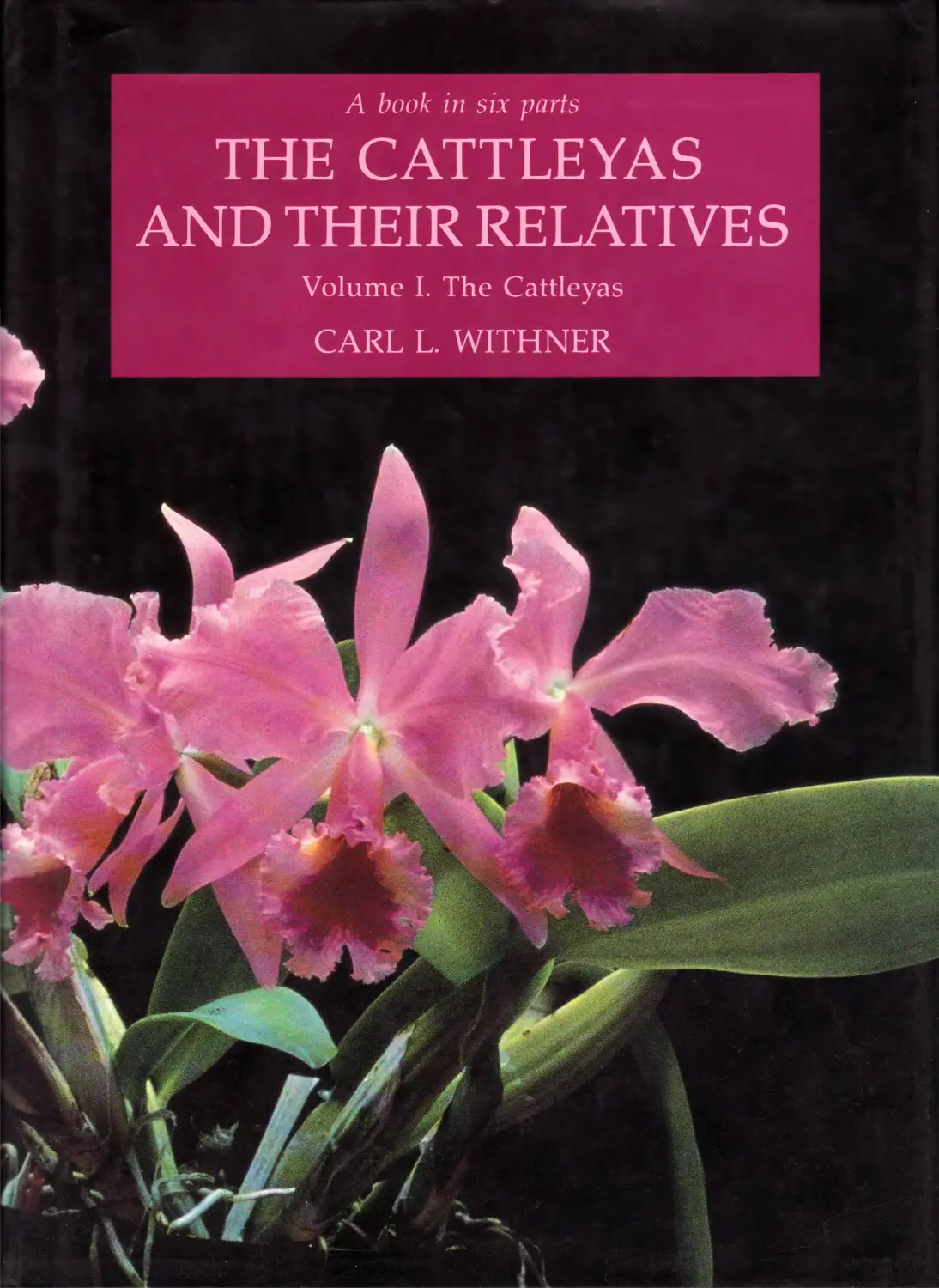
                    THE CATTLEYAS
AND THEIR RELATIVES
Volume I. The Cattleyas
A book in six parts
by
CARL L. WITHNER
TIMBER PRESS
Portland, Oregon

© 1988 by Timber Press, Inc.
All rights reserved
Reprinted 1995, 2002
ISBN 0-88192-099-1
Printed in Hong Kong through Colocraft Ltd.
TIMBER PRESS, INC.
The Haseltine Building
133 S.W. Second Avenue, Suite 450
Portland, Oregon 97204, U.S.A.
Library of Congress Cataloging-in-Fublication Data
Withner, Carl L. (Carl Leslie)
The Cattleyas and their relatives / Carl L. Withner.
p. cm.
Bibliography: p.
Includes index.
Contents: v. 1. The Cattleyas.
ISBN 0-88192-099-1 (v. 1)
1. Orchids. 2. Cattleyas. 3. Orchid culture. 4. Orchids—Latin
America. 5. Botany—Latin America. I. Title.
SB409.W793 1988 88-8560
635 9'3415—dcl9 CIP

Table of Contents
Preface
CHAPTER 1
General Characteristics of the Genus
CHAPTER 2
The Problems of Classification
CHAPTER 3
Introgression in Cattleyas
CHAPTER 4
Cattleya Culture
CHAPTER 5
Description of Species
CHAPTER 6
Questionable or Doubtful Species
Selected References for Additional Information
Plant Name Index
Index of Persons
General Index
1-4
5-7
9-23
25-28
29-34
35-131
133-134
135-136
137-141
142-143
144-147

Preface
For many years I had thought about writing a book on the cattleyas
and including information about their close relatives. I first had the idea
years ago when Gordon Dillon asked me to write a series of articles on
various genera for the American Orchid Society Bulletin. I started, but the
demands of graduate school constantly interfered. My advisors did not
want me to work on orchids: they would take too much time, and anyway,
what was there to do! I completed four articles, including one on cattleyas,
however, and did continue a number of experiments with cattleya
seedlings in vitro, and green-podding, that I had started before the war and
my service in the Army. My interest in the Cattleya Alliance has always
been intense and I continue with it today.
After I began teaching at Brooklyn College in 1948 and, in addition,
was associated with the Orchid Collection of the Brooklyn Botanic Garden,
my interest in species of all kinds increased. But I always came back to the
cattleyas and their relatives as special favorites.
Through the early days of the American Orchid Society judgings and
shows in New York I came to know an unusual and highly talented
orchidophile, Helen Adams. She had a fine collection of all the early color
plate books, had removed the Cattleya and Laelia plates, mostly from broken
bindings, and filed them alphabetically by species, preserving the
associated texts so that eventually the books could be rebound. Since she was
much interested in hybridizing and in orchid history, Helen also sought
out accounts about all the old natural hybrids in the literature, as well as
stories about various color varieties of the species reproduced in the plates,
so that they could be properly identified with more modern terminology.
One aspect of her work culminated in the first judging handbook of the
American Orchid Society; it also developed into a series of lessons to teach
judges more about judging of cattleyas. The research also led to an
association with Prof. Edgar Anderson of the Missouri Botanical Garden, and the
article, Conspectus of Hybridization, which they published together in 1958 in
Evolution.

The Cattleyas I
I was much interested in introgressive hybridization, a concept
originally developed by Anderson, and as a result of Helen's interest we
studied intensively all of the Cattleya species and their variants, depending
heavily upon her wonderful file of pictures. Using this material, we gave a
paper in London at the Third World Orchid Conference emphasizing
introgression and how it could help account for interrelationships among
the cattleyas and their relatives. Most of that data on the individual species
is still not published, but the work certainly reinforced my long interest
and knowledge of the group.
I also made periodic visits, in those days and over the years to Lager
and Hurrell in Summit, N.J. and eagerly anticipated every one. John Lager
was an early A.O.S. judge, grew many species; had a fascinating range with
the first large hillside greenhouse I'd ever seen; and knew all the early
hybrid growers and their histories. His father had originally been a
collector for Sander until he opened his own business in New Jersey. Each
visit meant an exciting review of the greenhouses; intense discussions and
ideas about hybridizing; hashing over problems with shows and judging
various hybrids; and fascinating introduction to newly imported species.
John often had interesting stories to tell, and we all were so pleased when
Valentino Sarra photographed him for the Calvert "Man of Distinction"
series of advertisements. He was truly such a person, and he certainly
increased my orchid "know-how" by leaps and bounds as he
enthusiastically shared his knowledge.
In 1962 I was awarded a Guggenheim Fellowship to travel and study
cattleyas in South America which was, theoretically, to result in a book.
Much material and information was acquired during my travels, but no
book was then forthcoming, only some notes in Orchidata and two travel
articles in the Florida Orchidist. Eventually I was called upon to write a series
on the cattleyas for the new Italian Orchid Society journal, UOrchidea,
which were translated from English by my good friend Mario Dalla Rosa.
They were ultimately collated and published as a book, Le Cattleye, for the
members of that Society.
After speaking with Richard Abel, the spark at Timber Press in
Portland, Oregon, who is prejudiced toward authoritative and
encyclopedic treatments of various plant groups, the present book was conceived.
Not only would the cattleyas be treated to combine botanical and
horticultural examination, but their relatives should likewise be included, and I
was to be the lucky author. This seemed a monumental task, and it is; but
when broken down into five or six component parts, the individual
sections do not seem such an awesome undertaking. By starting with the
cattleyas, about which I had already written for other purposes, and about
which I know the most, the work has gone reasonably well. My real
problems lie ahead as I try to arrange species still debated by taxonomists,
and with which I have not always had as much direct experience, into a
meaningful whole. To wait until the work is completed would put off the
publishing many years, and produce a book of great expense that most
people could not afford or would not buy. We hope by publishing it in
sections as completed, that the parts will all be individually affordable, and the
reader may acquire the parts which interest him or her if the complete
series is not wanted.

Preface
As the book is envisioned at present the parts will be as follows:
Volume I Cattleya
Volume II Laelia
Volume III Schomburgkia, monotypic and small genera
and Caribbean Encyclia and Psychilis
Volume IV Central American and Mexican Encyclia
Volume V Encyclia of Brazil and the Guianas
Volume VI Andean Encyclia and index.
Encyclia remains a problem for me, and for this book I intend to use
that genus only in the original narrow sense of Hooker (1828) based on
Encyclia patens. More familiar species today would be Encyclia tampensis, E.
alata, E. cordigera, etc. To cover all the species of Encyclia as that concept is
currently used in a broader sense (sensu latu) would be impossible for the
scope of this book.
In addition to the descriptions of the species, it is planned that
occasional introductory chapters in each part will cast further light on the
complex of species being described. I intend to deal, when material is
available, with evolutionary relationships, comparative anatomy, flower color
and pigmentation, geography and distributions affected by geologic
history, vegetative structures or fragrances and pollinators in addition to
cultural information that will help us grow better orchids and at the same
time put correct labels on our plants. I think, at this point, of Holtum's
remark that you can't understand a genus until you understand all the
species in it—and there is still so much to know about the cattleyas and
their relatives! Much of orchid history and not a little of the personalities of
some of the individuals is implicit in all of the species and varieties
involved. I have tried to include vignettes whenever possible to make for
more interesting reading and to embellish the bare bones of plant sizes and
flower colors.
There is the perennial problem of how to write or print the various
plant names, and in this connection I have made certain decisions. For
species and natural hybrids from the wild I have used italics, and lower
case letter for the species or hybrid epithet even when a proper name is
involved. I know that not capitalizing proper names will win me no
accolades from some sources, but it is an acceptable option under the
International Rules of Nomenclature. It does prevent confusion with older
Latinized grex names that must be written with a capital letter whether they
are proper nouns or not. Further, I have not used an "X" designating
hybrids as, I believe, the text will make clear the nature of the plants
involved. The Latinizing of proper names also causes some difficulties, and
under such species as Cattleya schroderae, trianaei and walkeriana some of the
difficulties are discussed.
The greatest problems arise with varietal epithets. These
designations are almost without exception really cultivar or clonal epithets, as they
were and are individual plants selected in cultivation from various
introductions. They are not varieties in the botanical sense of being some sort of
subspecies population. Today we would capitalize such varietal names and
place them in single quotes to indicate clearly that they apply strictly to a
single clone. But last century these plants were described as though they
were botanical varieties. And therein lies the problem! To confuse the issue

The Cattleyas I
even further, more than one clone of a given "variety" has in some cases
been discovered, but such plants often have not been given separate
cultivar names or fourth epithets to distinguish them. However, some did
receive such epithets, for instance, Cattleya mossiae var. reineckiana
'Exquisita', to distinguish this reineckiana from others. In such instances
reineckiana is used more as a varietal epithet, even though it is not a
botanical variety but a particular color pattern. Accordingly, it is no longer a
clonal designation as such. By the same token the "alba" term presents a
whole spectrum of problems, many albas of certain species having been
found, though the name was originally applied as a clonal designation.
Well, I have accepted some varietal names as actual cultivar names,
while others have been used as varietal names when more than one such
form has received the name. Actually, since few of the older "varieties"
have remained in cultivation down to the present, this discussion becomes
a bit academic, but names do provide specific information when they are
written certain ways. I have attempted to use names as accurately as
possible and still stay within the modern rules of nomenclature. There will
always be those who do not agree with what I have done, but I will say now
that the text has been my full responsibility.
My great thanks and appreciation for very patient and detailed word
processing of the various drafts of the manuscript go to Annette Guenard;
and to Prof. Thomas Horn of Western Washington University goes my
appreciation for his expertise with the details of Latin grammar. Dr. Jack
Fowlie and Red and Trudi Marsh have been generous in lending me slides
of species "hard-to-find" in illustrations or in flower in the greenhouse. I
also have slides from Chris Ellis, Hugh Henry, Ken Girard, Irene
Kothuber and Paul Gripp. Dr. Lesie Garay and Dr. Ruben Sauleda have
helped me answer many technical questions; and I have had the facilities at
Harvard University, Kew, the Reichenbach and other herbaria generously
made available to me. And finally, I would like to thank a host of orchid
growers who have talked into the "small " hours time and again,
encouraging me to go ahead with this project.
Carl L. Withner
2015 Alabama Street
Bellingham, WA 98226
June 30, 1987

CHAPTER 1
General Characteristics of the Genus
In 1824 Dr. John Lindley, the famous orchidologist, dedicated the
genus Cattleya to William Cattley of Barnet, England. Cattley was a liberal
patron of horticulture; an enthusiastic collector of rare plants; and had
assembled one of the first collections of orchids in England. His collection
formed the nucleus of the Royal Exotic Nursery which, in turn, became
James Veitch and Sons, a company that contributed immeasurably to
orchid history and modern orchid cultivation. Cattleya labiata had been
found in the Organ Mountains, about 60 miles (100 km.) north of Rio de
Janeiro, in 1818, and was brought in to cultivation by William S wainson. As
other species were discovered, the cattleyas became the mainstay of orchid
cultivation. Their flamboyant appearance and exotic beauty contributed to
the popularity of the orchid family as plants of no other genus have done.
Now, more than 150 years later, the cattleya is still Queen of the orchid
world.
The cattleyas are plants with strong, woody, somewhat creeping
rhizomes that send out each growing season a flush or two of roots and a
new stem (now to be called a ramicaul) which forms the pseudobulb. The
pseudobulb may be spindle-shaped, club-like, or long and narrow and
scarcely thickened, and is surmounted by one, two or more leaves. The
inflorescence is terminal, though in one or two species the flowers are
produced on a separate growth lacking leaves. The flower buds may be
enclosed in one or two large sheaths that protect and support the flowers as
they develop. Lower leaves are modified into green sheaths which
eventually dry, become white and membranous and subsequently peel away
Cattleya as a genus was distinguished by Lindley because of the large
sized flowers that separate it from Epidendrum and the lip of the flower
which has not fused to the column, a marked characteristic of true
epidendrums. Cattleya shares four pollinia with Epidendrum, a
characteristic which was later used to distinguish between these two genera and
Laelia, and other related genera, with eight pollinia.

The Cattleyas I
Cattleya sepals and lateral petals are generally of the same color while
the lip petal is much elaborated. The lip varies from having no lateral lobes,
taking a circular or oval form, to having distinct lateral lobes producing a
tripartite shape. Veining patterns, superimposed upon distinct color
patterns, which help distinguish one species from another, usually extend
from the base of the lip to spread over the lateral lobes or the expanded
midlobe. The flowers are not callused as in the flowers of many other
orchid genera. The veinings and "eye" patterns on the midlobes are
apparently sufficient for guiding insect pollinators in nature, though most
of the flowers also produce a sweet fragrance, especially in warm sunlight.
The lip lies parallel to the column, with its lateral lobes or enfolding edges
enclosing the column to produce a tube leading past the anther and stigma
to a nectary where lip and column join. A stylar canal which can be
observed if the column is hemisected, carries the pollen tubes from the
stigma to the ovules in the ovary. A small flap of tissue, the rostellum, is
found between the sticky stigma surface and the anther, obstructing
contact between pollen and the stigma, and thereby preventing self
pollination under ordinary conditions. In Cattleya aurantxaca, particularly in
certain cleistogamous clones, the rostellum may dry up, leading to premature
pollination, even though the flower bud has never opened. The four
pollinia, each of which is possessed of a short tail, the caudicle, are located
under the cells of the anther cap.
When a bee forces and penetrates the tubular space beneath the
column to reach and sample the nectar, some of the stigmatic fluid rubs
onto the insect's back. Then, as the insect retreats from the nectary, the
pollinia are lifted off, attached to its back by the caudicles which stick in the
fluid. The pollinia are thus in an appropriate position to pollinate the next
flower visited. A cattleya seed pod may require 9-10 months, or even
longer, to ripen and can produce three million seeds if fully fertile. As we
know from green-podding of seeds, the embryos are already present three
or four months after pollination. Even after five months there is little
further change in seed development. They await the ripening process itself
and the subsequent splitting of the pod.
There are at least three classes of pigments present in cattleya flowers,
either collectively or separately. The typical blue-mauve-pink-lavender-
purple-magenta-red colors are water soluble vacuolar pigments called
anthocyanins (flavonoids). They are usually present in the sepals and
petals in combinations of two or three types together; though, in lips, with
greater intensity of color, there are usually one or two additional
anthocyanins. These substances may be co-pigmented with light yellow
flavonoids which influence the final color, as can the pH of the vacuolar
contents. The second category of pigments includes the yellows and oranges
which are carotenoid derivatives. They are fat soluble substances and may
form either in the chromoplastids or in the chloroplasts. Lastly, the greens
of chorophyll are also present in the chloroplasts. Bronze and brown
colorations result from anthocyanins and carotenoids combined with the
green from chlorophyll. Clear, pale greens result from carotenoids plus
chlorophyll while darker jade-like greens derive from chlorophyll alone.
Muddy colors are produced when some anthocyanins are present in
surface layers over the greens or yellows in internal cells of sepals and
petals.

General Characteristics
Pigmentation patterns are very complex, and little is truly
understood about their inheritance in hybrids. The investigator must first
account for the presence or absence of each type of pigment and then their
possible combinations. Then he must determine whether they are located
only in the flower parts or also in the vegetative parts of the plants. In
addition, the complications of intensifier or inhibitor genes and whether or not
the pigment is present only in the epidermis or distributed throughout the
tissues must be determined.
Individual plants of most cattleya species have been discovered
which naturally lack one or more of the normally dominant color genes.
These genetic variations are the grower's good fortune for they give us the
alba or semialba forms which lack pigments, or the albescent or xanthotic
types with alternate colorations. More unusual color variations from
chance gene changes can produce the blue or mauve coerulea types.
Currently, the splash petaled and picoteed peloric varieties with the lip
pigmentation pattern duplicated on the lateral petals are popular. Such peloric
variations are more common in some species than in others, and some
have been found more than once in the same species. All these different
combinations are appreciated and cherished for their genetic qualities that
have enabled us to produce hybrids of the most desired colors. About the
only unsuccessful patterns were the "double flowered" cattleya crosses
produced by Reychler in the 1920s. Such flowers may have had as many as
10-12 petals and no lip at all!
Red colorations are highly prized today. They usually result from the
yellow and orange carotenoids combined with the redder anthocyanins.
But breeding true red colors without magenta tints is still difficult and
fundamentally seems a matter of luck in any given cross. The presence of red
pigments in leaves and roots may parallel the floral pigments or be
completely different compounds with no relation to flower color. Leaf
pigments, therefore, may signal darker colored flowers, or they may not; but
certainly such pigments will not usually be present in alba flowered clones.

CHAPTER 2
The Problems of Classification
Cattleya is one genus of orchids, among others of horticultural
interest, with which this book is concerned, in the so called Cattleya Alliance of
the subtribe Epidendrinae. The closest relatives are in the genera Laelia and
Schomburgkia. Other closely related genera are Rhyncholaelia, Brassavola,
Encyclia, Sophronitis and Caularthron. There are a number of smaller,
sometimes monotypic genera, such as Constantia, Neocogniauxia, Sophronitella,
Alamania, Pseudolaelia, Broughtonia, Quisqueya, Laeliopsis or Cattleyopsis, etc.,
all of which will be discussed in turn. A listing of the genera according to
their geographic distributions is to be found in Table I.
The common diploid chromosome number of the alliance, for those
species already determined, is generally 40. This common chromosome
number makes many intergeneric hybrid combinations possible. The
wealth of hybrids already produced, both in nature and in cultivation,
further attests to the genetic intercompatibility of the plants from these
genera.
The natural barriers which generally separate species in the wild are
accordingly geographic, temporal or mechanical, not genetic. We now
have, in cultivation, grex populations in the Cattleya alliance derived from
species of as many as five genera. Natural polyploidy is not uncommon in
the alliance nor is variation in color patterns, and these qualities have, of
course, all additionally been used to produce many of the superior clones
of species or hybrids we know today. Table II lists the various intergeneric
combinations currently registered (April, 1988) with the Royal
Horticultural Society.
Classification of the cattleyas has been a matter of much debate over
the years, with certain species having been either moved into or out of the
genus according to the orchidologist doing the classifying. By the same
token some varieties have been given species status by some authors and
not by others. The genus Cattleya has conventionally been subdivided into
monofoliate and bifoliate subgroups which have in turn been subdivided

10 The Cattleyas I
again into smaller subtaxa. Some authors (Pabst and Dungs) prefer
"alliance" as a way of designating these subgeneric groupings of close
relatives, while others follow a more formal and conventional system
employing sections or series. Rolfe's system (1895), really the first,
classified the species into "groups".
As in many orchid or other subgenera, some groups of species are
obviously more closely related than others, while other species may stand
alone without any closely related forms. Botanical classification systems
theoretically endeavor to indicate these group relationships within the
genus as well as the gaps between those species which stand at a distance
from others. To varying degrees, they are successful. Since most writings
on Cattleya have been concerned with Brazilian cattleyas, to the exclusion
of other South American or the Central American species, the
classification schemes developed are usually incomplete for the genus as a whole.
Such classifications can be found in the more recent books by Fowlie or
Pabst and Dungs, and the older account by Cogniaux in Martius. Their
classification systems are summarized in Table III.
The third edition of Schlecter's Die Orchideen by Brieger, Maatsch and
Senghas provides a complete system of Cattleya classification and is
presented here in Table IV together with the earlier system of Rolfe.
All these classification systems are artificial though practical, and
should be approached accordingly. The various subgroupings do show the
close morphological relationships based on floral anatomy and vegetative
habits (both useful distinctions in Cattleya classification schemes) shared
by the grouped species. But, none of the systems are arranged specifically
to account for the evolutionary development nor phylogeny of the species
involved—natural systems. In fact, this may never be possible to more than
a hypothetical degree, such as Mrs. Adams and I discussed in our paper on
introgression in 1960. Rather, the taxa are conveniently subdivided into
groups, species, and then into varieties or forms, as each author sees fit.
Botanical problems immediately arise in deciding between species
and varietal status for any given plant or group of plants. As a
consequence, the subjective judgments by the author of any classification
scheme become apparent.
The concept of a species is, by definition in modern biology, an
interbreeding population of organisms in the wild which can reproduce its kind
in perpetuity. Usually, also, members of a species occupy a distinct
geographic area, and live and reproduce in a specific habitat with well-
defined ecological parameters. The species concept is thus a fairly
theoretical or abstract idea about a group of plants we can more or less
recognize. In classification systems we give that group a name and place it
most logically in a genus with other related species. At the same time, we
realize that a species consists of living, dynamic, changing entities which
mutate, interbreed, segregate, sometimes become polyploid, overlap with
one another in qualities and characteristics and survive or die in adapting
to various environmental changes. Biologists also agree that present
species have developed from those that existed in the past. If we could only
figure out how all these lineages were related, a near perfect classification
scheme for any genus or family could be proposed. Based on the
comparative anatomy of the flowers and plants, as well as their physiological and

The Problems of Classification 11
genetic characteristics, we can observe or deduce some of the necessary
information. To that degree, then, our present classification schemes can
reflect what went on in nature.
In the Orchidaceae the conventional species concept is often difficult
to understand and apply. A given species population ordinarily is kept
separate from other species populations by genetic incompatibilities,
different flowering seasons, geographical isolation, or the mechanics and
specifics of insect pollinations and flower configuration. We know that the
barriers which separate most orchid species populations in nature are not
the usual genetic ones evolved in most other kinds of plants. Thus, for
example, where Cattleya species and their relatives overlap in their
geographic distributions, the plants may eventually produce fertile natural
hybrids.
Adams and Anderson in 1958 list 26 natural hybrids for Cattleya with
an additional 238 primary hybrids produced in cultivation. More must be
added to such lists today. We can see that although the species isolating
mechanisms work most of the time in nature, they are not perfect,
particularly when genetic incompatibility is not a factor. Therefore the question of
varietal versus species status of certain cattleyas becomes mainly
concerned with geographical distribution and how heavily one may wish to
use it as a major criterion in establishing taxonomic rank. Since orchids are
presumed by botanists to have recently entered an explosive phase of
rapid evolution (at least before modern man came upon the scene
destroying forests and other ecological niches) location has a strong role to
play in distinguishing one species from another. Also, if most orchid
species are still "young", so to say, they will not have had an opportunity to
spread, particularly in areas of mountains or valleys, or continental
formations that easily provide distribution barriers. That idea of endemism will
be much followed in this book, and Table V represents my viewpoint on
Cattleya classification as nearly as I can put it down on paper.
Systematists will find differences with previous systems in the sub-
generic taxa. Besides geography and vegetative habit, I used both
pigmentation and details of the flower anatomy, particularly of the lip, in
arriving at the subgeneric divisions. Flower pigmentation systems have
evolutionary significance, even though we may not understand their role,
and should be considered in any overall scheme for the cattleyas. And the
lip of the flower, with its uniquely close association with the column, is
critical for pollinator and successful pollination, and is thus essential for the
perpetuation of the species. The lip outlines are presented in the drawings
on page 22, and a key to the subgeneric taxa is to be found in Table VI. Table
VII provides the necessary Latin to make the publication of this scheme
"official" so far as botanical nomenclature is concerned.
In presenting this material the author hopes to provide not only a
better view of the internal relationships within the genus Cattleya, always
considering these species from an evolutionary or a developmental point
of view. The characters are where you find them, and they add up for me to
a reticulate evolutionary scheme such as Mrs. Adams and I presented in
our paper to the World Orchid Conference in London. Such reticulation,
we thought, could most likely have come about through ancient
hybridization, followed then by segregations and inbreeding of localized clones to

12 The Cattleyas I
produce eventually new species.
Most are agreed that C. dormaniana in the Laelioidea is somehow a
primitive member of the genus, the only species with remains of a more
primitive orchid number of eight pollinia (see Dressier), the balance of the
species of Cattleya having four. The lip structure of dormaniana shows an
affinity through C. forbesii with the Intermedia alliance of the species. It also
shows a relationship with that group by another characteristic: having
petals narrower than the sepals, seldom wider unless there has been some
gene flow from wider petaled labiate species. This narrow petaled feature
of the Intermedia flowers is also shared by other multifoliate species in the
genus besides dormaniana. The plants characteristically have two or three
leaves per stem, and the stems are unthickened, tough and stringy. As is
stated above, the characters are where you find them! The lips of both
Laelioidea and Intermedia show bold elongated lateral lobes with rounded
tips; lateral lobes that are each larger in area than the midlobe; and the
sinuses between the lateral lobes and the midlobes are distinct and narrow
so that the midlobes have little or no isthmus connecting them with the
base of the lip and they can even overlap the midlobe. The midlobes are
either rounded or slightly indented at their tips, and the heavy central vein
of the lip, with its two heavy lateral veins, may usually be traced easily to
the apex.
Having a small sinus to separate off the midlobe clearly, even though
it may not have an isthmus, is already a step beyond the "labiate" type of
Cattleya (subgenus) flowers with their large rolled lips that enclose the
column without more than a notch or indentation in the lip outline to
indicate the lateral lobes. The lack of indentation in the lip outline is an
"Andean" characteristic mostly continued into the species of Central
America. But, in the Stellata it is also found in C araguaiensis of Brazil
together with monofoliate growth. The Stellata all have a distinct winged
column.
The presence of the sinus, together with spots, unthickened stems
and multiple leaves is more of a "Brazilian" coastal syndrome, and so
provides interesting grounds for speculation. How did it arise? From what
ancestral stock is it derived? Why are the Andean cattleyas characterized
by one leaf instead of two or more? Why are they without lip lobing? Most
botanists agree that loss of or specialization of plant parts indicates a more
"advanced" status, while retention of "original" condition indicates a more
primitive quality.
Two further degrees of specialization in lip notching may be
observed. In the Falcata complex the sinus becomes progressively deeper,
making the isthmus definitely narrower and elongated to at least a third of
the lip in length. In these forms the lateral lobes are accordingly reduced in
size but remain relatively large in area, though most are no more than equal
to the midlobe in size. The midlobes, and often the tips of the lateral lobes,
may be covered with small granules or papillae, and the lateral lobes have
distinctly pointed apices, in contrast to the rounded tips mentioned above.
The other line of specialization increases the sinus to such a point that the
lateral lobes are much reduced in size and cannot begin to cover the
column completely. This is a quality of the Aclandia subgroup with their
pencil-thin ramicauls on the one hand, and the stubby bulbous-stemmed

The Problems of Classification 13
Rhizantha on the other.
The Schomburgkoidea, with the exception of G bicolor, have flowers
with moderately developed sinuses, pointed lateral lobes, broad though
short isthmi and a fanning out of the central veins to match the crenations
of the lip edges. The lateral lobes of bicolor flowers are so reduced in size as
to be mere points, but their broad isthmus and midlobe configuration
clearly point to their affinities. Why this species and the two of the
Rhizantha should have exposed columns is probably significant if we could figure
it out. The petals of Schomburgkoidea tend to point up (are not horizontally
oriented), have coarsely waved margins, and the flowers mostly appear on
elongated inflorescences. The plants show a general affinity for sunny
bright environments, and three of them, at least, can be propagated from
stem sections. Three leaves per growth are usual. For what it may be worth
evolutionarily, Cattleya violacea in this group has the widest distribution of
all the cattleyas in the genus. Does that mean it is also one of the oldest? Or,
has it just been more successful?
Within the Cattleya (subgenus), the Stellata and the Circumvolva,
spotting of the flowers does not exist as in the above groups, nor is green
pigmentation in the flowers a common quality. The petals are usually broader
than the sepals and of a lighter substance. The pigmentation systems,
carotenoid vs. anthocyanin, yellow or purple, are noted by the sectional
epithets. The lip midlobes are larger and more elaborately developed and
pigmented than in the other subgenera. The plants of Cattleya well deserve
their labiate (lip) designation as the midlobe elaboration is indeed an
outstanding feature of the flowers.
Research on pollinators and their evolution may occasionally provide
an explanation of the development of these different systems. Certainly we
know that flowering plant families and insects evolved together, each
dependent on the other. Coupling pollinator adaptations with the other
comparative points described gives us a basis then for an overall
classification scheme that is related, we hope, to evolutionary events.
Natural hybrids within the genus Cattleya are described under the
various parental species involved. When the natural hybrid is of inter-
generic origin, it will be discussed, as appropriate, under the non-cattleya
species, when its turn comes. In this book 50 species of Cattleya are
described, two of distinctly hybrid origins; and there is the possibility of the
count being 51 if C tigrina (see under C. guttata) is considered a separate
entity.

14
The Cattleyas I
TABLE I
Genera of the Cattleya Alliance according to their location
South American Genera
Constantia Pseudolaelia
Lanium Sophronitella
Leptotes Sophronitis
Pinelia Renata
Central American and Mexican Genera
Alamania Homolopetalum
A rtorim a Horm idiu m
Barkeria Microepidendrum
Caularthron Nageliella
Dressleriella Rhyncholaelia
Hagsatera
Caribbean Genera
Basiphyllaea Laeliopsis
Broughtonia Neocogniauxia
Cattleyopsis Psy chilis
Caularthron Quisqueya
Domingoa Tetramicra
Generalized Distribution
Brassavola
Cattleya
Encyclia
Laelia
Schomburgkia
TABLE II
Intergeneric Combinations with Cattleya
Registered through April, 1988
With Approved Abbreviations
CATTLEYA
x Barkeria
x Barkeria x Laelia
x Brassavola
x Brassavola x Broughtonia
x Brassavola x Broughtonia x Epidendrum x Laelia
x Brassavola x Broughtonia x Laelia
x Brassavola x Broughtonia x Laelia x Sophronitis
x Brassavola x Diacrium
x Brassavola x Diacrium x Laelia
= Cattkeria (Cka.)
= Laeliocattkeria (Lcka.)
= Brassocattleya (Be.)
= Stellamizutaara (Stlma.)
= Hattoriara (Hatt.)
= Otaara (Otr.)
= Hasegawaara (Hasgw.)
= Hookerara (Hook)
= Iwanagara (Iwan.)

The Problems of Classification
15
x Brassavola x Dominga x Epidendrum
x Brassavola x Epidendrum
x Brassavola x Epidendrum x Laelia
x Brassavola x Epidendrum x Laelia x
x Brassavola x Epidendrum x Lae/w x Sophronitis
x Brassavola x Laelia
x Brassavola x Laelia x Schomburgkia
x Brassavola x Laelia x Schomburgkia x Sophronitis
x Brassavola x Laelia x Sophronitis
x Brassavola x Laeliopsis
x Brassavola x Schomburgkia
x Brassavola x Sophronitis
x Broughtonia
x Broughtonia x Cattleyopsis
x Broughtonia x Diacrium
x Broughtonia x Epidendrum
x Broughtonia x Epidendrum x Laelia
x Broughtonia x Epidendrum x Laelia x Sophronitis
x Broughtonia x Epidendrum x Schomburgkia
x Broughtonia x Laelia
x Broughtonia x Laelia x Sophronitis
x Broughtonia x Laeliopsis
x Broughtonia x Schomburgkia
x Broughtonia x Sophronitis
x Cattleyopsis
x Cattleyopsis x Epidendrum
x Diacrium
x Diacrium x Epidendrum
x Diacrium x Epidendrum x Laelia
x Diacrium x Laelia
= Kawamotoara (Kwmta.)
= Vaughnara (Vnra.)
= Yamadara (Yam)
= Yahiroara (Yhra.)
= Rothara (Roth.)
= Brassolaeliocattleya (Blc)
= Recchara (Recc)
= Fergusonara (Ferg.)
= Potinara (Pot)
= Fujiwarara (Fjw.)
= Dekensara (Dek.)
= Rolfeara (Rolf.)
= Cattleytonia (Ctna.)
= Vejvarutara (Vja.)
= Brozvnara (Bwna.)
= Epicatonia (Epctna.)
= Jewellara (Jzva.)
= Buiara (Bui)
= Wilburchangara (Wbchg.)
= Laeliocatonia (Lctna.)
= Hawkinsara (Hknsa.)
= Osmentara (Osmnt)
= Schombocatonia (Smbcna.)
= Bishopara (Bisk)
= Opsiscattleya (Opsct)
= Hawkesara (Hwkra.)
= Diacattleya (Diaca.)
= Tuckerara (Tuck)
= Allenara (Alna.)
= Dialaeliocattleya (Dialc.)

16
The Cattleyas I
x Diacrium x Laelia x Sophronitis
x Diacrium x Schomburgkia
x Domingoa x Epidendrum
x Epidendrum
x Epidendrum x Laelia
x Epidendrum x Laelia x Schomburgkia
x Epidendrum x Laelia x Schomburgkia x
Sophronitis
x Epidendrum x Laelia x Sophronitis
x Epidendrum x Laeliopsis
x Epidendrum x Schomburgkia
x Epidendrum x Sophronitis
x Laelia
x Laelia x Schomburgkia
x Laelia x Schomburgkia x Sophronitis
x Laelia x Sophronitis
x Laeliopsis
x Leptotes
x Schomburgkia
x Sobralia
x Sophronitis
= Higashiara (Hgsh.)
= Mizutara (Miz.)
= Arizara (Ariz.)
= Epicattleya (Epc.)
= Epilaeliocattleya (Epic.)
= Northenara (Nrna.)
= Izumiara (Izma.)
= Kirchara (Kir.)
= Maymoirara (Mymra.)
= Scullyara (Scu.)
= Stacyara (Stac.)
= Laeliocattleya (Lc.)
= Lyonara (Lyon.)
= Herbertara (Hbtr.)
= Sophrolaeliocattleya (Sic.)
= Laeliopleya (Lpya.)
= Cattotes (Ctts.)
= Schombocattleya (Smbc.)
= Sobraleya
= Sophrocattleya (Sc.)
Note that certain horticulturally important names, such as Diacrium and Brassavola,
for Caularthron and Rhynchokelia respectively, are conserved by the RHS in
registering grex names. In other words, there are other species of true Brassavola in
addition to Rhyncholaelia. Epidendrum, in like fashion, may refer to true epidendrums
or to those we now call Encyclia, or by some other generic epithet, names not used in
hybrid combinations.

The Problems of Classification 17
TABLE III
Outlines of Cattleya Classification Schemes Based Only On
The Species Found in Brazil
From Cogniaux in Martius' Flora Brasiliensis (1898)
Genus Cattleya
Section Gymnochila
Subsection Rhizanthemum—walkeriana, nobilior
Subsection Acranthemum—aclandiae, dolosa, schroederiana,
bicolor, velutina
Section Cryptochila
Subsection Diphyllae
Series Guttatae—guttata, granulosa, porphyroglossa,
elatior, soraria, tigrina, patrocinii, brasiliensis,
leopoldii, amethystoglossa, victoria-regina, whitei,
elo ngata, sch illeria na
Series Intermediae—violacea, loddigesii, harrisoniana,
intermedia, brymeriana, brownii, Isabella, forbesii,
dormaniana
Subsection Monophyllae—labiata, eldorado, lawrenceana,
luteola
From Pabst and Dungs in Orchidaceae Brasilienses (1975)
Genus Cattleya
C. walkeriana alliance— nobilior, walkeriana
C. aclandiae alliance—aclandiae, bicolor, grossi, measuresiana, velutina
C. granulosa alliance—elongata, granulosa, porphyroglossa
C. guttata alliance— amethystoglossa, dormaniana, guttata, leopoldii,
schilleriana
C. intermedia alliance—brownii, elatior, forbesii, harrisoniana,
intermedia, loddigesii, violacea
C. labiata alliance— araguaiensis, eldorado, labiata, lawrenceana,
luteola
From Fowlie in The Brazilian Bifoliate Cattleyas and
Their Color Varieties (1977)
Genus Cattleya
Section Laelioidea—dormaniana
Section Gymnochila—velutina, bicolor, aclandiae, schilleriana,
violacea, walkeriana, nobilior
Section Cryptochila
Subsection Granulosae—granulosa, schofeldiana,
porphyroglossa
Subsection Guttatae—elongata, amethystoglossa, leopoldii,
guttata
Subsection Intermediae—intermedia, forbesii, loddigesii,
harrisoniana

18 The Cattleyas I
TABLE IV
Outlines of Cattleya classification schemes for all
cattleya species
Outline from R. A. Rolfe in the Orchid Review (1895)
Group of C. guttata—guttata, elatior, porphyroglossa, granulosa, leopoldii,
amethystoglossa, elongata, schilleriana
Group of G intermedia—superba, intermedia, dormaniana, forbesii,
loddigesii, harrisoniana, brownii
Group of C. walkeriana—dolosa, walkeriana, nobilior, schroederiana,
aclandiae, velutina, bicolor
Group of C. skinneri—skinneri, hennisiana, bozvringiana, aurantiaca
Group of C labiata—labiata, warneri, gaskelliana, trianae, schroederae,
mendelii, mossiae, percivaliana, lueddemanniana,
warscewiczii, maxima, dowiana, eldorado, rex, iricolor,
luteola
Group of G citrina—citrina
Outline from Brieger, Maatsch and Senghas in
Schiechter's Die Orchideen (Third Edition, 1981)
Subgenus Skinneri
Section Skinneri—bozvringiana, skinneri, deckeri, patini
Section Aurantiaca—aurantiaca, x pachecoi
Subgenus Diphyllae
Section Intermedia—loddigesii (subspecies loddigesii, harrisoniana,
purpurea), kerrii, intermedia, forbesii, dormaniana,
araguaiensis
Section Guttatae— amethystoglossa, violacea, granulosa, schofeldiana,
schilleriana, guttata, leopoldii (subspecies leopoldii per-
nambucensis), elongata
Section Arcranthemum—aclandiae, velutina, bicolor, tetraploidea
Subgenus Rhizanthemum—walkeriana, nobilior
Subgenus Cattleya—rex, maxima, iricolor, chocoensis, trianae, warscewiczii,
dowiana (subspecies aurea), mendelii, schroederae, eldorado,
percivaliana, mossiae, lueddemanniana, gaskelliana, jenmanii, labiata,
warneri, lawrenceana, luteola

The Problems of Classification 19
TABLE V
List of Cattleya Species Arranged into Subgenus and Section
by the Author
Cattleya
Laelioidea—dormaniana
Rhizantha—walkeriana, nobilior
Cattleya
Cattleya—eldorado, gaskelliana, jemanii, labiata, lawrenceana,
lueddemanniana, mendelii, mossiae, percivaliana,
quadricolor, schroderae, trianaei, warneri, warscewiczii
Xantheae—aurea, dowiana, rex
Maximae— maxim a
Stellata—araguaiensis, iricolor, luteola, mooreana
Circumvola
Aurantiacae—aurantica
Moradae— bowringia na, deckeri, skin neri
Aclandia—adandiae, velutina
Intermedia—dolosa, forbesii, harrisoniana, intermedia, kerrii, loddigesii
Schomburgkoidea—bicolor, elongata, tenuis, violacea
Falcata
Guttatae—amethystoglossa, guttata, leopoldii, schilleriana
Granulosae—granulosa, porphyroglossa, schofeldiana

20 The Cattleyas I
TABLE VI
Key to Subgenera and Sections of Cattleya
by the Author
1. Pollinia 6-8 though some are smaller Laelioidea
1. Pollinia 4 go to 2
2. Plants stubby, rhizomatous Rhizantha
2. Plants upright, clustered stems go to 3
3. Plants unifoliate go to 4
3. Plants usually with more than one leaf,
at least on mature growths go to 7
4. Flowers "labiate"—large and broad
petaled Cattleya, go to 5
4. Flowers more starry, smaller, non-"labiate" Stellata
5. Flowers purple or lavender go to 6
5. Flowers yellow with red lips Xantheae
6. Lip with central yellow stripe Maximae
6. Lip without central yellow stripe Cattleya
7. Lip without lateral lobes G bicolor (Schomburgkoidea)
7. Lip with lateral lobes even though they may be set off
by only a shallow notch or no indentation at all go to 8
8. Lips with the notch small or no indentation,
flowers not spotted Circumvolva, go to 9
8. Lips with lateral lobes marked by sinuses so that a definate
isthmus to the midlobe is formed, flowers usually spotted to
some degree go to 10
9. Flowers purple Moradae
9. Flowers yellow or orange Aurantiacae
10. Lateral lobes rounded, each smaller than
the midlobe Aclandia
10. Lateral lobes broad and shouldered, each not smaller than
the midlobe go to 11
11. Lateral lobes rounded at tip Intermedia
11. Lateral lobes pointed at tips
(or lacking in C. bicolor) go to 12
12. Isthmus wide, about half the width of
the midlobe Schomburgkoidea
12. Isthmus narrow, one third or less the width of
the midlobe Falcata, go to 13
13. Isthmus one third or less of the lip length Guttatae
13. Isthmus more than one third of the lip length .... Granulosae

The Problems of Classification 21
TABLE VII
Latin diagnoses for the Cattleya classification system
presented in this book.
Laelioidea (Fowlie). Withner. Subgen. based on G dormaniana (Rchb.f.)
Rchb.f. Pollinia quatro superiora perfecta, quatro inferiora parva et
imperfecta.
Rhizantha (Cogniaux) Withner. Subgen. based on C. walkeriana
Gardner. Rhizoma repens, elongata; psuedobulbis crassis, ovatis vel
fusiformibus; inflorescentia basilaris.
Cattleya Lindley. Subgen. based on C. labiata Lindley. Floresgrandi; labello
late ovato-oblongo, margine undulato-crispo, indiviso; psuedobulbis
a pice monophyllis.
Cattleya Lindley. Sect, based on C. labiata Lindley.
Flores roseo-violacei vel purpureo-lilacini.
Xantheae Withner. Sect, based on C. dowiana Bateman.
Flores luteoli vel aurei.
Maximae Withner. Sect, based on C. maxima Lindley.
Labelli florum cum linea centrali lutea.
Stellata Withner. Subgen. based on C. luteola Lindley. Flores plus minusve
stellati, parvi usque ad medium; labello vix indiviso; plantae
monophyllae.
Circumvolva Withner. Subgen. based on C. skinneri Bateman. Plantae
diphyllae; pseudobulbis robustis, incrassatis; labellum column
involvens.
Aurantiacae Withner. Sect, based on C aurantiaca
(Bateman) Don. Flores crocei usque ad flavos;
labellum acutum.
Moradae Withner. Subgen. based on C. skinnerii
Bateman. Flores purpurei; labellum rotundatum.
Aclandia Withner. Subgen. based on C. aclandiae Lindley. Plantae
diphyllae; pseudobulbis cylindraceis, induratis; labellum lobis
lateralibus parvis, subobsoletis usque ad rotundatos; columna nuda.
Intermedia (Cogniaux). Withner. Subgen. based on C. forbesii Lindley.
Petala sepalo dorsali satis latiora; pseudobulbis longisculis, cylindreis,
apice diphyllis; folia obtusa.
Schomburgkoidea Withner. Subgen. based on C. violacea (Kunth) Rolfe.
Flores aliquantus carnosuli; petalis marginesatis undulatis; labellilobus
terminalibus breviter latesque unguiculatus, multinervis, nervis supra
satis prominans.
Falcata Withner. Subgen. based on C guttata Lindley. Pseudobulbis
cylindraceis, interdum elongatis, apice di-triphyllis; sepalis coriaceis,
lateralibus manifeste falcatis; labelli limbi apices intus tecti papillis.
Guttatae (Cogniaux). Withner. Sect, based on C
guttata Lindley. Labelli lobus terminal late
breviterque unguiculatus, minus quam pars tertia
totae longitudinis labelli.
Granubsae (Fowlie). Withner. Sect, based on C.
granulosa Lindley. Labelli lobus terminal latiscule
longeque unguiculatus, maiorquam pars tertia totae
longitudinis labelli.

22
The Cattleyas I
Lip outlines of representative Cattleya species from each of the subgeneric
categories. Lips not drawn to scale. In each case, note the similarities among the
members of each group and the comparison with the shapes of the other groups.
See text, p. 12-13, for other details.
Laelioidea
C. dormaniana
Rhizantha
C. nobilior
Rhizantha
C. walkeriana
Cattleya, Cattleya
C. gaskelliana
Cattleya, Xantheae
C. aurea
Cattleya, Maximae
C. maxima
Circumvolva, Aurantiacae
C. aurantiaca
Cattleya, Stellata
C. luteola
Cattleya, Stellata
C. iricolor
Circumvolva, Moradae
C. skinneri

The Problems of Classification
23
A elandia
C. aclandiae
A eland ia
C. velutina
Intermedia
C. harrisoniana
Schomburgkoidea
C. bicolor
Schomburgkoidea
C. violacea
Schomburgkoidea
C. tennis
Falcata, Guttatae
C. amethystoglossa
Falcata, Guttatae
C. guttata
Falcata, Guttatae
C. schilleriana
Falcata, Granulosae
C. granulosa
Falcata, Granulosae
C. porphyroglossa
Falcata, Granulosae
C. schofeldiana

25
CHAPTER 3
Introgression in Cattleyas
When populations of related species overlap in nature, natural
hybridization can occur. The concept of introgressive hybridization was
first formulated by Anderson and Hubricht in 1938 "to denote the gradual
infiltration of the germ plasm of one species into another as a consequence
of hybridization and repeated back crossing." In the plant world
introgressive hybridization has given rise to new species as introgressively formed
clones have been isolated and subsequently given rise to new
populations. Sometimes the new hybrid populations not only combine
morphological characteristics derived from their parents but, more
importantly, combine physiological qualities as well. Though these physiological
abilities may not show externally, as do flower color or leaf shape, the
offspring can often thrive and reproduce in new environments not well
suited to either parent species. Thus introgression is often a strong source
of variation within a species, and, as we know, some orchid species show
much variation, others little. This variation provides a plasticity of species
response. In my opinion introgressive exchanges have played a
particularly significant role in orchid evolution, and the cattleyas are one group
that clearly demonstrates that role.
Variant forms and populations of certain orchid species have long
been recognized—in some species hardly any two plants are alike. For
example, it is difficult to find two Cattleya mossiae flowers which are truly
similar. At the extreme they can have such distinctively different lip
veining patterns that they would seem to be separate taxa. If you have
traveled to Brazil you may know that there are more than 100 named
clones of Cattleya intermedia, all presumably different and recognizable.
There are so many named clones of Laelia purpurata, in fact more than 200,
that entire shows in southern Brazil may be devoted to the clones of this
single species. Geneticists tell us that mutation of genes is the major source
of variation in species, but in the plant kingdom, at least, introgression
offers a possibly better alternate explanation.

26 The Cattleyas I
The hybridization and repeated crossings of the hybrid individuals
back with the parental types, or with each other, may take place many times
over many generations. It is not a single event such as is executed by the
hybridizer in the greenhouse. The gene flow may be primarily in one
direction, toward one of the parental types, so such forms may become the most
common. Or, there may be a continuous spectrum of forms ranging
between those of the parental species so that it is difficult to determine
where one parent population stops, the hybrids begin, and then where the
other parental population begins. Using Anderson's techniques, or now,
using computer analysis, it is possible to unravel some of these hybrid
complexes to gain a better insight into how they are formed. Lotsy's term,
syngameon, is well applied to these populations of hybrid origin that may
involve two, or even more, species.
This hybridization process, if combined with geographical isolation
of the resulting clones of such populations from earlier eons, can account
nicely for the clusters of related species within the confines of a genus. The
labiate cattleyas, or certain of the bifoliate types, demonstrate this well.
Further accounts of the details of such studies of cattleyas may be found in
the writings of Withner, and Withner and Adams.
Fortunately, we have a pictorial record of the orchid family in the old
color plate books that cannot be matched for any other plant family, and the
cattleyas figure strongly in this old literature. Both careful textual
descriptions and meticulously drawn illustrations give us a rather complete record
of cattleya variation as it has been observed over the last 175 years. The
field work has already been done for us, fortunately so, as with destruction
of the forests in the tropics, many of the natural populations of these
species are now greatly diminished or even verging on complete
obliteration.
Within the genus Cattleya several examples of introgression may be
cited. One of the most obvious is the natural hybrid population called
Cattleya guatemalensis, a complex between Cattleya skinneri and Cattleya
aurantiaca. It is particularly easy to analyze, thanks to the distinct colors and
flower shapes of the parents. The skinneri has purple flowers, and the
aurantiaca orange, so the intermediate guatemalensis hybrids are a salmon or
peach-toned lavender. If such hybrids backcross to skinneri they become
more lavender; if they backcross to the aurantiaca side, they become more
orange, and eventually may produce red, yellow or even white forms as
interbreeding continues. These crosses have all been artificially
reproduced in cultivation, largely to obtain greater quantities of the rarer colors
than may be found in nature. Since the petals of the flowers of Cattleya
aurantiaca project forward to a marked degree, while the flowers of Cattleya
skinneri are more or less "flat", this characteristic gives us another quality in
addition to color as a hallmark of the degree of hybridization. Lip shape and
veining patterns are also significant. As will be discussed later, some of the
color variants from the hybrid swarm or syngameon have been described
as separate species, but this analysis clearly demonstrates that they now do
not deserve such distinct status. A clonal name is sufficient.
Another fine example of introgression is provided by the Colombian
natural hybrids called Cattleya hardy ana from Cattleya warscewiczii (gigas) x
Cattleya aurea. Again, we have distinctive color forms with a purple flower

lntrogression in Cattleyas 27
on one side (warscewiczii) and yellow with a red lip flower (aurea) on the
other. The inheritance of the veining pattern and color of the red lip, all
characteristics of the aurea, as well as the presence of large yellow "eyes",
are characters easily followed in the hardyana combinations. The lateral
petals and sepals may be of a variety of colors from white through lavender.
This natural hybrid population has also been duplicated in cultivation, and
should be made again, with selected superior parents, for its colorful
beauty.
Clement Moore, quoted in White, remarked that in hybridizing with
C. aurea "(it) puts color into the throat of the labellum, but does not
intensify the color of the sepals and petals as does Cattleya Dowiana". Using it
with pure white flowers did not "put" color into the petals, but using C.
dowiana could. Moore thought the dowiana or aurea should be the female
parent in such hybrids as it would then have a predominant effect in the
hybrid.
The other clear example of introgression involves three species, two
cattleyas and a laelia, on Santa Catarina island off the coast of southern
Brazil. Although Anderson's ideas about introgression originally derived
from situations involving pairs of species, the Santa Catarina story readily
extends it to complexes among three. Lc. elegans was discovered in 1847.
Boyle described the plant as "very plentiful in its native habitat beyond all
other species ... home was a small island where it clung to the rocks. Every
plant within reach has long been cleared away; those remaining dwell in
perilous places on the cliffs." Tatum, a later collector, wrote in 1930 that "Lc.
Elegans is still very plentiful... of course all the plants are not elegans but
there are also Laelia purpurata and Cattleya intermedia. .. Laelia purpurata,
Cattleya Leopoldii and Cattleya intermedia are three distinct species. As they
grow associated with one another, three distinct natural hybrids are
produced, viz., Cattleya intricata (intermedia x Leopoldii), Laelio-Cattleya elegans (L.
purpurata x C Leopoldii) and Lc. Schilleriana (L. purpurata x C intermedia)/'
Lenz and Wimber discussed these observations in their chapter on
hybridization and inheritance in The Orchids, A Scientific Survey, edited by
the present author.
Plants contained in this complex show, in the so-called purpurata
population, intermedia characteristics in petal form, lip lobing or color
patterning. There is, in fact, evidence of hybridity in each of the parental
populations. The lavender hybrids were identified as elegans types when
they had intermedia petal and sepal patterns, but when they had a "labiate"
type of petal form, they were classified as a variety of L. purpurata instead of
elegans. The white forms, especially those with labiate cattleya form, were
called schilleriana. Few schilleriana were found, but indeed the least
common of all were the combinations between the bifoliate cattleyas which
produced G intricata. Intricata was the least desirable, horticulturally
speaking, and the form least distinct and therefore most difficult to
distinguish from its parents. It is not surprising, therefore, that fewer of them
were mentioned or described.
Other introgressive swarms have complicated the naming and
descriptions of Cattleya species, particularly since there are no special
names for the hybrids in the syngameon intergrades and the parents have
certain definite similarities. Examples include C. loddigesii x C. harrisoniana,

28 The Cattleyas I
C. guttata x C leopoldii, C walkeriana x C nobilior, G bicolor x C harrisoniana
and C. granulosa x C schofeldiana. More detailed observations and
measurements on the clones and cultivars of these species and their hybrids in
cultivation could produce analytical data that would help resolve the
difficulties. Does anyone volunteer with data? Please write the author.

29
CHAPTER 4
Cattleya Culture
The culture of cattleyas is such that one can only set forth a few rules,
while the rest must be learned by refining one's own experience. The
following horticultural information is derived from a variety of sources,
including the author's experience, and must be interpreted in terms of
one's own cultural conditions and how they may best be used to grow
these orchids. Of course, supplying proper conditions for a commercial
greenhouse filled with the same sorts of plants is one thing, but most of us
have mixed and crowded collections where conditions are simply not
tailored for one species or genus. In such questionable conditions it is quite
amazing how tolerant orchids are to growing in cultivation! So, the
recommendations which follow represent the ideal or pure state, as though there
were no other orchid genera but cattleyas with which we need to be
concerned. And seemingly to compound the problem, different cattleyas
require somewhat different growing conditions as we shall see. This point
requires emphasis! All cattleyas are not culturally identical! Some require
more heat, others less; some have distinct dormancy, others not; some like
more humidity or air; and so it goes, species to species. Such details will be
discussed as we know them in the descriptions of individual species.
Cattleyas require ample light, needing shade only during the summer
months and the brightest days of spring and fall. Most are sun-loving plants
so like all the light they can get, aside from direct sun. If their foliage
appears too yellow, increase shading. Continued exposure to excessive
light will result in further chlorophyll destruction as well as dehydration
leading to shriveling of the pseudobulbs and leaf tissues. Plants exposed to
excessive light are flabby to the touch and are readily flexed without tissues
breaking or leaves splitting. On the other hand, lush, dark foliage is not
desirable. It is weak and susceptible to fungi and rot, and though the plants
may appear fine if they haven't flopped over from their own weight, they
do not flower at their best. A medium, yellow-green leaf color is best, with a
firm, solid growth, and each growth spurt larger and more vigorous than

30 The Cattleyas I
the last. In short, proper control of light in most cases is the most important
single factor in successful orchid growing.
As to temperature and ventilation, Orpet and Lager have said it well
in their classic statement in Bailey's Cyclopedia of Horticulture that cattleyas
"delight in a genial atmosphere, with all the air possible when the outside
temperature will permit." Cold drafts should be mitigated by passing the
air over the greenhouse floor or heating elements before it reaches the
plants. "In summer, from May on to the end of October, air should be
admitted day and night; thus there are no temperatures to be prescribed
for these months. A night temperature of 65 (18 C) to 70 F (21 C) is then
suitable, rising by day according to the sunshine. Later, when artificial heat
isnecessary,55to60F(16C)atnightand60to65F(18C)duringthedayis
about right, bearing in mind that the earliest species to flower may be kept
at the warmer end, and the later, summer-blooming species may be
wintered at the cooler end of the structure... .One cannot change the time
of blooming of a cattleya, that is to say, force it as other plants may be forced,
without injury to the plant and a poor quality of bloom, but they are often
retarded by systematic cooler treatment."
With the exception of a few species that have a distinct dormancy or
dry period, most cattleyas should be watered moderately the year around.
The plants are either getting ready to flower, are in crop, or are
recuperating from flowering. Some plants grow and then flower immediately; others
grow and form a sheath and buds, only flowering some weeks later after a
period of dormancy has passed. Observation of one's plants will show
which patterns they follow, and in hybrids, of course, their pattern reflects
the parental genes. Seedlings will grow continuously so need not be
provided rest periods until they are of good size. The plants need more
water in periods of growth and flower formation, less during quiescent
periods. Growth may consist of new root or leaf formation, separately or
together, after which flower formation follows. If you are able to grow the
plants well, but cannot flower them, look first to the amount of light as the
limiting factor, then to the temperature relationships for an explanation.
Fertilizer always comes last!
In general, water cattleyas in the mornings on sunny days so that they
can dry off before nightfall. An actual soaking of the bark, fiber or pumice is
necessary only about once a week for mature plants. Far more important,
and to be distinguished from this soaking process, is that of the daily
dampening-down, which may have to be done two or three times a day in
hottest weather. This is simply a matter of turning on the humidifiers or
misters or wetting the walks, stagings and the undersides of the benches,
lightly misting the foliage, etc., which provides a humid atmosphere during
warm weather. In winter the practice is helpful in counteracting the drying
effect of artificial heat. Humidity ideally should be maintained between 50
and 75%, but at no time should the house be allowed to become close or
damp and cold, as fungi or bacteria will surely attack the plants. To prevent
bacterial-fungal invasions, most growers today use fans to circulate the air
continuously. When it is rainy and humid outside, watering indoors must
be proportionately decreased. As has been said often before, many more
orchids (including cattleyas) are killed by excess watering than by too little.
The "genial atmosphere" is the thing to achieve. If there is a question about

Cattleya Culture 31
watering, then don't!
Cattleyas like most orchids are usually grown nowadays in bark
mixtures which lack nutrients and require a weekly or continuous fertilizing
routine to provide the necessary elements for optimal growth. Fern fiber
(tree, polypodium, or osmunda) is another commonly used medium and
does have a certain nutrient content, but still orchids benefit from
occasional feedings to maintain good growth. Plants growing in fiber media do
not require the high nitrogen fertilizer nor the weekly fertilizing that is
necessary for plants grown in bark. They may benefit from it, though,
especially at times of high nutrient demand, periods of high light and active leaf,
root or flower formation. In any case, orchids require relatively low total
levels of nutrients. Despite fertilizer company advertisements, fertilizer is
seldom a limiting factor in growing save when used too often or in
excessive amounts. Fern fiber is expensive compared to bark, and calls for
greater potting skill in the case of polypodium or osmunda fiber, but it does
have the advantage of not needing a careful, routine fertilization.
In the northwest U.S., at least, many people have begun growing
cattleyas in a type of yellow-white pumice with fine results. Some prefer to
mix it half and half with bark, after sifting and grading by particle size. The
more or less spherical pumice particles absorb water well and yet, because
of the good air spaces between granules, roots can penetrate and grow
deeply into the pots with no difficulty. Only this one type of pumice has
seemed to work uniformly well, other types not producing the same results
or being definitely toxic. It is almost impossible to overwater under these
conditions, and fungal problems are less common. In combination with the
pumice, a small amount of Osmocote 14-14-14 fertilizer is top-dressed on
the pots. The coated fertilizer pellets meter out a certain amount of nutrient
with each watering and need renewing only once or twice a year. If there is
any problem with salt buildup that some growers talk about, the grower is
just wasting fertilizer and putting on more than the plants can use,
supporting the fertilizer companies unnecessarily.
The perfect balance among light, temperature, humidity, air,
watering, nutrients and the potting material is the sign of the good orchid
cultivator, the one with the green thumb. Fertilizing and the growing
medium are probably the least important of these elements. Light, water,
air and humidity are the most critical. One must learn to "read" the plants
to monitor their progress, "talk" with them. Also, one must be patient in
growing cattleyas or other orchids new to any collection, for no two people
(or the rain forests) grow orchids in exactly the same way. It takes from two
to three growth cycles in a new location for most plants to adapt
completely to their new surroundings, especially since most should be
repotted when received from the nursery, a process that in itself can set a
plant back a year or two. Remember also that the growth a plant achieves in
a given year will influence its development the following year. By the time a
new lead growth is 2 in. high, the leaves and number of flowers it will
produce are already determined in primordial form in the shoot meristem.
G iving the plant the best combination of conditions for the development of
the new lead will, in turn, influence the succeeding one favorably.
A good healthy root system is to be desired above all, so good
growers are more concerned with watching roots than leaves, though, of

32 The Cattleyas I
course, everyone looks at flowers. Repotting is always done during
dormant periods, ideally just as or before new vegetative growth starts, and
especially just as a flush of new roots begins. The latter may mean
repotting some plants, particularly bifoliate cattleyas, after the growth is well
along or even beginning to flower, but it is best, even so, for root formation
to be the guide. With the formation of new roots, the plants then
reestablish themselves immediately with the least setback. Repotting at other
times may cause the tissues to dehydrate before new root action begins,
which may make the plants unusually inactive so that they even skip their
normal growing period and deteriorate completely. To keep roots alive and
vigorous, don't overwater the compost but instead maintain the humidity.
Don't expect roots to all stay neatly in the pot in the potting material and
repot with least disturbance every two or three years as necessary.
Under ideal conditions in cultivation, leaves and roots may last for at
least three years on healthy cattleyas. Unless the roots on the older
portions of the plants are still alive, those parts must receive their water and
nutrients from the younger parts. This subjects the plants to certain
stresses as orchid roots can only absorb water and nutrients at a limited
rate, especially if roots are already poor and in a soggy, overfertilized
potting medium with a poor air supply. This limited rate of uptake is also the
reason that dehydration is better cured by increased humidity rather than
increased watering. The extra water only rots the compost, fills air spaces
and inhibits proper root function, making the problems worse. Continued
growth of good green root tips out into the air, incidentally, is a good sign
that the proper humidity is being maintained.
All things considered, the ideal cattleya plant should consist of three
well-leafed pseudobulbs and a new lead growth. If larger, more specimen-
like plants are desired, clones should be chosen that produce multiple
leads each year, two per growth instead of the usual one. It also helps if
plants with short rhizome distances between growths are selected. Don't
consider plants with strong apical dominance that each time produce only
single growths which march deliberately across the flower pot. Ideal
specimens are then a compounding of the ideal three-leafed plant
mentioned above.
Propagation by seed is the usual method for cattleyas, though
divisions and back-bulbs are often used for fine forms of established adult
plants. The latter method, until mericloning was developed, was the only
way particularly desirable varieties, such as some reds or albas, could be
propagated true to form. Not much wonder prices were often very high,
and the purchaser sometimes waited for years to acquire a rare form. One
means of making a division, yet save the back-bulbs, is to cut halfway
through the rhizome and leave the parts in the medium until the dormant
back-buds start to grow. Then, the plant may be separated and each part
repotted. At least two or three pseudobulbs should be left in front of the cut
to form the new stock plant, so before undertaking the procedure, check to
see if there is a good viable bud at the base of at least one of the back-bulbs.
Without a plump bud, the back-bulbs may never "break" to produce a new
plant even if the rhizome is cut. Functional roots on that back section of
rhizome are additional insurance for a new growth.
Propagating from seeds, even though the seedlings will require

Cattleya Culture 33
several years for flowering, is the only means of obtaining new colors or
other desired traits. How seedlings turn out is always a gamble, but no one
would want to grow orchids without occasionally taking the risk of finding
an ideal plant among the chosen few that one felt compelled to purchase.
With some crosses, perhaps one in 50 or more plants turns out well; in
others nearly every plant may be good. One never knows in advance, even
with the best of parents. That is the reason the mericloning technique has
been so valuable, especially for commercial growers. By isolating meri-
stems and producing mericorms at will, even by the thousands, it
is'possible to grow plants of known characteristics to fill any number of
greenhouses. There is little gamble here—the plants are made to order—and if
mutations do occur, they may be a desirable change. For the amateur, the
mericloning technique is also a boon. It is possible for everyone to have
what amounts to divisions of the best-awarded plants—plants with
superior quality, rare color, or desired season of blooming.
The flowering of some cattleyas is controllable by day length and
temperature manipulation. These techniques have proven quite useful for
Cattleya labiata and its hybrids which are ordinarily fall-flowering. If days
are lengthened in the fall to 14-16 hours (actually, ifs the decrease in
length of continuous darkness that is critical), the plants will remain
vegetative and so will not flower until winter or later. This effect is
enhanced by employing higher temperatures than normal. In commercial
production it is thus possible to delay flowering to a later desired date, such
as Christmas or the New Year. The plants will flower about 9-10 weeks
after the increased light is reduced and temperatures lowered, so the crop
can be produced at will. Such plants are "controllable" and produce their
flowers when demand and prices are high. No one has worked out the
reverse, the shortening of long day (short night) conditions for spring
flowering plants, and there is comparatively little commercial interest as
many cattleyas are naturally spring flowering.
Two major growth patterns in cattleyas may be recognized, as has
been mentioned. Group I produces a new lead in the late winter or early
spring, and develops flowers immediately thereafter. These species and
their hybrids begin to root only as flowering ends and while the leaf
sheaths remain entirely green. Each growth of such plants will flower
separately as the leads mature. When rooting is complete, there is no
further development until the next cycle begins the following year. This
group includes Cattleya aclandiae, bowringiana, dowiana, gaskelliana,
harrisoniana, intermedia, leopoldii, lueddemanniana, violacea, warneri and
warscewiczii.
Group II plants also grow a new lead and roots during the summer,
but then enter a resting state for months until the flowers are produced the
following winter or spring. When these species and their hybrids flower, all
the accumulated leads of the past year flower at the same time, after bud
and leaf sheaths have dried to become white and papery. This group
includes Cattleya aurantiaca, guttata, labiata, mendelii, mossiae, percivaliana,
Schroderae, skinneri and trianaei.
Hybrids within either of these groups grow and flower in the same
pattern, but hybrids between the groups can be intermediate, pulled
toward spring flowering by Group II dominance, or toward summer

34 The Cattleyas I
flowering by Group I dominance. Hybrids, therefore, often flower
irregularly, and often more than once a year, as a result of their mixed
parentage, an advantage over species for the grower, especially the
amateur.
Additional cultural information is readily available in books and
articles in the various orchid journals.

35
CHAPTER 5
Description of Species
List of Species
C. aclandiae, 36
C. amethystoglossa, 37
C. araguaiensis, 39
C. aurantiaca, 40
C. aurea, 42
C. bicolor, 44
C. bowringiana, 46
C. deckeri, 47
C. dotosfl, 49
C. dormaniana, 51
C. dowiana, 52
C. eldorado, 55
C. elongata, 57
C. forbesii, 59
C. gaskelliana, 60
C. granulosa, 62
C. guatemalensis, 63
C. guttata, 67
C. hardyana, 70
C. harrisoniana, 72
C. intermedia, 73
C. iricolor, 77
C. jenmanii, 79
C. kerrii, 79
C. labiata, 81
C. lawrenceana, 83
C. leopoldii, 85
C. loddigesii, 86
C. lueddemanniana, 88
C. luteola, 91
C maxima, 92
C. mendelii, 94
C. mooreana, 95
C. mossiae, 97
C. nobilior, 100
C. percivaliana, 101
C. porphyroglossa, 103
C. quadricolor, 104
C. rex, 107
C. schilleriana, 108
C. schofeldiana, 110
C. Schroderae, 111
C. skinneri, 113
C. tenuis, 115
C. trianaei, 118
C. velutina, 121
C. violacea, 123
C. walkeriana, 125
C. warneri, 127
C. warscewiczii, 129

36 The Cattleyas I
Lady Ackland's Cattleya
Brazil
Cattleya aclandiae Lindley. 1840 Bot. Reg. 26, t 48.
Subgenus: Aclandia
Synonym
Epidendrum acklandiae Rchb.f. 1861. Walp. Ann. Bot 6:312.
Plants of Lady Ackland's Cattleya are of dwarf habit. They grow with
slender stems 3-8 in. (7.6-20 cm.) high, depending upon the light, and
produce a pair or three, often red-speckled, rounded and fleshy leaves 2-3 in.
(5-7.6 cm) long. The peduncle is one or two flowered, and appears without
a sheath. The flowers are 3-4 in. (7.6-10 cm.) across and are olive-green,
blotched or spotted with dark purple. The lip is magenta to deep purple,
marked with darker veins and has white edged side lobes that curl up but
do not enclose the column. The exposed column is broad and dark purple
at the tip and lies closely appressed to the lip. The flowers are very fragrant
and may bloom from April through July as growths mature.
The plants of this species do well if grown in baskets or on cork or tree
fern slabs near the glass. Their thick roots, well attached to the bark or
basket, delight in an exposed environment. They need generous light and
Fig. 2. Cattleya aclandiae

Description of Species 3 7
warmth, a humid atmosphere and ample moisture during growing periods
but dry conditions during resting periods. According to older literature,
new growths and flowers are not unusual twice a year, once in spring and
again in the fall. However, Hamilton's data show most plants typically
bloom once a year peaking in May.
It is native in the State of Bahia, Brazil, where it grows near the ocean.
Plants grow on small trees scattered over arid lands with much heat and
light but over which moisture laden air blows.
The species was dedicated by Dr. Lindley to Lady Ackland of Killer-
ton, England, in whose husband's greenhouses it was introduced in 1839.
Plants flowered the following year.
Various cultivars (varieties) have been described and named for their
particular spotting patterns, and for "alba" base colors rather than the usual
olive-green. "Blue" forms are also known with mauve instead of the usual
magenta-purple lips. Most of the early named forms are no longer in
cultivation, but old illustrations and descriptions give us a good idea of the
range of variation in the flowers of this species. At present, large flowered
intensely pigmented clones are particularly desired even though they may
produce no more than a single flower in their seedlings. They are desirable
as parents to produce miniature hybrids of a vigorous, tolerant growth
habit and with flowers of heavy substance, dark colors and interesting
spotting patterns. After mastering the cultivation of this small but fascinating
species, one could specialize in only its hybrids and still have space in a
small greenhouse.
Amethyst-lipped Cattleya
Brazil
Cattleya amethystoglossa Linden and Rchb.f. ex Warner. 1862. Select
Orchidaceous Plants 1.1. 2.
Subgenus: Falcata
Section: Guttatae
Synonyms
Cattleya guttata prinzii Rchb. f. 1856. Bonpl 4:327.
Epidendrum amethystoglossum Rchb. f. 1861. VJalp. Ann. Bot. 6:319.
Epidendrum elatius prinzii Rchb.f. 1862. Xen. Orch. 2:173, t. 172.
Cattleya guttata keteleerii Houllet. 1875. Rev. Hort p. 350, t.
Cattleya guttata lilacina Rchb.f. 1881. Gard. Chron. 16:38.
Cattleya purpurina Barb. Rod 1882. Gen. et Sp. Nov. 2:158.
This species has a complicated nomenclatural history that is well
explained in Fowlie (1977), so that we will be happy to call it by its common
name, the Amethyst-lipped Cattleya. Plants produce stems up to 40 in.
(100 cm.) high, making it one of the tallest of the cattleyas. Full grown
specimens may produce as many as 30 flowers, though 6-8 are common.
The 4 in. (10 cm.) flowers are basically an ivory-white, or occasionally a
creamy color, while the sepals and petals are suffused with light rose and
spotted with rich magenta, especially on their upper halves. The lip is a
deep amethyst-purple and has a granular texture on the tips of the lateral

38 The Cattleyas I
Fig. 3. Cattleya amethystoglossa
lobes and the midlobe. It flowers easily, usually from February to April, and
may bloom again in the fall.
Plants of this species require greater warmth and light than most
other cattleyas—similar to G aclandiae. They like ample water while
growing, followed by a definite period of dormancy.
This species first appeared in the collection of Reichenheim in Berlin,
G ermany, and was dedicated at his request to Prinz, who had sent the plant
from Brazil. Its first English appearance was in the collection of F.
Coventry near Southhampton, England, from which the plant subsequently went
to the collection of Robert Warner in 1860.
Variation in the coloration of the flowers has led to cultivar
distinctions: 'Sanderae' is a creamy white base color, and there are also rose and
lilac tinted cultivars. Some coerulea clones have been described; and also
some polyploid forms with unusually heavy flower substance are in
cultivation, the latter resulting by chance in mericlone propagation.
The species, like C aclandiae, comes from coastal Bahia and Espirito
Santo in Brazil. It grows on rock outcrops and on palms in full sunny
exposures, enjoying warmth and humid air.
Fowlie notes that G amethystoglossa 'Pinkie', cultivated especially in
California, is not a variety of this species. Such plants are really natural
hybrids from Brazil and are properly called G wilsoniana. They are likely
derived from combinations of C bicolor and C. harrisoniana.

Description of Species 39
Araguaia Cattleya
Brazil
Cattleya araguaiensis Pabst. 1967. Orquidea 29:62-66.
Subgenus: Stellata
This species, described only in recent years by Pabst, is poorly known
but distinctive in appearance. One wonders why it took so long to be
discovered and how large the natural population might be. It is usually single-
leafed, and the plants are of slight habit 7-8 or 10 in. (18-25 cm.) high, and
look like a larger cattleya in miniature. The 3 in. (7.5 cm.) pseudobulbs are
thin so that at a quick glance one could think that they saw a large
pleurothallid. The leaves are about 1 % in. wide (4.5 cm.) and about 4 in. (10
cm.) long.
One or two unusual olive-brown and white flowers appear in the
summer. The sepals and petals are narrow, as in a Brassavola flower, and are
greenish brown with darker stripes between the veins. The white lip rolls
about the column with the lateral lobes scarcely indicated by small notches.
There are brownish orange veins deep in the throat, set off by the white,
then there is a distinct band of orange-brown color shading to a greenish
apex. There is occasionally a faint purple flush or central mark upon the tip
of the midlobe. The central veins are somewhat raised, but not enough to
be called keels. The flowers are small or medium in diameter, 2-3 in. (5-7.5
cm.), but are in proportion to the size of the plants.
One might well wonder if this species is a chance hybrid of some sort,
and the question has been raised. But this seems unlikely based on the
Fig. 4. Cattleya araguainiensis. Photo by Marsh

40 The Cattleyas I
somewhat distinctive combination of characteristics possessed by the
species. We wait with considerable interest a selfing or sib crossing of
plants in cultivation (this has been done already, but not yet flowered) so
that the variation of an entire population may be studied. The advantages
of using this species as a parent remains to be explored.
In coloration and with a lip pattern nearly without sinuses to delimit
the lateral lobes, it is reminiscent of and closest to C iricolor from the
Andean areas of Peru and Ecuador as they face Brazil. Also, its monofoliate
character is similarly an "Andean quality7'.
We have as yet no definite cultural information for this species, but it
appears to grow well under damp intermediate to warm conditions. Braem
says it needs moist warm conditions to match its habitat on the Araguaia
River in eastern Brazil. Since the plants are delicate in habit compared to
other more massive cattleyas, they need time and care to reestablish and
recover from transplanting.
Orange Cattleya
Mexico, Guatemala, El Salvador, Honduras
Cattleya aurantiaca (Bateman) Don. 1840. Flor. Jour., p. 185.
Subgenus: Circumvolva
Section: Aurantiacae
Synonyms
Epidendrum aurantiacum Bateman ex Lindley. 1838. Bot
Reg. 24:8, misc. 11.
Epidendrum aureum Lindley. 1853. Folia Orch. Epid. 4.
This species has the smallest flowers in the genus, IV2-2 in. (4-5 cm.),
but they are among the brightest in color of all the cattleyas. Since Cattleya
was separated from Epidendrum by Lindley in 1826 because of "large"
flower size, this species has been shifted back and forth between the two
genera several times. Cattleya is the currently preferred disposition for
these plants and is officially accepted as the proper name in hybrid
registrations.
A tolerant species, the plants are easy to grow, having 6-15 in. (15-38
cm.) stems with two leaves producing as many as 8-12 flowers in a head or
cluster. The color varies from yellow through a deep red-orange with red
or purple veins running from the throat out onto the pointed lip. The stems
(ramicauls) are enlarged from a narrow base, making the species readily
distinguishable from those of Cattleya skinneri.
The petals and sometimes the sepals have a tendency to project
forward so the flowers do not fully open, and some clones regularly self-
pollinate without opening at all. This quality sometimes seems enhanced
by high temperatures that promote rapid dehydration of flower parts, and
in particular the rostellum, so that pollen and stigma make contact. These
are, needless to say, undesirable horticultural traits, and as might be
expected, are strongly inherited if great care is not taken in using a good
form of this species as a parent for hybrids.

Description of Species 41
Fig. 5. Cattleya aurantiaca 'Miami'
There are no lateral lobes as such on the lip, the edges merely rolling
around the column—a characteristic of all Central American Cattleya
species. The orange color of the flowers is fortunately dominant, a major
reason for its use in hybridization, producing rich colors in the yellows,
oranges and reds. The vigorous growth habits are also inherited so that
aurantiaca hybrids almost always make good plants for the beginning
orchid grower, or for naturalizing in subtropical areas. A 5 0<t plant I bought
20 years ago still thrives on a friend's grapefruit tree in a Miami backyard
where it was tied.
This species was introduced by George Ure-Skinner into England
from Guatemala in 1835 as an Epidendrum. It was described as growing on
exposed rocks, or on trees, in areas of both extreme heat and cold, thus
making it a tolerant and readily grown plant in cultivation. The many color
and form variations have produced a spattering of varietal names which
really indicates that some of the plants are actually clones of C. guatemalense.
It was earlier noted that plants of C. skinneri grew on the same trees and that
the two species sometimes formed a natural hybrid that was called
Epicattleya (the first such hybrid) guatemalensis. Please see more on this
species under Cattleya guatemalensis, as well as comments in the chapter on
introgression.

42 The Cattleyas I
Fig. 6. Cattleya aurea. Photo by Kothuber
Golden Yellow Cattleya
Colombia
Cattleya aurea Linden. 1881. Illus. Hort 30:125 t. 493.
Subgenus: Cattleya
Section: Xantheae
Synonyms
Cattleya dowiana aurea Williams and Moore. 1883. Orchid Album II: t. 84.
Cattleya labiata dowiana aurea Veitch. 1887. Manual Orch. Plants, Cattleya,
p. 16.
Cattleya dowiana chrysotoxa Hort. 1890. Reichenbachia, Ser. II, t. 80.
Cattleya chrysotoxa Hort. 1891. Orchidophile p. 320.
This cattleya has a complicated nomenclatural history, as do several
others in the labiate category, since it has been considered both a separate
species and as a variety of other species. Based on its segregated
geographical distribution, it is considered a separate species in this book.
We can imagine that an ancient original population of yellow-flowered
ancestors in the Andean regions gave rise to our present-day species, G
dowiana in Costa Rica, G aurea in Colombia and G rex in Peru. Other yellow
cattleyas with carotenoid coloration, C luteola, G iricolor, C aurantiaca, also
originated in Andean regions or in the mountainous continuation of that
habitat into Central America and Mexico.
The vegetative and floral characters of C aurea are similar to Cattleya
dowiana, its closest relative, but the sepals and petals are a deeper primrose-
yellow, usually clear and not marked with the crimson feathering or

Description of Species 4 3
picoteeing of dowiana, and the veining of the lip is more extensive and
anastomosing. Usually there are prominent yellow "eyes" on the lip,
lacking in its dowiana cousin. The same "eyes" are also present in some of
the lavender labiate cattleyas, particularly G warscewiczii, but are more
noticeable here. The plants of this species bloom in the late summer or
autumn.
Gustav Wallis discovered it in 1868 near Frontino in the State of
Antioquia, Colombia, while he was collecting plants for Linden. It was
found again by Butler, four years later, while collecting for Messrs.
Backhouse of York, England.
This species is freer flowering than C. dowiana, and deserves to be
cultivated again in quantity from seed, both for conservation and to recover
some of the fine flower forms, as illustrated in the old color plate books, that
were once available for breeding. At the beginning of this century it was
described as relatively common in collections, but that is no longer true. In
fact, many orchid growers today have never seen a plant of aurea in
flower.
It is comparatively hard to grow and is best divided or repotted in
summer. It likes a well-drained compost or bark mixture, ample light and
air circulation and fairly even temperatures. Growers recommend
moderate watering while the plants are in active growth, less water until the buds
form in the sheath, and watering again as the flowers open. The plants
should be watered sparingly when not in growth. In the old books it was
always recommended that the plants be hung near the glass, which, of
course would best supply the required warmth, air and light.
This cattleya hybridizes introgressively in the wild with G
warscewiczii to produce the variable and lovely G hardy ana. The latter varies
from white to lavender and many fine clones, now lost to cultivation, were
once described and grown. They are all characterized by the fine colored
lip with prominent yellow "eyes" and are easier to grow than the yellow
parent.
In the older literature and in the breeding records this species was
often lumped with G dowiana so that today we cannot always be certain,
whether dowiana or aurea was actually used in hybrids or referred to in
articles. There is additional discussion under G dowiana.
Fig. 7. Cattleya aurea varieties. Lindenia, plate 598/599, 1897.

44 The Cattleyas I.
Bicolored Cattleya
Brazil
Cattleya bicolor Lindley. 1836. Bot Reg. 22: sub. t. 1919.
Subgenus: Schomburgkoidea
Synonyms
Epidendrum iridee Descourtilz. 1821. Flore medicale des Antilles, p. 629.
Epidendrum bicolor Rchb. f. 1861. Walp. Ann. Bot 6:311.
Cattleya grossii Kranzlin. 1897. Gartenfl. 46:113, t. 1436.
The stems of this species run 18-30 in. (49-76 cm.) high, jointed in the
usual fashion and clothed in membranous sheaths. There are two leaves
about6in. (15 cm.) long. The 3-10 fragrant flowers are 3-4 in. (7.6-10cm.)
in diameter and are variable in color. The fleshy sepals and petals range
from pale green or olive to a coppery brown tone, and the flowers may be
spotted. The lip is crimson-purple to pale rose, sometimes margined at the
edge with white, and uniquely has no side lobes to cover the column. The
latter is a dominant characteristic of this species, and is strongly passed on
to its progeny, making at least that part of the parentage fairly readily
detectable. The exposed column is pink.
Descourtilz named it after Iris, the rainbow goddess. He must really
have been swept away by the flowers. The plants bloom in September, like
warmth, light, water when growing and then require a good rest.
Repotting should be attended to only when new roots appear at the
base of the lead growth. As in dealing with other bifoliate types of cattleya
that may have thin stems without much water storage tissue, repotting is
only done at that time. If repotting is done on other occasions, it may so
shock the plants that they are set back so they may remain dormant for
more than the next growing season; or, they may dehydrate to a point that
recovery is difficult or impossible. Irrespective of what else the plant may
be doing, growing or forming buds, the rooting process is critical and must
be respected.
The species was originally introduced by Messrs. Loddiges of
Hackney, England, in 1838, who received it from the area around Bananal
in the State of Minas Gerais, Brazil. It was found growing in large clumps
high on tall trees along rivers. It was also found in the mountains of Rio de
Janeiro at 200 ft. (60 m.) elevation, growing on rocks as well as trees. Both
Fowlie, and then Braem, describe two distinct populations of this species,
although Fowlie also distinguishes a third.
Coastal plants, comparable to the originally described species, are
diploid. There are also the tetraploid interior forms which are technically
described as G bicolor subspecies minasgeraisensis by Fowlie. The latter
plants are larger in all dimensions than the diploid coastal clones, and the
population includes the variation that has been named G grossii or C. bicolor
var. grossii. These forms are characterized by a more expanded kidney-
shaped midlobe on the lip and usually a white margin on the front edge.
The third population is the subspecies brasiliensis, described and pictured
by Fowlie. It has deep brown flowers with a larger, wider lip than ordinary
and virtually no white, though the margin of the lip is paler than more
central areas. The sepals and petals are somewhat undulate in the fashion of C.

Description of Species 4 5
Fig. 8. Cattleya bicolor
elongata. The plants may reach 4 ft. (122 cm.) in height. This subspecies
grows on rough-barked, gnarled trees in heavy swamps near Brasilia at an
altitude of 3700 ft. (1110 m.). This race may well be involved with G tenuis,
a recently described taxon, which is close to both C bicolor and C
elongata.
The subspecies population named brasiliensis should not be
confused with C. brasiliensis, a natural hybrid of presumably, G bicolor and G
harrisoniana. These hybrid plants come from the Rio Doce, according to
Fowlie, and have been mistakenly labeled C amethystoglossa 'Pinkie' in
cultivation.
Several distinct color forms have been described in the bicolor
complex. The so-called alba is apple-green with a white lip. Plants have been
selfed by one commercial grower for the last three generations, all plants
bearing the green flowers. Particularity spotted clones, coerulea or blue
forms, plants with darker lip colors and greater or lesser white markings
(really making a tricolor of the species!), have been described as named
varieties. They coincide nicely with the spectrum of variation to be found in
this species.

46 The Cattleyas I
Bo wring's Cattleya
Belize, Guatemala
Cattleya bowringiana Veitch. 1885. Gard. Chron. 2:683.
Subgenus: Circumvolva
Section: Moradae
Synonyms
Cattleya autumnalis Hort. 1885. O'Brien in Gard. Chron. 24:683.
Cattleya skinneri var. bowringiana Kranz. 1892. Xenia Or. 3:82, t. 245.
This species is of a strong and easy growing nature with stems to
about 24 in. (61 cm.) tall producing two or more thick leaves. The pseudo-
bulbs are characteristically swollen at their bases from which the roots all
emerge. Leaves are 6-8 in. (15-20 cm.) long. Five to twenty flowers are
borne on the stem, each from 2-3 in. (5-8 cm.) wide. The sepals and petals
are of light substance and are uniformly rose-purple with rarely more
Fig. 9. Cattleya bowringiana

Description of Species 4 7
deeply colored veins and reticulations. There is often a glistening satiny
texture when the flowers are viewed in a good light. The lip is a deeper
purple with a brighter more maroon band toward the throat which, in turn,
is white. Plants of this species regularly flower in the fall or early winter,
hence one of its names, autumnalis.
This is a good species for the beginner, one of the best, as it is tolerant
of heat, sun, and poor humidity. In fact, the plants must have bright
conditions for best growth. Furthermore, even small plants will bloom with one
or two flowers, the number increasing as the plants become larger.
In nature, the plants are found on rocky cliffs by rapid streams where
the atmosphere is usually charged with moisture. It was introduced by
Veitch and Sons in 1884 and dedicated to J. C. Bowring, an amateur grower,
living near Windsor, England.
A general similarity among clones has precluded many varietal
descriptions, but there are a few. The clone 'Triumphans' is a deeper purple
color than usual and coerulea forms are blue mauve, the successful parents
of many blue orchids, including selfings. The variety 'Splendens' is
presumably a tetraploid form with larger and more richly colored flowers
than the type, and 'Kay Francis' was a rosy pink type. The species is famous
as a parent of a variety of modern vigorous bifoliate cluster-flowered
hybrids, and C. Portia by Veitch in 1897, one of the very first, is still grown
both in its blue as well as its usual color phases. I have not yet heard of an
alba form of this fepecies, but it would be very much in demand were it ever
to be discovered and could trigger a whole new line of white cattleya
breeding. A variety albescens 'Tower Grove' CBM, AM/AOS has faint color
on the lip.
Decker's Cattleya
Guatemala to Panama, Colombia, Venezuela and Trinidad
Cattleya deckeri Klotsch. 1885. Allgem. Gartenz. 23:81.
Subgenus: Circumvolva
Section: Moradae
Synonyms
Cattleya skinneri var. parviflora Hooker. 1856. Bot. Mag. 82, t. 4916.
Cattleya patinii Cogn. 1900. Dist Icon, des Orch. t 25.
Cattleya skinneri var. patinii (Cogn.) Schltr. 1914. Die Orchideen, p. 227.
Cattleya skinneri var. autumnalis Allen. 1942. Ann. Mo. Bot. Gard. 29:345.
This fall flowering species, generally similar to and often confused
with C. skinneri, as all of the synonyms indicate, is easily distinguished
when in flower. It is not spring-flowering at all; and clearly displays notable
color differences in the lip. The plants grow to 10-12 in. (26-31 cm.) and
produce up to eight 3 in. (8 cm.) lavender flowers. The lips are a deep
orchid-purple, with no yellow or white markings in the throat as in C.
skinneri—a clear-cut distinction supported by autumn flowering. In
addition, the flowers seem to be slightly smaller than the typical Skinner's
Cattleya. The plants tend toward multiple lead production, so they can
easily be grown as specimen plants.

48 The Cattleyas I
The distribution of this species is concentrated in Panama, growing
from sea level to about 3000 ft. (900 m.). It apparently spread from an
Andean origin north into Panama and adjacent regions and east through
the Andean extensions of Venezuela into what is now the island of
Trinidad. This widespread distribution makes it the only Cattleya species
found in both South and Central America, the others being more confined
in their distribution patterns.
In Panama it is typically found growing in a tree called Espave
(Anacardium excelsum), according to Dunn in an article in the Orchid Journal
for 1952. This tree grows primarily along banks of rivers, and its foliage is
deciduous at the time this orchid is dormant, thus helping the bulbs to
"ripen" for the coming year. The plants sometimes grow on rocks under
scrubby brush, often with xerophytic vegetation. The active growth period
extends from May to November and the flowering season from
September through the latter part of October.
It is seldom seen in collections and is usually mislabeled when found.
One wonders whether it, like fall flowering C. labiata, might also be day
length sensitive and would respond to light control for its flowering. No
varieties of hybrids are known to the author. It is called Guaria Solo in Costa
Rica, where cleistogamous forms may be found.
Fig. 10. Cattleya deckeri 'NGONY'. Photo by Marsh

Description of Species 4 9
Fig. 11. Cattleya dolosa
Dolose Cattleya
Brazil
Cattleya dolosa (Rchb. f.) Rchb. f. 1876. Gard. Chron. 5:430-432, figs.
78,79.
Subgenus: Intermedia
Synonyms
Epidendrum dolosum Rchb. f. 1862. Xen Orch. 2:224
Cattleya eximia Barb. Rodr. 1877. Gen. et Sp. Orch. Nov. 1:70.
Cattleya walkeriana var. dolosa Veitch. 1887. Man. Orch. Plants, Cattleya,
p. 50.
This species has been the source of much confusion and is not
common nor really understood, and is I suppose debatably included in this
book as a species. It has usually been considered a natural hybrid of or
between G walkeriana and G loddigesii or C harrisoniana but attempts to
duplicate it in cultivation have failed to date, according to various
unsubstantiated reports. In this regard it is unlike C. brasiliensis, a natural hybrid
that has been duplicated in cultivation. It is certainly deserving of further
study for use in hybridizing, and should be cultivated more frequently

50 The Cattleyas I
Fig. 12. Cattleya dolosa. Original illustration, Gardener's Chronicle, April, 1876.
since it appears to be a rare species in nature. I know of no available plant at
the moment that is available to study. If it is a hybrid of walkeriana and
loddigesii, which occurs with walkeriana, it will likely require at least two
hybrid generations, not one, to duplicate in cultivation. The first between
the two species, and the second a backcross to the loddigesii. Introgression
processes must be kept in mind. If it is a hybrid with harrisoniana, that
combination is called C Heathii, and was registered by Heath in 1907.
There are one or two flowers about 3-4 in. (8-10 cm.) across
produced in the fall on dwarf plants. The stocky plants are about 6 in. (15 cm.)
high with one or two thick oval leaves, the whole giving an impression of
toughness. The plants always bloom from the tips of the pseudobulbs, not
from separate growths as does C. walkeriana.
The sepals and petals are a rosy lavender with a satiny sheen. The lip
has creamy white, turned-back, lateral lobes, with yellow shadings over the
central, corrugated veins. The midlobe is a dark red-purple along the front
edge.
A plant was first sold at Stevens' Rooms, in London, England,
mistakenly as Laelia jongheana with which it had been imported in 1872 from
Minas Gerais, Brazil. The name dolosa in Latin means crafty or deceitful and
seems to fit its obscure nature well. More recently it is also described as
native to certain regions near Sao Paulo, but it is still a rarity. It thus
originated in central Brazil where it grows on limestone outcroppings. Though
originally described as an Epidendrum, Reichenbach reclassified it as a
Cattleya.
Cattleya dolosa crossed with C. walkeriana produces a natural hybrid, G
obrieniana, described first by Rolfe in 1895 in the Orchid Review. In recent
years this hybrid, the plants of which may date back to original clones in
cultivation, in its white (alba) form has been used in further hybridizing,
but very little is known about it or its actual origins, or whether there has
ever been more than one clone in cultivation. Obviously, the cross should
be remade whenever it becomes possible, and the species should be
relocated, raised from seed and studied.

Description of Species 51
Fig. 13. Cattleya dormaniana
Dorman's Cattleya
Brazil
Cattleya dormaniana (Rchb. f.) Rchb. f. 1882. Gard. Chron. 17n.s.,p. 216.
Subgenus: Laelioidea
Synonyms
Laelia dormaniana Rchb. f. 1880. Gard. Chron. 13 n.s., p. 168.
Laeliocattleya dormaniana Rolfe. 1889. Gard. Chron. 3rd s. 6:79.
The flowers of this species are famous for producing two or four extra
rudimentary pollinia in addition to the four normally found in plants of this
genus. This characteristic has resulted in the species being considered both
a Laelia or a Laeliocattleya hybrid. Laelias normally form eight pollinia. But
finally, whatever the number, most agree that the species is a Cattleya, and
the underdeveloped pollinia have some evolutionary significance relating
to the origin of the species, if we only knew what it was!
The 3 in. (8 cm.) flowers have olive-brown sepals and petals veined
with purple, and margins somewhat undulate. The lip has pale rose-purple
side lobes with purple veins, and the lobes completely cover the column.

52 The Cattleyas I
They are long in proportion to the length of the midlobe, which produces a
distinctive lip with an unmistakable proportion. The midlobe is a dark
purple with a white throat. The plants have a thin, almost reed-stemmed
habit, growing about 12-15 in. (30-39 cm.) high with two or three leaves.
One, two or sometimes four blossoms are produced in the fall.
It was discovered in 1879 on the mountains in Rio de Janeiro, Brazil,
by Henry Blunt who sent the plants back to England. It is named for
Charles Dorman of Sydenham, England, in whose collection it first
flowered in 1880. Reichenbach first thought it to be a natural hybrid of
Cattleya bicolor and Laelia ipumila, but this idea has long since been
discarded. It was formerly rare in collections but is now found fairly often.
Coming from the humid cloud-topped Organ Mountains, it likes good air
and some warmth while growing, but it needs a definite period of
dormancy. However, the thin stems do not tolerate much dehydration, so
keeping good roots on the plants is of prime importance in successful
culture. Many feel it is best grown on slabs of cork or tree fern. Few varieties or
hybrids are known.
DoVs Cattleya
Costa Rica
Cattleya dowiana Batem. 1866. Gard Chron., p. 922.
Subgenus: Cattleya
Section: Xantheae
Synonyms
Cattleya labiata var. dowiana Veitch. 1887. Man. Orch. Plants, Cattleya,
p. 16.
Cattleya lawrenceana Warsc. fide Rchb. f. 1883. Gard. Chron. 19:243.
Plants of this species, the Guaria de Turrialba or Guaria Reina, produce
usually 2-3 flowers, though as many as seven may be formed, which are 5—
7 in. (13-18 cm.) across. The sepals, and the petals which are twice as broad,
are of a nankeen-yellow. Today that term may not mean much, but in
earlier days it possessed an immediate connotation deriving from a Chinese
raw silk fabric of a particular yellow color. The petals are often flecked at
the base and along the margins and suffused on the undersides with
crimson. The large, broad lip is a deep velvety crimson-purple veined with
gold. The plants bloom toward the end of summer or in early autumn. G
dowiana needs more warmth than most of the cattleyas and likes a great
deal of moisture in the spring and summer, with considerably less in
winter. It also requires ample light and consequently will do well
suspended near the glass.
This species was first discovered by Warscewicz in Costa Rica about
1850. Plants sent Messrs, Low and Co. in England died, and dried
specimens sent to Reichenbach in Germany never arrived. As a result,
there was considerable doubt that these handsome flowers as described in
the collector's letters, ever existed. Warscewicz requested at the time that
the plant be named in honor of Mrs. Lawrence of Ealing, England, a liberal

Description of Species 5 3
Fig. 14. Cattleya dowiana. Closeup of lip.
patroness of orchid culture and orchid collectors. Bateman was not aware
of this when he described it as Cattleya dowiana in the Gardener's Chronicle
years later. Nevertheless, it was also eventually named G lawrenceana, in
1885, but that in honor of Sir Trevor Lawrence, not this lady of Ealing. Mr.
Lager refers to it as Cattleya occeus, though I cannot presently find the origin
of that name and therefore its status.
The species was rediscovered in 1865 by Arce, a native naturalist,

54 The Cattleyas I
who was collecting in Costa Rica for George Ure-Skinner. Ure-Skinner
requested that the plant be named after Capt. J. M. Dow of the American
Packet Service, who had taken the plants to England. Veitch and Sons then
acquired some of the plants and first flowered them in the autumn of
1865.
The habitat is said to be restricted to an area on the western slopes of
the central mountain range where the plants today have become scarce.
Horich describes the area and its high rain forests in detail. Standley noted
that it grew in upland forest that covered the great plains of Santa Clara and
San Carlos—"all the branches of the trees so high overhead that one can
form no idea of the foliage." A great number of color forms were described
in early collections, and pictured in the old color plate books, but they no
longer exist.
There is hardly a better species for conservation-minded orchidists to
increase in cultivation than this, and if undertaken perhaps some of the old
color patternsvwould turn up again as valuable parts of this species' gene
pool. Variety 'Rosita', for instance, had creamy white sepals tinged with
purple and rose-purple petals tinged with yellow. Horich has refound a
plant of this rare color pattern and it has been mericloned. Armacost and
Royston (Stewart7s) have recently grown C. dowiana from "wild" seed
collected by Horich in Costa Rica, a commendable step that could be
repeated with other species.
Early orchid growers must have found these yellow cattleyas
irresistible. By the time the Sander's List of Orchid Hybrids was compiled in
1946 there were nearly 400 crosses already registered, almost twice as
many as for any other species. However, Sander made no distinction
Fig. 15. Cattleya dowiana.
Plate 5618 from Curtis's
Botanical Magazine, 1867.

Description of Species 5 5
between G dowiana and C aurea, so that we cannot be certain of the exact
numbers, even though plants of C. dowiana were generally available in
cultivation before plants of aurea. Nevertheless, it is safe to say that yellow will
win over purple any day!
Growing more seedlings in cultivation might also lead to clones of
easier culture than the usual run of rare wild plants still in cultivation. In
any case, collected plants today are unavailable, so that selfings or sibling
crosses remain our best bet, and we should all learn to grow this
demanding species that requires warmth, humidity and good light. Under C aurea
some remarks on its breeding behavior compared to that species may be
found.
Cattleya of the Golden Land
Brazil
Cattleya eldorado Linden ex Van Hout. 1869. Van Route's Fl. des Serres 18, t.
1826.
Subgenus: Cattleya
Section: Cattleya
Synonyms
Cattleya virginalis Linden and Andre. 1876. Illus. Hort 23:161, t. 257.
Cattleya trichopiliochila Barb. Rodr. 1877. Gen. etSp. Orch. Nov. 1:70.
Cattleya wallinsii Linden and Rchb. f. 1882. Gard Chron. n.s. 17:557.
Cattleya macmorlandii Nichols. 1885. Dist. Gard 1:282.
Cattleya crocata Rchb. f. 1886. Gard Chron. n.s. 26:360.
Cattleya labiata var. eldorado Veitch. 1887. Man. Orch. Plants, Cattleya,
p. 17.
Cattleya guadricolor var. eldorado Morren and Devos. 1887. Index Bibl. Hort.
p. 183.
The 5-6 in. (13-15 cm.) flowers of this species are a delicate white
tinted with pale rose. The lip is white at the base, where it closely encloses
the column, and a rich orange-yellow or golden disc is distinctly
noticeable in the throat. The rest of the lip is white-edged and sometimes has a
spot of purple magenta in the front. There is a greater occurrence of white
clones in this species than in any other Cattleya species. They are so
distinctly numerous as to be common, likely accounting for one of its early
names, C virginalis. The plants tend to be smaller than the other labiate
forms of cattleyas with their single leaves. Flowers appear in July, August
and September in the Hamilton survey of blooming times.
The habitat of this species is the interior Amazon region where it is
hotter and more humid, and the alternation of wet and dry seasons is more
pronounced, than are the regions in which the other large flowered
cattleyas grow. It grows along the Rio Negro, the Black River, which is
colored by the tannins and other compounds derived from the swamp
vegetation through and around which it flows. The confluence of the Rio
Negro with the Amazon is both startling and famous, for the mixture of the
two rivers can be followed by their differences in color.
Plants were first imported from Brazil into Europe by Linden in about
1866, and one in flower was exhibited by him in Paris in 1867 under the

56 The Cattleyas I
Fig. 16. Cattleya eldorado
name C eldorado. Literally, this means "the golden" and was a name given
by the Spaniards in the 16th Century to the interior of South America
between the Orinoco and Amazon Rivers where riches in gold were
presumably to be found. The name was probably given the species in
allusion to the rich golden color on the lip. The plants remained scarce until a
Belgian collector, Binot, sent back plants in 1876, and the species became
gradually distributed in collections. Binot stayed on in Brazil, founding the
now well known firm, Orquidario Binot, from which, after four
generations in the same family, we may still reliably obtain the fascinating
Brazilian species, many now being grown from seed to supply continuing
demand.
A variety 'Splendens' was darker colored, particularly the deep violet
purple edge of the lip; 'Ornata' had a purple blotch at the tip of each petal;
and 'Virginalis' was snow-white with the orange on the throat the only
color. These are all within the usual range of the species.
G brymeriana is a rare natural hybrid between this species and C.
violacea, both species growing in the same area and enjoying the heat and
humidity of the river lowlands. The hybrid came from Essequibo, Brazil.
Braem in his book points out that this species should be properly
called C. trichopiliochila, and that there was not a correct description of C.
eldorado when the name was first published in Van Houte's Magazine.
Therefore, the later Barbosa Rodrigues name should be the valid one. It is listed
here under its older name, nevertheless, until the alternative situation is
resolved. Braem does not discuss G virginalis as another alternative name,
though it too was published before the G trichopiliochila of Barbosa
Rodrigues.

Description of Species 5 7
Fig. 17. Cattleya eldorado 'Virginalis'. Orchid Album, plate 388, 1901.
Cattleya with the Elongated Stalk
Brazil
Cattleya elongata Barb. Rodr. 1877. Gen et Sp. Orch. Nov. 1:72.
Subgenus: Schomburgkoidea
Synonym
Cattleya alexandrae Linden and Rolfe. 1892. Gard. Chron. 3rd s. 11:522
The plants of this species produce 3 in. (8 cm.) flowers with wavy
edged sepals and petals, similar in configuration to those of Schomburgkia
flowers. The flowers are deep brown-red to greenish rose in color and are
occasionally spotted. The lip is a brighter rose and has some white at the
base with occasionally a yellow flush in the central areas. The large 2 ft. (62
cm.) plants further show their schomburgkia-like qualities by producing
three leaves and an elongated flower stalk, noted by the name of the
species. They are late summer blooming and produce 6-8 or more flowers
on the upright stalk.
The plants are light-loving and found on rocky outcroppings with
their red tipped roots delving deep into the cracks and crevices where
moisture is maintained. Unlike most cattleyas, they have the ability to
produce offshoots along their stems (ramicauls). On most species these buds
are undeveloped and never grow, but on G elongata pseudobulbs they have
not lost that ability, whatever its adaptive significance may be.
Though the species had already been described by Barbosa

58 The Cattleyas I
Fig. 18. Cattleya elongata
Rodrigues in 1877, plants did not reach France from Bahia until 1892.
Plants imported to England were named C. alexandrae, and afterwards were
found to be the same as those already present in France. Braem states that
the species is found on the tributaries of the Rio Sao Francisco in western
Bahia, northern Minas Gerais and Pernambuco, Brazil.
A few color variations have been described in the horticultural
literature including an "alba" with yellow-brown sepals and petals and a white
lip. The recently described Cattleya tenuis is closely related and shares
several of this species' characteristics—tall vigorous plants, the ability to be
propagated from the canes and the overall color and configuration of the
flowers. Their close relationship remains to be resolved as natural hybrids
have been collected though, to my knowledge, not yet named.

Description of Species 59
Forbes' Cattleya
Brazil
Cattleya forbesii Lindley. 1823. Coll. Bot sub t. 33
Subgenus: Intermedia
Synonyms
Epidendrum pauper Vellozo. 1825 (1790). Fl Flum., 9, t. 13.
Maclenia paradoxa DuMort. 1834. Hort Beige 2:198, pi. 44.
Cattleya vestalis Hoffmans. 1843 Verzeichn. der Orch, p. 46.
Cattleya fulva Beer. 1854. Pract Studium Fam. Orch, p. 210.
Cattleya isopetala Beer. 1854. Pract Studium Fam. Orch., p. 211.
Epidendrum forbesii Rchb. f. 1861. Walp. Ann. Bot. 6:316.
Cattleya pauper (Vellozo) Stellfeld. 1949. Arq. do Mus. Par an. 7.
The least beautiful of the genus, say some, but this species has a long
history and many synonyms. It is still cultivated because of its strong-
growing and free-flowering qualities. It is a good species for the beginner
to try because of its tolerant habits and small size.
The thin stems are 12-15 in. (30-39 cm.) high with two leaves.
Peduncles are 2-5 flowered, and the flowers are 2V2-4 in. (6.1-10 cm.)
across. The sepals and petals are a pale yellow-green to a muddy tan color
so that it pays to select carefully the clones that one grows on. The green
types have been used for producing some green hybrids, such as Blc. Green
Tea or Shanghai Jade, and yellow forms of other hybrids. The lip midlobe is
Fig. 19. Cattleya forbesii. Photo by Ellis

60 The Cattleyas I
short though frilly on the edges, so it is wise to hybridize this species with
other forms having larger lips. Otherwise, the dominance of the forbesii lip
with its small size comes through. The white lateral lobes of the lip and the
internal, strong carmine, veining patterns are also dominant qualities in its
role as a parent. The basic color of the lip is white, but internally it is pale
yellow with the veining and central streak a strong yellow. The column is
yellow, spotted and stained with red.
It grows on trees and rocks, or on bushes under trees, together with G
harrisoniana, near the sea in the vicinity of Rio de Janeiro and south toward
Sao Paulo, Brazil. It thus grows in a hot and humid environment mediated
by sea breezes. The plants flower in spring and summer with a peak
extending from April to July, according to Hamilton.
The natural hybrids of G forbesii and C harrisoniana are C venosa.
Where it contacts C leopoldii they are C isabella.
It was introduced by the Horticultural Society of London, England, in
1823, through their collector Forbes, whose name it bears. Actually,
Vellozo described it as Epidendrum pauper in 1790, but his work was not
actually published until much later, 1825, after C forbesii was already
established as the name. It is thus one of the first species of this complex to be
described, together with G elegans and C. guttata. They were all called
Epidendrum at the time, as the genus Cattleya had not yet been established.
Gaskell's Cattleya
Colombia, Venezuela
Cattleya gaskelliana Rchb. f. 1883. Gard. Chron n.s. 19:243.
Subgenus: Cattleya
Section: Cattleya
Synonym
Cattleya labiata var. gaskelliana N. E. Brown. 1883. Gard. Chron. ri.s.
19:310.
Flowers large, sometimes nearly equaling G warscewiczii, the largest
flowered species in the entire alliance. The petals and sepals are purple-
violet suffused with white. The generally pale color is sometimes deeper
and more uniform, and the petals rarely have a central lighter rib. The
distinctly trumpet-like lip is similar in color to the petals, though the lower
part may be paler. The front edge has a pale rose-mauve crisped margin.
The throat is an orange or tawny yellow bordered with a zone of yellow-
white in front of which is a mottled patch of rich amethyst-purple.
Plants of this species flower in summer from July through
September, developing rapidly once the leads start to grow. It is famous for its
vigorous growth, the flowers appearing sometimes in less than two months
from the breaking of dormancy of the lead bud. It grows well in a cool
position and requires less moisture than other cattleyas, being kept practically
dry during the resting period.

Description of Species 61
The species was dedicated to Holbrook Gaskell of Woolton, near
Liverpool, England, an orchid collector and grower. Originating in
northeastern Venezuela it was introduced and named by Messrs. Sander of St.
Albans, who first flowered and sold it at Stevens' Rooms in 1883.
Varieties include alba with white sepals and petals and a lip creamy
white with yellow markings remaining in the throat; semialba types with
white sepals and petals and normally colored lips; coerulea forms with pale
blue-mauve color, especially one called 'Blue Dragon'; and variety
'Hodgkinsonii', which is white with the front of the lip crimson rather than
the usual purple.
It must be kept in mind with these varietal designations that they are
not botanical varieties in the proper current sense of the term, only
horticultural color forms that have been given these epithets. As such, there
may be more than one alba form, even half a dozen, all of which may be
different clones. Technically, only the first named deserves the varietal name
as a clonal designation. All subsequent white clones should be given their
own distinctive names, even though they be the same color pattern
combination as the original white form. This, of course, leads to four terms in
the name, but the term alba could be left out if the clonal designation was
sufficiently descriptive.
Plants of this species are not often seen in collections today, and it
deserves more attention. Late spring or summer flowering cattleyas,
however, are of little interest to the commercial grower who wishes large crops
for late fall, winter or spring holidays. Private growers will have to fill this
gap, encouraging interest in such species by greater sensitivity to clonal
forms and the growing of such species.
Fig. 20. Cattleya gaskelliana coerulea T)rago' HCC/AOS

62 The Cattleyas I
Fig. 21. Cattleya granulosa
Granulose Cattleya
Brazil
Cattleya granulosa Lindley. 1842. Bot. Reg. 28, t.l.
Subgenus: Falcata
Section: Granulosae
Synonym
Epidendrum granulosum Rchb. f. 1861. Walp. Ann. Bot 6:319.
This is a species which is free-growing with slender, terete, jointed
stems up to 20 in. (50 cm.) high. The leaves are 6 in. (15 cm.) long. Flowers
are 5-8 in number, 3-4 in. (8-10 cm.) across. The sepals and petals are
olive-green to brown with a few scattered small red spots. The lip is orange-
yellow toward the base, the color extending out on the isthmus which is
heavily marked with crimson, the lip is white externally and surrounds the

Description of Species 6 3
column closely. The isthmus is elongated and distinct, usually one half or
more of the total lip length, a distinguishing feature of the species. Its
specific name refers to the granules or papulae which cover the front lobes
of the lip and often the tips of the lateral lobes as well. It ordinarily flowers
in summer from a green sheath as the growth matures.
For many years it was reported as coming from Guatemala in 1840,
whereas it actually had only been sent from Brazil by Hartweg, via
Guatemala, to England. Hartweg sent the plants to the Horticultural
Society of London, England without any accompanying information, and
thus the controversy arose. Its native habitat is in hot humid places with
well-marked seasons.
Fowlie (Orchid Digest Sept.-Oct., 1986) describes the typical habitat
as rolling hills near swampy areas by the ocean. Summer temperatures
vary from 70°s to almost 90°F (23-31°C), and winter values run from 71-
82°F (22-28°C). Late summer, when plants are through flowering and
become dormant is cooler but drier save for the humid sea air. In more
interior locations at 1800-2000 ft. (600-900 m.) there is more rain and
cooler temperatures but temperatures and rainfall do not vary much from
season to season, as it is so close to the equator. Summer there is
December, lanuary and February. Spring is in September, October and
November, the reverse of our northern temperate seasons. Plants bloom in the
spring—meaning there from September on.
The many described varieties differ in the markings and spottings of
the sepals and petals and the brilliance of the lip coloring. Both alba and
semialba forms are found. C schofeldiana, once considered a variety, is now
treated as a separate species. In the interior habitats flowers tend to be less
green, more bronzy, more wingy and with a more intense red purple on the
lip. There is also an occasional plant of a wild natural hybrid with C. labiata
to be found in the mountains. It is called G he Czar, and the lavender
flowers show a general granulosa shape, especially in the lip, with widened
petals derived from the labiata influence.
Guatemalan Cattleya
Guatemala
Cattleya guatemalensis Moore. 1861. Fl Mag. 1: t 61.
Subgenus: Circumvolva
Synonym
Cattleya pachecoi Ames and Correll. 1943.Am. Orch Soc. Bull 11:401, pi.
11.
A plant of this natural hybrid was sent by George Ure-Skinner to
England. He noticed that it grew on the same tree with both G skinneri and
C. aurantiaca, so the parentage was in little doubt. It is amusing to note today
that Veitch, in his Manual of Orchidaceous Plants of 1887, noted that the plant
'lias long since disappeared from cultivation". Not only are natural
examples still eagerly sought and grown today in Guatemala, the combina-

64 The Cattleyas I
Fig. 22. Cattleya guatemalensis
Fig. 23. Cattleya guatemalensis alba Fig. 24. Cattleya guatemalensis (C. pachecoi)

Description of Species 6 5
tion has also been artificially produced several times in cultivation.
The flowers of this hybrid swarm may vary from white through
yellow and orange, to salmon, pink, rose, purple and even red. The special
colors are highly prized and rewarded with varietal designations. One of
the best of all is 'Fuego', a deep bright red, but some of the white or yellow
forms are equally striking, especially when grown into specimen plants.
The name pachecoi was used for one of the pale lemon-yellow forms, which
we realize now is simply one of the color variations in this hybrid swarm.
The plants are similar to both their parents which vegetatively look
much alike, but the pseudobulbs are not so narrow at their bases as they are
in G aurantiaca. We have here a textbook example of introgressive
hybridization with hybrids crossing back to either parent or with other
hybrid members of the population. Since one parent was called an
Epidendrum at the time the hybrid was found, the hybrid became the first
Epicattleya hybrid to be noted. By the time Moore published his
description, however, the name had been changed to Cattleya.
When the flowers of the hybrid population are examined, a whole
spectrum of colors is apparent and the characteristics of the two parents are
easily noted in various combinations. Some tend to appear more like the
skinneri side of the family, having softer, broader petals and a more rolled
Fig. 25. Cattleya guatemalensis 'La Libertad'

66 The Cattleyas I
lip, all having rosy-purple colors or often salmon colors as well. The more
aurantiaca they appear, the narrower the flower segments become, the
more pointed and scoop-like the lip appears, the petals tend to project
forward and distinct veining occurs in the throat. In addition, the flowers
tend toward yellow, white or orangy red colors that reflect the carotenoid
components of the aurantiaca flowers rather than the lavender antho-
cyanin mixtures of skinneri
The origin of the white forms is still a puzzle, since most are more like
the aurantiaca parent in other qualities, yet white clones of C aurantiaca per
se, have never been described. There is apparently something about the
hybridizing and selfing that induces a white flower (as it does in C.
hardy ana). At the same time, it is difficult to find any known white clones of
the skinneri parent that will consistently breed white and not produce
colored progeny. People continue to make crosses to corroborate this
phenomenon but such genetic behavior remains for future researchers to
discover. More comments are to be found in the discussions of the parental
species.
Fig. 26. Cattleya guttata. Original illustration, plate 1406 of the Botanical Register, 1831.

Description of Species 6 7
Spotted Cattleya
Brazil
Cattleya guttata Lindley. 181. Bot. Reg. 17: t. 1406.
Subgenus: Falcata
Section: Guttatae
Synonyms
Epidendrum elegans Vellozo. 1825 (1790). Fl Flum. 9.
Cattleya elatior Lindley. 1831. Gen. and Sp. Orch. Plants., p. 117.
Cattleya tigrina A. Richard 1848. Portfuille des Hort. 2:166, plate.
Cattleya sphenophora Morren. 1848. Ann. de Bot. le Gand. 4:17, t. 175.
Epidendrum elatius Rchb.f. 1862. Xen. Orch. 2:33.
This species produces medium-sized plants with slender stems, from
24-40 in. (60-100 cm.) high when well grown. There are 2 fleshy leaves.
The racemes are 5-10 flowered, and the flowers are 2-3 in. (5-8 cm.)
across. The sepals and petals are yellow-green, finely spotted deep purple
or crimson. The basal part of the lip is white externally, purple veined
internally, while the midlobe is amethyst-purple, traversed by several lines of
small verrucosities. The isthmus of the lip is short, only about one fourth
the length of the lip, thus distinguishing this species from C. granulosa.
Further, the flowers are generally greener, smaller and less brightly
colored. According to some books, the plants flower in the late fall from
dried sheaths formed earlier the same summer as the growths matured.
Hamilton's data indicate, however, a July flowering peak, but the spread of
this data is no doubt confounded by the continued confusion of this species
with others, especially C leopoldii. G guttata is a warm-growing species,
requiring at least 55°F (16°C) in the winter during dormancy, and
preferring warmer, wetter conditions in its development phase.
The typical species, not very attractive to the beginner's eye, with
green flowers small in relation to the larger size of the plants, was sent to
the Horticultural Society of London, England, from Rio de Janeiro, Brazil,
by the Right Hon. Robert Gordon about 1827. It was actually collected and
named earlier by Vellozo in 1790, together with Epidendrum pauper (see
Cattleya forbesii), making it one of the first two cattleyas to be described. His
description, however, was not published until much later, and there is
debate whether it was the same species. In comparison to other bifoliate
species, real guttata is not often seen today, and yet selected clones are well
worth growing. It was long confused with G leopoldii which was
considered to be a variety of this species, but leopoldii is now better classed as a
separate species.
The Richard name and plate of C tigrina with its rosy sepal tips would
seem to match closely the type of C guttata in the Botanical Register, thus
making tigrina another synonym. Some researchers consider it, however, a
distinct species, and I am so inclined, but feel we need to know a little more
about it first before making the separation. The spotting, for which it is
named extends even to the ovaries and pedicels of the flowers. The plants
are smaller than those of the usual C. guttata with no more than 2-3 flowers
per growth; and the flowers are also small, about 1V2-2 in. (4-5 cm.) across.
Braem seems confused on this issue, mixing G tigrina with G leopoldii
rather than C guttata. Tigrina is, incidentally, an appropriate name since the

68 The Cattleyas I
Fig. 27. Cattleya guttata
South American tigre, or jaguar, is a completely black-spotted, not striped,
fierce feline. See the cover of the Sept. 1984 Die Orchidee for reproduction
of the type picture of the species.
Early descriptions in the Orchid Review say the plants of guttata "prefer
the higher trees which would take hours to cut down. Their roots will
descend the trunk 40 feet or more, and their pseudobulbs attain 5 feet and
of corresponding thickness." One wonders if these were not really plants of
C. leopoldii because of their great size? Variety 'Russelliana' had flowers
larger than the type but less spotted, and the lip was short and tipped with
deep violet-red. Unspotted green alba forms with a white lip also exist. In
the fine article dealing with bifoliate cattleya habitat (AOSB, July, 1986) the
Pessoas describe C guttata growing with C. intermedia in beach sand in full
sun together with cactus in other sparse vegetation.
At least three natural hybrids have been described. C guttata x C
intermedia produces C picturata; with G loddigesii, G hybrida is formed; and
the hybrid with C forbesii is C day ana..

Description of Species 6 9
The confusion that has existed over the years as to whether G leopoldii
is a variety of C guttata stems from the general similarity of the flowers and
the wide color and size variability within both these species, plus the fact
that they interbreed in some localities. It is difficult to distinguish clear-cut
not just relative characteristics to separate the species. Generally speaking
C. guttata plants are smaller, with smaller and fewer flowers, than plants of
C. leopoldii, and horticulturally they are less exciting or interesting. The
guttata flowers are fleshier, greener and more compact. The flowers of
leopoldii on the other hand, are softer, larger, more wingy, typically darker
in color, and the petals often have wavy edges and turned back tips. The
guttata plants are fall or winter flowering while those of G leopoldii bloom in
the summer. The guttata flowers develop on a short stalk from a dried
sheath, while those of leopoldii plants have a lengthier stalk and a green
sheath. Guttata plants I have seen are up to 20-30 in. (50-75 cm.) high while
well grown leopoldii plants can reach to 5 ft. (over 1 Vi m.). Braem points out
that the tip of the column is exposed in leopoldii flowers but is completely
concealed by the lateral lobes of the lip in guttata. None of these qualities is
by itself a clear-cut key character to separate the two. This is compounded
by the fact that the two separate species have overlapping distributions in
some Brazilian locations leading to the intergrading of forms. It does not,
however, invalidate the integrity of the two separate species, confused as
they may be in collections and in nature, nor does it resolve the
delimitation of G tigrina as possibly a separate taxon of still smaller plants adding to
the complex.
But what do you write on the labels of such plants? That remains the
ultimate question here and in the greenhouse and is what the practical
reader will want to know after all this verbiage is digested. As the reader
can appreciate, the answer is not simple unless the plant at hand is typical
of its species. Otherwise, one must conclude that it is a natural hybrid in
some degree or another (l%-99%), and then put the hybrid name on the
label—but there is no such name as yet for C. guttata x C leopoldii as is
discussed at the tetter's description. Nor is there a name for C loddigesii-
harrisoniana intergrades, etc., etc. Plants of these kinds actually form
syngameons (see Withner and Stevenson, 1968) that are natural
populations of hybrid origin, each derived from two or more species. Where
natural populations of species overlap such taxa can develop, and it is, of
course, inaccurate to put species names on the labels of such examples.
What will the judges and the RHS do now? How can the nurseryman or the
hobby grower have a proper label?
Fig. 28.
Cattleya tigrina (C. guttata?)

70 The Cattleyas I
Hardy's Cattleya
Colombia
Cattleya hardyana Williams. 1886. Orchid Album. 5: t. 231.
Subgenus: Cattleya
The early orchid fanciers considered this cattleya to be one of the
finest and grandest. It is a natural hybrid between C aurea and G
warscewiczii and is included here because of its early importance. There are
many other natural hybrids within this Alliance, but none of the plants
achieved the status of this one, nor were as many plants repeatedly found.
The plants of this population closely resemble the warscewiczii parent in
growth, producing 3-5 flowers as much as 8 in. (20 cm.) in diameter.
The sepals and petals are bright rose-purple and are paler at the base.
The frilled lip is 3 in. (8 cm.) across, of a pure magenta-crimson, with the
throat and upper portions veined a rich yellow. The two richer yellow
"eyes" of the lip are indicative of its parental background, particularly of its
"gigas" side. One must assume from all the older plates and descriptions of
varieties that the members of the hardyana population not only did
interbreed among themselves in nature, they also backcrossed to parental types
as well. Such prolific interbreeding provided a hybrid swarm with all sorts
of colors and shape combinations. I can recall a block of C. hardyana,
produced by pollinating selected parents, at A. N. Pierson Co. in Connecticut,
USA, that produced magnificent flowers in various color combinations
from white with red lips to creamy or all lavender forms, all with
prominent eye markings and full-veined lips. They were a sight to behold, and it
was a sad day when they were discarded in favor of modern plants with
more secure flowering dates for the major spring holidays. The plants
ordinarily flower in summer and require the same treatment as C
warscewiczii. The flowers are strongly scented, a quality derived from their
aurea background.
This hybrid was first imported into England with a shipment of C.
warscewiczii and appeared in the collection of G. Hardy at Pickering Lodge,
Timperly. It appeared later in other collections and was subsequently
produced artificially in cultivation, scarcely two plants completely alike in
flower or configuration. There were at the time many named color variants,
but these, like so many other older cultivars, are no longer around so listing
them seems academic.
In an address to the New Jersey Florists Club in April, 1920, quoted in
White, P. J. Mossman said, "To get an ideal flower, it would be useless to
take a fine form of Cattleya gigas and hybridize it with the pollen of
Cattleya intermedia. If, however, Cattleya gigas be crossed with the pollen
of Cattleya Dowiana or Cattleya aurea, all the described results are
obtained, a compact flower with a rich gold veining in the lip or else large
golden yellow discs on the side lobes of the lip: the lip of Cattleya gigas
much enlarged and with the finely frilled lip of the parent. In a cross such as
this, the one thing to observe is to select a type of Cattleya Dowiana which
does not have the habit of twisting its lower sepals".
Twenty five years ago plants of hardyana could still be found in
collections. It is rare today and should be remade with an eye toward hybridizing
superior parents and possible tetraploid forms.

Description of Species 71
Fig. 29. Cattleya hardyana 'Fanyauiana'. Plate 593, Lindenia, 1897.
Fig. 30. Cattleya hardyana alba.
Dictionnaire Iconographique des Orchidees,
Plate 2 as G dowiana aurea alba, 1896.

72 The Cattleyas I
Harrison's Cattleya
Brazil
Cattleya harrisoniana Bateman ex Lindley. 1836. Bot Reg. 22: sub t. 1919.
Subgenus: Intermedia
Synonyms
Cattleya harrisoniae Bateman. 1838. Paxt. Mag. of Bot. 4:247.
Cattleya harrisonii P. N. Don. 1840. Florists' Jour., p. 183.
Cattleya intermedia variegata Hooker. 1844. Bot. Mag. t 4085.
Cattleya papeiansiana Morren. 1845. Ann. de Bot de Gand. 1:57, t. 5.
Epidendrum harrisonianum Rchb.f. 1861. Walp. Ann. Bot 6:317.
Cattleya loddigesii var. harrisoniae Veitch. 1887.Man. Orch. Plants., Cattleya,
p. 42.
This Cattleya has been considered a variety of G loddigesii with which
it apparently overlaps in natural distribution and interbreeds. These facts
have been the source of much confusion. In addition the two have been
confused by taxonomists, particularly Bateman who called it harrisoniae
instead of harrisoniana, its proper epithet. In hybrid registration the two
species are still considered synonymous by the Royal Horticultural
Society. There is no way, therefore, to know which species or a natural
hybrid, in fact, was used in producing any given hybrid, unless the clonal
names of the parents are known and they can be traced back and
identified. In most cases this will, of course, make no difference at all.
The plants of this species grow to 20 in. (50 cm.) and bear 2-3 in. (5-10
cm.) flowers. They are a lilac-rose color with yellow on the tip. The sepals
and petals usually have a heavy substance and a flat configuration
considered attractive by the judging standards of today. The lip is also marked
with violet-purple at the base. The flowers usually lack the purple spotting
at the base of the sepals and petals that is typical of G loddigesii. The plants
are floriferous and bloom readily in later summer, or at various other times.
They can be well grown in baskets. It is an easy species to grow in
cultivation.
When compared to the flowers of C. loddigesii, these flowers are less
spotted, larger in size, have some or certainly more yellow on the lip, more
pronounced reflexing of the margins of the lateral lobes of the lip, and the
plants are slender and taller with narrower leaves and flower from green
sheaths. The sepals are usually wider than the petals in the subgenus
Intermedia that includes this species, but some finer forms may have wider
petals.
A number of varieties or color forms have been described in the
literature, including white with yellow only on the lip, spotted clones, extra
dark or extra rosy colored forms and even so-called blue types.
The species was introduced as a variety of C. loddigesii by Mr. Harrison
of Liverpool, England in 1836. It grows on bushes in swampy areas near
Rio de Janeiro, and in Minas Gerais, Brazil, under warm, humid
conditions. o
The natural hybrid G sororia is presumed to be G harrisoniana x C
bicolor, which is a synonym of G wilsoniana, a prior name for the same
combination. G brownii is possibly another bicolor-harrisoniana combination
from introgressive hybridizations, and yet another name would be C

Description of Species 73
braziliensis (see under G amethystoglossa and also C. bicolor); G wilsoniana,
again, would have the priority. C. duveenii combines harrisoniana with C
leopoldii var. leopardina; in C pittiae it mixes with C schilleriana; and in G
venosa with C forbesii.
Fig. 31. Cattleya harrisoniana
Intermediate Cattleya
Brazil
Cattleya intermedia Graham ex Hooker. 1828. Bot Mag. 2nd s. 2, t. 2851.
Subgenus: Intermedia
Synonyms
Cattleya ovata Lindley. 1836. Bot. Reg. 22: sub t. 1919.
Cattleya maritima Lindley. 1836. Bot Reg. 22: sub t. 1919.
Cattleya amethystina Morren. 1848. Ann. de. Bot de Gand 4:217, t 201.
Cattleya loddigesii var. amethystina Lemaire. 1853. Jardin Fleur. 4: sub t.
379.
Epidendrum intermedium Rchb. f. 1861. Walp. Ann. Bot 6:318.
Cattleya amabilis Lindley ex DuBuss. 1878. UOrchidophile, p. 232.
Cattleya aquinii Barb. Rodr. 1891. PI. Nov. Cult. Gard. Bot Rio. 1:23, t.4.
Stems of the plants of this species are 15 in. (40 cm.) high with two 6
in. (15 cm.) leaves. The peduncles are 2-5 or more flowered. The fragrant
flowers are rosy pink with shadings purple to milk-white, variable from
form to form, about 4 in. (10 cm.) across. The outer halves of the sepals and
petals are sometimes dotted amethyst-purple. The tip of the lip is
amethyst-purple and strongly crisped. The plants flower during April and
May. They require the same cultural treatment as G guttata.
The species was introduced in 1824 when it was brought by Capt.
Graham of the Royal Packet Service from M. Harrison in Rio de Janeiro,
Brazil, to the Botanic Garden in Glasgow, Scotland. We know that the
species covers an extensive range in southern Brazil. The name intermedia

74 The Cattleyas I
was given because its flower was intermediate in size between already
known cattleyas, in particular forbesii that was smaller and labiata that was
larger. Some had known it previously as G amabilis, a horticultural name
for a vigorous variety of intermedia which made two growths per year.
There are more than 100 recognized clones of this species in Brazil,
pointing up its great variability in color and form. There are, to my eye,
both short and tall populations, about 10 in. (26 cm.) in the shorter and up
to 20 in. (52 cm.) in the taller types, neither of which can be attributed to the
quality of culture.
There are several white forms in cultivation of which the first was
Tarthenia'. The white forms have been used in producing our modern
pure white, cluster-flowered hybrids which have no trace of yellow in the
throat; true albas in the proper sense of the word, or alba plenas, meaning
fully white. One of these must have been used in producing G Belairensis
'Alba', the only combination I know of in the literature that has made a
white hybrid with C skinneri. Both species belong in Hursf s Albino List in
Group I, which contains those species with a ccRR gene constitution which
produce white progeny.
The splashed petal configuration in this species, found three times in
nature at least, is the forerunner of our modern splashed petal hybrids. The
first of this pattern was called Cattleya aquinii when it was found by
Francisco de Aquino in Rio Grande do Sul and named by Barbosa Rodrigues
who was Director of the Botanical Garden in Rio de Janeiro, in 1891. Rolfe
and others soon placed it as a variety of G intermedia where it properly
should be considered. The best of these three was further distinguished by
the clonal form name 'Vinicolor'. This plant was self-pollinated and the
resulting seedlings were also crossed, and selected forms selfed, so that
today the aquinii name is no longer a clonal designation as such. It merely
indicates a splashed petal form, since technically, only the original plant or
Fig. 32. Cattleya intermedia Tarthenia'

Description of Species 75
Fig. 33. Cattleya intermedia
its divisions deserves the original epithet aquinii /Vinicolor\ By now the
terminology of plants in this group is so confused that their origins are
probably impossible to trace. The original may not even exist at present,
but perhaps someone in Brazil still has a division. All other clones should
have other and different clonal names after the aquinii.
An article by Keevil in the 1900 Orchid Review, describing a Brazilian
island near Santos said, "Cattleya intermedia of several varieties, including
alba, exists in a variety of positions. I have found them occasionally on the
beds of sphagnum moss in marshy depressions of raised sandy beaches
under the low shrubs. ... They will colonize a few square yards on the top
of a bare granite boulder surrounded by the tide, dashed by the spray and
subjected to scorching sun and every wind. They also exist high on the
branches of trees 1000 ft. above sea level. Their special metropolis,
however, is a low narrow, windswept, marshy valley with the ocean at both
ends, and a steep granite headland and hill at the sides. In the space of an

76 The Cattleyas I
acre there are many thousands. One has to wade to the knees in mud and
swampy water. The gnarled crowded trees are stunted by the wind to a
seven foot growth. Every trunk and limb teems with sturdy intermedias,
their roots stretching to the perennial moisture below. In April and May the
flowers are resplendent.... The island is about 200 miles southwest of Rio
de Janeiro and 300 miles northeast of the island of Santa Catarina."
The Pessoas, in their informative article in the July, 1986, Am. Orchid
Soc. Bull, describe and picture a similar habitat with intermedias growing in
full sun on the beach sand between cactus and other sparse vegetation.
Despite sea breezes, the temperature may reach 95°F (34°C) but the
relative humidity is maintained thanks to the proximity to the sea.
In such areas of southern Brazil the natural hybrid, C. intricata, with C
leopoldii may be found in its various manifestations (see chapter on
Introgression). C intermedia has also hybridized with C. forbesii to form
G krameriana; with C guttata to form C picturata; with C loddegesii
(harrisoniana?) to form C claesiana; and with C porphyroglossa to form C
flaviola or alternately, C scita.
Fowlie's book, or original literature, should be consulted for details
on the hybrid forms and their history. Recall that natural hybrids are
written, according to the Code, in the same way as species names, in italics,
and that the same hybrids produced later in cultivation are written as usual
with grex names the same, but capitalized and in Roman.
Fig. 34. Cattleya intermedia aquinii.
Iconographia de Orchidaceas do Brasil,
plate 127, 1949, as C aquinii.

Description of Species 7 7
Fig. 35. Cattleya iricolor
Rainbow-colored Cattleya
Ecuador
Cattleya iricolor Rchb. f. 1874. Gard. Chron. n.s. 2:162.
Subgenus: Stellata
Bearing a somewhat fanciful name, this species was a "lost" cattleya
until rediscovered in the 1960s. It was originally described by Reichen-
bach f. in 1874, rediscovered by Padre Andretta of Cuenca, Ecuador, and
then sent to a few growers by the late Jose Strobel in 1962. But no one knew
exactly what it was. It was finally recognized again in the 1976 article by Bin
Weinhold in the Am. Orchid Soc. Bulletin. The plants come from the vicinity
of Puyo on the eastern side of the Andes in Ecuador and grow at 3100 ft.
(1000 m.) where rainfall is high. They flower in April and May.
The species is unifoliate and produces 2-3 creamy white or straw-
colored flowers 3 in. (8 cm.) in diameter. The sepals and petals are all long
and narrow, and the lip is noticeably pointed and scarcely lobed. There is a
red veining in the throat, a band of shading ranging from yellow to white
across the base of the midlobe, and then another band of radiating red-

78 The Cattleyas I
purple lines extending toward the apex.
There are, incidentally, only two Catttleya species with definitely
pointed lips, iricolor and aurantiaca. All the others have rounded or retuse
midlobes, though maxima, mooreana and araguaiensis approach pointedness.
The plants are distinctive in that the leaves are long in proportion to
the slender pseudobulbs, and are narrow and upright to 15-20 inches (35-
45 cm.) and about 1 inch (2-3 cm.) wide. It is reported that selfed seedlings
of the species are being raised in cultivation, and a few plants have been
brought into cultivation from the wild. In 1893 one hybrid with C. mossiae
was produced—Cattleya Philo with a variety 'Albiflora'—but no trace of
them exists today. Yellow and pink forms were once described, but until
several seedling plants are flowered and described and more observations
made in nature, we shall know little more of this species. Let us hope the
native environment will not be burned down before the field work is
accomplished. This species is one of about ten that cannot be exported
from Ecuador at present.
Fig. 36. Cattleya jenmanii

Description of Species 79
Jenman's Cattleya
Venezuela
Cattleya jenmanii Rolfe. 1906. Kew Bull 20:85.
Subgenus: Cattleya
Section: Cattleya
Described initially in 1906, this cattleya was always obscure, was then
"lost" to cultivation, and was finally rediscovered in 1969 by G. C. K.
Dunsterville when he found and described Cattleya "Guayana".
Questionable plants had appeared sporadically from the Venezuelan Guyana, a
location difficult to reach, but after Dunsterville 's field collections they
were confirmed as G jenmanii by Prof. Garay at the Orchid Herbarium of
Oakes Ames at Harvard University. One of the problems was that the
flowers were not particularly distinctive and'could easily be mistaken for
one of the older types of labiate hybrids rather than a wild species.
This is a unifoliate species, single sheathed and with sweetly scented,
rose-purple flowers. The lips have a darker central patch toward the apex,
white "eye" spots to the sides and orange and yellow veinings in the throat.
The lip has a definite trumpet-shape, the midlobe producing the flare at the
end. Most plants of this species flower in December bearing one to three
flowers.
The species is native to deep forests along rivers at about 1000-2000
ft. (300-600 m.) altitude. The forests merge into savannahs, so the plants
are exposed to good light and air.
Some growers are now raising them from selfed seed, and although
the species has no immediately noticeable outstanding qualities for
hybridization, we should have a population for further study and
appreciation in cultivation.
Ken's Cattleya
Brazil
Cattleya kerrii Breiger and Bacalho. 1976. Bradea 2:61-62.
Subgenus: Intermedia
Pictured and well described by Fowlie and Duveen in the March-
April, 1986, Orchid Digest this cattleya comes from southern Bahia, Brazil.
Although the flowers and the long, thin pseudobulbs are reminiscent of
G harrisoniana, this is a distinct species. The plants are commonly
monofoliate, but are also bifoliate, and are found growing in a warm, wet
coastal zone on trees along swamp margins. The area of distribution is not
large but provides comparative shade, high humidity and high rainfall. The
flowers develop from within a well-formed sheath.
Typical of the subgenus, Intermedia, proposed here, the flowers' lateral
sepals are sickle-shaped and the petals generally narrower than the sepals,
all of a uniform rose-purple color. The petals are long, attenuated, taper to a

80 The Cattleyas I
Fig. 37. Cattleya kerrii. Photo by Fowlie
distinct point, are reminiscent of certain laelias, in fact, and have wavy
margins, whereas the sepals are flat. The lip is distinctly three-lobed with
large lateral lobes covering the column and is the same rose-purple color as
the rest of the flower. The central area of the midlobe is white with a yellow
flush, shading to the purple crisped margin. There are 3-5 violet central
veins running across the yellow area, with several reddish lateral veins
radiating toward the edge of the midlobe.
The petal shape and lip markings, as well as the single leaf (most of the
plants) and slender pseudobulbs, make a unique combination in this
genus. The species is listed and keyed in Table V and Table VI. It is included
with the usually multifoliate Intermedia subgenus as the flowers show a
striking affinity with other members of that group, even though the leaf
Fig. 38.
Cattleya kerrii.
Type description
and drawing,
Bradea, 1976.

Description of Species 81
number does not typically conform. It is almost as though it is a bifoliate
cattleya flower on a monofoliate plant. If we were to subdivide the
Intermedia, this species would have to be placed in a separate section. Nothing is
yet known about the plants in cultivation, though many seedlings are being
grown.
Crimson or Ruby-lipped Cattleya
Brazil
Cattleya labiata Lindley. 1821. Collect Bot. t 33.
Subgenus: Cattleya
Section: Cattleya
Synonyms
Cattleya lemoniana Lindley. 1846. Bot Reg. 32 t 35.
Epidendrum labiatum Rchb. f. 1861. Walp. Ann. Bot 6:313.
Cattleya labiata vera Veitch. 1887. Man. Orch. Plants, Cattleya, p. 14.
Cattleya labiata var. autumnalis Linden. 1887. Lindenia 3:35, t. 112.
Cattleya warocqueana Linden, ex Kerchove 1890. Jour, des Orch. 1:219.
Cattleya labiata var. warocqueana Rolfe. 1890. Gard. Chron. 3rd s. 7:735.
Cattleya labiata var. genuina Stein. 1892. Orchideenbuch, p. 124.
After several labiate cattleya species were discovered an extended
debate raged over whether they should be named separately or all
considered varieties of this species, the first labiate to be described, and the
type for the genus, G labiata was then further distinguished with the epithet
vera, the true labiate cattleya. Others called it variety autumnalis, the fall-
flowering labiate cattleya, to separate it from others.
The species was introduced by William Swainson into England in
1818 from the Organ Mountains about 60 mi. (100 km.) north of Rio de
Janeiro, Brazil. It was such a free-growing and popular species that
collectors eventually nearly exterminated the plant in that locality. Now it is
found in less accessible locations. By 1898 Cogniaux listed more than 70
named varieties.
In this species the bud sheath is typically double, a characteristic
which also frequently appears in C. warneri, sometimes in G mendelii, and
two or three others, such as G bowringiana, as well as in hybrids of these
species. Two to five flowers which are 5-6 in. (13-15 cm.) across are
produced on the spike. The wavy petals and the sepals are rose-color faintly
toned with mauve, while the crisped lip is rich crimson-purple bordered
with rose-lilac, which varies in intensity. The throat is yellow with a white
"eye" on either side of the central area.
An immediate favorite in cultivation because of its flower size, vigor
and richly colored lip, C labiata was also one of the first major orchids to be
line-bred depending upon self pollination of highly selected clones. The
improved third and fourth generation clones were more homozygous for
these qualities than wild forms and thus contributed greatly to a number of
modern polyploid hybrids. Occasionally, line bred plants produced by
Joseph Urmston, who carried out this work in California, USA, are still to

82 The Cattleyas I
Fig. 39. Cattleya labiata. Photo by Hugh Henry. Also see Fig. 1 (frontispiece).
be found. His work clearly demonstrated the value of improving the
"breed" before turning to hybridizing. This sound procedure is practiced
by some orchid breeders today with everything from Phalaenopsis to
Oncidium, Broughtonia and Vanda. Sometimes several generations of selfing
are required to improve markedly the flower forms and coloration.
Many varieties were recognized in the past due to the popularity of
the species, and many are still grown in Brazil. Variety alba is white except
for the yellow throat; 'Amesiana' was a semialba form; 'Superba' had deep
rose sepals and petals with a darker, more crimson lip; the clone
'Cooksonii' was semialba with a white edge around the lip; coeruleas were
blue, etc. A rare natural hybrid of this species and C. leopoldii is named G
victoria reginae.
The plants prefer ample light and water during the summer, with
drier conditions in winter after growth and flower production is
completed. Plants of Cattleya labiata and its hybrids are autumn "short day
bloomers", responding to the length of day and night in their flowering.
Other cattleyas do not share this characteristic. This species and its hybrids
are thus controllable in their flowering, as was discussed in the earlier
chapter on "Culture", for the timing of cut flower crops. The Orchid Digest
for July, 1987, has a complete account by Lou C. Menezes of G labiata and
all of its described varieties with many illustrated in color.

Description of Species 8 3
Fig. 40. Cattleya lawrenceana
Sir Trevor Lawrence's Cattleya
Guyana, Venezuela
Cattleya lawrenceana Rchb. f. 1885. Gard Chron. n.s. 23:338.
Subgenus: Cattleya
Section: Cattleya
Synonyms
Cattleya mossiae Schomburgk 1848. Reisen in Brit-Guiana, p. 1068.
Cattleya pumila Schomburgk 1848. Ibid.
Dunsterville says this species is the "Queen of the Guianas" if Cattleya
violacea is the "King". Plants of G lawrenceana are easily grown, bearing
stems up to 15 in. (39 cm.) tall with one narrow leaf. The spikes are five to
seven flowered from a brownish purple sheath. The flowers are 4-5 in.
(10-13 cm.) across and are pale rose-purple to almost white. The petals are
darker than the sepals, their edges often wavy and curled. The tube-like lip
is colored like the petals at the base, but the expanded portion is rose-
purple with a maroon blotch. The throat is white with central purple veins.
The plants bloom in April and May.
This species was first found by Sir Robert Schomburgk during his
1840-44 explorations in the sandstone regions of the Roraima Mountains
of Venezuela. It was mistaken by him for C. mossiae. It was rediscovered in
1884 by Seids while collecting for Messrs. Sander and Co. and was
dedicated to Sir Trevor Lawrence who was president of the Royal Horticultural

84 The Cattleyas I
Society, London, England.
C lawrenceana is a variable species, a member of the labiata group,
and good forms, by modern standards, are difficult to find in collections
today. In nature it grows on trees in the jungle at elevations of 6000-8000 ft.
(250-3000 m.) and requires moisture and warmth, especially in the
summer.
The variety 'Rosea Superba' was more robust with larger flowers of
rose-purple striated with white. Also, there is a rare 'Concolor7 that is
nearly all white showing just a touch of pale pink when grown in full light. I
must wonder, as I read some of the old varietal descriptions, especially
those called 'Marmorata' whether the plants may have been infected with
tobacco mosaic color break virus. There is no way to know now, but the
descriptions sound very suspicious. It has not been a popular or common
species in cultivation.
Fig. 41. Cattleya lawrenceana 'Concolor'. Photo by Ellis

Description of Species 8 5
Fig. 42.
Cattleya leopoldii
King Leopold's Cattleya
Brazil
Cattleya leopoldii Verschaffelt ex Lemaire. 1854.7//ms. Hort. 1: misc., p. 68.
Subgenus: Falcata
Section: Guttatae
Synonyms
Cattleya guttata var. leopoldi Lemaire. 1885. Illus. Hort 2: sub t. 69.
Epidendrum elatius var. leopoldi Rchb. f. 1862. Xett Orch. 2:33.
There was so much early confusion about the identity and naming of
this species that it was usually considered a variety of Cattleya guttata. It is
now recognized as a separate species.
The plants are large, growing up to 4 ft. (1.2 m.) high, and beyond, and
may produce up to 20, or even 30 (Williams), flowers at a time. There are
usually three leaves on such plants, two on less sizable growths, and the
flowers emerge from a green sheath, not from dried sheaths as does G
guttata. The leaves are often sharply edged and serrated toward their bases.
The flowers are 3-4 in. (7.6-10 cm.) across, have a sweet fragrance and are
bronze-green or deep brown with faint to prominent spotting. The petals
are somewhat elongated and vavy edged. The lip has a whiter base and the
midlobe is a deeper amethyst color.
G leopoldii is native to southern Brazil. Verschaffelt in Ghent, Belgium,
named it, dedicating the species to Leopold I of Belgium. The name was
published by Lemaire. In the original versions it was spelled with one i, but
now we more properly use ii It grows with Laelia purpurata and G
intermedia, in Santa Catarina, Brazil, and in other areas with G guttata or C.
loddigesii.
Breiger, Maatsch and Senghas distinguished the tall-type plants of
southern Brazil from the short variety pernambucensis in more northern
Brazil where guttata also grows. Natural hybrids between these species
have all been described and named. The cross with L. purpurata produces
Lc. elegans; the cross with G intermedia is C. intricata; but the hybrid of C.
leopoldii x C. guttata has no proper grex name unless the pernambucensis

86 The Cattleyas I
changed to hybrid status might do. The plants grow in coastal forests at
altitudes up to 300 ft. (100 m.). There are decided daily temperature
fluctuations between day and night, and high humidity and rainfall are followed
by seasonal dryness. It usually flowers in mid to late summer.
A number of varieties are recorded in the literature, as well as in the
greenhouses of contemporary collections. The one we perhaps have seen
most was originally identified as C. guttata var. alba. It is correctly C. leopoldii
'Alba'. But by now plants resulting from two or three generations of self
pollinations of the original form have relegated the original clonal name to
varietal status covering a whole population of such forms. Individual new
clones now demand a fourth epithet to distinguish them from others if alba
is retained in the name. Other named varieties have included the
following: Tmmaculata' was mauve-brown without spots and with a white
lip; Teopardina' was an orange-tan color with crimson spotting; and
'Williamsianum' was dull cream-purple spotted with deep purple. Variety
Tabstia' is a peloric form with petals veined and marked like the lip in red-
purple.
The Royal Horticultural Society still does not recognize C. leopoldii as
a separate species so the seeker of parentages for cultivated hybrids must
take this into account when dealing with the natural hybrids and inter-
grades among leopoldii and guttata.
The natural hybrid of C. forbesii and leopoldii is C. Isabella; C. scita is
possibly leopoldii x C intermedia (in which case it would be synonymous with C.
intricata) or, more likely, is C. intermedia x C. porphyroglossa. C. duveenii is,
according to Fowlie, the hybrid, between C. harrisoniana and C. leopoldii var.
leopardina.
Loddiges' Cattleya
Brazil and Argentina
Cattleya loddigesii Lindley. 1823. Colled. Bot. sub t. 33, t. 37.
Subgenus: Intermedia
Synonyms
Epidendrum violaceum Loddiges. 1819. Bot. Cab. t. 337.
Epidendrum canaliculatum Vellozo. 1825 (1790). F/. Flum. Icones, 9,t. 10.
Cattleya ovata Lindley. 1838. Bot. Reg. sub t. 1919.
Cattleya arembergii Scheidweiler. 1843. AUg. Gartenz. 11:109.
Epidendrum loddigesii Rchb. f. 1861. Walp. Ann. Bot. 6:316.
Plants are 12-15 in. (30-39 cm.) tall with robust round stems. Two
elliptic-oval leaves form at the top. The flowers are 2-9 in number and
about 4 in. (10 cm.) across. The sepals and petals are pale rose tinged with
lilac and usually speckled with darker purple. The lip is pale amethyst-
purple to white with a crisped margin. The pale disc is marked with faint
yellow and noticeably raised central veins but none are on the lateral lobes
as in C. harrisoniana. This species prefers warmth, light, a good rest period
and ample watering during growth. It generally blooms in the fall to early

Description of Species 8 7
Fig. 43. Cattleya loddigesii
winter from a dried sheath, according to the books, but Hamilton's data
indicates a late winter-early spring flowering as well. Additional
information on the differences between this species and C. harrisoniana, with which
it has often been confused, and with which it hybridizes in nature, is found
in the description of that species.
This was the first Cattleya introduced into European greenhouses and
came from Rio de Janeiro, Brazil, by way of Messrs. Loddiges of Hackney,
England, under the name Epidendrum violaceum. When Dr. Lindley founded
the genus Cattleya, he redescribed it, naming it after the nursery since the
name Cattleya violacea had already been given to another species.
In nature it grows in various situations on rocks and trees near rivers
and swamps, in shade and sun, in coastal situations from Minas Gerais, Rio
de Janeiro, Sao Paulo and south to Argentina. There are white varieties,
such as 'Stanley7, as well as colored forms such as coerulea or violacea and
various other named clones. C. obrieniana is a natural hybrid with C. dolosa
and has white as well as lavender forms. This hybrid should be remade in
cultivation to study variation and the relationship with the parental
forms.
The Royal Horticultural Society considers the loddigesii-harrisoniana
syngameon as one species for purposes of hybrid registration, so that it is
not possible to tell which species was used as a parent, or whether or not
the parent was, commonly perhaps, one of the natural hybrids labeled with
a species name. There is no grex name for the loddigesii-harrisoniana inter-
grades. G patrocinii is the natural hybrid with C. leopoldii; C. hybrida with C.
guttata; C. claesiana with C. intermedia; and C. crashleyi with G granulosa. For
Mozart fans, the hybrid between C. loddigesii and L purpurata is he. sallieri.
See G harrisoniana for other possibilities.

88 The Cattleyas I
Lueddemann's Cattleya
Venezuela
Cattleya lueddemanniana Rchb. f. 1854. Xen. Orch. 1:29.
Subgenus: Cattleya
Section: Cattleya
Synonyms
Epidendrum labiatum var. lueddemannianum (Rchb. f.) Rchb. f. 1861. Walp.
Ann. Bot 6:315.
Cattleya dawsonii Warner. 1862. Select. Orch. PI. 1: t. 16.
Cattleya speciosissima Hort. 1868. Gard. Chron. p. 404.
Cattleya speciosissima var. lowii Anderson. 1868. Gard. Chron. p. 404.
Cattleya labiata var. dawsonii (Warner) DuBuysson. 1878. Orchidophile,
p. 240.
Cattleya speciosissima wax. buchananianaHort. 1882-97. Wms. Orch. Album
6: t. 261.
Cattleya roezlii Rchb. f. 1882. Gard. Chron. n.s. 18:457.
Cattleya labiata var. roezlii Rchb. f. 1882. Gard. Chron. n.s. 18:457.
Cattleya labiata var. lueddemanniana (Rchb. f.) Rchb. f. 1883. Gard. Chron.
n.s. 19:243.
Cattleya malouana Linden. 1885. Lindenia 1:90, 99, t. 47.
Cattleya labiata var. wilsoniana Rchb. f. 1887. Gard. Chron. 3rd. s. 2:460.
Cattleya bassetii Hort. 1887. Ato. Orch. Plants. Cattleya, p. 19.
Cattleya mossiae var. autumnalis Hort. 1887. Man. Orch. Plants., Cattleya,
'p. 19.
The complicated synonymy of this species cannot be readily
explained. Since it is an outstanding species, with larger flowers than
average, perhaps many wanted the honor of having it named after them. At
one point, according to older writings, it was even considered identical to
C. gaskelliana, so there was also considerable confusion as to its
characteristics. The earliest notice of this cattleya was by Reichenbach in Xenia
Orchidacea and described a plant in the collection of Pescatore at St. Cloud
in Paris, France. It received the name lueddemanniana in recognition of his
gardener, who was then one of the most skilled orchid growers in France.
The species was later recognized as being the same as the British
speciosissima. In the meantime, it had been cultivated before 1863 at
Meadow Bank near Glasgow, Scotland, by Dawson and named dawsonii by
Warner. And so the list of names grew until communication about the
plants improved.
The plants characteristically produce 3-4 flowers of good substance
and better than average form. The flowers can measure 8 in. (20 cm.)
across. The petals are nearly three times wider than the sepals. The sepals
and petals are a delicate rose-purple suffused with white, some forms
having a darker tone. The lip is the same color except for the front which is
amethyst-purple with yellow in the throat and then has characteristic
tesselated magenta markings on the midlobe.
The plants typically flower in the spring, but some say it is not as free-
flowering as other types of cattleyas. Occasionally, seasons may pass with
few or no flowers produced. It must definitely be grown in a warmer part of
the greenhouse and needs plenty of light and fresh air, reflecting its sea
level habits, not the mountain altitudes of its cousins. Dunsterville says it
grows in "lower warm-to-hot parts of the north facing slopes of the Coastal

Description of Species 8 9
Range. ... and in fairly low scrubby hills". Poor culture from growing it
"cool" instead of "warm" or "intermediate" could account for its apparent
scarcity in modern temperate collections.
Many forms have a naturally good shape from the point of view of
judging, and it is a popular species today in Venezuelan shows. Various
color forms are known: the white, blue, and particularly the darker colored
types are sought after. Among the older varietal names we find albas with
white flowers and only a stain of yellow on the disc; 'Baron Schroeder' was
white with an orange-yellow lip from which purple streaks branch out;
Town' had white markings on the lip with yellow lines; and 'Regina' has
darker color and a deep purple lip and longer than usual pseudobulbs with
prominent nodes (a natural hybrid?). The white 'Stanleyi' is still grown,
perhaps the only remaining older named clone still in cultivation.
What significance these older names may have for us today is
debatable. And for this writer there is the constant problem of whether to
write them in italics, as a properly described variety should be, or leave
them capitalized and placed in single quotation marks as a clone should be.
In many cases, particularly with alba clones, there's no real way to know. In
any case, most of the early clones of this and many other species, no longer
survive, but a study of the old descriptions and plates when available does
Fig. 44. Cattleya lueddemanniana

90 The Cattleyas I
Fig. 45. Cattleya lueddemanniana alba
show today's grower the variations possible within the species and the
potentials in selfings or hybridizing, at least when the gene pool of these
species was more nearly intact than at present. There is definitely
something to be said for the conservation of outstanding clones!
Dunsterville has noted a peculiarity in column structure unique to
this species. The column has a relatively large, terminal, broad-winged
appendage at the tip over the anther cap. It is quite distinctive when
compared to the narrow hook-like process of the other labiate species.

Description of Species 91
Pale Yellow Cattleya
Ecuador, Peru, Brazil and Bolivia
Cattleya luteola Lindley. 1853. Gard. Chron., p. 774.
Subgenus: Stellata
Synonyms
Cattleya flavida Klotzsch. l%56. Allg. Gartenz. 24:73.
Cattleya meyeri Regel. 1856. Gartenfl. 5:116.
Cattleya modesta Meyer ex Regal. 1856. Gardenfl. 5:116.
Cattleya epidendroides Hort. ex. Rchb. f. 1856. Xen. Orch. 1:209.
Cattleya holfordii Hort. ex. Rchb. f. 1856. Xen. Orch. 1:209.
Epidendrum luteolum (Lindley) Rchb. f. 1861. Walp. Ann. Bot. 6:313.
Cattleya sulphurea Hort ex Gard. Chron. 1885. Gard Chron. n.s. 24:10.
A dwarf species with creeping rhizomes making multiple splayed
growths, with pseudobulbs only 1-3 in. (2.5-7.6 cm.) high. The leaves add
about 4 in. (10 cm.), and may have a red flush noticeable on the reverse.
Fig. 46. Cattleya luteola

92 The Cattleyas I
Flowers are 2 in. (5 cm.) across in sprays of 2-5. They are a pale lemon-
yellow concolor, in the type, except for the anterior margin of the lip which
is white. The side lobes of the lip may be streaked with purple, and there
may be a rose flush or pale purple spot on the front of the lip, but these
colors are not mentioned in the type. It flowers in late fall or early winter.
The earliest mention of this species was in the Gardener's Chronicle of
1853, but it had been cultivated previously in several collections. In Brazil,
where it was cultivated on orange and other trees, it was reported to grow
throughout the year and be almost continuously in flower. Most plants
today come from Peru or Ecuador, and do best mounted on cork, tree fern
or driftwood with ample exposure to light, air and room for rambling roots.
It has a distinct winter dormancy when water should essentially be
withheld. Its sprawling growth habits should be allowed for in its mounting.
C luteola has been in much favor recently for its role in producing
miniature hybrids. The yellow flowers contribute to colorful
combinations, such as in Sc. Beaufort, where it is crossed with Sophronitis coccinea.
Though the species has had a catenation of names in the older literature,
there are no particular descriptions of distinct clones as it apparently does
not vary greatly.
G blossfeldiana is the natural hybrid of G luteola with C. rex.
Greatest Cattleya
Venezuela, Colombia, Ecuador and Peru
Cattleya maxima Lindley. 1831. Gen. and Sp. Orch., p. 116.
Subgenus: Cattleya
Section: Maximae
Synonyms
Epidendrum maximum Rchb. f. 1861. Walp. Ann. Bot. 6:316.
Cattleya malouana Lind. and Rod. 1886. ///. Hort. 33:102.
Stems varying from 4-15 in. (10-39 cm.) or longer are indicative of
the two distinct races, ecotypes, of this species, one vegetatively larger than
the other. It is named, not for its large flowers as Veitch questions, but
because the lowland race of plants is vegetatively tall, greater than any of
the other monophyllous cattleyas in size. The pseudobulbs on well-grown
specimens are enormous, and with leaf added may reach 2 ft. (61 cm.) in
height. The upland types are of usual cattleya size, not out of the ordinary,
but the original specimens were the lowland sorts, thus the name was
appropriate.
The upland types bear 3-5 flowers while as many as 12-15 can appear
on the lowland sorts, all about 5 in. (12.7 cm) across. The perianth is pale
rose on large plants, and much darker and more intense on smaller upland
plants. The petals are waxy-margined, often turned back along the midrib,
and the lip is colored like the petals, having a deep crimson network of
veins and a distinctive yellow band extending from the throat to the apex of
the lip. There may be a paler ruffle about the border.
The leaves and pseudobulbs of the upland types tend to be mottled

Description of Species 9 3
with red, while those of the lowlands are plain green. The plants bloom in
winter to early spring, but mostly October and November according to
Hamilton. They make two growths a year under good growing conditions.
Around Guayaquil, Ecuador the maximas grow high on horizontal
branches of old ceiba trees in dry coastal hills; the upland types are found
on limestone outcroppings; on small trees, along rivers; as well as in
comparatively dry areas with cactus and scrubby thorny vegetation. I have seen
them growing to perfection out of doors in Florida at Fred Fuchs' range in
Naranja, on fragments of driftwood, flowering at a peak in late February for
Miami Show time. There is no question of their large size; the plants are
gigantic compared to other cattleyas.
This species was discovered by Ruiz and Pavon, two Spanish
botanists sent to Peru in 1777 to investigate the Cinchona (quinine) forests
of that region. Lindley described it from their herbarium specimen in 1831.
It was refound by Hartweg in 1842, who sent living plants to the Royal
Horticultural Society of London, England, after which it became more
common. The species was reintroduced a few years back from the field
work of Jose Strobel in Ecuador. He sent both the lowland and the upland
types to various collections in the United States in the early 1960s. The
local name for these flowers was Flor de Navidad, Christmas Flower.
Few varieties have been described, but the varietal epithet backhouse
was used for the darker upland flowers. A violacea was described, and once
or twice albas have been discovered. The whites are very rare, in fact only
one or two clones are currently known in Ecuador and are considered quite
valuable.
The species is distinct in its growth, flower configuration and lip
coloration as compared to the usual labiate cattleya. The column structure
is also somewhat different, showing more developed lateral processes at
the tip instead of the usual teeth. They cross over each other in front of the
anther cap. More attention should be paid to it in hybridizing, especially
the color and size of the upland types. With the current fad for miniature
hybrids, the potential of the giant lowland plants hardly has a chance.
Fig. 47. Cattleya maxima

94 The Cattleyas I
Fig. 48. Cattleya mendelii
Mendel's Cattleya
Colombia
Cattleya mendelii Backhouse. 1870. Wms. Orch. Gro. Man, 6th ed, p. 190.
Subgenus: Cattleya
Section: Cattleya
Synonyms
Cattleya labiata var. mendelii Sanders. 1886. Reichenbachia 1, t 15.
Cattleya labiata var. bella Rchb. f. 1882. Gard. Chron n.s. 17:700.
Cattleya cupidon Hort 1894. Lindenia 10:19, t. 440.
The broad sepals and petals of this species are pale, almost white, but
tinted rose-mauve, the color usually being stronger in the petals. The tube
of the lip is white or the same color as the petals. The expanded portion is
broad, much crisped, a rich crimson-purple and sharply separated from the
yellow disc and throat crossed by reddish veins. The abrupt contrast of the
purple and yellow is a distinguishing characteristic. The plants bloom in
April or May, producing 2-3 flowers 7-8 in. (17.7-20 cm.) across. Its
culture is similar to that of C. warscewiczil

Description of Species 95
The species was first introduced in 1870 by Messrs. Low and Co. and
shortly after by Messrs. Backhouse who named it to compliment Sam
Mendel of Manley Hall, near Manchester, England. It flowered for the first
time in cultivation in June, 1871 in the collection of John Day.
Its native home is on the slopes of the Eastern Cordillera between
Pamplona and Bucaramanga, Colombia, the Dept. of Santande where it
often grows on exposed precipices and bare rocks. Variety 'Alba' had pure
white flowers; 'Bluntii' was white with yellow on the lip; 'Bertii' was rose
tinted; Tachneri' had a broad, dark purple, marginal band on the front of
the lip and an inner band of light purple; and there were yet others.
Though the variable flowers are of large size with broad segments,
their softer texture has made them somewhat less desirable than other
labiate species for hybridizing. The plants are making a comeback today as
interest in species increases, and they are once again available, especially
through some of the Japanese commercial growers with nursery
connections in Colombia.
Moore's Cattleya
Peru
Cattleya mooreana Withner, Allison and Guenard. Sp. nov.
Subgenus: Stellata
Pseugobulbis robustis, erectis, satis compressis, clavatis, 18-20 cm. longis, 2.5
cm. latis; folio monophyllo, crasse coriaceo, erecto, 17.5 cm. longo, 7 cm. lato;
spatha singula; pedunculo crasso, 1 cm. diametro; floribus mediocribus, 4-5;
sepalis et petalis lateralis obtusis, olivaceis pallidis, sepalis longioris, petalis
procurris anticis; labello flavo-albescens extus, leviter recurva, intus albidi,
luteia et purpureia, optusis, sine sinibus loborum lateralorum; ovariis
crassiusculis. D. Allison and A. Guenard, s. n., Peru, 1986, flowered in
cultivation August, 1987. Deposited in Orchid Herbarium of Oakes
Ames, Harvard University.
I first saw this cattleya in flower in 1958 at the Brooklyn Botanic
Garden. It came from Lee Moore, a Floridian living and collecting in Peru
where he ran tourist trips under the name of The Osprey Adventurer. He
had sent a plant to me saying it was a new species, and to name it after him,
if I would. The plant was in poor condition, produced two flowers on an
unestablished new growth and then promptly died. Somehow, not
thinking the plant would perish, I had not preserved the remains to press as a
type specimen, so it was impossible to name the species until another
specimen became available. I did, however, have a photograph as a
reminder. Finally, on September 2,1987, it was possible to obtain another
specimen, write this description, recover this manuscript from the
publisher and insert Cattleya mooreana as a last minute revision before the book
went into production.
Although I had been to Peru in 1962 inquiring and searching for this
plant with my picture as a guide, no trace was to be found, and people
commented it was just some sort of G luteola. It is not, as the plant habit imme-

96 The Cattleyas I
diately shows. Finally, David Allison and his wife, Canadian friends from
Vancouver, who were living in Lima and intensely interested in collecting
and growing orchids, were advised to be on the lookout for this cattleya
that I had not seen again for more than 20 years. They did find some likely
specimens, brought one back to grow in their greenhouse, and we
impatiently awaited flowers. Two lead growths were finally produced, each
with two flowers, and we have reluctantly but dutifully clipped off the one
growth to be pressed and sent to the Ames as the type specimen.
The plants are large and robust with upright clavate (club-shaped)
pseudobulbs and thick tough leaves. They look almost as though they
could be schomburgkias, not cattleyas. They are monofoliate and have a
single flower sheath. The flower stalk is heavy, 1 cm. in diameter on the old
pseudobulbs, and 5 flowers may be produced but 2-3 are more usual.
The flowers are medium-sized, unspotted, and a clear yellow-green
with the petals somewhat more yellow in tone. They project forward in the
fashion of G aurantiaca or C quadricolor. Both the sepals and petals are
bluntly pointed, and the sepals are longer than the petals. The lip is a tube
surrounding the column, mostly white on the outside, more yellow within,
especially in the throat. As the lip expands for the midlobe, the edges are
wavy and it ends in a recurved point. There is a red-purple patch on the
disc, and it is traversed by whitish veins. The apex of the lip is white. The
ovary is more robust than is usually found in cattleyas, as though it had
already been pollinated and started to swell.
Fig. 49. Cattleya mooreana

Description of Species 9 7
These plants grow on large riverside trees where the situation is
bright and warm. The altitude is from 4000-6000 ft. (up to 2000 m.). The
plant size and habit distinguish it from C. luteola immediately, and from
other possible cattleyas in Peru found many miles away with no
connections. The flowers are also distinctive as a quick comparison with other
species will show. The species fits well into the subgenus Stellata along with
luteola, iricolor and araguaiensis. The specimens are not common in their
habitat, occurring as isolated individuals, so we most await selfed seedlings
to have enough plants available for further study in cultivation.
Fig. 50.
Cattleya mooreana, showing growth habit.
Mrs. Moss' Cattleya
Venezuela
Cattleya mossiae Hooker, 1838. Bot Mag. 65:3669.
Subgenus: Cattleya
Section: Cattleya
Synonyms
Cattleya labiata var. mossiae (Hooker) Lindley, 1840. Bot Reg. 26: t. 58.
Cattleya labiata var. atropurpurea Paxton. 1844. Paxt Mag. Bot. 7:73.
Cattleya labiata var. picta Lindley and Paxton. 1850. Paxt Fl Gard. 1:118.
Cattleya labiata var. Candida Lindley and Paxton. 1850. Paxt. Fl Gard.
1:118.
Cattleya wageneri Rchb. £ 1854. Bonplandia 2:21.
Epidendrum labiatum var. mossiae (Hooker) Rchb. f. 1861. Walp. Ann. Bot
6:314.
Cattleya edithiana Warner ex Williams. 1868. Orch. Gr. Man., 3rd. ed,
p. 88.
Cattleya labiata var. picta (Ldl. and Paxt.) Rchb. f. 1874. Xen Orch. 1:30.
Cattleya carrieri Houllet 1876. Rev. Hort, p. 350.
Cattleya reineckiana Hort 1883. Gard. Chron n.s. 20:172, f. 33.
Cattleya aliciae L. Linden. 1895. Lindenia 11:31, t 494.
This has been a most popular species from the time of introduction
and has accordingly acquired many named varieties, two of major impor-

98 The Cattleyas I
Fig. 51. Cattleya mossiae
tance. It is still found in collections today. There were already 165 named
varieties when Cogniaux wrote his account of the Orchidaceae for Martius'
Flora Brasiliensis in 1898-1902.
The 3-4 or more flowers are 6-7 in. (15-17.7 cm.) across. The sepals
and petals are a pink or rose-lilac, paler or deeper, or sometimes white. The
broad, open lip has a very crisped margin and is extremely variable in color
pattern but nearly always with central yellow markings extending from the
yellow throat. The lip is generally the color of the petals, the center is
variegated with violet veining, and the lip margin is lilac though no two
clones are exactly alike. Plants of this species bloom in the spring and are so
important for the Easter holidays that it has been called the Easter Cattleya
or azucenas (Easter lily). They need a well-defined resting period in the
winter and a cool, light and airy environment matching their original
mountain habitat.
This cattleya was introduced by George Green of Liverpool, England
who received it from La Guaira, Venezuela, in September, 1836. It flowered
first in the collection of Mrs. Moss of Otterpool, near Liverpool, and the
species was dedicated to her by Sir William Hooker.
Its native home is a mountain range along the north of Venezuela,
near the coast. The plants form a sheath as they complete their growth the
previous summer, rest during their winter dormancy then form flower
buds and flowers the following spring. The new growths with sheath
formation in turn follow flowering. There are often multiple growths so
that specimen plants can be developed readily.
Among the varieties, alba is a pure white; 'Alexandrae' is white with a

Description of Species 9 9
tinge of rose on the lip; and coerulea is mauve-blue, both in the perianth and
veining. Forty six fine, named clones were described as early as 1885 in the
6th edition of Williams' Orchid Grower's Manual. The 'Wageneri' cultivar,
affectionately known as "mossy wag", is white save for the yellow on the lip
and is the most famous in the lineage of modern white hybrids. Several
subvarieties of 'Wageneri' were also recognized. The other famous clone
was 'Reineckiana', white with a purple lip, a major progenitor of many
semialba hybrids, and also one with more than one subvariety. Modern
research has revealed that the flowers of G mossiae have only a single
anthocyanin pigment in the sepals and petals, in contrast to the two or
three pigments in other species, which accounts for its generally pinker
color.
It is still a popular species and seedlings bred by selfing some of the
old named clones are currently on the market. Nevertheless, as many of the
old clones as are available should also be saved as important, irreplaceable
assets in the gene pool of the species.
John Lager, of Lager and Hurrell in Summit, New Jersey, USA, once
had a magnificent block of this species, about 50 clones that had been
individually selected over the years by his father from plants he had collected
in the wild. They were a magnificent sight every spring, pink and
floriferous, each plant a specimen with 10-12 or more blossoms! I often
wonder if they are alive today in various collections, but they have
probably all been discarded in favor of modern hybrids.
Fig. 52. Cattleya mossiae reineckiana 'Exquisita'. Lindenia, plate 481, 1895.

100 The Cattleyas I
Fig. 53. Cattleya nobilior
Noble Cattleya
Brazil
Cattleya nobilior Rchb. f. 1883. ///. Hort 30:73, t 485.
Subgenus: Rhizantha
Synonyms
Cattleya walkeriana var. nobilior Veitch. 1887. Man. Orch. Plants. Cattleya,
p. 50.
This species which generally resembles Cattleya walkeriana, can also
flower on leafless growths, but usually has two leaves rather the one of
walkeriana. The rose-lavender flowers are hallmarked by the large,
diamond-shaped, yellow mark on the isthmus and midlobe of the lip. One
to three 4 in. (10 cm.) flowers are produced on the short plants during the
spring. The lateral lobes of the lip fold over the column to enclose it almost
completely. The plants were first grown and flowered in Ghent, Belgium,
in 1883, and were accompanied by much discussion as to whether it was a
separate species or a variety of C walkeriana.
The plants grow on rough-barked trees at the edges of high cliffs
along rivers in coastal Brazil where they receive full light and air. There are
distinct rainy and dry seasons and considerable heat in this region.
Collectors note that this orchid is without moisture for a full five months
from May to September, with a relative humidity of 20% and an average
temperature range from 60-70°F (18-21°C) or higher.
A blue variety is known; and the lip of a variety 'Hugueneya' had half-
open side lobes so the tip of the column is exposed. Variety 'Amalie' was
more recently described by Pabst because of its "bluish pink" flowers.
Some think that G walkeriana 'Pendentive', an alba type, may actually be a
variety of C. nobilior, rather than its presumed species, but that remains to
be seen.

Description of Species 101
Fig. 54. Cattleya percivaliana 'Summitensis' ('Summit')
Percival's Cattleya
Venezuela
Cattleya percivaliana O'Brien. 1883. Gard. Chron n.s. 20:404.
Subgenus: Cattleya
Section: Cattleya
Synonym
Cattleya labiata var. percivaliana Rchb. f. 1882. Gard Chron. n.s. 17:796.
The smaller plants of this species have somewhat smaller flowers
than are typical of a labiate cattleya type. They are 4-5 in. (10-12.7 cm)
wide, and are produced 2-4 on a peduncle. The sepals and petals are rose-
lilac suffused with amethyst-purple, the petals being more deeply colored.
The front of the lip is crimson-purple shaded with maroon and a deep,
intense yellow, while the frilled border is a pale lilac. The throat is yellow
while the tube is colored like the petals. Plants bloom at Christmas, which
adds to its attraction, though some people object to the somewhat musty
odor the flowers produce. What attraction this fragrance has for pollinators
is not clear. The plants require a great deal of light and grow with less water
than other labiate cattleyas.
The Christmas Cattleya was introduced in 1882 by Messrs. Sander,
England, received from their collector, Arnold, who found it "at an altitude
sometimes exceeding 4000 feet; it invariably grows on rocks, not trees, and
in full exposure to the sun, generally in the vicinity of river courses, which
in the rainy season, afford abundant moisture to the plant." Lager cites it as
growing near Lake Maracaibo. It was named for M. R. Percival, an English
amateur orchid grower at Birkdale, Southport.
I recall a rock wall beside our motel on a field trip in the mountains of
Venezuela near Merida where this species was growing beautifully for a

102 The Cattleyas I
distance of about 50 ft. (15m.). The flowers along the top of the wall were
an unforgettable sight. They were backed by a poinsettia hedge in full
color. Roadside vendors were selling small wooden baskets containing 4-5
lead growths with flowers, yanked off mature plants in the wild. We could
not resist purchasing a few and happily most of them sprouted and grew
even without the rest of the plant for backing. This manner of collecting
and propagation cannot, however, be recommended as a wise way to
acquire cattleyas, though it seemed to work for this one!
Variety 'Grandiflora' had richer, rose-colored petals, larger flowers
and a darker color on the lip with a rose border. Variety 'Summitensis' is a
delicate pink, and 'Summif, as we know it today, is still the best percivaliana
in cultivation with an AM, then FCC, from the American Orchid Society.
There are also white forms, semialbas and at least one blue form.
The species has been largely overlooked for hybridizing because of
its smaller size, and the various color forms have been difficult to obtain.
More amateur growers with limited space should grow this tolerant
species as it readily produces multiple growths leading to full orchid pots
in a short time, and blooms readily in the middle of winter.
Fig. 55. Cattleya percivaliana. A semialba form.

Description of Species 103
Fig. 56. Cattleya porphyroglossa. Photo by Fowlie
Purple-lipped Cattleya
Brazil
Cattleya porphyroglossa Linden and Rchb. f. 1856. Allg. Gartenz. 24:98.
Subgenus: Falcata
Section: Granulosae
Synonyms
Epidendrum porphyroglossum Rchb. f. 1862. Xen. Orch. 2:172,1.171,1.172.
Cattleya batalinii Sander and Kranzlin. (not the hybrid of the same
name). Gard. Chron, 2nd s.:332-333.
Cattleya dijanceana Hort. ex Rolfe. 1902. Orch. Rev. 10:331.
This has always been a rare species, only a few plants ever having
reached cultivation. It is a perfect candidate for propagation in culture even
though it is not particularly distinguished in color, form or size. The
flowers are small, 2-3 in. (6-7.6 cm.), about half as large asgranulosa, more
like a guttata. The flowers number 3-8 on a stem. Sepals and petals are
yellow to olive-brown, the lip has white lateral lobes and the midlobe is
covered with purple granulations, as in granulosa, its near cousin. The
column is red-purple. The spring blooming flowers are sweetly fragrant,
but do not open widely.
The species was named from a plant which Linden sent from Brussels
to Reichenbach who called it Epidendrum porphyroglossa. The species was
later transferred to the genus Cattleya. It was imported in 1864, by Low and

104 The Cattleyas I
Co. to England and was painted by Day. The plants had been found a few at
a time in small pockets in swampy forests near the coast, and the plant Low
obtained was mixed up in a shipment of G harrisoniana to which it bears a
considerable vegetative resemblance, and with which it apparently grows.
Sander, the English firm, obtained their stock from Minas Gerais, Brazil in
1891. In later years it had been thought extinct until it was rediscovered by
Dr. Laramja and Jorge Verboonen in a small area on islands of the Rio
Paraiba in the interior of the State of Rio de Janeiro. It was epiphytic on low
trees near the water.
The variety 'Sulphurea' from Low and Co. was yellower than others,
indeed lemon-colored, and the lip was white instead of purple. No hybrids
are recorded up to 1985 by Sander. C. batalinii, named after Batalin,
Director of the Imperial Gardens at St. Petersburg at the time, had been a
puzzle until Pabst, as reported by Fowlie, checking the type specimen at
Kew noted it to be of this species. C. batalinii, the natural hybrid, is a
combination of C. bicolor x C intermedia and would have nothing to do with
porphyroglossa.
Four-colored Cattleya
Colombia
Cattleya quadricolor Batem. 1864. Gard. Chron. p. 269.
Subgenus: Cattleya
Section: Cattleya
Synonyms
Cattleya chocoensis Linden and Andre. 1873. Illus. Hort. 20:43, t. 120.
Cattleya labiata var. trianae subvar. chocoensis Veitch. 1887. Man. Orch.
Plants., Cattleya, p. 25.
Cattleya Candida Lehm. 1895. Gard. Chron. 3rd. s. 18:466.
Cattleya caucaensis Roezl ex Ballif. 1896. Monti. d'Hort., p. 229.
This species was considered by Veitch to be a subvariety of Cattleya
trianaei, because it flowers in the same season. But, it was first called C
quadricolor in reference to the white, lavender, purple and yellow on the lip.
Roezl in 1883 remarked that he did not know why the plant had been called
C. chocoensis since it came from the Cauca in Colombia, not the Choco, so
he attempted to correct this in 1896 with the name C. caucensis. However its
native locale and its proper name may have been confused, the name
chocoensis is still recognized by the RHS as a parent of hybrids, though
quadricolor has the priority.
The flowers of this species do not open as widely as in most labiate
cattleyas, a key characteristic it shares with Cattleya aurantiaca, C mooreanea
and G porphyroglossa. They remain characteristically cupped or half-open,
the petals projecting forward, a feature that has no doubt contributed to its
lack of popularity or use in hybridizing. And yet, the sepals and petals are
of good size, large and broad, and are often white or sometimes flushed
with pale lilac and have wavy margins. The lip is yellow and stained in front
with deep purple. The amount of yellow varies with the clone, the balance
of the lip being white or pale lavender. The flowers are noted for their

Description of Species 105
Fig. 57. Cattleya quadricobr. Illustration from Curtis's Botanical Magazine, plate 5504, 1865.
sweet fragrance, as well as their variability. Some today consider it a sub-
form of G trianaei or related to G schroderae and not a separate species.
Although a few color varieties were noted as plants came into cultivation,
none of them are known today.
Plants flower on the new growth, and are easy to bloom. They are cool
growers, a quality passed on to their hybrids, which reflects their native
habitat high in the Cordilleras of Colombia where the climate is very damp.
The plants like a cool, well-lit position and ample water, and should never
be allowed to completely dry even in their resting period. They were (are)
called azucenas (Easter lilies) by the Colombians.
As an aside, it might be explained that in Colombia, so rich in cattleya
species, the Andes Mountains extend from theN south branch into three
distinct ranges: Central, Eastern and Western Cordilleras. Between the
Western and Central range is the River Cauca, and between the Central and
Eastern range is the Magdalena River. Most of the cattleyas originate on the
eastern foothills of the Central Cordilleras, the main continuation of the
southern Andes from Peru and Ecuador. The plants are found from 2000 to
nearly 5000 ft. (600-1500 m.), mostly on the branches or trunks of living
trees.

106 The Cattleyas I
Fig. 58.
Cattleya quadricolor varieties.
Plate 120 from
Illustration Horticole, 1873,
as Cattleya chocoensis.
John Lager Sr., a collector for the Sanders, is quoted by White (1932)
as saying cattleyas in Colombia established themselves where they
received free air circulation and sunlight. Along forest streams with little
light the plants did not flower and their pseudobulbs were long and thin.
The more exposed the plants, the more profusely they flowered. Lager
expressed the opinion that in the culture of cattleyas, the more sunlight
given the plants, the greater the production of flowers. At lower elevations
the cattleyas invariably grow along stream courses, while at higher
elevations they are found growing in deep hollows or gullies where moisture is
pocketed. Cattleyas obviously prefer moist atmospheric conditions. Lager
also noted there was no well-defined rest period in the wild. Two rainy and
two dry seasons each year occur in this cattleya habitat, but even in the dry
season there is some rain. In other writings Lager states "the habitat of this
handsome Cattleya is confined principally to a narrow strip of territory
extending along the Rio Cauca ... and at an elevation of 3000 feet... these
Cattleyas grow in forests, on level land to a great extent marshy and at times
inundated, consequently the moisture the plants receive throughout the
year is considerable. The trees are of a short and stunty growth and they are
mostly covered with decayed matters and vegetation of every description.
This orchid luxuriates. .. often times the trunks and the numerous
branches are literally covered with the plants in all imaginable
positions . .. the spectacle presented during the flowering season is
indescribable ... in August and September."
The species was first introduced by Mr. Rucker of Wandsworth,
England, who had received a plant from a friend in Colombia. Lindley
called the species C. quadricolor, but the name was not formally published
until 1864 by Bateman.

Description of Species 107
King of Cattleyas
Peru
Cattleya rex O'Brien. 1890. Gard. Chron. 3rd s. 8:684.
Subgenus: Cattleya
Section: Xantheae
This species remains comparatively poorly known, and in Schwein-
furth's Orchids of Peru only a single herbarium specimen is cited and that
without a specific locality. It was described first by O'Brien in the Gardener's
Chronicle having been imported and flowered in the greenhouses of
Horticulture International of Brussels in 1890. Later it was imported by Sander
into England where it flowered in 1892. There always seems to have been a
race between the English and French to see which nation could obtain and
flower new species first. The competition in those days was tremendous,
each nursery having its special collectors out, hoping to send back a first.
Sometimes false locales were given in trying to gain time in such races, so
today we are only just sorting out some of these erroneous claims.
Since we see so little of this species today, it must be more widely
grown to gain familiarity with its potentials and it variations. The flowers
are often crisped and reflexed and have what is considered poor shape and
substance by modern standards, as well as a poor washed-out color.
Growing it from seed with a selection of forms would give us a better
understanding of the qualities of this species.
There are 3-6 flowers about 6 in. (15 cm.) across with sepals and
petals a creamy white to an ivory or pale yellow. The rose-red lip is veined
with yellow and is surrounded by a white crisped margin on the front
edges. The tube of the lip is yellow-streaked with red inside and a creamy
white at the edges.
The species has the reputation of being "difficult", "delicate", or "hard
to establish". A distinctly cool, dry and sunny dormant period is necessary,
while warmth and humidity are required in its growing phase. Especially
sharp drainage seems to be a critical factor. According to Hamilton's data it
usually flowers in July.
C blossfeldiana is the natural hybrid of this species with C. luteola.
Fig. 59.
Cattleya rex

108 The Cattleyas I
Fig. 60. Cattleya schilleriana
Consul Schiller's Cattleya
Brazil
Cattleya schilleriana Rchb. f. 1857. Allg. Gartenz., p. 325.
Subgenus: Falcata
Section: Guttatae
Synonyms
Epidendrum schillerianum Rchb. f. 1861. Walp. Ann. Bot 6:318.
Cattleya regnelli Warner. 1865. Warner's Set Orch. PL 2: t 22.
Cattleya aclandiae var. schilleriana Jennings. 1875. Orch., t. 25.
A species of semi-dwarf habit, with tough, red-spotted leaves and
flowers of heavy substance. The flowers are 3-4 in. (7.6-10 cm.) across. The
species was originally thought to be a natural hybrid of G aclandiae and C.
guttata. It is not that closely related to aclandiae, however, in spite of the
similar vegetative habit and spotted flowers and leaves. A study of the
flowers indicated they are more like those species in the Schomburgkoidea:
elongata, violacea, bicolor and tenuis.
There are rarely more than 2 flowers, the petals having waxy margins
and being of variable colors, sometimes olive-green tinted with brown and
heavily spotted with red-brown, often turning a deep rose-mahogany color
when the spots are nearly confluent. The pale yellow lip base has purple
stripes and shadings, and the middle lobe is purple-red edged with pink or
white.
A plant first appeared in the collection of Consul Schiller at Hamburg,
Germany, in the fall of 1857, having been imported from Bahia, Brazil. As

Description of Species 109
was so often the case with orchids, the first plant of a given Cattleya species
was sent mixed in with other plants and not purposely included. Today one
can only imagine what excitement a new flowering generated from such
serendipitous events! Plants of this species have never been common in
collections and are now being raised from seed, even in Brazil. Two years
after the original flowering a plant in the English collection of Backhouse
bloomed and was sent to Kew where Hooker described it as variety
'Concolor' since it lacked the usual spotting.
The flowers of this species usually appear in the late spring or early
summer (the Hamilton Peak is in May). The plants like growing on plaques
or in baskets with much light and air and excellent drainage for the thick
roots. There is some evidence that there may be vegetative races of this
species, some short, 4-5 in. (10-12.7 cm.) tall, and others taller, 8-10 in.
(20-25 cm) high. Until more are grown side by side under the same
conditions, it will not be possible to determine whether these differences are real
or due to cultural conditions.
Fowlie describes it growing in hardwood thickets on cliff faces where
summer seepage and a river below help maintain high humidity despite
summer heat. There is no rain in the area for three months, January
through March, their summer in Brazil. Flowering takes place after heavy,
spring rains.
The species grows with G schofeldiana and G velutina and in some
locations with G harrisoniana. Natural hybrids have been described
derived from these other species of which G whitei is a natural hybrid with
G warneri. It has dark crimson-red flowers. The other combinations are G
resplendens, the hybrid with schofeldiana: C. lucieniana with harrisoniana; and
G frankeana with velutina. There is a blue lipped form, Town', originally
described as G regnelli as well as several others of no particular
distinction. The form 'Memoria Roberto Kautsky, Sr/ has been illustrated several
times and was distinctive because of its definite peloric form with the petals
formed and colored duplicating the lip. The plant, however, was lost to
cultivation since it was sent by mail to Germany from Brazil for mericloning
but did not arrive and was never seen again!
Fig. 61. Cattleya schilleriana, both normal, and the peloric form 'Memoria Roberto
Kautsky, Sr.'. Illustration from Die Orchidee. (D. O. G.), 1973.

110 The Cattleyas I
Fig. 62. Cattleya schofeldiana. Photo by Fowlie
Schofeld's Cattleya
Brazil
Cattleya schofeldiana Rchb. f. 1882. Gard. Chron. n.s. 18:808.
Subgenus: Falcata
Section: Granulosae
Synonym
Cattleya granulosa var. schofeldiana (Rchb. f.) Veitch. 1887. Man. Orch.
Plants, Cattleya, p. 36.
Though described as a variety of Cattleya granulosa, this population is
now generally accepted as a separate species, but not without debate, as the
plants can be difficult to distinguish. Fine clones should be selfed so that we
may determine its potential in our collections more often!
The plants flower in the fall, and granulosa in spring, according to
various books. But Hamilton's data shows an August peak for this species,
and one in July for granulosa. The plants may reach 40 in. (1 m.) in height
(granulosa is shorter) producing 2-5 flowers. The blooms are larger and
more spotted than those of granulosa, about 4 in. (10 cm) across. They are
tawny yellow, densely spotted with maroon or purple, and the lip has a
dense, almost hair-like papillate covering. The side lobes of the lip are
white externally and yellow internally, while the papillae are purple on the
midlobe which has a white front margin.
As with flowers of C granulosa, the isthmus is long and narrow, half or
more of the length of the lip in extent. The petals are distinguished by their

Description of Species 111
larger size, their dilated and rounded tips and their characteristically
downwardly curved shape. The lateral sepals are definitely flat and very
"bowlegged". Waras, in Fowlie, aptly describes the flowers as appearing
"awkward".
This cattleya is named after G. Law Schofeld, who first flowered it in
England in 1882, after a purchase in 1879 in Stevens' Rooms, the auction
firm that handled so many orchids in those days. A sketch was sent to
Reichenbach who noted its differences, especially the shape of the petals,
and described it as a new species. As yet, no particular varieties have been
described that are unusual. The species is poorly known.
The plants prefer light and air as they are epiphytic on trees growing
on rocky slopes or cliff faces. According to Fowlie, it prefers moss or lichen
covered sloping trunks where the roots may extend for 2 ft. (75 cm.) or
more. Its rest period is neither marked nor protracted. At least one hybrid
is listed under this name in the recent RHS records, so apparently it is no
longer considered only a variety of G granulosa by them.
Baroness Schroder's Cattleya
Colombia
Cattleya schroderae Sander 1888. GarcL Chron 3rd s. 4:94
Subgenus: Cattleya
Section: Cattleya
Synonyms
Cattleya trianaei var. schroederae Rchb. f. 1887. Card, Chron 3rd s. 1:512.
Cattleya labiata var. schroderae Sander. 1888. Reichenbachia 1 (2):37.
Veitch spells it Schroeder, but Duval says Schroder, Reichenbach says
Schroder, and the RHS says Schroder, so we will use Schroder. Although
I've also seen the name Schroederiana, it is a mistake and only leads to
confusion with Cattleya schroederiana, also given by Reichenbach, which is a
synonym for C. walkeriana. Plants of this species flower in April. It was
named after the Baroness Schroder, wife of a distinguished English
orchidiphile at that time. The confusion over the spelling probably came
from an umlaut in the original German family name. This is usually
translated as an "oe" diphthong into Latin or English, or the umlaut is
sometimes completely ignored.
The flowers are light rose to white, deeper on the lip, and are much
crisped and of soft substance. They are very fragrant. The pale petals are
wide and well-shaped. The throat has a distinctive orange-yellow spot. The
particular fragrance, the crispness of the lip and petals and the prominent
orangy spot distinguish it from Cattleya trianaei of which it was first
considered a variety, and then a natural hybrid. Also, it does not have the club-
like pseudobulbs characteristic of trianaei.
Not much has been recorded of its origins save that it came from
Colombia, New Granada as it was then called, about 1885 or 1886. It was
called the Easter Cattleya due to its spring-flowering period, but it ought
not be confused with G mossiae, also called the Easter Cattleya, but from

112 The Cattleyas I
Venezuela. The Colombianos, according to Lager's account called these
flowers lirios (lilies, now), and they came from the eastern mountains, from
the San Martin plains to Cazanare. He commented on its great form but
pale color and that the lack of roads made the plant difficult to get.
Several varieties are described. There were at least three alba clones,
pure white; also albescens, almost white; coerulea was bluish; while 'Citrina'
had white petals tinted rose and the lip and throat was bright yellow with a
margin of rose. The species has been a good parent thanks to the large size
of the flowers and their light color that tends to be recessive. Pleasing pastel
colors have been produced in hybrids, as in Lc. Orange Sherbet, the
combination when G schroderae was crossed with Lc. Orange Beauty, but plants
of the species itself are seldom seen today.
One succumbs to the temptation, considering the name of this species
and others, and as indicative of those times, to quote from Reichenbach
(related in the Orchid Album regarding the naming oiPhalaenopsis mariae), "I
have indeed, accepted the name, but of course left the publication to the
author (Burbridge).... It is painful to me to write thus. ... I have always
declined to name plants in honor of ladies whom I have never seen, and
who do not, as far as I know, stand in any special relation to plants." We can
assume that Sander had less high minded ideas.
Fig. 63. Cattleya schroderae alba.
Plate 46 from Reichenbachia,
as Cattleya labiata trianaei
'Schroederiana Alba', 1888.

Description of Species 113
Skinner's Cattleya
Guatemala to Panama
Cattleya skinneri Bateman. 1838. Orch. Mex. and Guat t. 13. Misc., p. 83.
Subgenus: Circumvolva
Section: Moradae
Synonym
Epidendrum huegelianum Rchb. f. 1862. Walk. Ann. Bot 6:312.
The stems of this species are 9-12 in. (22-30 cm.) tall, swelling from a
narrow base, with two leaves up to 6 in. (15 cm.) long. There are 5-9 or
more flowers 3 in. (7.6 cm.) across. On well-grown show plants I've
counted as many as 14 flowers in one head. Except for the white area in the
throat of the lip, the coloring is uniformly rose-purple with a definite
crystalline texture in good light. The flowers bloom from March through
June. The plants like a definite, cool, dry dormancy over the winter in order
to flower well. The blooms develop from sheaths, sometimes already
brown, produced the previous summer.
One of the most common orchids in Costa Rica, it has been
designated their National Flower, called the Guaria Morada, the Purple
Guaria, and has been featured on both coins and stamps. Another familiar
Fig. 64. Cattleya skinneri

114 The Cattleyas I
Fig. 65. Cattleya skinneri oculata alba
name is Flor de San Sebastian. In Guatemala it is known as the Candelaria. It is
found growing on trees in open forests on which the growths may
completely cover large branches with hundreds of plants. Stormy winds
dislodge chunks of plant growth so that collecting various clones has been
a simple matter of beating the cows to the fodder—at least in my
experience in Guatemala! Plants were first found by George Ure-Skinner in 1836
in the warm, low parts of Guatemala near the Pacific, subsequently by
Oersted in Nicaragua, and Warscewicz in Costa Rica.
The all white, truly alba form was brought first from Costa Rica by
Endres, and was considered a superb plant. True whites are still rare and
only a few clones have ever been discovered, two or three in Guatemala,
and more for some reason, in Costa Rica where they have been
comparatively more common, but none, according to Dunn, in Panama. Many of the
so-called albas, however, are simply pale forms or actually have a spot of
purple at the base of the lip. These latter plants have been referred to as
variety oculata, a good way to distinguish them from the true albas. If your
plant still has alba on it, as most do, change the label to oculata alba to reflect
that purple spot. Such plants breed as purples in crosses or selfings, so we
are still waiting for the white skinneri that will also breed white. In the
literature a Cattleya Belairensis 'Alba' is recorded as a white hybrid of intermedia
alba and skinneri alba that was white, so apparently it can happen, but no one
has succeeded in recent years. That combination should certainly be tried
again! But with which intermedia alba? Which skinneri alba?
There is actually comparatively little variation among plants and

Description of Species 115
flowers of this species, but some forms may have superior shape with
overlapping wide petals, such as 'Hetti Jacobs' FCC/AOS. One distinctly pink
type has been observed, one clone is definitely 'Lilac' and the other shows a
small purple petal splash against a pale background. Another is definitely
peloric, Ivlem. Matilde de Herrera' JC/AOS, with petals the same color as
the lip and with a prominent, central, white band. These variants have been
observed in Guatemalan collections and represent thousands of plants that
have been screened for possible deviations from the norm. Mostly, the
species has garnered cultural awards for good specimen plant growers,
such as the clone 'Isabel', belonging to Marie Eugenia de Roy in San Jose,
Costa Rica, and awarded by the American Orchid Society in 1984 with 52
inflorescences and 520 flowers! This single plant was 4 V2 ft. (1.5 m.) across;
a record among records for all time! Although cleistogamous populations
of both C aurantiaca and C deckeri are known, this process of self
pollination does not seem to occur in C skinneri.
This species is an excellent one for the beginner. Tolerant of heat or
lack of humidity, it can readily summer out-of-doors hanging in an apple
tree to complete its growth, then flower the following spring on the
windowsill in full light.
Cattleya guatemalensis, the natural hybrid swarm between this species
and C. aurantiaca is discussed separately.
Slender-stemmed Cattleya
Brazil
Cattleya tenuis Campacci and Vedovello. 1983. Circulo Paulista de
Orquidofilos 1: 1-3.
Subgenus: Schomburgkoidea
Just when we think that all the cattleyas have been described, another
one makes its appearance! Often they exist as one or two plants of a natural
hybrid combination, not a real population, endemic though it may be.
Other times the species status seems confirmed. This implies that the taxon
has distinguishing features, key characteristics, if you will, which
differentiate it from other species and will continue for generations in nature. Such
is the case with G tenuis, described originally in a Brazilian journal and
reprinted with more complete detarls by Fowlie in the Orchid Digest (July-
Aug., 1986) in which he describes a trip to the Chapada Diamantina in
inland Pernambuco. Fowlie states that it "was the thinnest Cattleya species
for its height we had ever seen."
The plants are bifoliate, with thin, narrow, pointed leaves with the
habit of C bicolor. The thin stems are as much as 3 ft. (1 m.) or more, tall.
They grow on small trees 10-15 ft. (3-4.5 m.) above the ground and have
extensive root systems running several feet along the trunks. The trees
were in dense semi-arid thickets on hilltops at 3 000 ft. (about 1000 m.). The
dense branches helped support the plants so they could reach the light and
air.
The flowers appear a red-tan to a rich mahogany color with a rose-
purple lip bordered in rose or white. Occasionally a few dark spots appear

116 The Cattleyas I
on the sepals and petals. The lateral lobes of the lip are pale and do not
completely enclose the column, its curved back protruding between them.
The petals, in typical bifoliate fashion are narrower than the sepals and may
have wavy margins and blunt tips. The broad isthmus and midlobe,
together with the vegetative habit readily place this species among the
Schomburgkoidea along with G elongata and its closer relatives. In fact, as
with the stems of G elongata and G bicolor, this cattleya may also be
propagated from dormant stem cuttings. It also hybridizes naturally with
C. elongata though no name has yet been proposed for this combination.
This species flowers in the Brazilian fall which mean a corresponding
season here, though not the same month. The area has two rainy seasons
per year when it is cool and humid, separated by a period of hot and dry
weather. It appears that if one can grow G elongata one could also grow this
species, though elongata is a rock climber, and this one prefers trees, but
they both like light and air and tolerate heat. Not much else is known of this
species at present.
Fig. 66. Cattleya tenuis.
Drawing from type description in Circulo Paulista de Orquidofilos, 1983.

Description of Species 117
Fig. 67. Cattleya tenuis. Photo by Marsh

118 The Cattleyas I
Dr. Triana's Cattleya
Colombia
Cattleya trianaei J. Linden and Rchb. f. 1860. Bot. Zeit 18:74
Subgenus: Cattleya
Section: Cattleya
Synonyms
Cattleya labiata var. trianae Duchartre. 1860. Jour. Soc. Imp. Hort p. 369,
t.13.
Epidendrum labiatum var. trianaei Rchb. f. 1861. Walp. Ann. Bot. 6:315.
Cattleya kimballiana L Linden and Rod. 1887. Lindenia 2:85, t. 89.
Cattleya bogotensis Linden ex Morren. 1897. Diet Icon. Orch, p. 5.
Another popular species over the years, this vies with Cattleya mossiae
in the number of named varieties and the thousands of plants imported
after its discovery. Cogniaux lists about 125 clonal names in the Flora
Brasiliensis, and the Burrage collection in Massachusetts, USA, formed in
the 1920s, alone contained more than 2800 plants of this species.
Reichenbach received a plant from Linden, and named it G trianae in
1860 honoring Dr. Triana, a botanist and citizen of Bogota, Colombia.
Earlier a plant had been sent from the Magdalena River in Colombia to
Rucker in England who flowered it in 1851. Lindley named this plant G
quadricolor, but that name was not validly published until 1864 by Bateman.
Some have considered this C quadricolor a synonym of C trianaei but
others, including myself, consider it the proper name for a different Cattleya
species, not trianaei. (Please see under G quadricolor.)
As of the 1961-70 Addendum to Sander's List of Orchid Hybrids
published by the RHS the name is to be spelled with an i at the end, a
technicality about forming the proper Latin ending for a species name
indicating male gender. The former ae indicates it was named after a female, the
complication being that Dr. Triana's name already ended in an "a", and
only adding an "e" changed his gender. Now, with the i added as well, all is
secure once again!
There are so many named varieties, some with horticultural names
indicating the largest, the most delicate, the grandest, the white color, 'Blue
Bird', etc.; while others read like a roster of the orchid elite of the time
T)odgson', 'Massange', 'Colman', 'Hard/, 'Day7, 'Provost Russel', 'Osman',
'Backhouse', 'The Czar7, etc. There were even his and hers: 'Baron
Schroder7, 'Baroness Schroder7, 'Mr. Lee', 'Mrs. Lee'; and, for a change,
even the Americans were in on the act: 'A. C. Burrage', 'Mrs. Burrage', 'F. E.
Dixon', TS. Corning7, 'Clement Moore, 'The President7, and so on. Some of
these varieties are still in cultivation. They can be outstanding in size of the
petals and width of the dorsal sepal, and generally have dark color and a
fine configuration that have led to many of our best hybrids.
The flowers of this species are 3-4 in number and 6-9 in. (15-22.8
cm.) across. They vary from white to rose to amethyst-purple, most forms
being a medium color of lavender. The lip is more tube-like than those of
other cattleyas, narrower and less crisped. The tube is lavender-colored
like the petals with the front a rich crimson-purple and the throat white and
orange. These plants bloom in the winter, December to April, real Winter
Cattleyas, or Christmas Cattleyas as the old common names indicate. They

Description of Species 119
Fig. 68. Cattleya trianaei 'A. C. Burrage'. Photo by Girard
peak here in February according to the Hamilton data, but in Colombia
they were Flor de Mayo.
The species is widely distributed in the mountains of Colombia. The
strong, club-shaped pseudobulbs help distinguish this cattleya from the
others also found there. It is present on all three Cordilleras (see
discussion under C quadricolor), and a variety of locales are mentioned as areas
from which plants were shipped: Magdalena, Popayan, Medellin, Bogota,
Buga, Ibague. Lager particularly mentioned the Dept. of El Tolima as a
source for C. trianaei, and Condinamore on the banks of the Rio Pacho as a
locale for the almost-white form called bogotensis. I recall seeing a village
church near Medellin that had been decorated with C trianaei plants all
along the ridge and eaves of the roof and along the wall surrounding the
grounds. They were held in place by a plastering of fresh cow manure
renewed annually I was told, and were growing very well to flower
beautifully during the Nativity Celebrations. Is there a cultural hint in this
observation that we can apply to more modern growing conditions?
Some of the outstanding forms were (are) undoubtedly natural
tetraploids, which is why certain hybrids quickly become outstanding,
though the reason for their quality was not understood until chromosome
counts and stomatal measurements became possible years later. We have
only really understood the role of polyploidy in hybridization since the
middle 1950s, largely through the research of Prof. Gustav Mehlquist.
Even though the best clones were always used in making crosses we now
know why they worked out so well. One example, however, did not meet
with much success. In the 1950s a white trianaei turned up in a shipment to
John Zinsky in New Jersey, USA. It was an outstanding clone, at a time

120 The Cattleyas I
when white orchids were all the rage with Bow Bells, Joyce Hannington,
and other tetraploid whites sweeping the field. This plant, called variety
Aranke Germaske' after his mother, was eventually sold for a large sum to
an orchid breeder in Florida, but it never served as a parent as it turned out
to be a triploid, and triploids are generally sterile. The competition to
obtain the plant was intense, and yet no one then thought of counting the
chromosomes first. This was and still is a difficult procedure to do
accurately but it might have saved a lot of money had it been done. I was
surprised recently to see seedlings from a cross made from this clone, so
concluded it was not always completely sterile. With three million eggs in a
cattleya ovary some are bound to be normal diploid combinations, or even
tetraploids, and could thus give rise to a limited number of viable seeds,
even from a triploid mother plant. The same could apply to the pollen.
In any case, C trianaei has contributed greatly to our understanding of
modern cattleyas, more than any other.
Fig. 69. Cattleya trianaei Aranka Germaske7 FCC/AOS

Description of Species 121
Fig. 70. Cattleya velutina. The flowers on the right are a darker colored form than usual. Photo by Ellis
Velvety Cattleya
Brazil
Cattleya velutina Rchb. f. 1870. Gard. Chron. 30:140, 1373.
Subgenus: Aclandia
Synonyms
Cattleya fragrans Barb. Rodr. 1882. Gen. et Sp. Orch. Nov. 2:158, 301.
Cattleya alutacea var. velutina Barb. Rodr. 1882. Gen. et Sp. Orch. Nov. 2:
157, 158, 301.
Reichenbach was apparently impressed by the "velvety" hairs on the
labellum of these flowers, a characteristic that was scarcely mentioned in
subsequent descriptions, and one that I promise myself I will check out on
the next fresh flower I see—and I always forget! Perhaps it was only an
impression as a result of examining the dried herbarium material sent to
him for naming. Reichenbach must have been incredibly busy with all the
cattleyas, not to mention the many other orchid plants, sent to him for
identification. The competition was such that he apparently also named
(witness the multitude of synonyms which bear his authorship) many
variant plants as species that were only color forms, as did other taxono-
mists of the time. In some cases previously named plants were given
another name, particularly in cases where the author wished to please a
patron, even though such a name could not stand. There must also have
been a significant, sometimes perhaps deliberate, lack of communication

122 The Cattleyas I
among the taxonomists. In addition, good library facilities, able to provide
obscure books and journals were not widely available, and of course it was
not as simple a matter to visit various collections and herbaria as it is
today.
J. Barbosa Rodrigues always seemed to miss out on the first naming of
Cattleya species in spite of writing the first orchid flora for the whole of
Brazil. Vellozo was also unfortunate in that he wrote his Florae Fluminensis,
meaning the plants of Rio de Janeiro state, in 1790 but the plates were not
published until 1825 and most of the text in 1881, so that the majority of his
names also became synonyms.
Reichenbach not infrequently changed his mind about cattleyas
calling one a separate species one time, a variety of another species another
time, and even switching genera from Cattleya to Epidendrum and back! Not
much wonder the synonymies are complicated when put all together. One
marvels at the speed with which Reichenbach and others published,
usually the same year the plant was imported or flowered, another
indication of the competition. We could not easily do that today!
In any case, this species was published first as a hybrid of C. bicolor
with C. guttata of some type or other with which it had been imported by
chance. It was flowered in the collection of J. Broome at Didsbury, near
Manchester, England, who had imported the plants. Later importations of
additional plants proved that it was a species not a hybrid.
We recognize the plants as distinctive with their reed-like stems 10-
15 in. (25-40 cm.) high producing two or three pointed leathery leaves.
Flowers are 1-4, often 2, and have a unique spicy sweet fragrance.
The flowers are often of poor shape, the segments crisped and
reflexed giving an impression of curliness, so that selection of clones for
breeding is important. The blooms are 3-4 in (7.6-10 cm.) across, with
orange-yellow-mustardy sepals and petals spotted with purple. The lip is
white, tinted with yellow and veined with violet, with small side lobes that
incompletely cover the column. The flowering period is generally late
summer, August and September, according to Hamilton.
In their natural environment they grow in small clumps of brush
scattered on plains where there is plenty of light but little of which directly
reaches the plants. The Pessoas describe it growing with G bicolor in coastal
mountains with warm summers and cool winters and year around rainfall.
There are, as with other cattleyas, certain ecotypes that do not always grow
in the identical type of habitat.
This species has not done particularly well in modern collections and
tends to die out after a time, possibly a reason for so few hybrids or varietal
designations.

Description of Species 123
Violet Cattleya
Guyana to Peru, including Venezuela, Ecuador and Brazil
Cattleya violacea (Kunth) Rolfe. 1889. Gard. Chron. 3rd s. 5:802.
Subgenus: Schomburgkoidea
Synonyms
Cymbidium violaceum Kunth. 1816. Humb. andBonpl Nov. Gen et Sp. PI
1:341.
Cattleya superba Schomb. ex. Lindley. 1838. Sert Orch., t. 22.
Cattleya schomburgkii Lodd. ex. Lindley. 1838. Sert. Orch, sub t. 22.
Cattleya odoratissima Don. 1840. Florists Jour., p. 185.
Epidendrum violaceum Rchb. f. 1861. Walp. Ann. Bot 6:318.
Epidendrum superbum Rchb. f. 1862. Xen. Orch. 2:32.
This is a deliberate growing species with specific cultural
requirements, yet it has the widest distribution in nature of all cattleyas. At one
time botanists would have said such a distribution indicated an older, more
ancestral form than those species with a small localized distribution, such
as is more characteristic of other cattleyas. But we now know that this is not
always the case.
This species, is usually found growing on tree trunks along rivers in
hot, steamy jungles, and has thus spread itself over the Orinoco and
northern and western ends of the Amazon basin. Obviously, the plants
require heat and moisture while growing, and it is recommended that they
be grown continuously without a dormant season. They like slabs or
Fig. 71. Cattleya violacea

124 The Cattleyas I
baskets which provide perfect drainage for the coarse roots. They flower
from June to August. The other species showing the same requirements
and partially overlapping the same regions is C eldorado. Their natural
hybrid is G brymeriana.
The stems are 10-12 in. (25-30 cm.) high with two rounded leaves.
They bear 3-5 or more flowers of heavy texture, 3-4 in. (7.6-10 cm.) across.
They are uniformly bright rose-purple, sometime suffused or tipped with
white at the ends of the segments. The lip is crimson-purple blotched at the
base with yellow and white. It is a very beautiful species, one of the most
striking.
It was first found by Humboldt, a traveler along the Orinoco, and
subsequently rediscovered by Dr. Martius, a German naturalist who explored
in northern Brazil. It was introduced into England in 1838 by Sir Robert
Schomburgk, who sent it back from his exploration of Guyana (British
Guiana). Plants are still being sent out of that country for today's
collections.
There are a few named varieties including white and blue, and one
called 'Splendens' with larger, darker colored flowers. A few hybrids have
been produced which are outstanding for deep color and heavy
substance. Epicattleya Purple Glory, a Moir hybrid of this species with Encyclia
adenocaula (nemorale) is a good example. Dunsterville calls G violacea the
"King of the Guianas".
Fig. 72. Calileya walkeriana

Description of Species 125
Walker's Cattleya
Brazil
Cattleya walkeriana Gardn. 1843. Lond. Jour. Bot. 2:662.
Subgenus: Rhizantha
Synonyms
Cattleya bulbosa Lindley. 1847. Gard. Chron., p. 623.
Epidendrum walkerianum Rchb. f. 1862. Walp. Ann. Bot. 6:416.
Cattleya gardneriana Rchb. f. 1870. Gard. Chron., p. 1473.
Cattleya princeps Barb. Rodr. 1877. Gen. et Sp. Orch Nov. 1:68.
Cattleya schroederiana Rchb. f. 1883. Gard. Chron. n.s. 20:102.
The plants of this species have stout rhizomes with bulb-like pseudo-
bulbs up to 6 in. (15 cm.) high and produce one or, usually, two leaves 2-4
in (5-10 cm.) long. The 1-2 flowers are rosy purple to pink-lilac in color
and about 4 in. (10 cm.) across. The lip is a richer color with a white or pale
yellow base and an anterior border of amethyst-purple. The flowers are
very sweetly scented.
The plants can bloom almost any time of year according to Hamilton,
but show two flowering peaks, one in May, the other in December. The
flowers form from small specialized shoots about 1-2 in. (2.5-5 cm.) tall
that emerge from the rhizome near the base of the previous growth. This
stem is first clothed with green bracts that soon dry, after which the
flowering peduncle appears from the apex. After flowering a new bud is
formed at the base, which develops into the next foliar stem. In addition to
producing flowers on a separate growth, only characteristic of two or three
other members of the entire Laeliinae complex (i.e. Epidendrum stam-
fordianum, Alamania punicea), flowers are also produced terminally from
leafy growths in the usual fashion. Both processes may occur on the same
plant though ordinarily not at the same time.
The plants are popular in Brazil due to their annual free-flowering
qualities and ability to withstand rigorous climatic conditions with little
care. Some of the best I ever saw in cultivation were growing on a cow's
skull that had been stuffed with shredded tree fern and hung on a concrete-
block garden wall in full sun in Sao Paulo. The plants completely covered
the skull, the fleshy roots winding everywhere and finally extending over
the concrete blocks for considerable distances. They were probably taking
to the lime of the skull and the blocks, duplicating their natural habitat on
the rocks of limestone cliffs along rivers. The plants should dry quickly
after rain or water, an essential for their proper survival.
Cattleya walkeriana was discovered about 1839 by Gardner during his
travels in Brazil, and was named after Edward Walker who accompanied
him on some of his journeys. A few years later, Libon, a collector, sent
plants back to Belgium. In May, 1847, Lindley identified a cattleya of
unknown origins as G bulbosa, by which name the plant became known for
a time. Finally, the matter was corrected with the proper name receiving
priority. The bulbosa epithet is now used in Brazil as a varietal name to
distinguish plants that have short, almost round psuedobulbs, darker
colored flowers and, says Fowlie "more symmetrical, less ungainly,
flowers". It is rarer than the usual forms and has a more restricted
distribution.

126 The Cattleyas I
Fig. 73. Cattleya walkeriana. A semialba form.
This species is spread over a large area of coastal B razil where in some
cases it has hybridized naturally with other cattleyas. There is still
confusion about the status of this species as related to C dolosa and G nobilior
(please see Fowlie), but we can hope that eventually all will be clear.
The flowers present problems from a judging point of view as the
petals usually twist through several degrees so that they are at an angle to,
instead of flat with, the rest of the flower. It is, however, possible to find
non-twisting clones, a quality judges look for.
The fragrance and the dwarf habit are passed on to its hybrids, making
it a popular species today in miniature cattleya breeding. Both white and
semialba clones have been awarded, also a blue werkhauseri semialba
clone, but they are still rare and expensive. Some of these varieties are
being grown from selfed seedlings, while others are being mericloned.
Variety concolor is an overall rose color comparable to the older
'Rosea'. One variety in particular, 'Pendentive', an alba type, may actually
be an alba form of Cattleya obrieniana, or C nobilior. The matter is still under
debate, but meanwhile look at the painting in Pabst and Dungs' Orchidaceae
Brasiliensis. C schroederiana is considered by some a natural hybrid of C
walkeriana and G loddigesii.
A Latin technicality affects the name of this species as it does all others
named after people whose names end in -er. According to the 1961-70
RHS Addendum, "latinised epithets in the adjectival form based upon
personal names ending in -er should be read as omitting the letter i following
the er." The ending can be either ana or anum. Thus walkerianum became
walkeranum: sanderiana became sanderana, etc. This usage originated with
the 1966 International Code of Botanical Nomenclature and was subsequently
adopted by the International Orchid Commission, but this usage is only
optional, not imperative, as I understand it. It is followed today by the Royal
Horticultural Society, but not necessarily by others, including the American
Orchid Society Bulletin.

Description of Species 127
Fig. 74. Cattleya warneri.
Plate 8 from Select Orchidaceous Plants, 1862.
Warner's Cattleya
Brazil
Cattleya warneri Moore. 1862. Warner's Set Orch. 1: t 8.
Subgenus: Cattleya
Section: Cattleya
Synonyms
Cattleya trilabiata Barb. Rodr. 1877. Gen et Sp. Orch Nov. 1:69.
Cattleya labiata var. warneri O'Brien. 1883. Gard Chron. n.s. 20:372, f. 57.
Cattleya silvana Pabst 1976. Bradea 2 (12):68.
This species has characteristics close to Cattleya labiata, which is
perhaps not surprising since both come from Brazil. C warneri comes from
southerly Brazil, however, instead of more northern parts, and the usually
broad leaf with short pseudobulb, and the purple pigmentation present in
the leaf, make it readily distinguishable.
Its habitat is Espirito Santo and Minas Gerais, from where the original
plants were sent by Binot to Low and Co. in England. Robert Warner
flowered it first in his collection at Broomfield in 1860. Warner possessed
the finest collection of orchids in England and in 1865 had more than 600
cattleya flowers in bloom at one time. This and other interesting details of
his life are reported by Duveen (1986). The Binot company is still in the

128 The Cattleyas I
orchid business, Orquidario Binot being one of the most respected firms in
South America, being operated by the third and fourth generation, the
Verboonens.
The flowers number 3-5, are large, 6-8 in. (15-20 cm.) across, and of
an open and wingy shape. Sepals and petals are rose-shaded with
amethyst-purple, while the lip is somewhat darker, the expanded portion
red-purple marked with purple veins. The finely fringed margin in front is
rose-mauve, while the throat is orange-yellow striated with lilac or white
and there are white "eye" patches. There is a characteristic sweet fragrance
likened to rose mixed with lily-of-the-valley. The plants bloom in late
spring or early summer. The spathe is often double.
A few better varieties have been noted in the past, including a white
and a blue. But unfortunately there seem to be more than the usual number
of poor clones in the average run of plants, many having reflexed or rolled
segments and a generally poor habit. A good form really stands out but will
be difficult to find. The natural hybrid of G warneri with C. leopoldii is C.
patrocinii. More recently Pabst described a separated population on the
Serras of the Rio Pardo headwaters as a new species, C silvana. Fowlie
reports in Orchid Digest (May-June, 1985.), that, after a visit there, it is a
dark-colored, better formed variety of G warneri. The natural hybrid of C.
schilleriana and G warneri comes from Espirito Santo and is not
uncommon. It was named G whitei by Reichenbach in 1882.
Fig. 75. Cattleya warneri concolor

Description of Species 129
Fig. 76. Cattleya warscewiczii
Warscewicz's Cattleya
Colombia
Cattleya warscewiczii Rchb. f. 1854. Bonplandia 2:112.
Subgenus: Cattleya
Section: Cattleya
Synonyms
Epidendrum labiatum var. warscewiczii Rchb. f. 1861. Wb//?. Ann. Bot. 6:315.
Cattleya gigas Linden et Andre. 1873. Ill Hort 20:70.
Cattleya labiata var. warscewiczii Rchb. f. 1883. Gflrd. Chron. n.s. 19:243.
Cattleya gloriosa Carriere. 1885. Rev. Hort p. 333.
Cattleya imperialis Hort 1887. Veitch's Man Orch. Plants, Cattleya, p. 28.
Cattleya sanderiana Hort 1896. Diet Icon des Orch., Cattleya, pi. 1.
Plants of this species produce some of the largest flowers in this
section with two or three that are 7-9 in. (22.8 cm.) across. The sepals and
petals are rose-mauve, and the lip is large and broad, rich purple with

130 The Cattleyas I
bright yellow "eyes". This cattleya flowers in the summer and requires
more exacting growing conditions than other cattleyas for good flower
production. It needs a definite resting period reinforced by keeping the
plants dry. It does well hanging in baskets and likes a great deal of light and
moderately cool conditions. The fragrance has been compared to hyacinth
mixed with rose geranium.
In Colombia it is called Flor de San Juan or Flor de San Roque. Since St.
John's escape from martyrdom was on May 6, and his feast day is Dec. 27,
I'm not certain how he is connected to this species.
Warscewicz discovered this cattleya about 1848 in the province of
Medellin, but his plants were lost in a shipping accident. Reichenbach had
to publish his description of the new species from the pressed herbarium
specimens that did arrive. More plants were later received by Linden from
Dr. Triana of Bogota, but it did not become common in collections until
Roezl more or less rediscovered it in 1870 in Medellin. It was found over a
large area of all three Cordilleras in Colombia (see Cattleya quadricolor),
from Frontino, source of variety 'Imperialis', south to beyond Medellin,
and from LaPalma to beyond Flores in the eastern range, source of the form
'Sanderiana'. Lager stated the species was found much in Antioquia, the
'Sanderiana' in Cundinamarca.
The varietal name gigas, indicating the large size of the flowers, was
originally used for plants with finer than usual, dark rose petals and a
darker purple-magenta lip. Soon this name began to be used for the entire
species, probably because it was easier to pronounce than warscewiczii, but
this is not an acceptable practice.
Many other varieties, most of which are no longer in cultivation today,
were named, perhaps the most famous of which was 'Firmin Lambeau', a
white form much used in breeding white cattleya hybrids. It was
discovered by John Lager Sr. who sold it to Stuart Low and Co., Crow-
borough, England, who named it. A comparably important clone was the
semi-alba 'Frau Melanie Beyrodf, usually shortened to 'F.M.B/.
A plant or two of these clones may still exist, and, if so, should be
mericloned to preserve them as "International Historical Treasured
Parents". The same is true, of course, of many other clones of various
species if plants could still be found at this late date. These highly selected
clones represent invaluable portions of the gene pools of these species and
may never be duplicated again, especially in light of the present rate of
forest destruction in the tropics. If they should also be virus-free, it would
be a miracle after all this time, but they would be worth preserving under
any circumstance.
In connection with the size of gigas variety flowers, I recall one older
French hybrid in the collection of John Lager in Summit, New Jersey, USA.
It had flowers measuring 12 in. (30 cm.) across, almost unbelievable if not
seen. It was not a great specimen for its habit was poor, the sepals and
petals were long and ungainly, comparatively narrow and pointed, and
furthermore sagged at the tips. But, this hybrid did demonstrate the
potential for a flower of a size that cannot be forgotten.
Fig. 77. Cattleya warscewiczii 'Franconvillensis'.
Plate 505, Orchid Album, 1907, as Cattleya gigas Tranconvillensis'.

Description of Species 131

133
CHAPTER 6
Questionable or Doubtful Species
Other species of Cattleya have been published, but we still know little
or nothing of them beyond brief initial descriptions. There is no way to
know if they are single plants that turned up as a result of natural
hybridization, probably the most likely explanation in most cases, or whether they
may indeed represent species. So far as the horticultural world is
concerned they have not been available in catalogs nor described in journal
articles. But the same could have been said of C. araguaiensis and G kerrii a
short while ago, before recent information appeared. We now know that
these plants do represent species populations even though they are still
rare in nature and in collections. Cattleya tenuis is still more recent.
The still questionable species, with whatever information I can locate,
are listed below. I cannot say the list is absolutely complete, but I know of
no others at the present writing.
Cattleya brasiliensis Klinge. 1898. Ada Horti Petropolitani 17:7, t.l. This
plant appeared in a shipment of Cattleya bicolor and was thought to be a
natural hybrid of C bicolor and C aclandiae. One look at the illustration in
Fowlie or Pabst and Dungs tells you that those are not the parents. It does
appear to be a hybrid, but more a combination between C. bicolor and G
harrisoniana. Any hybrid of aclandiae, we know today, will likely have more
spots and a dwarf plant habit, both of which are dominant genetic
qualities. In addition, in Espirito Santo, Brazil, where bicolor grows and this plant
was found, harrisoniana is also found. Since that combination was already
named G wilsoniana, and Rolfe reported in 1905 a duplication of the taxon
by crossing C. bicolor and C harrisoniana in cultivation, Cattleya brasiliensis
would become a synonym under that name. (See C bicolor).
Cattleya brownii Rolfe. 1894. Kew Bull, p. 156. This plant was imported
from Minas Gerais, Brazil, and appears to be a form of Cattleya harrisoniana.
Although listed in the index of Pabst and Dungs, it is frustratingly not to be
found in the text of the book. There is, according to Fowlie, no type
specimen and no picture of this species, so the original description is all

134 The Cattleyas I
there ever will be.
Cattleya elatior Lindley. 1831. Gen. Sp. Orch. PL, p. 117. Fowlie, after
studying the type, believes this to be some sort of variant of Cattleya guttata,
as Lindley had also decided. Pabst, on the other hand, concluded it was a
synonym of C porphyroglossa. In any case, the name does not appear to
represent a separate species. Again, it is listed in the index of Pabst and
Dungs, but is not in the text.
Cattleya silvana Pabst. 1977. There is a color illustration 831A under
this name in the Pabst and Dungs, Vol. 2. It is undoubtedly a hybrid with
Laelia purpurata, whatever the other parent may be. It does not appear to
warrant a new name except as a hybrid.
Cattleya tetraploidea Brieger. 1978. This is a women novum in the 3rd
edition of Schlechter's Die Orchideen, on p. 597 of the tenth part, for Cattleya
measuresiana (Will.) Blumensch., not the measuresiana Williams. Brieger
says he found the only remaining two examples of a once larger
population in the mountains between Rio de Janeiro and Sao Paulo, Brazil. He
noted that it could be differentiated by its longer stems, smaller leaves and
double chromosome number of 80. The flowers, however, were identical
to those of C. bicolor. Since these qualities are insufficient reason for a new
species epithet, deserving only a clonal designation, we can safely say that
this name, whatever the technicalities, is synonymous with one of the
named races of C bicolor.
Cattleya tigrina, discussed under C. guttata, may be deserving of species
status. Further analysis of species characteristics and natural populations
could answer the questions about it.

135
Selected References for Additional
Information
Adams, H. and E. Anderson. 1958. A conspectus of hybridization in the
Orchidaceae. Evol. 12: 512-518.
B raem, G. 1984. The Brazilian Bifoliate Cattleyas. Brucke-Verlag Kurt Schmer-
sow. Hildesheim.
Braem, G. 1986. Unifoliate Cattleyas. Brucke-Verlag Kurt Schmersow.
Hildesheim.
Brieger, F. G., R. Maatsch and K. Senghas. 1981. Schlechter's Die Orchideen.
Third Edition. Verlag Paul Perry. Berlin.
Cogniaux, A. 1898. Orchidaceae II, Tribus VII Laeliinae. In Martius' Flora
Brasiliensis, Vol. 3, part 5.
Dressier, R. L. 1981. The Orchids, Natural History and Classification. Harvard
University Press.
Duval, L. 1907. Traite de Culture Pratique des Cattleyas. Octave Doin. Paris.
Duveen, D. 1986. Cattleya warneri Moore. A historical note concerning Mr.
Robert Warner. Orchid Digest 5 0(5): 177.
Fowlie, J. A. 1977. The Brazilian Bifoliate Cattleyas and Their Color Varieties.
Azul Quinta Press. California.
Hamilton, R. M. 1967. Orchid Flower Index. 1979. Orchid Flower Index, Vol. 2.
Published by the author. Vancouver, B.C.
Hamilton, R. M. 1972. Index to Plant Illustrations. Published by the author.
Vancouver, B.C.
Hamilton, R. M. 1986. When Does It Flower? Second Edition. Published by
the author. Vancouver, B.C.
Handbook Committee. 1985. TheHandbook ofOrchid Nomenclature and
Registration. Third edition. International Orchid Commission. London.
Hetherington, E. 1984. Purple Cattleyas—I. The discovery and
development years. Am. Orch. Soc. Bull. 53:1018-1028.
Horich,C.Kl. 1980. Cattleyas of Costa Rica, Orquidea (Mex.) 7(4): 289-301.
Menezes, Lou C. 1987. Cattleya labiata and its color varieties. Orchid Digest
51(3):105-138.
Pabst, G. and F. Dungs. 1975, 1977. Orchidaceae Brasiliensis. Vol. I and II.
Brucke-Verlag Kurt Schmersow. Hildesheim.

136 The Cattleyas I
Pessoa, C. and A. Pessoa. 1986. Brazilian bifoliate cattleyas. Am. Orch. Soc.
Bull. 55:691-695.
Rolfe, R. A. 1895. Cattleya—What constitutes a species? Orchid Review
3:266-270.
Smith, F. 1984. Bifoliate cattleyas and their culture. Am. Orch. Soc. Bull.
53:690-698.
Stern, W. L. and A. M. Pridgeon. 1984. Ramicaul, a better term for the
pleurothallid "secondary stem". Am. Orch. Soc. Bull. 53(4): 397-401.
Veitch, J. and Sons. 1887. Cattleya. Manual of Orchidaceous Plants. Chelsea.
White, E. A. 1939. American Orchid Culture. Second edition. A. T. De La
Mare Co. New York.
Williams, B. S. 1894. The Orchid Grower's Manual. Seventh edition. London.
Withner, C. L. 1948. The genus Cattleya. Am. Orch. Soc. Bull. 17:296-312,
363-369.
Withner, C. L. 1965. Introgression among cattleyas and some possible
implications. Proceedings of the Sixth Annual Orchid Short Course.
University of Florida, Gainesville.
Withner, C. L 1980. The bifoliate cattleyas. Proceedings of the Ninth World
Orchid Congress. Bangkok.
Withner, C. L. 1981. Le Cattleye. Edizioni Lativa. Rome.
Withner, C. L and H. Adams. 1960. Generic relationships and evolution
among the cattleyas and their relatives. Proceedings of the Third World
Orchid Conference. London.
Withner, C. L. andj. Stevenson. 1968. The Oncidium tetrapetalum-pulchellum
syngameon. Am. Orch. Soc. Bull. 37:21-32.
Woolfson, G. 1978. Ten Year Index to Plant Illustrations. Twin Oaks Books.
Lowell, Michigan.

137
Plant Name Index
Aclandia (subgenus) 12, 19, 20, 21, 23
Acranthemum (section) 18
Acranthemum (subsection) 17
Alamania punicea 9, 14, 125
Allenara 15
Anacardium excelsum 48
Arizara 16
Artorima 14
Aurantiaca (section) 18
Aurantiacae (section) 19, 20, 21
Azucenas 98, 105
Barkeria 14
Basiphyllaea 14
Bishopara 15
Brassavola 9, 14, 15, 16
Brassocattleya 14
Brassolaeliocattleya 15
Broughtonia 9, 14, 15
Brownara 15
Buiara 15
Candelaria 114
Cattkeria 14
Cattleya (Group I) 33
Cattleya (genus) 14, 17, 18, 19, 20, 21
Cattleya (Group II) 33
Cattleya (section) 19, 20, 21, 22
Cattleya (species) 35
Cattleya (subgenus) 12,13,18,19,20,21,
22
Cattleya aclandiae 17, 23, 36, 108, 133
adandiae schilleriana 108
alexandrae 57, 58
aliciae 97
alutacea velutina 111
[Cattleya]
amabilis 73
amethystina 73
amethystoglossa 23, 37
amethystoglossa 'Pinkie' 38, 45
amethystoglossa 'Sanderae' 38
aquinii 73
araguaiensis 12, 39, 78, 97, 133
arembergii 86
aurantiaca 6, 22, 26, 40, 42, 63, 65, 78,
96, 104, 115
aurantiaca 'Miami' 41
aurea 11, 26, 42, 70
autumnalis 46
bassetii 88
batalinii 103, 104
Belairensis 'Alba' 74, 114
bicolor 13, 20, 23, 28, 38, 44, 52, 72,
115, 116, 122, 133,134
bicolor brasiliensis 44
bicolor grossii 44
bicolor minasgeraisensis 44
blossfeldiana 92, 107
bogotensis 118, 119
bowringiana 46, 81
bowringiana 'Kay Francis' 47
bowringiana 'Splendens' 47
bowringiana 'Tower Grove' 47
bowringiana Triumphans' 47
brasiliensis 45, 49, 73, 133
brownii 71, 133
brymeriana 56, 124
bulbosa 125
Candida 104
caucaensis 104
chocoensis 104

138
The Cattleyas I
[Cattleya]
chrysotoxa 42
citrina 18
claesiana 76, 87
crashleyi 87
crocata 55
cupidon 94
dawsonii 88
day ana 68
dedten 47, 115
dijanceana 103
do/osfl 49, 126
dormaniana 12, 22, 51
dowiana 27, 42, 52, 70
dowiana aurea 42
dowiana aurea alba 71
dowiana chrysotoxa 42
dowiana 'Rosita' 54
duveenii 73, 86
edithiana 97
elatior67, 134
eldorado 55, 124
eldorado 'Ornata' 56
eldorado 'Splendens' 56
eldorado 'Virginalis' 56
elegans 60
elongata 45, 57, 116
elongata "alba" 58
epidendroides 91
eximia 49
flavida 91
flaviola 76
forbesii 12, 59, 67, 68, 73, 76, 86
fragrans 121
frankeana 109
/kZitc 59
gardneriana 125
gaskelliana 22, 60, 88
gaskelliana alba 61
gaskelliana 'Blue Dragon' 61
gaskelliana coerulea 61
gaskelliana 'Hodgkinsonii' 61
gigas 70, 129
gigas 'Franconvillensis' 130
gloriosa 129
granulosa 17, 23, 28, 62, 87, 103
granulosa alba 63
granulosa schofeldiana 110
grossiz 44
guadricolor 118
guatemalensis 26, 41, 63, 115
guatemalensis alba 64
guatemalensis 'Fuego' 65
guatemalensis 'La Libertad' 65
guttata 13,17,18,23,28,60,67,76,85,
87, 103, 108, 122, 134
guttata alba 68, 86
guttata keteleerii 37
guttata leopoldi 85
guttata lilacina 37
[Cattleya]
guttata prinzii 37
guttata 'Russelliana' 68
hardy ana 26, 43, 66, 70
hardy ana 'Fanyauiana' 71
harrisonae 72
harrisoniana 23, 27, 28, 38, 45, 49, 60,
72, 86, 87, 109, 133
harrisonii 72
Heathii 50
holfordii 91
hybrida 68, 87
imperialis 129
intermedia 17,18,25,27,68,73,85,86,
87
intermedia alba 114
intermedia aquinii 76
intermedia aquinii 'Vinicolor' 74
intermedia 'Parthenia' 74
intermedia variegata 72
intricata 27, 76, 85, 86
iricolor 22, 42, 77, 97
isabella 60, 86
isopetala 59
jenmanii 79
kerrii 79, 133
kimballiana 118
krameriana 76
labiata 5, 17, 18, 48, 63, 81, 127
labiata alba 82
labiata 'Amesiana' 82
labiata atropurpurea 97
labiata autumnalis 81
labiata bella 94
labiata Candida 97
labiata carrieri 97
labiata 'Cooksonii' 82
labiata dawsonii 88
labiata dowiana 52
labiata dowiana aurea 42
labiata eldorado 55
labiata gaskelliana 60
labiata genuina 81
labiata lueddemanniana 8 8
labiata mendelii 94
labiata mossiae 97
labiata percivaliana 101
labiata picta 97
labiata roezlii 88
labiata 'Superba' 82
labiata trianaei chocoensis 104
labiata trianae 118
labiata vera 81
labiata warneri 127
labiata warocqueana 81
labiata warscewiczii 129
labiata wilsoniana 88
lawrenceana 52, 83
lawrenceana 'Concolor' 84
lawrenceana 'Marmorata' 84