/
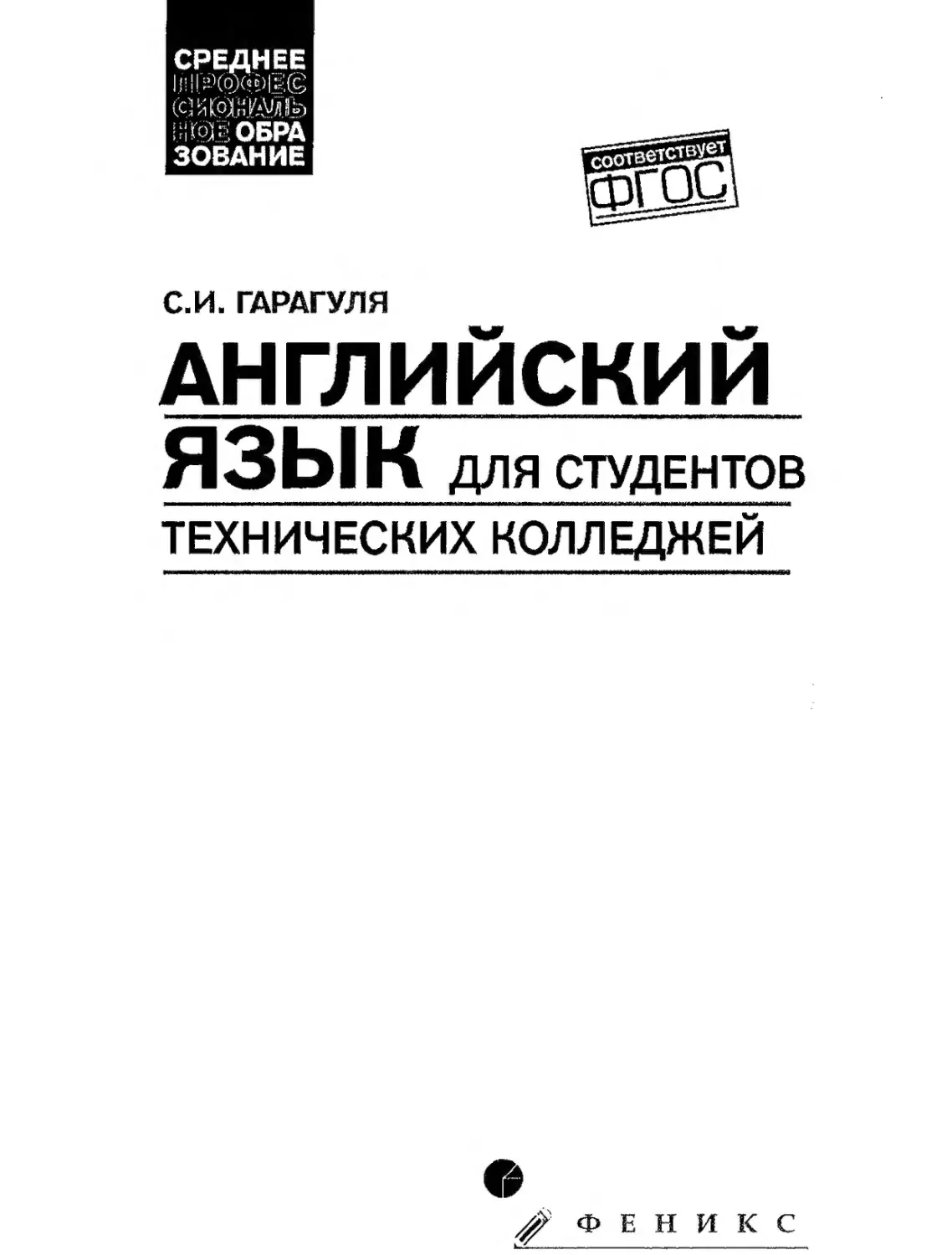


Author: Гарагуля С.И.
Tags: английский язык учебники и учебные пособия по английскому языку иностранный язык языкознание изучение языков
ISBN: 978-5-222-27011-0
Year: 2017


Text
СРЕДНЕЕ
^ЖОБРА
ЗОВАНИЕ
С.И. ГАРАГУЛЯ
АНГЛИЙСКИЙ
ЯЗЫК ДЛЯ СТУДЕНТОВ
ТЕХНИЧЕСКИХ КОЛЛЕДЖЕЙ
ФЕНИКС
Серия «Среднее профессиональное образование»
С.И. Гарагуля
АНГЛИИСКИИ ЯЗЫК
для студентов технических колледжей
ENGLISH
for Technical College Students
Рекомендовано Научно-методическим советом
Международного научного общественного объединения «МАИТ»
в качестве учебника для студентов вбразовательныхучреждекий
среднего образования, обучающихся по укрупненным группам специальностей
08.00.00 Техника и технологии строительства,
21.00.00 Прикладная геология, горное дело, нефтегазовое дело и геодезия,
23.00.00 Техника и технологии наземного транспорта
(рецензия РЭЗ16-18 от 23,05.2016 г.)
Ростов-на-Дону
«Феникс»
2017
УДК 811.111(075.32)
ББК 81.2Лнгл-92
КТК 8032
Г20
Рецензенты:
доктор филологических наук, профессор Белгородского
государственного национального псследовательского
университета И.A. Itynpueea;
преподаватель Белгородского строительного
колледжа Н.В. Петрова
Г20 Гарагуля С.И.
Английский язык для студентов технических колледжей =
English for Technical College Students: учебник / С.И, Гарагуля —
Ростов п/Д: Феникс, 2017. — 509 с. — (Среднее профессиональное
образование).
TSBN 978-5-222-27011-0
Учебник представляет собой курс английского языка, направ-
ленный на обучение различным видам чтения, овладение обще-
употребительной и общетехнической лексикой в соответствии с
отобранными гемами и сферами общения, а также; формирование
навыков устной речи, аудирования и письма. Особое внимание
уделяется грамматическим явлениям, характерным для чтения и
перевода обшетехнических текстов, и их тренировке.
Предназначен для студентов технических колледжей. Мо-
жет быть использован учащимися гимназий! и лицеев, студен-
тами первого курса бакалавриата технических вузов, а также
специалистами-практиками, изучающими самостоятельно ан-
глийский язык.
ISBN 978-5-222-27011-0
УДК 811.111(075.32)
ББК 81.2Англ-92
© Гарагуля С.И., 2016
© Оформление: ООО «Феникс», 2016
Предисловие
Настоящий учебник адресован студентам технических кол-
леджей, уже владеющих английским языком в пределах про-
граммы основного общего образования (9 классов). Он может
быть рекомендован учащимся гимназий и лицеев, студентам
первого курса бакалавриата технических вузов, а также специ-
алистам-практикам, изучающим самостоятельно английский
язык. Возможность использования учебника обучающимися, не-
зависимо от области их специализации, обеспечивается тем, что
представленный в нем языковой материал не содержит узкоспе-
циальной лексики.
Учебник построен на основе Федерального государственного
образовательного стандарта среднего профессионального обра-
зования в соответствии с программой курса иностранного языка
для технических колледжей.
Основная цель учебника, имеющего практическую направ-
ленность, — обучение различным видам чтения, овладение обще-
употребительной и общетсхничсской лексикой в соответствии с
отобранными темами и сферами общения, а также формирование
навыков устной речи, аудирования и письма. Особое внимание уде-
ляется грамматическим явлениям, характерным для чтения и пере-
вода текстов профессиональной направленности, и их тренировке.
Учебник состоит из 20 тематических уроков (Units) и двух
приложений (Appendixes) — Supplementary Reading («Дополни-
тельное чтение») и Tapescripts («Тексты, записанные на аудионо-
сители»). Все уроки имеют единую структуру построения, вклю-
чающую шесть разделов (Sections) — Vocabulary and Word Study,
Grammar, Reading and Discussion, Speaking, Listening и Writing, в
каждом из которых реализуются определенные цели и задачи,
установленные программой курса иностранного языка для тех-
нических колледжей.
Раздел Vocabulary and Word Study предусматривает работу
над активным словарем, который отражает наиболее частотные
слова и словосочетания, представленные в публицистической,
научно-популярной и общетехнической литературе. На осмыс-
ленное закрепление активной лексики нанелена соответствую-
щая система упражнений, которые построены и расположены по
принципу «от простого к сложному» — от уровня слова, словосо-
четания, предложения до уровня сверхфразового единства. Име-
ются упражнения на многозначность, нахождение синонимов и
антонимов, определение значений именных словосочетаний с
препозитивными определениями, узнавание интернациональ-
ных слов и терминов, словообразование и т.д., что способствует
выработке у обучающихся языковой догадки. Для снятия про-
износительных трудностей активная лексика снабжена транс-
крипцией. Выполнение данных заданий обеспечивает усвоение
активного словаря в полном объеме.
Б разделе Grammar представлены коммуникативно-ориен-
тированные задания, нацеленные на развитие базовых грам-
матических навыков понимания и перевода общетехниче-
ских текстов, создание и воспроизведение высказываний на
английском языке Грамматический материал включает явле-
ния, характеризующиеся высокой частотностью употребления
в научной речи. Прежде всего это относится к структуре пред-
ложения, видовреметшым формам глагола в действительном и
страдательном залоге, модальным глаголам, неличным формам
глагола и др. К большинству упражнений даны образцы их вы-
полнения.
Каждый раздел Reading and Discussion содержит два текста,
тематика которых отражает различные стороны академической
и профессиональной деятельности будущих специалистов сред-
него звена, социокультурную специфику родной страны и стран
изучаемого языка, достижения современной науки и техники,
включает биографии выдающихся ученых, описания научных
открытий и т.д. Первый текст (Text .4) рассматривается в каче-
стве основного текста урока и предназначен для изучающего
чтения. К нему даются предтекстовые и иослетекстовые упраж-
нения. Предтскстовые задания преследуют цель формирования
навыков прогнозирования и умения вести бесед}' общего содер-
жания по проблематике урока. Упражнения пос дотекстового
этапа способствуют развитию монологической речи в виде со-
общения или доклада — констатировать факт или обосновать и
выразить собственное мнение, сделать короткое сообщение или
обобщение. Второй текст (Text В) предназначен для развития
навыков ознакомительного, просмотрового или поискового чте-
ния. Упражнения к этому тексту направлены на осуществление
контроля понимания, определение его основной темы или идеи,
поиск конкретных данных, применение определенной инфор-
мации в соответствии с коммуникативными задачами. Данный
текст также может быть использован для пересказа. Дополни-
тельной целью работы над текстами А и В является расширение
общеупотребительного и общенаучного вокабуляра обучаю-
щихся, а также тренировка грамматических структур урока.
Раздел Speaking включает диалоги, содержащие устойчивые
выражения, речевые модели и клише, характерные для неофи-
циального и официального общения в бытовой, социокультур-
ной и учебной сферах: знакомство, представление себя и коллег,
семья, описание людей, учеба в колледже, будущая профессия,
досуг, спорт, обычаи и праздники, научно-технический прогресс
и др. Задания, составленные к диалогам, построены по принци-
пам моделирования различных жизненных ситуаций, в которых
могут находиться студенты.
В разделе Listening представлены задания к двум аудиотекстам,
которые приводятся в приложении 2 (Appendix2. Tapescripts), Они
могут быть прочитаны преподавателем или звучать в записи.
Небольшие но объему тексты монологического характера непо-
средственно связаны с темой урока. Контроль их понимания осу-
ществляется с помощью вопросно-ответных упражнений, путем
заполнения таблиц/схем и др. Цель заданий состоит в понима-
нии общего смысла прослушанного текста, нахождении или из-
влечении конкретной информации, которые служат основой для
краткого изложения содержания аудистекста, дискуссии по теме
и т.д, К приложению Tapescripts обучающиеся обращаются на за-
ключительном этапе работы над разделом Listening, что позволяет
им проверить правильность понимания текста, а также выявить
непонятные фрагменты, выписав и выучив незнакомые слова.
Упражнения раздела Writing направлены на развитие навы-
ков передачи на английском языке и правильного оформле-
ния информации в соответствии с коммуникативными целями
и с учетом адресата — написание личных, деловых и электрон-
ных писем, факсов, изложение сведений о себе, заполнение
наиболее распространенных анкет и бланков, оформление ре-
зюме, составление рефератов и др.
Приложение 1 Supplementary Reading включает тексты для
дополнительного чтения с последующим написанием реферата.
Они способствуют расширению не только лингвострановедче-
ского, но и профессионального кругозора студентов. Данные
тексты могут быть использованы как для работы в группе, так и
для самостоятельной работы студентов с последующим обсуж-
дением содержания текстов в аудитории или в виде индивиду-
альных устных сообщений.
Автор выражает глубокую признательность рецензентам —
доктору филологических наук, профессору Ирине Анатольевне
Куприевой и преподавателю Наталье Владимировне Петровой
за детальный анализ рукописи и ценные критические замечания,
высказанные при рецензировании учебника.
Автор
UNIT 1.
The College J GoTo
SECTION 1
VOCABULARY AMD WORD STUDY
1. Read and memorize the active vocabulary to the text
"A Technical College” and translate the given sentences,
1. range ['reinds] n v - ряд, серия, диапазон, интервал, предел;
колебаться в пределах, классифицировать, простираться
There is a wide range of opinions on this issue. The average
age range is between 53 and 55. Prices range from £5 to £10. The
conversation ranged widely.
2. academic [ .oWdcmik] adj — учебный, академический
academic building [ fhildirj] — учебное здание
academic course [ka:s] — учебный курс
academic year — учебный год
She received awards for her academic achievements. This
academic building was built in 1978 and expanded in 2012. The
college offers a wide range of academic courses. The students return
in September for the start of the new academic year.
3. term [ta:m] n — семестр
end-of-term tests and examinations — семестровые зачеты
и экзамены
Are there any exams at the end of this term? The students take
end-of-term tests and exams twice a year.
4. vocational [vau'keiffsjnal] adj — профессиональный
vocational-technical college [’teknik(o)l] — профессионально-
технический колледж
go to a vocational-technical college — учиться в профессио-
нально-техническом колледже
The college also offers a wide range of vocational programmes.
Another approach is to use simulation programs to make education
more vocational, more practically orientated. To prepare for some
technical jobs, you may need to go to a vocational-technical college.
5. department [di'pa:tmsnt] n — отделение; кафедра
The chemistry department is situated on the first floor of the
college.
6. first-year student — студент первого курса, первокурсник
full-time student -- студент очной (дневной) формы обучения
All the first-year students are required to attend this conference.
She was a full-time student.
7. attend [attend] v — посещать, присутствовать
attend college — учиться в колледже
attend classes — посещать занятия
attend a workshop ['walkbp] ciass — посещать занятие в ма-
стерской
attend a lecture ['lekt/э] — посещать лекцию
attend a seminar ['semina:] — посещать семинар
Are you going to attend the meeting? He will attend college till
he is nineteen. Students are expected to attend classes regularly. The
students find it useful to attend workshop classes. You need to attend
all the lectures and take notes.
8. learning programme — программа (форм?) обучения
correspondence [,kari'spand(g)ns] learning programme — про-
грамма (форма) заочного обучения
distance learning programme — программа (форма) дистан-
ционного обучения
A learning programme leads to the achievement of a particular
qualification. The majority of colleges offering correspondence
learning programmes also offer regular classroom-based learning.
The University of London was the first university to offer distance
lea? 77 ing programmes.
9. train [trem] г — обучать, готовить (к чему-л.)
training п — обучение, подготовка, образование
The college trains specialists for the construction industry. Ue
is training to be an electrician. Some- colleges provide vocational
training. On the course he received a thorough training of the job.
10. employ [im'ploi] c ~ предоставлять работу, нанимать; ис-
пользовать, применять
employer [im'plois] п — работодатель, наниматель
employee [{imploi'i:J п — служащий; работающий по найму
employment [im'pbimant] п — работа, служба; занятость (ра-
бочей силы); прием (па работу); применение, использование
How many people does the company employ? The statistical
analysis was employed to obtain these results. He was sent to London
by his employer. The company has over 50 employees. He couldn’t
find employment.
11. occupation [rokju'peif(o)n] n — профессия; занятие; род
или вид деятельности, занятий
technical occupation — техническая профессия
technician [tek'ni f(a)n] п — техник
Please state your name, address, and occupation. By occupation
she is a secretary. The college trains students in technical occupations.
The company is looking for a technician to work full time on
a permanent basis in the laboratory.
12. equip [i'kwip] / (syn.) fit v — оборудовать, оснащать
equipment [i'kwipmant] n — оборудование, оснащение
up-todate [,Apta'deit] equipment - современное (новейшее)
оборудование
It is going to cost a lot of money to equip the laboratory. The
rooms were all fitted with smoke alarms. The plant needed new
equipment. This factory uses the most ир-ю-date equipment.
13. provide [pra'vaid] v — снабжать, обеспечивать
They will not provide us with any details. He course is free but
you have to provide your own. books.
14. scholarship ['skohfip] n — стипендия
grant a scholarship — давать (присуждать) стипендию
He receives a scholarship. He was granted a scholarship.
15. borrow [’boron] г — брать (на время); занимать, одалживать
borrow course books from the library — брать учебники в би-
блиотеке
Can I borrow your pen? He borrowed 100 roubles from his friend.
They can borrow up to four course books from the library.
16. facility [fo'siliti] n — устройство, приспособление, обору-
дование; сооружение
sports facilities — спортивные сооружения
This is a phone with a memory facility. The college has excellent
sports facilities.
17. hall of residence / hall n — студенческое общежитие
Do you live in the hall of residence!
18. accommodate [a'komadcit] v — предоставлять жилье
accommodation [s.koms'dcijn] n — помещение, жилье
The hall of residence can accommodate up to 500 students. Hotel
accommodation is included in the price of your holiday.
19. complete [kgm'plntj adj v — полный, законченный, завер-
шенный; заканчивать, завершать
complete education — получить образование
completion [kam'pli:/(a)n] п — завершение, окончание
I collected the complete set. His work is now complete. He
completed his first novel. Millions of girls and boys completed their
secondary education last year. Completion of secondary education is
the requirement for admission to higher education.
20. curriculum [ka'rikjulsm] n — учебный план, курс обучения
English is on the curriculum.
21. take an exam(ination) — держать (сдавать) экзамен
pass an exam(ination) — выдержать (сдать) экзамен
How many students are taking the biology exam this term? I
failed my physas exam, but I passed chemistry.
22. carry out tests (experiments) — проводить опыты/ испы-
тания (эксперименты)
During the term, the students carry out a lot of laboratory tests.
23. graduate (from) ['grmdjueit] v — окончить (колледж, универ-
ситет); [fgraedjuit] n — выпускник (колледжа или университета)
graduation paper — дипломная работа
defend [di'fend] a graduation paper — защитить дипломную
работу
Не graduated from college last year. 1 am a graduate of the
construction department. I should explain something about my
graduation paper. Students will defend their graduation papers in June.
24. skill п — мастерство, опыт, умение, квалификация
skilled adj — опытный, умелый, квалифицированный
Ruth possessed great writing skills. We need skilled workers tor
this job.
2. Match the pairs of synonyms from A and В and translate
them.
A
1. grant
2. semester
3. educational
4. finish
5. equip
6. worker
7. modern
8. expertness
9. take and return
10. appliance
11. profession
12 give
В
a) academic
b) skill
c) fit
d) provide
e) up-to-date
f) borrow
g) scholarship
h) complete
i) vocation
j) facility
k) term
I) employee
3. Match the verb on the left with a suitable item on the right.
Use each item once only.
1. carryout
2. grant
3. defend
4. employ
5. take
6. borrow
7. graduate
8. equip
9. live
10. attend
a) a college graduate
b) course books
c) tests
d) in a hall of residence
e) a laboratory
f) a graduation paper
g) classes
h) a postgraduate course
i) a scholarship
j) from college
4. Make the following sentences complete by translating the
words and phrases in brackets.
1. А (семестр) divides the (учебный год) into two periods. 2. The
students (сдавать семестровые зачеты и экзамены) twice a year. 3. А
(профессиональный) course teaches the skill necessary for a particular
job. 4. There are three (отделения) in the college. 5. There are about
500 (студенты дневной формы обучения) going to college. 6. The
(заочная и дистанционная формы обучения) arc ideal if you need
to combine work and studies. 7. (Квалифицированные) mechanical
(техники) play a vital role in the industry. 8. Many colleges (готовят)
electricians. 9. The centre is responsible for the video presentation (обо-
рудование) installed in the college rooms. 10. The college is adding
more technical courses to its (учебный план).
5. Insert the correct word from the Active Vocabulary.
1. A learning programme is an educational course that
you take at home, receiving your work and sending it back by post or
by email. 2. This college has a wide________of learning programmes.
3. He defended his_____________successfully. 4. The hall of residence
can___________about 300 students. 5.1 go to a college.
6 He will____ _ his secondary education in 2016. 7. A freshman
or a fresher is a in secondary school, college or university.
8. Please let me know if you are unable to_________a workshop class
on Monday. 9. He managed to_____________all his examinatons. 10. The
college has the excellent ____________ including a swimming pool,
a fitness room, a sports hall, a tennis court and a gym.
G. Read and translate the following international words which
come from Text 1 A. Look up their transcriptions in the dictionary
if necessary. Mind the part of speech.
Academic adj, department n, technical adj, resource n, style n,
athlete n, organise v, general adj. special adj, specific adj, practical
adj, laboratory n, design n v, creative adj, innovative adj, graphics n,
technology n, fundamental adj, characteristic n adj, process n.
7. Study the ways some nouns are formed from verbs. Form
the nouns from the following verbs. Read and translate them into
Russian. Use your dictionary to help you with the pronunciation.
a) -er/-or (the suffixes are used for a person who does an activity
and for things which do a particular job):
Example: build — строить —* builder — строитель
Collect, compute, begin, farm, manufacture, produce, distribute,
work, own, use, design, manage, direct, educate, translate.
b) -ment (the suffix is used for an act or result of something):
Example', achieve — достигать —> achievement — достижение
Pay, govern, employ, agree, manage, establish, improve, advertise,
require, involve, equip, arrange, adjust, accomplish.
c) -ion/-ation/-ition/-sion/-tion (the suffixes are used for an
act, state, or result of something):
Example', construct — строить —> construction - строительство
Create, complete, decide, educate, prepare, produce, compete,
examine, distribute, graduate, pollute, define, locate, combine, limit.
8. Read and translate the following phrases using the above
patterns. Look up the words in your dictionary if necessary.
The leader of the students’ union, an observer of nature, a Nobel
Prize winner, a tape recorder, laboratory equipment, some interests
of investors, to reach agreement, people in employment, investment
into the sphere of vocational-technical education, a graduation paper,
a monthly payment, an end-of-term examination, the completion of
education, his election to the post, a job-creation scheme.
SECTION 2
GRAMMAR
9. Study the forms and use of the articles.
Неопределенный артикль (The Indefinite Article) Определенный артикль (The Definite Article)
a (an)<one a — перед словом, начинаю- щимся с согласного звука: a text, a fine day. an — перед словом, начинаю- щимся с гласного звука: an apple, an old hotel. the < that the [tel — перед словом, начинаю- щимся с согласного звука: the text, the next exam. the [6i: j — перед словом, начинаю- щимся с гласного звука: the «pple, t he open book.
Употребляется только с исчис- ляемыми существительными в единственном числе и обозна- чает: 1. Одного представителя какого-то класса предметов пли лиц: Не is a student. It is a hotel. 2. Любой предмет: Give me a pen. 3. Упоминание слова в первый раз: Не has a new саг. Употребляется как с исчисляемыми существительными в единственном и во множественном числе, так и с неис- числяемыми существительными, когда: 1. Речь идет об определенном лице пли предмете: The lecture was interesting. 2. Слово упоминалось ранее: Не has a new car, the car is very expensive.
10. Write a or an.
1.academic year
2.term
3.technician
4.employee
5 .first-year student
6 .up to-date system
7. university
____*
8.organisation
9 hour
11. Put a or the into each gap.
1.____college I go to offers_____wide rage of academic courses.
2.1 have two children,____girl and____boy.______girl is four and
bey is seven. 3.___academic year runs from September to June. 4. At
the end of period of study every student writes and gets ready _
graduation paper. 5. Each classroom has ___computer. 6.college
library provides place to study, material for study and services
to assist study. 7.___college has_____canteen._____canteen is very
big. 8.1 must take bus to get to my college. 9 I am first-year
student. 10. It is easy test. 11. Give me pen.
12. Study the rules for forming the plural of nouns.
Единственное число (The Singular) Множественное число (The Plural) Примечания (Noles)
a week a pen a bee a mat ch a city a knife, a shelf weeks [sj pens [z] bees [z] matches fiz] cities [z] knives, shelves [z] после глухих согласных после звонких согласных и гласных после -се, -s, -se, ~ss, -х, -sh, -ch, -tch, -ge конечная -у после соглас- ной буквы меняется на -г- и добавляется -es перед -s конечные -fe, -f переходят в -ve
Особые случаи образования множественного числа
_______________суш ествительных_________
Единственное число (The Singular) Множественное число (The Plural)
man [ma?n] woman ['wuman] child [tjaild] foot [fu:t] analysis (a'nadasisl datum ['deitam] phenomenon [fi’nominan] men [men] — мужчины, люди women 1'wimin] — женщины children ['tfildran] — дети feet — ступни; футы analyses [a'iuelasi:z] — анализы data [ delta] — данные, данные величины phenomina [fi'nominal — явления
13. Read the following plurals of the nouns. Remember the
rules for the pronunciation of-s/-es at the end of a word.
Photos, trees, desks, brushes, workers, pages, lorries, toys, wives,
chairs, places, computers, families, buses, knives, wishes, inches, monkeys.
14. The nouns in the box all appear in Text 1A of the Unit. Put
them in the correct column to show their pronunciation.
st udents colleges resources technicians
levels needs teachers subjects
jobs departments occupations athletes
programmes ranges books offices
markets instruments classes manuals
[s) [Z] [iz]
15. Write the plurals of these nouns ending in consonant +*y
vowel +-y and -f(e).
Activity, laboratory, day leaf, activity, life, ability, play, bookshelf,
half, facility, toy guy, factory, loaf
16. Write the irregular plurals of the following nouns. Use
your dictionary in necessary.
a) man, foot, goose, child, man, woman, tooth, ox, mouse;
b) medium, phenomenon, crisis, basis, curriculum, radius, (latum,
spectrum, stimulus, axis, matrix.
17, Read and translate the following word combinations with
nouns in the possessive case.
Общий падеж (The Common Case) Притяжательный падеж (The Possessive Case)
Pere John George Ед. число the student Pete’s [pi:ts] book — книга Пита John’s [chpnz] hat — шляпа Джона George’s ['djoidjiz] father — отец Джорджа the student’s ('stjuxl(a)nts] pen - ручка студента
Мн. число the students children the students’ ('stju.d(a)nts] address — адрес студентов children’s ['tfildronz] toys - игрушки детей
Eve’s friend, Mr Kelly’s wife, James’s party, Paul’s house, the
teachers desk, my friend’s party the college students’ course books,
the schoolchildren’s uniform, my parents’ garden, my boss’s car,
fifteen minutes’ break, the librarians’ room, an hour’s journey.
18. Join two nouns as in the example. Use an apostrophe (’)
with or without s for people; of — for things.
Example: the bag/my friend — my friend’s bag;
the window/thc room — the window of the room.
The birthday/Tom; the favourite tea m/Л lice; the hall/residence;
the son/Charles; the duration/ the course programmes; the books/
the children; the telephone number/my sister; the end/the term;
the name/this street; the key/thc car; the bicycle/my brother; the
career/Mr Fox; the enginecr/the computer; the dog/thc medal.
19. Translate the following word combination into English.
Сын моей сестры, профессия ее матери, учебный курс перво-
курсников, компания работодателя, преподаватели моего брата,
отделения колледжа, комната Бесс, тетради студентов дневного
отделения, классные комнаты колледжа, страница книги, имя се-
стры моего друга, слова урока 1.
20. Study the forms and uses of the personal and possessive
pronouns.
Число Лицо Личные местоимения (The Personal pronouns) Притяжательные местоимения (The Possessive Pronouns)
Именитель- ный падеж Объектный падеж Г форма (примыкаю- щая) П форма (абсолютная)
Употребля- ется в роли подлежа- щего Употребля- ется в роли дополнения Употребля- ется перед существитель- ными Употребляется самостоятельно без существи- тельного
1-е 1 я те меня, мне wy мой {-я, е, и) тнтел/ой (-я, е, и)
2-е you ты you тебя, тебе у виг твой {-я,е,и) yours твой (-я, е, и)
о 3-е he он him его, ему his его his его
p? о she она her ее, ей her ее hers ее
it он, она, оно it его, ему, ее, ей (обозна- чает неоду- шевленные предметы) its его, ее (обозначает неодушевлен- ные предметы) its его, ее (обозначает не- одушевленные предметы)
<3 (обозначает неодушев- ленные пред- меты)
1-е we мы us нас, нам our наш (-а,е,и) ours наш (-а, е, и)
2-е you вы you вас, вам your ваш (-а, е,«) yours ваш (-а,е, и)
о м 3-е they они them их, им their их theirs их
и я (обозначает (обозначает (обозначает (обозначает
Мн. ч одушевлен- одушевлен- одушевленные одушевленные
ные и неоду- шевленные предметы) ные и неоду- шевленные предметы) и неодушев- ленные пред- меты) и неодушевлен- ные предметы)
Examples:
Личные местоимения (The Personal pronouns)
lam talking to him. Я разговариваю с ним. Не is talking to me. Он разговаривает co мной. You see them. Вы (ты) видите (видишь) их. They sec you. Они видят вас (тебя). She visits us every Sunday. Она навещает нас каждое воскресенье. We visit her on Saturdays. Мы навещаем ее по субботам. You live with them. Вы (ты) живете (живешь) с ними. They саше го see you. Они пришли повидаться с вами (тобой). The key is on the table. It is Ключ на столе. Ou на столе, on the table. The book is interesting. It Книга интересная Опа интересная. is interesting. The letter was received. It Письмо было получено. Оно было полу- was received. чено. I don’t want this book. You Мне ire нужна эта книга. Ты можешь ее can have it. взять.
Притяжательные местоимения (The Possessive Pronouns)
I know Nick but I don’t Я знаю Пика, но не знаю его жену, know his wife It’s my favourite sport. Это мой любимый вид спорта. It is her husband’s house. Это дом ее мужа. I can give you my реп. Я могу дать вам свою ручку. You сап give me your реп. Ты можешь дать мне свою ручку. Oxford is famous for its Оксфорд известен своим университетом, university. This is your pen and that Это твоя ручка, а то — моя. is mine. “Is this your pen?" “No. it’s «Это твоя ручка?» — «Нет, это твоя yours”. (ручка)». These pens are ours. Эти ручки — нагни.
Сравните:
Я знаю его. (личное местоимение) Я знаю его сестру, (притяжательное ме- стоимение) Я видел их. (личное местоимение) Я видел их родителей, (притяжательное местоимение) I know him. I know his sister. I saw them. I saw their parents.
21. Complete the sentences using the correct form of the
personal pronouns in brackets.
1. ... are full-time students (us, we). 2. Tell... about your college
(us we). 3. We saw ... in the college library (she, her). 4. Jane gave
... those books (I, me). 5. Show ... your graduation paper (he, him).
6. Where is my money? — I put ... on the table (it, them). 7.... am
a first-year student (I, me). 8.... arc fitted with up-to-date equipment
and instruments (they, them). 9. Talk to ... after classes (they them).
10. Look at my new book.... is very interesting (she, it).
22. Complete the sentences using the correct form of the
possessive pronouns in brackets.
1. ... college is old (our, ours). 2. Whose map is this? — It is ...
(our, ours). 3.... department is on the third floor (your, yours). 4. Is
that... car? (your, yours) 5. Is it your idea? — Yes, it’s... (my, mine).
6.... favourite subject is English (my, mine). 7. Are you Jane’s
friend? — Yes, I’m a friend of... (her, hers). 8. Ann is going out with ...
friend this evening (her, hers). 9. This is a beautiful tree.... leaves are
a beautiful colour (his, its), 10.1 want to phone Pete. Do you know
... phone number? (his, its) 11. Tell me about... college (their, theirs).
12. My room is bigger than... (their, theirs).
23. Make the following sentences complete by translating the
personal and possessive pronouns in brackets.
1. (Наш) college was founded in 1970. (Он) has grown
significantly since that time. 2. (Он) is a second-year student.
3. Show (мне) your new computer classroom. 4. (Их) academic
course is very interesting. 5. These computers are (их). 6. She is
doing (свою) work. 7. The robot is doing (свою) work. 8. He is doing
(свою) work. 9. (Оно) (общежитие) is in Pushkin street. 10. (Ее)
brother is also a college student. 11. Give (мне) another example of
this grammar rule. 12. (Я) ask (тебя) to explain this rule. 13.'This
house is (наш). 14. Can I introduce (тебя) to a friend of (мой)?
15.1 know (вас) but I don’t know (вашего) son. 16. Now this book
is (ваша). 17.1 saw (его) new bicycle. 18.1 saw (его) in the college
canteen yesterday. 19. This is a very old table. (Его) legs are broken.
20. Tell (нам) about your lectures.
24. Study the forms of the verb to be (быть, находиться, пре-
бывать где-либо) in the Present, Past and Future Simple Tenses.
Утвердительная фирма Вопросительная форма Отрицательная форма
Present I am = I’m He is = He’s She is = She’s It is = It’s Ami...? Is he...? Is she...? Is it...? I am not = I’m not He is not « isn’t She is not = isn’t It is not = isn’t
We are = We’re You are = You’re They are = They’re Are we...? Are you...? Are they..,? Where are they from? We are not = aren’t You are not = aren’t They are not = aren’t
Past 1 was He was She was It WaS Was I,..? Was he...? Was she...? Was it...? 1 was not » wasn’t He was not = wasn’t She was not = wasn’t It was not = wasn’t
We were You were They were Were we...? Were you...? Were they...? Where were they? We were not = weren’t You were not = weren’t They were not = weren’t
Future I will (shad) be = I’ll be We will (shall) be = We’ll be Will (Shall) I be...? Will (Shall) we be...? 1 will not (shall not) be ^won’t (shan’t) be We will not (shall not) be « won’t (shan’t) be
He will be = He’ll be She will be « She’ll be It will be “ It’ll be You will be = You’ll be They will be ~ They’D be Will he be...? Will she be...? Will it be...? Will you be...? Will they be...? Where will they be? He will not be » won’t be She will not be=won’t be It will not be = won’t be You will not be = won’t be They will not be = won’t be
25, Read the following sentences which are a) present, b) past
and c) future. Put them into the negative and the question.
Translate these sentences.
Example:
The report was ready yesterday. (When?)
The report was not (wasn't) ready.
Was the report ready yesterday?
When was the report ready?
a) 1. We are future technicians. 2. My keys are on the table. (Where?)
3. They are college students. 5. You are at college now. (When?) 6. He is
fifteen years old. (How old?) 7. My father is a skilled worker, 8. It is our
college. 9, His work is complete. 10.1 am a college student.
b) 1 She was at the theatre yesterday. (Where? When?) 2. They
were at home yesterday morning. (Where? When?) 3. He was my
friend. 4. It was cold last week. (When?) 5.1 was busy at 5 o’clock.
(What time?) 6. The hotel was comfortable. 7.1 he idea was good
8. Sue and Steve were at the party. (Where?) 9. You were on holiday.
10. The weather was fine.
c) 1.1 will be an engineer. 2. My friend will be a fourth-year
student next year. (When?) 3. It will be our new academic building.
4. He will be in class at 10 o’clock. (Where? What time?) 5. We will be
at the exhibition tomorrow. (Where? When?) 6. They will be present
at the lecture (Where?) 7. His scholarship will be 2000 rubles. 8. Tom
will be late. 9. Next month I will be in Moscow. (When?) 10. He will
be sixteen years old in a year. (How old? When?)
26. Write positive and negative short answers (Yes, lam / No,
he wasn’t, etc.).
1. Are you married?____________
2. Was it cold yesterday?
3. Will you be in class tomorrow?
4. Was your friend late?___________
5. Are your friends English?
6. Was it sunny two days ago?
7. Will you be a technician?
8. Is tennis your favourite sport?
9. Will your mother be at 5 at home?
10. Are your parents at work now?
27. Complete these sentences. Use am/is/arc, was/were or will be.
1.1 Russian. She American. 2 How old you? 3. Today
the weather_____fine but yesterday it___cold. 4. George______not at
college last week because he____ill. 5. We___in the classroom now.
6. We hungry after the journey but we _ not tired. 7. you
at the seminar tomorrow? 8. “ What colour your car?” — “It__red.”
9. Yesterday three students__absent at the English class. Today all
present. 10. Michael travels a lot. Today he in Moscow. Tomorrow he
in Saint Petersburg. Next week he in London. 11.1 late for
my classes tomorrow. 12. A.S. Pushkin bom in 1799.13. “you
a good student?” — “Yes, I 14. My brother and I at home now.
15. your friend from Belgorod?’’ — “No, he from Moscow?”
16. J___free now 17.“______you ready now?” - “Not yet. I______ready in
ten minutes.” 18. AVh.ere you at 10 o’clock yesterday? 19. “Where are
my keys?” — “I don’t know. They on the table but they not there
now. 20. It’s Nick’s birthday next Friday. He 17.
28. Study the word order in affirmative sentences.
Обстоятельство (Adverbial modifier) Подлежащее (Subject) Сказуемое (Predi- cate) Допол- нение (Object) Обстоятельство (Adverbial modifier)
His file is on the desk.
Peter received a letter yesterday.
Yesterday Peter received a letter.
Дополнения также располагаются в строго определенном порядке: 1) косвенное беспредложное (кому? чему?), 2) прямое (кого? что?), 3) косвенное предложное (с кем? для кого?). John gave те a book. ~ John gave a book to me.
При наличии нескольких обстоятельств они располагаются за глаго- лом или дополнением следующим образом: 1) обстоятельство образа действия, 2) обстоятельство места, 3) обстоятельство времени. She translated that text with the dictionary at the college library yesterday.
Определение может относиться к любому члену предложения, выра- женному существительным.
29. Arrange these words in the right order. Use a capital letter
to begin each sentence.
1. begins, in September, my term. 2. well, 1, English, speak.
3. eleven, in his, he., college, is, till. 4. old, very, mathematics, science,
is, a. 5. will, a technician, he, after, be, from, the graduation, college.
6 today, is, very, English, important, the knowledge, of. 7. begin, at
9 o’clock, in the morning, the lectures. 8. in, tomorrow, will, Rome,
be, she. 9. every, year, leave, schools, millions, secondary, of, children.
10. the term, attend, during, and, lectures, seminars, students.
30. Make general questions with these words in the correct
order, using is/are/was/ were/will...be, and give short positive/
negative answers to them.
1. (your parents/well?) 2. (interesting last year/yourjob?) 3. (the
shops/open next week?) 4. (interested in English at school/you?)
5. (near here/the college?) 6. (at college at 3 o’clock tomorrow/your
classmates?) 7. (large/your college?) 8. (free tomorrow/you?)
31. Make questions with what (what colour)/who/how much/
how old/where/why/when, using is/arc/was/ were/wilL.be.
1. _the bus stop? — At the end of th e street 2. he next
week? — In London. 3.____the man in this photograph? — That’s the
head of the department. 4. your favourite subject at school? —
English. 5. your friend at five o’clock tomorrow? - At the
university 6.___your children last year? — Five, six and ten years
old. 7.___your new shoes? — Black. 8._______your lecturer angry
with you yesterday? — Because 1 was late.
SECTION 3
READING AND DISCUSSION
32. What do you know about technical colleges? Read the
statements given below and say if they arc right or wrong. If the
statements are not right, make the necessary corrections.
a) A technical college doesn’t offer many academic courses.
b) Distance learning programmes are for those who don’t work.
c) A technical college trains students for employment in
engineering occupations.
d) There are a lot of laboratories at a technical college.
e) A technical college library provides students with learning
resources online.
f) College sports facilities only include gyms.
g) Students studying away from home are accommodated in halls
of residence.
h) The academic year begins in September and ends in June.
i) During the terms, students don’t often do practical work.
j) College graduates work at research institutes.
33. Read Text 1A “A Technical College’7 to find out if you are
right or wrong. The following phases may be helpful:
Quite so. Exactly. It’s (partly) true. Just the opposite. I don’t
think so. That’s right. That’s wrong.
Text 1A
A Technical College
The college I go to was founded in 1970 and since that time it has
grown significantly Now it offers a wide range of academic courses at
vocational-technical level, enabling students to be successful in the
current job market.
The academic activity is conducted across five departments.
There are about 1,500 full-time students attending college. The
correspondence and distance learning programmes specifically
tailored to the needs of those who work are also available.
The college is justifiably proud of its teaching. More than 80
teachers work at it. The college trains students for employment in
technician occupations.
There are a lot of laboratories at the college. They are fitted with
up-to-date equipment and instruments to provide a high level of
training. They are of great help to the students.
The college library provides the students with access to thousands
of learning resources in print and online. They can borrow course
books, manuals and literature on the subjects they are interested in.
There are some reading rooms suited to different styles of learning.
The students of all abilities, from complete beginners to athletes,
make the most of the college sports facilities including a few large
well-equipped gyms, sports grounds, and a swimming pool.
The students studying away from home are accommodated in
the hall of residence located on the college campus. The students can
organise most of their day-to-day needs without leaving the campus
which also includes the library, the academic buildings and the
canteen.
The academic year runs from September to June, and it is
divided into two terms. The duration of the academic programmes
is four years, following the completion of basic general education
(nine years), or two years, following the completion of secondary
(complete) general education.
According to the college curriculum the students have lessons
in general and special subjects in addition to workshop classes and
practical training, quite necessary for their future profession. The
students take end-of-term tests and examinations twice a year. If the
students who don’t pay for their studies pass them successfully, they
are granted monthly scholarships. During the terms, the students
have to attend lectures and seminars, carry out laboratory tests and
do practical work. At the end of the period of study, every student
writes and gets ready a graduation paper and then defends it in the
presence of the examiners’ body.
Every year a lot of young middle-level specialists graduate front
college. They work at plants, factories, design offices and others.
The college is committed to producing the professionally minded
and skilled graduates that employers want. It educates the students
to be creative, innovative and well equipped for the 21st century.
34. Answer the following questions.
a) When was the college founded?
b) How many departments does the college have?
c) How many students go to college?
d) What can you say about the teaching staff?
e) What are the college laboratories like?
f) Where can the students borrow literature for their studies?
g) Are there any facilities for the students to go in for sports?
h) What does the college campus include?
i) What are the periods of study for the academic programmes?
j) When do the students take their end-of-term tests and exams?
k) Are all the students granted monthly scholarships?
I) What do the students do at the end of the period of study?
m) What is the college committed to?
35. Add some more sentences confirming the following
statements.
1. The college has grown significantly 2. The college is proud of rts
teaching. 3. The laboratories are of great help to the students. 4. The
college library is suited to different styles of learning. 5. The college
students make the most of the sports facilities. 6. The students can
organise their day-to-day needs without leaving the campus. 7. The
academic year is divided into two terms. 8. The college educates the
students to be creative and innovative for the 21st century.
36. Find in Text 1A the paragraph about the college curriculum
and translate it into Russian.
37. Read aloud paragraphs 2—4.
38. Explain the following references.
a) Now it offers a wide range of academic courses....
What does the pronoun it refer to?
b) They are fitted with up-to-date equipment and instruments.,..
What does the pronoun they refer to?
c) They are of great help to the students.
What does the pronoun they refer to?
d) ...and then defends it in the presence of the examiners* body.
What does the pronoun it refer to?
e) They work at plants, factories, design offices and others.
What docs the pronoun they refer to?
39. Find in Text 1A the sentences with the verb to be and
translate them into Russian.
40, Put the main ideas (a—I) in the same order as they are in Text 1 A.
a) College sports facilities.
b) College academic courses and programmes.
c) College curriculum.
d) Writing graduations papers.
e) College laboratories.
f) Graduates’ employment.
g) Teaching staff.
h) Duration of the academic programmes.
i) College library.
j) Tests and examinations.
k) College campus.
1) Classes at college.
41. Retell the text in English according to the above plan.
42. Skim Text IB “College Facilities” and try to understand
what it is about.
Text IB
College Facilities
The college I attend is one of the best technical colleges in the
region, providing excellent full-time and correspondence courses.
The college has first class facilities, and the students enjoy
learning here, thanks to our inspirational teachers, great courses and
modern, purpose-built learning areas.
The college has 30 general classrooms in addition to workshops,
classrooms for technical drawing and graphics, metalwork,
woodwork, craftwork, materials technology, construction studies,
computer aided design. They are all well equipped with up-to-
date equipment. Each classroom has a computer with the Internet
access and a data projector. The college also has three science
laboratories, two fully equipped computer rooms, a multimedia room
and a demonstration room.
The library is central and common to all the academic activities
of the college. It provides a place to study, materials for study and
services to assist study It has a wide selection of general reading
materials for students of all ages. There are also books and journals
for those involved in project work.
Physical education facilities include a large gym, sonic changing
rooms, a basketball court, a sports ground and a swimming pool.
Sports clubs and societies make up a large part of the college
recreational and social activity
The college has a modern canteen where breakfast and lunch are
served every day It is a large spacious area, with a view of greenery
all around, and a variety of refreshments and meals available. It
tends to be the most popular place on campus not only for having
meals but also for student discussions and work on assignments
and projects.
There are two halls of residence, which can accommodate
students with all rhe facilities lor study, recreation and common
living. The rooms are all meant for two or three occupants each.
The college is a non-smoking campus and smoking is not
permitted anywhere on the sites. To safeguard the health of all
students and staff, smoking is strongly discouraged.
43. Identify the topic of each paragraph of Text IB and retell it
in English.
44. Complete the sentences choosing the best variant cor-
responding to the contents of Text IB.
1) The college I go to provides...
a) part-time courses;
b) full-tirne courses;
c) full-time and correspondence courses.
2) The students enjoy learning at college thanks to...
a) teachers;
b) full-time courses;
c) technical drawing and graphics.
3) Each college classroom has...
a) up-to-date equipment;
b) a data projector with the Internet access;
c) a computer.
4) The college library provides...
a) academic activities;
b) materials for study;
c) up-to-date equipment.
5) The canteen is the most popular place on campus for...
a) student discussions;
b) having a large spacious area;
c) greenery all around.
45. Make up a story about your college based on the
information given in the above texts.
SECTION 4
SPEAKING
46. When you meet someone new it is important to know
how to address the individual standing in front of you. Properly
addressing people in English in different situations shows you are
respectful of their position and mindful of not offending them in
any way. Study the following forms of address:
a) first name — used to call friends, e.g. John or Mary;
b) Mr. (Mister) + last name — used to address a man you know
less well, e.g, Mr. Smith;
c) Mrs. (Misses) + last name — used to address a married
woman you know less well, e.g. Mrs. Smith;
d) Ms. [mix] + last name — used to address a married or
unmarried woman, e.g. Ms. Smith;
е) Miss + last name — used to address a girl or unmarried woman,
e.g. Miss Smith;
f) Sir (without a name) — used as a form of polite address to
a man who is clearly older and/or more senior than oneself;
g) Madam (without a name) — used to politely speak to
a woman who you do not know
47. How would you address the following people?
a) your classmate (Philip/Phil/Philip Clark);
h) a married woman (Maria Brown);
c) an older man (Ernest Hardy);
d) agirl/unmarried woman you don't know well (Jane White),
e) a woman when il is not known whether she is married or not
(Elisa Black);
f) a stranger (Peter Bradford and Katherine Jones);
g) a man, whose name you do not know;
h) a woman, whose name you do not know;
i) a teacher Cane Smith, unmarried);
j) a friend of your age (Nicholas/Nick/Nicholas James).
48. Learn some expressions to introduce yourself and others.
1) . Introducing yourself:
I don’t think we’ve met before. I’m __.
Let me introduce myself. My name is___
I’d like to introduce myself. I’m_.
2) Introducing others:
Let me introduce you. John, this is Martin Watson.
I’d like to introduce you to
There’s someone I’d like you to meet. This is_.
I think you two have already met: John Crags — Eve Smith.
Jerald, please meet Patrick.
Peter, have you met Thomas?
I'd like you to meet Anne.
Barbara, this is Christine. Christine, this is Barbara.
3) Expressing pleasure to have met someone:
Nice to meet you.
Pleased to meet you.
Happy to meet you.
How do you do? (It is not a question, it means здрав-
ству timed)
It’s a pleasure to meet you.
49. Practise the following illustrative dialogues.
a) At work (formal).
A.: Good afternoon, Mr. Gray. How are you?
Bi Fine, thank you. How are you?
A.: Very well, thank you. I don’t think you’ve met our new
manager. (To the manager) This is Mr. Gray. This is Mrs.
Riddell.
How do you do?
C.: How do you do?
c) Ata conference (semi-formal).
A.: Good morning, David.
B.: Morning, Jenny. How are you?
A.: Fine, thanks, and you?
B.: Fine. Is that Mrs. Leyden over there?
A.; Yes, it is. Let me introduce you... Excuse me, Mrs. Leyden.
May I introduce you to David Sands?
C.: How do you do?
B.: How do you do? Pleased to meet you, Mrs. Leyden.
C.: Please call me Alice.
B.: And please call me David. Are you finding the conference
interesting?
C.: Yes, there have been some very good papers. I also find the
discussions very useful.
d) At a party (informal).
A.: Good evening, Nick.
B.. Good evening, Kate. Do you know' Mike? Mike, this is
Kate, a friend of mine from college.
C:. Hello.
A.: Hello, pleased to meet you.
C.: So are you a college student too, Kate?
A.: That’s right. What about you?
C.i I’m in the third year at an industrial college.
A.: Oh, yes?
B.i Some Pepsi, Kate?
C.: Yes, please, Nick.
50. Work with your classmate. Introduce yourself to each other.
Hello / Hi, nice to meet you. / I’d like to introduce myself.
I’m. / My name is_______.
I’m from. I am a second-year student of .
51, Make up dialogues of your own, using the above
expressions and illustrative dialogues as models.
Situations:
a) in an office (formal);
b) at a meeting (formal);
c) in a library (semi-formal);
d) at an exhibition (semi-formal);
e) at your college (informal);
f) at your place (informal).
52. Practise Dialogue 1.
Dialogue 1
Meeting a Friend
Peter. Hello, Nick.
Nick; Hello, Peter. Haven’t seen you forages,
Peter. What are you doing here? Are you a student of this
college? ,
Nick: Oh, yes. I’ve completed my basic general education this year
and decided to go to college to do a civil engineering course here.
Peter. Glad to hear that. I’m a third-year student of this college.
Nick; What course are you doing?
Peter. I’m doing a mechanical engineering course. In a year, I’m
going to become a mechanical technician. I like my future profession
very much.
Nick: But I chose a course in civil engineering. I hope I’ll graduate
from college in four years and become a highly-qualified construction
technician.
Peter. Do you live in a hall of residence? I haven’t seen you there.
Nick: No, I live with my parents. Come to see me at my place
some time.
Peter. Thank you. Г11 come. Good-bye.
Nick; Good-bve.
53. Make up dialogues of your own using dialogue 1 as a model.
Situations.
You meet your friend and talk about:
a) his/her first year of study at college;
b) his/her qualification (s)he will obtain after graduating.
54. Practise dialogue 2.
Dialogue 2
Talking of Studying at College
Ivam Pete, I’d like to ask you about your college.
Pete: What are you interested in, Ivan? I am ready to answer all
your questions. Do you want to go to the college I attend?
Ivan: Yes. I do. 1 want to know more about your college and then 1 will
choose which course to take. How long does an academic course last?
Pete: It lasts for four years.
Ivan: What academic courses docs the college offer?
Pete: You may choose any of the following courses: civil engineering,
electrical engineering, mechanical engineering and others.
Ivan: What subjects arc the most important ones for a future
mechanical technician?
Pete: First of all you must be good at mathematics and drawing as
you’ll have to know' technology of production, metal control and so
on. And you’ll have to know’ different types of machine tools.
Ivan: Oh, it is really interesting. Have you studied them yet?
Pete: No, I haven’t, but I’m going to do it next term.
Ivan: OK, Pete, thank you very much.
Pete: Not at all. 1’11 be very glad to see you among the students of
this college.
55. Using dialogue 2 as a model, fill in the missing remarks of
the dialogue given below and practise it.
Victor What are you doing at the college?
Igor._____________
Victor. What academic course do you want to take?
Igor:_____________.
Victor. You should be very good at physics.
Igor._____________.
Victor. The course lasts for four years.
Igor..
Victor. Why did you decide to become an electrical technician?
Igor. ____________.
Victor. Did your father take you to any plants?
Igor..
Victor. I see. That's very nice.
Igor._________________.
Victor. I hope to see you among the students of this college.
SECTION 5
LISTENING
56. Listen to the text ‘‘Technical Colleges”. Answer the
questions that follow.
a) How many colleges are there in this country?
b) What education can you receive at a technical college?
c) What learning programmes do technical colleges offer?
d) What are these programmes?
c) Whatqualifications/professiuns can college students get?
f) Where do college students have their practical training?
57. Check your answers with your classmates and Tapescript
1A of the text. Look up the words you don’t know in the dictionary.
58. Retell the text about technical colleges.
59. Listen to the Text “College Classrooms”. As you listen, fill
in the chart according to the following headings.
Language learning classroom
Drawing cfassroom
Classrooms on the third floor
College library
60. Check your answers with your classmates and Tapescript IB
of the text. Look up the words you don’t know in the dictionary;
61. Retell the text about the college classrooms.
SECTION 6
WRITING
Text messaging and emailing are common ways of communication
these days, but writing a letter still remains a Traditional way to
< uinmunicate effectively,/!?? informal letter is usually between people who
know each other fairly well. In addition to giving news, they are often
iimxI Io request information, congratulate people, give advice and ask
qiieslions.
62. Study some useful words and phrases for informal letters.
(Ising them will help you organise your letter into clear paragraphs.
SI rucltirc
/\ddrrxs and date
Sjihilnlioii
hil induction
Irllrr Body
Words and phrases
The}' should be in the right hand corner;
street name, building/flat number
postal code, city
country
date
Dear + the person’s first name
Hello + the person's first name
Hi + the person’s first name
Thanks for your letter.
Sorry I haven’t written for ages.
I’m glad to hear from you.
How are you?
How are things?
Hope you're well.
Hope everything goes OK with you.
I'm sorrv to hear/Ieatii...
I’m so p'eased to hear...
It’s great to hear...
What wonderful news about...
Anyway, the reason I’m writing...
I thought I’d write to tell/ask you...
Anyway, I was wondering...
Can vou tell me a little more about ..
I’d like to know...
Let me know if you'd like me to...
36 Английский язык 'для студентов технических колледжей
Closing / End Well, that’s all for now. Write back soon Looking forward to hearing from you again. Hope to hear from you soon. Once again, thank you for all your help. Sead rny love to... Give my regards to...
Signing off All the best Best wishes See you socn Take care Yours Love Lots of love + first name
63. Read and translate this letter.
Pushkin Street, 15
308000 Belgorod
Russia
20 December 2015
Dear Jane,
I'm very glad that we’re going to be penfriends. Г11 tell you a little about
myself, and you can do the same when you write to me,
I Jive in the city centre. There is a big pari; nearby where I take my dog
for a walk. I live with my parents and my younger sister, Diana. My
father works as a technician for the cement plant and my mother works as
a teacher at a secondary school.
I go to a technical college, where I have a lot of friends. I like most subjects,
but not all of them. In the evenings I sometimes visit my friends or stay at
home and listen to music, and at the weekends I like going to the country
At the moment I’m working very hard because 1 have exams soon, so I’m
spending a lot of time in the library.
I’m looking forward to hearing from you!
Write soon!
Best wishes,
Natasha
64. Write a similar letter to a penfriend in England. Write
information about you, your family, where you live, what you
do, etc.
UNIT 2.
Student Life
SECTION 1
VOCABULARY AND WORD STUDY
1, Read and memorize the active vocabulary to the Text "My
Studies” and translate the given sentences,
I. course programme ['prougrajm] — специальность (в кол-
ледже)
do (take) a course programme — учиться по специальности
(и колледже)
This four-year course programme is an excellent opportunity
(<j develop the skills you need to become a technnician. I am doing
(taking) a course programme in building construction.
2. enrol(l) fin'roul] in / enter ['entro] college — поступать в
колледж, зачислять в колледж
She decided to enrol in the power engineering course. If you want
to enter college, you must pass examinations in mathematics and
Russian at school.
3. hold an exam(ination) — проводить экзамен
school-leaving examination — выпускной школьный экзамен
entrance f'entrans] examination — вступительный экзамен
The teacher decided to hold a final exam on Saturday. The
period for the school-leaving examinations starts today at schools
throughout Russia. Entrance examinations are the examinations that
higher educational institutions use to select students for admission.
4. mark n — балл, отметка, оценка
receive a mark — получить оценку
Mary’s had very good marks in/for English throughout the year.
What mark did you receive in the chemistry exam?
5. last v — продолжаться, длиться
The classes last an hour and a half.
6. vacation [v;/keil(g)n] n — каникулы
We have a t wo - week vacation in February.
7. subject n — дисциплина, предмет; тема
take a subject — изучать предмет
English was my favourite subject at school. I have nothing more
to say on the subject. We took a lot of new subjects in the second
term.
8. draw [dro:] (drew [dru:], drawn [dro:n]) v — чертить; рисовать
drawing n — чертеж; рисунок; черчение; рисование
Не drew a line. Не did a drawing of me. She took lessons in
technical drawing. Do you want to do some drawing?
9. relate (to) [ri'lei t] v — относиться, иметь отношение (к)
be related (to) — быть связанным (с)
Anything relating to mathematics is a complete mystery to me.
The fall in the cost of living is related to the drop in the oil price.
10. mean [mi:n] (meant [ment]) v — значить; подразумевать
means [mi:nz] n — средство, способ; ресурсы
by means of - посредством
meaning n — значение
The red light means “Stop”. They didn’t provide me with any
WfV/H.s* of transport. The tests were marked by means of a computer,
()m‘ word can have several meanings.
11. canteen [kasn'tiin] n — столовая, буфет
cafe ['kaefei] n — кафе
We usually have lunch in the college canteen (cafe).
12. be in the habit of doing smth — иметь обыкновение (пря-
ничку) что-л. делать
I 'т not in the habit о/lending money, but I’ll make an exception
in th is rase.
13. classmate n — одногруппник; сокурсник
Thomas is taller than most of her classmates.
M. prefer [pri’fa:] v — предпочитать
I much prefer friz to rock music.
15. diligent ['dilirisant] adj — прилежный, старательный
I le is a diligent student and should do well in the examinations.
16. miss v — пропускать, не посещать (занятия, лекции т.п.)
1 had to miss my English class,
17. do one’s best — сделать все от себя зависящее
We did our best to help him.
18. proper |/propaj adj — надлежащий, подходящий
properly [propoli] adv — должным образом, как следует
Не was never having & proper Put things in the proper place.
I’m learning English, but I still can’t speak it properly
19. break [breik] n — перерыв; перемена (в школе)
have (take) a break — сделать перерыв
Let’s have a break. I’m taking a break, I’m tired.
20. it takes some time — занимать (требовать) какое-то время
It takes thirty minutes to get to the college from here. It takes me
two hours to do my English homework.
2. Match the pairs of antonyms from A and E and translate
them.
A
I. attend
2. terminate
3 dislike
4. graduate
5. continuation
6. wrong
7. study time
8. lazy
В
a) prefer
b) break
c) vacation
d) miss
e) proper
f) ditigent
g) last
n) enter
3. Match the English word combinations with the Russian
equivalents. Use them to make sentences of your own.
1. to do one's best
2. to hold an exam
3. to take a subject
4. it takes some time
5. to take a break
6. to receive a mark
7. to miss classes
8. to enrol in college
9. to be in the habit of doing
10. to be related to sth/sb
а) изучать предмет
b) сделать перерыв
с) сделать все от себя зависящее
d) иметь привычку что-л. делать
с) пропускать занятия
f) проводить экзамен
е) быть связанным с чем/кем-л
п) занимать какое то время
i) получить оценку
j) зачислять в университет
4. Replace the italicized words with the words below.
a) marks b) cafes c) drawing d) subjects e) relate to
f) classmates g) take h) properly i) mean j) entrance
1. Starting an English club at college is a great way to get
fellow-students involved in learning English. 2.1 am interested
in studying all the disciplines at college. 3. I’d like to do a course
programme in electrical engineering. 4. What does this word stand
furl 5. It’s still not working conectly. 6. The builder followed the
architect's sketch. 7. Steve never studies, but he always gets good
grades. 8. He passed the admission examinations successfully.
9. Researchers are trying to connect low exam results with large
class sizes. 10. The students are urging college cafeterias to serve
healthier food.
5. Read and translate the followinggroups of sentences paying
attention to the words in italics which can function as a noun and
it verb, or a verb and an adjective, or a noun and an adjective, with
I he same form. They can have similar or different meanings. Look
tip I he words in your dictionary if necessary.
I a) Did you see the news on TV last night?
I>) I've finished my essay at last\
r) The meetings usually last, two hours.
2 a) You shouldn’t miss the start of the exam.
h) 1 really miss her when she goes away
() That’s ah, thank you, Miss Lipman.
.1 a) I got the highest mark possible in the spelling test.
I») The surfaces are made from a material that doesn't mark.
с) I hate to mark exam papers.
1 a) Hurricanes subject the islanders to devastating floods.
I») Biology is my favourite subject.
<•) The article is ready to publish, subject to your approval.
a) The sign means that cars cannot enter.
b) The quickest means of travel is by plane.
<•) We express our thoughts by means of thoughts.
6, Read and translate the following international words which
conic from Text 2A. Look up their transcriptions in the dictionary
if necessary. Mind the part of speech.
Course n, seminar n, lecture n, correspondence n, programme n,
test n, experiment n, examination n, grant n v, minute n,
raid «, trolley-bus n, residence «, finish z\ dessert n, socialize v,
professional adj, technician n, mechanical adj, electrical adj,
comfortable adj.
7. Study the ways some nouns are formed from verbs and
adjectives and some adverbs are formed from adjectives. Form
the nouns and adverbs. Read and translate them into Russian.
a) -ance/-ence (the suffix is used for an action/quality of smth):
Example', accept — принимать -* acceptance — принятие
convenient — удобный —> convenience — удобство
Reside, depend, appear, assist, attend, maintain, perform, resist,
correspond, exist, prefer, refer; enter, distant, elegant, important,
significant, different, absent, present.
b) -ure (the suffix is used for an act or condition of something):
Example: fail — потерпеть неудачу —>failure — неудача
Close, compose, depart, enclose, expose, mix, sculpt, please,
precede, portrait, seize.
c) -ly (the suffix is used to form adverbs):
Example: exact — точный —> exactly — точно
Successful, original, recent, regular, typical, proper, traditional,
fundamental, clear, large, direct, easy, rapid, exact, natural, primary.
8. Read and translate the following phrases using the above
patterns. Look up the words in your dictionary if necessary.
With the assistance of volunteers, his performance in the exams,
correspondence and distance courses, to show preference to some
students, to treat somebody with complete indifference, noticed
presence, a procedure of conducting exams, to put a signature on
a document, the financial structure of the organization, government
expenditure on education, the pressures of modern life, to be largely
located, to be widely distributed, especially important, to follow
closely, to prepare easily, to invest heavily, a highly technologically
literate population.
SECTION 2
GRAMMAR
9. Study the forms and uses of the verb to have (got) (иметь,
обладать) in the Present, Past and Future Simple Tenses.
Утвердительная форма Вопросительная форма Отрицательная форма
Й I have (got) = (I’ve got) You have (got) = (You’ve got) We have (got) = (We've got) They have (got) = (They’ve got) Do you have...? / Have you got...? Do we have...? / Have we got...? Do they have...? / Have they got...? What do you have? / What have you got? I do not (don’t) have / I have not (haven’t) got Wc do not (don’t) have / We have not (haven’t) got They do not (don’t) have / They have not (haven’t) got
lie has (got) = (He’s got) She has (got) = (She’s got) It has (got) = (It’s got) Does he have...? / Has he got...? Does she have...? / Has she got...? Does it have...? / Has it got...? What does he have? / What has he got? He does not (doesn’t) have / He has not (hasn’t) got She does not (doesn’t) have / She has not (hasn’t) got It does not (doesn’t) have / It has not (hasn’t) got
Past I had You had I Ie had She had It had We had They had Did 1 have...? Did you have...? Did he have..? Did she have..? Did it have...? Did we have ..? Did they have...? What did you have? I did not (didn’t) have You did not (didn’t) have He did not (didn’t) have She did not (didn’t) have It did not (didn’t) have We did not (didn’t) have They did not (didn’t) have
Future I will (shall) have = I’ll have We will (shall) have = We’ll have Will (Shall) I have.? Will (Shall) we have..? I will not (shall not) have = won’t (shan’t) have We will not (shall not) have « won’t (shan’t) have
He will have “ He’ll have She will have = She’ll have It will have ~ It’ll have You will have = You’ll have They will have = They’ll have Will he have ..? Will she have...? Will it have...? Will you have...? Will they have...? What will you have? He will not (won’t) have She will not (won’t) have It will not (won’t) have You will not (won’t) have They will not (won’t) have
Форма have (has) got употребляется в разговорной речи и только в настоящем времени.
Глагол to have в сочетании с рядом существительных утрачивает свое первоначальное значение иметь и употребляется для выражения про- цессов: to have breakfast завтракать, to have lunch обедать, to have dinner (supper) ужинать, to have a meal есть, кушать, to have a cup of coffee выпивать чашку кофе и др.; to have a swim поплавать, to have a walk гулять, to have a rest отды- хать, to have a holiday отдыхать, проводить отпуск, to have a party устроить вечеринку, to have a good time хорошо просадить время, to have fun веселиться и др ; to have a bath принимать ванну, to have a shower принимать душ, to have a wash мыться1, to have a look at something взглянуть на что- либо.
10. Read the following sentences which are: a) present,
b) past and c) future. Put them into the negative and the question.
Translate these sentences.
Example:
I have three classes today. (What? When?) —
I don’t have here classes today.
Do you have three classes today?
What do you have today?
When do you have three classes?
He’s got an exam today. (What? When?) —
He hasn ’t got an exam today
lias he got an exam today?
What has he got today?
When has he got an exam?
a) 1. We have a new English teacher this year. (Who? When)
2. I’ve got good marks in English this term. (What? What subject?
When?) 3. My friend has an interesting course programme. (What?)
4. He's got a vacation in February. (What? When?) 5. This word has
several meanings. (What?) 6. We have lunch in the college canteen.
(What? Where?)
b) 1.1 had a break at 10 o’clock. (What? What time?) 2. Aim
had her entrance examinations in July. (What? What examinations?
When?) 3. My classmate had three drawings. (What? How many?)
4. Last Sunday they had a good party. (What? When?) 5.1 had
a good time at his place. (Where? Whose place?)
c) 1. The college will have a computer centre next year. (What?
When?) 2. We will have a new gym in two months. (What? When?)
3. My brother will have an exam in physics next term. (What?
What subject? When?) 4.1 will have two English classes tomorrow.
(What? What classes? How many classes? When?) 5. You will have
a lot of fun at his birthday party on Saturday. (Where? When?
Whose party?)
11. Write positive and negative short answers.
Example:
Does Pete have a pen? — Yes, he does. / No, he doesn’t.
Ilas Mary got a car? — Yes, she has. / No, she hasn’t.
1. Do you have a two-month vacation in summer? ____________
2. Have you got classes on Sunday?
3. Did you have practical training yesterday?
4. Has your father got a car?________
5. Will you have exams in July?____________
6. Does your friend have a computer?____________
7. Did you have breakfast at the college canteen?
8. Have you got friends at college?__
9. Does your college have a language laboratory?___________
10. Will you have a rest tonight?
12. Complete these sentences. Use have (got)/has (got), had
or will have.
1. My sister a friend. Her name is Jane. 2. Their bouse is big.
They______two bedrooms, a sitting-room, a dining room, a kitchen
and a bathroom. 3. This nice house_____a garden. 4. Mary______two
children: a boy and a girl. The girl’s name is Ann, the boy’s name
is John. 5.1 think she her exams next year. 6. My brother’s
children_____a lot of toys. But their favourite one is a brown teddy
bear. 7.1 think his father___a car very soon. 8. Jane's elder brother
William is married. He three children. 9. Last Sunday wc
a very good party. 10. We usually dinner at 7 o'clock in the
evening.
13. Make questions with these words in the correct order,
using have...got/has...got/do...have/does.. have, did...have, will...
have, and give short positive/negative answers to them.
Example: (John/a passport?) — Has John got a passport? — Yes,
he has. / No, he hasn’t.
or. Does John have a passport? — Yes, he does. / No, he doesn’t.
1. (your father/a laptop computer?) 2. (you/good marks?)
3. (Charles/many problems?) 4 (he/а letter from home?) 5. (they/
any children?) 6. (this house/central heating?) 7. (you/any
brothers?) 8. (the coilege/well-equippcd laboratories?) 9. (she/
black hair?) 10. (they/much time?)
14. Make questions with how much / how many / where / why
/ when, using have.. got/has...got, do...have, does...havc, did... have,
wilL.have.
1. you a computer? — Next year. 2.he many
friends last summer? — In England. 3. _____she a holiday next
time? — In summer. 4. brothers and sisters she ? —
Just one brother. 5.____money_______you now? $ 100. 6._____________
she last ... her exam? — Yesterday. 7._____they usually______many
flowers in the garden? — In summer. 8. you dark glasses on
yesterday? — Because there was something wrong with my eyes.
15. Study the forms and use of the indefinite and negative pronouns.
Тип предложения some, any, по, every как прилага- тельные Производные от some, any, по, every как существительные
+ thing предметы +body/one люди + cahere место
i. Утвердит. 2. Спец./ общ. вопрос (просьба) some какой-то, какой-ни- будь, не- сколько something что-то, что-нибудь somebody/ some кто-то, кто-нибудь, кое-кто somewhere где-то, где-нибудь, куда-ни- будь
Вопроситель- ное предло- жение any какой-то, какой-нибудь anything что нибудь anybody/ anyone кто-нибудь anywhere где-нибудь, куда-ни- будь
Отрицатель- ное предло- жение any никакой, ни один anything ничего, пи - что anybody/ anyone никто anywhere нигде, ни- куда
Утвердитель- ное предло- жение any любой, всякий anything все что угодно anybody/ anyone кто угодно anywhere где угодно, куда угодно
Условное придаточное предложение any какой-нибудь anything что-нибудь anybody/ anyone кто-нибудь anywhere где-нибудь
Отрицатель- ное предло- жение по никакой, ни один nothing ничего, ни- что nohody/no one никто nowhere нигде, никуда
Все типы every каждый, все everything все everybody/ everyone все, каждый everywhere везде
16. Read and translate the following sentences paying
attention to the pronouns some, any, no and their compounds.
a) 1. Emma lias got some old pictures of the house to show us.
2. Jane has gut some beautiful jewellery, but she never wears it.
3. Somebody is waiting for us at the reception. 4.1 want something
to read. I am going to buy a magazine. 5. Someone had a good
idea. 6. They will have some new lecture courses. 7.1 have these
lecture notes somewhere at home. 8. Any section of this unit is very
important. 9. She said something to me but I didn’t understand it.
10. Shall I bring you something to read while you wait?
b) 1. Have you got any free time on Wednesday afternoon?
2 Has Eve got any brothers or sisters, do you know? 3. Will you
have any lectures tomorrow? 4. Did anybody see that film? 5. Is
anyone familiar with this system? 6. Do you know anything about
economics? 7. Were you anywhere yesterday? 8. Did you have any
difficulty in doing that exercise? 9. Should we brmg anything to the
meeting? 10. Does this classroom have any computers?
c) 1. He is married but he hasn’t got any children. 2. It’s dark.
I can't see anything. 3. Sue doesn’t speak any foreign languages. 4. No
newspaper tells the whole truth. 5. “My students expect me to know
everything.” “Nobody knows everything.” 6. “What did you say?” —
“Nothing”. 7. His report wasn’t printed anywhere. S. Did you meet
anybody interesting at the party? 9. “Where are you going?” —
“Nowhere”. 10. No one was absent from the lecture.
17. Translate the Russian indefinite and negative pronouns in
brackets into English.
1. (Кто-то) is knocking at the door. Can you go and see who it
is? 2. Have you got (что-нибудь) important to say? 3. When we
were on holiday, we visited (несколько) very interesting places.
4. Do you knew (какие-нибудь) good hotels in London? 5. (Лю-
бой) student in my group knows this grammar rule. 6. (Никто)
can help you. You must do it yourself. 7. (Никакой) translation
is correct. 8. Is (кто-нибудь) ready to do this job? 9. There was
a thunderstorm during the night but I heard (ничего). 10. She was
(нигде) during her holidays.
18. Study the forms and use of the construction there + to be.
Утвердительная форма Вопросительная форма Отрицательная форма
1. There is a book on the table. На столе лежит (на- ходится) книга. There ate some deposits of coal. Имеются запасы угля. 2. There were some students in the room. В комнате были студенты. 3. There will be я new department at the college. В колледже будет новое отделение. 1. Is there a book on the table? Are there any deposits of coal? 2. Were there any students in the room? 3. Will there be a new department at the college? 1. There is no book on the table. There are not many deposits of coal. 2. There were no students in the room. 3. There will be no new department at the college.
1. Конструкция there + Го бе служит для выражения наличия (отсут- ствия) в определенном месте пли в определенное время какого-либо предмета (лица, явления). 2. Особенности перевода. Перевод надо начинать: а) с обстоятельства места: б) со сказуемого, если обстоятельство отсутствует. 3, Особенности употребления-, а) глагол to be (is, are, was. were, will be) согласуется с последующим именем существительным; б) в отрица- тельных предложениях перед much и тапу и числительным вместо по употребляется not.
19, Read and translate the following sentences into Russian
paying attention to the construction there + to be. Use them in the
negative and interrogative forms.
1. There are many classrooms in our college. 2. Are there any
computers in this classroom? 3. There is a computer classroom at the
department of building construction. 4. I’m afraid I can’t help you.
There is nothing I can do 5. Will there be any classes at the workshop
tomorrow? 6. There are twenty units in this course book. 7. There will
be many students at the conference tomorrow. 8. All the hotels were
full. There was nowhere to stay. 9. There were some books on welding
in the college library. 10. There is something strange about the way
Pete is acting today. 11. There was a bus stop not far from the college.
12. There are a few desks for students in the middle of the room. 13. Is
there anybody in the lecture room? 14. There will be thirty students
in our group next year. 15. There were some mistakes in his rest paper.
20. Make up sentences with the construction there + to be.
a) in the Present Simple (There is/are....):
a management department, a student, some dubs, two canteens,
many computers, a drawing, three entrance examinations, a distance
course, end-of-term tests and examinations, two vacations;
b) in the Past Simple (There was/were... .):
a lecture and two seminars, a discussion, an English course book,
some new lecturers, different subjects of general nature, first-year
students, a forty-five minute break, a university library, two halls of
residence;
c) in the Future Simple (There will be....):
some computers, a lecture on mathematics, a laser printer, parties
and dances, government support, social activities, two vacant rooms
in the hall of residence, a conference, some laboratory experiments,
many degree courses.
21. Study the use of imperatives.
♦ Утвердительные предложения Отрицательные пред- ложения
2-е лицо ед. и мн. числа Open your course books. — От- кройте ваши учебники. Don’t open your course books.
1-е и 3-е лицо ед. и мн. числа Let me do it. — Давайте я сделаю это. / Позвольте мне сделать это. Let him do it. — Пусть он сделает это. / Позвольте ему сделать это. Let her do it. — Пусть она сделает это /Позвольте ей сделать это. Let’s (Let us) do it. — Даоай(те) сделаем это. / Позвольте нам сделать это. Let them do it. — Пусть они сде- лают это. / Позвольте им сделать это. Let Mike do it. — Пусть Майк сделает это / Позвольте Майку сделать это. Let me (him, her, us, them, Mike) not do it. = Don’t let me (him, her, us, them, Mike) do it
22. Read and translate the following sentences.
1. Hurry up or we will he late. 2. Don’t be late for your classes.
3. Let’s begin our lesson. 4. Let him do a drawing of this classroom.
5. Let them not speak Russian at their English classes. 6. Let my
classmates take a break. 7. Let her not come late. 8. Let them phone
Mr Smith and settle the problem. 9. Let her tell Granny what
happened. 10. Let me give you a few details.
23. Translate the items in the columns A and В into English
and make sentences, using the items in the column C.
A В С
Давайте я take your coat, talk about that, write it in the copybook;
Давайте consider a very simple example, go outside, get a taxi;
Пусть он send an email for you, go to the library; show the plan of his work;
Пусть она have an ice-cream, go and see it, do another exercise;
Пусть они ask somec ne for help, work here, go to the cinema ton ight;
Пусть мой друг have a look at it, make a report, learn this dialogue by heart.
24. Study the meaning of:
a.) the prepositions of place and direction:
» on ua L across через
• in в (где?) through сквозь
to в (куда?) — into в (внутрь)
at, near, by около, возле, У out of из
• under под from с
behind позади ]Ж up вверх
• above, over над down вниз
in front of перед along вдоль
b) the prepositions of time:
at (часы, время) в at 6 o'clock at this time о 6 часов в это время
on (дни) on the 5th of May on Sunday on the day off on a sunny winter day 5-го мая в воскресенье в выходной день в солнечный зимний день
in в (месяцы, годы, сезоны, от- резки дня) in August in 2014 in su miner in the morning (evening, afternoon) в августе в 2014 году летом утром (вечером, днем)
in через in an hour in two weeks in a month через час через две недели через месяц
Ьу к by 7 o’clock by the end of October к 7 часам к концу октября
since с since 5 o’clock since 1960 с 5 часов с I960 года
for в течение for three months в течение грех месяцев
from...to (till) с ... до from 1936 to (till) 1950 from May to (till) July с 1936 года до 1950 года с мая (месяца) до июля
up to (вплоть) до up to the end of May (вплоть) до конца мая
25. Complete the sentences with the correct preposition of
place given in brackets.
1. There is a woman the house, (under, above, on, in) 2. There
are leaves __the tree, (above, in, on, between) 3. The dog is the
tree, (behind, between, on, in) 4. The bird is_the house, (under,
above, among, across) 5. The flowers are____the house, (among,
under, in front of, between) 6. The flowers are the girl and the
boy. (among, between, under, by) 7. Don’t sit _the grass. It’s wet.
(in, under, at, on) 8.1 heard the doorbell. There’s somebody _the
door, (in, on, at, over) 9. What have you got your bag? (in, on,
at, above) 10. Look! There’s a man the roof. What’s he doing?
(in. at, between, on)
26. Complete the sentences with the correct preposition of
direction given in brackets.
1. She is going Italy next month, (into, to, out of, down)
2.I Ie put his pencil his bag. (into, in, to, out of) 3. A man came
the house, (from, up, through, out of) 4. Be careful! Don’t fall
the stairs, (up, along, down, into) 5. A bird flew into the room
____a window, (down, through, to, towards) 6. The boy got______
a car very quickly, (to, in, through, into) 7. We decided to walk
the station, (into, out of, to, through) 8.1 low far is it _ here to the
airport? (into, from, to, down)
27. Complete the sentences with the correct preposition of
time given in brackets.
1. I am leaving_____Munday, (in, at, since, on) 2.1 always feel
tired the evening, (on, in, at, till) 3. Mary was born 1982.
(at, on, in, by) 4. I’m going out. I’ll be back two hours, (in, on,
at, before) 5.1 don’t often go out_night, (in, at, on, till) 6. Where
were you______ 15 May? (in, since, at, on) 7.1 got up___7 o’clock
this morning, (in, on, at, by) 8. My brother got married June,
(on, at, in, by) 9. Did you go out_Friday evening? (in, on, at, for)
10.1 often go to the country the weekend, (since, during, on, at)
11. Ed isn’t here the moment, (at, in, since, on) 12. I’ll send you
the money_____the end of the month, (on, in, at, after) 13. She has
been in hospital____Tuesday, (on, since, from, before) 14. My friend
will be away____ Wednesday, (on, after, in, until) 15. My brother
stayed with us five days, (during, before, for, after) 16. The
film was very boring. We left the end, (until, in, during, before)
17. We were very tired our visit to the museum, (while, at, after,
on) 18. Next week I’m going to London seven days, (since, for,
from, after)
28. Complete the sentences of the story using the prepositions
of time, place and direction.
I am a college student. I arn doing a course _________ building
construction. I was admitted____college 2014. It is situated
the centre the city. I live the hall of residence. I go college
weekdays. My classes and seminars begin 9 o’clock the
morning that is why I have to get up 7 o’clock. I don’t have any
classes___Sundays. I take teim examinations January and June.
I don’t study summer. I come the classroom and sit down
the desk. 1 take my course books and copybooks____my bag and put
them the desk My pen is__________the desk too. Sometimes my bag is
the desk the floor.the lesson I go the blackboard
and write some sentences it. When my lessons are over, I leave
the classroom and go the canteen to have lunch. Then I go home.
I usually come back _ college____3 o'clock the afternoon.
SECTION 3
READING AND DISCCISSION
29. What do you know about college studies? Read the
statements given below and say if they are right or wrong. If the
statements are not right, make the necessary corrections.
a) School-leavers take entrance exams to be enrolled in college.
b) To be a full-time student means that a student doesn’t attend
all classes, seminars or lectures.
c) There is one term in the academic year.
d) Students have summer and winter vacations.
e) Students attend college on Sundays.
f) A class lasts forty minutes.
g) Students don’t have practical training
30. Read Text 2A “My Studies” to find out if you are right or
wrong. Use the introductory phrases given in Unit I.
Text 2A
My Studies
My name is Boris Klimov. After completing my nine years'
basic general education I decided to go to college. Now I am
a first-year student of a technical college. I am doing a civil
engineering course. I didn’t have to take entrance examinations.
To go to college I had to pass the school-leaving examinations in
mathematics, physics and Russian. They were held at school, and
I received high marks. Based on the exam results I was enrolled
in college in 2014. I am a full-time student, which means that
I take a full load of course work each academic term: I attend
classes, seminars and lectures. Л lot of young people enrol in
correspondence and distance learning courses.
My course programme lasts four years. The academic year begins
in September and ends in June. There are two terms in it. So I take
end-of-term tests and examinations twice a year, that is in January
and June. If I pass them successfully, I am granted a monthly
scholarship. I have a two-month summer vacation and a two-week
winter vacation every academic year.
I attend college on weekdays. I have no classes on Sunday. At the
college, classes begin at 8.30 in the morning and are over at 3.55 in
the afternoon. The students are taught different subjects of general
nature, and they also take some special subjects of their chosen
profession. My favourite ones are mathematics, technical drawing
and English. We also have a lot of practical training in workshops.
Much of the course work is related to laboratory experiments.
Every day I usually have three or four classes, seminars or lectures
which arc all an hour and a half in length. During a long forty-five
minute break I go to the college canteen or cafe to have my midday meal.
J go to the college library after my classes. I am in the habit, of doing
my homework there. But a lot of my classmates prefer doing it at home.
I live with my parents. I have to take a trolley-bus or a bus to get
to the college. It usually takes me about twenty minutes to reach it.
Those studying away from home are given accommodation in one
of the halls of residence situated near the college and the students
walk there. I am a diligent student. I don't miss any classes, seminars
or lectures and always do my best to prepare properly for them.
31. Finish up the sentences of the text.
1.1 am a first-year student of.
2. After completeing__________.
3.1 was enrolled in_________.
4. A lot of young people enrol in.
5.1 take end-of-term _________
6. At the college classes.
7. Му favourite subjects are_________.
8. Much of the course work___________.
9. Every day I usually have__________.
10. I am in the habit of ________.
11. It usually takes me____
12. The students studying away from home.
32. Answer the following questions.
a) What course arc you doing?
b) What did you have to do to be admitted to college?
c) Are you a part-time student?
d) How long does your course programme last?
c) How many terms are there in the academic year?
f) Are all students granted monthly scholarships?
g) What subjects arc the students taught at college?
h) When and where do the students have their midday meal?
i) When do your classmates and you prefer doing homework?
j) Where are the halls of residence situated?
k) What kind of student are you?
33. Find in Text 2 A the paragraph about the academic year and
translate it into Russian.
34. Read aloud paragraphs 2—3.
35. Explain the following references.
a) They were held at school... .
What does the pronoun they refer to?
b) There are two terms in it.
What does the pionoun it refer to?
c) If I pass them successfully....
What does the pronoun them refer to?
d) But a lot of my classmates prefer doing it. at home.
What does the pronoun it refer to?
e) It usually takes me about twenty minutes to reach it.
What does the pronoun it refer to?
f) Those studying away from home are given accommodation in
one of the halls of residence....
What does the pronoun those refer to?
36. Find in Text 2A the sentences with the verb to have and the
construction there + to be and translate them into Russian.
37. Retell the text in English according to the plan to be made up.
38. Skim Text 2B “A Day in the Life of a College Student” and
try to understand what it is about. Give a brief overview of its
structure and contents.
Text 2B
A Day in the Life of a College Student
My name is Ivan. I woke up at 7.30 o’clock, had my breakfast and
got ready to go to the college. I left my hall and walked to the bus
stop, which is about a 10-minute walk. I usually take a bus because
from my hall it is a 45-minute walk to the college.
I arrived at the college and went to my 10 o’clock seminar. It was
a seminar for my special topic unit called Building Structures. At the
end we were told that we were going to have a test. After my classes,
which finished at 4 o’clock, I went to the library to research secondary
literature to prepare for my test. After I had found the books I needed
from the libraiy I went to the bus stop to go to the hall.
When I came back to my hall at about 5 o’clock, I went to see my
friends who were sitting m my friend's room. They were looking at
holiday brochures as we have been chinking about going away during
the summer. We have been looking at cheap beach resort holidays.
At about 6 o’clock I went for a quick half-an-hour jog around
the halls of residence. 1 like staying at my hall because it means we
are only a couple of minutes away from the park which is great for
jogging and going for walks with friends. We sometimes do it on
Sunday afternoons if the weather is nice.
After jogging I took a shower and went to have dinner. I had
some pasties, meat, potatoes and salad. I also had vanilla cakes for
dessert which were really nice. The menu for my hall meals vary. The
food is good and I’m glad to have it in the hall canteen as 1 don’t need
to worry about cooking for myself. Also, having dinner in the hail
canteen allows us to socialise with friends and chat about our day.
After dinner 1 went back to my room and studied my lecture notes.
Then I started to get ready to go out with friends on my floor.
Once we had been ready, we went to unit 12 to meet some other
people that my friend knows. It was nice to meet other people from
different units in my hall We came back at 9 o’clock. I finished my
homework that needed doing for the next day. I played some music,
and then fell asleep at midnight.
39. Answer the following questions.
a) When did Ivan wake up?
b) How did he get to the college?
c) What seminar did he have?
d) What did he do after his seminar finished?
e) What were his friends doing when he came back to the hall?
f) Why docs he like staying at the hall?
g) Why does he prefer having meals in the hall canteen?
li) What did he do in the evening?
40. Explain the meaning of the following words and expressions
and reproduce the contexts in which they are used.
To leave the hall, to have a test, to prepare for a test, to go away
during the summer, to go for a jog, to take a shower, a hall canteen, to
cook for oneself, to socialise with smb, lecture notes, to go out with
smb, a hall unit, to fall asleep.
41. Say whether you agree or disagree with these statements,
Give your reasoning. Use some helpful phrases of Unit 1.
a) I usually walk to the college.
b) 1 attended two seminars.
с) I prepared for my test in the library.
d) After I came back from the college I went for a jog.
e) I like going for walks in the park.
f) I usually cook for myself.
g) I didn’t want to do my homework.
h) I stayed at the hall that evening.
42. Identify the main ideas of the text and retell it in English.
43. Make up a story about your student life based on the
information given in the above texts.
SECTION 4
SPEAKING
44. Practise Dialogue 1.
Dialogue 1
Tell Me about Your Family
John-. Tell me about your family, Helen.
Helen: I have a sister Kate, and a brother called Ted. I have one
aunt and one uncle. Carla is my mother’s sister and my uncle’s name
is Jack. Their daughter, Nancy, is my cousin. I have one cousin.
John: That’s not a very big family.
Helen: No, but we are all very close. Oh, what’s this?
John: This is a picture of me with my mother Judy and my father
Brad. My brother’s name is Robert, and my sister’s name is Joanne.
Helen: And who’s this?
John: It’s Joanne’s boyfriend, Nick.
Helen: How old is he?
John: He’s twenty-two.
Helen: I think 1 know him from somewhere...
John: You can meet him and the rest of my family tomorrow at our
little dinner party. Would you like to come?
Helen: Yes, that sounds lovely. Thank you.
John: Not at all. See you tomorrow then.
Helen: All right. Sec you!
45. Make dialogues of your own using Dialogue 1 as a model.
Situations:
You meet your friend and talk about:
a) your family;
b) your relative’s family.
46. Practise Dialogue 2.
Dialogue 2
Talking about Exams
Peter. How many exams did you take last teim?
Bob: Four.
Peter. Did you pass all of them?
Bob'. Certainly, but I didn’t do very well, unfortunately I got a sat
in physics. How about you?
Peter. I passed three exams and failed mathematics.
Bob'. But you were quite good at mathematics. Why did you fail
the subject?
Peter. I’m afraid I was loafing the second half of the term; that’s
the reason.
Bob. ". hey say you either go forward or slip back. I hope you’ll
manage to pass the exam in mathematics very soon.
47. Make up dialogues of your own using dialogue 2 as a model.
Situations:
You meet your friend and talk about:
a) progress in studies;
b) end-of-term tests passed;
c) exams passed.
48. Practise dialogue 3,
Dialogue 3
Discussing the Timetable
(Alex, a first-year student, is talking to his teacher — Mr. Ivanov)
Alex: Mr. Ivanov, I would like to clear up a few questions. Will
you, please, explain some abbreviations in the timetable?
Mr L: With pleasure.
Alex: What does LAB mean?
Mr L: It means laboratory class. The students may work with
machines, or they may carry out experiments and write reports
about them there.
Alex. What about LEC?
Mr. L: That stands for lecture. A. teacher gives lectures and
students take notes.
Alex. The last abbreviation is SEM.
Mr. L: It stands for seminar. A teacher and the class discuss
problems connected with a specific subject. The students frequently
prepare reports and read them to the class.
Alex Do all college courses have examinations?
Mr. I.: Yes, all of them do and students take them twice a year.
They are called end-of-term exams.
Alex'. Are there any other exams besides these?
Mr. L; Well, some teachers also give end-of-term tests.
Alex. What does a student’s final mark depend on?
Mr. I.: It depends on everything: on the examinations, tests,
written assignments and often on attendance.
49. Make up and act dialogues considering the following
assignments.
a) Your classmate asks you about your timetable.
b) You explain the meaning of the following forms of teaching to
your classmate: a class, a lecture, a seminar.
SECTION 5
LISTENING
50. Listen to the Text “Student Life” about Oleg Petrov's
study at a polytechnic college. Answer the questions that follow.
a) Oleg Petrov is in his second year, isn’t he?
b) What course is he doing?
c) Does he Jive with his parents?
d) Is he a part-time student?
e) Is Oleg a diligent student?
f) What subjects does he take?
g) Is he a book-lover?
h) Where does Petrov prefer demg his homework?
i) What has Oleg recently become interested in?
j) Why will he surely make a good researcher?
51. As you listen to the text, say which of these statements are
true and which are false.
a) Oleg Petrov was admitted to college two years ago.
b) The college only admits students to full-time courses.
c) Petrov often skips his classes.
d) Oleg is good at mathematics.
е) Не passed his endof-term tests and examinations.
f) Oleg often breaks the library rules and regulations.
g) He has always been interested in computers.
h) Petrov is a member of the scientific club.
52. Check your answers with your classmates and Tapescript
2A of the text. Look up the words you do not know in a dictionary.
53. Retell the story about Oleg Petrov.
54. Tell your classmates about one of your friends studying
at another college.
55. Listen to the Text “The Student Rob Fellows” about
Rob who is a student in England. As you listen, fill in the chart
according to the following headings.
Study the following commentary:
Dundee [dAn'di:] — Данди, город в Шотландии
Durham 1'dAtom] — Дарем, город в Англии
The place Rob comes from
The college he goes to
The course he takes
The time he started his course
The languages he studies/ knows
The number of students living in the college hall of residence
The year of study he is in
His plans for the future
56. Check your answers with your classmates and tape-
script 2B of the text. Look up the words you do not know7 in
a dictionary.
57. Retell the text about Rob Fellows.
SECTION 6
WRITING
58. Read and translate this letter.
Tolstoy Street, 37
308000 Belgorod
Russia
15 September 2015
Dear Bab,
Many thanks for you letter. I was really pleased to read your news. Sony I
haven’t written for so long, but I’ve bad so much to do
My big news is that I’m a first-year student at a technical college now.
As you remember, I’ve always wanted to be a technician. The college 1 go
to is one of the best in my city I really like it and I’ve already made some
very nice friends. My favourite subjects are mathematics and physics. My
college is well equipped. There is a large sports ground outside and one
gym inside. There is also a library with a good choice of technical books.
I’m very proud to be a student of this college.
That’s all the news for now, but I promise I’ll write again soon. I must
stop now to do my homework for my English class tomorrow. The teacher
wants us to write an informal letter co a friend.
Please write soon and tell me all your news.
All the best,
Maria
59. Imagine that you are Maria’s friend. Write a reply to
her letter. Tell her about the college you go to and your student
life. Use the words and phrases given in Unit 1.
UNIT 3.
My FutureJProfession
SECTION 1
VOCABULARY AND WORD STUDY
1. Read and memorize the active vocabulary to the Text
“Vocational and Technical Careers” and translate the given
sentences.
1. experience [ik'spi(a)ri9ns] nv~ опыт; испытывать, узнать
по опыту
work experience - опыт работы; стаж
I know from my own experience how difficult his kind of work
can be. Our country has experienced great changes in the last 20
years. How many years’ work experience do you have?
2. automotive [.oHa’mautiv] technician — техник по техниче-
скому обслуживанию и ремонту автомобильного транспорта
electrical [ilektrik(a)]] technician — техник-электрик
mechanical [т1'кзеп.'к(0)1] technician — техник-механик
I want to work as an automotive technician. My future profession
is an electrical technician. The college trains skilled mechanical
technicians.
3. repair [ri'pea] n v — ремонт, починка; ремонтировать
maintain [mein'tcin] r — поддерживать; осуществлять техниче-
ское обслуживание; содержать в исправности
maintenance ['meint(a)n9ns] п — поддержание; уход, ремонт;
содержание и техническое обслуживание
The garage carries out repairs to damaged cars. The workmen are
repairing the road. The railway lines should be constantly maintained.
He has classes in car maintenance.
4. service ['so: vis] по — обслуживание, сервис; обслуживать;
производить осмотр и текущий ремонт
dismantle [dis'maentl] v — разбирать (машину); демонтировать
(узлы или оборудование)
replace [ri'pleis] v — заменять
This computer company provides very good after-sales service. His
job is to service cars. When will they dismantle the old bridge? They
recently replaced the old phone system.
5. vehicle [M:ik(a)l] n — (авто)транспортное средство
engine [’endjin] n — двигатель
Have you seen his new car? It’s a fine-looking vehicle. This engine
dismantles easily. I Ie got in the car and started the engine,
6 cause [ko:z] n v — причина; вызывать, являться причиной
Icc on the road was the cause of the accident. His illness caused him
to miss his classes.
7. install [in'sto:!] v — устанавливать, монтировать
assemble [9'semb(a)l] v — собирать, монтировать
assembly [o'sembli] n — сборка, монтаж
lliey installed a new computer. The cars are assembled on an
assembly line. The parts arc made in this factory and then shipped to
another country for assembly.
8 wire [warn] nv — проволока; провод (электрический, теле-
фонный и т.д.); связывать или скреплять проволокой; проклады-
вать или монтировать проводку
wiring ('wai(o)rnj] п — прокладка электрических проводов;
электропроводка; монтаж схемы
electrical wiring — электропроводка
wiring diagram ['datagram] — монтажная схема; схема соеди-
нений
A telephone wire had fallen on the road during the storm. The
electrical technicians wired the house for electricity. They replaced
this old electrical wiring, A wiring diagram is used to make sure that
all the connections have been made and that everything is present.
9. safe [seif] adj — безопасный, надежный
safety ['seifti] n — безопасность, надежность
We watched the fireworks from a safe distance. The car was
redesigned for improved safety.
10. build [bild] (built) v — строить, сооружать
building fbildiy] n adj — здание; постройка; строение, соору-
жение, строительство; строительный
construct [ksn'strAkt] v — строить, сооружать
construction [ksn'strxkjn] п — строительство, стройка
be under construction — строиться
Jack wants to build his own house. It is one of the tallest buildings
in this city. We bought the land for building. He has over 25 years’
experience in the building industry. They plan to construct a bain
behind the house. The construction of the new bridge will begin
in spring. He works in construction. Two new hotels are under
construction now.
11. plant [plarnt] n — заьод, фабрика; предприятие; установка,
оборудование
power plant — электростанция; силовая, энергетическая уста-
новка
power station — электростанция; генераторная (силовая)
станция
They built a new car assembly plant. The company is investing
in new plant and equipment. Most power plants (stations') in the
world burn fossil fuels such as coal, oil, and natural gas to generate
electricity, and some use nuclear power.
12. develop [di'velap] v — разрабатывать, развивать
development n — развитие, разработка
The company developed a new method for recycling old tires.
The course is designed to develop your writing skills. The company
offers many opportunities for professional development. He had some
important developments in building construction.
13. improve [im'pruiv] jj—улучшать(ся),совершенствовать(ся)
improvement n — улучшение, усовершенствование
He wants to improve his English. I’ve noticed a significant
improvement in your work since spring.
14. machine [ma'ftn] n — машина, механизм; станок
machinery [ina'fi:n(o)ri] n — механизмы, машины, оборудование
Do you know how to operate this machine? New machinery was
installed in the factory.
15. require [ri'kwaia] v — нуждаться, требовать
requirement [ri'kwaiamant] n — требование, потребность; не-
обходимое условие
meet the requirements (needs) — удовлетворять условиям
(требованиям, потребностям)
If you require further information, please contact the head office.
The rules require employers to provide safety training. She has
fulfilled the general requirements of the course. Candidates who fail
to meet, these requirements will not be admitted to the college.
16. keep (smb/smth) up to date with — сохранять(ся) на со-
временном уровне, держать(ся) на современном уровне, шагать
в ногу со временем, не отставать
The daily reports of our company will keep you up to date with our
progress.
17. survey ['sa:vei] n; [so'vei] v — топографическая съемка;
производить топографическую съемку, межевать
surveying п — топографическая съемка, картирование
surveying technician — техник-геодезист
surveyor [sa'veia] п — геодезист, маркшейдер
Make sure you get a proper survey. They started to survey the
piece of land that the now motorway will pass through. As a surveying
technician, your duties will vary according to your area of work. The
new instruments are used to facilitate the surveyor's work.
18. measure ['тезэ] n v — мера, система измерений; единица
измерения; мера, мероприятие; измерять, иметь размеры
measurement ['mejomant] п — размер, измерение
take measurements — делать замер, измерять
Лп ounce in liquid measure is different from an ounce in dry
measure. An inch is a measure of length. She measured the table.
This table measures two metres by one metre. We can find the size
of something by means of measurement. The instruments are used for
taking measurements of atmospheric conditions.
19. process ['prouses] v — обрабатывать; подвергать (какому-л.
техническому) процессу
process data ['delta] — обрабатывать данные
Visa applications take 28 days luprocess. Most of the food we buy
is processed in some way. It will take a week to process the data.
20. computer-aided design (CAD) [k9m,pju:to(r)'eidid] — авто-
матизированное проектирование
The college trains them for a career in computer aided design.
2. Match the pairs of synonyms from A and Й and translate
them.
A
1. mend
2. maintenance
3. car
4. position
5. secure
6- build
7. put together
8. factory
9. mechanism
10. transform
В
a) install
b) machine
c) construct
d) service
e) plant
f) process
g) repair
h) safe
i) assemble
j) vehicle
3. Match the following attributes on the left with a suitable
noun on the right.
1. work
2. automotive
3. wiring
4. power
5. computer-aided
6. building
7. electrical
8. car
9. survey
10. land
a) plant
b) equipment
c) construction
d) experience
e) wiring
f) engine
g) surveyor
h) diagram
i) technician
j) design
4. Make the following sentences complete by translating the
words and phrases in brackets.
1. She has five years’ (опыт) as a computer programmer. 2. An
(техник-механик) repairs equipment and machines. 3. Road (безо-
пасность) is very important for traffic. 4. Some people don’t know
how to properly (осуществлять техническое обслуживание) their
cars. 5. Will computers ever completely (заменять) books? 6. The
project can (являться причиной) him a lot of problems. 7. Our new
offices are still (строиться). 8. The telephone (провода) were cut.
9.1 regularly read technical jour nals to (не отставать) all the latest
developments in construction. 10. These devices (измерять) the
level of i adiation in the atmosphere.
5. Insert the correct word from the Active Vocabulary.
1. It will take you a lot of time to_ _ the data. 2.1 decided
to take__________of all the rooms. 3. He failed to meet the basic
for graduation. 4. This method needs. 5. The
software is still in the early stages of_____. 6. The mechanic
was going co_________the engine to repair it. 7. The police are still
trying to establish the_______of the fire. 8. Putting the bookcase
together should be a simple_____________job. 9. An hour is a
of tunc, f 0. Mv college is in that tall brick.
6. Read and translate the following international words which
come from Text ЗА. Look up their transcriptions in the dictionary
if necessary. Mind the part of speech.
Qualification n, career n, industry n, theory n, sendee n, system n,
diagnose v, electronic adj. electrical adj, interpret v, diagram n, test
n v, physics n, procedure n, assist v, machine n, ventilation n, line n,
plan n v, method n, engineer n, calculation n, theodolite n.
7. Read and translate the following noun(s) * noun structures,
or noun chains which come from the texts of the Unit. Look up the
words in your dictionary if necessary. Mind the ways of translating
noun(s) as attributes in preposition into Russian.
Example
Существительные, выступающие в функции определения,
переводятся:
1) сущсствительным(-ыми) в родительном падеже:
a college2 building1 — здание1 колледжа2
a battery5 charge2 indicator1 — индикатор1 зарядки2 бата-
рейки3 4
2) прилагательным:
cane2 sugar1 — тростниковый2 сахар1
sugar2 сапе1 — сахарный2 тростник1
3) предложным оборотом:
oil3 price2 decrease1 — снижение1 цены2 на нефть3
4) причастным оборотом:
war2 damage1 — ущерб1, нанесенный войной2
A vehicle engine, a floor plan, maths and physics skills, a safety
procedure, high voltage equipment, a ventilation unit, a quality
control system, a production line, equipment and machinery
maintenance work, a land surveyor, survey equipment, land use,
data calculations, a survey assistant, computer-aided design
software, construction industry, construction activities, a building
construction course, a construction project, communication skills,
a construction sice, a site visit, a business client, computer software
and hardware, business hours.
8. Study the ways some nouns are formed from verbs
and adjectives. Form the nouns. Read and translate them
into Russian. Use your dictionary to help you with the
pronunciation.
a) -age (the suffix is used for an action, result, or cost of smth):
Example-, cover — покрывать —> coverage — покрытие, охват
Break, store, stop, waste, pack, use, cany, dose, pass, post, store,
block, marry, leak, link, marry, waste.
b) -al (the suffix is used for an action of something):
Example: renew — обновлять —> renewal — обновление
Remove, dismiss, deny arrive, portray, withdraw, approve.
c) -ant (the suffix is used for a person / thing doing an activity):
Example: assist — помогать —> assistant — помощник
Consult, occupy, inhabit, account, attend, contest, defend,
depend, serve, claim, descend, inform, inhabit.
d) -ity (the suffix is used for quality):
Example: complex — сложный — complexity — сложность
Active, productive, safe, secure, formal, diverse, creative, familiar,
responsible, able, electric, popular, authentic.
9. Read and translate the following phrases using the above
p?ttems, Look up the words in your dictionary if necessary.
A shortage of workers, leakage of confidential information,
spoilage was a constant problem before refrigeration, 50 p for postage
and packing, a denial of his guilt, a complaint of unfair dismissal,
a gradual renewal of links, the actor’s portrayal of Othello, a betrayal
of my principles, an assistant cook in the house, a participant in
a radio programme, to employ servants, a car park attendant, the
number of dependants you have, the growing equality of women, the
majority of people, to wish her happiness and prosperity, to satisfy
their curiosity, the intensity of the light, for the sake of simplicity.
SECTION 2
GRAMMAR
10. Study the meaning and forms of comparison of adjec-
tives and adverbs and constructions with comparisons.
Forms Positive form Comparative form Superlative form
Adjectives
1. Adjectives of one or two syllables: -er, -est; -er, -est (-y -* -i-) old nice busy older nice? busier oldest nicest busiest
2. Adjectives of three or more syllables: more, most pleasant beautiful more pleasant more beautiful most pleasant most beautiful
3. Irregular forms good bad little far better worse less fartkw/farthey best worst least farthest/furthest
Adverbs
1. more, most slowly wore slowly most slowly
2. Adverbs of one syllable: -er, -est fast faster fastest
3. Irregular forms well badly much/many better worse more best worst most
Constructions with comparisons
as...as такой же.... как not so...as не такой..., как the..., the чем..., тем than чем
11, Give th e comparative and superlative forms of the adjectives
in the following phrases and translate them into Russian.
A long period of time, a popular technical career, an interesting
and useful profession, a big project, a common language, a strong
feeling, an important development, an easy thing, a great translator,
a difficult exercise, a good communication skill, a significant
improvement, a slow process, bad weather, a safe distance.
12. Give the comparative and superlative forms of the
following adverbs and translate them into Russian.
To work hard, to read often, to do easily, to speak English well, to
know little, to go far, to run slowly, to solve quickly, to move fast, to
do much, to watch closely, to live near, to come late, to wake up early,
widely spoken language, to perform successfully.
13. Complete the sentences using the comparative and
superlative forms of the adjectives and adverbs.
1. Our hotel was_____than all the others in the town, (cheap)
2. It was an awful day. It was day of my life, (bad) 3. Your mark
isn’t very good. I’m sure you can do__. (good) 4.1 prefer this chair
to the other one. It’s___. (comfortable) 5. What is______sport in
your country? (popular) G. Nick speaks French______of all the boys
in his class, (fluently) 7. You are standing too near the camera. Can
you move a bit away? (far) 8. She sings_________than anyone else
I’ve ever heard, (beautifully) 9. Health and happiness are than
money, (important) 10.1 like this book than that one. (well)
14. Read and translate the following sentences into Russian
paying attention to as... as, not so...as, the...the.
1. My salary is not as high as yours. 2. You don’t know as much
about cars as me. 3. ''''he more electricity you use, the higher your
bill will be. 4. Jim is not as clever as he thinks. 5. You didn't finish
the crossword puzzle as quickly as I did. 6. The younger you are, the
easier it is to learn. 7. There were not as many people at this lecture
as at the last one. 8. The warmer the weather, the better I feel. 9. The
more expensive the hotel, the better the service.
15. Study the forms of cardinal, ordinal and fractional nu-
merals.
Cardinal Numerals
1 — one 2 — two 3 — three 4 — four 5 — five 6 — six 7 -- seven 8 — eight 9 — nine 10 — ten 11 — eleven 12 — twelve 13 — thirteen 14 — fourteen 15 — fifteen 16 — sixteen 17 — seventeen 18 - eighteen 19 — nineteen 20 ™ twenty 21 — twenty-one 22 — twenty-two 30 — thirty 40 — forty 50 — fifty 60 — sixty 70 — seventy 80 — eighty 90 - ninety 100 — a (one) hundred 101 — a (one) hundred and one 102 — a (one) hundred and two 200 — two hundred 1,000 — a (one) thousand 1,001 —a (one) thousand and one 1,032 — a (one) thousand and thirty-two 2,000 — two thousand 2,456 — two thousand four hundred and fifty-six
Ordinal Numerals
1st — first 2nd — second 3rd — third 4th — fourth 5th — fifth 6th — sixth 7th — seventh 8th — eighth 9th — ninth 10th — tenth 11th— eleventh 12th — twelfth 13th — thirteenth 14th — fourteenth 15th — fifteenth 16th — sixteenth 17th — seventeenth 18th — eighteenth 19th — nineteenth 20th — twentieth 21 st — twenty-first 22nd — twenty-second 30 th — thirtieth 40th — fortieth 50th — fiftieth 60th — sixtieth 70th — seventieth 80th — eightieth 90th — ninetieth 100th hundredth
101st — hundred and first 102nd — hundred and second 200th — two hundredth 30Oth — three hundredth 1,000th — thousandth 1,003rd — thousand and third 1,000,000th — millionth
Fractional Numerals
Common Fractions Decimal Fractions
1/2 — a (one) half 1/3 — a (one) third 2/3 — two thirds 3/4 — three fourths 1/5 — a (one) fifth 2/5 — two fifths 1 1/2 — one and a half 2 2/3 — two and two thirds 0.1 — nought point one (or point one) 0.01 — nought point nought one (or point nought one) 1.42 — one point four two 23.506 — two three (twenty- three) point five nought six
16. Read the following numerals in English.
a) 6; 14; 3; 13; 20; 41; 17: 11; 12; 30; 73; 116; 202; 598; 10; 325;
476; 573; 6,000,000; 1.012; 0.74; 3.5; 1/2; 1/4; 2/3; 1 1/2; 2 6/7.
b) 2,003 books; 408 students; 3,790 experts; 4,300,000 people;
637 miles; 2,324 kilometres; 738 roubles; on page 231; in room 143;
on the 13th day.
c) on the 2nd of June; on February 17th, 1954; on November
10th, 2003; at the end of 1678: in 1904; at the beginning of 2005.
d) 3.7 tons; 3.67 kilograms; 2/3 of a kilometer; 0.3 mile.
17. Translate the following numerals into English.
а) первый, второй, третий, пятый, восьмой, десятый, двадцать
первый, сорок восьмой, сотый, две тысячи третий;
b) 11 июня 1978 года, 8 марта 1983 года, 16 февраля 1998 года,
к 31 декабря 2001 года, к 17 августа 1905 года, в июле 1964 года,
в 1812 году, в 1945 году, в 2015 году;
с) 17 км; 267 тысяч рублей; 15 миллионов людей; 5500 сту-
дентов; 7630 автомобилей; 639545 книг; 16 слов; 45 часов; 15
комнат; 50 страниц; 2,5 мили; 0,5 кг.
18. Answer the following questions.
1. How many days are there in July? 2. How many months are
there in a year? 3. How many students are there in your group/at
your department/ in the University? 4. Which month of the year
is April/July/September/December? 5. When was your home
town founded? 6. What is the date today? 7. When were you born?
8. When was your Mum/Dad/sister/brother born? 9. What is the
population of Russia? 10. What dates are important in the history of
this country?
19. Study the forms and use of the quantifiers many, much, (a)
few, (a) little, a lot of.
С ис- чиляе- МЫМИ суш. many/a lot of (books) много few (books) мало a few (books) несколько
There are many/а lot of pictures in the book. В книге много картинок. There are few pictures in the book. В книге мало картинок. There аге a few pictures in the hook. Б книге не- сколько картинок.
Chciic- числяе- ыымисущ. much/а lot of (time) много little (time) мало a little (time) немного
He has much {a lor of) milk in his cup. У него в чашке много молока. He has very little milk in his cup. У него в чашке очень мало мо- лока. Не has a little milk in his cup У него в чашке есть немного мо- лока.
С глаго- лами much/а lot много little мало a little немного
Не works too much. Он слишком много работает. Не rests very little. Он очень мало отдыхает. Не knows French a little. Он знает немного француз- ский.
A. lot (of) употребляется главным образом в утвердительных пред- ложениях.
20. Read and translate the following sentences paying attention
to the use of the quantifiers much, many, (a) little, (a) few
1. There are a lot of differences between British English and
American English. 2. In Ireland there are only a few areas where
people speak the native Irish language, 3. Communicating with
Erglisli-speaking people will help a lot. 4. A little learning is
a dangerous thing. 5. Few teenagers in the village could read. 6. The
United Kingdom and the United States of America invest a lot of
money in the English language teaching. 7.1 only need a few minutes
to get ready. 8. Paula hasn’t got much money. 9. It is a long and
slow process that takes a lot of time. 10. Many drank little coffee.
11.1 wasn't very hungry. I didn’t eat much. 12. Your English is very
good. You make very few mistakes.
21. Read the following sentences and translate the quantifiers
in brackets into English.
1.1 don’t read very (много). I haven’t got (много) books. 2. I’d
like to practise my English more but I have (мало) opportunity.
3.1 don’t drink (много) coffee. 4. This town is not a very interesting
place to visit, so (мало) tourists come here. 5. Can I have (не-
много) milk in my coffee, please? 6. The bus service isn’t very good
at night — there are (мало) buses after 9 o’clock. 7. Can you lend
me (несколько) dollars? 8. There wasn’t (много) furniture in the
room - just a tabic and (несколько) chairs. 9. She speaks English
(немного). 10. We must be quick. We’ve got (мало) time.
22. Study the forms and use of the demonstrative pronouns.
Подлежащее Дополнение Определение
Ед,число this этот, эта, это This is my book. Это моя книга. Show me this. Покажите мне это. This book is mine. Эта книга моя.
that тот, та, то That is his book. To его книга. Did you see that? Вы видели то? That book is his Та книга его.
Мн. число these эти (это) These are my books. Это мои книги. I will take these. Я возьму эти. These books are mine. Эти книги мои.
those те (эти)', то (это) Those are his books. To его книги. I don’t like those. Мне не нравятся me. Those books are his. Те книги его.
this/those обозначают то, что ближе к говорящему во времени и про-
странстве;
that/those обозначают то, что дальше от говорящего во времени и
пространстве.
23. Put in this/that/these/those.
1. Who’s _ over there? 2. Do you know Italian? — I learned
it, but was long ago. 3. What is this? — is a computer.
4. are the TV sets of the latest type. 5. How do you like_______
trousers? — They really suit you. 6. Who were you talking to? —
was a friend of mine. 7. Who were _ people who came to see you
last night? 8.is a nice flat. — I’m glad you like it. 9.way, sir.
cafe across the street is good., 10. Excuse me, could you show me
shoes. 11. Listen to It’s a new hit. You’ll enjoy it. 12. Listen
to , It’s a new hit. You’ll enjoy it.
24. Choose the correct pronoun from the right-hand column to
match it with its Russian translation from the left-hand column.
1. Чьи это брюки? — Это мои брюки. a) this
2 Я принес вам важные новости. Это самые важные Ь) that
новости. с)these
3. Кто-то постучал в дверь. Это мой сосед. 4. Эти часы ваши? — Нет, это часы моего брата. 5. Посмотри на ту картину. 6. Чей вон тот стул? 7. Эта одежда для него мала. 8. Эти ножницы острые, возьмите их. 9. Ты знаешь тех людей? — Нет. 10. Какие фотографии вам больше нравятся: те или эти? 11. Какие это были чудесные цветы! 12. Эти письма для нее. d)those
25. Study the forms and use of the reflexive pronouns.
Лицо. Единственное число self сам, сама, само, себя Множественное число selves сами, себя
ОС № — i ff (Т myself yourself himself herself itself ourselves yourselves themselves
oneself — неопределенно-личная форма to find oneself — очутиться, оказаться to enjoy oneself — веселиться, развлечься
Examples:
He only thinks about himself. — Он думает только о себе.
She looked at herself in the mirror. — Она посмотрела на себя в зеркало.
Sometimes 1 talk to myself. — Иногда я разговариваю сам с собою.
Не cut himself with a knife. — Он порезался ножом.
Do it yourself. I’ve got ne time to help you. — Сделайте это сами. У меня
нет времени помочь вам.
26. Complete the sentences with the correct reflexive pronoun.
1. He should be able to defend ___. 2. Selfish people think mainly
of_____. 3. Make_____a cup of coffee. 4. He fell off the ladder but lie
didn’t hurt_____. 5. I’d like to know more about you. Tell me about
____. 6. Don’t worry, the children can feed . 7. Wc enjoyed_______at
the concert. 8.1 have my own iPad. I paid for it__________________. 9. My Dad cuts
his hair . 10.1 looked at in the mirror.
SECT1OH 3
READING AND DISCC1SSION
27. Before you read Text ЗА “Technician Careers”, discuss
these questions with your classmates or teacher.
a) What technician careers do you know?
h) What areas do technician careers cover?
c) What does the work of automotive, electrical, mechanical and
survey technicians include?
d) What knowledge do they need to have?
e) Where may they work?
f) Do they work indoors or outdoors?
g) Why do the}' need to keep up to date with changes in
technology, equipment and manufacturing methods?
28. Read Text ЗА to find out if your answers are right or wrong.
Text ЗА
Technician Careers
Technician qualifications and careers cover a wide range of skills,
abilities, and industries. They offer a mix of theory and practice,
and also include work experience. Here, we will look at some of the
technician careers that are die most popular.
Automotive technicians service and repair vehicles. They
diagnose faults in vehicles, and work out what causes them, dismantle
engines, parts or systems requiring attention, iebuild, repair or
replace any faulty parts or systems. Automotive technicians need to
have knowledge of vehicle engines and electronic systems.
Electrical technicians install, maintain and repair electrical systems
and equipment. They install, repair or replace electrical wiring,
study and interpret wiring diagiams, test electrical work for safety.
Electrical technicians need to have knowledge of electrical theory,
basic mathematics and physics, safety procedures and first aid. They
may work on buildings that are under construction, at power stations,
substations and other places where high voltage equipment is used.
Mechanical technicians assist with the design and maintenance of
machines, such as air-conditioning systems, heating and ventilation
units and power plants. They also develop manufacturing quality
control systems by studying and improving the mechanical processes
and machinery on production lines. Mechanical technicians may
oversee the assembly of machinery, test and repair equipment and
machines, prepare drawings. They also need to keep up to date with
changes in technology equipment and manufacturing methods.
Survey technicians measure and study the land under the direction
of a land surveyor or engineer. They take measurements using survey
equipment, process dat a and malic calculations gathered from fieldwork
and surveys, record measurements, and collect other data about the
land, interpret plans for the land use, prepare reports, supervise the
work of survey assistants. Survey technicians need to have knowledge
of suiveying methods, the ability to interpret drawings and read maps;
they should know how to use survey equipment such as theodolites,
have skills using computer-aided design (CAD) software and good
mathematical knowledge, particularly in trigonometry.
29. Add some more sentences confirming the following
statements.
1. Technician qualifications and careers cover a wide range of
skills, abilities, and industries. 2. Automotive technicians need to
have knowledge of vehicle engines and vehicle electronic systems.
3. Electrical technicians need to have knowledge of electrical theory,
basic mathematics and physics and safety procedures. 4. Mechanical
technicians need good communication skills, the ability to work in
a team and have an interest in learning. 5. Survey technicians need to
have knowledge of surveying methods, the ability to interpret drawings.
30. Find in Text ЗА the paragraph about mechanical
technicians, read it aloud and translate it into Russian.
31, Explain the following references.
a) They offer a mix of theory and practice....
What does the pronoun they refer to?
b) They diagnose faults in vehicles....
What does the pronoun they refer to?
c) They install, repair or replace electrical wiring....
What does the pronoun they refer to?
d) They also develop manufacturing quality control systems....
What does the pronoun they refer to?
32. Find in Text ЗА the sentence with the superlative form of
the adjective and translate it into Russian.
33. Put the main ideas (a—e) in the same order as they are in Text ЗА.
a) Electrical technicians.
b) Survey technicians.
c) Technician qualifications and careers.
d) Mechanical technicians.
e) Automotive technicians.
34. Retell the text in English according to the above plan.
35. Skim Text 3B “The Profession I Have Chosen” and try to
understand what it is about.
Text 3B
The Profession I Have Chosen
There are a lot of interesting and useful professions and it is
not an easy task to choose the right one. My choice of working in
construction as a career was not made lightly; rather, it was the
culmination of a process of reflection about what I wanted to do in
my life and with my education.
When I was a school student I found myself paying attention to
mathematics, physics, drawing and drafting. My parents are builders
and they aroused my interest in that field. As a child, I listened to
my parents and his colleagues discussing professional matters.
Little by little, 1 got interested in the subject and began thinking of
construction as my prospective occupation. They encouraged me in
my desire to become a builder.
The construction industry offers you the opportunity to create
and build. Its careers cover a wide range of construction activities.
The industry itself is diverse and embraces all kinds of projects
such as office buildings, plants, schools, highways, hydroelectric
dams, hospitals, houses and tunnels.
After completing basic general education (nine years) I decided
to continue my education at a technical college. Now I am a first-
year student of the civil engineering department. I am doing
a building construction course. My future profession is a building
technician.
Building technicians support building managers on
construction projects. To become a building technician I will
need to have an excellent knowledge of building methods and
materials, good communication skills, and I will also have to be
able to work well as part of a team. My duties will typically include
helping to plan which methods to use for each construction stage,
drafting construction plans and blueprints using computer aided
design (CAD) software, monitoring building progress, preparing
construction sites before work begins and supervising teams of
workers on site. I will also attend regular progress update meetings
with site managers and clients. I will be expected to wear protective
clothing when on site.
36. Identify the topic of each paragraph of Text 3B.
37. Complete rhe sentences choosing the best variant
corresponding to the contents of Text 3B.
1) My choice of working in construction as a career was made...
a) easily;
b) seriously;
c) lightly.
2) I decided to become a builder because...
a) my parents encouraged me;
b) I was interested in mathematics, physics and drawing;
c) my parents’ colleagues aroused my interest in that field.
3) The construction industry covers...
a) maintenance of equipment;
b) all kinds of electrical work;
c) ail kinds of projects.
4) I decided to go to a technical college after finishing...
a) secondary general education;
b) primary general education;
c) basic general education.
5) To become a building technician I will need ...
a) to complete basic general education;
b) to have knowledge of bu ildmg methods and materials;
c) to be involved in construction activities.
38. Make up a story about your future profession based on the
information given in the above text.
SECTION 4
SPEAKING
39. Study and learn the expressions and words used when
describing people.
a) What does he/slie look like? / What colour is his/her hair?
/ What colour are his/her eyes? / How tall is he/she? / How old is
your mother/father/friend? / Does he/she wear glasses?
b) Some expressions are used with the verb to be and others with
the verb to have.
to be to have
Age Body Personality Hair Face
He/She is... He/She is... He/She is... He/She has He/She has..
young tall intelligent black hair a round face
a teenager short dumb brown hair a big nose
middle aged fat funny red hair a square chin
old overweight serious blonde hair He has...
elderly thin nice grey hair a beard
16 years old strong lazy long hair a mustache
in his thirties weak hard-working short hair
straight hair
curly hair
40. Practise Dialogues 1 and 2.
Dialogue 1
The New Girl in College
Boris: Have you seen the new girl in our college?
Igor: No, I haven’t.
Boris: She’s really pretty.
Igor. Describe her to me.
Boris: She’s not toe tall
Igor: Well, how tall is she?
Boris: She is about one metre 60 centimetres tail
Igor. What does she look, though?
Boris: She has pretty brown eyes.
Igor. I may know which girl you’re talking about.
Eons: So have you seen her around?
Igor: Yes, I have.
Dialogue 2
At the Party
Nelly: I think I don’t know anybody here. Who are those girls over there?
Alice: They are Kate's friends. Jane and Mary are university
students. Wendy goes to college.
Nelly: Which one is Wendy?
Alice: She is the one with the long fair hair.
Nelly: You mean that tall girl wearing jeans and a dark T-shirt.
Well, she is a very serious-looking person.
Alice: That’s right. And the one next to her is Jane.
Nelly: The one with the long dark hair?
Alice: No, she has short hair. Mary has long dark hair.
Nelly: Oh, I see. She is really beautiful.
Alice: Yes, she is. Do you want to meet her?
Nelly. How about later?
Alice: OK. Do you know Kate’s new boyfriend?
Nelly: No, 1 don’t. What’s his name?
Alice: Adam..
Nelly: What does he look like?
Alice: Well... he is short... and dark... and he has a moustache.
Nelly: 1 think I can see him. Is he that handsome guy over there, drinking tea?
Alice: Yeah. That’s him.
Nelly: Look at those people on the sofa. I think I know one of them.
Alice- Which one?
Nelly: The guy with glasses.
Alice: The tall guy with the glasses?
Nelly: No, the one next to him. He has a beard.
41. Make up and act some dialogues considering the following
assignments. Use the above dialogues as a model.
Situations. You meet your friend and describe:
a) your classmate;
b) the student from another class;
c) your father or mother.
42. What makes a good technician? There is no one “type” of
person who becomes a technician. Put the qualities given below
in order, 1-10, according to which you think is the most important
(1 = the most important, 10 ~ the least important). Make a dialogue
of your own to discuss your decisions with your classmates.
Technicians...
1. are good at math and science;
2. are good at English;
3. are good at theory and practice;
4. are creative and imaginative;
5. like collaborating with others;
6. are curious and persistent;
7. want to make a difference;
8. like solving problems or improving processes;
9. are fast learners and self-motivated, independent workers;
10. have the willingness to work in varying conditions.
SECTION 5
LISTENING
43. Listen to the text “Electrical Technician”. Answer the
questions that follow.
a) What did Nick Adams do to make his dream a reality?
b) Why did he decide to go to a vocational school?
с) When did he start his work as an electrical technician?
d) Who introduced him to skills of an electrical technician?
e) Did Nick try to learn more when he started his work?
f) What is Nick's advice for those starling their career?
44. Check your answers with your classmates and Tapescript
ЗА of the text. Look up the words you don’t know in the dictionary.
Retell the text about Nick’s job.
45. Listen to the text “The Job of a Construction Technician1’.
46. Complete the sentences according to the text.
Construction____________work in a variety of
environments. Their duties _______________ depending on the
construction field in which they have specialized. General
construction technicians’ duties can____________laying concrete
, wiring buildings for, installing pipes and other
plumbing or measuring and cutring lumber. Construction
management technicians may______________with schedules, budgets
and ___________issues related to a project. They may
also and help management. Construction_______________
technicians often ____________ plans for various construction
projects by hand or using and design software programs.
In addition to performing visual , technicians may
tests on soil conditions and .
47. Check your answers with your classmates and Tapescript 3B
of the text. Look up the words you don’t know in the dictionary.
48. Retell tfic text about a construction technician’s job.
SECTION 6
WRITING
Emails have become one of the most widely used forms of
communication. An email is typically a more relaxed way of sending
messages. Emails are quick, so they are good for chatting, inviting
people out, keeping in touch and doing business.
49. Study the parts and some features that are characteristic
of informal emails.
From.___________________________________________________________________
To:* 1
Date:
Subject:2
Salutation.3
Opening sentenced
The email information in detail.5
Closing sentence.6
Signing-ofl7
Notes:
!The person the email is for, e.g. friend@english.co.uk (spoken as:
friend at English dot co dot uk)
2What the email is about.
3-7See the words and phrases in ex. 62 of Unit 1.
50. Read and translate the following sample emails.
1.______________________________________________________________
From: forcign@tdk.ru
To: hojne@dpt.uk
Date: Monday, 8 July, 6.22 pm
Subject: Tnp to Louden
Hello Mary,
I hope you are well. I’ve been watching Wimbledon to improve my English.
Is it still raining in England?
Г11 be flying t o London on 10th July. I will stay in a hotel for two or three
days and look for some accommodation, After that I will go to a language
school for three months.
Keep in touch
Lots of love,
Igor
2._________________________________________________________________
From- drg@mail.§tudy
То: saslia@home.eng
Date: 15 October 2015
Subject. Study in England
Hi Sasha,
How are you? I hope you’re well. Thanks for your last email. Here is an
email in English. It’s good practice for you and me! I’m writing to tell you
about my college, the boys I live with in a hall of residence and London.
I have classes in English at a language college. I’m in class with fifteen
students. They’re all from different countries: Germany, Spain, Italy and
Hungary. Our teacher's name is Mary. She is very nice and a very good
teacher.
I live in a hall of residence with two English boys, John and Nick Smith.
They are brothers. John’s sixteen years old and Nick’s seventeen years old.
They’re very friendly, but it isn’t easy to understand them. They speak very
fast.
London is very big, very exciting but very expensive The underground
isn’t difficult to use. It s cold now but Hyde Park is lovely in the snow. I’m
very happy here.
Well, that's all for now. I hope to hear from you soon.
Best wishes,
01eg
51. Using the words and phrases given in exercise 62 of Unit
1 and the above sample emails as models, write emails to your
friends:
a) giving your news, describing some things you have done
recently, saying what your future plans are, and asking about his/her
news and family;
b) regarding your study at college and describing one of your
college friends.
UNIT 4.
English as
a Global Language
SECTION 1
VOCABULARY AND WORD STUDY
1. Read and memorize the active vocabulary to the Text
“World English” and translate the given sentences.
1. language [Iseijgwids] n — язык
foreign [Toron] language — иностранный язык
native ['neitivj language / mother tongue [Ug] — родной язык
speak a foreign language — говорить на иностранном языке
learn a foreign language — изучать иностранный язык
teach [ti:tj] (taught [tort]) a foreign language — преподавать
иностранный язык
She speaks several foreign languages. They were speaking their
native language. Russian is her mother tongue. She is very good at
learning languages. Slue teaches the English language at our college.
2. achieve [a'tJi:v] v — достигать, добиваться
Не will never achieve anything. I achieved oiAy half of what I hoped to do.
3. spread (spread) [spred] v n — распространяться, разверты-
ваться, простираться; распространение, протяжение, простирание
widespread adj — широко распространенный
The use of computer technology spread into all fields of work. The
spread td new technologies often depends on the availability of older
ones. The plan received widespread support.
4. expand [iks'pasnd’ г — расширять(ся); увеличивать(ся)
expansion [iks'pasnfn] n — расширение; увеличение
We are hoping to expand our range of products. Your vocabulary
will expand through reading. The expansion of vocational-technical
education will continue.
5. avoid [o'void] v — избегать, сторониться, уклоняться
He always tries то avoid giving a straight answer.
6. advantage [ad'va:ntid3] n — преимущество; благоприятное
положение
disadvantage [od'vamtids] n — недостаток; неблагоприятное
положение
Living in a big town has many advantages, such as good schools,
libraries and theatres. Peter's college education gave him an
advantage over boys who had not been to a college. The machine has
two serious disadvantages. Being shy puts him at a disadvantage.
7. affair [o'feg] n — дело
She organizes her financial affairs very efficiently. What I do in
my spare time is my affair.
8. fluent ['fluiont] adj — беглый (о речи), владеющий речью
fluently' adv — бегло (о речи)
Не speaks fluent English. Не is fluent in English. He speaks
English fluently.
9. establish | i'stasblij] г» — основывать, учреждать, устанавливать
'fhe firm was established in 1920. The college established
a successful relationship with the local university.
10. throughout [Gru'aut] adv prep — повсюду, во всех отноше-
ниях; через, по всему в продолжение (всего времени и т.п.)
The house was paint ed white throughout. It rained throughout the
night.
11. the number ['плтЬэ] n - число, количество
a number of — ряд, некоторое число
Please let us know the exact number by fax. He made a number of
important changes in the project.
12. promote [prs'maut] v — выдвигать, продвигать, способ-
ствовать, содействовать, поддерживать
Не worked hard and was soon promoted to head teacher. He
worked hard to promote this scheme.
13. increase ['inkrfcs] n, [inrkri:s] v — возрастание, рост, увели-
чение; возрастать, увеличивать(ся), расти
decrease ['di:kri:s] п, [,di:'kii:s] v — уменьшение, снижение, па-
дение; уменьшать, снижать, падать, убывать
There was a steady increase in population. The population has
increased by 2000. There is a decrease of 6% in the number of visitors
to the museum. People should decrease the amount of fat they cat.
14. major ['ineidjs] adj — главный; больший, более важный
All of her major plays were translated into English. There are two
problems with this situation, one major, one minor.
15. vary (Vcori] v — менять(ся), измепять(ся), разниться
various ['veariasj adj — различный, разный
variety [vs'raiati] n — разнообразие, ряд, множество
The amount of sleep we need vanes from person to person. She
took this course programme for various reasons. This instrument can
be used in a variety of ways,
16. no longer — больше не
He no longer lives here.
17. lose [lu:z] (lost) v — терять; упустить; проигрывать
loss n — потеря, утрата; проигрыш
Ггв lost my keys. The company has lost a lot of business to its
competitors. We lost to a stronger team. The closure of the factory
will lead to a number of job losses. The company has announced net
losses of §1.5 million. Brazil’s 2—1 loss to Argentina.
18. tend v — иметь тенденцию, склонность (к чему-л.)
When Гт tired, I tend to make mistakes.
19. assume [s'sjurm] v — предполагать, допускать
Let us assume for a moment that the plan succeeds.
20. advance [od'vams] n v — продвижение вперед, успех, про-
гресс; продвигаться вперед, делать успехи, развиваться
advanced adj — передовой, прогрессивный, продвинутый
We live in an age of technological advance. The work advanced
rapidly. These projects are at the advanced stage of development.
2. Match the pairs of synonyms from A and В and translate them.
A
1. broad
2. drawback
3. different
4. reduction
5. progress
6. enlargement
7. expansion
8. concern
9. benefit
10. tongue
В
a) various
b) expansion
c) language
d) widespread
e) decrease
f) increase
g) advantage
h) disadvantage
i)advance
j) affair
3. Match the verb on the left with a suitable item on the right.
Use each item once only.
1.speak
2. achieve
3. advance
4.spread
5.increase
6. expand
7. establish.
8. be promoted
a) a career
b) a vocabulary
c) the number
d) a foreign language
e) to a technician.
f) the status ol a world language
g) a company
h) news
4. Make the following sentences complete by translating the
words and phrases in brackets.
1. I’d like to speak English (бегло). 2. The name was changed to
(избегать) confusion with another firm. 3. We are facing the (глав-
ный) problems. 4. Prices (иметь тенденцию) to go up. 5. They (из-
учать) English at college. 6. A large (количество) of people have
applied for the job. 7. The price of oil will (расти). 8.1 could (пред-
полагать) that he would come. 9. English language films are shown
(по всему) the world. 10. She (больше не) works here.
5. Read and translate the following groups of sentences
paying attention to the words in italics which can function as
a noun and a verb, or a verb and an adjective, or a noun and an
adjective, with the same fonn. They can have similar or different
meanings. Look up the words in your dictionary if necessary.
1. a) Number the questions from 1 io 10.
b) A number cf skilled people left the company.
c) What is your telephone number?
2. a) We sent him some advance copies of the new book.
b) We reserved the hotel room well in advance.
c) They always advance their own interests.
3. a) Her major is hist ory.
b) They major in French.
c) The car needs major repairs.
4. a) I tried speaking to her in her native tongue.
b) He has bitten his tongue.
c) He saw a tongue of flame at least 12 metres long.
5. a) His hair is longer now.
b) He is no longer a college student.
c) It will take longerto finish the job.
6. Read and translate the following international words which
come from Text 4A. Look up their transcriptions in the dictionary
if necessary. Mind the part of speech.
Global adj, million и. international adj, communicate u, status n,
period n, historical adj, cultural adj, expansion n, empire n, official
adj, local adj, public adj, administration n, military adj, political
adj, contact n v, organization n, factor n, business n adj, financial
adj, centre n, multinational ad], corporation n, start n v, tourist n
adj, hotel n, telecommunication n, radio n, telephone n, base n v,
sort n.
7. Read and translate the following noun(s) <- noun structures,
or noun chains which come from the texts of the Unit. Look up the
words in your dictionary if necessary.
A mother tongue, a tourist destination, a tourist attraction, air
traffic control, a computer system, a software developer, leisure
activities, an English language film, a home country, a sentence
structure, a life skill, American dollar influences, a money market.
8. Study the ways some nouns are formed from adjectives
and other nouns. Form the nouns. Read and translate them into
Russian. Use your dictionary to help you with the pronunciation.
a) -ian (the suffix is used for a person skilled in or studying the
stated subject):
Example: technical — технический —> technician — техник
history — история —> historian — историк
Electric, mathematics, optical, political, magic, music, technical,
guard, beauty, comedy.
b) -ist (the suffix is used for a person who studies, produces,
plays, or operates):
Example: economy — экономика economist — экономист
Science, physics, tour, novel, education, type, active, expression,
extreme, ideal, industrial, modern, sociology.
c) -ness (the suffix is used for a condition, quality):
Example: happy — счастливый happiness — счастье
Ready, effective, attractive, aware, kind, friendly, weak, careless,
foolish, ill, lovely, open, sad.
d) -cy (the suffix is used for a state or quality):
Example', accurate — точный —> accuracy — точность
Deficient, efficient, dependent, frequent, consultant, president,
agent, accurate, consistent, fluent, private.
9. Read and translate the following phrases using the above
patterns. Look up the words in your dictionary if necessary.
A qualified electrician, a successful politician, a laboratory
technician, to have an appointment at the optician's, a good
cartoonist, a skilled economist, a team of scientists, an ancient site
discovered by archaeologists, an awareness of the child’s real needs,
the Sunday emptiness of streets, a gentleness about his face, to
show kindness to animals, the collapse of his business, to prevent
privacy, some hesitancy in his words, improvement of efficiency, the
frequency of her visits, to lack consistency, computer literacy.
SECTION 2
GRAMMAR
10. Study the forms and use of the Present, Past and Fu-
ture Simple Tense (Active Voice).
Present Simple Past Simple Future Simple
+ I (you, we, they) live here. He (she. it) lives here. I (you, he, she, it, we, they) lived here. I (you, he, she, it, we, they) went to the cinema. I (we) will (shall) live here. You (he, she, it, they) will live here.
• Do you (I, we: they) live here? Does he (she, it) live here? D:d 1 (you, he, she, it, we, they) live here. Did I (you, he, she, it, we, they) go to the cinema. Will (shall) 1 (we) live here. Will you (he, she, it, they) live here?
— I (you, we, they) do not (don’t} live here. He (she, it) does not {doesn't) live here. 1 (you, he, she, it, we, they) did not (didn’t) live here. I (you, he, she, it, we, they) did not (didn’t) go to the cinema. I (we) will not (won’t)/ shall not (shan’t) live here, You (he, she, it, they) will not (won’t) live here.
1) действие про- исходит вообще: usually, always, often, sometimes, seldom, as a rule, every day (week, month, year, etc.); 2) ряд последо- вательных дей- ствий; 3) всеобщая ис- тина. 1) действие проис- ходило в прошлом: yesterday, ago, the day before yesterday, last week (month, year, etc.), in 2005; 2) ряд последователь- ных действий. действие, которое произойдет в буду- щем: toinorroze, the day after tomorrow, in a week (month, year, etc.), next week (month, year, etc.), in 2020.
11. Write the sentences in the 3rd person singular (the Present
Simple).
1. All applicants take competitive examinations. 2. They
usually go to the library to collect some material for papers.
3. Young people study academic subjects and receive a profession
at vocational schools. 4. After finishing a secondary school young
people enter universities or colleges. 5. My friends take the first
year for mechanical engineering. 6. Some students pay for their
studies. 7. Students of colleges get scholarships. 8. Educated people
contribute more to the society. 9. The citizens of Russia show
a great concern for education for themselves and their children.
10. My classes begin at 8.15 a.m.
12. Put the verbs in the Past Simple.
a) regular verbs (mind the reading of -ed ending): show, include,
offer, last, attend, use. found, open, develop, want, prepare, start,
study, receive, contribute;
b) inegular verbs’, take, hold, go, give, lead, begin, find, become,
get, pay, spend, understand, come, know, make, read, speak, see,
think, write.
13. Write the following sentences in the negative.
a) 1. He buys a newspaper every day and reads it. 2. They very often
go to the cinema. 3. Amanda, is married and she wears a ring. 4. It’s an
expensive hotel. It costs much to stay there. 5. Brian lives near us and
we often see him. 6. Jerry and Linda know my parents very well.
b) 1. 'Пт bought some new clothes yesterday. 2. The party was
very good, so we stayed lung. 3. It was very warm in the room, so I
opened the window. 4.1 went to the bank this morning. 5. Jack did
English at college. 6.1 watched television yesterday.
c) 1. Russia will win t he next football World Cup. 2. The weather
will be much warmer in the next few years. 3. She will teach the
English language at our college. 4. The use of computers technology
will spread into all fields of work. 5. You will expand your vocabulary
through reading. 6. In the year 2100 people will eat the same things
as they do now.
14. Study the types and structure of English questions.
General questions Do you work at a plant? Does he work at a plant? Did you work at a plant? Did you go to the plant? Will you work at a plant? Yes, I do. No, I don't. Yes, he does. No, he doesn't. Yes, I did. No, I didn’t. Yes, I did. No, I didn't. Yes, 1 will No, I wont
Alternative questions Do you work at a plant or at a factory? Does he work at a plant or at a factory? Did you work at a plant or at a factory? Did you go to the plant or to the factory? Will you work at a plant or at a factory? At a plant./At a factory. At a plant./At a factory. At a plant./At a factory. To the plant./To the factory. At a plant./At a factory.
Special questions Where do you work? What does he like to do in the evening? Who did you see yesterday? When did you go to the plant? Why will he go co Moscow? What foreign languages does he speak? I low many texts are you going to translate? At the plant. He likes reading. My brother In the morning. Because he likes this city. English and German. Two texts.
Who works at the plant? Who finished their work yesterday? Whose friend will return soon? My sister (does). Your Dad (did). My friend (will).
Tag questions Yon work much, don’t you? You don't work much, do you? Yon worked much, didn’t you? You didn’t work much, did you? Yon will work much, won’t you? You will not work much, will you? Yes, 1 do. No, 1 don’t. No, I don’t. Yes, I do. Yes, I did. No, I didn’t. No, I didn’t. Yes, I did. Yes, I will. No, f won’t. No, I won’t. Yes, I will.
15, Change the following sentences to general, alternative,
special (beginning with the question-words given in brackets)
and tag questions.
Example-.
Mary lives in London. (Where7 Who?)
Does Mary live in London?
Does Mary live in London or in Manchester?
Where does Mary live?
Who lives in London?
a) l.The banks usually close at lunchtime. (When? What?)
2. James has a computer at home. (Where? What? Who?) 3. The
New York subway usually works very well. (What? How?) 4. Many
people in Los Angeles speak Spanish. (Where? What? Who?) 5. She
usually goes to the cinema once a week with a friend. (Where? How
often? Who?) 6, An interpreter translates from one language into
another. (What? Who?) 7. John comes from England. (Where?
Who?) S. My friends always go out on Saturdays. (When? Who?
Whose? How often?) 9. He understands English well. (What? How?
Who?) 10. They only work at weekends (When? Who?)
b) 1. Yesterday I bought two newspapers. (When? What? How
many? Who?) 2. Terry worked in a bank from 1986 to 1993. (Where?
When? Who?) 3. Last Sunday we went to the cinema. (When? Where?
Who?) 4. This morning Tom had a shower. (When? What? Who?)
5. We enjoyed the party last night. (When? What? Who?) 6. She
passed her exam successfully yesterday. (When? How? What? Who?)
7. Our friends came to see us last Friday. (When? Who? Whose?) 8.1
studied English at school. (Where? What? Who?) 9. Yesterday Jim
went to work by car. (When? How? Who?) 10. Last year they carried
out a lot of experiments. (When? What? How many? Who?)
c) 1.1 will phone her tomorrow. (When? Who?) 2. He will pay
you back on Friday. (When? Who?) 3. The exam will start at 8.30
tomorrow. (What time? When? What?) 4. They will learn Spanish
next year. (When? What? Who?) 5.1 will write to you every day.
(How often? Who?) 6. She will do mechanics at college. (Where?
What? Who?) 7. My classmates will have a talk with the Head of
the Department tomorrow. (Who? When? Whose? What?) 8. They
will have their field practice in the vacation. (When? What? Who?)
16. Study the following rule of the use of used to.
Оборот used to + основная форма глагола раньше, прежде, когда-то,
в прошлом употребляется для обозначения действий, которые когда-то
в прошлом совершались регулярно, часто, но в настоящем уже нс со-
вершаются
Не used to be an army officer. Когда-то он был военным.
“Do you play tennis?” “Not now, but I used to". Вы играете в теннис?
Сейчас нет, но когда-то играл.
I used to go to the stadium often, but now I haven’t got much time Раньше
я ходил на стадион, но сейчас у меня слишком мало времени.
17. Complete these sentences. Use used to or the Present
Simple and translate the sentences into Russian.
1.1 _ tennis. 1 stopped playing a few months ago. 2. “Do yen
do any sport?” “Yes, I___basketball. 3. “Have you got a car?” “No, I
____a car but I sold it”. 4. George a waiter. Now he’s the manager
of the hotel, 5. “Do you go to work by car?” “Sometimes, but most
days I by train". 6. When 1 was a child I never meat, but I
eat it now. 7. Mary loves watching TV. She_____TV every evening.
8. We near the airport but we moved to the city centre a few
years ago. 9. Normally 1 start work at 7 o'clock, so I____up very
early. 10. When I was a child, I __chocolate but now I don’t like it.
18. Study the rule of the use of the Present Simple in
subordinate clauses of condition and time for the future.
Present Simple употребляется вместо Future Simple в придаточных условия
и времени (после союзов if если, unless если не, when когда, until, till до
тех пор пока...пе, as soon as как только, before прежде, до и др.), действия
которых относятся к будущему
If I don't feel well tomorrow, I will stay at home. Если завтра я себя буду
плохо чувствовать, я останусь дома.
When Igo out, I will close the window. Когда я выйду из дома, я закрою скно.
19. Read and translate the sentences. Mind the tense in
subordinate clauses of condition and time.
1. When he gets the book “Mechanics”, he will give it to you. 2. As
soon as I get any news, I will tell you about it. 3. They will finish the
work when they get these data. 4. If you change the method of your
experiment, you will get different results. 5. If I’m late this evening,
don’t wait for me. 6.1 will talk to you later when 1 have more time. 7.1
will stay here until you come back. 8. If you see Ann tomorrow, can
you ask her to phone me? 9. Please close the window before you go
out. 10. They will see you when they are in England again.
20. Study the rule of the use of to be going to.
Оборот to be going to как один из способов выражения будущего
времени используется для описания запланированного действия, для
выражения намерения говорящего. Переводится как собираться (на-
мереваться) или просто будущим временем.
We wregomg to stay at a student dorm. Мы собираемся остановиться в
студенческом общежитии.
1 am going to say a few words about our new work. Я скажу несколько
слов о нашей новой работе.
21. Here are some of the plans of various members of a family.
Put the sentences together, using to be going to.
Example'. Jane isgoingto study music m Vienna.
Beginnings
1. Jane/study
2. She/try to become
3. But first, she/spend
4. Мах/do maths and science
5. Then he/train
6 Deb’s 10, and she doesn’t know/
7. One day she says/
8. And the next she says she/
9. This summer, Jane/
10. Max/spend
11. Their parents/spend
12. Then they/
Ends
a) a professional pianist,
b) a year learning German.
c) as a pilot.
d) decorate the house.
e) for his final exams.
f) music in Vienna
g) she/be a dancer,
h) the summer learning to fly.
i) start her own business.
j) stay with her aunt in the L S,
k) a week walking in Scotland.
1) what she/do.
22. Fill the gaps with the correct form of the verb in the Present,
Past or Future Simple. Translate the sentences into Russian.
1. She (get) _______a scholarship from the government next
year. 2. Last year Kate (leave) school and (go)
on to vocational-technical education. 3.Now my friend (attend)
_________evening classes at the local school once a week. 4. If you
(work)___hard next year, you (pass) ___________________the exam.
5. She (want)__________to take up her examination more seriously,
because her progress is very bad. 6. Last year he (receive)
a qualification of a technician. 7. When you (complete)___________
your first degree, you are a graduate. 8. Peter’s brother (teach)
____ __English at school next year. 9. School (have) teachers and
lessons, at university you have lecturers and lectures.
SECTION 3
READING AND DISCGSSION
23. For belter or worse, English has become the most global of
languages, the lingua franca (the common language) of business,
science, education, politics and pop music. Before reading Text 4A
“World English”, discuss these questions with your classmates.
a) In what countries is English spoken as a first language?
b) Why do you think English is becoming a world language?
c) Is becoming a global language?
d) How do you feel about the position of English as the number
one world language?
e) How do Britain and the USA try to promote British and
American culture?
f) Are there any differences between British English and
American English?
g) Can we say that English as a global language is no longer
thought of as belonging only to British or American people?
h) Do British and American people bother to learn foreign
languages?
i) In some countries people are getting angry about the use of
English words in their own language. How do you feel about this?
Does it matter? Can it be stopped?
24. Read Text 4А to find out if you are right or wrong.
Text 4A
World English
English is the most widely spoken language in the world, It is
the first language, or mother tongue, of around 400 million people
living in Britain, Ireland, the US, Australia, New Zealand, Canada
and South Africa, and it is spoken as a second language by another
300 million people English is learned by many more people
worldwide as a foreign language. Altogether about 1,3 billion people
speak English, and the number is increasing. English has become
a global language or international language, used by people who
speak different native languages to communicate with each other.
English has achieved the status of a world language over a long
period of time, and for various historical and cultural reasons. In the 17th
century English was spread by settlers going from Britain to America,
and in the 18th and 19th centuries by the expansion of the British
empire. Many countries which were part of the empire kept English as
their official language after independence. This avoided their having
to choose between competing local languages. As an official language,
English is generally used in government, public administration and the
Jaw, and children may be taught in English. Some countries tee! that
using English gives them an advantage in international affairs. More
recently, the military and political power of the US has contributed to
the spread of English. People in many countries who have had contact
with these great powers have been expected to learn English. Since
the middle of the 20th century, English has been an official language of
international organisations such as the United Nations.
Economic factors are also important. Britain and the US are
both major business and financial centers, and many multinational
corporations started in these countries. Elsewhere, knowledge of English
is often seen as necessary for success in business, and in countries which
have become tourist destinations English has been chosen as the main
foreign language used in hotels and at tourist attractions. Advances
in technology and telecommunications have also helped to establish
English as a global language. Many inventions important to modern
life, c.g. electricity, radio, the car and the telephone, were developed
in Britain or the US. English became the language for international
communications in air traffic control and shipping. Now, major computer
systems and software developers are based in the US. and English is the
lingua franca (common language) of the Internet. English is also spread
through leisure activities. The US is the home of the cinema, and English
language films are shown throughout the world.
As an international language, English continues to develop. People
who speak English as a first or second language have their own variety of
the language, each of which is changing independently of other varieties.
There are many differences, for instance, between British English and
American English, and between Australian, South African, Indian,
African and Jamaican English, though all can be understood, more or
less, by speakers of other varieties. Foreign learners of English learn one
of the major varieties, usually British or American English, or some sort
of international English. As a global language, English can no longer be
thought of as belonging only to British or American people, or to anyone
else. This loss of ownership is often uncomfortable, especially in Britain.
As the number of people using English as a second or foreign language is
increasing faster than the number who speak it as a first language, further
drifts away from a British or American standard are likely
25. Find in Text 4A the paragraphs describing the factors which
helped to establish English as a global language and translate
them into Russian.
26. Add some more sentences confirming the following
statements.
1. English is the first language of around 400 million people.
2. English has achieved the status of a world language over a long period
of time. 3. People in many countries who have had contact with these
great powers have been expected to learn English. 4. Britain and the US
are both major business and financial centers. 5. Advances in technology
and telecommunications have also helped to establish English as
a global language. 6. English is spread through leisure activities.
27. Explain the following references.
a) ... it is spoken as a second language by 300 million people.
What does pronoun it refer to?
b) This avoided their having to choose between competing local
languages.
What do pronouns this and their refer to?
c) ...using English gives them an advantage in international affairs.
What does pronoun them refer to?
d) ... many people listen to their news broadcasts....
What does pronoun their refer to?
e) They broadcast study programmes for learners of English.
Who are they?
28. Find in Text 4A the sentences with the predicates in the
Simple Tenses and translate them into Russian.
29. Mark the main ideas of Text 4A and retell it in English.
30. Skim Text 4B “The Power of Language” and try to
understand what it is about and what information is new to you.
Text 4 В
The Power of Language
There is a debate going on in some colleges and universities today
about the importance of a foreign language requirement. It is important,
therefore, to define the benefits of learning a foreign language.
In the first place, students should be made aware that learning
a foreign language enables one to communicate in different parts of the
world. Second, learning a foreign language leads to a better understan ding
of cultures and mentalities different from one’s own. Third, learning
a language opens the door to great literatures and philosophies, which
can have a tremendous impact on one’s life. The only way to appreciate
a classic literary work is to read it in its original language. Finally, we do
business in a global economy; the better we communicate with associates
around the world, the greater success we will achieve.
English is everywhere. It is on signs, clothing, soft drinks and
other goods around the world. In spite of the popularity of the
English words and phrases, they are not always welcome. Some
people think that the use of English words is dangerous for the
purity of their native language.
Some people believe that English should be the international
language. They believe that business would run more smoothly if
everyone spoke the same language.
Languages have changed and disappeared throughout the history.
This change is inevitable. Because people have very strong feelings
about the importance of their native language, we probably will not
have English as a universal language in the near future. It is certain,
however, that English words will continue to pop up everywhere,
whether some people like it or not. It is also certain that English will
be the language of business, diplomacy and international relations.
Most educated people speak English fluently.
Leaning any foreign language is not an easy thing, it is a long and
slow process that, takes a lot of time and patience. But to know English
is absolutely necessary nowadays for every educated person, for every
good specialist. It is well known that communicating with English
speaking people will help a lot. One must work hard to learn any foreign
language.
31. Answer the following questions.
a) What debate is going on in some colleges and universities?
b) What are the benefits of learning a foreign language?
c) Are English words and phrases popular?
d) Should English be the international language?
e) Will we have English as a universal language in the future?
f) Why is learning a foreign languages difficult thing?
32. What do you think about learning a foreign language?
Is it helpful? Say whether you agree or disagree with the views
expressed in Text 4B. Prove your points of view.
33. Identify the topic of each paragraph of Text 4B and retell it
in English.
SECTION 4
SPEAKING
34. Study and learn some phrases and words for talking about
your hobbies and interests in English.
a) Questicns you can ask:
What do you like doing?
What sort of hobbies do you have?
b) How to reply:
In my free (spare) time I...
When I get the time, I...
I relax by (watching TV)
I’m interested in (+ noun / -ing form)
I m keen on (+ noun / -ing form)
1 enjoy (+ noun / -ing form)
c) Giving a longer reply:
I like arts and crafts. I’m a creative / practical person, and like
doing things with my hands.
I enjoy being physically active, and spend a lot of time playing
sports and team games.
d) Saying why you like your hobby:
I really enjoy going to the gym because it keeps me fit.
...it gets me out of the house, you know!
...it gives me something interesting to do with my time.
...it’s not very expensive, and anyone can do it.
e) More words you can use to describe your hobbies:
creative, fascinating, practical, cheap, enjoyable, relaxing,
different, unusual.
35. Practise Dialogues 1 and 2.
Dialogue 1
Talking to a Friend
Andrew: Hey, Greg. 1 brought you some DVDs.
Greg: Thank you but watching movies is not really a hobby for me.
Andrew: Oh! I thought you would like it. What do you like
doing in your spare time then?
Greg: My hobby is to play games.
Andrew: Which games do you play?
Greg: I can play ‘Unreal Tournament’ for hours. What’s your
favourite pastime?
Andrew: I don’t like video games I just like watching movies.
Greg: Did you watch ‘'Titanic’1?
Andrew: Yes, I liked it. Do you have the game?
Greg: Yes I do. Let’s play it.
Dialogue 2
What Do You Do in Your Free Time?
jack: Hi, Kevin, how are you?
Kevin: Fine, thanks. And you?
jack: Great. What are you doing?
Kevin: I'm putting my stamps in my new stamp album.
jack: Is stamp collecting your hobby?
Kevin: Yes, I Eke collecting stamps very much.
jack' How long have you had this hobby?
Kevin: I took up stamp collecting when I was five and I'm
never going to give it up.
jack: Is it an expensive hobby?
Kevin: Sometimes, when I want to buy a really special stamp
it may be expensive but usually it’s not.
jack: Why do you like it?
Kevin: I continue the tradition of my family — my grandfather
collected stamps, my father collected stamps and now I do.
jack: How much time do you spend on your hobby?
Kevin: Every evening 1 spend from two co three hours looking
through my stamps. And do you have a hobby?
jack: I like photography very much but I’ve never thought
about it as my hobby.
Kevin: How often do you take pictures?
/ack: Once in a while, usually in summer when I visit some
interesting countries. But maybe I should do it more often.
I could take photos of ordinary people in the streets or some
interesting places in our town.
Kevin: I think it’s a great idea. Why don’t you start it right
now?
36. Using the phrasesand words given above and Dialogues
1 and 2 as a model, make up and act dialogues about the
hobbies and interests you, your friend and classmate have.
37. Practise dialogue 3.
Dialogue 3
Learning English
Boris: How are you doing?
Igor. Гт fine, and you?
Boris: OK, thank you Where are you going to?
Igor I am going to my English class now.
Boris: Are your classmates good at English?
Igor Not so good. I can’t understand why they don’t study English
seriously.
Boris: That's bad. I think they should know that English is an
international language.
Igor Yes, the necessity of learning this language shouldn’t be
underestimated.
Boris: It’s true, if we know English we can live and move without
any difficulty in foreign countries where people don't know our
mother tongue.
Igor Besides, English enables us to enter the storehouse of
knowledge.
Boris: I agree with you.
Igor So to know English is a must nowadays.
Boris'. Certainly. OK, see you later.
Igor. Bye.
38. Make up dialogues of your own using dialogue 3 as a model.
Situations: You meet your friend and talk about:
a) progress in study of English in your class;
b) your classmate who is best at English;
c) the English exam passed.
39. Practise dialogue 4.
Dialogue 4
The Importance or Learning English
Alexander Hello, Nan! How are you?
Ivan: Fine. And what about you?
Alexander OK. I’d like to discuss the importance of learning
English with you.
Ivan: Yes, of course. We all know that English is an international
language. Almost every country attaches importance to it. The whole
world has become a global village. So, learning English is a must.
Alexander. I am sorry to say we are neglecting it.
Ivan- Many college graduates lack proper knowledge of English.
Alexander. Oh! It is really disgraceful. This situation must be
changed.
Ivan: Sure. We should put much more emphasis on it.
Alexander. Thank you very much for such a discussion.
Ivan: You are most welcome.
40. Make up and act some dialogues considering the following
assignments. Use dialogue 4 as a model.
a) You are at the English lesson. Your teacher asks you some
questions about the i mporlance of learning English.
b) You and your friend discuss the spheres of life in which the
knowledge of English may be applied.
SECTION 5
LISTENING
41. Listen to the textWhy Is English Important Nowadays?”.
Answer the questions that follow.
a) What are the reasons to learn English?
b) Why is English considered to be the most commonly used
language throughout the world?
c) Why is English often called the language of communication?
d) How can speaking English push your career forward?
e) Why is English recognized as the language of science?
f) Why can you enjoy art like never before?
g) What advantages can learning another language give you?
42. Check your answers with your classmates and Tapescript 4A
of the text. Look up the words you don’t know in your dictionary.
43. Retell the text about English as a world language.
44. Tell your classmates about your reasons for learning English.
45, Listen to the Text “Organizing Your English Vocabulary
Learning”. You will hear five learners of English. Make notes and
fill in the chart indicating what they do to learn English vocabulary.
Learners of English Some ideas of learning English vocabulary
Learner 1
Learner 2
Learner 3
Learner 4
Learner 5
46. Check your answers with your classmates and Tapescript 4B
of the text. Look up the words you don’t know in your dictionary.
Retell the text about different ways of learning vocabulary.
47. Choose one of the ideas you beard. Try it for a week. Then
try another one. Tell your classmates which you have chosen.
SECTION 6
WRITING
48. Read and translate these emails.
1.________________________________________________________________
From: james@edu.ing ____________________________________
To: nikita@home.ru
Date: 22 March 2015
Subject' Penfriend___________________________________________________
Hello Nikita,
I would like to get co know someone from your country and a friend has told
me that you’d hketo practise your English. Perhaps we could email each other.
Could you tell me a bit about yourself and your family? Could you suggest
how we might meet sometime in the future?
Thanks, James
2.________________________________________________________________
From, james@edti.mg___________________________________________________
To: nikita@hoine.ru
Date: 22 March 2015
Subject: Penfriend____________________________________________________
Hi Molly,
At last college classes are over. I'm so happy I’ve finished my exams!
Some friends and I are going on camping 1 oliday this summer. Do you
want to come along?
Do you have any camping equipment we could use? I know that you have
been camping.
Hope you can come. If you have any questions, just ask
Write back soon.
Love, Toni
3._____________________________________________________________
From: sergey@ntail.tnl_____________________________________________
lb: vikmg@resrd.dom
Date: 1(1 June 2015
Subject: My birthday_______________________________________________
Hi Andrey!
How are things? Are you all right? Sorry Г haven’t replied to your last
email, but I’ve just finished my college exams.
Listen, it's my 16th birthday on 20 June and I’m having a party at my
place. Can you come? Hope you can. The party will be great and all my
friends arc going to be there. Let me know, CK?
See you!
Sergey
49. Imagine that you received the above emails. Write replies
to them. Use the words and phrases given in exercise 62 of Unit 1.
UNIT 5.
The Russian Federation
SECTION 1
VOCABULARY AND WORD STUDY
1. Read and memorize the active vocabulary to the Text
“Russia’* and translate the given sentences.
1. vast [va:st] adj — обширный, громадный
The vast, majority of students attend colleges.
2. wash [wo I] v — омывать
be washed by smth — омываться чсм-л.
Russia is washed by the waters of three oceans.
3. desert [’dezet] n — пустыня
barren [Ъазгап] desert — бесплодная пустыня
plain ['plein] n — равнина
valley f'vaeli] n — долина
They were lost in the desert for nine days. We had to cross a large
area of barren desert. High mountains rise above the plain. There was
snow on the hill tops but not in the valley.
4. be of importance (to) — иметь значение
This matter is of great impoitance to me.
5. deposit [di'pozit] n ™ месторождение, залежь
deposits of coal (oil, gas, iron ore) — месторождения угля
(нефти, газа, железной руды)
natural resources [ri'zatsiz] — природные ресурсы
This paper gives an overview over the deposits of coal tn Russia.
These are the largest known deposits of oil. Some natural resources,
such as natural gas, cannot be replaced.
G. output ['autput] n — выпуск, выработка; производительность
Last year British manufacturing output fell by 14 percent.
7. stand for г* — означать
GMT stands for Greenwich Mean Time.
8. branch [bramtj] n — отрасль; филиал; отделение; полит.
власть
branch of industry ['indastri] — отрасль промышленности
executive [ig'zekjutiv] branch — исполнительная власть, ис-
полнительные органы
judicial [dju'dijlJ branch — судебная власть, судебные органы
legislative ['ledjishtiv] branch — законодательная власть, за-
конодательный орган
legislature ['led^isleitJa] n — законодательная власть
I used to work in the local branch of a large bank. Agriculture
is one of the most important branches of industry. The president is
part of the executive branch of the government This section explains
the role of the judicial branch of the government. Russia’s legislative
branch of government is known as the Federal Assemblj1' of Russia
and consists of a 628-member parliament. A member of the legislature
has proposed the law to be introduced.
9. house n — палата
the Lower House — нижняя палата
the Upper House — верхняя палата
the Federation Council [’kaunsel] — Совет Федерации
The legislative branch is made up of the two Houses. The Lower
House is the State Duma. The Upper House is the Federation Council.
Unlike the State Duma and the provincial legislatures throughout
Russia, the Federation Council is not directly elected, but instead
chosen by territorial politicians.
10. bill n — законопроект
approve [g'pru:v] a bill — одобрить законопроект
veto ['vi:tau] a bill — запрещать законопроект
There was a debate in Parliament on the government’s new
transport Bill. While the Legislature is in session, the governor has
five days to approve or veto a bill he or she receives.
11. court [ka:t] n — суд
Supreme [s(j)u:'pri:m] Court - Верховный суд
Protestors gathered outside the court to await the verdict.
The Supreme Court of the Russian Federation is a court within
the judiciary of Russia and the court of last resort in Russian
administrative law, civil law and criminal law cases.
12. vote |/vaut] n v — (избирательный) голос; голосование; го-
лосовать
The suggestion was approved, with 25 votes in favour, and seven
against. The committee voted on the proposal.
13. law [b:] n — закон; право, юриспруденция
enforce [in'fois] a law - проводить закон в жизнь; следить за
соблюдением закона
When a bill is passed in Parliament it becomes law. It is the duty
of the police to enforce the law.
14. elect ilekt] v — избирать, выбирать (голосованием)
election I i'lekjn} n — выборы
They elected a president. She was too young to voce in the
national election.
15. banner [Ъзепэ] n — знамя, флаг, стяг
A huge banner over the street said “Welcome home”.
16. vest smb with power — облекать кого-л властью
The local planning authorities are vested with powers to regulate
land use and development.
17. cover f'kAVo] v — покрывать, охватывать, относиться; рас-
пространяться, расстилаться
span [spam] v - охватывать, включать
His research covers a wide field. Snow covered the ground. Their
empire once spanned several continents. Her academic interests span
a wide variety of topics.
18. environment [in'vai(a)ronmant] n — окружающая среда;
окружение, среда
The new road may cause damage to the environment. We are
working in a very competitive environment.
19. consist (of) [kon'sist] v — состоять (из)
Water consists of hydrogen and oxygen. The committee consists
of ten members.
20, produce [prQ'djucs] г — производить, выпускать
product 1/prodAktj п ~ продукт, изделие
production [ргэ'Нлк/п] п — производство, изготовление
The factory produces about 900 cars a year. They have a new
range of products. Sand is used in the production of glass.
2. Match die words with the definitions below.
a) court b) law c) desert d) bill e) legislature
f) house g) plain h) deposit i) banner j) valley
t a large sandy piece of land;
2. a large stretch of flat land;
3. an area of land lying between two lines of hills or mountains;
4. a concentration of mineral matter or sediment in a layer;
5. a law-making body, especially when one of two;
6. a written plan for a new law;
7. a rooin/building in which law cases can be heard and judged;
8. a long piece of cloth on which a sign is. painted, often carried
between two poles;
9. a rule that is supported by the power of government and that
controls the behaviour of members of a society;
10. a body of people who have the power to make laws.
3. Match the pairs of antonyms from A and В and translate
them.
A В
1. ignore
2. upper
3. insignificance
4. narrow
5. union
6. fertile
7 defeat
8. approve
9 hill
10. exchide
a) importance
h) branch
c) elect
d) lower
c) barren
f ) vast
g) valley
hj cover
i) enforce
J) veto
4. Match the verb on the left with a suitable item on the right.
Use each item once only.
1. to enforce
2. to produce
3. to be washed
4. to elect
5. tc be rich
6. vo be of importance
7, to vest
8. to approve
9. to span
10. to consist
a) by the sea
b) a bill
c) a law
cl) in deposits of coal
e) with power
1) time zones
g) cement
h) of two Houses
i) a President
j) to Russia
5. Make the following sentences complete by translating the
words and phrases in brackets.
1. They took some measures to protect the (окружающая среда).
2. He has worked for years in various (отрасли промышленности).
3. There is a rich (месторождение железной руды) in this area.
4. What does the abbreviation HQ (означать)? 5. It is expected to
enhance the independence of the (судебные органы). 6. You are only
15; you are too young to (голосовать). 7. The (исполнительные ор-
ганы) carries out the laws which have been made by the politicians.
8. Laws may be adopted by the (законодательные органы) or by
way of referendum. 9. Sessions of the (Совет Федерации) arc held
in Moscow from January 25 to July 15. and from September 16 to
December 31. 10. The Congress is going to (одобрить) the bill.
11. The (Верховный суд) deals with cases that are concerned with
people's constitutional rights. 12. The country has vast (природные
ресурсы).
6. Read and translate the following groups of sentences paying
attention to the words in italics which can function as a noun and
a verb» or a verb and an adjective, or a noun and an adjective, with
the same form. They can have similar or different meanings. Look
up the words in your dictionary if necessary.
1. a) The reason is perfectly plain.
b) It’s quite plain that they don’t want to spesk to us.
c) The first settlers lived on the vast plain in log cabins.
2. а) I am going to deposit £500 in my account.
b) You need to make a minimum deposit of $500.
c) A chalky deposit often forms in pipes.
3. a) Connect a cable to the output.
b) The output has increased by 20%.
c) The file is too big to output to the pi inter.
4 a) The museum houses the collection of antique toys.
b) The Prime Minister addressed both Houses of Congress.
c) A lot of new houses were built here.
a) Please describe to the court exactly what you saw.
b) They court publicity by inviting journalists to parties.
с) 1 was penalized for having too many players on the court.
7. Read and translate the following international words which
come from Text 5A. Look up their transcriptions in the dictionary
if necessary. Mind the part of speech.
Territory n. zone n, nation n, ocean и, central adj, economic adj,
reality n, natural adj, modern adj, industry и, leading adj. energy
n, federative adj, constitution n, veto n v, represent r, popular adj,
symbol n, symbolize v, horizontal adj, emblem n, heraldic adj.
8. Read and translate the following noun(s) noun structures,
or noun chains which come from the texts of the Unit. Look up the
words in your dictionary if necessary.
A land area, a time zone, a mountain chain, electric energy
production, a state symbol, an art gallery, a brick tower, a railway
terminal, world sport events, a coal deposit, hydropower resources,
timber reserves, a research institute.
9. Study the ways some nouns are formed from other nouns
and some adjectives are formed from nouns. Form the nouns
and adjectives. Read and translate them into Russian. Use your
dictionary to help you with the pronunciation.
a) -ship (the suffix is used for a status, condition, or skill):
Example-, citizen — гражданин —* citizenship — гражданство
Leader, student, friend, relation, member, partner, space, owner,
student, companion.
b) -fill (the suffix means full of or having the quality of the noun):
Example', success — успех —> successful — успешный
Care, power, use, harm, beauty, delight, force, grace, help, joy,
peace, thank, youth, pain, cheer.
c) -less (the suffix means without):
Example: use — польза —> useless — бесполезный
Effort, help, meaning, motion, hope, harm, air, brain, end, heart,
humour, life, name, speech, thought.
d) -ic (the suffix means like, or connected with):
Example: atom — атом atomic — атомный
Base, cube, economy, linguistics, magnet, symbol, patriot,
diplomat, hero, photograph, poet, rhythm, electronics, optimist.
10. Read and translate the following phrases using the above
patterns, l.ook up the words in your dictionary if necessary.
Private land ownership, to take over the chairmanship of the
European Community, the rules governing membership of the party
a new relationship between the two countries, a strong friendship
between them, a charming lady with the most beautiful hair, delightful
news, a shocking and shameful story; an eventful day, restful colours,
useful information, a tuneless song, endless complaints, on countless
occasions, a tireless helper, a harmless dog, an alcoholic drink,
a magnetic board, a rhythmic pulsing sound, an optimistic person.
SECTION 2
GRAMMAR
11. Study the forms and use of the Simple Tense Passive Voice.
to be + Past Participle
Present Simple Past Simple Future Simple
am. /is/аге written The reports are written. Доклады пишут(ся). (вообще, часто) The reports are not (aren't) written. Are the reports written? was/were written The reports were written. Доклады были запи- саны. (вчера, на прошлой не - деле) The reports were not (weren't) written. Were the reports written? will/shall be written The reports will be written. Доклады будут на- писаны. The reports will not (won't) be written. Will the reports be written?
12. Compare the following pairs of the sentences and translate
them into Russian (Active Voice vs. Passive Voice).
1. Somebody cleans the office every day. The office is cleaned every
day. 2. Alexander Bell invented the telephone in 1876. The telephone
was invented by Alexander Beil in 1876. 3. People in Singapore speak
Chinese. Chinese is spoken in Singapore. 4. They ask the passengers
not to speak to the driver. The passengers are asked not to speak to
the driver. 5. A well-known scientist will address the conference. The
conference will be addressed by a well-known scientist. 6. A loud noise
woke us up yesterday morning. We were woken up by a loud noise
yesterday morning. 7. They will import oranges into Britain. Oranges
will be imported into Britain. 8. Somebody will tell yon where to go.
You will be told where to go. 9. Mr Smith will teach English to us. We
will be taught English by Mr Smith. 10. Shakespeare wrote “Hamlet”.
“Hamlet” was written by Shakespeare.
13. Use the following sentences in the negative and
interrogative forms. Translate them into Russian.
1. Russia is washed by twelve seas and three oceans. 2. The
students will be given grades at the end of the course. 3. Moscow
was founded by Yun Dolgoruky. 4. Colleges of education were called
teachers’ training colleges until 1964. 5. The college will be headed
by Professor Richardson next month. 6. That educational institution
was run by the government. 7. Most colleges are built and maintained
by the local education authority. 8. Some students will be given
a personal interview. 9. Some students are given a scholarship. 10. He
never returns to the little town where his childhood was spent.
14. Rewrite the following active sentences as passive ones
paying attention to the appropriate tense form.
Example:
A good education gives people the best chance of getting a job.
The best chance of getting a job is given to people by a good
education.
1. My friend borrowed some money from the bank to pay for his
studies. 2. Students study a large number of subjects. 3. John will
receive a grant from the government to help pay for his living costs.
4. Some people will attend evening classes. 5. Mary successfully
completed her college course. 6. The college offers three- and four-
year academic courses 7. Large colleges often put most emphases
on research 8. The students discussed their work with the teacher.
9. Kate will obtain a recognized qualification. 10. Many students
prefer smaller colleges.
15. Complete the following sentences. Use the passive form
(Present, Past or Future Simple) of the verbs in brackets.
1. flow many languages (speak) in Switzerland? 2. This
examination _ (take) tomorrow. 3. People often want to know
what my progress in studies is. I_often(ask) this
question. 4. The lecture on Building Structures_(attend) by
all the students yesterday. 5. The letter_(post) a week ago.
6. It’s a big factory. Five hundred people _ (employ) there
now. 7. The company is not independent. It _(own) by a much
larger company 8 The students(examine) in classroom 5 in
two hours. 9. The book___ (write) ш Spanish and a few years
ago it(translate) into English. 10. The conference
(hold) next week.
16. Read and translate the following sentences into Russian
paying attention to the predicates used in the Passive Voice.
a) Example:
At most colleges the academic year is divided into two terms. —
Б большинстве колледжей учебный год (им. над.) разделен (крат-
кая форма причастия) {делится) (глагол, оканчивающийся на
-ся) на два семестра.
Английское подлежащее переводится на русский язык суще-
ствительным или местоимением в именительном падеже.
1. Major subjects will be declared at the beginning of the third
year. 2. These colleges were founded to serve the needs of their
city and the surrounding area. 3. In Scotland most schools are still
managed by local authorities. 4. Russia is located on two plains: the
Great Russian plain and the west Siberian plain. 5. Application will
be made by filling in an application form giving all the necessary
details about oneself. 6. Moscow was first mentioned in the records
dated back to the year of 1147. 7. The judicial branch is represented
by the Constitutional Court, the Supreme Court and regional courts.
8. Some colleges were named after famous people.
b) Example'.
He was paid $200 to do the work. — Ему (косвен, пад.) запла-
тили (глагол в действительном залоге в 3-м л. мн. ч. с неопре-
деленно-личным значением) $200 для выполнения этой работы.
Английское подлежащее переводится на русский язык суще-
ствительным/местоимением в одном из косвенных падежей.
1. Ле was offered a two-year programme leading to a qualification
of an electrician. 2.1 am never invited to parties. 3. He will be shown
what to do. 4. He is usually brought papers to sign at 4 o’clock in
the afternoon. 5.1 wasn’t told that George was ill. 6. Bob was asked
some difficult questions at the interview. 7. You will be given plenty
of time to decide. 8. Where will you be sent by your company next
year? 9. Charlie was given a lot of presents on his last birthday.
10. Children under the age of seven are not allowed in this pool.
c) Example;
The painting was attentively looked at. — На картину внима-
тельно смотрели.
Английское подлежащее переводится на русский язык суще-
ствительным или местоимением с предлогом.
1. This article is often referred to. 2. His lecture was followed by
a heated discussion. 3. His research is always paid great attention
to. 4. The arrangements for his visit will not be influenced by outer
factors. 5. When the delegation arrived, the designer was sent' for.
6. His new book is much spoken about. 7. The results of William’s
examinations will be commented on by his teacher. 8. When I was
young, I was looked after by my aunt and uncle. 9. His calculations
are relied on by his fellow students. 10. He is often laughed at.
17. Study the structure and meaning of impersonal sentences.
It is cold here.
It teas Monday yesterday.
It is 6 o’clock now.
It snows here every day.
It is a long way from here.
It is interesting to do tb is job.
It takes me 20 minutes to do it.
Здесь холодно.
Вчера был понедельник.
Сейчас шесть часов.
Здесь снег идет каждый день.
Отсюда далеко до станции.
Интересно сделать эту работу.
Мне требуется 20 минут, чтобы сделать это.
18. Put in it is (it’s) or is it. Translate the sentences.
I. What time ... ? 2. We must go.... very late. 3. How far ... from
New York to Washington? 4.... nue that Bill can fly a helicopter.
5. “What day... today?” “No,... Wednesday.” 6.... ten kilometers from
the airport to the city centre. 7.... rains a lot in winter. 8.... possible
to phone you at your office? 9. How far ... from the hotel to the
beach? 10.... Bob’s birthday today. She’s 18.
19. Complete the sentences and translate them into Russian.
it's
easy
dangerous
difficult
nice
impossible
interesting
work in this office
get up early in the morning.
visit different places,
go out alone
see you again.
make friends.
Example:
If you go to bed late; it’s difficult to get up early in the morning.
1. Hello, Jill. . How are you? 2.___. There is too
much noise.___ 3. Everybody is very nice at work.. 4.1
like travelling. 5. A lot of cities are not safe.at night.
20. Read and translate the following sentences :nto Russian.
1. It is strange that she doesn’t remember me. 2. It takes four hours
to get from here to Leeds. 3. It was Friday yesterday. 4. It’s surprising
that she never comes to my place. 5. It’s nice to get up in the morning,
but it’s nicer to stay in bed. 6. It will be Tuesday tomorrow.
21. Study the formation and meaning of the emphatic structure
it is/was...that.
It is (was)...that (which) (who) именно, как раз It is rhe data that (which) arc reliable. Именно эти данные являются надеж- ными. It was I who (that) met him yesterday. Именно я встретил его вчера.
22, Read and translate the following sentences into Russian.
1. It was Peter who left the message. 2. It is money that they want.
3. It was in Leeds that Mark met Cathy. 4. It was her old bicycle that
Em gave to Pat last week. 5. It was Ed who broke the window with
a ladder today. 6. It was Nel who took the message. 7. It was this
morning that the baby put marmalade on Dad’s trousers. 8. It is Becky
who wants to see Helen today. 9. It was Yuri Gagarin who started the
era of cosmic flights. 10. It is tomorrow that he is going to call back.
SECTION 3
READING AND DISCCISSION
23. Before you read Text 5A “Russia”, discuss these questions
with your classmates or teacher,
a) What is the area of the Russian Federation?
b) What seas and oceans is Russia washed by?
c) What is the climate in Russia like?
d) What can you say about the rivers and lakes in Russia?
e) What natural resources is Russia rich in?
f) What branches of industry does Russia have?
g) What is the population of the country?
h) What is the political system of the country?
i) What does the Federal Government consist of?
j) What are the UppeK House and the Lower House?
k) What is the President responsible for?
1) What can you say about the executive power, the judicial
branch and the Federal Assembly?
m) What does the state symbol of Russia symbolise?
24. Read Text 5A “Russia” to find out if your answers are right
or wrong. Use the introductory phrases given in Unit 1.
Text 5A
Russia
The vast territory of the Russian Federation lies in the eastern part
of Europe and in the northern part of Asia- It is the largest countries
in the world, covering more than one-eighth of the Earth’s inhabited
land area. Russia spans nine time zones and incorporates a wide range
of environments and landforms. It is the world's ninth most populous
nation with nearly 144 million people as of 2015. Moscow is the capital
of the Russian Federation. Russia is washed by twelve seas and three
oceans -- the Atlant ic, the Arctic and the Pacific.
There are various types of climate on the territory of Russia. It is
very cold in the north even in summer. The central part of the country
has mild climate. In the south the temperature is usually above zero
all year round even in winter, the climate is very favourable.
The land of Russia varies a lot from thick forests to barren
deserts, from high peaked mountains to deep valleys. Russia is
located on two plains: the Great Russian plain and the West Siberian
plain. The Urals, the longest mountain chain, separates Europe from
Asia. Russia is a land of long rivers and deep lakes. The broad Volga
river system is of great historic, economic and cultural importance
to Russia. The Volga River runs into the Caspian Sea, which is in
reality, the largest lake in the world The Baikal is the deepest lake
in the world.
Russia is rich in natural resources. It has deposits of coal, oil,
natural gas, iron ore, gold, nickel, etc.
Russia borders fourteen countries, including the former republics
of the USSR, which are now independent states.
Russia has all modern branches of industry. It is a foremost
producer of cement, metal-cutting machines, timber, woolen cloth,
sugar and butter. It takes one of the leading places in Europe in
industrial output and electric energy production.
The history of Russia dates back to the year 862 Now Russia is
a Presidential Republic. The Russian Federative Republic is set up by
the Constitution of 1993. The Federal Government consists of three
branches legislative, executive and judicial. Each of them is checked
and balanced by the President. The legislative power is vested in
the Federal Assembly. It consists of two Houses. The Upper House
is the Federation Council. The Lower House is the State Duma.
Each House is headed by the Speaker. Legislature may be initiated
in either of the two Houses. However, to become a law a bill must be
approved by both Houses and signed by the President. The President
may veto the bill. The President is Commander-in-chief of the armed
forces; he makes treaties, enforces laws, and appoints ministers to be
approved by the Federal Assembly. The executive power belongs to
the Government, which is headed by the Prime Minister. The first
action by the Prime Minister on appointment is to form the Cabinet.
The judicial branch is represented by the Constitutional Court, the
Supreme Court and regional courts.
Today the state symbol of Russia is a three-coloured banner. It
has three horizontal stripes: white, blue and red. The white stripe
symbolises the earth, the blue one stands for the sky and the red one
symbolises liberty. A new national emblem is a two-headed eagle It
is the most ancient symbol of Russia. It originates from the heraldic
emblem of the Ruricovitchies. Russia has always played an important
role in the world. It is one of its loading powers.
25. Say what is true and what is false. Correct the false
statements.
a) The territory of the Russian Federation is situated in the
Western part of Europe and in the Eastern part of Asia.
b) Russia is not washed by seas and oceans.
c) The climate of Russia is various,
d) The land of Russia varies a little.
e) There arc a lot of rivers and lakes in Russia.
f) Russia is poor in natural resources.
g) 1 he population of Russia is not very high.
h) There are no places of interest in Moscow.
i) The present Constitution was adopted in 1991.
j) The Federal Assembly consists of three Houses.
k) The state symbol of Russia has two horizontal stripes.
26. Find in Text 5A the paragraph about the political system of
Russia and translate it into Russian.
27. Read aloud the last paragraph.
28. Explain the following references.
a) It is the world’s ninth most populous nation....
What does the pronoun it refer to?
b) Each of them is checked and balanced by the President.
What does the pronoun them refer to?
c) It consists of two Houses.
What does the pronoun it refer to?
d) It has three horizontal stripes: white, blue and red.
What does the pronoun it refer to?
e) It originates from the heraldic emblem of the Ruricovitchies.
What does the pronoun it refer to?
29. Find in Text 5A the Passive Voice sentences with the
predicates in the Simple Tenses and translate them into Russian.
30. Put the main ideas (a — i) in the same order as they are in
Text 5 A and retell it in English according to the plan.
a) Political system.
b) Borders.
c) State symbol.
d) Branches of industry.
e) Mountains, rivers and lakes.
f) History.
g) Climate.
h) Geographical position.
i) Natural resources.
31. Skim Text 5B '‘The Capital of the Russian Federation” and
try to understand what it is about. Give a brief overview of its
structure and contents.
Text5B
The Capital of the Russian Federation
Moscow is the capital of Russia. It was first mentioned in
the records dated back to the year 1147 and was founded by Yuri
Dolgoruky. Nowadays Moscow is the largest city of Russia. It is
also one of the most beautiful cities in the world. It is a political,
administrative, economic, educational and cultural centre of the
country. The population of the city is about twelve million people.
The total area of Moscow is about nine hundred square kilometres.
We say that Moscow is a port of five seas; the Moscow-Volga Canal
links Moscow with the Baltic, White, Caspian and Black Seas and
the Sea of Azov.
Moscow is an industrial centre. There are a lot of factories and
plants in it. Engineering, electric, light and chemical industries are
highly developed in .Moscow.
Moscow is a scientific centre, too It is the seat of the Russian
Academy of Sciences and academies of special branches of
science. It has hundreds of colleges and universities and a lot of
research institutes where scientific work in various branches of
industry is conducted. There are also a lol of secondary schools
in Moscow.
There are a lot of places of interest in Moscow. The city is famous
for its historical monuments, museums, art galleries and theatres. The
Historical museum, the Pushkin Museum of Fine Arts, the Tretyakov
State Picture Gallery are world famous. The ancient Kremlin, which
stands on the hill overlooking the Moskva River, is one of the greatest
monuments of Russian history and architecture. Its red brick towers,
cathedrals and palaces are a magnificent sight. In front of the Kremlin
wall hes the vast space of Red Square which was the witness of many
major events in Russian history. Moscow is proud of the Bolshoi, Maty
and Art theatres which are the leading centres of the Russian stage.
Moscow theatres are popular in other countries.
With over 43 percent of its territory covered by greenery,
Moscow is one of the greenest capitals and major cities in Europe
and the world, having the largest forest in an urban area within
its borders.
Moscow has become one of the world’s biggest international
centres, where different festivals, scientific congresses, international
exhibitions and world sport events take place every year.
32. Answer the following questions.
a) What is Moscow like nowadays?
b) What is the population of Moscow?
c) Why do we say that Moscow is a port of five seas?
d) What industries are highly developed in Moscow?
e) What can you say about Moscow as a scientifkTcentre?
f) What places of interest is Moscow famous for?
g) What can you say about Moscow theatres?
h) What is Red Square famous for?
33. Finish up the sentences of the text.
a) Moscow was first mentioned in.
b) Moscow is a political.
c) The total area of Moscow is.
d) Moscow has hundreds of.
e) The ancient Kremlin is_.
f) A lot of sport competitions are.
g) Moscow has become____.
h) The people of Russia are proud.
34. Make up a story about the Russian Federation based on
the information given in the above texts.
SECTION 4
SPEAKING
35. Study and learn some phrases for asking about the way and
giving directions in English.
a) Asking directions:
How do (can) I get to..
Could (Can) you tell me the (best) way to (get to)....
What is the quickest way to get to ....
b) Giving directions:
Take + street (road) name.
Turn + right / left at the next street
At the next traffic lights turn....
Go one more block. Then turn right / left.
It’s just around the corner (not far).
It’s about a five-minute (five minutes') walk (bus ride).
It’s across / opposite / near / around the corner from....
36. Practise Dialogues 1—5.
Dialogues 1—4
Asking about the Way
A.: Excuse me!
B:. Yes?
A.: Can you tell me the way to the post office, please?
B.: Certainly Take the first street on the left, then the second on
the right.
A.: First on the left, second on the right...
B.: That’s right.
A.: Thanks a lot.
* * *
Ал Excuse me. How can I get to the railway station, please?
Вл Go down this road, then take the second street on the left.
A.: Is it far from here?
Вл Oh, no. It’s just five minutes’ walk.
Ал Thank you very much.
* * &
A.: Excuse me. Where is the nearest bank here?
Вл It’s round the corner over there, opposite the supermarket.
* * *
Ал Oh, excuse me, how can I get to the theatre?
Вл Er... which theatre?
A.: The drama theatre.
Вл Um... you go through the shopping centre and then I think
you turn left... but ask again.
Ал OK, thank you.
A.: Can you tell me the way to the drama theatre?
Сл I’m sorry 1 don’t know. I’m a stranger here.
A.: Oh, OK.
A.i Excuse me, which way is the drama theatre?
D.: Yeah. Turn left at the corner, then go straight on until you
come to the traffic lights and it’s on your left.
A.: Left at the corner, straight on, the traffic lights. Thanks.
A.: Excuse me, the drama theatre?
Ел Yeah. Go up to the traffic lights and you’ll see it across the
road on your left.
A.: Fine. Thanks.
Dialogue 5
A New-comer in St. Petersburg
New-comer. Excuse me, could you tell me tlie way to the “Druxhba”
hotel? I'm a stranger here; I’ve just arrived in St. Petersburg.
Passer-by. Oh, it’s quite a long way from here.
New-comer. Yes, 1 know, but my friends advised me to put up at this hotel.
Passer-by. Your friends arc right; it is one of the best hotels. ’You may
go by underground there. It’s the quickest way to get there, though
you’ll have to change on to a bus in Lev Tolstoy Square or walk.
New-comer. What bus shall I change on to?
Passer-by'. The 65 bus will take you to Popov street. It is only one
stop from the underground station.
New-comer. Thank you very much. Is it possible to get there by
tram or trolley-bus? I haven’t seen anything of St. Petersburg yet
and I’ve heard so much about this beautiful city!
Passer-by. You can get on the 10 trolley-bus. It will take you as
far as Palace Square where you may get off. When you have admired
the wonderful view around you, take the 25 bus.
New-comer, Where shall I get off for the “Druzhba” hotel?
Passer-by: In Popov street, but you’d better ask the conductor to
put you down, otherwise you may miss your stop.
New-comer. I’m very much obliged to you.
Passer-by: That’s all right.
37. Using the above dialogues as a model, make up and act
dialogues concerning the following assignments.
a) You are a new-comer in this city. You ask a passer-by how to
get to the cinema, the supermarket, the hospital or other places.
b) A new-comer asks you how to get to the bus terminal, the
airport, the central squire or other places.
38. Practise dialogue 6.
Dialogue 6
On the Isle of Kizhi
Guide: This church is an excellent example of Russian wooden
architecture. It was built at the turn of the seventeenth century and is
made of weed. It was built with an axe alone, nc other tools were used
by the craftsman, and the wooden parts were joined without any nails.
Ibunsts: Fantastic! Unbelievable! Incredible!
Tourist Л: It's the most beautiful wooden church I’ve ever seen!
Who was it designed by?
Guide: It was designed and built by one and the same man.
There’s a legend about him. Wouid you like to listen to it?
Tourists: Yes, yes, of course!
Guide: Well, the legend says that after finishing his work he
looked at the church and thought: “1’11 never be able to build
anything better than this, even if it takes me a lifetime!” So he threw
bis axe into the lake and left the island for good!
39. Make up dialogues of your own using dialogue 6 as a model
and the information given.
Situations: You meet your friend and talk about:
a) St. Basil’s Cathedral in Moscow (erected in 1561;
commemorated to the capture of Kazan; it houses the tomb of the
holy Basil that is in the north-eastern church; one of the legends;
the English Queen heard about the Moscow miracle and asked the
Moscow Sovereign to send those miracle-workers to England to
create something similar; the masters set off on their long journey
to England; but when they once stayed in an inn for the night they
were blinded by some robbers, as it was claimed);
b) the Holy Trinity Cathedral in the St. Sergius Laura (situated
in Sergiev Posad; the oldest building in the T-aura, 1422—1423; built
over the grave of Sergiy of Radonezh; adorned with frescoes by
Andrew Rublev and Daniil Chorny; the frescoes have not survived?
only some icons painted by Andrew Rublev and bis pupils remained);
c) any historical monuments / buildings in your region.
SECTION 5
LISTENING
40. Listen to the Text “Resources of Russia". Answer the
questions that follow.
a) Is the Russian Federation very rich in natural resources?
b) What mineral resources does this country produce?
c) What docs the text say about the development of Russia’s
chemical industry?
d) How is energy generated?
e) How is Russian farmland used?
f) What is the main agricultural product?
41. Check your answers with your classmates and Tapescript 5A
of the text, Look up the words you don’t know in your dictionary
42. Retell the text about the resources of the Russian
Federation.
43. Listen to the Text "St. Petersburg” about the second
largest city of the Russian Federation. As you listen, fill in the
chart according to the following headings.
The historical background of St. Petersburg
The beauty of St. Petersburg
The numerous renamings of the city
St. Petersburg during the Great Patriotic War
St. Petersburg is an industrial, cultural and educational centre
Places of interest
44. Check your answers with your classmates and Tapescript 5B
of the text. Look up the words you don’t know in your dictionary.
45. Retell the text about St. Petersburg.
SECTION 6
WRITING
Sending postcards is old-fashioned. Emails, phone calls and
chats via Skype have replaced this traditional postal method. But
there is still a charm to sending (and receiving) one of those old-
fashioned cards. When you are away from home, it is fun to write
postcards.
46. Read the following postcard.
Dear John, We’re spending a couple of weeks here in Russia. We’re in St. Petersburg at. the moment. We’re staying in a nice hotel. The weather’s fantastic and we’ve seen most of the famous sights — the Winter Palace, St Isaac’s Cathedral, etc. It’s a bit tiling, but we’re having a wonderful time. This afternoon we’re going to see the Peter-and-Paul Fortress. Hope all is well n ith you.. H e ’ll phone you when we get back. Love, Mary andJohn John Smith 65 Clifton Road
London
WD36 N'P
UK
47. Write a postcard to your friend in an English-speaking
country. Tell him/her about your holiday. It can be imaginary.
Using the format of Mary and John’s postcard, write about:
a) the place;
b) the weather;
c) the accommodation;
d) something you did yesterday;
e) something you are going to do today.
UNIT 6.
Great Britain
SECTION 1
VOCABULARY AND WORD STUDY
1. Read and memorize the active vocabulary to the Text “The
United Kingdom of Great Britain and Northern Ireland” and
translate the given sentences,
1. climate ['klaimat] л — климат
cool climate — прохладный (нежаркий) климат
mild ['maild] climate — мягкий климат
The Mediterranean climate is good for growing citrus fruits and
grapes. The climate in Britain is usually described as cool, temperate
and humid. The United Kingdom has a mild climate.
2. fog n — туман
We often have bad/ogs on the south coast during winter.
3. coast [ 'koust | п — морской берег, побережье
We walked along the coast for five miles.
4. island pailand] n — остров
We spent a week on the Greek island of Kos.
5. divide [di'vaid] v — делить, разделять
The English Channel divides England from France.
6. comprise [kam'praiz] v — включать, заключать в себе
The collection comprises 327 paintings.
7. enterprise f'entapraiz] n — предприятие
This is a medium-sized enterprise.
8. influence n v — влияние; оказывать влияние, влиять
She has no influence on him at all. What were the factors that
influenced you to take the job?
9. cotton industry - хлопковая промышленность
iron ['aion] and steel industry — металлургическая промыш-
ленность
ship-butlding industry — кораблестроительная промышлен-
ность
textile [Tekstail] industry — текстильная промышленность
The cotton industry was one of the major successes of the Industrial
Revolution. The iron and steel industry is influenced by access to raw
materials. Between 1977 and the mid-1930s, the British shipbuilding
industry was nationalised as the British Shipbuilders Corporation
(BS). During the early eighteenth century, Great Britain was
determined to dominate the textile industry.
10. shipyard ['/ipja:d] n — верфь, судостроительный завод
One of the famous UK shipyards includes the Harland and Wolff
yard in Belfast, Northern Ireland, where the Titanic was built.
11. order ['o.do] n — заказ
place orders — заказывать, размещать заказы
in order to — для того чтобы
The machine parts are still on order. I'd like to place an order for
ten copies of this book. Ivan came to London in order to study
12. neighbour ['neiba] n — сосед
neighbourhood ['neibahud] n — район, окрестности; соседство,
близость
in the neighbourhood of — по соседству с, поблизости от
Britain’s nearest neighbour is France. They bought a house in
a beautiful neighborhood. Houses in the neighbourhood of Paris are
extremely expensive.
13. basin ['beisn] n — залежь
coal basins — залежи угля
Some coal basins are located in South Wales.
14. similar (to) ['simab| adj — подобный, схожий, похожий
similarity [,sima'laerati] n — подобие, сходство
I bought some new shoes which are very similar to a pair I had
before. There is some similarity in the way they sing.
15. monarchy [hnonaki] n монархия
constitutional [Jcansti'tjmjnal] monarchy — конституционная
монархия
sovereign ['sovrinj n — монарх
Canada is a constitutional monarchy. The British Sovereign can be
seen as having two roles: Head of State, and “Head of the Nation”.
16. the House of Commons ['komanz} — палата общин
the House of Lords — палата лордов
The House of Commons has 659 members who have been elected
by local residents to represent an area of the country in Parliament.
The House of Lords is the second chamber of UK Parliament.
17. nearly ['mall] adv ~ почти; приблизительно, около
I’ve nearly finished that book. She’s nearly as tall as her father.
18. quality [’kwoliti] n — качество
quantity f'kwontiti] n — количество
A designer label isn’t necessarily a guarantee of quality. A vast
quantity of information is available on the Internet.
19. tool [tu:l] n — инструмент
machine tool — металлорежущий станок
This is a tool for cutting wood. The car industry uses machine
tools for cutting car body parts.
20. power ['paua] n — власть; энергия; право, полномочие;
сила, могущество; держава
They have been in power too long., Turn off the power at the main
switch. It is not in my power to stop it. We plan to increase our air
power. Our state is now the region’s leading economic power.
2. March the pairs of synonyms from A and В and translate them.
A
1. include
2. act
3. moderate
4. device
5. chilly
6. same
7. seaside
8. energy
9. amount
10. plant
11. monarch
12. separate
В
a) mild
b) power
c) cool
d) coast
e) divide
1) comprise
g) sovereign
h) enterprise
i) influence
j) similar
k)tool
1) quantity
3. Match the following attributes on the left with a suitable
noun on the right.
1. coal
2. high
3. mild
4. southern
5. cotton
6. tropical
7. constitutional
8. naval
9. industrial
10. thick
a) coast
b) enterprise
c) island
d) quality
e) monarchy
f) basins
g) shipyard
h) fog
i) climate
j) industry
4. Make the following sentences complete by translating the
words and phrases in brackets.
1. The (текстильная промышленность) is primarily concerned
with the production of cloth. 2. Most new members of the (палата
лордов) are appointed. 3. The houses built for college teachers are
located (по соседству) St. Anthony Park. 4. The (металлургическая
промышленность) drove the Industrial Revolution and propelled
this country into a world economic (держава). 5.1 can see the (сход-
ство) between you and your mother. 6 The (палата общин) is the
lower (палата) of the Parliament of the United Kingdom which, like
the (палата лордов) (the upper (палата)), meets in the Palace of
Westminster. 7. The Canadian (кораблестроительная промышлен-
ность) has a long and proud history. 8. We lived there for (почти) two
years. 9. It is more efficient to (заказывать) by computer for books.
19. There are several (конституционные монархии) in Europe.
11. (Металлорежущие станки) are used for cutting or shaping metal,
driven by a machine. 12. They offer (качество) at a reasonable price.
13. She worker! all summer (для того чтобы) save enough money for
a holiday. 14 This station supplies electrical (энергия).
5. Insert the correct word from the Active Vocabulary.
1. At the end of the lecture, I’d like all the students to___
into small discussion groups. 2, The shop assistant phoned to say your
__________has come in. 3.__________was the most common form of
government into the 19th century, but it is no longer prevalent, at
least at the national level. 4. Winter in the UK is defined as lasting
from. December to February. The season is generally ____________,
wet and windy. 5. He has a huge amount of _________ over the
city council. 6. The relationship between Scotland and its southern
__________has not always been peaceful. 7. Rimini is a thriving
holiday resort on the east of Italy. 8. You two look very
__________to each other. 9. The industrial_________was closed by
the strike. 10. Italian students 60 percent of the class.
6. Read and translate the following international words which
come from the texts of the Unit. Look up their transcriptions in
the dictionary if necessary. Mind the part of speech.
Continent n, separate r, geographically adv, Hora n, fauna n,
industrialized adj, textile n, motor n, automobile n, limit n v, parliament
n, politics n, mile n, clerk n, secretary n, concentrate v, museum n,
a hotel n, park n v, port n, statue n, column n, residence n, gallery n.
7. Read and translate the following noim(s) + noun structures,
or noun chains which come from the texts of the Unit. Look up the
words in your dictionary if necessary.
A coal area, iron ore, iron and steel industry a coal basin, a machine
tool, textile machinery, a machine-building plant, shipbuilding
industry, textile industry, cotton industry, world politics, a square mile,
a business part of London, a concert hall, the Crown jewels, a clock
tower, a clock bell, an art gallery, a history museum.
8. Study the ways some adjectives are formed from nouns or
verbs. Form the adjectives. Read and translate them into Russian.
Use your dictionary to help you with the pronunciation.
a) -al (the suffix means of or concerning):
Example: nation — нация -> national — национальный
Government, politics, nature, norm, occasion, exception, origin,
education, practice, finance, statistics, axis.
b) -ous (the suffix means causing or having):
Example: fame — известность —> famous — известный
Advantage, continue, vary, adventure, ambition, caution,
courageous, danger, mystery, nerve, space.
c) -ary (the suffix means of or concerning):
Example: custom — привычка —> customary — привычный
Supplement, volunteer, imagine, benefit, discipline, fragment,
custom, inflation.
d) -able/ible (the suffixes meaning having a stated quality or
condition or can be done):
Example: accept — принимать —> acceptable — приемлемый
Compress, sale, profit, recover, accept, suit, perform, value, rely,
notice, recognize, understand, access, convert, comfort.
9. Read and translate the following phrases using the above
patterns. Look up the words in your dictionary if necessary.
Environmental pollut:on and the erosion of natural resources,
a treaty to reduce the risk of accidental nuclear war, a national costume,
the performance of his presidential duties, coastal waters, a political
party, a spacious office, an ambitious man, an anxious time, a marvelous
idea, in various parts of the country, pianetaiy bodies, legendary figures
in a history book, a reliable car, a suit which is suitable for a wedding,
variable performance of the team, an acceptable level of pollution,
a convertible currency, a flexible plan, divisible by five.
SECTION 2
GRAMMAR
10. Study the forms, meaning and use of the modal verbs.
Verb Present Past Future
can to be able to магу, умею (физическая/ умственная способность) сап am/is/are able to 1 can swim./I am able to swim. Я могу плавать. I cannot (can’t) swim. Can you swim? could was/were able to J could swim./I was able io swim. I could not (couldn’t} swim. Could you swim? will /shall be able to ] will be able to swim. I will not (won’t) be able to swim. Will you be able to swim?
1) may to be allowed to можно (разрешение); 2) ma у/might возможно, может быть-. may am/is/are allowed to 1) You may go home. You are allowed to go home. Вы.ко- лете пойти домой You may not go home. May I go home now? 2) They may/ might still be working. Возможно, они все еще рабо- тают. was/werc allowed to I was allowed to go home. Мне разрешили идти домой. I was not (wasn’t) allowed to go. Were you allowed to go home? might (в косвен- ной речи) He said I might, go. Он сказал, что я могу уйти. will/shall be allowed to 'Sou will be allowed to go home. Вам разрешат идти домой. You will not (won’t) be allowed to go home. Will you be allowed to go home?
must должен must J must do it now. Я должен это сделать сейчас. I must not (mustn’t) do it now. (нельзя) Must I do it now? — —
have to должен, при- ходится, вы- нужден (выражает вынужден- ную необ- ходимость вследствие сложившихся обстоя- тельств) have/has to I have to do it now: He has to do it now: Мне (ему) при- ходится (я/он вынужден) это сделать сейчас. I don’t have to do it. He doesn’t have to do. Do you have to do it? Does he have to do it? had to I had to go there. Я должен был (мне пришлось, надо было) пойти туда. I didn’t have to go there. Did you have to go there? will/shall have to You will have to go there. Вы должны бу- дете (вам надо будет/ при- дется) пойти туда. You won’t have to go. Will you have to go there?
to be to должен (выражает необходи- мость, пред- усмотренную планом) am/is/are to Не is to do it at 6. Он должен сде- лать это в 6 часов. Не isn’t to du it at 6. Is he to do it at 6? was/were to He was to do it at 6, Он должен был сделать это в 6 часов. Не wasn’t to do it Was he to do it?
should следует, должен (выражает совет) should You should go there. Вам следует (вы должны) идти туда. You should not (shouldn’t) go there. Should I go there? — —
ought to следует, должен (выражает моральный долг) ought to We ought to help her. Нам следует (вы должны) ей по- мочь. We ought not (oughtn’t) help her. Ought we to help her? — —
11. Use the modal verbs must, can, may/might, should, oirght
to to complete the sentences. There may be more than one
possible answer.
1. It’s too far to walk from here to the station. You__take a taxi.
2. Sarah got the job because she speak five languages. 3 The
windows are dirty. I clean them. 4. You use a dictionary.
5.1 like this hotel room. You____see the lake from the window. 6. It’s
a good film. You see it. 7. He take my book. 8. We go to
the bank today. We have no money. 9. When yen are driving, you
wear a seat belt. 10. We_____see the lake from our window 11. If you
have time, you______visit the museum. It’s very interesting. 12.1_____
come and see you tomorrow. 13. She________use this computer program.
14. Your salary is very low. You look for another job. 15. Maty is
a very interesting person. You__meet her. 16. Take an umbrella with
you when you go out. It____ rain later. 17. Sandra drive but she
hasn’t got a car. 18. Tomorrow the game is very important for us. We
____win. 19. Students____bring textbooks into the examination room.
26. It's late and you’re very tired. You__ go to bed.
12. Refer the following sentences to the past and the future by
changing the forms of the modal verbs must, can, may; use them in
the negative and interrogative. Translate the sentences.
a) 1. He must read rhe book. 2. A secretary must come to work in
time. 3. We must pass the examination in English. 4.1 must finish the
translation in time. 5. He must work hard. 6. Bob must learn these
new words by heart.
b) 1. She can translate this sentence from English into Russian.
2. Jane can continue her studies at the correspondence department.
3.1 can hire a car from our local garage. 4. Dr Parker can see you at
twelve on Tuesday. 5. They can use a computer to do calculations.
6. He can type very well.
c) l.You may stop work today. 2. The students may use this
library 3. He may take my bike. 4. John may use my office. 5. You
may go home after classes. 6. You may ask him to do that job for you.
13. Read and translate the sentences paying attention to the
meaning and use of the modal verbs and their equivalent forms.
1, She could speak four foreign languages by the age of 14. 2. At
many colleges there are some departments at which students have
to pay for their studies. 3. You should have your books out ready for
the lessons. 4. When he was a child, he was allowed to do exactly
as he liked 5. You won’t have to work hard after your exam. You
can have a holiday. 6. You must do well to get a place at university
7. Courses for students may be full-time or part-time. 8 I am to go
on a language course when I leave school. My parents arranged it
last week. 9. He might as well stay here till the weather improves.
10. In this country, boys don’t have to do military service. 11. When
1 pass my driving test, I will be able to drive a car. 12. This problem
can be solved by the head of the department. 13. You have co pass
a special exam to be a teacher. 14. This college may be the aim
of many applicants. 15. We will not be allowed to stay here till
tomorrow. 16. When I was a teenager, we had to be at home by nine
o’clock. But we didn’t have to take as many exams as teenagers
nowadays. 17. “I just can’t get to sleep these days.” — ‘’You should
try to cut down on. coffee.” 18. If I fail my exam, will I have to take
it again? 19. When the fog lifts, we will be able to see where we are.
20. Ue was allowed to operate their new computer. 21. The Prime
Minister is to make a speech tonight. 22. You ought to go to these
lectures, you may learn something. 23. When I was at school, I had
to wear a uniform. 24. He might be on the next train. We might as
well wait. 25. You should not argue with your father; you should
obey him. 26. You ought to buy now; prices may go up. 27. You are
not allowed to smoke here. 38. His Dad has to work in the evenings
because he is a teacher and he has to mark homework.
SECTION 3
READING AND DISCUSSION
14. What do you know about Great Britain? Before you read
Text 6A “The United Kingdom of Great Britain and Northern
Ireland”, discuss these questions with your classmates or teacher.
a) Where is the UK situated?
b) What is the UK separated from the continent by?
c) What is the population of the UK?
d) What do Lowland Britain and Highland Britain comprise?
e) What is the highest mountain in the UK?
f) What can you say about the flora and fauna of the country?
g) Where are the deposits of coal and iron ore situated?
h) What is the climate of the UK like?
i) What industries are developed in the UK?
j) What is the capital of the UK?
k) What is the political system of the 1 IK?
I) What are the powers of the British Queen limited by?
15. Read Text 6 A to find out if your answers are right or wrong.
Use the introductory phrases of Unit 1.
Text 6А
The United Kingdom of Great Britain
and Northern Ireland
The United Kingdom of Great Britain and Northern Ireland is
situated off the Northwest coast of Europe. The UK consists of four
parts. They are England, Scotland, Wales and Northern Ireland. The
UK lies on the British Isles. The two mam islands are Great Britain
and Ireland. They are separated from the continent by the English
Channel1 and the Strait of Dover2. The west coast of the country
is washed by the Atlantic Ocean and the Irish Sea, the east coast is
washed by the North Sea. The population of the United Kingdom of
Great Britain and Northern Ireland is nearly 65 million.
Geographically Great Britain is divided into Lowland Britain3 and
Highland Britain4. Lowland Britain comprises Southern and Eastern
Britain. Highland Britain includes Scotland, Wales, the Pennmes3 and
the Lake District6. The highest mountain, Ben Nevis, is in Scotland.
The flora of the British Isles is much varied and the fauna is similar
to that of the north-west of Europe. Britain is not very rich in
natural resources. The main coal areas are the South Wales fields, the
Lowlands of Scotland", the Yorkshire field and others. The deposits of
iron ore are in the east of England and in the Middle-England plain.
The climate of Great Britain is mild. The Atlantic Ocean and
the warm waters of Gulf Stream influence the weather of the British
Isles. Summers are cool and rainy. There is a lot of rain and fog in
autumn and in winter. There are a lot of rivers in Great Britain. The
Severn is the longest river; the Thames is the most important one.
The United Kingdom is one of the world's most industrialised
countries. Big cities such as London, Glasgow ['gla:zgaul, Manchester
['masntfcta], Liverpool [livapu:!] and other’s have enterprises of nearly
all branches of industry, old and new. The biggest centers of iron and
steel industry are situated in the neighbourhood of coal basins. They are
Newcastle ['nju:ka:sal], Cardiff ['ka:dif], Glasgow and Sheffield ['jefidd].
Electric motors, machine toos, textile machinery", locomotives and
automobiles are produced at the machine-buildi ng plants of Bi rmingham
['tanhganij, Sheffield and London. The shipbuilding industry is of great
importance for Brit ain. Many countries place orders for new ships with
the British shipyards in Glasgow, Belfast [,bel'fa:st] and Newcastle. The
most important branches of the textile industry are woolen and cotton
industries. British woolen stuffs are widely known for their high quality.
The main centre of the cotton industry is Manchester. Britain imports
cotton from America and other countries through the port of Liverpool.
The capital of the country is London. English is the official
language Great Britain is a constitutional monarchy. The powers of
the British Queen are limited by Parliament. The British Parliament
consists of the Sovereign, the House of Lords and the House of
Commons. The United Kingdom of Great Britain and Northern
Ireland has always played an important role in world politics.
Notes
1. English Channel ['iqglifcfcnl] — Английский канал (фр. Ла-Манш)
2. Strait of Dover [^treitsv'dauvoj — Па-де-Кале (букв. Дуврский пролив)
3. Lowland Britain [Jouland'britn] — низменная часть Великобритании
4. Highland Britain [ ,hailand'bntn] — гористая часть Великобритании
5. the Pennines ['penainz] — Пеннинские горы
6. Lake District ['leik/hstrikt] — Озерный край, Озерный округ
7. Lowlands of Scotland — Шотландская низменность
16. Finish up the sentence of the text.
a) The four parts of the UK are.
b) The two main islands are __.
c) The west coast of the country is washed by___.
d) The east coast of the country’ is washed by__.
e) Geographically Great Britain is divided into_.
f) Great Britain is not very rich in_.
g) The Severn is____.
h) The Thames is____.
t) Big cities of Great Britain are_.
j) The centres of iron and steel industry’ are _.
k) The centres of machine-building mduscry are
1) The centres of shipbuilding industry are
m) The British Parliament consists of .
17. Find in Text 6A the paragraph about the development of
industries, read it aloud and translate it into Russian.
18. Explain the following references.
a) They are separated from the continent by the English Channel
and the Strait of Dover.
What does the pronoun they refer to?
b) The flora of the British Isles is much varied and the fauna is
similar to that of the north-west of Europe.
What does the pronoun that refer to?
c) ...the Thames is the most important one.
What does one refer to?
19. Find in Text 6A the sentences with the Passive Voice
predicates and translate them into Russian.
20. Put the main ideas (a—f) in the same order as they are in
Text 6A and retell it in English according to the plan.
a) Industries.
b) Mountains, rivers and lakes.
c) Natural resources.
d) Geographical position.
e) Political system.
f) Climate.
21. Skim Text 6B “The Capital of the United Kingdom of Great
Br;tain and Northern Ireland” and try to understand what it is
about. Give a brief overview of its structure and contents.
Text б В
The Capital of the United Kingdom
of Great Britain and Northern Ireland
London is the capital of the United Kingdom of Great Britain and
Northern Ireland, its political, economic and commercial centre. It is
an ancient city of more than twenty centuries old. It is the largest
city in Britain and one of the largest of the world. London is not only
the capital of the country; it is also a huge port. The population of
London is about 9 million.
London is situated on the river Thames. The Thames, which is
known to Londoners simply as “the river”, flows through London,
dividing it into north and south. There are 17 bridges over the
Thames, but perhaps the best known of them are Waterloo, Tower
and London bridges. All of them cany heavy traffic from one side of
the river to the other. The most important parts of London are the
City, Westminster, the West End and the East End.
The City is the oldest part of London. It covers only about a square
mile and about ten thousand people live there. During the day it is full
of people, but at the end of the day business men, clerks and secretaries
go home and the City becomes silent and almost empty. Over a million
people come to the City every day to work in big banks and offices.
The City is the financial and business part of London. Numerous
banks and offices and trusts are concentrated there.
The West End is a symbol of wealth and luxury. It is the richest
part of London. Here you can see the most beautiful places of
London: wide streets, the finest theatres, cinemas and concert halls,
large museums and the best hotels and the largest department stores.
There are splendid houses and lovely parks and gardens there.
The East End includes the port, docks, a lot of factories and
workshops. This part of London is very important in the country’s
economy and commerce because a lot of workers work and live there.
There is a striking contrast between the East End and the West End,
the streets are narrow and there are no big parks or gardens in the
East End. It is a densely populated district.
There are a lot of places of interest in London, such as the Tower1,
the Houses of Parliament, Westminster Abbey2, Trafalgar Square3,
St. Paul’s Cathedral4, Buckingham Palace5 and others. The Tower
of London1 is an old castle on the bank of the Thames formerly
a fortress, a palace and a prison. Now’ the Towrcr is a museum and
houses the Crown jewels and other treasures.
The Palace of Westminster — the proper name for the Houses
of Parliament — was the king’s palace for five hundred years. Big
Ben is the name given to the clock and bell of the clock tower of the
Houses of Parliament. It is interesting that the clock Big Ben came
into service in 1859. Big Ben is the biggest clock bell in Britain. It
weighs 13.5 tons. Westminster Abbey is very old and very beautiful,
and it is full of history. Nearly all the kings and queens of Britain
were crowned and buried there. Chaucer, Charles Dickens, Thomas
Hardy, Newton, Darwin were buried there too.
Trafalgar Square3 is the geographical centre of Landon. It was so
named in memory of Lord Nelson’s great naval victory in 1805, when
he destroyed the French fleet in the battle of Trafalgar. The statue of
Lord Nelson, Britain’s nat ional hero stands on top of Ine column in
the centre of the square.
St. Paul’s Cathedral4 was designed by Christopher Wren. The
most notable feature of it is the enormous dome. It took Wren 35
years to build the cathedral. Buckingham Palace5 is the official
London residence of the Queen. It was built in the 18th century.
London is the centre of Britain’s cultural life. There are a Jot of
museums and art galleries in London: the National Gallery, the Tate
gallery, the Natural History Museum and a lot of others. The British
Museum is well known as one of the largest museums m the world.
It is really a history museum. One can see there Egyptian statues,
sphinxes, mummies, Roman sculptures, drawings and paintings. The
Museum has a rich library with copies of rare manuscripts.
Notes
1. Tower of London [^tauarsv'lAndan] — Тауэр, старинная крепость на
берегу реки Темзы
2. Westminster Abbey [,westminstgr'aebi] — Вестминстерское аббатство
3. Trafalgar Square [tra'ffElgo,skwea] — Трафальгарская площадь
4. St. Paul’s Cathedral [snt'padzks^iidrsl] — собор Св. Павла
5. Buckingham Palace ['bAkitpm,paelis] — Букингемский дворец; глав-
ная королевская резиденция в Лондоне; построен в 1703 г,
22» Answer the following questions.
a) What is London like?
b) What is the population of London?
c) What does the Thames flow through?
d) What are the best known bridges over the Thames?
e) What arc the most important parts of London?
f) What can you say about the City of London?
g) What is the West End of Loudon famous for?
h) What can you say about the East End of London?
i) What are the places of interest in London?
j) What is the Tower of London now?
k) What can you say about the Palace of Westminster,
Westminster Abbey, Big Ben, Trafalgar Square, St. Paul’s Cathedral
and Buckingham Palace?
I) What museums and galleries is London famous for?
23. Put questions to which these are the answers. The
important words in the answer are italicized.
1. London is an ancient city of more than twenty centuries old.
2. London is situated on the river Thames. 3. Thore are 17 bridges
over the Thames. 4. The City covers a square mile. 5. The City is the
financial and business part of London. 6. The West End is the richest
part of London. 7. The East End includes the port, docks, a lot of
factories and workshops. 8. The Tower of London used to be a fortress,
a palace and a prison. 9. The clock Big Ben came into service in 1859.
10. Nearly of the kings and queens of Britain were crowned and
buried in Westminster Abbey. 11. The statue of Lord Nelson stands
on top of the column in the centre of Trafalgar Square. 12. It took
Christopher Wren thirty-five years to build St. Paul’s Cathedral.
24. Identify the main ideas of the text and retell it in English.
25. Make up a story about Great Britain and its capital based
on the information given in the above texts.
SECTION 4
SPEAKING
26. Practise Dialogue 1.
Dialogue 1
Places of Interest in London
One day before going to London Boris decided to visit his friend
Alan who had been to London for several years. He wanted to ask Alan
about places of interest m London.
B.: Where would you advise me to go in London first of all?
A.: As for me I should first go to the British Museum.
B.: Is the British Museum large?
A.: Oh, it'll take you not less than the whole day to have a good
look around it. But you should visit not only the Museum there.
There are a lot of places of interest. The Houses of Parliament first of
all. The building of the new Houses of Parliament was built in 1868.
Have you heard of Big Ben?
B.: Certainly, 1 have. It is the clock.
A.: It is a famous tower clock. Big Ben is really not a clock but the
bell on which the hours are struck. Besides Big Ben, there are four
Little Bens, which strike before Big Ben.
В.: Where is the residence of the Queen?
A.: In Buckingham Palace. They have the Changing of the Guard
in front of the palace every morning at 11 o’clock. Go there.
B.: What else will you advise me to see in London?
.4.: Trafalgar Square with the tall Nelson Column in it. Trafalgar
Square and Hyde Park are the places where mass meetings and
demonstrations are held. Hyde Park is the largest park id London.
B.: Go on, please.
A.: Then come the Tower of London and St. Paul’s Cathedral.
B.. I’ve read something about the Tower. When was it built?
A.: It was built in the 1 1th century by William the Conqueror Now
there is a museum where the crown, jewels and other treasures are
kept. The Tower Bridge is one of the finest bridges over the Thames.
B.\ You didn’t say a word about the shops in London.
A.: The West End is the part of London where you’ll find most of
the shops.
B.: Thank you very much.
A.: Not at all. I wish you a pleasant trip to London.
27. Fill in the missing remarks of the dialogue and act it.
Dialogue 2
A.:....
В:. I don’t think you’ll be able to see a lot in one or two days.
Today London is one of the largest cities in the world.
A.:....
B.: Nine million, I believe. I mean the population of Greater
London*, of course.
В.'. Well, the main parts of London are: the City, Westminster, the
West End and the East End. If you are interested in churches and
historical places you should go to Westminster Abbey, the Houses of
Parliament, St. Paul’s Cathedral and the lower.
A.:....
B:. The City is so important because it is the banking and
commercial center of the world.
A.:....
B.: Well, you certainly should see the British Museum. But if I
were you I should leave that for some other day. 'foil could spend
a whole day there. It’s too big to be seen in an hour or so.
A.:....
B.: In the first place, Whitehall is the паше of the street. In the
second place, it is the political centre of the British Empire. All the
chief government offices are in the Whitehall, you know.
A -....
Note
*Greater London. — Большой Лондон, администратййно-зерритори-
альная единица, состоит из Лондона и частей графств Мидлсекс, Эс-
секс, Кент, Суррей, Хартфордшир, делится на 32 района (borough) и
Сити, площадь 1580 км2.
28. Practise dialogue 3.
Dialogue 3
Walking Round the City of London
Mr. Voronin: Good afternoon, Mr. Smith. I’m sorry I’ve kept you
waiting.
Mr. Smith: That's all right. Though I have been wondering what’s
happened to you.
Mr. Voronin: A. friend from Moscow is over here on a short visit
and today I’ve been showing him round.
Mr. Smith: Oh, have you? Where have you taken him?
Mr. Voronin: We’ve been walking round the City and he insisted
on climbing to the Lop of the Monument*.
Mr. Smith: Oh, you’ll be stiff tomorrow. There are over three
hundred steps, aren’t there?
Mr. Voromn: There are three hundred and forty-five, to be more
exact. But still, there’s a marvelous view when you get to the top.
Mr. Smith: Oh, yes, it is wonderful. On a clear day you can sec for m iles,
Mr. Voromn: We also popped into the Moscow Narodny Bank for
just a few minutes.
Mr. Smith: Oh, it’s that fine new building just opposite the
Monument? I haven’t been inside yet.
Mr. Voromn: Would you like me to take you there one of these days?
Mr Smith: That’s very kind of you. Thank you. And now you’ve
earned a good rest after all that sightseeing.
Mr. Voromn: I certainly have. I’ve been walking round for over
three hours.
Note
*The Monument — «Монумент», колонна, воздвигнутая в лондон-
ском Сиги в 1671 — 1677 гг. в память о Великом лондонском пожаре
(Great Fire).
29. Make up and act dialogues considering the following
assignments.
a) You came to London to see your friends there. You ask them
which places of interest to see in London.
b) You tell your classmates about youi holidays in London
SECTION 5
LISTENING
30. Listen to the Text “Wales” about one of the parts of the
United Kingdom of Great Britain and Northern Ireland. Answer
the questions that follow.
a) How long has Wales been united with England?
b) What title is given to the son and heir of the monarch?
c) What is the capital of Wales?
d) What is the capital of Wales like?
e) What language de people of Wales speak?
f) Is the language spoken in Wales similar to English?
g) What is the only distinctive national feature left in Wales?
h) What are the Welsh famous for?
31. Check your answers with your classmates and Tapescript
6A of the text. Look up the words you don’t know in your
dictionary.
32. Retell the text about Wales.
33. Tell your classmates about the other parts of the United
Kingdom of Great Britain and Northern Ireland.
34. Listen to the Text “William Shakespeare’s Birthplace”
about Stratford-upon-Avon. As you listen, fill in the chart
according to the following headings.
The location of Stratford-upon-Avon
The house Shakespeare lived in
Shakespeare's parents
Shakespeare’s London life
The theatre where Shakespeare's plays were staged
‘ he church where Shakespeare was buried
The Shakespeare Memorial Theatre
35. Check your answers with your classmates and Tapescript
6B of the text. Look up the words you don’t know in your
dictionary. Retell the text.
SECTION 6
WRITING
36. Vbu have received a letter from your English-speaking
penfriend Bill who writes:
... In Great Britain football is very popular. Many college students enjoy
playing football, too. Could you tell me if football is also popular with
your classmates? What sports do you do? How regularly do you do them?
As for the latest news, I'm working very hard because I'm having exams
soon, so I'm spending a lot of time in the library ...
37. Write a letter to Bill. In your letter:
a) answer his questions;
b) ask three questions about his exams.
38. You have received a letter from your English-speaking pen-
friend Roger who writes:
... Many British people prefer to have a private house rather than living
in blocks of flats. My parents and I live in a private house. There are two
bedrooms upstairs The bathroom is downstairs next to the kitchen and
there is a living room. Could you tell me whether you live in a house or
a flat? How many rooms are there? What is in your bedroom?
As for the latest news, I have just joined the college chess club ...
39. Write a letter to Roger. In your letter:
a) answer his questions;
b) ask three questions about his membership of the college chess,
chib.
OMIT 7.
The United States
of America
SECTION 1
VOCABULARY AND WORD STUDY
1. Read and memorize the active vocabulary to the Text ‘‘The
USA” and translate the given sentences.
1. stretch ® — тянуть(ся), растягивать(ся)
The Andes stretch for 7,250 km along the west coast.
2. dense adj — густой; плотный компактный
densely populated — густонаселенный
They cut a path through the dense jungle. That part of the city
has a dense population of immigrants. New York is densely populated.
3. seaboard ['si:bo:d] п — берег моря, побережье
shore [Jo:] п — берег (озера, моря)
The company owns a chain of hotels along/on the Atlantic
seaboard. You can walk for miles along the shore.
4. harbour ['ha:baj n — гавань, порт
Our hotel room overlooked a pretty little fishing harbour.
5. possess [po'zes] v — обладать, владеть
The gallery possesses a number of I he artist s early works.
6. raise |'rciz] v -- выращивать, разводить: поднимать
The farmer raises chickens and pigs. The soil around here isn’t
good enough for raising crops. She raised her eyes from her work.
How can we raise standards in schools?
7. plant n v — растение; сажать (растения)
Waler each plant as often as required. We planted trees and
bushes in our new garden.
8. corn [кэш] n — кукуруза; (собирд) зерно, хлеба
wheat [wiit] n — пшеница
Com is a large grain plant domesticated by people in prehistoric
times. Many flowers grow wheat and com.
9. cattle [ksetl i n — крупный рогатый скот
beer cattle — крупный рогатый скот мясных пород
Не has twenty cattle on his farm. The production of beef cattle is
foundational to the agricultural economy.
10. wealth [welO] n — богатство, изобилие
wealthy ['welGi] adj — богатый, изобилующий
Daring a successful business career, she accumulated a great
amount of wealth. They arc potentially a very wealthy country.
11. urban | 'arban J adj — городской
suburb ['sAba:b] n — пригород, предместья, окрестности
suburban [зэ'ЬэЖап] adj — пригородный
An urban area is characterised by higher population density. They
live m the suburbs. They live in suburban Washington.
12. adopt [a'dopt] v — принимать
The assembly adopted a new constitution.
13. amendment [o'mendmont] n — поправка, дополнение
An amendment to the bill was agreed without a vote.
14. approximate [a'proksimat] adj — приблизительный
Use these figures as an approximate guide in your calculations.
15. settle v — поселиться, обосноваться
America zeas first settled by people who came across from Asia
over 25,000 years ago.
16. headquarters ['hed,kwa:t9z] n — центр; главное управле-
ние; штаб
The company’s headquarters is/are in Amsterdam.
17. lay out v — планировать, проектировать; (распланиро-
вать; располагать; разбивать (сад, участок)
The gardens zeere laid out with lawns and flower beds.
18. trade n — торговля
carry on trade — вести торговлю
Trade between the two countries has increased. They are allowed
io carry on trade in this region.
19. science f'saions] п — наука
scientist ['saiontist] п — ученый
scientific [saion'tifik] adj — научный, относящийся к науке
These are some new developments in science. The Russian
scientists took part in the conference. That was a scientific discovery.
20. consider [kan'sidg] v — считать, полагать; учитывать; об-
суждать, рассматривать, обдумывать
I don’t consider myself to be a great athlete. We are considering
you for the job.
2. Match the pairs of antonyms from A arid В and translate
them.
A В
1. give up a) lav out
2. harvest b) dense
3. poverty c) urban
4.scattered d) plant
5. exact e) settle
6. disorganise f) possess
7. suburban g)adopt
8. emigrate h) approximate
9. lower i) wealth
10. lose j) raise
3. Match the following attributes on the left with a suitable
noun on the right.
1. wealthy 2. headquarters 3. constitutional 4. scientific 5. international 6. beef 7. approximate 8. Atlantic 9. suburban 10. npe 11. sea 12. computer a) harbour b) trade c)seaboard d) office e)train f) science g) amendments h)corn i) cattle j) person k) number 1) discovery
4. Make the following sentences complete by translating the
words and phrases in brackets.
1. Eox Hill is а (пригород) of Melbourne. 2. They (вести тор-
говлю) with many European countries. 3. (Поднимать) your hand if
you know the answer. 4. The tanker stayed in Boston (гавань) three
days to undergo repairs. 5. The hills (простираться) out as far as we
can see. 6. There arc five cows and a calf in that herd of (крупный ро-
гатый скот). 7. He lives on the eastern (побережье). 8. I’ve made a few
last-minute (поправки) to the article. 9. This bread is made from (пше-
ница). 10. They (считать) this company to be a potential partner.
5. Insert the correct word from the Active Vocabulary.
1. They usually ___________and harvest rice. 2. The council
is expected to ___________ the new policy at its next meeting. 3.1
don’t a single DVD. 4. The most
sovereign nation is Monaco, with a population density of 16,7,54
people/km2. 5. The company has its European___________ in Brussels.
6. What percentage of the national_________is spent on health care?
7. He swam from the boat to the . 8. After they got married,
they decided to in Brighton. 9. Over 82% of Texans live in
areas. 10. The is working in his laboratory now.
6. Read and translate the following international words which
come from the texts of the Unit. Look up their transcriptions in
the dictionary if necessary. Mind the part of speech.
Contract n v, physical adj, tropics n, region n, fruit n, mineral n
adj, urban adj, immigrant n, grammar n, structure n, metropolitan adj,
architect n, pack v, gigantic adj, form n v, a flag n, occupy v, abbreviation
n, aspect n, manuscript n, person n, plateau n, legal adj, quota n, visa n,
identity n, practice n v, mixture n, interview n v, officer n.
7. Read and translate the following noun(s) + noun structures,
or noun chains which come from the texts of the Unit. Look up the
words in your dictionary if necessary.
An island state, beef cattle, fruit production, an inland port, meat
packing industry, a marble column, an immigration quota, a face-to-
face interview, an immigration officer, brass-band music.
8. Study the ways some adjectives are formed from verbs
and nouns. Form the adjectives. Read and translate them
into Russian. Use your dictionary to help you with the
pronunciation.
a) -ent/-ant (the suffixes mean having quality)'.
Example-, differ — различаться different — различный
Magnificence, significance, depend, correspond, dominate, exist,
distance, relevancy, vacancy, insist.
b) -ive (the suffix means having a tendency, or quality)'.
Example: construct — строить —► constructive — строительный
Relate, compete, decorate, produce, act, attract, create, effect,
decide, defense, mass, imagine, pi otect, conduct.
c) -y (the suffix means full/converted with, tending to):
Example: sun — солнце —> sunny — солнечный
Wealth, cloud, worth, smoke, dirt, dust, flower, fog, mud, rain,
sketch, snow, stone.
9. Read and translate the following phrases using the above
patterns. Look up the words in your dictionary if necessary.
Dependent on my parents, the election which is correspondent
with the government’s wishes, different view’s, insistent demands,
persistent attempts, a significant contribution to the project,
a dominant group in a society, distant lands, a vacant seat, excessive
amounts of sugar, the competitive nature of private industry, the
factory’s productive capacity, a creative person, an attractive
offer, protective clothing, a stack of dirty dishes in the sink, snowy
streets, rather sketchy coverage of a news story, a very rainy day,
a smoky room.
SECTION 2
GRAMMAR
10. Study the forms arid use of the Present^ Past and Future
Continuous Tense (Active and Passive Voice).
ACTIVE VOICE
to be + Present Participle
Present Continuous Past Continuous Future Continuous
am (is, are) translating was (were) translating will/shall be translating
+ I am rranslatingthe text now He (she, it) is translating the text now You (we, they) are translating the text now Сейчас я перевожу текст. I (he. she, it) was tianslating the text at 3 o’clock yesterday. You (we, they) were translating the text at 3 o’clock yesterday. Вчера ь 3 часа я переводил текст. I (we) will/shall be translating the text at 3 o’clock tomorrow. You (ho, she, it, they/WZ be translatingthe text at 3 o’clock tomorrow Завтрл в 3 часа я буду переводить текст.
? Am I translating the text? Is he translating the text? Are you (we) trar slating the text? Was I (he, she, it) translating the text? Were you (we, they) translating the text? Will/shall I (we) be translating the, text? Will you (he, she, it, they) be translating the text?
— 1 am not translating. He (she, it) is not (isn’t) translating the text. You (we, they) are not (aren’t) translating. I (he, she, it) was not (wasn’t) translating the text. You (we. they) were not (weren’t) translating the text. I (we) a ill not (won’t)/ shall not (shan’t) be translating the text. You (he, she, it, they) will not he translating.
PASSIVE VOICE
to be being + Past Partici >le
Present Continuous Past Continuous Future Continuous
am (is, are) being translated was (were) being translated —
+ The text is being translated now Текст сейчас переводят (перево- дится)^ The text was being translated at 3 o’clock yesterday. Текст переводили вчера в 3 часа.
9 Is the text being translated now? Hks the text being translated at 3 o’clock? —
— The text is not being translated now. The text was not being translated at 3 o'clock.
Употребление 1) Продолженное действие в опреде- ленный момент в настоящем: now, at present. 2) Заранее за- планированное действие, которое произойдет в бли- жайшем будущем (с глаголами дви- жения move, соте, go, leave, start, return). Продолженное дей- ствие в прошлом: at 6 o’clock yesterday, zchen something happened. Продолженное дей- ствие в будущем: at 6 o’clock tomorrow, when something happens.
Глаголы, выражающие чувства, умственные/физические способности, не употребляются в форме Continuous’ to be, to have, to see, to hear, to feel, to know, to like, to love, to hate, to understand, to forget, to remember, to want, to wish, to seem и др.
11. Compare the pairs of sentences and translate them.
1. They clean the office eveiy day. They are cleaning the office
now. 2. They cleaned the office yesterday. They were cleaning the
office when I came. 3. They will clean the office tomorrow. They will
be cleaning the office when I come. 4. The office is cleaned every day
The office is being cleaned now. 5. The office was cleaned yesterday.
The office was being cleaned when I came.
12. Write the following sentences in the negative form. Then
change them to general, alternative, special (beginning with the
question-words *given in brackets) and tag questions.
1. Bob was walking ale ng the road when I saw him.. (Where?
When? Who?) 2. They will be having dinner between 7 and
8. (When? What? Who?) 3. No matches are being played next
Saturday. (When? What?) 4. My brother is working m a bank
now. (Where? When? Who? Whose?) 5. The windows were being
cleaned when I was there. (When? What?) 6. My hiends are
building their own house now. (What? When? Who? Whose?)
7. You were sitting on the grass and reading a book in the park at 3
o’clock yesterday. (Where? What? When? Who?) 8. The computer
is being used at the moment. (What? When?) 9. We were being
questioned and our car was being searched at the same time. (Who?
What? When?) 10 She will be working in the office at 10 o’clock
tomorrow. (Where? When? What time? Who?)
13. Rewrite the active sentences as passive ones and translate
them.
Example'.
Mary is cleaning the room.
The room is being cleaned by Mary.
1. They are building a new hospital near the airport. 2. Somebody
was recording our conversation. 3. They are repairing your car now.
4. They were reorganising the gallery at the time of our visit. 5, The
waiters were serving lunch when we came into the cafe. 6. The
directors are still considering your application. 7. They are showing
a new film at our local cinema.
14. Complete the following sentences, using a) the Active
Continuous or b) the Passive Continuous forms of the verbs in
brackets. Translate the sentences into Russian.
a) Active
1. Don’t phone me between 7 and 8, Wc_____(have) lunch then.
2. Mary fell asleep while she___(read) the paper. 3.1______________
(have) dinner with my friends at 8 o’clock yesterday. 4. The airline
currently_______(sell) half-price tickets to Japan, but for one month
only 5. “You (work) hard today." — “Yes, I have a lot to
do." 6. Wc______(pby) tennis from 3 o’clock until 4.30 tomorrow
afternoon. 7. Do you think you_____(do) the same job in ten years’
time? 8. It . (get) dark Shall I turn on the light?
b) Passive
1. Too little money____(spend) by the government on education
now. 2. My friend(ask) a lot of questions about his work when
I entered the room. 3. Ann can't use her office at the moment. It _
(redecorate). 4. Large areas of forest (destroy) now. 5. The
tennis court_____(use), so we couldn’t play. G. The new computer
system (install) at the moment. 7. Now a new supermarket
______(build). 8. There was somebody walking behind us. I thought
we(follow). 9. She____________(treat) in hospital now. 10. The
guests (offer) drill ks when I came to the party.
15. Choose the correct translation of the predicates in italics
(Simple/Continuous in Active/Passive).
1. The company made a good profit last year. а) была получена b) получила с) получает
2. The<company is making a. good profit now. а) получает Ь) получат с) получила
3 A good profit will be made by the company next а) получили
year. Ь) получают с) будет получена
4. The company was maZimgagocd profit when I а) получала
began working for it. Ь) получила с) получена
5. The company usually makes a good profit. а) получат Ь) получи с) получает
6. A good profit was made by the company last year. а) получила Ь) была получена с) будет получена
7. A good profit was being made by the company а) получали
when I began working for it. Ь) получили с) получат
8. The company will make a good profit next year. а) получила Ъ) поручает с) получит
9. A good profit is made by the company every year. а)получили Ь) получат с) получают
10. A good profit is being made by the company а) получили
now. Ь) получают с) получат
11. The company will be making a good profit at а) получат
this time next year. Ь) получают с) получила
16. Translate the following sentences into Russian paying attention
to the predicates used in the Active/Passive Continuous forms.
1. When he came, we were finishing the discussion of the recent
events. 2. This will be leading to lower profits for the firms and
unemployment for the workers. 3. Both companies are taking part in the
process of production. 4. When we came to the plant, the new equipment
was still being installed. 5. An industry which is being mcreasingly
mechanized may be employing less labour but increasing its output.
6. He is calculating the results of the test. 7. The output of agricultural
products is being seriously affected by variation in weather conditions.
8. The machines were being tested when the delegation arrived. 9. The
government will be spending a lot of money on education. 10. He was
looking through the mail when the telephone rang.
17. Study the meaning and use of one (ones) and that (those).
ONE (ONES)
1. One — в функции подлежа- щего в предложениях, соот- ветствующих в русском языке пеопрёделетю-личнъем предло- жениям. 2. One в форме притяжатель- ного падежа - свой, своя, свое. 3. One (ones) как слово-замести- тель для замены ранее упомя- нутого исчисляемого существи- тельниг о/существительных. One never knows what hrs answer may be. Никогда ne знаешь, что он от- ветит. One should be careful when crossing the street. Следует быть осторожным при переходе через улицу. One should always keep one's word. Надо всегда держать свое слово. I don’t have a pen. 1 must buy one. У меня нег ручки. Я должен купить ручку. I don't like this реп. Let me have another one, please. Мне не нравится эта ручка. Дайте мне другую, пожалуйста.
THAT (THOSE)
1 . That (those) как указательное местоимение — тот, та, то; (те). 2 That (of), those (of) — слова- заместители для замены ранее упомянутого существитель- ного /су"ществительных. 3 . That как относительное ме- стоимение — который, -ая, -ое. 4 That — союз что. Give me that pencil (those pencils), please. Дайте мне, пожалуйста, тот карандаш (те карандаши). The price of gold is higher than that of silver. Цена на золото выше цены серебра. The fax that arrived in the morning is in your hie. Факс, который прибыл утром, находится в вашей папке. 1 think that he is right. Я думаю, что он прав.
18. Read and translate the following sentences with one (ones)
used as indefinite pronouns meaning every опе/any one and as
substitution words.
1. “Have you seen the dictionary1?” — “Is that the one that was
published recently?” 2. World trade is improving, but one cannot
expect miracles. 3. “Which computer did you use?” — “The one that
is in your office ” 4. ‘ Have you met ош German neighbours?” — “Are
they the ones who moved here recently?” 5. One can’t learn English
in a month. 6. “What sort of job would you like to do?” — “One
where I travel a lot.” 7. One can t get a driving licence until one is
seventeen. 8. One should do one’s best at all times. 9.1 don’t want
to wear my old shoes. I want to wear my new ones. 10. “Is it easy to
go camping in the country?” — “Yes, but one is not allowed to camp
where one likes. One can only use camp sites.”
19. Read and translate the following sentences with that
(those) used as substitution words.
1. The goods which are available on the market are of lower
quality than those of our plant. 2. The price of gold is higher than
that of silver. 3. The computers a( our college are not so up-to-date
as those at yours. 4. Students who study engineering can expect
higher earnings than those of students who study history. 5. This
model is identical with that described above. 6. The output of
this factory increased as against that of 2014. 7. The results were
favourable, especially those which were obtained by Jones 8. This
is a new instrument, its accuracy is higher than that of the old one.
9. The problems of lighting in this town are as important as those of
heating. 10. The freezing poinr of water on the Centigrade scale is 0°
and that on the Fahrenheit scale is +32°.
20. Read and translate the following sentences paying
attention to different uses of one (ones) and that (those). 1 * * 4
1. Do you remember that man we met in London? 2.1 know
some people that could help you. 3. America possesses every variety
of climates, from that of the tropics to that of the Arctic regions.
4. If a person runs a private business, his work is partly that of an
employer and partly that of a worker. 5. Only time will tell if the
decisions wc have taken arc the correct ones. 6. At our plant there
are a few machines similar to those described in this journal. 7. One
should know the difference between these systems. 8. He showed
me his new book. He bought that book in Moscow. 9. According
to many employers older workers are more reliable and loyal
than younger ones. 10. One never knows what the result may be.
11. These prices are higher than those in most European countries.
12. The flag of the USA has fifty stars on a blue background. Each
of these stars represents one of the fifty states. 13. What other
research methods will he use? The one he is using is not effective.
14. The letter I received from him yesterday is very important.
15. One cannot make any conclusions about that phenomenon
unless one knows the reason for its effect.
SECTION 3
READING AND DISCUSSION
21. What do you know about the USA? Before you read Text
7Л “The USA”, discuss these questions with your classmates.
a) Where is the United States of America situated?
b) What is the climate in the USA like?
c) What is the Mississippi River famous for?
d) What do American farmers grow?
e) What are Florida and the northern states known for?
f) What provides a solid base for American industry?
g) When was the United States founded?
h) When was the Constitution adopted?
i) How many states are there in the USA?
j) What is the political system of the USA?
k) What is the population in the USA?
1) Why is the USA called “the nation of immigrants”?
m) What are the big cities in the USA?
n) What arc New York and Chicago famous for?
o) What can you say about San Francisco, Los Angeles and
Philadelphia?
22. Read Text 7Л to find out if your answers arc right or wrong.
Use the introductory phrases given in Unit 1.
Text 7 A
The USA
The United States of America is one of the largest countries in the
world. Its territory stretches from the Atlantic seaboard, across the
central plains, over the Rocky Mountains to the densely populated
west coast and then to the island state of Hawaii. America is a land
of physical contrasts including the weather. It possesses every variety
of climates, from that of the tropics to that of the Arctic regions. The
United States is also a land of rivers and lakes. The Northern state of
Minnesota is known as the land of 10,000 lakes. The broad Mississippi
River is the world’s third river after the Nile and the Amazon.
American farmers plant wheat on the western plains. They
raise corn, wheat and fine beef cattle in the Midwest. Florida and
California are famous for their vegetables and fruit production, and
the Northern States are known for apples, berries and vegetables.
A wealth of minerals provides a solid base for American industry.
The United States of America was founded in 1776. The Constitution
was adopted in 1787. 26 amendments have been introduced since then.
The Constitution operates today and sets the basic forms for the US
government. The United States of America is a federation of 50 states.
The USA is largely an urban nation. Approximately two-thirds of
the population live in urban areas. At present the population of the
USA is about two hundred and thirty nine million. The USA is called
“the nation of immigrants’. The country was settled and developed
by generations of immigrants and their children. The language of
Americans is somewhat different from English spoken in Great Britain.
Its grammar and structure are the same but there are new meanings in
its vocabulary. There is also marked difference in pronunciation.
There are a lot of big cities in the USA, such as New York, Chicago,
Los Angeles, Philadelphia, Boston, Dalias, San Francisco and others.
New York is the largest city in the United States. It is in the south eastern
New York State at the mouth of the Hudson River. It is a financial
centre of the country, the headquarters of the clothing industry and the
publishing business. It has a lot of schools and libraries,’ and some of the
finest art galleries and museums in the world. Two hundred miles south
of New York is the city of Washington, the capital of the United States of
America. It is the largest metropolitan area in the country. Laid out by the
French architect m the late eighteenth century, it was the world’s first city
especially planned as a centre o£governm®nt. Chicago is the second largest
city in the United States. It was built on the shore of Lake Michigan and
is a busy inland port. Chicago is the centre of the meat packing industry.
The city is famous for its stores and museums. It is a gigantic industrial
and economic centre. San Francisco, on the Pacific Coast in California, is
considered to be the most beautiful city in the United States. It has a fine
natural harbor; it carries on the trade with other countries. Los Angeles in
southwestern California is famous for Hollywood, where both movies and
TV shows are produced, and its world-famous Disneyland in the nearby
suburb (Anaheim). Philadelphia is the centre of culture education and
science as well as business and industry
The United States of America became the world leading country
at the beginning of the twentieth century.
23. Practice the pronunciation of the following proper names.
Amazon ['semazanj
Anaheim [’asnahaim]
Arctic f'a:ktik]
Ailington f'adiijtan]
California [foeb’fo.iuo]
Capitol ['kxpitlj
Chicago [ [i'ka.gau]
Dallas f'daslas]
Disneyland ['dizniland]
Florida 'flarida]
Hawaii ha'waii]
Hollywood ['holiwud]
Hudson [’IiAdsan]
Lincoln ['liijkaln]
Los Angels [bs'amdsalrz]
Michigan ['mifigan]
Minnesota [,mmi'sauta]
Mississippi [,misi'sipi]
New York Lnju:'h:kl
Nile ['nail]
Philadelphia [,fila'delfio]
Potomac [pa'taumak]
San Francisco [,scenfran'siskou]
Washington ['wofirjtan]
24. Finish up the sentences of the text.
a) America is a land of_.
b) American farmers plant__.
c) The Constitution operates___
d) About two-thirds of the population live
c) The USA is called____.
f) The language of Americans is__.
g) New York is a financial_.
h) Washington was laid out by_.
i) Chicago is famous for__.
j) Movies and TV shows are produced in___.
k) The United States of America became
25, Find in Text 7А the paragraph about the cities in the USA,
read it aloud and translate it into Russian.
26. Explain the following references.
a) Its territory stretches from the Atlantic seaboard....
What does the pronoun its refer to?
b) It possesses every variety of climates....
What does the pronoun it refer to?
c) They raise corn, wheat and fine beef cattle in the Midwest.
What does the pronoun they refer to?
d) its grammar and structure are the same but there are new
meanings in its vocabulary.
What does the pronoun its (2) refer to?
27. Put the main ideas (a— e) in the same order as they are in
Text 7A and retell the text in English according to the above plan.
a) Political system.
b) Cities.
c) Geographical position.
d) Population.
e) Agriculture.
28. Skim Text 7B “The Capital of the United States of
America” and try to understand what it is about.
Text 7B
The Capital of the United States of America
Washington. D.C., the city on the East coast, was founded in 1791. It
was named after the first American President George Washington (1732—
1799). In 1800 Washington, D.C., became the capital of the USA. A visit
to George Washington’s home is a form of pilgrimage for Americans.
Washington was created to be the scat of the government of the
USA. The flag of the USA, the Stars and Stripes, has fifty stars on
a blue background. Each of these stars represents one of the fifty
states. However, the City of Washington is not in any of these states.
It occupies the District of Columbia, abbreviated into D.C., and
the name of the capital always goes with the abbreviation not to be
mixed up with another Washington, which is a State on the Pacific
Coast. The District of Columbia is between the states of Virginia and
Maryland, on the Potomac River not far from the Atlantic Ocean.
Today the population of Washington, D.C., is over 3.4 million.
Washington, D.C., is the seat of the US government. All organs
of power are situated in the capital city. In Washington, D.C.,
there is no industry. It is a political, administrative, cultural and
educational centre of the country. The White House, the Capitol
and the Supreme Court are all in Washington, D.C. The White
House, the official home of the US President, was constructed in
17S2--1829. The Capitol is the building where the US Congress
meets. The building got its name from the temple in Rome.
There is a law against building structures more than 90 feet
high in Washington, D.C., so it presents different appearance from
New York with its skyscrapers. Low buildings and a lot of trees give
Washington a pleasan t aspect.
There are several universities in the capital. The Congress library is
located here. It contains more than 13 million books in various languages,
more than 19 million manuscripts and a lot of other items, such as maps,
prints, recordings and musical scores. The Library serves the Congress,
the entire governmental establishment and the public at large.
The impressive national capital, with its many beautiful, tree-lined
streets includes world-known art galleries, museums and monuments.
The Navy Museum displays historic American moments from the
earliest history of the country. The National Gallery of Art, a large
museum of painting, sculpture and other arts, is also situated in the
capital. It is supported by the US government. The Lincoln Memorial
is sec high on an artificial plateau at the end of the Mall. It is a big
temple in Greek Style with 36 marble columns to represent the states
in the union at Lincoln’s death. The Arlington National Cemetery is
the site of the Tomb of the Unknown Soldier. The bodies of American
soldiers from every war since the Civil War are also buried in it.
Washington, D.C., is the centre of the political life of the United
States of America.
29. Answer the following questions.
a) When was the capital of USA founded?
b) What dees each star of the USA flag represent?
c) Why does the name of the capital go with D.C.?
d) Where is the District of Columbia situated?
e) Where are all organs of power situated?
f) Is Washington, D.C., an industrial city?
g) What is the White House?
h) What is the Capitol?
i) Why are all buildings low in Washington, D.C.?
j) What can you say about the Congress Library?
k) What museums and galleries is Washington famous for?
1) What is the Arlington National Cemetery?
30. Put questions to which these are the answers. The
important words in the answer are italicized.
1. Washington, D.C., is situated on the East Coast. 2. Washington,
D.C., was named after the first American President George
Washington. 3. Washington, D.C., became the capital or the USA in
1800. 4. The flag of the USA, the Stars of Stripes, has jifty stars on
a blue background. 5. Washington occupies the District of Columbia.
6 Another Washington is a state on the Pacific Coast. 7. The
population of Washington, D.C., is over 3.4 million. 8. The Congress
library contains a great number of books, manuscripts and other items.
9. The Lincoln Memorial represents the states in the union.
31. Identify the main ideas of the text and retell it in English.
32. Make a story about the United States of America and its
capital based on the information given in the above texts.
SECTION 4
SPEAKING
33, Practise Dialogue 1.
Dialogue 1
American Cities
Teacher. Can you name the most important cities in the USA?
Student: J think I can, but you’ll have to help me a bit.
T.: Oh, I'm sure you are able to do so without my help. Well, go ahead I
S.: The capital of the USA, Washington, D.C., should be
mentioned first.
T.: Right! It’s good that you started with the capital.
S: Then comes New York, which is the largest city and seaport in
the USA.
T.: What about Chicago?
S.: Chicago is the second largest city in the US. It’s an important
center of heavy' industry.
T.: Do you happen to know what Chicago produces?
5.: It produces different electrical and agricultural machines.
T.: It’s also famous for its tinned meat industry, isn’t it?
5.: Yes, it is. And after Chicago comes Detroit, a large city in
Michigan. Detroit is one of the biggest producers in the motor-car
industry.
T.: You are right! Detroit produces millions of car. Now say a few
words about Baltimore, will you?
5.: Baltimore is a large port city in northern Maryland and
a shipbuilding center.
T.; And it is also a big center of the aircraft, electronics, chemical,
electrical and food industries.
S.: I think we should also mention Boston, which is a large seaport
and shipbuilding center.
T.: Boston also produces aeroplanes, chemical, electronic and
other machines.
5.: Another shipbuilding and machine building center of the USA
is Philadelphia.
T.: Philadelphia is also famous for its agricultural and food
industries.
5.: San Francisco is a large port and shipbuilding center, the
second largest city in California. Los Angeles is a port in southern
California, the third largest city in the United States.
T: What is Los Angeles famous for?
5.: It’s famous for Hollywood, the center of the motion-picture
industry in the US.
34. Make up dialogues of your own using Dialogue 1 as
a model. Collect the necessary information.
Situations: you meet you friends and talk about:
a) New York;
b) Los Angeles;
c) Chicago.
35. Practise Dialogue 2.
Dialogue 2
Alaska, the Largest State in the US
Teacher. Do you know when Alaska became the 49th state?
Student-, in 1959.
T.: Do you know when it was purchased from Russia?
5.: In 1867, if I’m not mistaken.
T:. Do you know how much money the US paid for Alaska?
5.: I’m afraid, I don’t.
T.: Alaska is America’s largest state, isn’t it?
S.: It is. but only half a million people live there.
T.: What can you say about the climate in Alaska?
5.: It’s very cold in Alaska throughout the whole year.
71: They say the temperature may drop as low as —47° Fahrenheit
in some places. What is the capital of Alaska, by the way?
5.: The capital of Alaska is Juneau.
T.: What other towns in Alaska can you name?
S.: Fairbanks, which is about 600 miles away from Juneau. Towns
are far apart in Alaska. Many people use planes to travel in the state.
T:. Are there many roads in the state?
S.: No, there aren’t many because long roads cost a lot to build.
Many people travel in boats along the coast.
36. Make up and act dialogues considering the following assignments.
a) Your friend came back from the United States of America. You
talk about his stay there.
b) The teacher conducts the English lesson devoted Lo the USA
and she asks y ou some questions about the states of the country; Use
the information collected.
37. Fill in the missing remarks of dialogue 3 and practise it.
Dialogue 3
The Most Populated State
Teacher Which is the most populated state in the US?
Student. I’m sure anybody can tell you that it's California.
Г.; ... .
5.: The population of California is around 25 million people.
T.i....
S.: It’s over 400 thousand square kilometers.
Г.:....
5.: No, two states — Alaska and Texas — are bigger.
T.-....
5.: Because gold was found in California over a hundred years ago.
Г.:....
5.: I’ll try. Los Angeles, San Francisco, San Diego, San Jose and
Oakland, and, of course, its capital Sacramento.
SECTION 5
LISTENING
38. Listen to the Text “New Orleans”. Study the notes and
answer the questions that follow.
Study the following commentary:
Cajun ['keid^an] — каджун, житель южных районов штата .Лу-
изианы
Acadia [o'keidio] — Акадия, название французской колонии
jambalaya — джамбалайя, рагу
gumbo ['gAmbou] - суп, приготовленный из мяса/морепродуктов
okra ['aukro| — окра съедобная; кушанье, приготовленное из окры
a) Where is New Orleans situated?
b) What state is New Orleans located in?
c) What is New Orleans famous for?
d) Who occupied the territory of this area al different times?
e) Who are the Cajuns?
f) What is the origin of the word Cajun?
g) What is the music of New Orleans like?
h) What instruments is Cajun music played on?
i) What is the food of the area like?
39. Check your answers with your classmates and Tapescript 7A
of the text. Look up the words you don’t know in your dictionary.
40. Retell the text about New Orleans.
41. Collect some more information on New Orleans and the
state it is in. Tell your class about it.
42. Listen to the Text “American English”. As you listen, fill in
the chart according to the following headings.
The number of people speaking English in the USA
The languages from which some new words were absorbed
Learning nat ive American words by the Europeans
Dialects of American English
Some differences between American and British English
43. Check your answers with your classmates and Tapescript 7B
of the text. Look up the words you don’t know in your dictionary.
44. Study some differences in spelling between American and
British English. Give your own examples.
American English
honor
theater
color
traveled
recognize
license
dialog
British English
honour
theatre
colour
travelled
recognise
licence
dialogue
45. Retell the text about American English.
SECTION 6
WRITING
46. There are many real-life situations where you have to state
your opinion. Study and learn the following words and phrases to
do it.
Stating your opinion 1 am of the opinion that...
From mv point of view...
I think/believe/suppose...
I am surc/com inced that...
Outlining facts The fact, is that... The (main) point is that... It is obvious/certain/clear that...
Agreement There are many reasons for... I am of the same opinion. I completely/absoiutely agree with the author.
Disagreement It is only partly true chat... That is not necessarily so. I am of a different opinion because... I can’t agree with this ;dea.
Linking arguments First of all, I think... First,... / Firstly,... / Second,... / Secondly,... Moreover,... / Furthermore,.../ Jn addition,... On the one hand,... On the othcr’hand,... That is why... After all,... The reason is that... It is because... It is important to mention that...
Providing examples For instance... / For example ... Let me give you an example.
Conclusion So all in all I believe that... (In) summing up it can be said that... Weighing the pros and cons, I come to the conclusion that...
47. Comment on the following statement.
Some people think that the language of Americans is different from
English spoken in Great Britain; others say that it is the same as British
English.
What is your opinion?
Use the following plan:
a) make an introduction (state the problem);
b) express your personal opinion and give reasons for it;
c) give arguments for the other point of view and explain why
you don’t agree with it;
d) draw a conclusion.
GNIT 8.
Customs and Traditions
in the GK and GS
SECTION 1
VOCABGIjXRY and word stgdy
1. Read and memorize the active vocabulary to the Text
“Festivals and Special Days” and translate the given sentences.
1, public / bank holiday — официальный выходной день;
праздничный день
national holiday — национальный (общегосударственный)
праздник
festival ptestiv(a)!] п — праздник, празднество
New Year’s Day is a public holiday in many countries. The first
Monday in May is considered a bank holiday, and banks along with
many other businesses close for the day. July 4 is a national holiday in
the U.S. The town has a summer festival in die park.
2. Christmas 'krismss n — Рождество (Христово)
Shrovetide [’Irauvtaid] n — Масленица
Shrove Tuesday [Jrauv'tjurzdi] — последний день Масленицы
Lent n — Великий пост
Palm Sunday [,pa:m'sAndi] - Вербное воскресенье
Easter [histo] n — Пасха
Halloween [,hasbu'i:n] — Хэллоуин, канун Дня всех святых
We’re going to my mother’s for Christmas. Shrove Tuesday is
observed by many Christians. She’s given up chocolate for Lent.
Palm Sunday commemorates Jesus Christ’s triumphal entry into
Jerusalem. They usually go on holiday at Easter. Halloween costumes
are traditionally modeled after supernatural figures such as vampires,
monsters, ghosts, skeletons, witches, and devils.
3. celebrate ['selibreitj г — праздновать
celebration [,seli'brei.(a)n] n — празднование
The family gathered, to celebrate Christmas. Her triumph was
a cause for celebration.
4. present ['prez(a)nt] n adj, [pri'zcnt] v — настоящее (время);
подарок; присутствующий, имеющийся налицо; настоящий, ны-
нешний; преподносить, дарить: представлять, излагать; пред-
ставлять (проблему и т.д.)
give smb a present of smth — подарить кому-л, что-л.
The play is set in the present. At present she’s working abroad.
They unwrapped their Christmas presents. Til give you a present
of a new car. The whole family was present. What is your present
occupation? They presented her with a bouquet. He presented the
report to his classmates. The final exam may present some problems.
5. according to [o'ka’.digto] — в соответствии с, согласно, по
She always did everything according to the rules. According to
John, it’s a great film.
6. sign [sain] v — подписывать
signature ['signatfe] n — подпись
Sign here, please. I wrote my signature at the bottom of the page.
7 guess [ges] v — догадываться, предполагать
Сап you guess how old he is? We can only guess at her reasons for
leaving.
8. entertain [,ento'tein] г — развлекать, забавлять, занимать
(гостей, публику); принимать (гостей)
entertainment [.enta’teinmantj п — развлечение, увеселение;
зрелище, представление; увеселительное мероприятие
Не entertained us for hours with his stories and jokes. We don’t
entertain as much as we used to They played games in the evening
for entertainment. Thore is live entertainment in the bar every night.
9. connect [ko'nekt] v — соединять, связывать; быть связан-
ным с кем-л., чем-л.
A hallway connects the two rooms. The towns are connected by
train and bus services.
10. accept [ak'sept] v — принимать, брать (предложенное); до-
пускать что-л.
Не accepted the invitation. Не always accepts criticism.
11. former ['fo:ma] adj — бывший, прежний; the former — пер-
вый (из двухупомянутых)
the latter ['lasts] adj — последний (из двух упомянутых)
Не is a former professional football player. He had to choose
between giving up his job and giving up his principles. He chose the
former. The latter point is the most important.
12. support [sa'pal] v n — поддерживать,- помогать; служить
опорой; поддержка, опора
Не thanked everyone who had supported him during the
campaign. He praises his friend for his constant support. Inspectors
found that some of the bridge supports were weak.
13. involve [in'valv] v — включать в себя; вовлекать, влечь за собой
His work involves a lot of travelling. We want to involve as many
people as possible in the celebrations.
14. fail [feil] о — потерпеть неудачу, провалить(ся); не испол-
нять, не делать, не суметь; выходить из строя, отказывать
failure f'feiljoj п ~ провал, неудача; повреждение, перебой
Не failed his driving test. Dad’s business failed after three years.
She failed to get into a technical college. She never fails to email
every week. Two of the engines failed. He attempt ended in failure.
All trains were delayed due to a power failure.
15. destroy [dis'troi] v — разрушать; губить, подрывать
The building was destroyed. He destroyed my confidence.
16. depend (on) [di'pend] v — зависеть от кого-л., чего-л.; рас-
считывать, полагаться на кого-л., чего-л.
dependence [di'pendons] п — зависимость; подчиненное поло-
жение
independence [jndi'pendans] п — независимость, самостоя-
тельность
independent [jndi'pendans] adj' — независимый, самостоятельный
The country depends on its tourist trade. You can depend on me.
We need to reduce our dependence on oil as a source of energy. The
country has made great progress since independence. India became
independent of Britain in 1947.
17. move [mu:vj v — двигать(ся); переезжать
movement ['inuivmsnt] n — движение; передвижение
The train began to move. He wanted to move to London.
He heard a movement behind him. They developed an efficient
system for movement, of raw materials to the factory. They joined the
antiwar movement.
18. hold [hauld] (held) v — провести, устроить, организовать
The country is holding its first free elections for 20 years. The
festival will be held on Monday.
19. decorate ['deksreit] г — украшать; отделывать, делать ре-
монт
They decorated the room with balloons for her party. The whole
house needs decorating.
20. fireworks ['faiawoiks] n — фейерверк
bonfire l/bonfaia] n — костер (часто по случаю празднества)
Thousands of people jammed into the square to watch the
fireworks. The}7 set off fireworks in their back garden. In the evening
we lit a huge bonfire which all the neighbours attended.
2. Match the pairs of synonyms from A and В and translate
them.
A В
l.join 2. first-mentioned 3. include 4. gift 5. second-mentioned 6. free 7. bank holiday 8. ruin 9. enjoyment 10. imagine a) public holiday b) present c) guess d) connect e) entertainment f) former g) latter h) involve i) independent j) destroy
3. Match the verb on the left with a suitable item on the
light. Use each item once only.
1. to give 2. t.o celebrate 3. to entertain 4. to accept 5. to fail 6 to light 7. to set off 8. to hold 9. to decorate 10. to move aj an invitation b) fireworks c) a Christmas tree d) an examination e) Christmas f) a festival g) a present h) a bonfire i) to Moscow j) guests
4. Make the following sentences complete by translating the
words and phrases in brackets.
1. The birthday (празднование) went on all day. 2. We do not
have any more information at the (настоящий) time. 3. In 1911
a giant (костер) was built to (праздновать) the coronation of King
George V. 4. Please (подписывать) both copies of the document.
5. People think of (Пасха) in connection with spring and new life.
6. There is a place for your (подпись) at the bottom of the form.
7. lie attendee the sendee of (Вербное воскресенье). 8. Two huge
towers (служить опорой) the middle of the bridge. 9. The cooking
time will (зависеть) on the size of the potato. 10. We wore loose
clothes to allow for easier (движение). 11. Children are allocated
to schools (в соответствии) the area in which they live. 12. Their
attempt to climb Everest ended in (неудача).
5. Read and translate the following groups of sentences paying
attention to the words in italics which can function as a noun and
a verb, oi a verb and an adjective, or a noun and an adjective, with
the same form. They can have similar or different meanings. Look
up the words in your dictionary if necessary.
1. a) All the students are present today.
b) I live in the present, not the past.
с) I got a present for my birthday
d) He will present bis view at the meeting.
2. a) Large beams support the damaged walls
b) These beams are the main support of che building.
c) The people gave us a lot of support in our campaign.
3. a) The club will hold its monthly meting next Monday,
b) Can \ ou find a hold for your hands?
c) Hold the baby while I load the car.
4. a) A Valentine card is a sign of love.
b) Please sign my autograph book.
c) Can’t you read thats/gw? It says "No smoking”,
5. a) “I don’t know the answer."— “Well just guessl”
b) My guess is that he job will take four hours.
c) “Will you be coming tomorrow'?’’ —“1 guess so."
6. Read and translate the following international words which
come from the texts of the Unit. Look up their transcriptions in
the dictionary if necessary. Mind the part of speech.
Unique adj, festival n, guide n, calendar n, start n v, resolution
n, tradition n, romantic adj, rose n, chocolate n, person n, carnival n,
parade п, public adj, musical adj, palm n, normally adv, present n v,
party n, soldier n, officially adv, Catholic n adj, Protestant n, Christian
n adj, inarch n v, picnic n, barbecue??, final adj, visit n v, veteran n.
7. Read and translate the fallowing noiin(s) + noun structures,
or noun chains which come from the texts of the Unit. Look up the
words in your dictionary if necessary.
A calendar year, palm leaves, a red paper poppy a pumpkin pie,
a model nativity scene, a midnight mass, a Christmas tree, a fruit
pudding, a paper cracker, a paper liat, a sports event, a palace balcony.
8. Study the ways some verbs are formed from adjectives or
nouns. Form the verbs. Read and translate them into Russian.
Use your dictionary to help you with the pronunciation.
a) the suffix -en:
Example', broad — широкий —► broaden — расширять
Cheap, strength, length, wide, weak, quick, bright, dark, deep,
fresh, hard, light, sharp, thick, white.
b) the suffixes -ise/-ize:
Example', symbol — символ —> symbolize — символизировать
Commercial, modern, industrial, private, computer, summary,
emphasis, memory, pressure, special, economy.
c) the suffixes -ify/-fy:
Example-, simple — простой -* simplify — упрощать
Pure, specific, intense, beauty, false, person, terror, class, note,
mode, solid, diverse.
9. Think of anything in this country which should (can) be:
— nationalized (e.g. the railways);
— cheapened;
— intensified;
— privatized;
— standardized;
— modernized;
— computerized, etc.
SECTION 2
GRAMMAR
10. Study the forms and -use of the Present, Past and Future
Perfect Tense (Active and Passive Voice).
ACTIVE VOICE
to have 4- Past Participle ।
Present Perfect Past Perfect Future Perfect
+ I (we, you, they) have translated the text. He (she, it) has translated the text. Я перевел текст (уже). I have known her for 5 years. Я знаю ее 5 лет. 1 (>rou, he, she, it, we, the\’) had translated rhe text before the lesson began. Я перевел текст до того, как начался Урок. J (we) will/shall have translated the text by 3 o’clock tomorrow. You (he, she, it, they) aill have translated the text by 3. Я переведу текст зав- тра к 3 часам.
? Have J (we, you, they) translated the text? Has he (she, it) translated the text9 Had I (you, he, she, it, we, they) translated the text before the lesson began? Will/shall 1 (we) have translated the text? Will you (he, she. it, they) have translated the text?
— I (we, you, they) have not (haven ?) translated. He (she. it) has not (hasn't) translated. I (you, he, she, it, we, they) had not (hadn’t) translated the text before the lesson began. I (we) will not (won't)/ shall not (shan’t) have translated the text. You (he, she, it, they) will not have translated.
PASSIVE VOICE
to have been + Past Participle
Present Perfect Past Perfect Future Perfect
have (has) been translated had been translated will (shall) have been translated
4- The text has been translated. Текст был переведен (уже). The text had been translated before the lesson began Текст был переведен до того, как начался урок. fhe text will have been translated by 3 o’clock tomorrow. Текст будет переве- ден завтра к 3 часам.
? Has the text been translated? Had the text been translated? Will the text have been translated?
— The text has not (hasn’t) been translated. The text had not (hadn’t) been translated The text will not (won’t) have been translated.
Употребление Выражает закончен- ное действие, свя- занное с настоящим моментом через этот результат: just, ever, already, never, yet, lately, recently, today, this week (month, year)-, for, since. Выражает дей- ствие, законченное до определенного момента в про- шлом: before something happened, by 4 o’clock. Выражает действие, которое будет за- кончено к опреде- ленному моменту в будущем: before something happens, by 4 о 'clock tomorrow.
11. Compare the following pairs of the sentences. Translate
them.
1. He bought a car yesterday. He has just bought a car. 2.1 know him
well. I have known him since my childhood. 3. They were translating
that text when I came into the classroom. They had already translated
that text when I came into the classroom. 4.1 think the film will
start very soon. The film will have started by the time we get to the
cinema. 5.1 was offered a new job yesterday. I have been offered a new
job recently. 6. He was being shown an up-to-date machine when his
colleague phoned him. He had already been shown an up-to-date
machine when his colleague phoned him. 7. Next year they will get
married. Next years they will have been married for 25 years.
12. Write the following sentences in the negative form. Then
change them to general, alternative, special (beginning with the
question-words given in brackets) and tag questions.
1. They had gone home when I came to the party. (Where?
When? Who?) 2. He has known them for a long time. (Who? How
long?) 3. They will have finished .dinner by then. (What? When?
Who?) 4. The game had been cancelled when we got to the stadium.
(When? What?) 5. He has seen Tom and his friends today. (Who?
When? Whose?) 6. He had written to Mary three times before she
phoned him. (Who? How many? When?) 7. A new hospital had
been built before 1 came to this town. (What? WThen?) 8. I hey have
been invited to Nick's party. (Where? Whose? Who?) 9. My father’s
company has made a profit this year. (What? When? Whose?)
13. Rewrite the following active sentences as passive ones.
Translate the sentences into Russian.
Example: The firms have provided many new jobs this year. —
Many new jobs have been provided by the firms this year.
1. He had answered all the letters by 5 o’clock. 2. They have made
great progress in the development of new industries. 3. By that time
the federal government had spent $14 billion on education compared
to nothing before the war. 4. They have replaced heavy industries by
high technology manufacturing industries 5. The government has
passed the laws which limit the activities of industry. 6. The congress
will have approved a new programme for road development by the
end of this year. 7. They had built 4,500 miles of roads at a cost of $23
billion fifteen years later. 8. Many managers have now taken business
studies courses at colleges. 9.1 have already done my homework.
10. Peter Las just offered me a new job.
14. Complete the following sentences using a) the Active
Perfect or b) the Passive Perfect forms of the verbs in brackets.
Translate the sentences.
a) Active:
1. Nobody came to the meeting because Angela _ (forget)
to tell people about it. 2. The builder says he_(finish) the
roof by next Saturday. 3. The firm(lose) $30 million this
year. 4. Polly and Simon___ (just/get) married. 5.1
(see) her before somewhere. 6.1____(not hear) much of Mary
lately. 7. The lesson (already start) when I arrived, 8. My
girlfriend and I___ (know) each others for ages. 9.1____
(do) a lot of stupid things in my life. 10. Aft er he(finish) his
report, everybody congratulated him.
b) Passive:
1. This office is very inefficient. No reports(write) for
weeks. 2.1 think this work _ (finish) by next week. 3. He found
that all his money____(steal). 4._____(you invite) to Andy’s
party? 5. The Super Cinema ______ (turn) into a supermarket
recently. 6. The station___(modernize) when I arrived in my
home town. 7. The washing machine was broken but it’s OK now'. It
_______(repair). 8.1 didn’t know what to do because no information
(give) about that matter. 9.1(lend) a car for a week.
15. Translate the following sentences into Russian paying
attention to the predicates used in the Active/Passive Perfect
forms.
1. To help you understand the festivals celebrated in the UK
they have been put together’as a guide that will steer you through
the calendar year. 2 Just as cultures from around the world have
influenced American culture, today American culture influences the
world. 3. The diverse history of England, Scotland and Wales has led to
very different cultural traditions: the Scots and Welsh have right to feel
aggrieved whenever the term English is used wrongly, to mean all three
4. The presents have been wrapped in coloured paper and put under
the Christmas tree. 5. The number of people working in manufacturing
industries has gone down. 6. The Russian metal industry has been given
an opportunity to participate in the international division of labour on
equal basis. 7. Britain is full of culture and traditions which have been
around for hundreds of years. 8. Tea gained popularity quickly in coffee
houses. By 1700 over 500 houses sold it and 50 years later this drink
had become the favoured one of Britain's lower classes also. 9. By the
mid-1980s, the country's production of oil had more than doubled.
10. During the centuries the cultures have added their own elements to
the way Halloween is celebrated.
SECTION 3
READING AND DISCUSSION
16. What do you know about holidays and festivals in the UK
and the USA? Read the statements given below and say if they
are right or wrong, If the statements arc not right, make the
necessary corrections.
a) Holidays and festivals can hardly make a nation special.
b) Many people don't have parties on New Year’s Eve.
c) If a groundhog comes cut of its hole after its winter sleep on
2nd February and sees its own shade shade, it is a sign that there will
be an early spring.
d) President’s Day celebrates the birthday of John Kennedy.
e) People sending Valentine cards don’t sign their names.
f) Shrove Tuesday is the last day on which people can enjoy rich
food after Lent.
g) Palm Sunday is the Sunday before Easter.
h) Many people spend Easter without their family and don't have
a holiday.
i) On April Fool’s Day people play jokes on each other.
17. Read Text 8Л “Festivals and Special Days (Part 1)” to
find out if you are right or wrong.
Text 8A
Festivals and Special Days
(Part 1)
Every country has its own unique holidays, celebrations and
festivals each year. They make a nation special. Some of them are
old-fashioned and many people remember them, others are part of
people’s life. To help you understand the festivals and special days
celebrated in the UK and the USA they have been put together as
a guide that will steer you through the calendar year.
People celebrate the start of the new year by going to parties on
New Year’s Eve (31st December). When midnight comes they say
“Happy New Year” to each other, kiss each other, and sing a song
called Auld Lang Syne'. New Year’s Day (1st January) is seen as
a time when people try to change their lives, for example by promising
to stop smoking or to take more exercise. These promises are called
New Year’s resolutions. In large cities many people gather in public
places on New Year’s Eve, such as Trafalgar Square in London.
According to US tradition, Groundhog Day (2nd February) is
the first day of the year that the groundhog (a small animal with
.brown fur that lives in holes in the ground) conics out of its hole. If
it sees its shadow; there will be six more weeks of winter; if it does
not, good weather will come early. In many US communities people
watch for the appearance of a groundhog on Groundhog Day. The
best-known of these places is Punxsutawney2, Pennsylvania, where
the groundhog is always called Phil.
President’s Day (the third Monday in February) is a holiday
in the US to remember the birthdays of both George Washington
(22 February) and Abraham Lincoln (12 February). Some states
celebrate the two birthdays separately.
St Valentine’s Day {14th February) is a day when people celebrate
romantic love, and send greetings cards called Valentine cards or
Valentines or give red rcses or chocolates to the person they love. The
cards usually have designs of hearts, etc. on them and often contain
a sentimental or funny message. Traditionally a Valentine card is not
signed bv the person who sends it, so the person who receives it has to
guess who it is from. Sometimes people have a similar short message
printed in a newspaper or magazine. The people who send or receive
gifts in this wav are also known as Valentines.
In the UK Shrove Tuesday (also Pancake Day) is a day when
people eat pancakes (very thin. Hat, round cakes made by frying
a mixture of butter, flour, and eggs). It is the last day before Lent,
a period of forty days when, in the past, Christians ate only simple
food. People used up all their milk, butter, and eggs on Shrove
Tuesday because they were not allowed to eat them during Lent.
Mar di Gras is a popular US carnival held in New Orleans,
Louisiana, during the week before the first day of Lent. Mardi Gras
is French for Fat Tuesday, because it ends on Shrove Tuesday, a day
when people traditionally eat a lot before the start of Lent. People
come from around the world to see the parades, costumes, parties
and decorations. Mardi Gras “Kings” and “Queens” are chosen by
both the white and African-American communities.
Palm Sunday is the Sunday before Easter. In many Christian
churches people who come to church on Palm Sunday are given
a leaf of the palm tree in the shape of a cross, This tradition comes
from the Bible story that people put palm leaves on the ground in
from of Christ as he entered Jerusalem.
Easter is a holiday in late March or early April. Many people
spend it with their family or have a short holiday/vacation. It is
also an important Christian festival. Easter Sunday, the day of the
Resurrection, is the end of Lent and the most important date in the
Christian year. Many people who do not go to church at other times
go on Easter Sunday. The Friday before Easter Sunday is called
Cood Friday and is remembered as the day of the cruciiiction of
Christ. On Good Friday many people eat hot cross buns (fruit buns
decorated with a simple cross). The Monday after Easter is called
Easter Monday. Children look forward to Easter Sunday because they
are given chocolate Easter eggs. These are also popular with adults
and millions are sold in the weeks before Easter. Many are packed in
coloured foil in brightly-coloured boxes. Inside each egg are sweets
or chocolates. Eggs represent new life and the start of spring, and
children sometimes paint the shells of real eggs at home.
In the LIS and UK, April Fool’s Day (1st April) is the day when
people play tricks on each other. The victim of the joke is called the
April Fool. A typical tiick is to make somebody believe something
that is not true, e.g. that the clocks have changed and everything is
an hour later, or that the government has announced an election.
Newspapers and television often join in with imaginary news stories.
(to be continued)
Notes
1. Auld Lang Syne fpddlsg'sain] — «Доброе старое время», шотланд-
ская песня на слова Роберта Бернса, которую по традиции поют на про-
щание в коние праздничного обеда, митинга и т.п.
2. Punxsutawney [,pAijksa'to:ni] — Панксатони, город в округе Джеф-
ферсон штата Пенсильвания, США.
Complete the definitions of the festivals and holidays (1 —
9) below with their names in the box.
New Year’s Day Groundhog Day President’s Day
St Valentine’s Day Shrove Tuesday March Gras
Palm Sunday Easter April Fool s Day
1._______is celebrated as a holiday in many places with carnivals,
masquerade balls, and parades of costumed merrymakers.
2._______is a festival commemorating the Resurrection of jesus.
3. is the first day ol the year, a public holiday.
4. is a day when people play tricks on other people.
5.____is the day before the Christian period of Lent begins.
6._______is observed traditionally as a day that indicates six more
weeks of winter if sunny or an early spring if cloudy.
7._______is the day when you give a card to someone you have, or
would like to have, a romantic relationship with.
8._______is the Sunday before Easter.
9. _ is a legal holiday in memory of the birthdays of George
Washington and Abraham Lincoln.
19. Read aloud paragraphs 5—6-
20. Ask your classmates:
a) why the number of holidays is different in different countries; b) how
New Year's Eve is celebrated; c) what customs are observed on Groundhog
Day; d) birthdays of what political figures are a national holiday; e) what
traditions of celebrating St Valentines Day are; f) what people eat on Shrove
Tuesday; g) what kind of holiday Mardi Gras is; h) what the tradition of
giving a leaf of the palm tree to people coming to church on Palm Sunday
is connected with; i) what Easter Sunday is; j) what Easter eggs represent;
k) what kind of jokes are played on April Fools Day.
21, Explain the following references.
a) Some of them are old-fashioned....
What does the pronoun them refer to?
b) If it sees its shadow; there will be six more weeks of winter...
What do the pronouns it and its refer to?
c) ...so the person who receives it has to guess who it is from.
What does the pronoun it (2) refer to?
d) Many people spend it with their family....
What does the pronoun it refer to?
e) These are also popular with adults....
What does the pronoun these refer to?
22. Find in Text SA the sentences with the predicates in the
Passive Voice and translate them into Russian.
23. Retell the text in English according to the plan to be made.
24. Skim Text 8B “Festivals and Special Days (Part 2)” and
try to understand what it is about. Give a brief overview of its
structure and contents.
Text8JB
Festivals and Special Days
(Part 2)
May Day (1st May) is the first day of May, which has been marked
in Britain for many centuries by outdoor events held to celebrate the
arrival of spring. In Britain, traditional events on or near May Day
include dancing round the maypole1 and choosing a May Queen.
In Britain, Mother’s Day is the fourth Sunday in Lent (around
the middle of March), when mothers traditionally receive gifts and
cards from their children. It was originally a day when servants
were given a holiday to visit their families, taking gifts of flowers or
a cake. In the US, Mother s Day is the second Sunday in May, when
mothers traditionally receive gifts, etc. from their children and are
taken by their family for a meal at a restaurant.
Independence Day is the official US holiday on 4 July that
celebrates the nation’s independence. On that day in 1776, the
Continental Congress gave its approval to the Declaration of
Independence. The day is celebrated with fiieworks, outdoor meals,
processions, flags and speeches.
Labor Day is a US national holiday to honour workers,
established in 1894. Labor Day is the first Monday in September and
is the last big holiday before the school year begins. Many people
celebrate it as the end of summer with picnics and barbecues.
Halloween is the night of 31 October, when people once believed
that ghosts could be seen. Now, in Britain and America, it is a time
when children have parties, dress up as witches, ghosts, etc., make
lanterns out of pumpkins from which the inside has been removed,
and play trick or treat2. They knock on people’s doors, and people
give them sweets and small presents.
Armistice Day3 (11th November) is the anniversary of the end of
World War I, also called Poppy Day. People used to stop what they
were doing at 11 a.m. on Armistice Day and stand in silence for two
minutes to remember the dead. After World War II it was replaced
by Remembrance Sunday in Britain and Veterans' Day in America.
In Britain, Bonfire Night (also Guy Fawkes’ Night) is celebrated
every year on 5 November in memory of a famous event in British
history, the Gunpowder Plot. On 5 November 1605 a group of Roman
Catholics planned to blow up the Houses of Parliament while King
James I was inside. On the evening before, one of them, Guy Fawkes,,
was caught in the cellars with gunpowder, and the plot was discovered.
He and all the other conspirators were put to death. Originally. Bonfire
Night was celebrated as a victory for Protestants over Catholics, but
the festival is now enjoyed by everyone. Some children make a guy,
a figure of a man made of old clothes stuffed with newspaper or straw
to represent Guy Fawkes. The guy is then burned on top of a bonfire
on Bonfire Night. A few weeks before, children take their guy into the
street and ask for a “penny for the guy”. They use the money to buy
fireworks. Some people hold private bonfire parties iir their gardens,
while others attend larger public events organized by local councils or
charities. Chestnuts or potatoes are often put in the bonfire so that
they will, cook as it burns. Fireworks such as rockets are put in the
ground and are let off one by one. Children hold lighted sparklers in
their hands and wave them around to make patterns.
'thanksgiving is celebrated in the US on the fourth Thursday in
November. For many Americans it is the most important holiday apart
from Christmas. Schools, offices and businesses close for Thanksgiving,
and many^people make the whole weekend a vacation. Thanksgiving is
associated with the time when Europeans first came to North America.
In 1620 the ship the Mayflower arrived, bringing about 150 people who
today are usually called Pilgrims. They arrived at the beginning of a very
hard winter and could not find enough to eat, so many of them died. But
in the following summer Native Americans showed them what foods were
sate to eat, so that they could save food for the next winter. They held a big
celebration to thank God and the Native Americans for the fact that they
had survived. Today people celebrate Thanksgiving to remember these
early days. The most important part of the celebration is a traditional
dinner with foods chat come from North America. The meal includes tur -
key sweet potatoes and cranberries, which are made into a kind of sauce
or jelly. The turkey is filled with stuffing or dressing, and many families
have their own special recipe. Dessert is pumpkin made mto a pie. On
Thanksgiving there are special television programmes and sports events.
Christmas Day (25th December) is the most important festival
of the year. It is the birthday of Jesus Christ. People have a holiday
from school and work, give each other presents, and decorate their
homes. On Christmas Day families have a special meal together
[Longman Dictionary of English Language and Culture].
Notes
1. maypole f'meipaul] — майское дерево; столб, украшенный цветами, разноц-
ветными флажками и т. и., вокруг которого танцуют на а гайском празднике.
2. trick or treat [,trika'tri:t] — детская игра «кошелек или жизнь»; дети хо-
дят от двери к двери и просят их угостить, угрожая какой-либо проделкой.
3. Armistice Day ['a:mistis,dei] — День перемирия.
25. Answer the following questions.
a) When is the coming of spring celebrated?
b) What are the traditions of Mother’s Day?
c) What kind of holiday is Independence Day?
d) What is Labor Day associated with?
e) What are the old traditions of Halloween?
f) What is Armistice Day?
g) What is the origin of Bonfire Night?
h) Why is the guy put on the bonfire on 5th November?
i) When and where is Thanksgiving celebrated?
j) What do people usually eat and do on Thanksgiving?
k) What kind of holiday is Christmas?
26. Complete the sentences choosing the best variant
corresponding to the contents of Text 8B.
1) In Britain, traditional events on or near May Day include...
a) choosing a May Queen;
b) demonstrations;
c) taking gifts.
2) In Britain, on Mother’s Day mothers...
a) are taken for a meal at a restaurant;
b) give parties;
c) receive gifts.
3) Independence Day is celebrated with...
a) picnics and barbecues;
b) flags and speeches;
c) cooking special meals.
4) On Halloween children...
a) play trick or treat;
b) receive presents from their parents;
c) have picnics.
5) Bonfire Night is celebrated in...
a) the UK;
b) the USA;
c) Russia.
6; The most important part of celebrating Thanksgiving is...
a) fireworks:
b) sports events;
c) a traditional dinner.
27. Identify the topic of each paragraph and retell the text.
SECTION 4
SPEAKING
28. It-is common to use a special greeting on particular days,
holidays and other occasions. Here are some of them:
a) Birthdays;
Happy-birthday (to you)!
Many-happy returns (of the day)!
Best wishes / Good luck on your seventeenth birthday!
b) Special holidays:
(A) Happy / Merry Christinas!
(A) Happy New Year / Easter!
All the best for a Happy New Year / Easter!
In reply the person greeted may either repeat the greeting or say
Thank you, (and) (the) same to you.
c) Special occasions:
Congratulations (on...)! (it is used when someone has achieved
something, or been fortunate in some way)
e.g. Congratulations on passing your exam!
Congratulations on your promotion!
Well done! (it is used about the achievement)
eg. I came first in the chess competition. — Well done!
My / Our (very) best wishes for Woman’s Day / May Day /
Victory Day / Constitution Day.
29. Practise Dialogue 1—4.
Dialogues 1—4
Congratulations
Marina; How did you get on in your exams yesterday?
Nina: I passed it.
Marina; Congratulations! What marks did you get?
Nina; Three fives and a four.
Marina; Well done. Now you can relax and enjoy yourself for a bit.
Nina; Yes. It’s a big relief.
$ $ $
Mike: Hallo, Nick. You look very pleased with yourself.
Nick: Well, I’ve just passed my driving rest.
Mike: Congratulations!
Nick: Thanks.
Mike: I suppose you’ll soon be buying a car now.
Nick: Oh no. I can’t afford one yet. But my father will let me use
his sometimes.
'к
Chris. 1 hear you won first prize in the table-tennis competition.
Bill: Yes.
Chris: Congratulations!
Bill: Thanks. I never expected to win.
* * *
Peggy. Happy Christmas.
Anne: Thank you. Merry Christmas to you, too
Peggy: Thanks. Are you doing anything special?
Anne: No, just staying at home with my family. And you?
Peggy: I’m going over to my brother’s for Christmas dinner.
30. Make up and act some dialogues considering the following
assignments. Use the above dialogues as a model.
a) Your friend is 16 years old tomorrow.
b) A friend. Next week is 25 December.
c) Your friend has just passed some important exams.
d) A friend. It will be 1 January in three days’ time.
e) A friend tells you he has just won some money
f) A friend. It is Easter tomorrow.
g) A classmate has won a drawing competition.
31. Practise Dialogue 5.
Dialogue 5
Christmas
Ted: When you were a boy — what was Christmas like?
John: On the day before Christmas Eve wc decorated the
Christmas tree and the whole house with bells, candles, paper chains
and ribbons.
Ted: And what about the presents?
John: Oil Christinas Eve I always hung a Christmas stocking near
my bed and I wanted to stay awake all night waiting for the sound of
silver bells. I dreamt of eight reindeer and Santa Claus coming to my
room down the chimney.
Ted: And did it ever happen?
John: No, before long I was asleep and in the morning I could see
the stocking stuffed with sweets and gifts.
Ted: What did you usually have for dinner?
John: Roast turkey and Christmas pudding.
Ted: And what did you do after dinner?
John: I liked the afternoons most. The whole family came together
and we sat in front of the fire, talking and enjoying the atmosphere
of Christmas. My mother played the violin and the children sang
Christmas carols. It was peaceful and quiet.
Ted: Now Christmas is not as exciting as it was some years ago.
John: That’s not true! Look at the fire, smell the roast tuikey and
the Christmas pudding and look at this fabulous Christmas tree.
Christmas will always remain enchanting and nothing will change
that.
32. Read the following questions about Christinas and use
them to begin a conversation with your classmate. Use Dialogue
5 as a model.
a) Do you enjoy Christmas? What do you enjoy the most/the
least about it?
b) Docs your family have any special Christmas traditions?
If so, what are they? What time do you open your presents, have
Christinas dinner etc,?
c) What presents would you like to get this Christmas?
d) Do you put up Christmas decorations at home? Do you
have a Christmas tree? If so, is it real or fake? Do you decorate it
youi self?
e) Do you know anyone who has a birthday at Christmas?
What are the advantages and disadvantages of having a Christmas
birthday?
1) Do you go to church at Christmas? Do you think the original
meaning of Christmas is disappearing? Do you think Christmas ts
becoming too commercial?
SECTION 5
LISTENING
33. Listen to the text "An English Tradition: Afternoon Tea”.
Answer the questions that follow.
a) What word is afternoon tea synonymous with?
b) When was afternoon tea introduced?
c) What is the origin of the tradition of having afternoon tea?
d) How did this tradition become a social event?
e) What was it like in the 1880s?
f) How has this tradition changed in England today?
g) Will tea have a lasting place in English culture?
34. Check your answers with your classmates and Tapescript 8A
of the text. Look up the words you don’t know in your dictionary.
35. Retell the text about the English tradition of afternoon tea?
36. Listen to the Text “Good Luck and Bad Luck” about
British superstitions. .As you listen to it, say which of these
statements are true and which are false.
a) Many people are superstitious.
b) Black cats bring bad luck.
c) The number thirteen is lucky.
d) Friday the 13th is a very unlucky day.
e) It is bad luck to catch falling leaves in autumn
f) A clover having four leaves is lucky.
g) Leaving an open umbrella inside the house is good luck.
37. Check your answers with your classmates and Tapescript
SB of the text. Look up the words you don’t know in your
dictionary.
38. Answer the questions mentioned in the text and retell the
text.
39. Tell your classmates about Russian superstitions.
SECTION 6
WRITING
40. Using the words and phrases of exercise 46 of Unit 7,
comment on the following statements.
1. Some people think that holidays and festivals make a nation
special; others say that they don't.
2. Some people think that New Year's Day is the most important
festival; others say that there are more important holidays of the year.
What is your opinion?
Use the following plan:
a) make an introduction (state the problem);
b) express your personal opinion and give reasons for it;
c) give arguments for the other point of view and explain why
you don’t agree with it;
d) draw a conclusion.
UNIT 9.
National Stereotypes
and Symbols
SECTION 1
VOCABULARY AND WORD STUDY
1. Read and memorize the active vocabulary to Che Text “What
the British Tliink of Americans” and translate the given sentences.
1. relation [ri'leij(o)n] n — отношение к чему-л., связь с кем-л„
чем-л.; (pl) отношения
relationship [ri'lei/(a)nSp] п — взаимоотношения, отношения;
связь
This theory bears но relation to reality. We seek to improve
relations between our two countries. I have established a good
working relationship with my boss. This comment bore no relationship
to the subject of our conversation.
2. get to know ~ узнать, познакомиться
I will need a few' -weeks to get to know the system.
3. suggest [ss'd^estJ v — предлагать (идею, план и т.п.): пред-
полагать, подразумевать
I suggested going to the park. I suggested that we (should) go to
the park. James first suggested this idea to me in 2010. This suggests
that he has done it.
4. opinion [a'pinjsn] n — мнение
tn my opinion — по моему мнению, по-моему
What is your opinion of the project? In my opinion, he is wrung.
5. matter .['maeta] n v — дело, вопрос; затруднение; иметь значе-
ние
That’s quite another matter. Learning languages is just a matter of
hard work. What’s the matter with you hand? It doesn’t matter to me
whether he comes or not. '
6. approve [a'pruiv] v — одобрять; утверждать
Not everyone approves of the festival. The Russian Parliament
has approved the reforms.
7. subway f'sAbwei] n — подземный переход, пешеходный тон-
нель; (амер.) метро
Не ran through the pedestrian subway. We can take the subway
to Grand Central Station.
8. despite [di'spait] prep ~ несмотря на
She was good at maths despite the fact that she found it boring.
9. attitude [/aetitju:d] n — позиция, отношение
He has a positive attitude about the changes.
10. reason [Ti:zn] n — причина, мотив; основание
He has found out the reason why the experiment wasn’t a success.
There is everv reason to believe that he has done it.
*
11. average ['aevaridj] n adj — среднее число (величина); сред-
ний; нормальный, стандартный
on average — в среднем
lake all these temperatures and find their average. The average
age was 63. I was just an average sort of student. Prices have
increased on average about eight percent.
12. make fun of smb/smth — высмеивать кого-л./что-л.; под-
смеиваться, шутить над кем-л./чем-л.
The other children at school used to make fun o/his hair.
13. except (for) [ik'scpt] prep — кроме, за исключением
All my family were builders except ray mother. Everyone passed
the exam except for Bob.
14. enjoy [in’djoiJ v — любить что-л., получать удовольствие
от чего-л.; пользоваться, обладать, иметь
enjoy oneself — хорошо проводить время, веселиться
I enjoy dancing. His play enjoyed great success on Broadway.
Everyone eventually relaxed and began to enjoy themselves.
15. be aware of [a'wea] — знать, быть сведущим в чем-л.
Не was well aware of the problem.
16. reflect [ri'flekt] v — отражать(ся); показывать
The statistics reflect a change in people’s spending habits. He saw
himself reflected in the shop window.
17 display [dis'plei] n v ~ показ, демонстрация; показывать,
демонстрировать
Designs for the new museum are on public display. The exhibition
gives local artists an opportunity to display their work.
18. because of [bi'kozov] conj — из-за, по причине
He retired last month because of illness.
19. have to do with smb/smth — иметь отношение к кому-т./
чему-л.
have nothing to do with smb/smth — не иметь никакого отно-
шения к кому-л./ чему-л.
I am sure he has something to do with it. He made his own
decision — I had nothing to do with it.
20. create [kri'eit] v — создавать, творить
creation [ki i'eij(a)nj n — создание, творение
The government plans to create more jobs for young people. The
machine creates a lot of noise. Scientists disagree about how the
universe was created. These changes will lead to the creation of new
businesses.
2. Match the pairs of antonyms from A and B. Translate them,
A
1. independence
2 fact
3. unusual
4. including
5. dislike
6. unfamiliar
7. conceal
8. destruction
9. be unimportant
10. have nothing to do
В
a) matter
b) except
c) aware
d) opinion
e) reflect
f) creation
g) have smth to do
h) average
i) relationship
j) enjoy
3. Match the noun on
Use each item once only
1. The passenger
2. The relations
3. The facts
4. The committee
5. His attitude
6. The show
7. The newspaper
8. His behaviour
9. The creation
10. The matter
the left with a suitable item on the right.
a) approved the plan
b) is urgent
c) en oyed success
d) o: jobs is the top priority
e) reflects the people’s views
f) took the subway
g) was made fun of
) were improved
i) to studies was very bad
j) suggest that she did it
4. Replace the italicized words with the words below.
a) reason b) create c) because of d) have nothing to wit h
e) opinion f) the matte g) despite h) enjoy myself
i) display j) get to know
1. In my гчеда it was a waste of time. 2. By now you will be familiar with
the computer software they use. 3. In spite оfliis age, he still leads an active
life. 4. The food was excellent — I had no cause for complaint. 5. She was
late as a result of the snow 6. He dearly loved to demonstrate bis knowledge.
7. The company is trying to produce a young energetic image. 8. The fees
they are offering bearno relation to the amount of work involved. 9. What is
with the radio? 10.1 always have a nice time at John’s patties.
5. Read and translate the following groups of sentences paying
attention to the words in italics which can function as a noun and
a verb, or a verb and an adjective, or a noun and an adjective* with
the same form. They can have similar or different meanings. Look
up the words in your dictionary if necessary.
1. a) Yesterday was an average working day.
b) We receive 20 letters a day on average.
c) Economic growth is expected to average 2% next year.
2. a) The shop has a large display of gift suggestions.
b) This column will display the title of the mail message.
c) The display problems are due to a shortage of disk space,
3. a) My question has to do with yesterday’s homework.
b) H e has to do this job every day.
c) He has to do well at college.
4. a) I phoned because I needed to talk to you.
b) We got into all this trouble because of you.
5. a) There is an important matter we must discuss.
b) Books matter more than anything else to him.
с) I he physical world is composed of matter.
6. Read and translate the following international words which
come from the texts of the Unit. Look up their transcriptions in
the dictionary if necessary. Mind the part of speech.
Individual n adj, negative adj, positive adj, fix v, meeting n,
really adv, display n, attack v, colour n, accent n, intellectual n
adj, class п, standard п, multiracial adj. multicultural adj, drama n,
historical adj, detective n adj, reserve v, formal adj, realistic adj,
snobbish adj, enthusiastic adj, confusion n, contact n v, etiquette n.
7. Read and translate the following noun(s) + noun structures,
or nou n chains which come from the texts of the Unit. Look up the
words in your dictionary if necessary.
A television programme, James Bond films, a bowler hat, a football
match, a business colleague, a business lunch, eye contact, a business
matter, business behaviour, a business deal, a business card.
8. Study the ways some verbs and adjectives are formed. Form
the verbs and adjectives with the help of the prefix re- and the
words meaning negation. Read and translate them into Russian.
Use your dictionary to help you with the pronunciation.
a) re- (the prefix means a repeated action, again in a new way):
Example-, read — читать —> reread — перечитывать
Discover, consider, create, awaken, define, distribute, examine,
open, construct, appear, build, generate, start.
b) un-, in-, im-, il-, ir-, dis- (the prefixes have a negative or
opposite meaning):
Example-, able — способный —> unable — неспособный
1) un- is the most common, e.g. unusual;
2) in- is often used before words with a Latin origin, e.g. invisible;
3) im- is used before some words beginning with m or p, eg.
impolite; .
4) il- can be used before I, e.g- il\ega 1;
5) ir- is used before a few words beginning with r, e.g. irreplaceable;
6) dis- is used before some adjectives and verbs, e.g. dis\ike.
Conventional, equal, acceptable, employed, adequate, formal,
perfect, probable, literate, logical, regular, responsible, agree, believe,
patient, possible, practical, dependent, relevant.
9. Read and translate the following sentences having the verbs
with re- prefix. Look up the words in your dictionary if necessary.
1. We guarantee to refund you your money. 2. You should
completely rewrite your essay. 3. They ate going to reorganize the
firm. 4. Make sure that you re-present your cheques by the end of the
week. 5. A car isn’t the sort of thing you renew every year. б. I failed
my exam but I can retake it next year. 7. We need to reappraise the
situation in a year’s time. 8. I’m going to have to redo that report.
10. Use one of the prefixes below to give the adjectives the opposite
meaning. Translate the phrases. Use a dictionary’ if necessary.
un- in- im- il- ir-
1. an capable performer 9. an efficient manager
2. an logical idea 10. an liquid assets
3. an cashed cheque 11. an matured bill
4. an perfect market 12. an favourable balance
5. an _ legal contract 13. an recoverable debt
6. an expensive car 14. an valid licence
7. an regular 15. an literate man
8. an economic process 16. an profitable method
SECTION 2
GRAMMAR
11. Study the forms and use of the Present, Past and Future
Perfect Continuous Tense.
ACTIVE VOICE
to have been + Present Participle
Present Perfect Continuous Past Perfect Continuous Future Perfect Continuous
4* 1 (we, you, they) have been translating the text for two hcurs. He (she, it) has been translating the text for two hours. Я перевожу текст два часа. I (vou, he, she, it, we, they) had been translating the text for two hours when she came. Я переводил текст два часа, когда она пришла. I (we) will/shall have been translating the text for two hours when she conies. You (he, she, it, they) wdl hove been translating the text for two hours. Я буду пере- водить текст два часа, когда она придет.
? Have I (we, you, they) been lrmislatingt\\e text? Has he (she, it) been translatingdxe text? Had I (you, he, she, it, we, they) been translating the text for two hours? Will/shall I (we) have been translating the text? WZyou (he, she, it, they) have been translating?
— I (we, you, they) have not (haven’t) been translating for two hours. He (she, it) has not (hasn't) been translating. I (you, he, she, it, we, they) had not (hadn’t) been translating the text for two hours when she came. I (we) v. ill not (won't)/ shall not (shan’t) have been translating the text. You (he, she, it, they) will not have been translating.
NOT USED IN THE PASSIVE VOICE
Употребление Выражает дей- ствие, которое началось в про- шлом и продол- жается в настоя- щем for two hours, since morning. Выражает действие, начавшееся ранее другою прошед- шего действия (Past Simple) и еще проис- ходившего в момент его совершения: for two hours, since morning, when he came. Выражает действие, ко- торое начнется раньше другою будущего дей- ствия и будет еще со- вершаться в момент его наступления: for two hours, since morning, when he comes.
12. Read and translate the following sentences, make them
negative and interrogative.
1. Silvia has been studying English for two years. 2. It has been
raining for an hour. 3. At the time the factory closed down, Sarah
had been working there for five years. 4. Dave has been playing the
piano since he was seven years old. 5. He has had a camera since 1995.
G. Г had been walking along the road for about ten minutes when
a car suddenly stopped just behind me. 7. Mary has been working in
London since 18 January. 8. Anne has been looking for a job for six
months. 9. Next year I will have been working for the company for 30
years 10. We had been playing for half an hour when it started to rain.
13. Read and translate the following sentences. Mind the use
of the Perfect Continuous.
1. It has been raining all day. 2.1 have been learning English
since I was six. 3.1 had been working at the factory for two years
when my brother arrived. 4. She has been crying non-stop since
she got his letter. 5. When John retires next week, he will have
boon working for our firm for 25 years. 6. After I had been walking
for an hour, I decided to have a rest. 7. We have been developing
this product for three years. 8. She has been playing tennis
professionally for ten years. 9. All the roads were blocked: it had
been snowing all night.
14. Put the verb into the most suitable form: the Present/Past
Perfect or the Prcscnt/Past Perfect Continuous.
1. I _ _ (read) the book you lent me, so you can have it
back now. 2. Toin’s father (do) the same job for 20 years.
3. We were good friends. We _________(know) each other for a long
time. 4. Please, hurry upl We________(wait) for an hour. 5. Kevin
_______(look for) a good job in London since he left school.
6.1_________ (lose) my English textbook. (you/see) it
anywhere? 7. We were extremely tired at the end of the journey.
We _ _______ (travel) for more than 24 hours. 8. Somebody
(smoke) all my ergarettes. The packet is empty. 9. Jake___________
(run) a small business since last year. 10. When we arrived at the
cinema, the film (already/begin).
15. Read and memorize the prepositions of two or more words.
Translate the given sentences.
1. according to согласно чему-л. 2, apart from не считая, кроме, не говоря уже о 3. as to относительно, что касается 4. as well as так же как, а также 5 because of благодаря, из-за, вследствие 6. by means of посредством, с помощью 7. due to благодаря, из-за, вследствие According to the timetable, the train leaves at 8.15 a.m Father was the only one who knew you thoroughly, apart from me. Mr. Pike inquired as to the exchange price. This article is interesting as well as useful. I couldn't get to work because of my illness. Thoughts are expressed by means of words. Our success was due io luck.
8. inadditioftto в дополнение к, кроме In addition to giving a general introduction to computers, the course also provides practical
9. in front of перед, впе- реди. напротив 10. in order to чтобы, для того чтобы experience. I wil 1 wait for you in front of the shop He stood on the chair in order to reach the top shelf.
11 in spite of. несмотря на 12. instead of вместо In spite of the threat of war, he says he remains confident that peace is possible. He accepted the realities instead of resisting them.
13. in view of ввиду, принимая во внимание 14. on account of из-за, no причине, вследствие 15. owing to из-за, благодаря, вследствие 16. with (in) regard to что касается, относи- тельно 17. thanks to благодаря, из-за, вследствие In view of his youth, the police have decided not to press.charges. He couldn’t read the speech himself, on account of & sore throat. Flights were delayed owing to the strike. With regard io your recent application, I am afraid we are unable to offer you the job. Thanks to the new network, clerks will be able to deal with all the payments at one time.
16. Read and translate the following sentences paying
attention to the prepositions of two or more words.
1. There’s no decision as to when the work might start. 2. The bus was
delayed due to heavy snow. 3. He couldn’t go to work in Africa on account
of his poor health. 4. In some cases, negative stereotypes are spread by one
country in order to discredit another. 5. The work was done according
to her instructions. 6. Owing to his illness, he couldn’t continue with his
studies. 7. ApaiT from everything else, we had financial problems. 8. In
many parts of Spain, when people go out to the countryside, instead of
a barbecue, they will cook paella. 9. Classes were cancelled because of
a staff meeting. 10. The load was lifted by means of a crane. 11. In view
of what you’ve said, I think we should reconsider our course of action.
12. The company had a successful year thanks to the improvement in
sales. 13. In addition to his flat in London, he has a villa in Italy. 14.1 am
writing to you with regard to your letter of 22 March.
17. Supply the missing prepositions.
1. He owns a big chemical factory running a massive oil
busincssin theUSA.2. We finished the work in time all difficulties.
3.1 was able to afford a car by means of a loan. 4. We didn’t place
orders with this firm___the high place. 5.____Charles Anderson, the
government should pay closer attention to public opinion. 6. ___his
help wc finished our work early. 7.____the journey, they will speak
about that later. 8. They went .home early____watch the match on
television. 9. She got the job her excellent qualifications. 10. You
should go out more______staying at home all the time. 11. All I could
see was the enormous hat on the woman sitting in front of me. 12. '“'he
room was empty one man sitting beside the fire.
SECTION 3
READING AND DISCUSSION
18. Before you read the text “What the British Think of
Americans”, discuss these questions with your classmates or
teacher.
a) Do you know what stereotype is?
b) What is a stereotype based on?
c) What is the relationship between the British and Americans?
d) What is the USA associated with for many British people?
e) Do young and old people have the same attitude to America?
f) What is an average middle-aged American man like?
g) Do the British think Americans are not interested in culture?
h) How do Americans spend their free time?
i) What are the positive aspects of the American character?
19. Read Text 9 A to find out if you are right or wrong. Use the
introductory phrases given in Unit 1.
Text 9A
What the British Think of Americans
British people have mixed opinions about the Americans,
reflecting the close but sometimes troubled relationship between
the two nations. When people get to know Americans as individuals
they have a lot more respect and affection for them than the popular,
rather negative, stereotype (fixed idea of a person’s character) based on
a casual meeting or on television programmes might suggest.
For many British people, the US is associated with power in
international politics, Hollywood, money and violence. The British
are a little jealous of Anierica-S'po wer. But although Americans believe
they rule the world, few of them know much about anything outside
the US. The British think that'inoncy matters more than anything else
to Americans, and they do not really approve of this and do not like
brash (too public) displays of wealth. They also believe that the US
is a dangerous place where you cannot walk in the streets or subways
without fear of being attacked Despite this, many want to go there
for their holidays. Young people generally have a much more positive
attitudeand love everything that‘comes out of America.
Many people see and hear.'American tourists in Britain and
this influences their opinion of Americans in general. The average
American man visiting Britain appears to be middle-aged or old,
wealthy and wearing a colourful .shirX or check “pants”. He is fat,
because of the unhealthy foods that Americans eat, and friendly, but
can easily become excited and rude. His wife finds everything British
“cute” or “quaint”, especially anything to do with the royal family.
They both talk loudly with strong accents. British people make fun
of Americanisms like “Gee, honey!" and “Have a nice day F
British people believe that Americans have no culture, and that
except for a few intellectuals Americans are not very interested
in culture. Americans spend their free time watching baseball and
football, often on television. If they want culture they get television
programmes from the BBC.
Seriously, however, there are many more positive aspects oi the
American character. British people who visit Americans in their own
country find them friendly and welcoming to visitors. They have no
worries about class, they work hard, they enjoy the best living standards
and the most advanced technology in the world, and they have an open
attitude to life. The popular stereotype of white Americans is created
by white Britons, but these people know that the US, like Britain, is
a multiracial, multicultural society and are aware of the great variety of
lifestyles, as well as the problems, which that brings [Oxford Guide to
British and American Culture for Learners of English].
20. Add some more sentences confirming the following
statements.
1. British people have mixed opinions about Americans. 2. The
British are jealous of America’s power. 3. American tourists
influence British people’s opinion of Americans in general.
4. British people make fun of Americanisms. 5. British people
who visit Americans in their own country find them friendly and
welcoming to visitors.
21. Read aloud paragraph 2 and translate it into Russian.
22. Explain the following references.
a) ...they have a lot more respect and affection for them....
What do the pronouns they and them refer to?
b) ...few of them know much about anything outside the US
What does the pronoun them refer to?
c) ...they do not really approve of this....
What do the pronouns they and this refer to?
d) Despite this, many want to go there for their holidays.
What do the pronouns Г/zAand their refer to?
e) He is fat, because of the unhealthy foods that Americans eat...
What does the pronoun he refer to?
23. Retell the text in English according to the plan to be made.
24. From your own experience of Americans in real life,
on television, in films or books, do you think the stereotypes
described in the text are common about them?
25. Skim Text 2B “What Americans Think of the British” and
try to understand what it is about. Give a brief overview of its
structure and contents.
Text 9B
What Americans Think of the British
The US once belonged to Britain, and many Americans
have British ancestors, so when Americans think of Britain,
they think of a place that seems very familiar. Americans watch
British television programmes, especially period dramas, see
James Bond films, and read detective stories by Agatha Christie,
As children, they read British books like “Winnie-the-Pooh”.
On the basis of these experiences, which are common even to
people who are not of British origin, most Americans know
more about Britain than about any other country Although
only a few Americans travel to Britain, almost all have an
opinion of the British.
Many Americans would have difficulty drawing a map of
Britain. They think the country consists of London and a village
in Scotland where one of their ancestors came from. London itself
is covered in fog. The average British man wears a bowler hat
and carries an umbrella. He waits in a queue lor the bus, eats fish
and chips, and drinks a lot of tea. He has a servant — everyone in
Britain does — and he has great respect for the Queen.
Americans admire the behaviour of the British, although they
themselves would never want all their social rules. Americans
think of the British as being perfectly polite and proper, knowing
which knife and fork to use, always saying “please", “thank you"
or “excuse me".
Americans often say that the British are “quaint”, a word which
means old-fashioned, but in a nice way This impression comes
partly from differences in how the two countries speak English.
British English has words and structures that have not been used
in the US for a long time, and so it sounds old-fashioned or formal.
A favourite British adjective is lovely, which is used to describe
anything. Other British words, like holiday, smashing and brilliant
make Americans smile.
The view of Britain as a country where everyone behaves in
a strange but nice way is not realistic, and Americans who have
been to Britain have some negative impressions to add to the
positive. The British are snobbish and do not seem very friendly.
The famous British reserve seems cold to Americans who are
more used to an open, enthusiastic way of communicating.
Overcooked food, the smallness of the houses, baths instead of
showers, and the weather which is always dull or rainy, are other
favourite complaints of Americans visiting “the old country".
But in spite of these negative things, the view of Britain from the
US is. in genera], very positive and for many Americans going to
Britain is almost like going home [Oxford Guide to British and
American Culture for Learners of English].
26. fdentify the topic of each paragraph of Text 9B.
27. Complete the sentences choosing the best variant
corresponding to the contents of Text 9B.
1) Americans know more about Britain than about any other
country because...
a) they read British books.
b) they watch British television programmes.
c) many Americans have British ancestors.
2) The average British man...
a) knows a lot about Americans.
b) doesn’t know anything about Americans.
c) eats fish and chips and drinks a lot of tea.
3) Americans...
a) don’t understand the behaviour of the British.
b) like the social rules of the British.
c) have great respect for the Queen.
4) Americans consider the British to be quaint because of..
a) the way they speak English.
b) their behaviour.
c) their politeness.
5) One of the favourite complaints about the British that they...
a) take showers instead of baths.
b) are snobbish.
c) are very friendly.
28. From your own experience of the British in real life,
on television, in films or books, do you think the stereotypes
described in the text are common about them?
29. What stereotypes do others have of Russians? Go online
to foreign articles to find information about Russians.
30. Imagine your foreign friend has come to study at your
college. What advice would you give him?
SECTION 4
SPEAKING
31. Small talk is a casual form of conversation about things
that are not important, often between people who do not know
each other well. It “breaks the ice” or fills an awkward silence
between people. One of the commonest small talk themes in
Britain is the weather. Study and learn the following words and
expressions that can be used while talking about weather.
a) Describing the weather.
good, nice, fine, lovely, beautiful, wonderful, pleasant; bad,
awful, terrible, nasty, miserable, unpleasant, dull; sunny, warm, hot,
mild, cool, chilly, cold, freezing, frosty; rainy, wet, humid, dry; foggy,
smoggv, misty; windy, stormy.
b) Describing the sky:
cloudy, cloudless, clear, bi ight, blue, grey, dark,
c) Weather phenomena:
sunshine, strong wind, light wind, cold wind, warm wind, heavy
ram, cold ram, warm rain, light ram, pouring rain, thick fog, heavy
fog, heavy snow, deep snow, light snow, wet snow, falling snow,
melting snow.
d) Expressions:
What is the weather like today? It rains. It’s raining now. It’s
raining hard. It’s going to rain (it looks like rain). It often snows. It's
snowing now. It’s pouring now. It’s hailing now.
e) Temperature:
What’s the temperature? The temperature is five degrees above
(below) zero. It’s about three degrees above (below) zero.
g) Examples:
The weather is nice today. Terrible weather, isn’t it? It’s a nice
day, isn’t it? It is cold and windy. It’s cloudy, but there’s no rain. It
looks like it's going to snow.
32. Practise these dialogues.
Dialogue 1
A.: It’s such a nice day!
Вл Yes» it is.
A.: It looks like it may rain soon.
Вл Yes, and I hope that it does.
Ал Why isjhat?
В. I really love bow rain clears the air.
Ал Me coo.Jt always smells so fresh after it rains.
Вл Yeas, bull I love the night air after it rains.
A: Really? Why is it?
Вл Because you can see the stars perfectly
Ал I really hop& it rams today.
B.. Yeah, me too
Dialogue 2
Ал What’s the weather like today? Is it cloudy?
Вл No, it isn’t. It's sunny.
Л.: Is it hot?
Вл Yes, very.
Ал What shall we do?
Вл Let’s go to the country!
A: OK.
Dialogue 3
Ал It’s a nice clay today, isn’t?
Вл It certainly is. Not a cloud in the sky, but 30 degrees above
zero is too hot, much too hot.
Ал Oh, yes, it’s hot and humid.
Вл Is it usual summer weather in this area?
Ал Maybe yes, maybe no It depends, you know.
Dialogue 4
Ал Look jane, is it hot outside?
Вл I think it is.
Ал What’s the temperature today?
Вл It’s 25 degrees above zero.
Ал Let’s go for a walk.
В:. Гт sorry, Гт busy.
A.: What a pity?
Dialogue 5
In a Taxi
Anne: Taxi!
Taxi driver. Where to, miss?
Anne: The Carling Hotel, please.
Tax: dnver. Certainly. Have you got any (uggage?
Anne: Yes, I’ve got this suitcase.
Taxi driver. Right. I’ll just see to that. Now where are you staying
again, miss?
Anne: The Carling Hotel in West Street.
Taxi driver Right... A bit grey today, isn’t it?
Anne: Pardon?
Taxi dnver It’s a bit grey today, the weather. It’s not very nice.
Anne: Oh, I see. No, it isn't very nice.
Taxi driver. Still at least it isn’t raining.
Anne: Yes, that’s true.
Taxi driver Is this your first time here?
Anne: No. This is my third visit to Oxford.
Taxi dnver. Arc you here on business or on holiday?
Anne: On business, I’m afraid.
Taxi driver How long are you staying?
Anne: Oh, just two days.
Taxi driver Well, here we are. That’s £8.25, please, miss.
Anne: Here you are. Keep the change.
Taxi driver Thanks a lot, miss.
33. Make up and act some dialogues considering the following
assignments. Use the words and expressions given above and
Dialogues 1—5 as a model.
a) small talk before classes;
b) small talk at a bus stop;
c) today’s weather;
d) the weather in the town you have just come from.
SECTION 5
LISTENING
34. Listen to the text “The National Symbol of Russia”.
Answer the questions that follow.
a} What docs the coat of arms of Russia derive from?
b) When was if abolished and restored?
c) Has the coat of arms ever been modified?
d) What is its general layout like?
e) What is the shape of the eagle traced back to?
f) Who was the current coat of arms designed by?
g) When was it adopted officially?
h) What has been changed and retained in it?
35. Check your answers with your classmates and Tapescript 9A
of the text. Look up the w ords you don’t know in your dictionary.
36. Retell the text about the coat of arms of the Russian Federation.
37. Collect some information about the coat of arms of your
home town and tell your classmates about it.
38. Listen to the Text “Some Tips before You Travel” about
some advice for those going abroad. As you listen to it, fill in the
chart according to the following headings.
France
Asian cultures
China
Afghanistan
Pakistan
The Middle East
America
Mexico
Ireland
39. Check your answers with your classmates and Tapescript 9B
of the text. Look up the words you don’t know in your dictionary.
40. Retell the text about good manners in different countries
and places.
41. Give three or four examples of bad manners in this country..
SECTION 6
WRITING
42. We have to fill in different forms on various occasions.
Forms do not usually ask questions, but they ask for information.
Match an expression in A with a question in B.
A
1. First name/forename
2. Surname/Last name
3. Title
4. Date of Birth
5. Place of Birth
6. Country of origin
7. Present address
8. Permanent address
9. Marital Status
10. Occupation'
11. Annual income
12, Qualifications
13. Hobbies/Intcrests
14. Tel. no.
В
a) When were you bom?
b) Where are you living now?
c) What diploma do you have?
d) What is your phone number?
e) Are you married or single?
f) What is your family name?
g) How much do you earn a year?
h) What is your rank/status?
i) What do you do in your free time?
j) Where do you co.me from?
k) What is yuur first name?
I) Where do you live?
m) What do you do?
n) Where were you born?
43. Forms ask you to do certain things. Do the following.
a)Title(Mr/Mrs/Miss), __________________________________________
b) Write your name in block capitals.__________________________
c) Put a cross if you arc male. D
d) Put a tick if you are a fernale. П
e) I am a college student / an employee / an employer
{Delete where are not applicable)
f) Sign your name.__________________________________________________
44. Study the parts and some features that are characteristic
of the following forms. Fill them in for yourself.
a) A college registration form.
Technical college
Registration form
1. Title
2 Family name
3. Forename(s)
4. Date of birth
5. Age
6. Nationality
7. Marital status
8. Occupation
9. Address postcode:
10. 11. Telephone number home; work:
12. Interests
b) A hotel registration form.
HILTON HOTEL
Surname:__________________First Name:_________________________
Address:______________________________________________________
City: _ _ _ Country:______________ Postal Code:__________
Tel. No.:____________________Fax No:___________ ______________
email______________________________
Room type required:________________
Single or Double occupancy_________
Arrival Date: Departure Date:
Total:______nights
Flight Carrier:Arrival time at Athens Airport:
I authorise the Hotel to charge my credit card with the amount indicated
above as advance payment for nights stay {please print).
Credit Card type:_________Number:_____________________________
Exp. Date________________________
Cardholder Name:_______________________ Signature_____________
Date: ____________________________________
45. Use the Internet to find some information about a college
you like and a hotel you would like to stay at. Fill in the
registration forms provided and present them to the class.
UNIT 10.
Ancient Structures
SECTION 1
VOCABULARY AND WORD STUDY
1. Read and memorize the active vocabulary to the Text “The
Great Pyramid of Giza” and translate the given sentences.
1. ancient ['einj(o)nt] adj — древний, старинный
The law protects ancient monuments and old churches.
2. structure ['strAlrtb] n — конструкция, сооружение, строе-
ние, здание, конструкция
Wood structures were very common in earlier times.
3. engineering bendgi'msriij] n adj — инженерное искусство,
инженерное дело: техника; машиностроение; проектирование;
инженерный; технический; машиностроительный
The bridge is a triumph of modern engineering. Train services on
Sunday will be restricted because of engineering works.
4, size [saiz] n — размер, величина
Houses increase in size as you travel further from the city.
Richard, wears size 10 shoes.
5. scale [skeil] n — масштаб, шкала
House building is being carried out on a large scale. This
thermometer has two scales marked on it. In a map drawn to the
scale 1:50,000, one centimeter represents half a kilometre,
6. scholar ['skald] n — ученый
He was the most distinguished scholar in his field.
7. locate [bu'keit] v — находиться, располагаться; определять
местонахождение
The offices are conveniently located just a few minutes from the
main station. The mechanic located the defect immediately.
8. contain [kon'tcin] v — содержать(ся), вмещать, иметь
This book contains all the information you need.
9. plausible ['ph:zab(a)I] adj — правдоподобный, вероятный
Her story sounded perfectly plausible.
10. weigh [wei] r — весить, иметь вес; взвешивать
weight fweit] n — вес; тяжелый предмет, тяжесть
Не weighs 60 kilograms. What is your height and weight? He
stays in good shape by lifting weights.
11. effort f'efotj n — усилие, напряжение; попытка
make an effort - попытаться, сделать попытку, постараться
The job will require a great deal of time and effort. I went to
keep-fit classes in an effort to lose weight. I didn’t really feel like
going out, but I am glad I made the effort;.
12. manpower | 'тагп.ранэ] n — рабочая сила; людские ресурсы
или резервы
Manpower will be reduced by an average of 20%.
13. account [o'kaunt] n — счет; отчет, доклад, сообщение
take info account •- принимать во внимание, учитывать
account for smth v — отвечать (за что-л.); объяснять (что-л.);
составлять
accountant fs'kauntont] п — бухгалтер
’ accounting п — (бухгалтерский) учет, счетное дело; отчетность
I opened an account in this bank. He kept detailed accounts. There
were some accounts of the incident in the paper. Coursework is taken
into account, as well as exam results. The differences in achievement
between the pupils are partly accounted for by differences in age. We
talked to the accountant. He is good at accounting.
14. estimate ['estimeit] r, ['estimait] n — оценивать, составлять
смету; оценка, смета
The value of the painting was estimated at several thousand
pounds. I can give you a rough estimate of the amount of wood you
will need. We got estimates from three firms and accepted the lowest.
15. record ['reko:d] n, [ri'kozd] v — запись, отчет; записывать,
вести запись
keep a record — вести запись
Не recorded details of their conversation in his diary. My teacher
keeps a record of my absences.
16. stone [staun] n — камень
limestone ['laimstaun] n — известняк
Most of the houses are built of stone. Many landmarks across the
world, including the Great Pyramid and its associated complex in
Giza, Egypt, are made of limestone.
17. scatfolding [ 'ska?f(9)ldn} J n — строительные леса
The statue is currently surrounded by scaffolding.
18. brick [brik] п — кирпич
The college is built of brick.
19. damage ['daemid^J n v — повреждение, разрешение, дефект;
повреждать, разрушать, наносить ущерб
This will do a Jot of damage to the beam. Fires damage parts of
buddings and whole buildings.
20. enormous [i'nomiss] adj - громадный, огромный
This living room is enormous.
2. Match the words with the definitions below.
a) size b) scholar c) structure d) brick e) scaffolding
f) manpower g) account h) accountant i) scale j) stone
1. a temporary structure for workers to stand on;
2 a building or something that has been built;
3. an arrangement with a bank to keep your money there;
4. the size or level of something;
5. how large or small something or someone is;
6. the supply of people who are able to work;
7. a person whose job is to keep or check financial accounts;
8. a person who knows a lot about a particular subject;
9. a hard solid substance found in the ground;
10. a rectangular block of hard material used for building walls.
3. Match the following English words with the Russian
equivalents.
1, enormous
2. limestone
3. ancient
4. plausible
5. engineering
6. accounting
7. weight
8. estimate
9. damage
10. record
а) правдоподобный, вероятный
b) вес
с) громадный, огромный
d) (бухгалтерский) учет
е) повреждение, разрушение
f) оценка, смета
g) известняк
п) инженерное искусство
j) запись, отчет
j) древний, старинный
4. Match the verb on the left with a suitable item on the right.
Use each item once only.
1. keep
2. make
3. take
4. account
5. weigh
6. contain
7. be located
8. estimate
9. build
10. become
a) into account
b) in the city centre
c) a distance
d) 80 kilograms
e) scaffolding
f) an effort
§) a scholar
) some information
i)a record
j) for a mistake
5. Make the following sentences complete by translating the
words and phrases in brackets.
1. The Great Wall of China is made of earth covered with (ка-
мень). 2. The Egyptian pyramids are a famous symbol of (древний)
Egypt. 3. One of the biggest pyramids is made of (огромный) stone
blocks which (весить) up to 200 tonnes each. 4. (Известняк) makes
up about 10% of the total volume of all sedimentary rocks. 5. What is
the (масштаб) of the map? 6. The Great Pyramid is a marvel of human
(инженерное искусство). 7. The flood caused great (разрушение) to
the town. 8. The factory will (постараться) to provide better working
conditions. 9. How much liquid can this bottle (содержать)? 10. The
dealer will (оценивать) the worth of the used car.
6. Read and translate the following international words which
come from the texts of the Unit. Look up their transcriptions in
the dictionary if necessary. Mind the part of speech.
Pyramid n, monument n, massive adj, proportion n, dynasty n,
sarcophagus n, debate n z\ tonne n, maneuver v, parallel n adj, protect
v, raid n, barrier n, interval n, barrack n, archaeologist n, bronze n adj,
antiquarian n adj, astronomer n, confederation n, seasonal adj.
7. Read and translate the following noun(s) + noun structures,
or noun chains which come from the texts of the Unit. Look up the
words in your dictionary if necessary.
Slave labour, farm work, a stone block, mud bricks, a granite
sarcophagus, food products, a construction project, a guard station,
an army unit, enemy movements, a signal tower, a wail inner surface,
post-and-lintel formation, a Bronze age chiefdom, a knee injury.
8. Using a dictionary complete the chart with the appropriate
word form. In some cases there may be more than one answer.
Verb Noun Adjective Adverb
1. educational
2. product
3. nationally
4. differ
5. comfortable
6. weigh
7. construction
8. various
9. organisationally
10. specialise
9. Read the text and use the word given in brackets to form
a w ord which will fill the blank. Use a dictionary if necessary.
Since ancient times, numerous “seven wonders” lists have been
created. The content of these lists tends to be (vary)___________
(1), and none is definitive. The seven wonders that are most (wide)
________ _ (2) agreed upon as being in the (origin)________(3) list
are the Seven Wonders of the Ancient World, which was compiled by
ancient (Greece) _ _ (4) historians and is thus confined to the
most magnificent structures known to the ancient (Greece)________
(5) world. Of all (he Ancient Wonders, the pyramids alone survived.
The Pyramids of Egypt are three pyramids at Giza, outside
modern Cairo. The largest pyramid, built by Khufu (Cheops), a king
of the fourth dynasty, had an (origin) (6) estimated
(high)____________(7) of 482 ft. now (approximate)____________(8)
450 ft. The base has sides 755 fl long. It contains 2,300,000 blocks;
the average (weigh) (У) of each is 2.5 tons, Estimated
date of (complete)___________(10) is 2680 B.C.
The Hanging Gardens of Babylon were (supposed) _ (11)
built by Nebuchadnezzar around 600 B.C. to please his queen, Aimihia.
They are also associated with the (myth) (12) Assyrian queen
Semiramis. (Archeology')_________s (13) surmise that the gardens were
laid out atop a vaulted (build)______(14), with (provide) s
(15) for raising water. The terraces were said to rise from 75 to 300 ft.
The Statue of Zeus at Olympia was made of gold and ivory by
the (Greece) (16) sculptor Phidias (5th century B.C.).
Reputed to be 40 ft high, the statue has been lost without a trace,
except for (reproduce)__________s (17). on coins.
The Temple of Artemis at Ephesus was begun about 350 B.C., in
honour of a non-Hellenic goddess who later became identified with
the (Greece) (18) goddess of the same name.
The Colossus at Rhodes was a bronze statue of Hehos, about
105 ft high 'rhe work of the (sculpture)________(19) Chares, who
(reputed)___________(20) laboured for 12 years before completing it
in 280 B.C., it was destroyed during an earthquake in 224 B.C.
The Pharos Lighthouse of Alexandria was built by Sostratus of
Cnidus during the 3rd century B.C. on the island of Pharos off the
coast of Egypt. (Bad)(21) damaged by three earthquakes
between 956 and 1323, it then became an abandoned ruin.
SECTION 2
GRAMMAR
10. Revise the forms and use of the Simple, Continuous,
Perfect and Perfect Continuous Tenses given in the above Units.
11. Choose the correct translation of the predicates in italics.
1. They had discussed a new film when I came
into the room.
2. They discussed a new film yesterday.
3. They often discuss a new film.
4. They have already discussed a new film.
5. They had been discussing a new film for two
hours when I came into the room.
6. They will be discussing a new film at 3 o’clock
tomorrow
7 They will discuss a new film tomorrow.
8. The new film was discussed yesterday.
а) обсуждали b) обсуж-
дают с) обсудили
а) обсудили b) обсудят
с) обсуждают
а) обсудит b) обсуж-
дают с) обсудят
а) обсудят b) обсудили
с) обсуждают
а) обсуждали b) обсу-
дили с) обсуждают
а) обсудят b) обсуж-
дают с)обсудили
а) обсуждают b) обсу-
дили с) обсудят
а) обсудили b) сбсудят
с) обсуждают
9. 3 he film had been discussed when I came into
the room.
10. They are discussing a new film now.
11 The new film has been already discussed.
12 They will have discussed, a new film by the
time 1 come.
13 T hey were discussing a new film when I
came.
14. 1 he new film is discussed every day.
15. The new film was being discussed when I
came.
16. They have been discussing a new film since
the morning
а) обсудили b) обсуж-
дают с) обсуждали
а) обсудили b) обсуж-
дали с) обсуждают
а) обсуждали b) обсу-
дили с) обсуждают
а) обсудят b) обсуж-
дали с) обсудили
а) обсудили b) обсудят
с) обсуждали
а) обсудили b) обсуж-
дают с) обсусят
а) обсуждали b) обсу-
дили с) обсудят
а) обсудили b) обсуж-
дают с) обсуждали
12. Make up 21 sentences with different time expressions (see
the tabic below) both in English and in Russian to illustrate the
use of tenses in the .Active and Passive Voice (Simple, Continuous,
Perfect, Perfect Continuous), then ask your classmate to do back
translation.
Example:
They are expciting their products to Сейчас oim экспортируют сбою
Spain now. продукцию з Испанию.
Their products are being exported to Сейчас их продукция экспортиру-
Spain now. ется в Испанию.
Simple Continuous Perfect Perfect Continuous
often, every day (week, month, year), usually, always, twice a week (three times a week, etc.), daily (weekly, monthly), yesterday last week (month, year), next week (month, year, etc .), in two days, tomorrow. now, at present, at the moment, from 5 till 7, when somebody came, at 3 yesterday. already, yet, just, lately, this year (week, me nth), by 3 o’clock, after, when, before, for, since. since, for, all (my) life, when, after, before.
13. Put the verb into the correct form.
a) Active Voice.
1.1 don’t think Maiy_____(do) very well in her exam tomorrow.
2. Mr Smith (see) a lot of people this week. 3. Computers
(become) increasingly important in production processes
now. 4. He ____ (live) in this house for the last few months.
5.1_______(go) to London last week. 6. When I got to the party, Peter
_______(go) home. 7 The customers________(pay) money for our
services at 3 o’clock tomorrow. 8. My friend usually__(start) at
9.00. 9. He _____(know) Mary since 2001. 10. This old practice of
doing business (change) by the beginning of the next year.
b) Passive Voice.
1. A conference on these problems_______(hold) now. 2. The
mail________(usually/bring at 9 a.m. every day. 3. The letter didn’t
arrive because it ______ (send; co my old address. 4. The test
_______(discuss) at the next meeting. 5. The machine _____
(test) at that moment when we arrived at the plant. 6. Two million
cars(produce) so far this year. 7. America(discover)
by Columbus.
14. Read and translate the following sentences paying
attention to the Tense form and the Voice of the predicate. Use
a dictionary if necessary
1. This computer will cost $350 next year. 2. The construction of
the Great Pyramid of Giza was completed around 2560 B.C. 3. The
construction of the Great Pyramid of Giza has always been the subject
of much debate among scholars. 4. Many economic systems were
undergoing fundamental changes during that period of time. 5. With
the progress of society and the growth of population, the demand
for land has increased. 6. Jim is often allowed to miss classes. 7. This
country has been importing most goods from Germany and the USA for
the last five years. 8. He is being interviewed for the job now. 9. Some
efforts had been made by the time I joined the company. 10. The lust
dog is being looked for everywhere. 11. The company will be preparing
its budget in the near future. 12. They met at the last film festival
and have been working together ever since. 13. The most extensive
and best-preserved version of the Great Wall of China dates from the
Ming dynasty (1368—1644) and runs for some 8,850 km. 14. These
products were being designed by a special team when I joined it.
15. It took approximately 20 years to complete the construction of
the Great Pyramid of Giza. 16. This speaker is always listened to very
carefully. 17. John will be asked to take part in the discussion. 18. Several
theories are debated by scholars as to how the Great Pyramid of Giza
was built and by whom. 19. The pyramid was constructed out of stone
blocks. 20.1 have been introduced to all the guests.
SECTION 3
READING AND DISCUSSION
15. What do you know about the Great Pyramid of Giza? Read
the statements given below and say if they are right or wrong. If
the statements are not right, make the necessary corrections.
a) The Great Pyramid of Giza is one of the oldest monuments on
the list of the Seven Wonders of the Ancient World.
b) It was built before the Great Wall of China.
c) The pyramids are lots of different shapes.
d) Building the Great Pyramid of Giza w as easy for workers.
e) The Egyptian pyramids were built to protect people.
f) There are theories that aliens built the pyramids.
g) The Great Pyramid was constructed out of bricks.
h) It w’as faced with stones.
16. Read Text 10A “The Great Pyramid of Giza” to find out if
you are right or wrong.
Text 10A
The Great Pyramid of Giza
The Great Pyramid of Giza is the oldest monument on the list of the
Seven Wonders of the A_ncient World. It is also the only one left standing.
It is a marvel of human engineering and construction, and its sheer size
and scale rival any structure built within the last few' hundred years. Its
constiuction, though, has always been the subject of much debate among
scholars, because of its massive size and near perfect proportions.
The Great Pyramid of Giza was built for the Fourth Dynasty
Pharaoh Khufu (or Cheops), and was completed around 2560
B.C. It is part of a complex of three large pyramids in the Giza
Necropolis located in modern Cairo, Egypt. The Great Pyramid is the
largest of the three pyramids, and it is part of its own smaller complex
that also contains three small pyramids built for Khufu's wives.
It took approximately 20 years to complete, and several theories
are debated by scholars as to how it was built and by whom. Some
theories point to slave labour, but it seems more plausible that
Egyptians themselves lent their efforts, working during the times of
year when the Nile was flooded and their farm work would not have
been possible. It would have been a sort of civil service.
Some evidence and theories suggest that 20,000 workers built it,
and were even paid to do so. This would have required a great deal
of organisation and manpower in the way of accounting and record
keeping. The Egyptians were known for their excellent documentation.
The pyramid was constructed out of stone blocks, each weighing
at least 2 tonnes. There are theories suggesting that multiple men
together maneuvered each block over a ramp that encircled the
structure as it rose, or that they moved each stone up long ramps that
got higher and longer as the pyramid got taller, or even that scaffolding
was used. And there are also the ideas that aliens built the pyramids.
The Great Pyramid, when completed, was faced with white
'Iura limestone, which must have presented quite the spectacular
appearance in the Egyptian desert. It was 481 feet high (it has since
lost its top and is currently 25 feet less tall) and covers 13.1 acres.
It is estimated that 2.3 million stone blocks were used. The pyramid
itself is filled with internal passages and chambers that would have
housed the Pharaoh’s granite sarcophagus and all the necessary
goods for a journey co the afterlife. This would have included a great
deal of precious metals and stones, food products, and hand-carved
furnishings. The Great Pyramid of Giza is a testament to human
ingenuity and strength, and its size and near-perfect proportions must
have been awe-inspiring to behold [Ancient History Encyclopedia].
17. Add some more sentences confirming the following statements.
1. The Great Pyramid of Giza is a marvel of human engineering
and construction. 2. The Great Pyramid is part of a complex of three
large pyramids in the Giza Necropolis. 3. Several theories are debated
by scholars as to how the Great Pyramid was built and by whom.
4. The Egyptians were known for their excellent documentation.
5. The pyramid is filled with internal passages and chambers.
18. Find in Text 10A the paragraph about the construction of
the Great Pyramid and translate it into Russian.
19. Read aloud paragraphs 2—3.
20. Explain the following references.
a) It is also the only one left standing.
What do it and one refer to?
b) ...its sheer size and scale rival any structure....
What does the pronoun its refer to?
c) ...it is part of its own smaller complex....
What do the pronouns it and its refer to?
21. Find in Text 10A the sentences with the predicates used in
the Passive Voice and translate them into Russian.
22. Retell the text in English according to the plan to be made.
23. Skim Text 10B “The Great Wall of China” and try to
understand what it is about and what information is new to you.
Text1UB
The Great Wall of China
The Great Wall of China, erected in ancient China, is one of the
largest construction projects ever undertaken. The Great Wall actually
consists of numerous walls — many of them parallel to each other —
built over some two millennia across northern China and southern
Mongolia to protect the Chinese states and empires against the raids
and invasions of the various nomadic groups of the Eurasian Steppe.
The most extensive and best-preserved version of the wall dates from
the Ming dynasty (1368—1644) and runs for some 8.850 km.
Before the use of bricks, the Great Wall was mainly built from
rammed earth, stones, and wood. During the Ming, however, bricks
were heavily used in many areas of the wall, as were materials such
as tiles, lime, and stone. The size and weight of bricks made them
easier to work with than earth and stone, so construction quickened.
Additionally, bricks could bear more weight and endure better
than rammed earth. Stone can hold under its own weight better
than brick, but is more difficult to use. Consequently, stones cut in
rectangular shapes were used for the foundation, and gateways of the
wall. The work was done by enormous gangs of labourers and many
of them died doing the work.
Communication between the army units along the length of the
Great Wall, including the ability to call reinforcements and warn
garrisons of enemy movements, was of high importance. Signal
towers were built upon hill tops or high points along the wall for
their visibility. Wooden gates could be used as a trap against those
going through. Barracks, stables, and armories were built near the
wall inner suiface.
Now some the Wall portions north of Beijing and near tourist
centers have been preserved and even extensively renovated, in many
locations the Wall is in disrepair. The Great Wall is still one of the
more remarkable structures on Earth It was designated a UNESCO
World Heritage site in 1987 [Encyclopedia Britannica}.
24. Complete the sentences choosing the best variant
corresponding to the contents of Text 10B.
1) The Croat Wall of China consists of...
a) one wall;
b) numerous walls;
c) two walls.
2) The Great Wall was to...
a) keep people safe;
b) be a border;
c) protect people against attacks of Mongolians.
3) The Great Wali was originally built from...
a) bricks;
b) limestone;
c) earth and stones.
4) The construction of the Great Wall was ...
a) carried out by soldiers;
b) easy for the workers;
c) difficult for the workers.
5) Signal towers were built...
a) near the Wall;
b) on hills;
c) behind the Wall.
25. Identify the topic of each paragraph of Text 10B and retell
it in English.
26. Use reference books or the Internet to find out about an
ancient structure in Russia. Tell your class about it.
SECTION 4
SPEAKING
27. Practise Dialogues 1 and 2.
Dialogue 1
Visiting the Great Wall of China
Jerry: Fay, I'd like to visit the Great Wall this weekend. Do you
know how I can get there?
Fay: There are two ways to go there. You could go there directly
by bus or tram, or you could join a group tour.
Jerry: Is one way better than the other?
Fay: Going with a group is certainly more convenient. Everything
is taken care of for you, including lunch and tickets to places of
interest along the way.
Jerry: That sounds like a good deal.
Fay: On the other hand, if you go directly, you won’t stop along
the way, which means you can spend more lime at the Wall itself. It’s
also cheaper.
Jerry: Well, I like to go off on my own. 1 think going directly
would be better for me. Do you know how I can get there?
Fay: I’ve heard the cheapest way is by minibus number 919, which
you can catch near the subway station. There’s also a train which
starts on the west side of the city which goes directly to the Wall, but
I’ve never taken it. 1 know there’s a small station outside the west gate
of Beijing Aeronautics University. You could go there and ask around.
Jerry: That's very close to where I Jive, so I’ll check it out! By the
way, have you ever been to the Great Wall?
Fay. Yes, I have. It was very impressive! Not only is it so long, but
I was surprised at how steep the steps are. It’s almost like climbing
a mountain! The scenery from the Avail is quite spectacular. Looking
out from the Wall, you can really get a sense of history.
Jerry: Great! I’m really looking forward to it.
Dialogue 2
A Project on Stonehenge
Igor. We have to make a project for our English class. Wc should
make our project interesting and exciting. Have you got any ideas
what to write about?
Manna: What about Stonehenge? It is also one of the most
famous and mysterious archaeological sites of Great Britain.
Igor. Stonehenge? But it’s only a group of huge stones. What can
be interesting there?
Manna: You see, these huge stones were transported from Wales
and set up in a circle on Salisbury Plain. One of the mysteries
is how it was ever built with the technology of that time. Another
is its purpose. It appears to function as a kind of astronomical clock
and we know it was used by the Druids foi ceremonies marking
the passing of the seasons. I’m sure we can find lots of interesting
information about it on the Internet.
Igor. Of course we can find lots of information about Stonehenge
because the British speak too much about it. I even have a picture
of Stonehenge on my computer desktop. I don't think many of our
classmates know about Stonehenge so they won’t get bored with our
project.
Marina: I agree with you. It will be interesting to learn about this
mysterious place.
28. Read the following questions about ancient places and use
them to begin a conversation with your classmate. Use the above
dialogues as a model.
a) Do you think old build mgs and monuments are more beautiful
than modern ones?
b) Why do you think ancient buildings are able to last for
thousands of years while modern buildings are not?
с) Are there any ancient monuments in your country?
d) How important are ancient monuments in defining a nation
and culture?
e) How do you think ancient civilizations constructed such
enormous structures as the pyramids?
f) Why do some civilizations seem to disappear mysteriously?
g) Are there any ancient ruins you would really like to visit?
h) Which is the most mysterious ancient site?
i) What is the problem with ancient, sites becoming popular
tourist destinations?
j) Do you think there are many more ancient sites which have not
been discovered yet?
SECTION 5
LISTENING
29. Listen to the Text “The Colosseum”. Answer these questions.
Study the following commentary:
Colosseum [Jkob'siam] — Колизей
Domi tian [da(u)rmifian] — Домициан, римский император
Titus ['taitas] — Тит, римский полководец и император
Vespasian [ve'spei3(j)on] — Веспасиан, римский император
a) What is the Colosseum?
b) What is it built of?
c) Where is the Colosseum situated?
d) What was it used for?
e) What purposes was the building later reused for?
f) Why is the Colosseum considered to be an iconic symbol of
Imperial Rome?
g) What is the Colosseum like nowadays?
h) What euro coin is the Colosseum depicted on?
30. You will hear the numbers given below in the chart. Say
what these numbers refer to.
80,000 81 one (2) 96 70 50,000 21st 80
31. Check your answers with your classmates and Tapescript
10A of the text. Look up the words you don’t know in your
dictionary.
32. Retell the text about the Colosseum.
33. Listen to the Text “The Temple of Hephaestus”. As you
listen to it, say which of these statements are true and which are
false.
Study the following commentary'.
Acropolis [a'kropolis] — афинский Акрополь
Agora of Athens ['asgara av 'aHhnzj — афинская Агора, город-
ская площадь
Athena [he9i:no] — греч. миф. Афина
Dorian ['dorian] — дорический, архитектурный стиль, возник-
ший в древнегреческой области Дориде
Hephaestus [hi'fi:stas] — греч.миф. Гефест
Hercules ['ha:kjuli:z].греч.миф. Геркулес (Геракл)
Ictinus [ik'tainas] — Иктин, один из наиболее прославленных
архитекторов Древней Греции
Otto ['atari} — Оттон, первый король Греции в 1832—1862 гг.
Pallas ['pselas] — греч. миф. Паллада, эпитет богини Афины
Pallantides [’paelontaidz] — Паллантиды, персонажи древне-
греческой мифологии
Parthenon ['pa:Ginanj — Парфенон, главный храм в древних
Афинах
Theseus ['6i:sju:s] — греч.миф Тесей (Тезей)
Troy [trai] — ист. город Троя
a) The Temple of Hephaestus stays partially ruined nowadays.
b) The Temple of Hephaestus was dedicated to King Otto.
c) It is an example of Dorian architecture.
d) The temple made from bricks.
e) Ictinus worked on the Temple of Hephaestus and Parthenon.
f) The temple is located close to Parthenon.
g) The temple has 13 columns on the east and west sides, which
are longer, and six on the north and south sides, which are shorter.
h) On the eastern fiont of the temple, there are sculptures
depicting the labours of Hercules.
i) On the west side the sculptures depict the battle of Theseus
with the Pallantides.
j) Before the Temple of Hephaestus became a museum it had been
an Orthodox church.
34. Check your answers with your classmates and Tapescript
10B of the text. Look up the words you don’t know in your
dictionary.
35. Retell the text about the Temple of Hephaestus.
SECTION 6
WRITING
A CV (curriculum vitae [ko’rikjolom 'virtai]) or a resume
([Tczjumei]; AniE) is a summary of your personal details, educational
qualifications and work experience, usually sent with a letter of
application and when applying for a study programme or a job.
36. Study the parts and some features of the following CV.
Read and translate it.
Name Michael Danford
Address 54 Dryfield Road Oxford CB4 5DS UK
Telephone number 01254 2386254
Email address mdanford @maiLu к
Date of birth 22 March 1989
Education
2005-2008 2000-2005 Bristol Technical College Richmond Street Bristol BC 9 8YB Watford Comprehensive School Leeds CB3
Qualifications
2008 2008 2005 Technician (Electrical Engineering) Certificate of French Language Centre, Bristol College (Genera! Course) General Certificate of Secondary Education: English, Mathematics, General Science, Physics, Design and Technology, and Drawing
Work experience
October 2009 to present January 2006 — May 2008 March 2006 - April 2008 Electrical Technician at Design & Electrical Co., Oxford Temporary job as an electrician at Morris’s Electrical Company, Inc., Oxford Saturday and holiday job as an assistant electrician at DM I, Oxford
Other information English - native, French — fluent; driving licence
Interests Electronics, member of the town football team, photography, and playing the piano
Referee Dr. Smith Head of the Department of Electrical Engineering Bristol Technical College Richmond Street Bristol BC98YB
37. How is a CV different in Russia?
38. Write your own CV in English using qualifications you
might get in the future. Use Michael Danford’s CV as a guide for
your writing.
39. Find some advertisements for jobs or study abroad
programmes. Look in newspapers or on the Internet. Choose one
and write a CV based on the information provided.
GNIT 11.
Science and Technology
SECTION 1
VOCABULARY AND WORD STUDY
1. Read and memorize the active vocabulary to the Text “The
Role of Science and Technology in Our Life” and translate the
given sentences.
1. explore [iks'pb:] v — исследовать, изучать; выяснять
exploration [,eksplaTeij(Q)n] n — исследование, изучение
investigate [in'vestigeit] v — исследовать, изучать; расследовать
investigation [m,vesti'geij(9)n] n — исследование; расследование
The best way to explore the region is by boat. We need to
carry out a full exploration of all the alternatives. Scientists arc
investigating the effects of mobile phones on the brain. Police are
still investigating how the accident happened. They have conducted
the investigation into the spending habits of teenagers. The police
have completed their investigations into the accident.
2. define [di'fain] v — определять, давать определение
definition [,dcfi'nil(o)n] n — определение
term [form] n — термин
Culture can be defined in many ways. We defined the scope of our
study quite broadly. What is the definition of “skyscraper”? That is
an outdated term that no one uses anymore.
3. deal [did] (dealt [delt]) (with) v — иметь дело (с), рассма-
тривать вопрос
How do you intend to deal with this problem?
4. refer (to) [ri'fa:] v — ссылаться, упоминать; относить, обра-
щаться (к чему-л., кому-л.)
In her autobiography she occasionally refers to her unhappy
schooldays. The term “accent” refers to pronunciation.
5. utensil [ju:'tens(a)l] n — принадлежность; инструмент
Participants in the class must supply their own writing utensils.
Many farming utensils have undergone great modifications.
6. embrace [im'breis] v — охватывать; включать, заключать в
себе, содержать
Linguistics embraces a diverse range of subjects such as phonetics
and stylistics.
7. craft ['kra:ft] n — ремесло
craftsman ['kra:ftsrasn] n — ремесленник, мастер
The gallery has major exhibitions of arts and crafts. It is clearly
the work of a master craftsman.
8. apply [a'plai] v — использовать, применять; обращаться за
чем-л„ по поводу чего-л.
application Joseph'keijn] п — применение, использование; за-
явление
Не wants a job in which he can apply his foreign languages. I applied for
a new job with the local newspaper. The invention would have a wide range
of applications in industry. I sent off applications for four different jobs.
9. breakthrough ['breikGru:] n — достижение, открытие, прорыв
The scientists achieved a real breakthrough in biotechnology.
10. research [ri'safff] n v — научное исследование, научно-ис-
следовательская работа, изучение, изыскание; исследовать, за-
ниматься исследованиями
carry out/do research — проводить исследования, исследо-
вать, изучать
What has their research shown? Ue researches heart disease. He
is carrying out/doing research into/on the language of dolphins.
11. shape ['fap] n v — форма, очертание; вид, образ, облик;
придавать форму, сформулировать
take a shape — обретать форму, складываться
Squares, circles and triangles are types of shape. Technological
developments have changed the shape of industry. The garden is
beginning to take shape.
12. concern [kan'sam] n v — забота, беспокойство, отношение,
интерес; касаться, иметь отношение, заботиться
concerning pre;? — относительно, касательно
I share your concern about these problems. “I’m worried about
your college work,” said the teacher. “Your private life isn’t my
concern.'’ This study concerns the noise levels in cities. These
problems concern all of us. He asked some several concerning the firm.
13. agriculture [,<egrirk\ltjo] n — сельское хозяйство
agricultural [,аг£гГклк](о)гэ1] adj — сельскохозяйственный
fertilizer ['fe:tilaizo] n — удобрение
The number of people employed in agriculture has fallen in the
last decade. We only use organic fertilizer in our gardens.
14. fuel ['fjuol] n — топливо, горючее
The power plant bums sugar cane as fuel.
15. switch |switf] n v — эл. выключатель, переключатель, пово-
рот, изменение, перемена (темы разговора и т.п.); переключать;
перейти, переключиться
switch on v — включать
switch off v — выключать
Which switch do I press to turn it off? She made the switch from
full-time to part-time work. She switched to another channel to
watch the football. She switched to Mechanical Engineering in her
second year at college. Could you switch on/off the radio?
16. satellite ['saetalait] n — астр, (искусственный) спутник
The moon is the satellite of the Earth. The World Cup was
transmitted around the world Ъу satellite.
17. nuclear |/nju:klio| ad] — ядерный
nuclear energy — ядерная энергия
nuclear power — атомная, ядерная энергия
Many people worry about the risks connected with using nuclear
power.
18. source [so:s] n — источник чего-л.
The college had its own power source. Oranges are a good source
of vitamin C.
19. benefit | 'benifit] nv — выгода, польза; извлекать пользу, выгоду
The discovery of oil brought many benefits to the town. The new
plan may benefit many students.
20. in (one’s) turn — в свою очередь
I told Frank and he in (his) turn told Mary.
2. Match the pairs of synonyms from A and В and translate them.
A
1. origin
2. help
3. examine
4. statement of meaning
5 occupation
6. use
7 investigation
8. outline
9. combustible material
10. conduct
В
a) definition
b) research
c) fuel
d) benefit
e) application
f) shape
g) explore
h) carry out
i) craft
j) source
3. Match the verb on the left with a suitable Item on the right.
Use each item once only.
1. switch
2. carry out
3. take
4. apply
5. deal
6. define
7. refer
8. achieve
9. investigate
10. work
a) for a job
b) a term
c) on the TV set
d) the effects
e) a shape
f) a breakthrough
e0 in agriculture
h) research
i) to a dictionary
j) with a problem
4. Make the following sentences complete by translating the
words and phrases in brackets.
1. There are a lot of (инструменты) which make our life simpler
and more organised. 2. The plates are painted by our finest (мастера).
3. The study will (охватывать) ail aspects of the housing problem.
4. Ilas Jane spoken to you (касательно) the new computers? 5. He
spread (удобрение) on the field with a rake. 6. There is a debate about
using (атомная энергия). 7. How many (спутники) does Jupiter
have? 8. Let me (обращаться) to my notes to find the exact figures.
9. The country's economy is mainly (сельскохозяйственный). 10. He
will (использовать) what he has learned in class to the test.
5. Read and translate the following groups of sentences paying
attention to the words in italics which can function as a noun and
a verb, or a verb and an adjective, or a noun and an adjective, with
the same form. They can have similar or different meanings. Look
up the words in your dictionary if necessary.
1. a) They deal in men’s clothes.
b) The firm will lose much money if the deal is unsuccessful.
c) She spends a good deal of her time in China.
d) They always deal fairly with their customers.
c) These books deal with t he troubles in Ireland.
2. a) In Britain, the spring term starts in January.
b) This is an outdated term that no one uses any more.
с) I was working on a term paper for a geography class.
d) They term this building structure a skyscraper.
e) The term of the contract is 60 months.
3. a) Why did you switch jobs?
b) He wanted to switch off the lamp.
c) He flicked the switch and turned the lamp on.
d) This is a simple switch box.
4. a) Turn right at the traffic lights.
b) It is yourZwn? to answer the questions.
c) Turn over two or three pages.
d) He will turn 18 next year.
e) Just take a right turn and you will reach the college.
f) The students called out their names in turn.
g) Increased production will in turn lead to increased profits.
5. a) Your advice was of great benefit to me.
b) I always benefit from my father’s advice.
c) Are entitled to unemployment benefit!
6. Read and translate the following international words which
come from the texts of the Unit. Look up their transcriptions in
the dictionary if necessary. Mind the part of speech.
Gadget n, adapt c, airplane n, antibiotics и, infectious adj, anatomy
n, physiology w, era n, result n v, bacteria n, virus n, computerize r,
revolutionize r, interactivity n, capsule n, comfort n, aspirin n, penicillin
??, commercialize v, politician n, nanotechnology n, philosopher n,
alchemy n, atom n, multidisciplinary adj, manipulate molecule n.
7. Read and translate the following noun(s) + noun structures,
or noun chains which come from the texts of the Unit. Look up the
words in your dictionary if necessary.
A space flight, a communications satellite, the transformation era,
a computer network, a space station, fuel shortage, weapons of mass
destruction,, the Internet wonders, a space capsule, a space observatory,
life expectancy, drug abuse, pseudoscience alchemy, graphite molecules,
zinc oxide, suntan lotion, science fiction.
8. Define parts of speech. Translate the words of the same root.
1. manage — management — manager — manageable —
unmanageable — manageability — managerial;
2. efficient — inefficient — efficiently — efficiency;
3. apply — application — applicable;
4. organise — organiser — organisation — organisational —
organisationally;
5. responsible — irresponsible — responsibly — responsibility;
6. act — actor — action — active — actively — activity — inactivity;
7. consider — considerable ~ considerably — considerate —
inconsiderate — considerately — considerateness — consideration;
8. person — personal — personally — personality — personalize —
personalization — personify — personification;
9. include — inclusion — inclusive — inclusively;
10. possible — impossible - possibly — possibility.
9. Read the text and use the word given in brackets to form
a word which will fill the blank. Use a dictionary if necessary.
Humans have always looked at the heavens and wondered about the
nature of the objects seen in the night sky With the (develop)
(1) of rockets and the advances in electronics and other technologies in
the 20th century; it became possible to send machines and animals and
then people above Earth’s atmosphere into outer space. Well before
technology made these (achieve)__________s (2) possible, however, space
(explore)___________(3) had already captured the minds of many people,
not only aircraft pilots and (science) __ ___s (4) but also (write)
s (5) and (art) _s (6). Space (explore) _ (7)
has been a common and enduring theme in literature and ait. (Achieve)
___________s (8) in space flights enabled humans to begin to explore the
solar system and the rest of the universe, to understand the many objects
and phenomena that are better observed from a space perspective,
and to use for human benefit the resources and attributes of the space
(environ)___________(9) All of these (active) ___________es (10) —
(discover)__________ (11), (.science)__________(12) understanding,
and the (apply)____________ (13) of that understanding to serve human
purposes — are the elements of space (explore)(14).
SECTION 2
GRAMMAR
10. Study the rules of the sequence of tenses.
1) Действие в прида- точном предложении относится к настоя- щему Не said that he worked at the plant. He said the he was workingot the plant. Ои сказал, что ра- ботает на заводе.
2) Действие ь прида- точном предложении относится к прошлому He said that he had worked at the plant. Он сказал, что ра- ботал па заводе.
3) Действие в прида- точном предложении относится к будущему He said that he would work at the plant. Он сказал, что будет работать на заводе.
4) Изменение место- имений и наречий this ”> that, these those, here —* there, now —♦ then, today —> that day, this week (year) —♦ that week (year), yesterday —» the day before, last week (year) —> the week (the year) before, two days ago —> two days before, tomorrow —> the next day
11. Read and translate the sentences. Say whether the action
of the object clause precedes, follows or is simultaneous with the
acti on of the principal clause. Mind the sequence of tenses.
1. lie says he needs a rest.
2. She thinks that I went home early.
3. They know Peter will see them
later.
4. My friend says he can speak
French.
5. He says he has seen that book c-n
the teacher's table.
6. He says that 1 am wasting my time.
7. Jane says that she may arrive later.
3. He thinks she has been sleeping.
9. Mary says he should go to the
dentist’s.
10. Sarah says she must finish the
report
He said that he needed a rest.
She thought that I had gone home
early.
They knew Peter would see them
later.
My friend said he could speak
French
He said he had seen that book on the
teacher’s table.
He said that I was wasting my time.
Jane said that she might arrive later.
He thought she had been sleeping.
Mary said he should go to the
dentist’s.
Sarah said she must (had to) finish
the report.
12. Read and translate the following sentences into Russian
paying attention to the rules of the sequence of tenses.
1. He said somebody had stolen his wallet so he had to cancel
his credit card. 2. Lucy said she would invest all her money in a new
Internet company 3. He said he was going to do that job. 4. Bob
said that he had gone to the theatre the day before. 5. He told us
that, they had defined the scope of their study quite broadly. 6. My
friend told me that I might borrow money from Alex. 7. He told me
he would deal with that problem. 8. He gave up smoking when he
realized how much money he wasted. 9. He said they needed to carry
out a full exploration of all the alternatives. 10.1 told them that we
were starting a new company. 11. Bob told me that I could talk to his
father and he would lend me some money. 12. Mary said that most
people worried about the risks connected with using nuclear power.
13. Put the sentences in the past as shown. Use the rules of
the sequence offenses.
Example'.
They say unemployment is high. —
They said unemployment was high.
1. I am sure chat modern science and technology changes cur life in
many dramatic ways 2. He doesn't know that she studied agricultural
science. 3. He says she is earning a lot of money now. 4.1 want to ask you
who will win money on the lottery. 5. He says he has just changed his job
because he wants to earn more money 6. She wants to know how much
money she may need to buy this car. 7. She asks me when the scientific
revolution began. 8. They say the discovery of oil will bring many benefits
to the town. 9.1 am sure the discussion won’t take long if everybody
keeps to the point. 10.1 think Tom has a lot of work to do. 11.1 think that
his car is five years old, so he can sell it and buy a new one. 12. She says
she paid $2,000 for her computer, but it isn’t worth very much now.
14. Study the use of indirect (reported) speech.
Type Direct Speech Indirect/Reported Speech
Statements Bob says, "7 know this rule” Bob says to us, "I know this rule.” Edo said, “I know this rule.” Bob says that he knows this rule. Bob tells us that he knows this rule Bob said that he knew that rule.
Requests and orders Bob says, “Open the door, please.’ Bob said to us, “Open the door.” Bub said, “Don't open the door.” Bob asks me to open the door. Bob told me to open the door. Bob asked me not to open the door.
General questions Bob asks me, “Do you know this rule?” Bob asked, “Do you know this rule?” Bob asks me if (whether) I know this rule. Bob asked if (whether) I knew that rule.
Special questions I ask him, “Иhere does Bob live?” I asked, “Where does Bob live?” I ask him where Bob lives. I asked where Bob lived.
Verbs introducing indirect speech Add, advise, allow; ask, describe, expla in, complain, continue, inform, insist, note, observe, order, offer, promise, protest, remark, reply, remind, recommend, refuse, suggest, think, warn, wonder
15. Change the sentences to indirect speech.
a) Statements.
Example:
Ue said, “I spent $20 on books.” —
He said that he had spent $20 on books.
1. Mary said, “I overslept this morning.’’ 2. He said, “You always waste
your money on tilings you don’t need.” 3. She said, “They have phoned
you today.” 4. Bob said, “I’m leaving now.” 5. Kate said, "The train leaves
at 11.00 tonight.” 6. He said, “My Dad was a technician.” 7. John said to
his Dad, “I want to go to a cafe but I don’t have enough money" 8. The
manager reported, “The firm may sell these products in the near future.”
9. She said, “You must do this job as soon as possible.” 10. He said, “I
didn’t understand the difference between these two terms.’''
b) Direct general (Yes/No) questions. (These questions are
reported using if or whether.)
Example:
Alan asked me, “Du you go to college?” —
Alan asked me if (whether) I went, to college.
1. He asked, “Did Mary phone back?” 2, She asked her friend, “Is
the meeting on Tuesday or Wednesday?" 3. We asked him, “Have you
finished this job?” 4. He asked me, “Does my hair look funny? 5. She
wanted to know, “Can you afford to go on holiday this year?” 6. My
friend asked me, “Will you be ready in time?” 7. The student asked
the teacher, “Is a building higher than 150 m called a skyscraper?”
8. The customer asked the banker, “May I pay by cheque?’’ 9. We
asked him, ‘ Have you applied for a new job?” 10. He asked the
director, “Is your plant producing organic fertilizers now?”
c) Direct special (wh ) questions, (/n reported questions the
word order changes — there is no subject/verb inversion )
Example:
She asked, “What did you discuss at the seminar?” —
She asked me what we had discussed at the seminar.
1. We asked the teacher, “What time is the meeting?” 2. He
asked me, “How much did you pay for your dictionary?” 3. He
asked his friend, “When can you lend me some money?” 4. She
asked me, “What are the main characteristics of this machine?”
5. They asked, “When will Steve deal with this problem?” G. He
asked them, “Why hasn’t he given a definite answer?” 7. We asked
him, “How docs the photocopier work?” 8. He asked. “When does
the train arrive?” 9. The teacher asked his students, “What is the
definition of a triangle?” 10.1 wanted to know, “How much time
is left?”
d) Requests and orders.
Example:
He said to me, “Switch the computer on, please.” —
He asked me to switch the computer on.
She said to me, “Don’t waste money.” —
She told me not to waste money.
1 The teacher said to his students, “Give two examples of this
phenomenon.” 2. She said to me, “Get all the documents ready.”
3. The teacher said to us, “Don’t make so many mistakes in your
test papers.” 4. He said to us, “Read articles on constriction in
any English magazine or newspaper to improve your constriction
vocabulary.” 5.1 asked my friend, “Help me to solve this problem,
please.” 6. He asked me, “Show me how to operate this machine."
7.1 said to my Dad, “Give me some money to go to the concert.’
8. He said, “Don’t buy these books, Tom.”
SECTION 3
READING AND DISCUSSION
16. What do you know about science and technology? Before
you read Text it A “The Role of Science and Technology in Our
Life”, discuss these questions with your classmates or teacher.
a) What do science and technology cover?
b) How are science and technology related?
c) Are science and technology part of every aspect of our lives?
d) How have science and technology changed our lives?
e) What are harmful effects of scientific and technological
achievements?
f) What do the uses that people choose to make of scientific
knowledge determine?
17. Read Text 11A to find out if you are right or wrong. Use
the introductory phrases given in Unit 1.
Text HA
The Role of Science and Technology in Our Life
To understand and explore the importance of science and technology
in our daily lives, let us first start by defining the terms science and
technology. Science covers the broad field of knowledge that deals with
observed facts and the relationships among those facts. Technology
refers to the use of tools, gadgets and resources that help us control and
adapt to our environment. The term also refers to the use of machines
and utensils which make our daily lives simpler and more organised.
The scientific revolution that began in the 16th century was the
first time that science and technology began to work together. Today,
science and technology are closely related. Many modern technologies
such as space flights or nuclear power depend on science and the
application of scientific knowledge and principles. Jn turn, technology
provides science with up-to-date instruments for its investigation and
research. Science provides the basis of much of modern technology.
Science and technology are part cf almost every aspect of our
lives. Although we rarely think about it, they make extraordinary
things possible. At the flick of a switch, we have light and electricity.
When we are ill, science helps us get better. Science and technology
create ways to improve our future.
Modern science and technology have changed our lives in many
dramatic ways. Airplanes, automobiles, communications satellites,
computers, plastics, and television are only a few of the scientific and
technological inventions that have transformed human life. Research
by nuclear physicists has led to the development of nuclear energy
as a source of power. Agricultural scientists have developed better
varieties of plants and highly effective fertilizers. The development
of antibiotics and other new drugs has helped to control many
infectious diseases. And now wc live in the information era when
the computer network embraces the globe and connects not only the
countries and space stations but a lot of people all over the world.
All these things prove the power and the greatest progressive role of
science and technology in our life.
Although scientific and technological achievements have
benefited us in many ways, they have also created serious problems.
The rapid growth of industrial technology, for instance, has resulted
in such grave effects as environmental pollution and fuel shortages.
Breakthroughs in nuclear research have led to the development
of weapons of mass destruction. Some people fear that biological
research will produce new disease-causing bacteria or viruses
that resist drugs. People are also concerned that computerized
information systems may destroy personal privacy.
But science itself is neither good nor bad. 1 he uses that people
choose to make of scientific knowledge determine whether that
knowledge will help or harm society.
18. Add some more sentences confirming the following
statements.
1. Science covers the broad field of knowledge. 2. Technology
refers to the use of machines and utensils. 3. Science provides the
basis of much of modern technology. 4. Science and technology make
extraordinary things possible. 5. Science and technology play the
greatest progressive role in our life. 6. Scientific and technological
achievements have also created serious problems. 7. Science and
technology are neither good nor bad.
19. Find in Text HA the paragraph about the achievements of
modern science and technology and translate it into Russian.
20/Read aloud paragraph 5.
21. Explain the following references.
a) Although we rarely think about it, they make extraordinary
things possible.
What do the pronouns it and they refer to?
b) ...they have also created serious problems.
What does the pronoun they refer to?
c) ...that knowledge will help or harm society.
What does t he pronoun that refer to?
22. Find in Text 11A the sentences with the predicates used in
the Perfect Tenses and translate them into Russian.
23. Put the main ideas (a—e) in the same order as they are in
Text HA.
a) Extraordinary things science and technology make possible.
b) The problems created by science and technology.
c) Understanding science and technology.
d) The ways science and technology have changed our life.
e) The dependence of technology on science.
24. Comment on the picture given in the text.
25. Use the above titles as a guide for making a summary of the
text. Use the following introductory phrases: the title of the text
is...; the text deals with (the problem of...); the author starts by saying
that..., according to the text that...; it is clear from the text that...; the
text further says that...; the author comes to the conclusion that...; Ifind
the text interesting (important, dull, difficult) because....
26. Skim Text 11B “Wonders of the Modern World” and give
a brief overview of its structure and contents.
Text 11B
Wonders of the Modern World
Today's wonders are not similar in kind to the wonders of the
Ancient World. They were all buildings, such as thp Pyramids in
Egypt, or other architectural structures. Over the past 100 years, we
have seen amazing technological and scientific achievements, dhese
are surely our modern wonders.
The Internet is everywhere. More than half a billion people
use it, and the number of people who arc online increases by 100
million every year. In 1994 there were only a few hundred web
pages. Today there arc billions. It has revolutionized the way we
live and work. But we are still in the early days. Soon there will be
more and more interactivity between the user and the website, and
we will be able to give instructions using speech. More Internet
wonders are yet to come.
In 1969, Ned Armstrong stepped out of his space capsule onto
the surface of the moon and made his famous statement: ‘“That’s
one small step for a man, one giant leap for mankind”. Since then,
there have been space probes to Mars, Jupiter, Saturn, and even to
the Sun. One day, a space observatory will study how the first stars
and galaxies began. So far, it seems that we are alone in the universe.
There are no signs yet that there is intelligent life outside our own
solar system. But who knows what the future bolds?
Surely nothing has done more for the comfort and happiness of the
human race than the advances in health care! How many millions of people
have benefited from the humble aspirin? How many lives has penicillin
saved? Average life expectancy worldwide has risen dramatically over the
past 100 years, from about 47 years in 1900 to about 77 years today.
We are a world on the move. Airlines carry more than 1.5 billion
people to their destinations every year. It is estimated that, at any
one time these days, there are as many people travelling in aeroplanes
as the total number of people who travelled abroad in the whole of
the nineteenth century.
The last wonder of the modern world is simply that we are still
here. We have had nuclear weapons for over 50 years that could
destroy the world, but we haven’t used them to do it. This is surely
the greatest wonder of all [A. Halliday. Wonders of the Modem World}.
27. Match each topic of Text 11B with items given in the box.
1. interactivity 5. nuclear weapons 9. destinations 13. online
2. web pages 6. solar systems 10. website 14. airhne
3. health care 7. human race 11. galaxies 15. aspirin
4. observatory 8. space capsule 12. aeroplane 16. abroad
a) The Internet.
b) Space travel.
c) Medical science.
d) International travel.
e) We are still here!
28. Ask your classmates:
1. in what way modern wonders are different from ancient ones;
2. what has changed because of the Internet; 3. what will happen with
the Internet; 4. what statement Neil Armstrong made when he stepped
onto the surface of the moon; 5. what has happened in space exploration
since 1969; 6. what advances in health care are; 7. how many people
travel abroad eveiy year; 8. why We are still here! is a wonder; 9. which of
the wonders mentioned is the most important for yon.
29. What other wonders would you add to those mentioned in
the text? Discuss them with your classmates.
SECTION 4
SPEAKING
30. Answer the following conversation questions about science.
a) What images spring to ycur mind when you hear the word
science?
b) What kind of pecple love science?
c) Are you interested in the field of science?
d) What science subjects are you studying at college?
e) Which is your favorite science subject? Biology? Physics?
Chemistry? Why?
f) Do you remember any interesting experiments from your
classes? Which one did you enjoy the most?
g) Do you like reading about scientific discoveries?
h) Do you like visiting science museums?
i) How important is science?
j) What are the most important scientific discoveries?
k) In what ways has science had a negative impact on society?
31. Make up dialogues of your own using the above questions
or your answers co them. Act these dialogues.
SECTION 5
LISTENING
32. Listen to the text “Technology Developments”. Answer
the questions that follow.
a) What technical breakthroughs are expected in this century?
b) What combinations of the various technologies will be of
major importance?
c) What iS the perspective of the development of genetics, energy
and environment technologies?
d) What technology will be the driving force for economic and
social development in the next ten years?
e) What are the reasons for this?
33. Check your answers with your classmates and Tapescript
HA of the text. Look up the words you don’t know in your
dictionary.
34. Retell the text about some new technical breakthroughs in
the 2fst century.
35. Listen to the Text “The Importance of Science and
Technology”. Complete the sentences according to the text.
The importance of _______________ and technology in
contemporary___________is demonstrated by the use of it in our
daily lives. And we often have no idea how science and
really__________us. We live and work in_________given to us
by science and technology. Wc are transported around on the
__________________, across the water and in the air by__ that
are the_______________________________________________result of science and technology. Modern
are literally built on science and technology When
we _______ on the tap, or flip a light ____________, we are
__________science and technology.___________is also science
and technology, and anyone who is more than mildly ill or has
been injured in more than a minor way will_____________from
science and technology. Food in modem_____ _____is touched
by science and technology, either in its, packaging
and_____________or_____________. Without technology, we would
not have computers, telephones and other things. Without
science, we would know anything about our planet,
or even our area.
36. Check your answers with your classmates and Tapescript 11B
of the text. Look up the words you don’t know in your dictionary.
37. Retell the text about English as a world language.
SECTION 6
WRITING
38. In English there are a number of conventions to be used
when writing a formal letter informing the reader of a serious issue.
Learn some standard expressions to use in formal writing.
The start
Dear Sir / Madam;
Dear Mr Smith / Mrs Smith / Miss Smith / Ms Smith;
Dear Jane.
The reference With reference to your letter of 12th May, 2015; your phone call today, yesterday, etc.; your advertisement in the newspaper, etc.
The reason for writing
I am writing to confirm...; enquire about apologize for.. comment on; apply for....
Requesting
Could you possibly..,?
I would be grateful if you could ...?
Agreeing to requests
I would be delighted to ....
Giving bad news
Unfortunately....
I'm afraid that....
Enclosing documents
I am enclosing...;
Please find enclosed (herewith) ... / Enclosed you will find ....
Closing remarks
Thank you for your help.
Please contact us again if
you have any questions / problems,
there are any problems / questions,
we can help in any way.
Reference to future contact
I look forward to hearing from you soon. meeting you next Friday, next week. etc. seeing you next Monday, next week, etc.
The finish
Yours faithfully / Yours sincerely;
Sincerely yours / Yours truly (AmE);
Best wishes.
39. Study an outline of a sample formal letter and its contents
using some of the above expressions.
Lermontov Street; 15 308000 Belgorod Russia (701)552-3201 e-mail: education@post.ru Return
'< 1 address and date
15 September, 2015
The Principal, The Liverpool English College, Inside
7 Nelson Street, Office 324 Liverpool W21 ED address
ueai лаг. jorinson Ч' OdlULcILlUn
I am writing with reference to your advertisement for English classes in this month’s English Today magazine. I am interested in coming to your school
DUllj
1 have studied English for three years but I have never been to England and I feel that this is now necessary, especially to improve my pronunciation and grammar. Please could you send me more information about your courses, and an application form? I would also like some information about accommodation.
I look forward to hearing from you as soon as possible.
Yours faithfully, 1 Olga Ivanova Closing signature
40. Write a similar letter about yourself to:
The Principal
The London Language School
53, Oxford Rd
London YS 9 ВТ
UNIT 12.
Great Scientists
SECTION 1
VOCABULARY AND WORD STUDY
1. Read and memorize the active vocabulary to the Text
“Isaac Newton” and translate the given sentences.
1 devote [di'vaut] v — посвящать
1 could only devote two hours a day to the work.
2. come up with v — создавать, вырабатывать; придумывать
1 hope you can come up with a better plan than this.
3. community [ka'mjurniti] n — коллектив, сообщество; насе-
ленный пункт
scientific community — научные круги, научная общественность
He urged the international community to take decisive actions.
The library is open to all members of the community. The progress of
science depends on int eractions within the scientific community.
4. conduct [kan'etakt] v — проводить, ставить (опыты)
I decided го conduct an experiment.
5. gravitate ['grawiteit] v — притягиваться
gravitation (,gr$vi'teif(a)n] n — гравитация, сила тяжести;
притяжение, тяготение
universal [ju:ni'va:s(a)l] gravitation — всемирное тяготение
the law of universal gravitation — закон всемирного тяготения
gravity ['grasviti] n — сила тяжести, тяготение
The moon gravitates towards the earth. Particles are attracted to
each other by gravitation. Gravity pulls objects together.
6. be composed of [ksm'psuzd] v — состоять из кого-/чего-л.
composition [,koinp9'zi|.a)nj n — состав, структура
Air is composed mainly of nitrogen and oxygen. The overall
composition of the Senate was Democrats 57 and Republicans 43.
7. regard [ri'gaid] v — рассматривать, считать
He regards himself as a patriot. The project was widely regarded
as a success.
8. motion ['mou f(o)n] n — движение
in motion — в движении, двигаясь, па ходу
What was Newton’s first law of motion? Scientists have never
discovered the secret of perpetual motion. Please don’t stand while
the bus is in motion.
9. forefront f'foifrAHt] n — первый план; важнейшее место
be in/at the forefront of — быть в авангарде, занимать важ-
нейшее место
They are at the forefront о/scientific research into these problems.
10. attract [o'traskt] v — притягивать; привлекать
attraction [a'tra?kf(a)n] п — притяжение, тяготение; привлека-
тельность
Magnets attract iron objects. Her ideas attracted a lot of
attention in the scientific community. It is a force of attraction that
exists between any two objects that have mass. I could now see the
attraction of a steady job and regular income.
11. force [fo:sj n v — сила, действие; застав лять, принуждать
force of gravity — сила тяжести
Deep internal forces cause movements of the earth’s crust. The
force of the wind had brought down a great many trees in the area.
He didn’t force me — I wanted to go. The force of gravity makes
things fall to earth.
12. state [steit] v — утверждать, заявлять, излагать; устанав-
ливать, точно определять
statement ['steitmant] п — утверждение, заявление
“This is a difficult situation,’’ he stated simply. Please state your
name and address. The facts are clearly stated in the report. This is
h is first public statement about the investigation.
13. equal ['izkwall adj v — равный, одинаковый; равняться;
быть равным; приравнивать; уравнивать
equality [i'kwoliti] п — равенство
There is an equal number of boys and girls in the class. Three feet
is roughly equal to one metre. A metre equals 39.38 inches. We need
to ensure equality of opportunity in all areas of work.
14. relativity [,reb'tiviti] n — относительность
the theory of relativity — теория относительности
Einstein’s theory is divided into special and general relativity.
Albert Einstein was famous for many things, but his greatest
brainchild is the theory of relativity.
15. angle f'asqg(o)l] n — угол
angular [ 'a?r)gju la] ad; — угловой
angular momentum [mo(u)fmentain] — момент импульса, мо-
мент количества движения, кинетический момент
The interior angles of a square are right angles or angles of
90 degrees. The picture was hanging at an angle. The stone can
fracture into sharp, angular shapes. In physics, angular momentum
is a measure of the amount of rotation an object has, taking into
account its mass, shape and speed.
16. efficient [i'fif(a)nt] adj — эффективный, действенный
efficiency (i'fij(a)nsi] n — эффективность, действенность; про-
изводительность, продуктивность
Bicycles are a cheap and efficient form of transport. What
is so impressive about their society is the efficiency of the public
services. Wc arc always looking for ways to improve efficiency at
the factory.
17. cool [kurl] v — охлаждать(ся)
cooling n — охлаждение
An electric fan is designed to cool the engine. Cooling through
evaporation is a natural occurrence.
18. inspire [in'spam] v — вдохновлять, воодушевлять
The director inspired everybody on the project.
19. describe [dis'kraib] v — описывать
The article describes how the experiment was done.
20. contribute [kan'tribju:tj v — делать вклад (в науку и т.п.);
способствовать, содействовать
It was a real team effort — everyone contributed something to the
success of the project.
2. Match the pairs of antonyms from A and В and translate them.
A
1. heating
2. different
3. useless
4. rounded
5. stillness
6. discourage
7. disregard
8. impede
9. antigravity
10. repulsion
В
a) angular
b) inspire
c) cooling
d) gravity
e) efficient
f) contribute
g) attraction
h) equal
i) regard
j) motion
3. Match the English word combinations with the Russian
equivalents. Use them to make sentences of your own.
1. to come up with a decision
2. to conduct an experiment
3. to be in motion
4. to be composed of parts
5. to contribute to science
6. to be at the forefront of
7. to attract steel
8. to cool an engine
9. to gravitate to the earth
10. to state facts
a) двигаться, передвигаться
b) притягиваться к Земле
с) занимать важное место
d) притягивать сталь
е) выработать решение
f) охладить двигатель
g) состоять из частей
h) излагать факты
i) проводить эксперимент
j) делать вклад б науку
4. Replace the italicized underlined words with the words below.
a) force b) community c) gravitation d) devote e) inspire
f) co the forefront of g) conduct h) composition i) describe j) regard
1. She wants to dedicate herself to conserving our natural resources.
2 The public welcomed the new library. 3. The structure of this protein
is particularly complex. 4. The new product took the company into the
leading position in the computer software field. 5. Three people were
knocked down on the road by the strength of the wind. 6. They tried to
speak of the journey in vivid detail. 7. An apple falls down instead of
up because of gravity. 8. He decided to carry out a chemical test. 9. The
critics consider the play excellent. 10 The plan is designed to motivate
employees to work more efficiently.
5. Read and translate the following groups of sentences paying
attention to the words in italics which can function as a noun and
a verb, or a verb and an adjective, or a noun and an adjective, with
the same form. They can have similar or different meanings. Look
up the words in your dictionary if necessary.
1. a) He Ii ighly vegai ds her work.
b) I have no information as regards his progress in studies.
c) Give your brother my regards when you see him.
2. a) The building was in a state of repair.
b) They received state funding for the project.
c) Alaska is the largest state in the US.
d) Please state your occupation.
3. a) The rocket has to work against the force of gravity.
b) They tried to force them to turn right.
c) He joined the police force after graduating.
d) New dri ving regulations aie coming into force this year.
4. a) He isn’t equal to the task.
b) Are the two bags equal in weight?
с) I will never be his equal at English.
d) No one can equal him in mathematics.
5. a) The mirror will angle to reflect light from the window
b) An angle at 90° is called a right angle.
c) We need to approach the problem from a new angle.
6. Read and translate the following international words which
come from the texts of the Unit. Look up their transcriptions in
the dictionary if necessary. Mind the part of speech.
Physicist n, mathematician n, optics n, gravitation n, professor
n, telescope n, serious n, publish y, theology n, concept n, mass n adj,
inertia n, object n, acceleration n, reaction n, opposite adj, dominate
v, dominant к adj, modify v, campaign n, corruption n, depression n,
argument n, correct n adj, pedagogical adj, prestigious adj, prize n,
classic n adj, systematically adv, diagram n, present n v, periodic adj,
consultant n, rotation n, motor n, transformer n, generator n, decade n.
7. Read and translate the following noun(s) + noun structures,
or noun chains which come from the texts of the Unit. Look up the
words in your dictionary if necessary.
/X glass factory petroleum production, coal industry
a government consultant, mass-energy equivalence, a field theory
a physics community, computer science, a stored-program computer,
quantum theory, radiation density a proton theory.
8. Using a dictionary complete the chart with the appropriate
word form. In some cases there may he more t han one answer.
Verb Noun Adjective Adverb
1. equalise
2. user
3. decisively
4. contributory
5. gravitation
6. conduct
7. successful
8. relate
9. informational
10. attraction
9. Read the text and use the word given in brackets to form
a word which will fill the blank.
Marie Curie (1867—1934) was a (physics) ______________(1) and
(chemistry)____________(2) of (Poland) _________ (3) upbringing
and, (subsequent)____________(4), French (citizen)____________(5).
She was a pioneer in the field of (radioactive) _________(6), the
first person honoured with two Nobel Prizes, and the first female
professor at the University of Paris.
Her (achieve)_________s (7) include the (create)___________(8)
of a theory of (radioactive)_________(9), techniques lor isolating
radioactive isotopes, and the (discover) ____________ (10) of two
new elements, polonium and radium. Marie’s (system) _____
(11) studies also included two uranium minerals, pitchblende and
torbernite.
While an (active)___ (12) loyal French citizen, she never
lost her sense of (Poland)___________(13) identity. She named the
first new (chemistry)___________(14) element that she discovered
(1898) polonium for her native country, and in 1932 she founded the
Rad aim Institute in her home town Warsaw, headed by her (physics)
(15)-sister Bronislawa
SECTION 2
GRAMMAR
10. Study the forms and use of the Present Participle.
Present Participle
Active Passive
Simple asking 1) часть сказуемого: He is writing a letter. Он пишет статью. 2) определение. The playing boy rimy son. Играющий мальчик — мой сын. The boy playing in the garden is my son. Мальчик, играющий в саду, — мой сын. 3) обстоятельство: (While) reading he was making some notes. Читая, он делал заметки. being asked 1) определение: The bridge being built across che river will be very big. Мост, строящийся (который строится) через реку, будет очень большим. 2) обстоятельство: Being built of wood the bridge couldn’t carry heavy loads. — 7ак как мост был построен (будучи построенным) из дерева, он нс мог выдержать тяжелых нагру- зок.
Perfect having asked Обстоятельство: Hazing lost the key he couldn’t get into the house. Потеряв ключ, он не мог по- пасть в дом. having been asked Обстоятельство: Having been translated into many languages Tolstoy’s books became known all over the world — По- сле того как книги Толстого были переведены на многие языки, они стали известны ви всем мире.
11. Translate the following sentences paying attention to the
forms and functions of the Present Participle.
a) An attribute
1. It was Newton’s reflecting telescope, made in 1668, that finally
brought him to the attention of the scientific community. 2. Newton’s
three laws of motion relate the forces acting on a body to its motion.
3. Mendeleyev was involved in research on Russian petroleum
production, the coal industry and advanced agricultural methods, and
he acted as a government consultant on issues ranging from new types
of gunpowder to national tariffs. 4. Life must be very unpleasant for
ПО.Английский язык для студентов технических колледжей
people living near busy a ii ports. 5. There are delays this morning for
people travelling to work. 6. Л few days after the interview, I received
a letter offering me a job. 7. They were looking at the rising sun. 8. The
calculations being made arc very accurate. 9. John has got a sister
studying civil engineering at college in Manchester. 10. The large
building being built in this street is a new college.
b) An adverbial modifier
1. Michael Faraday continued to work at 1 he Royal Institution,
helping with experiments for other scientists. 2. Having finished
her work, she went home. 3. Being a foreigner, she needs a visa in
this country. 4. Faraday himself gave many lectures, establishing
his reputation as the outstanding scientific lecturer of his time.
5. Being packed in strong cases, the goods arrived in good condition
6. Knowing English well he translated the text without a dictionary.
7. He saw an empty shop while walking around town one day.
8 Having found a hotel, we looked for somewhere to have dinner.
9. Mr Thomas found corns while diggrng in the back garden. 10. He
was sitting in the armchair, reading a newspaper.
c) A predicative
1. The number of cars on the road is increasing. 2. The earth
is slowly getting warmer. 3. The engineer's are working on a new
project. 4. The video has been playing for two hours. 5 Ann was
watching television when the phone rang. 6- Mary is still writing
letters. She has been writing letters all day.
12. Translate what is given in brackets using' the Present
Participle.
1. The group of students (выполняющих) the test is in the lab.
2. She sat on the river bank (наблюдая) the setting sun. 3. (Чувствуя)
tired, I went to bed early. 4. (Купив) our tickets, we went into the
theatre. 5. At the end of the street there is a path (ведущая) to the river.
6. While (выполняя) calculations we can apply computers. 7. (По-
сле того как мне сказали) the title of my report I decided to go to the
library to work at it. 8. Tennis fans (надеющиеся) to buy tickets have
been queuing all night at Wimbledon. 9. (Сделав) all her shopping,
she went for a cup of tea. 10. The (восходящее) sun was hidden by the
clouds. 11.1 must see the tests (проводящиеся) in the lab now.
SECTION 3
READING AND DISCUSSION
13. What do you know about Isaac Newton? Before you read
Text 12A “Isaac Newton”, study the statements given below. Do
you think they are true or false?
a) Newton is one of the most influential scientists of all time.
b) Isaac Newton was brought up by his mother.
c) In 1661 he was sent to the University of Cambridge where he
became interested in gravity.
d) During his study he also devoted time to astronomy.
e) Newton’s first invention was a reflecting telescope.
f) Newton established the modern study of gravity.
g) "Mathematical Principles of Natural Philosophy" is one of
Newton’s most important books.
h) Newton’s work on formulating a theory of gravitation is
known to have been inspired by watching a pear fall from a tree.
i) Newton’s first law’ states that to every action there is an equal
and opposite reacti on.
j) His second law says that force equals mass times acceleration.
k) His third law states that every object in motion will stay in
motion until acted upon by an outside force.
1) Newton’s ideas dominate physics till present.
14. Read Text 12A to find out if you are right or wrong. Discuss
your answers with your classmates.
Text12A
Isaac Newton
Sir Isaac Newlon, an English physicist and mathematician, is
one of the most influential scientists of all time. He came up with
numerous theories and contributed ideas to many different fields.
Isaac Newton, an English physicist and mathematician, was born
on 25 December 1642, in Woolsthorpe, Lincolnshire, England. He was
the only son of a prosperous local farmer, also named Isaac Newton,
who died three months before he was born. When Isaac was three his
mother remarried, and Isaac remained with his grandmother. Luckily
for humanity, Newton was not a good farmer, so in 1661 he was sent
to (he University of Cambridge to study where he became interested
in mathematics, optics, physics and astronomy. In 1665 Newton was
forced to leave Cambridge when it was closed because of the plague.
So he decided to return to Woolsthorpe. The two years he spent there
were an extremely fruitful time during which he began to think about
gravity. He also devoted time to optics and mathematics.
In 1667 Newton returned to Cambridge, where he became a fellow
of Trinity College. Two years later he was appointed professor of
mathematics. It was Newton’s reflecting telescope, made in 1668, that
finally brought him to the attention of the scientific community and in
1672 he was made a fellow of the Royal Society. From the mid-1660s,
Newton conducted a senes of experiments on the composition of light,
discovering that white light is composed of the same system of colours
that can be seen in a rainbow and establishing the modern study of
optics (or the behaviour of light). He also studied and published works
on history, theology and alchemy.
In 1687 Isaac Newton published his single greatest work
“Mathematical Principles of Natural Philosophy” which is widely
regarded to be one of the most important books in the history of science.
In it he described universal gravitation and the three laws of motion,
the concepts that remained at the forefront of science for centuries
after. Newton’s law of universal gravitation describes the gravitational
attraction between bodies with mass, the earth and moon, for example.
Newton was known to have said that his work on formulating a theory
of gravitation was inspired by watching an apple fall from a tree —
a story well publicized to this very day. Newton’s three laws of motion
relate the forces acting on a body to its motion. The first is the law of
inertia, it states that every object in motion wall stay in motion unt il
acted upon by an outside force. The second is commonly stated as force
equals mass times acceleration. The third and final law is knowm as to
every action there is an equal and opposite reaction.
Newton’s ideas on light, motion, and gravity dominated physics
for the next three centuries, until modified by Albert Einstein’s
theory of relativity. His other important scientific achievements
include the principles of conservation related to momentum and
angular momentum, an empirical law7 of cooling, and others.
Isaac Newton was a difficult man, prone to depression and often
involved m bitter arguments with other scientists, but by the early
1700s he was the dominant figure in British and European science.
He died on 3f March 1727 and was buried in Westminster Abbey.
15. Add some more sentences confirm ing the following statements.
1. Luckily for humanity, Newton was not a good farmer. 2. Newton
was forced to leave the University of Cambridge. 3. In 1667 Newton
returned to Cambridge. 4. Newton conducted some experiments on
the composition of light. 5. Newton's law of universal gravitation
describes the gravitational attraction between bodies with mass.
16. What do these numbers refer to?
one two (2) three(4) 31 25 1727 1642
1687 1661 1672 1665 1668 mid-1660s 1667
17. Find in Text 12A the paragraph about the three laws of
motion, read it aloud and translate it into Russian.
18. Explain the following references.
a) He was the only son of a prosperous local farmer....
What does the pronoun he refer to?
b; .. it was closed because of the plague.
What does the pronoun it refer to?
c) In it he described universal gravitation....
What do the pronouns it and he refer to?
19. Find in Text 12A the sentences with the Present Participle
and translate them into Russian.
20. Retell the text in English using the introductory phrases
given in exercise 25 of Unit 11.
21. Skim Text 12B “Dmitri I. Mendeleyev’* and try to understand
what it is about. Give a brief overview of its structure and contents.
Text 12B
Dmitri I. Mendeleyev
Dmitri Ivanovich Mendeleyev, the outstanding Russian scientist,
was born on February 8,1834 in Tobolsk. His father, Ivan Pavlovich
Mendeleyev, went blind around the time his final son was born, and
died in 1847. The scientist’s mother, Mariya Dmitriyevna Konuleva,
worked as a manager of a glass factory to support herself and her
children. When the factory burned down in 1848, the family moved
to St. Petersburg.
Mendeleyev attended Pedagogical Institute in St. Petersburg
and graduated in 1855. After teaching in Simferopol and Odessa, he
came back to St. Petersburg to earn a Master’s degree. Mendeleyev
continued his studies abroad, with two years at the University
of Heidelberg, Germany. In 1861 Mendeleyev returned to St.
Petersburg, where he obtained a professorship at the Technological
Institute in 1864. After the defense of his doctoral dissertation
in 1865 he was appointed professor of chemical technology at
the University of St. Petersburg. He became professor of general
chemistry in 1867 and continued to teach there until 1890.
As be began to teach inorganic chemistry, Mendeleyev could not
find a textbook that met his needs. Since he had already published
a textbook on organic chemistry in 1861 that had been awarded the
prestigious Demidov Prize, he set out to wri te another one. The result
was “The Principles of Chemistry” (1868—1871), which became
a classic, running through many editions and many translations.
While he was researching and writing that book, Mendeleyev
made the discovery that led to his most famous achievement. He
noticed certain recurring patterns between different groups of
elements and, using existing knowledge of the chemical and piiysical
properties of the elements, he was able to make further connections.
He systematically arranged the dozens of known elements by atomic
weight in a grid-like diagram; following this system, he could even
predict the qualities of unknown elements. In 1869 Mendeleyev
formally presented his discovery of the Periodic Law to the Russian
Chemical Society In London in 1889 Mendeleyev presented
a summary of his research in the lecture titled “The Periodic Law of
the Chemical Elements.” His diagram, known as the periodic table of
elements, is still used today.
In the later years of his career, Mendeleyev was internationally
recognized for his contributions to the field of chemistry. Mendeleyev
died on February 2, 1907 [Encyclopedia Britannica}.
22. Complete the sentences choosing the best variant
corresponding to the contents of Text 12B.
1) When his father died, Mendeleyev was...
a) 10 years old;
b) 13 years old;
c) 12 years old.
2) The family moved to St. Petersburg because...
a) Mendeleyev’s father died;
b) Mendeleyev asked his mother about it;
c) the glass factory burned down.
3) Mendeleyev studied in...
a) St. Petersburg and Heidelberg, Germany;
b) Simferopol;
c) Odessa.
4) To teach inorganic chemistry Mendeleyev...
a) used his textbook published in 1861;
b) he wrote a new textbook;
c) could not find a textbook meeting his needs.
5) While writing his book “The Principles of Chemistry”, he...
a) made some experiments;
b) made his most famous achievement;
c) used existing knowledge of chemistry.
6) Mendeleyev’s discovery was...
a) arrangement of elements by atomic weight in a grid-like
diagram;
b) prediction of the quality of some elements;
c) study of chemical and physical properties of elements.
7) His discovery was called...
a) the periodic table of elements;
b) the periodic lav/ of chemical elements;
c) the connections between chemical and physical properties
of elements.
8) Dmitri I. Mendeleyev was recognized...
a) only in Russia;
b) only abroad;
c) internationally.
23. Identify the topic of each paragraph of Text 12B and retell
it in English.
24. Use the Internet or reference books to find some
information on other great scientists and tell your class.
SECTION 4
SPEAKING
25. Answer the following conversation questions about
scientists.
a) What is your opinion of scientists? Do you think they are
boring or interesting people?
b) Would you prefer to be a famous scientist or a famous
engineer? Why?
c) Have you ever had an idea for an invention.? Please explain.
d) If you could invent something, what would it be? Please e;<plain
c) How would society be different if scientists hadn't discovered
and developed electricity?
f) Do you trust scientists? Why/not?
g) Should scientists refuse to work on projects such as hydrogen
bombs and chemical and biological weapons, or are they not
responsible for the use to which their investigations are put?
h) When do you think scientists will develop a cure for AIDS?
i) Who is your favourite scientist?
j) Who is the most famous scientist in your country? What did
he/she invent?
26. Make up dialogues of your own using the above questions
or your answers to them. Act these dialogues.
SECTION 5
LISTENING
27. Listen to the Text “Albert Einstein”. As you listen to it, say
which of these statement s arc true and which are false.
a) Albert Einsteui ['rdbat 'ainstain] was born in the USA.
b) He is well known for his theory of relativity.
c) Einstein received the Nobel Prize for his discovery of mass-
energy equivalence, expressed by the equation E = me2.
d) His theory of relativity provided a new theory of gravitation.
e) Einstein’s general theory of relativity reconciled mechanics
with electromagnetism.
f) Einstein contributed to the development of computer science.
g) His another contribution includes statistical mechanics which
laid the foundation for the photon theory.
h) Einstein published a lot of scientific and non-scientific works.
i) The name Einstein became synonymous with a great scientist.
28. You will hear the numbers given below in the chart. Say
what these numbers refer to.
1999 1955 3C0 1879 150 1921
29. Check your answers with your classmates and Tapescript 12A
of the text. Look up the words you don’t know in your dictionary.
30. Retell the text about Albert Einstein.
31. Listen to the Text “Alan Turing”. As you listen to it, make
notes under the following headings.
1. Alan Turing* as the father of modern computer science.
2. The Turing machine.
3. His work at the National Physical Laboratory.
4. His work at the University of Manchester.
5. His contributions to cryptanalysis at Bletchley Park.
*Alan Turing ['aelan ’tju(a)rii)] — Алан Тьюринг
32. Check your answers with your classmates and Tapescript
12B of the text. Look up the words you don’t know in your
dictionary. Retell the text about Alan Turing.
SECTION 6
WRITING
Writing a biography requires special care and tact. In a biography,
you. are telling the story of someone’s life. You thus have to make
sure you present it accurately and that you write interesting and
engaging information that leaves youi reader feeling as though they
learned something from your writing.
33. Read the notes about Ernest Rutherford, a New Zealand-
boni physicist, who won the Nobel Prize in Chemistry for his
pioneering work in nuclear physics.
Biography: Notes
Ernest Rutherford
30 August, 1871 born in Nelson, New Zealand
After Government schools Nelson Collegiate School
1889—1893 Canterbury College
1894 research work at Canterbury College; received the B.Sc.
degree; won a scholarship to Cambridge University
1894—1898 worked as a research student at Cambridge
University
1898 left for Canada to take up the post of professor of physics at
McGill University in Montreal
1898—1907 investigated rhe newly-discovered phenomenon of
radioactivity at McGill University
1907 returned to England
1907—1919 professor of physics at Manchester University
1908 awarded the Nobel Prize in Chemistry
1914—1918 First World War Rutherford’s research work was
interrupted
After First World War returned to research and experiments; the
first artificially induced nuclear reaction; created a now discipline —
nuclear physics
1919 professor of experimental physics and director of the
Cavendish Laboratory at Cambridge
1925—1930 president of the Royal Society
19 October, 1937 died in Cambridge
34. Using the above notes, complete the gaps in Ernest
Rutherford’s biography.
Ernest Rutherford was born on ______________, in Nelson, New
Zealand. Uis father was a farmer, and his mother was an English school
teacher. Ernest received his early education in__ _ and at the
age of 16 entered Nelson Collegiate School. In 1889 he was awarded
a University scholarship and he proceeded to the University of New
Zealand, Wellington, where he entered____________. He graduated in
Mathematics and Physics in 1893 and he continued with research
work at the College for a short time, receiving the__________the
following year. In 1894, he won a_________to Cambridge University
and worked as a_____________under Sir Joseph Thomson. In 18S8,
he became at McGill University in Montreal, Canada.
There, working with chemist Frederick Soddy, he investigated the
newly-discovered phenomenon of____________. Rutherford and Soddy
proposed that radioactivity resulted from the disintegration of atoms.
In 1907 Rutherford returned to_________to become
at Manchester University. In 1908, he was awarded the
in Chemistry. In 1914 the war__________his work.
In__________he returned to physics and a long series of_______
in which he discovered that the nuclei of certain light elements, such as
nitrogen, could be “disintegrated” by the impact of energetic alpha particles
coining from some radioactive source, and that during this process fast
protons were emitted. This was the first artificially induced.
Rutherford virtually created a new discipline, that of'
In 1919 Rutherford became professor of___________and director
of the Cavendish Laboratory at____________, succeeding Thomson.
Many of his students at the Cavendish Laboratory went on to
become pioneering scientists. From 1925 to 1930 he was president
of the __________. He died in Cambridge on______________. lie was
buried in Westminster Abbey. In 1997, the “Rutherford”, a unit of
radioactivity, was named in his honour.
35. Look at the notes about Alfred Nobel, a Swedish chemist and
the inventor of dynamite, who left money to set up the Nobel Prizes.
21 October, 1833 bom in Stockholm, Sweden
The age of nine left Stockholm; his family moved to
St. Petersburg, Russia; his father took a job manufacturing explosives
1842—1850 educated by private tutors; studied chemistry,
languages and literature
1850 went to Paris to study chemistry
1851—1854 went to the United States to study chemistry
1854 returned to Russia and began working in his father’s factory
making military equipment for the Crimean War
After the Crimean War, 1856 the factory had difficulty switching
to peacetime production of machinery
1859 went bankrupt
1863 Alfred and his parents returned to Sweden; Alfred began
experimenting with explosives in a small laboratory on his fathers
estate; built a small factory to manufacture nitroglycerin; applied
for patents for his work with nitroglycerin; invented a practical
detonator
1864 Nobel’s nitroglycerin factory blew up; his younger brother
Emil and several other people were ki/led
18G6 moved to the United States and continued his work with
nitroglycerin; discovered that it became safer with added elements,
and the result was dynamite
1867 applied for a patent for his new discovery
1873 returned to Euiope; started the first of several factories to
manufacture dynamite
1887 more exploding discoveries — Alfred introduced ballistite,
one of the first nitroglycerin smokeless powders and a precursor of
cordite
1891 had a disagreement with the French government and moved
to Italy, where he stopped his experimentations
1895 made a will, and set aside most of his money to set up the
Nobel Prizes which would award those who made great discoveries
10 December, 1896 died in San Remo, Italy
36. Use the notes to write a biography of Alfred Nobel.
Alfred 'Nobel was bom...
37. Research some facts about a famous scientist, who you
think is interesting. Write a short biography of him/her.
UNIT 13.
The World of Inventions
SECTION 1
VOCABULARY AND WORD STUDY
1. Read and memorize the active vocabulary to the Text
“The Greatest English Inventions” and translate the given
sentences.
1. turn out |/ta-n'aut] v — оказываться; стать, сделаться
The job turned out to be harder than we thought.
2. lead [lid] (led) v — руководить, возглавлять, управлять
lead to v — приводить к чему-л., вызвать что-л., быть причи-
ной чего-л., иметь результатом; вести куда-л (о дороге и т.п.)
I think we’ve chosen the right person to lead the expedition.
Eating too much sugar can lead to health problems. What led
you to this conclusion? The students in this college are all taking
courses leading to the qualification of a technician. Take the left
path; it will lead you to the house.
3. pressure ['preja] n — давление; воздействие
The gas is stored under pressure. The workers are und er increasing
pressure to work longer hours.
4. mine [main] n — шахта; рудник
mining ['mainiij] n — горное дело; горнодобывающая промыш-
ленность; ведение горных работ
mining engineer — горный инженер
Му grandfather used to work in the mines. Mining is prohibited
in the National Park. Major industries include mining. He works
as a mining engineer.
5. pull [pul] v — тянуть, тащить, везти
He pulled the heavy box across the floor to the door. The horse
was pulling the cart.
6. appliance [a'plabns] n — приспособление, устройство
household f'haushould] appliances — бытовая техника, быто-
вые приборы
device [di'vais] n — устройство, приспособление, прибор
Don’t plug in an electrical appliance with wet hands — you could
get an electric shock. They sell household appliances. All new cars are
now fitted with these safety devices.
7. affect [o'fekt] v — действовать, воздействовать, влиять
Your opinion will not affect my decision.
8. fan [fen] n — вентилятор
ceiling ['si dig] fan — потолочный вентилятор
He switched on the electric fan. There was no air conditioning,
just a ceiling fan turning slowly.
9. proceed [pra'si.d] v — продолжать; идти далее
He proceeded to explain his plans in more detail. He left detailed
instructions about the best way to proceed Passengers for Rome
should proceed to Cate 32 for boarding.
10. take a photo (a photo) — фотографировать
She took a lot of photos of the kids.
11. design [di'zain] n v — план, проект; конструкция; планиро-
вать, проектировать; разрабатывать
The basic design of the car is very similar to that of earlier models.
The building was originally Victorian in design. He designed and
built his own house.
12. cease [sirs] v — прекращаться); приостанавливать
halt [hrlt] v — останавливать, прекращаться)
The factoiy has now ceased production of toys. She walked
towards him and then halted.
13. transmit [trasnz'mit] v — передавать
transmission [trsenz'mifn] n — передача; пересылка
transmitter [traenz'mita] n — (рздио)передатчик; передающая
радиостанция
This chapter explains how sounds are transmitted through the
air. There will be simultaneous transmission of the concert on TV.
In electronics and telecommunications a transmitter is an electronic
device which, with the aid of an antenna, produces radio waves.
14. evolve [i'volv] v — развиваться, эволюционизировать
The company has evolved into a major chemical manufacturer.
15. engine ['endjin] n — двигатель
jet engine — реактивный двигатель
steam engine — паровой двигатель, паровая машина
The car has a four-cylinder engine. A jet engine operates on the
application of Sir Isaac Newton’s third law of physics: for every
action there is an equal and opposite reaction. In 1781 James Watt
patented a steam engine that produced continuous rotary motion.
16. reject [ri'd^ekt] v — отвергать, отклонять
She firmly rejected my suggestions.
17. tube [tju:b] n — трубка, труба
television tube — телевизионная трубка
Gases produced in the reaction pass through this tube.
18. outline ['autlain] n v - обрисовывать; намечать в общих
чертах
At the interview he outlined his plan.
19. share [ feo] ?’ — делить, разделять,, пользоваться совместно
Не shares my opinion. We share a room in the hall of residence.
20. launch [b:ntj] v — начинать, пускать в ход, предприни-
мать; выпускать, запускать (продукцию)
Thu company plans to launch the product next month. She is
trying to launch a new career as a singer.
2. Match the words with the definitions below.
a) transmitter b)tube c) appliance d) engine
e) design f) pressure g) fan h) mine
1. a machine that changes energy mto mechanical motion;
2. the action of pressing ot pushing against something;
3. an object shaped 1 ike a pipe;
4. a pit or tunnel from which minerals (e.g. coal) are taken;
5. a machine powered by electricity and used in houses;
6 a machine with blades going round to create a current of air;
7. a piece of equipment used for sending electronic signals;
8. the way something has been made.
3. Match the following English word combinations with the
Russian equivalents.
1. mining engineer
2. household appliances
3. ceiling fan
4. take a photo
5 jet engine
6. television tube
7. steam engine
8. share a room
9. outline a plan
10. electronic device
а) потолочный вентилятор
b) наметить план в общих чертах
с) реактивный двигатель
d) жить в едной комнате
е) паровой двигатель
1) горный инженер
g) электронный прибор
h) бытовая техника
i) телевизионная трубка
j) ф отограф ировать
4. Read and translate the following sentences. Pay attention
to the meaning of the words and word combinations given helow.
I. a) turn vn— поворачивать(ся); перейти, обратиться к; пре-
вращаться, переходить во что-л.; поворот; очередь
b) in turn — ио очереди, друг за другом
с) turn down с — отказываться о чего-л.; уменьшать, при-
глушать (звук)
d) turn off v — выключать (свет, воду)
е) turn on v — включать (свет, воду)
f) turn out v — оказываться; стать, сделаться
g) turn over v — персворачивать(ся)
h) turn up v — появляться, приходить, объявляться; увели-
чивать (громкость, температуру)
1. Turn the light off after you. 2. This job is too good to turn down.
3. Turn right at the end of the toad. 4. It is my turn to cook tonight.
5.1 turned the volume up. 6. She spoke to each student in turn.
7. She turned the chair to face the door. 8. They turned the lights on.
9. A hobby can be turned into a career. 10. She toid him to turn the
music down. 11. We will turn now to the British news. 12. Take a right
turn at the traffic lights. 13.1 waited for the bus but it didn’t turn up.
14. Could you turn over the tape, please? 15. The truth turned out to be
stranger than we had expected.
II. a) lead (led) v п — вести, приводить кого-л.; вести, приво-
дить (о дороге и т.п.); вести, лидировать; приводить к чему-л.;
вести (какой-л. образ жизни); возглавлять, управлять; поводок,
привязь; нить (к решению), зацепка
b) to take the lead, to be in the lead — лидировать
c) leader n — руководитель, глава
d) leadership n — руководство, управление
c) lead [led] n — свиней
1. Hot summer car. lead to serious water shortages. 2. The German leader
wants to introduce further changes. 3. He led me to a large room. 4. He led
the country between 1949 and 1984. 5 Police say they have no leads so
far. 6. The country's leadership Is in crisis. 7. His door leads to the garden.
8. England took the lead with a goal from Owen. 9. Pencils do not contain
real lead nowadays. 10. Suddenly we were in the lead 11. She leads such an
interesting life. 12. Please keep your dog on a lead when on the beach.
5. Read and translate the follow ing groups of sentences paying
attention to the words in italics which can function as a noun and
a verb, or a verb and an adjective, or a noun and an adjective, with
Ihe same form. Use your dictionary if necessary.
1. a) Give the rope a hard pull
b) You push and 1 will pull.
c) Ponies were used to pull the coal trucks.
2. a) The president was correct to reject the offer.
b) That tire was a reject.
3. a) He speaks in a rather affected voice.
b) Smoking affected his health.
c) She was badly affectedly the bad news.
4. a) He worked without cease.
b) The company can cease trading in June.
5. a) proceeds of the sale amounted to S500.
b) The work always proceeds according to a plan.
c) When he flies to Rome, he usually proceeds to Gate 2 for
boarding.
6. Read and translate the following international words which
come from Text 13 A. Look up their transcriptions in the dictionary
if necessary. Mind the part of speech.
Engineer n, locomotive n, wagon n, passenger n, rocket n,
infection n, finally adv, generator u, revolutionary adj, image n,
photogram n, photographer n, originally adv, telephone n, prog-
rammable adj, harmonic adj, tone n, patent n v, contribution n, de-
monstrate v, scan n v
7. Read and translate the following noun(s) + noun structures,
or noun chains which come from Text 13A. Look up the words in
your dictionary if necessary
Coupox infection, cowpox pus, smallpox infection, a railway steam
locomotive, a high-pressure steam engine, a full-scale model, a rocket
steam engine, household appliances, a power tool, a ceiling fan, insect
wings, telegraph technology, a telephone patent, a jet engine, a figlit-
test engine, a full-production model, air travel, a colour television
tube, television technology, a computer hypertext, a web browser.
8. Define parts of speech. Translate the words of the same root.
1. market — marketable — marketability — marketer — marketer;
2. distribute — distribution — distributional — distributive —
distributor;
3. individual — individualism — individualist — individualistic —
individualistically — individuality — individualize — individu-
alization — individually;
4. motivate — motivation — motive — motiveless;
5. specify — specific — specificity — specifically — specification;
6. benefit — beneficial — beneficially — beneficiary:
7. provide — provision — provisional — provisionally;
8. compete — competition — competitive — competitively —
competitiveness — competitor;
9. convert — convertible — convertibility — conversion;
10. social — socially — unsocial — socialize.
9. Read the text and use the word given iu brackets to form
a word which will fill the blank.
The (invent) (1) of the modern ballpoint pen was
the (Hungary)_____________(2) Laszlo Jozsef Biro (1899—1985) from
Budapest. He presented the first (produce) (3) of the ball
pen at the Budapest International Fair m 1931. While working as
a journalist in Hungary, he noticed that the ink used in newspaper
printing dried (quick)___________(4), leaving the paper diy and
smudge-free. He tried using the same ink in a fountain pen but
found that it would not flow into the tip, as it .was too (viscosity)
__________ (5). Working with his brother Georg, a (chemistry)
(6), he developed a new tip consisting of a ball that was
free to turn in a socket, and as it turned it would pick up ink from
a cartridge and then roll to deposit it on the paper. Biro patented the
(invent) _______ (7) in Paris in 1938.
In 1943 the brothers moved to Argentina and on June 10 filed
another patent, and formed Biro Pens of Argentina. This new
design was licensed by the (Britain) _ ________(8), who produced
ballpoint pens for Royal Air Force aircrew, who found they worked
much better than fountain pens at high altitude.
In 1950 Marcel Bich bought rhe patent from Biro for the pen,
which soon became the mam (produce) (9) of his Bic
company. Laszlo Bird died in Buenos Aires in 1985. Argentina’s
(Invent) _______ 's (10) Day is celebrated on Bird’s birthday,
September 29.
SECTION 2
GRAMMAR
10. Study the forms and use of the Past Participle.
___________________________Past Participle________________________
asked
done
1) часть сказуемого:
We have done this job. — Мы выполнили эту работу.
The job was done. — Работа была выполнена.
2) определение:
Не showed us some magazines received by their library — Он показал нам
журналы, полученные их библиотекой.
The telegram sent was signed by the director. — Отправленная теле-
грамма была подписана директором.
There are a few broken chairs in the room. — В комнате несколько сло-
манных стульев.
3) обстоятельство-
When questioned, 1 didn’t know what to answer. — Когда меня стали рас-
спрашивать, я не знал, что ответить.
11. Translate the following sentences paying attention to the
forms and functions of the Present and Past Participles.
a) An attribute
1. A lot of people invited to the party cannot come. 2. There
was a tree blown down in the storm last mght. 3. '.Ihe police never
found the money stolen in the robbery. 4. The broken cup was lying
on the table. 5. A thermometer is an instrument used for measuring
temperature. 6. All t he books taken from the library must be returned
next week. 7.1 have a message for people delayed by the traffic chaos.
8. They showed us a list of the products sold. 9. An extension is a new
part added on to a building. 10. The problems discussed at a number
of meetings last month have now been solved.
b) An adverbial modifier
1. Until translated into other languages this article was not
widely known. 2. When asked what he thought of this plan the
manager approved it. 3. Asked whether he intended to return soon,
he replied that he would be away for about three months. 4. When
spoken to he explained the advantages of this appliancc/5. If changed
a little the problem will be easy to solve.
c) A predicative
1. The Taj Mahal was built around 1640. 2. The car is driven
by electricity. 3. Your car is being repaired now. 4. You will be told
where to go. 5. The room looks nice. Somebody has cleaned it. 6. Has
Peter been asked? 7. He students have finished their exams. 8. Your
applicat ion is still being considered by the directors. 9. The new
hospital wrll be opened next year. 10. The plane has landed safely.
12. Define the part of speech and the function of the words
with the -cd ending in the following sentences.
1. A developed country, or more economically developed country;
is a sovereign state that has a highly developed economy and advanced
technological infrastructure relative to other less industrialized
nations. 2. Richard Trevithick invented the first high-pressure steam
engine. 3. Michael Faraday is commonly referred to as the Father of
Electricity. 4. The answer received from them greatly surprised me.
5. He described the method used by this researcher. 6. The researcher
used the method described in this journal. 7. The approach to the
problem considered remained traditional. 8. He has been invited
to Andy’s party 9. The results obtained changed the entire picture,
10. The applied method has led to another solution of the problem.
13. Mind the use of the Present and Past Participles in the
pairs of the following sentences. Translate them into Russian.
Example'.
The book z&ritten by this economist describes new trends in
economics. — Книга, написанная этим экономистом, описывает
новые направления в экономической теории.
The book describing new trends in economics is written by this
economist. — Книга, описывающая новые направления в эконо-
мической теории, написана этим экономистом.
1. Microcomputers invented in the 1970s help much in research
work. Microcomputers helping much in research work were invented
in the 1970s. 2. The college laboratory equipped with up-to-date
devices works on new projects. The college laboratory working on
new projects is equipped with up-to-date devices. 3. Gases produced
in the reaction pass through this tube. Gases passing through this
tube are produced in the reaction. 4. The report on prices made by
Bob is being discussed now. The report on prices being discussed now’
was made by Bob. 5. Machines called computers make complicated
calculations. Machines making complicated calculations are called
computers.
14. Translate what is given in brackets using the Present and
Past Participles.
1. A bridge (построенный) only two years ago has been declared
unsafe. 2. The (представленная) article has been read by our teacher.
3. The machine (разработанная) by our engineers will increase the
output of coal. 4. Cosmic rockets (запускаемые) with first space
velocity (7.9 km per sec.) become artificial satellites of the Earth.
5. The experiments (проведенные) by our students and (описан-
ные) in the journal illustrated the properties of metals. 6. (Когда его
попросили) to help me, he phoned me at once. 7. There were a few
(сломанных) chairs in the room. 8. The book (взятая) by me from
Richard is very interesting. 9. He showed us a list of journals (по-
лучаемых) by the college library. 10. The books (написанные) by
Tolstoy are read with great interest all over the world.
SECTION 3
READING AND DISCUSSION
15. Before reading Text 13A “Greatest British Inventions”,
discuss these questions with your classmates or teacher.
a) What world’s most influential inventions have come from
Great Britain?
b) What did Richard Trevithick invent?
c) What is Thomas Wedgwood's creation?
d) What is Charles Babbage famous for?
e) What did Alexander Bell invent?
f) What ideas did Frank Whittle produce?
g) What invent] on did Jchn Baird first publicly demonstrate?
16. Read Text 13A to find out if you are right or wrong.
Text 13 A
Greatest British Inventions
Several of the world’s most influential inventions have come
from Great Britain. Remarkable scientists, inventors, doctors, and
engineers developed extraordinary ideas that still benefit the world
today. Without their ingenuity and perseverance, things as we know
it may never have existed. Who knows how things might have turned
out if these inventions had never come to fruition.
Richard Trevithick1 (1771—1833) built the first railway steam
locomotive. When he initially invented the first high-pressuie
steam engine, it was so successful that he built a full-scale model for
transporting ore. As a result, the English mining engineer went on
to build several different models. Finally, in 1804, he invented the
Penydairen locomotive, which could pull five wagons, transport up
to 70 passengers and 10 tons of iron.
Thomas Wedgwood2 (1771 —1805) created the first photograph in
1802. The revolutionary photos were of insect wings that he took using
silver nitrate on leather. While his experiments only created shadow
image photograms, his conceptual breakthrough have led historians
to call him the “first photographer.” Also, William Talbot3, a British
inventor, created Calctype. It is a negative/positive development
process that has become the basis for modem picture taking.
British mathematician and scientist Charles Babbage4 (1791—
1871) invented both the mechanical computer, known as the
difference engine, and the programmable computer named, the
analytical engine. Although he invented the designs, he never saw
the machines completed. Government funding ceased after only ten
years of Babbage working on the project so his work was halted.
Eventually British researchers built his machines, the first in 1989
and the latter m 2011. The programmable computer led the way to
computing in the modern world.
Telephone is also among the greatest English inventions.
British inventor Alexander Bell5 (1847—1922) used existing
telegraph technology to develop the harmonic telegraph. This
device transmitted different tones across wires using multiple reeds
Working with engineer Thomas Watson6 to refine his invention, the
two patented their ideas in 1875 in both the USA and the UK.
Frank Whittle7 (19G7—1996), a member of the British Royal
Air Force, produced the ideas that led to the creation of the jet
engine. They were originally rejected when introduced to the Air
Ministry but then supported with the outbreak of World War II The
government contracted him for a flight-test engine and then a full-
production model. Calling it the Gloster Meteor, Whittle created an
invention that revolutionized air travel.
British inventor John Baird8 (1888—1946) first publicly
demonstrated his television before the Royal Institution in January
1926. He also invented the electric colour television tube, which
he demonstrated in July 1928. Baird’s invention was the first step
to the future of television technology. Considered one of the most
influential inventions ever created, it continues to let people all over
the planet communicate through moving pictures.
Notes
1. Richard Trevithick ['ritbd tn'viOik] — Ричард Тревитик
2. Thomas Wedgwood ['tamos 'wedjwud] — Томас Уэджвуд
3. William Talbot ['wiljam 'todbat] — Уильям Тальбо т
4. Charles Babbage ['tjadz 'baebidj] — Чарльз Бэббидж
5. Alexander Bell [aelig'zainda 'bel] — Александр Белл
6. Thomas Watsonftomas 'wotsnj — Томас Уотсон
7. Frank Whittle ['freeqk *witl] — Фрэнк Уиттл
8. John Baird [ Лзоп 'bead) — Джон Бэрд
17, Ask your classmates:
1. what outstanding scientists and inventors developed; 2. how
it happened that Richard Trevithick had built a full-scale model for
transporting ore; 3. what William Talbot created; 4. why Charles
Babbage never saw his machines completed; 5. why the telephone
is among the greatest English inventions; 6. whose ideas led to the
creation of the jet engine; 7. why Baird’s invention was the first step
to the future of television technology.
18. What do these numbers refer to?
one two ten 10 1928 2011 1804 1922
1805 1926 1875 1802 11 1771(2) 1946 1871
70 1989 1888 1833 1996 1847 1791
19. Find in Text 13A the paragraph about Charles Babbage’s
inventions, read it aloud and translate it.
20. Explain the following references.
a) ...it was so successful that he built a full-scale model for
transporting ore.
What do the pronouns it and he refer to?
b) ...he invented the Pcnydarrcn locomotive....
What does the pronoun he refer to?
c) They were rejected when introduced to the Air Ministry..
What does the pronoun they refer to?
' d) The government contracted him for a flight-test engine...
What does the pronoun him refer to?
e) ...it continues to let people all over the planet communicate...
What does the pronoun it refer to?
21. Find in Text 13A the sentences with the Present and Past
Participles and translate them into Russian.
22. Retell the text in English using the introductory phrases
given in exercise 25 of Unit it,
23. Skim Text 13B “Invention of the Automobile’* and try to
understand what it is about and what information is new to you.
Text 13В
Invention of the Automobile
In terms of the lives of average people, there is little doubt that
the automobile is the most revolutionary invention in the history of
transportation since the wheel. By definition an automobile or car is
a wheeled vehicle that carries its own motor and transports passengers.
The automobile was not invented in a single day by a single
inventor. The history of the automobile reflects an evolution that
took place worldwide. It is estimated that over 100,000 patents
created the modern automobile. However, we can point to the many
firsts that occurred along the way.
In 1769, the very first self-propelled road vehicle was a military tractor
invented by French engineer and mechanic, Nicolas-Joseph Cugnot*
(1725—1804). Cugnot used a steam engine to power his vehicle, built
under his instructions at the Paris Arsenal by mechanic Brezin. It was used
by the French Army to haul artillery at a whopping speed of 2 1/2 mph
on only three wheels. The vehicle had to stop every ten to fifteen minutes
to build up steam power. The steam engine and boiler were separate from
the rest of the vehicle and placed in the front. The following year (1770),
Cugnot built a steam-powered tricycle that carried four passengers.
In 1771, Cugnot drove one of his road vehicles into a stone wall,
making Cugnot the first person to get into a motor vehicle accident.
This was the beginning of bad luck for the inventor. After one of
Cugnot’s patrons died and the other was exiled, the money for
Cugnot’s road vehicle experiments ended.
Steam engines powered cars by burning fuel that heated water in
a boiler, creating steam that expanded and pushed pistons that turned
the crankshaft, which then turned the wheels During the early history
of self-propelled vehicles both road and railroad vehicles were developed
with steam engines. Steam engines added so much weight to a vehicle
that they proved to be a poor design lor road vehicles; however, steam
engines were very successfully used in locomotives. Historians, who
accept that early steam-powered road vehicles were automobiles, feel
that Nicolas-Joseph Cugnot was the inventor of the first automobile.
In 1885, German engineer Karl Benz (1844—1929) designed and built the
world's first practical automobile to be powered by an internal-combustion
engine. In 1885, German engineer Gottlieb Daimler (1834—1900) took the
internal combustion engine a step further and patented what is generally
recognized as the prototype of th e modem gas engine and later built the world’s
first four-wheeled motor vehicle [Mary Bellis. The History of the Automobile].
Note
*Nicolas-Joscph Cvgnot ['nikalas 'djsuzif 'kjunjau] — Николя-Жозеф
Кюньо
24. Complete the sentences choosing the best variant
corresponding to the contents of Text 13B.
1) An automobile is defined as...
a) the most revolutionary invention;
b) a vehicle with a wheel;
c) a wheeled vehicle that carries its own motor.
2) The automobile was invented...
a) by a single inventor;
b) in a single day;
c) by many inventors.
3) To power his first vehicle Cugnot used...
a) a military tractor;
b) a steam engine;
c) three wheels.
4) Cugnot’s vehicle had to stop every 10—15 minutes to...
a) build up steam power;
b) change wheels;
c) fill a boiler.
5) The vehicle Cugnot invented was called...
a) a steam- powered car;
b) a tricycle;
c) a self-propelled car.
6) The early road and railroad vehicles were developed with....
a) internal-combustion engines;
b) gas engines;
c) steam engines.
7) Karl Benz built the first practical automobile with. ..
a) a steam engine,
b) a gas engine;
c) an internal-combustion engine.
8) Gottlieb Daimler designed a vehicle with...
a) a steam engine;
b) a gas engine;
c) an internal-combustion engine.
25. Identify the topic of each paragraph of Text 13B and retell
it in English.
26. Use the Internet or reference books to find some
information about modern inventions and tell your class.
SECTION 4
SPEAKING
27. Speaking on the phone requires its own special set of words
and phrases. Here is a helpful reference chart that will help you to
speak on the phone. Learn these expressions.
Answering the phone • Helio? {informal} • Mary speaking. How can I help you?/ May I help you?
Introducing yourself • Hey, Mike. It's Jane calling, {informal) This is John, {informal) • Speaking.* • Hello, this is Jchn Smith calling. • This is Paul Jackson speaking * The person who is answering says this if the caller does not recognize her/ his voice
Asking for someone • Is Robert in? {informal} • Is Smith there, please? {informal) • Can I talk to your brother? {informal) • Can/May 1 speak to Mr. White, please? • I’d like to speak to John Smith, please. • Could you put me through to Mr. White? • Could I speak to someone who...?
Connecting someone • Just a sec. I’ll get him. {informal) • Hang on one second/а minute, {informal) * One moment, please. I’ll see if Mr. Smith is available. • Please hold on and Ill put you through to his office. • One minute, I’ll transfer you now. ♦ I'll connect you. • Гт connecting you new.
Making special requests • I’m sorry, I don’t understand. Could you repeat that, please? • Would you mind spelling your name/that? • I’m sorry, I can't hear you very well. Could you speak up a little, please? • Can you speak a little slower, please? My English isn’t very strong/good. • Can you call me back? I think we have a had connection.
Taking a message • Sain’s not in. Who’s this? (informal) • I’m sorry, Mr. Smith isn’t here at the moment. Can I ask who’s calling? • He’s busy now. Can you call again later? • Can I take a message? • Would you like to leave a message? • ГП tell Mr. Smith that you called
Leaving a message • Please ask him to call Daniel Morris when he gets in. • Can you tell him his son called, please? • No, that’s okay, I’ll call back later. • When do you expect him back in the office?
Confirming information • Okay, I’ve written it all down. • Let me repeat that just to make sure. • You said your name was Samuel, right? • I’ll make sure he gets the message.
Listening to an answering machine • Hi, this is Mary. Pm sorry I’m not available to take your call at this time. Leave me a message and 1'11 get back to you as soon as I can. • We are unable to answer your call right now. Please leave your name, number, and a brief message at the sound of the beep, and we will get back to you as soon as we can. • Hello. You’ve reached 264-357-662. Please leave a message after the beep Thank you.
Leaving a message on an answering machine • Hey, Nick It’s Mike. Call me back when you get a minute. (informal) • Hello, this is Robert calling for John. Could you return my call as soon as possible, please? My numbei is 223-6781. Thank you.
Finishing a conversation • 1 hanks for calling. I ll speak to you again soon. • Thanks for calling. Bye for now. • Good talking to you. • It’s been great talking to you. Bye.
28. Practise saying the following telephone numbers. Remember
that they are said one by one and usually grouped in threes and
fours. The same two numbers are said with double. 0 is pronounced
[su] in British English, and zero ['zi(9)rauj in American English.
Example
0713592844 — oh seven one (pause) three five nine (pause) two
eight double four
’ a) (02844) 708655; b) (0282) 8832885; c) (0044) 264987540; d)
(0055) 2986899807; your telephone number.
29. Practise the following illustrative dialogues.
Dialogue 1
A.. Hello. 638011.
B.: Hello, Peter. This is John.
A.: Hi, John. How are you?
B.: Fine, thanks. And you?
A: . AH right. Did you have a nice weekend? You went away, didn't
you?
B: . Yes, we went to see some friends who live in the country. It
was lovely. We had a good time.
A.: Ah, good.
B.: Peter, could you do me a favour? I’m playing tennis tonight,
but my racket’s broken. Could I burrow yours?
A.: Sure, that’s fine.
B.: Thanks a lot. I’ll come and get it in an hour, if that’s OK.
A.: Yes. 1’11 be in.
В:. OK. Bye.
A.: Bye.
Dialogue 2
A.: Hello!
B.: Hello! Is that Tom?
As. Speaking.
Bs. Tom, this is Fred.
A.: Oh, Fred, glad to hear you. How are you?
Bs Гт fine, thank you. Are you busy?
A.: Yes, I am. You know, our friends arc here.
Bs. W hat are they doing? .
Ал Henry is playing the guitar, Ann and Jack arc dancing.
B.: Is Pat with you?
A.: Yes, she’s watching TV. Will you join us?
Вл With pleasure. How can I get to your place?
Ал Take the 12 bus.
Вл OK. Bye.
A.: Bye.
Dialogue 3
Ал Hello. International School of English.
Вл Hello. Could I speak to Ann Baker, please?
Ал Hold on. I’ll connect vou.
Сл Hello.
Вл Hello. Can I speak tc Ann Baker, please?
Сл Speaking.
Вл Ah, hello. I saw your advertisement about English classes in
a magazine. Could you send me some information, please?
Сл Certainly. Can I just take some details? Could you give me
your name and address, please?
Dialogue 4
Ал Alta Group. Can I help you?
Вл Could I speak to Mr. Parker, please?
Ал Putting you through.
Вл Hello, Mr. Parker’s office. Can 1 help you?
Ал Hello, can you hear me? Could you speak up, please?
Вл Is that better? Who’s speaking, please?
A.: This is Thomas Morrison from АТС Company.
Вл Oh, hello. How nice to hear from you again. Wc haven’t seen
you for ages. How are you?
A.: Fine, thanks. Could you put me through to Mr. Parker, please?
Вл Hold the line a moment. I’ll see if he’s in. I’m so sorry, I’m
afraid he’s not in the office at the moment. Could you give me your
number, and I’ll ask him to ring you?
A.: I'm on 458 8762. That’s Manchester.
Вл Would you like to leave any message for him?
A.: No, thanks. Just tell him 1 called.
Вл Certainly. Nice to hear from you again.
Ал I’ll expect him to call me this afternoon, then. Thanks.
Вл You’re welcome. Goodbye.
30. Sometimes, there may not be anyone to answer the
telephone and you will need to leave a message on an answering
machine. Leave a message for a classmate you are calling at
home. Make sure that you have stated all the most important
information: your name, the time, the reason for calling, your
phone number.
31. Make up dialogues of your own, using the above
expressions and illustrative dialogues as models.
Situations:
a) You are at home. It is 7 о clock in the evening, It is time to
do your homework, but you have a problem. You have forgotten
to write it down in class, and you have left your course book at
college. You are going to phone your friend Ivan, who is in the
same class.
1. Ask Ivan what he is doing for the rest of the evening.
2. Ask him to go round to your place.
3. Tell him the time.
b) You are at home. It is 6 o’clock in the evening. You are listening
to music. You have already done your homework. You are going to
phone your friend Igor.
1. Ask Igor what he is doing for the rest of the evening.
2. Ask him if he would like to go out.
3. Invite him to go to the cinema.
4. Discuss the film you would like to sec.
5. Tell him the time.
c) You are the caller and your name is Kevin Johnson. You work
for a company called White Inc. You are going to phone a company
called Alpha Group. You want to speak to Brian Williams and
tell him that the meeting will be held at 5 p.m. on Monday Brian
Williams is not available. Follow the prompts below; One of your
classmates will begin the phone call.
1. Say who you are and why you are calling.
2. Give your email address and phone number.
3. End the conversation.
SECTIONS
LISTENING
32. Listen to the Text '‘Computer Mouse”. Answer the
questions that follow.
a) Why is the computer mouse as technology often overlooked?
b) What were early computers manipulated through?
c) What was the computer mouse named after?
d) When was il invented?
e) Who was it invented by?
f) Why was using early computers very hard?
g) What was the input device called NY index like?
h) When did computer mice become used with many computers?
i) What is the modern computer mouse like?
33, Check your answers with your classmates and Tapescript
13A of the text. Look up the words you don’t know in your
dictionary.
34. Retell the text about the computer mouse.
35. As you listen to the Text “Microwave Oven”, complete the
sentences according to it.
Today, microwave ovens are a commonplace household
for cooking or___________________food, but this was not
always the case. When microwaves were first_________no one
they could be used to cook food. In 1945 Percy Spencer,
an American engineer at the Raytheon company, was
with magnetrons. These____________emitted — radio
signals used in early ______systems. One day Spencer noticed
that a chocolate bar in his pocket had . His experiments
showed that the microwaves ___________ from the magnetron
could__________the internal temperature of many food products
far more__________than a__________oven. That yeai Raytheon
a patent for the microwave cooking process, and the
microwave oven for use was to the American
public in 1967.
36. Check your answers with your classmates and Tapescript
13B of the text. Look up the words you don’t know in your
dictionary.
37. Retell the text about microwave ovens.
SECTION 6
WRITING
38. Read and translate the sample formal email.
From; foreign@tdk.ru________________________________________________
Date: Wednesday, 22 March, 4.17 pm
To: Janguage@dpt.uk
Subject: English courses____________________________________________
Dear Mrs Smith
I am writing with reference to the advertisement 1 saw for your English
school in “Learn English” magazine. I am interested in doing one of
your courses and I would be grateful if you could provide some further
information.
Firstly, it says in the advertisement that the courses are two weeks long.
Would it be possible to do a three-week course? I would also like to know
how much your courses cost exactly.
Secondly, your advertisement mentions accommodation with host families.
Could you tell me if I would be staying on my own with the host family or
if there would be other students staying there as well?
Finally, I have a question about the social programme. Would you mmd
sending me more details about this? I am very keen on sports and I
would like to know if there are any sports activities included in the social
programme.
I look forward to hearing from you.
Yours sincerely,
Boris Klimov
39. Using the standard expressions for formal writing given
in exercise 38 of Unit 11 and the sample email as a model, write
a reply to the above email.
40. You are interested in studying English in the UK. Read the
advertisement below which you saw in a British magazine. Write
an email to Jane Cooks, using the format and contents of the
sample email as a model.
___________________International School of English _______________
Come and study English at our school!
General English courses are designed to improve your English skills and
help you learn English as a second language, while also giving you enough
time to really enjoy your destination.
• 15 hours of classroom study per week.
• Start any Monday and study for three weeks.
• Reasonable prices.
• Accommodation in a hall of residence.
• Extensive social programme.
For further information contact Jane Cooks:
cooks@english- school.uk
UNIT 14.
Materials in Industry
SECTION 1
VOCABULARY AND WORD STUDY
1. Read and memorize the active vocabulary to the Text “The
Materials Used in Car Manufacturing” and translate the given
sentences.
1. manufacture [jnaenju'fasktb] v n — производить, изготов-
лять; производство, изготовление
Не works for a company that manufactures car parts. These
materials are used in the manufacture of cars.
2. alloy f'aloi] n — сплав (металлов)
aluminium [,£elju'minbm] n adj — алюминий; алюминиевый
copper [’кзрэ] n adj — медь; медный
glass [glais] n adj — стекло; стеклянный
petroleum [pi'trouham] n — нефть
rubber ['глЬэ] n adj — резина; резиновый
steel [sti:l] n adj — сталь; стальной
stainless ['steinlis] steel ~ нержавеющая сталь
Brass is an alloy of copper and zinc. The company produces
aluminium and copper cables for export. It is a huge window made
from a single pane of glass. Petroleum is used to produce fuel for
vehicles. The chemical industry produces such things as drugs,
paint and rubber. Coke is used in the production of steel. Stainless
steel does not readily corrode, rust or stain with water as ordinary
steel does.
3. sophisticated [sa'fistikeitid] adj — сложный, усложненный;
современный, стоящий на уровне современности
Medical techniques became more sophisticated.
4. emerge [i'mozds] v — появляться, возникать
emergence [1'тах1з(а)п$] n — появление, возникновение
The answer to the problem quickly emerged. The emergence of the
Internet is considered to be an important means of communication»
5. truck [ti Ak] n — грузовой автомобиль, грузовик
pickup truck — грузовой автомобиль малой грузоподъемно-
сти, пикап
The job involved driving a truck.
6. chassis ['fesi] n — шасси, ходовая часть
The car chassis is made from aluminium sheets.
7. beneath [bi'nirO] adv prep — внизу: под, ниже
The water is some 20 ro 30 metres beneath the gr ound.
8. beam [brm ] n — балка; брус; перекладина
The cottage had low ceilings with exposed dark oak beams.
9, roof [i u:f] п — крыша, кровля
The roof is supported by stone columns .
10. body ['bodi ] n — тело, объект; корпус
car body — кузов легкового автомобиля
body panel ['psenal] — авт. панель кузова
The distance between the two bodies in space was measured daily.
There was extensive damage to the car body.
11. durable ['djuorabl] adj - прочный; крепкий; долговечный
rigid pridjit] adj ~ жесткий, устойчивый (о конструкции)
tough [Uf| adj — крепкий, прочный
The machines have to be made of durable materials. This material
is rigid. These toys are made from, tough plastic.
12. impact ['imptekt] n — удар; ударная сила; воздействие, вли-
яние
The impact of the crash reduced the car to a third of its original
length. We studied the impact of new technologies on leaching.
13. absorb (ab'zorb, ob'saib] v — поглощать; амортизировать
The walls are made of a material that absorbs sound. The barrier
absorbed the main impact of the crash.
14. tiny f'taini] adj — очень маленький, крошечный
His room is absolutely tiny.
15. make up v — составлять
Women make up 56% of the student numbers.
16. perform [po'foiin] v — исполнять, выполнять, делать
performance [po'formans] n — выполнение, исполнение; ра-
бота, функционирование; производительность, эффективность;
(рабочие) характеристики
A computer can perform many tasks at once. The gas additive
improves engine performance. High-performance cars are expensive.
17. add [ad] v — прибавлять, добавлять; присоединять; матп.
складывать, суммировать
addition [a'di j(o)n] п — прибавление; дополнение; мат. сло-
жение, суммирование
in addition to — кроме, помимо, вдобавок, в дополнение к
Do you have anything further to add to the discussion? If you add
three and four you get seven. With the addition of a few pictures on
the walls, this room will look very homely. The test involves simple
calculations, such as addition and subtraction. She does a lot of other
work in addition to her lectures.
18. tyre, ам. tire ['taio] n — шина, покрышка
Tyres are almost always made of rubber.
19. take smth for granted — считать что-л. не требующим до-
казательства, само собой разумеющимся
I guess that I take a lot of tilings for granted. I took it for granted
that you had heard the story.
20. wear [wea] (wore [wo:], worn [wo:n])/wear down v — изна-
шиваться, истираться
The wheel bearings have worn over the years, which is what’s
causing the noise. Notice how the tyre has worn down.
2. Match the words with the definitions below.
a) alloy b) chassis c)tyre d)truck e) roof
f) copper g)body h) beam i) glass j) steel
1. a large vehicle for carrying heavy loads by road;
2. a long piece of wood, metal, etc. used to support weight;
3. a metal formed by mixing a metal with another substance;
4. a strong hard metal nude of a mixture of iron and carbon;
5. a structure covering/forming the top of a building or vehicle;
6. a thick rubber ring fitting around the edge of a car wheel;
7. a hard transparent substance used for making windows;
8. the main part of a building, a vehicle, etc.;
9. the frame that a vehicle is built on;
10 a soft reddish-brown metal.
3. Match the pairs of synonyms from A and В and translate them.
A
1. produce
2. oil
3. appear
4. tGUgll
5. effect
6. very small
7.i ncrease
8. erode
9. accomplishment
10. complicated
В
a) immerge
b) wear
c) impact
d) addition
e) performance
f) manufacture
g) durable
11) sophisticated
i) tiny
j) petroleum
4. Match the following attributes on the left with a suitable
noun on the right.
1. pickup
2. car
3. stainless
4. body
5. rubber
6. manufacturing
7. rigid
8. sophisticated
a)steel
b)structure
c) tvre
d) device
e> body
f) panel
g) truck
h) industry
5. Make the following sentences complete by translating the
words and phrases in brackets.
1. They began large-scale commercial (изготовление) of chairs
in January. 2. Because (алюминий) is a light metal, it is used
for overhead cables. 3. This paper examines the (появление) of
new technologies in the area of information and communication
technologies 4. James found the letter (под) a pile of papers. 5. The
(удар) of the large waves have knocked down the infrastructure
on the coast. 6. Black walls (поглощать) a lot of heat during the
day. 7. These three articles (составлять) the whole book. 8.1 have
nothing to (добавить) to my earlier statement. 9. A skilled worker
can (выполнять) the task easily. 10 She seemed to (считать само
собой разумеющимся) that I would go with her to the country.
11. She wants to learn other languages (кроме) English and French.
6. Read and translate the following international words which
come from the texts of the Unit. Look up their transcriptions in
the dictionary if necessary. Mind the part of speech.
innovative adj, innovation n, orient v, traditional adj, lenses n,
synthetic adj, segment n i\ categorize r, minimally adv, protection n,
combination n, hydrate ??, component n, titanium n, nickel n, crystal
n, piezoelectric adj, microphone n, thermometer n, photochromic adj.
7. Read and translate the following noun(s) + noun structures,
or noun chains which come from Text 14A. Look up the words in
your dictionary if necessary.
The car industry, petroleum products, a door beam, steel
manufacturing, an air conditioner vent, a door handle, a floor mat,
a seat belt, dashboard parts, an oil dipstick, a performance-oriented
vehicle, an iron block, the rubber industry, natural rubber production,
road safety, wiper blades, a glass manufacturer, a job loss, a side-view
mirror, a navigation screen, a back-up camera, insulation material.
8. Using a dictionary complete the chart with the appropriate
word form. In some cases there may be more than one answer.
Verb Noun Adjective Adverb
1. instruct
2. memory
3. operationally
4. expensive
5. protection
6. add
7. comparison
8. simplify
9. innovative
10. prepare
9. Read the text and use the word given in brackets to form
a word which will fill the blank.
Composite materials are made from two or more (base)
(1) material mixed together, fhe materials can be (nature)
(2) or not, and keep their separate properties when mixed together.
However, the composite material as a whole may behave (different)
__________(3) from either of its parts. For example, reinforced
concrete (made of concrete and steel) has (resist) (4) to
pressure and to bending forces. Bullet-proof glass (made of glass and
plastic) is more (resist) (5) to impact than either glass or
plastic on their own. Concrete itself is a composite material, one of the
oldest man-made composites, used more than any other man-made
material in the world. Wood is a (nature)_________(6) composite of
cellulose fibres in a matrix of lignin The earliest man-made composite
materials were straw and mud combined to form bricks for building
(construct)_____________ (7). This ancient brick-making process was
documented by (Egypt)_____________(8) tomb (paint)____________s (9).
Fibre-reinforced polymers are (wide) _ _ (10) used today, as is
glass-reinforced plastic.
SECTION 2
GRAMMAR
10, Study the forms and use of the Gerund.
Gerund
Active Passive
Simple asking 1) подлежащее. Smoking is not allowed here. Курить (курение) здесь не разрешается. 2) именная часть составного сказуемого: His greatest pleasure is reading books. Самое большое удовольствие для него — это чтение (читать) книг(и). being asked 1) дополнение; а) прямое Tom likes being read such books. Том любит, когда ему читают такие книги, б) предложное We аге interested in being invited to the first night.
3) дополнение: а) прямое I like reading books. Мне нравится читать (чтение) книг(и). б) предложное I am pleased with his learning English- Я доволен тем, что он изучает ан- глийский язык. 4) определение: I don’t like his manner of reading. Мне не нравится его манера чтения. 5) обстоятельство: We enrich our knowledge by reading books. Мы обогащаем свои знания, читая (чтением) кн и г и. Мы заинтересованы в том, чтобы нас пригла- сили на премьеру. 2) обстоятельство: Не entered the room without being noticed. Он вошел в комнату незамеченным.
Perfect having asked 1) дополнение: а) прямое I remember having seen this film. Я помню, что я смотрел этот фильм. б) предложное Не reproached himself for having said it. Он упрекал себя за то, что сказал это 2) обстоятельство: After having read the letter, she put it into his bag. Прочитав письмо, она положила его в сумку. having been asked дополнение: а) прямое I remember having been told about this film. Я помню, что мне рассказывали об этом фильме. б) предложное l ie was surprised at having been asked about it. Он был удивлен, что его спросили об этом.
11. Read and translate the sentences in which the gerund is used as:
a) a subject
1 Steel manufacturing has evolved greatly. 2. Pete’s coming
surprised us. 3. Reading books is useful 4. Asking him about it was
useless. 5. Smoking cigarettes is bad for you. 6. Learning languages
is hard work. 7. ‘‘What is your job?” — “Answering the phone and
typing letters.” 8. Reading poetry is my favourite activity. 9. Skiing
and climbing are his favourite sports. 10. Swimming is a good
exercise.
b) a part of a predicate
1. His great pleasure is reading such books. 2. Seeing is believing.
3. The important part of his job is looking after the children. 4. What
he had always wanted, was doing what he liked. 5. Being in love is
thinking all the time about the other person.
c) a direct object
1. We began translating that text an hour ago. 2. We discussed
opening a new business. 3.1 prefer staying at home in such bad
weather. 4. He admitted having made a mistake. 5.1 can’t stand
waiting in a queue. 6.1 regret spending all that money. I’ve got none
left. 7. I’m applying for a visa. It means filling in this form. 8. He like
being invited by his friends. 9.1 remember having seen that film.
10.1 remember having been shown that letter.
d) an indirect object
1. When I was at school, 1 thought of working as an electrician.
2.1 dream of having time to read all my books. 3. The name of this
scientist became known al! over the world for his having made great
achievements. 4. She is very good at swimming and dancing. 5.1 was
quite disappointed at not finding him there. 6.1 am fond of reading
7. He insisted on being informed by email of the arrival of the
delegation. 8.1 am proud of being a citizen of Russia. 9. He went on
discussing that issue. 10 Do you find any difficulty in solving that
problem?
e) an attribute
1. Has he got any hope of passing the exam? 2. Does your fear of
flying stop you travelling? 3. We have no hope of arriving in time.
4. Is there any need of telling John about it? 5. They discussed
different methods of teaching foreign languages. G. There are
a lot of ways of solving that problem. 7. Do you have any reason
for saying such a thing? 8. The barometer is an instrument for
measuring pressure. 9.1 don’t like his manner of reading. 10. J hate
her habit of being late.
f) an adverbial modifier
1. In copying this text he made a few mistakes. 2. On receiving
my email he answered at once. 3. After finishing the experiment
they discussed the results. 4. He left without saying goodbye.
5. You will improve your pronunciation by reading aloud every
day. 6. After being discussed in class many problems of mechanics
became clear to us. 7. Not having completed this work, he couldn’t
leave the office. 8. He can't solve this problem without being given
some information on this matter. 9. You will never speak good
English without learning grammar. 10. He phoned his mother
before leaving for London.
12. Join the beginnings and ends. Use your dictionary if
necessary.
Beginnings Ends
1. The map was accused 2.11 is success depends 3. Jim apologised 4. We can’t rely 5. They insisted 6. What do you think 7. Tom prevented us 8. Our team was congratulated 9 My cousin succeeded 10. Don’t worry a) for being late b) in playing chess. c) on seeing the manager. d) of violating the rules. e) about my spending all the money, f) cn making the right move. g) on winning the first prize. h) from, telling her the truth, i) on his keeping the promise. j) of his coming here uninvited
13. Use the gerund of the verbs <n brackets. Define the
functions of the Gerund and translate their sentences.
1. I can’t avoid (talk) to him forever. 2. He’s admitted (make)
mistakes in the past. 3. Would you mind (tell) me who you do want?
4. If he can manage (be) a friend — that would be nice. 5.1 enjoy
(play) tennis. 6. Nigel has given up (smoke). 7. She denied (take)
the money. 8. Can you please stop (shout)? 9. There is a swimming
pool near my house. I go (swim) every day. 10.1 always read the
newspaper before (start) my work. И. I look forward (see) you again
in six months’ time. 12. Tom looked at me without (say) anything.
14. Match the English sentence with its correct translation.
1. We look forward to seeing this film.
а) Вы посмотрели этот фильм.
b) Мы с нетерпением ждем, когда посмотрим этот фильм,
с) Мы смотрели этот фильм.
d) Мы посмотрим этот фильм.
2. Do you mind answeiing this question?
а) Ты не хочешь ответить на этот вопрос?
Ь) Ты думаешь над ответом на этот вопрос?
с) Ты ответишь на этот вопрос?
d) Ты не возражаешь, если я отвечу на этот вопрос?
3.1 don’t like reading aloud
а) Мне не нравится, когда ты читаешь вслух.
Ь) Мне нравилось читать вслух.
с) Мне не нравится читать вслух.
d) Я читаю вслух.
4. She insists on my going there.
а) Опа настаивает поехать туда.
Ь) Она настаивает на отъезде туда.
с) Я настаиваю на том, чтобы она поехала туда.
d) Она настаивает на том, чтобы я поехал туда.
5. She doesn’t like being asked such questions.
а) Она не любит задавать такие вопросы.
Ь) Она не любит, когда ей задают такие вопросы.
с) Она не любит такие вопросы.
d) Она любит задавать такие вопросы.
б. She enjoys his singing.
а) Ей нравится, как он поет.
Ь) Ей нравится пегъ.
с) Ей нравится, что он пост.
d) Ей нравятся его песни.
15. Define the part of speech and the function of the words
with the -mg ending in the following sentences.
1. He insisted on visiting his friends. 2. She has been cleaning
the house since morning. 3. She hated being interviewed. 4. The
man sitting at the window is my brother. 5. The man is sitting
at the widow. 6. Having plenty of time we decided to walk to
the station. 7. Writing gocd prose is not easy. 8. Having lived in
London for many years he knew that city very well. 9. The teacher
told us about the experiments being conducted in the college
lab now. 10. You will not be able to translate this text without
knowing these grammar rules.
SECTION 3
READING AND DISCUSSION
16. What do you know about the materials used in car
manufacturing? Read the statements given below and say if they
are right or wrong. If the statements are not right, make the
necessary corrections.
a) The car industry doesn’t use many materials to build cars.
b) In cars, steel is used to make them light.
c) Plastics are widely used in automotive manufacturing.
d) Car wheels can’t be made of aluminium.
e) Rubber is very important in automotive manufacturing.
f) Glass is only used to create more innovative parts on cars.
17. Read Text 14A “Materials Used in Car Manufacturing”
and say if you are right or wrong. Discuss your answers with your
classmates or teacher.
Text 14A
Materials Used in Car Manufacturing
The car industry uses a tremendous number of materials to
build cars, including iron, aluminium, glass, rubber, petroleum
products, copper, steel and others. These materials have evolved
greatly over the decades, becoming more sophisticated and
safer. They have changed as new automotive manufacturing
technologies have emerged over the years, and they are used in
increasingly innovative ways. Here are the five of the materials
used most in automotive manufacturing.
First, we will take a look at the one that makes automobiles
so heavy. In cars, steel is used to create the underlying chassis
beneath the body that forms the skeleton of the vehicle and
protects a driver in the event of a crash. Door beams, roofs and
even body panels created during auto manufacturing are made
of steel on most cars today. Steel is also used in a variety of
areas throughout the body to accommodate the engine or other
parts. Carmakers these days can make different types of steel for
different areas of the vehicle that are rigid or that can crumple
to absorb different impacts. The innovations in automotive
manufacturing help keep a driver safe on the road.
Today’s cars also use tremendous amounts of plastics in
auto manufacturing. They make up about 50 percent of the
construction of new cars nowadays. It is not surprising because
plastics are durable, cheap to make and can be turned into just
about anything. Dashboards, gauges, switches, door handles,
floor mats, seat belts, airbags and many other parts are all made
of different types of plastics. In addition to the dashboard parts,
many of the tiny parts inside the engine, such as the handle on
the oil dipstick, are also made of plastic.
Aluminium is used in the car world for its lightweight and
tough nature. It can be used in automotive manufacturing to
create body panels for a lighter, more performance-oriented
vehicle In the 1990s, many supercars were made of aluminium,
including Audi R8. Wheels are also often made of aluminium.
What is the one thing all automobiles have in common?
They all need tyres. Tyres are one of those parts people tend to
take for granted, but they arc one of the most vital parts of any
vehicle. This is where the importance of rubber comes into play
in automotive manufacturing which is the driving force of the
rubber industry, as about 75 percent of the world’s natural rubber
production is used to make tyres for vehicles. The rubber tyre
protects the rest of the wheel and its internal parts from wearing
down, which can be good for fuel mileage and road safety. As
with plastic, it is a very durable, cheap and flexible material that
has a wide array of uses in automobiles.
Glass is used in many areas of a car. Obviously, its primary
use is to create windshields. It is also used to create rear and
side-view mirrors to boost a driver’s view of what is around
while driving. In addition, fiberglass is also commonly used in
auto manufacturing as an insulation material on cars. However,
as technology advances, glass is also used to create more
innovative parts on cars [P.F. George. Top 5 Materials Used in
Auto Manufacturing]
18. Match the materials used in car manufacturing (1—5) with
their properties.
1. glass
2. aluminium
3. steel
4. rubber
5. plastic
a) rigid
b) durable
c) clear, hard, breaks easily
d) flexible
e) light, easy to shape
19. Ask your classmates:
1. how the materials used in car manufacturing changed have
changed over the decades; 2. which car pans are made of steel, plastic,
aluminium, rubber and glass; 3. what innovations in automotive
manufacturing help keep a driver safe on the road; 4. why tremendous
amounts of plastics are used in car manufacturing; 5. what material
makes a car more performance-oriented, 6, why tyres are one of the
most vital parts of any vehicle; 7. what the primary use of glass is.
20. Find in Text 14Л the paragraph about the use of steel and
translate it into Russian.
21. Read aloud paragraph 5.
22. Explain the following references.
a) ...they are used in increasingly innovative ways.
What does the pronoun they refer to?
b) First, we will take a look at the one that makes cars so heavy
What does one refer to?
c) It can be used... to create body panels....
What does the pronoun it refer to?
d) They all need tyres.
What does the pronoun they refer to?
c) It is also used to create rear and side-view mirrors....
What does the pronoun it refer to?
23. Find in Text 14A the sentences with -ing forms and
translate them into Russian.
24. Put the main ideas (a—f) in the same order as they are in
Text 14A.
a) Rubber.
b) Steel.
c) Glass.
d) Plastic.
e) Materials used in car manufacturing.
f) Aluminium.
25. Retell the text in English using the introductory phrases
given in exercise 25 of Unit 11.
2G. Skim Text 14B “Materials Used in Building'’ and try to
understand what it is about and what information is new to you.
Text 14B
Materials Used in Building
Budding material is any material winch is used for a construction
purpose. Many naturally occurring substances, such as clay, sand,
wood and rocks have been used to construct buildings. Apart from
naturally occurring materials, many man-made products are in use,
some more and some less synthetic.
Building materials can be categorized into two sources, natural
and synthetic. Natural building materials are those that are
unprocessed or minimally processed by industry (lumber or glass).
Synthetic materials are made in industrial settings after human
manipulations (plastics and paints).
Rock is the longest lasting building material available. It is a very
dense material so it gives a lot of protection too.
Wood is a product of trees and sometimes other fibrous plants
used for construction purposes when cut or pressed into lumber and
timber, such as boards or planks. Wood can be very flexible under
loads, keeping strength while bending, and is incredibly strong when
compressed vertically.
Concrete is a composite building material made from the
combination of aggregate and a binder. After mixing, the cement
hydrates and eventually hardens into a stone-like material. This
is the material referred to by the term concrete. Concrete has been
the predominant building material in this modern age due to its
longevity, formability, and ease of transport.
Metal is used as structural framework for larger buildings such
as skyscrapers, or as an external surface covering. There are many
types of metals used for building. Steel is a metal alloy whose major
component is iron, and is the usual choice for metal structural building
materials. It is strong, flexible, and if treated well lasts a long time.
Glass which is very brittle is generally made from mixtures of
sand and silicates in a very hot fire stove called a kiln. Additives are
very often added to the mixture when making to produce glass with
different colours or characteristics.
The term plastics covers a range of synthetic or semi-synthetic
organic polymerization products. Plastics vary immensely in heat
tolerance, hardness, and resiliency. Combined with this adaptability,
the general uniformity of composition and lightness of plastics
ensures their use in almost all industrial applications today.
Nowadays the production of raw materials for building purposes
is on a world wide scale. Environmental concerns are also becoming
a major world topic concerning the availability of certain materials,
and the extraction 6f such large quantities needed for the human
habitat.
27. Give a brief overview of the structure and contents of Text 14B.
28. Answer the following questions.
a) What materials are used in building?
b) What are natural and synthetic materials?
c) What is the longest lasting building material available?
d) What are the properties of wood?
e) What is concrete?
f) What is t he use of metal in building?
g) How is glass made?
h) What ensures the use of plastic?
i) Why are environmental issues becoming a major world topic?
29. Choose one of the materials described in the above texts.
Use the Internet or reference books to fin'd some information on
other areas of its application and tell your class.
SECTION 4
SPEAKING
30. Study and learn the words and expressions used when
talking about sports.
a) Ball games: football, rugby, cricket, tennis, squash, hockey,
baseball, basketball, golf, volleyball.
b) Martial arts: judo, karate, kickboxing, boxing.
c) Water sports: swimming, diving, canoeing, windsurfing.
d) Other activities: jogging, keeping fit, horse-riding, hiking,
snowboarding, skateboarding, gymnastics, aerobics, athletics.
e) The sports go with the verbs play, go, or do.
The verb play is used with a game which uses a ball, often teams:
play football, basketball, volleyball, golf, tennis, etc.
The verb go is used with a sporting activity ending in -ing: go
snowboarding, go fishing, jogging, mountain biking, etc.
The verb do is used with a sporting activity, often an exercise
activity, not ending in -ing: do aerobics, yoga, gymnastics, etc.
f) Expressions: to do/play sports, to go in for sports, to be good
at sports, to go to the gym, to join a sports club, to take up (= start)
sports, to give up sports, to do/take exercise, to support a team.
31. Practise the following dialogues.
Dialogue 1
A.: Do you like sports?
B.: Yes, of course I do. I love sports.
A.: What kind of sport do you play?
В.: I play football and tennis.
A.: What’s your favorite sport?
В.: I like football the best.
Dialogue 2
A.: I’m not an athlete, but I like to exercise.
B.: What kind of exercise do you like to do?
А.: Г like to go jogging and I like to go swimming.
В.: I like to go jogging, too.
A.: Where do you usually go jogging?
В.: I usually go jogging in the Central Park.
Dialogue 3
A.: What sports do you like to watch on TV?
В.: 1 like to watch different sports on TV.
A: Du you Like to watch golf?
B.: Yes, 1 do. Golf is exciting, and so is baseball.
A: I sometimes watch football on TV. Do you?
B.: Sometimes, but I prefer to watch basketball.
Dialogue 4
A.: I have been a hockey fan fur many years. My favourite team is
Spartacus. I am going to watch a hockey match tomorrow.
B.: Oh. that’s greatl 1 would like to join you. I am fond of hockey too.
.4.: You’re lucky. I have a spare ticket.
5.: Thanks a lot. I think it will be an exciting game.
Dialogue 5
James'. Martin, what sports do you play?
Mailin'. I play football, volleyball, tennis, and table tennis but
volleyball is my favourite game as it’s a team game and you can play
it with your friends, and enjoy it as a team.
James'. Is it quite a fast game as well?
Martin: Yeah. It is a fast game and that’s another reason why I
enjoy it.
James: Where do you play, then?
Martin: I play at local sports centres more during the winter and
play in tournaments. In the summer I also play beach volleyball.
James: Is beach volleyball different from the volleyball you play
in the centres?
Martin: Yes, it’s a very different game. Instead of six players on
a team, it’s only two players.
James: What sort of equipment do you need?
Martin: Well, first of all you need the ball, the net, and the court,
but you may also need knee pads and your volleyball kit.
James: So how often do you play volleyball, Martin?
Martin: Well, during the season, which is about September to
June, I play twice a week. One of those is training, and one of those
is a match. And during the summer I play beach volleyball, but that’s
only once a week.
32. Answer the following conversation questions about sports.
a) Do you play any sports?
b) Are you good at sports?
c) What’s your favourite sport?
d) Do you think everybody should practice sports?
e) What are some of the benefits of sports?
f) What is the most popular sport in your country?
g) What new sports would you like to try?
h) What sports do you like to watch on TV?
i) What is a sport you don’t like?
j) How do you feel about extreme sports?
k) Do you prefer playing or watching sports?
33. Make up dialogues of your own using Dialogues 1-5 as models
and the above questions or your answers to them. Act these dialogues.
SECTION 5
LISTENING
34. As you listen to the Text “Polymers”» say which of these
statements are true and which are false.
a) Polymers consist of long chains of molecules.
b) Polymers have been found in the natural world recently.
c) Man-made polymers have been studied since the beginning of
the 19th century.
d) Synthetic polymers can be produced with a limited range of
properties.
e) Polymers have a wide range of uses in the industrial market.
f) Automobile parts, pipes and packing materials are not
produced from polymers.
35. Make a list of current applications of polymers mentioned
in the text.
36. Check your answers with your classmates and Tapescript
14A of the text. Look up the words you don’t know in your
dictionary.
37. Retell the text about polymers.
38. Listen to the Text “Alloys”. Answer the questions that follow.
a) What is an alloy?
b) What makes alloys more useful than metals?
c) What do alloys contain?
d) Why are alloys harder than metals?
e) What are the applications of alloys?
f) What is a smart alloy?
g) What properties does nitinol have?
h) What are the uses of nitinol?
39. Check your answers with your classmates and Tapescript
14B of the text. Look up the wot ds you don’t know in your
dictionary.
40. Retell the text about alloys.
41. Collect some information about some other types of alloys
and tell your classmates about them.
SECTION 6
WRITING
A fax message is the message that is sent or received over
a fax machine (phone lines are used) or online fax service (high-
speed Internet connection is used). The word fax' comes from the
word facsimile standing for perfect copy. A fax message is often
sent when particular official correspondence needs to be sent or
received urgently and it is not possible to send the documents via
e-mail. In some cases, a fax may have been requested.
42. Study the parts and some features that are characteristic
of a fax message. Read and translate the sample fax message1.
FAX TRANSMISION
To. The Manager2,
Hotel Plaza, Varna
From: Sergey Petrov,
Belgorod, Russia
Fax No. (6) 725 51 20 Total no. of pages: 1
Phone No. (6)725 34 17 Fax No. (7) 472 32 21 00
Re: Date: IS June, 2015
Urgent For Review Please Comment X Please Reply Please Recycle
Dear Sir
I have obtained the name of your hotel from the holiday guide received
from the Information Centre. My friend and I would like to reserve
a double room, preferably with a balcony. We are arri ving in Varna
on 10th July. We hope to stay for seven days leaving on 16 July. We
understand that all your rooms are suites. Could you confirm this? Is it
possible to have a room with a sea view? Please let me know if you have
a room for these dates. I would also be grateful if you could tell me the
price of a double room.
I look forward io hearing from you.
Yours faithfully,
Sergey Petrov
Notes:
]When writing a message regarding hotel reservation observe the
following rules.
(1) Keep your message short and to the point.
(2) State your needs clearly and exactly. To avoid misunderstanding
mention the day as well as the date from which accommodation is
required and the exact period of your stay (e.g. “from luesday, 7th July to
Saturday, 17th July, both dates inclusive").
(3) Stare times of arrival and departure.
(4) Request confirmation of the reservation.
2A message regarding hotel reservation should be addressed to ‘The
Manager’’. Private hotels are much smaller and are usually owned and
managed by the proprietor. A message should be addressed to ‘The
Proprietor".
43. Read the following information about the hotel in Rimini.
Hotel Villa Bianca***
Viale Regina Elena 24, 479C0 Rimini, Italy
'ft f .si Tor reservations and enquiries:
Phone 0541 381 458
Fax. 0541 381 356
Within walking distance from the Historical Centre and the main city
attractions, the hotel Villa Bianca faces one of the liveliest beaches in Italy.
Just relax and take it easy, enjoy the exclusive atmosphere of the hotel
Villa Bianca and feel at home. The hotel offers a large range of services and.
corporate facilities. Our guests can choose between Bed and Breakfast,
Half Board, Full Board or All Inclusive rates. Providing you with a high
standard of service is our daily concern. Single, double, twin-bedded rooms
and suites are finely furnished with great attention to details, and some
have a magnificent view to the beach.
44. Write a fax message to the hotel Villa Bianca. Ask for the
accommodation you require. Be definite as to the approximate
rates that you are wjling to pay, and the length period of у our stay.
Indicate when you expect to arrive.
UNIT 15.
Public Transport
SECTION 1
VOCABULARY AND WORD STUDY
1. Read and memorize the active vocabulary to the Text
“London Underground” and translate the given sentences.
1. propose [pra'pauz] v — предлагать
proposal [pra рэиг(э)1] n — предложение
What do you propose to do now? The proposal for a new high-
speed railway met with strong opposition.
2. uniform ['ju:nifo:m] ad] — однообразный; единообразный
All departments have uniform training standards.
3. girder ['ga:da] n — главная балка, балочная ферма
It was a confusing picture of pipes and girders.
4. arch [art/] n — арка, свод; дуга
Go through the arch and follow the path.
5. restore [ri'sto;] г — восстанавливать, реставрировать
restoration [,resta'reifn] n — восстановление, реставрация
The antique car has been carefully restored. The building is
undergoing restoration.
6. warn [worn] v — предупреждать, предостерегать
warning ['wamhj] n — предупреждение, предостережение
They warned me about the difficulties of the job. She gave me
a teaming about the difficulties of the job.
7. tunnel [Тлп1] n v — туннель; прокладывать туннель
The train goes through a tunnel in the mountain. The workers
are tunneling through the hill.
8. announce [o‘nauns] v — объявлять, извещать; оповещать
announcement [a'naunsmont] n — объявление; сообщение
Has our flight been announced yet? I heard an announcement
on the loudspeaker saying that the store was clos;ng in 10
minutes.
9. traffic ['trfcfik] n — движение, сообщение; транспорт
traffic lights ['tnefiklaits] — светофор
They were stuck in traffic and missed their flight. There was
a lot of traffic on the road. Turn left at the traffic lights.
10. interfere [jnts'fio] v — мешать, служить препятствием
interference [,inta'fi(a)rans] n — вмешательство
You mustn’t interfere with her work. Now can I please get on
with the job, without any more interference from you?
И. success [sak'ses] л — успех, удача
be a success — иметь успех, пользоваться успехом, быть
удачным
J wish you every success with your new job. He film was
a great success with the public.
12. subsequent ['SAbsikwant] adj — последующий
subsequently adv — впоследствии, затем, потом
Iler work had a great influence on subsequent generations. He
subsequently decided to give up work.
13. sufficient [ss'fi (a)ntj adj — достаточный
Did you have sufficient time to do the work?
14. substitute ['sAbstitju:t] v n — заменять, замещать; заме-
ститель, замена, заменитель
15. operate ['oporeit] v — действовать, работать; приводить
в движение, управлять
operation [,opa'reij(9)n] п — действие, работа, функциони-
рование
be in operation — быть в эксплуатации, действовать, функ-
ционировать, работать
function [г1лдк/(о)п| v — функционировать, действовать,
работать
Can you operate a car? The equipment has been in operation
for several weeks. The telephone was not functioning.
16. fare [fes] n — плата за проезд; тариф
Children travel (at) half fare.
17. gap [gasp] n — зазор, щель; расстояние, промежуток
Leave a gap between your car and the next.
18. track [traek] n — ж.-д. колея, рельсовый путь
The train for Moscow is on track 9.
19. upgrade [,Ap’gred ] v — улучшать, повышать, модернизи-
ровать, усовершенствовать
Wc decided to upgrade our old computer.
20. journey r'd3a:ni] n ~ поездка, путешествие
go on a journey — отправиться в путешествие
They went on a long train journey across India.
2. Match the pairs of antonyms from Л and В and translate
them.
A
I. different
2. conceal
3. assist
4. failure
5. previous
6. deficient
7. downgrade
8. stop
9. closure
10. break
В
a) interfere
b) upgrade
c) uniform
d) sufficient
e) gap
f) operate
5») announce
i) restore
i) subsequent
j) success
3. Match the noun on the left with a suitable item on the right.
Use each item once only.
1. The changes
2. The gap
3. The .ook
4. The equipment
5. The train
6. A girder
7. The building
8 The tunnel
a) was a success
b > goes through the mountain.
c) in on track 12.
d) is under restoration.
e) were proposed.
f) is in operation.
g) was put in.
h) was left.
4. Replace the italicized words with the words below.
a) sufficient b) substitute c) traffic d) proposal e) subsequently
f) journey g) warning h) girder i) function j) announcement
1.1 decided to accept their offer. 2. The flashing red light served
as a caution of trouble ahead. 3. Members of Congress have to make
a declaration of their business interests. 4. We agreed on a price
but afterwards they wanted £10 extra. 5. The factory will replace
most of its workers with robots. 6. This machine doesn’t operate
at maximum efficiency. 7. We went on a bus trip. 8. There will be
a lot of cars on the road tomorrow. 9. A concrete beam was put
in to replace the wall we removed. 10. He had enough time to
prepare his speech.
5. Read and translate the following groups of sentences paying
attention to the words in italics which can function as a noun and
a verb, or a verb and an adjective, or a noun and an adjective, with
the same form. They can have similar or different meanings.
1. a) He will/are well in the construction business.
b) The bus fare has gone up.
c) The fare served on the cruise was excellent.
2. a) She gave him an arch look.
b) The trees arch over the garden path.
c) The arch of the ceiling spans 50 feet.
3. a) The traffic is very heavy this morning.
b) The nine o’clock flight to London carries a lot of traffic.
c) Customs must suppress the illegal drug traffic,
d) They traffic arms across the border.
e) The traffic lights turned green.
4. a) My daughter has a new school uniform.
b) The windows in the house are all uniform.
c) The air-conditioner maintains a uniform temperature.
5. a) It performs the function of controlling temperature.
b) The machines function properly.
c) It was an official function to attend.
6. Read and translate the following international words which
come from the texts of the Unit. Look up their transcriptions in
the dictionary if necessary. Mind the part of speech.
Line n, interference n, magnate n, electrification n, nationalize v,
personnel n, infrastructure n, transit n adj, collect v, front n adj, metre
n, iconic adj, hybrid n adj, double n v, extensive adj, vestibule n,
mosaics n, statue n, bas-relief n, oval adj, niche n, collective adj,
granite n adj, creative adj, portrait n, ceramic adj, spherical adj.
7. R ead and translate the following noun(s) + noun structures,
or noun chains which come from Text 15A. Look up the words in
your dictionary if necessary
An underground railway system, a double-decker bus, an
underground line, a city solicitor, a city improvement plan, brick sides,
a brick arch, a steam locomotive, street traffic, an American railway
magnate, the London Underground name, an air-raid shelter, safety
measures, station personnel, a partnership scheme, mass transit.
8. Define parts of speech. Translate the words of the same root.
1. introduce — introduction — introductory;
2. transfer — transference — transferable;
3. continue — discontinue — continual — continually —
continuous — continuously — continuance — continuation —
continuity;
4. help — helper — helpful — helpfully — helpless — helplessly —
helplessness;
5. replace — replacement — replaceable;
6. select — selector — selection — selective — selectiveness —
selectivity — selectively;
7. digit — digital — digitally — digitize — digitizer — digitization;
8. communicate — communication — communicable —
incommunicable — communicative — uncommunicative.
9. Read the text and use the word given in brackets to form
a word which will fill the blank.
A trolleybus is an electric bus that draws its (electric)
(1) from overhead wires, (general) (2) suspended from
roadside posts, using spring-loaded trolley poles. Two wires and poles
are required to complete the electrical circuit. This differs from a tram,
which (normal) (3) uses the track as the return part of the
electrical path and therefore needs only one wire and one pole. They
also are distinct from other kinds of electric buses, which (usual)
____ _ (4) rely on batteries. Power is most (common)
(5) supplied as 600 Volts direct current, but there have been, and
are, (except)__________s (6). (Current)_________(7), around 300
trolleybus systems arc in (operate)(8), in cities and towns
in 43 countries. Altogether, more than 800 trolleybus systems have
existed, but not more than about 400 (concurrent)(9).
SECTION 2
GRAMMAR
10. Study the following information about the use of the
Infinitive.
a) Forms of the Infinitive
Active Passive
Simple to help Wc are glad to help you. Мы рады помочь вам. to be helped We are glad to be helped. Мы рады, что нам по- могают.
Perfect to have helped We are glad to have helped you Мы рады, что помогли вам. to have been helped We are glad to have been helped. Мы рады, что нам помогли.
Continuous to be helping We are glad to be helping you now. Мы рады, что помогаем вам сейчас. —
Perfect Continuous to have been helping We are glad to have been helping you. Мы рады, что помогаем вам. —
b) Functions of the Infinitive
Functions Examples
1) A subject To read books in bad light is harmful. Читать книги при плохом освещении вредно.
2) A part of a predicate The problem was Го get t here in time. Задача состояла в том, чтобы добраться туда во- время
3) An object Не hopes to find a good job. Он надеется найти хорошую работу.
4) An attribute The road to connect these two towns is being built. Дорога, которая должна соединить эти два города, строится. Неге is the text to be translated. Бот текст, который нужно (надо) перевести. We are always the first to come to college. Мы всегда первыми приходим в колледж.
5) An adverbial modifier We must work hard to master English. Мы должны много работать, -чтобы овладеть англий- ским. То improve his English he went to England. Чтобы улучшить английский язык, он поехал в Ан глию. He is too tired to continue this job. Он слитком устал, чтобы продолжать эту работу.
11. Read and translate the following sentences paying
attention to the different forms of the infinitive and their meaning.
1. I’d like to go home early today. 2. It’s nice to be sitting here.
3. I’m glad to have left school. 4. He doesn’t like to he interrupted
while he’s working. 5.1 remember to have been asked this question.
6. I’d like to have been sitting there when she walked in. 7. She asked
me not to forget to post the letter. 8.1 was sorry not to have phoned
you. 9. Wc must make careful plans. 10.1 would rather go by myself.
12. Read and translate the sentences in which the Infinitive is
used as:
a) a subject
1. To drive a car in a big city is very difficult. 2. To walk in the
garden was a pleasure. 3. To refuse his request was difficult. 4. To take
him seriously will be absurd. 5. To study basic stages of programming
is the aim of the seminar. 6. To answer this question means to find
a solution of the problem. 7. To enter this market requires a lot of
hard work. 8. To make the world better was his aim. 9. To be happy is
everybody’s wish.
b) an adverbial modifier
1. To understand the importance of this event you should know all
the facts. 2. Л friend of mine phoned to invite me to a party. 3.1 went
in to see if they were ready. 4.1 was silent in order to give him time to
think. 5. The assistant came to instruct students. 6. The assistant came
to be instructed by the teacher. 7. Do you have much time to practice
English? 8.1 hired a taxi so as not to miss the train 9. It is too cold to
bathe today. 10.1 am wearing two pullovers to keep warm.
c) an object
1. They arranged to visit the laboratory the next day. 2. He
refused to sec him. 3. We can’t afford to buy his expensive car. 4.1 will
tray to do what I can. 5.1 expect to be given complete information.6.
He was taught to master this profession. 7.1 asked to be commented
on this problem. 8. He asked me to wait a little. 9. He wanted to read
this book. 10.1 told him to go there.
d) an attribute
1. The text to be translated is very interesting. 2. He was the
first to translate the text from English into Russian. 3. The road
to be built next year will connect these row towns. 4. He brought
me the book to read. 5. There was nobody to talk to. 6. He had the
courage to tell them what he thought of them. 7. Who was the first
to invent the radio? 8. The students to take part in the conference
have come. 9. The class to be followed by the experiment is to talc
place at 11 o’clock in the morning. 10. The problem to be discussed ar
the conference is of great importance.
e) a part of a predicate
1. All I want to do is to help you. 2. The problem is to decide
which activities we must use. 3. My plan was to spend a year there
until I had learned English. 4. The intention of this author has been
to show some new methods. 5. The best way to master the language
is to read a lot. 6. My intention is to learn English. 7. His wish was to
tell her everything. 8. Our task will be to repair this equipment.
13. Identify the subject and the predicate in the following pairs
of the sentences. Translate them into Russian.
1. To become a technician it is necessary to pass examinations in
maths and physics. To become a technician was my friend’s dream.
2. To grow fruit is his hobby. To grow fruit one should have good soil.
3. His t3.sk was to finish the work in time. It was necessary to finish
the work in time. 3. To prevent corrosion metal must be covered with
paint. It was important to prevent corrosion of metals. 4. In order to
explain this problem the teacher demonstrated some diagrams. His
aim was to explain this problem. 5. Much has been done to make this
job easier. To make this job easier they used up-to-date equipment.
14. Replace the group of words in italics by an infinitive.
Translate the sentences.
Example:
He was Che first man who came to the party.
He was the first (man) to come to the party.
Он первым пришел на вечеринку.
1. She is always the fist guest who arrives and the last guest who
leaves. 2. Is he the best person who will advise me about doing his
]oh? 3. Aon are the only person who complains. 4. If you have any
more news, you will be the first person who will know. 5. Everybody
was late except me. I was the only one who arrived on time. 6. He
was the last person who came. 7. Em was the only student who passed
the exam. 8.1 was the third customer who complained to the manager
about the service. 9. Neil Armstrong was the first man who walked on
the Moon. 10. He was the first man who swam the Channel.
15. Read and translate the following sentences paying
attention to the different functions of the Infinitive.
1. It. is very difficult to drive a car in the rush hour. 2 They wanted
to be answered at once. 3. He was glad to be working with the famous
researcher. 4. The new building io be constructed here will be the tallest
in this city. 5. Another reason to consider is the absence of necessary
devices for the experiment. 6. This method is not good enough to be
used in this research. 7. To find out more about Metro passes, call 202-
637-7000. 8. We need to restore public confidence in the industry.
9. They were warned not to climb the mountain in such bad weather.
10. We are constantly upgrading our software to meet customers’
needs. 11. Over the next half century, new lines of the underground
were constructed, and new safety measures were introduced including
an automated announcement warning passengers to “mind the gap”
between the train and the platform. 12. Double-decker buses may be
safer to operate through the narrow streets and tight corners common
m Britain. 13. A number of the underground station modernization
schemes are being completed. The aim is to provide a more attractive
environment for passengers. 14. To ensure safety of passengers and
the staff the transport authorities added moic police officers to the
London underground system to guarantee as much protection as
possible. 15. There are numerous escalators which help to keep the
traffic moving in the London underground.
SECTION 3
READING AND DISCGSSION
16. What do you know about the London Underground?
Before you read Text 15A “London Underground”, discuss the
following questions with your classmates or teacher.
a) What do Londoners call the London Underground?
b) When was the first underground railway constructed?
c) What methods were used to build Metropolitan Railway?
d) What were underground trains driven by in the early days?
e) What is the method of deep tunneling?
f) When did the operation of deep-level tube railway begin?
g) What was the fare?
h) When did the London Underground name first appear?
i) How did the stations function during World Wars I and II?
j) What innovations were introduced after the London under-
ground had been nationalized?
k) What is the London Underground of the 21st century like?
£7. Read Text 15Ato find out if your answers are right or wrong.
Text 15A
London Underground
The London Underground is an underground railway system
servicing the London metropolitan area. The Tube, as Londoners
call it, is the first underground line in the world, and is still the
longest.
The London Underground was proposed by Chailes Pearson,
a city solicitor, as part of a city improvement plan shortly after
the opening of the Thames Tunnel in 1843. After 10 years of
discussion, Parliament authorized the construction of 6 km of
underground railway between Farringdon Street and Bishop’s
Road, Paddington. Work on the Metropolitan Railway began in
1860 by cut-and-covcr methods — that is, by making trenches
along the streets, giving them brick sides, providing girders
or a brick arch for the roof, and then restoring the roadway on
top. On 10 January, 1863, the line was opened, using steam
locomotives that burned coke and, later, coal. Despite sulfurous
fumes, the line was a success from its opening, carrying 9.5 million
passengers in the first year of its existence.
In 1866 the City of London and Southwark Subway Company
(later the City and South London Railway) began work on the
tube line, using a tunneling shield developed by J.H. Greathead.
The tunnels were driven at a depth sufficient to avoid interference
with building foundations, and there was no disruption of street
traffic. Operation began on this first electric, underground
railway in 1890 with a uniform fare of twopence for any journey
on the five-кт line. In 1900 Charles Tyson Yerkes, an American
railway magnate, arrived in London, and he was subsequently
iesponsiblc for the construction of more tube railways and
for the electrification of the cut-and-cover lines. The London
Underground name first appeared in 1908. Stations functioned as
air-raid shelters during World Wars I and II.
The London Underground was nationalized in 1948 under
the auspices of the London Transport Executive. Over the next
half century, new lines were constructed, steam locomotives were
completely replaced by electric ones, and new safety measures
were introduced (including an automated announcement
warning passengers to “mind the gap” between the train and the
platform).
By the beginning of the 21st c entury, the London U nderground had
served more than one billion passengers per year, with approximately
400 km of track connecting some 270 stations. As part of its ongoing
upgrading of its rolling stock, the Underground introduced its first
air-conditioned cars in 2010 [Encyclopedia Britannica].
18. Add some more sentences confirming the following
statements.
1. The lube is the first underground line in the world. 2. The
London Underground was proposed by Charles Pearson, a city
solicitor. 3.1 he first underground line was a success from its opening.
4. A tunneling shield was developed by J.H. Greathead. 5. Charles
Tyson Yerkes, an American railway magnate, arrived in London.
6. The London Underground was nationalized in 1948 under the
auspices of the London Transport Executive. 7. The upgrading of the
underground rolling stock is going on now.
19. What do these numbers refer to?
9.5 million 1918 1843 2010 1860 1890 6 10(2)
1866 one billion 21 1908 270 1863 400 1900
20. Find in Text 15A the paragraph describing deep tunneling
and translate it into Russian,
21. Read aloud paragraph 3.
22. Explain the following references.
a) ...as Londoners call it....
What does the pronoun it refer to?
b) ...giving them brick sides....
What does the pronoun them refer to?
c) .,9.5 million passengers in the first year of its existence...
What does the pronoun its refer to?
d) ...he was subsequently responsible for the construction....
What does the pronoun he refer to?
e) ...steam locomotives were replaced by electric ones....
What does ones refer to?
23. Find in Text 15A the sentences with the Participles and
Infinitives and translate them into Russian.
24. Find in the text the key words and expressions to speak
about the London underground. Retell the text in English using
the introductory phrases given in exercise 25 of Unit 11.
25. Skim Text 15B “Double-Decker Buses” and try to
understand what it is about and what information is new to you.
Text 15B
Double-Decker Buses
A double-decker bus is a bus that has two storeys or decks.
Double-decker buses are used for mass transit in the United
Kingdom, in some cities in Europe, Asia, and former British
colonies and protectorates such as Hong Kong, Singapore,
Malaysia and Canada.
Early double-deckers put the driver in a separate cab. Passenger
access was via an open platform at the rear, and a conductor would
collect fares. Modern double-deckers have a main entrance door at the
front, and the driver takes fares, thus halving the number of bus workers
aboard, but slowing the boarding process. The rear open platform,
popular with passengers, was abandoned for “health and safety" reasons.
Double-decker's are primarily for commuter transport but open-top
models are used as sight-seeing buses for tourists.
Double-decker buses are in common use throughout the United
Kingdom, and have been favoured over ordinary buses by many operators
because of larger amount of seating capacity; they also may be safer to
operate through the narrow streets and tight corners common in Britain.
The majority of double-decker buses in the UK are between 9.5 metres
and lid metres long, the latter being more common since the mid-1990s,
though there are three-axle 12 -metre models in service with some operators.
The red double-decker buses in London have become a national
symbol of England and United Kingdom. The majority of buses in
London are double-deckers. Right after the Second World War the
first double-decker buses were the AEC Regent II and AEC Regent
III models. A particularly iconic example was the Routemaster bus,
which had been a staple of the public transport network in London
foi nearly half a century following its introduction in 1956. Because of
some difficulties accommodating disabled passengers, the last remaining
examples in use finally retired in 2005, although Transport for London
has established two “heritage routes”, which will continue using
Routemasters on selected parts of routes 9 and 15. Since 2008, a New
Routemaster has been developed and entered service on 20 February
2012, in time for the 2012 Summer Olympics.
In 2007, a hybrid-powered double-decker entered service on London
Buses route 141. From late 2008, more hybrid double-deckers from three
manufacturers entered service in London [Wikipedia].
26. Give a brief overview of the structure and contents of Text 15B.
27. Relate each heading to the corresponding paragraph of Text 15B.
a) The advantages of operating double- decker buses.
b) The red double-decker bus as a national symbol of rhe UK.
c) The countries in which double-decker buses are used.
d) A new model of a double-decker bus.
e) The length of a double-decker bus.
f) Early and modern double-decker buses.
g) The Routemastcr bus.
h) Types of double-decker buses.
28. Retell the text in English using the plan.
29. What types of public transport are used in Russia? Speak
on the one you take to get to your college.
SECTION 4
SPEAKING
30. Study and learn the words and expressions used when
talking about transport.
a) Types of transport; a bus, a coach, a shuttle, a tram, a taxi, a car,
a van, the underground (BrE the tube, AmE the Subway), a train,
a plane, a bicycle, a motorbike, a lorry (AmE a truck), a ferry.
b) Verbs; drive a bus, a train, a taxi, a car; fly a plane; ride a bicycle; get/
catch/rmss/take/get on/get off a bus, a train; get/take a plane, a taxi; get
on/get off a plane; get in/get out. (of) a taxi, a car; travel/go by bike, train,
car, tube, etc; go on one’s bicycle (bike); change to another train/bus, etc.
c) Other words and expressions-, a bus/train/plane/car journey; a (plane)
flight; a bicycle ride; a bus/railway station; an airport; a taxi rank; a bus
route; traffic jam; a bus stop; a single or a return (ticket); the rush hour.
31. Practise these illustrative dialogues.
Dialogue 1
A.; How did you get there?
3.; I came by bus.
A.: And the others?
B.; Sue and John came by car.
zl.i And Paul?
B.; Hy missed the bus, so he had to get a taxi.
Dialogue 2
A.: Should we take a taxi or a bus to the cinema?
B.; Let’s take a bus. It’s impossible to get a taxi during the rush hour.
>4.: Isn’t that a bus stop over there?
B.: Yes... Oh! There’s a bus now. We’ll have to run to catch it.
A.: Oh, no! We’ve just missed it.
B.: No problem, "here’ll be another one in 10 minutes.
Dialogue 3
At the Airport
A.: I’ve just arrived and need help getting transportation to my hotel.
B.: There are shuttles, taxis, and buses that go all over the city.
A.: Which one is the best form of transportation?
B.: It depends on where you go to. If you are going to a well-known
hotel, they have their own shuttles that drop you right off at the door.
A.: Where can I catch a taxi?
B.: All ground transportation leaves from the island as you walk
out the arrivals gates.
A.: Where can I rent a car?
B.: The car rental agencies are against the wall as you exit.
A.: Arc there any subways in this town?
B.: We have a subway system, but you need to take a shuttle to
get to the station.
Dialogue 4
A.: Does this bus go to the city centre?
B.: Yes, it does. Where do you want to go?
A.: I wane to go to the museum.
Б.: This is the right bus then.
Dialogue 5
A.: Does this bus go as far as Washington Square?
Ba No, it doesn’t. You’ll have to change to another bus.
A.: Where can I do it?
Вл You can get the Washington Square bus at the next corner.
Dialogue 6
A.: Is this where I get off the bus?
Вл No, not here, at the next stop.
A.: Can I catch a taxi right there?
Вл Yes, there is a taxi rank right by the bus stop.
Dialogue 7
Ал Did your cousin arrive on time?
Вл No, he was an hour late.
Л.: Did you meet him at the station?
В.: I was rigiit there on the platform when the train came.
Dialogue 8
A.: How much is the fare to Miami?
B: . Fifty dollars.
A.: What time does the next train leave?
B.. It leaves from platform 7 at six thirty.
32. Answer these conversation questions about transportation.
a) What forms of transportation do you use?
b) How do you usually get to college?
c) Do you often take public transportation?
d) What type of transportation do you use when you are in a hurry?
e) How do you travel when you go on holiday?
f) W Inch form of transportation is the safest / the most dangerous?
(train, bus, car, plane, bicycle, motorbike, ferry) Why?
g) Can you ride a motorcycle?
h) Do you like riding a bicycle?
j) Have you ever missed your last bus home?
j) Do you sometimes take a taxi?
k) Do you like travelling by plane?
1) Are you happy with the public transport system in Russia?
33. Make up dialogues of your own using the above dialogues
as models and the conversation questions or your answers to
them. Act these dialogues.
SECTION 5
LISTENING
34. Listen to the Text “London Taxis”. Answer t hese questions.
a) What are the taxi routes?
b) What are London taxis often called?
c) What is the origin of this name?
d) Who are cabbies?
e) Do taxi drivers have to know every street in Central London?
f) What do they have to do to get a driving licence?
g) What do minicabs look like?
h) Why are taxi drivers angry with minicab drivers?
35. Tell your classmates what the number 113 mentioned in the
text refers to.
36. Check your answers with your classmates and Tapescript i5A
of the text. Look up the words you don’t know in your dictionary.
37. Retell the text about London taxis.
38. Listen to the Text “Alternative Forms of Transport”. As
you listen to it, make notes under the following headings.
1. Trams as an early urban transport in Britain.
2. A comeback of trams.
3. The Manchester Metrolink tram system.
4. Manchester trams.
5. Cycling in Britain.
39. Check your answers with your classmates and Tapescript
15B of the text. Look up the words you don’t know in your
dictionary. Retell the text.
SECTION 6
WRITING
40. Read and translate the guidelines below which may be used
to compose a letter to apply for any competitive position, from jobs
in the private sector to graduate-school appointments, and even,
with some adjustments, to apply for awards or financial grants.
A letter of application includes all the basic pieces that appear
in any formal letter. What is special about a letter of application
is what you need to cover in the body.
A statement of application. Early in the body of the letter state
clearly which position you are applying for. Explain what kind of
work you are seeking and how it fits into your goals.
A statement of qualifications. Focus on those qualifications
that best suit the job in question, the CV will cover the rest.
A statement of why you are a good match. Focus on how
you might meet the needs of the organisation, what you could
accomplish from them, and why you would like to invest your
time and effort working for them.
41. Read and translate the letter of application for a job.
Turgenev Street, 93
308000 Belgorod
Russia
25 May 2015
Alice Adams,
London Job placements,
P.O. Bux213A,
London DV9,
UK
Dear Ms Adams,
I am writing in reply to vour advertisement in “International Jobs
Weekly”.
I am a third-year student uf the technical college in Belgorod, Russia. I am
available for work this summer in the months of July and August. I have
experience of working as an assistant electrician in plants. 1 have also
worked as a Labourer in construction. Please see my CV for further details.
I would prefer a job where I could practise my English, but I would be
happy to consider any offer.
I look forward to hearing from you.
Yours sincerely,
Igor Sidorov
42. Read and translate the advertisement below.
London Job Centre for International Studenrs
Work in London in your summer holidays Students often need or want to eai n a little extra money and we want to help you find positions that are suitable for you. Here you can find perfect jobs for students to make academic life a bit more comfortable. We are looking for hundreds of students for temporary jobs in London: shops, offices, summer camps, building sites, car repair shops, etc. Good rates of pat and assistance with accommodation are provided. Send us a short letter, telling us: • when you are available for work; • what experience of work you have, enclosing a CV; • what kmd of work you prefer.
Please apply to. Mrs. Linda Wells, The Personnel Manager, London Job Centre for International Students, P.O. Box 538A, London SM5, UK
43. Using the above letter as a model, write your own letter of
application for a job as a reply to the advertisement.
UNIT 16.
Computers in Student Life
SECTION 1
VOCABULARY AND WORD STUDY
1. Read and memorize the active vocabulary to the Text “Parts
of a Computer” and translate the given sentences.
1. desktop (computer) — настольный компьютер
laptop (computer) / notebook (computer) — лэптоп / ноут-
бук. переносной персональный компьютер
She lias a picture of her cat on her desktop. 1 take my laptop when
1 travel. I carry a notebook so that I can write down any ideas.
2. touch [Utf] v — касаться, прикасаться
Don’t touch the machine when it is in use.
3 hardware ['haidwea] n — (аппаратное) оборудование, ап-
паратные средства; железо, технические средства, техническое
обеспечение
software ['softweo] п — программное обеспечение
We supply computer hardware to businesses. Can you load the
new software for me?
4. process ['prouses] v — обрабатывать
process data f'deita] - обрабатывать данные
processor f'prouseso] n — процессор
Visa applications take 28 days to process. Don’t switch the
computer off — it is still processing data.
5. unit ['jurnit] n — устройство, узел, блок
central processing unit (CPU) — центральный процессор/ЦП
system unit — системный блок
The main operations are performed in the CPU. A system unit is
the enclosure that contains most of the components of a computer.
6. speaker ['spkko] n — (компьютерная) колонка
loudspeaker [,laud'spi:ko] n —динамик; громкоговоритель
There is no sound coming out of the right-hand speaker. The
police addressed the crowd through a loudspeaker in their car.
7. Random Access Memory (RAM) — память с произвольной
выборкой; запоминающее устройство с произвольной выборкой
The information in RAM is lost when the computer is turned off.
8. rectangular [rek'tosqgjuhj adj — прямоугольный
square [skwea] n adj — квадрат; прямоугольник; квадратный
triangular [trai'asggjulo] adj — треугольный
The room is rectangular. A square has four right angles. She drew
a square shape on the paper. They bought a triangular table.
9. temporary [Тетр(э)гэп] adj — временный
I’m looking for some temporary work.
10. store [sto:] v — запоминать, хранить
storage ['sto:rid3] n v — запоминающее устройство (ЗУ); запо-
минание, хранение; запоминать, хранить
preserve [pri'zo:v] v — сохранять, хранить
A mass of data is stored in the computer. Storage units on magnetic
disks store more than 100,000,000 bytes. These laws are intended to
help preserve our natural resources.
11. delete [di'intj r — вычеркивать, удалять, стирать
erase [i'rciz] t* — стирать (запись), разрушать (информацию)
Delete his name from the list. The typist tried to erase the error.
12. plug [plAg] v — затыкать, закупоривать
plug in (into) v — вставлять штепсель (в розетку); включать в
розетку
Have you plugged that leak in the pipe? The speakers plugin at
the back of the computer. I filled the kettle and plugged it in.
13. disk n — диск
floppy disk n — гибкий диск
hard disk n — жесткий диск
diskette [di'skct] n — дискета
disk drive — дисковод
A disk is used for storing computer information. Hard disks can
store much more information than floppy disks. ‘ this information is
available on diskette. Disk drives can either be housed internally within
a computer or housed in a sepaiate box that is externa! to the computer.
14. retrieve [ri'triiv] v — отыскивать, извлекать (информацию)
retrieval [ri'tri:val] n — (информационный) поиск; извлече-
ние данных
Computers are used to store and retrieve information efficiently.
There are some methods of data retrieval.
15. record ['reko:d] n, [re'ko:d| v — запись, регистрация; за-
писывать, регистрировать
We’ve put all our records on computer. She records everything
that happens to her in her diary.
16. blank [bheijk] adj — пустой; незаполненный
blank disk - пустой, чистый диск
Sign your name in the blank space below. If you give me
a blank CD disk, I’ll record it for you.
17. screen [skrim] n — экран
Move your cursor to the top of the screen.
18. key [ki:] n — клавиша
function key — функциональная клавиша
press a key — нажимать на клавишу
keyboard ['ki:bo:d] n — клавиатура, клавишная панель
keypad ['kiipsed] n — малая клавиатура
A shift key helps to shift letters on the keyboard. If you press
this key, the computer screen will clear. A computer keyboard
has a small numeric keypad on the side in addition to the other
number keys.
19. button [Ьл1п] n — кнопка
mouse button — кнопка мыши
mouse wheel [wi:l] — колесико мыши
The buttons control the cursor of the screen. Choose ‘printer’
from the menu and click with the right mouse button. In many
applications, holding down the control key while rolling the
mouse wheel causes the text size to increase or decrease.
20. password ['pa:swa:d] n — пароль
He used a password before operating a computer system.
21. point п v — точка, пункт; точка (знак); указывать, направлять
pointer п — указатель; стрелка
In punctuation, a point is another name for a full stop. When we
reached this point of the journey wc stopped to rest. She pointed her
finger at the door. Move the mouse pointer to select the area of the
picture to be displayed.
22. printnv- печать,распечатка; печатать, распечатывать
printout п — распечатка, вывод (данных) на принтер
inkjet ['igk,d3et] printer — струйный принтер
laser [leiz?] printer — лазерный принтер
type ['taip] v — печатать (на пишущей машинке); набирать на
клавиатуре
I can’t read small print without glasses. The photocopier isn’t
printing well. The rate of the laser printer is 10 or more pages per
minute. This printout contains some information about recent sales.
He types with only two fingers.
23. scroll [skroulj v — прокручивать, перемещать
Use the arrow keys to scroll through the list of files.
24. error ['era] n — ошибка, погрешность
No payments were made last week because of a computer error.
25. character ['kserokta] n — символ, знак; цифра, буква
Our new printer operates at GO characters per second.
2. Match the pairs of synonyms from A and JB and translate
them.
A
1- type
2. indicator
3. diskette
4 mistake
5. part
6. momentary
7. notebook
8. erase
9. memory
10. preserve
В
a) delete
b) error
c) laptop
d)store
e) floppy disk
f) pointer
g) storage
n) temporary
i) print
j) unit
3. Match the verb on the left with a suitable item on the right.
Use each item once only.
1. plug
2. operate
3. process
4. delete
5. move
6 click
7. scroll
8. press
9. record
10 print in
a) data
b) a ke\
c) a pointer
d) to the end of the document
e) English characters
f) a printer
g) a blank disk
n) an error
i) into a port
j) with a mouse button
4. Make the following sentences complete by translating the
words and phrases in brackets.
1. The (центральный процессор) of our computer is faulty. 2. The
play is performed or а (треугольный) stage. 3. Will this computer
program run on different (техническое обеспечение)? 4. The sides
of а (квадрат) square are of equal length. 5. А (пароль) is a secret
group of letters, numbers etc, which must be used by a person before
they can operate a computer system. 6. He was carrying а (прямоу-
гольный) box. 7.1 got fed up with sitting at the (клавиатура) all day.
8. The (лазерный принтер/струйный принтер) has run out of paper.
9. Our (программное обеспечение) can cope with a wide range of
applications. 10, (Память с произвольной выборкой) is the memory
or information storage in a computer that is used to store running
programs and data for the programs. 11. They’ve managed to (оты-
скивать) most of the data. 12. The computer lias built-in stereo (ко-
лонки). 13. This (программное обеспечение) allows you to view the
latest football scores on your (настольный компьютер). 14. Don’t
(прикасаться) that plate — it’s hot! 15. А (малая клавиатура) is a set
of buttons arranged in a block which usually bears digits. 16. (Коле-
сико мыши) is located between the left and right (кнопки мыши).
5. Read and translate the following groups of sentences paying
attention to the words tn italics which can function as a noun and
a verb, or a verb and an adjective, or a noun and an adjective, with
the same form. Use your dictionary if necessary.
1. a) The computer screen went blank.
b) Write your name in the blank space.
c) Fill in this blank on the form.
d) It was a blank DVD disk.
2. a) Ue could key the programme to a younger audience.
b) He used his key to open the door.
c) Her story gave the key to the story.
d) He played a key role in the dispute.
3. a) Dark glasses can screen his eyes from the sun..
b) Can you do a printout of this screen for me?
c) This actor is only given a few minutes of screen time.
4. a) These dresses button at the back.
b) He pressed the button and waited for the lift.
c) My coat lost a button.
d) Click with he left mouse button.
5. a) The team won by one point.
b) It is rude to point at people.
с) I think I missed the point of the story.
6. Read and translate the following international words which
come from the texts of the Unit. Look up their transcriptions in
the dictionary if necessary. Mind the part of speech.
Physical adj, collectively adv, illustration n, microprocessor n,
file n, laser n, copy n o, blank n, position n o, navigation n, monitor
n, visual adj, portion n, cathode n, modem n, option n, essay n,
creativity n, formula n, potentially adv, standardize v, projector n,
integrate t>.
7. Read and translate the following noun(s) + noun structures,
or noun chains which come from Text 16A. Look up the words in
your dictionary if necessary.
A desktop computer system, a computer hard disk drive,
a floppy disk drive, a computer screen, a television screen,
navigation keys, arrow keys, a cathode ray tube monitor, a liquid
crystal display monitor, high-quality photograph, computer
information, a telephone line, a high-speed cable, a high-speed
modem.
8. Read the text and use the word given in brackets to form
a word which will fill the blank.
A (digit) (1) (compute) _______________ (2) is
a complex system of four (function)_____(3) elements:
a) the (centre)(4) processing unit (CPU), b) input
devices, c) memory-(store) _____(5) devices called disk
drives, d) output devices. These parts and their components are
called hardware.
The (centre) (6) processing unit is the heart of
a (compute)(7). In (add) to performing
(arithmetician)(9) and (logician)(10)
(operate) s (11) on data, it controls the rest of the
system. Sometimes the CPU consists of several linked microchips,
each performing a separate task, hut most (compute)__s
(12) require only a single microchip as the CPU. Input devices
let (use)________s (13) enter commands, data, or programs
for processing by the CPU. (Inform)___ _ (14) typed at
the (compute) (15) keyboard, which is much like
(typewrite)(16), is translated into a series of binary
numbers the CPU can manipulate. The mouse is another (wide)
(17) used (mechanics) (18) input device.
To move the cursor on the display screen, the (use)__
(£9) moves the mouse, selects (operate) s (20) and
(active)s (21) commands on the screen by pressing
buttons on the mouse.
SECTION 2
GRAMMAR
9. Revise the forms and use of the -ing forms (see the above
Units). Compare the Gerund and the Present Participle in the
sentences below. In every case state the subject and the predicate.
1. Your reading and speaking English every day is very important
if you want to master the language. Reading and speaking English
every day you will master the language. 2. Investing money m new
technologies the company increases the production efficiency. Investing
money in new technologies increases the production efficiency.
3. Reading such books we obtain important information. Reading such
books is necessary. 4. Knowing the nature of the company's problems the
management must solve them as soon as possible. Knowing the nature
of the company’s problems is not sufficient. 5.1 like reading “Computers
and Education” journal. Reading “Computers and Education” journal I
improve my computer knowledge.
10. Identify the -ing forms and translate the following
sentences into Russian.
1. Being helped he solves such problems easily. 2. He likes being
helped. 3. Being in New York they went sightseeing. 4. While being
in New York they went sightseeing. 5. His friend’s being in New York
was of much help to him to improve his English. 6. His friend is being
helped now. 7. Being translated into many foreign languages. Tolstoy’s
novels are read with great interest all over the world. 8. Before being
sent up the balloon was filled up with a special gas. 9. He insisted on
his sister’s being at home in the afternoon. 10. You have come early.
Your text is still being translated because it is long.
11. Find the sentences in which the -ing form is a) Present
Participle or b) Gerund Translate the sentences into Russian.
1. Using a dictionary, we can translate any technical text dealing
with my future profession. 2. We know' several ways of solving this
problem. 3. The students coming from other cities live in the hall of
residence. 4. Having finished a secondary school, he w’as admitted to
a technical college. 5. Being addressed in German, he couldn’t answer
anything. 6. Studying science is meaningless without equipment for
conducting experimental work. 7. The power plant being built in this
region will be one of the largest in this country. 8. Knowing BASIC
will help you. 9. There is no sense in going there. 10. People interfering
in other people’s affairs are unpleasant to deal with.
12. Analyse the -ing forms in the sentences below. State which
of them are Present Participles and which are Gerunds. Motivate
your decision. Translate the sentences into Russian.
1. Rather than spending hours reading through aisles of books
in the library, students can save a great deal of time simply by using
a computer and search engines such as Google, which can direct
them to relevant information in seconds. 2. A computer is a system
of many parts working together. 3. Pointing and clicking with his
mouse he interacts with your computer. 4. Using computers to cheat
is a widespread problem in colleges. 5. Hard disks usually serve as
your computer’s primary means of storage, holding almost all of your
programs and files. 6. Theie are two basic types of monitors: CRT
(cathode ray tube) monitors and the newer LCD (liquid crystal
display) monitors. Both types produce snarp images, but LCD
monitors have the advantage of being much thinner and lighter.
7. Like a television screen, a computer screen can show still or moving
pictures. 8. Computer education improves students’ research skills by
encouraging them to look for i nformation on the Internet. 9. A monitor
displays information in visual form, using text and graphics. 10. You
don’t need a printer to use your computer, but having one allows you
to print emails, cards, invitations, announcements, and other material
Many people also like being able to print their own photos at home.
13. Revise the use of the Infinitive (see the above Units).
Read and translate the sentences in which the Infinitive is used in
different functions.
1. A mouse is a small device used to point to and select items on your
computer screen. 2. To connect your computer to the Internet, you may
need a modern. 3. It is recommended to take a couple of minutes break
after 30 minutes of computer usage. 4. To adjust a new program to the
computer is the puipose of our work. 5. Many mice also have a wheel
between the two buttons?, which allows you to scroll smoothly through
screens of information. 6. The program to be adjusted will be very helpful.
7. He was the first to master programming in my group. 8. Speaker's
arc used to play sound. 9. The cask to master programming is very
topical nowadays. 10. Incorporating computer education in college can
inspire students to undertake careers in technology and enhance their
understandi ng of how computer technology impacts people’s daily lives.
14. Make sentences of your own.
1. One day I hope to_______. 2. Some parents don’t let. 3. It is
difficult for me to____. 4.1 learn English to. 5. Computers are used
to . 6. My friend was the first to . 7.1 must work hard to.
8. My plan is to _. 9. It is helpful to. 10.1 asked to be.
15. This is the text called “The Case for and against Word
processing”. Put in the correct form of each verb (the Infinitive
or the -ing form).
People use word processors for (write) all kinds of
documents, such as letters, school papers and reports. Word processors
have many advantages over___________(handwrite) and manual
typewriters. Word_______(process) is faster and easier than
(write) by hand and you can store documents on your computer,
which you cannot usually do on a typewriter. This makes it easier
(review) and (rewrite) your documents, You have
more (format) choices with a word processor, and the spelling,
grammar and language tools are useful, too. You can also print copies
of your documents, which look neater than handwritten ones. Many
language students use word processors___(improve) their______
(write) skills and because they help them feel proud of their work.
Word processors do have disadvantages, however. First, it is not
easy (read) long documents on a computer screen. Second,
sometimes the printer does not print an exact copy of what you see
on the screen. Not all word processors can read each other's files,
which is another disadvantage. Finally, word processors do not
always work well with email. If you paste a word-processed letter
into an email it may lose a lot of its _(format). Many people
use a text editor for the Internet, which is similar to a word processor
but has fewer(format) features and cannot use graphics.
16. Revise the use of the verbs to be and to have. Read and
translate the following sentences paying attention to the functions
of these verbs.
a) 1. This text, was translated yesterday. 2. This text will be
translated in two hours. 3. This text was to be translated. 4. This text
was being translated when I called. 5. They were translating this text
when I called.
b) 1. This text has just been translated. 2. This text has to be
translated as soon as possible. 3. He has already translated this text
4. He has to translate this text as soon as possible. 5. The text has
a lot of information on this problem.
17. Revise the structure and use of the four types of questions
given in Unit 4. What would you say in these situations? Put yes/
no (general) questions.
Example-.
You want to know if John has been to Moscow.
Has John been to Moscow?
1. You aren’t sure if the children arc studying now. 2. You want
to know if Jane gives piano lessons. 3. You are wondering if Sheila
went to the lecture. 4. You want to suggest to Mary that you both
go for a walk. 5. You need to know if Tom will be at your place
tonight. 6. You want to know if this is the London train. 7. You are
w ondering if they often argue like that. 8. You want to ask Peter if
you can borrow his tennis racket. 9. You want to know if Jack has got
a computer. 10. You aren’t sure if Matthew” is working in the garden.
18. Read the text, and then write questions for the answers.
Example'.
in the early 1970s. —> When did the Internet originate?
The Internet originated in the early 1970s when the United
States wanted to make sure that people could communicate after
a nuclear war. This needed a free and independent communication
network without a centre and it led to a network of computers that
could send each other email through cyberspace.
Tim Berners*Lee invented the World Wide Web (WWW) when he
discovered a way to jump to different files on his computer using the
random, or unplanned, links between them. He then wrote a simple
coding system, called HTML (Hyper Text Markup Language), to
create links to files on any computer connected to the network. This was
possible because each file had an individual address, or URL (Uniform
Resource Locator) He then used a set of rules, called HTTP (Hyper
Text Transfer Protocol), to link Web files together across the Internet.
Berners-Lee also invented the world's first browser. This lets you locate
and view Web pages and also navigate from one link to another.
The WWW became available to everyone in 1991 and the number
of Internet users grew from 600,000 to 40 million in five years. Today,
that number is much larger and there are now many browsers that
provide Web pages, information and other services. You can also do
research, download music files, play interactive games, shop, talk in
chat rooms and send and receive email on the WWW.
1. In the United States.
2 A network of computers.
3. Cyberspace.
4. Tim Berners-Lee.
5. The World Wide Web.
6. A simple coding system.
7. To create links to files on any computer.
8. Because each f ile had an individual address.
9. To link Web files together across the Internet.
10. The world’s first browser.
11. In 1991.
12. In five years.
13. They provide Web pages, information and other services.
14. On 'the WW.
19. Complete the following sentences with the correct
question tags.
1. My friend is interested in writing software,__? 2. Bob doesn’t
want to take a distance-learning course, _____? 3.This piogram lets
you create files,___? 4. There is so much information on the Internet,
? 5. Different folders will help organize your files,_? 6. You can
save this document as a web page,_____? 7. Let’s turn to another aspect
of this problem,____? 8. Finding information on the World Wide Web
isn’t difficult,__? 9. Sometimes e-commerce comes with risks,______?
10. Two fundamental principles must be observed, у IL John
managed his own online company? 12. Videoconferencing over the
public Internet won’t be always reliable, ? 13. My college has three
computer rooms, ? 14. My friend has studied computer science, ?
SECTIONS
READING AND DISCUSSION
20. What do you know about a computer? Read the statements
given below and say if they are right or wrong. If the statements are
not true, make the necessary corrections.
a) The physical parts you can see and touch are called software.
b) A desktop computer combines its parts into a single, notebook-
sized package.
c) Random access memory unit acts as the “brain” of a computer.
d) CD drives use hard disks to retrieve data horn a CD.
e) When you want to select an item, you point to the item and then
click the secondary mouse button.
f) The arrow keys allow you to enter numbers.
g) Cathode ray tube monitors have the advantage of being thinner
and lighter.
h) Inkjet printers are the most commonly used type of printer.
i) Speakers are not built into the system unit.
j) A modem can be used to connect a computer to the Internet.
21. Read Text 16A “Parts of a Computer” and say if you are right
or wrong. Discuss your answers with your classmates.
Text 16A
Parts of a Computer
A computer is a system of many parts working together. The
physical parts, which you can see and touch, are collectively called
hardware. Software, on the other hand, refers to the instructions,
or programs, that tell the hardware what to do. The following
illustration (Fig. 1') shows the most common hardware in a desktop
computer system. A laptop computer has similar parts but combines
them into a single, notebook-sized package.
ф Monitor System «nit
@ Modem @ Mouw
® Speak*
® Print»
(J) Keyboard
Fig. 1. Desktop computer system
The system unit is the core of a computer system. It is a rectangular
box placed on or underneath your desk. Inside this box there are many
electronic components that process information. The most important
of these components is the central processing unit (CPU), or
microprocessor, which acts as the ‘’brain” of your computer. Another
component is random access memory (RAM), which temporarily
stores information, that the CPU uses while the computer is on.
Almost every part of your compu ter is connected to the system unit
by cables. The cables plug into specific ports (openings) on the back
of the system unit. Hardware that is not part of the system unit is
sometimes called a peripheral device or device.
A computer has one or more disk drives — devices that store
information on a metal or plastic disk. A computer hard disk drive
stores information on a hard disk. It is located inside the system
unit. Computers come equipped with a CD or DVD drive, usually
located on the front of the system unit. CD drives use lasers to read
(retrieve) data from a CD; many CD drives can also write (record)
data onto CDs. Many DVD drives can record data onto blank
DVDs. Floppy disk drives store information on floppy disks called
floppies or diskettes.
A mouse is a small device used to point to and select items on your
computer screen. It is connected to the system unit by a long wire.
Some newer mice are wireless. A mouse usually has two buttons:
a primary button (usually the left button) and a secondary button.
Many mice also have a wheel between the two buttons, which allows
you to scroll smoothly through screens of information. When, you
move the mouse with your hand, a pointer on your screen moves in
the same direction. When you want to select an item, you point to
the item and then click (press and release) the primary button.
A keyboard is used mainly for typing a text into your computer.
Like the keyboard on a typewriter, it has keys for letters and numbers,
but it also lias special keys. The function keys, found on the top row,
perform different functions depending on where they are used. The
numeric keypad, located on the right side of most keyboards, allows
you to enter numbers quickly. The navigation keys, such as the arrow
keys, allow you to move your position within a document or webpage.
A monitor displays information in visual form, using text, and graphics.
A computer screen can show still or moving pictures. There ar e two basic
types of monitors: CRT (cathode ray tube) monitors and the newer LCD
(liquid crystal display) monitors. Both types produce sharp images, but
LCD monitor's have the advantage of being much thinner and lighter.
A printer transfers data from a computer onto paper. The two
main types of printers are inkjet printers and laser printers Inkjet
printers are the most popular printers for the home. They can print
in black and white or in full colour. Laser printers are faster and
generally better able to handle heavy use.
Speakers are used to play sound. They can be built into the
system unit or connected with cables. Speakers allow you to listen to
music and hear sound effects from your computer.
To connect your computer to the Internet, you need a modem.
A modem is a device that sends and receives computer information over
a telephone line or high -speed cable. Modems are sometimes built into
the system unit, but higher-speed modems are separate components.
22. Ask your classmates:
1. what a computer is; 2. what the difference between a desktop
computer and a laptop computer is; 3. what hardware and software
are; 4. what the system unit is; 4. what disk drives are used for;
5. why floppy disk drives are less popular than hard disk drives;
6. what the mouse functions are; 7. what types of keyrs a keyboard has
and what their applications are; 8. what the main types of printers
arc; 9. what computer speakers are used for; 10. what is required to
connect a computer to the Internet.
23. Find in Text 16А the paragraph about system unit and
translate it into Russian.
24. Read aloud paragraphs 3—4.
25. Explain the following references.
a) ...but combines them into a single, notebook-sized package.
What does the pronoun them refer to?
b) It is a rectangular box placed on or underneath your desk.
What does the pronoun it refer to?
c) It is located inside the system unit.
What docs the pronoun it refer to?
d) It is connected to the system unit by a long wire.
What does the pronoun it refer to?
e) ... but it also has special keys.
What does the pronoun it refer to?
26. Find in Text 16A the sentences with -ing forms and
Infinitives and translate them into Russian.
27. Put the main ideas (a—k) in the same order as they are in
Text 16A.
a) Types of computers.
b) A mouse.
c) A modem.
d) Computer parts.
e) A keyboard.
f) Computer speakers.
g) Hardware and software.
h) A monitor.
i) Disk drives.
j) A system unit.
k) A printer.
28. Retell the text in English using the introductory phrases
given in exercise 25 of Unit 11.
29. Skim Text 16B “The Importance of Computer Education” and
try to understand what it is about and what information is new to you.
Text 16B
The Importance of Computer Education
Technology has become more advanced and played a major role
in our daily lives Today, the invention such as the computer appears
in almost every home and has become an essential tool in the college
system. Computer education enhances technological progress, which
is a major determinant of the future of the national economy, and can
be an asset in improving students’ overall learning ability
Computer education improves students' research skills by encouraging
them to look for information on the Internet The knowledge received in
class may not be enough for assignments and term papers. The Internet
enables students to research various topics by seeking relevant books that
could be digitally available online. Rather than spending horn's reading
through aisles of books in the library, students can save a great deal of time
simply by using a computer and search engines such as Google, which can
direct them to relevant information in seconds.
A computer is also widely used to type assignments and
submitting them. In college, most teachers require students to hand
in typed papers. Typing will not only make students’ essays look
neat and organized but also help them avoid low grades due to bad
handwriting. Computers also have useful software, which reminds
students to correct punctuation, spelling and grammar mistakes.
The computer knowledge acquired in colleges may increase
their interest in computer-related fields during their further
education. Furthermore, computer education provides students with
a grounding in computer-related software and activities, such as
using programming languages and creating data sheets. Students can
apply these skills to a range of occupations later in life.
Computer classes allow students to put their creativity to use. For
example, classes can involve assembling and disassembling computer
parts, which require students to think about and understand how
parts function. Students can transfer their enhanced creativity to
other activities in their lives, including memorizing scientific facts,
historical information or mathematical formulas. Computer education
also reduces the time needed to efficiently learn new material.
Computer education may influence student performance by
enabling them to become more involved with their college work.
Computers can potentially enhance students’ mathematical thinking,
and improve scores in problem solving and critical thinking tasks.
Computer education also plays a major factor in students’ ability
to score highly on their standardized assessment tests [/. Lezeis
Importance of Computer Education to Students].
30. Identify the topic of each paragraph of Text 16B.
31. Answer the following questions.
a) What is the role of computer education?
b) What are the advantages of finding required information from
die Internet?
c) How can a computer help students to do their homework?
d) How can students apply their computer knowledge acquired
in colleges in their future professional life?
e) What do computer classes allow students to do?
f) How can computer education influence student performance
at college?
32. Use the Internet or reference books to find some
information on new computers. Choose one you like and make
notes of its specifications. Bring your notes to class and say why
you have chosen it.
SECTION 4
SPEAKING
33. Practise the following illustrative dialogues about using
a computer.
Dialogue 1
A New Computer
Bill: I bought a new computer yesterday.
Robert. You bought a new computer?
Bill: Yes, a new notebook computer.
Robert: Why didn’t you buy a desktop computer?
Bill: The notebook is light, and has a battery, so I can use it
anywhere. I can use it on the train or the bus.
Robert: Isn’t the keyhoard too small to use?
Bill: It’s compact, but I'll get used to it.
Robert: 1 think large keyboards arc easier to use chan small ones.
Also, desktop computers are more powerful than notebooks.
Bill: That’s tme, but my notebook computer is powerful enough for me.
Robert Aren’t notebooks more expensive than desktop computers?
Bill: Yes, desktop computers are usually less expensive, but notebook
computers are portable. I can use my notebook in any room, and when
I in done, 1 can put it away. You can’t put away a desktop computer.
Robert That’s true, but my desktop computer doesn’t take too
much space. It’s an iMac.
Bill: That’s a cool computer. I bet my Windows notebook was
cheaper than your i M ac.
Robert. You get what you pay for.
Bill: Funnv.
V
Dialogue 2
Hooking Up My Computer
Peter. Hi, Jack. Can you give me a hand?
Jack: Sure. What’s up?
Peter. I’ve just bought a new computer and I’m having some
problems hooking everything up.
Jack: I see. I’d be happy to help.
Peter Thanks! I’ve connected all the cables from my monitor,
mouse and keyboard, and I’ve plugged it in.
Jack: Have you installed the software yet?
Peter No, I haven’t. Do I need to?
Jack: Certainly, you need. It is also necessary to install drivers for
your keyboard and mouse, as well as your printer.
Peter. OK. What's that thing? (points to a computer component}
Jack: Oh, that's a memory reader. You can insert things like SD
cards from your camera and MP3 players into it.
Peter That’s handy.
Jack: You’ve bought a nice system. How big is the hard drive?
Peter. I think it’s 750 gigabyte.
Jack: Good. Now' let’s install those drivers.
Peter. Before we do that, can 1 get online?
Jack: Do you have a modem?
Peter. Yes, I do. I think I have a cable modem.
Jack: hmmm... yes you do. Is the Ethernet cable plugged in?
Peter. What’s that?
Jack: It's the cable that connects your modem to your computer
Peter. Let's surf the Internet!
Jack: Just a moment. First we need to launch the browser.
Peter. The browser?
Jack: It’s the program that allows you to surf the Internet.
Peter. Oh, I’ve got a lot to learn.
Jack: Yes, you do. I can see I’m going to bo here all day.
Dialogue 3
Using the Internet
Elena: Hey, Ivan, how often do you use the Internet?
Ivan: Oh, 1 use it everyday! I check my email, read the news, chat
with fi lends all around the world. I love the Internet!
Elena: Me too. Yeah, it’s great, isn’t it? Sometimes I stay online
for hours. I also download pictures and music.
lean: Using the Internet, 1 can do a lot of things. Just today I’ve
read about what’s happening in my country, then I’ve searched for some
information about how to play tennis better, and finally I’ve used some
software called Pal Talk to chat with friends in England and the USA.
Elena: Thar’s cool ! "You chat with them by typing text messages, right?
Ivan: Not only text, I do “voice chat” too. I have a microphone
and speakers. It’s like using a telephone.
Elena: Hey, I’d like to try that too. Shall I just go to www.paltalk.com?
Ivan: Yes, that’s right. Once you download their software, you
can begin to chat right away. You can speak to people all over the
world and all you need is a mic!
Elena: That sounds like a good way to practise English. But
sometimes I need more English practice. Do you know any good
sites specially made for students learning English?
Ivan: Well, you could try http://www.teacherjoe.us for various
kinds of materials. You might be able to meet some fellow students
there who can help you more.
Elena: Thanks, Ivan, I think I’ll try it out. Oh. I have to be
going. Do you happen to know which bus I should take to get to the
bookshop selling foreign literature?
Ivan: I think you can go to bjbus.com to find information on all
the bus routes in town.
Elena: Too bad, I don’t have the Internet wired directly to my
brain! Thanks, Ivan. Bye!
Ivan: Bye, Elena!
34, Answer the following conversation questions about computers.
a) Do you have your own computer?
b) Are you connected to the Internet at home? What do you use
your connection for?
c) Have you ever studied English using your computer? If so,
what did you think of the experience?
d) Do you visit many English-language websites while surfing?
Is this for study or pleasure?
e) Do you play computer games? Which ones do you like?
f) Would you like to spend more time with your computer or
would you like to spend more time with friends?
g) How frequently do you check your email?
h) Do you try to keep up to date with the latest computer technology?
i) Do you know any computer programming languages? Do you
write any programs?
j) Do you think computers are a vital part of your life?
35. Make up dialogues of your own using the illustrative
dialogues as models and the above conversation questions or your
answers to them. Act these dialogues.
SECTION 5
LISTENING
36. Listen to the Text “Some Disadvantages of Computers in
Education”. Make notes under the following headings.
1. Handwriting problems.
2. Using computers to cheat
3 Ph giarizing.
4 Health risk.
37. Check your answers with your classmates and 'I 'apescript 16B
of the text. Look up the words you don’t know in your dictionary.
38. Retell the text about some disadvantages of using
computers in education.
39. Listen to the Text “The Internet”. Answer these questions.
a} What is the Internet?
b) Where is the largest number of the Internet users?
c) Is the Internet centrally controlled?
d) What is a host?
e) What can operators choose?
f) What are the ways to access the Internet?
g) What does the abbreviation ISP stand for?
h) W’ho owns the Internet?
i) What does the Internet rely on?
40. You will hear the numbers given below in the chart. Say
what these numbers refer to.__________________________
40 30 3,037,608,300 190 one billion 2014(2)
41. Check your answers with your classmates and Tapescript
16B of the text. Look up the words you don’t know' in your
dictionary. Retell the text about the Internet.
SECTION 6
WRITING
42. You have received a letter from your English-speaking
penfriend John who writes:
... In the USA most college students become dependent on computers
and the Internet. Could you tell me what the Internet means to you? Have
you ever tried it? Do you think it is a good or a bad thing?
As for the latest news, my parents and 1 have just come back from a trip
to London...
43. Write an informal letter to John. In your letter:
a) answer his questions;
b) ask three questions about his trip to London.
44. Comment on the following statement.
Some people think that computers are an essential part of life;
others say that they arc not really necessary.
What is your opinion?
Use the following plan:
a) make an introduction (state the problem);
b) express your personal opinion and give reasons for it;
c) give arguments for the other point of view and explain why
you don’t agree with it;
d) draw a conclusion.
UNIT 17.
Environmental Issues
SECTION 1
VOCABULARY AND WORD STUDY
1. Read and memorize the active vocabulary to the Text
“Environmental Problems” and translate the given sentences.
1. issue f'iju:], 1'isju:] n — вопрос, проблема
environmental [m,vai(a)r9n'rnentl] issue — экологическая
проблема, проблема состояния окружающей среды
Money is not an issue She writes about environmental issues.
2. deny | di'nai] v — отрицать, отвергать
John demes that he broke the window, but I’m sure he did.
3. disaster [di'za:st9] n — бедствие, катастрофа
The destruction of the rain forests is an ecological disaster that
threatens the future of life on Earth.
4. face [feis] v — сталкиваться (с трудностями и г.д.)
face a problem — сталкиваться с проблемой
They are facing a serious problem.
5. landscape [Itcndskeip] n — ландшафт, пейзаж
The garden has been designed to harmonize with the natural
landscape. The art students were told to sketch the landscape.
6. severe [si'vio] adj — тяжелый, серьезный, сильный
The storm caused severe damage to the roof
7. current ['kArant] adj — текущий, современный
currently adv — теперь, в настоящее время, ныне
Most of the current troubles stem from our new computer system.
He currently holds the position of technical manager.
8. urgent | 'ordgant] adj — срочный, настоятельный, крайне не-
обходимый
This is a problem that requires urgent attention.
9. pollution [p?'lu:f(a)n] n — загрязнение; загрязнение окружа-
ющей среды
air (water, soil) pollution — загрязнение воздуха (воды, почвы)
pollutant [ps'lu;t(9)nt] n — завязните ль окружающей среды
They managed to reduce levels of environmental pollution.
Stricter controls on air pollution would help to reduce acid rain. The
use washable filters to reduce air pollutants.
10. be responsible for [ris'ponsabfa)]] - быть ответственным за что-л.
The саг is responsible jor causing damage to our environment.
11. combustion [kom'bAStJ(o)n| п — горение, сгорание
fossil fuel — ископаемое топливо
Poisonous gases аге produced du ring/ossi/ fuel combustion.
12. global warming ['gl9ub(a)l'wa:mig] — глобальное потепление
The destruction of rainforests is contributing to global warming.
13. greenhouse effect ['grimhausi'fect] - парниковый эффект
We are all beginning to experience global warming due to the
enhanced greenhouse effect.
14. emit [i'init] v — испускать, излучать, выделять (тепло)
emission [i'mif(o)n| n — испускание, выделение, эмиссия; вы-
брос (загрязняющих веществ в атмосферу)
Sulphur gases were emitted by the volcano Environmental groups
want a reduction in the emission of greenhouse gases.
15. melt v — таять; растапливать
The snow' was beginning to melt.
16. precipitate [pri'sipiteit] v — выпадать (об осадках)
precipitation [pri,sipifteij(o)n] n — выпадение осадков; осадки
Acid precipitalion may cause a reduction in forest productivity.
17. scarce ['skeas] adj — недостаточный, дефицитный
shortage ['fctidsj n — нехватка, недостаток, дефицит
Clean water was becoming scarce. The long hot summer has led
to serious water shortages.
18. deplete [di'plkt] v — истощать, исчерпывать (ресурсы)
depletion [di'pli:j(a)n] n — истощение, исчерпывание
If we continue to deplete natural resources, we will cause serious
damage to the environment. Ozone depletion is a serious problem.
19. renewable [ri'njuiabl] adj — восстанавливаемый, возобнов-
ляемый
renewable resources — возобновляемые (восполнимые) при-
родные ресурсы
Forests аге renewable natural resources, but they must be treated
with care.
20. pose [pauz] v формулировать, излагать; ставить, пред-
лагать (вопрос, задачу)
Pollutants in the river pose a real risk to the fish.
21. dump [Ллтр] n v — свалка, (мусорная) куча; сбрасывать на
свалку; выбрасывать, сваливать (в кучу)
I’m going to clean out the basement and take everything I don’t
want to the dump. Too much toxic waste is being dumped at sea.
22. hazard ['haezad] n — опасность; риск; опасный (вредный)
фактор
environmental hazard — опасность вредного воздействия
окружающей среды
Growing levels of pollution represent a serious health hazard to
the local population.
2. Match the pairs of antonyms from A and В and translate
them.
A
1 mild
2 . past
3 . insignificant
4 . irresponsible
5 abundant
6 cooling
7 increase
8 safety
9 freeze
10 . confirm
В
a) scarce
b) hazard
c) current
d) depletion
e) melt
f) severe
g) warning
h)deny
i) responsible
j) urgent
3. Match the following English word combinations with the
Russian equivalents.
1. environmental h azard
2. global warming
3. renewable resources
4. environmental issue
5. face a problem
6. soil pollution
7. fossil fuel
8. greenhouse effect
9. environmental disaster
10 waste dump
а) восполнимые ресурсы
b) парниковый эффект
с) сталкиваться с проблемой
d) ископаемое топливо
е) экологическое бедствие
f) экологическая проблема
g) свалка отходов
и) глобальное потепление
i) загрязнение почвы
j) опасность вредного воздействия окружаю-
щей среды
4. Replace the italicized underlined words with the words below.
a) currently b) shortage c) responsible for d) landscape e) melt
f) pollutants g) issue h) pose i) emit j) deplete
1, We met on several occasions to discuss the problem. 2 They stopped
at the top of the hill to admire I he scenery. 3. Many people now own
smartphones. i. Polluting substances are constantly released into the
atmosphere. 5. I'd like to speak to the person who is in charge of this. 6. This
boiler will discharge steam. 7. There was severe scarcity of food during the
war. 8 Allow me to put several quest ions 9. The hot weather will reduce our
supply of water. 10. It is so cold; the snow doesn’t get a chance to thaw.
5. Read and translate the follo wing groups of sentences paying
attention to the words in italics which can function as a noun and
a verb, or a verb and an adjective, or a noun and an adjective, with
the same form. They can have similar or different meanings. Look
up the words in your dictionary if necessary.
1. a) A strong wind was blowing in my face.
h) These rooms face on to the street.
c) These are the main difficulties that face us today.
2. a) The magazine comes out in a monthly issue.
b) The government will issue a statement about the crisis.
c) Parliament will debate the nationalization -issue.
3. a) He swam to the shore against a strong current.
b) Our cun-ent financial situation is not good.
c) Measure the current flowing in the wire.
4. a) Combustion in ay occur at high temperatures.
b) There is a wide range of internal combustion engines.
5. a) It would be a disaster for me if I lost my job.
b) Flood is a natural disaster.
c) After the party, the house was a complete disaster area.
6. Read and translate the following international words which
come from Text 17A. Look up their transcriptions in the dictionary
if necessary. Mind the part of speech.
Constantly adv, massive adj, ecosystem n, planet n, planetary
adj, nitrate n, toxin n, pesticide n, human adj n, polar adj, season n,
scenario n, ozone n, a coral reef, toxic adj, respiratory adj, local adj.
7. Read and translate the following noun(s) + noun structures,
or noun chains which come from lext 17A. Look up the words in
your dictionary if necessary.
A weather pattern, industry and motor vehicle exhaust, water
pollution, oil spill, acid rain, air pollution, polar ice caps, a sea
level, prolusion n explosion, natural resource depletion, fossil fuel
consumption, wind and biogas energy, waste disposal, health hazards,
overall weather scenario, species population, a health risk, an ozone
layer.
8. Read the text and use the word given in brackets to form
a word which will fill the blank.
Climate change is changing our economy, health and communities
in diverse ways, (Science) s (1) warn that if we do not
(aggressive)(2) curb climate change now, the results will
(like)_________(3) be (disaster)_________(4). Carbon dioxide
and other (globe) (5) warming pollutants are collecting
m the atmosphere like a thickening blanket, trapping the sun’s heat
and causing the planet to warm up. Although local temperatures
fluctuate (natural) (6), over the past 50 years the average
(globe)__________(7) temperature has increased at the fastest rate
in recorded history (Science)________s (8) say that unless we
curb the emissions (emit) s (9) that cause climate change,
average U.S. temperatures could bo 3 to 9 degrees higher by the end
of the century
SECTION 2
GRAMMAR
9. Study the forms and use of the Objective Infinitive
Construction (the Complex Object).
1. Подлежащее + глагол-связка + дополнение + инфинитив с to Не wants те Го go home. Он хочет, чтобы я пошел домой. I expect them to write to me. Я надеюсь, что они напишут мне.
После глаголов, выражающих желание, потребность, предположе- ние, мнение, суждение: want, wish, would like, desire, like, love, hate, expect, knew, believe, consider, etc.
2. Подлежащее + глагол-связка + дополнение + инфинитив без Го/ форма с -ing I saw them goto the park. Я видел, как они пошли в парк. I saw them going to the park. Я видел, как они шли в парк. Не made те do this job. Он заставил меня сделать эту работу.
После глаголов чувственного восприятия и глаголов принужде- ния: see, hear, feel, notice, watch, make (заставлять), let, etc.
10. Translate the sentences paying special attention to the use
of the Complex Object.
1. We consider I. Newton to be one of the greatest mathematicians
of all times. 2.1 heard you break something — what was it? 3. Did you
see that lovely old car drive past a minute ago? 4. He considers her to
a clever woman. 5. They expect us to have done that job. 6.1 saw her
pick up the parcel, open it and take out a book. 7.1 believe them to be
honest people. 8. Everybody knows Tsiolkovsky to be one of the greatest
scientists of his time. 9. Our teacher would like this work to be done in
time. 10. Her parents made her do her homework 11.1 heard her play
Bach's concerto on the radio last night. 12.1 saw him crossing the street.
11. Insert the particle to before the Infinitive where required.
Translate the sentences into Russian.
1. The students thought the class___last for two hours. 2. T hey saw
the lights come on. 3.1 would like you meet a friend of mine.
4. They made us______ do this hard job. 5. We heard the teacher
explain the grammar rules. 6. They considered themselves____l?c right.
7. We expect their production____increase. S. She noticed him____run
away from the house. 9.1 tried to make him__understand this grammar
rale. 10. Some of the delegates wanted the reports be translated into
Russian. 1 i. 1 watched the play football until it started to rain.
12. Study the forms and use of the Subjective Infinitive
Construction (the Complex Subject).
1. Подлежащее + глагол-сказуемое + инфинитив This man is said to know everybody here. Говорят, что этот человек знает здесь всех. Не is know'll to be a good st udent. Известно, что он хороший студент. The child seemed to be sleeping. Казалось, что ребенок спит.
2. Употребляется". 1) с глаголами, обозначающими утверждение, знание, физическое восприятие, просьбу, приказание, которые стоят в страдательном залоге: know, suppose, say, think, report, expect, consider, believe, assume, see, hear, etc.", 2) в сочетании с некоторыми непереходными глаголами, которые стоят в действительном залоге: seem, appear, prove, happen, etc.", 3) в конструкциях: to be likely, to be unlikely, to be sure, to be certain, etc. They are likely to come back on Tuesday. — Вероятно, они вернутся eo вторник.
13. In the sentences below identify the predicate and the
Complex Subject. Translate these sentences into Russian.
1. lie doesn’t setm to understand this rule. 2. He is known to be
a top student in this class. 3. This exercise is sure to have been done.
4. My friend happens to know about it. 5. This method appears to
be used universally. 6. His knowledge of the subject proved to be
deep. 7. This week Mr Smith seemed to come closer to the evidence
needed to demonstrate his views. 8. He is likely to be late for the
English class. 9. The new gaseous fuel is considered to be cheap and
efficient. 10 Glass is said to have been invented about 2,000 years
ago. 11. Many people are reported to be homeless after the floods.
12. Russia’s economy is expected to grow by about 5,5 %.
14. Transform the following sentences according to the model.
Use the Complex Subject. Translate the sentences into Russian.
Example:
It is said that she writes about environmental issues. —
She is said to write about environmental issues.
1. It is sure that our environment is constantly changing. 2. It is
believed that our planet is at the brink of a severe environmental crisis.
3. It is supposed that climate change has various Harmful effects. 4. It
is likely that global warming leads to rising temperatures of the oceans
and the earth’s surface. 5. It seems that climate change has occurred due
to rise in global warming. 6. It is known that the overconsumption of
resources and ercat’on of plastics are creating a global crisis of waste
disposal. 7. It is assumed that the current environmental problems pose
a lot of risk to health of humans and animals. 8. It is said that current
environmental problems make us vulnerable to disasters and tragedies,
now and in the future. 9. It is expected that the population of the
planet will face shortage of resources like water, fuel and food. 10. It is
likely that oveipopulation is one of the crucial current environmental
problems. 11. It is known that the students of our college have practical
training in well-equipped labs and workshops.
15. Study the use of the For-to Infinitive Construction.
Оборот for + сущ./мест. + инфинитив c to
1. He spoke loudly for them (the people)_to hear him.. Он говорил громко, чтобы они (люди) его слышали. It is necessary/or as to do this work. Нам необходимо сделать эту работу вовремя. It is necessary for society to allocate resources economically. Необходимо, чтобы общество экономно размещало ресурсы.
2. Данный инфинитивный оборот переводится обстоятельственным придаточным предложением, вводимым союзом чтобы, а также простым предложением
16. Read and translate the following sentences paying
attention to the For-lo Infinitive Construction.
«
1. It is difficult for unskilled people to find work these days. 2. I’d
like to put forward a few suggestions for you to think about. 3. The
road is too busy for the children to cross safely. 4. Unfortunately
the table was too small for all of to sit round, 5. It is important for
advertisements to tell the truth. 6. It is difficult for us to understand.
7. There are regular shows for you io enjoy, 8. It wasn't loud enough
for everyone to hear. 9, It would be a mistake for my friend to do it.
10. It was good for him to go swimming.
17. Rewrite the sentences using the For-to Infinitive
Construction.
Example:
She can’t come. (It’s impossible...) —
It’s impossible for her to come.
1. He normally stays up late on Sundays. (It's normal...) 2. Can
Mary come to the meeting? (Is it possible...?) 3. Pete shouldn’t go to
Africa. (It’s a bad idea...) 4. He isn’t usually late. (It’s unusual...) 5. The
meeting needn’t start before seven. (There is no need...) 6. I’ll be happy
if you take holiday. (I’ll be happy...) 7 The postman ought to come. (Its
time...) 8.1 want the children to go co a good school. (I’m anxious...)
9. Nickshouldn’t change his job now. (It would be a mistake...) 10. The
car should have regular services. (It’s important...)
18. Use the word given and other words to complete the
second sentence so that it means the same as the first one. You
must use between two and five words, including the word given.
1. It looks as if they left last night.
seem
They______________________________________last night.
2. Please sing us another song, John.
persuade
They tried to _____ ______ _ another song.
3. The text was so complicated that 1 couldn’t understand it.
too
The text__________________________________to understand.
4. They say he’s living in Moscow.
said
He____________________________________in Moscow.
5. He’s too young to see the film.
enough
Не isn’t__________________________________________to see the film
6.1 don’t suppose you know where he lives, do you?
happen
Do________________________________________where he lives?
7 Older people often have difficulty finding a job.
difficult
It’s often find a job.
SECTION 3
READING AND DISCUSSION
19. Before you read Text 17A “Environmental Problems",
discuss these questions with your classmates or teacher.
a) Why is our planet at the brink of the environmental crisis?
b) What factors cause pollution of air, water and soil?
c) What does global wanning lead to?
d) Why is overpopulation a serious environmental problem?
e) What does fossil fuel consumption results in?
f) What factors create a global crisis of waste disposal?
g) Why does climate change take place?
h) What is the biggest health risk of the world?
i) What should be done to solve environmental problems?
20. Read Text 17A to find out if your answers are right or
wrong. Discuss your answers in pairs.
Text 17A
Environmental Problems
Our environment is constantly changing. There is no denying
that. With a massive influx of natural disasters, warming and cooling
periods and much more, people need to be aware of what types of
environmental problems our planet is facing. Our planet is at the
brink of a severe environmental crisis. We are in a state of planetary
emergency, with environmental problems piling up high around us.
Unless we address the various issues seriously we are surely doomed
for disaster. Here are some major environmental issues that require
urgent attention to make the ecology friendly.
Pollution of air, water and soil require millions of years to recoup.
Industry and motor vehicle exhausts are the number one pollutants.
Heavy metals, nitrates and plastic are toxins responsible for pollution.
While water pollution is caused by oil spill and acid rain, air pollution
is caused by various gases and toxins released by industries and
factories and combustion of fossil fuels; soil pollution is caused by
industrial waste that deprives soil from essential nutrients.
Climate change like global warming is the result of human
practices like emission of greenhouse gases. Global warming leads
to rising temperatures of the oceans and the earth’s surface causing
melting of polar ice caps and rise in sea levels.
The population of the planet faces shortage of resources like
water, fuel and food. Population explosion in developing countries
is straining the already scarce resources. Intensive agriculture
practiced to produce food damages the environment through use of
chemical fertilizers, pesticides and insecticides. Overpopulation is
one of the environmental problems, too.
Natural resource depletion is another crucial current
environmental problem. Fossil fuel consumption results in emission of
greenhouse gases, which is responsible for global warming and climate
change. Globally people are taking efforts to shift to renewable sources
of energy like solar, wind, biogas and geothermal energy.
The overconsumption of resources and creation of plastics are
creating a global crisis of waste disposal. Developed countries are
notorious for producing an excessive amount of waste or garbage
and dumping their waste in the oceans. Nuclear waste disposal has
tremendous health hazards associated with it. Plastic, packaging
and cheap electronic wastes t hreaten the well being of humans.
Climate change occurs due to rise in global warming which takes
place due to inciease in temperature of atmosphere by burning of
fossil fuels and release of harmful gases by industries. Climate change
has various harmful effects but not limited to melting of polar ice,
change in seasons or weather and frequent occurrence of floods.
The current environmental problems pose a lot of risk to health
of humans and animals. Dirty water is the biggest health risk of the
w’orld and poses threat to the quality of life and public health.
If humans continue moving forward in such a harmful w’ay
towards the future, then there will be no future to consider. By raising
awareness in your local community and within your families about
these issues, you can help contribute to a more environmentally
conscious and friendly place for you to live.
21. Add some more sentences confirming the following statements.
1. People need to be aware of what types of environmental
problems our planet is facing. 2. Industry and motor vehicle exhaust
are the number one pollutants. 3. Global warming is the result of
human practices. 4. The population of the planet faces shortage of
resources. 5. People are taking efforts to shift to renewable sources of
energy. 6. Plastic, packaging and cheap electronic wastes threaten the
well being of humans. 7. Climate change has various harmful effects.
8. You can help contribute to a more environmentally conscious and
friendly place for you to live.
22. Find in Text 17A the paragraph about climate change and
translate it into Russian.
23. Read aloud paragraphs 1—2.
24. Explain the fallowing references.
a) There is no denying that.
What does the pronoun that refer to?
b) Nuclear waste disposal has health hazards associated with it.
What does the pronoun it refer to?
c) By raising awareness in your local community and within your
families about these issues....
What does the pronoun these refer to9
25. Find in Text 17A the sentences with the predicates used in
the Passive Voice and translate them into Russian.
26. Put the main ideas (a -k) in the same order as they are in
Text 17A.
a) Water pollution,
b) Waste disposal,
c) Global warming.
d) Environmental crisis.
e) Awareness about environmental issues.
f) Overpopulation.
g) Climate change.
h) Air pollution.
i) Natural resource depletion.
j) Soil pollution.
k) Health risks.
27. Retell the text in English using the introductory phrases
given in exercise 25 of Unit 11.
28. Skim Text 17B “What Is Wrong with Genetic
Engineering?” and try to understand what it is about and what
information is known to you.
Text17B
What Is Wrong with Genetic Engineering?
Genetic engineering is a scientific development that involves the
artificial manipulation of an organism’s genes by using techniques
such as molecular cloning and transformation in order to alter their
nature and structure. Many of these transformations are achieved by
manipulation of an organism's DNA (deoxyribonucleic acid), which
is the code inscribed in every cell to determine how it will function.
While scientific progress on molecular biology has a great potential
to increase cur understanding of nature and provide new medical
tools, it should not be used as justification to turn the environment
into a giant genetic experiment by commercial interests.
The genetically modified organisms (GMOs) can spread through
nature and interbreed with naturalorganisms, thereby contaminating
environments and future generations in an uncontrollable way. Their
release is “genetic pollution” and is a major threat because GMOs
cannot be recalled once released into the environment.
Because of commercial interests, rhe public is denied the right to
know about genetic engineering ingredients in food, and therefore
losing the right to avoid them despite the presence of labelling laws
in certain countries. Biological diversity must be protected and
respected as the global heritage of humankind, and one of our world’s
fundamental keys to survival.
GMOs should not be released into the environment since there
is not an adequate scientific understanding, of their impact on the
environment and human health.
Genetic modification of food results in increased toxins and
diseases as genes from an allergic plant can transfer to a target
plant. Genetically modified crops can cause serious environmental
problems as an engineered gene may prove toxic to wildlife, and
they may supersede natural weeds. They may prove to be harmful
for natural plants. Undesirable genetic mutations can lead to
allergies in crops. The increased use of toxins to make insect
resistant plants can cause resultant organisms to become resistant
to antibiotics. Some believe that genetic engineering in food can
hamper their nutritional value while enhancing their taste and
appearance.
Genetic engineering may work wonders but it is after all
a process of manipulating the natural. It is altering something
that is not originally created by man. Is playing with nature
really safe?
29. Answer the following questions.
a) What is genetic engineering?
b) What harmful effects can it have on environment?
c) Why do GMOs cause “genetic pollution”?
d) Why is the public denied the right to know about genetic
engineering ingredients in food?
e) What does genetic modification of food result in?
f) What is wrong with genetic engineering?
30. Consider the following statements.
1. Biological diversity must be protected and respected as the
global heritage of humankind.
Do you agree? Can you give your reasons?
2. Genetically modified organisms should not be released into the
environment.
Do you agree to that? What is really meant?
3. Some believe that genetic engineering in food can hamper their
nutritional value.
How do you understand it? Can you express your opinion?
31. Give a brief overview of the structure and contents of the
text and retell it in English.
32. Use the Internet or reference books to fmd some
information about other environmental issues and tell your class.
SECTION 4
SPEAKING
33. Practise the following illustrative dialogues about
environmental issues.
Dialogue 1
Talking about Environmental Pollution
Bob: Hello, Mark, how are you?
Mark. I’m fine. And you?
Bob: I’m also fine. But why do you look so worried?
Mark: Fm somewhat worried about environmental pollution.
Bob: Oh, yes! Our environment is in a great danger. It is being
polluted severely.
Mark: You’re absolutely right. The problem of environmental
pollution is so acute that it has become a major threat for human
beings as well as animals.
Bob: Exactly! But what do you think of its consequences?
Mark: The consequences are serious. They give rise to ecological
imbalance and bring about natural disasters.
Bob: Absolutely! Besides, the increase in the global temperature
is the result of environmental pollution. What is your idea about it?
Mark: I agree with you. In addition to that, I think plants and
animals are likely to be extinct because of increasing temperature.
Bob: Exactly! The ice is melting and the water level of seas and
oceans is rising because of environmental pollution.
Mark: Yes, of course. Besides, due to environmental pollution we
are suffering from various kinds of diseases. •
Bob: You’re right. But what can we do to prevent environmental
pollution?
Mark’. The people from all walks of life should come forward to
stop polluting the environment. They should be made aware of its
harmful effect.
Bob: Right you are! Thank you.
Mark: You’re most welcome. See you later.
Dialogue 2
Throwing Electronic Wastes Carelessly
Andrew: Hi! What will you do with those things?
Brian: I will throw them away. I don’t need them anymore.
Andrew: Don’t throw those electronic wastes carelessly! It’s
dangerous for cur environment!
Впап: Listen to me! It’s none of your business. These things are
mine. Please leave me alone!
Andrew: We should protect our environment as good as possible,
because it can influence our lives.
Bnan: Really? Should 1 keep the broken electronic things and fill
up my house with them?
Andrew: I don’t say that. But do you know that every year more
than 10,000,000 computer monitors and TV become obsolete?
Electronic wastes are toxic and they are contaminating the soil.
Brian: How do you know it?
Andrew: Look at this, This battery contains lithium; this
microchip contains arsenic, phosphorus, nitric and sulfuric acids, and
more hazardous materials. Those materials are contaminating the
soil, but they also give bad effects to our health.
Bnan: Oh, I see. So where should I throw these things?
Andrew: You can drop your electronic wastes into a special box or
sell them to be recycled.
Brian: Alright, I think you’re right. Sorry foi being rude.
Andrew: It’s OK.
34. Answer the following conversation questions.
a) What are the biggest problems facing our environment?
b) Do you think that global warming is caused by humans?
c) Do you think that recent natural disasters are the result of
human influence on the environment?
d) Have you seen any changes in the weather or climate in your
country? If so, what are they?
e) What things can be done to protect the environment?
f) Do you think cars should be banned from city centres?
g) What do you think about the potential of alternative energy
sources/renewablc energy such as solar power and wind power?
h) What problems are caused by the destruction of rainforests?
i) Do you wony about the environment?
35. Make up dialogues of your own using the illustrative
dialogues and the above conversation questions or your answers
to them. Act these dialogues.
SECTION 5
LISTENING
36. Listen to the Text “The Industrial Revolution and Its
Impact on Our Environment”. As you listen to it, say which of
these statements are true and which are false.
a) The Industrial Revolution in Britain didn't spread to other
countries.
b) The use of machinery and factories led to the improvement in
the environment.
c) Deforestation is the clearing of forest trees.
d) The lack of trees is closely related to carbon emissions.
e) Forests help eliminate the source of oxygen.
f) The pollution has nothing to do with factories.
g) Global w’armmg is the result of carbon emissions
h) Animals are becoming extinct as a result of deforestation.
i) The Industrial Revolution had a negative effect on the
industrial world.
37. Check your answers with your classmates and Tapescript 17A
of the text, Look up the words you don’t know in your dictionary.
38. Retell the text about the effects of the Industrial
Revolution on the environment.
39. Listen to the Text “Acid Rains”. Answer these questions.
a) What is acid rain?
b) What form can it occur in?
c) What causes acid rain?
d) Why are and nitrogen oxides released into the atmosphere?
e) How are solutions of sulfuric and nitric acid formed?
f) What ecological effects does acid rain have?
g) How can people help prevent acid rain?
40. Check your answers with your classmates and Tapescript
17B of the text. Look up the words you don’t know in your
dictionary Retell the text.
SECTION 6
WRITING
The purpose of a summary essay is to convey to others an
understanding of a text you have read. Thus for your readers, your
summary essay functions as a substitute for rhe text that you are
summarizing. An important feature of the summary essay is its
fidelity to the text; you must represent your source accurately and
comprehensively, with as little of your own interpretation as possible.
41. Read the information about some specific features of
writing a summary essay of a text.
Л summary essay should be organized so that others can
understand the text or evaluate your comprehension of it. The
following format works well:
1. The introduction (usually one paragraph) provides:
(1) the title of the text;
(2) the name of the author of the text;
(3) the title of the journal/book in which the text was published;
(4) the place and year of publication;
(5) a one-sentence thesis statement expressing the main idea of
the source.
The introduction should not offer your own opinions or
evaluation of the text you are summarizing.
2. The body of a summary essay (one or more paragraphs).
This paraphrases and condenses the original piece. In your
summary essay, be sure that you:
(1) include important data but omit minor points;
(2) include one or more of the author's examples/illustrations;
(3) do not include your own ideas, illustrations, metaphors, or
interpret»! ions; you are simply repeating what the source text says, in
fewer words and in your own words. But the fact that you are using
your own words does not mean that you are including your own ideas.
3. The conclusion gives:
(1) a one-sentence summary of the entire text;
(2) your opinion of the text.
42. Read and learn the following linking words and phrases
that are useful for writing a summary essay.
THESTRUCTURE OF A SUMMARY ESSAY LINKING WORDS AND PHR ASES
INTRODUCTION 1. The title of the journal / the book, 2. The author of the text, when and where the text was published. 3. Tie main idea of the text The text is headlined... The text is titled ... The headline of the text I have read is... The author of the text is... The text is written by... It is (was) published m... It is (was) printed in ... The text deals with (the problem of) The main idea of the text is... The text touches upon the issue of.. The extract from the book is about.. The text is concerned with... The article is devoted to... The text centers round the problem of... The purpose of the text is to give the reader some information (data) on.. The problem of the text is of great importance...
4. The concents of the text. The author starts by telling the
BODY Some facts, data, figures author that... It is clear from the text that... The author writes (states, stresses, thinks, points out.) that... The text describes... According to the text... The text further says that... Further the author reports (says) that One of the main problems to be singles out is ... Great importance is also attached to It should be noted that... It must be mentioned that... Judging frcni the author’s point of view... Among the other problems the text raises the problem of...
CONCLUSION 5. A summarising statement. 6. Your opinion of the text In conclusion ... The author comes to t he conclusion that... To sum it up... In summary... Summing the text up... On the whole... Having analysed the information it is possible to say... All the things considered we can come to the conclusion that... I found the text interesting (important, dull, of no value, too hard to understand...)
43. Following the above instructions, practise wtiting summary
essays of the texts given in the Unit or in the Supplementary
Reading Section of the course book. Remember to use the linking
words and phrases. Present the summary essays to the class and
discuss them.
UNIT 18.
Civil Engineering
SECTION 1
VOCABULARY AND WORD STUDY
1. Read and memorize the active vocabulary to the Text “What
Is Civil Engineering?” and translate the given sentences.
1. engineering (,end3i'ni2>rii]) n — техника; техническое обеспе-
чение; технология; инженерное искусство; инжиниринг; строи-
тельство; проектирование; разработка; конструирование
civil engineering ['siv(a)l] — гражданское строительство; стро-
ительная техника
construction engineering — жилищно-гражданское строи-
тельство
civil engineer — инженер-строитель
bridge [bridj] п — мост
highway phaiwei] п — шоссе, автомагистраль, автострада
tower [’tausp п — башня; небоскреб высотное здание
The bridge is a triumph of modern engineering. I am doing a civil
engineering course at the college, which is very hard, but I am really
enjoying it. Construction engineering concerns the planning and
management of the construction of structures. Civil engineers often
work at construction sites, /X parked car was obstructing the highway.
The castle is rectangular in shape, with a tower at each corner. They
live in a ten-storev tower in the town centre.
2. environmental engineering — технические средства и ме-
тоды охраны окружающей среды
geotechnical engineering [,d3i:a(u)'teknik(a)l] — инженерная
геология
structural engineering ['strAkt ral] — проектирование зданий
и сооружений
municipal engineering [mju:'nisip(a)l] — коммунальное хозяй-
ство
Environmental engineering is the branch of engineering concerned
with protecting people from the effects of adverse environmental
effects. Geotechnical engineering is the science that explains
mechanics of soil and rock and its applications to the development
of human kind. Structural engineering focuses on the framework
of structures, and on designing those structures to withstand the
stresses and pressures of their environment. Municipal engineering is
concerned with municipal infrastructure.
3. suit [sjurt] v — годиться, соответствовать, подходить
If you want to go by bus, that suits me fine.
4. rely [ri'lai] г — полагаться, надеться; доверять
reliable (rilaigb(a)l] adj — надежный
Most historians simply rely on archives. Our information comes
from a reliable source.
5. dig (dug) v - копать; рыть
The tunnel was dug with the aid of heavy machinery
6. dispose of [dis'pouz] v — удалять, убирать, избавляться
disposal [dis'p9uz(a)l] n — удаление, очистка
Radioactive waste must be disposed of safely. These bins should
not be used for the disposal of kitchen waste.
7. oversee [,guva'si:] (oversaw, overseen) v ~ наблюдать, осу-
ществлять надзор
oversee work — наблюдать за работой
Wc appointed a coordinator who will oversee the whole project.
S. treat [tri:t] v — обрабатывать; относиться
treatment [rtri:tmant] n — обработка; обращение, обхождение
waste treatment - обработка отходов
solid waste treatment — обработка твердых отходов
The material was treated with resin to make it waterproof. We
try to treat our students as individuals. Environmental engineering
deals with treatment of wastes. She had unsympathetic treatment from
the management. Uhste treatment refers to the activities required to
ensure that waste has the least practicable impact on the environment.
9. purify [’pju(a)rifai] v — очищать
purification |(pju(a)rififkeif(a)n] n — очищение, очистка
Plants help to purify air. They built a water purification plant.
10. contaminate [kon'taemineil] v — загрязнять, заражать
contamination [kan,t£cmi'iieif(o)n] n — загрязнение, заражение
Much of the coast has been contaminated by nuclear waste.
Environmental contamination is a major health concern.
11. soil n — почва, грунт, земля
rock n — горная (скальная) порода; камень; скала, утес
Much of the soil is still contaminated and can’t be used. They
drilled through several layers of rock to reach the oil. There were
some large rocks sticking up out of the water.
12. foundation [faun'dcilfa)nJ n - фундамент, основание
The builders began to lay the foundation of the new school.
13. prevent | pri'vent] v — предотвращать, предупреждать; пре-
дохранять
prevent landslides ['Isendslaidz] — предупреждать оползни
The foundations will have to be reinforced to prevent the house
from sinking further into the ground
14. load [hud] n v — груз; нагрузка; грузить; нагружать
resist [ri'zist] load — выдерживать нагрузку
The maximum load for this elevator is eight persons. How long
will it take to load this sand onto the lorry?
15. dimension (dai'menf(a)n] n — размер, величина; объем;
протяжение
We measured the dimensions of the kitchen.r he images can be
viewed in three dimensions using these special glasses.
16. occur [Укэ:] v — происходить; встречаться, попадаться
These chemical changes occur naturally. Sugar occurs in fruit.
17. adjacent [a'd3cis(9)nt] adj — прилежащий, примыкающий,
смежный, соседний
They work in adjacent buildings.
18. sewer ['s(j)u:9j z> — канализационный коллектор
sewerage 's(l )и:опйз] n — канализационная система
install a sewerage system — прокладывать (устанавливать)
канализационную систему
The removal of all kind of liquid waste is usually done by means
of sewers which are a part of a sewerage system.
19. network ['network] n — сеть
Drinking water is brought to the town through a network of
underground pipes.
20. boundary ['baund(a)ri] n — граница; межа
The boundary was fixed just south of the farm.
2. Match the words with the definitions below.
a) network b) municipal engineering c) treatment
d) environmental engineering e) load f) engineering
g) construction engineering h) civil engineering
i) structural engineering j) geotechnical engineering
1. the activity of applying scientific knowledge to the design,
building and control of machines, roads, bridges, equipment, etc;
2. a branch of engineering that deals with the operation and
problems peculiar to urban life;
3. a field of engineering dealing with the analysis and design of
structures that support or resist loads;
4. the integration of sciences and engineering principles to
improve the natural environment;
5. a professional discipline that deals with the designing,
planning, construction, and management of infrastructures such as
highways, bridges, airports, railroads, buildings, dams, and utilities;
6. the branch of civil engineering concerned with the engineering
behaviour of earth materials:
7. the amount of weight that is pressing down on something;
8. a complicated system of roads, lines, tubes, etc. that cross each
other and are connected to each other;
9. a structure that is built over a road, railway, river, etc. so that
people or vehicles can cross from one side to the other;
10. a professional engineering discipline dealing with the design,
construction, and maintenance of the physical and naturally
built environment, including works like roads, bridges, dams and
buildings.
3. Match the pairs of synonyms from A and В and translate
them.
A
1. border
2. next to
3. stone
4. ground
5. speedway
6 underst met ure
7. size
8. happen
9. match
10. depend
В
a)rock
b) foundation
c) suit
d) adjacent
e) rely
f) occur
g) boundary
h) highway
i) soil
j) dimension
4. Match the following attributes on the left with a suitable
noun on the right.
1. civil
2. a ten-storey
3. waste
4. environmental
5. sewerage
6. contaminated
7. reliable
8. sewer
a) treatment
b) soil
c) contamination
d) soil
e) pipe
f) engineer
g) system
h) tower
5. Make the following sentences complete by translating the
words and phrases in brackets.
1. They tried to (копать) deeper and deeper but still found
nothing. 2. (Обработка твердых отходов) effects on public
health and environmental safety. 3. One tablet will (очищать)
a litre of water. 4. There must be a better way to (набавляться)
nuclear waste. 5. They decided to (обрабатывать) the timber
with chemicals to preserve it. 6. The director made regular visits
to the construction site personally (наблюдать) operations.
7. Many methods are used to (предупреждать оползни). 8. Some
cities don’t have facilities for the (удаление) of wastes. 9. A block
in the pipe will (предотвращать) the water from coming through.
10. Please specify the (размеры) of the room.
6. Read and translate the following international words which
come from Text 18 A. Look up their transcriptions in the dictionary
if necessary. Mind the part of speech.
Professional adj, discipline n, naturally adv, public n adj, canal n,
dam n, permanent adj, irrigation n, commerce n, planning n, airport n,
actual adj, specify v, specification n, reality n, biological adj thermal
adj, focus n v, adequate adj, identify f, stress n, transit n adj.
7. Read and translate the following noun(s) + noun structures,
or noun chains which come h orn Text ISA. Look up the words in
your dictionary if necessary.
An irrigation ditch, a construction engineer, a design engineer,
a design drawing, waste disposal, water purification, waste water
treatment, air pollution, solid waste treatment, transportation
infrastructure, mass transit, a water supply network, street lighting,
a bicycle path.
8. Read the text and use the word given in brackets to form
a word which will fill the blank.
(Construct)(1) is the process of preparing for and
forming buildings and building systems. (Construct) ______
(2) starts with planning, design, and financing and continues until
the structure is ready for (occupant)____(3). Far from being
a single (active)(4), large scale construction (construct)
(5) is a feat of human multitasking. (Normal)___
(6), the job is managed by a project (manage)_____(7), and
supervised by a (construct)_________(8) manager (manage)
(9), design engineer, (construct)_________(10)
engineer or project architect. For the (success) ____ (11)
(execute) (12) of a project, (effect)_ (13)
planning is essential. Those involved with the design and (execute)
(14) of the infrastructure in question must consider the
zoning (require) s (15), the (environment)_________
(16) impact of the job, the (success)_____ (17) scheduling,
budgeting, (construct)_______(18) site (safe)________ (19),
(available) _______ (20) and (transport) _________ (21) of
building materials, logistics, etc.
SECTION 2
GRAMMAR
9. Study the types and use of conditional sentences.
Type Subordinate clause Main clause Translation
1. Real Conditionals If he has time, he will de this work. Если у него будет время, он сделает эту работу.
2. Unreal conditionals referring to the present and future If he Aad time, Had he time, he would do this work. he would do this work. Если бы у него было время, он бы сделал эту работу.
3. Unreal conditionals referring to the past If he had had time yesterday, he would have done this work. Если бы у него вчера было время, он бы сделал эту работу
10. Read and translate the following types of conditional
sentences.
a) 1.1 will be surprised if she passes the exam. 2. Wc won’t play
football if it rains. 3. If you don’t find your keys, you can use mine.
4. If Andrew studies hard, he will pass his exam. 5. If Peter is free
tomorrow, he will help you. 6. If you don’t work hard, you won’t
master English. 7. If I see him tomorrow, I will ask him about it. 8. He
won’t go there if he is invited. 9 You will never get well if you don’t
give up smoking. 10. My report will be ready tomorrow if I have all
the necessary da ta.
b) 1. If the weather were fine, we would go to the country. 2. If
Mary knew his email address, she would write to him. 3. My friend
would help them if he had time. 4. If I saw Kate tomorrow, I would
ask her about it. 5. If he were here, he would do that job. 6. He
wouldn’t make so many mistakes in his paper if he were present at
the last class. 7. We would do our best to show our skills if we were
given this job to do. 8. If he weren’t ill, he would finish his project
in time. 9. If you were in my position, what would you do? 10. If he
didn’t live so far away, he would visit you more often.
c) 1. Everything would have been settled a week ago if it had gone
according to the plan. 2. The formalities would have been completed
UNIT 18. Civil Engineering 401
if there hadn’t been a legal problem. 3. The mechanic would have
repaired that device if he had been there. 4. We would have talked
about the financing if Mr Smith hadn’t arrived. 5. Nick would have
attended the meeting if he had been told about it yesterday. 6.1
would have stayed longer if 1 had saved more money. 7. We would
have walked to the station if it hadn’t rained. 8. If I had had a camera,
I would have taken some photographs. 9. If we had installed the new
equipment, we would have become more competitive. 10. If Jack had
got to the station in time, he hadn’t missed his train.
d) 1. Had they helped us, the research program would have been
realized. 2. Were I in the city, I would attend his lecture. 3. Had he
pointed out all the drawbacks, we would have found the ways to solve
the problem. 4. Had he joined our expedition, he could have learnt many
interesting things. 5. Should the guests come earlier, no one will be here to
greet them.
11. Match the beginnings and endings.
1. If I had a camera
2. If I found a wallet
3. If I were a manager
4. If it weren’t so cold
5. If you don’t pay the bill
6. If I don’t have t ime to inish
7. If he hadn’t worked so hard
8. If I had had my mobile
telephone yesterday
9. If you could live to be 100
10. If I get a pay rise
a) I would give it back
b) I’ll take you out for dinner.
с) I would go for a walk.
d) would you want to?
e) 1 will do it tomorrow.
f) I could take a photo.
g) 1 cnuld have contacted you.
h) I would give everybody ten weeks’
holiday.
i) you’ll ger a warning letter.
j) he wouldn’t have passed his exams.
12. Write conditional sentences to match these situations.
Example:.
That book is too expensive. I’m not going to buy it. —
If the book weren't so expensive, 1 would buy it.
She didn’t pass the exam. She didn’t go to college. —
If she had passed the exam, she would have gone to college.
1. It’s raining. Wo can’t have lunch in the garden. 2. You went for
a job interview. You were late. You didn’t get the job. 3. Гт in a hurry. I
won't stay to dinner. 4. Her father gave her some money She was able
to buy a house. 5.1 have to work tomorrow evening, so I can’t meet you.
6. She is not in your position. She isn’t able to advise you. 7. Paul went
on holiday to Paris. He met Mary, his wife. 8. Sandra walked to walk in
the rain. She got wet. 9. We don’t visit you very often because you live
so faraway. 10. He’s not a millionaire. He won’t buy you a palace.
13. Put in the correct verb form. Make each sentence refer to:
a) the present or the future, and b) the past.
a) 1. When you_______ (go) to Paris, will you see Nicole?
2. If you(live) in Paris, you(become) bored
of all the beautiful wine and food? 3. You always drive too fast and
the police___________ (arrest) you if they _ _ __ _ (see) you.
4. The exam was very difficult, so it’s unlikely now. but if Richard
(pass), he (go) to college. 5. If I_______
(be) better qualified, I________(apply) the job. 6. If you
__________(have) longer legs, you__________(be able to) run faster.
b) 1. If my computer ______ (not crash) yesterday, I
(finish) my work. 2. We_____________(get) better tickets
for the concert if we______________________(book) earlier. 3. You_
(win) if you (run) a bit faster. 4. If you______________(learn)
Italian at school, she _________ (enjoy) her last holiday to Italy
more. 5. If they_________(not cut) off the electricity yesterday,
I (finish) my work. 6. If you remember the map, we
(not get lost).
14. Study the rule of leaving out the relative pronouns in
relative clauses.
1. Относительные местоимения who(m), which, that могут опу- скаться, если они не являются подлежащим придаточного предложения. I haven't seen the fax which we received this morning. — 1 haven’t seen the fax we received this morning. Я не видел факс, который мы полу- чили сегодня утром.
2. Если относительные место- имения who(m), which, that яв- ляются подлежащим придаточ- ного предложения, они не могут быть опушены. I haven’t seen the fax which came this morning. Я не видел факс, который пришел сегодня утр ом.
15. Read and translate the following sentences with relative
clauses in which the relative prepositions are left out.
1. Here is the book you gave on Saturday. 2. The woman you
can see in the classroom is our English teacher. 3. The article we are
discussing was written by our students. 4. The room he lives in is
very good. 5.1 don’t remember the person I took this pen from. 6. The
teacher I told you about yesterday has just come into the classroom.
7. Have you found the keys you lost? 8. Is there anything 1 can do?
9. What have you done with the money I gave you? 10. The people
we met at the party were very friendly.
16. In some of these sentences you don’t need who or that.
If you don’t need these words, put them in brackets like this:
(who), (that).
Example:
That is the woman who lives next door, {who is necessary here)
He thanked me for money (that) I sent him. {that can be left out)
1. The job that he got wasn’t very interesting. 2. A woman who
my sister knows has just bought the house next door. 3. I’m sorry for
people who haven’t got a sense of humour. 4. Have you got an iPad
that I can use? 5. The woman who lives next door is a doctor. 6. The
people who work in the office are very friendly. 7. The dress that Ann
bought doesn’t fit her very well. 8. What happened to the money
that was on the table? 9 It was an awful experience. It was the worst
thing that has ever happened to me. 10. It was an awful film. It was
the worst film that I’ve ever seen.
17. Make each pair of sentences into one sentence without
using who/which/that.
1. You asked me to get you a paper. Here’s the paper. (Here’s the
paper_____,) 2. You recommended a film We went to sec the film.
(We went_______.) 3. My sister bought a new car last month. The car
has broken down four times already. (The car _ .) 4. You didn’t
recognize an actor on television last night. The actor was Лот Cruise.
(The actor_____. ) 5. Jane had some friends at school. Only a few of
the fi lends went on to university. (Oniy. ) 6. My father had an
operation for his heart problem. The operation was only a partial
success. (The operation_.) 7.Mark wrote an essay while we were
on holiday. The essay has won a prize in the school competition (The
essay____.) 8. My daughter bungs friends home. Some of the friends
look as though there was something familiar about them. (Some of
.) 9. “Hijack.” People want to see this film. (It’s the film.)
10- The magazine. Young people read it. (It’s the magazine.)
SECTION 3
READING AND DISCUSSION
18. Before you read the text “What Is Civil Engineering?”,
discuss these questions with your classmates or teacher.
a) What does civil engineering deal with?
b) What did civil engineering begin with?
c) What activities does civil engineering encompass?
d) What do construction engineers oversee?
e) What topics are covered by environmental engineering?
f) What does geotechnical engineering work include?
g) What does structural engineering involve?
h) What are the functions of surveying engineers?
i) What does transportation engineering work include?
j) What does municipal; engineering involve?
19. Read Text 18A and say if you are right or wrong.
Text 18 A
What Is Civil Engineering?
Civil engineering is a professional engineering discipline that
deals with the design, construction, and maintenance of the physical
and naturally built environment, including public works like roads,
bridges and buildings. It is one of the oldest branches of engineering,
dating back to the period when people first started living in permanent
settlements and began shaping their environments to suit their needs.
Early engineers built walls, roads, bridges and dams; they dug wells,
irrigation ditches and trenches. As larger groups of people began living
together in towns and cities, these populations needed reliable sources
of clean water, the means to dispose of waste, a network of streets and
roadways for commerce and trade, and a way to defend themselves
against hostile neighbours.
Civil engineering is a very broad profession that encompasses
a wide range of activities, and it is traditionally broken into several sub-
disciplines, as follows.
Construction engineering deals with the designing, planning,
construction, and management of infrastructures such as highways,
bridges, airports, railroads, buildings, and dams. Construction, engineers
oversee the actual construction of civil engineering projects. They start
with the design drawings and specifications prepared by design engineers,
and convert them into a physical reality.
Environmental engineering deals with treatment of chemical,
biological, or thermal wastes, purification of water and air, and
remediation of contaminated sites after waste disposal or accidental
contamination. Among the topics covered by environmental engineering
are water purification, waste water treatment, air pollution, and solid
waste treatment.
Geotechnical engineering focuses on soil, rock, and underground
water, and dicir relation to the design, construction, and operation of civil
engineering projects. This work includes providing adequate foundations
for structures, preventing or repairing landslides, and other similar
activities.
Structural engineering is concerned with the structural design and
analysis of buildings, bridges, towers, tunnels and other structures. This
involves identifying the loads which act upon a structure and the forces
and stresses which arise within that structure due to those loads, and then
designing the structure to successfully support and resist those loads.
Surveying is the process by which a surveyor measures certain
dimensions that generally occur on the surface of the earth. Elements of
a building or structure must be correctly sized and positioned in relation
to each other and to site boundaries and adjacent structures.
Transportation engineering is concerned with moving people and
goods efficiently and safely. This involves designing, constructing and
maintaining transportation infrastructure which includes streets, canals,
highways, rail systems, airports, ports, and mass transit.
Municipal engineering deals with municipal infrastructure. This
involves specifying, designing, constructing, and maintaining streets,
sidew'alks, water supply networks, sewers, street lighting, public parks
and bicycle paths.
20. Complete the definitions (1—7) below with the
corresponding civil engineering subdiseipline in the box.
a) construction engineering
c) geotechnical engineering
e) surveying engineering
b) environmental engineering
d) structural engineering
f) transportation engineering
g) municipal engineering
1. is concerned with moving people and goods
efficiently and safely
2. focuses on soil, rock, and underground water.
3- _ _______deals with the designing, planning, construction, and
management of infrastructures.
4. is concerned with the design and analysis of
buildings, bridges, towers, tunnels and other structures.
5. deals with municipal infrastructure.
6. is the process by which an expert measures certain
dimensions that generally occur on the surface of the earth.
7. deals with treatment of chemical, biological, or
thermal wastes, purification of water and air.
21. Find in Text 18A the paragraph about structural
engineering and translate it into Russian.
22. Read aloud paragraphs 1—2.
23. Explain the following references.
a) It is one of the oldest branches of engineering....
What does the pronoun it refer to?
b) ...they dug wells, irrigation ditches and trenches.
What does the pronoun they refer to?
c) They start with the design drawings and specifications....
What does the pronoun they refer to?
d) This work includes providing foundations for structures ..
What does the pronoun this refer to?
e) This involves identifying the loads acting upon a structure....
What does the pronoun this refer to?
24. Find in Text 18A the sentences with the Gerund and
translate them into Russian.
25. Put the main ideas (a — i) in the same order as they are in
the text ISA.
a) Municipal engineering.
b) Structural engineering.
c) Civil engineering as an engineering discipline.
d) Environ mental engineering.
e) Transportation engineering.
f) Early civil engineering.
g) Surveying engineering.
h) Construction engineering.
i) Geotechnical engineering.
26. Retell the text in English using the introductory phrases
given in exercise 25 of Unit 11.
27. Skim lext 18B "Building a House” and try to understand
what it is about and what information is known to you.
Text 18B
Building a House
In order to understand how a house is built we must start at the
beginning. The first thing to do is to level the ground and make the
foundations. These are usually made of concrete which is poured into
trenches dug in the ground. They have to be strong enough to hold
up rhe building, and so it is important to prevent them from cracking
or shifting. While the foundations are being built, the main drains
must be laid to connect up to the public sewers.
A timber-framed building has concrete foundation walls on top of
a footing of concrete, and then timber sills which are anchored to the
concrete while it is still wet. In brick-built houses the courses of bricks
start on top of the concrete foundations. 1 he first courses of bricks
must be built carefully, for the whole house will rest on them.
Once the foundations and floor are complete, the main part of the
house can be built up. In timber-framed houses the main supporting
joists are sometimes made of steel or reinforced concrete. Heavy
timbers must be used for supporting the roof and stairs and for door
and window frames; for the rest of the structure lighter timber is used.
In brick-built houses the walls are built up in double. layers and the
wooden framework for doors and windows as well as the wooden joists
for the floors are incorporated as work goes on. As the house rises it
is necessary to provide scaffolding and platforms for the workers to
stand on. This is made of steel tubing with planks laid across, ladders
to go up and down, and hoists to lift up the building materials.
The roof of the house may be flat or sloping- Rafters of wood are
laid across, which are then covered with slates or tiles. They may be
made of any material that is waterproof, including clay, concrete and
metal. They are laid so that they overlap and let the water run off.
A timber-framed house must be covered with timber, bricks, or
some other covering to finish the walls. There will also probably
be an insulating layer of, for instance, glass fibre, to keep the house
warm and dry. This will be put in between the living space and the
roof to prevent heat escaping upwards. Brick-built houses have
insulation put in the cavity between the walls and below the roof.
When the outer shell is complete, work can begin inside the
house. The walls are usually lined with plaster. This may be applied
straight on to brick walls or it may come in the form of plasterboard,
which is attached to the walls on strips of wood called battens.
Later it will be painted ur papeied for dccoiation; wet plaster must
be given a few weeks to dry out before that can be done. Plastering
must be carefully timed to fit in with the work of the plumbers and
electricians.
Plumbers lay the pipes for the water supply, beating system, and
drainage. They also have to fix the drainage pipes on the outside of
the house, which will join up to the drains and sewers, and put in the
bathroom and kitchen fittings to which the pipes are connected. The
electric wires and fittings wdl mostly be embedded in plaster or laid
under the floors. Sometimes the wires are encased in plastic tubes
winch are laid around the edge of the floors and window frames.
Ar the same time, carpenters will be working inside the house
finishing the wooden floors, staircases, window frames and doors,
as well as fitting cupboards. Last of all, the painters and decorators
come in to paint the house inside and out.
28. Complete the sentences choosing the best variant
corresponding to the contents of Text 18B.
1) The foundations have to be strong enough ...
a) to prevent them from cracking;
b) to level the ground;
c) to support the building.
2) The house will rest on ...
a) a concrete foundation;
b) the first courses of bricks;
c) top of a footing of concrete.
3) Scaffolding and platforms are provided for the workers ...
a) to stand on;
b) to lift up the building material;
c) to go up and down.
4) Slates are made of...
a) clay;
b) wood;
c) any waterproof materials.
5) Drainage pipes are connected to...
a) the bathroom and kitchen fittings;
b) the drains and sewers;
c) the floorboards.
6) The last thing to do in the house is ...
a) to Install central heating boilers;
b) to finish the wooden floors, window7 frames and doors;
c) to paint the house.
29. Identify the topic of each paragraph of Text 18B and retell
it in English.
30. Choose one of the subdisciplines of civil engineering. Use
the Internet or reference books to find some more information
about it and tell your class.
SECTION 4
SPEAKING
31. Answer the following conversation questions about
building construction.
a) How do you think ancient civilizations (for example, the
Egyptians, Mayans, and Greeks) constructed large buildings?
b) Have you visited any ancient buildings?
с) What role do old buildings and new buildings play in modern
society?
d) What do you know about American or British houses? How are
they different from houses in your country?
e) What changes have taken place in civil engineering in the past two
decades?
f) Do you prefer modern or traditional buildings?
g) Are there any famous buildings that you like?
h) What can you say about a well-known building in your home town?
i) Do you think it is better to live in a house or an apartment?
j) Is there one type of building material you prefer in buildings? (e.g.
stone, wood, etc)
k) What kind of house would be your ideal house? (underground,
eco-friendly, rural, apartment, etc.).
32. Make up dialogues of your own using the above questions or
your answers to them. Act these dialogues,
SECTION 5
LISTENING
33. Listen to the Text “A Job in Engineering”. Answer the
questions that follow.
a) What do different types of engineering have in common?
b) What areas can the science of engineering be divided into?
c) What specialist subjects can these areas be subdivided into?
d) What advice is given for students to decide which area of
engineering to study?
e) What are the questions mentioned in the text? Answer them.
34. Check your answers with your classmates and Tapescript ISA
of the text. Look up the words you don’t know in your dictionary.
35. Retell the text about some jobs in engineering.
36. Listen to the Text “Building a Road”. As you listen to it, make
notes under the following headings.
1. The concept stage of road construction
2. The planning stage of road construction.
3. The design stage of road construction.
4. the time period of road construction.
5. Road layers.
6. Types of road surfaces.
37. Check your answers with your classmates and Tapescript
18B of the text. Look up the words you don’t know in your
dictionary.
38. Retell the text about road construction.
SECTIONS
WRITING
A reference letter is usually written to testify to a person’s
skills, character and/or achievements. Sometimes a reference
letter is known as a recommendation letter. It is a formal
document, and should be typed and written m a serious and
business-like style. Reference letters are used in a wide variety
of situations.
Reference letters from teachers are a crucial part of the college
application packet. Each letter must be unique and describe the
student’s work ethic, grades, activities and awards. It is also helpful
if the let ter starts or ends with a quote that relates to the career the
student will pursue. Crafting a strong reference letter is a task that
will help the student immensely.
39. Read and translate the information about some specific
features of reference letters.
The exact structure of a reference letter will differ slightly
depending on the type of reference it is, but this is a good basic
outline;
1, Start using the formal letter format: put the recipient’s name
and address, if known, and address them as "Dear [name]”. If the
recipient is unknown (this would be on an academic application,
for instance), then use ‘Dear Sir/Madam” or ‘‘To whom it may
concern’’
2. It is often helpful to introduce yourself in the first couple of
lines of your letter. The recipient will not need your life history:
just give a brief sentence or two explaining your position and your
relationship to the candidate.
3. Your next paragraph should confirm any facts which you
know the candidate will be supplying along with your letter. For
example, if you are writing a reference for a job applicant, some or
all of these details may be appropriate:
— the person’s job title, and role within the company;
— the person’s leaving salary when he/she was last employed by
you (or your organisation).
— the dates which the person was employed from and until.
If you are writing a reference letter for an academic course, you
will need to confirm the person’s academic grades.
4. In your third’ paragraph, you should provide your
judgement upon the candidate’s skills and qualities. It is often
appropriate to state that you would gladly re-employ them, or
that their contributions to your college class were highly valued.
Single out any exceptional qualities that the candidate has —
perhaps their drive and enthusiasm, their attention to detail, or
their ability to lead.
5. Close your letter on a positive note, and if you are willing to
receive further correspondence about the candidate’s application,
make this clear, include your contact details too.
6. You should end appropriately: '‘Yours sincerely” when you are
writing to a named recipient, and “Yours faithfully” when you do
not know who will be receiving the letter.
40. Read and translate these sample reference letters.
*2.
15th October, 2015
Dear Madam/Sir (or To Whom It May Concern),
I am writing in support of Edward Miller for a study abroad programme.
I have known Edward since September. 2013. He was a student of
a mechanical engineering class that I taught in 2008 — 2009. Edward
was an active and conscientious member of the class. He challenged the
rest of the class to consider issues from new perspectives and often asked
very penetrating and important questions. He chose to take on difficult
topics and handled them well. His assignments were well-written, well-
supported, organized, neat, and timely. It was evident that Edward really
desired to learn more and challenge himself.
Edward also has interest outside of academics. He has been an active
member of the college sing! ng group and the campus tennis club. Edward’s
personality is wonderful. He is outgoing and friendly, but not dominating-
He has an obvious and sincere concern for others.
Edward Miller would be a wonderful student to have at your college. He
has skills that he is eager to share, but he is just as eager to learn. I feel very
confident that he will be extremely successful in all his future endeavours.
He is a focused and determined young man. I highly recommend him for
the programme.
Should you require any further details regarding Edward Miller, you may
contact me at 1234-8765. My e-mail is patricia.smith@l 23 net.
Yours faithfully.
Patricia Smith
Lecturer of Mechanical Engineering
Technical College of Leeds
Ь)_________________________________________________________________
20th November, 2015
То Whom It May Concern:
I am writing in support of James Green, who is applying for a study
abroad programme. He has been a student in my history classes for the
past two years. During that time, I have found him to be both a strong
student academically and a role model and leader for his peers.
James is the type of student who always takes the initiative to help out
classmates who may not quite grasp the material, and he does so in a way
that is neither condescending nor boisterous. Though he is aware of his
own intelligence, as evidenced by his willingness to challenge himself with
honours courses and extra credit work, he has an air of modesty about him
that makes him approachable and well-liked among his classmates.
In addition to being James’ teacher, I also had the opportunity to serve
as an advisor for the college community service organization he founded.
James single-handedly organized group meetings to encourage student
participation, and contacted local organizations to coordinate volunteer
opportunities. I trusted him completely in managing the group on his own.
James would make an excellent addition to the programme. I recommend
him without hesitation. Should you have any questions, please feel free to
contact me.
Yours faithfully,
Samuel Higgings
Lecturer of History
Technical College of London
41. Imagine that you have been asked to write a reference
letter for one of your classmates applying for a study abroad
programme. Using the above information, write a reference
letter. You have a high opinion of a candidate and confidently
recommend him/her. Supply your own details.
UNIT 19.
Mechanical Engineering
SECTION 1
VOCABULARY AND WORD STUDY
1. Read and memorize the active vocabulary to the Text “What
Is Mechanical Engineering?” and translate the given sentences.
1. mechanical [mi'k«nik(a)l] engineering — машиностроение;
технология машиностроения
mechatronics [дпекаТгзгнкз] n — мехатроника
structural f'strAktf(a)ial] analysis — структурный анализ кон-
струкций; расчет конструкций: строительная механика
thermodynamics [,Gannsudai'naeiniks] п — термодинамика
drafting / technical drawing — разработка (подготовка) рабо-
чих чертежей; изготовление чертежей
Mechanical engineering emerged as a field during the industrial
revolution in Europe in the 18tb century. A mechatronics engineer unites
416 Английский язык для студентов технических колледжей
the principles of mechanics, electronics, and computing to generate
a simple!, more economical and reliable system. Structural analysis
is the determination of the effects of loads on physical structures and
their components. The four laws of thermodynamics define fundamental
physical quantities that characterize thermodynamic systems. Drafting
is the art of producing technical drawings.
2. kinematics [,k(a)ini'mstiks] n — кинематика
materials science — материаловедение
The study of kinematics is often referred to as the geometry
ol motion. Materials science incorporates elements of physics and
chemistry, and it is at the forefront of nanotechnology research.
3. put to use — использовать
make use of — употреблять, пользоваться
She’ll be able to put her languages to good use in her new job We
could make better use of our resources.
4. mount [maunt] v — устанавливать, монтировать
The switch is mounted directly on the wall.
5. axle ['a&ks(o)l] n — ось, вал
Axles are an integral component of most wheeled vehicles.
6. encounter [in'kaunto] v — сталкиваться, наталкиваться; (не-
ожиданно) встретиться;
Wc encountered a number of difficulties in the first week.
7. predict [pri'dikt] v — предсказывать, прогнозировать
It is impossible to predict what will happen.
8. accelerate [ok'seloreit] и — ускорять, увеличивать скорость
acceleration [ak,selaYcif(a)n] n — ускорение
Inflation continues to accelerate. This car has pour acceleration.
9. deform [di'fonn] г — деформировать(ся), клробить(ся)
deformation [,di:fo:'meij(o)n] n - деформация, коробление
elastic deformation — упругая деформация
plastic deformation — пластическая (нсупругая) деформация
I leat deforms plastics. The amount and character of the deformations
are connected with the chemical composition and physical structure
of engineering materials. If a spring returns to its normal shape, this is
known as elastic deformation. Plastic deformation produces a permanent
change in the size of a solid body without fracture.
10. in conjunction with [кэпМзлпк/(э)п] — совместно с, в со-
четании с, во взаимодействии
The system is designed to be used in conjunction with a word
processing program.
11. stress n — (механическое) напряжение
Building designers have to know about stress.
12. fatigue failure [fa'ti:g 'feilja] — усталостное разрушение,
усталостный отказ
static failure — разрушение при статической нагрузке
A good example of fatigue failure is breaking a thin steel rod or
wire with your hands after bending it back and forth several times in
the same place Static failure of materials is discussed in this article.
13. undergo [,Anda’gou] (underwent, undergone) v ~ испыты-
вать; переносить; претерпевать (напр. нагрузку); подвергаться
(чему-л.)
Elastic materials arc those materials which undergo deformation
when subjected to load.
14. transfer ['traensfo:] n, [trams'fa:] v — передача; перепое; пе-
реход; передавать; переносить; переходить
heat transfer — теплообмен; теплоотдача; теплоперенос, пере-
нос теплоты
They used the device for the transfer of loads from floors to
columns. J leal can be transferred through copper. Heat transfer is the
way the heat moves fiom one physical system (or body) to another.
15. fluid [fhi:id] n — жидкость
These tanks are used for storing fluids such as oil and petrol.
1G. conserve [kan'saiv] v — сохранять, сберегать
conservation [,k3nsa'vei](a)n] n — сохранение, экономия; ох-
рана природы и рациональное природопользование
energy conservation — сохранение энергии; рациональное ис-
пользование энергии; экономия энергии
Renewable energy resources can help conserve fossil fuels. The
conservation of the environment is very important.
17. pertinent ['po.tinant] adj — уместный, подходящий, отно-
сящийся к делу
1 reminded him of a few pedinent facts.
18. increasingly [in'krcsigli] adv — все более, все в большей
степени или мере
It is becoming increasingly clear that this problem will not be
easily solved.
19. condition (kgn'dif(o)nJ n — состояние; положение; pl. об-
стоятельства, условия; режим (работы)
The house is in a generally poor condition. A good training
programme is one of the conditions for successful industry.
20. convert [kan'voit] v — превращать; преобразовывать
convert energy — преобразовывать энергию
We need a sofa that converts into a bed. Hot water is converted to
electricity by a turbine.
2. Match the pairs of antonyms from A and В and translate
them.
л
1. in elevant
2. waste
3. solid
4. keep
5. dismantle
6. avoid
7. slow down
8. preserve
В
a) transfer
b) accelerate
c) pertinent
d)encounter
e) put to use
f) conserve
g) fluid
h) mount
3. Match the following English word combinations with the
Russian equivalents.
1. structural analysis
2. elastic deformation
3. technical drawing
4. fatigue failure
5. materials science
6. static failure
7 energy conservation
8. plastic deformation
9. heat transfer
10. convert energy
а) разработка рабочих чертежей
b) сохранение энергии
с) материаловедение
d) неупругая деформация
е) преобразовывать энергию
f) расчет конструкций
g) усталостное разрушение
h) теплообмен
i) упругая деформация
j) разрушение при статической нагрузке
4. Replace the italicized underlined words with the words below.
a) deformation b) predict c) fluid d) conjunction e) condition
1) make use g) encounter h) undergo i) di ailing j) increasingly
1. I will take advantage of the sports facilities while I am here.
2. The firm is working on a new product in combination with
several overseas partners. 3. Thev will experience a lot of difficulty
in selling their house. 4. They confidently forecast a big increase in
sales. 5. The fans grew more and more unfriendly as the game went
on. 6. The old building is in a good state of preservation except for
the wooden floors. 7. It produces a permanent change in the shape
or size of a solid body. 8. Technical drawing is the act and discipline
of composing plans that visually communicate how something
functions or is to be constructed. 9. A few diops of cleaning liquid
should take out that spot. 10. We can face a lot of problems.
5. Read and translate the following groups of sentences paying
attention to the words in italics which can function as a noun and
a verb, or a verb and an adjective, or a noun and an adjective, with
the same form. They can have similar or different meanings. Look
up the words in your dictionary if necessary.
1. a) The cars passing over put stress on the old bridge.
b) They stress how difficult the task is.
c) The stress should be on the first syllable.
d) She was suffering from stress.
e) Stress the second syllable in “today”.
f) He put a stress mark on this word.
2. a) Jogging will condition her for jogging.
b) Ilis car is in excellent condition.
c) The doctor says your condition is better.
3. a) My friends use the buses a lot.
b) What use does this device have?
c) She didn’t use to like fish but now she does.
4. a) Transfer passengers should report to the transfer desk.
b) He decided to transfer the money to a Swiss bank.
c) They ananged the transfer from the airport to the hotel.
d) Let’s transfer these files to the new cabinets.
e) He asked for a transfer to another company.
5. a) Conservation areas always receive protection.
b) The government encourages the conservation of water.
6. Read and translate the following no in(s) + noun structures,
or noun chains which come from the texts of the unit. Look up the
words in your dictionary if necessary.
A climate control system, a mechanical engineering science
discipline, energy conservation, an analysis phase, a hybrid system,
a mechatronics system, a failure test, thermodynamics principles,
heat transfer, materials science, a computer model, an astronomical
cluck tower, a power transmitting chain drive.
7. Read the text and use the word given in brackets to form
a word which will fill the blank.
Mechanics is a branch of physics which looks at objects that are
moved by forces including other bodies, or forces of nature. The
discipline has its roots in ancient (Greek) (1) where
Aristotle studied the way bodies behaved when they were thrown
through the air (e.g. a stone). However it was Galileo, Kepler and
(especial)_________(2) Ne^vton who laid the (found)_______s
(3) for much of the so-called (Newton)(4) mechanics
we know today. A person working in the discipline is known as
a (mechanic) (5). Mechanics is the (origin)
(6) discipline of physics, dealing with the macroscopic world that
humans perceive It is therefore a huge body of (know)
(7) about the (nature)_______(8) world Mechanics encompasses
the (move) (9) of all matter in th e universe under the four
forces: (gravitate) (10), the strong and weak (interact)
_s (11), and the (electromagnet) (12) (interact)
_________(13). Mechanics also constitutes a (centre)......
(14) part of technology,
SECTION 2
GRAMMAR
8. Siudy the uses and meanings of the verbs to be, to have,
shall, will, should and would.
to be 1. быть, находиться His pen was on the table. — Его ручка была (находилась) на столе. 2. вспомогательный глагол времен страдательного залога (Passive Voice) Не was asked to come. — Его попросили прийти. 3 вспомогательный глагол времен Continuous and Perfect Continuous He was waiting for her at 9 o’clock yesterday. — Он ждал ее вчера в 9 часов. Не has been waiting for two hours. — Он ждет ее в течение двух часов. 4. должен to to be to (в соответствии с намеченным планом) The teacher is to come at 3 o’clock. — Учитель должен прийти в 3 часа.
to have 1. иметь, обладать Не has a new саг. — У него есть новая машина. (Он имеет новую машину) 2. вспомогательный глагол времен Perfect Не has sent a letter to her today. — Сегодня он послал ей письмо. 3. приходится, вынужден, должен to have to Не has to get up early. — Ему приходится (он вынужден) вставать рано.
shall 1. вспомогательный глагол с 1-м л. ед. и мн. числа форм будущего времени I (we) shall write a letter to him. — Я напишу (Мы напишем) ему письмо. 2. с модальным значением: а) с 1-м и 3-м лицом при обращении к собеседнику за разрешением Shall I read this text? — Мне читать этот текст? 6) со 2-м и 3-м лицом с оттенком обещания, угрозы, предостере- жения You shall do as 1 say. — Вы сделаете так, как я говорю в) со 2-м и 3-м лицом с оттенком долженствования (в договорах, контрактах и других документах) Tire first payment shall be made within five days after the delivery of the cargo. — Первый платеж должен быть произведен (будет про- изведен) в течение пяти дней после доставки груза.
will 1. вспомогательный глагол форм будущего времени You a-ill see her tomorrow. — Вы увидите ее завтра. 2. просьба, приглашение Н'ill you close the window? — Закройте, пожалуйста, окно. 3. обещание, намерение, согласие, желание J will phone у ou tomorrow’. — Я позвоню вам завтра
should 1. следует, должен (совет) Не should help them. — Ему следует (Он должен) помочь им. 2. должен (долг, обязанность) We should've polite to each other. — Мы должны быть вежливы по отношению друг к другу.
would 1. просьба, приглашение Would you wind opening the window? — Будьте добры открыть окно. 2. в главной части условных предложений второго и третьего типа Не would go to the cinema if he had time, — Он пошел бы в кино, если бы у него было время. 3. вспомогательный глагол для образования глагольных форм Future-in-the-Past Не said he would return soon. — Он сказал, что он скоро вернется. 4. бывало (повторяющееся действие в прошлом) She would sit for hours on the river bank. — Она, бывало, сидела часами на берегу реки.
9. Read and translate the following sentences paying attention
to the functions of the verb to be.
1. Engineering mechanics is used to analyse and predict the
acceleration and deformation of objects under known forces
or stresses. 2. All data processing on a computer involves the
manipulation of data. These data can be organized in the computer’s
memory in different ways according to how it is to be processed,
and the different methods of organizing data are known as data
structures. 3. Presently, mechanical engineering is playing a vital
role in our daily Jives. 4. Mechanics is the study of forces and
their effect upon matter. It has to be taught at colleges. 5. Many
of the machines we encounter every day were made possible by
mechanical engineers. 6. Throughout recorded history, people have
been inventing and building sophisticated devices and machines
in order to improve the conditions of life. 7. For all their apparent
complexity, digital computers are considered to be simple machines.
8- No one person is in charge of the Internet, it is organized chaos out
there; it is changing and growing 9. Thore arc two fundamentally
different types of computers: analog and digital. 10. Many residential
buildings are being constructed nowadays.
10. Read and translate the following sentences paying special
attention to the functions of the verb to have.
1. The engineer has designed a new bridge. 2. Kate doesn’t have
access to the Internet because her computer isn’t online. 3. You
have to follow a number of rules. 4. 1 he principles of mechanics
have been applied to three general realms of phenomena. 5. When
a command is given to print a document, the user does not have to
be concerned with the details of how the printer woiks. 6. Unwanted
noise can have significant impacts on animal and human health.
7. The designer has to apply mechanical principles to study this
phenomenon. 8. Important breakthroughs in the foundations of
mechanical engineering have occurred in England. 9. When you
have found the information you want, it is easy to download it to
your computer. 10. The principles of mechanics have been applied to
three general realms of phenomena.
11. Read and translate the following sentences paying
attention to the functions of the verbs shall/will.
1. The engineer will determine all the dimensions necessary to
manufacture this machine part. 2.1 won’t tell anyone what happened,
I promise. 3. Will you shut the door, please? 4. If you stay here, you
will take part in this work. 5. What shall I say when the phone
rings and someone asks for you? 6. If he applies this method, he will
achieve better results. 7. Jill has been away a long time. When she
returns, she will find a lot of changes. 8. We shall attend the lecture
on mechanical engineering tomorrow. 9. The students will need to
be shown how to operate this equipment. 10. The payment shall
be made by cheque. 11. Shall we stay in this country or go abroad?
12. This company shall supply the equipment in May.
12. Read and translate the following sentences paying
attention to the functions of the verbs should/would.
1. Students should understand how to operate this system.
2. He would finish Lis project tomorrow if he were given more
time for this work. 3. He said he would be busy. 4. Would you
please be quiet? I’m trying to concentrate. 5. Yuu should not use
this equipment without special training. 6. He would have done
that great discovery earlier if he had had better conditions for
work. 7. Computers have taken over many dull and repetitive
jobs in offices and factories that would be done by hand. 8. He
predicted that the capacity of that machine would double. 9. He
wrote that he would return in a week. 10. When I was a child, my
mother would read me a story before I went to bed.
SECTION 3
READING AND DISCUSSION
13. Before you read Text 19A “What Is Mechanical
Engineering?”, discuss the following questions with your classmates.
a) What is mechanical engineering?
b) Why is it considered to be a collection of many mechanical
engineering disciplines?
c) What doss mechanics deal with?
d) What is mcchatronics concerned with?
e) What are the applications of mcchatronics?
f) What is structural analysis devoted to?
g) What does thermodynamics deal with?
h) What types of technical drawing do you know?
14. Read Text 19A and say if you are right or wrong.
Text ISA
What Is Mechanical Engineering?
Mechanical engineering is the discipline that applies the
principles of engineering, physics, and materials science for the
design, analysis, manufacturing, and maintenance of mechanical
systems. It is the branch of engineering that involves the design,
production, and operation of machinery. It is one of the oldest
branches of engineering, dating back to when the first wheels were
put to practical use by mounting them on an axle to make a cart.
Many of the machines we encounter every day — cars, appliances
and tools — were made possible by mechanical engineers.
The field of mechanical engineering can be thought of as
a collection of many mechanical engineering science discipline.
Several of these subdisciplines which are typically taught at colleges
and universities are listed below.
Mechanics is the study of forces and their effect upon matter.
Engineering mechanics is used to analyse and predict the acceleration
and deformation (both clastic and plastic) of objects under known
forces (also called loads) or stresses. Mechanical engineers usually
use mechanics in the design or analysis phases of engineering.
Mechatronics is the combination of mechanics' and electronics. It
is concerned with integrating electrical and mechanical engineering
to create hybrid systems. In this way, machines can be automated
through the use of electric motors, servo-mechanisms, and other
electrical systems in conjunction with special software. A common
example of a mechatronics system is a CD-ROM drive. Robotics is
the application of mechatronics to create robots, which are often
used in industry to perform tasks that are dangerous, unpleasant,
or repetitive. These robots may be of any shape and size, but all are
preprogrammed and interact physically with the world
Structural analysis is the branch of mechanical engineering
devoted to examining why and how objects fail and to fix the objects
and their performance. Structural failures occur in two general modes:
static failure, and fatigue failure. Structuial analysis is often used by
mechanical engineers after a failure has occurred, or when designing
to prevent failure. Structural analysis may be used in the office when
designing parts, or in labs where parts might undergo failure tests.
rhermodynamics is an applied science used in several branches
of engineering, including mechanical and chemical engineering. It
is the study of energy, its use and transformation through a system.
Engineering thermodynamics is concerned with changing energy
from one form to another. As an example, automotive engines
convert chemical energy from the fuel into heat, and then into
mechanical work that eventually turns the wheels.
Drafting or technical drawing is the means by which mechanical
engineers design products and create instructions for manufacturing
parts. A technical drawing can be a computer model or hand-drawn
schematic showing all the dimensions necessary to manufacture
a part, as well as assembly notes, a list of required materials, and other
pertinent information. Drafting is used in nearly every subdisciplme
of mechanical engineering [Aferc* World Encyclopedia],
15. Add some more sentences confirming the following statements.
1. Mechanical engineering is one of the oldest branches of
engineering. 2. Some subdisciplines of mechanical engineering are
taught at colleges and universities. 3. Mechanical engineers apply
mechanics in the design or analysis phases of engineering. 4. Robots
are often used in industry. 5. Structural failures occur in two general
modes. 6. Thermodynamics is an applied science. 7. Drafting is used
in nearly every subdisciplme of mechanical engineering.
16. Find in Text 19A the paragraph about mcchatronics and
translate it into Russian.
17. Read aloud paragraphs 1—2.
18. Explain the following references.
a) It is the branch of engineering that involves the design,
production, and operation of machinery.
What does the pronoun it refer to?
b) It is concerned with integrating electrical and mechanical
engineering to create hybrid systems.
What does the pronoun it refer to?
c) It is the study of energy, its transformation through a system.
What do the pronouns it and its refer to?
19. Find in Text 19A the sentences with the verb to be in
different functions and translate them into Russian.
20. Put the main ideas (a—g) in the same order as they are in
Text 19A.
a) Mecharronics.
b) Thermodynamics.
c) Mechanical engineering as the branch of engineering.
d) Drafting.
e) Structural analysis.
f) Robotics.
g) Subdisciplines of mechanical engineering.
21. Retell the text in English using the introductory phrases
given in exercise 25 of Unit 11.
22. Skim Text JL9B “From the History of Mechanical
Engineering’* and try to understand what it is about and what
information is already known io you.
Text 19B
From the History of Mechanical Engineering
Mechanical engineering finds its application in the archives of
various ancient and medieval societies throughout mankind. In ancient
Greece, the works of Archimedes (287—212 БС) deeply influenced
mechanics in the Western tradition and Heron of Alexandria (c. 10—
70 AD) created the first steam engine. In China, Zhang Heng (78—
139 AD) improved a water clock and invented a seismometer, and Ma
Jun (200—265 AD) invented a chariot with differential gears.
During the years from 7th to 15th century, the era called the
Islamic Golden Age, there were remarkable contributions from Muslim
inventors in the field of mechanical technology Al-Jazari, who was one
of them, wrote his famous “Book of Knowledge of Ingenious Mechanical
Devices” in 1206, and presented many mechanical designs. He is also
considered to be the inventor of such mechanical devices which now
form the basis for mechanisms, such as the crankshaft and camshaft.
Important breakthroughs in the foundations of mechanical
engineering occurred in England during the 17th century when Sir
Isaac Newton both formulated the three Newton’s laws of motion
and developed calculus, the mathematical basis of physics. Newton
was reluctant to publish his methods and laws for years, but he was
finally persuaded to do so by his colleagues, such as Sir Edmund
Halley, much to the benefit of all mankind. Gottfried Wilhelm
Leibniz is also credited with creating calculus during the same time
frame.
During the early 19th century in England, Germany and
Scotland, the development of machine tools led mechanical
engineering to develop as a separate field within engineering,
providing manufacturing machines and the engines to power them.
The first professional group of mechanical engineers was formed
in Great Britain in 1847 and called the Institution of Mechanical
Engineers.
Presently, mechanical engineering plays a vital role in our daily
lives. Mechanical engineers can create basic commodities that every
person would use, or other highly valued items for the military or
government. The field of mechanical engineering spans many fields
of study and deals with the designing of many important items in
our daily lives [Wikipedia],
23. What do these numbers refer to?
1847 1206 265 287 200 212 139 three
10 19 17 70 15 78 7
24. Complete the sentences choosing the best variant
corresponding to the contents of Text 19B.
1) The first steam engine was created by...
a) Archimedes;
b) Heron of Alexandria;
c) Zhang Heng.
2) A seismometer was invented by...
a) Ma Jun;
b) Heron of Alexandria;
c) Zhang Heng.
3) The era called the Islamic Golden Age was famous for its...
a) inventors;
b) Book of Knowledge of Ingenious Mechanical Devices;
c) mechanical designs.
4) Calculus was developed by...
a) Gottfried Wilhelm Leibniz;
b) Edmund Halley;
c) Isaac Newton.
5) Mechanical engineering became as a separate field due to...
a) the first professional group of mechanical engineers;
b) the development of machine tools;
c) the manufacture of machines and engines.
25. Consider the following statements.
1. The works of Archimedes and Heron of Alexandria deeply
influenced mechanics.
Do you agree? Can you give your reasons?
2. Important breakthroughs mechanical engineering occurred in
England during the 17th century.
What is really meant ?
3. Mechanical engineering plays a vital role in our daily lives.
Do you agree co that? What is really meant?
26. Identify the topic of each paragraph of Text 19B and retell
it in English.
27. Choose one of the subdisciplines of mechanical
engineering. Use the Internet or reference books to find some
more information about it and tell your class.
SECTION 4
SPEAKING
28. Practise the following dialogues about mechanical jobs.
Dialogue 1
John: What do you do for a living?
Nick: 1 am sorry, I don’t understand the question.
John: What is your occupation?
Nick'. Гт a mechanic; I work in a garage in Oxford Street.
John-. A mechanic? You must do a lot of work and get very dirty
Nick. Yes, I do lots of work. Every day I repair cars and it takes
a long time to get clean after work.
John-. That is really interesting. How many cars do you think ycu
repair a day?
Nick: On average I probably fix about seven cars every day and I
do get tired. What, sort of job do you have, John?
John: I don't have a job at the moment.
'Nick: Why?
John: I'm at college learning mechanical engineering.
Nick: Thanks for the chat. I have to get back to work now.
John: Thanks, too.
Dialogue 2
Ivan: What academic course are you doing at college?
Oleg: I am doing a mechanical engineering course.
Ivan: Does it mean that your future profession is a mechanical
technician?
Oleg. Yes, you are right.
Ivan: Why have ycu chosen to work in this field in future? What
are your criteria?
Oleg: Mechanical engineering is the most rapidly^ developing
area. In order to be a qualified specialist one should follow the latest
achievements of technology. This profession is well-paid, interesting,
and useful It lets you learn something new everyday. I find it
interesting and challenging co solve new problems.
Ivan: When did you begin to think about your future profession?
Oleg. When 1 was a child, I got interested in this field.
Ivan: Who helped you decide what you want to be?
Oleg My parents are engineers and they encouraged me in my
desire to become a mechanical technician. They supported me a lot.
especially my Dad.
Ivan: Do you have the needed traits of character to be a technician?
Oleg Well, I’m industrious, 1 think, this is a very important trait
of character. My father says I am careful, thorough, responsible, and
self-disciplined.
Ivan: Aren’t you afraid that you won’t be able to find a job after
graduating from college?
Oleg: No, I’m not. Mechanical technicians have always been in
great demand. Oh, sorry, it’s 11 o’clock already. I have to go. 1 was
glad to see you. Bye!
Ivan: Bye!
29. Using the above dialogues as a model, make up and act
a dialogue about the profession you will have after graduating
from college.
SECTION 5
LISTENING
30. Listen to the Text “Acoustical Engineering**. Answer the
questions that follow;
a) What is acoustical engineering?
b) What are tw'o goals of acoustical engineering?
c) What effects can unwanted noise have?
d) What areas are noise control principles implemented into?
c) What are positive uses of sound covered by acoustical engineering?
31. Check your answers with your classmates and Tapescript
19A of the text. Look up the words you don’t know in your
dictionary.
32. Retell the text about acoustical engineering.
33. Collect some more information about other uses of
acoustical engineering and tell your class about them.
34. Listen to the Text “Biomechanics”. As you listen to it,
make notes under the following headings.
1. Definition of biomechanics.
2. Mechanical principles applied by biomechanics.
3. Engineering sciences applied by biomechanics.
4. Some uses of biomechanics in medicine.
5 Some uses of biomechanics in sports.
35. Check your answers with your classmates and Tapescript
19J3 of the text. Look up the words you don*t know in your
dictionary.
36. Retell the text about biomechanics.
SECTION 6
WRITING
37. Practise writing summary essays of the texts of the Unit
or in the Supplementary Reading Section of the course book.
Remember to use the linking words and phrases given in exercise
42 of Unit 17. Present the summary essays to the class and discuss
them.
UNIT 20.
Electrical Engineering
SECTION 1
VOCABULARY AND WORD STUDY
1. Read and memorize the active vocabulary to the Text “What
Is Electrical Engineering?” and translate the given sentences.
1. electrical [i'lektrik(a)l1 engineering — электротехника
electronic [ijek'tronik] engineering — электронная техника
instrumentation |,instramenrteif(o)n] engineering — приборо-
строение
microelectronics ['maikrouijek'troniks] engineering — микро-
электроника
power ['paua] engineering — энергетика
radio freidiou] engineering — радиотехника
telecommunications [fteliko,mju:ni'keiya)nzl engineering — те-
лекоммуникационная техника
Electrical engineering has now subdivided into a wide range
of subfields. An academic degree in electronic engineering can
be acquired from some universities. Instrumentation engineenng
deals with the design of devices to measure physical quantities.
Microelectronic engineenng is the area of technology associated with
the design and fabrication of electronic devices. Power engineenng
deals with the generation, distribution and utilization of electricity.
I he history of radio engineenng began with the work of Michael
Faraday. Telecommunications engineenng is an engineering discipline
that brings together electrical engineering with computer science.
2. huge [ hjuxlj] adj — огромный, громадный, гигантский
Modern computers can hold huge amounts of information.
3. generator ['djenareita1 n — генератор; источник энергии
electric generator — электрический генератор, электрогенератор
Generators produce the electrical power required for automobiles,
aircraft, ships, and trains.
4. transmission [trsenz'inij(o)n] n — передача
We guarantee secure transmission of data.
5. voltage ['vaultidsj n — напряжение
high voltage — высокое напряжение
Most house lighting runs at the full mains volrage of 220 volts.
6. grid n — сеть, сетка; решетка
power grid — электроэнергетическая система; электрическая
сеть
Power can be fed from wind generators into the electricity grid
system.
7. purchase ['psutfas] n v — покупка, закупка, купля, приобре-
тение; покупать, закупать, приобретать
I did not notice the defects at the time of purchase. Tickets can be
purchased online.
8. circuit ['ko:k’t] n — схема; цепь
electric circuit — электрическая схема; электрическая цепь
electronic circuit — электронная схема
short circuit — короткое замыкание; цепь короткого замыка-
ния
A defect was found in the electric circuit. The lights were not
working because of a short circuit.
9. property ['propati] n — свойство, качество, характеристика;
собственность, имущество
Compare the physical and chemical properties of the two
substances. This budding is government property.
10. capacitor [ka'passita] n — конденсатор
diode ['daiaudj n — диод
inductor [in'dAkta] n — индуктор, индукционная катушка; ка-
тушка индуктивности
receiver [ri'si:va п — приемник, ресивер; приемное устройство
resistor [ri'zista п — резистор; катушка сопротивления
semiconductor ,semikon'dAkto] п — полупроводник
transistor [traen'zists] п — транзистор, полупроводниковый
триод
transmitter [tramz'mita] п — передатчик, передающее устрой-
ство
Capacitors are widely used in electronic circuits. The
fundamental property of a diode is its tendency to conduct electric
current in only one direction. Large inductors are used in the power
supplies of electronic equipment of all types. When he was a child,
he built a radio receiver and transmitter. Resistors are common
elements of electrical networks. Semiconductors are the basis for
modern electronics. The transistor is the key active component in
modern electronics.
11. restrict [ri'striktj v — ограничивать
We restrict the number of students per class to 10.
12 consume [kan'sju:m] п — потреблять, расходовать
consumer п — потребитель
consumption. [кэп'5лтр/(э)п] п ~ потребление; расход
The electricity industry consumes large amounts of fossil fuels.
The new rates will affect all consumers, including businesses. We
need to cut down on our fuel consumption.
13. give way to — уступать; отступать
In some areas, modern intensive farming is giving way to the re-
introduction of traditional methods.
14. fabricate ['fsebrikeit] v — производить, изготовлять
fabrication [ ,febri'kcij( o)n] n — производство, изготовление
Only the largest parts were fabricated at the factory They can
also be made directly into structural shapes rinriTig fabrication.
15. scale down [skcil] v — снижать, уменьшать
We are thinking of scaling dozen our training programmes.
16. cable ['keib(o)l] n — кабель; провод (многожильный)
coaxial [kau'acksial] cable — коаксиальный кабель
fiber (fibre) ['faibs] n — волокно
optical fiber — оптическое волокно
These cables can carry computer data. Coaxial cable was
invented by English engineer Oliver Heaviside, who patented the
design in 1880. Synthetic fibres may be used in the manufacturing
process. The field of applied science and engineering concerned with
the design and application of optical fibers is known as fiber optics.
17. frequency ['friikwansi] n — частота
carrier ['kerria] frequency — несущая частота
Do you know what frequency the BBC World Service is on? The
human ear cannot hear very frequency sounds. Carrier frequency
is the transmission of a fixed frequency altered to “carry” data.
18. wave [weiv] n — волна
carrier wave — несущая волна; (колебательный) сигнал
The unit emits an electromagnetic wave. A earner wave is a wave
of any type, length and dimension that can transmit anything, such
as data, energy or particles.
19. technique [tek'nhk] n — методика, метод, способ, проце-
дура, технический прием, технология
We have developed a new technique fcr detecting errors in the
manufacturing process.
20. modulation [,modju'leij(a)n] n — модуляция
amplitude ['«mplitju:d] modulation — амплитудная модуля-
ция
frequency modulation — частотная модуляция
2. Match the words with the definitions below.
a) cable b) circuit c) grid d) consumer e) diode
f) capacitor g) frequency h) transistor i) wave j) generator
1. the form that .some types of energy such as heat, sound, light,
etc. take as they move;
2. the rate at which a sound or electromagnetic wave vibrates;
3. a set of wires, covered in plastic or rubber, that carries
electricity, telephone signals, etc;
4. a person who buys goods or uses services;
5. a machine for producing electricity;
6. a system of electric wires for sending power over a large area:
7, a device used to store an electrical charge;
8. the complete path of wires and equipment along which an
electric current flows;
9. an electronic device in which the electric current passes in one
direction onlyr;
10. a small electronic device used in computers, radios, etc. for
controlling an electric current as it passes along a circuit.
438 Английский язык для студентов технических колледжей
3. Match the pairs of synonyms from A and В and translate them.
A В
1. enormous a') restrict
2. buy b) scale down
3. characteristic. с) technique
4. confine d) huge
5. use up e) give way to
6. produce f) property
7. reduce g) transmission
8 method h) fabricate
9. yield i) purchase
10. transfer j) consume
4. Match the following attributes on the left with a suitable
noun on the right.
1. microelectronics a) fiber
2. electric b) grid
3. high c) cable
4. power d) frequency
5. short e) voltage
6. coaxial f) modulation
7. optical g) generator
8. carrier h) receiver
9. amplitude i) circuit
10. radio j) engineering
5. Make the following sentences complete by translating the
words and phrases in brackets.
1. (Электротехника) is a field of engineering that deals with the
study and application of electricity and electronics. 2. We measured
the change in (напряжение) across the (электрическая цепь). 3. The
(передатчик) generates a radio frequency alternating current, which
is applied to the antenna. 4. Our company is engaged in the (изго-
товление) of airplane parts. 5. Increased (потребление) of paper is
depleting our forests. 6. As its name implies, а (полупроводник) is
a material that conducts current, but only partly. 7. There are many
natural sources of radio (еолны). 8. One of the (свойства) of capper
is that it conducts heat and electricity very well. 9. We (ограничи-
вать) the number of students per class to 10. (Частота) describes the
number of (волны) that pass a fixed place in a given amount of time.
6. Read and translate the following noun(s) + noun structures,
or noun chains which come from Text 20A. Look up the words in
your dictionary if necessary.
A power station generator, power electronics, high voltage engi-
neering. a power engineer, a power system, electronic circuit compo-
nents, a semiconductor transistor, a nanometer level, analog modula-
tion techniques, transmission characteristics, a telecommunication
engineer, power consumption, signal strength, a Hight instrument.
7. Read the text and use the word given in brackets to form
a word which will fill the blank.
(Electric) (1) is not a human (invent)___
(2), and may be observed in several forms in nature, a prominent
(manifest)_________(3) of which is lightning. Many (interact)
s (4) familiar at the macroscopic level, such as touch,
friction or chemical bonding, are due to (interact)s
(5) between electric fields on the (atom) ________ (6) scale.
The Earth’s (magnet) (7) field is thought to arise
from a (nature)_________(8) dynamo of circulating currents in
the planet's core. Certain crystals, such as quartz, or even sugar,
generate э potential (differ) (9) across their faces when
subjected to external pressure. This phenomenon is known as
(piezoelectric)_________(10), from the (Greece)(11)
piezein, meaning to press, and was discovered in 1880 by Pierre and
Jacques Curie. The effect is reciprocal, and when a piezoelectric
material is subjected to an electric field, a small change in (physics)
(12) dimensions takes place. Some organisms, such
as sharks, are able to detect and respond to changes in electric
fields, an (able) (13) known as electroreception,
while others, termed electrogenic, are able to generate voltages
themselves to serve as a predatory cr (defend)(14)
weapon. All animals transmit (inform) _ (15) along
their cell membranes with voltage pulses called action potentials,
whose functions include (communicate) __________ (16) by the
(nerve) __ (17) system between neurons and muscles.
An electric shock stimulates this system, and causes muscles to
contract. Action potentials are also (response)(18) for
coordinating activities in certain plants.
SECTION 2
GRAMMAR
8. Revise the uses of tense forms, modal verbs and infinitive
constructions.
9. Identify and explain the use of the italicized tense forms
(Active Voice) in the following sentences. Translate them into
Russian.
1. Charles Parsons invented the steam turbine allowing for more
efficient electric power generation. 2. The company was founded
in December 1990 and at first was specializing mainly at rendering
consulting services. 3. Electronic engineering involves the design and
testing of electronic circuits that use the properties of components such
as resistors, capacitors, inductors, diodes and transistors to achieve
a particular functionality 4. When the company joined the New York
stock market, it had already been on the London market for five years.
5. Now this company is dealing with the design of devices to measure
pressure. 6. This scientist has contributed to radio technology and
electronics. 7. If your browser suppods text colouring, the above table
will show items in different colours. 8. The markets have been constantly
changing their behaviour. 9. He will be working in the college laboratory
from 12 till 3.10. They are producing the vast majority of transistors m
integrated circuits now. 11. The invention of the transistor m late 1947
opened the door for more compact devices and led to the development
oi the integrated circuit in 1958 by Jack Kilby and independently in
1959 by Robert Noyce. 12. Electricity has been a subject of scientific
interest since at least the early 17th century 13. We had been working in
a dialogue mode with the computer for some hours when the bell rang.
14. Electrical engineers work on a wide range of components, devices
and systems, from tiny microchips to huge power station generators
15. Once the Managing Director had formulated a new direction for
the company he wasted no time in putting it into effect. 16. If we fulfill
this task, we will write an article. 17.1 Ie has been learning English for
three years. 18. He was writing a report on electrical engineering when
we came. 19. In 1920 Albert Hull developed the magnetron which would
eventually lead to the development of the microwave oven in 1946 by
Percy Spencer. 20. He has experimented with these devices.
10. Identify and explain the use of the italicized tense forms
(Passive Voice) in the following sentences. Translate them into
Russian.
1. This diode will be made with semiconductor materials.
2. When the cathode is negatively charged relative to the anode
at a voltage greater than a certain minimum, then current flows
through the diode. 3. During the last few months we have been
interviewed by reporters from the Wall Street Journal, The
New York Times, Money Magazine, and many others Wc haze
also been quoted in the Financial Times, Washington Post,
and dozens of others. 4. Many houses were destroyed in Saint
Petersburg during the war; most of them have been rebuilt and
many new ones are being constructed now. 5. Beginning in lllie
1830s, efforts were made to apply electricity to practical use in
the telegraph. 6. By the end of the 19th century the world had
been forever changed by the rapid communication made possible
by engineering development of hmd-lincs, submarine cables, and.
from about 1890, wireless telegraphy. 7. A transistor is used to
amplify and switch electronic signals and electrical power. 8. The
results of the experiment were carefully being checked up all the
day yesterday. 9.1 was told that the meeting had been attended by
the students' parents. 10. Complex calculations are being earned
out with the help of the computer now. 11. The first radio tube,
the diode, was invented by John Fleming in 1904. 12. Many books
on electrical engineering had been translated into Russian by the
end of the year. 13. When will your experiments be demonstrated
to students? 14. The program is being loaded now. 15. They were
explained how to solve that problem. 16. A chief engineer has now
been appointed. 17. The invention of the transistor will be spoken
about at the next class. 18. Elaborate techniques oi research have,
been developed, to supply this information. 19. Diodes were used as
voltage regulators and switches.
11. Read and translate the following sentences paying
attention to the meaning and use of the modal verbs and their
equivalent forms.
1. Who says you have to do this job? 2. You should help your
friend to solve the problem. 3, Cars must not park in front of the
entrance. 4. Electric current can be either direct or alternating.
5. If sellers are to persuade consumers to buy their products,
there must be communication. 6. With this kind of information,
you will be able to decide which equipment will operate better.
7. All you have to do is to learn this text by heart. 8. We could
write a letter to the director. 9. He might get there in time, but I
can’t be sure. 10. You simply had to get a new job. i 1. You should
stop worrying about it. 12. Even if your browser is not showing
coloured text, you may differentiate the categories by the symbols
shown in front of the text. 13.1 was to call him at 9 o’clock in the
morning, so 1 got up very early. 14. The delegation will be able to
see all the monuments of the town. 15. The work must be done
at once. 16. They sent the goods two weeks ago; so, they could
have arrived by now; 17. He could swim very well when he was
young. 18 These figures can’t be right. There must be a mistake
somewhere. 19. You will have to leave the book in the college.
20. He may come to Moscow in autumn.
SECTION 3
READING AND DISCCISSION
12. Before you read Text 20Л the text “What Is Electrical
Engineering?’’, discuss the following questions with your
classmates.
a) What does electrical engineering deal with?
b) What subdisciplines is electrical engineering broken into?
c) What does electronic engineering involve?
d) What is the difference between radio engineering and
electronic engineering?
e) What is microelectronics engineering concerned with?
f) What does telecommunications engineering focus on?
g) What does instrumentation engineering deal with?
13. Read 'I ext 20A and say if you are right or wrong.
Text 20A
What Is Electrical Engineering?
Electrical engineering is one of the newer branches of
engineering, and dates back to the late 19th century. It is a field of
engineering that generally deals with the study and application of
electricity, electronics and electromagnetism. Electrical engineers
work on a wide range of components, devices and systems, from tiny
microchips to huge power station generators.
Electrical engineering has many subdisciplincs, the most common
of which are listed below. Although there are electrical engineers
who focus exclusively on one of these subdisciplines, many deal wit h
a combination of them.
Power engineering deals with the generation, transmission and
distribution of electricity as well as the design of a range of related
devices. These include transformers, electric generators, electric
motors and power electronics, In many regions of the world,
governments maintain an electrical network called a power grid
that connects a variety of generators together with users of their
energy. Power engineers may work on the design and maintenance
of the power grid as well as the power systems that connect to it.
Electronic engineering involves the design and testing of
electronic circuits that use the properties of components such
as resistors, capacitors, inductors, diodes and transistors to
achieve a particular functionality. As consumer devices began to
be developed, the field grew to include modern television, audio
systems, computers and microprocessors. In the mid-to-late 1950s,
the term radio engineering gradually gave way to the name electronic
engineering.
Microelectronics engineering deals with the design and
microfabrication of very small electronic circuit components for use
in an integrated circuit or sometimes for use on their own as a general
electronic component. The most common microelectronic components
are semiconductor transistors, although all main electronic
components can be created at a microscopic level. Nanoelectronics is
the further scaling of devices down to nanometer levels.
Telecommunications engineering focuses on the transmission of
information across a channel such as a coaxial cable, optical fiber
or free space. Transmissions across free space require information
to be encoded in a carrier wave to shift the information to a carrier
frequency suitable for transmission, this is known as modulation.
Popular analog modulation techniques include amplitude
modulation and frequency modulation. The choice of modulation
affects the cost and performance of a system and these two factors
must be balanced by the engineer.
Instrumentation engineering deals with the design of devices to
measure physical quantities such as pressure, flow and temperature.
The design of such instrumentation requires a good understanding
of physics that often extends beyond electromagnetic theory. For
example, flight instruments measure variables such as wind speed
and altitude to enable pilots the control of aircraft analytically.
14. Add some more sentences confirming the following
statements.
1. Electrical engineering is one of the newer branches of
engineering. 2. Electrical engineering has many subdisciplines.
3. Power engineers work on the desrgn and maintenance of the
power grid. 4. Consumer devices began to be developed 5. The most
common microelectronic components are semiconductor transistors.
6. Analog modulation techniques include amplitude modulation and
frequency modulation. 7. The design of instrumentation requires
a good understanding of physics.
15. Find in Text 20A the paragraph about telecommunications
engineering and translate it into Russian.
16. Read aloud paragraphs 3—4.
17. Explain the following references.
a) It is a field of engineering that generally deals with the study
and application of electricity; electronics and electromagnetism.
What does the pronoun it refer to?
b) These include transformers, electric generators, electric motors
and power electronics.
What does the pronoun these refer to?
c) ...this is known as modulation.
What does the pronoun this refer to?
18. Find in Text 20A the sentences with the Infinitive and
translate them into Russian.
19. Put the main ideas (a— f) in the same order as they are in .
Text 20A.
a) Microelectronics engineering.
b) Instrumentation engineering.
c) Electronic engineering.
d) Power engineering.
e) Telecommunications engineering.
f) Electrical engineering as a field of engineering.
20. Retell the text in English using the introductory phrases
given in exercise 25 of Unit 11.
21. Skim Text 20B “From the History of Electrical
Engineering” and try to understand what it is about and what
information is already known to you.
Text 20B
From the History of Electrical Engineering
Electricity has been a subject of scientific interest since at least the
early 17th century. However, it was not until the 19th century that
research into the subject started to intensify Notable developments
include the work of Georg Ohm, who in 1827 quantified the relationship
between the electric current and potential difference in a conductor,
Michael Farada, the discoverer of electromagnetic induction in
1831, and James Maxwell, who in 1873 published a unified theory of
electricity and magnetism in his treatise “Electricity and Magnetism”.
Beginning in the 1830s, efforts were made to apply electricity to
practical use in the telegraph. By the end of the 19th century the
world had been forever changed by the rapid communication made
possible by engineering development of land-lines, submarine cables,
and, from about 1890, wireless telegraphy.
During these years use of electrical engineering increased
dramatically. In 1882, Thomas Edison switched on the world’s
first large-scale electric power network that provided 110 volts —
direct current (DC) — to 59 customers on Manhattan Island in
New York City. In 1884, Sir Charles Parsons invented the steam
turbine allowing for more efficient electric power geneiation.
Alternating current, with its ability to transmit power more
efficiently over long distances via the use of transformers power
system developed rapidly in the 1880s. Practical AC motor
designs including induction motors were independently invented
by Galileo Ferraris and Nikola Tesla.
Many inventors contributed to radio technology and
electronics. The mathematical work of James Maxwell during
the 1850s had shown the relationship of different forms of
electromagnetic radiation including possibility of invisible airborne
waves (later called radio waves). In his classic physics experiments
of 1888. Heinrich Hertz proved Maxwell’s theory by transmitting
radio waves with a spark-gap transmitter, and detected them by
using simple electrical devices.
In 1897, Karl Braun introduced the cathode ray tube as part
of an oscilloscope, a crucial enabling technology for electronic
television. John Fleming invented the first radio tube, the diode,
in 1904.
In 1920 Albert Hull developed the magnetron which would
eventually lead to the development of the microwave oven in
1946 by Percy Spencer. In 1934 the British military began to
make strides toward radar under the direction of Dr Wimperis,
culminating in the operation of the first radar station at Bawdsey
in August 1936.
The invention of the transistor in late 1947 opened the door
for more compact devices and led to the development of the
integrated circuit in 1958 by Jack Kilby and independently
in 1959 by Robert Noyce. Starting m 1968, Ted Hoff and
a team at the Intel Corporation invented the first commercial
microprocessor, which foreshadowed the personal computer. The
Intel 4004 was a four-bit processor released in 1971, but in 1973
the Intel 8080, an eight-bit processor, made the first personal
computer the Altair 8800 possible | Wikipedia j.
22. Ask your classmates:
1. why it was not until the 19th century that research into
electricity started to intensify; 2. what notable developments
of 19th century include; 3. what efforts were made to apply
electricity to use in rapid communication; 4. what Thomas Edison,
Charles, Galileo Ferraris and Nikola Tesla invented; 5. what
inventors contributed to radio technology and electronics; 6. what
Karl Braun and John Fleming introduced; 7. what Albert Hull,
Percy Spencer and Dr Wimperis developed; 8. why the invention
of the transistor was very important in the development of the
integrated circuit.
23. Consider the following statements.
1. Electricity has been a subject of scientific interest since at least
the early 17th century.
Do you agree? Can you give your reasons?
2. At the end of the 19th century use of electrical engineering
increased dramatically.
Do you agree to that? What is really meant?
24- Identify the topic of each paragraph of Text 20B and retell
it in English.
25, Use the Internet or reference books to find some other
applications of electrical engineering and tell your class.
SECTION 4
SPEAKING
26. Answer the following conversation questions about the
career of an electrical technician.
a) What interested you to choose the profession of an electrical
technician?
b) Why do you think this is a good career choice?
c) If you were choosing a future career today, would you make
the same choice?
d) What is the part of this job that you like the most/the least?
e) Would you recommend (hat your friend, should follow 41
your footsteps?
f) Would you recommend the college you go to for this field?
g) What are the major problems in your field today?
h) What opportunities do you see in your future profession?
i) Do you know any organizations that hire new graduates?
j) What company/organization would you like to work for?
27. Make up dialogues of your own using the above questions
or your answers to them. Act these dialogues.
28. Practise this dialogue.
Dialogue
A Seminar on Electrical Engineering
Teacher: Well, let’s begin our seminar. If you were attentive
enough last time, you might have noticed that something went
wrong with our experiment on semiconductors. Which of you is
eager to express your opinion?
Student Ivanov: I'm of the opinion that we chose the wrong
material. If wc had taken silicon instead of germanium, the
experiment would have been a success.
Student Klimova: You may be right, Ivanov, but the thing is
that the voltage we used in that case was rather low. If we wish to
gain better results, we’ll have to apply a higher voltage.
Teacher: Splendid, Klimova! You’ve hit the light spot!
Student Sokolov: As far as I understand electronics is a branch of
physics that deals with electrons, protons, neutrons and other particles.
Wh v should we bother ourselves with semiconductors at all?
Teacher: On the one hand, you are right, Sokolov, semiconductors
are materials for radio electronics that deals with their atomic
activity. On the other hand, how can you become an electrical
technician in our days without having an idea abou t semiconductors
and the like?
Student Klimova'. I hear the bell ringing. Shall we have a break?
Teacher: Do, please! After the break, we’ll continue our
discussion.
29, Make and act some dialogues considering the following
assignments. Use the above dialogue as a model.
a) You are at the mathematics lessen. Your teacher asks you some
questions about mathematics.
h) The teacher conducts the English lesson and asks you some
questions about the use of the Present Simple Tense (or some other
Tenses).
SECTION 5
LISTENING
30. Listen to the text “Electric Current”. Answer these
questions.
a) What is electric current?
b) What is the common symbol for current?
c) What is the standard unit for current?
d) What is it symbolized by?
e) What does one ampere of current represent?
f) What is conventional current?
g) Are electrons positively charged?
h) How do they flow?
i) What is direct current ?
j) What is alternating current?
k) What is frequency?
1) What is it measuied in?
m)What is current density?
n) What is it expressed in?
o) What is the relationship between current and its density?
p) What produces a magnetic field?
31. Check your answers with your classmates and Tapescript
20A of the text. Look up the words you don’t know in. your
dictionary.
32. Retell the text about electric current.
33. Listen to the Text “Diodes”. As you listen to it, make
notes under the following headings.
1. Definition of a diode.
2. Some materials diodes are made with.
3. Some uses of diodes.
4. The fundamental property of diodes.
5. The cathode negatively/positively charged relative to the anode.
6. Forward breakover voltage.
34. Check your answers with your classmates and Tapescript
2013 of the text. Look up the words you don’t know in your
dictionary.
35. Retell the text about diodes.
36. Collect some more information about diodes and tell your
class about them.
SECTION 6
WRITING
37. Practise writing summary essays of the texts of the Unit
or in the Supplementary Reading Section of the course book.
Remember to use the linking words and phrases given in exercise
42 of Unit 17. Present the summary essays to the class and discuss
them.
Appendix 1
SUPPLEMENTARY READING
Text 1
Reasons for Going to a Technical College
At one point or another in their secondary school lives, students
are faced with one big question: should they go to a technical
college? Some students decide to go.
Entering a technical college can be a great alternative to going
to a higher educational institution. Technical colleges have a long
history of giving students the training to succeed in an ever changing
workplace.
A technical college offers a wide variety of full-time courses and
provides practical and industry-focused experience. This is a great
way to study and equips you with the key skills needed to progress
into the world of work or to go on to study at university.
Technical colleges provide training in highly skilled jobs. They
place an emphasis on practical education. Course studies are
specific to certain trades, running from auto repair to hair dressing;
construction to information technologies.
Employers say they value skills and experience as well as
a qualification. Therefore, college courses are designed to give
students real-life experience and prepare them for the modern
workplace and the facilities reflect that: colleges often have some of
the latest technology and training equipment.
When you graduate, you have the potential to enjoy a career
with a good salary and job security. For example, if you become
Appendix /453
ан electrical technician, you can apply for your local power
company and start as a basic lineman. It is hard work, but over
time, you can work your way up through the ranks and earn
a very nice salary.
In colleges, students have the chance to meet people who
come from different places with diverse backgrounds. In addition,
colleges have a variety of clubs and student organisations, such
as sports teams, and hobby groups. By joining them, students
can spend time with others who have similar interests. Thus,
colleges can be places to meet a diverse group of people and foster
relationships, and these opportunities attract some students to
vocational education.
Regardless of the reason for going to a technical college, it is
important for students to remember why they are in college, and
do their best to achieve their goals.
Text 2
Studying Away from Home
My name is Igor. I came to this city two months ago because
I want to be a professional mechanical technician, and the best
educational institution of vocational-technical level in this field
is here in this city. I’m doing a mechanical engineering course at
a technological college, which is very hard work, but I’m really
enjoying it. The course is very interesting. I’m living with another
boy in a Hat m Pushkin street. Wc rent this flat from my parents’
friends. It’s small, but it’s comfortable. My girlfriend, Helen, lives
in the same street with her parents. They are very kind, and often
cook meals for me.
I know my parents are worried about me living in this city, but
it is safe here. It’s so exciting here, there is so much to do and see. It
was difficult in the beginning, especially getting to know this city,
and I didn’t know’ many people, but it is fine now. 1 have a lot of
friends. I love my Mum and Dad very much, but I don’t want to
live at home for the rest of my life. I phone home every Sunday, and
I also send them emails. My Mum reads them, but I don’t know if
my Dad does.
Text 3
Telecommunications Technician
Telecommunications technicians install, maintain and repair
electronic communications equipment in telecommunication
networks and the Internet supply systems. They may examine
equipment and systems to find and repair faults, update and
maintain existing equipment, install telecommunications equipment
and connect it to networks. With the growth of digital telephony
telecommunications technicians are increasingly becoming involved
in the installation and troubleshooting of the computer software
systems that drive modem telephone and data systems.
Telecommunications technicians need to have knowledge of
electronics and electrical circuits, computer software and hardware,
new technology including communication technologies, skills with
tools and testing equipment and a basic knowledge of first aid and
health and safety regulations.
They work regular business hours, but may need to work evenings
and weekends if there are urgent faults to fix. They may also have
to be on call work in workshops, offices and telephone exchanges.
Telecommunications technicians may work indoors on production
lines and in customers’ premises, or outdoors on site. Some tasks
involve working at heights.
Text 4
The Spread of American English
British colonization over a period of three centuries scattered the
English language to ail the continents of the world. But the spread of
American English in the nineteenth century has contributed most to
the increasing number of English-speakers in the world today.
The immigrants, Irish, Germans, Chinese, Italians, Poles, Russians,
Scandinavians, Mexicans, Hungarians and Jews, flooded into what has
become known as the melting pot of American society. But they did
not melt into it without adding something of their own. The traditions,
customs, food and culture of their nations of origin can all be found to
a greater or a lesser degree in their America of today. It is not surprising,
therefore, that American English shows many traces of the languages
which the immigrants originally spoke. The result is that Ameiican
population today is the largest body of English-speakers in the world.
If the British over the centuries spread English across the world
by colonization, America has spread it even more effectively and
quickly by different means. Who in the world has not heard of Coca
Cola, McDonald’s, IBM, General Motors, Microsoft and Boeing?
It is clear that American industries have made their own forms of
conquest The state of the American dollar influences all the money
markets of the world. The United States foreign policy affects many
other countries, both near and far.
Along with all this economic and political power, there is also
unequalled power in all the fields of communication, information
and entertainment. No other country has played a greater part in
the development cf the computer. America leads the world in the
design and manufacture of hardware and in the development and
production of software.
America is responsible for an overwhelming proportion of the
English language which is spoken all over the world today: words
like hamburger, movie and jeep are known to everyone.
Text 5
Siberia
Siberia is extremely rich. 75 per cent cf coal deposits in this
country, up to 80 per cent of its hydropower resources and 80 per
cent of its timber reserves, the biggest deposits of non-ferrous and
precious metals, huge resources of iron ore, building materials,
etc. are concentrated here. The difficulty is to find easy and cheap
ways of extracting coal, ores and other minerals. This can be done
by the common effort of big scientific establishments. Oil was first
discovered in Western Siberia in I960. Extraction began in 1964.
A major oil-producing centre has been set up in a short period under
very difficult natural and climatic conditions.
Siberia, which used to be a place of exile in tsarist times, now has
scores of modern cities. There are a lot of educational establishments,
research institutes, plants and factories there. The industrial
enterprises, whether already in operation or still under construction,
express the gigantic scale of everything in Siberia. The technology is
based on the latest achievements of science.
The rivers of Russian Siberia are an impressive symbol of its
inexhaustible strength and might- The Angara river alone has
a greater power-engineecmg potential than all the power stations
in France, Italy, Sweden, Belgium, Holland and Spain put together.
The Bratsk Hydro-Power Station is one of the biggest in the world.
Siberia is not only a highly industrialised region. It is a major
granary The climate in some regions of Siberia is very warm and
humid and never affected by severe drought. Good harvests are
usual. Lake Baikal in Siberia is a huge depository of fresh water.
Siberia is a major economic area in this country
Text 6
Cities of Great Britain
Great Britain is a highly developed industrial country- The
largest cities of Great Britain are London, Birmingham, Glasgow,
Liverpool, Manchester, Edinburgh and Cardiff.
Liverpool is one of the world’s greatest seaports. It is the gateway
from England to many countries. Liverpool became important in the
17th century with the growth of trade with the American colonies.
Today the trade is carried on with all parts of the world. Although
Liverpool has a long history it is a modern city with big plans for the
future.
Birmingham is in the heart of England, about 112 miles north-
west of London. It is called the capital of ‘’Black Country". Black
Country is a land of factories and mines.
Edinburgh is 400 miles north of London. It is the old capital
of Scotland. It is one of the finest cities in Great Britain. The first
historical novelist of the English language, Walter Scott, lived and
worked in Edinburgh. Edinburgh is no longer the biggest city of
Scotland. It is surpassed by Glasgow, which has a population of over
one million.
Glasgow. Scotland’s largest city and principal port, lies on
the Clyde River. Shipbuilding yards, large engineering, iron and
chemical works, extensive docks and textile factories are here. The
University of Glasgow was opened in 1450.
Cardiff is the capital of Wales and the port of South Wales
coalfields. Within the city there is much industry. The main streets
arc well planned. There is the University of South Wales and the
Welsh College of Technology in Cardiff.
Shipbu ilding industry is concentrated near the rivers. Since 1945
Great Britain has launched about half the world's new shipping.
Glasgow and Belfast districts are the main ones.
Windsor ['winza] is one of the most popular towns in England
because the Queen often stays at her castle there and because
Windsor itself is one of the oldest towns in England. Over 800 years
Windsor was the residence of the kings and queens of England. The
Windsor Castle is closely connected with national history.
There are a lot of small towns in Great Britain, too. Most towns
have a busy shopping area in the centre. Now there are new suburbs
around the edges of old cities and towns. New buildings are planned
to make the best use of space.
Text 7
The Melting Pot
The American Drcam, the hope for a better life in a new country,
has attracted people from all over the world. Most of them leave
their homeland because they are poor and have few opportunities.
Sonic are forced to leave because of famines and civil war; others
come for religious freedom. The number of legal immigrants into the
United States is controlled by the immigration quotas.
Some immigrants enter the United Stares illegally; they cross
the southern border from Mexico or stay after their visas run out.
They live with the fear that they will be found and sent back to
their country. Under the 1986 Immigration Act. a number of illegal
immigrants have become legal refugees, because it is too dangerous
for them to stay in their homeland. Immigrants from many different
countries have helped make the United States a land of ethnic
diversity. Modern Americans value their ethnic and cultural identity,
and practice their traditions openly. A typical American may be
a mixture of several ethnic and religious backgrounds.
The present spirit of ethnic pride is quite different from the attitude
that Americans had in the past. Before the late 1960s, immigrants were
expected to become part of the mainstream of American culture — this
was the idea of the melting pot. Society discourages immigrants from
passing on their language and traditions to their children
Recent immigrants now see a value in keeping their own
language and cultural traditions, even after they have lived in the
United States for a number of years. In states with a high percentage
of immigrants who speak languages such as Spanish and Chinese,
bilingual schooling is available; students can continue to study
subjects in their own language while learning English.
After five years of residence in the United States, immigrants
may apply to be naturalized and become Amciican citizens. Every
applicant must pass a test that shows that he or she can read and write
English correctly, and knows about the history of the United States
and its form of government, as well as general information about the
country. There is also a face-to-face inteiview with an. immigration
officer to make sure chat the applicant can speak English and meets
the requirements for citizenship. Applicants must also prove that they
have not committed any crimes, and support the US Constitution.
Text 8
Christmas
Christmas Day, 25 December, is celebrated by Christians as
the day on which Jesus Christ was born. In Britain carol services
take place in churches throughout December and children perform
nativity plays, acting out the stories of Christ’s birth. In the US some
families have a model nativity scene in their house or garden. Many
people go to midnight mass in church on Christmas Eve.
Before Christmas, people send Christmas cards to then friends.
These often show Santa Claus, angels, holly or snowmen, all
traditional symbols of Christmas. People buy Christmas presents for
their family and friends. Shopping malls are decorated for Christmas
from September, though most people do not do their Christmas
shopping until December. Most towns put up a Christmas tree, a fir
tree decorated with coloured lights, baubles (shiny balls), tinsel and
bows, and put strings of lights across the streets.
A few days before Christmas families decorate a Christmas tree in
their home. Some hang a holly wreath on their front door. Americans,
especially, put lights and figures of Santa Claus and snowmen in their
gardens.
Presents are wrapped in coloured paper and put under the
Christmas tree. Small presents are put into a stocking, a long sock
that each person hangs near the chimney or at the end of their
bed. On Christmas Eve children go to bed full of excitement. On
Christmas morning many families open their presents together
round the Christinas tree.
Families try to get together at Christmas and in preparation
most people rush to buy a lot of food and prepare special dishes. In
Britain they make or buy mince pies and a Christmas cake; in the
US they make Christmas cookies. In Britain Christmas dinner
usually consists of turkey with many accompanying dishes, followed
by Christinas pudding (a rich fruit pudding) and brandy butter.
Everyone pulls paper crackers, which make a loud bang and contain
paper hats, jokes and small toys. In the US people have a special
meal, though the dishes vary from family to family.
On the day after Christmas, called Boxing Day, many sports
events take place, and in the US large shops begin their sales.
Christinas decorations are taken down on New Year’s Day or, in
Britain, any time between New Year and 6 January, the festival of
Epiphany.
Text 9
How Not to Behave Badly
Abroad
Travelling to all corners of the world gets easier and easier. We
live in a global village, but how well do we know and understand
each other? Here is a simple test. Imagine you have arranged
a meeting at four o’clock. What time should you expect your foreign
business colleagues to arrive? If they are German, they will be bang
on time. If they are American, they will probably be 15 minutes early.
If they arc Bi itish, they will be 15 minutes late, and you should allow
up to an hour for the Italians.
How should you behave when you meet someone for the first
time? An American or Canadian shakes your hand firmly while
looking you straight in the eyes. In many parts of Asia, there is no
physical contact at all In Thailand, the greeting is made by pressing
both hands together at the chest, as if you are praying, and bowing
your head slightly; eye contact is avoided as a sign of respect.
When the European Community began to increase in size, several
guidebooks appeared giving advice on international etiquette. At
first many people thought this was a joke, especially the British, who
seemed to assume that the widespread understanding of their language
meant a corresponding understanding of English customs. Very soon
they had to change their ideas, as they realized that they had a lot to
learn about how to behave with their foreign business friends.
For example:
The British are happy to have a business lunch and discuss business
matters with a drink during the meal; the Japanese prefer not to work
while eating. Lunch is a time to relax and get to know one another,
and they rarely drink at lunchtime. The Germans like to talk business
before dinner; the French like to eat first and talk afterwards. They
have to be well fed and watered before they discuss anything.
Taking off your jacket and rolling up your sleeves is a sign of
getting down to work in Britain and Holland, but in Germany people
regard it as taking it easy
American executives sometimes signal their feelings of ease and
importance in their offices by putting their feet on the desk whilst on
the telephone. In Japan, people would be shocked. Showing the soles
of your feet is the height of bad manners. It is a social insult only
exceeded by blowing your nose in public.
The Americans sometimes find it difficult to accept the more
formal Japanese manners. They prefer to be casual and more informal,
as illustrated by the universal '‘Have a nice day!” American waiters
have a one-word imperative “Enjoy!” The British, of course, are cool
and reserved. The great topic of conversation between strangers in
Britain is the weather— unemotional and impersonal. In America,
the main topic between strangers is the search to find a geographical
link. ‘Oh, really? You live in Ohio? I had an uncle who once worked
there” [TV. Ramshaw. A World Guide to Good Manners}.
Text 10
Stonehenge
Stonehenge is a prehistoric stone circle monument, cemetery and
archaeological site located on Salisbury Plain, about 13 km north
of Salisbury, Wiltshire, England. It was built in six stages between
3000 and 1520 BC, during the transition from the Neolithic Period
to the Bronze Age. The name of the monument probably derives
from the Saxon stan-hengen, meaning “stone banging” or “gallows.”
Stonehenge was designated a UNESCO World Heritage site in 1986.
Stonehenge has long been the subject of historical speculation,
and ideas about the meaning and significance of the structure
continued to develop in the 21st century. English antiquarian John
Aubrey in the 17th century and his compatriot archaeologist William
Stukeiey in the 18th century both believed the structure to be
a Druid temple. This idea has been rejected by more recent scholars,
however, as Stonehenge is now understood to have predated by some
2,000 years the Druids recorded by Julius Caesar.
In 1963 American astronomer Gerald Hawkins proposed that
Stonehenge had been constructed as a “computer” to predict lunar and
solar eclipses; other scientists also attributed astronomical capabilities
to the monument. Most of these speculations, too, have been rejected
by experts. In 1973 English archaeologist Colin Renfrew hypothesized
that Stonehenge was the centre of a confederation of Bronze Age
chiefdoins. Other archaeologists have since come to view this part of
Salisbury Plain as a point of intersection between adjacent prehistoric
territories, serving as a seasonal gathering place during the 4th and 3rd
millennia BC for groups living in the lowlands to the east and west.
In 2008 British archaeologists Tim Darvill and Geoffrey
Wainwright suggested — on the basis of the Amesbury Archer, an
Early Bronze Age skeleton with a knee injury; excavated 5 km from
Stonehenge — that Stonehenge was used in prehistory as a place
of healing. However, analysis of human remains from around and
within the monument shows no difference from other parts of Britain
in. terms of the population’s health.
The Stonehenge that is visible today is incomplete, many of its
original sarsens and bluestones having been broken up and taken
away, probably during Britain’s Roman and medieval periods. The
ground within the monument also has been severely disturbed,
not only by the removal of the stones but also by digging — to
various degrees and ends — since the 16th century [Л/.Р. Pearson.
Encyclopedia Britannica].
Text 11
Nanotechnology
Nanotechnology is a multidisciplinary science that looks at
how we can manipulate matter at the molecular and atomic level.
To do this, we must work on the nanoscale — a scale so small that
we can’t see it with a light microscope. In fact, one nanometer is
just one-bilhonth of a meter in size. Atoms are even smaller. It is
difficult to quantify the size of an atom — they don’t tend to hold
a particular shape. But m general, a typical atom is about one-tenth
of a nanometer in diameter.
By manipulating molecules, we can make all sorts of interesting
materials. But like the alchemists of old, we can’t make much
headway in creating gold. That is because gold is a basic element —
you can’t break it down into a simpler form.
We could make other interesting substances, though. By
manipulating molecules to form in particular shapes, we can build
materials with amazing properties. One example is a carbon nanotube.
To create a carbon nanotube, you start with a sheet of graphite
molecules, which you roll up into a tube. The orientation of the
molecules determines the properties of the nanotubc. For example, you
could end up with a conductor or a semiconductor. Rolled the right way
the carbon nanotube will be hundreds of times stronger than steel.
That is just one aspect of nanotechnology. Another is that
materials arc not the same at the nanoscale as they are at larger
scales. Researchers with the United States Department of Energy
discovered in 2005 that gold shines differently at the nanoscale than
it does in bulk. They also noticed that materials possess different
properties of magnetism and temperature at the nanoscalc.
Because the science deals with the basic building blocks
of matter, there are countless applications. Some seem almost
mundane —nanoparticles of zinc oxide in suntan lotion allow you
to spread a transparent lotion on your skin, and remain protected.
Others sound like science fiction — doctors are attempting to use
the protein casings from viruses to deliver minute amounts of drugs
to treat cancer. As we learn more about how molecules work and
how to manipulate them, we will change the world. The biggest
revelations will come from the smallest sources [/. Strickland. What
is Nanotechnology?}.
Text 12
Michael Faraday
Michael Faraday, a British chemist and physicist, was born on
22 September 1791 in south London. His family was not well off
and Michael received only a basic formal education. When he was
14, he was apprenticed to a local bookbinder and during the next
seven years, educated himself by reading books on a wide range of
scientific subjects. In 1812, Faraday attended four lectures given
by the chemist Humphry Davy at the Royal Institution. Faraday
subsequently wrote to Davy asking for a job as his assistant. Davy
turned him down but in 1813 appointed him to the job of chemical
assistant at the Royal Institution.
Л year later, Faraday was invited to accompany Davy and his
wife on an 18-month European tour, taking in France, Switzerland,
Italy and Belgium and meeting many influential scientists. On their
return in 1815, Faraday continued to work at the Royal Institution,
helping with experiments for Davy and other scientists. In 1821 he
published his work on electromagnetic rotation (the principle behind
the electric motor). He was able to carry out little further research in
the 1820s. He gave many lectures, establishing his reputation as the
outstanding scientific lecturer of his time.
In 1831 Faraday discovered electromagnetic induction, the
principle behind the electric transformer and generator. This
discovery was crucial in allowing electricity to be transformed
from a curiosity into a new technology. During the remainder of
the decade be worked on developing his ideas about electricity. He
was partly responsible for coining many familiar words including
electrode, cathode and ion.
However, in the eat ly 1840s, Faraday’s health began to deteriorate
and he did less research. He died on 25 August 1867 at Hampton
Court, where he had been given official lodgings in recognition of his
contribution to science. He gave h.s name to the farad, describing
a unit of electrical charge but later a unit of electrical capacitance.
Text 13
Modern Technological Inventions
Since the age of modern man began roughly 200,000 years ago,
the world has seen a progression of innovation and invention. From
primitive developments such as the wheel and paper to today’s
h_gh-tech gadgets that would blow the mind of any Neanderthal,
there is certainly no shortage of impressive developments that have
changed the way we live and work. In modern times, a handful of
technological wonders that started out as novelties, have become
indispensable to our daily routines. Here are three of them.
Mobile phones, or cell phones have proved themselves to be one of the
greatest gifts to the mankind. The}’" have become an mdispensible part of
our lives. They give us an opportunity to stay in touch and to be reachable
everywhere. The first hand-held mobile phone was demonstrated by
American engineers John F. Mitchell and Martin Cooper of Motorola in
1973, using a handset weighing around 2 kg, offering 30 minutes of talk
time, and featuring a battery that took ten hours to recharge. From 1983
to 2014, worldwide mobile phone subscriptions grew from zero to over
seven billion, penetrating 100% of the global population. In 2014, the
top cell phone manufacturers were Samsung, Nokia, Apple, and IG. In
addition to telephony, modern mobile phones also support a wide variety
of other services such as text messaging, MMS, email, Internet access,
gaming, and photography. Mobile phones that offer these and more
general computing capabilities are referred to as smartphones.
Thanks to the Global Positioning System (the GPS), a space-
based satellite navigation system, and its integration in just about
everything tech-related, most of us will never get lost. The system
works in any weather conditions, anywhere in the world, 24 hours
a day,The GPS was invented by the U.S. Department of Defense,
and it was originally intended for military applications. But in the
1980s, it was made available available for civilian use: from keeping
track of our children or fleets of trucks to finding our way through
a new city or co a campground in the wilderness In addition to the
GPS, other systems are in use or under development. The Russian
Global Navigation Satellite System (GLONASS) was developed; it
is operated by the Russian Aerospace Defence Forces.
Digital cameras are beloved by many because they capture
sentimental moments and personal adventures. They come in handy for
recording such memories. The first electronic camera using a charge-
coupled device image sensor was invented and built, by American
electrical engineer Steven Sasson in 1975. Earlier ones used a camera
tube; later cues digitized the signal. In the mid to late 1990s digital
cameras became common among consumers. By the mid-2000s digital
cameras had largely replaced film cameras. Today’s high-tech cameras
and phones eliminate long processing times and allow us to share
pictures instantly [IV./?. Gould. 10 Greatest Technological Inventions].
Text 14
Smart Materials
Smart - or shape memory — materials are an invention that has
changed the world of engineering. There are two types: metal alloys
and plastic polymers. The metal alloys were made first and they are
usually an expensive mixture cf titanium and nickel.
Shape memory materials are called “smart” because they react to
changes in their environment. This means that one of their properties
can be changed by an external condition, such as temperature, light,
pressure or electricity. This change is reversible and can be repeated
many times.
There are a wide range of different smart materials:
— plastics that return to their original shape when the temperature
changes. One use is in surgery where plastic threads “remember” the
shape of a knot, react to the patient’s body temperature and make
themselves into stitches.
~ metal alloys that have a “memory” and can return to their
original shape. They are used in medical implant that are compressed
so they can be put inside the patient’s body through a small cut. The
implant then expands back to its original shape.
— solids that darken in sunlight, like the lenses in sunglasses.
— liquid crystals that change shape and colour. These have been
used in climbing ropes that change colour if there is too much strain
and weight on them.
Some examples of smart materials are as follows.
Piezoelectric materials. When a piezoelectric material is squeezed
rapidly, it produces a small electrical voltage for a moment. If
a voltage is put across the material it makes a tiny change in shape.
Piezoelectric materials are being used for contact sensors for alarm
systems and in microphones and headphones.
Electroluminescent materials. They give out light when an electric
current is applied to them. Among many possible applications are
safety signs and clothing for use at night.
Colour-change materials. Thermochromic materials change
colour as the temperature changes. These are used on contact
thermometers made from plastic strips and test strips on the side of
batteries. They are used as food packaging materials that show you
when the product they contain is cooked co the right temperature.
Photochromic materials change colour according to different
lighting conditions.
The future of these materials and their possible uses is only
limited hy human imagination. One clever idea is that if cars were
made of smart metal, a minor defect could be repaired by leaving the
car in the sun [Л. White. Engineering}.
Text 15
Mosaics and Marble: Touring the Moscow Metro
Opened in 1935, the Moscow metro is one of the most
extensive and heavily travelled underground systems in the world,
transporting about nine million people around the city every day
But it also serves as a sort of walking museum of Russian history,
with underground halls and palatial vestibules decorated with
mosaics, marble, bronze statues and stained-glass windows — to
name a few: Follow7 the tour of the most spectacular metro stops Co
learn more about Russia’s past
Undoubtedly one of the world’s most beautiful metro stations,
Mayakovskaya, was named after the renowned Soviet poet
Vladimir Mayakovsky. The station is famous for the wonderful 34
oval niches that adorn the ceiling depicting “24 Hours in the Sky of
the Soviets”. The mosaics within portray life in the USSR, tractors
plough endless collective farm fields, fruit ripen and Soviet youth
are haid at work or resting after a long day of labour. The ticket
hall is covered with marble and limestone, while the resplendent
floor combines white marble with grey and pink granite, In 1938,
the station was awarded the Grand Prize at the New York World
Trade Fair.
Further south is Teatralnaya, named after the Russian for
“theatre” due to its proximity to a number of auditoriums,
including the world-famous Bolshoi. This station, a cultural
heritage sight, has a vaulted ceiling decorated with coffers and bas-
reliefs fitted into diamond-shaped niches, celebrating the creative
arts. The porcelain figures feature members of the Soviet republics
in national dress performing folk dances and playing traditional
musical instruments. The chequered floor is composed of black and
yellow’ granite slabs; round marble pillars and lamps with bronze
rims illuminate the hall.
From Okhotny Ry ad, passengers can connect to the stat? on of
Ploshchad Revolyutsii, or Revolution Square, where red, golden, white
and grey Armenian marble embellish the hall and the floor is lined
with granite. Seventy-six life-like bronze figures sit majestically in
arched niches, personifying the glorious past and resplendent future
of the USSR. Among the sculptures are revolutionary workers,
sailors, athletes, peasants and soldiers. All kinds of superstitions
have settled around the statues, from stroking the nose of a frontier
guard’s dog for luck in exams, to rubbing a sailor’s pistol early in the
morning to wish good fortune for the upcomi ng day.
Heading west from Ploshchad Revolyutsii is Arbatskaya. The
red Crimean marble that now features contains clearly visible
fossils and is lit up by large brass chandeliers, while the vault is
decorated with floral reliefs.
From Kievskaya, the circle Ims leads to splendid Novoslobodskaya,
adorned with 32 stained glass panels and illuminated from within,
lending the station an aura of magic. An intricate mosaic panel
decorates the end of the platform.
Further along is Taganskaya, with its splendid 48 majolica
panels displaying portraits of Red Army heroes. Each of the bas-
reliefs represent servicemen, from pilots to sailors, while twelve
gilded chandeliers illuminate the central hall.
Whether you are travelling one stop, or fancy taking a leisurely
tour, there is something to learn at every station |X Deere. Mosaics
and Marble: Touring the Moscow Metro].
Text 16
Computer Facilities at My College
State-of-the-art computer facilities and capabilities are vital to
engineering education The college I go to is committed to providing
updated computer equipment and systems for its students and teachers,
and invest a great deal of time and resources ш meeting this goal.
Four large computer classrooms at my college are equipped
with high-resolution, large-screen projection systems and
updated computers at every seat. In addition, there are several
multimedia presentation classrooms equipped with document
readers, video projectors, stereo sound, wireless microphones,
and integrated laptop and the Internet connections, all controlled
through a touch screen.
Last year the college opened a new Engineering Learning Center
for first-year students. This facility houses desktop computers,
laptops with wireless Internet, network printers, a video projector,
and software needed by first-year students for their assignments.
The college maintains several other general-purpose computer
labs for students’ use, loaded with AutoCAD, Matlab, MathCAD,
and ocher software. The computer labs are open on weekdays from
9 a.m. until 6 p.m, on Saturdays and Sundays from noon to 6 p.m.,
with additional late and weekend hours near the end of each term.
The college provides secure, high-speed network connections to
all dorm rooms on the campus and most external dorms.
The college makes computers and printers available to students
in various labs around campus, but most students find that it is an
advantage to be able to work in their dorm rooms or other locations
around the campus, especially during crunch tunes such as end-of-
term tests and examinations when the labs are busy.
Thus, the personal computer is an integrated part of the
educational experience at the college. Teachers correspond with
students via emails, materials are distributed through the network,
and some assignments are turned in via the Internet.
The college supports both Mac and PC programs, and personal
computers can interface with other college computers through
the network. By the number of laptops one can see that most
students prefer laptops to desktop models. Laptops conserve much
more energy than desktop computers. Since most of the campus is
on the .wireless network, bringing a laptop may be your best bet.
Some students also make use of cablet computers, though mostly as
a secondary tool rather than a primary one at this point.
Text 17
Losing Earth’s Protective Layer
The ozone layer is a belt of naturally occurring ozone gas that
sits 15 to 30 kilometers above Earth and serves as a shield from the
harmful ultraviolet В radiation emitted by the sun.
Today, there is widespread concern that the ozone layer is
deteriorating due to the release of pollution containing the chemicals
chlorine and bromine. This is one of the most important current
environmental problems. Such deterioration allows large amounts of
ultraviolet В rays to reach Earth, which can cause skin cancer and
cataracts in humans and harm animals as well.
Extra ultraviolet В radiation reaching Earth also inhibits the
reproductive cycle of phyto plan kt.on, single-celled organisms.
Biologists fear that reductions in phytoplankton populations will
in turn lower the populations of other animals. Researchers also
have documented changes in the reproductive rates of young fish,
shrimp, and crabs as well as frogs and salamanders exposed to excess
ultraviolet B,
Chlorofluorocarbons (CFCs), chemicals found mainly in spray
aerosols heavily used by industrialized nations for much of the past
50 years, are the primary culprits in the ozone layer breakdown.
When CFCs reach the upper atmosphere, they are exposed to
ultraviolet rays, which causes them to break down into substances
that include chlorine. The chlorine reacts with the oxygen atoms in
ozone and rips apart the ozone molecule, One atom of chlorine can
destroy more than a hundred thousand ozone molecules.
The ozone layer above the Antarctic has been particularly impacted
by pollution since the mid-1980s, This region’s low temperatures
speed up the conversion of CFCs to chlorine. In the southern spring
and summer, when the sun shines for long periods of the day, chlorine
reacts with ultraviolet rays, destroying ozone on a massive scale This
is what some people erroneously refer to as the ozone hole.
About 90 percent of CFCs currently in the atmosphere were
emitted by industrialized countries in the Northern Hemisphere,
including the United States and Europe. These countries banned
CFCs by 1996, and the amount of chlorine in the atmosphere is
falling now. But scientists estimate it will take another 50 years for
chlorine levels to return to their natural levels.
Text 18
Bridge Basics
There are thousands of bridges in every country, and you rely on them
every day to cross obstacles like streams, valleys, and railroad tracks.
But do you know how they work? Or why some bridges are curved
while others are straight? Engineers must consider many things — like
the distance to be spanned and the types of materials available — before
determining the size, shape, and overall look of a bridge.
Designs of bridges vary depending on the function of the bridge,
the nature of the terrain where the bridge is constructed and
anchored, the material used to make it, and the funds available to
build it. Since ancient times, engineers have designed three major
types ot bi idges to withstand all forces of nature.
The beam bridge consists of a horizontal beam supported at each
end by piers. The weight of the beam pushes straight down on the
piers The farther apart its piers, the weaker the beam becomes. This
is why beam bridges rarely span more than 250 feet.
The truss bridge consists of an assembly of triangles. Truss
bridges are commonly made from a series of straight, steel bars.
Rigid arms extend from both sides of two piers. Diagonal steel tubes,
projecting from the top and bottom of each pier, hold the arms in
place. The arms that project toward the middle are only supported
on one side, like really strong diving boards. These “diving boards,”
called cantilever arms, support a third, central span.
The arch bridge has great natural strength. Thousands of years
ago, Romans built arches out of stone. Today, most arch bridges are
made of steel or concrete, and they can span up to 800 feet.
There are several methods used to monitor the stress on large
structures like bridges. The most comlnon method is the use of an
accelerometer, which is integrated into the bridge while it is being
built. This technology is used for long-term surveillance of the
bridge. Another option for structural-integrity monitoring is “non-
contact monitoring’’, which uses the Doppler effect (Doppler shift).
A laser beam from a Laser Doppler Vibrometer is directed at the
point of interest, and the vibration amplitude and frequency are
extracted from the Doppler shift of the laser beam frequency due to
the motion of the surface. The advantage of this method is that the
setup time for the equipment is faster and, unlike an accelerometer,
this makes measurements possible on multiple structures in as short
a time as possible. Additionally, this method can measure specific
points on a bridge that might be difficult to access.
Text 19
Mechanics
Mechanics is an area of science concerned with the motion of
bodies under the action of forces, including the special case in which
a body remains at rest. Of first concern in the problem of motion are
the forces that bodies exert on one another. This leads to the study
of such topics as gravitation, electricity, and magnetism, according to
the nature of the forces involved. Given the forces, one can seek the
manner in which bodies move under the action of forces; this is the
subject matter of mechanics proper.
Historically, mechanics was among the first of the exact sciences
to be developed. Its internal beauty as a mathematical discipline and
its early remarkable success in accounting in quantitative detail for
the motions of the Moon, the Earth, and other planetary bodies had
enormous influence on philosophical thought and provided impetus
for the systematic development of science into the 20th century.
Mechanics may be divided into three branches: statics, which
deals with forces acting on and in a body at rest; kinematics, which
describes the possible motions of a body or system of bodies; and
kinetics, which attempts to explain or predict the motion that will
occur in a given situation. Alternatively, mechanics may be divided
according to (he kind of system studied. The simplest mechanical
system is the particle, defined as a body so small that its shape and
internal structure are of no consequence in the given problem. More
complicated is the motion of a system of two or more particles that
exert forces on one another and possibly undergo forces exerted by
bodies outside of the system.
The principles of mechanics have been applied to three general
realms of phenomena. The motions of such celestial bodies as
stars, planets, and satellites can be predicted with great accuracy
thousands of years before they occur, As the second realm, ordinary
objects on Earth down to microscopic size (moving at speeds
much lower than that of light) are properly described by classical
mechanics without significant corrections. The engineer who
designs bridges or aircraft may use the Newtonian laws of classical
mechanics with confidence, even though the forces may lx.» very
complicated, and the calculations lack the beautiful simplicity of
celestial mechanics. The third realm of phenomena comprises (he
behaviour of matter and electromagnetic radiation on the atomic
and subatomic scale. Although there were some limited early
successes in describing the behaviour of atoms in terms of classical
mechanics, these phenomena are properly treated in quantum
mechanics [Encyclopedia Britannica].
Text. 20
Transistors
A transistor is a semiconductor device used to amplify and
switch electronic signals and electrical power. It is composed of
semiconductor material with at least three terminals for connection
to an external circuit. A voltage or current applied to one paii of
the transistor terminals changes the current through another pair
of terminals. Because the controlled (output) power can be higher
than the controlling (input) power, a transistor can amplify a signal.
Today, some transistors are packaged individually, but many more
are found embedded in integrated circuits.
The transistor is the fundamental building block of modern
electronic devices, and is ubiquitous in modern electronic systems.
Following its development in 1947 by American physicists John
Bardeen, Walter Brattain, and William Shockley, the transistor
revolutionized the field of electronics, and paved the way for smaller
472 Английский язык для студентов технических колледжей
and cheaper radios, calculators, and computers, among other things.
The inventors were awarded the 1956 Nobel Prize in Physics for
their achievement.
Many consider the transistor to be one of the greatest inventions
of the 20th century. Its importance in today’s society rests on its
ability to be mass-produced using a highly automated process) that
achieves astonishingly low per-transistor costs.
1 he vast majority of transistors are now produced in integrated
circuits, along with diodes, resistors, capacitors and other electronic
components, to produce complete electronic circuits. Л logic gate
consists of up to about twenty transistors whereas an advanced
microprocessor, as of 2009, can use as many as three billion transistors.
The low cost, flexibility, and reliability of the transistor have
made it a ubiquitous device. Transistorized mechatronic circuits
Tave replaced electromechanical devices in controlling appliances
and machinery [ Wikipedia].
Appendix 2
TAPESCRIPTS
Typescript 1A
Technical Colleges
There are about 900 technical colleges in this country. They
are situated in different cities and towns. If you want to receive
vocational-technical education, you can go to a technical
college in which you acquire a qualification in one of a number
of specialist areas you like and secondary education as well.
Graduates from a technical college can apply for entry to a higher
education institution if they want to continue their studies.
Technical colleges offer full-time, correspondence and distance
learning programmes. Full-time students must attend college in
person. Correspondence students study at home, receiving their
work by post and sending it back by post. Distance students
also study at home, but distance learning involves studying
from anywhere and at any time over the Internet and offering
online courses. Four-year or two-year colleges offer a wide
range of course programmes. For example, there are engineering
technology programmes in civil, electrical and architectural
engineering; building trade programmes in masonry, carpentry,
home construction, wiring, plumbing; agricultural programmes
in agricultural business, economics, sciences, technologies and
others. Technical colleges have different laboratories and work-
shops which are all well equipped with up-to-date equipment.
Students have their practical training there.
Tapescript 1В
College Classrooms
Every morning the students enter the college classrooms. Now
we are m one of the classrooms. It is a large sunny room. There is
a door to the right and four windows to the left in it. There are
some desks and many chairs. In front of the blackboard there is
a desk and a chair for the teacher. The students are at their desks.
All the students have textbooks on their desks; they are going to
have an English lesson. At nine o’clock the door opens and the
teacher comes in. The class begins. Nobody is late. All the students
attend classes regularly. There is a language lab on the first floor.
The students have to do a lot of technical drawing and they do it in
a special drawing room on the second floor. On the third floor, there
is a large assembly hall and physics, chemistry and biology labs.
There are several computer rooms where computer skills are taught.
They are all well equipped to provide a high level of training. The
students usually have a lot of homework to do. Many students do
it at home, but some of them prefer doing their homework in the
libiary reading room. They can get all the necessary course books
and manuals there. If they need any consultation, their teachers
can come and help them there.
Tapescript 2A
Student Life
After being admitted to college your student life begins. Oleg
Petrov was admitted to a polytechnic college three years ago. Now
he is a third-year student doing a mechanical engineering course.
He lives in the hall of residence in Lermontov Street. Oleg is a full-
time student, that is he attends classes in the daytime, whereas the
college admits a lot of students for correspondence and distance
learning courses. Petrov is a diligent student; he tries hard not to
skip his classes. While in his third year he is doing quite a number
of subjects. Oleg is good at Mechanics and Mathematics. He passed
the winter end-of-term tests and examinations quite successfully.
Petrov is in the habit of doing his homework in the college library.
He is a great book-lover and usually borrows fiction literature and
magazines from the library. As the librarians always insist on books
being returned in time, Oleg never breaks the rule. Recently Petrov
has become very interested in computers. As soon as a chance came
about, he went to see some new types of computers that had been
installed at the college computer center. He is also very keen on
experimenting. There are a lot of serious problems to tackle here and
a lot of technical books to read. Oleg is interested in research work
too, that’s why he has of late joined the scientific club at his college.
He will surely make a very good specialist in the near future.
Tape script 2 В
The Student Rob Fellows
My name’s Rob Fellows. I come from Dundee, a town on the
east coast of Scotland, but I’m a student at Durham College, in
the north of England. I’m studying French and German, and I
can speak the languages quite well. I also know a little Spanish,
so I can speak four languages. I’m enjoying the course a lot, but
it’s very hard work! I live in a hall of residence, with about two
hundred other students. The course started two years ago, and I’m
in my third year. After the course, I’m going to work in France,
but I don’t know where yet.
Tapescript ЗА
Electrical Technician
Nick Adams knew what he wanted to be when he left secondary
school, so he did everything he could to make his dream a reality.
“I did maths, physics and electronics, and decided to go to
a vocational school." On finishing school, Nick Adams started his
work as an electrical technician. “I teamed up with a good person on
my first day and he basically taught me everything. He was a great
teacher because he introduced me to skills and knowledge that I have
nowr extended on. I started the job with an open mind and tried hard
to learn, and that has helped me go far." Nick’s advice for someone
starting out is to take the good with the bad. “Not every day is going
to be a pleasure. You have to do the bad jobs or the not-so-admired
jobs, but stick to it because every bit of knowledge you gam makes
you a bcttei electrician.”
Таре script ЗВ
The Job of a Construction Technician
Construction technicians work in a variety of construction
environments. Their duties vary depending on the construction field
in which they have specialized. General construction technicians’
duties can include laying concrete foundations, wiring buildings for
electricity installing pipes and other plumbing equipment or measuring
and cutting lumber. Construction management technicians may deal
with schedules, budgets and safety issues related to a construction
project. They may also advise and help management. Construction
drafting technicians often draft plans for various construction projects
by hand or using computer-aided drafting and design software
programs. In addition to performing visual inspections, technicians
may conduct tests on soil conditions and concrete.
Tapescript 4A
Why Is English Important Nowadays?
There are many reasons to learn English, whether it is for personal,
study or work-related reasons. English is the most commonly used
language among foreign language speakers. Throughout the world,
when people from different nationalities want to communicate., they
commonly use the English language. Speaking English will enable
you to contact people from all over the world and to travel more
easily. Being able to communicate with foreign clients and business
partners will provide you with a more challenging position in your
career. You will also have the option to apply for jobs requiring
English. English is also internationally recognized as the language of
science. Most of the information related to computers or health, for
example, is in English. English is the language of the film industry
and learning it means that you will no longer have to rely on subtitles
or dubbed versions. You will also be able co read books written by
English-speaking authors in the original. Last but not least, music is
much better if you can understand the meaning. Moreover, English
is not difficult to learn and to use. So, learning another language
isn’t just about communication or professional purposes, it will also
give you advantages you have never imagined. Learning English can
change your life for the better! English is worth studying.
Tapescript 4B
Organizing Your English Vocabulary Learning
1.1 have a little notebook. It’s an address book with the letters of
the alphabet, and I write the new words in two or three times a week.
I write the English word first, then tire translation, and a short
sentence as an example. I try to learn ten new words a day.
2.1 stick little bits of paper all over my housel Sometimes T write
what the thing is. On the minor, on the door handle. And sometimes
I write the words that are new, from the last lesson, and I put the
word on the kitchen door and I see it every two minutes’.
3. I write the new words on a little piece of paper, with the
English on the one side and the Russian on the other side. I write the
English word in a sentence so I know how to use it, and what words
it’s used with. Then in my left pocket, I have the new words, and in
the day, when I’m having a break or travelling on the bus, I take out
the new words, and if I remember them they go into my right pocket.
If I don’t remember them, they go into my left pocket again.
4.1 read a lot. 1 always have an English book in my bag. There are
a lot of simple books. Stories in easy English, they have questions at
the back and they explain some difficult words, but I just enjoy the
story and I think I learn new words.
5.1 like to look up words in my dictionary. Especially, I like to find
different parts of speech for the same word, like act, actor, actress,
adjective active, adverb actively, noun action. I think is useful.
Tapescript 5A
Resources of Russia
Russia is among the world’s richest countries in mineral resources.
It is the biggest producer of coal, petroleum, and natural gas, as well
as iron, ore, copper, zinc, lead, nicked, aluminum, and tin. Russia’s
chemical industry is well developed, and the country’s enormous
forests are capable of supplying all its wood and paper products.
Energy' is generated mostly by thermal plants using the country’s vast
fossil fuel reserves. About three-fifths of Russian farmland is used uo
grow crops; the remainder is given to pasture and meadow. The main
product has always been grain — chiefly wheat, rye, barley, and oats —
along with such industrial crops as sunflower seeds, sugar, and beets.
Tapescript 5В
St. Petersburg
St. Petersburg is the second largest city in Russia and one of
the most beautiful cities in the world. It was founded in 1703 by
Peter the Great and became the capital. Under later rules, the
new capital of the Russian Empire grew rapidly in wealth and
beauty. Architects were brought from Western Europe to lay
out the city in hai inonious squares. Buildings were constructed
of gray and rose-coloured granite. The Hermitage Palace and
the Winter Palace, the homes of the tsars, were equal to any in
Europe. When the First World War began in 1914, the German-
sounding name, St. Petersburg, was changed to Petrograd. After
the Great October Revolution, the city was renamed after Lenin.
During the Great Patriotic War, the city suffered a great deal.
Daily shelling and air raids destroyed parts of the city, thousands
of people were killed. Rebuilding took years. Now St. Petersburg
is an important industrial, cultural, and educational center. The
population of the city is over five million. St. Petersburg is indeed
a wonderful city. At every turn there is something to catch your
eye. The Winter Palace, the Hermitage, the Russian Museum, St
Isaac’s Cathedral, the Peter-and-Paul Fortress, the Admiralty
building attract thousands of tourists from every corner of the
world. The city is called Northern Venice because there are 65
rivers and canals with artistically decorated bridges there. It is
also famous for its beautiful white nights.
Tape-script 5A
Wales
Wales has been united with England for hundreds of years, and
for centuries England and Wales have formed one single political
and administrative unit. The son and heir of the monarch are given
the title “Prince of Wales’’, but his title has no political significance.
If you look at the bottom of the map you will see Cardiff, the capital
of Wales. Financially and industrially, Cardiff is the most important
city in Wales. Most of the inhabitants of Wales live and work in
this city and the adjoining area. Apart from the docks Cardiff
is a beautiful city. If you go to Wales, and can’t understand what
people are saying, don’t worry! They are not speaking English, they
are speaking Welsh. Quite a lot of people speak Welsh, and children
learn it at school. 'The Welsh language is a Celtic language and is
very different from English. In general, this is the only distinctive
national feature left in Wales. The Welsh are famous for their
singing. A lot of Welsh people play musical instruments. The Welsh
national costume is still worn by some girls for folk dancing and
music festivals. Wales has a strong folk culture and many people
still learn Welsh as their first language.
Tapescript 6Б
William Shakespeare’s Birthplace
William Shakespeare was born in the centre of England in
Stratford-on-Avon. It is situated on the quiet river Avon. There are
no mountains there but beautiful green fields and woods. A small
house with small rooms in the centre of Stratford is Shakespeare’s
birthplace. There is a wooden desk that Shakespeare sat at when he
was a pupil of the grammar school in Stratford. Behind the house
one can see the garden where all trees and flowers that Shakespeare
mentioned in his plays are growing. Shakespeare’s parents were
country people. At twenty-eight Shakespeare was in London as an
actor. Some years later he became a playwright. His plays were staged
at a London theatre “The Globe”. In the church where Shakespeare
was buried there is a bust of Shakespeare made by a Dutch sculptor
who lived near Shakespeare’s Globe Theatre and saw Shakespeare
many times. Shakespeare is known as a writer of historical dramas
and conedies, among them “Romeo and Juliet” and “Hamlet”. The
Shakespeare Memorial Theatre in Stratford-on-Avon has the best
stage in England. One can see Shakespeare’s plays there with best-
actors and actresses.
Tapescript 7A
New Orleans
Hew Orleans, at the mouth of the Mississippi River, is the
largest city in Louisiana and second most important seaport
after New York City. At different times in its history, the area was
occupied by the Spanish and the French. There is still a French-
speaking community — the Cajuns. They are descended from
French Canadians who w’ent from another French colony called
Acadia to Louisiana in the eighteenth century. They became
known as Acadians, and the word was shortened to Cajuns. The
music and food of the area is a combination of many influences.
Jazz originated in New Orleans as a blend of French and Spanish
music, blues, brass-band music, and Afiican slave songs. Cajun
music is played on a guitar, accordion, and washboard, and
blends French dance tunes, Caribbean music, and the blues. A
typical Louisiana dish, jambalaya, is made of rice and shrimp
or chicken. Gumbo, a soup or stew; takes its name from a West
African word for okra, one of its ingredients.
Tapescript 7B
American English
Nearly 265 million people live in the USA and speak English.
There are more native speakers of English there than any other
country. American English is very flexible and has absorbed
many words from the languages of immigrants. German settlers
gave words such as waffle and cookies, and hamburger and
noodles to American English. The first English speakers to arrive
met Native Americans who spoke many different languages. To
trade with them, the Europeans learned words from the local
languages, and some of these words became part of American
English. The Europeans learned the Native American names for
the places they were passing through. Over half the states now
have Native American names. American English has different
dialects. People in the southern states speak with a drawl — they
tend to speak slowly and lengthen the last sound of each word. In
New York City many people have a way of speaking English that
is called New Yorkese. Speakers of New Yorkese often speak very
fast. They tend not to pronounce the “r” in words that end in “er”.
A word like “water" sounds like “wata”. Today, there are some
differences in vocabulary, pronunciation, and spelling between
American and British English. Sometimes, the difference in
spelling is because Americans wanted to make things simpler, so
that a word would be spelled the way it is pronounced.
Tapescript &4
An English Tradition: Afternoon Tea
Afternoon tea, a tradition, that is thought of being almost
synonymous with the word “British”. It was introduced in England by
Anna, the seventh Duchess of Bedford, in the year 1840. The Duchess
would become hungry around four o’clock in the afternoon. The
evening meal in her household was served fashionably late at eight
o’clock, thus leaving a long period of time between lunch and dinner.
The Duchess asked that a tray of tea, bread and butter and cake be
brought to her room during the late afternoon. This became a habit
of hers and she began inviting friends to join her. This pause for tea
became a fashionable social event. During the 1880s upper-class and
society women used to change into long gowns, gloves and hats for
their afternoon tea which was usually served between four and five
o’clock In England today, the tradition of afternoon tea continues on
in the home, in upscale hotels, in department stores and even in the
small neighborhood cafes and tea rooms found in every town. And tea
itself will have a lasting place in English culture. Besides afternoon
tea, the English consume large quantities of tea throughout the day,
from breakfast to dinner and the last cup of the night.
Tapescript 8В
Good Luck and Bad Luck
Do many people believe in good luck? That isn’t an easy question
to answer. Some people are superstitious, and there are many
superstitions with long traditions in every country. Here are some
British superstitions. A lot of people in Britain think that black cats
bring good luck. Do people in Russia believe in that, too? Another
British superstition is that the number thirteen is unlucky and Friday
the 13th is a very unlucky day. Is there such a superstition in Russia,
too? Catch falling leaves in autumn! They bring good luck! Each leaf
means a lucky month in the next year. Do people in Russia try to catch
falling leaves in autumn? How many leaves does a clover usually have?
The answer is three. A clover with four leaves is lucky. Here is another
British superstition: never leave an open umbrella inside house, even
if the umbrella is wet. That’s very bad hick! Leave it open outside the
house. Do you think there is such a superstition in Russia?
Tapescript .9 А
The National Symbol of Russia
One of the national symbols of Russia is its coat of arms. The
coat of arms of the Russian Federation derives from the earlier
coat of arms of the Russian Empire which was abolished with the
Russian Revolution in 1917 and restored in 1993. Though modified
more than once since the reign of Ivan III (1462—1505), the current
coat of arms is directly derived from its medieval original, with the
double-headed eagle. The general chromatic layout corresponds to
the early fifteenth-century standard The shape of the eagle can be
traced back to the reign of Peter the'Great (1682—1725), although
the eagle on the present coat of arms is golden rather than the
traditional, imperial black. The current coat of arms was designed by
artist Yevgeny Ukhnalyov; it was adopted officially on November 30,
1993. Today, the imperial crowns on each head stand for the unity
and sovereignty of Russia, both as a whole and in its constituent
republics and regions. The orb and scepter grasped in the eagle’s toes
are traditional heraldic symbols of sovereign power and authority.
They have been retained in the modern Russian arms despite the fact
that Russi is not a monarchy.
Tapescript 9B
Some Tips Before You Travel
In France you shouldn’t sit down in a cafe until you’ve shaken
hands with everyone you know. In many Asian cultures, it is acceptable
to smack your lips when you eat. It means that the food is good. In
China, your host will keep refilling your dish unless you lay your
chopsticks across your bowl. In Afghanistan you should spend at least
five minutes saying hello. In Pakistan you mustn’t wink. It is offensive.
In the Middle East you must never use the left hand for greeting,
eating, drinking, or smoking. Also, you should take care not to admire
anything in your hosts' home. They will feel that they have to give it
to you. In America you should eat your hamburger with both hands
and as quickly as possible. You shouldn’t try to have a conversation
until it is eaten. Most Mexicans like to stand very close to the person
they’re talking to. You shouldn’t back away. In Ireland, social events
sometimes end with singing and dancing. You may be asked to sing.
'Гарем ript 10A
The Colosseum
The Colosseum is an elliptical amphitheatre in the centre of
the city of Rome, Italy. Built of concrete and stone, it is the largest
amphitheatre in the world, and is considered to be one of the
greatest works of architectuie and engineering. The Colosseum is
situated just east of the Roman Forum. Construction began under
the emperor Vespasian in 70 AD, and was completed in 80 AD
under his successor and heir Titus. Further modifications were
made during the reign of Domitian (81—96). The Colosseum
could hold, it is estimated, between 50,000 and 80,000 spectators,
and was used for gladiatorial contests and public spectacles such
as sea battles, animal hunts, executions, re-enactments of famous
battles, and dramas based on Classical mythology. The building
ceased to be used for entertainment in the early medieval era.
It was later reused for such purposes as housing, workshops,
quarters for a religious order, a fortress, and a Christian shrine.
Although in the 21st century it stays partially ruined because cf
damage caused by devastating earthquakes and stone-robbers,
the Colosseum is an iconic symbol of Imperial Rome. It is one cf
Rome’s most popular tourist attractions. The Colosseum is also
depicted on the Italian version of the five-cent euro coin.
Tapescript 10B
The Temple of Hephaestus
ihe Temple of Hephaestus is the best preserved ancient
temple in Greece. It was dedicated to Hephaestus, the ancient
god of fire and Athena, goddess of pottery and crafts. According
to the archeologists, the temple was built around 450 B.C. It is
a classical example of Dorian architecture. The temple made from
marble was designed by Ictinus, one of the talented architects
who also worked on Parthenon. However, many other craftsmen
worked at this fantastic temple It is located within the area of
the Ancient Agora of Athens and very close to the Acropolis.
The temple has six columns on the east and west sides and 13
on the north and south sides. Its friezes and other decorations
have been greatly damaged by earthquakes and invasions along
the centuries. The east and west sides of the temple are shorter
whereas the north and the south sides are longer. On the eastern
front of the temple, there are sculptures depicting the labours
of Hercules and the battle of Theseus with the Pallantides, the
fifty children of Pallas. On the west side the sculptures depict
the fall of Troy. From Che 7th century A.D. till 1834, the temple
was an Orthodox church dedicated to Saint George. In 1834,
King Otto ordered the building to be used as a museum where it
actually remained as such until 1934. Today this temple is one of
the greatest ancient monuments in Greece. Reconstruction and
excavation works are still carried out.
Tapescript 11A
Technology Developments
Looking at technology developments at the turn of the
21st century, there seems to be once again a broad range of new
technical breakthroughs in reach. Further rapid progress is
expected in information technology, new materials, genetics
technology, environment protection and energy technologies, to
name just a few. Now possible combinations and interactions of the
var.ous technologies will also be of major importance. Prominent
examples include information technology and telecommunications
as well as energy and environment technologies. In a thirty-year
perspective, genetics technology as well as energy and environment
technologies could hold this potential. But looking ahead towards
the next ten years or so, the main driving force for economic and
social change will be information technology. After a quarter of
a century of gradual development, many believe that information
technology is on the verge of a new take-off. This is partly due to
genuine technology evolution; however, it is also partly the result
of changing economic and social structures.
Tapescript 11B
The Importance of Science and Technology
The importance of science and technology in contemporary
society is demonstrated by the use of it in our daily lives. And
we often have no idea how science and technology really affect
us. We live and work in structures given to us by science and
technology. We are transported around on the ground, across
the water and in the air by vehicles that are the direct result of
science and technology. Modern societies are literally built on
science and technology When we turn on the tap, or flip a light
switch, we are accessing science and technology. Medicine is also
science and technology, and anyone who is more than mildly ill
or has been injured in more than a minor way will benefit from
science and technology. Food in modern society is touched
by science and technology, either m its origin, packaging and
processing or transportation. Without technology, we would not
have computers, telephones and other things. Without science,
we would hardly knew anything about our planet, country or
even our local area.
Tapescript 12A
Albert Einstein
Albert Einstein (1879-1955), a German-born physicist, is best
known for his theory of relativity and specifically mass-energy
equivalence, expressed bv the equation E = me2. Einstein received
the 1921 Nobel Prize m Physics for his services to Theoretical
Physics, and for his discovery of the (aw of the photoelectric effect.
Einstein’s many contributions to physics include his special theory
of relativity, which reconciled mechanics with electromagnetism,
and his general theory of relativity, which was intended to extend
the principle of relativity to non-uniform motion and to provide
a new theory of gravitation. His other contributions include
classical problems of statistical mechanics and their application
to quantum theory, an explanation of rhe Brownian movement
of molecules, the quantum theory of a monatomic gas, thermal
properties of light with low radiation density (which laid the
foundation for the photon theory), a theory of radiation, the
conception of a unified field theory, and others. Einstein published
over 300 scientific works and over 150 non-scientific works. The
physics community reveres Einstein, and in 1999 Time magazine
named him the “Person of the Century’’. In wider culture the name
Einstein has become synonymous with genius.
Tapescript 12В
Alan Turing
Alan Turing (1912—1954), a British mathematician and
logician, is often considered to be the father of modern computer
science. He provided an influential formalization of the concept
of the algorithm and computation with the Turing machine.
With the Turing test, meanwhile, he made a significant and
characteristically provocative contribution to the debate
regarding artificial intelligence: whether it will ever be possible
to say that a machine is conscious and can think. He later
worked at the National Physical Laboratory, creating one of the
first designs for a stored-program computer, the ACE, although
it was never actually built in its full form. Tn 1948, he moved to
the University of Manchester to work on the Manchester Mark
I, then emerging as one of the world’s earliest true computers.
During the Second World War, Turing worked at Bletchley
Park, the UK’s code breaking centre, and was for a time head of
Hut 8. the section responsible for German naval cryptanalysis.
He devised a number of techniques for breaking German ciphers.
Tapescript 13A
Computer Mouse
The computer mouse is one technology that often gets
overlooked and taken for granted. When early computers were
the size of a house, they could only be manipulated through
hundreds of tiny buttons and sliders. The mouse — named after
its tail-like cord and round body — was invented in 1964 by
American researcher Douglas Engelbart (1925—2013), a radar
technician from the Stanford Research Institute. He wanted to
find a way to make using computers easier. In those days, using
large computers was very hard because everything had to be
typed in by hand, and there was no way to alter things if you
made a mistake. After studying and designing for a long time,
Engelbart succeeded in inventing an input device which he
named XY index. At first, it needed two hands to use, but it was
changed so that only one hand was needed to use it. This model
was more like the mouse that we use today. The mouse was
used with Macintosh of Apple Inc. when it came out in 1984.
Microsoft Windows also used the mouse when it came out, so
over time the computer mice became used with many computers.
Modern mice have three buttons: a left button, a right button,
and a scroll button.
Tapescript 13B
Microwave Oven
bday, microwave ovens are a commonplace household appliance
for cooking or reheating food, but this was not always the case. When
microwaves were first invented no one thought they could be used
to cook food. In 1945 Percy Spencer (1894—1970), an American
engineer at the Raytheon company, was working with magnetrons.
These devices emitted microwaves — radio signals used in early radar
systems. One day Spencer noticed that a chocolate bar in his pocket
had melted. His experiments showed that the microwaves emitted
from the magnetron could raise the internal temperature of many
food products far more rapidly than a conventional oven. That year
Raytheon filed a patent for the microwave cooking process, and the
microwave oven for household use was introduced to the American
public in 1967. Not only have microwaves modernized the way we
eat, they have also made meals far more convenient to prepare.
Tape script 14Л
Polymers
Polymers are a large class of materials consisting of many small
molecules that can be linked together to form long chains. Polymers
in the natural world have been around since the beginning of
time. Cellulose and rubber possess polymeric properties. Man-
made polymers have been studied since 1832. Today, the polymer
industry has grown to be larger than the aluminum, copper
and steel industries combined. Natural and synthetic polymers
can be produced with a wide range of stiffness, strength, heat
resistance, density, and even price. Polymers already have a range
of applications that far exceeds that of any other class of material
available to man. Current applications extend from coatings, foams,
and packaging materials to textile fibers, electronic, biomedical and
optical devices, Automobile parts, pipes, tanks, packing materials,
insulation, wood substitutes, adhesives, and matrix for composites
are all polymer applications used in the industrial market.
Playground equipment, various balls, golf clubs, swimming pools,
and protective helmets are often produced from polymers.
Tapescript, 14B
Alloys
An alloy is a mixture of two elements, one of which is a metal.
Alloys often have properties that are different to the metals
they contain. This makes them more useful than, the pure metals
alone. For example, alloys are often harder than the metal they
contain. Alloys contain atoms of different sizes, which distorts
the -regular arrangements of atoms. This makes it more difficult
for the layers to slide over each other, so alloys are harder than
the pure metal. Alloys are used in some applications, where their
properties are superior to those of the pure component elements
for a given application. Examples of alloys are steel, solder,
brass, duraluminium and amalgams. Smart alloys have unusual
properties. Nitinol is an alloy of nickel and titanium, and is known
as a shape memory alloy. If nitinol is bent out of shape, it returns
to its original shape when it is either heated or an electric current
is passed through it. This property makes it useful for making
spectacle frames — they return to their original shape if they are
put in hot water after bending them.
Tapescript 15A
London Taxis
London taxis drive round the centre of the city looking for
customers. Taxis are often called cabs, from the French word
cabriolet, which is a nineteenth-century word for a coach drawn
by a horse. Traditional taxi drivers, or cabbies, are proud of their
knowledge of London. They have to know every street in the
113 square miles of Central London and spend up to four years
learning the best routes. To get their licence, they have to pass
a series of tests, known as The Knowledge, until they are absolutely
accurate in their answers. Because of this lung training period,
cabbies arc often angry that people can drive minicabs without
a licence. Minicabs look like normal cars, do not have meters and
cannot pick up people in the street: people have to phone for one.
Tapescript 15B
Alternative Forms of Transport
One of the most popular forms of urban transport in Britain
used to be the tram. They were first used in London in 1861, but
they were all replaced by buses after 1945. d rams, however, are
making a comeback. South Yorkshire has a 30-kiloinetre Supertram
network which opened in 1994. Manchester, too, uses trams as part
of its Metrolink system, while man}7 other cities are considering
alternatives to buses. The first section of the Manchester
Metrolink opened in 1992. It has reduced car trips by an estimated
one million a year. Manchester trams carry up to 250 people each.
They are clean and quiet. They do not get stuck in traffic. There
are no steps so they are easy to use if you are disabled. The most
environmentally friendly vehicle is a bicycle, but cycling in Britain
can be dangerous as there are not many bicycle lanes in British
cities. Many drivers do not realise that there are cyclists on the
roads: cyclists, like pedestrians, are almost as likely to be killed or
injured as motorists. This is why an increasing number of cyclists
wear helmets and fluorescent clothing.
Tapescript 16Л
Some Disadvantages of Computers in Education
The limitless access to information provided to students by
computers can present challenges and disadvantages directly
related to computer usage in colleges. Computers are very essential
for college students but there arc some instances wherein computer
technology is seen to be disadvantageous for them as well. When
students replace paper and a pen with a computer for education,
handwriting skills may suffer. Most computer word processing
programs include a spelling and grammar check, and students
might rely too heavily on the computer to correct spelling and
grammatical errors. Using computers to cheat is a widespread
pioblem in colleges. Students might search online for answers to
test questions or have answers sent to their computers by other
students. Students are able to access huge amounts of information
via computers and may present that information as their own
Plagiarizing may be difficult fur colleges to prove or identify
because of the broad scope of the Internet and difficulty of
finding all possible sources of information. Health risk is another
consideration. There are some health disturbances associated with
computers. Among of these is eyestrain. Computer integration
in the learning process could also give some problems for those
students having poor eyesight. It is recommended to take a couple
of minutes’ break after 30 minutes of computer usage.
Tapescript 16B
The Internet
The Internet is a global network connecting millions of
computers. More than 190 countries arc linked into exchanges of
data, news and opinions. As of December 30, 2014 there were an
estimated 3,037,608,300 Internet users worldwide. The number
of the Internet users represents nearly 40 percent of the world’s
population. The largest number of the Internet users by country
is China, followed by the United States and India. In September
2014, the total number of websites with a unique hostname online
exceeded one billion. Unlike online services, which arc centrally
controlled, by design, the Internet is decentralized. Each Internet
computer, called a host, is independent. Operators can choose
which Internet services to use and which local services to make
available to the global Internet community. There are a variety of
ways to access the Internet. Most online services offer access to
some Internet services. It is also possible to gain access through
a commercial Internet Service Provider (ISP). No one actually
owns the Internet, and no single person or organization controls
the Internet in its entirety. The Internet is more of a concept than
an actual tangible entity, and it relies on a physical infrastructure
that connects networks to other networks.
Tapescript 17Л
The Industrial Revolution and Its Impact
on Our Environment
The Industrial Revolution began in Britain in the 1700’s, and
spread to the rest of the world. The use of machinery and factories
led to mass production, which in turn led to the development of
numerous environmental hazards. The effects on the environment
would only be seen clearly years later. The use of factories and
mass production has led to a depletion of certain natural resources,
leaving the environment permanently damaged. One example of this
depletion is deforestation, which is the clearing of forest trees for use
in production. When the trees are cleared, the u iidlife in the forest
also becomes uprooted. The lack of trees is only compounded by the
problem of carbon emissions. Whereas forests help emit oxygen and
refresh the levels of healthy gases in the air, factories emit poisonous
emissions and eliminating the source of oxygen. The pollution that
has resulted from factories involves not only airborne emissions but
land and water pollution as well. The primary issue resulting from
pollution and carbon emissions is that of global warming. As the
temperature rises, glaciers are melting and oceans are rising. More
animal species are becoming endangered or extinct as a result of
global warming. While the Industrial Revolution was the cause of
positive change for rhe industrial world, there is no question that
it has wreaked havoc on the environment. The depiction of natural
resources, pollution and human health problems that have resulted
directly from the accomplishments of the Industrial Revolution have
been disastrous for the world environment.
Tapescript 17B
Acid Rains
Acid rain is any form of precipitation with high levels of nitric and
sulfuric acids. It can also occur in the form of snow, fog, and tiny bits
of dry material that settle to Earth Rotting vegetation and erupting
volcanoes release some chemicals that can cause acid rain, but most
acid rain falls because of human activities. The biggest culpr it is the
burning of fossil fuels by coal-burning power plants, factories, and
automobiles. When humans burn fossil fuels, sulfur dioxide and
nitrogen oxides are released into the atmosphere. These chemical
gases react with water, oxygen, and other substances to form mild
solutions of sulfuric and nitric acid. Acid rain has many ecological
effects, but none is greater than its impact on lakes, streams, and
other aquatic environments. Acid rain makes waters acidic and
causes them to absorb the aluminum that makes its way from soil
into lakes and streams. This combination makes waters toxic to fish
and other aquatic animals. Acid rain also damages forests. The only
way to fight acid rain is by curbing the release of the pollutants that
cause it. This means burning fewer fossil fuels. But even if acid rain
could be stopped today, it would still take many years for its harmful
effects to disappear. Individuals can also help prevent acid rain by
conserving energy. The less electricity people use in their homes, the
fewer chemicals power plants will emit.
Tapescript 18A
A Job in Engineering
There are lots of different types of engineering. The one thing they
have in common is that they all use Maths and Science to improve
industry and manufacturing. The whole science of engineering
can be broadly divided into three main areas: civil engineering
(buildings, roads, etc.), mechanical engineering (machines, including
tool-making), and electrical engineering (electricity, lighting, etc.),
Each of these three main areas can be divided again into specialist
subjects: civil engineeiing covers mining and bridge building,
mechanical engineering covers aeronautical and automobile
engineering, electrical engineering covers electricity generation and
wiring. Clearly there is a big difference between building a road and
designing a computer system so the best advice for students is as
follows. Think carefully about which area of engineering interests
you most. It is difficult to study if you are not interested. Think
about what sort of person you are. Will you be happiest working in
an office, in a factory, or outdoors? Do you mind getting dirty? Do
you want to work with ocher people or alone? If you like wearing
high heels and beautiful clothes, you may not be happy on a building
site. When you have decided which area you are interested in and
thought realistically about what sort of person you are, then you can
decide what sort of expert you want to be.
Tapescript 18B
Building a Road
The time it takes to build a road from the concept, planning and
design to construction varies. The “concept” stage can happen years
ahead. It can involve working with federal and local governments,
planning authorities, industry and the community. Planning
can take at least three to five years for major projects. When the
decision is made to build a road, the best location has to be found.
Other considerations are: the cost, the amount of land needed, how
it will affect the community and business, environmental impacts.
Design can take one to two years for major projects. The decisions
concerning the size, type and location of the road should be taken
at this stage. Traffic volumes, type of road, general location and
landscape are also considered. Construction can take between one
and four years, depending on the size of the project. Road layers can
vary according to the type of ground and the expected traffic load. A
major highway is typically one layer of gravel followed by four layers
of asphalt or two layers of concrete. Other highways and secondary
roads have three layers of gravel followed by two layers of sprayed
bitumen. Types of surfaces are as follows. Sprayed bitumen is used
for areas of lower traffic volumes (less than 5000 vehicles per day).
Asphalt is used on approximately 10% of state-controlled roads.
Concrete is used on major motorways.
Tapescript 19A
Acoustical Engineering
Acoustical engineering is one of many other subdisciplines of
mechanical engineering. It is the study of sound and vibration.
Acoustical specialists are typically concerned with the design,
analysis and control of sound. One goal of acoustical engineering
can be the reduction of unwanted noise, which is referred to as
noise control. Unwanted noise can have significant impacts on
animal and human health and well being, reduce attainment by
pupils in schools, and cause hearing loss. Noise control principles
are implemented into technology and design in a variety of ways,
including control by redesigning sound sources, the design of noise
barriers, sound absorbers, silencers, and buffer zones, and the use
of hearing protection. But acoustical engineering is not just about
noise control, it also covers positive uses of sound from the use
of ultrasound in medicine to the programming of digital sound
synthesizers, from designing a concert hall acoustics to enhance the
sound of an orchestra to specifying a railway station sound system
for announcements.
Tapescript 19B
Biomechanics
Biomechanics is the science concerned with the internal and
external forces acting on the human body and the effects produced by
these forces. More specifically, biomechanics is the study of human
movement and describes the forces which cause this movement.
Biomechanists applying mechanical principles view the human body
as a collection of levers, made of bones which are moved by your
muscles. Biomechanics is closely related to engineering, because
it often uses traditional engineering sciences to analyse biological
systems. Some simple applications of Newtonian mechanics and/
or materials sciences can supply correct approximations to the
mechanics of many biological systems. Biomechanics can play
a crucial role in both injury prevention as well as performance
enhancement. It is important for athletes of all ages and skill levels
to understand the importance of education to develop proper
mechanics. An athlete’s ability to perform efficiently and injury free
are two key features in performance outcome and can be improved
with biomechanical analysis. Biomechanics also helps in creating
prosthetic limbs and artificial organs for humans.
Tapescript 20A
Electric Current
Electric current is a flow of electrical charge carriers, usually
electrons or electron-deficient atoms. The common symbol for
current is the uppercase letter L The standard unit is rhe ampere,
symbolized by A. One ampere of current represents one coulomb
of electrical charge moving past a specific point in one second.
Physicists consider current to flow from relatively positive points
to relatively negative points; this is called conventional current.
Electrons, the most common charge carriers, are negatively charged.
They flow from relatively negative points to relatively positive
points. Electric current can be cither direct or alternating. Direct
current (DC) flows in the same direction at all points in time,
although the instantaneous magnitude of the current might vary.
In alternating current (AC), the flow of charge carriers reverses
direction periodically. The number of complete AC cycles per secund
is the frequency, which is measured in hertz. Current per unit cross-
sectional area is known as current density. It is expressed in amperes
per square meter, amperes per square centimeter, or amperes per
square millimeter. In general, the greater the current in a conductor,
the higher the current density. However, m some situations, current
density varies in different parts of an electrical conductor. Electric
current always produces a magnetic field. The stronger the current,
the more intense the magnetic field. A pulsating DC, or an AC,
characteristically produces an electromagnetic field. This is the
principle by which wireless signal propagation occurs.
Tapescript 20B
Diodes
A diode is a specialized electronic component with two electrodes
called the anode and the cathode. Most diodes are made with
semiconductor materials such as silicon, germanium, or selenium.
Some diodes are comprised of metal electrodes in a chamber
evacuated or filled with a pure elemental gas at low pressure.
Diodes can be used as rectifiers, signal limiters, voltage regulators,
switches, signal modulators, signal mixers, signal demodulators, and
oscillators. The fundamental property of a diode is its tendency to
conduct electric current in only one direction. When the cathode
is negatively charged relative to the anode at a voltage greater
than a certain minimum called forward breakover, then current
flows through the diode. If the cathode is positive with respect to
the anode, is at the same voltage as the anode, or is negative by an
amount less than the forward breakover voltage, then the diede docs
not conduct current. This is a simplistic view, but it is true for diodes
operating as rectifiers, switches, and limiters. The forward breakover
voltage is approximately six tenths of a volt (0.6 V) for silicon
devices, 0.3 V for germanium devices, and 1 V for selenium devices.
Список литературы
1. Апресян ЮЛ., Медникова Э.М., Петрова А.В. и Эр. Новый Большой
англо-русский словарь: в 3-х т. — М.: Русский язык, 2003.
2. Бонк Н.А., Левина И.И., Бонк ИА. Английский шаг за шагом; курс
для начинающих. — М.: Росмэп, 2011.
3. Занина Е.Л. 95 устных тем по английскому языку. — М.: Айрис,
Рольф, 2007.
4. Качалова K.1L, Израилевич Е.Е Практическая грамматика англий-
ского языка. — М.: Каро, 2011.
5. Кошманова И.И., Сидорова ИА. Устные темы по английскому
языку. — СПб., 2003.
6. Крылова И.И., Крылова Е.В. Английская грамматика для всех. — М.,
1989.
7. Шанаева НВ. Основные грамматические трудности в английском
языке. - Новосибирск: Наука, 1989.
8. Ancient History Encyclopedia. [Интернет-ресурс]. — Режим доступа:
http: //ww wane i ent. eu
9. Beare K. Dialogue and Multiple Choice Questions: Hooking Up My
Computer [Интернет-ресурс]. — Режим доступа: http://esl about,
coin.
10. Bettis M. The History of the Automobile. [Интернет-ресурс] — Режим
доступа: http://in vento rs.a bout .com.
11. Bardman M. In the USA. — London: Chancerel, 1999.
12. Bridge Basics. [Интернет-ресурс]. — Режим доступа: http:// www. pbs.
org
13. Building Materials. — The Constructor: Civil Engineering Home. —
[Интернет-ресурс]. — Режим доступа: http:// theconstructor.0ig.
14. Cambndge Dictionaries Online. [Интернет-ресурс]. — Режим до-
ступа: http: //www.dictionary.camhridgc.org
15. Children’s Britannica Encyclopedia: 20 vol. — Chicago: Encyclopaedia
Britannica, Inc., 2010.
16. Daily English Conversation: Don’t Throw Those Electronic Waste Carelessly!
[Интернет-ресурс]. — Режим доступа: http://dailyenglishconversation.com.
17. Deere К. Mosaics and Marble: Touring the Moscow Metro. // Rough Guide
[Интернет-ресурс]. — Режим доступа: http ://www rough guides,com.
18. Demetiiades D. Information lechnulogy Workshop. — Oxford: OUP,
2003.
19. Easy English. — Oxford: Oxford Educational Ltd., 2003.
20 Encyclopaedia Britannica. [Интернет-ресурс] — Режим доступа:
http: // ww w.britannica.c on
21. English Grammar Online: the Fun Way to Learn English. [Интернет-
ресурс]. — Режим доступа: htlps://\vww.ego4n.com/en
22. Environmental Problems. — Conserve Energy Future. [Интернет-ре-
сурс]. — Режим доступа: http://www.conserve-cnergy-future.com.
23. Gaitside L. Model Business Letters. — London: Pitman, 2012.
24. George P.E Top 5 Materials Used in Auto Manufacturing. [Интернет-
ресурс]. — Режим доступа: http://auto.howstuffworks.com
25. Gould IKI?. 10 Greatest Technological Inventions. /7 Chron. [Интер-
нет-ресурс]. — Режим доступа: http://smallbusiness.chron.com.
2G. Halliday A. Wonders of the Modern World. // L Soars, J. Soars. New
Headway Intermediate. Student’s Book. — Oxford; OUP, 2009.
27. Hewitt K. Understanding Britain Today. — Oxford Perspective
Publications, 2010.
28. Hutchinson T. Lile Lines. Pre-intermediate Workbook. — Oxford: OUP,
2002.
29. Importance of Technology in Our Lives Today. [Интернет-ресурс]. —
Режим доступа? http://importanceofmoderntechnology.com.
30. Job profiles; Building Technician. [Интернет-ресурс]. — Режим до-
ступа: https:/7nationalcareersservice.direct.gov.uk/aclvice
31. Johnston 0., Farrell M. Ideas and Issues. Intermediate. — London:
Chancerel, 2012
32. Keir P, Kay Sones V. Inside Out. Workbook. — Oxford: Macmillan,
2002.
33. Learning English. [Интернет-ресурс]. — Режим доступа: htcp://www.
rubenvalero.com/enghsh
34. Learn to Speak English Fluently: Improve Your Speaking, Listening,
Reading, Writing. Vocabulary and Grammar. [Интернет-ресурс]. — Ре-
жим доступа: http://www.tcacberjoe.us
35. Lewis J. Importance of Computer Education to Students —. Everyday
Life. [Интернет-ресурс]. — Режим доступа: http://every day life. com.
36 Longman Dictionary of English Language and Culture. — Harlow
Longman, 2006.
37 Lucas J. What Is Civil Engineering? — Live Science, August 28, 2014.
[Интернет-ресурс]. — Режим доступа: http://www.livescience.com.
38 Lucas J. What Is Electrical Engineering? — Live Science, August 26,
2014, [Интернет-ресурс]. — Режим доступа: http://www.livescience.
39. Merriam-Webster Dictionary Online. [Интернет-ресурс]. — Режим
доступа: http://wvvw.mcrriam~wcbster.com.
40. Michael Faraday (1791— 1867).// ВВС. [Интернет-ресурс], — Режим
досту па: litt p://ww w.b be. co.uk/history/historic_ iigures.
41. Murphy R. English Grammar in Use for Intermediate Students. —
Cambridge CUP, 2004.
42. New World Encyclopedia. [Интернет-ресурс]. — Режим доступа:
http://wvvw.newworldencyclopedia.org.
43 Oxford Guide to British and American Culture for Learners of English /
Edited by S. Crowther. — Oxford. О UP, 2005.
44. Ozone Depletion: Losing Earth’s Protective Layer // National
Geographic. [Интернет-ресурс]. — Режим доступа: http://nationalgcographic.com
45, Parts of a Computer. — Windows. [Интернет-ресурс] — Режим до-
ступа: http://windows.microsoft.com,
46. Pearson M.P. Stonehenge. // Encyclopaedia Britannica. [Интернет-ре-
сурс], — Режим доступа: http://www.britannica.com.
47. Puchta H., Jeff Stranks J. English in Mind, Level 2. Workbook. —
Cambridge: CUP, 2005.
48, Scars J. Headway Pre-intermediate.. — London: OUP, 2009.
49. Soars L, Soars J. New Headway Intermediate. Student’s Bonk — Oxford:
OUP, 2009
50. Strickland j. What is Nanotechnology? [Интернет-ресурс]. — Режим
доступа: http://science.howstuffworks.com.
51. Study Notes and Study Guides: Dialogue between Two Friends on
Environment Pollution. [Интернет-ресурс]. — Режим доступа: http://
essay core, blogspot.ru
52. Swan M.t Walter C. How English Works. A Grammar Practice Book. —
Oxford: OUP, 2012.
53 Talking About Hobbies — Fun with English: Learning English 2
Minutes at a Time. [Интернет-ресурс]. — Режим доступа http.//
twomin englisk.com
54. Talking About Your Hobbies in English. [Интернет-ресурс]. — Режим
доступа: http://wwreenglish-at-home.com
55. Top 10 Greatest English Inventions; Enkivillage. [Интернет-ресурс]. —
Режим доступа: http://www.enkivillage.com
56. Vaughan-ReesM. In Britain — London: Chancerel, 1997.
57, Vlasova E.L., Kostenko S.M. Focus on the USA. — St. Petersburg; Nauka,
1991.-254 p.
58. What’s Wrong with Genetic Engineering (GE)? [Интернет-ресурс]. —
Режим доступа: http://wAvw.greenpeace.org/international/en.
59. L. Engineering Workshop. — Oxford: О UP, 2003.
60. Why Is English Important Nowadays? // English Domain. [Интернет-
ресурс ]. — Режим доступа: http://AVM^v.englishdomain.eu.
61. Wikipedia, the Free Encyclopedia. [Интернет-ресурс]. — Режим до-
ступа: hitp://www.en.wikipedia.org.
62. Youth Week. [Интернет-ресурс]. — Режим доступа: http://www.
careers, govc.nz.
Содержание
ПРЕДИСЛОВИЕ.....................................3
Unit 1. The College I Go To.....................7
Section 1. Vocabulary and Word Study..........7
Section 2. Grammar...........................14
Section 3 Reading and Discussion.............24
Section 4. Speaking..........................29
Section 5 Listening..........................34
Section 6. Writing...........................35
Unit 2. Student Life...........................37
Section 1 Vocabulary and Word Study..........37
Section 2. Grammar...........................43
Section 3. Reading and Discussion............54
Section 4. Speaking .........................59
Section 5. Listening ........................61
Section 6. Writing...........................63
Unit 3. My Future Profession...................64
Unit 4. English as a Global Language................89
Section 1. Vocabulary and Word Study.............89
Section 2. Grammar...............................95
Section 3. Reading and Discussion...............101
Section 4. Speaking ............................105
Section 5. Listening ...........................109
Section 6. Writing..............................110
Unit 5. The Russian Federation.....................112
Section 1 Vocabulary and Word Study.............112
Section 2. Grammar..............................119
Section 3. Reading and Discussion...............124
Section 4. Speaking ............................129
Section 5. Listening ...........................132
Section 6. Writing..............................133
Unit 6. Great Britain ........................... 135
Section 1. Vocabulary and Word Study............135
Section 2. Grammar ........................... 141
Section 3. Reading and Discussion...............145
Section 4. Speaking .......................... 151
Section 5. Listening............................154
Section 6. Writing..............................155
Unit 7. The United States of America ..............157
Unit 8. Customs and Traditions in the UK and US ....180
Section 1. Vocabulary and Word Study.............180
Section 2. Grammar ..............................187
Section 3. Reading and Discussion................190
Section 4. Speaking .............................198
Section 5. Listening ............................201
Section 6. Writing...............................202
Unit 9. National Stereotypes and Symbols............203
Section 1. Vocabulary and Word Study.............203
Section 2. Grammar ..............................209
Section3. Reading and Discussion ..................213
Section 4. Speaking .............................218
Section 5. Listening ............................221
Section 6. Wri ting..............................222
Unit 10. Ancient Structures.........................225
Section 1. Vocabulary and Word Study.............225
Section 2. Grammar ............................. 231
Section 3. Reading and Discussion.............. 234
Section 4. Speaking .............................238
Section 5. Listening ............................240
Section G. Writing...............................242
Unit 11. Science and Technology.....................244
Section 1. Vocabulary and Word Study.............244
Section 2. Grammar ..............................251
Section3. Reading and Discussion................255
Section 4. Speaking..............................259
Section 5. Listening............................2 GO
Section 6. Writing...............................261
Unit 12. Great Scientists...........................264
Section 1. Vocabulary and Word Study.............264
Section 2. Grammar...............................271
Section3. Reading and Discussion................273
Section 4. Speaking..............................278
Sections. Listening.............................278
Section 6. Writing...............................280
Unit 13. The World of Inventions....................283
Section 1. Vocabulary and Word Study.............283
Section 2. Grammar...............................290
Section 3. Reading and Discussion................293
Section 4. Speaking..............................298
Sections. Listening.............................303
Section 6. Writing...............................304
Unit 14. Materials in Industry......................306
Section 1. Vocabulary and Word Study.............306
Section 2. Grammar...............................312
Section 3. Reading and Discussion................317
Section 4. Speaking..............................322
Sections. Listening.............................324
Section 6. Writing...............................325
Unit 15. Public Transport...........................328
I Init 16. Computers in Student Life...............348
Section 1. Vocabulary and Word Study............348
Section 2. Grammar..............................356
Sections. Reading and Discussion................361
Section 4. Speaking.............................366
Section 5. Listening............................369
Section 6. Writing..............................371
Unit 17. Environmental Issues..................... 372
Section 1. Vocabulary and Word Study............372
Section 2. Grammar............................ 378
Sections. Reading and Discussion................382
Section 4. Speaking.............................387
Section 5. Listening............................389
Section 6. Writing..............................390
Unit 18. Civil Engineering.........................393
Section 1. Vocabulary and Word Study............393
Section 2. Grammar..............................400
SectionS. Reading and Discussion................404
Section 4. Speaking.............................409
Section 5. Listening............................410
Section 6. Writing..............................411
Unit 19. Mechanical Engineering....................415
Unit 20. Electrical Engineering...................433
Section 1. Vocabulary and Word Study...........433
Section 2. Grammar.............................440
Section 3. Reading and Discussion..............442
Section 4. Speaking............................447
Section 5. Listening...........................449
Section 6. Writing.............................451
Appendix!....................................... 452
Appendix 2................................... 473
Список литературы.................................496