/







































Author: Глухова Е.С.
Tags: английский язык языки мира иностранный язык
ISBN: 978-14082-1932-4
Year: 2021



Text
Е.С. Глухова, Н.В. Максимова, Е.Е. Меньшикова
ИНОСТРАННЫЙ ЯЗЫК
АНГЛИЙСКИЙ ЯЗЫК ДЛЯ ВСЕХ
Учебное пособие
0
Министерство науки и высшего образования Российской Федерации
Байкальский государственный университет
Е.С. Глухова, Н.В. Максимова, Е.Е. Меньшикова
ИНОСТРАННЫЙ ЯЗЫК
АНГЛИЙСКИЙ ЯЗЫК ДЛЯ ВСЕХ
Учебное пособие
Текстовое электронное издание
Иркутск
Издательский дом БГУ
2021
© ФГБОУ ВО «БГУ», 2021
1
УДК 811.111
ББК 81.2 Англ
Издается по решению редакционно-издательского совета
Байкальского государственного университета
Рецензенты
канд. филол. наук М.В. Носкова (ИГУ)
канд. филол. наук Е.А. Универсалюк (БГУ)
Глухова Е.С. Иностранный язык : английский для всех : учеб. пособие / E.C. Глухова, Н.В. Максимова, Е.Е. Меньшикова. – Иркутск : Изд. дом
БГУ, 2021. – 137 с. – URL: http://lib-catalog.bgu.ru. – Текст: электрон.
Учебное пособие, предназначенное для студентов первого курса очной и заочной форм обучения, предлагает комплексный подход к изучению
английского языка в рамках дисциплины «Иностранный язык». Материал
пособия разбит на тематические разделы. В каждом из разделов содержатся
тексты для чтения, тренировочные упражнения к ним, лексика по теме,
грамматические и лексические задания.
Данное пособие может быть рекомендовано всем, кто стремится овладеть английским языком.
Учебное электронное издание
Минимальные системные требования:
веб-браузер Internet Explorer версии 6.0 и более поздние, Opera версии 7.0
и более поздние, Google Chrome 3.0 и более поздние.
Компьютер с доступом к сети Интернет.
Минимальные требования к конфигурации и операционной системе компьютера определяются требованиями перечисленных выше
программных продуктов.
Издается в авторской редакции
Подписано к использованию 24.12.2021.
Объем 2,7 Мб.
Байкальский государственный университет.
664003, г. Иркутск, ул. Ленина, 11.
http://bgu.ru.
© Глухова Е.С., Максимова Н.В., Меньшикова Е.Е., 2021
© ФГБОУ ВО «БГУ», 2021
2
Оглавление
ПРЕДИСЛОВИЕ .......................................................................................................... 4
UNIT 1. ABOUT MYSELF AND MY UNIVERSITY................................................ 5
1.1 Vocabulary: GETTING ACQUAINTED ............................................................ 5
1.1 Skills: read and speak ......................................................................................... 10
1.1 Skills: write ........................................................................................................ 16
1.1 Grammar ............................................................................................................. 17
1.2 Vocabulary: ABOUT MY UNIVERSITY ......................................................... 23
1.2 Skills: read and speak ......................................................................................... 28
1.2 Skills: write ........................................................................................................ 40
1.2 Grammar ............................................................................................................. 42
UNIT 2. WORK AND LEISURE ............................................................................... 52
2.1 Vocabulary: WORK ........................................................................................... 52
2.1 Skills: read and speak ......................................................................................... 66
2.1 Skills: write ........................................................................................................ 75
2.1 Grammar ............................................................................................................. 76
2.2 Vocabulary: LEISURE....................................................................................... 80
2.2 Skills: read and speak ......................................................................................... 85
2.2 Skills: write ........................................................................................................ 88
2.2 Grammar ............................................................................................................. 88
UNIT 3. TRAVELLING ............................................................................................. 93
3.1 Vocabulary: TRANSPORT ................................................................................ 93
3.1 Skills: read and speak ......................................................................................... 98
3.1 Skills: write ...................................................................................................... 111
3.1 Grammar ........................................................................................................... 112
3.2 Vocabulary: TOURISM ................................................................................... 116
3.2 Skills: read and speak ....................................................................................... 118
3.2 Skills: write ...................................................................................................... 130
3.2 Grammar ........................................................................................................... 130
СПИСОК РЕКОМЕНДУЕМОЙ ЛИТЕРАТУРЫ ................................................. 136
3
ПРЕДИСЛОВИЕ
Данное учебное пособие подготовлено для студентов первого курса неязыковых направлений подготовки очной и заочной форм обучения в рамках дисциплины «Иностранный язык».
В пособии предлагается комплексный подход к изучению английского
языка. Целью данного пособия является формирование и развитие у студентов
коммуникативной компетенции, достаточной для осуществления базовой коммуникации на иностранном языке в ситуациях повседневного общения.
Пособие может быть использовано в качестве основной и дополнительной
литературы. Пособие рассчитано на владение английским языком уровня PreIntermediate (уровень А2 по общеевропейской классификации) и состоит из
3 глав, содержащих следующую тематику: учеба в университете, работа и досуг,
путешествия и командировки.
Каждая глава имеет несколько тематических разделов. Каждый раздел
разделен на четыре части. Первая часть содержит тематический вокабуляр и
направлена на расширение лексического запаса, активизацию употребления лексики. Вторая часть содержит упражнения, направленные на формирование коммуникативных навыков, связанных с реальными жизненными ситуациями. В
3 части представлены задания на развитие умения вести личную переписку. Четвертая часть посвящена работе с грамматическими упражнениями.
Задания составлены по принципу избыточности для выборочного использования их преподавателем в соответствии с учебным планом и рабочей программой дисциплины «Иностранный язык». Задания, необходимые для оценки
знаний, умений, навыков и (или) опыта деятельности, характеризующих этапы
формирования компетенций в процессе освоения образовательной программы
(обязательные для выполнения), отмечены *. Упражнения учебного пособия
предусматривают постепенное накопление информации и предполагаемые пути
активизации фонетических и лексико-грамматических навыков на её основе.
Представленное учебное издание может быть рекомендовано тем, кто стремится овладеть английским языком в достаточно короткие сроки, расширить
свой кругозор и использовать полученные знания в повседневной и профессиональной деятельности.
4
UNIT 1. ABOUT MYSELF AND MY UNIVERSITY
1.1 Vocabulary: GETTING ACQUAINTED
1 Translate into English.
to be good at
to be one’s cup of tea
to be interested in
to be keen on
to be married
to work for
activity
to achieve goals
to take life as it comes
to make up one’s mind
to have in common
easy-going approach to life
character
absent-minded
honest
jealous
shy
mean
loyal
imaginative
sociable
talkative
stubborn
selfish
independent
punctual
calm
rude
determined
sensible
2A Read descriptions of keypals and complete the chart below.
Hello! My name is Aurora Alvarez and I’m looking for a keypal. I’m
twenty-three years old and I’m from Barcelona in Spain. I’m a nurse. I
work long hours, but in my free time I do a lot of sport. And I like eating
out with my friends. In Spain we eat very late in the evening. Write me
at Box 001.
5
Hi! My name is Antonio Silva and I’m Brazilian. I live in Rio de Janeiro
near the sea – I love water sports! I teach music in a school. I love music
too! What else? I’m twenty-four years of age and I'm single. My box
number is 002.
Hello! I'm a 20-year-old Russian university student. I live
with my family in Saint-Petersburg. I want to write to other
people around the world. My hobbies are computer games and the Internet. Please write to Box 003 to find out more. I nearly forgot – my name
is Ivan Smirnov.
I’m Stefan Zilliken and I work in a travel agent’s in Munich in the
south of Germany. I was 23 on January 1st. My hobbies are football
– I play and I watch – and walking in the mountains. I also get some
free holidays with my job! Perhaps I can come to your country! I’m
at Box 004
Hi! My name’s Isabelle Morel and I'm French. My home is in Lyons,
but I work in Meribel – I'm a ski instructor there. I work in the winter –
but in the summer I like to travel. (I went to Russia last summer.) I like
photography too – so I always have a camera with me! Oh yes, I’m 25
years old. Contact me at Box 005.
I'm Maria Labud, twenty-one years old, and I'm from
Warsaw, the capital of Poland. I’m a computer programmer. In the evenings I go to the cinema – but English films are difficult for me! I also
like running – I'm a member of a big athletics club. You will find at box
006
Name
Age
Nationality
home city
24
Polish
Lyons
Job
Travel
agent
hobbies
Computer
games, Internet
6
B Work in pairs. Find the best keypal for each person and explain reasons for
your choices. Discuss your choices in the class. Who is a good key pal for you?
Example: We think Ivan is a good key pal for Maria. Ivan’s hobbies are computer
games and the Internet and Maria is a computer programmer.
3 Look at the chart and tick the phrases that are true for you. Write three sentences describing what you are good at; what activity is not your cup of tea;
your favourite activity.
I am good at
doing this.
Activities
This is not my
cup of tea.
This is my
favourite activity.
dancing
playing a musical instrument
sports and games
learning languages
computer games
collecting things
surfing the Internet
making things
4 Make up questions and ask your friend.
1 interested / What / you / activities / are / in _________________________?
2 What / good / are / at / sports / you _______________________?
3 your / is / What / hobby ___________________________________?
4 in / you / free / time / like / doing / your / What / do_______________?
5 you / wear / like / What / clothes / do / to ____________________?
6 many / How / hours / you / usually / sleep / do __________________________?
7 you /do / with / Who / live ________________?
8 do / you / How / see / parents / your / often
?
9 often / How /you / do / friends / eat out / with
?
10 cup / not / of / tea / your / What / is _____?
5 Paraphrase the sentence using the words from the box.
interested
old
favourite
1 Writing essays is not her cup of tea.
She is not good at writing essays.
7
good
2 Video games don’t really interest me.
I’m
video games.
3 What is your age?
How
you?
4 What food do you like most?
What is
?
5 Do you play the guitar well?
Are you
playing the guitar?
6 Complete the dialogue with the phrases below. More than one answer may be
possible.
Can’t stand
don’t hate
mind quite
like
isn’t bad is great
really keen love terrible
Kim: So, are you excited about the start of school?
Dave: No, I’m not really excited. I 1)
school, but it’s not my favourite thing in the world.
Kim: We’re very different. I 2)
school! I really enjoy learning new
things. What subjects do you like?
Dave: I 3)
IT, because I’m interested in computers. And there’s one
subject I really enjoy – drama. I’m 4)
on drama. I think acting 5)
.
Kim: Really? We’re very different that way too. I 6)
drama. I just get too
scared in front of people. What do you think of maths?
Dave: I really don’t like it. Actually, I 7)
maths! I just can’t stand it. It’s 8)
!
Kim: Different again! I like maths, and I enjoy science a lot too.
Dave: Ok, science 9)
. It’s actually kind of interesting.
Kim: Well, I’m happy we agree on something.
7 Match the countries to nationalities.
1
2
3
4
5
6
7
8
9
10
11
12
Poland
England
Italy
Peru
Russia
Argentina
Mexico
The USA
Ireland
Brazil
Chile
Spain
A
B
C
D
E
F
G
H
I
J
K
L
Mexican
Chilean
Spanish
Argentinian
Brazilian
American
Polish
Italian
English
Peruvian
Irish
Russian
8
13 Germany
14 France
15 Portugal
M Portuguese
N German
O French
8 Complete the sentences according to the model.
Example: Halina is from Poland. She’s Polish.
1 Juan’s from Spain. He’s
.
2 Yuri’s from Russia. He’s
.
3 Nen’s is from Egypt. He’s
.
4. Lin’s from China. She’s
.
5. Carla’s from Mexico. She’s
6. Laura’s from the USA. She’s
.
.
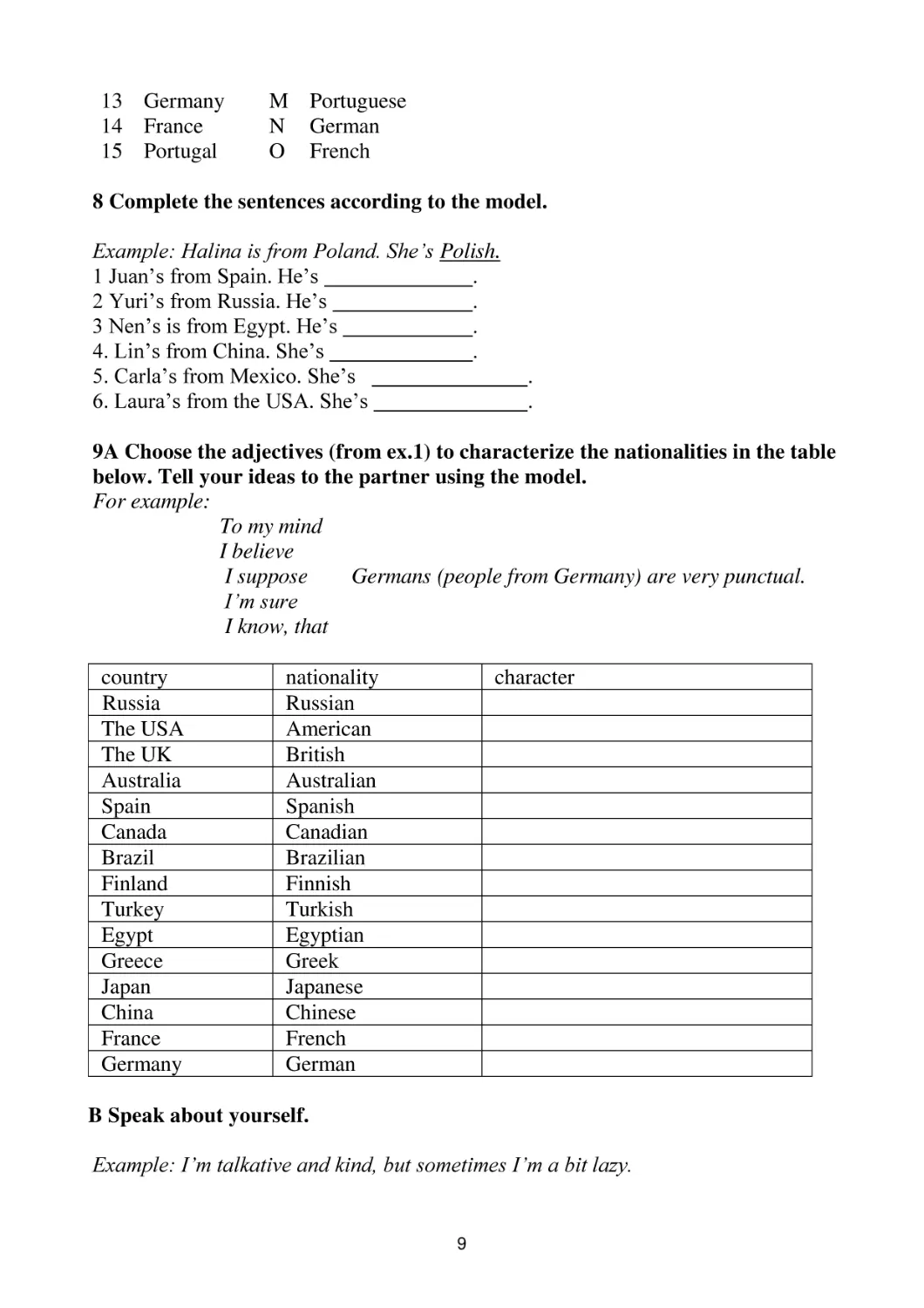
9A Choose the adjectives (from ex.1) to characterize the nationalities in the table
below. Tell your ideas to the partner using the model.
For example:
To my mind
I believe
I suppose
Germans (people from Germany) are very punctual.
I’m sure
I know, that
country
Russia
The USA
The UK
Australia
Spain
Canada
Brazil
Finland
Turkey
Egypt
Greece
Japan
China
France
Germany
nationality
Russian
American
British
Australian
Spanish
Canadian
Brazilian
Finnish
Turkish
Egyptian
Greek
Japanese
Chinese
French
German
character
B Speak about yourself.
Example: I’m talkative and kind, but sometimes I’m a bit lazy.
9
10 Read these brief character descriptions. Which of these four people sounds
most like you?
Amrita:
‘I’m an active and energetic person – I can’t bear just sitting around doing nothing. It
just makes me impatient and restless. But I know what I want, and I think I’ve got
what it takes to achieve my goals. Does that make me sound horribly ambitious and
selfish? I hope not!’
Kevin:
‘I’m the kind of person who knows how to have a good time. I suppose you would call
me fun-loving, but it’s more than that. I actually believe in a calm, cool, easy-going
approach to life and I can’t bear unnecessary anxiety and pressure. I believe in being
sociable and taking life as it comes…’
Larry:
‘My problem can be summarized in one word: self-confidence. I just don’t have
enough. I’m shy with other people, who must think I’m boring and stupid
sometimes.Lack of confidence also makes me indecisive: I spend days trying to make
up my mind what to do about quite simple things. I’m told I sometimes look moody,
but in fact I like being with other people …’
Cathy:
‘How I see myself? Well, I’m forgetful and disorganized – some would say absentminded! But I’ve got quite a lot of willpower, really, and I’ve got ideas. I’m a hard
worker too when I’m doing something I’m interested in. I’m not very articulate when
it comes to public speaking but I quite enjoy being the center of attention, and I don’t
get in the least bit nervous’ [1].
1.1 Skills: read and speak
11A Read the text about Victoria. She is at a language school and she’s
introducing herself to the class.
Hello. My name’s Victoria Barossa. I’m 35 years old and I’m from Spain. I live in the
city of Malaga in the south of Spain. I’m a designer and I work for a large European
car maker. I work on car design. I’m married. My husband, Santiago, works in a bank
as a programmer. We’ve got two children – a son and a daughter. In my free time I
play tennis, I do yoga, and I go camping with my family. I like listening, too, and I
like watching soap operas on TV.
B Work with a partner. Ask and answer about Victoria.
1 What’s her full name?
10
2 How old is she?
3 Where does she live?
4 What does she do?
5 Is she married?
6 What does her husband do?
7 Have they got any children?
8 What does she do in her free time?
12 Interview a partner. Use the questions in exercise 11B.
Example: A What’s your full name?
B It’s…
13 Read the dialogue and act it out with your partner.
Bill: So, Rosa, where are you from?
Rosa: I’m from Lisbon.
Bill: Ah, Lisbon! That is a beautiful city! So, what do you do, Rosa?
Rosa: I’m an actress.
Bill: And what are you doing here in the UK?
Rosa: I’m working. I work with the Royal Theatre Company.
Bill What’s your hobby, Rose?
Rosa: Actually, I like listening to music and riding a horse.
14 Make your own dialogue with your partner and act it out in the group. The
prompts are in the table (Name, country, occupation, age, hobby).
1 Heike, Germany – driver, 19 y.o.,
(football)
2 Ivan, Russia – designer, 22 y.o.,
(painting)
3 Celia, France – dancer, 25 y.o (films)
6 Ann, England – student, 18 y.o.,
(dancing)
7 Sofia, Hungary – agent, 23 y.o.,
(reading)
8 Kumiko, Japan – student, 19 y.o.,
(music)
4 Luc, the USA – teacher, 28 y.o. 9 Karolina, Brazil – English teacher, 27
(reading)
y.o., (German)
5 Carlo, Spain – worker, 24 y.o., 10 Elizabet, Scotland – police officer,
(travelling)
32 y.o (tennis)
15 Read the dialogue and act it out.
Ryan: Hi, Izzy. Can I sit here?
Izzy: Yes, of course. This is Becky. She’s new.
Ryan: Hi, Becky. I’m Ryan, Izzy’s brother.
Becky: Hi. Nice to meet you.
Ryan: Where are you from, Becky?
11
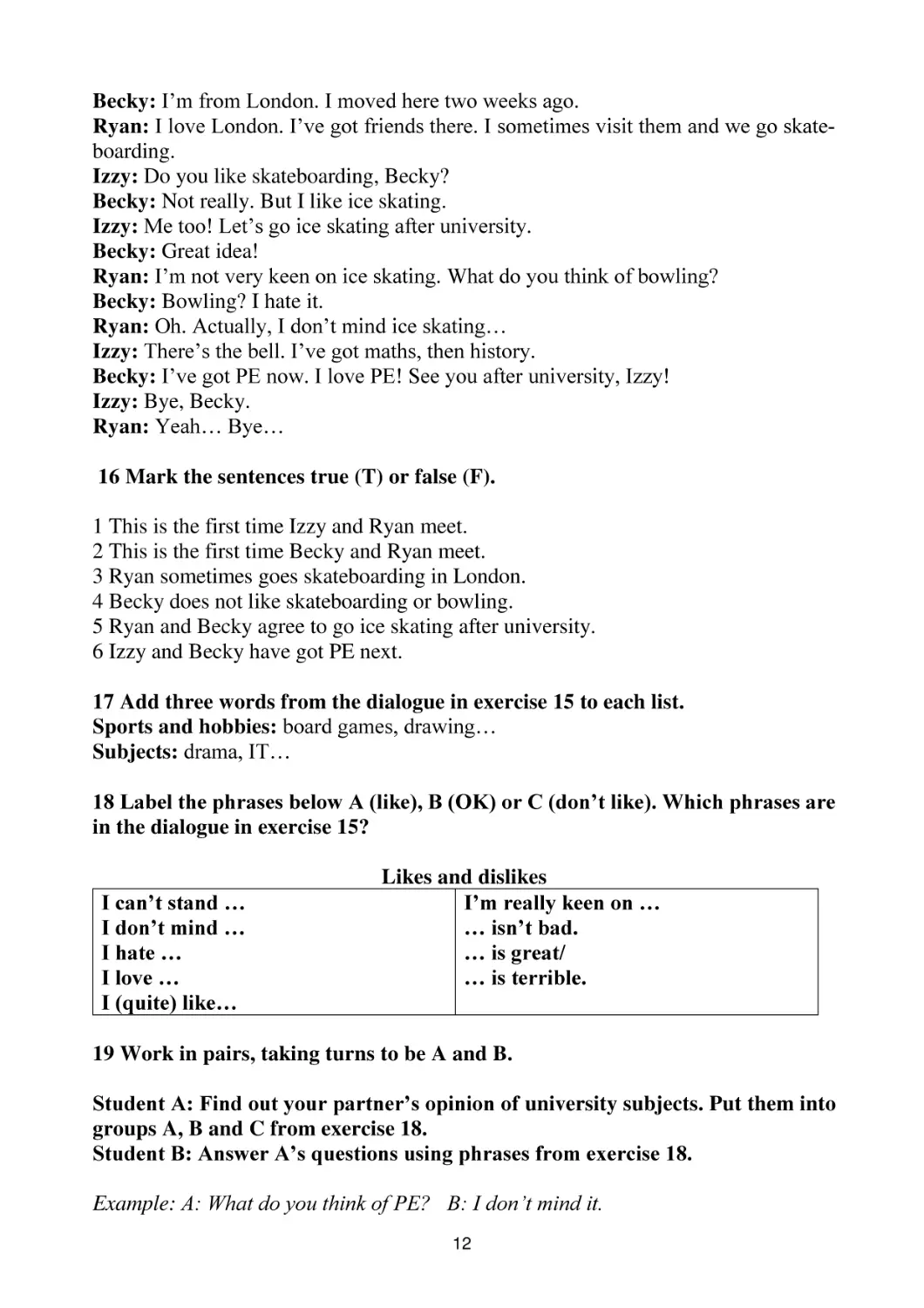
Becky: I’m from London. I moved here two weeks ago.
Ryan: I love London. I’ve got friends there. I sometimes visit them and we go skateboarding.
Izzy: Do you like skateboarding, Becky?
Becky: Not really. But I like ice skating.
Izzy: Me too! Let’s go ice skating after university.
Becky: Great idea!
Ryan: I’m not very keen on ice skating. What do you think of bowling?
Becky: Bowling? I hate it.
Ryan: Oh. Actually, I don’t mind ice skating…
Izzy: There’s the bell. I’ve got maths, then history.
Becky: I’ve got PE now. I love PE! See you after university, Izzy!
Izzy: Bye, Becky.
Ryan: Yeah… Bye…
16 Mark the sentences true (T) or false (F).
1 This is the first time Izzy and Ryan meet.
2 This is the first time Becky and Ryan meet.
3 Ryan sometimes goes skateboarding in London.
4 Becky does not like skateboarding or bowling.
5 Ryan and Becky agree to go ice skating after university.
6 Izzy and Becky have got PE next.
17 Add three words from the dialogue in exercise 15 to each list.
Sports and hobbies: board games, drawing…
Subjects: drama, IT…
18 Label the phrases below A (like), B (OK) or C (don’t like). Which phrases are
in the dialogue in exercise 15?
I can’t stand …
I don’t mind …
I hate …
I love …
I (quite) like…
Likes and dislikes
I’m really keen on …
… isn’t bad.
… is great/
… is terrible.
19 Work in pairs, taking turns to be A and B.
Student A: Find out your partner’s opinion of university subjects. Put them into
groups A, B and C from exercise 18.
Student B: Answer A’s questions using phrases from exercise 18.
Example: A: What do you think of PE? B: I don’t mind it.
12
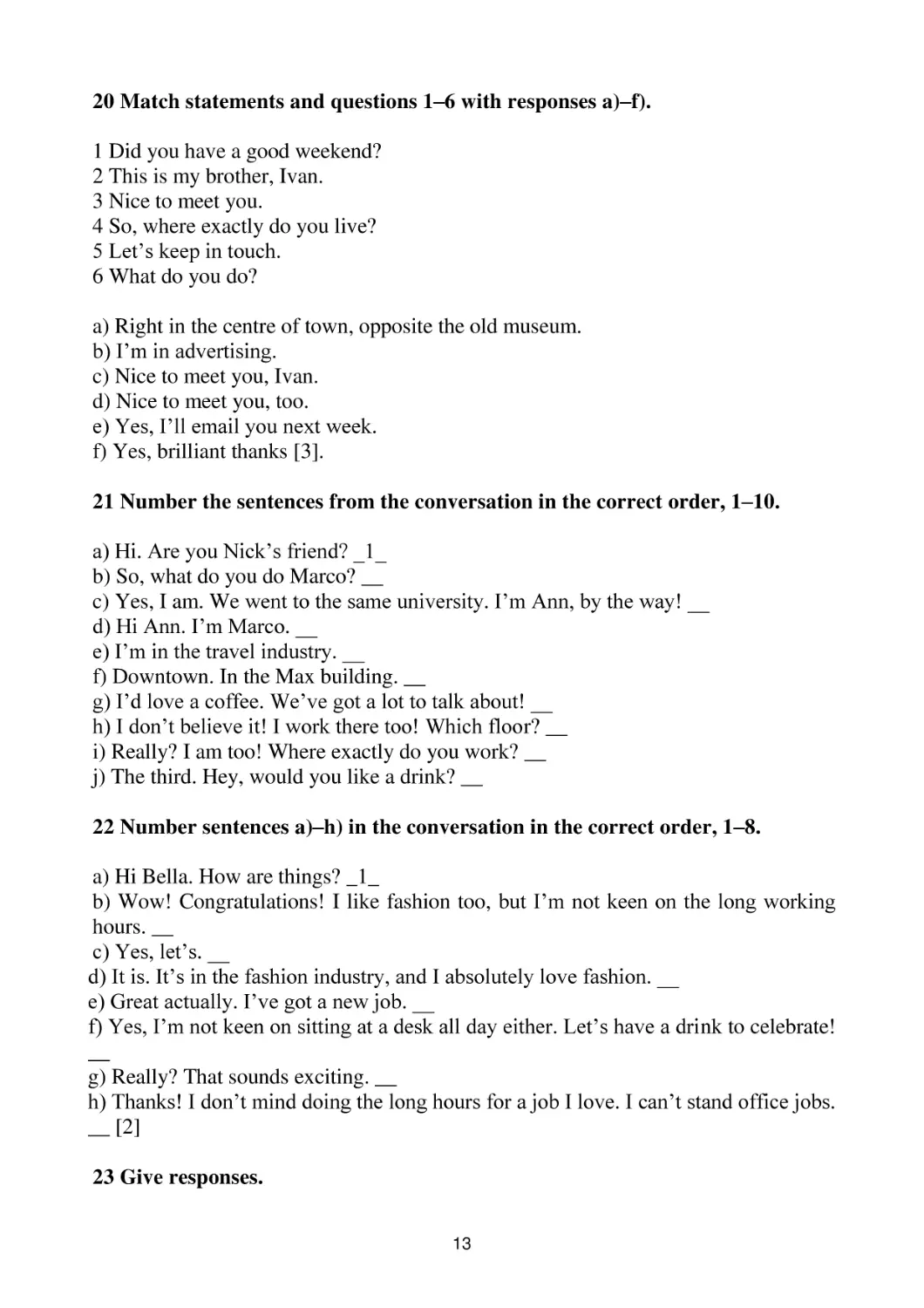
20 Match statements and questions 1–6 with responses a)–f).
1 Did you have a good weekend?
2 This is my brother, Ivan.
3 Nice to meet you.
4 So, where exactly do you live?
5 Let’s keep in touch.
6 What do you do?
a) Right in the centre of town, opposite the old museum.
b) I’m in advertising.
c) Nice to meet you, Ivan.
d) Nice to meet you, too.
e) Yes, I’ll email you next week.
f) Yes, brilliant thanks [3].
21 Number the sentences from the conversation in the correct order, 1–10.
a) Hi. Are you Nick’s friend? _1_
b) So, what do you do Marco? __
c) Yes, I am. We went to the same university. I’m Ann, by the way! __
d) Hi Ann. I’m Marco. __
e) I’m in the travel industry. __
f) Downtown. In the Max building. __
g) I’d love a coffee. We’ve got a lot to talk about! __
h) I don’t believe it! I work there too! Which floor? __
i) Really? I am too! Where exactly do you work? __
j) The third. Hey, would you like a drink? __
22 Number sentences a)–h) in the conversation in the correct order, 1–8.
a) Hi Bella. How are things? _1_
b) Wow! Congratulations! I like fashion too, but I’m not keen on the long working
hours. __
c) Yes, let’s. __
d) It is. It’s in the fashion industry, and I absolutely love fashion. __
e) Great actually. I’ve got a new job. __
f) Yes, I’m not keen on sitting at a desk all day either. Let’s have a drink to celebrate!
__
g) Really? That sounds exciting. __
h) Thanks! I don’t mind doing the long hours for a job I love. I can’t stand office jobs.
__ [2]
23 Give responses.
13
How do you do? –
Meet my wife. –
Hello. –
Hi. –
Good morning. –
Good-bye. –
See you later. –
Have a nice day! –
What’s the matter? –
24 Discuss the questions in groups.
1. What social networking sites do you use?
2. What information do you have on your web page, Facebook page, Twitter account,
YouTube channel, etc.?
3. What kind of information are you comfortably releasing to the public?
4. What type of information should you not put on social networking sites?
25 When you look through a person’s Internet profile, what information is interesting for you? Rank the following items in the order of importance: 1 for the
most interesting topics and 10 for the least interesting. Can you add any other
items to this list?
__
__
__
__
__
__
__
__
__
__
country of origin
age
gender
occupation
zodiacal sign
hobbies
movie preferences
favourite books
choice of music
pets
26 Work in pairs and do the ‘psychometric test’. Then discuss your results in
pairs. Do you have anything in common?
Have you got what it takes?
1 Do you find it easy to concentrate on one subject?
a Not at all, I like to think about a variety of things.
b I try hard but sometimes it's difficult.
с Yes, I have no problem doing this.
2 Do your leisure interests ever distract you from your work?
a No, never
14
b Sometimes
с Yes, often.
3 You are planning a weekend with your family and friends. On Friday afternoon
something urgent comes up. What is your reaction?
a You try to find someone else to do it for you.
b You forget your weekend and get on with what you have to do.
с You decide it will have to wait as you already have plans for the weekend.
4 You get a new job and discover that the local college is running a training course
that will be very useful in your work. How do you react?
a You’re not very interested in doing it.
b You decide to do the course even if you have to pay for it yourself. с You will go,
but only if your new company pays for it.
5 Where do you see yourself in five years’ time?
a You'll probably be in the same position as now.
b You hope you'll be in a better position.
с You intend to advance your career considerably in the next five years.
6 Do you talk about your job/studies outside work/college?
a Sometimes.
b Very frequently.
с No, I ‘switch off’ from work as soon as I can at the end of the day.
7 Do you think intelligence leads to success?
a Intelligence alone does not lead to success.
b Yes, you have to be intelligent to be successful in life.
с It's a big part of success.
8 One of your colleagues gets promoted. How do you feel?
a You're a bit jealous.
b You're pleased for your colleague.
с You’re upset. You want to find out why it wasn't you and what went wrong.
9 Do you believe in the saying ‘practice makes perfect’?
a No, nobody's perfect.
b Yes, the harder you work at things, the better you become.
с People don't have enough time to practice things these days.
10 Is it useful to look back at the past?
a No, you can't change what has happened.
b Yes, it's very important to look back and analyze our mistakes so that we don’t repeat
them.
с Maybe sometimes, but everyone can be wise about the past.
15
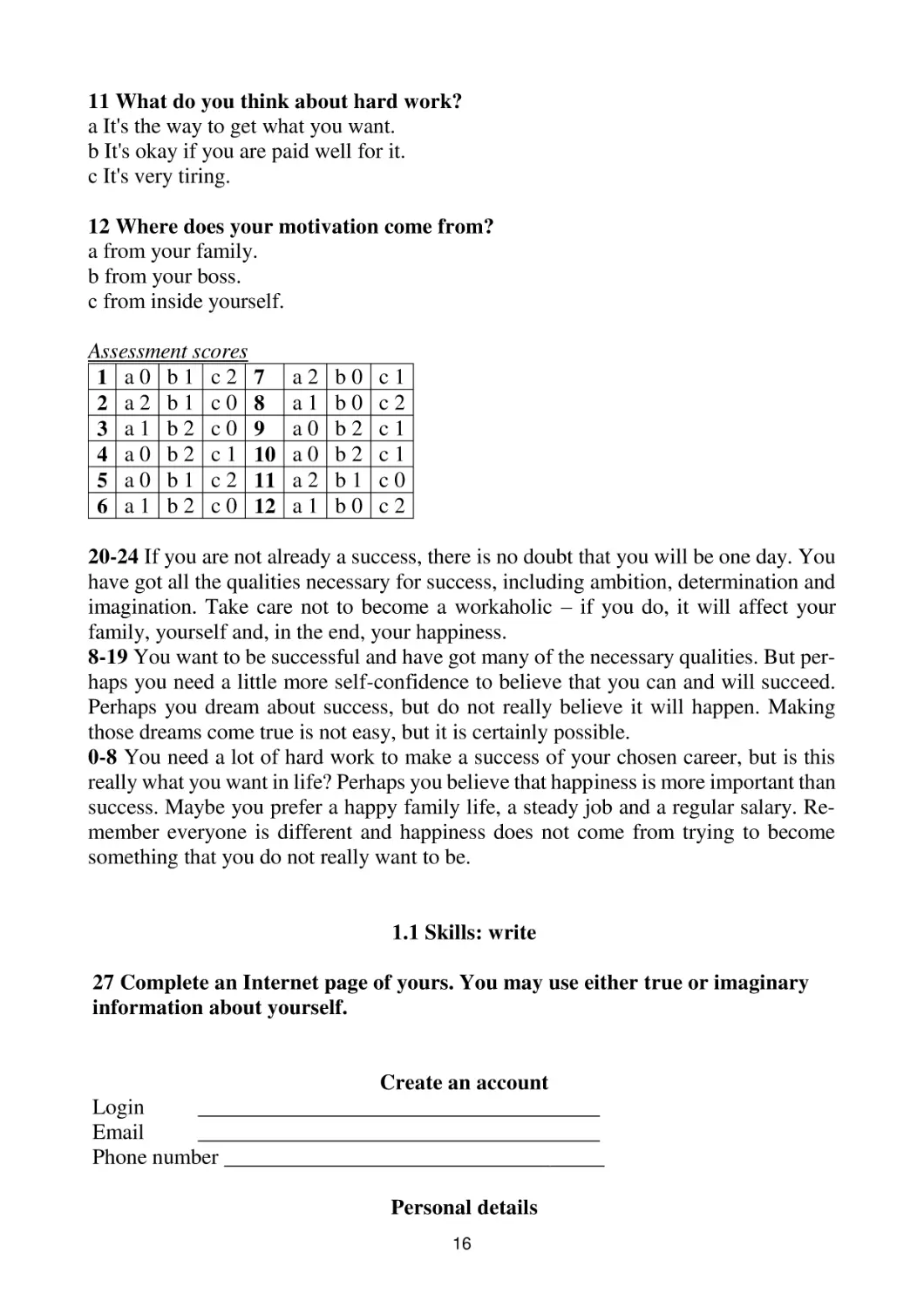
11 What do you think about hard work?
a It's the way to get what you want.
b It's okay if you are paid well for it.
с It's very tiring.
12 Where does your motivation come from?
a from your family.
b from your boss.
с from inside yourself.
Assessment scores
1 a0 b1 c2 7
2 a2 b1 c0 8
3 a1 b2 c0 9
4 a 0 b 2 c 1 10
5 a 0 b 1 c 2 11
6 a 1 b 2 c 0 12
a2
a1
a0
a0
a2
a1
b0
b0
b2
b2
b1
b0
c1
c2
c1
c1
c0
c2
20-24 If you are not already a success, there is no doubt that you will be one day. You
have got all the qualities necessary for success, including ambition, determination and
imagination. Take care not to become a workaholic – if you do, it will affect your
family, yourself and, in the end, your happiness.
8-19 You want to be successful and have got many of the necessary qualities. But perhaps you need a little more self-confidence to believe that you can and will succeed.
Perhaps you dream about success, but do not really believe it will happen. Making
those dreams come true is not easy, but it is certainly possible.
0-8 You need a lot of hard work to make a success of your chosen career, but is this
really what you want in life? Perhaps you believe that happiness is more important than
success. Maybe you prefer a happy family life, a steady job and a regular salary. Remember everyone is different and happiness does not come from trying to become
something that you do not really want to be.
1.1 Skills: write
27 Complete an Internet page of yours. You may use either true or imaginary
information about yourself.
Create an account
Login
_____________________________________
Email
_____________________________________
Phone number ___________________________________
Personal details
16
Name
___________________________________________________
Surname______________________________________________________
Age__________________________________________________________
Where are you from? ____________________________________________
Do you work or study? ___________________________________________
What music do you like? _________________________________________
What is your favourite book? ______________________________________
What sports do you enjoy? ________________________________________
What is your favourite food? ______________________________________
What countries would you like to visit? ______________________________
What makes your happy? _________________________________________
What is your life motto? __________________________________________
Other _________________________________________________________
1.1 Grammar
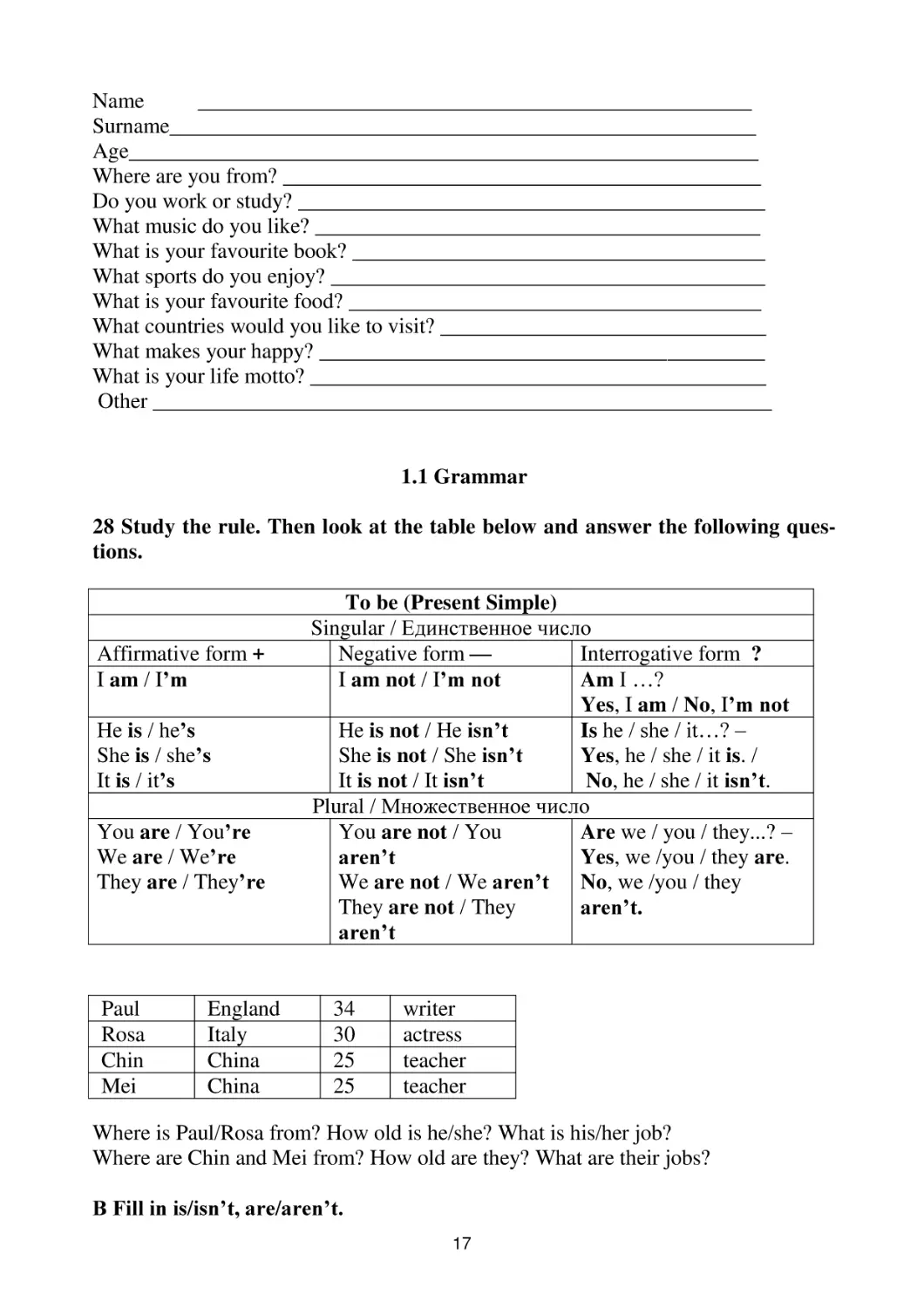
28 Study the rule. Then look at the table below and answer the following questions.
Affirmative form +
I am / I’m
He is / he’s
She is / she’s
It is / it’s
You are / You’re
We are / We’re
They are / They’re
Paul
Rosa
Chin
Mei
England
Italy
China
China
To be (Present Simple)
Singular / Единственное число
Negative form —
Interrogative form ?
I am not / I’m not
Am I …?
Yes, I am / No, I’m not
He is not / He isn’t
Is he / she / it…? –
She is not / She isn’t
Yes, he / she / it is. /
It is not / It isn’t
No, he / she / it isn’t.
Plural / Множественное число
You are not / You
Are we / you / they...? –
Yes, we /you / they are.
aren’t
We are not / We aren’t No, we /you / they
They are not / They
aren’t.
aren’t
34
30
25
25
writer
actress
teacher
teacher
Where is Paul/Rosa from? How old is he/she? What is his/her job?
Where are Chin and Mei from? How old are they? What are their jobs?
B Fill in is/isn’t, are/aren’t.
17
1 Paul
from England. He
from China. He
34 years old.
He
a writer.
2 Rosa
. from Italy. She
15 years old. She
30 years old.
She
an actress. She
a writer.
3 Chin and Mei
from China. They
from Italy. They
25
years old. They
teachers.
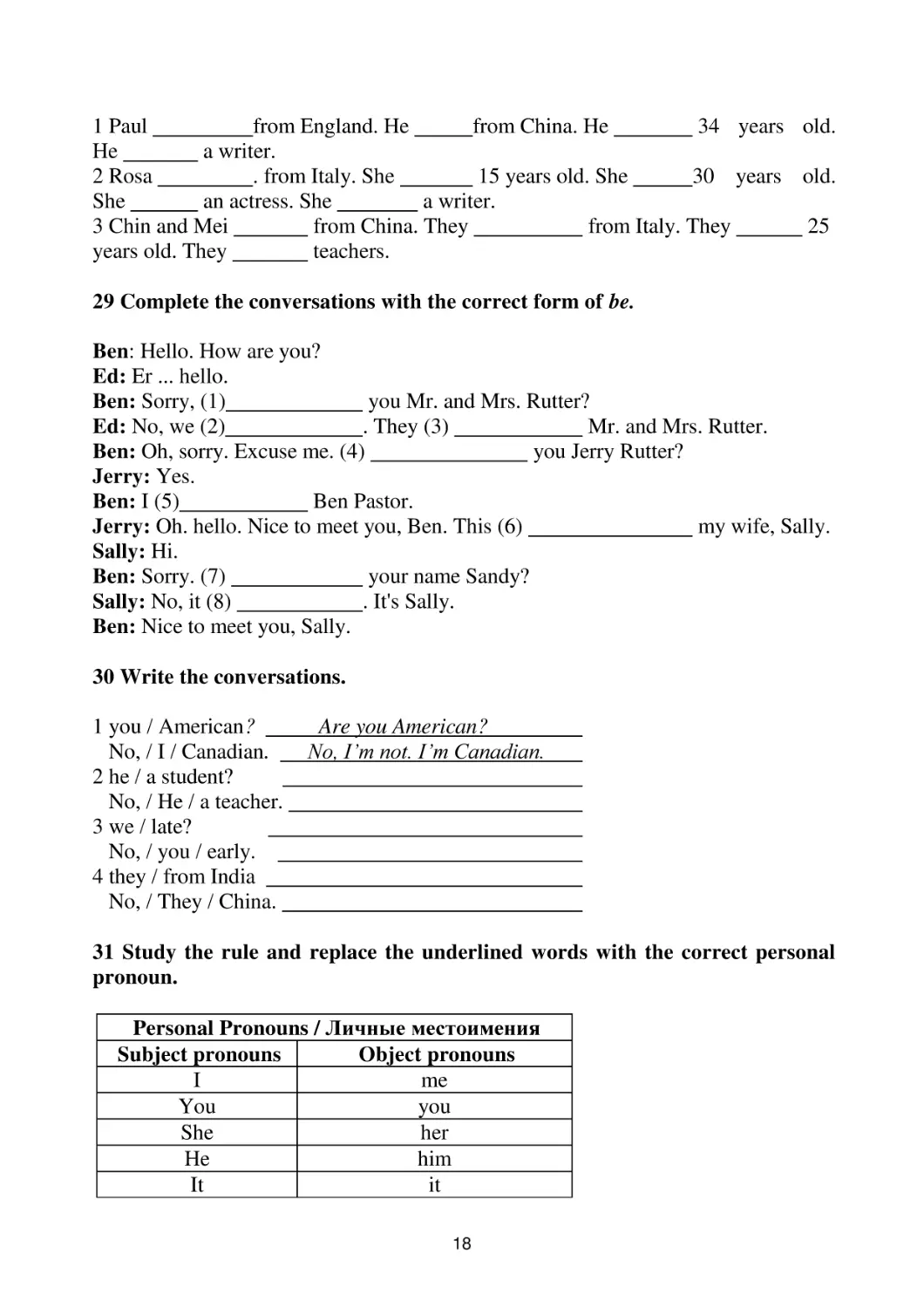
29 Complete the conversations with the correct form of be.
Ben: Hello. How are you?
Ed: Er ... hello.
Ben: Sorry, (1)
you Mr. and Mrs. Rutter?
Ed: No, we (2)
. They (3)
Mr. and Mrs. Rutter.
Ben: Oh, sorry. Excuse me. (4)
you Jerry Rutter?
Jerry: Yes.
Ben: I (5)
Ben Pastor.
Jerry: Oh. hello. Nice to meet you, Ben. This (6)
my wife, Sally.
Sally: Hi.
Ben: Sorry. (7)
your name Sandy?
Sally: No, it (8)
. It's Sally.
Ben: Nice to meet you, Sally.
30 Write the conversations.
1 you / American?
No, / I / Canadian.
2 he / a student?
No, / He / a teacher.
3 we / late?
No, / you / early.
4 they / from India
No, / They / China.
Are you American?
No, I’m not. I’m Canadian.
31 Study the rule and replace the underlined words with the correct personal
pronoun.
Personal Pronouns / Личные местоимения
Subject pronouns
Object pronouns
I
me
You
you
She
her
He
him
It
it
18
We
You
They
us
you
them
1 The teacher always gives the students homework.
a) me b) them c) you
2 I am reading the book to my little sister.
a) her b) us c) him
3 The boys are riding their bikes.
a) it b) them c) her
4 My father is writing a letter to John.
a) me b) him c) her
5 I don't know the answer.
a) she b) her c) it
6 Sally is going to see Anne.
a) him b) her c) me
7 Open the window, please.
a) it b) them c) us
8 Can you tell the people the way to the airport, please?
a) you b) them c) us
9 The books are for Peter.
a) him b) her c) you
10 Can you help my sister and me, please?
a) me b) her c) us
32 Put the personal pronouns into the correct form.
1
lives in Liverpool. (he)
2 I met
in the office. (he)
3 They sing with
in the choir. (I)
4 Lisa likes
. (it)
5 Excuse
, is this the way to the station? (I)
6
worked in the garden. (we)
7 Where are the cupcakes? Did you eat
? (they)
8 Is
your sister? (she)
9 Where are
from? (you)
10
saw Jack in the office. (we)
33 Study the rule and put the pronouns in brackets into the correct form.
Притяжательные
Possessive Adjectives Possessive Pronouns
my
mine
your
yours
19
her
his
its
our
your
their
hers
his
its
ours
yours
theirs
1 The bus stop is near
house. (we)
2 How is
new school? (you)
3 This is my bag and that is
. (he)
4 Sophia's hair is longer than
. (I)
5 It’s
turn now. (I)
6 The bike on the right is
. (you)
7 Which desk is
? (we)
8 Here are
tickets. (she)
9The children brushed
teeth. (they)
10 Our school is much nicer than
. (they)
34 Fill in the gaps with the object pronouns.
1 I haven’t got a pen. Can you give
your pen, please?
2 Look at
. She is so beautiful.
3 John is my best friend. I can tell
everything.
4 Manchester United is my favourite football team. I like
5 My favourite food is pizza. I love
.
6 Tom, can I ask
something?
7 Please, invite
to your party. We really want to go
.
35 Read the text, underline the correct pronoun and put the verbs in brackets
into the correct form.
Dear Ann,
Hi! My/me name is Roberto! I
(to be) 10 years old. I/me have got a big
family. Our/us family is friendly and caring. My mother’s name is Pauline. She/Her
is 35 years old. She/Her
(to be) a doctor. I really love she/her. My father’s name is Aleks. He/him
(to be) a teacher. He always helps me/my with
my/me homework. He
(to be) really kind and I love his/him so much! I have
got a little brother. Him/His name is John. He
(to be) 5 years old. I always
tell his/him scary stories at night. He
(to be) the best little brother in the world!
I have also got a cat and a dog. Their/them names are Tom and Spike. I love
their/them a lot!
I must go now. My/me mum calls me/my. Write back and tell me about
you/your family!
Yours,
Roberto
20
36 Study the table and complete the questions with the correct question word.
Then interview a friend using your questions.
Question Words
Who...?
Кто..?
Who are you?
Whom..?
Кого..?
Whom did she see?
Кому..?
Whom does this bag belong to?
Whose..?
Чей? Чья?
Whose turn is it?
What..?
Что..?
What do you like doing?
Какой..?
What is your name?
What …for?
Зачем..?
What have you done it for?
Which?
Который..?
Which car is yours?
Where?
Где..?
Where have you been?
Куда..?
Where are you from?
When..?
Когда..?
When is your birthday?
Why..?
Почему..?
Why did you go to sleep early?
How..?
Как..?
How are you?
How much/How many Сколько?
How many students are there in your
group?
How much does it cost?
How often..?
Как часто?
How often do you go to the gym?
How long..?
Как долго?
How long did you stay there?
How old..?
Сколько лет? How old are you?
! When a Wh-question includes a preposition, the preposition usually goes at the
end:
e.g. Who do you live with?
1
do you live?
a) Who b) When c) Where d) How long
2
have you lived there?
a) Why b) When c) Where d) How long
3
do you live with?
a) Who b) When c) Where d) How much
4
people are there in your family?
a) How much b) How many c) How long d) Which
5
do you get to school?
a) Who b) How c) Where d) How often
6
‘s your mother’s name?
a) Who b) When c) What d) Why
7
is your birthday?
a) Who b) When c) Where d) How many
8
do you do on your birthday?
21
a) Who b) What c) Where d) Why
9
are your hobbies?
a) What b) Why c) When d) How many
10
‘s your phone number?
a) What b) Which c) Where d) How much
11
‘s your email address?
a) Who b) What c) Where d) How long
12
are you?
a) How long b) How high c) How tall d) How much
13
do you go to the cinema?
a) Who b) When c) How many d) How often
14
colour do you like most? Red or green?
a) Why b) Where c) Which d) How many
15
cousins do you have?
a) How long b) How many c) How much d) How tall
37 Fill in the correct question word.
1
2
3
4
5
6
7
8
9
10
11
12
13
14
15
16
17
18
are you smiling? – Because I’m happy.
is your home address? – 5 Yellow Road.
will you be back? – At 5 o’clock.
do you like for breakfast? – Apple juice.
can help me? – Tom can help you.
phone is it? – Nick’s.
do you go to school? – By bus.
is your favourite sport? – Football.
are you from? – From Canada.
is the weather like? – It is cold.
did you invite to your party? – My friends.
book is yours? – The red one.
is your father? – He’s 45.
is your brother’s job? – He is a dentist.
is your favourite subject? – Physics.
do you like to wear? – Jeans.
does your sister study? – At the university.
does it take you to get home? – 10 minutes
38 Use the correct form of have.
1 My father
3 My sister
Our classroom
books. 7 I
four brothers. 2 We
a large room in this flat. 4 He
six windows. 6 They
a new bag.
many teachers.
good chalk. 5
many English
39 Study the sentences below and say whether the ‘s is is or has as in the example.
22
1 Jill’s got a good figure. has
2 Tim’s short and fat. _________
3 Greg’s a handsome man. _________
4 Nora’s got long red hair. _________
5 Paul’s got broad shoulders. _________
6 Ken’s bald. _________
7 Jenny’s a pretty girl. _________
40 Write questions and answers as in the example.
1 Emily
× car
√ bicycle
A: Has Emily got a car?
B: No, Emily hasn’t got a car. She has got a bicycle.
2 Carl
× beard
√ moustache
3 Samanta
× BA
√ BSc
4 Jane and Tim
× stereo
√ TV
5 Joe
× wrinkles
√ freckles
6 You
× long hair
√ short hair
7 Lucy
× typewriter
√ computer
41 Write the numbers.
4, 23, 35, 47, 51, 68, 72, 84, 99, 100, 204, 457, 1 245, 5 798, 2 000 100.
42 Translate.
11 писателей, 47 хобби, 2 племянника, 89 школ, 15 библиотек, 12 языков, 13
университетов, 20-й день рожденья, 21-е письмо, 33-я машина, второй город, 2
племянника, 19 одногруппников, четвертый ребенок, 15-й тест, 110 ученых, пятая перемена.
1.2 Vocabulary: ABOUT MY UNIVERSITY
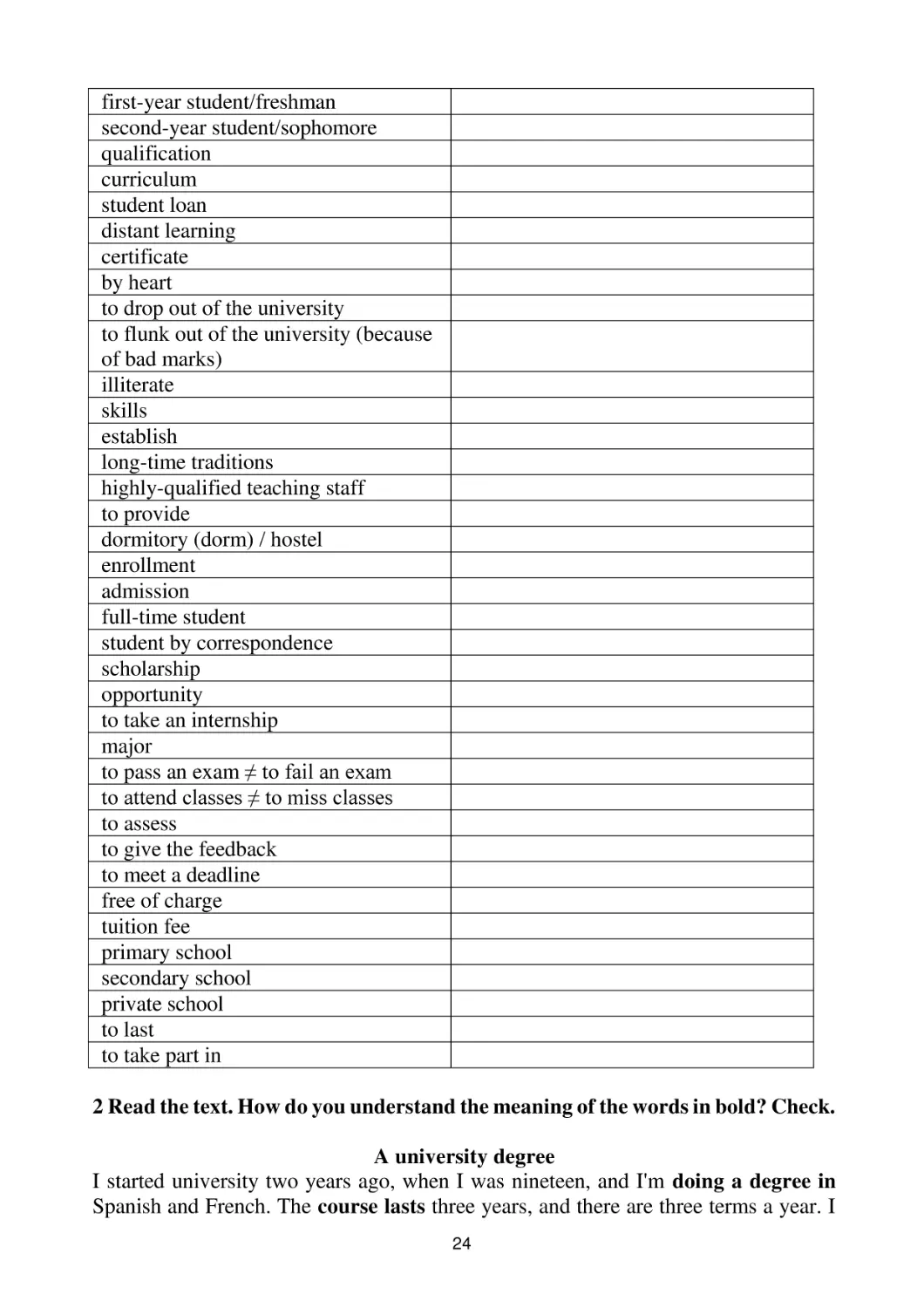
1 Translate into English.
to graduate from
to do a degree
to do research
bachelor of Arts/Science (BA/BSc)
master of Arts/Science (MA/MSc)
undergraduate
postgraduate
23
first-year student/freshman
second-year student/sophomore
qualification
curriculum
student loan
distant learning
certificate
by heart
to drop out of the university
to flunk out of the university (because
of bad marks)
illiterate
skills
establish
long-time traditions
highly-qualified teaching staff
to provide
dormitory (dorm) / hostel
enrollment
admission
full-time student
student by correspondence
scholarship
opportunity
to take an internship
major
to pass an exam ≠ to fail an exam
to attend classes ≠ to miss classes
to assess
to give the feedback
to meet a deadline
free of charge
tuition fee
primary school
secondary school
private school
to last
to take part in
2 Read the text. How do you understand the meaning of the words in bold? Check.
A university degree
I started university two years ago, when I was nineteen, and I'm doing a degree in
Spanish and French. The course lasts three years, and there are three terms a year. I
24
work in the library a lot because – like many undergraduates – I have to write lots
of essays. I also have to take exams, and last term I failed one and had to take it again.
I got the result two weeks ago; fortunately, I passed this time. When I’ve got my
degree – a BA – I want to do research for a PhD [3].
do a degree study at university for three or four years
course a number of classes on a subject, e.g., an English course
term a period of study, usually about ten weeks
library a place where you can read and borrow books
undergraduate a student doing a first degree
(A graduate has a degree.)
write an essay do a piece of writing on a subject
again one more time
fortunately We say fortunately when we give good news.
To last is to continue for a period of time.
BA/BSc Bachelor of Arts/Science
MA/MSc Master of Arts/Science
do research study a subject for a long time to learn new information
PhD Doctor of Philosophy
3 Circle the correct word.
Example: She did an English course/term.
1 I want to do/make a degree in maths.
2 A term/degree lasts about ten weeks.
3 I’ve got a BA/BSc in physics.
4 I study a lot in the library/bookshop.
5 A graduate/An undergraduate has a degree
6 Fortunately/Unfortunately, I failed the exam.
7 You can do research before/after a degree.
4 Complete the dialogues 1–6 with the words from exercise 2.
Example: How long does the term __last___? – About twelve weeks.
1 Have you got a
? – Yes, a BSc.
2 Did she have to
an essay? – Yes, three, in fact.
3 Can you
research next year? – Yes, I want to do a
5 Can he take the exam
? – Yes, next summer.
6 How long does the course
? – It’s only one term.
.
5 Write your answers and ask another student.
1 How long do you need to study for a degree in Economics? –
25
.
2 How long do you need to study for a Master’s degree? –
3 How long does a university term last? –
4 How long does a school term last? –
.
5 If you fail exams, can you always take them again? –
.
.
.
6 How can you explain these idioms?
BOOKWORM
EAGER BEAVER
BRAINSTORM NEW
IDEAS
1 When you do it, you develop new ideas, through a discussion in which several people
make lots of suggestions and the best ones are chosen.
2 a person unusually devoted to reading and study
3 a keen and enthusiastic person who works very hard [4].
7 Match the words 1–9 with their definitions.
1 certificate
A to complete a degree at a university (verb); a person who
has a university degree.(noun)
B an official document that proves you have passed an exam
or completed a course
C the qualification given to students who have completed
their studies at a college or university.
D an ability to do an activity or job well, especially because
you have practised it
E the buildings and the surrounding land of a university or
college
F a course in which students learn on their own at home and
communicate with faculty and other students via the internet.
G a course of study that you have completed or an exam that
you have passed
H an amount of money that you borrow from the government
or a bank to fund your study at a university and which you
must pay back after you completed your study.
2 distance course
3 graduate
4 student loan
5 campus
6 degree
7 skill
8 qualification
1
2
3
4
5
6
7
8
26
8 Read these sentences and then use the words in bold to complete the sentences
below.
• Students at school are sometimes called pupils.
• Pupils in Britain go to primary school up to the age of eleven.
• From eleven to sixteen, pupils in Britain have to go to secondary school; in America, they go to junior and senior high school.
• Some pupils decide to stay on at school until they are eighteen to do exams.
• The fee(s) for the course is/are €200, but the books are free.
• Turn to page seven in your textbook and study the model.
• I did the course by distance learning, so I studied at home and sent exercises back
through the post.
• I passed the exam and I should get the certificate in the post in a few weeks.
• I understand English, but I have problems learning definitions by heart.
• If you leave college or school before the end of your course, you drop out.
1 If there aren't any colleges in your area, you could consider studying by _____
.
2 I’ll be so proud when I pass that I’m going to hang my
on
the
wall.
3 My mum’s worried that my brother’s going to
of college and not get
any qualifications.
4 All students are required to pay the course
before taking the examination.
5 Many young people
at school because it’s difficult to find a job without qualifications.
6 We moved house when I was nine, so I had to start at a new
.
7 It took me ages to learn the English alphabet
.
8 I think the
we use in our History lesson is really boring.
9 Our new English teacher gets on well with all the
.
10 It can be a bit frightening when you leave primary school and have to move up to
.
9 Read these sentences and then use the words in bold to complete the sentences
below.
• Qualifications are exam results which prove you have reached a certain level.
• I’m going to get a job as soon as I graduate from university.
• The qualification you get when you graduate from university is called a degree.
• In Britain, a public school is a private, fee-paying school.
• In the USA, a public school is a state school, which is run by the government and is
free to attend.
• She went to nursery (school)/kindergarten when she was two years old.
• We’re not taking exams this year at school; all our work is assessed.
• I’d like you all to write an essay entitled ’Deception in Hamlet.’
27
• If you are illiterate, you don’t know how to read and write.
• Your skills are the things that you can do well.
1 I’ve got to write
this weekend on the causes of the First World
War.
2 Apart from a GCSE (General Certificate of Secondary Education) in English, do you
have any other
?
3 35% of this course is examined, and the rest is
throughout the year.
4 Because Jeffrey had been a boarder at an expensive
, he adapted to
prison life remarkably easily.
5 I personally believe that the
system is much fairer, as every pupil, irrespective of how much money their parents have, receives the same quality of education.
6 There are far too many
adults today; something must be done
about it.
7 Almost all children round here go to a
until they’re five years old.
8 He’s got some very impressive qualifications, but do you think he’s got the necessary
for the job?
9 As long as I don’t completely mess up my university final exams, I should
from Warwick next July.
10 I think Helen’s got an honours
in German Literature from Hull
University.
1.2 Skills: read and speak
10A Read the text.
1 Which university is Jason studying at?
2 What subject is he studying?
3 How many more years will he be at university?
4 Where does he live when he’s at university?
5 How many lectures does he normally have?
My name’s Jason. I’m an undergraduate student at Newcastle University. I’m
studying for a degree in Law. It’s a three-year course and I’m in my second year at the
moment. In my first year I had a room on campus, but I live off campus now. I share a
house with five other students.
On most days I attend one or two lectures. I take notes, and then at the end of the
lecture the lecturer usually gives us a reading list and an assignment. A week later we
have a seminar in a small group. One of the students has to read his or her assignment
and we talk about it.
At the end of our third year we’ll take our final examinations, and if I pass them,
I’ll graduate. I’ll get my degree certificate at a graduation ceremony [5].
28
B Answer the questions.
1 Which university is Jason studying at?
2 What subject is he studying?
3 How many more years will he be at university?
4 Where does he live when he’s at university?
5 How many lectures does he normally have?
11 Find underlined words or expressions in the text to match these definitions.
Example: The lectures and seminars on a subject – a course
1 the place where the university buildings are
2 the exams at the end of a degree course
3 to finish a degree
4 a student who is studying for a first degree
5 a piece of work that students have to do
6 someone who teacher at university
7 the time when students get their certificates [5]
12 Compare Jason’s life as a student to life as a student in your country. What
differences are there?
13A Circle the correct answer. Read the text and check.
a. Baikal State University is located in Baikalsk / Irkutsk /Angarsk.
b. The campus of BSU is located near the city centre / in the suburb of Irkutsk / in
the heart of Irkutsk.
c. The university was established in 1930 / 1993 / 2002.
d. There are 5 / 7 /6 institutes here.
e. The dorms are accessible / inaccessible.
BAIKAL STATE UNIVERSITY
B Read the first part of the text and answer the questions: What does BSU mean?
Where is BSU located?
Part 1
Baikal State University (Its full name is the Federal State Budget Educational
Institution of Higher Education «Baikal State University») is a state educational institution, which provides undergraduate, graduate, postgraduate and advanced education
in Economics, Management, Law, Applied Computer Science in Economics, Journalism, Psychology and Sociology.
Baikal State University is located in Irkutsk. Only 60 km away from Irkutsk there
is the world-famous lake Baikal listed among UNESCO’s world heritage sites. The
29
building of Baikal State University belongs to the historical monuments of Irkutsk. The
campus has a history of over 100 years. The modern campus of Baikal State University
is conveniently located in the heart of Irkutsk at the intersection of central streets of the
city – Lenin Street and Karl Marx Street. Nearby there is a good infrastructure: the
main city attractions, theaters, museums, shopping centers, bus stops are situated
here [6].
C Read the second part of the text and answer the questions: When does the university start its history? What guarantees a high-quality training of potential specialists?
Part 2
The university has a long history. The university was established in 1930 as Irkutsk Institute of National economy. It was certified as an Academy in 1993 and as a
university in 2002. Long-time traditions, highly-qualified teaching staff, well-established scientific schools, and a wide range of academic programs – all these guarantee
a high-quality training of potential specialists and executives [6].
D Read the third part of the text and answer the questions: How many and what
institutes does BSU have? What programs does it offer? Does BSU have partnership relations with foreign universities?
Part 3
Baikal State University is a great choice for highly motivated young people interested in professional development in wide range of spheres. The university not only
provides classical academic training in Economics, Management, Law, Public administration, Commerce, Business analytics and Tourism, but also offers relatively new
programs on International Relations, Journalism, Linguistics, Translation Studies, Art
and Humanities, with the focus on Theory and Methods of teaching Russian to students
of other languages, Foreign languages in International Relations, as well as Theory and
Practice of cross-cultural communication.
Today the university is a modern research and educational centre with advanced
laboratory facilities for study and qualified staff training. It has 6 institutes (Management and Finance; Law; State Law and National Security; World Economy and International Relations; National Economy; Culture, Social Communication and Informational Technology) and 1 international faculty. 15000 students study here. Baikal State
University offers 33 Bachelor’s degree programs, 5 Specialist’s degree programs and
33 Master’s programs. BSU has strong partnership relations with many foreign universities through educational activities, international research, faculty and students’ exchange [6].
E Read the fourth part of the text and speak about facilities for study.
30
Part 4
The University is very well equipped to provide high-quality education. BSU
scientific library is one of the largest university libraries in Siberia and the Russian Far
East. It stocks more than 1 million volumes. Students can check out books from the
library, or use rare, old and new editions in the reading halls. The Periodicals Section
annually receives over 500 Russian and foreign magazines and journals and over 57
newspapers. The library uses advanced computer technology. There are 20 computer
classes where students can access the Internet and use specialized legal information
search engines such as "Consultant +", "Garant", on-line teaching materials, search for
books in the library catalogue, and read on-line magazines.
The Media library contains about 2000 items in the fields of economics and law.
Book collections are supplemented by electronic editions such as "The encyclopedia
of foreign classical art", multimedia albums, and digitized rare and valuable books
from the university library [6].
F Read the fifth part of the text and speak about the dormitory.
Part 5
The University is not only an educational institution but also a home for its students. It provides dormitory accommodation. The main dormitory building is in downtown, a 15-minute ride from the University. There are from 2 to 4 students living in
each room. There is a bathroom for every two rooms. The dormitory has a cafeteria, a
library, and a computer hall with Internet access. All University buildings are protected
by security guards and you need to show your student's ID to enter.
G Read the sixth part of the text and discuss the advantages of studying at Baikal
State university.
Part 6
Thus, the advantages of studying at Baikal University include:
– a wide range of Bachelor’s and Master’s academic programs based on our best practices;
– up-to-date educational technologies;
– opportunities to acquire competences relevant in a multi-cultural environment;
– communication and interaction with students from over 10 countries; international
academic groups;
– Master's programs in International management and Banking and Finance (in English);
– opportunities to choose from a number of languages, including Russian, to study, as
well as to learn language teaching methods;
– participation in academic mobility programs due to established links and cooperation
with foreign universities and international organization;
– favorable geographic location and accessibility of Irkutsk;
31
– a comfortable and well-equipped campus, which facilitates the academic process and
helps to combine study, rest, and sports activities. The dorms are easily accessible and
cost about $ 10 per month.TV studio [6].
H Match the parts of the text (1–6) with the headings (A–F) below.
a Advantages of studying
b University location
c Facilities for study
d Departments and programs
e Dormitory accommodation
f Long history
I Mark the sentences T (true) or F (false).
1 Baikal State University is a private educational institution.
2 Baikal State University is located in Irkutsk.
3 The building of Baikal State University belongs UNESCO’s world heritage sites.
4 The university was established in 1993.
5 BSU doesn’t have strong partnership relations with many foreign universities.
6 Baikal State University offers only Bachelor’s degree programs and Specialist’s degree programs.
7 There aren’t any libraries at university.
8 The Media library contains about 2000 items in the fields of economics and law.
9 There are a lot of advantages of studying at Baikal University.
10 There is no dormitory accommodation.
J Match the underlined words in the text with their meanings.
Включенный в список объектов всемирного наследия ЮНЕСКО; исторические
памятники; 100-летняя история; высококвалифицированный преподавательский
состав; научные школы; широкий спектр академических программ; высококачественная подготовка; прекрасный выбор; высокомотивированная молодежь;
международные отношения; межкультурное общение; тесные партнерские отношения; предлагать программы для получения степени бакалавра; в области
экономики и права; научная библиотека, современные образовательные технологии; многокультурная среда; доступность Иркутска; возможность выбрать из
большого числа языков.
K Match the words. Use the phrases to complete the sentences.
1
2
3
4
educational
full
historical
long
A
B
C
D
choice
history
library
equipped
32
5
6
7
8
9
10
great
well
scientific
computer
dormitory
wide
E
F
G
H
I
G
range
accommodation
monuments
institution
name
technology
1 One of the advantages of studying at BSU is a __________ of Bachelor’s and Master’s academic programs.
2 Its __________ is the Federal State Budget Educational Institution of Higher Education «Baikal State University».
3 The building of Baikal State University belongs to the __________ of Irkutsk.
4 Baikal State University (is a state ___________.
5 BSU provides ___________.
6 The library uses advanced __________.
7 The University is very ___________ to provide high-quality education.
8 Baikal State University is a __________ for highly motivated young people interested in professional development.
9 BSU __________ is one of the largest university libraries in Siberia and the Far
East.
10 The university has ___________.
14 Find your degree program, memorize it.
Bachelor’s degree programs (2021)
Information systems and Technologies
in Management
Digital Economy
Marketing, Commerce and Logistics
Marketing, Commerce and Logistics
(Russian-Chinese double degree program in Beijing)
Organization of investment and construction activities
Accounting and taxation
Economy of Oil and Gas Complex
Enterprise Economy and Entrepreneurship
Economy and Municipality Development
Finance and credit
Global economy (Russian-Chinese
double degree program in Beijing)
Arts and Liberal Arts
State and municipal governance
Management in Culture, Arts and Mass
Communications
Advertising and Public Relations
Forest Management
Human Resources Management
International Relations
International Journalism
Legal Studies
Theory and methods of teaching foreign languages and cultures
Teaching Russian to students of other
languages
Business Administration
Business Administration (Russian-Chinese double degree program in Shenyang)
Psychology in Economics and Management
33
Global economy (Russian-Chinese
double degree program in Shenyang)
Global economy (Russian-French double degree program)
Global Economy
Fine Arts
Master's Programs (2021)
Expert Business Analytics
Digital Technologies in Economy
International trade and e-commerce
Logistics in digital economy
Criminalistics, forensics and criminal
investigation
Legal support of economic activity
Intercultural communication and methods of teaching foreign languages
Theory and methods of teaching RusInvestment and construction manage- sian to students of other languages
ment
International management
Accounting, taxation, analysis and au- Marketing management of business and
dit
sales
Economy of oil and gas industry
Strategic management of organization
Business economy and entrepreneur- Social and economic psychology
ship
Banking and finance
Public administration system
Financial Technologies
Economy, law, organization and manForest Management
agement in social work
Strategic HR-management and HR-an- Expert business analytics
alytics
Contracting system in public procureAnalytical journalism and digital mass ment
media
International relation
Real estate property and cadastre man- Organization of scientific activity and
agement
administration in culture and arts
State and administrative law
Management in Culture, Arts and Mass
Civil law and process
Communications
Criminal law and criminology
Criminal procedure and prosecutor’s
supervision
Specialist’s degree programs
Customs Affairs
Economic and Legal support of Economic Security
Criminal Law
Psychology in Power Structures
Linguistic Support of International Relations [6]
15A Look at the sentences (A–G) from the dialogue. What is the dialogue
about?
34
A Oh, well done.
B It's so much fun living in a student house and I’m really enjoying my course as well.
C Well, we're all different, aren’t we?
D I’m doing a BA in History and Political Science.
E It's difficult to keep up with all the essays you have to write though!
F I’m just home for the weekend.
G Well, feel free to come up and stay with me any time you like
B Complete the dialogue with sentences A–G.
Josh: Hey Annie, is that you? I thought you were away at university!
Annie: Oh hi, Josh! Yeah, I am. 1)
.
Josh: Oh, OK! How are you finding student life?
Annie: Oh Josh, I absolutely love it! 2)
.
Josh That’s so cool! What are you studying again?
Annie: 3)
. The lectures and seminars are really interesting.
Josh That’s good.
Annie: 4)
.
Josh I can imagine! It certainly wouldn’t be my cup of tea!
Annie: 5)
. So tell me, what are your plans?
Josh I’ve decided to become an electrician and I’ve started an apprenticeship. It’s going really well.
Annie: 6)
. That’s great!
Josh Yeah, thanks, I’m really happy. The course is practical but you learn plenty of
theory, too. I miss all of you guys who have gone away to university, though.
Annie: 7)
. My flat mates won’t mind. They’re cool!
Josh Thanks, Annie! I might just do that!
C You meet your friend a few months after you have both left school. Ask each
other how things are going. Use the dialogue above as a model. Record yourselves.
16 Read the dialogues and dramatize your own dialogue using words and word
combinations from the text and these dialogues as a model.
Dialogue a
Anna: How many classes do you usually have?
Alex: We usually have four classes but on Wednesday we have only three.
Anna: What are they?
Alex: First we have History of Culture, then Physics and the third English.
Anna: Where do you have your English classes?
Alex: Block P, on the 4th floor, just above the men's hostel.
Anna: See you later in the reading hall. Bye!
35
Dialogue b
Maria: Hello, old chap. Where are you going?
Martha: I'm going to the University for the first class.
Maria: What time does it start?
Martha: It starts at 9 o'clock. I think I am going to be late.
Maria: But why?
Marta: You see, I missed my trolley-bus and it was hard to get on the next one but I
managed to.
Maria: How much time does it take you to get to the University?
Martha: About 30 minutes.
Maria: Hurry up and you will be on time. Good luck.
Dialogue c
Helen: Hello, Andrew. You look quite upset. What is wrong with you? Any problems?
Andrey: I have to prepare for seminars in History of Culture and I don't know where
to find the information.
Helen: You'd better go to the reading hall. There are all necessary books there.
Andrey: Where is it? It is easy to get lost there!
Helen: You are right. The reading hall is in block B, on the second floor. Come with
me and I will show you the way.
Andrey: Thanks a lot!
Helen: You are welcome!
17* Work in pairs. Interview each other.
1 Where do you study?
2 Where is BSU located?
3 When does the university start its history?
4 How many and what institutes does BSU have?
5 What is your degree program?
6 How many students are there in your institutes? How many students does your group
consist of?
7 How many students in your group live in the dormitory? How many students rent
flats or rooms? How much time does it take you to get to the university?
8 What university facilities do you most often use when preparing for the classes?
9 Do you often surf the Internet? What kind of information do you usually look for?
10 Do you know about any international internship or exchange?
11 How many terms does the academic year consist of?
12 How many classes do you usually have?
13 What part of university life do you like the most?
14 What are your future study plans?
18A Look at the titles on the website. Who do you think it is for? What do you
expect to learn from it?
36
Life as a student is all about sitting through endless boring lectures, working all
night to meet essay deadlines and of course scraping by on your meagre student loan,
right? Well, sometimes, but it can also be a lot of fun! We asked some first-year students to give us the low-down on student life in the UK!
Matthew Springer. University of Leeds (B.A. History and Political Science):
"One of the best things about the first year is “Freshers’ Week". You hardly sleep
all week – there are so many parties, concerts and other events! And then there’s the
“Clubs & Societies Bazaar” where you get the chance to join any kind of club or society
you can imagine. It’s difficult not to get carried away – I signed up for the university
newspaper and the drama and canoeing clubs!"
Sylvie Legrange, Swansea University, Wales (B.Sc. Biological Sciences):
"I’m an overseas student from France. In my country, a lot of students live at
home while studying, but here almost everyone goes to university in another town. This
year, I got a place in halls with most of the other first year students. It’s so much fun
hanging out in each other’s rooms, drinking tea and ordering pizza at two o’clock in
the morning! Next year I’m going to rent a student house just off campus with four of
my friends "
Sarah Miles, Keble College, Oxford (B.A. English and Modern Languages):
"I only have about ten hours of formal lectures every week, but I have to spend
quite a few hours in the library doing research for essays. I also have to prepare for
seminars, which are smaller interactive classes, and a weekly tutorial, which is basically a one-on-one discussion with my tutor. Oxford is a lot more traditional than most
other UK universities. We still have to wear a black academic gown when we do exams
and when we attend formal dinners in the college dining hall!"
Steven Howard, University of Bradford (B.A. Media Studies):
"University is hard work and I’m always skint but the social life is stormin’! My
favourite hang-out is the Student Union. There’s always something going there, like a
big band playing or some kind of special theme night. After a big night out, my mates
and I always stop off for a kebab or a curry on the way home!”
Student talk: our mini guide
Skint = to have no money
Stormin’, kickin’, slammin’ – exciting [7]
B Read and check.
C Read again. Which student(s) mention(s):
1 getting involved in organised activities?
37
2 a nighttime snack?
3 a special dress code?
4 self-study?
5 lack of money?
D Match the underlined words with their meanings:
involving only two people, loose formal robe, be over-enthusiastic, managing to live
with very little money, happening, allowing communication, very small.
19* Tell about your study at the university. Remember to include the following
information:
your university;
your degree program;
your group;
your extracurricular activities and student life.
20A Extra reading. Read the article and mark the sentences T (true) or F (false)
1 11% of British university students live with their parents.
2 Most students share a house with other students.
3 It’s easy to decide who to share with.
4 Sharing a house is always a good experience.
5 The questionnaire helps you decide who to share a house with.
6 People who are similar are usually happy living in the same house.
HOW TO FIND THE PERFECT HOUSEMATE
89% of university students in the UK live
away from home, and nearly half of them
share a house with other students at some time
during their studies. But how do you know
who to share with? It can be a difficult decision. Are you quiet, serious, shy, and hardworking? Or are you extrovert, fun-loving,
and noisy? It's an important difference, and it
can make sharing a house either a great experience or a nightmare.
B So next time you’re trying to decide who to share a house with, do this questionnaire.
And then ask your possible housemates to do it. If you give the same answers to four
or more of the questions, then you’ll be fine. If more than three of your answers are
different, then you need to find a new housemate!
38
often sometimes Never
a I leave my clothes on the floor.
b I do a lot of exercise.
c I smoke.
d I enjoy cooking big dinners for people.
e I enjoy buying presents.
f I enjoy meeting new people.
C Match the sentences a-f in the questionnaire with these adjectives.
1 generous ___
2 untidy ___
3 sociable ___
4 unhealthy ___
5 hospitable ___
6 active ___
21 Extra reading. Read a guide for international university students. Seven sentences have removed from the guide. Choose from the sentences A-H the one
which fits each gap. There is one extra sentence which you do not need to use.
There is an example at the beginning (0).
A Inside, you will find a number of
shops, bars and food outlets, as well as
a launderette, two banks and a travel
agent’s.
B Generally, your course will consist
of lectures, seminars and regular meetings with your Personal Tutor.
E As a result, a number of ethnic societies, such as the Greek Society, the
Irish Society and the Jewish Society, exist to fill your cultural and social needs.
F As an international student, you may
have some questions that neither your
Hall Tutor nor your Personal Tutor are
able to answer
C In addition, you are free to join any G However, they are not expected to
of the university clubs and societies and do your washing-up or tidy away your
attend Union-organized events such as things.
pop concerts and discos.
D A confidential counselling service H For this reason, we have produced
is also available.
this small factsheet which may make
your first few days here a little easier.
Alcot University
Guide for International Students
Welcome to the University of Alcot. We very much hope that your time here
will be both highly productive and highly enjoyable, but we do recognize that it is not
39
always easy for students from other countries to adapt to campus life in Britain.
__0__/__H__
Your Hall of Residence contains twelve rooms, all like yours. The kitchen and
bathrooms are communal. In the interests of hygiene and respect for your flatmates, we
would ask you to keep these shared facilities as clean and tidy as possible. These rooms
will be cleaned by a member of the cleaning staff once a day (Monday to Friday).
__1__/_____. Please be polite and respectful to your cleaners – they have a difficult
and unpleasant job to do. Your Hall Tutor will introduce himself or herself to you over
the next few days. If you have any problems with anything to do with your life on
campus, they are there to help you.
Student social life revolves around the Student Union, which is the large yellow
building opposite the library. __2__/_____. As a student at Alcot, you are automatically a member the Union. This entitles you to use all the facilities and to vote in all
Union elections and meetings. __3__/_____. See The Alcot Excalibur, the free weekly
student newspaper, for further information regarding upcoming Union events.
Regarding your course of studies, you will receive a letter in the next couple of
days from your Head of Department inviting you to attend a welcome meeting for new
students. You will be given further information concerning your course at this meeting.
__4__/____ He or she will be able to deal with any academic problems or questions
you may have.
__5__/_____ . If you have any problems, issues or concerns directly related to
that fact that you are a non-British citizen, these can be referred to the International
Office. Situated next to the Arts Building, the International Office is staffed by one
permanent Welfare Officer and a body of trained student volunteers. They are experienced in handling issues related to visas, immigration and police registration.
__6__/_____.
Further information regarding other university facilities, such as the medical
centre, sports centre, arts centre and library, can be found in the accompanying Alcot
Guide for Undergraduates. This also contains useful phone numbers and a map of the
campus.
1.2 Skills: write
Informal emails and letters are pieces of writing we send to people we know well. We
usually start an informal email with Dear + the person’s first name. In the first
paragraph we write our opening remarks (e.g. Hi! How are you?) and the reason for
writing. We write about the specific topics of our email in separate paragraphs. In
the last paragraph we write our closing remarks (e.g. Have to go now.) and sign off
with an informal ending (e.g. Yours) and our first name.
We use informal style, that is:
• everyday vocabulary (I’m having a great time.)
• colloquial expressions/idioms (Drop me a line.)
• informal linkers (so, and etc.)
• short verb forms (I can’t, I’ll be…)
40
Useful Language
Starting an informal email
• Dear Mum/Dad, Dear Aunt Claire, Dear Tom/Lucy etc.
Opening remarks
• Hope you’re OK. • How are you doing? • Hi from Moscow/Rome/Cracow etc.
• Thanks for your email. • Sorry I didn’t write earlier, but I … • Sorry for not writing
for so long. • Hi! How are you? • It was good to hear from you. • I haven’t heard from
you for a while.
Reason for writing
• I wanted to drop you a line to tell you my news/to tell you about ...
• I just wanted to ask/remind/thank etc. you ...
• Just a quick email to tell you ….
• I wondered if you’d like to
• This is just to let you know…
• I’m sorry to hear about ...
• I was a bit worried and wanted to see if you’re OK.
Making reference to future contact
• I hope to hear from you soon.
• Give me a call later.
• Let me know if you can make it or not.
• I was glad to hear about…
• Let me know as soon as possible.
Closing remarks
• Email me soon.
• I’d better get going /Bye for now.
• I must go now /Got to go now.
Ending an informal email
Yours/Best wishes/Love/Take care + your first name [8]
22* Read the letter you received from your English friend. Then write your answer to your friend (150–180 words).
Dear Mike,
How are you? Thank you for your letter of 20th August. I’m sorry for not answering for so long, but I’ve had a lot of things to do.
You know it was a very hard year for me. I spent my time getting ready for my
exams and I was doing well in practically all subjects. After passing the exams I was
enrolled to the University. The whole course of study is four years. My major subject
is mathematics. I’m really good at it. I do maths whenever I have a chance. I take many
courses in this subject. I like to take part in maths competitions organized at our department and at the University. I think that mathematics is “the language of science”
and plays an important part in many sciences.
41
We’re lucky to have a brilliant teacher of mathematics this term. He makes maths
not boring. I leave the lecture hall with a feeling that mathematics is the most interesting subject in the world. Next term I’ll be doing research in the field of computer engineering.
Email me soon, please. I know you entered the university. I’m especially interested in your life in it. Well, I’d better go now as I have to prepare for a test.
Yours,
Sam
1.2 Grammar
23 Give the plural of the following nouns.
Dormitory, grade, degree, department, class, language, photo, university, school,
source, opportunity, life, scholarship, exam, certificate, library, program, research,
course, term, fee, choice.
24 Put the correct form of the verb to be.
1There
a museum near our university. 2 There
any textbooks
in my bag. 3
there a lot of advantages of studying at Baikal University? 4
There
a lot of students in my department. 5 In the city there
an
ancient museum I’d like to visit 6 There
a temple and a church there.
25 Put the words in the correct order.
1 house. / in / any/ There / aren’t / the plants
2 children / the / Are / any / there / garden? / in
3 big / a / on / picture / wall. / There's / the
4 clock / the / isn't / a / in / There / room. / living
5 on / a / books / the / of / lot / There / shelves. / are
6 there / teacher / classroom? / the / in / a / Is
26A Study the rule.
Affirmative form +
I work
Present Simple
Negative form I don’t work
you work
you don’t work
he / she / it works
he / she / it doesn’t work
42
Interrogative form ?
Do I work?
Yes, I do. / No, I don’t.
Do you work?
Yes, you do. / No, you don’t.
Does he / she / it work?
Yes, he does. / No, he doesn’t.
we / you / they work
Do we / you / they work?
we / you / they don’t work Yes, we do. / No, we don’t.
Spelling: 3rd person singular (he / she / it)
1 + -s (to the end of most verbs): start – starts, play – plays
2 + -es (if the verb ends in -ch, -ss, -sh or -o): teach – teaches; miss – misses.
3 If the verb ends in a consonant + -y, we change -y to i and add -es: study – studies;
carry – carries.
The 3rd person singular form of have is has.
Present Simple
Регулярные, привычные действия
I go to work every day.
Действия по расписанию
My lesson starts at 2 o’clock.
Постоянные состояния
He lives in Irkutsk.
Общеизвестные истины, законы
Water freezes at 0 C.
природы
B Write the third person singular of the given verbs into the correct box.
Do, graduate, drop, establish, provide, give, get, assess, meet, last, cry, teach, stay,
share, help, try, know, contain, study, learn, pay, surf.
-s
-es
-ies
27 Use the prompts to make sentences, as in the example.
1 Mary / live / in / town / near Dublin.
Mary lives in a town near Dublin.
2 John / not have got / brown eyes.
3 Be / Bob / a student?
4 He / enjoy / reading / books / in his free time.
5 Have / she / got / a degree?
6 I / usually / nor work / on Saturdays.
28 Make sentences negative and interrogative as in the example.
Example: Не works at the same factory. – He doesn’t work at the same factory. –
Does he work at the same factory?
1 We go to school to learn how to learn.
2 The government sponsors 40% of the students.
3 There is an extensive library at the university.
43
4 All the students of our group took part in the students’ conference in April.
5 The professor delivers lectures every Friday.
6 An undergraduate has a degree.
7 I study a lot of the reading hall.
8 A term lasts about ten weeks.
9 Pupils in Britain go to primary school up to the age of eleven.
29 Put the verbs in brackets into the correct form of the Present Simple.
1 There (be) 6000 part-time students at Baikal State university.
2 I often (go) to the reading hall after lectures.
3 My friend (study) Law at university.
4 Michael usually (solve) all his problems easily.
5 Our group (consist) of 30 students.
6 We (not/listen) to lectures on Saturdays.
7 There (be) different laboratories where we do research work.
8 Our academic year (consist) of two terms.
9 At the end of each term we (take) test and exams.
10 Some students of our group (not/live) in a hostel.
11 He (not/drop) out from the university.
30 Put the words in the correct order to make questions.
1 live / Eva / does / where? Where does Eva live?
2 Juan / does / coffee / drink?
3 what / 'junk' / does / mean?
4 lunch / he / when / have / does?
5 like / she / does / popcorn?
6 read / does / which / Kay / newspaper?
7 does / how / work / Faisal / come / to?
8 your / come / does / where / car / from?
31 Make questions.
1 The state schools in Britain are free. (What...)
2 We live in Moscow. (Where...)
3 A term lasts about ten weeks. (How long...)
4 On Wednesdays he usually has four classes. (When ...)
5 The teacher gives the class good marks. (What...)
6 We usually get to the museum by bus. (How ...)
7 My friend is 23. (How old...)
8 His brother always attends classes. (Whose …)
32 Complete the extracts with the Present Simple form of the verbs. Which is
from…
44
1 a detective story? --2 a dictionary? --3 an e-mail to a pen friend? --do
help
live A. We (a) live in Lisbon. My parents (b) _______ a furniture
look own rain
shop, and I (c) _______ them in the shop at weekends. Please
write back and tell me about you and your family. What (d)
_______ you _______ like? (Can you send a photo?) What (e)
______your parents ______? And what about the weather in
England? (f) _______ it really _______ all the time?
believe belong
B. ‘So who (a) _______the gun ______ to, Smith?’
(not) know own ‘Well, Inspector, we (b) _______ that only three people in the
think want
village (c) _______ a gun, but we (d) _______ which of them
had a motive for killing the Professor. Let’s go back to the
scene of the crime – I (e) _______ to try an experiment. (f)
_______ you _______ in telepathy, Inspector Turner?’
communicate
clude
learn
in- C Distance learning, also called distance education, e-learning, and online learning is a form of education in which the
main elements (a) _______ physical separation of teachers and
students. This is a form of education in which students (b)
_______ on their own at home and (c) _______ with faculty
and other students via the Internet.
33 Read the following sentences and correct them. Write two true sentences as in
the example.
Example: The sun goes round the earth.
a) The sun doesn't go round the earth.
b) The earth goes round the sun.
1 89 % of university students in the UK live with their parents.
2 BSU offers only Specialist’s degree programs.
3 We usually start an informal letter with opening remarks.
4 Exercise is bad for your health.
5 Journalists never ask questions.
6 Edinburgh is the capital of the UK.
34A Study the rule.
Affirmative +
Past simple
Negative –
45
Interrogative?
The affirmative form of the
past simple is the same for
all persons, singular and
plural.
I watched
He saw
We use did / didn’t + the infinitive without to (NOT
the past simple form) for regular and irregular
verbs. The forms are the same for all persons, singular and plural.
I didn’t watch
Did I watch?
Yes, I did. / No, I didn’t.
He didn’t see
Did he see?
Yes, he did. / No, he
didn’t.
Spelling: Past Simple (affirmative) form of regular verbs.
1 We form the past simple of regular verbs by adding -ed.
+ -ed: work – worked, play – played
2 If the verb ends in -e, we add -d.
+ -d: dance – danced, die – died
3 If the verb ends in a consonant + -y, we change -y to -i and -ed.
-y- -ied: study – studied, cry – cried
4 If the verb ends in a short accented vowel + a consonant, we double the consonant
and add -ed: drop – dropped, plan – planned, chat -chatted
Past Simple
Действие произошло в определенI saw him yesterday.
ный момент в прошлом
Последовательность действий в про- He turned on his computer, connected
шлом
to the Internet and checked his emails.
Действия, которые завершились в
They were friends many years ago.
прошлом и больше не имеют отношения к настоящему.
B Write the Past Simple forms of the verbs into the correct box.
Laugh, do, graduate, drop, establish, provide, give, get, assess, meet, last, cry, teach,
stay, share, help, try, know, contain, study, learn, pay, surf, start, ask, take, live, include, learn, stop, miss, leave, write.
+ ed
+d
y → ied
double conso- irregular
nant + ed
verbs
laughed
35 Put the verbs in brackets into the correct form of Past Simple. Use the list of
irregular verbs.
46
1 Нe (to stay) at the University after classes. 2 I (to know) all the words very well. 3
She (to study) English at the University. 4 She (to write) the letter. 5 Some years ago
she (to live) in the country. 6 She (make) an interesting report. 7 Last year he (to work)
at the factory. 8 Yesterday we (to go) home by metro. 9 It (to take) me half an hour to
get home. 10 We (to see) the film a week ago. 11 She (to find) time to help us. 12 He
(to do) the translation without a dictionary. 13 He always (to do) his best to learn to
speak English correctly and understand it. 14 Last night we (to watch) a hockey match
on TV. 15 She (to leave) for England the day before yesterday.
36 Make sentences negative.
1 We had our breakfast at the University dining-room. 2 He wanted to go to Kiev
during the holidays. 3 Our English class began at 10 o'clock. 4 Last night I got a letter
from my parents. 5 My daughter tried to write the letter in English. 6 She made a report
last week. 7 It snowed hard.
37 Complete the dialogue with the correct form of the verbs in brackets.
A: I 1) didn’t have (not/have) a good day yesterday.
B: Really? I 2)
(have) a fantastic day.
A: The weather 3)
(not be) good.
B: The weather here 4)
(be) great.
A: I 5)
(not/meet) my friends.
B: I 6)
(meet) Sandro and Carla.
A: I 7)
(not/eat) out.
B: I 8)
(eat) out.
A: I 9)
(not/have) any fun.
B: We 10)
(have) a lot of fun!
A: And 11)
(not/finish) the homework either!
B: Hmm. I 12)
(finish) mine last night.
38 Answer the following questions.
1 Did you study at university last year? 2 Who did you prepare your homework with?
3 What did you do last night? 4 Did your friend see the new film yesterday? 5 What
university did you graduate from? 6 Did your friend drop out from the university 2
years ago? 7 Was the lesson interesting? 8 What time did you go to bed? 9 Did you
come home early or late yesterday? 10 What did you do before classes today? 11 Did
you get a letter from your friend about his university last week?
39 Write different questions to the following sentences.
1 At the end of my study I passed final university exams. 2 The meeting began at 3
o'clock. 3 I did the course by distance learning. 4 I got up late yesterday. 5 We spent
the holidays in the country last summer. 6 She went to the nursery school when she
47
was two years old. 7 I got a place in the dormitory with most of other first year students. 8 There were a lot of advantages of studying there. 9 She took an internship
abroad two years ago.
40 Put the verbs in brackets into the correct form of Past Simple.
1 A: __________ (you/go) on holiday last summer?
B: Yes, I __________ (go) to Hungary.
2 A: Where __________ (be) you last night?
B: I __________ (meet) a friend for dinner.
3 I __________ (call) her house but there __________ (be) no answer.
4 Yesterday, Sue __________ (receive) a package in the post from Tom.
5 A: What __________ (you/do) when you __________ (finish) school?
B: I __________ (travel) through Europe.
6 I __________ (send) an e-mail to Maria yesterday and she __________ (write) back
immediately.
7 A: _____________ (they/go) to the football game on Saturday?
B: No, they __________ (watch) it on TV.
8 A: __________ (you/finish) the book I __________ (give) you?
B: Yes, I did.
41 Make these sentences true for you. Use the past simple affirmative or negative
form of the verbs in brackets.
1
(can) swim when I was five.
2 Last weekend, I
(do) a lot of homework.
3 Five years ago, I
(be) a student at this school.
4 Ten years ago, I
(live) in a different town.
5I
(make) my own breakfast this morning.
6I
(choose) the clothes I’m wearing now.
7 Last night, I
(go) out with my friends.
8 When I was six, I
(study) English.
42 Put the verbs in brackets into the Present Simple or Past Simple.
1 I (to go) to bed at 10 o'clock every day. 2 I (to go) to bed at 10 o'clock yesterday. 3
My brother (to wash) his face every morning. 4 Yesterday he (to wash) his face at a
quarter past seven. 5 I (not to have) History lessons every day. 6 We (not to rest) yesterday. 7 My brother (not to drink) coffee yesterday. 8 My mother always (to take) a
bus to get to work, but yesterday she (not to take) a bus. Yesterday she (to walk) to her
office. 9 You (to talk) to the members of your family every day? – Yes, I
.
But yesterday I (not to talk) to them: I (to be) very busy yesterday. 10 You (to come)
home at 6 o'clock yesterday? – No, I
. Yesterday I (to come) home from school
at half past eight. I (to be) very tired. I (to have) dinner with my family. After dinner
48
I (to be) very thirsty. I (to drink) two cups of tea. Then I (to rest). 11 Your sister (to
go) to school every day? -Yes, she
.
43 Match the questions and short answers.
1 Do you like our new teacher?
2 Have you got the time?
3 Is it a difficult subject to study?
4 Did you have a good holiday?
5 Was there a lot of traffic on the roads
this morning?
6 Are your housemates nice?
7 Were you in the reading hall on Saturday?
8 Are you extrovert?
9 Does it take long to do this exercise?
10 Was the lecture good?
a Yes, they are.
b No, I haven’t.
c Yes, I did.
d Yes, I was.
e No, it wasn’t.
f No, it isn’t.
g Yes, I do.
h No, it doesn’t.
i Yes, there was.
j No, I haven’t.
44 Write questions for the answers. Use the question words in the box.
Where
what
why
when
how many
who
what
how often
which
1 Where are you from? – I'm from Poland.
2
? I'm a student.
3
with? I live with my friend Olga.
4
? Only two people live in the house, Olga and me.
5
? In our free time we like to go to the cinema, or go out
with friends. We both love reading, too.
6
? We go to the cinema about once a week.
7
? I'm studying English because I would like to work in this
country.
8
? I'm in class 2A, Pre-intermediate.
9
? I started learning English when I was at school.
45 Find and correct the mistakes. There is a mistake or a missing word in each
sentence.
emailed
1 She emailled last week.
2 How much people were there?
3 Nice day, is it?
4 They marryed last year.
5 What time did you left?
6 They didn’t began on time.
49
7 What of these do you want?
8 How age is she?
9 What you do?
46 Study the rule and complete the sentences with some or any.
We use some and any with uncountable and plural countable nouns.
We use some in affirmative sentences.
We use any in negative sentences and questions.
We can use some in questions when offering or requesting something:
Would you like some bread? (offer)
Can I have some water, please? (request)
1 We didn’t buy
flowers.
2 This evening I’m going out with
friends of mine.
3 ‘Have you seen
good films recently?’ ‘No, I haven’t been to the cinema for
ages.’
4 I didn’t have money, so I had to borrow
.
5 Can I have
milk in my coffee, please?
6 I was too tired to do
work.
7 Can you give me
information about places of interest in the town?
8 With the special tourist train ticket, you can travel on
train you like.
9 If there are
words you don’t understand, use a dictionary.
47 Complete the sentences with some or any.
1 I’m going to the post office. I need
stamps.
3 There aren’t
shops in this part of town.
4 George and Alice haven’t got
children.
5 Have you got
brothers or sisters?
6 There are
beautiful flowers in the garden.
7 Do you know
good hotels in London?
8 ‘Would you like
tea?’ ‘Yes, please.’
9 When we were on holiday, we visited
very interesting places.
10 Don’t buy
rice. We don’t need
.
11 I went out to buy
milk but they didn’t have
in the shop.
12 I’m thirsty. Can I have
water, please?
48 Put in something / somebody / anything / anybody.
1 She said to me
but I didn’t understand it.
2 ‘What’s wrong?’ ‘There’s
in my eye.’
3 Do you know
about politics?
4 I went to the shop but I didn’t buy
.
5
has broken the window. I don’t know who.
50
6 There isn’t
in the bag. It’s empty.
7 I’m looking for my keys. Has
seen them?
8 Would you like
to drink?
9 I didn’t eat
because I wasn’t hungry.
10 This is a secret. Please don’t tell
.
49 Complete the sentences with somebody / something / anybody / anything / everybody / everything / nobody / nothing.
1 I’m a new student in this group. I don’t know
.
2
took my textbooks while I was in the canteen.
3 I hope
is ready for today’s exam.
4 Does
get a scholarship in your group?
5
can help you solve this problem: you must do it yourself.
6 Could you tell us
about your paper for the student’s conference?
7 If
misses the class, it will be difficult for them to catch up.
8 Did you ask
about the credit?
9 Yes, it would be good to go to the reading hall right now. I’m not doing
now.
10
can use the Internet in our computer center.
51
UNIT 2. WORK AND LEISURE
2.1 Vocabulary: WORK
1 Translate into Russian.
employee
employer
to employ
salary
bonus
staff
task
customer
flexible hours
to motivate
relationship
to pay
to provide
senior manager
valuable
business trip
travel opportunities
to be fired
to lose the job
to leave the current job
to apply for a position
a regular job
occupation
to earn one’s living
to run a firm
a full-time job / a part-time job
to work in shift
to work overtime
a challenging job
a well-paid job
a sick leave
2 Match the words in the box with their definitions.
company shift work employee salary sick leave office customer employer
staff task boss bonus part-time work well-paid job
1 a business that makes or sells things or provides services
52
2 a person who buys products or uses services
3 extra money given to a worker (often for especially good work)
4 a place where many people work at desks
5 a worker
6 a job you need to do
7 a person who manages the workers in the company
8 everyone who works in the company
9 a fixed, regular sum of money given to someone for doing a job
10 a work fewer hours or days than is considered standard
11 a type of work schedule in which different groups work in relay at set periods of
time during the day or night
12 an absence because of illness
13 a work with a good salary
3 Fill in the gaps with the words in the box.
workers
job
overtime work
earn
work
for herself training work for salary
run a firm relationship extra money unemployed people
1 She doesn’t have a boss. She works
.
2 This fixed amount of money you
each month.
3 You can spend
that you are paid in addition to your usual income.
4 My friends
a particular organization.
5 Ann works with
. She helps them to find jobs.
6 His monthly
is two thousand dollars.
7 He lost his
last month.
8 How long did you
in your previous position?
9 The profession of a doctor requires a lot of
.
10 If you work more than the number of hours required by contract, you will get money
for
.
11 They
because they are the owners.
12 Friendly environment and
make a strong team.
4 Study the table. Complete the definitions with the words job, work, career.
job – сущ. (исчисляемое)
work – глагол; сущ.
(неисчисляемое)
случаи исключений: a
work of time (дело времени), a work of art
должность, за которую
человек
получает
деньги, род деятельности, обязанность, профессия
работа в целом, любое
занятие, к которому
нужно приложить усилия,
подразумевает
«действие». Это может
53
A large company offered
him a well-paid job.
I worked two jobs so that
I could pay off my student loans faster.
He works with hazardous
chemicals.
At the moment he is at
work.
(произведение искусства), works of art / literature, good works
(добрые дела) и др.
career – сущ. (исчисляемое); глагол
быть уборка помещений, домашнее задание,
умственная или творческая работа
профессиональный
рост (продвижение в
служебной деятельности),
достижение
успеха;
быстро
двигаться;
нестись
I have lots of work to do
around the house.
Stella is working on improving her Spanish.
The accident cut short her
career.
You can have a career in
politics.
The car careered across
the road and went
through a hedge.
1A
is a regular and official activity that you do, and receive money (a
salary) for your activity. It is a specific occupation/profession.
2
refers to general efforts and activities done to accomplish a goal.
3
is the total progression of your professional life. It can include
many different jobs over the years.
5 Translate the sentences into English.
1 Известная крупная компания предложила мне работу.
2 Майкл сейчас на работе.
3 У горничной много работы по дому.
4 В Ваши обязанности входит отвечать на телефонные звонки в офисе.
5 Я не закончила делать свое домашнее задание.
6 На мой взгляд – это лучшая картина Пикассо.
7 Это нелегкая работа.
8 Боб выполняет любую работу для своего босса.
9 Он работает с опасными животными.
10 Стив работает над улучшением своих знаний по английскому языку.
11 Оливер оставил карьеру музыканта ради учебы.
12 У Вас может быть прекрасная карьера в финансовой сфере.
6 Match the word combinations to their meaning.
a demanding job
a fulfilling / rewarding job
an entry-level job
a dead-end job
a high-powered job
it makes you feel good
requires a lot of effort
a job that has no opportunities for advancement or promotions
a job that can be done by someone
who is just beginning their career,
which doesn’t require much experience or many skills
a job where you earn a lot of money
54
a lucrative job
a dynamic and important job
Complete the sentences with word combinations in the box to describe a person’s
job.
1 Being an emergency surgeon is
– you have to be on call 24 hours a
day.
2 Working with refugee children was one of the most
I’ve had.
3 Daniel got an
as an administrative assistant.
4 Being a truck driver is
.
5 After she published her book, she got
as director of a national
newspaper.
6 My mother wants me to marry a guy with
– like a doctor or
lawyer.
7 Choose the right option.
1 I work/job with special needs children.
2 I work/job with hazardous chemicals.
3 I start work/job at 7 AM.
4 I finish work/job at 4:30.
5 We go to work/job by car.
6 I went to the bar with some friends from work/job.
7 I can’t access Facebook when I’m at work/job.
8 Her job/work is to answer the phone calls at the office.
9 I haven’t finished doing my home job/work yet.
10 In my opinion, this is Rembrandt’s best work/job.
11 It’s not an easy job/work to do.
12 Brian does all kinds of jobs/works for his boss.
13 Here is my advice for students starting into research work/job.
14 Right after graduating from college, Terry has had seven jobs/works in the past five
years.
8 Study the collocations with the word career. Make sentences with collocations.
1 embark on a career = begin a career
2 a promising career = a career with good future potential
3 a varied career = a career with jobs in many different areas
4 career prospects = career opportunities
5 switch your career = change your career
6 at the height / peak of your career = at the most successful point in your career
7 ruin your career = when your career is destroyed
9 Complete the sentences with the words: job, work, career.
55
1 He retired in 1982 after a brilliant
as a motivational speaker.
2 My boss always gives me too much
to do, and expects me to do
it all immediately.
3 We've made 300 sales today thanks to Diana's hard
.
4 At the peak of her
, she was managing a company with five international branches.
5 I didn't think my interview went very well, so I was surprised when they offered me
the
.
6 Larry’s not home yet. He's still at
.
7 Greg was fired because his
was often sloppy and full of errors.
8 I've applied for a few
in the non-profit sector.
9 He didn't take the teaching
because he felt it wouldn't advance his
in politics.
10 This graphic designer has done some excellent freelance
for us.
11 I think we should offer him a permanent
.
12 You can have a full-time
(40 hours per week) or a part-time
(around 25 hours per week).
13 To find a
, you can check the job listings online or in the newspaper – these are small advertisements about
openings.
14 The process of trying to get a specific
– when you send your resume
or CV to a company – is called applying for a
.
15 If the company offers you the
and you say “yes,” then you have
gotten the
!
10 Study the rule and complete the sentences with: for, as a/an, in, at, with, on.
Work for (+ the name of the company or organization where you are employed)
Work as (+ a/an+ the name of your profession or trade (a waitress, a teacher, a lawyer...)
Work in (+ a geographical place, a sector or field, or a general type of place such as a
shop)
Work at (with 'the' + the specific place where you work)
Work on (a project / task)
Work with (people / objects)
1 He works
Virgin airline company.
2 I work
interpreter for a Chinese company.
3 I work
representative for ABC office supplies.
4 I work
the IT industry. I develop programs.
5 I work
a supermarket.
6 I work
the head offices of General Electric.
7 She has been working
BBC for 10 years.
8 I work
software developer for IBM.
9 I work
the shoe factory.
56
10 I work
finance consultant for two different companies.
11 I work
Oxford in a pharmaceutical laboratory.
12 I work
the central train station.
13 I work
the government.
14 I’m working
a market analysis.
15 I don’t like working
animals.
11 Work in pairs. Discuss: what are the most/the least important things for people
who work? Why?
challenging/interesting tasks
flexible hours
long holidays
travel opportunities
a big/worthy salary
a chance to develop /a possibility to develop your skills
big bonuses for good work
good relationships with other employees/ customers
a friendly boss
working for a big/ an international company
12 Read the information. Play the game. One person thinks of a job. The group
should ask “Yes/No” questions till any student guesses the job and the place of
work. Then another person thinks of a job.
Does he bake bread? – No, he does not.
Does he work in a Barbers? – Yes, he does.
Do they cut men’s hair? – Yes, they do.
Do they work in a bakery? – No, they don’t.
Job
Accountants
[ə'kauntənts]
Barmen
['bɑːmən]
Butchers
['buʧəz]
Chefs
[ʃefs]
Dentists
['dentɪsts]
Doctors
['dɔktəz]
What do they do?
Where do they work?
look after the finances in an organThey work in an office.
ization
They work in a bar, pub
serve drinks
or restaurant.
prepare and sell meat
They work in a butcher’s.
prepare and cook food
They work in a kitchen.
look after people's teeth
They work in a dentist’s.
look after people's health
They work in a hospital
or surgery.
57
Hairdressers
['hɛəˌdresəz]
Judges
['ʤʌʤiz]
Lawyers
['lɔːjəz]
Nurses
[nɜːsiz]
Opticians
[ɔp'tɪʃ(ə)nz]
Porters
['pɔːtəz]
Receptionists
[rɪ'sepʃ(ə)nɪst]
Sales Assistants
[seɪlz]
[ə'sɪst(ə)nts]
Secretaries
['sekrət(ə)rɪz]
Surgeons
['sɜːʤ(ə)nz]
Vets
[vets]
Waiters
['weɪtəz]
Welders
['weldəz]
cut and style people's hair
They work in a hair salon.
judge and sentence people
They work in a law court.
They work in a law court
and in a lawyer’s office.
They work in a hospital
look after patients
or doctor's surgery.
They work in an optilook after people's eye sight
cian’s.
carry other people's bags and lug- They work in a hotel or
gage.
train station.
defend and prosecute people
meet and greet visitors
They work in reception.
sell goods and look after customThey work in a shop.
ers.
arrange appointments, type letters
They work in an office.
and organise meetings
operate on people who are sick
look after people's animals
serve people food and drink
weld metal to make things
They work in a hospital.
They work in a veterinary
surgery or vets.
They work in a restaurant.
They work in factories
and construction.
13 Read the list of the industries, translate the words into Russian.
Construction [kən'strʌkʃ(ə)n], education [ˌeʤə'keɪʃ(ə)n], food and beverage
['bevərɪʤ], pharmaceutical[ˌfɑːmə'sjuːtɪk(ə)l], entertainment [ˌentə'teɪnmənt], manufacturing [ˌmænjə'fækʧ(ə)rɪŋ], telecommunication [ˌtelɪkəˌmjuːnɪ'keɪʃ(ə)n], agriculture ['ægrɪkʌlʧə], transportation [ˌtræn(t)spɔː'teɪʃ(ə)n], computer and technology
[tek'nɔləʤɪ], healthcare[helθˌke(ə)r], media ['miːdɪə] and news [njuːz], hospitality
[ˌhɔspɪ'tælətɪ], energy ['enəʤɪ], fashion ['fæʃ(ə)n], finance ['faɪnæn(t)s] and economic
[ˌiːkə'nɔmɪk], advertising ['ædvətaɪzɪŋ] and marketing ['mɑːkɪtɪŋ], mining['maɪnɪŋ],
aerospace ['eərə(u)speɪs].
14 Work in pairs. Ask questions according to the model and answer them.
1 Which industry does an accountant work in?
2 Which industry does a model and fashion designer work in?
58
3 What types of jobs are there in the entertainment industry?
4 What types of jobs are there in retail?
15 Divide into groups, choose the industries of work you are interested in, read
the extracts, ask and answer the questions about the industries.
1 What industry do you want to work in?
2 What industry attracts you? Why?
3 What industry do your parents/friends work?
4 What is special about each industry?
5 What are the jobs related to each type of industry?
6 What are the main duties of people working in the industry?
7 What are the most profitable types of industries?
8 What is the most dangerous industry?
9 What is the most creative industry?
10 What is the most important industry?
11What is the most difficult industry?
12 What is the most responsible industry?
13 What is the least demanding industry?
14 What is the most creative industry?
15 What is the new type of industry?
16 What is the largest/smallest industry in the world?
Types of industries
Common types of industries you can work in are:
1 Construction
The construction industry consists of employees who build certain houses, buildings
or other structures for residents, businesses or community members.
Employees who work in the construction industry can include construction workers,
contractors, construction project managers and construction engineers.
2 Education
This industry comprises all academic institutions including elementary schools, middle schools, high schools, colleges, universities, learning institutes and technical
schools. It can also include both public and private institutions. People who work in
the education industry include teachers, professors, principals and academic advisors.
3 Food and beverage
The food and beverage industry involves preserving and processing food items. This
industry typically works with those in the agriculture industry to receive ingredients
from them. Catering services, fine dining restaurants and bars also fall within the food
and beverage industry. Employees who work in this industry include servers, bartenders, restaurant managers, caterers and chefs.
4 Pharmaceutical
Pharmaceutical companies research, develop and sell medicine and other drugs to patients, insurance companies. Employees within this industry spend a significant
59
amount of time researching and creating drugs that cure diseases or treat symptoms
for both people and animals. Employees who typically serve in the pharmaceutical
industry include pharmacists, pharmacy technicians, pharmaceutical scientists and
pharmaceutical researchers.
5 Entertainment
The entertainment and music industry is one of the largest industries in the world.
Different types of entertainment within this industry sector include sports, music, theater, movies, television and web series. This industry usually contains a mixture of
performers, crew members and management working together to make the entire industry operate smoothly. Employees in the entertainment industry can be actors, musicians, screenwriters, directors, producers, agents, camera operators and talent managers.
6 Manufacturing
With this industry, employees will convert raw components and materials into final
products, which they sell to companies. There are several categories within the manufacturing sector, including wood, leather, paper, textile, transportation equipment and
many other materials used to make products. Manufacturing employees usually work
in plants, factories or mills. Employees in this industry can include production workers, operational managers and production managers.
7 Telecommunication
Companies that construct, install and repair common communication devices, like cell
phones, cable or internet are in this industry. Employees in this industry include electronics engineers, line installers, telephone operators and administrative support workers.
8 Agriculture
This industry typically focuses on cultivating plants, land and animals to make food,
drinks and other essential items. Those who work in this industry will usually produce,
sell or export agricultural items and goods to various businesses. Many of the employees who serve in the agricultural industry include agriculture engineers, farmers, biotechnicians and agricultural scientists.
9 Transportation
This is another large industry sector, which handles the movement of people, items
and animals using various modes of transportation, like trains, busses, planes, boats
and automobiles. Employees serving in this industry are pilots, train conductors, mechanics and flight attendants.
10 Computer and technology
The computer and technology industry typically consists of fixing and repairing computer hardware systems, developing or updating new applications, networking and
software systems. People who work in the industry include computer systems analysts,
software engineers, software developers, application developers and information technology managers.
11 Healthcare
Employees who work in the healthcare industry focus closely on providing care to
patients. The key objective of the healthcare industry is to prevent and treat any inju60
ries, illnesses or sicknesses patients may have. Employees within the healthcare industry can include medical technicians, registered nurses, physician assistants and physicians.
12 Media and news
The media and news industry aims to provide essential news to community members
and individuals locally and worldwide. Employees working in this industry are journalists, reporters, media consultants and camera operators.
13 Hospitality
This industry works closely with customers to provide them with a satisfying and
unique experience. Employees within this industry typically provide services to meet
people's preferences. The main categories within the hospitality industry are travel,
tourism and food and beverage. Businesses like bed and breakfasts, hotels, motels,
restaurants and travel agencies typically belong to the hospitality industry. Employees
who usually serve in this industry are front desk clerks, tour guides, hotel managers
and travel agents.
14 Energy
This is a newer industry that handles matters like renewable and nonrenewable energy.
Various operations within the energy field include manufacturing, refining and extraction. Employees in this industry typically include solar energy advisors, energy researchers and environmental engineers.
15 Fashion
Employees in the fashion industry can focus on areas like marketing, supply chain,
media and manufacturing clothes, jewelry, accessories, cosmetics and footwear. They
can sell products within the fashion industry to small business store owners, larger
supply chains or popular department store locations. Employees who work in fashion
industries include fashion designers, merchandisers, purchasing assistants or buyers.
16 Finance and economic
The finance and economic industries handle various aspects of money management
and can include areas like banking, corporate finance, public finance, personal finance,
investing and asset management. Many employees in this industry must remain aware
of economic conditions and trends to provide valuable financial advice to their clients.
Employees working in this industry include financial consultants, financial analysts,
risk analysts and economists.
17 Advertising and marketing
Advertising and marketing industries typically focus on promoting products to audiences. Those who work in these industries understand how to attract audiences and
publish campaigns using media and print outlets. Common employees within this field
include advertising managers, marketing coordinators, graphic designers and copywriters.
18 Mining
The mining industry is an old industry that handles the location and extraction of metals from the earth's surface. Mining organizations operate all over the world to provide
materials for jewelry and other commercial items. Employees who work in the mining
industry typically include coal minors, mining managers and jewelry makers.
19 Aerospace
61
In this industry, employees work solely with aircraft manufacturing, testing, selling,
maintaining, repairing, building and designing various aircraft machines. Common
employees within this industry typically include quality engineers, mechanical technicians and aerospace engineers.
16 Find Russian equivalents to the underlined words in the text.
Жители, ремонтируют устройства связи, члены сообщества, консервирование и
переработка пищевых продуктов, рестораны изысканной кухни, пациенты, отрасль включает все академические учреждения, директора, устраняют симптомы, отрасль работает с, внутри индустрии, страховые компании, сосредоточена на выращивании растений, занимается перемещением людей, стремится
предоставлять новости, состоит из разработки или обновления приложений, преобразовывать сырье, лекарства, предоставляют услуги в соответствии с предпочтениями людей, производство, привлечь аудиторию, должны знать об экономических условиях, добыча, ключевая цель, тестирование, конструируют, лечат
болезни, сборка, различные виды транспорта, концентрируются на оказании помощи пациентам, могут сосредоточиться на, возобновляемые и не возобновляемые источники энергии, работают с различными аспектами, сосредоточены на
продвижении продукции, поставляют материалы для ювелирных изделий, проектирование.
17 What do you know about these jobs? Use the prompts below to speak about
main responsibilities of these jobs.
estate agent teachers technicians fashion designer foreign correspondent
IT consultant motorbike courier
personal trainer rescue worker
sales rep vet sales assistant TV presenter
flight attendant doctor
Main responsibilities:
travel to different places to sell things;
help people to get fit;
help if there’s an avalanche;
advise companies on the best use of technology;
deliver things quickly;
to be very creative;
help us to understand what’s happening in other countries;
help people buy and sell houses;
work in a shop;
introduce a television programme;
cure people;
treat animals;
teach people;
organize and repair technical equipment;
serve passengers in an aeroplane.
62
18 Complete the phrases with the words in the box and translate them into Russian.
work
deal with
risk
get
1 ___ a good salary/long holidays
2 ___ in a team/under pressure
3 ___ their lives/ health
4 ___ problems/customers
Use the phrases to talk about the jobs in Exercise 17.
Example: IT consultants get a good salary.
19 Complete the sentences with the words in the box.
get
team
under
deal
holidays
risk
1 People are more motivated when they ___ a good salary.
2 People work better ___ a lot of pressure.
3 It’s important that employees get long ___.
4 People who ___ their lives at work should get more money.
5 It’s more enjoyable to work in a ___ than alone.
6 These days, people usually ___ with their own IT problems.
Work in pairs. Discuss. Which of the sentences above do you agree/disagree with?
Why?
20 Choose the correct word.
1 I really enjoy dealing/working in a team.
2 Rescue workers work/risk their lives every day.
3 It is important to be polite when you are dealing with/ getting customers.
4 It’s a difficult job, but I get/make a good salary.
5 Teachers work hard, but they usually work/have long holidays.
6 A good boss needs to be able to get/work under pressure.
7 We need to risk/deal with these problems immediately before they get worse.
8 Don’t risk/break your health by eating junk food.
21 Match the jobs in the box with what people say.
fashion designer
motorbike courier
foreign correspondent
IT consultant
personal trainer
rescue worker
sales rep
63
1 The biggest problem in my job is the number of cars in the city. I can be late with
delivery.
2 I like my job because I travel around the world, report about important events.
3 We believe in making clothes for everyday life, not only for RW shows.
4 In my job, you need to love computers and technology.
5 In my team, we save about ten lives a year.
6 My job is easier when I like the product that I’m trying to sell.
7 I like helping people to get stronger and fitter.
22 Student A read advert 1, student B read advert 2. Complete the job advertisements with the words in the box.
holidays deal salary risk tour guides subscription team with pressure
Work in pairs and answer the questions:
1 What is the job?
2 How long is the contract?
3 What are the main duties?
4 What is the name of the company?
5 What are the benefits?
6 What is the contact information?
Advert 1
IT CONSULTANT
needed for one-year contract in Paris. You will need to
with IT problems in the head office at Cisco Systems. You must be good at working in a
and working under
. Benefits: very good
(S3540,000, tax-free) and
to the gym. We pay for accommodation.
Advert 2
If you want a job with long
come and speak to Altezza Travel. We
are looking for qualified
. You don’t need to
your life hunting lions and feeding crocodiles, but you must know about life of African
animals, flora and local people and be good at dealing
customers.
Call the number below for more information.
0803 286 9571
23 Underline the correct alternatives.
1 I don’t mind/think working late if I get time off later in the week.
2 I don’t get much money from my job, but I do get long/big holidays.
64
3 I am quite keen in/on working in the tourist industry.
4 My boss lets me work long/flexible hours, so I can pick the children up from school.
5 I very/absolutely love fashion.
6 I am very motivated by interesting/flexible tasks.
7 Rescue workers often spend/save people’s lives.
8 I can’t/don’t stand getting up early.
24 Complete the sentences with the words in the box.
don’t
on
absolutely
can’t
very
1 I am very
on cooking and I
2I
riding my motorbike. I
day.
3 I’m quite keen
technology and I don’t
other people’s computer problems.
4 I’m keen on working with money and I
pid things.
love
mind
keen
love great food.
stand sitting in an office all
dealing
with
like people wasting it on stu-
25 Complete the sentences with the words in the box. Which of the statements are
true/false for you? Why?
working (4)
getting
sitting
learning
travelling
1 I like
outside.
2 I can’t stand
at a desk all day.
3 I absolutely love
to different countries.
4 I don’t like
in a team. I prefer working alone.
5 I don’t mind
extra work.
6 I’m keen on
new books.
7 I hate
under pressure.
8 I’m not very keen on
for a company. I want to be my own boss.
26 Put the sentences in order to make the dialogue. Pay attention to the words in
bold which help to sound naturally. Use the dialogue as the model and role-play
your own ones.
– Why do you like your job?
– I see.
– Have you got travel opportunities?
– Well, one good thing about my job is that I like working outside.
– Right. And what about your colleagues, people you work with?
– I travel a lot and I absolutely love travelling, particularly in South America and Australia.
– That’s great. It sounds wonderful.
65
– I don’t like working in a team. I prefer working alone.
– Really? And what about the type of work?
– You’re always discovering new things and the work requires my full brainpower and
focus.
2.1 Skills: read and speak
27 Read the beginning of the interview and complete the text with the words from
the box.
the get best at flat a relax
worst job made work
Hi, I’m Nina. I work for
ITV in London as
researcher. I’ve learnt a lot of skills in my job and I’ve
some good friends
work. Sometimes my
gets too busy and I don’t
enough time to
, or even to tidy my
. What do you do? Where do you
? What are the
things about your job? And the
things?
28 Read the replies. Answer the questions.
1 What do people do? What you know about the responsibilities of these jobs?
2 Where do they work?
3 What are the best things about their jobs? What do people say and what is your
opinion?
4 What are the worst things about people’s jobs? What do they say and what is your
opinion?
5 What do you have in common with the people?
1 I’m an administrator in an Economics department of a private bank. The schedule
flexibility is the greatest plus of my work. As much as I love my job, there are times
when I need to take work home to meet deadlines. I’d say that’s probably the only bad
thing I can think of right now.
2 I’m an accountant. The variety of work that I have distracts from routine. It’s great.
Meeting people throughout the day makes me nervous by the end of the week.
3 I work in advertising. I work in Prague. The best things about my job are the different
people that I meet from all around the world. The worst thing about my job is the hours
we work. We can be there until ten, eleven o’clock.
4 I’m a filmmaker. I work from home in central London. The best thing is that no day
is ever really the same. You never know what you’re going to be doing from one day
to the next, so sometimes it’s hard to make plans.
5 I’m a mechanical engineer for an energy company in Australia. I work about 8 hours’
drive from where I live. I get to be hands-on with everything. Long distance is the only
problem as I am away from my family.
66
6 I work in a huge office. I work in London. Working with my colleagues and friends
makes me happy. The worst thing about my job is that it can get very stressful because
of noisy environment.
7 I’m a singing teacher. I teach singing lessons. I have fun at my work. I work from
home and then I also work in schools. I have to take care of my voice and be healthy.
From time to time in the autumn I get sore throat and can’t work.
8 I’m a private investigator. I run a private investigation company in Italy. I mostly
work in Rome. Many people dream to visit this magnificent place. I am lucky to live
and work here. Sometimes, I need a break from the hustle and bustle of city life and
people’s problems and secrets which I work with.
9 I am a charity worker, so I travel to different places in the world. I love seeing people’s faces when I do something for them and seeing little kids being very happy and
laughing. When I see people who are very poor and very sad and don’t have much
opportunity to help, it hurts me a lot.
10 Well, I’m semi-retired now, but I worked for many years for a publishing company.
Book publishing. The head office is in Paris, so although I work mostly from home
now, I travel down to the capital maybe 2 or 3 times a month.
11 I am the Director of Sales for a software company called Adobe. I work here in San
Jose, California. I have a lot of business trips. Travel opportunities encourage me. Constant work on laptop causes eye problems.
12 I’m a university professor. I teach communication and journalism at Baikal State
University. Students fill me with energy. As the majority of teachers I had to prepare
for the next classes even at night.
13 I work as an expedition leader. We mainly operate in continents like Asia, Africa,
South America, so I spend a lot of my time abroad, maybe about two-thirds of my time
is spent outside the United States. I’ve made some really good friends over the years,
from the locals and natives, from the local crews I work with. I miss family, I miss
friends. So I think spending a lot of time out of the US can have its disadvantages.
14 I’m a fashion photographer and I work for a fashion agency. I get to travel and lots
of different people every day and every day is different. I like it. But working long
hours is tiring and you’re ‘on call’ quite a lot of the time.
15 I work part-time in a music store. Such conditions suit me very much. I am free in
the second part of the day and can go to the university to study. At my workplace I can
listen to all music I wish. Sometimes I get tired of the customers who don’t know what
they want.
29 Read the sentences and tick (✓) the correct ones according to the people’s answers in the exercise above.
1 He/she likes travelling around the world.
2 He/she likes meeting different people.
3 The best thing is that he/she travels to a different place every day.
4 She/he travels a lot and every day is different.
5 The best thing is that there’s a lot of variety in his/her work.
6 He/she has lots of meetings every day.
67
7 He/she likes being funny and making kids laugh.
8 He/she likes doing things for kids that make them happy.
30 Read the words and phrases in the box and underline the phrases you read in
the answers. Choose the worst thing to your mind and discuss with the partner.
can get very stressful
need to take work home
low salary shift work
seeing people who are poor
working under pressure
long hours
hard to make plans
can’t stand the boss
risking your life
being away from my family
dealing with problems
31 Read the answers and underline the correct word in each answer.
1 The worst / best thing about my job is the hours we work. We can be there until ten,
twelve / eleven o’clock.
2 The best thing is that no day /week is ever really the same.
3 I’m a mechanical engineer / accountant for an energy company in Australia.
4 Going out / Working with my colleagues and friends.
5 We mainly operate in continents like Australia / Asia, Africa, South America, so I
spend a lot of my time abroad / on a plane.
6 Travel opportunities encourage / support me.
7 I work part-time / full-time in a music store.
8 I’m a fashion designer / photographer and I work for a fashion agency.
32 Fill in the correct preposition: at, on, in, for, about, from.
1 I work
advertising.
2 I work
an office.
3 I worked
many years _____ a publishing company.
4 I work _____ eight hours’ drive ______ where I live in Brisbane.
5 I work _____ home and then I also work _____ schools.
33 Match the words and word combinations to their meaning. Find the words in
the text below.
prestigious
shift work
per shift
depends on
work-life balance
stay calm
spatial thinking
demanding
worthy salary
зависеть от
престижный
пространственное мышление
посменная работа
оставаться спокойным
бесплатный
премия компании
достойная/хорошая зарплата
работать эффективно
68
company’s bonus
free of charge
incredible
work efficiently
secure
за смену
требующий( затрат, усилий)
безопасный
потрясающий
соотношение работы и личного времени
34 Read the text. Answer the questions.
1 What job is it?
2 How does he describe the job?
3 What are his duties?
4 What is his work schedule?
5 What skills are needed to do this job?
6 What does he like about his job?
7 Is this a stressful job? Why/Why not?
8 What does he dislike about his job?
9 Would you like a job like this? Why/Why not?
I’m an Air Traffic Controller. It’s very prestigious job. I control traffic movement and I’m responsible for people’s life from take-off until landing the aircraft.
I’ve got shift work. I spend about eight or ten hours per shift guiding the aircraft,
communicating with pilots and aerodrome services. I start work in the morning, in the
afternoon or in the evening. It depends on my schedule. I usually work for three days
and then I have three days-off. So, my work-life balance is perfect to me.
All controllers must have very good knowledge in aviation subjects and flight
rules, demonstrate English speaking skills on professional level, stay calm under pressure, have spatial thinking to analyze pilots’ actions and be ready to take quick decisions, be responsible, be able to work in a team. It’s very demanding job.
In general, there are a lot of advantages of my job. I get worthy salary. Our company provides special courses to improve our qualifications. We can practice English
speaking skills in the UK. It’s a great benefit. I must say that I have very long holidays.
They are nearly 80 days. We need such a long rest as our job is regarded to be stressful
because sometimes we have to deal with traffic in distress. Luckily it happens very
seldom. Once a year I can use company’s bonus during my vacation and fly anywhere
free of charge. So, I have incredible travel opportunities. Also there is a chance to pass
treatment at local resorts once per three years and the company will pay for it.
I must say about drawbacks. I work unsocial hours but I don’t mind it. I work on
public holidays, on Sundays, at night as Air Traffic Control Service provides traffic
management day and night. One more disadvantage is a strict medical test. If I don’t
pass it, I will not be allowed to work. Controller must be healthy to be able to work
efficiently and provide secure flights.
To be honest, I like everything about my job. I did the right choice.
69
35* Translate the questions. Interview each other about your future job.
1 Кем ты хочешь быть?
2 Где ты хочешь работать? В какой сфере деятельности ты будешь работать?
3 Какие обязанности ты будешь выполнять?
4 Что тебе нравится/не нравится в этой работе?
5 Какие преимущества у этой специальности?
6 Какие недостатки у этой специальности?
7 Где ты будешь выполнять работу: в офисе или дома?
8 Ты хочешь работать на себя или в компании?
9 Ты будешь работать с людьми, документами или техникой?
10 Ты будешь выполнять задания один или в команде?
11 Какие у тебя будут часы работы?
12 Какой будет график твоей работы?
13 Сколько дней будет твой отпуск?
14 Сможешь ли ты выезжать за границу для отдыха?
15 Какая твоя примерная зарплата?
16 Какие привилегии /бонусы предоставляет организация?
17 Будет ли организация платить за твое повышение квалификации?
18 Какие навыки необходимы для этой работы? Какими обладаешь ты?
19 Какое образование необходимо для этой работы (специальное, высшее, среднее)
20 Почему ты хочешь выполнять эту работу? Почему ты выбираешь эту работу?
21 Как ты узнал об этой работе?
36* Think about a job you’d like to have in the future. Speak about it, explain
your choice. Include the following information:
1 type of industry (construction, education…)
2 type of work (creative, manual, information-based ...)
3 responsibilities
4 skills (networking, writing, planning ...) and education
5 hours of work (9–5, flexible, shift work . . .)
6 location of your workplace (outside, in an office, travelling, work from home . . .)
7 people (work alone, in a team, in a large corporation ...)
8 pros and cons
9 reasons for your choice
37 Extra reading. Read the text. Match the headings (A- I) with the paragraphs
(1–7).
Headings:
A More work flexibility
B Costly equipment
C Improved focus
70
D Risk of lower productivity
E Better attendance and punctuality
F Plenty of distractions
G Provide technology support to remote employees
H Better collaboration
I Social isolation
Pros And Cons Of Working From Home
Remote work isn’t an entirely new concept. In recent years, it has become increasingly popular with the younger generation who prefer the freedom of freelance
work to the stability of corporate jobs.
If you’re new to leading a remote team, you’ll undoubtedly face new challenges. And
with almost everyone else new to the work-from-home (WFH), it can be even more
daunting. With the right tools and strategies, WFH can actually be an effective work
mode alternative that you can include in your long-term business plan.
Some people have readily embraced the WFH setup for the convenience it offers. But
aside from saving costs on transportation and being able to work without a dress code,
it has plenty of other advantages. Among those are:
1
WFH gives you opportunity to make independent decisions and work with your own
rhythm. This results in higher employee satisfaction.
2
WFH means you have an entire room all to yourself. With no office distractions and
interruptions from coworkers, you can focus better on your work and finish tasks
much faster.
3
No long commutes and no traffic jams mean fewer instances of tardiness and absenteeism. Even if you have errands to run or personal appointments to go to, you won’t
have to completely miss work to accomplish them.
4
WFH removes geographical boundaries and enables you to work with partners across
states and all over the world. You can build your team or increase your existing one
without worrying about location. Some individuals may be highly qualified but hindered by limitations such as disabilities or geographical location. Through remote
work, you can include them in your team without restrictions.
While working from home has a lot of advantages, it has its downsides too.
5
You must invest in the proper equipment for your team and for yourself. Unlike in the
traditional workplace where employees can share some equipment, you’d need to
provide them for each of your staff.
6
With remote work, people either over perform or become complacent. If you find it
hard to switch off from work mode at home, you can become too stressed and suffer
from burnout. You can also become too relaxed in the comfort of your home that you
71
lose motivation to work efficiently. At home, the line between family and work becomes blurred. There are no clear boundaries between personal time and work hours.
You can easily get distracted by pets, kids, chores, television, and even neighborhood
activity. Either way, it can have potential negative impacts on productivity.
7
With no face-to-face interactions, it’s easy to feel alienated from society. You lose
your sense of belonging and feel as if you’re not part of the team. If unaddressed, this
can affect the employee turnover rate negatively.
38 Answer the questions on the text.
1 What are the pros/cons of working from home?
2 Which one do you agree/disagree with? Why?
3 What is the most reasonable factor for working/not working from home?
4 Are there more advantages than disadvantages of working from home? Why?
39 Fill in the table with your own ideas and be ready to discuss them with your
partner.
Working From Home Pros
Working From Home Cons
40 Read the meaning of the underlined words.
undoubtedly [ʌn'dautɪdlɪ] – несомненно, явно
daunting ['dɔːntɪŋ] – трудный
embrace [ɪm'breɪs ] – принять
tardiness ['tɑːdɪnəs] – медлительность; отставание, запаздывание, задержка
absenteeism [ˌæbs(ə)n'tiːɪz(ə)m] – отсутствие без уважительной причины; систематические прогулы
to be hindered ['hɪndəd] – быть ограниченным чем-либо
blurred [blɜːd] – неясный
burnout ['bɜːnaut] – изнеможение, истощение (физическое или моральное)
41 Match the words to the synonyms. Replace the underlined words in the text
with the synonyms in the box.
undoubtedly
daunting
difficult
surely
72
embrace
tardiness
absenteeism
to be hindered
blurred
burnout
staying away
accept
unclear
tardiness
physical or mental collapse
to be restricted
42 Find English equivalents in the text.
Сотрудники; помимо; действенный, результативный вариант; долгосрочный
бизнес-план; лучше сосредоточиться на чем-то; встречаться с новыми трудностями; новичок в чем-то; работа из дома; чувствовать себя отчужденным от общества; полностью новая концепция; стать популярным среди; работать эффективно; предпочитать свободу внештатной работы стабильности корпоративной
работы; расстояние, преодолеваемое во время ежедневных поездок из пригорода
в город (обычно на работу); преимущества; доводить до конца, завершать; недостатки; обеспечивать; страдать от чего-то; совместно использовать оборудование; влияние на продуктивность; интенсивность текучки кадров; без личного общения.
43 Translate the sentences into English.
1 Удаленная работа станет более популярной среди молодого поколения.
2 Если вы новичок в деле, вы столкнетесь с разными проблемами.
3 Этот проект вы включите в свой долгосрочный бизнес-план.
4 Вы сможете принимать независимые решения и работать в своем собственном
ритме.
5 Работник выполнит задания намного быстрее в тихой обстановке.
6 Вы будете экономить время, так как Вам не нужно будет ездить на работу.
7 Сейчас я провожу личную встречу.
8 В будущем Вы создадите свою команду.
9 Работа из дома стирает географические границы.
10 Я не использую компьютер в данный момент.
11 Вы предоставите оборудование каждому из ваших сотрудников через два дня.
12 Люди переутомляются без отдыха.
13 Команда теряет мотивацию к эффективной работе из-за стресса.
14 Я чувствую, что дома грань между семьей и работой стирается.
15 Не будет четких границ между личным временем и рабочим временем.
16 Вы легко отвлекаетесь на домашних животных, детей, работу по дому, телевизор, если работаете дома.
17 Без личного общения я буду чувствовать себя отчужденным от общества.
44 Discuss before reading the text.
1 Why are workspaces so important?
73
2 Do you prefer working from home or in an office? Why?
45 Translate the words and word combinations into Russian.
benefits
drawbacks
office environment
carry out
research institute
boost your creativity
collaborative and social skills
work side by side with others
conduct meetings
face to face
new job opportunities
distractions
to sell a proposal
extrovert
capacity
46 Extra reading. Read the text and answer the questions.
1 Why was the office created?
2 How can an office environment improve interaction with the coworkers?
3 Why is it necessary to hold face to face meetings?
4 How can workers get new contacts?
5 What are the reasons for stress in the office?
6 What are the disadvantages of work in open spaces in the office?
Benefits and drawbacks of working in the office
Unlike remote working, the office has been designed as a place to carry out a
specific job. There are many benefits of working in the office.
Employees can carry out tasks in functional and highly optimized workspaces.
These types of spaces allow for the free circulation of workers in a fluid manner. Working in an office environment increases and improves interaction with other partners.
Being part of a company project with a team of people boosts creativity, develops collaborative and social skills. In an office workers interact and work side by side
with other colleagues. Sometimes that can help move away from static work routines.
In addition, work productivity in the office increases.
For certain work or projects, it may be necessary to hold face to face meetings.
For example, arranging a meeting with a very important client at the place of work can
help to sell a proposal, because the customer engages, feels part of a whole and is able
to see in person how staff perform naturally and safely in a professional environment.
74
Interacting with other professionals in the office can benefit when building new
business or if people want to initiate and create new personal projects. This will allow
workers to get new contacts that can help in the long run to find new job opportunities.
There are some drawbacks of working in the office.
The simple fact of being in an office with more people makes communication
more fluent, which may result in a noisier working environment. This could possibly
interfere in the worker’s concentration and may reduce productivity.
Some people are not as extroverted and may not like working in a team as much
as others. This is a disadvantage of work in open spaces and offices, as these more
introverted employees can end up feeling uncomfortable.
In an office, workers may feel more under pressure, either by their superiors or
by own colleagues. This can result in the employee getting stressed in the workplace
and decrease productivity and capacity to work.
47 Decide whether the statements are true or false. Correct the false ones.
1 There are more drawbacks than benefits of working in an office.
2 Employees suffer lack of privacy in an office.
3 Stress increases productivity.
4 There are no regular distractions in the workplace.
5 It’s easier to establish new links and contacts from working from home.
6 You can conduct face to face meetings without problems if you work in the office
or from home.
7 Working as a team stimulates creativity.
8 The office provides better distribution of workspace.
48 Translate into English.
1 Oфис спроектирован как место для выполнения определенной работы.
2 Работа в офисной среде увеличивает и улучшает взаимодействие с другими
партнерами.
3 Участие в проекте компании с командой способствует развитию творческих
способностей, навыков сотрудничества и общения.
4 Для определенных работ или проектов будут необходимы личные встречи.
5 Взаимодействие с другими профессионалами в офисе обычно приносит пользу
при создании нового бизнеса.
6 Работа среди большого количества людей иногда приводит к снижению производительности.
7 В офисе вы можете чувствовать большее давление со стороны начальства.
2.1 Skills: write
49* Write a letter to your friend about the job you would like to have in the future
(120 – 150 words).
75
2.1 Grammar
50 Study the rules. Put the verbs in brackets into the correct form. Use the Present Simple or Present Continuous.
I
He, she, it
We, you, they
Am
Is
Are
Present Continuous
am (am not/’m not)
is (is not/isn’t)
are (are not/aren’t)
I
he, she, it
we, you, they
verb+ing.
verb+ing?
Present Simple
I, we, you, they
He, she, it
I, we, you, they
He, she, it
Do
Does
do not (don’t)
does not (doesn’t)
I, we, you, they
he, she, it
verb.
verb+s/es.
verb.
verb?
1 I always
(play) tennis on Fridays.
2 He
(finish) his report. He will bring it into the office when it is complete.
3 We
(prefer) to entertain our guests in a local restaurant rather
than the canteen. Although it is expensive, we can talk freely there.
4 Please be quiet! I
(do) my homework.
5I
(know) the answer to your problem. Get a new computer.
6 "Where is John?"
"In his office, he
(wait) for an important telephone call."
7 I can't make the meeting tomorrow. I
(interview) the applicants
for the sales manager's job.
8 My brother
(work) for Pool Inc. which makes bathroom fittings.
9 Who
(talk) to Bill? Is it the new secretary?
10 The new contract
(seem) fine to me. However, could you just
check it through once more?
11 He
(not to work) in the city center.
12 I
(not to write) a letter now.
13 You
(go) to work on Sundays?
14 We
(not to dance) every day.
15 They
(play) in the hall now?
16 Where he
(study)?
17 He
(translate) now?
18 They
(read) many books.
76
19 The children
20 He
(not to eat) cakes now.
(help) his accountant every day.
51 Study the table. Choose the right option of Present Simple or Present Continuous. Put the sentences in the correct order to make conversations.
Present Simple
Регулярные, привычные действия
Действия по расписанию
Present Continuous
Действия в данный момент
Планы и договоренности на будущее
Постоянные состояния
Общеизвестные истины, законы
природы
A
– I work/am working at Origin Coffee across the street. At the moment I have/’m
having a break here in the music shop.
– I’m choosing/choose my free CD for the week.
– Well, this coffee shop has/is having an agreement with the music shop. The employees of the music shop get/are getting free coffee at Origin Coffee. And we get one free
CD.
– What do you do/ are you doing during your break?
– What do you mean/are you meaning? Can you tell us a bit more? Why are you doing/do you do this?
– It’s great! You all know each other and it works/is working really well.
B
– You are right. Look, our senior manager is having/has classes over there. And these
shop assistants do/are doing an online course just now.
– Yes, it’s the boss’ idea. He knows/is knowing about it. We can stay on and study
during our breaks or after seven when the shop is closing/closes.
– I’m studying/study history, not anything connected with our type of industry.
– The company pays/is paying for about six of us.
– That’s brilliant.
– Is this the study area in the candy shop?
– Does it happen/is it happening during company hours?
– That’s excellent. What are you learning/do you learn at the moment?
– Is the company paying/does the company pay for employees to do courses?
52 Put the verbs in brackets into the correct form. Use the Present Simple or
Present Continuous.
1 Sam
2 He
(look for) his first job.
(buy) the paper every day,
(write) to everyone he can think of.
77
(look for) jobs and
3 He generally
(do) well at interview because he
(be) quite confident and friendly and
(get on) well with people,
but he
(find) it difficult to get an interview at all.
4 He
(want) to work in travel because he
(like) change
and variety and he
(not want) a desk job.
53 Complete the passage with the correct form of the verbs in brackets. Use the
Present Simple or Present Continuous.
If you
(love) surfing and
(want) to get a university degree, you should go to Plymouth University in Britain. Students who
(surf) three or four times a week for fun can now do a degree in surfing,
and make a career of it. While surfing
(look) easy when you watch
from the beach, getting a degree is quite hard to achieve. Jim and Helen are in their
last year of school, and
(take) their A-levels this summer. They both
(own) surfboards, but they
(not surf) much these
days. They
(study) very hard for their A-levels. They
(know) the academic requirements for acceptance to the surfing course are high, and
the course itself is also hard. It
(include) oceanography, marine biology, ecology and the design of wetsuits and surfboards, as well as actual surfing. But
Jim and Helen both
(believe) it’s worth the effort. Let’s wish them
luck.
54 Study the rules.
Adverbs of frequency go before the main verb, or between the auxiliary and the
main verb.
I always come to work on time.
Adverbs of frequency go after "be":
They are never pleased to see me.
We can use usually, often, sometimes and occasionally at the beginning of a sentence, and sometimes and often at the end.
Expressions of frequency (every day, twice a week, once a month etc.) usually go
at the beginning or at the end of the sentence:
I have English lessons every day.
From time to time I visit the zoo.
To be
Modal verbs
Auxiliary verb
(Вспомогательный
глагол)
adverb of frequency
78
Verb
Verb
Verb
Expressions of frequency
sentence
Expressions of frequency
Put the adverbs and expressions of frequency (adverbial phrases) in the right
place.
1 I work for a software company. twice a week
2 I check my emails in the morning. usually
3 We go to company’s cafeteria. never
4 You can go home at any time. hardly ever
5 We spend extra hours in the office. rare
6 Do you have face to face meetings? once a month
7 Our employees are stressed due to emergency situations. sometimes
8 Does he drive to work? every day
9 Why are you late? always
10 She has problems with customers. seldom
11 Do they pay on time? ever
12 She was on sick leave. never
55 Translate into English and answer the questions.
1 Что вы обычно делаете в офисе в понедельник утром?
2 Как часто вы видитесь с руководством фирмы?
3 Вы когда-нибудь используете интернет программы на английском языке?
4 Когда вы обычно приходите на работу/учебу?
5 Вы иногда опаздываете на встречи?
6 Отдел продаж всегда получает премии?
7 Вы часто меняете место работы?
8 Руководство обычно контролирует новых сотрудников?
9 Вы иногда питаетесь за рабочим столом?
10 Вы всегда довольны зарплатой?
56 Fill in the gaps with a little, a few, little, few according to the rule.
используется перед неисчисляе- используется перед исчисляемыми
мыми существительными
существительными во множественном числе
a little – немного
a few – несколько
(very) little – (очень) мало, недоста- (very) few – (очень) мало, недостаточно
точно
1 I still have
2 I earn
patience.
money.
79
3 I changed
jobs.
4 I found
mistakes in my report.
5 We have
work left.
6 The company consumed
of electricity.
7 You get
duties as a newcomer.
8 I had
interest in this industry.
9 Susan has
friends among her colleagues. She doesn’t feel
lonely.
10 Very
people came to the exhibition.
11 We will come back in
days.
12 The weather was bad, but
people came to the presentation.
13 I really need to see my boss. I've got
questions to ask him.
14 There is still
work to do.
15 There is
traffic here.
2.2 Vocabulary: LEISURE
1 Discuss in groups.
1 What is leisure?
2 Does leisure mean the same as free-time? What is similar and different between
them?
3 Why is free-time necessary for people?
4 How long should people rest? Why?
5 What jobs need long vacations? Why?
6 How long are the vacations of your parents/friends?
2 Choose the correct option to complete the sentences.
1 My father ____ stamps.
a) collects b) plays c) surfs
2 This weekend I’m just going to ____ my friends.
a) hang out with b) go c) play
3 Have you ____ the new exhibition at the museum?
a) got b) seen c) had
4 I usually ____ the bus into the town center.
a) get b) have c) go to
5 Do you like ____ the cinema?
a) getting b) going to c) seeing
6 When the weather is nice I like to ____ in the park.
a) collect b) join c) skate
7 I _____ a tennis club two days ago.
a) joined b) went c) hung out with
8 Would you like to _____ dinner with me?
80
a) see b) play c) have
3 Match 1–7 with the endings a–g.
1 The restaurant is very popular, so you should book
2 Let’s have
3 I’ve got to leave work early tonight because I’ve arranged
4 If I leave earlier, I’ll need to buy another
5 I’m not sure what time I need to go, I haven’t checked
6 Let’s not talk
7 I can’t go away next weekend, so I need to cancel
a) my hotel reservation.
b) to meet some friends.
c) business all night.
d) train ticket.
e) a table.
f) the train times yet.
g) a chat about your plans.
4 Match the adjectives in the box with their meanings.
busy
cheap
delicious
expensive
free
never-ending
famous
perfect
popular
special
1 costing a lot of money __________
2 having, or seeming to have, no end __________
3 not costing much money __________
4 liked by many people __________
5 having a lot of things to do __________
6 known about by many people __________
7 tastes very good __________
8 not costing any money __________
9 better than usual, or different from everything else __________
10 as good as it is possible to be
5 Cross out the extra word in each sentence.
1 People go to the theatre to see never-ending/ famous plays.
2 Do you prefer to have dinner in a popular/ delicious restaurant?
3 I love going to busy/special concerts.
4 You don’t need money to visit free/expensive exhibition.
6 Put the words in the correct order. Read the conversations. Role-play your own.
1 What you doing in do free enjoy your time?
I my a lot of spend friends to time discos going with.
81
2 Are sports keen you on?
Yes, I tennis playing in love summer.
3 Are a you fan sports?
Not really. I with a restaurant relaxing prefer in friends.
4 Do like to you restaurants going?
Not much. I at love home cooking.
7 Choose the correct words from the box to answer the questions.
nightclub
street market
sports field
waterfront
concert hall
shopping mall
countryside
nature trail
1 Where could you dance to pop music in your city? __________
2 Where could you visit a farm in your area? __________
3 Where could you watch boats arrive in your city? __________
4 Where could you listen to classical music? __________
5 Where could you buy fresh fruit and vegetables? __________
6 Where could you compete in a race? __________
7 Where could you go to some different shops? __________
8 Where could you learn about nature as you walk? __________
8 Study the phrasal verbs and use them to sound more like a native speaker.
hang out (with): spend time with someone
chill out: relax
get together: meet
come round: come to someone's house
get up to: do
kick (a football) around: play an informal game of football
take in a play / exhibition: go to a play or exhibition
be into: be interested in something
take up a hobby: start a new hobby
1 At the weekend I like to
with my friends.
2 This weekend I'm just going to
.
3 A group of us are going to
for a couple of drinks.
4 Why don't you
later?
5 What did you
at the weekend?
6 The kids often go to the park to
.
7 When they go to London they often
a couple of plays.
8 She
stamp-collecting.
9 He's only recently
gardening.
9 Read and translate the list of general free time activities into English. Find these
word combinations in the text.
82
категории фильмов
проводить время с семьей
пойти в бар
потанцевать в клубе
поужинать в ресторане
заняться спортом
поисковая система
посещать любимые веб-сайты
смотреть музыкальные клипы
создавать собственное видео
гулять с друзьями
играть в игры на своем компьютере
играть в одиночку
играть с друзьями
играть на гитаре
слушать музыку
читать книги по истории
лазить по деревьям
играть на детской площадке
культурные места и мероприятия
ходить на спектакли, представления
готовить разные блюда на ужин
испечь пироги, печенье
особый рецепт
оставаться в форме и быть здоровым
сажать цветы, овощи
заниматься физическими упражнениями в
одиночку
заниматься в тренажерном зале
заниматься командными видами спорта
писать в дневниках
тусоваться с друзьями
не делать ничего особенного
10 Read the information and answer the questions.
1 What are indoor and outdoor activities?
2 What are the unusual activities? Why?
3 What are the typical activities?
Go to the cinema – to see Hollywood blockbuster movies, Bollywood movies (from
India), art films, animated films. You can also say go to the movies.
83
Some film categories are: Comedy, Drama, Horror, Thriller, Action, Science Fiction
(Sci-Fi), Fantasy, Documentary, Musical.
Watch TV – Different types of television programs are: The News, Soap Operas,
Criminal Investigation Dramas, Medical Dramas, Reality TV, Situation Comedies
(Sit-Coms), Talk Shows, Documentaries, Cartoons, Game Shows, Sports programs,
Movies, Political programs, Religious programs.
Spend time with family – You can do many things with your family. Usually, the fact
that you are together is more important than the activity.
Go out with friends – You can also do many things with your friends, like go out to
a bar, go dancing at a club, have dinner at a restaurant, play a sport, sit down and talk,
go out for a coffee, have a barbecue, or any other activity that you all enjoy. Sometimes
when you don't do anything specific, you can hang out with friends.
Surf the internet – On the internet, you can research a topic you are interested in
using a search engine, visit your favourite websites, watch music videos, create your
own video and upload it for other people to see, maintain contact with your friends
using a social networking site, write your thoughts in a blog, learn what is happening
in the world by reading news websites, etc.
Play video games – You can play games on your computer or on a game consoles,
like PlayStation, X-Box, Wii, PSP, Gameboy, etc. You can play on your own or with
your friends or family.
Play a musical instrument – Learn to play the piano, guitar, violin, cello, flute, piano
accordion, mouth organ, panpipes, clarinet, saxophone, trumpet, etc. You can play on
your own or with a group, such as a band or an orchestra.
Listen to music – Turn up the volume and listen to your favourite type of music, such
as pop, rock, hip hop, rhythm & blues, blues, jazz, classical, soul, heavy metal.
Read – Many people love to read both fiction and non-fiction books and magazines.
If you like fiction, you can read novels, short stories, crime fiction, romance, etc. If
you like non-fiction, you can read biographies, autobiographies, or books on history,
science, philosophy, religion, or any other topic you are interested in.
Write – Many people like to write in their diary. Another name for a diary is a journal.
You can also write many other things, such as poetry, novels, letters, short stories, etc.
Go to the park – You can go to the park alone, with family or with friends. You can
take a picnic rug and a picnic basket and have a picnic. You can read, sleep, kick a
football around, climb trees or play on the children's playground.
Go to cultural locations and events – There are many types of cultural locations and
events. You can go to the museum, to an art gallery or to the zoo to see animals from
around the world. You can go to concerts, plays, musicals, opera performances.
Go shopping – Many people like to go to shopping malls and areas of the city that are
known for shopping to buy clothes or items for their houses and gardens.
Cook – Many people like to cook different types of food. You can make meals for
breakfast, lunch and dinner. You can bake cakes, cookies, slices and pastries in the
oven. Some people boast that they have a special recipe – ask them to cook it for you!
Study something – There are many things that you can study just because you find it
interesting! You can study any language; you can learn a skill, such as cooking or
84
making furniture; or you can even study the hieroglyphs of the ancient Egyptians, if
you want to!
Art and crafts – There are many, many arts and crafts that you can learn and practice.
You can paint, draw, sew, crochet, knit, sculpt, engrave, make furniture, make jewelry,
or you can even create your own new art form!
Gardening – You can plant flowers, vegetables or herbs and maintain your garden by
watering it.
Exercise and play a sport – To stay fit and healthy, you can do exercise alone, such
as swimming or working out at a gym, or you can play a team sport, such as football
or basketball.
11 Make your own list of activities. Put them in order of frequency you do them:
every day, often, sometimes, seldom. Discuss with your partner:
What do you do in your free time? How often? Why?
What don’t you definitely do? Why?
12 Complete the sentences with the words in the box.
movies
interesting
the activity
locations
hang out with
recipe
planting
on
search engine
at a gym
1 Let’s go to see Hollywood blockbuster
.
2 You can stay fit and healthy working out
.
3 The fact that you are together with your family is often more important than
.
4 Are you
flowers in the garden?
5 When you don't do anything specific, you can
friends.
6 I can study cooking just because I find it
!
7 London has many types of cultural
.
8 We have our special
of cookies and we can share it.
9 Do you usually play games
your computer?
10 What
should I use to visit my favorite website?
2.2 Skills: read and speak
13 Read what people say and discuss with your partner:
1 What do people like doing in their free time?
2 What are they going to do this weekend?
3 How similar are your plans for this weekend?
4 Whose activity would you like to do? Why?
85
1 I like playing music and going to concerts in my free time. This weekend I’m going
to a bar to see my friend’s band.
2 I like to keep fit. I like to be very active. I like to do a lot of sport. I also like to see a
lot of friends. I like to go to the theatre. I like to go and see plays. I’m going to go to
the birthday party on Saturday. And then on Sunday I’m going to go to a barbecue.
3 I like to read, books about crime novels, for example. And I like to go running. And
obviously I can’t run when I am at work. In my free time, I like to do some exercise.
This weekend I’m going to run a marathon.
4 I have two small children so I don’t have much free time. But seeing friends is one
of my great pleasures. I have some friends. We play music together. We’re in a band.
This weekend, there is a large camping trip of all my son’s school friends. And we’re
all going camping, which is going to be very interesting.
5 I like coming up to the city centre to see galleries and theatres, and things like that. I
like eating and drinking a lot. Sometimes in restaurants, and sometimes, either having
friends around for that, or going to other people’s houses. This weekend I’m going to
see some friends on Saturday night, and have dinner at their house. And then I’m going
to be welcoming some friends at our house on Sunday night.
6 I enjoy jazz so I quite like having friends around to listen to some jazz or go out to a
jazz club. This weekend I’m going to take my son to football. He plays in a local football team.
7 I like to do many things in my free time. I love to read. I love to study different things.
I’m studying oil painting and different languages now. This weekend I’m going to try
to relax a little. I just completed a long trip.
8 I enjoy reading. I enjoy playing the guitar. I also enjoy creative writing and watching
films. I’m going to relax as much as possible after quite a hard and a stressful week.
So I’m going to possibly watch a film and do very little.
14 Choose the correct alternative.
1 I’m studying sand/oil painting.
2 I’m going to relax as much as possible after a calm/a stressful week.
3 This weekend I’m going to take my son to dancing classes/football.
4 This weekend I’m going to see some colleagues/friends on Saturday night.
5 We’re all going camping/hiking.
6 In my free time, I like to do some/a lot of exercise.
7 I’m going to a bar to see my friend’s family/band.
8 On Sunday I’m going to go to a barbecue/bar.
15 Read the survey and be ready to speak about leisure activities in some European countries.
1 What nation spends the most/ the least time in leisure activities?
2 Whose work-life balance is the best?
3 What is the world’s most popular sport?
4 Who spends the most time outdoors/indoors?
5 Which country has the most bars per person?
86
6 Which country has the most popular galleries and museums?
7 Which nation watches the most TV?
8 Which country parties the most?
9 Who exercises the most?
10 What are the common and different leisure activities of people in the country where
you live?
Leisure Activities
Belgians spend the most time engaging in leisure activities averaging around
369 minutes a day. Most of the activities they engage in include outdoor activities,
personal hobbies and social events. Belgians work for 1,574 hours a year. This is below
the worldwide average of 1,765 hours, and they spend the remaining time having fun
and being with the people they hold close.
Scandinavians have been known to love leisure activities. Living in an area that
gets the brunt of the cold climate, Norwegians spend on average 368 minutes a day
engaging in leisure activities. Some popular activities include skiing, hiking and canoeing. When the winter gets severe most people chose to stay indoors.
Greeks value the time they spend from their work. They spend on average 353
minutes a day relaxing. Some of the activities Greeks spend their leisure time walking,
sailing, fishing, exercising, and dancing.
Germans spend 331 minutes a day engaging in activities that are not related to
work. Some hobbies that they are known for, apart from drinking their world famous
Bavarian beer, include jogging, walking, and a host of other outdoor ventures. Leisure
activities are such a boom in Germany that on average, every household spends about
$330 a month just for leisure.
On average, the Finnish spend 331 minutes a day for leisure; and just like most
of their neighbors, they use that time to take advantage of the icy conditions by skiing
and hiking.
The Danish spend on average 329 minutes in a day on activities related to leisure. Some hobbies they engage in include swimming, cycling, and walking. For some,
spending time reading and visiting cultural places that dot the country from end to end
is also another form of leisure.
On average Italians spend 323 minutes in a day on leisurely engagements that
range from rafting, hiking, mountain climbing and the one thing they are best known
for, food.
Spanish people spend on average 316 minutes a day exploring their hobbies and
other interests not related to their day jobs. Some activities they engage in include taking part in some of the many annual festivals and sunbathing in their warm beaches.
Visiting historical sites and centers that sprawl from one end of the country to another
is also another form of leisure activity.
16 Find English equivalents in the text.
87
Проводить больше всего времени, занятия на свежем воздухе, развлекаясь и общаясь с близкими, любить активный отдых, зима становится суровой, предпочитать оставаться дома, ценить время, парусный спорт, рыбалка, большинство
их соседей, совершать пешие прогулки, ежегодные фестивали, загорать, простираться от одного конца страны до другого.
2.2 Skills: write
17 Read the story about leisure time. Write a paragraph about you (80-90 words).
Nearly everyone needs some time for relaxing and doing what he or she likes.
Hobbies or leisure time activities are perfect for that.
Unfortunately, I don’t have much free time during the week, but when I do I try
to spend it most usefully. My hobbies are tennis and swimming. Twice a week I go to
the nearest indoor swimming-pool. In summer, I can swim with my friends at the lake,
although the water is rather chilly in it. Speaking of tennis, I attend regular training
since I’ve been seven. I especially like training at the outdoor court. One of my friends
is also fond of tennis, so he joined me a year ago.
Other than that, when I have free time I invite my friends over. We can play
board games or have a pizza together. I’m always happy to have them around. On
Friday night my parents take me and my younger sister to some restaurant. Last week,
for example, we were at the Chinese place, where we ate noodles and fortune cookies.
At weekends we visit some of our relatives and spend time with them. My uncle has
two sons, who are a good company for me to play different games.
My leisure time somehow depends on the time of the year. For example, in summer I like attending the city museums and galleries. When we go to the seaside, of
course, I spend most of the time swimming and playing beach basketball. In winter I
prefer sledding and skiing with my classmates. From time to time, I go fishing with
my father and uncle. It’s also one of my favorite pastimes.
All in all, I’d like to say that people should have leisure time. Otherwise, life
would be boring.
2.2 Grammar
18 Study the rule. Ask questions without auxiliaries.
Чтобы задать вопросы к подлежащему в Present Simple или в Past Simple, замените подлежащее в утвердительном предложении на соответствующее вопросительное слово.
He knows the answer. – Who knows the answer?
I want to go to Thailand. – Who wants to go to Thailand?
88
Вопросы к подлежащему без вспомогательного глагола (do/does/did)
Who
What
Which
Whose
Present Simple / Past Simple
Verb+s/es
Verb
Verb+ed
Verb (past)
1 An apple dropped from the tree.
2 Victor came back early.
3 Advertisement fell off the wall.
4 Her horse won the race.
5 My secretary bought this note.
6 Student’s phone rang.
7 Public institutes receive government funding.
8 Staff watch films together.
9 Travel opportunities encourage me.
10 Team’s results are on the desk.
19 Order the words to make questions without auxiliaries. Answer the questions.
1 Who a barbeque went to?
2 How write many blogs students?
3 Which won team the marathon?
4 Who on TV the professor saw?
5 Who a lot eating likes?
6 Who sites visited historical?
7 What you to concentrate helps?
8 What happy hobby feel you makes?
9 Which you sport attracts winter?
10 What to weekend you last happened?
20 Study the table. Complete the sentences with the correct form of the verb (will,
be going to or Present Continuous).
Future Simple (will
verb)
Спонтанное решение
I will get married!
Future
Going to + verb
Запланированное действие (решение принято, но детали не известны)
We are going to get married.
89
Present Continuous
(be verb+ing)
Будущие мероприятия
(время, место уже запланированы)
We are getting married in
June.
Предсказание, основан- Предсказание, основанное на личном мнении ное на фактах
We will win.
Look! They are going to
win!
Обещания
I will change the task.
1 Look at the sky, I think it
(rain).
2 In winter I
(go) to the gym every day.
3 Jessica has got a new job in Moscow! She
(move) there in the
next month.
4 Mother can’t take me to school. She
(have) an appointment at the
dentist’s at 9:00.
5 My brother
(not be) like this again, he promised.
6 Her friend has broken his leg. She
(visit) him at hospital.
7 Mike and Boris
(to have) a party. I think it
(be)
a
very nice party.
8 I have already bought the tickets. They
(leave) for Saint-Petersburg
tonight.
21 Fill in the gaps with will or be going to.
1 – We bought our new furniture in sections and we
assemble it ourselves.
– That sounds rather interesting. I
come and help you if you like.
2 – Here are the matches: but what do you want them for?
–I
make a bonfire at the end of the garden; I want to burn that big heap
of rubbish.
– Well, be careful. If the fire gets too big it
burn the apple trees.
3 – Have you decided on your color scheme?
– Oh yes, and I've bought the paint. I
paint this room blue and the
sitting room green.
4 – Why are you asking everyone to give you bits of material?
– Because I
make a patchwork quilt.
5 – I wonder if Ann knows that the time of the meeting has been changed.
– Probably not. I
look in on my way home and tell her. I'm glad
you thought of it.
6 Leave a note for them on the table and they
see it when they come
in.
7 – I'm afraid I'm not quite ready.
– Never mind. I
wait.
8 – Do you have to carry so much stuff on your backs?
– Yes, we do. We
camp out and cook our own meals, so we have
to carry a lot.
90
22 Complete the passage by choosing the Future Simple or to be going to.
OK. Now about my future plans. I’m going to tell/will tell you about how to go local
in Pisa, Italy. I’m going to take/will take you on a tour that only the locals would know
about. First of all, we’re starting/will start the day with a coffee and a fresh pastry from
a little bar near the Vettovaglie market. I love this place because it’s where all the
locals who are selling on the market go to have their coffee. And the coffee is delicious.
We’re going to spend/will spend the morning walking through the market and the old
part of the city near the university. Afterwards, for lunch, we’re going to one of the
best restaurants I know. It’s called Le Bandierine and they specialise in home-made
spaghetti and seafood, and we’re going to have/will have a fantastic meal there. In the
afternoon, we’re planning /will plan to go a little outside Pisa to San Rossore park. It’s
a beautiful place to walk, but they also have horse races there, so we can have some
fun watching the horses. In the evening, we’re going back/will go back towards the
Leaning Tower for an early evening drink to look at the Piazza dei Miracoli as the sun
goes down, when all the tourists have gone home. We’ll finish/are going to finish the
evening with a wonderful pizza from a restaurant on the other side of the city. I’m sure
you’ll love/going to love it. It’s going to be/will be a day to remember.
23 Translate into English using Future Simple, to be going to.
1 Они собираются показать мне достопримечательности города через час.
2 Вы собираетесь кататься на яхте на выходных?
3 Я не собираюсь ужинать в ресторане в понедельник.
4 Как долго друзья собираются играть в игру на компьютере?
5 Кто собирается смотреть фильм ужасов?
6 Когда вы собираетесь прийти домой?
7 Ты напишешь приглашение на вечеринку завтра?
8 Когда вы купите билеты?
9 Они не будут читать новости завтра.
10 Мария пойдет в парк одна вечером?
11 Я скоро создам свой сайт.
12 Мы пойдем в спортзал через неделю.
24 Translate the questions using Present Continuous, Future Simple, to be going
to. Work in pairs: plan your day off in details and answer the questions.
1 Что мы делаем на выходных? Куда мы поедем?
2 Какой вид транспорта мы будем использовать? Как мы доберемся туда?
3 Что мы планируем там делать?
4 Что мы будем есть в обед?
5 Где ты собираешься купить пиццу?
6 Что будем делать вечером?
7 Где ты собираешься встретиться с друзьями?
8 Сколько будет стоить поездка?
91
9 Какую одежду мы возьмем? Какая будет погода?
10 Ты возьмешь фотоаппарат?
25 Choose the correct preposition.
1 We have lunch at/in work at/in noon.
2 Let’s meet at/in the university on/in the evening.
3 He studies economics at/in university on/at Mondays.
4 We are not in/at home. We are on/at holiday.
5 I saw him in/at the hospital at/on Christmas. He was ill.
6 We are meeting in/at the restaurant on/at 3d September.
7 I am at/in the pharmacy at/on 5 o’clock.
8 They work on/at the 4th floor in/at that building.
9 We are waiting on/in the car at/on the station.
10 They met a/on a conference on/in May.
26 Complete the sentences with last, next, every, this.
1 I went to London
2 He's coming back
3 I go home
4 We'll call you
June.
Tuesday.
Easter.
evening.
92
UNIT 3. TRAVELLING
3.1 Vocabulary: TRANSPORT
1 Translate into English.
means of transport
vehicle [‘viːɪkl]
plane / airplane
helicopter
hot air balloon
car / taxi
double-decker bus
bus / coach
ferry
train
van / lorry
underground
ship
yacht [jɔt]
speedboat
bike/ motorbike
to reach / to get to
to go on foot / to walk
to arrive in /at
to ride a bike / a horse
to fly
to hitchhike
to drive a car
to sail
delays
roadworks
ticket prices
traffic jams
get stuck in a jam
a lot of traffic
traffic lights
have an accident
journey
destination
connecting flight
luggage
to board/get on (a plane)
to take off
93
to land
railway station
check in
gate (48)
bus fare/train fare/airfare
2 Choose the correct word(s) to complete the sentences.
1 We were late, so we had to get / catch a taxi.
2 You mustn’t ride / drive a motorbike without a helmet in the UK.
3 She told him to get in / get on the car and fasten his seat belt.
4 The journey / travel to the airport takes half an hour.
5 Trains to the airport travel / run every half hour.
6 The pilot didn’t want to drive / fly the plane in such bad weather.
7 They left a bit late and lost / missed the bus.
8 I see that train fares / tickets are going up again.
9 You mustn’t speak to the bus pilot / driver when he is driving.
10 We must get off / out the bus at the next station / stop.
3 Read and translate the sentences using the definitions to the words in bold.
Where I live buses are not very convenient.
The nearest bus stop is half a mile
away.
And when I do get the bus, I often have
to wait in a queue for about twenty
minutes.
I’ve got a bus stop round the corner.
Buses run every ten minutes for most of
the day, and they’re usually reliable.
People are always complaining about
the bus service, but where I live it’s
good.
Trains are expensive – a return to London is forty pounds.
I’ve got a season ticket, and that makes
it cheaper.
My only real complaint is that if I
miss my train, I have to wait half an
hour for the next one.
near or easy to use
the distance from a place
stand in a line
very near
you can trust them
saying they are unhappy / not
satisfied with
a ticket for a journey to a place
and back
a ticket you can use many times
within a period of time without
paying each time
don’t catch (a train or bus)
4 Choose the correct words to complete the sentences:
94
complaining, reliable, convenient, journey, away, corner, queue, return, season, platform
1 I wasn’t happy with the service, so I made a complaint.
2 The flight was fine but we had a terrible_____ from the airport to our hotel.
3 Where I live, the public transport is not very_____ because the nearest bus stop is
two kilometers
, and there are no trains at all.
4 The train station is just round the_____ from where I live.
5 Buses are not very
. Sometimes they come every five minutes, but other times
you have to wait for forty minutes.
6 When I got to the bus stop there was a long_____ of people.
7 Train fares are crazy: a_____ to Glasgow costs more than two singles.
8 People are always
about the buses, but I don’t think they’re that bad.
9 I use the trains every day for work, so I’ve got a_____ ticket.
10 Your train is going to depart from_____ six at 10:25 [12].
5 Look at the table of some basic travel vocabulary. Highlight any of the words
that you are not sure about and look them up in your dictionary.
transport
type
different kinds parts of vehi- people work- associated
of vehicle
cle
ing with it
facilities
road
sports car, estate car, bus,
coach, tram,
van, lorry
boot, engine,
gear, steeringwheel, brakes,
tyres
driver,
me- petrol station,
chanic,
garage, serchauffeur,
vice station
bus conductor
rail
passenger
train, freight
train, local
train, express
sleeping-car,
buffet, restaurant car,
compartment
engine-driver, waiting-room,
ticket collec- ticket office,
tor,
guard, signal-box
porter
sea
yacht, liner,
rowing-boat,
fishing-boat,
ferry, trawler
engine-room,
deck, bridge,
companionway
captain, skipper, purser,
docker, steward (stewardess)
port,
buoy,
quay,
customs shed,
light-house,
docks
air
aeroplane, jet,
helicopter,
supersonic,
aircraft
cockpit, nose,
tail,
wings, fuselage, joystick
pilot, ground
staff, steward,
air
traffic controller
duty-free
shop,
departure
lounge,
hangar,
runway
95
6 Fill in the blanks with the words and phrases given below.
1 When you travel somewhere by plane, first you go to the
, then you go
through
until you get to the
, where you wait until your flight is
called. Then you go to
, for example until it is time to board the plane. (gate
25, customs, check-in counter, departure lounge)
2 When you arrive at an airport you first go through
. Then you reclaim
your baggage and go through the
, where they may check your luggage.
Then on the
you are met by friends and relatives. (customs hall, arrivals,
immigration)
3 When you travel by train you first go to the
to get your ticket and then to
to reclaim your baggage (which you deposited there because it was too
heavy to carry around). Then it's time to run to
to catch the train.
(left luggage, platform 6, ticket office)
4 Travelling by sea is very exciting. Modern
look like real floating cities
with all conveniences. Stewardess keep the
clean. Medical staff takes
care of the passengers because some people may get
. (cabins, sea-liners,
seasick)
7 What types of transport are the people talking about?
1 I always call one to get home at night. (taxi)
2 I use it every morning to get to work. The roads are full of cars, so it’s the quickest
way to travel.
3 It’s my dream to travel in one of these, to feel the wind in my face and look down at
the world below.
4 We enjoy touring foreign cities in them. They are perfect for groups of thirty or forty
people.
5 I drive it for twelve hours a day. It’s my job. I transport products for food companies
across the country.
6 I can take you to your house. It’s big enough for two people and I have two helmets.
7 It’s the fastest way to travel on water. I use mine for waterskiing.
8 In the past, everyone used these to visit other continents. It took three weeks to get
to the USA Now this type of travel is only for rich people.
8 Choose the best answer for each of gaps in these travel-related sentences.
Train
1 The Chicago train leaves from __________3. (line, bank, quay, platform)
2 Before getting on the train, make sure you get a ticket from the (ticket office, box
office, waiting room, check in).
3 I had so much __________on the train, but this nice man helped me when we arrived
in Paris. (bags, luggage, box, packing)
4 I got into St. Louis too late and I missed my__________ to New Orleans. (connect,
connection, coincidence, link)
96
Car
5 After you leave Beaumont, there's a large ______ and you'll be able to get where you
want really quickly. (street, lane, highway, path)
6 If the police stop you, you will probably have to show them your______ (patent,
permission, photo, license)
7 You were going 20mph over the ______I'm going to have to give you a fine. (speed
limit, speed barrier, speed rule, speed maximum)
8 It is the driver's responsibility to ensure all passengers in the car are wearing
their______ (harnesses, belts, seat belts, seat harnesses)
Plane
9 After you check in, wait in the______ until you hear your flight called. (waiting room,
reception, check-in lounge, departure lounge)
10 All flights to Canada go out of our southern______ (block, terminal, station, zone).
You can get there on the airport bus.
11 Would you prefer a window seat or a(n) ______ (corridor, line aisle, non-window)
seat, Mr. Robson?
12 Please ensure you have fully filled out the green form for______ (customs, police,
immigration, aviation) before we land, stating anything on the list you are carrying into
the country [13].
9 Read the dialogue “At the Station” and choose the correct words and phrases.
tickets
to book
seat crowded smoker
journey (2)
carriage (2)
compartment
luggage (2)
get it through the customs
non-smoker
engine
get into the train (2)
Fred: Well, here we are at last! When I
I feel that holidays have already
begun. Have you got the
, Jan?
Jan: Yes, here they are. I
for you and me; trains are usually
at
this time. We have numbers A 26 and A 30; two corner-seats in a
, one seat
facing the
, one back to the engine. Is that all right?
Fred: That’s very good, Jan. I don’t like going a long
in a
May I sit
facing the engine?
Jan: Of course! You can take whichever seat you like. As a matter of fact, I really prefer
sitting with my back to the engine. Here’s our
and here’s our
.
You can
now.
Fred: Lucy, won’t you come into the
with me? You will be warmer inside.
Lucy: Thanks, I will.
Jan: I’ll go and see that our
has been put into the guard’s van, and I’ll book
two seats in the restaurant car for lunch. I’ll get some newspapers at the bookstall and
some chocolate on my way back. (He goes away.)
Lucy: Jan is a good fellow for getting things done, isn’t he?
Fred: He is. I don’t know anyone better. I’m very glad he is coming with me. I know
that I will have a very comfortable
. Jan will see to everything – find the seats
97
on the train, see that my
is all right, and
I won’t have to do anything
at all except sit back and enjoy the journey.
From «Essential English for Foreign Students» by С. Е. Eckersley
10 Translate the sentences into Russian and then back into English.
1 Airplanes carry passengers to various parts of the world. 2 Here one can choose
books or magazines for the journey. 3 Our carriage is near the dining-car. 4 The train
doesn't leave for another 10 minutes. 5 It won't take you much time to get a look at the
timetable. 6 The journey was urgent and I went by air. 7 At exactly twelve o'clock the
plane took off. 8 It wasn't long before we arrived at our destination. 9 The sea is perfectly calm and you won't be sea-sick today. 10 What are you going to do for your
holiday? 11 Why don't you make up your mind to join us? It'll be a great fun. 12 We
have a speed limit of thirty miles an hour in towns and built-up areas. So be careful
not to exceed it, and remember to keep an eye on the traffic lights. 13 Park the car over
there and I'll get the mechanic to look over it. 14 We were flying at an altitude of 2000
meters. 15 He will leave Moscow in a week. 16 I shall stop in Paris only a few hours,
after which I'll fly straight to London. 17 They heard their flight announced. 18 The
guard / attendant standing at the carriage entrance checks the tickets [14].
3.1 Skills: read and speak
11 Work in pairs and answer the questions.
1 When was the last time you travelled by train / by plain / by car? Where did you go?
How long did the journey take? Did you have a good journey?
2 What do you think is the best way to travel? Why?
12A Read the introduction to the article «Race to the sun». Answer the questions
with by car, by train, or by plane.
Which journey do you think was…?
a) the quickest
b) the cheapest
c) the most comfortable
d) the most convenient
98
Race to the Sun
Every year thousands of British tourists travel to the South of
France for their summer holiday. But what is the best way to
get there: by car, train, or plane?
A British newspaper sent three of its journalists to find out.
They had to travel from their homes in London to Avignon.
All three travelers set off one Saturday morning in July.
B You’re going to read about the first two journeys, but the paragraphs
are not in the right order. Find the first paragraph for the plane journey,
and then the other three. Do the same for the train journey. Then compare
with a partner.
The plain
1
2
3
4
The train
1
2
3
4
a) When I got to security, I saw that there was an enormous queue. I began to worry
that might miss my flight, because the boarding limit is 40 minutes before take-off. I
had to run to gate 40 and I arrived completely out of breath.
b) I arrived on time! I picked up my suitcase and followed the Exit signs. It was great
not to have to wait ages for my luggage or to worry about getting a bus or taxi to the
city center.
c) We boarded. Because there are no seat numbers on these flights, everybody tries to
get on as quickly as they can. I sat next to a friendly Frenchman. We took off and soon.
I was looking down on London. There was no meal, not even coffee, but we landed 10
minutes ahead of schedule.
d) At 4.15 am a taxi picked me up and took me 32 miles to Stansted airport. Although
it was early morning, there was a lot of traffic and I arrived later than 1 had planned. I
took my luggage to check in and asked (or a window seat but the woman said there
were no seat numbers.
e) At 7.10 a.m. I arrived at Waterloo station by taxi. It took me just 30 minutes from
home. I bought the papers and walked to the platform. I got on and found my seat. As
soon as we started moving, I went to find the buffet car and had a cup of coffee.
f) Just outside the station I looked up and saw the medieval walls of Avignon's historic
99
city center. It was 2.20* in the afternoon and I was just in time for a late lunch! My
ticket cost £65.80, and I gave the journey 8/TG for comfort and 9/10 for convenience.
g) I only had to wait twenty minutes for my luggage. Then I walked outside into bright
sunshine and waited for the bus to Avignon, about 40 kilometers away. I didn't have to
wait long and the bus took 45 minutes It was only 11.00* and I had the whole day in
front of me. My ticket cost £63, and I gave the journey 5/10 for comfort and 5/10 for
convenience.
h) I looked out of the window. Although we were moving at 340 kilometers an hour,
the journey was smooth and relatively quiet. The part where we travelled under the
English Channel took just 22 minutes. Soon I was looking at the fields and farmhouses
of France. The sun was shining. I closed my eyes and went to sleep [15].
* France is one hour ahead of the UK.
Ben went by train (the Eurostar)
Wendy flew with a “cut price” airline
Frank travelled by car
C Now read about the two journeys again carefully in the right order.
Answer the questions with T (the train) or P (the plane).
On which journey...?
1 did the traveler have to get up earlier
2 could the traveler have something to eat or drink
3 was the traveler more stressed
100
4 could the traveler see beautiful scenery
5 did the traveler have a meal when he arrived
6 did the traveler arrive earlier than expected
Which journey was...?
7 quicker
8 cheaper
9 more comfortable
to more convenient
D Read about Frank’s journey from London to Avignon by car and do the tasks.
Part I
1 set off at six. It was still dark when I put my suitcase in the car and drove off.
I had a good journey through London because it was Saturday so there was no rush
hour traffic.
Soon I was on the M20 motorway heading towards Folkestone on the south
coast. I stopped at a service station for a cup of coffee and a sandwich. I didn’t buy any
petrol because it's much cheaper in France.
I arrived in Folkestone at 8.10. The problem with travelling by car from England
to France is that Britain is an island. There are 35 kilometers of water between England
and France. You can get across it by ferry, but there's much better and quicker way the
Channel Tunnel!
The Channel Tunnel's only a train tunnel. Not a road tunnel and so you have to
put your car on a train. The journey takes an hour and a half, the drivers have to sit in
their cars because there are no seats on the train for passengers. I arrived at the terminal
and joined the queue of cars waiting for the next train.
At 10.30 the train arrived in Calais and I drove my car off the train and onto the
road – a French road. I had to remember to drive on the right, not on the left!
The traffic in Calais was quite bad. Finally I got out of Calais and onto the motorway to the South of France. The speed limit on French motorways is 130 kilometers
an hour and the road was clear so now I could travel quickly. But first I stopped at a
service station to fill up with petrol.
Petrol's cheaper in France than in Britain but on the other hand you have to pay
to travel on French motorways. In Britain they're free.
It's 960 kilometers from Calais to Avignon, and the journey on the motorway
was boring. I listened to my favorite music to pass the time and I stopped again for
lunch.
At eight o'clock I finally arrived in Avignon. I found my hotel and I was looking
forward to a lovely French meal [15].
a) Mark the sentences T (true) or F (false).
1 There’s a lot of traffic in London on Saturday mornings.
2 Petrol is more expensive in Britain than in France.
101
3 There are two ways to cross the English Channel by car.
4 You can’t drive through the Channel Tunnel.
5 The journey through the tunnel takes an hour.
6 Drivers must sit in their car when they go through the tunnel.
7 The speed limit on French motorways is 120 km/h.
8 French motorways aren’t free.
9 It’s 970 kilometers from Calais to Avignon.
b) Read the second part of the text about Frank’s journey and fill in the By car
column in the chart. Now compare the information with your answers in 2A.
London to Avignon
How long did it
take? (from home)
How much did it
cost?
Comfort / 10
Convenience /10
By plane
By train
5 hours 45 mins
6 hours 40 mins
£63
£65.80
5
5
8
9
By car
Part II
At eight o’clock I finally arrived in Avignon. I found my hotel and was looking
forward to a lovely French meal. It took me 14 hours to get there, and cost a total of
£200. I gave the journey ten out of ten for convenience but only six for comfort. I was
exhausted.
E Think of a town / city in your country. How many different ways are there of
getting there? Which do you think is the best? Why?
13 Work in pairs. Look at photos A-C and discuss the questions.
Kon-Tiki
102
Rabbit-Proof Fence
Into the Wild
1 What types of transport do you think appear in the films above?
2 Where do you think the people are going?
14 Work in groups. Do the tasks.
A Student A: read the text Kon-Tiki. Student B: read the text Into the Wild. Student C: read the text Rabbit Proof Fence. As you read, make a note of the main
idea in three or four words.
1 Who made the journeys?
2 Why did they want to go?
3 Where did they go?
Text A
KON-TIKI
In the middle of the twentieth century the Norwegian explorer and writer Thor
Heyerdahl developed a theory. He believed that people from South America travelled
to Polynesia 1,500 years ago and settled there. At the time, very few others believed
his theory. They thought the journey was too difficult without modern technology.
While others were discussing the theory, Heyerdahl decided to test it.
Using only materials and technology available to the people of that time, Heyerdahl and his team of five sailors (and a parrot) built a wooden raft*. On 28 April 1947
they left from Peru and crossed the Pacific.
While they were sailing, huge waves crashed into the raft, and whales and sharks
came close. 101 days and 4,300 miles later they arrived in Polynesia. At the time, no
one knew this type of journey was possible. But perhaps the most amazing thing about
the journey was that Thor Heyerdahl didn’t know how to swim!
Heyerdahl later wrote a book about the journey, and in 2012 a Norwegian film
called Kon-Tiki came out, based on the trip.
*raft: a flat boat usually made of wood
103
Text B
INTO THE WILD
When Chris McCandless graduated from Emory University, USA, he knew he
wanted more from life than a normal career. He gave away his savings – $24,000 – to
charity, abandoned his car, burned the money in his wallet, and gave himself a new
name: Alexander Supertramp. He rejected the modern world and decided to experience
life alone and in the wild.
With hardly any equipment or technology, McCandless went into the Alaskan
wilderness*. While he was travelling, he met several people who helped hint, giving
him rides and food. One man even offered to adopt him as a grandson, htm McCandless
decided to keep going, into the wild.
Eventually he ended up in an abandoned bus, hunting and picking plants for
food. While he was living wild, he wrote a diary. It described his day-to-day life and
the difficulties and pleasures he had from living in nature. McCandless stayed in the
bus for four months and then his diary stopped. Eventually his body was found by a
hunter.
Following a book describing his life, a film came out based on his adventures.
*wilderness: a wild area where no one lives
Text C
RABBIT- PROOF FENCE
It is Australia in 1931. Three Aborigine girls, Molly, fourteen, her sister Daisy,
eight, and their cousin Gracie, ten, were taken from their home by government officials
because of their race. They were sent to live in a camp far from home. Life at the camp
was terrible, and they hated it.
One night when it was raining, the girls decided to escape. They knew that the
rain would hide their footprints in the mud, so they began the long journey home. In
the desert they had no food and nowhere to sleep.
They didn't have a map either, but while they were walking, they saw the ‘rabbitproof fence’, one of the longest fences in the world. It was there to stop rabbits from
entering farmland. The girls recognized the fence and walked next to it for 1 200 miles.
After nine weeks they got home.
Many years later, Molly's daughter, Doris Pilkington Garimara, wrote a book
about the journey and in 2G02 the story was made into a film, Rabbit-Proof Fence [2].
B Take turns to tell your group about your text. Which story do you think sounds
the most interesting?
C Discuss the questions.
1 Which (parts of the) journeys sound enjoyable/terrible/frightening?
2 Why do you think the stories were made into films?
3 Can you think of any other journeys that have been made into films?
15 Describe something that happened to you on a trip or journey.
104
A Think about questions 1–8 and make notes.
1 Where and when did you go?
2 Who were you with?
3 What was the form of transport?
4 How long did the trip take?
5 What places did you see during the journeys?
6 Did anything go wrong during the journey?
7 What happened while you were travelling?
8 How did you feel?
Last summer I went on holiday to Turkey. I stayed in Istanbul for two days and
then went to the coast. One day, while I was travelling by boat, I dropped my bag into
the water. I lost my camera and my passport. It was a disaster!
B Work in groups. Tell your stories. Which were the most interesting and/or funniest stories you heard?
16 Read the story about a German tourist.
A Choose the map which shows his journey.
A twenty-one-year-old German tourist called Tobi Gutt wanted to visit
his girlfriend in Sydney, Australia. Unfortunately, he typed the wrong destina-
tion on a travel website. He landed near Sidney, Montana, in the United States, 13,000
kilometers away. This is his story.
Tobi left Germany for a four-week holiday. He was wearing a T-shirt and shorts,
perfect clothes for the Australian summer. But the plane didn’t land in Australia. It
landed in freezing-cold Montana in the United States He had to take a connecting
flight, but when he looked at the plane to Sidney, he became confused. Strangely, it was
very small. And then he realized his mistake. Sidney, Montana, was an oil town of about
5,000 people. It was also in the United States, not Australia. Tobi then spent three days
waiting in the airport. He had only a thin jacket in the middle of winter, and no money. A
few friendly people helped him with food and drink until eventually, his parents and friends
from Germany sent him some money. He bought a ticket to Australia, where, finally, he
saw his girlfriend [16].
105
B Are the sentences true (T) or false (F)?
1 A German man wanted to visit his girlfriend in Sydney, Australia.
2 When he was booking his ticket, he made a mistake.
3 His flight took him to the wrong town in Australia.
4 He was wearing summer clothes because the weather in Montana was hot.
5 His parents and friends sent him warm clothes.
6 After a few days, he bought a ticket to Australia.
C Read the sentences from the story. Can you remember the rest of the second
sentence?
1 A twenty-one-year-old German tourist called Tobi Gutt wanted to visit his girlfriend
in Sydney, Australia. Unfortunately,
.
2 When he looked at the plane to Sidney, he became confused. Strangely,
.
3 A few friendly people helped him with food and drink until eventually,
.
17 Read the article and do the tasks.
How to Check in at the Airport
Flying can be an extremely stressful experience, especially if it’s your first time navigating an airport. While there are many variables that can affect your flight, there is
also a lot you can do to make sure you arrive at your plane on time and intact.
Part 1. Preparing for your flight
Confirm your flight. The night before you are scheduled to fly, check to make sure
that everything is proceeding as planned. After purchasing your ticket, you should have
received a confirmation e-mail from your airline. Check that confirmation to make sure
the flight is still scheduled to take off on time.
If your flight time has changed, make sure to adjust your travel plans accordingly. Depending on how long your flight has been delayed, it may affect any connecting flights
you are intending to take. If you are concerned that you will miss your connection
because of your flight delay, contact your airline.
Pack your documents. You will not be allowed on a plane without your ticket and
identification. If you are traveling internationally, you will not be allowed on the plane
without a passport.
Keep your documents handy. You will need to show them when you check in as well
as when you go through security, so don't pack them in a hard-to-reach area.
Arrive early. There are many variables at play when you’re checking in for a flight,
so plan on arriving at the very least two hours early for your flight. If you are traveling
internationally, traveling with small children or traveling with anyone with a disability,
plan on arriving even earlier than that.
106
If you’re traveling from an airport for the first time, leave extra time in case you get
lost while navigating the airport.
Part 2. Checking in for your flight
Find your airline. The first thing you’ll need to do when you arrive at the airport is to
locate your airline. Airports are divided into terminals, and different airlines are housed
in different terminals. There are also different terminals for arrivals and departures.
You will need to go to the departure terminal for your airline. You can find out what
terminal your airline is in by looking online, calling the airport or by asking one of the
employees at the airport.
Check your bags. Depending on what you’ve packed, you may need to check a bag or
two. Most airlines will allow you one carry-on bag, in addition to one hand-held bag
(like a laptop case or a purse). If you are planning to check bags, go immediately to the
counter for your designated airline.
If you are not checking a bag, skip this step and proceed straight to check in.
Travelers are allowed to check up to two bags, but there is a weight and size limit on
those bags. Check with your airline to see what those weight restrictions are.
Be careful not to over-pack, as going over the weight limit for checked baggage may
result in fees of over $75.00.
Print your boarding pass. In order to board your plane, you’ll need a boarding pass.
If you’ve chosen to check your bags, give your airline attendant your identification and
they’ll be able to print out your boarding pass for you.
Some airlines also give you the option of checking in electronically. If this is the case,
you will receive an e-mail 24 hours before your scheduled departure. Follow the instructions in the e-mail to check in for your flight.
Print out a copy of your boarding pass to take with you to the airport. If you have a
smartphone, you can open the boarding pass with your phone and use your phone as
your boarding pass.
Part 3. Going through security
Take off your outerwear. In order to go through security successfully, you will need
to remove your shoes, jacket and belt. If you are wearing any metallic jewelry or accessories, remove these as well, as these will also set off the metal detectors.
Check your pockets! Take out keys or anything else made of metal that might set off
the metal detector.
Remove your laptop. If you are traveling with a laptop, take it out of your packed bag
and place it on the conveyor belt to be scanned. Smaller electronic items, like phones,
Kindles or small gaming systems will not have to be removed from your bag in order
to be scanned.
Remove any liquids or gels.
If you have any open bottles (like a water bottle or soda) you will be asked at this point
to throw them out. You will be able to buy additional drinks after going through security.
Part 4. Checking in at your gate
107
Find your gate. Once you have successfully made it through security, it’s time to find
your plane. Check your boarding pass to see which gate your plane is departing from.
Double-check this information on the departure boards that are just outside every security checkpoint. Once you have confirmed your gate number, head over in that direction.
Stock up on food and drink. Many airlines no longer serve food on their flights. If
you’re taking a long flight or traveling during a meal, buy some food and drink to take
with you on the plane [17].
A Translate the underlined words.
B Answer the questions.
1 What should you do the night before you are scheduled to fly?
2 Why do you need to keep your documents handy?
3 Is a boarding pass the same thing as a ticket?
4 How soon before departure do you need to be at the airport?
5 Where can you get your boarding pass?
6 What should you do go through security successfully?
7 What electronic items should be removed from your bag in order to be scanned?
8 What should you check to see which gate your plane is departing from?
C Are the sentences true (T) or false (F)?
1 If you are traveling internationally, you will be allowed on the plane without a passport.
2 If you are concerned that you will miss your connection because of your flight delay,
contact the airport management.
3 Check your boarding pass to see which gate your plane is departing from.
4 Travelers are allowed to check up to two bags, but there is no weight and size limit
on those bags.
5 If you have an open bottle of water you can go through security.
6 Many airlines no longer serve food on their flights.
7 You can open the boarding pass with your phone and use your phone as your boarding
pass.
8 If you are planning to check bags, go immediately to any airline counter.
18 Act out the dialogues. Make up dialogues by analogy.
1 At the Airport
Ticket reservation
– I'd like to make a reservation for a ticket to Paris on or about the first of August.
Are there any planes on these days?
– I'll have a look in the time-table for you and see what is available. What class
108
would you like to travel?
– Economy class, open return, so that I could use it at any time.
– Aeroflot, 757 leaves at 9.30 and flies direct.
– All right.
– What's your name and a telephone number?
– Ivan Petrov, 300-28-93. When can I get my tickets?
– You'll have them two days before your departure. Don't forget to confirm the
flight.
– All right. Thank you.
2 Buying Airplane Tickets
– Good afternoon. What can I do for you?
– Hi. I would like to buy airplane tickets for me and my wife for the 15th of May.
– OK. And what is your destination?
– We are going to Rome, Italy. It will be our honeymoon trip.
– Oh, my congratulations! By the way our company gives a 15 per cent discount to
the newly-weds.
– That sounds great. Thank you.
– Well. Let me check what flights are available on that date. … There are 2 flights:
early in the morning and late at night. Which one do you prefer?
– We want a morning flight, please. And in Business class if possible.
– I’m sorry but the tickets for Business class have been sold out already. So only
Economy class is available. Is that all right?
– OK then. Are there any seats by the window, preferably in a non-smoking section?
–
Well, you can choose your seats when you check in at the airport. And don’t
worry about the smoking. It’s prohibited on board.
– That’s really good news for us! So what time are the departure and the arrival for
the flight?
– Yes, you leave at 7 a.m. and arrive in Rome at 10 a.m. But, please, check in at
the airport 2 hours before your departure time. Do you want a return ticket or an opendate ticket? When will you be leaving Rome?
– We would like round-trip tickets, of course. We are going to fly back on the 25th
of May.
– OK. The problem is that there is only one flight available on that day. And it’s
not a direct flight, so you will have to change the planes in Amsterdam. Is that OK?
– All right, no problem. Here are the passports and my credit card to pay.
–
Thanks. Well, you should confirm your reservation in a week and you can get
your tickets after that.
3 On a plane
– Excuse me, do you happen to know the exact time?
– It's 11.45 a.m. In 20 minutes, the plain is taking off and in 4 hours we are in Barcelona.
109
– It is pleasant to be back in Barcelona. I haven't been there for 8 years. See, the flight
attendant asks to fasten the belts. The plane starts in a few minutes.
An hour later dinner was served. The passengers had a chat and then they heard the
flight attendant announcing the landing.
– Ladies and gentlemen. Fasten your belts. We are landing soon. I would ask you to
remain seated until the aircraft has reached its final position. The temperature
here in Barcelona is 25 °C. The exact local time is 16.05. Captain Lebedev
and his crew would like to say good-bye to you. I hope you enjoyed your flight.
4 At the customs
(Speakers: two passengers)
– Have you filled in the immigration card?
– Yes. Have you?
– I don't need to. It's only for non-British citizens.
– Oh, yes, of course. Is this the way?
– No, I go through here – "British Passport", you see. I'm afraid you have to go
over there. It says "Commonwealth and EEC Passports".
– All right. See you outside the baggage claim area.
(Speakers: customs officer and passenger)
– Can I see your passport?
– Certainly, here it is.
– Have you anything to declare?
– Nothing.
– What's the purpose of your visit?
– I'm attending a conference in London.
Well, would you mind opening this bag, please.
– Here you are.
– Thank you. Right. That's all. You can go through now.
– Thank you.
5 At the Hotel
(Speakers: Mr. Collins and the receptionist)
– Good evening. My name is Collins. I booked a room last week for myself.
– Yes, sir. What did you say the name was, sir?
– Collins, C, o, double l, i, n, s.
– Yes, here we are. We got your letter. Room 7, please. If you sign the register,
I'll ask the porter to show you the room and help you with your luggage.
– Thank you, where do I sign?
– Just here, sir – full name, home address, date and signature.
– Right, there we are.
– Thank you, sir. I hope you'll find the room comfortable.
19 Pair work. Supposing you won some money in a lottery, which gives you a rare
110
chance to spend the holiday of your dream. Plan an interesting trip around the
world.
A Discuss these questions and others of your own. Make notes.
1 Where are we going to start from?
2 What time of the year should we travel?
3 How are we going to travel?
4 What countries and cities should we visit?
5 How long should we spend in each place?
6 Where are we going to stay?
7 What are we planning to do and see there?
8 How much money do we have to take?
9 What do we need to take with us?
B Group work. Compare your plans. Which trip sounds the most exciting?
C Go to the Travel Agents with a partner to book the tickets.
20 Role-play a conversation for one of the following situations.
1 You are a passenger checking in for a flight. Speak with a booking clerk.
2 You are a security officer at the airport. Speak with a passenger.
3 You arrive late at an unfamiliar airport. Go to the information desk.
4 You finally reach the check-in desk after queueing for hours. Your plane is about to
go.
5 Your train is about to go. The employee at the left luggage counter is being very
slow in getting your bags.
6 Your plane has arrived late. The immigration officer is taking his time over your
passport. But you have a connecting flight in another terminal.
3.1 Skills: write
21 Imagine you visited a place in your country which you really liked. Describe it
using the paragraph plan below.
Plan
INTRODUCTION
Para 1: where the place is and why you went there
MAIN BODY
Para 2: further details about the place/weather conditions
Para 3: what you saw and what you did there
CONCLUSION
Para 4: how you feel about the place and whether you recommend it or not
111
3.1 Grammar
22 A Study the rule.
Past Simple
Affirmative form +
Negative form I wrote a letter yesterday. I didn't write a letter yesЯ
написал
письмо terday.
вчера.
Я не написал письмо
вчера.
Ved
SubSubject +
+ ...
did + not + V + ...
V2
ject +
did not = didn't
Interrogative form ?
Did you write a letter yesterday?
Ты
вчера
написал
письмо?
SubDid +
+ V + ... ?
jecrt
QW + did + + V + ... ?
Subject – подлежащее
V – инфинитив
Ved – глагол с окончанием -ed
V2 – вторая форма неправильного глагола
QW – question word (вопросительное слово)
Past Simple: правила употребления
– Непродолжительные действия в конкретный момент в прошлом
Для выражения действия, которое произошло в определенный момент прошлом.
Употребляется со следующими словами и выражениями: yesterday, last week
(month, etc.), a week ago (a year ago, etc.), the other day, in 2021, и некоторыми
другими.
It snowed yesterday – Вчера шел снег.
– Последовательные действия в прошлом
Для выражения ряда прошедших действий в той последовательности, в которой
они происходили.
He closed the door, put the key into the pocket and caught the taxi. – Он закрыл дверь,
положил ключ в карман и поймал такси.
– Действия, завершенные в прошлом
Для описания действий, которые уже завершились в прошлом и больше не имеют
отношение к настоящему. Это действие могло быть одноразовым, повторяющимся или длиться некоторое время, но длительность действия не важна.
She was a famous actress. – Она была известной актрисой. (Она больше не играет.)
He worked as a policeman for twenty-five years. – Он работал полицейским двадцать пять лет. (Он больше не работает в полиции.)
B Lauren is travelling the world. Complete her story with the Past Simple of the
verbs in the box
rain
move
make (2)
drive miss
have decide
last
be
step
fly stay
begin
112
not/eat
sell
Hi! My name is Lauren Joliffe and I’ve been travelling the world for ten years
and counting.
For as long as I can remember I’ve been obsessed with the idea of travel.
When I was five years old, my parents had to drag me home from yet another
miserable English vacation where it 1
non-stop and we did nothing but
argue.
Way back in 2006, I made a huge decision.
I knew that exploring new countries was something that 2
me
happy. I 3
no travel experience: I had never been away from home on my own,
and never had a holiday that 4
for more than several weeks. And anyway,
wasn’t travel crazy-expensive?
I didn’t have a huge amount of money or savings when I 5
I wanted
to see the world – there are no rich relatives funding my adventures. Instead, for five
solid years, I made travel my priority.
My first step towards travel 6
to increase my savings so that I could
dedicate at least a year to the world. And one of the major things I cared about was to
work in retail related jobs while studying full-time at university. I 7
anything
I owned that I didn’t have a sentimental attachment to. I 8
out at restaurants and I didn’t buy anything I didn’t need. I even 9
in with my parents
for six months after the end of a relationship!
After years of saving and months of planning, on the 17th July 2011, I broke
down in tears as I said goodbye to my family, knowing I wouldn’t see them for at least
a year. My dad 10
me to the airport and I almost 11
my flight – my
first misadventure appeared before I’d even left the country.
Then, I took a deep breath, 12
on the plane, and 13
to
my
first destination: Dubrovnik, in Croatia. I 14
in the first hostel of my entire life and was kept awake by people snoring. I 15
friends and took day
trips and realized that travel wasn’t so hard after all.
I 16
freelancing, writing books, starting courses, and working on building websites.
Unexpectedly, that small travel blog I started six months before my departure
date started to make me money.
After 10 years of travel, I still carry a backpack and I still consider myself a
budget-to-mid-range traveler, I just value my sleep more than saving a few dollars. I
now opt to stay in guesthouses, private rooms in hostels, or apartments on Airbnb [18].
23A Study the rule.
Affirmative form +
I was sleeping at nine
o'clock.
Я спал в девять часов
Past Сontinuous
Negative form I wasn't sleeping at nine
o'clock.
Я не спал в девять часов.
113
Interrogative form ?
Was I sleeping at nine
o'clock?
Я спал в девять часов?
You were sleeping at
nine o'clock.
Вы спали в девять часов.
I/he/she/it +was+Ving
You weren't sleeping at
nine o'clock.
Вы не спали в девять
часов.
S+was+not+Ving
was not = wasn't
You/we/they+were+Ving
were not = were-n't
Subject -подлежащее
Ving – смысловой глагол с окончанием -ing
QW – question word (вопросительное слово)
Were you sleeping at
nine o'clock?
Вы спали в девять часов
Was/Were +S+Ving... ?
QW+was/were+Ving… ?
Past Continuous: правило употребления
– Действия в определенный момент в прошлом
Для выражения действия, которое было в процессе свершения в определенный
момент в прошлом. Этот момент может быть определен временем или другим
действием в прошлом.
Yesterday at 1 p.m. he was having lunch – Вчера в час дня он обедал.
I was watching TV when my brother came home. – Я смотрел телевизор, когда мой
брат пришёл домой.
– Одновременные действия в прошлом
Past Continuous используется для описания нескольких действий в одном предложении, которые происходили одновременно.
She was doing her makeup while she was talking over the telephone. – Во время
разговора по телефону она делала макияж.
B Open the brackets using Past Continuous.
1 While I ___________ (to do) the exercise, my friends __________ (to talk).
2 When we came in, the children __________ (to play) their toys.
3 We met her at the airport. She ___________ (to wait) for us there.
4 Some of the children ________ (to ski) while other children ___________ (to skate).
Everybody __________ (to have) a lot of fun.
5 When we came the family ________ (to get) everything ready for Christmas. Paul
and Judy _________ (to decorate) the Christmas tree.
6 The girls _________ (to feed) the birds in the garden while the boys _______ (to
make) a bird-house.
24 Underline the correct alternative
Last year, we 1 went/were going on holiday to Spain. We 2 flew/were flying to Madrid
and 3 toured/were touring the city by bike, before going to Barcelona. While we 4
stayed/were staying in Barcelona, we 5 met/were meeting a great couple. They 6
spent/were spending a month travelling around Spain. We 7 talked/were talking all
night and they 8 told/were telling us about their favourite Spanish cities. We 9 decided/were deciding to go to Valencia with them.
114
So, we 10 hired/were hiring a car, and 11 drove/were driving along the coast. It 12
was/was being a long journey, so we 13 stopped/were stopping at different places on
the way. When we 14 were having/had a break in Cambrilis, we 15 saw/were seeing
someone we knew. It 16 was/was being our neighbour from our village in England!
What a coincidence!
25 Complete the story with the correct form of the verbs in brackets, use the Past
Simple or Past Continuous.
Alvin Straight, a 73-year-old, 1
(live) quietly on his farm in Iowa,
USA, when he heard the news that his brother, Lyle, was seriously ill. After ten years
with no contact between the brothers, Alvin 2
(decide) to visit Lyle. Alvin
could ‘t drive so he 3
(buy) a lawnmower, which moved at Ave miles
per hour, and 4
(begin) the 750-mile-journey.
While he 5
(travel), he met many people, including a priest and a
teenage girl who was running away from her family. He helped them all simply by
talking about life. Some of them also 6
(help) him. For example, one
day when he 7
(drive) the lawnmower, it broke down. While two mechanics 8
(fix) it, he met a friendly couple and 9
(stay)
with them.
The journey took him six weeks. And 10
the story (end) happily? See the 1999 Elm, The Straight Story, to find out!
26 Make sentences with the prompts and the correct form of the verbs in the box.
Use the Past Simple or Past Continuous.
pass know like
play
dance
swim
travel
1 He / tennis when he hurt his leg.
2 Sarah / the job because it was boring,
3 While they / they met lots of other tourists.
4 How / you / my name?
5 Who / you / with in that nightclub when I saw you?
6 I / in the sea when I saw the shark.
7 l / my exam?
27 Make sentences with the prompts.
1 I/ run / start to snow. So ...
I was running when it started to snow. to I went home!
2 I/ wait for a bus / meet my boss. So
3 I / watch TV / recognize my best friend! So ...
4 I / walk home / find 55,000 in a bag. So ...
5 We / travel by plane / a man with a gun stand up. So ...
6 We / ride our bicycles / a cow walk across the road. So
115
have
7 We / eat in a restaurant / see a mouse. So ...
8 I / study in my room / hear loud music next door. So ...
28 There are some ideas here for Exercise 19. Are they similar to yours?
1 I was running when it started to snow. So I went home!
2 I was waiting for a bus when I met my boss. So we went for a drink.
3 I was watching TV when I recognized my best friend! So I called her.
4 I was walking home when I found £5,000 in a bag. So I took it to the police.
5 We were travelling by plane when a man with a gun stood up. So we hit him, took
the gun and became heroes!
6 We were riding our bicycles when a cow walked across the road. So we stopped.
7 We were eating in a restaurant when we saw a mouse. So we told the waiter and
didn’t pay.
8 I was studying in my room when I heard loud music next door. So I went to complain
and they invited me to their party.
29 Find and correct the mistakes. There is a mistake in each sentence.
didn’t go
1 I wasn’t going to work yesterday.
2 She talked on her phone when she fell.
3 What you were doing when you met your husband?
4 He was giving a presentation when I was first seeing him.
5 They didn’t do their work when the teacher walked in.
6 Gosh, you’re wet! You didn’t have a shower, were you?
7 I fell asleep when the phone rang.
8 She was paying the taxi driver
3.2 Vocabulary: TOURISM
1 Find out the meaning of the words.
digital camera
waterproof clothes
money belt
backpack
map
binoculars
suitcase
walking boots
sun hat
umbrella
tour guide
116
insect repellent
first aid kit
sunscreen
laptop computer
goggles
cruise, n
travel sickness
hostel
flight delay
travel insurance
destination
camera
sightseeing holidays
camping
adventure holiday
walking holiday/walking tour
package tours
Bed and Breakfast
All-inclusive
backpacking
beach holiday
adventure holiday
exotic retreat
cruise holiday
2 Work in pairs. Discuss the questions.
1 Do you travel light?
2 What do you usually pack when you go away for a short trip/long holiday?
3 A Work in pairs. Look at the words in the box and choose two things for travelers 1–3 below.
suitcase
notebook
sun hat
digital camera first aid kit
souvenirs insect repellent
goggles
laptop computer
waterproof clothes
dictionary
walking boots
sun hat
backpack
money belt
binoculars
map
umbrella
1 a grandmother visiting her grandchildren in Greece
2 a student travelling around the world
3 a tourist visiting the sights in Barcelona
B Work in pairs. Discuss. Which of the things in Exercise 2A do you take on holiday with you?
117
3.2 Skills: read and speak
4 Read the text about people describing what they take on holiday.
A Which of the items in Exercise 2A do the travelers mention?
1 Rick: These days, we always expect to hear English in tourist areas. Most people
working in tourism speak it, but I always want to talk to local people and many of them
don’t speak English. So, I try to learn a few words of the language, especially ’please’
and ‘thank you’, and I always take a small dictionary.
2 Sarah: I love walking when I go on holiday because I think you see more, so I always
take a really good pair of walking boots.
3 James: I think a good digital camera is important when you travel. I always take a
lot of photos. And I also take binoculars.
4 Tom: When I’m not travelling for work, I usually spend my holidays in a warm
place, so I always take a sun hat. But when I go somewhere during the winter or rainy
season, I always take waterproof clothes.
5 Nick: I think it’s a good idea to buy a really good suitcase. And when you pack,
leave enough space for souvenirs. On the other hand, I enjoy travelling in wild places,
so often I take a backpack not a suitcase. If you decide to go walking, a backpack is
much easier to carry.
B Work in pairs and complete the notes.
1 I try to learn
.
2 I love
.
3 I take a lot of
.
4 I usually spend my holidays in
.
5 I sometimes travel in
places.
6 I don’t carry too much
.
7 I write things down because I like to
them.
5 Read the text about Shawn and Penny.
A Write down the notes how to travel light.
B Explain or translate the words in bold.
Together they have covered 9 countries and that doesn’t include multiple trips
to India. Penny had to give up her career to travel together with Shawn.
Things have changed a lot over time. We’ve gone from our weekend travel trips
within the country to longer travel trips abroad. We’ve changed from luxury Emirates
flights to cramped Air Asia flights. All this was to save a little money and to travel for
a little longer. With the change in our traveling style came a big change in the way we
packed our bags. The well-worn oversized white Victorinox bag lay gathering dust
118
under the bed. Amazon was consulted and a lighter more durable backpack was ordered. All these preparations were made so that we could pack efficiently and travel
light.
In September, Shawn and I set out on our first backpacking trip. We were
headed to Indonesia. Unlike most seasoned backpackers we tend to over plan. In some
cases, it worked to our advantage and in some cases it didn’t.
Anyway, I’m moving off the topic here. A friend joined us for
a week on the first leg of our journey. He carried three bags:
One on his back and two in his hands. This was a stark contrast to our method of packing. Shawn had one backpack on
his back which housed our clothes and I had a smaller one
which held our electronics.
TIPS TO TRAVEL LIGHT
We aren’t the absolute best packers but our single large backpack does tend to
stun people. I try to explain that the electronics are in my backpack but most people
say that it doesn’t count. Irrespective if you want to travel light you need to learn the
art of packing. Here are a few tips that help us.
TAKE JUST WHAT YOU NEED
It is very tempting to pull out the best things in your wardrobe and pair all sorts
of outfits together. I’ve done that and I’ve realized that most of the clothes are brought
home unused. Instead pick out 4 or 5 tops and choose a variety of colors. It will make
your choices seem wider. Two sets of shorts and a pair of jeans are my standard but if
you have a pair of cargos, then pack the cargos. They would do well to replace your
jeans as they are lighter, they occupy less space and they dry faster.
GET YOUR LAUNDRY DONE ONCE A WEEK
It is wise to accumulate your clothes together and head to a laundry. Most places
wash clothes by the kilogram. It isn’t that expensive to wash your clothes once a week.
It also helps ensure that you don’t pack extra and in turn you travel light.
VERSATILITY IS THE KEY
It is important to pick items that are versatile. I absolutely love my crocs for this
reason. They are slippers at home, shoes when I hike (Yes! I hike with them!), flippers
when I snorkel (definitely protect your feet from sharp rocks and coral.) and to top it
all they are comfortable. It doesn’t matter that they aren’t extremely fashionable. Okay!
Shawn calls them clunky but I love them anyway. Take a jacket that can be used for
warmth as well as for rain. This means that you are well protected. If you can afford
one of those funky Colombia jackets that roll up into a tiny ball then you are good to
go. I’m currently saving for one that will take me to minus 20! It’s amazing and I’m in
love!
SHARE WHAT YOU CAN
119
This is extremely useful if you are traveling as a couple. There is so much of
stuff that Shawn and I share. By this I’m talking about the cosmetics. We use the same
shampoo, soap, conditioner and creams. Hey! We aren’t picky and if we didn’t it would
just occupy double the space in our bag [19].
C Discuss with your partner the ideas given in the article. Do you find the tips
useful?
6 Work in pairs. Discuss the questions.
1 What type of holidays can you see in the photos? Which do you prefer? Why?
2 Is there anything that you really love doing when you are on holidays?
3 When you travel, do you try to learn about the place, its customs and its language?
Why/Why not?
4 Do you enjoy visiting tourist areas, old cities, new cities, or none of these?
Example:
A: I really like sightseeing holidays. I love spending time looking at beautiful old buildings.
B: I love taking photos. I put them on my Facebook page when I get back.
A: Me, too.
7 Read an email describing a trip.
Dear Rachel,
I am having a wonderful time here! We are on a lovely island in the Cyclades,
called Santorini. The hotel we are staying at is nice and quiet. It’s got a lovely swimming pool.
The weather is hot and sunny. Right now, I am sitting outside a fantastic café by
the sea. Paul is snorkeling in the clear water, as usual. He is looking for some shells to
take home. Dad is visiting some ancient ruins on the island. Dad enjoys visiting old
places – I think they’re boring. Mum is buying souvenirs at the market. She loves the
market but it’s a bit noisy for me.
120
We go to restaurants nearly every night for dinner. My favorite one is by the sea.
Mum and Dad always order seafood but I never do – it’s horrible. I order souvlaki –
it’s so delicious! The sunsets are spectacular and the local people are really friendly,
too. I love it here so much, I never want to leave!
Oh well, that’s all for now. See you next week.
Love,
Suzanne
P.S. There are a lot of donkeys on the island. They usually carry people’s
bags to their hotels. They are so patient and gentle [20]!
A Work in pairs and discuss. What were the good/bad things about the trip?
B Write an email to a friend about a trip or a weekend away. Use the words you
underlined.
8 Look at the pictures of two stories. Put sentences a)–i) in the correct order to
tell the stories.
a) We had a great night out.
b) First, we met in a bar in town.
c) Finally, when we arrived, the hotel didn’t have our reservation.
d) After the meal, we went dancing.
e) Then, our taxi broke down on the way to the hotel.
f) First, the flight was cancelled.
g) The holiday was a disaster.
h) Then we went out for a pizza.
i) We waited, and after a while we had to fly to a different airport.
Story 1
Story 2
9 Work in pairs. Look at the words in the box. Which things can you see in the
photos?
tour guide
sightseeing
boat trip
natural wonder
coach tour
tourists
tax-free shopping
121
10A Look at the title of the text below. Discuss. What do you think the man does?
Why do you think he works in three countries every day?
B Read the text to find out.
THE MAN WHO WORKS IN THREE COUNTRIES EVERY DAY
Juan Oliveira born ln Argentina, grew up in Paraguay and now lives in Brazil.
He says he low the three countries equally and he words In all three of them every day.
Juan 1s a tour guide In Foz do Iguacu, a Brazilian town which is close to the borders
of both Argentina and Paraguay. He takes tourists around the Iguacu Falls, one of the
great natural wonders of the world.
First, he shows tourists the waterfall from the Brazilian side. Then cross the border to see the water from the Argentinian side. After that, they go on a boat trip which
takes them under the waterfall. Finally, he takes them on the short journey to Cludad
del Este In Paraguay to do some tax-fee shopping.
He says the Palls are amazing, especially ta the rainy season. He sees them every
day and he never gets tired of them [2].
C Discuss. Would you like Juan’s job? Why/Why not?
11 Underline the correct alternatives. Where no word is necessary, choose (–).
1 For the police station, go straight in/over/on and you can’t miss it.
2 Go (-)/for/along the main road until you see the sports field.
3 To reach the train station, you need to go up/through/in the center of town.
4 Keep going (-)/on/by until you reach the corner of King’s Road.
122
5 You’ll find the bar up/at/of the corner.
6 Walk for more minutes and you’ll see the school in front of/by/to you.
12 Look at the map. Where is the tourist? Now read the text and follow the
routes on the map. For each route, write the destination (the country) on the
map. Underline useful phrases for giving directions
1 To get to Argentina, you wait at the corner for the bus. It takes you down Avenida
das Cataratas and right into Avenida Mercosul. The bus goes straight on for about 25
minutes. Cross the bridge and you’re in Argentina.
2 To see the Iguaçu Falls on the Brazilian side, you turn right and just go straight on
down Avenida das Cataratas and Highway 469 and the Falls are in front of you. You
can’t miss them – they’re the biggest in the world!
3 To get to Paraguay, you have to go left. You go along the main road through the
park past the trees. Then you turn right and you’re on Avenida Kubitschek. Let’s see.
From there you keep going until you reach Highway 277. Go left. The bridge
is at the end of the highway. Cross the bridge and you’re in Paraguay.
13 Match the sentence halves.
1 There were a lot of
2 I always wanted to be a tour
3 We went on a guided
123
4 They saw a lot of tourist attractions, including
5 I really enjoyed the boat trip
6 The best thing about Corsica is the scenery, which
7 Our boat took us under a
a) the History Museum and the National Art Gallery.
b) guide because I love showing people my city.
c) tour around the churches of Rome.
d) includes mountains, beaches and forests
e) waterfall, which was fifty meters high
f) down the River Nile.
g) tourists in our hotel
14A Put the words in the correct order to complete the
conversations.
Conversation 1
A: Excuse me, 1)
?
(help / you / me / can) I’m looking for the Science Museum.
B: Go straight on. 2)
.
(can’t / you / it / miss)
A: OK, so it’s easy! 3)
.
(map / you /the / me / on / can / show)
B: Yes, of course.
Conversation 2
A: Excuse me. I’m trying to find the internet café.
4)
?
(the / this / way / right / is)
B: Yes. Keep going. 5)
.
(it / see / of / front / in / you / you ‘ll)
A: 6)
? (walk /1 / can)
B: Yes, you can. 7)
.
(about / minutes / it /ten / takes)
Conversation 3
A: 8)
to the tube? (far / it / is)?
B: No. It’s about two minutes’ walk.
A: OK. 9)
?
(to / need / left / so / the / go / at / l / cinema)
B: That’s right. It’s easy!
15 Read the dialogues.
A Are the statements true (T) or false (F)?
124
1 The tourist (dialogue 1) takes the bus.
2 The tourist (dialogue 2) has a map.
3 The tourist (dialogue 3) will see a restaurant before arriving at The Grand Motel.
Dialogue 1
A: Excuse me. We’re trying to get to the carnival. Is this the right bus stop?
B: Yes, but you don’t need the bus. It’s very close.
A: Oh! Can we walk?
B: Yes, it takes about ten minutes from here. just go straight on. You’ll hear the
music!
A: OK. Thank you very much.
Dialogue 2
A: Excuse me, can you help me? I’m looking for the Plaza Hotel. Is this the right
way?
B: Um ... Plaza Hotel, Plaza Hotel. Yes, keep going, past the cinema and take the first
left. A: OK.
B: Then keep going for about fifteen minutes until you reach the end of the road. And
you’ll see the sign for the hotel. You can’t miss it.
A: OK. Can you show me on the map?
B: Sure.
Dialogue 3
A: Excuse me, we want to get to The Grand Motel. Is it far?
B: Um … sorry, I’ve no idea. Jim, do you know?
C: What?
B: The Grand Motel?
C: The Grand Motel? Yeah, it’s just over there. Just go to the end of this street. Go left
and go past the ... um ... there’s a restaurant. Go past the restaurant and it’s on the left.
A: On the left. So I need to go to the end of the street, turn left, go past the restaurant
and it’s on the left.
C: Yeah, that’s it.
A: Thanks a lot.
B Complete the notes.
Dialogue 1 Carnival
It takes
minutes. Go straight on. You’ll hear the
Dialogue 2 Plaza Hotel
Go past the cinema. Take the first
see the
.
!
. Keep going for
minutes. You’ll
and go past the
. It’s on the
Dialogue 3 The Grand Motel
Go to the end of this street. Go
125
.
C Which phrases mean:
1 Am I going in the right directions
2 Continue.
3 It’s easy to see it.
D Work in pairs. Practice the first two conversations.
16 Complete the dialogue with the phrases from the box.
Go straight along
Can you show me on the map
Keep going until you reach
You can’t miss it
Is it far
Turn right at the corner
Excuse me
Can you tell me the way to
go along the Cannon Street
A: 1 _____.
B: _________________________________________________ Yes?
A: 2 _____St Paul’s Cathedral.
B: Um … St Paul’s Cathedral … oh yes!
A: 3 _____?
B: No, it’s only about ten minutes from here.
A: Great! 4 _____?
B: Yes, of course. Let me see. 5_____Cannon Street.
A: Is this Cannon Street?
B: _____________________________________________ Yes, it is.
A: So, I 6 _____?
B: That’s right. 7 _____.
A: So, I need to go right?
A: Yes, right. 8 _____the traffic lights. St Paul’s Cathedral is on the right. 9 _____.
B: Thank you, very much.
17 Read an email describing a trip.
Hi Paolo,
I hope you’re well. I’ve just got back from my trip to Poland. It was wonderful. First, we flew to Warsaw. We were only there for two days, but we managed to
see lots of interesting sights like the Royal Castle and the National Museum. Then
we had a day in Kraków. which was beautiful, especially the huge square in the Old
Town. Unfortunately, after a while, it started raining so we spent the afternoon chatting with locals in a bar. After that, we took a train to Łódź. I loved it. We visited
various museums and walked along the famous Piotrkowska Street. Finally. we
126
caught the plane back home. It was a great trip and we met lots of really friendly
Poles, who promised to visit us in Spain!
Love,
lrina
A Work in pairs and discuss. What were the good/bad things about the trip?
B Underline five words/phrases that help us to understand the order of events.
The first one has been done for you.
C Write an email to a friend about a trip or a weekend away. Use the words you
underlined.
18* Talk on one of the following topics:
1) Your travelling by air.
2) Your travelling by train.
19 Read three funny and unusual travel stories.
A Match the beginnings (1–3) to the endings (A–C).
Beginnings
1
I was flying through Moscow Sheremetyevo airport when I went to Korea. I still had
to go through passport control. I gave the border officer my passport, who immediately
threw it back at me and shouted “Never, ever do this again!” It turned out, he didn’t
like that I had the passport cover on…
2
I was flying from Hamburg to Riga few years back, with a connecting flight through
Copenhagen. My flight was delayed, and when I run to the gate for my next flight, it
had already left. I went to the counter to get another flight and I was told I will have to
fly back to Hamburg, as there was a direct flight from there to Riga. I boarded the
plane, flew back to Hamburg only to discover that we once more were late and I had
missed my flight again!
3
While in Greece doing my Erasmus exchange program, me and my roommates went
to Bulgaria by train. When it was time to go back and we went to look for Platform 3,
as it was written on the ticket, we couldn’t find it! We looked everywhere, we asked
information desk, passersby, but no one could help. We were getting desperate, as train
was leaving in 2 minutes, so when the porters driving a small golf cart around the rail
127
station agreed to help us for 15 euros, we accepted the deal. We jumped on the golf
cart, drove 5 meters and it stopped at the first train, as it was ours!
Endings
A
I went to the counter in Hamburg airport, where they gave me another flight… again
to Copenhagen! Where I again missed my flight to Riga! As there were no more flights
to Riga from there and almost no other options to get back home on that date, I again
(!) had to fly to Hamburg, from where I flew to Helsinki and to Riga! In the end, I had
spent the whole day flying!
B
This did not seem fair, so we decided to run off. The guys started chasing us, one
grabbed my backpack, but I managed to wiggle away and got inside the train, which
had started moving at that moment. The guy proceeded to hit the windows as he was
running outside the train, as I was really scared the guys will jump in the door of the
next cart. Then one of the cabin doors opened and two older guys hid us with them,
quickly closing the curtains, so we could not be seen. It turned out they were two Russian surgeons who worked in Athens. We then spent the whole time talking to them
and learned it was not Platform Nr.3 but rather platform “West”, as the first letter of
“запад” is “З” in Cyrillic.
C
Next, I proceeded to security control and I saw that people were taking off their shoes.
I asked the woman in charge if I should take my shoes off too, to which she barked
back “When you will be wearing heels, then you can start taking off shoes!”. And when
I passed through the scanner and went to collect my things, I noticed the woman looking at the monitor was not actually looking! Instead she was just typing on her phone,
obviously engaged in a conversation on social media!
B Choose the appropriate heading for each story.
1 Flying Through Moscow
2 A Few Flights
3 Platform Nr. 3
C Retell one of the stories.
20 Role-Play the situations.
SITUATION 1
Two students are in a travel agency. They are planning to spend their holidays somewhere far from home. They prefer active holidays. Discuss the plans for holidays and
128
the route. Ask the agent for advice how to prepare for your rest and take some precautions in case of any emergency.
Roles
– Two students
You haven’t decided yet what place of rest to choose. You hope a travel agent will
help you. You are young and active, so just lying in the sun in an exotic country is
not for you. Some extreme activity is what you want. One of you might want sightseeing of some ancient ruins.
– A travel agent
You’ve been working in the sphere of tourism for so many years; you are experienced enough to satisfy any tastes. Listen to your clients’ wishes, ask questions to
decide what to advise – may be kayaking, rafting or scuba diving. Depending on the
situation, try to say to your clients how to predict any accidents.
SITUATION 2
A family (parents and 1–2 children) is going to have a rest in summer. The hard year
has almost past; everybody is tired after it and wants to get away from it all. It’s time
now to decide how to spend the forthcoming holidays and to book the tour.
Roles
– The mother prefers a cultural holiday. She works in a museum. She is well-educated and always eager for getting new knowledge.
– The father wants an island holiday. Sunbathing, swimming, diving in the sea or
ocean is his dream.
– The children (1–2) would like to have an adventure holiday. Exploring some new
places, caves is for you.
SITUATION 3
Two students are having a rest in some exotic country (decide – which). They are not
very lucky: a few accidents have happened to them (think of them, e.g. the passport
or travel insurance can be lost; money can be stolen, etc.). They are phoning to their
homes (decide – to both or one of them). The parents want to know about the place
the children are staying at, the weather, the accommodation. Then they get to know
about the accidents and advise connecting with the embassy. The students are phoning to the embassy to solve their problems. They can also phone to the travel agency
to complain about poor service.
SITUATION 4 *
Student A.
You are a traveler in Paris. Student B is a travel agent. You want to get to Irkutsk on
Thursday morning. You can be at the airport only at 12:00 the earliest. Ask for direct
flights, if there aren’t any take a transfer flight. Ask about departure / arrival time,
check-in time, price, discount. Tell the travel agent your seating preference.
129
Student B.
You are a travel agent. Student A is asking you about flights from Paris to Irkutsk.
You have this information:
Irkutsk: WEDNESDAY
No direct flights
Aeroflot to Moscow SU‑2455
DEPART: Paris, 13:55
ARRIVE: Moscow International Airport, 18:55
Transfer to: Aeroflot SU‑1442 to Irkutsk
DEPART: Moscow International Airport, 21:25
ARRIVE: Irkutsk, 08:10 (local time)
3.2 Skills: write
21* Write an email to a foreign friend about a trip or a weekend away. Write 80–
100 words.
Plan your writing
– Think about your trip. Where did you go? Who did you go with? What did you do?
What was the weather like? Did you enjoy the trip? Why? /Why not?
– Remember to use informal language in your email. Check your writing
– Have you used the past simple tense to describe what you did?
– Have you checked your grammar and spelling?
– Did you find any mistakes?
3.2 Grammar
22 Study the rule and complete the table.
Affirmative form +
I
You
We
They
Present Perfect
Negative form –
Interrogative form ?
Subject + have/has + not + Have
+ have + Ved / V3 Ved /V3
Has + subject+ Ved /V3?
He
She
+ has + Ved / V3
It
Subject -подлежащее
have not=haven’t
has not=hasn’t
130
QW + have / has + subject+ Ved / V3?
Ved – глагол с окончанием -ed
V3 – третья форма неправильного глагола
QW – question word (вопросительное слово)
Present Perfect: правила употребления
– Завершенные действия с акцентом на результат
Present Perfect используется для передачи важности результата действия для
настоящего без точного указания времени. Действие совершилось когда-то в
прошлом и результат этого действия (или его отсутствие) виден в настоящем.
She has found this puppy in the street. – Она нашла этого щенка на улице.
We haven’t bought new furniture jet. Our flat is empty. – Мы еще не купили новую мебель. Наша квартира пуста.
– Незавершенные действия
Present Perfect используется для описания действия, которое началось когда-то
в прошлом, неважно, когда, но еще не закончилось, и в настоящем виден результат этого действия.
She has written two pages of a new article this morning. – Онa написала две страницы новой статьи этим утром. (Всё ещё утро, она может написать больше
страниц.)
He has played the guitar since high school. – Он играет на гитаре со старшей
школы. (Он всё ещё это делает)
Verb
buy
do
drive
catch
come
eat
fly
give
have
leave
pay
sleep
take
write
Past Simple
Past Participle
23 Put the words in the correct order to make sentences or questions.
1 you / have / eaten / food / Japanese food / ever?
2 never / have / I / tent / slept / a / in
3 has / never / outside / village / his / been / he
4 lived / has / she / whole / life / there / her
131
5 never / I / have / given / girlfriend / present / expensive / an / my
6 done / stupid / ever / you / have / something?
7 never / he / has / difficult / made / decision / a
8 you / have / ever / before / flown?
9 bought / you / have / ever / mistake / by / something?
10 caught / I / wrong / plane / never / have / the!
11 driven / that / a / bears / name / through / place / I / have / the / pleasant
12 for / Dominican / the / left / holidays / he / Republic / for /the
24 Open the brackets using Present Perfect of the regular verbs.
1 He (to wash) the dishes.
2 Anna (to visit) Madrid more than one time.
3 I (to live) in Irkutsk since I was a little girl.
4 My brother already (to walk) our dog out.
5 She (to finish) watching “Harry Potter” this week.
6 I (to paint) ever since I was a child.
7 We (to work) for this company for 10 years.
8 My friend (to arrive) just arrived.
25 Open the brackets using Present Perfect of the irregular verbs.
1 She (to buy) a new bag.
2 They (to sell) their house.
3 I already (to see) Jack today.
4 My friends (go) on holiday.
5 My uncle (to teach) at the local university for many years.
6 He (to find) a new place to live.
7 They (to give) away a lot of food.
8 My sister recently (to learn) how to read.
26 Correct the mistakes.
1 We lived here since 1997.
2 I 've been ill since two days.
3 How long do you know him?
4 Susie has seen a good film last night.
5 We've finished our homework just.
6 I've already wrote three letters.
27 Choose the correct variant.
1 I have/has booked the ticket to Paris.
3 She have/has arrived to the airport two hours before the departure.
4 My brother has break/ broken a vase.
5 Lucy and Melany have/has cut the vegetables.
132
6 He/we have paid for coffee.
7 You have/has ironed this blouse.
9 I/she have switched off the computer.
10 Alex has went/gone to Egypt.
11 My sister has drew/drawn a nice picture.
12 You/he has returned from the business trip.
14 She/they has packed the things.
16 The train have/has arrived.
28 Complete the text using the prompts in brackets. Use the Past Simple or Present Perfect.
What 1 _____ (be) your holiday like last year? 2 _____ (you / sit) on the beach and
feel bored? Are you looking for some excitement? 3_____ (you / ever / wonder) what
it is like to sail around Europe on a luxury yacht?
Last year, 200 couples and families 4 _____ (sail) around Europe on one of our yachts
and they 5 _____ (love) it! Why don’t you come and sail with us?
Dae from Korea 6 _____ (book) his holiday with us, and he says, “I 7 _____ (never /
be) to Europe and I 8 _____ (never / sail) before. This holiday is perfect because I can
go somewhere new and learn a new skill at the same time.” Do you agree with Dae? 9
_____ (you / ever / try) sailing? What are you waiting for? Book today and join Dae
on the holiday of a lifetime.
29 Complete the text using the prompts in brackets. Use the Past Simple or Present Perfect.
1 I _____ (cut) some flowers from my garden yesterday. I _____ (cut) lots of flowers
from my garden so far this summer.
2 I _____ (not/see) Harry lately.
3 The artist _____ (draw) a picture of a medieval castle yesterday. She _____ (draw)
several pictures of medieval castles in her lifetime.
4 Emmy _____ (wake up) late and _____ (miss) her breakfast on Sunday.
5 I _____ (forget) to turn off the stove after breakfast. I _____ (forget) to turn off the
stove a lot of times in my lifetime.
6 We first _____ (meet) in 2010. So we ____ (know) each other for 11 years.
7 I _____ (not to receive) any postcard yet. The last time I ____ (receive) a postcard is
1 year ago.
8 He _____ (not/wash) the car yet.
9 She _____ (to be) at University a week ago.
10 I already _____ (to be) in Beijing.
11 I _____ (never/ be) to Italy. I_____ (want) to go there last summer but I couldn’t.
12 He _____ (live) in this street all his life.
13 His father _____ (come back) to Moscow last Sunday.
14 I _____ (write) a letter to my sister two days ago.
15 Rose _____ (send) her letter yesterday.
133
16 They _____ (just/ buy) some books.
30 Choose the correct variant.
1 We don’t know what’s happening because we …
a) haven’t heard from him yet.
b) didn’t hear from him yet.
c) haven’t heard from him already.
2 I’ll give you my new number because I …
a) already have bought a new phone.
b) ’ve just bought a new phone.
c) ’ve bought a new phone yet.
3 You …
a) ’ve already bought a laptop this year.
b) ’ve just bought a laptop this year.
c) ’ve yet bought a laptop this year.
4 You’re back early! …
a) Did you visit Tom yet?
b) Have you visited Tom already?
c) Have you visited Tom yet?
5 I wonder what Maria’s been doing. She …
a) hasn’t updated her blog yet.
b) hasn’t updated her blog already.
c) didn’t update her blog yet.
6 I’m going out to meet my friends because I …
a) did the homework already!
b) ’ve already done the homework!
c) ’ve yet done the homework!
7 What are you doing here? Obviously …
a) you haven’t read my message already!
b) you didn’t read my message yet!
c) you haven’t read my message yet!
8 I’m tired because …
a) I’ve already been to the gym.
b) I’ve just been to the gym.
c) I’ve been to the gym yet.
31 Read the article about Henrik Jeppesen. At the time when the article was written, Henrick had visited 193 countries. Complete the passage by choosing the correct verb forms.
Meet the man who visited every country in the world before his 28th birthday
(and he's not done yet)
By Hannah Meltzer
134
If you’re planning the trip of a lifetime but need some inspiration, read on. Dane Henrik
Jeppesen visited/has visited every country in the world – and the lucky so-and-so is
only 28 years old.
Henrik’s world-crossing odyssey has begun/began in 2006. In the 10 years that followed he completed/was completing 3,000 days of travel in a journey that took in all
193 US-recognized nations.
Speaking to Telegraph Travel, Henrik was saying/said he believes his desire to see the
world came from growing up in “a remote place in Denmark, where there isn’t much
to do.” His lust for adventure was first sparked by watching foreign films. He has decided/decided that “instead of just looking at the countries through a screen, it would
be much more interesting to experience them first-hand.”
“First, I wanted to do 50 countries, then 100 and then I was feeling/felt comfortable
doing them all. Why? I think because I could,” he said.
Jeppesen had/has over 100,000 combined social media followers, a profile which gives
him access to sponsorship from airlines and some of the world’s most luxurious hotels.
However, he insists that financial backing isn’t necessary to embark on an adventure
such as his, and says he has had/had very little money behind him to begin with.
He told Telegraph Travel that he budgeted very carefully and for much of his journey
spend/spent less than five dollars a day. He saved money by staying with locals via
couch-surfing platforms, has bought/bought cheap food in supermarkets instead of eating out, was using/used public transport where possible, or hitchhiked. “It’s much
cheaper to visit every country in the world than people think – but you must be willing
to live like a local on a budget, not like a tourist,” he said.
He was visiting/has visited so many countries and it is hard for him to choose a favorite,
but he says South Africa stands out for “the diversity, for the people, the food, the
cities, the countryside, nature, the animals and the affordability.” His favorite European
nation is Italy, for its “fantastic food and culture” and beautiful countryside [21].
135
СПИСОК РЕКОМЕНДУЕМОЙ ЛИТЕРАТУРЫ
Основная литература
1. Clare A. Speakout. Pre-Intermediate Students’ Book / A. Clare, J.J. Wilson. – 2nd ed. – Harlow : Pearson Education Limited, 2018. – 176 p. – ISBN 978-14082-1932-4.
2. Dyundick B.P. A Practical English Grammar / B.P. Dyundick, L.G. Dyundick. – Иркутск : Изд-во ИГУ, 2008. – 240 c. – ISBN 978-5-9624-0278-9.
3. Everyday English : учеб. пособие / Т.Ю. Дроздова, А.И. Берестова,
М.А. Дунаевская [и др.]. – 7-е изд. – Санкт-Петербург : Антология, 2021. –
592 c. – ISBN 5-94962-010-0.
Дополнительная литература
1. Murphy R. English Grammar in use : a self-study reference and practice book
for intermediate students: with answers / R. Murphy. – 2-nd ed. – Cambridge : Univ.
Press, 1994. – 350 р. – ISBN 0-521-53762-2.
2. English for Business Schools : учеб. пособие / Б.В. Тарев, А.К. Касьян,
Е.Б. Китова [и др.]. – 2-е изд., перераб. и доп. – Иркутск : Изд-во БГУЭП, 2008. –
209 с. – ISBN 978-5-7253-1797-8.
3. Clare A. Speakout. Pre-Intermediate Workbook with key / A. Clare, D. Williams, J.J. Wilson. – 2nd edition. – Harlow : Pearson Education Limited, 2015. – 94 p. –
ISBN 978-1-4479-7697-4.
Источники иллюстративного материала
[1] Ларина О.В. От слова к речи / О.В. Ларина, О.Л. Малышева. – URL:
http://ebooks.grsu.by/ot_slov_k_rechi/1-1-what-sort-of-person-are-you.htm (date of
access 14.06.2021).
[2] Clare A. Speakout. Pre-Intermediate Students’ Book / A. Clare, J.J. Wilson. – 2nd ed. – Harlow : Pearson Education Limited, 2018. – 176 p. – ISBN 978-14082-1932-4.
[3] Gairns R. Osford Word Skills for Intermediate / R. Gairns, S. Redman. – Oxford Univ. Press, 2012. – 254 p. – ISBN 978-0-19-462007-9.
[4] Education & Study Vocabulary. Idioms. – URL: https://englobex.ru/blog/education-study-vocabulary (date of access 15.06.2021)
[5] Hutchinson T. English for life / T. Hutchinson. – Oxford Univ. Press, 2009. –
125 p. – ISBN 978-0-19-430728-4.
[6] About BSU & Irkutsk. – URL: http://bgu.ru/eng/IrkutskBSUcampus.aspx
(date of access 15.06.2021).
[7] Английский в фокусе 11 класс: учеб. для общеобразовательных учреждений / О.В. Афанасьева [и др.]. – М. : Express Publishing : Просвещение,
2009. – 244 с. : ил. – ISBN 978-5-09-022092-7.
[8] Learning English / FCE – informal letter/email. – URL: https://www.rubenvalero.com/learningenglish/b2-first-fce/writing-fce-b2/fce-informal-letter-or-email
(date of access 28.08.2021).
136
[9] Pros And Cons Of Working From Home You Need To Know. – URL:
https://kissflow.com/digital-workplace/remote-work/pros-and-cons-of-working-fromhome (date of access 28.08.2021).
[10] Advantages and disadvantages of working in the office. – URL:
https://www.viccarbe.com/spaces/advantages-disadvantages-of-working-office-work
(date of access 28.08.2021).
[11] How do people across the world spend their time and what does this tell us
about living conditions? – URL: https://ourworldindata.org/time-use-living-conditions (date of access 28.08.2021).
[12] Redman S. English Vocabulary in Use. Pre-Intermediate and Intermediate /
S. Redman. – Cambridge : Cambridge Univ. Press, 2017. – 264 p. – ISBN 978131662831-7.
[13] Esl-lounge.com. – URL: https://www.esl-lounge.com/student/vocabularypre-intermediate.php (date of access 21.08.2021).
[14] Практический курс современного английского языка / Л.В. Хведченя. – Минск : Вышейшая школа, 2000. – 318 с. – ISBN 985-06-0875-7.
[15] Oxenden C. New English File : Intermediate Student's Book/ C. Oxenden,
Ch. Latham-Koenig : Oxford Univ. Press, 2013. – 160 p. – ISBN 0-19-451800-0.
[16] Clare A. Speakout. Pre-Intermediate Workbook with key / A. Clare, D. Williams, J.J. Wilson. – 2nd ed. – Harlow : Pearson Education Limited, 2015. – 94 p. –
ISBN 978-1-4479-7697-4.
[17] How to check in at the airport. – URL: https://www.wikihow.com/Checkin-at-the-Airport#aiinfo (date of access 21.08.2021).
[18] Battling a travel addiction from an early age. – URL: https://www.neverendingfootsteps.com/about-lauren (date of access 22.08.2021).
[19] Travel happy by packing light. – URL: https://www.globetrove.com/travellight (date of access 12.09.2021).
[20] Evans V. Reading and Writing targets 2. Student’s book / V. Evans,
J. Dooley. – Express Publishing, 2015. – 87 p. – ISBN 978-1-78098-226-7.
[21] Meet the man who visited every country in the world before his 28 th birthday (and he's not done yet). – URL: https://www.telegraph.co.uk/travel/activity-andadventure/henrik-jeppesen-every-country-world-28 (date of access 12.09.2021).
Список использованных словарей
Longman Dictionary of Contemporary English. Software © IDM, 2005
LDOCE1. CD 1 and CD 2. © Pearson Education Limited, 2005.
Longman Idioms Dictionary. – Pearson Education Limited, 2008. – 398 p.
Oxford Dictionary of English Idioms. – 3rd еd. – Oxford Univ. Press, 2010. –
408 p.
Webster’s online. URL: http://work.ucsd.edu.-5141/cgi-bin/http_webster.
WWWebster by Merriam-Webster Inc. URL: http://www.m-w.com.
137