/
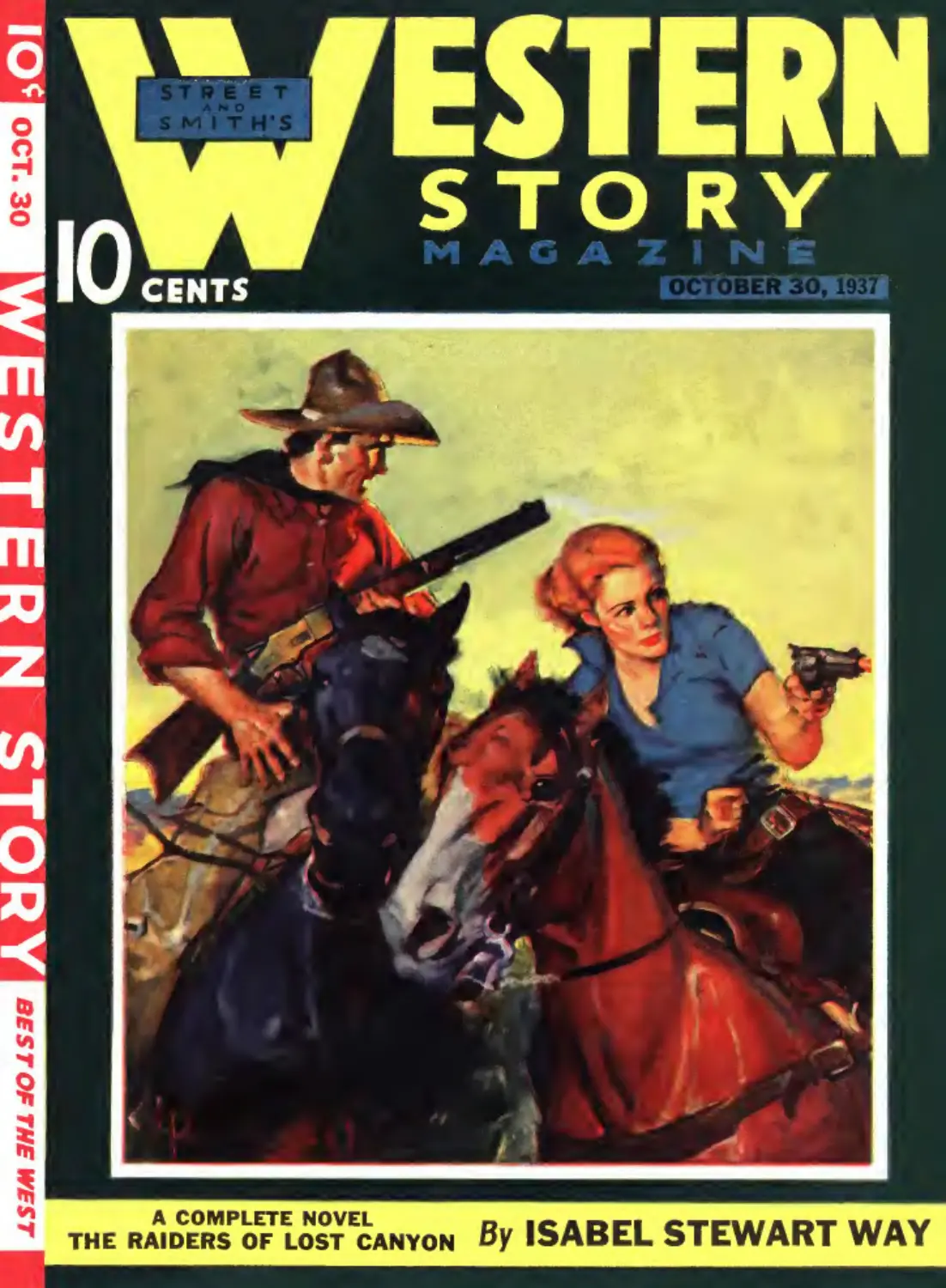


Tags: magazine magazine western story
Year: 1937




Text
                    GfMt DIAMOND & WATCH VALUES

ties and silvt-on ROYAL’S liberal
TEN PAYMENT
Send for your copy today.

ornmono swatch co.;.
Established 1895

170 BROADWAY N.Y.C.

ADVERTISING SECTION

“SELDOM SEE AN I., C. S.
GRADUATE OUT OF A JOB”
“In AlC the years I have known of the

fully realize their value in my business.

International Correspondence Schools, I have
seldom seen one of your graduates jobless.”

JlTie reason so many I. C. S. men have jobs

A business executive made this statement in

is because they are trained men! A recent

a recent letter commenting on the I. C. S.

investigation into the working conditions of

graduates and students in his employ and ex¬

1000 I. C. S. students revealed only ten un¬

pressing regrets that it was necessary; to reduce

employed. You, too, can be an I. C. S. man.
Mark the coupon and mail it today! It has

his personnel.
“However,” he added, "all I. C. S. grad¬
uates and students will he retained, for I

been the most important act in the lives ofi
thousands of men.

WS—1C
Please mention this magazine when answering- advertisements

STREET & SMITH’S

WESTERN STORY
MAGAZINE
EVERY WEEK
Yearly Subscription, $4.00

Six Months, $2.00

Single Copies, 10 Cents

re protected by copyright, u

Vol. CLX

Contents for October 30, 1937

A COMPLETE NOVEL
The Raiders Of Lost Canyon .
.
. Isabel Stewart Way .
Wagon train survivors in a secret canyon, and the strange fate which pursued them.
A SERIAL
Red Trail To Black Treasure .
.
. Luke Short .
Part Four
Xard takes a prisoner, and acquires some interesting information.
SHORT STORIES
Shorty’s Billet-doux.Ray Humphreys .
Luckily for the sheriff. Annabelle was a woman—and changed her mind.
Not The Knot.Guthrie Brown .
The sheriff solves a knotty problem.
The Chance of a Yellow Dog .
.
. Kenneth Gilbert .
yellow Dog was yellow only in color.
Crooked Back Trails.Ora Gordon .
Rex Harmon was like a frisky colt—be needed the checkrein of experience.
Double Cross At Trailcross .
.
. Cliff Walters
With his “glass eyes” old Mac McGovern could see through things a lot better.
AN ARTICLE
Cow Horses (The Spanish Horse) .
. Charles L. McNichols
Royalty of the range—the palomino.
A FEATURE
Interesting And True
.
.
.
. H. Fredric Young
MISCELLANEOUS
Platinum Miners
....
52
White Man’s White Magic
Bantam Turns To Quail ...
62
Prehistoric Indians .
A New Gold Detector
...
71
Horses Have Sleeping Sickness
Bears Not Allowed .
.
.
.121
DEPARTMENTS
The Round-up.The Editor .
Mines And Mining./. A. Thompson
The Hollow Tree.Helen Rivers
Where To Go And How To Get There John North .
Missing.

No. 3
.

14

.

79

.

53

.

63

.

73

.

107

.

117

.

103

.

72

.
.
.

122
123
125
127
129

NOTICE-This magazine contains new stories only. No reprints are used.
Publication^ iseu

«1^

ieatlon«UInc ''Great*

i do not accept responsibility for tbo return of unsolicited manuscripts.
to facilitate handling, the author should inclose a self-addressed envelope with the reduisite postage attached.
STREET & SMITH PUBLICATIONS, INC., 79 7th AVE., NEW YORK, N. Y.

ADVERTISING SECTION

Please mention this magazine when answering advertisements

ADVERTISING SECTION

New © -Volt
TUI NDL Clectrie

ARC W£IELCR
PATENTS PENDING

Works on Storage Battery
or 110 Volt Light Circuit
A HEAL WELDER
Men, here is the hottest specialty item
that has come along in years. A real
honest to goodness electric arc welder
-that does a man size job. Built stur¬
dily of the finest materials. Requires
no mechanical knowledge—any one
can use it. Every demonstration should
make a sale. This new Trindl Electric
Arc Welder is made possible by the
invention of a low voltage carbon
which gets white hot from the cur¬
rent of an ordinary 6 volt storage
battery such as In your automobile.
It only uses about 20 to 25 amperes
of current which is about the same
current drain as 4 headlight bulbs,
yet ^develops about 7000 degrees of
MELTS IRON AND STEEL
INSTANTLY

The Trindl Welder is simple to use. Expert
welding can be done by anyone. The
Trindl Arc Welder is the only battery welder that, after a rigid teet. has
been approved by the Automotive Test Laboratories of America. It is
ideal for making permanent fender repairs—also for broken eastings,
radiators, cylinders, water jackets, boles in auto bodies, bog troughs,
boilers, tanks, milk cans, radios, batteries, etc. Iron, Steel, Brass, Cop¬
per and Tin can be worked on for a quick and permanent repair. The
repaired part will be as strong as before.

HEW 110 VOLT CONVERTER
MAKES FULL SIZE PROFES¬
SIONAL UNIT
This new converter is used on any 110 volt 60 cycle electric light socket
in place of a storage battery. It is especially designed to be used with the
Trindl Electric Are Welder—COSTS LESS THAN A GOOD BATTERY
—The combination makes a full size professional electric arc welder that
everybody can use. Ideal for fender and repair shop needs. This is
also in
The
sensation, not only in ' *
' actual
' ' results.
"
™ converter
_fine
represents
0 - “■ construction and engineering si—--- --...
velder. The complete outfit, including the transformer, is easily portable matter where you turn, y<
so that it can be brought! right to the job.
people who will want to buy

USERS SWEAR BY IT —

irtfit. Think of the profit you can make introducing this Trindl all of them need Trindl Electric Are
■ "
...
.a
__,_,_demonstration
shoi make Welders. Be the-*- •
every interested prospect, especially when they hear '
with Trindl.
Ingly low price. Garages, radio and battery men, tinners,
metal workers, janitors, farmers and home-owners "
Te MAIL COUPON NOW!
Trindl Welder and Converter.
A
T Kl AU/I There ere big profits and a steady bnsiNwl ll W II • ness waiting for you taking care of your
territory for us. Pon’t let someone else get in before you—Send
coupon Today.
A Converters. This does not ebli-

TRINDL PRODUCTS
2229-UL

Calumet Ave.,

Chicago, III.

Please mention this magazine when answering advertisements

ADVERTISING SECTION

This Beautiful, Large
World Globe
'DeLuxe1
Model
(In Full Colors)

Special Offer!
Think of it—a beautiful large World-Glo.be FREE during this special
offer. World-Globe is in full colors and shows all countries in detail.
Also all important around-the-world
flights with dates and
5-woria aeroplane Mights
total mileage. Don’t miss this
his exceptional offer—rush coupo
coupon AT
ONCE for sensational typewriter 1
' ~
'
This amazing offer made for «
simply mail coupon below—befo
repeated-ACT NOW.

SSsKSs&ffi

With This —

Fully Guaranteed

Bargain Offer!
WORLD FAMOUS

UNDERWOOD
Mfg’s- Price

fsave V2 origi.

C
Send No
Money

A

Day
10-DAY

SSK
NOW.
Lean Track Typewriting
Complete tjStodr)

Send coupon for complete details

P

|

Portable Bargains

SMiSa!

on 10 days trial and terms aV low aa 10c a day.

Internationa! Typewriter Exchange
231 W. Monroe St.

Dept. 1012

Chicago

j_™

Please mention this magazine when ansv

I

ADVERTISING SECTION

FREE

enlargement

Just to get acquainted with
new customers, we will beautifully enlarge one
snapshot negative (film) to 8x10 inches—
FREE—if you enclose this ad with 10c for
return mailing. Information on hand tinting
in natural colors sent immediately. Your nega¬
tive will be returned with your free enlarge¬
ment. Send it today.

GEPPERT STUDIOS

MEN PAST 40
Impaired vigor, caused by tired, elnggisb glands or
mental and physical fatigue, is often strengthened
after taking ZO-AK TABLETS for ONE MONTHor money back. Zo-ak contains newly discovered
hormone (gland activator), prescribed by many doetors here and abroad for this very purpose. Sold and
recommended by all good druggists. Booklet by regiv
tered physician free. ZO-AK CO., SO W. 45th St.
New York. Ask for Economy Size and save $1.

A Book of
Plain Facts for

kCCOUNTING
\the profession that pays
Accountants command big income.
Thousands needed. About 16,000
Certified Public Accountants in
U. S. Many earn $2,000 to $15,000.
We train you thoroughly at homo
in vour spare time for C. P. A. exos or executive accounting
”
s bookkeeping
knowledge unnecessary—we pre¬
pare you from ground up. Our train¬
ing is personally given by staff of
experienced C. P. A.’s. Low eoetr—
s. Write now for valuable

i Head this enlightening and
01 encouraging bock. Describes
the mild McCleary treatment
_norrhoids (Piles). Fistula and all
eon-malignant rectal ailments at McCleary Clinic,
Book and reference list FREE.

McCLEARY CLINIC
1061 ELMS BLVD* EXCELSIOR SPRINGS, M0.

SEND FOR FREE Rhyming Dictionary and
Writers Guide. Submit best poems, melodies
today for our bonafide, superior OFFER.

MMM MUSIC PUBLISHERS, PORTLAND, ORE.

IF YOU ARE POISONED BY

ELECTRICIIY
• 'LL FINANCE
YOiTr TRAINING!

I
_

I g&SCMfJE&flMR &

URIC ACID
Read Our Offer-»Do This

a Uric Acid in your blood causinz "Arthritis;'*
If joints; sore muscles; rheumatic pains; neuritis;
Bladder weakness ? Kidney irritation ? Dp many times
at night? “Worn Out”? “Acid” Stomach? "Catch
cold” easily? Skin itches and burns? Nervous?
HOW MANY SYMPTOMS HAVE YOU?
For more than 45 years The Williams Treatment
has been helping others to better health and com¬
fort. You try it 1

WANT A 75c BOTTLE?

II this advertisement with I Re in stamps er coin t< The
l. Williams Co.. Offer MLI6, E
Williams Treatment and booklet with DIET and other helpful sug¬
gestions.^ No obligation. We pay postage. No C.O.D. Only ^ne
NO BOTTLE UNLESS THIS ADVT. ISSENT
Please mention this magazine when answering advertisements

ADVERTISING SECTION

To run local

COFFEE
AGENCY
Splendid Chance
To Make Up To

$60$ in a Week

are married and willing —
:e Agency right in your o'
now possible for married couples to make up to $60 in a single week if yo
vork harmoniously together. Wife handles the orders, keeps records, etc
: the husband delivers and collects. Steady, permanent business of one l_
hundred customers can quickly be established if you follow the simple.

WONDERFUL
SUCCESS
Reported by Others
Clare C. Wellman, N. J., tried
my plan and ^cleared $96.00

START EARNING AT ONCE

Please mention this magazine when answering advertisements

BETTER HEALTH
FOR OUR BOYS AND GIRLS
Protect them against Tuberculosis,
(the disease that still leads as a
cause of death between 15 and 25
BUY and USE

CHRISTMAS SEALS

when answering

'ADVERTISING SECTION

GET THE

oh

FASCINATION

1938/

PROFITS - IN SPARE TIME

ind to TAN hides and furs by wonderful KROMI
n. also NOVELTY TAXIDERMY, using commc

FREEB00TrS?«^^lb*w^u
att home. Tells how to EARN FINE PROFITS in
Rush letter or postal for this strange xr-S-DD
Write NOW—TODAY. State AGE.

BOULEVARD CRAVATS.
This

Beautiful Lifelike

PHOTO

RING

MWIL I^NJA.
i!

wo«SOev1

rafr^LXS!
4I 8
Waterproof! Enclose
U
Canadian orders send
REX PHOTO RING CO.

0

V
—

cientiflc ’Crime Detection.
-titles. Travel. 6te—, _.
:ce8Mry. Very easy terms.
_ —.. „—_ JETECTION INSTITUTE OF AMuuui, mu
rCAO Bldg,, J. I. BardeUc, Fr«., Dt» 7K7, Hmliajtw, Wot Virem

IT’S FUN TO WRITE!

Pack every Autum *^gurc-by ownget extra mon*®« jL-Davidso* ^
Ig.^^^and refinementsit9 many new featu^ ^ keep9 you
Your smartly y
e riaing a healtbout in tbe open T
yg enjoyiag new
ful bobby! You r
J
nt places
scenes, new f»e^__at ^ ly
are brought nearer ^ ^ Hatley.
low cost, too.
tot pov,er, speed,
Davidsons are top ^ greate9t econaud smooth
ttan9portaUon
omy- 1,0 ot '

at go little cost.

ssrur^--—

EE. CAREERS IN WRITING deal
unitieslin Jrci£inggj*j,» ^oVcarc^t
copy. Write promptly!
U. 3. SCHOOL OF WRITING

-Lffraji mwiy tiniri. In z Tears
ily as your time and abilities permit. Course
_j to resident school work — prepares you for
ranee to college. Standard H. S. texts supplied —
SUrt "■
■or!can School, Dot. H-77, Oro.el of ssth. Chleoa.
Pleasa mention this magazine jvhen answering advertisements

.

JG_ SECTION__

dPZERTISIA

Help Kidneys
Don’t Take Drastic Drugs

PILES
SEND^NO _ MONEY

imsm

Classified Advertising

FREE

Me

DR. S. B. HEININGER, D. D. S.
440 W. Huron St., DepU051,Chicago, Illinois

SiSHS-«r* **

NEW i8sZ=Z3Wi
BENJAMIN AIR PISTOLS jMtSSjKf.
Patents Secured

!|SS|jG@m

B-C- — ~ fc F•£35f««'^sMrmrtss sst ea
Frog Raising

WLS-Si-a fc!
BrtBH

Traffic Manager

Sfi&Et
Female Help Wanted

Big business needs trained traffic
men and pays them well. Train in

rbr,r^“h;LSypLrot
cost; easy terms.
Write now for valuable, interest¬
ing 64-page book—FREE.
LASALLE EXTENSION r t

*d“f n[lltll|

rSSi«6SA«

ADVERTISING SECTION

iYostate Sufferers

"d ka^REDUCED
MY WAIST 8 INCHES
WITH THE WEIL BELT"
41 * writes George Bailey

IF you DO NOT
REDUCE YOUR WAIST

KILL INSECTS ". BUGS
doinSwORRY

, MMSUbSL,Marshall, Mich.

AddVuCi^ T^dN^Tand Add™ ,n Penny Po» CanT

Please mention this magazine when answering advertisements

The Raiders
Of Lost Canyon*
By

I

ISABEL STEWART WAY

CHAPTER I.
THE DEVILS SPAWN.

N fifty years, the Burnt Wag¬
ons Trading Post, at Starva¬
tion Springs, had grown from
a single pack horse—a gray
old nag with a bullet scar
across one rump—to a frame store
of mammoth proportions.
Here the Indians had brought
their furs, from the higher reaches of
the reservation, their turquoise and
tourmalines dug from the moun¬

tainsides, and traded them for food,
tobacco, knives, or lengths of bright
calico for the eager, chattering
squaws.
Here the desert rats now came to
exchange their gold dust for food
and raiment, or to ask generous
Luke Rutherford for grubstakes.
Here the ranchers traded beeves for
fencing, for feed, for tools, or even
for a piano, to be freighted across
the desert to ease the loneliness of
some female.
Luke Rutherford
traded in everything.

The Raiders Of Lost Canyon
A real general of commerce was
he, and, like a general, he held a
fortress, for the trading post resem¬
bled nothing else. It stood in the
center of a stockade, with a roomy,
two-story log cabin beside it. The
second-story windows of both the
cabin and the trading post were
small, set at advantageous points for
commanding all means of approach.
The walls of saplings, lashed to¬

IS

gether and sharpened at the top, had
heavy gates, which could be closed
securely to barricade the place.
The gates were open this morning,
although it was scarcely dawn. At
the hitch rack, before the post, a
pack burro waited with bulging pan¬
niers. A saddled horse was there,
too; a small black mare, whose stur¬
dily built body showed endurance
as well as strength.
Luke Rutherford sat on the
wooden porch before the store,
scowling at the animals. One band¬
aged leg was propped on a chair be¬
fore him, and his gaze turned to it
now.
“Those Purdys—curse them all!”
he growled.
“The devil’s spawn!
They’ve grown worse, from Black
Purdy down!”
“Granddad!” A voice came from
the doorway. “I’m goin’ to clean
the Purdys before I start on this

16

Street & Smith’s Western Story Magazine

trip. We know well enough it was
one of them that did you in last
night!”
Luke’s keen gray eyes turned to¬
ward his grandson.
“None but a
Purdy would shoot at a man from
the dark, as we’ve good cause to re¬
member.”
Dave Rutherford’s lean young
face grew grave; his gray eyes, dark
like those of his grandsire, narrowed
as he looked toward the upper
reaches of Starvation Valley, where
the last of the Purdys—Rutherford
enemies for three generations—were
entrenched.
“I haven’t forgotten, granddad,”
Dave agreed soberly, “that Black
Purdy clubbed your mother to
death, massacred your friends, and
that he and his offspring have
preyed upon you and yours ever
since. Now I’m goin’ to stamp out
that rattler’s den before I go to the
desert. I’ve waited too long as it
is!”
Luke smiled wryly. “If stampin’
out the Purdys was as easy as that
—just a momin’s work, done by a
lad willin’ himself to do it—do you
think I’d have let them live all these
years? That desert trip—I’m want¬
in’ you to make it first, Davey!”
Rebelliously, Dave went over to
his horse, slipped a well-kept rifle
into the scabbard.
“All right,” he said shortly. “But
when I come back there’ll be an end
to it.”

S

OMEHOW there never seems
to be an end to that fight.”
Luke sighed, his big head, with
its thatch of iron-gray hair, sinking
on his chest. “I may not live to
see the finish,” he added grimly,
“but I’ve got the satisfaction of
knowin’ it was my bullet that fin¬
ished Black Purdy himself!”
Dave leaned his arms on the sad¬

dle and stared toward the Purdy
ranch. His heavy dark brows were
drawn together in a puzzled frown.
“What gets me,” he began, “is why
the devils stopped at cripplin’ you
last night! You were a perfect tar¬
get as you stood there outside the
gate, smokin’. They’re good shots,
both Fi and Zeph. They could have
easy killed you!”
He stopped, straightened up, still
staring intently toward the hills. “I
keep wonderin’ about that,” he mut¬
tered.
Luke leaned forward.
“They’ve
got somethin’ up their sleeves, all
right! The Purdys come smarter ev¬
ery generation. Fi Purdy’s got more
brains than old Black ever had, and
Fie’s son, Zeph, can outsmart him
any day. Zeph’s got it in for you,
too, Davey, so you keep your eyes
peeled.”
“I’ll do that,” Dave promised, his
hand reaching for the familiar coin¬
like tag that dangled from his shirt
pocket. He rolled a smoke, easily,
leisurely, but his muscles were hard
beneath the blue flannel shirt, and
the comers of his mouth twitched to
tautness. What he had seen he did
not want his grandfather to guess:
the lone rider who was cutting across
the upper Purdy range toward a
narrow pass that opened only into
the desert beyond.
Dave’s eyes flashed a little in se¬
cret amusement.
His grandfather
was trying to keep him out of this
new Purdy war—that’s why he was
hurrying him to make this trip—and
there rode a Purdy, bound for the
same lonely country toward which
Dave himself was headed!
He gave a quick nod of compre¬
hension. The Purdys wanted Dave
to make the trip, instead of his
grandfather, so they had stopped
the older man with a bullet.
Of
their reasons, Dave could guess

The Raiders Of Lost Canyon
nothing; only that they were sinis¬
ter, and meant grave danger to him¬
self.
In his heart he was glad they were
carrying the fight away from Luke,
but instinctively his mind checked
over his ammunition, his guns. He
must be prepared for any treachery.
Every clump of mesquite or cactus
big enough to hide a man would be
a cause for suspicion, since the Purdys never chose to fight in the open.
They never had, through all the fifty
or more years Luke Rutherford had
hated them.
“I’ll be on the lookout,” Dave said
again, “and you do likewise. Keep
Niko here, close!” he nodded toward
the old breed who had been house
boy for years. “Remember, they’ve
got you off your horse, man!” and
he grinned.
“I’m still
Luke flared.

worth

two

Purdys!”

Except for the leg that had
stopped a bullet last night, Luke did
seem a match for two ordinary men.
People who did not know guessed his
age full twenty years short of its
real sixty-eight. He rode, worked,
held his own with far younger men.
“Even with a youngster like you
to worry about, I get along!” But
his lean face was filled with pride as
he stared at this dauntless grandson
of his.

W

ELL, I’ll get started so you
can begin your worryin’,”
Dave said, and threw away
his cigarette. He didn’t want that
other rider to get too much of a
start.
Coming over to the older
man, he held out his hand. Luke
clasped it in wordless affection.
“Maybe all this seems plumb fool¬
ish to you, Davey,” he said, “searchin, the desert for a family that’s
been lost for more than fifty years.

17

But I’ve got to do it. I promised
myself that.”
“I’m as hot on the mystery as
you, granddad,” Dave answered
gravely.
“I’ve grown up on the
story of Black Purdy and his band
plunderin’ your wagons, and killin’,
when you were crossin’ the desert so
many years ago—and all my fife I’ve
wondered about the one wagon load
that disappeared. Now I’ve a queer
feelin’ that I’m about to stumble on
some clew of the Quinn party. The
wind storms have been heavy lately;
maybe the shiftin’ sands will un¬
cover somethin’, the way they did
that old bureau of Drusilla Quinn’s,
so long ago.”
“Ah, that bureau! If only I could
know its secret before I die! Doubt¬
less it was put off to lighten the load,
but how they ever got so far off the
trail through the heavy sand, I can’t
imagine.” He sighed. “I hope you
can find somethin’, Davey—even
their bones.
It would be a relief
just to know.”
Dave nodded. “This year I’m goin’ straight to the ridge and start my
search.
Maybe I’ll work into the
bad lands a ways.
We’ve never
searched in that direction much.”
“Barnaby Quinn would never
have been so foolish as to enter those
bad lands; none would have lived if
he had—not through the sand storm
that came right after. So don’t ven¬
ture into the breaks, Davey. It’s
no use.
And watch that Jerushy
burro. She’ll drift a mile.”
“I’ll watch!” Dave promised as he
strode across the porch, mounted
the black mare, and took the pack
burro’s reins. “Come on, Jerushy!
We’re desert bound.
’By, grand¬
dad!” And he rode away, smiling
grimly.
Luke Rutherford settled back in
his chair, relieved at thus removing
his grandson so easily from one path

18

Street & Smith’s Western Story Magazine

of danger; but as Dave traveled
away toward the desert his face grew
sober. He realized that the boy was
riding to keep an appointment with
danger from another angle—perhaps
with death.
One of the devil’s spawn would be
waiting for Dave out there, and be¬
fore another morning dawned, only
he—or Dave, alone—would ride
back to Starvation Springs.
A feud that had been started more
than fifty years ago, on that same
desert, would be ended. Dave knew,
instinctively, that if he never re¬
turned, the Purdys could soon wipe
out the crippled, broken-hearted old
man that Luke Rutherford would
become. On the other hand, with
one of the Purdy clan gone, Dave
could soon send the other after him.
Before this trip was done, finis
would be written with bullets.
CHAPTER n.

T

BACK TRAILS.

HE morning was clean and
young as Dave Rutherford
turned into the well-worn
trail
that led
from
Starvation
Springs across the desert.
As he
rode, his mind went back more than
half a century to a tale he knew,
from frequent hearing, as well as if
he had lived it.
He went, back to the day, more
than fifty years ago, when, over this
same trail, a slim, travel-stained lad
of twelve had once ridden, to burst
upon a group of camped emigrants
at the springs and tell them of ban¬
dits who had fallen upon his people
back in the desert. They had robbed
and killed and plundered, young
Luke Rutherford had sobbed out;
only Bamaby Quinn’s wagon load
had escaped, and they must have
help quickly.
They had captured
the bandit leader as prisoner, and

were holding him as hostage in case
the plunderers returned; but they
had little water and ammunition,
only one horse, and a load of help¬
less children.
Over this same road young Luke
had led men back-—to find no trace
of the missing wagon. Not even the
trail of its going showed, for the
wind had been blowing, scattering
the fine alkali dust, to drift in
streaks over any footprints or wagon
ruts.
That the boy’s tale was not ut¬
terly fantastic had been proved by
the traces of burned wagons, but the
rest of his story about the wagon
load that had disappeared, came to
be discounted. His head had been
a bit turned by the tragedy, they
decided, and were kind to him, as
he hung around the springs, hoping
for word to come from Bamaby
Quinn and his party.
Then “Black” Purdy had ap¬
peared, sitting his horse as boldly as
you please. Luke had jumped to his
feet, crying out in his shrill boy’s
tones:
“There he is! The bandit leader!
He killed my mother! He-”
They had laughed at him then.
“Why, that’s Black Purdy!” they’d
explained to the lad. “He owns a
big ranch up in Starvation Valley.
He came here early and holed into
the best spot, so the rest of us have
to travel on before we settle down.”
Again they had laughed; Black
Purdy and the kindly emigrants.
“I tell you, he’s the one!” Luke
had cried out in his frenzy. “He
led them, I say!
He clubbed my
mother with the butt of his gun! I
saw him! I-”
It had taken force to hold the
fury-crazed youth back from Black
Purdy, but they could not keep him
from shaking his scrawny fists at the

The Raiders Of Lost Canyon
grinning, bearded face and shrieking
his defiance.
“I’ll get you yet!” he’d vowed. “If
it takes me a lifetime!”
That was the reason Luke Ruth¬
erford had stayed on at Starvation
Springs, camping there, earning his
keep by selling fresh wild meat to
the emigrants as they came through,
and by watching their cattle while
the weary men rested.
He was never penniless, for under
his camp was buried a beltful of gold
—the money Barnaby Quinn had
been bringing with him to start life
anew in the West. Barnaby had put
the money in the saddlebags when
he sent the boy for help.
“It’ll do us no good here,” he had
explained, “and you can hide it away
until we come. Use whatever you
need, lad.”
Luke had hidden the gold away,
holding it for the Quinns in case he
should find them again. It was when
he was fifteen that he had seen the
opportunity for a trader at Starva¬
tion Springs.
Digging up Barna¬
by’s gold, he had used it carefully,
cleverly, and had kept religious
count, from that day to this, of ev¬
ery penny made from the borrowed
capital. The original amount was
put away for Barnaby, along with
half of all the profits. Even at that,
Luke Rutherford was now a rich
man in a land of plenty; rich enough
to push the Purdys back more and
more each year, and to flaunt in their
faces his hatred of them in the name
of his trading post—the Burnt Wag¬
ons.
And it was Luke who had
finally killed Black Purdy.

E

ACH year, when early summer
brought the anniversary of
the vicious attack, Luke had
made his trip into the desert to
search for some trace of the Quinn
party. He traveled alone at first,
WS—2C

19

then, as the years passed, with his
son, and finally his grandson. But
it was as if the desert sands had
swallowed them and kept their se¬
cret.
Only once had the quest
brought results; that was the time
they stumbled upon the old Quinn
bureau, scoured clean of paint, but
still intact; the drifting sands had
covered it, then uncovered it again.
They had found the bureau sev¬
eral miles from the spot where Luke
had left them on the trail; now he
would never rest until he had solved
the mystery of their going so many
miles, taking the wagon with them
—with a single horse, a man, and a
boy to carry the load.
“And the Purdys have seemed
just as anxious, for some reason,”
Dave mused as he hurried the stocky
black
mare
along.
“Anyhow,
they’ve been mighty interested in
our trips.”
His face grew grim,
hard. “They got dad. Now they’re
out to get me.”
He had come over the hogback
of the ridge, ready to drop down into
the desert. Stopping Half Pint, the
mare, he looked toward the north,
where the pass opened from the
Purdy ranch.
Somewhere in that
direction an enemy lurked; an en¬
emy who was probably watching
him this minute.
Dave shrugged and sent Half Pint
along. So far he had the advantage.
He knew that his enemy prowled
close and could bait him on until he
was ready to turn upon him. Soon
he turned off the trail, working along
a winding draw that led into the des¬
ert, toward a landmark that marked
where the bureau had been found.
Once he left Half Pint and Jerushy
and climbed to a ridge, where he saw
what he expected: a cloud of dust
moving down from the pass. That
meant there was no immediate dan¬
ger of attack. The Purdy who rode

20

Street

& Smith’s Western Story Magazine

out there intended to cut him off,
near the landmark.
Purdy would
reach the spot first; he’d be lying in
wait when Dave made camp that
night.
“Come on, you two!” he said when
he was again in the saddle. “The
best we can hope for now is to get
there before dark. No Purdy ever
struck in broad daylight.”
Dave reached the landmark just
short of sunset, and stopped behind
the shoulder of the dunelike ridge
that jutted from the monotonous
roll of sage and cactus, dotted now
with a few bright flowers—remains
of the brilliant carpet of bloom that
was laid upon the desert at spring¬
time.
He fed and watered the animals,
but neither unsaddled the mare, nor
took the pack from Jerushy.
He
might need them hastily. He hob¬
bled Jerushy, taking no chances on
the itchy-footed burro going adrift,
but he turned Half Pint free. She
was an intelligent beast who would
stay close and come at his whistle.
These chores done, Dave came
back to camp at a crawl, hugging
the ridge that would shield him.
Motionless, he crouched there, his
keen eyes scanning every inch of the
landscape, to make sure that each
twilight shadow lay alone, blended
with no skulking figure. Then, as¬
sured that no enemy watched from
this side, he crawled slowly over the
ridge, to watch any approach from
there. Flat on his stomach he lay,
peering over the top, but, as his eyes
grew used to the increasing shadows,
his body tensed. Almost he forgot
caution in straining his gaze over
that changed landscape.
The wind storms had done their
work well; the country looked freshscoured . At the foot of the long
slope lay a queer, black, wall-like
formation of stone, that had not

been there any year before, when
Dave had looked upon the country.
In that wall was a gap, opening like
a gate into the bad lands.

F

OR a long time Dave lay there,
not daring to move because of
the enemy that lurked near
at hand, but his muscles quivered in
eagerness, and his hand clutched a
gun butt anxiously. He wanted now
to get Purdy quickly, for beyond
that killing lay the right and the
freedom to explore that gap.
In some way Dave felt sure that
the answer to the long mystery
would be found beyond there. The
Quinn wagon had reached this far
those fifty-odd years before.
The
abandoned bureau had proved that.
And if Bamaby had seen the gap,
as Dave saw it now, he would make
for it. Luke hadn’t explored those
bad lands very far, because it hadn’t
seemed humanly possible for the
exhausted little band to go far beond this point, with so little water,
ut their bones must lie somewhere
beyond that queer wall!
The sun sank and darkness gath¬
ered. Then the moon climbed out
of a cup between the distant purple
hills, and the whole world was
flooded with eerie light. Stars came,
too, so close that they took on the
third dimension. They were balls of
fire, hanging low, instead of flat
disks against a blanket of sky.
The squat shadows along the
sands became fixed. Not a living
thing moved.
After a time Dave
raised his head, and still there was
no stir. With his head up, clearer
vision of the gap came, and Dave
drew in a deep, quick breath—for
there, visible under the flooding
moonlight, was something rising out
of the sands; something shaped like
a wagon bed!
Dave was young and he was im-

21

The Raiders Of Lost Canyon
pulsive. For three hours he had Iain
rigid without sighting his enemy.
Inaction was no longer to be borne.
He took a final look around, let a
stone roll down the slope, slithering
through dried sage. He heard not
a sound, saw no movement, any¬
where.
Dave hesitated only a second
more. It didn’t seem possible that
his enemy slept, yet there had been
not the slightest stir to betray any
alien presence. Purdy might be, at
this minute, circling around to creep
up on the camp from the other side.
Well, in that case, Dave told him¬
self, Purdy would be kept busy
while Dave did a little investigating
on his own account. The final fight
would keep for a few hours.
Slowly, very cautiously, Dave
stretched his cramped muscles over
the sand as a sluggish snake crawls.
Down the long slope he went, and
along the wall. Faster and faster,
with caution almost gone as he
neared the gap and no bullet had
whizzed through the night.
For a moment he lay still at the
edge of the gateway, and his eyes
brightened as he verified his vision
from above. It was part of a cov¬
ered wagon! There was no mistak¬
ing it. White as driftwood, a plank
and part of a broken bow rose from
the sands.
And, beyond, as he
craned his neck to see around the
strange wall created by nature, he
noted the wagon seat, standing like
another monument among all those
grotesque rocky tombstones of the
impassable bad lands. The broken
remains of a covered wagon—and
what other wagon, save that of
Bamaby Quinn, would be here, miles
off the trail?
His eagerness could be restrained
no further.
Dave crawled inside,
over to the wagon. He pulled the
broken bow loose from the sand, ex¬

amined it, then walked over to the
wagon seat. There were marks in
its smooth surface; a lighted match
showed a crude jackknife carving.
Luke. His grandfather’s name!
There was a tight lump in Dave’s
throat as he thought of the twelveyear-old boy, jogging over the rough
hard trail, proudly flourishing a new
knife.
Luke had liked Barnaby;
often, during the long journey across
the plains, he had gone to sit in the
Quinn wagon. Dave knew all these
things, because Luke had spoken so
often of the trip that Dave felt as
if he himself had been there.
Other things Dave remembered of
the tale-. When Black Purdy pur¬
sued the fleeing wagon, from this
same seat the boy Luke had leaped
into the bandit’s gun, bringing the
big man to the grpund and enabling
Bamaby to jump down and take
him prisoner.
Across these old
boards, then, the boy had been laid,
with the bruise of Black Purdy’s fin¬
gers about his throat, for death had
almost come, before Bamaby Quinn
had reached them.
Dave’s eyes felt strangely misty
as he crouched there in the moon¬
light, rubbing a hard palm over the
old wood that was sand-planed to
satin smoothness.
Suddenly he stiffened. One hand
started toward his gun at the sound
of a chuckle behind him, but a harsh
voice halted the move.
“Lift ’em up!

And keep ’em up!”

CHAPTER HI.

D

A PURDY STRIKES.

ave rutheeford spat
a curse as, very slowly, he
raised his hands toward the
near stars.
He deserved what he
was getting—for letting himself be
baited into the trap of the enemy.

22

Street & Smith’s Western Story Magazine

Rough hands unloosed his gun
belts, slung them to the ground, far
behind. The muzzle end of a gun
swung him around until he was fac¬
ing the swarthy, vicious face of the
youngest of the Purdys: Zeph, only
surviving grandson of old Black
Purdy.
'
“Well, Zeph,” Dave greeted him.
“You did yourself proud, didn’t
you?”
Zeph Purdy’s teeth shone whitely
from his black-bearded, hawk-nosed
face, and his reddish eyes gleamed
like a cat’s under the moonlight.
All the Purdys had those odd eyes;
it helped to give each the look of a
demon.

“You’re talkin’ mighty big for a
man up a tree, ain’t you? And it’s
a different kind of speech than I’m
hankerin’ to hear from you!”
“I’ve no kind of talk to exchange
with a Purdy—except the kind you
send with bullets!”

Dave measured him, narrowly.
A bulky man was Zeph, shorter
than Dave, but with wide, bull-like
neck and shoulders, and powerful
torso. He had the advantage of per¬
haps thirty pounds in weight. He
wore two guns; twin belts, crossed
in front, with the holsters strapped
down tight to his thighs, killer-fash¬
ion.

Dave stared at him steadily.
“You’re loco, Zeph,” he declared.

“When I seen these wagon relics,
I knowed you’d stop,” he boasted to
Dave. “I had gumption enough to
get you the smart way—out here
alone.”
“Then it was you who shot grand¬
dad!” Dave said sharply. “We knew
it was a Purdy—nobody else here¬
abouts would dry-gulch a man like
that—but we weren’t sure which
one.”
“I’d have finished him off, easy,
but I left him for pa,” Zeph replied,
grinning. “Pa’s got a score to pay
off. Old Luke got grandpop and my
two uncles and my brother’!’
“The score still isn’t evened up on
our side!” Dave retorted grimly. “It
won’t be evened until every last
Purdy is wiped from the face of the
earth.”

“I reckon you’ll talk!”
Zeph’s
voice was a rasp. “You see, there’s
things that need clearin’ up. You’re
goin’ to tell the things that grandpop died cravin’ to know. Me, I’m
smarter than him, or dad. What I
want to know I find out. And right
now I’m wantin’ to know where you
and old Luke has got the gold
cached that belonged to Barnaby
Quinn!”

“Don’t try that stuff on me!”
Zeph spoke from deep in his throat,
as if he were growling. His gun lev¬
eled, menacingly.
“I’m no fool.
You’ve got a secret cache somewhere
out here!
Grandpop knew it—
that’s how old Luke got his start.
It’s why you Rutherfords could al¬
ways cut such a wide swath with
money! Now you’re goin’ to tell me
where that Quinn gold is hid—so
make ready to talk, hombre!”
Dave considered for a moment.
When he spoke, his words came
slowly.
“Why are you so sure we have a
cache out here, Z6ph? What made
your grandfather think such a
thing?”
Zeph stared at Dave. “Because
the Purdys ain’t fools!” he cried out.
“Say! You don’t think we’d have
let you live on all this time, do you,
if we hadn’t knowed you had the
gold out here—and was bound to
come for it? We could have finished
you both easy, any time, like we
done your pa—only this way was
best.”

I

The Raiders Of Lost Canyon

T was Dave’s turn to stare as he
struggled
for
comprehension.
This, then, was the reason the
Purdys had let Luke live so long,
had taken so much interest in the
yearly trips. It was not in them to
understand the loyalty of a man who
would continue to seek a friend after
fifty years, especially when it meant
giving him back gold that belonged
to him. Nor could they comprehend
the compassion that would make a
man suffer because he couldn’t gain
any definite knowledge of a friend’s
passing. To them the yearly search¬
ing trips could mean nothing but
gain, and thus a legend had grown
in the Purdy family, fed by their
greed and ignorance.
“You ain’t foolin’ me,” Zeph re¬
peated. “Somewheres out here you
got that gold cached. And I’m goin’
to have it.”
“Why should I tell you any¬
thing?” Dave demanded. “I’d only
get a bullet after I’d spilled the
news, which is the same as I’ll get,
anyhow.”
“Mebbe not!” Zeph’s reddish eyes
narrowed under their thick lids.
“I’m willin’ to bargain. Your life
for the gold. Then I’ll leave these
parts with the money. The world’s
wide enough for the two of us.”
“And you think I’m fool enough
to swallow that!” Dave scoffed. He
must do anything to gain a little
time and hope for something to arise
that would shift the advantage be¬
tween them.
“Think I’ll believe
that you’ll turn me loose when your
father’s still back in Starvation?
That would mean granddad and me
against a lone Purdy!”
Zeph shrugged indifferently. “Pa
has muddled this thing long enough.
And if he can’t look after himself,
let him take what he gets. But that
ain’t the point!” He twirled his gun
suggestively.
“Where’s the gold?”

23

“Now I know you’re loco!” Dave
exclaimed.
“I told you to keep off that trail!”
Zeph
ordered
roughly.
“Come
across with what I want to know, or
I’ll-”
“Or what?” Dave broke in, sud¬
denly tired of the strain. “I’ve got
nothing to say!”
Denial of the gold would do no
good; there was nothing that could
do him any good now unless the god¬
dess of luck gave him some slight in¬
stant of advantage.
For that he
prayed.
“So you ain’t talkin’!” Zeph
boomed out. “Well, you’ll have a
little time to think it over!” Then
he ordered shortly: “Walk over
there to that butte—the one that
looks like a tombstone.”
“They all look like tombstones,”
Dave said. “Enough markers here
for a graveyard of Purdys.” But he
turned and strode slowly toward the
designated place.

T

HERE was no need to resist;
not when Purdy had the drop
on him. But suddenly hope
grew. When he reached those shad¬
ows at the base of the butte he could
act; take a quick leap to one side,
then behind the rock.
Whichever
way Zeph Purdy came, Dave could
jump in the other direction and
reach another butte.
And if the
moon went under a cloud there
would be opportunity for escape—or
he might reach his gun belts, where
Zeph had thrown them.
Dave felt an urge to quicken his
pace, but he kept to the same even
gait—one, two, three. Just another
two steps and he would be there.
Then the world shattered. There
was the bark of a six-gun behind, the
ping of a bullet through the air, the
stinging impact of lead against his
back ribs, sending him downward.

24

Street & Smith’s Western Story Magazine

Before he could recover, another
shot came, and he felt it tear
through the left thigh, bearing down
toward his knee, numbing it, send¬
ing him toppling to the ground.
“Got you!” Zeph gloated. “Just
like I nipped your grandpop—in the
leg. Right where I wanted to.”
“You devil!” Dave spat out.
“You Purdy scum!”
“Thought you’d catch me nappin’,
didn’t you?”
Zeph grinned, came
closer.
“You ought to’ve knowed
better.”
“I should have known you’d shoot
from behind when I was unarmed!”
!
Dave gritted back the pain as he
tried to rise from the bloodstained
ground. His shirt was already wet,
and blood was spurting from his leg.
In spite of that, he reached out an
arm, caught Zeph Purdy’s ankles,
jerked him down.
Zeph was quick. He rolled over
like an eel and was up to his knees.
His gun arm raised, came down with
fiendish fury.
Dave felt it graze his head, that
hard gun butt.
A million stars
whirled in buzzing anger about him;
the world tipped and swayed. Then
he plunged off into a cold, abysmal
blackness.
CHAPTER IV.
JERUSHY DRIFTS.
T seemed to Drusie Bright that,
during the night, young summer
had run through the Canyon of
Sweet Waters like a slim girl trail¬
ing a filmy green scarf behind her—
like a dancing maid in an old print
that hung in her great-grandfather’s
cabin.
The canyon was always
green, but there had been a new
mistiness about it this day; perhaps
because
the
cottonwoods
had
dropped the last of their white cot¬
tony fluffs and come freshly into full
leaf.

A place of beauty was this small
gulch, lashed out of the arid bad
lands they knew as Satan’s Grave¬
yard, but to Drusie Bright there was
no beauty in the world as she
knew it.
A small world it was—that Drusie
knew—compassed
by
the
sheer
rocky canyon walls, marked by a
small stream that rose from springs
in one blind end of the gully, dis¬
appearing strangely into the other
boxed extremity—and peopled by
the forty-odd souls who inhabited
the canyon.
Drusie Bright had
known no other world, nor had her
family for three generations before
her. Her horizon was bounded by
the jagged buttes and breaks of the
bad lands, stretching on every side
from the rock rim above.
Drusie was at the pottery alone as
evening came. She liked to be alone.
It gave her time to think, time to let
her resentment against life grow,
time to hate the confining rocky
walls that kept her from the world
she instinctively sensed to be out¬
side.
When she heard steps beyond the
bend she bent her head, with its two
dark braids, lower over the bowl she
was holding to the wheel, surely and
steadily, for shaping.
“Good evening, Drusie!” It was
Barnaby Quinn, patriarch of the
canyon, and her own great-grand¬
father. “You’re working late, child.
The sun has already set.”
Her slim-sandaled foot did not
hesitate in its quick beat at the
treadle. She only raised her brown
eyes a moment to look at him as he
stood there, leaning on his staff;
white-haired, white-bearded, his an¬
cient bones warmed by goatskin
trousers and vest. Beside him was a
shaggy yellow dog.
“I like this part of the day best,
grandsire,”
she
replied
briefly.

The Raiders Of Lost Canyon
“And I want to get things out of the
way.” She nodded toward the neat
pile of dishes, some through the kiln,
others ready for the first firing.
Barnaby picked up a completed
pitcher, pure of line and gracefully
shaped.
“Beautiful work, Drusie,
these dishes for your sister’s new
home. They’ll be completed before
young Gid gets the cabin ready.”
“I want to get them out of the
way,” she repeated. “Jenny will be
happier, knowing they’re ready.”
Scorn was on her tanned, elfinlike
face. “Perhaps it will make the time
of waiting seem shorter.”

B

ARNABY seated himself upon
a well-worn boulder, and she
felt his keen gaze upon her.
“So Jenny’s getting married,” he
mused. “She and young Gideon are
building a home together.”
“Yes—and acting as if it were the
most important thing that ever hap¬
pened!”
Barnaby
Quinn
smiled,
and
smoothed his long white beard.
“You’ll feel that way yourself,
Drusie,” he told her, “once you find
which likely young man you’ll
choose. And it’s time you thought
about it, child. You’re twenty years
of age. Jenny is two years younger,
and she’s settling down.”
A little thread of fear crept into
Drusie’s heart.
Her great-grand¬
father had always arranged the mar¬
riages; he had stopped, with a sharp
warning, any friendship that was apt
to grow too close between relatives
who should not marry—and had en¬
couraged other couples.
When he
said a girl was old enough to marry
she accepted it as the law—all but
Drusie herself.
Old Barnaby had
been lenient with her these past
three years, but now—now there
was something firm about his voice.
“Barney Quinn is not yet wed,”

25

he went on, his gaze still fixed keenly
upon her. “Barney is your own age
—just a few days younger—and he
is a good worker. He is only your
third cousin, and he has waited for
you, Drusie; now he wants a home.”
“Barney only wants what you tell
him to want!” she cried out. “He
waited because you told him to!
But I’m not going to marry him!”
“What?”
All of the rebellion that had been
surging in Drusie’s heart ever since
she could remember boiled up now.
She took her foot from the treadle,
stood facing him, slim and straight
in her garment of woven grasses,
banded at the waist with a snakeskin belt. Holding the bowl in her
strong, small hands, she flung back
her dark head defiantly.
“I’m not going to think about
marriage at all, grandsire! Not to
any one here! I’m not going to tie
myself down to this canyon!”
“Where will you go?” Barnaby
demanded harshly. “If you’re not
going to be tied down here, where
will you go, child?”
“Where?” she echoed. Then she
took a step or two nearer the old
man, looked desperately into his
white-bearded face, trying to pierce
through to the knowledge he held.
"You know where I could go, grand¬
sire! You could even show me the
way, if you would—the way you
traveled when you came into Sweet
Waters!
And you’ve got to show
me!”
The bowl crashed to the
ground as she threw herself to her
knees before him. “If you don’t tell
me, grandsire, I’ll find the way by
myself!”
“You speak foolish words!” he
boomed in a voice not at all aged.
“And I will have none of it! You
have seen the world outside this can¬
yon.
I have taken you up there,
walked a way with you into Satan’s

26

Street & Smith’s Western Story Magazine

Graveyard to show you how easily
and how cruelly you would be lost
if you ventured too far alone. What
would you do in an unkind world
like that?”
“The world isn’t all like that,” she
insisted, sitting back on her heels.
“Oh, I’ve dreamed of things, grandsire! I know there are other places
like this canyon, only larger. Places
whence came all those things you
treasure of my great-grandmother’s
—the lovely spoons, the copper ket¬
tles, the old shawl with its beautiful
colorings. And the books I found
hidden in your cabin and read.
They tell of far places, grandsire!
Even the Bible, from which I learned
to read—it teaches of cities and
joumeyings forth, of precious jewels
and silks and fine raiment, things
such as we have not here in Sweet
Waters. It speaks of peoples and
pleasures of which we know nothing!
You came from some spot beyond
Satan’s Graveyard, and I am deter¬
mined to seek out that place, live
there!”
Bamaby stood up. With one
movement of his still strong arms,
he reached down, jerked her to her
feet.
“Cease this babble!” he ordered
furiously.
“This is your world!
There is no way out—no other place
we can reach! If there were, don’t
you suppose we would have gone
long ago?”
Fearlessly she kept her steady
gaze upon his face.

T

HEN you, too, have wished
to go from here,” she guessed,
reading the secret that lay
behind the pain in his blue eyes.
“You’ve hated these walls, this small
space, and you’ve longed to get back
to the outside world again. It was
the children—and my great-grand¬

mother’s grave that held you here,
grandsire!”
“That will do!” Never had Barnaby Quinn needed to speak twice
to any of the others. “This foolish
talk—I will have none of it! And
I know the remedy. Your marriage
with young Barney Quinn will be
celebrated on the same day that
your sister, Jenny, weds with Gid¬
eon. We will build you a cabin, like
your sister’s, and-”
Bamaby stopped, his sentence un¬
finished. Drusie was staring at him
from wide-opened eyes. Her mouth
parted a little, then closed tightly,
as if to shut away the stormy words
that wanted to pour forth. Fury
showed in every line of her small,
tensed body, but she held her silence.
Nobody in all the canyon dared say
to Bamaby Quinn “I will not!”
when he had once said “Do this!”
It would have been the supreme dis¬
courtesy.
“I will tell Barney,” the old man
finished, “and you can make more
dishes; to your own pattern this
time.” He turned away, stalked
around the red clay bank and out of
sight.
Drusie stared after him, quivering
with rage and terror—the helpless
panic of a trapped wild animal. Old
Barnaby had always seemed like the
one, of them all, who would under¬
stand, and now he had turned
against her. He was making her
stay here, to grow old within these
canyon walls. He was turning the
sweet waters to wells of bitterness,
of which she must drink deeply.
She turned and ran, away from
the direction her grandsire had
taken. Without troubling to remove
her sandals, she plunged recklessly
into the stream and across—scatter¬
ing a pair of fawns by her wild ap¬
proach. Down the canyon she ran,
away from the settlement, her grass

The Raiders Of Lost Caiiyon
skirt catching on the bushes, tear¬
ing her bare limbs as she began to
climb the worn trail that led to the
rock rim above.
At the top she threw herself
down, sobbing, staring with rebel¬
lious eyes into the bad lands, strain¬
ing through the twilight to see the
mystery that lay beyond. It had al¬
ways fascinated her, that new world.
She had come here often with old
Bamaby and had asked him many
questions—questions that, roughly,
he always told her to cease asking.
But that had done no good; not even
when he had found her reading his
Drusilla’s books, which told of
strange lands and doings, and had
taken them away from her to hide.
Drusie Bright had gone on wonder¬
ing, dreaming, sensing that her
great-grandfather lied when he said
the books were fairy tales, that no
such reality existed.
She had not even believed him
when he took her with him one day,
straight into Satan’s Graveyard,
walking with her for hours upon end,
until she was faint with exhaustion,
perishing from thirst, and feverish
from the brassy sun—and he had
had to carry her back to the canyon.
“If we had kept going,” she had
told him gravely when the fever and
the weariness had left her, “then we
would have come to the end of the
hard way, grandsire—and found
what we were seeking!”
“Drusilla!” he had ejaculated, his
eyes staring at her strangely. “Dru¬
silla-” And she had felt queerly
herself, for that was the only time
Bamaby Quinn had ever called her
by the name of his beloved wife,

H

E was still trying to make
her believe that no world ex¬
isted out there; he was try¬
ing to make her forget everything
else outside the Canyon of Sweet

27

Waters.
If she married Barney
Quinn, she would be tied here—just
as Barnaby himself had been tied—
and could never know what lay on
the far rim of the earth, beneath the
domed sky.
“I’ve got to know!” she cried,
clenching her hands into small hard
fists. “I’ve got to!”
The sun set, and still Drusie lay
there, sobbing. The moon rose like
a great ball, and the close stars
sprinkled the sky. Drusie shivered
with the night cold, but she made no
move to go down. If once she went
back into the canyon she would stay
foreverThe moon was high when she rose
to her knees and sat there rigid at
the sound of something coming
through the breaks. And when a
long-jawed, drooping gray head ap¬
peared around a butte, followed by
a stocky, shaggy body, Drusie gave
a low little scream—for never had
she seen anything like it. Larger
than a buck deer it was, and without
the deer’s quick grace; on either side
of its back hung a big bundle, dusty
and lumpy.
The animal had no
horns; its ears were very long and
large, shaped much like a rabbit’s,
and through the dim moonlight it
eyed her with a sagacious, wary ex¬
pression she had never seen before
on any beast. The canyon animals
were more curious than wise.
Drusie wanted to run, but fear
had not been taught the children of
Sweet Waters. She held her ground,
and after a moment the beast came
toward her, making queer noises in
its throat.
Straight up to her it
walked, looked at her with great
eyes that were humanlike and sad.
“You’re thirsty,” Drusie said, put¬
ting a hesitant hand upon its head.
“And wounded,” she added as she
saw the thick handle of a knife stick¬
ing from one pack.

28

Street & Smith’s Western Story Magazine

The beast was not wounded. The
knife had only gone into the pack, as
Drusie saw when she pulled it out.
All the same, there was something
sinister about it. Drusie recognized
it as a hunting knife, akin to the two
that were treasured in the canyon
below: one had been Gideon Bright’s
and the other belonged to Barnaby
Quinn himself.
This handle was
covered wtih rawhide, palm-polished
to smoothness. On one side, burned
in deep letters, was a name:
“Purdy.”
A cold feeling of terror crept
through Drusie, and the night was
suddenly pressing in upon her with
fearsome intent.
Drusie had a
vague memory of having heard that
name, Purdy, and of knowing it to
be evil; the echo of it came like the
memory of a horrible dream. Old
Barnaby had uttered it at times
when he sat cleaning the gun he
never fired, examining the bullets he
never used. Her own grandfather,
Gideon Bright, had spat it out once
like a curse when a child of his lay
ill, needing help the canyon could
not give.
Drusie’s eyes grew wide, and she
shrank back from the shaggy-coated
beast that had brought this first
message from the outside world: the
message that was also a vicious, out¬
spoken threat.
Yet—it was a message. Behind
the nameless animal she saw its new
tracks, showing darkly on the sands
under the midnight moon: a trail
that stretched back to the spot from
whence it came; a trail that was not
yet wiped out by the shifting,
treacherous sands.
Drusie reached out, caught the
halter with one firm hand. The gray
face muzzled her; its nose twitched
under the close scent of water.
“Of course, you’re thirsty,” the
girl said in pity. “Well, come, then.”

S

HE led it down the trail, into
the canyon, where every hu¬
man seemed asleep; but, re¬
membering the trail that led back¬
ward across Satan’s Graveyard, she
led the beast quietly. At the bot¬
tom she turned away from the set¬
tlement and went up the canyon to
a spot she had claimed as her own:
a tiny glade where the stream wid¬
ened to a pool.
The animal drank deeply.
It
would have waded in, but Drusie
held it back till she could loose the
packs from its back. And, as she
fumbled with buckle and knot, her
hands trembled, and her thoughts
raced at realization that some other
human hand had put these things in
place.
Curiously, she opened the
packs, spread the contents upon the
grass, examined them by the bright
moonlight.
There was a woven blanket; Dru¬
sie recognized it from the precious
ones in her great-grandmother’s
chest, brought out only to cover the
newborn and the dying. There was
a garment of softer woven stuff, such
as Drusie had never seen. It was a
shirt, she finally decided, although it
was like none of the canyon men’s
shirts. And there was a soft pair of
moccasins, also made of woven stuff,
and coming high above her ankles
when she tried them on.
She
laughed at the foolishness of them;
they wouldn’t help a bit when it
came to traveling a rough trail.
The food pack she examined next.
Salt she recognized; a precious salt
lick up near the springs gave the
canyon folks their supply.
They
poured water upon it, carried the
brine to the settlement, and let it
evaporate. The meal, too, was fa¬
miliar to Drusie. Corn they grew,
and ground at the crude water mil!
near the pottery.
She examined
closely a parcel of fat smoked meat;

The Raiders Of Lost Canyon
the smell of it was delicious, and
made her nostrils twitch in pleasure.
And she liked the pungent odor of
some coarsely ground, dark-brown
stuff marked “Coffee” that she
found in a silver-colored receptacle
with a removable lid. But when she
tasted the substance it was bitter to
her tongue.
There were other small receptacles
that had no lids. Drusie exclaimed
in vexation as she tried to find the
secret opening, but there was none.
She guessed that each contained
food because of the pictures on pa¬
pers wrapped around the outside—
very beautiful colored pictures of
cooked beans and a bright-red fruit
which she did not recognize.
She
spelled out the words that told the
contents: “T-o-m-a-t-o-es—S-o-l-i-d
P-a-c-k.” But the words made no
sense. Anyhow, of what possible use
was food so securely wrapped up?
One of the cylindrical containers
had the picture of an animal on its
paper wrap: a beast with horns like
a deer and a head something like
the gray-faced one that had nibbled
at the grass and was now lying
down.
She read the printing be¬
neath.
Evidently this was milk!
But milk came from goats—and this
was not the picture of a goat! Be¬
sides, milk soured in a very short
time, and how could it be put into
a container with no opening?
In the bottom of the pack she
found another round, battered con¬
tainer with a removable top. Inside
was a coarse powder with the sweet¬
ness of honey, of which the canyon
people had plenty. Drusie tasted it
again and again.
AT last she wanted no more. She
J-& gathered the things together
■*and threw the pack coverings
ever them, but the knife, sinister and
sharp, lay uncovered upon the

29

ground, and Drusie stared down at
it, shivering.
Strangely, that knife brought to
her memory many things—fearful
things: the wedding day that would
come closer with each dawn, and the
new trail that the beast had opened.
It filled her with strange terror, too,
of the great unknown that might lie
at the end of the trail.
She stood there for a moment
longer, hands clenched to rigidness;
then she looked upward, her eyes fol¬
lowing the slanting trail that led to
the rock rins, beyond which lay that
beaten path of hoof marks that led
through Satan’s Graveyard to some
world outside.
With the morning breeze, those
tracks would begin to fill; they
would be lost. Within the next short
space of time lay Drusie’s only op¬
portunity to escape the pressing can¬
yon walls. She had to choose now,
this hour, between the small world
here, familiarly comfortable, and
whatever exciting—even dangerous
—things that lay beyond, near the
far rim of the earth.
She caught the animal’s halter.
Without looking back, stopping only
from sheer instinct to pick up the
small canteen of water that lay be¬
side the pack, she started up the
trail.
They came over the rock rim.
Catching up a branch of sagebrush
dropped by somebody from below,
and remembering pictures she had
seen in the forbidden books, Drusie
clambered to the sturdy back of the
beast, whacked it on the rump, and
they started over the dusty trail that
led away.
Just once Drusie looked back, and
saw the print of their going behind
her.
The morning breeze would
soon cover that; the way between
herself and the canyon would be
blotted out forever. She set her chin

30

Street & Smith’s Western Story Magazine

a little more firmly, and whacked the
beast again.
Like a mocking farewell, the cry
of a lone coyote rose, bansheelike,
and filled the world with a thousand
eerie, wailing echoes.
CHAPTER V.
THE CRIMSON TRAIL.
T was still night when Dave
Rutherford came out of the
nightmare that possessed him.
For a moment he couldn’t place him¬
self, couldn’t remember how he came
to this land of breaks and weird rock
structure that looked unearthly un¬
der the bright big moon.
Then he remembered and tried to
sit upright, blit the pain in his thigh
and knee dizzied him; weakness
made him ill. Fever burned high in
his veins, he knew. He realized then
that the ground beneath him was
wet with blood, although his wound
was crudely though efficiently band¬
aged with his own kerchief. Zeph
Purdy must have done that.
“He didn’t want me to die right
away!” Dave told himself as he grit¬
ted his teeth against the weakening
pain.
“That means that he’ll be
back. He thought I couldn’t move.”
He had to move.
If he could
reach the near-by brakes, some ten
yards away, he could hide himself,
at least. “Crawl away like a dog to
die!” he told himself grimly, for he
had no hope of doing more than es¬
cape Zeph Purdy. With no guns, no
water, and a burning fever from his
wound, there was little hope of sur¬
viving far into the day, after the sun
became a burning brassy ball in the
sky, and the rocks reflected the heat
in searing gusts. But, at least, he
could keep Zeph Purdy from having
the satisfaction of sending the final
bullet into him, to end his life.
Straining every muscle, struggling

until the veins on his forehead stood
out like whipcord, Dave dragged his
wounded leg along. An inch at a
time he went, every part of that inch
sheer torture to the shattered knee¬
cap. Twice nausea gripped him, but
he set his teeth and fought through
it, with sweat drenching him.
After what seemed hours, he
turned his head, stared back—and
saw the bloody trail he was leaving.
Despair blackened his heart. Zeph
could followed that scarlet track as
easily as any marked highway.
What use, then, to go on?
Just as Dave’s head sank to his
arms, in utter surrender, he heard
a sound—a blessedly familiar sound.
It was Jerushy’s impatient bray.
“Jerushy!” Dave called hoarsely,
and hope flared anew. If the burro
were near, perhaps Half Pint was,
too. He might be able to send the
mare home, riderless; his grandfather
would understand and get help to
him. It would probably be too late,
but there was a faint chance.
He whistled the signal that always
brought the little mare, but this time
there was no answering beat of
hoofs.
Dave tried again, louder.
Zeph might be near enough to hear
it, but he had to take that chance.
Still there was no sign of Half Pint,
only Jerushy’s voice, once more.
“Come here, then. Flea-bit!” he
called wearily, fighting the dizziness
that came in increasing waves. He
had no real hope; Jerushy seldom
came when called. “Come here and
I’ll-”
He stopped, open-jawed, as the
shadow of the burro loomed above
him. Jerushy had come through the
brakes, stood before him docilely.
Dave lifted his eyes, then blinked in
utter disbelief.
She couldn’t be true, that girl who
rode the burro; small, dark-haired,
with woven-grass dress and doeskin-

The Raiders Of Lost Canyon
sandaled feet. Under the moonlight
he saw a necklace of softly gleaming
pebbles—probably
moonstones—
that hung about her slender, grace¬
ful neck. He must be delirious—or
perhaps this was the angel of death,
come to get him.
“You—you found
managed to mutter.

Jerushy!”

he

D

RUSIE looked at him stead¬
ily from grave brown eyes.
Those eyes reminded Dave,
sharply, of young animals he had
seen, curious but unafraid.
She
seemed interested in every detail of
his looks, his clothes.
“You are hurt, sir!” she said when
her gaze had taken in everything.
She slipped from Jerushy’s back,
caught the canteen, sank to her
knees before Dave. “Why are you
thus bleeding?
And here alone?”
Her speech was quaint upon his ears.
“I’m wounded this . way,” he
gasped, “because a gun-totin’ rattler
got the drop on me-—and served me
right!”
Her gaze was bewildered as she
gave him water, then wet her hand
and laid it upon his face. It was
plain she hadn’t quite compre¬
hended. Again, through the heavy
cold blackness that was once more
seeping into his bones, Dave was
sure that she must be some being
from another world come to comfort
him through his last hour.
Some
pure being, innocent, apart from all
the Purdys in the world.
He jerked himself back to clear
thinking. “You’ve got to get away
from here!” he cried out. “Before he
comes back you’ve got to go!” Hor¬
ror filled him at thought of this
lovely creature at the mercy of one
like Zeph Purdy.
“Please!” he
gasped.
She shook her dark head with its

31

long, dark braids; the puzzled frown
was still upon her face.
“It would be very wrong to leave
you—hurt and alone.
I couldn’t
leave without you, sir!”
He recognized the decision in her
tones. “But you can’t take me!” he
objected. “There’s no way, ma’am!
We can’t escape him. You’ll have
to get back on Jerushy and travel!”
Again she shook her head. “You
can get on Jerushy,” she said with
quiet dignity. “I can walk, sir!”
“But where can we go?” he asked
desperately. “We can’t get through
that gap yonder!
If we did, he’d
pounce on us. You see this wound?”
he demanded roughly, laying his
hand upon the bandaged leg. “Zeph
did that—from behind. Shot when
I was unarmed and had my back
turned. Now you know what we’re
up against—why I want you to go
while there’s time.”
She surveyed him with the same
grave expression, but in the moon¬
light he saw fear clouding her brown
eyes: fear and some other strange
emotion that made her clench her
small hands to fists as she stood up
and looked at the trail of hoofprints
that stretched around the nearest
butte and into the bad lands.
“We’ll have to go back, sir!” she
whispered, and there was a queer
haunting despair in her tones.
“Quickly. Grandsire will know what
to do, and the trail is still open.”
“Where?” he asked.
“The trail
to where?”
“To the Canyon of Sweet Waters,
sir,” she told him quaintly. “It will
be some trouble to get you on the
Jerushy animal, but if you can help
somewhat——”
She was so small, standing there
in the moonlight amid the tomb¬
stonelike rocks; but, like an angel
in a graveyard, she filled Dave’s spir¬
its with hope, sweetness.

32_Street & Smith’s Western Story Magazine
“We can make it!” he said. “My
guns—they’re somewhere close—in
my belts. Zeph threw them down
and-”
“Perhaps these are what you seek,
sir!” Drusie’s dark eyes had spied a
heap on the sand a little way off. “I
will fetch them.”
“If you’ll bring Jerushy close,” he
said when she picked up the gun
belts, “I’ll pull myself up-”

H

E couldn’t pull himself up, al¬
though he tried. The black¬
ness came down upon him
while he was still trying. But later,
when a brief spell of consciousness
came to him, he was lying across
Jerushy’s swaying back, and the
moon was high and small in the
heavens.
The girl led the burro,
winding in and out among the end¬
less rocklike formations of the bad
lands.
“What’s your name?” he managed
to get out. It seemed very impor¬
tant to find out this girl’s name. He
might vanish again into blackness
and never know.
“Your—name?”
he repeated fumblingly.
“Drusie!” she told him. “Are you
all right, sir?”
“All—right!” he whispered husk¬
ily, trying to remember what else it
was he should tell her. “All—right,
Drusie!
And
I—I
am—Dave.
Dave-”
“Yes, Dave-”
But he could think no further.
He did open one eye to find what
made the queer clinking sound that
beat upon his ears, and he gave a
weary smile when he saw Jerushy
wearing his two gun belts, like twin
lockets about her neck.
Then he
sank back into a stupor from the
pain of his wound and the jolting of
Jerushy.
It would not have been bearable,
that trip, had it not been for the girl

who walked ahead.
Drusie.
The
name sounded somehow familiar,
but Dave could not think clearly
enough to place it. While he was
still struggling for it, he drifted
deeper into the darkness, where pain
was almost forgotten.
Neither Dave, in his weakness,
nor the girl, in her ignorance of
wounds, knew that the bandage had
slipped, that his lifeblood was slowly
dripping down Jerushy’s dust-coated
side, to fall to the ground in a red
line that marked their passage,
clearly and truly, for the swarthy
man who followed, perhaps a mile
behind.
Zeph Purdy swore deep oaths as
he trudged along in his high-heeled,
cruelly spurred boots—walking, the
better to see the crimson line, while
his bay horse followed behind.
Like the serpent crawling into
Eden, evil was slinking into the
peaceful Canyon of Sweet Waters;
vioiousness and threat were follow¬
ing a bloody trail.
CHAPTER VI.

I

THE CANYON OF SWEET WATERS.

T was past dawn when Drusie
Bright came to the rock rim; the
settlement below was already
astir. Standing at the top of the
trail for a moment, Drusie could see
them.
Below the pottery bend,
young Gideon MacLean, her sister
Jenny’s betrothed, was digging up
virgin soil with one of the two shov¬
els the canyon possessed. Carefully
he dug, for the shovel was ancient
and precious, and kept for this first
tilling. Next year he would plow
the ground with a granite point
lashed to a pole, bunching the mus¬
cles of his own brawny body to pull
it; but, this first time, tradition gave
him the use of the shovel.
Farther down, a group of women

The Raiders Of Lost Canyon
sat in the shade and plaited dried
tulle grasses into patterns, laughing
and chatting as they worked. There
was no commotion; evidently her
absence had not been noticed.
Drusie paused an instant longer,
considering. Then her eyes fell upon
a shelter near her own pool: a mere
shack it was, with a framework of
brush covered with palm fronds; but
it was close to water, it was isolated,
and it had a comfortable pallet of
goatskins inside. Drusie had fixed it
so, because she liked to have a place
to which she could slip away, a place
where she could be alone while she
dreamed. She could reach it unno¬
ticed, and it would give shelter to
this stranger until she could plan
something for him.
She took no time for planning
when she had reached the glade and
started to help Dave down to the
pallet.
The sight of that bloodsoaked bandage and his ghastly
face frightened her as she had never
known fear before. He didn’t know
her now; his pulse raced, and he
stirred his fingers restlessly, mutter¬
ing, in his delirium, a queer jumble
of words.
She waited only to snatch a hand¬
ful of cool leaves, wash them in the
pool, then crowd them up under the
bandage, to stanch the blood. An¬
other bit of cool water to trickle be¬
tween his dry lips and fall upon his
face, and then she ran down the path
pell-mell; swiftly, as if no weariness
rode her young body after the long
strain of the night.
Past Gideon MacLean, who was
not alone now—for Jenny was there,
her blond hair shining under the first
rays of the sun, her good-natured
face proud as she watched him work.
Young Barney Quinn was at his
cabin, and he looked up hopefully
as Drusie came running, but she
only nodded and went on. At the

33

head of the cabin lanes stood the
biggest one of all—the home that
had been built for Bamaby Quinn’s
wife, Drusilla.
Old Bamaby was there.
Relief
sprang into his still keen blue eyes
when he saw the girl, but his greet¬
ing was quiet.
“Good morning, Drusie. I walked
down to the pottery a moment ago,
but you weren’t there.”
“No, grandsire!” She met his eyes
squarely. “I wasn’t at the pottery
this morning.
I’ve been away—
away from Sweet Waters-”
He caught her slim shoulder.
“You went—into Satan’s Grave¬
yard?”
“Beyond it,” she replied gravely.
“Beyond it, and back again!”
“You lie, girl!”
His grip tight¬
ened. “You couldn’t go there and
back afoot!”
“I rode one way, and—oh, grand¬
sire, there is no time to explain!” she
cried. “I brought back with me a
man! A stranger who is sore hurt.
You must come with me, grandsire;
only you can help!”

F

OR a moment he stared down
into her desperate face; then,
slowly, stumblingly, he fol¬
lowed her down the path.
Not a
word did they speak all the way
back.
Bamaby scarcely returned
the respectful greetings of his de¬
scendants; it was as if he walked in
a dream.
Around the bend they went, past
the pottery, then along the path to
the glade. There Barnaby stopped,
staring at Jerushy, who had waded
into the pool and was sloshing her
head in the water as if she liked the
sound of its splashing.
The dust
from her coat was forming a thin
film upon the clear cool water.
“A burro!” Bamaby whispered.
“A burro—here!”

34

Street & Smith’s Western Story Magazine

He looked around dazedly, then
saw the pile of things under the can¬
vas. Silently he gazed, unmoving,
and then he saw the knife that lay
beside the canvas.
Striding over, he picked it up and
turned it over. An oath ripped from
his old jaws as he glimpsed the
name burned into the cowhide-cov¬
ered handle.
“Purdy!” he spat out, and the
name was more of a curse than the
other. “A Purdy—here!” His hard
old hands clenched the handle of the
knife. His eyes blazed like those of
a madman from his parchmentlike
face.
“Where is he—this Purdy?
Speak, girl!”
Instinctively Drusie sprang to the
door of the shack, stood there,
guarding it. Her arms were wide¬
spread, her head flung back.
“You shall not hurt him!” she
panted.
“You shan’t!” Then her
defiance dwindled. “Grandsire, this
man is wounded. He is dying. The
Bible from which you taught us all
to read tells of the Good Samaritan
who had compassion on the injured
one—helped him! It-”
“But he was not helping a Purdy!
An enemy-”
“The Bible teaches' kindness—
even to enemies, grandsire! No mat¬
ter what this Purdy is to you, he is
wounded—dying—at
our
door.
Please, please, grandsire!”
The old man’s hand relaxed. He
lowered the knife, stuck it into his
belt. Then he bent his great height
and stalked into the shack.
“Aye, he is young, then!”
Sur¬
prise quickened his words. “And he
has not the swarthiness of Black
Purdy. At least, not on his face.”
Barnaby knelt stiffly beside the
pallet; his fingers felt for the pulse.
Drusie watched his grim face des¬
perately.

“Is he—dying, grandsire?” she
whispered at last.
“Probably
not,”
he
returned
briefly.
“Not, at least, from the
wound. It has leeched him badly,
but it’s best for him to be rid of the
bad blood of the Purdys! He-”
Dave opened his fever-glazed
eyes, staring at them blankly while
his tongue muttered an incoherent
jumble.
“Tell me,” Barnaby demanded,
leaning close and speaking in au¬
thoritative tones. “Tell me! What
is your name?
Are you a son of
Black Purdy?”

D

AVE fixed his unknowing
gaze upon Barnaby without
speaking.
Then
Drusie
crowded closer, leaning over him,
and he turned his eyes to her and
smiled.
“Are you Black Purdy’s son?”
Barnaby demanded loudly.
“An¬
swer!”
Dave scowled, tried to pull some
fragment of thought from his feverjumbled mind. “Not Black Purdy’s
son — grandson — Purdy — he-”
The rest was an unintelligible mum¬
ble.
Barnaby straightened, and Dru¬
sie, staring at him, gave a little cry
at the rage on his face. One of his
hands went forth, touched the band¬
age.
“Grandsire!”
She caught his
wrist with frantic fingers. Her eyes
were filled with horror. Never be¬
fore had real rage come into the
Canyon of Sweet Waters; never be¬
fore had such a threat disturbed the
peaceful calm of its living. “Grand¬
sire!”
“Leave be!” he ordered roughly.
“I am not of the stripe who kills a
man when he’s down!” Then: “Get
gone, child! Go to the oak chest of
your great-grandmother and fetch

The Raiders Of Lost Canyon
the small roll of old linen and her
scissors. Fetch turpentine and plan¬
tain leaves from the herb garden.
Make haste, now!”
There was no need to tell Drusie
to make haste. She did not even
stop to peer at the forbidden trea¬
sures in the oak chest, as she would
have done at any other time. She
caught up the roll of linen—so pre¬
cious that each small bit was saved
and washed after being used on a
wound—and the turpentine, crudely
made from the pines at the head of
the canyon.
Then she hurried to
pluck the herbs, and raced back to
the shack where lay the injured
stranger.
Barnaby Quinn was already wash¬
ing the wound clean with water from
a spring above the pool; he had
stopped its bleeding with a tourni¬
quet. He only nodded briefly as she
laid the linen and green leaves be¬
side him.
“You will help me, Drusie,” he
told her, and reached for the turpen¬
tine.
It took courage for Drusie to go
through the ordeal, but her hands
never trembled as she helped the old
man catch the severed artery and tie
it securely with palm-frond fibers—
their only string.
And when he
drew the edges of the wound to¬
gether and skewered the skin in
place with clean thorns, she did not
flinch, although her heart seemed
beating at her throat, choking her,
and every moan of pain the wounded
man made was as if a hand had
snatched the knife from her grandsire’s belt and stuck it into her heart.
At last, however, it was done.
The wound was cleansed, turpen¬
tined, closed up, with a pad of the
cool green plantain leaves held in
place by a roll of the linen.
Then Barnaby stood up. “You’ll
stay here for a time,” he said
WS—3C

35

harshly, “then I’ll send your Aunt
Ruth to care for him.
After she
comes, you will stay away from this
place. And while this Purdy is in
our canyon, no person shall speak
the name of any who Kve here.
That is to be my law.”
He stopped, sighed, and his face
was suddenly troubled and wearylooking, as he stared down into her
troubled, lovely face.
Tiredly, he
spoke:
“Ah, child, this spirit of yours,
this wild recklessness that would not
be confined. It has, indeed, brought
evil upon us all!”
Then he was gone, his white head
bowed, walking with bent shoulders,
as if his years were heavily bearing
him down.
Drusie sank beside Dave,’ trem¬
bling, her heart filled with a sickness
such as she had never known before.
Dave threw out his hand restlessly,
and she caught it, held it between
her own two cool palms, and was a
little comforted by the tenderness
that crept through her.

T

HE clanging of an iron spoon
on the great soap kettle made
her catch her breath. It was
the signal for a gathering of the set¬
tlement. Drusie’s hands held tighter
to Dave’s.
Her grandfather was
telling all the people who lived in
Sweet Waters about Dave. What
would he say?
Would he make
them hate Dave—as Barnaby him¬
self did?
Breathlessly, Drusie waited, shiv¬
ering, although the sun was pouring
down in warm golden radiance, out¬
side. The canyon seemed different
all at once; it was a strange place,
with a great dark cloud hanging
over it.
“I don’t care!” she whispered, her
hands upon Dave’s.
“I’m glad—
glad that I saved you!” Her breath

36

Street & Smiths Western Story Magazine

came in quick little jerks as she
looked down at him, and remem¬
bered that he, too, would be held
here.
Her head drooped a little, and she
slept, for hers had been a sleepless
night. The wounded man also slept,
quieter since his hand rested within
hers.
The people at the settlement lis¬
tened to Barnaby Quinn, then stared
at one another, wide-eyed; but when
Barnaby had finished they went
their several ways and did as he or¬
dered, asking no questions.
They
scarce talked to one another, but
worked in fearful silence, starting at
every noise, watching every shadow.
A pall heavier than any pall of death
that had ever come to them hung
over the Canyon of Sweet Waters.
High above, a man edged back
from the rock rim on his belly, then
—out of sight from below—sat up
to wipe his grimy, swarthy face with
a dusty bandanna. His feline eyes
gleamed redly, and his thin, cruel
mouth curved in a malicious grin.
“Great guns!” he muttered. “I’ve
found it! Now all I got to do is find
out where they keep the gold and
get the lay of the land!” For, cun¬
ning as he was, Zeph Purdy’s corrod¬
ing greed had eaten into his wits.
His thoughts raced with visions of
gold-filled caves as he slipped back
to his tethered horse and began lead¬
ing him to the upper end of the can¬
yon, away from the settlement. He
had a good view of the canyon from
above. When he saw the gleaming
springs below, with the heavy
growth coming out of the seepage,
he gave a nod of satisfaction, and
led his horse down the narrow, cir¬
cuitous path.
The tangled growth and untram¬
pled grass gave evidence that people
seldom came here. Removing the
riding gear from his jaded horse, he

hobbled it in the lush feed around
the springs. Then he ate from his
pack, quenched his own thirst, and
soaked some of the heat from his
face and head before he took his bed
roll and crawled under a heavyleafed bush for sleep. Like a desert
snake, Zeph Purdy was crawling
away from the brassy heat of the
sun high above.
CHAPTER VII.

F

SERPENT IN EDEN.

OR five days and nights things
moved with apparent quiet¬
ness in the Canyon of Sweet
Waters as a deep stream flows
smoothly, despite a pulling, treach¬
erous undercurrent.
In the upper end of the canyon,
away from the settlement, Zeph
Purdy waited and watched. From
the rock rim above he spent hours
looking down upon the busy scene,
taking mental note of the number of
men, their brawniness, watching for
any move that would betray a hid¬
den cache of gold.
While he
watched, his dormant imagination
woke to picture wealth that lay in
great golden piles, and his fingers
curled in greed.
He couldn’t quite comprehend the
situation below; the people who
stayed here, working, living, gather¬
ing gold, while the Rutherfords
stayed outside and spent it; but that
didn’t worry Zeph. If people wanted
to do loco things, so he reasoned, let
them! All he cared about was that
he had solved the mystery that had
troubled his family for three genera¬
tions.
There was no doubt in his mind
that here was the place Luke Ruth¬
erford had come every year, that
here was the real key to his wealth.
And best of all, Zeph told himself
gloatingly, the gold would belong to

The Raiders Of Lost Canyon
him alone; not even his father would
share in it.
“For I’m goin’ to have it!” He
swore vicious oaths as he made his
cautious way back to his camp.
“Even if there’s more’n twenty men
down below, a-workin’!
I’m goin’
to get it, and I’m goin’ to give Dave
Rutherford a bullet that’ll finish him
—along with anybody else that gets
in my way! Him givin’ me the slip
like he did, as bad as he was
wounded, while I’d gone to his camp
to kill his mare and start the burro
home with a Purdy knife in his
pouch.”
He chuckled silently. “Bet that
knife’ll give old Luke a good skeer,
the old skinflint! He’ll know who’s
on the trail of his gold, all right.”
He licked his lips as he planned on
—and watched. “But he can’t do
nothin’!”
Thus Zeph Purdy waited, nurtur¬
ing his greed until he was ready to
strike, and until Dave Rutherford
was able to stand up and be a target
for another Purdy bullet.
Below, in the canyon, things went
on as usual, despite the tension and
the unaccustomed dread. Each car¬
ried on his work and made no com¬
ments about the sick stranger in the
glade—for so had Bamaby Quinn
decreed. Only Drusie Bright knew
rebellion.
For five days Drusie kept away
from the glade, working at the pot¬
tery on Jenny’s dishes, waiting for
Aunt Ruth MacLean to come by
with some news of Dave.
“He’s doing nicely,” the older
woman would say.
“The fever is
going.”
On the fifth evening, young Bar¬
ney Quinn came to Drusie as she
waited. Barney was big, blond, and
serious. He was slow of thought and
movement.
His brow was deeply
lined already from trying to keep

37

pace with the faster-thinking people
around him. His eyes held a queer
mixture of sullenness and bewilder¬
ment, but no vision of wider worlds.
“Drusie, you should talk with me
about the cabin,” he observed after
he had stood for a moment and
watched her at the wheel.
She whirled on him.
“What
cabin?” she demanded.

O

UR cabin. The one grandsire
has told me to build. Gid¬
eon
MacLean
will
be
through with the shovel to-morrow,
so I will start on the ground. But
I want to know first about the cabin,
the things you have planned.”
She flung back her dark head.
“Have I told you to build a cabin
for me?”
He thought that over. “No,” he
admitted at last, “but we’re going to
be married.”
“Are you sure?” she asked furi¬
ously.
Red stained his cheeks, and his
square jaw set itself doggedly. “Yes,
I’m sure,” he snapped.
Drusie opened her mouth to speak
further, but stopped as Aunt Ruth
MacLean came along the path.
Aunt Ruth was a natural-born
nurse who cared for all the canyon
sick. She was a middle-aged woman,
tall and slender, with deep-blue eyes
and a beautiful, serene face.
To¬
day, for the first time, Drusie saw
that she was truly troubled.
“It was easier when he lay qui¬
etly,” she said with a sigh. “Now
he asks many questions, and is al¬
ways wondering why--”
She
paused abruptly.
“Wonders why I do not come?”
Drusie broke in eagerly. “Has he
asked about me. Aunt Ruth?”
“It makes no difference!” the older
woman reproved. “You must keep
him from your mind, Drusie!”

'38

Street & Smith’s Western Story Magazine

“Did Dave ask for me?” Drusie
repeated. “Did he, Aunt Ruth?”
“Yes, but—child, what are you
doing?”
Drusie was already kneeling at
the creek’s bank, washing the clay
from her hands, smoothing her hair
back. “I’m going to see Dave,” she
said quietly.
“But you must not!” Real alarm
sounded in Aunt Ruth’s tones.
“Grandsire has forbidden it!”
“I’m going!” and Drusie slipped
off her sandals, to wade through the
brook.
Barney came to life then.
He
strode over, caught the girl’s round,
tanned arm.
“You can’t go!” he told her
harshly.
“I won’t have it!
This
man came here to make trouble for
us all, and you shall not go near him.
Do you hear?”
She stared at him for an instant,
then jerked loose.
Without trou¬
bling to speak, acting as if she were
scarcely conscious of his existence,
she plunged into the water, stopped
on the far side to slip her slim feet
into the doeskin sandals, then went
running to the glade.
Dave was propped against a tree,
with his injured leg stretched out be¬
fore him. Jerushy grazed near by.
Dave’s gray eyes brightened when
he saw her.
“So you’re real!” he greeted her,
and smiled.
“Or maybe I’m still
havin’ fever dreams—sort of mirage¬
like dreams. Where have you been,
if you’re real!”
“Working at the pottery,” she said
gravely.
AT first speech was slow between
them; they merely looked at
-V one another, and then Dave
pulled a thin sack and a packet of
papers from his pocket.
“I’ll have to be huntin’ the com¬

missary,” he said after a while. “I’m
down to my last sack of makin’s.”
That much, at least, seemed real to
him.
“Makin’s?” she repeated, bewil¬
dered. “What are they, sir?”
He stared at her for a moment,
then smiled again, as if he liked more
than anything else to look into her
wide . brown eyes and watch the
golden lights that played there.
“The wherewithal for cigarettes,”
he tojd her.
“Tobacco, and such.
Don’t,you know tobacco?”
She shook her head, but watched
with interest while he rolled the ciga¬
rette, and lighted it.
Everything
Dave, did interested her; even the
way he talked, dropping his g’s and
slurring his words together. Canyon
children had pever been allowed to
do either, but she found it fascinat¬
ing in Dave.
He began to ask idle questions
then, more as if he wanted to hear
her speech than anything else. She
wondered if. her own manner of
speaking , fell as strangely upon his
ears as did his upon her own.
“I don’t hear any cows,” he ob¬
served, “and yet I get milk to
drink.”
“Why, the milk comes from
goats,” she returned in surprise.
“We have goats. My grandfather
caught the first one—a wild one—
and gave it to my great-grand¬
mother for a birthday gift. And on
her birthday it had twin doe kids!”
She laughed, and he laughed with
her, for no reason at all. Then he
went on: “And I’ve seen no sign of
a horse until I heard one nicker this
momin’.”
She shook her head. “We have
nothing here, sir, that we call a
horse.”
“Must call ’em somethin’ else,
then, for I heard one as sure as
shootin’.” He sobered suddenly and

The Raiders Of Lost Canyon
frowned,' as if trying to remember.
“Am I some crazy, or did you get
my guns out there on the desert and
tie ’em around Jerushy’s neck?
I
seem to think you did, and yet——”
“Yes, sir. They are here.” She
parted a tangle of brush close by,
revealing a natural cache. “I could
tell they were precious to you.” She
did not say that she had feared her
grandsire might confiscate them.
“So I hid them.”
“Thank you, Drusie. Drusie. It’s
a sweet name,” he mused, his mind
beginning to function more clearly,
as if he were coming out of a fog.
“Old-fashioned. You never hear it
any more.
In fact,” he went on,
“the only name I ever heard that
was anything like it was the name of
a woman my grandfather knew.
Drusilla!—her name was Drusilla
and-”
“Girl!”
It was old Barnaby
Quinn, his face stern, his mouth set
grimly. “I have come for you!”

T

HE yellow dog, Bett, walked
with dignity up to Dave,
nuzzled his hand daintily.
Dave patted her shaggy head, but
his gaze did not leave Drusie’s face.
“Come, Drusie!” Barnaby com¬
manded. “And you, Bett!”
The dog turned, came to the old
man’s side, stood there; but the girl
flung her dark head with a defiant
gesture, and her eyes flashed as an¬
grily as his own.
For a moment
they stared at each other, then Dru¬
sie remembered Dave, who was
watching the scene wonderingly.
Dave must never know that he was
not welcome in the Canyon of Sweet
Waters.
“All right, grandsire,” she agreed
quietly. “It is time I went home.”
Then she looked again at Dave.
“Good night,” she said softly. “I
hope you rest well.” And in spite

39

of her great-grandfather, she added
firmly: “I will see you again, sir,
soon!”
“Good night, Drusie!”
Dave’s
voice was gentle, but grave.
He
passed one hand worriedly over his
forehead. “Don’t come if it means
storin’ up unhappiness for yourself.
I don’t rightly understand, but once I
get on my feet I aim to understand.”
And, he finished grimly, “I’ll make a
point of seein’ you!”
Drusie smiled, then started down
the path, the dog Bett trotting
ahead. She heard her grandfather’s
slow steps behind her, and, when she
was out of Dave’s hearing, she
waited.
“Grandsire, I will see him again!”
she said. “I came to-night because
I did not want to hurt him, but after
this I will go, and you will not ob¬
ject!”
Barnaby’s breath came in a great,
startled gasp. His hand lifted, and
for an instant Drusie thought he
might punish her; but his hand
dropped again and he said, hoarsely:
“Come with me!”
She followed him along the creek
around a bend. There, in a green
cove that fitted tenderly into the
shoulder of the canyon wall was the
graveyard where the canyon dead
slept under their mounds of rocks,
piled up, starkly, to keep the coyotes
from desecrating their resting places.
Between the rock piles, flowers
bloomed in profusion; sweet laven¬
der, petunias, and fragrant mignon¬
ette.
Barnaby motioned Drusie over
the stile set in the stone wall. In¬
side she waited, while he helped him¬
self stiffly over; then the two stood
together, quiet under their weight of
thoughts.
Then Barnaby said: “Come with
me to the grave of my son,” and he
led her to the spot where a hand-

40

Street & Smith’s Western Story Magazine

hewn slab, set at the head of the
rock mound, bore the carved name
and inscription:
MATTHEW QUINN,
Aged 20 years*
Sympathy clouded Drusie’s face;
Matt had been grandsire’s only son,
she knew, and he had died so young;
died, leaving a young wife, Cynthia,
and twin sons.
Barnaby was upon his knees, care¬
fully removing the rocks about the
base of the slab.
“Look here!” he said harshly, and
pointed to a line carved along the
bottom. “Read!”

T

HE evening shadows were
deepening, and Drusie had
to bend close to read the
crude carvings. She stared at the
four words; stared until her eyes
were misted by tears, until she trem¬
bled with sickening disbelief. For
there, so deeply cut into the wood
that it had withstood some forty
years of weathering, was the further
inscription:
KILLED BY A PURDY
Drusie couldn’t speak. She hud¬
dled back upon the ground, beside
the pile of stones, and stared into the
quick-gathering darkness with wide,
haunted eyes.
Above, on the rock rim, another
pair of greedy eyes tried to pierce
the shadows, tried to make out, with
clearness, what the old man was dis¬
closing as he piled away the rocks.
Zeph Purdy couldn’t see, but his
heart beat high with triumph. What
else would a man and a girl be dig¬
ging up but the gold Zeph coveted?
"Pretty clever,” Zeph told him¬
self. “Hidin’ it out in a graveyard.
But they’re not too clever for a

Purdy—even if they have got a half¬
dead Rutherford thrown in!”
He lay there for a moment, con¬
sidering his plans. He was pretty
sure he had the information he
wanted now. Why not get the old
man out of the way? He drew his
six-gun, leveled it at that white
head, then his fingers paused.
A
shot would bring the men of the set¬
tlement; that would mean he’d have
to run for it without the gold. No,
the best way was to go down and
end the old man quietly. It would
be easy, Old men’s heads were brit¬
tle; they didn’t hold up well against
the butt end of a gun. That would
leave the men down there without a
leader, for Zeph had seen enough to
know who made the laws.
After¬
ward he could get what other in¬
formation he needed from the girl;
then all he had to do was get the
gold, put a bullet into Dave Ruther¬
ford’s heart and light out. He even
had the trail marked for just such
a quick leaving.
So Zeph Purdy holstered his gun
and made his way back along the
rock rim to the switchback trail that
led into the caqyon. Then, slowly,
cautiously, he started down, death
in his heart, while the two below—
Drusie and Barnaby Quinn—went
on with their talk, all unknowing
that any deeper evil hung over them
than the old despair Barnaby Quinn
was reviving.
CHAPTER VIII.
satan’s graveyard.
RUSIE felt paralyzed as she
sat there on the ground be¬
side her great-uncle’s grave.
Killed by a Purdy! The words were
as deeply carved into her thoughts
as they were on the wooden slab that
marked Matt Quinn’s grave.
“Drusie Bright!” Barnaby spoke

The Raiders Of Lost Canyon
harshly as he seated himself upon a
boulder.
“By your rebellion and
your defiance you have already
brought trouble to this peaceful
place. You are forcing me to open
old graves, to bring evil from out of
the past in order to keep you from
bringing more harm to us. I am
going to speak to you of things that
have been sealed within my lips for
many years.
She laid a hand upon his arm.
Her dark eyes were filled with pity
and contrition. “You have no need,
grandsire!” she began, but he waved
her aside, drew a deep breath and
went on:
“My son. Matt, was but two, and
our daughter an infant when my
wife, Drusilla, and I, started out to
make a new home in the West.
Three other families were. driving
through with us: the Hogues, the
Rutherfords, and the MacLeans.
With me in my wagon was an or¬
phan boy of fifteen, Gideon Bright.”
“My grandfather!” Drusie mur¬
mured, her gaze going to the pile of
rocks that marked his grave.
Barnaby nodded. “We were cross¬
ing the desert, headed toward Starva¬
tion Springs, when we were at¬
tacked,” he said briefly.
He grew silent then, staring away
into space, and Drusie waited pa¬
tiently.
She felt no eagerness to
hear the tale now; nothing but
dread. After a while he went on,
tonelessly:
“The bandits killed, brutally—
men, women, even small children.
They plundered and burned the
wagons. Through a miracle of God,
my wagon load alone escaped; my
family, along with Gideon Bright,
two small boys—Jamesy MacLean
and Luke Rutherford—and an in¬
fant, Cynthia Hogue, whom I took
from her murdered mother’s arms,
were saved. And through the brav¬

41

ery of young Luke Rutherford—he
was but a lad of twelve—we cap¬
tured the leader of the bandits.
Black Purdy he called himself, from
his ugly, black-bearded face.”
Drusie shivered; the coolness of
early night seemed to reach in and
chill her bones.
“Black Purdy killed one of our
horses!” The flatness had left Barnaby’s tones; bitterness was creep¬
ing in. “The other horse was jaded
—couldn’t last long—but we hitched
Purdy’s saddle nag with it and man¬
aged to drag the wagon off the trail,
out of sight. Then I put young Luke
on Purdy’s gray horse and started
him toward Starvation Springs to
fetch help. After he’d gone we dis¬
covered Purdy had escaped; he’d cut
his bonds on a sharp stone. I was
unused to the ways of evil men, but
we knew he would bring back his
band and kill us all as he had killed
the others.”

D

RUSIE drew a long, shud¬
dering breath, but still said
nothing. Jerkily, now, as if
every word were dragged across a
wound, Barnaby resumed:
“To head into the desert meant
almost certain death, but not as
cruel a death as would come from
Black Purdy. We hitched the single
horse and drove away from the road.
The wind was blowing, and the sand
covered our trail quickly.
Oh, it
was a cruel trip!” He pounded one
gaunt fist upon another at the mem¬
ory. The dog at his feet growled
deep in her throat. “We had so lit¬
tle water! And there were the chil¬
dren. But we kept on until, during
the second night, the horse died.”
“Yet you kept on,” Drusie whis¬
pered. “You kept on.”
“Drusilla would have it so,” he
told her. “She had the courage. It
was always her belief that life lay in

42

Street

& Smith’s Western Story Magazine

layers:
that below suffering lay
peace—that sweet waters flowed un¬
der the hard rock—and the harder
the rock, the sweeter the water. So
we kept on.
The next morning,
after the horse died, Gideon walked
around a ridge and beckoned me. I
came—saw that the character of the
land changed below. At the end of
a long slope stretched a queer,
rocky, wall-like structure, broken by
a gap. So we lightened the wagon
and pushed toward that gap. We
came inside just at sunset, and our
hearts withered at the sight before
us. It was like a terrible graveyard,
Satan’s graveyard. We would have
fled back into the desert—but one of
our wagon wheels gave in to the
dryness.”
Despair
surged
in
Barnaby’s
voice, as if the disaster were fresh.
“It seemed that we must sit there
until death came. Our water was
almost gone, but I poured a few
drops on the tongue of old Bett, the
dog—ancestor to this one.”
His
hand trembled as it rested upon the
shaggy head of the dog beside him.
“I begged her to crawl off and die,
where we need not witness her mis¬
ery.
As if she understood, she
crawled around a rocky butte and
disappeared. And in the morning,
when we were still huddled there,
waiting for the end, old Bett came
back. Not crawling—but walking!
And we knew that somewhere, dur¬
ing the night, she had eaten and
drunk her fill!”
The dog beside him now stood up,
lifted her muzzle toward the switchback trail. Her warning was a low,
rumbling growl, but Barnaby or¬
dered her down. He could not know
what the dog sensed, that an enemy
was inching down upon them, gun in
hand.
“And you went on, grandsire?”
Drusie said gently.

“Aye, we went on. Afoot. Stag¬
gering, falling, managing to get up
again, with the dying children lashed
to our backs. Again and again I
would have giyen up—but Drusilla
would not.
On and on, crazed,
wanting to stop—to die—on we
went, until we crawled to the rock
rim above, here. and looked down
upon this canyon. Then we knew
that we had come at last to our
sweet waters,”
; His voice broke and they sat in
qujetness., Drusie’s hand curled itself
up in his. Down at the settlement,
a goat blatted. A child cried out
sharply, and; a woman’s voice rose in
lullaby.- Gideon MacLean’s cheery
whistle sounded as he put up the
shovel, because it was dark, and
started down to meet Jenny. Be¬
side Barnaby, the dog growled again
and turned anxious eyes to her un¬
heeding master. Then the animal
dropped back, her nose toward the
switchback trail, her body trembling
at an alien odor. Mostly wolf was
Bett in blood, but mostly dog in
spirit. It had always been thus with
the progeny, of the first old Bett; ev¬
ery litter had at least one pup that
seemed wholly dog.
Drusie had to speak, at last; had
to know the answer to the awful
questions that filled her.
“And
Black Purdy—followed?”

B

ARNABY shook his white
head, while one hand rested
upon a stone of the piled-up
heap above his son.
“He never
found us—until now.
Always I
watched for him, but no one came.
We were cut off from the world be¬
cause we had no beast of burden.
We had marked the trail, so we did
go back to the wagon twice after we
were rested and refreshed, and
brought all we could of our belong¬
ings—the seeds we had brought to

The Raiders Of Lost Canyon
start life in the new land. The cop¬
per kettle, the books, and foods.
Then a wind storm raged for three
days. When it ended, the trail was
erased.
So we stayed, building a
world of our own.”
“But Uncle Matt?”
“He tried to find the way out;
Matt had married Cynthia Hogue,
whom we had brought along. He
wanted to widen the world for his
young wife, so he wandered out, se¬
cretly, impulsively, marking the trail
behind him. And it was well, for
he had to crawl home again, a bul¬
let hole in his back.”
“But, grandsire-”
“Somewhere outside, the Purdys
came upon him—Black Purdy and
a son. They found he was a Quinn
and took him prisoner, babbling to
him about gold.
When he would
not tell them what he did not know
they shot him and left him to die
there in the desert.
But Matt
crawled back to let us know that
Black Purdy still sought us.
He
came back, but to die. And from
that day on, those of us who knew
never spoke of the outside world.
And none have questioned—until
you, Drusie!”
He sighed wearily.
“And you brought a Purdy—here.”
Drusie rose to her knees, stared
through the darkness into his face.
“But grandsire, Dave is not like
that! He is-”
Barnaby jerked up his head. “He
is a Purdy!” he said harshly. “He is
of the stripe of those who drove us
away from our own kind, who killed
my only son!
Through all these
years I have kept the rifle I took
from Black Purdy when I captured
him. I have saved the bullets, and
I have saved them for one purpose
—for the heart of any Purdy who
ever tracked us here! As soon as
he is able to stand and face me he
will die from those bullets!”

43

“But, grandsire!” It was a wild
cry. “Grandsire, I love him!”
“You love him?” Barnaby echoed.
“You-” His fingers closed about
her arm in cruel intensity. “Girl,
get you out of my sight! I shall ar¬
range for your marriage to Barney
Quinn—to-morrow!
Until
then,
keep out of my sight!”
And he
stalked off, going stiffly over the
stile, then down the trail until he
was lost in the shadows. The dog,
Bett, followed, as she had been
taught, but she still growled.
Drusie stood up, stayed motion¬
less until he was gone; then she
threw herself down upon the flowers
beside the first Drusilla’s grave, and
the night’s stillness was broken by
her wild sobbing.

F

OR a long time after Barnaby
and Drusie left, Dave sat
there, frowning, trying to fig¬
ure it out. His fever-befogged brain
wasn’t working right yet, he knew,
but right enough for him to know
that the old man considered him poi¬
son and was trying to keep the girl
away.
Dave knew, too, that he
wasn’t welcome on this queer cow¬
less ranch, wherever it was.
He looked around, trying to figure
his location.
Drusie had brought
him across the bad lands; he still had
a dim memory of the jolting, of the
clinking guns that had hung comi¬
cally from Jerushy’s neck. It had
only been a few hours’ journey, he
recollected further, for the morning
sun had still been shining when he
had a brief spell of consciousness
that first day, and found that his
wound was freshly bandaged, and
he was safe from Zeph Purdy for
the time being.
The Madonna¬
faced nurse, in her queer clothes, had
talked not at all, though her minis¬
trations had been gentle.
Strange fragments of thought

44_Street & Smith’s Western Story Magazine
tried to fit themselves together in
Dave’s mind. The girl—the trip—
then he heard Drusie’s sobbing, and
all else was forgotten. He straight¬
ened. Heedless of the pain in his
thigh, he caught up the rude
crutches that had been given him
and dragged himself upright. Diz¬
ziness clutched him, but grimly he
held to consciousness. Slowly, pain¬
fully, he helped himself across the
shallow creek, then down the path
toward the sound of the sobbing.
He did not call to her; his voice
might bring trouble, but he went
grimly, sternly, angered at thought
of the wrathful old man daring, per¬
haps, to punish the girl. The stile
was difficult, but he made it, and,
once across, he peered through the
first moonlight till he glimpsed the
huddled figure upon the ground.
“Drusie!” he said softly. “Drusie.”
She sat up abruptly at his words.
“Oh, you shouldn’t have come!” she
cried.
“Your wound-”
Then
she remembered, turned her face
away from him.
“Stand up, Drusie,” he begged
quietly.
“Tell me what has hap¬
pened.”
“There is no need to tell you, sir,
who know so well!” she cried out bit¬
terly. “No more need than there is
to mark for the hawk the nestlings
he has killed.”
“Drusie, what do you mean?”
She stood up, came to stand be¬
fore him, and he saw that her face
was white beneath the tear stains.
He put out a hand, but she backed
away, stood aloof from him.
“Oh, why did I have to find you?”
she panted.
“Why did I have to
bring you here?
Better that I
should have perished in Satan’s
Graveyard than to bring evil to this
world of ours!”
“Drusie, I don’t understand!” He

spoke quietly, to soothe the hysteria
that held her. “I don’t-”
“If you don’t understand, then
look at this!” She ran to her greatuncle’s grave, pointed to the slab
that marked it.
“Here lies my
grandsire’s only son—he was killed
when he went out to find a newworld for his bride. Read what is
written here, sir, and know what
your people before you have done to
mine! Know why my great-grand¬
father has carried hatred all these
years. Knew why I’ve got to hate
you—our enemy!” Her voice broke;
she put one hand to her throat and
stood there an instant; then whirled
and ran across the flowers, over the
stile and away.
“Drusie!’’ Dave called, but her
footsteps beat a quicker pace. He
could never catch her—hobbled with
these crutches—but he could find
out what troubled her. With shoul¬
ders drooping, he turned to the grave
she had pointed out, drew a match
from his pocket, lighted it, and held
it while he read the inscription.

T

HE match burned his fingers
as he still stared. Matthew
Quinn!
Matt Quinn—Barnaby Quinn’s son! The teasing frag¬
ments of his thoughts fitted together
all at once.
His brain suddenly
threw off its fever vapors and com¬
prehension came.
No wonder he had not recognized
the spot—it was a gully scooped out
of the mazelike bad lands, a canyon
unknown to any one outside.
In
some way the Quinn party had
found it and here had built a new
world. The old man was Bamaby
Quinn, his father’s friend. And yet
Bamaby hated him.
Still bewildered, Dave lighted an¬
other match, saw the words at the
bottom. Killed by a Purdy. Dru¬
sie’s words came back: “He was

The Raiders Of Lost Canyon
killed when he went out.” Then the
Purdys had had real reason for
thinking the Rutherfords met the
Quinns each year; they had met—
and killed—young Matt.
“What
your people did to mine!” Drusie
had said further.
The Quinns
thought he was a Purdy! No won¬
der he had not been welcome. Well,
he could make that right.
Dave started across the grave¬
yard, stopping only to look at a few
more inscriptions. Drusilla Quinn,
wife of Bamaby.
Gideon Bright.
Other Quinns, MacLeans, Brights—
the story of their marriages, births,
and deaths. Even the flowers here,
the vegetables he had been given to
eat, the coarsely ground meal—all
these things made a complete pic¬
ture now. The seeds, brought from
the old home; the working out of
means to use them here.
Dave hobbled along on his way
to Bamaby Quinn. Over the stile,
thenHe stopped as he heard Drusie’s
terror-stricken scream.
There was
the sound of a struggle, the crackling
of brush.
Dave whirled on his crutches,
hopped
awkwardly
toward
the
sounds, cursing the wound that
hampered him. On and on, falling
once, almost fainting from the pain,
then dragging himself up to lunge
forward once more.
A dislodged
stone rattled down from the cliff;
and, as Dave stared upward, he saw
a horse come up to the rock rim, sil¬
houetted against the moon.
Silver-studded riding gear flashed
in the moonlight; a familiar stocky
form slouched in the saddle. Zeph
Purdy! Before him, hanging limply
across the horse, was Drusie’s slight
figure! Zeph paused there a second,
looking down, and his laugh—harsh,
triumphant—was echoed back and
forth between the canyon walls.

45

Drusie screamed again.
“Dave!
Dave!” Then Zeph’s horse jumped,
under spurs, and disappeared.
Dave’s breath was a rasping choke
in his throat; the world spun redly
around him.
His thoughts were
clear, terribly clear. Drusie was in
danger, was in the hands of the Pur¬
dys.
Across the creek, Jerushy brayed
derisively.
“All right, old girl!”
Dave told her. There was no time
to call other help; the settlement be¬
low seemed asleep, oblivious to all
sound.
A moment later, gun belts buck¬
led, Dave was urging Jerushy up the
trail that led to the rim. At the top,
she stopped to bray her protest
again, but he pushed her on ruth¬
lessly. His wounded leg felt cool as
the night breeze struck it; it must
be bleeding again. Reason told him
he couldn’t last long; told him that
he might be playing into Zeph’s
hands—that Zeph might be using
the girl to get Dave into his power
again. But Dave only rode on, one
hand at the butt of a gun, knowing
that every minute Zeph’s quick¬
footed horse was widening the dis¬
tance between himself and the plod¬
ding Jerushy.
Dave was well aware that his was
a hopeless task—but he also knew
that in some way he had to reach
Drusie.
CHAPTER IX.
THE LOOM OF FATE.
ARNABY QUINN sat in a
goathide chair, with a shawl
around his shoulders. He had
reached the cabin of Drusie and her
sister before his rage abruptly de¬
serted him, leaving him spent. He
felt as old as time itself as he sat
there, waiting for the sleepy Jenny
to fetch young Barney Quinn. The

46

Street & Smith’s Western Story Magazine

canyon people went to bed soon
after sundown, and all was quiet
about him.
Bamaby felt resentment, too—a
weak, doddering resentment, he told
himself
irritably—against
Jenny
Bright. It was always Jenny who
made him keenly conscious of his
age. When he woke her to go for
Barney, she had insisted that he sit
down while he waited, had even
helped him into the chair as if he
had no muscles of his own. Once
started, she had returned, a moment
later, with the shawl.
“This night air,” she had insisted.
“You must not be careless.”
Drusie never did this to him. She
never rushed to help him do any¬
thing, even if he were a little slow
in rising, or at easing himself into a
chair.
If Drusie saw him sitting
here like this she would laugh. He
jerked off the shawl, but folded it
tenderly before he laid it over the
chair arm.
It had been his Drusilla’s.
His head sank to his bosom as he
thought of this other Drusilla—the
fawn-wild Drusie Bright. Deep in
his heart he loved her best; she was
so much like his own Drusilla. He
had favored her more, and now he
was going to hurt her. She wouldn’t
want to marry Barney Quinn to¬
morrow, but Bamaby knew it was
best for her. She’d have to forget
this Purdy who had used his wiles
to steal her heart!
Bamaby jerked up his head as,
above the murmur of the stream,
came the echo of a man’s ugly laugh.
Drusie’s scream, “Dave!
Dave!”
brought him to his feet. There was
the clatter of an animal clambering
up the switchback that led out of
the canyon.
Bamaby’s years fell
from him as he ran down the path,
around the pottery bend, from where

he could see the trail. Jenishy was
just pulling herself to the rock rim.
“Drusie!” Bamaby shouted des¬
perately. “Drusie!” But there was
no doubt in his mind. The Purdys
had taken her!
For the first time in years an oath
ripped from Bamaby’s lips.
He
raised his hands, shouting his curses
into the air, then turned and stum¬
bled back to his own cabin. Jenny
ran to meet him, her face pale with
fright; Bamaby Quinn came also.
“Grandsire, what is it?” Jenny
cried. “We heard noises!”
“Don’t wake the others!” Bamaby
ordered.' “And get out of my way!”
He took down from the wall the old
rifle and the belt of ancient bullets
he had saved all these years—for the
heart of a plundering Purdy.
“Grandsire, what is it?” young
Barney asked. “Let me go-”
“You stay here!” Bamaby told
him. “The fight is mine! I am go¬
ing to finish what I should have
ended years ago! I wanted to put a
bullet into his heart when I had him
captive, but Drusilla would not have
it so. Now nobody shall stop me.”
Not quite sane was Barnaby Quinn
that minute. Fury flashed from his
blue eyes, stained scarlet his parch¬
mentlike cheeks.
Young Barney
opened his mouth to object, but
never had he dared oppose this man
who had been preacher, lawmaker
and judge of the canyon people; and
he couldn’t speak up now in the face
of the old man’s mighty rage. Fear¬
fully the two young folks crowded
back and watched Barnaby Quinn
stride forth.
■ffUST once Bamaby paused, near
I the glade, and called Drusie.
& When there was no answer he
strode over the uptrail, caught the
fresh tracks above.
His old hand
gripped the gunstock tighter, and

The Raiders Of Lost Canyon
his shoulders flung themselves back
as he followed into the breaks, backtrailing over ground he had thought
never to travel again. On and on he
went, through one long night hour
after another, until the first streaks
of dawn tinged the sky. And all the
way he went with murder in his
heart for the wounded Dave—who
was already a prisoner in the hands
of Zeph Purdy.
It had been pitiably easy, that
capture.
Dave had known that
weakness was creeping over him as
he hurried Jerushy along. He had
fought it grimly, had tried to band¬
age the wound tighter, to stop the
blood flow, but it was no use. By
the time he came to the edge of the
bad lands, at dawn, he was reeling
on Jerushy's back, his hand fum¬
bling futilely for his gun as he peered
uncertainly through hazy, painweakened eyes. He only raised his
head when Zeph Purdy’s command
came, like an echo of the week be¬
fore.
“Lift ’em up, Dave Rutherford!”
Dave tried to resist, but he had no
strength left, and Zeph pulled him to
the ground. He did manage to get
to his feet, swaying, at Drusie’s sud¬
den scream—she lay, a bound heap,
upon the sand close by—but his
dimming eyesight couldn’t identify
Zeph Purdy from the other shad¬
ows, and a blow from Zeph’s fist sent
him down again.
“I knowed you’d follow!” Zeph’s
chuckling tones seemed to come
from a distance. “Soon as the gal
run into me, I was smart enough to
see how I could bring you folks out,
one at a time, most likely.
No
horses down there—knowed you’d
use the burro and get here first.”
Dave lashed out blindly, but it did
no good; Zeph was trussing him up.
Dave felt himself dragged over

47

rough ground, then set down against
a rock.
“There!” Zeph said. “Ain’t takin’
no chances of you gettin’ away this
time. I’ll just leave you here till I
hide out the girl somewheres, then
I’ll come back to finish that little
talk we begun last week.”
Zeph left then, and a moment
later there was the sound of his horse
leaving.
Summoning
all
his
strength, Dave strained against the
bonds, but they were too tight. He
fell back, exhausted, panting, the
world whirling about him, hearing
the sound of Drusie’s sobbing go far¬
ther and farther away.

T

HE tapestry of fate is woven
slowly but surely, with the
pattern
indistinguishable,
blurred to the human eye.
But
when the right time comes, the warp
and woof are drawn into a tight sejvage, ready for cutting and for turn¬
ing over, to show a pattern beauti¬
fully blended and complete. Some¬
times this tightening of all the
threads is called, by unknowing
mortals, coincidence; but it was no
coincidence that was working around
Satan’s Graveyard that morning.
Fate was gathering in the threads to
finish the pattern begun sq many
years before.
One thread caught up Fi Purdy,
filling him with the realization that
his son, Zeph, had not returned from
the desert. Knowing the disloyalty
and greed in the heart of that son,
Fi had mounted his gray gelding just
before dawn to ride over the pass
and make for the old landmark near
the ridge. If Zeph had learned any¬
thing about the cached gold, Fi
didn’t mean to let him profit alone.
He pushed the gray along at a run,
never heeding that dust that clouded
his blue flannel shirt, or settled
thickly on his shabby black Stetson.

48

Street & Smith’s Western Story Magazine

Another thread of the closing pat¬
tern drew Luke Rutherford back
over the road he had traveled for aid
so many years ago. Dave’s riderless
horse had been lying in the dust out¬
side the gates when Niko, the halfbreed, opened them this morning.
The mare was worn to a skeleton;
flies troubled a half-healed cut across
her neck. Her sides heaved.
The breed had called Luke, helped
him out to view Half Pint. “That
cut,” Niko chattered, “a bullet make
that!”
“Yes!” Luke had grated out. “A
Purdy bullet! What are you wait¬
ing for? Get my horse—my guns!
Hurry!”
“You cannot ride with your leg
like this!” Niko insisted. The boys
—I get them from the range.”
“No!” Luke said grimly. “Saddle
the black stallion. He’ll go like the
wind. Then help me up.”
It was sheer agony to jog along
with that dangling, injured leg—too
stiffly bandaged to get into a stir¬
rup—but Luke rode swiftly, head¬
ing down into the desert, and then
striking straight toward the bad
lands to intercept a moving cloud of
dust that was making in that direc¬
tion from Purdy Pass.
Far out in Satan’s Graveyard, a
third man trudged through the al¬
kali dust and the growing heat: Barnaby Quinn, his white beard flowing,
his blue eyes aflame with wrath.
Over his shoulder he carried the old
Hall’s rifle, loaded with the car¬
tridges he had saved all these years
for the heart of Black Purdy or his
offspring. Even as he panted from
the heat, Barnaby gave thanks that
no morning breeze had yet risen to
disturb the broken
sands that
marked the trail.
A yellow dog
named Bett trudged at his heels.
Three men traveled, drawn to¬
gether for the finish of the pattern;

but of the three, only Fi Purdy was
within miles of the spot where lay a
wounded man under the blazing sun,
suffering torture of mind and body—
and where a helpless girl struggled
in the vicious hands of the enemy.

CHAPTER X.

T

THE OUP RIFLE SPEAKS.

HE brassy sun rode the dome
of the sky. For a time the
rock to which Dave Ruther¬
ford was bound had cast a little
shade, but that was past. Now it
was like a stoked stove, reflecting
the heat in stifling waves, and the
sun was a burning agony upon his
unprotected face and eyes.
His
bandages were sticky with congealed
blood, drawing insects in an agoniz¬
ing increase of number. Dave ached
from his cramped position—draw¬
ing up his knees was the only move¬
ment possible, and the wound made
this motion unbearable—but more
than all his misery was his suffering
over Drusie Bright, the dark-haired
girl who had come into his life so
recently and filled it as if she had
been there always.

No merciful numbness came to
ease his agony; each minute was an
hour as he lay there, straining every
nerve for some sound, some sign of
what Zeph Purdy had done. But no
sign came, no sound, save the weird
soughing of the late-rising morning
wind among the brakes.
Then a shot broke the stillness.
Dead silence, then near-by voices—
from somewhere near the gap, Dave
judged. Lifting his own voice, he
sent forth the remnant of his
strength in a frantic shout.
There was no answering call.
Only jangling voices, coming nearer,
raised high in a quarrel.
“You and your shootin’—you

The Raiders Of Lost Canyon
might of killed me!” one cried in a
rage.
Dave’s second call died in his
throat. It was Fi Purdy, come to
join his son!
“That shot went not more’n six
inches from my nose,” Fi went on.
“I ought to empty both my guns
into your middle!”
“How was I to know it was you
snoopin’?” Zeph growled.
“After
I’ve done the work, you come along,
grumblin’.”
“If I hadn’t come along, I’d have
been left out,” Fi retorted grimly as
their approaching shadows jutted
out upon the ground from the next
boulder. “I’m here to get my share,
and don’t you forget it!”
Together they came to Dave, and
Zeph prodded him with a foot.
“Ready to talk?” he asked. “Or
do we have to clean out that loco
canyon bunch to get our hands on
the gold?”
“I’ll talk when the girl is safe!”
Dave rasped out through swollen
lips.
“What girl?” Fi demanded, turn¬
ing upon his son. “What girl is he
talkin’ about?”
“Just one he’s sweet on,” Zeph re¬
plied, red anger flickering in his eyes.
“Nothin’ to do with you—or him,
any more.”
“Where is she?” Fi asked.
“Back of that ridge over yonder,
tied. She’s a wild cat, but I’ll look
after her.”
He turned to Dave
again. “If you don’t talk now, you
won’t get another chance very soon.”

D

AVE read the implacable pur¬
pose in those reddish eyes.
There was no use trying to
bargain with Zeph Purdy, he told
himself; only a bullet waited for him,
and for the unarmed canyon folks.
The only chance to help Drusie, and
the others back there, was to start

49

a quarrel before the Purdys, father
and son.
“You fool!” Dave cried out
hoarsely.
“Can’t you realize that
there is no gold? None except Barnaby Quinn’s share, which is safe in
the county bank—out of reach of
you thievin’ Purdys. Can’t you un¬
derstand what these yearly trips
were—just an attempt to find some
trace of Barnaby Quinn and his
wagon? It’s only your own greed
that has built up the legend of all
this gold you thought we had hid¬
den!”
“I don’t believe it!” Fi Purdy
growled, hand to hip.
“Wait,” Zeph said, and he stared
at Dave as if to read his mind.
“It’s the truth I’m tellin’.” Dave
choked the words through his dry
throat. “There is no gold out here.
And there’ll be no more trips, for
I’ve found Barnaby Quinn!”
He
looked at Fi. “It’s his great-grand¬
daughter that your son holds pris¬
oner. Zeph thinks he can make her
talk about things she knows nothing
about—things he doesn’t mean to
share with you if he locates them.”
Fi was visibly struggling between
amazement and rage.
His throat
twisted, and his mouth dropped
open, showing yellow-fanged teeth.
Before he could voice either emo¬
tion, the clatter of hoof upon stone
echoed eerily through the desert si¬
lence.
The two Purdys stood rigidly,
hands to guns.
As motionless as
statues they waited, staring past
Dave, past the rock to which he was
bound, toward the strange gap in
the black piled-up wall. Dave drew
a long breath, let it out in a cry of
warning; he knew that whoever was
coming was no foe of his. The two
Purdys were here.
His cry was choked, feeble. Be¬
fore he could utter another, Zeph’s

50

Street & Smith’s Western Story Magazine

boot came up, knocking the breath
momentarily from Dave’s body. He
lay there, gasping, as a long minute
passed, with neither Purdy stirring.
Finally
Fi palmed
the
gun,
straightened up. His breath came
out in a sigh of satisfaction; his mo¬
tion of leveling was deliberate, pleas¬
urable, as if he didn’t want to miss
a bit of the joy ahead.
“Now I’ll get him!” he whispered.
“I’ll make him pay! I’m glad you
only winged him last week, Zeph.
Now I got my chance!”
Zeph’s hand caught his father’s
gun arm. “Let him alone,” he or¬
dered.
“He can’t get away; that
stallion is about done for!
And
maybe we can find out how much
truth this hombre has told!”
He
stepped out, called: “Hands up,
Rutherford! There’s two of us, and
we’ve got the drop!”
“Where’s my grandson?” Luke de¬
manded, his tones filled with weari¬
ness. “What have you done with
Dave?”
“Wouldn’t you like to know?”
Zeph demanded. “I’d let you see for
yourself, only it ain’t pretty. Throw
down them guns,” he ordered fur¬
ther, “and do it quick!”
The answer was quick; so quick
that it seemed to Dave as if Luke
Rutherford could not have had time
to drop his hands from the air and
draw. But his six-gun barked. The
sleeve of Zeph’s right arm was
slashed as neatly as if with a knife,
and red stained the pasty-looking
skin.

Z

EPH’S gun spoke then—twice.
Fi leaned around the other
side of the tombstone spike
and fired. There was the terrorized
squeal of the stallion, the beat of his
hoofs, wheeling away, but no sound
came from his master.
Dave
strained
at his
bonds

fiercely, hopelessly. If only he could
see around the boulder, could see
what had happened to Luke. If his
grandfather were dead out thereLuke’s gun barked its own answer;
a rain of lead pelted about the rocks
and sand that sheltered the Purdys
and Dave.
“The old devil!” Fi rasped. “He’s
rolled behind that break and holed
himself in—game leg and all!”
“We’ll get him!” Zeph growled.
“He can’t get away—all we got to
do is wait.”
Wait they did, through a long si¬
lence that stretched endlessly, it
seemed to Dave.
Was old Luke
dead? Just when Dave decided that
he was, a flurry of bullets came,
whistling and whining, hitting the
near-by rocks, bouncing off. That
was Luke’s clever plan, Dave real¬
ized, to get his quarry from rico¬
cheting lead.
He never dreamed
that Dave was with the Purdys.
One shot struck close to its mark.
Fi gave a queer grunt, reached for
his hat. A token from Luke had cut
the band of his Stetson and parted
his black, bushy hair, drawing a lit¬
tle blood from the scalp.
Finally Zeph spoke.
“Looks to
me like I could slip back of this next
break, then work around till I was
behind him. You keep up the firin’
here and I’ll try it. It’s too hot to
keep up this fight much longer.”
Fi nodded and fired as Zeph
crawled away on the first leg of his
sneaking journey. Dave fought his
bonds again and cursed his weak¬
ness. He was conscious of little pain
now; all the throbbing and the mis¬
ery of heat and thirst had grown into
one benumbing sensation of unreal¬
ity. The brassy sky, the shimmer¬
ing hot sands, the giant tombstone
rocks—they all seemed like some¬
thing from a bad dream. Even dan¬
ger was vague; except when he

The Raiders Of Lost Canyon
thought of Drusie. Then it became
hideously, horribly real.
Dave could see Zeph as he made
his journey, but his voice was noth¬
ing but a croaking in his dry throat
now. There was no way he could
lift it to reach his grandfather. The
closer Zeph got, the more firing Fi
did, until the earth was one terrible
echo of gun thunder. Dave could
still see Zeph when he rose to his
knees and leveled his six-gun toward
a spot out of Dave’s vision. Tri¬
umph was in the grin on that
swarthy, hawk-nosed face. Zeph’s
trigger finger made the slightest sug¬
gestion of a move, then stopped, as
a girl’s scream rent the air.
“Dave—Dave!”
Her sandaled small feet made a
swift, light padding sound over the
hot sands as she ran straight across
the firing range, long dark braids
flying, the tom grass dress clinging
to her lithe, graceful figure.
“Drusie!” Dave cried out in his
horror. “Drusie!”
“Drusie!” a louder voice boomed,
like a great rolling echo.
She stopped. “Grandsire!” she
gasped. “Grandsire!”

D

AVE saw him then: Barnaby
Quinn, tall, white-bearded,
standing there, rifle in hand,
blue eyes gleaming, his goatskin gar¬
ments covered with dust. Even the
Purdys held fire to stare at the
strange apparation, with the yellow
dog showing fangs at his side.
“Where is he?” Barnaby Quinn
asked the girl. “This Purdy who
brought you off?” Then louder:
“Where is Dave?”
“Dave is no Purdy!” Drusie cried.
“He is a Rutherford—your friend.
This other Purdy told me! There is
the Purdy-” And she pointed to
Zeph. “There, grandsire! There!”
Zeph sprang into life. Barnaby
WS—4C

51

was out of his six-gun range, but
Luke wasn’t. Like greased lightning
he drew again, leveled once more
at Luke. Quick as he was, Barnaby
Quinn was quicker. The old rifle
was at his shoulder, as if he had been
using it every day through these
past many years. It exploded—
there was no other word for it—and
the evil smile of Zeph Purdy was
blown from his ugly countenance.
His six-gun dropped, unfired, and
lay there, gleaming.
Fi’s face showed no spasm of emo¬
tion as he saw his son spin about,
then fall heavily to the ground. He
edged farther along the boulder,
raised his gun—at Drusie! He knew
how he could hurt these enemies of
his the most; if he had to die, he
would carry their happiness with
him. Dave read his thought as truly
as if it were stamped across Fi’s
face in words clear and plain.
“Drusie!” Barnaby called as he
loaded again. “Are there others?
Fi leaned out a little more, unno¬
ticed by the man or girl. His Colts
raised a bit, then settled into posi¬
tion.
Summoning all his breath, all his
strength, Dave acted. His hoarse
shout brought the rifle to Barnaby’s
shoulder again. Drawing up his legs
as much as he could—feeling the
bones of his shattered leg crunch at
the movement—Dave kicked, land¬
ing his two bound ankles against Fi’s
back with startling suddenness.
Fi sprawled to his hands upon the
sands, beyond the rock. Before he
could
recover, Barnaby’s
rifle
crashed once more, and Fi didn’t
move to pick up the six-gun that had
slithered from his hand at the fall.
He lay there with his widespread
feet braced between two small rocks
that rose from the sand, with his
hips reared into the air, and his face

52

Street & Smith’s Western Story Magazine

buried in the sand, like a dog
stretching his hind quarters. A great
jagged hole was in his back, marking
the exit of the bullet that had bored
neatly into his stomach.
The
ancient
bullets
Bamaby
Quinn had saved for Black Purdy
had found their marks in the hearts
of the two remaining members of
the Purdy clan. The pattern was
finished; the warp and woof of it had
been tightened into a finished sel¬
vage—a scarlet edge colored by
spilled blood.
Already
Drusie
was
cutting
Dave’s bonds. “As I struggled with
the Purdy I took his knife and hid
it,” she explained. “It took so long
to reach you, sir, after I had freed
myself.”
Dave only grinned at her as she
pushed back the blond hair from his
forehead, putting her slender body
between him and the sun. Never
had he seen any one so lovely.

T

HE stallion will go on after
a rest,” Luke Rutherford said
when their thoughts were
clear enough to plan. “Then there
are the two Purdy mounts—and

T

Jerushy. The nearest place will be
your canyon, Barnaby. We’ll have
to manage somehow.”
“I marked the trail,” Bamaby
said, “and there’s Bett. I’ll be glad
to go back.
I thought, all these
years, that I missed the outside, but
now, with the walls moved away, I
find that I want to draw my small
world close around me again, like a
cloak. For the young folks there
can be journeying forth.”
His eyes went to Drusie, holding
Dave’s head upon her lap, letting her
gentle hands bring comfort to him.
“But for me—-I belong in my land of
Sweet Waters.”
“I’m glad this is finished,” Luke
sighed. “Glad.”
The hands of the two old men
clasped in wordless understanding.
Both knew that something was
ended; their old bones ached with
the burden of carrying it through
all these years.
But Dave Rutherford only knew
it to be an hour of beginning as he
lay there, still smiling weakly into
the pitying, tenderly sweet face of
the dark-eyed girl who bent over
him.

PLATINUM MINERS

HERE are platinum blondes, as every one knows, and there are
also gold diggers, not always blondes. Then, there are platinum
miners which have no relation to blondes or gold. There is also a
town named Platinum, which is in Alaska. This town has one hundred
square miles of adjacent mining claims. These mines took out 84,600
ounces of platinum in 1934, and in 1936 they took out 312,000. The yield
for 1937 promises to be even larger. At present the price of this precious
white metal is fifty dollars an ounce.
Perhaps the feminine gold diggers who do their sisters one better in
their quest for filthy lucre will, in the future, prefer to be classed as platinum
diggers.
The town of Platinum is as yet a small community living in tents
and log shacks, very much the same as the early miners in the West.
Boom towns will always rise, and doubtless ghost towns will always trail
in their wake as desolate evidence of man’s lust for sudden wealth.

SHORTY’S
BILLET-DOUX

W

By

RAY HUMPHREYS
Author of "Bumblebee’s Bug,” etc.

HEN “Shorty” McKay,
deputy sheriff, entered
the sheriff’s office at
Monte Vista that morn¬
ing, he was agreeably
surprised to find his boss. Sheriff Joe
Cook, in apparent good humor. The
sheriff smiled a greeting for the first
time in a whole half month of morn¬
ings. He even grunted a brief salu¬
tation, which cheered Shorty beyond
measure.
It was hard enough to
work for the fiery old sheriff at any
time, but it was always worse when

the sheriff was in one of his pro¬
longed periods of depression, as he
had been, now, for days and days.
“You must have got some good
news about them dog-gone horse
thieves we’ve been chasing so un¬
successfully,” Shorty ventured, sink¬
ing into the nearest chair with a sigh.
“I hope you have, boss, because I
sure hate to come down every morn¬
ing and find crape hanging off both
ends of that drooping mustache of
yours.
You get a red-hot tip,
maybe?”

54

Street

& Smith’s Western Story Magazine

Shorty was curious, but Sheriff
Gook only smiled owlishly.
“Well, let’s hear the glad tidings,
boss!” insisted Shorty, hopefully.
“Do we ride again to-day, with a
posse, out Squaw Creek or Apache
Mesa or over towards the Sangre
de Cristos range country?”
Sheriff Cook puffed meditatively
on his black cigar.
“Shorty, I can see you have no¬
ticed the difference in my de¬
meanor,” the sheriff said slowly, evi¬
dently choosing his words with de¬
liberation. “I have been downcast,
low-spirited, and the victim of much
melancholy ever since we started
looking for them blamed will-o’-thewisp horse thieves! I got lower and
lower, each day, as we searched in
vain for ’em! We must have worn
out half a dozen posses, in addition
to the seats of our pants and my
temper.
But all that is changed
now, son. I have taken, so to speak,
a new lease on life! I have pulled
myself up from the black abyss of
despair, where only sorrow and de¬
feat lurk.”
“Gee
whiz,
boss!”
exclaimed
Shorty, in open-eyed admiration.
“You can sure sling the language
this morning! I haven’t heard you
talk like that in ages!
You sure
must have a red-hot tip.”
Sheriff Cook puffed twice on his
cigar before he answered.
“No,” he said reflectively, “I have
no red-hot tip on them thieves, and
I have no ice-cold tip on ’em, either.
But I have put a halter, so to say,
on my spirits. I have yanked ’em
up from the morass where they was
bogged down in the clutching quick¬
sands of utter chagrin! The truth
of the matter is that I have been
reading-”
Shorty’s face brightened several
more degrees.
He fished into a
pocket, feverishly, and brought out a

long envelope. Snatching a folded
letter from it, he flipped it open.
“Speaking of reading, boss!” he
exclaimed eagerly, “I been saving
this to read to you for over two
weeks, waiting until you were in
good humor again. Now just listen
to this—it’s from a fellow up in
Minnesota, name of Blaylock. I’ll
read it to you.
“Mr. Shortt McKat,
Sheriff’s Office,
Morite Vista, Colo,
Dear Sir:
How would you like to be photographed
surrounded by the Dionne quintuplets?
How would you like to be pictured as “The
Mighty Nimrod,” posed in front of a long
line of slain moose, buck deer, four wolves
and a Northern lynx? How would you
like to be snapped aboard a fiercely buck¬
ing broncho, all four hoofs in the thin air?
Or as “The Man on the Flying Trapeze,”
swinging dizzily high above a circus throng?
Or as the winner of a six-day bicycle race?
Or riding a surf board at Waikiki? Or in
full flight on a pair of skis in the Bavarian
Alps? Or addressing a vast crowd in the
big plaza at Rome?
Imagine, if you can. how one of these
photographs would surprise and delight
your friends! And it is all so simple. You
do not have to go to the Northern woods,
where the moose abound, or to the D'onne
home, the rodeo, the circus, Waikiki, or
the Alps. Just send us one dollar and a
good full-faced photo of yourself and by a
combining process known only to us we
will make a composite picture that will
completely defy detection, amaze every one
who sees it, and make you far more im¬
portant in your home town. Send the dol¬
lar to-day!”

W

HEN the flushed Shorty
looked up, after reading the
letter, he found that Sheriff
Cook was no longer smiling. The
sunshine was gone out of the sher¬
iff’s face, the light out of his eyes.
“Well, what of all that?” asked
Cook, in a chilly tone.
“Now don’t get peeved, boss!”
pleaded Shorty, sorry now that he
had been so hasty in reading the let-

Shorty’s Billet-doux
ter. “I was just meaning to make
you a present, that’s all! I was fig¬
uring on getting a large one of you
on that bucking broncho, for your
birthday present, and hanging it up
here in the office, to interest and
impress callers. I Meant to get a
nice frame——”
Sheriff Cook brought; a; clenched
fist down on his desk with a thud
that made the inkwell and several
books and paper dance an immedi¬
ate jig.
“I ought to frame both your eyes
with black borders!” ho bellowed, his
mustache
bristling
belligerently.
‘‘Here while I’ve been , working my
fool head off chasing them horse
thieves, tossing through sleepless
nights and worrying myself into an
early grave, you been flirting around
with a letter like that! Wouldn’t I
look nice riding a bucking broncho?
All any one would say, who knew
me, on seeing such a picture, would
be that I must have got hold of a
jug of Mexican tequila! It beats me
how you fall for every racket that
comes along! Once a sucker, always
a sucker, I reckon! You burn that
confounded letter now!”
Shorty shrugged his shoulders in
resignation, and the sheriff noticed
that there waS perspiration on
Shorty’s forehead.
“I’m sorry,” apologized the dep¬
uty, apparently as deep in the mo¬
rass of despair, now, as his superier
had ever been. “Let’s drop the sub¬
ject, boss!” He struck a match and
held it to the lower corner of the
letter, letting the flames curl up and
devour Mr. Blaylock’s wonderful
offer. “But what about the horse
thieves, boss? Are we going out to¬
day with another posse, maybe, to
take another whirl at ’em?”
The sheriff’s long face shortened
a trifle. Again his eyes glowed.
“Shorty, as I started to tell you

55

when you interrupted me,” he said,
“I did some reading myself last night
—not one of them fool sucker letters,
like you have there, but a darned
good book on psychology that gives
a fellow a pretty good line on hu¬
man behavior and such. I see where
I have been making a real social
blunder, and I’m off on a new foot.
Yes, sir, Shorty, I’m off on a new
foot!”
Shorty didn’t know what to say,
it seemed, so he said nothing.
“I am also off after them rustlers,
at once and alone,” went on the
sheriff, grimly. “I think we’ve been
making a mistake there, too, having
a whole pack of guys riding with us,
kicking up big clouds of dust, giv¬
ing any crook an eyeful of us on the
horizon. I ain’t sure, but I’m bet¬
ting that most of them posse men
had the wrong mental attitude, too.
They probably figured we were
doomed to disappointment. I’ll ad¬
mit I felt that way.
Well, natu¬
rally, that prevalent opinion didn’t
help matters none, I found out from
the book. So I’m eliminating such
obstacles. I mean I am going out,
to-day, as a lone wolf, a confident
lone wolf, a self-sufficient shadow
and-”
“You mean you and me are go¬
ing,” Shorty put in.
“I do not mean any such thing,”
corrected Sheriff Cook. “I am go¬
ing alone. I may be back this eve¬
ning. Or it may be to-morrow eve¬
ning.
Or, perhaps, not until Sun¬
day.
But when I do come back,
Shorty—and mark this psychology,
son—I’ll drag them two horse thieves
behind me, candidates for the hoosegow!
I’ll show you the power of
the mind, boy! Where you have the
will to succeed you will succeed!”
“I don’t know,” sighed Shorty, ap¬
parently not greatly impressed, and
visibly disappointed because he

56

Street

& Smith’s Western Story Magazine

wasn’t going. “Them two buzzards
are supposed to be mighty tough
hombres, boss. What if they both
have the will to succeed, too? Two
minds battling against one might
“What kind of a mind has a horse
thief got?” exploded the sheriff, as
he got up and reached for his car¬
tridge belt and his twin holsters. “If
I can’t outthink, outsmart, and outpower half a dozen horse-thief minds
with my mind, I’m a mighty poor
sheriff!”
He buckled on the belt
with a bit of a swagger. “Well, son,
I’m off. As for you, you just stay
here and sort of keep house while
I’m gone. I’ll be back as soon as
possible.”
Shorty stuck out a hand, but he
had a woebegone look on his face.
“Well, good luck, boss!” he said,
tears in his tone. “I am sorry to
be left behind, but you’re the boss.
However, I think I should know
what general direction you aim on
going.”
The sheriff carefully lowered his
voice. “I’m going up Phantom Can¬
yon—that’s where!”
Shorty’s eyes widened.
“Say,” he exclaimed, “that isn’t a
bad idea!”
“I’ll say it isn’t!”
The sheriff
smiled indulgently. “And I’m going
out there strutting like a Golden
Sebright bantom cock! Confidence
is my middle name, boy! Trusting
in my own prowess, I can’t fail!”

T

HE sheriff patted his holsters
affectionately.
Then, whis¬
tling a little tune, he stepped
out of the office, went to the corral,
and untied his big black horse. He
mounted and rode down Pecos
Street, bowing sedately to several
passing citizens. Two blocks down,
at the edge of the business section,
he felt, speculatively, in his vest

pocket. There was only one cigar
there.
“I better stock up on smokes,” he
decided, swinging his horse in to¬
ward the curb. He dismounted and
sauntered into the Healy & Owens
drug emporium. On the way out he
happened to think of the morning
mail, so he crossed the street to the
post office.
He came out with a
handful of mail, mounted his horse,
and turned up Mariposa Street,
glancing at the mail as he rode.
There were three letters for Shorty,
he noticed, each addressed in a femi¬
nine hand. He stuck these in his
pocket with a snort.
“Mush notes,” he said disgustedly.
“Well, these can wait until I get
back. No loss, either, if I lose ’em,
I reckon!”
He looked over the rest of his
mail. There was a circular from the
Denver police department, which he
stuck in his pocket, unopened. There
was a letter from the Albuquerque
sheriff’s office. He stuck that away,
too. There were two bulky pieces
of mail. He noticed that one was
marked, “Photo—Do Not Fold.”
He stowed them away.
“More pictures of more crooks
wanted,” he groaned. “I got a hun¬
dred of ’em in the office. For every
blamed outlaw you catch, it seems,
five more spring up.”
He looked at the final piece of
mail. It was a post card. He read
it. A lady in Belmont, Massachu¬
setts, wanted him to look for her
husband, who had run away. But
she didn’t give any description or
mention her husband’s first name or
initials. The sheriff grumbled—but
he filed it away in his pocket.
“Now!” he exclaimed, straighten¬
ing up in the saddle and urging the
black horse out of a walk into a
smart trot. “Now for Phantom Can¬
yon—and success!”

Shorty’s Billet-doux
Phantom Canyon, however, was
farther away than a mere exclama¬
tion.
It was a good twenty-two
miles out, and rather rugged going.
The canyon, deep, dark, and often
mysterious, led straight up to the
high peak section of the Continental
Divide. As it ascended it branched
off into numerous little box canyons,
heavily timbered. At times cattle¬
men used the trail to bring stock
down from the high summer pas¬
tures, but ordinarily the place was
in undisputed possession of bear,
deer, elk, and a few bands of moun¬
tain sheep.
It naturally afforded
good cover for any number of hide¬
outs.
“Funny how I overlooked this
place to start with,” grumbled the
sheriff, as he rode. “But then, my
mind was in a turmoil, I guess. I
had an inferiority complex and
wasn’t thinking straight.”
He rode on, alert, hoping that he
would soon catch some sight of his
quarry. He did not actually explore
all of the side canyons, but he looked
for signs in the trail, watched for
smoke in the timber, and assured
himself, as he passed one after the
other of the offshoots, that there was
no indication of human life. He had
hardly expected to find the men in
the lower reaches of the canyon. He
reasoned that they would be fairly
well
up,
probably
where
they
would have a good view of the lower
trail, and most likely adjacent to
some of the little alpine meadows
that were lush with wild hay and
ideal pasture for a few saddle horses
and some stolen stock.
“Seems kind of funny to be riding
up here alone!” The sheriff spoke
aloud to keep himself company.
“But it is peaceful, at that. And all
the great sleuths of history, I reckon,
worked quietly and alone.
They
never had a pack of assistants bark¬

57

ing at their heels! They had just
their own two eyes, their own two
ears, a brain, and a supreme trust
in themselves. Boy, I certainly was
off on the wrong foot before!”
He rode on, slowly. There was
no need for haste. It behooved him,
he knew, to overlook nothing on the
way up. He wanted to be quite cer¬
tain that his prey was still ahead
of him. Eventually, if his new psy¬
chology was sound, he would come
to the bandit lair. After that, every¬
thing depended on a cautious ap¬
proach, no doubt, a surprise appear¬
ance, a quick covering of the cul¬
prits, then speedy but efficient dis¬
arming of the pair.
Then would
come the handcuffs and the trium¬
phant return to Monte Vista and
public acclaim.
“I’ll certainly be proud!” declared
Cook, visioning that triumphant
home-coming.

B

UT, even though his mind was
on his ultimate victory, he
realized that he had yet to
find the prisoners-to-be. He let the
black horse go up the trail at a
snail’s pace.
He looked this way
and that; observed birds, to get their
reaction; studied each faint game
trail that swung off into the brush;
and kept his ears cocked for any
unusual sounds. He had carefully
adjusted his holsters so that he could
make a lightninglike draw if neces¬
sary.
He felt, rather than knew,
that the two elusive horse thieves
would be pretty tough customers.
The few isolated ranchers who had
reported seeing the pair had de¬
scribed them as mean-looking hombres, well-armed and well-mounted.
It would not do to take any chances,
even though he was quite confident
of being able to capture them singlehanded.
“I don’t want to shoot it out with

58

Street & Smith’s Western Story Magazine

’em, but I will if necessary,” Cook
decided, after a period of deep think¬
ing. “I figure, though, that I’m gogoing to surprise those birds good
and plenty!”
The sheriff chuckled in anticipa¬
tory glee and reached for a fresh
cigar.
“It’ll be a joke, at that, for me
to catch these two guys singlehanded after a posse rode twelve
days after ’em without results.”
The sheriff struck a match to his
cigar, and his black horse side¬
stepped.
At the same moment a
man stepped into the road from be¬
hind a clump of red dogwood.
“Don’t move a finger!” said the
man, leveling a huge revolver
straight at the sheriff’s nose. “What
you doing up here?”
The sheriff knew, with one swift
glance, that he had found one of his
quarry, at least. The man in the
road was swarthy, dirty, and tough!
“Just riding along,” said the sher¬
iff, in a chilled voice.
“What for?” persisted the man
with the gun. “You’re toting a lot
of expensive artillery, too, ain’t you?
You a stock-association detective?”
“I should say not!” retorted the
perspiring Cook with so much vehe¬
mence that the stranger was con¬
vinced.
“What’s the idea of you
stopping me here, brother? I’d like
to ride along!”
“You’ll be riding to Hades if you
ain’t careful!” snarled the gunman,
suspiciously. “You stay frozen stiff
there! Hey, Facundo!”
There was a movement down a
gully, and shortly another man ap¬
peared through the dogwood.
He
was a fierce-looking customer—dark,
bushy-faced, with a deep scar across
his forehead.
He scowled at the
sheriff.
“Ha, Claudio, what have we
here?” he asked, grimly. Then his

eyes gleamed. “Claudio, you have
made a real catch, my dear one!
You know who that is, maybe?”
“No,” said Claudio, blinking up at
Cook, eagerly.
“What is it, Fa¬
cundo?”
“It is none other than his royal
nibs, the sheriff from Monte Vista,”
answered Facundo, with a deep
laugh. “It is him! Ha, sheriff, wel¬
come to Phantom Canyon! Claudio
and Facundo are glad to welcome
you!”

S

HERIFF COOK sat petrified.
There was nothing else for him
to do, seeing that Claudio still
had that villainous gun pointed
straight at him. Facundo reached
over and jerked away the sheriff’s
weapons, chuckling all the while.
“Well,” grunted the sheriff, “now
what?”
“It is a very fine joke, and Fa¬
cundo laugh away down in his in¬
sides,” came the answer.
“Look!
See! Claudio laughs now, too! How
come you ride up here alone, Senor
Sheriff? We know you are alone be¬
cause we saw you on that loop, far
below. But of late you have ridden
hard with an army to try to catch
Claudio and Facundo! You do not
catch. But now, we catch! Oh, ex¬
cuse me for much amusement, senor.
I think I die laughing!”
Claudio smiled evilly, but he kept
his eyes on his prisoner.
“We take him into the bush, Fa¬
cundo, and-” asked Claudio.
“No,” said Facundo, with a merry
oath.
“You are far too serious,
Claudio! Do you not remember that
high cliff where we ran that spotted
stallion over the other day, because
he was too conspicuous to sell? He
went over and over, turning many
fantastic somersaults, and disap¬
peared finally in the high timber
away down? It is there we go now.

Shorty’s Billet-doux
as soon as I fetch our horses, and
we shall see Senor Sheriff ride over,
after the painted stallion. He will
turn many fine somersaults-”
Facundo doubled up in a spasm
of mirth.
“We shall see how long Senor
Sheriff remain in the saddle as he
rides through the air to keep his
appointment with the devil!’’ The
tears ran down Facundo’s cheeks.
“It will be much enjoyment! I shall
never forget, Claudio, and neither
shall you. And each time we think
of it we shall laugh again until the
tears come! Ho-ho, what a joke!”
But Claudio scowled: He spoke
out of the corner of his mouth.
"Why destroy this big black
horse?
Claudio desires him, Fa¬
cundo!”
“No, no, Claudio!” protested Fa¬
cundo, laughing still. “It would be
bad! It would be clew, maybe. No,
Senor Sheriff rides to his date in
Hades. It is fitting. It is just. And
it is so amusing. Maybe I give you
one of his guns, Claudio, for sou¬
venir—but not the horse—no, no!”
Suddenly Facundo had another
idea. He laughed hilariously.
“Maybe I give you his bright
badge, Claudio, for keepsake, if he
has it on him!”
Facundo turned
blazing eyes on Cook. “Get down
off that horse, coyote, so that a real
man who knows no master can
search you!”
The sheriff obeyed. He had no
choice.
Facundo went over him
swiftly, pulling everything from his
pockets.
They found the badge.
They divided his cigars greedily.
Then Facundo pawed over the mail.
He tossed most of it into the dog¬
wood. But the two bulkier envelopes
interested him. He tore one open
and found a picture of a man in con¬
vict’s garb on a “wanted” circular.
Facundo laughed again, heartily.

59

“Fly away, friend!” he cried joy¬
ously, and tossed the circular into
the brush. “The Senor Sheriff no
look for you.
He rushes to meet
Senor Satan. It is a break for you,
friend!”
Then Facundo tore into the other
package.
He extracted a picture
from it. But as he stared at it the
sheriff noticed a look of amazement,
then of awe, come over the cruel
face. For a moment Facundo ap¬
peared stunned.
Then his gold
teeth flashed again in an expansive
smile.
“Ha!” he cried, shoving the pic¬
ture under Claudio’s nose. “Look!
Our friend is a good rider! See, he
ride the piece of wood at tremendous
speed over the foaming waters! He
smile as he do so, Claudio! Ha, it
will be easy to him to ride his horse
through the air beyond the cliff!
Maybe he do stay in the saddle all
the way down, eh?”
Sheriff Cook frowned.
“What you talking about, any¬
way?” he growled, trying to summon
up some psychology. “What is that
picture?”
“It is you, Senor Sheriff, riding a
stick over angry waters!” laughed
Facundo.
“It is good picture!
Maybe you have not seen? Maybe
you just get, eh? Well, take a look
at it. If it pleases you, look!”
The sheriff got a hasty glimpse of
the photograph. It showed a husky
man in a bathing suit. The man
was atop a tilted plank, apparently
equipped with reins, gliding over the
waves.
“Who is that guy?” asked the
sheriff, hoarsely, thinking that the
longer he could prolong the conver¬
sation the better.
“I don’t know
him!”
“Ha, you joke even as you die,
Senor Sheriff!” laughed Facundo. “It
is you! But it is a good trick! Fa-

60

Street

& Smith’s Western Story Magazine

cundo never saw it done! It says
below, ‘Riding the Surf at Waikiki.’
Where is that place, Senor Sheriff?
Maybe Satan will let you ride a
broomstick in the hot place!”

T

HE sheriff’s face turned scar¬
let, then purple. Dimly, now,
he recalled Shorty having
mentioned some such place as Wai¬
kiki while reading the sucker letter.
Evidently Shorty had gone ahead,
before mentioning the matter, and
had paid out a dollar and“You can tear up that picture,
Mr. Horse Thief!” cried Cook.
“Ha, no!” answered Facundo.
“We keep as a souvenir, Senor
Sheriff!”
“Let’s go to the cliff of the painted
stallion,
Facundo!”
spoke
up
Claudio. “We lose time here. Let
us go!”
“I get the horses, Claudio. Then
we all ride up the trail!” cried Fa¬
cundo, going back into the brush.
He reappeared, in a moment, with
two horses. “I ride ahead, Claudio.
You follow me, Senor Sheriff. You,
dear Claudio, ride behind our friend
so that he do not depart from us!”
Facundo swung into the saddle,
chuckling. He yanked the picture
out of his pocket. “This is funny,
Senor Sheriff! Our friends will laugh
in the years to come! It is too bad
Facundo and Claudio cannot ride
sticks in water, too!”
They started, but all the way Fa¬
cundo chuckled. He swayed in the
saddle, at times, with explosive
mirth. Sheriff Cook, an icy hand
clutching his heart, did not laugh.
He didn’t even smile. He knew that
he was in the hands of a pair of
heartless villains, and that he had
just about reached the end of his
rope. Psychology was of no avail
now, he thought. And if he went
over the high cliff they’d probably

never find his bones. His disappear¬
ance would go down in history as an
unsolved mystery; Claudio and Fa¬
cundo would escape the vengeance of
the law.
“I was a fool,” he thought bitterly,
“for coming up here alone!”
But it was too late, now, to rectify
that. Facundo rode on, still mirth¬
ful, while Claudio rode behind, his
gun ever ready, ever menacing.
But, suddenly, Facundo turned
aside, to the left.
“It is wrong way! You make mis¬
take!” called Claudio, hoarsely.
“No,” grinned Facundo, whirling
in his saddle. “We go first to the
little lake yonder. It is a good joke.
We shall have some fun!”
“What fun?” asked Claudio, du¬
biously. “I say we go to the cliff!”
“We go there soon, my dear one!”
soothed Facundo, gleefully.
“But
now we stop for a short time at the
lake. Facundo has a big idea, my
Claudio! We will all laugh! It shall
be very funny!”
The sheriff, deep in his miserable
thoughts, paid slight heed to Facundo’s remarks. But he was glad that
the trip to the cliff was to be de¬
layed, even temporarily. It would
give him more time to think. And
he must think! Nothing could save
him now except some brilliant idea—
that was the only hope in sight!
There was no chance that any one
would come along, in that wilderness,
and, even if some one did come,
Facundo and Claudio would only
have another poor victim to send
over the cliff!
“Stop!” cried Facundo, suddenly,
pulling up his horse. The sheriff’s
horse stopped. Facundo piled off in
a great hurry. The sheriff, lifting
his worried eyes, saw a small lake,
with timbered shores. Facundo was
laughing uproariously again.
“The Senor Sheriff will show us

Shorty’s Billet-doux
how to ride the stick over the water,
Claudio!” cried Facundo, wiping
away the tears. “He shall have one
last ride on the stick before he ride
off the cliff!”
Sheriff Cook came to with a start.
“Say, I can’t ride no stick on
water-”
“You lie. Facundo has the pic¬
ture. You ride a nice sapling here,
standing up, like in the picture,
Senor Sheriff!”
The sheriff’s face went purple.
They were adding insult to injury!
“I tell you, Mr. Horse Thief, that
I can’t do it!” he cried angrily.

T

HEN, as he saw that Facundo
was in deadly earnest, his face
blanched.
The outlaw in¬
tended that he should ride a stick!
The sheriff’s heart missed a beat.
Confound that picture!
Confound
Shorty!
“Senor Sheriff ride the stick—
sure!” cried Facundo, dragging Cook
off his horse. “Facundo do not lie.
Picture do not lie. Maybe some day
Facundo desire to ride stick. He see
now how to do it!”
“I’ll just drown!” cried Cook,
aghast.
“O. K.” Facundo nodded indif¬
ferently.
“Then drown.
But we
shall see! Claudio, undo your lariat.
Then go fetch a sapling, not too big,
not too small. We put a bridle on
it. We see some real fun!”
The sheriff leaned against his
horse. Well, after all, he thought,
stoically, why not drown? It might
be an easier death than riding off a
high cliff! Maybe some one would
find his body, if he drowned. He
tried to gain some happiness out of
that dismal thought. Claudio came
back lugging a white-birch sapling.
"Ha!” exclaimed the merry Fa¬
cundo.
"Claudio, you do well, in¬
deed!. See, take a look at this pic¬

61

ture! Fix up the sapling with a pair
of nice reins, like here!
Also, get
your hatchet and chop off the limbs.”
“Si,” nodded Claudio, smiling, too.
“I will be delight to see-”
Bang! Facundo’s high-peaked hat
went sailing away, suddenly, toward
the placid waters of the lake. Fa¬
cundo crouched, clawed at his hol¬
ster. Claudio grabbed for the gun
he had put down on a rotting log.
“Don’t move, boys—or we shoot
to kill!”
Sheriff Cook thrilled at the voice.
Shorty! He kept his hands up, as
he had had them ever since reaching
the lake, but he turned a pathetic
face in the direction of the voice.
Again he heard Shorty shout—and
the words warmed the sheriff’s shud¬
dering soul.
“Stay back, men, and keep ’em
covered while I put the bracelets on
’em!” Shorty was yelling. “If they
move, shoot to kill!”
Shorty came running up, on foot.
He gave Claudio a swift kick and
sent him sprawling toward Facundo.
The latter made as if to go for his
gun again, but Shorty brought the
butt of a revolver down on his head
with a sharp whack. Facundo sank
to his knees, to his elbows, trembled,
and sprawled flat on the ground.
Quickly, then, Shorty clicked a
handcuff on the left wrist of Claudio.
Then he stooped and fastened
Claudio to the fallen Facundo. Then
he stood up and grinned at the
white-faced Cook.
“Well, boss,” he remarked softly,
"I got here in time!”
“These men are desperate char¬
acters!” cried Sheriff Cook in a voice
that he did not recognize as his
own, it was so flabby, so weak.
“You’d better get the rest of the
posse in here quick. When Facundo
there regains consciousness he will
be a veritable wild cat——”

62

Street & Smith’s Western Story Magazine

“I have no posse,” said Shorty,
sadly. “I came alone. I was just
yelling for the effect.”
“Great guns!” exclaimed Sheriff
Cook, stooping to recover his weap¬
ons from the fallen Facundo. “You
came just in time. I was about to go
riding in the lake on a sapling,
thanks to you!
After that, I was
going over a cliff.”
“Don’t blame me!” protested
Shorty. “You see, I got a specialdelivery letter this morning, just a
minute after you left. It said not
to bother about the instructions in a
letter in the same mail. I rushed to
the post office to get the mail and
found you had taken it with you.
So, you see, I had to rush after you
to get the original letter!”
The sheriff looked dejected again.
“These crooks threw all my mail
away. Shorty,” he said.
“I’m
sorry.”
“But I found it!” said Shorty. “It
was one of the letters, blowing out
of a dogwood thicket as I came up
the trail, that caught my eye.
I
stopped to investigate and found
’em all. Then I knew you were in
trouble. I hurried on, watching the
signs in the trail, and I saw where
you had turned off for the lake. So
I came on from there carefully, and
you know the rest!”

“Yes,” nodded the sheriff, feeling
twenty years younger all of a sud¬
den, “but this special-delivery let¬
ter you got, Shorty? What did-”
“It was from Annabelle,” said
Shorty, blushing. “A girl I know in
Telluride. It said simply to disre¬
gard instructions in other letter and
to go ahead with regular plan. So
I had to get the other letter. I got
it, back yonder in the dogwood. It
said not to send her a box of fudge,
as I had promised, but to send cara¬
mels instead.”
“You nitwit!” cried the sheriff,
flaring up. “And you getting my
. face stuck in that surf-riding picture!
I ought to—er—that is-”
The sheriff stopped suddenly. He
went pale.
“Pardon me, Shorty!” he gasped.
“I guess it was that surf-riding pho¬
tograph that saved me, after all! If
it hadn’t been for that we wouldn’t
have stopped here at the lake, and
I would have been over the cliff be¬
fore you could have overtaken us!
Say, reach in Facundo’s pocket and
get me that picture—I want it for
a souvenir. Then, when you send
that Annabelle girl her box of candy,
whether it’s fudge or caramels, just
send her an extra box from me. And
I’ve got a nice book you can send
her, too—it’s on psychology!”

A New Serial,
“GUNFIRE GOLD IN SILVER TOWN,” by ELI COLTER,
Begins in Next Week’s Issue.

J

BANTAM TURNS TO QUAIL

UST as some people voluntarily take over another’s responsibility, so
did a bantam hen belonging to a Phoenix, Arizona, farmer, decide to
hatch and raise a brood of quail. What happened to mother quail is
not known, but a week after the bantam had disappeared from its home,
she reappeared with eleven quail chicks strutting proudly behind her.

NOT THE KNOT

T

By

GUTHRIE BROWN
Author of “Clean-up,” etc.

HE
last
person
that
“Lefty” Pearl expected to
see in La Junta that No¬
vember night was the
county sheriff, Sanborn.
The tall, big-boned, bleak-faced offi¬
cer walked into the hotel where the
freight contractor was eating sup¬
per.
The hard eyes of Sanborn
lighted a little at sight of the sinewy
figure in faded overalls and stained
shirt.
“Hello there!” Lefty greeted him.
“What brings you over in this end
of the county?”
The sheriff drew a chair up to the
table beside the other and didn’t
answer until he had given his order
for supper. Then he asked:

“Lefty, have you got a driver
working for you by the name of
Burke Evans?”
The gray eyes of Lefty Pearl
studied the other a moment before
he said, “Yeh. Why?”
“How long’s he been with you?”
“ ’Bout six weeks, I guess.”
“Got a big brindle dog, mastiff,
with him?” Sanborn asked.
“Yeh.”
“Did you know he was an escaped
convict?” was the sheriff’s next ques¬
tion.
Lefty said slowly, “I had an idea
there was somethin’ wrong. But I
liked the fellow. He’s a darn good
driver.”
Sanborn nodded.
“He used to

64

Street & Smith’s Western Story Magazine

drive stage up in Montana. Before
that he was a sailor.” The sheriff
looked at the freighter. “That tell
you anything?”
Lefty thought a minute, then
shook his head. “Can’t say it does.”
Sanborn asked, “Remember that
murder case up North, five, six years
ago? The man was choked to death
with a rope that was tied with a
sailor knot.”
“The Cravell case, you mean?”
“That’s the one. Evans was con¬
victed on circumstantial evidence;
but the evidence was overwhelming
just the same. He’d quarreled with
Cravell, he had no alibi, and that
bowline knot cinched the case. I
was at the trial.
Had a prisoner
who was subpoenaed as a witness,
and I had to take him up there.”
Lefty was thoughtful.
“Course,
my acquaintance with murderers
ain’t very wide, but somehow I
wouldn’t Ve picked out Burke Evans
for one.”
Sanborn nodded, with a grim little
smile. “I’ve learned that a man’s
looks is nothing to go by. We traced
Evans down by that dog. It seems
that he’d had the brute before this
thing happened. When he was ar¬
rested, he gave the mastiff to a
friend to take care of. The friend
had to feed him through a wire
fence, because he’s absolutely savage
when he’s separated from his mas¬
ter.”
Lefty nodded. “That ties in. No¬
body dares go near the dog unless
Burke stands by. I can usually get
along with any animal, but there’s
one I’ve never been able to make
up with. Seems strange that Burke
would take the dog with him after
his escape from prison.
Nothing
would identify him quicker.”
The sheriff agreed. “I suppose the
brute is the one thing in the world
he cares for, or that cares for him,

maybe. He got away about three
years ago, and there’s never been
a trace of him till just lately. He
came so far south, and into such a
remote region to work, that he prob¬
ably figured he was safe.”
There
was a pause before the sheriff asked,
“Where is he now?”
“He’ll pull into Pelley Bend some¬
time to-night,” Lefty answered.
“Um-m,”
murmured
Sanborn,
“forty miles. I can make it down
the river before midnight with team
and rig, can’t I?”
Lefty hesitated a moment before
he answered. “The fact is, I’ve got
to go down myself to-night. Just
got word that one of my drivers is
laid up, and I’ve got to take his
load on out to the mine from Pelley
Bend.”
“Good,” said Sanborn. “You can
go down with me.”
Lefty gave him a wry smile. “Not
so good. I don’t like this business.
And I’m hanged if I can figure that
man as a killer.”
Sanborn made no answer. He fin¬
ished his supper, paid his bill and
the two walked out.

T

HE one rutted street of the
little canyon town of Pelley
Bend, which was the halfway
stop for Lefty Pearl’s freight teams
between the railroad and the Buck¬
ram Mine, was lost in the darkness
of the cloudy night when the two
men stopped before the livery barn.
They roused the night boy to take
care of their team, and Lefty assured
himself that the six horses which
Burke Evans had been driving were
in their stalls. He asked the sheriff:
“Do you wanta take him to-night
or wait till morning?”
“Better do it now,” decided the
sheriff. “I’ll think I’m lucky if I
catch him asleep. He made one of
the cleverest jail breaks I ever heard

Not The Knot
of. He’s a resourceful bird, and I’ll
need any advantage I can get.”
“I hope,” said Lefty, “that we’ll
get by without any fuss. If we raise
a row we’ll have Aunt Dode on top
of us.”
“I have,” remarked the sheriff,
“had worse things than that happen
to me.”
“I doubt it,” was Lefty’s response.
“Aunt Dode on a rampage can give
any man pause.”
But the threat of the redoubtable
boarding-house keeper did not im¬
press Sanborn.
Lefty roused her
from sleep by a discreet knock on
her door. She recognized his voice
and opened a crack to ask into the
gloom of the hallway:
“What’s up. Lefty?”
He inquired, “What room’s Burke
Evans in, Dode?”
She told him and demanded,
“Who’s with you?”
Lefty answered, “Sanborn.”
The crack of the door widened,
and they could see the dim outline
of her night-capped head.
“What’s he doin’ here?”
“He’s come to arrest Burke.”
“Yeh?” returned
Aunt Dode.
“Well, if he makes any noise about
it, he’s gonna wish he hadn’t.” With
that warning she closed the door.
The two men tiptoed down the
hall to Burke’s door. They listened
and could hear the deep, even
breathing of the man inside the small
room. Sanborn tried the knob. The
door wasn’t locked. He pushed it
open noiselessly and stepped inside.
Right there things broke loose.
There was the sound of a deepthroated growl, then a dark body
launched itself at the officer’s throat,
hurling him backward into the hall.
Lefty caught at Sanborn, in an ef¬
fort to keep him from falling, and
beat back the powerful mastiff with
one arm.
The dog tore the coat

65

from the freighter’s shoulder, then
sank his teeth into the leg of the
sheriff as Lefty flung the animal
back.
The uproar brought sounds of
creaking springs and feet thumping
the floor from the other rooms along
the hall. The door of Aunt Dode’s
room flew open and she appeared in
the hall, lamp in hand, kimono
clutched about her, gray hair in a
braid, and black eyes snapping with
anger.
“I told you-” she began furi¬
ously.
But her voice was drowned in the
racket.
Sanborn was on his back
trying to fight off the dog. Lefty
had the animal by one hind leg, haul¬
ing with all his might, but having
about as little effect as if he’d had
hold of a rhinoceros. The dog was
fighting to get at Sanborn’s throat,
and it began to appear that he might
succeed, in spite of the efforts of
both men.
Doors banged open as half-clad
men lunged out into the hall. Then
came the crash of breaking glass,
and Lefty knew that Burke Evans
had gone through the window. In a
moment the voice of the man called
clearly:
“Brin!”
Instantly the great dog whirled
and dashed back into the room.
Again the sound of smashed glass
told the listeners that he had cat¬
apulted himself through the window
after his master.
The sheriff, for so big a man, could
move fast. He was instantly on his
feet. He followed the dog, or tried
to. But the window would not ac¬
commodate his shoulders. He was
forced to come back and dash down
the hall and out of the house into
the darkness. By the time he got
outside, there was no sound to tell
him which way the fugitives had

66

Street & Smith’s Western Story Magazine

gone. Any successful search in the
night was impossible, and he bitterly
cursed his luck—or his poor judg¬
ment, for he wasn’t sure which it
was.
However, there was nothing for it
now except to wait for daylight. He
walked back into the house, con¬
fident that it would be short work
to pick up the trail in the morning.
He had no more than stepped into
the hall than he became the object
of Aunt Dode’s attention.
The
dressing down which she gave the
granite-faced officer was all that
Lefty had promised. Sanborn tried
to silence her by roaring at her, by
showing his badge, by stalking past
her as if she didn’t exist—all to no
purpose.
“I don’t care who you are. or what
you are!” she wound up. “You can’t
come into this house and raise a
rumpus like this this time of night!
Now you get outta here and stay
out! I wouldn’t give you a bed if
it was the last one in town! Get
out!”

horse at the livery barn, later, he
said to Lefty:
“What I don’t savvy is how Evans
knew so quickly that some one was
after him.
He was sound asleep.
You’d think he’d ’ve jumped out
there and’tried to haul the dog off.”
Lefty suggested, “Maybe he heard
your verne.”
“N«i’’ replied Sanborn.
“I was
Gareful net to speak, for fear of just
that. I kept mum even when the
brute knocked me down, thinking I
would nab Evans when he came out
into- the'hall. I’m danged if I can
figure*what could’ve warned him.”

O

N the high seat of his freight
wagon during the two-day
trip out to the Buckram
Mine, Lefty Pearl was not able to
shake off his discomfort.
Behind
him, one of his drivers, “Trip” Gil¬
bert, was following with a second
freight outfit. Trip was going out
to the mine empty, but Lefty’s
wagon was loaded with provisions.

“All in the day’s work,” he told
the freighter the next morning. “I
picked up the trail of Evans and his
dog, all right. It heads down the
river. I’ll take it up as soon as I’ve
had some breakfast. Do you sup¬
pose that termagant of a boarding
house keeper will give me something
to eat?”

The freighter could not yet recon¬
cile himself to the idea that the
quiet-faced, low-voiced Burke Evans
was a killer. Possibly Lefty’s bias
arose from'the fact that Burke was
one of the best drivers he had. The
freight contractor - was short on
drivers for his fifty-some outfits. He
needed every man.
Possibly, too.
Lefty was influenced by the mutual
devotion of Evans and his dog. The
freighter had a weakness for ani¬
mals, and for men who shared the
. weakness.

“She ain’t a termagant,” Lefty
told him, “though she is a crank
about any racket in her house. No¬
body can blame her for that. Yes,
she’ll feed you, if you come along
with me and keep your face ironed
out.”
As the sheriff was saddling his

It was on the second afternoon
out, and some eight miles from their
destination, that Lefty sighted a man
on horseback across a stretch of
sagebrush mesa.
He drew up his
teams and eyed the approaching fig¬
ure narrowly. Sure enough, it was
Sanborn. Presently the sheriff came

The sheriff got out, and spent the
rest of the night in the livery barn.
He took this with more equanimity
than Lefty had expected.

Not The Knot
into the road and sat on his horse,
waiting for the freight wagons.
“So,” said Lefty when they met,
“the trail turned in this direction,
did it?”
Sanborn nodded.
“He followed
the river down about fifteen miles
and then doubled back. Laid in a
pretty good stock of provisions at
a coupla ranches, I found.”
The
bleak features of the sheriff faced to¬
ward the broken country lying east¬
ward, toward the top of a high di¬
vide.
Lefty followed his glance, and his
thought. “Tough goin’ out in those
canyons,” the freighter said.
“It’s not the going that bothers
me,” was Sanborn’s answer.
“It’s
the fact that I don’t know one
danged thing about that country,
except that it’s the kind a man can
mighty easy get lost in.” He glanced
at the lowering sky above him, which
had been like that for days. This
weather was the forerunner of the
first autumn storm, and Sanborn
was uneasy. “No sun to go by, no
stars,” he said.
Lefty remarked avith a grin, “So,
you’re not the sort of fellow that
never gets lost?”
Sanborn smiled briefly. “I’ve no¬
ticed that it’s only inexperienced
men who never get lost.
Do you
know,” he asked, “where I could get
a guide who could bring me out of
there, once I got in?”
The freighter shook his head.
“There might be some man up at
the mine who’s hunted through the
country enough tt be of use to you.
It’s only about eight miles on to the
Buckram from here.”
“I may lose my trail if I drop it
now.”
Sanborn looked at Lefty.
“How about you?”
“Me?” Lefty repeated blankly.
Sanborn continued to look at him.
Lefty got it. The sheriff wasn’t deWS—5C

67

manding anything of him. He would
not compel him to act as a guide.
He was asking him to help him out.
Trip Gilbert, stopped behind him,
called:
“Hey, boss! We gotta get a move
on us or we won’t make it into the
Buckram till after dark.”
Lefty looked around at him, then
at Sanborn again. The sheriff said:
“You carry a saddle on your
wagon?”
“Yes.”
“Your driver could lead that
empty
outfit
behind
this
one,
couldn’t he?”
“Yes.” Lefty sat thinking while
the sheriff studied his face. At last,
Sanborn remarked:
“That’s not
what’s bothering
you.”
“No,” Lefty confessed.
There was a silence; then the
freighter straightened with a sigh.
His gray glance met that of the
sheriff, and he smiled without mirth.
“You don’t force my hand,” he
told him, “and you don’t say any¬
thing about my duty as a citizen.
So I guess about all I can do is go
with you.”
He took one of the lead horses
from Trip Gilbert’s team, saddled it,
contrived a bridle of sorts, made up
a pack of food from the grub box
under his seat, tied it in a slicker
behind the cantle, and mounted.
“Which,” remarked Trip, as he
hitched the halters of his outfit to
the rear of Lefty’s trail wagon, “is
sure leavin’ me high and dry.”
“Be thankful,” Sanborn told him,
“that you’re not the one that has to
follow the trail of a killer.”
It was a long trail. They lost it
before dark and were not able to
pick it up again until the next morn¬
ing. Burke Evans, the sheriff told
Lefty, had learned plenty about mix¬
ing a trail. The fugitive, wherever

68

Street & Smith’s Western Story Magazine

possible, had used bare rocks and
hard, uneven ground. The two men
made slow progress the next day and
were forced to bed down in a dry
camp that night.
But they were
ready for any sort of bed, since most
of the work had had to be done on
foot. A man on horseback could not
easily discern a worn boot track and
the mark of a dog’s pads.
“Why in the devil,” said the sher¬
iff as they cooked their frugal meal
over a tiny flame, “doesn’t it storm?”

E

HTY cast a weather-wise eye at
the sky,
“Due any time
now,”
he
answered.
“I
wouldn’t be surprised if we found
snow on the ground in the morning.
But that’ll just make it tougher for
us. It’ll cover up what little trail
we have.”
Sanborn, however, took a different
view. “I’m sure we’ve got his gen¬
eral direction.
He’s getting tired,
and the dog is getting footsore. He
can’t have much grub left by this
time, and he’s swinging east in the
hope of finding another ranch.”
Lefty admitted ruefully, “You can
read signs better than I can. For
all the tracks tell me, he might be
outta the county before now.”
“A little moisture,” stated the
sheriff, “would make the trail a lot
easier to read.”
The snow did not come till the
middle of the next forenoon. Then
it was a mere flurry, that melted as
soon as it fell. Sanborn’s guess as
to the fugitive’s direction was so ac¬
curate that they picked up the lost
trail after two hours, and found the
track fresh and clear in the newly
dampened ground. On their horses,
now, they could follow fast. Pres¬
ently the sheriff asked:
“Why in the deuce would any man
want to lay out a trap line among
these pinons?”

“Coyotes,”
Lefty
told
him.
“That’s old Tim Kelly’s line, I im¬
agine. He lives up here the year
round, and banks money from the
coyote pelts he gets. By the look of
a couple of traps I’ve spotted, he
must’ve seen bear in here, too. The
crop of pifion nuts has been heavy
this fall, and that more’n likely
coaxed the bears down outta the
higher hills.”
A half mile farther on a sound
came to the ears of the two men.
They pulled up their horses to listen.
The pinons and scrub cedars stood
thick here, but the sounds came
through them distinctly in the still
air.
Lefty guessed, “Something in one
of old Kelly’s traps.”
When they located the source of
the disturbance both stopped short
and started.
In one of the bear
traps, caught by a fore leg, was the
big brindle mastiff of Burke Evans.
The giant dog was thrashing about
in a frenzy of terror and rage, growl¬
ing, yelping, biting, and tearing at
the thing that held him.
The eyes of the sheriff gleamed.
“Turn him loose,” he said, “and he’ll
lead us to Evans, straight as a bul¬
let.”
They got down from their horses
and approached the dog. He stood
on three legs, bristling and snarling
at them. Lefty looked around for
a stick to thrust between his jaws.
In that manner they could hold him
until they could free his leg. But
there wasn’t a dry stick of any size
in sight. Moreover, every time they
approached the animal he menaced
them so savagely that they dared
not get too near him.
Lefty said, “He’s going to break
that leg, if he throws himself around
much more.”
The sheriff stood in scowling
thought, studying the maddened ani-

Not The Knot
mal. He spoke half to himself. “I
believe I can do it.” He drew out
his gun.
Lefty flung out a hand in protest.
“You’re not going to kill him!”
“I believe,” Sanborn answered,
“that I can crease him. I’ve seen
it done. That’ll drop him till we
can get him free of the trap. Then,
when he recovers, we’ll be on our
horses and we can follow him.”
Lefty demurred. “Too darned big
a chance of killing him,” was his
opinion.
Sanborn shrugged. “Well, if I do,
it’s no great loss. He’d take me to
Evans a little faster, but I’ll get the
fellow anyhow.”
For once in his life Lefty Pearl
could think of nothing to do or say.
It seemed a crime to shoot down so
magnificent an animal.
The sheriff drew back his gun
hammer, poised, waiting for the dog
to stand still. The mastiff seemed
to understand what the gun meant.
With renewed fury he flung himself
against the steel jaws which held
him.
Then through the pinons, clear as
a bell, came a cry.
“Brin, stand still!”
Out from the trees ran a man, a
dirty, disheveled, bearded, hollow¬
faced man. He ran stumblingly, for
his shoe soles had torn loose from
the uppers. The intent eyes in the
haggard face were fixed on the dog.
They seemed not to see the two men
standing by. In the hand of Burke
Evans was a stout club.
The great mastiff stood like a
statue as his master ran up to him.
He whined with eagerness and affec¬
tionately nosed the ragged clothing
as Burke stooped to shove the end
of his stick between the jaws of the
trap. Plainly, he had gone to find
this when the mastiff was caught,
and had come back to discover his

69

pursuers. Slowly he pried the steel
jaws apart.
“Lift it out,” he said, his voice so
gentle that both spectators started
at the sound of it.
The brindle dog obeyed and whim¬
pered with pain as he tried to set
his injured paw on the ground.
Burke sat down and took the paw
between his hands.
He examined
the leg carefully, touching it with
light fingers. Then he opened his
ragged coat, pulled it off, and tore
the sleeve out of his shirt.
In a
minute more he had this in strips
and was deftly bandaging the in¬
jured limb.

S

ANBORN
and
Lefty
were
standing above him, watching.
Burke finished his work with a
last twist and a flat, neat knot. He
patted the paw and set the foot
down, then looked up.
He met
Lefty’s eyes, and then glanced at the
sheriff.
But Sanborn was not looking at
him.
The granite features of the
officer were set in a scowl, his eyes
intent on the mastiff. He said sud¬
denly and sharply:
“Do that again!”
Both Lefty and Burke looked at
him blankly.
“Do it again!” he ordered.
Burke stammered, “Wh-at?”
“Tie that knot again,” said San¬
born. “Tie it exactly as you did be¬
fore.”
The face of the man on the ground
wore a dazed expression as he started
to obey.
“Take that strip of cloth you
didn’t use,” the sheriff told him.
“Tie another knot below the one
you’ve already made.”
Burke did as he was ordered, and
again set the dog’s foot down. The
mastiff was standing perfectly quiet,
showing no sign of savagery toward

70

Street & Smith’s Western Story Magazine

the other men while his master was
at hand.
Sanborn, gun dangling in his fin¬
gers, was looking from the bandaged
leg to Burke and back again. Burke
got to his feet, and Lefty saw how
thin he had become during his flight.
His sunken eyes watched the sher¬
iff, dully questioning.
He avoided
Lefty’s glance.
Sanborn, at last, said slowly, “You
didn’t kill Cravell.”
Burke stared at the speaker, and
his face hardened, a faint red creep¬
ing into his gray cheeks. Lefty saw
that he misunderstood, and said:
“He ain’t bein’ sarcastic, Burke.
He means it.”
“M-means it?” stammered Burke.
Sanborn nodded. “It was a bow¬
line knot, all right, that was used
on Cravell, but it wasn’t made the
way you make yours. Yours is flat¬
ter, smoother. Evans, you got any
idea who might’ve killed Cravell?”
Burke Evans choked on his an¬
swer. He was so stunned over this
unexpected turn of affairs that he
could scarcely find words.
“I—well, I-”
The eyes of the sheriff bored into
him. “You have got an idea, then?”
“I—well, I ain’t got any proof.”
“We’ll keep it under our hats till
we get the proof,” Sanborn prom¬
ised him. “Of course. I’ll have to
take you in.”
Burke nodded, the incredulous re¬
lief and dawning hope in his face so
poignant that both men looked
away.
Sanborn said gruffly, “We better
open up our grub packs. Lefty.”
The three sat on the ground while
both dog and man were eating, and
the sheriff asked:
“What made you guess, the other
night in Pelley Bend, that something
was up?”
Burke told him, “I’d heard just

that day who the new county sheriff
was. I’d made up my mind to pull
out before daylight. I had written
a note to Lefty telling him I had to
leave.
I was gonna slip it under
Aunt Dode’s door.” For the first
time the hint of a smile appeared on
Burke’s gaunt face. “I bet she was
sore about that window. You’ll have
to take it outta my wages. Lefty.”
Lefty answered, “You’ll need
what money you got cornin’.
I’ll
tend to it, and you can make it up
when you come back to work for
Burke said hesitatingly, “You’re
—you’re so darn good about every¬
thing—could I ask something else?”
“Shoot,” was Lefty’s response.
“Well—could you take care of
Brin?”
Lefty cocked a doubtful eye at the
mastiff.
“Oh, he’ll be all right,” Burke re¬
assured him. “Brin, come here.”
The dog at once left the bone he
was gnawing and came to stand be¬
side his master, limping on the in¬
jured leg. Burke put an arm across
his neck.
“Brin, I’m going away.” The tail
of the big mastiff wagged violently.
“No, you’re not going with me.”
The tail stopped. Brin lowered his
head and whined his protest. “You
will stay with Lefty here.” Burke
laid his hand on the freighter’s knee.
“Lefty is my friend,” and to Lefty,
“Call him.”
Lefty was dubious of the result,
but he spoke in a natural tone.
“Come here, Brin.”
To the astonishment of the sheriff
and of the freighter, the mastiff came
and stood at Lefty’s shoulder. The
freighter touched him with a light
hand, rubbed him gently about the
ears. At first the dog stood stiff,
merely submitting. Then he pushed

Not The Knot
a little against the hand, and finally
squatted beside the man with the
mute request that these attentions
be continued.
Burke heaved a sigh of relief. “I
knew he’d obey me, but I didn’t
really have much hope that he’d
make up with you.”
“And to think,” murmured San¬

71

born, “that by the sheer chance of
that brute getting caught in a trap,
you’re on your road to freedom.”
Lefty objected to the reasoning.
“Brin’s gettin’ caught was chance,
maybe, but it ain’t chance that
makes a man face capture and prison
to save his dog. That’s what some
folks call character.”

Coming Next Week, “BUSKIN BRONCHOBUSTER
by LLOYD ERIC REEVE.

T

A NEW GOLD DETECTOR

HE only tried and tested method of ascertaining what is in the
ground is to dig.
From time to time we hear about magnetic
needles which will point to anything in the earth that is worth
looking for. We read about a certain person who will cut off a stout limb
from an apple tree, and with this limb—preferably forked—will trail along
the ground searching for water. Suddenly the limb will jump or buckle
or wrench itself from the person’s hand and that means that any number
of feet underground is a bubbling spring. The skeptic will hear the story,
and will try it himself over the same piece of ground. The apple-tree limb
refuses to perform for him.
“There!” exclaims the skeptic, “I told you it was your imagination.”
“It depends upon the magnetic power in the person,” says the other,
and taking the stick from the skeptic he proceeds to go over the magic
spot. With his own eyes the skeptic sees the limb behave in a peculiar
manner, but, being a skeptic, he is convinced that the other man leaned
on it or stumbled against it or did some trick. And since neither man
is interested in digging a well at that particular point, not knowing how
many feet he would have to go, the proof is never brought to bear.
There have been countless devices to ascertain various ores, and each
invention has its followers and its unbelievers. Now comes W. C. Reynolds,
of Bluffton, Ohio, who believes he has invented a machine that will dis¬
cover gold even though it may be a mile in the ground. The machine
is said to develop radio refraction waves which are affected by the atomic
weight of gold.
In a building,' Reynolds and his helpers put twenty-six metals at
various points. The indicator pointed only to the gold. Nothing will
interfere except some metal of the gold family.
The inventor has been working on the machine for twelve years. He
claims that he can detect the richest vein of gold, and even tell how much
gold per ton of ore can be smelted from the deposit.
“I can actually hear the gold in the ground,” said Mr. Reynolds. “The
volume of sound is used to calculate the amount of ore beneath the
surface.”

Interesting And True
By

H. FREDRIC YOUNG

Mr. Young will pay one dollar for any usable Western “Interesting And
True” features which readers may send him in care of Street & Smith’s
Western Story Magazine, 79 Seventh Avenue, New York, N. Y. Return
postage must be included for suggestions found unsuitable.

THE CHANCE OF
A YELLOW DOG

T

By

KENNETH GILBERT
Author of “The Miracle At Wolf Pass,” etc.

HE hot afternoon wind
sweeping up from the
Talking
River
Canyon
was suddenly infused with
a scent that would stir
alarm in any wild creature, and the
half-grown
coyote
which
Matt
Thayer had tried unsuccessfully to
tame, and which had at last escaped,
tensed in vague excitement.
Its
quick brain said that the man-smell
was usually linked with death. But
this-

Despite that warning of a human
being’s presence in the canyon, the
coyote presently went padding fur¬
tively over the sun-heated rocks and
down into it. For, the keen nose of
the wolfish creature revealed that
the man-thing was young, helpless.
The coyote hated Matt Thayer with
all the instinctive aversion of its
kind, and it knew, cunningly, that
Thayer’s child was alone down there
beside the rushing waters of the
noisy river.
As it trotted sure-footedly down
the face of the cliff, it looked for all
the world like a yellow dog.
That was its name—Yellow Dog.
Matt Thayer had called it that after
pulling five coyote pups out of a
rocky burrow the previous spring.
Noting the den signs—tracks in the
sand, a bleached bone, a few scat¬
tered
feathers—and
catching
a
glimpse of the lank mother coyote
watching anxiously from a distance,
he had cut a long and tough strand
of wild blackberry vine, thrust it
into the hole, and twisted the sharp
spines into the fur of each pup. The
youngsters
were
dragged
forth,
mewling in protest. Four of them
met a merciful end on the spot, for
their scalps would bring a neat
bounty. The fifth was kept as some¬
thing to show “Skipper,” Trayer’s
three-year-old son.
It was a fuzzy little ball of soft,
grayish fur, and its newly-opened

74

Street & Smith’s Western Story Magazine

eyes—which indicated that it could
he had hoped—in developing Duke’s
probably never be tamed—were an
hunting instinct? The latter sounded
opaque blue, but would ultimately
far-fetched, but the novelty of the
become greenish-yellow. There was
idea appealed to the man. It might
wildness in those babyish eyes even
be worth trying,
then, and the tiny captive regarded
Yet disillusionment came swiftly
the man with fear and distrust.
as Yellow Dog—for that had become
Matt Thayer was a whimsical man
his name—grew rapidly and thrived
with a kind heart.
“Poor little
upon kindly care and the plentiful
cuss!” The pup seemed meekly refood given him.
He was four
signed to the fate that had overmonths old when the evil in his nataken its brothers and sisters. “Bom
ture asserted itself,
a thief, a killer, with the hand of
Thayer was awakened one night
everybody against you. You haven’t
by a commotion in the chicken
the chance of a yellow dog!”
yard. He grabbed his gun and a
As the pup shed its baby fur and
lamp and ran outside, to find the
acquired its natural coat of gray and
birds in terrified confusion. Feathers
lemon, the name was more approwere strewn about the place and,
priate than ever. The little coyote
after a check-up, he saw that a
seemed to have the craven realizayoung hen was missing. There was
tion that in all the world—save
a hole dug in the soft earth under
among its own kind—there was no
the edge of the pen, and just outsympathy for it. Its courage—and
side this he found the bird, dead,
it did possess that in a peculiar way
Whatever thing had killed it had
—was hidden by a skulking manner
evidently been frightened off by his
of fear and wariness, as though
quick appearance,
nerves and muscles were constantly
He was about to conclude that it
taut, ready to respond for instant
was the work of a prowling skunk
flight. But it did accept Skipper,
when he thought of Yellow Dog,
who was obviously too young to inand he took a look at the run where
tend harm, and likewise Duke,
the young coyote was kept. There
Thayer’s aristocratic setter pup,
was a hole where the wire mesh had
whose comical, playful antics and
been loosely secured, and Yellow
friendly offers struck odd response
Dog was gone,
in the coyote’s wild heart.
Thayer went back to the house,
Matt Thayer, grinning tolerantly
convinced that he would never see
at Skipper’s delight in the new pet, ' the coyote again. But next morning
and likewise as it entered into the
Yellow Dog was hanging around the
bird dog pup’s mad, harmless Honbarn, acting shy and guilty. The
sense, wondered, however, as to the
dead chicken had disappeared,
outcome. He had misgivings over
Even then he forgave the thief,
his act in bringing the coyote pup
realizing that it was but the nature
of Yellow Dog asserting itself. He
home.
managed to coax the coyote back
OULD it ever become tame
into the run with the aid of a plate
and trustworthy?
Would
of meat scraps, and made sure that
▼ * its delicate, sensitive nose
the wire mesh was tight at all points,
and remarkable bird-finding ability.
He had almost forgotten the inwhich the rancher knew is the hericident, and Yellow Dog seemed to
tage of every coyote, be helpful—as
be growing actually tame. One day

The Chance of a Yellow Dog
he took the coyote out on a rope
along with Duke, in giving the
young setter a lesson in handling
ring-necked pheasants, for the shoot¬
ing season was not far off.
It was great fun for Duke, and
Yellow Dog likewise grew so eager
that Thayer finally untied him, to
see what he would do. Like a tawny
bullet he shot ahead to where Duke,
matchless in beauty as he stood on
point where a big ring-necked rooster
crouched in the grass, waited obedi¬
ently for Thayer to come up.
That sort of hunting was correct
for Duke, but it seemed like non¬
sense to the coyote. Yellow Dog
flashed past Duke, breaking the
dog’s point, and, in a silent, arrowy
leap, caught the ring-necked just as
the big bird was taking off.
Duke blinked incredibly for an in¬
stant, then, as though ashamed of
his own seeming lack of prowess,
leaped in and helped Yellow Dog
worry the struggling bird.
And
Thayer, hurrying up in anger and
disgust, knew that Yellow Dog had
done Duke incalculable damage. It
would take hard work to make the
dog steady on point again.
Al¬
ways he would want to go bounding
in to seize the game, even as he had
seen the coyote do.

O

NLY tearful intervention by
Skipper saved Yellow Dog
when Thayer got back to the
house. Three weeks later the coyote
escaped from its pen and killed four
of Mrs. Thayer’s prime turkeys.
The angry rancher determined
there would be no more fooling.
Maybe a whipping would correct the
coyote, as it might in the case of a
refractory dog.
Thayer cornered
Yellow Dog in the barn, but the
coyote, snapping viciously, dodged
past him and fled to the sagebrush,
and Thayer had a slashed thumb

75

where the beast’s fangs had clicked
together like knives.
Infuriated, Thayer got his gun.
Yellow Dog, as though realizing that
all ties with civilization were broken
now, had stopped on a rise about
four hundred yards distant. Thayer
was a good shot, but he was too an¬
gry to take careful aim. Neverthe¬
less, the bullet ripped through the
flesh of Yellow Dog’s shoulder, and
the coyote fled in mad panic.
But he came back, although he
never showed himself. Time after
time he raided the chicken pen, and
ordinary wire was of no avail against
the skill of his strong teeth and
jaws. Thayer waited for him with
a gun at night, and even set many
Traps, but Yellow Dog evaded these
easily. War was on in earnest, and
it seemed as though Yellow Dog
would not rest until he had exacted
vengeance to the fullest against the
man who had made him captive and
sought to deprive him of his right¬
ful heritage of the wild. Yellow Dog
—and who could say what thoughts
smoldered in the cunning brain be¬
hind those clear gold eyes?—may
have even remembered that dread
moment when the man pulled him
from the burrow and killed the coy¬
ote’s brothers and sisters.
If revenge was in the mind of the
beast that looked like a slinking yel¬
low dog, then never was finer oppor¬
tunity offered than now. The coyote,
by reason of its familiarity with man,
had a courage not possessed by its
wilder brethren. And the man-child
—the thing that was part of Thay¬
er’s heart and soul—was unguarded
down there by the river.
Halfway down the canyon side.
Yellow Dog paused suddenly, then
leaped aside.
In the silence that
hung over the place, aside from the
whispering of the river far below,
there was an ominous buzzing sound

76

Street & Smith’s Western Story Magazine

close by, and as Yellow Dog dodged,
a mottled, ropy length was flung at
him from beneath the shelter of an
overhanging rock. But the coyote
was too quick for the strike of the
rattlesnake, and his snarl was one
of disdain. He knew all about the
death that lay in those poison fangs,
and he was born with deftness and
skill enough to kill rattlers when the
need arose. He had no time for that
now, however.
On and on down the canyon, until
he stood at last on the floor of it.
There he sank low and began a
stealthy stalk, to make certain that
the baby was really alone. Without
a sound he came close at last, and
stood there for a long moment while
he considered Skipper, who was un¬
questionably lost, and whose dusty
face was streaked with the tears that
could not be fought back, even
though he made a manful effort to
do so.
The eyes of Yellow Dog, cold and
brilliant, never changed expression.
Suddenly the baby, as though aware
that he was being subjected to a
basilisk gaze, turned and saw the
silent watcher, He blinked in as¬
tonishment, took a step forward, and
Yellow Dog crouched abruptly, up¬
per lips wrinkling until the snowwhite fighting fangs were exposed.
At that instant there was a shout
from the top of the cliff.

M

ATT THAYER had re¬
turned to the house at noon
after a search for a straying
cow and calf, and, because there was
a chance that he might get a glimpse
of Yellow Dog, against whom he
had sworn the death feud, he car¬
ried his rifle. As he entered the
yard of his home, his wife met him
worriedly.
“I thought you had taken Skipper

with you,” she explained. “I haven’t
seen him for hours.”
Sudden fear clutched at the man’s
heart. “Haven’t seen him since
morning. I’ll look around.”
“I’ll go with you.” She had the
premonition that all mothers feel.
The country was wide and empty;
a little boy could stray far. And
there were innumerable dangers for
a child.
But the first search revealed noth¬
ing. The pair went farther afield,
still without results. Suddenly, Mrs.
Thayer had a dread.
“The—river!”
She
faltered.
“You’ve taken him fishing with you.
Do you suppose
”
Matt Thayer’s face grew more
strained. The Talking River was
swift and treacherous; it had no
shallows. Suppose Skipper had gone
there, and had gone wading!
“Come on!” Matt Thayer was
abrupt. “If he’s there, I’ll know
where to look.” At a swift pace
they set off for the canyon, at the
bottom of which were deep holes
where big trout lurked. The boy had
been taken there several times, and
probably knew the way.
Without speaking they hurried on.
At last they reached the lip of the
canyon, and hardly dared look down.
If Skipper were not there, there
could be but one grim assumption—
that the river had claimed him.
But the tableau they did see was
something wholly unexpected. Their
horrified eyes picked out Skipper—
a puzzled and fearful little boy who
stood in pleasant surprise, hands ex¬
tended before him. Less than six
feet from him crouched the grizzledyellow form of the coyote, whose in¬
stinctive fear of man had been over¬
come by association with the breed.
Swiftly, Matt Thayer swung up
the rifle, and the smooth stock nes¬
tled against his cheek. But the

The Chance of a Yellow Dog
mother cried out, “No, Matt! You
might hit the baby!” Then a second
later, “Look, Matt, look!”
From that height they could not
make out exactly what was happen¬
ing. But they did see Yellow Dog
flatten suddenly, then leap. Skipper
staggered backward.
AT the moment the boy started
toward him, Yellow Dog’s old
«*- -*>■ suspicions of the human clan
came back with a rush, and he
snarled. Then he remembered that
this baby was harmless, that it had,
in fact, indicated friendliness. More¬
over, the playful setter pup, Duke,
had likewise been fond of Skipper.
A poignant loneliness came into Yel¬
low Dog’s soul, and he whined.
“Good doggy!” said Skipper. The
coyote to him was just another dog;
it was beyond his understanding to
realize that Yellow Dog was actu¬
ally a wolf. “Good doggy! Come
here!”
Yellow Dog did not understand
the words, yet the tone of voice did
not escape him. An expression al¬
most of mildness came into his eyes.
Trembling, he took a step nearer.
Somehow he felt a yearning to be
caressed by those soft hands.
At
that instant he heard Matt Thayer
shout from the top of the hill.
His nature, the nature of the wolf,
came uppermost. He snarled again,
as though he suspected that this was
a trap. He would have turned and
scuttled swiftly from the place if his
knowing ear had not caught a dread
sound.
An ominous buzzing. He knew at
once what it was.
This canyon,
which was always warm, yet whose
rocks likewise afforded the necessary
shade, was a favorite haunt of rattle¬
snakes. Little Skipper had been un¬
consciously standing within striking
distance of scaly death when Yellow

77

Dog had appeared. The boy’s step
forward, the single movement, had
aroused the snake. The coyote saw
the thing coiled within striking dis¬
tance, beside a clump of bunch grass.
Aroused and alarmed, the snake was
setting itself for the blow.
Yellow Dog hated snakes. They
personified death, even as men did,
but at least they could be killed.
Ten thousand generations of coyotes
had implanted in him the cunning
and skill necessary to accomplish it.
That same heritage had given him
the quickness of light, a marvelous
coordination of mind and muscle—
and it had given him an intelligent
brain.
Like an unwound steel
spring, he leaped—but as quickly
drew back.
The feint was enough. The snake
lashed out at this new enemy which
—remarkably—wasn’t there.
But
a fraction of a second later, before
the serpent could recover. Yellow
Dog went in again, and this time his
symmerically-pointed jaws opened
and closed just behind the crotaline
head with its lidless eyes.
There was a muffled snapping
sound, like the soft breaking of a
twig—and Yellow Dog had flung the
squirming body ten feet from him.
Again he lunged forward, giving the
crippled snake no opportunity to re¬
gain its fighting position. Again his
fangs met, crushing the spine. Lit¬
erally frothing his hatred, he sprang
again and again at the rattler until
there was no movement in the long,
sinous body, save the twitching of
severed nerves. Then, shaken with
nausea, he staggered away into the
brush.
When the Thayers finally
reached the bottom of the canyon,
and had caught up little Skipper,
who had stood there during all the
battle as if gripped by the hypnotic
spell of fear. Yellow Dog was no
longer in sight.

78

Street & Smith’s Western Story Magazine

Mrs. Thayer was sobbing in her
joy, and Matt Thayer found himself
swallowing, while his eyes burned
and a mist swam before them. Skip¬
per, however, his shock of terror
quickly gone, was wildly excited
now. He wanted to tell them of the
wonderful thing that had happened,
as though they had not been com¬
pelled to watch the horrifying spec¬
tacle in mute helplessness. The little
boy fairly chattered praise of Yellow
Dog, who had killed the “big, big
’nake.”
The mother looked at the gun in
Matt Thayer’s hand, then reproach¬
fully at her husband.
“Jim, you
were going to shoot Yellow Dog! If
anything ever happens to that coy¬
ote—if you
”
“How’d you suppose I feel?” he
demanded defensively. “Say, I’ve a
notion to leave your turkey pen open
to-night, just as an invitation to
Yellow Dog to help himself!”
She smiled at him through tearful
eyes. Of course he didn’t mean it;

T

still, she knew how he must feel to¬
ward Yellow Dog. They went home¬
ward slowly, while the sun dipped
into the bluish haze of the hills.
And
from
afar
Yellow
Dog
watched them go.
Somehow he
knew that this was farewell, so far
as all association with mankind was
concerned. The last ties that had
bound him to human beings were
broken. Henceforth he would go his
own way—hated by all but his kind,
the hand of the world against him.
Never would he know the kindness
of a human voice, the touch of a hu¬
man hand; his reward, if any, would
be poison, or a bullet.
Perhaps he wanted no favors from
man.
And yet, as he sat atop a
knoll, the poignant loneliness which
seems to be in the soul of every
coyote, took possession of him. He’d
never had the chance of a yellow
dog. He lifted his nose towafd the
unfriendly heavens, his throat tight¬
ened, and he wailed—to the unseen
Creator who alone understood him.

WHITE MAN’S WHITE MAGIC

HERE is apparently no limit to what a good salesman can sell.
Time and again, the Brooklyn Bridge and Grand Central Station
in New York have been sold to gullible newcomers to the city. But
perhaps the greatest achievement in the selling line goes to the man who
recently sold an ice box to an Eskimo.
Eskimos as a rule have their own ice boxes provided by nature. They
need only thrust a hand out of the igloo door and pick up as many ice
cubes, or the equivalent to ice cubes, as they wish.
But the Eskimo who bought the electric refrigerator was suffering
from the heat at the Canadian National Exhibition being held in Toronto.
He and some of his countrymen missed their ice, and when an enterprising
Salesman gave them a demonstration of his electric ice box, there was no
hesitation on the part of one of the Eskimos. He bought the contraption
then and there. It reminded him of home. He could creep inside if he
wanted to and keep cool. His friends at the exhibition admired the pur¬
chase with unstinted praise. Everybody was pleased, including the sales-

RED TRAIL TO
BLACK TREASURE
PART IV.

C

By

LUKE SHORT

HRISTINA MELLISH, sister
of Big Ben Mellish, owner of
the large Anchor Ranch, seeks
refuge in the home of her old friend.
Doctor Benbow, when she learns
that Ben is hiring gunmen to intimi¬
date the other ranchers in the Seven
Troughs basin.
There she meets
Pete Yard, formerly an employee of
Senator Matthew Warranrode at the
latter’s vast GW Ranch. Yard, a
patient, has been brutally flogged.
Christina reads in the State Regis¬
ter, edited by Steve Trueblood,
that the Federal government is plan¬

ning a huge dam at Antelope Butte,
near by. Yard evinces keen interest.
Warranrode, in a talk with his
foreman, Ames Manderfield, dis¬
closes that he is back of the dam
project, and that by bribery he has
secured passage of a bill that will re¬
duce the size of the Ute Reservation,
near the proposed dam site. In this,
he has an ally in Major Linkman,
agent at the reservation. When the
Ute excess land is auctioned, War¬
ranrode will have it bid in by Schu¬
macher and Lassiter, owners of
ranches adjoining. These two will

80

Street & Smith’s Western Story Magazine

be “dummy” buyers, actually buying
for the senator, who has learned the
land is rich in coal. Warranrode has
hired Ben Mellish to fight the basin
ranchers, so that they, too, will get
panicky and sell out. Warranrode
had sent Pete Yard to handle Trueblood, a crusading editor, but Trueblopd converted Yard to his own
cause. In reprisal, Warranrode had
sent Manderfield to beat up Yard.
The senator hopes Trueblood will be
killed in the ranchers’ war stirred
up by Mellish.
Sylvia Warranrode, the senator’s
daughter, loves Yard, but her feel¬
ings are not reciprocated, Yard being
in love with Christina Mellish.
The ranchers call a meeting to
take a concerted stand against the
dam project; but, despite Trueblood’s warning that the project is
a “plain land steal,” with Mellish
working against their interests, they
cannot get unanimity of action.
Sheriff Nance, a relative of Mellish’s,
loyally denies that Mellish is in¬
volved.
Mellish, meanwhile, has
gone to Warranrode’s and asked the
senator to offer a five-thousand-dollar reward for the murderer of Mel¬
lish’s brother, Frank, claiming Yard
is the culprit. The senator readily
agrees.
Mellish organizes a raid on Swan
Ullman’s ranch, but through Yard’s
efforts the raid is repulsed. Mean¬
while, Yard, knowing Mellish will
make tracks to Sheriff Nance and
ask him to serve a warrant for his.
Yard’s, arrest on the trumped-up
murder
charge, goes to Seven
Troughs and kidnaps the sheriff. He
and Trueblood take the sheriff to a
hide-out in the mountains, hoping to
be able to convince the lawman of
Yard’s innocence and show him that
Mellish is a villain.
Before striking out with the sher¬
iff, Yard, in Seven Troughs, had met

both Sylvia and Christina, and, to
Christina’s surprise, had introduced
Christina as his “fiancee.”
Chris¬
tina now goes to Major Linkman’s
house, where Sylvia is stopping, to
deny she is Yard’s fiancee. While
she is there, the major is mysteri¬
ously murdered, and a glove belong¬
ing to Ben Mellish is found at his
side. Christina picks up this glove
and hides it. Yard returns to Seven
Troughs and meet Christina.
He
tells her that, despite the glove, Ben
could not have murdered Linkman.
Yard then meets Sylvia, at the hotel,
and, learning of his love for Chris¬
tina, she reluctantly gives him up.
While leaving the hotel. Yard is spot¬
ted by Mellish’s men and captured.
In jail, he tells Mellish about the
glove, in such a way as to imply very
strongly that Mellish has been
framed by his own employer, War¬
ranrode.

B

CHAPTER XIII.

PETE RIDES ALONE.

LAKE had brought him his
breakfast hours ago, and
Pete had smoked until his
mouth was dry before he
heard the deep rumble of
Ben Mellish’s voice out in the office.
It was not gentle, this morning, and
while Pete was trying to catch the
tenor of his conversation, he heard
Nance’s voice, too. It broke off sud¬
denly, and the jail door swung open
and Nance entered.
He was un¬
shaven, and bits of dirt and leaves
still clung to his clothes. Ben Mel¬
lish was behind him, wearing that
harried truculence on his face that
had lately become a part of him.
Steve Trueblood, homely and si¬
lent and watchful, came last.
Pete looked at each of them as
Ben reached out and whirled Nance
around to face him. Steve looked

Red Trail To Black Treasure
back into the office and then stood
beside the door, his hand on his gun.
Ben said, “Nance, I’ve got twenty
men out there that will cut him to
doll rags the minute he steps out of
that office!”
“That,” Nance said flatly, un¬
pleasantly, “is bluff.”
Steve drawled, “If they try it,
you’d better be clean out of sight,
Mellish.”
Ben watched with a kind of fasci¬
nated rage as Nance put the cell key
up to its lock. Then Ben backed
against the bars, swiftly drawing his
gun so that it covered both Nance
and Steve.
“He stays in there,” Ben said omi¬
nously.
“Nance, you put out re¬
ward posters and five thousand dol¬
lars.
If you’ve lost your mind, I
reckon I haven’t. You can’t play
with murder.”
Nance gave one level look at Ben
and said abruptly: “You crazy bull¬
head. Put up that gun or I’ll have
you in here next. I’m sheriff of this
county, dead or alive, and I’m
openin’ this cell, dead or alive. If
you think you can fight this town
and the rest of this county on top
of the whole north basin, just let
that thing off.” And with easy un¬
concern he unlocked the cell door
and opened it. Without looking at
Ben, he said to Pete:
“Come out.
There’s no charge against you.”
Ben said thickly, “Stay in there!”
Nance swiveled his gaze at him.
“Ben,” he drawled gently, “put up
that gun,” and he walked toward
Ben.
It was a long two seconds.
Stubborn and savage as Ben was,
there was still a sanity in him, and
behind the murderous rage in his
eyes was caution—and fear.
When Nance stretched out his
hand to take the gun, Ben lowered
it, but growled, “You’ve started a

81

thing
you’ll
never finish
now,
Nance.”
Nance nodded grimly. “Get into
the office, the lot of you. I’ve got
my speech to make yet.”
When Pete had his gun again, he
stood beside the desk, Steve a little
behind him. Ben stood by the halfopen door. Outside, still on their
horses, Pete could see the Anchor
riders, waiting. Beyond them, and
on the far sidewalk close to the Legal
Tender, a little knot of silent, watch¬
ful men lounged. These were the
basin ranchers.
Nance sat down and talked to
Ben. “For ten years, Ben, I thought
Dave Mellish was doin’ the wrong
thing by lettin’ those nesters settle
on the bottom lands and prairie that
he could rightfully claim. And when
you started to do somethin’ about
it, I backed you up.” He pointed a
blunt finger at Ben. “But I don’t
back up any man’s steal—even if
he’s a United States senator.”
Pete was grinning faintly as Ben’s
hot gaze shuttled to him.

N

ANCE went on:
“If you’d
fought for this land for your¬
self, I might have overlooked
the way you went about it. Even
if you’d taken this land into a com¬
pany and let the court settle it, I
might have thought that was a lit¬
tle cheaper than hirin’ riders for ten
years to back up your fence. But
my blood or not. I’ll not back you
up when you steal it for a crook.”
Ben said sneeringly, “Then you’ve
swung over to that nester rabble?”
“I haven’t swung anywhere,”
Nance said grimly, “except back to
plumb center. I won’t promise to
settle all the trouble that goes on in
this basin, but I can promise you
this—I’ll worry the devil out of the
man that steps out of line!”
“Maybe you’d like to start on the

82_Street & Smith’s Western Story Magazine
outfit that burned two hundred tons
of my hay last night,” Ben said
darkly.
Steve shifted slightly, and Pete
did not look at him.
“I will,” Nance said. “If you’ve
got a legal complaint, you bring it
to me.”
Ben laughed softly, without mirth.
“I won’t bring anything to you,
Nance. I’ve brought the last thing
to you I ever will—except a pack of
trouble.” He looked at Pete. “You
made a poor choice. Yard. In jail,
you might have lived.”
“Which might be said for you,
Ben,” Pete murmured.
“When
you’re not certain of that, remember
that glove.”
Ben left, slamming the door be¬
hind him, and there was movement
among the riders outside.
Steve’s homely face was set in a
frown, and he was observing Pete
as Nance rose and watched from the
window.
“What glove?” Steve said curi¬
ously.
“Ben Mellish’s. Somebody planted
it by Linkman the other night when
they shot him.”
Nance turned abruptly.
“Link¬
man? Major Linkman killed?”
“Shot.”
Steve directed a long, wondering,
bitterly reproving look at Pete, then
walked over to the window beside
Nance and looked out.
“Well,” Steve said bitterly, “so
that’s where we end up?
Right
where we began.”
“I wonder,” Pete murmured.
Steve half turned and looked at
him; then he picked up his hat and,
without a word, walked to the door.
“Hold on,” Nance said.
“I’m
tellin’ you two exactly what I told
Ben. The first one of you that cuts
loose his dogs in this basin has got
me to reckon with.”

Steve didn’t bother to answer. He
stepped out to the walk, and Pete
followed. Bitterly, Steve regarded
the sunny street, and without a
word he swung under the hitch rack
and headed for the Legal Tender.
Inside, at the bar, he said to the
bartender, “I want the biggest bot¬
tle of the reddest paint you’ve got,”
and when he got the whisky, he chose
a table in a far corner. Pete sat
down beside him, and Steve poured
out two drinks; but before he drank
his, he said accusingly: “You knew
about Linkman last night.
You
knew before you sent Ed and Leston
and me up to the Anchor to burn
that hay.”
“Yes.”

S

TEVE didn’t look at him. He
continued stubbornly:
“Why
did you do it? I don’t mind
it for myself, Pete, but you should
never have sent those other two up
there, knowing what you did about
Linkman.
Because our fight is
busted. Linkman was the only man
we could have reached to get evi¬
dence on Matt Warranrode. And
Linkman is dead. And all the fight¬
ing we do now is water that should
be under the bridge.”
Pete listened with head bowed,
eyes musing, toying with his glass
of whisky.
“Because, old son, we’re licked,”
Steve went on wearily. “Warran¬
rode is a thorough man. Without
our lifting a finger, he’ll take care of
Mellish. But not before Ben Mellish burns and bushwhacks those
poor devils till they curse the day
they saw us.”
Pete sipped his whisky in silence,
not looking at Steve.
“Ed was right,” Steve murmured.
“You’re a hard man, Pete—harder
on your friends than on your ene¬
mies.”

Red Trail To Black Treasure
Pete flushed a little at that and
his mouth drew tight, but still he
toyed with his glass, silent. Steve
rose and laid a hand on Pete’s shoul¬
der and said:
“Let me blow off.
It’s not every day a man loses a
fight like that.” He walked up to
the bar and said something to the
bartender, who extended him a box
of cigars. Steve took a handful and
rammed them in his shirt pocket.
Then he came back and sat down.
He laid one beside Pete. “One for
you. Five for me. By the time I’m
finished with the last one, carry me
over to the Exchange House and
put me to bed.”
Slowly, Pete turned his head, and
saw Steve touch a match to his cigar.
And not so slowly, Pete reached over
and took it out of his mouth and
broke it, rising half out of his seat,
throwing the cigar on the floor. He
said to Steve in a choked voice: “I
have made many a wrong guess
about men in my life, Steve, but I
always claimed I could see the yel¬
low on a man’s back through his
clothes. I reckon I’ll baek down on
that claim, here and now, because
up till now I missed seein’ yours.”
He rose and placed both hands on
the table, leaning toward Steve, his
somber face savage with anger. “I
can carry this alone. And when I
can’t, you can sit down to that
printin’ press of yours and lay out
in type, ‘Here dies a man that tried
to finish what he started’!”
Steve rose out of his chair so
quickly that it tumbled over back¬
ward. And Pete, straightening up
with him, was suddenly aware that
this room packed with men had
fallen silent. But it was not the si¬
lence of men who are watching a
brewing fight; it was a flat and warn¬
ing silence, and instantly, Pete swiv¬
eled his head.
Tim Blake, tough and arrogant
WS—6C

83

and disdainful, stood just within the
door of the Legal Tender. He saw
Pete, and he started toward him, ig¬
noring every other man in this room.
Six feet from Pete, he stopped, and
the lip-lifted sneer on his hard-mus¬
cled face was more vicious than his
voice as he said:
“Yard, Ben says
your boys have called the turn. The
next time I see you, it’ll be keno.
And if you want to make it this time.
I’ll take that up, too.”
Pete’s hand was not an inch from
his glass of whisky.
He looked
down at it. Then, with a throaty
laugh, he picked it up and threw it
in Blake’s face.

T

HERE was no collision, only
the slap of hard flesh on flesh
as Pete’s hand settled on
Blake’s wrist, which was moving to
lift that last inch of gun barrel clear
of the holster top.
Blake’s shoulder sagged down un¬
der the driving twist of Pete’s hand,
and the gun clattered to the floor.

Pete’s other hand had gathered
Blake’s vest and shirt into a tightfisted wad, and heaving with shoul¬
der muscles corded, Pete lifted him
clear of the floor. He hit him in the
face.
Then, folding him over his
shoulder, Pete strode past the bar
and sent the swing doors crashing
aside. Never pausing in his stride,
he straightened his arm and threw
Blake out into the soft dust of the
street. It stirred around the fallen
man as Pete raised his eyes to see
Ben Mellish and his riders ringed in
a silent group in the street.
Pete said thickly:
“Too much
talk, Ben! Will you take it now or
wait?”
He was taut with anger, almost
blind with rage.
“Speak up, man!”
Ben Mellish said, “I’ll wait.” To

Street

84

& Smith’s Western Story Magazine

one of his men, he said, “Pick that
fool up.”
Pete turned back into the saloon.
He singled out Steve—Steve, who
was closest to the door and who had
his gun in his hand.
Pete said to him: “I’m not done
with what I had to say, Steve. I’m
ridin’ out of here. I’ll bring back
what you want—Linkman or no
Linkman. Then maybe you’ll pay
attention and listen.”
He tramped out and upstreet into
the feed stable, and a moment later
rode south out of town.
From the street, Steve saw him,
and he swore long and fervently—
and then sat down on the edge of
the board walk, because his knees
were too unsteady to hold him.
CHAPTER XIV.

T

A RUSE THAT WORKED.

HE second day of riding put
Pete almost across the Ute
Reservation, and on that aft¬
ernoon he met a Ute buck and his
two half-grown sons who pointed out
to him the southern reservation
boundary. Beyond that would be
Lassiter’s Chevron range, and Pete
was well into it by nightfall. He
felt and knew himself to be a man
alone now, for Steve was lost to him.
A stranger in these vast Lowenweep breaks, Pete had to move
slowly, but by the next afternoon he
had found a brush corral by a spring
at the head of a box canyon. That
night, when a band of horses came
to water there, Pete drove them into
the corral. An hour later, the first
step of his plan was completed.
From this band he had cut out a
runty black gelding, shod.
This
horse still carried his winter coat of
hair, showing that he had not been
ridden this spring. The gelding bore
the Chevron brand.

Next morning, after Pete had
pried the gelding’s left front shoe off,
he headed across the breaks toward
Wheeler, a cattle-shipping point on
the transcontinental and seat of
Humboldt County. He was leading
the black gelding, which, after a half
day’s travel over this rocky terrain,
was lamed.
At Wheeler, Pete sought out the
courthouse, which was converted
from an old saloon and fronted on
the wide and dusty road that paral¬
leled the tracks.
After a fifteenminute conversation with Burke, the
Humboldt County sheriff, they ad¬
journed to the sidewalk, and while
Pete remained silent. Sheriff Burke
looked at the black gelding.
Burke was past middle age, a
shrewd-eyed, ruddy-faced man who
accepted Pete’s information that he
was Welch, a new deputy of Nance’s,
without suspicion. He wore a black,
flat-brimmed Stetson with a leather
belt for a hatband, and now he cuffed
it off his forehead.
“This is the pony, huh?”
Pete nodded.
“Lamed, you say?”
Again Pete nodded and said:
“They found the shoe. I got it in
my blankets.”
“I’ll be with you in a minute,”
Burke said, and went off to get his
horse.
They rode the twelve miles to
Lassiter’s place in easy time, Pete
leading the black gelding.
The
Chevron house squatted against the
base of a bare, red butte, and was
a low, rambling affair of adobe, with
a dirt roof and slab additions to
either side of the long, low porch.
Pole corrals and sheds lay around it,
and it had the sun-baked, shadeless
appearance
of
any
dry-country
ranch.
Approaching it, Sheriff Burke said.

Red Trail To Black Treasure
‘‘I don’t know Lassiter so good, but
you let me talk.”
Pete stirred himself out of his air
of indifferent laziness long enough to
agree.
Lassiter was working out in the
corrals, and a shout from the cook
brought him to the house. He was
an angular, taciturn man of medium
height and weight, with a straw-col¬
ored mustache, ragged and full,
which hid what must have been a
rather grim mouth. To Pete, who
eyed him lazily, he might have been
a retired ranch foreman.

B

URKE shook hands with him
and introduced Pete, and
then jerked a thumb toward
the gelding whose lead rope was tied
to the saddle of Pete’s ground-hal¬
tered horse.
“Your horse, Jim?” Burke asked,
and sat down on the porch. Pete
followed suit.
Lassiter walked over to the pony
and looked at it and said, “He’s
wearin’ my brand, ain’t he?”
“Sure,” Burke agreed. He gave
Lassiter time to come back and sit
down beside him and roll a smoke.
“Heard about Linkman over at
the agency bein’ murdered?” Burke
asked innocently, watching Lassiter.
The nod in reply was curt and in¬
different.
“Shot,” Burke murmured. “Funny
thing.” He smoked a while in si¬
lence, then said mildly:- ~
“You rode that horse lately, Jim?”
Lassiter shook his head. “He’s no
blamed good.
He’s been runnin’
loose since winter.
Still carryin’
most of his winter coat.” He looked
up at Burke. “Why?”
“That there horse was tracked
from Linkman’s place out to somewheres in the reservation, where he
throwed a shoe. Whoever rode him
picked up a Ute pony and switched

85

saddles and let that horse go. The
fella that shot Linkman, I mean.
He’s the one that left the horse
there.”
Lassiter removed the cigarette
from his mouth and turned his head
toward Burke and said, “Who said
so?”
Burke gestured to Pete. “Welch
here is one of Ross Nance’s deputies
over in Seven Troughs. He’ll tell
you what he told me.”
Lassiter gave Pete a searching
glance, which Pete did not see, be¬
cause he was lazily sifting sand
through his fingers.
He began to
talk.
“This wasn’t any of Nance’s busi¬
ness. He figured it belonged to the
army, and they’re sendin’ a man up
to work on it. But there’s always
a bunch of punchers loose that aim
to solve the thing in two hours. It
was a GW puncher and a couple of
Utes that picked up the pony. They
found the shoe he lost, and then they
found the pony and brought him to
Nance.”
“Why Nance?” Lassiter asked.
“He don’t have any say-so over the
Ute Reservation. And the GW ain’t
even in Seven Troughs country. It’s
fifty miles off on the other side of
Rafts.”
“You got me there,” Pete mur¬
mured.
“Nance didn’t aim to do
anything about it.
He told this
puncher to take it up with the army.
.Jut that was before this other thing
happened.
After that, he figured
whether it was any business of his
or not, Sheriff Burke ought to know.”
“What other thing?” Lassiter said.
Pete glanced at Burke, and Burke
nodded. Pete said to Lassiter, then,
“Understand, I’m just repeatin’ what
was told to Nance.”
“What?”
“Well, a day or so after Linkman
was killed, a couple of Utes drifted

86

Street & Smith’s Western Story Magazine

into the agency. They’d been out
roundin’ up some horses, and they
hadn’t heard about Linkman’s mur¬
der. Hadn’t heard about this black
gelding, either.
When they found
out about it, they remembered that
they come across a white man on
the reservation a day or so back.
He didn’t stop, and he didn’t speak,
but they thought they recognized the
horse he was ridin’. It was a Ute
horse.”
“What about him?” Lassiter asked
impatiently.
“The description they gave,” Pete
said quietly, “run like this: Middle
age, not heavy and not tall, just
medium. He had a corn-silk mus¬
tache, they said—pretty full and
sort of straw-colored.”
Lassiter’s cigarette had gone out.
He dropped it now and looked stead¬
ily at Burke. “That pretty well fits
me, don’t it?”
Burke nodded. “Seemed so to me,
Jim. When Welch give me the de¬
scription, it just naturally tied in
with the brand on that horse there.”

L

ASSITER put his elbows on his
knees and looked off across
•A the stretch of pasture in front
of the house. “Happens I was here
most of the last two weeks. Cook
could prove that.”
“I don’t doubt it,” Burke mur¬
mured. “Call him out, will you?”
The cook answered Lassiter’s yell,
and he testified that Lassiter had
taken most of his meals at the ranch
house for the past two weeks—ever
since Lassiter and one of his men had
come back from cleaning out water
holes and springs after the winter.
When the cook was gone, Burke
didn’t say anything immediately. It
was obvious to them all that if Las¬
siter had wanted to rig up a story,
he could have warned the cook to
say just what he had.

Presently, Lassiter said:
“Those
two Utes that claimed they saw me.
They came in alone to tell Nance?”
Pete frowned as Lassiter turned to
look at him. “No,” Pete said slowly,
“I don’t think they did. I wasn’t
there when they come, but I recall
Nance sayin’ a man brought them.”
“Remember his name?”
Again Pete frowned with the effort
of memory. “Not exactly. Man by
the name of Magersfield or Majorsfield or Agersfield or something like
that.”
“Manderfield—Ames
Manderfield,” Lassiter prompted.
“That’s the name,” Pete mur¬
mured.
“A GW rider, wasn’t he?”
“That’s right. A GW rider.”
Lassiter smiled narrowly. “Seems
like the GW took a lot of interest in
gettin’ Linkman’s murderer.”
Pete looked thoughtful as he shut¬
tled his gaze to Lassiter. “It does,
don’t it? I recall one of them GW
riders sayin’ his boss and Linkman
were good friends.”
“Warranrode, you mean.”
“Yes. That would be the name.”
No one spoke for a few moments.
Burke said then:
“I don’t rightly
know what to do about this, Jim.
What do you think?”
“You’re the sheriff,” Lassiter said
grimly.
“I know it. But it ain’t any busi¬
ness of mine. Nance didn’t call for
an arrest. He just thought I ought
to know about this pony. The army
hasn’t sent me word. I got no legal
reason for holdin’ you, especially on
the say-so of a couple of Ute In¬
dians.”
“And the GW riders,” Lassiter
said dryly.
“And them. Still, if you was to
dodge out after I’d gone, I’d look
pretty silly, wouldn’t I, when the

Red Trail To Black Treasure
army sent word to bring you over?
And they’ll do it, you can bet.”
Lassiter spat in the dust and
wiped his mustache and did not even
look at Burke.
“It strikes me, Jim, you’re goin’
to have to do some talkin’ sometime
soon,” Burke went on.
Lassiter only nodded.
“You aim to do it?”
Lassiter said merely, “I’ll tell the
truth.”
“Then why not go over and see
Nance?” Burke suggested.
“He’ll
likely be workin’ with the man the
army sends.”
“The devil with the army,” Las¬
siter said bitterly.
“All right. But it’s goin’ to look
a lot better for you if you’re right
there to hear it all and put in your
word. That is, unless you was the
man that rode this black away from
Linkman’s.
In that case, you’re
caught right now.”

L

ASSITER stood up and walked
over to the black and looked
at him again. He came back
and said to Pete, “I don’t see no sad¬
dle marks on him.”
“Neither do I,” Pete said.
“I
never did.
But he likely worked
them off rollin’.”
Lassiter said, “That horse could
have been picked up on my range
any time this winter and I’d never ’a’
missed him.”
“Sure,” Pete said.
Lassiter looked at him specula¬
tively. “All right. I’ll go,” he said
grimly. “I can’t see through this
thing, or around it, but I can smell
it—and it don’t smell so good.”
Pete didn’t comment.
Lassiter
stamped into the house.
Burke
shifted his position so he could watch
the door, and he lifted his holster to
his lap.
“That all right with you and

87

Nance?” he asked Pete, and Pete
nodded.
“Mind, I don’t know this Lassi¬
ter,” Burke went on. “He might be
a hard case for all I know. He might
even wait till he gets out with you
and then shoot you in the back.
“I’ll take a chance,” Pete mur¬
mured, and he smiled, although not
at what Sheriff Burke thought.
Lassiter came out with his bed roll
and a sack of grub, and saddled his
horse. They mounted, and Burke,
always a cautious man, suggested to
Lassiter that he take the lead rope
of the black gelding, which would
have to be taken to Seven Troughs
for evidence.
Burke rode west with them until
the road to Wheeler turned south,
and then Pete and Lassiter rode on
together.
Lassiter was a taciturn man, and
kept his silence most of the after¬
noon.
At dusk, when they made
camp at a spring deep in the Lowenweep breaks, Pete took the horses
to stake out while Lassiter made the
fire and supper.
After they were finished, Pete sat
on his blankets and smoked. Lassi¬
ter stared moodily at the fire, frown¬
ing.
Presently, Lassiter said:
“This
GW rider, the one that found the
black out on the reservation. What
was his name?”
“Ames Manderfield.”
Lassiter looked up sharply. “You
never said that this afternoon.”
“You never asked.”
Lassiter had not ceased looking at
Pete.
He contemplated him now
with a mixture of suspicion and sur¬
liness. “You know,” he said finally,
“I’ve got an idea you knew this
Ames Manderfield all the time.”
Pete said nothing. He rose and
stretched and then put a hand on his

Street & Smiths Western Story Magazine
gun and pulled it out and pointed
it at Lassiter.
“Know him?” he said softly. “I
work for him. I work for Warranrode, too—but Warranrode never
said it would be this easy.”
He
added, “Put your hands up.”
Slowly, Lassiter rose, and even
more slowly raised his hands. He
said quietly, “What is this?”
“Murder,” Pete answered.
“At
least, those were Warranrode’s or¬
ders.”
CHAPTER XV.

T

RAIDS AND REPRISALS.

HE Anchor riders kept to the
shoulder of the slope, riding
the shadows beneath the deep
timber in single file. Below them
and far off, they caught an occa¬
sional wink of a light in Miles Leston’s place.
Blake, who was riding ahead,
pulled up now and said to Ben Mel¬
lish, “Can we take to the road?”
“Go ahead,” Ben said grimly.
“Nance won’t have to do any guess¬
ing, anyway.”
The dozen riders came out of the
timber now to bunch on the road,
Mellish at their head, and they
walked their horses around the bend
that gave them a clean view of the
light in Swan Ullman’s place on the
other side of the high valley.
“He keep any dogs?” Blake asked.
“No. What if he does?”
They rode quietly into the yard,
and as they neared the house. Swan
came to the door, the lamp behind
him outlining him.
“That you, Ed?” he asked mildly.
Ben Mellish did not answer im¬
mediately. He rode up close to the
house, and his men followed him.
“It’s Mellish, Swan,” Ben said.
“We’ve come to take over.”
Swan stood motionless a second,
and then his hand moved to pick up

the rifle beside the door. He said
quietly to his wife inside, “You stay
there.”
He stepped over the sill,
carrying the rifle, and walked over
to the spot from which Ben Mellish’s voice had come.
“You’re through in this basin,
Ben,” Swan said.
“Even a man
with as little sense as you got can
see that. Even Nance has dropped
you.”
Ben didn’t say anything.
“There was a time—and not long
back—when you pretty much had
your way with us. But don’t try to
take it now.
You make one bad
move and you’ll kick up the kind of
trouble you ain’t lookin’ for.” Swan
paused and waited for Ben to an¬
swer, but only the sound of the
stomping of horses around him and
the jingle of their bridle chains came
to him. He added, “Now vamoose.”
Turning, he walked toward the
house, back to the horsemen.
Ben Mellish said, “All right,
Blake.”
Swan caught the sound of the
voice. He paused, one foot on the
sill, and half turned, to face the flat
hammering of five gunshots. Drop¬
ping his rifle, he spread both hands
wide to catch the door jambs, then
turned and lunged a step into the
house and pitched to his knees. His
wife’s scream rang out into the night
even as he fell.
Blake dismounted and walked
through the door, casually bolster¬
ing his gun. Mrs. Ullman, her face
twisted with terror, held a heavy
Colt in her hand, and as Blake en¬
tered, she blazed away at him. Blake
lunged for her and wrenched the gun
out of her hand, and, in spite of her
fighting and clawing and kicking and
sobbing, dragged her by an arm out
into the night, where one of the rid¬
ers held her.
Then Blake returned with another

Red Trail To Black Treasure
rider, and they proceeded to stack
up the mean furniture in the middle
of the floor. All except the table,
for they laid Swan Ullman on that.
There were two kerosene lamps burn¬
ing against the night, one in a wall
bracket, the other on the table.
Blake knocked the chimneys off
them, blew them out, and smashed
one on the pile of furniture. The
other he bothered to unscrew and
poured the contents over Swan Ullman’s shirt and pants.

4 FTER he had touched a match
AA to the furniture, he came out.
<*- -*• Mrs. Ullman sat on the hardpacked dirt, sobbing hysterically,
and Blake stood by her, his hard face
musing, until the flames caught and
the heat became unbearable so close.
She was moved away from it then.
Other riders had freed the stock and
fired the sheds.
Ben Hellish watched the fire take
hold of the dry cabin logs until its
light turned the small pocket of val¬
ley into day. Then he moved his
horse over to Mrs. Ullman and
reined up beside her.
“Tell the rest of Swan’s nester
friends how things are now,” he said.
Mrs. Ullman looked up at him, and
in her eyes was all the unforgiving
hate of a hard woman’s soul. Ben
laughed complacently, and reined his
horse away, and his riders dropped
in behind him. Once clear of the
valley, they took to the timber again,
this time cutting off toward Ed
Briedehoff’s.
When they came to Ed’s place, it
was dark, and Ben rode cautiously
up to the house and listened, hear¬
ing only quiet night sounds in the
gray dark.
“Ed!” he said, and there was no
answer.
He called to Blake, “All
right,” and the Anchor crew moved
into the yard. Blake and another

89

rider dismounted and walked up to
the porch. Off up the slope, a rifle
cracked sharply, and the man beside
Blake grunted and tripped and fell.
Then, from this same place, another
and louder rifle joined the first.
Ben Mellish said sharply to Blake,
“Get in there!” and he wheeled his
horse toward the slope. “Come on!”
he commanded the three remaining
men, who were returning the fire
now. The horse closest to Ben went
down, the rider cursing wildly above
the steady hammering of the two
rifles up the slope. Contemptuous
of the rifle fire, Ben yelled to his
other two men, “Curse you, come
on!” It was his bold, hard voice, in
seeming disregard of the shooting,
that turned the men, and they
spurred over to him and past him
and raced up the slope into the
brush, shooting blindly into the
night.
A riderless horse milled between
them, sawing across their paths in
terror, until the night was filled with
Ben’s snarling curses. There was no
system; they fought their horses up
the slope to the spot from which the
shots had come. When they reached
the place, they beat the brush back
and forth, stopping to listen and to
call to each other, but the riflemen
had left.
Ben whistled them down to the
shack.
Check-up revealed another
man missing besides the one who had
gone down at the first shot.
Blake, who had leaned on a pillar
of the porch during all this, lounged
erect now and glanced negligently at
the body at his feet.
“Touch the place off, and give us
some light,” Ben said darkly.
Blake followed the same procedure
as at Ullman’s.
When the flames
had crawled through the door and
windows, Ben sent his two men to

90

Street & Smith’s Western Story Magazine

catch up the two loose horses and
to hunt for the remaining body.
They discovered the body just over
the shoulder of the hill, and brought
it back.
It was with murky anger in his
eyes that Ben Mellish regarded the
two dead men at his feet. No pity
roused it, for these men could be
bought at a hundred a month, and
they knew the risk; it was a sullen
rage that Ed Briedehoff and the
other rifleman had successfully de¬
fied him. He touched the boot of
one with his own foot and then
looked up at Blake,
“Load them on their ponies. We’ll
take them back.”
Blake detailed the other to this
job with a quiet word. These two
were silent now, a little sobered by
what they had just witnessed, a lit¬
tle shamed by Ben Mellish’s disre¬
gard of real danger.
Ben walked over to the dead
horse, and Blake trailed him.
In
that uncertain light, Ben drew out
his pocket knife and knelt and cut
out from the horse’s hip the square
of hide which held the brand. Then
he gave it to Blake, saying, “Throw
that in the fire.”
Blake took it. “I thought this was
in the open, now.”
“There’s always Nance,” Ben said
harshly. “But he can’t try a man
without a body to prove a murder.
And he can’t prove a burning on us
without evidence to show in court we
did it.”
Blake thought this over a moment,
ruminating on the piece of wet hide
he had in his hand. “What would
you call Ullman’s wife?” he said.
“What would you call those two up
on the slope?”
“Three people’s word against my¬
self and three of my own riders,”
Ben said briefly. “Get on.”

S

TEVE and Ed, from the height
of the bare ridge beyond Ed’s
place, watched the shack go up
in flames. The figures of the men
clotted around the shack were small,
but plain, and Ed watched them
hunt for the body and saw Ben Mel¬
lish walk over to the dead horse and
kneel by it.
He said quietly, “You got any
shells left?”
“Rifle? No.”
“Forty-five?”
“It’s too far.”
“Have you?”
“No.”
Ed sighed. “It can wait,” he said,
and Steve said nothing. It came to
him how thoroughly right Pete had
been in cursing him for a quitter.
There would be no quitting now, and
one look at Ed Briedehoff’s face was
enough to prove it.
Ed said meagerly, “We can’t leave
Swan’s woman over there.”
“Maybe Mellish let Swan go.”
“There was five shots,” Ed said
briefly, conclusively.
He put his
horse up the ridge, and they trav¬
eled that same trail that Ed and
Pete had taken before.
The shack was a heap of still
glowing coals. Crossing the valley,
Ed swerved for a freed horse that
stood looking at the fire, and they
took this horse with them.
Mrs. Ullman was still sitting on
the ground, her sobs hard and tight
and endless. She saw Ed and Steve
without recognizing them, and Ed
lifted her to her feet.
“Where is
Swan?” he asked, and she pointed
to the hot coals.
“You better come along,” Ed said
gently.
“The rest of it is for us
to do.”
He took his rope and fashioned a
hackamore for the loose mare, and
the three of them took the road
down to Leston’s.
Mrs. Ullman

Red Trail To Black Treasure
never stopped crying. She made no
effort to guide her horse, so that Ed,
riding up beside her, put a hand on
her horse’s bridle and rode that way.
At Leston’s, Miles’s wife took Mrs.
Ullman into the house, and Ed
briefly told Miles what had hap¬
pened. Miles wanted to ride in to
Seven Troughs then, but Ed would
not hear of it, and soon he and Steve
left.
.
It was a wearing ride for Steve,
who felt himself tired and yet savagely primed for a trouble that could
not be fought now. Ed rode with
the dogged deliberation of a rangebred man who knows the time is
coming, and who has the patience to
wait for it. He did not hurry to
Seven Troughs, and neither did he
loiter. They got in at dawn, sta¬
bled their horses, and ate a leisurely
breakfast in a silence so deep that,
to an observer, they would have ap¬
peared strangers.
Nance went in to his office just
as they were finishing their after¬
breakfast cigarettes, and Ed rose
without a word to Steve and crossed
to the office.
Nance’s amiable reserved greet¬
ing died on his lips as he saw them.
“Swan got it,” Ed said briefly.
“They burned him out, too. They
burned me out likewise.”
“Ben?”
“Who else?”
Nance slid down in his chair and
pulled out a drawer and absently
shut it, face musing.

E

D said:
“Nance, maybe I
know how you feel about this,
but it’s no time to care much.
I’m just tellin’ you. To-day I make
the rounds of these men who won’t
belong to our association—our little
bunch of penny-ante wise men. If
I have any luck with them, Ben
Mellish will lose half his riders within

91

a week. He’ll lose most of his cat¬
tle. His place will be burned, and
he’ll be dead. And if you aim to
stop me. I’ll include you in on our
Mutual Bushwhack Society, too.
What about it?”
“Get some sleep,” Nance said
mildly.
Ed replied, “That’s an idea, too.”
He turned to Steve, smiling sourly.
“Did I ever claim our friend Pete
was a rash man? If I did, I was
wrong, but maybe it ain’t too late
to fix that. I’m goin’ to get some
sleep over at the Legal Tender. Are
you?”
“No.”
“Ed, you sleep till I get back from
the Anchor. I’ll know better what
to do, then: So will you,” Nance
said.
“I already know,” Ed said, and
left. Steve took the only other chair
and slumped into it.
Nance, watching him, said, “I
wouldn’t make a move for a while
yet.”
Steve stood up and walked to the
door. “Don’t talk to me,” he said.
“Ed spoke his piece for me, too.”
At the Legal Tender, Steve saw
Ed stretched out on the lone pool
table in the rear, dead to the world.
The bartender gave Steve his
whisky, but it didn’t do any good.
He was weary, but sleep was out of
the question. Cuddling the glass in
his
half-clenched
palm,
Steve
thought bitterly of his parting with
Pete.
If only Pete had waited for Steve
to tell him he was sorry, and that he
had spoken in a moment of discour¬
agement! But he hadn’t, and right
now, wherever Pete was, he was
thinking of Steve as a quitter. It
didn’t matter that, after Pete had
left, Steve had shamed and bullied
and cajoled Ed Briedehoff and Miles
Leston into taking the offensive

92

Street & Smith’s Western Story Magazine

again, and into trying again to
round up these north-basin ranch¬
ers on the morrow for a raiding
party. It had come too late; while
they were waiting for to-morrow,
Ben Mellish had struck. Pete would
always think Ben Mellish had
crowded them into it, and that they
had lacked both the courage and
foresight—and, above all, the lead¬
ership—to take things in their own
hands.

N

ANCE left town and rode
straight to the Anchor. He
had ample time to consider
what he would do, so that when
he rode into the Anchor yard and
dismounted before the bunk house,
under the eyes of Blake and Ben
Mellish and a half dozen riders
squatted in the shade of the build¬
ing, he didn’t waste time.
“Better come along and face it
now, Ben,” Nance said, walking over
to him. Ben and Blake lounged in
the wide door. Ben’s face wore an
expression of heavy, obvious sur¬
prise, and he looked briefly at Blake,
as if asking information.
“Come along where?” he said.
“Town.
It’ll save the county
money and me the trouble of depu¬
tizin’ the town to come up and take
you.”
Ben whistled.
he demanded.
What is this?”

“Wait a minute,”
“What charges?

Nance faced him, and he was
standing on the ground so that he
had to tilt his head back to see the
face of Ben, who was standing on the
log sill. It made him feel foolish, a
little silly, and considerably at a dis¬
advantage.
But he said stubbornly:
“Killin’
Swan Ullman and burnin’ Briedehoff out. I haven’t checked up on
this yet, but I’ve got eyewitnesses.”

Ben smiled broadly. “Let’s get to
the proof. What is it?”
“Two witnesses.”
“It won’t do,” Ben said. “I was
here all night, and I’ve got a dozen
men to prove it.”
“I’ll give them that chance at the
hearing. Come along.”
Blake moved slightly in the door¬
way. His face was still swollen and
marked with the blows Pete had
given him, and his eyes, almost
puffed shut, were vicious and calcu¬
lating.
Ben said: “And let that bunch of
nesters breed a lynch mob? What
kind of a fool do I look like, Nance?”
“You won’t come, then?”
“That seems to be the general
idea, sheriff.”
“Then I’ll have to take you,”
NanCe muttered, starting to raise his
hand to his gun.
Blake, smiling evilly, kicked out
savagely with his booted foot, and
the blow caught Nance along the
shelf of his jaw, sending him over
backward into the dust. Blake, gun
still in holster, walked over to him
and flipped out Nance’s gun and
stood there while Nance, groaning
with the pain, rested on all fours for
a moment, then rose unsteadily to
his feet. He heard a man laugh.
“Stay
away,
sheriff,”
Blake
growled.
Nance mounted and rode off with¬
out another word. Once out of sight
of the house, he felt his jaw gingerly,
his face gray, the light of murder in
his eyes. He knew that bluff about
deputizing the town would never
work. A sheriff stayed in office only
on the sufferance of the people who
put him there, and townsmen would
not join a fight when they could re¬
main neutral. And it was out of the
question for him to deputize the
north-basin ranchers. As for pick¬
ing up a crew of anonymous ranch

Red Trail To Black Treasure

93

hands, that would be folly, since no
one willingly commits suicide.
Still, bluff or no bluff, Nance
hadn’t expected to be kicked like a
dog. Any man deserved the honor
of being fought with a gun. Some¬
where in the back of his mind, Sheriff
Ross Nance filed a pledge to his
Maker: Blake would never leave this
county alive.

cinders of the hay sheds toward the
house. There was still a faint flavor
of raw smoke in the air. Gaining the
corrals, Ed walked out beyond them
to look at the bunk house.
One
guard lounged in the doorway.
Across the hard-packed dirt, his
rough voice reached out to Ed, who
knew this guard was more interested
in the inside of the bunk house than
what might happen on the outside.

4 T a little past four in the afternoon, Ben named off eight of
■*his riders, who saddled up and
then gathered beside the bunk house
while Ben gave his instructions to
Blake. Blake was to stay there, with
four men, the cook and horse wran¬
gler, in case Nance really did bring
his posse, which was a remote pos¬
sibility. Ben and the others would
take up their jobs where they had
left off last night, and he and his
eight riders filed out and took the
west road.
After full dark, six men, led by
Ed Briedehoff and Steve, moved
down off the ridge from which they
had been watching the Anchor since
late afternoon, and dismounted in a
little gut at the edge of the timber,
well behind the ranch.
They clustered about Ed, whose
squat and burly figure contrasted
with Steve’s gangling form.
“By my count, there’s six left,
maybe more,” Ed said. Nobody said
anything, because they had all
counted along with Ed. But they
waited to hear him out. “By the
law books,” Ed went on doggedly,
“this will be murder. Does any one
want to back out now?”
There were no takers. “If any of
you gag at this,” Ed said in part¬
ing, “just remember Swan.”
They already had their directions,
and split into two groups of four.
Ed and Steve were in the same
group, and they struck off past the

Ed came back and said:
“Just
one. He’s yarnin’, and in the face
of that lamplight he couldn’t see ten
feet. If we don’t kick up a racket,
we can move over where we want.”
He led off then.
Slowly, noise¬
lessly, out of the darkness of the
corral, he led the others. The guard
looked out into the night only once
and saw nothing and turned his at¬
tention back to the company of his
fellows. The next time he looked,
the four of them were hidden from
his sight by the corner of the bunk
house.
A square of light lay aslant from
the window in the end of the shack.
It threw into relief a patch of ragged
weeds, but on either side of it the
darkness was profound, and it was
toward this square that Ed worked
his way.
Standing on the far edge of it, he
could see into the room. Two men
lounged at the long center table. On
the far end, Blake was engaged in a
morose and silent game of solitaire.
The other voices came from the
bunks. Once a man moved up to
look over Blake’s shoulder and said
something, which Blake did not even
seem to hear.
Ed made a motion, and Cass Ford
and Steve moved past him to the
front corner of the shack. Abel Tohill, Cass’s single rider, took the
other side of the square and moved
up to the wall of the shack.

94

Street & Smith’s Western Story Magazine

Ed waited until he knew he had
allowed enough time for Leston and
the others to reach the rear window
of the bunk house.

T

HEN Ed raised his rifle to his
shoulder, and against that
lighted square of the room his
sights were easily visible. He ex¬
haled his breath slowly and then
swung his sights in line, and when
they settled, rock-steady, on Blake’s
temple, he fired.
Blake went out of sight.
Cass
and Steve rounded the corner in time
to cut down on the guard, who was
half erect in the door now. Ed and
Abel, at either side of the window,
were pumping shots into the room.
The fire of Miles at the rear window
joined in before one of Blake’s men
had the sense to shoot out the light.
It was still, then, and there was a
thin tortured whisper in the room.
Suddenly, a flame appeared, and a
tangle of blazing tumbleweeds was
tossed through Miles’s window, again
illuminating the room.
By this light, Ed shot a man under
the table, -and then, as rifle was
added to rifle at the back window,
slugs hunted out every corner of the
bunk house, every bunk where any¬
thing moved, every hidden cranny of
this room that was lighted for so
much as a second.
When the fire died, there was
again silence, and Ed pulled his rifle
from the window with a rough clat¬
ter and said loudly, “Let’s look.”
He rounded the corner, and Steve
and Cass came out of the night to
join him. Not waiting for Miles and
his men, Ed struck a match on the
doorframe and stepped over two
bodies into the room. The match
died, and he groped on the long ta¬
ble for the lamp, the chimney of
which was shattered. By its weav¬

ing and uncertain light, they hunted
seven men here, three shrinking, even
in death, into the shelter of the
bunks.
Blake lay at ease on his
face. One lay under the table, gun
in hand.
One more was sprawled
across the body of the guard.
“Get that wall lamp,” Ed said
briefly. It had been unlighted. Both
lamps were smashed on the floor,
and Ed touched a match to the oily
boards. Then he followed the oth¬
ers outside.
Patiently, but not looking at each
other, they waited for the first flame.
When the blaze had started to lick
out of the window, Ed said, “Now
for the house.”
They had not walked fifteen yards
toward the house when a rifle shot
kicked up dust at their feet. It came
from a window in the second story
of the main building, and Ed,
paused, watching the window while
the flame pushed back the darkness,
presently said, “That was a woman.”
The next shot, a little closer,
warned them to scatter, and they
made for the shelter of the corrals.
Steve turned to Ed and said sav¬
agely: “I won’t help burn a woman
alive, Ed!
I won’t even let you
do it!”
“That house is goin’ to be burned,”
Ed said grimly.
“Then fire one of the wings and
give her a chance to get out.”
Ed thought a minute and said,
“All right.”
He disappeared into
the dark of the corrals. Presently,
at the end of one of the wings, they
saw a flame start, idle a while, then,
by the time Ed returned, lazily rise
into a log-fed fire. In a few mo¬
ments, when it had enough headway
to resist any attempt at putting it
out, they turned away to their
horses.

S

Red Trail To Black Treasure

ARAH, the fat Ute cook,
watched them go and then
came down and observed the
fire. At the corral, she caught the
first horse that would come to her,
saddled it, and rode over to the flam¬
ing wing. Her dark face was un¬
readable as she waited until the roof
caved in at the far end of the wing.
Then she went over and looped her
rope around the end of a log against
the main building, as yet untouched
by the flames.
Mounting the pony, she set him
into the pull, and the log, free of
the weight of the roof, came out ab¬
ruptly, letting the others pile down
on it. Its one end in flames, she
dragged it off away from the house
and went back for another. In half
an hour, she had the logs of this
room strewn in a neat pile away from
the house, where they could harm¬
lessly burn themselves out.
She
turned the horse loose then, her duty
done, and went into the main house.
The fire at the bunk house did not
interest her, for these men were dead
and had deserved their death.
And thus the Seven Troughs war
swung into full stride.
That night, Ben Mellish burned
four places, and not until he returned
home did he think it strange that he
had met with no resistance. Then
he understood. Sarah, after telling
him of the raid, made breakfast for
the men, and it was served on the
porch. Ben ate with his eight men,
and his anger was smoldering and
savage.
Halfway through the meal, one of
the men coughed and pitched for¬
ward upon his plate as the faint slap
of a gunshot came through the still
morning air.
The men scrambled
wildly for the door to the house.
Balefully, Ben regarded the edge of
timber from which the shot had
come; then he, too, went inside.

95

After breakfast was finished and
the men scattered to sleep, Ben saw
two of them slip out and get their
horses and ride off. He did not at¬
tempt to stop them. At noon, one
of his line riders who had been help¬
ing hold the Anchor herds far up in
the mountains rode into the place
with his hands wrapped across his
middle and had to be helped off his
horse.
Before he fainted, he told
Ben that two of his riders were am¬
bushed, the herd stampeded.
In late afternoon, Ben saw a col¬
umn of smoke rising over the pines
far, far up the slope. He knew this
would be the Burnt Creek line shack.
He roused three of his riders, who
were sleeping on the floor of the
main room, and told them to sad¬
dle up.
“Cut for their sign, and when you
find it, stick to it. And when you
find them, shoot them,” he ordered.
He watched them saddle up and take
the trail up the slope; then he went
over and looked again at the ashes
of the bunk house. This couldn’t go
on, he thought darkly; a fight can’t
be won unless you carry it to the
other fellow.
To-night, he would
take the rest of his men and cut a
swath in this basin that would set¬
tle this. He would take his fight to
town; he would hire a hundred men
if he had to.
Over at the corral, he climbed the
poles and sat atop it sunk in bitter
thought. Ames Manderfield had not
shown up yet, and there had been
no word from him. It began to look
as if what Pete Yard had said was
true.
Warranrode had withdrawn
his help. It seemed thatBen raised his head, hearing a
scattering of gunfire. He listened,
trying to locate it. It came from up
the slope. Maybe his boys had sur¬
prised the raiders. Climbing off the
corral poles, he walked toward the

96

Street

& Smith’s Western Story Magazine

house.
Halfway there, he turned
sharply to listen to the sound of
running horses riding down the faint
^upland breeze. In another moment
two ponies broke from the timber
and trotted into the yard, their sad¬
dles empty. They were the horses
belonging to two of the three riders
he had sent up the slope, not ten
minutes ago.
That evening, as Ben lighted the
big lamp and held it high to put in
a bracket on the wall of the big
room, it was shot out of his hand.
The shot came through one of the
rear windows. He stood there in the
darkness, breathing hard, listening
to the men crawl for shelter; and,
for the first time, it came to him
that he had started something that
was now out of hand.
The men munched biscuits in a
dark house, and Ben sat in a deep
chair, taking stock. His hands—he
had four now—moved across the
windows, not wanting to go outside,
expecting more shots, which might
come at any time. And Ben, watch¬
ing them contemptuously, began to
understand the shape of defeat.
CHAPTER XVI.
lassiter’s story.
T is not pleasant to watch fear
take hold of a man, and Pete,
over leveled gun, waited for it
to show in Lassiter’s face. But it
didn’t.
Lassiter calmly raised his
hands, and Pete stepped around the
fire and took his gun.
Lassiter said tentatively, “You’re
doin’ this for money?”
“Five hundred dollars.”
Lassiter regarded him with specu¬
lative contempt, his glance falling to
the guns and rising to Pete again.
“The gov’ment is offerin’ fifteen hun¬
dred for Linkman’s killer.”

“When this is over, I’ll get that,
too,” Pete murmured. “You’re it.”
Lassiter shook his head slowly, not
wanting to look at the guns now.
“Maybe so. But if you collect it
off me, you’ll split it three ways.
You, Nance, and Burke.”
Pete nosed up his guns. “You’ve
talked enough.”
“I can tell you the murderer,”
Lassiter said, and added with biting
contempt: “As long as you’re in it
for money, get all you can. This
won’t be a split.”
“Don’t crawl.”
“I can name you the man.
It
isn’t me.”
Pete pretended to consider this,
and Lassiter saw his careful scowl.
Quickly,. Lassiter said:
“I’m goin’
to put my hands down and then sit
down.
You just listen.”
He sat
down, as Pete carefully backed
around to the side of him and squat¬
ted on his haunches.
Lassiter began to speak, then, in
a measured, dry voice, his eyes shut¬
tling keenly between Pete’s face and
the two leveled guns.
“You can see for yourself, from
what you’ve told me, that Senator
Warranrode is aimin’ to hang this
bushwhack on me. His riders found
my horse; his riders brought in the
two Utes who saw me.
And he
bribed you to get me off alone and
put a bullet through my back. Is
that all correct?”
Pete didn’t answer, didn’t move.
“Answer this then. Why would
Warranrode, a rich and respected
man, want to get me out of the
way?”
“I never even wondered,” Pete an¬
swered coldly.
“Because I have somethin’ on him,
wouldn’t you say?”
Pete shook his head slowly, and
allowed himself a cynical smile. “No
man who has anything on a man

Red Trail To Black Treasure
as rich as Warranrode, is goin’ to
stay as poor as you are.”
“How do you know I’m poor?”
Lassiter countered.
“I saw your place.”
"You didn’t see my bank ac¬
count,” Lassiter said dryly.
“It’s
well up in five figures.
It’s all
banked in Cheyenne.”
“What are you gettin’ at?” Pete
demanded
impatiently.
“Your
money won’t do you any good now.”
“I’m tryin’ to tell you I’ve been
workin’ for Warranrode, that he’s
paid me this money, and that he’s
promised me more.”
Pete said, with studied obtuse¬
ness: “What of it? So am I. What
are you gettin’ at?”
“I’m provin’ to you that I’ve
worked on a dirty job for Warran¬
rode, and when you hear what the
dirty job is, you’ll have your mur¬
derer and you can collect your re¬
ward.”
“Who is it? Warranrode?” Pete
demanded, showing some interest
now.

I

ASSITER said patiently, as if he
were addressing a child:
“I
want you to understand this.
If you kill me, you’ll collect your
money from Warranrode and maybe
a third of the reward money. If you
turn in the real murderer, you’ll col¬
lect more. You understand that?”
Pete cursed him for a fool in cal¬
culated, measured oaths.
Lassiter
heard him out, then raised his hand,
bidding for silence.
“Sure, I’m a danged fool.
But
just listen. A year ago I sold my
place, the Chevron, to Warranrode,
for thirty thousand dollars—twice
what it was worth. He paid me an¬
other ten thousand to stay on the
place and pretend it was mine.”
Pete looked as if he didn’t be¬
lieve it.

97

Lassiter shifted to another tack.
“You must have heard about the Ute
Reservation bein’ cut down, didn’t
you? About part of it cornin’ up
for public sale?”
“I heard it.”
“The part that is cornin’ up for
public sale ain’t ten miles from.here.
Every foot of it joins Chevron
range.”
“What of it?”
"I’ve got instructions to bid on it
at public sale—to bid and take half
of it, and let Fonse Schumacher, up
north, bid against me and get the
other half. And both of us are buyin’
it for Warranrode.”
Pete said: “You lie. It was only
decided a week ago, and if they pub¬
lished what part was cornin’ up for
sale, it hadn’t reached Seven Troughs
when I left.”
Lassiter smiled in quiet triumph.
“It was decided months ago—de¬
cided between Warranrode and Ma¬
jor Linkman, the Ute agent. Linkman drove the Utes into lettin’ go
that piece. And lucky for him it
was the most useless piece on their
range.”
Pete felt excitement crawl through
him, but he stared at Lassiter with
remote and hard suspicion.
Then
he said slowly:
“Old man, you’re
lyin’. It makes a good story—but
it happens I’ve been over that piece
of the reservation. You couldn’t run
fifteen hundred head of cattle on the
whole thing, and to Warranrode, fif¬
teen hundred head isn’t worth the
drive to Wheeler.”
“Who said anything about cat¬
tle?” Lassiter asked slowly. “There’s
coal there—hundreds of thousands
of tons of it, layin’ under the sur¬
face for the man that’s got eyes to
see it.”
Pete took a tight and savage grip
on his guns to steady them, and the
breath caught in his chest. He rose,

98

Street & Smith’s Western Story Magazine

for the blood in him seemed racing
too fast for stillness. But he said
nothing.
“Linkman knew it, and never re¬
ported it,” Lassiter went on. “He’s
the one that come to Warranrode
with the scheme to get it out of gov¬
ernment hands, and Warranrode
pulled the necessary strings in Wash¬
ington. Him and Linkman were to
split it.”
Pete said skeptically, “So what?”
“So Warranrode had Linkman
murdered.”
“The proof.”

A

ND now Lassiter allowed himself a smile. “Two days before the Ute chiefs met. Linkman rode over to my place.
He
wanted me to double-cross Warran¬
rode. His idea was that, when I bid
and got half the land, I was to deed
him my half for one hundred thou¬
sand dollars cash.”
Pete licked his lips.
“And you
did it?”
“I told him I would. But when
he was gone, I rode over to Warran¬
rode and told him about Linkman’s
proposition.”
He paused.
“War¬
ranrode killed, him.
Who else
could?” He hesitated, watching be¬
lief take hold in Pete’s face, for it
was a belief that Pete could not hide.
Here, beyond the faintest doubt, was
the whole story, enough to hang
Warranrode.
Lassiter was saying:
“Warran¬
rode is panicked. Before Linkman
told me the whole story, I couldn’t
have hurt Warranrode. Now I can.”
His voice was merciless.
“And if
you’ll wait, I will.”
Pete rose and walked around the
fire, his guns hanging at his sides.
Lassiter murmured:
“The whole
reward is yours. I won’t claim a
cent. Do you believe me?”
Pete looked up swiftly. “Will you

tell that to an army man? And tell
him the reward money is mine?”
Lassiter nodded.
Pete pulled out a handkerchief
and wiped the sweat from his face.
He took the rope from his saddle,
because if he was working he could
hide his trembling excitement from
Lassiter. Later, when Lassiter lay
trussed by the fire, and Pete went
out to catch up the horses, he settled
himself into the old calm again, so
that when he returned with the
horses, his eyes showed Lassiter only
the greed he pretended.
With Lassiter’s legs roped under
the belly of his horse, Pete scattered
the coals of the fire and they rode
off toward the reservation.
They rode all that night and far
into the next day, so that it was late
afternoon when they swung through
the Ute camp for the dogs to bark
at and the children to stare at. Pete
sat his saddle heavily, aware that
in these next few minutes he would
have to have all his wits about him,
and yet weariness rode him with an
iron hand. He had crowded his luck
this far, played his bluff with a hard
shrewdness, but it was not finished
yet.
He would have to find the investi¬
gating officer sent by the army, and
convince him that, before any ques¬
tions were asked of Lassiter, this
weary and disillusioned man must
be allowed to talk and to talk freely.
On that depended his whole scheme,
. for once Lassiter learned through be¬
ing questioned that no black horse
had been found, that he was not even
suspected, that Pete had played a
bitter hoax on him, he would not
talk.
And without his talk, Pete
knew his case would be lost.
There were two cavalry regulars
lounging under the wooden awning
of the trader’s store as they passed,
and Pete’s hopes rose, for it indicated

Red Trail To Black Treasure
that he had guessed rightly in think¬
ing the army investigator would
have arrived by now.

H

E glanced obliquely at Lassi¬
ter, who was as weary as
himself. A look of apathy
was clouding his eyes, and he re¬
garded the army men with no sur¬
prise, only an indifference that
heartened Pete.
They rode on up to the agency
residence, and Pete saw a cluster of
Utes squatting in the shade of the
office. Two soldiers stood at ease on
either side of the open doorway.
Pete swung off at the hitch rack
and took Lassiter’s reins and tied
his pony, while the soldiers observed
him with awakening curiosity. Sad¬
dle-stiff and weary, he walked up to
them, and one observed: “Can’t go
in there, fella. Colonel Knight’s at
work.”
Pete said, “Tell him I’ve got some
information about the murder of
Linkman.”
The soldier looked dubious and
jerked his head toward Lassiter. “I
suppose that’s the puncher that shot
him.” '
“See what the colonel thinks,”
Pete answered. The soldier looked
hard at him and then went inside.
Pete could hear him talking to an¬
other man, and soon he returned and
said, “He’ll see you.”
Pete entered the small room to
find a man in army blue seated in
the lone easy-chair beside a desk, at
which another army man sat taking
notes. Two Utes, one an interpreter,
stood before the colonel, and now he
dismissed them and regarded Pete.
Pete’s first impression of Colonel
Knight was that of a sensible and
fair man, harassed by fatigue and
frustration. He was heavy, partially
bald, with a sensitive, tired face. He
WS—7C

99

said courteously, “What is. it, my
man?”
Pete said, “You know how to lis¬
ten, colonel?”
Colonel Knight removed the cigar
from his mouth and stared at Pete,
frowning. Hours of examining most
of the Ute Indians here had not im¬
proved his temper; but, on the other
hand, he was a man of some humor,
and to be asked such a question ap¬
pealed to his sense of irony, for he
had done nothing but listen for three
days.
“I do,” he said, still courteously,
and added with a touch of faint sar¬
casm that was relieved by a smile:
“I have practically memorized the
Ute language by listening to it.
Does this concern Major Linkman’s
death?”
“It does. I want another favor
besides.”
“What is that?”
Pete indicated the man at the
desk. “Is he your secretary?”
“Adjutant.”
“Tell him to get a clean sheet and
take this down. I’m bringin’ a man
in here. Don’t ask him his name.
Don’t ask him a question until he’s
through talkin’.
Just listen—and
write down what he says. Will you
do it?”
The colonel leaned forward said:
“Certainly. What man?”
“Shall I get him?”
“By all means.”
Pete went out and untied Lassiter
and followed him into the room.
Pete said: “Lassiter, this is Colonel
Knight. Take a chair and tell him
what you told me.”
Colonel Knight offered Lassiter his
own chair, which was accepted; and
he shot a questioning glance at Pete,
which Pete ignored.
“Start from the beginning, when
you sold your place,” Pete said.

100

I

Street & Smith’s Western Story Magazine

N a flat monotone, Lassiter
launched into his story. It was
complete,
and
he
outlined
enough of it for Colonel Knight to
understand the background. At the
tenth mention of Senator Warranrode, Knight looked over at Pete,
who shook his head faintly. Start¬
ing with the purchase of the Chev¬
ron, Lassiter progressed to the mur¬
der, to Pete’s call, to Pete’s threat,
to the confession of Linkman’s visit
to him, and to the conclusions which
he voiced very simply.
“There’s only one man that could
have killed Linkman, colonel. That
man is Warranrode.
As for that
black horse that was stolen from my
range and left as evidence against
me, I leave it to you to figure out
who planted it, and who framed the
evidence.”
The adjutant had ceased writing,
and now he sat back in his chair
and massaged his pen hand. Colo¬
nel Knight, a look of frank amaze¬
ment on his face, said:
“Yes, that
horse.
What about him?. You’ve
mentioned that several times.”
“That horse,” Pete murmured,
“was an idea of my own. I caught
him up on Lassiter’s range and used
him to blackmail the story out of
Lassiter.”
Lassiter turned bleak eyes on Pete,
and his face flushed. “You ain’t a
deputy? That horse—it—you never
can——”
“Corporal!” the colonel called, and
one of the soldiers stepped inside.
“Both you men take this man into
Mrs. Linkman’s parlor and guard
him.”
Lassiter’s protest was over, and
he seemed to be more relieved that
his secret was out than angry with
Pete’s method of learning it.
He
rose wearily and marched ahead of
the escort. Colonel Knight did not
even watch him go. He came over

and stood before Pete and said:
“Who is he? Tell me how you got
him. Tell me who you are.”
Pete told him his side of it then,
and in the telling he brought in the
Seven Troughs war, Ben Mellish,
Steve and his kidnaping—all of it,
from his own earliest days with the
GW through his bluff to Lassiter.
And Colonel Knight kept his eyes
on Pete’s face, and the adjutant,
wise man that he was, wrote swiftly
and interminably. When Pete had
finished, Colonel Knight sat down
and stared out the open doorway.
He put a cigar in his mouth and
promptly forgot to light it. Several
times he got ready to speak, and
then didn’t.
Finally, he rose and
stood in the doorway, and then
turned to Pete.
“Yard, I don’t think you realize
what you’ve laid before me. War¬
ranrode is a public figure, and—and
I just can’t believe it.”
“I worked for him for three years,
and I would have shot the man hint¬
ing at a story like this,” Pete said.
“I want to be fair,” Colonel
Knight continued.
“I’ll have to
check your record. I’ll have to take
into custody for questioning Lassi¬
ter’s cook, who saw Linkman at the
Chevron; also your Steve Trueblood
and Schumacher. I’ll have to get to
a telegraph to wire Cheyenne and
verify Lassiter’s bank account. I’ll
have to question the Ute chiefs
again. Every step I take will have
to be checked and rechecked.”
Pete rose
and
took
Colonel
Knight’s arm and turned him
around, pointing to the chair. “Sit
down, colonel.” Colonel Knight did.
Pete faced him, stubbornly. “How
long have you been in the West here,
colonel?”
“Seven months.”
“I’ve been here all my life,” Pete
said. “Let me tell you where you’re

Red Trail To Black Treasure
wrong. You send two men over to
pick up that cook and Schumacher.
Before your troopers have picked up
Lassiter’s cook, Schumacher will be
dead. More than that, there’s not
one chance in five hundred that your
cook will arrive here alive. There’s
even less chance that Jim Lassiter
will live a week. There’s no chance
at all that Steve Trueblood will be
allowed to live to tell you anything.
As for myself, I would take to the
brush and travel day and night to
put seven ranges of mountains be¬
tween me and Senator Warranrode.”
He paused, shook his head slowly.
“You see, in the East, when a man
like Warranrode is accused of this
crime, he hires the best lawyers in
the country. Here, a man sees to it
that he isn’t accused. That’s the
difference.”
“You mean he’d kill all these men
who could testify against him?”
“He would.”
Colonel Knight looked hard at
Pete. “Then what am I to do—as¬
suming that what you say is true?”
“You don’t have to assume it,”
Pete said. “Look what happened to
Linkman.”
“All right, but what am I to do?”

P

ETE said quickly: “There’s a
Ute subchief here in camp.
His name is Stumbling Bear.
He knows this country like you know
the parts of a gun, and he is honest.
If you’ve got a trooper here you can
trust, and who isn’t prejudiced
against an Indian, take the uniform
off him and tell him to obey every
order Stumbling Bear gives him.
Put Lassiter in the care of those two
men and forget him, and when you
need him to testify, he’ll be brought
in alive.”
“But he’ll be safe in jail!”
“Every jail has got a window,”
Pete said. “And no window is so

101

small a rifle bullet won’t go through
it.”
Colonel Knight considered this
with impassive face. “All right.
What next?”
“Your commission gives you the
authority to place under military ar¬
rest any one suspected of the mur¬
der of Major Linkman, or any one
concerned with the murder, doesn’t
it?”
“In effect, yes.”
Pete said calmly, “Go over and
arrest Warranrode and hold him, and
don’t let a single man talk to him
without an army order.”
Knight looked up at him swiftly.
“But the evidence!”
“The devil with evidence!” Pete
said harshly. “Get the evidence
after you’ve got him bottled and
corked, or you’ll never get it at all!”
Colonel Knight rose and paced the
room. Suddenly, he stopped and
said to Pete: “In other words, it’s
up to him to prove his innocence.
It’s not up to me to prove his guilt.”
“That’s pretty close.”
“All American law is founded on
the supposition that a man is inno¬
cent till proved guilty. It’s his
right.”
“Does it say anything about the
rights of a wolf?” Pete asked.
Knight frowned grimly.
“Of
course, you know I’d be broken—
possibly cashiered—if this was a mis¬
take.”
“And you’d be made a major gen¬
eral if it wasn’t.”
Pete waited until Colonel Knight
sat down again, and pressed his
palms together and scowled at the
floor. Pete knew the army habit of
mind well enough to know that what
he was suggesting was contrary to
its way. But he also knew the army
had a custom of rewarding men who

102

Street & Smiths Western Story Magazine

knew when to overstep their author¬
ity.
And he thought he knew
Knight.
He said quietly:
“You took an
oath once, colonel. And in livin’ up
to it, you’ve fought Kiowas and Comancbes and Apaches. But you’ll
never have a chance to protect your
people against a worse kind of sav¬
age than the kind Warranrode is.”
Colonel Knight put both hands on
the arms of his chair and rose, fac¬
ing Pete.
“When my superior officer sent me
on this job, he told me to be sure
and do one thing: Look up Doctor
Benbow, an old army-surgeon friend
of his who was cashiered for drink¬
ing, but who was the wisest, most
honest man he had ever known. I

looked up Doctor Benbow the night
I got in on the Seven Troughs stage.”
He smiled a little, now. “Do you
know the only advice he gave me?
It was to hunt down Pete Yard, and
hire him, and once I hired him, to
believe in him.” He turned away.
“I think I’ll do it.”
He drew up a chair beside his ad¬
jutant and motioned to it.
"Sit
down. Tell my adjutant the entire
story—putting in the proof where
you have it, and leaving it out where
you haven’t. When you’ve finished,
we’ll hunt up your Stumbling Bear
and turn Lassiter over to him. And
when that’s done. I’ll ride over to
the GW—but not to collect that din¬
ner Senator Warranrode invited
me to.”

To be concluded in next week’s issue.

PREHISTORIC INDIANS
ACCORDING to archaeological history, there lived in Nebraska
the Ponca Indians, normally a mild community, tilling the soil and
■*- ■*- raising crops. Their enemy was the Omaha tribe, which, from time
to time, invaded their domain and stirred up animosity. After one of
these invasions by the other tribe, the Poncas rose up in righteous indig¬
nation and attacked the Omahas who lived south of them, capturing horses
and some of their women.
Among the women taken was one who was considered very beautiful.
The Omahas felt she was worth fighting for. They staged a battle against
the Poncas some time later and doubtless were greatly surprised to find
that the woman for whom they fought was battling by the side of her
Ponca conqueror against her own tribesmen. The Poncas fought inside
of a great fort, and it is this same fort that was recently excavated under the
supervision of Doctor Earl H. Bell, of the University of Nebraska.
The fort contained a moat and cache pits.
Fourteen skulls were
recovered. Needless to say, the Poncas won that significant battle, and
the woman who was the cause of it lived on peacefully with the tribe which
had snatched her away from her home.
Evidently she didn’t like her
relatives_

NOTICE—This magazine contains new
stories only. No reprints are used.

COW HORSES
(THE SPANISH HORSE)

W

By

CHARLES L. McNICHOLS

HEN the famous Sam¬
uel L. Clemens, better
known by his writing
name, “Mark Twain,”
quit his job as a Missis¬
sippi steamboat pilot and began
“roughing it” in the gold fields of
California and Nevada, he decided
to buy himself a horse. The trader
said to him, “Mister, you are really
getting something. That there horse
is a genuine Mexican plug.”
From the manner in which he re¬
cords the words of the horse trader
we gather that Mark Twain thought
they were sarcastic, which shows he
hadn’t, up until then, learned a
whole lot about the West, or, at
least, not much about Western

horses.
Actually, the trader was
complimenting the animal. In the
language of the American frontiers¬
man, “Mexican” referred to any¬
thing Spanish, and his “Mexican
plug” meant that the horse was
what we now call a “Spanish horse,”
or a “native,” or “cold blood.” They
were, and are, good saddle horses,
and particularly good cow ponies.
Now we’ll have to explain that
the “native” is not the same horse
as the mustang, although a lot of
uninformed persons fail to distin¬
guish between the two. There was
a difference, originally, anyway. In
these days, when both the mustang
and the Spanish horse have degen¬
erated considerably because of the

104

Street & Smith’s Western Story Magazine

careless
introduction
of
foreign
blood, there is little to choose be¬
tween some of them. But all true
mustangs are the descendants of a
bunch of wild horses that roamed
the plains around the Red River.
Their progenitors
were Spanish
horses, all right, having escaped from
various exploring parties, but they
had more of the blood of the com¬
mon pack horse than of the aristo¬
cratic Spanish barb, and the mus¬
tang breed was modified a great deal
by the fact that they roamed wild
with the buffalo for more than a
hundred years without any interfer¬
ence from man.
About 1650 the Indians began to
catch and use some of them, and by
1735 they had spread from tribe to
tribe by theft or barter all the way
from Texas and Oklahoma to what
is. now the eastern part of the State
of Washington, and even into lower
Canada.
Our true Spanish horse never was
really wild. It was introduced into
southern Texas, New Mexico, and
southern California by SpanishMexican settlers and cow ranchers.
True, the Mexicans let the mares
and fillies run loose on the range and
they got as wild as mustangs. But
they were always subjected to a cer¬
tain amount of haphazard selective
breeding because most of the colts
were gelded, and only the more
likely stallions—that is, those that
showed the most of the recognized
characteristics of the Spanish barb—
were saved. The barb was a grade
Arab horse, originally from Mo¬
rocco, and the aristocratic mount of
the Spanish gentleman.

T

HERE were no real mus¬
tangs in California, except a
few introduced by the Indi¬
ans into the country east of the great
Sierra divide and in the extreme

north portion of the State.
The
same was true around the pueblos,
forts and missions in South Texas.
In both regions thousands and thou¬
sands of the real “Spanish horses”
were bred. They were slightly larger
and a good deal more of the Arab
type than the true mustang or “In¬
dian pony” of the plains, although
they came to modify the Indian
pony to a degree, because the Indian
soon began to do a big business
stealing horses from both South
Texas and California.
Later on, mostly after the Civil
War, the great plains became a vast
cattle range, and the mustang be¬
came a cow pony, just as the Span¬
ish horse had been for a century or
more prior to that time, and the two
types got more mixed, both in breed
and in the public mind.
The mustang was too light to
stand up under the heavy, hard rid¬
ing of American cowboys, unless a
string of ten or more animals was
maintained for each man. That is
what started the haphazard intro¬
duction of heavier strains, which
ruined the breed. The Spanish horse
was not quite so small; still, he was
a light horse, like his ancestor the
Arab; and the American cowmen, in
their quest for size, did some pretty
fatal experimenting with that strain,
too. They even introduced Percheron—draft horse—blood into the
line, with very sad results.
In Texas the true “native” soon
became practically extinct, although
two valuable lines were derived from
it: the Texas quarter horse and the
steel-dust. A third and more remote
product is the solis, developed by
strictly scientific breeding on the
great Santa Gertrudis Ranch.
In California, on some of the
ranches in the more remote sections
of the State, there are still quite a
number of “natives” with very little

Cow Horses
foreign blood, and there are plenty
of cowmen who swear that they are
the best horses for their purpose. I
was talking to one of the supervisors
of Mariposa County just last year,
and he told me that “natives” are
the common cow horses in his dis¬
trict to-day, and that thoroughbreds
and half-breds have both been tried
up there and found wanting. He
claims they are too “hot”—too ex¬
citable to be depended upon, espe¬
cially when working in close-packed
herds of milling cattle.
Of course, there is one subrace of
the Spanish horse that is well known
to all the readers of Western Story
Magazine.
That is the palomino,
the “golden horse of the golden
West,” as it has been designated in
recent publicity. The horse has sim¬
ply skyrocketed to fame in the last
few years.
An article on the palomino ap¬
peared in the Western Story Maga¬
zine of January 7, 1933. I believe
it was the first ever published on the
subject. Considerable research has
failed to uncover an earlier one. It
was followed almost immediately by
a number of others in various publi¬
cations.
Since then the Palomino
Horse Association has been organ¬
ized and the palomino stud book has
been established, and the price of
palomino horses has risen two to
eight times what it was in ’33, with
plenty of buyers and few who are
willing to sell!

T

HUS this spectacular “native
offshoot, its own history go¬
ing back at least a hundred
and twenty-five years, has at last
been raised to the status of a true
breed, like the thoroughbred, the
Morgan, the Arab, and the rest of
equine aristocrats. Fittingly enough,
the headquarters of the Palomino
Association is at Santa Barbara,

105

which has a traditional claim to be¬
ing the birthplace of the race, and
its president is Dwight Murphy, mil¬
lionaire cattleman, and one of the
pioneers in the palomino revival.
In this regard let me add a per¬
sonal note to the kind people who
still write in about that palomino
article.
I can’t buy a palomino
horse for you, and I can’t even tell
you where you can get one. I used
to try my best to give information
on the subject, but when one East¬
ern horse breeder wrote, saying he
wanted to get a whole string of regis¬
tered stock to start a stud on his
New York farm, I found by exten¬
sive correspondence that he would
have to comb the whole West, liter¬
ally from Texas to Washington, and
then would fall short of getting the
number of suitable animals he
wanted. So I gave up. Palominos
are just too hard to get.
Of course, the question arises: Is
the palomino really a cow horse, or
is he a show horse? The answer is
that he is both. Going back into his
history you will recall that the palo¬
mino was the favorite pet horse of
the rancheros in Spanish California
because of his spectacular coloring—
golden-dun, with silver mane and
tail.
He was no different in race
from the rest of the Spanish-barb de¬
scendants in the ranchero’s remuda,
all good cow horses, and although
the ranchero liked to ride him to
weddings, bailee, and other dress-up
occasions, he also rode him on the
round-up.
He had to be a good sound cow
horse, fast, quick, with the wonder¬
ful endurance that was characteris¬
tic of the old Spanish barb, and with
plenty of cow savvy that had been
bred into the race through a century
of ranch work down there in old
Mexico.
If he could not get out and work

106

Street & Smith’s Western Story Magazine

with the best of the horses at rodeo
time the ranchero didn’t want him.
Poor performers, no matter how
beautiful, got knocked on the head,
their hides sold to the Yankee trad¬
ers and their carcasses fed to the
Indians.
Such horses died very
young and left no descendants to
weaken the strain. That was selec¬
tive breeding a la California.
A special feature that was devel¬
oped early in the palomino was a
very rapid running walk. A good
horse can knock off six to seven
miles an hour without breaking into
a trot or a lope. And he will keep
it up for hours on end. This walk¬
ing speed is very important to a
rider who has a lot of wide open
spaces to cover, for in spite of what
you see in the movies, cowboys don’t
work all the time on a dead run!
Yes, the palomino is a real cow
horse, and there are a lot of them on
ranches in California and elsewhere
in the West. But the point is that
the ranchers aren’t very eager about
selling them. Not the good ones,
anyway. Ranchers, as a rule, are a
good deal like the Arabs of the des¬
ert—they’ll hang on to their best

horseflesh until the last bean is
boiled, the last boot is fried, and
the last well is dry. Then maybe
they’ll sell the poorest half of what
they have left.
In the case of palominos this is
double true for two reasons. In the
first place, a palomino is the easiest
horse in the world of which to make
a pet. Selling him is like selling one
of the children. And in the second
place, palomino market is a seller’s
market right now, and the ranchers
know it. It’s hard to get a rancher
to sell anything on a rising market.
However, the palomino is a showoff horse exceeded by none. He is
a foremost leader of parades and
spectacles. Rodeo and circus audi¬
ences love them. The greatest cir¬
cus horse of all time. Silver King,
was a palomino.
Perhaps you saw in the papers a
while back that Sheriff Eugene Biscailuz, of Los Angeles County, won
a horsemanship contest at the open¬
ing of San Francisco’s golden gate
bridge. Sheriff Biscailuz is the scion
of an old Spanish family, and, fit¬
tingly enough, his favorite mount is
a palomino.

A Complete Novel, "GUN FIENDS OF CRAZY CREEK,”
by ARTHUR HAWTHORNE CARHART,
in Next Week’s Issue.

I

HORSES HAVE SLEEPING SICKNESS

T is not a usual thing for animals to take on the diseases of human
beings, with the exception of pneumonia and colds. But in Fremont
County, Colorado, sleeping sickness was discovered taking toll among
horses. Several animals were found dead, and when their blood was tested,
it was found to contain the germs that are believed to cause this strange
illness which usually results in death. Twenty-five of the horses had died
before the cause was discovered. The veterinarian believed the disease
had been spread by mosquitoes.
The first symptom is that the animal is unable to walk. Later it goes
into a coma and then the throat becomes paralyzed.

CROOKED BACK
TRAILS

T

By

ORA GORDON

HE late afternoon sun
beat down on the rippling
back muscles of young
Rex Harmon as he shov¬
eled sand and gravel into
the sluice box. His eager brown
eyes were angry, his unlined, youth¬
ful face was sullen, and every move¬
ment of his supple young body was
needlessly violent.
“Give us one more shovelful,
Rexie, this looks purty good—maybe
three, four dollars to-day,” old Amos
Hackby predicted hopefully, as he
gently swayed the rocker, back and
forth, back and forth, endlessly.
“What’s three or four dollars?”
Rex demanded. “Besides, it’s never

that much, and you know it! We
don’t average more than a dollar
and a half a day. You won’t even
go over to White Water, where
they’ve struck it rich.” He added
accusingly:
“You act as though
you’re scared to death to have me
step out of our own dooryard. And
I’m fed up with it!”
“Ye mean you’re fed up on it.
Fed an' clothed an’ housed.” Amos
glanced lovingly across the clearing
to where their neat little cabin stood
beyond a bend in the stream. “We’re
doin’ a lot better since ye got big
enough to help me so good, Rexie,
an’ we got a thousand dollars in the
bank.”

108

Street

& Smith’s Western Story Magazine

“What’s a thousand dollars? You
can’t do a thing with that little wad!
If it was ten thousand, now, we
could buy the Barker place and get
us a start in cows. This isn’t living!
I hate this deadly existence!” Re¬
bellion pulsed in every line of young
Rex.
The distant whistle of the train
came to them, faintly from where it
began the slow climb around Red
Mountain, five miles away.
“There goes the train!” said
Amos. “ ’Tain’t often the air’s jest
right so’s we can hear it. Did you
hear it, Rexie?”
“By golly, I wish we had some of
the gold it carries every so often!
We’d have enough to do something,
then!”
“Don’t talk like a fool!” Amos
spoke sharply.
He added more
mildly:
“Of course, this life ain’t
highly excitin’, but they’s food in
plenty, an’ good clean air to breathe,
an’ a nice little log house-”
Again Amos lifted troubled eyes
to glimpse the tall, pink hollyhocks
nodding beside the cabin door.
“An’ there’s freedom,” he added.
“Well, why don’t you go on and
finish? I know what you’re always
thinking, go on and say it! ‘Uncle
Pete in the pen down in Carson
would think this life pretty grand!’ ”
“Jest so! Jest so!” the old man
answered earnestly. “I don’t want
-” He broke off, wiped the sweat
from his forehead with his sleeve,
and began again. “I don’t want to
seem to be expectin’ dire things of
ye, son, an’ if I been holdin’ the
reins a mite too tight, it’s ’cause
young blood’s so hot-headed.
I
couldn’t stand to have anythin’ hap¬
pen to ye, Rexie. I don’t want ye
should be gittin’ in no trouble.”
“Trouble? What trouble? Just
because my own father died in
prison, and Uncle Pete will probably

be there the rest of his life, and the
rest of the Harmon band was wiped
out-”
“All but Clyde!” Amos put in
sadly.
“Yes,” Rex answered
swiftly.
“Clyde escaped when I ran out into
the bushes and warned him. And
I’m glad. Now what do you think
about that?
Clyde was ten years
older than I. I looked up to him—
idolized him. I suppose, now, you
think I’m doomed for perdition sure.
I wish I could see Clyde again. He
had life in him! That sheep-herder
said he saw him yesterday.”
“Heaven forbid!” Amos answered
fervently.
“Clyde’s a bad one!”
He went on more gently:
“Ye got
me wrong, son. I don’t think ye’re
goin’ the crooked trail jest ’cause
somebody else did. I’ve alius be¬
lieved that the way a feller’s raised,
an’ his surroundin’s, has a lot more
to do with the kind of a man he
grows into, than his ancestors has.
I know-”
“Yes, and I know!” Rex broke in
furiously.
“I’m not like you!
I
can’t stand this a minute longer!”
He snapped erect, swung the shovel
three times around his head, and let
it fly.
It crashed out into the
bushes, yards away.
“Rexie!” Amos shouted sternly.
“I’m gone!” Rex shouted back as
he ran. “And when I come back I’ll
have more—a lot more than a thou¬
sand dollars!”
He was already
halfway to the pasture, among the
juniper and pinon, beyond the
cabin.
“Rexie!” he thought turbulently.
“Rexie! And me eighteen to-day, a
man grown. I’ll never go back. I’ll
never work an old worn-out placer
again as long as I live.”
He reached the pasture gate and
gave a sharp whistle.
“Come,
fella!” he called.
“Come, Stormy,

Crooked Back Trails
boy!”
A beautiful buckskin came
trotting out of the brush to meet
him.
Amos had given it to him
when it was a colt, four years ago,
and there was something of fire and
wildness in the horse that matched
a feeling within himself. “Come on,
Stormy, old boy, we’re going to go
places and do things,” he whispered.
He led the horse to the near-by
bam, saddled it, and dashed away
without a backward look. “Faster,
Stormy, faster!”
The horse re¬
sponded until he fairly flew over the
ground, his dark-brown mane and
tail streaming out in the wind like
banners. The spirit of Rex soared.
The anger was gone, and only the
rebellion remained.
Rebellion and
a sense of release, a bounding free¬
dom.

W

HEN the road dropped
down into an arroyo and
followed its winding course
for a mile or more, Rex slowed to a
walk, thinking deeply.
He really
loved Amos; Amos had been so good
to him. He would always be grate¬
ful to him for giving him a home
and bringing him up right.
But
Amos was getting old, and full of
fears; and these last two years un¬
rest, within himself, had burned like
a fire.
He didn’t have to land behind
prison bars or go the crooked road
just because the rest of the men of
his family had gone that way! If
Amos didn’t believe in inherited bad
blood, as he claimed, what was he
scared of, Rex asked himself. One
thing sure, he didn’t believe in it!
Not if a man had any will power.
A man could be what he wanted
to be. He’d show Amos the stuff he
was made of, before he was through.
But young Rex Harmon didn’t
know, himself, the stuff of which he
was made. But old Amos Hackby

109

knew, knew the potential good and
bad of him.
Rex decided he would first ride
to Tarweed and celebrate his birth¬
day in suitable fashion. Then, to¬
morrow, he’d go out to the Barker
place and see who had been lucky
enough to have the ten thousand to
buy it. He liked that place, timber,
and water, and grass—an ideal cat¬
tle spread. Perhaps he could get a
job riding for the new owners.
As Rex neared the last bend be¬
fore climbing out of the gully an¬
other horseman rounded the turn
from the opposite direction. Both
men jerked to a stop with not more
than ten paces between them. The
other man was tall and slender. His
brown eyes beneath straight dark
brows were unreadable. The widebrimmed hat he wore was pushed to
the back of his head and a mop of
curly, auburn hair hung in wild dis¬
order over his forehead.
But Rex had eyes only for the
gun in the man’s hand—a gun
pointed straight at his own heart.
“Climb down, young fella,” the
stranger ordered tersely. “I want
your horse.”
“Aw—say-” Rex began.
“Pronto!” demanded the other,
and swung to the ground. “Climb
down.”
Rex obeyed, but kept an arm
over Stormy’s shoulder.
“I raised
this horse from a colt. He’s every¬
thing I got in the world.
Please
don’t take-”
Rex dodged to
miss the descending gun barrel.
As he sprang upright he lunged
toward the bandit. His right hand
only fastened in the man’s shirt
front, but his left gripped the fel¬
low’s gun arm and bent the barrel
downward just as the hammer came
down.
The shot dug harmlessly
into the sand. Rex had muscles and
sinews that were tempered and

110

Street & Smith’s Western Story Magazine

tough. A forceful jerk pulled the
man within the grasp of his arms.
Now they were eye to eye, chest to
chest. Rex gasped.
“Clyde! Why, Clyde!”
The other stared.
Rex relaxed
and cried out again:
“Clyde, don’t
you know me?
I’m Rex, your
brother, Rex!”
“Well, I’ll be bit by a sidewinder!”
Clyde Harmon released his hold, and
the gun fell with a soft thud to the
sand, “If it ain’t my little brother
growed up! I’d never in the world
have knowed you, kid, kid!”
“Well, I’d have known you any¬
where from here to Timbuktu!
Golly, I was wishing I could see
you, Clyde. Let’s ride on to Tarweed and you can help me celebrate
my eighteenth birthday.
I’ve got
three dollars to blow.”
“Aw, I thought you’d growed up!
You look big enough! Come along
with me, kid, I’ve got the sweetest
little hang-out you ever laid eyes
on. Come on, and we can have a
good old confab.”
“All right, Clyde, that’ll be fine.
How far away is this place?”
“Only a few miles.”
“Your horse is plumb tuckered
out.
We can take turns riding
Stormy,” Rex offered.
“He won’t
carry double. Anyway, ever since
he cut one of his forefeet on barbed
wire he goes lame with any extra
weight.
Can’t even carry a shoe.
That’s how come I don’t shoe him
in front.”
“Oh, I guess mine’ll take me
home,” Clyde answered.
“That
wasn’t what I wanted another horse
for.”

W

HEN they came to a glade
high up in the hills, Rex saw
the newly made camp be¬
tween overhanging cliffs. Recessed
on one side was a pocket behind a

bluff where a small fire could be
made, without being seen from the
outside. At the right of the camp
was a little grass-covered meadow
with a small, clear stream running
through the center of it. The space
where Clyde had unrolled his blan¬
kets, back against the cliff, com¬
manded a view of three sides of the
rolling country below. It was im¬
possible for any one to approach
during daylight hours without being
seen.
There was little talk between the
two brothers as Clyde made coffee
and fried bacon and potatoes for
their evening meal; Rex, meanwhile,
unsaddled the horses and picketed
them in the meadow.
He felt as
though the last ten years with Amos
had been blotted out.
It was as
though his life, now, was joined to
that other life he had lived before
that terrible day when the outlaw
band had been killed or captured by
the enraged posse.
He felt a mounting sense of ex¬
hilaration and freedom, almost a
conviction of having come home.
But still, underneath that feeling,
like the rock foundation of a house,
he also had a knowledge of the dan¬
ger, unstability, and disaster of the
old life.
At last the two sat on the blan¬
kets side by side, smoking and gaz¬
ing out over the country below
them,
watching
Red
Mountain
thrust long shadow fingers out into
the purple haze of the range.
“I always sorter liked this coun¬
try,” Clyde said.
“Yep,” Rex agreed. “God’s coun¬
try!”
Clyde turned to face his brother,
and for several minutes he studied
the unlined young face without
speaking.
He smoked slowly, his
eyes unfathomable.
At last Rex
could bear the scrutiny no longer.

Crooked Back Trails
There was something he, too, must
know.
“Clyde, you’re not—you’re trav¬
eling straight, now, of course!”
Clyde puffed a moment longer be¬
fore he spoke.
“All depends on what you call—
straight.”
“Well, the law, and all that. You
know what I mean. You’re on the
right side, now, Clyde?”
“All depends on what you call the
right side.”
Again there was silence, a long
silence. It was broken by Clyde.
“You ask me if I’m trailin’
straight.
What is straight?
No
Harmon, nor one of the gang, ever
hurt a dumb beast, robbed from the
poor, or broke his word, or killed a
man—unless he needed killin’! We
helped the unfortunate when we
could, never took a dime from any¬
body that couldn’t afford to lose it;
and we had a swingin’, singin’ free¬
dom. The earth belongs to us to
have and to use.
Is that goin’
straight, me laddie buck?”
It was Rex’s turn to hesitate. He
remembered well enough the law of
the old Harmon gang. In the old
days those rules had seemed right.
But now, for all the talk, there was
a false note some place. And yet,
within Rex, there leaped a feeling of
agreement with Clyde’s philosophy.
“Yes, I suppose in a way it is,”
Rex answered slowly.
“But our
father died in prison, and Pete will
be there the rest of his life. And it
is outside the law, Clyde.”
“Law? And what’s the law? Is
it honest decision of what’s just be¬
tween right and wrong? Or is it a
lot of silly, hampering rules made
by a bunch of crooked politicians
only interested in feathering their
own nests?
And who gets the
money—them that earns it?” Bit¬
terness filled Clyde’s tone.

R

111

EX thought of good old Amos,
who had worked and denied
himself all these years to save
a thousand dollars.
“No,” he
agreed, “not always.”
Until inky darkness gathered up
the hills below them, the talk went
on. Talk, and long silences; while
the convincing urgency of Clyde’s
voice played upon the strings of un¬
rest and rebellion in the heart of
Rex, until it seemed to him, after
all, that the old outlaw life had
more of right than any other.
The long whistle of the train,
muted to softness by the distance,
drifted up to them. In the silence
they could hear the puffing of the
engine, like heart throbs, as it la¬
bored up Red Mountain.
When the sound died away, Clyde
leaned close.
“Say, listen, kid!” His voice was
urgent. “I’ve got a sure thing where
I can get hold of a lot of money, a
regular haul of it.
I’ve always
thought a lot of you, and I’m goin’
to let you in on it!”
“I don’t think, Clyde, that I’m
hankering for any prison sentence.”
However, Rex’s voice was wistful as
he added:
“But I wish I had ten
thousand dollars.”
“Aw, this is safe, I tell you, safe
as a church!”
Clyde’s insistent
voice went on: “Now, listen! This
is what it is. Sam Keller, the bag¬
gage man on the train running
through to-morrow afternoon, is a
friend of mine-”
Clyde’s con¬
vincing, pressing voice droned on,
and on, until at last he finished
with:
“It’s as simple as that, and
we can live the rest of our days in
comfort and peace.”
“Yes, Clyde, but-” Rex began.
“I need your horse, kid. Mine’s
too worn out and slow to make a
quick get-away.
That’s all you’ll
have to do.
Just help me load

112

Street & Smith's Western Story Magazine

Stormy; then I’ll fade away into the
brush, and you bring the haul here
and cache it. Nobody’ll be any the
wiser and you’ll have your ten
thousand.
That’s a darned good
price for the rent of a horse for a
few hours.”
“Ten thousand!” murmured Rex.
“Then Amos and I could buy the
Barker place.”
“Sure,” Clyde encouraged. “You
could buy quite a spread with ten
thousand. You won’t have to do a
thing but lend me your horse. And
that mining outfit back in Butte will
never miss this money. They’re a
big, rich outfit.”
“I remember Uncle Pete used to
Say, ‘To them that has is given,’ ”
Rex said musingly.
Clyde laid a hand on his knee.
“You’ll stick with me, kid, until this
is over?” he asked softly.
“I’ll stick!” Rex promised.
4 MOS worked slowly the rest of
A\ that afternoon, more troubled
than he liked to admit. He
had tried hard to keep Rex close
until he could reach maturity and
harden in ways that were good.
Amos had been an orphan. He had
never married. He had poured out
to Rex the accumulation of affection
that normally he would have given
to a whole family. He realized that
he couldn’t hold the boy any longer,
and he determined to put into effect
at once a plan that he had held in
mind for a long time.
Of course, a thousand dollars
wouldn’t buy a swell outfit, already
stocked; but the four sections, ad¬
joining his own little forty, back to¬
ward the range beyond Red Moun¬
tain, was government land.
He
could buy it with a small down pay¬
ment and a long-time contract. And
there would still be money enough
to get a few calves for a start. He’d

tell Rex as soon as he came home.
He would come back, of course; he
always had before when he flew off
the handle this way.
But the next morning Rex had
not come home. Noon came, and
still no Rex. He had never stayed
away this long before.
Amos
waited until two o’clock, then sad¬
dled his horse and started out to
look for him, a hundred conjectures
stabbing at his mind.
He stopped short when he came
to the tracks in the arroyo where
Rex and Clyde had met.
Amos
would have known Stormy’s unshod,
front-foot tracks among a million
others.
The wire cut, in healing,
had turned the hoof slightly out¬
ward.
It made a track different
from all others. Amos found it easy
to trail the two horses until they
reached the shelving limestone be¬
low Red Mountain. There he lost
the tracks and, search as he would,
could not pick them up again.
He heard the train whistle and
turned toward the railroad.
It
wasn’t often he could watch the
train go past. He hurried. Crest¬
ing a sandy hummock a sight met
his eyes that seared its way into his
brain forever.
The side door of the baggage car
was wide open. The baggage man
was helping another man in through
the open door, as the train moved
slowly into the steep grade. Then
Amos saw both men throwing a per¬
fect • rain of small, heavy-looking
sacks from the car toward a thicket
of buckthorn. He turned his head
and saw two horses standing behind
the thicket. There was no mistak¬
ing Stormy’s satiny, gleaming hide;
then he saw Rex, squatted on his
heels, holding the horses. Amos felt
as though the heart within him
would burst.
His glance flew back to the slowly

Crooked Back Trails
moving train.
The baggage man
was lying on the floor, now, and the
other man was tying him with a
rope.
When he had finished, he
jumped from the train and began
gathering up sacks; then Amos saw
that it was Clyde Harmon.
Rage seized Amos, crowding out
all other feeling. He dug heels into
the flanks of his horse and tore
down the hillside, pulling his old
horse pistol from its ancient holster
as he went. He drew the big ham¬
mer back.
Clyde swung around
just as Amos threw himself from his
horse.
“Hands up, both o’ ye!” he yelled.
“Ye—ye blitherin’ idjets! Up with
’em!”
Rex lifted his hands high; but
Clyde, with a vile epithet for Amos,
went for his gun.
His draw was
lightninglike; his face was entirely
evil as he palmed the hammer back
and fired with almost one motion.

R

EX stood rooted to the spot.
He tried to shout, but no
- sound came from his con¬
stricted throat. He saw that Amos,
though he had been obliged to take
both hands to it, had fired the old
horse pistol. At the same time he
had thrown himself down and for¬
ward, and the bullet from Clyde’s
gun had passed harmlessly over his
head.
But Clyde, with gaping astonish¬
ment, threw arms up and fell stiffly
forward on his face. The old gun
had done its work. A bullet hole
showed in the dead center of his
forehead. Rex knew that Clyde was
dead.
“You’ve killed him!” Rex cried,
leaping toward Amos.
“You’ve
killed my brother!”
“Yes, ye dupe! Ye—ye thief! I
killed him!” Amos had scrambled
to his feet. He brought the old pis¬

113

tol around. His eyes were blazing,
his face white. Never had Rex seen
Amos like that.
There was force,
power in him. “Go!” he hurled the
word. “Go, before I kill you, too!”
Rex had turned and was stum¬
bling away when Amos cried out
again:
“Rex—wait-” Amos was run¬
ning after him, digging into his
pockets as he came. He hauled out
a few bills.
“Here,” he panted.
“Here, take this, it’s all I’ve got
with me. Take it and go. I’ll load
the stuff on burros and take it
through the mountains to Carson.
That’s where it’s billed fer.
An’
when I git close enough I’ll turn the
burros loose.
Somebody’ll round
’em up.
That’ll save yer darned
hide. Now git out of my sight! We
don’t talk the same tongue!”
He
thrust the bills toward him, but Rex
struck his hand down.
The bills fell to the ground. Rex
turned and fled from those scornful
eyes, that blistering tongue. He was
beyond the knoll down which Amos
had catapulted, before he remem¬
bered his horse. He gave the familiar
whistle several times, but no Stormy
came to him. He crept back and
peered over the hummock.
The train had passed from sight
around the first curve. The dead
man still lay as he had fallen, arms
outflung.
And Amos was loading
the gold on Stormy and Clyde’s
horse.
Rex turned away without heed to
direction or destination.
He felt
numbed, his mind almost blank;
after a while the last bit of strength
seemed to flow out of his body. He
threw himself down in the shade of
a juniper and buried his face in his
arms.
Then, feeling slowly returned as
scene after scene of yesterday seared
through his chaotic mind. He felt

114

Street & Smith’s Western Story Magazine

years older than the callow youth
who had so petulantly thrown away
his shovel.
He saw Clyde as he was ten years
ago, at twenty. A young, handsome,
dashing Clyde.
A Clyde who al¬
ways had time to teach a little
eight-year-old brother how to ride,
and swim, and fish.
Clyde had
taught him about the wild things
and about the clouds—as the two
lay on their backs in some green
meadow—and the meaning of each
kind. He had shown him how to
fish, and how to make whistles out
of willow withes.
Rex could hear again, Clyde’s
wheedling, persuasive voice, giving
the old gang law. “Never to hurt a
dumb beast—never to rob the poor
—never to kill a man, unless he
needed killing-”
What better
did a man need to live by than
that!
And Amos had shot Clyde down.
Clyde was
dead.
Rex’s
heart
twisted with grief for his brother.
He hated Amos! He wished he had
fought it out with him, some way.
At last he arose, determined to go
home and try to get his horse.
Darkness descended swiftly, and
thorny things clutched at him. He
slipped into gullies, plodded through
sand, until it was past midnight
when he blundered up to the corral.
Stormy, and Clyde’s horse were
in the bam, but Amos’s horse and
the burros were gone. Then Amos
had already started , through the
mountains with the gold. Again he
felt that mighty surge of hatred for
Amos; then, suddenly, he knew
what he was going to do.

H

E’D follow Amos and, some¬
how, he’d take that gold
away from him. It would
serve him right if, for once in his
life, Amos failed in his self-righteous

course of action. What could Amos
know about family ties?
Why,
blood ties were the strongest bonds
on earth. He saddled Stormy and
took the trail to follow Amos.
It was long past sunrise and still
Rex hadn’t come up with the plod¬
ding burros. Once in the trail they
would move along steadily without
waste of time. And when they were
turned loose, they would, very
likely, plod right along to the near¬
est habitation, while a horse turned
loose would beat it back for home
as fast as he could travel. Rex
knew that was the reason Amos had
taken the burros.
He was well down on the Carson
Valley side when he heard the hum
of angry voices. There was cursing
and shouting, and a crashing of
brush below him.
Quickly Rex
reined out of he trail and tied
Stormy in a thicket. He crept out
to the edge of a point and peered
over.
There below him not a hundred
yards away was a mob of men—an¬
gry men.
They were led by a
square-jawed, brown-faced farmer
who was followed closely by Sam
Keller, baggage man of the train.
They were herding the burros and
Amos toward a cottonwood in the
bottom of the ravine. Quickly they
formed a circle around Amos. The
leader turned to face Keller.
“Now, stranger,” he said tersely,
“tell us again just what happened.”
Keller cleared his throat. “As the
train started upgrade around Red
Mountain, slowlike, two men hopped
into the baggage car. One of ’em
cracked me on the head with a gun
barrel; then they overpowered me
and tied me up.
After that they
threw off the whole of a big ship¬
ment of gold, routed from the Big
Brazos Mine, in Butte, to the Carson City mint. Then they hopped

Crooked Back Trails
off, leavin’ me tied, but I managed
to get my gun out of the shoulder
holster and I shot one of ’em. But
this old man here, he got away.”
Rex could see, without being
seen. And he could hear clearly.
“Sounds like the work of the old
Harmon gang!” said a sandy-haired
man on a rawboned sorrel.
“One of ’em was Clyde Harmon,
of the old Harmon gang,” Keller an¬
swered. “And this old man is the
fellow that took the little Harmon
kid to raise. He was helpin’ Clyde
Harmon throw out the gold.”
An angry chorus burst from the
men: “Too bad we didn’t get both
of ’em when we got the rest, ten
years ago!” shouted one.
“We’ll make short work of ’em
now!” cried another.
“Where’s that rope?” demanded
the leader.
The rope snaked out. Amos’s hat
was knocked from his head.
The
rope settled about his neck.
His
hands were tied behind his back.
But Amos stood still, quiet amid
all the shouting and turmoil.
A
smile was on his lips, and the steady
blue eyes did not falter. Never had
Rex seen those shoulders straighter.
A MOS lifted his eyes toward the
mountaintop, and it seemed
•*- -*■ to Rex that he was looking
straight into his own eyes.
He
could see their expression, quiet and
calm.
He could see Amos’s lips
move. And he knew they were whis¬
pering the words he had heard Amos
say many times:
“I will lift mine
eyes unto the hills, from which
cometh my help.”
And suddenly it was as though
the spirit of Rex broke through an
incasing shell, as though scales
dropped away from his eyes.
He
saw Amos as he really was, strong,
brave, clean through and through.
WS—8C

115

And then he saw the Harmon
family, as it was in reality. Gone
forever, like mist, was its romance
and glamour. He saw Clyde as he
really had been, saw again Clyde’s
evil look as he tried to shoot Amos
down.
The angry voices reached his con¬
sciousness again.
“We’ll wipe ’em out!” shouted the
man on the sorrel.
“Yeah,” added the leader, “we’ll
find that last Harmon and string
him up, too. Make a clean sweep
this time, while we’re at it!”
He
threw the other raid of the rope over
a limb of the tree.
Rex leaped toward the circle of
milling men, bringing an avalanche
of rocks after him.
“Stop!” he
shouted.
“Wait!
You can’t do
that!”
He brought up, scratched
and bleeding, at their feet.
“Take that rope off my dad!
Can’t you see, you blockheads, he
was taking the gold on to the mint?”
Rex lunged at Keller and jerked him
from the saddle. “This is the snake
that planned it all!” he gritted, shak¬
ing Keller furiously. “He lies when
he says dad had anything to do with
it—lies, I tell you! And I could kill
him with my bare hands!”
The mob stared, slack-jawed.
“Rexie!” Amos cried.
Rex let the man go and he fell in
a heap.
He dusted his hands to¬
gether and turned to the others.
“I’ll tell you the whole truth, from
beginning to end.”
“Rex, keep still,” Amos com¬
manded.
“No, dad, I won’t keep still! I’ll
tell everything and take my punish¬
ment.”
“Don’t listen!
String him up!”
Keller screamed.
“Shut up,” the sandy one an¬
swered. “We’ll hear what he’s got
to say.”

116

Street & Smith’s Western Story Magazine

“Yes, begin at the beginning and
talk fast, my young friend!” said the
brown-faced leader.
Rex made no effort to spare him¬
self. He told the whole story sim¬
ply, truthfully, quickly. “And you
see,” he ended, “Amos Hackby is
not only not guilty of any wrong,
but he almost gave his life to return
the gold, and to protect me, worth¬
less thing that I am! So now you
know the truth. You know that I’m
the last of the Hannons. And if
you must hang me, go ahead, but
let Amos go.”
Rex turned to Amos and Amos’s
face was radiant. He, himself, felt
cleansed. Cleansed and strong and
unafraid.
“Aw, let’s let ’em go! We’ve got
the gold, and the kid’s tellin’ the
truth, if ever I heard it.”
“But not this train feller!” pro¬
tested another.
“Hey, stop him,
stop him!”
Keller was trying to slip away,
but half a dozen hands soon brought
him back and trussed him up.
“We’ll take him in and turn him
over to the law,” said the leader.
“The bullet will soon prove whether
he killed Clyde Harmon.”

R

EX went to Amos and, lifting
the rope from his neck, freed
• his hands and led the horse
on which he sat out through the
group and up the trail. In a few
moments there was a shout from the
crowd. “Wait,” some one called.
Rex saw a tall figure on a big
black ride from the group toward
them. A star gleamed on the man’s
vest.
“It’s the sheriff,” Amos said.
“I’ll likely have to go to prison,
dad,” Rex answered, “but I don’t
want you to worry about that.
After I’ve paid the debt I’ll be out

again and you’ll be waiting-” He
broke off.
“Yes, son, I’ll be waitin’!” Amos
replied.
The sheriff rode up to them and
offered a hand to Amos.
“The boys have told me what
happened, Mr. Hackby. I want to
thank you for what you’ve done.
There’s a reward for Clyde Harmon
of five thousand dollars from this
county and another five thousand
from Humbolt County for the Cac¬
tus Kid, who is one and the same
man. I’ll see that you get it, and
that your burros are sent home as
soon as everything is verified.” He
turned to Rex. “And mind you—
you scalawag—no more wild oats
from you!”
“No,
sheriff,”
Rex
returned
meekly.
He turned back, and Rex and
Amos went on up to the trail and
Stormy. “I won’t take the reward
money, Rex. Not for yer brother.
So let’s jest fergit about it,” Amos
said.
“No, I want you to take it. It
can’t do Clyde any harm. And I’m
glad, now, that Clyde can’t do any
one else any harm, either. You were
right, dad, Clyde was a bad one.
Though he could have been all
right.”
“Yes,” answered Amos, “he jest
didn’t see straight.”
“That’s it!” Rex agreed.
They reached the spot where
Stormy had been tied. Rex swung
into the saddle, and they turned
into the homeward trail together.
“We’ll see,” Amos said, “if the
Hunter place is still up fer sale.”
“And to-morrow,” Rex added,
“we’ll see if we can rock out three
or four dollars from the old placer!”
“Ah, Rexie!” Amos’s voice was
husky as he leaned over and rested
a bony old hand on Rex’s shoulder.

DOUBLE CROSS
AT TRAILCROSS
By

CLIFF WALTERS
Author of “Rope Ruse,” etc.

A S

Jim Orchard, puncher,
walked past the Arrow H
blacksmith shop on his
1
» way to the corrals, he
stopped to stare with
disapproving blue eyes at the new
shoes which had been nailed to the
hoofs of the stocking-footed sorrel
horse tied there. Frowning, he went
into the little shop, grabbed up some
tools and started to remove the illfitting shoes.
The last shoe was coming off, and
beads of perspiration were trickling
over Jim’s eyebrows, when the

sound of spurs caused him to glance
up from his task; glance into Howard
Kyle’s anger-flushed face.
“What do you think you’re doin’
there?” demanded Kyle, the other
puncher at the Arrow H, and a
nephew of old Mac McGovern,
owner of the outfit. “That sorrel
happens to be in my string!”
“Yeah, and you’re supposed to
shoe him,” Jim answered. “But with
all your rasp whittlin’, you couldn’t
make number two hoofs fit number
one shoes. My Gosh, Howard! Go
saddle another horse. I’ll shoe this

118

Street

& Smith’s Western Story Magazine

sorrel. And with shoes he can travel
on without cripplin’ him all up.”
“It kinda griped you to break that
sorrel, and then have me take him
in my string, didn’t it?” Kyle
parried.
“Say listen—I’ve forgot
more about shoein’ horses than-”
“You must’ve forgot all you ever
did know, the way you shod this
one,” Jim said.
“So you’ve worked here for all of
six months, and now you’re runnin’
the layout.
Get away from my
horse or I’ll dish out what you’ve
been askin’ for!”
Jim dropped the hoof he was
working on, eyed Howard, and said,
“If you can’t fight any better’n you
shoe horses and shoot beef—which
you always drill down through the
snoot—you’d better
”
He didn’t finish. Kyle’s fist came
at him fast. The blow raked the
side of his jaw, knocked him down
to one knee. But he bounded up,
feinted with his left hand, and shot
across a hard'right to the other
puncher’s jaw. Kyle, swept back¬
ward by the force of the blow,
jarred against the log wall of the
shop and went down. He sat there
dazed for a moment.
He was about to get up when
around the corner of the bam came
limping old Mac McGovern. Jim
had gone back to his horseshoeing
by the time the old man came in.
McGovern drawled:
“Thought you was ridin’ this
sorrel, Howard?”
“Yep,” said his nephew.
“But
Jim’s a lot better shoer than I am.
He’s helpin me out a little.”
“Huh!” grunted old Mac. “Jim’s
a heap more agreeable than the
punchers I used to work with. How
you gettin’ along with Walreeth, the
sheeper, over on your end of the
range, Jim?”
“Oh, we’ve been givin’ each other

a good lettin alone,” came the reply.
“Since our last tangle, he’s kept his
woollies over on their side of the
divide. And I’m seein’, or tryin’ to,
that no Arrow H cattle edge over op
him.”
“If you can get along with that
wart hog, you’re better’n Howard or
me.”
“Guess I’ll saddle another horse
and ride, Jim,” said Kyle, with dis¬
arming geniality.
“Wait a minute,” old Mac cut in.
“I—I’m thinkin’ some of movin’ into
Trailcross, since I’m gettin’ purty
old to do any ridin’. Want to spring
a little proposition on you and Jim.
How’d you two like to lease the
Arrow H? I’ll give you a good deal
on it, and stake you to expense
money to tide you over the first
year.”
“Gosh,
Mac!”
Jim
blurted.
“That’s a cow-puncher’s dream come
true. With a swell layout like this
I-”
He stopped abruptly.
He had
glanced at Howard Kyle, whose gray
eyes burned with a revealing flash of
hostility.
He added lamely, “But I’m not
much for partnerships.”
“Huh!” Mac answered.
“You
wouldn’t expect me to turn my
nephew out, lease the layout to you
alone, would you?”
“Nope,” Jim replied. “I—I ex¬
pect Howard could handle it alone.
And he’d rather do it that way.”
“This is a two-man spread,” Mac
answered gruffly.
“And I happen
to like your way of handlin’ cattle.
I was kinda plannin’ on you stayin’,
Jim. I still don’t see why-”
“Sure he’ll stay!” Kyle inter¬
rupted.
“He’s a little disgusted
with the way I do things. But we’ll
talk him into it. Uncle Mac. How
about thinkin’ it over, Jim?”
“If he’s smart, he will,” old Mac

Double Cross At Trailcross
said, limping on toward the ranch
house.
“Why do you want me in on the
deal?”
Jim asked, when he and
Kyle were alone. “Or maybe you
want somebody around that’ll tend
to business while you’re off chasin’
poker games, like you’ve been doin’
lately.”
“You goin’ to tell the old man
that?” Kyle asked. “And thinkin’
you’ll grab this lease off alone?”
“I’m not in the habit of blabbin’,
am I?”
“Nope. You’re an all-round good
feller, Jim. And I’d sure like to have
you for a pard.”
With a strange laugh, Kyle pulled
his saddle from the sorrel’s back and
lugged it away toward the corrals.

O

LD MAC broached the lease
proposition again the next
day, and grew a bit irritable
at Jim’s hesitancy. It annoyed Jim,
also. He recognized the fine oppor¬
tunity old Mac was offering him.
Fine, except for one thing: the un¬
reliability of Howard Kyle, who
must be included in the deal. An
unreliability that Jim would never
reveal to old Mac.
The third time Jim started to
hedge, the old cowman stormed,
“You seem to think you’d be doin’
me a big favor in takin’ on my outfit,
Jim! Don’t get the crazy idee into
your head. If you think I’m goin’
to beg you-”
“Have a little patience, Uncle
Mac,” Howard Kyle said, with a
queer smile. “We’ll talk him into it
yet, or make him give some good
reason for refusin’.”
Jim’s jaw tightened as he flashed
a look at Kyle. It was only a strong
will that kept him from speaking his
mind.
He wanted to call Kyle’s
bluff, jar that goading smile off the
other man’s face. Yet he hesitated

119

to make accusations, be forced into
proving them—and cause, perhaps,
an irreconcilable breach between a
trusting old man and his only kill.
“Have an answer ready next time,
Jim,” growled old Mac.
“I will, Mac.
out.”

I sure like this lay¬

He walked away toward the bunk
house where he slept. But he didn’t
go to sleep. He kept remembering
Kyle’s goading smile, kept realizing
the hazards and unpleasantness
which, he reasoned, would come of
a partnership with Kyle.
“Old Mac got his heart set on re¬
tirin’ and movin’ to town,” he
thought. “Well, I’ll think it over
some more to-morrow. But I don’t
think there’ll be any pardship with
Kyle. Dang his peculiar hide! Why
couldn’t he have been another kind!”
The corral gate creaked, the sound
of hoofs died away. Vaguely, Jim
remembered that Kyle had been all
dressed up to go to the dance in
Trailcross.

W

ISHING to avoid old Mac,
Jim left the ranch at day¬
break the next morning for
his day’s ride off to the south range.
Off to the east dawn spread her
blazing fan, and brightened a world
with light which transformed every
sandstone promontory with a golden
ship anchored in a vast sea of sage.
The deep blue of larkspur blossoms
splashed color across slopes where
meadow larks serenaded the coming
day.
Yet Jim Orchard moved in a gray
world, this morning. He had been
offered something that he wanted
very much, but which he dared not
take.
Grimly, reluctantly, he de¬
cided the best thing he could do
would be to quit his job this evening,
and start looking for another.

120

Street

& Smith’s Western Story Magazine

It was not a pleasant choice. It
galled him to think of passing up
the fine opportunity which Howard
Kyle was spoiling for him.
Frowning, he rode up the slope
of the divide which separated cattle
and sheep range. A half dozen small
bunches of cattle he turned back.
He was after the last bunch, was
trailing along the crest of the high
divide, when he saw the carcasses of
a cow and calf which lay on the
south slope.
He spurred in that direction, saw
that the animals had been shot.
“The dirty skunk!” He eyed the
sheep camp below, which belonged
to Dave Walreeth.
“Twice I’ve
chased his edgin’-over woollies back
to his sleepy sheep-herder. But when
a cow and calf edges over on to his
range-”
Angrily, he spurred toward the
sheep camp, sudden hatred for Dave
Walreeth flaring within him. He was
about to swing down from the crest
of the rocky divide when, off to the
west, he sighted a rider dodging into
the head of a draw.
“Walreeth!” he growled. “Well,
he picked the wrong draw when he
picked that one. I’ll head him off!”
The rangy roan he was riding
leaped into action, angling at a fast
clip toward a bend of the draw
which the sheepman had taken.
It was not long before Jim was
halting his roan on the rim of that
draw and sliding, afoot, down that
precipitous
embankment.
Dirtsmeared, he jarred to a stop at the
bottom of the decline. From around
the bend, above, came the sound of
hurrying hoofs, an echoing yell, and
the bark of a gun.
But the rider who appeared first
was not the belligerent sheepman,
Walreeth.
It was Howard Kyle,
still dressed in his dancing clothes,

who came charging down past the
clump of brush where Jim stood.
Kyle emitted a loud groan as, slid¬
ing his horse to a halt, he observed
that the floor of the draw had been
caved off by flood waters, leaving a
drop of some thirty feet ahead.
Jim saw him turn, look back in
desperation. Then Walreeth, bran¬
dishing a gun, burst into view. The
infuriated sheepman yelled:
“I’ve got you now where I want
you.”
“Drop that gun, Walreeth!”

J

IM had taken the sheepman un¬
aware, with stunning surprise.
“So you’ve baited me into a
trap, have you?” Walreeth raged,
dropping his gun. “That dirty cowkillin’ buzzard”—he nodded at Kyle
—“leads me in here, and now-”
“What’s that about him killin’ cat¬
tle?” Jim asked.
“He did, all right!” Walreeth
roared. “My herder seen him. A
cow and calf—just over the divide.
He done it to get me in trouble. But
I’d of soon settled his hash if you
hadn’t showed up just now, Or¬
chard!”
“He’s lyin’, Jim!” Kyle gulped.
“Pull that trigger while you’ve got
the drop on him!”
“And get outta your way by goin’
to jail, eh?” Jim’s voice was cool, his
blue eyes steady. “Ain’t you askin’
quite a lot? I seen that cow and
calf—shot low through the snoot, the
way you always shoot beef. Yeah!
You thought I’d go bustin’ down
into Walreeth’s camp, a place I’ve
been warned away from, and get my
fool head shot off.”
Already showing the strain of his
race for life, Kyle wilted at Jim’s
accusation.
Walreeth
boomed:
“Then this ain’t a trap to ketch
me?”
“There’ll be no trap springin’ to-

121

Double Cross At Trailcross
day,” Jim told him. “Go on back
to your sheep range.”
“Much obliged, Orchard.”
Re¬
lieved, Walreeth headed back up the
draw.
Jim looked hard at Kyle, whose
life he had saved. There were many
things the puncher wanted to say,
wanted to do. But, contemptuously,
he turned and made that arduous
climb back to his waiting horse.
“Dirty sneak!” he growled, as he
rode. “A fine pard he’d make! I’ve
seen enough of Mr. Kyle. I think
I’ll go back to the ranch right now
and tell old Mac I’m travelin’. Even
if I won’t tell him why.”
Slowly, he rode in the direction of
the Arrow H. Old Mac met him on
that trail. The cowman said:
“Thought I’d ride out and talk to
you alone, Jim. Find out why you
won’t take my lease proposition.”

I

“Well, I-”
“Met Howard a little ways back,”
old Mac quickly interrupted. “He
looked kinda pale around the gills.
Like he’d been scared. Told me he
was quittin’, movin’ to new range.
I don’t s’pose you’d want that lease
all alone, would you?”
Jim’s
Mac!”

eyes

brightened.

“Gosh,

“It’s yours,” the other man told
him.
Jim smiled as he looked at the
leather case which held the binocu¬
lars old Mac always carried on his
saddle—and at the hoofprints lead¬
ing down from the top of the high
knoll, a landmark, beside the trail.
Jim wondered just how much old
Mac had seen from up there with his
“glass eyes,” as he called them. But
he didn’t ask any questions.

BEARS NOT ALLOWED

N a hotel at Yellowstone Park, the desk clerk was just preparing to
go off night duty at the commencement of another day, when in walked
a very early morning guest. Some guests are not popular at any hotel,
and the desk clerk decided at once that this one had better seek quarters
elsewhere. Since the early arrival walked on four feet most of the time,
and did not speak or understand English, the clerk accompanied his “shoos”
and “get outs” with motions indicating that a speedy exit was desired.
The uninvited guest, which was none other than a two-hundred-andfifty-pound bear, did not know where the door was as he had entered in
an unconventional manner through the cellar window. So it jumped over
chairs and divans, with the clerk in the rear, calling and gesticulating.
But even a bear gets annoyed at being thrown out of a respectable hotel,
so it decided to rush the enemy. This resulted in the clerk fleeing for his
very life, negotiating pieces of furniture which impeded the bear, and thus
helped the clerk to gain on it. And while the bear was thinking over its
latest barrier, the clerk reached that impregnable fortress, a telephone
booth. Luck was still with him, and he succeeded in getting a ranger on
the wire.
While waiting for the ranger, the bear climbed to the fourth floor of
the hotel through the open court lobby. Arriving with his rifle, the ranger
shot the bear once, and it fell headlong forty feet to the floor. The bullet
had struck it right between the eyes.

W

E have with us to-night
a couple of ladies who
have a good word to say
about our Missing De¬
partment. It warms the
cockles of our heart to hear from
these people who have been success¬
ful in finding their lost friends and
relatives. Mrs. C. H. White, of 235
West J Street, Grant’s Pass, Oregon,
will let us hear what she has to say:

who is so happy that
everybody to know it.

Boss and Folks:
I want to thank you for helping me lo¬
cate a relative that has been missing for
eighteen years. I cannot tell you how glad
and grateful I am.

We hope, Mrs. Fain, that you will
be successful in finding your other
uncle soon. And any of the rest of
you, if you have some one that you
have lost track of, don’t hesitate to
write into the Missing Column. It
doesn’t cost you anything, and you
may be successful in your quest.

That only goes to show how wide¬
spread Western Story Magazine is
circulated, that it would get into the
hands of a relative who has been
missing for eighteen years. Eight¬
een years is a long time to be sepa¬
rated from friends. A lot of things
can happen in eighteen years, and
we are glad that one of the things
that happened in this case was that
Mrs. White’s relative was a reader
of good old Western Story Maga¬
zine.
And now here comes Mrs. Henri¬
etta Fain, of Fort Worth, Texas,

she wants

Boss op the Round-up:
I wrote a letter a while back to the Miss¬
ing Department, asking them to help me
find my two uncles. I’m very thankful to
you all. I found one of them, and think I
know where the other is. I don’t know how
ever to repay you all for what you have
done for me. Oh, I’m so happy. If it had
not been for you all, I might not have
found him. Thanks a lot.

Before we close the meeting we
want to thank all of you who sent in
your kicks about the discontinuance
of the departments. If nobody had
written in, you would still be with¬
out them. We also want to thank
the many, many more of you who
meant to write and say, “bring back
our departments,” but just didn’t get
around to it.
In every group of
people there are always the doers
and the going-to doers. Anyway, to
all of you, again we say thank you.

MINES AND
MINING
By

J. A.

-

D

THOMPSON

ESERT gold in cactusstudded Arizona is the
quest of Roy Coombs,
who plans to make the
arid Southwest headquar¬
ters this coming winter in his search
for yellow metal.
“Arizona prospecting has always
held a strong appeal for me,” he
writes from Pittsburgh, Pennsyl¬
vania.
“Particularly the wild, Un¬
traveled sections of Pima County,
abutting on the Mexican Border.
How about this area for placer gold
prospecting?
Aren’t the Quijotoa
placers down there somewhere? Any¬
thing you can tell me about this part
of Arizona as far as gold hunting
goes, will be much appreciated. Al¬
though I do not plan to start for the
Southwest until cold weather sets in
up North, I am writing early in or¬
der to gather as much data in ad¬
vance as possible.”

You are wise, Roy, not to hit that
Pima County country in midsum¬
mer. The desert is a blazing terror
at that season. It will lower your
body moisture, and leaves you
parched and leather-dry as an Egyp¬
tian mummy.
During the winter
months, however, the climate is tops.
Nights are cool, even cold, the days
sun-warmed and glorious.

As for that Quijotoa district you
mention, it ought to be a likely place.
There is no telling how long the In¬
dians knew this section as a gold
field. But it is said that, as far back
as 1775, a Castilian priest named
Lopez, did extensive placer mining
some six miles north of the Quijotoa
Mountains, using the Papago Indi¬
ans for labor. Fifty years later, at
about the time gold was being dis¬
covered by Marshall at Sutter’s Mill
in California, Mexicans were still
placer mining in the Quijotoas, wash¬
ing their gold gravel with water
brought to them in great jugs by Pa¬
pago squaws, who obtained the pre¬
cious fluid from natural tanks in the
deeper desert valleys.
In the ’80s a lode mining boom
brought thousands of prospectors
trekking across the desert to the iso¬
lated Quijotoas.
When the boom
peter out, many of them remained to
placer.
Mushroom mining towns
bloomed for a while, then waned—
’dobe ghost towns, a million miles
from nowhere. But some placering
persisted.
Prospectors, when they
are in mineralized country and there
is a chance of a strike, are a die-hard
breed.
They’ll stick, and that, in
many cases, has eventually resulted
in big discoveries.
During recent seasons there has

124

Street & Smith’s Western Story Magazine

been more activity around the Quijotoas again.
The probable area
over which gold-bearing sands and
gravels may occur is undoubtedly ex¬
tensive. It may even stretch south
across the Mexican boundary.
Roads into that country are few
and far between. The district itself
lies just about in the central part of
Pima County, perhaps some seventy
miles south and west of Tucson.
There is a graded road that strikes
out west from Tucson and leads
across the desert to Sells. Then it
loops back up through Steam Pipe
to Covered Wells, just east of the
Quijotoa Mountains. This road con¬
tinues on through Gun Sight to Ajo,
and up to the main-traveled South¬
western cross-continental highway,
U. S. 80. Aside from this graveled
swing of several hundred miles, the
rest is open desert, or unimproved
sand roads that can be mighty tough
going, on accasion.
The Quijotoa Range, running in a
general north and south direction,
stands some fifteen hundred feet
above the surrounding desert plains,
and extend from Covered Wells,
near the north end of the mountains,
to within, perhaps, a score of miles
from the Mexican boundary. And
it is all country wild enough for the
most “outdoorsy.” You will practi¬
cally have to go all the way back to
Tucson to see a movie, or get a
store-bought hair cut.
Next A. C. T., of Portsmouth, New
Hampshire, asks us if staking a
placer claim would also cover min¬

eral rights to any lode, or veins of
gold ore, that might be discovered
on the property later. No, it doesn’t,
A. C. T. If you have a placer claim,
and there happens to be within its
boundary a lode vein, any stranger
can come on your ground and stake
the vein as a separate lode claim. Of
course, if you discover the vein, or
know of its existence, you can stake
the lode claim yourself. Naturally,

Any one planning a prospecting trip
should be familiar with the use of a
gold pan, the yellow metal hunter’s
most important piece of prospecting
equipment. Simple, easy-to-follow in¬
structions on how to pan gold have
been prepared for readers, and may be
obtained free, simply by writing the
Mines And Mining Department, Street
& Smith’s Western Story Magazine,
79 Seventh Avenue, New York, N. Y.,
for a copy, and inclosing a stamped,
self-addressed return envelope with
your letter.

that is the proper procedure, since,
otherwise, the placer claim gives you
no protection on it.
Incidentally,
other prospectors have the right to
enter
peaceably
on
unpatented
placers claims to locate a lode claim.
They don’t need to ask the consent
of the owner of the placer claim.
Peter D., of Joliet, Illinois, wants
to know if any tungsten deposits
have been discovered yet in Idaho.
They have, Pete. Some pretty good
ones, too, in Shoshone, Idaho,
Camas, Lemhi, Valley, Boundary,
Blaine, Butte, and Bonner Counties.

We desire to be of real help to our readers. If there is anything you
want to know about mining or prospecting, a letter inclosing a stamped and
self-addressed envelope sent to J. A. Thompson, care of Street & Smith’s
Western Story Magazine, 79 Seventh Avenue, New York, N. Y., will bring
a prompt authoritative personal reply.
Letters unaccompanied by a return envelope will be published in the
order in which they are received. But as space is limited, please keep such
letters as brief as possible.

The HOLLOW TREE
Conducted by HELEN RIVERS
tion and a partner near my age, which is
forty-five. If I can find the right kind of a
partner who has any kind of reliable trans¬
portation we can be off for the high moun¬
tains right pronto.
So come on, you fellows who are not
scared of poison oak, rattlesnakes, sidewind¬
ers, and scorpions—let’s hear from you!
Otto of the Gold Country.
Care of The Tree.
This world traveler will swap post
cards and stamps with you-all.

I

ODE and pocket hunting in the
high mountains, and placer
mining in the desert coun' wj£ try, leads the old-timer
over the trails of the West
and Southwest the year ’round.
“Otto, of the Gold Country,” is out¬
fitted and ready to hit the trail as
soon as he finds the right pard.

S §15

Dear Miss Rivers:
Pards, I have followed placer mining for
about five years steady, as my only means
of a living. I have a grubstake and plan
go lode and pocket hunting. I have
outfit, and enough to see me through
summer in the mountains and the winin the desert. All I need is transporta¬

Dear Miss Rmw:
From personal experience I know that
Street & Smith’s Western Story Magazine
is sold in many countries. I myself have
bought the magazine in Constantine, Al¬
geria, Oran, Fez, and Casablanca, and I
have picked them up from stalls in the
Arab “marche,” or market place. I have
even found it in Teteaun, the Spanish
Revolutionists’ headquarters in Spanish
Morocco. I have spent ten years wander¬
ing about the globe and now that I am
back in England I find myself somewhat
of a stranger here. If any Pen Pals want
to swap post cards and old stamps, I am
the chap for them. I’ll send coronation
views and swap stamps from one hundred
up to a thousand. I’ve got plenty! I
especially want rodeo and wild West post
cards, bronc riding, steer wrestling, roping,
etc. I’ll answer all letters I get. I can
read and write French, German, and a lit¬
tle Italian.
Tom Connor.
18 Tracey Street, Kennington Road,
London, S. E. 11, England.
You folks who would enjoy cor¬
responding with an hombre living in
a primitive part of India will wel¬
come this lad’s correspondence.
Dear Miss Rivers:
Folks, I am a signalman in an infantry
battalion of the British army, stationed in
a rather primitive part of India, by the
River Gogra. I am twenty-two years of
age, and my home town is in London,

126

Street & Smith’s Western Story Magazine

England. I have been in India for three
years, and I have seen quite a number of
interesting things. I would like to cor¬
respond with Pen Pals from any part of
the world, especially from Canada and the
United States, so come on, you ink slingers,
get your “ammunition” out and bombard
me with letters. Charles Luck, 2029270.
Signal Section, H. Q. Wing, 1st Bn.,
the East Surrey Regt., Khandahar
Barracks, Fyzabad Cantonment,
Fyzabad, U. P. India.
Will the Spanish folks from South
America please speak up?
Dear Miss Rivers:
If you “fetch up” a Pen Pal in South
America for me it will be grand. I am in¬
terested in the Spanish people, and also,
somewhat, in the interior of South America.
I have traveled a bit and can tell the other
fellow a thing or two if he cares to ex¬
change yarns.
Frederick Pettingill.
Care of Doctor Luther O. Whitman,
Cushing, Minnesota.
Here is that Pen Pal you-all have
been looking for from Dunedin,
folks.
Dear Miss Rivers:
A home girl would like a genuine girl
pal from some lonely place who is inter¬
ested in topics near to every girl’s heart. I
have traveled extensively throughout New
Zealand so that I can tell some tales of
this land of the “White Cloud.”
I’m
twenty-six, and wanting Pen Pals of the

same age, or older, from the West. I live
in one of the main towns in this far south¬
ern land and I am interested in everything
worth while.
Miss L. Wilson.
699 Castle Street,
Dunedin, New Zealand.
Here is a ranch boy, living in the
foothill country of Washington.
Dear Miss Rivers:
Although my family is not very well off
I still have a good time fishing and hunting
small game here in Walla Walla, Washing¬
ton. I am a boy nineteen years old. I
live on our own ranch in the foothills of
Washington, and we own about fifty head
of white-face steers, and also a few horses.
I will answer all letters, so come on,
every one. Write a card or a letter.
Roy Ward.
409 Jefferson Street,
Walla Walla, Washington.
Correspondence is invited by this
British Columbia farm girl.
Dear Miss Rivers:
Here is a lonely farm girl from northern
British Columbia who is living on a home¬
stead forty miles from nowhere. I’m really
lonely at times, so come on folks from all
corners of the earth, and sling some ink in
my direction. I promise faithfully to an¬
swer all letters. I am a collector of snaps
and postmarks, and I will trade with any
one who wishes. I am twenty years old.
Ruby Kimmkl.
Albreda, British Columbia, Canada.

It is a natural impulse and it is a good impulse to desire to wander and
to roam. Not too much, of course. But the desire to go places and see
things should be and is in all of us—in all of us who amount to anything, at
least, for traveling educates us, and changing our geographic location often
is of great benefit to health, mind, and economic well-being. A wise man
once said, “A rolling stone gathers no moss,” but a wiser man, we think,
added, “but a standing pool stagnates.”
If you are one who would travel, it is a mighty good thing to have man’s
best asset along the way, and at your destination. We mean, of course,
friends.
If you would like a friend or friends in a certain section, write to Miss
Rivers, and she will put you in touch with readers who want to correspond
with folks in your part of the world.
It must be understood that Miss Rivers will undertake to exchange let¬
ters only between men and men, boys and boys, women and women, girls and
girls. Letters will be forwarded direct when correspondents so wish; other¬
wise they will he answered here. Be sure to inclose forwarding postage when
sending letters through The Hollow Tree.
Address: Helen Rivers, care The Hollow Tree, 79 Seventh Avenue,
New York, N. Y.

WHERE TO GO AND
HOW TO GET THERE

E

By

JOHN NORTH

VER so often some young
chap, inspired by the
seemingly romantic life of
the forest ranger, writes
to ask about the possibil¬
ity of getting such a job. The
ranger is, like the cowboy, one of
the romantic figures of the West,
and to the lover of life in the open,
such as Bud C., of New Haven,
Connecticut, his must seem the ideal
job.
“Ever since I was a kid I’ve
longed to be a forest ranger, Mr.
North. I like horses, and life in
the wilds, and feel sure I could make
good at this work if I could only
get a chance. Will you please tell
me how to go about getting such
a position, and give me any other
information you think would be
helpful?”
Well, in the first place, Bud, it
takes much more than love of horses
and the outdoors to hold down a
forestry job. This real he-man work

in the open requires physical
strength, courage, and ability to
cope with various emergencies which
are bound to arise from time to time
in riding forest trails. You’ve got
to be able to endure hardship. Bud,
to perform severe labor under try¬
ing conditions, and to know how to
take care of yourself and your horse
in regions remote from civilization
and supplies.
So, you see, it is a lonely life, and
not an easy one. To be a ranger
you must be between the ages of
twenty-one and thirty-five, a citi¬
zen of the United States, have a
high school education, and some
knowledge of the fundamentals of
forestry. You must also have at
least three years of field experience
in forestry work, such as lumbering,
grazing, surveying, and forest-fire
control, and during six months of
this time must have been in a posi¬
tion involving direction and control
of other men.
With these qualifications and this

128

Street

& Smith’s Western Story Magazine

experience you are eligible to take
district, and for growing timber.
the
Civil
Service
examination,
If all this practical information
which is necessary to secure an ap¬
hasn’t thrown cold water on your
pointment. When a ranger is needed
ambition, Bud, and you still feel
in a national forest in a certain
this is the job for you and are will¬
State, an examination is held in that
ing to work hard to qualify for it,
State, and you must be a citizen
here’s hoping you make it.
of it in order to
All set for a
qualify.
fishing trip to
A ranger’s chief
northeastern Ore¬
duty is to pro¬
gon, Paul L., of
A HANDY CAMP TABLE
tect his district
Boise,
Idaho,
When you’re camping, some sort
against fire. In
wants some more
of table is a necessity, and the edi¬
the dry season he
specific facts
tor of this department can tell you
usually has a
how to make a mighty convenient
about the par¬
one. For directions address John
number of fire
ticular locality
North, care of Street & Smith’s
guards assigned
for which he’s
Western Story Magazine, 79 Sev¬
enth Avenue, New York, N. Y.
to him, and he is
headed.
responsible for
their work, as
Yes, there are
well as his own. Protection against
good fishing spots that can easily
fire requires good planning, effi¬
be reached from LaGrande, Ore¬
cient organization, and often long
gon, Paul.
That town is on the
hours of hard manual labor.
Oregon Trail, if you’re traveling by
car. At Wallowa Lake, about ninety
In addition to this, the ranger
miles from LaGrande, over a good
must handle the field work in con¬
nection with the sale of timber,
highway, and in the midst of a fine
vacation and fishing country, you
grazing of livestock, construction of
can rent housekeeping cabins or
improvements, and many other ac¬
pitch your own tent, and you’ll be
tivities in the forests.
And he is
in walking or riding distance of
expected to perform such work as
many lakes—Ice, Ameroid, Doug¬
building
telephone
lines,
trails,
las, Mirror, Glacier, Frasier, and
cabins, or fences when his time is
Horseshoe.
not actually needed on administra¬
The angling at Horseshoe Lake
tive work.
is said to be especially good. It is
Thus he must be able to plan
a two- or three-hour walk from Wal¬
intelligently in order to handle effi¬
lowa Lake, and if you don’t want
ciently the many diversified activi¬
to hike you can rent a horse for a
ties entrusted to him.
Under the
very moderate sum.
You won’t
direction of the forest supervisor he
need a guide; the trails to the vari¬
must carry out plans for develop¬
ous lakes are well marked.
ing the physical resources of his

SPECIAL NOTICE

We aim to give practical help to readers. Mr. North supplies accurate
information about the West, its ranches, mines, homestead lands, mountains,
and plains, as well as the facts about any features of Western life. He will
tell you also how to reach the particular place in which you are interested.
Don’t hesitate to write to him, for he is always glad to assist you to the
best of his ability.
. ,
Address all communications to John North, care of Street & Smiths
Western Story Magazine, 79 Seventh Avenue, New York, N. Y.

MISSING DEPARTMENT
ZAK, MR. and MRS. FRANK.neaota8 KoB€ Tal’lor’ Route 5, Brainerd, :
NORRIS.—There isn’t anything to forgive
that I haven’t done. Only hope that you can
forgive me. I am frantic for various reasons.
Not leaving here until I hear from you. Ad¬
vise some other way to keep in touch with you.
Not satisfied with this. Please let me hear from
you at once. Goff.
*
—Please get in touch with me. Tried
to, find you in Seattle on the 21st as everything
was filed for you to come back and go to work
again. Even now there is nothing to prevent
you from coming as there has been no publicity.
R. G. I. and myself want you to. Mother is
heartbroken. G. says please wire or write. The
sooner the better. Love, M. J. C.
i please communicate i
one, nose a. Shannon, 6521 Miramonte Boule¬
vard, Los Angeles, California.
WILSON or SHANNON, LUCILLE ARLINE.
—Any information concerning her will be ap¬
preciated by Roee E. Shannon, 6521 Miramonte
Boulevard, Los Angeles, California.
England, in 1895. In 1926 he went to South
America. He is a dyer by trade. Any informa¬
tion as to his whereabouts or his ancestors will
be greatly appreciated by his son, William Keane,
Inkster P. O., Winnipeg, Manitoba, Canada.
HILLYGUS.—Will any relations of my father,
Fred Hallygus from Pennsylvania, please com¬
municate with Bert Hillygus, Yerington, Nevada?
years ago. He is now twenty-three years old.
He has gray eyes, dark hair and a birthmark
on his left ankle. Any one knowing his where¬
abouts please notify his mother. Son, we want
to hear from you. We all send our love. Notify
Mrs.' Harriet E. Richard, R. D. No. 2, New
Waterford, Ohio.

Oregon, in April, 1909, when he was working for
a Livery and Transport Co., and boarding at
the Hotel New York. He previously worked in
Calgary, Alberta, Canada, and also for the Sand¬
stone Brick Making Co., near Okotox, Alberta,
in 1908. His brothers, James and Andrew,
wish to get in touch with him. Any one know¬
ing anything of his whereabouts please com¬
municate with Mr. J. Smith, 229 30th Avenue,
North West, Calgary, Alberta, Canada.
ARNOLD, VIVIAN.—Last heard of in Russell,
Kansas. Believed to have married Elmer Sam¬
ple, an oil field worker. He is twenty-five years
old and has brown hair and eyes, and a fair
complexion. Any information concerning her
will be appreciated by her brother, Jack Arnold,
N. P. 2A., Grand Canyon, Arizona.
HAGELSICH, LOUIS—My brother, who has
blue eyes and sandy hair. He is forty years
old, and five feet two inches tall. Last heard
of in San Francisco, in 1928. Am worried about
you. Please get in touch with me. Anna Cardwell, 1447 5th Street, Santa Monica, California.
CARDWELL, RUDOLPH.—My nephew. He is
twenty-six years old and has bar.el eyes *»d
light-brown hair. He is five feet six inches tall.
Last heard from in San Francisco in 1930. Am
worried about you. Please get in touch with
Anna Cardwell, 1447 5th Street, Santa Monica,
California.
WILLIAMS, ELLA MAYE.—My cousin, who
was last heard of seventeen years ago when she
was working in an overalls factory in Warsaw,
Indiana. She has dark hair and slightly crossed
gray eyes, and is about five feet s
1—1—
^formation concerning her will be
--"--ssell
appreciated by her
cousin, Russell Vice,
Vi
™wUM,- Missouri.
Jacob H ~--J— " “ Box ’195,
LINCK, SAMMIE L.—Last heard of in 1931,
at Philadelphia, Pennsylvania. He was in China
five years. Mother wrote to him in care of
Seaman’s Institute, but never received an an¬
swer. He is now thirty-three years old. Has
not been seen since he was fourteen. He has
gray eyes, brown hair, a pug nose and is of a
heavy build. Mother is ill and wants to see
him. Any information concerning him will be
appreciated by his sister, Mrs. D. Fleming,
1300 N. E. 23rd Street, Substation No. 5, Okla¬
homa City, Oklahoma.

There is no charge for the insertion of requests for information concern¬
ing missing relatives or friends.
While it will be better to use your name in the notice, we will print
your request "blind” if you prefer. In sending “blind” notices, you must, of
course, give us your right name and address, so that we can forward promptly
any letters that may come for you. We reserve the right to reject any notice
that seems to us unsuitable. Because "copy” for a magazine must go to the
printer long in advance of publication, don’t expect to see your notice till a
considerable time after you send it.
If it can be avoided, please do not send a “General Delivery” post-office
address, for experience has proved that those persons who are not specific
as to address often have mail that we send them returned to us marked “not
found.” It would be well, also, to notify us of any change in your address.
WARNING.—Do not forward money to any one who sends you a letter
or telegram, asking for money “to get home,” et cetera, until you are abso¬
lutely certain that the author of such telegram or letter is the person you
are seeking.
Address all your communications to Missing Department, Street ft
Smith’s Western Story Magazine, 79 Seventh Avenue, New York, N. Y.

ADVERTISING SECTION

ELECTRIC
YOURS&BOYS! • GIRLS! Pllfm
US Vbll MOTOR Drive

BIKE

BOYS!
GIRLS!

MovieProjector

GIVEN
mmission for SIMPLY GIVVERINESALVE, used for cgfil,
I premium catalog and plan book.
I Many other premium offers in
I catalog:. Our 42nd ^ YearWe
| ^Sre'boxeB^rCLOVBRINB
I <=»LVE in most every home.
.CS°ENON OMONEYI._IMAIL°COUPON3BELoUn
WILSON CHEM. CO., INC.,
--«• "9-A. TYRONE, PA.

GIVEN RADIO or RIFLE

tnoua WHITE CLOVER!E SALVE,.used for cuts, burns, chaps, sores, etc.,
»eil to your friends at 25c a box (with picture FREE) an
Mailcoupoii.

Floor Model

IVER JOHNSON 22-Cal. lx,.* «*tion self-cocking: Safety RIFLE or
a Genuine 6-tube AG Superheter¬
odyne Floor Model Radio, lon^ or
shortwave band^, dynamic speaker
cabinet^ 37 fns ! hi*!

Boys - Men -

AEROFUTE WAGON

A Beauty I A REAL COASTER WAGON 1*
—with a bigr streamlined all metal body, si:
20 x 48, with 8>5 in. ball-bearing wheels ai._
1-inch rubber tires. Yours for SIMPLY A
GIVING AWAY FREE beautiful pi
M
tures with our famous WHITE G" ~
VERINE SALVE
used for chaps. ,
easily sold f

iBig Quitar M.CKEY MOUSE,
\ Standard Size Guitar, regulated—fretted ebonized
\ finger-board, pearl position dots. —Tenor BANJO
% with 11 inch rim—16 flat top brackets—inlaid posi- ,
*■ tion, calf-skin head, patent peg*. See Mickey Mouse
— 'he Dial of the watch! In colors, too! Seethe '
charms on the bracelet. WHAT A WATCH
" BOYS AND GIRLS I ... You
Banjo.Watch
• 1? cash
- • commi39ion *>y SIMPLY
fuilv colored Art. Pic- r- —- —-MAIL COUPON NOW!- — —
WILSON CHEM. CO.. Inc.. Dept. 88-29-A. Tyros., pa. Date—
leautifol Art Pictures with 1
WHITE CLOVERINESALVEtosellat!
lellat 25c a box (giving picture!
with order, postage paid?0**

abieT BE FIRST!
filsonChem.Co.lnc.
0ept.BS.29-A.
Tyrone. - - Pa.
try -

1

I

WILSON'S - COUGH DROPS

I

I

I

1 1 1

I

I

everywhere

•Please mention this magazino «hen answering advertisements

“—and I paid for
it by the month”
“Thke the advice of one
who knows—mail the
coupon today for the
new FREE Kalamazoo
Catalog. You’ll save
yourself time and
money.
“I wasted days looking
at all makes of stoves.
They said that what I
wanted would cost a
lot. Then ... came my
Kalamazoo Catalog. In
ten minutes I found
exactly the stove quality
I wanted—and surprise
of surprises—it cost less
than I hadexpectedtopay.
Nearly 200 Styles