/
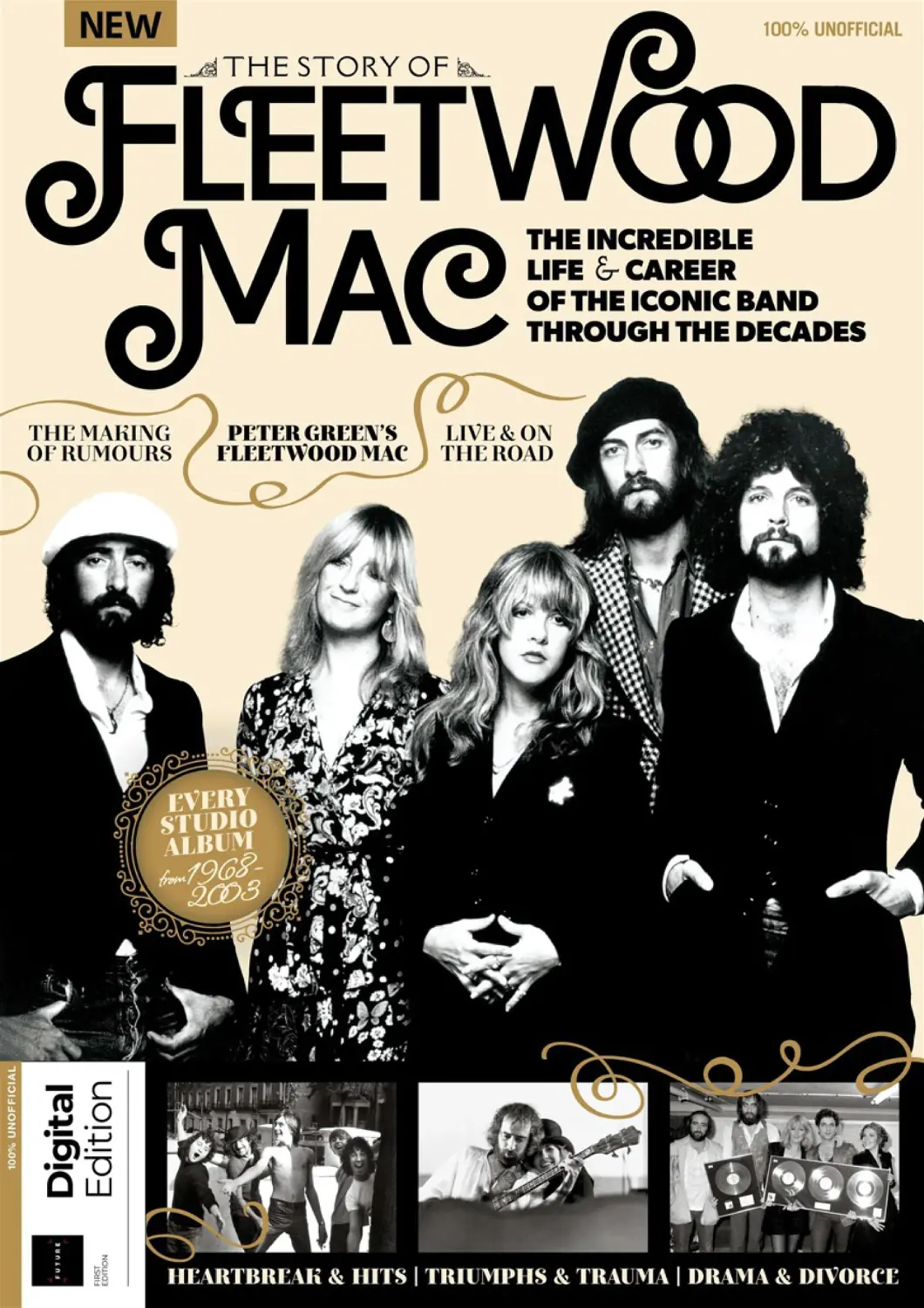


Tags: magazine magazine the story of fleetwood mac
Year: 2023
Text
                    100% UNOFFICIAL
NEW
THE MAKING
OF RUMOURS
PETER GREEN’S
FLEETWOOD MAC
LIVE & ON
THE ROAD
THE INCREDIBLE
LIFE & CAREER
OF THE ICONIC BAND
THROUGH THE DECADES
HEARTBREAK & HITS I TRIl MPIIS & TRAUMA I DRAMA & DIVORCE

w/iLeqgviE
he story of Fleetwood Mac is a rollercoaster ride of
heartbreak and pain, love and forgiveness, hits and
> splits, and break-ups and reunions. But that's only a
small part of it.
Inside we tell the tale of the band's incredible journey
through the decades, starting at the very beginning with
the original Peter Green-founded British blues iteration
of the Sixties, right up to the soft-rock of the famous five
of Mick Fleetwood, John McVie, Christine McVic, Lindsey
Buckingham and Stevie Nicks.
We explore all 17 of Fleetwood Mac's studio albums, from
1968s self-titled debut to 2003 s Say You Will,and everything
in between. We also bring you fascinating insight into the
making of humours, the band's 1977 classic and one of the
best-selling albums of all time.
So strap in, and get ready to go behind the drama, divorce
and drugs and relive the highs and lows of the iconic
Fleetwood Mac.
CONTENTS
CHAPTER ONE
EARL/ YEARS
CHAPTER THREE
The I96Os
CHAPTER FIVE
LIVE
OS MEET THE BAND
SAY HELLO TO FLEETWOOD
MAC'S FAMOUS FIVE
11 EARLY YEARS
MEET PETER GREEN'S
ORIGINAL FLEETWOOD MAC
CHAPTER TWO
72 LIVIN’ IN THE EIGHTIES
HOW DID FLEETWOOD MAC
FOLLOW THEIR 70S' SUCCESS?
CHAPTER FOUR
The I99Os
108 THE LIVE FANTASTIC
THE DRAMA AND TURMOIL
OF LIFE ON THE ROAD
CHAPTER SIX
21st century
The I97Os
90 FRE-MILLENNIAL TENSION
COULD THE BAND PULL OFF
A LATE CAREER COMEBACK?
US 21st CENTURY BLUES
HOW THE 70s SUPERSTARS HAVE
FARED IN THE NEW MILLENNIUM
THE MAKING OF RUMOURS
BEHIND THE SCENES OF ONE OF
THE BEST ALBUMS OF ALL TIME
THE CLASSIC ROCK YEARS
HOW THE AMERICAN DUO
CHANGED THE BAND FOREVER
YEARS OF CONFUSION
DISCOVER THE PRE-
BUCKINGHAM/NICKS ERA
Fleetwood Mac 196Я
MR WONDERFUL 1968
THEN PLAY ON 1969
KlI<N HOUSE wo
FUTURE GAMES 1971
BARE TREES 1972
st Mirage >9ва
86 TANGO IN THE NIGHT >9вг
102 Behind the mask 1990
101 time >995
128 SAY YOU WILL 2003
PENGUIN m
Mystery to Me 1973
HEROES ARE HARD TO FIND „73
Fleetwood mac 1975
RUMOURS 1977
Til SR 1979


THE MOST FAMOUS FLEETWOOD MAC LINEUP
- THE ONE RESPONSIBLE FOR THE CLASSIC
RUMOURS ALBUM OF 1977 - IS THIS ONE.
SAY HELLO TO THE FAMOUS FIUESOME'/
creative lineup that	I
carved its name most	I
deeply into the bark	I
of rock’n’roll’s family	I £
tree - so it’s that group
that we re focusing on
here. The five musicians Ж
- drummer Mick
Fleetwood, bassist John
McVie, keyboardist Christine McVie,
singer Stevie Nicks and guitarist
Lindsey Buckingham - have led lives,
collectively and individually, like few
others, so enjoy their stories. Rest
assured that every other member of
Fleetwood Mac appears elsewhere
in the publication you’re holding,
though. They've all earned our
admiration, after all.
Л whole host of virtuoso ,
musicians have passed through
the ranks of Fleetwood Mac
over the five decades and
counting since the group was founded
in 1968. How could it be any other
way? People come and go, they quit and
return, and sadly, they die - but they
all leave a legacy behind them, making
every incarnation of a band as great as
this one worth your attention.
Still, when Fleetwood Mac released
the planet-dominating Rumours
album in 1977, it was that particular
The ringmaster of the circus - who keeps the
show running from behind the drum kit
The drummer, co-founder
and most visible member of
Fleetwood Mac apart from
Stevie Nicks, Mick Fleetwood - born
in Redruth, Cornwall, on 24 June
1947 - has enjoyed a long and wide-
ranging career in British blues, as well
as extending his activities into acting
and business ventures.
Raised in Egypt and Norway thanks
to his fighter pilot father’s Royal
Air Force postings, and educated at
various English boarding schools suCh
as Kings and Wynstones, both in
Gloucestershire, the young Fleetwood
was best described as a dreamer. He
had trouble remembering facts, which
led him to underperform at school,
but excelled at sportsand theatre:
his drumming in the early rhythm
and blues style could justifiably be
described as a combination of both.
Once Fleet wood had found his way.
to the drum kit, with an enthusiastic
style inspired by Tony Meehan of The
Shadows, he was an impressive
performer, not least because of his
height of six feet six inches. By 1963 he
had dropped out of school, with the
approval of his parents, and was living
in London and trying to make a living
as a professional drummer. While
waiting for fame to arrive, he worked
Peter Bardens, a keyboard player of
note, gave Fleetwood a slot in his band
The Cheynes in July 1963. From there he
moved to the Bo Street Runners, who
had appeared on the TV show Ready
Steady Co!. As was so often the case in
those itinerant days, when musicians
switched bands on practically a daily
basis, Fleetwood then played with
Shotgun Express, featuring Rod Stewart
on vocals and a guitar prodigy called
Peter Green. The latter left to join the
British blues pioneer John Mayall in
the Bluesbreakers band in 1967, taking
Fleet wood with him; the new group
also included bassist John McVie.
Mayall soon gave Fleet wood and
McVie the boot for their drinking
habits, but Green - who walked away
from the Bluesbreakers around the
same time - proposed that they join
hjm in a new blues band named after
them. Any guesses what that was?
The rest of Fleet wood Mac’s story
is detailed in these pages,*and as
you’ll see, our drumming legend has
had quite a ride. Along the way he
conquered an inability to play drums
that he called ‘rhythmic dyslexia’,
married three times, had four f
children and lived on both sides of the
Atlantic. He remains the only band-
member to have remained constantly
with the group, and cuts an unlikely
figure as its leader, ruling - as it were
- from behind the drum kit with a
kind of benevolent charm. Ф
Between the four big personalities, there stands
one man - introverted and unassuming
McVie has only briefly dabbled wiflf
a solo career, partnering with singer
Lola Thomas and releasing an album
with the descriptive title John McVie’s
"Gotta B(tnd"with Lola Thomas in
1992. On the record, he and Thomas
were backed by sometime Fleetwood
Mac guitarist Billy Burnette and
the former Rolling Stone Mick
Taylor, with whom McVie had played
in the Bluesbreakers. After being
diagnosed with colon cancer in 2013,
he was thankfully reported to be free
of the disease four years later. V
replacements being future Cream star
Jack Bruce, and remained an ad hoc
Bluesbreaker for more than four years
before Mayall finally lost patience
with his lifestyle.
As we know, McVie then joined
Mick Fleetwood and Peter Green in
their new group in 1967, where he has
remained ever since. A marriage to
his bandmate Christine Perfect only
lasted six years, but he kicked the
booze after an alcohol-related seizure
in 1987 and is now married to his
second wife, Julie Ann Reubens.
 he ’quiet one’ of the group -
every band needs one - bassist
John McVie was born in Ealing
in west London on 26 November 1945.
He first tried his hand at the trumpet
before switching to the electric guitar,
which he played in local bands who
covered songs by The Shadows and
other current artists, influenced by
The Shadows’ Jet Harris, McVie soon
moved to bass guitar, learning to play
it by removing the top strings from a
regular guitar until his father bought
him a pink Fender bass.
 Leaving school at the age of 17,.
McVie trained to be a tax inspectoi*for
nine months, but his mind remained'
focused on music and he continued to
play bass with a variety of groups. One
of these was a wedding band called the
Krewsaders, with musicians who lived
on the same Ealing street.
He took a serious step up when he
joined John Maya I Is Bluesbreakers, at
the tender age of 18. At first, Mayall
had wanted Cliff Barton of the Cyril
Davies All Stars to join the band.
Barton wasn't interested, but gave
Mayall McVie’s number, urging him
to give the young bass player a shot.
In his 2019 autobiography, Mayall
recalled that the inexperienced McVie
had to be told what a simple blues
jam in the key of C was, but he soon
developed into a fine musician.
Unfortunately, McVie was also a
committed drinker, with his habit
soon leading to his dismissal from
the Bluesbreakers. I le rejoined and
was re-hired on more than one
occasion, with one of his temporary
he singer and keyboard player
Christine McVie was born
Christine Perfect on 12 July
1943 in Bouth, Lancashire, and grew
up near Birmingham. Her father
was a concert violinist and music
lecturerand she began playing the
piano at the age of four. By her mid-
teens she was a fan of rock’n’roll, an
interest triggered by her brother's Fats
Domino songbook, and as a student at
Moseley School of Art in Birmingham,
she started singing in local bands.
The first of these was a group called
Sounds of Blue, and although she
crossed paths with Spencer Davis and
other prominent musicians while
with this outfit, her musical career
stalled for a while and she became a
department-store window dresser in
London. In 1967, two of her former
bandmates in Sounds of Blue, Andy
Silvester and Stan Webb, formed the
blues band Chicken Shack and she
joined them as a piano player. .
Chicken Shack did quite well for a
while, scoring a hit with Td Rather Go
Blind', on which Christine sang. She
received Best Female Vocalist awards
from Melody Maker in 1969 and 1970 in
recognition of her work on two Chicken
Shack albums, but decided to leave the
C/fasfae Q^lc^ie,
The blues singer who found superstardom -
and stepped away for a quiet life
band in 1969, a year after marrying
Fleetwood Mac bassist John McVie. In
1970, she joined her husband's group
in its pre-Stevie Nicks and Lindsey
Buckingham incarnation, working with
them on a series of well-received blues-
based records.
McVie spent three decades with
Fleetwood Mac as one of the th ree -
stalwart Brits that backed the more
extravagant talents of the two
American arrivals, and was to an
extent overshadowed by the vibrant
personality and tendency towards ’.
drama of Nicks. Still, her talent
was extraordinary, as evidenced
by the three solo albums that she
released in between Fleetwood Mac
duties: these were Christine Perfect
(1970), Christine McVie (1984) and
In the Meantime (2004). She also
released a collaboration album with
Buckingham, simply titled Lindsey
Buckingham Christine McVie, in 2017.
She was married to John McVie
until 1976 and then enjoyed a brief
engagement with Beach Boy Dennis
Wilson, with whom she collaborated
musically. A second marriage to
keyboard player Eddy Quintela
endured from 1986 to 2003. Sadly,
she became the first of the classic
Fleetwood Mac lineup to pass away,
succumbing to an as-yet-undisclosed
illness on 30 November 2022.
Hearing the news of her passing.
Fleetwood wrote: “This is a day
where my dear sweet friend Christine
McVie has taken to flight... and left us
earthbound folks to listen with bated
breath to the sounds of that song bird...
reminding one and all that love is all
around us to reach for and touch in •
this precious life that is gifted to us." Ф
It hough Fleetwood may be the
effective owner and spokesman
of Fleet wood Mac, in terms
of the group's rock-star appeal,
all eyes have always been on the
otherworldly Stevie Nicks. Now in her
mid-seventies - and clear-headed and
dean-living after some years of drug
addiction - Nicks is as creative as she’s
ever been. Her commercial success as
a solo artist is enormous, in addition
to the 65 million albums she’s sold
with Fleetwood Mac in the USA alone.
Stephanie Nicks was born in
Phoenix, Arizona, on 26 May 1948.
Her grandfather, Aaron ’A)’ Nicks Sr,
was a lifelong singer and performer,
and by the time Nicks was four, she
was singing right along with him.
By then, everybody was calling her
‘Stevie’, based on her attempts at
pronouncing her own name.
“My dad named me Stephanie
because he loved that name,” recalled
Nicks in 2001. “Stevie just came
from not being able to pronounce
‘Stephanie’... it kind of came out aS
‘teedee‘. My mother calls me ’TD
Bird’,” she continued. “It's really .
sickening, isn’t it? But ‘TD’ went to*
‘Stevie’. I was never called Stephanie.1'
By the time her sophomore andj
junior years came around, the Nicks
family had moved to south California,
and by 1970, she was fully immersed
in the local music scene. What better
place and time for the young Nicks
to evolve into a budding rock star?
You can read about her meeting
with Lindsey Buckingham, their
work together and how they joined
Fleetwood Mac elsewhere here - and
what a tale that is.
The focal point of the Rumours lineup -
and a megastar in her own right
Consider the titles that Nicks
has accumulated since then.
She has received eight Grammy
?\ward nominations and two American
Music Award nominations as a solo
artist, and a further six Grammy noms
as a member of Fleetwood Mac. A
notable statistic is that she was the first
woman to have been inducted not once
but twice into the Rock & Roll Hall of
Fame, as a member of Fleetwood Mac
in 1998 and as a solo artist in 2019.
Furthermore, Rolling Stone
' magazine was calling her the
'Reigning Queen of Rock and Roll’
as far back as the early Eighties. The
same magazine named her one of
the 100 Greatest Songwriters of All
Time and one of the 100 Greatest
Singers of All Time, including her
solo hit ‘Edge of Seventeen’ in its 500
Greatest Songs of All Time list.
Younger musicians idolise her work
and ask her if she will collaborate with
them - the ultimate compliment. Can
you think of many other artists in their
seventies who have worked on songs in
recent years with Harry Styles, Miley
Cyrus, Beyonce Knowles, Taylor Swift
and Lana Del Reyi Exactly. Ф
Bringing a touch of virtuosity to Fleetwood Mac
- and becoming a rock god
Born on 3 October 1949 in-Palo
Allo, California, Lindsey
Buckingham is a multi-talented
singer and musician, also known as a
producer and composer of songs, both
solo and in Fleetwood Mac. He has
been a member of the group twice,
from 1975 to 1987 and then from 1997
to 2018, frequently releasing solo work
along the way.
What typifies Buckingham is his
relentless energy, perhaps because he
\	W	J *
has an athletic background: he and his
two older brothers were competitive
swimmers as kids, with his brother
Gregory going on to win a silver medal
at the 1968 Olympics. The youngest
Buckingham has always been prolific,
with six solo albums and three live
albums under his own name to date.
As a teenager, he was interested in
folk music and the banjo, but classic
Sixties psychedelic rock was where he
found a successful niche, originally
with a high school rock act called
The Fritz Rabyne Memorial Band, in
which he played bass. The group soon
reduced its name to Fritz and enjoyed
some success in the San Francisco'.
area, helped along by its skilled singer
Stevie Nicks.
Quilting Fritz in 1971 to form
Buckingham Nicks, the two
musicians became lovers, and a
period of time ensued that has been
endlessly written about in rock lore
- the time when Nicks worked as a
house cleaner, discovering cocaine
in the process, while Buckingham
wrote songs. Demos recorded on an
Ampex recorder at Buckingham's
father's coffee roasting plant in Daly
City led to a deal with Polydor and
a self-titled LP was issued in 1973.
It didn't do well, so Buckingham
accepted a job as a touring guitarist
in Don Everly’s backing band,
singing Phil Everly’s parts.
While investigating the Sound City
recording studio in California, Mick
Fleetwood heard the song ‘Frozen Love’
from the Buckingham Nicks album.
Impressed, he asked who the guitarist
was, and so the two musicians went on
to join Fleetwood Mac.
Asyou can read in this publication,
superstardom followed for
Buckingham, as it did for the rest *
of the group, and while the others
variously dealt with drug addiction,
financial woes and failed solo
material, Buckingham survived all
of those: his major problem was the
decline and end of his relationship
with Nicks. Drama still reigns around
the'subject, making it one of the
ultimate rock’n’roll love sagas, even
though - all these years later - he has
two adult daughters with his wife
Kristen Messner. Ф	I

WOWS V- fa
THE EAKLY DAYS OF THE SOON-TO-BE
BIGGEST AOK BAND EVER FORMED WERE
MORE HUMBLE THAN MOST FLEETWOOD
MAG FANS WOULD EXPECT...
he story of the formation of Fleetwood Mac is
essentially the story of British blues, as the musicians
involved cither played with, or knew, more or less
every key player in that movement. Its reasonable
to begin with the late Peter Green, born in 1946, who had
earned his stripes in John Maya Il’s Bluesbreakers, a group that
functioned as a sort of musical boot camp for many great blues
and rock alumni.
As well as Green, drummer Mick Fleetwood and bassist John
McVie had also been Bluesbreakers at one point or another,
alongside future Cream legends Eric Clapton and Jack Bruce.
Sometime Rolling Stones guitarist Mick Taylor, folk legend
Davy Graham, bassist Andy Fraser of Free, drummer Aynsley
Dunbar ofWhitesnake and Frank Zappas band, and Jon
Hi soman and Dick Heckstall-Smith of Colosseum were also
employed by Mayall at some stage, making him the key mover
in British blues alongside fellow bandleader, Alexis Korner.
Before he joined the Blucsbreakers in 1965, Green had
already been in a band with Fleetwood called Peter В s
Looners. This later morphed into Shotgun Express, with Rod
Stewart as vocalist. Later, having joined the Bluesbreakers,
Green suggested Fleet wood to Mayall as a potential
replacement for the departing Dunbar. Mayall agreed and
Fleetwood duly signed up, where he struck up a friendship
with bassist McVie.	—>
CHAPTER ONE
BELOW Pan Am supplied the
bags for this 1968 shot, but it
seems that only the drummer
got the memo about putting a
suit on lor the portrait
ABOVE Green, McVie,
Spencer and Fleetwood
(front): who would have
predicted their rise to yacht
rock titans a decade later?
Mayall gifted Green some
studio time not long after the
new lineup formed, and the
guitarist asked Fleetwood and
McVie to back him on five new
demos, one of which was an
instrumental called ‘Fleetwood
Mac', named after his two
colleagues. The three men
discussed forming a new trio of
the same name, but McVie was
reluctant to give up the salary
he was paid by Mayall, so Green
and Fleetwood formed a new
unit with a slide guitarist, Jeremy
Spencer, and a bassist called Bob
Brunning: the latter agreed that
he would step aside if McVie was
eventually persuaded to join.
The new quartet played a debut
show on 13 August 1967, at the
Windsor Jazz and Blues Festival
as the cumbersomely titled ‘Peter
Green’s Fleetwood Mac, also
featuring Jeremy Spencer’.
Mayall was and remains a
decent fellow, but his tolerance
for underperformance was
legendary, and both Fleet wood
and McVie were ejected from
the Bluesbreakers in 1967
for lack of professionalism, a
euphemism for being drunk too
often. McVie promptly agreed
to join the Fleet wood Mac band
as permanent bassist, while
Brunning, who had only played
a few shows with the group, kept
his promise and made way for the
incoming four-stringer. I Io wrote
a book about his experience,
which shed valuable light on the
very early days of Fleet wood Mac.
If you want an idea of the early
Mac sound, look no further
than their self-titled debut
album, issued by the Blue
Horizon label in early 1968.
It s a universe away from
the slick American pop-rock
If»
they were working on a decade
later, so if that's your reference
for Fleet wood Mac, you'll need
to refine your expectations.
Fleetwood Mac is unsophisticated
electric blues made by a young,
excited band: it’s raw around
the edges because there was no
money for a decent production,
and the only real virtuosity comes
from Green and his remarkable
guitar playing.
That didn't stop an enthusiastic
British audience from stepping
up to endorse the new band
by buying their LP in large
quantities, though. Fleetwood
Mac went to number
EARLY YEARS
=-0“
“The group might have tread this path for
their entire careers, as so many bands of
Fleetwood Mac’s demographic went on to do,
had it not been for Danny Kirwan”
four on the domestic chart -
certainly no mean feat when you
consider the world-class calibre
of the other albums released by
the class of 1968. In addition, the
singles ‘Black Magic Woman’
and ‘Need Your Love So Bad’ did
good business, with the former
gaining legacy status and the
beginnings of an American profile
for Fleetwood Mac when the great
Santana covered it.
As was often the case in this
era, a second album followed
only six months after the debut:
Afr Wonderful was another slab
of pure blues and didn’t deviate
radically from the template
J
LEFT Pictured at
the BBC TV Centre,
Kirwan, McVie,
Spencer and
Fleetwood deliver a
slick blues; Green
is pictured wearing
a robe
BELOW On Stage
at the Royal Albert
Hall, London on 22
April 1969. From
left, it's Spencer on
keyboards. Kirwan,
Fleetwood, McVie
and Green.
	Jr
established by the first LP.
However, the album marked
the arrival of Chicken Shack
vocalist Christine Perfect, who
performed on keyboards, adding
a dose of welcome subtlety to the
occasionally meat-and-potatoes
formula. I lorns were also added
to the sound, evolving Fleetwood
Mac's sound a little.
The group might have continued
to tread this path for their entire
careers, as so many bands of
Fleet wood Mac’s demographic
went on to do, had it not been for
the arrival of a new guitar player.
Danny Kirwan, then only 18, fit
neatly between the divine blues
wails of Peter Green and the more
supportive parts played by Jeremy
Spencer - a relief to Green, who felt
that Spencer wasn’t contributing
as much as he should.
Kirwan, who had played in the
south London trio Boilerhouse,
had impressed both Fleetwood
and Green to the extent that the
latter even attempted to further
Kirwan's career by finding him
a more competent lineup via an
ad in Meforfy Maker. Apparently
over 300 applicants responded,
but none matched up to Green s
requirements. The best solution
was to invite Kirwan to join
Fleetwood Mac, where his vibrato-
heavy guitar style gave the band s
sound an extra layer of expression.
The move paid off, because in
November 1968, Fleetwood Mac
enjoyed a sizeable hit with the
single 'Albatross’, a showcase for
the phenomenal duettingguitars
of Green and Kirwan. Whether
you know it or not, you've heard
this relaxed slice of soothing
blues many times over the years,
whether in TV ads or as incidental
music in many, many settings. The
single made number one in the UK
and entered the top ten in charts
across Europe and in the USA: as
Green correctly reasoned, *1 would
never have had a Number 1 single
without Danny Kirwan.”
✓
In a move that was presumably
intended to repackage Fleetwood
Mac for international markets
and present the band as a
coherent whole after the success
of‘Albatross’, the next two album
releases were not new studio
LPs but compilations. The first
of these was 1969’s English Rose,
which was made up of songs from
the Mr Wonderful LP and new cuts
written by Kirwan; the second
was the more successful The
Pious Pird of Good Omen, which
consisted of singles, B-sides and
other tracks.
A tour of the USA followed in
early 1969, an opportunity for —>
CHAPTER ONE
the group to record an album
Stateside for the first time. The
result was Fleetwood Mac in
Chicago, recorded at the legendary
Chess Records Studio and
including guest performances
from leading American blues
musicians such as Willie
Dixon, Buddy Guy and Otis
Spann. What these musicians
thought of the British youngsters
who had adopted - some might
say stolen’ - their sound and
made a living from it is unknown.
Three years into their existence
as a band, Fleetwood Mac were
at a turning point, having taken
their electric blues formula as far
as it could go. They weren’t about
to abandon the idiom altogether»
of course, but circumstances
encouraged a certain amount of
evolution, not least a switch of
record labels in late ’69.
Having exhausted the scope
of the Blue Horizon label.
Fleetwood Mac signed first with
the Immediate label, run by
the Rolling Stones’ sometime
manager Andrew Loog Oldham.
A single, ’Man of the World',
was backed by a Jeremy Spencer-
fronted spoof band called Earl
Vince & The Valiants, who
performed an upbeat rock'n’roll
song called ’Somebody’s Gonna
Get Their 1 lead Kicked in Tonite’.
However, the Immediate label
was on the point of closing, and
Fleet wood Mac’s new manager,
Clifford Davis, arranged for them
to sign with Warner Brothers
via a deal with the Reprise label,
founded by Frank Sinatra in 1960.
Rumour has it that a deal with
Apple Records via The Beatles'
George Harrison was under
discussion, helped along by the
fact that Fleetwood and Harrison
were brothers-in-law via their
wives Jenny and Pattie Boyd.
Reprise won the day, however, and
ultimately Davis was proven to
have made the right decision, as
Fleet wood Mac have stayed with
Warner ever since - and Apple
effectively bit the dust when The
Beatles stopped being a viable
band in 1970.
As the Sixties came swinging
to a close, Fleet wood Mac’s third
studio album, Then Play On,
gave them a greater foothold in
America, partly thanks to the
muscle of the Reprise label but
also thanks to the success of a
new song, ’Oh Well ’. Along with
’Albatross’, this was the most
successful Fleet wood Mac song of
the pre-Stevic Nicks and Lindsey
Buckingham era, to the extent
that the American version of the
album was re-pressed in order to
include the song.
Indebted far more to rock
than to blues, Then Play On
was written mostly by Kirwan
and Green, and a single track
came from both Fleetwood and
McVie. Spencer was also occupied
with a solo album of old-school
rock'n’roll songs, on which the
rest of the group - minus Green -
EARLY YEARS
LEFT Live and fantastic
(from left): Kirwan, Spencer
and Fleetwood, at the 1st
International Pop Event,
Belgium, on 21 June 1969
ABOVE Green performs in
London: notice how, in
this late-Sixties shot, he's
inhabiting the music in a
deeply spiritual manner
performed. It didn't go well, and
perhaps it was the beginning of
the end for Spencer, whose story
soon takes a dramatic turn.
Things were also turning
sour for Green, who - let us
not forget - was the founder of
Fleet wood Mac. Having seen the
monster he created grow beyond
all recognition, Green’s focus
shifted: he had begun to perform
dressed in a mystics robe and
often talked about the idea of the
band giving all their money away.
Commercial success didn't suit
him, and his mental stability was
also beginning to suffer.
The end came for Green when
Fleetwood Mac were touring
Europe towards the end of 1969.
A bad acid trip affected him to the
extent that he was unable to face
the idea of long-term membership
of the band. Green remained with
the group long enough for a hit
with 'The Green Manalishi (With
the Two-Prong Crown)’ in early
1970, but by April that year he was
ready to go - and duly bowed out.
It’s still uncertain why Green
chose to quit his own band, bad
acid or no bad acid. It emerged
in later years that Fleet wood
tried to salvage Green’s career
by setting him up with a solo
deal with Warner worth dose to
a million dollars - only for the
errant guitarist to walk away at
the last minute. “The day he was
supposed to sign it, he freaked
out.,. 1 looked a bit stupid,”
Fleetwood told the writer Chris
Salewicz of Trouser Press. "After all,
who would believe that he didn’t
want to sign a contract because he
thought it was with the Devil? I’ve
given up with Peter. I’ve totally
given up. He's just given up where
anything to do with money is
concerned. After a while it just
wears me down."
It got worse. A Sunday Mirror
reporter tracked Green down
some years later and found
him walking aimlessly around
a London suburb, looking like
a tramp. He was said to own a
house in the area but that he
often slept on a bench at the
railway station. The newspaper's
photographer snapped a shot of
him that his fans would never
have recognised: he was dirty,
obese and with disturbingly long
“A bad acid trip affected
Green to the extent that he
was unable to face the idea
of long-term membership
of the band”
fingernails. Local children were
said to pull faces at him and call
him “the werewolf*.
Green struggled with his
mental health for most of the next
decade, but he made a limited
return to the live stage and studio
in the Nineties, and lived long
enough to enjoy widespread
recognition as a pioneer of his
instrument. Despite his problems,
he made it all the way to 25 July
2020, when he died peacefully at
the age of 71
Meanwhile, Fleetwood Mac
continued into the Seventies,
their golden decade. However,
turbulence and transformations
aplenty awaited them. If you think
their tale so far has been chaotic,
you’ll love what comes next. V
19
.urf D I S C <> G R Л P II Y tex-
FLEETWOOD MAC
24 February 1968
There is a rawness and purity to Fleetwood Mac's
debut album, the record that established them as
the peerless torchbearers of the British blues boom
Words в tyled
fl n an age when many bands
were immersing themselves
I in the intoxicating strains
of psychedelia, Fleet wood Mac
looked instead to the sounds of the
Mississippi Delta and Chicago’s South
Side, emerging with a debut album
that was the highlight of the late-
Sixties British blues boom.
The first stirrings of the band and
its debut album occurred on 19 April
Although only a young band,
the fledgling Fleetwood Mac
still rang rings around more
established acts
1967, when John Mayall, frontman of
John Mayall &-The Bluesbreakcrs, gave
his bandmate Peter Green studio time
at Decca Studios in West Hampstead.
Green, a supremely gifted guitarist,
vocalist and songwriter from Bethnal
Green, brought along drummer Mick
Fleetwood and bassist John McVie. In
a bid to entice the two musicians into
his fledgling band, Green brazenly
named the new outfit after them.
‘Fleetwood Mac’ was also the name
he gave to one of the first tracks
recorded at that session, a Green-
penned instrumental. The three
musicians also cut two new Green
tracks called ‘First Train Home’ and
‘Looking for Somebody’, as well as
a cover of’No Place to Go’, a song
penned by Chester Burnett, aka
Howlin’ Wolf.
After the session. Green was buoyed
up and suggested they form a band.
Fleetwood agreed immediately,
having already been sacked from John
Maya IPs Bluesbreakcrs. McVie was less
keen to leave the security of that same
band, so Green hired a temporary
bassist called Bob Brunning.
From the outset, Green was keen to
recruit a second guitarist for his new
band. When the band's producer, Mike
Vernon, told Green of “an amazing
slide guitarist" called Jeremy Spencer,
Green journeyed to Lichfield to catch
a set by Spencer’s group, Levi Set Blues
Band, and convinced Spencer to join
the nascent Fleetwood Mac.
On Sunday 13 August, Green, Spencer,
Brunning and Fleet wood took to the
stage at the Windsor Jazz and Blues
Festival, for the first live appearance
by Fleetwood Mac. Green's reputation
6
6
2
3
4
5
SIDE ONE
1
SIDE TWO
1
2
3
4
5
FLEETWOOD MAC


My I I earl Beat Like
a I la miner
Merry Go Round
Long Grey Mare
I lellhound on My Trail
Shake Your
Money maker
Looking lor Somebody


My Baby’s Good to Me
I Loved Another Woman
Cold Black Night
I he World Keep on
Turning
Got to Move

preceded him. He already had a profile
as the guitarist who had replaced Eric
Clapton in The Bluesbreakers. What
followed was a stunning performance,
with Green’s scaring solos bringing a
raw intensity to the sound.
It was a triumphant first gig and
played a pivotal role in attracting
John McVie, Green’s bassist of choice,
who was at the festival and watching
intently. “I have such a clear vision
of John McVie standing at the side
of the stage while we were playing at
Windsor,” recalled Fleetwood in his
Love That Burns... chronicle. “A few
weeks later John called Peter to tell
him he was ready to join us.”
With the lineup intact, the new
band signed to the Blue Horizon label
and returned to the studio, recording
through November and December 1967.
Spencer’s track ‘My Heart Beats
Like a Hammer’ opens the album, a
raw, infectious blues shuffle with a
Green was so eager to recruit
Fleetwood and John McVie
that he used their names to
make up the band name
rough and ready feel, and a scorching,
overdriven slide. Two more Spencer
compositions,4My Baby's Good to Me’
and Cold Black Night', grace side two.
The album featured covers of tracks
by Elmore James, Howlin’ Wolf and
Robert Johnson. James in particular was
a significant influence across the album,
with two of his compositions being sung
by Spencer. 'Got To .Move' is a slinky
Chicago-style blues shuffle, while ’Shake
Your Moneymaker, which closes side
one, is a surging, exhilarating slice of 12-
bar boogie. Fleetwoods drums ramp up
the tempo towards the close of the track,
while Spencer's gritty, searing slide and
husky vocals exude a real bite.
But for all Spencer’s grit, it's Green
whose talent really shines through
across this album. There’s a real
vulnerability at play on his compositions
here, such as ‘Looking for Somebody’,
‘Long Grey Mare’ and 'If I Loved Another
Woman'. Vocally, Green's timbre is
warm and laconic, with a mournful
quality throughout. Green was an
astonishingly gifted guitarist, with a
feel, melodicism, and economy of style
that was unmatched by anyone. As BB
King once said, “He has the sweetest
tone 1 ever heard; he was the only one
who gave me the cold sweats."
The album was an unexpected
hit in the UK, reaching number
four and staying in the charts for 37
weeks, despite no hit single. Critics
heaped praise on the album. Barry
Gifford of Roiling Stone described
it as “potent enough to make the
South Side of Chicago take notice”.
There were many British blues
bands around in early 1968 but
Fleet wood Mac’s debut album
demonstrated what anyone who had
seen them live already knew - that
here was a band with a feel and
authenticity that placed them way
ahead of the pack. V
I) I S С О (1 R A 1» tl Y
MRWONDEKFUli
Re: :	23August 1968
Sonic highlights are sparse on this largely
derivative set of covers and originals that
make up the band's second long-player
Words
k. ix months after unveiling their
debut album, Fleetwood Mac
released the next, which broadly
follows the same blues template and
is a mix of covers and songs written
by Peter Green and Jeremy Spencer.
There were some changes, though.
Horns were added and Christine
Perfect (the future Christine McVie)
was enlisted on piano, on loan from
her regular band Chicken Shack. This
Birmingham-based blues outfit were
also signed to the Blue Horizon label
and had been put on the bill, along
with Fleetwood Mac, at the Windsor
Jazz, and Blues festival in August the
previous year.
By 1968, Perfect was developing
as a singer and songwriter, and
was entranced by Fleetwood Mac,
in particular, Green. "Oh we were
huge fans," she recalled in the BBC
documentary Fleetwood Mac’s Songbird
- Christine McVie. “Whenever we were
performing, we would find out where
Fleet wood Mac were playing, because
they were so red hot. They were killer."
So when she was asked to play on their
second album, she wasted no time
in agreeing.
CBS Studios in Holborn, London,
was the recording location and Mike
Vernon returned as producer. The
album was recorded live in the studio,
with mic’d amps and a PA system,
rather than being routed through the
hoard. As an approach to recording
it made complete sense, although
the feel and rawness that they were
hoping to capture via this method
unfortunately also lent it a rather
homemade and unrealised sound at
times. "It was recorded in four days,
and it sounds like it," quipped Mick
Fleetwood in his autobiography
Fleetwood: My Life and Adventures in
Fleetwood Mac. “Ragged low-down
blues by the seat of the pants."
'Stop Messin' Round' kicks the
album off, an upbeat blues shuffle
penned by Green, with an additional
co-writing credit for the band’s
manager, CG Adams. It's a strong
opener, highlighting Green’s ever-
tasteful and emotive lead guitar work,
with the horns underpinning and
playing off the warm, biting tones of
his Les Paul, while Perfect’s rolling
blues piano enhances the dynamism
of the track.
Lyrically the tracks centre on
the common blues theme of an
unfaithful lover. Once again, Elmore
lames is a pervading influence across
the album. There’s a faithful - yet
uninspiring - interpretation of‘Dust
My Broom’, sung by Spencer, the iconic
composition Co-credited to lames and
Robert Johnson. But th is cover and
T R А С К L 1 S I
SIDE ONE
1	Stop Messin'
Round
2	I’ve Lost My Baby
3	Rollin’ Man
4	Dust My Broom
s	Love That Burns
6	Doctor Brown
SIDE TWO
1	Need Your Love
Tonight
2	If You Be My Baby
3	Г ven in' Boogie
4	Lazy Poker Blues
5	Coining Home
6	Trying So Hard to
Гог get
tracks such as the second number, the
dragging, somnambulant ‘I’ve Lost My
Baby', sound derivative and highlight
the limitations of Spencer’s vocal and
songwriting contributions.
The band’s major talent, of course,
was Green and his guitar work and
vocals are the standout moments on
this album. Green had yet to really
blossom as a songwriter, although
the real highlight on this album is
his composition ‘Love That Burns', a
mournful minor key blues, with gentle
vamped piano and tasteful call-and-
response horn parts.
‘Rollin’ Man’ is another highlight,
a pacey, staggered 12-bar blues with
horn stabs that punctuate the rhythm
section's pushes. There’s an evocative
1940s juke joint feel to the track and
at 2:07, the whole song shifts into a
strident swing beat.
‘Evenin’ Boogie’ is another high
point on the album, a galloping
instrumental reminiscent of a jumpin’
jive feel, with alto and tenor saxes
firmly to the fore, all underpinned
by Spencer's raunchy and fluid slide
guitar. As ever, the rhythm section of
John McVie and Fleetwood arc locked
in seamlessly, effortlessly propelling
the track along.
Mr Wonderful was released on 23
August 1968. Unlike the debut album,
it received decidedly muted reviews.
The passing of the decades hasn’t
altered critics’ perspectives cither.
A 2017 review on Sputnikmusic
concluded that the album was
"vocally conservative, sticking to gruff
mannerisms, and it often sounds
like Green is drunkenly wandering
through the music".
Richie Unterberger of AllMusic was
equally underwhelmed, noting that
Mr Wonderful was “a disappointment
following their promising debut.
So much of the record was routine
blues that it could even be said that it
represented something of a regression
from the first ЬРГФ
Unfortunately the second
album didn't quite hit the mark
with critics, either at time of
release or in later years
Six months after the first
album, Fleetwood Mac were
beginning to evolve, with
Christine Perfect soon to join
ий I) I S ( П G R A P II 1 tex.
THEN PIrAY ON
September 1969
The sound of a band in transition, as the
blues purists broaden their sonic horizons
and shift towards an eclectic, soft-rock sound
Words в tyhlCwlty
“T“ he third studio album from
Fleetwood Mac would be the first
to feature gifted young guitarist
Danny Kirwan and the last to include
the stellar talents of Peter Green.
Kirwan, a fluent and accomplished
player with a delicate touch, was also a
prolific songwriter. Along with Green,
he would help propel the band away
from their purist blues roots towards
a more melodic soft rock that would
eventually transform Fleetwood Mac
into one of the biggest bands in the
world. Guitarist Jeremy Spencer, who
was omnipresent on the first two
albums, appears only fleetingly here,
adding a few incidental piano parts.
This is the album that saw Fleetwood
Mac extend creatively beyond the
strictly blues format. Essentially, it's
blues-rock but with emerging pop-rock
sensibilities. Here, the blues inspires
the material rather than defines it and
the results are engaging.
Pacey Latin-fuelled rhythms
form the backbone of opening track
Coming My Way’, a Danny Kirwan-
penned song with psych tinges and
more than a hint of early Santana. The
minimal use of chords gives the song
space while the plaintive guitar lines
add an edge. At 2:42 the track lurches
into a neo-prog wig-out. Decades on,
it sounds unspectacular, although
it doubtless raised some eyebrows
among Mac fans anticipating another
reworking of Elmore James.
The slow, meandering‘Closing My
Eyes’ showcases the beautiful timbre
of Greens voice, while mournful
tremolo guitar lines and plaintive
strums lend it a timeless feel, a kind
of emotive slacker anthem, decades
ahead of its time.
Green, seen here,
rehearsing with John
McVie, gave a phenomenal
performance on the album
By complete contrast, third
track, ‘Fighting for Madge’, is pure
instrumental filler. Admittedly, there’s
a nice groove, before it picks up the
pace to driving 4/4 rock 30 seconds
in, although this is ultimately nothing
more than a jam.
Kirwan's ‘When You Say* sounds
positively Beatles-esque. It’s a stand-
out song with an honest, natural feel
that has stood the test of time. Kirwan
also penned ‘My Dream’, a lush and
I К A C KUS I
SIDE ONE
i Coming Your Way
2	Closing My Eyes
3	righting for Madge
4	When You Say
5	Show-Biz Blues
6	I nderway
7	One Sunny Day
SIDE TWO
1	Although the Sun Is
Shining
2	Rattlesnake Shake
з	Without You
4	Searching for Madge
5	My Dream
6	Like Crying
7	Before the Beginning
quirky soft-rock instrumental with a
potent descending bass line.
Had events conspired differently,
the album would have included
Green’s Oh Well’. This was by far the
band’s strongest song at the time.
But their new label Reprise chose to
release it as a double-sided single and
not include it on the album. When
‘Oh Well (Parts 1 & 2)’ became a hit
in November 1969, the US album was
re-released with a revised running
order to include ‘Oh Well’, dropping
Kir wan’s ‘When You Say’and ‘My
Dream’ to make room for it. In 1990,
the CD release in the UK added ‘Oh
Well’ to the tracklisting and also
reinstated Kirwan's two deleted songs.
The last track on side one is
Kirwan's edgy, straight-ahead blues
‘One Sunny Day’. The opening track
on side two, ‘Although the Sun Is
Shining’, is also a Kirwan composition,
a plaintive, pastoral song with strong
to really up the pace on what is one of
blues odyssey". Michael G Nastos
THEN PLAY ON
echoes of‘California Dreamin” by The
Mama & The Papas, all echo-soaked
harmonies and acoustic jangle.
Green’s ‘Show-Biz Blues’ is a raw,
minimal track, with no bass and just
tambourine rhythm. There’s an earthy
poignancy to the track, which features
some stunning slide work. “Do you
really give a damn for me?” intones
Green. Meanwhile, another of his
compositions, ‘Underway’, is a warm,
mellow and meandering instrumental,
with heaps of space within the mix.
As ever, Green has an innate ability to
make every note count.
It takes Green’s Rattlesnake Shake'
the album’s strongest numbers. It’s a
strident, swaggering track, ripe with
sexual innuendo, and rooted in the
blues yet embracing the full thrust of a
harder rock element. “Baby, if you got
to rock /1 got to be your rockin’ horse
/ Baby, think you’d like to roll / Maybe
you're diggin’ it more”. Menacing
guitar work and Green’s impeccably
realised vocal delivery give the track
real resonance.
On its release, the album garnered
mixed reviews. In a review in
Rolling Stone on 13 December 1969,
writer John Morthland concluded
that “Most of the music on the
album is slow and meandering -
instruments in search of an idea".
But five decades on, Then Play On
is viewed as something of a classic.
A 2021 review in The Telegraph
described the album as a “musically
expansive, soft edged, psychedelic
of AllMusic remarked that the
album reflected how "pervasive and
powerful" Green’s influence was on
the band. "Still highly recommended
and a must-buy after all these years,”
he concluded, “it remains their
magnum opus." V


Fleetwood Mac as they were in September
1973 (from left): Bob Weston. Christine McVie,
Bob Welch. John McVie and Mick Fleetwood.
Talented as it was, this lineup fell between
two better-known Mac incarnations - the Peter
Green band and the classic Rumours lineup
сил г fttlCM&u-
BETWEEN PETER GREEN’S DEPARTURE
AND THE ARRIVAL OF TWO LEGENDARY
AMERICANS, FLEETWOOD MAC WERE
IN DISARRAY. LOOKING FOR FIGHTS,
FIDELITIES (OR LACK OF THEM)
AND FAKE BANDS? READ ON...
What do you do when a genius leaves your band high
and dry? You step up to genius levels yourself.
As the psychedelic Sixties gave way to the
hungover Seventies, Fleetwood Mac guitarists
Danny Kirwan and Jeremy Spencer devoted themselves to
the task of filling the gap - strategic and musical - left by
the departed Peter Green. Their next album, Kiln House,
was released in September 1970 and was largely regarded
as a positive step forward, with some of the familiar blues
replaced by sturdy rock textures, and Spencer delivering songs
reminiscent of the Fifties rock’n’roll that he loved so much.
The LP also featured backing vocals, keyboards and even a
cover design contributed by Christine McVie, now a regular
collaborator despite having briefly retired from the music
business after her solo career had stagnated. By the summer
of 1970 she was a full member of Fleetwood Mac alongside her
husband John, debuting on stage in New Orleans’ Louisiana*.
A single, ’Dragonfly’/The Purple Dancer’, didn’t perform
as well as Fleetwood Mac and CBS Records had hoped, and
to boost the band’s fortunes, the label released yet another
compilation album, The Original Fleetwood Mac - a prophetic
title, as we’ll sec. As the LP contained some unrelcased songs,
it was warmly received by the group’s fans, and the musicians’
profile continued to grow into 1971.
However, as always seems to be the way with this unique
band, a rock’n’roll incident came close to derailing their progress
around this time. In fact, it’s become embedded in rock lore.
• * • * -
While Fleetwood Mac were touring in February 1971,
Spencer informed the other band-members that he was	—►
m

CHAPTER TWO
popping out to buy a magazine.
Thinking nothing of it, the
и—---------------------
LEFT Fleetwood performing
live. How he could allow his
band to be usurped by a fake
lineup in this period remains
one of rock's great mysteries
il______u______________
ABOVE Walker is a largely
unsung name in Fleetwood
Mac's long and complex
history, yet he did some
sterling work with the group
BOTTOM John McVie in
his element onstage.
The quiet man of the
band, he drove Fleetwood
Mac with enormous skill
other Mac musicians went
about their business, but when
the guitarist failed to return,
they grew concerned. When
Spencer remained untraceable for
several days, a serious search was
launched - only for the band to
be informed that he had joined
a controversial religious cult,
the Children of God.
The other musicians had
already noticed that Spencer
was becoming disillusioned
with life in Fleetwood Mac: he
disliked hearing his own voice
on tape, too, criticising his
former performances harshly.
Like Green, Spencer had suffered
the after-effects of a traumatic-
psychedelic experience, in his case
an ill-advised dose of mescaline.
None of this was helped by a
major earthquake that shook Los
Angeles just before the musicians
flew there from San Francisco:
terrified at the prospect of landing
in LA, Spencer begged them to
cancel the tour.
Fleetwood later remembered
a conversation in which Spencer
expressed his fears about the San
Andreas Fault and the "pall of evil"
hanging over LA, which he felt
was out to "get him* in addition
to his fear of wealth, the band
losing touch with the blues and
his own lack of skill as a guitarist.
All of this made up his frame of
mind when he walked out of the
band s hotel to visit a bookshop
on Hollywood Boulevard.
While Spencer settled in with
his chums in the cult - who he
remains affiliated with to this day,
even though his children later
separated from the Children of
God, known nowadays as rhe
Family International, when they
were teenagers - Fleetwood Mac
had an American tour to finish.
They were bailed out by none
other than Green, whose previous
dalliance with esoteric stagewear
and charitable tendencies
made him seem positively tame
compared to the antics of Spencer.
The erstwhile founding member
played out the tour and then
headed off once again, not to be
seen for some years.
By the summer of 1971,
Fleetwood, Kirwan and the
McVies were ensconced in a
country home, Benifold, which
they and manager Clifford Davis
had purchased for £23,000.
As Fleetwood told writer Rick
McGrath of the Georgia Straight:
"The Benifold studio will be a
four-track setup, but it will be
eight-track shortly
afterwards... / **. \
1 think if the opportunity came
along where someone wasn’t
fortunate enough to be able to
afford studio prices, which a lot
of groups can’t, because they
don’t have a good record deal or
something, then obviously I think
we’d very much like to do that -
record them. 1 think its a good
idea to have somebody build a
studio, not in a private house like
ours, but right in the country with
very pleasant surroundings where
a group can actually go out for a
fortnight and live in the studio.”
Considering a replacement for
Spencer, they came across Bob
Welch, a friend of their associate
Judy Wong. Another great
Fleetwood Mac rumour has it that
they asked Welch to join before
even playing with him, simply
accepting a tape of his guitar work
as evidence that he was up to
scratch - although this is, like so
many great rock’n’roll tales, best
taken with a pinch of salt.
Fortunately, Welch was
definitely the man for the job,
as his excel lent playing on that
year’s new studio album, Future
Games, demonstrated. The LP
was received with enthusiasm by
fans, even though their sound was
now expanding away from their
original blues-rock formula	—>
YEARS OF CONFUSION
4 I
The Fleetwood and Mr and
Mrs McVie lineup now
featured Weston, Welch
and Walker (middle row),
seen here in 1972-73
was becoming disillusioned with life in
Fleetwood Mac: he disliked hearing his own
voice, criticising his performances harshly”
j,	A • *- 	। v w
“The other musicians had noticed that Spencer ’ £


CHAPTER TWO
BELOW Fleetwood, Christine
McVie and Kirwan performing
on Top of the Pops, the
locus being on the relative
newcomer McVie
-	|l
BOTTOM Welch in full
flow, delivering the blues
sophistication which marked
Fleetwood Mac out from so
many of their contemporaries
at speed, and the band took full
advantage, releasing Greatest
Hits in Europe and releasing
another studio album, Bare Trees,
only six months after Future
Games. Kirwan was the main
composer this time, although
Welch’s excellent ‘Sentimental
Lady’ gained renewed life when
he re-recorded it as a solo song in
1977, backed by Fleet wood and
Christine McVie.
A pattern was emerging when
it came to Fleetwood Mac's
original blues-era guitar players
and substances, unfortunately,
and in the wake of Green’s acid
adventure and Spencer's mescaline
misfortune came Kirwan’s own
departure, although in his case it
was the more mundane booze that
got him. Addicted to alcohol by
1972, causing trouble on the road
and isolating himself from the rest
of the band, Kirwan eventually
became completely intractable.
Before a show in America in
August that year, he smashed
up his valuable Gibson Les
Paul Custom guitar, refused
point blank toplay
and then insulted the rest of the
band after the concert, leading
Fleetwood to “do a Maya 11” and
fire him. Like Green, the former
guitar genius went on to suffer
decades of mental ill-health and
homelessness; unlike Green, he
never made a creative comeback,
and died in 2018 at the age of 68.
It seemed that it would take
more than a few errant six-
stringers to unseat the mighty
Fleet wood Mac, though, and in
September 1972 the band
recruited guitarist Bob Weston
and vocalist Dave Walker to make
the band a six-piece. Weston, a
highly competent slide guitar
expert who was old friends with
the band-members, having served
time on the British blues scene
since his early days with Long
John Baldry, lent a beautifully
melodic edge to the group’s sound.
Together, the group recorded and
released a studio album, Penguin,
in early 1973.
However, that
was it for Walker,
who was given
the boot shortly
afterwards when the rest of the
band decided that he just didn't
fit in, musically or otherwise.
He endured a similarly short-
lived stint with the heavy metal
pioneers Black Sabbath in 1977, but
to his credit, he built a long career
as a solo artist and is still touring
all these years later.
Fleetwood Mac bounced
back, as they always managed
to do, with a major hit called
‘Hypnotized’, written by Welch.
Accompanying yet another new’
album, Mystery to Me, the single
did extremely well on radio in
America and remains one of the
groups biggest pre-superstardom
hits. However, although the new
LP achieved gold status, personal
problems were starting to make
themselves felt within the band -
to say the very least.
]t all started when John McVie s
alcohol intake, which had always
been enthusiastic, became
problematic. This caused problems
within his marriage to Christine, a
dangerous situation given that the
warring couple made up two-fifths
of the band. Things got worse
when, on tour in America in 1973,
Weston embarked on an affair
with Fleetwood’s wife, Jenny Boyd.
The drummer was mortified when
he discovered the infidelity, to the
extent that he was unable to tour -
and although Weston was swiftly
kicked out of the band, 26 dates
remained unplayed and the tour
was cancelled.
The damage ran deeper than
anyone expected, and after the last
date that Fleet wood Mac played
- in Lincoln, Nebraska, on 20
October 1973 - the musicians told
their sound engineer that they
were splitting up.
Now, here’s where the story
goes from crazy to surreal. In
late 1973, manager Davis was
in a pickle, laden with touring
commitments but with no band
left to fulfil them. Worried that his
reputation would be left in tatters
YEARS OF CONFUSION
when bookers and promoters
realised how much revenue had
been lost, he wrote the group a
letter in which he remarked that
he “hadn’t slaved for years to be
brought down by the whims of
irresponsible musicians”.
Davis’s solution was to form
another Fleetwood Mac, asking
members of the band Legs -
who had recently released a
single as his clients - to play
the remaining US shows under
the name the ‘New Fleetwood
Mac’. The musicians were singer/
guitarist Elmer Gantry, whose
real name was Dave Terry and
who had played in Velvet Opera;
guitarist Kirby Gregory, formerly
of Curved Air; bassist Paul
Martinez, previously with the
Downliners Sect; keyboard player
John Wilkinson; and drummer
Craig Collinge, who had been in
Third World War. Depending on
which source it is that you believe,
Fleetwood had committed to
joining the new band, with
Collinge hired as a temporary
stand-in: Fleetwood has denied
this, however.
At first, the New Fleetwood Mac
dates were moderately successful,
but audiences soon turned sour,
and after some hostile reactions the
remaining dates were cancelled. A
large and complex lawsuit followed,
and the real members of Fleetwood
Mac were inactive for almost the
entire subsequent year: the issue
was complicated when no one
could prove who owned the band
name. Eventually a settlement was
reached, although its exact details
arc not widely known.
As Fleet wood has since
explained, the lawsuit actually
did the band a favour - because
one of its corollary effects was
that they moved operations
to California. This was on the
recom mendat ion of Welch,
whose consultations with music-
industry lawyers and their label
Warner Brothers led him to
realise that they could operate
more efficiently from the USA.
The press had a field day with
this. “Of course, Fleetwood Mac is
the American Dream,” wrote Chris
Saiewicz in Trouser Press. “The
band's success story is the stuff of
which the mythology of modern
day America is made: Mick
Fleetwood, John and Christine
McVie, down on their luck in the
Guide Country; make the decision
to move to the Promised Land.
Travelling as far west as possible,
these humble immigrants settle on
the most advanced technological
frontier in the world, Los Angeles.”
Helped by the legendary-
promoter Bill Graham, who
assured Warner that Fleetwood,
Welch and the McVics were the
real deal, the group resumed
recording and touring, although -
having parted ways with Davis for
obvious reasons - they were now
managing themselves.
By the autumn of 1974,
Fleet wood Mac had signed a new
deal with Reprise and Warner
and were able to release the next
album, Heroes Are Hard to Find.
However, the loyal Welch quit at
the end of the year, exhausted by
the endless drama of the last few
years, leaving Fleetwood and the
McVies as the last remaining three
musicians in the band.
Still, a miracle lay just around
“Mick Fleetwood, John and Christine McVie,
down on their luck in the Ou Ide Country, make
the decision to move to the Promised Land”
the corner. Although the three
amigos of blues-rock had been
treated harshly by' the events
of the early Seventies, help was
coming - and from an unlikely
source: a couple of star-children
from the edges of the Californian
hippie scene. Ф
BELOW The McVies,
Fleetwood and Welch giving
an LA audience some musical
magic - California would
become their new home
LEFT Weston is another
passing member ol Fleetwood
Mac whose name isn’t really
mentioned - and yet he was a
world-class musician
:n


I) 1 S С <> G R A P II 1
KILN HOUSE
18 Septe tuber 1970
Vintage rock'n'roll influences pervade the
band's fourth studio album, their first without
the mercurially talented Peter Green
Words by
®n this, their fourth album.
Fleetwood Mac found
themselves without their
founder, leader and creative linchpin,
Peter Green. By 1970, Greens mental
health was in serious decline following
a bad acid trip at a hippie commune in
Munich, which was believed by many
around him to have led directly to his
worrying condition.
Despite such concerns, Green
and the band embarked on their
third US tour in early 1970. In April
that year, they booked into Warner
Reprise s studios in Hollywood to
record the last single with him, ‘The
Green Manalishi (With the Two
Prong Crown)’. By then, Green’s
mental instability had deteriorated
even further and he decided to
quit the band on completion of the
forthcoming European tour. On 20
May, he performed his last show with
Fleet wood Mac.
For the band, carrying on without
Green was a daunting task. I le was a
mercurial talent and it was his songs,
emotive vocals and stunning guitar
work that had made Fleetwood Mac
stand out in the first place. Without
him in the lineup, their future as a
creative force looked far less assured.
“As a band, we were incredibly
heartbroken and lost when Peter left
the fold,” recalled Mick Fleetwood
in the BBC documentary Fleetwood
Macs Songbird - Christine McVie. “So
we were babes in the wood really. Lost,
quite lost.”
As ever, it was Fleetwood who took
control. He rented a converted oast
house called Kiln I louse near the
picturesque market town of Alton
in Hampshire. The band leased the
property and lived there communally for
a six-month period It was here where
they began work on the album, which
would also bear the name of the house.
“We were there for months,” recalled
John McVie. “A lovely English summer.”
Christine and John McVie were
recently married and on 20 June 1970,
Fleetwood married Jenny Boyd at Kiln
House. Against the backdrop of this
bucolic, sun-soaked summer, the new
Fleetwood Mac began writing and
I BACKUS I
SIDE ONE
1	This Is (he Rock
2	Station Man
з	Rlood on the Floor
4	I lil Io Silver
5	Jewel Eyed Judy
SIDE TWO
i Buddy’s Song
2	Earl Gray
з	One Together
4	Tell Me All the Things
You Do
5	Mission Bell
rehearsing tracks for the forthcoming
album, travelling up to De Lane
Lea Studios in London, to record
throughout June and July.
Despite playing virtually nothing on
the third album, Jeremy Spencer was
firmly back in the fold on Kiln House
and it was left to him and Danny
Kirwan to replace Green’s talent in the
studio and on stage. Wisely, the pair
opted not to try and fill the void left by
Green but instead to carve out a new
version of Fleetwood Mac. Two years
earlier, Spencer had recorded a solo
album of songs inspired by rock’n’roll,
with influences ranging from Buddy
Holly to Jan and Dean, and Elvis. On
Kiln House, Spencer would return
to the raw purity of such music, as
evidenced on the album’s opener, 'This
Is the Rock’.
There’s a simplicity to the track, with
its nifty swing tempo and Spencers
slapback echo-drenched vocals, a nod
to the Sun Studio sound. There’s more
menace to Spencer's rendition of Big joe
Turner’s 'Hi Ho Silver’, which reflects
the band's original Delta and Chicago
blues influences. Wit and drama pervade
on Spencer’s ’Blood on the Floor’
meanwhile, a murder ballad on which
his vocal delivery teeters on pastiche.
By complete contrast Station Man,
penned by Kirwan, Spencer and John
McVie, is enigmatic, groove-laden
soft rock, with more than a hint of
Dcjti Vu-era Crosby, Stills, Nash &
Young. Similarly, Kirwan's ‘Jewel Eyed
Judy’ and 'Earl Gray’ mark a far more
mellow and melodic sonic shift, with
hints of the direction in which the
future stadium-filling incarnation of
the band would eventually go.
When looked at as a whole. Kiln
1 louse is a curiously mismatched
affair, with Spencer’s Buddy Holly
obsessions at odds with Kirwan's
more introspective and emotive
compositions. But despite this, there’s
a real sense of fun on the album, the
sound of a band still rooted in the
blues but moving forward decisively
and creatively and not being afraid to
take chances.
On its release the album was well
received. It went on to reach number
39 in the UK and number 69 in
the Billboard Hot 200 chart. Some
critics, assuming the departure of
Green would signal the end of the
band, were pleasantly surprised by
their creative reinvention.
“Danny Kirwan and Jeremy
Spencer took up the slack and built
a new engine for the Fleetwood Mac
machine,” wrote critic |R Young in
a November 1970 review in Rolling
Stone. “They didn’t try to drive around
or hide what most people thought
would be a most conspicuous hole in
the band (Green’s place), but rather
shifted gears and made a quick high
speed turn off the cosmic trail Green
had left them on and headed out
the two lane highway of high-class
vintage rock & roll." Ф
I) I S С <> G К A P II Y tex-
FUTURE GAMES
3 September 1971
The fifth studio album ushered in a
new lineup and a whole new change
of direction for Fleetwood Mac
T/i'RDU (yressla)
leetwood Mac were three days
away from flying out for a US
tour in September 1970 when
it dawned on them that their sound
needed another element. The band
were packing up and leaving Kiln
House* their communal home and the
inspiration for their fourth album,
when Mick Fleetwood and John McVie
decided to ask Christine McVie to join
the band.
Christine McVie’s invitation
to the band wasn't exactly
an extravagant affair
The prodigiously talented singer,
songwriter and musician formerly
known as Christine Perfect, had been
a member of Chicken Shack and a
successful singer, songwriter and
musician in her own right, winning
the Melody Maker Best Female Vocalist
award in 1969 after her version of Etta
James’s 4 Would Rather Go Blind’ was
a surprise hit, reaching number 14 in
the UK charts.
She had recently married the band’s
bassist John McVie, but had effectively
retired from music. In fact, she had
spent much of the summer cooking
for the band. The band asked her to
join literally as they were leaving Kiln
House. “We sort of asked her walking
out of the door whether she would
come on tour with us,” recalled Mick
Fleetwood in the BBC documentary
Fleetwood Mac’s Songbird - Christine
McVie. “That was the beginning of
Christine’s connection.”
For Christine McVie, there was no
hesitation. “1 knew all the songs,” she
recalled in Fleet wood Mac's Songbird -
Christine McVie. “So I just said absolutely’,
you know. 1 was right in there.”
Six months after she joined, the
band underwent another major change
to its lineup. One day in February
1971, while they were on tour in the
US, Jeremy Spencer went out to “get
a magazine" and never came back.
After a few days of frantic searching,
the band found out he had joined a
religious group called the Children of
God and would not be returning.
Peter Green stepped back in to
help them fulfil concert dates before
the band started searching in earnest
for a new guitarist. Auditions were
held at Bcnifold in Hampshire,
the large Victorian house the band
had bought and were living in
communally. They eventually settled
on Bob Welch, an American who was
living in Paris. Welch moved into
the band’s communal home and
was assigned rhythm guitar duties
with Danny Kirwan taking lead,
but Welch soon made his mark with
his songwriting.
“He [had a] totally different
background - R&B, sort of jazzy,” said
Fleet wood of Welch in a 1995 BBC
interview. “I ic brought his personality.
He was a member of Fleetwood Mac
before we'd even played a note."
The combined songwriting talents
of Welch and Christine McVie marked
a whole new chapter for the band and a
significant shift in style, towards folk-
a
2
3
4
The new lineup, with Welch
and Christine McVie, didn't
help album sales
*
FUTURE GAMES


rock and pop. The production changed
significantly too, from a rawer sound
to a dreamier, softer treatment.
Welch's eight-minute title track,
which closes side one, is the perfect
example of the new sonic direction.
It’s lush and expansive, an evocative
composition with one of Welch’s
trademark haunting melodies and a
smattering of jazz arpeggios. Welch's
falsetto vocals are low in the mix,
more an instrument than a defining
feature. This is light years away from
the raw blues that inspired the first
generation Fleetwood Mac.
Psychedelic flourishes pervade the
album, particularly on the title track
and also on Kirwan’s ‘Sands of Time’.
It’s a gently meandering song with a
staggered groove and some tasteful
swells on guitar. Another of Kirwan’s
songs, ‘Woman of 1000 Years’, opens
the album. It’s a warm, ethereal-
sounding song, with acoustic guitar
jangle, multi-layered vocalsand some
subtle percussion. There’s a distinctive
mystical theme to the lyrics: “Woman
of a thousand years / How are your sons
SIDE ONE
I Woman of 1000 Years
Morning Rain
What a Shame
Tut tire Games
SIDE TWO
Sands of rime
Sometimes
Lay It All Down
Show Me a Smile
2
3
4
of a time ago / Do they still admire your
silvered ways / As you go down to the
sea and golden sand?"
The pacey 4/4 driving rock of
Christine McVie’s ‘Morning Rain’
introduces a more direct and strident
feel than the other songs on the
album. ‘Show Me a Smile', meanwhile,
which closes the album, is her heartfelt
ballad, with a wonderfully lilting
ascending chord structure.
Commercially, Future Games was
a flop in the UK, becoming the first
Fleetwood Mac album not to chart at
all. But its softer rock overtones did
significantly expand the band's reach
and appeal in the US. By 17 December
1971, the album had peaked at
number 91 in the Billboard 200 chart.
Critically, the response was
not good. Rolling Stone concluded
that the album was “thoroughly
unsatisfactory", and referred
to Christine McVie’s voice as
“surprisingly weak and emotionless".
They were equally dismissive of
Welch, concluding that “his talent
appears to be notable only in its lack
of distinction".
But retrospective reviews
generally hold the album in higher
esteem. "Future Games feels like a
treasure to behold,” noted Robert
Davis of Sputnikmusic in January
2015. “Different to its predecessor,
but just as important to Fleetwood
Mac’s musical direction." Ф
I) 1 S С О (J R Л P II Y tex-
BARE TREES
Rl i^larch 1972
On their sixth album, Fleetwood Mac created a
record that was their most consistently strong to
date, but it would be the swansong for Danny Kirwan
Words by Gnssl»)
anny Kirwan is a dominant
I I force on this sixth studio
И album, which would turn
out to be his last with the band. This
was the album on which Fleetwood
Mac really began to make their mark,
honing a soft rock singer-songwriter
sound, but with enough edge to avert a
descent into banal AOR.
Kirwan wrote five tracks on the
album, while Christine McVie and
Bob Welch contributed two each,
Kirwan’s ‘Child of Mine’ kicks off the
album. It’s a driving 4/4 number with
a raw edge. John McVie’s bass dips and
dives throughout and as ever, he and
Mick Fleetwood are a flawless rhythm
section, with enough looseness to
really groove when needed. Lyrically,
it’s heartfelt in the verses, as Kirwan
references his biological father not
having been part of his life. “1 miss you
again / I let the sunlight through my
eyes / I won't cry /1 miss you again".
Carefully plotted lead guitar lines
dominate ‘Sunny Side of 1 leaven',
an enigmatic instrumental that has
elements of a Bond soundtrack on the
main ascending motif.
Choppy funk guitar and an
infectious groove propel the Kirwan*
penned title track along. The
production is crisp and clean and
points the way to the future Fleetwood
Mac. There are some nifty stops and
starts along the way, breaking the
whole thing up.
‘Dust’, Kirwan’s final track on the
album, demonstrates his real breadth
of talent. There’s a wistful, melancholic
feel to the song and a sense of musical
restlessness, with Kirwan always opting
for the unexpected chord change or
melodic twist.
Christine McVie’s ‘Spare Me a Little
of Your Love’ is a standout moment on
the album, a strong and soulful pop
song, which signposts the string of hits
that she would start writing in 1975.
‘‘Now 1 know that 1 feel much more/
Oh, in every single way / And it s not
the same as before / It gets stronger
everyday? There’s a real cohesion to the
track, which was described by Stewart
Mason of AllMusic as "her first really
good pop song",
By contrast, Christine McVie s
‘Homeward Bound', which bemoans
the touring lifestyle, is spiky and
bombastic: “I don't wanna see another
aeroplane seat / Or another hotel room
/The home life to me seems really
neat /1 just wanna unpack for good."
Welch was also starting to find
his groove within the band. His first
track on the album, ’The Ghost’, is
a punchy composition, driven along
by Fleetwood's nimble toms and a
spacious, edgy sound.
But it’s Welch’s second composition
on the album, ‘Sentimental Lady’, that
stands out as one of the best tracks
from this incarnation of the band.
In 1977, Welch would score a massive
hit with a re-recorded version of
the song. But many believe that this
take, bolstered by Christine McVie’s
backing vocals, is far superior. Its
been described as “one of the great
lost pop songs of the early 70s”, a
track laden with hooks, a strong
vocal performance and a memorable
tremolo guitar solo. Lyrically, it may
sound trite but it still works: “You are
here and warm / But 1 could look away
and you’d be gone / 'Cause we live in a
time/ When meaning falls in splinters
from our lives”.
The positive commercial reception
to Rare Trees demonstrated that
Fleetwood Mac were gaining a
stronger foothold in the US. The
album reached number 70 in the US
Billboard 200 chart and spent a total
of 27 weeks in that chart. Critics
also welcomed its charms. Unlike
all previous Fleetwood Mac albums,
there is no filler on Bare Trees - it is
consistent from start to finish.
кп»фМ I
Sadly for Kirwan, though, the
album marked the beginning of the
end. By 1972 he had developed an
alcohol dependency and was becoming
alienated from Welch and the McVies.
He was fired from the band in 1972,
Danny Kirwan wrote five of
the songs on Bare Trees, but
would not feature on another
Fleetwood Mac album
bake Rees
SIDE ONE
1	Child of Mine
2	The Ghost
3	Home ward Bound
4	Sunny Side of Heaven
SIDE TWO
1	Bare frees
2	Sentimental Lady
з Danny’s Chant
4	Spare Me a Little of
Your Love
5	Dust
6	Thoughts on a Grey Day
allegedly after an incident in which
he and bandmate Welch fought
over tuning before a gig. Kirwan
reportedly refused to go on the
stage, smashed up his Gibson Les
Paul guitar, and then criticised the
band’s performance.
Years later. Fleetwood admitted he
was reluctant to fire Kirwan because
he played so well, but acknowledged
that he and the rest of the band felt
hurt and insulted at the time.
“Danny had been a nervous and
sensitive lad from the start,” wrote
Fleetwood in his memoir. “He was
never really suited to the rigours of
the business. Touring is hard and
the routine wears us all down... and
the pressure was obviously taking
its toll. He simply withdrew into his
own world.’’ V
.uri I) 1 s С О (i R A P II Y fcx-
PENGUIN
i eMarcb, 1973
A solid yet uninspiring seventh album, which
highlights how much the band missed the creative
strengths of the recently departed Danny Kirwan
Words by tyd&wlty
Г”ч recisely one year on from the
Lx release of Bare Trees, Fleet wood
1 Mac unvei led their seventh
studio album, named after John
McVie’s love of the aquatic, flightless
birds and featuring a penguin logo
that would be used by the band for
years to come.
With Danny Kirwan fired from the
band, the remaining four members
- Mick Fleet wood, John McVie,
Christine McVie and Bob Welch -
brought in guitarist Bob Weston and
vocalist Dave Walker to help round out
the sound.
Weston was renowned for his slide
guitar playing and had known the
band from his touring days with Long
John Baldry. But the appointment of
Walker was allegedly less successful.
“Halfway through Penguin
we started to wonder about our
new lead singer, who was often
drunk and disorderly around the
studio,” Fleetwood recalled in his
autobiography My Life and Adventures
in Fleetwood Mac.
Rather than record in London
the band chose to make the album
at Bcnifold, their communal stately
home in Hampshire. They hired the
Rolling Stones’ Mobile Studio and
worked on the album throughout
January 1973.
Westons appointment prompted
a flurry of songwriting activity from
Christine McVie and Welch, who
between them wrote the lion’s share
of this album. But from the outset, it’s
clear that without Kirwan, the band
had lost much of its originality and
creative spark, producing an album
that does not quite stand up to much
of their back catalogue.
By now, all traces of their blues rock
past had gone, replaced by up-tempo
soft rock. ’Remember Me' opens the
album, a light, pacey 4/4 track, bolstered
by acoustic strumming, airy high-
register harmonies and nifty lead guitar
licks. Sung and written by Christine
McVie, its lyrical theme is heartfelt: “So
I’m begging you / Not to leave me up in
the air / It just wouldn't be fair / 'Cause
you know the way I feel about you*.
It’s a likeable track but lacking a hook
strong enough to merit its choice as an
opening track. Similarly, the breezy pop/
rock shuffle of'Dissatisfied’ lacks any
defining moments.
By contrast, Welch’s melodic
prowess comes to the fore on his
haunting ‘Night Watch’, arguably
the high point of the album, which
features an uncredited Peter Green on
guitar. It’s a big, lush production, with
an infectious groove, heaps of echo
T R A C li I I S T
SIDE ONE
i Remember Me
2	Bright I’ire
3	Dissatisfied
4	(Гт a) Road Runner
SIDE TWO
I The Derelict
2	Revelation
з	Did You Ever Love Me
4	Night Watch
5	('aught in the Rain
Л Пг
and rich, multi-layered backing vocals.
This is classic Californian singer-
songwriter fare, wistful and poignant.
It also has a confidence and identity
that other tracks on this album lack.
The only Walker-penned track, ‘The
Derelict’, opens side two. Bluegrass
banjo and harmonica add a refreshing
shift of pace and at just under three
minutes, it has real charm. The track
boasts the kind of country sound that
would catapult The Eagles to stadium
status and Walker’s voice has a likeable
rasp to it.
Welch’s big, spacious production
returns on ‘Revelation’, with its
elemental and mythical lyrical imagery.
“He controlled the brimstone, and
eternal fire / Surrounds himself with
downers, in the king of cold / You know
that he had all the princes kissing his
diamond ring/And I heard that he
walled up, the door to summer”.
Steel drums add a Caribbean tinge
to ‘Did You Ever Love Me’, a simple and
sincere-sounding track, with a warm
vocal take from Christine McVie.
It’s left to Weston’s instrumental
‘Caught in the Rain’ to conclude the
album. C lose-m ic’d acoustic guitar
and eftccts-laden choral voices are
dominant features on the track. It's
charming yet ponderous.
Penguin is undoubtedly a solid
album but it lacks exhilarating
moments and marks the point at
which the band s upward creative
trajectory faltered. Commercially, it
performed well, pushing its way into
the Top SO in the UK and outselling all
of Fleetwood Mac’s previous efforts.
Within months of its release,
Walker had left the band, while
Weston stayed on for the making of
the follow-up album, Mystery to Me.
Penguin is very much the sound
of a band in transition, searching
for a sonic identity. Within just two
years they would find it, through the
addition of Stevie Nicks and Lindsey
Buckingham. From that point on,
their fortunes would change forever, f
PENGU
I) I S С (> G R A P El Y
MYSTERY TO ME
15 October 1973
A strident and authoritative release that
strengthened the band's profile in the US and
paved the way for their chart-topping future
Words в
Radio-friendly pop-rock was the
direction of the band’s eighth
studio album, which was their
last long-player to be recorded in
England. As with the previous album.
Penguin, Mystery to Me was recorded at
Benifold, the band’s communal stately
home nestled deep in the heart of
rural Hampshire.
Early on in the sessions, vocalist
Dave Walker was asked to leave the
band and doesn't feature on this
album. Bob Weston stayed on as
guitarist, although this would prove
to be his last album with the hand.
During their 1973 US tour, it became
evident that Weston was having an
affair with Mick Fleetwood’s wife,
Jenny. After a gig in Lincoln, Nebraska,
Fleetwood told the other band
members that he could no longer play
with Weston in the lineup. Weston
was subsequently fired.
The tour was cut short and the band
returned to England to break the news
to their manager, Clifford Davis, who
was allegedly so furious that he sent
another group of musicians out on the
road as Fleetwood Mac, claiming that
he owned the band’s name. Against
this tumultuous state of affairs,
Mystery to Me was created, with co-
producer and engineer, Martin Birch,
at the helm.
Once again, Christine McVie and
Bob Welch were the core writers.
Welch's mystical-themed lyrics are
tempered here and his songwriting
prowess yields real results. His
composition ’Emerald Eyes’, opens
the album. Nicely twisted lead guitar
T R А С К L 1 IS 1
SIDE ONE
1	Emerald Eyes
2	Relieve Me
3	Just Crazy Love
4	Hypnotized
5	lorever
6	Keep On Going
SIDE TWO
1 The City
2 Miles Away
3 Somebody
4 The Way 1 Teel
5 Гог Your Love
6 Whv
intros the track and Welch’s vocals
sound natural and laconic. “You don’t
know what she means, you see," begins
Welch, "She’s a heart that beats close
to me.”
Christine McVie’s ‘Believe Me’
follows, intro'd by warm flourishes of
piano before lurching into a pounding,
4/4 slice of soft rock. Her ‘Just Crazy
Love’ follows in a similar vein, with
her voice taking on a more rich and
assured timbre.
As always, Fleetwood and John
McVie presented a flawless rhythm
section, adding power and panache to
the tracks. John McVie’s driving and
swooping basslincs in particular adds
drama to the album.
Once again, it’s Welch who dishes
up the best track on the album, with
Hypnotized’. Fleetwood provides
the staggered, edgy backbone of the
track, which finds Welch’s crooning
echo-soaked vocal high in the mix, as
jazzy guitar motifs and fuzzy electric
piano stabs swirl beneath. It's a
luscious, stand out composition, with
Welch’s rich, husky timbre beautifully
enhanced by Christine McVie’s
backing vocals. “They say there’s a
place down in Mexico," intones Welch,
“Where a man can fly over mountains
and hills/And he don’t need an
airplane or some kind of engine / And
he never will,”
The offbeat piano vamps of‘Forever’
prove able filler before another Welch
offering, ‘Keep On Going’, brings a
groove-heavy soul feel, with Christine
McVie once again delivering a strong
vocal performance.
Side two offers other sonic treats.
Welch s‘The City’, with its mean slide
and scorching voice box effect guitar,
evokes inner city New York, and proves
that Fleet wood Mac can groove with
the best. There’s a real swagger and
Welch proved to be a
gifted and valuable
songwriter in the band
attitude at play here - the sound of a
band on scorching live form. Two more
Welch compositions, the breakneck
‘Miles Away’ and ‘Somebody’ sound
equally strong.
Across this album, there’s a real
attack to the band’s sound. Mystery
to Me oozes consistency and quality
throughout and is marred only by a
lamentable cover of‘For Your Love’ by
The Yardbirds.
Mystery to Me was released on 15
October, 1973, only to be greeted
with some negative reviews. Gordon
Fletcher in Rolling Stone concluded
that ever since Fleetwood Mac "lost
its three guitarists extraordinaire”
they had become increasingly less
interesting. And he didn't stop there.
“The first side of Mystery to Me turned
out to be so abysmally dismal that
I gave serious consideration to just
stopping it right there and chucking
MYSTERY TO ME
the damn thing out the window at a
passing bird.”
But despite the initial sniping,
the album has weathered well and
demonstrates that here was a band of
real strength and merit, firmly in the
ascendant. The album showcases a far
more strident and assured band than
before, comfortable and confident in
its own skin.
The album reached number 67
on the Billboard 200 chart after just
six weeks in the chart. In his 1990
autobiography, Mick Fleetwood; My
Life and Adventures in Fleetwood Mac,
the founder and drummer hailed the
album as a game-changer.
"Mystery to Me was probably the
best Fleetwood Mac album since
Peter Green had left the band three
years earlier. It was atmospheric and
intelligent, and we knew it was going
to be a big hit.’’V
-urf I) I S < <> G R Л 1» II 1 tex.
HEROES ARE HARD
TO FIND
R Hr 1 л J3 September 19 74
Fleetwood Mac's ninth album is a forgotten
gem and marks the end of an era for the band
Words by Cfy.1
7 f crocs Arc / lard to Find was
I / Fleetwood Macs ninth studio
I / album and the last to feature
Bob Welch, before the addition of
Lindsey Buckingham and Stevie Nicks.
This was also the first album to feature
only one guitarist, Welch, and the first
to be recorded outside England, with
the band settling on Angel City Sound
studio in Los Angeles.
T К А С К L I S T
SIDE ONE
i I leroes Are 1 lard Io Find
2 Coining Home
з Angel
4	Bermuda Triangle
5	Cornea Little Bit Closer
SIDE TWO
i She’s Changing Me
2	Bad Loser
3	Silver I leels
4	Prove Your Love
5	Born Enchanter
6	Safe Harbour
Recorded in July 1974, the album
featured the addition of a second
keyboardist, Bob Graves, who was
brought into the lineup to bolster the
sound. “Гт looking forward to adding
something to this already great band,”
enthused Graves. But it wasn't to be.
"He [Doug Graves] was there to back
me up," recalled Christine McVie in
Contempora>>' Keyboard magazine in
October 1980, "but I think it was decided
after the first two or three concerts that I
was better off without him.”
Stripped down to a lean four-piece,
Fleetwood Mac delivered an album that
was assured and inspiring, Christine
McVie’s title track opens the album. It’s
a powerful, joyous composition, and
very much the sound of a band playing
live together in the same room. Brass
stabsand percussive guitar motifs
accentuate the pacy groove. Christine
McVie’s voice sounds deeper and more
resonant than on the previous album
and it’s this timbre that would become
so recognisable in the stadium-selling
years that followed.
There’s a strong psychedelic tinge
to Welch’s ’Coming Home', a brave,
left-field choice for second track, which
begins with a free-form cacophony of
sax, keys, strings and voices, before
segueing into a big. spacious driving
sound. Welch’s guitar is as inventive
as ever and it’s not until 2: to that his
vocal enters the mix. “We are the
hungry ones / On a campground that’s
been and gone / Where are all the faces
1 knew? / All the heroes in the bright
burning truth."
By contrast Welch’s ’Angel’ is a spiky
rocker with squclchy wah-wah guitar. In
retrospect it’s hard to see how Welch and
Christine McVie’s such disparate sounds
work across an album. But they do.
Echo-soaked toms and Spanish
guitar form the intro of’Bermuda
Triangle’, a self-indulgent, misfiring
composition from Welch. “1 guess
you’ve heard about the Bermuda
triangle / There’s something going on /
Nobody seems to know just what it is /
And the airforce won’t let on.”
It’s left to Christine McVie to up the
ante with the epic piano ballad ‘Come
a Little Bit Closer", a slice of pure pop-
rock with a strong, memorable hook.
Offsetting the bombast are tasteful
takes from acclaimed pedal steel
player Sneaky Pete Kleinow, formerly
of seminal country rock band, The
Flying Burrito Brothers.
Christine McVie’s ‘Bad Loser’ has
real bite, with Mick Fleetwoods
tom-tom flourishes laying down an
infectious groove as Christine McVie’s
vocals soar over the glorious whole. But
it’s tracks such as her Trove Your Love*
that really stand out, with stunning
vocals, memorable hooks and in-the-
pocket grooves on electric piano.
It's left to Welch to conclude the
album with ‘Safe Harbour’,a beautiful
and haunting instrumental, which
highlights his profound melodic gifts
and ability to create a mood.
Despite the lack of a successful
single, the album managed to
peak at number 34 in the Billboard
200 chart, paving the way for the
stellar achievements from the next
incarnation of the band.
Critics welcomed the album. In a
review on 24 October 1974, Ken Barnes
of Rolling Stone magazine observed
that the band had recovered from a
“brief identity crisis" and gone on to
create an album that was “definitely
worth investigating"
In a retrospective review over four
decades later, in 2016, Hal Horowitz of
AllMusic was decidedly more effusive:
"Heroes is a minor gem that retains its
effortless pop charms and contains
some buried jewels in the extensive
Fleetwood Mac catalogue." Ф
HEROES ARE HARD TO FIND


BAND TRANSFORM INTO ONE
OF THE BIGGEST ROCK ACTS
ON THE PLANET? WELCOME TO
FLEETWOOD MAC, MISS NICKS
AND MR BUCKINGHAM...
Words v fa CM#*,
In 1974, Mick Fleetwood was visiting Sound
City Studios in LA, checking out studio
options for Fleet wood Macs forthcoming
album - let us not forget, their tenth since they
formed in 1968. While at the studio, he was played
a song called ‘Frozen Love’, and impressed by the
guitar playing that he heard, Fleetwood asked who
he was listening to.

•l
bj
ABOVE Somelhing about
Fleetwood suggested that he
might be fully enjoying the
pleasures of life on the road.
Look at him go!
BELOW New boy and creative
genius Buckingham performs
live on stage at Yale Coliseum
in New Haven, Connecticut,
on 20 November 1975
RIGHT John McVie recording
one of his immortal bass
parts. The rock of the band,
he epitomised the quiet,
supportive bassist
----;------——-----------Tl
The answer was a guitar player
named Lindsey Buckingham,
one of a fai rly obscure duo
called Buckingham Nicks. The
other half of the group was
Buckingham s girlfriend, Stevie
Nicks, soon to become the focal
point of the biggest soft-rock
band in the world... a position
that no one could have foreseen.
Having met at high school
in Atherton, near San Francisco,
Nicks and Buckingham had
played together since 1968,
initially in the latter’s rock
band, Fritz, in which he played
bass. The group enjoyed minor
success, opening for Jefferson
Airplane, Janis Joplin and Jimi
Hendrix, before splitting in 1972.
Having become a couple, the two
musicians began recording demo
tapes on a four-track Ampex tape
machine that Buckingham stored
at a coffee factory which belonged
to his father.
Money was tight, so Nicks
took jobs to support them while
Buckingham worked on his
guitar skills. These jobs were
neither easy nor glamorous: she
worked as a restaurant hostess
and waitress, and also as a cleaner
at various houses. The latter
experience didn't entirely turn out
to her advantage, recalled Nicks.
“The first time that I used cocaine
was when 1 was a cleaning lady,”
she remembered. “1 was cleaning
somebody’s house, and as a joke,
they left a line of coke underneath
something, just to see if I was
really a thorough house cleaner.
And of course 1 was, and of course
I found it."
A producer, Keith Olsen, liked
the duos songs and arranged a
distribution deal with Polydor: an
album, Buckingham Nicks, came
and went fairly quickly after its
release in autumn 1973. A year
later, Olsen played Fleetwood
‘Frozen Love’, and the drummer
asked to meet Buckingham. After
a conversation on New Years
Eve '74, Fleetwood extended an
invitation to Buckingham to
join the band.
Now, note that the
invitation was extended
to Buckingham alone, not Nicks.
Fleetwood Mac were short of a
male lead singer and a guitarist,
and Fleetwood planned for
Buckingham to fulfil both of those
roles. As Nicks later explained,
“All they wanted was a guitarist to
play like [former guitarist] Peter
Green, and Lindsey could do that.
They didn't want another woman
in the band.”
To his credit, Buckingham,
faced with the job offer of a
lifetime, repaid all the hard work
that Nicks had put in to support
him by insisting that she join
the band too. 1 le and she were
a 'package dealhe insisted.
Fortunately, Fleetwood accepted
his terms and, meeting at a
Mexican restaurant to celebrate,
the new lineup of the band
toasted their future.
After all those years of poverty,
the change of fortunes was
intoxicating, recalled Nicks.
“Mick Fleetwood called us, and
we were in Fleet wood Mac
making $800 a week apiece!”
she laughed - as well she
BOTTOM The great Stevie
Nicks, deep in the moment
while performing on stage at
Yale Coliseum in New Haven,
Connecticut, 1975
ABOVE Christine McVie
always had an understated
cool, at least compared to
some of the more extravagant
personalities in the group
“It was hysterical. It was like we
were rich overnight”
might, given that the figure she
cited equates to approximately
$230,000 per year today. “Washing
$100 bills through the laundry... It
was hvstericaL It was like we were
J
rich overnight."
What Fleetwood Mac would
have done had they not crossed
paths with Buckingham and Nicks
is a fascinating question. Both
creative forces needed each other.
The group provided Nicks and
Buckingham with a talented band,
a commercial brand, a very decent
salary and a built-in fanbase. Nicks
and Buckingham had great songs,
they had the creative tension that
all great art requires, and - let’s
face it - they added a touch of
much-needed visual glamour to
a band which, Christine McVie
aside, weren't exactly pin-ups.
It was ironic that just after the
pair accepted Fleetwood Macs
offer, they were offered tour
dates on the back of their not-
particularly-successful duo album.
These shows - “w hat we now call
the Buckingham/Nicks Farewell
Inaugural Tour,” chuck led Nicks
later - weren't doable for obvious
reasons, and the new band forged
forward with new music.
The press were more or less
instantly on board with the new,
improved Mac, with Sounds
magazine frothing: “You don't
need to be Sherlock 1 lolmes, or
even Wah Wah Watson, to deduce
that Stevie and Lindsey have
provided that magic ingredient
X that transforms a regular
household-band-with-a-fol lowing
into a supergroup."
Success came fast. First, Nicks’
song ‘Rhiannon’ from the self-
titled LP that the group released
in 1975 was a hit. “1 just fell in
love with the name, sat dowrn,
and wrote the song in about ten
minutes, and found out later that
the whole story is already written
in Cekic mythology, Welsh
mythology. Its very strange...
and ‘Rhiannon’ onstage is very,
very weird,” Nicks told Vivien
Goldman of Sounds.
“I started collecting butterflies
in LA, after I'd joined the band,
and ‘Rhiannon’ was recorded.
Then, a year and a half later
somebody gave me this book. I'd
never read anything on Rhiannon
at the time. This book was called
The Song of Rhiannon, and
t here's a picture of her at t he	—>
CHAPTER TWO
beginning... she has really long
flowing hair, and out of her mouth
is flowing butterflies. You turn the
book over and there’s these little
nooks and crannies and there’s
butterflies on all the ledges... and
I'm going, this is very strange."
In addition, the self-titled album
itself hit big, elevating Fleetwood
Mac to a new level of exposure.
Success, and the exhaustion that
comes with it, plus the biblical
amount of cocaine and booze
that now swamped the band,
quickly began to take its toll,
however - and as the famous
story goes, the making of the
follow-up album, Rumours, was a
nightmare to endure. The McVies
split, a particularly grim obstacle
to endure considering that both
musicians were determined to
remain in the band, and Fleetwood
also split from his wife, Jenny.
Faced with these ruptures,
perhaps it was inevitable that
Nicksand Buckingham - already
in a rather tense relationship -
P
"Rumours was a musical soap opera detailing
the emotional chaos within the group
following the Fleetwood Mac record”
would separate, and so they did.
You can read more about Rumours
elsewhere in this publication,
but let’s just say here that the
LP became not just a success for
Fleetwood Mac, but one of the
biggest-selling albums of all time.
The impact of Rumours was
so great that it actually changed
the face of radio rock, as the
writer Chris Salewicz pointed
out in Trouser Press, not entirely
sympathetically. “Rumours was
a musical soap opera detailing
the emotional chaos within the
group following the breakthrough
F/emvood Mac album. The
romantic traumas it dealt with,
though, were those of wealthy,
Beautifully Tanned People. A very
glamorous record really, a sort
of musical £>u//us,“ he snickered,
adding: “Incorporating as many
emotional buzz-wordsand buzz-
areas as possible, Rumours rather
simply discussed the romantic
problems of many people in their
late twenties or early thirties. By
doing so, it established once and
for all the viability of what now
has become known as AOR -
Adult Oriented Rock."
When it was released in 1977,
the year when audiences should
theoretically have been switching
in droves to punk rock, the
record sold in vast quantities.
Rumours went on to win the
Grammy Award for Album of
the Year, and four singles hit the
charts - Christine McVie’s ‘Don’t
Stop’ and ‘You Make Loving
Fun’, the Nicks-penned ‘Gold
Dust Woman’and Buckingham's
‘Second Hand News’.
A fifth song, the whole-group-
credited ‘The Chain’, wasn’t
released as a single, but it became
one of Fleet wood Macs best-
known songs, helped along in
the UK in the Eighties when
its accelerated outro was used
to soundtrack Formula I race
coverage on TV,
These days Rumours occupies
a place on the list of best-selling
albums of all time, having shifted
in the region of 40 million copies.
It’s one of the few diamond-selling
records, and it led to a whole raft
of other awards for its creators,
such as a star on the 1 lollywood
Walk of Fame in 1979. This,
remember, was just five years
after Fleetwood first came across
ABOVE Fleetwood in the
middle of recording another
huge hit. Unlike many of his
handmales, he kept a cool
head while chaos raged on
RIGHT Lindsey Buckingham
and Stevie Nicks took
Fleetwood Mac to the next
level after joining the band in
the mid-Seventies
-----------------------------ii
THE CLASSIC ROCK YEARS
the impoverished Nicks and
Buckingham, and made the wise
decision to invite them on board,
Buckingham, very much the
prime mover of the band in
musical terms at this point -
even though Fleetwood was its
boss and Nicks its face - then
persuaded the others to allow
him to depart, musically, from
the proven territory of Rumours.
Neatly avoiding any accusations
of copying themselves, but also
neatly avoiding the immense sales
of its predecessor, the new double
album Tusk came out in 1979.
it has been reported that
Warner Brothers were worried
that the delay between Rumours
and Tusft was too long, and
wanted to release the first record
of the two-LP album as soon as
it was mastered and ready. The
band blocked this, along with an
advertising campaign that the
company commissioned from a
New York agency.
As Fleetwood said, “The
record company let this agency
try something and when we saw
it, it was,,, just nothing.,. It was
scrapped immediately. I said I
didn’t think they’d be able to do
it, because for obvious reasons
were pretty preoccupied with not
overselling ourselves. 1 think it’s
very unfortunate that someone
like Peter Frampton let his music
be cheapened by doing things
like putting adverts for Peter
Frampton watches in his albums.
That just shouldn’t happen. I
think it’s real crass, A record’s
supposed to be there to listen to.”
Although Tusk sold a perfectly
decent four million copies,
that was thought to represent
something of a failure, and
led indirectly to the end of the
classic Fleetwood Mac lineup, in
retrospect. It didn't help that an
American radio station chose to
play the double LP in its entirety
before release, enabling listeners to
tape and distribute bootleg copies.
The album's relative
underperformance was
compounded by rumours
(pun intended) that it cost a
nonsensically huge amount of
money to make, which made it
less credible, especially in the era
of D1Y punk rock. Buckingham
took some issue with this
accusation, though.
“Rumours took longer to make
than 7usA “explained the guitarist
in Trouser Press. “One of the
reasons why 7’usk cost so much —>
CHAPTER TWO
The group posing together in
1976, when things were less
than harmonious when it came
to personal relationships
“Doing a double album didn’t make any
business sense. But it meant a lot to us -
whether we could still feel challenged”
THE CLASSIC ROCK YEARS
FAR LEFT It is
remarkable io
think Nicks wasn't
invited to be in the
group, given her
vital contribution
ABOVE LEFT John
McVie and Nicks
having fun while
performing in
Oakland, California,
in May 1977
BELOW Christine
McVie, Buckingham,
Nicks and
Fleetwood all smiles
while onstage,
circa 1977
BELOW LEFT A shot
of Buckingham and
John McVie warming
up backstage before
performing, taken
July 1977

is that we happened to be at a
studio that was charging a fuck of
a lot of money. During the making
of Tusk we were in the studio for
about ten months and we got 20
songs out of it. humours took the
same amount of time. It didn't
cost so much because we were
in a cheaper studio. There’s no
denying what it cost, but I think
it’s been taken out of context.”
On the subject of money,
Fleetwood mused: “Doing a
double album didn't make any
business sense at all. But it meant
a lot to us, artistically - whether
we could still feel challenged. We
really, really are pleased with it.
We’ve also, I think, got enough
discretion to know if the songs
aren't up to standard, in which
case we'd have just put out a
single album."
He added: “We've got a great
advantage, though, in having
three songwriters. We’re very
lucky. When Danny, Peter and
Jeremy were in the band they all
wrote and played very different
stuff. So in a way we're back to
that sort of situation; again we
have the advantage of three very
different styles. So it's come
something like a full circle."
The question now was a simple
one. Had Fleetwood Mac sold out?
“It would be naive of me to say
were totally oblivious to how
much money you can make,” said
Fleetwood to Chris Salewicz,
“But the music comes first, every
time. Then maybe you can make
some money. A lot of people
approach it with, ’This is the
sort of music were going to do
to make money’. Shit on that!
Because then the point of the
music is lost. Gone. Totally.
“To me an artist with a huge
amount of integrity is Neil Young.
He’s doing exactly what he wants
to do, he’s always done that, and,
you know what, he’s still
bloody successful, too.
People acknowledge that
he has artistic integrity,
period. I remember
talking to him and
he was absolutely
intrigued |in the UK]
by all the punk rock
things. You should be
open to all influences.
In turn you can then
put out something which is really
yourself, because everyone has
influences: it doesn’t just come
from out of the sky. There are
always reasons for everything.
“Music is a development of a
whole load of things. As soon as
you stop developing, then forget
it. 1 mean, all our recent success
has been very, very gratifying, it's
also really nice to know you’re
not just jacking yourself off - that
other people really enjoy it, too,
for however long they enjoy it. It
means a lot to all of us.”
An 11-month world tour
followed the release of Tusk,
during which Fleet wood Mac
played in the USA,
Australasia, Japan,
Europe and the UK.
Imagine almost a
year on the road in
a band riven by
interpersonal
stress and the
temptations of the
road. Its doubtful
that many people
would be able to
survive it. Fleetwood
Mac barely did... Ф
I) 1 S С <> G R A P II 1
FLEETWOOD MAC
Rl lr I njuly 1975
On their first album with the new lineup,
Fleetwood Mac unveiled a style of West Coast pop
rock that paved the way for stadium-filling success
Words в Qlul&essla)
even years after releasing their
eponymous debut album,
the revamped and barely
recognisable former blues band
unveiled an album with exactly the
same title. In many ways, it made
complete sense. While the 1968 release
offered raw neo-psychedelic British
blues rock, this 1975 incarnation
was as much of a debut as the first -
showcasing a slick, smooth West
Coast pop-rock sound, with strong
hooks, intricate production and
detailed harmonies.
What’s more, the band now
had three stellar songwriters in
Stevie Nicks, Lindsey Buckingham
and Christine McVie. Nicks and
Buckingham brought a Californian
singer-songwriter sensibility to the
band, which galvanised keyboardist/
vocalist McVie. The breezy Californian
tone of opener ‘Monday Morning’ sets
the sonic template for the album. It’s
a Buckingham-penned track with a
restless urgency, thumping toms and
jagged overdriven guitar, all offset by
lush, rich harmonies on the chorus.
Buckingham s guitar skills were why
Mick Fleet wood sought him out in the
first place and his searing slide work
here elevates the track. ‘Blue Letter',
a cover of the Michael and Richard
Curtis song, is a solid uptempo number
- a straightforward slice of 4/4 soft
rock, with an earnest vocal from
Buckingham, who then contributes
tasteful Hawaiian-tinged slide guitar
to ‘Warm Ways', a sweet and sultry
pop track from Christine McVie. But
it’s the iconic ‘Rhiannon’ that really
takes this album to another plane.
Nicks, arguably the strongest writer of
the three at this point, wrote the song
on piano three months before joining
Fleetwood Mac. It’s based on a folkloric
Welsh goddess, a character from the
novel Triad by Mary Bartlet Leader.
The song would have a huge
influence on the onstage image of
Stevie Nicks, the mysticism of the
lyrics inspiring flowing shawls and
ethereal black outfits, which would
transform her into a focal point of
the band. Like many of the greatest
songs, its structure is beguilingly
simple. Thirty seconds into the
sparse Am - D intro and verse, the
C - F chorus kicks in and the song
soars. “All your life you've never seen a
woman /Taken by the wind," sings
Nicks in her rich, deep rasping voice.
“Would you say if she promised you
heaven / Will you ever win?"
Nicks would contribute two other
strong tracks to the album: ‘Crystal’, a
more tender and plaintive version of the
song first released on the Buckingham
Nicks album, and ‘Landslide’, a gentle
acoustic number.
Christine McVie, meanwhile, would
bring two particularly strong songs to
Fleetwood Mac, with ‘Over My Head’
and ‘Say You Love Me’. The former was
composed by heron a small Hohner
electric piano, in the apartment she
shared in Malibu with her husband,
Fleetwood Mac bassist John McVie.
The initial rhythm track consisted of
only vocals, drums and a Dobro guitar
while instruments later added included
her Vox Continental organ. Her vocal
take was textured and intense. In a 1975
review, Billboard magazine described
McVie’s vocal performance as “a
completely distinctive voice, with a sexy
huskiness that is unique in pop today."
Fleetwood Mac was released on 11
July 1975 and met with modest initial
success. The band took to the road for
several months to doggedly promote
the new release. "We just played
everywhere and we sold that record,"
recalled Nicks. ‘‘We kicked that
album in the ass." The hard work paid
off. Fifteen months after its release,


Nicks wrote and performed
lead vocals on two of the
band's most popular tracks,
‘Rhiannon' and ‘Landslide'


FLEETWOOD MAC


side one
i
2
3
4
5
6
Warm Ways
Blue Letter
Rhiannon
Over M\ I lead
SIDE TWO
I Say You Love Me
2
з
Landslide
5
I'm So Afraid

Fleetwood Mac climbed to the top of
the US charts. The album spawned
three singles: ‘Over My Head1,
‘Rhiannon’ and ‘Say You Love Me*,
the last two peaking at number 11
in the US. Fleetwood Mac had
written the blueprint for US soft rock.
Their reputation and their legacy
were assured. f
A promotional portrait
of fleetwood Mac,
with their then-new
lineup, circa 1975
I) I S С (> G R A 1» El Y
RUMOURS
4 Tebruary 1977
Widely regarded as one of the best albums
ever, Rumours harnesses the heartache of
the band's imploding relationships to
create a stunning pop-rock classic
Words by
dad events conspired differently
the record widely regarded as
one of the greatest albums of
J me may have been released into
the marketplace under its working title
Yesterday's Gone, a downbeat sentiment
but one that aptly reflects the turmoil
that existed within Fleetwood Mac at
the time. The emotional trauma that
surrounds the making of this album
is the stuff of legend. In February
1976, as the band convened to start
recording the album at the Record
Plant studios in Sausalito, California,
Stevie Nicksand Lindsey Buckingham
had separated, Christine McVie had
divorced husband John and moved
in with the band’s lighting director.
Meanwhile, Mick Fleetwood had left
his wife Jenny Boyd and fallen for
Nicks. As John McVie put it at the
time: “About the only people in the
band who haven’t had an affair are me
and Lindsey”.
But the heartache and bitterness of
these imploding relationships is
precisely what gives this album its
emotional power. Amid the smooth
production, the breezy West Coast
harmonics, intricate musicianship and
hookladen AOR, there is a darkness
and edge that has resonated deeply
with the 40 million-plus people who
have bought the album over the years.
From the outset, Buckingham took
charge of the sessions. As with all the
finest break-up songs, he succeeds in
cloaking the dark undertones in
irresistibly catchy tracks. It’s an
exceptional achievement. On one of his
own compositions in particular, the
tortured ‘Go Your Own Way’ - in
which Buckingham delivers a direct
attack on Nicks (“shacking up is all you
The band pictured
backstage at
the Los Angeles
Rock Awards in
September 1977
want to do”} - he masterfully
transformed a bitter sentiment into an
anthemic and irresistibly catchy hit.
The dark undertones were there
from the opening track, the
Buckingham-penned Second Hand
News’. The track fades in with a
spirited, upbeat groove, Buckingham's
tight, precise acoustic strumming
dominating the mix. “1 know there’s
nothing to say / Someone has taken my
place," he begins, setting the mood for
I К А с К L I S I
SIDE ONE
i Second Hand News
2 Dreams
з Never Going Back
Again
4	Don't Stop
5	Go Your Own W ay
6	Songbird
SIDE TWO
I The Chain
2	Yon Make Loving I‘un
з I Don't Want lo Know
4 Oh Daddy
5 Gold Dust Woman
il---.y. GY*®)------ I
the entire album. This is followed by
the album’s showpiece 'Dreams; Stevie
Nicks’ haunting ballad that was written
on one of the days that she wasn’t
needed at the studio. She allegedly
wrote the song in ten minutes,
recording it onto cassette and then
returned to the studio and demanded
that the band listen to it. The song
largely consists of just two chords, F
and G, shifting to Amin in the chorus.
“Thunder only happens when it’s
raining/' she intones in her luxuriant,
deep rasp, "Players only love you when
they’re playing.”
Its an exquisite track, which would be
finessed into the album s real gem. The
sparse, understated arrangement
heightens the emotional power of the
song and reflects the impressively
restrained production techniques
across the whole album. Nicks would
also bring two other songs to the
album: ‘I Don’t Want to Know’, a pop-
friendly upbeat tune written before
she joined Fleetwood Mac, and 'Gold
Dust Woman’.
This ‘less is more' production
approach also reaped dividends on
'Don’t Stop’, Christine McVie’s
powerful anthem, rooted in a toe-
tapping 4/4 shuffle, which took a
positive, life-affirming look at the
end of her eight-year marriage to
Mac bassist, John. “‘Don’t Stop’ was
just a feeling,” she recalled in The
Fleetwood Mac Story: Rumours and
Lies. "It might have, 1 guess, been
directed more toward John, but I’m
just definitely not a pessimist.”
Christine McVie would also provide
one of the album's real highlights: the
plaintive and haunting 'Songbird’.
“And I wish you all the love in the
world,” she sings against the sole
piano accompaniment, “But most of
all, I wish it from myself.” McVie’s
other major contribution to the album
was 'You Make Loving Fun’, an
uplifting track inspired by an affair
she had with the band’s lighting
director, Curry Grant. McVie built the
track on her own, using a Fender
Rhodes electric piano. The track
became a staple in the band's set.
Over four decades on from its
release, Rumours sounds utterly
timeless, transcending styles and
trends and rightly retaining its place
as a majestic pop-rock classic. For all
the acrimony and the excesses of the
band’s lineup, it is a lean and
impeccably realised work.
“Each tunc, each phrase regains its
raw, immediate emotional power,"
reflected All Music’s Stephen Thomas
Erlewine on the albums 40th
anniversary in 2017, “which is why
humours touched a nerve upon its
1977 release, and has since
transcended its era to be one of the
greatest, most compelling pop
albums of all time." Ф
RUMOURS

5
THE BIGGEST-SELLING
ALL TIME WAS ALSO
It was party time? said Mick Fleetwood in an interview
with Q magazine’s Mat Snow in 1990,1 j years after the
release of Fleetwood Mac’s biggcst-selling album. “It was
a rollercoaster to the nth degree, full hog. Ferraris, jets
everywhere - it was the big time. Very big time. We were
living the life, and people didn't talk about the music, just
12 million albums, then 18 million albums... John [McVie]
picked the title Rumours because there was so much shit
going on. We’d come off the back of a five-million-selling
album and everyone was frothing at the mouth. And then
the shit hit the fan with all the personal things.”	—»
ONE 0Г
ALBUMS OF
THE MOST TROUBLED. LET’S TAKE A LOOK
BEHIND THE SCENES...
CHAPTER TWO
Unpack this summary of the
utter chaos that surrounded
Fleetwood Mac at this point in
their careers, and the reasons for
the drama enveloping the writing
and recording of Rumours become
clear. The relatively new line-up,
which we should remind
ourselves was bandleader
Fleetwood on drums, bassist John
McVie, guitarist Lindsey
Buckingham, and the singers
Stevie Nicks and Christine McVie,
the latter of whom also played
keyboards, was peaking
creatively. Music was flowingout
of these people, all of whom
composed, performed and sang in
various capacities, and there was
no doubt that the songs they were
writing were very, very good.
Ona personal level, however,
the situation could barely have
been worse. “All the personal
things" that Fleet wood referred
to above essentially meant the
disarray and separation of the
relationships that bound them,
leaving them bonded together
only as musicians. That
connection was a strong one,
fortunately for the band and their
fans, but the strain of
collaborating creatively with
people that you can’t abide
personally would be enough to
drive anyone nuts.
This was made worse by the
fact that after 1975s successful
Fleet wood Mac album - the
second self-titled record in the
group's seven-year history at that
point - the suits that orbited the
group wanted another big hit.
They got one, all right: to this day,
Rumours has only ever been
exceeded in unit-shifting terms
by Michael Jacksons Thriller.
How the group pulled this off,
amid so much chaos, is pretty
much miraculous.
The rot had begun to set in, so
to speak, on tour after the self-
titled album. Being in a band with
anyone is tough: after weeks on
end of sleeping on a bus next to
someone who talks, burps and
snores, you want to kill them. At
least if that person is a member of
a road crew, you don't have to talk
to them all day - but if you’re
married to that person, the only
escape is to separate.
This is what happened to every
single one of Fleetwood Mac
towards the end of 1975. First, the
McVies called it a day, estimating
that a decade in close quarters on
tour equates to 40 years of
normal life. Buckingham and
Nicks followed suit: they had
been on the verge of splitting up
through their lean years anyway,
and a dose of success was,
ironically, the last straw. The
remaining member, Fleetwood,
then divorced his wife Jenny,
although she wasn’t a member of
the band - lucky her.
You think all that is eccentric?
Fleet wood Mac were just getting
started. Just because they were
“It was the craziest period of our lives.
We went four or five weeks without sleep,
all separated or divorced doesn’t
mean that there wasn’t a whole
lot of physical interaction going
doing a lot of drugs”
CM/cfc	7997
ABOVE Rumours was produced
in the wake of Nicks and
Buckingham's split, and divorces
for the McVies and Fleetwood
RIGHT The band tried to
keep things professional
in public, despite their
personal chaos
THE MAKING OF RUMOURS
on. John McVie hooked up with a
former girlfriend of the Mac's
former guitarist Peter Green,
before - supposedly - connecting
with Nicks. Fleetwood, who
actually remarried his ex-wife in
1978 and then re-divorced her a
year later, is also said to have
become intimate with Nicks.
Buckingham “met a lot of
beautiful women", as he
succinctly put it. Christine
McVie struck up a relationship
with the group's lighting
engineer, Curry Grant.
This relationship chess game
imports into the situation, you
have a highly volatile
environment. It’s amazing that
no one wound up dead. Nicks in
particular loved the glamour of
the high life, remarking:
“Stepping into the black
limousine with the white scarves,
the excitement - to me it's the
height of elegance. It's what 1
always wanted if I was going to be
in a rock band.”
Country mansions were
acquired, with fleets of Rolls-
Royces on standby. Vintage
champagne was on tap backstage.
There was no such thing as a
snack - it had to be the finest
feast - and as for the cocaine, it
was in apparently inexhaustible
supply, occasionally consumed
from Coca-Cola bottle tops as a
visual gag. The party around
Fleetwood Mac never stopped,
populated by the kind of people
who materialise whenever huge
amounts of money is being spent.
There had to be consequences,
of course, and these soon made
themselves felt. Nicks often left
her home to check into a hotel for
the night, because her house —►
continued for some time, with
McVie allegedly going through an
unrequited passion for the singer
Linda Ronstadt before marrying
his secretary, Julie Ann Rubens,
whom he is still with today. Nicks
herself became chummy via long-
distance phone calls with Don
Henley of The Eagles, and a
physical relationship followed.
All this interpersonal
allegiance-shifting was difficult
enough to deal with - but when
you factor in immense wealth and
a penchant for Colombian
In interviews, Nicks has
reflected on how the
band's creativity thrived
on their turmoil
ABOVE John
McVie's heavy
drinking took a loll
on his marriage to
Christine, while
Buckingham and
Nicks' breakup led to
screaming matches
in the studio
Л.
BELOW Fleetwood
performs with the
band in Berkeley,
California, in 1977
was full of partying strangers.
Christine McVie chose to have
herself sterilised, claiming to be
“too set in my ways" to have
children. Fleet wood developed
some sort of strange hybrid of
diabetes, which required him at
one point both to eat and not eat
sugar, before bankruptcy hit him.
It seemed that the endless
backstage debauchery was not
responsible for this: rather, the
drummer had invested in too
much property and simply ran
out of cash. “It was an interesting
process," he reflected. “People
expect you to fall apart. But it
didn’t destroy me... being able
to go out and buy a nice car isn't
the be-all and end-all of you as
a person?
You would imagine that some
at least of this behind-the-scenes
madness would be audible on the
Rumours album, and you’d be
correct. As Nicks told Sounds in
1976, “When you hear this new
album, anyone who knows
anything about us and what we’ve
gone through in the past year and
eight months, and how heavy it’s
been for us to break up and still
get into the music, will be very
blitzed out by this album... It’s
simply a running document of
what happened to us. It’s a
diary. It’s a total lyrical story
of what happened to us.
Mick was divorced from
Jenny - he just remarried
her two weeks ago - so it’s
Buckingham wrote nine songs
for Rumours, Christine McVie six
and Nicks five, making it a
reasonably balanced band effort.
Nicks in particular was able to
take the chaotic circumstances
behind the LP in her stride,
although - as you’ll read
elsewhere in this book - she too
was suffering the consequences
of the drug lifestyle.
She’d seen it all before, as she
told Trouser Press a few years later:
"In 19711 was cleaning the house
of our producer Keith Olsen for
S50 a week. I come walking in
with my big Hoover vacuum
cleaner, my Ajax, my toilet
brush, my cleaning shoes on.
And Lindsey has managed to
have some idiot send him 11
THE MAKING OF RUMOURS

% Cjri
RUMOURS

STEREO
33‘A RPM
ABOVE Fleetwood Mac after
Rumours won Album of the
Year at the 20th Grammy
Awards in 1978
il-----------------------------
RIGHT From ’Dreams’ to
‘Don’t Stop’ and ‘Go Your
Own Way’, the album is
full of timeless hits
К 56344
* W344A.
»id:
© & © 19??
’ Sf< dream-P-*11 *3 S,DE T
’•‘N.d*R|)iy.-V4.| jjq - 3#
датажг /
IflenghtMuec Ltd
♦	* w«*n«r Commun,t.i,i:rfrt	.
“We were rich, we were young, we were falling out
of love with each other, but hey... There was a lot of
other men and women in the world, and we were all
moving on... So as bad as it was, it was still great"
a chance, was J such a fool* and
it’s just - terribly sad.”
Her own separation from
Buckingham is, perhaps, the real
motivating theme of Rumours.
Once an album of this
commercial stature enters the
public awareness, it never really
ounces of opiated hash... I’d
come in every day and have to
step over these bodies. I’m tired,
I’m pickin’ up their legs and
cleaning under them and
emptying out ashtrays. A month
later all these guys are going, ’1
don’t know why 1 don’t feel very
good’. 1 said, ’You wanna know
why you don't feel very good? I'll
tell you why - because you’ve
done nothing else for weeks but
lie on the floor and smoke and
take my money.”
The Trouser Press interviewer
wasn’t particularly impressed
with this anecdote, snickering,
“The loopiest member of the
band, she suffers from having
lived for too long on the West
Coast," but by now such barbs
meant little to Nicks, As she
explained elsewhere, the
emotional release encapsulated in
the music on the genuinely
excellent Rumours was what
mattered most.
“There's some really amazing
songs on this album: there's one
called 'Silver Springs’ that has a
lot in it about Christine and me,”
she said. “It’s very sad. It goes:
‘Your man is seeing another
woman, did you say that she was
pretty, did you say that she loved
you, 1 don’t want to know about
it...’ By the end of it, you’re in
tears, I'm screaming, 'Give me just
goes away - which means that the
love story between them can
never really end, given that it
remains in the minds of millions
of music consumers. “I suppose, as
far away as Lindsey goes from me,
he'll never get away from the
sound of my voice, ever,” pondered
Nicks. “And John will never get
away from Christine's voice, on a
literal level. It’s very heavy.”
Heavy the record may be, but
it’s also a work of genius - and the
very fact of its existence, despite
the circumstances of its making,
says something about the
constitution of the human spirit.
Would things ever be the same
again for Fleet wood Mac? Let’s
find out—Ф
l> 1 S С О <1 К А Р II 1 tex.
12 October 1979
Excess and experimentation defined Fleetwood
Mac's much anticipated follow-up to Rumours,
a creatively bold classic that defied expectations
Words b, (fail
Fleetwood Mac embarked on
an extensive nine-month
world tour io promote Tusk
"T" he economy and editing that
I helped make Rumours such a
creative and commercial success
were thrown to the wind on this,
their follow-up, a wildly extravagant,
experimental sprawling epic of an
album. Recorded over a ten-month
period, the two-disc set notched up a
then-unheard of budget of Si million,
which included the cost of renting
out Dodger stadium and hiring the
nz-piece University of Southern
California marching band to back the
band on the title track.
Anticipation was high for the follow-
up to the multi-million selling
Rumours, but no one could quite
believe the two-disc album that was
unveiled on 12 October 1979. It was a
commercial flop, variously vilified
and acclaimed by critics but one
which, over four decades on, has been
radically reassessed.
When sessions began in 1978, sonic
mastermind Lindsey Buckingham was
adamant that the album should
sound nothing like Rumours. According
to Bob Stanley, music journalist and
founder of indie pop band St Etienne,
Buckingham was “desperate to make
Fleetwood Mac relevant to a post-punk
world”. Buckingham was infatuated by
I К А С К L I S T
SIDE ONE
I Over & Over
2	The Ledge
з	Think About Me
4	Save Me a Place
5	Sara
SIDE TWO
I What Makes Y ou
Think You're (he One
2 Storms
з That’s All for Everyone
4	Not That I'u nny
5	Sisters of the Moon
SIDE THREE
I Angel
2	That s Enough for Me
з	Brown I'yes
4	Never Make Me Cr>
5	1 Know I’m Not Wrong
SIDE FOUR
I Honey Hi
2	Beautiful Child
з	Walk a Thin Line
4	Tusk
5	Never Forget
bands such as Talking Heads, the
production methods of Brian Eno
and Brian Wilson, particularly the
latter's iconic Pet Sounds alburn.
Buckingham was determined to aim for
something driven by creative, not
commercial, needs.
After their label, Warner Bros,
refused to build a new studio to record
the album, the band used their royalties
to construct a new studio, Studio D, at
Village Recorders in Los Angeles.
Before the band even arrived at the
studio, all manner of exotic objects
were brought onto the premises, as
Stevie Nicks recalled in the liner notes
for the album's 2004 reissue. "Shrunken
headsand leisand Polaroidsand velvet
Michigan, May 1980
pillows and saris and sitars and all
kinds of w ild and crazy instruments
and tusks on the console”. The
recording was notable for its excesses,
with one journalist referring to the
sessions as “a blizzard of cocaine".
Lindsey Buckingham's production
was integral to Rumours but on this
album he took complete control,
composing nearly half the album. He
would bring an ethereal quality to the
songs contributed by Stevie Nicks and
Christine McVie. By contrast, some of
his own material would exude a
twisted, left-field intent. The result is a
wildly conflicting style across Tusk,
which is evident from the start of side
one. Many reviewers have noted the
stark contrast between the album’s lush
opening track, Christine McVie’s
beautifully haunting country-tinged
‘Over and Over’, and the jarring, jagged
production of the follow ing track,
Buckinghams 'The Ledge', which has a
manic urgency to it.
Tension permeates throughout Tusk,
due largely to the shattered
relationship of Buckingham and Nicks.
Tracks such as Nicks' ‘Angel’ and
Buckingham's ‘Save Me a Place' are
cool and classy, while Nicks’ deep
breathy alto has never sounded better
than on 'Sara', a deeply personal song
for Nicks. The song was allegedly
inspired by a combination of events
in her life: her friend Sara Recor, her
secret relationship with Mick
Fleet wood, and the name she gave to
her unborn child with Don Henley,
before she had an abortion. “Had I
married Don and had that baby, and
had she been a girl,” Nicks told
Millboard magazine in 2004, “1 would
have named her Sara.”
Over 40 years since it’s release,
Tusk still sounds a beautiful yet
defiantly strange album. It’s a credit
to sonic mastermind Buckingham
that it has stood the test of time. As
writer Blair Jackson predicted back
in 1981: "Tusk is not going to sound
dated in five or ten years’ time, and
1 would be willing to bet that a lot
more people will slowly be convinced
of the album’s greatness than will
forget all about it.” Ф


HOW DID FLEETWOOD
MAC GET ON IN THE ERA
OF NEW ROMANTICS AND
MADCHESTER? LET’S JOST
SAY THE EIGHTIES WEREN’T
A TROUBLE-FREE DECADE...
WOR2S 6 V facM&v
As you'll recall, Fleetwood Mac
had been in a tricky position as
theSixties transitioned into the
Seventies - but when the Seventies'
became the Eighties, their position was
even more tenuous. This time, they were
entering the decade of Duran Durad,
synth-pop, Kraftwerk, house music and
thrash metal: how would thisblues-
turned-AOR band fare?
In fact, the Eighties started rather well
for Fleetwood Mac, considering how
chaotic the decade later became. Their first
in-concert album, Live, went gold on its
release on 8 December 1980, although that
date became better known in retrospect
for the tragic death of John Lennon. The
album served as a stopgap for the fans
while the’band members worked on solo
albums, with Stevie Nicks recording Bella
Donna, Mick Fleetwood working on The
Visitor and Lindsey Buckingham issuing
Law and Order, all of which appeared in
198] to varying degrees of acclaim.
Of the three, Bella Donna was probably
the most successful on its release on 27
July. It reached the top of the Billboard 200
chart, while four singles charted and
Rolling Stone dubbed Nicks ‘the reigning
queen of rock and roll', a perfectly
reasonable claim given her immense
artistic stature at the time.	—►


Fleetwood Mac m 1980, holding
awards for British sales of their
albums Rumours and fusftat Wembley
Arena in London. Left to right: John
McVie, Fleetwood, Christine McVie,
Buckingham and Nicks
CHAPTER THREE
However, Nicks’ personal life
had become chaotic by 1981, with
her friend Robin Anderson, who
was suffering from leukaemia,
appointing her godmother to her
unborn son, Matthew. When the
boy was born just three months
before his mother’s passing, Nicks
married her friend’s widower, Kim
Anderson, intending that they
would raise the child together.
Three months later they divorced,
recognising the error of such a
momentous decision made in a
time of grief.
“It was a terrible, terrible
mistake,” she told Vulture
magazine. “We didn't get married
“Had Rumours not been such a cultural
because we were in love, we got
married because we were grieving
and it was the only way that we
could feel like we were doing
anything.” Nicksand Matthew
reconnected a few years later, and
she now enjoys a close friendship
with him and his daughter Robin,
born in 2015.
Back in October 1981,
Buckingham’s Law and Order
album was also a decenvsized hit,
with the single ’Trouble’ reaching
number nine on the Billboard
chart. Although Christine and
John McVie didn't release solo
material this year, the latter did
agree to rejoin John Maya Il’s
Bluesbreakers for a reunion tour
of America, Asia and Australia.
What Fleetwood Mac’s legions
of followers really wanted,
though, was a new album from
the band as a whole - and
specifically, an LP that would
undo the slight damage to the
group’s reputation caused by Tusk
’only’, selling four million copies.
Had 1977sRumours not been such
a cultural monolith, Tusk would
have been regarded - correctly
- as a wholly admirable success:
as it was, the fans wanted to see
another huge-selling LP from
their idols.
Thankfully, 1982’s double -
platinum Mirage went some way
to restoring those expectations,
but perhaps not quite far
enough. How could it? Recorded
monolith, Tusk would have been regarded -
correctly - as an admirable success, as it was,
the fans wanted another huge-selling album”
John McVie and
Rotterdam, Netherlands
Buckingham doing what
they did best on staee
at the Ahoy venue in
LIVIN' IN THE EIGHTIES
at the legendary Chateau
d'Herouville studio in France and
produced by Richard Dashut, the
album included hits such as
Christine McVie’s'Hold Me and
‘Love in Store’, Nicks’ ’Gypsy', and
most prominently, Buckingham’s
memorable ‘Oh Diane’, which was
a Top 10 single hit in the UK.
A relatively brief US tour
followed, taking in 18 stops
through 1982: one of these
was the headline slot at
the US Festival in Devore,
California in September,
where the group received
a performance fee of
half a million dollars -
equivalent to three times
that today.
After this payday,
Fleet wood Mac decided
ABOVE Nicks and
her husband Kim
Anderson, who
she married amid
mutual grief in
1983: they divorced
soon afterwards,
acknowledging
their error
zs:

to take a break for a while, in
doing so unintentionally signing
off their golden era. Success
awaited them in future, but to
a lesser degree - although that’s
certainly not to say that they
didn't continue to make great
music. Indeed, the individual
members were brimming with
creativity at this time, with Nicks,
Buckingham and Christine McVie
issuing well-received albums into
the mid-Eighties.
Nicks’ second solo album, The
Wild Heart, was released on 10
June 1983 and went double
> platinum, reaching number
five on the Billboard 200
albums chart: it also
contained three hit singles.
She was on peak form as her
35 th birthday came and went,
touring the UK for five straight
months through 1983 and then
going into sessions for the next
record, the curiously titled Rock
a Little. Initial recordings proved
unsatisfactory, and the LP didn’t
appear until 198S,
Fleet wood also had a busy 1983.
He formed a new band, Zoo, and
released an album called I'm Not
Me. The LP performed reasonably
well, thanks to a single, *1 Want
You Backhand he continued to
occupy himself with songwriting,
performing the songs ‘Holiday
Road’ and ‘Dancin’ Across the
USA’ for the comedy film National
Lampoon’s Vacation.
Like Nicks, Buckingham was
also working through affairs of
the heart, having written the title
track ofhis 1984 album, Go —i
LEFT Stevie Nicks on
stage at the Rock N*
Run benefit at UCLA
in 1983, when the
waifUike rock star
was at her peak
CHAPTER THREE
Insane about his breakup with
Nicks. However, he had recently
ended a seven-year relationship
with the musician Carol Ann
Harris, who later claimed that the
song was in fact about her. Who
knew where the truth really lay,
but either way, the papers had lots
to talk about, helping Go Insane to
perform well commercially.
In the same year, Buckingham
also played guitar and sang on
Eagles drummer Don Henley’s
huge-selling album Building
the Perfect Beast: it's interesting
to note that The Eagles and
Fleetwood Mac occupied similar
AOR territory by this point, their
respective country and blues
roots notwithstanding. In 1985,
he was part of the USA For Africa
ensemble who recorded ‘We
Are the World', and worked the
following year with the pop singer
Belinda Carlisle.
In fact, Buckingham enjoyed
the most tranquil mid*Eighties
of any of the Fleet wood Mac
alumni, alongside the generally
more peaceable Christine McVie,
X
LEFT Fleetwood
had an interesting
Eighties, ranging
from bankruptcy
to appearing in an
episode of Star Trek
BELOW LEFT
Christine McVie
and Nicks both had
solo albums in the
Eighties, like other
Mac members
FAR LEFT John
McVie, here in
New York, rejoined
John Mayall &
the Bluesbreakers
in 1982
but financial in nature. Rolling
Stone reported: “On March 28,
Fleet wood filed for a Chapter
7 bankruptcy in the Central
District of California, listing
assets of $2,404,430 and debts
of $3,697,163... how could Mick
Fleet wood - not only the founder
but, for five years, the manager
of one of the most financially
“Maybe it isn’t the most
adventurous album, but I
wanted to be honest”
У if
who was in a relationship with
Portuguese keyboardist and
songwriter Eddy Quintela by
this point, marrying him in
October 1986. Of her second
solo album, a self-titled LP, she
remarked: “Maybe it isn’t the most
adventurous album in the world,
but I wanted to be honest and
please my own ears with it".
Fleet wood had major
problems by 1984, this time not
relationship- or lifestyle-related,
successful rock bands ever - get in
a spot like this? Answer: through
a combination of bad timing, bad
judgment, bad luck and, above all,
hellaciously high interest rates.”
The drummer explained:
“Basically, I bought too much real
estate. Bank loans and payments
go funny. There's nt) tax weirdness
or anything like that. You just
go too far into debt. There’s not
enough money coming in to keep
the boat floating." He has gone
on to declare bankruptcy several
times since that first occasion, as
he admitted to the press in 2015.
By 1986 Nicks had developed
a serious cocaine addiction, to
the point where a plastic surgeon
warned her that her next hit could
be her last. After an Australian
tour in which she performed
with Bob Dylan and Tom Petty,
she checked herself in to the
Betty Ford Center for 30 days of
rehab. Although she defeated that
addiction, she was later prescribed
a sedative called Klonopin, which
she described as an even more
noxious substance.
Other Fleetwood Mac-related
substance abuse came home to
roost in 1987, when John McVie’s
long-standing love of alcohol
finally caught up with him and he
suffered a seizure. He successfully
sobered up, fortunately, and
continues to remain on the
straight and narrow.
Given the individuals’ personal
problems and sporadic solo
careers, many Fleetwood Mac
fans simply assumed that the
group would not be returning
- but hope remained, partly
due to some comments from
Buckingham - that he would
consider it a missed opportunity
if Mirage were to be the final
Fleetwood Mac album.	—>
LIVIN' IN THE EIGHTIES
CHAPTER THREE
=--— 1' 'UlJ*	1
ч|\РЕЛ?
ABOVE Buckingham left the group
in 1987, following an altercation
during a band meeting at Christine
McVie's house. He was replaced
by guitarists Billy Burnette (second
left) and Rick Vrto (right)
RIGHT MIDDLE The quiet
one of the band, bassist
John McVie, climbed out
of his alcohol addiction in
1987 and has remained
sober ever since
RIGHT TOP By 19B7 Nicks'
addiction to cocaine was
playing havoc with her health
and looks, hut she still
delivered on stage. She's
pictured here in Denver
RIGHT BOTTOM The
Eighties was a difficult
decade for many of the
band-members, although
Christine McVie looks
quite happy here

LIVIN' IN THE EIGHTIES
Indeed,, it was Buckingham who
caused the group to reconvene,
beginning a new solo album,
Tango in the Night, before it
morphed into a full Mac LP and
was released in 1987. A major hit,
the album contained the excellent
‘Little Lies’, written by Christine
McVie and boasting one of the
catchiest top-line melodies of any
Fleet wood Mac song to date, as
well as Nicks’ ’Seven Wonders’ and
Buckingham’s own ‘Big Love’.
Buckingham himself had his
own moment of crisis at this
point, surprisingly so given that
he had effectively resurrected
the band in the late Eighties. He
refused to go on the scheduled
Tango in the Night tour, and
a band meeting at Christine
McVie’s house in August 1987
was said to have resulted in a
major argument: Fleetwood later
stated that there was a physical
altercation between Buckingham
and Nicks, although the former
later denied this.
Allegations of physical abuse
between the two former lovers
have been rife for years, although
none have ever been conclusively
proven. As variously reported by
Rolling Stone, Louder Sound a nd
the Washington Post, as far back
as 1980 Buckingham allegedly
kicked Nicks and threw a Les Paul
guitar at her head during a show-
in New Zealand.
Christine McVie is said to have
confirmed the incident, saying, “I
think he’s the only person 1 ever,
ever slapped. 1 actually might have
chucked a glass of wine, too, 1 just
didn't think it was the way to treat
a paying audience. 1 mean, aside
from making a mockery of Stevie
like that. Really unprofessional,
over the top. She cried a lot.” In
response, Buckingham said, “I’m
not sure that happened *.
Nicks herself attacked
Buckingham in 1987, she claimed:
“1 flew off of the couch and across
the пинт» to seriously attack him. ►
CHAPTER THREE
* . и
t
II
BELOW Samantha
Fox joins forces
with Fleetwood to
present the doomed
1989 BRIT Awards.
Watch only if you
can stand it
BELOW RIGHT One
of lhe few members
of (he classic
Fleetwood Mac
lineup who never
overdid the lifestyle
- and yet Christine
McVie was the first
of (hem io pass
away, as she sadly
did in 2022
LEFT You'll hurt
your back that way:
Fleetwood Mac's
co-founder taking a
moment away from
the beats

r4“:
And I did. I’m not real scary but 1
grabbed him - which almost got
me killed. He ended up chasing
me all the way out of Christine’s
maze-like house. Then down
the street and back up the street.
And then he threw me against
a car and I screamed horrible
obscenities at him. 1 thought he
was going to kill me, and I think
he thought he was probably going
to kill me too.”
The day after the 1987 band
meeting, Buckingham quit. At the
time, he explained: “I needed to
get some separation from Stevie,
especially because I don't think
I'd ever quite gotten closure on
our relationship. I needed to get
on with the next phase of my
creative growth and my emotional
growth. When you break up with
someone, and then for the next
ten years you have to be around
I thought he was going to kill
me, and I think he thought he
was going to kill me too”
them... and watch them move
away from you, it’s not easy.”
However, he revised this
explanation in 2012, saying in
an interview with Nicksand
Fleetwood - directly to their
faces - that he left because
their drug addiction was too
painful to watch. “'What Lindsey
said in that interview was very
moving,” commented Fleetwood
afterwards. “He told us: ll
just couldn’t stand to see you
doing what you were doing to
yourselves. Did you ever realise
that? You were so out of control
that it made me incredibly sad,
and 1 couldn’t take it any more’...
It was really powerful stuff. This
was someone saying: ‘1 love you.'
It hit Stevie and me like a ton of
bricks. And we all cried, right
there in the interview."
Buckingham was replaced in
time for the forthcoming tour by
not one but two guitar players,
Billy Burnette and Rick Vito.
The first of these had previously
worked with Fleet wood and
Christine McVie as part of their
solo bands, as well as recording
sessions with Nicks: he had even
A promotional photo of
Fleetwood Mac in the
late Eighties following
Buckingham's departure
played with Buckingham on an
appearance on Saturday Night
Live, making him an obvious man
to recruit for the role. Meanwhile,
Vito was an experienced stage
and session musician who had
previously played with artists
such as Bonnie Raitt and Roger
McGuinn, in addition to sharing
a studio with John McVie for two
John Mayall albums.
The new Fleetwood Mac lineup
subsequently went on the road for
the Shake the Cage tour in 1987
and 1988, recording a live video at
San Franciscos Cow Palace and
releasing it, perhaps confusingly, as
Тшедо in the Night. A compilation,
Greatest Hits, capitalised on the
group’s high profile and featured
two new songs, Nicks’ ‘No
Questions Asked' and ‘As Long as
You Follow’ by Christine McVie.
The album, which has gone on to
shift over eight million copies in
the USA, was - in a nice touch -
dedicated to Buckingham, with
whom they had thankfully now
buried the hatchet.
The tour finished early, with
Nicks suffering from chronic
fatigue syndrome and Klonopin
addiction, though it picked up
again in 1988. Her reliance on the
sedative was manageable for some
years, evidently, as she was
able to record a fourth
album, The Other Side of
the Mirror, released in
May 1989, and tour the
US and Europe from
August to November
that year.
The decade finished
up surreally, at least
for Fleet wood, who
in 1989 acted a minor role in the
Arnold Schwarzenegger film The
Running Man and also appeared
in an episode of Star Trek: The
Next Generation. Most amusingly
of all, he hosted the infamous
BRIT Awards TV show the same
year alongside the glamour model
Samantha Fox: due to production
errorsand their own inexperience,
the two presenters made multiple
errors, reading the wrong lines or
failing to deliver them correctly.
It’s worth checking out the
BRITs footage on You lube,
if you can stand it. Guests
appear on stage at the wrong
moment, winners arc announced
incorrectly and a tape-recorded
appearance from Michael Jackson
is simply forgotten. Fox, who
at five-feet one-inch in height
looks ridiculous next to the
tall Fleetwood, attempts to
save the day by shouting ’Woo
woo!’, but this doesn't really
help. Subsequent BRI T Awards
ceremonies were pre-recorded.
That, then, was Fleetwood
Mac's Eighties. They got through
it, but only just, and older and
wiser, the revamped group
stepped into the Nineties. How
would they be received in the age
of Nirvana and Oasis? Ф
.81

THE FLEETWOOD
MAC FOUR
Fleetwood, John McVie,
Christine McVie and
Buckingham pictured in
a recording studio in Los
Angeles in 1986.
usi I) 1 S <’ <> <; R A P II Y to..
MIRAGE
R L E/i 18 June 1982
Ongoing internal tensions and solo careers didn't
prevent Fleetwood Mac from reconvening for
their 13th album, a work that still divides critics
Words by {fytf&vwfcg
Бу the end of the foul-tempered
Tusk tour of 1980, which got so
ugly that Lindsey Buckingham
actually kicked Stevie Nicks onstage
one night. Fleetwood Mac were
travelling in separate limos. One
year later, they reconvened for the
band s 13th studio album, the fourth
group effort than the
band's past albums
to feature Stevie Nicks and Lindsey
Buckingham. The band opted to
extricate themselves from Los Angeles,
decamping instead to the Chateau
d’Herouville in France, a move
mainly motivated by the tax affairs of
Monaco-based Mick Fleetwood. After
dominating the direction of/tumours
and Tusfc, Lindsey Buckingham
decreed that this next album would be
very much a group effort.
For Stevie Nicks, recording in France
was quite a wrench. She was riding high
on the success of her 1981 debut solo
album Bella Donna, which was a multi-
platinum N0.1 in the US. As such, she
was largely absent from the recording
sessions for Mirage. Buckingham had
also released a solo album, Law and
Order, which was faring less well than
Nicks’ release, peaking at N0.32 on the
Billboard Hot too.
As on Rumours and Tusk, the band -
primarily Buckingham - co-produced
the record along with Richard Dashut
and Ken Caillat. On this album, they
retreated away from the sprawling,
experimental flavour of Tusk, opting
fora more straightforward pop-rock
songcraft and sound.
Stevie Nicks would contribute
three songs to the album. The rather
plodding 'That’s Alright' harkens
back to the country music of her
childhood and was written in 1974,
with the aim of including it on the
next Buckingham Nicks project.
’Straight Back’ was written in the
summer of 1981 and was inspired by
her separation from her then-lover,


SIDE ONE
1
2
3
4
5
6
Love in Store
Can’t Go Back
Book of Love
Only Over You
SIDE TWO
I
2
3
4
5
6
I'inpire Slate
I Iold Me
Oh Diane
Lyes of the World
Wish You Were 11 ere

producer Jimmy Iovine, as well as the
problems she encountered leaving her
highly successful solo career to rejoin
Fleetwood Mac for this album. It was
a US rock radio hit but Nicks’ deep,
powerful vocal masked what is a quite
unremarkable song.
By contrast, ’Gypsy’ is the high point
of this album, a glistening classic
Mac track, with lush harmonies, a
chiming riff and Nicks’stunning
vocals. Lyrically, Nicks delves back to
her bohemian days in San Francisco
and the song is a tribute to her
friend Robin Anderson, who died of
leukemia. Mick Fleetwood has cited
this as one of his favourite Fleetwood
Mac songs. “It really crystallises that
whole period of the early 1980s, when
we were in our mid-jos and beginning
to look back at our lost youth,” he said.
Of the five Buckingham songs
contributed to the album, three were
written with co'producer Richard
Dashut. ‘Empire State’, which opens
side two, is a daring pop song, in
which he pours scorn on his native
LA while praising New York. On the
infectious, upbeat ‘Can’t Go Back’,
written solely by Buckingham, he looks
back nostalgically to more innocent
times. “Standing in the shadows, the
man I used to be /1 want to go back.”
But the Buckingham track that yielded
the greatest interest was ‘Oh Diane',
an affectionate but slight Roy Orbison
pastiche, co-written with Richard
Dashut, which reached N0.9 in the UK
charts when released as a single.
As always, Christine McVie’s
contribution was significant and the
four tracks here - three of them co-
writes - exude real maturity and poise.
Highlights include the album’s opener
‘Love in Store’ is a strident, soulful
number while ‘Hold Me’, co-written
with Robbie Patton, charts the end
of her tempestuous relationship with
Beach Boy Dennis Wilson. Tellingly
though, band tensions still lingered on
Mirage and erupted on the video shoot
for ‘Hold Me’, which was filmed in
extreme heat in the Mojave Desert.
“John McVie was drunk and tried
to punch me," the video’s producer
Simon Fields said in the documentary
/ Want My MTV. “Stevie Nicks didn’t
want to walk on the sand with her
platforms. Christine McVie was fed
up with all of them. They were a
fractious bunch.”
Over forty years on from its
release Mirage is a glossy, amiable
production with some real sonic
high points. But overall, it lacks
substance. As Stephen Thomas
Erlewine of AllMusic put it: “For
its part, Mirage sounds as if its sole
goal is to sustain Fleetwood Mac’s
popularity, and while there may be
a handful of terrific songs - notable
the hit singles ‘Gypsy’, 'Love in Store’
and ‘I iold Me’ - it simply isn't as
compelling as the group's previous
three albums.” V
I) 1 X € О G R Л P II Y tex.
TANGO IN THE NIGHT
Ri:	13<Лрп119в7
Against all odds, Fleetwood Mac returned
with a classic album, a slickly produced
work that reinforced their reputation
Words by
hen Fleet wood Mac
reassembled to record their
14th album - the fifth for the
Buckingham-Nicks incarnation of the
band - the omens were far from good.
Bassist John McVie’s drinking was out
of control, which would lead to an
alcohol-induced seizure. Drummer
Mick Fleetwood was almost totally
consumed by cocaine addiction.
Stevie Nicks, meanwhile, had emerged
from rehab and was free of cocaine
yet would soon be addicted to the
tranquiliser Klonopin.
Mercifully for the band, guitarist
and vocalist Lindsey Buckingham
resumed creative control, devoting
himself entirely to the album, which
was recorded mostly at his home
studio in LA, over an 18-month period
between 1986 and 1987. Nicks rarely
showed up at the sessions and when
she did, Buckingham was allegedly
so horrified by her condition that
he banished both her and Mick
Fleetwood to the Winnebago, parked
in his driveway.
Advances in recording technology
meant that Buckingham had greater
scope when it came to shaping the
sound of the new album. “Most of the
vocal parts were recorded track by
track," he told the New Уог/г Times in
1987. “The voices used in the textured
vocal choirs were mostly mine. 1 used
a Fairlight machine that samples real
sounds and blends them orchestra Uy."
Such technological strides meant
that Buckingham could practically
build an entire band, which was
useful considering the state most
of its members were in. Of the
twelve songs on Tango in the Night,
seven were penned, in full or part,
by Buckingham. Ever-keen to push
creative boundaries, Buckingham uses
synths in a particularly thoughtful
way on this album.
best-selling studio albui
You and I, Part II
5
6
4
5
SIDE TWO
1
2
3
SIDE ONE
1
2
3
T R A
Tango in the Night became
Fleetwood Mac’s second
Buckingham’s'Big Love’ is the
album's infectious opening track,
a driving, pulsating work anchored
by his intricate and powerful guitar
groove. “Looking out for love,” he sings
in emotive, rasping tones over the
song's memorable hook. It still sounds,
edgy, vital and timeless. Buckingham
described the song as “Lustful, mid-
tempo number featuring love grunts”.
These grunts were all Buckingham's
own voice, routed through an
oscillator, providing the provocative
male and female sounds, which form a
core part of the track's rhythm.
The title track finds Buckingham
shifting from calm tones to jagged
slabs of sound, while ‘Family Man’
is a sparse rhythmic composition
with staccato vocals, co-written with
producer Richard Dashut, and released
as the fourth single from the album.
Despite her problems, Stevie
Nicks still pulls off one of the
album's highlights with 'Seven
Wonders', a rendition of a song by
her friend, singer-songwriter Sandy
Stewart. Nicks improvised the lyrics
spontaneously in the studio, with the
line “all the way down to Emmeline”
being something she misheard from
the original. From the iconic six-
Big Love
Seven Wonders
Everywhere
Caroline
Tango in the Night
Mystified
Little Lies
Family Man
Welcome to (he
Room... Sara
Isn't It Midnight
note synth riff on the intro to the
rousing chorus, this is a soaring and
assured track. On ‘Welcome to the
Room... Sara’ meanwhile, Nicks’
voice is as rich and powerful as
ever, while on the digital soundscape
that is 'When I See You Again', there
is an edginess to her haunted,
visceral delivery.
As always, Christine McVie s
contribution is profound. “Christine
is the hit songwriter in Fleetwood
Mac,” Nicks remarked in the liner
notes for the deluxe reissue of Tango
in the Night in 2017. Here, McVie
penned the album’s two chart-
topping and most enduring hits: the
shimmering and joyous ‘Everywhere’
and the bittersweet ‘Little Lies’, the
latter co-written with her second
husband, Eddy Quintela. Both tracks
went on to become global hits and
helped fuel the album's ascent up
the charts. While the album peaked
at N0.9 in the US, it reached No.i in
the UK and spent more than eight
months in the Top 10.
Tango in the Night became
Fleet wood Mac’s second best-sei ling
studio album after humours and
reinforced the fact that the band were
still a force to reckoned with. It is a
superb album, with Buckingham’s
deft production ensuring its assured,
timeless quality. It's a testament to
his drive and commitment that the
ailing band re-emerged with a release
that is up there with the very best of
their work, f
KOCK AND roll
1<A^U)| fame
D ROLL
Buckingham and Nicks
looking less than comfortable
in each other's company, a
state that seemed to apply to
the whole band in the Nineties
я#/, J
THE NINETIES WEREN’T KIND TO MANY
CLASSIC SEVENTIES ACTS - AND EVEN LESS
SO TO FLEETWOOD MAC. COULD THEY FULL
OFF A LATE-CAREER COMEBACK?
After two decades and more, the chaotic story of Fleetwood
Mac had already been one of the more surreal rock-band
sagas - and yet its founder chose to recount that saga in
a way that gave it an even more sensational spin, if such a
thing were even possible.
This came in the form of a book, whose title - Fleetwood: My
Life and Adventures in Fleetwood Mac by Mick Fleet wood - made
it clear from the outset what it was about. Published in 1990,
the book went into amusing, highly readable detail about the
drummer’s high times with Led Zeppelin and The Rolling
Stones, as well as recounting his brief affair with Stevie Nicks and
exploring his cocaine use and bankruptcy.	—►
CHAPTER FOUR
The book tied in neatly with
the band s Behind the Mask
album release, and is in fact a
rather more enduring memento
of where Fleetwood Mac were
at in 1990 than that slightly
underwhelming LP. Fashions
did not favour the group’s
lightweight, m idd le-of-the-
road pop-rock at the time, with
popular music about to undergo
a major change thanks to Kurt
Cobain and his Seattle colleagues,
and only one of its songs, ‘Save
Me’, made a dent in the charts.
It went gold in the USA, but in
comparison to the massive sales
of Rumours and Tango in the
Night, this performance was a
relative disappointment.
As had been the pattern for
some time, Fleetwood Mac toured
the album before falling back into
a half-on, half-off position. The
core members - Fleet wood and
John McVie - didn't exactly wind
the band up at this point, but
they were more or less the only
fully committed musicians and
therefore couldn't move forward
easily. Christine McVie and Nicks
made it clear that they didn’t plan
to do any more touring, although
both remained open to recording
more albums.
For now the group were
in legacy mode, and in 1992
Fleet wood compiled a box set
called 25 Years: The Chain, which
proved divisive because it caused
him to fall out with Nicks, A
song, ‘Silver Springs', written by
Nicks for the Rumours sessions
but never used, was included in
the box set as a rarity that would
encourage collectors to buy it.
However, Nicks had wanted to
include the song in her own box
set. Timespace: The Best of Stevie
Nicks, released in 1991. Fleet wood
reportedly refused to let her do
so, causing her to walk away from
Fleetwood Mac. In addition,
Fleetwood compiled a second
book, My 25 Years in Fleet wood
TOP (SERIES) The Nineties were arguably
more about Nicks than about Fleetwood
Mac - at least judging by her reception at
this performance at Manchester’s Maine
Road Stadium in August 1990
ABOVE Two guitarists replaced
Buckingham, (from left) Billy
Burnette and Rick Vito, seen here
at the Met Center in Bloomington,
Minnesota, on 30 June 1990
“Fashions did not favour the group’s
lightweight pop-rock at the time, with music
about to undergo a major change thanks to
Kurt Cobain and his Seattle colleagues”
Mac, to coincide with the release
of the box set.
It was Bill Clinton, of all people,
who brought the warring factions
of Fleetwood Mac back together.
In his 1992 presidential campaign,
t he aspi r i ng com m a nder-i n -ch ief
had used the groups ‘Don't Stop’
as his theme song, and once he
was ensconced in the White
House, he asked them to perform

it at his Inauguration Ball on
19 January 1993. The Яшпоигз
lineup reformed in full for the
evening: have a look on YouTube
for their energetic performance,
particularly so on the part of
Lindsey Buckingham, who had
been sequestered in the studio for
the previous few years.
Still, no plans to reunite were
announced, and in any case the
PRE'MILLENNIAL TENSION
individual members had other
things on their minds. Nicks had
gained some weight thanks to
her continued use of the sedative
Klonopin, and although she was
still singing and performing
with her usual skill, some of the
comments in the press about her
figure were starting to bother her.
This became a matter of urgency
when, in late 1993, she fell at
her home during a baby shower,
knocking herself unconscious
and incurring a mild head injury.
“I’m one of those people who
doesn’t injure themselves. I was
horrified to see that blood,” she
later explained. “1 hadn’t had
ABOVE Michael McKean, Harry
Shearer and Christopher Guest of the
spoof heavy metal band Spinal Tap
pose for a portrait with Fleetwood in
October 1991 in Los Angeles
BELOW Bill Clinton's Presidential
Inaugural gala in Maryland,
19 January 1993: you can see
Michael Jackson and Barbra
Streisand mingling with the band

CHAPTER FOUR
enough wine [to cause the fall]. 1
knew it was the Klonopin.”
Successfully detoxing from the
evil substance, Nicks promoted a
new album. Street Angel, released
in May 1994. As with Behind the
Mask, the album was mostly
received with indifference, the
public focusing elsewhere for
their music fix. She blamed
the album's poor performance
on its production, over which
she claimed to have had no say
because she was in rehab at the
time, but the truth is that in 1994
rock music was undergoi ng a
transformation - and older bands
of the Seventies were no longer
a priority. A three-month tour
in support of Street Angel also
failed to do well, and depressed by
continued coverage focusing on
her weight gain, Nicks resolved to
get back into shape.
Meanwhile, Buckingham had
released his own album, Out of
the Cradle, back in 1992, in which
he addressed some lingering
issues. One song, ‘Wrong’,
was aimed at Fleetwood's
autobiography, while others
addressed the evergreen subject
PRE'MiLLENNlAL TENSION
BELOW Careful, you'll have
someone's eye out! If you look
carefully, you'll see that Nicks is
wearing shoulder pads in this pic
ABOVE Bringing music to the massses;
Fleetwood Mac in action at Shoreline
Amphitheatre on 15 October 1997 in
Mountain View, California
of the confusing intra-band
relationships, even ones that had
wound up 15 years before.
“While we made Rumours [in
1977) there were two couples
breaking up in the band [himself
and Nicks, and John and Christine
McVie],” he explained, “and we had
to say, This is an important thing
we're doing, so we’ve got to put
this set of feelings on this side of
the room and get on with it'. And
when you do that long enough,
you forget that those feelings arc
even there. On this album, I'm
puttingall these feelings in the
healthiest possible perspective,
and that, looking at it broadly, is
a lot of what the album is dealing
with. Its a catharsis, absolutely.”
Like the albums that Fleetwood
Mac and Nicks released at this
point, Out of the Cradle was a
mild success rather than a major
hit, marking the early to mid-
Nineties as something of a tepid
period for everyone concerned.
The mothership group did some
touring in 1994, opening for the
reunited folk-rockers Crosby,
Stills & Nash, but the lineup
was unfamiliar to many, now
“While we made Rumours there were two
couples breaking up in the band and we had
to say ‘we’ve got to get on with if”
vZw WUcffaQ&Mvi
comprising Fleetwood, John
McVie, Billy Burnette - who
returned, quit and returned again
- former Traffic member Dave
Mason, and finally Fleetwood's
old Zoo alumnus and singer,
Bekka Bramlett.
This new iteration of
Fleetwood Mac continued
touring into 1995 as part of a bill
with REO Speedwagon and Pat
Benatar, focusing on classic
songs they’d recorded before
1974. Although highlights of the
tour included a guest appearance
in Tokyo by Jeremy Spencer,
who was still affiliated with
the Children of God but
who was also still in
possession of top guitar
skills, the group were now
ploughing unashamedly
nostalgic territory.
4
What else could they do? The
’classic rock generation' of music-
lovers was still five years away,
and in the mid-Nineties, fans
of vintage music were getting
their kicks from retro bands
such as Oasis. Proof of this came
with the underperformance of
another studio album, Time,
which made no impression
whatsoever in America and
barely grazed the British Top
60. It was the end of the line for
this version of Fleetwood Mac,
with Christine McVie handing in
her notice and Bramlett and
Burnette forming a country
act, Bekka & Billy.
So was that it for the Mac?
Of course not: there’s too much
talent, too much drive - and at
least in the case of the drummer -
,, too much bankruptcy to simply —»

CHAPTER FOUR
ABOVE Bekka Bramlett
joined the band for a short
lime, while Nicks focused
on her solo career
BELOW Singer, songwriter and
guitarist Dave Mason performing
on stage with Fleetwood Mac on
21 July 1995
as standalone releases in their own
right, so Nicks gained valuable
exposure by her involvement -
especially as her own albums had
been suffering commercially in
recent years.
She and Buckingham were
enjoying themselves, too: as Nicks
told WZLX Radio, “Anything
that we do we do it individually,
for ourselves... people can’t tell
you what to do and what not to
do. It has to come from you. So,
you know, we’re older, we’re a lot
wiser and were all better singers,
let this finely tuned intellectual
property wither on the vine.
Only weeks after Fleetwood Mac
appeared to go their separate
ways, Buckingham and Fleetwood
began working on music together.
John McVie soon joined them,
and his former wife Christine
returned too.
As Buckingham told Rolling
Stone, “Mick had called me just
to say hi, and over the course
of the conversation, 1 could tell
that he had gone through a lot
of changes. I had done a solo
album and gone through my own
period of reinvention, so 1 was in
a much better place than when
1 left the band back in 87. At the
same time, he was coming off the
very end of this last incarnation
of what he called Fleetwood Mac,
which was him and John McVie
and Dave Mason... When 1 heard
that Dave Mason was joining, my
initial reaction was, ‘Oh,
that could be good1. But
apparently, it wasn't. Then when
1 heard that they were doing
this nostalgia package tour
with RED Speed wagon
and Pat Ben ata r, I was like,
‘What happened?"
He added: “Then, as
Mick and I started to work
on some songs, the McVies
turned up for a visit and were
drafted quite naturally enough
into the project, which had
grown beyond just a solo album.
That’s when the wheels started
turning with someone at Warner
Bros. When they started rallying
behind the idea, it was really from
the point of view of, ‘Oh my God,
these four musicians are in the
same room together and don’t
want to kill one another’.”
Nicks didn’t rejoin until
May 1996, when the band
minus Buckingham played at
a private party in Louisville,
Kentucky, w ith the great Steve
Winwood filling in on guitar.
However,Nicksand Buckingham
were working together away from
the main group, writing a song
called ‘Twisted’, with Fleetwood
on drums, for the Yiw’ster movie
soundtrack. She also sang
on ‘Somebody Stand by Me*,
written by the rock artist Sheryl
Crow, which appeared on the
soundtrack for Bays on the Side,
in addition to covering Tom
Petty’s ‘Free Fallin" for the TV
show Party of Five.
These were the days
when film and TV
soundtracks came with
big budgets and even bigger
returns, with fans treating them

1
PRE-MILLENN1 AL TENSION
we’re better musicians and we
have been given an incredible
opportunity to go out and do this
one more time, so - for me - I'm
just in this for the ride. I just want
to have a great time. I want this to
be like an adventure?'
As we know now, many
years after the fact, all this was
essentially a preamble leading
up to a much-anticipated
full reunion of the Kumours-
era Fleetwood Mac, which
finally occurred in May 1997
when Fleetwood, the McVies,
Buckingham and Nicks played a
live concert at Warner Brothers'
studio in Burbank, California.
The show, recorded for the live
album The Dance, was what fans
had been waiting for, and after so
many years of underperformance,
Fleetwood Mac were back in the
headlines. Topping the US album
charts and selling five million
copies, The Dance found a ready
home among middle-aged fans of
Seventies and Eighties music - a
generation of music lovers who
were also affluent enough to
attend the ensuing tour, which
celebrated the 20th anniversary
of Rumours.
The title of The Dance had
an artistic source, explained
Buckingham: “We were attracted
to a painting by Matisse called
The Dance that's just five people,
holding hands, dancing in a circle.
It’s a very well-known painting,
and there was a history to it that
was very’ much analagous to
our situation. The feeling of the
painting very much reflected how
we were feel i ng when we fi rst —>
“When I heard they were doing this
nostalgia tour with REO Speedwagon and
Pat Benatar, I was like, ‘What happened?’”
Bringing joy to fans
at Madison Square
Garden. New York,
27 November 1997
CHAPTER FOUR
got into rehearsal, and so we tried
to paraphrase - if you will - that
painting in a photograph where
we were loosely in a circle of our
own... atop the rubble of 20 years
of history, I’d say.”
This latc-carecr success
arguably led to Fleetwood Macs
induction into the Rock & Roll
Hall of Fame in 1998, a ceremony
that included the famous
fivesome plus Peter Green, Jeremy
Spencer and Danny Kirwan - but
not Bob Welch, unusually. Green
attended the induction ceremony
but didn't play live with the band
he had founded, instead playing
his song 'Black Magic Woman1
with Santana, who were also
being inducted.
The honours kept coming,
with Fleetwood Mac playing at
the Grammy Awards ceremony
and receiving an Outstanding
Contribution to Music trophy at
the BRIT Awards, both events also
taking place in 1998. This was
the last year of membership for
Christine McVie, who supposedly
had decided to quit for good
this time, tired of band life and
looking forward to pursuing
other interests. This marked the
“There’s connective tissue
with these people. We’re not
just five individuals... that’s
why it works”
beginning of a long hiatus for the
Rumours lineup.
Perhaps this chaotic band
would never gain real stability.
Spin magazine had the clever
idea of sitting Nicks down with
Hole singer Courtney Love for a
star-to-star chat in late 1997, and
among many other revelations
- including the fact that shed
enjoyed a ver)- close, albeit
platonic, relationship with Prince
- Nicks explained that her solo
success had caused the occasional
rift within Fleetwood Mac,
"My success was not easy for
Lindsey, not easy for any of them,”
she sighed, “and 1 knew that, and
I felt terrible about it. There’s
a part of me that would have
said, 'Let’s tell everybody to stop
talking about Stevie. Stop giving
Stevie all this attention, because,
guess what, it’s making Stevie
miserable'. Because I have to live
with these other four people who
know it’s not my fault, but they
can’t help but blame me a little,
and it’s killing me. But 1 also
remember getting very upset with
Lindsey one night when I realised
that he and Christine McVie had
written ‘World Turning’. I had
been with Lindsey all those years
and we had never written a song
together... I walked into the studio
and they were singing it together.”
The Nineties wound up with
a box set called Enchanted from
Nicks, a subsequent solo tour
and a song on the Practical
Magic soundtrack. Her pal
Christine McVie might have
thrown in the towel, but Nicks
was clearly not about to retire
herself- and indeed, the
mothership band itself had more
in store for the new millennium.
Despite the constant friction,
it was Fleetwood Mac’s internal
relationships that kept the group
coming back together, it seemed.
“There’s connective tissue with
these people” Fleetwood told
Mens Journal some years later.
“Were not just five individuals.
We arc people that have cried,
slept [with each other], had affairs,
cheated on each other, made
amends, written songs about each
other, relapsed into love affairs
again - that’s why it works.”
In the same article, which wrote
of the band s darkest decade,
“Even in the darkest days of the
1990s, when Fleetwood and John
McVie toured with a revolving
cast of ringers, he never seriously
thought of ending his band,” the
drummer himself said: “Til fer ret
things out. I’m juggling tours and
placating situations - that’s what
1 do. It’s like a dyslexic sort of
criminal mind put to work.”
Do bands as great as this
one ever really call it a day?
Fortunately for us, it seems not. f
98 ]
PRE'Mi LLENN1 AL TENSION
RIGHT The Matisse
painting that served as
inspiration for choosing
the title for 1997’s live
album. The Dance
ABOVE Things we rent bad all of
the time - here Buckingham and
Nicks sing a duet before being
inducted into the Rock & Roll
Hall of Fame, 12 January 1998

THE BIG
COMEBACK
Fleetwood Mac reunited in
1997 to play an exclusive
concert tor MTV at the
Warner Bros Studios in
Burbank, California. /
I) 1 S С <> (i R Л P El 1 tex-
BEHIND THE MASK
Iv I 9 c/lpril 1990
Despite some glowing reviews, the 15th album was a
wholly uninspiring work, highlighting just how integral
the departed Lindsey Buckingham was to the band
J	Э RDS В У ‘yfe'
ol lowing the success of
Tango in the Night Fleetwood
Mac geared up to go out on
the road for a ten-week tour. The
problem was Lindsey Buckingham
didn’t want to go.
Nicks on stage in Gent,
Belgium, during the Behind the
/X band meeting was held at Christine
McVic’s house on 7 August 1987 but
it ended in turmoil. According to
Mick Fleetwood, there was a physical
altercation between Buckingham
and Stevie Nicks. The next day,
Buckingham left the band. “For a while
he looked as if he was going to do it,**
Fleetwood told Q magazine. “But he
changed his mind after we booked the
tour. It was not amusing."
The band quickly replaced
Buckingham with Billy Burnette and
Rick Vito, both respected guitarists,
singers and songwriters. Once
the tour was completed, the new
Fleetwood Mac lineup went into
the studio to start work on the new
album. The band hired producer Greg
Ladanyi, who had worked on some of
Don Henley s albums.
The result is a radio-friendly
sound, which still sounds like
Fleetwood Mac yet rarely inspires.
Buckingham had been the band s
creative force in the studio, always
seeking something unexpected and
challenging, adding nuances, edges
and textures yet at the same time
showing great restraint, retaining a
sparsity that elevates the songs and lets
them breathe.
By contrast, while Nicks'and McVie s
vocalsand Fleet wood’s drumming
are undeniable on Behind the Mask,
they are offset by a big mainstream
AOR sheen. On the track'In the Back
SIDE ONE
i Skies the Limit
2	Love Is Dangerous
з	In the Back of My Mind
4	Do You Know
s	Save Me
6	Affairs of the Ileart
7	When (he Sun
Goes Down
SIDE TWO
i	Behind (he Mask
2	Stand on (he Rock
з	Hard Feelings
4	Freedom
s	When li Comes (o Love
6	The Second Time
BEHIND THE MASK
of My Mind’, composed by Burnette
and David Molloy, Mick Fleetwood’s
trademark playing on the toms is
contrasted by derivative lead guitar
breaks. Lyrically, it is banal. Even Mick
Fleetwood’s demonic spoken word part
on the track simply sounds contrived.
Burnette and Vito wrote or co-
wrote six tracks on the album. Vito’s
co-write with Stevie Nicks on 'Love
Is Dangerous’ has a more refreshingly
stripped-back sound, anchored by a
sultry groove. But as a composition, it
is little more than a blues rock standard
with a slight inversion.
One of the best tracks is the opener
’Skies the Limit’, written by Christine
McVie and her partner Eddy Qu in tela.
As ever, McVie brings an assuredness
to the song, her instinctive soulful
voice imbuing real emotion and
honesty into the lyrics. “If I’ve been
acting a little strange / And you have
noticed it too / It’s ’cause my life has
been rearranged / With the presence
of you.”
Another equally solid, if
u nspec tacula r Me Vie/Qu i ntel a
composition is ‘Save Me’, which reached
No33 in the Billboard Hot 100 on
its release as a single. McVie’s vocal
performance also has real resonance on
the title track.
In the midst of all the soft rock, Stevie
Nicks' Affairs of the Heart’ is a welcome
distraction, with its drivi ng country
rock feel and circular guitar riff.
Structurally, the song never really goes
anywhere, but there’s a cohesive, natural
feel. There are more country rock
strains, on ’Freedom’, a co-write with
Mike Campbell, guitarist with Tom
Petty &' The Heartbreakers, which has
conviction and a joyous spirit.
On its release, Rehind the Mask was
met with some surprisingly glowing
reviews. Rolling Stone awarded it
4 stars out of S, claiming that “the
addition of Rick Vito and Billy
Burnette is the best thing to ever
happen to Fleetwood Mac" But a
retrospective review by AllMusic is
probably a more accurate reflection
of the album’s merits. AllMusic gave
the album just 1.5 out of 5 stars,
concluding that Buckingham's
departure had been "a severe blow”
for the band, and that “the songs are
among the least inspired the band
ever recorded”.
l> I S С О (1 R А 1* II Y
TIME
JO October 1995
The band's final album from the
Nineties was a below average
release from a short-lived lineup
Words by Qb
Despite Mick Fleetwood
and Christine McVie’s
best efforts, Г/me was
a major disappointment


he i6th Fleetwood Mac album
was the first in a long time
without Stevie Nicks and her
absence is certainly felt. Lindsey
Buckingham was also long gone,
Rick Vito had departed around the
same time as Nicks, and in a bid to
help plug the collective gap, the band
drafted in former Traffic guitarist
Dave Mason and country blues singer
Bekka Bramlett, daughter of revered
Southern singer-songwriter duo,
Delaney & Bonnie. Singer-songwriter
and guitarist Billy Burnette was also
enlisted into the band's ranks.
There’s a strong flavour of country-
rock across the album. ‘Takin’ to My
Heart’ kicks things off, co-w ritten
by Burnette and Bramlett. Bramlett's
voice and the tasteful guitar swells
really nail the rootsier sonic direction.
It’s a decent track, with spacious
production although the chorus
doesn't quite live up to the promise of
the intro and first verse,
‘Hollywood (Some Other Kind
of Town)’ is written by Christine
McVie and her second husband,
Eddy Quintela, and is the first of
five upbeat compositions by the duo
on this album. It's sprightly 4/4 soft
rock. Lyrically, it decries the glitz
Despite such high points, the
album concludes with Mick
Fleetwood’s seven-minute ambient
opus ‘These Strange Times’, a
curious creative decision.
Time certainly has its good points
but as a whole, it is a distinctly below
average album from a band that
had hit such creative heights in the
past. The absence of Buckingham
and Nicks left a significant void,
although within two years they were
back together working, on material
for Fleetwood Mac’s blockbuster
1997 reunion.
As you might have suspected by
now, critics lambasted Time and the
record-buying public largely ignored
it. A retrospective review in All Music
gave the album two out of five stars
and in 2000, it was voted number
ten in the All-Time Worst Albums
Ever Made from Colin Larkin’s Ail
Time Top iooo.
“Despite the familiar rhythm
T R A C
К L I S T
In the absence of Lindsey
Buckingham, former Traffic
guitarist Dave Mason was
brought on board
Bekka Bramlett's vocals
are one of the album's
highlights, but Nicks was
sorely missed
and shallowness of Tinseltown. It’s
heartfelt, but Christine McVie’s voice
sounds thin and tired as she recounts
the downsides of the Southern
Californian lifestyle: “The bright
lights of the city/Arc starting to wear
me down / And when 1 need you, you
just can't be found". It also lacks a
really strong hook.
'Pho Mason-penned ‘Blow By Blow’
is bombastic, 4/4 rock, with slabs of
overdriven guitar and big drums.
Mason delivers a powerful and throaty
vocal performance but the finesse
and subtleties normally associated
with Rumours-era Mac are completely
absent here.
By complete contrast, Bramlett’s
soulful and slightly raspy vocal on
‘Winds of Change’ evokes real
fragility and emotion. It’sa strong
track, with the Icss-is-more approach
reaping dividends.
’I Do’, another offering from
Christine McVie and Quintela, is
SIDE ONE
1	Talkin’to My Heart
2	I lolly wood (Some
Other Kind of Town)
3	Blow by Blow
4	Winds of Change
5	I Do
6	frothing Without You
SIDE TWO
1	Dream in the Dream
2	Sooner or Later
3	I Wonder Why
4	frights in I'storil
5	I Got It in for You
6	All Over Again
7	These Strange Times
a soft-rock gem, with a descending
bassline underpinning McVie’s vocal
on the chorus. “Well out of the
darkness (oh and I know) / And out of
the long black night (yes 1 know)”.
The duo’s ‘Nights in Estoril’ and
‘Sooner or Later’ are pleasing enough
but of all the elements across the
album, it’s Bramlett’s vocals that really
inspire and engage. This is highlighted
on the spirited and freewheeling
‘Nothing Without You’, a co-write by
her father Delaney, which has a real
live feel to it.
section,” wrote William Ruhlmann
of AllMusic, “this simply was not the
group that made the great bl Lies-roc к
of the 1960s or the group that made
the great pop/rock of the 70s. And
nobody was fooled: lime didn't even
make the charts.” V


COME BACKSTAGE AS WE REVISIT
FLEETWOOD MAC’S 56 YEARS
ON THE ROAD. WARNING: THERE
WILL BE ARGUMENTS, KICKINGS
AND ‘SUBSTANCES’...
WORDS 6Y
Depending on which sources you consult, Fleetwood
Mac have played somewhere between 1,000 and
2,000 live concerts in their half-century-plus on
stage. If you’ve been lucky enough to attend one of
those shows, whether that means the early pub years, the
drug-fuelled Rumours era or the recent arena events, you’ll
know that this band puts on a spectacle like few others.
It’s not so much that Fleet wood Mac shows are an
extravaganza of lights and pyrotechnics, although those are
present to an extent: it’s more that each member of the band
totally inhabits the music, with a personality unique to
themselves. Sure, John McVie prefers to hold down the bass
end without much physical motion, and the late Christine
McVie was stuck behind a keyboard and had to let her
astounding voice transmit her performance. That was their
personal style, and in their case, less was always more.
Stevie Nicks, though,is a gothic powerhouse, spinning
• across the stage and attracting all eyes, while Lindsey
Buckingham often leaps about like a man possessed - and
Mick Fleetwood pummels his drums with an intensity that is
wholly unexpected, given his mellow character off-stage. —►
CHAPTER FIVE
That is, of course, the Rumours
lineup - quite rightly the group's
most famous incarnation. For
eight years before the arrival of
Buckingham and Nicks, however,
Fleetwood Mac put on dynamic
performances that were more
about dazzling displays of
musicianship than the vocal
acrobatics of the later years.
Looking for landmark concerts
from that era? There are few of
us that can truthfully claim to
have been at the group’s first
show on i j August 1967 at the
National Jazz and Blues Festival
at Royal Windsor Racecourse,
Guitarists Peter Green and
Jeremy Spencer may have been
young - 20 and 19 respectively
- but their fretboard mastery
was assured.
By that September, temporary
bassist Bob Brunning had been
replaced by John McVie, a more
confident player even if his love of
alcohol led to the occasional
subpar performance. His first gig
with Fleet wood Mac took place
on the fifth of that month at the
Marquee in London, where every
blues and R&B band worth its salt
played, The Rolling Stones,
The Who and The Yardbirds
among them.
On 14 August 1968, Danny
Kirwan debuted with Fleetwood
Mac at London’s Nag’s Head pub.
You might think that having two
guitar virtuosos on board would
be enough for any band, but the
addition of a third made the
rhythm parts heavier and the lead
parts more versatile. Anyone who
saw this three-axeman lineup in
action was truly privileged.
The following year, almost to
the day, Christine Perfect - soon
to be McVie - gave this al l-male
version of Fleetwood Mac some
much-needed feminine dynamics
when she played her first show
with them at the Warehouse Cafe
in New Orleans on 1 August. This
show was part of the Kiln House
tour, the group's first professional
run through North America.
Two more concerts from this
far-off era were equally
significant, but for unfortunate
reasons. The first came on 14
February 1971 at the Fillmore
West in San Francisco, when
Jeremy Spencer performed his
famous vanishing trick in the
afternoon before the show. As
you'll recall, he had found a home
with a religious cult called the
Children of God, to which he
remains affiliated. The other gig
took place at Gaelic Park in New
York, where Kirwan refused to go
on stage, smashing up his Les
Paul guitar to make his point
clear. Then, unwisely mocking
his band mates afterwards, he
was given his marching
orders by Fleetwood.
That effectively marked
the end of Fleetwood Mac’s
first era, although they
continued to travel and play Jive,
delivering the Bare Trees tour

“What we were doing was
so powerful that no one
was going to walk away”
---------------------------Il
ABOVE "Let's rock this joint,
New Haven!” Buckingham
and Nicks set the stage on
fire, as only they could
TOP Fleetwood Mac's
founder. Green on stage
at the Royal Albert Hall in
London on 22 April 1969
LEFT Christine McVie,
Kirwan and Spencer,
bringing a taste of
their live show to TV
(1972), the Penguin and Mystery
to Me tours (1973) and the Heroes
Are Hard to Find tour (1974)
before Fleetwood had to put the
band on hold to deal with other
matters. These tours rarely saw
tensions within the band rise to
intolerable levels: all that was still
to come. Furthermore, cocaine
had not yet reared its ugly head,
with most of these early tours
lubricated solely by booze and the
occasional joint.
Still, chaos reigned when
manager Clifford Davis put
together his own version of
Fleetwood Mac, which played
its first show on 18 January
1974 at the Warehouse
Cafe in New Orleans. Three
months later, the fake band was
forced off the road by an
injunction, and Fleet wood and
John McVie sued for (and won)
the rights to the band name.
As we know, that could have
been the end for Fleet wood Mac
- but when Nicks and
Buckingham entered the frame,
a new era began, not just for the
band but for the whole of late
Seventies popular music. The
Fleet wood, McVies, Nicks and
(no
THE LIVE FANTASTIC
Buckingham lineup didn't
immediately become superstars
- that only really happened after
1977 - but signs that they would
soon head that way were apparent
from their first show on 15 May
1975 at the County Coliseum in El
Paso, Texas. Within a year, their
self-titled studio album was
number one in the USA.
How on earth any group of
human beings could survive the
barrage of fame, infidelity, lust,
money and drugs that typified
Fleetwood Mac's imperial phase
- let s say from 1977 to 1982 - is
miraculous. Touring the
Rumours, Tusk and Mirage
albums in 1977,1979-80 and 1982
respectively, the fivesome did
things with, to and among each
other that would leave most
other rock bands dead, insane or
locked away.
"It is quite extraordinary that
we survived that," mused
Fleetwood to F0X411. "What we
were doing was so powerful and
focused that no one, not even in a
whole heap of emotional pain,
was going to walk away... All five
of us were going through the same
thing. I was just spared that my
partner wasn’t singing into a
microphone six inches away."
He was referring here to the
split of Buckingham and Nicks
and then of the McVies, of course.
"It was just [awful] having to be
together and being so unhappy,"
Nicks told Rolling Stone. “You
don’t want to sit in the same
room, be on a plane after a show,
with somebody who hates you. It
was not fun.”
Christine McVie explained that
she and her ex-husband became
so estranged that they ceased all
com m u n icat ions. “ We 1 i tc ral ly
didn't speak, other than to say
'What key is this song in?’. We
were cold as ice to each other
because John found it easier that
way," she sighed, musing: “1 dare
say, if I hadn't joined Fleetwood ►
RIGHT Tickets
please: Christine
McVie and Nicks
strolling on the
Fleetwood Mac bus
in 1976
ABOVE Fleetwood
Mac's Rumours
lineup performs at
Wembley Arena in
1980 as part of the
Tusk tour during the
band's peak
BELOW The
legendary concert
promoter Bill Graham
gives the band a
tour of the Oakland
Coliseum. California
in 1977
1________________________li
CHAPTER FIVE
The hair. The beard. The white
suit. The twin-neck guitar... if you
wanted to find a single image that
encapsulated the Seventies Fleetwood
Mac, this one would do nicely
Mac, we might still be together. I
just think it’s impossible to work
in the band with your spouse.
ABOVE Fleetwood Mac didn't
have to rely on stage effects
to capture the crowd - each
member visually embodied
the music in their own way
BELOW Christine McVie was
usually ensconced behind a
keyboard on the stage, but
the power in her voice meant
she was never overlooked
Imagine the tension of living with
someone 24 hours a day, on the
road, in an already stressful
situation, with the added
negativity of too much alcohol. It
just blew apart?
Fleet wood had his moments
too, specifically a brief fling with
Nicks. “Mick and I never would
have had an affair had we not had
a party and all been completely
drunk, messed up and coked out?
Nicks told Oprah Winfrey. “(We]
ended up being the last two
people at the party. So guess
what? It’s not hard to figure out
what happened - and what
happened wasn’t a good thing. It
was doomed. Caused a lot of pain
for everybody. Led to nothing. I’m
like, 'Gee, could you have just laid
off the brandy and the coke and
the pot for two days?”*
Still, they all walked away
more or less intact, as Christine
McVie told the Guardian: “I’m
not guilt-free in that department,
but Stevie and I were very careful.
The boys used to get provided with
cocaine in Heineken bottle tops
onstage, but Stevie and I only did
the tiny little spoons. 1 suppose
sometimes we got a bit out-there,
but we were quite restrained,
really. I always took fairly good
care of myself. My drug of choice
was cocaine and champagne, 1
didn't use any other drugs at all.
It’s easy for me to say, but 1 think it
made me perform better?
This career stage ended on
I {alloween 1982 when
Buckingham walked away after a
show at the Frank Erwin Center in
Austin, meaning that the Rumours
band both debuted and imploded
in Texas. It took five long years
before tempers cooled and
personal lifestyle habits became
slightly more restrained, and
after 1987 s Tango in the
Night became a monster
hit, the group played together
again on 20 September at the
Kemper Arena in Kansas City.
Note that guitarists Billy Burnette
and Rick Vito replaced
Buckingham - who had flounced
off again - for this tour, dubbed
Shake the Cage.
]n fairness to Buckingham, he
always carried a large part of the
creative and performing burden
in Fleetwood Mac. As the groups
de facto frontman and most
prolific songwriter, just being in
the band was an effort, and when
health issues and pesky
relationship breakups got in the
way, everything would have been
even tougher.
Near the end of the tour for
Rumours in 1977, Buckingham
collapsed in a hotel room in
Philadelphia and was diagnosed
with a mild form of epilepsy. Two
years later he underwent a
diagnostic spinal tap that left —►
CHAPTER FIVE
_-r-1'-*.*****-_
ABOVE It’s a lang way from
London blues clubs in 1968:
Christine McVie, John McVie,
Fleetwood, Nicks, Finn
and Campbell at the 2018
iHeartRadio Music Festival
LEFT The famous 1997 show
at Warner Bros Studios in
Burbank, California, that was
released as The Dance and
which catapulted Fleetwood
Mac back Io the top
Clapton. Very well-founded,
because it was not a
him in great pain, causing a gig in
Cleveland to be cancelled.
“What I do remember is a
show where I purposely sang
much of the set out of tune”

The stress boiled over at a show
in New Zealand in 1980. As Nicks
told Rolling Stone, “We had some
kind of a fight, and he came over
- might have kicked me, did
something to me, and we stopped
the show. He went off, and we all
ran at breakneck speed back to the
dressing room to see who could
kill him first. Christine got to him
first, and then I got to him second
- the bodyguards were trying to
get in the middle of all of us.*
For his part, Buckingham said:
“What I do remember is a show
where 1 purposely sang much of
the set out of tune. We got
offstage, and everyone was irate,
obviously. They were talking
about firing me and getting
professional thing to do.”
Things settled down a bit in
the Nineties, with all the band
members approaching their
fifties and no doubt keenly aware
of the renewed value of their
brand. A milestone came on 19
January 1993, when the Rumours
lineup regrouped for Bill
Clinton’s presidential gala: this
led to the Another Link in the
Chain tour in 1994-95, although
with a lineup bolstered by
substitute musicians.
The Dance tour of 1997 was
where the classic quintet really
buried their differences: in fact,
they managed to go the next 21
years without suing each other. It
was initiated, as we know, by a
show at Warner Brothers Studios
in Burbank, California on 23 May,
with the full tour commencing
on 17 September.
After this pre-millennial high
point. Fleet wood Mac tours have
been relatively few a nd far
between. The Say You Will tour
did great business in 2003-04, as
did the Unleashed tour five years
later, and Fleet wood Mac Live
(couldn't they think of a more
interesting title?) in 2013. The
return of Christine McVie on 30
September 2014 made the
subsequent On With the Show
dates doubly compelling for
nostalgic fans.
Finally, at least for now,
Fleetwood Mac executed the
111
successful An Evening With..,
dates in 2018 to 2019, with Mike
Even though the band
members are all in their seventies
ABOVE The Buckingham
of 1979 may have looked
different as the Eighties
approached, but he was
as energetic as ever
BELOW At Fleetwood Mac's
December 2014 gig in
California, VIP guests
could buy band-themed
confectionery. How sweet!
Campbell from Tom Petty & The
Heartbreakers and Crowded
House front man Neil Finn
replacing Buckingham, who
responded with a lawsuit. A
notable date on this tour came on
26 January, when the band
appeared at Radio City in New
York to be awarded a MusiCares
trophy. Bill Clinton announced
them on stage, where they were
joined by Harry Styles. The tour
began in September and took
Fleet wood Mac more or less up to
the start of the coronavirus
pandemic, when they did what
the rest of us did and watched TV
for the next two years.
and Christine McVie is sadly no
longer with us, Fleetwood Macs
history as a live band is not yet
over, at least according to
Fleetwood. As he told the LA
Times: “In the story of Fleetwood
Mac, the last tour was not meant
to be the last tour. If that became
clear - and it could - 1 would
hope to find a classy way to say
goodbye. Because one thing we’ve
all learned with Fleetwood Mac is
that there arc no absolutes at all.”
He added: “My vision of things
happening in the future is really
far-reaching. Would I love to think
that [a reunion] could happen?
Yeah. I'd love to think that all of us
could be healed, and also respect
the people who are in the band,
Neil Finn and Michael Campbell.”
In another interview with the
Sun, he reasoned: “People ask,
'When are you going to hang it
up?’ I’m asked, ‘Why are you still
doing this? Need the money?’ But
imagine asking Paul McCartney,
Elton John or The Rolling Stones
[that question)... you know they
don’t need the money. It’s simply
a case of that's what they do.
"And this is simply what we
do. It’s a huge privilege - and it
isn’t really any more complicated
than that.”V


Three studio albums in the
Sixties. Nine in the Seventies.
Two LPs in each of the
Eighties and Nineties - and
only one since 2000. You could .
reasonably state that Fleetwood h/fhc
have not been prolific when it comes
to composing new music over tlie last
four decades, although that, of course,
has not deterred record companies
from releasing live albums (nine so
far) and compilations (over 20).
The contradiction here is thaf most
bands of Fleet wood Mac s vintage
need to keep releasing new studio
albums in order to give promoters a
reason to book their tours, which is
where the money is. What’s refreshing
about our turbulent gang is that they
have refused, or have simply not been
required, to churn out a new album
every couple of years, and yet they
regularly tour, raking in vast grosses
each time. Fleet wood Mac’s catalogue
is so highly regarded that thousands,
perhaps hundreds of thousands, of
fans will turn out every couple of
years to see their heroes play yet more
renditions of the same songs - great
songs, but also old ones. It’s any
veteran musician s dream scenario. —<

ВВ1Н Д_- WfcL H0W MAS THE ULT|MATE
 SI	SEVENTIES YACHT-ROCK
	I	1| BAND SAILED INTO THE
и	Д Jj  Л NEW MILLENNIUM?
V.'i ’K-IS I faCM&tr
Fleetwood Mac delighting fans
at Earls Court, London, as part of
their world tour to promote their
last studio album, Say Kow Will
CHAPTER SIX
Not that the last 23 years have
been completely plain sailing
for Fleetwood Mac. Some of the
old resentments have lingered,
and of course time is beginning
to take its toll, with former and
current members departing this
plane in recent years. Back in
2003, though, where this feature
begins, things were running
pretty much to plan in the
Fleetwood Mac camp, with their
then-new studio album Say You
Will performing well.
Released on 15 April, the I.P
which was contributed by Nicks
and Buckingham, the latter
also had a production credit.
Although Christine McVie was
no longer a member, she guested
on keyboardsand vocals.
A world tour swept across
the planet into 2004, grossing
over $27 million and keeping
the Fleetwood Mac brand very
much part of the conversation.
Although we tend to think of the
group today as senior citizens,
back in 2004 they were aged
55 to 61 - relative youngsters
much as forward, and in 2004
and 2005 it was reported that a
reunion tour including former
members might take place. This
was said to include Peter Green,
Jeremy Spencer and Danny
Kirwan, all three of whom had
experienced an erratic trajectory
over the years. The impetus to
make it happen wasn’t really
there, however, although John
McVie did tell a fan website: “If
we could get Peter and Jeremy to
do it, I’d probably, maybe, do it. I
know Mick would do it in a flash.
Unfortunately, I don't think
p v.il
TOP Receiving a special
award from the RIAA
lor their achievement
of reaching 50 million
sales in the US
ABOVE Fleetwood launched the auction
house Fleetwood-Owen in 2000: he's
seen here with movie memorabilia to
be auctioned at Planet Hollywood in
San Francisco in July 2001
debuted at number three in the
US and number six in the UK
album charts, certifying gold
for 500,000 copies sold in the
US: this was, of course, before
streamed music became the
dominant format and physical
sales still occupied most of the
market. With 18 tracks plus five
bonus cuts, fans had plenty of
new music to enjoy, most of
compared to some of their
contemporaries from the Sixties
pantheon. Indeed, Say You Will
was made and toured by fully
creative individuals, so it's Ll
somewhat unusual, and
certainly a little sad, that
it was to be their last full
album together.
Still, as the years pass
people tend to look back as

2PT CENTURY BLUES
there’s much chance of Danny
doing it. Bless his heart."
Some of this nostalgia about
simpler times may have come
from ongoing tensions between
the modern lineup, as Nicks had
complained about production
disputes with Buckingham on
the 2004 tour, as well as missing
the presence of her friend
Christine McVie. A documentary
called Destiny Rules captured
some of the intra-band conflicts
and was released the same year.
Nicks was busy with her own
career in 2005, playing in Las
Vegas and then touring with
Don Henley on the Two Voices
tour. She then played her own
Gold Dust tour, with the shows
opened by the briefly famous
pop singer Vanessa Carlton.
Buckingham was active this year
too, recording an album called
Under the Skin, releasing it in
2006 and embarking on a solo
tour that ran into 2008.
It wasn't until 2009 that
Fleet wood Mac regrouped, or
at least the Fleetwood, McVie,
Nicks and Buckingham version
of the group: Christine stayed
well dear of the drama for
another five years. This time, the
tour was called Unleashed - a
slightly over-the-top name, given
the mellow nature of the group’s
music - and ran all the way until
the end of the year, finishing up
in New Zealand.
Earlier the same year,
Nicks released a solo album,
The Soundstage Sessions,
and remarked acidly in a
documentary called F/cetivood
Mac Don't Stop that “Maybe
when we're 75 and Fleetwood Mac
is a distant memory, we might be
friends”. In her case, that means
May 2023, in other words more
or less as you read this. Are they
friends? Let’s hope so.
Indeed, Nicks was arguably the
band member at front and centre
of any Fleet wood Mac-based
“Maybe when we’re 75 and
Fleetwood Mac is a distant
memory, we might be friends”
&еиё tybefc
FAR LEFT Nicks
became friends
with newer artists
such as Sheryl
Crow, pictured here
at the Blockbuster
Entertainment
Awards 2001
BELOW Fleetwood
Mac performing in
Frankfurt, Germany,
at the start of the
European leg of
their world tour,
November 2003
I LEFT The star-
crossed lovers:
Nicks and old
flame Buckingham
playing at Madison
Square Garden
in 2004
conversation in 2011, thanks to
the success of her new album,
In Your Drcams. Capitalising on
the ongoing popularity of the
Rumours album, she included a
single called 'Secret Love’ that
had been demoed back in 1977
but which didn’t make it on
the LP. Rolling Stone said of In
Your Dreams, "It’s not just her
first album in ten years, it’s her
finest collection of songs since
the Eighties": it charted highly
worldwide and she appeared on
major TV shows to promote it.
Still, any success for a solo
member of Fleetwood Mac
meant success for the band itself,
and Nicks' run of high-profile
appearances - as well as those
of Buckingham, who released
a new album called Seeds We
Sow - kept fans’ expectations
high. When an episode of G/ee,
the teen choir drama, chose to
include six songs from Rumours,
it introduced Fleet wood Mac to
a new generation of kids. A
broadly similar phenomenon
had been observed in 2009
when Journey’s song‘Don’t Stop
Believin’’, which had been given
a new lease of life in the final
episode of The Sopranos two
years before, appeared on Glee
and became a huge hit, 37
CHAPTER SIX
“Do you want to chance setting up in a room
for a year to record an album and having a
bunch of arguing people?”
-----------------------4
Stevie Nicks with Harry Styles
in 2019 after becoming the first
female artist to be inducted into
the Rock & Roll Hall of Fame
twice (first with Fleetwood Mac,
then as a solo artist)
t__________________________г
122
21st century blues
ABOVE Smile like you
mean it; Buckingham,
promoting his 2006 solo
album Under the Skin
TOP Fleetwood remembers that
he left the gas on at home during
an MTV show at New York’s
Madison Square Garden in 2004
BOTTOM Green al the BMI
Awards in London, 2009;
the pioneering musician
passed away 11 years later
years after its original release.
Never underestimate the power
of kids’ television...
Sad news came in 2011 and
2012 with the fatal heart attack
of Fleet wood Mac’s 1967 bassist
Bob Brunning, who had written
extensively about his time with
the group, and then guitarists
Bob Weston and Bob Welch,
who succumbed to cirrhosis and
suicide respectively. Little wonder
that the surviving members of
Fleetwood Mac seized the day,
and announced in 2013 that new
music would be forthcoming, as
well as a full tour.
To accompany the tour, an EP
simply called Extended Play was
released digitally. Even without
a physical release, it charted
reasonably wel I and gave the
forthcoming tour two new songs,
one of them a Buckingham
Nicks-ега demo, ‘Without You’.
A highlight of the 2013 tour
included shows at London’s 02
Arena, where Christine McVie
joined the group on stage for
‘Don't Stop’: a less welcome
development came when dates in
Australasia had to be cancelled so
that John McVie could undergo
treatment for colon cancer.
Fortunately, his prognosis was
good, and another tour - On
With the Show - was scheduled
for September 2014. This time
Christine McVie bit the bullet
and rejoined the band as a full
member, later revealing that she
had suffered from depression in
her hiatus away from Fleetwood
Mac: now recovered, she gave the
group renewed vigour, as did her
former husband once his cancer
was in remission.
In between all this live activity,
Nicks found the time to appear as
an actor in the TV series American
I terror Story, playing a white witch
and performing four of her best-
known songs. She then appeared
on the US reality show The Voice,
advising the team led by Maroon 5
singer Adam Levine, and released
a solo album, 24 Karat Gold: Songs
from the Vault.
The On With the Show tour
ran until late 2015, by which time
Fleetwood Mac fans had been
waiting fora new studio album
for 12 years and were asking when
they could expect a new one.
Buckingham stated: “Weregoing
to continue working on the new
album and the solo stuff will take
a back scat for a year or two. A
beautiful way to wrap up this last
act." Much depended, it seemed,
on whether Nicks was willing
to commit: as easily the most
successful member of the group,
as well as its most consistent
singer, her vote one way or the
other was evidently crucial.
As she put it: “Is it possible
that Fleetwood Mac might do
another record? I can never tell
you yes or no, because 1 don’t
know. I honestly don't know.
Its like, do you want to take a
chance of going in and setting
up in a room for a year to record
an album and having a bunch of
arguing people? And then not
wanting to go on tour because
you just spent a year arguing?”
She had a point, of course.	—►
CHAPTER SIX
While these inner tensions
brewed, Buckingham and
Christine McVie simply released
an album of their own. Fleetwood
had hinted that this might
happen, saying, “She [McVie]
wrote up a storm. She and Lind
could probably have a mighty
strong duet album if they want.
LEFT Who’s missing? John
McVie. Fleetwood, Nicks and
Christine McVie were joined
by guitarists Campbell and
Finn for live dates in 2018
ABOVE Christine McVie
rejoined Fleetwood Mac
in 2014, 16 years after
quitting the band for a
quieter life in the country
----------------------------lr
nave a iiiigiuy Niung сшсч aiuum n uiey
want. I hope it will come to more than that”
In truth, I hope it will come to
more than that. There really are
dozens of songs. And they’re really
good.” Indeed, when the Lindsey
Buckingham Christine McVie
album was released in 2017, it was
a finely crafted piece of work. As
Fleetwood and John McVie had
played on it, the record was a
de facto Fleetwood Mac album,
although the reason why it wasn’t
credited as such is no doubt
attributable to Nicks' absence.
Another giant Fleetwood Mac
tour was lined up for 2018, the
year in which things appeared
to fall apart for the band for
the final time. Things were
looking good at the start of the
year, with the group receiving
the MusiCarcs Person of the
Year award and playing at the
Grammys ceremony alongside a
host of acolytes including Miley
Cyrus, Harry Styles and Lorde.
An online meme featuring the
song ‘Dreams’ had caused it to
re-enter the charts and gave
the reissued Rumours album a
number 13 position.
2I$T century blues
Sadly, Buckingham was either
fired or quit in April that year,
depending on which source
you consult. The most reliable
information that we have came
from Fleetwood, who told the
CBS show This Morning on 25
April that the guitarist had
refused to sign off on the tour
and its setlist. However, in
October, Buckingham returned
fire with a lawsuit against
Fleetwood Mac, claiming breach
of fiduciary duty, breach of oral
contract and other claims. A
settlement was reached and in
due course he gave his version of
events, which essentially stated
that Nicks had been annoyed by
his behaviour and warned the
group that either Buckingham
had to go or she would. Given
her status within the group, you
can imagine that they reached a
quick decision.
Not one but two guitar players,
the former Tom Petty & The
1 Icartbreakers guitarist Mike
Campbell and Neil
Finn of Crowded House, took
Buckingham’s place, the latter in
particular giving the new lineup
something of a supergroup feel.
The subsequent tour, An Evening
with Fleetwood Mac, kicked
off in October 2018, around the
same time - coincidentally, of
course - that the Reprise label
issued So/o Anthology: The Best of
Lindsey Buckingham, after which
the guitarist himself embarked
on a tour.
Away from these squabbles,
sad news came when Danny
Kirwan died of pneumonia.
Christine McVie was quoted	—►
ABOVE LEFT John McVie at the
Verizon Center in Washington. DC,
in 2013. He was diagnosed with
colon cancer the same year, but
was disease-free four years later
BELOW Island life:
Fleetwood Mac performing
at the Isle of Wight
Festival at Seaclose Park
on 14 June 2015
CHAPTER SIX
FAR RIGHT After
leaving the band,
Buckingham
took on various
projects,
including playing
on The Killers'
2020 album
Il;_______fi
RIGHT
Buckingham and
Christine McVie
working in I he
studio in 2014
-they would
create an album
together in 2017
Danny [Kirwan] had a very precise, piercing

in Mojo as saying: “Danny
Kirwan was the white English
blues guy. Nobody else could
play like him. He was a one-off.
Danny and Peter Green gelled
so well together, Danny had a
very precise, piercing vibrato
- a unique sound. He was a
perfectionist; a fantastic musician
and a fantastic writer.” Fleet wood
Mac later included Kirwan’s song
‘Tell Me All the Things You Do’ in
their 2018-19 setlist.
Peter Green died in 2020,
making him the last of the
classic blues guitar players from
Fleet wood Mac’s old days to pass
away. By then, of course, the
pandemic had struck, marking
the beginning of a break for
Fleet wood Mac that continues
as we go to press - although
the individual members have
remained busy.
Neil Finn wrote a charity
song called 'Find Your Way Back
1 lome’ for the New Zealand
homeless shelter Auckland Citv
J
Mission, featuring Nicks and
John McVie, while Buckingham
played with the popular rock
band The Killers on their 2020
album imploding the Mirage. In
2021, he released a self-titled
solo album, played with the
country songwriter Brandy Clark
and the pop singer Halsey, and
vibrato - a unique sound. He was a fantastic
musician and a fantastic writer”
joined The Killers on stage in
LA to play a triumphant version
of the millennials’ anthem ‘Mr
Brightside’ alongside former
Smiths guitarist, Johnny Marr.
rhe end came for the Rumours
lineup on 30 November 2022,
with the death of Christine
McVie after an as-yet-undisclosed
illness. At 79, she was the oldest
member of the group, and her
passing was devastating to the
band and their fans. Fleetwood
Mac shared a collective tribute
online, while Nicks posted a
handwritten letter on social
media that read, in part: “A few
hours ago 1 was told that my
best friend in the whole world
since the first day of 1975 had
passed away. 1 didn’t even know
she was ill... until late Saturday
night. 1 wanted to be in London;
J wanted to get to London - but
we were told to wait. So, since
Saturday, one song has been
swirling around in my head, over
and over and over. 1 thought I
might get to sing it to her, and
so, I'm singing it to her now.” She
then went on to follow this with
the lyrics to the song ‘Hallelujah’
by Haim.
Even in their grief, Fleetwood
Mac would have taken comfort
from the knowledge that
Christine McVie's legacy for the
future was safely intact. The
music speaks for itself, especially
in these uncertain times. In an
era when so much of the popular
culture is transient in nature,
those precision-engineered
songs from the band's earthy
blues period or their impossibly
glamorous late Seventies albums
feel like immutable pillars of
creative achievement.
More than merely the music,
though, the sleek sounds and
satin look of the musicians
themselves depict a cultural
nexus - a landmark that cannot
be erased. Their story, beset as it
has always been by doomed love
affairs and overindulge nee of
every kind, is one that all music
lovers should know.
As rock’n’roll sagas go, this one
has been hard to beat - and of
course, it’s not over yet. Whatever
will Fleetwood Mac do next? V
12b
21st century blues
Hilton
From the early lineup (above) to the most
recent (below), one thing has remained a
constant in Fleetwood Mac - the desire to
follow wherever the creativity takes them,
regardless of commercial viability
RECORDING ACADEMY
MUSICAr '
.uri l> 1 S C <> <1 К A P II 1 tex.
SAY YOU Wlblf
IS z/lpril 2003
There are real highlights on the 17th Fleetwood
Mac album, the first without Christine McVie.
It's just a shame they didn't make it shorter...
Words в Crnsty
hristine McVie opted to
bow out of this high-profile
return, the band’s 17th studio
album. Consequently, it rarely sounds
anything like the Fleet wood Mac
that attracted such devotion over
the decades. McVie is sorely missed.
While Nicks was always the star focus
and Buckingham the driven studio
genius, McVie’s soulful voice, melodic
prowess and strong songwriting ability
lie at the very heart of the band.
With Buckingham and Nicks back
in the fold, John McVie and Mick
Fleetwood seem more than happy to
give them free creative rein. The result
is an album that sounds more like a
duo than a band, with Buckingham
and Nicks at its creative core. As Nick
Deriso wrote in a retrospective review-
in Something Else magazine in 2013:
"The album ends up feeling like a
conversation between two people,
namely Lindsey Buckingham and
Stevie Nicks, rather than a true band
effort... and you begin to miss McVie’s
brief respites of pure, joyous pop.
Soy You Will could have worked
well had this been a tightly sequenced
tracklisting. Instead, it is an 18-song
opus. There is simply too much of
everything and the album winds up
sounding uneven and inconsistent.
There arc significant upsides,
however. Stevie Nicks re-emerges as
a strong and vital creative force here,
contributing many of the album’s real
highlights. These include ’Goodbye
Baby’, a poignant track in which
Buckingham and Nicks harmonise on
rapid phrasings over breakneck finger-
picked Spanish guitar. There seems to
be a world-weary acceptance on the
Nicks-penned ’Say You Will*, which
is pointed and heartfelt, while on
‘Illume (9-11)’ there’s a grittiness to her
vocals, which have a hint of Marianne
Faithful on Broken English.
For his part, Buckingham clearly
thrives back at the mixing desk for the
band. You sense he’s in his element
on Come’, which starts out as a
spacious, ethereal soundscape before
lurching into huge slabs of overdriven
guitar and resounding high-in-thc-
mix toms. It’s easy to forget that it’s
TRACKLIS I
SIDE ONE
i What’s (he World
Coming To?
2 Muitow Turning
Over in 11 is Grave
з Illume (9-11)
4 Thrown Down
SIDE TWO
I Miranda
2	Red Rover
3	Say You Will
4	Peacekeeper
SIDE THREE
I Come
2	Smile at You
3	Running Through the
Garden
4	Silver Girl
5	Steal Your I leart Away
SIDE FOUR
I Bleed to Love I ler
2	Everybody Linds Out
3	Destiny Rules
4	Say Goodby e
5	Goodbye Baby
Mick Fleetwood and John McVie at
the helm of this surging metal-style
powerhouse» which sounds light years
away from anything that had its roots
in the genteel British blues boom
of the Sixties. Fleetwoods echo-
drenched kit and McVie’s throaty»
swooping bass arc dynamic here.
The Buckingham-penned ‘Whats
the World Coming To?' is a strong,
strident 4/4 track, with a minimal
lo-fi production that elevates its high
points. Buckingham's slightly off-key
vocal delivery is a contrivance, but it
gives the song an edge. His lead guitar
work is raw, visceral and inventive,
while his production and arranging
are flawless.
On 'Bleed to Love Her’, an insistent
There are some stunning
groove propels the track along, with
a big, gated snare contrasting with
minimal arrangements and African
music influences. Buckingham’s deft
production techniques stand out - his
gift for knowing exactly when and
where to place a sound in the mix.
moments on this album and an
inventiveness that is impressive for
a band so long down the road. It’s
just a shame that they didn’t edit the
whole thing by half. If they had, Say
You Will would have been an album
to be really reckoned with. Ф
utiTHE STORY OF teu. >£/
zfLEETWODD
& JHAG
Future Pt_C Quay House. The Ambury, Hatty BAI 1UA
Editorial
Croup Editor Dan Peel
Art Editor Thomas Parrett
Senkx Art Editor Andy Downes
Head of Art & Design Creg Whitaker
Editorial Director Jon White
Contributors
Neil Crossley, Katie Hier. Joel Me her
Cover Images
Getty Images
Photography
Getty Images Alamy. Shutter stock. Avalon
At copyrights and trademarks are recognrsed and respected
Advertising
Media packs are availafcfe on request
Commercial Director Clare Dove
Inter ration aI
HqaJ of Print Licensing Rachel Shaw
I icensi ng:jX futu reneLcom
•iVw-AhAurec<y^tenThi>b.c<yYi
Circulation
Head of Newstrade Tim Mathers
Production
Head Of РкхкКЮТ Mark Cornu neo
Prodixlon Project Manager Matthew Egllneon
Advertising Prod1жП»ол Manager Joanne Crosby
£>Э ’.л1 Editions Controller Jason Hudson
Production Manager - Kecty Miller. Nola Cokcty.
Vivienne Calvert Fran T wentyman
Printed in the UK
Distributed by MarkM«orte5ChurcbJl Pt ace Canary Wharf, London. E14 5HU
мм mar ketfbrcecouk Tel 0203 787 9001
The Story of Fleetwood Mac First Edition | M U B4809|
€ 2OZS Future PUfcftahkng Umtad
Wn лги odmrr/fpd to «Vy uwng ггадалг» paper л+wch < clarrvad from mpnrivt4y managed,
fa»Ptfiy end thkava-fra* nwxJteetxr*. Th* paper th* Ьоейиинмп van tountad
ano produced Г*огп «ивдоаЬй- managed Гом-ks сопЛхппюд w ягеч anwonmemil and
«•ЖСАХГЧ VK'll'ib
M contents € 2023 Futtv* PubHNna woced c* pjtoHhad vri»*r Kanca M rtghts < eserved
No cart chM. n^agapne rray te usadL skxedl varnmccad с* г«хоЖ*0 «п any way «гэгг-хл
th* pr»M MOtten пигтялкэп th» риГ»гяЛ*г Чйуг» Pub1 Vwvj I »rrw-rd Knrr-P^r number
XlWni n rnqwbrwl n I пфлгнГ лга Л'Л4Я.	сЛст Quay Itauw. 1№ A’rtxxy.
hath tiAl XJA. АЯ ir^mW.cn ctrewwd n thM	Лп я fcr гЛ»тЯ<эп COly and < »n.U<
as ar« oofraa at th* trw co	Fur ur* cannot асмре any *«spons>My
*or **rw or maccur*c«s a* such mHcarnaton You a<« acMsad w contact nrunutaci ura* s and
rwtaAvi cM»d>y **h	le th* pne# 0» prodlKtsA*rHc*S r**«fT9d tpm th* рмЬ^сИЮ» *СТЛ
md rtabutat rrwnbcrwd r> ttw puMcaton ar* npt imeter сми control Wp ar* nert «гцххм.Ь^ Snr
then corrtmto qt any olhe< charvjas.cr	U> thrm Thru ггьа^апп» n h>tF mdPfwrdMif and
ret a“led ю лгу way ллп ir* соггчьлгмп гоаглюгача rwt^.
FUTURE	Connectors.
ш	Creators
Expertence
Makers
**OjOK
eompa> quccad <sn th*
London Sloefi. Uctarv»
RjTCn
www Ari laaptexnvn
< гм/1 мм; uqmt Mh еуг^Пхм n*
AlorHDmcur.wQwnian №dMrd MunUngfcvd
.. »-«j •» •!-«* P*nny L*dk> trard
1г >4*К>|ГЛЪ443 W

Ю21
^THE STORY OF fe.
/
THE INCREDIBLE
LIFE & CAREER
OF THE ICONIC BAND
THROUGH THE DECADES
ГИЕ ORIGINAL BAND
—
LEGENDARY LINEUP
—
MAKING ()!'A CLASSIC
Discover the early days of
Peter Green's Fleetwood Mac
Becoming one of the biggest
rock bands on the planet
Behind the scenes of the
group's iconic 1977 album
BOOKAZINE