/



















Author: Faigin G.
Tags: art drawing painting watson guptill the artist's complete guide facial expressions
ISBN: 0-8230-1628-5
Year: 1996


Text
$35.00
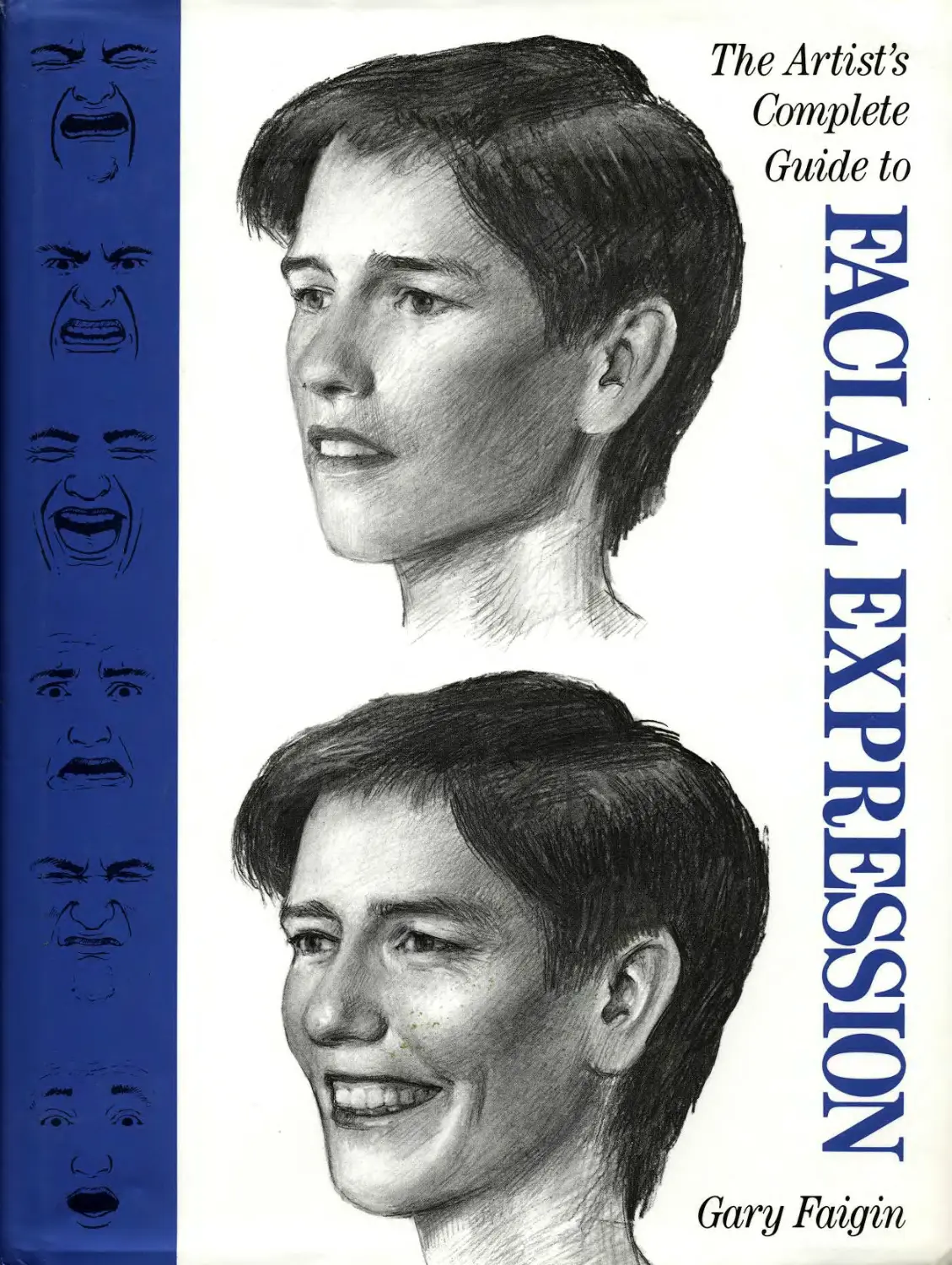
The Artist’s Complete Guide to
FACIAL
EXPRESSION
Gary Faigin
This comprehensive visual index to the
subtleties of emotion conveyed by facial ex-
pression is the only book of its kind. The
Artist’s Complete Guide to Facial Expression
carefully explains and illustrates the role of
the muscles of expression and the effects of
these muscles on the face. The images pre-
sented, from the author’s own work and
from photographic and artistic sources,
focus on the action of muscles in three key
areas of the face—the forehead and brows,
the eyes, and the mouth and chin.
Gary Faigin shows how the successful por-
trayal of the face is dependent on an under-
standing of the deep forms of head and
skull. Faigin goes on to illustrate the ex-
pressive results of individual facial muscles.
This structural information is then drawn
together in a brilliant section, which is de-
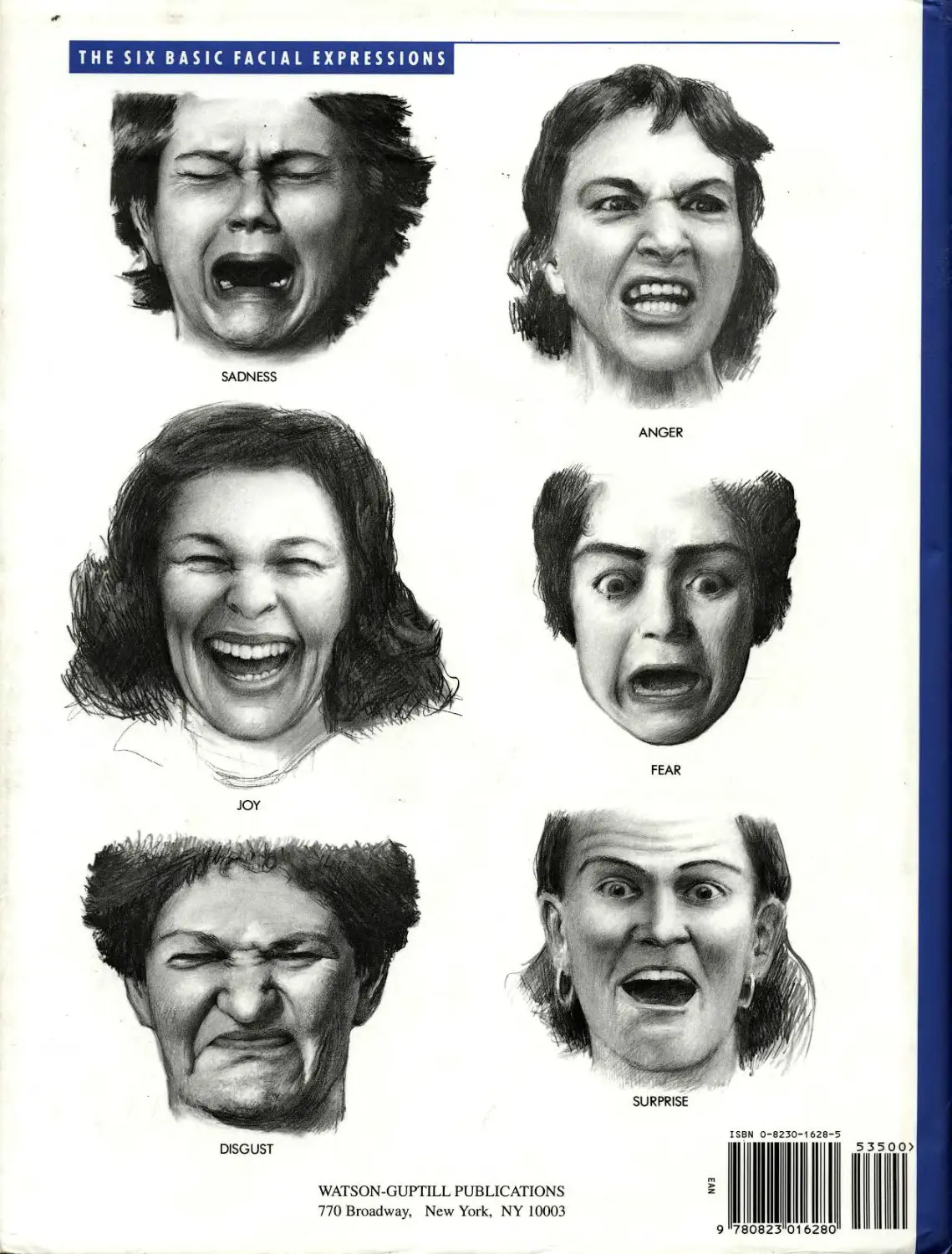
voted to depicting the six basic human
expressions—sadness, anger, joy, fear,
disgust, and surprise. Each emotion is por-
trayed in steadily increasing intensity, from
subtle signs of the emotion to full-blown
expressions. Detailed renderings are sup-
plemented by illustrations from such other
sources as news photos, cartoons, movie
posters, and art masterworks—complex,
finished works that show the basic emo-
tional patterns in use. An appendix features
examples of each nuance of the basic ex-
pressions, including similar facial states of
purely physical origin, such as yawning or
the face of pain.
The Artist’s Complete Guide to Facial Ex-
pression is a major contribution to the litera-
ture of art instruction. This is a unique
work, highly intelligent yet lively and enter-
taining, on a subject crucial to the develop-
ment of every artist.
288 pages. 8‘/< x 11 (21 x 28 cm).
400 black-and-white illustrations. Index.
Gary Faigin is a painter and printmaker
whose work has been exhibited in one-man
and group shows around the country. He
was trained at the Art Students League
and the Ecole des Beaux Arts de Paris. He
currently lectures at the Art Students
League of New York, and has served on the
faculties of the National Academy School of
Design School of Fine Art and the Parsons
School of Design. His own school, the
Academy of Realist Art, offers classes in
Santa Fe, Seattle, and New York City. He
lives in Seattle and Santa Fe with his wife,
architect and designer, Pamela Belyea.
WATSON-GUPTILL PUBLICATIONS
WATSON-GUPTILL PUBLICATIONS

The Artist’s Cemplete Guide to
FACIAL

EXPRESSION


WATSON -Gl PT I 1.1. PUBLICATIONS/NEW YORK

To Henry, Frieda, and Pamela
Associate Editor: Carl Rosen
Typographer: Trufont Typographers, Inc.
Set in Century Oldstyle
Copyright © 1990 Watson-Guptill Publications
First published in 1990 In New York by Watson-Guptill Publi-
770 Broadway, New York, NY 10003
Faigin, Gary, 1950-
The artist's complete guide to facial expression / Gary Faigin.
ISBN 0-8230-1628-5
1. Facial expression in art. 2. Art—Technique. I. Title.
N7573.3.F35 1990
704.9'42—dc20
90-48379
CIP
Distributed in the United Kingdom by Phaidon Press Ltd.,
Musterlin House, Jordan Hill Road, Oxford OX2 8DP
All rights reserved. No part of this publication may be
reproduced or used in any form or by any means—graphic
without written permission of the publisher.
First Printing, 1990
11 12 13/03 02 01

Acknowledgments
T
X his book might have remained
nothing more than a passing idea had it
not been for the initial encouragement
Robert Beverley Hale. In more recent
dispatch; they communicated to the
author an enthusiasm for the book no
publishing contract can guarantee.
Johanna Bartelt shouldered the mara-
rights from museums and agencies
take the illustrations in a picture book
for granted. And rather than single out
any one thing to credit to Sallie
Gouverneur and Pamela Belyea, I’ll
just say that without their various ser-
vices over several years, this book
would never have appeared.
The work of Dr. Paul Ekman was of
crucial importance both in terms of
describing the expressions and analyz-
ing the muscular actions that create
them. Other individuals whose help
was much appreciated: Nick Ullet,
Terry Brogan, and the 13th St Reper-
tory Company, who provided acting
services; the persons at the United
States Information Agency who helped
contact museums and foreign com-
panies for picture rights; Richard
Rudich, who was always available with
a “cold eye” and an encouraging word;
Judy Wyer, who did valuable research;
League Saturday class, helped in many
out include: Bill Ziegler; Rhoda Knight
Kalt; Ray Harryhausen; Elliot Gold-
Belyea; Howard Buten; Rosina Florio;
Dr. Robert Bell; Kyle Wilton; Lee
Lorenz; John Kohn of Pro Lab; Jill
Commander Jim Belyea; Claire
Buten; Joel Kostman; Eli Levin;
Marie-Genevieve Vandesande; Shos-
hanna Weinberger; Janet Hulstrand;
Stashu Smaka; Sybil Faigin; Edward
Maisel; Ken Aptekar; Joel Miskin;
Laurel Rech; Alexandra Baltarzuk;
ABC News; Borden Company; Guin-
ness Company; Stephen Rogers Peck;
Kay Hazelip; and finally, all the friends,
family members, and students who
modeled for the illustrations.
Gary Faigin offers workshops and
classes around the country. For further
information, please contact: The Acad-
emy of Realist Art, 5004 Sixth Avenue
NW, Seattle, WA 98107.
CONTENTS
INTRODUCTION 8
Part One
THE STRUCTURE OF THE HEAD 18
GOING BENEATH THE SURFACE 20
CONSTRUCTING THE FEATURES 36
Part Two
THE MUSCLES OF EXPRESSION 52
THE NATURE OF THE FACIAL MUSCLES 54
MUSCLES OF THE BROW AND EYE 64
THE MUSCLES OF THE MOUTH 88
Part Three
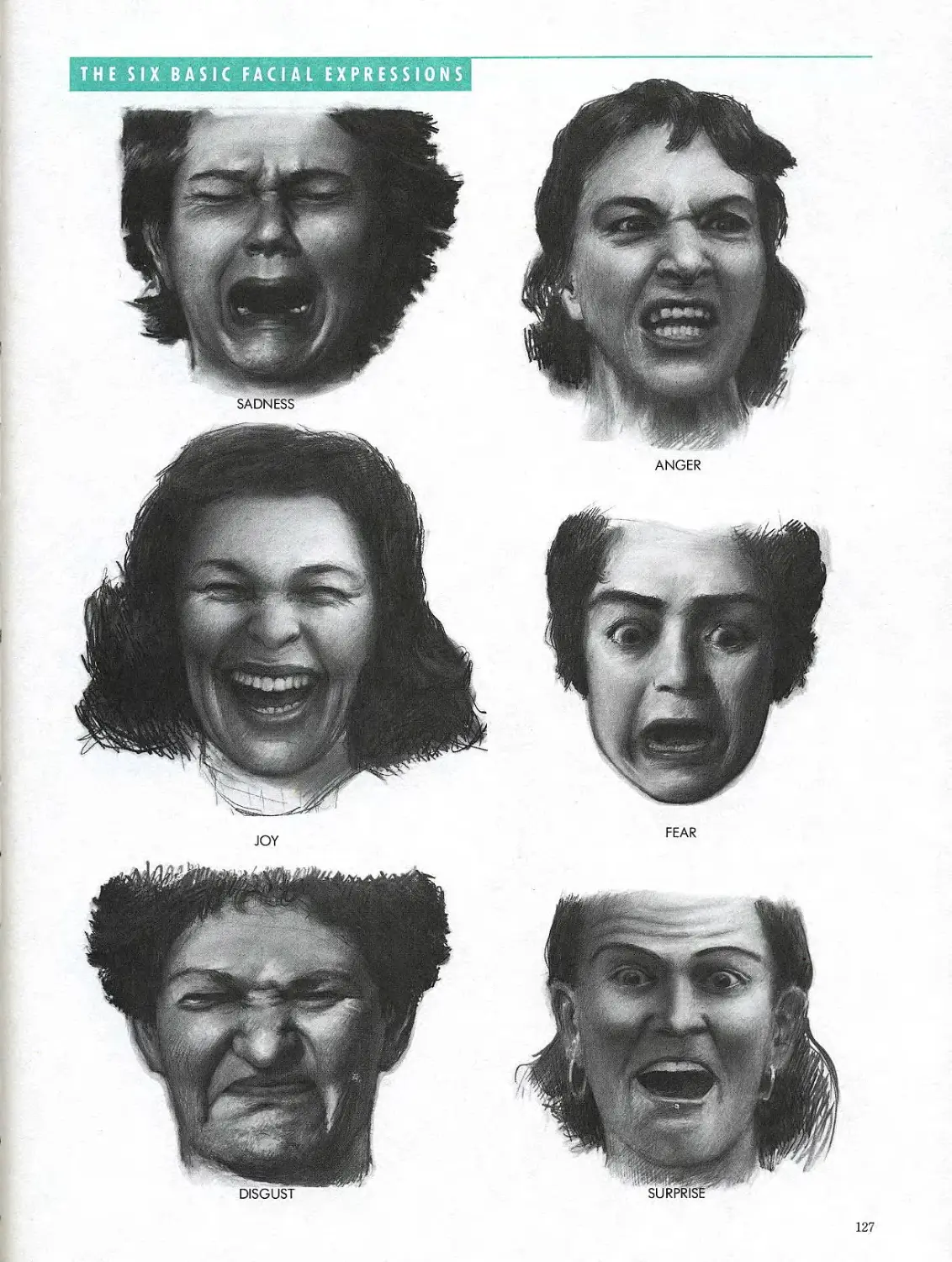
THE SIX BASIC EXPRESSIONS 124
EMOTION AND THE FACE 126
THE EXPRESSION OF SADNESS 132
THE EXPRESSION OF ANGER 160
THE EXPRESSION OF JOY 188
THE EXPRESSION OF FEAR 238
THE EXPRESSION OF DISGUST 254
THE EXPRESSION OF SURPRISE 262
CONCLUSION 268
EXPRESSIONS IN BRIEF 270
EXPRESSIONS OF PHYSICAL STATES 281
INDEX 286
CREDITS AND REFERENCES 288

INTRODUCTION
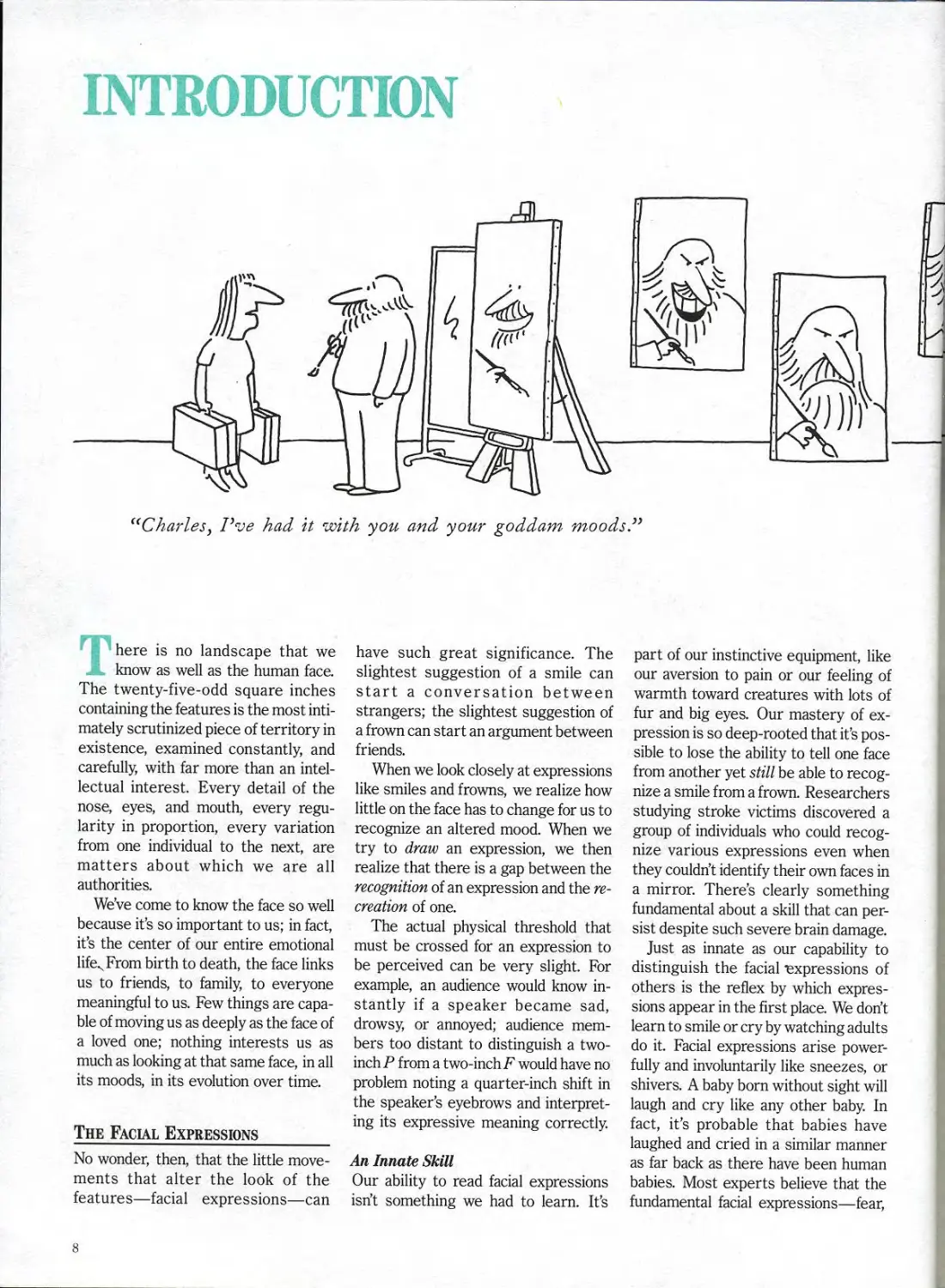
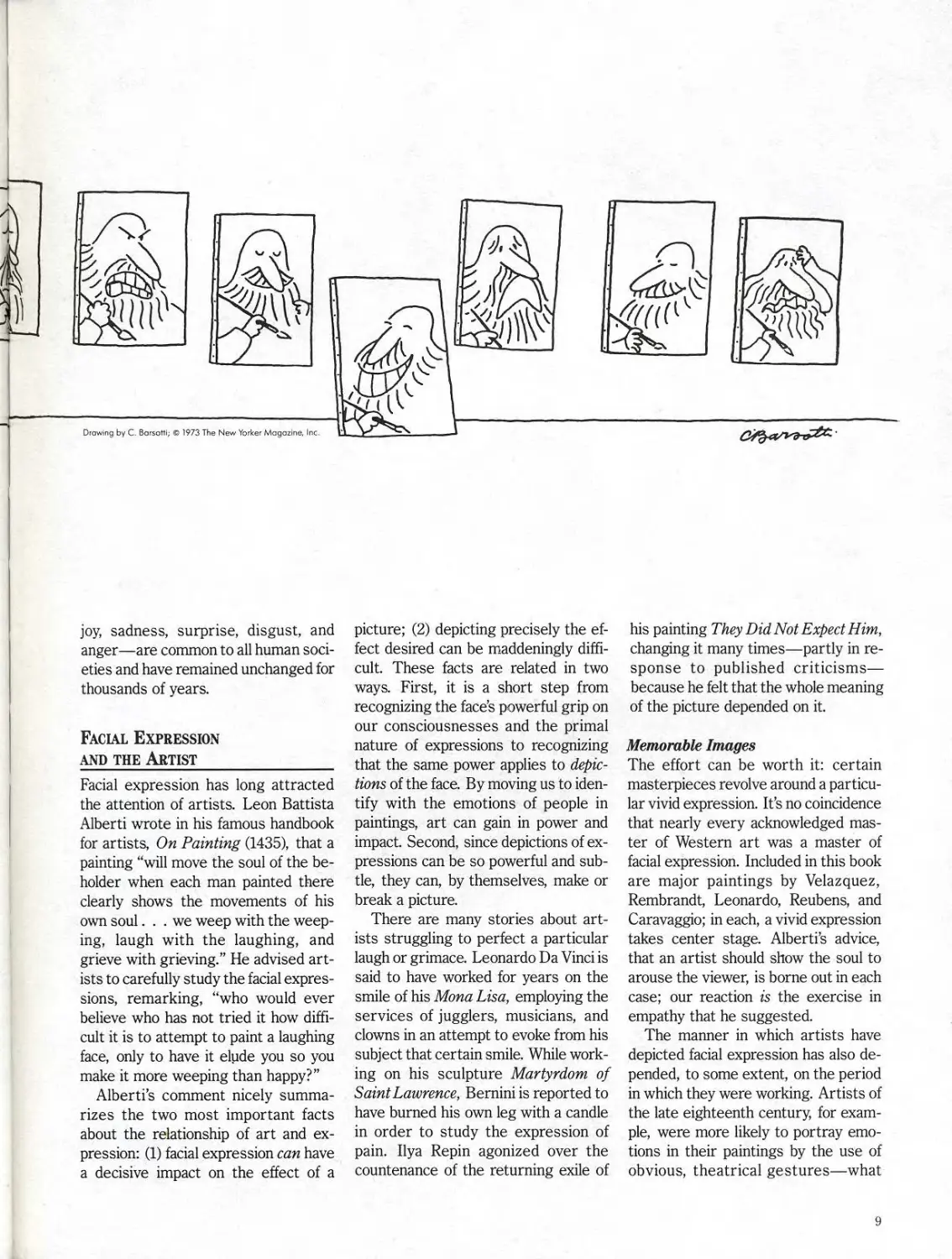
"Charles, I’ve had it with you and your goddam moods.”
‘ г here is no landscape that we JL know as well as the human face. The twenty-five-odd square inches containing the features is the most inti- mately scrutinized piece of territory in existence, examined constantly, and carefully, with far more than an intel- lectual interest. Every detail of the nose, eyes, and mouth, every regu- larity in proportion, every variation from one individual to the next, are matters about which we are all authorities. We’ve come to know the face so well because it’s so important to us; in fact, it’s the center of our entire emotional lifesFrom birth to death, the face links us to friends, to family, to everyone meaningful to us. Few things are capa- ble of moving us as deeply as the face of a loved one; nothing interests us as much as looking at that same face, in all its moods, in its evolution over time.	have such great significance. The part of our instinctive equipment, like slightest suggestion of a smile can our aversion to pain or our feeling of start a conversation between warmth toward creatures with lots of strangers; the slightest suggestion of fur and big eyes. Our mastery of ex- a frown can start an argument between pression is so deep-rooted that it’s pos- friends.	sible to lose the ability to tell one face When we look closely at expressions from another yet still be able to recog- like smiles and frowns, we realize how nize a smile from a frown. Researchers little on the face has to change for us to studying stroke victims discovered a recognize an altered mood. When we group of individuals who could recog- try to draw an expression, we then nize various expressions even when realize that there is a gap between the they couldn’t identify their own faces in recognition of an expression and the re- a mirror. There’s clearly something creation of one.	fundamental about a skill that can per- The actual physical threshold that sist despite such severe brain damage, must be crossed for an expression to Just as innate as our capability to be perceived can be very slight. For distinguish the facial expressions of example, an audience would know in- others is the reflex by which expres- stantly if a speaker became sad, sions appear in the first place. We don’t drowsy, or annoyed; audience mem- learn to smile or cry by watching adults bers too distant to distinguish a two- do it. Facial expressions arise power- inch P from a two-inch F would have no fully and involuntarily like sneezes, or problem noting a quarter-inch shift in shivers. A baby born without sight will the speaker’s eyebrows and interpret- laugh and cry like any other baby. In
The Facial Expressions	 No wonder, then, that the little move- ments that alter the look of the features—facial expressions—can	ing its expressive meaning correctly, fact, it’s probable that babies have laughed and cried in a similar manner An Innate Skill	as far back as there have been human Our ability to read facial expressions babies. Most experts believe that the isn’t something we had to learn. It’s fundamental facial expressions—fear,
joy, sadness, surprise, disgust, and
anger—are common to all human soci-
eties and have remained unchanged for
thousands of years.
Facial Expression
and the Artist__________________
Facial expression has long attracted
the attention of artists. Leon Battista
Alberti wrote in his famous handbook
ists to carefully study the facial expres-
sions, remarking, “who would ever
believe who has not tried it how diffi-
cult it is to attempt to paint a laughing
face, only to have it elude you so you
make it more weeping than happy?”
Alberti’s comment nicely summa-
rizes the two most important facts
about the relationship of art and ex-
pression: (1) facial expression can have
picture; (2) depicting precisely the ef-
fect desired can be maddeningly diffi-
cult These facts are related in two
ways. First, it is a short step from
recognizing the face’s powerful grip on
our consciousnesses and the primal
nature of expressions to recognizing
that the same power applies to depic-
tions of the face. By moving us to iden-
tify with the emotions of people in
paintings, art can gain in power and
impact. Second, since depictions of ex-
painting “will move the soul of the be-
holder when each man painted there
clearly shows the movements of his
own soul... we weep with the weep-
ing, laugh with the laughing, and
smile of his Mona Lisa, employing the
subject that certain smile. While work-
countenance of the returning exile of
his painting They Did Not Expect Him,
sponse to published criticisms—
because he felt that the whole meaning
of the picture depended on it.
Memorable Images
The effort can be worth it: certain
masterpieces revolve around a particu-
lar vivid expression. It’s no coincidence
that nearly every acknowledged mas-
ter of Western art was a master of
facial expression. Included in this book
are major paintings by Velazquez,
Rembrandt, Leonardo, Reubens, and
Caravaggio; in each, a vivid expression
takes center stage. Alberti’s advice,
that an artist should show the soul to
arouse the viewer, is borne out in each
case; our reaction is the exercise in
empathy that he suggested.
The manner in which artists have
depicted facial expression has also de-
pended, to some extent, on the period
in which they were working. Artists of
the late eighteenth century, for exam-
ple, were more likely to portray emo-
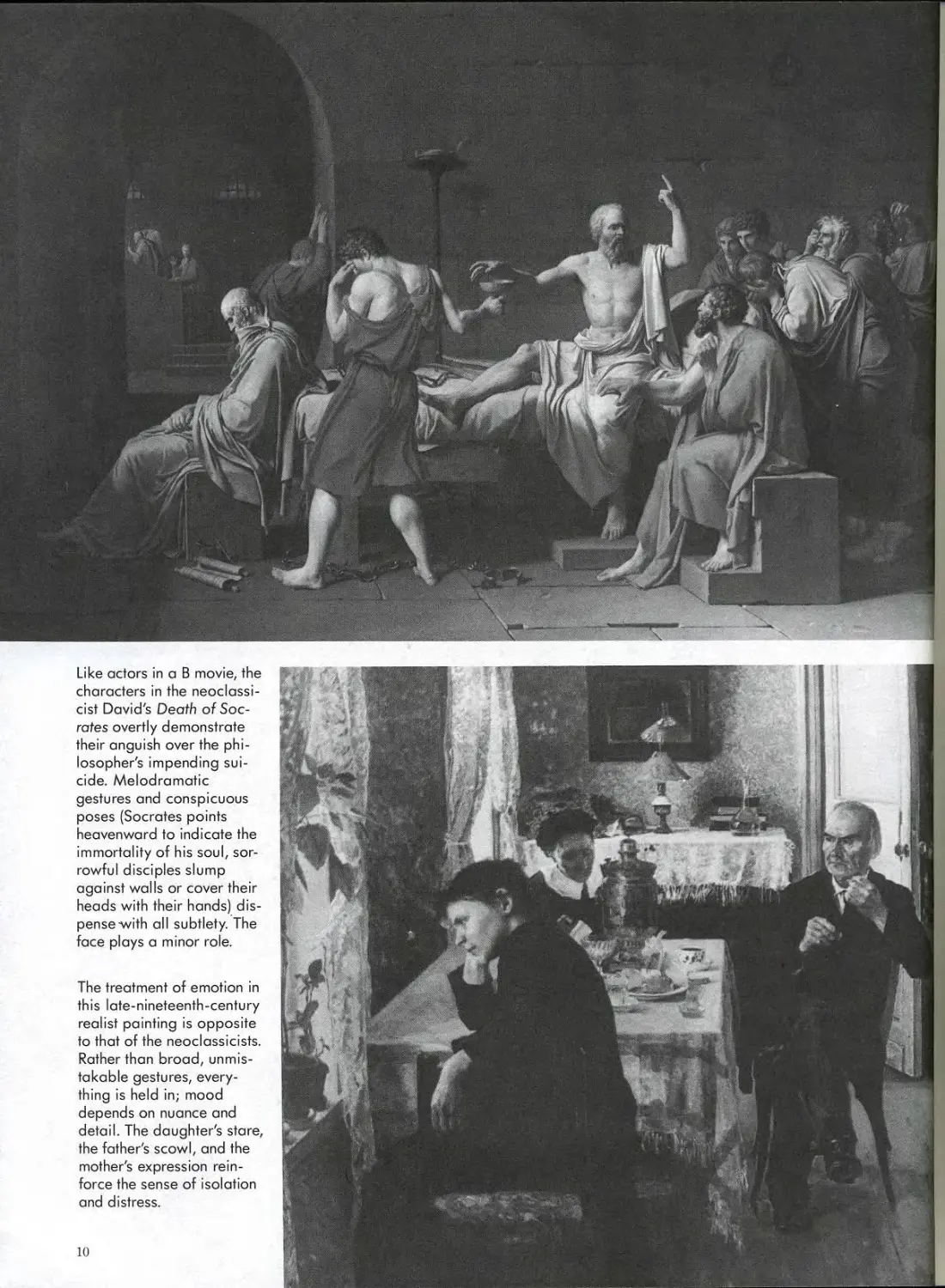
their anguish over the phi-
losopher's impending sui-
cide. Melodramatic
gestures and conspicuous
poses (Socrates points
heads with their hands) dis-
pense-with all subtlety. The
face plays a minor role.
ing on subtle movements of the face. In
paintings by the neoclassical artist
David, for example, despairing people
fling their arms up in the air or slump
against walls in a manner that seems
terribly exaggerated and artificial to
the modern eye. One would have seen
much the same thing in the theater of
David’s time.
Painters working in the late nine-
teenth century, particularly between
1860 and 1890, placed a higher priority
on careful observation from life. Their
artistic climate was shaped by the real-
ist movement. Gone were paintings of
nymphs and the lives of classical
heroes—in their place were scenes of
bourgeoisie. In the plays of Chekhov
and Ibsen, in the novels of Tolstoy and
Zola, and in the paintings of Repin and
Eakins, there was a similar effort to
hold up a faithful mirror to the contem-
craftsmanship and emotional convic-
tion, painters succeeded in portraying
the most compelling nuances of facial
expressions and gesture. No artists
before or since have painted pictures
that were so psychologically true in
their depictions of the face.
The Twentieth Century
In our century, there’s been a very dif-
ferent attitude towards the value of
visual truth. Many felt that painters
had exhausted the worth of pursuing
the “merely visible.” Artists like Pi-
casso, Cezanne, and Kandinsky strove
to create an art that was independent
of nature, in which color, form, and
expression were valued simply for.
their own sake. Painting was conceived
of as a universal language, like music,
capable of moving our emotions with-
out any reference to recognizable ele-
ments. Given this ideal, it’s no wonder
that painting in the twentieth century
has seen little in the way of continua-
tion of the nineteenth-century realists’
The work of photojournalists, how-
ever, does represent a link with the
realist painters of the past (whose
nineteenth-century newspapers).
News photos have had an enormous
impact on the modem consciousness.
We can immediately bring to mind the
photojoumalist’s images such as Lee
Harvey Oswald’s scream of pain (or his
guard’s scowl) or crying children flee-
ing their burning village in Vietnam.
Unquestionably, these too are images
where people “clearly show the move-
ment of their own souls.” These photos
are direct successors to the “journalis-
tic” paintings of the nineteenth-
century realists. (Ironically, the advent
of newspaper photography was part of
the reason realist painting fell into
decline.)
Painters will always be passionately
interested in the face and its moods in a
way that transcends periodic fluctua-
tions in style. The power of the face
will always inspire artists to explore its
expressive possibilities, and pictures
that capture emotions in a striking way
will always be notable. Moments of
strong emotion are rare in the hum-
drum of daily life, and we’re instinc-
tively drawn to images of the face
where the “movements of the soul” are
Non-Western Traditions
culture have recorded the effects of
emotion on the face. This book in-
cludes the jade head of a crying baby
from pre-Columbian Mexico; a
wooden, snarling-faced war helmet
from the Pacific Northwest; scowling
emperors carved in stone from ancient
Rome; and theater masks from Japan
and North Africa displaying a range of
emotions from fear to laughter. Human
expressions also appear on the faces of
animals, demons, and gods; looking at
harder to find a face in repose than one
contorted by some expression.
How Artists Have
Studied Expression
For artists wishing to inform them-
tions: (1) looking in a mirror;
(2) looking at other pictures; (3) direct
observation.
Direct observation is clearly the
most difficult option. We don’t often
see people in the grip of a primal emo-
tion, and even when we do, there are
obstacles: expressions don’t last very
long; they are frequently of the utmost
subtlety even when they do last; and
we usually feel too inhibited or involved
to look on objectively when someone
else is suffering anguish or pain.
Some artists have nonetheless per-
sisted in working from direct observa-
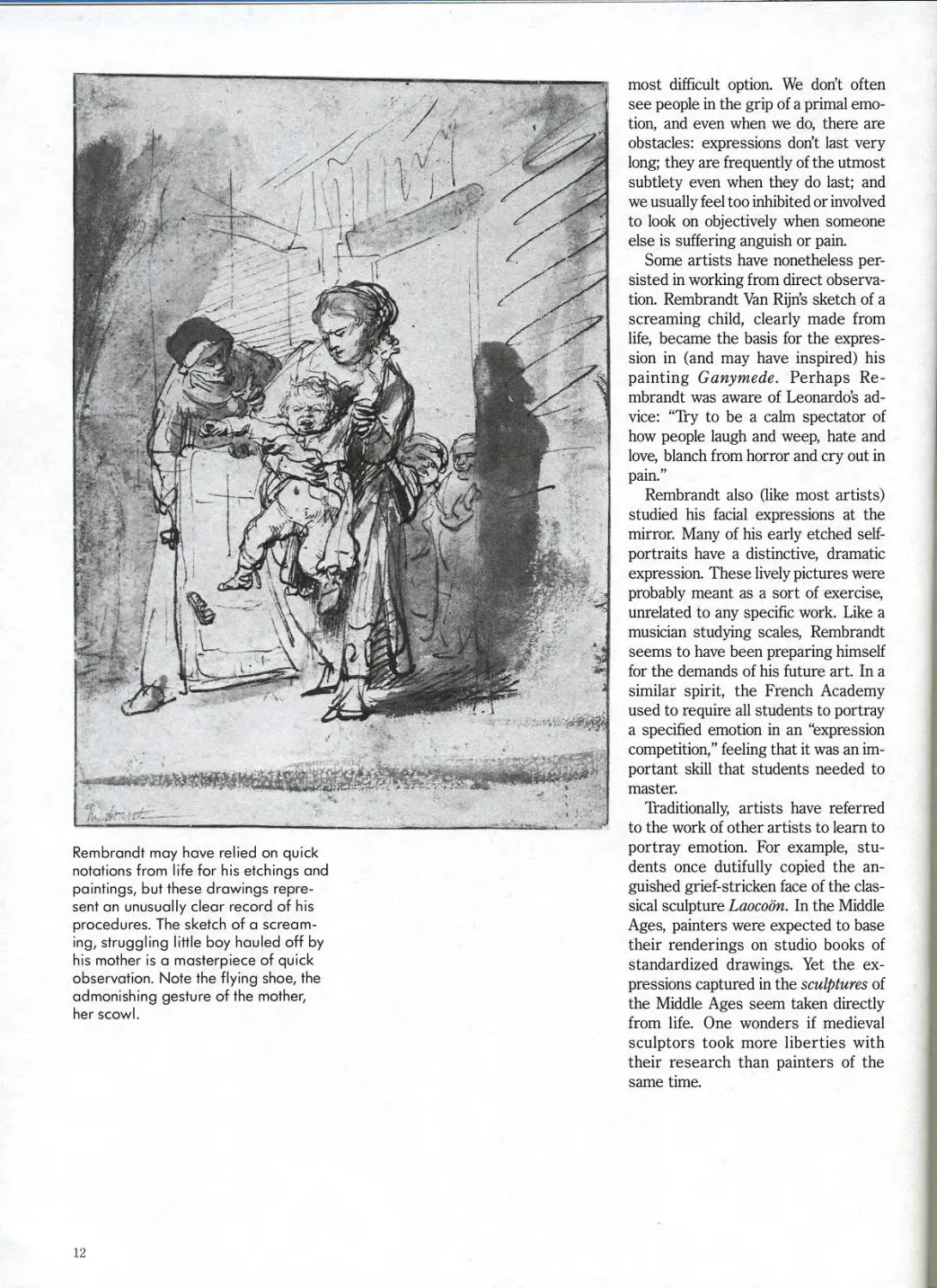
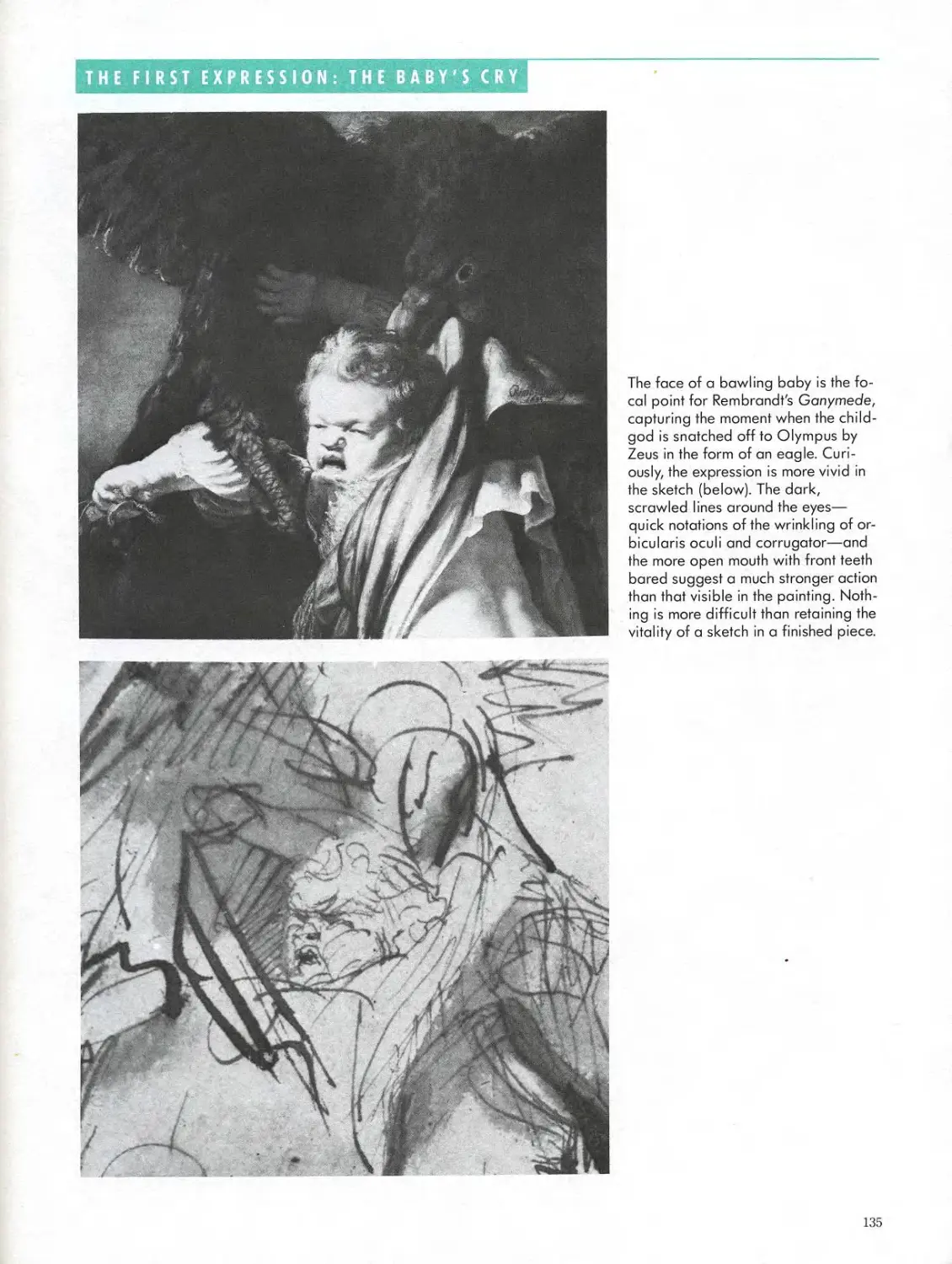
tion. Rembrandt Van Rijn’s sketch of a
screaming child, clearly made from
life, became the basis for the expres-
sion in (and may have inspired) his
painting Ganymede. Perhaps Re-
mbrandt was aware of Leonardo’s ad-
vice: “Try to be a calm spectator of
how people laugh and weep, hate and
love, blanch from horror and cry out in
Rembrandt also (like most artists)
studied his facial expressions at the
mirror. Many of his early etched self-
portraits have a distinctive, dramatic
expression. These lively pictures were
probably meant as a sort of exercise,
unrelated to any specific work. Like a
musician studying scales, Rembrandt
seems to have been preparing himself
for the demands of his future art. In a
similar spirit, the French Academy
used to require all students to portray
a specified emotion in an “expression
competition,” feeling that it was an im-
portant skill that students needed to
master.
Traditionally, artists have referred
to the work of other artists to learn to
portray emotion. For example, stu-
dents once dutifully copied the an-
guished grief-stricken face of the clas-
sical sculpture Laocodn. In the Middle
Ages, painters were expected to base
their renderings on studio books of
standardized drawings. Yet the ex-
pressions captured in the sculptures of
the Middle Ages seem taken directly
from life. One wonders if medieval
sculptors took more liberties with
their research than painters of the
same time.
About This Book
books on the subject of facial expres-
sion for the artist. To my knowledge,
the last one was Sir Charles Bells Es-
says on the A nalomy of Expression in
Painting, published in 1806. and it
wasn’t a terribly good book in the first
place. Many more recent drawing
books have included short sections on
expression without shedding much
useful light on the matter. In fact, art
ists familiar with such sources have
generally had the good sense to prefer
their own judgment and observations.
A great amount of useful information
been published by psychologists. Their
book. This book also borrows heavily
from the work of modern photojoumal-
ists, whose ability to be at the right
place at this right time and to point
cameras in the faces of people no mat-
ter what the circumstances, have done
artists a great service.
The Head is Action________________
This is not primarily a book on how to
draw the head—there are plenty of
books that do that. It’s a book about
depicting the actions of the head. It
focuses on the facial expression of
emotion, but other actions are illus-
trated, such as the sideways gaze, the
open mouth, the raised brow, which
add to the liveliness of a face.
The gist of this book is in the illus-
tions. Anyone who reads through the
picture pages will have covered most of
the material. The text itself offers
slightly more detail and discussions of
Part of this book is devoted to the
anatomical basis of the expressions.
The study of anatomy, it has been said,
increases the sensitivity of the artist’s
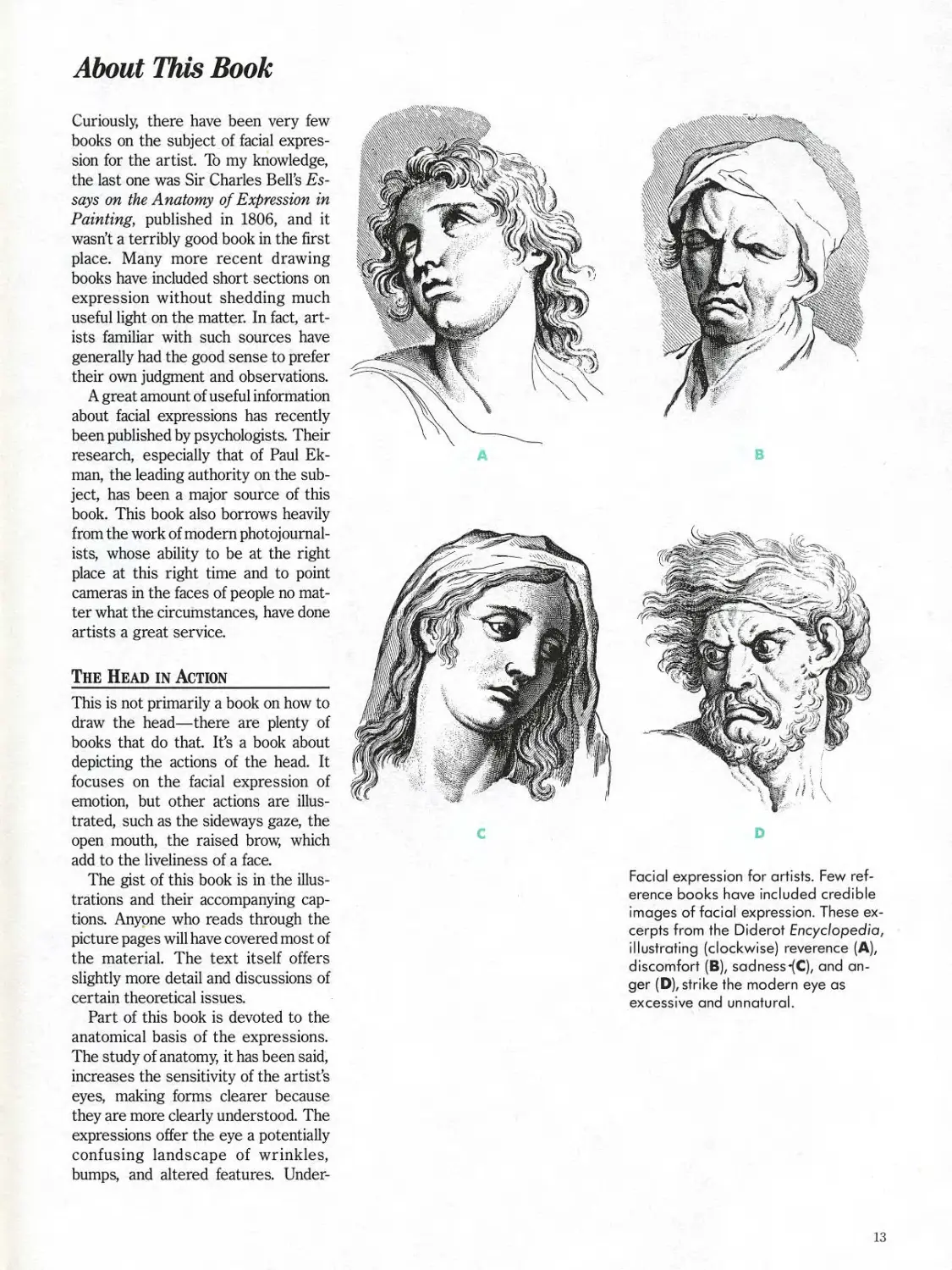
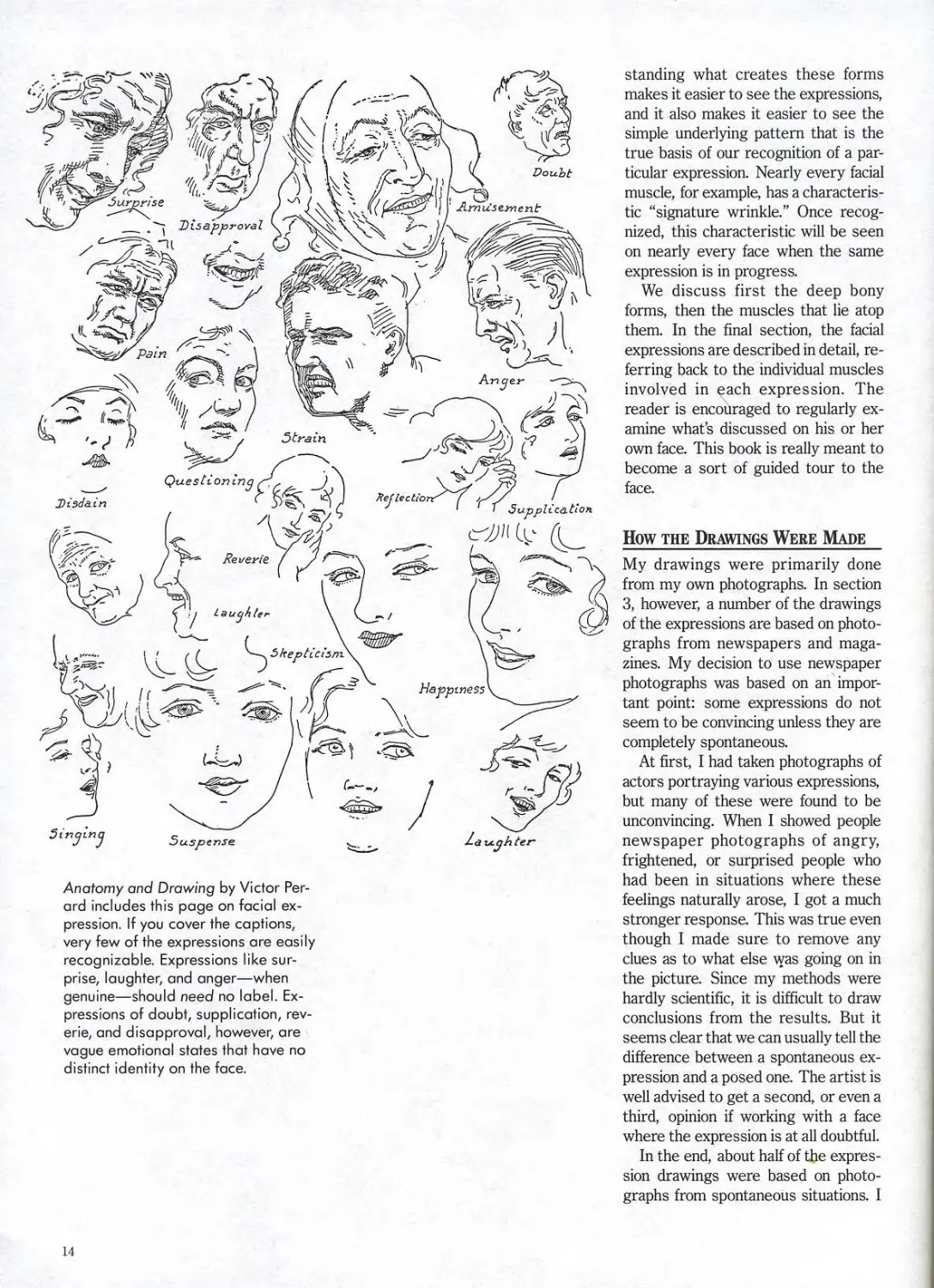
ard includes this page on facial ex-
pression. If you cover the captions,
recognizable. Expressions like sur-
prise, laughter, and anger—when
genuine—should need no label. Ex-
vague emotional states that have no
distinct identity on the face.
standing what creates these forms
makes it easier to see the expressions,
and it also makes it easier to see the
simple underlying pattern that is the
true basis of our recognition of a par-
ticular expression. Nearly every facial
muscle, for example, has a characteris-
tic “signature wrinkle.” Once recog-
nized, this characteristic will be seen
on nearly every face when the same
expression is in progress.
We discuss first the deep bony
forms, then the muscles that lie atop
them. In the final section, the facial
expressions are described in detail, re-
ferring back to the individual muscles
involved in each expression. The
reader is encouraged to regularly ex-
amine what’s discussed on his or her
own face. This book is really meant to
become a sort of guided tour to the
How the Drawings Were Made
My drawings were primarily done
from my own photographs. In section
3, however, a number of the drawings
of the expressions are based on photo-
graphs from newspapers and maga-
zines. My decision to use newspaper
photographs was based on an impor-
tant point: some expressions do not
seem to be convincing unless they are
completely spontaneous.
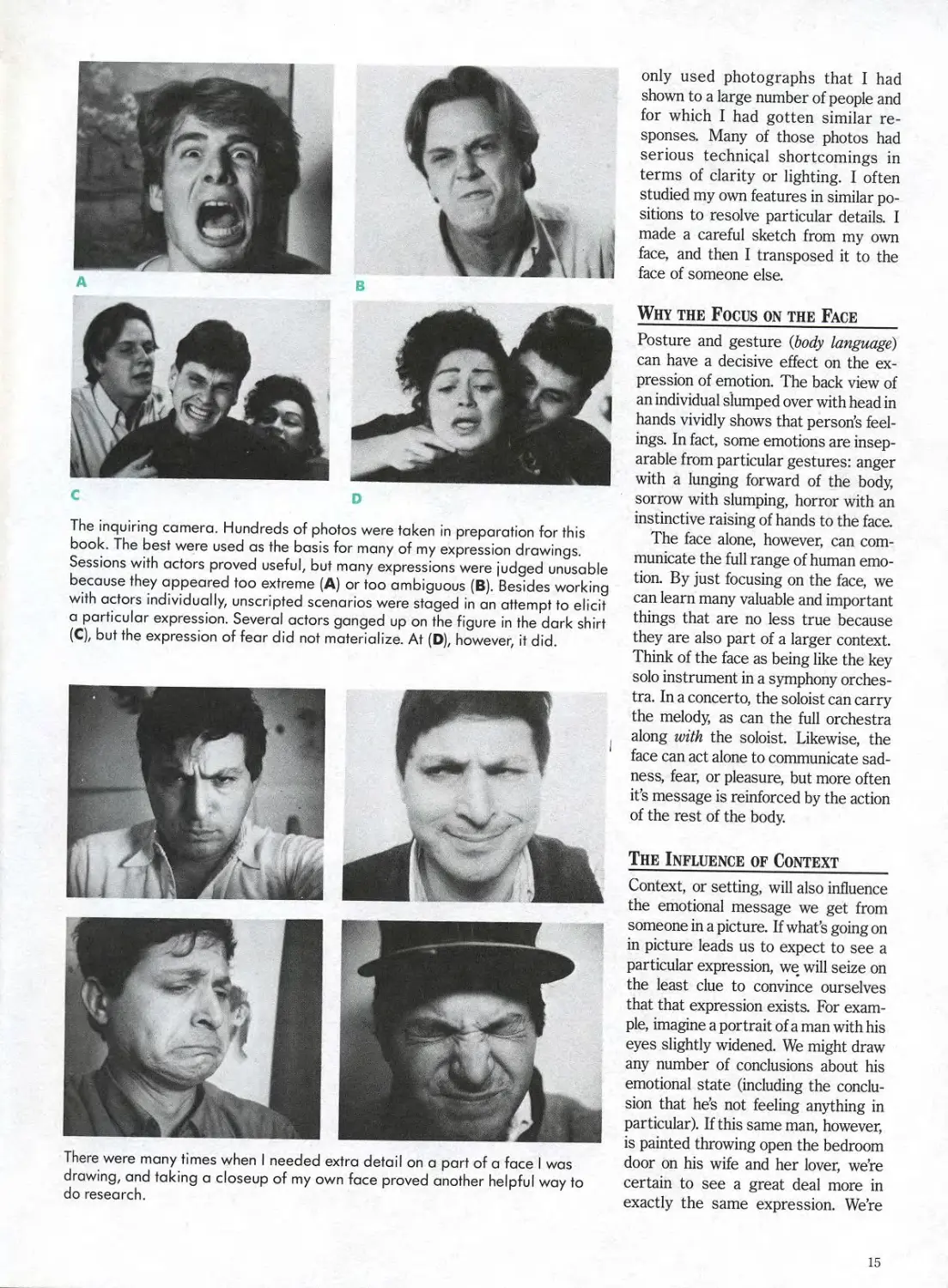
At first, I had taken photographs of
actors portraying various expressions,
but many of these were found to be
unconvincing. When I showed people
newspaper photographs of angry,
frightened, or surprised people who
had been in situations where these
feelings naturally arose, I got a much
stronger response. This was true even
though I made sure to remove any
clues as to what else was going on in
the picture. Since my methods were
hardly scientific, it is difficult to draw
conclusions from the results. But it
seems clear that we can usually tell the
difference between a spontaneous ex-
pression and a posed one. The artist is
well advised to get a second, or even a
third, opinion if working with a face
where the expression is at all doubtful.
In the end, about half of tire expres-
sion drawings were based on photo-
graphs from spontaneous situations. I
only used photographs that I had
shown to a large number of people and
for which I had gotten similar re-
sponses. Many of those photos had
serious technical shortcomings in
terms of clarity or lighting. I often
studied my own features in similar po-
sitions to resolve particular details. I
made a careful sketch from my own
face, and then I transposed it to the
face of someone else.
Why the Focus on the Face
Posture and gesture (body language)
can have a decisive effect on the ex-
pression of emotion. The back view of
an individual slumped over with head in
hands vividly shows that person’s feel-
ings. In fact, some emotions are insep-
arable from particular gestures: anger
with a lunging forward of the body,
sorrow with slumping, horror with an
instinctive raising of hands to the face.
The face alone, however, can com-
municate the full range of human emo-
tion. By just focusing on the face, we
can learn many valuable and important
things that are no less true because
they are also part of a larger context.
Think of the face as being like the key
solo instrument in a symphony orches-
tra. In a concerto, the soloist can carry
the melody, as can the full orchestra
along with the soloist. Likewise, the
face can act alone to communicate sad-
ness, fear, or pleasure, but more often
it’s message is reinforced by the action
of the rest of the body.
The Influence of Context
Context, or setting, will also influence
the emotional message we get from
someone in a picture. If what’s going on
in picture leads us to expect to see a
particular expression, we will seize on
the least clue to convince ourselves
that that expression exists. For exam-
ple, imagine a portrait of a man with his
eyes slightly widened. We might draw
any number of conclusions about his
emotional state (including the conclu-
sion that he’s not feeling anything in
particular). If this same man, however,
is painted throwing open the bedroom
door on his wife and her lover, we’re
certain to see a great deal more in
exactly the same expression. We’re
likely to see shock, anger or both, but
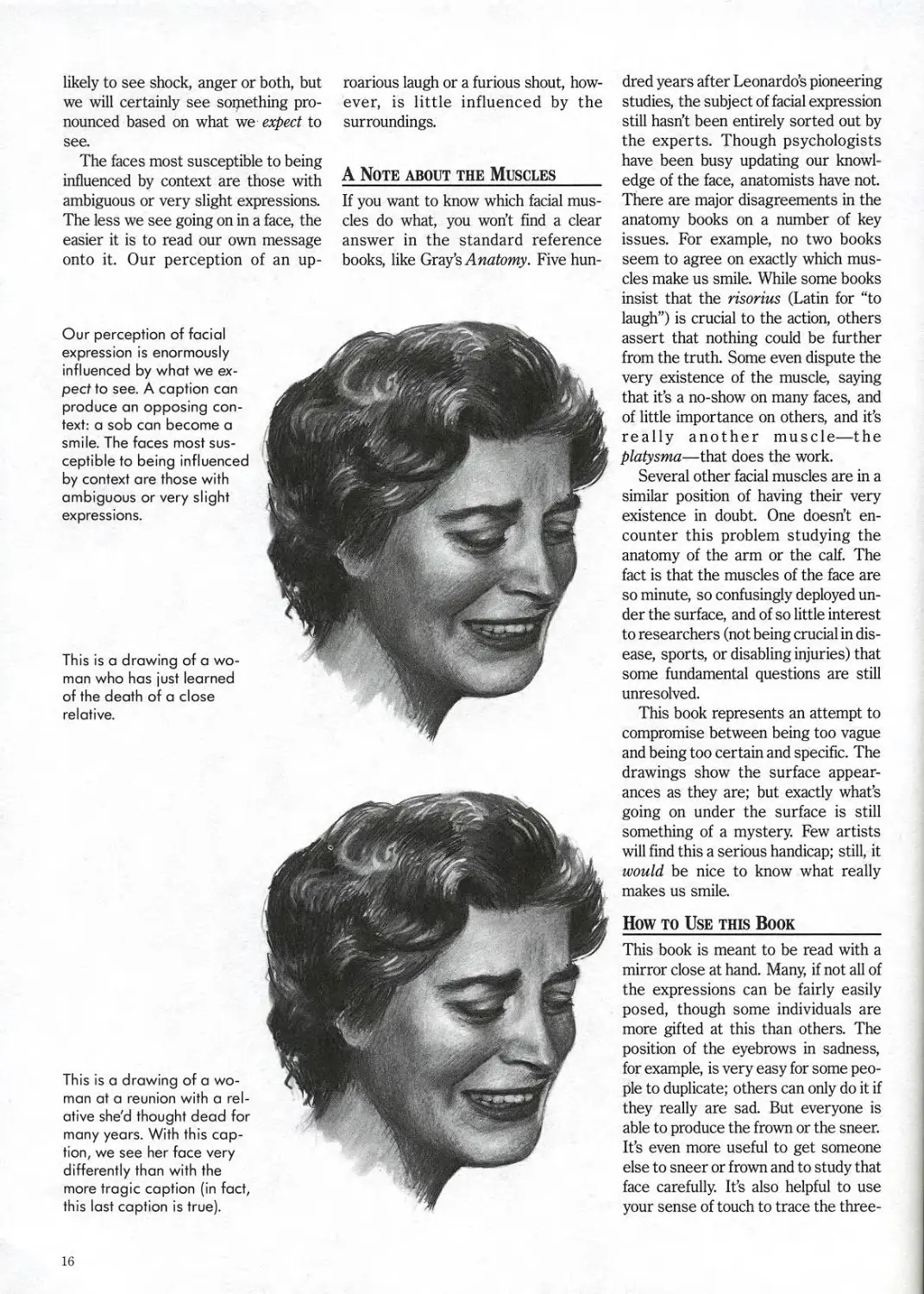
The faces most susceptible to being
influenced by context are those with
ambiguous or very slight expressions.
The less we see going on in a face, the
easier it is to read our own message
onto it. Our perception of an up-
ever, is little influenced by the
surroundings.
A Note about the Muscles
answer in the standard reference
books, like Gray’s Anatomy. Five hun-
dred years after Leonardo’s pioneering
still hasn’t been entirely sorted out by
the experts. Though psychologists
have been busy updating our knowl-
edge of the face, anatomists have not.
There are major disagreements in the
anatomy books on a number of key
issues. For example, no two books
seem to agree on exactly which mus-
cles make us smile. While some books
insist that the risorius (Latin for “to
laugh”) is crucial to the action, others
assert that nothing could be further
from the truth. Some even dispute the
very existence of the muscle, saying
that it’s a no-show on many faces, and
platysma—that does the work.
counter this problem studying the
fact is that the muscles of the face are
so minute, so confusingly deployed un-
der the surface, and of so little interest
to researchers (not being crucial in dis-
ease, sports, or disabling injuries) that
some fundamental questions are still
unresolved.
This book represents an attempt to
compromise between being too vague
and being too certain and specific. The
drawings show the surface appear-
ances as they are; but exactly what’s
going on under the surface is still
something of a mystery. Few artists
will find this a serious handicap; still, it
would be nice to know what really
makes us smile.
How to Use this Book
This book is meant to be read with a
mirror close at hand. Many, if not all of
the expressions can be fairly easily
posed, though some individuals are
more gifted at this than others. The
position of the eyebrows in sadness,
for example, is very easy for some peo-
ple to duplicate; others can only do it if
they really are sad. But everyone is
able to produce the frown or the sneer.
It’s even more useful to get someone
else to sneer or frown and to study that
face carefully. It’s also helpful to use
your sense of touch to trace the three-
dimensional forms on your face when
posing the expressions.
Every opportunity should be taken
to observe these expressions from life.
Front-row seats at the theater are per-
fect spots for expression research, and
playgrounds can also be great places—
children don’t tend to hold back when
they’re angry or distressed or mind
being looked at. I also recommend lin-
gering at bus stations during rush
hours to watch for commuters late for
their buses and spying on tables full of
tipsy people in cafes. If you discreetly
observe travelers saying their good-
byes at airports, you may well spot the
charming expression in which sadness
mingles with a smile. And unexpected
opportunities arise: I can still vividly
bring to mind the distressed look on
the brow of the poor woman I saw once
being arrested for shoplifting. Just
remember—it’s not polite to stare!
(though dark glasses can help).
Movies are useful, and videotapes
particularly so, as an interesting face
can be watched more than once or even
frozen as a still frame. The daily papers
and news magazines are also scanned a
bit differently when you’re indulging
your curiosity about the face—a clip
file can be an important tool.
Finally, have fun with a pencil. The
easiest way to begin trying out these
expressions is by drawing simple,
cartoon-like faces like those in the ap-
pendix. Even such rudimentary faces
can be quite expressive. Next, you
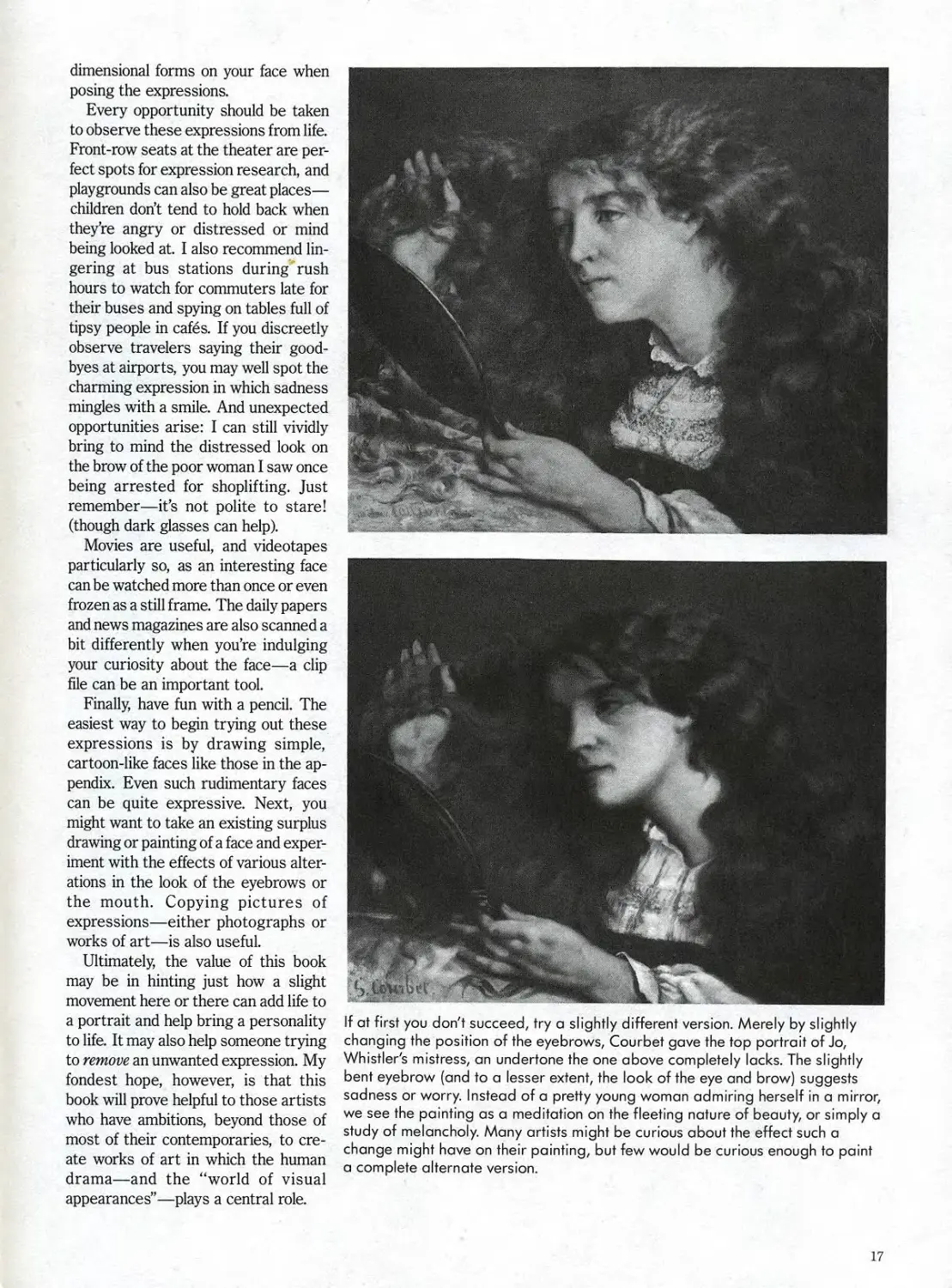
might want to take an existing surplus
drawing or painting of a face and exper-
iment with the effects of various alter-
ations in the look of the eyebrows or
the mouth. Copying pictures of
expressions—either photographs or
works of art—is also useful.
Ultimately, the value of this book
may be in hinting just how a slight
movement here or there can add life to
a portrait and help bring a personality
to life. It may also help someone trying
to remove an unwanted expression. My
fondest hope, however, is that this
book will prove helpful to those artists
who have ambitions, beyond those of
most of their contemporaries, to cre-
ate works of art in which the human
drama—and the “world of visual
appearances”—plays a central role.


GOING BENEATH
THE SURFACE
Facial expressions come and go.
They pass over the surface of the
face like light ripples on the surface of a
pond. The deep structures beneath,
like the deep waters on the bottom of a
pond, remain unperturbed. But the
bony forms of the head make the pres-
ence of the facial expressions felt on
the surface indirectly; the teeth give
form to the smile; the frontal bone
gives form to the frown.
A major theme of this book is that
knowledge enhances seeing. Once you
know what the hidden parts of the face
their effects on the surface more
clearly. So we study the deep forms,
and the forms of the head as a whole,
before we look at the localized, super-
Avoiding the Beginner’s Error
There is another, equally important
reason to start out with the head as a
whole—it will prevent the classic be-
ginner’s error: starting with the fea-
tures first and then adding on the head.
Because of this drawing order, be-
ginners almost always draw the fea-
tures as far too big, the head holding
them as far too small.
There is a universal tendency to
misjudge the face in this way, probably
because we learn early on that faces
and facial expressions are pretty good
indicators of whether we can expect to
be stroked or scolded. Reward and
punishment being such important
things in life, we fall into the habit of
focusing on the features of those
around us. So when we draw or paint a
head, we naturally tend to zero in on
the part that interests us the most: the
Beginners are also under the im-
pression that a likeness depends very
much on getting the features exactly
right and very little on the rest of the
head. So the features are drawn as
gigantic, because they loom gigan-
tically in the beginner’s mind. The way
we recognize someone is actually
based on overall appearance—the
clues that make us recognizable from a
distance or as a vague figure in a group
photo. It’s a pattern that includes hair
and head shape and general propor-
tions. No matter how perfectly the eye
is drawn, for example, if the surround-
ings aren’t right, the head won’t look
right.
The cure for these problems is
simple—start with the bigger forms,
then work down to the smaller. We
must work very hard at pinning down
that big pattern first. When the time
comes to work on the details, we look
at them in relation to their surround-
ings; they will shrink in size accor-
dingly. One of my drawing teachers
used to say that “in relation to” is the
most important phrase in drawing. No-
where is it more important than when
drawing the head.
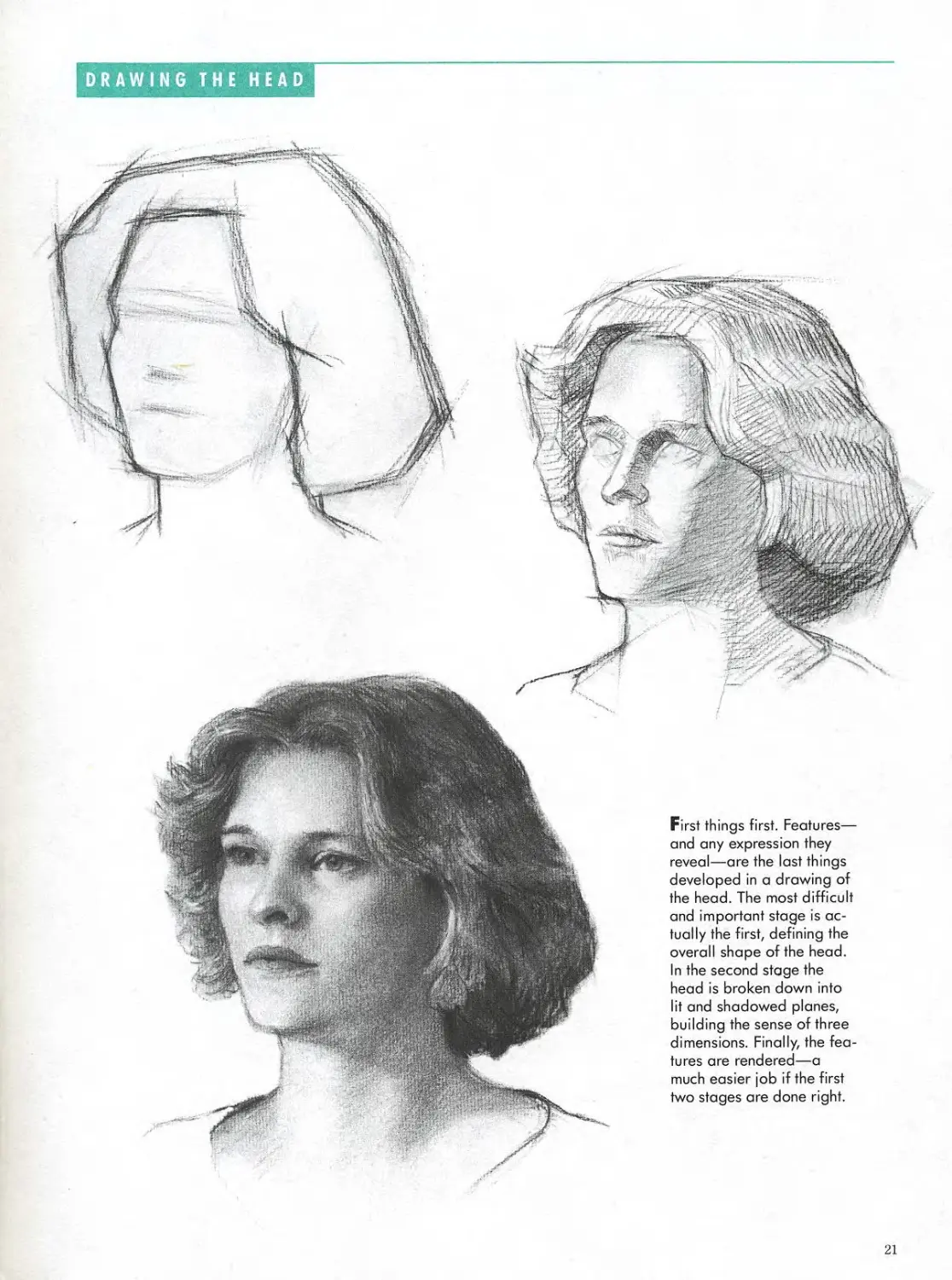
DRAWING THE HEAD
Looking at the Skull________________
The skull is the most important of the
deep forms that give shape to the face.
Differences between one person and
another are largely a result of differ-
ences in the skull. The skull deter-
mines the shape of our head and the
location of our features. Hallowe’en and
horror films aside, it is a beautiful and
fascinating structure.
Part of an artist’s training is to care-
fully observe and draw the skull from a
variety of angles (a plastic skull can be
used). Eventually, the skull’s basic
framework is memorized and then
used as sort of a mental armature
whenever the head is drawn. Norman
Rockwell, whose drawings of heads
were always his strong point, recalled,
“I had an art teacher years ago
(George Bridgeman) who made us
draw hundreds of skulls in all positions.
I felt he was overdoing it at the time,
but now I realized what a wonderful
lesson he taught us. Whenever I draw a
head, I instinctively feel the skull
structure beneath.”
We’ll look at the skull in a simplified,
streamlined version. Then we’ll exam-
ine it’s proportions, finally describing
the different parts of the skull and how
they relate to what we see on the face.
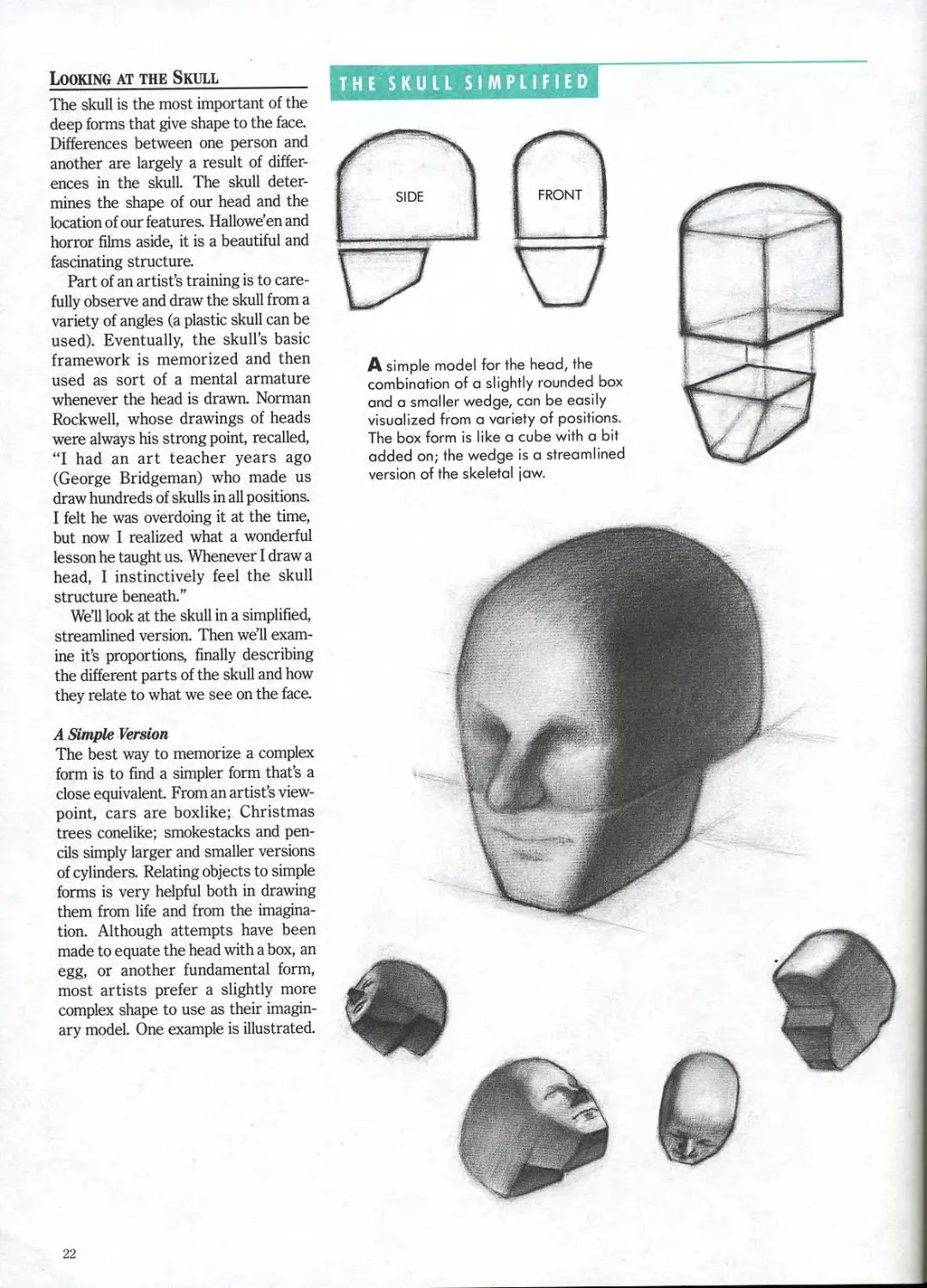
A Simple Version
The best way to memorize a complex
form is to find a simpler form that’s a
close equivalent From an artist’s view-
point, cars are boxlike; Christmas
trees conelike; smokestacks and pen-
cils simply larger and smaller versions
of cylinders. Relating objects to simple
forms is very helpful both in drawing
them from life and from the imagina-
tion. Although attempts have been
made to equate the head with a box, an
egg, or another fundamental form,
most artists prefer a slightly more
complex shape to use as their imagin-
ary model. One example is illustrated.
Skull and Head Proportions
Although the skull is what makes our
heads different, all skulls are basically
the same. We think that because ev-
eryone looks so different, the differ-
ences between one person and the
next must be quite pronounced. But
we’re experts; we’ve been looking at
faces every day of our lives. If you’ve
ever watched an expert in another field
at work— say, a geologist examining a
rock, or a palm reader looking at a
hand—you know how much more they
see in what they’re examining than we
do. Their long experience lets them
distinguish tiny variations between
items we might think identical. The
distinctions we are capable of making
with the face are just as refined, but
skulls are another matter—we simply
don’t have enough practice looking at
skulls, and so the variations aren’t ob-
vious. People, and skulls, are different,
but not all that different. We’re just
used to people.
The consistent shape of the skull
makes proportional rules for the head
possible. The exceptions to the rule
aren’t off by much. It’s not true, for
example, that all people have eyes half-
way up their heads. The exception
might be someone with eyes slightly
higher or slightly lower. And for the
vast majority of us, this pattern will
hold true.
Some Proportional Facts
There have been a lot of rules invented
concerning the proportions of the skull
going back at least as far as the Greeks.
I discuss below the ones I think the
most important.
Overall Shape
The height of the skull and the depth of
the skull are nearly the same. Keeping
this fact in mind helps avoid the com-
mon drawing error, “cutting off the
back of the head”—making it too
short. In a side view, before marking
off the end, compare the height to the
depth, making sure they’re approx-
imately the same.
The width of the skull is the smallest
dimension. The average skull is only
about two-thirds as wide as it is tall. It
gets that wide at the level of the cheek-
bones; it’s narrower above and below.
Skulls with wider cheekbones have a
more oval shape. With slender cheek-
bones, the skull appears more rec-
tangular, because there’s less differ-
ence in size between the cheekbones
and the rest of the skull.
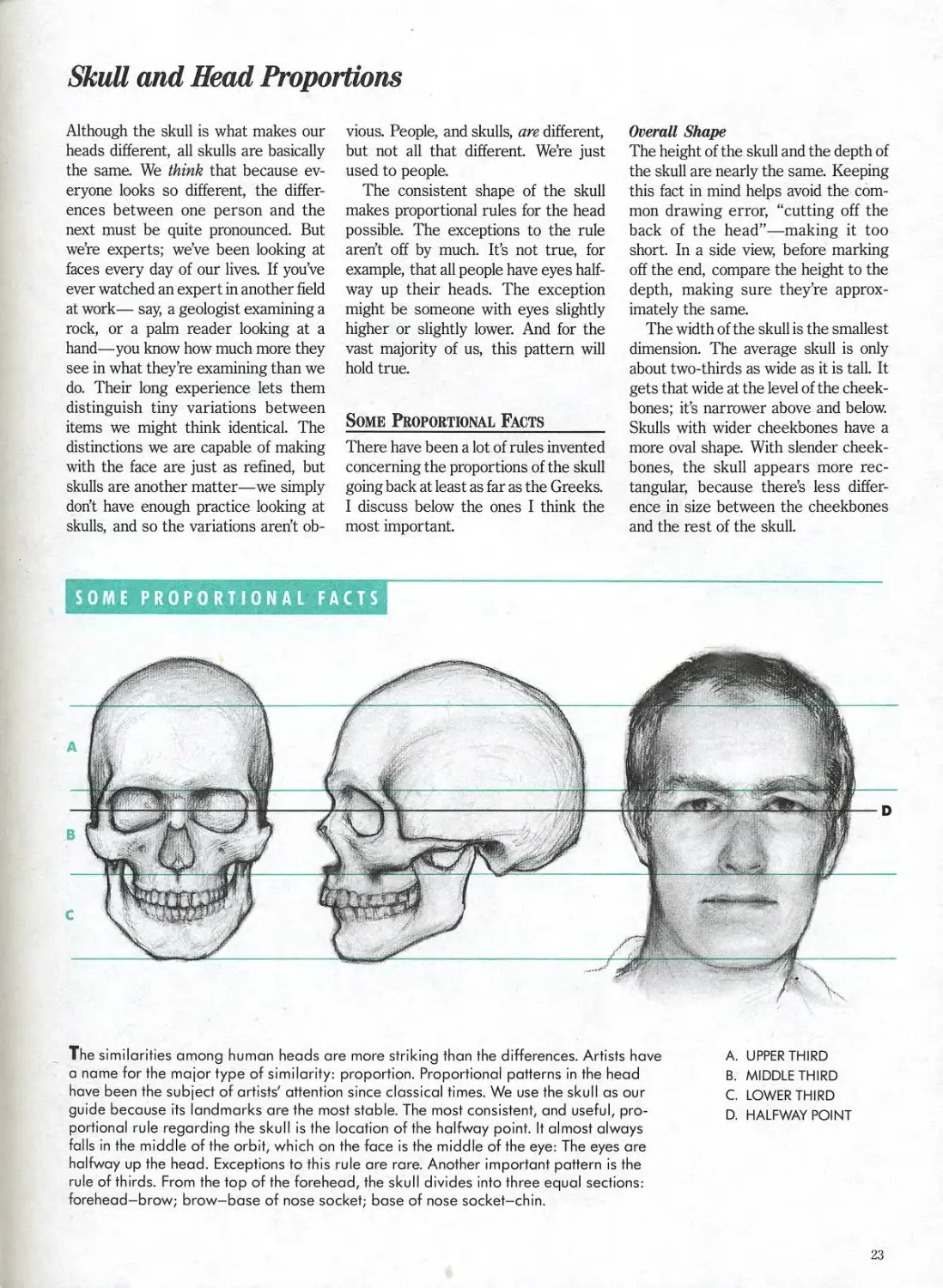
SOME PROPORTIONAL FACTS
A. UPPER THIRD
B. MIDDLE THIRD
C. LOWER THIRD
D. HALFWAY POINT
have been the subject of artists' attention since classical times. We use the skull as our
portional rule regarding the skull is the location of the halfway point. It almost always
falls in the middle of the orbit, which on the face is the middle of the eye: The eyes are
halfway up the head. Exceptions to this rule are rare. Another important pattern is the
rule of thirds. From the top of the forehead, the skull divides into three equal sections:
forehead-brow; brow-base of nose socket; base of nose socket-chin.
Location of the Eyes
The smaller forms of the skull help
determine the locations of the fea-
tures. The eye socket, for instance,
determines the position of the eyes.
Since the eye socket invariably falls
about halfway up the skull, the eyes are
always found on or near the midline of
the head. To be more precise, the inner
eye corner usually sits on an imaginary
line drawn through the middle of the
head. This rule alone would save many
students a lot of grief. Because people
tend to make the features too big, the
eyes tend to go a lot higher up the head
than just halfway.
The Rule of Thirds
The skull can be divided in another
way. A point is located just below the
top of the skull called the “widow’s
peak.” This is the spot where the fron-
tal bone (corresponding to the fore-
head) makes a sharp break with the
upper plane—it’s just slightly below
the actual top. From here the skull is
divided into thirds, and each dividing
line falls on a major landmark as
follows:
Q One-third of the way down from the
widow’s peak, the bony prominence
called the eyebrow (or superorbital)
ridge bulges out above the eye socket.
On the face, this is where the eye-
brows grow.
□ Two-thirds of the way down from
the widow’s peak, the bottom of the
oval-shaped nose socket is found. On
the face, this is where the nose ends—
where the tip turns under to meet the
upper lip.
Q The lower border of the skull is the
edge of the bony jaw. On the face, this
is the border of the chin, where the
face ends and the neck begins.
This proportional pattern—the divid-
ing of the skull (and face) into three
equal regions—is not quite as univer-
sally true as the one concerning the
eyes. But skulls—and people—don’t
vary from this arrangement by much.
When there are exceptions to this
rule, it’s usually the central third that
varies from the arrangement. Accord-
ing to the rule of thirds, the distance
from the base of the nose to an imagin-
ary point between the eyebrows is the
same as the distance from nose base to
the bottom of the chin. I’d say this is
right on the mark about 70 percent of
the time. The rest of the time it’s usu-
ally the length of the nose that’s short.
About 30 percent of us have noses that
are a bit shorter than the space from
nose to chin. It is exceedingly rare to
find someone with the distance from
nose base to eyebrow longer than the
distance from nose base to chin.
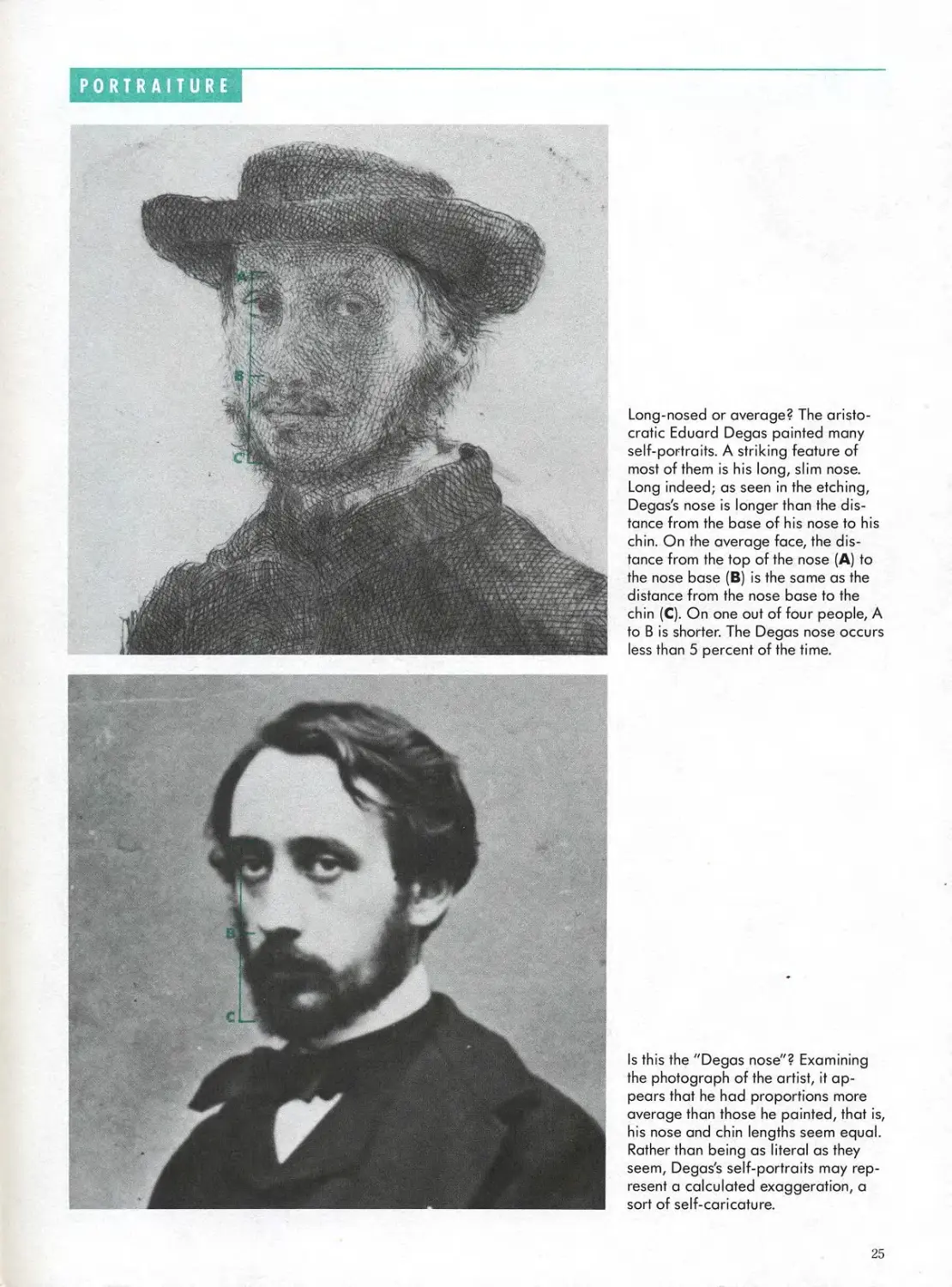
IlllliniUlI
self-portraits. A striking feature of
most of them is his long, slim nose.
Long indeed; as seen in the etching,
Degas's nose is longer than the dis-
tance from the base of his nose to his
chin. On the average face, the dis-
to В is shorter. The Degas nose occurs
less than 5 percent of the time.
Is this the "Degas nose"? Examining
the photograph of the artist, it ap-
pears that he had proportions more
Rather than being as literal as they
seem, Degas's self-portraits may rep-
resent a calculated exaggeration, a
sort of self-caricature.
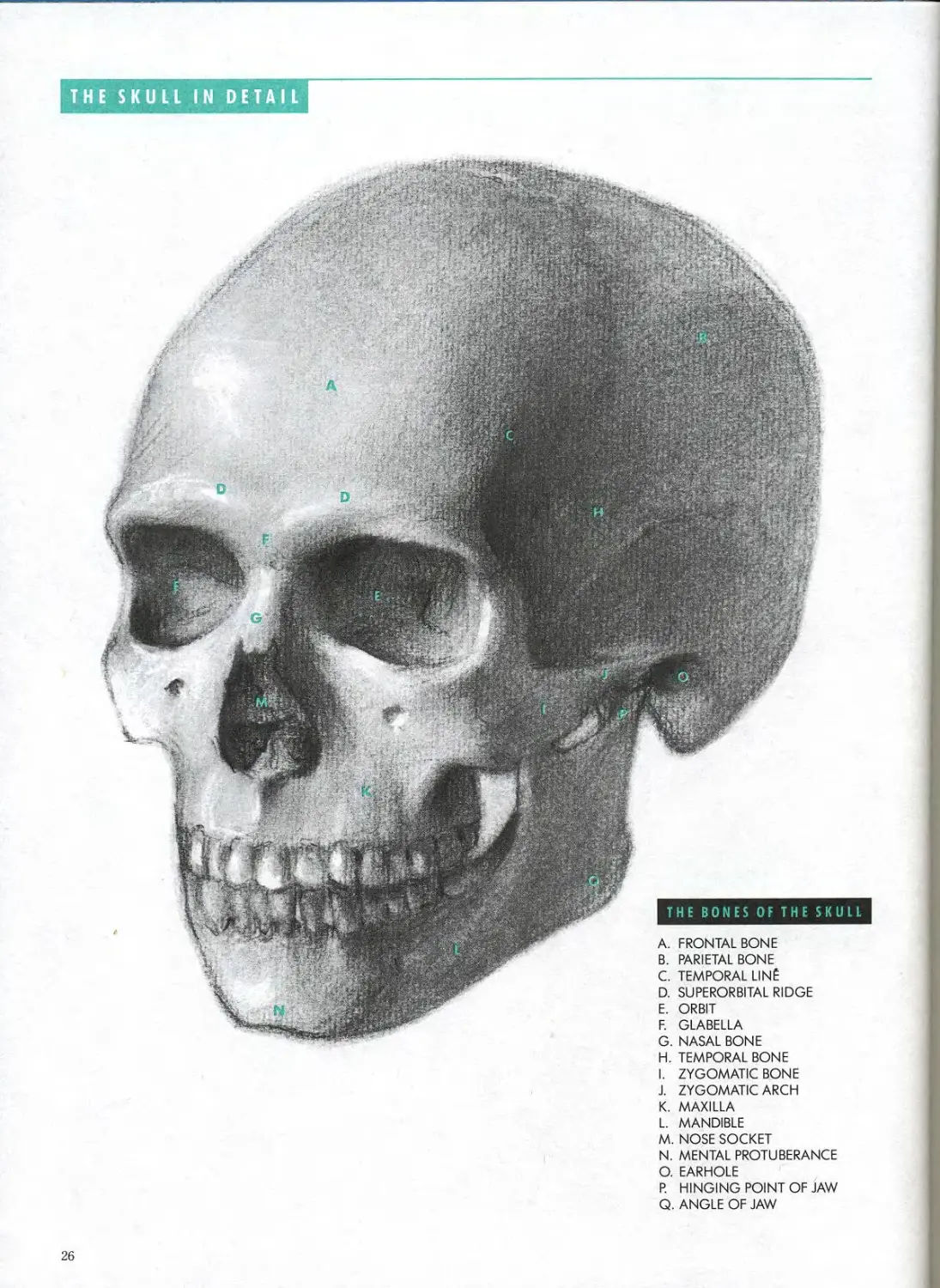
H.	TEMPORAL BONE
I.	ZYGOMATIC BONE
J.	ZYGOMATIC ARCH
K.	MAXILLA
L MANDIBLE
M.	NOSE SOCKET
N.	MENTAL PROTUBERANCE
O.	EARHOLE
P.	HINGING POINT OF JAW
Q.	ANGLE OF JAW
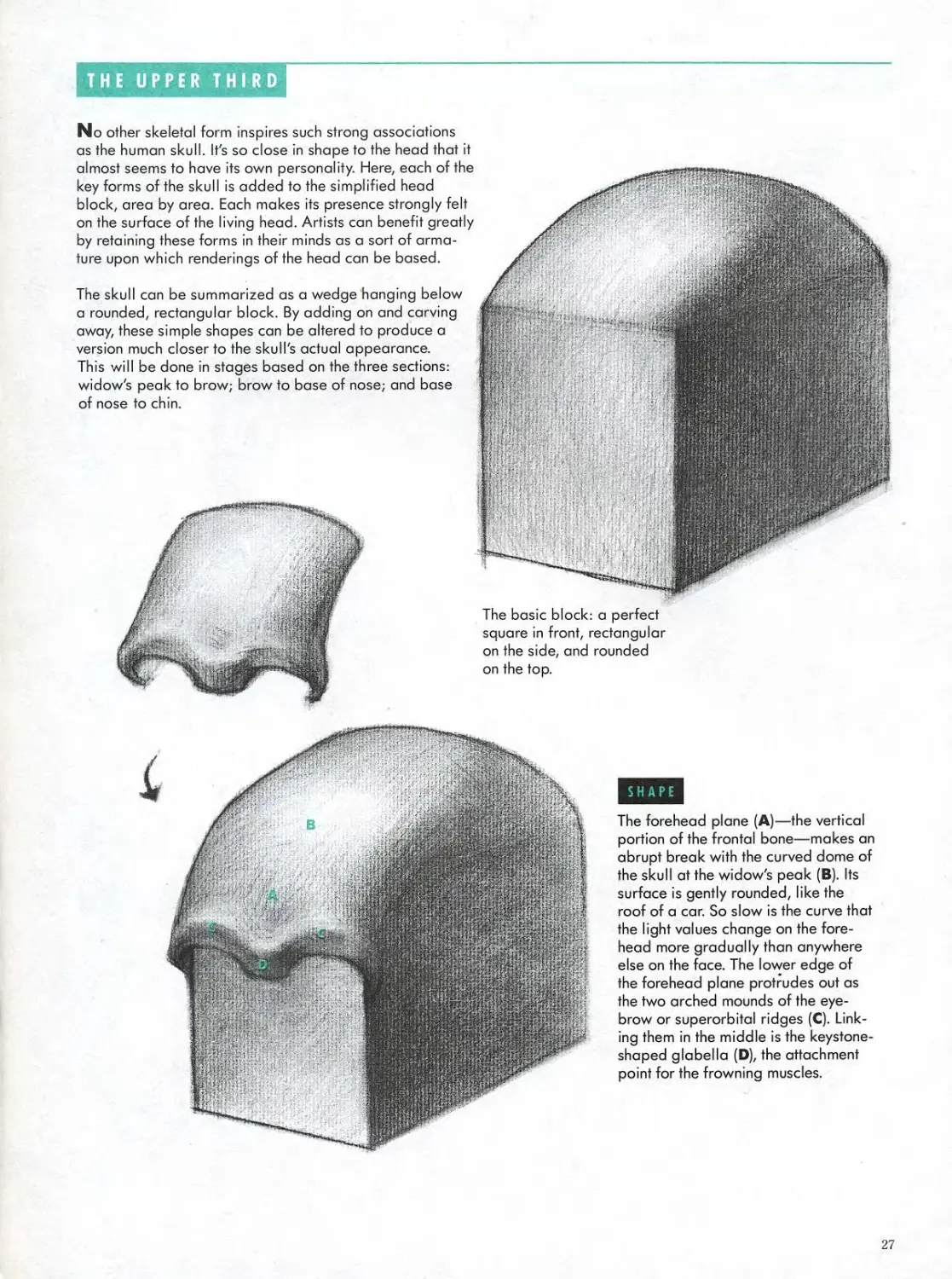
No other skeletal form inspires such strong associations
as the human skull. It's so close in shape to the head that it
almost seems to have its own personality. Here, each of the
key forms of the skull is added to the simplified head
block, area by area. Each makes its presence strongly felt
on the surface of the living head. Artists can benefit greatly
by retaining these forms in their minds as a sort of arma-
The skull can be summarized as a wedge hanging below
version much closer to the skull's actual appearance.
This will be done in stages based on the three sections:
of nose to chin.
The forehead plane (A)—the vertical
portion of the frontal bone—makes an
abrupt break with the curved dome of
the skull at the widow's peak (B). Its
roof of a car. So slow is the curve that
the light values change on the fore-
head more gradually than anywhere
else on the face. The lower edge of
the forehead plane protrudes out as
the two arched mounds of the eye-
brow or superorbital ridges (C). Link-
ing them in the middle is the keystone-
shaped glabella (D), the attachment
point for the frowning muscles.
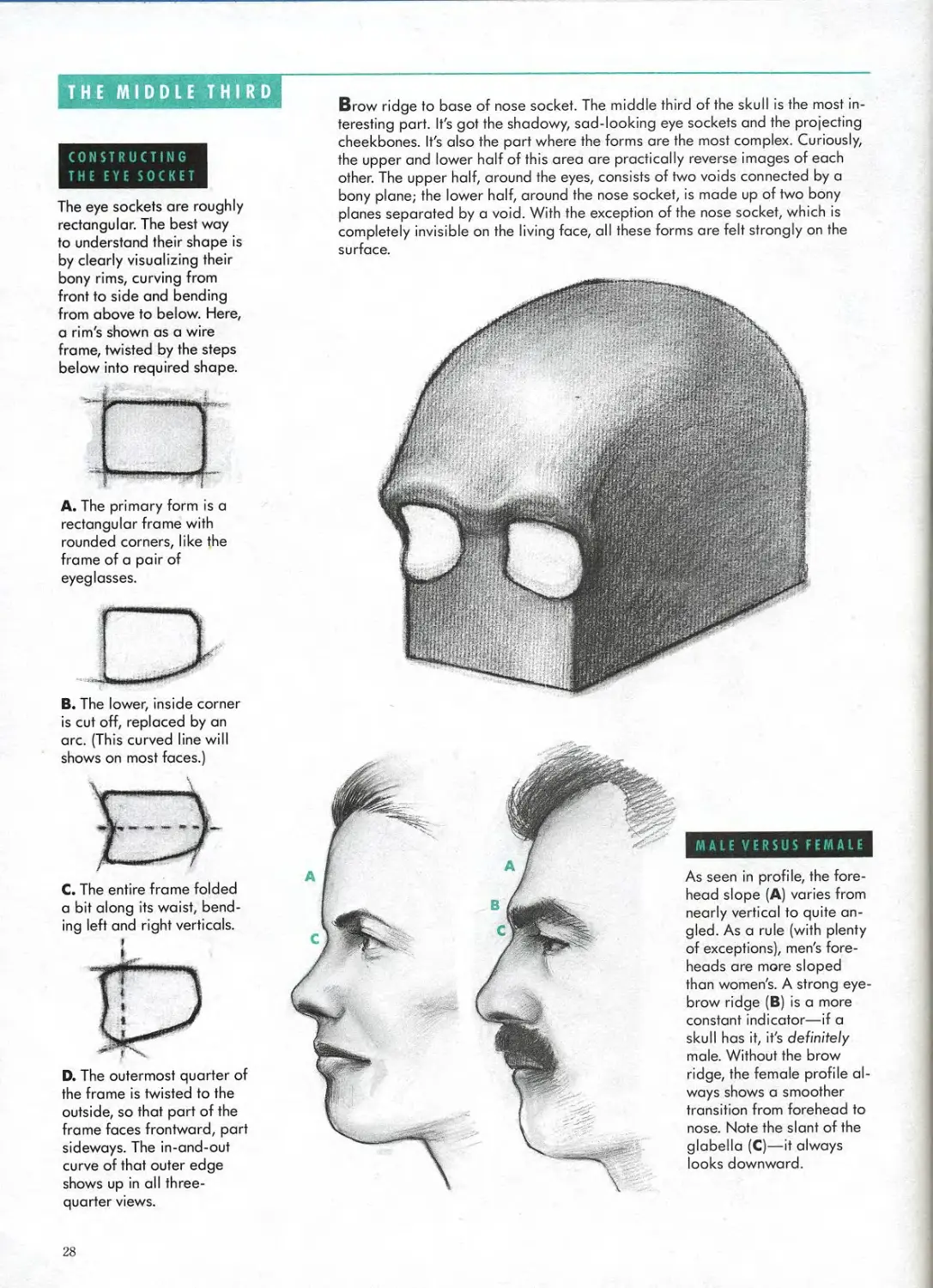
CONSTRUCTING
THE EYE SOCKET
The eye sockets are roughly
rectangular. The best way
to understand their shape is
by clearly visualizing their
bony rims, curving from
front to side and bending
from above to below. Here,
a rim's shown as a wire
frame, twisted by the steps
below into required shape.
Brow ridge to base of nose socket. The middle third of the skull is the most in-
teresting part. It's got the shadowy, sad-looking eye sockets and the projecting
cheekbones. It's also the part where the forms are the most complex. Curiously,
the upper and lower half of this area are practically reverse images of each
other. The upper half, around the eyes, consists of two voids connected by a
bony plane; the lower half, around the nose socket, is made up of two bony
planes separated by a void. With the exception of the nose socket, which is
completely invisible on the living face, all these forms are felt strongly on the
rectangular frame with
rounded corners, like the
frame of a pair of
eyeglasses.
B. The lower, inside corner
is cut off, replaced by an
arc. (This curved line will
shows on most faces.)
C. The entire frame folded
ing left and right verticals.
D. The outermost quarter of
the frame is twisted to the
outside, so that part of the
frame faces frontward, part
curve of that outer edge
As seen in profile, the fore-
head slope (A) varies from
gled. As a rule (with plenty
than women's. A strong eye-
brow ridge (B) is a more
constant indicator—if a
skull has it, it's definitely
ways shows a smoother
transition from forehead to
nose. Note the slant of the
glabella (C)—it always
looks downward.
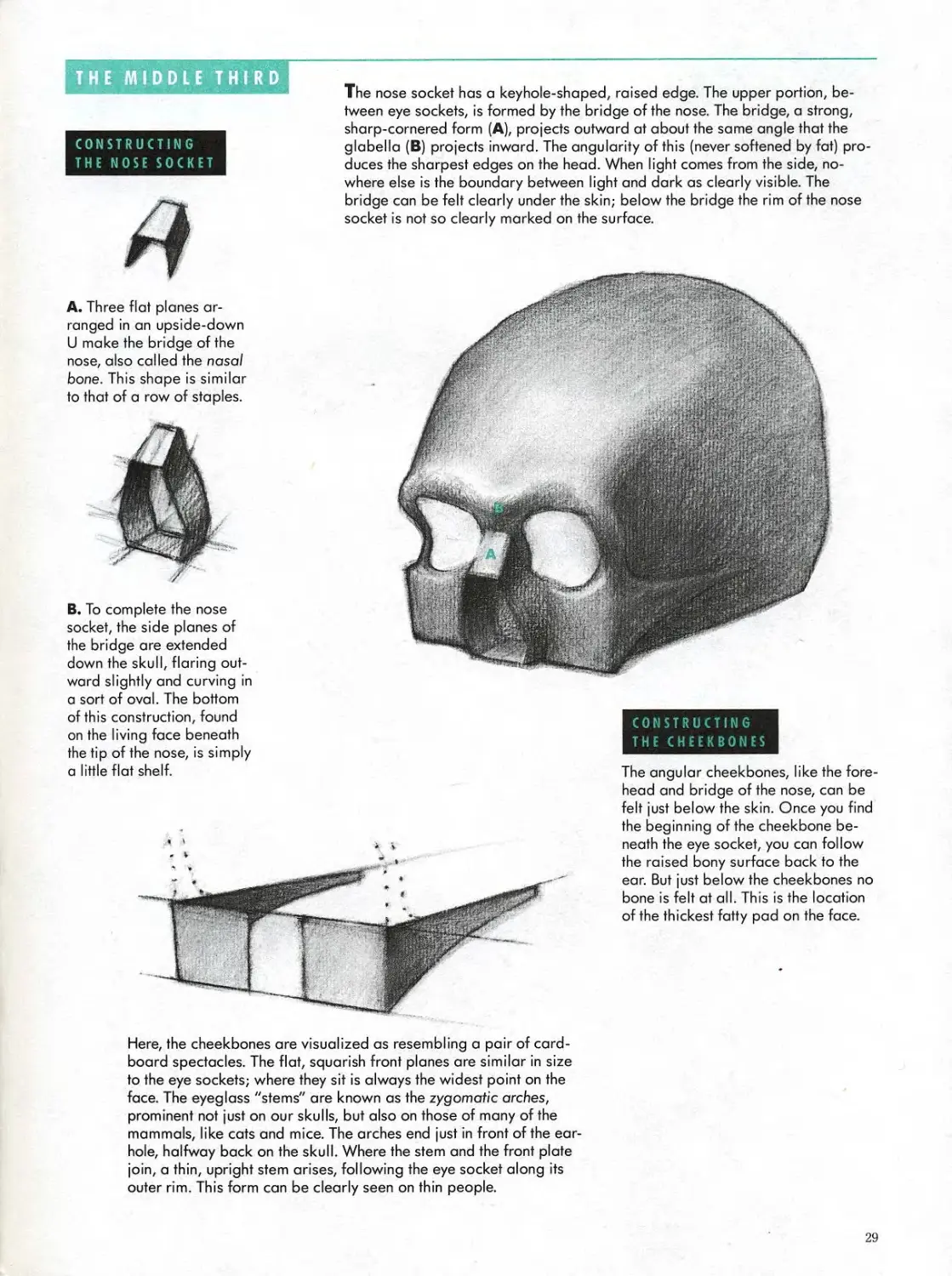
A. Three flat planes ar-
ranged in an upside-down
U make the bridge of the
nose, also called the nasal
bone. This shape is similar
CONSTRUCTING
THE NOSE SOCKET
The nose socket has a keyhole-shaped, raised edge. The upper portion, be-
tween eye sockets, is formed by the bridge of the nose. The bridge, a strong,
sharp-cornered form (A), projects outward at about the same angle that the
glabella (B) projects inward. The angularity of this (never softened by fat) pro-
duces the sharpest edges on the head. When light comes from the side, no-
where else is the boundary between light and dark as clearly visible. The
bridge can be felt clearly under the skin; below the bridge the rim of the nose
socket is not so clearly marked on the surface.
B. To complete the nose
socket, the side planes of
the bridge are extended
on the living face beneath
the tip of the nose, is simply
a little flat shelf.
CONSTRUCTING
THE CHEEKBONES
The angular cheekbones, like the fore-
head and bridge of the nose, can be
the raised bony surface back to the
ear. But just below the cheekbones no
bone is felt at all. This is the location
of the thickest fatty pad on the face.
Here, the cheekbones are visualized as resembling a pair of card-
board spectacles. The flat, squarish front planes are similar in size
to the eye sockets; where they sit is always the widest point on the
face. The eyeglass "stems" are known as the zygomatic arches,
prominent not just on our skulls, but also on those of many of the
mammals, like cats and mice. The arches end just in front of the ear-
hole, hallway back on the skull. Where the stem and the front plate

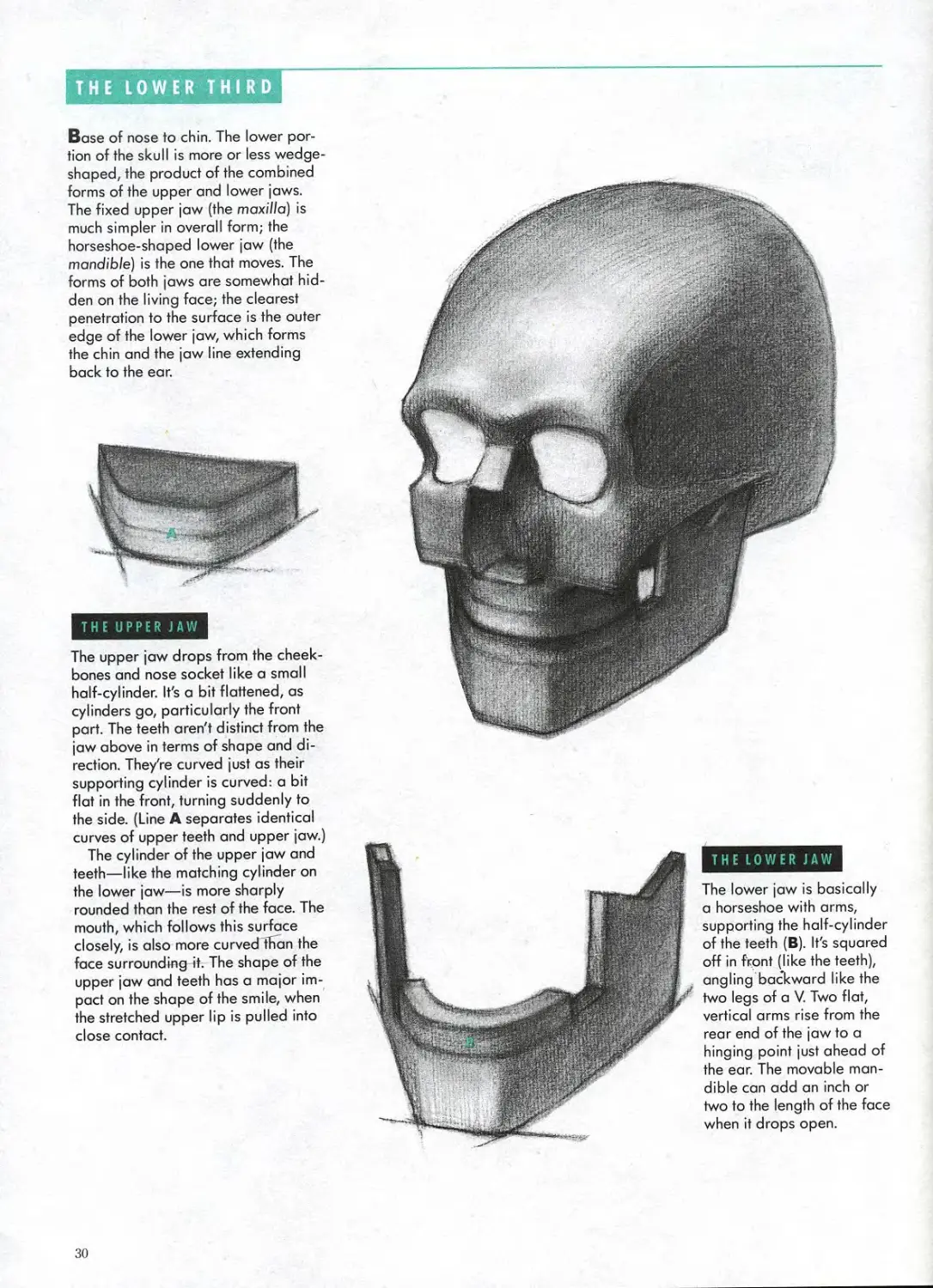
THE LOWER THIRD
Base of nose to chin. The lower por-
tion of the skull is more or less wedge-
shaped, the product of the combined
forms of the upper and lower jaws.
The fixed upper jaw (the maxilla) is
horseshoe-shaped lower jaw (the
mandible) is the one that moves. The
forms of both jaws are somewhat hid-
den on the living face; the clearest
penetration to the surface is the outer
the chin and the jaw line extending
back to the ear.
The upper jaw drops from the cheek-
bones and nose socket like a small
half-cylinder. It's a bit flattened, as
cylinders go, particularly the front
part. The teeth aren't distinct from the
rection. They're curved just as their
flat in the front, turning suddenly to
the side. (Line A separates identical
curves of upper teeth and upper jaw.)
The cylinder of the upper jaw and
teeth—like the matching cylinder on
the lower jaw—is more sharply
rounded than the rest of the face. The
mouth, which follows this surface
closely, is also more curved than the
face surrounding it. The shape of the
upper jaw and teeth has a major im-
pact on the shape of the smile, when
the stretched upper lip is pulled into
close contact.
The lower jaw is basically
a horseshoe with arms,
supporting the half-cylinder
of the teeth (B). It's squared
off in front (like the teeth),
angling backward like the
two legs of a V. Two flat,
vertical arms rise from the
rear end of the jaw to a
hinging point just ahead of
the ear. The movable man-
dible can add an inch or
two to the length of the face
when it drops open.
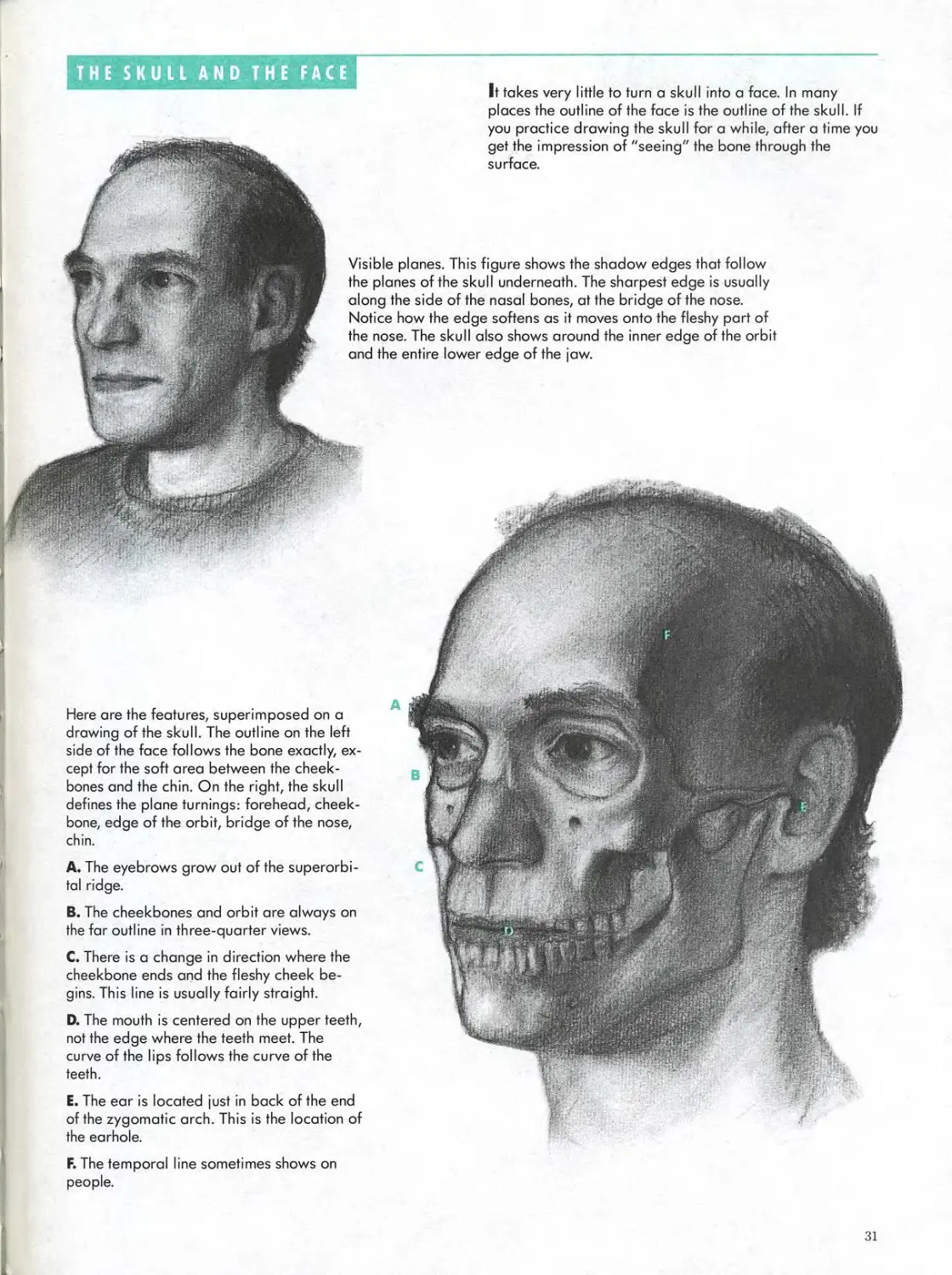
get the impression of "seeing" the bone through the
surface.
Visible planes. This figure shows the shadow edges that follow
the planes of the skull underneath. The sharpest edge is usually
along the side of the nasal bones, at the bridge of the nose.
Notice how the edge softens as it moves onto the fleshy part of
the nose. The skull also shows around the inner edge of the orbit
and the entire lower edge of the jaw.
Here are the features, superimposed on a
drawing of the skull. The outline on the left
tai ridge.
B. The cheekbones and orbit are always on
the far outline in three-quarter views.
C. There is a change in direction where the
cheekbone ends and the fleshy cheek be-
gins. This line is usually fairly straight.
teeth.
E, The ear is located just in back of the end
people.
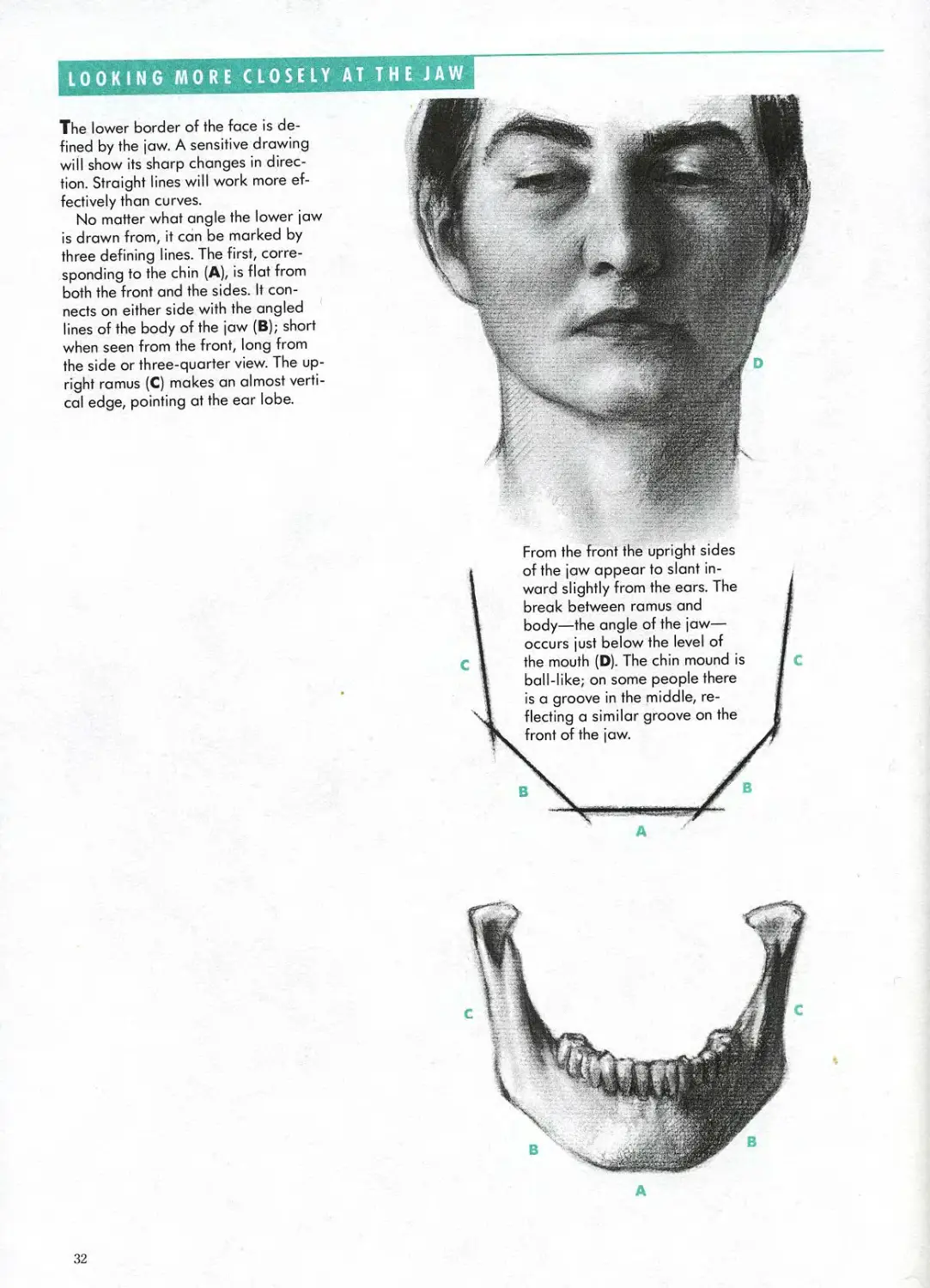
LOOKING MORE CLOSELY AT THE JAW
The lower border of the face is de-
fined by the jaw. A sensitive drawing
will show its sharp changes in direc-
tion. Straight lines will work more ef-
fectively than curves.
No matter what angle the lower jaw
is drawn from, it can be marked by
three defining lines. The first, corre-
sponding to the chin (A), is flat from
both the front and the sides. It con-
nects on either side with the angled
lines of the body of the jaw (B); short
when seen from the front, long from
the side or three-quarter view. The up-
right ramus (C) makes an almost verti-
cal edge, pointing at the ear lobe.
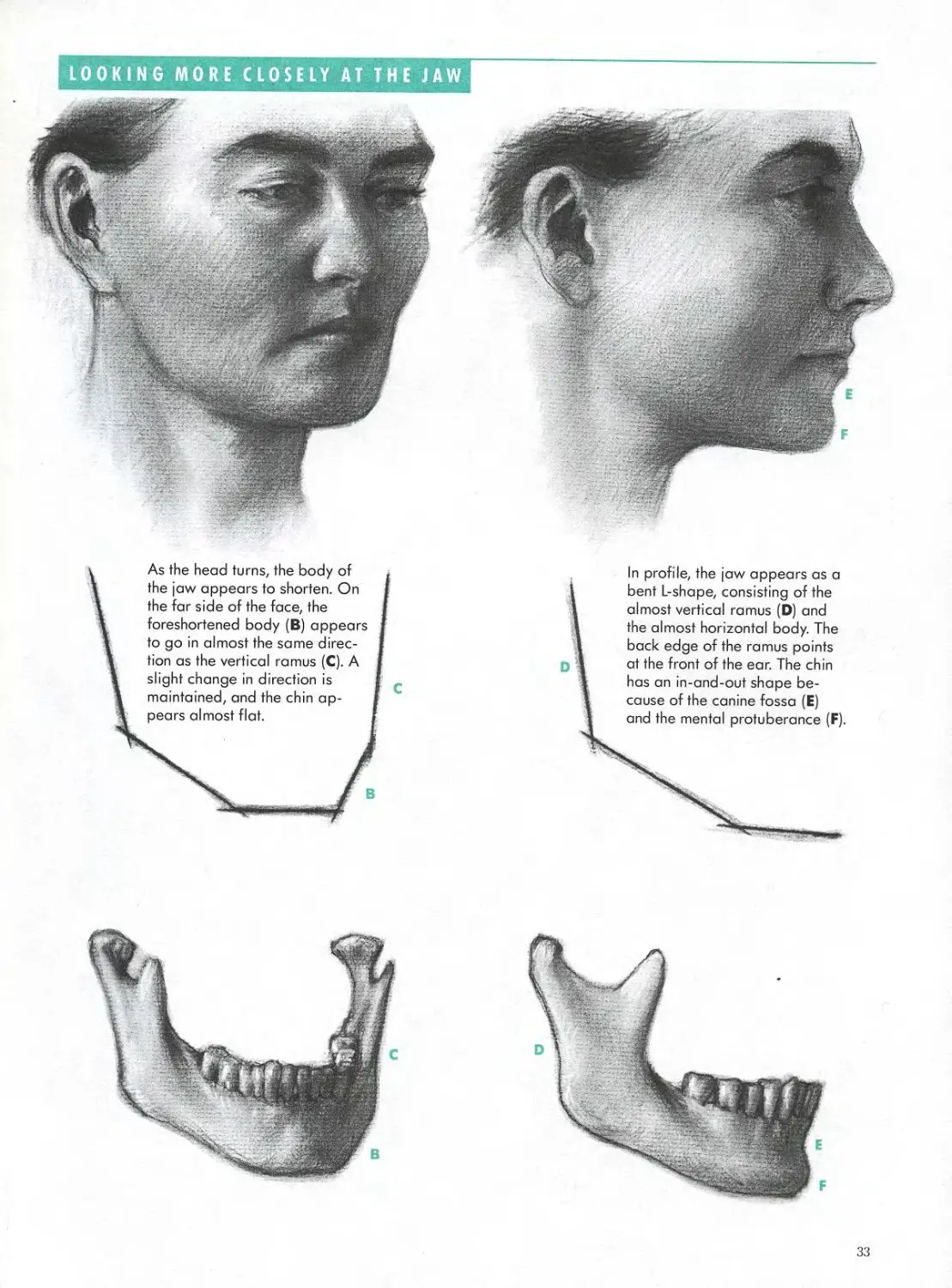
LOOKING MORE CLOSELY AT THE JAW
As the head turns, the body of
the jaw appears to shorten. On
the far side of the face, the
foreshortened body (B) appears
to go in almost the same direc-
tion as the vertical ramus (C). A
slight change in direction is
maintained, and the chin ap-
pears almost flat.
In profile, the jaw appears as a
bent L-shape, consisting of the
almost vertical ramus (D) and
the almost horizontal body. The
back edge of the ramus points
at the front of the ear. The chin
has an in-and-out shape be-
cause of the canine fossa (E)
and the mental protuberance (F).

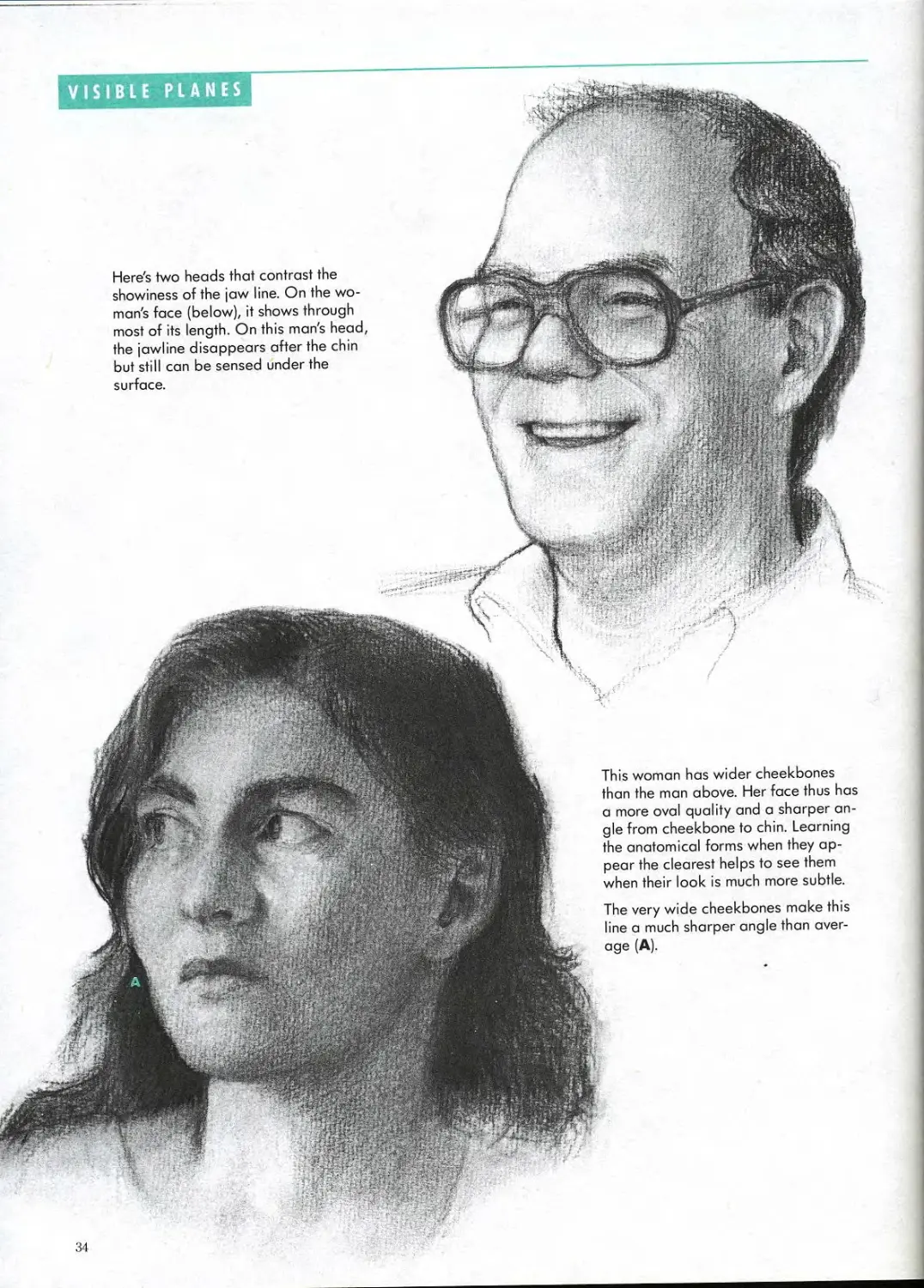
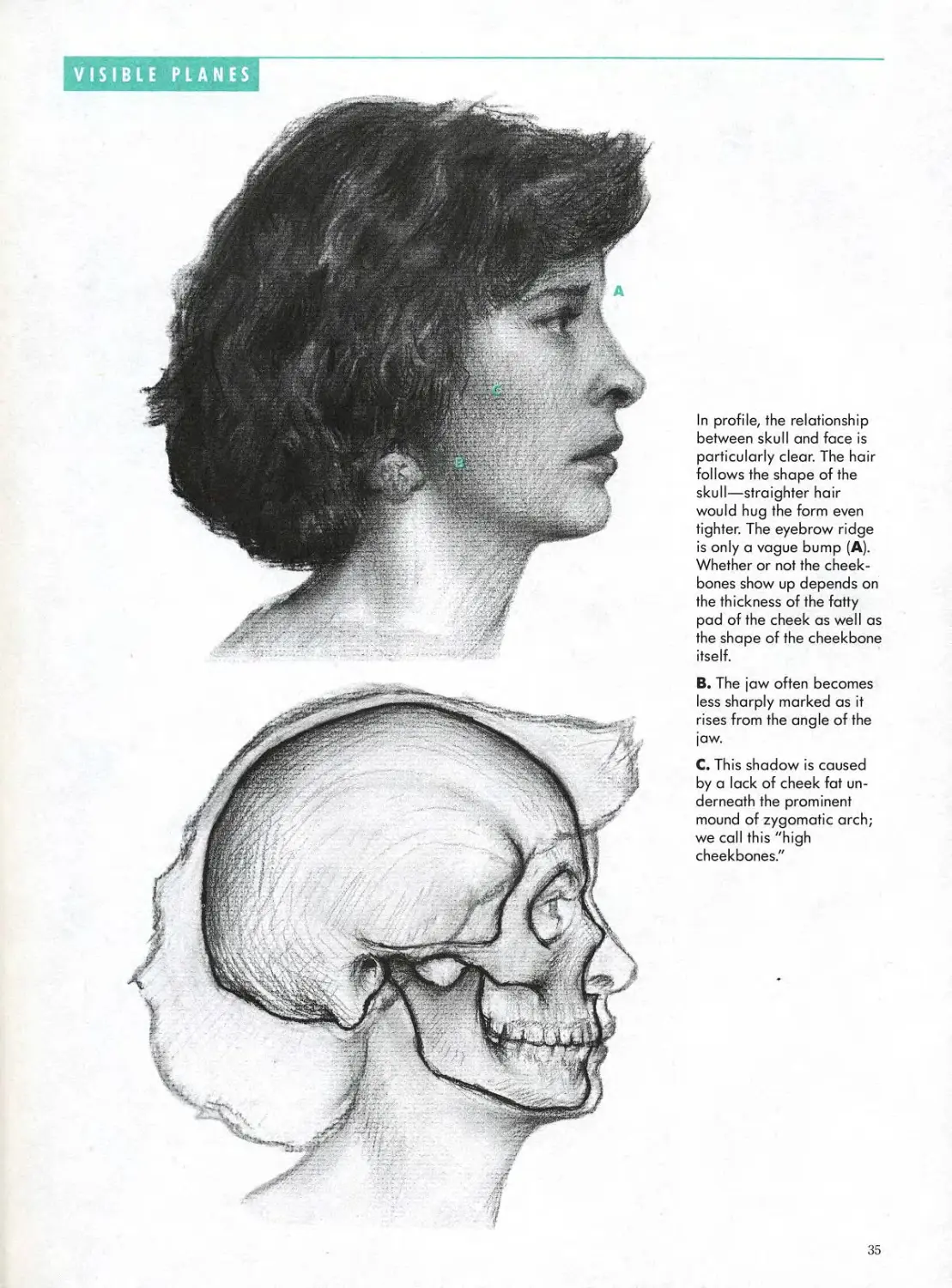
between skull and face is
particularly clear. The hair
follows the shape of the
skull—straighter hair
the thickness of the fatty
pad of the cheek as well as
the shape of the cheekbone
we call this "high
cheekbones."
CONSTRUCTING
THE FEATURES
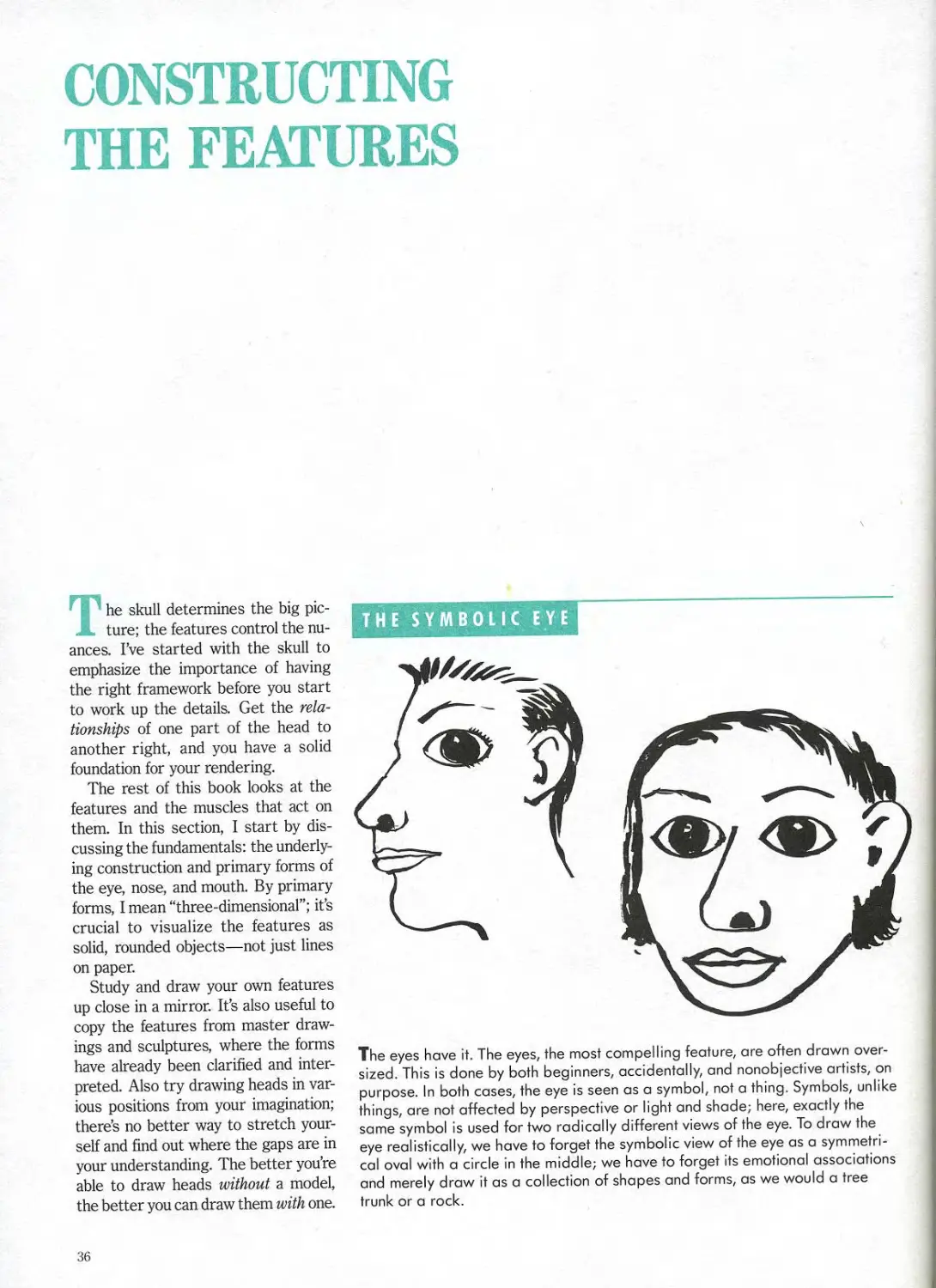
The skull determines the big pic-
ture; the features control the nu-
ances. I’ve started with the skull to
emphasize the importance of having
the right framework before you start
to work up the details. Get the rela-
tionships of one part of the head to
another right, and you have a solid
foundation for your rendering.
The rest of this book looks at the
features and the muscles that act on
them. In this section, I start by dis-
cussing the fundamentals: the underly-
ing construction and primary forms of
the eye, nose, and mouth. By primary
forms, I mean “three-dimensional”; it’s
crucial to visualize the features as
solid, rounded objects—not just lines
Study and draw your own features
up close in a mirror. It’s also useful to
copy the features from master draw-
ings and sculptures, where the forms
have already been clarified and inter-
preted. Also try drawing heads in var-
ious positions from your imagination;
there’s no better way to stretch your-
self and find out where the gaps are in
your understanding. The better you’re
able to draw heads without a model,
the better you can draw them with one.
The Eye
The eye is both the most important
feature and the most difficult one to
draw. Students fuss over the rendering
of the eye in their drawings, and
they’re right: a poorly drawn eye will
make an otherwise tolerable portrait
look amateurish. Why does the eye
present such a challenge?
Part of the problem is psychological.
We are so engrossed in our preconcep-
from an idea rather than what we actu-
ally see. We conceive of the eye as
important, so we draw it too large; we
think of the eye as symmetrical and
flat, and so it appears in drawings.
Part of the problem is more mun-
dane. Under usual circumstances—
say, in a drawing class—we’re simply
too far from the eye to see very much
detail. To make matters worse, the eye
is the part of the face most often in
shadow, further hiding the forms. But
watch two people drawing the same
model from the same distance and
learn a valuable lesson. The more-
experienced artist will draw on a men-
tal image of the eye to make up for the
limited amount actually visible, not un-
like the way a computer “enhances” a
photograph from a distant planetary
probe, filling in what’s left out, making
educated guesses. The less-
experienced person can only draw
what is visible, with no help from the
experienced imagination. The results
will show the difference. A good ren-
dering of the eye, then, is based on a
combination of prior knowledge and di-
Starting with the Sphere
Here’s one of the main things that prior
knowledge will tell you: the eye is
round, not flat! Imagine cutting a small
slit into a piece of soft leather cloth,
then holding the cloth tight over a table
tennis ball. The cloth will mold itself
around it like lines of latitude on a
globe. The eyeball is in fact an exact
duplicate of the table tennis ball in size
and shape, and the cloth acts like the
eyelids, molding around the ball.
From most views, and on most
faces, the ball of the eye makes itself
felt: in the curving path of the lid rims
as they arc from corner to corner; in
the fullness of the lids themselves; and
in the way light plays over the whole,
revealing the roundness of the lids and
the exposed eyeball.
Try looking at your own eye in a
mirror as you move your head back and
forth and up and down; you’ll notice
that the eyelids always stay pressed
tight against the eye and follow its
curves no matter how it moves. Raise
your eyebrows as high as you can and
look at the upper lid—the ball under-
neath becomes vividly apparent. Gen-
tly feel your eye and the surfaces
around it for the limits of ball and bone.
If you want to master the drawing of
the eye, grab a ball from your closet,
set it on a table in good side lighting
(one well-defined shadow zone, one
well-defined zone of light), and draw it
until it looks round. (You’ll know when
you’ve succeeded.) You have to be able
to shade such a sphere before you can
shade an eye.
Going beyond the Mass
Conceptions_________________________
The first part of going beyond the sym-
bolic eye is observing its roundness;
the second part is getting beyond sym-
metry. A well-drawn eye shouldn’t look
like it could be turned upside down and
work just as well. The upper and lower
eyelids, and the border they make
along the eye, are quite different from
each other. The inner half of the eye is
shaped differently from the outer.
Fortunately, there.are some predict-
able ways that the eye is irregular in it’s
shape. The eye’s not horizontal: The in-
ner corner of the eye is situated a little
lower down the face than the outer
corner. This arrangement has practical
value: tears, which are constantly
moistening the eye’s surface, move
downward to their drain, the little red
gland in the inner corner. So just like in
a bathtub, the drain in the inner eye
comer is located at the lowest point of
the eye.
Though the lids are both arched,
they do not get to the peak of their arcs
at the same point. The upper lid rises
sharply from the inner comer, curving
more slowly down to the outer (it’s not
as far down); the lower lid is very flat at
first, dipping low further to the out-
side. The high point of the upper lid
and the low point of the lower are diag-
onally across from each other.
The Iris and Pupil_______________
The colored portion of the eye, the iris,
is centered around a circular opening,
the pupil. Even if the iris is partly hid-
den, the pupil must be in the middle of
the entire, and not just the visible,
When you draw the iris, be sure to
judge its real size relative to the eye-
whites surrounding it; there is a ten-
good rule is that the iris, in the adult
eye, is always about one-third the
width of the entire eye opening. One
problem with making it too big is that
you give whomever you’ve drawn an
infantile look; babies have huge-
appearing irises because their eye slit
isn’t wide enough to show much of the
rest of the eye. When the face grows,
the apparent size of the iris shrinks.
This just gets us started with the
and subtle ways the eye changes to
accompany our various moods.
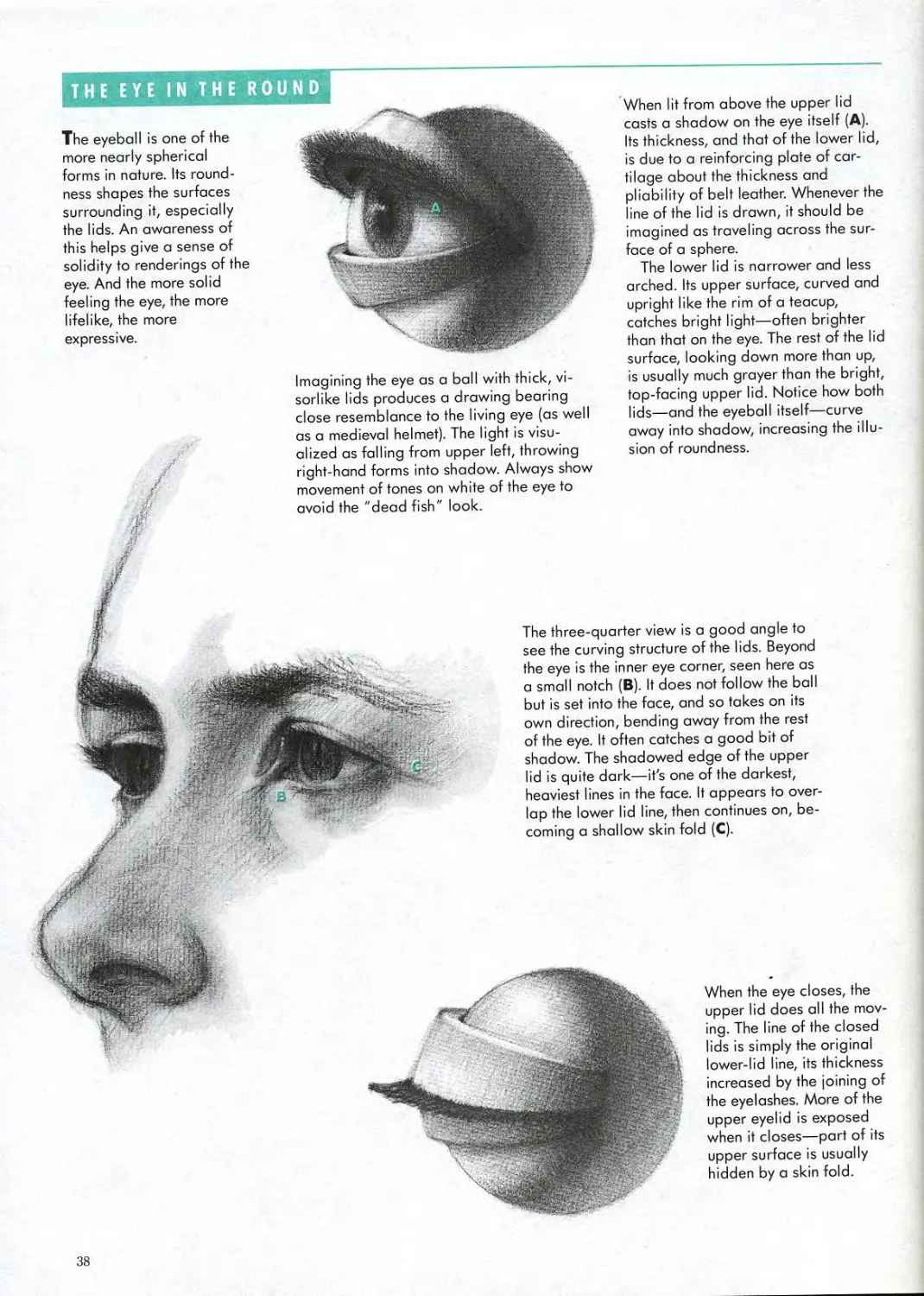
The eyeball is one of the
more nearly spherical
surrounding it, especially
the lids. An awareness of
this helps give a sense of
solidity to renderings of the
eye. And the more solid
feeling the eye, the more
lifelike, the more
expressive.
Imagining the eye as a ball with thick, vi-
sorlike lids produces a drawing bearing
close resemblance to the living eye (as well
as a medieval helmet). The light is visu-
alized as falling from upper left, throwing
right-hand forms into shadow. Always show
movement of tones on white of the eye to
avoid the "dead fish" look.
When lit from above the upper lid
casts a shadow on the eye itself (A).
Its thickness, and that of the lower lid,
tilage about the thickness and
pliability of belt leather. Whenever the
line of the lid is drawn, it should be
imagined as traveling across the sur-
face of a sphere.
arched. Its upper surface, curved and
upright like the rim of a teacup,
catches bright light—often brighter
than that on the eye. The rest of the lid
surface, looking down more than up,
is usually much grayer than the bright,
top-facing upper lid. Notice how both
lids—and the eyeball itself—curve
sion of roundness.
The three-quarter view is a good angle to
see the curving structure of the lids. Beyond
the eye is the inner eye corner, seen here as
a small notch (B). It does not follow the ball
but is set into the face, and so takes on its
own direction, bending away from the rest
of the eye. It often catches a good bit of
shadow. The shadowed edge of the upper
lid is quite dark—it's one of the darkest,
heaviest lines in the face. It appears to over-
lap the lower lid line, then continues on, be-
coming a shallow skin fold (C).
When the eye closes, the
upper lid does all the mov-
ing. The line of the closed
lids is simply the original
lower-lid line, its thickness
increased by the joining of
the eyelashes. More of the
upper eyelid is exposed
when it closes—part of its
upper surface is usually
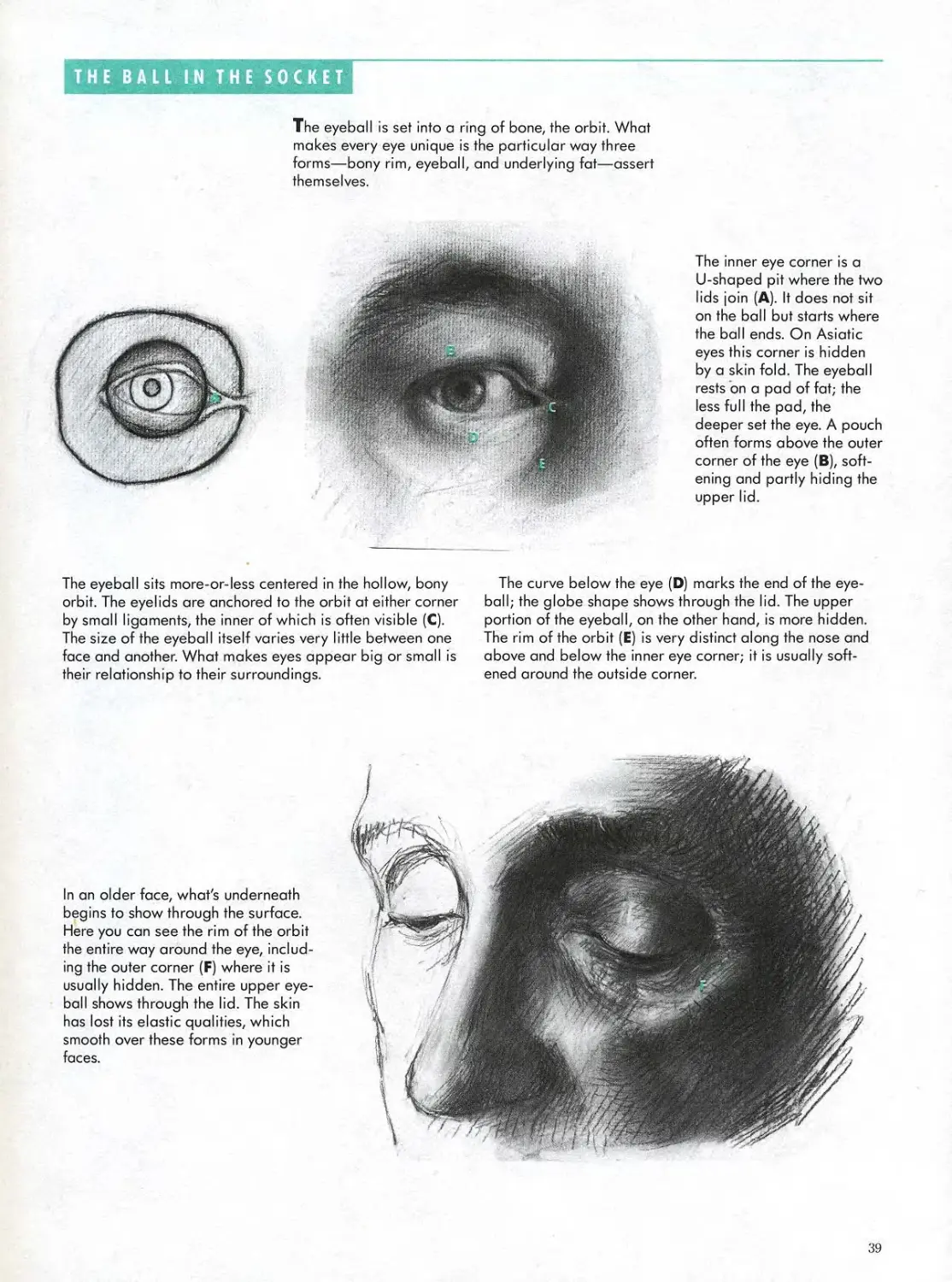
The eyeball is set into a ring of bone, the orbit. What
makes every eye unique is the particular way three
themselves.
The inner eye corner is a
lids join (A). It does not sit
the ball ends. On Asiatic
eyes this corner is hidden
by a skin fold. The eyeball
rests on a pad of fat; the
less full the pad, the
deeper set the eye. A pouch
often forms above the outer
upper lid.
The eyeball sits more-or-less centered in the hollow, bony
orbit. The eyelids are anchored to the orbit at either corner
by small ligaments, the inner of which is often visible (C).
The size of the eyeball itself varies very little between one
face and another. What makes eyes appear big or small is
their relationship to their surroundings.
ened around the outside corner.
In an older face, what's underneath
begins to show through the surface.
usually hidden. The entire upper eye-
ball shows through the lid. The skin
has lost its elastic qualities, which
smooth over these forms in younger
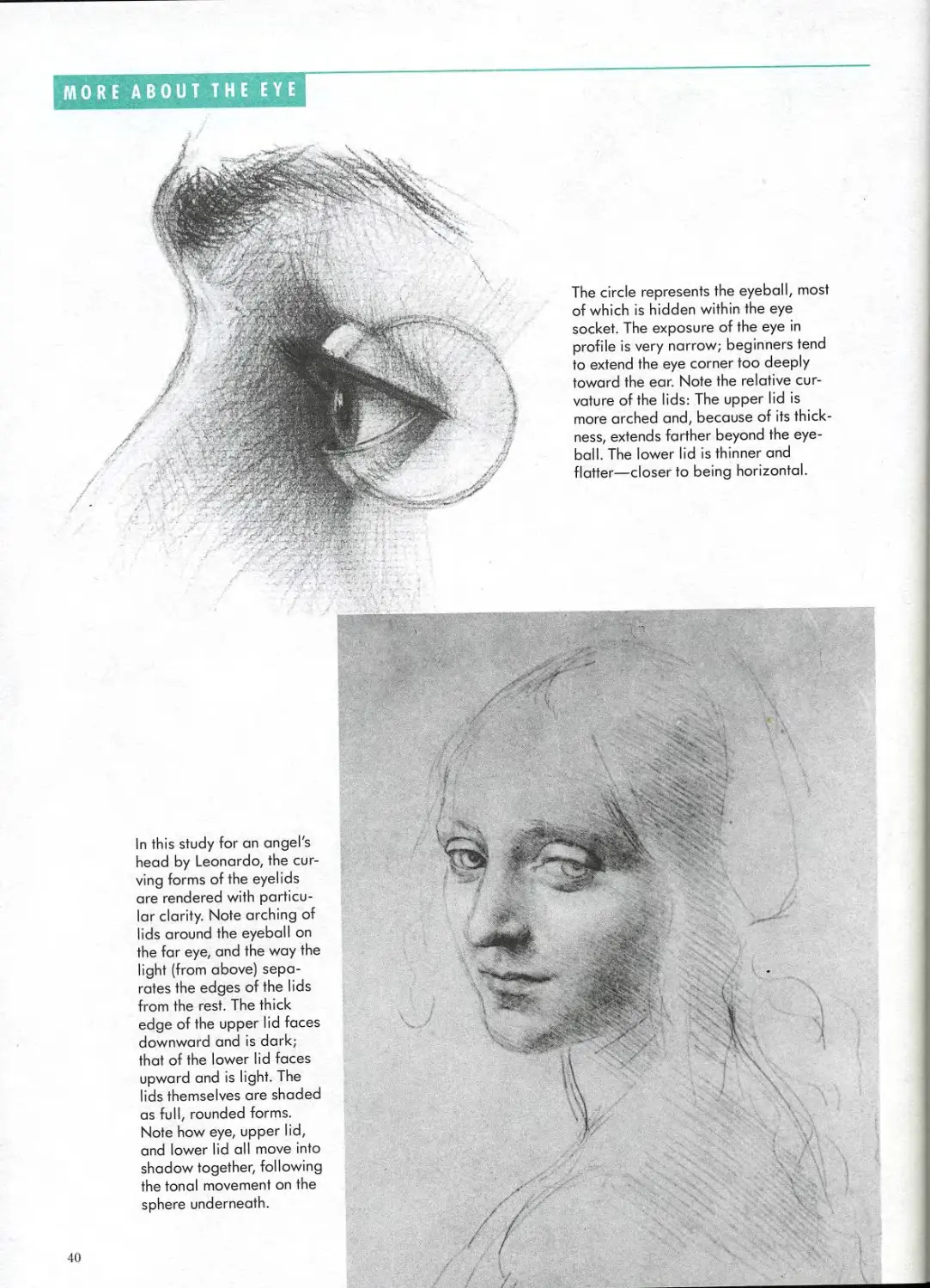
The circle represents the eyeball, most
of which is hidden within the eye
socket. The exposure of the eye in
profile is very narrow; beginners tend
to extend the eye corner too deeply
toward the ear. Note the relative cur-
vature of the lids: The upper lid is
more arched and, because of its thick-
ness, extends farther beyond the eye-
ball. The lower lid is thinner and
flatter—closer to being horizontal.
In this study for an angel's
head by Leonardo, the cur-
ving forms of the eyelids
are rendered with particu-
lar clarity. Note arching of
light (from above) sepa-
rates the edges of the lids
from the rest. The thick
edge of the upper lid faces
downward and is dark;
that of the lower lid faces
upward and is light. The
lids themselves are shaded
as full, rounded forms.
Note how eye, upper lid,
and lower lid all move into
shadow together, following
the tonal movement on the
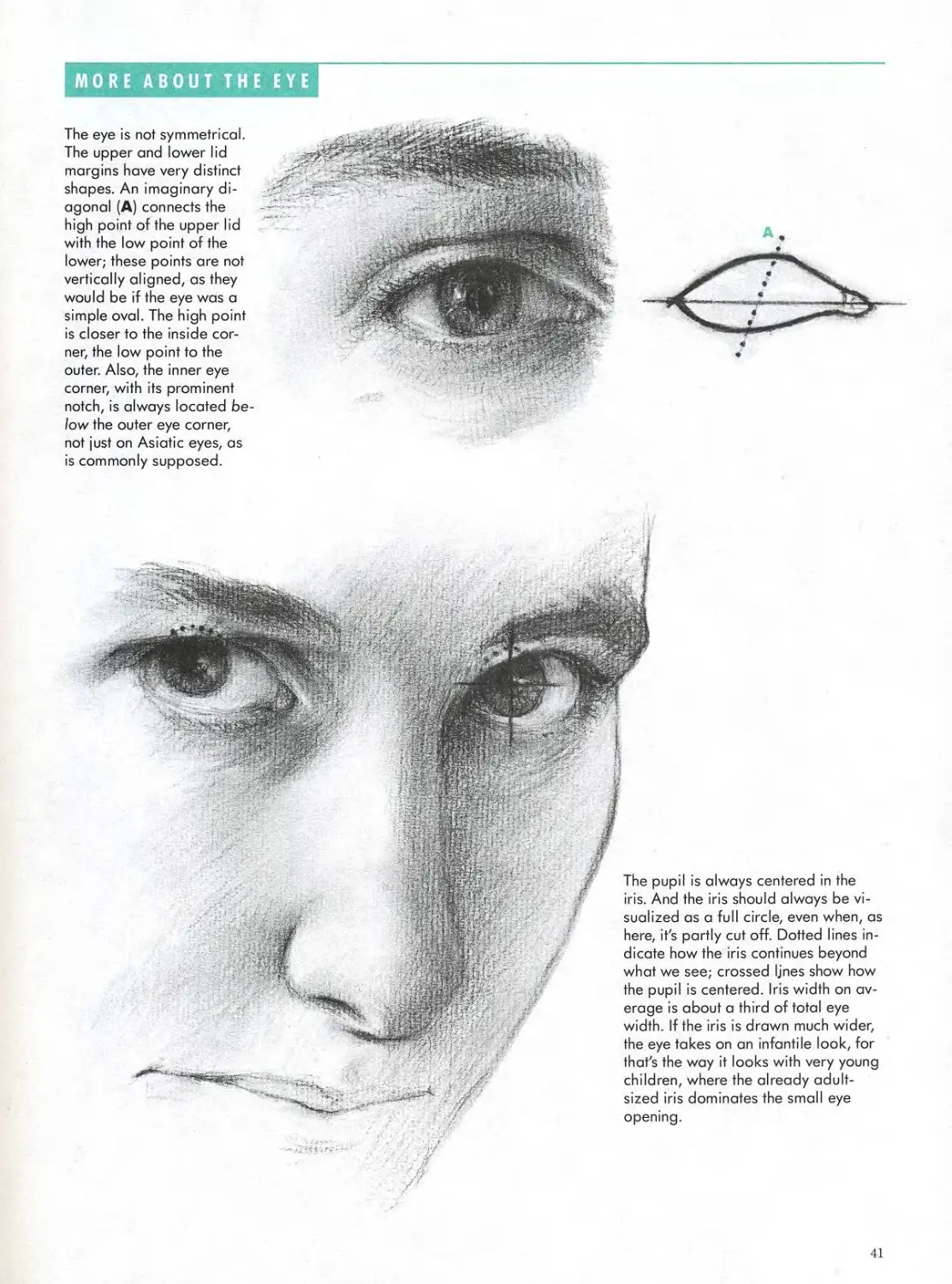
margins have very distinct
shapes. An imaginary di-
agonal (A) connects the
high point of the upper lid
with the low point of the
lower; these points are not
would be if the eye was a
simple oval. The high point
is closer to the inside cor-
ner, the low point to the
that's the way it looks with very young
opening.
The Nose
It’s hard to say too much about the eye;
when it comes to the nose, people lose
interest a little more quickly. In fact,
this lack of excitement over the nose is
carried to an extreme in fashion illus-
tration. It’s not unusual for fashion illus-
trators to omit the nose entirely, leav-
ing the more fashionable mouth and
eyes to carry on without it Even when
included, the fashion nose is often little
more than a flick of the brush.
I won’t argue that the nose is of
much account in facial expression.
Though lots of expressions drastically
affect the nose tip—smiling and sneer-
ing immediately come to mind—we do
not really react to the nose in those
faces but merely note its presence and
its contribution to the total effect. (Ac-
tually the sneering nose, at times, does
seem to be an important part of the
expression.)
The very fact that the nose has so
little to do with our emotional response
to a face ultimately makes it easier to
draw than an eye. There is less of a
tendency to see it conceptually or sym-
bolically, more ease in drawing it as just
another form. There are two main
problems people seem to have with the
rendering of the nose: constructing
the wings and the tip and making the
nose appear to come out from the face.
These problems are particularly se-
vere in the front view, where the wings
and tip are most foreshortened and the
projection of the nose is subtle.
The nose tip might be even easier to
draw if it was a bit more well defined.
At least the eyes offer obvious lines
that can be copied, like the line of the
upper lid and the line around the iris.
The nose tip, however, doesn’t present
us with any clear-cut boundaries (ex-
cept in the profile), and we can only
render it by determining those bound-
aries ourselves. And since the bound-
aries are rounded, their expression
must be tonal, not linear: shading
rather than lines.
Another Geometrical Model
When it comes to shading, nothing
helps us see where tonal changes must
occur like having a clear sense of
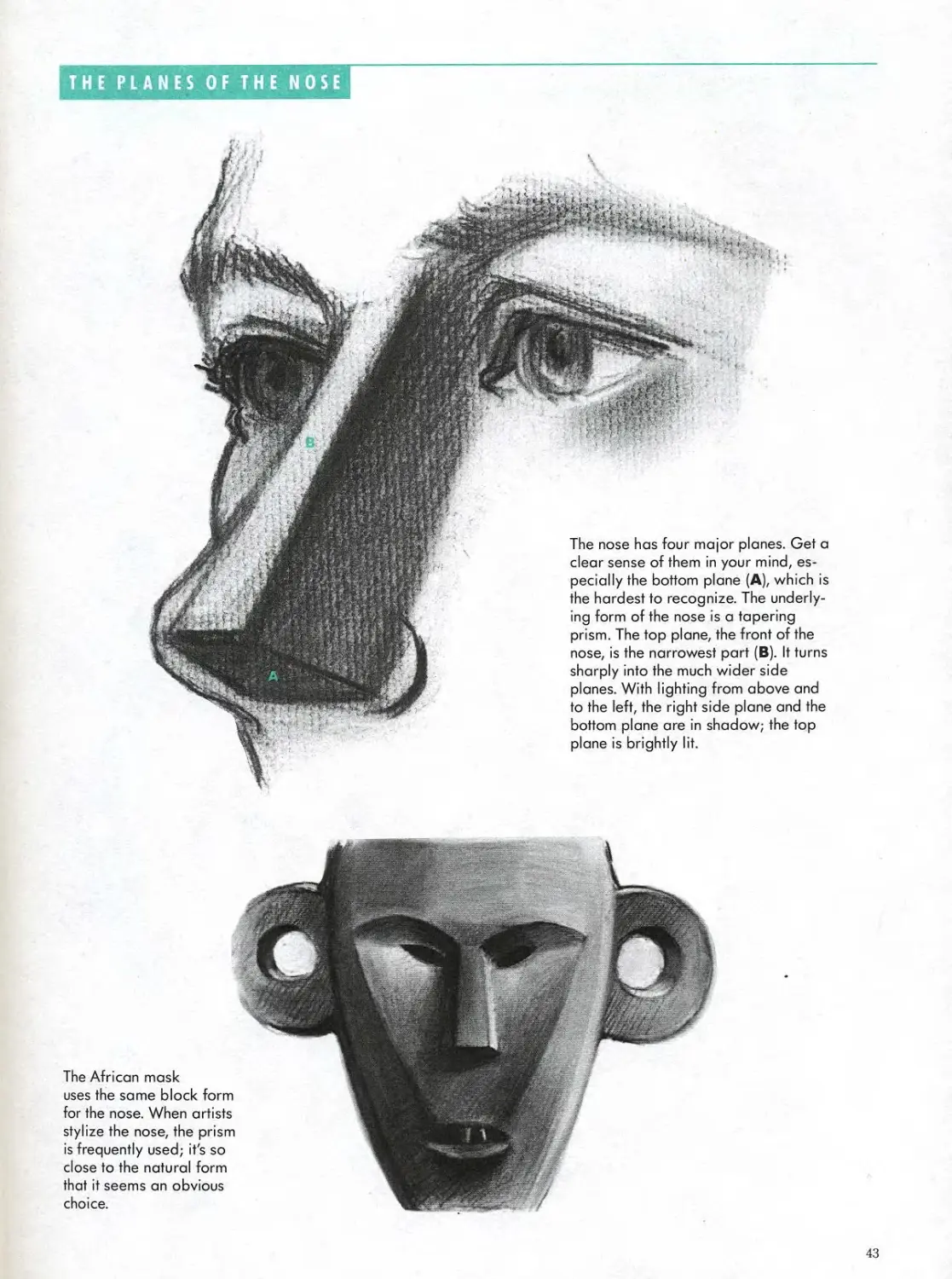
planes. The nose has four main planes.
Each plane is quite flat, and together
they form a long, wedge-shaped block,
shaped like a flat-sided brick chimney
that narrows as it rises. In the upper
portion of the nose, where the bones of
the nasal socket dominate, the sim-
plified planes of the tapered block
serve quite well as a sort of template
for rendering. We’ve already seen how
the sides of the nasal bone make a flat,
sharp turning with the front. At those
edges, and the other major edges of
the block, we look for the value
changes that will establish the nose
volume. If the light is coming from the
side, for example, one of the side walls
will always be in shadow, one will al-
ways be lit. The block helps us orga-
nize our seeing of the actual nose.
About halfway down the nose, the
simple bony planes give way to the
more complex planes of the nasal car-
tilage. The cartilage makes the tip of
the nose tricky to get right. Cartilage
is a stiff but pliable substance—it is
also found in the ear—and it varies
greatly from person to person. It is the
cartilage—not the bone—that makes
every nose so distinct.
But before we get into the details of
the nose tip, look at it again in terms of
the simple block. If you see through
the interesting detail, underneath it all
is essentially the form we’ve illus-
trated: the end of a block. The wings
and the rounded tip are just little
bumps on the large form; they’re not
large enough or defined enough to
change the overall plane movement If
the flat side plane of the nose block is in
shadow, for example, the wing and the
side of the tip on that side will be in
shadow too. The details follow the
mass.
Constructing the Tip_____________
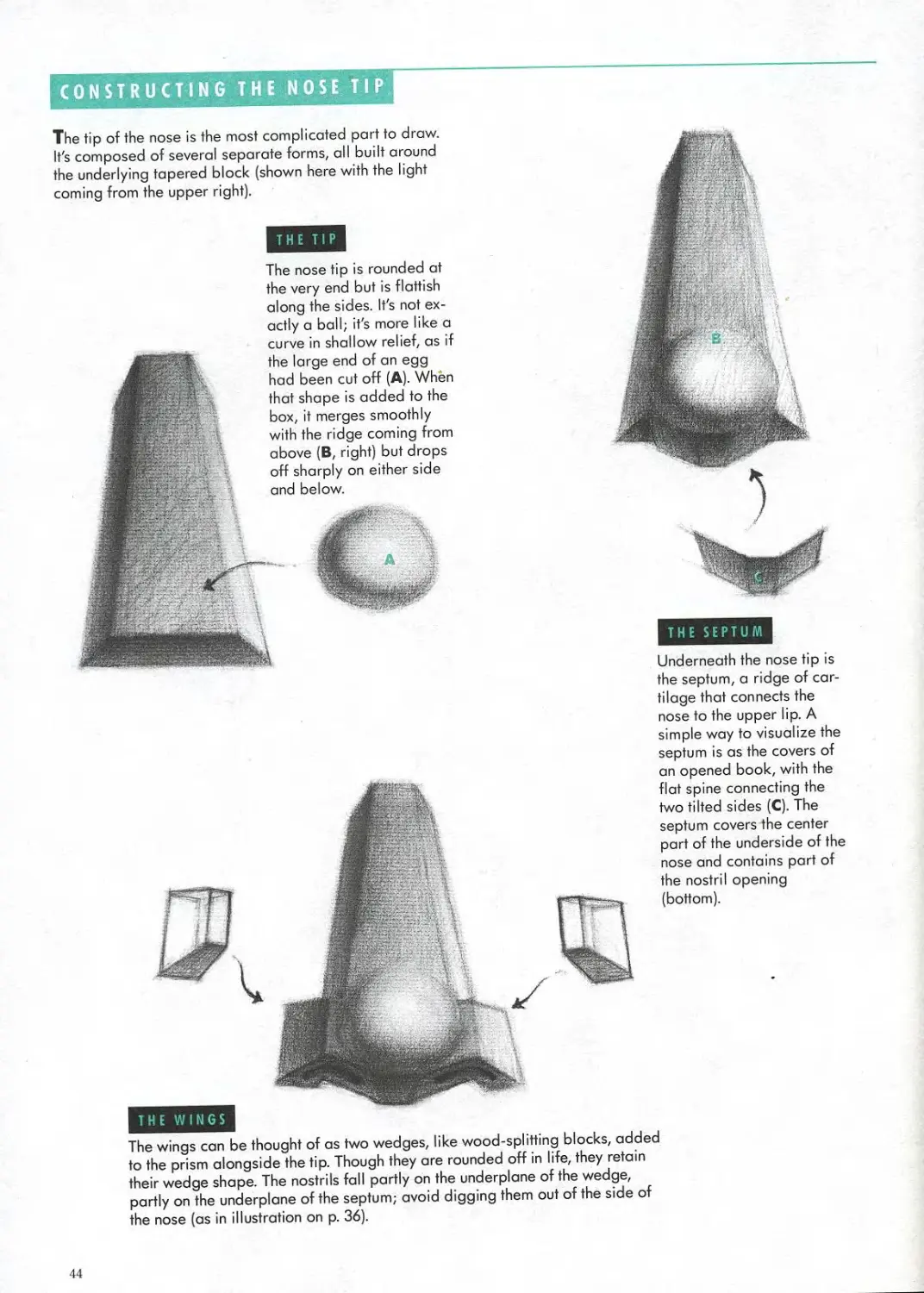
A simplified construction for the nose
builds on the block form, with separate
pieces for the septum, wings, and ball.
The ball is seen as a sort of shallow
dome added to the end of the block; the
wings as two little wedge-blocks; and
the septum as a flat, slightly folded
plane underneath the tip. Shapes that
are particularly boxy and angular are
helpful when trying to render an area
that is often a bit vague. In fact, I sug-
gest looking carefully at sculpted and
drawn heads to note how artists often
make the nose tip an extra bit chiseled
and angular to give it a more solid
presence.
Note that the nostrils are entirely
contained in downward facing planes.
Beginners tend to cut them out of the
sides of the nose—a major anatomical
faux pas.
42

The tip of the nose is the most complicated part to draw,
the underlying tapered block (shown here with the light
The nose tip is rounded at
along the sides. It's not ex-
actly a ball; it's more like a
(bottom).
The wings can be thought of as two wedges, like wood-splitting blocks, added
to the prism alongside the tip. Though they are rounded off in life, they retain
their wedge shape. The nostrils fall partly on the underplane of the wedge,
partly on the underplane of the septum; avoid digging them out of the side of
the nose (as in illustration on p. 36).
Underneath the nose tip is
the septum, a ridge of car-
tilage that connects the
nose to the upper lip. A
simple way to visualize the
septum is as the covers of
an opened book, with the
flat spine connecting the
two tilted sides (C). The
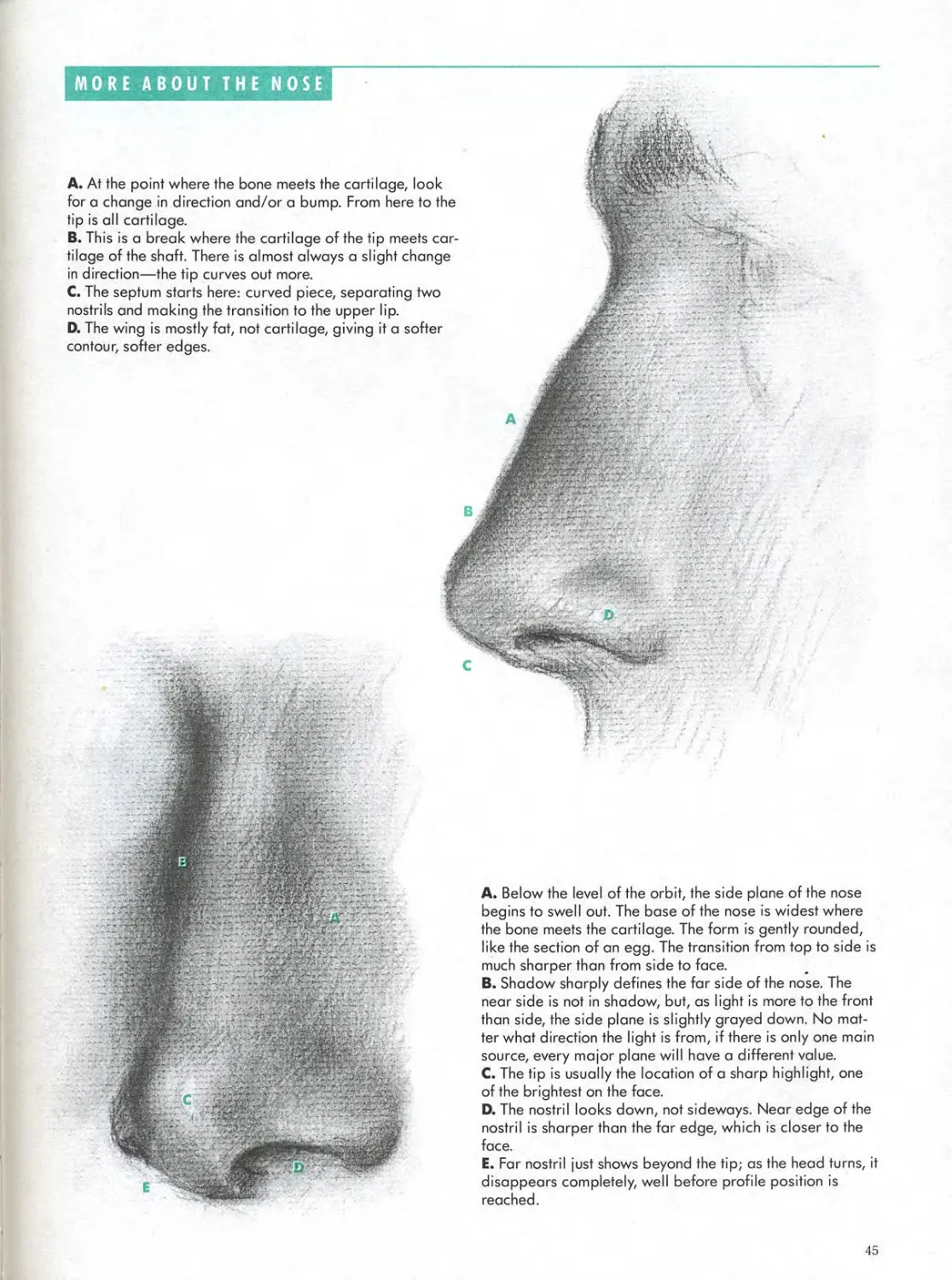
MORE ABOUT THE NOSE
The Mouth
There’s one major difference between the mouth and the other features we’ve looked at The nose and the eyes are built around a solid, fixed element an- chored in place to the skull. The mouth, however, has no fixed attach- ment whatsoever. This, combined with the fact that there are a host of muscles specifically aimed at stretching and moving the mouth around, makes the mouth the most variable feature in the face. Learning it in repose is one thing; learning it in action is another. Most people who’ve just gotten out of art school still can’t draw a smile because it changes the mouth’s shape too much! One of the functions of this book, of course, is to address this very problem. The extent to which the mouth is a continuation of its surroundings is easy to overlook because of its different color. As you can confirm by feeling your own face, the mouth doesn’t so much interrupt the forms around it but continues them. The three-part curve of the region under the nose flows into the three-part curve of the upper lip; the lower lip is an extension of the shelf above the chin. These rounded forms are created by the rounded forms of the skull beneath—the curves of the teeth, upper jaw, and chin. So we’ll look at the mouth in its region, not just by itself, continuously referring back to those skeletal shapes below.	The center lobe becomes the creased more of the mouth lining is turned in- part; the outer two become angled side out, making the lips appear wider, planes alongside. We always sense the If you think about the mouth as-just division between them.	the thickness of the skin showing The whole arrangement is some- through the edges of a hole, then the thing like a curtain with three large	mouth’s relationship to its surround- folds. The two outer folds start at the	ings makes more sense. The peaks of outer ends of the nose, and, widening the Cupid’s bow shape of the upper lip, as they descend, sweep down to the on the “hem” on the folds of the lip upper lip. The center plane faces di-	above, join the ridges of the filtrum. rectly forward and is split by a shallow	The dip of the bow lies below the fil- groove, the filtrum. It may be deep and trum’s groove. The bow’s sloping legs well marked, with soft ridges running follow the curving sides of the upper lip along either edge, or it may be barely above. visible. In any case it disappears when The central notch-two wing ar- the lip is stretched, as in a smile.	rangement is universal, regardless of The portion of the skull underneath particular lip shape. In rendering the this area has a rounded form like a upper lip, care should be taken to pre- section of a parasol—curving from serve its crisp, angular quality, the side to side, as well as sloping forward, sense of form folding sharply under. The folds above the lip follow this gen- Note that all the lip surfaces are subtly eral form. They slope forward as they rounded, both from top to bottom and part and curve from side to side; like from side to side. the skull, they are flatter in the front— where the filtrum is—and more THE LOWER LlP curved along the sides.	™ .	...	„ , „	, .	®	, , , The lower lip is usually fuller and A crease often separates the cheeks	p, . , , r. ,,	, ,	, softer as a form than the chiseled up- from the upper lip. This is referred to	и ft is composed of two rounded by anatomists as the na^lahalfold. It	исЬ |ike md wi[h a runs downward, from the nose to the ,			.	... ,,, , ,. ,	,	lower and upper outline. We don t usu- outer corner of the mouth. Although 			 	. „ ...	.	.	.	. 6 ally see the upper margin, actually— its deepening is a sign of age, it ap-	j K	T. . r a	, its covered by the upper hp. Its two- pears even on a young face when the .	..	.	, , ....	hill-and-valley shape is exposed when mouth stretches in certain expres- 	u, 			 , , , H	the mouth opens. sions, most particularly the smile.	j Underneath the lower hp and sitting 1 here is a natural tendency for folding	.  •	 , ,, ,	,. , . . ,, ,	J	& on the chin is a rounded ledge, which is
Underneath the Nose	 A lot of “threes” crop up in dealing with the upper lip. There are three planes above the lip, and these flow into the three parts of the upper lip itself. In regard to proportion, the edge where the upper and lower lip meet—the line between the lips—is one-third of the distance between the base of nose and the chin. The “threes” of the upper lip struc- ture go back to our earliest beginnings. There is a stage in the development of the fetus where the skin above the mouth is actually divided into three unattached lobes. When these join at around eight weeks they still maintain something of their separate character.	at that point for two reasons: many „•		.	. - c . . .	,	,	,	. / similar to those half bowl lighting fix- facial muscles attach to the hp right				.,	, ,	.....	...	. tures you see on the walls in up-scale along this line, and their pulling action	i„kk;„„	„	( ,	. , ; ,	,	office lobbies, reel it on your own face, leads to folding; and theres a fatty layer		k„n„ * • l.- ... ,	/	1 he ledge has a hollow spot right m the underneath the cheek that ends along mU.. .	...	, & middle where the lower hp overhangs the line.	. 	.	, , ,	.	. . the most and shadows almost always _ _T	_	appear. But at the outer comers of the The Upper Lip	 ledge the lower lip merge's with Technically, the upper lip includes the	smoothly. I often challenge people in area all the way from the base of the	my classes to find the edge of the lip at nose to the line between the lips. The	this spot; you can’t. There is a color red lips are really just a well-defined	change, but not a plane change. When turning under of the skin. The folded-	drawing this area, artists should ask in part has a different sort of skin from	themselves, are we creating a border its surroundings; it’s actually the outer	because we think there should be one, edge of the lining from inside the	or because we see one? The lower lip is mouth. It appears dark because there	better left less-defined in these cor- are more blood vessels close to the	ners, especially when the corner is in surface. In some expressions even shadow.

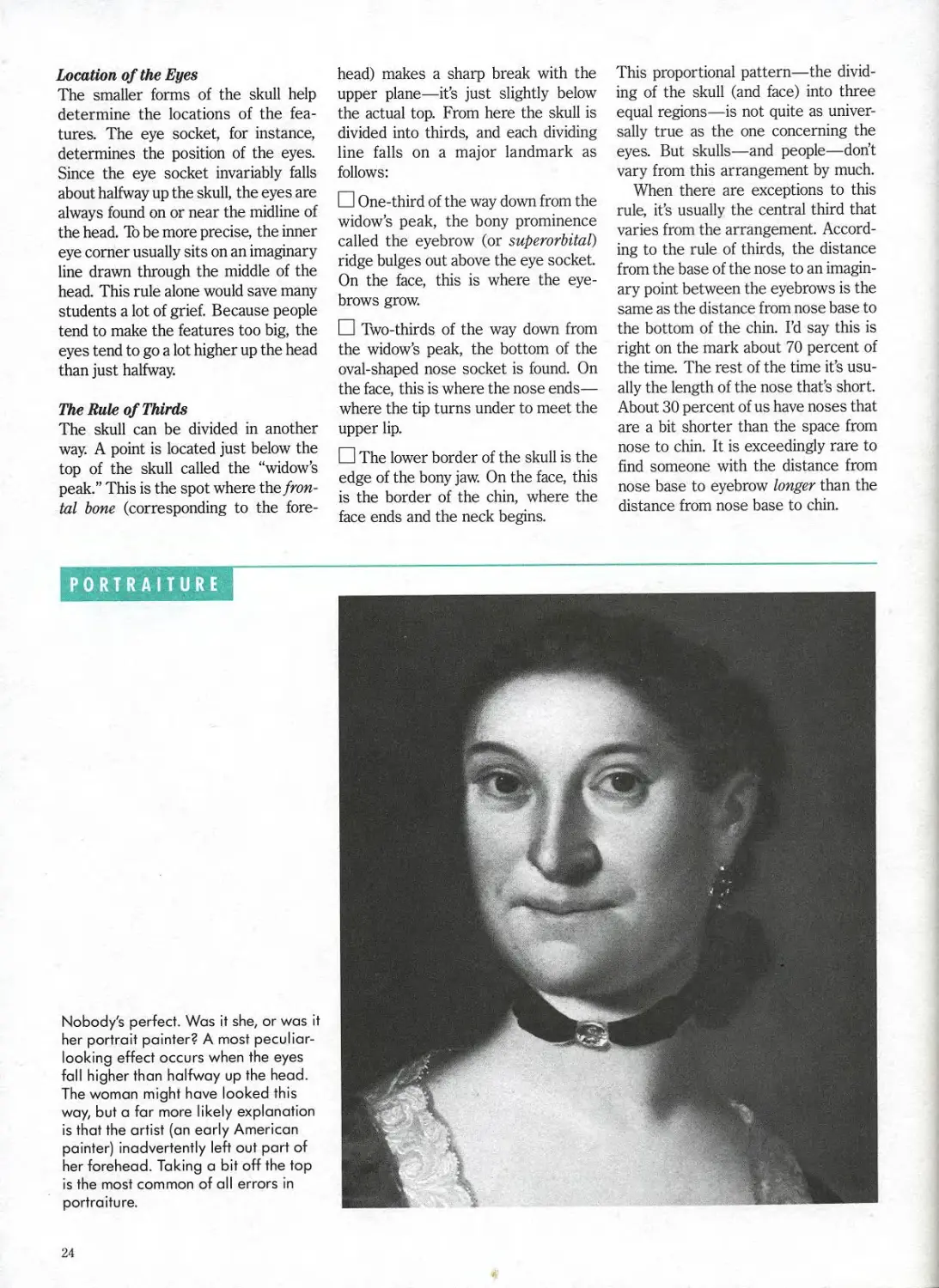
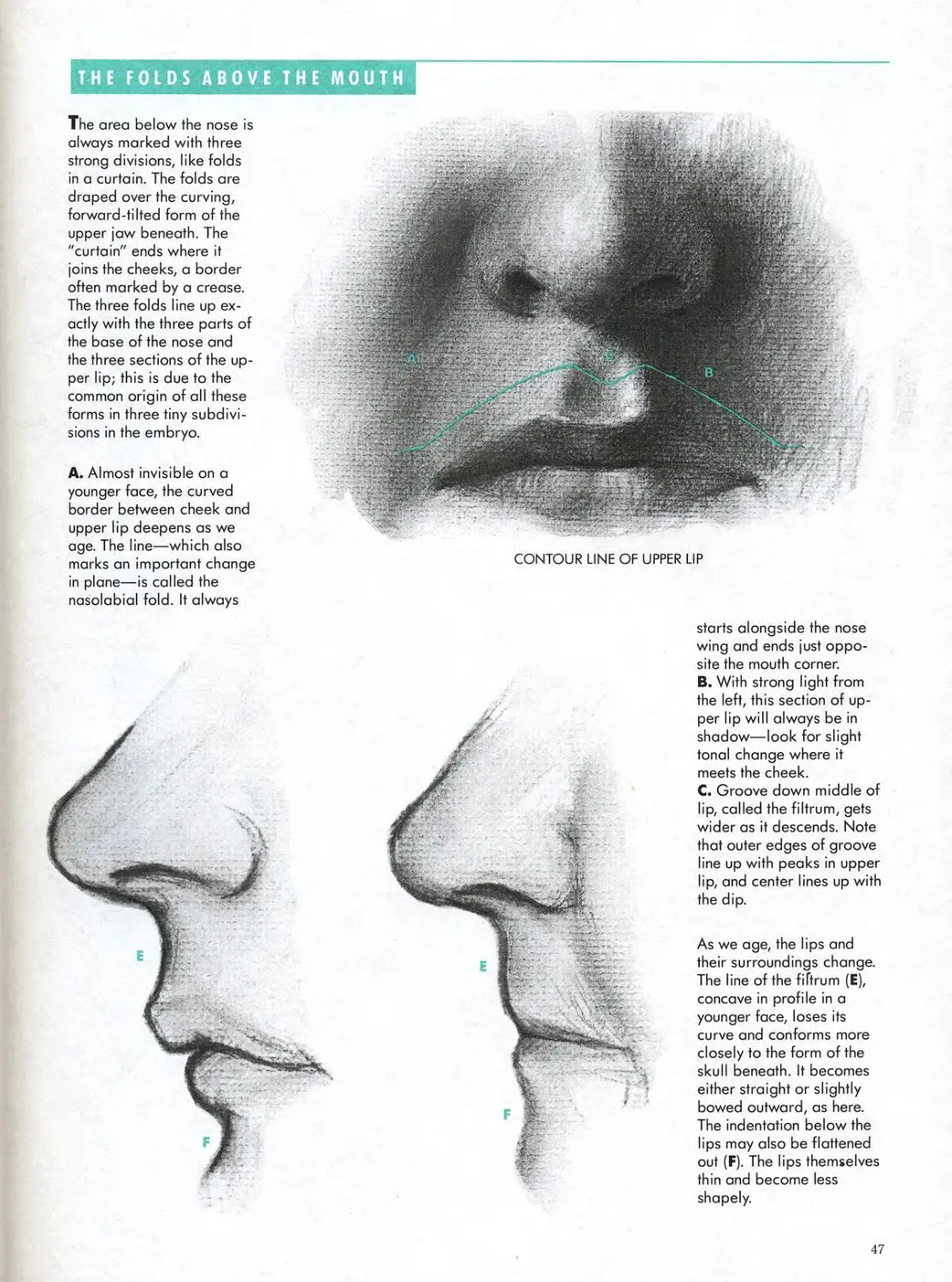
The area below the nose is
always marked with three
"curtain" ends where it
joins the cheeks, a border
often marked by a crease.
The three folds line up ex-
actly with the three parts of
the base of the nose and
the three sections of the up-
A.	Almost invisible on a
younger face, the curved
border between cheek and
upper lip deepens as we
nasolabial fold. It always
CONTOUR LINE OF UPPER LIP
site the mouth corner.
B.	With strong light from
the left, this section of up-
per lip will always be in
shadow—look for slight
C.	Groove down middle of
lip, called the filtrum, gets
wider as it descends. Note
that outer edges of groove
line up with peaks in upper
lip, and center lines up with
the dip.
their surroundings change.
The line of the fiftrum (E),
concave in profile in a
younger face, loses its
curve and conforms more
closely to the form of the
out (F). The lips themselves
thin and become less
shapely.
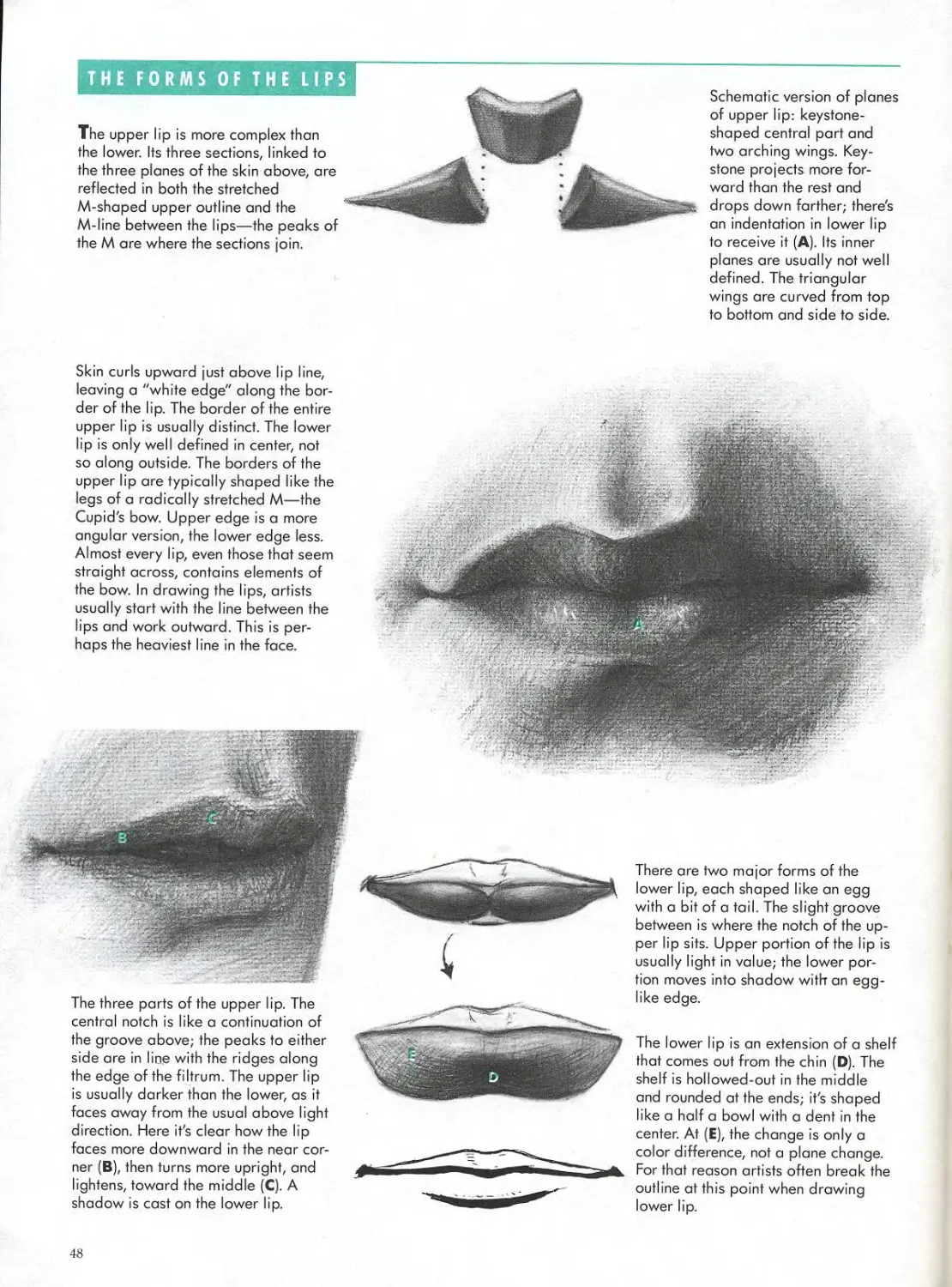
The upper lip is more complex than
the lower. Its three sections, linked to
the three planes of the skin above, are
reflected in both the stretched
M-shaped upper outline and the
M-line between the lips—the peaks of
Skin curls upward just above lip line,
leaving a "white edge" along the bor-
der of the lip. The border of the entire
upper lip is usually distinct. The lower
lip is only well defined in center, not
so along outside. The borders of the
upper lip are typically shaped like the
legs of a radically stretched M—the
Cupid's bow. Upper edge is a more
angular version, the lower edge less.
Almost every lip, even those that seem
straight across, contains elements of
haps the heaviest line in the face.
The three parts of the upper lip. The
central notch is like a continuation of
the groove above; the peaks to either
side are in line with the ridges along
the edge of the filtrum. The upper lip
is usually darker than the lower, as it
faces away from the usual above light
direction. Here it's clear how the lip
faces more downward in the near cor-
Schematic version of planes
shaped central part and
two arching wings. Key-
stone projects more for-
defined. The triangular
wings are curved from top
There are two major forms of the
lower lip, each shaped like an egg
with a bit of a tail. The slight groove
between is where the notch of the up-
per lip sits. Upper portion of the lip is
like edge.
that comes out from the chin (D). The
shelf is hollowed-out in the middle
and rounded at the ends; it's shaped
like a half a bowl with a dent in the
center. At (E), the change is only a
color difference, not a plane change.
For that reason artists often break the
lower lip.

C. The upper lip usually overhangs lower, reflecting the
overhanging upper teeth. The upper lip faces downward,
D.	The shape of the upper lip in profile is exactly half of
the Cupid's bow: one dip, one peak, and one long slope to
the corner.
edge only vaguely defined.
Descending from nose each form steps back:
F.	Nose
G.	Upper lip
H.	Lower lip
I.	Chin
The Perspective Factor
For some reason people are mortally
afraid of the subject of perspective in a
way they never are of anatomy or pro-
portion, both equally technical. It’s all
how you approach it Perspective is
view affects the way we see the physi-
cal world.
Point of view affects the way the
mouth looks in two main respects:
1. The curve of the line between the
lips is straight when the mouth is on
our eye level, an upward arc when the
head is tipped up, a downward one
when the head is tipped down. This
same principle governs the way any
curve looks in perspective. Think of it
this way: When the head is tipped
down, you have to give the mouth a
“smile” to make it look like it has no
2. The difficulty of drawing three-
quarter views of the mouth is also a
factor of perspective. It’s the principle
of foreshortening: objects appear
shorter as they turn sideways to our
view. In a three-quarter view, the far
side of the mouth is going around a
much tighter turn than you might ex-
pect. The turning of the teeth is very
abrupt here, and the mouth follows the
turning of the teeth. The near half of
the mouth will appear three or four
times longer than the far part because
the far half is seen practically edge-on;
that is, almost completely foreshor-
tened. Beginners tend to make both
halves of the mouth equal no matter
what the view, leading to grievous
results.
The bottom line of this chapter is that
facial expressions are only as effective
as the head they’re on. First, one mas-
ters the head, then the features, then
the expressions. And how is this mas-
negie Hall? The same way—practice.

Part Two
EXPRESSION

THE NATURE OF
THE FACIAL MUSCLES
veryone’s face is continually re-
shaped in response to different
moods and impulses. Watch people in
conversation; their faces are rarely at
rest. Their features respond as they
listen and accompany their voices as
they speak. The fact that we are capa-
ble of so much communication with our
faces is a great help in our lives as
social creatures. Those around us can
share in our pleasure when they see us
smile or be moved to cheer us up when
they see we are sad.
Our faces are as expressive as they
are because of a complex group of tiny,
thread-like muscles: the muscles of
expression. There is a network of
these muscles running beneath the
surface of the face, as thin and refined
as a spider’s web. By their movements,
these muscles can totally alter the way
a face appears. Though these are rela-
tively small and weak muscles, they
are attached so close to the surface of
the skin that a modest movement of
muscle fiber often translates into a big
movement of skin. Certain of these
muscular movements are recognized
as reflections of emotional states.
These are the facial expressions.
I was once explaining the nature of
the muscles of expression to someone,
and he pointed to his cheek in surprise,
“You mean its not all muscle in there?”
His question made sense. Look at
someone’s arm or calf, and much of the
bulk of what you see is the musculature
underneath the skin. Take away the
muscles, and there wouldn’t be much
left. On the other hand, take away the
facial muscles, and the face would prob-
ably look more or less the same. The
facial muscles are virtually the only
muscles on the body that have no real
form of their own.
Some Predecessors:
Leonardo and Darwin_______________
The way the facial muscles are mixed
in with everything else under the skin
made life very difficult for early anato-
mists trying to map out the muscles of
the face. The famous anatomy of Ves-
alius, published in the late 1500s,
shows the facial muscles in a vague and
misleading way. Other muscular sys-
tems of the body, larger and easier to
dissect, were more accurately
portrayed.
Nearly a century earlier, another pi-
oneer anatomist had patiently explored
and diagrammed the facial muscles in
beautiful, accurate drawings. But the
anatomical drawings of Leonardo da
Vinci, like so much of his scientific and
artistic work, were by the time of Ves-
alius scattered in private collections
and unknown to the world at large. The
anatomical text Leonardo intended to
publish had never been realized.
From my own experience, I know
how excruciatingly patient one must be
to explore the anatomy of the face. It’s
much like trying to extract the threads
of just one color from a complicated
tapestry. In Leonardo’s case, the result
of all his meticulous effort was not just
anatomical drawings. The men in his
battle scenes, just like the women in
his portraits, have faces more real, and
more alive, than any that had appeared
in painting before. Science in the ser-
vice of art led to a mastery of
expression.
Though Leonardo and others had
mapped out the facial muscles, the
function of the various muscles were
not well understood until the nine-
teenth century. In the mid-nineteenth
century, Duchenne of Boulogne found
that slight electrical jolts to various
points on the face caused the muscles
to contract individually. His photo-
graphs of electrically-induced smiles
and snarls are both strange and com-
pelling; his descriptions of which mus-
cles do what, an important advance.
The question of why we smile and
snarl was addressed by a man more
famous for his work in another field.
Charles Darwin’s book on facial ex-
pression, The Expression of Emotion in
Man and Animals (1872), remains to
this day probably the single best book
on the subject Making use of the work
of Duchenne and others, Darwin spec-
ulated about why we make the faces we
do and whether they are specific or
universal. (In recent times there has
been a resurgence of interest in facial
expression, led not by artists or anato-
mists but by psychologists interested
in the realm of nonverbal com-
munication.)
54

good photos of facial expression are not plentiful, and
Darwin made what use he could of his limited sources; his
How Facial Muscles Act
In what they do, and how they do it, the
facial muscles are different from other
Facial muscles do their
The Importance of Wrinkles
When the zygomatic major contracts,
and its mouth end rises towards the
cheekbone, the skin caught between
the two ends of the muscle has no-
where to go. The skin in the cheeks,
pressed up from below, bulges out like
a tiny balloon being squeezed.
Above and below this bulge, wrin-
kles appear. The wrinkle that runs
from the side of the nose to the side of
the mouth is particularly noticeable.
This crease, the nasolabial fold, is a
perfect example of the sort of wrinkles
that most frequently form when ex-
pression muscles contract: it lies at
right angles to the direction of the pull.
Similarly, the horizontal wrinkles that
appear when we raise our eyebrows
are perpendicular to the vertical pull of
the forehead muscle. Look at the verti-
cal folds that appear when you frown;
the frowning muscle pulls directly
across this fold.
Though overall patterns tend to be
recognizably the same, details of wrin-
kle lines are quite different from per-
son to person. The age of the individ-
ual is probably the most important
factor in wrinkling. Very young people
might not show any wrinkles at all
when they lift their brows, while on
older people, many permanent wrin-
kles may make new wrinkling difficult
to perceive.
Thin people and obese people have
different-looking smiles, as do men and
women. A smiling woman would tend
to show fewer crease lines than a smil-
ing man of the same age (all other
factors being equal) because of an ex-
tra layer of fatty tissue always present
under a woman’s skin.
The strength of the pull is also a
factor. If we smile half-heartedly, some
of the folds might appear only faintly,
or not at all. But if we smile widely,
added creases and dimples might form.
Signature Wrinkles
The wrinkles that arise when a partic-
ular facial muscle tightens are like its
signature: distinctive and recogni-
zable. We have discussed a few of
these signature wrinkles, like the na-
solabial fold for the smile. Wrinkles are
one of the keys to understanding and
depicting expression—they are part of
пшишпшевьпшшпд]
With the passeage of time, the more ephemeral wrinkles created by facial ex-
cipher" personality from the pattern that emerges, almost all the wrinkles here
may be caused by either expressive, conversational, or even functional (i.e.,
squinting in the sun) use of the same muscles.
the code by which the face communi-
cates. Much of their identity is retained
even when they combine in complex
expressions; we recognize certain ele-
ments that we have become aware of.
Almost everyone’s signature wrinkles
Cartoonists and primitive sculptors,
among others, have developed highly
skilled and effective ways to summa-
rize these crucial elements. They’ve
learned the most important things
about depicting expression: what you
can leave out and what you can’t.
Do Wrinkles Reflect Personality?
It is said you can read a lot about per-
sonality from the pattern of folds that
forms as a person ages. This is not
entirely true, although an expression
leaves its mark on your face if you re-
kies will be among those that become
permanent grooves. If we frown a lot,
tween the eyebrows. In fact, these
wrinkles are awfully common among,
say, middle-aged businessmen in Man-
will be the darkest value—the deeper
the wrinkle, the darker the tone; as we
rise up out of the crease, we suddenly
hattan. Yet people with crow’s feet are
not necessarily accustomed to smiling
ing to squint in the bright sun will de-
velop exactly the same lines. Many fa-
cial muscles are used regularly in
ordinary conversation. Don’t jump to
conclusions about the origin of a wrin-
Drawing Wrinkles
Creases are not just lines on the skin.
They are complete forms, with top,
side, and bottom planes and long
rounded edges; think of them as minia-
ery is good practice for doing wrinkles.
in a mirror. You are using the frontalis
muscles to raise your brows, creating
horizontal wrinkles across your fore-
head. Chances are, the light is falling
from above. To shade an individual
crease, we would begin by gradually
darkening the skin tone as we move
slope (perpendicular to the light)—
this is the only hard edge; finally, as we
merge back into the skin tone we
started with.
In a line rendering of the face,
ing, rather than as a crack in a smooth
surface; this is done with a light, bro-
ken, or double line (or all three), dis-
tinct from the harder line used for the
outline of a face.
Here’s another important point.
Suppose you were drawing a head,
with brow raised, and rows of wrinkles
emerged. Even if those wrinkles were
evenly spaced and unbroken, like the
stripes on a flag, it would not be a good
practice to draw them that way. Or-
ganic forms are irregular by nature. If
we let any element in our depiction
become too mechanical, or too uni-
form, it begins to look stiff. The acci-
dents, the unevenness, helps a draw-
ing or painting of the face look right.
Invariably, if you think a pattern is reg-
итог
Looked at closely, no two
wrinkles are alike. They dif-
fer in shape, in length, in
spacing, and in depth. If
A pen-ond-ink version of
the some face. In this me-
detailed rendering, cross-
hatching is used to achieve
the desired gradations—
soft above, sharp below In
a simpler, more linear style,
like that used in cartoons, a
different approach is used.
Wrinkles are indicated with
a light or broken line, dis-
Two Things To Bear in Mind
1. Only Part of the Face Is Involved
The whole face does not participate
equally in most expressions. The bur-
den of getting the message across usu-
ally falls most heavily on the brow in
combination with the eyes, and the
mouth and its surroundings. These
two locations are the areas of the
greatest muscular development and so
are capable of undergoing the greatest
changes. They are also, not coinciden-
tally, the parts of the face we always
notice first and to which we respond
the most strongly.
If you cover your nose, you will find
that you will lose very little in terms of
expression; cover your eyes, and you
lose everything.
Since there are so many muscles of
expression (from twenty to twenty-six,
depending on which anatomy book you
are using) examining them grouped by
active area will simplify our task
greatly. A certain number of muscles
are excluded because they don’t do
much expression-wise, are hardly ever
used, or both.
This leaves us with a total of twelve
key muscles, five of which act on the
eye/brow area and seven of which act
on the mouth. Even here we can sim-
plify things somewhat. The muscles
can be grouped according to what they
do: for example, most of the muscles
that surround the mouth can be placed
into the category of downward puller,
upward puller, or outward puller.
2. How We Know What We Know:
Neutral Positions
Our knowledge of the features in re-
pose make recognition of change pos-
sible. We know how the eyebrows tend
to sit, what the comers of the mouth
look like, how wide open the eyes usu-
ally are. These elements are constant
enough from face to face that we can
normally recognize a changed face.
This is true whether we are familiar
with the person’s face at rest or not
Wrinkles are important, but not ab-
solutely essential, in helping our per-
ception out. It’s the same principle of
unconscious familiarity we use to pick
out any change in our environment. We
don’t think about where the furniture is
in our parent’s house, for example, but
if something is moved while we’re
away, when we return it’s the first
thing we notice. We get habituated to
the features at rest and therefore no-
tice any changes right away.
Being consciously familiar with the
at-ease look of the features can also
help us avoid unintentionally creating
an expression when none is desired.
This is often a problem in portraiture,
as indicated by John Singer Sargent: “a
portrait is a picture of the head with
something wrong with the mouth.”
Given the suggestiveness of the
mouth, that “something” is often the
existence of an accidental scowl or gri-
mace or sneer or a similarly un-
welcome expression. Not the thing to
please a touchy client!
4.	Zygomatic Major. Origi-
nates on zygomatic arch;
inserts into mouth corner.
Pulls mouth into smile;
known as the smiling
muscle.
5.	Risorius/platysma. Ris-
orius originates over rear
of jaw, inserts into mouth
gether, stretching mouth, as
in crying. Known as the lip
stretcher. (The platysma is
not pictured here, as it
would cover other muscles.)
6.	Frontalis. Originates
near top of skull, along
der eyebrows. Raises eye-
brows straight up, as in
surprise. Known as the
7.	Orbicularis oris. Origi-
nates from muscles of cor-
ner of mouth. Curls,
tightens lips. Known as the
lip tightener.
8.	Corrugator. Originates
on nasal bridge; attaches
to skin under middle of
eyebrow. Lowers inner end
of eyebrow. Known as the
9.	Triangularis. Originates
along lower margin of jaw;
inserts into piouth corner.
Pulls down on mouth cor-
ner. This is the "have-
a-bad-day" muscle.
10.	Depressor labii inferi-
ors. Originates along bot-
tom of chin; inserts into
lower lip. Pulls bottom lip
straight down, as in
11.	Mentalis. Originates
just below the teeth, on
lower jaw; inserts into skin
of ball of chin. Wrinkles
chin, creating raised "is-
4 land"; pushes lower lip up.
Known as the pouting
muscle.
MUSCLES OF THE
BROW AND EYE
The eyes and brow together are
easily the most magnetic and
compelling part of the face. There
seems to be something almost magi-
cally responsive and alive in the organ
of vision. We instinctively feel that the
eyes provide our most direct link to the
person within. The brows too seem to
have a life of their own.
We can be responsive to the subtlest
of shifts in the eyes and brow, measur-
able in mere fractions of an inch. For
example, if you’re talking to someone
and his or her eyes shift past you, you
will notice it immediately. What is it
eyes switched away from looking di-
rectly at you; the irises moved about
6mm (Vi") further away from each
other. That’s the difference between
the close focus and distant focus posi-
tions of the eye. The closer the object
we are looking at, the closer the irises
come to each other; the further away
the object, the more separated they
are. The fact that we recognize such
tiny changes instantly and effortlessly
suggests how great a capacity we have
Starting Place:
The Relaxed Position
of the Eyelids__________________
The irises are the key to judging the
general state of the eye. The amount of
iris exposed by the upper and lower
sible certain generalizations about lid
position.
The Range of the Upper Lid
Let’s look at the relationship between
lower limit—The neutral lower limit
of the upper lid is the top of the pupil.
stops just short of the upper edge of
the pupil. If it falls any lower and begins
slightly—the whole face immediately
takes on a different cast. It begins to
lid. Depending on the individual, their
this same resting position.
upper limit—The neutral upper limit
of the upper lid is the top of the iris.
When the lid moves above the relaxed
upper limit, white begin’s to show and
the eye begins to look excited. A few
people always show some white above
the iris. Theoretically, we should find it
difficult to tell if such people are ex-
cited or not; but in fact we know in-
stantly that their lid simply sits higher
than usual. We are probably carefully
noting telltale details: the fullness of
the upper lid (which would be retracted
if the eye was open extra wide) or the
lack of extra arching in the line of the
lid edge.
to cover the pupil. Immediately, you
enough to care. But to lift your lid
above the iris takes a special effort;
this can’t be sustained either.
The Range of the Lower Lid
The lower lid’s range of resting posi-
tions is much narrower.
UPPER limit—The neutral upper limit
of the lid is just above the bottom of the
The lower lid usually just grazes the
iris, covering a bit of its lower edge. In
expressions that involve squinting, like
laughing and crying, the lower lid can
rise much higher, covering part of the
pupil from below.
lower limit—The neutral lower limit
of the lid is just below the iris.
Sometimes we can see white below
the iris. Wherever it is, this lower bor-
der of the lid is fixed; the lower lid
almost never moves below its neutral
position. It’s an island of stability in the
eye’s complex, movable landscape.
The Relaxed Position of the
Eyebrows
Upper Limit—The eyebrows also
vary within a predictable range. From
the viewpoint of expression, the inner
third of the eyebrow (near the nose) is
where all the action is. It’s the most
movable portion, the part over which
we have the most subtle muscular con-
trol. In a neutral face, it is always either
level with, or slightly below, the outer
two-thirds of the eyebrow. As soon as
it curls upward even slightly, the eye
takes on a look of distress. Since the
brow never naturally grows this way,
we can recognize distress from the
brow position alone, even without the
usually accompanying wrinkles and
bulges.
lower limit—The lower limit of the
eyebrow is established by a particular
facial landmark: the fold that marks the
top of the upper lid. No matter how low
the eyebrow grows, it seems to never
go below an imaginary line drawn level
with this fold. When the brow crosses
below this line, pulled by the corruga-
tor muscle, the face takes on an expres-
sion. It may look thoughtful, or angry,
or perplexed, depending on what the
rest of the face is doing.
THE EYEBROW AT REST
The average male eyebrow (left) is heavier and closer to
the eye; women's tend to be thinner and higher (right). In
both cases the eyebrow follows the bulge of the eyebrow
ridge; for men, the brow tends to sit on the downslope,
while on women it's on the upslope. The eyebrow always
shows at least a bit of arch, with typically more arch on a
woman's than a man's. The break in the arch is about two-
thirds of the way from inner end to outer (A), right at the
point where the forehead (and the brow) turns from front
plane to side.
There is a lower limit beyond which even the lowest male
or female brow will not normally drop. It is the top edge of
the upper lid (B). Here both brows, male (left) and female
(right), fall just above that limit. In expressions that involve
frowning, like concentration or anger, the inner brow end
(C) will move below the line, pulled downward by the cor-
rugator muscle.
LOW-ARCHED TYPE
BROW OF DISTRESS
The inner end of the eyebrow con be very expressive emotionally. If it drops
down below a certain point (see p. 66), it indicates one sort of emotional state.
UPSLANTED
Henri de Toulouse-Lautrec never saw
an eyebrow he could leave alone.
Toulouse-Lautrec demonstrates a cari-
KINKED
EYEBROWS ON PARADE

UPSLANTED
UPSLANTED
DOWNSLANTED
Muscles of the Brow
Considering how much can be ex-
pressed by the eyes and brow, it is
surprising that there are only five mus-
cles responsible for it all: two under the
forehead and brow, and three sur-
rounding the eye. Our control over
these muscles is so fine-tuned that we
can express virtually the whole range
of emotions with just a little twist here,
a little lift there: our perception is so
practiced that we can instantly recog-
nize the differences.
The Eyebrow Raiser: Frontalis
The frontalis lifts the eyebrows
straight up the forehead, creating the
familiar worry lines on the forehead.
It’s often thought of as the muscle of
surprise (as in the expression, “that’ll
raise some eyebrows”), but it also con-
It is a broad, flat muscle that lies
across the entire width of the forehead,
where they are fixed in place, to its free
end, the skin underneath the eye-
brows. You can trace its line of attach-
ment by running your hand along the
upper rim of your eye socket, starting
the glabella, the root of the nose. The

pulled straight up toward the hairline,
with the eyebrows coming along for
skin caught in the way gathers into
horizontal creases: the worry lines
may have half a dozen or more, fairly
evenly spaced, but the creases will
When the lift of the brow is only
partial, fewer wrinkles, and fewer
complete ones, will appear.
Other Effects
As the eyebrows are pulled upward,
the skin below them, rather then being
wrinkled, is stretched taut across the
underlying bone. Bags and wrinkles
are smoothed out, as though ironed
flat. The upper edges of the orbit, the
glabella, and nasal bones all show
clearly through the tight skin. That
portion of the skin that usually bags
over the upper lid, partially or com-
pletely hiding it, is lifted free, and the
entire rounded form of the lid shows
clearly. The eye itself, however, does
not necessarily open any wider. Its
opening is a separate function.
The creases, the tightened skin, and
ply grow high. The other effects, how-
ever, only occur when the frontalis
contracts.
Outer half '/Inner half
Portions of the frontalis muscle can act
on their own. Many people are able to
use just the outer half to raise up the
outermost portion of’one eyebrow.
Wrinkles form above this portion, re-
sulting in an odd, rather quizzical ex-
pression. When just the inner half con-
tracts, only the innermost ends of the
eyebrows are raised, and wrinkles
form across just the middle of the fore-
head. Most people can only move the
inner portion in combination with the
corrugator group in expressions of
grief or anxiety.
The frontalis is the muscle underneath
the forehead. Its basic action is sim-
ple: it lifts the eyebrows straight up-
degree of this brow lifting. But the fact
that so many older people have these
wrinkles has a more mundane expla-
nation: raising the eyebrows is the
expressions. We raise our brows fre-
The wrinkles of frontalis are arched
of the wrinkles may be broken, or
only part way across, particularly if
the eyebrows are only part-way
raised. The topmost wrinkle is the
most shallow. The eyebrow does not
glide evenly up the forehead. The
As the brow rises, it also stretches the
skin around the eye. Most of the upper
eyelid is exposed. The skin of the up-
per orbit and glabella is smoothed,
and the bony forms show more clearly
underneath (A). The eye may be
opened more, as at (B).
Raising just one eyebrow is a skill
some people have. A slightly quizzical
look may result. This action's made
possible by the fact that the different
they reach the midline (D). Note the
difference between the two upper lids
and the two upper eye sockets.
The Frowning Muscle:
Corrugator________________________
The corrugator is the most human of
the expression muscles. Some might
argue in favor of the zygomatic major,
the smiling muscle, but it’s too easy to
smile with nothing behind it. No one
tries to cry, to be afraid, or to scowl
with concentration—all expressions in
which the corrugator is the main pro-
tagonist. They’re responses to the ups
and downs of life. The smile can be a
mask; when we use the corrugator, it’s
often because the world has broken
through.
The corrugator has thus acquired a
very bad reputation. When novelists
talk about someone’s “troubled brow,”
“knit brow,” or “darkened brow,” the
corrugator is responsible. Almost all
the actions of the corrugator are nega-
tive in effect. In concert with other
muscles, the corrugator is what makes
us look sad, troubled, or angry. By
itself, it simply makes us look
perplexed.
Description
The corrugator’s basic action is to pull
the eyebrows down and bring them
closer together. Actually, two muscles,
the corrugator and the procerus (or pyr-
amidalis) do this; since they always
contract simultaneously, they can be
considered functionally as one muscle
(the corrugator group).
The corrugator group has fibers that
radiate upward from the bridge of the
nose and go into the skin of the lower,
middle brow. The corrugator itself has
its two fixed ends anchored to the skull
at the outer corners of the glabella.
From this point the two muscle bodies,
strips about as wide across as your
little finger, run diagonally outward
and upward to a point just above the
middle of the eyebrow. Here, the free
ends are knotted into the skin.
The procerus is fan-shaped. The
base of the fan is fixed onto the nasal
bone where the bone meets the car-
tilage. The upper, movable end is at-
tached to the skin in the area between
the two eyebrows.
Action
Look in a mirror, frown, and you can
trace the various effects of the con-
traction of the corrugator group on the
brow. The overall sense of a frown
from the front view is that the two
eyebrows are unsuccessfully attempt-
ing to join up. The inner ends of the
eyebrows have moved together and
downward; the skin in between is
bunched and wrinkled (“corrugated”).
Usually, the entire eyebrow appears
tipped downwards; this is the classic
effect cartoonists seize on and ex-
aggerate when drawing an angry face.
If you look at the picture of corruga-
tor from the side, you’ll note that the
movement of the brow is more than
just down and together; it’s also for-
ward. The bunching of the skin above
the eye creates a sort of shelf, project-
ing outward.
Other Effects
The movement of the eyebrows also
affects the area between the eyebrows,
where two—three, at the most—very
deep, vertical wrinkles tend to form.
These wrinkles, inside of each inner-
brow lump, are quite straight for most
of their length, but they often curve
under the brow lump before fading out.
These wrinkles are permanently
etched into the face of mopt older peo-
New Skin Fold
The downward pressure and forward
pressure of the brow drags the skin
below along with it. A new, sharply
defined, skin fold appears above the
eye, pulled across the upper lid. The lid
itself is pressed down further on the
eye, partly closing it. Especially in the
innermost corner of the eye socket,
the eye appears more shadowed.
The minimum elements necessary
to recognizably depict a frowning brow
are these: inward-slanting eyebrows,
vertical in-between creases, and
extra-low level of the brow. The other,
more subtle changes enhance the
effect.
CORRUGATOR: THE FROWNING MUSCLE
The corrugator pulls the
brows down and together.
distress and central to the
expression of fear, sadness,
consciously in talking or
concentrating. The conse-
quences of these uses is the
eventual development of
frown lines on the face. In
daily the inner third. It
drops below the top of the
upper lid. The eyebrows
move closer together. A
cashew-shaped lump ap-
pears at the inner end of the
eyebrow, with a curved,
vertical crease along its in-
side edge (A), the "frown
line." A small, crescent-
shaped dimple appears (B)
above the middle of the
eyebrow. This is where the
muscle attaches to the skin
and so becomes a low spot
when the muscle contracts.
fold appears above the
eyelid (C). As the skin folds,
it hides part of the upper
lid, particularly the inner
half. The inner end of the
skin fold runs right into the
descended inner corner of
created under it, at the in-
ner corner, is in deep
shadow (D). The downward
pressure of the brow shoves
the upper lid a bit lower,
hiding more pf the iris.
The side view shows
clearly the pulling down-
ward and forward of the
brow. Note also the length-
fold (E) above the eye and
the narrowing of the eye
Muscles of the Eye
The frontalis muscle and corrugator
muscle act directly on the brow and
indirectly on the eye and its surround-
ings. Now we’ll look at the two mus-
cles, levator palpebrae and orbicularis
oculi, that act directly on the eye and
upper cheek and, sometimes, indi-
rectly on the brow.
The Eyelid Lifter:
Levator Palpebrae
The upper lid is the more movable of
our two eyelids because it has its own
muscle: the levator palpebrae. It at-
taches to the skin of the upper lid on
one end and to the roof of the eye
socket on the other. When it contracts,
the upper lid is lifted; the more con-
traction, the more lift—the more lift,
the more wide open the eye.
Normally, the levator is slightly con-
tracted, holding the upper lid in its
awake position. When the levator be-
gins to relax, the upper lid, pulled by
LEVATOR PALPEBRAE: THE EYELID LIFTER
Opening the eye extra wide with the
levator palpebrae acts to intensify
traction or relaxation of the levator
can have a drastic effect.
levator fully contracted. The lids arch
more sharply, and the eye has a star-
ing quality.
B. Alert. These eyes are open some-
what wider than normal. The iris be-
gins to be covered by the upper lid
(above).
C. Neutral. This is the ordinary, awake
state for this person. The iris is still cut
the force of gravity, begins to drop
down over the iris. If the levator re-
laxes completely, the upper lid will fall
against the lower lid, closing the eye.
The contracting levator will reopen the
eye; if it continues to contract, the lid
will rise past its normal open position
to expose more eye than usual.
Intensity
The levator is a sort of “intensity con-
trol” for the face. In the case of anger,
fear, or surprise, the more vivid the
expression, the more the eye will open.
And the opposite is true: the more the
eye closes, the more lackluster the
The crucial element in gauging the
state of the eye is the shape of the iris,
and white showing around it. Because
the contrast between the dark iris and
the bright eyeball is so strong, what-
ever that state is shows up from a long
way off. We are the only animal with
such a conspicuous eye display.
D. Sleepy. This iris is exactly half hid-
den. The relaxation of the levator al-
lows the lid to fall. The pupil is partly
blocked. This is a transitory state; we
cannot stay conscious for long once
E. Losing consciousness. A momentary
state. Either the person has just awak-
ened or is just falling asleep. With this
much of the pupil blocked, vision is
seriously impaired. The iris is two-
thirds covered.
though lashes are often left out of
drawings of the face (being so deli-
cate), in this case their doubled thick-
ness makes them a substantial enough
The Eye-squeezing Muscle:
Orbicularis Осип____________________
There are times when we wish to pull
the eyelids closed. When we squint, or
squeeze our eyes shut, we are using
the orbicularis oculi. When it con-
tracts, the eye, and often a much larger
area of the face, including the cheeks
and the mouth is affected. This is very
unlike the modest action of the levator.
The orbicularis oculi is a large oval-
shaped muscle, encircling the eye and
spreading into the cheek beyond. It
takes up the area that would be cov-
ered by a good-sized eyepatch.
Clearly, when this muscle contracts,
it’s going to take a lot of face with it.
Imagine a large circle. Within it
there are more circles, each one
smaller than the last. The outer circle
represents the boundaries of the or-
bicularis oculi; the lines within it trace
the paths of its muscle fibers. The fi-
bers travel in upward or downward
arcs from one end of the eye to the
other. All the fibers are fixed to the
side of the bony nasal bridge; their free
ends are attached to the skin of the
cheeks and at the outer corner of the
Action
the nasal bridge. The eye begins to
close, and the familiar crow’s feet ap-
the fibers of the muscle shorten, the
stronger the contraction, and the
smaller the oval around the eye gets.
The smaller it gets, the tighter the eye
is closed and the more the skin wrin-
kles. Eventually, the eye is closed so
tight it becomes hard to tell the eye
line from the wrinkle lines. When the
orbicularis is that strongly contracted,
it also bulges up the cheeks, deepens
the nasolabial folds, pulls on the cor-
ners of the mouth, and sometimes
lowers the brow.
The orbicularis oculi has distinct
functional areas. The center of the
muscle, where muscle fibers run
through the eyelids themselves, is one
independent region, the palbebral por-
tion. Surrounding this is the remainder
of the muscle, the orbital portion,
which has two independent halves, up-
per and lower. The lower half, below
the eyelids, is a key component of the
smile; the upper half is used only when
all portions of the muscle contract at
once, as in the expression of pain.
The Eyelid Tightener
The palpebral portion of the orbicularis
oculi runs through the thin skin of the
eyelids. It is attached to the bony inner
wall of the orbit. This portion is so tiny
that its full contraction leaves only the
slightest of flexion wrinkles (those that
form at right angles to muscle pull) in
its wake. Its major effect, when
tensed, is to tighten and compress the
eyelids. When the eyelids are tight-
make is toward each other; that is,
they begin to close.
Typically, the mild contraction of the
-palpebral muscles pulls the lids in just
enough to give the eye a narrowed
look. The lower lid closes more than
the upper, taking on a more rounded,
defined look. This narrowing lower lid
movement is important in two very dif-
ferent expressions: anger and
happiness.
The Orbital’s Lower Half
The lower orbital portion of the or-
bicularis oculi is one of the two mus-
cles that create the expression of joy
(the other is the zygomatic major). Its
surface form is worth studying
carefully.
Many people do not have voluntary
control over this portion. Those that
do have smiles that look sincere, even
if they are not.
Try squinting so that just one eye is
partly closed. If you can do it, you’ll
observe that the cheek, particularly
the upper part, rises; a smile-shaped
crease appears below the eye; crow’s
feet appear at the outer eye corner;
and the eye narrows. This narrowing is
usually absent in an insincere smile.
Amidst all these changes, the area
If you squeeze hard enough, you can
close the eye completely. This is what
happens in the laugh. But don’t
also triggered the upper half of the
muscle.
NEUTRAL EYES FOR COMPARISON
EYELID PORTION CONTRACTED
The attachments of orbicularis oculi. The orbicularis oculi,
the muscle of the squint, has three parts, with separate
functions. The inner, eyelid part, the palpebral portion (A),
ners, along with the lids (B and C). The outer, orbital por-
tion has its fixed attachment on the skull (D) and its, free
attachment into the skin of the cheek. It has a lower half (E)
and an upper half (F), which are semi-independent. Also
pictured is levator palpebrae, eyelid lifter, with its fixed at-
When the entire lower portion of orbicularis oculi con-
tracts, the narrowing of the eye is combined with the bulg-
ing of the cheeks. This is a key action in the smile.
The area above the eye is completely relaxed (A). This
contraction affects only the eyelids and the area below and
beside the eye.
Wrinkles (the "crow's feet") radiate out from the outer
eye corner like spokes on a wheel. They follow closely the
contours of the surface beneath. These, and the crease be-
low the eye, are the signature wrinkles of the orbicularis
fold.
The cheek swells, particularly the upper half. Above the
cheek, the little smile-shaped fold (C) or folds appear.
Above it, the lower lid has a full look.
The crease from the nose to the mouth (the nasolabial
The Orbital’s Upper Half
The upper half of the orbicularis oculi
is not as free to move as the lower half
because many of its fibers are inter-
mingled with the fibers of such other
muscles as the frontalis and the cor-
rugator. But when it does contract, the
whole upper part of the eye region is
reshaped.
Keeping one eye open, look at your-
self squeezing one eye tightly closed.
Watch the inside end of the eyebrow.
As soon as it starts to be pulled down,
you know that you’ve started adding
the action of the upper half of the or-
bicularis to the action of the eyelid and
lower portions. In the upper eye area,
the skin above the upper lid is shoved
downward, hiding most of the upper lid
itself. The lower lid is pressed upward
from below, and the two lids meet in
the line of the eyelashes.
Wrinkles radiate out from the inner
corner of the eye like deeper mirror
images of the crow’s feet. One or two
particularly deep folds may join their
counterparts clear across the nose.
They’re not pretty. (Neither are the
circumstances under which we use
this muscle.)
The eyebrow is also pulled down,
especially at its inner end. You can look
at the muscle diagram and see why;
the top part is right underneath the
brow, so the brow is pulled toward the
inner eye comer along with everything
else. The corrugator may also be trig-
gered, adding its pull to that of the
orbicularis.
The net effect of the contraction is of
an explosion of lines radiating out from
the inner eye comer. The feeling is of
compression and stress. The nose-to-
mouth crease is greatly deepened; the
nose itself is pulled upward, distorting
the tip and creating horizontal creases
along its length. And the pull on the
comer of the mouth is much greater.
The crow’s feet and lower eyelid wrin-
kles also get much deeper.
One way to think about the muscle
portions just described is that their
actions appear in stages: the first
stage, using the palpebral portion, just
narrows the eye a little; the second
stage, using the orbital’s lower half,
starts a true squint, a pleasant-looking
one; the third stage, using the whole
muscle, squeezes the eye for all it’s
worth, leading to a pained expression.
This ii> the expression of pain. When the entire orbicularis
oculi muscle contracts, the eye is buried in a sea of wrin-
kles. Every feature is pulled toward the inner eye corner.
its action to that of the rest of the muscle. It creates the
deep, ray-like wrinkles stretching between the eyes and
The Eye in Movement
Eyes are the most restless feature.
Our eyes are constantly moving about,
even when we’re not; watch someone
sitting on a park bench or standing
waiting for a bus. Their eyes will be in
motion whether their attention is di-
rected outward or inward; thinking or
observing are both accompanied by
lively, unconscious movements of the
eye. When we sleep, our eyes continue
their activity, moving visibly behind
closed eyelids when we’re dreaming.
of Eyes
the eyes.
The Gaze_____________________________
The direction of the gaze can be an
evocative element in a portrait. Down-
cast eyes, upraised eyes, eyes looking
sideways, even out-of-focus eyes, are
all suggestive of states of mind. Gener-
ally, any movement at all will be more
expressive than simply depicting
someone looking straight ahead. Pic-
tures of rooms full of people with fixed
gazes may be suitable for covers of
paperback books about supernatural
possession, or for statements about
alienation, but they fall short of being
naturalistic. That’s not the way people
really look.
As with the opening and closing of
the eye, the direction of the gaze is
telegraphed for all to see by the shapes
of the eye whites and the way they
frame the iris. But often, what we per-
ceive is the result of very small shifts
between the various elements; we rely
on our (unconscious) expertise in de-
ciphering the face to follow the gaze
and interpret its meaning.
j / should like i to know you.	Don't be shy.
о
//j quite all-	/// see you to-niqnt.
\
/ love you.	Isn't d lovely!
I'm ashamed of you.	 When shall we meet again?
upward gaze. It's not only
because heaven is sup-
posed to be up there, but
also because we rarely
If we do look up, we usu-
high arch of the upper lid,
the flat line of the lower lid,
white below the iris .
The Upward Gaze
When paintings customarily had a
much stronger religious content than
they do today, the skyward gaze was
used as a convention to indicate an ex-
alted state of mind, or communion with
heaven. Even in our secular era, it’s
difficult to portray someone with up-
turned eyes without suggesting some
level of metaphorical meaning, unless
it’s made clear that the person is simply
looking at something.
We notice instantly when the gaze
shifts from forward to upward, but it
isn’t immediately apparent what is no-
ticed. This is a good example of how
much we can perceive without know-
ing why. In fact, we seem to use sev-
eral different visual cues in combina-
tion. Oddly enough, the most
important cue is the shape of the lids
and the lids’ relationship to the iris.
The shape of the iris itself is also a key
factor. Only in the extreme upraised
position is the white under the eye a
major element
The limit of looking up is reached as
the pupil encounters the upper lid
edge—this is an uncomfortable posi-
tion and not one that is held for long. In
fact, like most of the positions of the
gaze besides dead center, looking up-
ward suggests an active interest, an
engagement, on the part of the person,
simply because it takes a special effort
The first change we notice as the
gaze rises is in the relationship of the
iris to the eye corner. On most eyes,
when the gaze is straight ahead a small
portion of the iris always falls below
the level of the inner eye corner. We
don’t have to be looking up very high
before the bottom of the iris rises to
this level, then rises higher.
When the gaze travels further up-
ward, the eyelids take on a domelike
shape, like a capital/) lying on its back.
The whites of the eye are framed by
the sharp upright angles of the upper
lid, while the lower lid is almost
straight. Perspective makes the iris as
a whole appear elliptical; the higher
the gaze, the shorter the apparent
height of the ellipse.
UPRAISED EYE
The angle of the upper lid has a great effect on the way we
perceive the eye. It's a key element in telling the extra-wide
eye from the neutral eye—more important than the white
above the iris. Even in a neutral eye with lots of iris show-
ing (left), the steepest angle the lid makes as it rises to the
top of the arch will never exceed 45 degrees (line).
Once either or both upper legs exceed 45 degrees (cen-
the outer leg is nearly identical. What makes the overall
shape of the eye different is the lower lid; when the eye
looks upward, the lower lid loses some of its downward
bow, and appears slightly straighter, particularly in its
outer portion (A).
One way to find out if the eye is looking slightly up or
down is to compare the iris' position to the level of the in-
ner eye corner (line). In a level gaze, the line indi-
cated will cross the lower part of the iris; looking down,
the middle of the iris crosses the line; looking up, the iris'
When w<э look up, the eye reshapes
itself in large and small ways to ac-
commodate the movement. Even the
into an ellipse. The first stage of the
upward gaze (B) is the most difficult
to capture. Great care must be taken
to get the angle of the upper lid right,
and to raise the iris high in relation to
the inner eye corner. Note how in
drawings A—D, the iris is cut by the
upper lid line in the same place no
matter how it moves.
A.	Looking out. A person with a rela-
tively narrow eye opening. Note rela-
tionship between pupil and line across
middle of corner; when eye is looking
outward, line cuts through lower part
B.	Looking up. Even in this first stage
of upward gaze, many changes have
occurred (1). The upper lid is almost
fully retracted. Both inner and outer
angles steepened. The upward gaze
is more obvious in the eye on the left,
than 45 degree angle. As gaze gets
higher, arch of upper lid continues to
increase by small amounts (2). The
midline of the corner. The bottom of
the iris is now visible, and the lower
lid is slightly straighter (3); the higher
the gaze, the straighter it gets.
C.	Looking higher. As the gaze rises
further, the curve of the lids changes
more slowly. The upper lid is now
more steeply arched—most angles
lower lid is closer to being straight
across. White begins to appear below
the iris, which appears more elliptical,
wider than high. The bottom of the iris
has now risen above the middle-of-
corner line.
D.	Upper limit. Limit of gaze is
reached when the upper lid can open
no further. Above this point the pupil
would begin to be covered. Note the
flatness of the lower lid; asymmetry of
the two eyes—inner leg of eye on left
is still less than 45 degrees (4); nar-
The Downward Gaze
When you depict someone looking
downward, any number of things may
be suggested—reading, reflection,
resignation. Compared to looking up,
the downward gaze is more comfort-
able and takes little effort to maintain.
The chief problem for the artist is dis-
tinguished between the very similar
appearance of the eyes looking down
and the eye shutting.
The differing appearance of the two
the position of the lower lid. When
looking down, the lower lid drops just
enough to maintain a narrow gap be-
tween the lids, allowing room for the
pupil to show. There is no muscle re-
sponsible for this movement; probably
it is the eye itself that pushes the lid. As
the lower lid drops, it begins to raise
skin furrows below it, like a plow push-
descends.
A good way to see this lower lid
drop. Notice the crease that appears
under the lower lid. This is the signa-
ture wrinkle for the action of looking
downward, caused by the lid folding
under itself. The further down you
look, the deeper the wrinkle gets.
In drawing the lids, take care that
they respond to the sense of the ball
underneath. The upper lid starts from
then begins a full curve around the
eyeball. The lashes show clearly and
are often indicated. The lower lid will
dip lowest just below the iris: if we look
down and to one side, the low point will
range looking down than up, so the
variety of possible positions is much
greater.
Looking Sideways
Having someone look sideways can
also enliven a portrait. Like looking
upward, it suggests an active sort of
seeing. The further to the side the
gaze goes, the more momentary the
glance, for two reasons: the more ex-
treme positions are hard to hold, and
the head tends to follow the gaze. I’ve
special effort to hold their heads one
way if their eyes are turned very far to
another.
Compared to looking up or down,
however, drawing the eye looking side-
ways is easier. But don’t be misled by
the apparent simplicity—nothing
about the face is without its subtleties.
Here, the shape of the eye changes, as
the gaze shifts, from an oval with two
narrow ends to an oval with one nar-
row and one blunt end, mostly owing to
a rearrangement of the upper eyelid as
the iris moves. When the gaze is
straight ahead, the top of the upper
lid’s arch is in the center of the eye. But
the high point moves with the iris when
the gaze shifts to the side; it stays
above the iris no matter where it goes.
Because the cornea sits like a per-
manent contact lens over the iris, mak-
ing a tiny, transparent mound in the
middle of the eye, the lids often get
reshaped as they cross over the bulge.
In looking to the side, the cornea adds
extra lift to the upper lid.
The white space on either side of the
iris helps us judge which way the eye is
aimed. With straight-ahead eyes, the
white space will be approximately
equal on both sides. If the gaze is just
slightly shifted to the side, drawing the
eye to get the gaze exactly where you
want it can be an exercise of madden-
ing delicacy. Look carefully at the exact
shapes of the white triangles border-
ing the iris on either side.
The iris also appears less circular
the more it rotates away from us. Fore-
shortening narrows its width, exactly
as it does when the head turns to a
three-quarter view.
Looking Straight Ahead:
Highlights and Focus
the eyes. When we change our focus
from something near to something far,
there is. a slight rotation of the eyes.
The irises move closer together and
farther apart depending on how far
away the point of focus is. The eyes
point inward to focus on a nearby ob-
irises separate.
Summary___________________________
The shifted gaze is one more way to
make faces expressive. Sometimes
moving the eyes alone will bring more
life into a portrait. Much can be made
over the effect of having the eyes look-
ing one way versus another; it’s often
suggested that Manet’s nude Olympia
would have created far less of a sensa-
tion had she been looking any other
way than directly out at the viewer.
The shape of the eyes as they move
is irregular enough that we need to
draw them repeatedly to learn the fine
points of the changes in their form.
Often a model will look in a particular
direction only occasionally; if we want
to capture that gaze, we need to fill out
what we can gain from observation
with what we already know.
closed-looking eye. When
the eyes simply close, the
iris and pupil are covered
in the process; in the down-
ward gaze, the eye leaves
open a space large enough
lower lid. A telltale crease,
action, appears below the
lid as it moves. As the gaze
drops further, the bow gets
sharper and the crease
deepens. The dip and the
A. Level gaze. Corner mid-
line crosses iris about one-
than in a level eye (1). Note
similarity between curve of
upper lid in closing eye and
downward eye. It's only the
position of the iris and the
с. Further down. As the
view of the eye is more re-
stricted by low angle and
by increasing shadow. Note
that opening (diagram, left)
lower lid (2), while upper
lid is more fully exposed
(3). Lashes of upper lid in
lowering are more promi-
will be vague or invisible
within shadow. Space be-
tween lines thickest in cen-
ter (where the iris is) thins
(4), then turns into a full
low crease or two is at the
level where lid normally
stage: closed eye has one
dark space (seen through
lashes) with crease below.
EYE LOWERING
EYE CLOSING

IDEWAYS
Depicting the sidelong
glance presents few techni-
These illustrations demon-
strate, though, that more
changes in the eye than
simply the iris moving to the
side. The shape of the eye
itself alters depending on
the iris position. The rule is
that the high point of the
arch of the upper lid is al-
ways above the iris (it's
lifted by the cornea). The
very little as the iris shifts.
The net effect of the mod-
almond as the iris turns.
The iris itself appears less
circular as it turns. In the
most extreme position (A)
the iris shape is blunt at
one end and much nar-
rower than it is high.
LOOKING SIDEWAY
side (B). The amount of space between the iris and the eye corner steadily de-
creases. When the glance is directly to the side (C), the iris fills our view of the
eye. Its shape appears more circular, and white space has appeared on its far
cornea.
The cornea is a transparent dome sitting on top of the iris.
It has a subtle effect on the drawing of the eye. In the level
gaze, the lower lid crosses so low on the dome (A), that its
ball (B). It is this slight bulge that we see when the gaze
shifts from side to side. The cornea also creates the sharp
dip in the lower lid when the gaze turns downward.
иг
We can tell from the eyes if someone is looking at something close or far away.
When we look at something at very close range, the eyes rotate so that the
irises can both aim directly at the subject (A). This turning inward brings the
irises closer together (see diagram, top). The farther away the subject, the more
separation between the eyes (B)—up to a point. That point is reached when the
eyes go out of convergence, the position the eyes will naturally fall into when
we are looking off into space (C).
tween these two drawings: the open-
ness of the eyes and the separation of
the irises. The face on the left, with
tached. We speak of someone with
this look as gazing inward, or, less
kindly, of being "spaced out."
This wall-eyed gentleman may not
The disturbing effect of the eyes being
out of symmetry (left iris closer to the
eye corner than the right) dominates
this portrait, but it's more likely that it
was the artist who had eye problems.
The Portrait of Joshua Trevis by the
same artist, Jacob Eichholtz, has eyes
with precisely the same problem. A
portrait artist might encounter one
person like this, but two?
THE MUSCLES
OF THE MOUTH
A.\ s a minute or two in front of a i- fe-mirror will demonstrate, the mouth is capable of being stretched, squeezed, or curled into just about any shape. Obviously, it requires quite a muscular network to allow us to do all those funny things with the mouth. There are twelve muscles in the net- work, but we can eliminate five right away as having nothing to do with facial expression (several are used, for ex- ample, mainly for eating). Of the seven remaining muscles, one is already familiar—zygomatic ma- jor, the smiling muscle. There is also levator labii superioris, the sneering muscle; triangularis and mentalis, which work as a team to bend the mouth downward; risoriuslplatysma, which elongates the lips; depressor la- bii inferioris, which pulls the lower lip downward; and orbicularis oris, the muscle of the lips, which presses both lips together.	attached to a rigid frame. The slit smile; the slightest angling up of the would have enough free play to take on comers will do. Unfortunately, it can an enormous variety of shapes as the also take very little to suggest a sneer trampoline stretched and sagged.	or a pout! As a result of its suspension, the mouth can be pulled and pushed as if it ^eutrai Positions were part of a rubber mask. In fact, It h galerally more difficult for the actors sometimes use the lower part of	t0	of the the face as a mask, holding through mouth	th<_ eyI, One problem is muscle tension a facial shape com- Ла1 certain relaxed mouths resemble pletely different from their own.	those engaged in an expre.ssion. For example, we may see people Looking at the Open and Closed	who, on first glance, seem to be per- Mouth Separately	manently sneering or pouting— There is another factor that affects our perhaps some of them are. In most discussion of the mouth that was not an cases, however, a careful look will re- issue with the eye. Though the same veal certain very subtle surface forms muscle may be active when the mouth indicating that, in fact, no expression is is both open or closed, the actual ap- involved. And if no expression is in- pearance of the mouth is quite differ- volved, we must avoid emphasizing the ent, as in a smile with the lips parted wrong wrinkles—those signature and one with the lips together. For this wrinkles that suggest that such an ex- reason the mouth will be discussed in pression is in progress. two separate sections.	Lighting can also create problems.
Indirect Attachments	 The mouth is freely suspended. It’s only attachment to the skull is indirect—it’s surrounded by muscles that attach to the skull at one end and the mouth at the other. Imagine a slit in the middle of a trampoline: like the mouth, it’s not attached to anything solid, but it’s part of a stretchable fabric	Shadows on and below the lower lip are _ _	,,	_	important in defining if the lip is tense The Closed Mouth at Rest	or thrusting out. Drawing the mouth is always a delicate	Finally, there is the perspective fac- matter. It sometimes seems as though tor. When the head is tilted up or down, the least little change—a little shading the curve of the mouth will be altered here, a break in the angle there—will accordingly. Be careful not to curve transform our reading of the mouth the mouth in the direction you’re used from one mood to another. For exam- to seeing it in, rather than the one it’s pie, it takes very little to suggest a actually taking.

first and work outward from there: Not only is it a good way to start a drawing,
ries. Here are the three main variations that the LBL takes in the relaxed mouth.
The same underlying pattern—dip and two peaks in the middle, two long curv-
ing legs on the sides—is common to all three, whether men's mouths (center) or
women's mouths (right).
tral dip and a distinct break
between peaks and legs.
Note that the end of LBL is
on same level as middle of
LBL; this is true unless the
head is tipped.
and two peaks still
goes back to the develop-
The arch shape is really
another variation of the Cu-
pid's bow, with lower outer
corners and a high middle.
Usually, the arch is only
occurs if lips in relaxed
What was the LBL in the
closed mouth becomes up-
per rim bordering teeth.
Key Elements in the Closed Mouth:
The Line between the Lips
The way you draw the line between the
lips (LBL) will determine 75 percent of
the expression you give to the closed
mouth. Though lips vary radically, the
three main forms of the LBL apply to
most mouths:
1.	Cupid’s Bow. The most common
pattern. A dip in the middle, two
peaks, and a long decline to the comer.
The outer portion of the line may curve
up slightly, or it may be straight across.
2.	Straight Across. This should be
thought of as “more-or-less” straight
across. The “more-or-less” is impor-
tant. The LBL of a relaxed mouth is
never a perfectly straight line. On
those people where it seems to be
straight, a careful look will show that
it’s really a flattened form of the cupid’s
bow, with the same dip-and-two-peaks
pattern—sometimes barely evident.
3.	Upward Arch. The cupid’s bow pat-
tern but with the LBL much higher in
the middle than at the ends. This type
of mouth is one that can most easily
suggest a negative expression if it’s not
well drawn.
When the mouth is relaxed, the LBL in
all mouth types will have key elements
in common. The direction of the line
will change smoothly, not abruptly.
The outer end of the LBL will always
be either even with or a bit below the
center, never above. And if the line of
the LBL appears straight, as in 2
above, the upper lip will be full, not
compressed.
If the mouth is neutral, it will not
have LBL with abrupt changes in
direction or extending well past
end of lips. The ups and down
LBL show a sudden break in di-
rection (A). The new direction
may be up, as here, or down.
end of the lips. Normally the LBL
ends just beyond the end of the
lips. An LBL end higher than its
center is a definition of the
smile. (B) A smile begins as
soon as either or both of the LBL
tionship clear.) A relaxed mouth
will never have the LBL end
higher than the middle. LBL with
no kinks and with a thinned up-
per lip occurs when the mouth is
to begin with. The combination
of thinned upper lip with
straight LBL makes this mouth
look tight-lipped (C). Another
stretch, but the upthrust of the
usual two-peaks-and-a-dip pat-
tern and hidden much of the
upper lip.
strong enough, we tend to perceive the mouth as sympathetic.
The Corner of the Mouth
As anyone who has ever picked up a
pencil knows, the expression of the face
is based on the corner of the eyes and
the corners of the mouth.
—E. E Gombrich, The Story of Art.
The above statement is really more
misleading than helpful. The corners
of the mouth do change in most facial
expressions, but so does the line be-
tween the lips, the shape of the lips,
the cheeks, and the chin. None of
these things change by themselves—
they’re all connected. Taken together,
a set of changes occur that we recog-
nize as an expression.
Creases around the Corner
The “corner of the mouth” is an inter-
esting location. The spot where the
line between the lips ends is a veritable
Times Square for facial muscles—
more of them converge on that one
point than anywhere else on the face.
As we age, the crease at the mouth
comer tends to lengthen and deepen,
scoured into the face by the repetitive
movements of the mouth. Eventually,
it may join with another fold created by
mouth movements, the commissural
fold—a vertical wrinkle that brackets
the mouth and chin like parentheses.
It’s located right at the point where the
chin turns from front plane to side. It
takes over where the nose-to-mouth
fold leaves off; sometimes the two folds
connect, and then one long curving fold
extends from nose to chin. Together,
the mouth-comer crease and the com-
missural fold can make an upside down
L-shape continuing the mouth line.
By themselves, none of these folds
will make a mouth smile or frown, and
in fact can be confused with the
creases that are created by expression.
But as long as the lips and LBL and
cheeks are in their relaxed form, the
mouth as a whole will look relaxed. In
your drawings, note where the LBL,
which is so important in expression,
ends and where the creases around the
mouth begin. Usually there is a sharp
break in direction between mouth and
crease that helps clarify things. When-
ever possible, avoid working from pho-
tographs. These details are always
much clearer when you use a model.
THE CORNER OF THE MOUTH
its movement. In any stretching movement of the mouth, it's
Here is a relaxed mouth (top), contrasted with the same
mouth in the first stage of a smile. A little angled crease
(A) appears as the lip end is pulled deeper into the face.
edges.
The folds that develop around the mouth are some of the deepest on the face. Here's the
mark of forty years on a woman's face; the particular pattern shown here seems to be
more common with women than men. Though the wrinkle pattern is similar to that of the
and the shape of the cheeks are all relaxed.
At age twenty (top), the
mouth corner is marked by
a short, oblique crease. The
slight mound outside the
crease (A) is the "node"—a
thickening in the face where
moving muscles converge.
Its form helps to define the
will look in forty years in
the very soft turnings
alongside the mouth and on
the cheeks; the crease
alongside the chin falls at a
natural plane turning be-
At age sixty (bottom), deep
appeared. The corner of
ing the LBL appear to
continue much further than
it does; it actually ends at
(B). From there what we see
is a skin fold, not a real
gap. The sharp turning is
where a separate crease,
gins (C). It's often one of the
face. It runs straight down
alongside the chin, marking
the border between front
plane and side. The nose-
deepened (D); on many
crease under the mouth and
a fuller line of the jaw.
The Closed Mouth: Five Muscles
Upward Puller I:
The Sneering Muscle
If the corrugator makes us human, the
levator labii superioris, the sneering
muscle, is the muscle that makes us
obnoxious. If there was a popularity
contest for facial muscles, this one
would lose, hands down; there’s no ele-
gant or flattering or nice way to use
this muscle. We tend to use it when we
think something stinks, literally. Or
when we’re furious. Or when we’re cry-
ing our hearts out.
What the levator labii superioris
does in particular is to lift the upper lip
in a sneer. The “lip raiser” also curls up
the nose and wrinkles the eye area in
the process. Its distinctive effect on
the countenance, when acting alone,
might be out of place in a portrait, but it
does appear in art in various other
applications.
Three Branches
The muscle form of the levator labii
superioris is like a river with three
branches. All three branches come to-
gether and attach to the same spot: the
circular muscle surrounding the lips,
right below the wing of the nose. Some
of the muscle fibers also attach much
closer to the surface, along the skin
line of the nasolabial fold (which their
action deepens), and into the nose
wing. If you sneer, you can see—and
feel—the location next to the nose
where all three parts of the muscle
attach and the sharp crease that ap-
pears when they contract.
After they leave their shared attach-
ment, the three branches separate as
they travel upward to their respective
bony origins. One branch goes almost
straight up alongside the nose, where
it has a long attachment that goes as
high as the nasal bridge. The middle
branch attaches to the bone of the up-
per jaw, just below eyesocket. The
outer branch, usually referred to as
zygomatic minor, is fixed to the cheek-
bone at its widest spot, where it turns
the corner to the side. We group these
muscles together because the effect of
their action is so similar: when any one
contracts, it squares off the upper lip.
Often, one branch contracts while the
others relax.
Even though the mouth may look the
same, the upper face, nose, and cheeks
look a great deal different depending on
which branch is contracting. Well de-
scribe the common element—the
mouth—first, then look at the differ-
ences between the branches.
Effect on the Mouth
The line between a sneering and a re-
laxed upper lip can be a fine one. Art-
ists occasionally find themselves
struggling to take the sneer out of a
mouth without quite knowing how it
got there. What should they know that
would help them?
First, don’t bother redrawing the
lower lip. The sneer only affects the
upper lip, leaving the lower just the
same. Second, watch the line of the
upper-lip margin. The basic effect of
the sneer is the same as pushing your
upper lip flat against a piece of glass.
The lip is flattened, pushed back, and
widened. This changes the upper mar-
gin from “stretched M” to “square
arch.” The lip becomes more even in
width and drops straight down to its
corners, rather than tapering. Don’t
allow this shape to be approached if you
want to avoid a sneer.
As the upper lip curls upward, it lifts
slightly off the lower lip. The lift is
strongest in the outer ends of the lip,
and here the gap between the lips
widens.
People often sneer with just one side
of the lip. Then the changes are only
seen on that side, and the other side
remains relaxed.
Changes in the Upper Face:
Middle vs. Nasal Branch
You can’t sneer without redoing a bit of
the upper face as well. Depending on
which branch of the muscle you use,
you may end up with a little bit of nose
and cheek, or the entire face trans-
formed, all from the simple fact of lift-
ing the upper lip.
You can demonstrate on your own
face the difference between the two
branches. An ordinary sneer uses only
the middle branch, which takes less
effort. But if you really put your heart
in it and concentrate on wrinkling up
the nose as well, you’ll end up using the
inner branch. You can feel the lift in the
cheeks right across the face. Isn’t it a
lovely expression?
The sneer affects only the upper lip. It's pushed up and back into the face; more
the difference. In the sneer, the M shape of the relaxed lip is squared off: (A)
the middle has been thickened and (B) the corners have been squared off. Re-
call that the relaxed lip always tapers from center to outer corners: here you
will note that is not the case—the lip appears equally wide throughout.
The sneer pushes the upper lip back into the face, as well as pulling it upward.
Note the change in the shape of the outer part of the lip; it no longer tapers, but
LEVATOR LABI I SUPERIORIS: TWO BRANCHES
these faces (the lower halves are al-
when it contracts, because its contrac-
tion triggers the orbicularis oculi and
part of the corrugator. The middle
branch of the muscle, if its pull is
strong (top), puffs the cheeks and
IIHIHIHHII
A.	With strong pull, pushing up of
cheeks "backs up" all the way to eye,
creating crease along edge of eye
socket.
B.	Middle branch fixed to bone here.
outside.
ridge above often forms here.
F. Mild contraction of eye-circling
muscle, orbicularis oculi, triggered by
contraction of inner branch. Eye
appear.
G. Eyebrows pulled down slightly by
tween the brows, and star-shaped
wrinkles below.
I.	Cheeks rise up all across face, but
J.	Nose pull very similar to above, but
K.	Mouth identical to above.
"Corrected" drawing of the mouth. To eliminate the sneer,
the crease is removed from alongside the nose, and the up-
per lip is drawn with a much shorter middle portion, along
with less steep outer corners. (D) is also vanquished, for
Romance seems to be the furthest thing from the mind of
cent love. Though the young man shows the proper readi-
ness for a tender kiss, her face seems to be registering
disgust. Kissing is normally an action that makes very few
demands on the facial muscles. We close our eyes, open
our mouths, and make contact. The problem here is that
there are no less than three separate cues that her sneering
muscles are active. It's safe to assume that sneering was

The difference between the two ac-
tions relates to the way the two mus-
cles are attached. The fibers of the
middle branch, fixed below the eye
socket and traveling down to the nose,
will affect only the cheek and nose.
When they contract, they puff the
cheek and lift the wings of the nose.
The inner fibers—the nasal branch—
attach much higher up the face. When
they contract, they also activate a re-
flexive contraction of some of the mus-
cles around the eye. With the extra
muscle action, the contraction lifts the
nose wings higher, puffs more cheek,
and triggers the lowering of the eye-
brows and squinting of the eyes.
Here is something that the two ac-
tions share in common: either will cre-
ate the same signature wrinkle of the
sneer, which is a sharp deepening of
the upper nasolabial fold. This wrinkle
is so distinctive that if it is depicted as
being present, it can make the mouth
seem to be sneering even if other clues
are missing or ambiguous. It, and the
shape of the upper lip, are the two key
elements that are always present in the
sneer.
Artists struggling to take the sneer
out of a mouth (or, I suppose, those
few who might be struggling to put one
in), then, must beware of the hooked
fold around the nose.
The Special Case of the
Zygomatic Minor
The third branch of the levator labii
group, zygomatic minor, is a special
case. Its role in the face as a whole is
poorly understood. It’s one of the few
muscles involved in emotional expres-
sion over which we seem to have no
conscious control. For that reason I
couldn’t include a drawing of it in ac-
tion, by itself. Its basic role in the face
seems to be to contribute to the face of
sadness; as such, it’s sort of the flipside
of the zygomatic major. It squares the
upper lip without the sneering look,
because the nose lift and cheek crease
are missing.
The action of the zygomatic minor is involuntary; it ap-
pears only when we're sad, not otherwise (the other two
branches of the sneering muscle are under out conscious
control). When it contracts, pulling from (B), it creates its
own signature wrinkle, the little "floating crease" in the
middle of the cheek (A). This crease marks the insertion of
the muscle into the skin. The zygomatic minor also squares
But its overall effect is more subtle, and major elements of
the sneer—the signature deep fold along the nose, the lift-
ing up of the wings—are missing.
Upward Puller II:
The Smiling Muscle
The smile comes after the sneer be-
cause both are accomplished by muscle
pulls from above: but what a difference
a few inches make! If the pull of the
main branches of the sneering muscle
is seen as coming from the north, the
pull of the smile arrives from the
northwest. Its muscular attachment is
the face. The tiny zygomatic minor is
an even closer companion; along the
cheekbone, perhaps half an inch sepa-
rates the face of pain and pleasure.
The smile is accomplished by the
contraction of just one muscle, the zy-
gomatic major. In the final part of this
book, the appearances of happiness
and pleasure are discussed as they af-
fect the entire face (and involve other
muscles): in this section we just focus
on what happens to the mouth and its
immediate surroundings when the zy-
gomatic major contracts. Obviously,
the better you understand the nature
of the muscle and its effects, the more
convincingly you can draw a smile.
The Muscle Described
The zygomatic major is thicker than
many of the other muscles of expres-
sion. It would be logical to assume that
it is thickest on those of us who smile
the most (as any muscle grows with
repeated use), but I have never heard
that particular argument proven. A
broad smile moves a lot of face around,
and the stout quality of the muscle is
what is required even for just the occa-
sional grin, smirk, or giggle.
It is important to fix in your mind the
exact point of attachment of the zy-
gomatic major on the cheekbone. It is
actually attached on the side of the
face, not on the front. From its cheek-
bone root, the zygomatic major travels
diagonally downward to the outer cor-
ner of the mouth—its movable end.
This diagonal path is the direction the
smile follows as it widens.
The outer comer of the mouth is a
popular location for muscle attach-
ments. In the same spot, the down-
ward puller (triangularis), the outward
puller (risorius), and the upward puller
(zygomatic major), all are inserted,
just underneath the shallow dent that
marks the end of the mouth.
For the zygomatic major, its corner
attachment marks the last point at
which it is near the surface. As it rises
upward diagonally toward the cheek-
bone, it tunnels steadily deeper be-
neath the surface of the cheek. Half-
way up the cheek—the area of the face
with the most subsurface fat—the zy-
gomatic major may be an inch or more
from the outer skin. This is an ex-
tremely important point to grasp. The
smile burrows into the face as much, if
not more, than it goes up. The deep
push on cheek forces a lot of the overly-
ing skin and fat outward, more than in
any other expression.
The upshot is that it’s work to smile.
More than one person has told me that
after a particularly happy event—one
woman mentioned her wedding—the
zygomatic major ached for days! Not
surprising when you look at what it has
to do to give us that wonderful grin.
The Smile Described
A lot of things happen when we smile.
In a broad smile, there isn’t a single
part of the lower face that isn’t shifted
around in some manner. The lips, and
the surfaces immediately around them
are stretched tight around the curves
of the skull. The cheeks and the sides
of the chin are mounded high, pushed
up out of the way. Deep creases appear
where surfaces collide, and dents cut
through parts of the middle cheek.
Basically, there’s a central portion of
the smile, including the lips and chin,
and there’s an outer portion, including
the cheeks. The center portion in a
broad smile becomes as curved as any
feature ever gets, by virtue of being
pulled so firmly back toward the ears.
The pull presses the lips, the skin right
above, and the chin below hard up
against sharp curves of teeth, upper
jaw, and skeletal chin. The mouth goes
from describing a lazy curve to de-
scribing a virtual hairpin turn.
The outer portion of the smile be-
comes a frame for the inner portion. As
the inner portion widens and flattens
against the skull, the outer portion
piles up on itself and lifts further off the
skull. It surrounds the inner portion on
all sides, in the shape of a diamond,
with the top at the nose and the bottom
at the chin. Everywhere the inner and
outer portions meet, there are either
deep creases, or dramatic changes in
plane, or both.
You can learn about these things
best by feeling them, on your own face.
We’re so used to looking at smiles that
we really don’t notice them anymore.
But using your fingers, you can get a
much better sense of the surface
changes as you go from the tight cen-
ter part to the overhanging mound of
the cheeks. Your finger can also sense
the tension at the corner of the mouth,
where all the force of the pull is con-
centrated, and the surface is pulled in
very deep.
ZYGOMATIC MAJOR: MORE VIEWS OF ITS ACTION
NEUTRAL MOUTH I
A. The line between the lips has a taut look like a V with a
very open angle.
mouth corner.
The highlight is crisp on the upside of the cheek, showing
the stretching of skin (1).
on the outside edge.
disappears.
F. Lips are thinned and smooth-looking. Sharp highlight on
stretched lower lip. The mouth is now wider; the relaxed
G. Chin seems larger because of moving up of lips.
Under-the-lip crease disappears.
The first stage of a smile is the most elusive. We notice
when the zygomatic major so much as twitches; in the
dimples appear; it doesn't change by much before the
whole LBL begins to stretch. The broad smile of a strong
contraction (below) is not so subtle. Changes start at the
bottom of the cheeks (B); on some faces the deepening of
the nasolabial fold would not be as deep in the early stage

Downward Puller I:
Triangularis
ating that change. Charles Darwin
called it the “muscle of grief,” but that’s
giving it too much credit; it’s really the
triangularis plus the mentalis that cre-
ates the pout, and the mentalis often
does it on its own.
The triangularis, unlike the mouth
muscles described so far, seems to act
only on the closed mouth. And when it
does contract, it’s almost always in the
company of the mentalis.
The triangularis (also called the
mouth angle depressor) has its fixed
end embedded in the bone of the chin,
somewhat to the side of the center.
From there, it rises diagonally to the
comer of the mouth, where it attaches
in virtually the same place as the zy-
gomatic major, just beyond the end of
the LBL. When it contracts, it draws
the mouth comer and the LBL sharply
downward, often extending the LBL
past the lips.
The triangularis was one of the mus-
cles I had in mind when I mentioned the
fact that some people look like they’re
scowling even when they’re not. In
older faces, the creases that extend the
mouth comer can look a lot like the
way the mouth looks when triangularis
stretches it. The differences are very
subtle and turn on distinguishing be-
tween a crease (old person) and a gap
(stretched LBL). From life, it’s rela-
tively easy; from photos, it can take
work. Look also for the bulges that
show that the muscle is pulling, not
present in the relaxed older face.
smile. Everyone knows that if you take
you get a frown, and the triangularis is
NEUTRAL MOUTH
LBL has nearly doubled in length, ex-
tending well past the end of the red
portion, but the lips are only slightly
changed, stretching a bit at the end.
LBL has pivoted down from (A). Row
of curved bulges, like waves ap-
proaching a shoreline, appear below
mouth corner (B). These are the signa-
ture wrinkles of the triangularis. The
fold deepens. The skin outside the
fold is bulged out and pulled down,
on the rim of the face (C).
Is this mouth active or relaxed?
corner ends at (D) and is not pulled
down. Key is difference between
crease and gap (LBL).
Downward Puller II:
Mentalis
The mentalis is the other half of the
pout. It has a much larger role to play in
the face than triangularis. It’s another
one of those muscles, like corrugator
or orbicularis oris, that we use in our
everyday expressive gestures. It’s part
of a great number of expressions, par-
ticularly those where there is some
effort at restraint involved. This in-
cludes partly restrained anger and
sadness and the stifled smile.
There’s certainly no muscle on the
face you can demonstrate to yourself
easier: “shrug” the chin, pushing up
the center of your lips, and you’ve just
performed the basic action of mentalis.
There’s also no muscle on the face with
a more distinctive signature wrinkle—
look at what the shrug does to the
chin. A little raised island with puck-
ered skin is the unmistakable mark
that the mentalis is active—nothing
any other muscle does is at all similar.
Incidentally, the facial shrug you’ve just
performed is one of the most frequent
ways we use the mentalis, a sort of
lower-face version of shrugging the
shoulders.
Action
Though I’ve placed the mentalis in the
“downward puller” category, it is a pe-
culiar sort of downward puller. It cre-
ates the downcurved mouth indirectly,
by pushing the center of the lips up.
The lips are pushed up because the
skin over the chin, which is where the
mentalis inserts, is on its way toward
the base of the teeth, which is where
the muscle attaches. When the men-
talis contracts, the ball of the chin tries
to move up and under the base of the
lower lip.
If the push is strong enough, then
the lower lip thrusts further out than
the upper in a pout. The feeling of the
lip being the top of a platform is thus
greatly intensified, with a sharper
shadow underneath and more sense of
overhang. Along with the changes in
the chin, this is a particular detail that
helps signal that the mentalis has ac-
ted. In fact, it can be more important,
as it is possible to inadvertently sug-
gest a pout when you use shadows
under the lip that are too sharply
defined.
The teamwork of mentalis and trian-
gularis is what we see most often on
the face. The action of the two muscles
is perfectly complementary. Mentalis
is the specialist in pushing the lips up in
the middle, and triangularis in pulling
the lips down at their ends. The mus-
cles’ joint action combines these two
motions to push the mouth further up
in the middle and further down at the
ends, while preserving the signature
wrinkles of the individual muscles—
namely, the raised ball on the chin and
curved wrinkling underneath the
mouth comer.
The mentalis lifts the skin over the chin. This direct action is not expressive, but
the indirect action, the pushing together of the lips, is. We employ the mentalis to
squash and pout our lips whenever we're sad and often when we're nervous or
angry. It plays a role in the stifled smile and the facial shrug. Here its movement
is isolated. In expression, it always acts in concert with other muscles. The sig-
sion. The mentalis on the skull does not attach to the mouth. It originates (A) in
the depression below the teeth. From there the fibers move down and toward
the surface, inserting themselves into the skin on the ball of the chin (B). In the
pout, the pockmarks on the surface are actually the places where the fibers are
attaching to, and pulling up, the skin.
base of the teeth, is flattened. The lips
lift and project out like a shelf (A). The
strongest lift is in the center, but the
straightened; a sharp, bright edge ap-
pears on lower lip (C). Corners ap-
pear pulled down because the center
with pockmarked texture (E).
together result in the facial shrug—the
facial equivalent to a shoulder shrug.
In its more subtle versions it's called
the pout. The flattened lips and
puckered-up chin of mentalis are
added to the down corners and hook-
The Lip Compressor
No muscle on the face gets more of a
workout than the muscle of the lips,
orbicularis oris. The other muscles
we’ve talked about pull on the mouth at
its edges; orbicularis oris is what’s in-
side the lips themselves. When we
talk, it finetunes the lip edges to form
the sounds of speech. It’s made up of
several specialized layers that can
shape the mouth just so. It’s also one of
the principal muscles we use when we
eat But our chief reason for including it
here is the way it acts to compress the
lips in expressions such as anger and
grief.
Most of the actions of the orbicularis
oris act to tighten the lips in some
fashion. In this, it’s similar to the circu-
lar muscle of the eye, orbicularis oculi,
which creates a squint when contrac-
ted. In the case of the mouth, the
equivalent of the squint is the tight-
lipped look, where the lips themselves
are thinned to nearly a single line.
The orbicularis oris runs, just under
the skin, in a great oval around the
mouth. It’s precisely underneath
where a juice glass rests when we
drink. The muscle stretches from the
base of the nose, to the corners of the
mouth, to the little crease on the chin
under the lower lip. With it’s own thick-
ness added to that of the skull beneath,
it can at times be sensed through the
skin, in form something like the bell of
a trumpet, with its small end forward,
centered on the mouth.
The attachments of orbicularis oris
to the head are unlike those of any
other muscle. It’s not so much attached
as suspended. You can find its attach-
ment on your own face if you pinch the
skin of your cheek just beyond the
mouth comer, with one finger inside
and one outside. The thickened spot
you feel is a sort of muscular knot,
where a half dozen or so muscles con-
verge on the outer end of the or-
bicularis oris. By braiding together
with the mouth muscle, they provide a
flexible anchorage for it to pull against.
The knot also helps define the appear-
ance of the corner. In the closed mouth
we see the knot as a crescent-shaped
mound just beyond the end of the line
between the lips. The mound adds a
very subtle extra curve on the far out-
line in three-quarter views.
Attachments of orbicularis oris. The orbicularis oris is the most complex muscle
ety of shapes.
The lips themselves are
cle that circles the eye, the
orbicularis oris tightens in
on itself when it contracts,
narrowing and compressing
the lips. Pursed lips appear
in suppressed anger, sad-
singing, and angry shout-
ing. The tight-lipped look
involves the disappearance
of much of the red margin.
When both lips tighten with
the mouth closed, there is
trying to hold in a mouthful
A. Relaxed mouth.
and tense. Tension
straightens LBL slightly;
kinks remain.
D. Thicker parts of lip—
upper—still show. With
thinner lips, nothing would
Action
When we tense and press our lips in
sadness or anger, the lips narrow, but
the mouth does not shorten. You can
see why if you press your lips together
and at the same time probe your cheek
with a finger. On the side of your face,
you’ll feel muscles deep underneath
the surface tightening as you press in
on your lips. The corner of the mouth is
being fixed in place by some of the
muscles attaching to it, and the result
is it stays put while the rest of the
The lips narrow by curling in on
themselves, not so much disappearing
towel being wrung out. The result is
you perform the lip press and trace the
surface from the base of your nose to
the LBL with your finger, you’ll feel it
curve out and then in again: the reverse
of its relaxed curve. There’s a feeling of
fullness to the surface, as though one
were holding a mouthful of air or water.
This same description holds true for
the surface below the lips, sometimes
even more so. This is an important
part of the look of pressed lips and
helps distinguish an active, tensed
mouth from one that merely happens
to have thin lips.
Shading the mouth’s surroundings
so that they look properly curved is the
key to capturing the action of the or-
bicularis oris. Note also the relative
brightness of the lower lip compared to
the upper lip; as in many of our facial
expressions, when the lips are tight-
ened, the upper edge of the lower lip
becomes more of a shelf, catching the
light from above. The light on the lips
changes very sharply from the shadow
on the upper lip to the bridge edge of
the lower lip.
Very often when the orbicularis oris
tightens to compress the mouth, it’s
joined by the action of triangularis and
mentalis. The three muscles comple-
ment each other’s actions perfectly,
locking the mouth into a vise of muscu-
lar pressure. I’ve dubbed this combina-
tion the three-muscle press, and it’s a
key part of the look of suppression in
the stifled smile, the stifled sob, and
suppressed anger.
Other Functions
There are times when the mouth is
open and the orbicularis oris contracts.
When that occurs, the effect of its con-
traction is not to close the mouth, or to
press the lips together, but rather to
thin the lips by curling them inward
and tightening them. This action
straightens the inner margin or the
lips, particularly the upper lip; it’s an
important part of the look of the mouth
in angry shouting.
The orbicularis oris also has a spe-
cialized branch (many anatomists treat
it as a separate muscle) that pulls the
mouth comers toward each other, as in
saying the word flirt or fool. This О
shaped mouth is often a part of the
expression of surprise.
curve at the level of the mouth (C). The
gomatic major (D), triangularis (E),
to the orbicularis oris, holding it in
place. On some faces, the entire oval
form of orbicularis can be sensed un-
derneath the surface, like a section of
a cone (G).
The Open Mouth
Most expressions are intensified when
the mouth is opened—the mouth is
usually opened to add something to a
response. The smile, when vocaliza-
tion is added, becomes the laugh; the
frightened mouth opens to emit a
scream; the sad mouth utters a cry.
Even the relaxed open mouth, depend-
ing on the look of the eye and brow,
may suggest the face of astonishment
or passion. A stroll through the depart-
ment of primitive art in a large mu-
seum reveals that much of the work is
in agreement with this principle—in
masks, sculptures, and carvings from
around the world, few mouths are
closed. These are faces full of energy
and often strong emotion.
The levator labii superioris (the
sneering muscle), the zygomatic major
(the smiling muscle), and the ris-
orius/platysma (the lip stretcher), are
the key muscles in the creation of
open-mouthed expressions. The de-
pressor labii inferioris, which pulls the
lower lip downward, also plays a minor
Neutral Positions_________________
Opportunities for inadvertently replac-
ing one expression with another in the
open mouth are numerous, as with the
closed mouth. An attractive open
mouth can grade into a sneering mouth
with very little difficulty; a slight extra
bend in the corner can turn a laugh into
a scream.
The point of reference for our de-
scription of the open mouth is the way
it looks when it is merely open, with
none of the surrounding muscles at
work. We’ll thus have a basis for com-
parison with open mouths that are not
relaxed.
The lips part slightly when we
breathe. When people are engaged in
physical activity, their lips part more
often as their breathing rate rises. The
average person, walking, opens the
mouth fairly often: the average jogger
keeps the mouth open. The association
of slightly parted lips with sexual activ-
ity (which can increase breathing rates
quite a lot) is one that has been ex-
ploited by advertisers for years.
The Jaw Drops
The dropping of the lower jaw pulls the
lips apart. As the lower jaw drops,
space appears between the teeth. The
corner where the two lips meet is
pulled downward slightly and inward.
To reach this new joining point, the
upper and lower lip alter in shape.
The upper lip, pressed against the
fixed upper jaw, changes less than the
lower. The moving lower lip has to
stretch and bend more to reach the
two sections, tends to bend in the cen-
ter and curve gently upward toward
the two corners, making a V-shape. It
also appears thicker: the lifting of the
upper lip expose its wide upper sur-
face. The upper lip bends where its
three sections meet; the outer wings
seem to hinge off the center, making a
square-arch shape. The more the
mouth opens, the more sharply the
wings swing down.
Oval-shaped Opening
The net result is an oval-shaped open-
ing, with just the tips of the teeth
showing. This contrasts sharply with
the way the mouth is shaped in laugh-
ing, crying, or angry shouting, when
the inner margin is much more
squared-off and angular, and whole
rows of teeth, either upper or lower,
are exposed. Large areas of teeth
showing always indicate an expression
in progress.
The dropping of the jaw also affects
the shape of the whole lower half of the
face. It gets longer, of course, and the
outline has a stretched and often
hollowed-out look to it, as the skin
spans between its points of support on
the cheekbone and the chin. The chin
has not only moved downward, but
backward as well—this is clear from a
side view. From in front, the face ap-
pears narrower.

Think of the upper lip as divided in
thirds. The center third, with dip and
peaks, is held in place by teeth. The
outer legs "hinge" off the center and
lower lip appears thicker because the
wide upper surface (A), normally cov-
ered by the upper lip, is exposed. The
top and front of the lip are seen.
INNER OUTLINE
ner edges of the two lips meet (B).
The lower lip tends to bend right in the
middle, forming a V or wishbone
shape; the legs curve up to corners
and are less angular than the upper
lip. When the open mouth is relaxed.
through stretched skin (C). Creases
bracket the mouth on either side. Nar-
rowing of the face is made even stron-
ger by the stretching of the skin from
cheekbone to chin (D). Often the out-
(ШШЗППШШПШПШПШШШПШ
If the pull of the sneering muscle, levator labii superioris, is
strong enough, the upper lip is lifted up from the lower, ex-
posing the front teeth. The only other expression that fully
exposes the front teeth is the smile, and the two can hardly
be confused. What can be confused with the sneer, how-
ever, is the arched upper lip.
Arched upper lip vs. the sneer. People with arched upper
lips form an important minority group, like left-handers.
The arch may be fairly high (A) or lower, with only a tiny
gap between the lips. The center part is never more than
one-third the length of the upper lip, and side angles are
not steep. The lower lip line is flat. The sneer occurs when
the center is elongated and side angles are steep (B). The
The Sneer:
Levator Labii Superioris_______
The open-mouthed sneer is actually
obvious role in the face of disgust, leva-
tor labii superioris helps square off the
upper lip in the expression of anger and
sadness. In the angry mouth, for ex-
ample, the upper teeth are fully ex-
posed, there’s a deep fold alongside the
nose, and the upper lip has a square-
arch shape—sure signs the sneering
muscle is active.
The upper teeth are exposed in the
open-mouthed sneer. An extra pull
separates the lips, but otherwise acts
only on the upper lip, leaving the lower
exposed, as opposed to just tips in the
relaxed mouth. In fact, any expression
where the full row of upper teeth are
showing can only involve one of two
muscles: either the sneering muscle or
the smiling muscle, zygomatic major.
Under most circumstances, the two
different actions are unmistakable.
The Smile:
Zygomatic Major________________
One can never say too much about the
smile. The open-mouthed smile is per-
haps the first expression most people
attempt to draw. Rendering all those
curved surfaces and edges so that they
look right takes a fair amount of prac-
tice. Having a feeling for the perspec-
tive of curves helps, too, when it
comes to rendering the smile from var-
ious angles.
When we smile with our mouth
open, we subject the lower face to
changes very similar to those seen
with a closed-mouth smile. The mus-
cular action involved, the contraction of
the zygomatic major, is exactly the
same. Why do we smile sometimes
with teeth showing and sometimes
without? Perhaps the closed-mouth
smile is caused by a very slight con-
traction of the lip-tightener, orbicularis
oris, and its relaxation allows the smile
to open.
Of course, the wider the smile, the
more likely the mouth is to open. And if
laughter is involved, the jaw drops and
space appears between the teeth. As
the jaw drops in laughter, the main
change in the smile is an increasingly
vertical direction of the upward leg of
the lower lip. Observe this on yourself
and notice how stable the shapes are in
all the other portions of the lips.
Drawing the Lips
The inner rim of the lips is the key to
drawing the open-mouthed smile. In
fact, the obvious way to begin to draw
the smile is to start with the inner
outline, and work outward. Keep in
mind as you draw that the edge of the
smile is curving sharply around the
teeth and being drawn back into the
face. The sense of elasticity and
stretching, and of turning planes, gives
a solid feeling to the smile.
From the front view, the inner edge
of the smile is like the bow used in
archery, with the upper lip the bow-
string, the lower lip the bow. The up-
per lip tends to be as straight as it is
because the muscular pull is at its level
on the face. The lower lip, being far-
stretches outward and upward. All this
angularity contrasts sharply with the
The smiling upper lip itself becomes
pering at either end. It’s like a piece of
red tape stretching around the curve of
the teeth. It loses any wrinkles or in-
ner plane turnings it may have had in
the relaxed mouth.
The Teeth
The way the teeth show is important.
A host of negative expressions—fear,
anger, sadness—expose the lower
teeth. A smile where we see lots of
upper and lower teeth may well be a bit
on the forced side. Be careful to not
overdo the lines between the teeth.
They’re not nearly as dark as they look,
and are best merely hinted at, not
The Smile in Its Surroundings
Both the laugh and the smile are
stretched tightly around the barrellike
form of the middle face, and both are
framed by the nasolabial fold above and
the rope-like “chinstrap” below. The
net result is that the smile looks as if it
were recessed into a thick, angled
This sense of the smile turning
within a frame can be expressed by
attention to shadows. In fact, the
shadow pattern of a smile is so recog-
nizable it can be expressed with just
simple black-and-white shapes, defin-
ing what faces up and what faces down.

In this schematic representation of the planes of the smile,
the front portion of the smile is relatively flat; the sides an-
gle sharply backward. The "cords" (D) that frame the smile
can be seen as continuing the front plane of the face, while
the dimple (E) falls around the corner, on the side of the
face. Notch is at (F).
In the open smile, the lips always point in the general di-
rection of the lower part of the ear. A notch extends be-
yond where the teeth end (A); it does not follow the curve
of the teeth. The lips turn to the side directly below the end
of the base of the nose (B). One deep, angled crease
and bending away from the rest of the lip. It can either an-
gle up or go straight across. It's always in deep shadow
and is often crossed at the end by a deep, almost vertical
fold, like the bar crossing a t (D). (E) marks the turning on
the far side, where teeth and lips are sharply
115
into a more angular shape. The smile is the result of the pull of the muscle work-
ing against the resistance of the teeth. The teeth keep the smile flat in the mid-
dle (A); (B) lines mark where lips are pulled free of teeth and turn to point back
toward the ears, in the direction of the pull. The upper lip is always straighter—
the pull is nearly at its height. The lower lip has farther to go, so it angles more.
Note difference in the outer legs (C).
FORMS OF THE
UPPER IIP
The upper lip in the smile is
flat and curved like a piece
has its Cupid's bow,
stretched wide but not en-
tirely lost. The outer legs
move off the teeth and
change direction, curving
FORMS OF THE
LOWER LIP
The lower lip is much less
uniform. The thick, rounded
center section contrasts
legs. The center part looks
thicker because the top sur-
face is exposed. The center
can be thought of as two
egg forms, side by side, at-
tached to thin handles. The
outer legs break sharply
is sharp and often catches
bright lights, contrasting
with the deep shadow
Three types of upper lip line in the smile: (D) and (E) are
nearly straight (D curves slightly upward and E slightly
downward); (F) is strongly bowed upward—all have a
legs. Remember that perspective will change the apparent
direction of these curves.
The open-mouthed smile expressed
as a pattern of light and dark, the
light seen as falling from above. The
deepest shadows are planes that un-
dercut; deep shadows also notch at
lip corner and under top edge of up-
version of the same thing.
fold ends and "melting" into the chin.
The dimple marks the outside of the
frame. The "rope" is more distinct in
the laugh. An extra line forms (C) as
the chin folds against neck.
A laugh is a smile with space between the teeth. The one thing about the mouth
lip is clear in this laugh. Note that the full row of teeth and tips of lower teeth
are exposed; a distressed mouth will show a full row of lower teeth.
117
The Stretched Lower Lip:
Risorius (and Platysma)
You may see people on the street cor-
rugating their corrugators, flexing
their frontalis, or even trying out a
little one-sided sneering; but don’t look
for any demonstrations of the risorius',
that is, unless you’re living in a combat
zone. The risorius, the muscle of the
stretched lower lip, is not only a muscle
of the distressed face, it’s the only one
that appears only in extreme distress,
the face of someone who’s merely sad,
for example, but if they get even sadder
and begin to cry, that’s when the ris-
orius will appear. Just being afraid or
angry isn’t enough, but we have to be
scared out of our wits, or angry enough
to be dangerous. It’s sort of the ambu-
lance chaser of the facial musculature,
waiting for something cataclysmic to
occur before it stirs into action.
At one time, risorius was thought to
be a muscle of pleasurable expressions.
Even now there is no firm agreement
among anatomists on the role of the
risorius; some say that other fibers,
parallel and slightly deeper, do most of
the job of stretching the lower lip, and
the risorius is a minor player at best.
Others say that the risorius is the main
agent, and the deeper muscle, the
platysma, the neck tenser, is the side-
kick. Since this is a matter for the anat-
omists to sort out, we’ll compromise,
and say that the risorius/platysma
does the job.
Attachments and Actions
The risorius is quite simple in its con-
struction. It attaches to the muscular
the triangularis and zygomatic major.
Each of these muscles acts on the cor-
pulls it down and out, zygomatic major
up and back. The risorius pulls the
mouth comer toward its own origin, a
layer of connective fiber overlaying the
The platysma, however, is as much a
muscle of the neck as of the face. Think
of it as a sort of an unrolled turtleneck,
a broad, thin sheath rising up from the
collarbones and upper chest and at-
taching all along the lower part of the
face. Actually, it’s only the front half of
the turtleneck. Platysma covers the
front half of the neck and shoulders,
then stops abruptly before reaching
the back. The part we’re interested in
comes up from the side of the neck and
runs underneath the risorius to attach
to the mouth corner.
You can see how closely lower-lip
stretching and neck tensing are linked
by trying it on yourself. As soon as you
begin to stretch your lower lip side-
ways, you can feel a corresponding
tension in the neck; if the action is
strong enough, you’ll see thin vertical
pillars rise up from the surface of the
neck folded by the action of platysma.
Effects on the Lip and
Its Surroundings
When the lip stretcher contracts, the
lower lip is the one most strongly af-
fected. In the smile, the upper lip is
stretched straight and the lower lip
bends; with the lip stretcher, the lower
lip is stretched straight and taut, and
the upper lip bends. The sideways pull
tends to shove the lower lip back into
the face, pressing it up against the
teeth and flattening its subtle curves
into a single ribbon. The entire lower
lip becomes uniform—a straight line
above, a nearly parallel straight margin
below.
The signature wrinkle of the ris-
orius/platysma is a bracketlike fold that
appears under the mouth, starting at
either mouth corner. In shape it’s like
an extremely elongated, square U, de-
pressed into the face. It’s deepest
where it begins at the mouth corner,
creating a crease that angles down-
ward. It appears when the action is
strong.
A strong action of the lip stretcher,
the face to either side of the mouth.
Two wide, ropelike mounds, similar to
those that appear in laughing (but less
well defined), frame the mouth and
seem to hook underneath the chin.
The Square Mouth
In all the open mouth expressions, the
way the teeth show tells you a lot about
the nature of the face. The risorius
ter. When all the lower teeth are show-
mouth is open wide. In the expression
of anger, where the risorius is active,
the upper teeth are seen because the
upper lip has been lifted by the sneer-
The net result of the actions of the
risorius/platysma is to produce the
“square mouth” shape that is a crucial
component of the faces of crying, fear,
and anger. Anatomists have specu-
lated that the lip stretching action is
related to the preparation of the mouth
for screaming, and that our ancestors
long ago found the shape an efficient
one to produce a piercing, attention-
getting sound.
118
The risorius/platysma is a muscle of extreme circum-
tionally, like lowering the brows. When the lower lip
stretches, the neck tenses. This connection has prompted
certain, but one action definitely calls forth the other.
The risorius (A) inserts into the muscular knot of the corner
of the mouth at the same location as zygomatic major and
right leg of the jaw. When it contracts, it pulls the mouth
Actions of risorius/platysma. When
the lower lip than the upper. The pull
is primarily at lower lip level. The
lower lip is stretched into a taut, even
band, with straight-line upper and
lower edges. The lip becomes slightly
more recessed and as a result is sur-
rounded with a soft fold, stretched be-
tween mouth corners—the signature
wrinkle. The entire front row of lower
teeth are bared. In the most visible
contribution of platysma, raised
bands appear on the front and sides
of the neck (G).
A.	Rectangular inset below lower lip,
where skin is flattened against chin.
B.	Soft, rope-like bulges appear here,
extending down to jaw.
and stretch slightly down to mouth
D.	Wide mouth. Brackets around
mouth form when action is strong,
deepest at corners. Upper teeth
E.	Inner outline of relaxed mouth.
F.	Inner outline of tensed mouth. This
is the "square mouth" shape; note
Lower-Lip Curl:
Depressor Labii Inferioris
Finally, we arrive at a muscle that has
no reputation, few enemies, and not
coincidentally a very minor role to play
in facial expression. The impressively
named depressor labii inferioris (de-
pressor of the lower lip) is the muscle
that curls the lower lip downward, and
if that doesn’t strike you as a very dra-
matic movement, you’re correct. I’ve
included it because it is a key muscle in
the act of speaking and does appear, in
combination with other, more expres-
sive muscles, in a few of the expres-
sions I’ve illustrated.
There are two strands of this mus-
cle, one on the left, one on the right,
and each runs from the lower lip down
to the chin. The two strands contract
together and curl the entire lower lip
straight down, exposing more red area
and showing the entire lower row of
teeth.
The lower lip forms a thick square U
with a well-defined edge running along
most of its lower margin. The ris-
er ius/platysma, which also exposes
the lower teeth, stretches the lip and
widens the mouth, two things that do
not happen with the lower lip curl. The
way the teeth are uncovered is differ-
ent as well: the depressor labii inferi-
oris bares the teeth down to the gums,
further than with the risorius.
The chin may wrinkle slightly.
Summary
In this chapter I’ve laid out the expres-
sive vocabulary we have available to
us—the raw materials from which fa-
cial expressions are made. At times,
just a simple change from the
neutral—an open mouth, a down-
turned eye—can enliven the face
enough for some purposes. To under-
stand how the face communicates
more complex physical and emotional
states—pain, fatigue, sorrow—we
will next explore how the various ele-
ments combine. In some cases, mus-
cles that have been described in soli-
tary action will be seen teaming up
with other muscles, creating facial
changes that retain elements of both.
The lower lip curl affects only the lower lip, and neither the
upper lip, nor the mouth surroundings are changed (the
chin may wrinkle a bit). The lip is gently turned inside-out
and takes a shape like half of a doughnut—thicker look-
ing and with a steep undercut beneath. The lip curl is pri-
From side view, it's clear how the ac-
tion of the depressor labii inferiors
pulls the lip out from the face, expos-
ing the lower teeth.
widens. Depressor labii inferioris, by contrast exposes
lower teeth down to the roots, creates deep overhang un-
der the lip, and doesn't stretch or tighten the lip.
Part Three
EXPRESSIONS

EMOTION AND
THE FACE
The relationship of emotion and the
face is fascinating and complex.
Three questions are worth examining
before we look at the specific expres-
sions: What are the main facial expres-
sions? How universal are they? How
much can we really tell from the face?
Psychologists and anthropologists
have had much to say of interest to
artists on all these subjects.
The Fundamental Expressions
I have shown a lot of pictures of the
face to people in the course of writing
this book. I wanted to find out if there
were certain expressions, of the many
I’d collected on file, which would be
seen in a similar way. And there were
some faces that inspired nearly univer-
sal agreement; some were so clear, in
fact, that people I showed them to were
not only able to pinpoint the emotion,
but were able to make some sur-
prisingly good guesses at what was
happening when the photos were
taken. Even some faces I thought too
subtle to be recognized were seen as
expressing the same thing by almost
Asking people their immediate im-
pression of a photograph of a face is, in
fact, a basic method psychologists have
also used in their investigations. Re-
but all over the world, and attempts
have been made to compare responses
Six basic categories
One researcher, Paul Ekman, com-
piled a list of every study of this kind he
could locate. There is a convincing pat-
joy, fear, disgust, and surprise. Photo-
graphs that fell into one of these cate-
gories were seen in the same way by
other expressions were not generally
agreed on. As a result of such surveys,
most psychologists have concluded
that these six categories, and only
these six, should be considered as
I also include, in an appendix, de-
scriptions of those expressions that
are the product of physical states.
These include pain, sleepiness, pas-
sion, and physical exertion. Like the
emotional expressions, these are faces
everyone shares, but in terms of in-
stant recognition, they tend to be
slightly more ambiguous.
Why certain expressions are left out
There are other expressions that
fall into any of the above categories.
These are mostly of three sorts: (1)
subjective and circumstantial; (2) one
of the basic six, but by another name;
(3) a blend of two of the basic six. Let’s
look at these groups one at a time.
1. Subjective and Circumstantial
There is a lengthy list of expressions
that belong in this category: faces that
I’m dead certain I see, but you see as
very different. Only including those I
have seen described in various books,
I could list reverence, greed, vanity,
flirtatiousness, suspicion, stubborn-
ness, jealousy, stupidity, shyness, pity,
disappointment, expectation, hate, and
remorse. Take a picture—of the face
only—that you are convinced shows
any of the above feelings, show it to
twenty people for their impressions,
and chances are you will get at least
fifteen different responses. There
would be no pattern of agreement as
you would get with a sad face or an
angry one.
Remember that we are confining
ourselves to what we can learn from
the face alone. If you want to depict
shyness, for example, and create a sto-

rytelling picture with a young woman
with a slight smile and downcast eyes
being courted by an ardent young man,
you could certainly get the message
across. But if you crop the picture so it
just shows the girl’s face, it becomes
impossible to interpret the downcast,
smiling look in just one particular way.
Out of context, it might be seen as
embarrassed or self-satisfied. Bona
fide expressions do not need the con-
text to be readable; circumstantial ex-
2. The Same, but by Another Name
Many of the names for expressions
that might occur to us as universally
recognizable are simply other names
for sadness, anger, joy, fear, disgust,
or surprise. Worry for example, is a
less intense version of fear. Sternness
is a mild version of anger (as is, per-
haps, stubbomess). Disdain is a re-
strained version of disgust. Terror, as-
tonishment, and apprehension are all
synonyms for fear.
3. A Blend of Two of the Basic Six
Certain fascinating faces may include
tersweet; a surprised smile may look
dazzled, or happily amazed. Fear can
mix with surprise; anger can mingle
with disgust. We know that facial ex-
pressions are full of suggestiveness
and nuance. It seems, however, that
behind this complexity, there is a sim-
ple pattern: six fundamental categories
that, in their blendings and varying de-
grees of intensity, account for the com-
plexity we see.
Darwin and the Question
of Universality__________________
Charles Darwin was the first to sug-
gest that facial expression is a univer-
Darwin prepared a questionnaire on
expression, which he sent out to mis-
sionaries, teachers, and colonialists in
remote parts of the British Empire.
The questionnaire asked respon-
dents to note the expressions of ab-
original peoples. From this survey,
along with many years of his own ob-
servations, Darwin concluded that
those expressions he observed in
England were the same as those
described elsewhere. This conclusion
has been supported by many recent
studies of the subject, some of people
who had no previous contact with any
outside society.
Why Do We All Smile the Same Way?
•Being of a curious and inquiring bent,
Darwin then attempted to find out why
people with no cultural links vent their
emotions in identical ways. He eventu-
ally concluded that expressions are in-
nate, rather than learned, behavior. If
we had to be taught to smile, everyone
would do it differently. Smiling, crying,
and the other emotional expressions
thus fall into the category of instinctive
behavior.
According to Darwin, the universal
facial expressions can be traced back
either to our common prehistoric an-
cestors or to our infancy, when they
performed some useful, instinctive
function. Even though they have long
ago ceased to be of any use, adults
continue to perform these expressions
through habit any time the feeling orig-
inally associated with the expression
arises. Primitive man, for example,
snarled when he was angry, because
exposing the sharp canine teeth was a
way of threatening to bite somebody.
Modem people still snarl when angry
enough, without the slightest intention
of biting anyone or the awareness that
biting has anything to do with what’s
happening to the face.
When Do Babies Recognize Smiles?
According to Darwin, and important to
able state of mind. We know it without
Darwin claims that such a connection
can be made by children in the first
year of life.
Another crosscultural issue (not
mentioned by Darwin) is how people in
different societies repress certain
emotions and express others. There
are many societies where women must
repress their anger, for example, but
men are free to express it. It’s an inter-
file expressions we discuss will remain
displays of, say, anger are rare, people
will still know an angry face when they
see one.
How Much Can We Tell from the Face?
Emotions can often be readable from
the face; moods are something else
Moods are states of mind that we
tions are the intense, often over-
whelming bursts of feeling that arise,
only occasionally for most of us, in re-
sponse to some powerful stimulus.
lb what extent are these day-to-day
moods visible on the face? Let’s'take
the example of fear. It is a fact of nature
that if we are terrified enough, in re-
sponse to some cataclysmic event, our
response will be etched on the face.
Fear sends a massive, sudden jolt
ing a host of physical reactions: in-
creased rate of heartbeat and breath-
ing; a fresh dose of adrenaline; and the
spasmodic contraction of certain invol-
untary facial muscles, creating the face
of terror.
But how about a long-term mood of
socialized adults, we are used to cop-
ing; going about our daily life and social
activities in spite of a disruptive inner
mood of anxiety, or, say, depression.
We have a social mask that can pretty
well disguise any modest attack of
mood. An acquaintance may know
we’re anxious only by indirect clues:
we’re not as animated as usual, or we
seem nervous or jumpy. It is unlikely to
be made so obvious that someone
might come up to us and say, “Are
you having an anxiety problem or
something?”
So the answer to the question, can
we read someone’s mood in his face,
is—sort of. We can interpret a particu-
lar emotional expression as suggesting
an overall mood: “He looks so glowing
and happy, he must be in love.”
both demonstrate the expression of
surprise, but they are poles apart in
every other respect. The photograph
(below), with its mechanical recording
of detail, exemplifies the literal, un-
selective approach. By contrast, the
shell face (right) has only those details
details form the "code" for the expres-
sion: an О-shaped mouth and wid-
present for surprise to be recognized.
Removing either will drastically
change what we perceive. If, for ex-
ample, the circles around the eyes (1)
the surprised eyes' raised lids. In sur-
prise, the eyes have more control over
the look than the mouth. When the
mouth is widened (3), the expression
changes little; when the eyes are wid-
the circle (5).
Ж . 7
1	2	3	4	5
How We Recognize Expressions
The art of communicating an emotion
does not depend on photographic pre-
cision, on the accurate drawing of ev-
ery wrinkle. Underlying every expres-
sion is a sort of code, a limited set of
elements that are the real basis of our
recognition. For the code to be read-
able, we do not need to be looking at a
detailed rendering of a realistic face,
with every feature painted just so. You
can make ^potato look angry with a pen
knife and some toothpicks if you know
what you’re doing!
The genius of cartoonists and primi-
tive artists has often been expressed
in the invention of extraordinary and
unexpected graphic substitutes for
features and their actions—the ele-
ments of the code. The variety of solu-
tions that have appeared is worthy of
its own book.
stylized an interpretation of an expres-
because it’s based on the real nature of
the face. We can sense the anatomical
truths operating behind the scenes. In
the same manner, no amount of skill in
rendering or finesse will make a face
expressive if the insight into what
makes an expression work is missing.
Cracking the Code
The code behind a particular facial ex-
pression can be seen as the minimum
requirements for us to identify it. Not
everything that happens to a face in a
particular expression is part of the
code. For example, though the nose
widens whenever we laugh, it is not
part of the laugh code. You can leave
the nose out of a rendering of the laugh
amused. A time-honored method for
determining what the code is for a par-
ticular expression is trial and error,
seeing what you can leave out or styl-
ize and still maintain the effect. In this
chapter I point out the elements of the
code for each expression; in the appen-
How Much of the Face is Involved?
An expression will only be clear and
unambiguous when there is action in
both the eyes/brow and the mouth at
once. Draw a face with angry eyes but
with a neutral mouth, and it might be
interpreted several ways by several
observers. One might see the face as
stern, another as intense, a third as
perplexed. Add an angry mouth, and
the message of the face will be univer-
Or look in a mirror and smile. Allow
as little change in the area around your
eyes as you can—keep them open
wide. The face you see reflected
doesn’t look particularly happy; it
doesn’t look particularly anything, ex-
cept perhaps silly. An authentic, warm
smile combines a smiling mouth with
smiling-specific wrinkles around the
eyes. If your eyes aren’t smiling, you’re
not happy.
The furrowing of the brow in per-
facial expression. In this case, how-
ever, the intensity of the emotion in-
volved is hardly of the primal variety.
Such everyday expressions almost al-
ways involve only part of the face, thus
carrying less emotional weight than
the six fundamental expressions. The
conscious use of the face to help a con-
versation along also falls into the cate-
gory of everyday expression and tends
to only involve the upper or lower part
of the face, not both.
The Issue of Intensity
Is there a code for how intense a partic-
ular expression appears? For example,
does the lowering of the eyebrow con-
trol the intensity of an angry face, and
will lowering the eyebrows more make
the person look angrier? Will opening
the mouth wider make a surprised per-
In almost every case, both halves of
controlling the degree of emotion in a
particular face. When it comes to de-
gree, the determining factor is usually
the eye. The eye by itself will not make
an angry or joyous look, but if the other
elements required are present, chang-
ing only the eye will generally have a
much larger impact on the face as a
whole than changing any other feature.
You can alter the eye to make a face
look angrier and angrier, with very lit-
tle change to anything else; however,
though the happy eye is crucial to the
happy face, if you alter it too much
without changing anything else, it
place.
Subtle vs. Extreme
sented in pictures that start with the
most intense version and end with the
least. As we work with the depiction of
varying degrees of emotion, we dis-
cover that there are potential diffi-
culties with both the most-over-
wrought and the least-detectable
lievability. Disgust and horror, for ex-
ample, at some of the extreme levels
depicted here, are well beyond most of
our pictorial needs, as well as most of
our personal experience. But such ex-
pressions do exist; further, part of my
reason for including them is that the
most-contorted faces help us recog-
nize the same elements when they are
only subtly present in less-active faces.
The face of ordinary disdain contains
the shadow of the face of outright
physical repulsion.
At the just-barely-there end of the
scale, the problem is with recognition
—at what point is an expression too
tenuous to be noticed? It depends on
the specific expression, and .we will
see that some expressions seem capa-
ble of much more than others in this
regard. Sadness and smiling are both
particularly vivid with a minimum of
outward signs.
131
THE EXPRESSION
OF SADNESS
Imost all of our adult facial ex- X A pressions have their roots in our very first expression: the scream we made when we first emerged into this world. The facial expression of sadness is, of course, the most directly related to our original cry; but certain elements of the baby’s scream also appear in the expression of anger, disgust, and fear. Even laughter and joy include certain muscle contractions that we first expe- rience in crying. The various forms of sadness— weeping, dry-eyed grief, mild dis- tress—differ from each other mainly in intensity. All are closely based on the infant’s cry but are progressively more restrained. The long habit—going back to infancy—of connecting any level of distress with crying causes certain muscles of the face to contract involuntarily as though one were going to cry even when we are not. This preparation creates a facial pattern that, even when just barely evident, unmistakably portrays unhappiness. The subtlety of the sad face makes it particularly interesting. All expres- sions are clear enough in their most extreme form, but certain sad faces can be universally recognized even when the traces of the sad brow, eye, or mouth verge on the invisible. There is always less agreement about fear, anger, surprise, and even disgust.	noise might be given lower priority by a cry, you see the mentalis clench and parent in the hustle and bustle of daily unclench spasmodically, bowing and life.	unbowing the lip. The effectiveness of the square mouth shape all babies rely on can be	The Other Half of the Cry easily demonstrated. Make an “ah” Mouth squaring plus eye squeezing sound with your mouth in its relaxed, equals the cry. One-half of the facial oval position. The sound is pleasant, expression of crying is based on the Now, continuing the “ah,” stretch your changes that occur as the face forces lower lip off to the sides and bare your	the mouth into a rectangular shape, upper teeth. The “ah” becomes a The other half is created by the clench- “wah,” a much harsher sound.	ing of all the muscles around the eye, which occurs as a response to what Muscles that Shape the Mouth	happens with the mouth. The square crying mouth is created by an upward pull and an outward pull. The outward pull, the work of risorius/ ^HE CLENCHED Eye	 platysma, is very intense, stressfully The “clenched eye” is created by the tightening and straightening the lower contraction of the orbicularis oculi and lip. The upward pull of the middle	part of the corrugator. When these branch of the sneering muscle is much	muscles contract, they cause us to milder, but is still strong enough to squint hard, pressing in on the eye. square-off the upper lip and create the We instinctively press in on the eye nose-to-mouth fold. The cheeks puff when it is subjected to certain sorts of up smartly, pulled up by both the	stress, like that in crying. When we sneering muscle and the contraction of cry, air is forced from the lungs with the muscles around the eye.	more force than usual. A chain- The mentalis almost always con- reaction leads from lung to eye, with tracts when we cry as well. This pout- the end result that the capillaries of the ing muscle, which normally pushes up eye become enlarged, creating stress, the middle of the lips and balls up the lb counteract this stress we squeeze chin, has a slightly different effect in the eyeball with the orbicularis oculi the cry; the sobbing lower lip is so tight and corrugator, relieving some of the it can’t be moved very much, so the discomfort. action of the mentalis just bows it up- The more intense the cry, the more ward in the middle.	intense the contraction surrounding Because of the upward push of the the eyeball. Similar explosions of air, as
The Screaming Mouth: From “Ah” to “Wahhhh” A crying baby is impossible to ignore. The cry protects it. A less grating	mentalis, many mistakenly described in sneezing and coughing, create ex- the unhappy lower lip as having a actly the same response. The action of downward pull; in fact, it is being sneezing is so linked to closing the eye pushed upward in the center, then that if you force your eye to stay open pulled outward. If you watch a baby you will prevent an oncoming sneeze.
It all begins with the baby's cry. The first expression we make is a statement of
pure need, designed to get noticed. The square-mouth shape produces a shrill
sound more penetrating than that of a relaxed, open mouth. As the lower half of
the face opens up, the top half closes down; the reflexive squinting of the eyes
pelled: laughing, sneezing, coughing.
open, nor can you sneeze. When we
do either, air is squeezed from the
this seems to relieve some of the pres-
sure. The more energetic the cry, the
more tightly the muscle compresses,
affecting the rest of the face as well.
square off the mouth.
The mouth of crying is square-
shaped, the result of the upward pull
of the sneering muscle, which squares
off the upper lip and etches naso-

A single crow's foot wrinkle (C) is the precursor of more to
come. Dimple (D) and bulging (E) are characteristic of
contracted corrugator. Puffed cheeks and nasolabial folds
corner (G) by risorius/platysma.
134
The face of a bawling baby is the fo-
cal point for Rembrandt's Ganymede,
the sketch (below). The dark,
quick notations of the wrinkling of or-
bicularis oculi and corrugator—and
bared suggest a much stronger action
ing is more difficult than retaining the
vitality of a sketch in a finished piece.
135
The Open-Mouthed Cry: Adults
fierce unhappy outcry that we associ-
ate so strongly with infancy. For-
tunately, daily life offers few miseries
intense enough to trigger such a vehe-
ment response. For most of us, only
the death of a loved one or the ending
of an important relationship inspire the
most fundamental sorrow.
We look the same as a baby when we
cry with utter anguish. We energet-
ically vocalize our unhappiness with
our mouths widened and squared, our
eyes buried under the clenching mass
of the upper face.
Only if the pattern is complete does
the cry come across in a static, sound-
less picture. The tightly closed eyes
are the most crucial element, without
which the element of loud, demonstra-
tive crying is not apparent. The mouth
itself may be open and stretched or
closed and stretched, depending on
how upset the person is, and how in-
hibited they are, but the eyes are al-
ways narrowed or closed. The tighter
appears.
Strong Action
Crying is a lot of work, which must be
part of the reason it serves so well as
an emotional release. You cannot physi-
cally stretch your mouth any wider
than it stretches when you cry, and the
eye squeeze is nearly as strong. We
rarely put so much energy into an ex-
pression; no other state, with the ex-
ception of physical pain, puts the face
under such stress. Our face reflects
the tension and compression created
Besides demonstrating the disap-
pearance of the eye, a faithful depiction
of crying renders the curving of all the
surfaces of the lower half of the face.
Nothing is flat or baggy; like the sur-
face of a balloon after it’s inflated, the
lower face is everywhere rounded, ev-
erywhere taut. As in smiling or laugh-
ing, the mouth and its surroundings
are inset by being pulled tight against
the face; and the inset portion is
framed by sharply rounded cheeks and
thick cords alongside the chin.
ГТТПП

The cry and the laugh____________
Ironically, laughing and crying are
sometimes similar in appearance. In-
fants and young children can pass al-
most instantly from tears to laughter
with hardly a pause for breath. Even
adults occasionally have responses
where the two emotions are mixed.
Whatever the psychological connection
may be, the visual similarities between
the two expressions are more nu-
merous than the differences.
Two things that almost always dis-
tinguish laughing from crying are the
degree of eye compression (much
greater when we cry), and the way the
lower lip is shaped—stretched in cry-
ing, angled upward in the laugh. Since
the shape of the upper lip, the bracket-
ing folds alongside the mouth, and the
fullness of the cheeks can be very sim-
ilar in laughing and crying, there are
times when you simply cannot tell.
Crying; Mouth Closed______________
Most adult expressions appear with at
least some degree of restraint. In
terms of the face, restraint shows itself
in various ways. Often there is a ten-
dency for one part of the face to act at
cross-purposes to what is occurring
somewhere else. One part of the face
may try to undo an instinctive action in
another part of the face, and all sorts of
new forms appear in the tension be-
tween the opposing pulls. This tug-of-
war is completely involuntary, but it
leads to some fascinating expressions.
The first sign of some restraint in
crying is the partly closed mouth. The
second sign is the appearance of a new
pattern in the upper face: the brow of
grief, which is created by the contra-
dictory actions of the frontalis (up) and
the corrugator (down).
The Partly Closed Mouth
Crying is a complicated, dynamic ac-
tion, and there really is no single look
to crying. Some always cry with their
mouths closed, perhaps unconsciously
wanting to suppress the sound; others
move back and forth between loud,
demonstrative crying and stifled sobs,
wherein the closed-mouth cry is just
one stage in a continuing action. Any
picture of an action such as crying is
necessarily a frozen moment.
The jaw controls how open or closed
the mouth is. As it rises and falls, the
mouth opens and shuts. But the sec-
ondary agent in closing the crying
mouth is more dramatic. One of the
the alternate contraction and relax-
ation of the mentalis, trembling the
lower lip. This works against the pull of
the risorius/platysma, which is doing
its utmost to pull the mouth and lips
sideways, stretching the mouth as
The upper lip is pulled square in the
the middle branch of the sneering mus-
cle. As crying becomes less intense,
the outer branch, the zygomatic minor,
takes over. Its effect is milder than that
of the other branches—less of a sneer
results.
The Brow of Grief
An aspect of sadness that seems
ready-made for artistic purposes is the
brow of grief, and artists have inter-
preted it in many ways and in many
forms. Perhaps part of its power is its
sheer conflictedness, for it represents
the opposition of anguish and restraint.
The brow of grief is the form the
eyebrows take when the frontalis at-
tempts to wrest control of their move-
ment from the corrugator, which is
pulling them downward. Frontalis is no
fool about this, and in the most hysteri-
cal stages of crying, when the or-
bicularis oculi is contracted, and the
inner brow is at its low extreme, it is
nowhere to be found.
Frontalis makes its appearance only
as the contraction of orbicularis oculi
diminishes. The corrugator is still ac-
tive, and the brows are still pulled
downward; the frontalis attempts to
pull the inner brow upward by the ac-
tion of its fibers in the center of the
forehead. The result is an unpredict-
able tug-of-war, which neither side
ever wins. On some faces the pull of
the corrugator is stronger and the eye-
brows remain fairly horizontal; on
others, the frontalis is stronger and the
eyebrows slant dramatically upward.
But on every face, there’s that little
kink, that subtle twist in the eyebrow a
third of the way from inner corner to
outer, and that’s what pulls so strongly
at our heartstrings.
There are other forms besides the
kink that appear. The frontalis wrin-
kles the center of the forehead in a few
short, horizontal rows, and the cor-
rugator creates its characteristic verti-
cal wrinkles and dimples. Together,
the paired vertical wrinkles and hori-
zontal folds make an upside down
U-shape in the middle of the forehead.
The brow of grief appears on all the
faces of sadness besides out-and-out
crying, and occasionally on the faces of
people who aren’t sad at all. On miser-
able winter days I often see the grief
pattern on faces of people struggling
against a bitter wind and driving snow.
Under those circumstances, it seems
more the sign of distress than grief.
Less frequently, the pattern will ap-
pear briefly on the face as a conversa-
tional gesture—you can see it on the
face of certain television newscasters.
Tears
Tears are a glandular reflex. Happiness
as well as sadness may bring on tears.
While the term “crying” refers to an
audible outcry, and while tears usually
go along with this, we may be tearful
when we are just quietly miserable.
THE CRYING MOUTH
CRYING MOUTH VS.
RELAXED MOUTH
wider than a relaxed mouth
because of the sideways
pull of risorius/platysma.
upper lip and sideways pull
on lower. It's rimmed by
stretched, thinned lips with
sharp highlights and
on right) and framed by
raised cheeks and vertical
folds from nose to chin.
CRYING MOUTH VS.
LAUGHING MOUTH
with thinned, taut lips (the
upper lip is nearly straight).
Both are set into the face,
curved tightly against the
chin. But nasolabial fold in
laughter is more angled
(A), deeper in lower part
versus upper in cry. Upper
teeth rarely show in crying;
ing doesn't taper as much;
it's nearly the same width
right up to mouth corner.
The key to shape difference
is where laughing mouth
continues sideways, making
opening more square. Note
also that mentalis (C) never
appears during laughter.
In moving from repose to grief, the
face embodies the increasing distress.
Crying with the mouth closed can in-
ding to the complexity is the activity in
the brow, where the eyebrows first
move upward (below), then down-
ward (opposite, top), caught between
the pull of opposing muscles. Long af-
ter the cry has faded, this conflicted
brow remains.
which the zygomatic minor (A) ap-
pears. Like the other two branches of
the sneering muscle, it thickens the up-
per lip (middle and below); unlike
them it does nothing to the nose. Its
side effect of the full contraction of
the orbicularis oculi around the eye.
compress the mouth. The strongest ac-
tion is that of the risorius/platysma
(A), making the lips taut as it widens
the mouth. The hook-shaped cords
as the pull outward. The action of the
mentalis (C) balls up the chin (creating
the sharp crease [D]) and pushes the
lips together. Compressed lips do not
bow upward (as happens in open-
mouthed cry), but lower lip begins to
stretched mouth and
clenched eye do not by
themselves lend the face an
most intense cry, the or-
bicularis oculi (A) is fully
contracted, an action that
triggers the corrugator (B),
the brow is resisted by the
middle fibers of frontalis
(C), creating horizontal
middle-brow wrinkles and
dimples show that the cor-
rugator is still active.
VARIATIONS ON THE BROW OF GRIEF
143
CRYING: CLOSED-MOUTH
C. Mentalis flattening and roughening
chin, pushing out lower lip and creat-
ing sharp wrinkle under lip.
bicularis oculi).
F. Intense wrinkling around eye.
G. Strands of platysma standing out
upset than the face of the young girl
(opposite) because the eyes are more
compressed. If you cover the eyes, the
difference between these two faces is
less dramatic. If you cover everything
but the eyes, the difference remains. In
profile, these are key landmarks:

Sadness: Utterly Miserable The main element in our perception of faces as utterly miserable is the look of the mouth, stretched and distorted by the same actions, slightly less marked, that we see in crying faces. This, along with the grief-stricken brow and sad- looking eyes, gives the face a look of sadness that may well be on the verge of tears. When I say “sad-looking” eyes, it’s because when the eyes are open, as they are not in weeping faces, the shape of the eye opening itself be- comes part of the sadness pattern.	action of the mentalis. Every sad When we attempt to stifle a sob, the mouth has an upper lip reshaped by result is a tremendously strained, either the middle or outer branch of tight-lipped look—a pressing inward the sneering muscle. Many sad faces to combat the pull upward and out- also show signs of the partner of the ward. In life, a mouth suspended in mentalis, triangularis. But only on the such a muscular tug-of-war would look face of someone crying or just about to very unstable, with trembling as par- cry will the risorius/platysma also be ticular muscles tightened or loosened, contracted. Risorius is the muscle of the worst states of distress, and as our SIMPLY Sad	 mood lighten., its achons tails off, then Cryjn& however painfu|> is usyally disappears.	brief; however, sadness can go on and In less tormented faces of sadness, m In	the less intense ,he sad the nsonus disappears, leaving just look, the mon_ we take jt ,0 be a m0. mentalis and triangularis to act on the ment in an ш!!0^ mood lowerlip, the sneermgmuscletoacton As 1 mentioned, sadness may be tte
Sad Eyes When the eyes are open in sadness, their shape is altered both above and below. Above, the upper lid is partly covered by a new skin fold, dragged across the lid by the movement of the brows. As with the kinked brows, the fold moves in an angular direction. The sadness code is based on this an- gularity; a feeling of “upward toward the middle” is the general theme of the upper face. Often the fold pushes down a bit on the eye, closing the eye slightly making the eye look less alert, more withdrawn. (This is an important dis- tinction between sadness and fear, where the eye is wide.) The lower lid covers more of the eye than usual as well. The orbicularis oc- uli is partly contracted, mostly in its lower portion, and this creates the bag under the eye and the lifted, straight- ened look of the lid.	tne upper.	emotion of nuance; it seems to take the least facial activity to suggest. Though The Tight-Lipped Face	the mouth alone cannot unambiguously of Restraint	 suggest sadness, the eyes and brow Embedded in our collective conscious- actin§ alone a fact much used bV ness is the memory of a scene from arhsts. some movie in which a crusty-but- kind-hearted British officer turns to The MESSAGE OF THE BROWS	 his young lieutenant who’s on the verge The brows, in fact, are the key to the of being terribly upset and says, “Keep sadness code. All sad faces have eye- a stiff upper lip, old chap.” This is an- brows with the tell-tale upward twist other one of those stock phrases that in the inner end, and in many faces, if seem to hit on an anatomical truth, you cover the brows, the message of The upper lip, as we have seen, can the rest of the face becomes ambig- indeed betray our emotions, in a way uous. we may not wish to be betrayed. Is it in	So powerful is the effect of the fact possible, by an exercise of muscu- brows that we see the other features lar restraint, to prevent the inexorable differently when the brows are active, squaring of the upper lip that precedes What this means for the artist is that if crying, in other words, to keep a stiff we take great care with the rendering upper lip?	of the eyebrows and forehead, we can Yes and no. The act of fighting an suggest sadness with the slightest of innate facial movement is often equally clues in the rest of the face. The least if not more expressive than the unre- creasing under the mouth will be taken
Sad Mouths Nearly every sad mouth, be it on the face of someone broken down in tears or on the face of someone in a quiet state of melancholy, bears signs of the	stricted movement itself. In fact, you as the signs of a pout; the least alter- cannot “keep a stiff upper lip” if the ation in the line of the upper lid, or emotion you are feeling is strong downward cast to the eye as a whole, enough—the instinctive facial move- will be seen as a look of utter mel- ments are too strong to suppress. ancholy.

separate these two individuals (be-
low), their expressions are strikingly
tears. The primal expressions, includ-

The mouth is the most transitional element. If it was fully
stretched, as in crying, the lips would be thinner and more
uniform. In simple sadness, the mouth is not stretched at
all. Mentalis and triangularis are active, as is the sneering
muscle. The "sneer" element here is strong; the nose is
lifted up by the wings, the crease by the nose is deep. Note
also the puffing of the cheeks. Vertical line indicates how
relationship of eye to mouth corner changes as mouth
widens.
A.	Balled up chin, crease above due to mentalis
B.	Squared upper lip
C.	Deep nasolabial fold
D.	Wrinkles, down corner of triangularis
muscle of the lips, the or-
bicularis oris. Its action,
tight compression of the
lips, is likely both an uncon-
other lower-face muscles of
grief from contracting, but it
partly overcomes their
effects—a suppressed ex-
TIGHT-LIPPED
MOUTHS COMPARED
In the angry mouth (top),
the contraction of mentalis
only partly contracted; the
lips are not fully
compressed.
erately contracted, but this
is strong enough to prevent
the zygomatic major, the
aids in compressing the lips
(A); triangularis aids in
holding the mouth corner
down (B).
tom), the mouth is similar to
that of anger with two key
differences: it's stretched
sideways by risorius/
is more intense—the lips
are straightened and
thinned.
A. Eyebrows with kink in
ently. The sadness in the face of the man on the left is quite
subtle. Just enough of the grief pattern is visible in his eye-
brows and eyes to suggest his distress; depending on how
you see his eyes, his mouth looks either sad or neutral—
B. Oblique across-the-lid fold.
C. "Floating" crease of
zygomatic minor.
D. Compression of orbicularis
oris thins upper lip, bulges
Every person performs learned actions differently; every-
one's instinctive actions are the same. Fighting back tears
will invariably trigger the muscles that bulge and roughen
the chin and the muscle that stretches the lips. Above are
several faces where this action is in progress, and the same
pattern is strikingly repeated.
Presidential campaigns are times when feelings run high.
These four people are staff members watching their candi-
date give an emotional speech withdrawing from the cam-
paign. They're not happy about it. On each successive face
(clockwise from lower right) the lip-pressing conflict of
distress and restraint is progressively more intense. The
mouth at (A) is being stretched and compressed; the pat-
tern below her mouth (raised island of mentalis, with
sausage-like bulge above) is precisely repeated'at (B). At
(C) and (D), crease and puffed cheek of zygomatic minor
are barely visible. At (E), he's "biting his lip" with so much
pressure that it has curled completely under itself. Little
curled bulge of triangularis (F) is repeated at a similar
spot on each face. (But does the woman on the right look
of some cue we see in her face?)
muscles of a sad face grad-
ually relax. First to go is the
mouth-stretching risorius/
platysma, then the eye-
squeezing orbicularis oculi.
As the latter goes slack, the
cheeks lose their fullness
and the lower lid its tension.
What lingers is the pout and
ally, even the pout relaxes,
leaving the twisted eyebrow
as the only sign of the last
stage of grief. The sad
faces on this page have
A fine face of sadness, though not the
"accidental" pout. All the right cues
are present: upturned eyebrows,
oblique upper eyelids, lower lip with
sharp, straight fold underneath; all,
according to the student artist, were
unintentional. "Mistakes" can some-
times lead to interesting results.
isolation (bottom) are not sad but appear sad beneath the
kinked brow (top). Little creasing is visible on so young a
face, but soft darkening at (A) and (B) is spot where frown
lines will probably appear when she's older; darkening at
(C) and (D) is beginning of worry lines.
due to pull of zygomatic minor (ar-
rows) on rim of orbicularis oris (cir-
cle), changing upper lip indirectly.
Lower lip is slightly thinned. "Plat-

Of all the expressions, sadness requires the fewest move-
Sadness and the Art
of Portraiture___________________
Because the expression of sadness can
be so slight, it crosses that imaginary
line that separates expressions of
crises and extremity from those that
seem more commonplace, more part of
a long-term mood. Sadness would not
seem out of place in a formal portrait
the way fear or surprise might
It would certainly have a compelling
effect Part of the fascination of a por-
trait is our interest in drawing conclu-
sions from the face about personality of
the sitter. This does not happen if an
extreme expression is portrayed, as
we often see intense expressions as
temporary events, in a sense masking
the person beneath. With slight sad-
ness, we feel the personality lies much
closer to the surface. (Even a perfectly
neutral, relaxed face will inspire all
sorts of conjecture about the person-
ality of the subject The artist has lim-
ited input about the form such conjec-
ture might take; with no expression
visible, a face becomes a blank slate for
the observer to project on: compas-
sion, anger, intelligence, passivity—
whatever mood the observer might be
feeling at the time.)
SADNESS: EXAMPLES FROM ART
Portraits, focusing as they usually do on individuals in a neutral set-
ting, suggest a quieter expression. A touch of melancholy hovers
over all the following faces. It is an expression that seems at home
in a portrait, suggesting the course of thought of someone left to
oneself, to one's own sad musings.
When do we cross the borderline from
"slightly sad" to "neutral"? This por-
being viewed either way, depending
on who is doing the viewing and in
what particular mood the viewer is.
Many of Eakins's portraits have a sim-
the reason he was not a sought-after
portrait painter). Here the puzzle re-
volves, as usual, around the brow and
upward from below?
SADNESS: EXAMPLES FROM ART
Mary Cassat's portrait of a little girl
depicts a very distinct pout. And yet
The mouth is ambiguous—the lip line
more suggestive. What clinches the
expression is the eye on the right and
its brow. Looked at by itself, the eye
and brow appear sad—the brow is
upturned, the upper lid oblique. The
one active side is enough.
Rembrandt, weighed down (we sup-
pose) by his domestic and financial
difficulties, is embedded in our minds.
This is one of the sadder of the late
self-portraits; I find something terribly
C. Horizontal middle-brow folds.
D. Frown lines.
157
Sadness lends itself well to
understatement, and under-
only one feature that is not
neutral—the two, slightly
bent eyebrows. The artist
said he perceived an ex-
close friend.
In Caravaggio's interpreta-
tion, the response of Christ
his arrest and downward
gaze lead us to see resig-
Deep shadows filling his
of the brows above; hori-
zontal frontalis creases ap-
harder to read; his brow
and forehead suggest
fear—his eyes do not.
158
ншияиллилдш
Sl'MMARY____________________________
Sadness is the most lingering emotion
in more ways than one. Emotionally, it
can take a long, long time to get over a
great loss, like the death of a loved one.
No other emotion can stay with us so
tenaciously. Sadness can also be persi-
stent as an expression, resting like a
shadow on the face, long after other,
more fleeting expressions have faded.
The eyebrows are involved in every
level of sadness. In sadness, they’re
bent upward, in crying pulled down-
ward. But when sadness is at its most
extreme, the eyes are the key feature
—how tightly they’re squeezed de-
termines the intensity we sense in
the cry. Though the eyes are always
squeezed shut,, only rarely do we cry
outright, with mouth wide. More typi-
cal of the act of weeping is a closed
mouth with tight lips pressed from be-
low, pulled toward the sides, and lifted
from above. Crying is a spasmodic ac-
tion, and the mouth takes the brunt of
its force.
As the cry ceases, the first thing on
the face to relax is the eye-circling
muscle, the oribicularis oculi. When it
slackens, the forehead muscle, fron-
talis, contracts, and the forehead be-
comes creased and troubled looking,
the result of the frontalis and corruga-
tor pulling at the inner end of the eye-
For a time, the lip-stretching muscle
—risorius/platysma—refuses to re-
lax, giving the face the look of someone
calmed enough for it to lose its tension,
the pout and squared upper lip remain,
strong pull of the brow may reshape
be slightly raised; the narrowed lids
give the eye a withdrawn, inward look.
Downcast eyes are also common.
Finally, all outward signs disappear
from the face except the changes in the
eyebrow. The slight, sudden twist up-
every face; just on its own, it can make
the entire face look gloomy.
stretched mouth and compressed
eyes; the sadness code is based on the
pout and the upturned eyebrow.
THE EXPRESSION
OF ANGER
Anger is a flash emotion, one that
can arise and depart suddenly. It
often requires a physical outlet, some
action to serve as an energy release,
No other emotion is so closely tied to
strong physical action, and no other
emotion, in its extreme form, is so
potentially dangerous.
Surprisingly, for such a blatant,
physical emotion, the look of anger in
the face depends on a tiny detail—the
wideness of the eye. There is a direct,
simple relationship between the lifting
of the upper lid and the perception of
anger: the higher the lid is raised, the
angrier we look. When seen with the
lowered brow, the eye acquires a pene-
trating, intense look—the glare. No
other aspect of anger has anywhere
near as much control over the intensity
we see on the face, but the glaring eye
alone won’t do it; it must be combined
with an angry mouth for anger to be
evident
Suppressing Anger
It is entirely possible to be angry with-
out it being evident in our face. In our
society, there are very complicated
rules for when it is and is not appropri-
ate to express anger. Factors like sex,
social class, temperament, relationship
to the object of anger, and fear of retal-
iation, all act to inhibit the free expres-
sion of our angry feelings. There are
far fewer restrictions inhibiting the ex-
pression of many other emotions, like
surprise, laughter, or sorrow.
As a result, many people, even when
enraged, rarely if ever show “full-face”
anger. К anger is partly suppressed, it
may be evident only in part of the face
or not at all.
What Parts of the Face Can Show
knows that person well will certainly
be aware of it, no matter what shows
on the face. The first sign of anger is
often a change in tone of voice. Actions
may be more abrupt, posture more
tense. Clear signs of anger in the face
may appear only when someone is
really angry.
Subtle anger can be shown in a pic-
ture if the action and context is very
clear; that is, if we expect to see anger,
we observe only part of the pattern—a
lowered brow, a raised eyelid. In a por-
just a firmly set mouth, or just widened
ways, anger being low on the list of
scription of personality rather than ex-
pression; we see someone who is ill-
the anger signs are visible in only part
of the face, interpretations range even
face with lowered brows might be seen
as thoughtful, perplexed, or intense—
all states of mind well removed from
the realm of emotion.
It’s AU in the Timing
In looking at photographs of people in
clearly hot-tempered situations, it is
with clear signs of anger. Considering
that such signs, particularly the wid-
ened, glaring eye, are often instan-
chance whether or not the photogra-
pher captures the most telling mo-
ment; the painter, of course, can
choose to capture it. Timing is an area
where the painter has a clear advan-
tage over the photographer.
The Face of Rage:
Open-Mouthed Anger_________________
You can be shouting mad, and you can
be tight-lipped mad. The most fear-
some angry faces are those with the
mouth open in a snarl or shaped around
a scream of fury.
Rage—anger at its peak—seems
almost inseparable from the action of
expressing it, either verbally, physi-
cally, or both. The impulse to do some-
thing, to lash out, is likely a throwback
to more primitive times, when anger
may have led to physical struggle more
often than now.
Because being enraged is such an
energetic state, the expression of it is
never static. The features are in con-
stant motion, particularly when the an-
gered person is shouting. This creates
a situation where the pictorial artist
must choose the most telling moment
out of a succession of moments, each
one somewhat different in appearance.
When speaking or shouting, the mouth
takes on a variety of positions. The
various positions of the mouth have
certain things in common,-particularly
the tenseness of the lips and the expo-
sure of the teeth.
The upper face also goes through
many changes in the course of, say, an
angry tirade. At times it may be tight-
ened in by the eye-clenching muscle
and the lowered brow; at other times
Artists most often choose the face of
rage with wide, glaring eyes and a
square, shouting mouth.
volves around the eyes. The
eyes widen in anger, and the
wider they open, the angrier
we look. What complicates
matters slightly is the effect of
Once the artist learns to ac-
count for this, great control
over the expression of anger
follows.
THE BROW VS. THE EYE:
WHAT MAKES THE
EYES LOOK INTENSE
1. Neutral. A man's eyes, with
the top of the upper lid.
brows slightly closer together
and downward. Brows are
lower than top of upper lid.
This pushes down on upper
3. Eyes widened. The eyelid
lifter has contracted. Its lift is
strong enough to partly coun-
teract the pressure of the brow,
and eye opens wider. The
combination of lowered brow
plus widened eye creates the
angry glare.
The glaring eyes of a woman.
nize a glare—the iris, though,
must be less than three-fourths
covered by the upper lid. Up-
per eyelid line seems to run
info eyebrow.
We don't need a lot of detail to read the expression in the
gunman's eyes. They seem to glow out of the television
fuzz, making even more sinister a sinister scene. Instinc-
tively, we are reading the negative shapes of the eye
whites as the signal of menace. The high contrast of the
SHAPE ALONE INDICATES WIDENED EYE,
LOWERED BROW, STRAIGHT LOWER LID.
The Face of Rage
In the most characteristic face of rage,
three actions combine: (1) the brow
lowers; (2) the upper eyelid opens
wide, and the lower lid is tense; (3) the
mouth is open and shouting, with a
snarl in the upper lip and taut edges
throughout
The Glare
The fact that the brows lower in anger
must be one of the most commonly
known facts about facial expression.
According to Darwin, the lowering of
the brow is a sure sign of an encounter
with some difficulty. Darwin specu-
lates that the gesture goes back to our
primitive forebears, who used it to re-
duce glare when they were having diffi-
culty seeing, and by extension this
expression became a habit when en-
on the faces of students when I haven’t
thoughtful, or angry, lb create the face
accompanied by a widened eye. The
combination of the two elements cre-
ates the glare, and the glare is the key
to how angry anger looks.
The glare widens the eye in spite of
the upper lid being pushed down at the
same time by the corrugated brow.
When we look at an angry face, we
unconsciously allow for the extra effort
involved in raising the upper lid in an-
ger. If iris is just barely or not quite
covered by upper lid, we spot the glare.
An occasional feature of the angry
eye, a taut, straightened lowered lid,
seems to intensify and harden the gaze
even further. When all three factors
are at work—widened eye, lowered
brow, tightened lower lid—we get the
most malevolent effect.
The Open Mouth of Anger
What happens with the mouth in anger
is a bit more complicated and a bit more
variable. Complicated possibilities for
lip positions abound. In spite of these
things about the mouth’s appearance
that will always be true:
1.	The upper lip is lifted in a sneer.
Dogs do it, cats do it, is there any
reason why people shouldn’t do it? The
police officer patting his or her billy
club. By exposing their sharp teeth in
these?” Our angry sneer accomplishes
much the same thing. Human canine
teeth are passably sharp, and a strong
action of the levator labii superioris ex-
poses them to any and all interested
parties. Open angry mouths are al-
ways lifted in a strong sneer.
In crying there’s a sneer element
too, but it’s not the same sort of sneer.
The cry involves the outer branch of
the three-branched levator labii supe-
rioris, and that branch has a weaker
action, one that avoids the nose and
tends not to expose the upper teeth.
The angry snarl uses the middle
branch and some fibers of the inner
branch, a much stronger pull that drags
the face and bares the upper teeth.
Often the lift will be strongest directly
2.	The lips are tightened, stretched,
or both. The muscle of the lips, or-
bicularis oris, tightens the edge of the
lips in loud speaking. Angry shouting is
no different, and the lip muscle adds its
action to the other actions present You
can demonstrate on yourself what hap-
pens if you sneer, then tighten the
lips—the overall shape is maintained,
When the action of the orbicularis oris
is strong, the lips will curl under them-
selves and become thinner.
The lower lip is often stretched hori-
zontally by the risorius/platysma. The
risorius/platysma and the orbicularis
oris do not seem to contract strongly at
the same time; if the action of one is
intense, the contraction of the other
when it’s stronger, the lower lip is
straight across.
3.	The lower teeth are exposed. Often,
the lower lip depressor pulls the lip
down, showing the lower teeth. This is
another action linked to speech. If the
lip depressor isn’t showing the lower
4.	The comer of the mouth stays low.
In a smile, the corner of the mouth is
pulled sideways, back into the face, and
upward; in the angry mouth, no matter
which version, the corner is pulled
sideways, and somewhat back, but not
at all up. The comer stays low, around
the level of the lower row of teeth.
5.	The overall shape is square, with
Keep in mind that none of these ac-
tions, by themselves, will clearly sug-
gest anger. In combination with the
glaring eyes and brow, the open,
tensed mouth, with its strong sense of
a snarl, presents us with what we rec-
ognize as the face of rage.
Open Mouth, Clenched Teeth
tern in the lower. There are only two
situations in which clenched teeth ap-
pear in expressions: physical pain and
strenuous physical effort (the two are
closely related). Gnashing the teeth to-
gether seems to release tension.
Showing the teeth when the jaw is
shut takes a fair amount of muscular
effort (and it is also uncomfortable). If
enlist the sneering muscle to bare the
upper teeth—there’s no other way to
do it. And you’ll find there are only two
ways to show the lower teeth—using
the lower lip depressor to pull the
lower lip down or using risorius/
platysma to stretch it sideways—or
some combination of the two. The
clenched-teeth look combines with the
engaged in a physical struggle.
163

ANGER: THE FACE OF RAGE
SADNESS
Corrugator contraction pulls a hori-
zontal fold (A) across the upper lid.
(A similar fold in sadness angles up-
ward.) Though the upper lid (B) line is
ing that if extended, it would pass well
above the iris. The straightness of the
lower lid (C) adds a harsh, staring
quality to the eye. Its shape is due to
There are three branches to the
sneering muscle. In crying, most of the
work of lifting the upper lip is done by
the cheekbone branch, which avoids
trils are flared (D). A deep crease with
pocket above appears alongside (E).
The cheeks puff; bags appear under
the eyes (F), and a little wrinkle ap-
pears above the upper lip (G).
THE SHOUTING MOUTH:
VERSION 1
duction of lots of noise and a desire to
expose the upper, biting teeth. "Bit-
ing" involves the sneering muscle
(top)—the upward pull of the lip off
angry dog or cat. "Producing lots of
noise" requires shaping the lips for
speech. The depressor labii inferioris
and the orbicularis oris are working
together here (bottom). The depressor
U shape, exposing the lower teeth and
gums. The orbicularis oris is contrac-
ting, giving the lips a straight, tight
edge, important in loud speech. It
and the lower-lip pull (middle) less
obvious than otherwise.
ANGER: THE FACE OF RAGE
Using anatomy as a decorative element, this mask
from the Japanese Noh theater makes a design out
of the signature wrinkles of the corrugator. The V
shape in the center of the forehead is a designer ver-
sion of the frown lines. The cashew-shaped bulge at
the inner end of the eyebrow is interpreted as a
sweeping, curved form, repeated in the moustache
and nose curves. The mouth is speaking in anger,
with lip edges thinned. The widening of the eyes un-
der the lowered brow is clear.
You don't need two eyes to look angry. The
basic anger code—wide eyes, lowered brow,
able on the face of a one-eyed monster as on a
human face. Legendary animator Ray Harry-
hausen's cyclops resembles the woman pic-
tured below; its single eyebrow, for example,
middle. The exaggerated glare is calculated;
much less furious the cyclops seems.
167


Clenched teeth, and lips parted
sibility for the angry mouth.
The lower halves of these two
expressions (left and opposite) are
quite similar. Both mouths have the
stretched lower lip/squareupper
his eyes closed and brow relaxed
(left) looks simply strained, not an-
gry. With only half the face active,
the effect is ambiguous; in fact, this
drawing is based on a photo of an
tightly shut.)
ANGER: THE FACE OF RAGE
ANGER: THE FACE OF RAGE
With anger, you either capture it pre-
cisely or not at all. Bearing that in
two copies of a lost Leonardo paint-
ing, one by Lorenzo Zacchia, the other
by Peter Paul Reubens. Reubens
clearly was far more familiar than
Zacchia with the key element of
anger—the aroused, widened eye.
Reubens's copy captures the
emotion of rage by paying
attention to detail; Zac-
chia's lackluster copy
glosses over the fine points.
Zacchia's soldier (A), for
example, merely has his
Reubens's (B), with its in-
tense glare, energizes the
entire expression. The dif-
ference between the horses'
eyes is even more striking.
Reubens has achieved fu-
rious looks at (C) and (D)
by showing lots of eye
white above the iris, while
at the same time suggesting
an eyebrow (which horses
actually lack), lowered and
overlapping the top of the
dead looks at (E) and (F).
THE DIFFERENCE
IN THE MOUTHS
It's also instructive to com-
pare the two artists' treat-
ment of the angry mouth
and cheeks. In Reubens's
(H). Note also Reubens's
careful suggestion of the
upper and lower teeth,
missing in Zacchia's, and
the glowering eye of the
same face—it has a low-
most skillful masters of fa-
cial expression.
Dramatic confrontations
and screams of rage. Sad-
ness is a solitary, with-
drawn emotion; being
furious is a state of engage-
body—head thrust forward
on the neck, arms and
hands gesticulating. These
images have those things
Messianic would be a
good word to describe the
face of the angry John
face and arms but the
beard and hair become
part of the expression, their
agitated waves repeated in
the flag and sky. Curry was
the whites of the eyes; in a
mural meant to be seen
from a distance, he exagge-
rated their size and shape,
the focal point, of the entire
painting. Anatomically, we
might question two details:
the missing upper front
teeth (which always show in
ridges. The brow creases
may be meant to repeat yet
can produce an image that, in
its intensity, becomes part of
our collective experience. Of
course, this picture has more
composition would do an old
the very expressive hands
emerge out of the dark back-
ground; the faceless bulk of the
policeman in the foreground—
Closed-Mouth Anger______________
When we aren’t yelling at somebody
we’re furious with, we’re going to be
showing that anger nonetheless. All
that energy has to go somewhere.
Rather than baring our teeth in a snarl,
however, we’re more likely to be press-
ing our lips together in a fashion almost
as threatening: the tight-lipped look.
ding explosion can be strong; in some
ways, that may be worse.
The Irate Look: Compressed Mouth
happening—to prevent the mouth
from opening into a shout. This is an
unconscious effort, of course. The
bicularis oris work together to com-
press the mouth. The “three-muscle
press” that results narrows the lips,
of bulging all around the mouth, espe-
cially below.
The sneer aspect of anger is here
very subtle; that is, it’s not very
strong. The sneer muscle is only active
enough to slightly deepen the crease
alongside the nose.
The Irate Look: Glaring Eyes
By now it should be clear that the main
variable in the eyes of anger is not the
strength with which someone pulls
down the eyebrows; in fact, so long as
there is a noticeable contraction of the
corrugator, no extra amount of con-
traction will make any difference, as far
as the expression goes. If you’re a par-
ent scolding a child, don’t waste your
time furrowing your brow extra hard if
you want to make an impression; it
won’t make your threats any more
threatening. Nor will you frighten your
child with an extreme version of the lip
clench; combining a stern lowered
brow and a tight lip clench might just
get you laughed at.
The only thing capable of tipping the
scales and really putting the fear into a
loved one (and sending him or her run-
ning to clean up their room) is the little
levator palpabral—the muscle that
puts the extra lift on the upper lid,
widening the eye in combination with
the lowered brow, creating the baleful
glare.
ANGER: COMPRESSED LIPS
1.	Action of levator palpebrae.
2.	Action of levator labii superioris.
3.	Action of triangularis.
4.	Action of mental is.
Though the sneer is almost gone, the
could be tight-lipped anything without
the widened eyes and the lowered
brow. By itself, the mouth of the wom-
an (right) could be that of nervousness
or concentration. Add lowered brows,
ANGER: COMPRESSED LIPS
179
Anger on the wane? As shouting dies down and the mouth relaxes, it becomes
pressed as anger and something. The message is mixed because the eyes carry
the weight: her mouth may be angry; then again, maybe not. Also, there's no ac-
tion of the sneering muscle, so no nasolabial fold, no puffed cheeks.
In faces of rage, the open mouth is pulled upward by the
sneering muscle and down- or outward by risorius/
platysma or the lip depressor. Here the mouth's open only
a bit; clearest change from a neutral open mouth is nar-
bicularis oris. Her mouth doesn't look too angry; cover the
eyes and she could just be having a conversation.
The eyes tip the scales. The brows are very strongly con-
tracted, and the upper lids are partly covered by the hori-
zontal across-the-lid fold. Given the strong lowering
activity of the brow, the irises appear particularly inten-
tend to interpret it as angry. This is another example of one
feature weighing our emotional perception of another.
zGet that person out of here!" This
drawing is based on a backstage
photo of a performer demanding to
be rid of an unwelcome visitor. The
suggestion of sneer in the upper lip is
strong enough, however, so that some
have read this first as disgust, second
as anger, but in disgust, the eyes are
neutral. Here, we clearly read the
presence of corrugator contraction
above the iris, leads us to see her eyes
as glaring and her face as angry. Thus
the sneer becomes a snarl; in fact, this
is a picture of the moment before a
scream, with the lip caught in the first
stage of its lifting action. Note crease
alongside nose created by contraction
of sneering muscle.
181
Anger at its minimum:
is it or isn’t it?_______________
People who are mad, but not furious,
often have expressions that are harder
eyes. When the little upper-lid muscle
characteristic signs of anger—low-
ered brows and pressed lips but no
widened eye—are seen somewhat dif-
ferently. Without the glare, we might
even more likely is that we sense in-
stead a mood with a potential for anger.
The Shape of the Mouth
The face of threshold anger is based on
the combination of lowered eyebrows
with compressed lips. If either element
is missing, the effect is lost. The low-
ered brows caused by the contraction
of corrugator are simple enough, but
the compressed mouth, as usual, can
take a variety of forms.
The mouth’s form depends on the
relative strength of the contraction of
the three muscles that can compress
the lips: mentalis, orbicularis oris, and
triangularis. In the facial shrug, for ex-
ample, the mentalis and the trian-
gularis contract strongly, while the or-
bicularis oris remains relaxed. In the
expression of threshold anger, a far
more common combination is the
strong contraction of the mentalis, and
a moderate contraction of the or-
bicularis oris, particularly in the upper
tion. The result of this muscle interac-
tion is a thin, straight upper lip, a lower
lip raised and forward and slightly
pulled down corners of the mouth.
Men To Be Reckoned With
trayed plausibly on the face of someone
sitting for a portrait; like slight sad-
ness, it’s an expression we can imagine
on the face of someone lost in thought
particular expression appearing in offi-
cial portraits of men in authority. The
English language is full of descriptive
words for the image their portraits
seem to convey: adamant, strict, dour,
harsh, severe, stem, autocratic.
There’s no doubt that the propa-
ganda value of being a ruler with such
an image is considerable. Nowadays
we seem to prefer more genial public
figures, but during times of war there
someone tough is in command. During
World War II, the Canadian photogra-
pher Yousef Karsh was so intent on
eliciting a tough scowl from Winston
Churchill that he took the enormous
risk of leaning forward and yanking
Churchill’s cigar from his mouth as a
provocation. Down came the eye-
brows, up came the lower lip, and the
resulting “bulldog” portrait made
Karsh famous and was reproduced
around the world. “Bulldog” portraits
have been around since the time of the
Roman empire. Busts of prominent Ro-
mans show men posed with contract-
ing corrugators and compressed lips;
these men obviously wished to be seen
with such expressions. The Romans
clearly thought there was something
noble and impressive about the scowl;
with such images of power empires are
The ardent classicist Mantegna,
ings celebrate everything Roman,
chose to do his self-portrait in a man-
ner that seems inspired by the Roman
scriptions of his personality. More re-
cently, the spirit of those tough-
looking Romans has been used in the
faces of anthropomorphic animals, like
the proud lions on the front steps of the
seum, demonstrates what happens
comes a little less pronounced: the face
looks thoughtful, not angry. Without
pose, the face looks perplexed. Even
the perplexed look is linked to anger;
the corrugator seems to act whenever
we feel thwarted or frustrated, when-
ever we encounter some difficulty. An-
ger is merely a more intense version of
being perplexed.

184
enough for a Pope. Velazquez captured a face of power-
ful, calculating authority with his famous portrait of Pope
Innocent X (left). It has the classic lowered brow and com-
pressed lips. The action of these two elements is rather
subtle; we know the brows are lowered because of their
shape (too extreme to be natural) and because of their
denly, complementing a similar narrowing in the middle of
mouth as a participant in the face of sternness. In the Ber-
nini portrait of the same Pope (right) the relaxed lips and
neutral brow completely defuse the personality captured
by Velazquez; the result is a bland "official" portrait.
Ironically, Bernini was a great master of the sculpted

thority figures wearing the
stern/angry face. The artist,
James Stevenson, clearly
subscribes to the idea of
of the Pacific. Note the pro-
jection of the lower lip for-
ward of the upper (the
opposite is usually true) on
figures A and B; this occurs
"The Ambassador says he does not care what we have, heard—-he speaks
THE SCOWLING BEAST
It's only natural (though in-
correct) to assume that ani-
mals smile and scowl the
long history of transferring
human expressions to the
faces of beasts; in fact,
there are no expressions
(except, perhaps, the mon-
Summary____________________________
The main constant through all the
faces of anger is the lowered eye-
brows; nearly all angry faces have low-
ered eyebrows in common. The main
variables are the wideness of the eyes
and the openness or tightness of the
mouth. The openness of the eye, as
we’ve seen, is the crucial intensity con-
trol, and no depiction of anger can be
convincing without special attention to
the detailing of the eye. In rage, the
upper lid has to have a high enough arc
so that it clears, or nearly clears, the
top of the iris. The wider the eye, the
angrier the look; but given equally
wide eyes, people who are shouting
mad generally look angrier than people
who show anger with tight lips.
At the lowest levels of full-face an-
ger, the eye is no more than ordinarily
opened, and the combination of low-
ered brow and compressed lips tends
to be read more as a sort of strength of
character than as out-and-out anger;
this kind of expression of sternness/
anger has appeared most often in por-
traiture. Any expression with a less-
than-glaring eye may be interpreted as
determination or thoughtfulness.
The angry mouth is the most tricky
element to pin down. In shouting an-
ger, the open mouth can take a variety
of forms depending on what’s being
said. The lower lip varies the most; the
upper lip is always raised in a snarl.
The stretched lower lip position is the
one that is the most clearly recogni-
zable and simplest to depict. In closed-
mouth anger, the mouth is compressed
rather than stretched, and either the
mentalis or the orbicularis oris will be
dominant. If the orbicularis oris is
stronger, the lips curl inward on them-
selves and disappear; if the mentalis is
stronger, the lower lip becomes extra-
prominent and is pushed upward and
forward. The resistance of the or-
bicularis oris in the upper lip keeps the
lips from being pushed up into a pout.
The key elements in the anger code
are: lowered brows (which must drop
below the top edge of the upper lids);
widened eyes (to appear glaring, the
iris must be no more than a quarter
covered by the upper lid); and an active
mouth, either open and showing lots of
teeth or closed and tight.

THE EXPRESSION
OF JOY
Babies may scream first, but they
smile second. Infants generally
begin to smile before they are quite
two months old, making the smile the
second human facial expression to ap-
pear. By the time a baby is conscious of
its surroundings and learns to use its
arms and legs, it has already mastered
the facial responses expressive of the
two most fundamental emotional
states: pleasure and pain.
As we’ve seen, the baby’s expression
of pain and displeasure—the scream
—is modified as a child matures into
related but rather different ways of ex-
pressing anger and sadness. The smile
that appears on the face of the two-
month-old infant, however, does not
differ in any significant respect from
the smile of an eighty-five-year-old.
Once we begin to smile, we always
smile in the same fashion and always as
a response to the same general state of
times, smiles mean nothing at all.
Unique among facial expressions, the
smile is put on at appropriate occasions
as a social gesture (though we know
from photos where we have tried to
smile on command how silly it can
make us look) or as a professional pose.
Finally, some smiles are so subtle as
to elude explanation; they mark the
limit beyond which our cool analysis
cannot go. We look at portraits by Ver-
meer or Rembrandt, and though the
sensation we get is unmistakable,
there are tantalizingly few apparent
reasons for our responses, no easy way
to explain the difference between a
Vermeer smile and that of a near-
imitator. We can illustrate certain
things with our diagrams and descrip-
tions, but mysteries, thank goodness,
remain.
The Squeezed-Up Eye
Not only is the smile the expression
that we carry the most intact from in-
fancy to old age, it is also the facial
expression that is the most universally
appreciated and encouraged in all hu-
man societies. Though all six facial ex-
pressions can be said to transcend the
barriers of language and culture, it is
the smile and the laugh that will help us
the most in virtually any cross-cultural
The Smile: How Many Muscles?
Smiles are an efficient expression: no
matter whether we are talking about a
broad smile or a full-throated laugh,
the same number of muscles are al-
The smile is also the expression of
nuance. There are more, and more
subtle, emotional shadings possible
with a smile than with any other ex-
pression. Smiles can contain elements
of other expressions like sadness or
anger, creating faces of fascinating am-
And which two muscles, exactly,
make a smile a smile? A specialist and
a generalist. The specialist is the zy-
gomatic major, which has the nar-
rowest job description of any muscle of
expression; its only function in the face
is to pull the mouth into a smile. The
generalist is the great circular muscle
of the eye, orbicularis oculi; it plays
many roles in many different expres-
sions, such as crying, anger (tight
lower lid), disgust, and pain. In the
Why is the crinkled-up eye so impor-
tant to the sincerity of a smile? Be-
cause it tells the truth, and the mouth
can lie. The narrowing and wrinkling
of the eye is an involuntary action, in
the category of sneezing or shivering,
while the pulling of the mouth into a
smile is a direct, voluntary action. We
can smile no matter how we are feel-
ing, but we can no more crinkle our eye
on demand than cry on demand. That
is, most of us cannot cry or laugh on
cue; those that can have usually had
professional training.
For the rest of us, the question then
becomes, why does squinting have any
connection at all to smiling? Why can’t
we smile a happy smile without a
squint? Because we have a reflex that
makes us squint when we laugh, and
merely being pleased stirs the same
reflex into action. The reflex is based
on the role the contraction of or-
bicularis oculi, which creates the
squint, plays in protecting the eye from
inner stress.
The crucial part of this for artists is
that we don’t have to wait for the laugh
to see the squint. The reflex loop is
triggered whenever we feel pleased
enough that a laugh may follow; in ac-
tual practice this means just about any
time we’re happy. But the sensation
must be there or the reflex won’t
happen—we can’t fool our own body. I
can’t sit here and create a happy squint
just by thinking about it But if a good
Like sadness, smiles can register as
a powerful expression even when just
barely visible on the face. Smiles can
send a strong sexual message or tell us
that the smiling person is drunk, or
dispensable role: if it isn’t part of the
smile, the smile won’t look happy. If we
smile with just our mouth and our eyes
are neutral, something is missing,
something crucial to the warmth and
charm of the expression.
room, smiling and joking, the reflex
loop would click on, and the orbicularis
oculi would begin to tighten in my eye,
with all its characteristic forms and
signature wrinkles. It’s fascinating to
watch this happen on people’s faces and
to watch the transformation that
occurs.
The Key Elements in the Laugh and the Smile
A laugh is a smile with the mouth dropped open and the eyes closed. Be- cause the expressions are so similar, we can look at them together. The key elements in both are the clenched eye, the stretched mouth, and the bunched cheeks.	rise to just below the bottom edge of gomatic major bunch up the cheeks the pupil.	when they contract individually, so Besides the shape of the eye itself, when they act together, the cheeks are there are two very important accom- subject to a double compression. The panying forms: the crows feet growing thickening and rounding off of the out from the outer comer of the eye cheek is one of the most characteristic and the deep, smile-shaped fold under- forms of the smile, and one that is
The Eye	 As soon as a smile starts to happen, the eye starts to squint, and every stage of the smile and laugh is accom- panied by a corresponding level of con- traction of the muscle that squeezes the eye. If the squeeze isn’t tight enough for the degree of the smile, we instinctively reject the smile as “phony.” If the squeeze is too tight (very rare), the smile looks very pecu- liar as well. In the full-blown laugh, the eye is squeezed shut gently by the contrac- tion of the orbicularis oculi. In crying, the entire muscle is contracted, and the squeeze is not so gentle. The eye is surrounded by a “stress pattern” of deep wrinkles, both at the outer cor- ner and between the eyes. In laughing, only the inner, eyelid portion and the lower half of the muscle act, and the result is that the eye is squeezed shut mostly from below. In drawing the laugh, care should be taken to keep the eye narrow, because if the eye looks too open, the laugh looks less whole- hearted. In the smile, the same portions of the eye muscle are contracted, though not quite as strongly. This is why the eyes are open when we smile, not when we laugh. The contraction of the eyelid portion affects the lower lid the most, and its position in the smiling eye is crucial to the look of the smile. When- ever we smile, the lower lid shortens, straightens, and slides upward on the eye. The reason for its movement is the same as the reason for the shape of the smiling upper lip; in both cases, ten- sion at the ends of a curve makes the curve straighten. Look for the lid to	neath the eye. Both these forms al-	sometimes neglected. It starts to ap- ways appear in the smile and the	pear strongly even at early stages of laugh.	the smile. By the time someone is smiling broadly, the balling up of the THE MOUTH	 cheeks is the largest, most well- The mouth widens when we smile, and defined form in the entire face, besides the upper teeth are prominent. The the features. upper teeth are so white, and the This is one form you can learn a mouth behind them so dark, that the great deal aboutjust with your sense of carrying power of teeth framed by the touch. Smile broadly, and feel the mouth is considerable. It must be more mound in the cheek that results. Note than a coincidence that an expression the point where it’s thickest, at about as important as the smile comes the level of the nose wings and facing equipped with an unmistakable pattern out at about 45 degrees to the front of that can be recognized from a hundred the face. You can feel clearly where the feet away. If it’s blown up to billboard surface drops off sharply from this size, those teeth can broadcast their mound (and where shadows are likely message for a good quarter mile, to form as a result); the sharpest un- There is no other expression (other dercut is directly below, above the cor- than the less-sincere smile) that can be ner of the mouth. Underneath the eye, confused with the smile. Show those there is also a well-defined edge, but upper teeth, and the whole world will the edges alongside the nose and to take note.	the outside are much smoother and A broad, open smile stretches the more gradual, like ramps instead of lips and their region tight around the stairs. barrel-like form of the skull, and The cheek is the area of the face though the laugh is a slightly tighter	with the most subcutaneous fat, and action, there is only so much further	the fat is movable—it's what bunches things can go. The forms are set when	up when we smile. It’s a little like re- we smile; the changes in the laugh are	shaping a sandbag—the mass is the all rather subtle ones. In the laugh, the	same, but the arrangement of the sand jaw drops, and the smile is stretched a in the bag is different. bit wider, but the upper teeth still show	These descriptions could apply to the same way and the mouth shape is either the smile or the laugh. Just look- much the same. The extra tightening ing at the cheeks, it would be imposs- that occurs in the laugh also sharpens	ible to distinguish between the two, the highlight on the lower lip; the	but there are subtle differences: in the smoother the surface, the sharper the laugh, the extra compression of the highlight.	eye muscle pulls up on the nose wings, pointing the nose; in the laugh, the The Cheeks	 nasolabial fold is pulled outward more; The cheeks are really at the center of and in the laugh, the cheek is a little the changes in the smile and the laugh, tighter, the highlight a little more Both the orbicularis oculi and the zy- sharp.
189
JOY: FROM THE SMILE TO THE LAUGH
The expression of joy is not only pleasant to look at, it's efficient. All the
changes in the face below are the work of just two muscles, the zygomatic ma-
jor, which pulls on the mouth, and the orbicularis oculi, which narrows the eye.
This team action is the essential mechanism in the smile; unless both muscles
are active, we don't look happy. Both muscles contract in even the slightest
shy grin.
These faces show the link between the
degree of eye narrowing and the
action of smiling. The laugh produces
the most squint; a slight smile pro-
duces less of a squint; the relaxed
When we simply smile, a weak con-
traction of orbicularis oculi is always
triggered, preparing for a laugh that
never comes; compare with relaxed
eye (left). The lower lid bulges,
smile-shaped wrinkle between cheek
and lid.
In the laugh, the eye is closed more
from below. The upper lid moves
Crow's feet deepen. The nasolabial
fold swings further out than in the
smile, and the cheek tightens more,
making a sharp highlight (A).
When we begin to smile, the cheek swells and the skin on
the surface tightens. The thickest bulge is the "apple" form
centered at the level of the nose wings (B). The bulge has
steep edges above (C) and below (D), a gradual dropoff
at (E) and (F). This form is less full in insincere smiles (with-
out squint).

The jaw drops in the laugh, stretching skin. Note straighter
outline (G) with "hollowed-out" look. The chin moves
down and back, pushing up "chinstrap" folds between chin
and neck (H). The mouth is more stretched in the laugh. As
up the teeth. The lower lip is less changed—the sharp
highlight indicates a tighter surface. Counterfeit laughs
often lack this level of lip-thinning. Inner outline stays much
the same from the smile to the laugh except for sharper an-
gle (I) where outer leg turns upward.
191
In spite of the differences in
age, sex, and body type,
virtually every major form
in the face of the elderly
gentleman is repeated in
the face of the woman. No-
tice how laughter pulls the
mouth and its region tight
against the skull, shoving
the cheeks out of the way.
A.	Eye closed with mild
B.	Steep edge of cheek.
C.	Nose wings pulled up-
ward in laugh, not in smile.
D.	Deep, angled edge.
E.	Lips and skin around
mouth follow teeth.
F.	Chin is smooth.
G.	Chinstrap folds.
2. Action of zygomatic major.
I JOY: LAUGHING VS. C
In the broadest sense the laugh and the cry are similar—both are convulsive,
vocal actions that drop the jaw, stretch the mouth, and squeeze tight the eye and
cheeks. But the differences, particularly the degree of tightening around the
eyes and the shape of the mouth, are usually dramatic enough to make the dis-
tinction clear. The look of the cheeks is quite similar, but the cry has harsher
lines around the eye and a flatter line to the lower lip.
The reflexive closing of the eye in the laugh is necessary to make the laugh
appear genuine and is gentler than the closing of the eye in a crying face. The
laugh is gentler because only part of the eye muscle is contracted—the upper
A.	Forehead smooth, brows relaxed.
B.	Eye gently squeezed shut, upper lid moves less.
C.	Mouth shows upper teeth from tip to base.
D.	Mouth corner sideways and back toward ear.
E.	Lower lip shows tips of teeth only, and none in corner.
A.	Corrugator contracted, frown lines and lowered brow.
B.	Stress pattern of eye wrinkles, inside and out.
C.	Upper lid pulled down tightly.
D.	Upper teeth show only tips or not at all.
teeth in corner.
193
This is a less clear-cut case. The most confusing feature is the mouth, because
the upper teeth show and the corner seems to be pulled up. The eyes here are
that would never be this deep or widespread in laughter. The eye is so tight that
the mouth corner is dragged upward, indirectly mimicking action of zygomatic
The mouth by itself isn't quite right for a smile—the upper lip should be higher,
showing full height of teeth, and teeth at (A) shouldn't show. But it's close.
when an action is not fully
resolved and then present it
as the "truth." That's exactly
wouldn't know it from the
picture—this expression is
exactly on the borderline
between the look of joy and
seem active (they are not).
Mouth is captured midway
to smile position, so upper
teeth (B) are not fully
shown—next moment they
neither angled upward
enough for laugh, nor side-
ways enough for cry.
Sidney Goodman. On the surface it's
a cheerful enough domestic scene, but
something draws one's eyes to the
of the face where we get our clues as
to the laugh or the cry. We can tell
from what we see that it's one or the
other: the cheeks are full and the
nasolabial fold is pulled back—but
ambiguity remains. A related study
seems to reveal what the artist had in
mind (left). With more detail in the
tified—a rather pained grimace, with
contracted brows and tight mouth.
JOY: THE LAUGH —FRONT AND SIDE
196

Throwing the head back in laughter is a natural reflex; the
exact opposite of the forward slump of sadness. Lash line
in laugh is exactly midway down the eye; when the eye
shuts normally, the upper lid drops much lower, making a
chin in the laugh as in the cry, or in shouting anger, but in
the laugh it gets shallower as it approaches the nose.
Deepest part of crease is at level of mouth corner. Sharp
JOY: THE LAUGH
Three very different laughs. Only the
uninhibited laugh. When we're con-
vulsed with laughter, we're liable to
make any number of spasmodic
movements. The deepest undercut un-
der the bunched-up cheek (A) is a key
an important detail compared with
the lash line at (C). The second man's
smile (right, center) is more of a polite
titter. He's not doing as much, and his
lash line is curved down, suggesting
laugh (right, bottom) is the least
wholehearted. His mouth is barely
widened, and his eyes are open and
observing. When we're really laugh-
ing, we're not looking at anything.
but a great many of them also have their tongues sticking
out. Most representations of laughs and smiles in so-called
primitive art are quite attentive, as this one is, to the
straightness of the lower lid. A great deal is also made of
below.

JOY: OVERJOYED
States of high spirits, like those of the people pictured here, are also states of
the body and the face sag. Being overjoyed is almost, as the word suggests, too
much for the nervous system to handle. The overloaded nerves pour the energy
into frantic physical action: overjoyed people shout, jump about, throw things in
the air. The laugh is stretched to its maximum; in the man's face (opposite), his
eyebrows are literally dancing for joy.
JOY: OVERJOYED
Keeping the Smile Balanced
Both the strong contraction of the zy-
gomatic major and the eye-crinkling
action of the orbicularis oculi are nec-
essary for the creation of the warm
smile. What’s so challenging about de-
picting the smile is that the two actions
a little like coming up with words to
describe the qualities of a color or a
taste. With the smile we’re limited to
saying such things as the narrowed eye
version is warmer, friendlier, or hap-
pier looking. Even then we haven’t
reflected by the degree of wrinkling
around the eyes.
At the threshold of a smile, the activ-
ity in the upper face is so subtle as to
practically defy analysis. Up to the
most fleeting smile, however, the rela-
smile “temperature” is fairly straight-
of the one has little to do with the
intensity of the other.
In the smile, the happier we are, the
stronger the joint action of the two
muscles; in other words, the broader
the smile, the narrower the look of the
eyes, and the more full the cheeks. As
the smile fades, the tension in the eye
muscle relaxes, and the iris is more-
fully revealed.
It’s a very subtle balance. You can't
force the eyes to crinkle just the right
amount to go with the width of your
smile—but if the feeling is there, it
happens automatically. Our perception
of the smile is also automatic, which is
why we instinctively respond the most
warmly to the smile that looks “right.”
A grinning mouth combined with
completely deadpan eyes still looks
like a smile. It’s not until you compare it
fully appreciate the loss. And it’s hard
to verbalize what the difference is; it’s
The Fading Smile
amused states of mind—for good
than broad smiles or laughs, thereby
communicating a quieter message of a
friendly or contented state of mind.
This is the sort of smile that is typical
in formal portraits, either photo-
graphic or painted, where a broad
smile might seem a bit too intense, not
to mention being impossible to hold
over a period of time. Further, a broad
smile entails fairly major facial
changes; a slight smile is far less dras-
tic an event, and it makes it easier to
keep a likeness.
The principle that the smile must
involve the whole face is no less true as
the smile fades from the broad grin to
the flicker at the corner of the mouth.
The challenge to the artist is to main-
tain a consistent degree of activity
throughout the face. The tightness of
The last show of teeth
The gentler the pull of the mouth-
stretching zygomatic major, the less
individual to individual—some people
rarely show teeth in a smile, while
others (particularly those with arched
When the pull of the zygomatic ma-
jor is gentler, the clenching of the or-
bicularis oculi around the eyes is a
milder action as well. Full cheeks, an-
gled folds framing the mouth, and bag-
occur, but the forms are not as full, the
edges not as defined, the narrowing
not as extreme. Moderate and slight
smiles tend to be asymmetrical. At
zygomatic major tends to contract a
little more than the other; even the
Mona Lisa has a smile that is somewhat
lopsided.
IIIUI.IIHIJ1
The action in the lower half of the face is matched by the
action in the upper in all these warm, engaging smiles. This
is because of the reflex that links smiling and squinting.
move from the elated gentleman (A) to the pleased man
think of the whole face as smiling; there really is no one
part that is more important than any other.
A.	Eyebrow ridge.
B.	Edge of bony orbit.
E. Stretched plane between cheek and chin.
3.	Ball-like form in full cheek centered here (faces directly
out in three-quarter view).
4.	Dimple falls from bottom of ball of cheek.
5.	Cord of cheek frames smile, links with nasolabial fold above.
relaxed mouth would be under center of eye.
204
The broad, exuberant smile usually cannot be produced on demand. Pulling
the mouth into a smile is easy, but contracting the muscle circling the eye is not.
Rounding of the cheeks, narrowing of the eyes, and the creasing surrounding
THE TWO MUSCLES
OF THE SMILE
The actions of orbicularis
oris and zygomatic major
alone tenses the lower lid
and narrows the eye. Zy-
gomatic major alone
widens the mouth. But both
muscles bulge the cheeks
(A), create wrinkles around
the eye (B), and deepen
the nasolabial folds (C).
ger forms than either would
create alone.
smile; the shape of the eye is. The lower lid here is nearly
ruler-straight, narrowing the eye from below (D); from
above, the upper lid is slightly lowered. The shape that re-
sults, with its full lid and wrinkle below, is the eye of joy.
The narrowness of the smile here is unusual—his lip mus-
rising further up the teeth.

This Punic mask, from the territory
that is now Tunisia, has a charming
lower lid (A) is an interpretation of the
detail (B) that appears on the face of
the smiling little girl (opposite, top)
The cheeks and mouth of the mask
bear a resemblance to those of the
per lip can be up-curved as on the
mask and below, down-curved as on
the little girl, or straight across.
If you squint and look at the man's
face below, the shadow pattern that
you see summarizes all the important
with raised lower lid, the smile-
shaped fold under the eye, the cheek
with its angled lower crease and
roundness, the dark gap of the
stretched mouth.
message across, but as a
description of the form of
the smile, it leaves some-
thing to be desired. The
tical ovals. Sideways ovals
would be more like it, but
even then, the eyes would
be missing the crucial smil-
ing element—the tight,
raised lower lid. The man
dimensional event full of al-
ternating patterns of tension
and compression.

SMILING EYE
D.	Nose broadens: not pulled upward, as in laugh.
E.	Mouth is framed by folds. Dimples appear beyond and
are always asymmetrical.
F.	Mouth widens into smile. Upper teeth show from tip to base.

НЯШИЛ
The smile of the woman on this page looks quite natural and sincere and also
cle pull, less bunching of the cheek, and less creasing. But the changes are con-
sistent. A second version of the same smile (right), shows what happens when
changes are not consistent, when eyes and lower face don't match.
ning from her nose to her mouth as
opposed to deeper crease in laugh
below. Her slightly lopsided smile is
common with less than full smiles.
There's no rule for when action is too
The eyes that seem so natural in her
laugh (right) make no sense at all in
face the way the smile and the eye
are linked.
The effect is distinctly unnatural in this
one stage of joy can seem completely
out of place with another. The link be-
tween the contraction of the eyes—
orbicularis oculi—and the degree of
SAME SMILE WITH EYES
FROM THE LAUGH
210
The Threshold Smile:
“Mona Lisa Territory”
Finally, having started with uproarious
laughter, we arrive at “Mona Lisa
Territory”—the flicker of a smile. The
real mystery lurks in the fact that so
little movement can be so enormously
evocative. Looking at pictures of faint
almost forced to conclude that there is
some secret way the soul can commu-
nicate through the face beyond the sim-
ple physical changes.
You cannot understand the threshold
smile unless you’ve studied the broad
smile. AU the forms that are major fa-
cial events in the broad smile are faintly
visible in the threshold smile, like the
first buds on the trees in the spring.
But many are so subtle you might over-
look them, like the slightly raised
lower lid, the slightly balled-up cheeks.
When you know what you’re looking
for, you see it much more readily.
Examples from Art
Patrons of portrait artists have occa-
sionally been portrayed as angry or sad
(presumably without their having re-
quested it), but the perennially favorite
expression has always been the thresh-
old smile. I suspect that there aren’t
even more portraits of smiling people
in existence because of the risk in-
volved—it’s easier to portray a dead-
pan face than to take a chance that a
smile will go wrong (or a likeness be
But it’s worth it to try; so much can
be suggested by a face where the smile
wistfulness, slyness, sexuality, to sim-
about yourself at the same time, for it is
your judgment when it works and when
it doesn’t, your sensitivity that decides
when you’ve captured what you want
about that person.
I’ve included some examples of some
threshold smiles, and explained why I
consider some more, and some less
successful, but everyone won’t agree
on such a thing. As always, we project
more onto the face when there’s less
there to see, and different people will
project different things.
A Note on the View
from Behind
Further evidence of the importance of
the cheeks and the eyes in the smile is
furnished by looking at a.smile from
behind. Everyone can recognize a
smile from behind (when the mouth is
hidden), and nobody knows they can.
We do recognize this expression with-
out thinking about it.
large form—actually, it is larger than
anything on the face besides the nose
(in fact, this important part of the
this angle).
The bunched cheek changes the
rear profile so drastically that the re-
sulting shape is unmistakable—there’s
no other expression that the resulting
shape could be mistaken for.
We also have the eyes as a cue to the
smile; in a broad smile, we can see the
curling of the crow’s feet around the
edge of the orbit and onto the side of
the face, and depending on our angle
we may also be able to see the full
JOY: THE SLIGHT SMILE —MONA LISA TERRITORY
Why do some portrayals of smiles
strike a sympathetic chord and others
leave us cold? With the slight smile,
the dividing line between the charm-
ing and the vacanfis impossible to
precisely define.
Many a portrait artist has hoped to
obtain a smile simply by twiddling
with the corner of the mouth. The fal-
lacy of this approach is illustrated by
this charming but rather lifeless por-
trait of a young woman by John Van-
American painter. This slight smile is
not accompanied by any changes in
below iris (A) in a true smile; it's cov-
ered by a tensed lower lid. These
missing features seem to leave the
smile stranded and rob it of any
warmth.
The naturalistic portrayal of facial ex-
pression was not a priority for
nineteenth-century neoclassical art-
ists. Jacques-Louis David viewed his
figures in a cool, remote fashion; his
narrative paintings usually represent
tures. But taken strictly on its own
merits, this particular smile falls short:
There's a problem with the LBL; by the
time it's angled up this much (A), its
entire length should be tightened and
straightened —the lips and LBL at (B)
have drifted apart, out of
convergence.
JOY: THE SLIGHT SMILE —MONA LISA TERRITORY
Unsuccessful smiles are easier to
criticize than successful smiles are to
explain. This one by the American
John LaFarge has qualities that are
particularly elusive. What is it that
quality? The upraised eyes are a fac-
tor suggesting other-worldly concerns
(and freeing the iris of the high lower
lid); in fact, this is a portrait of a
The world's most famous smile has in-
thing from the identity of the sitter
(never determined conclusively) to the
asymmetry of her smile (said to be the
source of its mystery). What can't be
sion, slight anything is generally more
evocative than the same expression in
the extreme, because it leaves more to
our imagination while still provoking
our interest.
Portrayed is the moment of the slight-
crossed smile threshold (end [B] has
moved above center [A]) and begun
to tunnel upward into cheek. Smile is
stronger on right (slight smiles are
usually asymmetrical). Shading at (C)
and (D) hints at balling of the cheeks;
wrinkling of lower lid and masking of
Off-to-the-side gaze adds to active,
elusive quality of expression.

JOY: THE SMILE FROM BEHIND
smile to know that some-
one's smiling. The rounded
sion of joy as the stretched
mouth, and in this view it is
the smile. It's all the cue that
we need. It's also helpful
(B) has been added on to
the profile. Its most project-
ing point is at about the
level of the nose wings.
Bulge fades out gently as it
approaches the ear. Note
forms they cross—the edge
of the orbit (C) and then the
top of the bunched cheek.
Note also slight hollow be-
Complex Smiles
The smile is unique in how it can con-
vey a complex emotional state. Joy can
be nuanced with hints of nearly every
other emotion. I don’t know of a face
that plausibly combines disgust and
pleasure, but there are faces in which
pleased feelings mingle visibly with el-
ements of fear, anger, sadness, or sur-
prise. In these faces it is usually the
smile that dominates; it’s never anger
with a little smile, but it’s a smile with a
slightly dark nuance. Cartoonists, at
least, have explored these variations
for years; they’re the eyebrow experts,
and since the smile is the only expres-
sion in which the eyebrows are inac-
tive, almost any suggestion of activity
in the brows is going to change the
nature of the smile. Pull them straight
up, and we look happy/surprised; slant
them down and we look happy/mad;
happy/sad; lift the eyebrows up while
kinked, and we get a sheepish smile.
The Stifled Smile
reaction might very well be a stifled
rassed. You resist, on some level, the
impulse to break into a broad smile,
and that resistance is clearly visible on
carries with it an enormous charm.
The smile that’s trying not to be one is
in some ways more pleased-looking
than an ordinary, uncomplicated smile.
Nearly every expression has a sup-
pressed variation. The lip muscle is
usually involved in the struggle not to
let an expression appear. But usually
it’s not just the orbicularis oris; in this
tion that other muscles in the vicinity
end up involved in the battle to halt the
up-and-back pull of the zygomatic ma-
jor. Often the antagonists are so well
matched the lips are frozen in a middle
position and surrounded by a complex
muscular landscape.
The suppressed smile goes by many
names. It is often described as smirk-
ing, impish, contented, jovial, or self-
satisfied.
Although it’s a universal, emotion-
ally expressive face, the stifled smile
seems to have appeared rarely, if ever,
in works of art. Advertisers, however,
with their particular interest in human
behavior and motivations, frequently
Details of the Stifled Smile
All the reasons why the stifled smile
appear are hard to say, but it’s easy
enough to analyze its outward signs.
Look in a mirror, and smile a broad
smile. The eye is narrowed, the
cheeks puffed, the mouth raised and
stretched, framed by cords and
creases. Now pull down on the smile.
You’ll naturally put into action some
variation of the three-muscle press:
that is, you’ll use orbicularis oris, trian-
gularis, and mentalis to keep the
mouth in place. Their joint action is
strong enough to cancel the upward
pull of the zygomatic major, but it is not
enough to cancel many other of the
smiling effects—the upper half of the
stifled smile is identical in appearance
to the upper half of a broad smile.
The key to rendering this particular
getting two things right: the modeling
of the cheeks and lower eyelid, making
their rounded forms clear; and the
shape of the lips and the planes imme-
the stretching of the lips and the sharp,
curling planes around the mouth cor-
ner. This smile represents a particular
challenge, because the usual clue of
the upturned mouth is missing.
JOY: 5 COMPLEX SMILES
THE SMILE IN COMBINATION WITH VARIOUS BROW POSITIONS
SMILE + LOWERED BROW= SMILE + RAISED BROW= SMILE + FEARFUL BROW= SMILE + SAD BROW =
SLY	EAGER	INGRATIATING	HAPPY/SAD

THE UPPER FACE
IS THE SAME
1 is her upper face in an or-
volves exactly the same ac-
tion around the eyes and in
the upper cheek as the or-
both cases.
the stifled smile. The little
edge at (A) is created when
just the upper layer of the
zygomatic is contracted;
the lower layer is prevented
smile has this soft, angled
edge across the cheeks.
Note also how the naso-
labial fold fades out at (B);
it too is dependent on the
zygomatic major.
major (X) and pulls it in the opposite direction. The result of the tug-of-war is a
tense stalemate with these features:
2. And then changes direction—between (B) and (C), where instead of rising
upward, LBL continues as horizontal line.
3. Corners end up level with middle of mouth, instead of higher; just as in neu-
tral mouth. There is a slight curl downward at (D).
press of mentalis and the inward press of orbicularis oris. Neither is strong here.

Advertising models are for-
commercial potential, as
demonstrated by this ex-
cerpt from a vodka ad. Her
stifled smile is lovely—
more convincing than the
smiles of her companions.
Models are generally not
trained as actors and have
a terrible time when re-
quired to do anything be-
pressed very thin, stretched
wide, with LBL slightly an-
gled up. A is wrinkled chin
of mentalis; break in outline
at В only appears in stifled
The effect of each of these
smiles is quite different; the
stifled smile of the woman
on the left is the one we are
smile is difficult to pose—if
there's not feeling behind it,
it doesn't work. Note paral-
lel arcs of triangularis on
the left (A).
220
The Happy/Sad Smile
The relationship of joy and distress is
enormously complicated. It sometimes
seems as though very young children
can flow between laughter and tears
without a pause for breath, and the
expressions themselves—even the
sounds of laughing and crying—can be
quite similar. We all experience mo-
ments of pleasure tinged with grief, or
sadness that is not entirely unpleasant.
Perhaps the tears we shed at the thea-
ter or in the movies fall into this cate-
gory, for we know that we aren’t really
suffering and at times even enjoy hav-
one who was smiling at us in that par-
after making up from a quarrel or say-
ing goodbye. We see the mouth curled
up in a slight grin, and the eyes tinged
with sadness. Anatomically, it’s easy to
see how the two expressions can coex-
ist; the expression of sadness centers
on the brows—the smile rests primar-
ily on the lower lids, cheeks, and
mouth. It’s the combination of the two
that produces the happy/sad look. And
there’s enormous difference in emo-
tional shadings possible, depending on
the strength of the smile and the level
of distress in the eyes and brows. If we
can recall a time when we’ve seen such
an expression, we probably also can
recall how strong an effect it can have.
Laughing Through Our Tears
In tragic, woe-is-me weeping and wail-
ing, there’s intense compression of the
eyes and maximal stretching of the
mouth. When people laugh or smile
through their tears, the look of the cry
is nowhere near as cataclysmic, and
depending on the moment we look, we
might see either a tearful smiling per-
son or a crying person who looks as if
he or she might break out smiling at
JOY: COMPLEX SMILES
cated relationship. There
are certain circumstances
where we experience
our life to another is occur-
ring. Weddings, births,
airport reunions and sep-
arations all can elicit feel-
faces that result can resem-
ble both the look of crying
and of laughing (which are
not so different themselves),
This woman is expressing
her feelings on being re-
united with her son after
years of wartime separa-
tion. If all you see is some-
one crying, look again.
present. Above, there are
daily the kinked eyebrow
on the left, and the faint
traces of the corrugator. Be-
25 percent pulled sideways
in the cry. But it's enough of
chin, we read the expres-
sion for what it is: the joy of
a long-suffering heart.
JOY: COMPLEX SMILES
The slightest hints of mingled pleased
and pained feelings give this portrait
by Thomas Eakins an air of sensitivity
and compassion. Notice the very
slight kink in the eyebrow at (A); the
able. Cheeks are rendered to suggest
cheek; in her relaxed mouth it would
be at point (D), without stretching of
red part of the lips above and below.
But Eakins has chosen not to stress the
upward part of the movement, leaving
she's portrayed responding to the
king's proposition with a mixture of
pleasure and distress. That it's partly
pleasure we see in the corner of her
mouth, curved up at (A) in a threshold
eyes, the downcast gaze and uptilted
eyebrows suggest sadness, although
anxiety (kinked and raised brow) is
another possible interpretation.
The Eager, Ingratiating,
Debauched, Set, and Coy Smiles
If you arrive home some evening, open
your front door, and thirty-five people
jump out at you shouting “Surprise!”
your eyebrows and upper eyelids are
likely to shoot upward in response. A
week later, describing the event to
someone, you might say, “Was I sur-
prised!” and you might act out the
same expression, creating the equiva-
lent muscle movements voluntarily.
The difference between these two
similar appearances of the expression
is the difference between the conver-
sational and the innate. The first is an
uncontrolled, instinctive response to
an emotional state; the second is a sort
of expressive gesture, like nodding the
head in agreement or pointing your
finger.
Natural or Theatrical?
Sometimes a fine line separates the
natural from the theatrical. That’s par-
ticularly true with these last five
smiles. The eager smile seems au-
thentic enough. A sheepish smile or a
closed-eye smile might be something
we learned to do, perhaps by imitating
someone, and therefore carries an en-
tirely different emotional weight than,
say, the look of anger or even of laugh-
ter. They seem like the sort of thing E
Scott Fitzgerald was referring to when
he wrote that personality was “a series
of successful gestures”; that is, man-
nerisms someone might develop over
time to provoke a certain response.
But our attitude in this book has
been less “what is the person really
feeling?” than “what does it look like
they are feeling?” When someone
smiles with eyes half-closed, for exam-
ple, most people seem to draw the
same conclusions about state of mind;
the same is true of someone smiling
with brows raised and kinked. If these
expressions mean the same thing to
most people, they are obviously part of
the wordless language of the face.
Smiling is the only expressive action
that normally leaves the eyebrows and
forehead completely smooth. When
the smile combines with the eyebrow
pattern associated with another ex-
pression, the net effect is a smile that
the brows and a smiling face below; the
The Eager Smile
In many expressions—anger, fear,
surprise—the eye opens wide when
the emotion is intense. Even a calm
face seems heightened by the lifting of
the upper lid and the appearance of
white above the iris. Smiling too has a
phase where the upper lid flies upward
(normally it drops somewhat), result-
ing in a face that seems happy in an
enthusiastic, effervescent sort of way.
The eager smile works if the smiling
pattern is complete; that is, if the lower
lid with its pouch and horizontal edge
appears as a complement to the upper
lid with its high arch. Sometimes the
eyebrows will be lifted straight up-
ward, combining the look of mild sur-
prise with that of the smile.
The Ingratiating Smile
There’s a way we lift our brows when
we’re worried or anxious—it’s a combi-
nation of the brow-lifting of the fron-
talis and the little inner-brow twisting
of the corrugator. The ingratiating
smile is the result of this worried brow
appearing along with the smile. The
overall effect is the equivalent of say-
forgive me? But aren’t I charming any-
way?” And it seems to work.
The Sly Smile
The lowered brow gives an air of con-
niving, or even villainy, to the smile.
It’s the trademark expression of bad
guys in the comics; they perpetually
stroll through life with their corruga-
tors contracted and a threshold smile
playing maliciously about their lips.
Depending on the context, good guys
can wear this smile too—if it doesn’t
appear cunning, it can just seem
shrewd. Of all the smiles, this one
seems the most stylized, the least
“natural.”
The Debauched Smile
The smile seems almost infinitely vari-
able. Dropping the upper eyelid more
than usual makes the smile appear
half-intoxicated, or seductive; closing
the eye entirely gives yet another ef-
fect, one of embarrassed pleasure.
The upper lid closes slightly when
we smile, but stops short of covering
any of the pupil. The debauched smile
is what happens when the little levator
labii superioris (the lid lifter) is so re-
laxed that the upper lid drops below
the alert threshold, blocking part of
the pupil. The most common way for
this to occur is if we’re drunk, or
sleepy. Few of us smile when we’re
sleepy, but drunks have been know to
smile quite a bit, and our first inter-
pretation of the droopy-eyed smile is
that someone’s intoxicated. A second-
ary possibility with this same smile is
that someone is smitten with sexual
desire, and versions of this seductive
smile appear in advertising and the
movies; it’s the expression of the
femme fatale and the satyr.
The Coy Smile
This last variation on the smile is re-
lated to the stifled smile. Like the sti-
fled smile, it’s a failed attempt to hide
the fact that we’re smiling, with the
added desire in this case to avoid meet-
ing the eyes of the persons who are
making us smile. If it’s done naturally,
we would refer to it as an act of mod-
esty or embarrassment; but done as a
conscious gesture, it becomes coy, or
the eyes are closed or merely directed
downward—the effect is the same.
226
JOY: 5 COMPLEX SMILES
to take a little convincing. If
we want to graphically
demonstrate how worried
way that combines the fear
brow with the smiling eyes
and mouth. The resulting
slightly abashed look can
be disarming under the
ing smile: (1) Head tipped
forward, giving the expres-
sion a slightly deferential
look. (2) Stifled smile, with
pulled deep into the face.
Smile would be wider oth-
erwise. (3) Fear configura-
tion in brow, a combination
of overall brow lift (note
tra kink and curl upward at
inner brow ends.
Using the ingratiating smile in an
ger, this woman from the comic Mary
Worth demonstrates the same brow
pattern as the man above, rendered in
typical cartoon shorthand. One hori-
forward-thrusting, pouting anger of
the woman in the foreground is
equally effective, as is the device of
having her gaze to the side being
suggested by her iris's having rolled

JOY: 5 COMPLEX SMILES
A quintessential comic-strip villain, complete with
handlebar mustache. The eyes themselves seem
angry, but in the context of a smile they take on a
completely different character—cunning, diaboli-
cal, plotting. The smile itself is further indication
of this fellow's perfidity—it's the square version of
JOY: 5 COMPLEX SMILE
Wars.”

There seems to be a fine
line that separates the vil-
lainous from the merely
shrewd. These individuals
themselves. (The reference
is to a particularly poplar
toy that was in short supply
What distinguishes the cun-
ning from the dull? In this
(cut off by lowered brow at
[B]) and slight grin. The
high upper lid gives the ex-
pression an extra intensity.
The dull smile (C) is a ver-
with the low upper lid could
This is one pleased Cossack. As painted by the Russian
Ilya Repin, this is the most vigorous of the shrewd grins I've
When the upper lid droops, covering
a bit of the pupil, it makes us look
sleepy, intoxicated, or even dull-
smile, and the net result is an expres-
pleasure—the look of a satyr.
This gentleman looks drunk. Both eyes
contribute to the effect, even though
only one lid is drooping. The other lid
(A), is in an ordinary, alert position,
but only because it's being lifted by
his left frontalis (B). Sleepy people
often employ the brow-raising muscle
in an attempt to keep their lids from
falling; here it merely adds to the in-
toxicated effect. Slight smiles are usu-
ally asymmetrical.
In the right setting, we may also see
the drooping-lid smile as an indica-
tion of heightened sexual desire, an-
other sort of intoxication. If the man in
the cartoon was sitting at a bar, we
would see him as contentedly tipsy;
here we interpret his look as amorous.
His (presumed) wife really doesn't
and the context. You have to look
carefully here to sort out what line
does what—the cartoonist has used
one continuous line for the nose and
the eyeglass stem; the low upper lid is
a separate stroke at (A).
A come-hither look, but oh-so-polite
and refined, in the context of a society
portrait. Her upper lids droop just be-

JOY: 5 COMPLEX SMILES
stroked. Like the stifled smile, it has a
charming, slightly abashed quality to
at the same time trying not to show it.
shyness.
sary) the cartoonist has

The Counterfeit Smile Artists need to discriminate between true and false in portraying smiles. It is easy enough to get practice in compar- ing the real with the phony—we are daily bombarded with images of people who wish to be perceived as happy— politicians, models in ads, celebrities. We always draw conclusions about someone’s smile, whether we’re aware of it or not. We know a false smile when we see one, but it’s all instinct Here’s some tell-tale signs of the counterfeit	smiling muscle	is	active,	the	cheeks	you’re in the modeling or performing won’t be as full,	and	the	smile	won’t	business. No matter what your busi- look right	ness, if you try to feign laughter, you Too Tooth	haVe t0 begin sm*ling and dropping „	,	,	,	...	your lower jaw, creating space between Somewhere along the line, certain indi-	(-eet viduals get into the habit of displaying	all	j hs |ack their lower teeth as well as then upper	retedve спдпсЫ	of the and wh“hey	“n,only be d°ne	skin around it That reflex is very hard with the added pull of the hp stre cher, t0 trigger without stimu|ation of the and it gives a stramed, false quality to	burst thal	des a b the smite. Besides showing the lower The dafereIKe between just closi teeth, the steeways pull also createsi a ,he and longer flat section in the middle of the is dear in ±е direcdo„ of Ща md lower lip and a square corner. This sort ,he	mce of the skin	d[e
Lack of eye/mouth agreement The wider the smile, the more crinkled the eyes. When someone flashes a lot of teeth, and there isn’t a heavy pouch under the eyes, deep crow’s feet, and a straight, high-riding lower lid, the smile lacks warmth and charm.	of smite is common among people who	A real w	a	b are constantly in the spoth^it-pohti-	below ,be	md bts q( wrin]di cians and celehrifes-and who are	out from the согпег щ lines m used to making an extra effort for the changed drastically_the lower lid pushed up, the upper lid pulled down. „ „	_	What looks particularly bad in a laugh is The Countebfeit Laugh	 if the person laughing is looking al Laughing when you’re not amused is a something. When we laugh, it takes
Flat cheeks The bunching of the cheeks is created by the joint action of the eye muscle and the smiling muscle. If only the	much more difficult proposition than over, and we momentarily lose con- smiling when you’re not happy. Most of sciousness of our surroundings. If us have little reason to even try, but you’re looking at something while you situations do arise, particularly if laugh, you’re not really laughing.

An excellent cartoon send-up of the too-toothy smile is
provided by this excerpt from the strip Boomer's Song. It's
the sort of expression we associate with a particular sort
of extroverted insincerity, personified here by the young ex-
the phony smile (his). Note the corners (A) and (B); his is
not hers. Note also eager smile (C) and ingratiating smile
(D). Being able to handle the nuances of the smile is a real

236
If you suspect that beneath
1950s families something
else lurked, this ad illustra-
tion may offer some con-
firmation. Besides the odd,
spasmodic gestures (and no
on the left demonstrates the
impossible combination of
eager smile—raised eye-
brows, white above ins—
that far in ordinary smiling.
The woman's laugh has no
eye contraction at all, no
cheek bunching. Even if she
were smiling and not laugh-
cheek bulge is far too low
on his face. It should be
centered alongside the
nose (see p. 197).
Summary____________________________
The expression of joy is by far the most
complex of any we’ve examined. The
smile can be associated with an enor-
mous variety of moods, ranging from
total euphoria to melancholy. Smiles
even appear on the face when we’re not
feeling any emotion at all as a sort of
all-purpose social mask.
The pure smile is straightforward,
the work of only two muscles—the
zygomatic major and the orbicularis
oculi. As long as we’re really happy, a
precise coordination exists between
their action. A strong burst of feeling
will stimulate strong contractions of
both; a slight tingle of pleasure will
create a full-face movement with hints
of all the same changes. We instinc-
tively smile in this particular way, and
we instinctively recognize when some-
one else is smiling with sincere feeling.
When we laugh, the same muscles,
and the same movement, are activated.
In depicting laughter or smiling, an
awareness of the rounding out of the
upper face and tightening up of the
lower is essential in making the smile
look “right.” A broad smile, partic-
ularly, is a major facial event; few ex-
pressions move so much face around
and create such a pronounced “hill-
and-valley landscape.” A clear under-
standing of the role of the lower lid in
adding warmth and sincerity to a smile
is also crucial. In general, if you don’t
have bags under your eyes, you’re not
happy!
Skill at drawing things like stripes
on beachballs and rings around barrels
is directly related to skill at drawing
the lip portion of a smile; one must feel
clearly the line of the lips traveling
around the smooth cylinder of the
teeth. Observation and practice get
the other parts of the smile to look
right.
There’s no limit to the emotional nu-
ances a smile may express. Artists
have particularly focused on the slight
smile and the melancholy smile; car-
toonists routinely combine the smile
and active eyebrows to achieve a much
broader range of possibilities.
Ultimately, looking" at smiles sug-
gests how limited our understanding
of the whole phenomena of smiling
really is; no one fully understands how
we physically create the smile, let
alone how we perceive such an enor-
mous range of meanings from it Like
people, smiling may be ultimately too
complicated and subtle to ever analyze
fully or comprehend. The artist pro-
ceeds by trial and error and by cele-
brating, not avoiding, the mystery.

THE EXPRESSION
OF FEAR
/ ’ ear is both the most remote and A the most familiar of emotions. Abject terror is the sort of emotion the psyche reserves for truly life- threatening situations. It is the re- sponse of people facing firing squads, ship sinkings, and house fires (extrem- ities that are fortunately beyond the experience of the vast majority of us), and it is an expression not many of us will have ever seen. A much more familiar variety of fear lies in the background of daily con- sciousness, like static on a radio, haunting and delimiting our lives. We are afraid, but in a subdued, controll- able way, of many things: change, re- jection, failure, loss of people close to us, disease, old age. Not to men- tion mundane things like dentists or snakes. The relationship between this pot- pourri of feared things and our actions and expressions is as complex as hu- man nature. What interests us here, of course, is how much of this low-level fear or anxiety “leaks” in a recogni- zable way onto the face. As in most of the other expressions, there is a family	The basic pattern of fear has three shapes of surprise gives way to a much main elements: raised brow, wide straighter eyebrow line, with a slight eyes, and opened, stretched mouth. bending upward in the inner third. If you relax your forehead, then pull your eyebrows into the distress pattern, The Brow of Fear	 you’ll notjce how much iower the eye- In both fear and surprise the entire brows are on the face and how the brow is lifted and the eye is widened, horizontal wrinkling only appears in Sudden alertness is the common ele- the middle of the forehead, unlike fear; ment; in both expressions, the brow lift the kink in the inner end, however, of the frontalis is used as a means of may appear quite similar. opening the eye all that much quicker. The fear pattern differs greatly from The added element of distress dis- person to person, and the difference tinguishes fear from surprise. Sur- between the look of fear and sadness prise is neither pleasant nor unpleas- diminishes as the intensity level drops, ant; fear is almost always disagree- able. When we are distressed by being afraid, the broadly raised brow of fron-	THE WIDENED EYES	 talis is modified by the downward and When we’re afraid, we experience a inward pull of the corrugator.	heightened awareness of our sur- The result is that the eyebrows and roundings. Our entire nervous system forehead in fear are a cross between focuses on what might be threatening the brow of grief and the brow of sur- in our immediate vicinity. The height- prise. The eyebrows are neither as	ened awareness is particularly visible oblique as they are in sadness nor as	in the appearance of the eyes, which high as they are in surprise. The eye- widen, sometimes to the greatest pos- brows are lifted and kinked a bit Look sible extreme. at these differences on your own face.	The wider the eyes in a frightened Lift the eyebrows up as high as you face, the more afraid we look. In this
resemblance between the lowest levels of expression, the worry and anxiety we just referred to, and the cata- strophic faces of terror and horror. We learn the pattern by studying the most extreme faces, then looking for traces in faces that are much more relaxed.	can, then maintain the upward pull way fear is similar to anger and sur- while trying to pull them downward prise, the other two expressions and together. You’ll see the eyebrows where the wideness of the eye is like a lowering on the face a bit, vertical folds valve, whose opening and closing con- appearing between them as they ap- trols the expression of the entire face, proach, and the shape of the eyebrows Under certain circumstances, just themselves changing—the arched seeing greatly widened eyes can lead

us to see a face as terrified. In a less cataclysmic state of fright, such as worry and anxiety, the eye is not so wide that white appears above the iris, but merely neutral. The eye in fear must never be partly closed; that hap- pens only in the expressions of joy, sorrow, and disgust. Although frightened faces always have alert eyes, certain other details are more inconsistent. In some faces, the lower lid will tense, as it does in anger, sadness, and joy, and make a straight line high across the bottom of the iris. Often, a shallow version of the oblique upper lid fold that always ap- pears in sadness will be present. Both these details seem to heighten the look of fear and may be added to a depiction as clarifying elements.	straight across, displaying the lower creasing intensity. Other emotions, teeth, and the upper lip is relaxed, ar- such as sadness, have fewer distin- ching down to mouth comers.	guishing labels between one level of feeling and another. But clear as the terms may be, fear Terror: The Awful Moment	 is one of the expressionSj like anger or Terror is the expression of someone	surprise, that becomes increasingly facing a sudden, overwhelming catas-	ambiguous as its traces on the face trophe. Most of us only catch glimpses	grow fainter. As the clues become of what it might be like; it’s hard to	slight, the same face might be inter- imagine any other emotion that would	preted by one person as worry and be so shocking to the entire nervous	another as sadness; the expression of system. Like most extreme emotions,	sadness is most likely to be confused terror is unpredictable in its effects: at	with that of fear when there is no ap- its most extreme, people faint and can preciable widening of the eyes. even die from terror; hair may stand on The worry pattern is basically fear end; sweat covers the body; and we without the widened eyes—the upper may be either thrown into an uncon- lid is not especially high, but crosses trolled panic or rooted to the spot, un- the iris in the normal alert position, able to move.	The forehead is visibly creased by The eyes are widened to their great- Wavy folds that cross the brow, but the
The Stretched Mouth	 In fear, the mouth drops open and is stretched a bit to the side. Darwin sug- gests two reason for this: when we’re afraid we instantly begin breathing harder—preparing to flee—and the mouth opens wide to accommodate; when we’re scared we also tend to shudder, and the skin tension that ac- companies a shudder activates the ris- orius platysma, stretching the mouth. The look of the frightened mouth is far easier to describe and depict than the mouth of anger, sadness, or joy— there’s much less stretching involved, and the action of only the risorius/ platysma is present There is nothing approaching the full contraction of the risorius/platysma, even in extreme ter- ror. In less intense fear, the lip stretcher may contract very slightly or not at all. The most typical pattern for the open mouth of fear is the shape of a capital D on its back. The lower lip is	est extreme, and the mouth is dropped eyebrows may not be lifted very high, open and stretched sideways. The The eyebrows themselves have a brows are usually raised in the fear straightened look with a slight bit of pattern, although terrified faces some- upward bending at their inner end. times appear with relaxed brows.	There may be a shallow diagonal fold Horror is much less altering of the across the upper lid. face than crying or laughing. In the The mouth may drop open in worry faces of people who are very fright- with some of the sideways stretching ened, the cheeks are perfectly flat, the of terror still visible; we can also see upper lip and its surroundings relaxed, worry in faces where the mouth is neu- A shallow version of the nose-to-chin tral, when the pattern in the upper face fold appears, but it is nowhere near as is clear enough. (The expression of strongly marked as in anger, sadness, worry also often includes the bringing or joy. All of this makes fear a some- of the hand to the head. This gesture what more subtle expression that re- often accompanies the expression of lies primarily on the look of the eyes worry in illustrations—see page 251 (and eyebrows when the eyes are less below.) extreme) to make itself clear.	Alternatively, worried people may press down nervously on their lips. There probably isn’t one of us who Worry and Anxiety	 doesn’t do some fidgety thing with our There are very specific nouns in En- mouth when we’re particularly anx- glish for different degrees of fear- ious, but it only works as a pictorial related feelings. In order, terror, fear, representation of anxiety if the com- anxiety, worry, and concern express pressed mouth is combined with the the idea of related emotions and de- worried eyes and brow. •

FEAR: THE FACE OF TERROR
The mouth drops open when we're
harder. Surprise is nearly the same,
but with one crucial difference—the
action of risorius/platysma. The lip
stretcher acts when we're afraid and
not when we're merely surprised. The
and a horizontally-stretched lower lip.
operating on the mouth. The contrac-
tion is less intense than in sorrow.
In sorrow the risorius/platysma acts
with the mentalis and the zygomatic
minor. The upper lip is square, but not
In anger the risorius/platysma acts
with the sneering muscle.
241
HJlJl.lllJll.il
The eyes in fear control the intensity.
wider they open, the more frightened
the look. Even in faces that are merely
anxious, the eyes are noticeably more
alert looking than in the otherwise
similar expression of sorrow. Some-
or the eyes themselves may bulge.
a cross between surprise and distress.
In surprise (top), the full frontalis con-
tracts and the eyebrows are pulled
straight upward. In sorrow (bottom),
the middle frontalis contracts and the
corrugator acts; the eyebrows are
pulled closer together, and their inner
ends bend upward. When we're afraid
(middle), the corrugator and the full
frontalis contract: the eyebrows rise
half as high as in surprise (the cor-
rugator is pulling them downward),
the inner end bends half as much as in
In fear, horizontal wrinkles (A) often
appear across full forehead; they ap-
pear only in the center in sorrow. The
eyebrow (B) is more straight than
arched. The inner eyebrow end is usu-
ally (but not always) kinked. (C) Brows
are also closer together; bumps ap-
pear between them.
FEAR
SADNESS
FEAR: THE FACE OF TERROR
FEAR: THE FACE OF TERROR
The expression on this face is one of
the most literal depictions of terror in
rage. The fury has passed; it has been
replaced by abject horror. Though
Ivan's mouth is hidden, his eyes are
explicit.
Repin has made two major changes in
wider eyes intensify the expression.
The severity of the lower lid pouch
suggests that eyeballs are also push-
ing forward in their sockets; this is
creases of frontalis (horizontal) and
corrugator (vertical) to the smoother
brow of his model. Such changes are
often necessary to get an expression
to "read."

FEAR: THE FACE OF TERROR
No actual masks of tragedy from the
ancient stage have survived; their ma-
too perishable. But copies like this Ro-
man carving, intended for display, not
use, are thought to be quite accurate.
This mask would have been worn by
a tragic hero, like Oedipus. Though
quite stylized, and likely a "copy of a
adulterated horror is stark and com-
pelling. The D-on-its-back mouth (A)
is identical with that in the Kollwitz
lithograph; the eyes show plenty of
white above the circular iris (B). Most
tical corrugator folds. The maskmaker
has exaggerated the ordinarily slight
up-tilt of the brows (C) and joined the
corrugator ridge (D) to it for decora-
tive effect. Decorative, but without
losing the emotional impact.
by Kathe Kollwitz. But even
without the intense detail of
the Repin, and partly
shaded as it is, the woman's
face is no less evocative of
terror. Some details: (A)

HORROR ANCIENT/
HORROR MODERN
Fear can be seen on the face even if the eyes are only or-
distinguishes these more subtle faces of fear from sadness
is the fact that the eyebrows are lifted across their full
length and the eyes are alert looking—not shuttered as in
distress.
B.	Action of corrugator, bringing brows together.
C.	Action of orbicularis oris, tightening upper lip.
D.	Action of risorius/platysma, stretching lower lip.
just-dropped-open look, with slight
sideways stretching of risorius/
platysma.
This expression seems closer to daily life. It could be the face of someone talk-
ing on the phone who's just heard some disturbing news. The mouth is on the
borderline between slightly stretched and neutral; the eyes are neutral, with a
suggestion of the oblique lid fold A. The eyebrows and forehead are the clear-
est cues; eyebrows raised overall and kinked at В and C, forehead creased
with full horizontal folds D and vertical corrugator folds E.
ил m i ш
WORRY: A VARIATION
WITH COMPRESSED LIPS
Nervous people tend to fidget, and
mouth-pressing is an important form
waiting in line to buy tickets for a train
or a bus about to depart—the variety
of lip-chewing or lip-pressing actions
to be seen are countless. When com-
pressed lips are seen with a worried
brow, a strong picture of anxiety
emerges.
This quintessential portrayal of wed-
ding day jitters is activated by a vivid
expression, but it's really our ready
identification with the plight of the
groom that makes it work. The utterly
feet foil for his discomfort. The
groom's lips recall the lip shape in
faces of repressed anger or sadness.
(Note orbicularis oris bulge at A, tri-
angularis bulge at B.) But here, he's
not trying to prevent anything from
happening; he's just using the mouth
completed by the lifted, wrinkled
red portion of the lips.
When subtle fear appears
just in the eyes, we perceive
that someone is worried,
clearly alert and the brows
are clearly lifted and bent.
The action in the eyes is es-
pecially important because
wide, staring look of terror.
as a way to communicate the characters' state of mind.
wouldn't carry the message—-it's so low that it could be the
brow of fear or sadness. But sad eyes would never be that
wide. Sadness is an inward-looking expression; fear is a
site, bottom), St. George is
hardly a macho warrior, but
rather a sensitive youth. As
he stands bolt upright,
poised to defend the faith,
tion (A). Upper eyelid is
slightly above normal alert
threshold—if eyes were
active (B).
Summary
Whether we call a face terrified, afraid,
or just worried seems to depend
mostly on the wideness of the eyes. If
the eyes are wide enough, the mes-
sage of horror comes across, even
without much activity elsewhere in the
face. In faces that are less afraid, the
eyes are only a little bit wider than
normal and must combine with a
raised, slanted, or kinked eyebrow to
be read as frightened. To show worry,
the active brow must be combined with
at least one other clue—slightly wid-
ened eyes, open mouth, or mouth
pressed tightly closed.
The one generalization that will hold
true for all the fear-related expressions
is that if the upper lid is at all droopy, as
it is in sadness, one will not conclude
that any fear or worry is present, no
matter what the rest of the face is
doing. But even with the eye some-
what widened, fear becomes am-
biguous as the amount of activity de-
creases.
In fact, the expression of fear on the
face is really like the tip of a great
iceberg of worry. There is far more
anxiety in the world than ever appears
on the face—most of us keep it buried
deep inside, invisible perhaps even to
ourselves. It takes truly extreme cir-
cumstances before we look as afraid as
we sometimes feel. This is not count-
ing the innumerable little nervous
mannerisms that each of us enacts in
our daily life as a sort of ongoing re-
lease for our fears and anxieties, only
most of which are unpaintable!
THE EXPRESSION
OF DISGUST
We are repelled by many things in
life, animate and inanimate. As
much difference as there may be be-
tween our distaste for an ex-lover and
our feelings about, say, rotting food or
animal excrement, our facial response
may be the same. Raising the middle of
the upper lip and nose wings ever so
slightly, the basis of the expression of
disdain, is merely a refined and polite
version of what someone does before
he retches. Disgust is disgust whether
the repulsion is intense and physical or
decorous and intellectual. It is a cer-
tain frame of mind, and we instinc-
tively react to it in a particular way,
whatever the cause.
Physical Disgust:
Preparing for the Worst_________
At the root of the expression of disgust
is an extreme physical act: vomiting. In
the same manner as the face visibly
prepares itself for a sneeze or a laugh
that may never come, whenever we get
a sensation that may lead to regurgita-
tion, a particular facial mechanism is
triggered. The disdainful sneer of
someone who disapproves of me is
really a facial hint that I make them
that anymore than I’m aware of want-
ing to bite them if I raise my lip in an
angry snarl in response, but that’s the
deep-seated association.
The act of expelling something dis-
agreeable requires that the mouth be
opened wide, the lips retracted, and
the eyes tightly shut Extreme disgust
is expressed with nearly the same
pattern, with two modifications: the
mouth is usually not opened or not
opened very wide, and the lower lip is
relaxed.
Actions
What lies behind these facial appear-
ances is primarily the action of the
levator labii superioris. Its middle
branch and inner branch are involved in
the expression of disgust. In extreme
physical disgust the inner branch is
dominant, but as we are less revolted
by something, the milder action of the
middle branch takes over.
By itself, the inner branch pulls the
upper lip sharply back into the face,
squares its comers, and pulls the nose
up by its wings; in combination with
the corrugator and the orbicularis oculi
(whose contraction it triggers), it pulls
down the eyebrows, squints the eyes,
and puffs up the cheeks.
The nose has very little to do with
our perception of most expressions,
but with extreme disgust we note an
exception. The reshaping of the nose
that takes place, along with the deep
“sneer pocket” that appears above and
to the sides of the nose wings, is a
unique part of this particular action—
no other expression creates the same
forms. We can easily recognize from
these forms alone the disgust in the
entirely hidden by a moustache.
The Offending Inspiration for Disgust
Without going into too much detail, we
must mention that out-and-out disgust
can only be inspired by something ter-
ribly offensive to our sense of taste or
our sense of smell. And it’s not neces-
sarily something putrid; rather, it de-
pends on what you’re used to: Charles
Darwin reports a native of Tierra del
Fuego being utterly disgusted by the
texture of some canned meat that he
was eating. If something makes us sick
once, like drinking too much wine, the
mere smell of wine may inspire disgust
long afterward.
What’s curious about disgust is that
it’s not an emotional state in its ex-
treme stages—it’s a physical instinct,
like pain or sleepiness, although its oc-
currence is modified by cultural condi-
tioning. It’s only in its milder forms—
disdain, scorn, and contempt—that it
seems to belong in the category of an
emotional response.
Mild Disgust
When our sensibilities are a bit less
offended, the action of disgust shifts
from the inner branch of the levator
labii superioris to the middle branch,
resulting in a less-contorted-looking
face. The middle branch of the sneer-
ing muscle is more discreet in its im-
pact. We end up with a squared-off
upper lip and twisted-up nose, bor-
dered by a deepened nasolabial fold,
and little else.
There’s an interesting borderline
between disgusted faces that seem to
be responding to something stomach
turning and disgusted faces that could
be merely expressing extreme dis-
approval
Disgust is a curious expression. No
as to retch in response to something
we find stomach turning. Though a far
cry from such untidiness, the sneer of
disdain and turned-up nose of con-
versions of the same action. At its
heart, every expression of disgust is
an attempt to eject something dis-
tasteful, an action that centers around
the nose and mouth, and almost al-
This unflinching, allegorical portrayal
of the retch, by Nancy Fried, is in a
category all its own—perhaps the
only time this particular expression
has been depicted in a sculpture. This
contorted expression lies at the root of
brings into play the powerful levator
labii superioris, the sneering muscle. It
pulls back the upper lip, raises up the
cheeks, and triggers the squinting of
the eyes and the lowering of the eye-
brows. Less intense faces involve a
artist sought to explore and exorcise a
variety of troubling emotions. The ex-
pression on the smaller face is some-
what ambiguous; it's somewhere
between sternness/anger and the
ACTIONS OF INNER BRANCH
OF SNEERING MUSCLE-
DIRECT AND INDIRECT
B.	Eyes squinted—indirect.
C.	Curved fold under eye—direct.
D.	Inner star-wrinkles—direct.
E.	Creases alongside nose, deepest here—direct.
F.	Upper lip squared, pulled into face—direct.
With no need of a nose at
all, this face contains the
four elements defining the
retch: frown; closed eyes;
raised upper lip; prominent
255
EXTREME DISGUST:
THE FACE OF "YECCH"
This woman is reacting to
something that strongly of-
volved to inspire a face like
this. Most of the facial ac-
tions of the retch (previous
page) are present, but the
mouth remains shut (partly
aided by the contraction of
sneering muscle brings the
upper lip closer to the nose
and fills out the lip corners
at A. Note pulling upward
of the wings of the nose and
deepening of creases
"sneer pocket" at B.
RELAXED MOUTH FOR COMPARISON
Extreme disgust may be perceived without the upper lip being visible, as these
posed expressions from Darwin's Expression of the Emotions in Man and Ani-
mals indicate. The deep creases around the nose wings and the pointing of the
forces the idea of holding something repellent at bay.
Offended senses or of-
cle, which distorts much of
the face, to the middle
branch, which affects
mainly the nose and mouth.
A sneer this strong is most
likely a response to some-
thing physically repulsive,
but it's right on the edge of
being a sneer of disdain.
on the pointed nose, the
lifted and creased cheeks,
and the squared-off upper
lip. The action around the
nose is a key part of the
a less pulled-up nose.
Note change in shape in
nose, deepening of sneer
pocket alongside nose
lower lip—otherwise lifting
of the upper lip would bare
the upper row of teeth.
RELAXED MOUTH FOR COMPARISON
Some terrible irony is sug-
self-portrait of Nicolas
paintings is one of chill,
classical perfection—
scenes of an ideal and
imaginary antiquity. Noth-
identical to the expression
opposite (down to the ball-
ing of mentalis in the chin),
this face nonetheless sug-
"sneer" in the nose is less
pronounced; the activity in
the brows and forehead is
ambiguous—perhaps a
frown, perhaps even a sug-
Disdain, Scorn, Contempt____________
The real territory of disapproval is that
of faces with no appreciable action
around the nose, but with a distinct
squaring of the upper lip.
The look of disdain (or scorn or con-
tempt) is a facial expression that com-
bines an instinctive element—the
squaring of the upper lip—with more
In this case the reinforcements come in
two forms: the lowering of the upper
lid and the turning away or lifting up of
the head. There has been speculation
that when we perform these actions,
we’re making the nonverbal statement
that the person we disdain is beneath
notice, not worth acknowledgement
As with any marginal expression the
subtlest flicker of the sneer on the up-
per lip—which we might pass over
otherwise—can be made unam-
biguous if combined with one or two of
these reinforcing elements, as a
slightly sad brow is made less ambig-
uous by downcast eyes and a slumped
posture.
Summary_________________________
Disgust, disdain, contempt, sneering,
all are names for the same general cat-
egory of facial expression. Central to
them all is the action of the sneering
muscle, the levator labii superiorus.
Only in the most extreme version is
the inner branch of the muscle in-
volved. Otherwise, the more moderate
middle branch is active. As the inten-
sity of the expression diminishes, it
goes from being a full-face expression,
with changes visible from upper cheek
to chin, to an expression that is mainly
visible in the flat shape of the upper lip.
Hedda Hopper, is slightly but unmis-
squaring off is missing
(right), the lip is clearly flat-
tened and drawn back-
ward, enough for us to read
This is the Sandra Hollingsworth. The ‘the? is underlined.
The acerbic social com-
mentary of George Grosz
is here focused on an inter-
action between a well-
he's buying matches. The
theme of social isolation
and cruelty is reinforced by
the strongly marked expres-
sion of disdain. The gentle-
'41 nil'

ticates) and the right char-
acters (elderly gentry)
ically disdainful. Her
square lip appears a bit
more arched than we'd ex-
pect (strong mentalis ac-
her narrowed-eye haughti-
ness is unmistakable.

THE EXPRESSION
OF SURPRISE
There is less to say about surprise
than any other facial expression
Variations
of emotion. This reflects the paucity of
material (surprise is very rarely photo-
in art), the simplicity of the expression
itself, and the modest importance of
surprise in the larger scheme of
things, as compared to, say, anger or
joy-
from one fact: surprise is the most
tion on the face is measurable in frac-
tions of a second, and its appearance
and disappearance as an expression is
probably too quick to observe from life.
It is almost by definition an expression
that is impossible for an actor to cre-
ate; while a good actor can work him-
self into a state of sadness or fear, no
one can sneak up on himself by sur-
prise. And if it’s not unexpected, it’s not
surprise.
easiest expression to pantomime. All
Actions______________________________
Surprise is reflected in the face by two
events: the eyes widen and the mouth
drops open. The opening of the eyes is
aided by a lifting, straight up, of the
eyebrows, the work of the frontalis.
This action helps us quickly raise the
falls open, with none of its surrounding
whistling, with the mouth opening a
small 0.
According to Darwin, the two fac-
tors that always accompany surprise
are a desire to see quickly what it is
that we have been surprised by and a
preparation for possible swift activity,
which requires a deep inhalation
through an opened mouth.
When we’re surprised by some abso-
lutely sensational piece of news, like
the fact that we’ve just won a lottery or
a beauty contest, surprise and plea-
sure may be visible at once. When plea-
sure dominates the look of surprise,
the result is the “eager smile,” with
surprise mainly visible in the widened
eyes. When surprise is paramount, the
signs of joy will be subtle: a mouth that
ners, and a cheek that is beginning to
prise in just the eyes and eyebrows, if
the lifting of the brows and the widen-
ing of the eyes are extreme enough.
Surprise is by far the most fleeting of
all facial expressions. Though we all
creases, our ability to be surprised
decreases. Children are easier to sur-
prise than adults.
graphs from a hidden camera of pas-
sersby reacting to this painting. There
are two variations of the surprised
mouth—either dropped open and re-
д. Action of frontalis: raises eye-
brows, creating horizontal fore-
в. Action of levator palpebrae: raises
upper eyelid, exposing white
above iris.
C. Action of orbicularis oris: incisivus
portion pulls corners of mouth to-
gether, creating О shape and pro-
truding lips.
volumes about the power of
artistic economy, the skill of
motif, repeated innumer-
able times—for what pur-
the look of the protruded
lips of the woman above,
adding considerably to the
evocative power.
263
Darwin offers an interesting explanation for why the mouth drops open in sur-
prise, as in the face of the beauty contest winner below. When we're suddenly
unexpected." That she's not frightened we judge from her relaxed mouth and un-
kinked eyebrows. Her smooth forehead shows no wrinkling of frontalis, though
her eyebrows appear to be lifted; this is not uncommon.
The slack-jawed blacksmith in the
middle is staring at the sudden ap-
pearance of a god—Apollo has just
materialized in his forge. Surprise,
like anger and fear, is dominated by
the eyes. The wider the eyes, the more
surprised the look. Velazquez has
chosen to make his blacksmith only
appear moderately surprised—the ef-
raised eyebrows, and eye only a bit
wider than normal. If we were to see
white above his iris, he would look
much more amazed.
SURPRISE: IN JUST THE EYES AND BROW
Attentive readers of the
New York Times of January
18,1989, noticed something
President-elect and Vice-
President-elect and their
wives, taken during a pre-
inaugural ceremony. The
colossal statue of Abraham
mote presence in its memo-
rial, appeared for all the
world to have awakened
with a start, betraying the
utmost astonishment at the
Was the Times trying to
make a covert political
statement? Were statues
learning to walk?
The "startled" statue is an
accidental effect of light
and shadow. The sculptor
of the Lincoln Memorial,
Daniel Chester French, was
so concerned about the po-
tential of light to alter Lin-
coln's expression that he
sent the commission re-
sponsible for the memorial
a photo showing: (A) how it
should be lit, and (B) how it
should under no circum-
1920s spotlights were in-
stalled to light the statue
from above, as French
light the statue from below,
leading to just the change
in expression French had
warned against. Lit cor-
rectly, Lincoln wears what
French described as the ex-
his ability to carry the thing
through."
WHY LIGHTING CHANGES
THE EXPRESSION
In correct lighting, eye-
brows cast shadow at 1,
giving impression of low-
ered, thoughtful brows. In-
correct light from below
casts shadows at 2, which
eyebrows; edge 1 disap-
pears. Eyelids repeat
pattern—real edge 3 is
washed out; shadow at 4
makes upper lid appear
raised eyebrow plus wid-
SURPRISE: COMBINED WITH JOY
something pleasant, sur-
prise may be tinged with
joy. We're aware of the joy
primarily because of two
in the face of surprise: a
slightly tensed, widened
mouth and a slight bulging
in the cheeks.
contest—in this case a golf
tournament. Her mouth
shape is midway between
the relaxed oval of pure
surprise and the bow shape
of the laugh. Her lower
out under the influence of
the zygomatic major, but
her upper face is all sur-
prise (as you can see by
related to the "eager
smile"; there, pleasure was
dominant, here it's surprise.
Here the pleasure compo-
painting by Ilya Repin con-
cerns the unannounced
homecoming of a man re-
turning from Siberian exile.
Though the action around
the mouth of the surprised
girl (C) is slight, the wid-
at the corner, combined
and creasing in the cheeks,
is sufficient for us to see her
as pleased and surprised.
The risen, older woman
shows no expression at all;
even from the rear, we
bulge at A; we'd see her
eyebrows lifted at B.
CONCLUSION
Those significant little twitches
that we call facial expressions are
both simple and complex, easy to un-
derstand and impossible to ever fully
grasp, just like people themselves.
We’re all experts at identifying them
and rank amateurs at understanding
them or depicting them.
That is, most of us are. Certain art-
ists have shown an enormous ability, in
all ages and all locales, in observing the
range of emotions and translating
them into works of great beauty and
emotional power. Since virtually any-
thing with the two-hole/one-hole pat-
tern can be seen as a face, artists have
had great latitude in choosing how real-
istic, or how stylized, they wished
their representations of expression to
be. Carved with skill and discrimina-
tion, three holes in a shell can be as
evocative as a completely literal ren-
dering in stone or paint
The safest route for an artist is to
avoid expressions entirely. Most
painted faces, in fact, have little to
show in the way of emotion; the odd
smile, the occasional laugh. It’s no eas-
ier to handle expressions well than it is
to act well—the same sort of judge-
ment and taste is demanded, as well as
an intuitive sense of how people re-
spond to each other. And painted ex-
pressions that are exaggerated or va-
cant looking make us at least as
uncomfortable as does a badly deliv-
ered monologue on stage. But the po-
tential rewards seem worth the risk.
Whether we are aware of it or not,
there is nothing that interests us more
or is capable of moving us more deeply,
than the face. For an artist, anything
that potent carries enormous possi-
bilities. Mona Lisa’s smile or Munch’s
supercharged scream of pain are
imbedded in our collective sensibilities
for a reason. For no matter how fash-
ions in art change, there’s unlikely to
be much change in our deepest emo-
tional yearnings or our deepest emo-
tional fears. We will always be respon-
sive to what happens in those twenty-
five square inches between the chin
and forehead, and artists will always be
trying to find new ways to provoke that
response, while in the process discov-
ering more about their own humanity.

Expressions in Brief
CRYING:
OPEN-MOUTHED
CRYING:
CLOSED MOUTH
EYEBROWS
Entire brow lowered, especially inner
comer, which is angled sharply down-
ward. Roll of skin piles up above brow.
EYE
Reduced to nearly a single line by
compression of orbicularis oculi. The
stronger the action, the straighter
and thinner the line of the joined lids.
MOUTH
Open moderately wide and stretched
sideways as far as possible. Overall
shape is rectangular. Upper lip
squared off at comers; lower lip
straight, often bowed up in the mid-
dle. Both lips smooth and taut.
SIGNATURE WRINKLES
2.	Star-wrinkles from inner eye
3.	Vertical lines between eyebrows,
dimples above
4.	Joined crease from nose to chin
6. Cord-like folds alongside chin
SIMILAR TO
LAUGHING: No wrinkles 2 or 3;
mouth stretched up, back, not out
Upper teeth show from tip to base.
PAIN: Eyes may be open, or less
tightly shut; mouth in shout position.
EYEBROWS
Entire brow lowered, especially inner
corner, which is angled sharply down-
ward. Roll of skin piles up above brow.
EYE
Reduced to nearly a single line by
compression of orbicularis oculi. The
stronger the action, the straighter
and thinner the line of the joined lids.
MOUTH
Stretched as wide as possible and
closed with moderate force. Sharp
fold under lower lip; it may turn out-
ward. Tautness, trembling of lips.
SIGNATURE WRINKLES
1.	Crow’s feet and lower lid fold
2.	Star-wrinkles from inner eye
3.	Vertical lines between brows,
dimples above
4.	Nasolabial fold, deepest in mid-
cheek
5.	Mentalis bulge
6.	Hook-shaped folds by mouth
SIMILAR TO
STIFLED LAUGH: No wrinkles 2 or
3; less sneer in top lip or side stretch
in both lips. Eyes slightly open.
PAIN: Eye clenching more extreme,
cheeks not as rounded. No mouth
stretching or wrinkles 5 and 6.
EYEBROWS
Inner third (closest to middle of face)
bent upward or at least kinked. Skin
below piles in kidney-shaped knob.
EYE
Slightly narrowed by downward pres-
upward movement of lower lid. Bag
under eye.
MOUTH
Squeezed tight by the three-muscle
SIGNATURE WRINKLES
1.	Horizontal across-the-brow folds
(middle of forehead only)
2.	Vertical lines between eyebrows,
3.	Smile-shaped fold under lower lid
4.	Oblique above-the-lid fold
5.	“Floating” crease of zyg. minor
6.	Hook-shaped fold alongside mouth
7. Barbell bulge under mouth
8. Mentalis bulge
SIMILAR TO
SUPPRESSED ANGER: Mouth is
not stretched; eyes opened wider,
with eyebrows down, not up.
EXERTION: Mouth not stretched;
eyebrows down, not up. Eye may be
clenched tightly shut.
EYEBROWS
Inner third (closest to middle of face)
bent upward or at least kinked. Skin
underneath piles up in kidney-shaped
EYE
Slightly narrowed by downward pres-
sure of oblique above-the-lid fold and
upward movement of lower lid. Bag
under eye.
MOUTH
Moderately stretched, with strong
sneer in upper lip. Sharp fold under
SIGNATURE WRINKLES
1.	Horizontal across-the-brow folds
(middle of forehead only)
2.	Vertical lines between eyebrows,
dimples above
3.	Smile-shaped fold under lower lid
4.	Oblique above-the-lid fold
5.	“Floating” crease of zygomatic
minor
6.	Hook-shaped fold alongside mouth
7.	Barbell bulge under mouth
8.	Mentalis bulge
SIMILAR TO
No expression is similar.
EYEBROWS
Inner third (closest to middle of face)
bent upward, or at least kinked. Skin
underneath piles up in kidney-shaped
EYE
Slightly narrowed by downward pres-
sure of oblique above-the-lid fold.
Lower lid may move up, accompanied
by bag under eye.
MOUTH
Pouting. Upper lip squared off—
center section extra long. Sharp fold
under lower lip.
SIGNATURE WRINKLES
1.	Horizontal across-the-brow folds
(middle of forehead only)
2.	Vertical lines between eyebrows,
dimples above
3.	Smile-shaped fold under lower lid
4.	Oblique above-the-lid fold
5.	“Floating” crease of zygomatic
6.	Mentalis bulge
SIMILAR TO
WORRY: Eyes are wider, eyebrows
are usually higher. No pout or wrin-
EYEBROWS
Inner third (closest to middle of face)
bent upward, or at least kinked. Skin
underneath piles up in kidney-shaped
EYE
Slightly narrowed by downward pres-
sure of oblique above-the-lid fold and
upward movement of lower lid. Bag
under eye.
MOUTH
Relaxed.
SIGNATURE WRINKLES
1.	Horizontal across-the-brow folds
(middle of forehead only)
2.	Trace of vertical line between eye-
brows, dimples above
3.	Oblique above-the-lid fold
4.	Smile-shaped fold may appear un-
der lower lid
SIMILAR TO
WORRY: Eyes are wider, eyebrows
may be higher. At times may appear
NEUTRAL: Eyebrows are relaxed,
forehead is smooth.

ENRAGED:
SHOUTING
ENRAGED:
COMPRESSED LIPS
EYEBROWS
Inner corner pulled downward and to-
of eyebrow falls below level of upper
lid.
EYE
Opened extra-wide, though pressure
of descended brow prevents white
from showing above the iris. Upper
eyelid rises at angle greater than 45
degrees. Lower lid tight.
MOUTH
Opened and stretched sideways, with
overall rectangular shape. Upper lip
squared-off in a sneer, lower lip mar-
gin straight. Both upper and lower
teeth show.
SIGNATURE WRINKLES
1.	Vertical lines between the eye-
2.	Horizontal above-the-lid fold
3.	Smile-shaped fold below lower lid
(may not show)
4.	Joined crease from nose to chin
5.	Bracket folds at mouth comers
SIMILAR TO
No other expression is similar.
EYEBROWS
Inner comer pulled downward and to-
ward the center of face. Lower edge
of eyebrow falls at or just below level
of upper lid.
EYE
Opened extra-wide, though pressure
of descended brow prevents white
from showing above the iris. Outer
eyelid angle greater than 45 degrees.
MOUTH
Tightly compressed. Lips narrowed
to thin lines and surrounded by
bulging skin, especially below.
SIGNATURE WRINKLES
1.	Vertical lines between the eye-
brows, dimples above
2.	Horizontal above-the-lid fold
3.	Smile-shaped fold below lower lid
(may not show)
4.	Hook-shaped fold alongside mouth
5.	Barbell bulge under mouth
6.	Mentalis bulge
SIMILAR TO
SUPPRESSED SADNESS: Mouth is
stretched; eyes narrowed, with eye-
brows up, not down.
EXERTION: Eyes are narrowed, not
widened.

EYEBROWS
Inner corner pulled downward and to-
ward the center of face. Lower edge
of upper lid.
EYE
Opened wide, though pressure of de-
scended brow prevents white from
showing above the iris. Outer eyelid
angle greater than 45 degrees.
MOUTH
Upper lip may be slightly squared off
or slightly compressed.
SIGNATURE WRINKLES
1. Vertical lines between the eye-
brows, dimples above
2. Horizontal above-the-lid fold
SIMILAR TO
INTENSITY/ATTENTION or PER-
PLEXED: Both are half-face expres-
sions with mouth relaxed. Both
involve less widening of the eye.
STERNNESS/
ANGER
UPROARIOUS
LAUGHTER
EYEBROWS
Inner corner pulled downward and to-
ward the center of face. Lower edge
of eyebrow falls at or just below level
EYE
Opened normally but appears nar-
rower because of downward pressure
on upper lid.
MOUTH
Compressed in a sort of pout. LBL
arched like upside-down smile, with
narrowed upper lip and pushed up
lower. Sharp crease under lower lip.
SIGNATURE WRINKLES
1.	Vertical lines between the eye-
brows, dimples above
2.	Mentalis bulge
3.	Hook-shaped folds alongside
SIMILAR TO
INTENSITY/ATTENTION or PER-
PLEXED: Both are half-face expres-
sions with mouth relaxed. May be
quite similar.
EYEBROWS
Relaxed.
EYE
Squeezed shut by compression of or-
bicularis oculi, but without strained
look of crying. The stronger the ac-
tion, the straighter and thinner the
line of the joined eyelids.
MOUTH
Opened and widened. High comers;
straight upper lip, lower lip straight
in middle with almost vertical outer
legs. Most of upper teeth revealed;
tips of lower teeth may also show.
SIGNATURE WRINKLES
1. Crow’s feet and lower lid fold
2. Star-wrinkles from inner eye
comer
4. Chinstraps
SIMILAR TO
YAWNING: In yawn, cheeks are not
full, mouth is taller than wide, and
upper teeth don’t show. Eyebrows are
usually active, either pulled up or
EYEBROWS
Relaxed.
EYE
Closed or very slightly opened; lids
meet in a gently bowed line; full
lower lid.
MOUTH
Widened and opened. High comers;
straight upper lip, lower lip straight
in middle, sharply angled outer legs.
Upper teeth show, tips of lower only.
SIGNATURE WRINKLES
1.	Crow’s feet and smile-shaped fold
under eye
2.	Joined crease from nose to chin
3.	Chinstraps
SIMILAR TO
CRYING: In crying: corrugator con-
tracts, lowers eyebrow; full or-
bicularis oculi contracts, clenching
eye shut with stress pattern of wrin-
kles; only tips of upper teeth usually
show; lower lip stays low, exposing
teeth in mouth comer.
FALSE LAUGHTER: In false laugh-
ter, eyes are more widely opened,
and cheeks less full, without
SMILING:
OPEN-MOUTHED
SMILING:
CLOSED-MOUTH
EYEBROWS
Relaxed.
EYEBROWS
Relaxed.
EYEBROWS
Relaxed.
EYE
Crescent-shaped. Upper lid lowered
slightly; lower lid straight and high
MOUTH
Widened with comer pulled back
toward ear. Upper lip straight, show-
ing upper teeth, lower lip straight in
middle, angled outer legs.
SIGNATURE WRINKLES
1.	Crow’s feet and smile-shaped fold
under eye
2.	Joined crease from nose to chin
3.	Dimples
SIMILAR TO
FALSE SMILE: In false smile, de-
gree of smile is not matched by de-
gree of contraction around eye—eye
cheeks not as full.
EYE
Crescent-shaped. Upper lid lowered
slightly; lower lid straight and high
with fullness underneath.
MOUTH
Widened with comer pulled back
toward ear. LBL taut with overall V
shape. Lips smooth and thinned; both
lips move upward and press tighter
against skull.
SIGNATURE WRINKLES
1.	Crow’s feet and smile-shaped fold
under eye
2.	Deepened nasolabial fold
3.	Dimples
SIMILAR TO
FALSE SMILE: In false smile, de-
gree of smile is not matched by
degree of contraction around eye,
so eye is wider, lower lid not as
tight, cheeks not as full.
EYE
Crescent-shaped. Upper lid lowered
slightly; lower lid straight and high,
with fullness underneath.
MOUTH
Widened, tensed, and narrowed.
Middle of lips smile, but outer legs
curve back toward ear and do not
rise; they may even bend slightly
downward. LBL straightened and
lengthened.
SIGNATURE WRINKLES
1.	Crow’s feet and smile-shaped fold
under eye
2.	Nasolabial fold, deepest near
mouth and ending abruptly
3.	Dimples
4.	Hook-shaped folds alongside
5.	Mentalis bulge
SIMILAR TO
EXERTION: Eyes are either
squeezed shut or squinting without
fullness of lower lid; cheeks are flat,
not full; mouth is more thinned and
not widened, with no wrinkle 2.
274
MELANCHOLY
SMILE
INGRATIATING
SMILE
EYEBROWS
Inner third (closest to middle of face)
EYE
Slightly narrowed. Upper lid lowered
slightly; lower lid straightened and
higher with fullness underneath.
MOUTH
toward ear. LBL taut with overall V
shape. Lips smooth and thinned; both
lips move upward and press tighter
against skull.
SIGNATURE WRINKLES
1.	Slight signs of crow’s feet and
2.	Deepened nasolabial fold
3.	Dimples
forehead
5. Oblique above-the-lid fold
SIMILAR TO
SAD: Mouth in sadness does not
curve upward; nasolabial fold is
deeper closer to nose, and mentalis
bulge appears on chin. However, mel-
ancholy smile may be interpreted as
being more sad than happy because
of powerful effect of sad eyes.
EYEBROWS
May be raised straight up.
EYE
extra high, perhaps showing white
high with fullness underneath.
MOUTH
Widened with comer pulled back
toward ear. Upper lip straight, show-
ing upper teeth, lower lip straight in
middle, angled outer legs.
SIGNATURE WRINKLES
1. Crow’s feet and smile-shaped fold
under eye
3. Dimples
SIMILAR TO
FALSE SMILE: In forced smile, up-
per lid and eyebrows are sometimes
lifted, but are not matched by full-
ness in cheeks and lower lid.
EYEBROWS
Similar to fear. Overall lift with extra
curl and kink at inner end.
EYE
Crescent-shaped. Upper lid lowered
slightly; lower lid straight and high
with fullness underneath.
MOUTH
Widened with comer pulled back
toward ear. LBL taut with overall V
shape. Lips smooth and thinned; both
lips move upward and press tighter
against skull.
SIGNATURE WRINKLES
1.	Horizontal wrinkles in middle of
forehead
2.	Vertical folds between the
eyebrows
3.	Crow’s feet and smile-shaped fold
under eye
5. Dimples
SIMILAR TO
No other expression is similar.

DEBAUCHED
SMILE
EYEBROWS
Inner comer pulled downward and
toward the center of face. Lower
edge of eyebrow falls below level of
upper lid.
EYE
pressure of brow and from below
by slight contraction of muscle of
lower lid.
MOUTH
Widened with comer pulled back
toward ear. LBL taut with overall V
shape. Lips smooth and thinned; both
lips move upward and press tighter
against skull.
SIGNATURE WRINKLES
1.	Vertical lines between the eye-
brows, dimples above
2.	Smile-shaped fold under eye
3.	Deepened nasolabial fold
4.	Dimples
SIMILAR TO
No other expression is similar.
EYEBROWS
Vary. May be lifted overall in effort to
forestall drowsiness, or lift may be
asymmetrical, as here.
EYE
Upper lid droops over iris, covering
part of pupil. Lower lid may be tight-
ened and higher with fullness under-
neath. May drift out of convergence.
MOUTH
Widened with comer pulled back
toward ear. LBL taut with overall V
shape. Lips smooth and thinned; both
lips move upward and press tighter
against skull.
SIGNATURE WRINKLES
1.	Horizontal wrinkles across part of
forehead
2.	Crow’s feet and smile-shaped fold
3.	Deepened nasolabial fold
4.	Dimples
SIMILAR TO
No other expression is similar.
EYEBROWS
Relaxed.
EYE
Eyes may be gently closed or looking
downward.
MOUTH
Widened with corner pulled back
toward ear. LBL taut with overall V
shape. Lips smooth and thinned; both
lips move upward and press tighter
against skull.
SIGNATURE WRINKLES
1.	Crow’s feet and smile-shaped fold
under eye
2.	Deepened nasolabial fold
3.	Dimples
SIMILAR TO
No other expression is similar.
EYEBROWS
Usually relaxed, though may also be
raised as in eager smile.
EYE
Slightly narrowed, but not narrowed
enough to match wideness of smile.
MOUTH
Widened with comer pulled straight
back, not upward toward ear. Upper
lip straight, showing upper teeth
Lower lip has extra-long straight
middle section, showing lower teeth
and lower mouth comer. Mouth
shape is squarer than in relaxed
smile.
SIGNATURE WRINKLES
1.	Crow’s feet and slight smile-
shaped fold under eye
2.	Deepened nasolabial fold
3.	Dimples
SIMILAR TO
OPEN-MOUTHED SMILE: In natu-
ral smile, eyes are narrowed, with
cheek and lower lid more full. Shape
of mouth in natural smile is more an-
gular in lower half, not as square—
lower teeth don’t show.
EYEBROWS
Relaxed.
EYE
Narrowed by lowering of upper lid
MOUTH
Widened and opened. High corners;
straight upper lip, lower lip straight
in middle, sharply angled outer legs.
Upper teeth show, tips of lower only.
SIGNATURE WRINKLES
1.	Only slight crow’s feet and shallow
smile-shaped fold under eye may
be entirely absent
2.	Joined crease from nose to chin
3.	Chinstraps/dimples
SIMILAR TO
LAUGHTER: When laughter is sin-
cere, eye is almost entirely hidden
between tightened lids and bordered
below by full lower lid. Balled-up
cheek is crossed by deep crow’s feet
wrinkles.
EYEBROWS
Relaxed.
EYE
Closed and relaxed, with simple
MOUTH
Widened and opened. High corners;
straight upper lip, lower lip straight
in middle, sharply angled outer legs.
Upper teeth show, tips of lower only.
SIGNATURE WRINKLES
1.	Only slight crow’s feet and shallow
smile-shaped fold under eye may
be entirely absent.
2.	Joined crease from nose to chin
3.	Chinstraps/dimples
SIMILAR TO
LAUGHTER: When we laugh with
our eye closed, contraction around
eye makes joint lid line much
straighter. Cheeks and lower lids are
crow’s feet wrinkles.

EYEBROWS		EYEBROWS
Lifted straight up and pulled closer	EYEBROWS	Lifted straight up and pulled closer
together, with innermost third of	Lifted straight up and pulled closer	together, with innermost third of
eyebrow bent upward or at least	together, with innermost third of	eyebrow bent upward or at least
kinked. Eyebrow appears more	eyebrow bent upward or at least	kinked. Eyebrow appears more
straight than arched.	kinked. Eyebrow appears more	straight than arched.
EYE	straight than arched.	EYE
Opened as wide as possible, often	EYE	Alert, but not opened much wider
with taut, raised lower lid.	Opened very wide.	than usual.
MOUTH
Opened and widened. Most of the
widening is at the level of the lower
lip, which is stretched straight and
tight. Upper lip is relaxed. Upper
teeth hidden or show only tips; lower
teeth exposed from comer to corner.
SIGNATURE WRINKLES
1.	Horizontal brow folds
2.	Vertical lines between eyebrows,
dimples above
3.	Oblique across-the-eyelid fold
4.	Shallow, straight nasolabial fold
5.	Bracket folds alongside lower lip
SIMILAR TO
SURPRISE: Surprised mouth is com-
pletely relaxed—oval in shape rather
than rectangular. Surprised eyebrows
lifted straight up without kinking or
wrinkles 2.
MOUTH
Opened and widened. Most of the
widening is at the level of the lower
lip, which is straightened somewhat.
Upper lip is relaxed. Upper teeth hid-
den or show only tips; lower teeth
exposed from comer to comer.
SIGNATURE WRINKLES
1.	Horizontal brow folds
2.	Vertical lines between eyebrows,
dimples above
3.	Oblique across-the-eyelid fold
4.	Shallow, straight nasolabial fold
5.	Bracket folds alongside lower lip
SIMILAR TO
SURPRISE: Surprised mouth is com-
pletely relaxed—oval in shape rather
than rectangular. Surprised eyebrows
lifted straight up without kinking or
wrinkles 2.
MOUTH
May be slightly dropped open or
slightly dropped open and stretched
sideways.
SIGNATURE WRINKLES
1.	Horizontal brow folds
2.	Vertical lines between eyebrows,
3.	Oblique across-the-eyelid fold
SIMILAR TO
SADNESS: In sadness the eyes are
always narrowed, not widened. The
eyebrows kink, but do not lift. Mouth
is often in pout, with “floating” wrin-
kle of zygomatic minor appearing be-
tween nose and mouth. However,
there are times when the expressions
seem indistinguishable, particularly if
eyes aren’t especially widened.

EYEBROWS
Lifted straight up and pulled closer
together, with innermost third of
eyebrow bent upward or at least
kinked. Eyebrow appears more
straight than arched.
EYE
Alert, but not widened.
MOUTH
Squeezed tight by the three-muscle
press. Lip margins disappear, LBL
straight, puffiness around lips.
SIGNATURE WRINKLES
1.	Horizontal brow folds
2.	Vertical lines between eyebrows,
dimples above
3.	Oblique across-the-eyelid fold
4.	Hook-shaped fold alongside mouth
5. Barbell bulge under mouth
6. Mentalis bulge
SIMILAR TO
SUPPRESSED SADNESS: In sad-
ness, mouth is stretched sideways as
well as compressed. Eyes are nar-
rowed, not widened, and eyebrows
aren’t lifted upward. Nasolabial fold
appears deepened in suppressed sad-
ness, and cheeks may swell.
EYEBROWS
Entire eyebrow lowered, especially
inner comer, which is angled sharply
downward.
EYE
Partly shut in a squint. Further com-
pressed by downward pressure on
upper lid of frowning brow.
MOUTH
Upper lip raised and flattened in an
shape and may show upper teeth.
SIGNATURE WRINKLES
1. Vertical lines between brows
4. Nasolabial fold (deepest alongside
nose, where it curves in a hook)
5. Mentalis bulge
SIMILAR TO
No other expression is similar.
EYEBROWS
Relaxed.
EYE
Relaxed. May be slightly narrowed.
MOUTH
Upper lip raised and flattened in a
sneer—lip is squared-off in shape.
one half of upper lip active, other half
relaxed. Lower lip neutral.
SIGNATURE WRINKLE
1. Nasolabial fold (deepest alongside
nose)
SIMILAR TO
No other expression is similar.

EYEBROWS
Relaxed.
EYE
Relaxed. Often partly closed or look-
ing down.
MOUTH
Upper lip raised and flattened in a
sneer—lip is squared-off in shape.
Slight sneer often asymmetrical, with
one half of upper lip active, other half
relaxed. Lower lip neutral.
SIGNATURE WRINKLE
1. Nasolabial fold (deepest alongside
nose)
SIMILAR TO
No other expression is similar.
EYEBROWS
Often raised straight up as high as
possible; may also be relaxed.
EYE
Opened as wide as possible, with
lower lid relaxed.
MOUTH
Dropped open, but without any mus-
SIGNATURE WRINKLE
1. Horizontal across-the-brow folds
SIMILAR TO
FEAR: Mouth in fear is opened, but
not relaxed. Contraction of risorius/
platysma stretches mouth sideways,
giving it squarish shape. Equally im-
portant, contraction of corrugator
modifies eyebrow lift in fear, kinking
eyebrows and creating between-the-
eyebrow wrinkles.
DROWSINESS: Eyes are narrowed,
not widened.
SINGING: Eyes are not widened,
eyebrows are not lifted.
BROW LIFT: Eyes aren’t widened to
the extreme they are in surprise, and
mouth isn’t dropped open.

Expressions of Physical States
This book is primarily concerned with the expression of
emotion on the face. Obviously, there is an enormous
range of facial expressions that are not directly related to
emotion. For artists, perhaps the most important of these
are the expressions of physical states like pain, extreme
effort, and sleepiness. Several of these are illustrated and
discussed below. Also included are a few of the most com-
mon conversational expressions, which we all use as a sort
of mime act to accompany our speech. There are three
things all these expressions share with the expressions of
emotion: (1) the eyes exercise decisive control over the
overall effect; (2) full-face expressions are less ambiguous
than expressions that involve only the mouth or only the
eyes; (3) they are universal, and many are universally
recognized.


EYEBROWS
Entire brow lowered, espe-
cially inner comer, which is
angled sharply downward. Roll
of skin piles up above eye-
brow. (Action of cormgator.)
EYE
Reduced to single line by com-
pression of orbicularis oculi.
Stronger action makes
straighter line.
MOUTH
Opened in clenched-teeth gri-
mace, with lips stretched up
and sideways to the limit. (Ac-
tion of risorius/platysma and
levator labii superioris.)
SIGNATURE WRINKLES
1. Crow’s feet, lower lid fold
2. Star-wrinkles from inner
3. Vertical lines between
4. Joined crease from nose to
COMMENTS
Extreme pain needs physical
outlet. Face sort of spasms;
eye muscles reflexively clench
in full contraction, creating
deep creases out from both in-
ner and outer comers, like
stress pattern. Mouth is usu-
ally stretched open, teeth
ground together. Platysma
cords arise in neck.
SIMILAR TO
CRYING: Usually less ex-
treme, teeth not clenched.
LAUGHING: No wrinkles 2 or
3; mouth stretched up and
back, not out.
EXERTION: Eyes may be
open, or less tightly shut.
EYEBROWS
Entire brow lowered, espe-
cially inner comer, which is
angled sharply downward. Roll
of skin piles up above eye-
brow. (Action of corrugator.)
EYE
Reduced to single line by com-
pression of orbicularis oculi.
The stronger the action, the
straighter the line.
MOUTH
Opened in a shout Upper lip
stretched high above teeth;
lower lip pulled down below
teeth and tightened. Entire
risorius/platysma and levator
labii superioris.)
SIGNATURE WRINKLES
1.	Crow’s feet, lower lid fold
2.	Star-wrinkles from inner
3.	Vertical lines between
brows
4.	Joined nose to chin crease
COMMENTS
Sudden, unexpected pain may
erwise the entire face is
clenched. The greater the eye
compression, the greater the
appearance of pain.
SIMILAR TO
CRYING: Mouth shape not as
LAUGHING: No wrinkles 2 or
3; less sneer in upper lip, less
sideways stretch in lower lip.
EXERTION: Eyes may be

EYEBROWS
and toward middle. With less
intense exertion, brow may be
relaxed or even raised. (Action
EYE
Clenched, but not to the maxi-
mum; lash line curved, not
tions eye is open, but squint-
ing. (Action of orbicularis
MOUTH
Mouth takes brunt of action.
are stretched to maximum.
Upper lip lifted. (Action of
risorius/platysma and levator
labii superioris.)
SIGNATURE WRINKLES
1.	Vertical lines between
brows
2.	Lower lid crease
3.	Deep nasolabial fold joins
wrinkle
4.	Bracket folds beside mouth
COMMENTS
of pain and physical effort, be-
cause effort can cause dis-
that of pain. But the eyes al-
most never clench as tightly
and often will remain open,
SIMILAR TO
greater.
ANGER: Much stronger
sneer in upper lip; glaring
LAUGHING: Teeth parted,
mouth up/back, cheeks full.
EYEBROWS
Entire brow lowered, espe-
cially inner comer, which is
angled sharply downward.
EYE
Clenched, but not to the maxi-
mum; lash line still curved,
upper lid line still visible (dis-
appears with more intense
bicularis oculi.)
MOUTH
Squeezed tight by the three-
appear, LBL straight, puffi-
ness around lips. Joint action
of orbicularis oris, trian-
gularis, and mentalis.)
SIGNATURE WRINKLES
brows.
2.	Crow’s feet, lower lid
crease.
3.	Hook-shaped fold alongside
mouth.
4.	Barbell bulge under mouth.
5.	Mentalis bulge, shield-
shaped with rough skin on
COMMENTS
Lip pressing and grimacing
sponses to physical effort.
The three-muscle press
squeezes the lips down to a
narrow line and creates bulg-
ing around mouth.
SIMILAR TO
PAIN: Can be identical; in ex-
treme pain eye squeeze is
greater.
SUPPRESSED LAUGH, AN-
GER, AND CRY: All involve
three-muscle press, but all
have open eyes—squinting,
glaring, or sad.
EYEBROWS
Raised straight up in effort to
keep lids lifted. (Action of
frontalis.)
EYE
Closed past normal alert posi-
tion: iris at least 50 percent
covered by upper lid with part
MOUTH
Relaxed.
SIGNATURE WRINKLES
1.	Horizontal across-the-brow
folds
2.	Bag under the eye
3.	Furrow of inner orbit
COMMENTS
With drowsiness, the levator
palpebrae relaxes, and upper
eyelid drops. We often attempt
ing our forehead, which indi-
rectly drags the eyelid
upward. Usually, the lift is not
enough to pull upper eyelid to
to keep it part-way raised
with pupil still blocked. Ex-
pression gives the impression
fore individual succumbs to
sleep. Deep fatigue also
causes general relaxing of
ging of skin, deepening of
bags and folds.
SIMILAR TO
SURPRISE: Eyes open much
FEAR: Eyes open extra-wide,
brows with kink, mouth open.
EYEBROWS
Relaxed.
EYE
Closed past normal alert posi-
percent covered by upper lid.
Pupil partly blocked.
MOUTH
Relaxed.
SIGNATURE WRINKLES
1.	Bags under the eye
2.	Furrow of orbit may be
clearer
COMMENTS
Drowsiness is marked by a
and vision becomes blurred.
The eyes may briefly close
and open again in quick suc-
and goes. Any position of the
upper lid lower than halfway
down the iris will make the
eye appear drowsy; position
someone just barely awake.
SIMILAR TO
No other expression is similar.


EYEBROWS
Pulled together and lifted up-
ward, particularly at the inner
end, which may bend upward
in a kink. (Action of corruga-
frontalis.)
EYE
Partly shut in a squint; upper
lid exposed by lifting of brow.
(Action of orbicularis oculi.)
MOUTH
Jaw dropped as far as possible,
with mouth opening maintain-
Tips of upper and lower teeth
may show. (Action of levator
labii superioris.)
SIGNATURE WRINKLES
1. Horizontal middle-of-the-
3.	Vertical folds between the
brows
4.	Crow’s feet, lower lid

COMMENTS
General clenching of facial
muscles. Contraction of circu-
lar eye muscle helps lift upper
sneering group. Also the
mouth opens as wide as possi-
ble, stretching the entire
lower face. There are many
SIMILAR TO
SINGING: Combination of
squinting eyes and raised
brow would never appear in
singing.
SHOUTING: Combination of
squinting eyes and raised
brow would never appear in
EYEBROWS
angled sharply downward.
(Action of corrugator.)
EYE
Partly shut in a squint, as well
as by downward pressure of
bicularis oculi.)
MOUTH
Jaw dropped as far as possible,
with mouth-opening maintain-
ing an oval, relaxed shape.
Tips of upper and lower teeth
labii superioris.)
SIGNATURE WRINKLES
brows
2. Crow’s feet, lower lid

COMMENTS
Brows as often lowered as
raised in yawn. Upper face is
Squint is important; it’s re-
lated to the squint of actions
from mouth.
SIMILAR TO
SINGING: Can be identical.
Singing usually looks less dis-
tressed as corrugator/squint
SHOUTING:*This is quite
similar to shouting, but shout-
ing eyes are usually much
3. Shouting mouth usually
more square, less open.
EYEBROWS
Relaxed.
EYE
Relaxed.
MOUTH
Opened, with lower lip slightly
turned out (Action of de-
pressor labii inferioris.)
SIGNATURE WRINKLES
COMMENTS
Only two of the many possible
mouth positions are illus-
volves only the lower half of
the face. The lips may be
tightened along their inner
edges, turned outward, or
stretched wider, or all three at
of the teeth are exposed.
Singing 1 illustrates the sing-
ing of the sound “ah.”
SIMILAR TO
SURPRISE: Eyes in surprise
are extra-wide, often with
raised brow.
EYEBROWS
Relaxed.
EYE
Relaxed.
MOUTH
Opened, with corners pulled
inward, lips turned outward.
orbicularis oris and depressor
labii inferioris.)
SIGNATURE WRINKLES
COMMENTS
Many vowel sounds, sung and
spoken, involve the action of
that purses the lips, the inci-
sivis. Singing 2 illustrates the
Singing of the sound “eeeee,”
with the lip comers pulled in-
ward toward each other, and
the lips slightly turned out. In
louder singing, squinting and
frowning may appear in upper
SIMILAR TO
book is similar.

INTENSITY/
ATTENTION
BROWS DOWN/
PERPLEXED
EYEBROWS
Pulled slightly downward and
inward, mostly at inner end.
(Action of corrugator.)
EYE
(Action of orbicularis oculi.)
MOUTH
Opened, with raising of the
upper lip and sideways widen-
labii superioris.)
SIGNATURE WRINKLES
1. Vertical lines between the
brows
2. Crow’s feet, lower lid

COMMENTS
Shouting is usually accom-
panied by squinting, and fre-
quently by a squaring off of
the wider the mouth, and the
more squinting the eye. Lips
may also be tightened, both
bers of orbicularis oris. Loud
singing and shouting can be
SIMILAR TO
SINGING: Identical to loud
YAWNING: Eyes are usually
much narrower in the yawn,
often with raising of the brow.
EYEBROWS
Relaxed.
EYE
Closed and relaxed.
MOUTH
Slightly open and relaxed.
SIGNATURE WRINKLES
COMMENTS
possible interpretations. One
possibility is the face of sleep,
read this face is as the face of
sexual passion.
SIMILAR TO
SINGING: We expect most
singing to be done with open
EYEBROWS
Inner comer pulled downward
Lower edge of eyebrow falls
below level of upper lid. (Ac-
tion of corrugator.)
EYE
Opened extra-wide, though
prevents white from showing
above the iris. Outer eyelid
angle greater than 45 de-
grees. (Action of levator
palpebrae.)
MOUTH
SIGNATURE WRINKLES
1.	Vertical lines between the
2.	Dimple above middle of
eyebrow
3.	Horizontal above-the lid
fold
COMMENTS
When not seen as sternness/
confused, the combination of
lowered brows and widened
eyes gives the face the ap-
pearance of intense concentra-
expression frequently worn by
SIMILAR TO
STERNNESS/ANGER: When
lips, there is no possibility for
confusion. But sternness/
anger may involve just the
intensity/attention.
EYEBROWS
Inner corner pulled downward
Lower edge of eyebrow falls at
or just below level of upper
lid. (Action of corrugator.)
EYE
In normal alert position, but
MOUTH
SIGNATURE WRINKLES
1. Vertical lines between the
2. Dimple above middle of
eyebrow
COMMENTS
Though it may be confused
with sternness/anger, the
simple act of lowering the
tend to see a slightly frowning
face as puzzled, thoughtful, or
we recognize the brief frown
as a mere conversational ges-
ture, like a hand movement
SIMILAR TO
STERNNESS/ANGER: We
unless the eyes are opened
extra-wide under the lowered
brows. The relaxed mouth
also makes anger less likely as


EYEBROWS
Raised straight upward with
zontal folds above. (Action of
frontalis.)
EYE
Relaxed. Action of brow lift
may raise upper lid slightly
and expose surface of upper
lid.
MOUTH
Relaxed.
SIGNATURE WRINKLE
1. Horizontal, across-the-
COMMENTS
The brow lift is one of the
most common of all conversa-
tional expressions. We use it
to signal that something sur-
prises us, to emphasize a
point, to show that we’re inter-
ested, or with no particular
reference but simply out of
conversational habit. It can be
the nonverbal equivalent of
“you don’t say!” or "I doubt
that” It can also be the non-
verbal equivalent of "hello!”;
people around the globe raise
SIMILAR TO
SURPRISE: In surprise the
mouth is always dropped
open, and the eyes are always
extra-wide.
EYEBROWS
May be slightly raised and
pulled together, particularly in
the center, with an upward
kink at the inner end. (Action
of middle fibers of frontalis
and corrugator.)
EYE
Extra-wide and out of conver-
gence (irises asymmetrical)
with a staring quality. (Action
of levator palpebrae.)
MOUTH
Relaxed.
SIGNATURE WRINKLES
1. Vertical lines between the
2. Middle-of-the-forehead hor-
izontal folds
COMMENTS
Shock is closely related to
fear, which it may follow. As a
state of extreme distress, and
detachment from normal con-
sciousness, shock may be
marked by distress movement
in the eyebrows, as well as
widened, askew eyes, which,
ironically, see nothing at all.
SIMILAR TO
FEAR: Fear generally in-
volves a stronger lifting and
kinking of the eyebrows, as
stretching of the mouth. In
fear the eyes do not move out
of convergence; we are too in-
tent on our surroundings to al-
low ourselves to be detached.
EYEBROWS
Raised straight up, as in sur-
prise. (Action of frontalis.)
EYE
May be opened slightly wider
by raising of brow; upper lid
may be more exposed.
MOUTH
Strong pout, with corners
pulled down. Lower lip pushed
upward with steep shelf un-
derneath; upper lip thinned
and stretched (Joint action of
triangularis and mentalis.)
SIGNATURE WRINKLES
1.	Horizontal, across-the-
brow folds
2.	Deep undercut beneath
lower lip
3.	Hook-shaped folds
alongside mouth corners
4.	Mentalis bulge, shield-
shaped with rough skin, on
COMMENTS
The facial shrug is the facial
equivalent of shrugging the
shoulders—a gesture of resig-
nation. It appears like an ex-
aggerated sad pout, with the
lower lip pushed outward, the
LBL radically bent downward,
roughened. The brow raise is
optional; the movement in the
mouth is the key. In conversa-
tion a guttural exclamation
SIMILAR TO
SADNESS: Pout in sadness is
more subtle and always is ac-
companied by distress move-
ments in the eyebrows and
285
INDEX
Alberti, Leon Battista, 9	Darwin, Charles, 54, 56,128, 254, 258, 262,	information sources on 13
Anger	264	intensity of, 130
as basic expression, 126	David, 9,10	key elements of, 128,129
compressed lips, 176-79, 272	Da Vinci, Leonardo, 9,12, 54	methods of studying, 11—14, 16—17
examples in art, 172-75	Debauched smile, 225,’ 230, 231, 276	mood and 128
glaring-eyed, 161, 162, 163,164,165, 172,	Degas, Eduard, 25	muscles and 54
176	Depressor labii inferioris muscle, 88, 110, 121,	in non-Western art, 11
lowered brows, 161, 163, 167	166	in photojournalism, 11
mad, 272	Dimples, 206, 208	of physical states, 281-85
narrowing eyelid, 76	Disdain, 128, 260-61, 280	reading, 8,129
open-mouthed, 113,118,160, 163,164	Disgust, 279	as reflex, 8-9,128
scowl, 102,186-87	as basic expression, 126	universality of, 128
shouting, 108, 160, 166,167, 168-69,174,	disdain, 128, 260-61, 280	See also specific emotion
272	mild, 254, 258-59	Facial muscles, 46
sternness, 128, 184-85, 273	physical repulsion, 254, 255-57, 279	action of, 57
suppressed, 108,160	Donatello, 252	expression and, 54
teeth clenched, 163,170-71	Duchenne of Boulogne, 54, 56	eye, 74-76, 78-80, 82
theshold, 181, 182 waning, 180,183	Eager smile, 225, 226, 275	eyebrow, 70, 72, 78 key, 62
Anxiety, 128, 241	Eakins, Thomas, 156, 224	mouth closed, 93-94, 97-99,102,104, 106,
Apprehension, 128	Eye(s)	108
V onishn (nl I !8	clenched, 132,136	mouth opened, 110,113, 118,121
Attention, 284	closed, 76,192,193,194, 232, 276	smile, 57, 98-99, 188
Baby’s cry, 132-35	focus of, 64, 82	wrinkles and,’ 58, 70, 72, 76, 78,118
Beginner’s error, avoiding, 20	glaring, 161,162, 163,164,165,172, 176	See also specific name
Bernini, 9, 179	intensity of emotion, 130	Fear
Brow	iris and pupil of, 37, 41, 87	apprehension, 128
of fear, 238, 242	lifted eyelid, 74-75, 225	astonishment 128
of grief, 138, 142-43	location of, 23-24	as basic expression, 126
of worry, 250	muscles of, 74-76, 78-80, 82	brow of, 238, 242
See also Eyebrow	narrowed. 76. 78, 188-89, 190, 205, 206,	fright, 246-49, 278
Caravaggio, 158	position of lids, 64-65, 80, 82	open -mouth, 118
Cassat, Mary, 157	problems of drawing, 37	stretched mouth, 239
Cheeks, bunched, 189,191, 211, 218, 233, 236	socket, 24	terror, 128, 239, 240-45, 278
Chin, raised ball on, 104,134	wiaenea m fear, 238-39, 242, 243	widened eyes, 138-39, 242, 243
Commissural fold, 59, 91	widened in sadness, 146	worry, 128, 241, 250-53, 279
Cornea, 82, 85	widened in surprise, 262	Fried, Nancy, 159, 255
Corrugator muscle group	Eyeball, 38-39	Fright, 246-249, 278
actions of, 72-73, 78	Eyebrow	Frontalis muscle, 60, 70, 71,138
attachments of 72	examples from art, 68—69	Frown, 58, 60, 72, 78, 269
crying, 132	fear, 238, 247
wrinkles created by, 72, 138	frowning, 72, 78	Gaze, direction of, 79-82
Courbet Gustave, 17	location of 24	Glabella, 70
Coy smile, 225	lowered, 161, 163, 167, 225, 284	Glaring eyes, 161,162,163,164,165, 172, 176
Crow’s feet, 59, 76, 77, 211	muscles of, 70, 72, 78	Goodman, Sidney, 195
Crying, 118	position of, 65—67	Grief, brow of, 138,142-43
baby’s, 132-35	raised, 58,' 60, 70, 71, 225, 238, 247, 285	Grosz, George, 261
closed-mouth, 138,140-41,144-45, 270 vs. laughing, 138,139,193-95	wrinkles and 59 71	Happiness. See Joy
laughing through tears, 221 open-mouthed, 135-38, 270	Facial expressions	Head
stifled sob, 108	in art history, 9,11	skuU, 22-24, 26-31, 46
tears, 138	code behind, 130	starting with, 20, 21
verge of tears, 147-49, 271	context and 15—16	Holmes, Hilary, 158
Cupid’s Bow, 90 Curry, John Stuart, 174	fundamental, 126-28	Ingratiating smile, 225, 227, 275
Iris, 37, 41, 64, 80, 82, 87
Nosolabial fold, 46, 58, 59, 113
Jaw, dropped, 110, 113
overjoyed, 200-201
sneering, 165, 254,8256
Shouting, 108, 160, 166, 167, 174, 272, 284
Shrug, facial, 104, 285
Shyness, 126,128
Singing, 283
Skull, 22-24, 26-31, 46
Sleepiness, 126, 282, 283
Sleeping, 284
Sly smile, 225, 228, 229, 276
Smile, 203-9
Laughing, 113,117,192, 273
counterfeit, 233, 236, 237, 277
Ж crying, IM i:;ii ю:; 'is
smile, 188, 189, 190, 194, 202, 205, 236
in profile, 197
stifled, 217
crying, 132
closed-eye, 232, 276
closed-mouth, 98-99, 274
counterfeit, 233, 234, 235, 277
coy, 225
debauched, 224, 230, 231, 276
attachments of, 93-94
tight-lipped look, 106, 108, 150
Overjoyed, 202-201
sneering, 93, 94, 97,113
Levator palpebrae, 74-75
Line between the lips, 90, 102
Pain, 76, 78,126, 281
Passion, 126, 284
Perplexed, 284
eager, 225, 226, 275
happy/sad, 221-24
ingratiating, 225, 227, 275
inverted, 102
muscles in,' 57, 98-99, 188
narrowed eyes, 76, 188-89, 190, 205, 206,
Manet, Edouard, 82
Mantegna, 182,184
Melancholy, 275
crying, 132, 134,138
tight lips, 108
Miserable, 271
Mona Lisa smile, 212-14
Mouth
Physical repulsion, 254, 255-57, 279
Pout, 102, 104, 153, 154
Pucker, 106
Pupil, 37, 41
open-mouthed, 113, 189, 191, 233, 274
planes of, 114-16
sly, 225, 228, 229, 276
threshold, 202, 210, 211, 212-14
wrinkle lines, 58, 60, 204
Snarl, 168,171,181
Sneer, 93, 94, 97, 112, 113, 165, 168, 254, 256,
258, 261
Sob, stifled, 108
Sterness, 28,184-85, 273
crying, 138, 140-41, 144-45, 270
line between the lips, 90, 102
muscles of, 93-94, 97-99,102,104, 106,
108
pout, 102, 104
Rembrandt van Rijn, 12, 135, 157, 224
Repin, Ilya, 9,178, 244, 267
Retching, 255
attachments of, П8, 119
distress, 118, 132, 134, 138, 146
open-mouth, 262, 263, 264, 265
sad, 97,146
smile, 98-99, 274
sneer, 93, 94, 97
Rockwell, Norman, 22
Rule of thirds, 24
Teeth, 113, 118, 121, 163, 168,170-71, 233,
234, 235
Terror, 239, 240-45, 278
Triangularis muscle, 88, 102,104, 108
tight-lipped, 106, 108, 146, 150-52, 176-
79, 251, 272
flexibility of, 88
anger, 113,118,160, 163,164
eyebrows in, 138, 142-43, 146
grief, 138, 142-43
joy combined with, 221-24
Worry, 128, 241, 250-53, 279
crying, 135-38, 270
brow of grief, 138
corner of mouth, 91, 92,118
crying, 133
drawing, 60-61
facial muscles and, 58, 70, 72, 76, 77, 78,
118
fear, 239, 241, 246, 247, 248
muscles of, П0, 1’13, 118, 121
smile, 58, 60, 204
shouting, 108, 160,166, 167, 168-69
smile, 113, 189, 191, 274
Zygomatic major muscle, 57, 72, 76, 88,110
attachments of, 98-99

smiling, 98, 99,113, 188, 189, 190, 202
Zygomatic minor muscle, 93, 97, 98,138
Credits
Wolfe Fund, 1931. Catherine Lorillard Wolfe Col-
1630. 12-Rembrandt van Rijn, The Naughty Child;
1762-67; Encyclopedia. 14-Victor Perard, "Facial
bequest of Mrs. H. O. Havemeyer, 1929. The H. O.

Degas"; c. 1855-60. Bibliotheque
Atlas. 56, left-G. B. Duchenne, "Terror"; 1862;
Rouge; 1892-92. Collection, The Museum of Mod-
ern Art, New York. Gift of Abby Aldrich Rock-
unknown, Paradise; 1983. 118,245-Artist un-
efeller Memorial Collection of Primitive Art, Gift of
sneau, The Offended Woman; c. 1956. Robert
The Abduction of Ganymede; c. 1635. Staatliche
for The Abduction of Ganymede; 1635. Staatliche
Hamm. 152-"Resignation of Gary Hart: Staff Re-
acts"; 1987. Wide World Photos, Inc. Associated
from The Black Fan (Portrait of Mrs. Talcott Wil-
Hat; 1886. National Gallery of Art, Washington,
157-Rembrandt van Rijn, Self-Portrait; 1659. Na-
W. Mellon Collection. 158, top-Hilary Holmes,
1570-1610. Odessa Museum. 159-Nancy Fried,
162-Steve Hocklin, "Hijacking of .TWA Flight
19th century. Neg. no. 128008—Tlingit helmet.

1938-40. State Capitol, Topeka, Kansas. Copy-
175-"rDHy2Fasdst"^r^967.LUZH/Bettrnann News-
dio, "Thaddeus Stevens"; c 1860-68. Courtesy of

187, top-Charles R. Knight, Bellini; 1945. Courtesy
lip. 195—Sidney Goodman, Father and Son; 1988.
Hodder & Stoughton Ltd., London, 1911.
Bequest of Nelson A. Rockefeller, 1979.206-Artist
Art, Bequest of Ella Church Strobeli, 1917.
1748-1825. Copyright The Frick Collection, New
1984. Courtesy of the artist. 229—Ilya Repin,


tail of St. George. 253-Donatello, St. George.
255
259-Nicolas Poussinj Self Portrait; 1594-1665.
"Lincoln Memorial." Michael Geissinger/NYT PIX.
References
Prentice-Hall, 1984.
Press^T Cambnd®e’ Cambrid9® Unl e s
Press,'1977. °nd Ana,°my' N®W ° м 9
York: Watson-Guplill Publications, 1965.
Schuster, 1978.
Press, 1987.
Dover Publications, 1935.