/






Text
                    05.2022

SPECIAL
ISSUE

THEY’RE KEY TO PROTECTING THE PLANET.
NOW THEY NEED OUR HELP.

+
FREE
POSTER

FURTHER

120

M AY 2 0 2 2

How to Fix Them

Move trees, plant
more, alter their DNA,
or leave them alone.
What are the best ways
to help our carbonabsorbing forests?
BY ALEJANDRA
B O RU N DA , A N D R E W
C U R R Y, S A R A H G I B B E N S ,
AND CRAIG WELCH

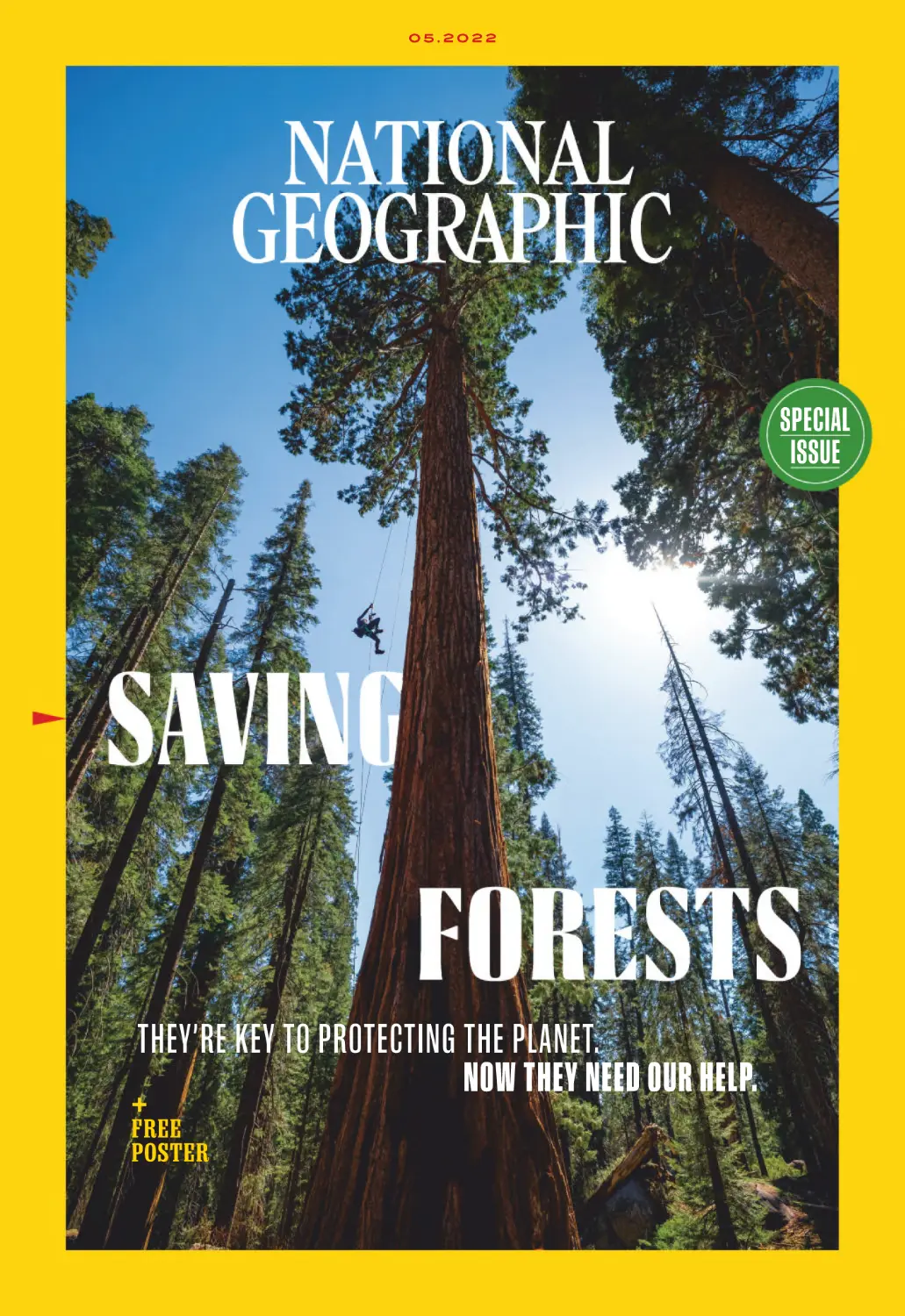
On the Cover
In California’s Sequoia and
Kings Canyon National
Parks, research on the
effects of climate change
involves climbing up and
into the towering giants.
KEITH LADZINSKI

C O N T E N T S

6
P R O O F

F E A T U R E S

The Future
of Forests
Around the globe,
climate change and
other human disturbances are fueling
threats to trees.
But we still have time
to limit the damage.

Still Standing Tall
From beeches in Italy
to laurels on Madeira,
a photographer
highlights the many
wonders of European
old-growth forests.
STO RY A N D P H OTO G R A P H S
B Y O R S O LYA H A A R B E R G

E X P L O R E

Lives Depend
on Forests
Why we, and all life
on Earth, need trees.
BY S U Z A N N E S I M A R D ... P. 15

P H OTO G RA P H S BY

The First Forests
A discovery in China
reveals clues about
arboreal evolution.
BY MONICA SERRANO

P. 24

ALSO

• Seeds That Need Saving
• Trees and Earthquakes
• Minnesota’s Lost 40
• How to Be an Arbornaut

28
The Phantom
Redwood

The albino variety is
rare and mysterious.
P H OTO G RA P H S BY
K E N N Y H U R TA D O

In Australia, Aboriginal
people follow a
cultural tradition to
help conserve their
ancestral homelands.
BY KYLIE STEVENSON

DECODER

BY NADIA DRAKE

34

Fighting Fire
With Fire

THE BIG IDEA

A N D S C OT T E L D E R ....

74
B Y C R A I G W E L C H . . . . . . . P.

M AT T H E W A B B O T T

96

A Fragile Refuge for
Forest Elephants
Already imperiled by
poaching and habitat
loss, the critically
endangered animals
in Gabon now face
a shortage of food.
BY YUDHIJIT
B H AT TA C H A R J E E
P H OTO G RA P H S BY
JASPER DOE ST
FREE POSTER

The World’s Forests
With our detailed
charts and maps,
discover how decades
of change have transformed these vital
hubs of biodiversity.

FREE Download Now!

™

Optional Accessory

DaVinci Resolve Speed Editor ... $395

FORESTS, FOR LIFE
SPECIAL ISSUE:

the forest for the trees,
Suzanne Simard once faced harsh criticism for her groundbreaking work.
The professor of forest ecology at the
University of British Columbia bucked
the prevailing theory that a forest’s
trees were isolated individuals. Her
experiments showed that trees live
interdependently, sharing resources
via belowground networks. Simard’s
essay “Lives Depend on Forests” (page
15) emphasizes how ecosystems rely on
those connections, a truth that’s at the
root of this special issue.
Forests keep our world in balance.
They’re the “lungs” of the planet, drawing in carbon dioxide and breathing out
oxygen. They provide habitat for countless species. And in a warming world,
they’re our best chance for survival.
Yet our forests are at risk. “It’s a
tough time to be a tree,” senior environment writer Craig Welch notes on
page 50. “Earth has lost a third of its
forests over the past 10,000 years, half
of that just since 1900. We logged them
for timber. We cut them to make way
for farms and cattle. We cleared land
to build homes and roads.” Extreme
conditions related to climate change
also are killing trees worldwide.
But it’s not too late to do something.
In an encouraging sign, last fall more
than a hundred world leaders promised
to end global deforestation by 2030.
In this issue we highlight how Australia’s Aboriginal people are renewing
their homelands through the ancient
practice of planned burning. We offer
strategies to help save forests. And you’ll
find stunning photographs, graphics,
and maps—opportunities to learn about
and appreciate the forest and the trees.
Thank you for reading National
Geographic.
DESPITE SEEING

David Brindley
Interim Editor in Chief

4

N AT I O N A L G E O G R A P H I C

S AV I N G F O R E S T S

Today, forests (shaded green on this
map) cover one-third of Earth’s land
surface, more than 15.6 million square
miles. Each year, forests and other
vegetation absorb up to a third of the
CO2 released from burning fossil fuels.

MARTIN GAMACHE AND MATTHEW W. CHWASTYK, NGM STAFF. SOURCES: FOREST LANDSCAPE INTEGRITY INDEX; GLOBAL LAND ANALYSIS AND DISCOVERY, UNIVERSITY OF MARYLAND

Support Nat Geo Explorers
Protecting the Amazon!
The rich biodiversity of the Amazon plays a
critical role in the overall health of the planet,
but this crucial life system is under threat.
Donate to the National Geographic Society
to support Explorers and locally-led projects
that restore, protect, and preserve this
critical ecosystem. Visit natgeo.org/donate.
™

*

™

PHOTO: ANA SOTELO

™

+)++FZklhk:_ÛebZm^l

™

NUTRO™blfZ]^pbmaGhg&@FH
bg`k^]b^gmlmaZm]h`leho^'

FEED CLEAN™
MkZ\^ZfhngmlfZr[^ik^l^gm]n^mhihm^gmbZe\khll&\hgmZ\m]nkbg`fZgn_Z\mnkbg`'
+)+*FZklhk:_ÛebZm^l'

P R O O F

A Norway-based photographer ventures into the
woods to document the beauty, value, and fragility of
Europe’s old-growth forests.
O R S O LYA H A A R B E R G

N AT I O N A L G E O G R A P H I C

STORY AND PHOTO GRAPHS BY

VO L . 2 41 N O. 5

L O O K I N G AT T H E E A RT H F R O M E V E RY P O S S I B L E A N G L E

6

N AT I O N A L G E O G R A P H I C

STILL STANDING TALL

Italy’s Abruzzo, Lazio,
and Molise National Park
is home to some of the
oldest beech forests
in Europe. Thanks to a
location that’s difficult
to access, these trees
have escaped felling
for centuries.

M AY 2 0 2 2

7

P R O O F

In the Abruzzo region of Italy, these beeches (top) are bedecked with abundant lichens, a characteristic of old-growth
forests. Like fallen snow, Cladonia lichens blanket the ground beneath mountain birches in Norway’s Rondane National Park.

8

N AT I O N A L G E O G R A P H I C

String bogs in northern Sweden feature ridges that link small islands of coniferous forests (top). Laurel forests—found in
Madeira, the Canaries, and the Azores—are living relics of the southern European stands that thrived millions of years ago.

M AY 2 0 2 2

9

P R O O F

The laurel forest of Madeira, a Portuguese archipelago in the North Atlantic, is inscribed on UNESCO’s World Heritage List
in part because the trees support many endemic species, including more than 70 plants and the Madeira laurel pigeon.

10

N AT I O N A L G E O G R A P H I C

Growing at an altitude ranging from about 1,000 to 5,000 feet, the laurels are found in the ribbon of mist that
frequently wraps the upper ranges of the islands, creating the cloud forests of the temperate zone.

M AY 2 0 2 2

11

P R O O F

THE BACKSTORY
O L D - G RO W T H F O R E S T S A R E E U RO P E ’ S N AT U R A L H E R I TAG E .
M O ST A R E P ROT E C T E D, B U T A R E T H E Y SA F E ?

serenity and sheer
beauty of pristine nature. Being in it
heightens my perceptions and narrows
my focus. As I concentrate on the surroundings, an inner stillness fills me
and helps me capture a sense of place.
This was the case when I packed my
camera equipment and ventured into
some of Europe’s old-growth forests
to highlight these unique environments that have remained intact for
centuries, despite recurrent threats of
human disturbance.
The visits were often challenging
because of unfavorable weather conditions and the distances I had to cover
while going multiple times to the most
photogenic locations. But the joy of the
experience always prevailed. Hiking offtrail through the foggy laurel forests of
Madeira, I was enveloped by trees that
may have been up to 800 years old and
whose trunks provided me with shelter
when clouds released a sudden downpour. It felt like entering a holy space.
I A M D RAW N TO T H E

Roaming the intact Scots pine
forests of northern Sweden and the
mountain tree lines of southern Norway rewarded me with the sense of
freedom I always get in the Scandinavian wilderness. The beech stands
rising from the steep slopes of Italy
kept me in awe of the power that forests shielded from exploitation can
possess. I feel privileged that I was
granted access to explore and photograph these wonderlands.
Excluding Russia, only about 2 percent of the forest areas in Europe are
primary, or have never been cleared,
reflecting a dazzling richness of life
that once filled vast wooded ecosystems. Most of the areas are now protected, but as the human population
continues to grow—with devastating
impacts on the planet and its living
creatures—the future of these forests
is far from certain. I, for one, hope that
they will still be standing for many
centuries more.

In this spot in Romania’s Carpathian Mountains, the tree line is marked with Norway
spruces, which are sculpted in winter by the forces of wind and snow.

IN THIS SECTION

E X P L O R E

Seed Bank Alarm
The First Forest
Take to the Trees
Ghostly Redwoods

I L L U M I N AT I N G T H E M Y S T E R I E S — A N D W O N D E R S — A L L A R O U N D U S E V E R Y D AY
N AT I O N A L G E O G R A P H I C

VO L . 2 41 N O. 5

LIVES DEPEND
ON FORESTS
AMID TREES MARKED FOR FELLING, A SCIENTIST SPELLS OUT FORESTS’
V I T A L R O L E I N S AV I N G W I L D L I F E , H U M A N I T Y, A N D A W A R M I N G P L A N E T.

BY

T

SUZANNE SIMARD

VA N C O U V E R I S L A N D, B R I T I S H C O LU M B I A

of the ancient yellow
cedar felt like a cocoon with its soft floor of bark
strips. A mother bear had molded this bed when she
came each year to hibernate and to birth her cubs
inside the 2,000-year-old tree. In the depth of winter,
the shell of sapwood had protected them from the
bone-chilling cold and blowing snow.
A decade earlier, the mother likely had been born
in this same den, near the headwaters of Fairy Creek
on Vancouver Island, off the coast of British Columbia. She would have returned each fall, fattened on
berries and salmon. I picked one of her hairs from
the grain of the wood, the scent of wet grass merging
with the citrusy heartwood and fresh Pacific rain.
I was here with several environmental activists.
Their opponents call them radicals, even ecoterrorists. They call themselves forest defenders,
T H E H O L LOW E D - O U T T RU N K

M AY 2 0 2 2

15

E X P L O R E

|

THE BIG IDEA

This multigenerational grove
had survived millennia of climatic
variation. Its experiences were
encoded in trees’ seeds and rings,
and the information passed
from tree to tree through
belowground fungal networks.

and they work to fend off the timber company aiming
to clear-cut this forest. Half a dozen young men and
women had greeted me on the newly blasted road
and ushered me over huge logs and deep ravines to
this wizened tree. They spoke excitedly of seeing
screech owls and of marbled murrelets nesting in
the canopy of the cedars, and pointed to specklebelly
lichens draping the smooth bark of amabilis firs.
Those birds and lichens, and many other at-risk
species, live in a community of more than 325 plants,
algae, mosses, and mammals, and untold numbers
of fungi and microbes, in the Fairy Creek watershed.
Without these trees, the defenders knew no
cubs would be born, no lichens would capture the
mountain mist, and no old-growth fungi would
link the matriarchs with their offspring. Huddled
inside the den, the defenders worried about the
impending fall rains and quietly hoped for early
snow to delay the felling.
of British Columbia. My
uncles and grandfather logged with horses, cutting
down trees so selectively you had to hunt to see
where they’d taken one. Grandpa taught me about
the quiet and cohesive ways of the woods, and how
my family was knit into it.
I followed in my grandfather’s footsteps. I studied
forestry and took jobs in the Canadian Forest Service
and lumber industry. Soon I was working alongside
the powerful people in charge of the commercial
harvest. But I found the extent of the clear-cutting
alarming, and I felt conflicted by my part in it. On
top of that, the spraying and hacking of the aspens
and birches to make way for the more commercially
valuable planted pines and firs were astounding.
It seemed that nothing could stop this relentless
industrial machine.
So I went back to school, and I studied forest science. Researchers had just discovered that one pine
seedling root could transmit carbon to another
pine seedling root—but this was in the laboratory.
I wondered, Could this happen in real forests?
I thought, yes, that trees in real forests might also
share information belowground. This was controversial, and some people thought I was crazy, and I
had a really hard time getting research funding. But
I GREW UP IN THE FORESTS

16

N AT I O N A L G E O G R A P H I C

ILLUSTRATIONS: ANTOINE MAILLARD

M AY 2 0 2 2

17

E X P L O R E

|

THE BIG IDEA

Defenses that evolved over millions
of years helped these trees withstand
temperature extremes and fend off
herbivores. But these defenses were
no match for the chain saws.
I persevered (see “The ‘Wood-Wide Web,’ Explained,”
on this page).
I asked nervously.
“Helicopters!” whispered a woman next to me
inside the den. We emerged to see the metal dragonfly
churn over the ridge, men staring from tinted windows. Under the swirl of blades, the cedar matriarch
stood at about 115 feet; her family encircled, as if
telling the story of their origin and protecting her.
This multigenerational grove had survived millennia of climatic variation, insect infestations, and
windstorms, and had been fed by centuries of salmon
runs. The experiences were encoded in their seeds
and tree rings, and the information passed from
tree to tree through belowground fungal networks.
Defenses that evolved over millions of years helped
these trees withstand temperature extremes and
fend off herbivores. They also enabled this forest to
accumulate as much carbon—580 tons per acre—as
a tropical rainforest. But these defenses, we knew,
were no match for the chain saws.
We ran and slipped across the steep slope to the
small clear-cut carved out of the mountain, where
the helicopter now hovered over a makeshift helipad.
One of the defenders climbed up the platform and
waved his arms as if to repel the aircraft.
The differences in worldviews between the loggers
and the defenders suddenly were clapping like thunder. Everyone needed these trees, yet for different
reasons. People pitched against people over an industry that no longer serves most well. Then abruptly the
machine turned and flew down the valley.
“ D O YO U H E A R T H U M P I N G ? ”

where the ground was
littered with lettuce lichens that fell with tree crowns,
depriving the forest of crucial nitrogen. On the lifeless
bark of fallen giant trunks, we saw drying specklebelly lichens—a species considered vulnerable in
the province—but the laws were too weak to protect
them, even if the loggers had noticed.
Following a faint trail into the trees, we passed
ankle-high largeflower fairybells, western rattlesnake
roots, and little prince’s pines, all species I suspected
were linked into the fungal networks of the old firs
and receiving nutrient subsidies in the deep shade.
The rare plants themselves provided an additional
source of carbon for the fungi.
Old-growth forests like this one store twice as
much carbon as century-old forests and six or more
W E C R O S S E D T H E C L E A R- C U T

THE ‘WOOD-WIDE
WEB,’ EXPLAINED
When Suzanne Simard began
working in forestry after college,
conventional theory held that trees
were isolated loners engaged in a
cutthroat Darwinian competition for
water, sunlight, and food. Timber
companies planted rows of the most
lucrative species and eradicated
most of the competition—a “plantation” approach that Simard felt
ignored the messy genius of nature,
with its many interwoven species.
In a series of breakthrough experiments conducted while dodging
grizzly bears in western Canada’s
rainforests, Simard discovered that
trees are connected through vast
fungal root systems known as mycorrhizal networks. Via this subterranean
pipeline, they share carbon, water,
and nutrients. The fungi extract
sugars from the tree roots that they
can’t produce on their own, and
in return the fungi ferry water and
nutrients to the tree roots and even
farther, from tree to tree.
The journal Nature published
Simard’s revolutionary findings
in 1997, with the cover line “The
wood-wide web.” Though her work
provoked harsh criticism, Simard
persisted, demonstrating how trees
communicate and even cooperate
between species, relaying distress
signals about drought and disease,
and trading minerals through a complex circuitry that she compared to
neural networks in the human brain.
Simard has also identified “mother
trees” that act as hubs for these networks. They can recognize their own
offspring and shuttle extra resources
to them. When these elders die,
they “dump” carbon and defense
compounds into the network,
uploading food and information for
future generations. — K E R RY B A N K S

EXPERIENCE
E A RT H ’ S M A J E ST Y
T R AV E L W I T H N AT I O N A L G E O G R A P H I C

From the majesty of Yosemite to the incredible biodiversity of the Amazon rainforest,
nature has the power to inspire, exhilarate, and heal us. And when you travel to wild places
with National Geographic’s experts and guides, you gain a deeper understanding of the
power and diversity of our planet. This Earth Day, consider where in the world you’d like to
explore with our scientists and naturalists, whether it’s the spectacular icescapes of Antarctica
or the wildlife-rich savannas of Africa. And remember, by traveling with us, you help support
National Geographic Explorers who are working to protect planet Earth.

To learn more about all our trips and to request a FREE catalog
N ATG E O E X P E D I T I O N S .C O M

|

1 - 8 8 8 -3 51 -3 274

E X P L O R E

|

THE BIG IDEA

times as much as clear-cuts. As the old trees age,
they continue to store carbon in their boles and
sequester it into soils where it is protected. Added
all together, the world’s forests and their soils store
about 90 percent of global terrestrial carbon.
Soon we stepped into another clear-cut, where
the sun had burned and dried leaves of the tiny, oldgrowth-dependent plants. The fallen ancient trees
were lying in parallel, pointing toward the mill, where
they’d be turned into shingles, sawdust, the odd
soundboard. Studies have confirmed that logging
old-growth forests releases 40 to 65 percent of ecosystem carbon to the atmosphere (even when off-site
storage of carbon in wood products is factored in).
The young defenders were already on the gravel
when I crawled up the final pitch onto the roadbed. I was shaking, not just from the exertion, but
from the trauma of what was to come. Our police
escort was waiting. As I walked toward the truck, I
noticed the chocolate brown humus layer revealed
by the roadcut, six feet thick and rich with carbon.
About half of the carbon in this forest was stored
in this layer, the other half in the trees. Once the
forest floor is pushed around by the clear-cutting
machinery and exposed to the air, about 60 percent
of the carbon is lost through displacement, erosion,
and decomposition. My research also suggests that
ultimately 90 percent is lost when the replacement
tree plantations are logged again.
pushed one of the defenders
into the cab, he muttered that he was saving her
from her own stupidity. I knew better than to argue.
But as we rolled down the mountain, I started to
explain that it takes decades for clear-cut forests
to stop emitting more carbon than they sequester
and centuries more to recover the sink strength of
the original tree stands. That we don’t have decades
for these forests to recover from clear-cutting. That
in the hundred years it takes for a forest to mature,
our planet is projected to warm by upwards of five
degrees Celsius (nine degrees Fahrenheit), eliciting
mass diebacks, pandemics, and starvations.
I don’t know if the cop heard, but I kept talking,
because our lives depend on scientists speaking
out and people taking action. In British Columbia,
we have only 3 percent of iconic valley-bottom oldgrowth trees left, and we are gunning to log those
too. The same story is playing out worldwide.
BEFORE THE POLICEMAN

We need to shift away
from a detached, exploitive
relationship with nature
toward one that is close,
protective, and regenerative.
A month later, the rains started and the ancient
cedar matriarch and her forest were felled.
The rains continued. After one more month, the
soils—denuded of trees—eroded, the rivers swelled,
and in parts of the province, towns flooded.
W H AT C A N B E D O N E

so that next time this story ends

differently?
First, we must stop converting natural forests to
industrial plantations and agricultural fields. The
commitment by governments to end global deforestation by 2030 is a good first step—but the pledge
needs to include ending industrial forestry practices
too. Corporations need to take responsibility for the
damage and emissions they create in pursuit of profit.
Second, we can take immediate action to protect
and restore old-growth forest ecosystems.
Third, we can press for land management policies
that restore plantations back to natural forests, where
we selectively harvest at a lower rate to preserve biodiversity, water supply, and carbon storage. By taxing
forest carbon emissions, we could restore cultural and
social equity to rural and Indigenous communities,
rewarding the stewards with what the polluters pay.
This is an easy tool to bring about a just transition.
Fourth, we need climate policies that put as
much emphasis on protecting forest carbon sinks
and preventing emissions from logging as they do
on preventing fossil fuel emissions.
And finally, we need to shift away from a detached,
exploitive relationship with nature toward one that
is close, protective, and regenerative.
We all can learn from the Indigenous Coast Salish
people of the Pacific Northwest, who have long known
that trees are our kin and that the forest is made of
many nations living side by side in peace. This communal spirit will be essential for building alliances,
forming a web that binds us, makes us stronger, and
helps us protect our forests for future generations. j

ABOUT THE AUTHOR

Suzanne Simard is a professor of forest ecology at
the University of British Columbia and the author of
Finding the Mother Tree: Discovering the Wisdom
of the Forest. She wrote the foreword for the new
National Geographic book Into the Forest, available
wherever books are sold and at books.disney.com.

149

$

Compare at $225

Our noble elephant necklace is as charming as it is meaningful.
Suspending from an 18" box chain with a 2" extender, the
18kt yellow gold over sterling silver 1" wide pendant comes to life with
.50 ct. t.w. multicolored sapphires and ruby accents. Trumpeting with pride,
our sweet design is sure to put a smile on your face!
Shown larger for detail.

ORDER TODAY!

To receive this special price and free shipping use offer code: STRONG9
1.800.556.7376 or visit ross-simons.com/strong
Item #932053

|

E X P L O R E

BREAKTHROUGHS

Saving Seeds, by More Means

D I S PAT C H E S
FROM THE FRONT LINES
OF
AND

SCIENCE

I N N OVAT I O N

An estimated 8 percent of plant species—
including about a third of endangered and
vulnerable ones—have recalcitrant seeds
that won’t tolerate drying, says a study in
the journal Nature Plants. That means typical
seed bank processes won’t work for those
species, so experts urge additional measures,
such as cryopreservation, to guard against
their extinction. — H I C K S W O G A N

From trees,
a new way
to pinpoint
earthquakes

CENTURIES-OLD SURVIVORS
I N T H E L AT E 1 8 0 0 S A N D E A R LY 1 9 0 0 S , L O G G E R S
C L E A R - C U T P I N E S I N M I N N E S O TA’ S N O R T H W O O D S —
B U T S O M E R E M A I N , T H A N KS TO A M A P P I N G E R RO R .

spared a patch of old-growth
pine forest in northern Minnesota from the saws and axes of the
region’s logging boom. Now the trees—the kind that once filled the
area’s famed North Woods—are estimated at up to 400 years old.
Most of the region’s forests may look mature, but many trees are
less than a century old; settlers and lumber barons clear-cut much
of the forest between the 1890s and 1920s. So how were more than
30 acres of old-growth pines missed? According to U.S. government
records, in the winter of 1882, four surveyors headed into the thick
forests to inventory land features. Cold and living roughly, they
apparently rushed the job and made a mistake, categorizing as a
lake the area that was actually forest acreage. Later, when loggers
were bidding on that land, it was listed as being underwater and
so was not pursued for logging rights.
That’s a boon to modern-day hikers. They can wander through
what’s now called the Lost 40 and gaze up at the towering pines—
one of which is the state’s largest living red pine at 120 feet tall and
nearly 10 feet around. — K AT I E T H O R N TO N
A S U RV E Y I N G S L I P U P 1 4 0 Y E A R S AG O

In Chile after a
magnitude 8.8
earthquake, a team
of scientists from
U.S. and German
research institutions noticed that
streams in their
valley work site
had sped up. It’s
known that earthquakes make soil
more permeable
and increase the
downhill flow of
groundwater.
When the
researchers later
took core samples
from pine trees in
valleys and along
ridges in a Chilean
mountain range,
measures of the
tree rings’ cells
(left) confirmed
that valley trees
with extra water
after the earthquake had seen
On this confocal temporary growth
spurts and that
laser scanning
image of cells
higher, drier trees
from a pine
had grown more
in the Chilean
slowly. In this way,
earthquake
the earthquake
zone, the orange
had left an imprint
outline shows
on trees.
roughly the
The researchquake time span;
ers also have made
afterward, extra
water caused
a mark: The treegrowth spurts
ring technique can
that affected
potentially date
tree-ring growth. a seismic event to
within weeks of its
occurrence, more
precise than the
usual metric, the
nearest year. — H W

PHOTOS (CLOCKWISE FROM TOP): ZOONAR GMBH/ALAMY STOCK PHOTO; CHRISTIAN MOHR; DEBORAH ROSE

%XVLQHVVRZQHU*UDQGPRWKHU7UX
HKXQWHU
A life well planned allows you to

While you may not be transitioning your business and sharing a new passion with your
granddaughter — your life is just as unique. Backed by sophisticated resources and a team of specialists
in every field, a Raymond James financial advisor can help you plan for the dreams you have,
the way you care for those you love and how you choose to give back. So you can live your life.

E X P L O R E

|

DECODER

THE FIRST FORESTS
Researchers in China have
discovered fossils of the
oldest forest ever found in Asia,
a 62-acre stand dating back
some 365 million years. The
newly unearthed genus, named
Guangdedendron, lived when
trees were starting to put down
roots around the world. The rise
of forests permanently altered
Earth’s atmosphere and climate.
BY

Beijing

CHINA
Guangde
County
TAIWAN

Strobilus

Megaspores
Actual size shown
(1/25 inch
in diameter)

MONICA SERRANO
AND

SEEDLESS SPREAD
Guangdedendron reproduced by dispersing
snowman-shaped megaspores, held in its crown’s
arched branches.

SCOTT ELDER

Atmospheric CO2 (parts per million)
Guangdedendron era (372-359 MYA)
Major volcanic activity
1,969 ppm
Current
level
413 ppm
420 MYA 250 MYA
(million years ago)

Present

CHANGING THE CLIMATE
During the Devonian period,
primitive mossy plants evolved
into trees, which gradually grew
bigger and more abundant.
They collectively removed ever
greater amounts of CO2 from the
air, causing an “anti-greenhouse”
effect that cooled the planet
and expanded the polar ice caps.

Juvenile
tree

Mature
Guangdedendron
3.6-25.3 feet

Crinoid

Clam shrimp

Jiangxilepis
A clam shrimp and other
possible invertebrate and fish
fragments were also found.

24

ILLUSTRATION: RAÚL MARTÍN

EARLIEST TREES
The first major tree types all
went extinct, but Archaeopteris
is an indirect ancestor of today’s
trees. The group that includes
Guangdedendron, the lycopsids,
survives as much smaller plants.
D EVON IAN PE RI O D
( 4 19-3 59 M YA)

Cladoxylopsid trees
Archaeopteris trees
Lycopsid trees
Guangdedendron
Modern trees

400 MYA

TODAY

Rootlet

Other roots from the period
BUILDING BETTER ROOTS
Early tree types had increasingly
sophisticated root systems. While
the simple radiating roots of
cladoxylopsids limited the trees’
size, branching roots supported Cladoxylopsid
tree
greater weight and height.

Archaeopteris
tree

Main roots
split into
pairs

Hollow

Guangdedendron’s
main roots divided in
two. Lateral rootlets
were likely hollow to
carry air in the oxygenpoor environment.

SOURCES: “THE MOST EXTENSIVE DEVONIAN FOSSIL FOREST WITH SMALL LYCOPSID TREES BEARING THE EARLIEST STIGMARIAN ROOTS,” CURRENT BIOLOGY; CHRIS BERRY,
CARDIFF UNIVERSITY; PATRICIA GENSEL, UNIVERSITY OF NORTH CAROLINA AT CHAPEL HILL; GAVIN FOSTER, UNIVERSITY OF SOUTHAMPTON; BRIGITTE MEYER-BERTHAUD,
CNRS; ERNEST M. GIFFORD AND ADRIANCE S. FOSTER, MORPHOLOGY AND EVOLUTION OF VASCULAR PLANTS; YOU-AN ZHU, CHINESE ACADEMY OF SCIENCES; NOAA

Kingdoms of the
Dadanites and Lihyanites
Distant view of tombs at Dadan.
Photograph by Matthieu Paley

PAID CONTENT FOR ROYAL COMMISSION FOR ALULA

M

ore than two millennia ago, AlUla’s verdant oasis nurtured the
growth of sophisticated and innovative cultures.
Arabia’s deserts have always been peopled landscapes, rich with human
and natural diversity. People have lived in and around them, people have
journeyed across them, and people have found water sources within them
to sustain life.
That is how it is in the AlUla valley, a green oasis of citrus and palms
set amid desert cliffs of sandstone in northwestern Arabia. Here, ancient
civilizations flourished from at least the Iron Age (first millennium BCE)
onwards. Archaeologists working on the neighboring basalt plateau of
Harrat Uwayrid have discovered tools such as hand axes made of local
stone, leading Azhari Mustafa Sadig, archaeology professor at Saudi Arabia’s
King Saud University, to suggest “that the plateau was occupied by huntergatherers as early as the Paleolithic age, more than 200,000 years ago.”
Nomadic hunter-gathering shifted into farming as people took advantage
of the AlUla valley’s natural resources to settle. They began harnessing water
flows within the oasis for agriculture, while continuing to herd sheep, goats,
and other livestock. According to archaeologist Abdulrahman Alsuhaibani,
by 2,600 years ago the oasis hosted the growth of Dadan, a “powerful capital
city” with an economy fueled by farming and long-distance trade.
Ruled by a dynastic succession of kings from a power base within the
AlUla valley, Dadan soon rose to prominence in the region. As Alsuhaibani
confirms, the city’s centralized structure of governance was strong and
stable enough to deploy resources on defense, with inscriptions testifying
to the presence of “guardians” posted to Dadan’s frontiers.
Movements of people along routes of trade were bringing new
commodities northwards, such aromatics including frankincense, a resin
formed from the sap of a tree native to southern Arabia and the Horn of
Africa. Trade of frankincense formed a huge part of Dadan’s economic
success. Farmers in distant southern Arabia would harvest vast quantities
of the resin for transport northwards to markets around the Mediterranean
and elsewhere. They dealt with traders, who then carried the frankincense
on journeys that sometimes lasted months at a time to reach Dadan,
where it was transported onwards. The profits they generated—and the
tolls charged by the people of Dadan—formed the bedrock of the region’s
prosperity for several centuries.
This is Paid Content. This content does not necessarily reflect the
views of National Geographic or its editorial staff.

PAID CONTENT FOR ROYAL COMMISSION FOR ALULA

With trade came new ideas, new
expressions in art, and new ways of writing.
Dadan developed its own writing system,
based on scripts used in neighboring
oases, such as Tayma and Dumah, and the
alphabets of southern Arabia. Thousands of
inscriptions survive here now, some formally
composed dedications, others casual graffiti.
Dadanitic, as the local language is known,
was extraordinarily resilient, remaining in
use in and around the AlUla valley for at
least 500 years.
Historian Michael Macdonald has
analyzed subtle differences across Dadanitic
inscriptions, noting how shapes of letters
vary in a way that is unusual for a script
designed purely for carving into stone.
Intriguingly, he says, the development of
letter forms “suggests that the script was
used to write in ink on materials such as
papyrus or potsherds.” Archaeologists
continue to hunt for examples.
It is natural to presume that the power
of Dadan waxed and waned. In particular,
we know about a period of conflict with
Nabonidus, king of distant Babylon, who
claims in the sixth century BCE to have
invaded Dadan’s home region, killing its king
and occupying its land.
After Nabonidus, at some point around
2,500 years ago (it isn’t known precisely
when), control over Dadan shifted to the
kings of the tribe of Lihyan, who ruled the
region for several centuries, perhaps until the
first century BCE. But the material evidence
that survives suggests that Lihyanite rule
perhaps didn’t greatly disrupt Dadanite
culture.
In what was now the kingdom of
Lihyan, men and women both owned
property in their own right. Agriculture

remained critical to society, enhanced by
innovative developments in the control of
water resources. Water was clearly used for
domestic and agricultural purposes, but
also appears to have played a role in rituals.
A huge cylindrical basin for water hewn
from a single stone, located in the heart of
Dadan next to a building, was likely used
for religious or other ceremonial purposes.
Along with its own writing system, Dadan
had its own gods and forms of worship,
with sanctuaries located in mountains near
the city and on the summit of Mount Umm
Daraj across the valley.
The people of ancient Dadan worshipped
the supreme deity Dhu Ghabat, the meaning
of whose name is debated: some interpret
it as “master of the grove,” others as “lord
of the forest,” and some as “god of absence.”
The Umm Daraj mountain sanctuary is
dedicated to Dhu Ghabat, where devotees
including Lihyanites, visiting traders, and
Dadan’s resident trading colony of Minaeans
from southern Arabia would make votive
offerings with frankincense, as well as small
figurines in sandstone depicting humans.
Architectural elements have been discovered
bearing decorative motifs of a snake, perhaps
as “a protective function,” suggests historian
Husayn Abu al-Hassan. Inscriptions also
suggest, as Michael Macdonald notes, that
“worship of Dhu Ghabat may have included
the offering of the ‘first fruits’ to the deity.”
Other gods worshipped in Dadan at this time
include Ha-Kutbay, the goddess of writing.
Art clearly mattered to the ancient
peoples of Dadan—Dadanite and Lihyanite
artistry involved in carving statues is
remarkable. “Where and how [did] the
inhabitants acquire such mastery of the
rules of sculpture—anatomical proportions,
volume, perspective?” asks archaeologist
Said al-Said. He believes that, although there

were cultural interactions with neighboring
cultures in Egypt, the Levant, Mesopotamia,
and southern Arabia, it’s likely that this
Dadanite skill demonstrates a cultural
evolution unique to this part of Arabia.
Rock art that may date from the Dadanite
or Lihyanite period includes hunting scenes,
camels, ostriches, and abstract depictions
of people. Archaeologists have discovered
statuary at certain sites, including
anthropomorphic likenesses that have
been interpreted as either Dadanite gods or
images of living individuals, carved to show
homage and dedication to the gods.
Alongside the people of Daan’s notable
skills in politics, trade, science, and art,
evidence suggests dedication in how they
buried their dead. During the Lihyanite
period, people carved tombs into the cliffs,
designed for one person or more. Also
visible today, set into sandstone cliffs, are the
“lion tombs,” carved tombs adjacent to one
another, each of which is flanked by reliefs
of lions, perhaps as divine protection for the
tombs’ inhabitants.
“The kingdoms of Dadan and Lihyan
played a major role during the first
millennium BCE,” says Alsuhaibani,
confirming the importance of a place and
a period of history long overlooked. Today,
excavations and investigations into the
cultures of the people of Dadan continue
throughout the AlUla valley, shedding new
light on their artistry and ingenuity. With
each new discovery, it becomes clear that
the desert—once thought of as barren or
empty—in truth has always hosted life. The
Dadan oasis, among other oases and centers
of activity in this region, exhibits human
achievement and drama as rich as anywhere
on our planet.

A Dadanitic inscription showing a mixture of formal and
informal letter shapes.
Photograph by L. Nehmé

Bust of an ex-voto, excavated in Umm Daraj sanctuary,
AlUla.
Photograph courtesy of Royal Commission for AlUla

Detail of a carved lion above a tomb at Dadan.
Photograph by Matthieu Paley

To learn more about AlUla visit
www.nationalgeographic.com/journey-to-alula
To plan a trip to AlUla visit www.experiencealula.com

E X P L O R E

|

PLANET POSSIBLE

P L A N E T

For more stories about
how to help the planet, go to
natgeo.com/planet.

Stroll a canopy walkway, take
a tree-climbing class, find forest
lodgings, play leaf detective.
You too can be an ‘arbornaut.’

BY

CHRISTINA NUNEZ

As deforestation occurs
worldwide at an alarming rate,
what could make us care and
act? Perhaps spending time in
and among trees, as National
Geographic Explorer Meg
Lowman does. A biologist,
author, and self-described
“arbornaut,” Lowman raises
awareness of forests’ vital
role—and helps developing
nations create jobs—by
promoting sky-high walkways
and tree canopy tourism. “The
canopy houses some 50 percent of terrestrial biodiversity,”
she notes. Here are some ideas
for arboreal appreciation.

Become a leaf detective.
Take a closer look at the characteristics of leaves on the
trees in your area. “There are
so many adventures on the
life of a leaf surface,” Lowman
says. “You just need to get out
your journals and start recording observations over time.”

Climb trees—safely.
Relive the arboreal ascents
of childhood but with today’s
technology. Search online for
specialized climbing courses to
get the training and equipment
needed to scale large trees.

Explore a canopy walkway.
Gaze out from a walkway high
in the trees, like those Lowman helps build around the
world. You’ll find an international map of walkways at
treefoundation.org.

Stay in or above trees.
Look online for lists of tree
houses for visits or lodging.
Another option: fire towers.
Now that the U.S. Forest Service is using more technology
to aid humans’ fire detection
efforts, some former lookouts
can be rented for overnight
stays at recreation.gov.

The National Geographic
Society has funded the
work of “CanopyMeg” Lowman
since 1998. Learn more about
its support of Explorers at
natgeo.com/impact.

PHOTO: ERIKA LARSEN

TA K E A
S M A RT S T E P
TOWA R D A
MORE SECURE
FUTURE
Establishing a charitable gift annuity
with the National Geographic Society
is a great way to receive guaranteed
payments for life and save on taxes—
while protecting our planet for

C O P Y R I G H T 2 0 2 2 N AT I O N A L G E O G R A P H I C S O C I E T Y
P H OTO C O U RT E SY O F E D S O N VA N D E I R A

S I M P L E + S A F E . S E C U R E YO U R F U T U R E W I T H L I F E T I M E PAYM E N T S .

E X P L O R E

PHANTOM IN
THE FOREST

A
BY

NADIA DRAKE

PHOTOGRAPHS BY

S A N TA C RU Z C O U N T Y, C A L I F O R N I A

IT’S AN EVERGREEN
T H AT ’ S W H I T E . I T L I V E S
LIKE A MOOCHER AND
L O O K S L I K E A G H O S T.
THE ALBINO REDWOOD IS
A G E N E T I C M A RV E L ,
W R A P P E D I N M Y S T E R Y.

28

N AT I O N A L G E O G R A P H I C

K E N N Y H U RTA D O

a ghost floats in the
darkness—a phantom in this redwood forest,
somewhere in California’s Santa Cruz County.
We slip-slide into the gully, landing in spongy
piles of discarded needles, ferns, and poison oak,
and then we scale the other slope. A great horned
owl hoots once, twice, three times. Dawn is just
beginning to tickle the treetops, but down here,
beneath the forest canopy, it’s still chilly twilight.
A few feet away, the astonishingly white tree
hovers like an otherworldly apparition, its crown
high above our heads. It’s an albino redwood. An
enigma. A biological improbability—an organism
that shouldn’t exist.
“My guess is that this thing is probably a hundred years old, or more,” says graduate student
Zane Moore, who studies redwood genomes at the
University of California, Davis. “It’s one of the tallest
in the county.”
Rather than being evergreen, the tree is everwhite,
its needles soft and waxy. Normally Sequoia sempervirens, the coast redwood, survives by harvesting
sunlight and turning it into food—but this albino
is missing a crucial component of the basic cellular
machinery it needs to feed itself. Instead, it taps into
the root system of its pigmented parent and steals
sugars and nutrients.
Although rare on Earth, albinos grow naturally
within the fog-drenched coast redwood range.
They’re a scientific puzzle—mutated trees that are
somehow allowed to survive, even as parent trees
discard other shoots. A few are tall like the tree we’re
visiting, but most are shorter and shrubbier. Others
have sprouted high up in their parent trees. Maybe
50 or so are naturally occurring white-and-green
AC R O S S A S T E E P C A N YO N ,

M AY 2 0 2 2

29

E X P L O R E

State Park, where a well-trodden loop trail allows
visitors to experience the majesty and monstrosity
that is an old-growth redwood grove: thick, towering
trees with twisted bark and gnarly burls, split crowns,
fused trunks, and even a burned-out cavern big
enough for dozens of people to squeeze into.
Surrounded by ferns and fragrant, dewy leaf litter, these massive trees dominate the landscape
T H E T R E E S F I R S T A P P E A R E D I N P U B L I C AT I O N S in
the mid-1800s, when settlers started noticing their and lend an almost primordial appearance to the
curiously creamy foliage. Since then, and with a forest. Moore’s first albino, in contrast, is a roughly
human-height mix of brown and white branches,
few exceptions, the albinos’ locations have
tucked into an unmarked grove near the
been closely guarded to protect them from
park’s railroad tracks. He found it in 2011
trophy-clippers or decorators, like those
after he watched a documentary about
who once festooned an opera house with
UNITED
OREG.
STATES
the albinos and decided to go see one
the snowy sprigs.
Coast
redwood
for himself. “And around the same time,
The towering albino we visited at
range (Sequoia
I’m realizing, Oh, I could do botany as
dawn has been known since the 1970s,
sempervirens)
a living?” Moore recalls. “You know, I
says Moore, now one of the world’s Santa
CALIF.
Cruz
really like plants.”
experts on the trees. He and a colleague
Everything about albino redwoods is
are keepers of the albino redwood map, an
tinged
with mystery. How they survive, and
evolving guide to the roughly 630 known albinos growing between southern Oregon and central sometimes appear to thrive; their physiology; their
California. Some of these trees have been cultivated anatomy; the mutations that make their bone-white
by enthusiasts. Others, maybe a hundred or so, Moore color. Even the scientific literature describing the
has stumbled upon accidentally, including the one he trees is sparse. Recently, scientists went hunting for
glimpsed while snarled in beach traffic on a notorious albino-producing mutations but were thwarted by the
California highway. Mostly, he says, he chases them redwood genome itself—a colossal, just sequenced
based on historical reports or tips from locals: “It’s assemblage of 26.5 billion base pairs distributed
among six pairs of 11 chromosomes. (Humans,
like a treasure hunt.”
Later in the day, he shows me the first albino he by comparison, have three billion base pairs and
ever encountered. It lives in Henry Cowell Redwoods 23 pairs of chromosomes.)
chimeras, organisms with two distinct sets of genetic
instructions. One of these trees, which was growing
near a right-of-way in Sonoma County, is so beloved
that when railway builders threatened to cut it down
in 2014, local residents forced the company to dig it
up, load it onto a truck, and relocate it.

This photo, of “a gleaming bush nonchalantly sprouting next to the curving metal,” was made in 2021. An albino redwood is
also growing by the railroad tracks in Henry Cowell Redwoods State Park in an 1877 photo that researcher Zane Moore has.

NGM MAPS. SOURCE: U.S. FOREST SERVICE

One asset soars above all others
n Kit from U S Money Reserve!

Gold provides the
protection your portfolio
needs to stand the test of time.

I

0
.*
o
s
j
O
v
v
p
r
n
G

CALL NOW FOR YOUR FREE
GOLD INFORMATION KIT
Order the Ultimate Gold Information Kit
from the experts at U.S. Money Reserve, with
over 85 pages of “insider” information!
•
•
•
•

Why Own Gold NOW
The Secrets to Gold Ownership
Maximizing Your Profit Potential
Exclusive Offers and Intro Savings

CALL TOLL-FREE TODAY!

1-800-592-4423

FREE KIT
& 2 BONUS
REPORTS!

FREE BONUS REPORT!
Call right now to receive two exclusive
BONUS reports: 25 Reasons to Own Gold
and the 2022 Global Gold Forecast!

©2022 U.S. Money Reserve. *Based on the change in gold’s price from $263.80/oz. (10/27/00) to $1,936.30/oz. (02/24/22).
The markets for coins are unregulated. Prices can rise or fall and carry some risks. The company is not affiliated with the U.S.
Government and the U.S. Mint. Past performance of the coin or the market cannot predict future performance. Prices may be more or
less based on current market conditions. All calls recorded for quality assurance. Coins enlarged to show detail. Offer void where prohibited.

E X P L O R E

In the realm of the California
redwoods, humans are the
fleeting apparitions. The oldest
tree displayed in the park dates
to two centuries before the
birth of Christianity.

Albinos may look delicate, but they’re survivors: Their
white shoots are often among the fastest to regrow from
flame-damaged landscapes.

In 2016, Moore discovered that some albinos
contain much higher levels of cadmium, nickel,
and copper than their green parents—as much as
11 times the amount needed to damage a plant. He
wondered whether the albinos were sequestering
those heavy metals and in some way benefiting their
parent trees, which researchers suspect could otherwise choose to shut off the albinos’ food supply.
So far, there’s no consensus among scientists about
what’s going on. And now, in a twist, researchers at
Princeton University who are studying how carbon
and hydrogen atoms travel through the trees’ metabolic pathways are using the trees to possibly better
reconstruct ancient environmental conditions.
People often say that albino redwoods are
ephemeral—ghosts that materialize and vanish,
phantoms that hide in plain view. But in the realm
of the California redwoods, humans are the fleeting
apparitions. At Henry Cowell Park, a ceremoniously
displayed stump came from a tree that sprouted in
a California forest two centuries before the birth of
Christianity. The oldest tree in the park has been
soaking up sunlight for more than a thousand years.
Yet even the supposedly frail albinos outlive us.
Moore shows me one growing near the park’s railroad tracks that also appeared in a photograph from
1877—a gleaming bush nonchalantly sprouting next
to the curving metal. And he tells me that a few miles
away, a huge tree exists that was first described in 1912.
“It was fully cut down in the 1970s, but it’s still
growing back,” Moore says. “You want to see a spectacular albino? That’s it. Covers 728 square feet, and
it’s about 15-ish, maybe 15, 20 feet tall on average, just
this big clump of white. It’s really something else.”
Of course we go see it. Casually growing between
two houses, the tree is a riotous gathering of milky
branches erupting in every direction—a thicket large
enough to get lost in—that has regrown in just 50
years. Now, every threat to redwoods is also a threat
to the albinos, Pittermann says, because “their vigor
is impacted by the health of the parent tree.” But this
razed tree’s regrowth is the same phenomenon seen
after forest fires: White shoots often are among the
fastest to regrow from flame-damaged landscapes.
“It’s amazing, right?” she says.
of an old-growth redwood
grove, a place that feels more precious every day. Yet
it took me nearly 25 years to spot the bushy cluster
of albino sprouts along one of my childhood trails:
a froth of snow-white needles the size of a minivan.
Like most people, I’d traipsed by it multiple times,
oblivious to its striking colors or perhaps dismissing it as a trick of sunlight. To this day the tree, an
embodiment of the peculiar and the unlikely, is
thriving. Though precisely where, I won’t say. j
I GREW UP IN THE ARMS

Researchers do know that, in addition to lacking
photosynthetic machinery, the trees have almost no
control over water loss through small openings in
their leaves, which happens more quickly in higher
temperatures. The albino trees also have weaker
wood than the pigmented trees, perhaps because
they can’t easily make a compound called lignin
that’s crucial for building cell walls. “It’s hard working
with these long-lived plants,” says ecophysiologist
Jarmila Pittermann of the University of California,
Santa Cruz, who did the work on water loss. “I’m also
fascinated by the fact that there really are a lot of
them here” in Santa Cruz County, she says.

Contributing writer Nadia Drake enjoyed this sylvan break from
covering the James Webb Space Telescope and other space
oddities. Photographer Kenny Hurtado, a longtime chronicler
of coastal California culture, is now based in the Midwest.

HEAT
AND DROUGHT
ARE
KILLING
OUR FORESTS.
BUT
WE CAN
LIMIT THE
DAMAGE—
IF WE
CHANGE
COURSE NOW.
BY

CRAIG WELCH

35

P R E V I O U S P H OTO

Standing nearly 217
feet tall and estimated
to be more than 500
years old, Big Lonely
Doug, on British
Columbia’s Vancouver Island, was saved
in 2011 by a logger
impressed by its size. It
proved to be Canada’s
third largest Douglas

fir, considering its
circumference, height,
and crown size. Oldgrowth forests around
the world face bulldozers and chain saws,
and climate change
poses new threats:
intensifying wildfires,
beetle attacks, heat,
and drought.
GARTH LENZ

S E Q U O I A N AT I O N A L F O R E S T

CALIFORNIA
FIRES IN THE PAST
TWO YEARS KILLED UP
TO A FIFTH OF THE
LARGEST SEQUOIAS
On a burnt slope in
the Sierra Nevada,
their only native home,
giant sequoias—some
more than a thousand
years old—stand like
black daggers among
the other dead: white
firs, sugar pines,

incense cedars.
While sequoias can
often survive ground
fires because they
have few low branches,
this fire blew flames
into the crowns. Climate change and fire
suppression are fueling
bigger wildfires.
F L A P : Embers rain from
the crown of a sequoia
that was ignited by a
windblown ember in
2021. The tree survived.
SUE CAG;
JEFF FROST (FLAP)

N O RT H E R N C OA S T

AUSTRALIA
39 MILLION MANGROVES
DIED OF THIRST HERE
Years of high heat
and drought had
stressed mangroves
along hundreds
of miles of the Gulf
of Carpentaria coast.
Then the intense

El Niño of 2015-16
finished them off by
causing a temporary
16-inch drop in sea
level here, drying out
the trees’ roots. This
2021 photo shows little recovery; the green
belongs to a short
mangrove species that
survived the die-off.
MATTHEW ABBOTT

EASTERN SIBERIA

RUSSIA
IN 2021, FIRES TORCHED
21 MILLION ACRES IN A
PLACE KNOWN FOR COLD
Snow blankets a boreal
forest that burned
the previous summer
in the Sakha Republic.
Small fires occur

regularly in this region
about twice the size
of Alaska. But in 2021,
four times the average
annual area ignited,
potentially releasing
ancient carbon from
permafrost and
transforming forest
into grassland.
ANTOINE BOUREAU

G R A N D E P R A I R I E , A L B E RTA

CANADA
QUAKING ASPEN,
NORTH AMERICA’S MOST
WIDESPREAD TREE,
IS DYING IN DROVES
Forest scientists are
struggling to figure
out a response to
“sudden aspen decline,”

as they call the dieoffs that have struck
since the turn of the
century. But they know
drought and rising
temperatures make
the trees more susceptible to disease and
insects—such as the
tent caterpillars that
defoliated this stand.
GARTH LENZ

M OJAV E N AT I O N A L P R E S E RV E

CALIFORNIA
THE DOME FIRE KILLED
MORE THAN A MILLION
JOSHUA TREES IN 2020
Yet these icons of the
Mojave Desert already
faced other threats.
Seedlings appear less
often as temperatures

rise and a long drought
persists; invasive
grasses promote fire.
This relatively cool
pocket, where some
trees survived the
2020 fire, is a potential
refuge. Volunteers
are planting seedlings
to aid the recovery.
KEITH LADZINSKI

T

in this fire-scarred
forest is the color. Not long ago this square of
land south of Yellowstone National Park was a
monochrome of ash and burned pines. But last
summer, shin-high seedlings and aspen shoots
painted the ground an electric green. Purple
fireweed and blood-red buffalo berries sprouted
around blackened logs. Yellow arnicas danced
in the breeze. Five years after 2016’s Berry fire
chewed through 33 square miles of Wyoming,
this slice of scorched earth was responding to fire
as Rocky Mountain forests have for millennia: It
had entered a season of rebirth.
Monica Turner was cataloging that recovery.
On a sweltering July day, Turner, a professor of
ecology at the University of Wisconsin–Madison,
shuffled along a line of tape she’d stretched 50
meters across the ground. She and a graduate
student were counting every lodgepole pine
seedling within a meter on either side. We were
far enough from paved roads that there was
no telling which forest inhabitants might be
lurking—elk, deer, moose, wolves. The air was
so hot I wondered fleetingly if the bear spray
canister on Turner’s hip might explode.
So many tiny trunks crowded the researchers’
T H E F I R S T T H I N G YO U N OT I C E

SOUTH OF
Y E L LO W S TO N E

WYOMING
THIS BURNED FOREST
IS GROWING BACK,
BUT OTHERS AREN’T
Ecologist Monica
Turner counts lodgepole pine seedlings
sprouting (along with
fireweed) among pines
that burned in 2016.
Fire opens seed cones,
allowing lodgepoles
to regenerate—but if
another fire comes be fore trees mature, they
may not grow back.
SOFIA JARAMILLO

48

N AT I O N A L G E O G R A P H I C

feet that covering a distance they normally
would walk in seconds took almost an hour.
In the end they counted 2,286 baby trees in an
area half the size of a tennis court. This spot was
producing 70,000 pines an acre. “This is what
lodgepole pines do,” Turner said. “They come
back gangbusters.”
Yet the previous day, in a neighboring patch
of burned timber, Turner had documented
something unsettling. Instead of a river of new
pine seedlings, the ground was a mix of flowers,
grasses, and caked earth. Aspens were there, but
so were invasive grasses and sour weeds. Along
one 50-meter tract, Turner had spotted just 16
baby pines; on another, only nine. All told, this
patch was producing fewer than one-fiftieth as
many young conifers as its neighbor.
The two patches of forest were almost identical. Before the Berry fire, both sites had burned
around the time of the Civil War. But one

distinction set them apart. The site with fewer
pines had burned another time as well, in 2000.
Trees that sprouted after that fire had not yet
matured to produce enough seeds before being
wiped out in 2016. In this place, rather than
reseeding the pine forest, the Berry fire was
resculpting the landscape into something new,
perhaps for centuries or even millennia.
Yellowstone is part of a global trend. From the
Amazon to the Arctic, wildfires are getting bigger,
hotter, and more frequent as the climate changes.
Australia’s forest fires in 2019 and 2020 burned an
area as big as Florida. That’s devastating enough.
But often overlooked amid the initial carnage is
what happens after the trees die: Many forests
now struggle to recover. That too is not limited to
Yellowstone, nor is it always triggered by fire—but
it is caused by climate change.
In many places, forests are no longer regenerating on their own. Some of the world’s most
THE FUTURE OF FORESTS

49

significant stands are instead transitioning to
something new. Some will never be the same.
Others may not come back at all.

Earth has lost a
third of its forests over the past 10,000 years—half
of that just since 1900. We logged them for timber.
We cut them to make way for farms and cattle. We
cleared land to build homes and roads. Globally,
deforestation has decreased from its peak in the
1980s, but trends vary by region. In Indonesia,
which had been mowing down forests for oil palm
plantations, primary forest loss has declined
since 2016. From August 2020 to July 2021, the
Brazilian Amazon lost 5,000 square miles of rainforest, a 22 percent increase over the previous
year. Since 1990, we’ve cut down more forest
globally than there is forest in the United States.
Now fossil fuel emissions spewing from coal
plants and tailpipes are rearranging forests in
other consequential ways. As carbon dioxide
and other greenhouse gases warm the planet,
some of its estimated 73,000 tree species are
pushing poleward and higher up slopes, dragging other life with them. Alders, willows, and
dwarf birches are expanding across the Arctic,
from Scandinavia to Canada, providing cover and
food for snowshoe hares and moose. Trees are
growing faster as they soak up excess CO2—a key
ingredient for photosynthesis. That “greening” of
the planet has so far helped slow climate change,
protecting us from ourselves.
But climate change also is killing trees. And
what has forest scientists increasingly uneasy
is the quickening pulse of extreme events—fire,
more powerful storms, insect infestations, and,
most notably, severe heat and drought, which
can worsen the effects of all the rest. These singular, frequently unprecedented episodes can
swiftly inflict mass tree mortality, shifting forests that have been around since the last ice age
to entirely new states.
“We have a whole set of mechanisms that are
pushing Earth’s forests to grow more and suck
up more CO2 ,” says University of Utah biologist
William Anderegg. But those mechanisms “are
fundamentally in tension with mechanisms that
are pulling Earth’s forests toward a cliff—with
more tree death and more loss of carbon.”
The forests that have plunged over that cliff
I T ’ S A TO U G H T I M E TO B E A T R E E .

50

N AT I O N A L G E O G R A P H I C

already are only a small fraction of the three trillion trees and 10 billion acres of forest on this
planet. Climate change still poses less of a threat
to forests than logging and land clearing, but the
threat is growing fast. “How big does that fraction get over time, and when does it overwhelm
the other?” asks Matt Hansen of the University of
Maryland, who monitors forests using satellites.
The problem is, we can’t yet quantify the
planetwide scope of climate impacts. Satellite
data show that Earth’s tree-covered area actually expanded from 1982 to 2016 by 7 percent,
an area larger than Mexico. But that doesn’t
mean forests are doing fine: The data don’t distinguish between natural forests and industrial
tree farms, such as the millions of palm, eucalyptus, and pine trees planted as crops while
rainforest is cleared. The data also don’t show
which forests were lost to chain saws and which
were killed by climate-related events.
No computer model can yet project how climate will change forests globally—or how their
carbon stores will feed back on climate. “Earth
system models historically haven’t done a good
job of capturing this,” says Charlie Koven, a
climate scientist with the Lawrence Berkeley
National Laboratory, who worked with the UN’s

SINCE 1990, WE’VE
CUT DOWN MORE
FOREST GLOBALLY THAN
THERE IS FOREST IN THE
UNITED STATES.

Intergovernmental Panel on Climate Change
(IPCC). Only two of its 11 models include both
fire and geographic shifts in plants.
The global number of trees isn’t the only thing
that matters. Climate change is reshaping forests
locally almost overnight, transforming them even
where there are policies to protect them. It’s happening so fast we can’t discern the consequences.
While we’re losing trees of all types and sizes, the
biggest and oldest harbor the most carbon, are
important for biodiversity, and will be the hardest to get back. “Big trees are disproportionately

important and cannot be replaced quickly—if
ever,” says Nate Stephenson, a scientist emeritus
with the U.S. Geological Survey.
That will matter to us all. Humans are bound
to the woods. Our history is linked to trees. We
climbed down from their canopies and used
them to make fire. The advent of paper—and the
printing press—let literature and science flourish. Trees feed us, shelter us, give us medicine.
We lean on them in ways we scarcely acknowledge, as sources of wonder and inspiration or to
decompress in a noisy world.
One of my favorite escapes is the Hoh Rainforest on the Olympic Peninsula, four hours
from my home in Washington State. It’s a place
where glistening ferns tall enough to hide elk
crowd the ground while ancient spruces and
big-leaf maples draped in emerald moss block
the sky. What you can see in such places is complex enough, but humans also are beginning to
appreciate how much is going on out of sight.
Trees in a forest are not isolated individuals;
they share nutrients and data across species in
underground fungal networks. They talk to one
another, passing chemical messages, warning
of pest invasions and other dangers.
Old-growth forests are collaborative, Korena
Mafune, a postdoctoral research fellow at the
University of Washington, told me as we walked
through the Hoh recently. She suspects a diminutive version of this fungal network may even exist
on high branches. She’s found soil beneath moss
growing in the canopy, with tiny trees sprouting
from the living branches of big old ones—“a miniforest within a forest,” she says. She worries that
even this ancient place, so much richer than a
tree plantation, could change rapidly if a hot
enough dry spell lasted too long.
Already, snow melting early in Alaska is
depriving yellow cedars of their warming blanket, letting cold snaps freeze their roots and killing them by the thousands. Heat and drought
sparked by climate change have killed up to 20
percent of trees in Africa’s Sahel, in southwest
Morocco, and in the western U.S. since 1945,
according to the latest IPCC report. Five of the
eight most abundant tree species in the American West have declined significantly just since
2000, mostly from fire and insect infestations.
Lodgepole pines top the list.
“Forests are far more vulnerable in the climate change era than people think,” says Craig
Allen, a landscape ecologist and collaborator of

Monica Turner’s who retired last year from the
U.S. Geological Survey. He’s been trying to alert
people to that danger for two decades now.

bobbed sandy hair,
and, at 62, a college student’s capacity to stay
upbeat while working nonstop. I spent several
days with her last summer in the John D. Rockefeller Jr. Memorial Parkway. The parkway is not
a highway but a parcel of sagebrush and pine
larger than Manhattan. It links Yellowstone and
Grand Teton National Parks. Turner seemed so
at home on this forested plateau that her Long
Island accent kept catching me off guard.
Turner showed up in Yellowstone in 1978 to
work as a summer ranger, giving guided nature
talks at twilight. Yellowstone, with its golden
meadows and kaleidoscopic thermal pools,
transfixed her. She eventually would return and
spend decades studying its trees.
In 1988 Turner and a colleague, ecologist Bill
Romme, crisscrossed its wildlands in a helicopter, scanning the aftermath of the park’s
worst fire season in a century. A third of Yellowstone—793,880 acres—had gone up in smoke
in a few months. Turner feared it would never
recover. But during that flight she began to
believe what Romme had recently suggested:
This was what Yellowstone was supposed to do.
Many people had assumed Yellowstone’s fires
blew up because firefighters more than a century
earlier had begun suppressing wildfires, allowing excess trees to pack forests like kindling. This
is true in parts of the West. But while traversing
game trails to map the park’s fire history, Romme
discovered that Yellowstone historically burned
very severely once in a great while. “There had
not been very many fires even in the days before
fire suppression,” he told me one morning in the
park. “It was really kind of shocking.”
Yellowstone is lodgepole country. Their thick,
slender trunks occupy 80 percent of the park’s
woods. Some are serotinous, meaning they need
fire to unlock cones that hold their seeds. Romme
had shown that these forests had seen monster
stand-clearing blazes in the 1700s and 1800s.
Such fires were rare because the park was “too
moist, and it was too cool,” he said. But every 100
to 300 years, in an exceptionally hot, dry summer, enormous patches would ignite in one great
TURNER HAS A QUICK SMILE,

THE FUTURE OF FORESTS

51

52

S O U T H E A S T C OA S T

BRAZIL
FIRST CAME THE
DROUGHT, THEN THE
DEVASTATING HAIL
Six months after
Australia’s mangrove
die-off in 2015, the
same El Niño caused
a storm that hit mangroves in the estuary
of the Piraquê-Mirím

River. Drought had
stressed the trees,
partly by boosting
the water’s salinity.
Hail and wind killed
nearly a third of them.
Globally, the main
threat to mangroves—
clearing for timber or
farming—has declined.
But climate change is
a rising concern.
VICTOR MORIYAMA

A LO N G T H E C A P E F E A R R I V E R

NORTH CAROLINA
RISING SEAS
ARE CREATING
‘GHOST FORESTS’
Seawater seeps into
aquifers and freshwater wetlands, killing
vegetation such as
these bald cypresses

near Eagles Island.
Dredging encouraged
the intrusion and killed
the trees long ago.
Cypress stands all over
the Southeast have
been decimated since
the 19th century by
logging and draining
of wetlands.
MAC STONE

conflagration, allowing the woods to be reborn.
Forests, Turner realized, were resilient. It
would take time to accept how that could change.

during the
Southwest’s worst drought in five decades.
Weeks before meeting Turner, I scrambled up
a dusty embankment near New Mexico’s Bandelier National Monument. Beside me, Craig
Allen and Nate McDowell, an earth scientist
at the Pacific Northwest National Laboratory,
examined a picture Allen had taken in 2002.
It showed dense throngs of piñon pines, their
needles tinged orange because they were dying.
Allen swept an arm toward a nearby mesa.
He’d studied forests in this scratch of arid woodland near the Jemez Mountains since the 1980s.
Now the adult pines from his picture were gone.
What remained was cracked earth, hardy junipers, and an occasional seedling.
A drought in the 1950s had brought even less
rain, and yet between 2002 and 2004 the impact
on trees was worse: In some areas, more than 90
percent perished, many falling victim to bark
beetles, natural predators that spread as never
before. All told, some 350 million piñons, New
Mexico’s state tree, died across the Southwest.
Unprecedented fires eviscerated hundreds of
thousands of acres of ponderosa pines.
Allen was taken aback by the severity. But
bit by bit, he, McDowell, and their colleagues
came to understand: This drought was hotter.
The slight increase in temperature attributable
to greenhouse gas emissions was already enough
to set the death of New Mexico’s trees in motion.
And what’s become ever more clear to Allen,
through his own work and that of many others,
is that trees the world over are vulnerable to
the added heat. The warmer atmosphere sucks
more moisture from plants and soil. To cut their
losses during droughts, trees close pores in their
leaves, called stomata, or shed leaves entirely.
But that limits the CO2 they take in, leaving them
both hungry and parched all at once. When it’s
especially hot, they even leak some of the water
they’re desperate to retain.
When soil gets dry enough, trees can no longer maintain pressure in the internal conduits
that carry water up to their leaves. Air bubbles
interrupt the flow, causing fatal embolisms. Some
A N E A R LY WA R N I N G C A M E I N 2 0 0 2 ,

56

N AT I O N A L G E O G R A P H I C

J E M E Z M O U N TA I N S

NEW MEXICO
A TREE’S RINGS
REVEAL A LONG HISTORY
OF SURVIVING FIRE
From 1650 on, this
ponderosa pine survived
15 fires—but in the 20th
century most fires were
suppressed. Fuel built

up in the forest; a long,
hot drought settled
in. A monster blaze in
2011 ravaged 45 square
miles in its first night.
The result? “An extinguished ecosystem that
will never be seen again
here,” says scientist
Craig Allen (right).
KEITH LADZINSKI

trees protect themselves with deeper roots, for
example, or by storing more water—but those
investments come at the expense of growing taller
to compete for light and space with other trees.
The upshot, scientists figured out in just the
past decade, is that many trees in most landscapes, from the hot, rainy Amazon to cold,
dry Alberta, are operating at the limits of their
hydraulic systems, even under normal conditions, with little safety margin. That means a hot
drought can push them over the threshold. The
2002 drought in the Southwest did exactly that:
Tree-ring records would later show it was the
driest and worst year for growth in a millennium.
No other year even came close.
All this awakened Allen to what he now sees
as a grave global threat. “Seeing the transformation of this landscape that I’d studied my whole
adult life … climate change wasn’t theoretical
anymore,” he told me. He started tracking the
mass mortality events elsewhere. Over the next
two decades, heat and drought would kill billions of trees directly and indirectly—in Spain,
in South Korea, throughout Australia. In central Siberia, Russia lost two million acres of firs.
In Texas in 2011, drought killed more than 300
million trees—one out of every 16 in the state.
Increasing warmth helped deadly forest pests
spread, weakening trees and letting beetles and
moths live through the winters or reproduce more
often. Such invasions wiped out trees in Honduras, Turkey, and Algeria. In central Europe they
arrived as a shocking new plague.
On a chilly day last fall, I struggled up 227 steps
inside a former Cold War surveillance station on

ROOTS OF A CRISIS

As temperatures rise because of climate change,
trees are being hit with heat waves and drought,
killing them or weakening their resistance to a
cascade of pressures, from pests to rising sea levels.

HEALTHY
CO2

Carbon
dioxide
converted
to food

PESTS

Hotter air pulls more water from soil
and trees during a drought, even
as heat stress requires trees to pump
more water to leaves. To survive
mounting stressors, trees may temporarily shut down some processes.

Under repeated stress, even the
most pest-resistant trees are at
risk. Bark beetles, previously not
known to kill giant sequoias, have
recently felled dozens of the ancient trees after droughts and fires.

STRESSED

Water

Greater
atmospheric
pull of water

3

Open
stomata

HEAT AND DROUGHT

CO2

HEALTHY

Closed
stomata

OTHE

D

E

R
te

STRESSED

1

1/8 inch
Inside
leaf

Needle

Cedar bark
beetle

Water

Bark beetles b
their assault b
attacking bra
where bark is

OPEN ACCESS

LOCKDOWN

To make food (carbohydrates) and stay
cool, the tree absorbs
carbon dioxide and
releases water through
pores called stomata.

Stomata close to avoid
water loss, but this stops
the uptake of carbon
dioxide. The tree can
die if it depletes its
food reserves.

Healthy / Stre
Resin
2

Water
Food

Water

WORKING FLOW
The atmosphere pulls
water from roots to canopy through the pipelike
xylem. Food is distributed via the phloem.

Food

Cork
Xylem
Phloem
Bark

Air
bubbles

A healthy tree
chemical defe
abundant res
out invaders;
weakens thos

BROKEN FLOW
2

Lack of water can create
air bubbles in the xylem,
impairing water transport and raising the risk
of tree death.

RESERVES

Food

Tunnels
3

Water

Root

Piñon
pine

Water

Less
water

Giant
sequoia

Fire
scarring

DRY SOIL

WET SOIL
Roots can expand or
contract their surface area and depth
in response to water
availability in the soil.

Root

Once inside, b
bore tunnels a
on the bark’s
layer that sho
distributing f

1

Dry soil
retains water.

In a drought, a tree must
compete with dried-out
soil for water. The tree has
greater demand for water
even as less is available.

Life cycle
2 years

Life cycle
1 year

Rising temper
may speed up
cycles of some
leading to mo
of attacks.

MONICA SERRANO, NGM STAFF; MESA SCHUMACHER. SOU
NATHAN L. STEPHENSON, USGS; ANNA W. SCHOETTLE, U.

PATHOGENS

ER FACTORS

Drought
xtreme fire

Rising
emperature

LOSS OF WATER VAPOR

Trees can contract and host
infectious diseases such as blister
rust, which ravages many pine
species. A warming climate
can alter pathogen life cycles
and extend sporing times.

Climate
change
Rising
temperature

Blister rust has a second
host, Ribes plants, which
release spores that infect
pines; pines then reinfect
the Ribes plants.

The Amazon’s tree canopy releases
most of the rainforest’s water
vapor, key to Earth’s greatest water
recycling ecosystem. If too many
trees die of heat and drought, the
system could collapse.

Rising
temperature
Drought

1

Water vapor
cools forest.

HEAT

Water

Total water
recycled
back into
atmosphere
White-pine
blister rust
disease

Needle stomata
must be open
to be infected.

Extreme
weather
Drought

Heat and drought
increase atmospheric
demand for water, further pressuring a system
strained by higher seas.

RAIN

59%

2

Rising
temperature

Less total
water vapor

RAIN

Spores

Mangrove forests buffer
many of the world’s shorelines but need freshwater
to survive. Rising seas are
cutting them off from that
vital resource.

Under normal conditions,
salt-tolerant mangroves
rely on oxygen and
freshwater intake from
their roots to thrive.

ATMOSPHERIC
WATER

Some pines in drier,
higher elevations can
avoid infection, but their
ecosystems are changing.

begin
by
nches
thinnest.

SEA-LEVEL RISE

CO2

26%

Greater
atmospheric
pull of water

CO2

from canopy

3
2

essed
Cooling water
vapor is lost
when stomata
close under
stress.

22%

from
evaporation

Defenses
breached

6.5%

e produces
enses and
in to flush
stress
se defenses.

beetles
and feed
phloem
ould be
ood.

ratures
p the life
e pests,
ore waves

from
subcanopy

3

Less
water is
recycled.

When sea levels rise,
inundated mangroves
suffer from lack of oxygen and extreme salinity. This can lead to
stress conditions similar
to drought on land.

Red
mangrove

4.5%

from
understory

4

Blisters discharge
more spores.
Brazil nut
tree

Dying
tree

Rising sea level

Whitebark
pine

O2

1

1

Ribes plant
(Gooseberry)

Freshwater
inflow, low salinity

2

Sporing
A changing climate can
also alter the timing
of host susceptibility,
creating more opportunities for infection.

O2

Host susceptibility

Current conditions
Increased warming

41%
River runoff
feeds coastal
mangrove forests.

When this water
recycling system is
diminished, less water
reaches coastal mangroves via rivers.

URCES: CRAIG D. ALLEN, UNIVERSITY OF NEW MEXICO; BRENDAN CHOAT, WESTERN SYDNEY UNIVERSITY; ANGELO BERNARDINO, FEDERAL UNIVERSITY OF ESPÍRITO SANTO;
S. FOREST SERVICE ROCKY MOUNTAIN RESEARCH STATION; GRETCHEN BAKER, NATIONAL PARK SERVICE; NATE MCDOWELL, PACIFIC NORTHWEST NATIONAL LABORATORY

Less freshwater
inflow

Saltwater

Soil level

Nutrient-rich
soil deposited

Soil erosion and high
salt concentration

WORLDWIDE LOSSES

Trees are facing unprecedented mortality events around the globe. These
die-offs are projected to accelerate as more frequent and severe droughts
and heat waves push trees—especially old-growth forests that matured
under bygone conditions—beyond their threshold of survivability.

NORTH
AMERICA
285

EUROPE
95

Die-offs in boreal forests
and rainforests, both
critical absorbers and
storers of carbon dioxide,
are likely underreported.

ASIA
62
AFRICA
48

Location of 675
published tree
mortality sites
(1970-2018)

SOUTH
AMERICA
57

Total sites

Boreal forest
OCEANIA
128

ALL FORESTS
ARE AT RISK

Humid tropical forest

HOT & WET
Number of tree
mortality sites

Trees have a range of
climate conditions they
can withstand. But
when temperature and
precipitation change
in frequency, duration,
or severity, trees and
entire forests can fail.

160
inches

100
50

675

25
10
5

unique sites of
scientifically reported die-offs
over the past
five decades

42

HOT & DRY

COLD & WET
69

Forests cannot
grow in these
cold and wet
extremes.

140
inches

HÖLSTEIN, NEAR BASEL

60

O

T

80
36

H

ET
W

120

90°F

77
70

100
137
60

A
PR

3,000-5,000
1,000-3,000

A
40

13
19

20

27
40

CLIMATE DATA SHOWN HERE REPRESENT THE
AVERAGE OVER FIVE DECADES, FROM 1970 TO 2018.

RY

48

D

0-1,000

84
40

COLD & DRY

WHICH TREES WILL
SURVIVE A HOTTER,
DRIER FUTURE?
How exactly do trees
die of thirst? As part
of a 20-year project to
answer such questions,
University of Basel

30

LD

5,000-7,000

5 studies

50

CO

7,000-9,000

ge
ra N
ve IO
l a AT
ua IT
nn CIP
E

Over 9,000

60

n
TE nu
M al
PE av
RA er
TU ag
RE e

80

Elevation
(feet)

SWITZERLAND

MONICA SERRANO AND CHRISTINA
SHINTANI, NGM STAFF. SOURCE: WILLIAM
HAMMOND ET AL., NATURE
COMMUNICATIONS

plant ecologist Ansgar Kahmen (at right)
and technician Lucio
Rizzelli regularly ride
into the canopy of a
research forest. Here
they’re measuring the
water vapor that a
Norway spruce sheds
through its needles.
ORSOLYA HAARBERG

S O U T H W E S T O F C O P E N H AG E N

DENMARK
WHAT FORESTS DO
FOR US TRANSCENDS
CALCULATION
The tangible benefits—
food, wood, carbon
storage—are not the
only ones. Immersing
oneself in woods, or

“forest bathing,” has
been shown by scientists to reduce mental
and physical stress. At
Camp Adventure, visitors ascend a spiraling
150-foot-high boardwalk to get a fresh
perspective on trees—
and perhaps on life.
ORSOLYA HAARBERG

a 4,300-foot peak outside Prášily, a Czech village near the border with Germany. I huffed to
keep pace with Petr Kahuda, a ranger at Šumava
National Park, and Zdeněk Patočka, a forest scientist at Mendel University. The tower was built
in the 1960s to listen in on NATO radio transmissions, but after the Iron Curtain fell, the Czech
government opened it and this 170,000-acre park
to the world. At the top, a circular balcony overlooks rolling forests that once fueled the region’s
glass industry. Now, huge portions of its trees are
dying, victims of bark beetle attacks.
In 2018 central Europe experienced its worst
drought in five centuries. Summer temperatures
hit nearly six degrees Fahrenheit above average.
Tree deaths skyrocketed, and weakened survivors attracted beetles. Worst hit was Czechia.
Loggers raced to salvage what they could. People
were so desperate, Kahuda said, that one man
offered Šumava National Park his sheep, hoping
their smell might drive away the insects.
In Germany, 750,000 acres of forest died from
2018 to 2020. No one knew quite how to respond.
History aggravated the crisis: Almost no native
forests remain in central Europe. Humans have
thoroughly transformed the landscape. Originally dominated by beech and oak, many forests had been replanted with Norway spruce and
pine. After World War II, clear-cuts were made
to ship timber and pay reparations to the Allies.
But while spruce grows naturally at higher,
cooler elevations, foresters also planted it down
low. It did fine there for 70 years. Then, says Henrik Hartmann, a forest expert at the Max Planck
Institute for Biogeochemistry, “climate change
made this formerly suitable habitat inadequate.”

Turner kept her faith in Yellowstone’s cycle of fire and rebirth. Trees die; it’s
part of the equation. But at a 2008 conference in
Jackson Hole, Wyoming, she was confronted with
the possibility that the equation had changed. A
colleague presented maps suggesting that Yellowstone in coming decades could see fire seasons
like 1988’s nearly every summer. That year “would
no longer be exceptional—and the exceptional
years would be out of control,” Turner recalls.
She didn’t buy it at first. For thousands of
years Yellowstone’s monster blazes had burned
erratically at different intensities, scorching

some spots and skipping others. The mosaic let
animals and trees recolonize easily. Her own
work, influenced by that long-ago chopper ride,
had thoroughly documented that pattern. But
what if the system no longer worked that way?
Turner started investigating. She learned that
baby pines grew poorly in hot, dry seasons. She’d
been taught that young lodgepoles were too green
to burn, but she found them supporting explosive fires. She watched areas of the park burned
in 1988 catch fire again. She saw fires crashing
through before young trees produced mature
seed cones. Some burned so big and hot that
no seed trees survived to regrow the forest.
In five spots around Grand Teton and Yellowstone, Turner found forests coming back sparsely
or not at all. Climate change was reshaping some
of the most storied scenery. Simulating a future
in which we don’t curtail emissions, she caught
glimpses of some of her favorite places as her
children might one day see them: At Oxbow
Bend, where Mount Moran is reflected in the
Snake River, the thick stand of conifers could
be replaced by sagebrush, grasses, and aspens;
along Firehole Canyon Drive or the Madison
River, the pine forests could become meadows.
Turner had thought of Yellowstone as “the
most resilient place in the world.” Now her
research showed its forests transitioning to a

FIRES ARE RESHAPING
STORIED SCENERY:
SOME FORESTS ARE
COMING BACK SPARSELY—
OR NOT AT ALL.

FOR A WHILE,

66

N AT I O N A L G E O G R A P H I C

new state. Other scientists were reaching similar conclusions elsewhere. Camille StevensRumann, a forest ecologist at Colorado State
University, examined 1,485 sites from 52 fires
in Colorado, Idaho, Montana, and Washington.
The number of burned sites that didn’t recover
jumped from 19 percent before 2000 to 32 percent in the years after. “And by ‘not recovering,’
I mean not a single tree—not one,” she says.
Not long ago, the U.S. Forest Service mostly

planted trees only after forests had been
logged—it counted on burned areas regenerating naturally. Now, “over 80 percent of
our reforestation needs are being driven by
catastrophic wildfire,” says David Lytle, the
agency’s forest and rangeland management
director. More than half of the millions of acres
burned recently in 154 national forests won’t
grow back without replanting. Even then, on
tens of thousands of acres, seeds may never
take root, Lytle says.
But around the world, more than just drought
and fire are at play. After extreme heat and
drought had weakened mangroves across hundreds of miles of northern Australian coast, an El
Niño event in 2015-16, likely worsened by climate
change, caused a temporary regional drop in sea
level. Eighteen thousand acres of mangroves died
of thirst. In southeastern Brazil, the same El Niño
drove down precipitation, stressing mangroves
along the flat, brown Piraquê-Mirím River. Then,
one June day in 2016, plum-size hail pummeled
this hot landscape for the first time on record, as
60-mile-an-hour gusts blew foliage off trees and
drove trunks sideways across 1,200 acres.
Five years later I visited with Angelo Bernardino, an oceanographer with Federal
University of Espírito Santo. From a boat on
the river, we watched soil around the dead trees
sloughing into the water, ensuring that few if
any mangroves would ever sprout here again.

climate shifts,
you might think it’d be giant sequoias, many of
which have stood since the reign of Julius Caesar. Instead, change has come frighteningly fast.
In 2012 the cover story in National Geographic’s December issue profiled one stunning
specimen in Sequoia National Park. At 247 feet
in height, nearly half that of the Washington Monument, the President, as the behemoth is called,
was thought to have been a seedling when fewer
people walked Earth than live in modern France.
It held more leaves than there are people in China.
Our story told of sequoias’ remarkable resilience: the way tannins supposedly made them
impervious to wood-boring beetles; how their
thick bark was nearly flame resistant. Researchers were wary about the future but not alarmed.
Last summer, less than a decade later, I sat in
I F A N Y S P E C I E S C O U L D W I T H S TA N D

the canopy of a nearby sequoia and stared over at
the President. My throat itched from the smoke
of a nearby wildfire. My legs ached from hauling
myself 200 feet up a climbing rope to join forest
ecologist Anthony Ambrose. I’d come because
he and other scientists were suddenly rattled.
In 2014, two summers after that story was
published, sequoias began shedding needles,
a severe move to curb water demand during a
horrendous drought. Then scientists noticed
33 trees succumbing to fatal beetle attacks.
Ambrose saw tunnels carved through bark. He
saw branches trying to push insects out by oozing pitch. He worried other trees might be next.
Before then, sequoias were considered “freaks”
of the conifer world because “nobody had ever
seen one killed by insects,” Nate Stephenson
had told me the day before I met Ambrose.
Stephenson would know. After studying these
monarchs for more than 40 years, he probably
understands them better than anyone else.
In 2015, shortly after the needles fell and the
bugs arrived, Stephenson met with Christy
Brigham, who’d recently arrived as the park’s
chief of resources. “How bad is it?” she asked.
Stephenson saw no reason for panic.
Drought and fire threats to sequoias had been
predicted by climate modelers, but most didn’t
expect serious danger for decades. Sequoia and
Kings Canyon National Parks had pioneered the
setting of prescribed burns to clear brush and
logs from the understory so that wildfires didn’t
explode. The parks would now light even more
controlled blazes, Brigham decided. She hired
Ambrose and forest ecologist Wendy Baxter to
track how sequoias were managing water stress.
Ambrose has climbed enough sequoias to
know they are tough old beasts. He’s seen them
struck by lightning only to grow new canopy
branches. He’s watched them slow their photosynthetic machinery in dry times. Trees that can
drink 800 gallons of water a day don’t survive
thousands of years without learning to “hunker
down,” he says. But by 2021, as we sat together
staring at the President after the most shocking
fire season on record, Ambrose was wondering
how much more these trees could take.
Sequoias need low-intensity ground fires to
release seeds from their cones and clear soil, so
seeds can take root. Their high branches make
them unlikely hosts for canopy fires. But in 2020
our history of suppressing fire collided with a
rapidly changing climate. The same dry spell
THE FUTURE OF FORESTS

67

NEAR BOULDER

COLORADO
HOW BURNED TREES
CAN NURTURE THE
LANDSCAPE
With the help of a
helicopter, charred
trees ground to mulch
are showered like
cremated remains over

a forest that burned
in 2020. The mulch
will help stabilize the
slopes in these foothills,
letting new vegetation
take root and preventing soil erosion,
which otherwise
could harm nearby
lakes and streams.
KEITH LADZINSKI

G R E AT B A S I N N AT I O N A L PA R K

NEVADA
HOW THESE ANCIENT
TREES COULD WEATHER
CLIMATE CHANGE
A pale moon shines
through the skeletons
of bristlecone pines 21
years after a wildfire—
made rare and more
intense by years of fire
suppression—ripped
through 1,650 acres

here in 2000. Some
bristlecones are
about 5,000 years
old, making them the
longest-lived individual organisms on
Earth. Seedlings have
sprouted among the
dead, offering hope
that this species might
be one of the best
equipped to endure
a warming climate.
KEITH LADZINSKI

that cost sequoias foliage had killed tens of millions of trees—sugar pines, incense cedars, and
white firs—in densely packed forests nearby.
That’s where the Castle fire began.
Soon it jumped ridges and spotted into the
sequoias. Long flames ignited their crowns.
Heat and wind shot smoke tens of thousands
of feet high. Embers exploded. High branches
collapsed, plunging seed cones into flames,
incinerating future generations.
In one grove Brigham found hardly any seeds.
“There was nothing on the ground except ash.
We have never seen that before. Never.” After
the fire, Brigham took stock. Up to 14 percent of
all the large sequoias in the Sierra Nevada, their
native habitat, were dead or mortally wounded.
Months after I left Ambrose, it happened
again. Fires in September 2021 charred sequoia
bark and sent twigs raining for miles. Ambrose’s
study trees lost water 24 hours a day. Flames
came so close to the General Sherman—the
biggest tree on Earth—that firefighters wrapped
it in flame-resistant material.
The 2021 fires claimed another 3 to 5 percent of
large sequoias. Up to 19 percent of these magnificent trees—trees that had weathered everything
for a millennium or more—had been lost in just
two years.

isn’t just
about such heartbreak. There are other consequences for people and wildlife. Wildfire
smoke increasingly fouls the air of major cities
such as San Francisco and Seattle. Australia’s
2020 megafires killed 33 people—and a billion
animals, including 60,000 koalas. The fires may
have expanded the country’s list of endangered
animal species by 14 percent.
Losing forests also releases carbon that amplifies the climate threat. The future on that score
looks uncertain but worrisome.
In North America’s boreal forest, from Alaska
to Newfoundland, massive fires now release
incredible amounts of carbon—not only from
the trees themselves but also from the moist peat
soils in which they grow. Jennifer Baltzer, a forest
ecologist at Wilfrid Laurier University in Ontario,
has found that in many burnt patches, the dominant species, black spruce, is being replaced by
other species such as aspen—which in principle
L O S I N G F O R E S T S T O C L I M AT E C H A N G E

72

N AT I O N A L G E O G R A P H I C

might soak up more carbon than spruce over
time and be less likely to burn. But soils hold
most of the carbon in the boreal region, and for
now they seem very vulnerable.
Meanwhile, in the boreal forests of Siberia,
intensifying fires have mutated recently into multimillion-acre monsters that threaten to release
huge reserves of ancient carbon from the permafrost. Those burns are turning some forests into
shrublands or grasslands, which store less carbon,
says Heather Alexander of Auburn University in
Alabama. Yet the switch to a lighter-colored landscape also has a cooling effect, because it reflects
more sunlight than darker forest—especially
when blanketed by winter snow. The bottom line
for climate, Alexander says: “Unknown.”
The Amazon rainforest presents a clearer and
more urgent picture. It produces much of its
own rain, recycling water vapor over and over.
The clearing of forest for cattle ranches and soy

EACH REGION IS ITS
OWN CASE, BUT THE
THREAT TO FORESTS
IS GENERAL AND
GLOBAL. ‘THERE’S
JUST RED FLAG AFTER
RED FLAG,’ ECOLOGIST
JENNIFER BALTZER SAYS.

farms has accelerated again under President Jair
Bolsonaro, and climate change may be hastening the approach of a dangerous tipping point.
Grueling droughts in 2005, 2010, and 2015-16
killed billions of trees outright and helped
spread fires that killed more. As forest is logged,
burned, or dried out, that reduces rainfall in a
self-reinforcing spiral. Some scientists fear that
spiral threatens to send the world’s biggest rainforest hurtling toward a transition to a savanna.
Each region of the world faces its own particular challenges, but the threat to forests is
general and global. “There’s just red flag after
red flag where these forested ecosystems are
being pushed right to their limit,” Baltzer says.

Yet increasingly, governments from Japan to
the United Kingdom are setting up complex trading schemes that allow businesses to offset fossil
fuel emissions by protecting forests rather than
to cut emissions at the smokestack. Often those
schemes don’t account adequately for the possibility that forests may not be protectable. As I was
visiting sequoias last year, a wildfire in Oregon
was releasing carbon that tech giant Microsoft
had purchased to offset its own emissions.

this summer, or
next. But it’s time we embraced our new reality.
We can no longer forestall rapid changes to some
forests. The planet won’t stop warming until we
completely halt fossil fuel emissions, and that
will take decades. As Craig Allen witnessed in
New Mexico and Nate Stephenson has seen with
giant sequoias, some changes may be drastic.
But we can keep things from getting even
worse. To start, we must halt the destruction of
native forests, especially tropical, boreal, and
temperate old-growth forests. The benefits they
provide aren’t replaceable. The good news: Many
are still healthy, for now.
For example, humans have cleared far less of
the Congo rainforest, the world’s second largest,
than of tropical forests in Asia or South America.
The forest is getting less precipitation, but it’s
showing resilience. While some trees in Gabon
produce less fruit, providing less food for forest
elephants (see article on page 96), the Congo has
avoided widespread tree mortality. Even in Brazil and Southeast Asia, millions of square miles
of lush forest remain intact.
“We need to protect the forests we have,” says
Robin Chazdon, a restoration expert with the
University of Connecticut. “That’s number one.”
We also need to manage forests better, especially for fire. In cooler, dry months in northern
Australia’s Arnhem Land, Indigenous rangers
carry drip torches or drop fire starters from
helicopters to ignite ground-crawling blazes in
the tall grass (see article on page 74). So far, that
has dramatically curbed explosive late-summer
forest fires. In the U.S., the White House
announced plans in January to help government
and private landowners start more prescribed
burns and thin more forests, where appropriate,
with logging. The aim is to reduce fire risks on
N O O N E K N OW S W H AT AWA I T S

four times more land, up to 50 million acres, over
10 years—if Congress provides the money.
But that’s not enough. We also need to restore
damaged forests, primarily in equatorial regions,
where native trees can come back quickly, but
elsewhere too. The infrastructure bill signed by
President Joe Biden last fall authorizes billions
of dollars to increase nursery and seed-growing
capacity and kick-start the largest U.S. reforestation campaign in history by replanting four
million acres in a decade.
And of course we need to break our fossil fuel
addiction, quickly.
On my last day in Yellowstone with Turner, we
visited old burns from another 2016 fire. This one
had ripped across a plateau above the Madison
River, which also had burned in 1988. The recent
blaze had so scorched the landscape that it even
incinerated downed trunks, leaving nothing but
lines of white ash that stretched like shadows
across blackened soil. Turner called them “ghost
logs.” In 30 years of traipsing through fire scars,
she’d never seen ground so pummeled by fire.
Do we want even more of this?
This spring marks 150 years since President
Ulysses S. Grant signed the act creating Yellowstone, America’s first national park. It required
“preservation, from injury or spoliation” and
“retention in their natural condition” of the park’s
wonders. The effort that entails has expanded
since Grant’s day, when threats were direct and
local. Turner projects that if global temperatures
were to rise four degrees Celsius (7.2 degrees F)
from preindustrial values, the region’s highelevation spruces and subalpine firs, such as
those near the Snake River’s headwaters, could
be wiped out. Forest cover could drop by half by
2100. The density of what remains would drop
even more.
That’s far from inevitable. If the world’s
nations keep their current promises, the planet
will warm less than three degrees Celsius (5.4
degrees F). Stabilizing emissions closer to two
degrees or less could limit forest losses in Yellowstone to 15 percent. High-elevation trees would
still struggle, and there’d be more Douglas firs
and aspens. But some old growth would persist.
Yellowstone’s forests, like many in the world, will
never be the same. But they might be close. j
Senior writer Craig Welch has been reporting on
climate change for more than 20 years. In the past
year he has written cover stories on electric cars
and the culture of whales.
THE FUTURE OF FORESTS

73

FIGHTING
FIRE
WITH
FIRE

AU S T R A L I A’ S A B O R I G I N A L P E O P L E
H AV E R E V I V E D T H E A N C I E N T
P R AC T I C E O F P L A N N E D B U R N I N G
TO P R E S E RV E A N D R E N E W
T H E I R H O M E L A N D S —A N D H E L P
S U P P O RT T H E I R C O M M U N I T I E S .

BY

KYLIE STEVENSON

PHOTOGRAPHS BY

M AT T H E W A B B OT T
75

Smoke from a fire set
deliberately hovers
over Arnhem Land in
northern Australia.
Aboriginal people have
inhabited the area for
tens of thousands of
years, managing it by
burning grasses and
underbrush early in the
dry season to prevent
wildfires from ravaging
forests later, when it’s
hotter and drier.

PREVIOUS PHOTO

Conrad Maralngurra
starts a low-intensity
blaze to protect
his community in
Mamadawerre, an
outstation along
the northern border
of the Warddeken
Indigenous Protected
Area. In summer,
lightning strikes
routinely spark fires
in the tropical savanna.

IT’S
FIRST
LIGHT,

early November, near a place
called Deaf Adder Gorge on the western edge
of the Warddeken Indigenous Protected Area.
Northern Australia’s tropical heat pummels
Arijay Nabarlambarl as he jumps out of a helicopter and strides toward a fire. Low and snaking,
the flames have scorched the bone-dry wetlands,
leaving singed earth and black-socked paperbark
trees. The 25-year-old falls in behind two other
rangers, and a symphony of leaf blowers drowns
out the crackle of fire. The trio methodically
walks the perimeter, blasting leaf litter from the
edges back onto the fire to keep it from spreading.
They’re one of three groups of Indigenous
rangers in this remote pocket of Arnhem Land,
about 160 miles east of Darwin, fighting a
late-season wildfire, triggered by lightning, that
has fingered off in several directions. In some
patches the flames leap in tall spinifex grasses;
in others they creep shin-high into the crevices
of sandstone formations.
Nabarlambarl pauses to assess his section of
the blaze. He’s been a ranger since he finished
high school; the job gave him a chance to move
from the town where he was educated back to
his ancestral land. In the eight years since, he’s
learned the fire stories from his elders, stories
that span the tens of thousands of years his
people have inhabited the land. He kicks at
smoldering bark from the bottom of a tree, preventing the fire from gripping it. “It’s looking
good because of the early burn and the creek
nearby,” he explains. Nabarlambarl wipes his
brow and gazes through the smoke. The land
is home to a host of endemic and threatened
species, including the black wallaroo, the northern quoll, and the white-throated grasswren. It
brims with stunning waterfalls, rock formations,

80

N AT I O N A L G E O G R A P H I C

Tabetha and Estella
Nadjamerrek, who are
cousins, fling heavyduty matches, igniting
small brush fires that
will burn out on their
own. Comfortable
with fire, Aboriginal
people use it in many
aspects of their culture,
including hunting and
traditional ceremonies.

rivers, and unspoiled forests. Even though it’s
burning, it’s undeniably beautiful.
The blaze is just one of 53 that Warddeken’s
rangers worked to suppress last year in the late
dry season. Between August and December,
fire is relentless. Tropical savanna is the most
fire-prone landscape on the planet, and up to
one-third of northern Australia burns every year.
But fire isn’t just the problem—here, it’s also
the solution.
During the cool of northern Australia’s early
dry season, when moisture lingered on the land,
Nabarlambarl and his fellow rangers weren’t
fighting fires; they were lighting them. From April
to July each year, rangers walk hundreds of miles
armed with drip torches, setting the land alight,

and conduct prescribed burns from the air, dropping incendiary pellets from helicopters.
Moist vegetation, low winds, and lower temperatures at that time of year mean the fires they
light are smaller and less intense, typically burning out overnight. If the land is burned gently,
the wildfires that will inevitably come later won’t
be as destructive. It also gives the rangers a fighting chance at extinguishing them.
Protecting the environment with fire, and
from fire, is a role Aboriginal rangers take seriously. They are the land’s owners, its caretakers,
and they have a deep, spiritual connection to it.
“I love being out on country,” Nabarlambarl
says. It’s what made him become a ranger. It’s
what brought him home.
FIGHTING FIRE WITH FIRE

81

TOP

BOTTOM

Mary Kolkiwarra
Nadjamerrek talks to
schoolchildren about
rock art. She helped lead
a movement in the 1970s
to get Aboriginal people
to return to their land.

During an evening
around a campfire
on the bushwalk with
their clan, Garnarradj
and Gamarrwu teach
Vinnisha, who is three,
how to use a spear.

82

N AT I O N A L G E O G R A P H I C

TOP

BOTTOM

A kangaroo painting, in
an x-ray style that shows
organs, decorates the
roof of a cave known
as Manaamnam, one of
tens of thousands of such
sites in Arnhem Land.

Students from a school
in Mamadawerre use
tablet computers to
photograph trees.
Classes, often held outside, blend traditional
and standard education.

FIGHTING FIRE WITH FIRE

83

Using long-handled
crowbars to probe
the marshy grasslands,
Warddeken rangers
Rosemary Nabulwad,
Arijay Nabarlambarl,
Margaret Nabulwad,
Janice Nalorlman, and
Lorna Nabulwad spend
a day off hunting for
turtles burrowed into
the mud. They’re a
popular delicacy in
Arnhem Land.

is not a new concept.
Fire management is used by Indigenous people all over the world but has gained renewed
attention. As the climate warms and wildfires
become more extreme, forestry experts globally
are calling for a return to traditional practices.
In Arnhem Land, lighting early dry-season
fires was once systematic and widespread. Fire
was used for hunting, for regeneration, for ceremony. Aboriginal elders say fire brings the land
to life again; after a burn, the land is reborn.
Even now, it’s common for Aboriginal people to
deliver their own fire management—to see land
that needs fire and simply take a match to it.
Like many Indigenous Australians, Terrah
Guymala has been comfortable with fire since
childhood. Now 56, he recalls lessons from his
elders about using fire: to drive kangaroos toward
hunters; to create smoke for rituals, particularly
around death; to burn each type of vegetation
at the right time of year. Guymala is a senior
traditional owner for Manmoyi—one of the outstations in and near Warddeken’s 5,400 square
miles (nearly the size of Connecticut). Owned by
36 clan groups, the area is managed through a
complex system of customary law. “Back in the
day,” Guymala says, “this land was full of people,
and they used to manage the fire.” Land bereft of
its people—“empty country,” he calls it—is why
wildfires began consuming the landscape.
Guymala’s family, like so many others, moved
away from their land, into missions and settlements in the years following colonization. His
family came back when he was a child. Their
return was part of the homelands movement
that began in the 1970s, led by Indigenous leader
and world-renowned Aboriginal artist Bardayal
“Lofty” Nadjamerrek. Traditional owners like
Nadjamerrek noticed that in their absence the
country had shape-shifted. Non-native weeds
and feral animals, such as cats and buffalo, had
moved in; some native animals, such as emus,
were scarcer; ancient bim (rock art) sites were
being damaged by buffalo and fire; and the
health of monsoon rainforests, floodplains, and
the savanna was deteriorating.
Most worrying, the culturally and ecologically
significant anbinik forests were in trouble. The
giant, endemic trees—some living more than a
hundred years—were once widespread in the
landscape. Their sap was used as an antiseptic,
their wood to make fighting sticks, and their
shade as a place to shelter from the sun. Now
FIGHTING FIRE WITH FIRE

anbinik exist only in natural fire refuges, such
as gorges, or in strange, isolated clumps in the
savanna. (The Disney Conservation Fund provided a grant to the Karrkad Kanjdji Trust to
help Indigenous rangers protect anbinik trees.
The Walt Disney Company is a majority owner
of National Geographic Partners.)
Traditional owners believed fire was the common thread. Arnhem Land was being ravaged by
intense, uncontrollable wildfires that affected
everything. They called for a renewal of strategic
early dry-season burning. It would be a way of
not just caring for country but also reconnecting
with aspects of their culture.
“Land needs fire,” Guymala says simply.
modern reality
through a novel approach designed by Bininj,
as western Arnhem Land’s Aboriginal people call
themselves, along with non-Aboriginal people,
known as Balanda. They combined customary
knowledge on how, when, and where to burn
with modern tools such as satellite mapping and
helicopters to conduct aerial burning and drop
firefighters into remote areas. In 2006 the world’s
first savanna-burning carbon-abatement project
began in western Arnhem Land, supported by
the liquefied natural gas facility in Darwin, which
was required to offset its emissions.
Aboriginal groups, including those in Warddeken, now participate in Australia’s carbon
market, with polluters buying credits representing an amount of greenhouse gases kept out of
the atmosphere. In some places, credits are sold
based on how much carbon is stored in protected
forests. That’s controversial in part because forests can burn down. But savanna burning works
differently. Strategic fires in the early dry season,
along with firefighting in the late dry season,
limits wildfires, protecting forests and reducing
the overall amount of smoke. The emissions
avoided are sold as credits.
Indigenous groups now run about 80 savannaburning projects in northern Australia, generating about $53 million a year in revenue. The
approach has drawn overseas interest. A project
in Botswana is in the pipeline, and fire ecologists
say the methodology could work in Southeast
Asia, as well as in Central and South America.
“It’s hugely innovative, it’s globally significant,
and Indigenous people are, by far and away, at
the pinnacle of it,” says Shaun Ansell, the former CEO of Warddeken Land Management, the
A N C I E N T P RAC T I C E B E C A M E

MARTIN GAMACHE, NGM STAFF; CRAIG MOLYNEUX. SOURCES: COLLABORATIVE AUSTRALIAN PROTECTED AREAS DATABASE, COMMONWEALTH OF AUSTRALIA;
COMMONWEALTH SCIENTIFIC AND INDUSTRIAL RESEARCH ORGANISATION; NAWARDDEKEN ACADEMY; NORTH AUSTRALIA AND RANGELANDS FIRE INFORMATION

HARNESSING
THE FLAMES

THE SIX SEASONS

How the Aboriginal people of western
Arnhem Land divide the year, shown
below in the Kundedjnjenghmi language:
Kudjewk
Hot, wet, and humid with monsoons

For tens of thousands of years, Australia’s Aboriginal
people used fire to prevent out-of-control wildfires.
Today, after many returned to their northern Australia
homelands in the 1970s, that practice has been
revived. Setting small, strategically planned blazes
using drip torches and incendiary pellets dropped
from helicopters, Indigenous rangers create patches
of burned savanna that act as firebreaks. Over the
past two decades, the total area burned by fire
in western Arnhem Land has diminished significantly.

Yekke
Cooler, drier period
Wurrkeng
Cool, with winds from the south
Kurrung
Hot and dry period
Kunumeleng
Humidity, thunderstorms, and lightning
Total Burned Area (2000-2020)

Thousands of square miles

WHEN IT BURNS

Bangkerreng
Last storms of the wet season

MAP AREA

Lightning-sparked fires are
common between October and
December, before monsoons
set in. Prescribed burns to
prevent wildfires are typically
lit in the cooler, drier months
from April to July.

NORTHERN
TERR.

AUSTRALIA

160
Managed burns
during cooler
seasons

120
80
40
0

Canberra
J F MAM J J A S O N D

Fire frequency (2000-2020)
0
5
10
15

20
Monsoon forest

Ti

Islands

wi

INDIGENOUS SUCCESS
Rangers in the Warddeken
IPA take advantage of the
rocky terrain when deciding
where to set prescribed
burns. These burns and
the favorable landscape are
two key factors that have
helped lessen fire prevalence
since 2000.

25 mi

Cobourg
Penin
sula

25 km

Melville Island

Bathurst
Island

GARIG GUNAK BARLU
NATIONAL PARK
Boucaut
Bay

Va n D i em e n G u lf

Maningrida

Be a gl e Gu l f

Gunbalanya
(Oenpelli)
ut
So

DJUKBINJ
NAT. PARK MARY

Darwin

l l i g a t or
hA

RIVER

Mamadawerre

Warddeken
Indigenous
Protected
Area Kabulwarnamyo
Manmoyi

Jabiru

Djelk
I.P.A.

K AKA DU
Batchelor
LITCHFIELD
NAT.
PARK

Adelaide
River

NAT I ONAL

N.P.

Arn

hem

D

PA RK

Lan

d

al
y

tropic

Peppimenarti

b
Kim

er

tro
y
le

a
pic

l

v
sa

an

Pine Creek

NITMILUK
NATIONAL
PARK
Katherine

Arnhem
Plateau

al

savanna

Bulman
Weemol

L A N D

Nauiyu

na

Deaf Adder
Gorge

South East
Arnhem Land
I.P.A.

Carpentaria tropic
al

savan

na

TOP

BOTTOM

With his son Tyson at his
side, Maralngurra talks
with archaeologist Chester Clarke about clearing
brush from rock art sites
to protect ancient paintings from being burned.

A helicopter guided
by Terrah Guymala, a
Warddeken ranger, drops
incendiary devices that
slowly react chemically
and then ignite after
they are on the ground.

88

N AT I O N A L G E O G R A P H I C

TOP

BOTTOM

A cleared path circles
an isolated grove of
anbinik growing on the
savanna. Many of the
huge trees, cherished by
Aboriginal people, have
been lost to wildfires.

Enosh Nadjamerrek
works to extinguish a fire
in the late dry season.
Rangers use leaf blowers to push the fire back
onto itself and to remove
debris in its path.

FIGHTING FIRE WITH FIRE

89

Aboriginal-owned company that’s responsible
for the protected area. “It’s putting so much
investment back into remote communities
where so few economic activities can happen.”
In western Arnhem Land, the results have been
transformational. In 2004, before fire management began, 71 percent of the area burned, mostly
in intense late-dry-season wildfires. By contrast,
in 2020, 32 percent underwent strategic burning,
containing wildfires after August to just 2.1 percent. That left 65.9 percent unburned, despite
near-catastrophic fire conditions that year.
Instead of thousands of blackened square miles,
vast areas of leafy canopies remain unscorched.
As the vegetation benefits, so does the wildlife. Anecdotally, people have reported the
return of many native animals, including emus.
Ecologist Cara Penton says the results of Warddeken’s project to monitor species are still being
collated, but cameras set out on the savanna to
track small mammals often capture species her
Indigenous colleagues haven’t seen for years.
Northern quolls—small carnivorous marsupials
classified as endangered—were an exciting find,
she says: “People were really, really pleased to
see the quoll was still here.”
Tinnesha Narorrga pulls
the four-wheel drive to a swift stop on the red,
dusty road. The 25-year-old ranger and two other
women slide from the front seat. One grabs the
rifle, and all three disappear into the bush, hot
on the hooves of a small, retreating herd of buffalo. The Daluk Rangers are on the hunt.
Warddeken established the Daluk Rangers
(daluk means “female” in the area’s Aboriginal languages) in 2017, and Narorrga’s mother,
Suzannah Nabulwad, was a key player. “I saw
my brother and the other men going out and
thought, We can do that too,” she says. Employment would give the women independence. She
helped get the program running, then when her
daughter completed high school, she joined too.
The bush goes quiet, as if on pause, waiting
for a gunshot that doesn’t come. As twilight settles in, Narorrga and the other rangers reemerge
from the scrub empty-handed. Nganabbarru are
faster than you’d think.
The Daluk Rangers are just one of Warddeken Land Management’s suite of ranger
programs funded by carbon credits. These programs employ 240 Indigenous men and women
across three ranger bases at the Mamadawerre,
“NGANABBARRU!”

90

N AT I O N A L G E O G R A P H I C

A black kite, one of
three raptors known
as a firehawk, circles
over a fire set earlier
by hunters. Sometimes
congregating by the
hundreds, firehawks
prey on fleeing insects,
lizards, and other small
animals. They’re known
to carry burning sticks
more than half a mile
away to start new fires.

Kabulwarnamyo, and Manmoyi outstations.
Being a ranger is a huge source of pride, especially for young women, like Narorrga, who otherwise likely would have to leave their traditional
lands for employment in cities and towns.
Money from carbon credits allows rangers to
undertake a variety of land management activities, including culling feral animals, like the buffalo that Narorrga was chasing. From July 2020
to June 2021, Warddeken’s rangers removed 2,336
feral animals, including 1,913 buffalo. The rangers
also eradicate invasive weeds, monitor wildlife,
and protect rock art. Traditional owners make all
the decisions on how to manage the land.
“With the ranger program, you’re making
that traditional knowledge and connection to

country, and the history that surrounds it, valuable,” Ansell explains. “By being on country and
being out there and engaged with it, it keeps it
relevant in our modern society.”
eyes wide, a scrum of
schoolchildren sits on a bright blue woven mat
under the shade of a rocky outcrop. It’s midmorning, and they’ve come by four-wheel drive down
a dirt track from Kabulwarnamyo to Kundjorlomdjorlom, where the Warddeken Indigenous
Protected Area was dedicated in 2009. In front
of them, in a rickety camp chair, is 89-year-old
Mary Kolkiwarra Nadjamerrek, senior traditional knowledge-holder and the late Lofty
Nadjamerrek’s wife. The rock walls are covered
L E G S C R O S S E D , F AC E S U P,

FIGHTING FIRE WITH FIRE

91

After lighting the bark
on some nearby trees,
Stacey Lee hunts
for snakes in the fires’
glow, while Evelyn
Narorrga, carrying a
flashlight, already has
one wrapped around
her right hand. The
harmless snakes will
be eaten. Aboriginal
people have used fire
to hunt for millennia.

with painted images. It’s one of an estimated
30,000 rock art sites in the protected area.
Until recently, although around 50 children
came and went from Kabulwarnamyo each year,
the outstation didn’t have a school. Students
had to travel long distances or live with family
in bigger towns far away to get an education. In
2015 the community decided to use money from
carbon credits to build its own school. It established Nawarddeken Academy, which has since
opened schools in two more outstations. All offer
a bicultural program giving equal weight to
Bininj knowledge and the standard curriculum.
As the sun climbs in the sky, Kolkiwarra
Nadjamerrek speaks to the students in the Kunwinjku language about connection to country
and the importance of culture. When she finishes,
she sweeps her arms outward, encouraging the
children to look at the ancient artworks. They
scatter, scaling rock walls and ducking beneath
ledges. This is a history lesson at its best.
“We do the formalized literacy and numeracy
in the classroom, but everything else we try to
take it out bush,” explains Jodi Vallak, senior
teacher at Kabulwarnamyo. She says basing her
lessons on ties to country means the children
are especially enthusiastic about class. “It does
have that powerful narrative that it’s actually
worthwhile learning.”
The importance of the schools is difficult to
understate, Vallak says, as she watches her students explore their past. The boost in population
brought about by the rangers triggered the need
for schools, but now the schools are part of the
attraction for people to return to country. Elders
hope this generation will gain both the traditional knowledge and the education to create
opportunities of their own here. The land needs
their children and grandchildren to care for it.
Terrah Guymala drags a
chair onto the back deck of the Manmoyi ranger
station. A hint of smoke has woven its way through
the paperbarks and screw pines and settled in
the air. In the days after the Deaf Adder Gorge
fire, several more blazes have broken out on this
side of the Indigenous protected area.
In the face of global warming, Guymala knows
his work here is more critical than ever. He says
Aboriginal people see the climate changing
every day. “As a boy, we used to walk around
and see big mobs of animals, and we had lots of
rain. And we used to see everything was in time.
IN HIS KHAKI UNIFORM,

94

N AT I O N A L G E O G R A P H I C

Children spear fish
in a creek veiled by
smoke from a strategic burn. By controlling
wildfires and reducing
the amount of smoke
in the atmosphere,
Aboriginal people
are able to sell carbon
credits. The income
helps pay for the rangers’ efforts and other
programs, such as
schools, allowing them
to live in outstations
in their homelands.

But these days, it’s out of time,” he explains. “It’s
meant to be green-plum season right now, but
it’s out of time. It’s affecting everything—our
lifestyle, our food season, our water.”
Guymala shoos a fly orbiting lazily around him
and looks out at the bush. “It’s from people, not
nature,” he says. “Nature is beautiful, innocent.”
Climate studies project that by 2050 Australia’s
north can expect an average annual temperature increase of up to 4.5 degrees Fahrenheit,
a substantial rise in the number of days over
95 degrees, and longer fire seasons, with 40 percent more days of very high fire danger.
Despite these grim predictions, Guymala is
hopeful. History and spiritual connection have
brought many Aboriginal people back, but

meaningful employment, family, and education
are what will keep them here. He’s confident that
by returning to country, they can restore what’s
been lost. In Bininj hands, he believes, native animals will come back, dry creeks will refill, the
seasons will resume their usual patterns. Perhaps
even the mighty anbinik will flourish once again.
“If we respect our Mother Nature, she will
listen to us, and it will come back to normal. We
believe that,” Guymala says. “More talking to
the nature, more singing to the nature. That is
what will help.” j
Kylie Stevenson is the Darwin–based co-author
of a book about Larrimah, a dying town in the outback. Matthew Abbott is a photographer based
in Sydney who lived for two years in Arnhem Land.
FIGHTING FIRE WITH FIRE

95

The Central African
country of Gabon
is home to the most
forest elephants, about
95,000—two-thirds of
the entire population.
Poaching for ivory
and habitat loss have
reduced their overall
numbers by 80 percent
in the past century.

96

I N A R E M OT E F O R E ST I N GA B O N ,
WA R M E R N I G H TS A N D
L E S S R A I N FA L L M AY B E C AU S I N G
T R E E S TO G ROW L E S S F RU I T,
T H R E AT E N I N G O N E O F A F R I C A’ S
M O ST E N DA N G E R E D A N I M A L S .

A FRAGILE REFUGE
FOR FOREST ELEPHANTS
BY

Y U D H I J I T B H AT TAC H A R J E E

PHOTOGRAPHS BY

JASPER DOEST

A forest elephant
reaches for the fruit
of a Detarium macrocarpum tree in Lopé
National Park. Fruit
is the most nutritious
part of the elephant’s
diet. For trees such
as this one, the animals
help them spread
by digesting the fruit,
which makes the seeds
germinate faster.

1

2

3

4

5

6

7

A FOREST’S FEAST
A selection of the variety of fruits and seeds found in Lopé National Park:
1. Pentaclethra
macrophylla
2. Trichoscypha
acuminata

3. Nauclea latifolia
4. Strychnos
congolana
5. Nauclea diderrichii

6. Sacoglottis
gabonensis
7. Omphalocarpum
procerum

Forest elephants graze
in Lopé’s grasslands,
remnants of arid
periods in the last ice
age 12,000 years ago.
Covering more than
1,900 square miles in
central Gabon, the
uncommon mosaic of
savanna and tropical
rainforest is rich in
biological diversity.
Named Gabon’s first
wildlife reserve in 1946,
it became a national
park in 2002.

D

when we drove into the
forested expanse of Lopé National Park in central
Gabon, leaving the town of Lopé—the last outpost
on the way to the reserve—far behind.
In the distance, the hills were changing color
from blue to gray. On either side of the dirt road,
a mosaic of savanna and thick tropical rainforest stretched to the horizon. The landscape
looked so primeval that it was possible, in the
moment, to think of human civilization as an
illusion. Then, just as we were about to enter
a dense patch of forest, our driver, Loïc Makaga, who manages the park’s research station,
slammed on the brakes.
“Elephants!” he said in a low, excited voice,
pointing ahead. He turned off the engine.
A few hundred yards in front of us, a procession of elephants emerged from the forest. In
the moonlight I counted six, including a calf
nudged along, presumably by its mother. They
lumbered across the road at a leisurely pace,
gliding into the foliage on the other side with
an assuredness that suggested they’d been
here many times before. Watching them from
so close, I felt like a stranger who had ventured,
uninvited, into some family’s ancestral home.
D U S K WA S FA L L I N G

104

N AT I O N A L G E O G R A P H I C

An emaciated female
forest elephant may be
evidence that climate
change is harming even
the most untouched
forests. Scientists think
higher temperatures
and less rainfall are to
blame for a dramatic
drop in the amount
of fruit on the trees in
Lopé’s forests. The lack
of fruit appears to be
making it harder for
elephants to get the
nutrition they need.

Nevertheless, I pulled out my phone to capture
the moment, but as I fumbled around with it,
hoping to fulfill this trivial, human wish, a huge
bull elephant standing less than a hundred feet
to our right trumpeted aggressively, its trunk
raised in the air.
“We need to go!” Makaga said briskly, putting
the jeep back in motion.
The rainforests of Gabon are one of the last
strongholds for forest elephants, whose numbers in Central Africa have suffered a dramatic
decline in recent decades because of poaching.
Smaller than African savanna elephants, forest
elephants are enigmatic beasts that roam trails
they have traversed for generations, feeding on
grass and leaves and fruit. They tread softly,
moving quietly among the trees, like ghosts in

the night. They appear to plan their search for
food, much like humans once planned their food
gathering around seasons, returning to the same
trees when the fruit is most likely to be ripe.
Just as the elephants depend on the forest to
survive, many of Lopé’s trees rely on elephants
to disperse their seeds through the animals’
dung. Some even produce fruit that cannot
be digested by any other animal, suggesting a
fragile interdependence with origins deep in
evolutionary history.
D e s p i t e b e i n g r e m o t e a n d r e l a t ive l y
untouched by people, Lopé National Park and its
elephants appear to be in trouble. Researchers
have discovered that Earth’s warming temperatures could be lowering the fruit yield of
many species of trees at the park, which in

A FRAGILE REFUGE FOR FOREST ELEPHANTS

105

GARDENERS
OF GABON

Cross section of actual-size
Omphalocarpum procerum fruit

E MBR YO

Forest elephants are key ecosystem engineers in Africa’s tropical rainforests. More
than a dozen tree species in the region rely
on the animals to disperse seeds through
their dung. The elephants, in turn, depend
on the highly nutritious fruit for their diet.
But climate change may be threatening
this relationship by disrupting fruit growth.
Elephants suffer when they spend more
time and energy searching for fruit, and
could be compelled to raid villagers’ crops
to supplement their diets.

O. procerum
100 ft tall

Fruits weigh as much as
4.5 pounds, contain up
to 40 thin seeds, and
have a nutritious pulp
that smells like garlic.

CORE

SEED

PULP

FRUIT WALL

JOURNEY OF A SEED
The juice of the O. procerum fruit is a sticky glue,
which prevents elephants from spitting out the
seeds. They are the only animals that can eat the
rock-hard fruit, swallowing—and passing—the intact
seeds, making them more likely to germinate.

1 Gathering the fruit
Elephants bump against
tree trunks to shake off
fruit, then pierce it with
their tusks, or crack it
with their jaws, before
eating it.

4 Regeneration
O. procerum trees thrive in
elephant-populated areas.
They’re rarely found where
elephants no longer live.
2 Processing the seed
Elephants’ digestive tracts
break down the seeds’ protective barriers; seeds pass,
on average, in 40 hours.

Stomach
Food storage

Large intestine
Fermentation

Esophagus

Teeth
Large flat
molars

3 Scattering the seed
Elephants disperse seeds
3.3 miles, on average, from
the parent tree through
their highly fertile dung.
Small intestine
Three times
length of
body

Elephant
dung

TAYLOR MAGGIACOMO AND RILEY D. CHAMPINE, NGM STAFF; MESA SCHUMACHER. SOURCES: EMMA R. BUSH, ROBIN C. WHYTOCK, AND KATHARINE ABERNETHY,
UNIVERSITY OF STIRLING; ALI NABAVIZADEH, UNIVERSITY OF PENNSYLVANIA SCHOOL OF VETERINARY MEDICINE; YVETTE HARVEY, ROYAL HORTICULTURAL SOCIETY; KEW

lf o
f G
uine
a

MINKÉBÉ N.P.
50 km

or

t

hw

MONTS DE
CRISTAL N.P.

AKANDA
N A N.P.
. .

EQUATOR

PONG
PONGARA
N.P.

PortGentil

Moanda
manganese
mine

Gabon’s forests cover
89 percent of its land
area. About a quarter
of that area is within
national parks.

u M
ts.

Congolian c o a s t a l f o r e s t s

eko

Mok

Ogooué

AY
N RAILW
O
B
A
-G
NS
A
Every year, 10 to 15
TR
elephants are killed
by trains near Lopé.

Train
station

an
o li
g
n
o
a
rn C nn
Weste st-sava
fore

Mt. Brazza
1,640 ft
500 m

+1.5°F

DAILY MIN.
TEMPERATURE

-10

INCHES OF
ANNUAL RAIN

The region’s nighttime temperature rose by 3.9
percent and annual rainfall dropped by 17.4 percent compared with averages over 34 years.

fo

Research station

al

Climate change in Lopé N.P., 1984–2018

res

2018

Studying the forest
Since 1986, researchers have
hiked trails created by elephants to observe fruit on the
trees each month. This unique
survey of more than 2,000
trees is matched with on-theground measurements of the
climate for the same period—
which are rare for this region.

st

2010

ts

All fruits
2000

Kazamabika

LOPÉ NATIONAL PARK

O. procerum and other fruits
important for elephants

1986

1 mi
1 km

10%

0

Franceville

C O N G O

Disturbed forest
Unforested land

20%

5%

forests

P
PLATEAU
BATÉKÉ N.P.

MONTS
M
BIROUGOU
O GO N.P.
. .

Lopé

15%

MWAGNÉ
GNÉ N.P.

nl
owl
and

ON
AB Y
A

W
WAKA
N.P.

Intact forest*

Chance of encountering ripe fruit
in Lopé National Park

lia

TR
A
RANSILW G

Tropical forest

TRACKING A FRUIT FAMINE

go

LOPÉ
N.P.

MOUKALABAMO
MOUKALA
ALABALABADOUDOU N.P
N.
N.P..

A 32-year survey in a pristine part
of Gabon’s forests recorded an
81 percent decline in the availability of the fruits that elephants eat.
Climate change is most likely the
cause of the drop-off. A combination of warmer nights and less
rainfall is thought to be interfering with the natural triggers that
cause trees to grow fruit.

on

IVINDO
VINDO N.P.

ué
Ogoo

ts
res
l fo
sta
coa

GABON

Savanna elephant
Loxodonta africana

tC

AREA ENLARGED

n
olia
Cong

LLOANGO
LO
OANGO
OANGO
GO N.P.

Forest elephant
Loxodonta cyclotis

es

GABON

Libreville

WON
W
WONGA-WONGUÉ
WO
PRESIDENTIAL
PR
PRE
RESIDENTIAL
ESIDENTIAL RES.

A F R I C A

50 mi

EQUATORIAL
GUINEA

N

Millions of forest elephants are
believed to once have roamed
the entirety of Africa’s tropical
rainforests. Today the species
occupies only a quarter of its
former range, mostly in Gabon.
With dense forests and a low rate
of deforestation, the country
is home to about 95,000 forest
elephants, some 60 to 70 percent
of the global population.

Gu

ELEPHANT HAVEN

C A M E R O O N

Le Chameau
2,215 ft
675 m

Con

gol

c
ian

MAP DATA: INTACT FOREST LANDSCAPES, 2020; IUCN; WORLD RESOURCES INSTITUTE; EC JRC; EO DATA
PROVIDED UNDER COPERNICUS BY THE EUROPEAN UNION AND ESA; © OPENSTREETMAP CONTRIBUTORS

oa

Trees under observation
O. procerum tree

*INTACT FOREST LANDSCAPES ARE AT LEAST 193 SQ MI
(500 KM²) AND MINIMALLY INFLUENCED BY HUMAN ACTIVITY.

A baby elephant
walks with its family
on one of many paths
that generations of
forest elephants have
cut through the rainforest, leading from
tree to fruit-bearing
tree. Elephants pass
on the knowledge of
what to forage, where
to find it, and when
it’s likely to be ripe.

turn seems to be causing forest elephants to
go hungry. Some are so undernourished that
their bones poke into their thick hides. Because
certain tree species depend on the animals to
survive, the struggles of the elephant population
could jeopardize the long-term sustainability
of the forest.
“Even in a place like Lopé National Park,
where we have very little human pressure and
very low density of population, wildlife cannot
escape the impact of human activities—that
being climate change,” says Robin Whytock,
an environmental scientist at the University of
Stirling in Scotland and one of the authors
of a 2020 paper describing these findings in
Science magazine.
I joined Edmond
Dimoto, a field researcher with Gabon’s national
park agency, on a hike through a lush forest on
the slopes of a mountain called Le Chameau,
since it’s shaped like a double-humped camel.
Dimoto, a man of muscular build, had
swapped his shoes for knee-high rubber boots.
Treading carefully on a trail still damp and slippery from the previous night’s rain, he snipped
tendrils and vines in his path with a pair of pruning shears. The forest hummed with the sounds
of insects and trilled with birdsong.
Stopping by a tree, Dimoto pointed out ants
crawling on the trunk. Their bites were horribly
painful, he told me: “Your arm will swell up like
a balloon for a day.” We decided to move along,
stepping over branches and fallen logs as we
climbed. He showed me an elephant’s footprints.
Still fresh, the markings showed that the animal
had slipped in the mud.
Dimoto came to a halt in front of a tree known
as an Omphalocarpum procerum, which was
dotted with doughnut-shaped fruit sprouting
out of its trunk. The fruit has a tough shell that
makes it unpalatable for every animal species
except elephants. They use their head like a
battering ram against the tree to shake off the
fruits. Then, with stunning dexterity, they pick
one up with the tip of their trunk, cradle it in a
crook of the trunk, bring the fruit close to their
mouth, and finally pop it in with a deft push
from the tip.
Sweat trickling down his neck, Dimoto peered
through binoculars at the canopy above. He gazed
up and down, doing a quick count of the number
of fruits. After a couple of minutes, he took out
O N A S U N N Y, H U M I D M O R N I N G ,

110

N AT I O N A L G E O G R A P H I C

a notebook and jotted down his observations
about the abundance of leaves, flowers, and
fruits. He rates each of the trees he surveys on a
scale of one (sparse) to four (abundant).
Nearly every month for the past 25 years,
Dimoto has hiked through patches of forest at
Lopé to monitor its trees, which bear a spectacular variety of fruits ranging from avocado- to
watermelon-size. In his very first week on the
job, a gorilla charged him. The experience was so
terrifying that Dimoto told his colleagues, “I’m

JUST AS ELEPHANTS
DEPEND ON THE
FOREST, MANY OF
LOPÉ’S TREES RELY
ON ELEPHANTS
TO DISPERSE SEEDS.

LEFT

The doughnut-shaped
fruit of the Omphalocarpum procerum
grows on its branches
and trunk, which is
common for rainforest
trees. Scientists believe
it’s an adaptation to
promote pollination by
insects, such as ants,
found in the trees.
BELOW

Edmond Dimoto,
assisted by Lisa-Laure
Ndindiwe Malata, surveys the flowers, fruits,
and leaves of a tree in
Lopé. For 25 years, he
has hiked in the forest
nearly every month to
help create the longest
continuous study of
tropical trees in Africa.

A FRAGILE REFUGE FOR FOREST ELEPHANTS

111

Photographed at
night with an infrared
camera, an elephant
chews on a Detarium
macrocarpum fruit
as she guides her calf.
In 1987, elephants
typically needed to
search only 10 trees
to find one with ripe
fruit, but by 2018,
they had to check 50,
reflecting a nearly
81 percent decline
in the available fruit
in Lopé’s forests.

RIGHT

A park employee
measures the circumference of some
elephant dung as part
of a study to assess
how climate change is
affecting the diet of
forest elephants. After
the dung’s volume is
recorded, it’s dunked
in a river to help field
researchers separate
the seeds, which will
be used to determine
what the elephant ate.
BELOW

In a plop of elephant
dung, a Detarium
macrocarpum seedling sprouts. Forest
elephants are the
main way seeds are
dispersed in African
rainforests. The animals
travel long distances
in search of food
and leave their seedriddled poop along
the way, fertilizing
future trees.

114

N AT I O N A L G E O G R A P H I C

amount of fruit affected gorillas and chimpanzees. Tutin’s research ended in the early 2000s,
but the monthly monitoring of hundreds of trees
marked with metal tags bearing unique numbers
went on, making it the longest continuous study
of its kind in Africa.
Emma Bush, a colleague of
Whytock’s at the University of Stirling, began
analyzing these data. She found a dramatic
decline in the amount of fruit. On average, the
probability of encountering ripe fruit for 73 tree
species that were monitored had decreased by
81 percent from 1987 to 2018. If elephants had
to search 10 trees in 1987 to find one with ripe
fruit, they now had to search more than 50 trees.
Bush had a clue about why this could be
happening. In the 1990s Tutin had observed a
decline in the flowering and fruiting of certain
tree species during years that were hotter than
usual. She hypothesized that the nighttime
temperature had to drop below about 66 degrees
Fahrenheit for these trees to flower.
Examining Lopé’s weather data for the previous three decades, Bush and her colleagues
found that the average nighttime temperature
had gone up by about 1.5 degrees. The amount of
rainfall also had decreased significantly. Climate
change was making Lopé hotter and drier.
“We think this is the most credible theory as
to why fruit has been declining,” Bush says.
After Bush shared her results with Whytock,
the two discussed how to figure out whether
this was affecting the park’s wildlife. Whytock
had just started a project to assess biodiversity
in Lopé using hundreds of camera traps. He
also had seen recent images of elephants from
camera traps that Anabelle Cardoso of Oxford
University had set up for her research.
Many of those elephants looked alarmingly
emaciated. In some images, their ribs were
clearly visible. Whytock recalled photos from
the early 1990s, in which the elephants had
plump bellies and ample behinds. The contrast
was shocking.
Looking for old images of elephants, Whytock
turned to Lee White, a biologist who is Gabon’s
minister of water, forests, the sea, and the environment. In the late 1990s, while doing research
at Lopé, White had recorded hundreds of videos of elephants on his camcorder. “And he had
kept all the tapes—literally hundreds of tapes,”
Whytock says. “I was handed this enormous
S TA RT I N G I N 2 0 1 6 ,

done.” They had to coax him not to quit. Another
time, he tripped and fell while running from a
rampaging elephant. “I was certain I was going
to die,” he told me. Seeing him lying still, the
elephant turned away.
Dimoto’s observations are the continuation
of a study that a primatologist named Caroline
Tutin began in 1984, when she and her colleagues established a research station that’s
still operating inside the park. They wanted
to understand how seasonal variations in the

THE BODY CONDITION
OF FOREST ELEPHANTS
DECLINED FROM 2008
TO 2018. THE SCARCITY
OF FRUIT WAS THE
LIKELIEST EXPLANATION.

A FRAGILE REFUGE FOR FOREST ELEPHANTS

115

An enraged elephant
tries to defend itself
after it was hit by
a train that crosses
paths the animals use.
Elephants are known
to freeze on the tracks.
Park officials decided
this one was too
severely wounded to
be saved. After it was
killed, the park director
distributed the meat
to people in the area.

case of tiny digital camera tapes. I had no way
to play them.”
Whytock’s mother found a camcorder in her
attic. From White’s tapes and other sources,
Whytock was able to compile a database of
thousands of elephant photos. He found that,
on average, the body condition of forest elephants—scored by such criteria as how bony the
animals looked—had declined by a pronounced
11 percent from 2008 to 2018. The scarcity of fruit
in Lopé was the likeliest explanation. “Fruits and
seeds are the highest calorie food in the elephant
diet,” Bush says.
One way Lopé’s elephants try to make up for
the fruit shortage is by raiding people’s gardens
in the middle of the night. Jean-Charles Adigou,
whose house was on the edge of the park in a
settlement of a few dozen homes, told me he
often was woken up by elephants visiting his
backyard, where bananas and plantains grew.
To scare them away, Adigou and his neighbors
would make as much noise as they could. But
frequently it was too late, he said. A herd of six
elephants can destroy a backyard plantation in
minutes. “When I was young, this didn’t happen,” he said. “Elephants stayed far away from
the village.”
Another resident in the settlement, a fisherman named Vincent Bossissi, was expecting
the worst. I talked to him as he sat on a plastic chair under a mango tree in his backyard,
where he also grows corn. When I asked him
about elephants, he turned grim and looked
away. Mangoes were especially attractive to
the animals, he said. He fully expected them
to visit one of these nights and strip his mango
tree of all its fruit. This explained the row of
ripe mangoes on a table beside him. As the conversation went on, I watched him eat one after
another, apparently to preempt any losses from
a nighttime raid.
Though Bossissi wasn’t enthused about elephants, Brigitte Moussavou, one of his neighbors, told me that many in the community were
aware that elephants enable the regeneration
of certain tree species, including the greatly
valued moabi tree, whose seeds are used for
cooking oil.
“We want to protect our crops,” she said, “but
we are not against elephants.”
scientists now are
investigating whether climate change is altering
AT L O P É N AT I O N A L P A R K ,

118

N AT I O N A L G E O G R A P H I C

A hungry elephant
is caught by an infrared camera raiding
a patch of spinach
and sorrel in Pascal
Mambwete’s backyard
garden near the park.
As settlements expand
into areas traversed by
elephants, the gardens
are a tempting source
of needed nutrition.

the elephants’ diet. One morning, I accompanied
two field researchers in search of elephant dung.
We didn’t have to drive far before coming upon
a fresh brownish-green, bucket-size pile beside
the road. After slipping on rubber gloves, one
of the researchers counted the number of lumps
and then determined the circumference of each
with a tape measure.
The reason behind collecting such detail,
he explained somewhat abashedly, was to
document how much dung the elephants were
producing—over time, these data would reveal
how much they were eating.
After collecting the dung in a plastic bag, we
drove to a stream. The researchers emptied the

contents onto a rectangular wire mesh and lowered it into the water, letting the finer poo wash
away while leaving behind seeds, stems, and
branches. From the seeds, Whytock explains,
scientists hope to discover which fruits—and
how much of them—the elephants are eating
and then compare that with the dung studies
White and others did three decades earlier.
“This is a more direct way to measure if the forest elephant’s diet has been affected,” he says.
On the drive out of Lopé early one morning,
not far from where I’d seen the elephants, we
saw a buffalo in the road, blocking our path.
We stared at it, and it stared at us, standing its
ground. A mist hung over the shrubs and trees.

In the hushed silence, I found myself wondering about a world being reshaped by warming
temperatures. The buffalo finally sauntered
away, and we drove on. As the hills and forests
receded, I was left with a troubling thought:
Could the fraying of the ancient bond between
trees and elephants in a place as pristine as Lopé
be a forewarning? Was it the case that other
seemingly untouched forests, with no Edmond
Dimoto to observe their trees, already were being
harmed in as yet unnoticed ways? j
Yudhijit Bhattacharjee is a contributing writer.
Dutch photographer Jasper Doest documented
the life of Flamingo Bob, a tame bird popular with
children in Curaçao, in the February 2020 issue.

A FRAGILE REFUGE FOR FOREST ELEPHANTS

119

BETTER GROWING
STRATEGIES
AND A BOOST
FROM SCIENCE
COULD HELP
THESE CARBON
ABSORBERS
FIGHT WARMING.

FIXING

Heat lamps glow in
an infrared image
of a research station
near the University of
Minnesota’s Cloquet
Forestry Center. Scientists want to see how
elevated temperatures
and drought conditions
in the future could
affect the complicated
forest ecosystem,
from soil to treetops.
DAVID GUTTENFELDER

FORESTS
121

S O LU T I O N

RELOCATING
TREES
COULD GIVE
STRESSED
FORESTS
A WAY TO
BEAT THE
HEAT
AS THE
WORLD’S
CLIMATE
SHIFTS
BY

ALEJANDRA BORUNDA

Rand Bieri measures
carbon dioxide in
the soil of a test plot
warmed by heaters
near Cloquet, Minnesota. Researchers have
planted tree seedlings
here from as far away
as Oklahoma to see
how well they tolerate
the potential impacts
of climate change.
DAVID GUTTENFELDER

The National
Geographic Society,
committed to illuminating and protecting the
wonder of our world,
has funded Explorer
David Guttenfelder’s
storytelling about
geopolitics and conservation since 2014.

and collect
in Greg O’Neill’s hair like bright blond highlights as he pushes his way through a grove of
tall, elegant larch trees in British Columbia’s
Okanagan Valley.
“Such a beautiful tree,” he says. “A proud species. When it finds its happy place, it goes wild.”
But the “happy place” for many trees, here and
elsewhere, is changing as Earth’s climate warms.
These thriving larches, in fact, didn’t sprout from
tree parents in this valley, or even this country.
They came from 284 miles south, in Idaho, where
their ancestors adapted to conditions now common here: warmer summers, slightly shorter
winters, different rainfall patterns.
They are part of an experiment designed to
G O L D E N N E E D L E S D U ST T H E G RO U N D

answer an increasingly urgent question: How
can we help forests keep up with human-caused
climate change? In plots like this, from Northern
California to the Yukon border, O’Neill, a forester
for the British Columbian government, and his
colleagues have planted seedlings from larch
and other species collected from groves along
the West Coast to test the concept of assisted
migration. They want to see how far and how
quickly foresters need to move tree populations
north to keep pace with climate change.
The problem is simple, says Cuauhtémoc
Sáenz-Romero, a researcher at the Universidad
Michoacana de San Nicolás de Hidalgo, in Mexico. “Climate is moving … and trees cannot walk.”
Since the late 19th century, when humans

started burning fossil fuels and pumping huge
quantities of carbon dioxide into the atmosphere, average global temperatures have risen
about 1.1 degrees Celsius (2.4 degrees Fahrenheit). On the current emissions trajectory,
they’re likely to rise at least that much more in
the coming decades.
On average worldwide, forests can expand
their range up to 3,000 feet or so a year, as treelets
often track their preferred climates toward the
poles, or uphill. To keep up with the pace of
today’s change, they’d need to be going six to
10 times as fast. In British Columbia the disparity is even greater: A 2006 study suggested the
province’s climate zones would move northward
about six miles a year.
FIXING FORESTS

123

As they grapple with
climate change, foresters in British Columbia
and their colleagues
have planted 152,376
seedlings from 15 tree
species at 48 sites
between Northern
California and the
southern Yukon. This
massive enterprise,
known as the Assisted
Migration Adaptation
Trial, aims to ensure
that species and
seed sources selected
for planting will be
well suited to climate
conditions they may
experience throughout
their lifetimes.
REBECCA HALE

WESTERN
LARCH

COMMON
PAPER
BIRCH

WESTERN
RED CEDAR

HYBRID
SPRUCE

SITKA
SPRUCE
GRAND
FIR

WESTERN
WHITE PINE

PONDEROSA
PINE

LODGEPOLE
PINE

DOUGLAS
FIR

YELLOW
CEDAR
WESTERN
HEMLOCK

QUAKING
ASPEN

AMABILIS
FIR

SUBALPINE
FIR

FIXING FORESTS

125

For a place like British Columbia, where forests cover some 60 percent of the province and
form the backbone of its economy and cultural
identity, a forest mismatched to climate represents an existential threat. A maladapted
tree—one whose genetics match a different
climate reality—is more susceptible to weather
disasters, diseases, and pests.
The early 2000s brought that home. A series
of drought years weakened many trees. Mild
winters allowed the destructive mountain pine
beetle, formerly kept at bay by the province’s bitter cold season, to move northward. Every year,
from 1999 to 2015, tens of millions of trees were
killed. In 2003, record-setting wildfires ripped
through more than 650,000 acres of beetle- and
drought-desiccated forest in British Columbia.
in British
Columbia began the world’s biggest assisted
migration experiment. At 48 sites, O’Neill and
his colleagues planted neat grids of seedlings
I N 2 0 0 9, T H E F O R E S T RY S E RV I C E

THE PROBLEM IS SIMPLE,
RESEARCHER CUAUHTÉMOC
SÁENZ-ROMERO
SAYS: ‘CLIMATE IS
MOVING … AND TREES
CANNOT WALK.’
of 15 different species collected from 47 groves
between Oregon and Prince George, British
Columbia—152,376 trees in all.
About 10 years in, many of the trees that are
flourishing came from populations a few hundred
miles south, a sign of how much climate already
has changed. The early data were so compelling
that in 2018, British Columbia’s forestry agency
officially adopted a policy that requires foresters
to use seeds from warmer climate zones for the
280 million trees they plant each year.
The experiment upended one of the most
basic rules of modern forestry: Plant local. Little
genetic tweaks, honed over generations, may
help a larch from Idaho better handle drier summers than one in British Columbia or may result
in a British Columbian lodgepole pine growing
126

N AT I O N A L G E O G R A P H I C

later into the season than its Yukon cousin, says
Sally Aitken, a tree geneticist at the University of
British Columbia (UBC). But those local adaptations are needed in new places now.
Inside and outside of British Columbia, scientists argued bitterly over the ethics of moving
species away from their current ranges. After all,
past introductions had sometimes caused horrific invasive species issues. Others countered
that humans already had foisted unprecedented
change on ecosystems and that the risks of inaction could be greater.
Even with a lot of help in British Columbia,
there’ll be hard limits to how quickly forests
can adapt. Since no one suggests cutting down
healthy forest to replant, foresters can make headway only by planting on burned or logged lands.
At the current rate, the province won’t fully
replace its logged forests for 80 years. Even then,
new trees will just keep pace with climate change
rather than outrun it, because it’s nearly impossible to plant trees far enough ahead of their current range for them to thrive many decades from
now: Winter chills can stunt or kill seedlings of
trees suited for warmer weather if they’re planted
too far beyond where they currently thrive.
on the UBC
Vancouver campus, Ph.D. candidate Beth
Roskilly peeks through a thicket of baby larches
from all over western North America, planted
tightly together in a raised bed. She’s searching
for populations that are both heat and drought
tolerant and cold hardy. “If we’re going to move
larches up, we need to know they’re going to
survive,” she says.
Meanwhile, climate pressures increase. In
June 2021, driving near the Canada-U.S. border
during a record-shattering heat wave, Aitken
watched with horror as her dashboard thermometer ticked upward past 115°F. Outside the car,
Douglas firs leaked a sticky resin and a sick, turpentine odor. “I’ve never seen trees that stressed
out,” she says. The next day, enormous fires tore
through the region; that autumn, unprecedented
extreme rainfall caused weeks of landslides.
Despite such climate threats, Aitken is utterly
clear: “It’s not like they’re a lost cause,” she says.
“We’re just trying to figure out a way to keep up.” j
I N A D R I Z Z LY R E S E A R C H G A R D E N

Staff writer Alejandra Borunda focuses on climate
change and the environment. In July 2021 she
covered Los Angeles policies that left low-income
neighborhoods sizzling without shade trees.

S O LU T I O N

PLANT
MORE TREES,
BUT DON’T
OVERDO IT.
GIVE
SEEDLINGS
ENOUGH
ROOM TO
THRIVE —
AND HAVE
LONG
LIVES
BY

CRAIG WELCH

and green pasture 150
miles northwest of São Paulo, Brazil, two tropical
forests bloom as one. The first consists of a single
species, row after row of non-native eucalyptus,
planted in perfect lines like carrots. The other is
haphazard, an assortment of dozens of varieties
of native saplings.
There’s no denying it: This forest looks ridiculous. The gangly eucalyptuses shoot like
witch fingers high above patches of stubby fig
and evergreen trees. Yet these jumbled 2.5-acre
stands of native trees, ringed by fast-growing
exotics, are among many promising efforts to
resurrect the planet’s forests.
The eucalyptuses, says Pedro Brancalion,
the University of São Paulo agronomist who
designed this experiment, get big so quickly they
can be cut after five years and sold to make paper
or fence posts. That covers nearly half or more
of the cost of planting the slow-growing native
trees, which then naturally reseed ground bared
by the harvest. And this process doesn’t hamper
natural regeneration.
You needn’t look far these days to find organizations trying to save the world by growing
trees. There’s the Bonn Challenge, sponsored
by the German government and the International Union for Conservation of Nature, which
enlists countries to reforest 865 million acres
by 2030, while Pakistan has its Ten Billion Tree
Tsunami Programme. Major tree-growing campaigns, including Trillion Trees, sponsored by a
trio of wildlife protection groups, and the World
Economic Forum’s trillion-tree initiative, plant
seedlings while also working to restore or conserve existing forests. Some companies even
offer “buy one, plant one” deals for items from
whiskey decanters to surfing gear.
Yet too many planting campaigns, forest
experts say, still get too much wrong. On a tour
of another of his rangy forest sites last fall, the
Brazilian restoration ecologist drew newspapersize boxes in the dirt to represent his plots. He
found that if he leaves portions of each plot
entirely free of trees—if he puts seedlings on
only about half the land—the woodland fills
in on its own. Decades on, he will have saved
money and produced a thick wild forest while
planting less.
Too often, tree-planting groups are so focused
on getting credit for each seedling planted that
they ignore what matters most: What kind of
woodland is created? At what cost? And most
A M I D RO L L I N G FA R M S

FIXING FORESTS

127

A portion of a former
eucalyptus plantation
in Itatinga, Brazil, has
become part of an
experiment to develop
economical ways of
regenerating forests.
Researchers from
the University of São
Paulo planted native
trees alongside fastgrowing eucalyptuses,
which can be cut and
sold after a few years
to help pay for the
restoration. The native
trees will naturally
reseed ground bared
by the harvest.
PAULO GUILHERME MOLIN, FEDERAL
UNIVERSITY OF SÃO CARLOS,
CENTER FOR NATURE SCIENCES

important: How long will it last? Using numbers of trees as a magic “proxy for everything,”
Brancalion says, you “spend more money and
get lower levels of benefits.”
You can literally miss the forest for the trees.

T

like a simple,
natural way to counter the overwhelming crises of climate change
and biodiversity loss. Trees provide
wildlife habitat and slurp carbon
dioxide from the atmosphere.
No wonder trees are hailed as the ideal
weapon. Why not plant more and solve more
problems? Yet for every high-profile planting
operation, devastating failures have occurred.
In Turkey, Sri Lanka, and Mexico, mass plantings have resulted in millions of dead seedlings
or have driven farmers to clear more intact forest elsewhere. Trees planted in the wrong places
have reduced water yield for farmers, destroyed
highly diverse carbon-sucking grassland soils, or
let invasive vegetation spread.
“I don’t think tree planting is a simple solution,” says Karen Holl, a restoration ecologist
at the University of California, Santa Cruz, who
collaborates with Brancalion. Reforesting the
planet can’t substitute for cutting coal, oil, and
natural gas emissions. Tree planting also can’t
replace old-growth forests. It took hundreds
or thousands of years to hone those intricate
biological (and carbon-sequestration) systems.
Saving them is even more important than growing new forests.
A tree’s true value is that it’s long-lived, which
means someone must make sure it doesn’t die.
Ethiopia, to great fanfare in 2019, claimed to
have planted 350 million trees in one day, but
Holl and her students have found little data to
show how well those trees have fared. When Holl
reviewed tree-planting proposals for the World
Economic Forum, she found that even the best
efforts monitored results for only 24 months. If
the goal is carbon storage and biodiversity, “we
can’t judge that in two years,” she said. Rather
than simply planting a trillion trees, it’d be
better to grow half as many but then make sure
they’re “alive in 20 years.”
Where—and how—they get planted matters
too. Adding trees in the snowy far north darkens
the landscape, letting it absorb more sunlight,
potentially increasing climate warming. Planting
them in native grasslands can damage equally
130

REE PLANTING SEEMS

N AT I O N A L G E O G R A P H I C

Workers on a former
eucalyptus plantation
are transforming it into
a native forest on an
experimental farm run
by the University of
São Paulo. Anderson
da Silva Lima and Eder
Araujo plant seedlings
of Rapanea trees, a
species prevalent in
Brazil’s Atlantic Forest.
VICTOR MORIYAMA

important landscapes. In 2019, nearly half of
the nations in the Bonn Challenge planned to
sow tree plantations and log them regularly for
timber or pulp rather than grow wild forests.
That, despite the fact that natural forests on
average sequester far more CO2.
So, what should we do?

T

is
obvious: Restore native forests,
mostly in the tropics, where trees
grow fast and land is cheap. That
may require planting. But it also
may call for clearing invasive grasses, rejuvenating soils, or improving crop yields for farmers
so that less land is needed for agriculture and
O BRANCALION, THE ANSWER

more can be allowed to revert to forests.
Brancalion has focused on Brazil’s Atlantic
Forest, 75 percent of which has been removed
for cities, cattle ranching, paper production, or
growing sugarcane and soybeans. But that land
often isn’t used well. Expanses of sugarcane
land don’t produce a profit—they “cost money,”
Brancalion says. Those areas—on steep slopes,
near remnant forest patches—offer opportunities for restoration. Improving agricultural
efficiency may make more land available.
Combining eucalyptus harvests with native
planting is just one reminder that successful
restoration must provide value for local communities. Since farmers in Niger learned they grew
more cereal grains by planting around—rather

than clearing—woodlands, 200 million trees
have come back. Not far from where I met Brancalion, residents aided by a local environmental
nonprofit planted strips of trees for firewood
and fruit and grew beans around degraded
forests, helping black lion tamarin monkeys
avoid extinction.
With resources limited and no time to spare,
Brancalion says, jump-starting natural processes
can help. In many cases, if we let nature do the
heavy lifting, he says, “the forest can regrow
quite effectively.” j
Staff writer Craig Welch covered the ongoing
transition to emission-free electric vehicles
in the United States and around the world in
the October 2021 issue.
FIXING FORESTS

131

S O LU T I O N

SCIENTISTS
CAN
CREATE
STURDIER
TREES
BY ALTERING
THEIR
DNA.
THE BIG
QUESTION:
SHOULD
THEY?
BY

SARAH GIBBENS

The future of the once
magnificent American
chestnut tree may
depend on saplings
like these in a greenhouse in Syracuse,
New York. The saplings
have been genetically
modified to resist
a fungus that killed
billions of chestnuts in
the early 20th century.
AMY TOENSING

The National
Geographic Society,
committed to illuminating and protecting the
wonder of our world, has
funded Explorer Amy
Toensing’s storytelling
about immigration in
America since 2021.

77-year-old Rex Mann was old
enough to work in the forests of Appalachia,
they were full of the dead.
“We called them gray ghosts,” the retired
forester says of the American chestnut trees
scattered throughout his former North Carolina
home and still towering over the forest floors.
They were skeletal remains of majestic trees
that once grew to be as much as 100 feet tall and
10 feet wide. Over the course of the 20th century,
an estimated four billion of them, one-fourth of
the hardwood trees growing in Appalachia, were
killed by an Asian fungus accidentally imported
in the late 19th century. It’s considered one of the
worst environmental disasters to strike North
America—and also a preview.
BY T H E T I M E

Emerald ash borer, sudden oak death, Dutch
elm disease, oak wilt disease, walnut canker,
hemlock woolly adelgid—in a globalizing world,
many trees are facing pandemics of their own.
And now climate change, with its catastrophic
droughts, floods, and heat waves, is making it
especially difficult to fight off attackers. Even
Joshua trees, icons of the southwestern desert,
are finding that the world is too warm.
All this has led some scientists to ask: Can
we build better trees, ones that are more able
to cope? And here again the American chestnut may soon set a precedent—this time on
the path to resurrection. By tweaking its DNA,
scientists say, they’ve created a blight-resistant
tree that’s ready for a second act. If it works for

the American chestnut, perhaps it can work for
other similarly afflicted trees.
“Some people say, ‘You’re playing God,’” says
Allen Nichols, president of the New York chapter
of the American Chestnut Foundation. “What I
say is: We’ve been playing the devil for ages, so
we need to start playing God, or we’re going to
start losing a whole mess of stuff.”
by an insidious
fungus that leaves orange-tinted cankers on a
tree’s trunk and limbs. These splotchy indentations, reminiscent of a bruise, can choke off the
tree’s flow of water and nutrients. The fungus,
Cryphonectria parasitica, spares the young. But
as tree bark ages, it cracks, letting microscopic
T H E C H E S T N U T B L I G H T I S C AU S E D

FIXING FORESTS

133

Hannah Pilkey harvests
chestnuts in the fall
at the Tully Field
Station, near Syracuse.
The chestnut flowers
were fertilized with
pollen from genetically
modified trees. Bags
ensure that pollen
and seeds aren’t
accidentally spread.
AMY TOENSING

fungal spores enter the trunk, where they release
oxalic acid that kills tree tissue.
As a species, American chestnuts have survived by shooting up clones from the roots of
dead trees. But it’s a Sisyphean task; blight is
inevitable with age, and a tree’s ability to clone
itself is not infinite.
In their attempts to save the chestnuts, foresters have sprayed the trees with fungicides,
infected them with fungus-killing viruses, and
even burned infected trees to the ground. Efforts
to breed American chestnuts with Chinese counterparts to create a hybrid resistant to the blight
began as early as the 1930s and in earnest in
the 1950s. The American Chestnut Foundation
began formal work on the hybrid in the 1980s.
136

N AT I O N A L G E O G R A P H I C

“Fast-forward 30-plus years of breeding work,
and what we see is, blight resistance is much
more complicated than we really thought,” says
Tom Saielli, a forest scientist for the foundation.
Scientists now believe that as many as nine
gene regions working together may be responsible for providing blight resistance, which makes
breeding a challenge. The real question is, What
is the right combination of genes to produce
blight resistance? Breeding also requires many
new generations to make progress, and each
generation takes years.
Genetic engineering offers a controversial
shortcut to creating a truly American blightresistant chestnut. In the 1990s Charles Maynard and Bill Powell at the SUNY College of

Syracuse proved tolerant of the blight.
Chestnut fans wanted to know when they
could get Darling 58. Eight years later, they’re
still waiting.
Powell is confident Darling 58 is safe, but
transgenic trees inspire a fear of the unknown.
Who can grow genetically modified crops and
where they can be grown are tightly regulated in
the United States. Powell and his colleagues have
asked the Department of Agriculture, the Food
and Drug Administration, and the Environmental Protection Agency to deregulate Darling 58,
affording it the status of a nonmodified tree. It’s
the first time these agencies have grappled with
such a request—to release a genetically modified
tree into the wild—and it would set a precedent
for other plant species.
“Once these are out in the forest, there’s no
calling them back. There’s no way to reverse it,”
says Anne Petermann, executive director of the
Global Justice Ecology Project. Some Indigenous
activists also are concerned the trees will violate
their right to keep genetically modified organisms, or GMOs, off their land.
A lab worker removes
the spiky green bur
from chestnuts pollinated with transgenic
pollen. With each generation of genetically
modified trees, scientists get closer to the
day when American
chestnuts may once
again thrive in the wild.
AMY TOENSING

Environmental Science and Forestry in Syracuse, New York, began that quest, using what
was then emerging technology. Powell says it
was like having to “build a boat before we went
fishing. We just started testing genes.”
His eureka moment came when he learned
of a wheat gene that enhanced pathogen resistance in tomatoes. The gene produces oxalate oxidase—OxO for short—an enzyme that
breaks down the acid produced by the blight
fungus, rendering it harmless. By 2014 Maynard and Powell had successfully added this
wheat gene to the chestnut’s genome. They
christened the modified tree Darling 58, after
Herb Darling, an engineer and avid supporter
of their work. Trees grown in test plots at

D

scientists say
genetic engineering is a powerful
tool for keeping forest ecosystems intact. At Purdue University,
researchers have been studying
ways to genetically modify ash trees to fend
off the emerald ash borer, a highly destructive
beetle. In Canada, scientists have developed
a genetically modified poplar that wards off
spruce budworm. And at Powell’s lab in Syracuse, scientists are investigating new genes to
embed in elm and chinquapin trees.
For fans of the American chestnut, like Mann,
whose parents told stories of the tree’s demise
and whose grandchildren may see its return,
restoring the chestnut would be proof that environmental wrongs can be righted. At his home in
Kentucky, Mann engages in what he calls “chestnut evangelism.” He says he’ll preach the value
of chestnuts “until I start drooling.”
“A lot of people don’t even know all this death
and destruction has been unleashed in our
forest,” he says. “I think we have no right to just
stand by and let all this disappear.” j
ESPITE THESE FEARS,

Sarah Gibbens is a staff writer who specializes
in environmental stories. For the December 2021
issue she wrote about a scientific quest to
resurrect the smell of an extinct flower.
FIXING FORESTS

137

S O LU T I O N

A NEW
PLAN IN
GERMANY:
LEAVE
FORESTS
ALONE
AND
ALLOW
NATURE
TO
HEAL
ITSELF
BY

A N D R E W C U R RY

Prince Constantin zu
Salm-Salm cherished walks with his grandfather through the two cathedral-like forests the
family owned near an ancestral castle in central
Germany. The 432-acre spreads of Norway spruce
and Douglas fir, planted decades before he was
born, were an investment—one the young prince
hoped to inherit someday.
That all changed on a February night in 1990,
when a hurricane named Wiebke hit the area
with winds over 120 miles an hour, battering the
tree-covered hillsides around Wallhausen.
After the storm finally passed, the two
walked through the forests. Hundreds of towering 40-year-old spruces lay toppled. “He was
in tears,” the prince recalls. “The big question
my grandfather had to answer was, What do
we do now?”
Today Germans face a similar reckoning but on
a much larger scale. Since 2018, central Europe
has experienced four straight years of drought
or unusually high temperatures. Devastating
bark beetle infestations have wiped out tens of
thousands of acres of German spruce stands.
Meanwhile, forest fires have sent woodsmoke
wafting into the center of Berlin. In forest-loving
Germany, the situation has sparked a national
debate over how to respond. One option is
to plant trees, replacing what’s been lost with
more of the same.
The wooded hills around Wallhausen represent another possibility. Prince Salm is part of
a growing group of German forest owners who
have turned to what’s known as close-to-nature
forestry. This hands-off approach avoids tree
planting when possible and advocates largely
sticking to native species. The aim is to replicate
the ecosystems of wild forests by leaving deadwood behind and selectively harvesting only the
most mature trees.
AS A CHILD IN THE 1980S,

have cultivated wine
in the area for more than 800 years. After the
devastating impacts of Wiebke they came to an
unusual decision. “We said, ‘Nature knows better
what should be here,’ ” Prince Salm says.
Their forests are an hour west of Frankfurt, on
north-facing slopes that can’t support vineyards.
Aside from hunting deer and wild boars, and
harvesting some of the biggest trees each year,
they leave the forests largely alone.
On a late fall day not long ago, Prince Salm
plunges through his forest in green rubber boots
P R I N C E S A L M ’ S F A M I LY

and a blue down vest. Beneath the crowns of tall
Douglas firs that survived Wiebke, young oak,
beech, and cherry trees that took root in the
hurricane’s wake are aflame with the last of the
season’s red and yellow leaves.
“Everything you see here came in naturally,”
he says, as his brown-and-white cocker spaniel
disappears into a dense tangle of saplings and
brush. “The only investment we make is roads
and hunting.”
In a way, German forestry is edging away
from its roots. The nation was one of the first to
approach forests as a resource to be managed.
In 1713 an administrator named Hans Carl von
Carlowitz advocated that landowners plant new
trees to replace what they cut down for mining
and metal production. It was the genesis of the
concept of sustainability—but in a narrower
sense than the word is used today. Following
Carlowitz, German foresters have approached
trees with industrial efficiency, planting fastgrowing species such as spruce in neatly spaced

AFTER THE HURRICANE
BATTERED THE FORESTS,
‘WE SAID, “NATURE
KNOWS BETTER
WHAT SHOULD BE HERE,” ’
PRINCE SALM SAYS.
rows. The approach caught on around the world
and is still popular in Germany.
A century ago a botanist named Alfred Möller
pushed back. He argued that forests were complex organisms and that trees shouldn’t be
cultivated like slow-growing stalks of wheat.
Instead, forests should be managed the way
nature might: by selectively felling individual
trees while maintaining a continuous cover.
Möller, who died in 1922, never had a chance
to see his ideas put into practice. After World
War II, forests all over Germany were logged
to help rebuild war-damaged cities in Britain,
France, and the U.S.S.R. To replace them, foresters planted millions of trees, mostly spruces,
in the 1950s. It was the beginning of a booming
forestry industry that included foresters like

Prince Salm’s grandfather. Timber and its byproducts are now a $150-billion-a-year enterprise
employing more than 700,000 Germans. A third
of the country is covered with trees today.
That’s why years of drought and infestation
have come as such a shock. For the first time,
Germans are confronting the possibility of a
future with dramatically fewer trees. “We don’t
want to imagine this in Germany, which thinks
of itself as a forest country,” says Pierre Ibisch,
an ecologist at Eberswalde University for Sustainable Development. “But we face this risk.”

T

has
declared the situation a national
crisis, providing forest owners with
nearly two billion dollars in subsidies to remove beetle-damaged
deadfall and replant forests.
Some close-to-nature forestry advocates say
that might be a mistake. Instead of rushing to
plant more trees, they see an opportunity to do
less. Leaving deadwood and tree canopies to
slowly rot returns nutrients to the soil, boosting
the health as well as the diversity of surviving
trees. “From our perspective, less is always
more,” says Knut Sturm, forest manager for the
city of Lübeck.
There are caveats, of course. Close-to-nature
forests can be profitable, but they require the
timber industry and foresters to adjust to a
different way of doing business. Sawmills, for
example, are set up to process narrow, straight
spruce trunks, not portly old-growth oaks.
As climate change accelerates, it’s also important to consider planting more drought-resistant
species imported from elsewhere, says Marcus
Lindner, a scientist at the European Forest
Institute. “It’s possible to shift to more closeto-nature silviculture but still bring in more
drought-tolerant species.”
Back in Wallhausen, the sun is dropping low,
and lights are beginning to come on in the village below. “I want for my children that they
can choose from 10 different species, not just
Douglas fir or spruce,” Prince Salm says, calling
his panting spaniel to heel and turning for home.
“We have to make sure the same mistakes aren’t
made all over again.” j
H E G E R M A N G OV E R N M E N T

Andrew Curry is a journalist based in Berlin. He
previously wrote for the magazine in August 2021
about archaeological research into the true
history of gladiators.
FIXING FORESTS

139

In a city-owned forest
in Lübeck, Germany,
Arne Bramstädt
removes mature
Norway spruce trees
as part of an effort to
restore the original
forest. Hauling with
horses avoids damaging the forest floor
with heavy machinery.
ORSOLYA HAARBERG

LEAVE THEM
ALONE—BUT
LOVE THEM
The Langur Way
Canopy Walk traverses
a timeless rainforest
on Malaysia’s Pinang
Island. Restoring
complex forests could
help bridge the gap
to a healthier planet.
IAN TEH

PRASENJEET YADAV

INSTAGRAM

FROM OUR
WHO

An India-based molecular
biologist turned nature
photographer and National
Geographic Explorer
WHERE

Nohwet, India
WHAT

Nikon D850 with a 24-70mm
lens (and a long exposure
that caused motion blur)

PHOTOGRAPHERS

One example of tourism’s conflicting consequences?
The living root bridges in northeastern India. These
arboreal wonders—often trained by locals over
decades or centuries—attract visitors, who in turn
fuel the economy through homestays and tours.
But Yadav, while working on a National Geographic
Society–funded project in 2017, saw how bridges made
to support only a few people were regularly swarmed
by selfie seekers. This has prompted some groups in
the region to regulate access to the treasures.

National Geographic is the most popular brand on Instagram, with more than 282 million followers.
This page showcases images from our accounts: @natgeo, @natgeotravel, @natgeointhefield,
@natgeoadventure, @natgeoyourshot.

Subscriptions For subscriptions or changes of address, contact Customer Service at ngmservice.com
or call 1-800-647-5463. Outside the U.S. or Canada
call +1-515-237-3674.

Contributions to the National Geographic Society are tax deductible under Section 501(c)(3) of the U.S. tax code.
| Copyright © 2022 National Geographic Partners, LLC | All rights reserved. National Geographic and Yellow
Border: Registered Trademarks Marcas Registradas. National Geographic assumes no responsibility for
unsolicited materials. Printed in U.S.A. | For corrections and clarifications, go to natgeo.com/corrections.

®

NATIONAL GEOGRAPHIC (ISSN 0027-9358) PUBLISHED MONTHLY BY NATIONAL GEOGRAPHIC PARTNERS, LLC, 1145 17TH ST. NW, WASHINGTON, DC 20036. $39 PER YEAR FOR U.S. DELIVERY, $50.00
TO CANADA, $69.00 TO INTERNATIONAL ADDRESSES. SINGLE ISSUE: $8.00 U.S. DELIVERY, $10.00 CANADA, $15.00 INTERNATIONAL. (ALL PRICES IN U.S. FUNDS; INCLUDES SHIPPING AND HANDLING.)
PERIODICALS POSTAGE PAID AT WASHINGTON, DC, AND ADDITIONAL MAILING OFFICES. POSTMASTER: SEND ADDRESS CHANGES TO NATIONAL GEOGRAPHIC, PO BOX 37545, BOONE, IA 50037. IN
CANADA, AGREEMENT NUMBER 1000010298, RETURN UNDELIVERABLE ADDRESSES TO NATIONAL GEOGRAPHIC, PO BOX 819 STN MAIN, MARKHAM, ONTARIO L3P 9Z9. UNITED KINGDOM NEWSSTAND
PRICE £6.99. REPR. EN FRANCE: EMD FRANCE SA, BP 1029, 59011 LILLE CEDEX; TEL. 320.300.302; CPPAP 0725U89037; DIRECTEUR PUBLICATION: D. TASSINARI. DIR. RESP. ITALY: RAPP IMD SRL, VIA G. DA
VELATE 11, 20162 MILANO; AUT. TRIB. MI 258 26/5/84 POSTE ITALIANE SPA; SPED. ABB. POST. DL 353/2003 (CONV L.27/02/2004 N.46) ART 1 C. 1 DCB MILANO STAMPA. QUAD, MARTINSBURG, WV 25401.
SUBSCRIBERS: IF THE POSTAL SERVICE ALERTS US THAT YOUR MAGAZINE IS UNDELIVERABLE, WE HAVE NO FURTHER OBLIGATION UNLESS WE RECEIVE A CORRECTED ADDRESS WITHIN TWO YEARS.

144

N AT I O N A L G E O G R A P H I C

omegawatches.com

C H A N G I N G T H E WAY T H E W O R L D S E E S
As proud partners of Orbis International, we take every opportunity to promote its lifechanging work. Aboard its Flying Eye Hospital, Orbis fights avoidable blindness by
bringing vital eye care and training to places with the greatest need. Together, we’ve
made a huge difference, but extra help is always appreciated. We’d love to have you on
board. How do teddy bears and OMEGA support the organization? It’s time to find out!
www.omegawatches.com/orbis

A O N E - O F -A- K I N D J O U R N E Y
A RO U N D T H E WO R L D

In this inspiring travelogue, celebrated traveler and photographer
Jessica Nabongo, the first Black woman on record to visit every
country in the world, shares her journey around the globe with
fascinating stories of adventure, culture, travel musts, and
human connections.
Along with stories from beloved destinations like Peru and
South Africa, you’ll also find tales from far-flung corners and
seldom visited destinations, including Tuvalu, North Korea,
South Sudan, and the Central African Republic. Nabongo’s
stories are love letters to diversity, beauty, and culture—and
most of all, to the people she meets along the way.
J E S S I C A N A B O N G O is a writer, photographer, entrepreneur,
travel expert, influencer, and public speaker. She completed her journey
as the first Black woman on record to travel to all 195 countries of the world
in October of 2019. At her core, she is a dreamer looking to craft a life and
career that connects her passions and talents. She wants to use her story
to educate and inspire others to travel and experience the world around
them. She uses her blog, The Catch Me If You Can, to share her travel
adventures and build a global community.
Find her at @TheCMIYC on Twitter and at @jessicanabongo on Instagram.
Follow book news at @thecatchmeifyoucan on Instagram.

AVA I L A B L E W H E R E V E R B O O K S A R E S O L D
NatGeoBooks

@NatGeoBooks

© 2022 National Geographic Partners, LLC