/






Text
                    11.2023

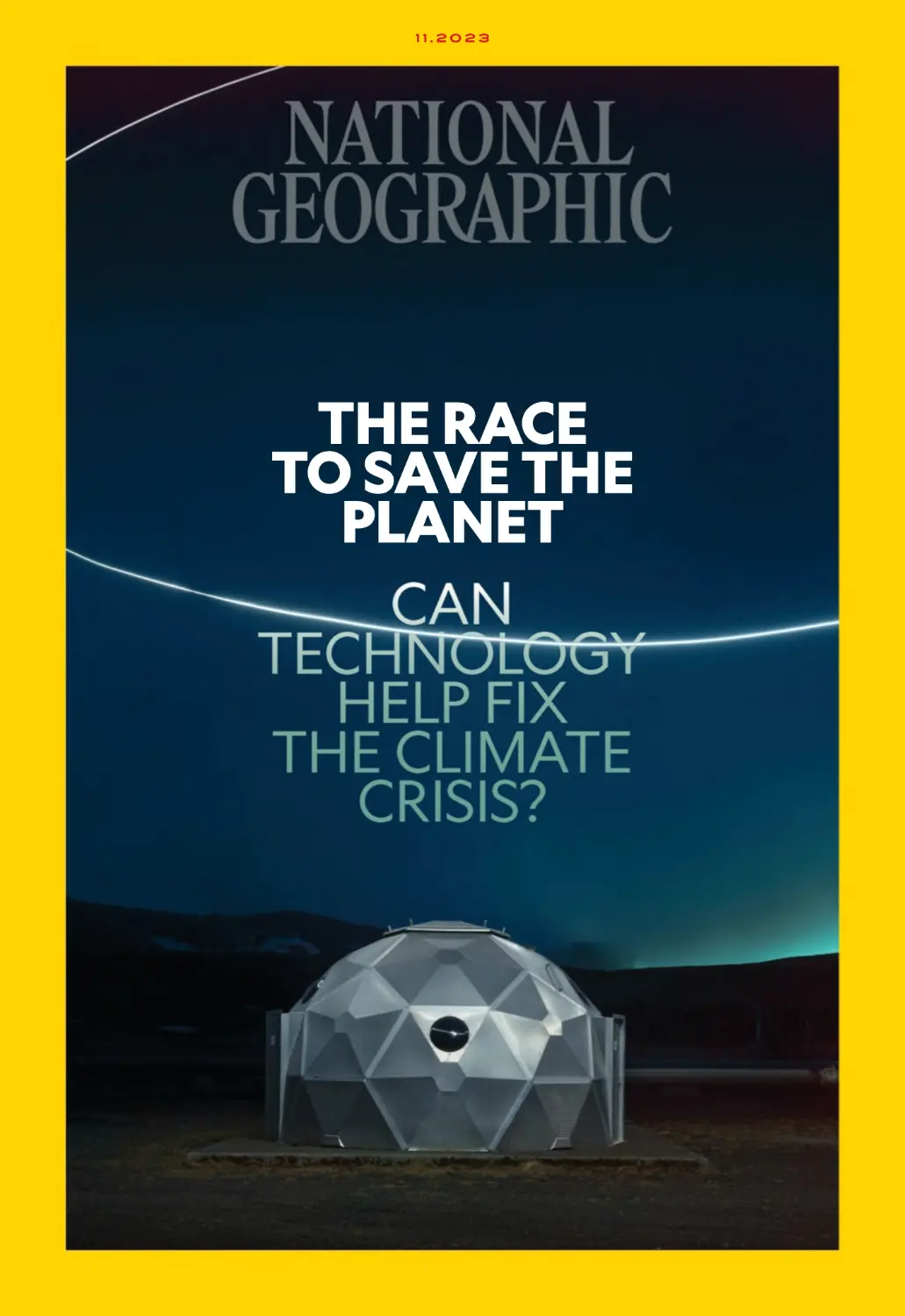
THE RACE
TO SAVE THE
PLANET

FURTHER

N OV E M B E R 2 02 3

C O N T E N T S

On the Cover
In Iceland a geodesic
dome owned by the
Carbfix company combines water with captured
carbon and pumps the
mixture underground,
where it becomes permanently locked in rock.
DAVIDE MONTELEONE

P R O O F

E X P L O R E

THE BIG IDEA

The Allure of an
Uncontacted People

The Sentinelese have
chosen to live in isolation, but we just won’t
leave them alone.
BY A DA M G O O D H E A RT
BREAKTHROUGHS

A Spot of Luck for
Migrating Monarchs

Butterflies whose
white wing markings
were larger fared better during the annual
migration, a study says.

26

HIDDEN WONDERS

These Critters Are
Camouflage Masters
From egg to adult,
phasmids have ways of
confusing predators.
BY A L L I E YA N G

BY JA S O N B I T T E L
CLOSER LOOK
ALSO

Poetry in Plumage

A pair of German
photographers train
their lenses on feathers, which they believe
“are probably the
most poetic masterpiece of evolution.”

A Surprising DNA Find
Constructive Diaper Reuse

Charleston
Reconsidered

With a new African
American museum,
the South Carolina
city is reconnecting
to its past as the
largest point of entry
for enslaved Africans.
BY TA R A RO B E RT S

P H OTO G R A P H S BY H E I D I

ALSO

A N D H A N S -J Ü RG E N KO C H

China’s Art of Brocade

F E AT U R E S

Ice and Fire

Scientists have long
suspected that an
island volcano rising
out of the South Atlantic contains a rare
lava lake, a perpetual
cauldron of molten
rock. To study it,
they had to take a
treacherous journey
to one of the remotest
spots on the planet.
BY FREDDIE WILKINSON
P H OTO G RA P H S BY
RENAN OZTURK
......................................

P. 34

Clearing the Air

Zero emissions won’t
be enough to mitigate
climate change; we
also must remove carbon on a massive scale.

The Meticulous Hunt

In Antarctica, about
a hundred killer whales
have learned to
weaponize water.
B Y N ATA S H A D A LY

BY S A M H OW E V E R H OV E K

P H OTO G RA P H S BY

P H OTO G RA P H S BY

B E RT I E G R E G O RY

D AV I D E M O N T E L E O N E
......................................

P. 64

The lava lake expedition included mountain
guide Carla Pérez and cinematographer Matt Irving
(reflected in Pérez’s lenses).

A B OV E :

....................................

P. 100

Building on New Soil
This Chicago family
exemplifies the immigrant experience.

BY LU I S A L B E RTO U R R E A
P H OTO G RA P H S BY
J O N L O W E N S T E I N . . . . P.

108

N O V E M B E R

|

FROM THE EDITOR

B Y N AT H A N LU M P

it’s a few weeks since both
the United States and the European
Union confirmed the hottest average
global temperature ever recorded.
Intense and unusual heat waves (86°F
in Buenos Aires during Argentina’s winter), along with fires, storms, and other
extreme weather events, seemed to
make 2023 the year that climate change
became more palpable for many people.
Of course, climate change is more
complicated than things simply getting
hotter, but the overall warming of the
Earth is perhaps the most direct consequence of the carbon dioxide we have
released into the atmosphere since the
19th century. What to do about this
problem is the subject of this month’s
cover story, in which writer Sam Howe
Verhovek and photographer Davide
Monteleone take a closer look at carbon removal and capture.
Ideas for how to remove carbon from
the atmosphere and store or use it in
AS I WRITE,

P H O T O G R A P H B Y DAV I D E M O N T E L E O N E

some way have been around for a long
time, but we’ve made little tangible
progress. Now we may be at an inflection point where urgency, combined
with technological advances, market
demands, and creative vision, is making carbon removal a viable option for
helping us manage the climate crisis.
Many environmentalists argue that
carbon removal is a red herring that distracts us from the need to dramatically
decrease our emissions. I take their
point, but I count myself among those
who think we need to throw everything
we have at this problem, including a
major reduction in emissions. The
first industrial revolution got us into
this mess; maybe a second one that
harnesses our ingenuity can assist us
with getting out of it.
We hope you enjoy the issue.

In Iceland, entrepreneurs
and scientists are pioneering ways to capture and
store carbon from ambient
air, while tapping greener
energy sources. Southeast
of Reykjavík, the Agricultural University of Iceland
uses geothermal energy
to operate greenhouses;
manager Elias Oskarsson
(above) monitors the
growth of tomatoes.

CONTRIBUTORS

|

N O V E M B E R

N AT I O N A L G E O G R A P H I C E X P L O R E R S
These contributors have received funding from the
National Geographic Society, which is committed to illuminating
and protecting the wonder of our world.

Hans-Jürgen and Heidi Koch
Based in Germany on the Baltic
Sea, the couple collaborate on
nature imagery that they call
“life-form photography,” which
often includes a sociological
or scientific component. Their
award-winning work has been
featured in dozens of exhibitions and in publications such
as Stern and Le Figaro. Page 8

Luis Alberto Urrea
Urrea is a Pulitzer Prize finalist
and Guggenheim Fellow who
has written 19 books, including
the national bestseller Good
Night, Irene. Born in Tijuana
to a Mexican father and an
American mother, he is often
known as a border writer. But,
he says, “I am more interested
in bridges.” Page 108

Natasha Daly
A staff editor for National
Geographic, Daly is drawn to
societal trends that shape our
perceptions and treatment
of animals. For the June 2019
cover story on the global
wildlife tourism industry,
she researched and reported
the topic on four continents
over 18 months. Page 100

Bertie Gregory
During his childhood in England, Gregory was teased for being “totally
obsessed with the natural world,” he says. That enthusiasm, combined
with his photography and filmmaking skills, has earned him a BAFTA
for cinematography and the Best Presenter Award at the 2019 Jackson
Wild film festival. His series Animals Up Close With Bertie Gregory, now
streaming on Disney+ and Hulu, takes viewers in front of and behind
the camera, as well as on land and underwater, for rarely seen wildlife
behaviors. An Explorer since 2015, he has spent several years tracking
pack ice killer whales in Antarctica, the subject of his feature story in
this month’s issue. Page 100

Davide Monteleone
Originally from Italy, Monteleone
is a visual artist and researcher
who focuses on themes of geopolitics, data, and science. He’s
been an Explorer since 2019, contributed to publications including
Time and the New Yorker, and had
work exhibited in London, Paris,
and Rome. For this issue, he had
to figure out how to make images
about an invisible gas. “My work
is an opportunity to learn something new and extraordinary,” he
says. Page 64

PHOTOS (CLOCKWISE FROM TOP LEFT): VOLKER WENZLAWSKI; WILL WEST, NATIONAL GEOGRAPHIC
FOR DISNEY+; JOSHUA LOTT; LORENZO POLI; NATASHA DALY; J.P. CALUBAQUIB

Jon Lowenstein
His long-term documentary
explorations delve into diasporic
communities and their resilient
response to wealth inequality,
poverty, and history. Committed
to social justice work, Lowenstein has ongoing projects that
spotlight his adopted community in Chicago’s South Side
and the Latin American migrant
trail. An Explorer since 2019,
he’s also a TED Senior Fellow and
the recipient of multiple World
Press awards. Page 108

It may seem wildly
impractical, but flashy
plumage—such as the
long, shimmery tail
feathers of the king bird
of paradise—evolved
to serve a key goal: attracting potential mates.

P R O O F
N AT I O N A L G E O G R A P H I C
VO L . 2 4 4 N O. 5

8

N AT I O N A L G E O G R A P H I C

When a photographer

couple turned to feathers, they got a lesson in the science of beauty.
P H OTO G RA P H S BY HEIDI AND HANS-JÜRGEN KOCH

NOVEMBER 2023

9

P R O O F

The wispy tail plumage of male Raggiana birds of paradise plays a starring role in their communal courtship displays. It adds
dramatic flair to the dance as the animals bob and strut in a competition for the females’ favor.

10

N AT I O N A L G E O G R A P H I C

New Guinea is home to several types of birds of paradise, such as the blue, whose males wield their two tail streamers
to striking effect. Their mating dance includes hanging upside down with the streamers arching skyward.

NOVEMBER 2023

11

P R O O F

Although both sexes of the gray peacock pheasant have back and tail feathers adorned with brilliant eyespots, the males
make the best use of them. During elaborate wooing rituals, they raise and fluff up their feathers—which can reach nearly

12

N AT I O N A L G E O G R A P H I C

16 inches in length—putting their majesty on full display. These birds roam lowland areas and hilly forests
of Bangladesh, northeast India, and Southeast Asia.

NOVEMBER 2023

13

P R O O F

THE BACKSTORY
A F O C U S O N F E AT H E R S TO O K T H E S E T W O P H OTO G R A P H E R S
O N A DA Z Z L I N G F L I G H T I N TO E VO LU T I O N .

wrote, “The
sight of a feather in a peacock’s tail,
whenever I gaze at it, makes me sick!”
The plumes were so extravagant, he
surmised, they could be a hindrance
to survival. Darwin’s frustration with
their seemingly inexplicable elegance
eventually led him to the idea of sexual
selection. Although this form of natural
selection—driven by the preference of
one sex for certain characteristics in
individuals of the other sex—is well
understood today, a peacock’s feather
can still hold mystery for its viewers,
says Heidi Koch. She and her husband,
Hans-Jürgen, have spent the past few
years photographing feathers in all
their glorious detail.
The German couple has trained
their lenses on the natural world for
more than three decades, but they
don’t consider themselves nature
photographers. They opt instead for a
broader label: life-form photographers.
I N 1 8 6 0 C H A R L E S DA RW I N

In 2020, after several years capturing
images of everything from lab mice to
bumblebees, the Kochs turned their
attention to plumage. “The beauty
and diversity of feathers is so extreme,”
says Heidi. That’s why the pair began
photographing the most mesmerizing
examples from the Museum of Natural
History in Berlin and other private
collections in Germany. They used
a process, called focus stacking, in
which similar photos with different
focal planes are blended to achieve a
more profound depth of field.
Their project, named Feathers—
Poetic Masterpiece of Evolution, is an
ode to the allure of birds and to evolution itself. Completing it required
delving into evolutionary biology, and
they sometimes found themselves
pondering nature as Darwin did more
than 150 years ago. “By the end,” Heidi
says, “we really could understand
the man.” —A N N I E ROT H

Each of these feathers from seabirds and coastal species, part of a private collection
in Germany, has an evolutionary tale to tell, say the Kochs.

IN THIS SECTION

E X P L O R E

Monarchs’ Bright Spots
Constructive Diaper Reuse
Stick Insect Camouflage
Charleston Wharf Museum

I L L U M I N AT I N G T H E M Y S T E R I E S — A N D W O N D E R S — A L L A R O U N D U S E V E R Y D AY
N AT I O N A L G E O G R A P H I C

VO L . 2 4 4 N O. 5

The Allure of
the Uncontacted
N O R T H S E N T I N E L I S L A N D E R S L I V E A S H U N T E R- G AT H E R E R S A N D R E P E L
O U T S I D E R S . S T I L L , T H E W O R L D W O N ’ T L E AV E T H E M A L O N E .

BY ADAM GOODHEART

a young American missionary
swam from a fishing boat to a remote beach in
the Indian Ocean and was killed by Indigenous
islanders wielding bows and arrows. News of
that fatal encounter on North Sentinel Island—a
small patch of land in the Andaman archipelago—
fascinated people around the world. Most were
unaware such a place existed in our time: an island
whose hunter-gatherer inhabitants still live in
near-total isolation.
The self-assured evangelist, 26-year-old John
Allen Chau, had aimed to convert the Native people
of a place he felt might be “Satan’s last stronghold.”
Yet his brief visit bestowed another, distinctly
21st- century, kind of glory: Within a few days,
unbeknownst to the islanders, the fact of their existence went viral.
In the five years since Chau’s death, the Sentinelese, as the tribe’s members are called by outsiders,
I N N OV E M B E R 2 0 1 8

NOVEMBER 2023

17

E X P L O R E

|

THE BIG IDEA

I N M A N Y WAY S , N O RT H S E N T I N E L
REMAINS TERRA INCOGNITA .
NO ONE BUT ITS ISLANDERS
KNOWS WHAT LANGUAGE THEY
S P E A K , W H AT L AW S M I G H T
GOVERN THEM, WHAT GOD
T H EY M I G H T WO R S H I P.

have developed a global cult following. Type “North
Sentinel Island” into a search engine today, and
you can spend weeks reading articles, listening to
podcasts, and skimming through blog entries,
subreddits, and social media posts. You can zoom
in close on images of the island taken from satellites,
helicopters, and airliners. The Sentinelese have a
4,000-word Wikipedia entry and several spoof social
media accounts (“North Sentinel Island Tourism
Office & Coast Guard,” “North Sentinel Island High
School Marching Band”). They’re featured in hundreds of YouTube videos, with a cumulative total of
more than a hundred million views.
Many of the islanders’ fans see them as romantic
heroes: staunchly rejecting the interconnected
world, the planet’s most committed practitioners
of digital detox. A few dozen naked tribesmen with
handmade bows and arrows seem somehow more
powerful—more authentically human—than the
billions of other Earthlings clutching smartphones.
In many ways, North Sentinel remains terra
incognita. No visitor has mapped the jungleshrouded interior of the island (roughly the size
of Manhattan) or held a conversation with its
residents. No one knows the size of the island’s
population, which has been estimated at between
50 and 200. No one but the Sentinelese knows what
language they speak, what laws might govern them,
what god they might worship, or even what the tribe
is called in its own language. From passing boats
and aircraft, it’s possible to glimpse them spearing
fish in the shallows, poling their dugout canoes
across the lagoon, and aiming the bows that they
use to hunt game.
According to Survival International, an organization that defends Indigenous peoples’ rights
around the world, more than a hundred tribes live
in seclusion in places from the Amazon rainforest
to the Indian Ocean to Indonesia. The lone tribe on
a small, remote island, the Sentinelese are perhaps
the most isolated people in the world.
In 1975 National Geographic published dramatic
photographs of Sentinelese shooting arrows at a
seaborne “friendly contact” expedition of Indian
anthropologists and filmmakers. Those images—
which appeared under the headline “Arrows Speak
18

N AT I O N A L G E O G R A P H I C

Louder Than Words: The Last of the Andaman
Islanders”—helped define the Sentinelese for a
global audience as both hostile and anachronistic.
It is not really accurate to say that the islanders
live apart from modernity: They inhabit the present
day, as the rest of us do. Nor do they lack technology:
A Sentinelese bow is a potent and beautifully crafted
tool; they wield it with exquisite skill and craft its
arrows’ heads with salvaged metal, perhaps from a
nearby shipwreck. Still, much of the past 10,000 years
of human history has slipped past North Sentinel, in
the cargo holds of oared ships and the pressurized
cabins of passenger jets. The island has almost wholly

eluded all the devices and contrivances that have
connected tribe to tribe, continent to continent:
the written word, the steam engine, the smartphone. And no matter how much its inhabitants
have gleaned about the outside world from their
glancing contacts—probably quite a lot—there’s no
way they can know that their home is among the last
places of its kind on this planet.
no simple explanation for how
the Sentinelese, of all the human communities on
Earth, have managed to remain so isolated for so long.
Now and then over the past couple of centuries—
T H E R E S E E M S TO B E

PHOTO ILLUSTRATION: IAN WOODS. SOURCE PHOTOS: GAUTAM SINGH,
ASSOCIATED PRESS (ISLAND); NUTU, ALAMY STOCK PHOTO (BOATMEN)

The Mission is
a fascinating
account of John
Chau’s 2018
death, told
by National
Geographic
Documentary
Films through exclusive interviews and with
unprecedented access to Chau’s secret plans,
personal diaries, and video archives. The film
examines the mythology of exploration that
inspired Chau, the evangelical community
that supported his quest, and a father’s heartbreak as his son’s youthful thirst for adventure
became a fatal obsession. The Mission is in
theaters now and will stream soon on Disney+.

NOVEMBER 2023

19

E X P L O R E

|

THE BIG IDEA

A

first when the British extended their empire across There the six quickly grew sick, and the old man
the Andaman Islands in the 1850s and later after India and woman died. The ailing children were sent
took control of the archipelago—various outsiders back to their island, laden with presents. What alien
have tried to make contact with North Sentinel locals. microbes they might also have borne on that homeFrom 1967 to the early 2000s, Indian government ward journey can only be guessed.
anthropologists occasionally were able to approach
So the Sentinelese had good reason to respond
the beach by boat, twice in 1991 even drawing close as they did in 2004, when an Indian Coast Guard
enough to hand coconuts and bananas to islanders helicopter swooped low over the island to confirm
in the surf. More often, the Sentinelese simply
that the inhabitants had survived the Indian
melt away into the jungle when intrudOcean tsunami. One man ran out of the
ers draw too near or respond as they
jungle and shot an arrow at the helidid to Chau: first with gestures and
copter. The coast guard officers
exclamations that unmistakably
returned with a striking photoA S
communicate warning—and
graph: A figure runs across the
I
then, if that fails, with volleys
beach, legs nimble as a dancer’s,
of arrows.
slanting his bow upward at the
INDIA
It’s perhaps less mysterious
aerial trespassers. None of the
why the tribe has so stoutly
man’s features are visible, but
North
Sentinel
maintained its defenses. The
his blurred silhouette against
Island
Andaman archipelago includes
the
stark white sand has both
Andaman Islands
(INDIA)
hundreds of islands, some of them
the timelessness of a Paleolithic
IND
N
A
I
A
E
C
N
O
once home to thriving Indigenous
cave painting and the immediacy
communities that probably resembled
of a stop sign.
the Sentinelese linguistically and culturDespite their world-renowned reticence,
ally. In the 19th century the British made incursions
the Sentinelese have communicated one message
into the islands and established a penal colony on loud and clear: Let us be.
one of the largest to house tens of thousands of prisoners from a failed 1857 rebellion in British India. W H E N T R AV E L I N G T O the Andaman Islands, one
Horrific consequences followed: The islanders were of the strangest things you’ll discover about the
devastated by disease and violence, and their ancient Sentinelese is just how un-isolated, geographicultures were suppressed by Europeans intent on cally speaking, they actually are. Just 20 miles of
“Christianizing” and “civilizing” them.
ocean separate them from beaches where tourists
Although the Sentinelese lack seaworthy ves- placidly snorkel.
sels to travel beyond their own lagoon, they were
On my first visit to the archipelago, 25 years ago,
doubtless visited by neighboring islanders who I decided to travel, foolishly and illegally, to the
might have warned them about the awful fate that coast of North Sentinel. (The surrounding waters
awaited them at the hands of the colonizers. And are strictly off-limits and patrolled regularly by the
on at least one occasion, North Sentinel itself expe- Indian coast guard and navy.) I paid some local
rienced an invasion. In 1880 a colonial official and fishermen on South Andaman Island—which had
self-taught anthropologist, Maurice Vidal Portman, a population of 200,000, nearly all originally immivisited “with the intention of making friends with grants from mainland India—to take me across the
the inhabitants,” as he later cheerfully described channel in their small motorboat under cover of
it. More precisely, he landed with a large party of darkness. We arrived at dawn in the waters just off
armed men and tromped back and forth for two North Sentinel’s reef, glimpsed three Sentinelese
weeks before managing to capture and kidnap standing beneath the forest canopy, and watched
four small children and an elderly couple, whom two men poling around the lagoon in their dugout
he hauled away to the main British penal colony. canoe. As I snapped photos and scribbled notes,

IN THE 19TH CENTURY THE BRITISH MADE
INCURSIONS INTO THE ANDAMANS
A N D E S T A B L I S H E D A P E N A L C O L O N Y.
T H E I S L A N D E R S W E R E D E VA S TAT E D
BY DISEASE AND VIOLENCE.

20

N AT I O N A L G E O G R A P H I C

NGM MAPS

my guide beckoned my attention. A waterspout
and wall of black clouds were headed our way. After
five white-knuckle hours, we made it back to South
Andaman, but the sudden monsoon storm almost
drowned us. Still, we returned from our adventure
in time for lunch.
Journeying to the Andamans (but not North Sentinel) more recently, I arrived on a 200-passenger
Air India jet crowded with tourists, one of 10 daily
flights from the mainland. Travelers can enjoy a
beach resort and spa that features 72 luxury bungalows—most with their own private swimming
pool—that were purportedly inspired by Indigenous
Andamanese huts.
Although the Sentinelese can’t see these huts
from their own settlements, they can likely see the
yellowish gray smog that hangs over Port Blair, the
islands’ administrative capital. They can definitely
see the passenger jets, which pass close enough that
tourists press their faces and phones against the windows to capture Instagram-bound images. Certainly
the Sentinelese, sharp-eyed hunter-gatherers, have
observed the outside world as intently as the outside
world has observed them; more so, probably, since
our boats and flying machines have by now become
familiar parts of their surroundings.
On other islands in the Andamans, I found once
pristine beaches awash in the flotsam of nearby
countries: lost flip-flops, tampon applicators, and
hundreds upon hundreds of water bottles. Surely
such detritus reaches North Sentinel’s shore as well.
The Indian anthropologist Vishvajit Pandya, who
made a few boat journeys in the 2000s to observe
the Sentinelese from a safe distance, told me that
he once saw some islanders using a blue plastic
tarp, perhaps dropped from a passing boat, as a
roof for their hut.
For the truth is that we, the other eight billion
human inhabitants of this planet, are already
encroaching inexorably on the Sentinelese, as
relentlessly and recklessly as any imperial colonists.
Climate change, overfishing, pollution, and plastic
debris will continue a campaign of devastation
against the plants and animals that the Sentinelese
need to survive.
Yet the little island’s mystique—and its outsize
digital footprint—shows no signs of abating. For
now, at least, North Sentinel’s isolation serves an
urgent purpose not just for the islanders but also for
the rest of us. The perfect remoteness of that place,
unmoored from ordinary space and time, is our own
self-consoling fantasy: As long as the Sentinelese
persist, we can tell ourselves that our planet itself
remains, to some tiny degree, inviolate. j
Historian Adam Goodheart drew this essay from his new book,
The Last Island: Discovery, Defiance, and the Most Elusive Tribe
on Earth. Goodheart served as consultant for, and appears in, the
National Geographic film The Mission. He heads the Starr Center
for the Study of the American Experience at Washington College,
in Chestertown, Maryland.

slanders of
the islanders
Andaman Islanders have long been
among the most misunderstood
human communities on Earth:
exoticized, fetishized, and demonized. Though Marco Polo hadn’t
visited the islands, in the 13th century
he described their residents as “a
most brutish and savage race, having
heads, eyes, and teeth like those of
dogs. They are very cruel, and kill
and eat every foreigner whom they
can lay their hands upon.” About
600 years later, Arthur Conan Doyle
featured an Indigenous Andamanese
man—an “unhallowed dwarf” with
“venomous, menacing eyes”—as the
murderous antagonist in a Sherlock
Holmes novel, The Sign of the Four.
The Andamanese continued to
interest European racial theorists
well into the 20th century. Baron
Egon Rudolf Ernst Adolf Hans
Dubslaff von Eickstedt, a monoclewearing German anthropologist
whose work on “racial hygiene and
eugenics” influenced the Nazis,
visited the Andaman archipelago
in the 1920s. Afterward, he characterized its inhabitants as humans of
a “primitive chimpanzoid type.”
Actually, the Andamanese are
anything but primitive. In recent
decades the islanders’ complex
culture has been documented by
the Indian anthropologist Vishvajit
Pandya. For instance, the Andamanese create exceptionally rich body
art: intricate historical texts written
on the skin itself in painted designs
of ocher and white clay, constantly
erased and remade as the bearer’s
needs and circumstances change,
as well as ritual scarifications that
remain indelible through a lifetime.
In these patterns are written the
elegies and epics of the islands.
And despite centuries-old slanders of the Andamanese as alleged
practitioners of cannibalism and
headhunting, it was Englishmen who
sometimes returned from “punitive
expeditions” in the 1920s and ’30s
bearing the severed heads of islanders as trophies. Today the population
of Indigenous Andamanese—including the Sentinelese—totals just a few
hundred people. Before colonization,
there were at least 10 times that. — A G
NOVEMBER 2023

21

E X P L O R E

|

BREAKTHROUGHS

From bottoms to buildings

D I S PAT C H E S
FROM THE FRONT LINES
OF SCIENCE
A N D I N N OVAT I O N

In Indonesia, a concrete composite material made partly of used
diapers was strong enough to
construct the walls and floors of
a house, according to the journal
Scientific Reports. Such recycling
could turn nondegradable waste
into a resource for low-cost
housing. — PAT R I C I A E D M O N D S

PALEOBIOLOGY

DNA lingers
on ancient
teeth

COLORATION ADAPTATION

SPOTTING AN ADVANTAGE
W H I T E M A R K I N G S O N M O N A R C H B U T T E R F L I E S M AY
G I V E T H E I N S E C T S A B O O S T D U R I N G M I G R AT I O N .

Some monarchs fly thousands of miles each year from southern
Canada all the way to the mountains outside of Mexico City. How
do they do it? A new study says monarchs that make it to the Mexico wintering grounds have white wing spots 3 percent larger than
those of monarchs sampled from other parts of the North American
migration. This may mean that the black-and-white patterns on
monarch wings create micro-vortices of warm and cool air that in
turn reduce drag while the insects soar in the sun. Three percent
may not seem like much—but for animals that weigh as little as
a kernel of corn and have to fly across a continent, tiny changes
could yield real benefits, the scientists say. Similar drag-reduction
properties have been found in the wing patterns of seabirds and
one day could lead to more efficient airborne devices. “If you want
to develop drones that are flying for longer time and harnessing
energy from sunlight, this is the best thing that we can look at,”
says study co-author Mostafa Hassanalian, an associate professor
of mechanical engineering at New Mexico Tech. — J A S O N B I T T E L

The DNA of early
people has been
extracted from a
deer-tooth ornament they wore
or used. Scientists
detected human
DNA on the deertooth pendant
below; contact
with the wearer’s
skin likely transferred it about
20,000 years ago.
Studying DNA on
tools, arrowheads,
and needles made
from animal teeth
as well as bones
could yield insights
into the gendered
division of ancient
humans’ activities.
—T O M M E T C A L F E

PHOTOS: CHRISTINA ROLLO, ALAMY STOCK PHOTO (MONARCH); MAX PLANCK INSTITUTE FOR
EVOLUTIONARY ANTHROPOLOGY (TOOTH); REBECCA HALE (DIAPERS)

THE IMPOSSIBLE FORMULA 1 STORY

E X P L O R E

|

AT E V E R Y S TA G E I N T H E I R L I V E S — F R O M
E G G T O A D U LT — P H A S M I D S P R O V E T O B E
P R E Y T H AT C A N T R I C K T H E I R P R E D AT O R S .
B Y A L L I E YA N G
P H OTO G R A P H S BY LEVON BISS

These herbivores look like leaves, twigs, and bark—
giving new meaning to the phrase “You are what you eat.”
Phasmids, commonly known as stick or leaf insects, often
fade into the flora to become virtually invisible. It’s an
effective survival strategy: Their predators want to snack
on an insect, so they ignore what appears to be a plant.
Like the vegetation they mimic, most phasmids don’t move
much, says entomologist Thies Büscher. They find a niche without competition for resources, and over time they’ve evolved to
suit their surroundings. Look to similar environments in different
parts of the world and you may find species that have survived
in the same way: leaf insects that became more brown in arid
habitats or green in tropical rainforests.
Camouflage can be part of every stage of a phasmid’s life. The
giant prickly stick insect (Extatosoma tiaratum) imitates crumpled foliage as an adult, its nymphs look like ants and then bark,
and its eggs look like seeds. The eggs are taken in by spider ants,
which eat only the nutrient-rich, knoblike capitulum. When
the phasmids hatch, they look similar to their ant guardians,
which wards off predators. Then they climb trees, soon becoming
indiscernible from the bark. At the treetops, they blend in with
the leaves. It’s a life cycle that tells the story of their ecosystem.
Most phasmid eggs, like the giant prickly stick insect’s, resemble
seeds, sometimes those of local plants. For example, the eggs of
a leaf insect in Indonesia, Phyllium letiranti ( 1 ) , echo the seeds
of the tropical ivy gourd plant. Other attributes also increase
eggs’ likelihood of survival, Büscher says. Their
hardened shells can regulate humidity and radiation,
and shiny black spots may play a role in thermoregulation.
Some eggs, such as that of Orestes draegeri ( 2 ) , have tiny
hairs that function like Velcro, fixing them in place. One successful
stick insect (Ramulus mikado) can be found all over the islands
of Japan. Though scientists initially thought birds consumed
and spread its eggs, experiments showed that the secret was likely
in a bittersweet sacrifice: Mothers eaten whole by birds usually
contain some eggs that survive. j
26

N AT I O N A L G E O G R A P H I C

PULCHRIPHYLLIUM
GIGANTEUM
Giant Malaysian leaf
insects start life as
a reddish brown color
but turn green after
eating the leaves
in their surroundings.
BACILLUS ROSSIUS
ROSSIUS
A European stick
insect is shown at
top left.

1

2

HETEROPTERYX DILATATA
Adult jungle nymphs blend
in with their green or brown
coloring and can snap their
spiny legs shut on enemies.

Photographer Levon Biss specializes in
tiny objects in order to make “the invisible visible.” He spent hours cleaning
these phasmid eggs with distilled water
and one paintbrush hair under a microscope. The eggs in this composite grid
of images average about 0.12 inch long.

NOVEMBER 2023

27

E X P L O R E

|

ARTIFACT

and stars
flow from wooden looms to embellish
brocade, a 1,300-year-old fabric once
reserved for China’s elite and now
popular with young fashion designers.
This art form is so complex that even
veteran craftspeople produce only
about two inches of textile a day. Traditional looms can be 18 feet long, have
thousands of parts, and require dozens
of steps to operate by artisans, who sing
ballads to memorize the process. From
this creative matrix emerges luminous
cloth with patterns woven from silk,
gold, and peacock-feather yarn.
Brocade emerged in China during the
Tang dynasty (A.D. 618-907). Regional
varieties developed across the country,
including in Nanjing and Chengdu,
home to silk museums where tourists
can now buy authentic brocade scarves
and bags.
The complicated fabric cannot
be replicated by factories. “It can be
woven only on the traditional loom,”
says Feng Zhao, honorary director of
the China National Silk Museum in
Hangzhou. This authenticity appeals
to older Chinese people, who appreciate brocade “from their hearts,” Zhao
says, and view it as a proud symbol of
cultural heritage.
And increasingly, up-and-coming
Chinese fashion creators are collaborating with traditional weavers to
emblazon garments with symbols
such as phoenixes, clouds, and dragons. Designer Chen Liwen last year
launched a range of scarves and accessories targeted at Gen Z consumers that
feature the hu bu tiger pattern. Ancient
brocade, then, seems tightly threaded
into China’s future. j
FLAMES, BEASTS, WEAPONS,

1,300-YEAR-OLD
SILKEN TREASURE
O N E O F C H I N A’ S M O S T R E V E R E D
A N C I E N T A RT F O R M S I S B E I N G
E M B R AC E D B Y T H E C O U N T RY ’ S YO U T H .
BY RONAN O’CONNELL

Traditional brocade looms are so intricate they require artisans to
execute dozens of procedures. An inch of brocade was once believed
to be worth an ounce of gold. Flowers are a common motif.

PHOTOS (FROM LEFT): CHINA PHOTOS/GETTY IMAGES; METROPOLITAN MUSEUM OF ART; ROBERT CLARK

| T H E WO R L D I S A N A DV E N T U R E |
T R AV E L I T W I T H U S

T R AV E L W I T H N AT I O N A L G E O G R A P H I C
Every National Geographic expedition is grounded in our legacy of exploration, the
promise of an authentic travel experience, and a commitment to giving back. With
unique travel experiences that aim to inspire people to care about the planet, and
access to National Geographic’s grantees and active research sites, our travellers go
further and deepen their knowledge of the world.

W W W.T R AV E LW I T H N ATG E O.C O M

© 2023 National Geographic Partners, LLC. National Geographic EXPEDITIONS and the Yellow Border Design are trademarks of the National Geographic Society, used under license.

E X P L O R E

|

CLOSER LOOK

Charleston
Reconsidered
B Y TA R A RO B E RT S

there were more than a hundred
African American museums around the United
States, all collecting and preserving the history of
people of African descent. The biggest and most
comprehensive of all, the National Museum of African
American History and Culture, sits on the National
Mall in Washington, D.C.
But the June 27 opening of the International African American Museum (IAAM) in Charleston, South
Carolina, is particularly significant. The museum
is located on Gadsden’s Wharf, which, from 1783 to
1807, was the largest single point of entry into North
America for enslaved Africans.
More than 40 percent of all captive Africans were
brought into the U.S. here, where they were sold
into slavery at auction. They were then sent on to
plantations and farms across the country.
In the late 1700s, Gadsden’s Wharf stretched
840 feet across, about three city blocks, and could
accommodate up to six ships at once. Each one carried a cargo hold full of as many as a few hundred
captive Africans.
It’s estimated that more than 80 percent of all
African Americans can trace at least one ancestor to
the area. This site choice and the nearly $100 million
investment in the building of IAAM are also part
of a larger reckoning happening in Charleston. In
2015, the Confederate flag was removed from the
South Carolina State House. In 2018, the city council
formally apologized for Charleston’s role in slavery.
And the city has begun to challenge the mainstream narrative around the nature of plantations,
with their deep-set porches, grand columns, and
often beautifully cultivated land.
But many plantation grounds still include
AT L A S T C O U N T,

WITH THE OPENING OF
A L O N G -AWA I T E D M U S E U M
O N A H I S T O R I C W H A R F,
THIS SOUTHERN CITY IS
RECONNECTING WITH ITS
C O A S T L I N E —A N D R E C K O N I N G
W I T H I T S T R A G I C P A S T.

30

N AT I O N A L G E O G R A P H I C

At the International African
American Museum, Tide
Tribute represents the
many Africans lost at sea
during the transatlantic
slave trade. Water in the
Olympic-length pool rises
and flows over figures
that recall the well-known
18th-century diagram of
captive Africans wedged
into the Brookes slave ship.

PHOTO: SONY BY GREG NOIRE

NOVEMBER 2023

31

E X P L O R E

|

CLOSER LOOK

unmarked graves where the enslaved were buried.
But Clark says she grew up ashamed of her backMcLeod Plantation is one of the rare plantations in ground. “I turned my back on my heritage because
the country that focus on accounts of the enslaved, I thought it was bad,” she says.
Then, six years ago, a cousin took her crabbing
who toiled in the heat and cold for no pay and little
for the first time, and she says it was like a baptism
rest, under often brutal conditions.
“This place is a memorial to the life and the times and a reawakening. It reconnected her to the culture
of those who were enslaved here but retained their of her ancestors, who used to crab for sustenance.
humanity,” says Toby Smith, the cultural history This brought her back to the water, something
interpretation coordinator for Charleston County she didn’t even know she was missing. Now she
Parks and Recreation, which operates McLeod. “This teaches tourists and even locals how to fish for crab
is their moment to be honored, and to be lifted up in Charleston Harbor. And she herself spends hours
and to be learned from.”
out there, casting her net, often in the wee hours of
While IAAM broadly explores the history of the morning, watching the sunrise, reclaiming the
African Americans and the global legacy of
parts of herself that were once lost.
the transatlantic slave trade, it also tells
Even though the story of African AmeriVA.
the story of Black South Carolinians and
cans starts on faraway shores, one chapter
UNITED N.C.
specifically of the Gullah Geechees, a
begins on arrival on these shores, along
STATES S.C.
unique people who have traditionally
this coastline, in the water.
ALA. GA.
Charleston
resided in the coastal areas and the
“It’s that water that brought the
ATLANTIC
sea islands of North Carolina, South
Africans here,” says Smith, who is also
FLA.
OCEAN
Carolina, Georgia, and Florida. Because
Gullah Geechee. “And as Gullah people,
they were enslaved on isolated islands
the water, we believe, carries our souls
and coastal plantations, they are one of
to rest.”
the few groups of African Americans to retain
Maybe, ultimately, the most surprising and
foods, language, culture, and traditions that can be profound thing about IAAM is that by standing
at the edge of this historic wharf, it helps bring
traced directly back to Africa.
Tia Clark, who founded the top-rated travel expe- African Americans back to the ocean, back to the
rience Casual Crabbing with Tia in 2018, says she’s turbulent Atlantic, back to a place of origin, death,
excited to visit IAAM, “but I know it’s going to be sustenance—and now, self-healing. j
super emotional for me.” Clark is of Gullah Geechee Tara Roberts is a National Geographic Explorer. She tells stories
heritage, and her family once lived in downtown about the discovery of lost slave shipwrecks on the National
Charleston on Henrietta Street.
Geographic-produced podcast series Into the Depths.

A memorial at the museum represents a Gadsden’s Wharf warehouse used to hold roughly 700 Africans over one terrible
winter. The goal was to drive up their prices and draw in more buyers, but all those held captive died before spring.

PHOTO: DEVON SAYERS, CNN. NGM MAPS

N AT I O N A L G E O G R A P H I C

N OV E M B E R 2 02 3
Into an Ice Volcano . . . . P. 34
Putting Carbon Back . . P. 64
Killer Whale Hunt . . . . P. 100
La Familia in the U.S. .. P. 108

F EAT U R E S

108
PHOTO: JON LOWENSTEIN

MARIS OL , WHO SE FAMILY
MIGRATED FROM MEXICO TO
CHICAG O, SEES HERSELF IN
HER HIGH SCHO OL GRADUATION
FINERY—A REFLECTION OF THE
AMERICAN DREAM IN PROGRESS.

AND

Mount Michael looms over fog-shrouded Saunders Island. Although located in
one of the world’s most active volcanic regions, the island—which lies roughly
1,500 miles from the tip of South America—is seldom visited by researchers.
THIS PANORAMA WAS CREATED BY COMBINING NINE IMAGES.

34

SCIENTISTS
HAVE LONG
SUSPECTED THAT
AN ISLAND
VOLCANO RISING
OUT OF THE
SOUTH ATLANTIC
CONTAINS A
RARE LAVA LAKE.
TO STUDY IT,
THEY HAD TO
VENTURE TO
ONE OF THE
REMOTEST SPOTS
ON THE PLANET.
BY FREDDIE WILKINSON
PHOTOGRAPHS BY RENAN OZTURK

Penguins roost on
the ash-covered flanks
of Saunders, one of
the 11 South Sandwich
Islands. The archipelago hosts some of
the world’s largest
penguin colonies and
is a crucial breeding
ground for more than
three million chinstrap,
gentoo, Adélie, and
macaroni penguins.

3,000 feet above the
angry swell of the South Atlantic, Emma Nicholson takes a deep breath behind her respirator,
checks her climbing harness, and steps inside
the gaping mouth of an active volcano.
It’s a little after 4 p.m. on the wind-whipped
summit rim of Mount Michael, which looms over
Saunders Island. Located in the uninhabited
South Sandwich archipelago, the island is one
of the most isolated places a person can travel
to on Earth—roughly 500 miles from the closest
permanent station on South Georgia and more
than a thousand miles from the nearest shipping
traffic. In fact, the closest people to Emma and
her expedition mates are the seven astronauts
and cosmonauts aboard the International Space
ON AN ICE- CRUSTED RIDGE

Follow the team’s
journey in Explorer:
Lake of Fire, premiering
October 26 on National
Geographic and
streaming the next day
on Disney+ and Hulu.

ICA

UTH
SO ERICA ATLANTI AFR
C
M
OCEAN
A

South
Sandwich
Islands (U.K.)

ANTARCTICA

British volcanologist
Emma Nicholson looks
out from the bridge
of the Australis as the
expedition approaches
Saunders Island. She’d
attempted to summit
its volcano in 2019,
but blizzard conditions
forced her to turn
back, leaving her with
“unfinished business.”

Station, which passes roughly 250 miles above
them every 90 minutes.
But after years of planning and enduring a
tortuous 1,400-mile voyage through turbulent,
iceberg-infested seas, the 33-year-old volcanologist is on the verge of becoming the first scientist
to lead an exploration inside Mount Michael’s
crater, where she hopes to collect new clues
about poorly understood processes at work deep
within our planet’s plumbing.
But Mount Michael isn’t a volcano that easily
gives up its secrets.
At first glance the inner part of the rim seems
harmless, giving way to a gentle snow slope,
no steeper than an intermediate-level ski run.
Emma and her research partner, João Lages,
NGM MAPS

cautiously descend on a climbing rope—their
only connection to the outside world—but both
understand that somewhere below, this seemingly benign terrain might end in an unstable
ice cliff overhanging the inner rim of the volcano.
As they inch their way down, conditions
improve: The wind subsides, and patches of blue
sky appear overhead. Beyond her face shield,
Emma can see a circle of near-vertical walls of
ash-covered rock and ice.
Carrying a computer and a heat-sensing
camera, João and Emma descend deeper into
the mountain. Below them, the gentle ski
slope abruptly drops off into a dim void and an
unknown distance to the crater’s bottom. As
she looks around, slightly wide-eyed, Emma
ICE AND FIRE

41

Mount Michael belches
a mix of gases on a
blue-sky day as the
team prepares to ferry
gear to the island.
The Australis’s captain,
Ben Wallis, kept a close
watch on the volatile
South Atlantic weather,
noting there was little
room for error. “There is
nobody to come get you
if you run into trouble.”

Photographer Ryan
Valasek, wearing a
dry suit, takes a frigid
swim off the Australis.
The team relied on
dry suits to keep warm
as they traveled by
dinghy from the ship
to Saunders Island
and operated in the
icy South Atlantic,
where temperatures
can dip below freezing.

understands she’s standing inside the rim of
Earth’s chimney—a place that bears the scars
of one of nature’s greatest displays of power.
For a volcanologist, it’s the quintessential
career moment, being the first to peer down an
obscure portal into the planet’s interior. Only
one thing eludes her, the thing that brought her
to this godforsaken place: Where is the lava lake?
A reassuring tug pulls against her harness.
The rope, Emma knows, is connected to a most
trustworthy anchor on the summit: mountain
guide Carla Pérez. Over the past weeks, Emma
and Carla have become close friends as they
shared a cramped ship’s cabin and a quaking
tent through howling gales. Without a line of
sight to Emma, Carla knows that an overhanging
ice cliff might be lurking somewhere in front of
her friend—it could give way without warning,
sweeping her down the throat of the volcano.
The tug is a little reminder to Emma not to forget
herself and go a step too far.

a weary Captain
James Cook stood at the aft rail of
his ship, the Resolution, and stared
out at a bleak, snowbound island.
The mariner had been at sea on his
second voyage of discovery for two
and a half years, and the foreboding
geography matched his mood. “The
most horrible coast in the world,”
Cook declared of the archipelago he’d named
the South Sandwich Islands after one of his supporters, the Earl of Sandwich. These islands, he
wrote, were “doomed by nature … never once to
receive the warmth of the sun’s rays.”
It would be decades before scientists understood that one of them, Saunders, possessed its
own source of heat. And even then, no one was
much interested in visiting the icy, windswept
island in the middle of nowhere.
“The South Sandwich Islands—they’re tough
to get to, tough to get ashore on, tough to work
in, so you have to have a pretty good reason to
go there,” says John Smellie, a geology professor at the University of Leicester. And yet, the
islands, which are formed by the movement of
the South American tectonic plate beneath the
South Sandwich plate, are one of the world’s
simplest tectonic settings to study volcanology.
“It’s effectively a crust factory,” Smellie told
N F E B RUA RY 2 , 1 7 7 5 ,

46

N AT I O N A L G E O G R A P H I C

me when I reached him by phone at his office
in England. “You can examine what happens to
magmas from inception to being brought to the
surface … because the variables are so few there.”
I contacted Smellie because he’s one of the few
people known to have visited Saunders Island.
During an expedition in 1997, he was taking samples on its north end when he noticed that the
plume from Mount Michael was unusually dense.
“It was huffing and puffing, and those were characteristics that surprised me,” Smellie recalled.
The behavior reminded him of Mount Erebus,
an Antarctic volcano with a permanent lava lake.
Smellie asked a friend at the British Antarctic Survey if satellite imagery could identify any thermal
anomalies around Mount Michael. Using a satellite-based radiometer, they worked to identify
a heat signature that corresponded to Mount
Michael’s summit crater. They posited that, with
temperatures averaging around 570°F, it was a
lava lake: one of volcanology’s rarest phenomena.
Although there are about 1,350 potentially
active volcanoes in the world, only eight had
been confirmed to recently host persistent lava
lakes—perpetual cauldrons of molten rock.
Typically, after an eruption, lava exposed to the
atmosphere will cool into a solid plug of rock,
trapping the heat and gases within (and potentially priming the volcano for another explosion).
But in open-vent volcanoes, the plumbing that
connects the surface to the magma chamber
deep below remains open. For a lava lake to form,
the pressure must be great enough to push lava
all the way to the surface—like the water pressure
in a fountain. But for the lava lake to remain, the
pressure has to continue, and the ratio between
heat coming up from within the magma column
and the rate of cooling must be perfectly balanced, to keep the lava in its molten state.
“Temperamental” is a good word, Smellie
says, to describe the pressure levels that pump
lava into Mount Michael’s crater. “It comes and it
goes, possibly for months at a time, but then our
research shows it persists for months at a time.”
Because open-vent systems provide opportunities for scientists to sample and analyze both
gas and lava, they are considered a critical laboratory for better understanding volcanic behavior
and helping predict and mitigate volcanic risk.
The National Geographic Society, committed to
illuminating and protecting the wonder of our world,
has funded Explorer Emma Nicholson’s volcanology
research since 2022.

But Smellie was more interested in studying
the rocks surrounding the volcano and never
seriously considered climbing Mount Michael.
“Lava lakes aren’t my science,” he says. “Knowing Sod’s Law, I’d likely pick a time when it had
receded and wasn’t visible.”
In 2019, another team of volcanologists using
higher-resolution satellite data updated the
findings of Smellie’s team and calculated a more
than 107,000-square-foot-wide anomaly on the
crater’s surface. Like Smellie, they assessed it
to be a lava lake, slightly smaller than one and a
half professional soccer fields.
That study also caught the eye of a newly tenured volcanology professor at University College
London named Emma Nicholson. As precise as
the satellite imagery was, she knew the only way
to confirm Mount Michael held a lava lake—and
for that matter to study it—would be to climb
to the rim and collect samples inside its crater.
The fact that it had been two decades since
the last field geologist had worked on Saunders
Island appealed to the determined
volcanologist.
“When I was young, I would always
be getting lost, wandering off, trying
to explore,” Emma says. Her parents,
both avid hikers, or “hillwalkers” as the
British say, encouraged their daughter’s adventuring. One outing during
a family vacation to the United States
when she was six years old would have
an outsize influence on her life: a ramble to view
Mount St. Helens.
“All the trees were still blown down in one
direction,” Emma recalls. “Ash was everywhere,
even more than 10 years after the eruption. I
remember wanting to understand what forces
could’ve created that landscape.”
In 2020, Emma joined an expedition aboard an
aluminum-hulled sloop for a survey of the South
Sandwich Islands. After anchoring off Saunders
Island, Emma, research partner Kieran Wood,
and several other scientists attempted the first
ascent of Mount Michael, only to turn around
in deteriorating conditions. “Within minutes
we went from almost clear blue skies to driving
snow, blizzard conditions,” Emma says. “It would
have been completely reckless to continue.”
Even still, the decision to turn back was gutwrenching, and I could hear it in her voice when
she said she left Mount Michael with “unfinished business.”

I joined Emma, a
National Geographic Explorer, in the
Falkland Islands for a return trip to
Saunders. She’d assembled an expedition to complete the first ascent of
Mount Michael, as well as the first
on-the-ground study of its crater. The
Australis, a steel-hulled motor sailer,
was waiting at the dock in Port Stanley. Her captain, Ben Wallis, a lanky 43-year-old
Australian with salt-and-pepper hair, greeted me
in a pair of grease-stained coveralls.
Our expedition would’ve seemed tiny to Cook.
Ben and two crew members provided the transportation. Emma, with colleagues João Lages,
30, a geochemist and volcanologist, and Kieran
Wood, 37, an aerospace engineer and drone specialist, made up the science team. Photographer
Renan Ozturk, 43, led a four-person media team.
Carla Pérez, 39, an Ecuadorian mountaineer
and one of only a handful of women to summit
Everest without supplemental oxygen, would
A ST N OV E M B E R ,

OUT OF ABOUT 1,350 POTENTIALLY ACTIVE
VOLCANOES IN THE WORLD, ONLY EIGHT
HAD BEEN CONFIRMED TO RECENTLY HOST
PERSISTENT LAVA LAKES.
lead the mountaineering phase of the trip.
Ben had taken the Australis to the South
Sandwich Islands once before, a harrowing
experience. “I don’t talk about that one, mate,”
he told me. He wasn’t alone in his dread of this
stretch of ocean. Our course would skirt the
Drake Passage between the tip of South America
and Antarctica where the Pacific and Atlantic
Oceans meet and form some of the most treacherous waters on the planet. With no landmass
at this latitude to impede the wind or currents,
waves can grow as tall as 40 feet.
Several weeks after I first asked him, however, the soft-spoken Ben relented and told me a
heart-pounding tale of surviving a windstorm at
sea that pushed past 90 miles an hour on his windspeed indicator before he stopped looking at it.
In his more than two decades of cruising small
boats around the Antarctic Peninsula, Ben routinely makes four or five round-trip crossings of
the Drake Passage each summer. But it had taken
ICE AND FIRE

47

At base camp, the
team built snow walls
to protect their tents
from gale-force winds.
A bigger challenge was
potable water. They’d
planned to melt snow
to drink and cook with
but found it contaminated by chemicals
from the volcano. So
water from the Australis was ferried ashore.

LAKES OF LAVA

Of the roughly 1,350 potentially active volcanoes
on Earth, only nine, including Mount Michael, are
known to have recently hosted a persistent lava
lake: a fiery mass of molten rock that can pool for
decades inside a volcanic crater. Rare but revealing,
lava lakes help scientists study and forecast phenomena that typically occur out of view. They are
also an indication that their volcanoes are less
likely to erupt violently.

REMOTE HOT SPOT

The 11 islands of the 240-mile-long South Sandwich
chain formed where the South American tectonic
plate moves sideways and downward, or subducts,
under the South Sandwich plate. Isolated, uninhabited, and largely ice covered, most of the islands
have a documented history of volcanic activity.

SOURCES: EMMA NICHOLSON, UCL; EINAT LEV, COLUMBIA U.; CLIVE OPPENHEIMER, U. OF CAMBRIDGE; PATRICK ALLARD, IPGP; JOHN SMELLIE, U. OF LEICESTER; VOLCANO
HAZARDS PROGRAM, USGS; GLOBAL VOLCANISM PROGRAM, SMITHSONIAN’S NATIONAL MUSEUM OF NATURAL HISTORY; BRITISH ANTARCTIC SURVEY; NASA; PGC; USGS

HOW THEY FORM

A convective cycle brings magma
up from an underground reservoir.
Once at Earth’s surface, magma is
called lava. Steady heat from
below keeps the lava lake from
cooling and solidifying.

Mount Michael has been
observed to release gases
from nearly 10 million gallons
of magma a day, enough to
vent some 230 metric tons
of sulfur dioxide into the air.

Mt. Michael
2,933 ft

CRATER
1,475–ft diameter

OLD CRATER

Gas

FLANK
VENT

Lava lake

2
Lava
2100°F

Lava lakes reflect changes in
a larger, magmatic plumbing
system. Accumulated gas can
make a lake rise; eruptions
on a volcano’s flank may
temporarily drain it.

Largest
diameter
490 ft*

Gas
slug

Diameter
in 2022
50 ft

2 D E GA S S I N G
Magma reaches the lake
surface, where it radiates
heat and releases gases that
form a plume. Cooling and
degassing crystallizes some
of the molten rock, making
it denser and heavier.

CONDUIT

Gas
Crystallized
magma

1
3

Gas-rich
magma

1

3

Gas

Crystallized
magma

UPWELLING
As magma rises, its gases—
mostly water vapor, carbon
dioxide, and sulfur dioxide—
form bubbles that increase
its buoyancy. Large bubbles
are called gas slugs.

SINKING
Degassed magma—some
liquid, some crystallized—
sinks back into the conduit.
It can remain underground
or mix with fresh, gas-rich
magma and rise again.

Degassed
magma

MAGMA RESERVOIR
( several miles below)

*BASED ON SATELLITE AND DRONE OBSERVATIONS DATING FROM 1995. LAVA LAKE FIGURES ARE ESTIMATES.
MONICA SERRANO AND KATIE ARMSTRONG, NGM STAFF; MICHAEL FRY. ART: THOMAS TENERY

Amid howling winds on
Mount Michael, author
Freddie Wilkinson
radios the Australis’s
crew for a weather
update during the first
attempt to reach the
crater rim. The climb
was plagued by whiteout conditions, and
high winds prevented
the team from flying a
drone into the crater to
look for the lava lake.

a few years, he admitted, before he felt ready for
another voyage to the South Sandwich Islands.
“What makes the South Sandwich Islands
different is they’re outside the fence,” Ben
explained. In other words, they’re beyond the
reach of shore-based aircraft, and few ships
travel through the region. “There is nobody to
come get you if you run into trouble,” he said.

the winds were
light, and we comfortably lounged
on deck in windbreakers. Yet each
day the temperature grew a little
colder, and we spent less time above
deck. Below, 12 people learned the
basics of surviving at sea in 75 feet
of steel: how to pass each other in
shoulder-width corridors, carefully
timing our trips to the microwave, and always
keeping a bucket close. All the while, the Australis’s diesel engine steadily drove us up and
down the swells at eight or nine knots.
Our team tried different strategies for dealing
with seasickness: medication, exercise, not eating, movies, alcohol. Kieran preferred to look at
the horizon, gazing out from the pilothouse for
hours. Carla meditated. My lower bunkmate,
João, spent 23 hours a day in his berth, staring
at the ceiling. Nobody seemed to get it worse
than Emma, who spent her birthday, Thanksgiving, curled in a fetal position just outside
the bathroom, her body racked with dry heaves
throughout the night.
“You just feel completely wretched, a shell of
a human,” Emma says. “It just comes in waves.
And there’s nowhere on the boat you can go.”
On the fifth day at sea we spotted South Georgia island, formerly a thriving whaling hub. In
1916, a desperate Ernest Shackleton arrived here
in a tiny boat, having sailed 800 nautical miles
from Elephant Island, where he’d left the rest of
his marooned crew to seek rescue.
But South Georgia is only two-thirds of the
way to Saunders Island. After a brief stop at the
port of Grytviken, where we checked in with
British authorities who manage South Georgia
and the South Sandwich Islands as a marine
sanctuary, we left the protective shelter of South
Georgia’s coast and steamed farther into the
South Atlantic. Icebergs began to appear out of
a hazy horizon. With the benefits of radar and a
U R F I R ST DAY AT S E A ,

54

N AT I O N A L G E O G R A P H I C

steel hull, we zigzagged between a patchwork of
these enormous gleaming hazards until, finally,
on the afternoon of our eighth day at sea, Saunders Island appeared abruptly out of the fog.
A minuscule five-mile-wide crescent poking
out of the South Atlantic Ocean, the island offers
no safe anchorages. Our best bet was Cordelia
Bay, which afforded minimal protection from
the wind and swell but was also guarded by
shoals labeled on the nautical charts as “foul”
and “unsurveyed.” As we turned toward land, the
clouds that had enveloped the island dissipated,
and we got our first view of Mount Michael: a low,
squat, and almost perfectly symmetrical profile
of a mountain—perhaps not overwhelming in
grandeur but still formidable.
Ben edged the Australis under cliffs towering
over the north end of the beach and dropped
anchor. Suddenly there was little time to spare.
A ton of equipment that had been securely stored
in the forecastle was pulled out into cramped
cabins as we readied to ferry it by dinghy to the
beach the next morning. Time was short because

AB OVE

Shrouded in fog and
whipped by wind
and snow on the
summit rim of Mount
Michael, Nicholson
(at left) and aerospace
engineer Kieran Wood
use a laptop connected
to a thermal camera
to look for signs of
lava within the crater.
LEFT

Mountain guide Carla
Pérez leads the team
up the final steps as
they become the first
people to stand atop
Mount Michael. Behind
Pérez, Nicholson carries a briefcase-size
instrument designed
to sample and measure
volcanic gases emitted
from the crater.

Descending into
Mount Michael’s
crater, Nicholson and
volcanologist João
Lages peer into the
interior, looking
for a lava lake. The
crater’s steep walls
and ash layers speak
to previous eruptions, said Nicholson.
“It’s clearly had a
much more explosive
past than what we’re
seeing now.”

Ben estimated we could stay 16 days at most
before weather would force us to leave.
During the repacking, photographer Ryan
Valasek let out an unexpected cry from the
bridge: “Will you have a look at that!”
Everyone dropped what they were doing
and climbed to the pilothouse. A shimmering,
saucer-shaped cloud appeared in the night sky
above Mount Michael. At first, my eyes registered deep reds and violet against the starry
black night. It resembled the last light from the
sun, already faded over the horizon—only
the sun had set two hours ago. I slowly realized the
light was coming from inside the volcano. As we
stared, the color palette seemed to gently shift,
the brick red becoming scarlet then orange, the
deep violet softening to purple.
Standing outside in the biting night air, her
hands clutching the ship’s rail, Emma shivered
from both the cold and the excitement. The
incandescent display we were witnessing, projected onto the underside of a cloud, was the first
real sign of what she’d journeyed halfway around
the world looking for: lava.
In the morning we woke early and dressed for
cold-water conditions in dry suits, with layers
of fleece beneath. Although the sea was calm
enough that we could hop out of the Australis’s
14-foot inflatable dinghy onto the shore without
difficulty, the surf was still powerful enough to
nearly swamp the boat by the time we’d finished
unpacking each load. It made me wonder how
we’d handle such an operation in bad conditions.
The pungency of marine life greeted us on
shore—part dead fish, part bird poop, part rotting
seaweed. Mammoth elephant seals and smaller
Weddell seals lay close to the waterline, while
flocks of chinstrap penguins, gentoo penguins,
and giant petrels occupied the stark brown and
gray hills between the sea and the snow-covered
flanks of the mountain. A cacophony of squawking rose and fell but never went silent.
To avoid any turf wars with wildlife, we chose a
spot for our base camp on a shallow snowfield
a half mile from the beach.
That evening the team was settling in for a dinner of tortilla-wrapped cheese dogs when Saunders Island threw its first curve. On the outskirts
of camp, João and Emma were testing the acidity
of the snow, which we planned to melt for drinking water. The results left Emma speechless. The
island’s water supply—at least in the immediate
surroundings of our camp—was undrinkable.
58

N AT I O N A L G E O G R A P H I C

was growing
up in a small hill town about a
30-minute drive from Quito, she
dreamed of climbing the huge,
snow- clad mountains of the
Cordillera Occidental towering
above her backyard. Her father
took her climbing among small
volcanoes in the region, but when
she was older, he decided she needed to learn
proper outdoor skills. He took her to a local
mountaineering club, only to be told the club
was for boys. They found another group, and
soon Carla was not only climbing big volcanoes but also dreaming of one day becoming a
volcanologist.
By her early 20s, Carla had earned a master’s degree in earth sciences, specializing in
geochemistry, but her dream of becoming a scientist morphed into something else: She became
a professional mountaineer, leading foreign
climbers up Ecuador’s peaks and pursuing her
own alpine goals around the world. In 2019, she
HEN CARLA PÉREZ

A B OV E

Inside her billowing
tent, Nicholson adds
a chemical stabilizer
to preserve water samples collected beneath
the volcano’s gas plume
for study back at her
lab. Little is known
about the long-term
health risks caused
by exposure to trace
elements released by
open-vent volcanoes.
LEFT

A wave laden with
ice chunks breaks over
photographer Renan
Ozturk’s head as a
dinghy waits to ferry
him and the rest of
the team back to the
Australis. Dangerous
conditions forced the
team to swim past
the breaking surf to
leave Saunders Island.
“I’d joked about having
to swim off the island,”
said Wilkinson, “but
then we actually had
to do it.”
MATT IRVING

Pérez watches the sun
set from the bow of the
Australis as the vessel
pitches through 15-foot
swells. The return
journey from Saunders
Island to Port Stanley
in the Falkland Islands
lasted 11 days as the
crew fought prevailing
winds and heavy seas.

became the first woman to summit both Everest
and K2 in the same year.
“I realized what I love is to be in the volcanoes,
outside taking samples,” Carla says. “With Emma,
I feel like we have parallel lives, like mirrors.”
As Carla and Emma lay in their tent our first
night on Saunders Island, Emma’s mind raced.
The lack of potable water would force the end of
the expedition if another water source couldn’t
be found. But tainted snow was also part of the
reason she’d come back to Saunders Island.
Roughly a tenth of the world’s population
lives within 60 miles of a volcano, and those
communities face a range of potential hazards
stemming from volcanic activity. As threatening
as eruptions but far less studied are the long-term
effects from drinking water and breathing air
contaminated by open-vent volcanoes, which
often expel a brew of gases. Water vapor, carbon
dioxide, and sulfur dioxide typically make up
more than 90 percent of a volcano’s plume. But
when lava is close to the surface, it’s also known
to emit fluorine, chlorine, and bromine, all highly
acidic elements. Mount Michael’s pristine snow
slopes provided a perfect, undisturbed catchment zone to assess such a volcano’s impact on
the water table.
“You have no external sources of pollution,”
Emma said, explaining that almost “any chemical you measure in the snow or the groundwater
is coming from the volcano.”
A better understanding of this process could
help communities near volcanoes adapt longterm solutions, including water treatment and
targeted air quality warnings. But to properly
study this in the few days Emma had on the
island, she’d need to systematically collect samples beneath the plume all the way to the summit.
The following day, Carla organized a team to
address the drinking water problem. By dinghy,
the crew ferried about 130 gallons of water produced by the Australis’s desalination machine
to the beach, then Carla’s team hauled it the half
mile to camp. Meanwhile, Emma, Kieran, and I
spent the day scouting the mountain and collecting snow samples.
That night in her tent, as the winds rattled the
fabric around her, Emma carefully melted each
sample of snow into water and added nitric acid
to preserve its composition for study back in the
lab—a delicate operation involving a highly corrosive chemical inside a billowing shelter. She
likened it to “playing with a live hand grenade.”
62

N AT I O N A L G E O G R A P H I C

we made our first attempt
to climb Mount Michael. We were 200
feet below the summit when a highpitched alarm pierced the roaring wind.
Emma and Carla wore sensors on their
packs to alert us to sulfur dioxide. We
pulled on bulky respirators underneath
our ski googles and continued upward.
But as we ascended, conditions
deteriorated. The wind screeched louder, and
thick clouds raked the mountain. Kieran tried
to launch a drone with a thermal sensor, but it
immediately got caught in swirling winds and
was hastily retrieved. Other tech was failing too.
Several cameras stopped working, and a handheld GPS unit malfunctioned.
“We need to belay,” Carla shouted to me, indicating we needed to rope up in case there were
crevasses hidden under the snow. We all clipped
into the rope, and I led us into the gloom.
After a hundred feet of groping through the
whiteout, I thought I’d found the rim of the crater—but in 60-mile-an-hour winds and thick fog,
it was impossible to see past my hand. The rest
of the group joined me. From her pack, Emma
removed a briefcase-size instrument with several short pieces of flexible hose attached to it:
a sensor that would record all the plume’s major
gases. Kieran continued upward to recon.
Ten minutes after he disappeared into the
cloud, he returned, grinning. “It’s much nicer
up there. I think I found the summit.”
Soon we were all embracing on the highest
point of the mountain. There was blue sky above,
but thick clouds filled Mount Michael’s crater,
like a witch’s cauldron. The idea of exploring
inside the crater in these conditions—or waiting
for the weather to break—struck us all as absurd.
We’d accomplished the first ascent, but we still
had no idea what was inside.
The next day, we piled into one tent to look at
the forecast and discuss options. Ben, radioing
from the Australis, told us a low-pressure system
arriving in a few days would create “unsafe sea
conditions”—the first time we’d heard him use
that phrase. We’d hoped to stay a few more days,
but it was time to leave Saunders Island.
Yet Emma was adamant about returning to
the summit. Between equipment failures and
the extreme conditions, she and Kieran had only
been able to capture a small amount of data.
“We still hadn’t really solved this mystery of
whether Mount Michael hosted a lava lake at its
H E N E X T DAY,

summit,” Emma says. Furthermore, she hadn’t
collected enough ice and gas samples to study
the volcano’s influence on water.
A sliver of hope remained: A lull in the winds
was forecast before the next low-pressure system swept in. We decided to divide the team:
Kieran and I would pack up camp while Carla led
Emma, Renan, and João back to the summit. If
everything went right, they’d descend from the
summit to the beach, where the dinghy would
ferry us back to the safety of the Australis.

reached
Emma as she stood straining for
an unobstructed view of Mount
Michael’s crater floor, hoping to see
a telltale bright orange patch far
below. As desperate as she was to
confirm the presence of the lava lake,
there was other important science to
attend to, notably the gas
samples. The team had stationed the
sampling device within the thickest
part of the plume to record the highest
concentrations of gases, which would
provide a gold mine of data.
A team of João’s colleagues at the
University of Palermo had developed
the sensor for a moment just like this,
and as João was setting up the device
on the rim, the usually mild-mannered researcher
spontaneously let out an earsplitting scream: part
ecstatic release, part battle charge.
While the scientists worked, Renan decided
to risk flying the drone one last time, despite the
unpredictable winds. As he fought to maneuver the tiny aircraft, the crater’s blackened bottom came into view on the flight controller’s
video screen. The wind calmed, and suddenly
there it was: the world’s ninth active lava lake.
The glowing oval looked more like a pond, but
Emma could finally breathe a sigh of relief. “It was
unmistakably lava close to the surface,” she says,
“feeding the gas plume that we were measuring.”
Meanwhile, far below, a gray sheen had covered the sea. Chunks of pack ice sucked north
from Antarctica had enveloped Cordelia Bay.
Some were the size of small boulders, others as
big as refrigerators. “It’s all rather suboptimal,”
Dave Roberts, Ben’s first mate, said over the radio.
It was too dangerous to land the dinghy on the
A R L A’ S T U G O N T H E R O P E

beach, so Kieran and I, wearing the bulky dry
suits, hauled our gear through the hammering
surf to Ben and Dave in the dinghy anchored just
offshore. For hours they shuttled loads to the
Australis. Finally Emma, Carla, Renan, and João
joined us on the beach with the news of the lava
lake, but there was no time to celebrate.
An hour before sunset, with the beach deep in
shadows, we realized we’d have to swim our way
off the island. Earlier in the trip I’d joked about
this possibility—but nobody was laughing now.
One by one, team members stepped over ice
chunks and approached head-high surf, trying
to time their swims to the dinghy between wave
sets. When the last three of us remained on the
beach, it was pitch-black. A pinprick of light
bounced in the inky void—Ben and Dave in the
dinghy, idling just beyond the breakers. They
were less than a hundred feet away, but in the
dark, with the waves and the minefield of ice
chunks, the distance felt like a mile.
“We’re ready for you,” I heard Ben’s voice

WITH THE BEACH DEEP IN SHADOWS,
WE REALIZED WE’D HAVE TO SWIM OFF
THE ISLAND. I’D JOKED ABOUT THIS,
BUT NO ONE WAS LAUGHING NOW.
crackle over the radio. I zipped the radio inside
my dry suit, then locked arms with João and cinematographer Matt Irving, and we started forward.
After a few steps, a powerful wave bowled us
over. I tasted salt water and felt its sting in my
nose. I popped to the surface as the swell carried
me into the next wave and ducked my head, hoping I wasn’t about to get smacked by an ice chunk.
My face tingled with cold. When I opened my
eyes, I could see Mount Michael outlined against
the night sky, but now its eerie glow was absent.
Awkwardly I dog-paddled toward the pinprick
of light. The next thing I felt was Dave’s hands,
the incredibly strong hands of a mariner, lifting
me out of the sea and dropping me onto the floor
of the pitching boat. Ben revved the engine and
pointed us toward the Australis—and home. j
Freddie Wilkinson’s story about the first winter
ascent of K2 appeared in the February 2022 issue.
Renan Ozturk documented the search for the lost
Franklin expedition for the August 2023 magazine.
ICE AND FIRE

63

Scientists monitor a
mesocosm—an experimental enclosure—off
the coast of Norway
to see how seawater
absorbs carbon dioxide
from alkaline materials. “The question is,
can we significantly
speed up that natural
process?” says project
leader Ulf Riebesell.
64

G E T T I N G TO

ZERO CARBON EMISSIONS
W E W I L L N E E D T O R E M OV E C A R B O N O N

T O D O T H AT W I L L R E Q U I R E A
A N Y T H I N G T H AT

W O N ’ T S AV E T H E W O R L D .

A MASSIVE SCALE.

PLANETWIDE EFFORT

T O M AT C H

HUMANKIND HAS EVER ACHIEVED.

BY SAM HOWE VERHOVEK
P H OTO G R A P H S B Y DAV I D E M O N T E L E O N E

65

With cooling towers
each large enough
to hold London’s Big
Ben tower inside,
the United Kingdom’s
mammoth Drax Power
Station is transitioning from burning coal
to relying on biomass
wood pellets. Eventually, says its parent
company, the Yorkshire
facility will capture
CO2 from smokestack
emissions and route it
to giant storage reservoirs under the North
Sea. But critics question whether Drax’s
burning of “renewable” wood, mainly
from North American
forests, is any better
for the environment
than burning coal.

OVER THE
PAST FEW
CENTURIES,
WE HAVE
DUG,
CHOPPED,
BURNED,
DRILLED,
PUMPED,
STRIPPED,
FORGED,
FLARED,
LIT,
LAUNCHED,
DRIVEN,
AND FLOWN
OUR WAY
TO ADDING
2.4 TRILLION
METRIC TONS
OF CARBON
DIOXIDE
TO EARTH’S
ATMOSPHERE.
That’s as much CO2 as would be emitted annually by 522 billion cars, or 65 cars per person
living today.
On a lonely, lunar-like valley 20 miles outside of Reykjavík, Iceland, Edda Aradóttir
is on a mission to put it back where it came from.
She’s returning a tiny bit of it today but much,
much more of it in the years ahead. In sending
CO2 deep beneath the surface of the planet, she’s
aiming to reverse one of the most consequential
acts of human history: the unearthing of massive
amounts of subterranean carbon as fossil fuels,

Vaxa Technologies uses
carbon emissions from
the Hellisheiði power
plant near Reykjavík,
Iceland, to help grow
microalgae for use as
food or supplements.
Aquaculture that
absorbs CO2 could be a
significant step toward
decreasing the enormous carbon footprint
of food production.

the lifeblood of modern civilization but now its
bane as well.
She doesn’t have much time. Nor do the rest
of us. The extreme weather and record-hot
temperatures from climate change are already
here—and virtually certain to get worse.
Inside an aluminum igloo on this patch of
volcanic dirt, Aradóttir—a chemical and reservoir engineer who is chief executive officer of
an Icelandic company called Carbfix—shows
me how captured CO2 is mixed with water, then
fed through an elaborate system of pipes that
course downward 2,500 feet or so. There, the
dissolved carbon dioxide meets porous basalt,
creating a stippling of cream-colored speckles
in the igneous rock below.
She hands me a sample core to inspect. All
those dots and stripes represent an ambition
that is simple but breathtakingly audacious,
because minuscule as the amount may be, this
particular bit of CO2—plucked from the air,
mineralized, and turned to stone—is no longer
heating up our planet.
SCIENTISTS AND ENTREPRENEURS

like Aradóttir are embarking on ambitious—and
sometimes controversial—projects to remove
carbon dioxide from ambient air and lock it
away. In Arizona, an engineering professor
shows me his “mechanical tree,” a single one of
which he says may someday be able to do the
work of a thousand regular trees in capturing
and storing CO2. In Australia, a leading oceanographer tells me that seaweed is salvation, if only
we’d help it grow in giant aqua-gardens of kelp
and wakame that could harbor billions of tons
of carbon dioxide. Atop a university building
in Zürich, an Uruguayan inventor with a gleam
in his eye presents me with a small vial of fuel
made from nothing but sunlight and air. That
may be the most intriguing of all the forms of
carbon capture I’ve come across, as it suggests
we may one day be able to harness carbon in
a continuous virtuous cycle of zero-emission
energy. Maybe. One day.
What these efforts have in common is that
they are geared in the long run to drag downward a number that climate experts agree
holds the key to the health of the planet. That
number is the atmospheric concentration of
carbon dioxide, which for thousands of years
had held stable at or a bit below 280 parts per
million, until the industrial revolution kicked
72

N AT I O N A L G E O G R A P H I C

A light attached to
a drone illuminates a
geodesic aluminum
igloo on a massive lava
field near Reykjavík in
this composite image.
Inside, the Icelandic
company Carbfix is
turning captured
carbon dioxide into
stone—considered
a gold standard for
CO2 sequestration,
since it’s essentially
permanent storage.

off in the middle of the 19th century. Today this
critical number stands at some 420 parts per
million—in other words, the percentage of CO2
in the atmosphere has risen roughly 50 percent
since 1850. As it rises, the added carbon traps
heat, causing the Earth to warm to increasingly
dangerous levels. Carbon-capture proponents
say that their work—to capture the main driver
of climate change, radically scaled up in coming
decades—will help bring this number down.
But what all these efforts also have in common
is that to their many detractors, the very idea of
sucking all this carbon out of the air is a diversion from the far more urgent task of radically
cutting carbon dioxide emissions to begin with.
More than 500 environmental groups, for
instance, have signed a petition urging U.S. and
Canadian leaders to “abandon the dirty, dangerous myth of CCS,” or carbon capture and storage,
a major form of carbon removal. The petition
blasts the concept as “a dangerous distraction
driven by the same big polluters who created
the climate emergency,” a reference to plans
announced by ExxonMobil, Chevron, and other
traditional oil giants to jump into the carboncapture business. It is enraging, critics say, that
the forces most responsible for getting us into
this global mess now stand to profit from promises that they can clean it up.
The term “moral hazard,” the idea that people
will continue to take risks if they believe they’re
shielded from the consequences, comes up often
in this debate. If policymakers, not to mention
average people, start thinking that maybe we
have a magic solution for all this troublesome
CO2, perhaps they’ll start worrying less about
the oil, gas, and coal we keep extracting from
the Earth. But carbon-removal advocates say we
desperately need to do both things at once: cut
future emissions and reverse the impacts of what
we’ve already emitted.
“It’s very clear to me that this is a solution
to the problem, even if it’s not the solution,”
Aradóttir says. “Basically, we are going to have
to do this on top of everything else the world
must do to decarbonize all the energy we use.”
Or, as Matthew Warnken, chair of an Australian company, Corporate Carbon, put it to me:
“People ask me all the time, ‘Wow, is this a silver
bullet for the problem of climate change?’ And
I say no, it’s not. But it is silver buckshot—and
we’re going to need it.”
Warnken’s assertion stems from projections
74

N AT I O N A L G E O G R A P H I C

An offshore rig called
the Transocean Enabler
drills injection wells
more than a mile
below the North Sea,
creating a network of
subsea reservoirs able
to absorb 1.5 million
metric tons of CO2
annually, equivalent
to the emissions of
about 320,000 cars.

by the United Nations Intergovernmental Panel
on Climate Change (IPCC) that any realistic
pathway to dealing with the climate emergency
must include carbon removal on a vast scale.
To keep global temperature from increasing
above a critical threshold of 1.5 degrees Celsius
(2.7 degrees Fahrenheit) over preindustrial
levels will require achieving carbon neutrality
and removing as much as 12 billion metric tons
of CO2 annually by mid-century.

That is a staggering challenge: We add three
times that much in greenhouse gas emissions
in a single year.
NEARLY ALL CO2 NOW SEQUESTERED

comes from nature and conventional naturebased solutions like planting trees and changing farming practices to improve soil’s carbon
retention. For now, whiz-bang technology
like the “direct air capture” plant that traps
CLEARING THE AIR

75

Pound for pound, kelp
and other seaweeds
hold more CO2 than
trees. Camila Jaber,
a Mexican free diver,
explores the immense
kelp forest off Argentina’s Tierra del Fuego
during a 2022 expedition to determine
whether Patagonia’s
underwater macroalgal
forests can be amplified into one of the
most significant carbon
sinks on the planet.
MARIA LAURA BABAHEKIAN

INEXP ENS IVE
AN D DIF FIC UL T
Fertilizing
oceans

Mineralizing
carbon

The race to remove

Carbon
Dozens of new technologies and processes are urgently being
developed in the quest to keep global warming below 1.5 degrees
Celsius (2.7 degrees Fahrenheit), a threshold considered vital to
avoid climate change’s worst consequences. According to the UN
Intergovernmental Panel on Climate Change, we’ll need to drastically reduce fossil fuel emissions while also removing up to 12 billion
metric tons of carbon a year from the atmosphere by mid-century.
Here are 12 of the most promising removal strategies to date.

80

Greenhouse gas (GHG) reductions necessary
to achieve net negative emissions
by contributing factor,
in gigatons of CO2 per year

60

40

20

Conventional
reduction
strategies

Carbon
emissions

Businessas-usual
scenario

Net negative
GHG emissions
0

-20

Below
Carbon 2-degreeremoval warming
scenario
2010

2020

2030

2040

2050

2060

2070

2080

2090

2100

Coastal
preservation

Restoring
ecosystems
Farming
smarter
Growing
forests

Farming
underwater

INE XPEN SIV E
A ND EA SY
Low

Cost of implementation

Growing forests

Direct air capture

Harnessing biomass

Mineralizing carbon

Potential
capacity

Potential
cost

Potential
capacity

Potential
cost

Potential
capacity

Potential
cost

Potential
capacity

Potential
cost

Potential
capacity

Potential
cost

Low to
moderate

Low

Limited
by demand/
technology

High

Limited
by storage
and/or
biomass

Low

High

Moderate

Low to
moderate

Low

Natural carbon sinks, forests can be expanded by
reforesting areas that once
held trees and planting new
trees in places that didn’t.
Because trees have long
lives, carbon sequestered
through forests can be
secured for centuries.

Giant fans direct atmospheric air into liquid and
solid solvents that bond with
and trap carbon dioxide.
The CO2 is then managed or
sequestered underground.
Direct air capture is one of
the most expensive carbonremoval technologies.

Plants—which absorb carbon dioxide as they grow—
are cultivated, harvested,
and burned for energy.
Carbon dioxide created
during this conversion is
trapped and stored but
must be carefully managed
to avoid leakage.

Farming smarter

Over geologic timescales,
some rocks, such as basalt,
naturally react and bond
with carbon in the atmosphere. Industrial-scale
technology can accelerate
and amplify this bonding in
underground rock slabs or
surface-mining waste.

If properly managed, agricultural soils can sequester
carbon. Instead of plowing
entire fields, targeted
tilling keeps carbon fixed
in soils. Planting cover crops
between growing seasons
also reduces the release of
carbon from farmland.

1 2 C A R B O N - R E M OVA L T E C H N I Q U E S

Back in
the ground

Several methods have emerged to remove carbon from the
atmosphere and safely store it in soil or deep underground.
Some would contain carbon for hundreds of years, some
would sequester it permanently, and others would convert
it into energy. Many processes could take decades to
operate at a meaningful scale.

Coastal preservation

Multiple land-based
technologies conclude
with geologic sequestration, a method
that injects captured
carbon dioxide deep
below the Earth’s
surface, where it is
safely stored for
long periods.

Salt marshes, seagrass beds,
and other coastal habitats
are natural carbon sinks.
Preserving and restoring
these ecosystems, which are
threatened by development
and sea-level rise, can also
prevent erosion and protect
coastal species.

Potential
capacity

Potential
cost

Low

Low to
moderate

into the
oceans
The ocean is a carbon sink, meaning it absorbs more
carbon from the atmosphere than it releases. Oceanic
carbon-removal methods aim to amplify and accelerate
this natural ability. Many of the techniques would store
trapped carbon in seafloor sediments and deep waters,
where it could stay for decades, if not centuries.

Electrifying seas

Fertilizing oceans

Carbon dioxide is directly
removed from seawater
by passing an electric current through it. Currents
can also split water
molecules, increasing
their pH, which
boosts their carbonabsorbing capacity.

Pumping seawater

Adding nutrients such as iron,
phosphorus, and nitrogen to
surface waters amplifies phytoplankton’s ability to absorb
carbon dioxide through photosynthesis. Boosting this
lower rung of the food chain
expands the carbon-storage
capacity of marine life.

Artificial upwelling pipes
deep, cold, nutrient-rich
water to the surface to
increase phytoplankton production. Downwelling sends
oxygenated surface waters
to the deep, counteracting
the formation of dead zones
in coastal regions.

Potential
capacity

Potential
cost

Potential
capacity

Potential
cost

Potential
capacity

Potential
cost

High

High

High

Low

Moderate

Moderate

Restoring ecosystems

Farming underwater

Potential
capacity

Potential
cost

Potential
capacity

Potential
cost

Potential
capacity

Potential
cost

Low

Low

Moderate

Moderate

High

Moderate

The recovery of marine
ecosystems promotes the
movement of carbon from
the surface to the seafloor
through currents and marine
food chains. When plants
and animals such as kelp and
whales die, the carbon in their
biomass sinks to the bottom.

Seaweed absorbs carbon
dioxide through photosynthesis. Farming carbon-rich
seaweed and then sinking
it to the seafloor stores CO2
or naturally turns it into
sediment. Benefits include
oxygenation of seawater and
improved shoreline health.

Mineralizing oceans

Like carbon mineralization
on land, natural carbonization processes in the
ocean can be accelerated
by adding alkaline (nonacidic) substances, which
pull carbon from the
oceans and lock it in rocks
and sediment.

JASON TREAT, NGM STAFF; BRANDON SHYPKOWSKI
ART: JING ZHANG
SOURCES: STEPHEN PACALA, PRINCETON UNIVERSITY; NATIONAL ACADEMIES
OF SCIENCES, ENGINEERING, AND MEDICINE; INTERGOVERNMENTAL PANEL ON
CLIMATE CHANGE; UN ENVIRONMENT PROGRAMME

E XPEN SIV E A ND
DIF F ICUL T

High

Direct
air capture

Electrifying
seas

Technical
complexity
Pumping
seawater

Comparing solutions
Mineralizing
oceans

Harnessing
biomass

Carbon-removal technologies are in their infancy,
their trajectories uncertain.
This grid shows 12 land- and
ocean-based carbon-removal
approaches, arranged by how
expensive and how technically feasible they might be
in the future. The size of the
circles indicates the relative
amount of carbon each one
can potentially remove from
the atmosphere.

EXP ENS IVE
AND E AS Y
Low
High
JASON TREAT, NGM STAFF; BRANDON SHYPKOWSKI
SOURCES: STEPHEN PACALA, PRINCETON UNIVERSITY; KATE LEBLING AND DANIELLE RIEDL, WORLD
RESOURCES INSTITUTE; NATIONAL ACADEMIES OF SCIENCES, ENGINEERING, AND MEDICINE;
INTERGOVERNMENTAL PANEL ON CLIMATE CHANGE; UN ENVIRONMENT PROGRAMME

CARBON FOR
CONSUMERS
Entrepreneurs are
scrambling to transform
CO2 into products
people will buy, including
diamonds (far left).
Aether creates the
gems from captured
atmospheric carbon
dioxide rather than the
usual energy-intensive
mining. “For every
carat of diamond we
produce,” the company
claims, “there is less
CO2 in the air than
there was before.”
FROM TOP

Vodka
With a process that
mimics photosynthesis,
Air Company has
devised a range
of luxury goods—
including vodka
(shown in this photo
illustration). The
company says each
bottle removes
a pound of carbon
dioxide from the air.

Fuel
“What do you do with
captured CO2? The
answer is that you can
turn it right back into
the useful products
that used to be made
from fossil fuels,” says
Nicholas Flanders,
co-founder and CEO
of Twelve, a company
that makes aviation
fuel out of carbon
dioxide and water.

Clothing
At Post Carbon Lab in
London, Dian-Jen Lin
and Hannes Hulstaert
design clothes that
photosynthesize using
microbial dyes (like
those growing in the
dish) to remove CO2
from the atmosphere
and release oxygen.
“Fashion has traditionally been based on an
exploitative relationship with nature,” says
Lin. “We need to start
reversing that.”

the carbon dioxide Carbfix shoots underground in Iceland counts for just 0.1 percent of
CO2 removal.
Planting and tilling will not be enough to
address this crisis, says the IPCC, especially since
they could take up land and water needed to
grow food. Yet the technology of carbon removal
remains inordinately expensive and unproven
at any kind of mass scale, even though the basic
concept has been around for a while. Like cold
fusion or green hydrogen, it is a moon shot that
has never really gotten off the launchpad.
But now the industry has begun attracting
serious money, which those involved say will
propel the research and development needed
to bring down the cost of direct air capture and
other forms of carbon removal. Climeworks, the
Swiss company that runs the CO2-trapping plant
in Iceland in conjunction with Carbfix, secured
$650 million from investment firms earlier this
year, the largest such private investment the
burgeoning industry has seen so far. The company’s corporate customers—including Microsoft,
JPMorgan Chase, and the payment systems firm
Stripe—are eager to purchase verified “offsets”
that enable them to claim they’re operating
their businesses on a carbon-neutral or even
carbon-negative basis.
Climeworks’ co-founder, Jan Wurzbacher,
says direct-air-capture technology will plummet in price, just as the cost of solar panels
and wind turbines has dropped in recent years.
Built in modular units, each the size of a standard shipping container, his company’s devices
can be widely transported by ship, rail, or truck
and fit together as neatly as Lego blocks at their
final destination.
“This is very doable, from a practical point
of view, to get to a point where you are really
helping to address the problem,” explains Wurzbacher, a German-born mechanical engineer
who came to Switzerland as a college student
and stayed put.
“There is no reason you could not build hundreds of thousands, millions, of these units.
Now, is there a moral hazard? Maybe. But what
can we do about that? Maybe 20 years ago it was
an either-or proposition. But now it’s a both-and.
It’s an all-hands situation.”
Wurzbacher’s goals for how much carbon his
company will remove by direct air capture are
bold. One megaton annually, or a million metric
tons, by 2030; 100 megatons by 2040; by 2050,
86

N AT I O N A L G E O G R A P H I C

one gigaton—a billion metric tons—a year. At
today’s prices, Climeworks’ annual revenue
would be more than double that of Apple. But
Wurzbacher says the comparison is not apt,
because he expects the costs per metric ton of
cleaning the air to drop precipitously.
Climeworks’ Iceland facility, the world’s first
commercial carbon dioxide–removal plant,
uses a system of giant fans and filters to trap the
CO2, all powered by geothermal heat, a fact that
serves to highlight one of the technology’s limitations, at least in its current state. Direct-aircapture projects must run on clean renewable
power—otherwise they would wind up emitting
almost as much carbon as they remove from
the atmosphere.
With a mop of brown hair and a restless air
giving him an early-Beatles vibe that belies
his 40 years, Wurzbacher personifies the youthful optimism common to many carbon-removal
start-ups. Perhaps a bit of the impishness, as
well. Speaking in London a few years ago,
Wurzbacher threw several 10-pound trash
bags on the stage to illustrate a point. Dumping his trash wherever he wanted would be the
easiest and cheapest way to deal with it, he
told the crowd, but society long ago decided
it would be inappropriate, so we pay more to
collect and dispose of it properly. Greenhouse
gases should be no different, he concluded,
except that humanity has generally allowed
these emissions to go untaxed, unmitigated,
and unpunished.
Now, there is a value to removing carbon
dioxide from the atmosphere: Like any other
product in the market, it’s what individual consumers and corporations are willing to pay. And
some polluters are willing to spend big. Anytime
you hear of a major airline pledging to become
“carbon-neutral” by 2030 or 2040, it’s certainly
not expecting that its jet engines will magically
stop emitting CO2 by that date. Instead, it’s planning to buy carbon offsets from companies like
Climeworks and Carbfix.
But as important as that money is for spurring
R & D, it’s a minute fraction of what would ultimately be needed to make a genuine difference
in reversing or at least slowing climate change.
That figure would likely be measured in the trillions of dollars, amounting to one of the largest
industrial undertakings in all of history. In the
words of the science fiction author-philosopher
Kim Stanley Robinson, reclaiming our carbon

‘WE WANT
TO USE
SOMETHING
THAT
NORMALLY
TAKES
MILLIONS
OF YEARS
AND MAKE
IT HAPPEN
WITHIN A
SPAN OF
DECADES.’
K E L LY E R H A RT
CO-FOUNDER
A N D P R E S I D E N T,
VESTA

emissions from the air around us will amount
to nothing less than a “civilizational project.”
DEEP IN THE OUTBACK OF AUSTRALIA,

12 hours north of Adelaide along a road that
turns into a red ocher dirt track as it wends into
one of the least densely populated areas of the
world, lies an enormous natural gas field known
as Moomba. By the time the road reaches its
terminus, at the edge of the gas field, general
services run out: Moomba doesn’t welcome outsiders without permission.
What Moomba and the rest of the massive outback do offer, Julian Turecek assures me with
expansive enthusiasm, is perfect conditions for
operating tens of thousands of solar-powered
modules that can trap carbon dioxide and lock
it away in the crevices under the dusty earth.
“Sun, space, and storage!” explains Turecek.
“Australia has all of those in abundance.”
Backed with contracts ultimately funded by
Stripe and the parent companies of Facebook
and Google, Turecek’s enterprise is developing
the modules in a Brisbane laboratory and plans
to begin installing them next year at Moomba.
The business, Aspira DAC, is a unit of Corporate

Carbon, an Australian firm that sells credits for
certified carbon removal from the atmosphere.
Each unit is roughly the shape and size of a
two-person tent, with two solar panels measuring six and a half feet in either direction forming
the sides. The panels power a fan that blows air
across a polymer honeycomb-like device that
filters CO2, cycling through a 20-minute period
of absorbing the gas, followed by a 10-minute
de-absorption process that releases the CO2 into
a collection system. The units are equipped
with enough battery power to run through the
night, as long as there’s been adequate sunshine
to power the batteries. In the broiling outback,
that’s generally not a problem, Turecek says.
“We think there will ultimately be hundreds of
thousands of these, in different remote parts
of Australia,” says Rohan Gillespie, managing
director of Southern Green Gas, a renewable
energy start-up that’s building the units in
conjunction with Aspira DAC. “There could be
a million or two.” Each module can capture a
total of two metric tons of CO2. (A metric ton,
also known as a tonne, is about 2,200 pounds,
or 10 percent more than a standard U.S. ton.)
Interestingly, one thing carbon removal
clearly has going for it is that it can be done
anywhere on Earth: Carbon dioxide is just as
usefully sequestered in the outback as it would
be in, say, car-dependent Los Angeles. That’s
because the gas disperses so quickly and thoroughly in the atmosphere that its concentrations
are generally uniform across the globe.
Australia is something of a pioneer in research
into carbon removal, with ample government
support, although not entirely for altruistic reasons. Conservative prime minister Scott Morrison, who led the country from 2018 to 2022,
pledged to make Australia a world leader in the
technology, which he said would help it achieve
“net-zero” status by 2050. But the nation is also
the world’s biggest exporter of coal, and Morrison
expressed no interest in decreasing its role in supplying China, India, and other parts of the developing world with as much of the energy source as
they wanted. Nor did Australia move on from coal
as its chief source of domestic electricity.
In that sense, Morrison’s policy illustrated
precisely the moral hazard environmentalists
warn against: relying on carbon removal as a way
to avoid or delay the transition to clean energy
from dirtier, carbon-rich sources like coal, oil,
and gas. The more moderate government that
CLEARING THE AIR

87

Cement production
accounts for 7 percent of global CO2
emissions. Until a
cost-effective way
to sequester CO2 in
cement is found, the
Heidelberg Materials
plant in Brevik, Norway,
plans to use alternative
fuels and a carboncapture system to
become zero emission
by 2030.

replaced Morrison’s last year is equally enthusiastic about carbon capture although also
somewhat more bullish on green energy jobs
replacing those in the coal industry.
DIRECT AIR CAPTURE REMAINS THE

flashiest of carbon-removal approaches, the
biggest technological fix and the one its boosters say has the greatest potential to scale up to
the enormous needs envisioned by the IPCC.
Its intellectual godfather is a man named Klaus
Lackner, a genial but intense physicist who runs
the Center for Negative Carbon Emissions at
Arizona State University.
When I visit him at his lab in Tempe, he’s
experimenting with the latest version of what
he calls “mechanical trees”: three-story-tall,
carbon-sucking, -filtering, and -storing devices.
He says they’re about a thousand times more
efficient than actual trees in sequestering CO2.
And they’re better at keeping carbon dioxide
locked away. After all, a real tree eventually
releases all its CO2 when it dies.
“I believe we can solve this problem at an
affordable price!” proclaims Lackner, who has
been working on his idea since before the turn
of the century. The reason the idea hasn’t really
caught on yet, he argues, is that the industry
suffers from a classic chicken-or-egg dilemma.
It needs generous infusions of cash to fund all
the research required to bring the technology
up to the scale that will drive its per-tonne cost
sharply downward. But it’s hard to attract such
funds when the price remains so high.
That could be changing, however. The Biden
administration’s huge Inflation Reduction Act,
signed into law in 2022, includes development
money and potentially billions of dollars in tax
breaks for companies that develop or adopt
direct-air-capture technology. Recently $1.2 billion was awarded to two direct-air-capture plants
in southern Texas and Louisiana. (The terms
“carbon removal” and “carbon capture” by now
are used interchangeably in common parlance
but technically have different origins and meanings. Carbon capture involves removing CO2 at
a concentrated emissions source, such as a factory smokestack; carbon removal refers to any
technology that removes carbon dioxide from
the atmosphere.)
Lackner also points to construction already
under way in West Texas by Carbon Engineering, a Canadian consortium recently purchased
90

N AT I O N A L G E O G R A P H I C

by Occidental Petroleum, which is building a
direct-air-capture plant that dwarfs the Iceland facility. Intriguingly, the new operation,
intended to remove up to one million tonnes of
CO2 annually—the equivalent of taking about
217,000 cars off the road—is being built in the
Permian Basin. Thus, one of the iconic locations
for the launch of the oil industry could become
similarly known for putting massive amounts of
fossil fuel–derived carbon back in precisely the
same place from which it was so famously taken.
As an evangelist for direct air capture, Lackner
says the key question is not whether the technology works, but what price society will be willing
to pay for it.
“At $600 a tonne, people say, ‘Oh well, it’s just
not practical,’ ” he explains. “At $100, they would
probably go, ‘Hmmm … that’s expensive, but you
know, maybe it’s worth it.’ At $50, it’d be, ‘Wow,
this starts to look good.’ At $10 a tonne, it would
be a no-brainer.”
Lackner calculates that several thousand
carbon-removal plants, situated around the globe
on land whose total acreage would roughly match
the size of Arizona, would be enough to bring
global CO2 back down to levels that would prevent climate change from causing catastrophic
damage. When I ask him whether he thinks this
will happen, he offers a pithy response, variations
of which I hear from other capture enthusiasts
around the world.
“I’m a technology optimist,” Lackner tells me,
“but I’m a policy pessimist.”
The policy to which he refers—or the lack of
one, really—is the failure of governments around
the world to make people pay for their carbon
emissions, in the form of a tax or tradable emission permits. He uses the same trash analogy I
heard in Zürich from Wurzbacher, with Climeworks. “We can and should do precisely that
same thing for carbon,” says Lackner, “because
we know just how damaging it is for the planet.
But we’ve failed to do it. So like I say, I don’t think
this is really a technology problem so much as it
is a problem—or a failure—of the collective will.”
IF YOU HAPPENED TO BE STANDING AT

North Sea Beach Colony along Long Island’s
Little Peconic Bay in New York one morning
in July 2022, you would have encountered an
unusual sight. A bevy of construction vehicles
unloaded and graded some 500 cubic yards—
about three dozen dump trucks’ worth—of

‘IF WE CAN
SYNTHESIZE
KEROSENE
FOR FUEL
FROM THE
AIR AROUND
US AND
MAKE IT
CARBONNEUTRAL,
THEN WE
HAVE THE
SOLUTION
TO A LOT
OF OUR
PROBLEMS.
JUST THINK
OF IT!’
ALDO STEINFELD
ENGINEER

mint-colored sand, mixing it with the existing
sand while a team of scientists took careful
measurements. It looked a bit like someone adding several dashes of green food coloring to the
beige beach tableau.
All this green sand wasn’t being imported to
the Southampton beach for whimsy, aesthetics,
or a test run for a future St. Patrick’s Day surprise. Instead, it was the beginning of a pilot
project aimed at bringing carbon removal to
the two-thirds of the planet covered by ocean.
The operation amounts to a giant speedup
of natural weathering processes, explains Kelly
Erhart, the co-founder and president of Vesta,
a San Francisco–based organization that’s conducting the research. The group hopes to spur a
commercial industry that one day could remove
carbon from the oceans for as little as $35 a tonne.

“We’re talking about Earth’s long-term cycles
and whether it’s possible to expedite them in
order to reverse the harm of climate change,”
says Erhart. “We want to use something that
normally takes millions of years and make it
happen within a span of decades. So there’s an
urgency to it.”
The green sand in Long Island is actually finely
ground olivine, a type of magnesium iron silicate
that is common in Earth’s upper mantle. In the
presence of water, the olivine absorbs CO2 in a
natural chemical process yielding bicarbonates
that sequester carbon. The amount of carbon
dioxide absorbed increases as the available surface area of the olivine increases, which is why
Vesta uses a special kind of olivine ground down
to microscopic crystals.
Like Vesta, an entire branch of carbon-removal
research is looking to the oceans, rather than air
or land, for large-scale results. Proponents of this
approach say that all the talk about planting trees
to absorb CO2 is obscuring a forest of possibility
underwater: seaweed, which pound for pound
can be as much as 40 times more efficient than
trees in sequestering carbon.
“If we use the natural infrastructure of the
ocean and create large seaweed islands, we could
see a dramatic decrease in the main driver of
climate change,” Pia Winberg, a marine systems
ecologist, says as she gives me a tour of an old
paper mill on the coast of New South Wales, Australia, that she has repurposed as a sort of mecca
for all things seaweed.
PhycoHealth, the company Winberg founded
in part to draw attention to seaweed’s potential
for fighting climate change, offers an impressive
menu of products made with seaweed and algae.
It sells seaweed kombucha, seaweed fettuccine,
and seaweed granola, as well as supplements,
probiotics, cosmetics, and skin-care products
that are all derived from seaweed extracts.
Seaweed stews and bubbles in large steel vats
as Winberg explains to me why she became a
seaweed entrepreneur, adding a whole new
career to her existing one as a highly regarded
marine researcher.
“Seaweed could be cleaning up the world, but
so far most people just aren’t aware of this,” she
says with a rueful smile. “At some point I realized I needed to stop just writing papers about it
but start selling a product that people want. Put
it in the food that we all eat every day, and then
you can educate people about the miraculous
CLEARING THE AIR

91

Deep underground,
a machine mines raw
materials for the
massive Heidelberg
Materials plant, which
produces 1.2 million
metric tons of cement
a year. Its program
to capture CO2 is part
of the Norwegian government’s Longship
project to reduce carbon dioxide’s impact
across many industries.

power of seaweed to heal the planet.”
Winberg and others advocate for government
involvement because, they say, it’s too difficult
for individual companies to raise the capital
needed to start such an industry from scratch,
and, as with the olivine solution, research is
needed to demonstrate both its effectiveness
and its safety.
Proponents say giant offshore “kelp farms”
could rapidly absorb CO2 and easily sequester
94

N AT I O N A L G E O G R A P H I C

it for the decades necessary to get the climate
into a safer state with a lowered concentration of carbon dioxide. The surface area of
the ocean required would be large, but not
significant when measured as a percentage
of the ocean’s total. Still, even the advocates
caution that much more research needs to be
done to verify the consequences—intended
or otherwise—of such a widespread tinkering
with nature.

AS A BOY GROWING UP IN MONTEVIDEO,

Climeworks’ direct-aircapture plant in Iceland—the largest such
facility in the world—
removes 4,000 metric
tons of CO2 from the
atmosphere each year.
That’s equivalent to
annual emissions from
some 500 homes—not
much now but groundwork for the future.

Uruguay, Aldo Steinfeld developed a passionate interest in chemistry, which nearly turned
lethal one day when he mixed up a compound of
colorful chemicals and ignited his grandmother’s apartment.
Everyone survived, but today, almost exactly
50 years later, Steinfeld is still playing with fire.
Now he does so atop a science building on the
campus of ETH Zürich, a university often referred
to as Europe’s answer to MIT. Steinfeld specializes in sustainable energy systems. Among such
systems, the one for which he has an abiding
passion is the holy grail of carbon capture and
reuse: creating hydrocarbon fuels from nothing
but sunlight and the air around us.
Using a dodecagonal-shaped collection of
mirrored panels about the size of a large beach
umbrella, Steinfeld shows me how sunlight can
be focused into a beam so intense that it’s capable of splitting CO2 and water into component
parts in two separate streams: carbon monoxide
and hydrogen in one stream, which forms the
basis for what he calls “solar synfuel”—solarsynthesized fuel—and oxygen, which is vented
back into the atmosphere.
“The circular economy of it is the beautiful
thing,” Steinfeld tells me, proffering a small
vial of the liquid, a sustainable alternative to
fossil-derived transportation fuels such as kerosene, gasoline, or diesel. “Carbon doesn’t get
added to the atmosphere—it’s getting collected
and reused. If we can synthesize kerosene for
fuel from the air around us and make it carbonneutral, then we have the solution to a lot of our
problems. Just think of it!”
The intriguing concept has yet to take off
commercially because it demands a lot of
expensive solar panels to create a tiny amount
of fuel. Here again, the problem is chicken-oregg. Steinfeld says building huge solar arrays in
strategically located areas equivalent to about
one-half of one percent of the entire area of the
Sahara desert could bring down prices radically
and provide carbon-neutral synthetic kerosene
for the entire global aviation fleet. It’s certainly
a grand vision, but so far—aside from a commitment by two airlines and the Zürich airport to
use the fuel on a trial basis—no one has signed
on to invest in the gargantuan infrastructure
needed to bring it to reality.
Still, Steinfeld’s idea of a virtuous cycle of
carbon consumption and reuse is inspired, and
CLEARING THE AIR

95

Iceland’s birch forests
had been reduced
to one percent of the
nation’s land area by
the middle of the 20th
century. Now, because
trees store carbon,
the Icelandic Forest
Service is encouraging
their growth. The most
recent tree census
found that woodlands
like these in southwest
Iceland have doubled
to cover some 2 percent of the country.

it’s quite possible future generations will only
wonder what took us so long to figure out the
path to energy utopia. For now, though, mired
in our early 21st-century modes of inquiry,
carbon removal (let alone carbon recycling)
remains a supremely hard nut to crack. It might
never have been needed at all had we put a realistic price on carbon’s impact a few decades
ago, when it first became clear that anthropomorphic generation of CO2 was warming the
planet. Instead, we’re at a point where removing carbon is absurdly expensive, potentially
counterproductive (see “moral hazard”), and
absolutely necessary.
Carbon itself is hardly our foe. It will remain,
of course, essential to life itself—the basic unit
for organic molecules. Some 18.5 percent of the
human body mass is carbon, more than any
other element except oxygen. Plants need carbon from CO2 for photosynthesis, and while you
may hardly think of it anytime you are cc’d on
an email, the acronym stands for “carbon copy,”
a throwback to the days when extra copies of a
paper document could only be made by pressing
a typewriter’s keys onto the original as well as a
carbon-film solution underneath it.
But there is simply too much carbon in the
atmosphere around us—a genie we once brilliantly popped out of the bottle but one we now
are struggling to rein in. It will require all the
ingenuity we can muster.
“We can do this,” says Klaus Lackner, the
self-professed technology optimist. “We can
provide the energy the world needs, and we can
clean up after ourselves.”
I hope he’s right. Toward the end of my time
in Iceland, my wife, Lisa, joined me for a bit
of sightseeing. We headed out of Reykjavík to
navigate the so-called Golden Circle, a route
full of waterfalls, glaciers, geysers, and other
geological marvels that highlight Iceland’s wild
and spectacular beauty. Even though I’d already
been to the spot several times for interviews
and other reporting, I pulled off the main highway and down a dirt road near the mammoth
Hellisheiði geothermal energy complex.
I wanted a last look—and for Lisa to have a
first look—at the Climeworks/Carbfix carbonremoval compound, the one where Edda Aradóttir showed me the basalt sample with those tiny
flecks and stipples of sequestered CO2. Here, I
told Lisa, we could stand for a few moments and
breathe air with as little carbon dioxide as the
98

N AT I O N A L G E O G R A P H I C

Atop an ETH Zürich
university building, a
small solar power refinery captures CO2 and
water to produce what
researchers hope will
become carbon-neutral
jet fuel—if the high cost
of the process can be
brought down through
refinements and
mass production.

air before the industrial revolution.
The Climeworks direct-air-capture plant
didn’t look very impressive, I conceded. To the
unknowing eye, it wasn’t much more than a few
cargo containers stacked together with some
large fans whirring around inside. At present,
the machinery there can snare a paltry 4,000
tonnes of carbon dioxide from the air in a year,
all of about three seconds of our annual global
emissions, or hardly an eyeblink’s worth.

Nonetheless, I pointed out, this plant may yet
come to be seen as we see Henry Ford’s Model T
factory or the Wright brothers at Kitty Hawk. This
could be the place where something really big
began, the place where we finally started cooling
the Earth by putting all that carbon back where
we found it. j
Sam Howe Verhovek is a frequent contributor to
National Geographic. He wrote about aviation’s
struggle to go green for the October 2021 issue.
CLEARING THE AIR

99

Up close with
a rarely seen
orca behavior:
turning water
into a weapon.

THE
METICULOUS
HUNT
B Y N ATA S H A D A LY

P H OTO G R A P H S B Y B E RT I E G R E G O RY

100

The first time
the Weddell seal
notices the orcas,
it’s already
surrounded.

102

N AT I O N A L G E O G R A P H I C

Until moments before, it had been resting on an ice floe deep
in an Antarctic channel. Then three killer whales’ heads
appear, bobbing up and down. The orcas are hunting.
On this sheet of sea ice, the nearly thousand-pound seal
would be unreachable for most marine predators. But these
orcas—a matriarch with her daughter and granddaughter—are three of about a hundred known to have mastered a
hunting technique called wave washing. The secret: working
together to turn water into a weapon.
The orcas, having identified their target, form a battle line
and start charging toward the floe. Just before reaching it,
they rotate to their sides in a single, synchronized motion
and plunge underwater. The momentum creates a wave so
powerful that it floods the ice sheet, cracking the surface and
whipping the flailing seal around. Slowly and methodically,
they repeat the charge. The ice fractures more. On the third
charge, the wave sends the seal flying into the sea. It scrambles to climb onto a piece of ice, then disappears from view,
grabbed from below by a killer whale.
“It’s completely sinister to watch,” says wildlife filmmaker

You can see orca wave
washing, and more, on
Animals Up Close With
Bertie Gregory, streaming now on Disney+.

Bertie Gregory, who’s spent a decade tracking the orcas,
known as B1, a population of pack ice killer whales. The level
of intelligence that goes into making each wave “is staggering,” he says. “This isn’t subtle. They are problem solving
using very complex teamwork. They’re using water as a tool.”
Sometimes it’ll take one wave, about five minutes, before a
seal is flung into the sea. Other times a pod can wave wash
up to 30 times, about two to three hours, before getting the
prey. Scientists rarely see failed hunts. “This behavior is not
innate; it’s learned and mastered over decades,” says Gregory.
“Every time they make waves, it almost feels like more of a
teaching experience than hunting.”
But as Antarctica warms and sea ice vanishes, Weddell seals
are increasingly staying on land, out of orcas’ reach. To track
how the B1 orcas cope with a warming habitat, scientists have
identified all hundred or so individuals. They’ve found B1s are
losing about 5 percent of their population every year. Whether
this subgroup “will go extinct or just adapt their behavior, we
don’t know,” says Gregory. But with fewer opportunities for the
orcas to wave wash, “we’re seeing an extinction of a culture.” j
NGM MAPS

SOUTH
AMER.

AFRICA

SO

Antarctic
Peninsula

UTH ER N

South
Pole

ANTARCTICA
OC

EAN

AUS.

An orca, her daughter,
and granddaughter
hunt a Weddell seal.
Each wave they make
breaks off chunks of
the ice floe; a final
wave throws the seal
into the sea.
PREVIOUS PHOTO

Speeding toward a seal,
orcas rotate to their
sides in unison. The
momentum will create
a large wave.
THE METICULOUS HUNT

103

An orca bites a crabeater seal. Unlike
large, docile Weddell
seals, crabeaters are
aggressive and can
be difficult to wave
wash. As melting ice
keeps more seals
on land, these killer
whales must hunt
what they can find.

A mixture of sea and
glacial ice floats in
an Antarctic channel
as an orca searches for
seals to hunt. In previous years this area
would have had much
more ice cover. Last
February, Antarctic sea
ice hit a record low.

108

Building
on New Soil
In 2000, photographer
Jon Lowenstein
met a gutsy Mexican
transplant named
Guadalupe. At the
time, “Lupe” was
struggling to raise her
family in a tough
section of Chicago.
Lowenstein became
an honorary member
of the family.
Here, he shares
a selection of their
trials and triumphs,
while writer
Luis Alberto Urrea
brings us along to
a recent family
celebration—a rich
glimpse into the heart
of the immigrant
experience.

2017
Hours of fun in a backyard pool is the fruit of
years of work by Lupe’s
son Chava and his wife,
Gaby, who moved to
Chicago’s far suburbs
and built a landscaping
business. Their home
is a favorite venue for
family fiestas that last
well into the night.

110

N AT I O N A L G E O G R A P H I C

BUILDING ON NEW SOIL

111

It’s an American dream:
These immigrants traveled
across the continent and
settled on the prairies.
They prospered from working
hard seven days a week
and came to live in this ranch
house west of Chicago.
112

N AT I O N A L G E O G R A P H I C

for one of the moms. Two
cakes, Mylar balloons, women in the kitchen, and the men
still at work. Shiny cardboard letters spell out HAPPY BIRTHDAY on the living room wall. Children and grandchildren
and nieces and nephews run the hallway and jump on the
couches. The laughter spills outdoors.
This home on the Illinois prairie sits on the communal land
of several nations. Ojibwa, Potawatomi, and Odawa families
have roots here. Long ago the county two-lane might have
been a wagon path, a dirt trail that hosted pilgrims and vagabonds heading west.
Perhaps they were escaping the mosquito-plagued marshlands of the Chicago lakeshore, a place whose name in the
language of the Indigenous Miami-Illinois refers to an odorous wild garlic plant. Those who stopped here knew a good
thing when they saw it.
Out there, across the road, a sea of cornstalks waves beneath
a setting orange sun. The single streetlight on its tall stanchion
comes to life and makes the nearest corn glow. Afternoon
crows fly to the autumn trees and nearby silos and barns. Cows
in the distance low mournfully. Dogs bark.
Off to the side of the house, machines for working the land
T O D AY ’ S T H E B I R T H D AY PA R T Y

2000
As a new arrival, Lupe
took jobs few others
wanted. But speaking
out against poor wages
and working conditions
(left) proved costly. Day
labor agencies retaliated by refusing to give
her work. To survive,
she began selling elotes
(corn on the cob) from
a pushcart.

2021
Lupe came to Chicago
with her son Chava
and two grandkids. Since
then she has helped
raise three generations
of children—including a
sofaful of great-granddaughters: Ruby, Adilene,
and Esmeralda.

BUILDING ON NEW SOIL

113

114

N AT I O N A L G E O G R A P H I C

2020
Gaby (at right) and
daughter Patsy prepare food for a family
gathering. Gaby
and Chava married
young and had six
kids: Chavita, Patsy,
Jesús, Betza, Elizabeth, and Marisol. As
the family grew and
celebrated milestones,
Lowenstein was there
with his camera.

BUILDING ON NEW SOIL

115

When I
introduce
myself in
Spanish, the
household
unfolds, all its
petals open
to the sun.
Handshakes
are out of the
question now.
It’s all hugs
and laughter.

2002
Newborn Elizabeth
is welcomed home
from the hospital
by siblings Chavita,
Jesús, and Patsy and
cousin Yazmín.

2018
Sixteen-year-old
Elizabeth (in red) and
her sisters Betza
and Marisol snap
photos during their
brother Jesús’s
wedding. “These
siblings and their
cousins have grown
up together,”
says Lowenstein.

116

N AT I O N A L G E O G R A P H I C

rest on the grass. The backyard, hidden by a tall suburban
fence, holds a pool and a compact playground, but nobody
dares enter because the watchdog bites everybody who comes
through the gate. Except for the visiting grandmother, who
has the dog-whispering mojo—and the stern demeanor of
an empress.
Inside the house, there’s always coffee ready for whatever
traveler or laborer comes through the door, which never seems
to be locked. In the kitchen, Doña Rosa cooks for her daughter
Gabriela (“Gaby”) and Gaby’s husband, Salvador (“Chava”).
Chava is still at work, leading his crew of landscapers through
their appointments for fall cleanups. Doña Rosa has traveled
by plane from Acapulco for Gaby’s birthday party.
As more and more people arrive for the celebration, the
driveway fills with pickup trucks and minivans. Photographer Jon Lowenstein leads the way into the house. I feel
uneasy, invading their celebration day, but Lowenstein is
an unstoppable force and seems to be a de facto member
of the family.
“Hola, Jon,” voices call from the kitchen. He has been
photographing the family for 20 years, attending births and
parties and tragedies with them for so long they don’t even
notice his restless camera, or its hunger.
The focus of consternation at the moment is me. This is
a private day, and they don’t know what my agenda might
be. A writer? A writer of what? How can they know I want
to simply bask—to go home to a house that no longer exists,
to a language I seldom hear? Not Spanish, but small-town
Spanish. Rancho and pueblo and garden Spanish.
The delicious steam in the kitchen, the scent of Mexican
rice and refried beans, takes me back to 1963, to my godmother’s kitchen where no one ever spoke English. Though they
tried, launching American phrases like “How are you?”—
which always came out as “Fa-va ju?”
The women in the kitchen are welcoming, of course. Perhaps no one is as polite and generous as working-class people
from villages in the heartland of Mexico. We are invited to sit.
Bottles of the soft drink Squirt and glasses of water appear
as if by magic.
“El Esqueert es muy bueno.”
“Sí, sí,” I enthuse.
Coffee immediately lands before us. Bottles of water crowd
out the glasses, because they’re more special than tap water.
Fruit juice. And an order: “You must eat.”
When I introduce myself in Spanish, the household
unfolds, all its petals open to the sun.
“¿Hablas español como un mexicano?” (“You speak Spanish
like a Mexican?”)
“Soy un mexicano.” (“I am a Mexican.”)
Handshakes are out of the question now. It’s all hugs and
laughter. I wish Gaby a happy birthday. She pats my back,
tightens her apron, and gets back to work. Over her shoulder,
she says, “Sit.”

2020
Waiting is never easy.
For Arlet, one of Lupe’s
great-grandchildren,
it’s waiting to blow
out the candles at her
fifth birthday party.
For her older cousin
Chavita (in Superman
shirt), it’s waiting for
permanent residency,
which he obtained
earlier this year.

118

N AT I O N A L G E O G R A P H I C

BUILDING ON NEW SOIL

119

Doña Rosa suddenly drops her guard and moves her
meal-construction project to the table where I’m sitting and
sets up shop beside me. Thus, she announces her blessing.
A pan holds marinated meat, redolent of the sauce and
herbs it’s basking in. It looks as rich as chocolate. Doña Rosa
moves fast, her hands doing fascinating culinary origami.
She’s preparing a traditional meal from her home state of
Guerrero, a meal as ancient as the Chichimec tribe and possibly never seen in this part of Illinois. The closest one could
get to describing it would be tamales. But only if one were to
toss away the masa and the corn husks.
She wraps the marinated meat in banana leaves, then
binds the tight packages in aluminum foil (a nod to modernity) and places them in steamers. Her eyes seem calibrated.
She pulls the exact size of meat for the banana leaf set before
her. These packets are piled atop cauldrons of boiling water
on shiny grates. The aroma inhabits the space with its
ancient incense.
Banana leaves keep the flavor in, Doña Rosa says. “Y la
humedad. La carne sale tierna.” (She is proud of the tenderness of her dish.) “You need the good, strong flavor. It soaks
into the meat, and my sauce can seep into the carne too. But
nobody here can make it. You don’t have banana trees here.”
We ponder how sad this is as Gaby brings more coffee and
I feel embarrassed that she’s tending to me. Lowenstein has
vanished. I’m on my own.
“I brought the leaves with me,” Doña Rosa explains. “The
airline didn’t think anything of it.” She shrugs. “I suppose I
don’t look like a bad guy,” she says, giving me the side-eye.
The thought of Doña Rosa being an outlaw drug smuggler
makes Gaby laugh as she chops cilantro and onions behind
the veil of steam. “Gracias a Diós,” she sighs, her regular
praise of the Lord. (Later in the night, she will unleash deeply
satisfying strings of obscenities directed at a bad dog. My
love grows deeper.)
Lowenstein reappears from some clandestine mission
down the long hall. He takes pictures of Gaby’s hands, of the
leaves, of the pots, of passing kids, of the vicious little dog
come from no-one-knows-whence that has begun a military
assault on the ankles of anyone who is not a child.
“Ay, que Jon,” Doña Rosa says, ignoring the persistent
photographer while shaking her head in the slightly fierce
way of a Mexican grandmother who hides her delight. “Es
tremendo.” (“He’s something else.”)
Gaby works diligently in and around her mother as nieces
and daughters flow through the kitchen and up and down the
halls, all of them on hilarious intrigues. One wall is festooned
with balloons and crepe.
Doña Rosa approves of my presence enough to try to teach
me how to wrap the meat like a good citizen of the state of Guerrero. Which, she is proud to remind me, stands for “warrior.”
Although everybody is watchful—Chava the son-in-law
is about to arrive—the strength of the Mexican family holds

The strength
of the Mexican family
holds fast
through
its women.
Elders are
the current
that carries
history and
legend
and tradition
to these
distant
riverbanks
of life.

2018
Jesús grew up on
Chicago’s South Side.
He wed his high school
sweetheart, Lesly, in
an informal ceremony
at the local VFW post.
Well-wishers pinned
cash on the bride and
groom in exchange
for dances with
the newlyweds.

BUILDING ON NEW SOIL

121

Hispanics
at Home

Seattle
WASHINGTON

Nearly one in five U.S. residents—63.7 million
people —is Hispanic, accounting for more
than half the nation’s population growth
over the past four decades and 19 percent
of the 2020 workforce. As immigration has
slowed, recent gains have been driven by
births; today two-thirds are U.S. born.

Franklin County
+51.6 change

Portland

OREGON

M O N TA N A

IDAHO
Boise

Change in the percentage share of
the Hispanic population, 1980–2020,
by county

WYOMING

Increase of 50 or more percentage points

N E VA D A

+25 to 49
+10 to 24

Sacramento

San
Francisco

+5 to 9
No change to +4

San Jose

Decrease of 1 to 21

Salt Lake
City
UTAH

Stockton

COLO.

Fresno
CA L I F O R N I A

Las
Vegas

Bakersfield

H O L D I N G O N T O H E R I TA G E
Oxnard

Although native fluency diminishes
across immigrant generations, in Hispanic households throughout Chicago
the primary language is Spanish.

Los Angeles

Riverside

San Diego

Chicago city limits

ARIZONA

2.4 million

5.9 million

Phoenix

Albuquerque
NEW
MEXICO

Tucson

Back of
the Yards

75% or more

n

Percent of
Hispanics who
speak Spanish at
home and little to
no English, 2020,
by census tract

Little
Village

a
i g
c h
M i

Pilsen

k e
L a

Chicago

Hispanics make up 42 percent
of California’s population, with
half age 24 and under. Mostly
of Mexican descent, more are
working in education and health
care than in other sectors.

R I S I N G P RO P O RT I O N S
While Cook County’s total population has dropped by about
60,000 to 5.2 million, the proportion of people identifying as
Hispanic has nearly tripled.

Hispanic share of population
in Cook County, Illinois

50% to 74%
25% to 49%

9.5%

26.6%

10% to 24%

122

Less than 10%

4 mi

No data

4 km

N AT I O N A L G E O G R A P H I C

1980

2020

El Paso

About a fifth of the New York
region’s population is Hispanic.
A Puerto Rican influx in the
1940s was partially due to
WWII-related labor shortages
and the rise of air travel.

Mexicans began migrating
to Chicago and the Midwest in the early 1900s for
meatpacking, agriculture,
and railway jobs.

Largest Hispanic populations,
by 2020 metropolitan statistical area
5 million

NORTH DAKOTA
MINNESOTA

SOUTH DAKOTA

Minneapolis

MICH.

NEW
YORK

ILLINOIS

Colorado
Springs

U

Cook
County

2.2 million

Omaha

KANSAS
Ford County
+51.7

N I

T

Hartford

MICHIGAN
Grand
Rapids

OHIO
Columbus

Indianapolis

E

D

Seward County, +53.6
OKLAHOMA

Kansas City
St. Louis

S

Washington, D.C.
WEST
VIRGINIA

X

A

ARKANSAS

S

San Antonio

2.7 million

Virginia Beach

Charlotte

GEORGIA

New
Orleans

Growth in Osceola
County’s hospitality
and retail industries
has fueled the largest
jump—from 2 percent
Hispanic in 1980 to
79 percent in 2020.

Jacksonville

LOUISIANA

Houston

DEL.

Atlanta
ALABAMA

Austin

N.J.

Richmond

Ector County
E

5.1 million

SOUTH
CAROLINA

Dallas

T

New York

N O R T H CA RO L I N A

TENNESSEE

MISSISSIPPI

+51.4

Providence
R.I.
N e CONN.
wH
aven

Raleigh

Nashville

F LOR I DA

Orlando
Lakela
nd
Tampa

100 mi
100 km

North Port
Cape Coral

+76.4

Miami

2.8 million

McAllen
Kauai

ALASKA

Oahu

Molokai
Maui
Hawaii

Al
eu
t i a
n

s
I s l a n d

MASS.

Boston

MD.

VIRGINIA

KENTUCKY

Tulsa

Oklahoma
City

Baltimore

T A T E S

MISSOURI

Worc
est
er
Springfield

Allentown
PENNSYLVANIA
Philadelphia

Cleveland

INDIANA

N.H.

Poughkeepsie
Bridgeport

Detroit

Chicago

I OWA

Denver

VT.

100,000

WISCONSIN

Milwaukee

NEBRASKA

MAINE

2 million
1 million

Puerto Rico is home
to 3.2 million Hispanics—U.S. citizens
at birth. Another 5.8
million Puerto Ricans
lived elsewhere in the
United States in 2020.

ALASKA AND HAWAII ARE NOT TO SCALE.

CHRISTINE FELLENZ, NGM STAFF; ERIN AIGNER. SOURCES: U.S. CENSUS BUREAU; PEW RESEARCH CENTER; BROOKINGS INSTITUTION; U.S. BUREAU OF LABOR STATISTICS

fast through its women. Elders are the current
that carries history and legend and tradition to
these distant riverbanks of life. The women let
the men strut and rule, but they know all the
secrets and arrange for the stage to allow the
patriarchs’ displays.
Gaby keeps offering me food. I try to avoid
being a burden, but the women are offended.
They can’t believe I don’t want rice and beans
or fresh tortillas. I’m embarrassed to be served
or fussed over.
In the living room, the TV is always on, and an
army of small kids gathers on the couches and
ottomans or suddenly barrels through the thickening forest of adults to charge up and down
the halls. Little polyglot girls hold up stuffed
animals and make announcements in their
indecipherable inner languages. I notice that
the dominant tones and words from English are
already crowding out the Spanish music among
the younger generation. Several of the young
ones seem unable to speak Spanish, or perhaps
they don’t want to.
“Todo cambia,” Doña Rosa says. (“Everything changes.”) Note to readers: Every Mexican
grandmother is a philosopher.
The teens and young adults enjoy the dark
living room and whisper secrets as the kids
laugh at the shenanigans of an old SpongeBob
cartoon. Elizabeth and Betza have great plans for
their future lives. Somebody’s pregnant—I think
her husband is with her. The young women are
dressed to kill.

U D D E N LY, H E R E C O M E S C H A V A ,

the master of the house. The kids
part. He kisses his wife, nods at
Lowenstein, and turns a skeptical
eye on me.
“Es escritor,” L owe n s t e i n
explains. A writer.
“What do you write?” Chava asks, sitting down
at the head of the table.
“Everything. Books.”
“Books. About what?”
This feels like a test from Monty Python and
the Holy Grail: If I answer incorrectly, I might fly
out through the roof. But Gaby intervenes with
tactically delivered food, steaming gorgeously
before Chava.
“Gracias.”
He looks around to see if Lowenstein is
124

N AT I O N A L G E O G R A P H I C

going to torment him as he eats. It’s evident
right away that he’s not all that comfortable
being photographed. He still seems bemused
by my place at his table. He shakes my hand.
“You look like an American,” he says. He tests
me on my Spanish prowess, a subtle entrance
exam. He quickly relaxes.
This universal test is simple: Either you pass
or you do not. It isn’t even what you say; it’s the
way you say it. It’s musical, and it has an element of ballet. You can’t do New York gestures;
you have to do Mexican gestures. If you have to
ask, you’ve already failed the exam.
His handsome son Chava Jr. appears from
down the hall. Chava and Chava sit together
and stare at me.
“Aren’t you eating?” Chava Número Uno asks.
“Why isn’t he eating?” Chava Número Dos
asks.
“No sé.” (“I don’t know.”) Chava One looks into
the kitchen at Gaby and with his eyebrows asks
what’s the problem.
Gaby comes to the table. “Don’t you like my
cooking?”
“I offered him rice,” her daughter calls. “And
he refused.”
“You don’t like rice?” Chava One asks.
“I love rice.”
“ Why don’t you like rice?” Chava Two
demands.
“I was trying to not be a bother.”
“Bring him rice,” Chava One orders.
Gaby puts a plate of rice in front of me.
“Just rice? What kind of meal is that? Don’t
you like beans?” Chava One asks.
“Why don’t you like beans?” Chava Two adds.
“I thought you were Mexican,” Chava One
adds.
“I am,” I sputter. “I do!”
“Bring him beans, then.” They add beans to
my plate.
“Why are you eating that with a fork? Don’t
you like tortillas?”
Chava Two holds his tortilla in his hand and
looks at me with bewilderment. Chava One flips
the cloth back on the basket, revealing a stack of
hot corn tortillas. I take one.
“Mmmm!” I overact. “¡Maíz!”
Doña Rosa comments, in passing, “He doesn’t
seem to like the meat I made.”
Where is Lowenstein?
Meat descends from above and behind like
a drooling UFO. Now my plate is full of food.

A monument of steamed-banana-leaf-meat extravaganza
in a valley of rice and frijoles.
Chava One says, “What’s wrong? Don’t you like the salsa
we eat?”

N E O F T H E M E N G R A D U A L LY C O L L E C T I N G

at the dining room table tells me: “Spanish,
it’s like a vacation, isn’t it? Like a visit with
our mothers and fathers.” The women of the
family continue serving the table with no rest,
and they scold anyone who’s not eating their
food. Music plays. Earlier in the day, when
the women in the kitchen were in charge, it was traditional
Mexican music. Now that the kids are filling the living room
and spilling down the hall into the mysterious rooms back
there, it becomes dance music and hip-hop and Bad Bunny,
the Puerto Rican rapper.
Lowenstein, the “terrorist with a camera,” is dancing up
and down the hall. Every now and then someone shuffles
along with him, but often he is dancing only with his camera.
Clicking from the hip, from the shoulder, over his shoulder,
occasionally carefully aimed. Interpretive camera dance.
Shooting by instinct. The family doesn’t see him. He has
become one of their tribe. But I notice that none of them
call him “Juan.”
Gaby, the birthday celebrant, says, “Poor Jon. He shoots
thousands of pictures. Aren’t rolls of film expensive? We
must have cost him a fortune.” She hasn’t quite processed
his explanations of the digital era. “Oh well. I need a shower,”
she adds. “I need to fix myself for the party. I need to
be glamorous.”
Doña Rosa says, “Jon keeps taking pictures of me in a
smock and apron. We both need to primp.”
He snaps a birthday portrait of the three of us in the
kitchen, and I suddenly feel like I’m Bigfoot towering over
two diminutive and very serious campers.
After Doña Rosa and Gaby leave to shower and dress for
the evening festivities, my new friend Zenon sits with me. It’s
a miracle of Spanish that as soon as you share the language,
you are brothers. Unless you seem to not like the beans.
Zenon is a fountain of kind energy. He notices my Alaska
baseball cap. “You have been to Alaska?” he asks. I nod. “Is it
attached to America?” Yes. “Is it far?” Oh yes. “Mountains?”
Many mountains.
He seems wistful. “I want to see mountains. But I will not
find them in Illinois.” No. “I went to the west of Illinois. They
had some little mountains. But I didn’t like the river.” The
Mississippi? “Sí. It was brown. That big river, it was dirty.”
I blurt in my joy: It flows all the way to Louisiana! “Is that
in the United States? Anyway, I went to Wisconsin for work.
But no mountains there either. Maybe Indiana? They have
casinos in Indiana,” he says, brightening.

The
dominant
tones and
words from
English are
already
crowding out
the Spanish
music among
the younger
generation.
Several of the
young ones
rarely speak
Spanish.

BUILDING ON NEW SOIL

125

126

N AT I O N A L G E O G R A P H I C

Lowenstein has spent
years photographing
the migrant trail from
Latin America to the
U.S.—including desert
places where makeshift
crosses mark migrant
graves (top). But he
met Lupe’s family after
they immigrated to

Chicago from Acapulco, Mexico (left),
where Lupe cleaned
hotel rooms and
dreamed of a better
life. To visualize their
journey to “Gringolandia,” Lowenstein
created an album of
images gathered from

websites, social media,
and other sources.
Gleanings include
a map of migration
routes, a picture of
the border fence at
Tijuana, and a faded
photo left at a shrine
to Mexican folk hero
Jesús Malverde.
BUILDING ON NEW SOIL

127

After leaving Acapulco
in Mexico’s Guerrero
state in the late 1990s,
Lupe’s family lived in
Chicago’s Back of the
Yards, a working-class
128

N AT I O N A L G E O G R A P H I C

neighborhood near
the city’s stockyards
that was plagued by
gang violence (top).
Lowenstein was often
told: “See what you

see, hear what you
hear, don’t say a thing”
(above). The family
persevered, prospered, and put down
roots. “I’ve witnessed

resilient individuals in
extremely challenging
situations constructing practical ways to
improve their lives,”
says Lowenstein.
BUILDING ON NEW SOIL

129

We share a moment of quiet in the growing
storm of delight. The far end of the family room
is full now with women and children. The living
room TV still blares cartoons, but now the teens
and twentysomethings have filled the space. The
dining table is full of boisterous men. The kitchen
is full of women. One of the partyers at the table is
telling us why he no longer drinks alcohol.
“I got drunk at a party and chased people
around with two machetes!” For some reason,
this makes us all laugh so hard tears spill from
my eyes. Perhaps it is the reenactment. We
pound the table. We give him comradely abrazos. “They were running everywhere. Now I
drink soda.”
“Thank you for staying sober,” Zenon says. We
all start laughing again. The man sitting next to
Zenon suddenly announces, “You think that’s
bad? I had to drive him home. In my pickup. He
still had his machetes. I kept shouting, ‘Don’t
kill me!’ ”
“I wanted to,” our sober amigo admits. We
130

N AT I O N A L G E O G R A P H I C

apparently think this is the most wonderful
thing we’ve ever heard.
Zenon confides in me: “I like an American
thing they have. Scratch cards. It’s like the lotería
in Mexico, no? I can’t stay away from scratch
cards at gas stations. Once, I was doing a job in
another state, and I was riding home with my
boss. He stopped for gas, and I borrowed money
from him and went inside and played the scratch
card. And I won! I won a hundred dollars.”
Then he turns melancholy.
“I didn’t know English. The card said WK
under the numbers. The attendant looked at it
and gave me the money, then tucked the card
in his pocket. I learned later that the WK meant
cada semana.” (One hundred dollars weekly.) “I
thought Americans were honest.” We ponder
this chicanery. “It could have changed my life.”
He wanders sadly to the small couch beside
the Happy Birthday display and falls asleep.
“He’s tired. He works hard,” the machete
wielder confides.

Lowenstein announces that these parties typically go till
6 a.m. Gaby, in her pretty flowered birthday dress, nods. I
don’t have time to react to this, since Doña Lupe, the Chicago
matriarch who was the first in the family to immigrate and
who still lives on the South Side, has come to rusticate with
the suburbanites.
She floats through the rooms like a movie star, hands
extended as if in a blessing. I stand to greet her and reach
out my hand. She looks at it and offers me the tips of three
fingers. Doña Rosa is rocking the kitchen in her fresh floral
dress. Gaby takes her place at the gift table beneath the balloon arch, and the singing begins.

O U T H S I D E C H I C AG O. LOW E N S T E I N I S D R I V I N G —

until he sees some weird thing on the street
and jumps out of the car to snap 50 or 60 pictures. His first astonishment of the day is a
window with a stuffed wolf standing watch
over Halsted Street.
W h e n we g e t u n d e r way a g a i n , I ’m
amazed that Pilsen, Little Village, and Back of the Yards

2002
A singer in a sombrero
entertains Patsy and
younger sister Betza
at their childhood home
in Back of the Yards
(left). About 90 percent
of the neighborhood’s
residents have Mexican
ancestry, and a large
majority speak mainly
Spanish at home.

2017
Patsy celebrates her
daughter Ruby’s
second birthday with
cake and a backyard
moon bounce (above).
Like her brother Jesús,
Patsy married her high
school sweetheart,
and the couple now
have three children.

BUILDING ON NEW SOIL

131

2020
Striding home at
sunset, Lupe continues
selling elotes from a
pushcart, braving all
types of weather and
the local street gangs.
Over the years she’s
managed to support
herself, buy a small
plot of land in Mexico,
and send money to
family back home.

132

N AT I O N A L G E O G R A P H I C

BUILDING ON NEW SOIL

133

We are
suddenly
part of a
fabulous
Spanish
term: ‘entre
familia.’
Among
family.

2022
Elizabeth and Marisol
buy party supplies
to celebrate Marisol’s
high school graduation.
Today both sisters are
pursuing degrees at
a local community
college. “All of it
revolves around family
and bettering your
life,” says Lowenstein.

134

N AT I O N A L G E O G R A P H I C

are neighborhoods both gentrifying and becoming more
Tijuana-like. By Tijuana, I mean the wild colors and improvisations. One building sports a mural of Pinocchio, to
which a graffiti artist has added: “The South Side Is A Good
Place To Live.”
Since the birthday party a few weeks ago, several members
of the family have been struck with a mystery illness. Coughing, exhaustion. Not, apparently, COVID. Even the powerful
Doña Lupe is in bed.
But we drive to her home to see her famous elote cart—the
miraculous wheeled cart that corn sellers push through every
border town. Hers is parked in front of her row house, like
a monument.
A drive around the block tells the story of immigration to
Chicago: a rough-looking old apartment, then a house. An
elote cart, then around the corner, a swap meet where Doña
Lupe organized and made a financial opening for others,
regardless of immigration status. Then, around the corner
and up the street, neat bungalows where later generations
live. They include young people like Elizabeth (“Eli”), the
first in her family to attend college. The entire tale in one
short paragraph.
Lowenstein and I collect Eli and head back west, to the
cornfields and the house that hosted the birthday party.
When we get there, the place is quiet. Even the mighty Don
Chava is ill. He had a terrible headache, and Gaby put him to
bed. The little ones are still in evidence, though the volume
is greatly reduced.
Doña Rosa sits with me at the table and talks to me as
if I were her nephew. Tales of gardens and families and
homelands and narcos. (“If they know you, they are the
best people to know, because they protect you. If they don’t
know you … it’s not so good.”) Gaby sits with us, relaxed. We
are suddenly part of a fabulous Spanish term: entre familia.
Among family.
Everybody is sad that Doña Rosa is flying to Utah. (Ootah.)
Especially Zenon, who heard that Utah has mountains. Doña
Rosa has family there too. She wants to see them all before
the awful cold and snow hit Chicago. She wants Eli to come,
but Eli has a job.
“I worked hard this week,” Gaby says.
Here?
“No, no. I work with the yard crew. I blow the air. Blow
the leaves.”
“Everybody works,” Doña Rosa says.
“Gracias a Diós,” Gaby replies.
As we leave, she gives me a full meal wrapped in foil for my
wife. And two slices of birthday cake from our party.
“When you come back, bring her. She’s family now.
We have parties every Saturday. And then we can have
breakfast.”
The fat sun wobbles over the cornfields as we head home,
peaceful as a painting, an American vista. j

INSTAGRAM

JASPER DOEST

FROM OUR PHOTOGRAPHERS
WHO

A National Geographic
Explorer who focuses on
the relationship between
humans and nature
WHERE

Salisbury Plain on South
Georgia island
WHAT

Mirrorless camera with
a telephoto lens

In March 2023, Doest was on assignment for National
Geographic Expeditions in the frigid waters off
Antarctica—and marveling at the wildlife on South
Georgia island. After nearly two centuries as a hunting ground, the now protected area is known for
its abundance of animals, including one of the
world’s largest rookeries of king penguins. Doest
photographed the busy birds’ frenetic motions as
they waddled, swam, and somehow found their
offspring in a sea of thousands.

National Geographic has more than 450 million Instagram followers. Join them here: @natgeo,
@natgeotravel, @natgeointhefield, @natgeoadventure, @natgeoyourshot, @natgeotv,
@natgeowild, @natgeodocs.

Subscriptions For subscriptions or changes of address, contact Customer Service at ngmservice.com
or call 1-800-647-5463. Outside the U.S. or Canada
call +1-515-237-3674.

Contributions to the National Geographic Society are tax deductible under Section 501(c)(3) of the U.S. tax code.
| Copyright © 2023 National Geographic Partners, LLC | All rights reserved. National Geographic and Yellow
Border: Registered Trademarks Marcas Registradas. National Geographic assumes no responsibility for
unsolicited materials. Printed in U.S.A. | For corrections and clarifications, go to natgeo.com/corrections.

®

NATIONAL GEOGRAPHIC (ISSN 0027-9358) PUBLISHED MONTHLY BY NATIONAL GEOGRAPHIC PARTNERS, LLC, 1145 17TH ST. NW, WASHINGTON, DC 20036. $49.00 PER YEAR FOR U.S. DELIVERY,
$56.00 TO CANADA, $69.00 TO INTERNATIONAL ADDRESSES. SINGLE ISSUE: $8.00 U.S. DELIVERY, $10.00 CANADA, $15.00 INTERNATIONAL. (ALL PRICES IN U.S. FUNDS; INCLUDES SHIPPING AND
HANDLING.) PERIODICALS POSTAGE PAID AT WASHINGTON, DC, AND ADDITIONAL MAILING OFFICES. POSTMASTER: SEND ADDRESS CHANGES TO NATIONAL GEOGRAPHIC, PO BOX 37545,
BOONE, IA 50037. IN CANADA, AGREEMENT NUMBER 1000010298, RETURN UNDELIVERABLE ADDRESSES TO NATIONAL GEOGRAPHIC, PO BOX 819 STN MAIN, MARKHAM, ONTARIO L3P 9Z9.
UNITED KINGDOM NEWSSTAND PRICE £6.99. EDITEUR RESP. POUR LA BELGIQUE: MARCO PROVASI-EMD BELGIUM SA, RUE DE GRAND BIGARD 14 - 1082 BRUXELLES - BERCHEM SAINTE AGATHE.
REPR. EN FRANCE: EMD FRANCE SA, BP 1029, 59011 LILLE CEDEX; TEL. 320.300.302; CPPAP 0725U89037; DIRECTEUR PUBLICATION: D. TASSINARI. DIR. RESP. ITALY: RAPP IMD SRL, VIA G. DA VELATE 11,
20162 MILANO; AUT. TRIB. MI 258 26/5/84 POSTE ITALIANE SPA; SPED. ABB. POST. DL 353/2003 (CONV L.27/02/2004 N.46) ART 1 C. 1 DCB MILANO STAMPA. QUAD, MARTINSBURG, WV 25401.
SUBSCRIBERS: IF THE POSTAL SERVICE ALERTS US THAT YOUR MAGAZINE IS UNDELIVERABLE, WE HAVE NO FURTHER OBLIGATION UNLESS WE RECEIVE A CORRECTED ADDRESS WITHIN TWO YEARS.

omegawatches.com

A M A P TO T H E F U T U R E

The future of space exploration is full of possibility. As innovation takes off, OMEGA
is aiming for a sustainable tomorrow, where the path is clear in every direction.
Continuing our proud legacy beyond Earth, we’re now partnering with Privateer to
keep track of the debris that currently surrounds our planet. By doing this, we can
look confidently ahead, and ensure that nothing stops humanity from reaching the
next frontier. Scan the code to learn more about the project.