/




Tags: military affairs engineering design handbook
Year: 1979
Similar


Text
                    DARCOM PAMPHLET
DARC 3MP-7JTO-253
ENGINEERING DESIGN
HANDBOOK
8REECH MECHANISM DESIGN
JS ARMY MATERIEL DEVELOPMENT AND READINESS COMMAND
FEB 79
DARCOM-P 706 253
DEPARTMENT OF THE ARMY
HEADQUARTERS US ARMY MATERIEL DEVELOPMENT AND READINESS COMMAND
5001 Eisenhower Avenue, Alexandria, VA 22333
DARCOM PAMPHLET	February 1979
No. 706-253
ENGINEERING DESIGN HANDBOOK
BREECH MECHANISM DESIGN
TABLE OF CONTENTS
Paragraph	Page.
LIST OF ILLUSTRATIONS ............................................ vii
LIST OF TABLES .................................................... x
PREFACE .......................................................... xi
CHAPTER 1.	INTRODUCTION
SECTION I.	GENERAL CONSIDERATIONS
1-1	Handbook Scope ............................ 1-1
1-2	Terminology With Resoect to Caliber .................................... 1-2
1-2.;	Breech Mechanism Definition .................................... 1-2
1-2.2	Breech Mechanism Functions .................................... 1-2
1-3	Typical Operational Cycle .................................... 1-3
SECTION II.	BREECH MECHANISM TYPES
1-4	Application Considerations ............. 1-4
1-4.1	Towed Weapons ................................................... 1-4
1-4.2	Self-Propelled Weapons .......................................... 1-7
1-4.3	Ammunition Dictates ............................................ 1-10
1-4 4	Rate of Fire ................................................... 1-11
1-5	Types of Closure ................................................. 1-11
1-5.1	Interrupted Screw .............................................. 1-12
1-5 2	Sliding Wedge ............................................ ...	1-14
1-5.3	Separable Chamber .............................................. 1-17
1-5.4	Eccentric Screw ................................................ 1-22
1-5.5	Developmental and Experimental Closure Concepts ................ 1-24
1-6	Mechanism and Component Breakdown ................................ 1-24
1-6.1	Breech Structure/Closure .......................................  1-25
1-6.2	Operating Mechanism ............................................ 1-27
1-6.3	Firing Mechanism ............................................... 1-27
1-6.3.1	Electric and Electric-Percussion Firing Mechanism ............ 1-28
1-6.3.2	Percussion for Cased Ammunition .............................. 1-29
1-6.3.3	Percussion for Separate-Loading Ammunition ................... 1-31
i-6.4	Safety Interlocks .............................................. 1-32
DARCOM-P 70в
TABLE OF CONTENTS (cont’d)
Paragraph	Page
1-6.5	Extracting Mechanism ............................................ 1-32
1-6.6	Obturating Mechanism ............................................ 1-33
SECTION III.	DESIGN RESPONSIBILITY'
1-7	Interfaces With Other Subsystems ....... 1-34
1-7.1	General ......................................................... 1-34
1-7.2	Ammunition ...................................................... 1-35
1-8	Design Procedure .................................................. 1-35
1-8.1	Design Layout ................................................... 1-36
1-8.2	Design Analysis ................................................. 1-36
1-8.3	Material Selection .............................................. 1-37
1-8.4	Engineering Drawings ............................................ 1-37
1-8.5	Summary ......................................................... 1-37
References ....................................................... 1-38
CHAPTER 2.	DESIGN CONSTRAINTS
SECTION I. OVERVIEW ................................ 2-1
SECTION II.	AMMUNITION INFLUENCE
2-1	Fixed Ammunition 	 2-4
2-2	Semifixed Ammunition .............................................. 2-4
2-3	Separate-Loading Ammunition ....................................... 2-4
2-4	Consumable Case Round ............................................. 2-9
2-5	Rocket-Type Rounds ................................................ 2-11
SECTION III.	WEAPON INTERFACES
2-6	Tube and Chamber 	 2-11
2-7	Bore Evacuation and Scavenger Systems ............................. 2-14
2-8	Recoil System ..................................................... 2-14
2-9	Mounts ............................................................ 2-16
2-10	Fire Control ...................................................... 2-17
2-10.1 Fire Control Equipment ............................................... 2-17
2-10.2 Dimensional Relationships Between Weapon Components and Fire Control
Compensation Devices ........................................................ 2-18
SECTION IV	BREECH AND SUBASSEMBLIES DESIGN EXAMPLES
2-11	Operating Mechanisms 	 2-20
2-11.1	Horizontal Sliding Wedge ........................................ 2-20
2-11.2	Vertical Sliding Wedge .......................................... 2-26
2-11.3	Interrupted Screw ............................................... 2-31
2-12	Firing Mechanisms ................................................. 2-37
2-12.1	Continuous-Pull Percussion, Ml3 ................................. 2-37
2-12.2	Spring Actuated, Inertia Percussion ............................. 2-38
ii
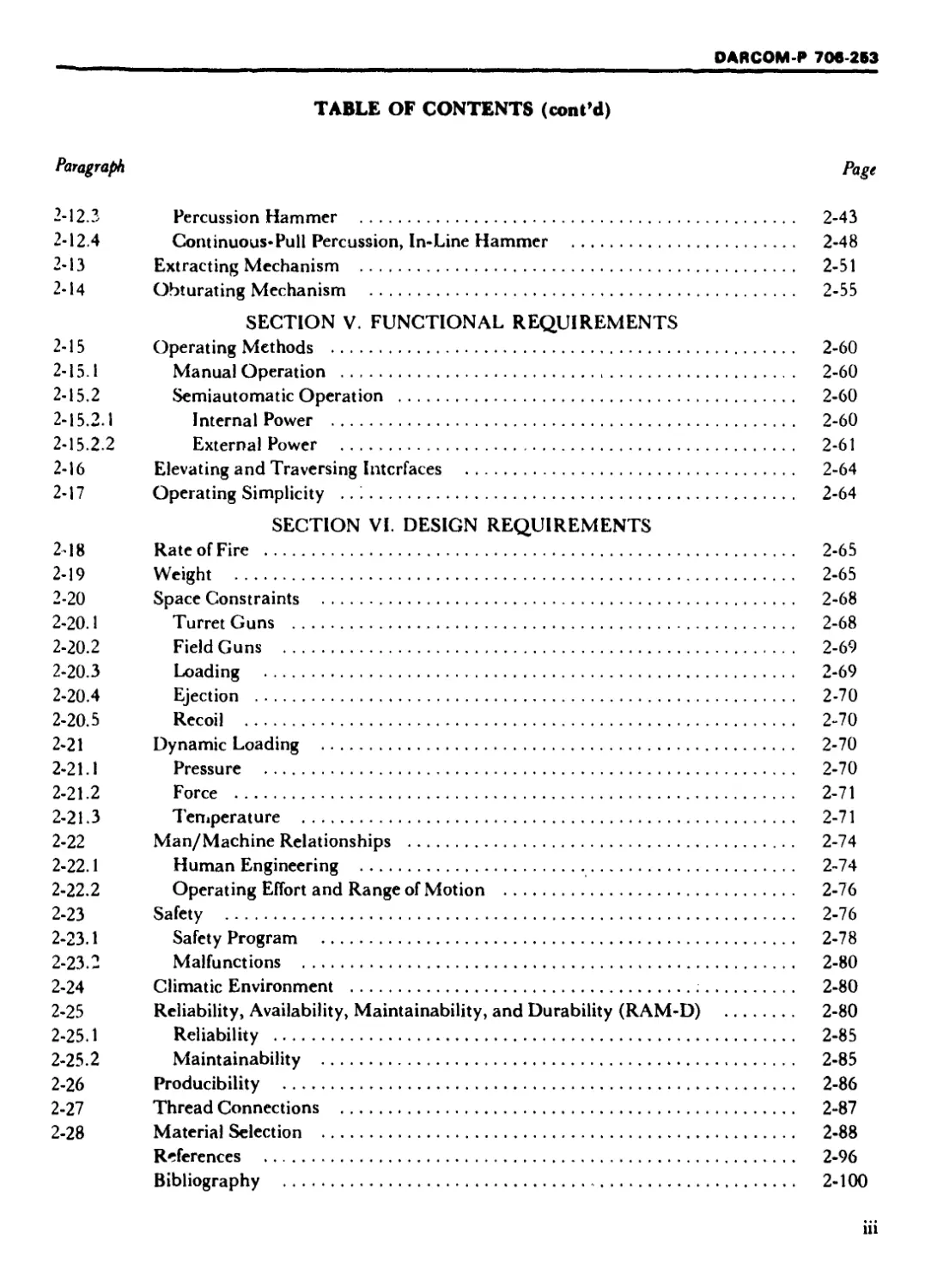
OARCOM-P 708-263
TABLE OF CONTENTS (cont’d)
Paragraph	Page
2-12.3	Percussion Hammer ..................................................... 2-43
2-12.4	Continuous-Pull Percussion, In-Line Hammer ............................ 2-48
2-13	Extracting Mechanism ................................................... 2-51
2-14	Obturating Mechanism ................................................... 2-55
SECTION V.	FUNCTIONAL REQUIREMENTS
2-15	Operating Methods 	 2-60
2-15.1 Manual Operation ........................................................... 2-60
2-15.2 Semiautomatic Operation .................................................... 2-60
2-15.2.1	Internal Power ..................................................... 2-60
2-15.2.2	External Power ..................................................... 2-61
2-16	Elevating and Traversing Interfaces .................................... 2-64
2-17	Operating Simplicity .. ................................................ 2-64
SECTION VI.	DESIGN REQUIREMENTS
2-18	Rate of Fire 	 2-65
2-19	Weight ................................................................. 2-65
2-20	Space Constraints ...................................................... 2-68
2-20.1	Turret Guns ........................................................... 2-68
2-20.2	Field Guns ............................................................ 2-69
2-20.3	Loading ............................................................... 2-69
2-20.4	Ejection .............................................................. 2-70
2-20.5	Recoil ................................................................ 2-70
2-21	Dynamic Loading ........................................................ 2-70
2-21.1	Pressure .............................................................. 2-70
2-21.2	Force ................................................................. 2-71
2-21.3	Temperature ........................................................... 2-71
2-22	Man/Machine Relationships .............................................. 2-74
2-22.1	Human Engineering ..................................................... 2-74
2-22.2	Operating Effort and Range of Motion .................................. 2-76
2-23	Safety ................................................................. 2-76
2-23.1 Safety Program ............................................................. 2-78
2-23.2	Malfunctions .......................................................... 2-80
2-24	Climatic Environment .................................................   2-80
2-25	Reliability, Availability, Maintainability, and Durability (RAM-D) .... 2-80
2-25.1	Reliability ........................................................... 2-85
2-25.2	Maintainability ....................................................... 2-85
2-26	Producibility ......................................................... 2-86
2-27	Thread Connections .................................................... 2-87
2-28	Material Selection .................................................... 2-88
References ............................................................ 2-96
Bibliography .......................................................... 2-100
OARCOM P 7OR-2B3
TABLE OF CONTENTS (cont’d)
Paragraph	Page
CHAPTER 3.
DESIGN CRITERIA AND PROCEDURES—INITIATION THROUGH PROTOTYPE
3-0	List of Symbols ....................................................... 3-1
SECTION I.	TACTICAL INPUTS TO DESIGN
3-1	Required Operational Capability ....................................... 3-3
3-2	Weapon Application and Mission ........................................ 3-3
3-3	Rate of Fire .......................................................... 3-3
3-4	Ammunition Requirements ............................................... 3-3
SECTION II.	DESIGN PROCESS
3-5	Establishing Feasibility 	 3-4
3-6	Functional Design Layouts ............................................. 3-4
3-7	Subassembly Layouts; Component Details ................................ 3-4
3-8	Materials ............................................................. 3-7
3-9	Breech Mechanism Integration With Weapon System ....................... 3-8
3-10	Interface With Analysis ............................................... 3-8
SECTION III.	DESIGN ANALYSES
3-11	Kinematic Analysis	3-9
3-12	Kinetic Analysis ...................................................... 3-9
3-13	Stress Analysis ....................................................... 3-9
3-14	Weight Analysis ....................................................... 3-10
3-15	Reliability Analysis .................................................. 3-10
3-15.1	Mechanical System Limitations ....................................... 3-11
3-15.2	Standard Prediction Techniques ...................................... 3-13
3-15.3	Probabilistic Design ................................................ 3-13
3-16	ComputerUsage ......................................................... 3-14
3-17 Typical Breech Component Illustrative Design Calculations ................... 3-15
3-17.1	Kinematic Analysis of Breech Operating Crank ........................ 3-16
3-17.2	Kinetic Analysis of Breech Operating Crank .......................... 3-20
3-17.3	Dynamic Analysis for Breech Recoil Parameters ....................... 3-24
3-17.4	Stress Analysis of Open Breech Ring ................................. 3-26
3-17.5	Stress Analysis of Closed Breech Ring ............................... 3-30
3-17.6	Stress Analysis of Sliding Block .................................... 3-34
3-17.7	Stress Analysis of an Interrupted-Thread Block ...................... 3-36
3-17.8	Block-Thread Stress Analysis ........................................ 3-40
3-17.9	Reliability Analysis of Breechblock Crank ........................... 3-41
SECTION IV.	PROTOTYPE TESTING
5-18	General Considerations 	 3.45
3-19	Models ................................................................ 3.45
3-20	Performance Simulation Tests	3.46
iv
OARCOM P 706-2БЗ
TABLE OF CONTENTS (cont’d)
Paragraph	Page
References ............................................................. 3-47
Bibliography ........................................................... 3-48
CHAPTER 4.
DEVELOPMENT CRITERIA AND PROCEDURES
SECTION 1.	DEVELOPMENT EVALUATION PROGRAM
4-1	General Considerations ............................... 4-1
4-1.1	Testing ............................................................... 4-1
4-1.2	External Influences ................................................... 4-1
4-1.3	Simulation Testing .................................................... 4-2
4-1.4	Engineering Test/Expanded Service Test (DT-2) ......................... 4-3
4-1.5	Initial Production Tests (DT-3) ....................................... 4-3
4-2	Prototype Design Deficiencies ............................................ 4-3
4-2.1	Mechanism Malfunctions ................................................ 4-3
4-2.2	Design Deficiencies ................................................... 4-3
4-2.3	Maintenance ........................................................... 4-4
4-3	Developmental Redesign Phases ............................................ 4-4
4-4	Acceptance: Engineering/Service Tests .................................... 4-4
4-4.1	Proof-Test Procedures ................................................. 4-7
4-4.1.1	E ?fore-Fire Checks and	Preparation ................................. 4-7
4-4.1.2	Proof-Firing Tests .................................................. 4-7
4-4.1.3	After-Proof Checks and	Performance .................................. 4-7
4-4.2	Climatic Test Firing .................................................. 4-7
4-4.2.1	Emplacement of Weapon ............................................... 4-7
4-4.2.2	Firing Schedule ..................................................... 4-7
4-4.2.3	After-Fire Checks and Preparations	(Climatic Testing)................ 4-7
4-4.3	/Acceptance ........................................................... 4-8
4-4.3.1	Proof Markings ...................................................... 4-8
4-4.3.2	Acceptance Criteria ................................................. 4-8
4-4.4	Endurance—Life Tests.................................................. 4-8
4-5	Performance Evaluation ................................................ 4-8
4-5.1	Maintainability ...................................................... 4-8
4-5.2	Durability ........................................................... 4-11
SECTION II.	DESIGN FINALIZATION
4-6	Incorporation of Developmental Results ... 4-12
4-7	Organizational Documentation, the Technical Data Package ................ 4-12
4-7.1	Product Specification ................................................ 4-12
4-7.2	Data List ............................................................ 4-12
4-7.3	Parts List ........................................................... 4-12
4-7.4	Drawings ............................................................. 4-12
OARCOM-P 7M-2S3
TABLE OF CONTENTS (cont’d)
Paragraph	Page
4-7.5	Quality Assurance Data ................................................ 4-13
4-7.6	Standards and Specifications .......................................... 4-13
4-7.7	End Item Final Inspections Requirements (EIFIR) ....................... 4-13
4-7.8	Revision System ....................................................... 4-13
4-8	Operating and Maintenance Manuals ...................................   4-13
4-9	Standardization and Interchangeability ................................ 4-14
SECTION III.	PRODUCTION PLANNING
4-10	Manufacturing Engineering 	 4-17
4-10.1	Methods ............................................................... 4-17
4-10.2	Materials ............................................................. 4-17
4-10.3	Economics ............................................................. 4-18
4-11	Military/Industrial Procurement Considerations ........................ 4-22
4-11.1	Planning .............................................................. 4-22
4-11.2	Tool and Gage Requirements ..........................................   4-22
References ............................................................ 4-27
Glossary ............................................................... G-l
Index ................................................................. 1-1
DARCOM-P 706-253
LIST OF ILLUSTRATIONS
Figure .Vo.	Title	Page
4-1	Large Caliber Weapon Forms ........................................... 1-5
i-2	Interrupted-Screw Breech Stepped Thread .............................. 1-13
1-3	Sliding-Wedge Breech Principles ...................................... 1-16
1-4	Vertical Sliding-Wedge Sequence, Showing Breech—Ammunition Interaction 1-18
1 -5	Separable Chamber Breech—Schematic Sequence of Motions (2 pieces) .... 1 -29
1-6	Eccentric-Screw Breech	1-23
1-7	Evolution of Interrupted-Screw Threads and Breechblock ............... 1-26
1-8	Electric Firing Mechanism Schematic for a Consumable Case Round ...... 1-30
2-1	Types of Complete Rounds of Artillery Ammunition ..................... 2-3
2-2	Artillery Chamber and Ammunition Configurations ...................... 2-7
2-3	Separate-Loading Propelling Charges .................................. 2-8
2-4	Fiber Felted Consumable Cartridge Cases .............................. 2-10
2-5	Breech Ring and Tube Interface on an Interrupted-Screw Type Breech ... 2-12
2-6	Case Chamber Stress—Strain Curves .................................... 2-13
2-7	Chamber With Pertinent Dimensions .................................... 2-15
2-8	Schematic Diagram of Bore Evacuator Operation ....................... -2-16
2-9	Gunner’s Quadrant, Ml ................................................ 2-18
2-10	Panoramic Telescope Ml, and Telescope Mount М3 ....................... 2-19
2-11	Panoramic Telescope Ml 15, and Telescope Mount M137 .................. 2-20
2-12	Elevation Quadrant, M15 .............................................. 2-21
2-13	Concept of the XM39 Electronic Viewing Equipment Installation ........ 2-22
2-14	Parts of the Operating Mechanism and Other Breechblock Mounted Groups
in a Horizontal Sliding-Wedge Breech .............................. 2-23
2-15 Typical Operating Mechanism for a Horizontal Sliding-Wedge Breech
(Sequence of Motions) ........................................................... 2-24
2-16 Operating Lever Parts (Horizontal Sliding-Wedge Breech, 105 mm Howitzer,
M101) ..........................................................................  2-25
2-17 Kinematic Sequence Leading to Engagement of Operating Cam by the Breech
Operating Crank-Breech Actuating via Recoil	Energy ................... 2-27
2-18	Typical Operating Mechanism Schematic for Vertical Sliding-Wedge Breech
(Semiautomatic Actuation via Recoil Energy') ...................... 2-29
2-19	Parts of Semiautomatic Breech Operating Mechanism .................... 2-31
2-20	Typical Operating Mechanism for Interrupted-Screw Breech ............. 2-32
2-21	Typical Operating Lever and Crankshaft Group ......................... 2-33
2-22	Counterbalance Mechanism—Interrupted-Screw Breech .................... 2-34
2-23	Parts of the Operating Mechanism and Other Breechblock Mounted Group
in an Interrupted-Screw Breech .................................... 2-36
2-24 Firing Lock Ml 3, Operating Sequence ....................................... 2-39
2-25 Spring Actuated, Inertia Percussion Firing Mechanism With Vertical Sliding
Wedge ...........................................................   2-41
2-26	Schematic of a Solenoid Actuated Percussion Firing Mechanism ......... 2-44
2-27	Percussion Hammer Firing Mechanism ................................... 2-45
vii
DARCOM P 7M-2M
LIST OF ILLUSTRATIONS (cont’d)
Figure	Title
2-28	Firing Block ?\ssembly Ml (155 mm Howitzer, Ml Al) ...................... 2-47
2-29	Percussion Mechanism M35	(175 mm Gun, M113AI) ........................ 2-49
2-30	Continuous-’’oil Percussion,	In-Line Hammer Firing Mechanism ............ 2-50
2-31	Cartridge Case Extractors	............................................... 2-52
2-32 Extracting Mechanism Working Sequence fot a Vertical Sliding-Wedge
Breech ............................................................................ 2-53
2-33	DeBange Obturating .Mechanism ........................................... 2-57
2-34	Expansion Type Obturator, Separable Chamber Breech Application .......... 2-59
2-35 Externally Powered Breech Interface Function (Hydraulic Loader/Rammer,
175 mm Self-Propelled Gun, Ml 13A1—M107 Tracked Vehicle) ............. 2-62
2-36 Externally Powered Semiautomatic Breech (Separable Chamber Type,
152 mm Gun/Launcher) ................................................. 2-63
2-37	Typical Space Constraints in a Turret Gun (Based on M48 Tank) ........... 2-67
2-38	Elastic Strength Curve Compared to Actual and Permissible Pressures ..... 2-72
2-39	Typical Recoil Travel Velocity—Pressure Versus Time ..................... 2-73
2-40	Arm, Hand, and Thumb-Finger Strength (Pounds) (5th Percentile Male) ....	2-77
2-41 Manual Lifting Capacity: Lifting Forces That Can Be Exerted by 95% of
Personnel, Using Both Hands .......................................... 2-78
2-42	Procedure for Dealing With Misfire Under Possible Cook-Off Conditions .. 2-8 i
2-43	Procedure for Dealing With Misfire of Fixed or Semifixed Ammunition.....	2-82
2-44	Procedure for Dealing With Misfire of Separate-Loading Ammunition ....... 2-83
2-45	Threads Used to Attach Breech Ring and Tube ............................. 2-89
2-46 20-deg Pressure Angle Thread Form Dimension Locator Diagram for
Table 2-6 ......................................................................... 2-91
3-1	Breechblock Assembly ................................................... 3-5
3-2	Breechblock ............................................................ 3-6
3-3	Stress—Strain Diagram in Mild Steel .................................... 3-7
3-4	Mortality Curves ........................................................ 3-12
3-5	Reliability Nomograph ................................................... 3-14
3-6	Typical Stress—Strength Interaction Diagram ............................. 3-15
3-7	Breech Operating Linkage ................................................ 3-17
3-8	Breech Operating Crank Geometry .......................................   3-18
3-9	Breechblock Motion .................................... ................ 3-21
3-10	Forces Acting on Crank .................................................. 3-22
3-11	Torque Applied to Breechblock Crank ..................................... 3-23
3-12	Recoi’Force Diagram ..................................................... 3-25
3-13	Typical Sliding-Block Breech Rings ...................................... 3-27
3-14	Open Breech Ring .......................................................  3-28
3-15	Stress Concentration Factors in Fillets for Tension and Bending ......... 3-31
3-16	Closed Bt eech Ring ..................................................... 3.33
3-17	Typical Breechblock Section	3-35
3-18	Breech Loading Configuration ............................................ 3-37
viii
DARCOM-P 7M-2M
LIST OF ILLUSTRATIONS (cont’d)
Figt e No.	Title	Page
3-19	Idealized Breechblock Geometry and Loading Conditions .................... 3-38
3-20	Thick-Plate Geometry and Loading Conditions for Timpi Solution	3-39
3-21	Sector Thread	......................................................... 3-41
3-22	Safety Factor Related to a Probability of Failure ........................ 3-43
3-23	Breechblock Crank (Illustrative Geometry) ................................ 3-44
4-1	Work Flowchart	(First orContract) .................................... 4-5
4-2	Work Flowchart	(Subsequent Production)	4-6
4-3	Finish Machined Parts, Finish Machining in Final Assembly Approach for
Interchangeability .................................................... 4-15
4-4	Prior-Dimensioned Parts, Prior-Designed Approach foi Interchangeability .. .	4-16
4-5	Total Cost per Piece—Sum of Tool Costs, Machining Cost, and Nonproductive
Cost .................................................................. 4-20
4-6	Machining Costs and Surface Finishes	4-21
4-7	Relationship of Tolerance to Cost ........................................ 4-22
4-8	Quality Standards Versus Cost ............................................ 4-23
4-9	Depth-Cost Study of Drilled Holes ........................................ 4-24
4-10	Cost Behavior in Face Milling	  4-25
4-11	General Pattern of Grinding Costs ........................................ 4-26
4-12	Machine and Operator Cost Effect	4-27
DARCOM-P 7M-M1
LIST OF TABLES
Tablt ..Vo.	Title	Pagt
1-1	Towed Weapon Characteristics as Related to Breech Design ............... 1-6
1-2	Self-Propelled Weapon Characteristics as Related to Breech Design ...... 1-9
1-3	Comparative Characteristics—Sliding-Wedge and Interrupted-Screw Breech	1-19
1-4	Safety Characteristics of Typical Firing Mechanisms ..................... 1-33
2-1	Ammunition Characteristics ............................................. 2-5
2-2	Principal Design Requirements of Elastic Obturator Pads ................. 2-56
2-3	Conventional Control Movements .......................................... 2-75
2-4	Rangeof Human Motion .................................................... 2-79
2-5	Effects of Environmental Factors on Breech Materials .................... 2-84
2-6	20-deg Pressure Angle Thread Dimensions ................................. 2-90
2-7	List of Specifications for: Cannon, 155 mm, Howitzer, XM1191 ............ 2-92
2-8	Protective Finish—Drawing Number Matrix ................................. 2-94
2-9	Breech Mechanism Part Matrix ............................................ 2-96
4-1	Firing Schedule ........................................................ 4-7
4-2	Categories of Maintenance in a Theater of Operations .................... 4-10
4-3	Standard Machining Operations ........................................... 4-18
4-4	Comparison of Machinability Index Ratings for Selected Alloys ........... 4-19
x
DARCOM-P 7Ов-2ВЗ
PREFACE
The Engineering Design Handbook Series of the US Army Materiel Development and Readiness
Command is a coordinated series of handbooks containing basic information and fundamental data
useful in the design and development of Army materiel and systems. The handbooks are authoritative
reference books of practical information and quantitative facts helpful in the design and development
of Army materiel so that it will meet the tactical and the technical needs of the Armed Forces.
'Phis handbook has been prepared as an aid to engineers designing breech mechanisms. Fundamen-
tal design information not readily attair :ble elsewhere is presented along with requirements and
problem areas that are unique to breec mechanisms.
The material presented in this handbook is composed of data and design information gathered front
many sources; however, treatment is limited to one of condensation and summary because of the sub-
ject scope. References appear at the end of each chapter for guidance in acquiring additional informa-
tion. A glossary has been provided at the end of the handbook.
When reference is made to Military Specifications, regulations, or other official directives, it is done
to reveal the existence of these documents. In this respect, the user should obtain the current editions
for applications.
This handbook was prepared by ПТ Research Institute under subcontract to the Engineiering
Handbook Office of the Research Triangle Institute, Research Triangle Park, NC, prime contractor to
the US Army Materiel Development and Readiness Command for the Engineering Design Handbook
Series. Members of the Benet Weapons Laboratory—a US Army Armament and Development Com-
mand organizational element located at Watervliet Arsenal—provided guidance, review of the text
material, and support by furnishing source data and references. Major contributions to the prepara-
tion of this handbook were made by Mr. Frank Bartos and Mr. Milton Nusbaum, IIT Research
Institute.
The US Army DARCOM policy is to release these Engineering Design Handbooks in accordance
with DOD Directive 7230.7, 18 September 1973. Procedures for acquiring Handbooks follow:
a.	All Department of Army (DA) activities that have a need for Handbooks should submit their re-
quest on an official requisition form (DA Form 17, 17 January 1970) directly to:
Commander
Letterkenny Army Depot
ATTN. SDSLE—AJD
Chambersburg, PA 17201.
“Need to know” justification must accompany requests for classified Handbooks. DA activities will
not requisition Handbooks for further free distribution.
b.	DOD, Navy, Air Force, Marine Corps, nonmilitary Government agencies, contractors, private
industry, individuals, and others—who are registered with the Defense Documentation Center (DDC)
and have a National Technical Information Service (NTIS) deposit account—may obtain Handbooks
from:
Defense Documentation Center
Cameron Station
Alexandria, VA 22314,
xi
DARCOM-P 7M-2U
c. Requestors, not part of DA nor registered with the DDC, may purchase unclassified Handbooks
from:	National Technical Information Center Department of Commerce Springfield, VA 22161.
Comments and suggestions on this Handbook are welcome and should be directed to:
	US Army Materiel Development and Readiness Command 5001 Eisenhower Avenue Alexandria, VA 22304.
DA Form 2028, Recommended Changes to Publications, which is available through normal publica-
tion supply channels, may be used for comments/suggestions.
xii
DARCOM-P 706-253
Ои :

y*^u\rtrt<JHfa>
*s'j*	j» Сг/Угг»« ou-J Гго4^иг*э --
CHAPTER
VeiUsfrhJ»T Сгты/л W
INTRODUCTION ^xj^rpc^d u	лмо/ Produ-c-'h
SECTION I. GENERAL CONSIDERATIONS^ /^>//7/^.
1-1 HANDBOOK SCOPE
‘"^This handbook is devoted to a description of a
rational design sequence and methodology
needed to take a particular breech mechanism
from conception—as prompted by military needs ;
and technical requirements generated for a given I
weapon—to the stage of acceptance and produc-
tion. Major divisions of the handbook provide in- ;
formation and guidance on the various design in-
terrelationships involved. —-- --------- z
The designer should keep in mind that the sole
purpose of a weapon system is to provide the fire-
power needed to meet the system requirements.
The breech mechanism is one of several key sub-
assemblies in the cannon subsystem which in
turn is one of several that make up the total
weapon system. One particularly important
function which this handbook serves is to assist
engineers, without prior breech mechanism
design experience, in the design of this signifi-
cant cannon subassembly. Normally, the design
may be best achieved by a team of engineers
comprised of a group of multidisciplinary
specialists, each with competence in a specific
area relaxed to the breech mechanism. These
areas include: configuration innovation; design
analysis (kinematic, kinetic, stress, weight, and
reliability); material selection; maintenance;
production; and cost. This group should also in-
clude an experienced technical manager to
assure that each member has equal stature and
responsibility, and that their particular exper-
tise is applied consistently. The design team has
a responsibility which starts with the breech
mechanism concept and continues throughout
the service life of the weapon system. Section III
of this chapter describes design responsibility
and the team approach more fully.
Subject content and scope of the handbook
deserve a degree of definition as early as possible.
Specifically, the handbook contents are limited to
breech mechanisms of crew-served, “large
caliber”, land based guns and howitzers, in-
cluding self-propelled weapons and tank guns.
The treatment is oriented toward design
guidance, design examples, and engineering data
as practical. Breech mechanism design for mor-
tar, recoilless, and other weapon types has been
left for coverage in subsequent handbooks.
The meaning of “large caliber” weapon has
different connotations among the various hand-
book users. Because it is a less than rigorously
defined term and undoubtedly no single defini-
tion will enjoy full consensus, further discussion
of “large caliber” is provided in par. 1-2. On the
basis of Army weapons previously or presently in
existence, an overall range from 37 mm to 280
mm bore diameter can be offered for reader
guidance; but the upper limit of caliber easily ex-
tends to 16 in. bore, if seacoast or railroad ar-
tillery is included.
However, in the context of this handbook,
emphasis is justifiably placed on more current
weapon applications and first-line equipment —
having a caliber range of about 105 mm to 8 in.
(203.2 mm). Of course, weapons within the
broader size range are also covered wherever they
provide information significant to breech design.
Weapons no longer in use and ones having future
potential comprise such inputs.
The subject of breech mechanism design en-
tails a large number of topics; accordingly, de-
tailed, comprehensive coverage in one convenient
volume is an impossibility. Therefore a general-
ized approach is used, as suitable, in order to
make the discussions applicable to a number of
1-1
DARCOM-? 706-253
similar cases. Users of this handbook should not
expect to find complete, step-by-step procedures
on every conceivable breech design problem or
applications they might encounter (e.g., antiair-
craft or antitank artillery, per se). The assumption
is made that the handbook users are competent
to modify the given procedures to make them ap-
plicable to specific cases.
1-2 TERMINOLOGY WITH RESPECT TO
CALIBER
The approach is taken in this handbook to
arrive at the designation “large caliber”
weapon—and more particularly to its lower and
upper bounds. Refs. 1 to 3 are in general agree-
ment that a bore diameter larger than 30 mm
(1.181 in.) constitutes a “large caliber” weapon;
this size limit is also given in the basic definition
of both “gun” and “howitzer”. The lower bound
of weapon size under consideration here is
further related to the administratively set max-
imum bore of 40 mm for small arms (Ref. 2).
The upper bound of “large caliber” weapon
size is difficult to set. Certainly, historic evidence
shows the existence of extremely large bore
weapons in former times. In World War I, Euro-
pean armies commonly employed railway ar-
tillery and siege guns of fantastic calibers. Even
as late as World War II, operational use of an
800 mm (31.5 in.) railway gun can be cited (Ref.
4). The foregoing examples, however, are ex-
treme and special cases. Even though such
weapons show virtually no theoretical size limit,
they are of little significance toward realistic
breech mechanism design.
' On the other hand, practical design limits are
numerous as well as stringent Today, the multi-
ple constraints of mobility, maintainability, and
reliability—cou[ led with drastically different
tactical concepts and specific weapon missions—
impose the realistic upper bound on weapon size.
A practical size limit of 8 in. (203 mm) is not
likely to be exceeded by military requirements of
the foreseeable future.
The various elements of the breecb system are
individually treated at appropriate points of the
handbook. A glossary of technical and ordnance
terms used in the handbook and requiring
separate definition appears at the end of the
volume.
1-2.1 BREECH MECHANISM
DEFINITION
The handbook glossary provides terminology
definitions for the important components and
mechanisms which comprise a breech
mechanism. Webster’s Third New International
Dictionary provides the following definitions:
1.	Breech. The part of a cannon or other
firearm at the rear of the bore.
2.	Breechblock. The block in breech-loading
firearms that closes the rear of the bore against
the force of the charge.
3.	Breech mechanism. The mechanism for
opening and closing the breech of a breech-
loading firearm, especially of a heavy-caliber
gun.
The purpose of the handbook may be better
served by the definition that follows. The totality
of dewces and components: for closing the rear
end of a gun after loading (likewise for con-
venient access after firing); for firing the round of
ammunition that has been inserted; for contain-
ing and sealing the tremendous pressure
developed; and for removing any ammunition
components not projected—all comprise the
breech mechanism.
The forward and rear ends of a weapon are
referred to commonly as “muzzle end” and
“breech end”, respectively. The muzzle is the
end of the gun tube from which the projectile
emerges and the breech end is that into which
the round of ammunition is inserted.
1-2.2 BREECH MECHANISM
FUNCTIONS
The two basic functions of a large caliber
weapon breech mechanism are diametrically op-
posed. The mechanism must, on the one hand,
1-2
DARCOM-P 706-253
open and be accessible for conveniently receiving
each new round of ammunition — also for ex-
tracting any remnants of the previous firing. On
the other hand, it must be able to close rapidly
and at the same time provide adequate structural
integrity to contain the high propellant pressures
developed in the weapon chamber.
These primary functions are part of a definite
sequence in which the breech mechanism ele-
ments operate. The operational cycle consists of
a number of actions occurring in succession,
which must be accomplished simply and eco-
nomically, yet with a high degree of reliability.
Functional sequence is similar for the weapons
under consideration here, however, some varia-
tions do exist.
The functions of the breech mechanism are
performed by six major subassemblies and a
safety provision:
1.	Breech ring
2.	Breechblock
3.	Operating mechanism
4.	Firing mechanism
5.	Obturating mechanism
6.	Extracting mechanism
7.	Safety interlocks.
1-3 TYPICAL OPERATIONAL CYCLE
Assume that the breech is empty and the
breechblock has been opened; an operating cy-
cle then can be conveniently described begin-
ning with the ammunition loading function. For
smaller weapons, ammunition is inserted into the
breech by hand; but as weapon caliber becomes
larger, assist devices are generally necessary.
The breech is closed behind a new round by
the breechblock. The method of closing varies ac-
cording to breech and ammunition type, weapon
application, etc., as detailed later. However,
operating mechanisms produce rotary, pivot,
slide, or hinge motions in the block. In smaller
caliber weapons the breechblock moves at right
angles to the chamber axis to cover or uncover
the chamber opening. This kind of breech,
broadly termed the slide block type, generally
has been associated with weapon size< to 120 mm
bore for reasons elaborated in Chapter 1, Section
II. Similarly, larger caliber weapons (approxi-
mately 155 mm and over) have traditionally used
the rotary (screw block) type of closure—where
the block is first unlocked by a limited rotation
then swung out of the breech recess.
The firing function occurs with the initiation of
the primer, after the L 'eech has been closed and
locked. Firing mechanisms operate on the princi-
ple of percussion or electrical activation, or a
combination of the two. During firing, an obtura-
tion step comes into play, in which the chamber
is sealed against escape of the propellant gases.
The device for prohibiting the loss of gases can be
either a part of the breech or a part of the am-
munition. In smaller caliber weapons
traditionally associated with metal cased am-
munition, the case itself performs the sealing
function; no separate obturating device is re-
quired in the breech. Larger caliber weapons
have traditionally used separate loading rounds,
which have no cartridge case; therefore, such
breeches require an obturating mechanism.
(Relations between weapon size and ammuni-
tion type are treated later.)
After firing, there is a recoil-counterrecoil ac-
tion in which momentum is exchanged between
the stationary and moving parts of the weapon.
This is a potential source of energy for actuating
the breech and is used in a number of large
caliber weapon applications. For guns working
in enclosed fighting spaces (tanks, self-propelled
weapons), a scavenger device or a bore evacuator
usually is employed to purge the chamber of
propellant residue or noxious fumes — between
successive shots. However, evacuators can only
be used if the breech is opened automatically
during the last part of the counterrecoil. This
particular problem regarding personnel protec-
tion rarely exists in guns that are not enclosed.
In manually operated weapons, at this point
the breech can be unlocked and opened to permit
an extraction function to end the operating cycle.
This step removes spent ammunition parts left in
1-3
DARCOMP 7O6-2R3
the breech. For cased ammunition, extraction of
a full size cartridge case is involved; but only a
small primer case has to be extracted for separate
SECTION II. BREECH
1-4 APPLICATION CONSIDERATIONS
The breech mechanism comprises an un-
questionably vital subsystem of the overall
weapon, but nevertheless it is a subgroup of that
larger end item. Thus, breech mechanism
classification must include consideration of the
total weapon characteristics and the intended
mission(s) of the weapon. Important application
factors of the overall weapon which bear on
breech mechanism design are:
1. Type of ammunition to be fired
2. Gross form taken by the weapon; i.e.,
towed weapon, self-propelled weapon, or tank
(see Fig. 1-1).
Ammunition type exerts great influence on
breech design. Obviously, the diversity in
weapon applications—antiaircraft, antitank, and
tank guns for direct-fire missions; howitzers and
maximum range guns for indirect-fire support—
requires the use of several kinds of ammunition.
In turn, a particular ammunition type is related
to the rate of fire, loading task, crew size, and ex-
tent of automation required in the breech
mechanism. As full recognition of ammunition
influences on breech design, pars. 1-4.3, 1-7.2,
and Chapter 2, Section I, are devoted to detailed
coverage of pertinent ammunition-breech rela-
tionships.
1-4.1 TOWED WEAPONS
Despite the many advances of materiel mod-
ernization, towed weapons have retained a
definite place within Army requirements. Even
without motive power of their own, they can
provide offsetting qualities which maintain their
useful role. Versatility in employment ability, to
loading ammunition. Thus, the complexity of the
extractor device varies approximately with case
size.
MECHANISM TYPES
closely accompany or support troops, and ability
to provide good firing rates with simple breech
mechanisms are among the positive attributes of
this weapon category. Technical developments
are also well utilized in towed weapons; availa-
bility of newer materials with better physical
properties coupled with optimum design appli-
cations has resulted in weight reductions without
sacrifice in performance. One very significant ex-
ample of lighter weight weapon design is the 105
mm Howitzer, M102 (see Table 1-1) which now
makes helicopter transportability a routine oper-
ation. Designs that can provide the additional
feature of “air mobility” further reduce the
traditional disadvantage associated with towed
weapons.
Simpler, more self-contained breech
mechanisms are required for towed weapons as
compared with self-propelled types; this consid-
eration extends to other subsystems of the
weapon as well. The degree of breech mechanism
sophistication poss’b'e is set by many factors, but
in towed weapons the lack of external power im-
poses one definite limit. (Existence of auxiliary
propelled field pieces is recognized—e.g., the 155
mm Howitzer, Ml23Al—however, such power
sources have limited capability even for motive
power and are impractical for breech assistance.)
Therefore the breech designer must employ in-
ternalpower sources as practicable (par. 2-15.2.1)
and substantial design ingenuity to achieve auto-
mation of certain breech functions.
Normally, breech operations are accom-
plished manually. This is quite acceptable up to
the weapon calibers where ammunition type,
physical package, and handling requirements are
such that competitive weapon performance is
achieved. For towed weapons it is an acceptably
1-4
OARCOM-P 7OA-2B3
(В)	175 mm Self-Propelled Gun,
M113A1. (M107 Tracked Vehicle)
(C)	105 mm Gun, M68 (M60A1 Combat Tank)
Figure 1-1. Large Caliber Weapon Forms
1-5
TABLE 1-1. TOWED WEAPON CHARACTERISTICS AS RELATED TO BREECH DESIGN (Refs. 9 to 13)
	WEAPON (Caliber, Type Bad Model)	1 Breech Mechanism Тур»	Ammunition Тур»	Firing Mechanism Тур»	Recoil Distance min-тая, in.	Elevation min-так, deft	Traverse Angle,	Firing Rate, rounds /min Bunce (Sus- tained)	Estimated Breech Mechanism Weight lb	, 1 Ilf	Breech Operating Mode
CURRENT MODELS	Г	|l)5mm Howitzer. МЮЦ1	Horizontal Sliding Wedge	Semifixed	(*oniinuous-Pull Percussion (MH)	39-42	- s *6.5	s	Ю (.'!	300		Manual
	105 mm Howitzer. M H>2	Vertical Sliding Wedge		Pet cussion	3t> . '		360		•	*
	155 mm Howitzer. M 114ДI	Interrupted Screw {Stepped- Threadi	Separate laiad'ng	Percussion Hammei (Ml)	41-btl	(I -*-0?	23 5	4 (1)	83tt	*
	8 in Howitzer. Mil?				M-‘O	+65	V)	1 5 ill 5)	•	•
REPRESENTATIVE OLDER MODELS	3" mm Antitank Gun. MW 1	\ crlical Sliding Wedge	Fixed	Pen ussion**	2o 20 =•	+ io * |5	3o	...	•	50.000	Manual
	“5 mm Pack Howitzer. M1lb	Horizontal .Sliding Wedge	Semifixed	Continuous- Puli Percussion (M 131	2". 32	- s *4^	3	8 (2.51	121	26.000
	120mm Antiaircralt Gun. Ml	Ven ical Sliding Wedge	Separated	Spring Actuated Inertia Peri uphill • •	51-44 1 Al o’ 1 34.3b ( \t 80°)	-i *80	5o0	12	•	38.(НИ)	Semiauionnttii ♦ ♦
	1 55 mm Howitzer. M 1Д1	Interrupted Screw (Stepped- Th-ad)	Separate Loading	Percussion Hammer (Ml)	41-58	> + 65	2g?	<2/51	840	40.000	Manual
	240 nun Howitzer. M1				••-60	* 15 + 6?	22.S	1 (0.5)	•
	280 nun Gun. 1'131			Electric or Pen ussion	40-(G	0 * "V?			•	•
DARCOM-P 7M-253
EGE.N'I): +	— Negative minimum elevation indicates depression
(o — ± indicates both right and left traverse.
• — Firing rate, first 3 min.
• — No information.
* —Conflicting or insufficient information
To ubt.in; mils, multiplv In I H.
♦ ♦	- External jxiwer used to great degree. Remote jxiwer con-
trol. automatic loader, rammer, fuze setter Bulks
overall svstem. Cannon weight 1l).6“5 lb.
OARCOM-P 7M-283
large, proficient gun crew, and lesser space con*
straints that make the performance possible. In
the upper caliber range of weapons, e.g., above
155 nun bore, the physical size of ammunition
and inherent weapon functions hold down the
rate of Tire without the presence of power assists.
It is in this area where innovative uses of internal
potver to automate breech functions are most
desirable and also the most difficult to achieve.
The preceding is not to say that breech
mechanism automation has not been achieved at
all in towed weapons. Indeed, several weapons
have used recoil system energy to obtain semiau-
tomatic breech operation, wherein several func-
tions are removed from the hand operation mode.
Recoil energy is the most commonly used inter-
nal power source and the sliding wedge type
breech is especially well suited for actuation by
the readily available linear motion of a gun in
recoil (see pars. l-S.Z'apd 2-15.2.1). Probably the
best example of recoil\nergy utilization in a
towed weapon is the 75 mm Antiaircraft Gun,
T83E1.
Towed weapons, particularly howitzers, im-
pose additional limits on recoil energy utiliza-
tion, in firing variable charge ammunition (pars.
1-4.3 and 2-2). Inherent to the weapon structure,
a long recoil stroke is necessary to contain the
largest charge used. Consequently, at a low zone
fire mission, the recoil stroke is much shorter
thus making it difficult to provide for breech ac-
tuation. Also, high elevation fire in the lower
zones, provides low counterrecoil force for
operating the breech. The magnitude of this force
is a special problem in lighter weight weapons.
Further consideration of this design problem is
given in par. 1-6.2.
Nevertheless, recent attempts to develop a
rapid-fire towed artillery weapon have taken
place in the 105 mm howitzer category and in-
clude interesting concepts of recoil energy usage.
Single and multiple, revolving or indexing cham-
ber breeches; loader-rammer mechanisms;
rotary magazines; and their combinations are
some breech automation techniques for which
feasibility has been shown. Although none of
these concepts meets all military requirements or
rigors of that environment, some are promising
and offer noteworthy examples for the designer’s
awareness (Refs. 5 to 8).
Breech system oriented engineering data and
related characteristics of both current and pre-
viously used weapons represent design state of
the art in one form. Table 1-1, offered for
guidance of the designer, is a compilation of per-
tinent data on representative towed weapons
from Refs. 9 to 13.
1-4.2 SELF-PROPELLED WEAPONS
In the context of this handbook, all weapons of
an applicable caliber permanently mounted on a
mobile platform—including self-propelled guns,
howitzers, and tank guns—comprise the self-
propelled weapon category. At the same time,
the distinctly different missions of the various
total weapon systems involved cannot be
overlooked. Self-propelled guns and howitzers
retain the basic mission of artillery. They provide
accurate, indirect supporting fire at medium to
long range and offer the advantage of full
mobility under their own power. These weapons
are not normally used in direct confrontation
with the enemy, therefore structural and armor
protection incorporated around a cannon varies
greatly from model to model, but is much less
than found on tanks. In contrast, tanks mainly
provide direct fire coupled with the greatest
degree of mobility possible. They are essentially
assault weapons, able to close with the enemy,
yet fully enclosed and heavily armored to with-
stand counterfire.
Several factors which have bearing on breech
design stem from characteristics of the overall
weapon system. Presence of a vehicle power plant
makes external power more readily available for
breech actuation. To be sure, this is far from the
only criterion for deciding to use external power.
Rather, the interplay between various con-
straints of a given weapon system set the extent of
1-7
OARCOM-P 706*263
external power utilization. Type and size of am-
munition, fighting compartment space, and
whether internal power is available in a par-
ticular application are just some of the con-
straints the designer will encounter.
Breech operation is automated to some degree
in all self-propelled weapons. This ranges from
power assist given to important interface func-
tions in some artillery pieces (e.g., loading/ram-
ming, Fig. 2-35(B); to semiautomatic operation
of more major breech functions by internal
means, as in a number of artillery and tank appli-
cations; to more specialized situations demand-
ing still further automation of the breech system.
(Presently, the latter condition is exemplified in
the 152 mm Gun/Launcher discussed at various
points in the handbook see Fig. 2-36). However,
full automation of all breech mechanism func-
tions has not been reached (see par. 2-15.2). To
the extent that powered operations are un-
available or impractical, manual operation is
used. Manual actuation for certain breech opera-
tions need not be a design detriment; in any
event, critical amumated functions equire
manual back-ups in case of malfunction or
emergency.
Space is generally at a premium in any fighting
vehicle. An increase in available space is equiva-
lent to an increase in weight and size. Both of
these factors increase vulnerability. A weight in-
crease reduces maneuverability while an increase
in size provides л larger target. Nevertheless,
space constraints are rnrre severe for tanks than
for self-p.’opeiled artillery. In сенат models of
tne latter it is acceptable to eliminate defensive
structural p> otection, thereby greatly easing
space constraints (Fig. l-l(B)). Thus the self-
pro oelled weapons —i 75 mm Gun, M113A1, and
8 in. Howitzer, M2A2 (Table 1-2)—can use a
convenient, hydraulically actuat d mechanism
for the loading and ramming of projectiles (see
Fig. 2-35(B)). A rugged and traditional mechan-
ism of this tyne could not have been used if the
cannon were .логе fully enclosed.
Depending on application, other self-propelled
weapons are armored, turreted, or otherwise en-
1-8
closed — e.g., 105 mm and 155 mm Howitzers
(Ml03 and M126A1), vehicles Ml08 and Ml09
(Table 12). Ir. these weapon examples, trade-
offs between the ammunition handling task and
space allotments rule in favor of manual loading.
Instead, the available recoil motion is utilized for
such functions as breech opening and closing,
open position lockout during insertion of a
round, case or primer extraction as applicable,
etc. The breech mechanism becomes “semiauto-
matic” when the foregoing operations (or others)
no longer require manual actuation.
Self-propelled vs towed weapons exhibit short-
er recoil strokes because the inherently greater
system weight and stiff vehicle structure can bet-
ter contain the generated recoil forces. In tank
guns, recoil distance is further curtailed for the
additional reason of very limited space within the
turret. Yet in tank weapon systems—firing con-
ventional ammunition—a limited but sufficient
recoil motion exists to permit semiautomatic
breech operation.
The advent of nonconventional ammunition
has caused significant changes in traditional
weapon design. Specific ammunition influences
are discussed in pars. 1-4.3, 1-7.2. and 2-1;
however, the example of the 152 mm
Gun/Launcher (M81 and Ml62 versions) is
again cited, in connection with the special power
requirements of its breech. These hybrid weapon
systems—which fire guided missiles as well as
conventional projectiles from the same rifled tube
— fimd current application in one model of the
M60 Tank and the full tracked, Airborne Re-
connaissance/Armored Assault Vehicle
(AR/AaV), M551. The low propellant energy of
the guideu missile—hence low recoil energy
availability — and the requirement for rapid fire
make the use of external power mandatory.
Breech actuation in the 152 mm Gun/Launcher
is semiautomatic. An electric motor driven power
train provides the complex breech motion needed
in this special design (see par. 1-5.3).
In tank guns, a number of breech interface
devices may also be used which require designer
attention. Mechanisms of this type include recoil
TABLE 1-2. SELF-PROPELLED WEAPON CHARACTERISTICS AS RELATED TO BREECH DESIGN (Reb. 9 to 15)
	WEAPON (Caliber, Type, Model aad Awecialed Vehicle)	опта Mechaaieai Тур»	Ammucitio* Тур»	Firiag Мескмамм Type	Recoil DUtaace Mia-маж, ia.	r a Ss 11 Ы (	Traverse, 		Piriag Bew, roaade /ia Bant* (>*- Hiaed)	Eeriawwd Beeeeb Mechaaie* Weigh!, lb	1‘.	Mu. Bawd Chamber Pmeare, pei	Breech Oaentiaa Mode
CUBBENT MODELS	1	105 mm Gun, M68 (.М60Л1 Combat Tank)	Vertical Sliding Wedge	Fixed	Electric!»	12	-10 +20	360	(0)	825	53	61,600	Semiautomatic
	105 mm Howitzer. M105 (M108 Self-Propelled. Tracked Vehicle)		Semifixed	Spring Actuated. Inertia Percussion		-6		10 (3)	375	23 1	36,700
	152 mm Gun/Launcher, M162 (М60Л1 El, M6OA2Cornbat lank	Separable Chamber*	Fixed and Guided Missilef	Electric	-	-10 + 20		• (4)	510	5T,2	38,400
	155 mm Howitzer, M I26AI (M109 Self-Propelled Tracked Vehicle)	Interrupted Screw (Single- Cut Thread)	Separate Loading	Cojlinijous-Pull Percussion. In-Line Hammer (M35)	24-36	-.3		4 (1)	670	26.2	41.000
	175 mm Gun. M11 ЗА 1 (M IO7 .Self-Propelled Tracked Vehicle)	Interrupted Screw (Stepped- Thread)			29- 70	+ 65		1 5 (0.5)	17.50	31 1	51,000	Manual
	Bin. Howitzer, M2A2 (Ml 10.Seif- Propel led Tracked Veaicle)									29.3	39.600
BEPBESENTATIVE oldeb MODELS	76 mm Gun. M32 (M4 1 ЛЗ Combat Tank)	Vertical Sliding Wedge	Fixed	Spring Actuated. Inertia Percussion	12	 4 + 20	ЗЫ1	• (*>	370	25.9	55.200	Manual**
	90 mm Gun. M4i (М48ЛЗCombat lank)					.9 + 19		• (8>	7KH	52	5” 700	Semi automatic
	l20mmGun. M58 (M1O3A2 Combat Tank)		Separated		13	-8 + 15		• (4)	1680	62.5	... r’.oOO
	155 mm Gun. M46 (M53 .Self-Propelled, Tracked Vehicle)	Jnterrup.ed Screw (Stepped- Thread)	Separate Loading	Electric or Percussion (T9 5) ••	18-20	-5 +65	30fe	1.5 (0.5)	1340	48	4 *.,30C	Manua'
LEGEND
i —Negative minimum elevation indicates depression. I
— ± Indicates both right and left traverse.	f 1
• — Firing rate, first 3 min.
A — Externally powered semiautomatic breech mechanism
(electric). Single-cut, interrupted locking threads.
tr — Special electrically primed ammunition.
obtain mils, multiply by I7.
#	— S|>ecial weapon system employing unconventional
ammunition, including consumable case rounds.
•	— No information.
•	• — Conflicting or insufficient information
OARCOM-P 700-283
OARCOM R 704-2B3
guards, loading trays, and case ejection chutes or
deflectors. These devices facilitate the breech
operational cycle, ease ammunition handling
tasks, or otherwise assist the gun crew working in
tight fighting spaces. A chart of engineering data
assorted with breech systems of representative
self-propelled weapons is presented in Table 1-2.
1-4,3 AMMUNITION DICTATES
Effective delivery of firepower upon designated
hostile targets is the sole, ultimate function of a
weapon. Thus, the type (or types) of ammunition
to be handled and projected by a given weapon is
a strong dictate on the type of breech needed. In-
deed, reference to ammunition influences is un-
avoidable even in the most elemental discussion
of breech mechanism design, as contents of the
foregoing paragraphs reveal.
Ammunition for large caliber weapons has
been variously categorized. For the purposes of
this handbook, general characteristics and exter-
nal properties of ammunition type are the impor-
tant considerations. Size, weight, kind of physical
package, and number of component pans com-
prising a complete round are obvious character-
istics to be borne in mind. Classification on the
basis of fixed, semifixed, separated, and separate-
loading ammunition types is the most widely
used approach (Refs. 14 to 16):
1.	Fixed ammunition. A complete round with
primer and propellant contained in a cartridge
case permanently attached to a projectile. It is
loaded into the breech as a unit; caliber size is
limited by weight, package size, and other hand-
ling considerations.
2.	Semifixed ammunition. A complete round
in which the cartridge case is not permanently
fixed to the projectile so that the incremental
charge within the case can be adjusted to obtain
the desired range (or zone) of fire. However, it is
loaded into the breech as a unit and, therefore,
subject to similar caliber size limits as the fixed
round.
3.	Separated ammunition. A complete round
composed of two component parts; namely, the
1-10
projectile and the propelling charge that is con-
tained in a sealed case complete with primer.
The two items may be leaded into the breech
separately by hand; in an automated mode, the
projectile and case are set into a loading tray
"separately”, but breech loading is normally per-
formed in one operation. This type of round is
used when physical size becomes too large or im-
practical to handle in the fixed ammunition form.
4.	Separate-loading ammunition. A complete
round made up of three distinct components,
wherein no cartridge case is used. Instead, the
projectile and cloth bag encased propellant
charge(s) are handled separately and loaded into
the breech. In addition, a primer cartridge is in-
serted separately into the firing mechanism.
The order in which the ammunition types are
listed corresponds in a general way to increasing
caliber; e.g., fixed ammunition is generally
associated with the smaller caliber range of
weapons considered here, while the separate
loading category implies the larger caliber range.
(It should be noted that in foreign ordnance, con-
ventional fixed ammunition exists in much larger
calibers than in US Army usage.) Further type/
size generalization is problematic—especially in
the semifixed and separated ammunition clas-
ses—since complicating overlaps occur due to
particular weapon application, tactical consider-
ations, or design peculiarity.
Even traditional concepts concerning relative
size of “cased” and “caseless” ammunition are
changing (types 1, 2, 3 vs type 4). For example,
development of the consumable case helps make
the fixed round practicable at much larger
calibers than hitherto possible. Developmental
trends are not in one direction only since interest
also exists in adapting separate-loading ammu-
nition to smaller calibers. At least one example of
an operational weapon system using bagged
charges at 120 mm bore size can be cited in a
British tank application (Ref. 17; sec also pars. 1-
5.2 and 1-6.6).
Ammunition type has definite implications on
the type of breech mechanism to be used; the
DA ROOM-Р 7М-2БЗ
newer, unconventional rounds just mentioned
are important situation; in point. In par. 1-5
relations between ammunition type and breech
closure type are established. The various ammu-
nition types also receive more detailed treatment
in par. 1-7.2 and Chapter 2, Section II, relative to
their individual influences on breech design.
Basic categorization of ammunition in terms of
weapon size for representative towed and self-
propelled weapons is given in Tables 1-1 and 1-2.
Physical characteristics of ammunition Tired from
those weapons are further developed in Table 2-
1.
1-4.4 RATE OF FIRE
The weapon rate of fire, rounds per minute, is
an important weapon system characteristic.
Rates of Tire for the class of weapons treated in
this handbook are given in Tables 1-1 and 1-2.
The rate of fire to which a given weapon
system can be designed depends upon several in-
terrelating factors. Small bore guns up to about
40 mm, using fixed ammunition, may achieve
rates on the order of 100 rounds per minute, per
barrel. This rate may be increased by increasing
the number of chambers associated with each
gun tube and/or the number of gun tubes used.
Ammunition clips and magazines may be used
with power loaders and rammers to increase the
firing rate. These devices generally are used with
sizes up to 90 mm. There has been developmen-
tal consideration of multiple barrel-chamber-
clip-magazine applied up to 120 mm.
As the weapon caliber is increased to about
105 mm, the automatic features needed to
achieve high firing rate require more power than
can be obtained from the weapon. Medium and
large caliber weapons require auxiliary power to
achieve high rate fire which increases complexity
and weight. Thus, except for self-propelled
weapons, these features are usually unaccept-
able.
The weapons considered in this handbook
have a firing rate in the radge of 1 io 10 rounds
per minute. Mechanization is provided for
breech operations and to assist in ammunition
loading in order to reduce the effort required of
the gun crew. Thus the weapon system firing rate
gives rise to interfaces for the breech designer.
The design features relative to the gun crew es-
tablish human engineering requirements. Inter-
nal power used for semiautomatic operation es-
tablishes an interface with the recoil subsystem.
External poweied operation interfaces with the
powerplant in self-propelled vehicles. Par. 2-18
provides additional material pertaining to rate of
fire, and par. 2-22 deals with human engineering.
1-5 TYPES OF CLOSURE
Structural features and the types of closure are
properties that distinguish one kind of breech
mechanism from another. The differences, of
course, reach well Leyond physical appearance;
each design offers particular advantages and, un-
avoidably, some disadvantages. Those designs
that maximize advantage while keeping disad-
vantage to a minimum acquire long lived accept-
ance.
Two diverse, complex requirements are im-
posed on every breech structure, regardless of
type:
1. The breechblock—or equivalent plug-like
part depending on the design—must effectively
seal the breech recess during firing to contain the
high pressures and loads developed. For separate
loading ammunition (bagged charges), a gas-
tight condition must be achieved in the breech
structure proper. Therefore an obturator must be
specifically included in the design of the
breechblock to achieve the “effective” sealing re-
quirement. In contrast, cased ammunition (with
metallic cartridges) is inherently “self-
obturating” since propellant pressure expands
the case against the chamber walls forming a seal
against rearward escape of gas. Consequently,
the breech structure for this situation need not be
gastight for “effective” sealing; however, it must
provide adequate support for the case and pre-
vent its rearward displacement or rupture.
1-11
DARCOM-P 708-283
2. The breechblock (or plug) also must be
able to expose the chamber efficiently, in quick
succession before and after firing—for loading
and extraction (or reloading), respectively.
Breech structures that can fulfill these dual re-
quirements are termed “mobile closures”; the
designation applies to the breeches of all
weapons treated by the handbook. Among the
numerous mobile closures tried (past, present,
and developmental), acceptable and truly dis-
tinct types are limited. This is not surprising
since the severity of the preceding requirements
on design cannot be overemphasized. A suc-
cessful breech design must not only meet such
basic technical concepts but must also incorpor-
ate reliability, simplicity, and production
economy into that design. At the same time com-
patibility with the several breech mechanism in-
terfaces must be maintained.
Elaboration is given in the paragraphs that
follow to those relatively few, distinctive closure
types that reached operational status in Army ar-
tillery. Among these, the interrupted-screw and
sliding-wedge closures are the most commonly
applied breech designs for large caliber weapons,
to date. The designer also is made aware of the
role of developmental and experimental closure
concepts on such weapons. When possible, the
merits/demerits of the various closure types and
the background whereby certain ones were re-
jected or accepted are also treated.
1-5.1 INTERRUPTED SCREW
Two truly distinct breech types with a long
record of acceptance remain in use today. In one
of them the closure principle centers around the
basic mechanical locking device, the thread. Sim-
ply, the structure is composed of an outer compo-
nent or breech ring attached to the gun tube, and
an inner component or breechblock which
engages the ring through a specialized thread
design. The breech ring in conjunction with the
rear of the tube assembly forms the breech recess
and provides access to the weapon chamber for
ammunition loading. (Design aspects of the im-
portant tube-breech interface are separately
treated in par. 2-7.) The primary threaded
closure is between the ring opening and the
closely fitting block as shown in Fig. 1-2. This
breech type is also known under the equivalent
terminology of interrupted thread, slotted screw,
or plug closure.
To obtain ease or speed of operation and to op-
timize the motions needed to seat (or unseat) the
block, other than normal, continuous threads are
employed. Interrupted or sectored threads are
used which require the exterior of the
breechblock and the interior of the breech ring to
be specially machined—with equal numbers of
threaded sectors in each piece, alternating with
longitudinal clearance channels (Fig. 1-2(B)).
Depending on the number of sectors used in a
particular '.esign, the threaded areas are fully
engaged (or disengaged) by rotation of the block
through only a small part of one turn. Hence, the
breech is conveniently locked (or unlocked); an
operating mechanism imparts the necessary
limited rotary motion of the block. 1'he pitch of
the threads is such that, under the force of the
propellant pressure, friction will prevent the
locked breechblock from rotating and opening
due to the component of the force along the screw
threads (Ref. 18). Breech locks, however, are
commonly employed.
In modern weapon applications, the total
breechblock motion consists of two cycles:
1. The rotary motion and a pivotal, hinge mo-
tion that exposes the chamber for loading after
the closure threads have been unlocked.
2. The motions take place in the reverse order
after the weapon is loaded.
Suitable clearance cuts, made in both the
breechblock and ring, to permit the hinge mo-
tion, can be seen in Figs. 1-2(B) and 2-20(C).
(Older, heavy gun designs employed a three-
cycle breechblock motion, wherein the block was
not swung directly into or out of its seat in the
breech recess; breechblock proportions required
an intermediate translating motion along the
1-12
OARCOM P 7OB-2B3
counterbalance
CAM
LEVELING
ATES
CARRIER
RECOIL MECHANISM LUG
(A) BREECHCLOSED
1ПГ
CAM POCKET
FIRING BLOCK ACTUATOR
BREECHBLOCK
OPERATING
LEVER
SAFETY LATCH
KNOB
CAM
FOLLOWER
PERCUSSION
(FIRING)
FIRING GROUP
BLOCK CAM
FOLLOWER SHAJ
KNOB I
Figure 1-2. Interrupted-Screw Breech, Stepped Thread
(175 mm Self-Propelled Gun,M113Al)
1-13
DARCOM-P 70Б-2БЗ
chamber axis to make the hinge motion possible.
Thus, operating mechanisms were necessarily
more complex.)
Breechblock motions are produced in one con-
tinuous cycle when the operating mechanism is
actuated. A support member—the block
carrier—facilitates the action by supporting the
breechblock and connecting it to the breech
outer structure (Fig. 1-2(A)). The carrier allows
the block to be rotated with respect to the ring
and provides the hinge axis for further motion to
expose the chamber. The operating mechanism
performs yet another important function. When
the breech is open it prevents further rotation of
the block; this maintains proper alignment be-
tween threaded sectors and clearance channels
that must mate as the block is swung into or out
of the breech recess. A spring loaded counter-
balance device smooths the hinge motion and
aids the actuating effort.
Both horizontal and vertical (downward)
hinge motions have been designed, but the latter
are identified with older, very heavy caliber, im-
mobile weapons. Hinge motion in or close to the
horizontal plane represents recent Army design
practice—the block opening to the right side
with an observer facing the breech. With regard
to the thread form itself, various types have been
utilized, among them the buttress, modified V,
and square forms. These thread varieties are
treated in detail in par. 2-28.
Several variations of the interrupted screw ex-
ist; these are design alternatives taken either to
improve the closure strength or optimize breech
opening and closing. Absence of threads in the
clearance channels makes for loss of strength that
is inherent in the interrupted screw closure prin-
ciple. However, the loss is compensated by in-
creasing the length or surface area of thread
engagement. Par. 1-6,1 and Fig. 1-7 describe
structural variations of the interrupted screw
closure that have evolved, namely:
1.	Single-cut threads
2.	Conical taper threads (Bofors)
3.	Stepped threads (Welin).
In Army usage, the interrupted-screw breech
has generally been applied in weapons of 155
mm size and larger. This breech mechanism is
especially well suited to separate-loading
ammunition—particularly from the standpoints
of ammunition handling and obturation. Since
ammunition traditionally has been of the
separate-loading type for such calibers, a high
degree of ammunition-breech compatibility is
realize’!. However, the closure principle is not
absolutely limited to one ammunition type—
older, foreign ordnance applications using cased
rounds and recent Army developments with un-
conventional (consumable case) ammunition
and substantial breech redesign can be cited (see
par. 1-5.3).
A relatively modern example of the interrupt-
ed-screw breech as used on the self-propelled
weapon system 175 mm Gun, M113A1/8 in.
Howitzer, M2A2, is shown in Fig. 1-2.
Specifically the closure is a Welin, two stepped-
thread type (see also Fig. 1-7(C)). Structural
components discussed earlier—such as the
breechblock, breech ring, and block carrier—are
indicated in Fig. 2-20. This figure also illustrates
portions of other mechanisms treated elsewhere
and their typical arrangement—e.g., operating,
firing, and obturating mechanisms.
According to Ref. 18, principal advantages of
the interrupted-screw breech are strength, more
uniform distribution of the longitudinal stress
produced by the propellant, and relative ease of
obturation. The closure does not lend itself to
automated functions—especially by power inter-
nal to the weapon—and therein lies its chief dis-
advantage. But no matter what the power source,
automation is not readily obtained; the situation
is obviously more complex when two distinct mo-
tions are involved, in contrast to a single linear
motion for the sliding-wedge breech.
1-5.2 SLIDING WEDGE
Another elementary mechanical locking
device—namely the wedge—acts as the closure
in the sliding-wedge breech. Together with the
1-14
DARCOM-P 700-263
interrupted-screw closure (par. 1-5.1) the
sliding-wedge type is one of two basic designs
that is both long lived and yet currently used. A
breech ring attached to the rear of the gun tube
assembly makes up the outer structure of the
mechanism. Two major slots are machined in the
“ring”. One, oriented axially, forms the breech
recess and exposes the chamber for loading and
case extraction. A second slot—perpendicular
and interconnected to the first—runs completely
through the ring to provide “ways” or “tracks”
for the breechblock (Fig. 1-3). The breechblock
fits into the slot and slides on the ways between
the open and closed breech positions when ac-
tuated by a suitable operating mechanism. Ac-
cording to recent design practice, the through
slot and consequently the breechblock cross sec-
tion are roughly T-shaped. The slot shape is so
oriented that firing loads are resisted along the
top or cross of the “tee”, as indicated by Fig. 1-
3(C). (Older sliding-wedge closures relied on a
more complex geometry of block grooves and
mating projections in the breech recess.)
Major variations of the sliding-wedge closure
arise from the direction of breechblock motion
within the ring. Block motion is to the right when
the breech is opened in the horizontal sliding
wedge, while in the vertical sliding wedge—also
known as the dropblock—motion is downward
(Figs. 1-3(A) and (B), respectively). In either sit-
uation, the block moves with a one-cycle linear
motion and therein lies the main advantage of the
closure. It is well suited to breech operation in a
semiautomatic mode, allowing use of actuating
mechanisms that are relatively simple and rapid
acting.
Additionally, the block travel distance is mini-
mized by cutting a semicircular clearance notch
at the end of the block nearest the chamber.
Loading of the weapon or case extraction can,
then, take place as soon as the breechblock notch
clears the bore diameter—thus, total travel dis-
tance is not much greater than one bore
diameter. Moreover, the sliding-wedge breech is
best suited to cased amipunition. The metallic
cartridge case associated with fixed, semifixed,
and separated rounds provides the necessary gas
seal—since obturation is not inherent in the
closure, nor easily adapted to it. Obturation is
treated separately in par. 1-6.6.
Consequently, Army applications of this
breech type have been limited to those weapon
calibers where cased ammunition is available
(traditionally not over 120 mm). Despite the dif-
ficult techniques involved in effecting a propel-
lant gas seal, there is interest in adapting the
sliding-wedge breech to bagged ammunition.
The potential of simpler motions and more rapid
acting mechanisms at larger calibers are obvious
motivating factors. This principle previously has
been applied in a few gun designs of foreign ar-
mies. A more recent, significant application is the
British CHIEFTAIN tank employing a sliding-
wedge breech and separate-loading ammunition
in its 120 mm gun. The weapon is in service, but a
design departure of this kind is not without in-
herent complexities, aside from the nonstandard
obturating mechanism necessary—which is
further identified in par. 1-6.6—a separate means
of firing the bagged propellant must also be pro-
vided. The CHIEFTAIN tank gun incorporates a
feature whereby the primer cartridges are fed au-
tomatically into the firing mechanism (Ref. 17).
Recent Army activities along these lines are de-
velopments to adapt the sliding-wedge closure to
larger caliber weapons that fire separate-loading
ammunition.
The wedge closure principle is utilized by in-
clining both the breech ring guide tracks and
mating contours of the block slightly forward of
the breech face plane; a common wedge angle is
1.25 deg. Therefore as the block moves to the
closed or firing position it also advances slightly
toward the breech face. This action plays a part
in the ammunition-breech interface. Full seating
of the cartridge is assured when the block is
closed—if the round was not completely inserted
in loading—by the beveled, upper part of the
1-15
1-16
(В) Vertical Sliding Wedge
Resistive Loads
Notch
Figure 1-3. Sliding-Wedge Breech Principles
DARCOMP 7Ов-2БЗ
OARCOM-” 708-2S3
block front fr|:e. The sequence of events is shown
schematically in Fig. 1-4 for a vertical sliding-
wedge breech. In the closed position, a small ax-
ial space must be left between the cartridge base
and the block front face to avoid jamming. This
dimension termed head clearance, generally
varies between 0.010 and 0.025 in., indicative of
the close tolerances necessary in breech com-
ponent manufacture.
Both the horizontal and vertical design ver-
sions are currently in use. Conclusive advantage
cannot te given to either block travel direction.
Much depends on the particular weapon appli-
cation, space constraints, or considerations of
gun crew convenience. A very important guid-
ance criterion is that the open side of the breech
ring must be located for maximum convenience
when loading the gun. Horizontal block motion
is generally used on towed weapons, where
lateral space is more readily available for the
sideways motion of the block and the breech
operating handle. A prominent exception is the
vertical slide breech of the 105 mm Howitzer,
M102 (Table 1-1). Horizontal motion, often used
for manual breech operation, offers a relatively
constant actuation effort since gravity does not
act directly on the block motion. Other factors
alsc favor the hand operating mode—depending
on weapon caliber (hence block weight)—
efficient manual actuation is nevertheless
achieved; a counterbalance device is not neces-
sary; and not least in importance, design simplic-
ity is maintained.
In tank guns, vertical travel of the block is used
most often, although a number of dated contra-
dictions can be found. More stringent space
limits in a turret often demand that the “drop”
rather than sideways motion be used. A counter-
balance device (one of several spring forms) is in-
cluded in the actuating mechanism to smooth
gravity effects on the breechblock; the spring is
charged during the opening or downward mo-
tion and assists upward motion by releasing
energy. Vertical block motion is also better
oriented to tap off recoil motion for breech auto-
mation.
Operating mechanisms that perform the
various system functions—open and close the
breech, provide lockouts at either extreme of
motion, and work in conjunction with other
mechanisms—take on different arrangements
depending on block travel direction and whether
breech actuation is manual or semiautomatic via
recoil motion. Operating, Tiring, safety, and ob-
turating and extracting mechanisms applicable
to the sliding- wedge breech receive specific treat-
ment in pars. 1-6.2 to 1-6.5 and Chapter 2, Sec-
tion IV. Since the sliding-wedge and inter-
rupted-screw breeches currently comprise almost
every large caliber weapon application, their
salient features are summarized and compared in
Table 1-3.
1-5.3 SEPARABLE CHAMBER
The third type of large caliber weapon breech
in use today is a combination of previous, well ac-
cepted concepts and modern design additions
produced with the current state of technology. It
is used on the 152 mm Gun/Launcher (M81 and
Ml62) designed for tank and armored recon-
naissance vehicle missions. This breech is similar
in some ways to the interrupted-screw type (par.
1-5.1)—e.g., the sectored-thread locking method
between the mobile and stationary parts of the
breech structure is the same—but distinct
enough to carry a separate designation. In the
context of this handbook, the breech is referred to
as the separable chamber type. (“Pivot” or
“split” chamber are other less preferred, infor-
mal designations.)
The breech is a recent development created to
fill the military need for weapon systems that can
project both a consumable case round and a
guided missile from the same tube. It exempli-
fies the most refined use of external power for
breech actuation in a larger caliber weapon to
date. Liberal use of power is in response to re-
quirements of the special ammunition, turret
1-17
OARCOM-P 7О6 2БЗ
(A) Breechblock in Open
(Loading) Position
(B) P-ising Block Assists
Chambering in the Round
Figure 1-4. Vertical Sliding-Wedge Sequence, Showing Breech-Ammunition Interaction
DARCOM-P 706-2B3
TABLE 1-3. COMPARATIVE CHARACTERISTICS
— SLIDING-WEDGE AND
INTERRUPTED-SCREW BREECH (Ref. 19)*
Characteristic	Sliding-Wedge Breech	Interrupted-Screw Breech
Readily adaptable to automaied features	Yes	No
Breechblock motion(s)	Linear	Rotary and hinge
Operating mechanism requirements	Simpler	More complex
Firing mechanism req: ;rements	Simpler	More complex
Rate of fire	Higher	Lower
Ease and safety of loading	Better	Worse
Longitudinal stress distribution	Less uniform	More uniform
Fabrication/product ion	More economical	Less economical
•Structured primarily from Ref. 19.
space constraints, and a general sophistication
justifiable primarily in a tank weapon.
Structurally, the breech consists of a coupler
member—providing the function of a breech
ring—and a block-like mobile part, similar to an
interrupted-screw type breechblock. An operat-
ing mechanism housing, mounted below the
coupler, and a block carrier, that supports the
separable chamber block relative to that housing,
complete the major component groups (Fig.
2-36). Unlike a conventional breech design, the
gun tube only forms the forward part of the
chamber; this is identified as the fixed chamber.
The mobile “block” itself forms the rear of the
weapon chamber. Therefore it is more than a
normal breechblock, which acts only as a cham-
ber plug, hence the designation separable cham-
ber block is applicable.
This breech type revives the three-cycle
“block” motion associated with early inter-
rupted-screw breeches (par. 1-5.1), but the com-
parison does not go beyond principles. In the first
motion, the separable chamber is rotated coun-
terclockwise from locked position through one in-
terrupted thread sector (Figs. 1-5(A) and (B)).
The single-cut type threads are disengaged dur-
ing this movement. Next, the chamber is
withdrawn axially—its thread sectors now being
in alignment with clearance channels of the
coupler—until it fully clears the coupler (Fig. 1-
5(C)). Opening is completed as the separable
chamber and its carrier pivot counterclockwise
about the axis of the operating mechanism hous-
ing. A pivot angle on the order of 60 deg is suffi-
cient to expose the fixed chamber for loading
(Fig. 1-5(D)).
1-19
(cont’d on next page)
Figure 1-5. Separable Chamber Breech — Schematic Sequence of Motions
OARCOM'P 7О6-2БЗ
COUPLER
Figure 1-5. Separable Chamber Breech — Schematic Sequence of Motions
1-21
OARCOM-P 706-253
DARCOM-P 7О9-2БЗ
When a round is chambered, another unusual
feature of the breech is evident. With the breech
in the open position, the case end of the round is
left to cantilever after the loading tray is with-
drawn; but as the separable chamber is returned
to the closed position, it envelops the aft part of
the ammunition, not merely backing it up. This
is a substantial departure from all other breech
types.
Motions of the chamber are produced through
an elaborate drive mechanism powered by a de
motor—when the breech operates in its primary,
semiautomatic mode. Rotary motion is obtained
by gear connection between the separable cham-
ber and a drive head; translatory motion via a
power screw and translating nut combination
within the drive head; and pivot movement by a
cam action. The operating mechanism locks the
breech in the closed position and also prevents an
open chamber from closing under shock and vi-
bration of the vehicle operating environment
(Ref. 20). Manual (or emergency mode) opera-
tion is available in case of power failure, by way
of a handcrank (see Figs. 1-5 and 2-36).
The separable chamber breech includes a
number of other design provisions worthy of
mention. It must of co se be compatible with
the SHILLELAGH missile. Fin clearance chan-
nels in the chamber and an ejection mechanism
for empty missile aft-caps are incorporated for
this purpose. (These items are not treated further
in the handbook.) Scavenger systems for purging
propellant residue from the chamber receive
coverage in Chapter 2 in connection with bore
evacuation; while elements of the Tiring and ob-
turating mechanisms are discussed in appropri-
ate subparagraphs of this chapter. Refs. 21, 22,
and 23 should be consulted for additional details
on this breech mechanism type.
1-5.4 ECCENTRIC SCREW
A distinct breech mechanism that utilizes con-
tinuous threads as the mobile closure is desig-
nated as the eccentric-screw type. It is not in cur-
rent use but is nevertheless interesting from the
1-22
design standpoint. The breechblock is cylindri-
cal in shape and threaded on the outside to screw
into the breech recess formed by a breech ring or
hoop. The block, termed the Nordenfelt type, has
a large diameter compared with the gun caliber
because its axis is eccentric to—and below—the
bore axis (Fig. 1-6). Offsetting the axes is neces-
sary to permit use of continuous threads yet
retain a quick acting closure. However a simple,
all rotary breechblock motion is made possible,
with approximately one-half revolution needed to
open or close the breech. Actuation is accom-
plished by rotating the block about its axis with a
manual operating crank. The block remains in
the breech recess during both loading and Tiring,
which is a further advantage.
An axial loading recess, cut through the block
exterior for insertion of ammunition, and a
suitably located through-hole for seating the fir-
ing pin are prominent modifications to an other-
wise cylindrical block. Rotation of the block to
the open breech position (Fig. 1-6(A)) locates
the loading recess opposite the chamber for ex-
traction of the spent case (as shown) or insertion
of a new round; the Tiring pin is situated safely
out of the way. In the closed breech position (Fig.
1-6(B)) the block is rotated to plug the chamber
and to bring the firing pin in coincidence with the
bore axis; this being the only position when the
pin is in Tiring alignment. The closure is suited
primarily to cased ammunition, consequently, its
firing and extracting mechanisms are based on
the same principle as in the sliding-wedge
breech.
The eccentric-screw breech is considered to be
obsolete primarily because of its weight which
makes the closure prohibitive for large guns. The
last known application of this breech in Army
usage is the 75 mm Gun, M1897A4, Carriage
М2, and 37 mm Gun, M1916, exterior mount
(Refs. 18 and 24). It is evident from Fig. 1-6 that
the required breechblock diameter is substan-
tially greater than twice the bore diameter. Even
allowing for the loading recess, a Nordenfelt
block is much heavier than, for example, an in-
terrupted-screw block of the same caliber. The
DARCOM-P 706*283
(A)	BREECHBLOCK OPEN FOR EXTRACTION
-----(дтштаеу-------------
(В)	BLOCK CLOSED FOR FIRING
Figure 1-6. Eccentric-Screw Breech
1-23
DARCOM-P 70R-2B3
ponderously large breech ring must also be con-
sidered in a weight assessment. Revival of at least
a similar principle is evidenced in experimental
weapons of recent vintage that utilize rotary
(multiple) chambers.
1-5.5 DEVELOPMENTAL AND
EXPERIMENTAL CLOSURE
CONCEPTS
The foregoing paragraphs describe those
relatively few breech closures which have at-
tained operational acceptance, the designer’s ul-
timate goal. In part, the small number of suc-
cessful designs testify to the stringent require-
ments and severe operating environment im-
posed on breech mechanisms; but more is in-
volved. Substantially new breech designs emerge
only in accord with the str‘us of ordnance tech-
nology to produce those designs and the ammu-
nition to be projected. For conventional ammu-
nition (pars. 2-11.1 to 2-11.3), the sliding-wedge
and interrupted-screw closures fulfill a role that
is unlikely to be challenged. Of course, develop-
ments are continually underway to upgrade,
refine, and otherwise improve functional per-
formance within these basic breech types.
However, progress within the ammunition
field and availability of unconventional rounds
(pars. 2-4 and 2-5) are most responsible for the
demand for newer closures. Development of the
previously described separable chamber breech
is an explicit illustration of the influence of un-
conventional ammunition. Probably the one fac-
tor that imposes the most se.ioijs new design
problems is the practical reaihy cf the con-
sumable case round. The design challenges are
nevertheless undertaken because their solution
offers the potential of improved weapon perfor-
mance. Depending on the particular experi-
mental breech concept, improvements due solely
to the consumable case may be sought—
handling, loading, spent case elimination,
stowage, etc.—or the design may also strive to in-
crease firing rate, reduce weapon weight, or
make better use of restricted fighting compart-
ment space.
1-24
A number of experimental breech concepts
have been advocated in recent years, but none of
them has attained acceptance. Still, such devel-
opmental and experimental closure types repre-
sent useful information to the designer—
recording methods of approach previously tried;
offering possibilities to be improved on; or in-
dicating the point of departure for fresh concepts.
Refs. 5 to 8, 25, and 26 record examples of ex-
perimental breech concepts. Refs. 25 and 26 deal
with tank and self-propelled weapon applica-
tions, for consumable case rounds, exclusively.
Refs. 5 through 8 involve towed weapons using
conventional ammunition but contain
worthwhile reference material on rapid fire con-
cepts and automation of loading/feeding steps.
While the sources cited are representative, they
do not exhaustively portray the amount of work
done in the area.
1-6 MECHANISM AND COMPONENT
BREAKDOWN
The breech system of a large caliber weapon
comprises a number of mechanism subassem-
blies and major components. These constituent
elements can be broken down into logical group-
ings, generally along lines of the functions they
perform within the system—i.e., breech struc-
ture/ciosure, operating mechanism, firing mech-
anism, extractor, or obturator. It is also useful to
make a mechanism breakdown for the purpose of
discussion.
Important breech mechanism subassemblies
and major components are treated in the remain-
ing subparagraphs of this section. The two basic,
but distinct breech types—sliding wedge and in-
terrupted screw—are used throughout the dis-
cussions, reflecting their importance relative to
breech design technology as a whole. For
hardware considerations, the 105 mm Howitzer,
МЮ1А1, and the 175 mm Self-propelled Gun,
M113A1, serve as prime examples—representa-
tive of those breech types, respectively.
Naturally, other weapon types and calibers
receive treatment, consistent with the scope of
DARCOM-P 70в-2вЗ
the handbook, defending on their further con-
tribution to des/gn guidance or state of docu-
mentation.
1-6.1 BREECH STRUCTURE/CLOSURE
Major structural e lements of the breech consist
of a breech ring o* stationary part; a breechblock
or mobile part; and, depending on the type of
breech, other supporting members that guide the
block motions. The'i ing forms the breech recess,
provides a receptacle for locking the block into
place, and also Serves аз the interface component
between the breech and tube assembly.
The moving D£>; of the structure blocks or
plugs the chd&ib<r opening, hence the term
breechblock is applied equally to wedge, screw,
and even separable chaml>er closures, although
parts of drastically different configuration are in-
volved. However., in the separable chamber
breech, the block actually forms the rear portion
of the chamber as the nomenclature implies.
Both the interrupted-screw and separable cham-
ber closures have a block carrier, as part of their
structure, to support the block while it is swung
out of the breech recess. Although block motions
are very different in these breeches, the carrier
assembly performs the same suppon. role as a
comparison of Figs. 1-5 and 2-21 will indicate.
The in;jrrupted-screw breech, in particular,
presents additional structural details that are
worthwhile to record. These details center
around the manner in which the closure threads
were interrupted in the evolution of this breech
type. Design variations are best described con-
sidering the breechblock alone.
The original block had simple, single-cut
threads (Fig. 1-7(A)). For an outside diameter
D—somewhat greater t*:an a given bore
diameter d—thread length L was required for a
fixed level of strength. Regardless of the number
of sectors, thread engagement area cannot ex-
ceed 50% of total surface area in this design. The
rotation angle necessary to lock (or unlock) the
breech is inversely proportional to the number of
sectors; the latter are go' erned naturally by
design practicalities. Six threaded sectors were
commonly used for the single-cut block.
By giving the breechblock a conical taper with
diameter substantially increased toward the rear,
thread area is enlarged allowing the block to be
shortened. This form of interrupted screw is
commonly referred to as the Bofors closure (Fig.
1-7(B)) but in a strict sense the threads are
single-cut. The original shape improves on the
right cylindrical form (for the same material
strength) but a small linear retraction is still
necessary to permit hinge motion (Ref. 27); fa-
brication difficulties are also obvious. Other
functional relations of the Bofors closure are
similar to those for case A (Fig. 1-7); this closure
type has not been recently applied.
Stepped-thread construction permits more
than 50% of the block surface to be used for
thread engagement. One clearance channel and
two or more threaded sectors of increasing
diameter are formed in repeating sequence
around the block periphery. The channel and
threads are oppositely arranged in the breech
ring, hence block rotation through an angle
equal to only one sector locks or unlocks the
closure. This interrupted-screw variety, also
known as the Welin type, enjoyed a favored role
in modern weapon design, and only the very
latest weapon applications have replaced it (e.g.,
the 155 mm Self-propelled Howitzer, M126A1,
and 152 mm Gun/Launcher, M81 or M162).
The Welin type thread is superior to its prede-
cessors since it permits use of a shorter breech-
block; consequently, the block can be swung out
of the breech recess directly. Block length can be
reduced when diameter (or thread area) is in-
creased, depending on other design trade-offs.
Both two and three “steps” of threads have been
used (Figs. 1-7(C) and (D), respectively); of
course, the outside diameter of the block in-
creases while rotation angle decreases with the
number of stepped-threads employed. An exam-
ple of the two-step, Welin interrunted-screw
breech is found on the 175 mm Self-propelled
Gun, M113A1 (Fig. 1-2(B)).
1-25
DARCOM-P 7О9-2БЗ
AVAILAbLE THREAD
ROTATION
ANGLE
e % 30°
(for /V » 12)
(D) Welin Block (Three Stepped-Thread)
e % зо°
(for N - 12)
e % зо°
(for N = 12)
e % 23°
(for /V = 16)
d • bore diameter
D = block diameter
A^ « thread area
S » total surface area
L « thread length
6 == rotation angle to lock (unlock)
breech
“ number of sectors
A~D subscripts refer to dim. in
Views A-D
Figure 1-7. Evolution of Interrupted-Screw Threads and Breechblock
1-26
DARCOM-P 708-2БЗ
At the same time, the stepped-thread closure
makes for a complex breechblock surface. The
piece is inherently difficult to produce. Manu-
facturing efforts and costs previously accepted,
lacking a better alternative, are now being recon-
sidered for the latest weapons. In the current
design approach several developments are com-
bined to produce a modern single-cut, sectored-
thread breechblock, no larger than a stepped-
thread block of equivalent caliber. This is made
possible by use of newer, superior block
materials, sectored-tbread forms optimized for
strength; and efficient fabricating processes. Em-
pirical investigations and dynamic simulation
tests conducted on thread configuration are sig-
nificant factors in arriving at a suitable design.
These techniques and their important results are
treated in pars. 2-27 and 3-17.7. Because of the
general trend to fewer numbers of weapons, ap-
plication of the new breechblock with single-cut
sectored-threads is still limited (Table 1-2).
The design of structural elements must also in-
clude provisions to house or locate the remaining
breech system mechanisms. For example, the fir-
ing mechanism and obturator typically are con-
tained in the breechblock; while the operating
mechanism is anchored to the breech riii  Still
other mechanisms may be located in either the
moving or stationary parts of the breech
structure—or made to function by both of them.
Examples in this category are safety interlocks
and extractors, respectively. The principal
breech types are treated individually in pars. 1-
5.1 to l-'\4. Since closure designs are covered in
detail, structural components receive attention
simultaneously in those paragraphs of the
handbook. Illustrations found in pars. 1-5 and 2-
11 also provide a significant complement to the
foregoing discussions; the designer is encour-
aged to cross-reference with Figs. 2-14, 2-20,
2-23, 2-25, and 2-32, particularly, for the best un-
derstanding of mechanism and structural rela-
tionships.
1-6.2 OPERATING MECHANISM
One of the most important mechanism sub-
groups within the total breech system is that
which opens and closes the breech—whether by
manual or automated means. Operating mecha-
nisms have characteristics associated with the
particular type of breech they serve. To date,
nearly every application of a semiautomatic
breech makes use of power internal to the
weapon. This limits the designer’s latitude in
choosing operating mechanisms to those that are
most compatible with recoil energy. However,
mechanisms which operate the breech manually
or semiautomatically differ largely from the ac-
tuation method utilized rather than in underly-
ing principles. Design details relative to the in-
MJi-rupted-screw and sliding-wedge breech types
are provided in Chapter 2, Section III.
When external power is available fov breech
actuation, the operating mechanism can take
more varied forms in accordance with other de-
sign trade-offs. The primary example of an
externally powered semiautomatic breech is
found in connection with the separable chamber
breech (used on the 152 mm Gun/Launcher,
M81 and M162). The operating mechanism Tor
this breech type is treated in par. 1-5.3.
1-6.3 FIRING MECHANISM
All breech system elements that take part in
initiating the primer comprise the firing mecha-
nism. However, the makeup of that total mecha-
nism is a substantial variable influenced by:
1.	Type(s) of ammunition to be projected
2.	Kind of breech system and its operating
mode
3.	Particular requirements of different weapon
applications, which incidentally are not static
with time.
Perhaps these ire the reasons why terminology
and even equipment classification relative to fir-
ing mechanism design have been found quite in-
consistent or misleading (Refs. 1, 2, 10-13, and
1-27
DARCOM-P 706-283
24). On one hand, a component group that per-
forms only a part of the firing cycle is too often
termed as “the firing mechanism”. At the op-
posite extreme, an assembly which carries cut a
set function (e.g., the percussion mechanism)
may have several different designations from
weapon to weapon, although working under the
same principle. In short, distinct mechanism
types are fewer in number than their descriptive
nomenclature.
Mechanism type is best classified according to
the manner of primer ignition but, as already in-
dicated, this function does not necessarily fulfill
all requirements of a total firing group. This is
especially evident in a firing mechanism that
must accommodate a separate primer. To date,
only three basic firing mechanisms have reached
acceptance—percussion, electric, or their com-
bination. They have the following general char-
acteristics:
1.	Percussion. The primer is physically struck
and indented by a pin. An internal power source
(one or more charged springs) supplies the
energy. Several design variations and triggering
methods exist, as elaborated hereafter.
2.	Electric. The primer is initiated by electric
resistance generated heat. A special electric
primer and an external power source are re-
quired.
3.	Electric-percussion. The mechanism con-
tains a firing circuit and also a separate percus-
sion device to initiate a special dual-purpose
primer. External power requirement is similar to
the electric type.
1-6.3.1 ELECTRIC AND ELECTRIC-
PERCUSSION FIRING
MECHANIoMS
Traditionally, nonmechanical firing devices
have been associated with separate-loading am-
munition, for which special required primers also
had been developed. These firing mechanisms
were used initially on very large size guns of the
day—where convenience derived from an elec-
trical method could be justified on the basis of
1-28
readily available power, or more cumbersome
alternatives. Railway and seacoast artillery fixed
guns represent early Army applications of elec-
tric firing mechanisms. With the emergence of
modern, mobile artillery, advantages diminished
for electrical systems available at that time; they
were not sufficiently competitive for the trend to
smaller weapons. It was Naval ordnance that
took up serious development of electric firing
mechanisms, having both a more suitable battle
environment and weapons of more applicable
caliber.
Improvements in reliability brought electric
firing back into modern Army ordnance by way
of the electric-percussion system. This dual firing
mechanism (also referred to as “electric or iner-
tia”) was employed on a few self-propelled
weapons of large size; e.g., 8 in. Self-propelled
Howitzer M47, M55 Vehicle (also see Tables 1-1
and 1-2). In this firing mechanism, electric igni-
tion is the primary mode, with the percussion
device serving a backup role. If the special primer
fails electrically, it still may be fired by the blow
of the firing pin. But the percussion element hav-
ing failed, the primer will not fire electrically. A
relatively simple actuating circuit is used in
which an electric potential is developed across
the metal primer case.
More recent electric firing device applications
for tube launched projectiles are equally scarce.
Parallel improvements in the percussion
mechanism continue to satisfy needs in most ap-
plications. Only new ammunition developments
and the most tactically sophisticated weapon
system—the tank gun—demand ultimate refine-
ment in all functions. Scarcity of current exam-
ples is not an assessment of future trends but an
indication of unresolved controversy of the elec-
tric vs the percussion method even in tanks.
Table 1-2 cites two current examples of weapons
with electric firing mecha lisms on different
models of the M60 Tank. The 105 mm Tank
Gun, M68, represents an unconventional situa-
tion at this point ir time. It fires a special elec-
trically primed round, requiring that type of fir-
ing device, but the ammunition is standard in
OARCCM-P 706-283
other respects (fixed charge, metal cartridge
case).
Consumable case ammunition provides the
other area of current demand for electric firing
mechanisms. The stringent and often unique re-
quirements imposed on breech design by this
ammunition type are cited at numerous points in
the handbook—with reference to the 152 mm
Gun/Launcher System (M81 and Ml62). In-
deed, demands on firing mechanism design are
particularly severe. A contact probe exposed to
the chamber must withstand the high pressure,
thermal shock, and erosive effects of hot gases
developed by the propellant. Adequate sealing of
the probe to prevent combustion gas leakage is a
further problem area. In a typical firing device,
shown schematically in Fig. 1-8, ignition current
is carried to the consumable primer by a fixed
probe, insulated from the breech. Contact is
made through a lead wire spring located in the
primer. The circuit is completed to ground with
a second wire spring in the cartridge case base
(Ref. 25). Probe sealing is accomplished by the
combination of close fit with the breech and an
elastic ring seal.
Detailed treatment of electric firing mecha-
nisms, particularly for tube weapons that fire un-
conventional ammunition—or have a dual mis-
sile launching capability—are beyond the scope
of this handbook. As outlined, the extent of such
applications is still limited. However, the pres-
ent, predominant role of percussion firing
mechanisms in large caliber weapons is further
elaborated.
1-6.3.2 PERCUSSION FOR CASED
AMMUNITION
In Army practice, conventional cased am-
munition (par. 1-4.3) is fired from the sliding-
wedge type breech, exclusively. The general sim-
plicity of breech operation carries over into the
firing function and into the mechanisms that ac-
commodate it. No part of the device feels the full
effect of propellant energy release since the set-
back force is taken by the breechblock through
the cartridge base—the firing pin being retracted
immediately after primer indentation. Moreover,
the percussion mechanism does not require mo-
tion independent of the breechblock. (Con-
trasting requirements apply when designing for
bagged ammunition as described later.)
An overall firing mechanism consists primarily
of cocking, percussion, triggering, and actuating
elements. These may be separately mounted to
the breech or—all but the trigger actuator—
housed in the breechblock in a common case
called the firing lock. Details depend much on
the specific weapon application, also on the
breech operating mode. The two illustrative ex-
amples to follow—(1) the continuous-pull, per-
cussion and (2) the spring actuated, inertia per-
cussion mechanisms—represent firing devices
used with hand operated and semiautomatic
breeches, respectively. However, use of these
devices in a given mode is one of preference or
convenience rather than a fixed rule.
While the “continuous-pull” type has
automated internal features, it is most
conveniently actuated manually by a lanyard
pull. Accordingly, it has been used on a number
of towed weapons—particularly those with a
horizontal sliding-wedge breech, where its
trigger actuation technique is especially advan-
tageous. The “spring actuated, inertia” type has
several attributes compatible with
semiautomatic breech operation, hence it is used
largely with the vertical sliding-wedge variety.
Therefore weapon applications include antiair-
craft and tank guns as well as self-propelled
howitzers (see Table 1-2). In this device, the
trigger can be actuated by one of several means;
actuation by a solenoid is quite convenient (see
Fig. 2-26) when prompted by tactical or
technical requirements. It should be emphasized
that the percussion firing method remains com-
pletely unaltered when the spring loaded device,
carrying the firing pin, is released and latched
electrically.
All percussion firing mechanisms, regardless of
type, have a number of common performance re-
quirements. The firing pin must operate within
specified limits of travel. Such factors as pin
1-29
Breech
Spring Type Ground Contact (Annular) ^^x. Elastic Ring Seal ^^x. Firing Circuit	''x. Input Wire	frn .	/	Bridge Wire bi	Annular Spring Contact
	""Ж. z^22/z Insulator уЛ Insulated Firing ' Probe	N4	g5TT§h_МД5З——	I »	* ^-?n:i-ter Tube \— Primer '	Consumable | Case	'
Figure 1-8. Electric Firing Mechanism Schematic for a Consumable Case Round (after Ref. 18)
DARCOM-P 706-283
DARCOM-P 7О6-2БЗ
protrusion from the block, retraction therein, and
also pin centrality with respect to the primer are
set as determined from the breech-tube-
ammunition interface dimensions. Firing pin
protrusion, for instance, is a function of the head
clearance present in a loaded breech.
1-6J.3 PERCUSSION FOR SEPARATE-
LOADING AMMUNITION
A firing mechanism used for separate-loading
ammunition is, to all intents and purposes, a
complete miniature breechblock. Instead of
operating directly on a cartridge containing the
complete, full propelling charge, it is built on a
smaller scale to operate with a primer cartridge
only—the firing of which ignites a black powder
charge sewn on the rear of the separately loaded
propellant bag. Consequently, the firing device
for this ammunition type is complicated and sub-
ject to some different and more severe design re-
quirements than its counterpart that initiates
cased rounds. Namely, these firing mechanisms
must:
1.	Move independently with respect to the
breechblock for insertion and closure of the
separate primer, also for its removal when spent.
2.	Incorporate structures sufficient to resist
propellant energy effects directly, albeit acting
over a small primer chamber area.
3.	Interface with the breech operating
mechanism for safety considerations (par. 1-6.4)
and, depending on the weapon, to acquire a
degree of automation.
Firing mechanisms, for separate loaded am-
munition therefore, have been designed with con-
siderable variety in elemental arrangement. Con-
trasts are clearly drawn in twe subsequent design
examples. It is in this area also that special
problems of nomenclature arise. The percussion
hammer mechanism is operated strictly by hand.
It represents an older design philosophy since the
firing lock is completely removed from the breech
between successive rounds. However, it is still in
use, fulfilling a need for certain large, towed
weapons (see Table 1-1).
For equally large but newer self-propelled
weapons, a drastically different firing mechanism
is necessary. A case in point is the 175 mm Gun,
M113A1/8 in. Howitzer, M2A2, self-propelled
weapon system (Table 1-2). Here, a small scale
vertical sliding breechblock is employed as a sort
of firing lock. It contains the firing pin, but the
percussion device—a “continuous-pull” type—is
a self-contained unit, separately housed in the fir-
ing block behind the pin. (Based on previous
methods, it is difficult to assign an entirely
correct and short designation to this firing
group.) The total firing mechanism incorporates
several design refinements including automated
extraction of the fired primer; the extractor
receives further treatment later. At this point it is
important to emphasize that automated func-
tions in the firing mechanism are not syn-
onymous with the breech mechanism operating
mode as a whole. In the specific example under
discussion, the breech itself is operated entirely
by hand. Indeed, only one example of a semi-
automatic interrupted-screw breech can be cited
currently. The 155 mm Self-propelled Howitzer,
M126A1, (Ml09 vehicle) is described in par. 2-
11.3.
Examples of the firing mechanisms that follow
are representative for design guidance, but do riot
exhaust the field. Several other firing locks were
designed in the past using the vertical sliding
block principle (for example the Firing Lock,
Ml7—Ref. 28). These were permanently at-
tached tu the breechblock; the primer was insert-
ed manually, but operation of a firing lock handle
automatically extracted the spent primer.
Electric-percussion firing mechanisms discussed
earlier in this subparagraph employed this
general type of device for the mechanical feature.
Consideration of pin protrusion, retraction,
and centrality—mentioned for cased ammuni-
tion firing devices—applv equally well here.
Naturally, different dimensional limits apply
from one weapon to the next. However, an ad-
ditional requirement is imposed io? mechanisms
firing a separate loaded round, i.e., primer
1-31
DARCOM-P 706-259
headspace—the distance between the in ing block
front face and the obturator spindle rear face—
must be maintained between specified limits.
(This is analogous to the dimensional require-
ment in a full scale sliding-wedge breech.)
1-6.4 SAFETY INTERLOCKS
Those breech system parts and devices which
function to prevent dangerous occurrences to the
crew or weapon constitute safety interlocks. It is
logical to incorporate such important provisions
into both the operating and firing mechanisms of
a breech. Treatment of s^ty features is provided
in this subparagraph.
Most breech operating mechanisms employ
some form of locking device at their closed or fir-
ing position. For manually operated breeches,
this usually entails a simple spring-loaded latch
that is captured by a suitably located slot or
notch. The spring loaded male member can be
on either the operating lever or breech outer
structure as illustrated, respectively, by Figs. 2-
14 and 2-16 (horizontal sliding-wedge closure),
and Figs. 1-2 and 2-23, items F, G, J, and L (in-
terrupted-screw closure). To release the safety
lock, it is only necessary to depress an operating
handle or withdraw a latch knob—depending on
the particular design.
While the open breech position is not nearly as
critical, a positive method of holding the block
must be provided. For sliding-wedge breeches
(firing metal cartridge case ammunition in con-
ventional practice), the extractor devices take
care of this function in their secondary role (par.
2-13). In the interrupted-screw breech, toggle ac-
tion of the counterbalance assembly is utilized
(see Fig, 2-22). This device receives detailed
treatment in connection with operating mecha-
nisms.
Design of the interrupted-screw breech type
includes other controlling features which make
the operating mechanism safe. The breechblock
roller and its mating cam (Figs. 1-2 and 2-20)
prevent block rotation beyond that needed to
clear the closure threads and maintain this at-
titude during the critical start uf hinge motion.
1-32
(This role is in addition to smoothing the transi-
tion of the block between the two kinds of mo-
tion.) A guide bracket, mounted in the breech
recess swing clearance (Figs. 1-2(B) and 2-23,
item KK), provides a datum surface for one of the
block interrupted-thread sector flanks as it
swings out of the breech recess. Therefore, this
component—called the control arc—retains the
mesh registry necessary between the block and
recess.
Safety interlocks are associated with all firing
mechanisms by designing such elements directly
into the device or are derived from their operat-
ing procedure. Mechanisms for firing conven-
tional cased ammunition have the inherent safety
of being in firing alignment only when the breech
is fully locked. In applications using separate-
loading ammunition, the primer is inserted last,
behind a fully loaded chamber and locked
breechblock. But that separate primer needs
access to the chamber; consequently, the breech
system is not completely sealed until the primer
is in place and its own small scale “breech” is
secured. Comparative design problems
associated with firing mechanisms for the distinct
ammunition types are discussed in pars. 1-6.3
and 2-12. Specific safety features of the design ex-
amples presented are amplified in Table 1-4.
1-6.5 EXTRACTING MECHANISM
After the firing of a projectile, an empty car-
tridge case remains in the chamber of a gun firing
any ammunition except for consumable case and
separate-loading types. Obviously, such spent
cases must be removed from the weapon before
the next round can be loaded. Parts of the breech
system which carry out this function fit the term,
“extracting mechanism”. For fixed, semifixed,
and separated ammunition a full size cartridge
case in involved; and for separate-loading am-
munition, a much smaller cartridge. According-
ly, two broad extractor categories are recognized,
i.e.,
1. Those which handle actual full caliber cases
and work with the sliding-wedge type breech
2. Those which work with primer cases in cer-
tain firing mechanisms of the interrupted-screw
DARCOM-P 7О6-2БЗ
TABLE 1-4. SAFETY CHARACTERISTICS OF TYPICAL FIRING MECHANISMS
(These mechanisms are treated in detail in par. 1-6.3)
	Firing Mechanism Type	Safety Feature
CASE AMMUNITION (SLIDING-WEDGE TYPE BREECH APPLICATIONS)	Continuous-Pull, Percussion (with M13 Firing Lock) Ref. 3, pp. 239 and 240 Ref. 35	1.	Firing pin is in proper alignment only when breech is fully locked. 2.	Firing pin is unseared only upon positive actuation — involving sub- stantial force and motion. 3.	The mechanism is not cocked until the instant before firing. 4.	It returns to firing position and is seared automatically. 5.	In cases of misfire, the action can be repeated at will without exposing the loaded chamber.
	Spring Actuated, Inertia Percussion Ref. 29	1.	Same as above. 2.	Firing pin is unseated only upon positive actuation of the trigger plunger. 3.	In case of misfire, the mechanism may be recocked by hand (normally this function is obtained automatically by virtue of breechblock motion). 4,5. Same as above.
SEPARATE-LOADING AMMUNITION (INTERRUPTED-SCREW BREECH APPLICATIONS)	Percussion Hammer (with Ml Firing Block) Refs. 2 and 30	1.	Л safety latch interlocks the operating and firing mechanisms: •	When the block (Ml) is screwed into firing position, it displaces the latch against the breech operating mechanism and the block cannot rotate open. •	When the firing block is removed (between successive shots) the latch moves in the opposite direction allowing the breechblock to be opened, and bars access to the firing block housing. The open breech, in turn, locks out the latch. 2.	?\ spring-loaded safety plunger on the firing block engages a notch in the adapter (fixed to the carrier) to hold the block in firing position. 3.	When not ready for firing, the block can be rotated io a safe position without removing the primer. A protective rim on the block comes into play and prevents inadvertent contact of the hammer with the firing pin. 4.	The hammer itself is provided with a latch pin that locks it in a down position (while the firing block with a new primer is secured into place). The latch pin has to be withdrawn before the hammer can be released.
	Coniinuous-Pull Percussion, In-Line Hammer (with M35 Percussion Mechanism) Ref. 31, pp. 21 and 75	1.	All 5 features of the above M13 device apply, BUT only to the M35 per- cussion mechanism — a part of the overall firing device. The separate- ly housed firing pin is not seared or unseared. 2.	Closed position of the slidable firing block is marked by a positive de- tent falling into place. 3.	When the breechblock is opened, the firing pin automatically moves out of alignment with the primer. 4.	In case of misfire, the action of extracting the primer (without opening the breech) also starts with the pin moving away from primer alignment.
br-ech. (Firing mechanisms that permit direct
extraction have their own miniature sliding-block
breech, see par. 1-6.3.3.)
Design of extracting mechanisms for the full
size case is the larger, more involved problem;
the discussions in par. 2-14 pertain to this
category of extractor.
1-6.6 OBTURATING MECHANISM
The high pressure and high temperature
propellant gas, created in a weapon chamber
upon Tiring, must be prevented from leaking past
the breechblock to:
1. Retain full propellant efficiency for firing
the projectile.
1-33
OARCOM P 7M-283
. Provide safety to the gun crew.
Prevent rapid deterioration of gun compo-
nents not suited to exposure to the gas.
Obturating mechanisms are those parts and de-
vices of the breech system that provide a gastight
seal at the breech end of the gun.
Only two general methods exist for sealing a
mobile breech; namely, compression and expan-
sion. The method employed depends on the type
of ammunition fired and the kind of breech
closure. For conventional cased rounds (i.e.,
metal cartridge cases) in traditional association
with the sliding-wedge type breech (see pars. 1-
5.2, 2-11.1, and 2-11.2) obturation occurs by ex-
pansion of the case.
In separate-loading ammunition, which has
similar traditional ties to the interrupted-screw
type breech, obturator design is based on com-
pressive loading of a resilient pad. There is no in-
herent provision for obturation in the ammuni-
tion. This must be accomplished by the addition
of a separate seal which becomes part of the
breech mechanism and must be compatible with
its opening and closing motions, yet still create a
positive seal during the firing cycle (see Figs. 1-
2(B) and 2-2O(C). Until quite recently, this
ammunition-breech combination represented the
sole need for a practical obturator device. Conse-
quently, one standard technique was well
developed in Army usage. This is the DeBange
obturation system invented almost a century ago
and u; changed except for minor variations.
Again, it has been the advent of unconventional
ammunition and, nontraditional ammunition-
breech combinations—e.g., bagged charge
rounds fired from a sliding-wedge breech—which
prompted new design developments and, of
course, introduced different problems. Obtura-
tion for such new, and still limited applications,
is discussed at the end of this subparagraph.
Thus, the Debange obturator is predominant
in current applications. It is standard on all
Army weapons firing separate-loading ammuni-
tion, i.e., 155 mm bore diameter and larger. In
such artillery applications—howitzers and guns,
including both towed and self-propelled
versions—a demanding set of design require-
ments is imposed on the obturator pad material.
Although an elastic part is the heart of the device,
it is expected to have a long life which is trans-
latable into hundreds or thousands of rounds
fired with a single pad (Refs. 29 and 30).
Two weapons may be cited which do not em-
ploy metallic cases or DeBange seals. The 152
mm gun/launcher (M81 and Ml62) uses a flexi-
ble metal ring to seal the mating surfaces be-
tween the fixed and separable parts of the breech.
Gun pressure expands the metal ring to achieve
the requied seal. The other seal is used in the
British CH EFTAN tank in a 120 mm gun. An
elastic face seal is retained at the entrance of the
chamber. Gun pressure forces the seal against
the breechblock, effecting obturation. Both of
these seal types are described in par. 2-14.
SECTION III. DESIGN RESPONSIBILITIES
1 -7 INTERFACES WITH OTHER
SUBSYSTEMS
1-7.1 GENERAL
A breech mechanism cannot be designed as an
isolated subsystem. The br*- h functions and
their relations’ ; oth-i terfacing sub-
systems in the whole weapon system must be
considered. The interfaces which provide con-
straints on design are:
1-34
1.	Ammunition used
2.	Tube and chamber conditions
3.	Recoil system
4.	Mounts
5.	Fire control
6.	Bore evacuation
7.	Loader-rammer
8.	Human factors of the crew.
Some interfaces involve actual physical contact
with the breech, while others have only
DARCOM-P 7О6-2БЗ
functional relationships. These subjects are
treated more extensively in Chapter 2. The inter-
face with ammunition is more pervasive than the
others and is summarized in par. 1-7.2.
The breech designer should realize that for
each interface constraint imposed there is a like
one for the interfacing subsystem, assembly,
etc.—imposed by the breech mechanism. It is
assumed that the initial definition of system con-
straints has balanced the various allocations for
weight, space, etc., so that a reasonable basis ex-
ists for initiating the desig i of each element. As
the design of the subsystem proceeds from the
largest assembly io the smallest, the required ad-
justments (if any) in any interfacing elements
should decrease.
The interface between the breech mechanism
and the recoil system provides an example of the
dual aspects of an interface. The recoil system
design requires that the total recoiling mass be
defined. The mass of the breech is an important
part of this total. In addition, if the recoil is to be
used to automate some aspect of the breech
operation, the requirement must be established
by the breech designer. The interrelationship of
the breech mechanism and recoil system is (as a
unit) with the gun mount. The elevation
mechanism and traversing mechanism provide
another interface example. The spatial relation-
ship of the breech and the mount during recoil,
and when the breech is open for loading, must be
defined in relation to weapon quadrant elevation
and azimuth so that adequate clearance may be
established.
1-7.2 AMMUNITION
The interface between the breech mechanism
-andtheammunition changes with ammunition
type. Fixed andsemifixed(cased) as compared
to separately loaded bag charge" ammunition
evidence greater differences than do metal cased
and consumable cased ammunition. These types
have more similar characteristics than they have
with separate loaded ammunition. The primary
difference arises from the presence or absence of
a cartridge case. Associated with this difference
is an interface with ignition of the gun
propellant.
Chapter 2, Section I, describes the various am-
munition types and provides more detailed inter-
face requirements. Rocket assisted projectiles are
characterized by fixed ammunition but may fall
into any of the categories, depending on the
caliber and/or weight. Guided projectiles could
be characterized by any of the ammunition
types; however, there may be a specific interface
requirement stemming from an aspect of the
guidance design. The interfaces also may vary
depending on the weapon tactical application
and degree of mechanization and automation in-
corporated.
1-8 DESIGN PROCEDURE
The designer has the responsibility for defin-
ing all of the components which make up the
breech mechanism so that, when they are
manufactured and assembled in production, the
resulting subassembly will function in the re-
quired manner and the weapon system can meet
operational requirements. The designer may dis-
charge this responsibility by following the
procedure outlined in the subparagraphs that
follow. This procedure has been divided into four
design activities which can result in the desired
definition. Final documentation is prepared
which contains the applicable drawings and
specifications for the breech mechanism.
The design requirements for a breech
mechanism make the initial type selection quite
clear and there is little need to perform an itera-
tion cycle to obtain the optimized one. The
designer’s task is to tailor the breech type to the
specific weapon system. Unconventional ammu-
nition may be an exception, but the breech
mechanism would be expected to use features of
existing types. In the normal situation, metal
cased anwnunition.wilLrequire a sliding-wedge
breech mechanism and separate loaded ammu-
nition will require an interrupted-thread type.
Chapter 3 presents the design procedure in
greater detail; the material in this paragraph
(par. 1-8) provides an overview. Its purpose is to
1-35
DARCOM-P 70C-2M
correlate the background material presented in
the previous section and prepare the user for the
material presented in Chapters 2 and 3.
1-8.1 DESIGN LAYOUT
The design procedure is started after all of the
requirements and interfaces have been docu-
mented and the breech mechanism type has been
selected. The initial step is the generation of a
design layout of the breech mechanism. The
layout is prepared to scale and shows the inter-
relationship of all the components in the mecha-
nism. Sufficient views are produced so that the
following can be determined.
I.	Breech and component part configuration
2.	That the breech can be assembled and dis-
assembled properly
3.	Proper motions have been achieved
4.	That moving components do not encounter
interference conditions
5.	That spatial limitations have not been ex-
ceeded for the prescribed range of quadrant
elevation and azimuth angles. (This includes
consideration of recoil and gun crew loading
operations.)
The layout drawings should be reviewed after
these requirements have been met. The review
should assure that the surfaces and geometries
delineated are actually producible. This action
completes the first stage of the design.
1-8.2 DESIGN ANALYSIS
The design analyses are started only -.Her the
breech mechanism configuration has been fixed.
Complete design layouts provide the required
definition. Analysis is performed before material
selection is made so that there is a defined load
stress requirement available for this process.
There are five types of analysis which may be
used in breech mechanism design. Kinematic
analysis (1) is made to delineate mechanism mo-
tions, velocities, and accelerations without
regard to the forces required. In the process of
preparing the design layout, the designer most
likely performed a graphical “kinematic
analysis” to assure that the required motion was
1-36
achieved. This form of analysis is applied to mov-
ing parts of the breech mechanism. It is
described in par. 3-11 and an example problem is
provided in par. 3-17.1.
Kinetic analysis (2) is performed to define the
motion produced by the unbalanced forces
acting on a body. The weapon recoil gives rise to
such forces acting on the breech mechanism.
Further discussion is presented in par. 3-12, and
a sample analysis is provided in par. 3-17.2.
Analysis is performed to describe the dynamics
of a body including both kinematic and kinetic
analyses.
Breech mechanism kinetic analysis consider-
ing weapon recoil requires input from the other
weapon elements. The stress analysis (3) made
next in the design procedure requires input from
the ammunition design to define the gun
pressure as well as the results from the kinematic
and kinetic analyses. The stress analyst must
consider residual internal stresses, which may
result from manufacturing, in addition to those
arising from externally applied loads. Par. 3-13
explains this subject and provides reference for
computational procedure. Pars. 3-17.4 through
3-17.8 provide design examples and illustrate the
significance of stress concentration factors.
Completion of the first three analyses is re-
quired before the material and manufacturing
process can be selected. These decisions should
be made prior to performing the weight analysis
(4). The significance of this activity is presented
in par. 3-14. It is sufficient to note that poor in-
itial estimates of weight and center of mass loca-
tion may impact the previous analysis and re-
quire updating.
Reliability analysis (5) is the final analysis per-
formed and assesses the entire breech mechanism
in terms of its capabilities to fill the operation-
al/functional requirements. As such, the effec-
tiveness of all the other design activities is
evaluated. Reliability analysis is defined in par.
3-15 and an example analysis is presented in par.
3-17.9. As discussed, design for reliability of
mechanical systems is quite difficult and depends
to a large degree upon experience obtained with
DARCOM-P 706-2БЗ
previous similar designs. Breech mechanism
parts are complex, and analytical methods are
not always suitable for predicting failure location
and type. These conditions require previous ex-
perience and/or examples of mechanism failure
for definition. Par. 2-29 and Refs. 31-34 provide
information on failures.
1-8.3 MATERIAL SELECTION
The design of a breech mechanism may be
viewed as encompassing two parts. The first part
is described in pars. 1-8.1 and 1-8.2, production
of the design layout and the determination of the
stresses. The second part is the material selection
for the various components which make up the
mechanism. Closely associated with this is the
method of manufacture (forging, machining,
etc.), and heat treatment and surface conditions
(hardening, plating, etc.). The materials selected
have an important effect on part weight, cost,
service life, etc.
Pars. 2-28 and 3-8 provide background
material pertaining to material selection. Refs.
31-34 contain ten reports relating components
and material performance in various weapon
systems. Material selection is one area in the
design which exemplifies the need for a design
team. The part design, coating or plating,
manufacturing process, and stress imposed are
all significant aspects in the final selection of the
material and heat treatment which will be used.
The material selection precess, combined with
the other aspects of the breech mechanism
design, may be aided by a trade-off study which
provides alternate approaches for the part de-
sign. Historical data on similar breech compo-
nents may be extremely useful in this process.
1-8.4 ENGINEERING DRAWINGS
The design procedure starts with a layout and
is completed with the production of engineering
drawings which define the various breech
mechanism components. The results of the
various analyses performed and the material
selected are detailed on the drawings. Materials
are called out in drawing blocks, notes, and by
reference to specifications. The results of the
analysis are reflected by the part configuration
and dimensions placed on the drawing.
Dimensional practice is critical in defining a
functional part which must be manufactured in
production and be interchangeable. Key ele-
ments in dimensioning practices are:
1.	Unilateral and bilateral dimensions
2.	Tolerance, limits, and variances
3.	Concentricity and centrality, perpendicu-
larity, and parallelity
4.	Complex surface dimensioning
5.	Tolerance buildup and interface checks
6.	Reliability and maintainability compliance
review.
Pars. 2-28 and 3-7 provide amplifying material.
Ref. 35, Dimensioning>and Tolerancing,- is the
applicable military standard covering approved
dimensioning practices.
1-8.5 SUMMARY
Design is a multidisciplinary activity with
some degree of involvement from initial concept
development throughout the in-service life.
Design functions performed at the various stages
of weapon life may be grouped as follows:
1.	Initial design and development—concept
formulation, layout, mathematical analysis,
materials selection, detailing, economic analysis,
reliability/availability/maintainability/depend-
ability analysis, and producibility analysis
2.	Testing and design refinement —
simulation, laboratory and field tests, evaluation,
design refinement
3.	Production integration—manufacturing
support
4.	In-service design maintenance—updating,
upgrading, further design refinement, industrial
mobilization support.
Effective integration of these varied functions is
accomplished by a multidisciplinary design
group comprised of specialists in the various
skills involved.
1-37
DARCOM P 7M-2B3
REFERENCES
1.	ST 9-152, Ordnance Technical Terminology,
US Army Ordnance School, Aberdeen
Proving Grounds, MD, June 1962, pp. 54,
142, 151, 189, 190.
2.	AMCP 706-250, Engineering Design Hand-
book, Guns General p. 2-1.
3.	T. J. Hayes, Elements of Ordnance, John Wiley
& Sons, Inc., New York, NY, 1949, pp.
285, 335, 624, 639.
4.	D.F.H. Chandler, “Some German Weapons
of World War П”, 956-8, The Engineer, June
1, 1962.
5.	R. G, Nutting and A. P. Meyers, Feasibility
Studies of a 105 mm Rapid Fire Direct Support Ar-
tillery Weapon, IIT Research Institute, 1968,
pp. 3-23, AD-480 615.
6.	J. L. Adimon, et al., Feasibility Study of a 105
mm Rapid Fire Direct Support Artillery Weapon,
General Electric Co., Burlington, VT, April
1966, pp. 23-38, AD-484 467.
7.	R. Blaine, et al., 105 mm Rapid Fire Direct Sup-
port Artillery Weapon, Feasibility, American
Machine and Foundry Co., York, PA,
January 1966, pp. 7-31, AD-480 291.
8.	P. E. Stewart, 105mm Rapid Fire Direct Support
Artillery Weapon, General American Trans-
portation Corporation, January 1966, pp. 5-
55, AD-480 175.
9.	Weapons Systems Engineering, Vol. 1, Introduc-
tion and Engineering Materials, Dept, of
Engineering, US Military Academy,. West
Point, NY, 1970-71, p. 1-32.
10.	AMCP 706-108, Engineering Design Hand-
book, Elements of Armament Engineering, Part 3,
Weapon Systems and Components, pp. 8-1,-2.
11.	ST 9-159, Handbook of Ordnance Material, US
Army Ordnance Center and School, Aber-
deen Proving Ground, MD, March 1968.
12.	G. M. Barnes, Weapons of World War II, D.
Van Nostrand Co., Inc., New York, NY,
1947, pp. 111-74, 199-256.
13.	TM 9-2300 Artillery Material and Associated
Equipment, May 1949, pp. 9-76,-98,-99.
14	AMCP 706-250, Engineering Design Hand-
l-38
book, Guns General, pp. 3-1 — 3-4.
15.	AMCP 20-244, Ordnance Engineering De-
sign Handbook, Section I, Artillery Ammunition
General, pp. 1-1,-2.
16.	TM 9-1300-203, Лтлштйоп for Antiaircraft,
Tank/'Antitank, and Field Artillery Weapons.
17.	R. M. Ogorkiewicz, “Chieftan Tank”, The
Engineer, 259-62, 16 August 1963.
18.	T. J. Hayes, Elements of Ordnance, John Wiley
& Sons, Inc., New York, NY, 1949, pp. 213-
14.
19.	A. N. Latukhin, Modem Artillery, Army
Foreign Science and Technology Center,
Charlottesville, VA, November 1971, pp. 74-
5, AD-739 350.
20.	MIL-C-45574 (WC), Cannonr, 752 mm Gun-
Launcher: M81E1 and XM162E1.
21.	TM 9-2350-232-10, Tank, Combat, Full-
Track'd: 152 mm Gun-Launcher, M60A1E2,
Operator’s Manual.
22.	TM 9-2350-232-35/1, Tank, Combat, Full-
Tracked 152 mm Gun, M60A1E2, Direct Sup-
port, General Support and Depot Mainten-
ance Manual.
23.	TM 9-2350-230-12, Armored Reconnais-
sance/ Airborne Assault Vehicle, M551,
Organization Maintenance Manual.
24.	TM 9-2300, Standard Artillery and Fire Control
Materiel, February 1944, pp. 45, 161.
25.	Breech Mechanisms for Tank Cannon, Armour
Research Foundation (now IIT Research In-
stitute) Final Report Project K-100, WVT
Arsenal Contract DA-11-022-ORD-2182, 20
October 1958.
26.	A. E. Thrailkill, Combustible Cartridge Case
Ammunition and Us Influence on Gun and Breech
Design, BRL ech. Note 1133, Aberdeen
Proving (Jrouifd, MD, July 1957.
27.	T. J. Hayes, Elemer^ of Ordnance, John Wiley
& Sons, Inc., New York, NY, 1949, p. 218.
28.	TM 9-350, 155 mm Gun, М2, May 1949,
pp. 134-8.
29.	US Army Ordnance Dept., A Symposium on
Breech Mechanisms, Part II, Oi d. Project No.
DARCOM-P 703-283
REFERENCES (cont’d)
TR1-1000L, The Franklit. Institute, Phila-
delphia, PA, March 1949, pp. 2-2, 4-23,-24,-
25.
30.	James T. Hynes, Silicone-Asbestos Obturator
Pads for 175 mm Gun, M113A1, A Product Im-
provement, Watervliet Arsenal, Watervliet,
NY, February 1971, pp. 7-18, 25-30, AD-720
988.
31.	Donald G. Forkas, et al, Determination of the
Fatigue Life for the Breech Mechanism Assembly
for die Cannon, 175 mm Gun: M113 and M113A,
Benet R&E Laboratories, Watervliet Ar-
senal, Watervliet, NY, February 1971, pp. 5-
53, AD-721 291.
32.	G. S. Groak, Jr., Engineering Test of 152 mm
Gun-Launcher, ХМ 81E12, and Recoil Mecha-
nism, XM551 (Life Test), Aberdeen Proving
Ground, MD, February 1966, pp. vi, 1-6,
11-1, III-5, AD 480 086.
33.	Kenneth H. Abbot, Investigation of Failure of
XM70 Breech Tubes, WAL TN 732.1/1, Wa-
tertown Arsenal, Watertown, MA, Septem-
ber 1962, pp. 3-25.
34.	US Army Ordnance Dept., A Symposium on
Breech Mechanism, Part III, Ord. Project No.
TR 1-10001L, The Franklin Institute, Phil-
adelphia, PA, November 1949, pp. 3-1-136,
1-371.
35.	ANSI-Y14.5, Dimensioning and Tolerancing,
The American Society of Mechanical Engi-
neers, New York, NY, 1973.
1-39
DARCOM-P 706-2БЗ
Chapter 2
BREECH DESIGN CONSTRAINTS
SECTION I.	OVERVIEW
The basic or mandatory tactical requirements
of a weapon system relate to performance at the
target. These requirements are met in terms of
rate of fire and ammunition design, and imply or
bound other weapon system characteristics. The
details of the gun envelope dimensions and
weight evolve, which lead to establishing the
recoil system and mount characteristics. This
process establishes sufficient detail to address the
total system mobility requirements and deter-
mine the mobility characteristics.
It should be noted that “mobility” is used in
two senses. The primary meaning to the breech
mechanism designer is that the weapon system
mobility is characterized by towed, self-pro-
pelled, or combat vehicle. The meaning of mo-
bility to the total system design is indicated by
transportability, e.g., helicopter, etc., and terrain
traversing capabilities, e.g., off-route, etc. These
terms are not applied independently of each
other. If the weapon system must be helicopter
transportable, its gross weight and envelope
become restricted by this transportation mode
and the type of transporting vehicle. This in turn
would place an initial restriction on the ammu-
nition which would be coupled with the rate of
fire to achieve a specified level of performance on
the target. The breech mechanism designer will
ordinarily not be involved in this “transporta-
tion” aspect of mobility
The weapon vehicle characteristics, relating to
the terrain which must be traversed, will not
directly effect the breech mechanism designer.
This aspect of mobility places functional and
design requirements on the carriage and/or
weapon system vehicle. Thus the mobility char-
acteristics of the weapon system, within the in-
itial constraints provided by transportation and
operating terrain, become defined after the
weapon system design has reached the stage
which establishes a weight budget and charac-
terizes the recoil system and mount.
The mobility and firepower requirements of a
new weapon establish the size and weight of the
gun and mount, the space available, the type am-
munition to be used, and often the type of breech
mechanism that must be designed. Within these
broad constraints, trade-off studies are under-
taken by the design team to allocate individual
component and subsystem weight, strength re-
quirements, and general compatibility require-
ments of the individual subsystem which inter-
act to perform the required tasks. The breech in-
terfaces with the entire gun system. All other
subsystems pose a set of constraints and make
design trade-off necessary.
The breech designer must thoroughly under-
stand the requirements of all the subsystems. A
detailed set of specifications and a description of
all forces that will interact with, the breech are
necessary inputs.
In this chapter, the important subsystems that
constrain breech design are considered. To des-
cribe adequately the function and design of each
of these subsystems would require an entire
handbook. Such discussion is, of course, beyond
the scope of this handbook. In this chapter we
limit consideration to the manner in which these
subsystems affect and influence breech mecha-
nism design. The designer, of course, will want to
familiarize himself with all aspects of their func-
tion and design. The references are cited for this
purpose.
The weapon system operational requirements
are used to establish functional and design re-
quirements. The design requirements for breech
2-1
DARCOM-P 7Ов-2БЗ
mechanisms arise from the system functional re-
quirements and from interfaces with the subsys-
tem and subassemblies. The interfaces vary with
the weapon system type.
The weapon system operational requirements
will have been used by the weapon system pro-
gram manager to establish key characteristics of
concern to the breech mechanism designer.
These include:
1.	Weapon firing rate required for each muni-
tion kill-mechanism type and the required ter-
minal ballistics which lead to munition charac-
teristics of type (fixed, semifixed, or separately or
separate-loading), weight, length, diameter, gun
maximum pressure and pressure time history,
and fire control characteristics. In turn, this leads
to gun crev and loader/rammer requirements.
2.	Weap mobility requirements lead to a
determination of whether it is to be towed, self-
propeller. r . combat vehicle and if it is to be
helicopter transportable. The gun subsystem
weight, resulting from performance on the target
requirements, impacts this requirement.
3.	The geographical, climatic, and tempera-
ture extremes under which the system must per-
form provide component design operating and
maintenance requirements.
4.	The system service/shelf life and the mean
time between failure (MTBF) also provide de-
sign and operating requirements.
SECTION II.	AMMUNITION INFLUENCE
An artillery round consists of a projectile (solid
or filled with an active agent) and an integral or
separate propelling charge, each with a means
(fuze or primer) of initiating function. Artillery
rounds, consisting of a projectile and an integral
propelling charge, are described as “fixed” or
“semifixed” “cartridges”. W’here the projectile
and propelling charge are separate, the designa-
tions ‘projectile” and “propelling charge” are
used. Such rounds are classified as “separated”
or “separate-loading” ammunition. Fig. 2-1
shows the component parts of the various types of
complete rounds. Table 2-1 presents character-
istics of various ammunition types. Cartridge
cases are made of drawn brass, aluminum,
spiral-wrapped multipiece, or drawn steel. The
metal must be specially alloyed and treated so
that the case will fulfill the function of obtura-
tion (sealing) and permit ease of extraction.
The case contains the propelling charge in
fixed, semifixed, and separated artillery ammu-
nition rounds. The case profile and size, and that
of the weapon chamber must be compatible. The
base of the case (e.g., the end of the case sup-
porting the primer M in Fig. 2-1) is designed to
be relatively heavy to ensure firm attachment of a
primer and has a rim or groove to permit me-
chanical extraction. The cartridge case, with its
integral primer, contains the propellant charge.
Currently there are five types of ammunition,
four of which are illustrated in Fig. 2-1 (refer to
pars. 1-4.3, 1-7.2, and 2-1 through 2-4):
I.	In nonadjustable (fixed) rounds, the case is
crimped to the projectile.
2.	In adjustable (semifixed) rounds, the case
fits freely to the projectile.
3.	In separated ammunition, the case is
plugged and the case and the projectile are
separate.
4	Separate-loading ammunition has no сазе.
5.	Consumable ease round, a completely dif-
ferent type round, used in increased number in
both new and existing artillery weapons. The
problems it poses to the br tech designer are
serious and have not yet been completely
resolved.
The primer that ignites the propelling charge
consists essentially of a charge of black powder
attached to a small-arms primer. The primer cap
and powder charge usually are assembled in a
2-2
DARCOM-P 706-263
А-Fuze
В-Booster
С-Shell
D-Ogive
E~Bourrelet
F-Bursting Charge
G-Rotating Band
H-Crimp
J-Base Cover
К-Cartridge Case
L-Propelling Charge
M-Primer
N-Lifting Plug
P-Grommet
O-Igniter
_ (Cased Propelling
(Charge
S-Closing Plug
T-Dlstanae Wad
.J Igniter Charge
(Assembly
Fixed
Ammunition
ADJUSTABLE-CHARGE AMMUNITION
Separated
Ammunition
NONADJUSTABLE-CHARGE AMMUNITION
Figure 2-1. Types of Complete Rounds of Artillery Ammunition (Ref. 1)
2-3
DARCOM-P 706-2БЗ
metal tube. When used with a fixed, semifixed,
and separated ammunition, this tube is forcefit-
ted into the base of the cartridge case at the time
of manufacture. In separated ammunition, an
auxiliary igniter charge is placed around the
primer or on the wadding to insure proper igni-
tion of the propellant. When sepirate-loading
ammunition is used, the primer is inserted, by
hand or mechanically, into the firing block or
mechanism as the final step in loading. The
igniter charge is in a bag sewn to the base end of
the propelling charge. A core through the center
of the propelling charge bag is used sometimes
for upper zone charges, in addition to the base
igniter pad.
Historically, artillery primers have been
classified according to the method by which they
are fired—i.e., percussion, electric, combination
percussion-electric, and friction. The most com-
mon primer in use today is the percussion type.
The percussion primer, generally used in all ar-
tillery ammunition, is fired by a blow of the firing
pin. The primers used in cartridge cases contain
sufficient black powder to ignite the propellant in
the cartridge case. Those used with separate-
loading propelling charges contain only enough
black pov/der to ignite a black powder igniter
charge attached to the propelling charge. A com-
plete description of artillery ammunition is
provided in TM 9-1300-200 (Ref. 3).
2-1 FIXED AMMUNITION
In fixed ammunition, the projectile is per-
manently fastened to the cartridge case and is
loaded into the weapon as a single unit. The
propelling charge is not adjustable and the round
becomes unserviceable if the projectile and case
become loosened or unfastened before firing. The
case and projectile usually are crimped rigidly
together with the propelling charge loaded
loosely or in a plastic bag into the case (Fig. 2-1
(Item L)). When the charge does not completely
fill the case, a spacer or distance wadding (usu-
ally a cardboard disk and cylinder) is inserted in
the neck of the case between the charge and pro-
jectile base. Fig. 2-2(A) shows this cartridge
chambered.
The breech mechanism designer must consider
the following items with regard to this type of
ammunition:
1.	Cartridge case shape
2.	Firing pin actuation
3.	Case extraction
4.	Case ejection
5.	Ramming velocity (debulleting) in an
automatic loader/rammer.
6.	Safety of the loader’s hand when closing the
breechblock.
2-2 SEMIFIXED AMMUNITION
In semifixed ammunition, the case fits loosely
over the projectile, allowing adjustment of the
propelling charge for zone firing. The propelling
charge is divided into sections, each containing a
bag of propellant powder. The charge is adjusted
by lifting the projectile from the case, removing
the unnecessary sections or increments, and
reassembling the case and projectile.
The breech designer’s checklist is nearly the
same as that for fixed ammunition. Debulleting is
not a problem since the projectile is stopped by
the rotating band engaging the forcing cone. Ero-
sion of the forcing cone can cause changes in the
chamber volume and affect range accuracy, (In
fixed ammunition, it can cause blowby.) Extrac-
tion of a round that has failed to fire (misfire or
hangfire) must be considered—the projectile will
not easily extract with the case and the design
must permit rapid clearing of a hot chamber.
2-3 SEPARATE-LOADING
AMMUNITION
The components of separate-loading ammuni-
tion, see Fig. 2-2(B), are loaded individually.
First the projectile is inserted into the breech and
rammed. Secondly, the inultisectional propelling
charge (Fig. 2-3) is placed in the powder cham-
ber immediately behind the projectile. After the
breechblock has been closed and locked behind
2-4
DARCDM-P 709-263
TABLE 2-1
AMMUNITION CHARACTERISTICS (REF. 2)
	Ammunition Designation			Ballistic*		Weights			Lengths			Supplementary References
	Type	Projectile	?ropelknt Charge	Maximum Pressure, kpsi	Muzzle Velocity, fps	Total, lb	Projectile a* Fired, lb	Propelling Charge, lb	Overall, in.	Projectile, in.	Charge, in.
75 mm Pack Howitzer, Ml 16	Semifixed	M48	FNH, Ml*	26.0	1500	17.87	14.70	1.15	23.47	13.76		TM Ml9
105 mm Howitzer, Ml01 Al	Semifixed	Ml	FNH, Ml	28.0	1550	42.07	33 00	3.04	31.07	19.63	Case 14.64
105 mm Howitzer, Ml02	Semifixed	Ml	FNH, Ml	36.4	1621	42.07	33.00	3.04	31.07	19.63	Case	APG-MT-3871
105 mm Howitzer, Ml03 (M108 vehicle)	Semifixed			36.7							14.64
155 mm Howitzer, M1A1	Separate Loading	M107	M4A1	40.0	1850				48.00	26.82	21 max
155 mm Howitzer, Ml 14A	Separate Loading	M107	M4A1	40.0	1850	107.00	92.86	13.91	48.CO	26.81	21 max	TM 9-1025-200-12
155 mm Howitzer, M126A1 (M109 vehicle)	Separate Loading			41.0
8 in. Howitzer, M2A.2 (Ml 10 vehicle)	Separate loading	Ml 06	М2	39.6				39.9		34.35	24 max	Т1Л 9-2350-230-35/1
8 in. Howitzer, Ml 15	Separate Loading	M100	M106			213.375	200.00	13.375
240 cun Howitzer, M1	Separate Loading	M114		36.0	2300	439.00	360.00	78.75				TM 9-2300
37 mm Antitank Gun, M3A1	Fixed	M54A1	FNH, Ml	50.0	2600	2.67	1.34	0.375				TM 9-2300
76 mm Gun, M32 (M41 A3 Tank)	Fixed	M42A1	FNH, Ml	55.2	2400	25.52	12.87	1.14				TM 9-2300
90 mm Gun, M41 (M48A3 Tank)	Fixed	M71A1	FNH, Ml	57.7	2700	39.54	23.57	7.31	37.45	16.37	23.70	TM 9-2.35O-224-1O
155 mm Gun M68 (M60A1 Tank)	Fixed	M393A1		61.8		46.7	24.8		37.00			T?.l 9-235O-215-1O
120 mm Antiaircraft Gun, (M1)	Separated	M73	NH, Ml**	38.0	3100	100.00	50.00	23.62	56.86	24.06	Case	TM 9-2300KM9-'901
120 mm Gun, M58 (M103A2 Tank)	Separated			57.6							32.80
152 mm Gun/Launcher, M162 (МбОТапк)	Fixed#			38.4
. 55 mm Gun, M46 (M53 vehicle)	Separate Loading	Mioi	Ml	43.5	2800	126.42	94.69	32.23
175 mm Gun, Ml 13A1 (Ml 07 vehicle)	Separate Loading	M107	M437	51.0		202.3	147.3	55.0	86.73	37.23	49.50	TM 9-235O-23O-35/1
280 mm Gun, T131	Separate Loading				2500						1 1		—
* FNH я Flashless nonhygroscopic; •* NH =» Nonhyg-oscopic: # “ Combustible cartridge case.
2-5
aaiwtaM.pmwa
This page left blank intentionally
DARCOM-P 706 2БЗ
OBTURATOR
PR1HER IGNITER CHARGE
CARTRIDGE
(В) Artillery Chamber Containing Separate1vLoaded Round
(D) Artillerу Chamber Showing Consumable Case Round
Figure 2-2 Artillery Chamber and Ammunition Configurations (After Ref. 4)
2-7
DARCOM-P 7М-2ВЭ
Propelling Charge М3 (Green Bag)
Propelling Charge M4A1 (White Bag)
Figure 2-3. Separate-Loading Propelling Charges (Ref. 5)
the charge, the primer is inserted into the firing
mechanism.
Cloth cartridge bags are a suitable and con-
venient means of containing the propellant in
separate-loading ammunition. Multisection
charges permit varying the size of the propelling
charge and facilitate handling large and heavy
charges. There are two types of multisection
charges: base and increment, and unequal sec-
tion. Base and increment propelling charges con-
sist of a base section or charge and one or more
increments. The increments may be of equal or
unequal weight. The base section is always fired;
the increments may be removed or fired. One
igniter pad is attached to the base end of the base
section and, in some types, there are igniters in
the increments as well. Unequal section charges
are used in howitzers and some guns. The charge
may be made up of several equal sections and
2-8
two or more unequal sections.
Multisectional charges, of equal or unequal
sections, are important for weapon zoning in ad-
dition to facilitate the handling of heavy charge
weights. The tactical employment of howitzer,
and some guns, involves “upper” and “lower
register” fire and various bands of ranges. Upper
register fire means the employment of greater
than 45 deg. quadrant elevation, whereas low
register refers to angles less than 45 deg Howit-
zer upper register fire is typically used to achieve
desired munition angle of fail, provide troop
masking fire, and clear elevated objects such as
hills in the line of fire. The charge in these
weapons is “zoned” to provide a variety of im-
pact ranges for various register firings. The zon-
ing takes the form of a variable propellant charge
weight.
Separated ammunition (Fig. 2-2(C)) is a
DARCOM-P 70в-2М
special type of separate-loading ammunition.
The propelling charge is fixed and is contained in
a brass or steel cartridge case together with the
primer. The case is closed at the forward end by
a cork, plastic, or asphalt plug. The projectile
does not fit into the case and is loaded separately.
The separation of long, heavy rounds into two
parts facilitates loading. The 120 mm antiaircraft
gun uses ammunition of this type.
The breech designer must consider the follow-
ing when designing for separate-loading am-
munition:
1.	Obturation
2.	Scavenging after firing (for closed cab
weapons)
3.	Ramming, supporting, and carrying the
projectile
4.	That the breech must swing away for
clearance to load
5.	Firing pin actuation
6.	Clearing the chamber after a misfire
7.	Breech opening combined with bore
evacuation (tank turret).
2-4 CONSUMABLE CASE ROUND
Consumable cases are composed of felted
nitrocellulose fiber which serve as the propellant
container. Consumable cases offer the following
advantages (Ref. 6):
1.	The problem of spent case disposal and
reclamation is completely avoided. (In Korea, for
example, literally mountains of metal cases ac-
cumulated.)
2.	Case weights are reduced by 50 to 85%.
3.	Strategic metals are saved.
4.	Production costs are reduced; manufactur-
ing does not require heavy machinery.
The development of consumable case material,
although simple in concept, took more than 10
yr. Briefly, the ballistic problems centered about
the fact that the case wall had to burn in ’ie
same or less time as the bulk, granulated
propellant charge. It was found that nonporous
material would burn only on the inside of the
case wall and at a linear rate not appreciably
greater than that of the conventional propellant
material. It became evident that the thickness of
a solid case wall c uld not exceed the web (a few
hundredths of an inch) of the granulated
propellant grains of the same composition and
burning rate. Such thin case structures were in-
adequate mechanically. The development of the
felted nitrocellulose fiber case provided better
composition and, in addition, a commercially
adaptable manufacturing technique. The process
consists of accreting fibrous materials from a
water slurry containing a polymeric binder onto
a die with the geometry of the cartriage case. It is
then pressed to final size and shape in a cavity
mold and dried by removal of the solvent. Fig. 2-
4 shows the range of sizes that can be fabricated
by this technique. The ballistics of all the sizes
shown are adequate, and case consumption is
complete. Physical strengths are sufficient so
that, in general, the round can be handled in the
same manner as a metal round (Ref. 6).
The consumable case presents the breech
designer with a new set of problems. Since the
case material is consumed during the ballistic cy-
cle, a new means of sealing the breech from gas
leakage must be devised. The reduced strength of
the case presents a major challenge—careful
loading and handling procedures must be es-
tablished. Under some firing conditions not all of
the case is consumed. Therefore, it is desirable to
purge the chamber before opening the breech,
and accommodation for scavenging may have to
be provided in the chamber or breech.
The design of the 152 mm Gun/Launcher
(M81 and Ml62 versions) dealt successfully with
all these problems. The 152 mm M81 employs a
fully consumable cartridge case for the conven-
tional high explosive round but not for the guided
missile projectile.
A hybrid cartridge has been developed to
adapt consumable case material to existing
weapon systems. A metal base, which seals at the
breech and provides a receptacle for the primer,
and a consumable sidewall body are used. This
type ‘’partially consumable case” ammunition
has been developed for use in the 105 mm howit-
zer (Fig. 2-4) and gun, and the 120 mm weapon
2-9
DARCOM-P 708-2БЗ
A.	7.62 mm (Nato)
B.	20 mm
C.	37 mm
D.	57 mm Recoilless
E.	152 mm
F.	105 mm
Figure 2-4. Fiber Felted Consumable Cartridge Cases (Ref. 7)
system. These cases afford many of the advan-
tages of fully consumable cases, i.e., reduced
weight and less consumption of critical raw
materials.
The breech designer must consider the follow-
ing factors if a consumable case is selected:
1.	Obturation of the breech
2.	Scavenging after firing may be necessary
3.	Automatic breech operation
4.	Extraction of a hangfire or misfire (manual)
5.	Breech opening combined (timed) with
bore evacuation in a turret installation.
2-10
OARCOM P 708-2БЗ
2-5 ROCKET-TYPE ROUNDS
Several types of unconventional artillery in
various states of design and development use
rocket motors in some phase of their functional
cycle. The rocket-assisted projectile (RAP) com-
bines the properties of conventional (action-
propelled) and reaction-propelled projectiles. On
ignition of the conventional (action) powder
charge, the delay pellet of the reactive charge is
ignited. The powder gases generated from com-
bustion of the conventional charge eject the pro-
jectile from the barrel at a certain muzzle
velocity. The reactive charge, which burns dur-
ing part of the trajectory, creates additional
velocity, assuring a significant increase in the
range of fire. The rocket-assisted projectile per-
mits either an increase in the maximum effective
range with a fixed gun weight or a decrease in the
gun weight with a fixed range.
SECTION III. WEAPON INTERFACES
Weapon interfaces were introduced in par. 1-7.
The ammunition interfaces were presented in the
previous section and this section provides similar
information for the tube and chamber bore,
evacuation, recoil system, mount, and fire
control.
2-6 TUBE AND CHAMBER
When the ammunition and interior ballistics
data become available, a chamber and tube that
are sufficiently strong and durable to meet the
ballistic requirements and a breech with dimen-
sions that are compatible with the ammunition
must be designed.
The interface between the breech mechanism
and chamber (Fig. 2-5) is critical. The chamber
is usually considered the rearmost region of the
gun tube rather than a component of the breech.
One design in which the breech forms part of the
chamber is the separable chamber breech used in
the 152 mm gun/launcher used for consumable
case ammunition. Dimensional and concentricity
tolerances of the chamber must be closely coor-
dinated with the ammunition designer to ensure
adequate fit with the ammunition.
If the gun is to fire existing ammunition, the
chamber must be designed so that there will be
no problems when loading the round or ex-
tracting the case—manually or mechanically,
hand mode or semiautomatic. If the ammunition
is newly designed and not finalized, early dif-
ficulties in handling extraction or firing should be
resolved by the gun designer after discussions
with the ballistician and the ammunition
designer. The chamber volume is designed so
that it is compatible with the propellant density
of loading and, in addition, the chamber interior
should be shaped to promote the most effective
flow of gas from chamber to bore
In US artillery, threads are used to attach the
breech ring to the tube. These are usually acme,
buttress, or square threads (Fig. 2-45(A)). The
angle of the thread should be small enough to
preclude any reverse rotation which tends to
produce unlocking during .firing. A more
thorough discussion of thread is provided in par.
2-27 and analysis is presented in par. 3-17.7. The
pressure and force acting on the breech are
described in par. 2-21.
The chamber shape for fixed and semifixed
ammunition is somewhat more critical than that
for separate-loading ammunition. Both loading
and extracting the cartridge case must be con-
sidered. The chamber slope and clearance aid
both activities. The clearance between case and
chamber should be sufficient for easy loading but
not large enough to permit excessive plastic
deformation or rupture.
When a round is fired, propellant gas pressure
expands the case to the chamber wall. Because
the case itself is not strong enough to withstand
2-11
DARCOM-P 708 253
Figure 2-5. Breech Ring and Tube Interface on an Interrupted-Screw Type Breech (Ref. 3)
2-12
DARCOM-P 706 253
the pressure, the chamber must be designed to
prevent excessive dilation. The mechanics of case
recovery is demonstrated by the stress-strain
curve of Fig. 2-6. We must assume that the cham-
ber recovers completely from the gas-pressure
dilation, otherwise the chamber too would be
stressed beyond its yield strength and, therefore,
improperly designed. The yield strength of quar-
ter hard 70-30 cartridge case brass is 40,000
Ib/in1. (Ref. 9). The case, being too thin to con-
tain the gas pressures, will expand beyond the in-
itial clearance to the dilated inner wall of the
chamber.
Longitudinal clearance of headspace also is in-
volved in chamber design. If this clearance is too
large, cases may puli'apart and may delay ex-
traction. Dimensional relationships are estab-
lished to provide automatic small arms with
longitudinal interference between case and
chamber and invite crushup. Present practice
does not provide crushup in artillery; a nominal
clearance of 0.010 in. is currently used (Ref. 11).
Result
"Clear
tCase Elasti
Flow Back
Perm.
4— Interference
_ Case Elastic^
InitiajL Chatnbqi
Clear 1 Expans ioi
.Total Case
Expansion
Set Flow Back
Initia^L Chamber
Clear Expansion &
local Case^ecovery
Expansion
(A)	Case Clearance
After Firing
(B)	Case Interference
After Firing
Figure 2*6. Case Chamber Stress-Strain Curves (Ref. 10)
2-13
DARCOM-P 706-283
Fig 2-7 shows the details of a chamber, including
the longitudinal dimensions to the breech face
where the base of the cartridge bears against it.
All pertinent dimensions are shown; most are
dictated by the size and shape of the case.
2-7 BORE EVACUATION AND
SCAVENGER SYSTEMS
In some weapons installations, notably tank
and other closed cab or turret type vehicular
mounts, it is necessary to prevent rapid con-
tamination of the firing compartment by
propellant gases that emerge from the bore when
the breech is opened. Some large caliber weapons
that use separated ammunition have been equip-
ped with a compressed air system that discharges
air through the bore to sweep out residual gases
before the breech is opened.
The need for simpler and less space-
consuming system for vehicle installations
resulted in the development of the currently used
evacuator (Fig. 2-8). This system uses a cylin-
drical jacket fitted around the gun tube near the
muzzle to form an annular chamber outside the
tube and a series' of small drilled holes through
the tube wall slanted toward the muzzle to allow
a restricted flow of gas between the gun bore and
the annular chamber. When the projectile passes
the holes, a portion of the propellant gas passes
into the evacuator, creating considerable
pressure. After the projectile leaves the muzzle,
the major portion of the gases follow and the
pressure in the bore drops below that in the
evacuator chamber. 'ГЬе gas Content of the
evacuator then discharges through . the drilled
passages into the bore, then out the muzzle after
the breech is open. The V.igh velocity jet dis-
charge creates a low -’.re? at the muzzle, in-
ducing a flow of air breech and forward
through the bore. Size and loc; tion of the
evacuator chamber and passages must be deter-
mined carefully to obtain effective flow timed
properly with breech opening Action. The dis-
charge time must exceed the bre.e, h opening time
by a margin sufficient to allow t .me for the in-
duced air flow to purge the tube effectively. The
2-14	<
jet duration time is increased 25% above the
breech opening time as a precautionary measure
(Ref. 14). If conditions are such that the breech
opening time exceeds the initial fixed jet duration
time, a check valve-type nozzle must be used. A
longer discharge time can be had by using a
smaller discharge nozzle or by retaining the dis-
charge nozzle and using a larger charging nozzle.
Bore evacuator design procedures are described
in more detail in AMCP 706-251 (Ref. 15).
A properly designed bore evacuator can
remove most of the residual gases from the cham-
ber and bore. The evacuator cannot remove solid
residue that may remain after consumable case
ammunition has been fired. A scavenger system
that introduces a jet of air into the chamber had
to be designed and developed for this purpose.
The interface between the operation of the
scavenger system and the breech mechanism is
important. The timing of the jet cycle rhust be
coordinated with the breech-operating cycle, and
the air supply tubing and manifold must be in-
troduced through the breech.
2-8 RECOIL SYSTEM
The recoil system modifies the loads generated
during firing before transmission to the mount
(or turret).^Structural strength requirements are
reduced, (Mailing a more lightweight mount
design; also, •.he 1г у of the gun is better main-
tained by planned dissipation of energy. Most
recoil systems are based upon a single large recoil
cylinder attached, through a lug, to the recoiling
gun parts. The interface created between the
breech and the recoil system must accommodate
the recoil piston rod end for transmission of both
tensile and compressive loads as experienced in
the recoil/counterrecoil cycle. In addition, con-
sideration should be given to stresses that may
occur as a result of maloperation or rough hand-
ling such as impact during transportation, a
galled recoil piston, or excessive buffeting forces.
Loss of the recoil lug renders the gun inoperative
and requires depot-level service to replace the
breech ring. Par. 2-21.2 presents discussion of
DARCOM-P 706-ЗЬЗ
L,, ’ length of chamber rear slope
Lи length from breechblock to beginning of chamber
= chamber length to start of front slope
- chamber length to end of front slope
B chamber length
4 distance to rifling origin
J. “ included angle of transition section from main chamber to reck
diameter, chamber front slope
0^ ' included angle of transition section from neck to lotting cone
diameter, rifling band rear slope
•> Included Tl'I Basic - neck diameter basic, include'! taper per inch
centering slope
0z( » included TP1 Basic ” forcing cone basic included taper per inch
rifling band front slope
0	” included ТГ1 Basic “ main chamber diameter basic inchided taper per
U Inch, extraction slope
" diameter corresponding vo minimum cartridge case side wall diameter
D? “ diameter corresponding to the maximum cartridge case neck diameter
Dr^ « maximum forcing cone diameter
Incl TP1 Basic “ basic included taper per inch (diameter taper)
Figure 2*7. Chamber With Pertinent Dimensions (Ref. 12)
2-15
DARCOM-P 706-203
Figure 2-8. Schematic Diagram of Bore Evacuator Operation (ReT. t,3)
recoil forces and Fig. 2-39 provides typical recoil
parameters.
The guns used in tank weapon systems have
hydropneumatic and hydrospring recoil systems
that are concentric with the tube to reduce profile
and conserve space. The coupling for these is
generally a less severe problem. The recoil
systems are either based on an annular con-
figuration that surrounds and reacts on the tube
or a multipiston configuration that a aches at
several points around the breech ring. Additional
information on recoil systems may be found in
Л \
handbook AMCP 706-342, Recoil Systems (Ref.
16).
2-9 MOUNTS
The artillery mount is the carriage that sup-
ports the weapon during firing and travel. Simple
mounts for manually operated guns are usually
pedestals that incorporate a traversing carriage
and elevating cradle. Mounts for large-caliber
semiautomatic weapons with large recoil forces
usually comprise two major components, i.e., the
upper carriage and the tower carriage. The upper
2-16
DARCOM-P 706-263
carriage supports the gun, elevation mecnanism,
and recoil bystem. The lower carriage provides a
firing base for the weapon, and outriggers for
stability. In operation, spades or baseplate
protrusions, that dig into the ground, transmit
horizontal force. Vertical force is transmitted in
compression through the baseplate and vehicle
tracks or wheels. Outriggers, trails, and tank
spade extenders are used to prevent overturning.
Stakes or such additional weights as sandbags
can be used to control the reaction of the mount
to soil response.
The gun and breech mechanism must clear all
mount components in all limits of azimuth, eleva-
tion, and maximum recoil. The designer must
consider these spatial relationships, and also
where the gun operators stand and the motions
required for breech operation (loading, ejection).
Additional information is contained in the
handbooks Guns-General, AMCP 706-250 (Ref 17)
and Carriages and Mounts-General, AMCP 706-340
(Ref. 18).
2-10 FIRE CONTROL
A fire control system is defined as an assem-
blage of interacting or interdependent equipment
that receives data concerning the present position
and motion of a target, calculates its future posi-
tion, correlates this information with exterior
ballistic data, and controls the aiming of the
weapon to bring effective fire upon the target.
Gun fire control is concerned with correcting
weapon laying information. Even perfectly
corrected firing data are useless if the weapon has
not been properly manufactured, adjusted, and
aligned with its aiming device. Since tolereances
established for external components of the breech
may influence weapon alignment, the breech
designer must be aware of the breech/fire qontrol
interface. Although fire control equipment is fre-
quently classified by its location as either on-
carriage or off-carriage equipment, we will con-
sider only on-carriage fire control equipment.
On-carriage describes such instruments as
sighting telescopes, spotting rifles, and elevation
quadrants that are mounted on the weapon or
carriage.
2-10.1 FIRE CONTROL EQUIPMENT
This designation includes indicators having
graduated dials and pointers that are connected
to the elevating and traversing mechanism of a
gun. In certain systems, this designation may
also include range finders and computers. Three
types of quadrants have been developed for aim-
ing weapons in elevation when engaged in in-
direct fire: the gunner’s quadrant, the elevation
quadrant, and the range quadrant.
The gunner’s quadrant was developed for use
in artillery fire control. It is used to adjust a gun
to an elevation predetermined by the firing officer
from firing tables and range data. The operation
of this device is based on the principles of
offsetting a spirit level with respect to the gun-
bore axis. Fig. 2-9 shows the gunner’s quadrant
Ml, which is a typical design for this type of aim-
ing device.
For coarse elevation, the swing arm with the
spirit level is set at the desired angle with respect
to the level feet by means of the ratchet; for finer
increments, the micrometer is employed. The
leveling feet of the quadrant are then set on
machined leveling pads on the gun, parallel to its
bore, and the gun laid by moving it in elevation
until the bubble is centered. Fur elevations
higher chan 800 mils (45 deg), a second scale, on
the back of that shown, and a second pair of
leveling feet are used.
The elevation and range quadrants, improved
devices for laying guns in elevation, also use the
principle of offsetting a level vial with respect to
the gun-bore axis. They differ from the gunner’s
quadrant in that (1) they are permanently at-
tached to the gun carriage, and (2) they incor-
porate two sets of elevation scales in order that
the two components of the actual quadrant eleva-
tion can be set separately into the device. These
two devices increase the ease and quickness with
which guns can be laid.
Panoramic Telescope Ml (Fig. 2-10) is used
with the Telescope Mount М3 to lay the 75 mm
2-17
DAACOM Р 70в 263
Figure 2-9. Gunner’s Quadrant Ml (Ref. 19)
Pack Howitzer Carriage Ml. Modern artillery
fire control equipment retains a close and
sometimes physical interface with the breech.
Fig. 2-11 shows the Ml 15 panoramic telescope
for the 175 mm Gun MlO4 and 8 in. Howitzer
MHO, while Fig. 2-12 shows the Elevation
Quadrant Ml 15. The relationship between an
advanced fire control system, and gun and
breech component in a modern tank is shown in
Fig. 2- 13. It is obvious from the diagram that
breech operating functions must take into con-
sideration the location of fire control equipment
as well as provide proper mounting surfaces for
equipment that may physically interface with the
breech.
2-10.2 DIMENSIONAL RELATION-
SHIPS BETWEEN WEAPON
COMPONENTS AND FIRE
CONTROL COMPENSATION
DEVICES
The principal problems of gun fire control are
concerned with correcting weapon laying infor-
mation. Even perfectly corrected firing data can-
not be used to position a weapon in the correct
direction and at the correct elevation unless the
weapon has been properly manufactured, ad-
justed, and aligned with its aiming device (Ref.
23). Some of the ideal conditions of alignment
and adjustment are listed here. The conditions
2-18
DARCOM-P 708-253
Deflection
Knob
Tilting
Knob
Figure 2-10. Panoramic Telescope Ml, and Telescope Mount М3 (Ref. 20)
given are typical for a field artillery weapon using
a compensated sight mount, but the approach for
other types of weapons is similar. The conditions
are:
1.	The gun bore axis perpendicular to the
trunnion axis
2.	The actuating arm (gun bar) axis parallel
io the gun bore axis
3.	The actuating arm (gun bar) axis of rota-
tion parallel to the trunnion axis
4.	Opposite arms of parallelogram linkages
connecting the aiming device to the weapon trun-
nion of equal length.
Engineering Design Handbook, AMCP 760-
331 Compensating Elements (Ref, 23), describes and
estimates the various alignment errors and their
relationship to fire control errors. This handbook
should be consulted if a tolerance error analysis
is conducted on the weapon system and to
provide further background.
SECTION IV. BREECH AND SUBASSEMBLIES DESIGN EXAMPLES
The breech mechanism has “internal inter-
faces” as well as overall weapon system inter-
faces. The breecn mechanism includes a breech
ting; a breechblock; and four mechanisms:
operating, firing, extracting, and obturating.
These six major elements of the breech
mechanism have various configurations
depending on the type of closure—e.g., sliding
wedge, interrupted screw, and separable cham-
ber (see par. 1-5). This handbook section pre-
sents design examples of operating, firing, ex-
tracting, and obturating mechanisms.
2-19
OARCOW Р 706-253
Figure 2-11. Panoramic Telescope M115, and Telescope Mount M137 (Ref. 21)
2-11 OPERATING MECHANISMS
Horizontal and vertical sliding wedges and in-
terrupted thread closures, described in pars. 1-
5.1 and 1-5.2, are the major types of breech
mechanisms in use. Operating mechanisms lor
these types are described in the subparagraphs
that follow.
2-11.1 HORIZONTAL SLIDING
WEDGE
The one-cycle linear motion of the breechblock
is produced by the rotation of a single operating
lever. The L-shaped lever (Component G, Fig. 2-
14) is supported in the breech ring by its pivot
2-20
stud I*'. The lexer is further connected to the
breechblock by a crosshead member which fits
into a curved cam path machined in the block 11;
the crosshead is pinned to the lever crank arm.
Operating motions tire first described with
reference to the schematic sequence of Fig. 2-15.
When the operating lever is unlatched and
rotated rearward (or clockwise) from the closer!
and locked position (Fig. 2-15(A)), the crosshead
cams the block horizontally to the right.
Kinematic relation between the operating
mechanism and the block is shown in both inter-
mediate and fully open breech positions by Figs.
2-15 (B) and (C), respectively. For clarity, the

DARCOM-P 706-263
Shaft
Torque Tube
Ballistic Drive
Range Finde
M13A1
ross
Telescope
Gunner's Monitor—
Control Panel
lectronic Range
Remote Control
Gunner’s
Range Knob
Gunner1s
Secondary
Control Panel
Periscope
M20A3
Ballistics Computer
M13A1
Gunner s Camera
Installation
Breech
Figure 2-13. Concept of the XM39 Electronic Viewing Equipment Installation (Ref. 24)
breech ring is indicated by dashed lines and the
block as a partial section.
The breech ring supports the block and guides
its sliding movements; pertinent structural con-
siderations have been previously detailed in par.
1-5.2. An open breech position is stable since
weight of the block bears down on the guiding
surfaces of the ring. The block is returned to the
closed position by rotating the operating lever in
a counterclockwise direction. Parts of a typical
lever assembly are given in Fig. 2-16, while its
relationship to the remaining moving elements of
the breech is presented in Fig. 2-14; the weapon
application is the 105 mm Howitzer, Ml01. The
relationship of the firing mechanism, trigger
shaft, and extractor to the block is also depicted
by Fig. 2-14—parts M, A, and L, respectively.
These items are treated separately.
The illustrated mechanism satisfies require-
ments for operating a breech manually. In fact,
the horizontal type sliding-wedge breech is
operated primarily in that mode (see par. 1-5.2).
This is not to say that semiautomatic operation is
unfeasible with a block that moves horizontally.
2-22

detent
trigger shaft
A—Shaft, trigger
В—Handle
C—Detent
D—Spring, compression, 0.0453 diam stock.,
0.36 od, 22 coils
E—Screw, retaining detent spring
F—Pivot, operating lever
G—Lever, breechblock operating, assy
H--Breechblock—D8367-6
J—Screw, set, hdls, (0.190)-32NF-3 x 0.40
К—Bushing, breechblock
L—Extractor
M—Lock, firing, M13
M-l—Bushing, firing pin
M-2—Pin, firing—A12755 or pin, firing
M-3—Pin, cotter, split, 1/16 x 1
M-4—Holder, firing pin
M-5—Spring, compression. 0.1144 diam stock,
0.914 od, 114 coils (firing)
M-6—Sleeve, firing pin holder
M-7—Sear (firing lock)
M-8—Spring, compression, G.0453 diam stock,
0.40 od, 8 coils (sear)
M-9—Case, firing
M-10—Fork, trigger
2-23
Figure 2-14. Parts of the Operating Mechanism and Other Breechblock Mounted Groups in a
Horizontal Sliding-Wedge Breech (105 mm Howitzer, M101) (Ref. 25)
DARCOM-P 706-263
OARCOM P 708-283
(В) Intermediate Position of
(C) Breech Fully Open
Figure 2-15. Typical Operating Mechanism for a Horizontal Sliding-Wedge Breech
(Sequence of Motions) (After Ref. 26)
Automation, however, is more compatible with a
vertical block motion as previously discussed.
Therefore, the latter breech version offers the
best examples of automated functions. At the
2-24
same time, the handbook user should realize that
the semiautomatic mechanism design description
that follows is adaptable to the horizontal block
motion.
Pivot Pin
d'woouva
2-25
Figure 2-16. Operating Lever Parts (Horizontal Sliding-Wedge Breech, 105 mm Howitzer, M101) (Ref. 27)
DARCOM-P 706-253
2-11.2 VERTICAL SLIDING WEDGE
Automation of breech opening, closing, and
allied functions by use of recoil energy has been
most successfully accomplished with this breech
type. Thus concentration is placed on a typical
design for semiautomatic operation; however, the
remainder of the discussion outlines variations of
the automated mode, design differences encoun-
tered in manual operation, and miscellaneous
considerations related to these mechanisms.
Interaction between a stationary cam and a
cam-follower crank recoiling with the breech ring
is the basic principle of recoil energy utilization.
Actually the counterrecoil phase of motions is
preferred for breech actuation because propellant
gas pressure acting on the breech must be
allowed to decay sufficiently and because mo-
tions are more predictable under the control of a
ouffer or recuperator device.
The technique for synchronizing the inter-
acting elements is important to understand. Fig.
2-17 shows a sequence of events up to the start of
cam actuation. With the weapon in-battery, the
operating cam fixed to the gun cradle (nonrecoil-
ing part) and the breech crank are positioned as
illustrated in Fig. 2-17(A). While longitudinally
fixed, the cam is spring loaded in a lateral direc-
tion and can pivot outward. As the breech
recoils, the crank arm is made to slide past the
cam, hinging it outward against the spring (Fig.
2-17(B)). Contacting surfaces of the cam and
crank lug are suitably shaped to facilitate the
process. During recoil the crank rests against the
breech face in an upright or neutral position. The
spring returns the cam to its original position as
soon as the crank lug passes by. Shortly thereaf-
ter, counterrecoil begins and the breech ring,
now moving forward, brings the crank into con-
tact with the primary working surface of the cam.
Conditions at the start of counterrecoil are given
in Figs. 2-17(C) and 2-18(A); the latter diagram
continues the sequence of events and also brings
other parts of the breech system into the picture.
A second crank is carried inboard of the oper-
ating crank on the same shaft. This breechblock
2-26
crank supports two circular crossheads; these
mate with an included T-shaped slot in the bot-
tom of the block. Crosshead diameter is such that
a good sliding fit is obtained in the cross of the
“tee” (Fig. 2-18(B)). Thus, as the operating
crank lug strikes the cradle cam in counterrecoil,
it is made to rotate by the cam. The block
crank—being splined to the same shaft—is
rotated simultaneously, pulling the breechblock
downward. Full open position is reached as the
operating crank, still moving into battery, passes
under the cam (Fig. 2-18(C)); both cranks rotate
about 90 deg counterclockwise from initial to
terminal position. When the breechblock is open,
a flat near the hub of the block crank contacts the
underside of the breech ring, preventing possible
overtravel of the mechanism. Extractor levers
working in conjunction with the operating
mechanism lock the breechblock in the open
position (see par. 1-6.5).
A summary of parts that comprise the mech-
anism is given in Fig. 2-19; component functions
are sufficiently identified by previous discussions
or figures except for the closing spring and spring
housing. The spring is a helical torsion type with
two straight offset ends. One end is anchored in a
hole inside the spring housing; the other is fitted
into a slot in the block crank. For applying
proper spring torsion, a method of initially
rotating the housing with respect to the crank is
provided in assembly. Once spring preload is es-
tablished, the housing is secured to the breech
outer structure. Thereafter, automatic opening of
the breech winds (or charges) the closing spring
simultaneously with the operating shaft rotation.
Tripping the extractors—normally by inser-
tion of the next round or by separate operation of
the extractor releases—unlatches the open block
and allows the spring to rotate the breechblock
crank clockwise. The motion sequence of Fig. 2-
18 thereby is reversed and the breechblock is
raised to the closed, firing position. At the same
time, the operating crank is returned to its up-
right position for a new cycle.
The semiautomatic breech operating mecha-
nism just described has been applied in several
DARCOM-P 706-253
Outside of Cradle - Top View
Breech End
of Gun
Neutral position
of operating crank.
(B) Cam and Crank Geometry
(Weapon in Recoil)
(C) Cam and Crank Geometry
(Weapon in Counterrecoil)
Figure 2-17. Kinematic Sequence Leading to Engagement of the Operating Cam by the
Breech Operating Crank-Breech Actuation via Recoil Energy
2-27
OARCOM P 706-253
large caliber antiaircraft weapons, notably the
towed 75 mm Gun, T83E1, as well as in a num-
ber of self-propelled weapons and tank guns.
Strictly from the breech designer’s viewpoint, the
actuating technique is ideal but it has draw-
backs. It requires a relatively long recoil motion
and substantial recuperator force, which are not
always met by weapon characteristics. The
problem is especially ac ute in howitzer applica-
tions. Examples are short recoil at minimum
charge and small counterrecoil force at all but
the higher zones, when firing at the higher
quadrant elevations—especially for modern,
lightweight towed weapons. Naturally there is
corresponding interest in new designs that offer
solutions. Ref. 29 details an interesting short
recoil breech actuating mechanism. In principle
the new system is not radically different from the
one discussed previously. However, it is intended
to extract all the energy necessary to charge two
kinds of springs during the minimum length of
recoil available; yet other recoil distances are not
detrimental to the mechanism. One spring opens
the breech in counterrecoil, the other closes the
block behind the next round inserted.
A typical mechanism for operating a vertical
sliding-wedge breech in the manual mode does
not differ drastically from that shown in Figs. 2-
18 and 2-19. To be sure, a number of parts are
eliminated or altered; most importantly, the
operating crank is replaced by an operating lever
and handle that permit rotation of the shaft by
hand effort. Lever motion may take place in a
vertical plane by direct connection to the hori-
zontal operating shaft; or in a more complex ap-
proach a second vertical shaft can carry the ac-
tuating lever, much like the situation of Fig. 2-14.
In tnis case, the two shafts are interconnected by
a bevel gear mesh. These variations do not ex-
haust the design approaches possible.
For manual actuation, the operating handle it-
self is located for maximum convenience of the
operator and receives (or ought to receive in all
cases) a high degree of human factors considera-
tion. Normally, the handle is positioned at the
right side of the breech ring or atop it on that
side. It is also necessary to provide manual
means of operating a semiautomatic breech to:
1. Open a normally closed breech routinely,
for the first shot of a firing mission.
2. Change operating modes temporarily, in
case of a malfunction or emergency.
However, the hand actuator of a semi-
automatic breech is then considered strictly as an
auxiliary mechanism. Placement of the handle
becomes secondary and operator convenience
can be sacrificed in accordance with the part-
time role of the actuator. Handle location can be
at either side, atop, and even below or away from
the breech ring — depending on weapon type,
space constraints, etc. The handle may be con-
nected directly to the primary operating group,
in which case a clutch device is added to the
design. The clutch readily isolates the hand lever
to prevent its rotation when in a semiautomatic
mode, yet allows the lever to be “clutched-in” as
needed. In certain applications the hand lever is
removed completely and stowed on the gun. The
auxiliary operating mechanism may also be a
simple, yet separate, linkage which engages the
breechblock crank independently, but in a man-
ner similar to the automatic breech cam (see Fig.
2-18).
Counterbalance devices are an important part
of the operating mechanism. They are required
in nearly every vertical sliding-wedge breech; ex-
ceptions are small, lightweight breechblocks. For
manually operated breeches the term “counter-
balance mechanism” is used to denote various
spring elements that aid in closing the block;
charging of the device takes place during breech
opening. For breeches operated in the semiauto-
matic mode, “closing spring” (and “opening
spring” as applicable in a particular design) con-
stitutes the preferred nomenclature for a similar
device. While the roles of such devices are com-
parable in the two breech operating modes,
spring requirements (i.e., capacity, energy stor-
age) are obviously more severe under semiauto-
matic conditions. Several spring types have been
2-28
DARCOM-P 706-253
Breech ring
------Breecb face
kA) operating mechanism and breechblock in closed position
_______________________<АГ START OF C0VHTKRREC0I1.)
Bore axis
------1
Block
(longi cudinal
sect ion)
Buffer
Counterrecoi1
I (Open position)
Block crank
MECHANISM AND BLOCK IN FULL OPEN POSITION
(operating crank passing under cam;
Figure 2-18.
Typical Operating Mechanism Schematic for a Vertical fl jkiing-Wedge Breech (Semiautomatic Actuation via Recoil Energy)
2-29
DARCOM-P 706-263
1'1 I I » 1*1 I >1 I «
IWCMCS
Figure 2-19. Parts of Semiautomatic Breech Operating Mechanism (75 mm Antiaircraft Gun,
T83E1, Vertical Sliding-Wedge Breech) (Ref. 28)
designed into counterbalance or closing devices.
The helical compression spring was used exten-
sively through the World War II era. This
mechanism was quite similar to the one still in
use for interrupted-screw breeches (see Fig. 2-
22), except for the breechblock connecting
method. Springs oriented both parallel to the
block motion and parallel to the gun tube were
employed. Weight and space requirements have
made the compression spring element generally
obsolete for this breech type.
Helical torsion springs represent more efficient
space usage in extracting elastic energy.
Although not at all new, this spring type is seeing
renewed emphasis in breech operating
mechanism design. In the quest for still greater
energy/vulume efficiency, other spring element
versions are being sought. The torsion leaf spring
pack or laminated torsion bar is one such
noteworthy candidate. Developments concerning
this interesting breech closing spring type can be
found in Refs. 30 and 31.
2-11.3 INTERRUPTED SCREW
The two distinct motions of this closure type
take place on separate rotary and hinge axes but
are accomplished by the actuation of one
crankshaft. With the breech in the locked posi-
tion (Fig. 2-20(A)), a rearward and downward
pull on the operating lever (after it has been un-
latched) rotates the crankshaft about the x-axis.
A crank on the end of the shaft actuates a cross-
head that slides in a recess in the breechblock
and at the same time causes the block to rotate in
a counterclockwise direction. This limited rota-
tion disengages the sectored-threads, of the
closure, unlocking the breech as the first half of a
two-cycle motion is accomplished (Fig. 2-20(B)).
Component breakdown of a typical crank-
shaft and operating lever group is provided in
Fig. 2-21. This subassembly is supported in the
breechblock carrier by the journal bearing com-
ponent shown in the figure. The carrier, which in
turn is anchored to the breech ring, also supports
2-31
2-32
<*) UttECHJLOCK LOCKED
DARCOM-P 706-2БЗ
Figure 2-20. Typical Operating Mechanism for an Interrupted-Screw Breech
DARCOM-P 7О6-2БЗ
Figure 2-21. Typical Operating Lever and Crankshaft Group (Interrupted-Screw Breech,
175 mm Gun, M113 [T256E3] (Ref. 32)
the block; moreover, it provides the machined
bushing surface on which the block rotates. The
aforementioned relations between the operating
mechanism and the breech structure are better
indicated in Fig. 2-20(C), which is a horizontal
section through the unlocked breech.
Moving parts of the breech, shown by solid
lines in the cross-sectional view. (Fig. 2-20(C)),
still represent breech conditions at the end of the
first operating step. Further actuation of the
operating lever (i e., a pull to the right), swings
the block about the hinge, у-axis, and out of the
breech recess. Dashed lines of Fig. 2-20(C) il-
lustrate both the pivot path and the final, full
open position of the breech. Of course, the two-
cycle breech motion takes place as one con-
tinuous operation; the sequence having been split
into two distinct steps only for the sake of ex-
planation. Actuation takes place in the exact op-
posite order when returning the breech to closed
position.
Other salient features are part of the operating
mechanism and impose their individual design
requirements. A roller or cam-follower on the
rear face of the block and a cam on the breech
ring face are used to smooth an otherwise abrupt
block motion as it changes from rotary to trans-
latory (and vice versa). As shown in Figs. 2-
20(A) and (B), and 1-2(A), the cam-follower
engages the rearward curving cam near the end
of the unlocking sequence; thus pivot motion
about the hinge axis begins gradually as soon as
the interrupted threads are disengaged. Transi-
tion of the block to a rearward hinge motion is
thereby accomplished without undue shock to
the mechanism or operator. (Actually, the block
continues to rotate a few degrees beyond the dis-
engagement point as it begins to swing away
from the recess.) Advantage of the cam-roller is
most marked during breech closing (R.ef. 33),
when energy of the swinging parts is used to im-
part rotary motion to the block and crankshaft by
2-33
DARCOM-P 706-263
the suitably oriented cam track. The cam-roller
unit also minimizes slamming and rebounding of
the swinging parts during closing.
A counterbalance assembly is provided to
further facilitate breech actuation. This mech-
anism serves to:
1.	Reduce effort required to swing the block
out of the breech.
2.	Hold the breech open while loading.
3.	Reduce closing effort and make the closing
operation more rapid.
The counterbalance assembly consists of a coil
spring mounted to a piston head and housed
within a cylinder; component arrangement is
such that the spring can be compressed between
the piston and a cylinder head when actuated by
the piston rod (Fig. 2-22). One end of the cylin-
der is pin-connected to the breech ring, while a
Figure 2-22. Counterbalance Mechanism — Interrupted-Screw Breech (Ref. 34)
2-34
DARCOM-P 70в-2БЗ
similar connection is made between the piston
rod and hinge pin crank arm at the other end of
the mechanism. (To establish proper geometric
perspective, the hinge pin axis coincides with the
у-axis in Fig. 2-20.
As the breech is opened, rotation of the hinge
pin arm takes place, drawing the piston rearward
and thus compressing the spring. Maximum
spring compression occurs as the pin passes dead
center, just before the breech is swung fully open.
The toggling effect of the crank allows the spring
to decompress slightly, and the spring under
compression exerts its force on the hinge pin
crank to hold the breech open. In closing, the
spring is compressed again until the crank passes
over dead center; then the counterbalance spring
exerts its force on the crank to close the breech
rapidly. Extreme motions of the assist mech-
anism are indicated in Fig. 2-22. A threaded joint
usually connects the piston to the rod, permitting
a change in spring preload. This may be required
for general adjustment or to increase counter-
balance force—e.g., the closing of the breech at a
higher quadrant angle.
A more complete breakdown of mobile parts of
an interrupted-screw breech is presented in Fig.
2-23. This figure provides an overview of the
operating mechanism considerations given and a
useful correlation with Fig. 2-20. It also es-
tablishes geometric relations with other assem-
blies or components treated elsewhere in the
chapter—namely, the latching mechanism, con-
trol arc, firing mechanism, and obturator
assembly.
The interrupted-screw breech operating mech-
anism discussed thus far is designed for manual
actuation. As previously outlined, special design
problems are encountered in automating breech
functions for this closure type. Further coverage
of mechanisms is devoted to the semiautomatic
mode of breech operation. The citable weapon
application is the 155 mm Self-propelled Howit-
zer, M126A1 (M109 Vehicle). This example is
all the more noteworthy since recoil energy of the
cannon is used both for rotary and pivot move-
ments of the breechblock.
This 155 mm Howitzer, M126A1, operating
" echanjsm depends on the action of a stationary
cam (located on the weapon mount) against a
cam-follower crank moving with the breech in
counterrecoil. Thus far, the basic actuating
arrangement is very similar to the more com-
monly applied sliding-wedge breech version,
previously described. The handbook user should
refer to that discussion (par. 2-11.2 and Fig. 2-
17) for the manner of synchronizing the cam and
cam-follower during recoil motion—preparatory
to their working contact. Beyond this point,
design of the interrupted-screw breech actuator
takes a radical departure:
1. Camming of the operating crank in coun-
terrecoil, rotates a gear sector on the operating
shaft. The sector, being in mesh with a vertically
oriented breechblock operating rack, forces the
rack downward. The rack, which in turn meshes
radially with the block, to the left of its axis,
causes the block to rotate counterclockwise to
disengage the sectored closure threads. Block
closing helical springs are charged during the
downward movement of the rack. With the block
open and threads disengaged, the bottom of the
rack contacts the carrier housing and the contin-
ued rotation of the crank rotates the housing to
the breech-open position. During crank rotation,
torsion leaf springs—mounted inside the crank
and along the crank axis—are wound up. The
breech is retained in the open or loading position
by means external to the cannon, i.e., the operat-
ing crank roller is engaged in the operating cam
located on the mount.
2. Breech closing is accomplished by lifting
the cam clear of the crank roller (Ref. 36). When
the crank is released, the fully wound return
springs pivot the breechblock and carrier back to
the breech recess. The carrier latches snap into
place as the breech ring and block come into
mesh. Then, the rack closing springs lift the
breechblock operating rack and thereby rotate
the block clockwise into thread engagement. An
auxiliary operating handle is also part of the
mechanism; it is “clutched-in”, when required,
to perform the preceding actuations by hand.
2-35
DARCOM-P 706-253
A - HINGE PIN
в - Oil cup
C - COUNTERBALANCE PISTON ROD END PIN
D - HINGE PIN KEY
E - COTTER PIN
F - LATCH KNOB
G - LATCH
M - OPERATING LEVER ASSEMBLY
J - LATCH SPRING
К -CRANK
L - LATCH BRACKET
M - RETAINER	4
N - SPINDLE SPRING
P - EXTRACTOR PIN
Q - FIRING MECHANISM HOUSING
R - SPINDLE NL/T
S - FIRING MECHANISM
T - SPRING
U - FIRING PIN
V - FIRING PIN RETAINER
W- KNOB
X - FIRING GROUP BLOCK
Y - SPRING
Z - BLOCK FOLLOWER
AA - EXTRACTOR
BB - BREECHBLOCK CARRIER
CC - THRUST WASHER
DD - CROSSHEAD
EF - BREECHBLOCK
FF - OBTURATOR SP1NDL1: ASSEMBLY
GG - SPINDLE KEY
HH - ROLLER
JJ - PIVOT PIN
KK - CONTROL ARC
LL - LATCH SCREW
MM - HINC-E KEY SETSCREW
NN - SCREWS
PP - PIN
Figure 2-23. Parts of the Operating Mechanism and Other Breechblock Mounted Groups in
an Interrupted-Screw Breech (175 mm Gun, M113A1) (Ref. 35)
2-36
DARCOM-P 7M-2B3
Depending on the particular weapon system,
breechblock actuation may have to be synchro-
nized with:
1. Firing mechanism functions
2. Bore evacuation.
These added functions apply specifically to the
155 mm Howitzer, Self-propelled, M126A1.
Breechblock-firing mechanism interaction is
treated in par. 1-6.3 concerning the same type of
firing device employed here (but on a larger size
weapon). Synchronization between breech
operation and bore evacuation is covered in par.
2-7. This unusual, semiautomatic breech ap-
plication is further detailed in Refs. 37 and 38
2-12 FIRING MECHANISMS
More complete descriptions of the four major
mechanical firing mechanism types introduced in
par. 1-6.3 are described in the subparagraphs
that follow. Tables 1-1 and 1-2 showed the type
of firing mechanism used with various breech
mechanisms and ammunition types. Table 1-4
identified the safetv features of these devices.
2-12.1 CONTINUOUS-PULL
PERCUSSION, M13
The popular name of this device is derived
from the “continuous pull” required on a lan-
yard or trigger shaft to compress and release :ne
firing spring in one operation. (This handbook
adds the term “percussion” to its designation
because the former nomenclature, while descrip-
tive, neglects the firing pin action.) Distinctive
characteristics of the mechanism are:
1.	The firing spring is full cocked only at the
instant before firing.
2.	Separate cocking is not necessary since this
action is performed simultaneously with the
trigger pull.
3.	Trigger pull force has no effect on the per-
cussive force imparted to the primer.
4.	In case of misfire, the firing pin blow can be
repeated at will without opening the mechanism
or breech.
The firing mechanism is self-contained to a
large degree. Most of the components are en-
closed in a heavy case (Firing Lock, M13) Lugs
on the exterior of the firing lock engage with
mating lugs in the breechblock firing mechanism
chamber to retain the case in firing position. The
rear of the lock coincides with the block rear sur-
face, while a threaded bushing fits flush with the
breechblock front face and provides the firing pin
hole (Fig. 2-24). A trigger shaft, also housed in
the block, and parts for actuating that shaft—
usually mounted on a nonrecoiling part of the
weapon—complete the overall firing mechanism.
Arrangement of the trigger shaft, firing lock, and
its parts relative to the bn echblock of a 105 mm
Howitzer, Ml01 appears in Fig. 2-14.
The trigger shaft actuator, or trigger proper, is
kept as imple as possible. In a typ:cal towed
howitzei application it consists of a cradle moun-
ted, spring loaded firing shaft having a lanyard
connection. A pawl on the firing shaft cams the
trigger shaft arm, upon pull of the lanyard. A
typical firing cycle and component functions are
best described with reference to the sequence il-
lustrated in Fig. 2-24. The trigger shaft (1) enters
the firing lock body (2) laterally and its squared
end engages the firing mechanism trigger fork (3)
as indicated by Fig. 2-24(A). As the trigger arm
is rotated by a Isnyard pull (or other actuator
device) simultaneous rotation and forward move-
ment of the trigger fork take place. This action
compresses the firing spring (5) between a
shoulder on the firing pin holder (6) and the
forward moving firing pin holder sleeve (4). A
spring supported sear member (?) keeps the fir-
ing pin (8) and its holder in place via a simple
sear notch engagement (9).
The trigger fork continues to force the pin
holder sleeve forward until the sleeve trips the
sear (Fig. 2-24 (B)) by riding the sloping sear
shoulder (10). This releases the pin holder and
allows the compressed firing spring to expand
and snap the firing pin forward (Fig. 2-24 (C)).
The firing pin strikes and detonates the primer in
the cartridge case, which in turn ignites the pro-
pelling charge.
2-37
DARCOM-P 706-253
On release of the lanyard, the firing pin is au-
tomatically retracted behind the breechblock
face. This cocking action is obtained by using
energy still remaining in the firing spring—as the
firing spring expands to its original position, it
applies equal and opposite forces on its confining
members (4 and 6) which in turn act on the
trigger fork at their respective contact points
(Fig. 2-24 (D)). Equal and opposite forces acting
about a common fulcrum point but having lever
arms of different length (L1( Lt) produce a net
moment about the fulcrum—in this situation the
moment is counterclockwise. Thus, the back-
ward movement of the firing pin holder sleeve
permits the sear to rise, engage its sear on the fir-
ing pin holder, and the mechanism is ready to
operate again (Refs. 40 and 41.)
2-12.2 SPRING ACTUATED, INERTIA
PERCUSSION
In this device, the method of using spring
energy to drive a firing pin into the primer is dis-
tinct from that of the previous example. Actually,
the overall mechanism is a system of several
assemblies or component groups working in un-
ison. The various elements—namely the percus-
sion, sear, trigger, and cocking assemblies—are
housed in the breechblock. A mechanism
description that follows is based on Ref. 42, but
applicable with some variation to different types
of weapons employing a semiautomatic vertical
sliding breech. Illustrations pertain to a 105 mm
self-propelled howitzer.
The percussion mechanism assembly is housed
in the firing mechanism chamber in the center of
the breechblock. It consists of a guide into which
a stop and a spring are loosely inserted. These
components are held captive within the guide by
the firing pin which is screwed into the guide and
is pinned to it (Fig. 2-25(D) and (E)). The firing
pin guide is a cup with a beveled flange on one
end and a longitudinally flattened tip on the
other. When the assembly is housed in the firing
mechanism chamber, the flange mates with the
retractor arm and the sear (Fig. 2-25(B)—these
2-38
components providing the means for setting,
locking, and releasing the percussion
mechanism.
The stop is a cylinder with a wide, deep slot
across one end forming two prongs. The circular
opening at the other end of the stop is counter-
bored to form a shoulder for the retracting
spring. This member is a helical compression
spring which is placed around the firing pin shaft
inside the percussion mechanism guide. (It is the
smaller of two springs shown.) One end bears
against the stop which is inside the guide while
the other end rests against the inside of the head
of the firing pin. The firing pin is a shaft with a
slotted head, machined to terminate in a blunt
point. This point strikes the primer to fire the
gun.
The larger, firing spring is also a helical com-
pression type. It extends into the firing pin guide
from the rear, and occupies the annular space
between the retracting spring and the inner sur-
face of the guide. The forward end bears on the
stop in the guide while the rear end seats in the
firing spring retainer. The retainer is a plug
which closes the rearend of the firing mechanism
chamber in the breechblock.
The sear holds the firing spring in the com-
pressed condition and releases it when actuated
by the trigger plunger upon firing the gun. The
sear is a cylindrical bar which intersects the fir-
ing mechanism chamber in the breechblock
through a lateral bore in the right side of the
block (Fig. 2-25(B)). Within the chamber, its tip
lies in the path of the flange on the firing pin
guide. This tip is notched so that the gu'ide flange
is engaged during the cocking phase, but released
when the sear is rotated by the trigger. The right
end of the sear is formed into an upward pro-
jecting tab which lies in a recess :.n the
breechblock and provides a contact groove for the
trigger (Fig. 2-25(C)). A helical torsion spring—
suitably anchored to the block, and at the other
end to a notch in the sear tab—is wound during
trigger actuation and returns the sear to normal
position after the guide flange has passed
through the sear notch.
DARCOM-P 700-3S3
(A) IN FIRING POSITION
(В) AT MOMENT OF TRIPPING THE SEAR
(C> AT MOMENT OF FIRING
<D> POUCH FOR AUTOMATIC cqckiwg
Figure 2-24. Firing Lock M13. Operating Sequence (Ref 39)
2-39
IAHCOM-F 70-103
This page left blank intentionally
DARCOM-P 7О8-2ВЗ
(A) LEFT SIDE OF BLOCK
(Units are in inches)
face
(C) RIGHT SIDE OF BLOCK
(D) SECTION A-A
(E)
Figure 2-25. Spring Actuated, Inertia Percussion Firing Mechanism With Vertical Si
i
8
spring
Firing
pin guide
'•rcuesion
nechanisnt
aeeembly
(Normal
position)
Tiring pin
;tioh b-b
Wedge (After Ref. 43)
2-41
DARCOM-P 706-233
This page left blank intentionally
2-42
DARCOM-P 706-263
The trigger is a lever with a central hub, a cir-
cular contact surface on one lever end and a
smaller, shorter hub on the other end. The trig-
ger is pivot-mounted to the breechblock upper
right side via the central hub; it also engages the
sear tab groove through the small, lower hub.
Free movement of the trigger is restricted by the
sear spring. At the same time, the trigger upper
contact is aligned in close proximity of the actu-
ating plunger (Fig. 2-25(C).
A cocking assembly completes the overall
mechanism complement. It consists of a long, flat
lever, pivot- mounted to the left side of the block;
a cocking-lever spring; a smaller, pivoted retrac-
tor arm, laterally positioned in the block; and a
slotted support plug for the latter member. The
pivot hub is located near the cocking lever lower
end; this end is notched to provide a simple
orthogonal connection for the tang end of the
retractor (Figs. 2-25(A) and (E)). The cocking
lever upper end has complex contours, among
them a finger-like extension for manual operation
and, for automated actuation, a round cam-
follower area that is held against the breech ring
camming surface (Fig. 2 25(A)) by torsion spring
load at the pivot hub. The retractor inboard end
lies in the path of the percussion mechanism and
does the actual cocking.
A firing mechanism cycle begins as the
breechblock is drawn downward (see par. 2-
11.2), camming the cocking lever clockwise.
Conesponding motions in the linkage system
cause the retractor to push backward against the
percussion mechanism flange (Figs. 2-25(A) and
(D)). The firing spring thereby is compressed
against the spring retainer and is locked in that
condition by the sear. The sear is held in a fixed
position by action of its torsion spring. When the
breechblock is raised to firing position, the cock-
ing lever is returned to normal position by its
separate torsion spring.
In firing, the trigger plunger makes contact
with the trigger. This action rotates the trigger
and sear, the latter moving out of the path of the
firing pin guide flange. Upon release by the sear,
the percussion mechanism is propelled by tne
compressed firing spring toward the forward wall
of the breechblock. Here the prongs of the stop
strike the firing chamber wall and the stop is
halted. Meanwhile, the firing pin and its guide
continue forward by inertia. By this relative mo-
tion, the retracting spring, located between the
arrested stop and the firing pin head, is com-
pressed. After the firing pin strikes the case
primer, the retracting spring expands and with-
draws the firing pin from the gun chamber into
the breechblock. Several methods of actuating
the trigger plunger are possible. Fig. 2-26 is a
schematic of one version of electric solenoid ac-
tuation. The push-button convenience for firing a
cannon is preferred for combat tanks and other
sophisticated self-propelled weapon systems.
The designer’s attention is further directed to
Fig. 2-25 for important engineering requirements
of this firing mechanism. Firing pin protrusion
and retraction dimensions, and the several travel
or clearance distances of components indicated,
are typical specifications encountered in the
design of firing mechanisms.
2-13.3 PERCUSSION HAMMER
This overall firing mechanism group consists
of a firing block that houses the firing pin and
primer holder (sometimes erroneously desig-
nated as Firing Mechanism, Ml—Refs. 44 and
45) and also the other major components. These
include the adapter and mechanism housing—
which retain the firing block in the breech—and
ihe percussion mechanism or hammer that ac-
tuates the firing pin. The adapter (Fig. 2-27) is
an externally and internally shouldered sleeve
which fits into the rear end of the breechblock
bore through the carrier bracket. It is keyed in
the carrier bore to prevent rotation with respect
to that member and is retained therein by the
mechanism housing. The adapter has a flat, cam-
shaped upper arm, notched to retain a safety
plunger of the Ml mechanism when the cannon
is ready to fire (Fig. 2-27(B)), and a rectangular
lower arm that support the percussion hammer.
In Fig. 2-27(A), the firing block is shown latched
in firing position. The firing block housing is a
2-43
DARCOM F ?0в-Ш
Breechblock (Partial Section)
Figure 2-26. Schematic of a Solenoid Actuated Percussion Firing Mechanism
2-44
DARCOM-P 70C-2B3
Firing block handle
Adapter
Cannon axis
Breechblock carrier
Latch knob
Safety latch
Percussion hammer
Lanyard pull
direction
(A)	Hammer in Firing Position
Adapter (Firing block removed)
Lanyard attachment point
(B)	Hammer Secured in Primer Loading Position
(Mechanism partially dismantled)
Figure 2-27, Percussion Hammer Firing Mechanism (Ref. 46)
2-45
OARCOM P 7О6-2ВЗ
shouldered cylinder that fits inside the adapter.
It has a stepped central bore threaded at both
ends; threads in front secure the housing to the
obturator spindle while those in the rear receive
the Tiring block. (Although a different Tiring
mechanism type is involved, F‘g. 2-2C(C) is a
valid reference for component arrangement
within the breechblock and carrier.) Л safety
latch (Fig. 2-27(A)) protrudes into the adapter
and Tiring block housing, interlocking the breech
operating group. Thus when the Firing Block
Assembly Ml (Fig. 2-28(A)) is in place, the
breech cannot be opened (sec par. 1-6.4).
A hammer and hinge pin, ana the hammer
latch make up the percussion mechanism. The
percussioi. hammer is a lever which Tits into a
fork of the adapter lower arm where it is pivoted
on a hinge pin. Below the pin is a short arm,
drilled for attachment of a lanyard. The upper
arm of the hammer terminates in a rectangular
striking head with a raised, rounded striking sur-
face on its front face (Fig. 2-27 (B)). This surface
impacts the Tiring pin upon hammer actuation. A
rectangular projection is positioned below the
striking surface to strike a protective rim of the
Tiring block if the hammer is inadvertently trip-
ped when the Ml mechanism is not in Tiring posi-
tion. (This safety feature appears in Fig. 2-
28(A)). The hammer latch pin is a detent device.
When released as indicated in Fig. 2-27(B), it
protrudes into the path of the hammer and pre-
vents the hammer from being raised. This is a
preferred position for inserting the Tiring block
and primer cartridge. When the latch knob is
retracted, the pin is held from the path of the
hammer. The hammer is now permitted to swing
in its arc to strike the Tiring pin, Tiring the weapon
(Refs. 47 and 48). Hammer actuation is pro-
duced by a vigorous pull on the lanyard. The
latch pin also allows the hammer to be raised and
held in an upright, inoperative position con-
venient when the weapon is traveling.
The Ml mechanism components consist of the
firing pin, primer holder and related parts,
housed in the Tiring block as illustrated by Fig. 2-
28. The assembly screws into the firing block
2-46
housing in the rear of the breechblock. It is re-
moved and replaced as a unit between the firing
of successive rounds.
The firing block is a short, flanged cylinder
with a rim extending around more than half of its
rear periphery. This rim prevents the percussion
hammer from striking the Tiring pin unless the
mechanism is screwed into firing position. An
arm integral with the flange carries a spring
loaded plunger and handle by which the
mechanism is iatched in firing position (Fig. 2-
28(A)) and which is also used in removal and
replacement of the block between rounds. A large
single-thread facilitates the procedure.
As shown by Fig. 2-28(B), the firing pin has a
shouldered cylindrical body with a rounded rear
contact surface and a flat-ended pin-like nose. It
is held in the bore of the block by the firing pin
housing at the rear; and by the firing spring,
guide, and primer holder at the front. The firing
pin guide is a cup which fits, closed end forward,
in the forward end of the bore of the block; a hole
in the closed end supports the point of the firing
pin (Fig. 2-28(A)). This spring is compressed
during firing between the closed end of the guide
and the shoulder of the firing pin, and afterwards
retracts the pin inside the block.
The primer holder is ringshaped and has a left-
hand thread to prevent it from becoming loose
when the firing block is screwed into its housing.
The holder screws into the front of the block,
holding the guide and spring in place. I*: flanged
front has a U-shaped slot to receive the primer
case head and support it directly in front of the
firing pin (Ref. 47). (When the firing block is
removed from the breech, the spent primer car-
tridge is “extracted” by hand and a new primer
inserted.) The primer is retained in position by
the pressure of the firing spring bearing against
the firing pin guide. The primer holder is locked
in the block by a set screw that engages one of a
number of notches machined in the rear edge of
the holder. The firing pin housing is also locked
by a set screw, with a copper shoe inserted ahead
of the screw to prevent damage to the housing
threads (see both parts of Fig. 2-28).
DARCOM-P 704 263
to contact firing pin
(A) FIRING BLOCK ASSEMBLY Ml
(B) PARTS COMPLEMENT
Figure 2-28. Firing Block, Ml (155 mm Howitzer, M1A1) (Refs. 46 and 49)
2-47
DARCOM-P 70Б-2Б)
2-12.4 CONTINUOUS-PULL
PERCUSSION, IN-LINE
HAMMER
The Tiring mechanism used on the 175 mm
Gun, M113A1/8 in. Howitzer, M2A2, self-
propelled weapon system, is not adequately clas-
sified. Lacking better terminology, the “continu-
ous-pull percussion, in-line hammer” designa-
tion is used in the handbook. The common clas-
sification, “Continuous-Pull Firing Mechanism
M35”, refers only to a portion of the total firing
group; furthermore it does not even contain the
firing pin (Figs. 2-29 and 2-30). Rather, this sep-
arately housed, self-contained unit is, here,
referred to as the percussion mechanism.
Several other major elements complete the fir-
ing group—a mechanism housing assembly and
a firing group block combine to form a small
scale vertical sliding breech sized to handle the
separate primer. The housing is spring loaded
against the rear end of the obturator spindle and
supported in the breechblock carrier bore. Ar-
rangement with respect to the rest of the breech
system can be seen in Figs. 2-14 and 1-2. The
firing block contains a firing pin, return
spring, and a spring loaded cam-follower shaft
which rides in a triangular cam pocket ma-
chined into the breechblock rear face (Ref. 50). A
primer extractor (pars. 1-6.5, 1-6.3.3, and 2-23)
is pivot-mounted in the firing mechanism hous-
ing. An exterior view of the firing mechanism and
part of the actuating cam pocket is given in Fig.
L2(A).
'ГЬе percussion mechanism M35 (Fig. 2-
29(A)) mounts directly behind the firing pin in
the miniature slide block. It is indeed of the “con-
tinuous-pull” type, although substantially dif-
ferent in configuration from the M13 device (Fig.
2-24). Hence, the important design characteris-
tics given earlier in the subparagraph apply.
Continuous-pull action is obtained upon actua-
tion ot the lanyard lever (1) (Fig. 2-29 (A)) in the
manner that follows. Both springs (2) are com-
pressed, allowing the inner hub of the mecha-
nism case (3) to approach the hammer operating
sear (4). At full compression, the hub trips the
sear, releasing the hammer (5) which impacts on
the head (rear) end of the firing pin. Spring ex-
pansion returns the lug on the hammer stem
behind the sear. At the same time pressure on the
hammer guide yoke (6) is relieved, allowing the
sear to drop into latch position, aided by sear
spring (7) action. All the percussion mechanism
components ar* shown in Fig. 2-3O(B).
Simultaneously with the hammer action, the
firing pin impacts the primer seated in the ob-
turator spindle vent (Fig. 2-30). The firing se-
quence is terminated when the retracting spring,
which is compressed during forward travel of the
firing pin, returns the pin to its normal position.
Between firings of successive rounds, the firing
mechanism undergoes the complete motion cycle
shown in Fig. 2-30. The follower shaft connects
the firing block to the breechblock by means of a
cam pocket in the latter. A suitably shaped cam
path (triangular) automates the firing block as
the breech operating lever is actuated by hand.
When the breechblock is turned to the open
position after a shot, the firing block slides down
into a slot in its housing assembly to the extract
position. As this position is reached, the extractor
ejects the primer forcibly from the spindle cham-
ber (Fig. 2-30(B)). As the breechblock is turned
to close the breech, the lowered firing block is au-
tomatically cammed from the extract position to
the load position and the extractor is cammed
forward against the rear of the spindle (Fig. 2-
30(C)). A new primer is inserted in the chamber
by hand like a cartridge into a rifle. Procedures
requ;re the firing block to be moved up to the
closed position by hand. Accordingly, the
follower shaft is manipulated via the follower
knob, which snaps into a detent when the top,
closed.position is reached (Fig. 2-30(A)). The fir-
ing block can move to the closed position only
when the breechblock is closed. In this position
the block must also be capable of being moved
manually into the load and extract position—for
example, to change primers in case of misfire.
2-48
бгг
(A) ASSEMBLY Class SBCTIOM	(В) PASTS COMPLEMENT
I
Figure 2-29. Percussion Mechanism M35 (175 mm Gun, M113A1) (Ref. 50)
DARCOM-P 706-2БЗ
2-50
Obturator
Primer
cartridge
Extractor
spindle
Firing
Vent
bole
Cam-follower shaft
Cam pocket on rear
face of breechblock
Lanyard
point
Firing mechanism housing
Breechblock carrier • Firing group block
(Miniature vertical slide block)
Extractor
at tachment
Vent
hole
Primer
being
ejected
Vent
hole
M35 Percussion
mechanism
Hand
actuating
knob
Extractor
actuating
groove tn
firing block
(B) Extract Position
Block guide slot
in mechanism
housing
DARCOM-P 7M-2S3
(A) Firing Position
(C) Load Position
The M35 mechanism is
not shown in (B) and (C).
Figure 2-50. Continuous-Pull Percussion, In-Line Hammer Firing Mechanism (Ref. 50)
OARCOM P 7M-2B3
2-13 EXTRACTING MECHANISM
T its subassembly of the breech mechanism
has the primary' function of extracting a “spent”
cartridge case. These cases are used to house the
propellant charge for fixed, semifixed, and separ-
ated ammunition and for the primer case used for
ignition of separate loaded ammunition. Par. 1-
6.5 provided a general functional description of
this device and par. 2-11 illuminated the interre-
lationship of the extracting and operating mech-
anisms. Cartridge cases, whether housing the
propellant or primer charge, are associated with
sliding-wedge breech mechanisms since the case
provides the sealing function. This paragraph
provides additional description and mechanism
examples.
An extracting mechanism for a sliding-wedge
breech fulfills more than one function and these
are worthwhile to summarize. The device:
1.	Extracts the spent cartridge case from the
weapon chamber (primary function).
2.	Latches the breechblock in the open posi-
tion for loading the next round.
3.	Triggers the closing or counterbalance
spring to close the breech, when tripped by the
new round.
One or a pair of extractors is used in every
breech. The device operates in the same manner
whether manual or semiautomatic actuation of
the breechblock takes place. In vertical sliding-
block applications the extractors are symmetri-
cally placed; however, space constraints and the
operating mechanism arrangement usually per-
mit only one extractor when the horizontal
sliding-block motion is involved.
Fig. 2-31 (A) shows a set of extractors as used
in a vertical sliding-wedge breech. These extrac-
tors are representative of an older design in
vogue through World War II and the era shortly
thereafter. Nevertheless, this verison is still typi-
cal enough to convey underlying design concepts
and illustrate operation of the mechanism. An
extractor design typical of current applications is
covered later.
When a pair of extractors is used, these mem-
bers are machined, one right hand and one left
hand (Fig. 2-31 (A)), and are supported vertical-
ly in the front part of the breech—between the
sides of the breechblock and the inside walls of
the breech ring recess. The upper ends of the ex-
tractors have inwardly projecting lips which lie in
recesses in the rear face of the tube when the gun
is loaded and the breech is closed. In .he closed
breech position the lips lie under the rim of the
cartridge case as indicated in Fig. 2-32(A). The
lower ends of the extractors have a trunnion on
each side. The inside trunnions ride in curved
cam grooves in the breechblock, while the outside
trunnions are loosely held in “kidney-shaped”
recesses inside the breech ring (Fig. 2-32). (One
design variation offsets the outside trunnion
above, or ahead of, the inner one; an example is
the horizontal sliding-wedge breech for the 105
mm Howitzer, M101A1, shown in Fig. 2-14. In
this case, the outer trunnion is simply journaled
in the bottom of the breech ring, with the inner
trunnion engaged by a suitable actuating cam
groove in the block.)
As the breechblock is opened or pulled
downward, the grooves in the block first guide
the extractors into a gradual but powerful lever-
age action in order to pry the case from the gun
chamber. Then, when the extractor trunnions
reach the curves in the breechblock grooves, the
forward radii of the extractors rock against the
breech face (Fig. 2-32(B)). This motion imparts
a rearward, rapidly accelerating thrust to the ex-
tractors. The cartridge case rim, still engaged by
the lips, is cammed to the rear—thereby extrac-
ting the case from the chamber and ejecting it
from the weapon (Refs. 53 and 54).
When the breechblock is full open, the inner
trunnions of the extractor ride over the top, flat
land in each extractor groove. A flat surface on
the trunnion assures that the extractors are held
in place (Fig. 3-32(C)). Thus, *he extractors lock
the breechblock in the open position. In certain
breech designs the extractors are also latched in
place by spring loaded plungers applied against
2-51
2-52
Extracting lip
Outside
(Guided
(Guided in
breechblock)
surface
Fla
Hub insert from breech ring
(Replaces outer trunnion)
(A) Older
trunnions
in breech ring
Right extractor
Left
extractor
Inside
trunnions
Forward radius
Spring
Section
Ex tractor Design
(B)
T
T|Extracting lip
Trunnion guided by block
L-l
Л—L
DARCOM-P 7M-2U
Newer Design, Left Extractor
Shown only (After Ref. 52)__
^Typical Гог TOS mmTlowitzer
sliding breech)
Flat surface on trunnion
Plunger
Spring pin
A-A
uide
nub slot
Figure 2-31. Cartridge Case Extractors
DARCOM-P 706-263
(A) EXTRACTING MECHANISM AND BREECHBLOCK IN FIRING POSITION
Spent case
Bottom on U-
shaped clearance
groove in breechblock
Bore axis
(B) SPENT CARTRIDGE BEING EX
(BLOCK NEARING FULL OPEN
Kidney shaped cam
pocket in breech
ring guides outer
trunnion of extractor
Breech ring
<C) EXTRACTION COMPLETED - BLOCK LATCHED IN FULL uPEN POSITION
Figure 2-32. Extracting Mechanism Working Sequence fair a Vertical Sliding-Wedge Breech
2-53
Inclosed are pages 2-5, 2-6, 2-29
2-30, 2-39, 2-40, 2-41, 2-42,
2-53, and 2-54.
DARCOM-P 700 253
the outer trunnions through the breech ring wall
(e.g., 75 mm Antiaircraft Gun, T83E1).
As soon as the rim of a new round strikes the
extractors, the trunnions are dislodged from the
groove lands, thereby releasing a closing spring
(automated operation) or a counterbalance
spring (hand operation). The spring pushes the
breechblock upward, closing the breech and
' ling the round. To close the breech without
inserting a round, the trunnions are dislodged by
suitable release levers provided on cannons with
semiautoma*ic breeches; fcr weapons with
manual bree< es, this task is performed by trip-
ping the extractors with an acceptable tool. (Of
course, the extraction operation takes place si-
multaneously with the operating mechanism
movements previously shown in Fig. 2-18.) For
the sake of clarity, extractor kinematics are
isolated from that of other mechanisms in Fig. 2-
32.
An extractor that typifies more current design
appears in Fig. 2-31 (B); only the left member of
an extractor pair—as applied on a 105 mm self-
propelled howitzer—is shown in slightly less
than full size. This extractor was designed to
eliminate certain functional and fabrication defi-
ciencies of the previous verison, as well as reduce
manufacturing cost (Ref. 55). The changes:
1.	Eliminate the forged outer trunnions.
2.	Modify the complicated “kidney-shaped”
pockets in the breech ring.
3.	Replace the separate latching plungers
(originally housed in the breech ring and bearing
on the outer trunnions).
Breech ring hub inserts—which fit into simple
elongated holes in the extractors—are used to
retain and establish the motion of the extractors.
Also the latching plungers are relocated to the in-
ner trunnions; here, the small spring loaded
plungers work together with the trunnion fiats to
lock the breechblock open, once those flats lodge
atop the extractor groove lands.
Newer weapons firing bagged ammunition
have a type of firing mechanism which incorpor-
ates a small sliding-block breech—-e.g., 175 mm
Self-propelled Gun M113A1, M107 Vehicle.
This makes possible automatic extraction or
rather ejection of the small primer cartridge
when the firing block is opened. (Ejection is the
more appropriate term here since “extraction” of
a small arms size component is involved, but the
action is distinct from that application.) Much
the same technique is used to eject a spent primer
as detailed for a full size cartridge case. The ac-
tion is still produced by a pivoted lever working
against, the cartridge rim. Downward motion of
the firing block trips the lever into extract posi-
tion, as shown schematically by Fig. 2 30. But
the mechanisms needed to obtain the function
can be simpler and smaller, commensurate with
the size of the part to be ejected. For example, a
single extractor lever is sufficient; however, this
component is U-shaped and contacts the rim
symmetrically in two places.
Symmetric versus asymmetric contact be-
tween an extractor and a cartridge brings up a
subtle design point regarding earlier discus-
sions. The paired extractor method used with
vertical sliding-wedge breeches appears to be
superior to a single extractor application, at first
sight. Yet, two symmetrically placed extractors
do not necessarily work in unison. Due to the tol-
erance buildup encounted in practice—from
realistic fabrication of parts and from assem-
blies—one extracto. can work much harder than
the other. Control of actuating force between two
extractors is a substantial design problem. A rec-
ognized technique in foreign ordnance, but one
plagued by prohibitive costs, is the matching of
extractor pairs by selective assembly of compo-
nents. This method is not used in US Army ap-
plications.
2-14 OBTURATING MECHANISM
Separate-loading ammunition has no car-
tridge case to seal the propellant gas in the gun
chamber. This type of ammunition imposes the
sealing function on the breech mechanism. An
introduction to this mechanism was presented in
par. 1-6.6, and Fig. 2-20(C) shows the geometric
relationship between the obturator and the
breechblock. Obturating mechanisms using
2-55
DARCOM-P 70в-233
DeBange type sealing pads are conventionally
used in interrupted-thread breech mechanisms.
Table 2-2 lists the principal design require-
ments associated with Derange type elastic ob-
turator pads. Qualitative requirements—like the
sealing technique itself—are not new, but quan-
titative demands such as propellant gas pressure
and weapon heating effects inevitably increase
with time. For the artillery weapon missions be-
ing considered, propelling charges are incre-
mented. Thus, maximum chamber pressure is
not the only design specification for an accept-
able obturator, as indicated in the table. The
number and combination of materials tried for
this application is an exhaustive topic. Elastic
materials, both rigid and flexible, have been con-
sidered; these range from metals, to rubbers, to
plast.cs, etc., aside from the fillers or binders
wh ;h are also necessary. The subject is exhaus-
i . e beyond the scope of this handbook; however
valuable background information appears in
Refs. 56 and 57 on the chronology of develop-
ments through World War JI. None of these
materials has rnet the application requirements
successfully. Special polyurethane elastomers
and silicone-asbestos formulations contained in a
wire basket envelope are representative of the
current materials used. These meet nearly all im-
posed requirements and are in use; but even they
have some shortcomings—for one, oss of re-
siliency near the low temperature extreme (Ref.
58). Current obturator design receives further
treatment in the handbook from the viewpoint of
material selection and processing (Chapters 3
and 4, respectively).
The DeBange obturating mechanism consists
of the elements shown in Fig. 2-33(A). The rings,
pad, and washer disk are assembled under the
head of the obturator spindle properly tapered
for this purpose. The smooth front shape of the
steel mushroom head prevents pinching of the
cloth propellant bag when the breech is closed.
This also avoids possible damage to the charge
(Ref. 56).
The front and rear split rings are triangular in
cross section and have conical outer surfaces that
correspond to the shape of the gas check seat in
the chamber. They are made with an overlap-
ping tapered joint (Fig. 2-33(B)), and slightly
oversize to the seat surface (on the order of 0.01
in., diametral measurement when in a free state).
TABLE 2-2 PRINCIPAL DESIGN REQUIREMENTS OF
ELASTIC OBTURATOR PADS (Refs. 56 to 58)
Physical Property	Material 'lequiremeut
Temperature	1.	Remain functional throughout the climatic extreme!, of rhe military environment (see Chapter 2). Requirements particular^ desired over the wide temperature range are: a.	Low coefficient of thermal expansion, and b.	Not less than 25% of o-iginal resiliency. 2.	Withstand heat developed in the gun due to firing (300°F without permanent deformation or physical change).
Compressive Pressure	1. Respond well to the lowest pressure developed in the gun. 2. WithstAnd the highest pressure developed—while fully constrained. (Pressure range; approximately 8,000 to 60,000 psi.)
Elasticity	1. Remain sufficiently elastic to conform to its seat in the chamber, yet 2. Stay dimensionally stable for long and repetitive use.
Adherence	Malte piop€;r contact with the chamber surfaces for sealing, without sticking in place and hindering breechblock operation.
Miscellaneous Properties	1.	Producibility—from noncritical materials; with commercial equipment; to reasonable close tolerances (0.020 in.). 2.	immunity to oils, solvents, fungus, and effects of weather. 3.	Stable shelf line (2» 3 yr).
2-56
CARC.OMP 706 253
ь (» Detail of i Spur К1ед»
f-г-.;,- (Kef. 59) •
Figure 2-33. DeBange Obturating Mechanism
2-57
DARCOM-P 7M-253
But, with the breechblock in the closed position,
the hardened steel split rings compress to make
positive contact with the seat (Ref. 59). The
shape of the split rings is such as to protect the
edges of the elastic obturator pad nested be-
tween them from being pinched against the seat.
A small inner ring fits between the spindle shaft
and the center hole in the obturator pad to pre-
vent extrusion of the elastic pad material (Fig. 2-
33(A)). (Solid inner rings have been found
satisfactory in modern design practice, but in
early breech models this part of the obturating
mechanism was also split.)
The obturating mechanism assembly is
mounted to the breechblock carrier under axial
spring load and keyed there against rotation.
However, the breechblock can rotate about the
obturator due to its own carrier mounting (refer
to Fig. 2-20(C)). A steel disk or thrust .vasher is
the obturator mechanism component that separ-
ates the rotatable block from the stationary
assembly. The thickness of this disk, closely fitted
to the spindle diameter, is sized to put the proper
initial compression on the obturator pad when
the breech is closed An'additional shim disk may
be added to the assembly as necessary, to obtain
a tighter seat for the gas check pad. A vent hole
through the obturator spindle has the purpose to
direct flame from the primer into the main pro-
pellant chamber when the weapon is fired (refer
to Fig. 2-30).
As previously mentioned, the DeBange system
uses a compression principle to obtain the gas
seal. When the gun is fired, propellant gas
pressure pushes the mushroom-head against the
obturator pad, compressing the pad between its
axial restraints. In turn, the resilient but con-
fined pad material expands radially—along with
the two split rings—against the chamber seat,
sealing off the opening against passage of gases to
the rear. An obturator of this type will become
tighter as the gas pressure rises, effectively seal-
ing all pressures.
Obturation of the breechblock vent hole is per-
formed by the primer seated in this opening. Car-
tridge case expansion is utilized, much as for
2-58
cased ammunition; however, the small cartridge
size can be problematic. Effects due to the primer
charge are well accommodated, but the more
serious main charge reaction must also be con-
tained within the passage.
The breech designer is confronted with expan-
sion type obturators when special ammunition-
breech combinations come into play. To date the
scene is limited but two significant applications
can be cited. In the British CHIEFTAIN tank
with a 120 mm gun, the vertical sliding-wedge
breech is combined with se >arate-loading
(bagged) ammunition. Desirability of this breech
type for rapid fire tactics and the ammunition
handling advantages derived are justified—by
way of design trade-offs—against the need for a
more complex obturator. The system is opera-
tional but not troublefree. According to Ref. 61,
obturation is developed with a loose metallic ring
at the mouth of the chamber. The flexible metal-
lic ring is forced against the block face by gas
pressure and seals the chamber. Thus, it per-
forms the function of the conventional brass case.
Additional details of this obturating mechanism
can be found in Refs. 30 and 62.
The 152 mm Gun/Launcher (M81 and Ml62
versions) in our service employs a flexible metal
ring obturator for firing fixed, consumable case
ammunition and also a guided missile round.
This obturator is similar in operating principle to
the preceding application, but has a different
geometry which appears schematically in Fig. 2-
34. It relies on the radial expansion of the thin
tapered ring when exposed to propellant pressure
(Ref. 63). The ring is retained in the fixed cham-
ber, but when the separable chamber is closed,
the double-taper ring makes contact with gas
check seats in each chamber portion. The obtur-
ator seal is pressurized against these chamber
seats when the round is fired but it relaxes when
the load dissipates.
Expansion type obturators have been used in
only two US weapons (152 mm M81 and M162)
by 1978. This limited use makes it inappropriate
to provide design requirements similar to those in
Table 2-2 (for elastic type DeBange type pads).
DARCOM-P 706-2S3
Figure 2-34. Expansion Type Obturator, Separable Chamber Breech Application (Ref. 63)
2-59
DARCOM-P 7M-2U
SECTION V. FUNCTIONAL REQUIREMENTS
This section of the handbook expands descrip-
tions of the functional aspects ..of the breech
mechanism. The topics covered are the methods
used tor operating the breech mechanism, the
significance of the interfaces arising from gun ele-
vating and traversing mechanisms, and opera-
ting simplicity.
2-15 OPERATING METHODS
Breech mechanisms are operated manually <?r
semiautomatically by means <?f internal or ex-
ternal power sources. Semiautomated mecha-
nisms are provided with a manual operating ca-
pability. This aspect of the breech mechanism
was introduced in par. 1-6.2 and is amplified in
the subparagraphs of this section.
2-15.1 MANUAL OPERATION
Breech operation in large caliber guns takes
place either by manual or semiautomatic means.
Hand mode is the classification wherein the
energy required to operate the breech mecha-
nism through the cycle of loading, closing, firing,
opening, and case extraction is supplied by the
operator. Accordingly, design is made as simple
as possible for minimum manual effort and maxi-
mum convenience of the gun crew. This method
of breech operation is most often used with towed
weapons where crew size, space allotments, and
other offsetting conditions make it competitive
with more complex design alternatives.
2-15.2 SEMIAUTOMATIC
OPERATION
The term “semiautomatic mode” applies to
breech mechanisms in which some portion of the
cycle of loading, closing, firing, opening, and case
extraction is automatically accomplished. The
remainder of functions are performed either
manually or by manually controlled external
power. Semiautomatic breeches are usually as-
sociated with tanks, self-propelled artillery, or
other weapon usage for which a more elaborate
breech is tactically justified.
2-60
Power assistance used for certain breech func-
tions does not constitute “automatic” operation.
Ibis has been a misconception in the past, stem-
ming from association of recoil energy actuated
breeches with a number of self-propelled
weapons. It should be emphasized that for the
sizes of weapons under consideration in this
handbook, fully automatic operation does not yet
exist. The closest approach to full automation
has taken place in some large caliber antiaircraft
guns. But this has been accomplished only at the
expense of great overall weight and size, depend-
ence on supplementary power supplies, and sac-
rifice of mobility—e.g., the 120 mm Antiaircraft
Gun, Ml (see Table 1-1). At the same time,
greater problems are also exposed in the areas of
availability, reliability, and maintainability.
The use of terms like “automated” and “auto-
matically operated” breech as used in the hand-
book is just a convenient adoption of the vernac-
ular of the day, and such terms should be inter-
preted “semiautomatic mode”. Power to perform
automatic actions can be supplied by energy
sources either internal or external to a gun
system.
2-15.2.1 INTERNAL POWER
Two sources of internal energy power are
available to a weapon system; namely, propel-
lant gas energy and recoil energy. The use of pro-
pellant gas involves diversion of a minor quanti-
ty of the gas from the chamber into a small cylin-
der. The gas drives a piston connected to the
breech mechanism. When using this method,
both the great erosive power and the high
pressure exerted by the propellant gas must be
taken into account. Propellant gas has been used
for driving breech mechanisms in small caliber
gun systems—e.g., the 20 mm fully automatic
gun—but has not been successfully used for large
caliber weapons like the 105 mm howitzer.
Recoil energy is the most common internal
power source, to date, for large caliber breech ac-
tuation. This method takes advantage of the
DARCOM-P 706 253
recoil and counterrecoil movement relative to sta-
tionary parts to operate the breech mechanism.
Strictly speaking, the counterrecoil portion of the
cycle performs the task. The method is most
compatible with linear motions of a sliding-type
breech. Here, the interaction between stationary
camming parts and an operating mechanism
moving with the breech in counterrecoil operates
a crank to slide the breechblock open. Actually a
number of specific functions can be automated
which may be summarized as:
1.	Breech opening — Direct cam actuation in
counterrecoil
2.	Firing mechanism reset — Device is cocked
by breechblock movement
3.	Breech locking — Direct case actuation
4.	Case Extraction — Extractor levers work in
conjunction with the operating mechanism
5.	Breech latching — Extractors lock the
breech open to receive the next round of ammu-
nition
6.	Breech closing — Stored energy of a closing
spring is triggered.
Some examples of recoil energy usage are the
75 mm Antiaircraft Gun T83E1 (towed); the 155
mm Self-propePtd Howitzer, M126A1 (M1C9
vehicle); ^nd a number of tank guns (see Table 1-
2). Preference should be given to the develop-
ment of semiautomatic breech mechanisms
which can perform rapid fire without depend-
ence on external power sourcv which are not
always available or dependable.
2-15.2.2 External Power
The availability of extern’,1 power to operate
the breech does nothirg fo change the operation
classification from ‘ semiautomatic mode”, as
stated previously in par. 1-3.3. The type cf
weapon under consideration has a gr^at in-
fluence regarding the use of ext-rn<J power
sources. If power is already available, the use of it
to perform breech operations is more attractive.
Self-propelled weapons are naturally more easily
given power assistance than towed weapons
because of the existence of a power plant, but this
criterion is not the only one which applies. Type
and size of ammunition, fighting compartment
space, as well as whether internal power is avail-
able are constraints to consider (see par. 1-4 and
Chapter 2, Section V).
For the size of weapons considered in this
handbook, the types of auxiliary power sources
available are
1. Hydraulic or electric
2. Stored gas.
Hydraulic or electric power can be used to ac-
complish almost all breech functions but its com-
mon assignments are breech opening/closing,
and loading/ramming tasks. Loading/ramming
of ammunition within the context of this hand-
book is an interface function rather than a
primary breech design factor. Nevertheless, this
function is a significant example of external
power utilization and accordingly is introduced
in Fig. 2-35. The system involved is treated later
in this chapter.
Depending on the weapon application, sup-
plementary power may be required to operate
the breech directly. Guided missile weapons are
particularly good examples of the need for ex-
ternal power assistance, because of, among other
things, the low propellant and recoil energy
availability. An example of the most sophisti-
cated and advanced use of breech external power
is the 152 mm Gun/Launcher (M81 and M162
versions). It fires dual ammunition, i.e., both
guided missiles and conventional medium-
velocity projectiles from the same rifled tube. An
illustration of the unusual electric-driven breech
mechanism is given in Fig. 2-36. The illustration
is presented early tr give an idea of the complex-
ities that Cun be expected in breech design. This
weapon is further discussed in pars. 1-4.2 and i-
5.4.
Although a definite 'xtcrnal power source,
stored gas energy is currently limited to another
peripheral breech function, e.g., it is used to
power scavenger devices for p”rging propellant
residue from the gun chamber in tank applica-
tions. Again, the 152 mm Gun/Launcher is cited
as an example of such an application. This sub-
ject receives additional treatment in par. 2-7 in
2-61
DARCOM-P 705-253
(A) Projectile being hoisted
(B) Projectile being racimed
Figure 2-35. Externally Powered Breech Interface Function (Hydraulic Loader/Rammer,
175 mm Self-propelled Gun, M113A1—M107 Tracked Vehicle) (Ref. 64)
2-62
DARCOM-P 7О6-2ВЗ
Hand crank
(Manual mode
operation)
Figure 2-36. Externally Powered Semiautomatic Breech (Separable Chamber Type, 152 mm
Gun/Launcher, M162) (Ref. 63)
2-63
DARCOM-P 706-263
conjunction with the general topic of bore evacu-
ation.
2-16 ELEVATING AND
TRAVERSING INTERFACES
Major subsystems of a weapon system include:
weapon (gun), Tire control, mount, loader/ram-
mer, and ammunition. The mount or carriage, as
it is sometimes referred to, has the following sub-
assemblies and for which AMC Engineering
Design Handbooks have been published:
AMCP 706-341
AMCP 706-342
AMCP 706-343
AMCP 706-344
AMCP 706-345
AMCP 706-346
AMCP 706-347
Credits
Recoil Systems
Top Carriages
Bottom Carriages
Equilibrators
Elevation Mechanisms
Traversing Mechanisms.
The breech mechanism has an important in-
terface with the gun mount which arises from the
elevating and traversing of the gun and the re-
quirements for loading ammunition under all
combinations of quadrant elevation and azimuth
(traverse). Another interface exists during recoil;
the breech mechanism must not contact any por-
tion of the mount or ground during firing at any
combination of elevation and azimuth. Tables 1-
1 and 1-2 summarize recoil distances, elevation
angle extremes, and traverse angle bounds for
typical weapons.
The designer should ascertain the geometric
relationship between the weapon mount and the
extreme combination of traverse and elevation
angles as well as the recoil distance. Functional
layouts made during the design process (pars. 1-
8.1, 3-5, and 3-6) must show that adequate clear-
ance is provided during ammunition loading op-
erations. This clearance includes provision for
the gun crew, loading tray and rammer function
as applicable, with the breech open. It should
also be shown that the firing mechanism can be
operated under these conditions.
Initia1 functional layouts should also be
prepared which show the spatial relationship of
the breech mechanism (closed) during recoil,
the operating mechanism, and other appurte-
nances. When fired at any combination of eleva-
tion and azimuth angles, the breech proper must
not come in contact with the ground (or base) or
any portion of the mount.
2-17 OPERATING SIMPLICITY
The military environment in which materiel is
required to function cannot tolerate elaborate op-
erational procedures. Operations must be as sim-
ple as the required functions permit. Operations
often take place under adverse conditions. There
are extremes of temperature—heat and cold.
There are interference problems due to rain,
snow, dust, and mud. There are times when
equipment suffers from neglect and times when it
suffers from abuse and misuse.
Simplicity of the design itself, foolproof func-
tioning, and ease of mechanical operation are
goals to aim for. Some practical examples of op-
erating simplicity are:
1.	Locating controls and actuators conven-
iently
2.	Providing special devices to facilitate the
work of the crew (loading devices, counterbal-
ances for operating mechanisms, etc., depending
upon weapon caliber).
As new or different caliber weapons are con-
sidered in the future, for requirements of more
rapid performance, etc., automated functions
will play an even greater role in breech design
than now. At that time, the breech mechanism
may also be required to absorb functions which
at present are external to it. Operating simplici-
ty must also be retained in such new designs.
Operating simplicity will encompass the ap-
plication of human engineering' maintainability
engineering, and design for reliability. Thus, for
example, the gun crew operating controls must
not only be conveniently located, but should be
designed so that in Arctic use the protective
clothing worn by the crew will not interfere with
2-64
DARCOM-P 70А-2ЖЗ
operations. This dictates control geometry and
motion usable with bulky clothing and hand pro*
tection. Conversely, gun operation in extremely
hot regions may cause controls to become exces-
lively hot which would also interfere with gun
crew efficiency functions.
Just as the crew is adversely affected by
climatic extremes, so will the breech operating
mechanism. Field use (rough handling) in con*
junction with climatic extremes dictates mini*
mum use of “intricate” mechanisms. Those
devices which require close tolerances and ‘Tine
adjustment” are subject to operation degrada-
tion under these conditions. The designer should
make himself aware of the in-service operational
performance records of weapons similar to the
type he is designing or for those which have
similar devices employed. Design guidance may
be obtained from either good or bad perform-
ance records.
SECTION VI. DESIGN REQUIREMENTS
In addition to complying with the specific
hardware constraints described, the designer
must consider a number of more general but
equally important limitations. These are im-
posed by rate of Tire; weight, space, and dynamic
loading; by the need for safety and reliability; by
the requirements for an effective man/machine
relationship; and by conditions imposed by the
environment.
2-18 RATE OF FIRE
The broad relationship of the rate of fire to the
weapon system was presented in par. 1-4.4. The
breech mechanism functions which contribute to
the cycle time, and are therefore under the con-
trol of the breech designer, arc:
1.	Locking and unlocking
2.	Opening and closing
3.	Case extraction
4.	Primer initiation
5.	Chamber evacuation or scavenging.
Even though the design of the mechanisms which
perform these functions are part of the total
breech subassembly design, there are significant
system imposed constraints.
The ammunition provides one such limitation
by virture of the gun pressure curve. There is a
distinct pressure decay time which occurs after
the projectile exits the gun muzzle and must be
recognized before it is safe to initiate the breech
mechanism opening sequence of unlocking,
opening, case extraction, and gun gas evacua-
tion. Other limits are imposed by the ammuni-
tion; i.e., weight, geometry (diameter and
length), and muzzle velocity. The power (and as-
sociated magnitude) source available for auto-
mating breech function also may impose limits.
Ref. 65 presents a British analysis on rate of
fire. This analysis had two objectives, to deter-
mine: (1) the gun cycle which would have the op-
timum rate of fire and (2) the dependency of this
rate on muzzle velocity, projectile weight, and
shape and propellant type. The conclusions
which apply in the realm of this handbook are
that the weight of the moving breech component
and the distance moved through should be
minimized to the greatest extent possible. In ad-
dition, the synchronization of the recoil cycle and
breech opening should be optimized in relation-
ship to the gun pressure decay characteristics.
The breech mechanism design team does not
have responsibility for the major contributing
factors which control or bound the weapon firing
rate. It lies with the ammunition and recoil
design groups. However, the breech interfaces re-
lating to the gun crew and the functions cited arc
important.
2-19 WEIGHT
Weight is one of the strongest constraints im-
posed on ordnance design. A major design goal is
to derive the greatest strength for the lowest
2-65
DARCOM-P 706-263
weight. Although concern for excess weight in
military equipment is not new, modern weapon
requirements demand that weight budgets be
more closely scrutinized. Mobility—in its own
right or to facilitate transport—and versatility
are important weight related factors.
Definite weight constraints apply to breech
mechanism design. However, the critical
strength required of the breech makes substan-
tial W'i>ht reductions impossible. In addition,
the dictates of the total design must he consid-
ered. The lower bound on breech structure
weight is defined by the outer dimensions of the
tube assembly. When the various functional re-
quirements of the breech itself and the elements
necessary for interfacing with other weapon re-
quirements are added, it requires a good deal of
ingenuity to limit breech system weight. The
desired/required useful weapon life and/or reli-
ability may be impacted by weight factors. These
design attributes must be taken into considera-
tion as a constraint on weight.
In certain weapons it may be desirable to in-
crease breech system weight since the overall gun
weight distribution becomes of primary impor-
tance. Since the breech is located at one extreme
of the tipping parts, it can have significant effect
on weapon balance. It is impractical to achieve
precise balance in large caliber applications and,
within acceptable limits, a weapon will have
either muzzle or breech preponderance. Modern
weapons are usually muzzle heavy. The amount
of tolerable unbalance depends on weapon type.
Field artillery exhibit tipping parts assemblies
that are very muzzle heavy. However, the con-
struction of these pieces, their spatial environ-
ment (par. 2-30.2), and little demand for rapid
tube attitude change allow the use of equilibra-
tors sufficiently large to correct the unbalance.
Remaining unbalance must be limited to a level
that permits efficient operation of the elevating
and/or traversing mechanism.
Towed weapons pose yet another weight con-
straint, particularly in the lower calibers. Efforts
to develop a class of lightweight weapons tend to
concentrate the weight reduction in one element
2-66
of an overall system with unfavorable results.
Rational weight apportionment is more complex
and must satisfy the needs of various gun ele-
ments. Although recoiling parts often receive
such emphasis, the lowest recoiling weight does
not necessarily provide best weapon perform-
ance (Ref. 66). Breech mechanism weight can, of
course, influence the role of recoiling parts and
the total weapon weight. Self-propelled artillery
can have weight distribution that is characteris-
tic of a field piece or a tank, depending on the
particular design. When the weapon is not en-
closed in a turret, e.g., the 175 mm Gun,
M113A1, equilibrators can be employed exactly
as in field artillery (see Fig. 1-1 (B) and par. 1-
4.2). In other situations, the self-propelled vehi-
cle may be quite tank-like in appearance with the
weapon enclosed in a fully rotatable turret, e.g.,
105 mm and 155 mm Howitzers, M103 and
Ml26Al—Vehicles Ml08 and Ml09.
Tank guns have fundamentally different re-
quirements; they require a greater degree of in-
herent balance because special construction and
space factors exist (par. 2-20.1) which do not
allow for separate equilibrators. Permissible un-
balance is limited mainly by the elevating device
capability but also by recoil mechanism design
(Ref. 67). The primary mode of gun elevation is
provided by an electric or hydraul : drive.
Neither this mechanism nor the emergency
hand-operated mode can be encumbered by a
large unbalanced load. Actually, a contradictory
condition is found in a turret gun installation.
While a high degree of balance is desired, some
muzzle preponderance must be tolerated since
the gun may be placed only so far back in the
turret and still permit loading (Fig. 2-37). The
problem can be met only via trade-offs between
the affected design interfaces.
The breech mechanism weights listed in
Tables 1-1 and 1-2 provide data on previous suc-
cessful designs based on a representative cross
section of large caliber weapons. While informa-
tion of this type offers only very general guidance,
it is interesting to relate breech weight to some
larger element of a weapon. A unifying factor
2-67
Combination gun mount	Round of ammunition
Trunnion and trunnion bearing
(Usually C.G. of weapon)
Turret basket floor
Figure 2-37. Typical Space Constraints in a Turret Gun (Based on M48 Tank) (Ref. 68)
DARCOM-P 706-263
DARCOM-P 706-253
among the diverse applications (including towed
and self-propelled weapons) is needed, however.
Cannon weight has been found to reasonably
fulfill this role. Thus, the ratio of breech mecha-
nism weight to cannon weight was found to range
from 0.217 to 0.447, based on the weapons given
in Tables 1-1 and 1-2.
Although these data are valid for general
design guidance, they should be interpreted in
proper perspective. The weight ratios reflect both
old and new designs; therefore, they can include
subtle changes due to new materials, design, and
testing techniques. In future designs, a reliable
breech that fits below the indicated range would
nevertheless be welcome. Similarly, a breech-gun
weight ratio somewhat larger than the cited
“limit” would be acceptable if justified by
offsetting advantages.
2-20 SPACE CONSTRAINTS
Weapon application and equipment function
establish the space constraints on breech design.
For example, freedom of movement through re-
quired gun elevation angles, depression, and
traverse all demand space which must be pro-
vided by different means in enclosed turrets. In
addition, space assignments must consider such
functions as loading, ejection and recoil, the
man/machine relationship, and equipment
maintenance.
2-20.1 TURRET GUNS
Weapons mounted in protective structures
aboard self-propelled vehicles pose special space
problems. Operating space in the tank turret
particularly is limited. Vulnerability require-
ments dictate that the overall dimensions of a
tank be minimized and, because target height is
considered especially important, a low vehicle sil-
houette is sought. The shape of the turret, which
is sloped to deflect projectiles away from the
structure and afford protection, further restricts
the crew in breech operations. Fig. 2-37 shows
the limitations of a tank turret that affect breech
design.
The tank gun must be fully operable to the
maximum required angles of elevation and de-
pression, which usually range from +20 to —10
deg. Relatively flat-trajectory direct fire is pro-
vided by the tank weapon system, but the various
attitudes of the vehicle make a substantial quad-
rant angle necessary. Gun depression is impor-
tant, for example, in situations where the defilade
firing position is used but the tank is located on a
slope.
Space constraints are more critical with the
weapon depressed (Fig. 2-37). Because the gun
axis is necessarily close to the turret roof, the
vehicle height limits the amount of depression
possible. The depression angle is limited to that
which allows all the needed mechanism func-
tions—i.e., loading, recoil, extraction—to take
place. If necessary, a vehicle height is traded off
to provide the required gun depression. The
breech designer must limit protrusions, e.g., op-
erating handles, and make sure that all the cor-
ners are rounded.
In general, similar restrictions apply to the
maximum elevation angle. There is, as Fig. 2-37
shows, more space between the weapon axis and
the turret, however. Elevation is limited to pre-
vent interference between the bottom of the
breech ring (or recoil guard) and the parts of the
elevating mechanism.
Traverse does not present serious space prob-
lems. The turret is fully rotatable in azimuth an a
single-row ball-bearing assembly (Ref. 69).
Self-propelled artillery with enclosed gun
turrets—e.g., 105 mm and 155 mm self-pro-
pelled howitzers, Ml08 and Ml09 vehicles—
pose similar space limits on breech operation.
Because of different tactical employment,
weapon sophistication, and storage require-
ments, however, the space constraints are less
stringent than for tanks. Ako, allowing space to
provide maximum elevation and depression is
less of a prcblem in self-propelled weapons.
Traverse is accomplished as in tank turrets,
although the “turret” is not always enclosed,
e.g., Fig. 1-1, or fully rotatable. (See Table 1-2).
2-68
DARCOM-P 7M-2B3
2-20.2 FIELD GUNS
'Phc space constraints associated with field
guns result from the weapon mount and sup-
porting structure. In firing at high quadrant
angle where traverse is needed, space con-
straints are evident. The trails and the breech
mechanism in recoil cannot be allowed to inter-
fere. This is one reason why towed field pieces
generally have limited traverse capabilities
(Table 1-1). The carriage design is more compli-
cated when the design requires more traverse. A
noteworthy example of this is tne 105 mm Howit-
zer, Ml02, with 360 deg traverse capability for
close infantry support. In this case, space limita-
tion at the breech end of the gun affects both the
breech designer and carriage designer.
The breech designer has limited influence on
space constraints. Equipment envelope dimen-
sions are usually restrictive and clearance for
breech mechanism components during actua-
tion, loading, ejection, and recoil must be con-
sidered. Particular attention must be given to the
relationship of the equipment and the operating
crew. Human factors involved with turret and
breech design are discussed in par. 2-8.
2-203 LOADING
The loading of large caliber ammunition poses
certain space problems. Again, these problems
are considerably more severe in turret-mounted
guns. Because of the restricted space in the tur-
itt, the breech mechanism must be designed so
that the main armament round can be loaded in
the minimum space. In most tank applications,
this entails the ability to load through the range
from +20 deg elevation to —10 deg depression.
The breech designer should be aware of the prob-
lems of handling ammunition in a cramped tur-
ret. Applications may arise where the designer
will be involved with load assist devices, e.g.,
loading trays and ramming troughs, and possibly
automatic loaders. The loader has the highest
work rate of any crew member in a vehicle fight-
ing compartment, and is, therefore, the one most
likely to be affected by the existing spatial and
environmental conditions (Ref. 70). His tasks
consist of loading the weapon and otherwise as-
sisting gun operations. Ideally, loading clear-
ances, ammunition handling areas, and stowage
spaces should accommodate the 5th to 95th per-
centile loader (see par. 2-22.1 for anthropomet-
ric considerations).
In artillery applications a generally greater
space availability is reflected in the loading task.
Clearances present a problem only at the higher
quadrant angles, but that firing mode is a sub-
stantial part of weapon employment. For smaller
sized weapons—e.g., the 105 min howitzer—am-
munition type, size, and breech space allotment
permit loading up to the design limit of eleva-
tion. As caliber is increased, both ammunition
and weapon factors tend to work against high
elevation loading. Projectile size and weight re-
quire the use of manual or externally powered
assist devices; ammunition type necessitates
ramming of the projectile and separate loading of
bagged propellant. A prominent example of an
externally powered loader rammer is the device
used with the 175 mm Gun M113A1/8 in.
Howitzer, M2A2, self-propelled weapon system
(Fig. 1-1). This hydraulically operated mecha-
nism typifies the requirements for loading the
larger r.ize weapons and also the problems en-
countered therein; the device is detailed in Ref.
64. Weapon configuration for such calibers does
not permit loading at higher elevations although
this would be a desirable feature. Actually, the
breech-loader interface is the specific problem
area involving both space constraints and the
need to keep actuating devices simple.
Accordingly, the loading procedure calls for
the gun tuoe to be first set at a low elevation
which brings the breech recess and ramming
trough into alignment. A projectile is then ram-
med into its seat in the chamber; separate inser-
tion of the bagged propellant, closing of the
breechblock, and insertion of the primer car-
tridge complete the loading process. At this
point, the tube can be elevated to the desired fir-
ing position—proper ramming develops enough
contact force between the projectile rotating
2-69
OARCOM P 706-253
band and the start of tube rifling to prevent fall
back in the raised position. The added design
complexity of accommodating all gun elevations
and the likelihood of having to vary the ramming
force have not been justified for the current gen-
eration of loading mechanisms.
2-20.4 EJECTION
The space problems of ejection are minor re-
lative to those of ammunition loading. With sep-
arate-loading ammunition there are no cartridge
cases, and primer cartridge ejection does not
create a space problem. The metal cases for the
smaller caliber ammunition present problems
only at high quadrant elevations. If the extrac-
ting mechanism does not produce full ejection at
extreme gun elevations, time and manpower are
required to remove the spent cartridge.
In tanks, the crew is stationed in proximity to
the breech. The extractor device must be
designed to deflect the spent cases downward,
rather than sideways or upward, to protect the
crew. Ejection velocity must be controlled to pre-
vent case rebound into the breech ring or other
devices (Ref. 70). The development of consum-
able case rounds eliminates the case ejection
problems.
2-20.5 RECOIL
The recoil length of a weapon imposes definite
space requirements on the breech mechanism.
The breech designer must confine devices and
components in a dimensional envelope that is
compatible with the recoil distance.
In turret emplacements, the breech mecha-
nism must clear the full recoil distance of the gun
through the entire quadrant and range from
maximum elevation to depiession (Fig. 2-37). It
will not be possible tc use aux1'ary procedures
for clearance at the extreme tube positions.
Because of turret space limitation and the in-
creased vehicle mass aiding stability, recoil
systems for self-propelled weapon systems are
designed for shorter strokes (Tables 1-1 and 1-2).
In some towed field weapons, breech clearance
cannot be met by design alone. After the piece is
2-70
fully emplaced and elevated, a recoil pit must be
dug to ensure proper breech clearance including
the limits of traverse (Ref. 71). A pit covering is
needed for efficient operation of the piece when
not engaged in high angle fire.
2-21 DYNAMIC LOADING
The projectile is accelerated by the force exert-
ed on its base by the pressure generated by the
burning propellant. To this force, there must be.
an equal and opposite force exerted against the
breech of the weapon. This reaction force causes
stresses to which the gun mount, breech, recoil
mechanism, and cam actuating mechanism ’
subjected. The gun design must provide for
absorption of these stresses, which in large
weapons becomes a major problem. The internal
pressure in the chamber applies an axial force on
the breechblock and a radial force to the cham-
ber walls. Whether the breech is the threaded- or
sliding-wedge type, a combination of radial dis-
placement of the chamber wall and high axial
force can cause serious structural damage or gas
leakage if not designed for. Inertial loads applied
during the recoil cycle also act in the axial direc-
tion. This should be considered in any analysis of
stresses on the threaded members of the breech.
Recoil dynamics has been rigorously covered in
the literature (Refs. 72 and 73).
2-21.1 PRESSURE
When a charge is ignited, gases develop from
the surfaces of each propellant grain and the
pressure in the chamber rises rapidly. Because of
friction and resistance of the rotating band (shot
start), the projectile does not move until the
pressure behind it reaches from several hundred
to a few thousand pounds per square inch. After
motion starts, the pressure continues to rise until
(1) the burning area ceases to increase, and (2)
the volume of the chamber and breech behind the
projection reaches the point where the rates of
gas generation and volume increase behind the
projectile are equal. The projectile accelerates
provided there is a net force acting upon it. When
DARCOM-P 7M-2B3
the projectile reaches the muzzle, the pressure in-
side the tube has fallen to about a tenth to a fifth,
of the maximum pressure—depending upon the
expansion ratio of the cannon.
Interior ballistics include combustion mode of
the powder, pressure developed, velocity of the
projectile along the bore, and the calculation of
the dimensions of chamber volume for the pow-
der which, for any particular design of gun and
projectile, will give the required muzzle velocity
while not exceeding the permissible interior pres-
sure. The powder-pressure curve is used to de-
termine the gun and breech wall thickness
needed to withstand expected pressures.
The greatest interior pressure that a gun may
withstand without exceeding the elastic limit of
the metal is known as the “elastic strength
pressure” which varies along the bore. An
allowance is made for safety and a curve of “per-
missible pressure” is established which must not
be exceeded (Ref. 74). In practice, actual
pressures generally lie below this curve. Fig. 2-38
shows these relationships.
Seal and obturator design ;s of great impor-
tance to assure that the breech will be protected
from the erosive action of the high-velocity, high-
temperature gases developed in the bore under
high pressures. If any passage in the breech is
open to the gases, they are forced through it. The
threads and other parts of the breech mecha-
nism subject to this gas action are eroded, chan-
neled, and worn away to such an extent that the
breech mechanism is soon ruined and the gun is
rendered useless.
2-21.2 FORCE
The stresses to which a gun carriage is sub-
jected are caused by the action of the powder
gases. Since the powder gas pressure is transmit-
ted equally in all directions, the force tending to
move the gun to the rear is very large—
amounting to several million pounds in the major
caliber weapons. If the gun were rigidly moun-
ted, without any recoil system, it would be im-
possible to build a carriage strong enough to
withstand the stresses without rupturing or over-
turning.
To reduce the carriage stresses to a reasonable
value and to ensure stability, a recoil system is in-
terposed betweeen the gun and the carriage. The
recoil system absorbs the energy of the recoiling
parts over a certain convenient length, returning
the gun into position for further firing. The
recoiling parts are the gun and those parts of the
recoil mechanism and carriage which move in
recoil and counterrecoil with the gun.
The higher the resistance offered by the recoil
brake(s), the shorter will be the total length of
recoil. The system is usually designed so that
throughout recoil the resistance offered will be
approximately the same at each instant;
however, the resistance may be variable. Since
the work performed in each case is the same, the
value of the constant total resistance will be less
than the maximum value of a varying total resis-
tance. Accordingly, for a given length of recoil,
the constant total resistance will produce less
strain in the carriage.
The permissible length of recoil is often limited
by the dimensions of the carriage, maximum
angle of elevation, or other considerations. The
path of recoil must then be limited by applying
sufficient resistance by the brake to absorb the
energy of recoil over that distance.
The breech designer must provide for attach-
ment of the recoil mechanism to the breech, and
design breech operating mechanisms that are
compatible with the allowable recoil distance
and vehicle envelope. Counterrecoil forces are of-
ten used to activate automatic features of the
breech operational cycle.
Typical curves showing recoil travel velocity
and pressure as functions of time are given in Fig.
2-39.
2-21.3 TEMPERATURE
In the brief period of propellant burning and
projectile ejection, the high temperature of the
accumulating gases can transmit heat into the
bore more rapidly than it can be dissipated.
2-71
Pressure
OARCOM-P 7M-283
Travel of Projectile
Figure 2-38. Elastic Strength Curve Compared to Actual and Permissible Pressures (Ref. 74)
Figure 2-39. Typical Recoil Travel, Velocity—Pressure Versus Time
Ccunterrecoil Velocity, fps
0.02	0.04 0.06 0.08 0.10 0.12 0.14
Recoil Cylinder Pressure, psi x 10"
Recoil Velocity, fps x 10“*
Travel, in.
OARCOM-P 70S-253
DARCOM-P 7O6-2U
There is danger of overheating of the inner sur-
face metal and consequent flaking of eroded
metal particles. If firing is repeated before the
surface metal has cooled sufficiently to regain
normal strength and wear resistance, the
weakened metal will be subject to wear by the
second projectile, the firing stresses, and an ad-
ditional increase in temperature.
In general, thermal load is not considered a
factor in breech design of large caliber weapons
(Ref. 75). Large bore diameters facilitate heat
loss and the greater barrel thicknesses provide
more heat-absorbing metal per unit of bore sur-
face. As weapon requirements are tending
toward higher firing rates and lighter weights,
thermal loading may become a more significant
breech design consideration.
2-22 MAN/MACHINE
RELATIONSHIPS
The relationship of the crew and breech mech-
anism during operation and maintenance is of
great importance. A number of factors that will
increase the effectiveness of this relationship
must be considered in designing the breech
mechanism, i.e.:
1.	To make sure equipment is properly used,
it must be designed for a specific user popula-
tion. This constraint upon design is an obvious,
although perhaps unconscious, primary consid-
eration of the designer.
2.	Designers must design for men who will, in
tactical situations, be under conditions of stress
and fatigue from many causes. In the tactical sit-
uation, there may be a performance decrement
that is not caused by any basic inability of the
troops to perform but by the fact that the indi-
vidual soldier is overloaded both physically and
mentally.
3.	Equipment must be designed to be as sim-
ple as possible to operate, and it should not re-
quire intellectual data transformation where per-
sonnel may be distracted. Equipment should also
be kept simple to meet requirements for reliabil-
ity and maintainability.
2-22.1 HUMAN ENGINEERING
Human engineering is that area of human fac-
tors that applies scientific knowledge of human
characteristics to the design of items to achieve
effective man-machine integration and utiliza-
tion (Ref. 76). The capabilities and limitations of
the men who serve as crew members are the base-
line for weapon system design. The official Army
selection procedures are found in AR 611-201
(Ref. 77) and AR 600- 200 (Ref. 78). We will con-
sider some of the aspects of breech design in
which human capability plays an important role.
Manual or semiautomatic breech operation
modes require that certain functions be perform-
ed by the operator. The following human
engineering related factors, extracted from Ref.
79, should be considered in their design;
1.	Handles, levers, pedals, knobs, wheels, and
toggle switches should be designed so that per-
sonnel from the 5th through 95th percentile,
wearing Arctic clothing can operate them effect-
ively.
2.	All controls should be designed, oriented,
and located in accordance with normal work-
habit patterns, customary reaction, and human
reflexes.
3.	Stereotyped relationships between controls
and displays should be observed to take advan-
tage of crew members’ previous learning, maxi-
mize transfer of training, and minimize error. For
example, the conventional directions for various
movements listed in Table 2-3 should be recog-
nized.
4.	The direction of movement of the control
should be consistent with the movement of the
controlled object.
5.	The most frequently used hand controls
should be placed between elbow and shoulder
height. Where “blind” reaching is required, the
control should be located forward and slightly
below shoulder height.
2-74
DARCOM-P 706-253
TABLE 2-3
CONVENTIONAL CONTROL MOVEMENTS (REF. 79)
Function	Direction of Movement
On	Up, right, forward, clockwise, pull (push-pull type switch)
Off	Down, left, rearwar d, counter clockwise, push
Right	Clockwise, right
Left	Counterclockwise, left
Raise	Up, back
Lower	Down, forward
Retract	Up, rearward, pull
Extend	Down, forward, push
Increase	Forward, up, right, clockwise
Decrease	Rearward, down, left, counterclockwise
Open Valve	Counterclockwise
Close Valve	Clockwise
6.	The use of one control should not interfere
with the use of another control unles? they are
purposely interlocked in sequence. This is partic-
ularly important since the sighting and fire con-
trol functions may be performed in the areas oc-
cupied by the loader and breech operator.
Serious interference problems, affecting overall
performance and rate of fire, could result.
7.	Controls should be designed so they will
neither cause injury nor entangle clothing or
equipment.
8.	Controls should be designed and located so
that they cannot be put into operation accident-
ally.
9.	Controls should be identifiable by feel for
operation in darkness. This can be done by vary-
ing shape and finishes.
10.	Precautions should be taken to avoid the
accidental release of stored mechanical energy
(for example, the energy stored in an automatic
closing breechblock is sufficient to severly injure
a hand).
11.	When possible, loading procedures should
be reversible for efficient and safe round removal.
12.	The breechblock should be capable of be-
ing exercised without damage to the system or
danger of injury to crew members.
13.	The controls for power operated breeches
should be located away from the breech to
protect crew members when the breech is in
operation.
14.	When manual removal is required, the
weights of the breech components should not ex-
ceed 50 lb.
15.	For manual breech operation, the force re-
quired should not exceed 30 lb for one-handed
operation and 50 lb for two-handed operation.
16.	The 5th to 95th percentile crew member
should be able to disassemble the breech for
cleaning.
2-75
DARCOM-P 706-253
17.	Case ejection should not endanger per*
sonnel or equipment.
18.	The breech should be designed to provide
drains to preclude the trapping of cleaning fluids
and water.
The Army Human Engineering Laboratories
have compiled a large body of data on all aspects
of human factors, both physical and psychologi-
cal. This information should be studied by the
breech mechanism designer (sec biographical
listings).
2-22.2 OPERATING EFFORTS AND
RANGE OF MOTION
The maximum amount of force or resistance
that can be designed into a control should be
determined by the greatest amount of force that
can be exerted by the weakest person likely to
operate it. The maximum force that can be ap-
plied will depend on such factors as the type of
control, the body member being used to operate
the control, the position of this member during
operation, the general position of the body, and
whether or not support (e.g., back rests) is
provided.
Maintenance requirements become more com-
plicated when special tools and lifting equip-
ment are required. Whenever possible, equip-
ment should be designed to be lifted by one man.
Two men may be required to perform certain
lifting tasks, e.g., removing the breechblock of a
155 mm weapon, but this is not normally desir-
able. Leg muscles, rather than arm or back mus-
cles, should accomplish heavy lifting. The ap-
proximate safe lifting capacity of one man is
shown in Fig. 2-40. These values should be re-
duced considerably under the following condi-
tions:
1.	When the object is very difficult to handle;
e.g., bulky, slippery
2.	When access and work space are less than
optimum
3.	When the force required must be cominu-
ously exerted for more than 1 min
4.	When the object must be finely positioned
or delicately handled
2-76
5.	When the task must be repeated frequently,
e.g., many times on a given day.
The forces that can be exerted by 95% of the
male personnel are listed in Fig. 2-41 in terms of
the direction of movement and the body member
used.
All operating positions should allow freedom
to move the trunk of the body. When large forces
(in excess of 30 lb) or large control displace-
ments (in excess of 15 in. in a fore-aft direction)
are required, the operator should be provided
with sufficient space to move his entire body.
Table 2-4 shows the ranges for each type of
voluntary movement possible at the joints. The
designer must keep in mind that these ranges are
for nude persons, and thus, do not allow for the
restrictions imposed by clothing. If the range of
voluntary movement is used as a direct function
in operating or maintaining the equipment, the
maximum allowable angular value should be the
lower-limit value. This allows 90% of the popu-
lation, i.e., 1.3 standard deviations below the
mean value, to perform the voluntary move-
ment. If the range of voluntary movement is used
to design for body freedom of movement, then the
upper-limit angle should be used.
2-23 SAFETY
Safety for both the crew and the weapon are
necessary. Requirements for safety in military
combat situations are not comparable to those
for industrial safety, but nevertheless they exist.
Since the operating crew of a gun works in close
proximity to the equipment during all of the op-
erations, its members must be protected from in-
jury so they can continue to perform their work.
The use of safety interlocks, guards, and the care-
ful placement of parts and mechanisms reduce
the possibility of accidents or injuries. However,
design safety must be accomplished without ad-
verse results on weapon effectiveness or opera-
tion. Prevention of equipment breakdown is also
a protection for the personnel in a combat situa-
tion.
Locking devices are also needed to prevent un-
intentional firing and to keep breech operation in
DARCOM-P 706-253
ARM STRENGTH (POUNDS^OR SITTING MAN
HAND AND THUMB-FINGER STRENGTH (POUNDS)
8	S	Ю
HOLDING TIME	HAND right!	GRIP LEFT	THUMB-FINGER GRIP (PALMAR)	THUMB-FINGER GRIP (TIPS)
MOMENTARY HOLD	69 |	66	13	13
ebwJseD	36 J	33	8	8
Figure 2-40. Arm, Hand, and Thumb-Finger Strength (Pounds) (5th Percentile Male)
(Ref. 80)
2-77
OARCOM-P 7M-2U
* Numbers on the figure refer to the area under the curve,
not on the curve.
Figure 2-41, Manual Lifting Capacity: Lifting Forces That Can Be Exerted by 95% of
Personnel, Using Both Hands (Ref. 79)
the proper sequence. The latter is especially im-
portant for controlling functions of a semiauto-
matic breech. Breech mechanism safety devices
are treated at length in par. 1-6.4. Ref. 81 out-
lines the requirements of a safety program for
military equipment development.
2-23.1 SAFETY PROGRAM
System safety programs are now required in all
military system design and development
programs. Although such guidelines are neces-
sarily general, several specific safety criteria ap-
ply directly to breech design. Specific require-
2-78
ments for system safety programs are detailed in
MIL-STD 882 (Ref. 81.) These considerations
include:
1.	Controlling and minimizing hazards to per-
sonnel, equipment, and material that cannot be
avoided or eliminated
2.	Incorporating “fail-safe” principles where
failures would disable the system or cause serious
injury to personnel, damage to equipment, or in-
advertent operation of critical equipment
3.	Locating equipment components so person-
nel will not be exposed to such hazards as elec-
trical shock, sharp cutting edges, sharp points,
DARCOM-P 7M-2B3
TABLE 2-4 RANGE OF HUMAN MOTION (REF. 79)
Body Member	Movement	Lower Limit, deg	Upper Limit, deg	Average,
A Wriit	1. Flexion	74	102	90
	2. Extension	82	112	99
	3. Abduction	15	36	27
	4. Adduction	38	54	47
B. Forearm	1. Supination	84	135	11.3
	2. Pronaticn	46	101	77
C. Elbow	1. Flexion	129	152	142
D. Shoulder	1. lateral Rotation	17	47	34
	2. Medial Rotation	68	119	97
	3. Flexion	172	200	188
	4. Extension	43	75	61
	5. Adduction	36	57	48
	6. Abduction	112	151	134
Definition»'. Flexion: Bending, or decreasing the angle between parts of the body.
Extension: Straightening, or increasing the angle between parts of the body.
Adduction: Moving toward the midline of the body.
Abduction: Moving away from the midline of the body.
Medial Rotation: Turning toward the midplane of the body.
Lateral Rotation: Turning away from the midplane of the body.
Pronation: Rotating the palm of the hand downward.
Supination: Rotating the palm of the hand upward.
and toxic atmospheres during operation, main-
tenance, repair, or adjustment
4.	Providing suitable warning and caution
notes in operation, assembly, maintenance, and
repair instructions. Hazardous components,
equipment, and facilities should be marked dis-
tinctively for personnel protection
5.	Minimizing damage or injury to personnel
and equipment in the event of an accident.
Several safety features are included in the de-
sign of breech mechanisms. All are closely
related to the operating cycle of the weapon and
the hazards to the men interacting with the
system.
Safety latches are included on most screw-type
breeches. These make it necessary to remove the
firing lock or open the firing mechanism before
opening the breech. Safety latches prevent the in-
advertent firing of the primer while the breech-
block is open.
The chamber must be inspected for debris
such as fragments of bags before the insertion of
each round of ammunition. Visible accessibility
is required when the breech is opened.
Loading the round during semiautomatic op-
eration requires quick reactions by the loader to
ensure that the automatic closing action of the
breech does not injure personnel (e.g., catch
fingers). The stored energy in the breech and ex-
tractor is a potential hazard. The designer must
consider these factors when specifying spring
strength and closing times. It may be possible to
incorporate equipment guards during particu-
larly hazardous operation.
To an appreciable degree, interlocks and
linkages prevent firing while out of battery. The
2-79
DARCOM-P 706-2B3
inability of a gun to return to battery is an indi*
cation of a fault in the recoil mechanism or an in-
terference with the gun movement.
2-23.2 MALFUNCTIONS
The prevention of malfunction is considered in
detail in par. 3-15. Even the best designed breech
will malfunction through no fault of the breech or
firing mechanism design. The breech also must
be designed to facilitate extraction of misfired
rounds. It is critical that the designer be aware of
the procedures used when malfunctions occur
and that he design the equipment to accommo-
date the safe removal of misfired rounds. Figs. 2-
42 to 2-44 outline possible malfunction condi-
tions and the appropriate actions to be followed
in the various contingencies.
2-24 CLIMATIC ENVIRONMENT
Sand, dust, heat, humidity, ice, snow, rain,
and exposure to salt water are climatic factors
that effect the breech. It is important to recog-
nize and evaluate the effects such factors will
have and how these effects can be controlled.
AR 70-38, Ref. 82, recognizes four broad types
of climate subdivided into eight categories:
Climatic
Type
A.	Hot-dry
B.	Hot-wet
C.	Intermediate
D.	Cold
Climatic
Category
1.	Hot-dry
2.	Wet-warm
3.	Wet-hot
4.	Humid-hot
Coastal Desert
5.	Intermediate
Hot-dry
6.	Intermediate
Cold
7.	Cold
8.	Extreme Cold
AR-70-38 requires the material developed to
be capable of acceptable performance through-
out the ambient range of +110° to -25°F with
no aids or assistance other than standard acces-
sories, and +125° to -65eF with specialized aids
in kit form.
The natural and induced environments are im-
portant to the military because of their effects on
men, material, and operations. Principal effects
and types of failures induced by various environ-
mental factors are suggested in Table 2-5. These
factors are of primary importance to the breech
designer. Also listed in Table 2-5 are typical cri-
teria for the transport phase of weapon opera-
tional life. As is often the case, the transport of
equipment induces a more severe environment on
the weapon than its operational environment.
There are many sources from which an envi-
ronmental engineer can obtain reliable data con-
cerning the environment or environmental fac-
tors to which equipment will be subjected, for ex-
ample, Refs. 82, 83, 84, and 85. These data are to
be found frequently in military regulations,
standards, and specifications. It is not unusual,
however, for the designer to feel that none of the
specific environmental parameters is suitable for
his needs.
The designer must be aware of the needs of the
end item user and of th' complete environment
which his item will face from “stockpile to
target”. He may often prepare an environmental
envelope for his item of materiel, examples of
which are shown in Table 2-5.
2-25 RELIABILITY, AVAILABILITY,
MAINTAINABILITY, AND
DURABILITY (RAM-D)
Weapon design has always considered, im-
plicitly, these four characteristics to be impor-
tant. However, they have been recently reem-
phasized; and these categories now form an inte-
gral part of design requirements set forth for a
given piece of materiel,
Each category is distinct from the others. Re-
liability is a probabilistic quality and relates to
functional aspects of breech systems. Availabili-
ty refers to the concept of whether an item will be
ready (available) when it is needed. Maintain-
ability refers to the concept of being able easily to
2-80
DARCOM-P 70R-2U
MISFIRE UNDER POSSIBLE COOK-OFF CONDITION
Round retained in gun
and breech completely
closed
Round jams, breech does
not close, or round
retained in gun where
breech closure cannot
be instantly ascertained
Cool barrel and breech
with water for 5 min
Place all personnel within
following danger zone
adequate cover
under
Follow procedure for
respective ordinary
misfire
Guns
Up to 75 mm incl.
Over 75 mm to 105
Inert
200 yd
nm incl. 300 yd
For Aircool Period of Gun
HE
400 yd
600 yd
Aircool guns for 30 min
Follow procedure for
respective ordinary
misfire
Figure 2-42. Procedure for Dealing With Misfire Under Possible Cook-Off Conditions
(Rock Island Arsenal)
2-81
DARCOM-P 7M-2B3
MISFIRE OF FIXED OR SEMIFIXED AMMUNITION
Gun can be recocked
without opening breech
Gun cannot be recocked
without opening breech
Immediately
make 3 attempts to fire
Make no other
attempt
to
fire
Round fires
Round does not fire
Attempt
after 30
to
s
remove round
wait from time
Place round
in safe place
round has
from case
Make further attempts
to fire out
If still impossible or 45 s have
elapsed after time of misfire
NOTE: The safest time
to remove a misfired
round of fixed ammunition
is between 30 and 45 s
after its occurrence
Cool barrel
with water
Remove round by ramming from
muzzle end in accordance with
TR 1370A, par. 142, Artillery
Ammunition and TM 9-1300, par. 219c,
Ammunition, General
Place projectile in safe place
Figure 2-43. Procedure for Desling With Misfire of Fixed or
Semifixed Ammunition (Rock Island Arsenal)
2-82
2-83
SEPARATE LOADING AMMUNITION FAILURE
TO FIRE PROCEDURES INCLUDING POSSIBLE COOK-OT- CONDITIONS
Figure 2-44. Procedure for Dealing With Misfire of Separate-Loading Ammunition (Rock Island Arsenal)
DARCOM-P 706-263
DARCOM-P 7M-253
TABLE 2-5
EFFECTS OF ENVIRONMENTAL FACTORS ON BREECH MATERIALS
factor •	Principal Effect	Criteria for Transportability	Type Failure Induced
High temperature	Viscosity reduction and evaporation Physical expansion	120°Ffor3h	Loss of lubrication properties Structural failure Increased mechanical stress Increased wear on moving parts
Low temperature	Increased viscosity viscosity and solidification Embrittlement Physical contraction	— IO°F for 36 h	Loss of lubrication properties Cracking, fracture Structural failure Increased wear on moving parts
High relative humidity	Swelling, rupture Physical breakdown Loss of mechanical strength	100% at — 10°F 95% at 95°F 45% at 120°F	Corrosion
Low relative humidity	Loss of mechanical strength Structural collapse		Embiittlement Compression
Sand and dust	Abrasion Clogging	45 kt wind 0.001-0.062 in. diam particles	Increased wear Interference with function
Wind	Force application Deposition of materials Heat loss (low velocity) Heat gain (high velocity)		Structural collapse Interference with function Loss of mechanical strength Mechanical interference and clogging Abrasion accelerated Acceleration of low- temperature effects Acceleration of high- temperature effects
Rain	Physical stres; Water absorption and immersion Erosion	2 in./h for 1 h	Structural collapse Increase in weight Partial heat removal Electrical failure Structural weakening
Blowing snow	Corrosion Abrasion Clogging	1 in./h 2 in. buildup	Removal of protective coatings Structural weakening Surface deterioration Enhancement of chemical reactions Increased wear Interference with function
Shock	Mechanical stress	3.5 g for 25-50 ms Half-sine wave	Structural collapse
Vibration	Mechanical stress Fatigue	± 1 gat 1-60 Hz	Loss of mechanical strength Interference with function Increased wear Structural collapse
2-84
DARCOM-P 706-253
maintain an item. It is distinguished from main-
tenance which is the physical act of maintaining
an item. Durability generally refers to the con-
cept of being usable (durable) for a long period of
time until the item is not worth maintaining any
longer; it is a special case of reliability—see par.
4-5.2 for further discussion.
2-25.1 RELIABILITY
Reliability is the probability that the breech
performs all of its required functions under stated
conditions for a stated period of time. The basic
quantitative reliability indicator of a given device
is considered to be the average mean time be-
tween trouble-free operation from the correction
of one malfunction failure to the appearance of
the next (MTBF). To a certain extent, operating
reliability of a weapon depends upon its com-
plexity. The more complex the design—and the
more devices, assemblies, and mechanisms there
are in it—the greater is the probability that fail-
ures will occur from time to time.
A high degree of reliability is of course very im-
portant in guns. Failure of a minor component
can make an entire weapon inoperative under
circumstances where neither time nor replace-
ment parts is available to the crew in action. Of
course, under ideal operating conditions, a stock
of replacement parts is kept available; but even if
this ideal is achieved, the facts still remain that
there is an interruption in weapon availability,
and time and labor are required to perform
repairs. As practicable in design, reliability can
be increased by the use of redundant or “back-
up” components. For example, a manually op-
erating device is provided to back up a breech op-
erating in the semiautomatic mode in the event it
fails.
Durability, of course, is important in order to
justify the total investment. As mentioned in par.
2-17, the military environment is harsh and is
particularly demanding for a breech. In contrast
with some other weapon operations (adjustment
of traverse, adjustment of elevation, etc.), the
breech has to operate each time a round of am-
munition is fired. Under these conditions, the
equipment must be designed to last a reasonable
length of time.
Reliability is enhanced by good design prac-
tice and by cognizance of maintenance require-
ments. As presented in par. 2-25.2, design for
maintainability and the establishment of realis-
tic maintenance schedules will maintain the reli-
ability of the breech mechanism. Proper pans di-
vision and the use of easily accessible wear in-
sens are examples of maintainability design fea-
tures which, under a proper inspection and
maintenance schedule, can maintain the reli-
ability, designed into the breech mechanism.
2-25.2 MAINTAINABILITY
Maintainability is a characteristic of design
and installation which is expressed as the proba-
bility that an item will be retained in or restored
to a specified condition within a given period of
time, when the maintenance is performed in ac-
cordance with prescribed procedures and re-
sources. Accordingly, maintainability is con-
trolled by the designer. Despite the best efforts of
the logistic system, too often poorly designed
equipment compounds the maintenance prob-
lem. Accordingly, a tenet for design engineers
might be: “If we can’t design equipment to last
forever, let us at least design it so we can keep it
going as long as possible, and so we can fix it in a
hurry when we need to, with the men available
and the tools available” (Ref. 86).
Maintenance enables the equipment to be
restored and kept in operation with minimum ef-
fort. Repairs must be infrequent and procedures
must be kept convenient, otherwise the weapon
becomes impractical and its cost becomes too
high for justification. If repairs take too long, the
availability of the weapon is reduced. The goal,
of course, is replaceable and easily accessible
components. These subjects are treated further
in Chapters 3 and 4.
Design engineers engaged in the development
of weapon systems should be concerned with the
following objectives:
1.	Reducing the frequency of preventive
(cyclic) maintenance: Reliability improvements
2-85
DARCOM-P 7M-2K3
will often save time and manpower by reducing
the frequency of the preventive maintenance cy-
cle. This also allows more operational time for
the component concerned.
2.	Improving maintainability to reduce down-
time: Test and repair procedures must be sim-
plified to reduce the time required to locate and
correct faults by providing ease of access and
simplification of adjustments and repair.
3.	Reducing the requirements for highly
trained specialists: This can be accomplished by
simplifying the operation and equipment main-
tenance.
Factors that affect ease of maintenance in-
clude:
1.	Simplicity
2.	Accessibility
3.	Interchangeability.
Simplification, although the most difficult cri-
terion of any design, is the most productive. Sim-
plification can transform a complex monstrosity
into a piece of working equipment. The essential
functions of the equipment should be incorpor-
ated into the design, using the minimum number
of parts consistent with good design practice and
use criteria. In addition to simplifying normal
operation, preventive and corrective mainte-
nance should be simplified whenever possible.
Only reduction in downtime will increase the
availability of a weapon system.
Inaccessibility is a prime maintenance prob-
lem. The mechanic (technician) will tend to
delay or omit maintenance actions, make mis-
takes, and accidentally damage equipment he
cannot adequately see, reach, and manipulate.
The greater the number of accessory steps and
the amount of discomfort involved, the more
readily the technician/mechanic will perform
other less demanding tasks. Periodic mainte-
nance activities such as checks, adjustments, and
troubleshooting in inaccessible locations may be
unduly postponed or neglected entirely.
Rapid, easy replacement of critical parts under
the pressures of combat situations is essential.
The breech designer must give special attention
to the working environment of the weapon
2*86
system when designing such components as the
firing pin assembly and the obturating ring.
Access is additionally complicated by the
limited space in which to make repairs and the
simple tools available to the crew. The designer
must consider these limits and those imposed by
personnel protective equipment such as Arctic
gloves.
Where it is possible and practical without the
degradation of performance or reduction of
maintainability or reliability, equipment should
be designed with the minimum number of sizes,
types, and components or parts that must be
replaced. Standard fasteners (nuts, bolts, retain-'
ing rings) should be used when possible. Parts re-
quiring frequent servicing or replacement should
be interchangeable with similar parts in other
units. Like assemblies, subassemblies, and re-
placeable parts should be designed according to
MIL, AN, or MS standards, where these are ap-
plicable. A more explanative treatment of main-
tainability is provided in AMCP 706-134 (Ref.
87).
2-26 PRODUCIBILITY
In simple terms, to make a design producible
requires a comprehension of:
1. The specific end use of the equipment or
mechanism
2. How to make if efficiently and economical-
ly-
The first item influences the selection of
materials; while the second involves the choice of
manufacturing processes.
With few exceptions, breech design must be
practical in the light of manufacturing capabili-
ty at the time of consideration. It is possible to
design a breech and not be able to have it manu-
factured (i.e., not without a great deal of manu-
facturing research and development). Obviously,
such a design does not meet the requirement
“practical”. Producibility considerations enter
into examples of breech components cited in Sec-
tion III of this chapter (e.g., extracting mecha-
nisms, par. 2-13).
DARCOM-P 706-263
Production processes yield the maximum
economic effect when the design itself is efficient.
This is achieved by minimizing the number of
parts, simplifying their shapes, and prescribing
only the precision and the finishing required by
the conditions under which a device will oper-
ate. A most important point to be emphasized is
that, if possible, a design should be adopted
which is not limited to only one particular man-
ufacturing method.
The designer must also be aware of the even-
tual constraints of his design—such as meeting
production schedules, material procurement
(possibly involving conservation of material), and
production costs. A more comprehensive discus-
sion of producibility takes place in Chapter 4, in-
cluding coverage of production planning and
standardization.
2-27 THREAD CONNECTIONS
Threaded connections occur frequently in
breech mechanism design. They are particularly
used to:
1.	Fasten the gun tube to the breech ring.
2.	Lock the breechblock to the ring.
3.	Hold the firing mechanism assembly in the
breechblock.
Interrupted .meads are used on the breechblock
and freque: are used the gun tube to allow
rapid b* ’< changes
Intern threads in the simplest form are
manufactured similarly to continuous complete
threads, except that the mating surfaces are ma-
chined to remove half the threads around the cir-
cumference. The circumference is first divided
into an even number of segments. The threads
are removed in alternate segments, and the two
surfaces are mated in their *v-eaded and
machined areas. ' <.i..^»y i” 'ormed by
bringing the threads of one surface through the
machined segments of the other and then
rotating one piece a fractional turn to obtain
full engagement of the threade'’ --as. The
amount of rotation is the recipror' ihe num-
ber of segments in each piece.
The pitch of the threads is such that under the
force of the propellant pressure inside the cham-
ber, friction will prevent the locked breechblock
from rotating and opening except when it is un-
locked and a force is exerted by the operating
mechanism. The operating mechanism also pre-
vents further rotation of the block when the
breech is open, and maintains proper alignment
between the threaded sectors. Clearance chan-
nels always are maintained as the block is in-
serted and removed from the recess. In addition
to the machining operation just mentioned, suit-
able clearance cuts are made in both the breech-
block and ring of the interrupted-screw thread to
permit the block to move into and out of the
chamber opening on its hinged mounting.
The advantages of the interrupted-screw
breech are strength, more uniform distribution of
the longitudinal stresses, and relative ease of ob-
turation. Several variations of this type of
threading exist, namely:
1.	Single-cut threads (the simplest form)
2.	Conical-taper threads (Bofors)
3.	Stepped threads (Welin).
Information n their characteristics is pro-
vided in par. 1-6.1 and Fig. 1-7. With respect to
the simplest form of interrupted-thread, it is rec-
ognized that the introduction of clearance chan-
nels necessitates an increased length of threaded
engagement surface in order to restore the origi-
nal strength value. This demand is alleviated
somewhat by the techniques employed in the
other two variations. The conical taper is an im-
provement, but it requires some retraction for the
hinge action and there is more difficulty in fabri-
cation. The stepped-thread principle enables a
larger diameter and resultant shorter block for
the same surface engagement as the single-cut.
Since the stepped-thread design permits more
than 50% of the breechblock surface to be used
for thread engagement, the angle of turning for
locking and unlocking is decreased.
The thread forms generally used for the
threaded connections are acme, buttress, and
square threads. The latter two are the most often
used in small arms. The tooth profiles of these
2-87
DARCOM-P 7M-283
basic thread types are shown in Fig. 2-45(A).
The maximum load on these threads is based on
the maximum propellant gas pressure and the
rear chamber area for separately loaded ammu-
nition, and on the internal area of the base of the
cartridge case for fixed ammunition.
Threads should never be used to align and
position a component during assembly. Wear
resulting from continued takedown and reas-
sembly, and local failure at the entering end will
advance the travel of the threaded joint at each
tightening. Continued alignment and position-
ing can be assured by machining off the incom-
plete thread so that the two mating pieces
mutually (Ref. 88) butt against finished surfaces,
and by providing sleeve contact (Fig. 2-45(B)).
The pressure and force acting on the breech were
described in par. 2-21 and a sample analysis of a
threaded connection is presented in par. 3-17.7.
Large caliber artillery are frequently designed
using the thread profiles described in Table 2-6
and Fig. 2-46. These threads employ a 20-deg
pressure angle on the face and have proved to be
capable of extended life. Whenever possible,
threads should be designed according to Refs. 89
and 90. Part I of this reference presents stan-
dards for the more common thread forms and
Part II for acme, buttress, and square forms.
2-28 MATERIAL SELECTION
Material selection is an important aspect of the
total design procedure. Par 1-8.3 introduced ma-
terial selection and additional narration is
provided by pars. 3-8 and 4-10.2. As indicated,
material selection is a highly specialized process
in many cases. The entire design team should
participate jointly. The material specialist should
not make the material selection by himself. The
most cogent recommendations for material se-
lection are that:
1. Material used in like parts in previous
designs be screened carefully for applications in a
new design.
2. The breech mechanism design staff at
Watervliet Arsenal, Watervliet, NY, (or the re-
sponsible Army agency) be consulted in regard
to material selection—especially for the critical
components, e.g., breech ring and breechblock.
Each military weapon system is provided with
a technical data package which includes a list of
specifications. Table 2-7 presents such a list
prepared for Cannon, 155 mm, Howitzer,
XM199 (July 1976) (Ref. 91). It may be noted
that of the 66 specifications listed, some 44 are
directly related to materials (25), material in-
spection (7), and protective finish (12). Probably
the greatest number of breech parts are covered
by FED STD. No. 66, Steel: Chemical Composition
and Hardenability (Ref. 92). MIL-R-10185, Rings,
Breech, Steel Forgings For (Ref. 93) and MIL-S-
500, Steel, Chrome-Nickel-Molybdenum, Bars and
Reforging Steel (for the breechblock body) (Ref.
94) are also key steel specifications.
Materials are chosen for critical parts based
upon having a high fracture temperature, good
ductibility, and exhibiting ductile fractures. High
strength, light weight, and long fatigue life are
also very important characteristics. Breechblock
bodies are fabricated from AISI E4340 steel per
MIL-S-5000 (Ref. 94). Breech ring bodies are
made from alloy steel per MIL-R-50185 (Ref.
93). Many of the smaller breech mechanism im-
portant parts are made from alloy steel per FED
STD. No. 66 (Ref. 92). Extractors are made from
steel 0.23 C (carbon) maximum (with protective
finish type 1, phosphate, MIL-P-16232, (Ref.
95)). Cover plates are made similarly but with up
to 0.34 C maximum. Levers, stops, and brackets
are made with 0.38 to 0.53 C while cranks use a
maximum of 0.50 С. C ranges in alloy steel from
0.28 to 0.50 are used for pins, shafts, and adjust-
ers. Forged breech ring brackets are also made
with this range of carbon. Parts with 0.5 in. thick
sections and good allowance or those 1 in. thick
with less allowance are specified with 0.28 C
minimum and 0.34 C maximum. Thick sections
are more difficult to harden reliably in the center
2-88
DARCOM-P 7M-2U
Buttress Thread
(A) Thread Profile Types
(B) Threaded Joint With Butted End
Figure 2-45. Threads Used to Attach Breech Ring and Tube
2-89
DARCOM-P 70R-283
TABLE 2-6
20-DEG PRESSURE ANGLE THREAD DIMENSIONS*
(DIMENSIONS LOCATED IN FIG. 2-46)
Item		Dimension, in.
Pitch	0.750	0.375	0.500	0.750
Bearing Height	0.051	0.095	0.142	0.232
R1*	0.12	0.18	0.25	0.37
Л2	0.015	0.018	0.020	0.025
ЛЗ	0.033	0.050	0 066	0.100
Li**	3/8	1/2	5/8	7/8
12	0.837	0.056	0.074	0.112
el for DE\1	-0.166	-0.241	-0.311	-0.449
a2 for DE2	-0.154	- 0.223	-0.293	-0.431
aS for DE3	-0.13°	-0.208	-0 278	-0.416
a4 for DE4	+0.101	+0.151	+0.202	+0.302
aS for DES	-0.177	-0.246	-0.316	-0.454
a6 for DEf>	tO.167	+0.236	+0.306	+0.444
al fa D/1	+0.160	- 0.233	—0.309	-0.447
a2 for D/2	+0 195	+0.264	+0.354	+0.472
a3 for D/3	+0.139	+0.208	+0.278	+0.416
a4 for D/4	-0.101	-0.151	—0.202	-0.302
aS for DIS	+0.154	+0.223	+0.293	+0.431
a6 for D/6	+0.169	+0.238	+0.308	+0.444
* RX • radii, in.; •* - length, in.
I External diameter, DEX « DD + ЛА', in.
Internal diameter, DIX “ DD + AX, in.
DD • Datum Diameter, in.; X • Location of dimension, e.g., 1,2, 3, etc.
а и distance from DD, in,
* Provided by Watervliet Arsenal
of a forging than thin sections. Firing pins are
made from AlSI 4340 or 4140 steel. They are
hardened to be Rc 42 to 48.
These commonly used steels, AISI 4340 or
4140, are heat treated to Rockwell hardness 34 to
40 corresponding to yield strengths, at 0.1%
2-90
offset, of 120 ksi to 180 ksi. The specified strength
depends upon the part, alloy, and hardness.
Breech rings are heat treated in the lower range
of strengths, 120/130 ksi or 140/150 ksi. Breech-
blocks are designed in the upper range of
strength, 160/180 ksi. The Charpy “V-Notch”
16-г
Figure 2-46. 20-deg Pressure Angle Thread Form Dimension Locator Diagram for Table 2-6.
(Watervliet Arsenal)
DARCOM-P 7M-2U

	TABU 2-7 LIST OF SPECIFICATIONS FOB: CANNON, 155 mm,
	HOWITZER, XM199 (REF. 91)
Item No.	Title	Number
i. 2. 3. 4. 5.	Printing Ferrous Metals	A7309995 AwWuv(£«X«/teeu)	A7309997 PieiectweFinish(Springs)	A7309993 MdwFiiuA	A7309999 Magnetic Porticle V Visual Inspection of Thick Waited Cannon Tubes	B8768747
6.	Magnetic Article Inspection of Bruch Rings and Couplings (Screw Type)	B8768748
7.	Magnetic Pnticle Inspection Criteria for Breechblocks ( Screw Type)	A8768761
8. 9. 10. 11. 12. 13.	Magnetic Psrticle Inspection of Miter Cannon Components	B8769067 Magnetic Particle Inspection Criteria for Muzzle Demcss	A8769123 Touch-up of Phosphaied Surface Finish After Benching	A8769450 General Data Covering Application of Dry Film Lubricant	B8769470 Steel Castings	B11577275 General Data for 6000Series Aluminum Alloys	Al 1577279
14. 15. 16. 17.	Swage Auiofrettage Pocedures	В11577708 Aluminum Alloy Casting Medium Strength	В11578020 Surface Texture	ANS1-B46.1 Interpretation of Drawing Requirements and Geometric Characteristic Symbols	ANSI-Y14.5
18. 19. 20.	Steel Sheets, Carbon, Cold-Rolled, Commercial Quality	ASTM-A366 Carbon Steel Sheet, Cold-Rolled, Drawing Quality	ASTM-A619 Carbon Steel Sheet, Cold-Rolled, Drawing Quality, Special Killed	ASTM-A620
21.	Compound and Sample Preparation for Physical Testing of Rubber Products	ASTM-D15
22. 23.	Tension Testing of Vulcanized Rubber	ASTM-Dl 2 law Temperature Impact Test for Fabrics Coated With Flexible Pblymeric Materials	ASTM-D2137
24.	Indentation Hardness of Rubber and Plastics by Means of a Durometer	ASTM-D224O
25. 26. 27. 28.	Steel Castings up io 2 in. in Thickness	ASTM-E446 Welding Symbols	AWS- A2.0-68 Steel, Chemical Composition and Hardenability	FED-STD-66 Metah, Test Methods	FED-STD-151
29. 30. 31.	Color ( Requirements for Individual Chips)	FED-STD-595 Plastic Molding Material, Cellulose Acetate	I^P-397 АпоЛг Coatings, for Aluminum and Aluminum Alloys	MIL-A*8625 (cont’d on next page)
2-92
OAROOM-P 7М-2в>
TABLE 2-7 (coat'd)
Item No.	Tide	Number
32.	Adhesioe: Epoxy Якш ИОД Polyeanide Curing Agent	MILA-81236
33.	Brakes, Muu.le, Cannon, Steel CaihRg: far	MI LB-12253
34.	Cannons, General Specifications far	MILC-13931
35.	Coed, Nylon, Solid Breid, General Purpose	MIL-C-43307
36.	Cannon, 155mm Hawitfer, XM199	MIL-C-45975
37.	Nitrided Steel Part-,	MILN-22061
38.	Plates, Identification or Instruction, Metal Foil, Adhesive Backed	MIL-P-19834
39.	Plastic Sheet, I^yccrbonate, Transparent	MIL-P-83310
40.	Pope, Nylon, Climbing Type	MILR-1688
41.	Rubber, Synthetic, Sheets, Strips, Molded or Extruded Shapes	MILR-6855
42.	Radiographic Inspection, Qualification of Equipment, Operators and Pvcedures	M1LR-11470
43.	Steel, Chrome-Nickel-Molybdenum Bars and Reforgiiig Stock	MILS-5000
44.	Steel, Comsion-Resistani (18-8) Plate, Sheet and Strih	MILS-5059
45.	Springs, Helical, Compression and Extension	Ml L-S-13572
46	Sealing, Locking, and Retaining Compounds: Single-Component	M1LS-22473
47.	Steel, Forgings, Tubular Parts far Cannon High Yield Strength (160-180kst)	M1LS-46U9
48.	Steel Forgings	MILS-46172
49.	Varnish, Moistun-and-Fungus-Resistant	M1L-V-173
50.	Welding Joint Design	M1LSTD-22
51.	Spring, Steel, Mechanical Drawing Requirements for	MILSTD-29
52.	Engineering Drawing Practices	M1LSTD-100
53.	Marking far Shipment and Storage	M1LSTD-I29
54.	Identification Marking of US Military Property	M1LSTD-130
55.	Inspection, Radiographic	M1LSTD-453
56.	Welding Procedures for Constructional Stub	MIL-STD-1261
57.	Chromium Plating ( Electrodeposited)	QQ-C-320
58.	Wire, Steel, Alloy ( General Purpose far Mechanical Springs)	QQ-W-412
59.	Win, Stul, Carbon, Spring, Music	QQ-W-470
60.	Paint, Stencil Flat	TT-P-98
61.	Toluene, Technical	TT-T-548
62.	Rubber, Silicone	ZZ-R-765
63.	Material Requirements for Carrier Housings	B8769925
64.	Rings, Breech, Stul Forgings far	H1L-R-10185
65.	Plating, Cadmium (Electrodeposited)	QQ-P-415
66.	Enamel, Alkyd Gloss	TT-E-489
2-93
DARCOM-P 700-218
Toughness test at 15 ft»lb and —40eF is used for
fracture toughness. AISI 4340 breech rings are
chrome plated for reduced wear and friction.
An important coating used for some breech
mechanism components has been designated as
"solid film lubricant”. General data covering ap-
plication of solid film lubricant are given on
Watervliet Arsenal drawing B8769470, sheets 1
through 6, 2 August 1963 (original date) (code
192B). The solid film lubricant is specified by
MIL-G-46010(MR). It is applied to steel at 40eF
±10 deg F for 60 min ±2 min. The method of
application is by spray gun which deposits a
coating 0.0002 to 0.0005 in. thick per layer. A 15-
min air dry time is required between successive
layers. Final coating thicknesses are 0.0004 to
0.0010 in. thick. This coating is essentially an
epoxy phenolic paint.
Four protective finishes which are items 1
through 4, other than the “Solid Film Lubri-
cant”, are identified in Table 2-7. Table 2-8
provides the general data applicable to these and
one other finish. The drawings included in the
Technical Data Package for the 105 mm M68
gun (Ref. 96) were used to prepare Table 2-9.
This tab!; lists a range of typical breech mecha-
nism parts with the material used, hardness spe-
cified, and final protective finish. This matrix
may be used as a guide for both material and
coating selection.
TABLE 2-8
PROTECTIVE FINISH — DRAWING NUMBER MATRIX (REF. 96)
Drawing No.*	Data Governing:	General Data
A7309995	Painting Ferrous Metals	The item shall receive a final protective finish in accordance with the following: Phosphate coat all surfaces. MIL-P-16232*, type M, Class 3 or type Z. Class 3 Unless otherwise specified, paint all surfaces. TT-E-4H5, type 11 or IV, two coats, olive drab. Surfaces specified not to be painted shall receive a supplementary oil treatment, VV-L-800. •Reference MIL-P-16232. Tensile tesling after hydrogen embrittlement relief treatment is not required. Salt spray testing after application of supplementary oil treatment is not required.
A7309997 (cont'd)	Painting Large Lems 		The following shall apply when painting large items: 1.	Solvent clean surface by immersion, spray, direct application or vapor degreasing with the following appropriate solvent: A. Dry cleaning solvent (stoddard), spec. P-D-780. type 1; B.	Thinner, paint (petroleum-spirits), spec. TT-T-291, grade 1; C.	Tetrachloroethylene (perchloroethylenr), spec. O-T-236; D.	Trichloroethylene, spec. O-T-634, type 11. 2.	Pretreat cleaned surface with: Primer, pretreatmenr, spec. M1L-P-15328.
‘Department of the Army, Watervliet A-s.-nal, Watervliet, NY	(cont’d on next page)
2-94
DARCOM-P 706 253
TABLE 2-8 (cont’d)
Drawing No.	Data Governing:	General Data
		3. Apply two (2) coats to pretreated surface with: Enamel, semigloss, rust-inhibiting, spec. TT-E-485, type IV, olive drab no. X24087.
A7309998	Protective Finish Springs	The following shall apply: Final protective finish for springs, other than BREECH closing springs. 1. Black oxide coating, class 1, spec. MIL-C-13924. 2. Following the chromic acid dip, springs shall be thoroughly dried and coated with lubricating oil, preservative, general purpose spec. VV-L-800.
A7309999	Protective Finish	1.	The protective finish shall be type M, class 1, phosphate coating conforming to specification M1L- P-16232. 2.	The supplementary preservative oil shall conform to specification VV-L-800. The weight per unit area requirement of MIL-P-16232 is not required. 3.	Following the chromic acid rinse (stage 5) the items shall be thoroughly dried before application of the preservative oil. 4.	Cleaning shall be per TT-C-490 method 1 and/or 11 for surface Finishes of 63 microinch and coarser. 5.	Cleaning shall be per TT-C-490 method 11 for suface Finishes finer than 63 microinch. No abrasive blast shall be used. 6.	Surface finishes finer than 16 microinch shall not require phosphate coating. If surface finishes finer than 16 microinch are phosphate coated they shall be maintained or shall be restored to their specified finish 7.	Unless otherwise specified, braze shall have a fine line of brazing material visible at the joints after application of the protective Finish. 8.	Salt spray testing after application of the preservative oil is not required. 9.	Embrittlement relief (tensile) testing shall not be required unless specified on the applicable drawing. 10.	Articles shall comply with dimensional requirements of the drawings before application of the phosphate coating.
Al 1577717	Aluminum Painting	Item shall receive a protective Finish as follows: Base coat (for applicable drawing*) A.	ANODIZE per M1L-A-8625, type I, class 1** B.	ANODIZE per M1L-A-8625, type 11, class 1 ** C.	ANODIZE per M1L-A-8625, type 111, class 1 *4' Unless otherwise specified, paint all surfaces as follows: One (1) coat primer per M1L-P-15328 One (1) coat paint per TT-E-485 or olive drab. •When more than one base coat is specified, the contractor has the option ot which one to use. ‘•Seal in boiling deionized water. The applicable drav, ing shall contain the following minimum information for protective finish: DWGA115777I7 Base
2-95
OARCOM-P 7C3-2C3
TABLE 2-9
BREECH MECHANISM PART MATRIX (REF. 96)
Part	Material		Hardness	Final Protective Finish-Dwg. No.
	Carbon Range or AISI No.	Specification
Body, Breech- Block	A1SJ E434O	MIL-S-5000	Rc 34/38	A7309999
Pivot (3/4 D x 2-1/2 L)	0.28/0 50 C	FED-STD-66	Rc 35/41	A7309999
Plunger	0.28/0.50 C	FED-STD-66	Rc 34/38	A7309999
Lever	0.28/0.50 C	FED-STD-66	Rc 35/41	A7309999
Bushing	0.28/0.50 C	FED-STD-66	Rc 25/31	A7309999
Retractor	0.23 C max	FED-STD-66	Ra 79/84	A7 309999
Spring	Music wire	QQ-W-470	NA*	A7309998
Trigger	0.23 C max	FED-STD-66	Ra 79/84	A7309999
Sear	0.23 C max	FED-STD-66	Ra 79/84	A7309999
Guide	0.38/0.53 C	FED-STD-66	Rc 40/46	A7309999
Pivot (5/8 D x 13/32 L)	0.38/0.53 C	FED-STD-66	Rc 40/46	A7309999
Key	0.28/0.50 C	FED-STD-66	Rc 35/40	A7 309999
Stop	0.38/0.53 C	FED-STD-66	Rc 40/46	A7309999
Detent	0.28/0.50 C	FED-STD-66	Rc 30/35	A7309999
Retainer	0.28/0.50 C	FED-STD<-6	Rc 25/31	A7309999
Bushing	0.38/0.50 C	FED-STD-66	Rc 35/41	A73O9999
Crank	AISI 4140 or AISI4340	FED-STD-66	Rc 35/41	A730O999
Cover, Disc Body, Breech Ring	0.34 Стах 0.28/0.50 C	FED-STD-66	NA	A7309995 A7309999
Bracket, Breech Ring	0.28/0.50 C	FED-STD-66	BH 248/350	A7309999
Adjustor	0.28/0.50 C	FED-STD-56	Rc 25/31	A7309999
Crank	0.38/0.50 C	FED-STD-66	Rc 35/40	A7309999
Pin	0.28/0.50 C	FED-STD-66	Rc 35/41	A7309999
Shaft	0.28/0.50 C	FED-STD-66	Rc 25/31	A7 309999
Spring	Steel wire Lamp 2 Type II	QQ-W-412	Rc 50/33	A/309998
Lever	0.38/0.53 C	FED-STD-66	Rc 35.41	A7309999
Stop	0.38/0.53 C	FED-STD-.-6	Rc 35/41	A7309999
Grip	Aluminum 606186	Al 577279	NA	Al 1577717
Cover Strip	0. 34 C max	FED-STD-66	NA	NA
Latch	? 38/0.53 C	FE£»S TD-66	Rc 34/48	A7309999
Extractor	0 23 C max	FED-STD-66	Ra 79/84	A7 309999
•Not Applicable
REFERENCES
i.	TM 9-1900-203, Artillery Ammunition, April
19b7, Fig. 1-1, p. 1-3
2.	AMCP 700-3-3, Engineering Design Hand-
book, Complete Round Charts-Artillery Ammuni-
tion, December 1967.
2-96
3.	TM 9-1300-200, Ammunition, General, Oc-
tober 1969, Chapter 4, pp. 4-1, -36.
4.	AMCP 706-252, Engineering Design Hand-
book. Cun Senes-Gun Tubes, Fig. 2, p. 4.
5.	TM 9-1900-203, Artillery Ammunition, April
DARCOM-P 7М-2ЗД
REFERENCES (cont’d)
1967, Fig. 1-11, p. 1-19
6.	Maj. Gen. W. K. Ghormley, "The Combusti-
ble Case”, Ordnance, September-October
1962, p. 231.
7.	IIT Research Institute Private Files
8.	US Army Photograph
9.	Mil -HDBK-698, Copper and Copper Alloys.
10.	AMCP 706-252, Engineering Design Hand-
book, Gun Series-Gun Tubes, Fig. 17, p. 23.
11.	AMCP 706-252, Engineering Design
Handbook, Gun Series-Gun Tubes, p. 24.
12.	AMCP 706-252, Engineering Design Hand-
book, .Gun Series-Gun Tubes. Fig. 18, p. 24.
13.	AMCP 706-250, Engineering Design Hand-
book, Gun Series-Guns General, Fig. 6-2, p. 6-5.
14.	AMCP 706-251, Engineering Design Hand-
book, Gun Series-Muzzle Devices, p. 7-4.
15.	AMCP 706-251, Engineering Design Hand-
book, Gun Series-Muzzle Devices, Chapter 7,
pp. 7-1, -9.
16.	AMCP 706-342, Engineering Design Hand-
book, Carriages and Mounts Series-Recoil Sys-
tems.
17.	aMCP 706-250, Engineering Design Hand-
book, Guns-General.
18.	AMCP 706-340, Engineering Design Hand-
book, Carriages and Mounts- General.
19.	AMCP 706-327, Engineering Design Hand-
book, Fire Control Series-Fire Control Systems-
General, Fig. 1-5, p. 1-13.
20.	AMCP 706-327, Engineering Design Hand-
book, Fire Control Series-Fire Control Syslems-
Generd, Fig 1-13, pp. 1-19.
21.	FM 6-94, /75 m>n Gun M107 Seif Propelled and
8-Inch Howitzer M110 Self-Propelled, May
1968. Fig. 10, p. 19.
22.	FM 6-94, 175 mm Gun M107 Srif-Propelled and
8-lnch Howitzer M110 Self-Propelled, May
1968, Fig. 11, p. 22.
23.	AMCP 706-331, Engineering Design Hand-
book, Compensating Elements, p. 53.
24.	AMCP 706-327, Engineering Design
Handbook, Fire Control Series-Fire Control Sys-
tems-General, Fig. 1-55, p. 1-70.
25.	TM 9-3097, 105 mrn Howitzer, October 1963,
Fig. 31, pp. 72-73.
26.	TM 9-3305-1, Principles of Artillery Weapons,
November 1956, Figs. 44-46, p. 41.
27.	TM 9-3007, 105 mm Howitzer, October 1953,
Fig. 32, p. 74.
28.	TM 9-361, 75 mm Gun, Г83Е1, November
1951, Fig. 18, p. 28.
29.	G. D’Andrea, Short Recoil Breech Actuating
Mechanism, Watervliet Arsenal, NY, WVT-
65(7, pp. 6-7, July 1965, AD-470 443.
30.	T. K. Warwick, The Design and Development of
the Gun, 120 mm, TK., L11A2(U), Royal Ar-
mament Research and Defense Establish-
ment, Ft. Halstead, England, R.A.XD.E.
Memo-1/64, January 1964, AD-3A8 023
(CONFIDENTIAL)
31.	US Army Ordnance Dept., A Symposium on
Breech Mechanisms, Part II, Ord. Project No.
TR-1000L, The Franklin Institute, Phila-
delphia, PA, March 1949, pp. 2-27, -42.
32.	TM 9-2300-216-10, Operators Manual for Gun,
Field Artillery, Self-Propelled: Fully Tracked, 175
mm, M1Q7 (T235E1) (2350-436-6635) and
Howitzer, Heavy, Self-Propelled: Fully Tracked,
8-Inch, M110 (T236E1) (2350-439-6243), June
1962, Fig. 10, p. 124.
33.	US Armv Ordnance Dept., A Symposium cn
Breech Mechanisms, Part II, Ord. Project No.
TR1-1000L, The Frark’in Institute, Phila-
delphia, PA, March 1949, pp. 2-2.7-42.
34.	US Army Ordnance Depv., A Symposium on
Breech Mechanisms, Pori III, Ord. Project No.
TR1-1000L, The Franklin Institute, Phila-
delphia, PA, March 1949, Fig. 2-125.
35.	TM 9-2300-216-10, Operators Manual for Gun,
Field Artillery, Self-Propelled: Fully Tracked, 175
mm, M107 (T235E1) (2350-435-6635) and
Howitzer, Heavy, Self-Propelled: Fully Tracked,
8-Inch, M110(T236E1) (2350-439-6243), June
2-97
ОАПСОМ-Р 70«-2вЗ
REFERENCES (cont’d)
1962, Fig. 96, р. 120.
36.	MIL-C-45525 (WC), Cannon, 155 mm How-
itzer: M126A1, June 1972, p. 2.
37.	ГМ 9-2350-217-10, Howitzer, Light, Stif• Pro-
pelled: 105 rm, M108 and Howitzer, Medium,
Self-Propelled: 155 mm, M109.
38.	TM 9-2350-217-25P/1, Howitzer, Light, Self-
Prvpelled, 105 mm, M108 and Howitzer, Medium,
Self-Propelled: 155 mm, M109, Organization,
DS, GS and Depot Maintenance Manual.
39.	TM 9-3305-1, Principles of Artillery Weapons,
November 1956, Fig. 49, p. 45.
40.	T. J. Hayes, Elements of Ordnance, John Wiley
& S':ns, Inc., New York, NY, 1949, p. 239.
41.	TM 9-3007, 105 mm Howitzer, M101A1, Oc-
tober 1953, pp. 72-73.
42.	TM 9-361, 75 mm Gun, T83E1, November
1951, pp. 31-3.
43.	TM 9-3305-1, Principles of Artillery Weapons,
November 1956, Fig. 16, p. 46.
44.	AMCP 706-250, Engineering Design Hand-
book, Guns-General, p. 3-9.
45.	TM 9-.350, 155m Gun, М2, May 1945, pp.
38, 61, 62, 100, 122, 124, 131-4.
46.	TM 9-3305-1, Principles of Artillery Weapons,
November 1956, Figs. 52 and 53, p. 48.
47.	US Army Ordnance Dept., A Symposium on
Breech Mechanisms, Part II, Ord. Project No.
TR1-1000L, The Franklin Institute, Phila-
delphia, РЛ, Nlarch 1949, pp. 2-2.5, 2.8-33.
48.	TM 9-350, 755 mm Gun, М2, May 1945, p.
131.
49.	TM 9-350, 155 mm Gun, М2. May 1945, Fig.
87, p. 133.
50,	'IM 9-2306-216-10, Operators Munual for Gun,
Field Artillery, Self-Propelled: Fully Tracked, 175
mm, M1W (T235E1) (2350-436-6635) and
Howitzer, Heavy, Self-Propelled: Fully Tracked,
8-lnch, M110(T236E1) (2150-339-6243) June
1962, pp. 123-7.
51.	TM 9-361, 75 mm Gun, T83E1 and 75 mm AA
Gu t Mount T10, November 1951, Fig. 21, p,
30.
52.	TM 9-1015-234-12. Operator and Orgjmiza-
2-98
tior.al Maintenance Manual, Howitzer, Light,
Towed: 105 mm, M102( 1015-086-8164), March
1965, Fig. 30, p. 56.
53.	US Army Ordnance Dept., A Symposium on
Breech Mechanisms, Part II, Ord. Project No.
TR1-1000L, The Franklin Institute, Phila-
delphia, PA, March 1949, pp. 2-2.6-1—2-
2.7-12.
54.	TM 9-361, 75 mm Gun, T83E1, November
1951, pp. 29-30.
55.	US Army Ordnance Dept., A Symposium on
Breech Mechanisms, Part III, Ord. Project No.
TR1-1000L, The Franklin Institute, Phila-
delphia, PA, March 1949, p. 3-1-5.
56.	US Army Ordnance Dept., A Symposium on
Breech Mechanisms, Part II, Ord. Project No.
TR1-1000L, The Franklin Institute, Phila-
delphia, PA, March 1949, pp. 2-2.4-1,.2-2.4-
3, -26.
57.	US Army Ordnance Dept., A Symposium on
Breech Mechanisms, Part III, Ord. Project No.
TR1-1000L, The Franklin Institute, Phila-
delphia, PA, March 1949, pp. 3-1-26,-73.
58.	J. T. Hynes, Silicone-Asbestos Obturator Pads for
175 mm Gun, M113A1, A Product Improvement,
Watervliet Arsenal, NY, WVT-7101,
February 1971, AD-720 988.
59.	T. J. Hayes, Elements of Ordnance, John Wiley
& Sons, Inc., New York, NY, 1949, pp. 224-
6.
60.	TM 9-2300-216-10, Operators Manual for Gun,
Field Artillery, Self-Propelled: Fully Tracked, 175
mm, Miff?' (T235E1) (2350^436-6635) and
Howitzer, Heuvy, Sulf Propelled: Fully Tracked,
8-hu.h, M110 (T236E1) (2350-439-6243), June
1962, Fig. 99, p.i 123.
61.	R. M. Ogvrkiewicz, “Chieftain Tank”, The
Engineer, pp. 259-'2, (16 August 1965).
62.	L.T.J. Moss and H. D. Warwick, The Deve-
lopment of die Obturator foe the Gun, 12C mm Ik,
L11A2(U), Royal Armament Research and
Defease Establishment, Ft. Halstead,
England, R.A.R.D.E. Memo-55/63. 19-53
(CONFIDENTIAL).
DARCOM-P У06-2&?
REFERENCES (cont’d)
63.	Bruch Mechanisms for Tank Cannon, Armour
Research Foundation (now IIT Research In-
stitute) Final Report Project K-100, WVT
Arsenal Contract DA-11-022-ORD-2182, 20
October 1958.
64.	TM 9-2300-216-10, Operators Manual for Gun,
Field Artillery, Self-Propelled: Fully Tracked, 175
mm, M107 (T235E1) (2350-436-6635) and
Howitzer, Heavy, Self-Propelled: Fully Tracked,
8-Inch, M110(T236E1) (2350-439-6243), June
1962, r . 71 and 72, p. 73.
65.	US A* u Ordnance Dept., A Symposium on
Breech Mechanisms, Part HI, Ord. Project
Г .1-1000L, The Franklin Institute, Phila-
" deiphia, PA, March 1949, pp. 3-1-372,-474.
66.	R. E. Seamands and R. J. Toering, Selecting
Best Recoiling Parts Weight in an Artillery Sys-
tem, US Army Weapons Command, Rock
Island, IL, April 1971, p. 24, AD-882 471.
67.	R. Rossmiller, Alternate Armament Combina-
tions for the M551 Vehicle, US Army Weapons
Command, Rock Island, IL, May 1967, AD-
814 948.
68.	TM 9-2350-224-10, Operators Manual, Tank,
Combat, Fully Tracked; 90 mm Gun, M48A3,
W/E(2350-895-9154), January 1966, Fig. 1-5,
p. 1-9.
69.	AMCP 706-357, Engineering Design Hand-
book, Automotive Bodies and Hulls, p. 2-46.
70.	N. F. Dickinson, et al., The Influence of Breech
Orientation on the XM 150 E4 Gun on the Loaders
Task as Related to the M60A1E1 Tank, TN 10-
66, Human Engineering Laboratory, Aber-
deen Proving Ground, MD, 1966.
71.	FM 6-81, 155 mm Howitzer, M1.
72.	AMCP 706-342, Carnage and Mounts Series-
Recoil Systems.
73.	T. J. Hayes, Elements of Ordnance, John Wiley
& Sons, Inc., New York, NY, 1949, pp. 232,
240, 247, 252, 254, 257, 264, 265.
74.	T. J. Hayes, Elements of Ordnance, John Wiley
& Sons, Inc., New York, NY, 1949, Fig. 15,
p. 65.
75.	AMCP 706-252, Engineering Design Hand-
book, Gun Series-Gun Tubes, pp. 9-12.
76.	MIL-STD-721 B, Definition of Effectiveness
Terms for Reliability, Maintainability, Human
Factors, and Safety.
77.	AR 600-200, Enlisted Personnel Management
System.
78.	AR-611-201, Enlisted Career Management Fields
and Military Occupational Specialties.
79.	HEL Standard S-2-64A, Human Factors Engi-
neering Design Standard for Vehicle Fighting Com-
partments, Aberdeen Proving Ground, MD,
June 1968, Table 5 (p. 42), Fig. 4 (p. 19),
Fig. 5 (p. 20), Table 4 (p. 22), AD-691 331.
80.	MIL-HDBK-759, Human Factors Engineering
Design for Army Material, Dept, of Defense,
March 1975, Fig. 47, p. 155.
81.	MIL-STD-882, Requirements for Systems Safety
Program for Systems and Associated Subsystems and
Equipment, July 1969.
82.	AR 70-38, Research Development, Test and Eval-
uation of Materiel for Extreme Climatic Con-
ditions.
83.	MIL-STD-210, Climatic Extremes for Military
Equipment.
84.	AMCP 706-115, Engineering Design Hand-
book, Environmental Series, Part One, Basic En-
vironmental Concepts.
85.	E. C. Theiss, et al., Handbook of Environmental
Engineering, McGraw-Hill Book Company,
Inc., New York, NY, 1961.
86.	Engineers Design Guide, US Army Signal Re-
search and Development Laboratory, Ft.
Monmouth, NJ, 1962.
87.	AMCP 706-134, Engineering Design Hand-
book, Maintainability Guide for Design.
88.	AMCP 706-252, Engineering Design Hand-
book, Gun Series-Gun Tubes, p. 64.
89.	ANSI Y14.5-1973, Dimensioning and Toleranc-
ing, The American Society of Mechanical
Engineers, New York, NY.
90.	Handbook H28 (1969), Screw-Thread Stand-
ards for Federal Services, Parts I and II,
2-99
D*ftCOM-P 70в-2в>
REFERENCES (coat'd)
National Bureau of Standards, March 1970.
91.	MIL-C-45975, Cannon, 155 mm Howitzer:
Ml 99.
92.	Fed. Std. No. 66, Steel: Chemical Composition
and Hardenability.
93.	MIL-R-10185, Rings, Breech, Steel Forgings for.
94.	MIL-S-5000, Steel, Chrome-Nickel, Molybdenum
Bars and Reforging Stock.
95.	MIL-P-16232, Phosphate Coatings, Heavy,
Manganese or %inc Base (for Ferrous Metals).
96.	Technical Data Package, Cannon, 105 mm
Gun: M68 (MIL-C-45504).
BIBLIOGRAPHY
R. S. Bucher, M107/M110 Self-Propelled Artillery
Loader-Rammer Review Program, US Army
Weapons Command, Rock Island, IL, June
1971, AD-891 656.
H. P. Van Cott and R. G. Kinkade, Human Engi-
neering Guide to Equipment Design, McGraw-Hill
Company, New York, NY, 1972.
MIL-STD-1473-A, Human Engineering Design Cri-
teria for Military Systems, Equipment and Facili-
ties.
Technical Memorandum 3-57, Physical Force
Problems: 1. Hand Crank Performance for Various
Crank Radii and Torque Load Combinations,
Human Engineering Laboratory, Aberdeen
Proving Ground, MD, March 1957.
Technical Memorandum 9-60, The Effects of Mis-
sile Length and Weight on Loading Time, Human
Engineering Laboratory, Aberdeen Proving
Ground, MD, July 1960.
Technical Memorandum 9-62, A Loading Rate
Evaluation of a Pivot Chamber Breech and an
XM102 Howitzer Breech, Human Engineering
Laboratory, Aberdeen Proving Ground, MD,
March 1967.
Technical Memorandum 8-60, Human Factors En-
gineering Evaluation of the MOO Main Battle Tank,
Human Engineering Laboratory, Aberdeen
Proving Ground, MD, June ’0.
C. L. Woodward and N. F. Dickinson, Human
Factors Review of Product Improved Breech Mecha-
nisms, 105 mm Howitzer: M137A1, Human En-
gineering Laboratory, Aberdeen Proving
Ground, MD, August 1972.
Technical Note 7-67, A Loading Study of the XM138
Self-Propelled Howitzer, Human Engineering
Laboratory, Aberdeen Proving Ground, MD,
December 1967.
Technical Note 10-66, The Influence of Breech Ori-
entation of the XM15OE4 Gun on the Loaders Task
as Related to the M60A1E1 Tank, Human Engi-
neering Laboratory, Aberdeen Proving
Ground, MD, December 1966.
Technical Memorandum 14 -62, Л Human Factors
Evaluation of the Main Battle Tank, 105 mm Gun,
M60E1, Human Engineering Laboratory,
Aberdeen Proving Ground, MD, June 1962.
2-100
OARCOM-P 70А-2БЗ
CHAPTER 3
DESIGN CRITERIA AND
PROCEDURES — INITIATION
THROUGH PROTOTYPE
3-0 LIST OF SYMBOLS
At - breech chamber area, in?
At = shear area, in?
at, ag, ал = distances, in.
bi = distance from rear face of block to
neutral axis, in.
bg = distance from front face o' block w
neutral axis, in.
C = tooth clearance, in.
а,Сж,
C, = distances, in.
Db Dg = pitch diameters of threaded
sectors, in.
Dc = rear chamber diameter or equiva-
lent, in.
d = beam width, in.
dc = displacement of breech operating
cam from point of initial contact
with follower, in.
du dg, dg,
d4, dt, dg ~ distances, in.
E = modulus of elasticity, psi
Ef = free recoil energy, ft«lb
Fe - propellant gas force, lb
Fr = total resistance force to recoil, lb
Ft = thread force, lb
FS = factor of safety, dimensionless
g = acceleration due to gravity, ft/s*
h = half thickness, in.
Ai = height of jaw, in.
ht = height of tie bar, in.
Ла = minimum distance of thrust sur-
face from rear face of breech, in.
Л4 = height of cross section, in.
ht = spring force lever arm distance, in.
Л, A, /»»
l4, 4 = moments of inertia, inf
ATu = coefficient, in."*
Ku, Ku,
Kn = coefficients, in."*
Ku, Kn = coefficients, in."*
Kg = bending stress concentration fac-
tor dimensionless
Kt = tensile stress concentration factor,
. dimensionless
к = spring constant for closing spring,
Ib/deg
Li, Lt,Lg,
Lt, Lg = lengths, in.
M = applied bending moment, in.db
= maximum internal bending mo-
ment, in.*lb
Mg = outward bending moment, in.«lb
Mt = eccentric bending moment, in.»lb
Mg = torque on breech operating crank
shaft. in.*lb
Mb = mass of breechblock and compo-
nents, lb*s*/m.
Mv = mean of material strength distribu-
tion, psi
me ~ propellant mass, lb»s®/ft
mp = projectile mass, lb»s*/ft
mr = recoiling mass, lb«s*/ft
jV = number of rounds fired during ser-
vice, rounds
n = number of threads engaged
Pi — horizontal load per jaw, lb
Pt - aPi = horizontal load per jaw
perpendicular to Pi, lb
Pc = chamber pressure, psi
P, = end thrust, lb
Pp = peak chamber pressure, psi
P, = probability of survival, dimension-
less
3-1
DARCOM-P 706-203
ййи
p 3 thread pitch, in.
Q 3 momentum at shot ejection, lb*s
q 3 modified pressure intensity, psi
q* 3 pressure loading on breechblock,
psi
R 3 radius of breechblock crank, in.
Rb 3 radius of breechblock operating
crank, in.
Rc - radius of breech operating cam, in.
Rf 3 fillet radius, in.
Ri 3 radius at point I, in.
Rr — cam roller radius, in.
r 3 generalized radius, in.
Г1 3 inner radius of breechblock, in.
rt 3 external radius of breechblock, in.
r» 3 radius defining limits of breech-
block loading function, in.
r4 3 T-slot roller radius, in.
У 3 recoil stroke, ft
3 direct tensile stress, psi
$> 3 outward bending stress compo-
nent, psi
St 3 eccentric bending stress compo-
nent, psi
5л, 5b, 5c,
Sd> 5g, iSq,
5H) 5i 3 stresses at subscripted points, psi
5wex = maximum tensile stress in jaw, pr>
Sb 3 bending stress, psi
Sr 3 radial stress, psi
S’, 3 shear stress, psi
S) ~ tangential stress, psi
T 3 period of operation, time units
t = period of operation, h
vf 3 free recoil velocity, ft/s
vt 3 propellant gas velocity, ft/s
vp 3 projectile velocity, ft/s
Wr 3 recoiling part weights, lb
w 3 width of cross section, in.
x = breechblock displacement, in.
у 3 distance between bore axis and
midheight of breech rings, in.
Z — section modulus, in!
a 3 seat angle, rad
a» 3 fixed angle between the horizontal
and the T-slot in the breechblock,
deg
/3 3 rj/r, 3 dimensionless ratio of ex-
ternal to inner radius
3 horizontal deflection, in.
3 vertical deflection, in.
&h ~ horizontal deflection of reaction
loading, centerline remaining
fixed, in.
= vertical deflection of block center,
in.
« 3 strain, in./in.
T) 3 h/rt 3 dimensionless ratio of half
thickness to inner radius
в 3 instantaneous crank angle, deg
8д 3 angular deflection of jaws about
point A, rad
8b = angular deflection of breechblock
load bearing surfaces, rad
8? 3 total angular rotation of crank, deg
8C 3 initial angular preload on closure
spring, deg
8t 3 initial crank angle, deg
? 3 mean time between failures, time
units
X 3 failure rate, failures/(unit time)
Mh« 3 mean of distribution of Л4, in.
Us = mean stress, psi
Hr 3 mean strength, psi
Hu, 3 mean of distribution of iv, in.
дх = mean of distribution of Z, in!
v 3 Poisson’s ratio, dimensionless
p = r/n 3 dimensionless ratio
ff 3 normal stress, psi
3 standard deviation of h* distribu-
tion, in.
ffr ~ $r/q = dimensionless radial stress
os 3 standard deviation of stress, psi
ffr = standard deviation of strength, psi
<Tn> 3 standard deviation of w distribu-
tion, in.
аг 3 standard deviation of Z distribu-
tion, in!
3-2
DARCOM-P 700-253
aj = S»/q = dimensionless tangential
stress
Tallf = average shear stress, psi
T|nex = maximum shear stress, psi
ф “ angle between a line drawn from
the center of the crank follower in
t
the initial contact position at the
cam radius starting point to the or-
igin of Re and any position of the
crank follower to RC) deg
ф = elevation angle, deg
SECTION I.	TACTICAL INPUTS TO DESIGN
3-1 REQUIRED OPERATIONAL
CAPABILITY
A statement of the “requirement” or “need” is
the logical starting point for an orderly design
process. The military equipment designer
receives inputs to the problem through design
specification or performance goals specified in
terms of allowable bands prepared by the US
Army Materiel Development and Readiness
Command (DARCOM). These inputs are com-
municated to the design agency or contractor in
the form of a request for proposal (RFP) and are
reiterated in the design contract. Quantitative
performance bands or specifications are
emphasized in the preparation of these docu-
ments. The design specifications have a more
basic, tactical origin stemming from documents
generated by the Department of the Army (Ref.
1).
3-2 WEAPON APPLICATION AND
MISSION
To the breech mechanism designer, many of
the design options have already been defined
prior to his entry into the design process. The
availability of external power to perform breech
operational functions is dictated by the type of
weapon system specified (i.e., self-propelled
versus towed). When no external power is
available, recoil energy usually is employed to
perform semiautomated breech functions. Use of
recoil energy necessitates the use of cam-actuated
breech operations. A high required burst or
sustained fire rate may dictate use of tiie sliding-
wedge breech. This breech is more ammenable to
simple, quick cam-actuated operations. Closing
and opening sequences are simplified, thereby
reducing cycle time. Complicated automatic
loading features may be required to reduce the
load cycle time.
3-3 RATE OF FIRE
Specification of the gun rate of fire defines the
deg'ее of sophistication needed in the breech
system as well as the need for auxiliary
mechanisms. Low rates of fire allow manual
operation of the breech mechanisms while higher
rates of fire may require automatic or
semiautomatic operation using either an external
power source or power tapped from the normal
operation of the weapon.
3-4 AMMUNITION REQUIREMENTS
The specification of the type (or types) of am-
munition required to be fired from a given
weapon is a major input to the breech design
process. The size, weight, and type of ammuni-
tion and the. propellant characteristics and
energy content are determining factors in the
breech system preliminary proportions (breech
recess dimensions, outside dimension, breech-
block size, etc.). It is important to note that more
than one ammunition type may be specified. For
example, the SHERIDAN Weapon System fires
both conventional rounds and guided missiles.
3-3
DARCOM-P 70WU
SECTION II.	DESIGN PROCESS
3-5 ESTABLISHING FEASIBILITY
The structure of the design process, while com-
posed of orderly elements and carried out in a
logical manner, is not eusily described in a timple
list of steps. Indeed, the act of designing is a com-
plex creative process from design specifications to
idea to reality. At an early point in the design
procedure, the iesigner must begin to assimilate
the various inputs (specifications, data, con-
straints) and synthesize a feasible concept. To es-
tablish feasibility, the design concept must be
committed to paper in the form of functional
design layouts, preliminary material selections,
breech mechanism interfaces with the total
weapon, and mathematical analyses of critical
components. These various items are discussed
in pars. 1-8 and 3-6 through 3-10.
3-6 FUNCTIONAL DESIGN LAYOUTS
Design feasibility is not fully established until
a sei (or sets) of functional layouts of the breech
system has been produced, incorporating the
several inputs previously mentioned. These
layouts are only the initial drawings, showing the
overall breech system geometry; they include
space requirements for major breech elements
and working motions cf the various mechanisms.
The functional design layouts provide a visual
identification of mechanism motion and spatial
considerations to be further developed.
Human factors, producibility, reliability, and
maintainability can be introduced most effec-
tively into the design at this early phase. Formal
design reviews will be used at a later time to en-
sure that such goals are achievable. Much wasted
time and effort can be saved if the designer, in ad-
dition to establishing functional feasibility, also
considers all factors that contribute to a suc-
cessful design. A design checklist prepared using
the guidance provided in Chapter 2 may be ap-
propriate.
гГЬе initial layouts provide the basis for obtain-
ing analytical support. The analyst requires
general configurational characteristics and
material properties before the design analysis can
be initiated. These analyses indicate specific
material requirements and alterations in the con-
figuration requiring changes in the initial layout.
The process is obviously iterative, requiring close
cooperation between the designer and analyst.
3-7 SUBASSEMBLY LAYOUTS;
COMPONENT DETAILS
As feasibility of a concept is shown and sup-
port from collaborating sources continues to be
positive, the design sequence can move into a
firmer stage. Here the subassemblies which will
perform each breech function are formulated and
developed, and their components designed or
selected.
Subassembly layouts will correspond roughly
to the major mechanism and elemental
breakdowns of the breech system. Typical (but
not all inclusive) subassemblies are:
1.	Breech structure and block
2.	Operating mechanism
3.	Firing mechanism
4.	Safety mechanism
5.	Obturator.
Examples of subassembly and component
drawings are presented in Figs. 3-1 and 3-2. The
examples are Watervliet Arsenal drawings of the
firing pin block assembly with details for the 8 in.
Howitzer, M2A1E1, and 175 mm Gun, Ml 13.
The figures illustrate the level of detail required
as the design progresses. Component drawings
must specify concentricity and flatness require-
ments, dimensional tolerances, materials, and
protective finishes. Manufacturing capabilities
must be carefully considered (see Chapter 4) in
addition to the more subtle impact of surface
finish or flatness on mechanical failure modes
(e.g., galling and misalignment). Selection of
proper breech materials is considered in detail in
the paragraphs that follow.
3-4
Figure 3-1. Breechblock Assembly
DARCOM-P 706-283
Figure 3-2. Breechblock
DARCOM-P 7М-МЭ
DARCOM-P 706-253
3-8 MATERIALS
The selection of suitable materials is an impor-
tant aspect of bicecn mechanism design. From
the increasing number of materials coming into
usage, the designer must choose those materials
which have the optimum mechanical properties
for the requirements of breech mechanism com-
ponents. These requirements include environ-
mental spectra of the weapon and the geo-
graphical location, loads, and rate of loading.
Coupled closely with material selection are
manufacturing process, heat treatment, surface
finishing, and potential failure modes. Pars. 1-8
and 2-28, and Chapter 4 provide additional infor-
mation.
Л mechanical property is a measure of some
behavior of a material when subjected to a given
type of loading. A stress-strain curve for a mem-
ber subjected to direct axial tensile and com-
pressive loads is used in the determination of
many of the common mechanical properties. A
typical stress-strain curve for mild steel is given
in Fig. 3-3.
Important mechanical properties shown in this
curve are the proportional limit A, the elastic
limit B, the upper and lower yield points C and
D, the ultimate stress E, and the breaking stress
F. The slope of the stress-strain curve for stresses
below the proportional limit is defined as the
material modulus of elasticity. The modulus of
STRAIN e, in./in.
A Proportional Limit
В Elastic Limit
C Higher Yield Point
D Lower Yield Point
E Ultimate Stress
F Breaking Stress
Figu*T 3-3. Stress—Strain Diagram in Mild Steel
3-7
DARCOM-P 7M-253
resilience is the amount of energy stored in a unit
volume of material which is stressed to the
proportional limit, i.e., the arsa under the stress-
strain diagram up to the proportional limit. The
toughness of a material is the energy absorbed by
a unit volume of the material in loading to frac-
ture, i.e., the area under the complete stress-
strain diagrnm. Ductility is the ability of a
material to withstand large permanent deforma-
tion without failure. The strain at fracture is one
good measure of ductility.
Other important material mechanical proper-
ties include Poisson’s ratio, the ratio of transverse
to axial strain in uniaxial stress; endurance limit,
the stress causing failure under infinite cyclic
loading; notch sensitivity, sensitivity of a
material to stress concentrations under fatigue
loading; and hardness, the resistance of a
material to scratching, abrasion, cutting, or
penetration.
A factor that influences material performance
is surface treatment which is applied to the mem-
ber to improve one or more of the properties of
the material. In most cases the process is used
primarily to increase such properties as wear and
corrosion resistance. The commonly used
processes are:
1.	Cold working (shot peening, cold rolling,
stretching)
2.	Surface hardening (carburizing, nitriding,
cyaniding, flame hardening, induction harden-
ing)
3.	Plating (chromium, zinc, cadmium)
4.	Surface finishing (Parkerizing, Parco
I.ubrlte, Lubritc).
3-9 BREECH MECHANISM
INTEGRATION WITH
WEAPON SYSTEM
The design sequence cannot proceed very far
before the several interfaces of the breech
mechanism with other gun subsystems must be
fully taken into account. Effectiveness of the total
weapon and realization of desired requirements
will not be met—no matter how well any one
subsystem is designed (including the breech)—if
design integration between affected interfaces or
collaborating groups is not made. The
groundwork of presenting the various important
interfaces between breech mechanisms and the
rest of the weapon, including the user, is
described, in Chapters 1 and 2. Proper integra-
tion of all subsystems of the weapon requires
systematic liaison with the other engineering
groups throughout the design sequence.
ЗЛО INTERFACE WITH ANALYSIS
Mathematical analysis is a tool of great impor-
tance in breech mechanism design. The designer
must frequently use the results of mathematical
analysis during the performance of his tasks. A
free interplay between design and analysis dur-
ing prototype dtv-lopment provides the best
ground for success. Section HI provides examples
of the analytical techniques commonly used to
confirm that performance and reliability require-
ments will be achieved. Although these analyses
often are performed by analytical groups, the
designer should be familiar with the analyst’s
capabilities and limitations.
SECTION III. DESIGN ANALYSIS
The importance of mathematical analysis to
the design of breech mechanisms cannot be
overemphasized. The high firing loads and ac-
celerations imposed on the breech components
must be determined to allow sizing of parts and
material selection. Several kinds of mathematical
analysis are conducted during the design process.
These include kinematic, kinetic, stress, weight,
and reliability analyses. The paragraphs that
follow discuss each of these types of analysis.
Par. 3-16 presents a brief discussion of the role
of the digital computer in mathematical analysis.
3-8
DARCOM-P 706-263
The section-concludes with illustrative calcula-
tions applied to typical breech component
designs.
3-11 KINEMATIC ANALYSIS
Kinematics is that branch of mechanics which
is concerned with the motion of a body without
consideration of the forces required to produce
that motion. Kinematics treats the relationships
between displacement, velocity, and accelera-
tion.
Kinematic analysis plays an important role in
the design, of breech mechanisms. Definite rela-
tions must be maintained between the motions of
the various subcomponents of the breech as well
as between breech motions and firing and recoil
of the weapon.
Breechblocks that are operated manually,
usually the interrupted-thread type, generally
consist of relatively low speed mechanisms.
Velocities and accelerations are unimportant in
the design of these mechanisms. Therefore, the
kinematic analysis takes the form of determining
the displacements of the various breech compo-
nents to ensure proper functions and clearances
between parts. The design layouts (pars. 3-6 and
3-7) and prototype models (par. 3-19) are suf-
ficient for these purposes and no detailed
mathematical analysis is necessary.
Automatic or semiautomatic operation of a
weapon places stringent requirements on the
kinematics of the breech components. High
velocities and accelerations ate frequently re-
quired to meet the specified firing rates. A
thorough mathematical kinematic analy sis is re-
quired to ensure satisfactory operations of the
breech mechanism for this case. Par. 3-1 1 con-
tains a typical example of the type of kinematic
analysis required for the determination of the
motion of the breech operating crank of the 75
mm, T83 Gun. This gun has a sliding-wedge
type of breech as do most automatically operated
weapons. The general operation of this type of
breech is described in par. 2-11.
3-12 KINETIC ANALYSIS
Kinetics is that branch of mechanics which is
concerned with the action of unbalanced forces
acting on a body and the motion produced by
these forces. Kinetics and kinematics (discussed
in par. 3-11) form the general area of mechanics
called dynamics. Various procedures are avail-
able for the analysis of bodies subjected to un-
balanced forces. All of these procedures have
Newton’s laws of motion as their basis. The par-
ticular procedure most useful for solving a given
problem depends on the forces acting (constant
or variable) and the results to be obtamea
(displacements, velocities, accelerations, forces,
etc.). Kinetic analyses by force, mass, and ac-
celeration; by work and energy; and by impulse
and momentum are ad commonly used in the
development of breech mechanisms.
As in the case of mathematical kinematic
analysis, kinetic analysis of breech mechanisms :s
confined mainly to breeches which are automatic
or at least partially automatic in operation. Thr
forces and torques necessary to activate the
various components of the breech mechanism are
found by kinetic analysis so that thev can in turn
be used to determine the stresses in these compo-
nents. A sample kinetic analysis of the breech
operating c-ank of the 75 mm, T83 Gun is given
in par. 3-17.2. Work-energy and impulse-
momentum procedures are used in par. 3-17.3 to
obtain recoil parameter?, which are necessary for
the breech analysis.
3-13 STRESS ANALYSIS
Stress analysis is the determination of the in-
ternal force intensities (stresses) in a member
subjected to mechanical, thermal, and/or inertial
loading. The techniques used in stress analysis of
breech components vary from the simple
methods of elementary strength of materials (see,
for example, Ref. 2) to highly sophisticated com-
puterized finite element procedures (see par. 3-
16).
Although high temperatures are involved at
the breech firing chamber interface, thermal
3-9
DARCOM-P 7П8-2ВЗ
stresses are normally quite low in the breech
components and are seldom calculated.
Mechanical and inertial loads are high in many
of the breech components and must be deter-
mined to insure the design will meet all specifica-
tions. Sample stress calculations for typical
breech components are given in pars. 3-17.4
through 3-17.8 for open and closed breech rings,
a sliding block, an interrupted-thread block, and
the threads of an interrupted-thread block.
3-14 WEIGHT ANALYSIS
One aspect of the analytical effort which fre-
quently is neglected is consideration of weight,
material distributions', and material efficiency
(Ref. 3). This is unfortunate since weight re-
quirements are extremely important to the con-
cepts of land and air mobility. The analytical
techniques of determining part weight and center
of gravity location are well known and will not be
documented here; however, some comments on
the importance of weight control as it affects tht
breech mechanism design are in order.
The breech mechanism, particularly the block,
ir a part of the recoiling weight of the weapon.
Furthermore, the total recoiling weight is estab-
lished from consideration of firing rate and
weapon stability. This means that the breech
weight must be established relatively early in the
design process and, once established, is not easily
changed. Therefore, the breech designer fre-
quently is faced with the task of designing a block
with the restraint of a fixed value of weight, in
addition to the usual restraints of space, strength,
and symmetry.
It is recommended that individual part and
assembly weights be computed during the design
phase and updated as necessary. Similarly, the
center of gravitv location should be c alculated for
the breech assembly as input to the weapon
dynamics and stability efforts. For more detailed
information, the reader is referred to DARCOM-
P 706-193, Engineering Desigr Handbook,
Computer Aided Design of Mechanical Systems, Part
Two, for weight economy (Ref. 3).
3-10
3-15 RELIABILITY ANALYSIS
Reliability is the probability at a given confi-
dence level that an equipment wilt perform a
specific mission without failure for a specified
time period and under specified load/stress con-
ditions.
Reliability depends to a large extent on proper
manufacturing procedures and quality control
tests, but the weapon design engineer makes ma-
jor contributions in this field—reliability must be
designed into the weapon; it cannot be built,
analyzed, or tested in. Consequently, it is ex-
tremely important that the designer understand
reliability concepts and methodology so that he
can enlist the support of the analyst, the test
engineer, and the manufacturer.
Modern reliability methodology is derived
from the mathematics of probability and
statistics and, when effectively applied, demands
the close cooperation of all engaged in the design,
production, and te: ing of the item. A detailed
discussion cannot be presented here; the reader
is referred to such books as Lloyd and Lipow
(Ref. 4) and to the DARCOM Handbook series
on reliability, particularly handbooks identified
by Ref. 5-8. However, various means of achieving
reliability are summarized.
The more complex a system, the greater the
chance of failure (other things being equal). If
reliability, is expressed as the probability of suc-
cessful operation, then the reliability of the
system is equal to the product of the probabilities
of successful operation of its parts, provided they
are statistically independent. Thus, it is possible
to increase the reliability of a breech mechanism
by making it as simple as its performance re-
quirements permit—by using as few subsystems
and components as possible that must function to
carry out the mission of the system as a whole.
Redundancy by overdesigning or providing
alternate systems often provides a direct counter
to the product rule of reliability, i.e., the more
alternate subsystems there are, the greater the
probability that one of them, and therefore the
whole system, wili operate satisfactorily. Redun-
dancy of mechanical equipment such as breech
DARCGM-P 70в-ЭДЗ
mechanisms and firing mechanisms is difficult
and frequently impossible to achieve; however, it
should not be dismissed without consideration.
Py carefully designing for maximum strength-to-
weight ratio, the designer often can improve
“safety” or “overdesign” factors without increas-
ing size and weight.
Components, subsystems, and materials which
have demonstrated field reliability should be
used whenever possible This will increase the
probability that these items will be reliable in the
new design. Designs which are “at a limit of ex-
perience” should only be used when this is
necessary to achieve a specific requirement. New
systems or components should be subjected to
acceleiated life and environmental tests when-
ever possible ac part of the design development
and reliability demonstration.
Reliability is further increased in the detail
design phases by specifying the proper materials
and protective finishes, by designing against the
extreme environments encountered (particularly
climatic extremes, shock, and vibration), and by
providing the bes‘ and most practical types of
lubrication for field conditions.
5-1J.1 MECHANICAL SYSTEM
LIMITATIONS
In spite of the rapid growth and wide usage of
reliability analysis, the techniques presently
available have severe limitations in their applica-
tion to mechanical systems. It is generally con-
ceded that the state of the art of reliability predic-
tion for nonelectronic components is not nearly
as far advanced as the techniques used for elec-
tronic components and systems. To the extent
that reliability predictions in the electronics field
are based upon data obtained from large-scale
reliability tests, there is, with few exceptions, no
parallel to be found in the case of mechanical ele-
ments. The reason is simply the complexity of
inehanical failure phenomena such as:
1.	Excessive elastic deflection
2.	Elastic buckling
3.	Plastic deformation
4.	Creep and relaxation
5.	Fracture
6.	Fatigue
7.	Wear.
Furthermore, the accumulation of failure-rate
data for mechanical elements is slow due to the
necessarily long time and high cost involved.
Nevertheless, some understanding of the opera-
tional life of equipment is useful to the modern
gun designer.
Mortality curves attempt to describe the var-
ious phases in the life cycle of a product- Fig. 3-
4('A) shows the cumulative total number of fail-
ures plotted against the life of the product; the
zero on the abscissa refers to the product being
completed. Shortly after that, as various perfor-
mance and acceptance tests are run, failures oc-
cur at a rapid rate. These failure.?, known as the
“infant mortality” phase in the life of the part,
are caused by workmanship errors, major design
errors, etc. As these initial defects are remedied,
failures drop off to a lower rate which represents
the normal operating conditions. In this phase
(constant-hazard-failures), failures occur mainly
as a result of some other part within the system.
These failures are truly random. This lower rate
of failure occurrence continues for a relatively
long time throughout the useful life of the
product. Finally, the end of the normal life span
is reached and the parts begin to wear out, rais-
ing the rate of failure accumulation.
In Fig. 3-4(B), instead of plotting accumulated
failures, the mean time between failures (MTBF)
is shown. The MTBF is relatively low in early
life, higher during the normal life span of the pro-
duct and again lower during the wear-out phase.
In Fig. 3-4(C) “failure rate” is plotted against
time.
In view of the fact that the region cf constant
hazard failures (useful life) has demanded major
attention in the study of reliability attempts
were made to formulate it numerically. For this
purpose reliability was stated quantitatively as
the probability that a part of a system will per-
form a specified function, under specified condi-
tions, for a specified time. This probability may
3-И
Cumulated Failures
Percent of Total
100
(A) Accumulated Failures
(B) Mean Time Between Failures MTBF
кяг-од W'Hoohvo
(C) Failure Rate
Figure 3-4. Mortality Curves
DARCOM-P 706-263
be assumed to Ь-t an exponential function relat-
ing the constant failure rate oi the system to time
for which the reliability is to be estimated. This
“exponential failure lawK gives the probability of
survival Pt as
Pt = exp(-XT)	(3-1)
where X is the failure rate (number of failures per
unit of time) and T is the period of operation 1’01
which the probability of survival is being solved.
Since failure rate is the reciprocal of MTBF, the
reliability can also be stated as
Pt = exp(—T/$}	(3-2)
where 7 is the MTBF expressed in the same time
units as T (usually hours).
Thus, if the failure rate of a part or a system is
known, one can predict its reliability. This, of
course, is based on the assumption that the ex-
ponential failure law holds. The reliability nomo-
graph (Fig. 3-5) allows a rapid solution to Eqs. 3-
1 and 3-2. A sample reliability analysis based on
constant failure rate is given in par. 3-17.9.
3-15.2 STANDARD PREDICTION
TECHNIQUES
Tiie real value of any numerical expression lies
in the information it conveys and the use made of
that information. Reliability predictions do not,
in themselves, contribute significantly to the re-
liability of a system. Rather, they constitute cri-
teria for selecting courses of action that affect
reliability. Persons making reliability predictions
should be aware of the role of prediction in im-
proving and assuring reliability.
The techniques of making reliability predic-
tions on mechanical equipment such as breech
mechanisms are many and complex. Therefore,
the designer is referred to various books on the
subject (Refs. 5-8, and 9-20). A very general step-
by-step procedure is presented.
1.	Define the system.
2.	Define failure.
3.	Define operating and maintenance condi-
tions.
4.	Construct reliability block diagram(s).
5.	Develop reliability formula.
6.	Compile parts lists.
7.	Perform stress analyses.
8.	Assign failure rates or probabilities of sur-
vival.
9.	Combine part failure rates (or probabili-
ties of survival.)
10.	Modify preliminary block failure rates or
reliabilities.
11.	Compute system reliability.
3-15.3 PROBABILISTIC DESIGN
Probabilistic design is one of the more recent
developments of reliability methodology. It is
particularly applicable to mechanical reliability
problems in the form of a stress/strength inter-
ference theory. Unfortunately the theory results
in procedures that are, in most cases, difficult to
conduct, time-consuming, and expensive. In ad-
dition, the lack of adequate information on the
variance of mechanical properties frequently ren-
ders the technique useless.
A complete discussion of the stress/strength
interference theory is beyond the scope of this
design handbook, and the reader is referred to
Refs. 9-16. However, the basic ideas involved are
of interest to the breech mechanism designer and
particularly useful in the assignment of safety
factors.
The basic idea behind reliability is that a given
part has certain physical strength properties
which, if exceeded, will result in failure. Further,
this property, as all properties of nonhomo-
geneous materials, varies from specimen to speci-
men. Thus, for a particular part or material an
estimate of the mean value and of dispersion of
the strength property may be found by testing.
The operating stress imposed on a part varies
as well as the strength. These stresses vary from
time to time in a particular part, from part to
part in a particular design, and from environ-
ment to environment. An estimate of the mean
value and of the dispersion value of the operating
stress must be determined by test, analysis, or ex-
periment.
3-13
DARCOM-P 7M-263
Mean Time
Between
Failures,
h
Hourly
Failure
Rate, h-1
Reliabili ty
6 X
10,000-4—0.0001
5,000--
-^-0.0005
1,000 —	0.001
500—-
T 0999999
4 j- 0.999995
J и 099999
-i r 0.99995
-i -09999
4 j- 0.9995	£
-i i. 0.999	rH
4 j-0995	3
-ri- 0.99	Д
й
•= - 095
i 090
Operating
Time,
h
T
001 -I-
0.02 -
003 -
0.05—
0.1 -i
0.2 -
я .0 3 -
«05 4
•S ,j
H 1
-—0.005
100-==-001
50-=-
I—t- 1.0
Ф	-
§ 10 -
20 -
30
50 -
100 -
200 -
500
500 d
To solve equation Pg = ехрГ-Т/Ю connect
T and O’ with a straight line and read
value of P .
в
Figure 3-5. Reliability Nomograph
Thus, two consistent distributions are avail-
able (refer to par. 3-17.9). By referring to Fig. 3-6
it is seen that these distributions can be placed
side by side graphically at their respective means
and compared. Note, however, that the shaded
area of the distribution represents a pseudoarea
of interference. This area is only representative of
the interference and is not a measure of the inter-
ference, i.e., the probability of a particular stress
exceeding a particular strength is itself a dis-
tribution. The determination of the interference
distribution is difficult for most assumed distri-
butions of stress and strength, and random tech-
niques such as Monte Carlo must be used. How-
ever, for normal distributions, the interference
distribution function can be obtained mathe-
matically (Ref. 17).
3-16 COMPUTER USAGE
The г ole of the digital computer in the analysis
and design of equipment is well established. The
advantages offered to analytical design—i.e.,
3-14
DARCOM-P 706-253
Frequency of
Occurrence
Random
Variable
Figure 3-6. Typical Stress—Strength Interaction Diagram
calculation speed, numerical accuracy, ideal re-
peatability with variable inputs and graphical
output—should receive consideration as part of
the design effort. Refs. 3 and 18 enlist the service
of the computer for the solution of mechanical
design problems. Here methods are described for
arriving at optimal solutions to design problems
through the use of a consistent set of computa-
tional techniques. The class of problems treated
is formulated concisely in terms of design and
state variables that occur in mechanical design.
A steepest-decent approach is developed for
mechanical system design.
3-17 TYPICAL BREECH COMPO-
NENT ILLUSTRATIVE DESIGN
CALCULATIONS
The analyses described in pars. 3-11 through
3-15 are illustrated in this paragraph. Example
calculations are provided for kinematic and
3-15
DARCOM-P 709-263
kinetic analyses of a breech operating crank
(pars. 3-17.1 and 3-17.2), dynamic analysis of
breech recoil parameters (par. 3-17.3), stress
analysis of open and closed breech rings (pars. 3-
17.4 and 3-17.5), stress analysis of sliding block
(par. 3-17.6), stress analysis of an interrupted-
thread block (par. 3-17.7), stress analysis of block
thread (par. 3-17.8), and constant failure rate
reliability analysis (par. 3-17.9).
3-17.1 KINEMATIC ANALYSIS OF
BREECH OPERATING CRANK
An example of kinematic analysis is the deter-
mination of the motion of the breech operating
crank in the 75 mm. T83 Gun. Motions only dur-
ing the counterrecoil of the gun will be con-
sidered. A description of the action of the mech-
anism follows.
During counterrecoil (Fig. 3-7), the gun moves
forward and the cam follower on the breech
operating crank strikes the breech operating
cam, which is fixed to the gun cradle. As the gun
moves toward the battery position, the operating
cam forces the operating crank to rotate
downward.
Fig. 3-8 schematically shows the breech oper-
ating crank in three positions during the coun-
terrecoil:
1.	Follower at the point of initial contact with
the cam.
2.	Follower at the point where the cam
changes from a straight to a curved profile.
3.	Follower at an arbitrary point on the
curved portion of the cam.
Due to the discontinuity in the curvature of the
cam, i.e., a straight line section and a curved sec-
tion of constant radius, two equations are re-
quired to express the rotation of the operating
crank with respect to time during counterrecoil.
These are Eqs. 3-6 and 3-11.
From Fig. 3-8 (and where symbols are de-
fined) when the follower is between positions 1
and 2,
de = 7?bsin0t + 7?ftcos(0T - 0), in. (3-3)
3-16
DARCOM-P 7OA-253
3-18
OARCOM-P 706-253
Position 1
Position 2
Position 3
Cam follower in position of
initial contact with cam
Cara follower at tangent
point of cam straight
and curved surfaces
Cam follower at an arbitrary
position on curved portion
of cam
R « cam follower roller radius, in.
R^ = operating cam radius, in.
R^ • operating crank arm radius, in.
0 • instantaneous crank angle, deg
(o < 9 < eT)
d = displacement of breech operating cam from
point of initial contact with follower, in.
= total angular rotation of crank, deg
0^ = initial crank angle, deg (0^ « 0^, - 90°)
ф = angular position of cam follower on curved
portion of cam surface
Figure 3-8. Breech Operating Geometry
DARCCM-P 706-263
but
eT = 90° + e» deg
therefore
dc = Rb^indi + AftSin(0 — 0г), in.
or
л г,.	./<4 “ flj>sin0i\ , л ,
0 = Sin-J^——---------) + 0U deg.
Differentiating Eq. 3-5 with respect to time
в = dc/[Rb<xs(9- 00]
and
3+ Aft0’sin(0 — 00
RbCOs (0 — 00
Similarly from Fig. 3-8, when the follower is be-
tween positions 2 and 3,
dc ~ AC)sin01 4- RbCOs (0T — 0) -r (Rc + Rr) (1 — cos</>). in.
where
, У (Re + Rr)* - [(Ae + Rr) - Rb^(0 - 0OP
cos*---------------------R~n>;------------------
therefore
de = Л1»8!П01 + Rbsin(e — 00 + (Re + Rr)
-	^(Re + Rr)* - [(Ae + Rr} - Rbcos(e - 00]*, in.
from which 0 can be factored. Differentiating Eq.
3-11 with respect to time
de = A»0COS (0 - 00 - 0.5 | (Re + Rr)a - [(Ac + Rr) - Aft cos (0 - 00]2|
X 2[(AC + Rr) - Aft cos (0 - 00) A> &in	- 00
from which 0 can be factored; and
dc l~ Aft0cos (0 — 00 — Ab 0* sin (0 — 0г)
(	rv’
-	0.51(Re + Rr)* - [(Ac + АО - Аьcos (0 - 0O]2) .
X^2[(AC + A0 ~ Aftcos (в — 0i)]
X [Aft&in (0 - 0г) + Aft02cos (0 - 0г) + sin* (0 - 0г)] |
+ 4[ (Ac + A0 - Aftcos(0 - 0i)]’[Aft0sin(0 - 0O]2
f	Г*'*
X <О.25(Яс + Rr)* ~ [(Ac + Rr) ~ Aftcos (0 - 0j)]1 >
(3-4)
(3-5)
(3-6)
(3-7)
(3-8)
(3-9)
(3-W)
(3-11)
(3-12)
(3-13)
3-19

from which 9 can be factored.
3-17 J KINETIC ANALYSIS OF
BUECH OPERATING CRANK
A kinetic analysis is concerned with the forces
required to produce a given motion, in this in-
stance, the motion of the breechblock. The
breech operating crank and the breechblock
crank rotate simultaneously (being splined to the
same shaft) and displace the breechblock
downward by means of the T-slot roller motion
in the inclined T-slot in the breechblock (Fig. 3-
9).
Therefore, the equation relating angular rota-
tion 6 of the cranks to linear displacement x of the
breechblock is
R — r4 Rcosb — r4
x e -------- — -------------
cos a*	cos ab
or
Л(1 — cos в)
x = ------------
COS Oft
Differentiating with respect to time yields
R  •
x = ---------(0sin0)
cos a»
X e ——— (0sin0 + $2cos0).
cosab
By taking the sum of the moments about the
center of the operating shaft and neglecting fric-
tion (Fig. 3-10), the following torque equation is
obtained:
7?sin0
= мьх----------+ kh,(e + 0C)
cos ab
where M4 is the torque on the breech operating
crank shafi and substituting the expression for X
from Eq. 3-16 into Eq. 3-17
M4 = Mb---- I — (0sin0 + 02cos 0)1 + kht(0 + 0C),lb«in.
cosa» Leos a»	'J
The criterion for separation of the breech
operating crank from the cam is the condition
that Mt in Eq. 3-18 becomes zero. This can be
found by using Eqs. 3-7 and 3-8, and Eqs. 3*12
and 3-13 for the values of & and 0. For the 75 mm,
3-20
0-14)
(3-15)
(3-16)
(3-17)
(3-18)
OARCOM P 706-263
R = radius of breechblock crank, in.
r.  T-slot roller radius, in.
4
x “ breechblock displacement, in.
a,  fixed angle between the horizontal and the T-slot
in breechblock, deg
0  instantaneous crank angle, deg
Figure 3-9. Breechblock Motion
T83 Gun, the curve for torque versus angular
rotation is shown in Fig. 3-11. As indicated in the
Figure v/hen 9 is approximately 64.5 deg,
becomes zero and the breech operating crank
separates from the cam. The remaining portion
of the curve, shown by a dotted line, is hypotheti-
cal since the follower is no longer in contact with
the cam surface.
3-21
DARCOM-P 7M-2&3
M ” spring force lever arm distance, in.
a	*
к « spring constant for closing spring, lb/deg
Mfr ” nass of breechblock and components, lb«a2/in.
Q ” momentum at shot ejection, lb*8
R « radius of breechblock crank, in.
x - breechblock displacement, <n.
a, - fixed angle between the horizontal and the T-slot In
the breechblock, deg
6 - instantaneous crank angle, dag
6  initial anguler preload en closure spring, deg
0
Figure 3*10. Forces \cting on Crank
3-22
3000
Figure 3-11. Torque Applied to Breechblock Crank
DARCOM-P 70в-2вЗ
OARCOM P /ев-233
3-1 Г.3 DYNAMIC ANALYSIS OF
BREECH RECOIL
PARAMETERS
In large caliber weapons che breechblock is a
portion of the recoiling mass. Therefore the
block, firing mechanism, extractors, and ac*
tuating mechanism are exposed to high levels of
acceleration during recoil. The dynamic shock
loads imposed therefc.e must be considered in
the design. Furthermore, the acceleration levels
cun be determined only from the dynamics of
recoil, an example of which follows.
The dynamics of recoil presents a study in the
conservation cf momentum and energy. From
mechanics we have the expressions for the con-
servation of momentum at shot ejection
Q, = mpVp + meve> lb«s (3-'i9),
and
Q = mrvf, lb*s	(3-20)
where
Q = momentum at shot ejection, lb*s
mp = projectile mass, lb*s’/ft
mf = propellant mass, lb*s’/ft
mr = recoiling mass, lb«s’/ft
vp = projectile velocity, ft/s
Vg = propellant gas velocity, ft/;
vt = free recoil velocity, ft/s.
This conservation of momentum principle is
directly applicable to the recoil activity of guns
where one equation represents the momentum of
the recoiling mass, and the other represents the
total momentum of the projectile and propellant
gases moving in the opposite direction.
Instantaneously as the gua is fired and the pro-
jectile starts moving, the propellant gas force ac-
celerates the recoiling mass rearward. This mo-
tion is resisted by the inertia of the recoiling
mass, gun-slide friction, and the recoil mechan-
ism. The force produced by the recoil mechanism
is derived from both the recoil brake and the
reuperator. Acceleration of the recoiling mass
occurs during the time of travel while the pro-
jectile is in the bore in addition to the time of
pressure decay alter the projectile leaves the
muzzle.
3-24
The momentum imparted to the weapon is
found easily from the products of the projectile
and propellant mass with their respective
velocities at shot ejection. The conservation of
momentum equation can then be used to
calculate the free recoil velocity vt of the recoiling
mass
Q &
t = h?,/s (3-21)
where
Wr - recoiling parts weight, lb
g ~ acceleration due to gravity, ft/s’.
As an example, if the recoil momentum, at max-
imum charge, for a 105 mm howitzer is 1950 lb*s
with the recoiling parts weighing 1150 lb then
(1950) (32.2)
vt = 2----------- = 54.6 It/s.
lhe energy of free recoil energy Ef can now be
found from the equation
Et = —, fflb. (3-22)
2g
Evaluating, yields
Ef=
1150 X (54.6)’
Fx 32.2
52,235 fflb.
This free recoil energy is expended in several
ways, namely:
1.	A small amount is stored in deflecting the
structure and ordinarily may be safely ignored.
2.	Some is absorbed by the gun-slide friction.
3.	A sufficient amount is stored in the re-
cuperator to return the gun io the m-battery
position.
4.	The greatest portion is dissipated by rhe
recoil mechanism.
5.	The short recoil breech actuator absorbs
some recoil energy through torsion of the breech
closing spring.
This energy, divided by the length of recoil
(stroke), give i the average resistance necessary to
stop the recoiling mass.
To this resistance mwt be added the static
force component H^sin^ —у is the angle of the
_____________ 70e-2S8
elevation and Wr is the weight of the recoiling
parts—of the recoiling parts weight. Therefore,
the first approximation of the total resistance Fr
to recoil is
Ef
Fr = — + W^sin^, lb (3-23)
where
S' = recoil stroke, ft
= elevation angle, deg
Fr = resisting force, lb.
The forces acting on a recoiling mass are
shown in Fig. 3-12. The differential equation of
motion is obtained by summing these forces.
Thus:
/ЛД
nir( Tj ) ~ Ft + W^sin^- - Fr (3-24)
where
Ft = propellant gas force, lb
^5 = instantaneous acceleration, ft/s*.
The propellant gas force must be inserted as a
function cf time as shown in par. 2-21. The solu-
tion of this equation usually obtained by
numerical integration, will yield the acceleration,
velocity, and displacement history of the recoil-
ing parts.
Figure 3-12. Recoil Force Diagram
3-25
DARCOM-P 706-26?
3-17.4 STRESS ANALYSIS OF OPEN
BREECH RING
Many large artillery weapons employ a
sliding-wedge type breechblock for use with car-
tridge case ammunition. The breechblock is nor-
mally rectangular in section and slides across the
breech end of the gun within grooves in the
oreech ring. The grooves are at near right angles
to the axis of the gun and are arranged so that the
breechblock, as it slides into firing position, is
wedged against the base of the cartridge case.
The breech ring is usually of rectangular sec-
tion, with two slotted jaws between which the
breechblock slides. For the smaller guns, these
are separated, as shown in Fig. 3-13(A), and rhe
ring is called an “open breech ring”.
A complete analysis of the stresses acting on a
breech ring should include not onlv the static and
dynamic external loads, but also any internal
residual stresses resulting from forming and
machining processes, as well as inertial loads
resultant from the ring kinematics. It should be
noted also that one or more modes of failure are
possible—such as static yielding, fatigue failure,
surface spalling or pitting, or impact fracture.
A simple and usually adequate approach to
the analysis involves the calculation of nominal
stresses which are then modified by applying
correction factors obtained from laboratory
models. Also of interest are the deflection and
rotation of the jaws during the firing period.
When a gun is fired, pressure from the gases is
exerted on the breechblock and transmitted to
the breech ring. For the purpose of this stress
analysis, it is assumed that the load is evenly dis-
tributed between the jaws (Fig. 3-14) and dis-
tributed uniformly along a line through the cen-
ter of the bearing surface. Also, the centerline of
the jaws does not usually coincide with the cen-
terline of load application, as illustrated by the
eccentricity у in Fig. 3-14.
The total load 2P, applied to the breechblock
and transmitted to the breech ring is
2/j = PCAC, lb (3-25)
where
Pi ~ load per jaw, lb
Pc = chamber pressure, psi
Ac — breech chamber area, in?
The dimensions associated with Fig. 3-14 are
defined
di = maximum jaw thickness, in.
dt = minimum jaw thickness, in.
Li — moment arm for Pi, in.
= moment arm for Pt, in.
hi = jaw height, in.
h3 ~ minimum distance of thrust surface
from rear face of breech, in.
у — distance between bore axis and mid-
height of breech rings, in.
2Pi — total load, lb
= Pi moment arm for section db in.
a2 = Pi moment arm for section d2, in.
= horizontal load (where pt = aPt for
small a) when the seat angle a is pres-
ent, lb
a = seat angle, rad
= horizontal deflection of block center,
in.
= vertical deflection of reaction loading,
centerline remaining fixed, in.
0д — angular deflection of jaws about
point A, rad.
The load applied to each jaw is thus P(, and the
direct tensile stress S„ in the smallest section of
each jaw, is
51 = Pi/(hidi), psi. (3-26)
The bending moment Л/2 tending to push each
jaw outward is
Afs = Piat, lb*in. (3-27)
which results in an outward bending stress com-
ponent S', of
where the moment of inertia Л is
Ар/»’
h = —74~> inf (3-29)
1 £»
3-26
DARCOM-P 706-2S3
Figure 3-13. Typical Sliding-Block Breech Rings
3-27
DARCOM-P 7M-2S3
Neutral
Axis
Figure 3-14. Open Breech Ring
3-28
DARCOM-P 706-253
The eccentric bending moment Mt caused by
the eccentricity у is
= Pty, lb»in.
and the maximum eccentric bending stress & in
each jaw is
S,-_24_’ps'
where the moment of inertia is
12 ',1П-
Tne maximum tensile stress Smax developed in
the narrow section of each jaw is the sum of the
three components
Smax = Si + Sj + 51
Pl	±	Midi	±	Mihi
hidi	+ 2h	+ 2Ц	,psl
or
c P1 Л  6fla  6Л
Smax ~ mA + aJ’P81-
Smax should always be below the yield stress of
the material, and in fact should include a stress
concentration factor to account for stress risers
such as changes in cross-sectional area and inten-
sification around fillet areas.
The shear stress acting at Section A-A (Fig.
3-14) is given by
. P'
s- MT’psi
and generally should not exceed a value of one-
third of the tensile yield stress of the material.
Often, a seat angle a is used on the jaw bearing
surface resulting in a horizontal load Pt on the
jaws, where
Pi — /(tana * Pia for small values of a.
This horizontal load reduces the outward
bending moment on the jaws and thus provides a
slight safety factor on the maximum tensile stress
in the jaw.
Fillet stresses at points A and В are found by
multiplying the nominal stress components by
stress concentration factors KB and Kt for
(3-30)
(3-31)
(3-32)
(3-33)
(3-34)
(3-35)
3-29
DARCOM-P 708-283
bending and tension, respectively. These factors
are given in terms of the fillet radius Rf and the
beam width d as shown in Fig. 3-15. The max-
imum fillet stresses at points A and B, respec-
tively, are given by
(3-36)
(3-37)
Also of interest in the breech ring analysis are
the deflections under load of the load bearing
surface. The horizontal deflection 6H and the ver-
tical deflection bv, as shown in Fig. 3-14, are,
respectively:
= 1 Г ^L* _	1
d" E L 2Д 27,	~ h J
. 1	Ш , (ВД)£Я , (ВД)£, ,
+ Ё1 2Д + ТГ+ 2Z, +	Л— + "зГ1’,п
t Я^1	.	Д4,	1 / Pia^Lx 716,4, \
*•'  ’ад’ + "ад + 'Ё\~г~ + T~7[“‘"(<1*"0,)1
“ ’Ё\~2Г +	' (“* " ln'
where
(3-38)
(3-39)
(3-40)
E = modulus of elasticity, psi.
The deflection of the jaws or rotation 0A of the
load bearing surface about point A is given by
1 f P\aiLi 716,4,	7,4?	Д4,\	.
—+ ~4-------------2Г~1ГЛга'1
3-17.5 STRESS ANALYSIS OF
CLOSED BREECH RING
A closed breech ring is similar to an open
breech ring except that a tie bar is used across
3-30
(3-41)
Figure 3*15. Stress Concentration Factors in Fillets for Тепсэп and Bending
Stress Concentration Factor
Dimensionless
NJ
В 3
(A) Tension
Stress Concentration Factor
Dimens ionless
DARCOM-P 706-253
DARCOM-P ?Ов-2вЗ
the jaws (Fig. 3-13(B)) to prevent them from
deflecting outward when subjected to the firing
load. The closed breech ring can be idealized as
shown in Fig. 3-16. The tie bar is considered as a
simple beam that connects the jaws and limits
horizontal expansion.
The external load per jaw Д is taken as half the
firing load. The internal horizontal force /J and
moment are found by first computing the
following coefficients:
-
ЛГ11 =
4 2lJ
in.-2
in.-*
_ a,(L4 ~ 2a,)	a,)*]
Au - [ 2ZS	Л J’m’
(3-42)
(3-43)
(3-44)
(3-45)
(3-46)
(3-4/)
where the lengths Lt are defined in Fig. 3-16 and,
, inf (i ••= 1,2)
1 £»
= <
12 ,m
The internal force 7, and moment Mi are then
given by
ASiA ss
Mi =
lb*in.
By using Pt and Mit the maximum tensile
stress Sk at point E in the figure, the narrow sec-
tion of the jaw, is given by
_ Pi PiJ'Ai Midt Padtda
hid, + 2I4 + 27, + 47, ’ pSL
(3-48)
(3-49)
(3-50)
3-32
DARCOM-P 70A-2M
Figure 3-16, Closed Breech Ring
3-33
DARCOM-P T06-253
The maximum stresses SA, $c> and SD at the
points denoted by the subscripts (Fig. 3-16) are
given by
c —	i it (Pidida\
Sk " *4 M, + 2Z4 ) + *4 2Za “ 4Za ) ’pS1
c — r- /	।	~	PjLjdj \
Sb	Кт\Н^а + 2Z4 ) + Kp\ 2da 2Za /,pS*
_ Р» Piaad» Midt
Sc ~ hada + 2Za ~ 2ZS ’ pS‘
Pt Piaadt Midi
’ 7Z" IT + ^7. 'ps'
0-51)
(3-52)
(3-53)
(3-54)
5-17.6 STRESS ANALYSIS OF SLIDING
BLOCK
The breechblock in a gun is in direct contact
with the cartridge case and must transfer the fir-
ing load to the breech ring. The firing load is dis-
tributed uniformly over an area covered by the
maximum area of the cartridge case, which is a
circle of diameter Dc (rear chamber diameter).
For the purpose of analysis, the breechblock is
assumed to behave as a simply supported beam
but, because of the irregular cuts needed to ac-
commodate the firing and actuating mechan-
isms, the neutral axis of the block may not lie at
the center. These irregular cuts also give rise to
stress concentrations.
Consider the breechblock as shown in Fig. 3-
17. The stresses Sq, •S'h, and 5'1 at the points
depicted by the subscripts each have three
components:
1.	Tension due to the horizontal load Pa
2.	Bending tension/compression from the mo-
ment of the horizontal force Pa about the neutral
axis
3.	Bending tension/compression from the mo-
ment of the vertical force Pi about the centerline
of the block.
The stresses at points, H, G, and I are given by
(3-55)
3-34
DARCOM-P 7OB-2B3

Section B-B
Figure 317. Typical Breechblock Section
3-35
DARCOM-P 706-253
where Кт and Кв are stress concentration factors
for tension and bending, respectively, ht is the ef-
fective height of the section considered, and
(3-56)
(3-57)
<3-58)
The stress concentration factors KT and Кц may
be read from Fig. 3-15, or may be taken as
follows:
With holes through G and H
KT = KB = 3.
2.	With radius R, at I
KT = Kg = 0.8//tr
The equations for the horizontal deflection
6ИВ> vertical deflection Ove, and angular deflec-
tion 0B of the load bearing surfaces which contact
the jaws of the breech ring are
_ 1 / PtatLS Р9а*Ьв P^Lb \ .
”HB	£\12Z4	+ 2Ц +2A^/,m
t _ 1 /5Р.Ц , Ца<Ц\ .
°VB	E\12k	+ 8Д /‘n
л _ 1 fP.LS	Pta4L,\ u
9в	£\12Z4	+	~2k /’rad
(3-59)
(3-60)
(3-61)
3-17.7 STRESS ANALYSIS OF AN
INTERRUPTED-THREAD BLOCK
The exact determination of stresses in circular
breechblocks with interrupted threads, such as
on the 155 mm howitzer, is extremely difficult
from the analytical viewpoint because of the com-
plex geometries and boundary conditions. To
visualize how the breechblock is haded, consider
the sectional view shown in Fig. 3-18. The cham-
ber pressure is transmitted by the spindle to the
obturator pad which in turn loads the
breechblock. Since the breechblock is threaded
3-36
DARCGM-P 706-263
note:	J---1----
SPINDLE IS FREE Г0 NOV it REARWARD WHEN PRESSURE IS APPLIED.
ENTIRE END THRUST IS TRANSMITTED THROUGH OSTURATOR FAD.
Figure .3-18. Breech Loading Configuration
into the breech ring by mean* of an interrupted-
type thread, the end force due to the chamber
pressure is transmitted as essentially a shee ting
force distributed over the outer circumference of
the block in the four thread-sector areas.
However, if certain reasonable assumptions are
made with respect to these boundary conditions
and geometries, useful predictions can be made.
3-37
DARCOM-P 7M-2B3
For the purpose of analysis, the following
assumptions are made:
1.	The block is loaded by a uniform pressure
acting through the obturator pad.
2.	This pressure acts only over the surface area
of the breechblock in direct contact with the ob-
turator pad.
3.	The block is simply supported on its exter-
nal boundary, and this support is considered to
extend around the entire circumference of the
block.
4.	The total force that must be resisted by the
breechblock must equal the force generated by
the internal chamber pressure acting over the
area of the breech chamber.
5.	The block is treated as a thick circular plate
and a solution, originally obtained by Timp£, of
the stress state as a funtion of pressure intensity
on the loaded boundary is employed.
The geometry of the block is shown in Fig. 3-
20 along with the idealized description of
pressure on the upper boundaries (Fig. 3-19).
The problem for which Weigle (Ref. 30) ob-
tained a Timpd solution is shown in Fig. 3-20
with the appropriate loading condition*, for his
treatment of the problem. It is seen immediately
that the practical problem and the idealized
problem as shown are similar geometrically, but
the load conditions differ in that a discontinuous
type of loading function exists for the actual case
of the 155-mm breechblock. For the purpose of
analysis, a modified pressure intensity must be
determined which matches the loading condi-
tions as originally investigated by Timpi.
In order to utilize the solution for the idealized
problem and obtain meaningful results for the
practical problem, a continuous loading function
must be determined to replace the discontinuous
loading function that actually exists. Initially, the
total end thrust (force) must be determined by
considering the breech chamber area and the
operating pressure. Thus, the end thrust Pe may
be calculated from the relationship
Figure 3“19. Idealized Breechblock Geometry and Loading Conditions
3-38
DARCOM-P 7M-2U
Pe = ACPC) lb	(3-62)
where
Ac = breech chamber area, in?
Pe = chamber pressure, psi.
Consider now that the total end thrust is dis-
tributed uniformly over the entire surface area of
the breechblock. The resulting pressure-loading
9* on the breechblock can be calculated from Eq.
3-63:
’’= ?(T^fj'psi (W)
where
Г1 = inner radius of breechblock, in.
rt = external radius of breechblock, in.
Note that q* will be significantly lower than the
actual pressure intensity occurring on the contact
area between the obturator pad and breechblock.
A modified pressure intensity q can be found
by considering the ratio of the area of the
breechblock to the surface area in contact with
the obturator pad and applying this ratio to
modify the pressure intensity q* in the following
manner:
= r* ~ r‘
4	12\r,«-r? +
1 )>Psi
0-64)
where
r( = radius defining limits of breechblock
loading function, in.
It should be realized that the preceding
relationship is entirely arbitrary, but produces
satisfactory results. With the modified pressure
intensity q determined, it is then possible to
calculate the dimensionless radial stress ar and
dimensionless tangential stress by use of the
following relationships:
3-39
DARCOM-P 7M-2U
Or = -3 { [(3 - p)(p2 - 0» - 1) + (3 + V)(0*/Pl) - 4(i - p)^/^ - 1)](1П0)(l/p«)
+ 4(1 + p) [0* In (0/p) - n(l/p) ](0* - 1) -l
- (8/15) ((2 - p)(n*/p2) ~ (2 - p)ij’] }(32n*)-1, dimensionless	(3-65)
<r« - -3 {-(3 + p)(0= + 0*/p’) - (5p - 1) + (1 + 3p)p2
+ 4(1 + p) [02/(02 - 1)] (ln0)(l/p2) + 4(1 + p) [02ln(0/p) - ln(l/p)](02 - I)’1
+ (8/15) [(2 — p)(n*/p2) ~ (2 +р)ч*] }(32i^)'1, dimensionless	(3-66)
where
if = h/ri = ratio of half thickness to
inner radius, dimension-
less
p = r/ri = dimensionless radius
0 = rt/ri = ratio of external radius to
inner radius, dimension-
less
&r = Sr/q — dimensionless radial
stress
Ot — St/q ж dimensionless tangential
stress
P = Poisson’s ratio, dimensionless
h = half thickness, in.
Sr = radial stress, psi
St — tangential stress, psi.
Eqs. 3-65 and 3-66 are valid for the lower
boundary; i.e., rear face of the breechblock. It is
on this surface that the maximum tensile type
stresses will occur for the loading conditions
specified. Furthermore, the maximum tangential
stress occurs when r = rb although the stress may
be evaluated for any given radius r. The stress
computed should be compared to the material
yield strength after proper consideration of stress
intensification and strength reduction factors.
3-17.8 BLOCK-THREAD STRESS
ANALYSIS
The analysis of thread stresses varies ac-
cording to thread type and weapon classification
but, in artillery design, an evaluation of direct
shear stress is usually sufficient.
During firing of a gun, the total force carried
by the threads of a sectored block must equal the
propellent gas force Ft where
3-40
DARCOM-P 706 253
F, » P'lrl у J , lb. (3-67)
Considering the sector-thread shown in Fig. 3-
21, the total shear area At is given by
И, = nxf у + у) (/> - C), in?
(3-68)
where
Di and Dg = pitch diameters of threaded
sectors, in.
C = tooth clearance, in.
n = number of threads engaged
p = thread pitch, in.
The average shear stress ravt is then
Ft	3PCD*
Taut ~ A, ’ 4n(A + Ds)(p-C)’pS1-
(3-69)
Note that this is the “average” shear stress. In-
vestigative studies indicate that the tooth nearest
the load may carry as much as 140% of the
average load. Therefore it is recommended that
the teeth be designed to carry a maximum shear
stress rnax of 1.4rel)«. A reasonable factor also
should be included when comparing rmax to the
material shear strength.
3-17.9 RELIABILITY ANALYSIS OF
BREECHBLOCK CRANK
As an example of one type of reliability
analysis, the constant-failure rate approach will
be used to determine the Mean Time Between
Failure 9 for the breechblock crank shown in Fig.
3-7.
From Eq. 3-2, it can be seen that
e=-T/\nP„h	(3-70)
where
T = period of operation, h
Pt = probability of survival.
However, hours of operation are not an ap-
propriate measure for the operation of a system
such as a breech mechanism. A more reasonable
measure is the number of rounds fired, hours of
operation being more suited for equipment which
operates continuously.
Therefore, Eq. 3-70 can be restated in terms of
rounds fired as:
9 — — A/ln/J, rounds (3-71)
where
M = number of rounds fired during
operation
Л, rounds fired during operation, is a projec-
tion made by the designer at the time of the
Figure 3 -21. Sector Thread
3-41
DARCOM-P 7М-ЭВЗ
analysis. Thus Pt, the probability of survivability,
is the only unknown in the equations and must
be determined in order to calculate 6.
In order to determine P„ it is necessary to
make calculations concerning the failure of the
crank. For this purpose, the failure mode for the
breechblock crank is postulated to be a material
overstress due to bending. The existence of this
potential overstress will be dependent on the
geometry of the crank, the bending load applied,
and the characteristics of the material used. As
stated in par. 3-15, the fundamental assumption
underlying the Held of reliability analysis is that
the pertinent variables determining the perfor-
mance of a mechanical system are not single-
valued functions. Rather they are subject to a
certain degree of uncontrollable variation.
The probabilistic distributions of these varia-
tions can be describe? mathematically by a num-
ber of general classes of distributions—i.e.,
Weibull, normal, gamma, beta, etc. For the pur-
poses of the example, a normal distribution will
be used; it is a good fit to the types of distribu-
tions actually found and lends itself conveniently
to calculations.
The characteristics of any normal distribution
are completely defined by two parameters—the
mean (average) ц of the distribution and the
standard deviation a of the distribution. By con-
vention, these two parameters are represented as
(д, ff). This convention will be used throughout
the discussion that follows.
The probability of survival Pt will be deter-
mined through the use of Fig. 3-22. Inspection of
the figure shows that three ratios must be
calculated and used as inputs to the process:
FS = — Ps	(3-72)
as (ratio)s = — Ps	(3-73)
От (ratio)r = — Pt	(3-74)
where
fiT = mean of material strength distribu-
tion, psi
= mean of stress distribution, psi
aT = standard deviation of strength distri-
bution
<rs = standard deviation of stress distribu-
tion.
The mean and standard deviation of strength
distributions for some commonly used materials
can be found in Ref. 29. The characteristics of
the stress distribution must be calculated,
starting from the familiar bending stress
equation
„ M .
Sb = psi	(3-75)
where
= maximum bending stress, psi
M = applied bending moment, lb*in.
Z — section modulus, in?
The distributional characteristics of Л/, the ap-
plied moment, can be obtained either through
testing or analytical estimation. If estimation is
used, the designer should bear in mind that this
is a crucial factor in the reliability calculation,
and special care must be taken to ensure that the
estimation is as accurate as possible.
The distributional characteristics of the sec-
tion modulus Z can be calculated from the dis-
tributions of piece-part dimensions. Assume the
cross section of the crank to be rectangular, as
shown in Fig. 3-23; then the classical (non-
probablistic) equation for the section modulus is
Z = -£-,in?	(3-76)
where the symbols are defined in Fig. 3-23.
However, in order to be of utility in a reli-
ability analysis, it is necessary to determine the
distributional characteristics of the section
modulus variable. The mean дг of the distribu-
tion for the section modulus Z is rather
straightforward
3-42
DARCOM-P 7M-2M
Factor of Safety FS
Figure 3-22. Safety Factor Related to a Probability of Failure
where
flu, — mean of the u, dimension distribution.
(This is normally the nominal dimen-
sion.)
Д.а =» mean of the A* distribution.
Determination of the mean of the h* distribu-
tion in Eq. 3-77 deserves further discussion. The
value of this variable is not simply the square of
the mean of the ht distribution. By consulting a
test on reliability or statistics, such as Ref. 4 or
Ref. 12, one can find rules to be followed in deter-
mining the characteristics of the normal distribu-
tion which results from mathematical combina-
tions of two other normal distributions, based on
the distributional characteristics of the compo-
nent variables. From these rules, it can be found
that
Ы = 0%)’ + %’>»«•	(3-78)
Substituting this quantity дм» into Eq. 3-77,
and again applying the rules for binary combina-
tions of normal variables
3-43
DAftCOM-P УМ-МЭ
Figure 3-23. Breechblock Crank (Illustrative Geometry)
Дш(Дл» + %»)
Д* ----------•> in? (3-79)
By applying similar rules for the determination
of the standard deviation, we obtain
" [д»(^)‘ + (Дцр2*« +	(<r^)*]1/2
(3-80)
where .________________________________
- у/ 4(дч)2(<гЛ4)2 + 2(^)4, in?
(3-81)
“ mean of distribution of w, in.
Дл» = mean of distribution of hf as de-
fined in Eq. 3-78, in.
ffu = standard deviation of distribution of
A’, in.
ffu> = standard deviation of distribution of
w, in.
The standard deviation of the dimensional
variables A* and w is usually taken to be one-half
the value of the two-sided tolerances. For exam-
ple, if a given dimension were A ±a, the standard
deviation would be estimated as a/2.
3-44
DARCOM-P 7M-2B3
Having determined the distributional charac-
teristics of Z, it is now possible to calculate the
characteristics of the bendir stress <$». By using
the combination rules applying to division:
Мм.
М» - psi	(3-82)
The necessary parameters having been deter-
mined, it is now a simple procedure to use Fig.
3-22. First calculate the three indices for the
graph, — , —1 , and —. Next construct a line
° r Ms, Ms, Mr
connecting the points on the vertical axes corre-
sponding to the calculated values, as shown on
Fig. 3-22. At the point where this constructed
line intersects the vertical E9-line, interpolate
between the curved (1 - Pt) lines to determine
(1 — Pt) for this design. For the example shown
on Fig. 3-22, with — “0.19 and “ 0.20, if
8	’ Mr	Ms,
FS “ 1.8, (1 — Pt) is approximately IO**. Solving
for Д, we obtain the probability of survival as
0.999.
By using the value of P, determined as shown,
and substituting into Eq. 3-71, it is now possible
to determine F, the Mean Time Between Failure
for the breechblock crank. If P, » 0.999, and Л' is
assumed to be 10,000 rounds,
F - -10,000/ln (0.999)
= -10,000/(-0.001)
= 9,994,999 rounds.
Components, subsystems, and materials which
have demonstrated field reliability should be
used whenever possible. This will increase the
probability that these items will be reliable in the
new design. Designs which are "at a limit of ex-
perience” rhould only be used when this is
necessary to achieve a specific requirement. New
systems or components should be subjected to
accelerated life and environmental tests
whenever possible as part of the design develop-
ment and reliability demonstration.
SECTION IV. PROTOTYPE TESTING
3-18 GENERAL CONSIDERATIONS
Testing is a majnr element of an overall design
procedure for breech mechanisms. Prototype
testing is an investigative process, simulating a
desired operational environment. It is employed
to challenge the fundamental design charac-
teristics of the breech mechanism such as
strength, operational interface, and function.
Prototype testing is performed to identify design
deficiencies requiring redesign (Ref. 19).
Successive iterations of the design/test cycle
should produce models of improved behavior
whose characteristics cr potential characteristics
will meet or exceed the required criteria or
specifications of model performance. Instances
occur, however, where performance criteria may
not be satisfied for a model design due to spatial,
mechanistic, and material constraints; program
redirection is then required.
The planning of tests is one of the most signifi-
cant aspects of prototype development after the
initial concept is evolved. Test plans elect or
define the problem area for investigation, select
the model configuration, describe the operational
and environmental exposure, and determine the
required instrumentation system (Refs. 20 and
21).
Further discussion of breech mechanism
testing is given in Chapter 4.
3-19 MODELS
Upon completion of the test plan, the area of
investigation and the breech model charac-
teristics will be defined- The mod  < .nfiguration
will vary from fairly simple pressure vessels, to
detailed plastic models for photoelastic verifica-
tion or determination of stresses, through
3-45
DARCOM-P 70R-2A3
wooden mock-ups for machine function or
human response to full-scale models for firing
and operational tests (Refs. 22 to 24).
The mock-up is used to illustrate concept and
demonstrate handling. Another function of the
mock-up is to provide a three-dimensional
visualization of design for the purpose of verifying
or allocating spatial assignments. The mock-up
is used extensively for problems related to human
engineering factors.
Dependent upon the purpose they serve, mock-
ups will vary in operational detail from no
relative motion to a complete mechanistic
replication of the handling functions.
Breechblock design and closure, chamber design,
automatic versus manual design features, loader-
rammer interaction, manufacturing techniques,
and external configuration are some of the pur-
poses which may best be illustrated by a system
mock-up.
Another series of models which are available to
the designer is constructed to determine, verify,
or upgrade operational and structural charac-
teristics of new design features. The models are
constructed to transmit both static and dynamic
loads through model materials that physically
respond in a manner that is relatable to can-
didate design materials. The degree of simulation
is quantified in terms of response so that
engineering credence is maintained when test
data are translated to design requirements.
The nonfiring prototype models are test
devices employed to investigate load distribution
(especially stress concentrations) and fatigue life,
and may be used to evaluate operator loads. The
models usually simulate a specific function such
as breech closure or sealing, or a design charac-
teristic such as strength and ease of loading. A
different model may be required for operator
loads which would simulate the dimensional and
inertial characteristics of the breechblock and
bushing interface. The spatial constraints of the
carriage and auxiliary equipment could then be
constructed as a mock-up where dimensional
authenticity is needed but only nominal struc-
tural response is required (Refs. 22, 23, and 24).
3-46
The breech prototype firing model is con-
structed to verify the operational design premise
and evaluate long-term trend effects. The breech
subsystem usually is incorporated in a functional
firing model of the weapon system. Some
variance may occur in weapon model com-
pleteness for features which are not required dur-
ing actual firing—such as roadability and
automatic loading.
The model is used to verify load distribution,
handling, and to determine long-term effects
from questionable stress concentrations, new
material processing, and manufacturing tech-
niques.
3-20 PERFORMANCE SIMULATION
TESTS
Two test machine systems exist for actuating
artillery and breech subsystems which may be
considered for use in lieu of designing special
purpose equipment or using firing tests. One, the
gymnasticator, provides a good simulation of the
recoil cycle without the necessity of firing projec-
tiles and may be employed to test or evaluate
breech unlocking, opening, ramming, loading,
etc. These devices are located principally at Rock
Island Arsenal. Additional information for
design or availability can be obtained from the
US Army Armament Research and Development
Command, Dover, NJ (Ref. 26).
Another is the cannon breech mechanism
testing machine. Two of these were designed and
developed by Watervliet Arsenal for use with the
175 mm Ml 13/MI 13E1 Gun and 8 in. Howitzer,
M2A1E1. The system is capable of reproducing
the pressure-time signature of most gun firing
pressures up to 75,000 psi. The system requires a
capped stub tube to close the tube end of the
breech and seal off the firing mechanism cavity.
Provision also must be made to obturate the
breech to prevent initial oil leakage. Cyclical
studies for fatigue or life estimates can be con-
ducted with this equipment. Additional informa-
tion is available at the Benet R&.E laboratories,
Watervliet Arsenal, Watervliet, NY (Refs. 27 and
28).
DARCOM-P 7M-2S1
REFERENCES
1.	AR 1000-1, Banc Policies for Systems Acquisition
by the Department of the Amy.
2.	S. Timoshenko and D. II. Young, Elements of
Strength of Materials, D. Van Nostrand Com-
pany, Inc., Princeton, NJ, 1962.
3.	DARCOM-P 706-193, Engineering Design
Handbook, Computer Aided Design of
Mechanical Systems, Part Two.
4.	Lloyd and Lipow, Reliability, Management,
Methods, and Mathematics, Prentice-Hall, Inc..
Englewood Cliffs, NJ, 1962.
5.	AMCP 706-196, Engineering Design
Handbook, Development Guide for Reliability,
Part Two, Design for Reliability.
6.	AMCP 706-197, Engineering Design
Handbook, Development Guide for Reliability,
Part Tnree, Reliability Prediction.
7,	AMCP 706-198, Engineering Design
Handbook, Development Guide for Reliability,
Part Four, Reliability Measurement.
8.	AMCP 706-200, Engineering Design
Handbook, Development Guide for Reliability,
Part Six, Mathematical Appendix and Glossary.
9.	Reliability Engineering, ARINC Research
Corporation, Prentice-Hall, Inc., Englewood
Cliffs, NJ, 1964.
10.	C. Lipson, Engineering Applications of
Reliability, University of Michigan, Ann Ar-
bor, MI, 1963.
11.	E. Pieruschka, Principles of Reliability,
Prentice-Hall, Inc., Englewood Cliffs, NJ,
1963.
12.	E. Barlow and F. Proschan, Mathematical
Theory of Reliability, John Wiley and Sons,
New York, NY, 1965.
13.	“A Manual of Reliability”, Product Engineer-
ing Special Report, Morgan Grampian, Inc.,
New York, NY, 16 May 1960.
14.	D. N. Chorafas, Statistical Processes and Re-
liability Engineering, D. Van Nostrand Com-
pany, Inc., Princeton, NJ, 1960.
15.	E. A. Felsted, “Product Reliability”,
Ordnance, (November-December 1971).
16.	R. P. Haviland, “Reliability in Guided Mis-
siles”, Jet Propulsion, July 1971.
17.	C. Lipson, Interference Theory from the Viewpoint
of Safety Factor, University of Michigan, Ann
Arbor, MI, 1967.
18.	AMCP 706-192, Engineering Design
Handbook, Computer Aided Design of
Mechanical Systems.
19.	AR 70-10, Test and Evaluation During Develop-
ment and Acquisition of Materiel.
20.	Col. F. King, “Product Assurance Sym-
posium Technical Report (Acquisition
Guidelines on Test and Evaluation,
USAMC)”, American Ordnance Association,
1972.
21.	F. B. Pollard and J. H. Arnold, Jr., Aerospace
Ordnance Handbook (12 Test and Evaluation),
Prentice-Hall, Inc., Englewood Cliffs, NJ,
1966.
22.	J. W. Dally and W. F. Riley, Experimental
Stress Analysis, McGraw-Hill, Inc., New
York, NY, 1965.
23.	A. J. Durelli and V. J. Parks, Moire Analysis of
Strain, Prent ice-Hall, Inc., Englewood Cliffs,
NJ, 1970.
24.	Design of Breech Mechanism, A Symposium
Ordnance Project R1-100L, Franklin Institute,
Philadelphia, PA, 1969.
25.	Harris and Crede, Shock and Vibration
Handbook, McGraw-Hill, Inc., New York,
NY, 1961.
26.	Future Artillery Test Requirements by the Test Fa-
cilities Committee, ART-469, USAWECOM,
R&D Directorate, Artillery System
Laboratory, Rock Island, IL, August 1969.
27.	The Design and Construction of a Cannon Breech
Mechanism Testing Machine, WVT-QA-6902,
Watervliet Arsenal, Watervliet, NY, 1969.
28.	Determination of the Fatigue Life for the Breech
Mechanism Assembly for the Cannon, 175 mm Gun,
M113 and M113A1, WVT-7108, Watervliet
Arsenal, Watervliet, NY, 1971.
3-47
DARCOM-P 7О*-1вЗ
REFERENCES (cont’d)
29.	E. B. Haugen and D. H. Mutti, Statistical
Metals Manual, University of Arizona
Tucson, AZ, 1973.
30.	R. E. Weigle, “Dynamic and Static Analysis
of Strains in Breechblock Components of
Large-Caliber Weapons”, Proceedings of the
Society for Experimental Stress Analysis 21
(1964).
BIBLIOGRAPHY
AR 70-38, Research, Development, Test, and Evalua-
tion of Materiel for Extreme Climatic Conditions.
MIL-STD-810, Environmental Test Methods.
MTP 3-2-807, Materials Testing—Nondestructive
Examination, AD-717 372.
MTP 3-2-809, Strain Measurement—Brittle Lacquer
Method, AD-717 374.
MTP 4-2-805, Projectile Velocity Measurements, AD-
872 645.
MIL-STD-831, Preparation of Test Reports.
MTP 3-2-500, Weapon Characteristics, 1971, AD-
726 909.
MTP 3-2-509, Artillery Cannon, 1970, AD-718 833.
MTP 3-3-510, Weapons Functioning, 1969, AD-867
236.
FSTC-HT-23-928-68, Preparation of Artillery
Weapons for Firing, Translated (USSR), 1962,
AD-688 058.
T. G. Beckwith and N. G. Buck, Mechanical
Measurements, Addison Wesley Publishing Co.,
Inc., Reading, MA, October 1961.
ISA Transducer Compendium (Instrument Society of
America) IFI/Plenum Data Corp., subsidiary
of Plenum Publishing Corp., 227 West 17th
Street, NY, 1969.
MTP 3-2-810, Weapon Pressure Instrumentation, 1966,
AD-717 376.
С. C. Perry and H. R. Lissner, Strain Gage Primer,
McGraw-Hill, Inc., New York, NY, 1962.
MTP 3-1-006, Strain Measurement—Instrumental,
AD-876 179.
G. A. Jones, High Speed Photography, John Wiley
and Sons, New York, NY, 1952.
MTP 2-2-800, Center of Gravity, AD-717 5G6.
MTP 3-2-800, Inspection and Measurement of
Cannon, AD-718 709.
3-48
DARCOM-P 706-263
CHAPTER 4
DEVELOPMENT CRITERIA AND PROCEDURES
SECTION I. DEVELOPMENT EVALUATION PROGRAM
4-1 GENERAL CONSIDERATIONS
The path of development of ordnance equip-
ment from prototype to Pinal product and serial
manufacture is long and complex. A number of
the activities that take place during this phase re-
late directly or indirectly to breech design. The
failure of the weapon system in certain of these
activities may necessitate redesign of the breech
and, therefore, an understanding of the com-
plete development procedure will benefit the de-
signer. The objective of this chapter is to provide
the designer with an overview of the complete
process.
The procedure from initial design specifica-
tions to acceptance of initial serial manufacture is
characterized by a number of specified design
testing phases. In addition, internal devel-
opment testing is conducted as required.
4-1.1 TESTING
For breech mechanisms, as for all mechanical
systems, physical testing is an essential part of a
development program. While the test programs
have the obvious result of demonstrating suc-
cesses and pinpointing failures, a coordinated
test program has a second, less obvious role with-
in the development cycle, which should be made
clear at the outset of this discussion.
The development cycle can be viewed as a
series of actions which are targeted to pass a
series of test milestones. As a direct result of this
fact, test reports are a perfect vehicle for amass-
ing complete documentation of the development
process. Test reports are generated which con-
tain a statement of the test objectives, a com-
plete description of the item being tested (by in-
cluding drawings, material specifications, etc.),
and a description of the tests which were per-
formed. Thus the test report could serve not only
to detail any successes or failures but also to es-
tablish a body of information which can be used
as a reference source by the design team cur-
rently involved in the development of the breech
mechanism, as well as by future groups who use
the reports for data bank information.
The types of tests to be conducted — as well as
the distribution of responsibility for the various
tests among design, evaluation, and user agencies
— will change from weapon system to weapon
system. Details of the specific types of tests, as
well as guidelines for their application, are found
in AR 70-10 (Ref. 1) and will not be discussed in
this handbook.
4-1.2 EXTERNAL INFLUENCES
The breech mechanism, being a subsystem of a
larger weapon system, cannot be designed in-
dependently of the other subsystems. While it is
far beyond the scope of this handbook to con-
sider all possible influences on the breech
mechanism design which may come into play,
there are two areas which have enough effect that
they cannot be ignored.
The first of these areas of influence is the type
of ammunition to be used in the weapon system.
For conventional ammunition, the breech de-
velopment can proceed through standard pro-
gression. However, development for the use of
ammunition which is substantially different from
prior models (as with the introduction of missile
launching capability on the 152 mm gun/
launcher) will require, well in advance of a for-
mal test prototype, the design and fabrication of
a breech mechanism which will incorporate the
new features mandated by the predictions for the
4-1
DARCOM-P 7M-2R3
new ammunition. It is conceivable that this ac-
tion will be required even before ammunition
parameters have been fully established and may
serve as inputs to the ammunition design. This is
a clear departure from the usual progression of
development and places an additional burden on
the design team. However, it presents an oppor-
tunity to obtain early test results on the appli-
cable components.
A second external source of potential change is
the gun tube. Should the tests of the tube dictate
a change in the tube design, which in turn
changes the breech ring configuration, a change
to the breech mechanism design is a likely re-
sult. The existence of this possibility should be
taken into consideration when establishing de-
sign and testing schedules.
4-1.3 SIMULATION TESTING
Simulation testing is a capability which has
come into use for testing gun systems within the
recent past. The two major advantages of simula-
tion testing are the reduced time and expense in-
curred in achieving the required number of test-
fire cycles, as compared with conventional proto-
type testing.
At the present time, there are two types of
simulation testing which are used on breech
mechanisms. The first of these is a propellant-
charge simulator which can duplicate the time-
pressure loading characteristics of the proposed
ammunition (Ref. 2). The test is used to assess
the strength and fatigue adequacy cf a proposed
design.
The second type of simulation often used is one
which repeatedly and automatically opens and
closes the breech mechanism (referred to as gym-
nastication). This simulation can be used to de-
termine the acceptability of the performance of
the mechanism as it degrades due to wear of the
component parts. For more information con-
cerning the specifics of these tests, the reader is
referred to par. 3-20.
For almost any testing approach, the premium
paid for strong advantages in some areas is the
existence of shortcomings in other areas. Simu-
4-2
lation testing is no exception to this rule, and
some of them are discussed in the paragraphs
that follow. The points discussed are not in-
tended to be an exhaustive list; indeed, they are
intended primarily to make the designer aware
that there are shortcomings in the simulation ap-
proach and to give him a starting point from
which he can begin his own evaluation of the
benefits of simulation. Consideration of these
possible shortcomings should be incorporated
into the test plan.
The principal shortcomings lie in the pro-
pellant charge simulation. As mentioned pre-
viously, this simulation duplicates the time-
pressure signature of the proposed propellant
charge and is used to test the strength/fatigue
characteristics of the breech mechanism. How-
ever, due to the way in which the pressure load-
ing is applied, this test does not simulate the re-
coil-counterrecoil accelerations experienced by
the breech mechanism in service. Further, this
test does nothing to simulate the temperature or
chemical environment encountered during ser-
vice. It is fully possible to simulate each of these
effects in the laboratory environment. However,
it is extremely difficult to apply them concur-
rently. This fact should be taken into con-
sideration during the planning and evaluation
stages of testing.
Breech mechanism gymnastication testing also
has one major shortcoming — i.e., the method of
application, as was the case with ammunition
simulation. When the mechanism is tested on the
gymnasticator, the loads and motions applied are
those which the designer considers “proper”.
Unfortunately, these limits do not necessarily
correspond to the use profile to which the
mechanism may eventually be subjected.
As a result of the preceding comments on
simulation testing shortcomings, one point
should by now be clear to the reader; simulation
testing can be used to supplement, but not to
supplant, firing tests. Due to their time and cost
advantages, simulation tests should still be con-
sidered a valuable part of the overall test
schedule. However, actual firing tests should still
DARCOM-P 706-253
be considered as a final check on the results and
conclusions gained from the simulation tests.
4-1.4 ENGINEERING TEST/EXPANDED
SERVICE TEST (DT-2)
When the weapon has been redesigned and de-
bugged using data obtained during Develop-
ment Suitability Tests (DT-1), Refs. 2-5, an
average of from 1 to 20 engineering prototypes
are fabricated with materials, manufacturing
procedures, and tolerances as close as possible to
those to be used in final manufacture. These
prototypes are used to develop data on solutions
to the problems detected during DT-1 and to en-
sure that no new problems have developed.
Usually one or two prototypes are used for in-
ternal firing and laboratory testing by the manu-
facturer. The remaining weapons are used in
field tests which are conducted at test sites lo-
cated at Aberdeen Proving Ground, MD; Yuma
Proving Ground, AZ; Panama Canal Zone; and
Alaska.
4-1.5 INITIAL PRODUCTION TESTS
(DT-3)
Sample weapons from the initial production
run are used for Government field testing. These
tests are necessary to ensure that the production
weapons function satisfactorily and that no new
problem areas have been introduced by manu-
facturing technique modifications (from proto-
type to production manufacture). Normally, no
additional internal testing by the manufacturer is
required during this phase unless deficiencies are
detected. For a more detailed discussion, the
reader is referred to R-fs. 2-5.
4-2 PROTOTYPE DESIGN
DEFICIENCIES
Most of the design-related problems as-
sociated with a new breech mechanism will be
detected during the testing described in par. 4-1.
It is extremely important that such difficulties be
detected as early as possible in the development
cycle since correction becomes increasingly cost-
ly and time-consuming as development
progresses. Such problems may, in addition,
necessitate redesign or modification of other
components in the weapon system. The para-
graphs that follow summarize some of the prob-
lems that may be encountered. Due to the com-
plexity of the breech mechanism, an individual
treatment of the potential problems is beyond the
scope of this handbook. However, by highlight-
ing some of these problems, it is hoped that any
design team will see the necessity for careful
analysis of a proposed design in order to an-
ticipate and eliminate potential problems at as
early a stage in the development cycle as pos-
sible.
4-2.1 MECHANISM MALFUNCTIONS
Mechanism malfunctions include premature
failure or unusual wear of the breechblock,
breech ring, latches, operating lever assemblies,
counterbalance mechanisms, extractor
mechanism, firing mechanisms, breech closure
threads, and sliding surfaces. Component failure
includes breakage, cracks, excessive strain (de-
formation) causing poor or unreliable function-
ing or seizure, galling or pitting of moving parts,
weakening of springs, excessive leakage, forma-
tion of burrs, pitting, excessive rusting, and cor-
rosion or wear resulting in unsafe or unac-
ceptable operation. In most cases, minor modifi-
cations such as change of material, surface finish,
heat-treatment, and fillet radii will eliminate
many of these problems. In other cases, minor or
even major redesign is necessary.
4-2.2 DESIGN DEFICIENCIES
Design deficiencies relate to the inability of the
breech system to perform satisfactorily when all
components are operating as designed. These de-
ficiencies include improper interaction with other
system components such as recoil or loading
mechanisms; the poor design or placement of
operating handles or levers that cause awkward,
unnatural, or excessive force by the weapon
operators; insufficient space to load, unload, or
operate the weapon; poor access to primer
loading parts that require removal of gloves in
4-3
DARCOM-P 7M-2B3
cold weather; difficulty in operating the weapon
at extreme* of elevation or azimuth; other mal-
function or failure of components when sub-
jected to unusual stresses during firing or trans-
port; and failure to protect components from the
environment because of ineffective shields or
covers, poor design, or allowing pockets, corners
or exposed threads to accumulate water, dirt,
dust, mud, or Tiring residue during storage,
transport, or operation.
The effectiveness of design trade-off (e.g., the
necessity of protecting the obturator pad and
rings during loading as opposed to the de-
sirability of having them exposed for easy visual
inspection and maintenance) also will be de-
termined during the testing phases and will pro-
vide additional feedback to the designer for use in
redesign and debugging.
4-2.3 MAINTENANCE
The designer should strive to eliminate main-
tenance altogether by using sealed bearings or
bearings requiring no lubrication, lubricated and
sealed gears and chains, etc. If these are not pos-
sible, modular subassemblies, which can be easi-
ly and rapidly replaced in the field using avail-
able or, preferably, no tools, are recommended.
4-3 DEVELOPMENTAL REDESIGN
PHASES
Responsibility lies with the design agency for
correcting the design and implementing the
changes shown to be necessary by the test
phase?. It is, however, important to consider the
effects such changes will have on other parts of
the weapon system; e.g., the crew, development
and testing, production scheduling, and the cost
of the program. Changes that affect the re-
sponsibilities of other members of the project
team should be documented and transmitted to
those individuals as soon as possible. It changes
are significant enough to alter project scheduling
or cost, the design agency must make ap-
propriate recommendations L the contracting of-
ficer and project manager who have the re-
sponsibility for authorizing contract changes.
During this phase, other design refinements
not included in the prototype weapon must be
implemented. These may include provisions for
lifting points for assembly/disassembly during
maintenance, and complete implementation of
the human factors analysis. The weapon analysis
should be completed and the required manu-
facturing processes, material specifications,
quality assurance requirements, and initial pro-
duction planning reviewed. This is, of course, a
team effort and it is of vital importance that all
team members be kept informed of develop-
ments affecting their roles and be given an op-
portunity to contribute to decisions. Formal
design reviews that provide documentation and
control on a systemized basis are recommended
to maintain optimal program coordination and
progress. This subject is covered more complete-
ly in Ref. 6.
4-4 ACCEPTANCE:
ENGINEERING/SERVICE TESTS
All testing, whether of the programmed (DT)
or special purpose type, comprises three distinct
phases:
1.	Before-fire checks and preparations
2.	Firing tests
3.	After-fire checks.
Beyond this general breakdown, the programs
are tailored to the specific requirements of the
data sought. To illustrate, a representative test
program will be described for a test series used to
proof the 105 mm, M68 Cannon used on the
M60A1 Tank.
Fig. 4-1 shows a work flowchart used to proof
the first three units manufactured under a new
production contract. Subsequent production
units are tested using an abbreviated version of
the proof tests (Fig. 4-2). The breech mechanism
portions of these proof-test procedures follow.
4-4
FIRING
 I_________
Cannon-Mount
Mated
_ I—
Placed in
Gymnasticator
ir _____________
Static Pressure
______Tested
i--------
Gymnastication
(20 cycles)
Remove from
Gymnasticator
Instrumented
for firing
.... l-_
Proof Fired
(11 rds)_____
Ф —____
Inspected for
Climatic Phase
Climatic Tested
(33 rds)
. - I.  .
Instrumental ion
Removed
- I---------
Cannon-Mount
____Separated
AFTER-FIRE
Cannon (M68)
Disassembled &
Cleaned
Tube Star-gaged
& Boreacnped
Major Components
Magnafluxed
Clean and
Reassemble
Figure 4-1. Work Flowchart (First of Contract)
MOUNT (M140)
Disassembled &
Cleaned
Detailed
Inspections
Reassembled
Service the
Recoil

Cannon-Mount
Remated
Static Pressure
Tested
Exercise
Recoil
Processed for
Shipment
Accepted Units
Shipped to Tank
Contractor
DARCOM-P 706-253
DARCOM-P 70Ф-253
Figure 4-2. Work Flowchart (Subsequent Production)
DARCOM-P 706-2S3
4-4.1 PROOF-TEST PROCEDURES
4-4.1.1 Before-Fire Check* and
Preparations
'Fhe cannon is completely disassembled and
cleaned. All components are examined for quali-
ty of workmanship to determine if they are free of
defects (chips, burrs, scratches, stains on finished
surfaces, or dimensions out of tolerance) due to
improper fabrication, machining, or handling.
All major components (tube, breech ring,
breechblock, and bore evacuator) are subjected
to a magnetic particle inspection as prescribed in
specification MIL-M-11472.
Acceptable components are reassembled and
lubricated. The breech mechanism assembly is
checked for proper operation of the breechblock.
A continuity check is made of the electric firing
circuit.
After gymnastication tests of the mount, the
complete unit is mounted on the testing facility
and instrumented in preparation for the proof-
firing phase of the test.
4-4.1.2 Proof-Firing Tests
The proof-firing phase consists of firing the
weapon at local ambient temperature conditions
in accordance with the order of firing shown in
Table 4-1.
4-4.1.3 After-Proof Checks and
Preparations
After the proof-firing phase, the cannon is dis-
assembled, cleaned, and inspected in the same
manner as that used in the before-fire check. Ac-
ceptable components are reassembled and pre-
pared for the climatic phase of testing. It is es-
sential that proper lubricants be used sparingly
in this stage of preparations. All components of
the firing mechanism and cam hinge pin should
be left dry (not lubricated).
4-4.2 CLIMATIC TEST FIRING
4-4.2.1 Emplacement of Weapon
The weapon is emplaced in a temperature-
conditioning facility (cold room), and all neces-
TABLE 4-1
FIRING SCHEDULE
Round No.	Type	Rated Maximum Ргемиге of Gun,%	Gun Elevation, deg
1	M486	50	0
2	M489	Standard	0
3	M486	100	0
4	M486	115	0
5	M486	115	10
6	M486	100	10
7	M486	115	20
8	M486	100	35
9	M486	115	35
10	M486	115	35
11	M489	Standard	0
The following data are recorded on all rounds:
a. Oil pressure versus time (recoil cylinder, CEC gage)
b. Travel versus time (gun, potentiometer assembly)
c. Recoil length (gun, mechanical marker)
d. Recoil cycle time (gun, electric timer)
e. Peak chamber pressures (115% rmp* rounds only,
MH gage)
f. Muzzle velocities (chronograph)
g. Case ejection velocities (gun at 0 deg elevation)
measured for standard, 100% rmp and 115% rmp
only.
*rnp = rapid maximum pressure of gun
sary instrumentation is installed and checked.
The recoil system is serviced and the breech
mechanism assembly is checked for proper
functioning.
4-4.2.2 Firing Schedule
The weapon is fired; 11 rounds each at tem-
peratures of +70°F, +125°F, and -65°F. The or-
der of firing is the same as that listed in Table 4-
1; however, cold room limitations might neces-
sitate readjustment of the gun elevations. In this
event, the test director should fire the weapon at
the lowest and highest gun elevations possible.
The weapon shall be conditioned a minimum of
48 h at each temperature before the firing tests
are begun.
4-4.2.3 After-Fire Checks and Preparations
(Climatic Testing)
After climatic testing, all instrumentation is re-
moved, and the cannon and mount are
4-7
DARCOM-P 7OR-2S3
separated. The cannon is completely disas-
sembled and cleaned. The tube is star-gaged and
borescoped, then subjected to a magnetic particle
examination along with the breech ring, breech-
block, and bore evacuator.
All other components of the breech mechanism
assembly (i.e., extractors, drivers, firing mech-
anism parts) are inspected visually for evidence
of damage, excessive wear, or peening of friction
surfaces. After the inspections, acceptable com-
ponents are cleaned, relubricated, reassembled,
and processed for shipment.
4-43 ACCEPTANCE
4-43.1 Proof Markings
Proof accepted mounts and cannon are
marked as proof accepted (PA) or tagged as
proof rejected. The PA markings are stamped to
the right of the serial numbers on the tube (muz-
zle end), breech ring, and mount nameplate.
4-4.3.2 Acceptance Criteria
All parts should be free of cracks, fractures,
tears, and other defects after proof and climatic
test firings as evidenced by both visual bore-
scope and magnetic particle examination. The
breech mechanism should operate without evi-
dence of interference, erratic movement, or mal-
function whether operated manually or semi-
automatically.
4-4.4 ENDURANCE — LIFE TESTS
Because of the relatively high cost of field firing
(coats range from approximately SI25 per round
for conventional ammunition up to SI,700 for the
special development round in 1978 dollars),
weapons are seldom tested to destruction under
Held conditions. After field firing tests are con-
ducted to establish various life factors, the life of
the weapon is usually established by subjecting
the entire weapon or various components to
cyclic testing using hydraulic firing simulators
and breech mechanism gymnasticators.
The cost of using a drophammer of ac-
cumulator type hydraulic Hring simulator would
typically range from $4.00 to $6.00 per simulated
firing (1978 dollars). The correlation between
simulated and field firing test data for en-
durance and life testing has generally proved to
be quite good.
4-5 PERFORMANCE EVALUATION
With favorable test results, the weapon design
is finalized and production planning begins.
With unfavorable results, redesign and/or
changes in manufacturing processes or materials
are necessary. Weapon acceptance, however,
does not end the design process. Normally, a
weapon is redesigned throughout its useful life in
light of field failures, new or more efficient manu-
facturing processes, new materials, or changing
use requirements.
The main criterion for weapon performance
evaluation is its usefulness in the field. This in-
cludes — in addition to its ability to meet func-
tional requirements — its reliability, availabil-
ity, maintainability, and durability (RAMD).
Functional performance — i.e., the ability of the
weapon to deliver the required number of rounds
per minute to the required point on the range un-
der specified climatic and terrain conditions, etc.
— can be verified in a relatively short time period
by field testing. Conversely, verification of
RAMD is not so simple and direct. Reliability
and availability are considered sufficiently in
Chapter 3 and Ref. 6. Although maintainability
and durability are discussed in Chapter 3, ad-
ditional material is provided in pars. 4-5.1 and 4-
5.2 that follow. The Quality Assurance Reliability
Handbook, Ref. 7, may be used as reference.
4-5.1 MAINTAINABILITY
Breech mechanism maintenance is essentially
a mechanical problem. The advent of electrical-
ly powered breech mechanisms (Figs. 1-5 and
2-36) has made the problem somewhat more
complex. As breech mechanisms become more
sophisticated, the task of correctly maintaining
and repairing them becomes increasingly chal-
lenging. In order to ensure that procedures are
4-8
DARCOM-P 706-263
carried out correctly, the following maintain-
ability guidelines should be followed in establish-
ing maintenance procedures:
1.	Maintenance operations should be kept as
simple as possible, yielding simple instructional
material.
2.	Arithmetic calculations to be performed by
the maintenance personnel should be kept to an
absolute minimum.
3.	No additional reference sources for per-
formance of any task should be required.
4.	Data processing (collection, reporting,
transferring, etc.) should be kept to an absolute
minimum.
Unless these guidelines are followed, the
probability of an increased error rate is always
present when the operations are performed at the
weapon site along with other duties. Designing
maintainability into the equipment is the only
way to improve maintenance other than devising
cumbersome, detailed “cookbook” type manuals
that anticipate each action required by the
technician. It is essential that all systems, par-
ticularly those that must be maintained under
conditions of combat and unfavorable climatic
conditions, be made as simple as possible
Special tools and skill requirements must be kept
to an absolute minimum. If a simple, easily re-
pairable system cannot be designed, a modular
system that can be replaced rapidly, or dis-
carded or sent to a rear area fc r specialized main-
tenance should be used.
Military maintenance is usually stratified into
levels that corespond to the skill of the person-
nel and the degree of difficulty of the task. Such
stratification is necessary because of the de-
mands for tactical development of the equip-
ment and it is also a solution to the proDlera of ef-
ficiently using maintenance pc sonnel of varying
skill levels. Periodic checkouts of electronic
equipment, f< r example, require a great deal ot
time but not a high degree of skill. Such tasks can
be assigned to the less skilled person, releasing
those with greater skills for more difficult repair
jobs. The Department of the Army has grouped
all maintenance into four categories: or-
ganization, direct support, general support, and
depot. Equipment design must take into account
the actual level of skill available at each main-
tenance level. Table <-2 shows the categories and
levels of maintenance in a theater of operations
(Ref. 8).
Organizational maintenance describes main-
tenance normally authorized for and performed
by the organization using the equipment. This
maintenance includes functions and repairs
within the capabilities of the unit peisonnel,
skills, tools, and test equipment. Organizational
level personnel usually are fully occupied with
operating and using the weapon system and have
little time for detailed maintenance and diag-
nostic checkouts. Usually, personnel associated
most closely with weapon operation have few as-
signed maintenance operations. Consequently,
maintenance at this level normally is restricted to
periodic performance checks, cleaning and lubri-
cation of the system, minor adjustments, and re-
moval and replacement of some components.
Personnel at this level usually do not repair the
removed components. Rather, they forward them
to the next higher level, provided the unservice-
able component is to oc repaired. Mobility re-
quirements limit the amount of tools, test equip-
ment, and repair parts available at the organiza-
tional level. The designer should consider these
factors — especially the limited skills of avail-
able personnel and lack of maintenance equip-
ment — in designing the breech mechanism.
Direct support maintenance generally is authorized
and performed by designated maintenance ac-
tivities in direct support of using organizations.
This category is limited to the repair of end items
or unserviceable assemblies in suppon of user or-
ganizations on a return-to-user basis. Material
that is not authorized for repair by the using
organization is repaired, if possible, by the
direct-support unit that also furnishes main-
tenance supplies and services. Direct-support
units are designed to provide close support to
combat troops and facilitate tactical operations.
4-9
DARCOM-P 7OB-2B3
Table 4-2
CATEGORIES OF MAINTENANCE IN A THEATER OF OPERATIONS
Category	Organisational 	Maintenance		Direct Support Mainteaance	Genera'. Support Maintenance	Depot Maiatsaaare
Done Where	Wherever the Equipment is	in Unit	in Mobile and/or Semi- Fixed Shops		In Base Depot Shop
Done by Whom	Operator	Using Unit	Division/Corps/Army		'Cheater Commander Zone and/or Z/I
On Whose Equipment	Own Equipment		Other Unit's Equipment
Basis	Repair and Keep it		Repair and Return to User or Lower Support Activity		Repair for Stock
Type of Work Done	Inspection Servicing Adjustment Minor Repairs and Modification		Inspection Complicated Adjustment Major Repairs and Modifications Major Replacement Overload from Lower Echelons		inspection Most Complicated Adjustments Repairs and Replace- ment Including Complete Overhaul and Rebuild Overload from Lower Echelons
Although these units have larger supplies of re-
pair parts and maintenance equipment than the
using organization, their mobility requirement
limits the range of equipment and supplies and,
therefore, the type of repairs that can be under-
taken.
Direct-support maintenance personnel gen-
erally are more skilled and better equipped than
personnel at the organizational maintenance
level. Accordingly, they are charged with per-
forming more detailed maintenance. At this level,
failed components and equipment are repaired
by replacing parts and subassemblies. These
specially trained units support the using or-
ganization directly and make up an important
part of major combat units. Usually, they are of
company and detachment size with the capa-
bility of being organized into battalion and
groups in a specific situation.
General support maintenance is authorized and per-
formed by designated organizations in support of
the Army supply system. Normally, general sup-
port maintenance organizations repair or over-
haul materiel to required maintenance standards
in a ready-to-issue condition based on appli-
cable supported Army area supply require-
ments. This level of maintenance is performed by
units organized as semifixed or permanent shops.
They serve all the lower maintenance levels
within a given geographical area. General sup-
port units include companies and detachments
specializing in general supply, ammunition sup-
ply, maintenance by commodities, and other ser-
vices. These units perform work for direct-
support companies but rarely deal directly with
the equipment user. Their primary function is to
repair items that cannot be repaired by direct-
support units. Such units must possess some
4-10
DARCOM-P тоелвз
mobility that they can remain within con-
venient working distance of the direct-support
units k>ut rapid movement is not imperative.
Some mobility is sacrificed so that they can have
adequate time and facilities to perform their mis-
sion. A high degree of specialization and com-
petence can be expected at this level. Personnel
usually are trained extensive!/ to become ex-
perts in specific components.
Dcftot mairwncnce, or thorough overhaul of
economically repairable materiel, augments the
procurement program. Depot maintenance or-
ganizations are nonmobile with equipment of ex-
treme bulk and complexity. The high volume
operation possible in these shops lends itself to ef-
fective use of assembly line techniques. This, in
turn, permits the use of relatively unskilled
workers in most positions, with a concentration
of highly skilled specialists in key positions.
Depot maintenance shops are located in areas re-
mote from the theaters of operation and may per-
form services for several theaters. Operation of
these installations by troops is not necessary; the
bulk of the work may be done by the local labor
market under military supervision.
Maintenance activities relating to or part of
development programs must be examined during
in-process reviews (Ref. 9). This constitutes a re-
view of a materiel development project con-
ducted at critical points of the development cycle
to evaluate project status, effect coordination,
and facilitate proper and timely decisions to as-
sure ultimate acceptability for use by the Army.
In-process reviews offer the various activities or
agencies involved in the project the opportunity
to analyze the subsystem from their respective
viewpoints. Trade-offs can be evaluated and
problem areas investigated. The following check-
list indicates the major maintainability related
areas that are considered during in-process re-
views:
1.	Evaluate access features of maintenance
tasks-lubrication points; surfaces to be cleaned
and oiled.
2.	Evaluate assembly-disassembly tasks (in-
cluding field adjustment needs) — applicable to
firing mechanism, obturator, and other parts re-
quiring disassembly for cleaning. Field stripping
considerations; foolproof assembly qualities of
designs.
3.	Evaluate simplicity of tasks — time ex-
pended, extent of special tools needed, and de-
gree of personnel skills required.
4.	Evaluate degree of ease, or difficulty, en-
countered in extreme climate maintenance of the
breech system.
5.	Evaluate measures to project the system
from the environment (e.g., control of dirt and
mud catching features in mechanisms and equip-
ment; provision of covers for adverse weather).
6.	Evaluate safety design features.
7.	Inspect critical dimensions, threads, fillets,
etc.; conduct diagnostic inspections using
magnafiux, ultrasonics, and X-ray.
4-5.2 DURABILITY
Durability is a special case of reliability (MIL
STD-721). Durability is the probability that an
item will successfully survive its projected life,
overhaul point, or rebuild point (whichever is the
more appropriate durability measure for the
item) without a failure. A durability failure is
considered to be a malfunction that precludes
further operation of the item and is great enough
in cost, safety, or time to retore, that the item
must be replaced or rebuilt. Thus durability im-
plicitly describes the ability of a system to with-
stand the rugged environment of field use, rough
handling, and lack of or improper maintenance.
Durability of a system, i.e., its ability to with-
stand abuse without failing or becoming inef-
ficient, is a major component of reliability and
also of availability. In breech mechanisms, re-
dundancy plays an important role in durability.
If the automatic breech activation system fails, a
backup manual mode of operation is available to
keep the weapon firing. Evaluation of tests re-
sults from service life and accelerated testing,
along with input from in-process reviews, help
pinpoint shortcomings in durability factors (e.g.,
fatigue, wear, corrosion, and deterioration of
finishes and paints). However, the major input
4-11
DARCOM-P 704-24*
for determining system durability comes from ac-
tual field use. As mentioned in par. 4-5, con-
tinuous redesign of a weapon system usually con-
tinues throughout its useful life because of unan-
ticipated field failures and other reasons. Un-
fortunately, there seems to be no foolproof
method of simulating or testing all the situations
that a system will undergo in actual combat use.
SECTION II.	DESIGN FINALIZATION
4-6 INCORPORATION OF
DEVELOPMENTAL RESULTS
During the developmental testing stages, nu-
merous deficiencies will be discovered that will
necessitate design changes, improvements, ad-
ditions, deletions, and reevaluations. In this sec-
tion methodology to ensure the orderly trans-
ition from test prototype to production weapon
will be described.
4-7 ORGANIZATIONAL
DOCUMENTATION, THE
TECHNICAL DATA PACKAGE
To ensure an orderly development process, the
designer must maintain progress documenta-
tion. Such documentation includes maintaining
up-to-date specifications, data files, log books,
design review and progress reports, and detail
and assembly drawings. The final output of de-
velopment phase documentation is the technical
data package (TDP). The TDP, which normally
is developed over a period of approximately 18
months, becomes the vehicle by which the Army
conveys requirements to the manufacturer. The
TDP documentation contains all design dis-
closure data, specifications, quality assurance
provisions, and acceptance criteria required for
development, production, and acceptance of the
item. It includes the data lists, parts lists, draw-
ings, Government standards and specifications,
industry standards and specifications, and end
item final inspection requirements. The TDP
provides the Government with an equitable basis
for competitive bidding and industry with the of-
ficial documentation needed for bidding, mak--
or-buy decisions, estimating, vendor item pur-
chasing, speciality house procurement, and pro-
duction engineering. It is the basis of Govern-
ment acceptance or rejection.
4-7.1 PRODUCT SPECIFICATION
The product specification, the basic docu-
ment of the TDP, contains general design cri-
teria, performance requisites, and inspection pro-
cedures not covered by the engineering draw-
ings.
4-7.2 DATA LIST
The data list is an inventory of the total con-
tent of the TDP (including those items in-
corporated by reference) and a record of revision
status. All specifications and standards (military,
federal, and industrial) and all standard hard-
ware items are identified.
4-7.3 PARTS LIST
The parts list is indentured starting at the top
part (the complete system) and gives the total
physical content of the end item. A separate parts
list is prepared for each assembly which does not
contain a list of material on the drawing de-
picting it. A list of material appears in the draw-
ing only when the item is an inseparable as-
sembly or a detailed drawing. The parts list is as-
sociated with its assembly drawing by use of the
same number. Because assembly drawings lack
definitive specifications, item quantities, and
connecting hardware information, the parts list
serves to complete the data in a manageable and
convenient form.
4-7.4 DRAWINGS
Drawings are the heart of the TDP since they
alone can control and completely delineate
shape, form, fit, function, and interchangeability
4-12
DARCOM-P 7O4-2M
requirement! for full competitive procurement.
Military design drawings arc prepared in ac-
cordance with Ref. 10. All or part of the TDP re-
ceived by the industrial user, bidder, or manu-
facturer may be in the form of 35 mm microfilm
aperture cards (Ref. 11). This format reduces the
storage and shipping bulk of the TDP (or por-
tion thereof) by about 95%. The use of aperture
ca>ds enables the user to reproduce as many
copies as he may require.
TDP drawings are engineering rather than
production drawings. DOD Instruction 5010.12
states that "End product documentation is de-
fined as a design disclosure package which is suf-
ficient to permit a competent manufacturer to re-
produce an item without recourse to the original
design activity". An engineering drawing ap-
plicable to a part — when supplemented by the
referenced specifications and standards —
should include all dimensions, tolerances, notes,
and other data necessary to describe fully the
characteristics of the part after all manufac-
turing has been completed.
4-7.5 QUALITY ASSURANCE DATA
The quality assurance data included in the
TDP consists of the supplementary quality as-
surance provisions (SQAP), the inspection
equipment drawings, and the appropriate
quality assurance pamphlets. The SQAP cannot
contain elements not cross-referenced to the ap-
plicable design requirements on the parent docu-
ment. The SQAP is an inspection instrument
providing quality assurance check points.
Certain end items requiring closely toleranced
and geometrically controlled machine surfaces
are accepted by the Government inspectors after
scrutiny in conjunction with use of a Govern-
ment supplied gage, an item normally not com-
mercially available. Since it is supplied to the
producer, certain limitations and restrictions are
enforced. For each Government gage, there is an
associated quality assurance pamphlet detailing
its operation and maintenance. More often, how-
ever, the production contractor is expected to
supply his own gages and inspection equipment
to meet specified detail or general requirements.
4-7.6 STANDARDS AND
SPECIFICATIONS
Government standards and specifications in-
clude the pertinent Military Standards, Military
Specifications, Federal Standards and Specifi-
cations, and applicable Government handbooks
and documents. Appropriate industry standards
and specifications, as well as those published by
societies, associations, or committees are in-
cluded in the TDP.
4-7.7 END ITEM FINAL INSPECTION
REQUIREMENTS (EIFIR)
This section of the TDP is a controlling factor
in the final Government acceptance of an end
item. The EIFIR specifies a record requirement
and a chronological sequence listing relative to
quality characteristics which must be verified for
functional performance and completeness by the
produce!. Defects and the resultant corrective ac-
tions are listed to establish a permanent record of
the final inspection of the item. The EIFIR is
used in conjunction with the quality assurance
provisions section of the specification, the SQAP,
and any special contract requirements affecting
quality characteristics.
4-7.8 REVISION SYSTEM
If the need for TDP revision develops, it is im-
perative that care be exercised in so doing. For
example, changes made to any drawing that af-
fects the interchangeability of repair parts for an
equipment in the supply system must reflect a
change in the affected pan number. All revisions
made to drawings and pans lists necessitate
follow-through revisions up-dating all drawings
lists in which the revised drawing and pares lists
are mentioned.
4-8 OPERATING AND
MAINTENANCE MANUALS
In addition to the TDP, it is normally neces-
sary to prepare operating and maintenance
4-13
DARCOM-P 7M-2B3
manuals. These documents must be written to
allow personnel with a minimum of technical
training to operate and repair the equipment
with a minimum of supervision or special train-
ing. For complex systems, several maintenance
manuals — one for each level of maintenance
activity — are usually necessary. Operating and
maintenance information on breech mecha-
nisms normally is included in a larger manual
covering the entire weapon.
4-9 STANDARDIZATION AND
INTERCHANGEABILITY
Standardization as a practice refers to the es-
tablishment of engineering procedures targeted
to achieve the greatest practical uniformity of
design. As this practice applies to breech
mechanism design, it essentially is the assess-
ment of procedures, specifications, configura-
tions (as in thread profiles), standard compo-
nents, and tools in ligfit of their records of prior
successful achievement in use.
One significant advantage which can be
gained through this practice of assessing stan-
dard items for possible use, is the existence of
supporting production testing and gages as well
as maintenance tools. By using standard items, it
is possible to eliminate the time and expense
which would be incurred through implementing
a new design. Further, there will exist test results
which can serve as additional input into the de-
cision process.
It should be emphasized that standardization
should be given no higher priority in the design
process than any other of the goals established
initially. Since the ultimate test for acceptance of
a design will be a vigorous firing test, the data
available through standardization should be con-
sidered as informational only.
Further, standardization should not be
allowed tc inhibit design improvement efforts.
The advantages and disadvantages of innovation
should be compared on an equal basis with those
of standardization when deciding which
philoscphy will be incorporated into the final de-
sign effort.
One caution is in order concerning standardi-
zation. Items which are or have been standard
will not necessarily remain standard for the life of
the breech mechanism design being undertaken.
In order to assure that any specified standard
parts will be available when needed, the using
agency should have a controlling voice in any
future revision or obsolescence action taken by
the supplier.
Interchangeability is defined as the capacity of
any given part, unit, or material to be substi-
tuted for a like part, unit, or material. There are
two basic types of interchangeability: (1)
functional, in which the two items fulfill the same
requirements for the operation of the larger
systems, and (2) physical, which exists if the two
items can be mounted or connected in the same
configuration, but the proper functioning of the
device cannot be restored. From an expediency
viewpoint, as with repair under field conditions,
functional interchangeability is an obviously
preferable alternative and should be the objective
of the design team wherever practical.
In units requiring frequent servicing and re-
placement of component parts because of wear or
damage, every part should be completely inter-
changeable with every similar part in every unit.
In units expected to function satisfactorily with-
out replacement of parts, it may be uneconomi-
cal to insist that parts be strictly interchange-
able. Ths parent unit itself should be inter-
changeable with all other similar units, but the
parts of one parent unit need not be inter-
changeable with those of another.
Within the context of the breech mechanism
design, interchangeability becomes fundament-
ally a consideration of the fit and alignment be-
tween mating parts. Proper fit and alignment are
achieved through either of two processes: (1)
prior design and control of all critical features of
all mating parts, or (2) a finish machining of the
mating parts at assembly to some final dimen-
sion. For purposes of comparison of these two ap-
proaches, consider the case in which a cam fol-
lower lever is to be mounted in a specified axial
4-14
DARCOM-P 706-263
and angular position relative to its shaft. An ex-
ample of this type configuration might b? the au-
tomatic breech opening cam follower crank of a
sliding-block breech mechanism.
Consider first the finish-machine-in-assembly
approach. As shown in Fig. 4-3, the shaft and
cam follower are joined by a dowel pin. In order
to accomplish this the piece parts are first fitted
together loosely by hand. They are held either in
a fixture designed to establish proper orienta-
tion or installed into their actual working posi-
tion in the gun. By use of the references provided
by the fixture or gun, the parts are positioned
correctly, clamped together to prevent relative
motion, then drilled and reamed to size to accept
the dowel. If the resultant assembly is not to be
put into service immediately, the two mating
parts must be stored in a manner which assures
that they will be matched up at final assembly.
Now consider the (prior-design) approach.
The piece parts used in this approach are shown
in Fig. 4-4; critically controlled dimensions in
both figures are designated by asterisks (*). A
comparison of Figs. 4-3 and 4-4 immediately re-
veals that the prior-design piece parts are more
complex than the final-fit parts. There are more
machining operations involved for the manufac-
ture of the prior-design parts and the manufactur-
ing process must be more carefully controlled;
each of the critical dimensions must be checked,
and some of the checks may require the use of
special fixtures to assure accuracy. However,
once these checks have been made, each of the
cam followers can be used with any of the shafts;
there is no need to inventory matched sets of
parts.
The comparison can be continued on to field
application and maintenance. Should the finish
machined assembly require repair in the field, it
must either be replaced as part of an assembly, or
the final fitting operations must be repeated for
two nonmating parts. The prior-design parts, on
the other hand, can be replaced singly, as they
fail, and with less specialized equipment; in fact,
in some cases it would be possible to cannibalize
disabled equipment under combat conditions.
* = critically controlled dimensions
Figure 4-3. Finish-Machined Parts, Finish Machining in Final Assembly Approach for
Interchangeability
4-15
DARCOM-P 7Ов-2ВЗ
*
* « critically controlled dimension
Figure 4-4. Prior-Dimensioned Parts, Prior-Designed Approach for Interchangeability
While this discussion of the two manufacturing
approaches has been centered on the cam follow-
er example, the basic comparisons between the
two approaches apply on a general basis. Finish
machining has smaller manufacturing costs, in
that fewer gages and inspection procedures are
required, but inventory and maintenance costs
are higher. The opposite is true for the prior-
design approach, with the additional advantage
of allowing cannibalization in the field.
The trade-offs between these two approaches
must be assessed early in the program. In order
to accomplish this task properly, it will be
necessary for the design engineer to consult both
a manufacturing specialist and a maintenance or
4-16
maintainability expert in order to obtain a valid
assessment of the implications of the alternative
approaches. The further services of a cost
specialist may be needed to determine accurate-
ly the comparative costs of the approaches pro-
jected over the life of the weapon.
Whichever of the two means for obtaining fit is
chosen, there a requirement will exist to specify
tolerances on the dimensions to which part are
manufactured. The establishment of these toler-
ances is the responsibility of the design agency.
Since they are a necessary part of any fabrica-
tion process, they should appear on drawings as
early as the first prototype. Further, since toler-
ances are involved in the production process, the
DARCOM-P 7M-2&.
value of the tolerances will dictate the number
and type of gages used for inspection, as well as
the type of manufacturing equipment which will
be used.
It should be apparent from the preceding dis-
cussions that dimensional tolerances play a key
role in the successful implementation of a design.
Too loosely applied tolerances can lead to poor
performance of the weapon system. Applied too
stringently, a weapon system can become so
costly to produce and maintain that it may
become impractical to introduce the weapon into
the inventory. The reader is referred to Refs. 6
and 8 for a more detailed discussion of these
trade-off considerations.
SECTION III.	PRODUCTION PLANNING
4-10 MANUFACTURING
ENGINEERING
As the weapon system enters its final develop-
ment and preproduction stages, the breech
mechanism designer’s role changes to one of as-
sociation and liaison with other engineering
specialists. By this stage, all of the deficiencies in
the functional design will have been worked out
and the development emphasis shifted to produc-
ing the best possible system for the least possible
time and money. During this period the in-
process reviews will be conducted by a team that
includes the breech designer; designers of other
associated systems; production planners; manu-
facturing and process engineers; procurement,
quality assurance, and gage personnel; and the
project management team. Major objectives of
the in-process reviews will be:
1.	To maximize:
a.	Design simplicity
b.	Material and component standardization
c. Potential industrial production capabili-
ty
d.	Confirmation of design adequacy prior to
production
e.	Process repeatability
f.	Product inspectability
g.	Industrial safety in production
h.	Competitive procurement.
2.	To minimize:
a.	Procurement lead time
b.	Use of critical (strategic) materials
c.	Special production tooling
d.	Special test systems
e. Use of critical processes
f. Skill levels of production personnel
g. Unit costs
h.	Design changes in production
i.	Use of limited availability items and
processes
j.	Use of proprietary items without produc-
tion right releases.
4-10.1 METHODS
The manufacturing processes used to produce
breech mechanism components appear at first in-
spection to be quite conventional. Major compo-
nents such as breech rings or breechblocks are
made from high strength castings or forgings on
large conventional metal working machines.
Smaller components are similarly produced.
Conventional as the machines and methods may
appear, a substantial amount of development
and modification has gone into the adaptation of
these standard machine tools to the efficient pro-
duction of complex breech mechanism compo-
nents. Tabic 4-3 outlines the machining opera-
tions used in fabricating these components.
4-10.2 MATERIALS
Breechblocks and rings are typically made
from 4140 or 4340 medium carbon steels hard-
ened to Rc35 to 40. These materials are
relatively hard to machine, particularly after
hardening, and the breech mechanism designer
may be tempted to look for other high strength
substitutes that appear to be just as good
4-17
DARCOM-P 706-283
TABLE 4-3
STANDARD MACHINING OPERATIONS
BORING	TURNING	DRILLING	MILLING	BROACHING
BORING MILL:	LATHES:	DRILL PRESS:	MILLING	BROACHING
Vertical	Engine	Hand Feed	MACHINES:	MACHINES:
Horizontal	Gap-Frame	Power Feed	Knee & Column	Horizontal
Precision ENGINE LATHES	Facing Duplicating	TURRET LATHE	Ram Type Rotary Head	Vertical Puil-up
	Tracer	RADIAL DRILLING		Ver tr .si
TURRET LATHES	Turret	MACHINES	PLANTER-MILLERS	Pull-down Vertical
BAR. MACHINES	SCREW MACHINE	DRILLING	BED TYPE	Single Ram
		MACHINES:	MILLERS	Vertical
DRILL PRESSES	SWISS-AUTOMATIC			Dv Ram
MILLING MACHINES		Multiple		C n Type
		Spindle		S ace
JIG BORER		Turret		Rotary
		Gang Horizontal

SHAPING	PLANING	TREPANNING	TAPPING	GRINDING
SHAPERS:	PLANERS:	DRILL PRESS:	TAPPING	GRINDING
Horizontal	Open-Side	ENGINE LATHE	MACHINES	MACHINES:
Vertical	Double-Housing	TURRET LATHE	Single	Cylindrical
SLOTTERS	Convertible		Spindle	Centerless
	Milling		Multiple	Surface
	Double Cut		Spindle	Chucking —
			Gang	Internal
			TURRET LATHE	Centerless — Internal
			DRILL PRESS	Special
functionally but easier to produce. Table 4-4
shows the general machinability for represen-
tative alloys. Maraging steels such as the 250 or
300 series may seem to be an ideal solution since
these steels are extremely strong, tough, and are
dimensionally very stable during hardening,
thereby eliminating most of the after-hardening
finish machining required on most materials.
However, testing reveals that thick sections (in
excess of 2 in. thick) tend to crack and are subject
to early failure. Because of such experiences, the
designer is cautioned to be very careful when
contemplating a drastic deviation from normal
materials. This is not to say that new materials
and processes should not be used, but rather that
care should be exercised to ensure proper testing
4-18
of new materials and methods before they are
committed to production.
Materials that are difficult to machine, require
special processing, or unusual handling should
generally be avoided unless there are good
reasons for their use. The use of materials that
are in short supply or of uncertain availability
should be avoided. This is particularly critical
during wartime when normal supply channels
may not be operating. (A listing of strategic
materials may be found in Ref. 6.)
4-10.3 ECONOMICS
Concern for manufacturing costs is an in-
creasingly important factor in weapon develop-
ment contracts. Growing complexity, increased
TABLE 4-4
COMPARISON OF MACHINABILITY INDEX RATINGS FOR SELECTED ALLOYS
4-19
DARCOM-P 704 253
DARCOM-F 7M-2M
performance requirements, and a general rise in
production costs have greatly increased the costs
of procuring weapons. Electrically operated
breech mechanisms such as the 152 mm gun
launcher, for example, cost far more to produce
than a more conventional breech and require
close scrutiny to optimize production processes
and minimize costs. The economics of producing
any weapon component or system is a complex
matter composed of numerous cost factors. It is
the responsibility of the designer not only to
design a workable breech mechanism but to
minimize the cost of producing it. Fig. 4-5
reviews the costs associated with producing a
typical piece part. Each of these costs is a func-
tion either directly or indirectly of the basic
design of the part, the material used, the
tolerances and Finishes specified, and the gaging
required.
An additional significant cost consideration
that is often overlooked is the volume to be
produced. A design that is optimal for prototype
production is usually far from optimal for small-
volume production and is most surely very un-
economical to mass produce. The design of the
part, the material used, the machining and
Figure 4-5. Total Cost per Piece—Sum of Tool Cost, Machining Cost, and
Nonproductive Cost
4-20
DARCOM-P 706-263
fabrication processes, and even the gaging and
inspection are direct functions of the number of
parts being produced. While the typical produc-
tion lot size for breech mechanism components of
the sizes considered in this handbook seldom ex-
ceed several hundred, it is still of prime impor-
tance to relate the projected production lot size to
the design of the part. A detailed discussion of
the applicability of basic processes to lot size can
be found in Ref. 6.
Figs. 4-6 through 4-12 show the cost relation-
ships of rigidly specified machining. They are
Figure 4-6. Machining Costs and Surface Finishes
4-21
DARCOM-P ?0«-2S3
Figure 4-7. Relationship of Tolerance to Cost
presented to give the designer insight into the
relationships between close tolerances and very
fine finishes' and costs.
4-11 MILITARY/INDUSTRIAL PRO-
CUREMENT CONSIDERATIONS
4-11.1 PLANNING
While most of the purchased hardware and
tooling required to fabricate breech mechanisms
it essentially “off the shelf*, it is important to in-
volve procurement in the planning as early as
possible. Quite often those items that are
assumed to be readily available prove to be the
hardest to acquire. The availability of tooling
and machine tools can also influence the design
of breech mechanism components. Information
on the machine tools, tooling, and hardware
available can be of great assistance to the
4-22
designer, even during the early design stages.
Under emergency conditions, consultation with
procurement is even more important since
needed hardware, machine tools, and tooling
probably will be in short supply. Failure of the
designer to make his requirement known at an
early stage could cause considerable delay or
shortages of components for the entire weapon
system.
4-11.2 TOOL AND GAGE
REQUIREMENTS
To design a breech mechanism or its compo-
nent parts effectively, it is essential that the
designer be familiar with the machine tools and
tooling that make the parts and the gages, and
techniques that are used to check the in-process
and finished parts. The designer is referred to
Ref. 12 for such information.
DARCOM'F 70**203
Increase in Cutting Cost, Percent
Figure 4-8. Quality Standards vs Cost
4-23
DANCOM-F ТОМЯ
Figure 4-9. Depth-Cost Study of Drilled Holes
4-34
OARCOM-P 70B-2U
Increase in Cutting Cost, Percent
Figure 4-10. Cost Behavior in Face Milling
4-25
DAACOM-P 70Г2М
Increase in Grinding Cost, Percent
Dimensional Tolerance, in.
Figure 4-11. General Pattern of Grinding Costs
4-26
DARCOM-P 706-2&3
Dimensional Tolerance, in.
Figure 4-12. Machine and Operator Cost Effect
REFERENCES
1.	AR 70-10, Test and Evaluation During Research
and Development of Materiel.
2.	C. W. Egan and J. P. Parted, Development of
Repetitive Kiloton Thrusts of Milliseconds Dura-
tion for Simulating the Firing and Determining the
Reliability of Heavy Weapon Components,
Watervliet Arsenal, Watervliet, NY, June
1972, AD-286 647.
3.	DOE Directive 5000.1, Major System
Acquisitions
4.	AR 1000-1, Basic Policies for Systems Acquisi-
tion by the Department of the Army.
4-27
OARCOM P ТШМ
REFERENCES (cont’d)
5.	Letter of Instruction for Implementing the
New Material Acquisition Guidelines,
ACSFOR, 23 August 1972.
6.	AMCP 706-100, Engineering Design Hand-
book, Design Guidance for Producibility.
7.	AMCP 702-3, Quality Assurance Reliability
Handbook.
8.	AMCP 706-134, Engineering Design Hand-
book, Maintainability Guide for Design.
9.	AR 70-1, Array Research, Development, and
Acquisition.
10.	MIL-D-1000, Drawings, Engineering and
Associated Lists.
11.	MIL-STD-804, Format and Coding, Tabula-
tion, and Aperture Cards for EDMS.
12.	L. E. Doyle, et al., Manufacturing Processes
and Materials, Prentice-Hall, Inc.,
Englewood Cliffs, NJ, 1961.
4-28
DARCOM-P 706-253
GLOSSARY
A
accessibility. A measure of the relative ease of
admission to the various areas of an item.
angle of traverse. 1. Horizontal angle through
which a gun or launcher can be turned on its
mount. 2. Angle between the lines from a gun
or launcher to the right and left limits of the
front that is covered by its fire, i.e., the angle
through which it is traversed.
artillery (arty). Artillery piece. Gun or rocket
launcher, with mounting, too large or too
heavy to be classed as a small arm. The lower
limit of size or caliber varies somewhat within
the Armed Services, but the term is presently
applied to any gun or launcher which uses am-
munition of a caliber greater than one inch
and which is not designed for hand or should-
er use.
automatic breech mechanism. A device that
utilizes the energy of recoil, or the pressure of
the powder gases, to open the breech, with-
draw the fired cartridge case, insert a new car-
tridge, and close the breech. After firing the
first round, the only hand operation necessary
for the firing of succeeding rounds is that of
continuing to pull the trigger. Present usage of
the automatic mechanism is restricted to guns
of small caliber that use the small arms car-
tridge, or fire a projectile weighing not more
than a pound. Machine guns have a breech
mechanism of the full automatic type.
availability. A measure of the degree to which
an item is in the operable and committable
state at the start of the mission, when the mis-
sion is called for at an unknown (random)
point in time.
В
band, rotating. A soft metal band around the
projectile near its base. The rotating band cen-
ters the projectile and makes it fit tightly in the
bore, thus preventing the escape of gas, and by
engaging the rifling, gives the projectile its spin,
bore diameter. The interior diameter or caliber
of a gun or launching tube.
bore evacuation. Clearing of the bore of pro-
pellant gases and extraneous material after fir-
ing.
breech. The rear part of the bore of a gun, espe-
cially the opening that permits the projectile to
be inserted at the rear of the bore.
breechblock. The part of a gun, especially a
cannon, which closes the breech. The breech-
block usually contains the Tiring pin, and in
many types of guns it is also used to chamber
the round.
breechblock carrier. Hinged member of one
type of breech mechanism which guides and
supports the rotating breechblock of cannon,
breechblock, eccentric-screw (Nordenfeld).
This breechblock is cylindrical and is thread-
ed on its exterior surface to screw into the
breech recess, which is correspondingly
threaded. The breechblock is much larger in
diameter than the bore, and the axis about
which it rotates does not coincide with the axis
of the bore. There is a U-shaped off-center
opening in the block called the loading recess,
which coincides with 'he bore only when the
block is in its open pos tion. The ammunition
is inserted into the bore through the loading
recess. With ammunition inserted as far as it
will go, the breechblock is rotated about its
axis approximately a half revolution to close
the breech and locate the loading recess away
from the bore. The firing mechanism is made
so that it properly lines up with the bore in
closed position. To open the breech, the block
is merely rotated in the opposite direction un-
til the loading recess again comes into align-
ment with the bore.
G-l
DARCOM-P 70D-2R3
GLOSSARY (cont’d)
breechblock, interrupted-screw. Also called
slotted-screw. A breechblock consisting es-
sentially of a threaded cylindrical block, with
longitudinal sectors of the threads removed.
The breech recess is likewise threaded, with
longitudinal sectors of the threads removed. In
both cases there are an even number of sec-
tors and the threads are removed from alter-
nate sectors. The breechblock is made to move
longitudinally into the breech recess without
turning, the threaded sector in each instance
moving into the blank sector of the mating
part. Then with a comparatively small turn,
the threads of the breech and block are fully
engaged, and the block is locked. If the threads
were not cut out as indicated, several full turns
of the block would be required to attain the
same result.
breechblock operating mechanism. A mecha-
nism which unlocks and withdraws the
breechblock from the breech, swings the block
clear of the breech recess, and then returns it
to the Tiring, or closed, position after loading.
There are two types: carrier-supported and
tray-supported, according to whether sup-
ported by a breechblock carrier or a breech-
block tray.
breechblock, sliding-wedge. A breechblock
that is rectangular in cross section and slides
in a rectangular recess in the breech ring to
open and close the breech. Where the motion
of the breechblock is vertical, the mechanism
is referred to as a vertical sliding-wedge
breechblock. Where the motion is horizontal,
the block is called a horizontal-sliding wedge
breechblock.
breechblock, stepped-thread (Welin). A modi-
fication of the breechblock, interrupted-screw.
The breech recess and the breechblock are cut
with a series of stepped threads, so that when
the breechblock is inserted and turned in the
breech recess, matching sections of stepped
threads engage. By using the stepped type of
thread, less rotation is necessary to close the
G-2
breechblock, and greater threaded surface or
holding area is possible. This breechblock is
used on modern cannon which Tire separate-
loading ammunition.
breechblock tray. A tray-like support for the
breechblock, hinged to the breech of a large
cannon, which support s the breechblock when
it is withdrawn and permits it to be swung
clear of the breech.
breech bushing. That part of the gun breech on
the interior surface of which the threaded and
slotted sectors of the breech recess are formed.
breech hoop. A steel jacket for reinforcing the
breech end of a built-up cannon. It may con-
tain the breech recess which is threaded to re-
ceive the breechblock.
breeching space. The linear distance between
the face of the fully closed bolt and the apex of
the cone formed by a prolongation of the
shoulder taper. This distance, however, is
sometimes measured from a datum diameter
on the first shoulder.
breech interlock. Safety device used with wea-
pons that are loaded or rammed automatical-
ly or in weapons in which the position of the
breechblock cannot be readily seen by the
loader. It functions to prevent the loading or
.'amming of a round when the breechblock is
not ful’v open.
breech mechanism. The assembly at the rear of
a gun which receives the round of ammuni-
tion, inserts it in the chamber, fires the round
by detonating the primer, and extracts the
empty case. See also: automatic breech mech-
anism.
breech operating mechanism. A mechanism
used for opening and closing the breech. May
be manual, semiautomatic, or automatic in
operation, cf: breech mechanism.
breech preponderance. 1. Unbalance of the tip-
ping parts of a weapon when the weight of the
“breech end’7 exerts a greater moment about
the trunnions than does the weight of the
“muzzle end”. Modern weapons usually have
DARCOM-P /М-253
GLOSSARY (cont’d)
a muzzle preponderance because of the trun-
nions being mounted near the breech end of
the tipping parts. Unbalance may be cor-
rected by an equilibrator. 2. The amount of
the unbalanced moment.
breech pressure. In interior ballistics, the pres-
sure from the propellant gases, acting against
the inner face of the breechblock. Because of
the movement of the projectile toward the
muzzle, a pressure gradient develops, so that
the breech pressure is somewhat greater than
the pressure acting upon the projectile.
breech recess. The space at the rear of the bar-
rel assembly of a cannon, formed in the inter-
ior of the breech ring to receive the breech-
block.
breech reinforce. That part of a cannon in front
of the breech and in the rear of the trunnion
band.
breech ring. The breechblock housing, screwed
or shrunk onto the rear of a cannon, in which
the breechblock engages.
breech tray. Set', spanning tray.
C
caliber (cal). 1. The diameter of a projectile or
the diameter of the bore of a gun or launching
tube. In rifled arms, the caliber is measured
from the surface of one land to the surface of
the land directly opposite. Often the caliber
designation is based on г. nominal diameter
and represents a close approximation rather
than an exact measurement. Caliber is usual-
ly expressed in millimeters or inches. Exam-
ples: a 105 mm howitzer and a 6-in. gun have
calibers of 105 mm and 6 in., respectively.
When expressed as a decimal without an indi-
cation of the unit, the unit “inches” is under-
stood. For example, a caliber .30 cartridge has
a bullet which is approximately .30 in. in di-
ameter. 2. The bore diameter (caliber) of a
weapon used as a unit for indicating the length
of its bore, measured from the breech face of the
tube to the muzzle. For example, a 6-in., 50-
caliber gun would have a caliber (bore diam-
eter) of 6 in. and a tube length of 50 calibers or
25 ft.
cannon. A complete assembly, consisting of a
tube and a breech mechanism, firing mecha-
nism or base cap, which is a component of a
gun, howitzer, or mortar. It may also include
muzzle appendages. The term is generally lim-
ited to calibers greater than one inch.
case. Short for case, cartridge.
case, cartridge. An item designed to hold an am-
munition primer and propellant, and to which
a projectile may be affixed. Its profile and size
conform to that of the chamber of the weapon
in which the round is fired except for recoil-
less rifles.
chamber. 1. Part of a gun in which the charge is
placed. In i revolver, it is a hole in the cylin-
der; in a cannon, it is that space between the
obturator or breechblock and the forcing cone.
Nominally it is the space occupied by the car-
tridge case. 2. To insert a round of ammuni-
tion in the chamber of a firearm or gun.
charge, base, 'fhe base section of a multisection
propelling charge, where th. sections are not
identical.
charge, full. The propelling charge intended tc
produce full service velocity. The term “full
charge” is sometimes used us an identifying
designation when more than one type of pro-
pelling charge is available for a weapon.
charge, propellant increment. A propelling
charge composed of increments, the number of
which can be varied to produce the desired
muzzle velocity. The item as issued contains
the increments required to impart the maxi-
mum rated muzzle velocity. Commonly ap-
plied to charges for mortars. Set also: charge,
propelling.
charge, propelling. A charge of low explosive
that is burned in a weapon to propel a projec-
tile from it; propellant; propellant charge.
G-3
DARCOM-P 70R-253
GLOSSARY (cont’d)
Burning of the confined propelling charge pro-
duces gases which force the projectile out of the
cannon tube.
continuous-pull firing mechanism. This type
of firing mechanism is used on weapons firing
fixed or semifixed ammunition. Aside from
safety devices, the firing lock is not affected by
motion of the breechblock. The complete oper-
ation of a continuous-pull firing mechanism is
affected by one continuous pull of the lanyard.
There are thiee phases in the firing cycle: (1)
Cocking Phase. The first part of a pull on the
lanyard compresses the firing spring; (2) Fir-
ing Phase. The remaining part of the lanyard’s
movement disengages the sear, thus allowing
the spring to expand and force the firing pin a-
gainst the primer, firing it; and (3) Retracting
Phase. The lanyard slacks, and the firing mech-
anism parts return to their position at rest.
counterrecoil. Forward movement of a gun re-
turning to firing position (battery) after recoil.
crew-served. Of or pertaining to anything
served or operated by a crew as distinguished
from an individual, e.g., a weapon operated by
a crew of two or more persons.
D
DeRange obturator. An obturator in which the
gas pressure, due to firing, acts against a mush-
room head which compresses an elastic pad.
This causes the pad to expand radially against
split rings, which in turn expand to make a gas-
tight seal against the breech recess wall, thus
sealing the breech. See-, obturator.
defilade. 1. Protection from hostile ground ob-
servation and fire provided by an obstacle such
as a hill, ridge, or bank. 2. Vertical distance by
which a position is concealed from enemy ob-
servation. 3. To shield from enemy fire or ob-
servation by using natural or artificial obsta-
cles.
depression angle. The vertical angle between the
horizontal and a line or object pointed down-
ward, as the angle formed by the depression of a
gun barrel below the horizontal.
direct fire. Fire delivered on a target in which the
sights of a weapon are brought directly on the
target.
E
ejection. The process of ejecting an empty car-
tridge case from small arms and rapid fire guns.
Performed by the ejector.
ejector. 1. Mechanism in small arms and rapid
fire guns which automatically throws out an
empty cartridge case or unfired cartridge from
the breech or receiver, cf: extractor.
elevation quadrant. See: quadrant.
erosion. Specif. The enlargement or wearing away
of the bore of a weapon by the movement of
high-temperature gases and residues gener-
ated from the burning of the propellant, by
chemical action, and by friction between the
projectile and the bore.
extraction. The process by which the fired car-
tridge cases are pulled from the chamber of a
gun.
extractor. A part in a gun for removing cartridge
cases from the chamber.
extractor groove. The groove machined in the
base of a cartridge case, a short distance above
the head. The groove receives the extractor of
the breech mechanism and permits the case to
be withdrawn by the extractor. Extractor
grooves are used in automatic weapons, in
preference to extractor rims (flanges) formed
on the cartridge case base, cf: extractor rim.
extractor pocket. The opening through which
the extractor enters the chamber. The extrac-
tor pocket may cause extraction difficulties, be-
cause of expansion of the case into it.
extractor rim. A rim or flange around the head of
a cartridge case to provide a grip for the mech-
anical extractor of the weapon, cf: extractor
groove.
G-4
DARCOM-P 70в-2БЗ
GLOSSARY (cont’d)
F
Held gun. A field artillery piece mounted on car-
riages and mobile enough to accompany infan-
try or armored units in the field.
Hghting compartment. That portion of a fight-
ing vehicle in which the occupants service and
fire the principal armament. It occupies a por-
tion of the hull and all of the turret, if any.
firing mechanism. A mechanism for firing a
primer. The primer may be for initiating the
propelling charge, in which case the firing
mechanism forms a part of the weapon. If the
primer is for the purpose of initiating detona-
tion of the main charge, the firing mechanism is
a part of the ammunition item and performs the
function of a fuze.
firing mechanism, electric. A firing mecha-
nism using a firing magneto, battery, or ac
power in a circuit with an electric primer. One
side of the line is connected by an insulated wire
to the primer, and the other side is grounded to
the frame of the weapon.
firing mechanism, electric percussion. A firing
mechanism which fires the primer electrically
or by a percussion blow.
firing mechanism, percussion. A firing mecha-
nism which fires the primer by percussion.
firing mechanism, percussion hammer. A fir-
ing mechanism in which a hammer, actuated
by a pull of a lanyard, strikes the firing pin and
fires the weapon.
fixed ammunition. Ammunition with primer
and propellant contained in a cartridge case
permanently crimped or attached to a projec-
tile. Loaded into the weapon as a unit. Usually
termed a “cartridge”. cf: semifixed ammuni-
tion, separate-loading ammunition, sepa-
rated ammunition.
forcing cone. The tapered beginning of the lands
at the origin of the rifling of a gun tube. The
forcing cone allows the rotating band of the
projectile to be gradually engaged by the rif-
ling thereby centering the projectile in the bore.
G
gas-check seat. The conical surface in the breech
bore of a gun, carefully machined to provide a
close fit with the split rings of the obturator.
gun. 1. General. A piece of ordnance consisting es-
sentially of a tube or barrel, for throwing pro-
jectiles by force, usually the force of an explo-
sive, but sometimes that of compressed gas,
spring, etc. The general term embraces such
weapons as are sometimes specially desig-
nated as gun, howitzer, cannon. (Separate en-
try.) 2. Specif. A gun (sense 1) with relatively
long barrel, usually over 30 calibers, with rela-
tively high initial velocity, and capable of be-
ing fired at low angles of elevation.
gun launcher. A gun adapted to launching
guided missiles or rockets.
H
hammer. The part of the firing mechanism of a
gun that strikes the firing pin or percussion cap
and fires the gun.
hand rammed. As part of cartridge nomencla-
ture, indicates that the cartridge is intended to
be rammed into the gun by hand rather than by
power.
handle, breech operating. A handle used for
opening and closing the breech.
headspace. The distance between the face of the
locked bolt or breechblock of a gun and some
specified point in the chamber.
With guns designed for rimless, bottle-
necked cartridges, headspace is the space be-
tween the bolt face and a specified point on the
shoulder of the chamber; with guns using
rimmed cartridges, the space between the bolt
face and the ridge or abutment in the chamber
against which the rim rests; and with guns us-
ing rimless straight-case cartridges, the space
between the bolt face and the ridge or point in
the chamber where the mouth of the cartridge
case rests.
G-5
OARCOM-f* 700-203
GLOSSARY (cont’d)
heavy antiaircraft artillery. Conventional anti-
aircraft artillery pieces larger than 90 nun, the
weight of which in a trailed mount is greater
than 40,000 lb.
heavy artillery. Specif. Artillery, other than anti-
aircraft artillery., consisting of all howitzers and
longer-barreled cannon of a caliber larger than
those included in the classification of medium
artillery.
howitzer (how). A complete projectile-firing
weapon with bore diameter greater than 30
mm. The howitzer is used to deliver curved fire,
with projectiles of lower muzzle velocities than
those from the gun. The length of bore of a
modern howitzer usually lies between 20 and
35 calibers, and the maximum angle of eleva-
tion is about 65 deg. The muzzle velocity, hence
range and curvature of the trajectory, can be al-
tered by the use of any of several propelling
charges or zones, thus permitting a howitzer to
reach targets hidden from gunfire. In length,
weight, and muzzle velocity the howitzer lies
generally between the gun and the mortar. Sec
also-, cannon.
howitzer, heavy, self-propelled. A complete
projectile-firing weapon, with a medium muz-
zle velocity and a curved trajectory, mounted
on a self-propelled vehicle. The bore diameter
is larger than 200 mm. It is designed for use as a
mobile infantry weapon.
howitzer, heavy, towed. A complete projectile-
firing weapon with a medium muzzle velocity
and a curved trajectory. The bore diameter is
larger than 200 mm. It does not have facilities
for self-propulsion. See also: howitzer, light,
towed and howitzer, medium, towed.
howitzer, light, self-propelled. A complete
projectile-firing weapon with a medium muzzle
velocity and a curved trajectory, mounted on a
self-propelled vehicle. The bore diameter is
over 30 mm through 125 mm. It is designed for
use as mobile artillery.
howitzer, light, towed. A complete projectile-
firing weapon with a medium muzzle velocity
G-6
and a curved trajectory. The bore diameter is
over 30 mm through 125 mm. It does not have
facilities for self-propulsion. See also: howitzer,
medium, towed; howitzer, heavy, towed;
and howitzer, pack.
howitzer, medium, self-propelled. A com-
plete projectile-firing weapon, with a medium
muzzle velocity and a curved trajectory,
mounted on a self-propelled vehicle. The bore
diameter is 125 mm through 200 mm. It is de-
signed for use as mobile artillery.
howitzer, medium, towed. A complete
projectile-firing weapon with a medium muzzle
velocity and a curved trajectory. The bore di-
ameter is 125 mm through 200 mm. It does not
have facilities for self-propulsion. See also: how-
itzer, light, towed and howitzer, heavy,
towed.
howitzer, pack. A complete projectile-firing wea-
pon with a medium muzzle velocity and a
curved trajectory. It is designed to be trans-
ported by animal or delivered by parachute. It
may function as towed artillery.
human engineering. The area of human factors
which applies scientific knowledge to the de-
sign of items to achieve effective man-machine
integration and utilization.
human engineering laboratory (HEL). A
DARCOM activity at Aberdeen Proving
Ground that prepares anthropometric data
and other information concerning the human
body for considerations by design agencies in
materiel design projects.
human factors. A body of scientific facts about
human characteristics. The term covers all bio-
medical and psychosocial considerations. It in-
cludes but is not limited to, principles and ap-
plications in the areas of human engineering,
personnel selection, training, life support, job
performance aids, and human performance
evaluation.
hygroscopic. Having a tendency to absorb and
hold water, particularly moisture from the air.
DARCOM-P 70B-263
GLOSSARY (cont’d)
I
increment. An amount of propellant added to, or
taken away from, a propelling charge of semi-
fixed or separate-loading ammunition to allow
for differences in range. Increments are com-
monly packed in propellant bags made of car-
tridge cloth, as for the main propelling charge.
indirect fire. Gunfire delivered at a target that
cannot be seen from the gun position.
inertia firing mechanism. This type of firing
mechanism, like the continuous-pull type, is
used on weapons firing fixed and semifixed am-
munition. This mechanism is characterized by
a heavy firing pin and guide assembly which
moves forward by inertia to strike the primer af-
ter the action of the firing pin spring has stop-
ped. The firing pin and guide assembly is re-
tracted by a separate retracting spring. The
mechanism cocks when the breechblock is
opened and remains cocked during loading and
closing of the breechblock. It is fired by pulling
a lanyard, striking a lever, or by other mechan-
ical means.
initiator. A device used as the first element of an
expilosi .• train, such as a detonator or squib,
wh>h upon receipt of the proper mechanical or
c’u al Impu! Toduces a burning or deto-
. ' ?!-g action, it generally contains a small
qua lity of a sensitive explosive.
item, interchangeable. One which: (1) pos-
sesses such functional and physical character-
istics as to be equivalent in performance, reli-
ability, and maintenance, to another item of
similar or identical purpose; and (2) is capable
of being exchanged for the other item without
selection for fit perfc. >ce, and without
alteration ом items J emselves or of adjoin-
ining items, except for adjustment.
L
lanyard. A cord, wire, or < tor firing a gun
from a distance, giving the gunner protection
from recoiling parts.
lay. 1. To direct or adjust the aim of a weapon. 2.
Setting of a weapon for a given range, or for a
given direction or both.
Not usually applied to shoulder or hand
arms in either sense.
light artillery. All guns and howitzers of 105
mm caliber (4.13 in.) or smaller.
loading angle. Angle of elevation specified for
loading a particular weapon with its ammuni-
tion.
loading tray. Trough-shaped carrier on which
heavy projectiles are placed so that they can be
more easily and safely slipped into the breech
of a gun.
M
maintainability. A characteristic of design and
installation which is expressed as the prob-
ability that an item will be retained in or re-
stored to a specified condition within a given
period of time, when the maintenance is per-
formed i i accordance with prescribed proce-
dures and resources.
maintenance, corrective. The actions per-
formed, as a result of failure, to restore an item
to a specified condition.
maintenance, preventive. The actions per-
formed in an attempt to retain an item in a
specified condition by providing systematic in-
spection, detection, and prevention of incip-
ient failure.
major caliber. Gun or ammunition 8 in. in cali-
ber, or larger. Navy terminology. No longer
used as an Army classification.
maximum depression. The maximum vertical
angle below the horizontal at which a piece
can be laid and still deliver effective fire.
maximum elevation. The greatest vertical
angle at which an artillery piece can be laid. It
is usually limited by the mechanical structure
of the piece.
medium artillery. Artillery which includes (1)
guns of greater caliber than 105 mm but less
than 155 mm, and (2) howitzers with calibers
G-7
DARCOM-P 706-253
GLOSSARY (cont’d)
greater than 105 mm but not greater than 155
mm.
medium caliber, or intermediate caliber.
Greater than 4 in. and less than 8 in. Navy ter-
minology. No longer used as an Army classifi-
cation.
О
obturation. 1. The act of, or means for, prevent-
ing the escape of gases. 2. In explosive appli-
cations, sealing of the breech of a gun to pre-
vent escape of propellant gases.
obturator. An assembly of steel spindle, mush-
room head, obturator rings, and a gas-check
or obturator pad of tough elastic material used
as a seal to prevent the escape of propellant
gases around the breechblock of guns using
separate-loading ammunition, and therefore
not having the obturation provided by a car-
tridge case.
obturator pad. A pad of tough elastic material,
forming part of an obturator.
obturator rings. Accurately machined and Fitted
rings forming part of an obturator.
obturator spindle. The part of the breechblock
assembly of a gun which Fires separate-loading
ammunition. It extends through the breech-
block and holds in position the various parts of
the obturator, while permitting the breech-
block independent rotation about these parts.
P
pressures, gun. Pressures within a gun tube or
barrel, as used in design practices.
Because of the wide variations in size, wall
ratios, heat dissipation, required factors of
safety, etc., design practices vary for the dif-
ferent types of weapons. Some pressure terms
having significance in the design of (a) all
tubes and barrels, (b) cannon tubes, (c) re-
coilless rifle tubes, and (d) small arms barrels
follow:
G-8
1. For All Tubes and Barrels:
chamber pressure. The pressure existent
within the gun chamber at any time as a re-
sult of the burning of the propellant charge.
This pressure normally varies from atmos-
pheric pressure at the time of ignition to a
peak pressure which is attained when the
projectile has traveled a very short dis-
tance, decreasing steadily until the projec-
tile emerges from the muzzle. It then drops
quickly to atmospheric pressure again.
2. For Cannon Tubes:
elastic strength pressure (ESP). Computed
true internal gas pressure in a gun at any
given cross section thereof that will stress
the metal at the inner layer of the wall at
that section tangentially up to the mini-
mum elastic limit of the metal from which
the inner layer is made. Normally required
to be a least 1.5 times the computed maxi-
mum pressure.
maximum pressure. The maximum value of
the pressure exerted by the propellant gas-
es on the walls of a gun during the Firing of a
round.
computed maximum pressure (CMP). The
value of maximum pressure computed by
means of interior ballistic formulas and
which it is desired will be developed when a
new gun of the particular type is fired un-
der standard conditions, with a propelling
charge which will give the projectile its
rated muzzle velocity.
rated maximum pressure (RMP). The val-
ue of maximum pressure specified in the
propellant specifications as the upper limit
of average pressure which may be devel-
oped by an acceptable propellant in the
form of propelling charges which will im-
part the specified muzzle velocity to the spe-
cified projectile. Normally about 2000 psi a-
bove the computed maximum pressure,
subject to determination at the time of de-
velopment.
OARCGMi-P 7<M*2S3
GLOSSARY (cont’d)
lower acceptable mean maximum pres-
sure (LAMMP). The value of the maxi-
mum pressure specified in the propellant
specifications as the lower limit for the aver-
age of the maximum pressures developed by
acceptable propellant in propelling charges
that will impart the specified muzzle veloc-
ity to the specified projectile. Normally
about 4000 psi under the computed maxi-
mum pressure, subject to determination at
the time of development.
permissible mean maximum pressure
(PMMP). The value which should not be
exceeded by the average of the maximum
pressures developed in a series of rounds
fired under any service condition. Normal-
ly established as 1.08 times the rated maxi-
mum pressure.
permissible individual maximum pres-
sure (PIMP). Values which should not be
exceeded by the maximum pressure devel-
oped by any individual round under any
service condition. Normally established as
1.15 times the rated maximum pressure.
primer, artillery. The term applied to a primer
provided to effect ignition of the propellant
charge of an artillery weapon. In ammunition
employing a cartridge case, the primer is con-
tained in the cartridge case. For separate-
loading ammunition the primer is inserted in
the breechblock. It consists of a charge of heat
producing material, such as black powder, to-
gether with means for igniting the charge, and
a metal housing to permit it to be handled as a
unit. Artillery primers are classified by the
method of initiation, as percussion, electric,
friction, and combination percussion-electric.
primer seat. The chamber in the breech mecha-
nism of a gun that use separate-loading am-
munition into which the primer is set.
Q
quadrant. 1. One of the four parts into which a
plane is divided by two perpendicular axes. 2.
V
Instrument with a graduated scale used in lay-
ing the piece for elevation. It measures the ver-
tical angle which the axis of the bore makes
with the horizontal. When attached to the ele-
vating mechanism as a part thereof, it is called
elevation quadrant if graduated in mils or de-
grees, or range quadrant if graduated in range
units. When it consists of a separate un-
attached instrument for hand placement on a
reference surface, it is called a gunner’s quad-
rant.
quadrant elevation. The vertical angle between
horizontal and axis of bore of gun which exists
just prior to Tiring; quadrant angle of eleva-
tion.
R
rammer. 1. A device for driving a projectile into
position in a gun. It may be hand or power
operated. 2. A tool used to remove live projec-
tiles from the bore of a gun.
rate of fire. The rapidity with which rounds are
fired per minute from a weapon or groups of
weapons.
reaction propulsion. A propulsion system in
which a forward motion or thrust is produced
by the expulsion of propellant gases through
nozzles or a venturi, generally longitudinally
opposed to the intended line of travel.
recoil brake. That part of the recoil mechanism
that actually absorbs th? energy of recoil and
stops the rearward movement of the recoiling
parts.
recoiling parts. Those parts of a weapon which
move in recoil. This usually includes the tube,
breech housing, breechblock assembly, and
parts of the recoil mechanism.
recoil operated. Of an automatic of semiauto-
matic firearm: that utilizes recoil to throw
back or unlock the bolt or slide and actuate the
loading mechanism. Applies especially to cer-
tain locked-breech firearms. Recoil operated
weapons are classified as long recoil when the
G-9
DARCOM-P 70ШЗ
GLOSSARY (cont’d)
barrel and breechblock or bolt recoil the en-
tire distance together, and as short recoil when
the breechblock or bolt is unlocked and the
barrel is stopped after only a short distance of
recoil together.
reliability. The probability of a device perform-
ing its purpose adequately for the period of
time intended under the operating conditions
encountered. For a system with independent
components the overall reliability is based on
the product of the individual reliabilities; e.g.,
three independent components with a 90% re-
liability each will have an overall reliability of
0.9 X 0.9 X 0.9 or 72.9%. Similarly, 100 com-
ponents with a 99% reliability will have an
overall reliability of only 36.5%.
rifling. The helical grooves cut in the bore of a
rifled gun tube, beginning at the front face of
the gun chamber (origin or rifling) and ex-
tending to the muzzle; also th? operation of
forming the grooves in the gun tube. The pur-
pose of rifling is to impart spin and stability to
the projectile, so that the projectile will travel
nose first to the target.
Engagement of the projectile with the rif-
ling is generally accomplished by using a ro-
tating band on projectiles greater than about
0 60 in. in diameter, and on smaller projec-
tiles, by providing a soft bullet or, if a hard
cored projectile is necessary, by the use of a
relatively soft jacket.
The gun bore diameter is determined by the
ridges between the rifling grooves. These
ridges are referred to collectively as the land'],
and the sides uf the lands are called edges.
When the projectile or bullet starts to move
under the force exerted by the propellant gas-
es, the rotating band or jacket is engraved by
the rifling which forms a reverse replica in the
band or jacket. This engraving is accom-
plished partly by cutting and partly by form-
ing.
in recoilless ammunition the force required
to accomplish engraving of the band would in-
G-10
terferc with accomplishment of the recoilless
feature, and the projectiles for this ammuni-
tion are preengraved; i.e., the grooves corres-
ponding to the rifling are made in the rotating
band at the time of manufacture. Provision is
made to ensure that the projectile will be in-
serted in the recoilless rifle in proper relation-
ship to the rifling.
The twist of rifling at any point is the in-
clination of a groove to the element of the bore.
It is expressed as the number of calibers of
length in which the helix makes one complete
turn, for example, one turn in 40 calibers. The
direction of rifling is usually right hand, caus-
ing the projectile to rotate in a clockwise di-
rection, as viewed from the base. This is
known as right-hand twist. If rotated in the
opposite direction, it would be called left-hand
twist.
The present practice is to provide rifling of
uniform twist, i.e., r ifling in which the angle of
the helix to an element of the bore is constant.
Opinion relative to the desirability of uni-
form twist of rifling as opposed to increasing
twist of rifling has apparently become settled
in favor of the uniform twist. Considerations of
production were important factors in this de-
cision. Under the increasing twist system, the
twist may start either at zero or at some low
value and then increase according to some
function of the travel, either to the muzzle, or
to some point short of the muzzle at which
point the twist would become uniform to the
muzzle. Increasing twist is also known as gain-
twist.
rocket, boosted. A rocket contained in a
cylindrical-shaped case, one end of which is
fitted with a primer and propelling charge for
imparting initial velocity to the rocket, usual-
ly launched from a cannon.
S
safety lock. The locking device that prevents a
weapon from being fired accidentally.
DARCOM-P 706 253
GLOSSARY (cont’d)
scavenging. 1. The sweeping out of engine cylin-
der, by piston movement or a blast of air, of all
or most of the gaseous products of the preced-
ing fuel combustion. 2. The sweeping out by a
blast of air, of the gaseous products resulting
from the firing of a gun. Provided for in some
fixed or turret installations.
scavenger system. 1. A device for clearing smoke
and gases from the chamber and bore after Tir-
ing. Also known as “gas ejector system”.
sear. 1. An item so designed as to retain the Tiring
mechanism of a gun in the cocked position. 2. A
variety of lockwork in the Tiring mechanism of a
cartridge actuated device which prevents mo-
tion of the Tiring pin until released.
semifixed ammunition. Ammunition in which
the cartridge case is not permanently Tixed to
the projectile, so that the zone charge within
the cartridge case can be adjusted to obtain the
desired range: loaded into the weapon as a ut it.
cf: fixed amm<unition, separate-loading am-
munition, separated ammunition.
separated ammunition. Separated ammunition
is characterized by the arrangement of the pro-
pelling charge and the projectile for loading
into the gun. The propelling charge, contained
in a primed cartridge case that is sealed with a
closi’ ig pluf;, and the projectile, are loaded into
the f i t эпе operation. Separated ammuni-
tion ri i.sec when the ammunition is too large to
handle as fixed ammunition.
separate-loading ammunition. Ammunition in
which the projectile, propellant charge (bag
loaded), and primer are handled and loaded
separately int^th?No cartridge case is
utilized in this л pt <>f ammunition.
setback. 1. The relative rearward movement of
component parts in a projectile, missile, or
fuze undergoing forward acceleration during
its launching. These movements, and the set-
back force which causes them, are used to pro-
mote events which participate in the arming
and eventual functioning of the fuze. 2. Short
for “setback force”. Set also: setback force.
setback force. The rearward force of inertia
which is created by the forward acceleration of
a projectile or missile during its launching
phase. The forces are directly proportional to
the acceleration and mass of the parts being ac-
celerated. See also: setback.
sliding block. See: breechblock, sliding-wedge,
sliding-wedge breechblock. See: breechblock,
sliding-wedge.
slotted-screw breechblock. See: breechblock,
interrupted-screw.
spanning tray. A removable hollowed tray on
which the elements of separate-loading am-
munition slide when being inserted in the
breech of a cannon.
T
tank, combat, full-tracked. A self-propelled,
heavily armored, offensive vehicle having a ful-
ly enclosed revolving turret with one major
weapon. It may mount one or more machine
guns. Excludes self-propelled weapons.
time, down (downtime). That element of time
during which the item is not in condition to per-
form its intended function.
towed artillery. Artillery weapons designed for
movement as trailed loads behind prime
movers. Some adjustment of the weapon is nec-
essary to place it in Tiring position.
traverse. Movement to right or ieft on a pivot or
mount, as of a gun, launcher, or radar anten-
na.
trigger. A mechanism which when pulled, as
with the finger, releases another mechanism, as
in the trigger of a gun; likewise, a mechanism
which pressed does the same thing, as in the
trigger of a control stick used to fire a gun.
trigger, electrical. A mechanism to provide for
remote control of the electric gun firing sole-
noid for automatic guns.
trigger fork. That part of a Tiring lock which
bears against the Tiring pin holder sleeve and is
engaged to the trigger shaft so that rotation of
G-ll
DARCOM-P 7M-2U
GLOSSARY (cont’d)
the latter part causes the fork to force the sleeve
forward and compress the Tiring spring.
trigger pull. The resistance offered by the trig-
ger of a rifle or other weapon; rorce which must
be exerted to pull the trigger. Usually ex-
pressed in pounds.
trigger shaft. The shaft which passes transverse-
ly through the breechblock and Tiring lock, and
whose arm is actuated by the Tiring mecha-
nism. Movement of the arm rotates the shaft
and thus imparts movement to the trigger fork
of the Tiring lock.
trunnion. 1. One of the two pivots supporting a
piece of artillery on its carriage and forming the
horizontal axis about which the piece rotates
when it is elevated. 2. One of the two support-
ing pivots for holding an instrument on its
mount.
tube, cannon. A cylindrical metallic item which
is that part of a cannon which controls the ini-
tial direction of the projectile. The bore may be
rifled and must have a diameter of 37 mm or
larger.
turret (trt). Dome-shaped or cylindrical ar-
mored structure containing one or more guns
located on forts, warships, airplanes, and
tanks. Most turrets are built so that they can be
removed.
turret gun. Gun mounted in a turret.
W
weapon system. In logistic use: A total entity
consisting of an instrument of combat (a single
unit of striking power), such as a bomber or a
guided missile, together with all related equip-
ment, supporting facilities, and services, re-
quired to bring the instrument upon its target
or to the place where it carries out the function
for which it was built.
Welin breechblock. See: breechblock, stepped-
thread (Welin).
Z
zone. An area in which projectiles will fall when a
given propelling charge is used and the eleva-
tion is varied between the minimum and the
maximum. Use of the term is generally limited
to howitzer and mortar Tirings.
zone charge. The number of increments of pro-
pellant in a propellant charge of semifixed
rounds, corresponding to the intended zone of
fire; e.g , zone charge 5 consists of 5 incre-
ments of propellant. See also: increment.
G-12

INDEX
A
Acceptance, 4*8
engineering/service tests, 4-4
Ammunition
characteristics, 2-5
dictates, 1-10
fixed, 2-4
influences, 2-2
semifixed, 2-4
separate-loading, 2-4
В
Bore evacuation and scavenger system, 2-14
Breakdown, mechanism and components, 1-24
Bieech
component, typical illustrative design calcula-
tion, 3-15
mechanism
definition, 1-2
function, 1-2
integration with weapon system, 3-8
operational cycle, 1-3
parts matrix. 2-96
structure/closure, 1-25
C
Cannon, specifications, 2-92
Closure, types, 1-11
developmental and experimental concepts,
1-24
Computer usage, 3-14
Consumable case rounds, 2-9
Control movements, conventional, 2-75
D
Design
analysis, 1-36
constraints, 2-1
deficiencies, 4-3
layout, 1-36
procedure, 1-35
Developmental redesign phases, 4-4
Developmental results, incorporation, 4-12
Documentation, 4-12
data list, 4-12
drawings, 4-12
end item final inspection requirements, 4-13
organizational, 4-12
parts list, 4-12
product specifications, 4-12
quality assurance data, 4-13
revisions system, 4-13
standards and specifications, 4-13
technical data package, 4-12
Drawings, engineering, 1-37
Durability, 2-80, 4-11
E
Eccentric screw, 1-22
Ejection, 2-70
Elastic obturator pads, principal design require-
ments, 2-56
Elevating and traversing interfaces, 2-64
Environment, climatic, 2-80
Environmental factors, effects on breech materi-
als, 2-84
Extracting mechanism, 1-32, 2-51
F
Feasibility, establishing, 3-4
Fire control, 2-17
dimensional relationship between weapon
components and fire control devices, 2-18
equipment, 2-17
Firing mechanism, 1-27, 2-37
Firing schedule, 4-7
Force, 2-71
Functional design layout, 3-4
О АР СОМ-Р УОв-253
INDEX
G
Guns
turret, 2-68
field, 2-69
H
Horizontal sliding wedge, 2-20
Howitzer, specifications, 2-92
Human engineering, 2-74
Human motion, range of, 2-79
I
Interrupted screw, 1-12, 2-31
comparative characteristics-sliding wedge and
interrupted-screw breech, 1-19
К
Kinematic analysis, 3-9
of breech operating crank, 3-16
Kinetic analysis, 3-9
of breech operating crank, 3-20
L
Loading, 2-69
dynamic, 2-70
M
Machinability index ratings for selected alloys,
4-19
Machining operations, standard, 4-18
Maintainability, 2-80, 4-8
Maintenance, 2-85, 4-4
categories in theater of operations, 4-10
Malfunctions, 2-80
Man/machine relationship,. 2-74
Manual
operating, 4-13
maintenance, 4-13
Manufacturing engineering
economics, 4-18
materials, 4-17
methods, 4-17
Material selection, 1-37, 2-88
(cont’d)
Materials, 3-7
Mechanical system limitations, 3-11
Mechanism malfunctions, 4-3
Mounts, 2-16
О
Obturating mechanism, 1-33, 2-55
Operating effort and range of motion, 2-76
Operating mechanism, 1-27, 2-20
Operating methods, 2-60
manual, 2-60
semiautomatic, 2-60
Operating simplicity, 2-64
Operational capability, 3-3
P
Percussion
cased ammunition, 1-29
continuous pull, 2-37
continuous pull, in-line hammer, 2-48
hammer, 2-43
separate-loading ammunition, 1-31
spring actuated, inertia percussion, 2-38
Performance evaluation, 4-8
Power
external, 2-61
internal, 2-60
Pressure, 2-70
Probabilistic design, 3-13
Procurement considerations
milita.y/industrial, 4-22
producibility, 2-86
protective finish drawing number matrix, 2-94
prototype design deficiencies, 4-3
prototype testing, 3-45
models, 3-45
performance simulation tests, 3-46
R
RAM-D, 2-80
Rate of fire, 1-11, 2-65, 3-3
Recoil, 2-70
system, 2-14
i-2
DARCOM-P 7Ов-253
INDEX
Reliability, 2-80, 2-85
analysis, 3-10
reliability analysis of breechblock crank, 3-41
Rocket-type rounds, 2-11
s
Safety, 2-76
characteristics of a typical Tiring mechanism,
1-33
interlocks, 1-32
program, 2-78
Self-propelled weapons, 1-7
characteristics as related to breech design, 1-9
Separable chamber, 1-17
Sliding wedge, 1-14
comparative characteristics-sliding wedge and
interrupted screw, 1-19
Space, 2-68
Specifications
cannon, 2-92
Hoyvitzer, 155 mm, XM199, 2-92
Standard prediction techniques, 3-13
Standardization and interchangeability, 4-14
Stress analysis, 3-9
block thread, 3-40
closed breech ring, 3-30
interrupted-thread block, 3-36
open breech ring, 3-26
(cont’d)
sliding block, 3-34
Subassembly layout, component details, 3-4
T
Temperature, 2-71
Testing, 4-1
acceptance, 4-8
climatic test Tiring, 4-7
endurance—life tests, 4-8
engineering test/expanded service test (DT-2),
4-3
external influences, 4-1
initial productions test (DT-3), 4-3
proof-test procedures, 4-7
simulation testing, 4-2
Thread connection, 2-87
Thread dimensions, 20-deg angle pressure, 2-90
Tool and gage requirement, 4-22
Towed weapons, 1-4
characteristics as related to breech design, 1-6
Tube and chamber, 2-11
V
Vertical sliding wedge, 2-26
W
Weapon application and mission, 3-3
Weight, 2-65
analysis, 3-10
1-3
ENGINEERING DESIGN HANDBOOKS
These Handbook! an available to Department of th* Amy ectivitws by submitting an official requisition form (DA Form 17,17 Jan 701 directly Io Ila Commander, Latterkenny Amy Depot,
ATTN: SOSIE-AJO, Chembsrsburg. PA 17201. "Head la know” justificalion mutt accompany requesle for dasafied Handbook!. Roquutors-OOD. Nary, Air Force, Marina Corps.
wn-mBlary Botemmonl арапом, contractor!, private indvalry, individvris, univertitfos, end otiwrs-who an regialered with the Detenu Documentation Canter (DOC) end hue a National
Technical Information Sertico INTIS) depot • account may obtain theta Handbook! from the ODC. Ta obtain ctauifiad document! from the DOC, "Need to Know" mnl ba aitabliihed by the
admuaon at DO Form 1540. 1 Jd 71. Hatpmton, not port of the Department of the Amy nor ngiatered with the DOC, may purchase unefouified Handbook! hem the Notional Technical
Information Sanice. Department al Commerce, Springfield, VA 22181. All Handbook! carry the prefix AMCP 708- unlen ottwrwisa indicated.
Haadboot: No. 798	ОмшмМ Na. (Used by DM 0Н1ГП8)
too	№890 839
101’	—
1021	—
104	AD-894 478
106	AD-830 272
107	AD-830 287
1DB	AD-330 288
109	A0-903 967
110	AD-065 421
111	AO-885 422
112	AD-865 423
113	AD-885 424
114	AO-865 425
115	AD-784 999
116	A0A-012 648
117	ADA-023 512
118	A0A015 179
118	A0A-015 180
120	AO 869 588
121	AD-901 533
123	AO-884 519
124	ADA-025 665
125	AD-885 109
127	AD-7113 495
128 (SI	ADC-001 857
130	AD 830 262
132	ADA-021 390
133	ADA-028 008
134	AO 754 202
136	AO-855 881
137	AD-830 263
138	AD-830 274
139	AO 830 283
140	AD-830 284
150	AD-462 060
i58f
158 (SI’	—
180	AD-389 219
161	AO-289 318
162 (SRO)	AD-389 372
163 (C)’	ADC-013 060
165	AO-853 719
170 (SI	AO 530 822
175	AD-830 285
177	AD-784 340
178	AD-777 482
160	AO 900 280
181	ADA-003 817
182 (SRO)	ADC-004 269
165	AD-817 071
188	AO 830 371
187	AO 830 394
188	ADA ООО 821
188	A0-803 884
181	AD 884 151
192	AO-787 828
1B3f	——
188	ADA-027 370
197	ADA-032 105
198	ADA 027 371
199	——
200	A0A027 372
"UNDER PREPARATIUN-not available
••REVISION UNDER PREPARATION
Tide
imSPrioe
* * Design Guidance for Produdbililу..............................................................................................>13.00
Army Weapon Syiteme Analysis. Part One............................................................................................... -
*	Army Weapon Systems Analysis, Part Two.......................................................................................
Value Engineering..............................................................................................................I	6.00
Elamants st Armament Engineering. Part One. Soutcm af Energy...................................................................>	6.50
Element! of Armament Engineering, Port Two, Bdkslics...........................................................................♦	0.50
Element! of Armament Engineering, Part Three, Weapon Systerm and Component!....................................................I	8.25
Tabtoe of the Cumulative Bhtomid Probabilities.................................................................................. >18.00
Experimental Stelisttcs, Section 1. Ваак Concept! end Andytii of Maeiurement Date..............................................>	9.00
Experimental Statistics, Section 2. Anolyte of Enumarotive and Clastificatary Data.............................................I	5.25
Eiparimental Statittica, Section 3, Pfenning and Andyiii af Comparative Experiments............................................I	8.00
Experimsntd Statistics, Section 4, Spadd Торга.................................................................................I	6.50
Exporimsntd Stotiatica, Section 5, Tabbs.......................................................................................I	8.00
Environmental Sartos, Part One, Basic Environmental Concept!...................................................................I	8.25
Environmental Sartos, Part Two, Natural Environmental Factor!..................................................................t25.00
Environmental Serwa, Part Throe, Induced Environmental Factor!.................................................................• 17.50
Environmental Serwa, Part Four, Ufa Cycle Environnwnta.........................................................................117.50
Environmantd Serwa, Part Five, Gknsery	of	Environmental Tanin.......................................................• 12.50
Criteria for Environmental Control of Mobile	Syelems.............................................................> 8.00
Packaging and Pock Engineering.................................................................................................>13.00
Hydraulic Fluids...............................................................................................................>11,00
Ratable (Hilary Elecnonia......................................................................................................>15.00
Etoctricd Wire <nd Cable.......................................................................................................> 8.25
Infrared Mwtary Cytteme, Part One..............................................................................................> 16.25
krfrnrad Military Syrloma, Part Two (Ul.............................................................................................. -
Design for Air Transport and Airdrop of Matarid..................................................................................>12.00
Maintenance Engineering Technique! (MET).......................................................................................>20.00
Maintainability Engineering Theory and Practice..................................................................................>17.50
”	Maintainability Guida for Etotign...........................................................................................>13.00
”	Servomechanisms, Section 1, Theory..........................................................................................> 9.50
*	*	Sonomochamams, Section 2. Measurement and Signal Converters..............................................................> 7.25
ServonwdwniMB, Section 3, Amplificalion........................................................................................ > 8.25
Sorvomedwniamc, Section 4, Power Element! and Syitem Design....................................................................> 9.25
Trajoctortos, Differential Effect!, end Dote for Projactiles...................................................................> 5.25
Interior BaNstics af Guns......................................................................................................> 8.00
*	Dynamia of Ballistic	Impact, Part One............................................................................................. -
’	Dynemia of Ballistic	Impact. Part Two (U)......................................................................................... -
Elamanta of Termind	Baikstia. Part One, Kin	Mechanisms and Vulnerability...................................................> 15.00
Etomants of Termind	Bdlistia, Part Two, CoHaction and	Andyeia of	Dale Concerning Targets......................................>7.00
Etommty of Termind Bdbatia. Part Throe, Application to Missile end Space Targets (U)...........................................
Bese Target VufnMddity (Ul.....................................................................................................
liqdd-FiM Projectile Design....................................................................................................> 7.50
Armor end Its Applications (Ul.................................................................................................
Solid Propellants. Pori One....................................................................................................> 7.25
” Properties of Expletives of Miklary Internal......................................................................................>13.25
Expletive Trains...........>...................................................................................................> 9.50
PrindplM af Explosive Behavior.................................................................................................>13.00
Explosions m Air, Part One.......................................................................................................>10.50
Expiations In Air, Part Two (Ul...................................................................................................... -
Military Pyrotechnics, Part Ono, Theory and Appications..........................................................................>10.75
MMitary Pyrotvchnia, Part Two. Safety, Procedural end Glossary....................................................................>5.25
Miktxy Pyrotechnics. Part Three, Properties af Materials Used m Pyrotechnic Competitions.......................................>12.50
M№ary Pyratechnia, Part Four. Design af Ammunition for Pyrotechnic Effects.....................................................>11.00
Mtotary Pyrotechnics, Part five, SMography.....................................................................................> 6.00
System Andytii and Cost-Effectiveness............................................................................................>13.25
Compute, Aided Design af Mochenicd System........................................................................................>12.00
Computer Aided Design of MetfnnicN Systems. Part Two...........................................................................
Devofoptnent Guide for RdiaHhy, Part	Two, Design for RsWMfty................................................................. >12.50
Development Guide tor RdiaHity, Part	Throe. RdiaHity Prediction.............................................................> 10.50
Oovtiopmuit Guido for Mobility, Part Four, Reliability Measutanwnl............................................................. >15.00
* Development Guide for Mabikly, Part	Five, Coni, acting for RdiaHity........................................................
Development Gwda for RdiaHity, Part Six, Mallwmolicd Appendix and Gkwewy.......................................................> 12.50
‘“limited Documents are not for sale by NTIS
* OARCOM P 708
ENGINEERING DESIGN HANDBOOKS (cont’d)
ОесшмаГНе.
Handbook <M h;i DK
Ito. 786-	and «TIBI	Title	.	МТ» Price
201	ADA-022'00?	Itaicoptar Enghmorirtg, Part One, Preliminary Oeeign........................................................................*17.50
202	ADA-03.3 216	IWicopiu Enginaering, Pul Two, Detail Oeaign................................................................................120.00
203	АО-901 857	* • Habcoplu Engineering, Put Thro». Qualificat'ion Assurance................................................................112.00
204	AD-785 000	HeBcoplu Performance Toiling................................................................................................I’.0.75
205	ADA-020 020	Timing Syslarns and Components..............................................................................................*17.50
210	AO-889 245	Fum.........................................................................................................................1 9.25
211	AD-389 295	Font. Proximity. Electrical. Put Ona........................................................................................t 4.75
212 (SI	A0-3B9	331	Fum. Prosimity. Etatrcal, Put Two (DI.......................................................................................
213 (SI	AD-380	330	Fum, ProiWtr, Electncel, Put Thran (01......................................................................................
214 (SI	AD-389	333	Fum. Prosimity, Electrical. Pu < Fo"r (01........................................................................................ -
215	AD-389	296	Fum. Prosimity, Electrical, Part Five.........................................................................................*6.25
235	AD-894	910	hardUMg (ffieapon Syslarns Against RF Energy.................................................................................*10.75
238	ADA-023 513	Recoilless Riffe Weapon Systems..............................................................................................120.00
240 (Cl	AD-386	Я9В	Grenade (01.................................................................................................................
242	AD-901	509	Diugn ior Control of Projectile Flight Ctaracferistics........................................................................17.25
244	AD-830	290	Ammunition, Sor.tion 1. Artillery Ammunition-Gm'nral, with Tabb of Contents, Giossery, and Index for Series...................18.00
245	AD-389 304	Amnasnifar, Suction 2, Design for Tanninal Effects.......»...................................................................112.50
247	AD-830	296	Ammunition, Suction	4, Design fer Projection..............................................................................19.00
24?	AD-830	284	Ammunition, Suction	5. Inspection Aspects of ArtiBery Ammunition Design.................................................I 4.50
248	AD-830	266	Ammunition, Suction	6, Manufarturf if Metallic	Compsnuits of Artillery Amnunition.......................................I 5.25
260	AD-830	303	Guns-Gororal................................................................................................................1 6.00
251	AO 838	748	Munle Devices.................................................................................................................17.25
252	AD-830 297	"Gun Tubes....................................................................................................................16.50
253T	—	' Brooch Mechanism Dnign....................................................................................................
255	AD-816	532	Spectral Characlaristics of Muisle Flesh....................................................................................1 8.50
280	AO-888	578	Automatic Weapons............................................................................................................112.00
270	ADA-016 718	Proponent Actuated Dumas......................................................................................................Ц2.50
260	AD-840 562	* * Design of AorodynamkaHy Stetaited Free Rockets............................................................................*9.25
261 ISROI	AO-389	352	Weapon Syalara Effectiveness (DI............................................................................................
2B3	AD-830	377	Aerodynamics................................................................................................................1 6.00
284	AD-389	298	Trnioctorfes..................................................................................................................*6.50
2B5	AO-861	082	Elements of Aircraft and Missile Propulsion..................................................................................121.25
288	AD-830	267	Structures..................................................................................................................1 6.00
290	AO 501	329	Wirtau.’s-Genual.............................................................................................................112.50
300	AD-905 372	' ‘' Fabric Design (Limited Document)............................................................................................ -
312	ADA-013 178	Rotational Molding of Plastic Powders........................................................................................115.00
313	ADA-015 181	Short Fitar Plastic Baoa Composites.........................................................................................H 2.50
327	AD 830 809	Fira Control Systune-Guwal...................................................................................................115.25
329	AO 879 485	Fire Control Computing Systems...............................................................................................115.00
331	AD-830 275	Compensating Elements.......................................................................................................1 6.50
340	AD-830 278	" Carriages and Mounts-Genual...............................................................................................1 4.50
341	A0 830 377	" Cradtas.....................................................................................................................*5.25
342	AD-830 281	" ‘ Recoil Systems............................................................................................................*6.00
343	AD-830 393	" Top (ferriages,.............................................................................................................*4.50
344	А0-6Э0 398	" 8ollm Carriages.............................................................................................................*4.50
345	ADA 003 347 "Equilibrators........................................................................................................................... 14.75
346	AD-830 301	" Eleveling Mechanisms........................................................................................................14.50
347	AD-830 291	" Traversing Mechanisms.......................................................................................................14.50
350	AD-861	357	Wneefed Amphibians...........................................................................................................*13.25
355	AD-830	268	Th» Automotive Assembly......................................................................................................*15.25
356	AD-817	023	Automotive Suspensions.......................................................................................................114.50
357	AD-873	103	Automotive Sottas end Hulls..................................................................................................113.25
358*	ADA-035	445	Analysis end Design of Automotive Broke Systems..............................................................................*15.00
3€O	AO-783	697	Military Vehicle Electrical Systems..........................................................................................*16.50
361	ADA-013	789	Mirtory Valatie Power Plant Cooling..........................................................................................*20.00
410*	ADA 038	803	Electromagnetic Con^salibilily IEMCI.........................................................................................122.50
41 i (SI	ADC-008	927	Vulnuabilily ol Communicstk : Electronic	end	Electro-Optical Systems (Exempt Guided Missiles)
to Electronic Warfare, Port Ona, Introduction pad Genetai Approach ta Electronic Wutaro Vuirorability (DI............................
412 (Cl	ADC-008	828	Put	Two, Electronic Warfare Vulnerability of	Tactical tferamuracalrons (DI...........................................................
413 (SI	ADC-008	829	Part	Three, Electronic Warfare Vulnerability	of Ground-Baaed and Airborne	Scrveillanca
and Target Acquisition Radars (DI....................................................................................................
414 ($|	ADC-008	830	Put	Four, Electronic Warfare Vulnuability of	Avionics (DI...........................................................................
415 (SI	AOC-OOB 831 Part Five, OpiicallElectronic Warfare Vulnerability of Elactre-Optic Systems (DI....................................................................
418 Ы	ADC 008 B32 Part Sis, Electronic Warfare Vukmrability of SatoRile Commurtcations (Ul............................................................................
417 ISI*	—	Vukrusbikty af Guided ffsaife Systems to Electronic Warfare (DI ...............
445	AD-903 769	Sabnt Technology Engineering......................................................................................................111.00
470*	A0A029 9D?	Metric Conversion Guide........................................................................................................... 19.00
'UNDER PREPARATrON-not avaifeUo
REVISION UNDER PREPARATION
"Limited Documents are not for sola by NTIS
< OARCOMP 705
* U.
iOVERNMENT PRINTIN’’, OFFICE : 1979 0 - 280-96U (1165)
DARCOM-P 7М-2ВЭ
(URCMT)
FOR THE COIMANDERt
OFFICIAL:
ROBERT L. MOORE
Brigadier General, USA
Chief of Staff
'c. J. HAROLD
LTC, GS
Adjutant General
DISTRIBUTION:
Special